G Tech Technology GR900C 2.4GHz Wireless Receiver User Manual
G.Tech Technology Ltd. 2.4GHz Wireless Receiver Users Manual
Users Manual

Contents English - 1
EnglishContents
Wireless radio keyboard and radio mouse . . ............................................ 3
Systemrequirements .................................................................... 3
Safetyinformation ....................................................................... 3
CEmarking ............................................................................ 3
Limitedworldwidewarranty .............................................................. 3
Using the keyboard . . . .................................................................. 4
Adjusting the keyboard .................................................................. 4
Connecting the receiver, keyboard and mouse . ........................................ 5
Connecting the receiver . . . . . . ........................................................... 5
Preparing the keyboard and establishing the wireless connection . . ......................... 5
Preparing the mouse and establishing the wireless connection . ............................. 6
Usingthemouse ....................................................................... 7
Installingthesoftware ................................................................... 8
Thebuttonsonthemouse ............................................................... 9
Settingthescanningsensitivity ........................................................... 10
Switchingthemouseonandoff .......................................................... 10
Mobiletransport ........................................................................ 11
Stateofchargeofthebatteriesinthemouse .............................................. 11
Using the mouse wheel .................................................................. 12
Workingwiththekeyboard ............................................................. 13
Multimediakeys ........................................................................ 13
Additional key assignments . . . ........................................................... 14
Print ............................................................................... 14
Pause .............................................................................. 14
Splashprotection ....................................................................... 14
Encryption .............................................................................. 14
Battery charge of the batteries in the keyboard ............................................ 15
Displayofkeyboardmodesinthetaskbar. ................................................ 15
Workingenvironments ................................................................. 16
Cleaning ............................................................................... 16
Storingbatteries ........................................................................ 16
Troubleshootingandtips .............................................................. 17
The keyboard / mouse is not detected or does not function . . . . ............................. 17
Connection problems with mouse . ....................................................... 17
Technicaldata ......................................................................... 18
Environmentalconditions ................................................................ 18
Fujitsu 21

2 - English Contents
22 Fujitsu

Wireless radio keyboard and radio mouse English - 3
Wireless radio keyboard and radio mouse
The wireless keyboard and mouse operate using digital radio technology. Keyboard data is
transmitted to the receiver in encrypted form and troublesome cables are no longer used.
The keyboard and mouse can be used on any computer which has a free USB port
and which meets the system requirements specified below.
The sections below describe how to set up the keyboard and the mouse for operation.
System requirements
• Computer with Windows 8 / Windows 7
• At least one free USB port
• CD/DVD drive for installing the software
Safety information
Please observe the safety information supplied.
Use only AAA batteries for the keyboard.
Use only type AA batteries for the mouse.
Always replace both batteries.
Do not look directly at the blue light of the sensor.
The mouse contains a magnet. To rule out any problems due to magnetic influences,
keep an adequate distance from cards with magnetic strips (e.g. credit and debit cards).
CE marking
The shipped version of this device complies with the requirements of EU directives
2004/108/EC "Electromagnetic compatibility", 2006/95/EC "Low voltage directive"
and 2009/125/EC "Ecodesign directive".
Limited worldwide warranty
Fujitsu Technology Solutions provides a warranty for this device. This warranty can be
asserted worldwide wherever Fujitsu Technology Solutions maintains a service office or an
authorised service partner of Fujitsu Technology Solutions is present. Such claims can be
made to the extent to which the service concerned is available in the particular country.
Please contact one of our service desks for details of the availability of the services and
the response time, or visit our website at "http://support.ts.fujitsu.com/contact/servicedesk"
before you make any warranty claims in the particular country.
Fujitsu 23
4 - English Wireless radio keyboard and radio mouse
Using the keyboard
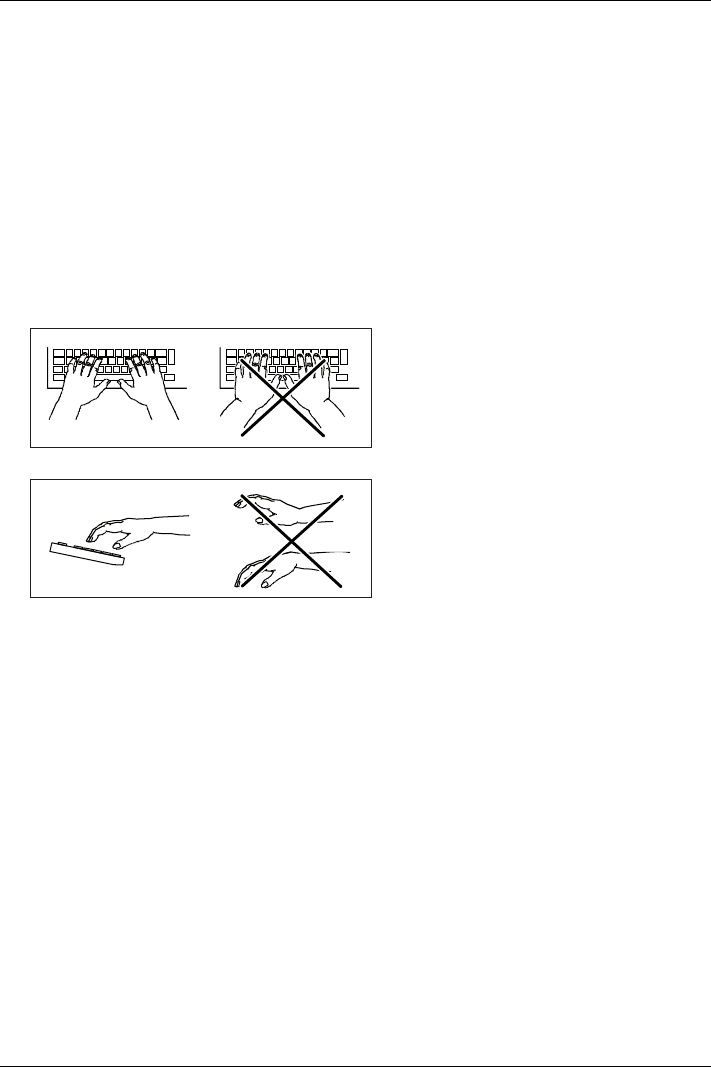
The keyboard is designed for use with health considerations and ergonomics in mind.
Awkward arrangement of input or output devices, incorrect arm movements or posture, or working
with the keyboard or mouse for lengthy periods without a break can lead to tenseness, fatigue,
and damage to the locomotor system (nerves, muscles, tendons, and joints).
You can considerably reduce the risk of this happening if you follow the advice given below:
• Position the keyboard so that you can use it without any noticeable strain. The
keyboard should be level with the upper part of your body. This orientation
enables a relaxed shoulder and arm position.
• The distance between the keyboard and the edge of the desk should be 5 to 10 cm.
• When typing, hold your hands and forearms so that they form as natural a line as
possible. Do not bend your hands too much to the side.
• Keep your wrists straight while typing. Do not angle your hands upwards or downwards.
• Do not rest your hands on the balls of your thumbs while typing, and do not strike the keys too hard.
• Relax your hands by occasionally taking a break from typing. During these breaks you should
rest your hands on the balls of your palms or place your arms on the armrests of your chair.
• When you feel the need, do some exercises to loosen up.
Adjusting the keyboard
You can customise the keyboard to use it laid flat or slightly tilted. If you turn over the
keyboard, you will see two feet which can be used to tilt the keyboard.
24 Fujitsu
Connecting the receiver, keyboard and mouse English - 5
Connecting the receiver, keyboard
and mouse
►Switch on your PC.
Connecting the receiver
The receiver is stored in the battery compartment of the keyboard when it is delivered.
►Remove the sticker by pulling on the red directional arrow.
►Open the battery compartment on the underside of the keyboard by opening
the snap hooks and lifting off the cover.
►Remove the receiver from the battery compartment.
►Connect the receiver to a USB port of your PC.
Preparing the keyboard and establishing
the wireless connection
Before you can work with your new keyboard, you must make the following preparations.
When inserting the batteries, follow the safety instructions and the information in chapter
"Technical data", Page 18 - English. Only ever use AAA batteries of the same type.
Remove the batteries from the keyboard if you will not be using it for a
longer period. This extends the life of the batteries.
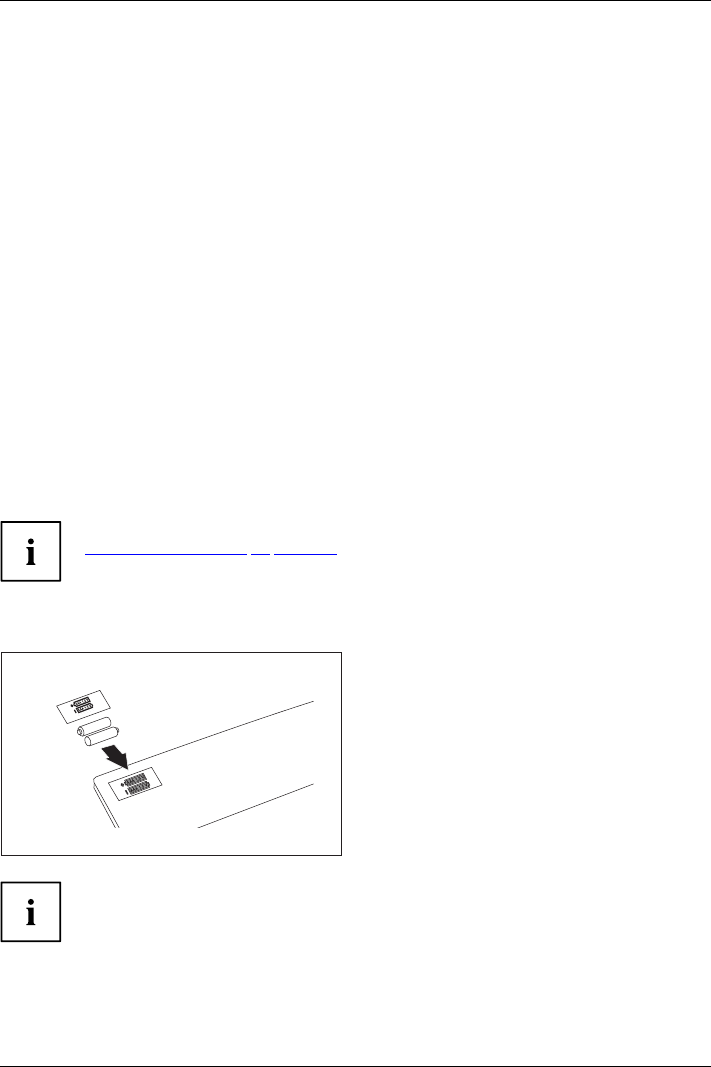
The keyboard requires two AAA batteries.
►Open the battery compartment on the
underside of the keyboard by opening the
snap hooks and lifting off the cover.
►Insert the two batteries in the battery
compartment. The diagrams in the battery
compartment and cover show how to insert
the batteries the correct way round.
►Close the battery compartment.
The wireless connection between the keyboard and receiver is initialised,
so that you can use the keyboard immediately.
Fujitsu 25
6 - English Connecting the receiver, keyboard and mouse
Preparing the mouse and establishing the
wireless connection
Before you can use your new mouse, you must make the following preparations.
When inserting the batteries, follow the safety instructions and the information
given in chapter "Technical data", Page 18 - English. Without exception, always
use AA batteries of the same type. Switch off the mouse when you will not use
be using it for some time. This extends the life of the batteries.
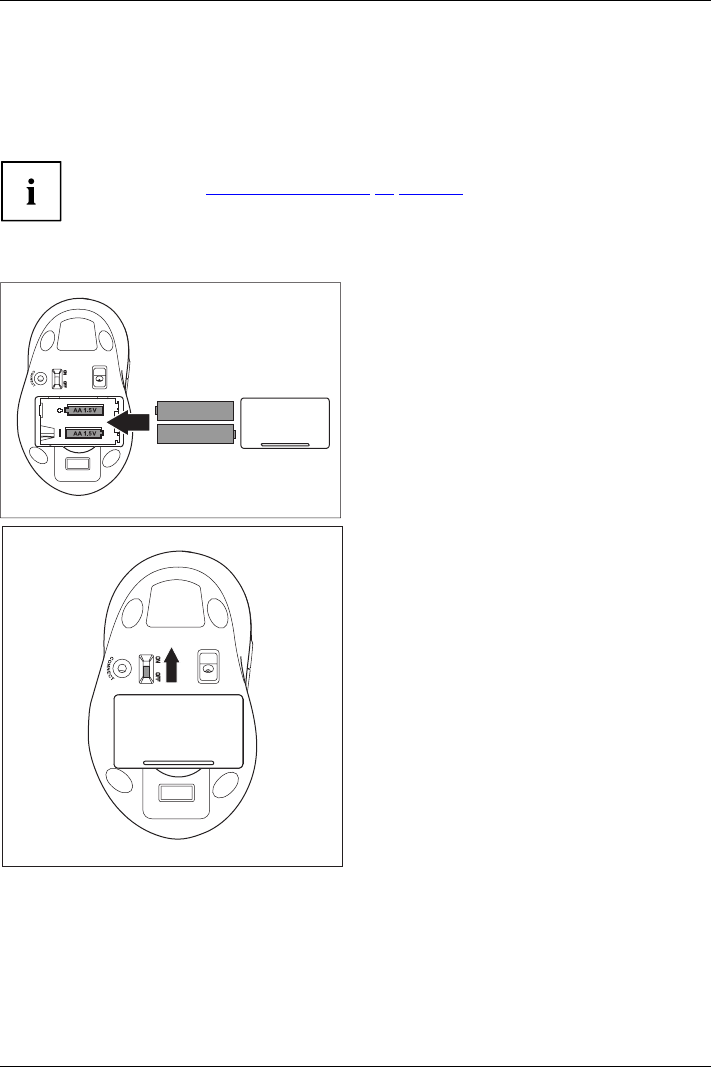
The mouse requires two AA batteries.
►Open the battery compartment on the
underside of the mouse by opening the
snap hooks and lifting off the cover.
►Insert the two batteries in the battery
compartment. The diagram in the battery
compartment shows how to insert the
batteries the correct way round.
►Close the battery compartment.
►Set the switch on the bottom of
themouseto"On".
►Holding it more than 20 cm away, point
the mouse at the receiver, then press a
mouse button or move the mouse.
26 Fujitsu
Using the mouse English - 7
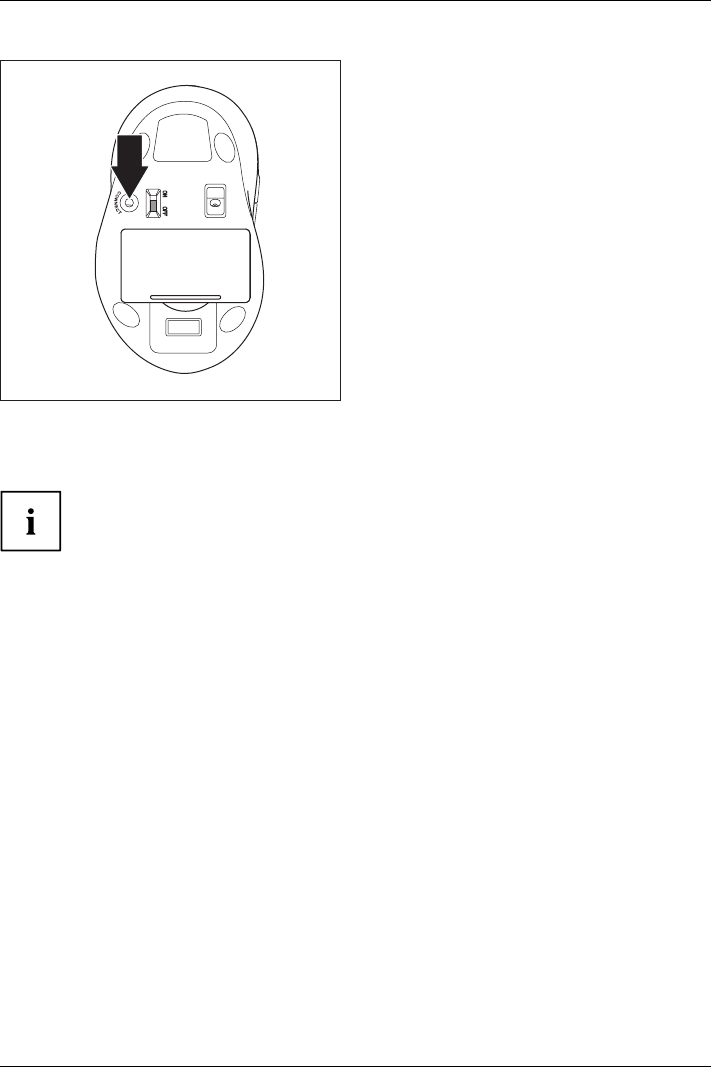
►If you encounter a problem, for example
the mouse connecting to the receiver of
another set which is close by, perform the
connection process manually as follows:
Holdingitmorethan20cm,pointthemouse
at the receiver, then press the Connect
button on the underside of the mouse.
The connection to the receiver is made when
the LED on the top of the mouse flashes red
3 times. The mouse is now ready to use.
Using the mouse
If the software is not installed, you cannot use all mouse functions.
Fujitsu 27
8 - English Using the mouse
Installing the software
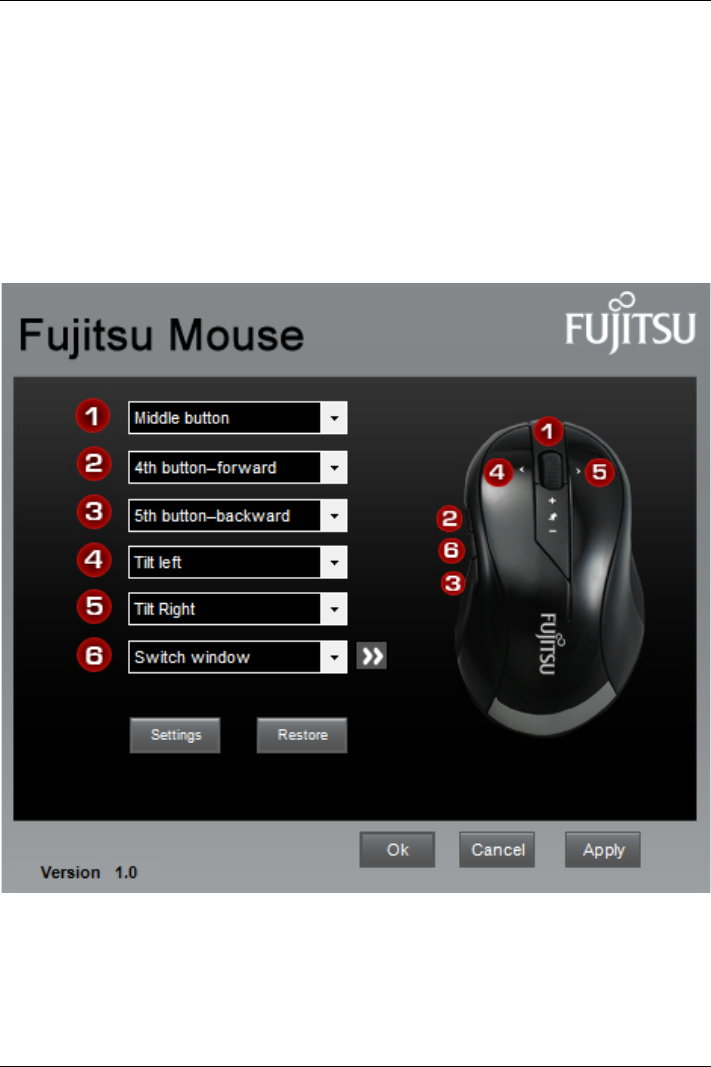
The supplied software must be installed in order to be able to configure the programmable
keys on the mouse and use its full range of functions.
►Insert the supplied software CD in the CD/DVD drive for the PC.
The CD will start automatically.
►If the CD does not start automatically, double click on the file Setup.exe in
the CD folder in Windows Explorer.
►Follow the instructions on the screen.
The installed software allows you to call up the following configuration menu either via the
installed programme group or via the mouse icon created in the task bar.
28 Fujitsu
Using the mouse English - 9
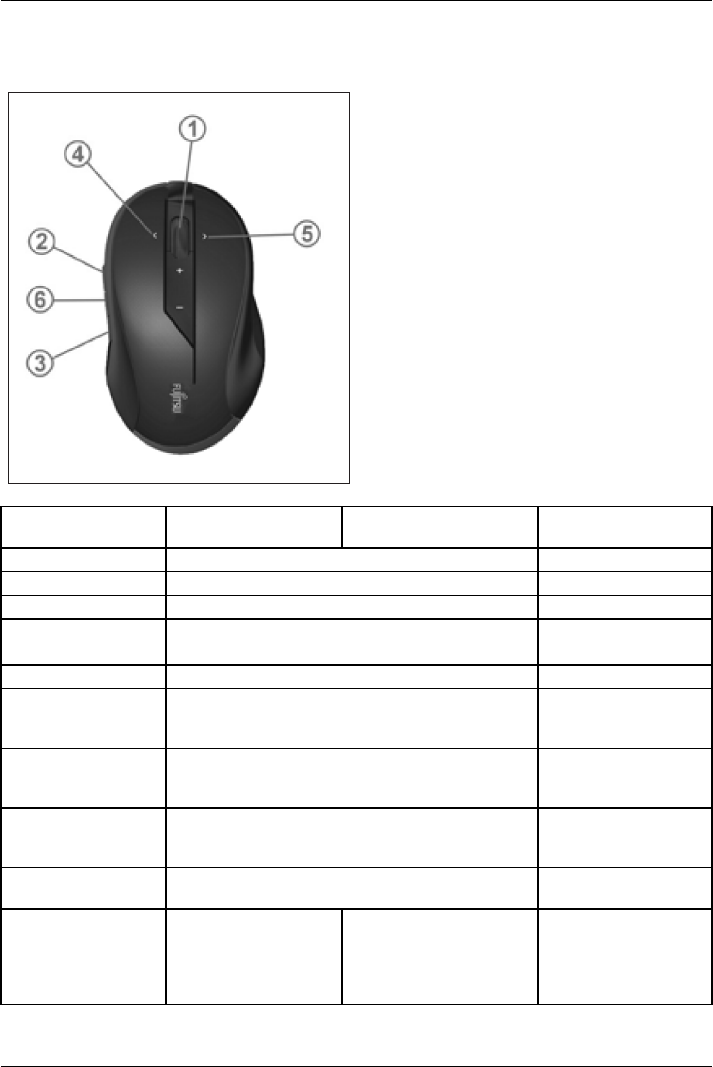
The buttons on the mouse
Mouse button Assignment without
software
Default assignmentwith
installed software
Optional with
installed software
Right mouse buttonFunction as right mouse button -
Left mouse button Function as left mouse button -
Plus button (+) Increase the resolution (scanning sensitivity) -
Minus button (-)Decrease the resolution (scanning sensitivity) -
1 (centre button) Function as centre button Freely programmable
1 (centre button)
turn mouse wheel
forwards
Scroll up -
1 (centre button)
turn mouse wheel
backwards
Scroll down-
2 (backwards button) Depending on the active application, you
can use this button to navigate backwards
or scroll backwards
Freely programmable
3 (forwards button) Depending on the active application, you can use
this button to navigate forwards or scroll forwards
Freely programmable
4 (mouse wheel
towards left)
No function (under
Windows 7 /
Windows 8: screen
content is shifted to the
left)
Screen content is shifted
to the left
Freely programmable
Fujitsu 29
10 - English Using the mouse
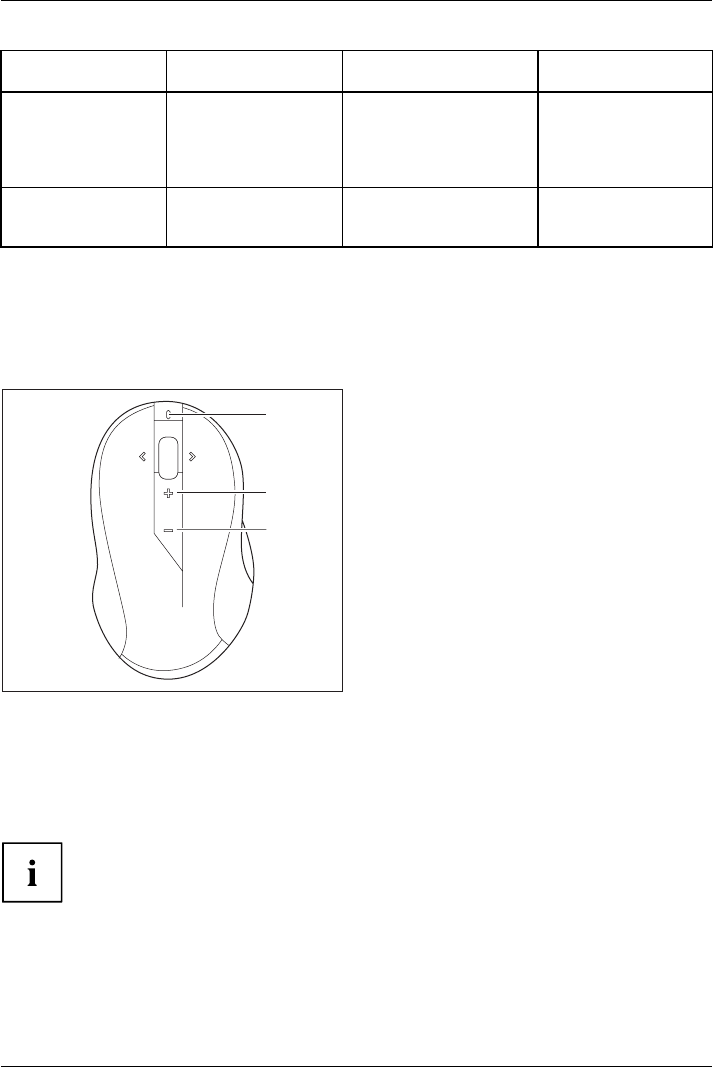
Mouse button Assignment without
software
Default assignment with
installed software
Optional with
installed software
5 (mouse wheel
towards right)
No function (under
Windows 7 /
Windows 8: screen
content is shifted to the
right)
Screen content is shifted
to the right
Freely programmable
6 (side button) No function Function ALT+TAB
(switch between the
two last active windows)
Freely programmable
Setting the scanning sensitivity
The mouse supports resolutions (scanning sensitivity) of 800, 1200 and 1600 dpi.
The default setting is 1200 dpi.
DPI+
DPI-
LED
►To increase the scanning sensitivity,
press the plus key.
The mouse responds faster.
►To decrease the scanning sensitivity,
press the minus key.
The mouse responds slower.
When setting the scanning sensitivity,
the LED flashes 3 times:
• red for 800 dpi
• green for 1200 dpi
• orange for 1600 dpi
Switching the mouse on and off
If you are not intending to use the mouse for a long time, you can switch it off to save power.
Set the switch on the bottom of the mouse to "Off".
If you wish to resume work with the mouse, do not forget to switch it on again.
30 Fujitsu
Using the mouse English - 11
Mobile transport
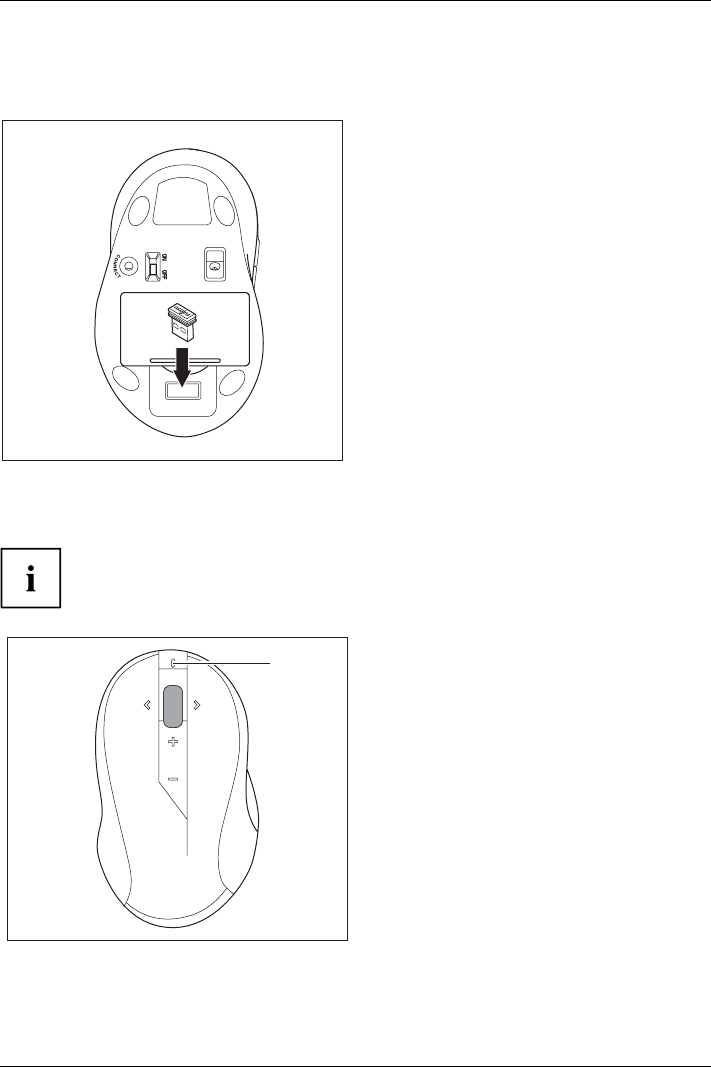
The receiver can be housed directly in the mouse.
►Slide the receiver into the opening in
the mouse casing, in the direction of
the arrow. A magnet holds the receiver
in the casing compartment.
►To remove the receiver, pull it upwards.
State of charge of the batteries in the mouse
Please note that the battery status indicator cannot light if the batteries
are completely discharged.
LED
If the level of charge of the batteries in the
mouse becomes low, the LED on the mouse
lights up red.
►Change the batteries in the near future.
Fujitsu 31

12 - English Using the mouse
Using the mouse wheel
In addition to two buttons, the mouse also has a wheel that can be used as follows:
►Press the on the wheel to use the third mouse button.
►Turn the wheel forwards or backwards to scroll, for example in documents or on Internet pages.
Depending on your operating system, you may be able to move the screen content horizontally:
►Press the wheel to the left or right.
32 Fujitsu
Working with the keyboard English - 13
Working with the keyboard
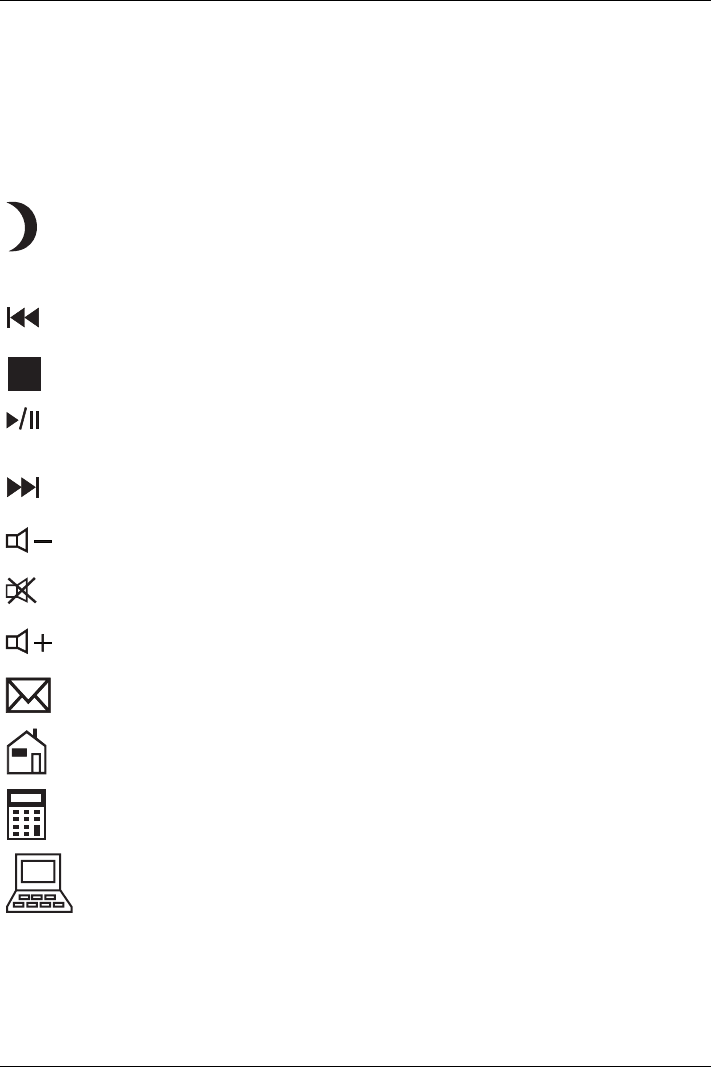
Multimedia keys
The following description of the 12 multimedia keys applies for operating systems that
support these functions, such as Windows XP or higher.
Standby mode / Energy-saving mode
Depending on the settings in the BIOS and operating system, the computer switches
into a defined energy-saving mode (standby mode, hibernate mode). This applies
only to operating systems that support ACPI (Advanced Configuration and Power
Management Interface), such as Windows XP or higher.
Previous track
Use this key to skip to the previous title in the active player.
Stop
Use this key to end the playback of a title.
Play/Pause
Use this key to start or pause the playback of a title for a short time, just as you
wouldwithanormalCDplayer.
Next track
Usethiskeytoskiptothenexttrackintheactiveplayer.
Decrease volume
Use this key to decrease the volume of the connected loudspeakers.
Switching the loudspeakers on and off
Use this key to switch the connected loudspeakers on and off.
Increase volume
Use this key to increase the volume of the connected loudspeakers.
E-mail
Use this key to start the default e-mail program for your system.
Internet browser
Use this key to start the default browser for your system.
Calculator
Use this key to open the Windows on-screen calculator.
Windows Explorer
Use this key to open Windows Explorer.
Fujitsu 33
14 - English Working with the keyboard
Additional key assignments
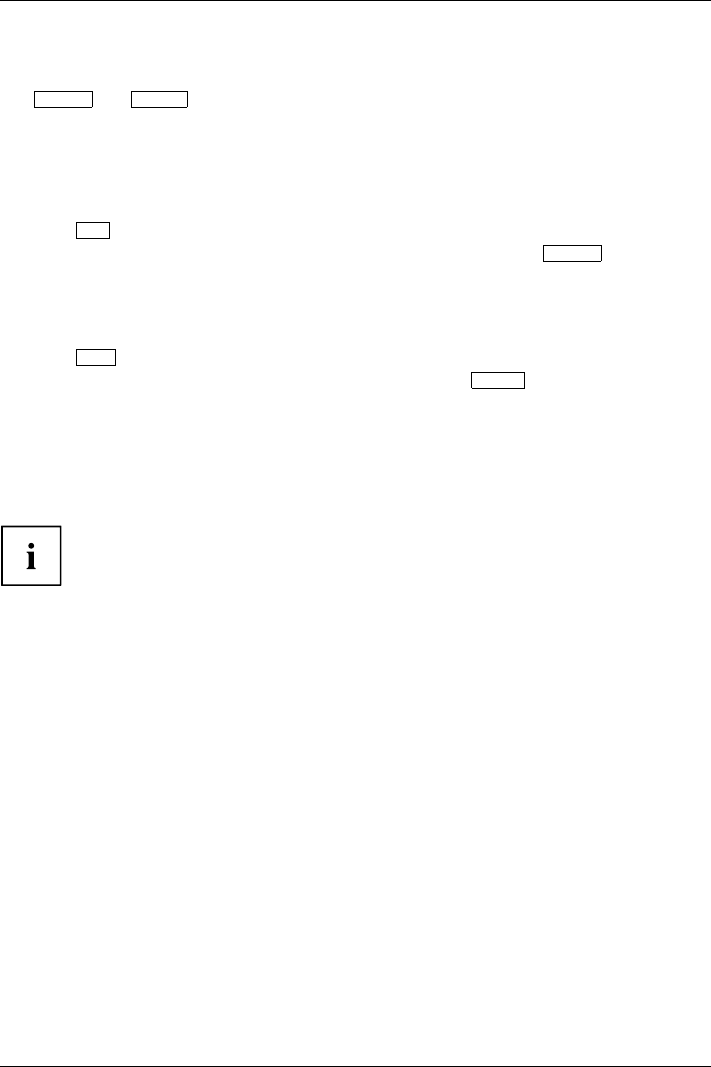
The PrtScn and Pause keys are equipped with a secondary assignment. They keys
are not labelled, but the functions are supported by the keyboard.
To call the secondary assignment:
Print
►Press Alt and the PrtScn key at the same time.
The secondary assignment for this key is the system request function SysRq .By
default, the system request is not activated under Windows.
Pause
►Press Ctrl and the Pause key at the same time.
The secondary assignment for this key is the break function Break .
Splash protection
Your keyboard is equipped with a drainage system which diverts any liquid which
may enter to the underside of the keyboard.
Your keyboard is not waterproof. The splash protection only protects against
liquids which may enter, such as from a spilt cup of coffee.
Encryption
The data transmitted between the keyboard and the receiver is encrypted.
Because of this, the keyboard can still be used when sensitive data is being input.
34 Fujitsu
Working with the keyboard English - 15
Battery charge of the batteries in the keyboard
Please note that the battery status indicator cannot light if the batteries
are completely discharged.
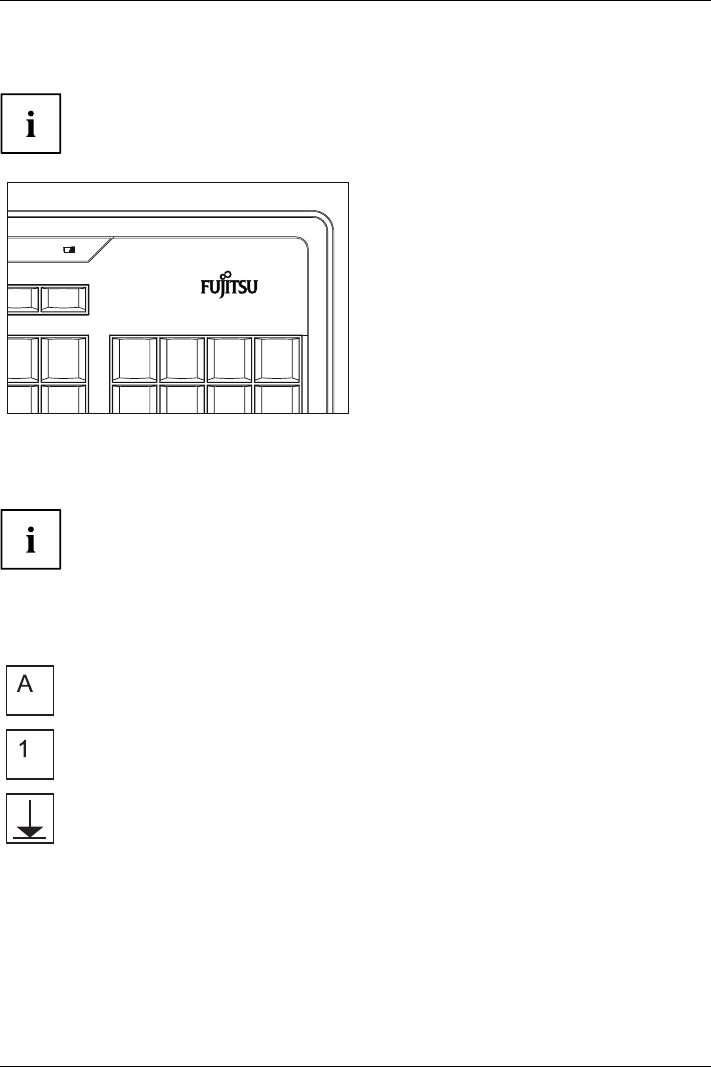
The LED on the keyboard lightsupinredifthe
battery charge in the keyboard becomes weak.
►Replace the batteries in the near future.
Display of keyboard modes in the task bar.
The display in the task bar will only be seen if the keyboard software which
was supplied with the device has been installed.
In the Windows taskbar, icons indicate which keyboard mode is active. They match
the displays on ordinary keyboards. A symbol is green when the respective mode
is activated and light grey when it is deactivated.
Uppercase mode (Caps Lock)
Numeric keypad (Num Lock)
Stop screen output (Scroll Lock)
Fujitsu 35
16 - English Working environments
Working environments
During signal transmission, interference can be caused by other radio
devices which use the same frequency range.
• The mouse can be used on nearly all surfaces. To ensure optimum
performance, it is recommended that the mouse be used on a relatively
light-coloured but non-reflective surface.
• The mouse switches to energy-saving mode if it is not used for a certain period of time.
Move the mouse or press one of the mouse buttons to "wake up" the mouse again.
Cleaning
Switch off all equipment concerned.
Do not use any cleaning agents that contain abrasives or which may dissolve plastic.
Ensure that no liquid enters the inside of the device.
The casing surfaces may be cleaned with a dry cloth. If particularly dirty, use a cloth
that has been moistened in mild domestic detergent and then carefully wrung out,
you can also clean the keyboard using disinfectant wipes.
Storing batteries
If you do not want to use your keyboard and/or mouse for a longer period of time, remove
the batteries and store them in a dry place at room temperature.
36 Fujitsu
Troubleshooting and tips English - 17
Troubleshooting and tips
If a fault occurs, try to eliminate it with the measures described in this chapter.
If you cannot resolve the fault, contact your local sales office or computer dealer.
If you need to exchange the device, please note that you must return it to your dealer
in its original packaging and also a produce proof of purchase (receipt). Keep your
receipt and the original packaging in a safe place after purchase.
The keyboard / mouse is not detected or
does not function
►Make sure that the mouse is switched on (on/off switch on bottom of mouse).
►Check whether the batteries of the keyboard or of the mouse are properly inserted.
►Set up the connection between the receiver and the mouse.
►Disconnect the receiver from the computer and reconnect it.
►If the table top is made of glass or of a reflective material, this can interfere with the mouse
sensor. In this case use an ordinary mouse pad or move to a more favourable desk.
►The receiver may be too far from the keyboard / mouse.
►Check whether the USB port on your computer is correctly configured.
►Restart your computer.
Connection problems with mouse
►Re-establish the connection between the mouse and the receiver, see Section
"Connecting the receiver", Page 5 - English.
The connection can be disturbed by other radio devices in the surrounding
area that use the same radio frequency.
►Connect the receiver to a different USB port of your computer.
On systems with a USB 3.0 port, connection problems may occur for technical reasons.
►Do not connect the receiver to a USB port that is very close to a USB 3.0 port with
a connected USB 3.0 device (e.g. directly adjacent USB ports).
►If necessary, us a USB extension cable to increase the distance.
Fujitsu 37

18 - English Technical data
Technical data
Safety regulations complied with EN 60950
Interface compatible with USB 3.0, USB 2.0 and USB 1.1
Frequency band 2.4 GHz
Modulation GFSK/DSSS
Number of channels 78
Keyboard
• Power supply
• Power consumption
•Batterylife
• Encryption
• 2 x AAA 1.5 V alkaline batteries, 2.0 – 3.3 V
• Active mode: < 2.5 mA,
sleep mode: 60 mA
• about 12 months for normal office use
• 128 bit AES
Mouse
• Power supply
• Current consumption (on white paper)
•Batterylife
• Resolution
• 2 x AA alkaline batteries, 1.5 V, 2.0 – 3.3 V
• Active mode: 10 mA,
sleep mode: 0.05 mA – 0.15 mA
• about 6 months for normal office use
• 800 dpi / 1200 dpi (Standard) / 1600 dpi
(selectable via rocker buttons on the mouse)
Receiver
• Power supply
• Power consumption
• USB mode: 5 V
• Active mode: 33 mA,
sleep mode: 2.5 mA
Environmental conditions
Operating temperature 0 °C – 40 °C / 32 °F – 104 °F
Mouse/Keyboard range Up to 10 m (depending on ambient interference)
38 Fujitsu
Changes or modifications not expressly approved by the party responsible for compliance
could void the user's authority to operate the equipment
NOTE:THE MANUFACTURER IS NOT RESPONSIBLE FOR ANY RADIO OR TV
INTERFERENCE CAUSED BY UNAUTHORIZED MODIFICATIONS TO THIS
EQUIPMENT.SUCH MODIFICATIONS COULD VOID THE USER’S AUTHORITY TO
OPERATE THE EQUIPMENT.
NOTE: This equipment has been tested and found to comply with the limits for a Class B
digital device, pursuant to Part 15 of the FCC Rules. These limits are designed to provide
reasonable protection against harmful interference in a residential installation. This
equipment generates, uses and can radiate radio frequency energy and, if not installed
and used in accordance with the instructions, may cause harmful interference to radio
communications. However, there is no guarantee that interference will not occur in a
particular installation. If this equipment does cause harmful interference to radio or
television reception, which can be determined by turning the equipment off and on, the
user is encouraged to try to correct the interference by one or more of the following
measures:
-- Reorient or relocate the receiving antenna.
-- Increase the separation between the equipment and receiver.
-- Connect the equipment into an outlet on a circuit different
from that to which the receiver is connected.
-- Consult the dealer or an experienced radio/TV technician for help.
This device complies with Part 15 of the FCC Rules. Operation is subject to the following
two conditions: (1) this device may not cause harmful interference, and (2) this device
must accept any interference received,
including interference that may cause undesired operation.