Garmin Diamond Da40 Users Manual
Garmin-Software-Version-0321-22-720808 garmin-software-version-0321-22-720808
2015-01-29
: Garmin Garmin-Diamond-Da40-Users-Manual-216807 garmin-diamond-da40-users-manual-216807 garmin pdf
Open the PDF directly: View PDF  .
.
Page Count: 538 [warning: Documents this large are best viewed by clicking the View PDF Link!]
- Section 1 System overview
- Section 2 Flight Instruments
- Section 3 Engine Indication System
- Section 4 audio panel and CNS
- Section 5 Flight Management
- Section 6 Hazard Avoidance
- Section 7 Automatic Flight Control System (Optional)
- Section 8 Additional Features
- Appendices
- Index

Garmin International, Inc.
1200 East 151st Street
Olathe, KS 66062, U.S.A.
p:913.397.8200
f:913.397.8282
Garmin AT, Inc.
2345 Turner Road SE
Salem, OR 97302, U.S.A.
p:503.391.3411
f:503.364.2138
Garmin (Europe) Ltd.
Liberty House, Bulls Copse Road
Houndsdown Business Park
Southampton, SO40 9RB, U.K.
p:44/0870.8501241
f:44/0870.8501251
Garmin Corporation
No. 68, Jangshu 2nd Road
Shijr, Taipei County, Taiwan
p:886/02.2642.9199
f:886/02.2642.9099
www.garmin.com
System Software 0321.20 or later
G1000®Integrated Flight Deck
Pilot’s Guide
G1000®
Pilot’s Guide Diamond
DA40/40F
190-00592-06
Revision A
Untitled-1 1 11/13/2007 9:15:37 AM

SYSTEM OVERVIEW
FLIGHT INSTRUMENTS
EIS
AUDIO PANEL & CNS
FLIGHT MANAGEMENT
HAZARD AVOIDANCE
AFCS
ADDITIONAL FEATURES
APPENDICES
INDEX

Garmin G1000 Pilot’s Guide for the Diamond DA40/40F
190-00592-06 Rev. A
Copyright © 2006-2009 Garmin Ltd. or its subsidiaries. All rights reserved.
This manual reflects the operation of System Software version 0321.20 or later for the Diamond DA40 or DA40F. Some differences in
operation may be observed when comparing the information in this manual to earlier or later software versions.
Garmin International, Inc., 1200 East 151st Street, Olathe, Kansas 66062, U.S.A.
Tel: 913/397.8200 Fax: 913/397.8282
Garmin AT, Inc., 2345 Turner Road SE, Salem, OR 97302, U.S.A.
Tel: 503/391.3411 Fax: 503/364.2138
Garmin (Europe) Ltd., Liberty House, Bulls Copse Road, Hounsdown Business Park, Southampton, SO40 9RB, U.K
Tel: 44/0870.8501241 Fax: 44/0870.8501251
Garmin Corporation, No. 68, Jangshu 2nd Road, Shijr, Taipei County, Taiwan
Tel: 886/02.2642.9199 Fax: 886/02.2642.9099
Website Address: www.garmin.com
Except as expressly provided herein, no part of this manual may be reproduced, copied, transmitted, disseminated, downloaded or stored
in any storage medium, for any purpose without the express written permission of Garmin. Garmin hereby grants permission to download
a single copy of this manual and of any revision to this manual onto a hard drive or other electronic storage medium to be viewed for
personal use, provided that such electronic or printed copy of this manual or revision must contain the complete text of this copyright notice
and provided further that any unauthorized commercial distribution of this manual or any revision hereto is strictly prohibited.
Garmin® and G1000® are registered trademarks of Garmin Ltd. or its subsidiaries. FliteCharts®, and SafeTaxi® are trademarks of Garmin
Ltd. or its subsidiaries. These trademarks may not be used without the express permission of Garmin.
Bendix/King® and Honeywell® are registered trademarks of Honeywell International, Inc.; Becker® is a registered trademark of Becker
Flugfunkwerk GmbH; NavData® is a registered trademark of Jeppesen, Inc.; XM® is a registered trademark of XM Satellite Radio, Inc.; and
Stormscope® is a registered trademark of L-3 Communications.
March 2009 Printed in the U.S.A.

190-00592-06 Rev. A
Garmin G1000 Pilot’s Guide for the Diamond DA40/40F
i
LIMITED WARRANTY
LIMITED WARRANTY
This Garmin product is warranted to be free from defects in materials or workmanship for two years from the date of purchase. Within this
period, Garmin will, at its sole option, repair or replace any components that fail in normal use. Such repairs or replacement will be made
at no charge to the customer for parts and labor, provided that the customer shall be responsible for any transportation cost. This warranty
does not cover failures due to abuse, misuse, accident, or unauthorized alterations or repairs.
THE WARRANTIES AND REMEDIES CONTAINED HEREIN ARE EXCLUSIVE AND IN LIEU OF ALL OTHER WARRANTIES EXPRESS OR IMPLIED
OR STATUTORY, INCLUDING ANY LIABILITY ARISING UNDER ANY WARRANTY OF MERCHANTABILITY OR FITNESS FOR A PARTICULAR
PURPOSE, STATUTORY OR OTHERWISE. THIS WARRANTY GIVES YOU SPECIFIC LEGAL RIGHTS, WHICH MAY VARY FROM STATE TO
STATE.
IN NO EVENT SHALL GARMIN BE LIABLE FOR ANY INCIDENTAL, SPECIAL, INDIRECT OR CONSEQUENTIAL DAMAGES, WHETHER
RESULTING FROM THE USE, MISUSE, OR INABILITY TO USE THIS PRODUCT OR FROM DEFECTS IN THE PRODUCT. Some states do not
allow the exclusion of incidental or consequential damages, so the above limitations may not apply to you.
Garmin retains the exclusive right to repair or replace the unit or software, or to offer a full refund of the purchase price, at its sole
discretion. SUCH REMEDY SHALL BE YOUR SOLE AND EXCLUSIVE REMEDY FOR ANY BREACH OF WARRANTY.
To obtain warranty service, contact your local Garmin Authorized Service Center. For assistance in locating a Service Center near you, visit
the Garmin Website at “http://www.garmin.com” or contact Garmin Customer Service at 800-800-1020.
Garmin G1000 Pilot’s Guide for the Diamond DA40/40F
190-00592-06 Rev. Aii
WARNINGS, CAUTIONS, AND NOTES
WARNING:
To reduce the risk of unsafe operation, carefully review and understand all aspects of the
G1000 Pilot’s Guide documentation. Thoroughly practice basic operation prior to actual use. During flight
operations, carefully compare indications from the G1000 to all available navigation sources, including
the information from other NAVAIDs, visual sightings, charts, etc. For safety purposes, always resolve any
discrepancies before continuing navigation.
WARNING: The Garmin G1000 has a very high degree of functional integrity. However, the pilot must
recognize that providing monitoring and/or self-test capability for all conceivable system failures is not
practical. Although unlikely, it may be possible for erroneous operation to occur without a fault indication
shown by the G1000. It is thus the responsibility of the pilot to detect such an occurrence by means of
cross-checking with all redundant or correlated information available in the cockpit.
WARNING: For safety reasons, G1000 operational procedures must be learned on the ground.
WARNING:
The United States government operates the Global Positioning System and is solely responsible
for its accuracy and maintenance. The GPS system is subject to changes which could affect the accuracy
and performance of all GPS equipment. Portions of the Garmin G1000 utilize GPS as a precision electronic
NAVigation AID (NAVAID). Therefore, as with all NAVAIDs, information presented by the G1000 can be
misused or misinterpreted and, therefore, become unsafe.
WARNING: The altitude calculated by G1000 GPS receivers is geometric height above Mean Sea Level and
could vary significantly from the altitude displayed by pressure altimeters, such as the GDC 74A Air Data
Computer, or other altimeters in aircraft. GPS altitude should never be used for vertical navigation. Always
use pressure altitude displayed by the G1000 PFD or other pressure altimeters in aircraft.
WARNING: The displayed minimum safe altitudes (MSAs) are only advisory in nature and should not be
relied upon as the sole source of obstacle and terrain avoidance information. Always refer to current
aeronautical charts for appropriate minimum clearance altitudes.
WARNING: Navigation and terrain separation must NOT be predicated upon the use of the terrain function.
The G1000 Terrain Proximity feature is NOT intended to be used as a primary reference for terrain avoidance
and does not relieve the pilot from the responsibility of being aware of surroundings during flight. The
Terrain Proximity feature is only to be used as an aid for terrain avoidance and is not certified for use
in applications requiring a certified terrain awareness system. Terrain data is obtained from third party
sources. Garmin is not able to independently verify the accuracy of the terrain data.
WARNING: Do not use outdated database information. Databases used in the G1000 System must be updated
regularly in order to ensure that the information remains current. Pilots using any outdated database do so
entirely at their own risk.
190-00592-06 Rev. A
Garmin G1000 Pilot’s Guide for the Diamond DA40/40F
iii
WARNINGS, CAUTIONS, AND NOTES
WARNING: Do not use basemap (land and water data) information for primary navigation. Basemap data is
intended only to supplement other approved navigation data sources and should be considered as an aid to
enhance situational awareness.
WARNING: Traffic information shown on the G1000 Multi Function Display is provided as an aid in visually
acquiring traffic. The aircraft should be maneuvered based only upon ATC guidance or positive visual
acquisition of conflicting traffic.
WARNING: XM Weather should not be used for hazardous weather penetration. Weather information
provided by the GDL 69/69A is approved only for weather avoidance, not penetration.
WARNING: NEXRAD weather data is to be used for long-range planning purposes only. Due to inherent
delays in data transmission and the relative age of the data, NEXRAD weather data should not be used for
short-range weather avoidance.
WARNING: Use of the Stormscope is not intended for hazardous weather penetration (thunderstorm
penetration). Stormscope information, as displayed on the G1000 MFD, is to be used only for weather
avoidance, not penetration.
WARNING
: The illustrations in this guide are only examples. Never use the G1000 to attempt to penetrate
a thunderstorm. Both the FAA Advisory Circular, Subject: Thunderstorms, and the Aeronautical Information
Manual (AIM) recommend avoiding “by at least 20 miles any thunderstorm identifi ed as severe or giving
an intense radar echo.”
WARNING
:
Because of anomalies in the earth’s magnetic field, operating the G1000 within the following
areas could result in loss of reliable attitude and heading indications. North of 70° North latitude and south
of 70° South latitude. An area north of 65° North latitude between longitude 75º West and 120º West. An
area south of 55° South latitude between longitude 120º East and 165º East.
CAUTION: The Garmin G1000 does not contain any user-serviceable parts. Repairs should only be made by
an authorized Garmin service center. Unauthorized repairs or modifications could void both the warranty
and the pilot’s authority to operate this device under FAA/FCC regulations.
CAUTION: The PFD and MFD displays use a lens coated with a special anti-reflective coating that is very
sensitive to skin oils, waxes, and abrasive cleaners. CLEANERS CONTAINING AMMONIA WILL HARM THE
ANTI-REFLECTIVE COATING. It is very important to clean the lens using a clean, lint-free cloth and an
eyeglass lens cleaner that is specified as safe for anti-reflective coatings.
Garmin G1000 Pilot’s Guide for the Diamond DA40/40F
190-00592-06 Rev. Aiv
WARNINGS, CAUTIONS, AND NOTES
NOTE: When using Stormscope, there are several atmospheric phenomena in addition to nearby thunderstorms
that can cause isolated discharge points in the strike display mode. However, clusters of two or more
discharge points in the strike display mode do indicate thunderstorm activity if these points reappear after
the screen has been cleared.
NOTE: All visual depictions contained within this document, including screen images of the G1000 panel
and displays, are for example only, are subject to change, and may not reflect the most current G1000
System. Depictions of equipment may differ slightly from the actual equipment.
NOTE: The GDU 1040/1042/1044 PFD/MFD may require a warm-up time of up to 30 minutes when exposed
to -40˚C for an extended period. A warm-up time of up to 15 minutes may be required when exposed to
-30˚C for an extended period.
NOTE: This device complies with part 15 of the FCC Rules. Operation is subject to the following two conditions:
(1) this device may not cause harmful interference, and (2) this device must accept any interference received,
including interference that may cause undesired operation.
NOTE
: This product, its packaging, and its components contain chemicals known to the State of California
to cause cancer, birth defects, or reproductive harm. This notice is being provided in accordance with
California’s Proposition 65. For additional information, refer to the website at www.garmin.com/prop65.
NOTE: Interference from GPS repeaters operating inside nearby hangars can cause an intermittent loss of
attitude and heading displays while the aircraft is on the ground. Moving the aircraft more than 100 feet
away from the source of the interference should alleviate the condition.
NOTE: Use of polarized eyewear may cause the flight displays to appear dim or blank.
190-00592-06 Rev. A
Garmin G1000 Pilot’s Guide for the Diamond DA40/40F
v
REVISION INFORMATION
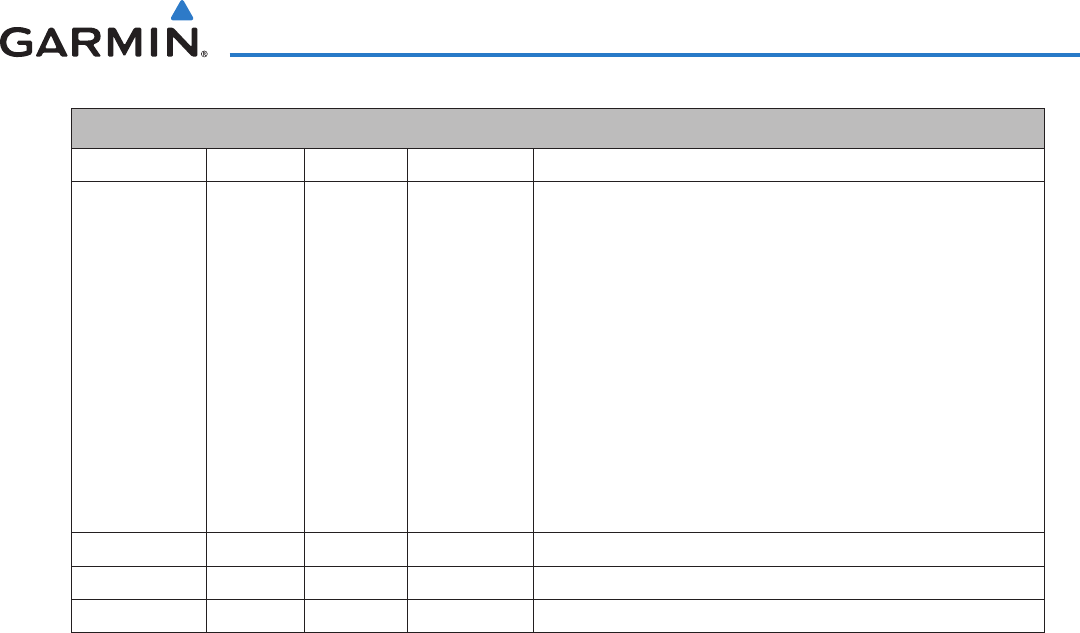
Record of Revisions
Part Number Revision Date Page Range Description
190-00592-00 A 11/10/05 i – I-6 Optional fuel pressure gauge information added
190-00592-01 A 6/16/06 i – I-4 GFC 700 information added
190-00592-02 A 7/20/06 i – I-4 TAWS information added
GDL 69A crew muting information added
190-00592-03 A 4/20/07 i – I-6 EIS updated
Airways information added
WAAS information added
VNV information added
Charts information added
Stormscope information added
TAS600 information added
190-00592-04 A 12/04/07 i – I-6 KAP 140 Autopilot annunciations added
190-00592-05 A 03/31/08 i – I-6 Synthetic Vision System information added
190-00592-06 A 03/25/09 i – I-6 Updated to GDU Software 9.14

Garmin G1000 Pilot’s Guide for the Diamond DA40/40F
190-00592-06 Rev. Avi
TABLE OF CONTENTS
SECTION 1 SYSTEM OVERVIEW
1.1 Line Replaceable Units ........................................... 2
1.2 Secure Digital (SD) Cards ....................................... 7
1.3 System Power-up ..................................................... 8
1.4 System Operation .................................................... 9
Display Operation ......................................................... 9
G1000 System Annunciations ...................................... 10
System Status ............................................................. 11
AHRS Operation ......................................................... 13
GPS Receiver Operation .............................................. 14
1.5 G1000 Controls ...................................................... 18
PFD/MFD Controls ...................................................... 18
Softkey Function ......................................................... 20
1.6 Accessing G1000 Functionality............................ 27
Menus ....................................................................... 27
Data Entry.................................................................. 27
Page Groups .............................................................. 29
System Settings .......................................................... 33
Timers ....................................................................... 38
1.7 Display Backlighting ............................................. 41
SECTION 2 FLIGHT INSTRUMENTS
2.1 Flight Instruments ................................................. 46
Airspeed Indicator ...................................................... 46
Attitude Indicator ....................................................... 48
Altimeter ................................................................... 49
Vertical Speed Indicator (VSI) ....................................... 51
Vertical Deviation ....................................................... 52
Horizontal Situation Indicator (HSI) .............................. 53
Course Deviation Indicator (CDI) .................................. 58
2.2 Supplemental Flight Data .................................... 65
Outside Air Temperature .............................................. 65
Wind Data ................................................................. 67
Vertical Navigation (VNV) Indications ........................... 68
2.3 PFD Annunciations and Alerting Functions ........ 69
System Alerting .......................................................... 69
Marker Beacon Annunciations...................................... 70
Traffic Annunciation .................................................... 70
TAWS Annunciations ................................................... 71
Altitude Alerting ......................................................... 72
Low Altitude Annunciation .......................................... 72
Minimum Descent Altitude/Decision Height Alerting ......73
2.4 Abnormal Operations ........................................... 74
Abnormal GPS Conditions ........................................... 74
Unusual Attitudes ....................................................... 75
SECTION 3 ENGINE INDICATION SYSTEM
3.1 EIS Display .............................................................. 78
3.2 Engine Page............................................................ 80
Fuel Calculations ........................................................ 82
3.3 Leaning Assist Mode ............................................. 83
3.4 EIS Display in Reversionary Mode ....................... 84
Lean Display .............................................................. 86
System Display ........................................................... 88
SECTION 4 AUDIO PANEL AND CNS
4.1 Overview ................................................................ 91
MFD/PFD Controls and Frequency Display ..................... 92
Audio Panel Controls .................................................. 94
4.2 COM Operation ...................................................... 96
COM Transceiver Selection and Activation ..................... 96
COM Transceiver Manual Tuning .................................. 97
Quick-Tuning and Activating 121.500 MHz .................... 98
Auto-Tuning the COM Frequency .................................. 99
Frequency Spacing .................................................... 103
Automatic Squelch .................................................... 104
Volume .................................................................... 104
4.3 NAV Operation ..................................................... 105
NAV Radio Selection and Activation ........................... 105
NAV Receiver Manual Tuning ..................................... 106
Auto-Tuning a NAV Frequency from the MFD............... 108
Marker Beacon Receiver ............................................ 113
ADF/DME Tuning ...................................................... 114
4.4 GTX 33 Mode S Transponder .............................. 118
Transponder Controls ................................................ 118
Transponder Mode Selection ...................................... 119
Entering a Transponder Code ..................................... 122
IDENT Function ........................................................ 123
4.5 Additional Audio Panel Functions ..................... 124
Power-Up ................................................................. 124
Mono/Stereo Headsets .............................................. 124
Speaker ................................................................... 124
Intercom .................................................................. 125
Passenger Address (PA) System ..................................127
Clearance Recorder and Player ................................... 127

190-00592-06 Rev. A
Garmin G1000 Pilot’s Guide for the Diamond DA40/40F
vii
TABLE OF CONTENTS
Entertainment Inputs ................................................ 128
4.6 Audio Panel Preflight Procedure ....................... 129
4.7 Abnormal Operation ........................................... 130
Stuck Microphone ..................................................... 130
COM Tuning Failure ................................................... 130
Audio Panel Fail-Safe Operation ................................. 130
Reversionary Mode ................................................... 130
SECTION 5 FLIGHT MANAGEMENT
5.1 Introduction ......................................................... 131
Navigation Status Box ............................................... 133
5.2 Using Map Displays ............................................. 134
Map Orientation ....................................................... 134
Map Range .............................................................. 136
Map Panning ............................................................ 138
Measuring Bearing and Distance ................................ 143
Topography .............................................................. 144
Map Symbols ........................................................... 147
Airways ................................................................... 153
Track Vector ............................................................. 155
Wind Vector ............................................................. 156
Nav Range Ring........................................................ 157
Fuel Range Ring ....................................................... 158
Field of View (SVS) .................................................... 159
5.3 Waypoints ............................................................. 160
Airports ................................................................... 161
Intersections ............................................................ 167
NDBs ....................................................................... 169
VORs ....................................................................... 171
User Waypoints ........................................................ 173
5.4 Airspaces .............................................................. 179
5.5 Direct-to-Navigation .......................................... 183
5.6 Flight Planning ..................................................... 189
Flight Plan Creation .................................................. 190
Adding Waypoints to an Existing Flight Plan ................ 195
Adding Airways to a Flight Plan ................................. 197
Adding Procedures to a Stored Flight Plan .................. 200
Flight Plan Storage ................................................... 207
Flight Plan Editing .................................................... 209
Along Track Offsets ................................................... 212
Parallel Track ............................................................ 214
Activating a Flight Plan Leg ....................................... 217
Inverting a Flight Plan ............................................... 218
Flight Plan Views ...................................................... 219
Closest Point of FPL .................................................. 221
5.7 Vertical Navigation ............................................. 222
Altitude Constraints .................................................. 224
5.8 Procedures ........................................................... 228
Departures ............................................................... 228
Arrivals ................................................................... 231
Approaches ............................................................. 233
5.9 Trip Planning ........................................................ 239
Trip Planning ............................................................ 239
5.10 RAIM Prediction................................................... 243
5.11 Navigating a Flight Plan ..................................... 247
5.12 Abnormal Operation ........................................... 275
SECTION 6 HAZARD AVOIDANCE
6.1 XM Satellite Weather .......................................... 277
Activating Services .................................................... 278
Using XM Satellite Weather Products .......................... 279
6.2 WX-500 Stormscope ........................................... 306
Setting Up Stormscope on the Navigation Map ........... 306
Selecting the Stormscope Page .................................. 310
6.3 Terrain Proximity ................................................. 311
Displaying Terrain Proximity Data ............................... 311
Terrain Proximity Page ............................................... 314
6.4 Terrain-SVS ........................................................... 316
TERRAIN-SVS Page ................................................... 320
TERRAIN-SVS Alerts .................................................. 322
System Status ........................................................... 325
6.5 Terrain Awareness & Warning System (TAWS) . 326
Displaying TAWS Data ............................................... 327
TAWS-B Page ........................................................... 329
TAWS Alerts ............................................................. 331
System Status ........................................................... 337
6.6 Traffic Information Service (TIS) ........................ 339
Displaying TRAFFIC Data ........................................... 340
Traffic Map Page ....................................................... 342
TIS Alerts ................................................................. 343
System Status ........................................................... 345
6.7 Traffic Advisory System ...................................... 348
TAS Symbology ......................................................... 348
Displaying Traffic Data .............................................. 349
Traffic Map Page Display Range ................................. 351
TAS Alerts ................................................................ 353

Garmin G1000 Pilot’s Guide for the Diamond DA40/40F
190-00592-06 Rev. Aviii
TABLE OF CONTENTS
TAS Voice Alerts ........................................................ 353
System Status ........................................................... 354
SECTION 7 AUTOMATIC FLIGHT CONTROL SYSTEM
7.1 AFCS Controls ...................................................... 358
7.2 Flight Director Operation ................................... 360
Activating the Flight Director ..................................... 360
AFCS Status Box ....................................................... 361
Command Bars ......................................................... 362
Flight Director Modes ................................................ 362
7.3 Vertical Modes ..................................................... 363
Pitch Hold Mode (PIT) ............................................... 364
Selected Altitude Capture Mode (ALTS) ....................... 365
Altitude Hold Mode (ALT) .......................................... 366
Vertical Speed Mode (VS) .......................................... 367
Flight Level Change Mode (FLC) ................................. 368
Vertical Navigation Modes (VPTH, ALTV) ..................... 370
Glidepath Mode (GP) (WAAS only) ............................. 375
Glideslope Mode (GS) ............................................... 377
Go Around Mode (GA) .............................................. 378
7.4 Lateral Modes ...................................................... 379
Roll Hold Mode (ROL) ............................................... 380
Heading Select Mode (HDG) ...................................... 381
Navigation Modes (GPS, VOR, LOC, BC) ...................... 382
Approach Modes (GPS, VAPP, LOC) ............................. 384
7.5 Autopilot Operation ............................................ 386
Engaging the Autopilot ............................................. 386
Control Wheel Steering ............................................. 387
Disengaging the Autopilot ......................................... 387
7.6 Example Flight Plan ............................................ 388
Departure ................................................................ 389
Intercepting a VOR Radial .......................................... 391
Flying a Flight Plan/GPS Course ................................. 392
Descent ................................................................... 393
Approach ................................................................. 397
Go Around/Missed Approach ..................................... 399
7.7 AFCS Annunciations and Alerts .........................401
AFCS Status Alerts .................................................... 401
Overspeed Protection ................................................ 402
Annunciations for KAP 140 Autopilot System .............. 402
SECTION 8 ADDITIONAL FEATURES
8.1 Synthetic Vision System (SVS) (Optional) ......... 404
SVS Operation .......................................................... 405
SVS Features ............................................................ 407
Field of View ............................................................ 415
8.2 SafeTaxi ................................................................ 417
SafeTaxi Cycle Number and Revision .......................... 420
8.3 ChartView ............................................................. 423
ChartView Softkeys ................................................... 423
Terminal Procedures Charts ....................................... 424
Chart Options ........................................................... 432
Day/Night View ........................................................ 438
ChartView Cycle Number and Expiration Date ............. 440
8.4 FliteCharts ............................................................ 444
FliteCharts Softkeys .................................................. 444
Terminal Procedures Charts ....................................... 445
Chart Options ........................................................... 452
Day/Night View ........................................................ 456
FliteCharts Cycle Number and Expiration Date ............. 458
8.5 XM Radio Entertainment (Optional) ................. 462
Activating XM Satellite Radio Services ........................ 462
Using XM Radio ....................................................... 464
8.6 Scheduler .............................................................. 467
8.7 Electronic Checklists ........................................... 469
8.8 Flight Data Logging ............................................ 472
8.9 Abnormal Operation ........................................... 474
SVS Troubleshooting ................................................. 474
Reversionary Mode ................................................... 474
Unusual Attitudes ..................................................... 475
APPENDICES
Annunciations and Alerts ............................................. 479
SVS Terrain Alerts ...................................................... 496
SVS Terrain Status Annunciations ............................... 496
SD Card Use and Databases ......................................... 499
Glossary .......................................................................... 503
Frequently Asked Questions ........................................ 509
General TIS Information ............................................... 513
Map Symbols ................................................................. 515
INDEX
Index ................................................................................I-1
190-00592-06 Rev. A
Garmin G1000 Pilot’s Guide for the Diamond DA40/40F
1
SYSTEM OVERVIEW
SYSTEM
OVERVIEW
FLIGHT
INSTRUMENTS EIS AUDIO PANEL
& CNS
FLIGHT
MANAGEMENT
HAZARD
AVOIDANCE AFCS ADDITIONAL
FEATURES APPENDICES INDEX
SECTION 1 SYSTEM OVERVIEW
NOTE: Refer to the Automatic Flight Control System (AFCS) Section for details on the GFC 700 AFCS.
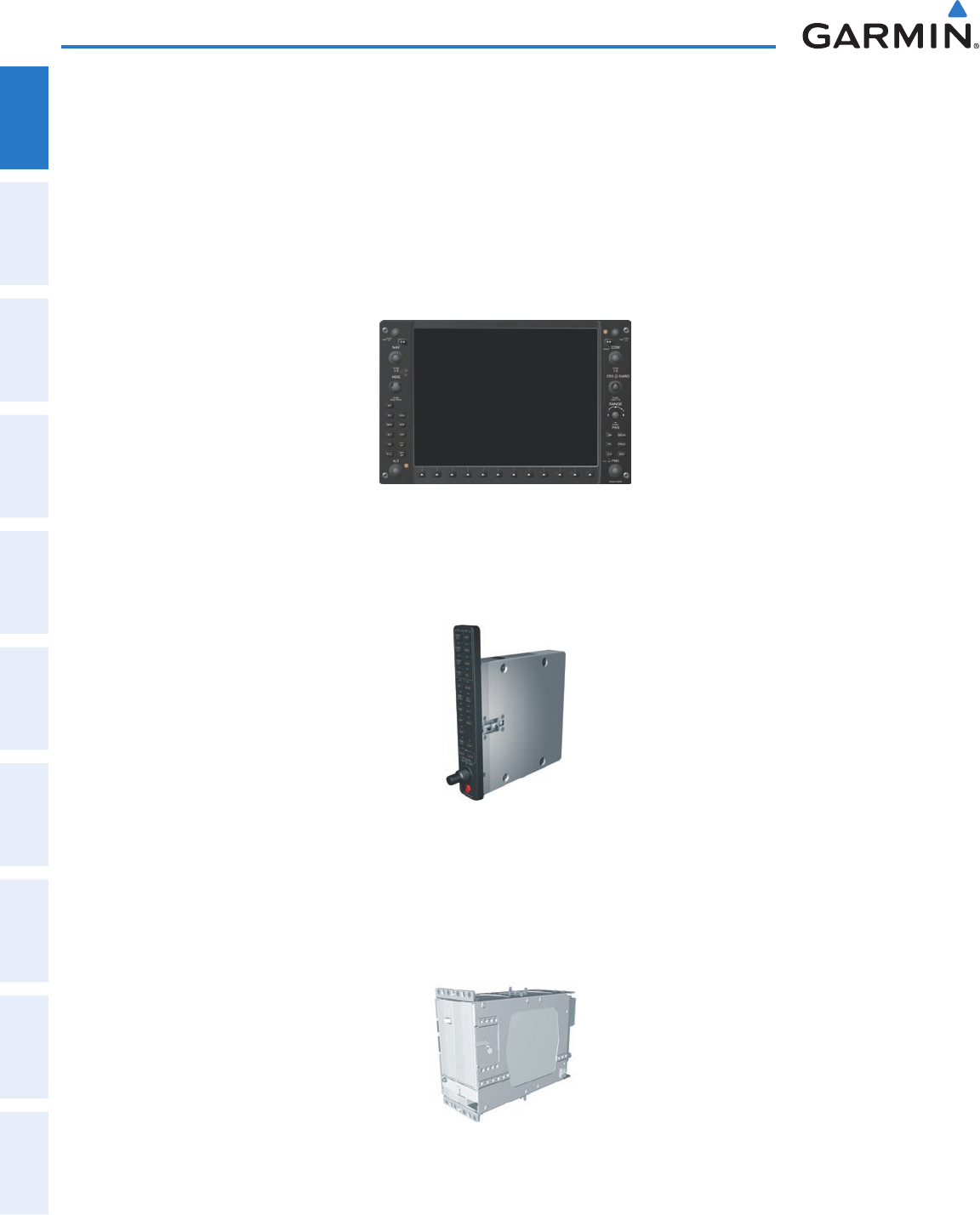
The G1000 Integrated Flight Deck System presents flight instrumentation, position, navigation, communication,
and identification information using flat-panel color displays. The system is distributed across the following Line
Replaceable Units (LRUs):
•
GDU 1040
Primary Flight Display (PFD)
•
GDU 1040/1042/1044
Multi Function Display
(MFD)
•
GMA 1347
Audio Panel with Integrated Marker
Beacon Receiver
•
GIA 63/63W
Integrated Avionics Units (IAU)
•
GDC 74A
Air Data Computer (ADC)
•
GEA 71
Engine/Airframe Unit
•
GTX 33
Mode S Transponder
•
GRS 77
Attitude and Heading Reference System
(AHRS)
•
GMU 44
Magnetometer
•
GDL 69/69A
Data Link Receiver
•
GSA 81
AFCS Servos
•
GSM 85
Servo Mounts
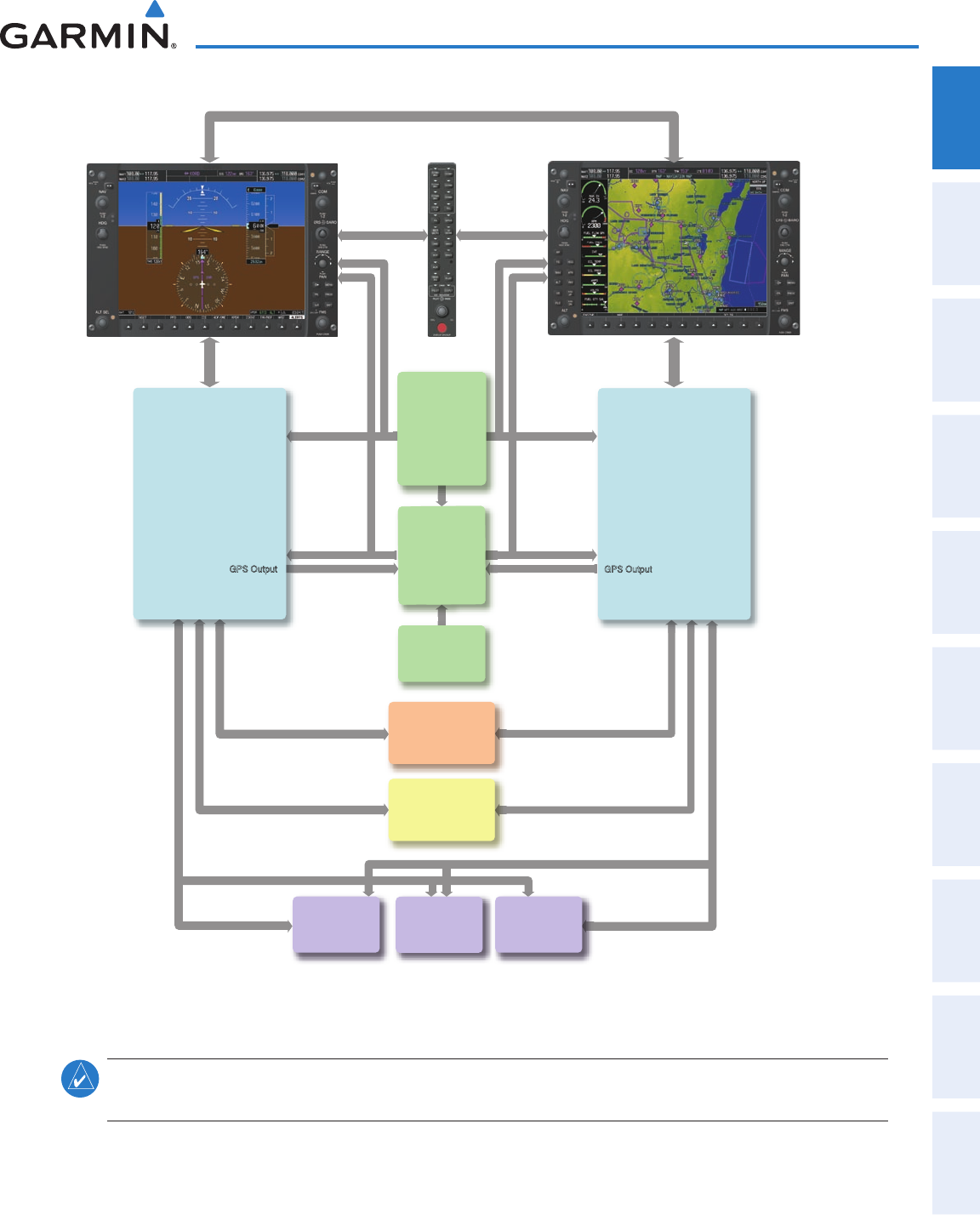
Figure 1-1 shows interactions between the LRUs. Additional/optional equipment are shown in Figure 1-2.
The Diamond DA40/40F may be optionally equipped with a GFC 700 Automated Flight Control System (AFCS),
providing flight director (FD), autopilot (AP), and manual electric trim (MET) functions of the G1000 System.
Garmin G1000 Pilot’s Guide for the Diamond DA40/40F
190-00592-06 Rev. A2
SYSTEM OVERVIEW
SYSTEM
OVERVIEW
FLIGHT
INSTRUMENTS
EIS
AUDIO PANEL
& CNS
FLIGHT
MANAGEMENT
HAZARD
AVOIDANCE
AFCS
ADDITIONAL
FEATURES
APPENDICESINDEX
1.1 LINE REPLACEABLE UNITS
•GDU 1040/1042/1044 (2) – A GDU 1040 is configured as the Primary Flight Display (PFD) and a GDU 1040,
1042 or 1044 (1042/1044 for airframes equipped with the GFC 700) as a Multi Function Display (MFD). Both
displays feature 10.4-inch LCD screens with 1024 x 768 resolution. The displays communicate with each other
through a High-speed Data Bus (HSDB) Ethernet connection. Each display is also paired with an Ethernet
connection to an IAU. The three GDU models are distinguished by three individual configurations of bezel
controls and are made available to accommodate a variety optional system installations.
•
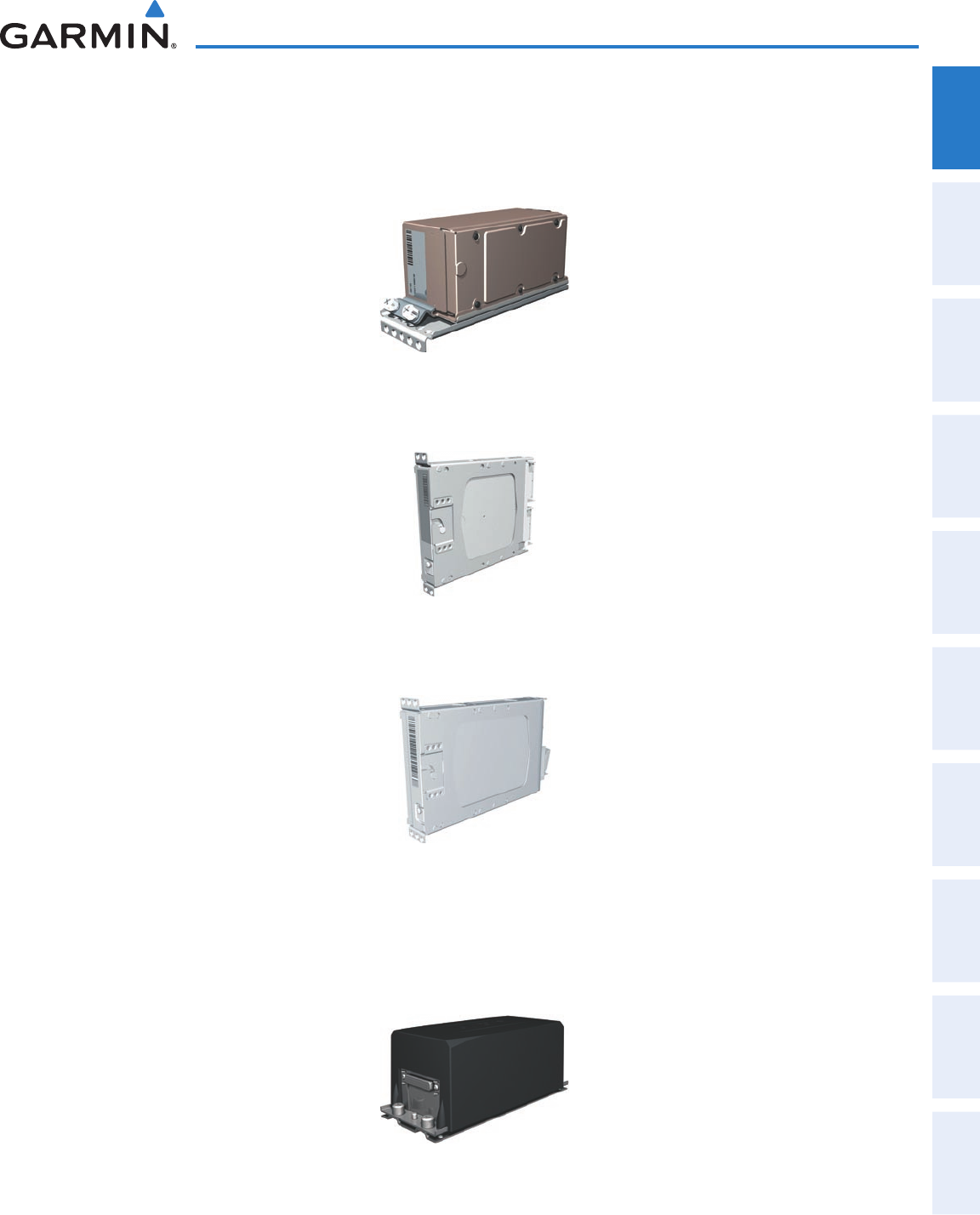
GMA 1347
– The Audio Panel integrates navigation/communication radio (NAV/COM) digital audio, intercom,
and marker beacon controls, and is installed between the displays. This unit also provides manual control of
display Reversionary Mode (red
DISPLAY BACKUP
button; see Section 1.4, System Operation) and communicates
with both IAUs using an RS-232 digital interface.
•
GIA 63/63W
(2) – The Integrated Avionics Units (IAU) function as the main communications hub, linking
all LRUs with the PFD. Each IAU contains a GPS receiver, a very high frequency (VHF) communication/
navigation/glideslope (COM/NAV/GS) receiver, and system integration microprocessors, and is paired with
the on-side display via an HSDB connection. The GIA 63W contains a GPS WAAS receiver. The IAUs are not
paired together and do not communicate with each other directly.
190-00592-06 Rev. A
Garmin G1000 Pilot’s Guide for the Diamond DA40/40F
3
SYSTEM OVERVIEW
SYSTEM
OVERVIEW
FLIGHT
INSTRUMENTS EIS AUDIO PANEL
& CNS
FLIGHT
MANAGEMENT
HAZARD
AVOIDANCE AFCS ADDITIONAL
FEATURES APPENDICES INDEX
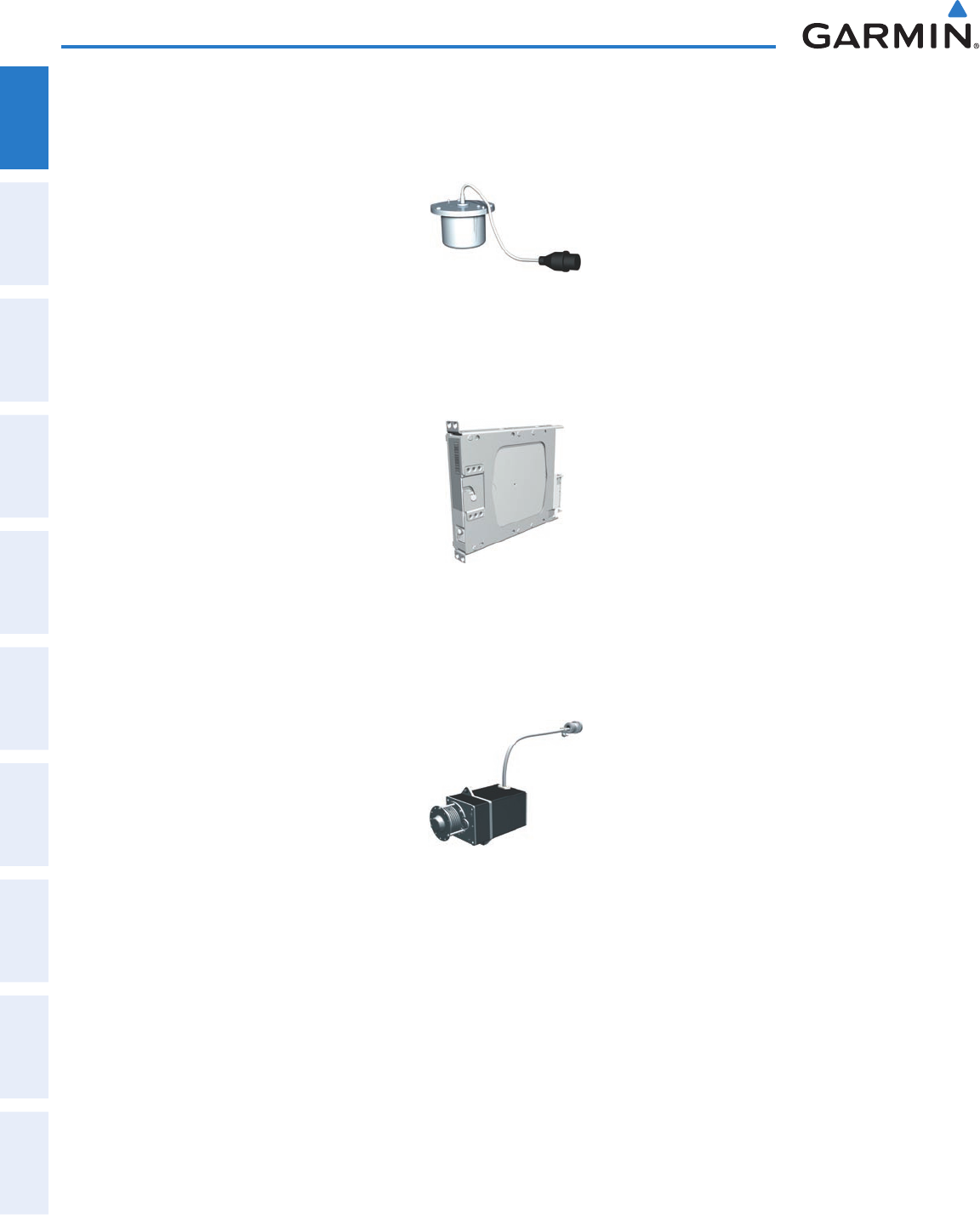
GDC 74A
– The Air Data Computer (ADC) processes data from the pitot/static system and outside air temperature
(OAT) sensor. The ADC provides pressure altitude, airspeed, vertical speed, and OAT information to the
G1000 System, and it communicates with the primary IAU, displays, and AHRS using an ARINC 429 digital
interface.
•
GEA 71
– The Engine Airframe Unit receives and processes signals from the engine and airframe sensors. This
unit communicates with both IAUs using an RS-485 digital interface.
•
GTX 33
– The solid-state Transponder provides Modes A, C, and S capability and communicates with both IAUs
through an RS-232 digital interface.
•
GRS 77
(2) – The Attitude and Heading Reference System (AHRS) provides aircraft attitude and heading
information via ARINC 429 to both the PFD and the primary IAU. The AHRS contains advanced sensors
(including accelerometers and rate sensors) and interfaces with the Magnetometer to obtain magnetic field
information, with the ADC to obtain air data, and with both IAUs to obtain GPS information. AHRS operation
is discussed in Section 1.4, System Operation.
Garmin G1000 Pilot’s Guide for the Diamond DA40/40F
190-00592-06 Rev. A4
SYSTEM OVERVIEW
SYSTEM
OVERVIEW
FLIGHT
INSTRUMENTS
EIS
AUDIO PANEL
& CNS
FLIGHT
MANAGEMENT
HAZARD
AVOIDANCE
AFCS
ADDITIONAL
FEATURES
APPENDICESINDEX
•
GMU 44
– The Magnetometer measures local magnetic field and sends data to the AHRS for processing to
determine aircraft magnetic heading. This unit receives power directly from the AHRS and communicates with
it via an RS-485 digital interface.
•
GDL 69/69A
– The Data Link Satellite Radio Receiver provides real-time weather information to MFD maps
and the PFD Inset Map. The GDL 69A model is also capable of providing digital audio entertainment. The
Data Link Receiver communicates with the MFD via an HSDB connection. A subscription to XM Satellite Radio
Service is required to enable Data Link Receiver capability.
•
GSA 81
and
GSM 85
– The GSA 81 servos are used for automatic control of pitch, pitch trim, and roll. These
units interface with each IAU.
The GSM 85 servo mounts are responsible for transferring the output torque of the servo actuators to the
mechanical flight-control surface linkages.
190-00592-06 Rev. A
Garmin G1000 Pilot’s Guide for the Diamond DA40/40F
5
SYSTEM OVERVIEW
SYSTEM
OVERVIEW
FLIGHT
INSTRUMENTS EIS AUDIO PANEL
& CNS
FLIGHT
MANAGEMENT
HAZARD
AVOIDANCE AFCS ADDITIONAL
FEATURES APPENDICES INDEX
Figure 1-1 G1000 System Block Diagram
GSA 81
Roll Servo
Autopilot Calculations
(optional)
GSA 81
Pitch Servo
Autopilot Calculations
(optional)
GSA 81
Pitch Tr im Servo
Autopilot Calculations
(optional)
No. 1 GIA 63/63W
Integrated Avionics Unit
System Inegration Processors
I/O Processors
VHF COM
VHF NAV/LOC
GPS/WAAS
Glideslope
Flight Director (with GFC 700 option)
No. 2 GIA 63/63W
Integrated Avionics Unit
System Integration Processors
I/O Processors
VHF COM
VHF NAV/LOC
GPS/WAAS
Glideslope
GTX 33
Tr ansponder
High-Speed Data Bus (Ethernet)
Reversionary
Control
GEA 71
Engine/Airframe
Unit
GDC 74A
Air Data
Computer
OAT
Airspeed
Altitude
Ve rtical Speed
GRS 77
AHRS
Attitude
Rate of Tu rn
Slip/Skid
GMU 44
Magnetometer
Heading
GPS Output GPS Output
Reversionary
Control
GMA 1347
Audio Panel
GDU 1040 (PFD) GDU 1040/1042/1044 (MFD)
NOTE: The GDU 1042 and GDU 1044 are equipped with additional bezel controls and are available for use
in systems equipped with the Garmin GFC 700 Automatic Flight Control System.
Garmin G1000 Pilot’s Guide for the Diamond DA40/40F
190-00592-06 Rev. A6
SYSTEM OVERVIEW
SYSTEM
OVERVIEW
FLIGHT
INSTRUMENTS
EIS
AUDIO PANEL
& CNS
FLIGHT
MANAGEMENT
HAZARD
AVOIDANCE
AFCS
ADDITIONAL
FEATURES
APPENDICESINDEX
High-Speed Data Bus (Ethernet)
No. 2 GIA 63/63W
Integrated Avionics Unit
System Integration Processors
I/O Processors
VHF COM
VHF NAV/LOC
GPS/WAAS
Glideslope
GDL 69/69A
Data Link Receiver
Real-time Weather and
Digital Audio Entertainment
(subscription-based service)
Avidyne
TA S600-series
Tr affic Information
(optional)
L3
Stormscope
Lightning Strike and
Thunderstorm Detection
(optional)
Becker
RA 3502-(1)
ADF Receiver
(optional)
Honeywell
KN 63
DME
(optional)
Honeywell
KAP 140
Autopilot
(optional)
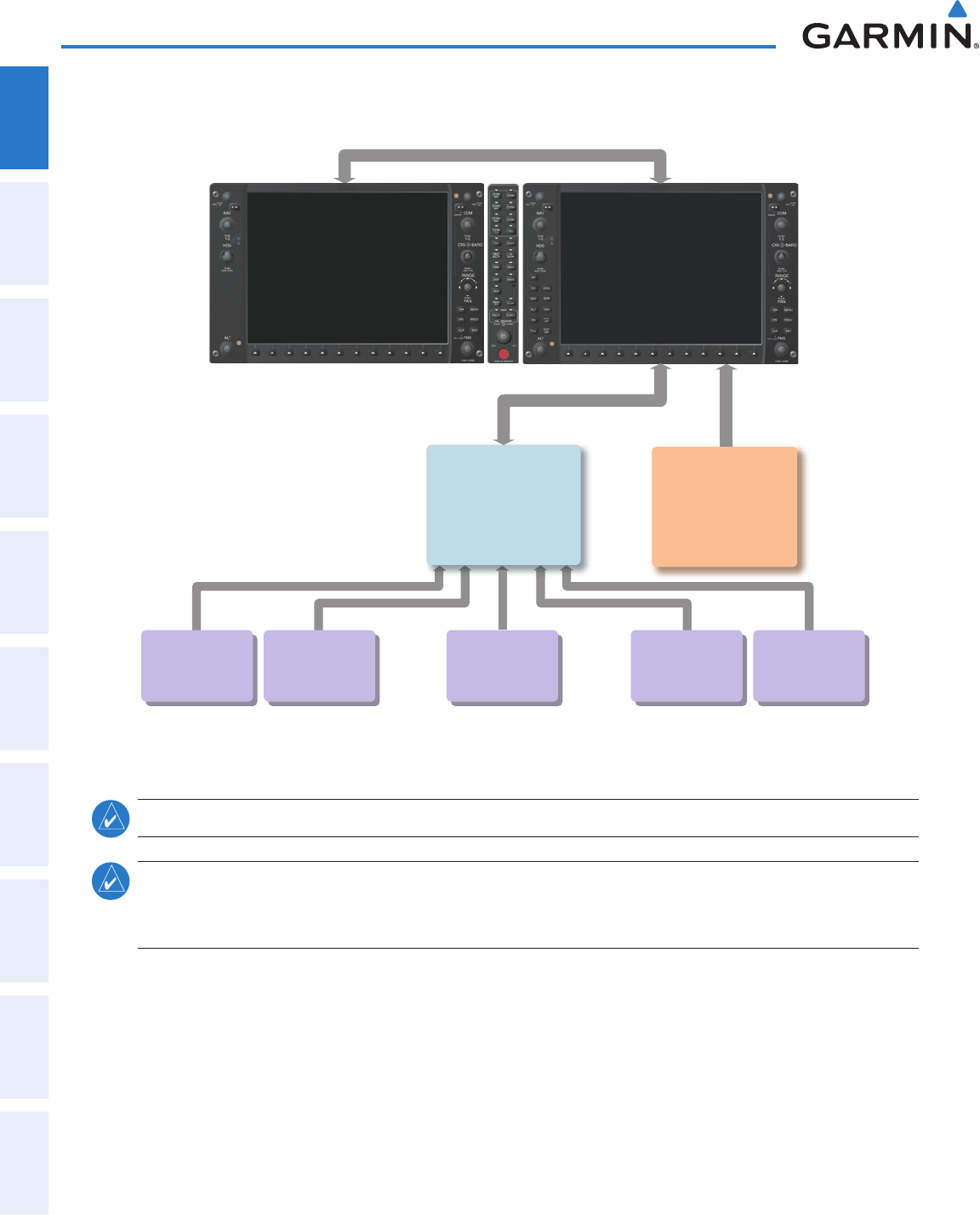
Figure 1-2 G1000 With Optional/Additional Interfaces
NOTE: The GDU 1040 is available in systems using the Honeywell KAP 140 Autopilot.
NOTE: For information on additional equipment shown in Figure 1-2, consult the applicable optional interface
user’s guide. This document assumes that the reader is already familiar with the operation of this additional
equipment.
190-00592-06 Rev. A
Garmin G1000 Pilot’s Guide for the Diamond DA40/40F
7
SYSTEM OVERVIEW
SYSTEM
OVERVIEW
FLIGHT
INSTRUMENTS EIS AUDIO PANEL
& CNS
FLIGHT
MANAGEMENT
HAZARD
AVOIDANCE AFCS ADDITIONAL
FEATURES APPENDICES INDEX
1.2 SECURE DIGITAL (SD) CARDS
NOTE:
Ensure the G1000 System is powered off before inserting an SD card.
NOTE:
Refer to Appendix B for instructions on updating databases.
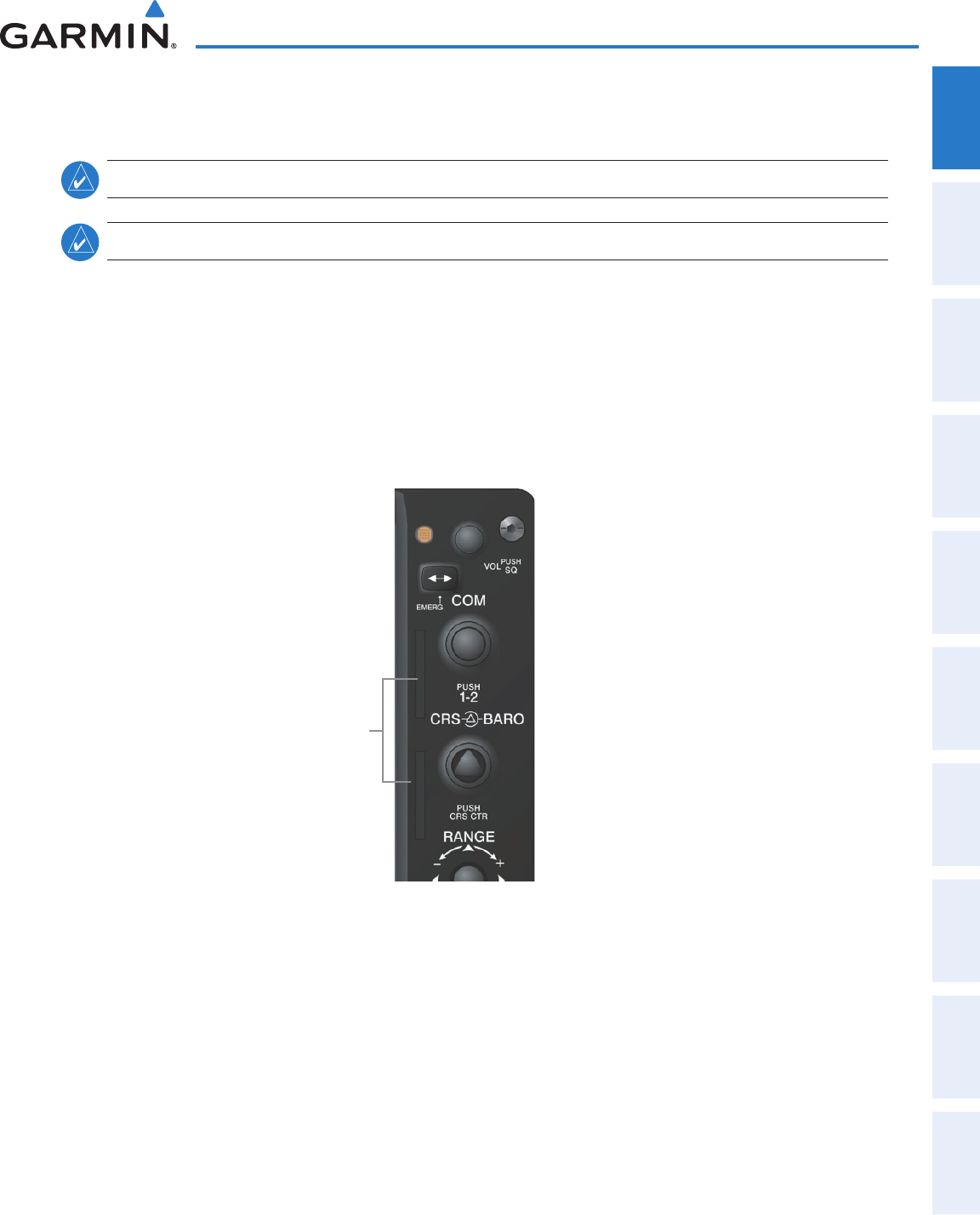
The PFD and MFD data card slots use Secure Digital (SD) cards and are located on the upper right side of the
display bezels. Each display bezel is equipped with two SD card slots. SD cards are used for aviation database
and system software updates as well as terrain database storage.
Installing an SD card:
1) Insert the SD card in the SD card slot, pushing the card in until the spring latch engages. The front of the card
should remain flush with the face of the display bezel.
2) To eject the card, gently press on the SD card to release the spring latch.
Figure 1-3 Display Bezel SD Card Slots
SD Card Slots
Garmin G1000 Pilot’s Guide for the Diamond DA40/40F
190-00592-06 Rev. A
8
SYSTEM OVERVIEW
SYSTEM
OVERVIEW
FLIGHT
INSTRUMENTS
EIS
AUDIO PANEL
& CNS
FLIGHT
MANAGEMENT
HAZARD
AVOIDANCE
AFCS
ADDITIONAL
FEATURES
APPENDICESINDEX
1.3 SYSTEM POWER-UP
NOTE: See the Aircraft Flight Manual (AFM) for specific procedures concerning avionics power application
and emergency power supply operation.
NOTE: Refer to Appendix A for system-specific annunciations and alerts.
The G1000 System is integrated with the aircraft electrical system and receives power directly from electrical
busses. The PFD, MFD, and supporting sub-systems include both power-on and continuous built-in test features
that exercise the processor, RAM, ROM, external inputs, and outputs to provide safe operation.
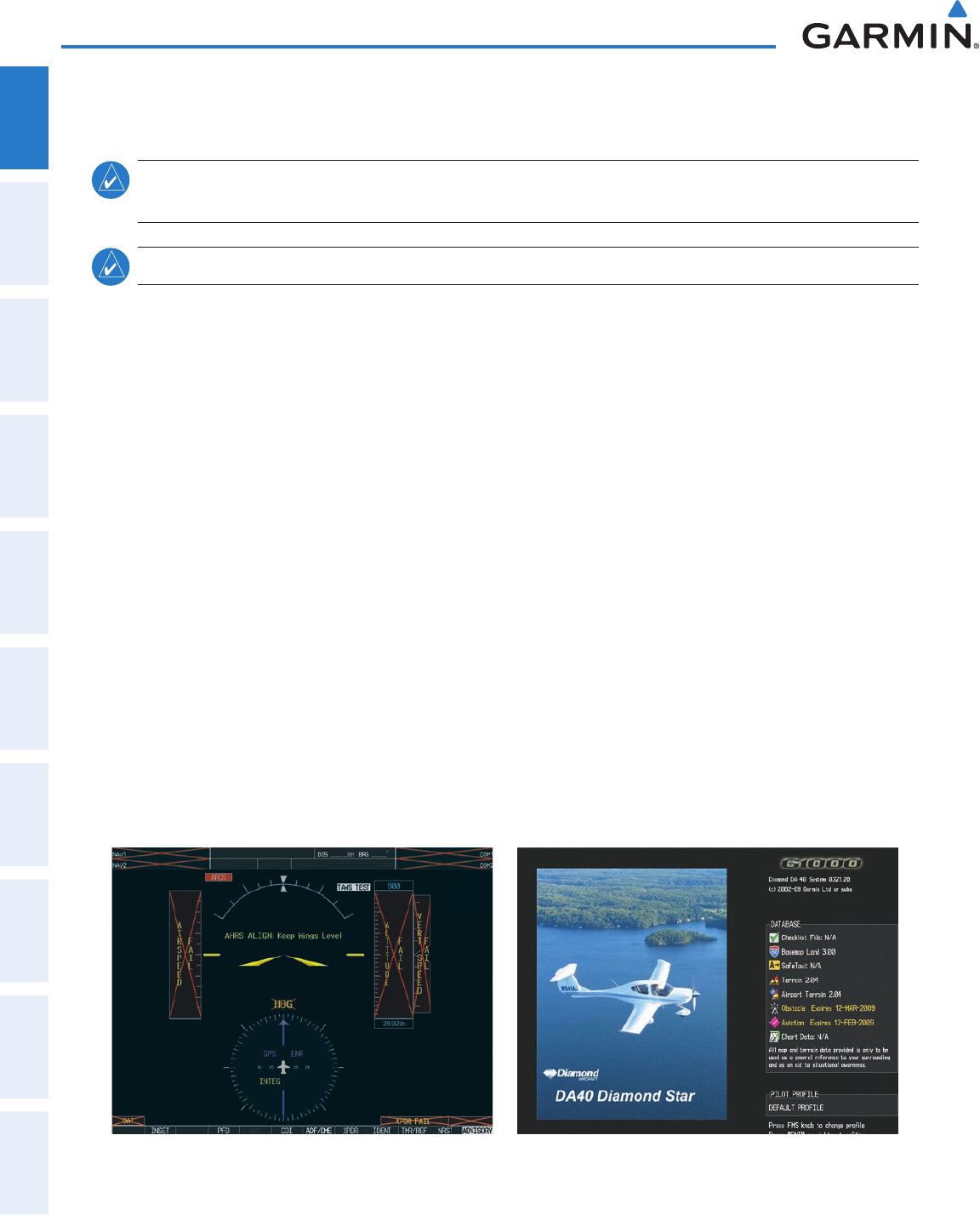
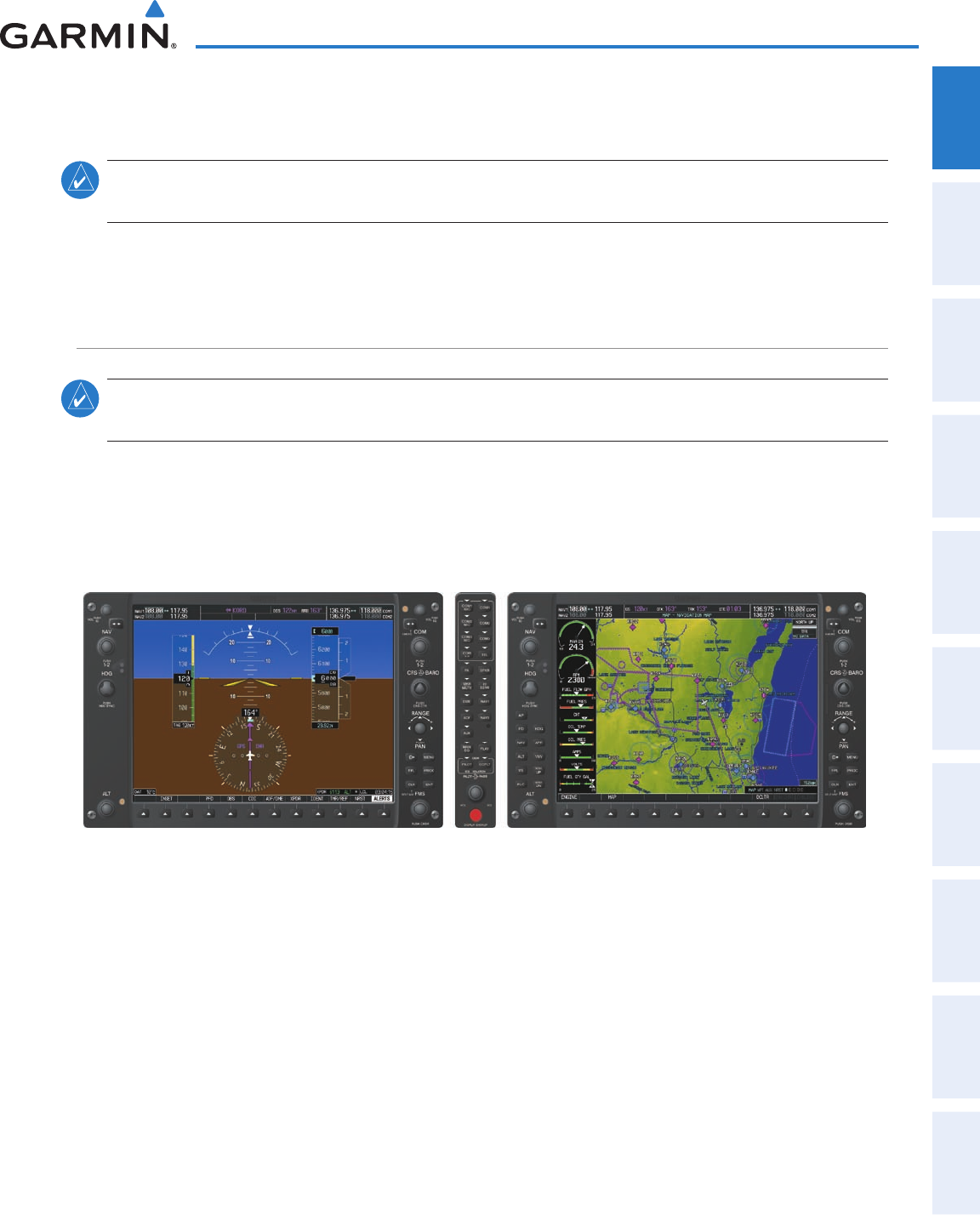
During system initialization, test annunciations are displayed, as shown in Figure 1-4. All system annunciations
should disappear typically within the first minute of power-up. Upon power-up, key annunciator lights also
become momentarily illuminated on the Audio Panel and the display bezels.
On the PFD, the AHRS begins to initialize and displays “AHRS ALIGN: Keep Wings Level”. The AHRS should
display valid attitude and heading fields typically within the first minute of power-up. The AHRS can align itself
both while taxiing and during level flight.
When the MFD powers up, the splash screen (Figure 1-5) displays the following information:
•Systemversion
•Copyright
•Landdatabasenameandversion
•Obstacledatabasenameandversion
•Terraindatabasenameandversion
•Aviationdatabasename,version,andeffectivedates
Current database information includes valid operating dates, cycle number, and database type. When this
information has been reviewed for currency (to ensure that no databases have expired), the pilot is prompted to
continue.
Pressing the ENT Key (or right-most softkey) acknowledges this information, and the Navigation Map Page is
displayed upon pressing the key a second time. When the system has acquired a sufficient number of satellites to
determine a position, the aircraft’s current position is shown on the Navigation Map Page.
Figure 1-4 PFD Initialization Figure 1-5 Example (DA40) MFD Power-up Splash Screen
190-00592-06 Rev. A
Garmin G1000 Pilot’s Guide for the Diamond DA40/40F
9
SYSTEM OVERVIEW
SYSTEM
OVERVIEW
FLIGHT
INSTRUMENTS EIS AUDIO PANEL
& CNS
FLIGHT
MANAGEMENT
HAZARD
AVOIDANCE AFCS ADDITIONAL
FEATURES APPENDICES INDEX
1.4 SYSTEM OPERATION
NOTE: Refer to Appendix A for detailed descriptions of all alerts and annunciations. Refer to the Aircraft
Flight Manual (AFM) for additional information regarding pilot responses to these annunciations.
The displays are connected together via a single Ethernet bus for high-speed communication. As shown in
Figure 1-1, each IAU is connected to the on-side display. This allows the units to share information, enabling true
system integration
DISPLAY OPERATION
NOTE:
In normal operating mode, backlighting can only be adjusted from the PFD. In Reversionary Mode, it
can be adjusted from the remaining display.
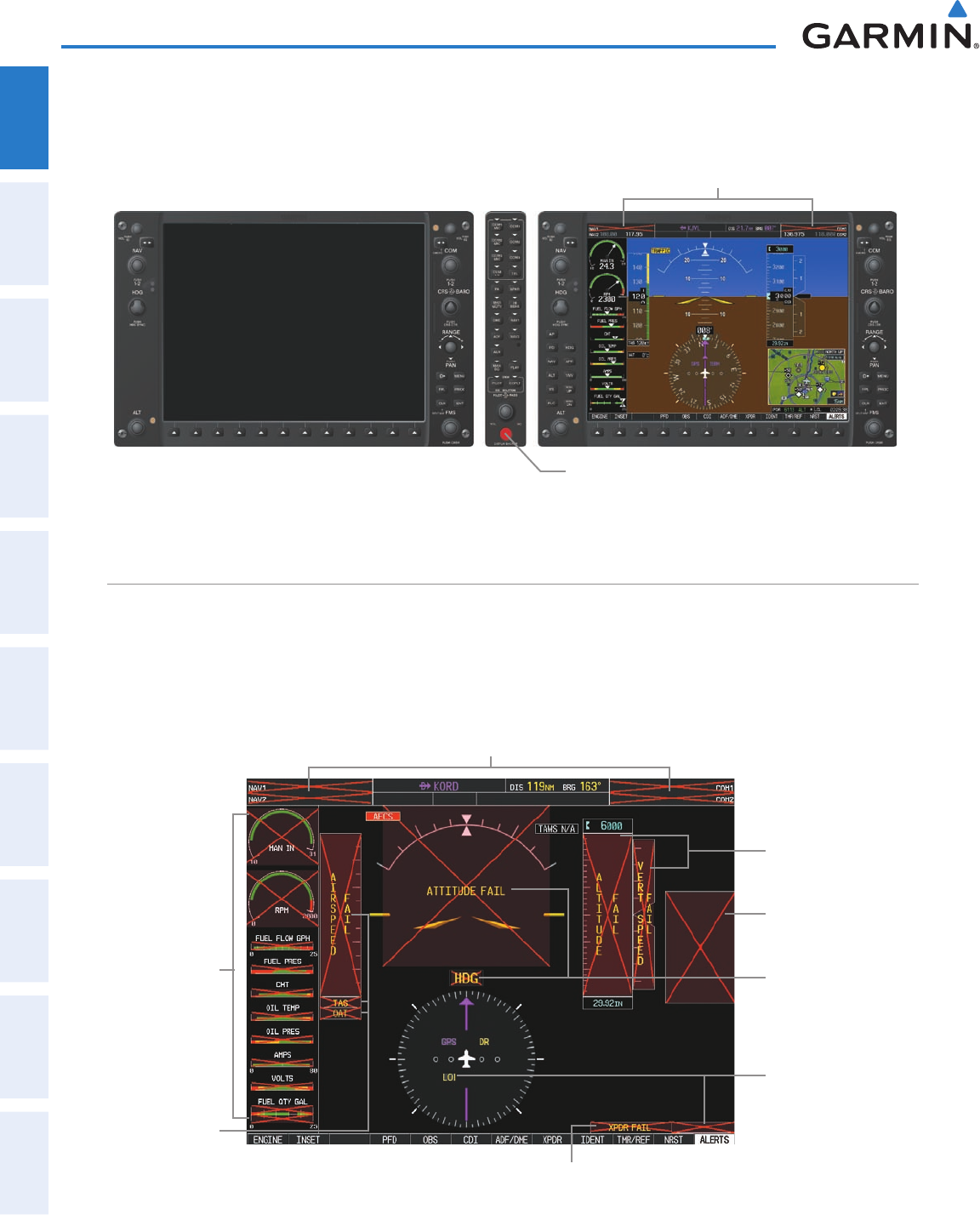
In normal operating mode, the PFD presents graphical flight instrumentation (attitude, heading, airspeed,
altitude, vertical speed), replacing the traditional flight instrument cluster (see the Flight Instruments Section
for more information). The MFD normally displays a full-color moving map with navigation information (see
the Flight Management Section), while the left portion of the MFD is dedicated to the Engine Indication System
(EIS; see the EIS Section). Both displays offer control for COM and NAV frequency selection.
Figure 1-6 G1000 Normal Operation
In the event of a display failure, the G1000 System automatically switches to reversionary (backup) mode. In
Reversionary Mode, all important flight information from the PFD is presented on the remaining display in the
same format as in normal operating mode, with the addition of the EIS. EIS operation while in Reversionary
Mode is discussed in the EIS Section. As when the PFD is operating normally, windows for flight planning,
nearest airports, and procedures are available. The Inset Map is moved to the right side of the display.
If a display fails, the appropriate IAU-display Ethernet interface is cut off. Thus, the IAU can no longer
communicate with the remaining display (refer to Figure 1-1), and the NAV and COM functions provided to
the failed display by the IAU are flagged as invalid on the remaining display. The system reverts to backup
paths for the AHRS, ADC, Engine/Airframe Unit, and Transponder, as required. The change to backup paths is
completely automated for all LRUs and no pilot action is required.
Garmin G1000 Pilot’s Guide for the Diamond DA40/40F
190-00592-06 Rev. A10
SYSTEM OVERVIEW
SYSTEM
OVERVIEW
FLIGHT
INSTRUMENTS
EIS
AUDIO PANEL
& CNS
FLIGHT
MANAGEMENT
HAZARD
AVOIDANCE
AFCS
ADDITIONAL
FEATURES
APPENDICESINDEX
If the system fails to detect a display problem, Reversionary Mode may be manually activated by pressing the
Audio Panel’s red
DISPLAY BACKUP
Button. Pressing this button again deactivates Reversionary Mode.
DISPLAY BACKUP
Button Manually Activates/
Deactivates Reversionary Mode on Both Displays
Figure 1-7 G1000 Reversionary Mode (Failed PFD)
NAV1 and COM1 (provided by the
failed PFD) Flagged Invalid
G1000 SYSTEM ANNUNCIATIONS
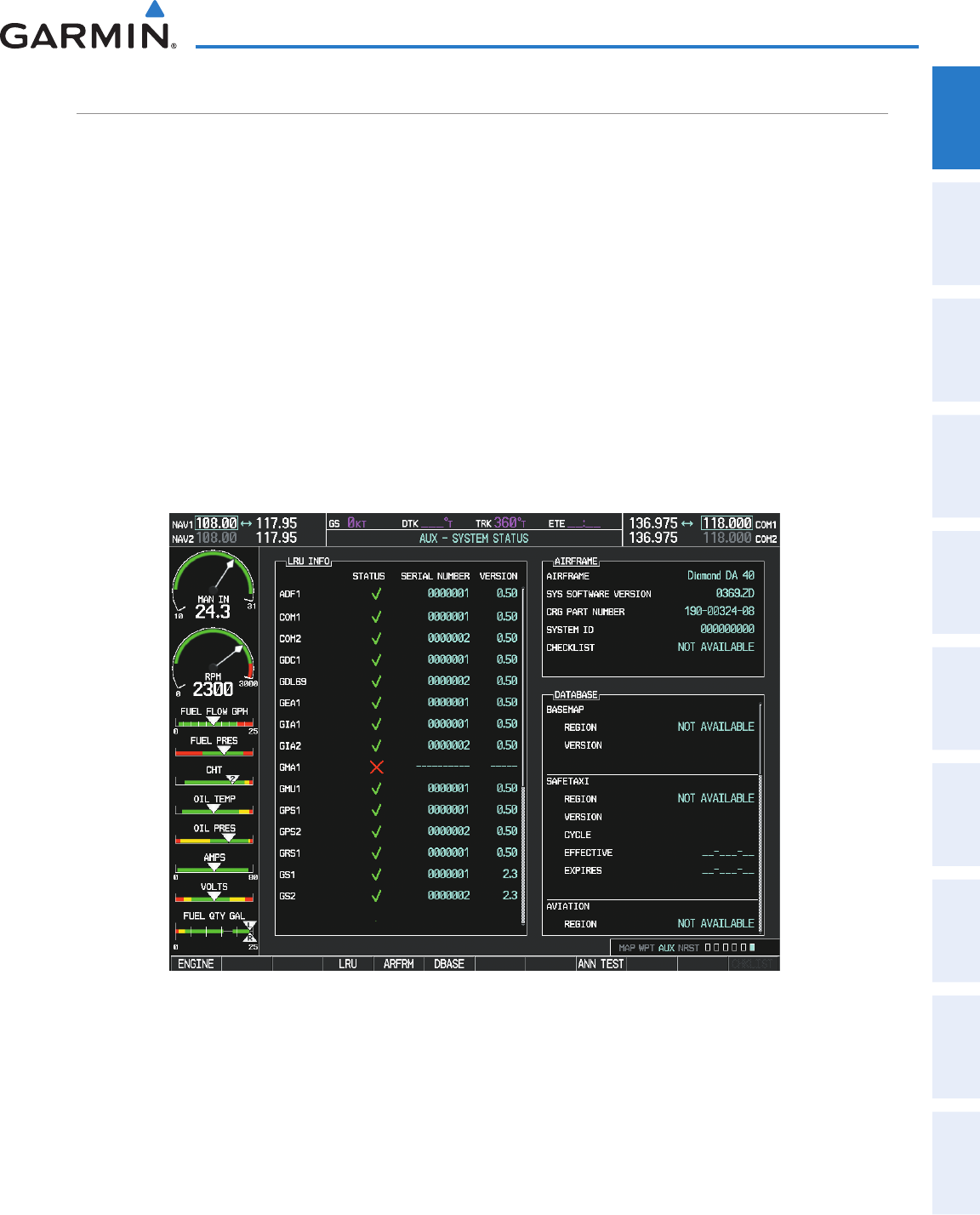
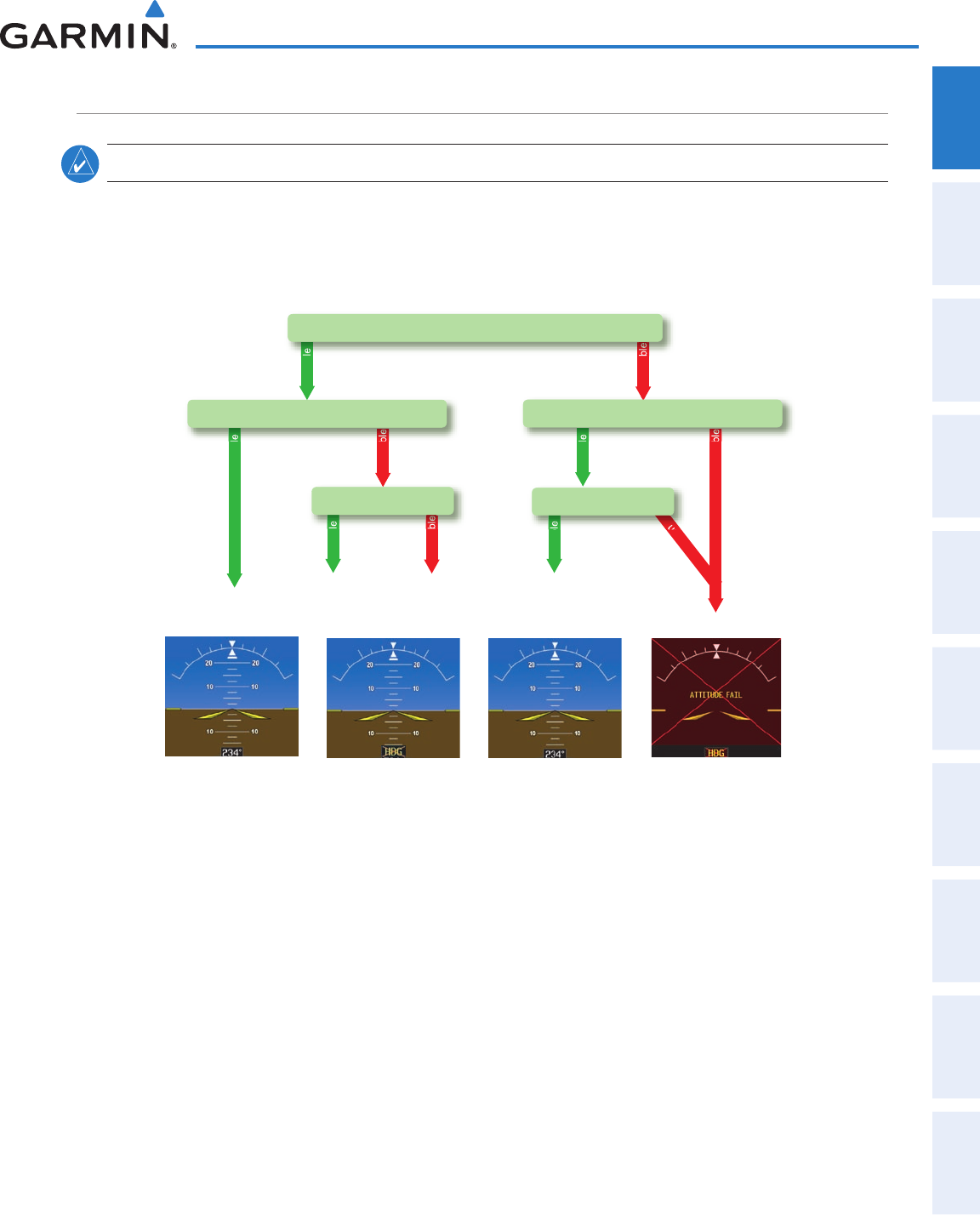
When an LRU or an LRU function fails, a large red ‘X’ is typically displayed over the instrument experiencing
failed data (Figure 1-8 displays all possible flags and responsible LRUs). The G1000 System alerts the pilot
when backup paths are utilized by the LRUs. Upon G1000 power-up, certain instruments remain invalid as
equipment begins to initialize. All instruments should be operational within one minute of power-up. If any
instrument remains flagged, the G1000 should be serviced by a Garmin-authorized repair facility.
Database
Mismatch in the
PFD and MFD
GRS 77 AHRS
OR GMU 44
Magnetometer
GDC 74A
Air Data
Computer
GIA 63/63W Integrated Avionics Units
GTX 33 Transponder OR GIA 63/63W
Integrated Avionics Units
GIA 63/63W
Integrated
Avionics Units
GEA 71
Engine
Airframe Unit
OR
GIA 63/63W
Integrated
Avionics Unit
GDC 74A
Air Data
Computer
Figure 1-8 G1000 System Failure Annunciations
190-00592-06 Rev. A
Garmin G1000 Pilot’s Guide for the Diamond DA40/40F
11
SYSTEM OVERVIEW
SYSTEM
OVERVIEW
FLIGHT
INSTRUMENTS EIS AUDIO PANEL
& CNS
FLIGHT
MANAGEMENT
HAZARD
AVOIDANCE AFCS ADDITIONAL
FEATURES APPENDICES INDEX
SYSTEM STATUS
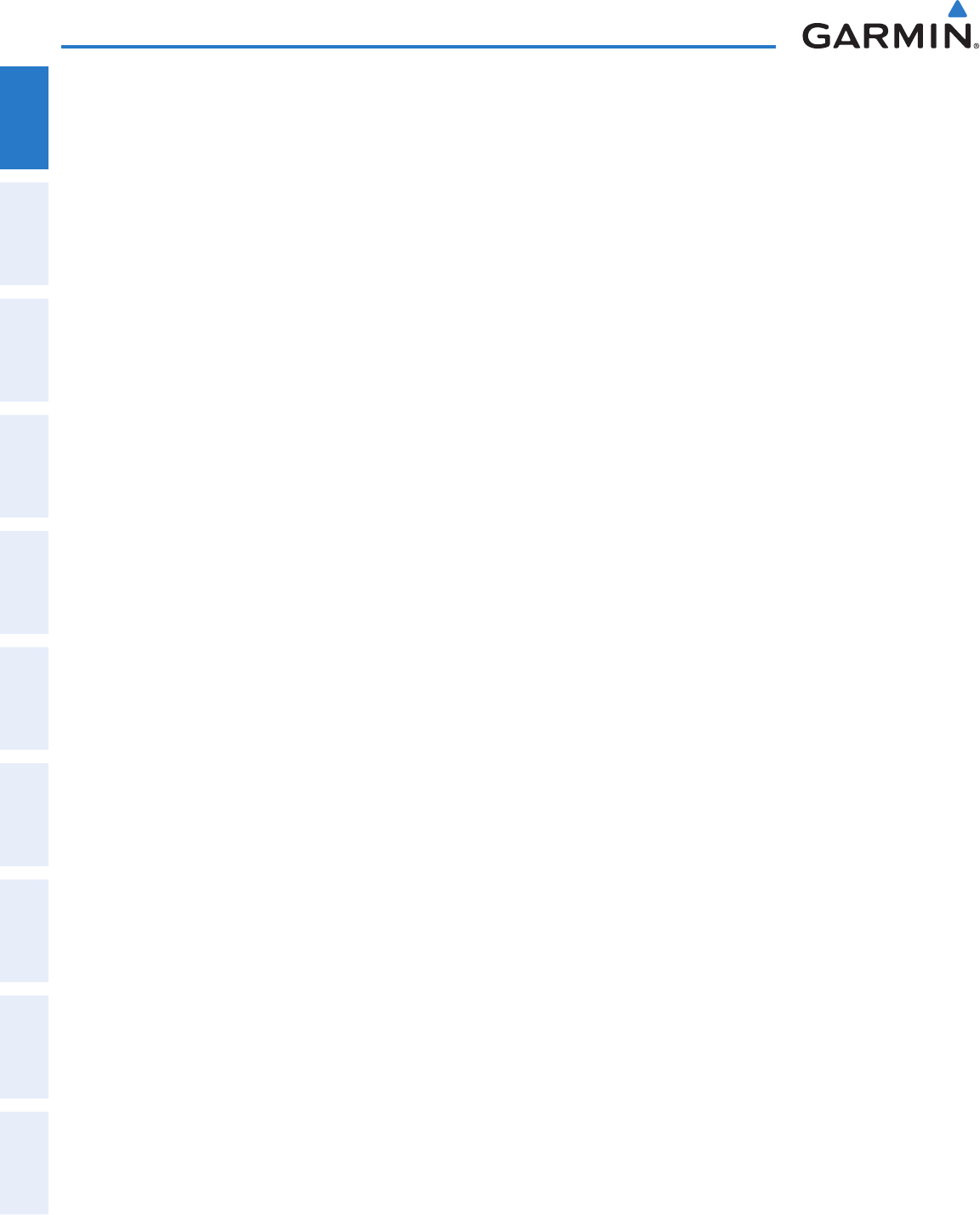
The System Status Page displays the statuses, serial numbers, and software version numbers for all detected
system LRUs. Active LRUs are indicated by green check marks; failed, by red ‘X’s. Failed LRUs should be noted
and a service center or Garmin-authorized dealer informed.
Viewing LRU information:
1) Use the FMS Knob to select the AUX - System Status Page.
2) To place the cursor in the ‘LRU Info’ Box,
a) Press the LRU Softkey.
Or:
a) Press the MENU Key.
b) With ‘Select LRU Window’ highlighted, press the ENT Key.
3) Use the FMS Knob to scroll through the box to view LRU status information.
Figure 1-9 Example System Status Page
Garmin G1000 Pilot’s Guide for the Diamond DA40/40F
190-00592-06 Rev. A12
SYSTEM OVERVIEW
SYSTEM
OVERVIEW
FLIGHT
INSTRUMENTS
EIS
AUDIO PANEL
& CNS
FLIGHT
MANAGEMENT
HAZARD
AVOIDANCE
AFCS
ADDITIONAL
FEATURES
APPENDICESINDEX
Pertinent information on all system databases is also displayed on this page. Refer to the Appendices and
Additional Features sections for more information about databases.
Viewing database information:
1) Use the FMS Knob to select the AUX - System Status Page.
2) To place the cursor in the ‘Database’ Box,
a) Press the DBASE Softkey.
Or:
a) Press the MENU Key.
b) Highlight ‘Select Dbase Window’ and press the ENT Key.
3) Use the FMS Knob to scroll through the box to view database status information.
The G1000 uses aural tones to convey the priority of airframe-specific alerts. The alerting system’s annunciation
tone may be tested from the System Status Page. Refer to the Appendices for airframe-specific alerts.
Testing the system annunciation tone:
1) Use the FMS Knob to select the AUX - System Status Page.
2) Press the ANN TEST Softkey.
Or:
a) Press the MENU Key.
b) Highlight ‘Enable Annunciator Test Mode’ and press the ENT Key.
190-00592-06 Rev. A
Garmin G1000 Pilot’s Guide for the Diamond DA40/40F
13
SYSTEM OVERVIEW
SYSTEM
OVERVIEW
FLIGHT
INSTRUMENTS EIS AUDIO PANEL
& CNS
FLIGHT
MANAGEMENT
HAZARD
AVOIDANCE AFCS ADDITIONAL
FEATURES APPENDICES INDEX
AHRS OPERATION
NOTE: Aggressive maneuvering while AHRS is not operating normally may degrade AHRS accuracy.
The Attitude and Heading Reference System (AHRS) performs attitude, heading, and vertical acceleration
calculations for the G1000 System, utilizing GPS, magnetometer, and air data in addition to information
from its internal sensors. Attitude and heading information are updated on the PFD while the AHRS receives
appropriate combinations of information from the external sensor inputs.
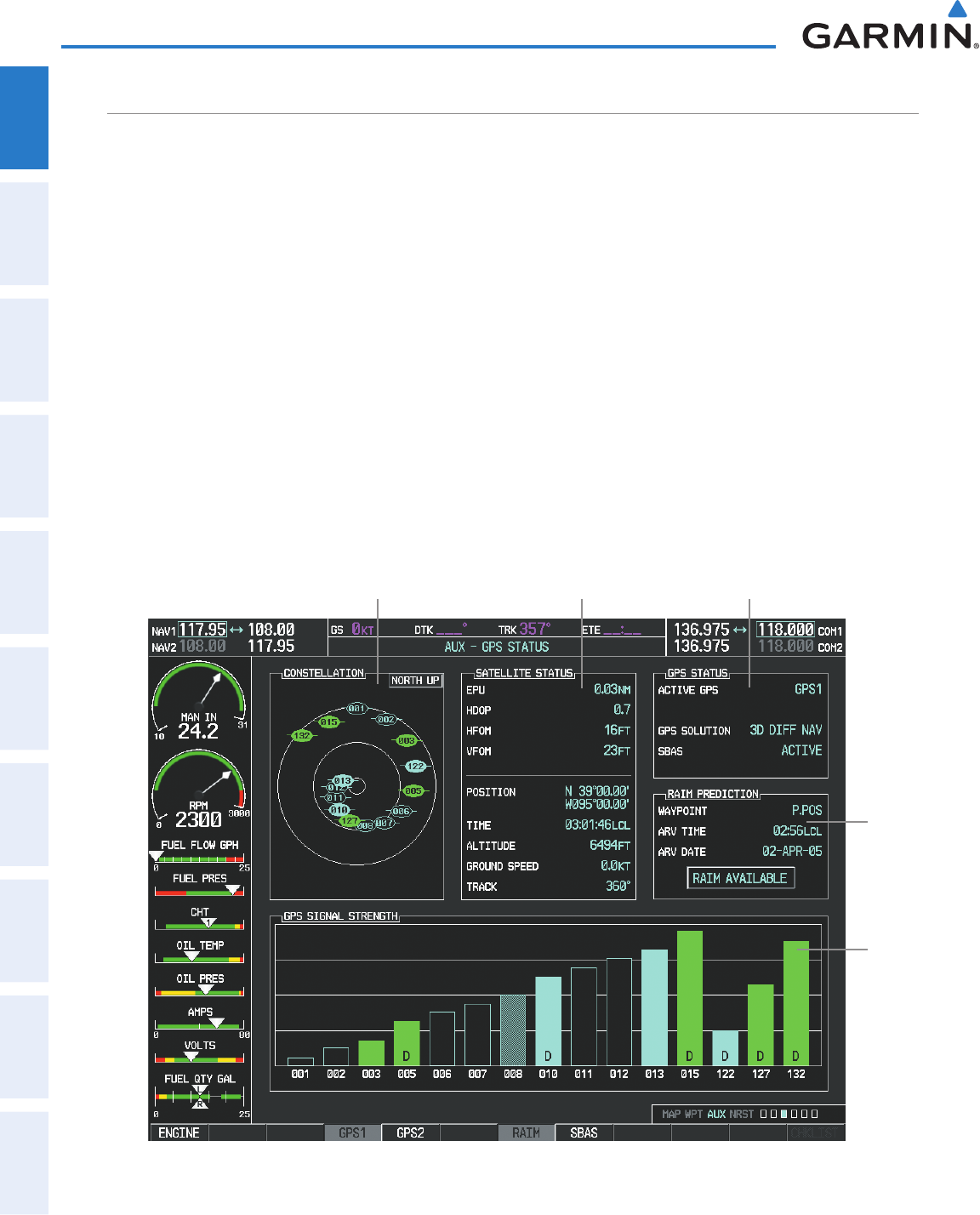
Attitude/Heading Invalid
AHRS
no-GPS
Mode
AHRS Normal
Operation
AHRS no-
Mag Mode
AHRS no-Mag/
no-Air Mode
Heading Invalid
available
available
unavailable
unavailable
available
unavailable
unavailable
available
Air Data
Magnetometer Data
unavailable
available
GPS Data
Magnetometer Data
Air Data
Figure 1-10 AHRS Operation
Loss of GPS, magnetometer, or air data inputs is communicated to the pilot by message advisory alerts (refer
to Appendix A for specific AHRS alert information). Any failure of the internal AHRS inertial sensors results in
loss of attitude and heading information (indicated by red ‘X’ flags over the corresponding flight instruments).
Two GPS inputs are provided to the AHRS. If GPS information from one of the inputs fails, the AHRS uses
the remaining GPS input and an alert message is issued to inform the pilot. If both GPS inputs fail, the AHRS
can continue to provide attitude and heading information to the PFD as long as magnetometer and airspeed
data are available and valid.
If the magnetometer input fails, the AHRS continues to output valid attitude information; however, the
heading output on the PFD is flagged as invalid with a red ‘X’.
Failure of the air data input has no effect on the AHRS output while AHRS is receiving valid GPS information.
Invalid/unavailable airspeed data in addition to GPS failure results in loss of all attitude and heading
information.
Garmin G1000 Pilot’s Guide for the Diamond DA40/40F
190-00592-06 Rev. A14
SYSTEM OVERVIEW
SYSTEM
OVERVIEW
FLIGHT
INSTRUMENTS
EIS
AUDIO PANEL
& CNS
FLIGHT
MANAGEMENT
HAZARD
AVOIDANCE
AFCS
ADDITIONAL
FEATURES
APPENDICESINDEX
GPS RECEIVER OPERATION
Each Integrated Avionics Unit (IAU) contains a GPS receiver. Internal system checking is performed to
ensure both GPS receivers are providing accurate data to the PFD. When both GPS receivers are providing
accurate data, the GPS receiver producing the better solution is used by the system. Information collected by
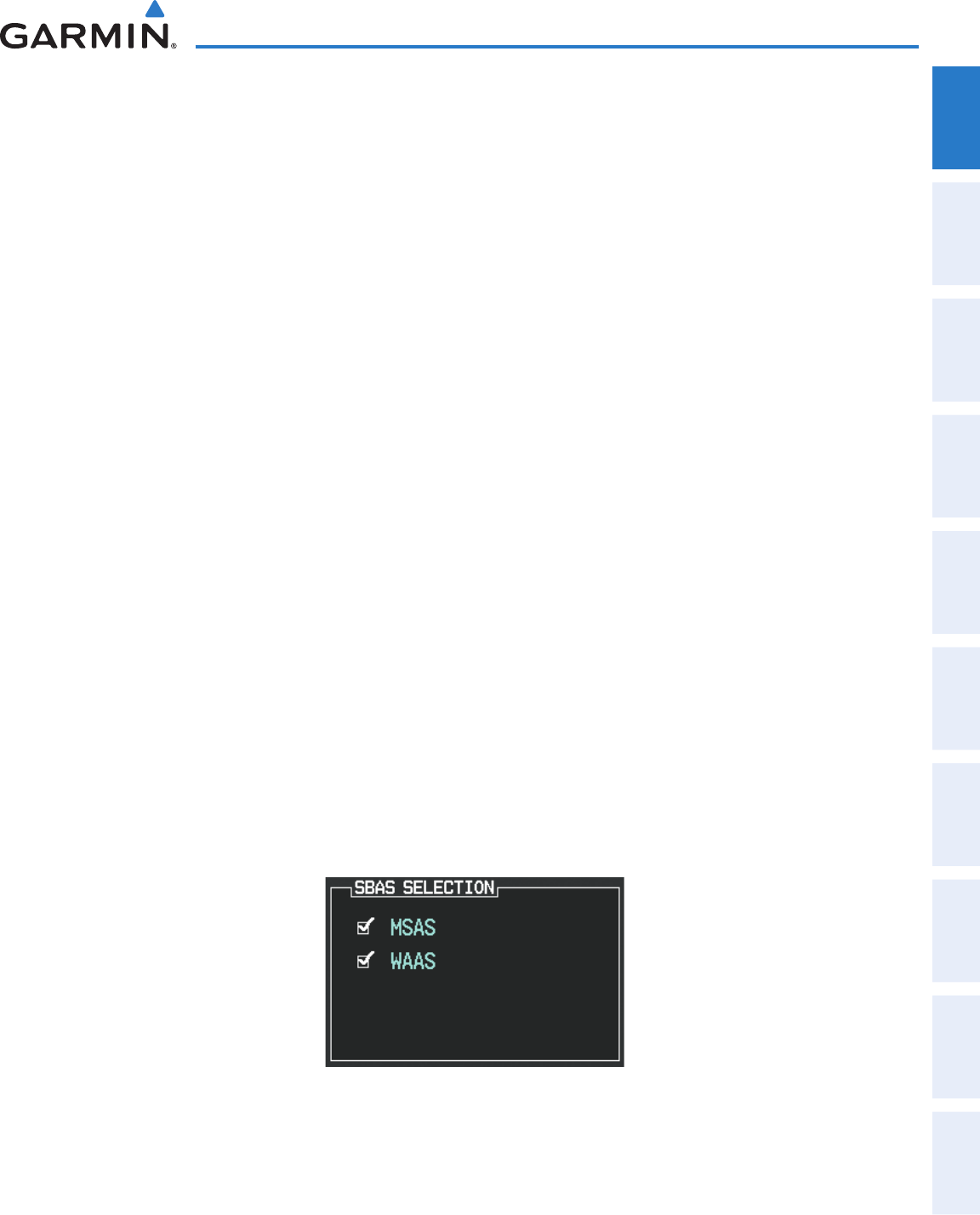
the specified receiver (GPS1 for the #1 IAU or GPS2 for the #2 IAU) may be viewed on the AUX - GPS Status
Page.
Viewing GPS receiver status information:
1) Use the large FMS Knob on the MFD to select the Auxiliary Page Group (see Section 1.6 for information on
navigating MFD page groups).
2) Use the small FMS Knob to select GPS Status Page (third page in the AUX Page Group).
3) To change the selected GPS receiver:
Press the desired
GPS
Softkey.
Or:
a) Press the MENU Key.
b) Use the FMS Knob to highlight the receiver which is not selected and press the ENT Key.
Satellite
Signal
Strength
Bars
RAIM
Availability
Prediction
GPS Receiver
Status
Figure 1-11 GPS Status Page
Satellite Constellation
Diagram Satellite Signal
Information
190-00592-06 Rev. A
Garmin G1000 Pilot’s Guide for the Diamond DA40/40F
15
SYSTEM OVERVIEW
SYSTEM
OVERVIEW
FLIGHT
INSTRUMENTS EIS AUDIO PANEL
& CNS
FLIGHT
MANAGEMENT
HAZARD
AVOIDANCE AFCS ADDITIONAL
FEATURES APPENDICES INDEX
For WAAS-enabled systems, GPS sensor annunciations are most often seen after system power-up when one
GPS receiver has acquired satellites before the other or one of the GPS receivers has not yet acquired a WAAS
signal. While the aircraft is on the ground, the WAAS signal may be blocked by obstructions causing one GPS
receiver to have difficulty acquiring a good signal. Also, while airborne, turning the aircraft may result in one of
the GPS receivers temporarily losing the WAAS signal. If no failure message exists, check the GPS Status Page
and compare the information for GPS1 and GPS2. Discrepancies may indicate a problem.
GPS RECEIVER STATUS
The GPS solution type (ACQUIRING, 2D NAV, 2D DIFF NAV, 3D NAV, 3D DIFF NAV) for the active
GPS receiver (GPS1 or GPS2) is shown in the upper right of the GPS Status Page. When the receiver is
in the process of acquiring enough satellite signals for navigation, the receiver uses satellite orbital data
(collected continuously from the satellites) and last known position to determine the satellites that should be
in view. ACQUIRING is indicated as the solution until a sufficient number of satellites have been acquired
for computing a solution.
When the receiver is in the process of acquiring a 3D navigational GPS solution, 3D NAV is indicated as the
solution until the 3D differential fix has finished acquisition. Satellite-Based Augmentation System (SBAS)
status should be indicated as INACTIVE at this point. When acquisition is complete, the solution status
changes to 3D DIFF NAV and SBAS becomes active.
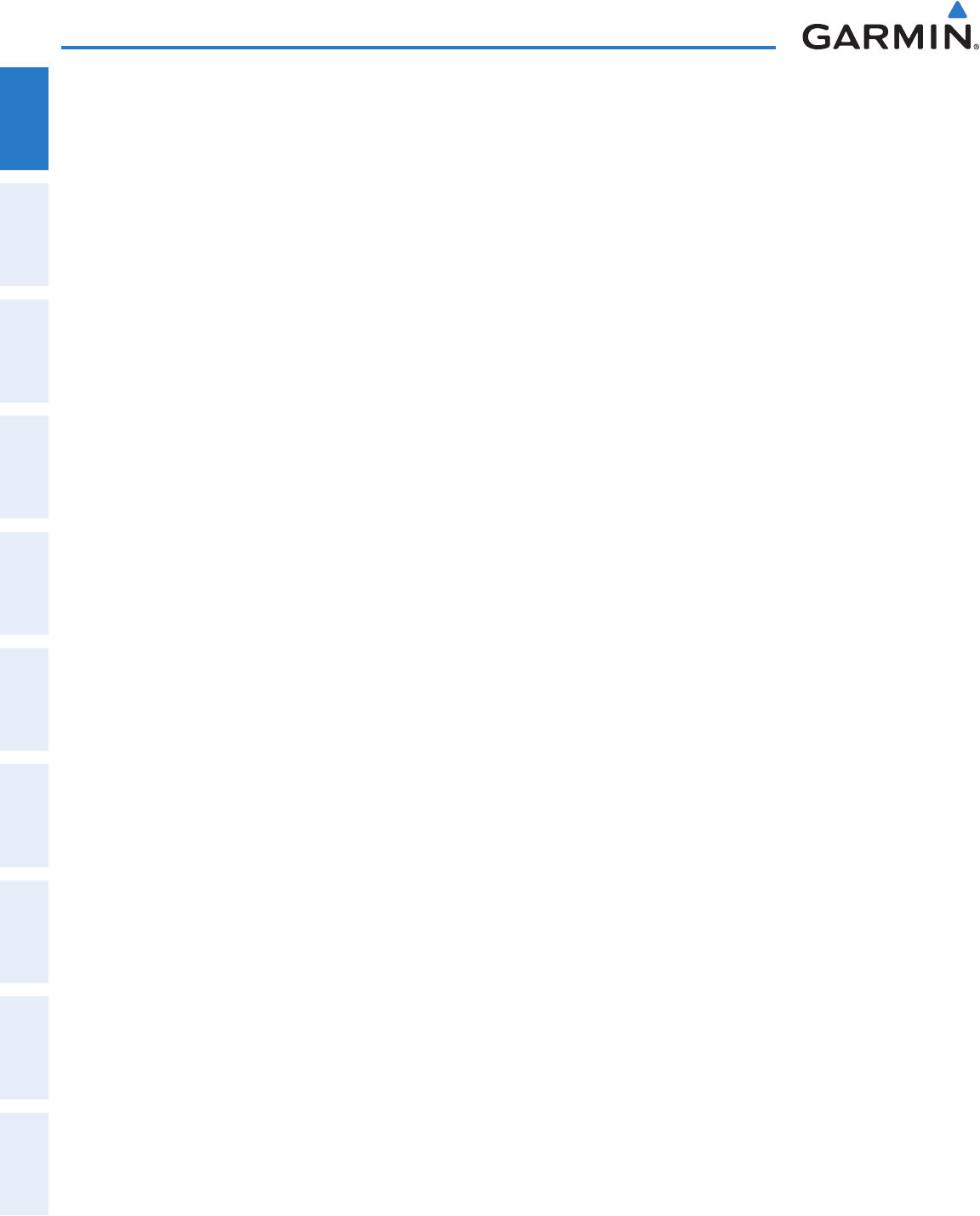
In certain situations, such as when the aircraft is outside or on the fringe of the WAAS or MSAS (used only
in Japan) coverage area, it may be desirable to disable WAAS or MSAS (although it is not recommended).
When disabled, the SBAS field in the GPS Status box indicates DISABLED. There may be a small delay for
the GPS Status box to be updated upon WAAS and MSAS enabling/disabling.
Disabling WAAS or MSAS
1) Select the GPS Status Page.
2) If necessary, press the SBAS Softkey.
3) Press the
FMS
Knob
, and turn the large FMS Knob to hightlight ‘MSAS’ or ‘WAAS’.
4) Press the ENT Key to uncheck the box.
5) Press the FMS Knob to remove the cursor.
Figure 1-12 Enable/Disable WAAS
Garmin G1000 Pilot’s Guide for the Diamond DA40/40F
190-00592-06 Rev. A16
SYSTEM OVERVIEW
SYSTEM
OVERVIEW
FLIGHT
INSTRUMENTS
EIS
AUDIO PANEL
& CNS
FLIGHT
MANAGEMENT
HAZARD
AVOIDANCE
AFCS
ADDITIONAL
FEATURES
APPENDICESINDEX
RAIM PREDICTION
Receiver Autonomous Integrity Monitoring (RAIM) is a GPS receiver function that performs a consistency
check on all tracked satellites. RAIM ensures that the available satellite geometry allows the receiver to
calculate a position within a specified RAIM protection limit (2.0 nautical miles for oceanic and enroute, 1.0
nm for terminal, and 0.3 nm for non-precision approaches). During oceanic, enroute, and terminal phases of
flight, RAIM is available nearly 100% of the time.
The RAIM prediction function also indicates whether RAIM is available at a specified date and time. RAIM
computations predict satellite coverage within ±15 min of the specified arrival date and time. In G1000
systems with WAAS enabled, performing RAIM prediction is not necessary in most cases. However, if the
selected approach is outside the WAAS coverage area, it may be necessary to perform a RAIM prediction for
the intended approach.
Because of the tighter protection limit on approaches, there may be times when RAIM is not available. The
G1000 automatically monitors RAIM and warns with an alert message when it is not available. If RAIM is not
predicted to be available for the final approach course, the approach does not become active, as indicated by
the messages “Approach is not active”. If RAIM is not available when crossing the FAF, the missed approach
procedure must be flown.
Predicting RAIM availability:
1) Select the GPS Status Page.
2) Press the RAIM Softkey.
2) Press the
FMS
Knob
. The ‘WAYPOINT’ field is highlighted.
3) Turn the small FMS Knob to display the Waypoint Information Window.
4) Enter the desired waypoint and press the ENT Key (refer to Section 1.6 for instructions on data entry).
Or:
a) To use the present position, press the MENU Key.
b) With ‘Set WPT to Present Position’ highlighted, press the ENT Key.
c) Press the ENT Key to accept the waypoint entry.
5) Enter an arrival time and press the ENT Key.
6) Enter an arrival date and press the ENT Key.
7) With the cursor highlighting ‘COMPUTE RAIM?’, press the ENT Key. Once RAIM availability is computed, one
of the following is displayed:
• ‘COMPUTE RAIM?’—RAIM has not been computed for the current waypoint, time, and date combination
• ‘COMPUTING AVAILABILITY’—RAIM calculation in progress
• ‘RAIM AVAILABLE’—RAIM is predicted to be available for the specied waypoint, time, and date
• ‘RAIM NOT AVAILABLE’—RAIM is predicted to be unavailable for the specied waypoint, time, and date
190-00592-06 Rev. A
Garmin G1000 Pilot’s Guide for the Diamond DA40/40F
17
SYSTEM OVERVIEW
SYSTEM
OVERVIEW
FLIGHT
INSTRUMENTS EIS AUDIO PANEL
& CNS
FLIGHT
MANAGEMENT
HAZARD
AVOIDANCE AFCS ADDITIONAL
FEATURES APPENDICES INDEX
SATELLITE INFORMATION
Satellites currently in view are shown at their respective positions on a satellite constellation diagram.
This sky view is always oriented north-up, with the outer circle representing the horizon, the inner circle
representing 45° above the horizon, and the center point showing the position directly overhead. Each satellite
is represented by an oval containing the Pseudo-random noise (PRN) number (i.e., satellite identification
number). Satellites whose signals are currently being used are represented by solid ovals.
The GPS Status Page can be helpful in troubleshooting weak (or missing) signal levels due to poor satellite
coverage or installation problems. As the GPS receiver locks onto satellites, a signal strength bar is displayed
for each satellite in view, with the appropriate satellite PRN number (01-32 or 120-138 for WAAS) below each
bar. The progress of satellite acquisition is indicated by signal bar appearance:
•Nosignalstrengthbar—Receiverislookingfortheindicatedsatellite.
•Hollowsignalstrengthbar—Receiverhasfoundthesatelliteandiscollectingdata.Eachsatellitehasa30-
second data transmission that must be collected (signal strength bar is hollow) before the satellite may be
used for navigation (signal strength bar becomes solid).
•Solidsignalstrengthbar—Receiverhascollectedthenecessarydataandthesatellitesignalcanbeused.
•Checkeredsignalstrengthbar—Receiverhasexcludedthesatellite(FaultDetectionandExclusion;FDE).
•“D”indicationonsignalstrengthbar—Satelliteisbeingusedfordifferentialcomputations.
•Greensignalstrengthbar—Satellitesthatareactuallybeingusedinthepositioncalculation.
•Bluesignalstrengthbar—Satelliteislockedonbutnotyetbeingusedinthepositioncalculation.
Using the current satellite signal information, they system calculates the aircraft’s GPS position, time,
altitude, ground speed, and track for the aircraft (displayed below the satellite signal accuracy measurements
for reference). The following quantities denote the accuracy of the aircraft’s GPS fix:
•EstimatedPositionUncertainty(EPU)—Astatisticalerrorindication;theradiusofacirclecenteredonan
estimated horizontal position in which actual position has 95% probability of lying
•HorizontalDilutionofPrecision(HDOP)—Measuressatellitegeometryquality(i.e.,numberofsatellites
received and where they are relative to each other) on a range from 0.0 to 9.9, with lower numbers denoting
better accuracy
•HorizontalandVerticalFiguresofMerit(HFOMandVFOM)—Measuresofhorizontalandverticalposition
uncertainty; the current 95% confidence horizontal and vertical accuracy values reported by the GPS
receiver
Garmin G1000 Pilot’s Guide for the Diamond DA40/40F
190-00592-06 Rev. A18
SYSTEM OVERVIEW
SYSTEM
OVERVIEW
FLIGHT
INSTRUMENTS
EIS
AUDIO PANEL
& CNS
FLIGHT
MANAGEMENT
HAZARD
AVOIDANCE
AFCS
ADDITIONAL
FEATURES
APPENDICESINDEX
1.5 G1000 CONTROLS
The G1000 controls have been designed to simplify operation of the system and minimize workload and the
time required to access sophisticated functionality. Controls are located on the PFD and MFD bezels and Audio
Panel. PFD and MFD controls and softkeys are discussed in this section. See the Audio Panel and CNS Section
for more information about Audio Panel and NAV/COM controls. AFCS controls (on the bezel of the MFD) are
described in the AFCS section.
PFD/MFD CONTROLS
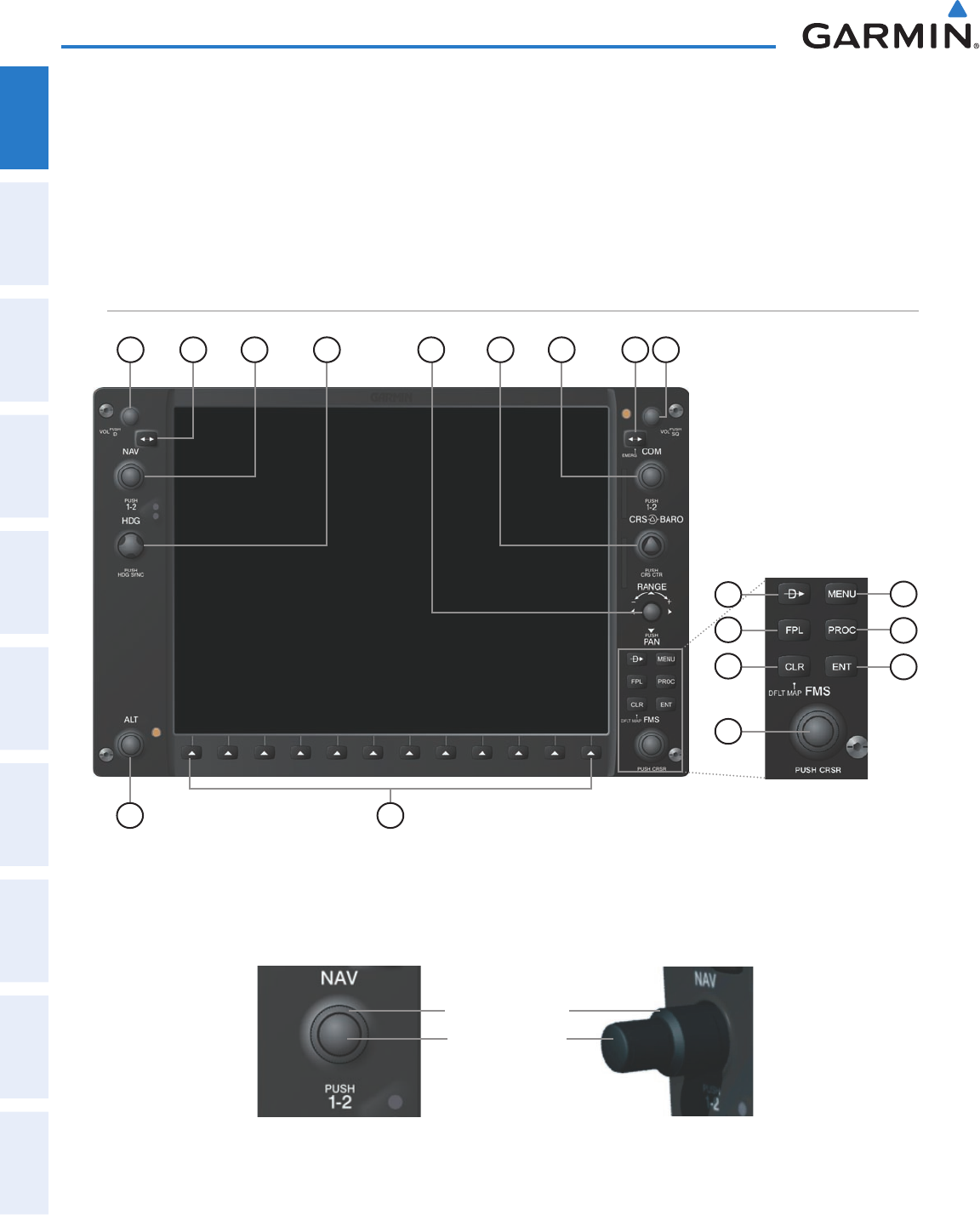
Figure 1-13 PFD/MFD Controls
1718
568
7
24
31 9
12
16
11
10
15
14
13
The NAV, CRS/BARO, COM, FMS, and ALT knobs are concentric dual knobs, each having small (inner)
and large (outer) control portion. When a portion of the knob is not specified in the text, either may be used.
Large (Outer) Knob
Small (Inner) Knob
Figure 1-14 Dual Concentric Knob
190-00592-06 Rev. A
Garmin G1000 Pilot’s Guide for the Diamond DA40/40F
19
SYSTEM OVERVIEW
SYSTEM
OVERVIEW
FLIGHT
INSTRUMENTS EIS AUDIO PANEL
& CNS
FLIGHT
MANAGEMENT
HAZARD
AVOIDANCE AFCS ADDITIONAL
FEATURES APPENDICES INDEX
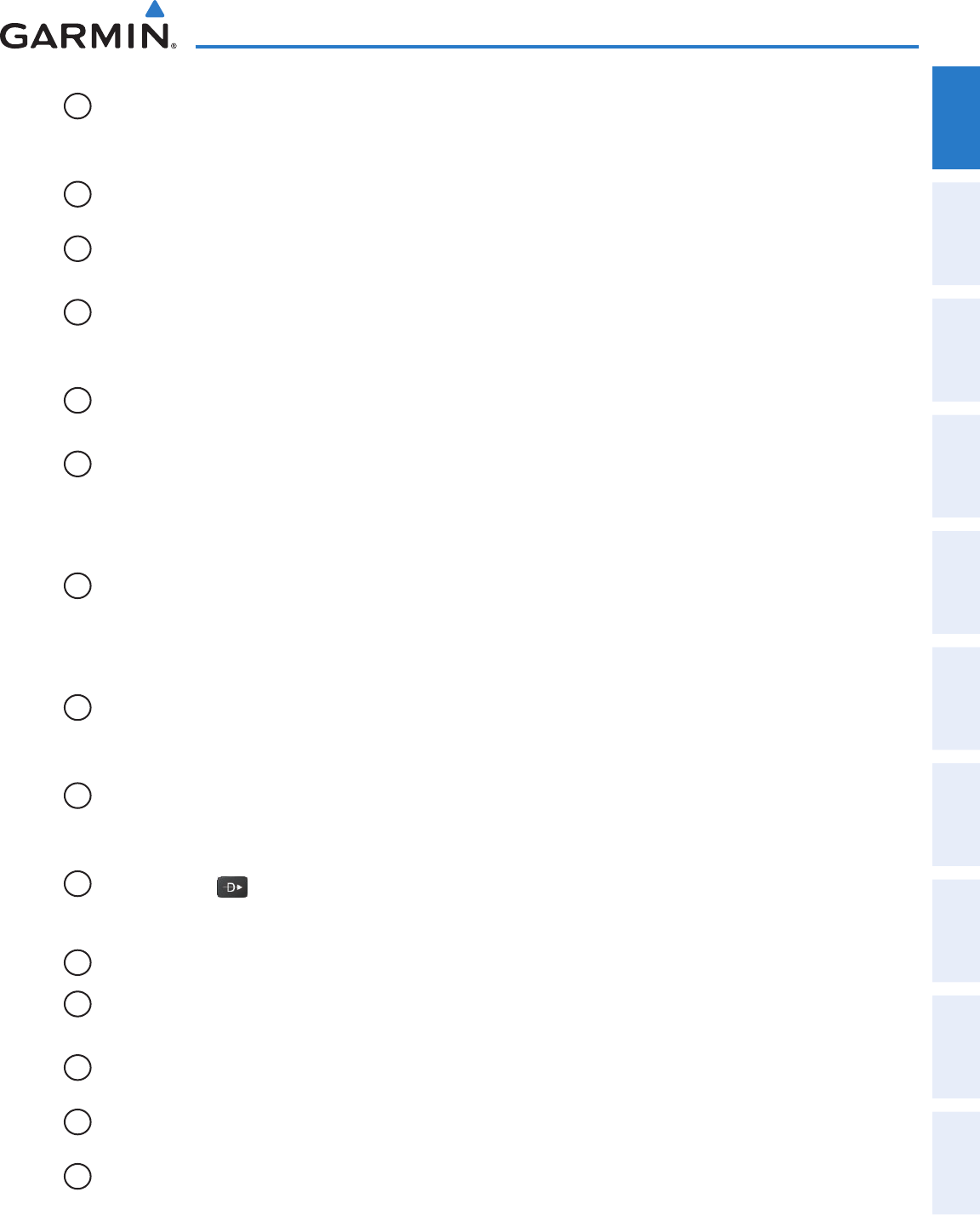
1
NAV VOL/ID Knob Turn to control NAV audio volume (shown in the NAV Frequency Box as a
percentage)
Press to toggle Morse code identifier audio on/off
2
NAV Frequency
Transfer Key
Transfers the standby and active NAV frequencies
3
NAV Knob Turn to tune NAV receiver standby frequencies (large knob for MHz; small for kHz)
Press to toggle light blue tuning box between NAV1 and NAV2
4
Heading Knob Turn to manually select a heading
Press to display a digital heading momentarily to the left of the Horizontal Situation
Indicator (HSI) and synchronize the Selected Heading to the and current heading
5
Joystick Turn to change map range
Press to activate Map Pointer and move in desired direction to pan map
6
CRS/BARO Knob Turn large knob for altimeter barometric pressure setting
Turn small knob to adjust course (only when HSI is in VOR or OBS Mode)
Press to re-center the CDI and return course pointer directly to bearing of active
waypoint/station
7
COM Knob Turn to tune COM transceiver standby frequencies (large knob for MHz; small for
kHz)
Press to toggle light blue tuning box between COM1 and COM2
The selected COM (green) is controlled with the COM MIC Key (Audio Panel).
8
COM Frequency
Transfer Key
(EMERG)
Transfers the standby and active COM frequencies
Press and hold two seconds to tune the emergency frequency (121.5 MHz)
automatically into the active frequency field
9
COM VOL/SQ Knob Turn to control COM audio volume level (shown as a percentage in the COM
Frequency Box)
Press to turn the COM automatic squelch on/off
10
Direct-to Key ( ) Activates the direct-to function and allows the user to enter a destination waypoint
and establish a direct course to the selected destination (specified by identifier,
chosen from the active route)
11
FPL Key Displays flight plan information
12
CLR Key
(DFLT MAP)
Erases information, cancels entries, or removes menus
Press and hold to display the MFD Navigation Map Page (MFD only).
13
MENU Key Displays a context-sensitive list of options for accessing additional features or making
setting changes
14
PROC Key Gives access to IFR departure procedures (DPs), arrival procedures (STARs), and
approach procedures (IAPs) for a flight plan or selected airport
15
ENT Key Validates/confirms selection or data entry
Garmin G1000 Pilot’s Guide for the Diamond DA40/40F
190-00592-06 Rev. A20
SYSTEM OVERVIEW
SYSTEM
OVERVIEW
FLIGHT
INSTRUMENTS
EIS
AUDIO PANEL
& CNS
FLIGHT
MANAGEMENT
HAZARD
AVOIDANCE
AFCS
ADDITIONAL
FEATURES
APPENDICESINDEX
16
FMS Knob
(Flight Management
System Knob)
Press to turn the selection cursor on/off
Data Entry: With cursor on, turn to enter data in the highlighted field (large
knob moves cursor location; small knob selects character for highlighted cursor
location)
Scrolling: When a list of information is too long for the window/box, a scroll bar
appears, indicating more items to view. With cursor on, turn large knob to scroll
through the list.
Page Selection: Turn knob on MFD to select the page to view (large knob selects a
page group; small knob selects a specific page from the group)
17
Softkey Selection
Keys
Press to select softkey shown above the bezel key on the PFD/MFD display
18
ALT Knob Sets the Selected Altitude, shown above the Altimeter (the large knob selects the
thousands, the small knob selects the hundreds)
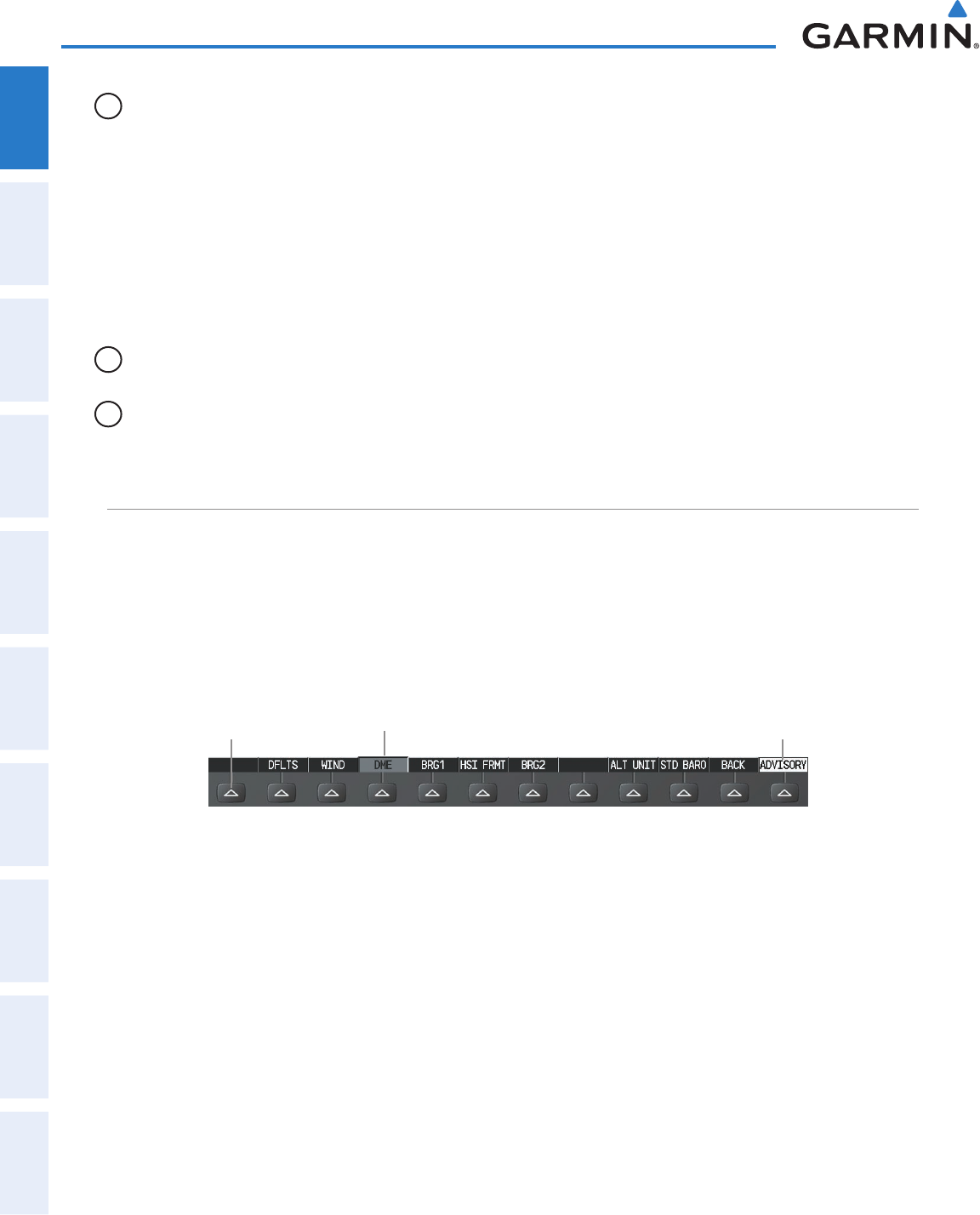
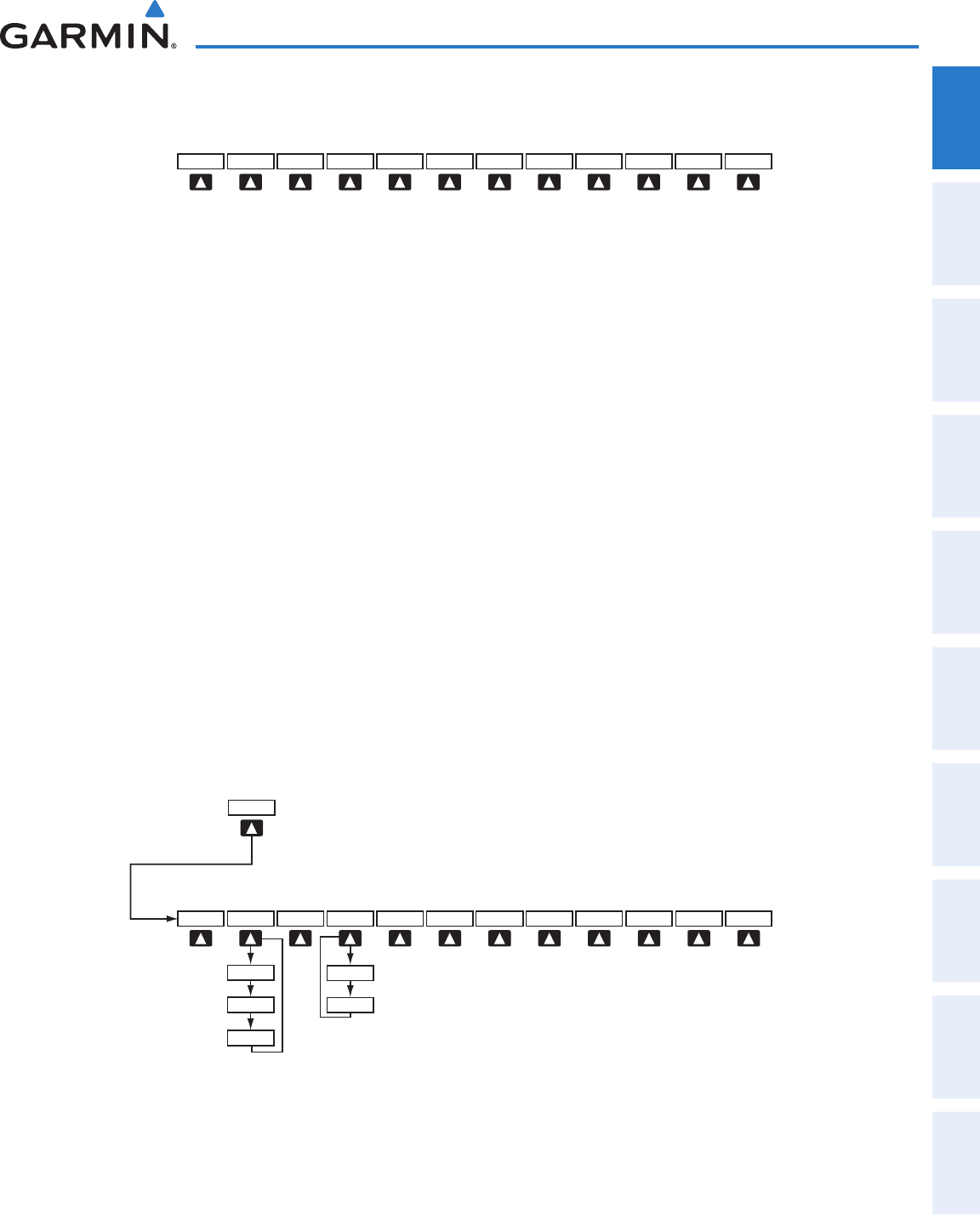
SOFTKEY FUNCTION
The softkeys are located along the bottoms of the displays. The softkeys shown depend on the softkey level
or page being displayed. The bezel keys below the softkeys can be used to select the appropriate softkey. When
a softkey is selected, its color changes to black text on gray background and remains this way until it is turned
off, at which time it reverts to white text on black background. When a softkey function is disabled, the softkey
label is subdued (dimmed).
Softkeys revert to the previous level after 45 seconds of inactivity.
Figure 1-15 Softkeys (Second-Level PFD Configuration)
Softkey
On
Bezel-Mounted
Softkeys (Press) Softkey Names
(Displayed)
In the following descriptions, top level softkeys are denoted with bullets.
PFD SOFTKEYS
The
CDI
,
IDENT
,
TMR/REF
,
NRST,
and
ALERTS
softkeys undergo a momentary change to black text on
gray background and automatically switch back to white text on black background when selected.
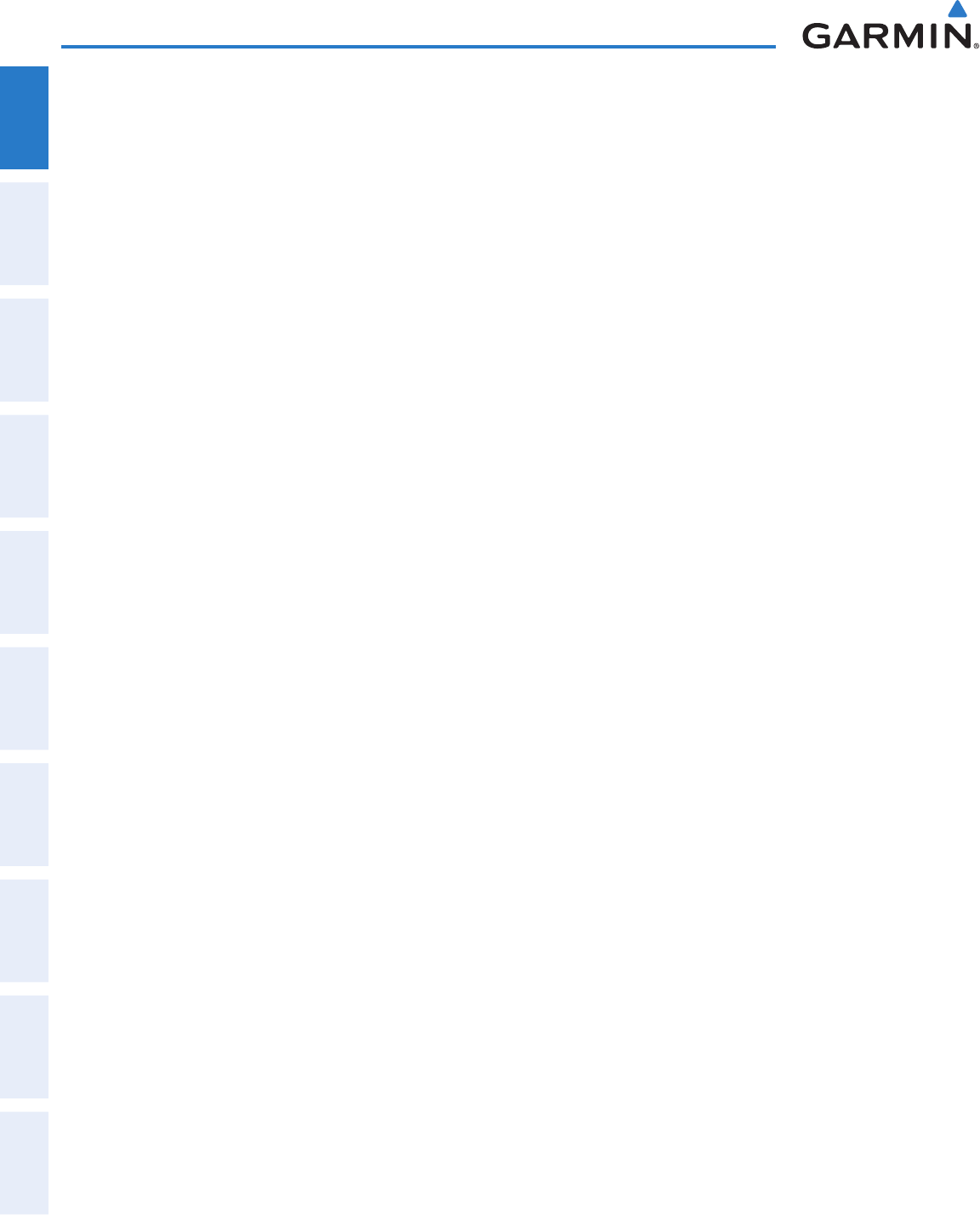
The PFD softkeys provide control over flight management functions, including GPS, NAV, terrain, traffic,
and lightning (optional). Each softkey sublevel has a BACK Softkey which can be selected to return to the
previous level. The ALERTS Softkey is visible at all softkey levels (label changes if messages are issued).
190-00592-06 Rev. A
Garmin G1000 Pilot’s Guide for the Diamond DA40/40F
21
SYSTEM OVERVIEW
SYSTEM
OVERVIEW
FLIGHT
INSTRUMENTS EIS AUDIO PANEL
& CNS
FLIGHT
MANAGEMENT
HAZARD
AVOIDANCE AFCS ADDITIONAL
FEATURES APPENDICES INDEX
Figure 1-16 Top Level PFD Softkeys
INSET XPDR IDENT TMR/REF NRST ALERTSOBSPFD CDI
Press the CDI Softkey to cycle through
navigation sources:
- GPS
- NAV1 (VOR/LOC)
- NAV2 (VOR/LOC)
Press the BACK Softkey to
return to the top-level softkeys.
Press the IDENT or BACK
Softkey to return to the top-
level softkeys.
XPDR
STBY ON ALT VFR IDENT BACK ALERTSCODE
IDENT BACK ALERTS
0 1 2 3 4 5 6 7 BKSP
GND
ADF/DME
(optional)
BACK
Press the OFF or BACK Softkey
to return to the top-level softkeys.
DCLTR
DCLTR-2
DCLTR-3
DCLTR-1
TOPO ALERTS
NEXRAD
(optional)
TERRAIN XM LTNG
(optional)
OFF TRAFFIC
INSET
STRMSCP
(optional)
TRFC-2
TRFC-1
STD BARO
BACK ALERTS
WIND HSI FMT
PFD
Press the STD BARO or BACK
Softkey to return to the top-level
softkeys.
ALT UNIT
HPA BACK ALERTS
METERS IN
DFLTS
Press the BRG1/BRG2
softkeys to display/remove
the Bearing Information
windows and cycle through
bearing sources:
- NAV1/NAV2
- GPS
- ADF
BACK ALERTS
OPTN1 OPTN2 OPTN3
DME
(optional)
BACK ALERTS
360 HSI ARC HSI
BRG1 BRG2
OFF
• INSET Displays Inset Map in PFD lower left corner
OFF Removes Inset Map
DCLTR (3) Selects desired amount of map detail; cycles through declutter levels:
DCLTR (No Declutter): All map features visible
DCLTR-1: Removes land data
DCLTR-2: Removes land and SUA data
DCLTR-3: Removes everything except active flight plan
TRAFFIC (2) Displays/removes traffic information on Inset Map
TRFC-1: Displays traffic on Inset Map.
TRFC-2: Removes everything except traffic. Inset Map position HDG UP only.
TOPO Displays/removes topographical data (e.g., coastlines, terrain, rivers, lakes) on Inset Map
TERRAIN Displays/removes terrain information on Inset Map
STRMSCP Displays/removes Stormscope weather information on Inset Map (optional)
NEXRAD Displays/removes NEXRAD weather and coverage information on Inset Map (optional)
XM LTNG Displays/removes XM lightning information on Inset Map (optional)
Figure 1-17 INSET Softkeys
INSET XPDR IDENT TMR/REF NRST ALERTSOBSPFD CDI
Press the CDI Softkey to cycle through
navigation sources:
- GPS
- NAV1 (VOR/LOC)
- NAV2 (VOR/LOC)
Press the BACK Softkey to
return to the top-level softkeys.
Press the IDENT or BACK
Softkey to return to the top-
level softkeys.
XPDR
STBY ON ALT VFR IDENT BACK ALERTSCODE
IDENT BACK ALERTS
0 1 2 3 4 5 6 7 BKSP
GND
ADF/DME
(optional)
BACK
Press the OFF or BACK Softkey
to return to the top-level softkeys.
DCLTR
DCLTR-2
DCLTR-3
DCLTR-1
TOPO ALERTS
NEXRAD
(optional)
TERRAIN XM LTNG
(optional)
OFF TRAFFIC
INSET
STRMSCP
(optional)
TRFC-2
TRFC-1
STD BARO
BACK ALERTS
WIND HSI FMT
PFD
Press the STD BARO or BACK
Softkey to return to the top-level
softkeys.
ALT UNIT
HPA BACK ALERTS
METERS IN
DFLTS
Press the BRG1/BRG2
softkeys to display/remove
the Bearing Information
windows and cycle through
bearing sources:
- NAV1/NAV2
- GPS
- ADF
BACK ALERTS
OPTN1 OPTN2 OPTN3
DME
(optional)
BACK ALERTS
360 HSI ARC HSI
BRG1 BRG2
OFF
Garmin G1000 Pilot’s Guide for the Diamond DA40/40F
190-00592-06 Rev. A22
SYSTEM OVERVIEW
SYSTEM
OVERVIEW
FLIGHT
INSTRUMENTS
EIS
AUDIO PANEL
& CNS
FLIGHT
MANAGEMENT
HAZARD
AVOIDANCE
AFCS
ADDITIONAL
FEATURES
APPENDICESINDEX
• PFD Displays second-level softkeys for additional PFD configuration
SYN VIS Displays the softkeys for enabling or disabling Synthetic Vision features
PATHWAY
Displays rectangular boxes representing the horizontal and vertical flight path
of the active flight plan
SYN TERR
Enables synthetic terrain depiction
HRZN HDG
Displays compass heading along the Zero-Pitch line
APTSIGNS
Displays position markers for airports within approximately 15 nm of the
current aircraft position. Airport identifiers are displayed when the airport is
within approximately 9 nm.
DFLTS Resets PFD to default settings, including changing units to standard
WIND Displays softkeys to select and configure wind data
OPTN1 Displays wind data in longitudinal and lateral components
OPTN2 Displays wind data total direction and speed
OPTN3 Displays wind data total direction with head and cross-wind speed components
OFF Removes wind information from display
DME Displays/removes DME Information Window (optional)
BRG1 Cycles the Bearing 1 Information Window through:
NAV1: Waypoint frequency/identifier and DME information
GPS: Waypoint identifier and GPS distance information
ADF: Waypoint frequency
Off: Removes window
HSI FMT Displays softkeys to select the HSI format
360 HSI Displays HSI as a 360° compass rose
ARC HSI Displays HSI as a 140° viewable arc (Bearing Information windows unavailable)
BRG2 Cycles the Bearing 2 Information Window through:
NAV2: Waypoint frequency/identifier and DME information
GPS: Waypoint identifier and GPS distance information
ADF: Waypoint frequency
Off: Removes window
ALT UNIT Displays softkeys for changing the Altimeter barometric setting and altitude displays to
metric units
METERS Displays the current and Selected altitudes in meters in addition to feet, when selected
IN Displays the Altimeter barometric setting in inches of mercury (in Hg)
HPA Displays the Altimeter barometric setting in hectopascals (hPa)
STD BARO Sets barometric pressure to 29.92 in Hg (1013 hPa if metric display is selected)
• OBS Selects OBS Mode on the CDI when navigating by GPS (only available with active leg)
• CDI Cycles CDI through GPS, NAV1 (VOR/LOC), and NAV2 (VOR/LOC) navigation sources
• ADF/DME Displays/removes ADF/DME Radio Tuning Window (optional; may appear as ADF, DME,
or ADF/DME depending on installation)
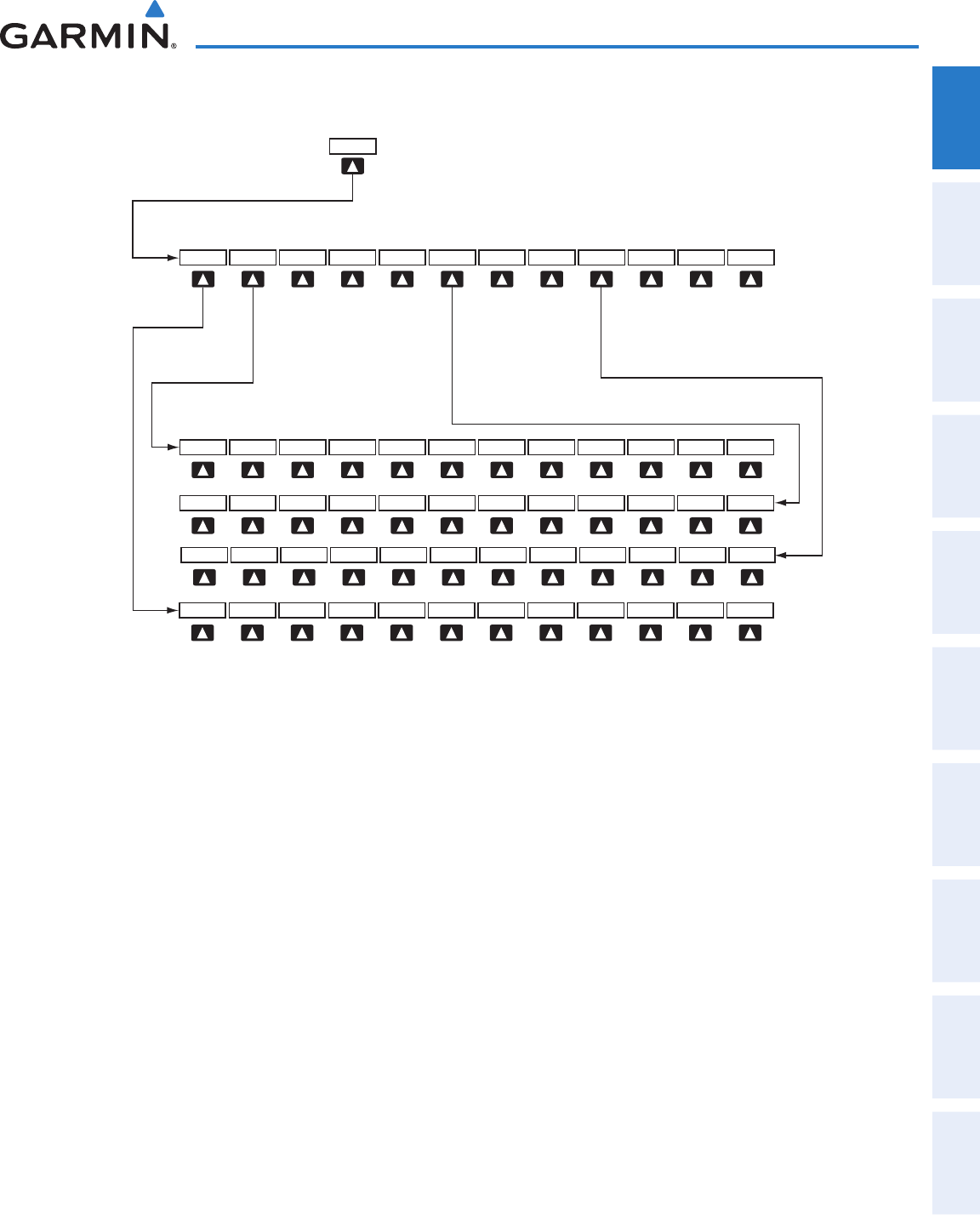
190-00592-06 Rev. A
Garmin G1000 Pilot’s Guide for the Diamond DA40/40F
23
SYSTEM OVERVIEW
SYSTEM
OVERVIEW
FLIGHT
INSTRUMENTS EIS AUDIO PANEL
& CNS
FLIGHT
MANAGEMENT
HAZARD
AVOIDANCE AFCS ADDITIONAL
FEATURES APPENDICES INDEX
STD BARO
BACK ALERTS
WIND HSI FMT
PFD
Press the STD BARO or BACK
Softkey to return to the top-level
softkeys.
ALT UNIT
HPA BACK ALERTS
METERS IN
DFLTS
Press the BRG1/BRG2
softkeys to display/remove
the Bearing Information
windows and cycle through
bearing sources:
- NAV1/NAV2
- GPS
- ADF
BACK ALERTS
OPTN1 OPTN2 OPTN3
DME
(optional)
BACK ALERTS
360 HSI ARC HSI
BRG1 BRG2
OFF
SYN VIS
BACK ALERTS
PAT HWAY SYN TERR HRZN HDGAPTSIGNS
Figure 1-18 PFD Configuration Softkeys
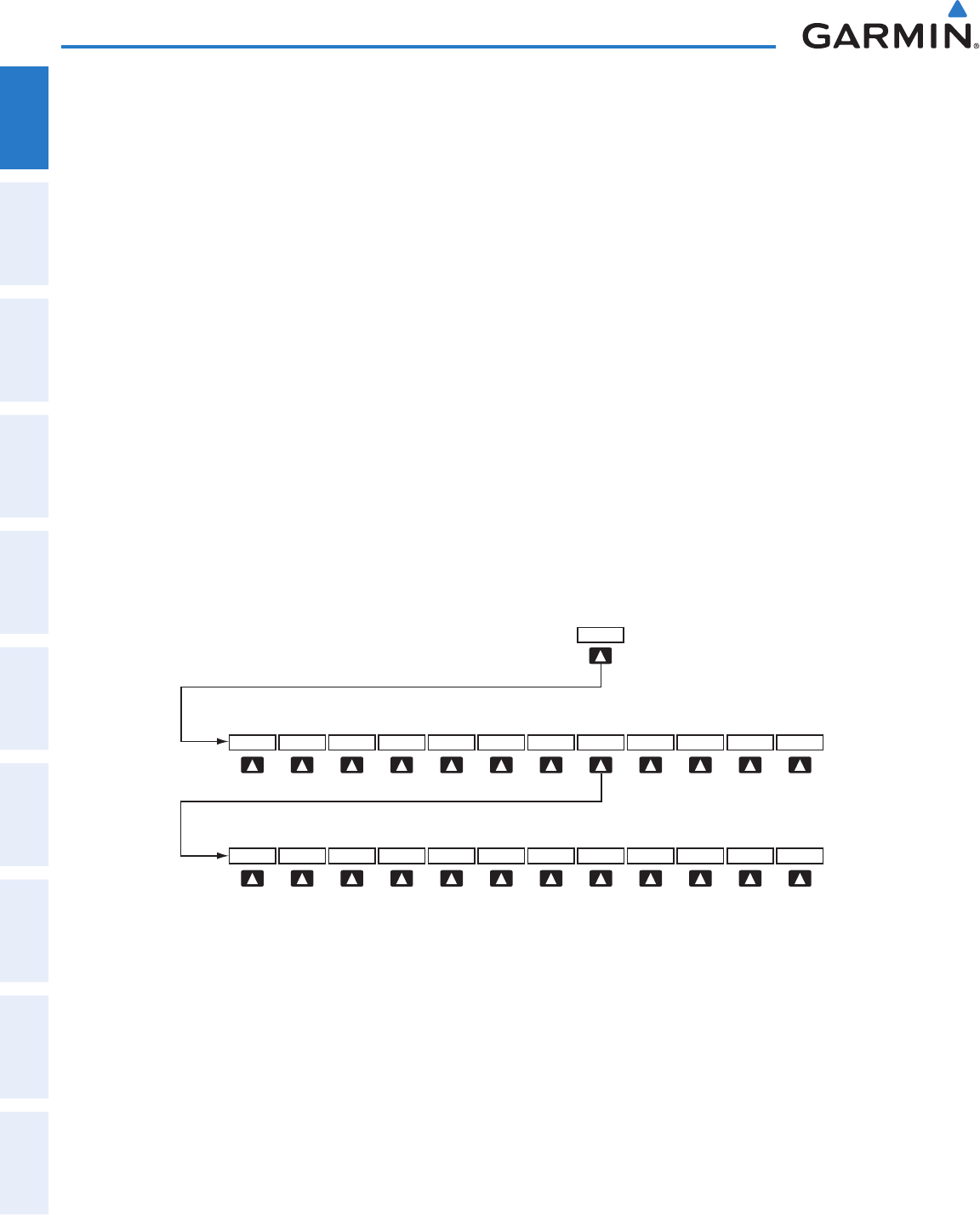
Garmin G1000 Pilot’s Guide for the Diamond DA40/40F
190-00592-06 Rev. A24
SYSTEM OVERVIEW
SYSTEM
OVERVIEW
FLIGHT
INSTRUMENTS
EIS
AUDIO PANEL
& CNS
FLIGHT
MANAGEMENT
HAZARD
AVOIDANCE
AFCS
ADDITIONAL
FEATURES
APPENDICESINDEX
• XPDR Displays transponder mode selection softkeys:
STBY Selects standby mode (Transponder does not reply to any interrogations)
ON Selects Mode A (Transponder replies to interrogations)
ALT Selects Mode C – altitude reporting mode (Transponder replies to identification and altitude
interrogations)
GND Manually selects Ground Mode (Transponder does not allow Mode A and Mode C
replies, but does permit acquisition squitter and replies to discretely addressed Mode S
interrogations)
VFR Automatically enters the VFR code (1200 in U.S.A. only)
CODE Displays transponder code selection softkeys 0-7
0 — 7 Use numbers to enter code
BKSP Removes numbers entered, one at a time
• IDENT Activates the Special Position Identification (SPI) pulse for 18 seconds, identifying the
transponder return on the ATC screen
• TMR/REF Displays/removes Timer/References Window
• NRST Displays/removes Nearest Airports Window
• ALERTS Displays/removes Alerts Window
Figure 1-19 XPDR Softkeys
INSET XPDR IDENT TMR/REF NRST ALERTSOBSPFD CDI
Press the CDI Softkey to cycle through
navigation sources:
- GPS
- NAV1 (VOR/LOC)
- NAV2 (VOR/LOC)
Press the BACK Softkey to
return to the top-level softkeys.
Press the IDENT or BACK
Softkey to return to the top-
level softkeys.
XPDR
STBY ON ALT VFR IDENT BACK ALERTSCODE
IDENT BACK ALERTS
0 1 2 3 4 5 6 7 BKSP
GND
ADF/DME
(optional)
BACK
Press the OFF or BACK Softkey
to return to the top-level softkeys.
DCLTR
DCLTR-2
DCLTR-3
DCLTR-1
TOPO ALERTS
NEXRAD
(optional)
TERRAIN XM LTNG
(optional)
OFF TRAFFIC
INSET
STRMSCP
(optional)
TRFC-2
TRFC-1
STD BARO
BACK ALERTS
WIND HSI FMT
PFD
Press the STD BARO or BACK
Softkey to return to the top-level
softkeys.
ALT UNIT
HPA BACK ALERTS
METERS IN
DFLTS
Press the BRG1/BRG2
softkeys to display/remove
the Bearing Information
windows and cycle through
bearing sources:
- NAV1/NAV2
- GPS
- ADF
BACK ALERTS
OPTN1 OPTN2 OPTN3
DME
(optional)
BACK ALERTS
360 HSI ARC HSI
BRG1 BRG2
OFF
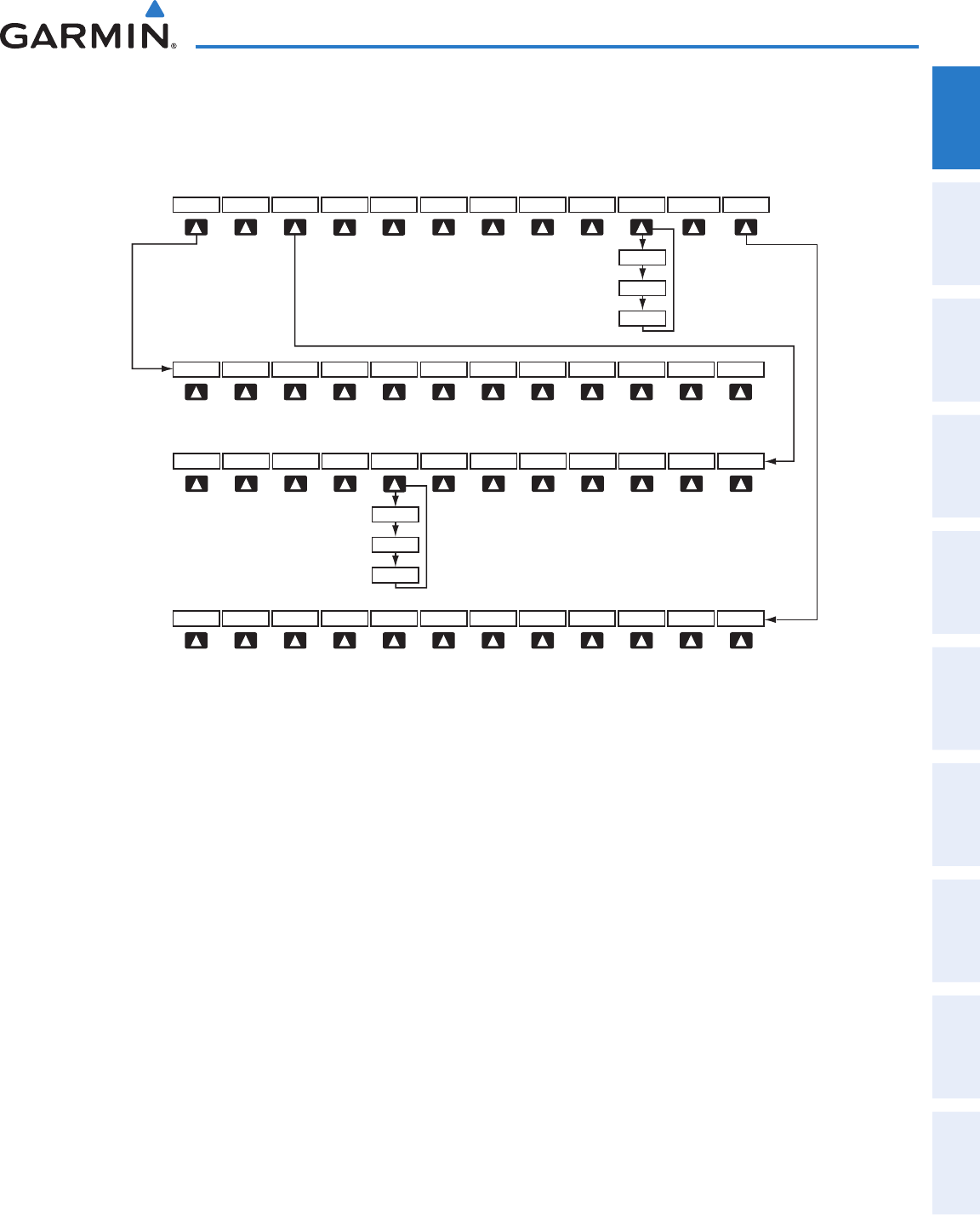
190-00592-06 Rev. A
Garmin G1000 Pilot’s Guide for the Diamond DA40/40F
25
SYSTEM OVERVIEW
SYSTEM
OVERVIEW
FLIGHT
INSTRUMENTS EIS AUDIO PANEL
& CNS
FLIGHT
MANAGEMENT
HAZARD
AVOIDANCE AFCS ADDITIONAL
FEATURES APPENDICES INDEX
MFD SOFTKEYS
MFD softkeys vary depending on the page selected. EIS and Navigation Map Page (default MFD page)
softkeys are described here.
Figure 1-20 EIS and MFD Softkeys
CHKLIST
DCLTR
ENGINE
DCLTR-2
DCLTR-3
DCLTR-1
Press the ENGINE Softkey to
return to the top-level softkeys.
INC FUEL RST FUELLEAN DEC FUEL
ENGINE
MAP
The DONE Softkey label changes to UNDO
when the checklist item is already checked.
EXITDONEENGINE EMERGCY
BACKTOPO
(optional)
NEXRAD
TRAFFIC
TERRAIN
(optional)
XM LTNG
Press the BACK softkey to
return to the top-level softkeys.
AIRWY LO
AIRWY HI
AIRWY ON
AIRWAYS
(optional)
STRMSCP
SHW CHRT
• ENGINE Displays EIS - Engine Page and second-level engine softkeys; press again to exit page (see the
EIS Section for more information)
LEAN Accesses engine leaning assist mode
DEC FUEL Decreases displayed fuel remaining in 1-gal increments
INC FUEL Increases displayed fuel remaining in 1-gal increments
RST FUEL Resets displayed fuel remaining to maximum fuel capacity for aircraft and fuel used to zero
Garmin G1000 Pilot’s Guide for the Diamond DA40/40F
190-00592-06 Rev. A26
SYSTEM OVERVIEW
SYSTEM
OVERVIEW
FLIGHT
INSTRUMENTS
EIS
AUDIO PANEL
& CNS
FLIGHT
MANAGEMENT
HAZARD
AVOIDANCE
AFCS
ADDITIONAL
FEATURES
APPENDICESINDEX
• MAP Enables second-level Navigation Map Page softkeys
TRAFFIC Displays/removes traffic information on Navigation Map Page
TOPO Displays/removes topographical data (e.g., coastlines, terrain, rivers, lakes) on Navigation
Map Page
TERRAIN Displays/removes terrain information on Navigation Map Page
AIRWAYS Selects the desired display of Airways; cycles through:
AIRWY ON: All Airways displayed
AIRWY LO: Low Altitude (Victor) Airways displayed
AIRWY HI: High Altitude Airways (Jet Routes) displayed
AIRWAYS: Airways are not displayed
STRMSCP Displays/removes Stormscope weather information on Inset Map (optional)
NEXRAD Displays/removes NEXRAD weather/coverage on Navigation Map Page (optional)
XM LTNG Displays/removes XM lightning information on Navigation Map Page (optional)
BACK Returns to top-level softkeys
• DCLTR (3) Selects desired amount of map detail; cycles through declutter levels:
DCLTR (No Declutter): All map features visible
DCLTR-1: Removes land data
DCLTR-2: Removes land and SUA data
DCLTR-3: Removes everything except the active flight plan
• SHW CHRT Displays optional Flite Charts or Chart View charts (optional)
• CHKLIST Displays the Checklist Page
DONE Selects the highlighted checklist item
EXIT Returns to the top-level softkeys
EMERGCY Immediately accesses the emergency procedures
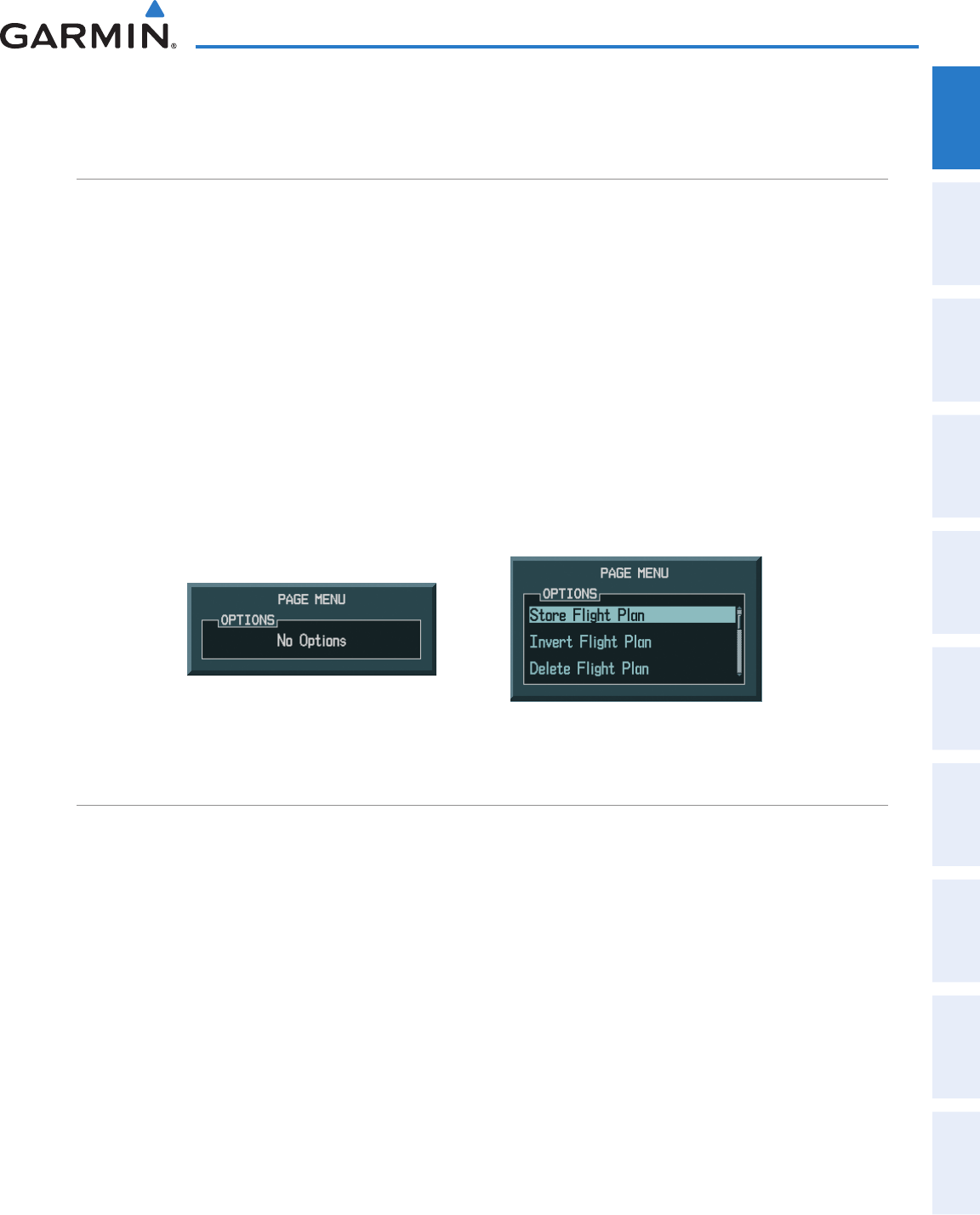
190-00592-06 Rev. A
Garmin G1000 Pilot’s Guide for the Diamond DA40/40F
27
SYSTEM OVERVIEW
SYSTEM
OVERVIEW
FLIGHT
INSTRUMENTS EIS AUDIO PANEL
& CNS
FLIGHT
MANAGEMENT
HAZARD
AVOIDANCE AFCS ADDITIONAL
FEATURES APPENDICES INDEX
1.6 ACCESSING G1000 FUNCTIONALITY
MENUS
The G1000 has a dedicated MENU Key that when pressed displays a context-sensitive list of options. This
options list allows the user to access additional features or make settings changes which specifically relate to
the currently displayed window/page. There is no all-encompassing menu. Some menus provide access to
additional submenus that are used to view, edit, select, and review options. Menus display ‘No Options’ when
there are no additional features or settings for the window/page selected.
Navigating a menu:
1) Press the MENU Key to display the menu.
2) Turn the FMS Knob to scroll through a list of available options (a scroll bar always appears to the right of the
window/box when the option list is longer than the window/box).
3) Press the ENT Key to select the desired option.
4) Press the CLR Key or FMS Knob to remove the menu and cancel the operation.
Figure 1-21 Page Menu Examples
No Options for
NRST Window Options for FPL Window
DATA ENTRY
The FMS Knob can be used for directly entering alphanumeric data (e.g., Flight ID, waypoint identifiers,
barometric minimum descent altitude) into the G1000 In some instances, such as when entering an identifier,
the G1000 tries to predict the desired identifier based on the characters being entered. In this case, if the
desired identifier appears, use the ENT Key to confirm the entry without entering the rest of the identifier
manually. This can save the pilot from having to enter all the characters of the identifier.
Besides character-by-character data entry, the system also provides a shortcut for entering waypoint identifiers.
When the cursor is on a field awaiting entry of a waypoint identifier, turning the small FMS Knob counter-
clockwise accesses three different lists of waypoint identifiers for quick selection: flight plan (FPL), nearest
(NRST), and recently-entered (RECENT). The G1000 automatically fills in the identifier, facility, and city fields
with the information for the selected waypoint.
Garmin G1000 Pilot’s Guide for the Diamond DA40/40F
190-00592-06 Rev. A28
SYSTEM OVERVIEW
SYSTEM
OVERVIEW
FLIGHT
INSTRUMENTS
EIS
AUDIO PANEL
& CNS
FLIGHT
MANAGEMENT
HAZARD
AVOIDANCE
AFCS
ADDITIONAL
FEATURES
APPENDICESINDEX
Using the FMS Knob to enter data:
1) If needed, press the FMS Knob to activate the cursor.
2) Use the large FMS Knob to highlight the desired field.
3) Begin entering data.
a) To quickly enter a waypoint identifier, turn the small FMS Knob counter-clockwise to display a list of waypoints
in the active flight plan (list is titled FPL). If desired, turn the small FMS Knob clockwise to scroll through lists
of nearest waypoints (NRST) and recently-entered waypoints (RECENT).
b) Turn the large FMS Knob to highlight the desired waypoint from the list and press the ENT Key.
Or:
a) Turn the small FMS Knob to select a character for the first placeholder.
Turning the knob clockwise scrolls through the alphabet (where appropriate) toward the letter Z, starting at
K, and the digits zero through nine. Afterwards, turning the knob counter-clockwise scrolls in the opposite
direction.
b) Use the large FMS Knob to move the cursor to the next placeholder in the field.
c) Repeat, using the small FMS Knob to select a character and the large FMS Knob to move the cursor, until the
field is complete.
d) Press the ENT Key to confirm entry.
7) Press the FMS Knob or CLR Key to cancel data entry (the field reverts back to its previous information).
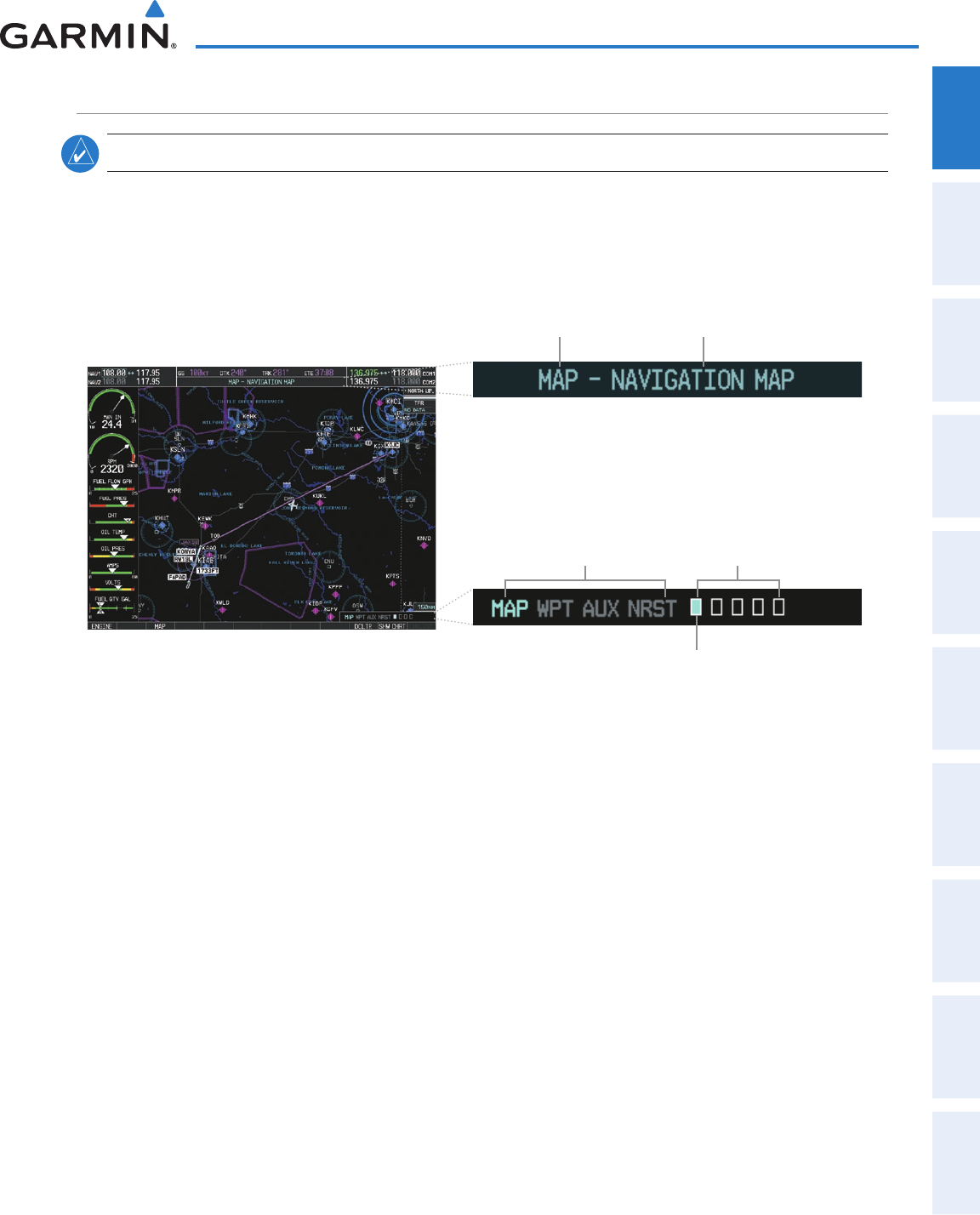
190-00592-06 Rev. A
Garmin G1000 Pilot’s Guide for the Diamond DA40/40F
29
SYSTEM OVERVIEW
SYSTEM
OVERVIEW
FLIGHT
INSTRUMENTS EIS AUDIO PANEL
& CNS
FLIGHT
MANAGEMENT
HAZARD
AVOIDANCE AFCS ADDITIONAL
FEATURES APPENDICES INDEX
PAGE GROUPS
NOTE: Refer to other supporting sections in this Pilot’s Guide for details on specific pages.
Information on the MFD is presented on pages which are grouped according to function. The page group and
active page title are displayed in the upper center of the screen, below the Navigation Status Box. In the bottom
right corner of the screen, the current page group, number of pages available in the group, and placement of
the current page within the group are indicated by icons. For some of these pages (Airport/Procedures/Weather
Information, XM, Procedure Loading), the title of the page changes while the page icon remains the same.
Figure 1-22 Page Title and Page Group Icons
MFD
Page Group Active Page Title
Page Groups
Selected Page
Pages in Current Group
There are four main page groups, navigated using the FMS Knob; specific pages within each group can vary
depending on the configuration of optional equipment.
Selecting a page using the FMS Knob:
1) Turn the
large FMS
Knob until the desired page group is selected.
2)
Turn
the
small FMS
Knob until the desired page is selected.
There are also several pages (Airport/Procedures/Weather Information and XM pages) which are selected first
from within a main page group with the FMS Knob, then with the appropriate softkey at the bottom of the page
(or from the page menu). In this case, the page remains set to the selected page until a different page softkey is
selected, even if a different page group is selected.
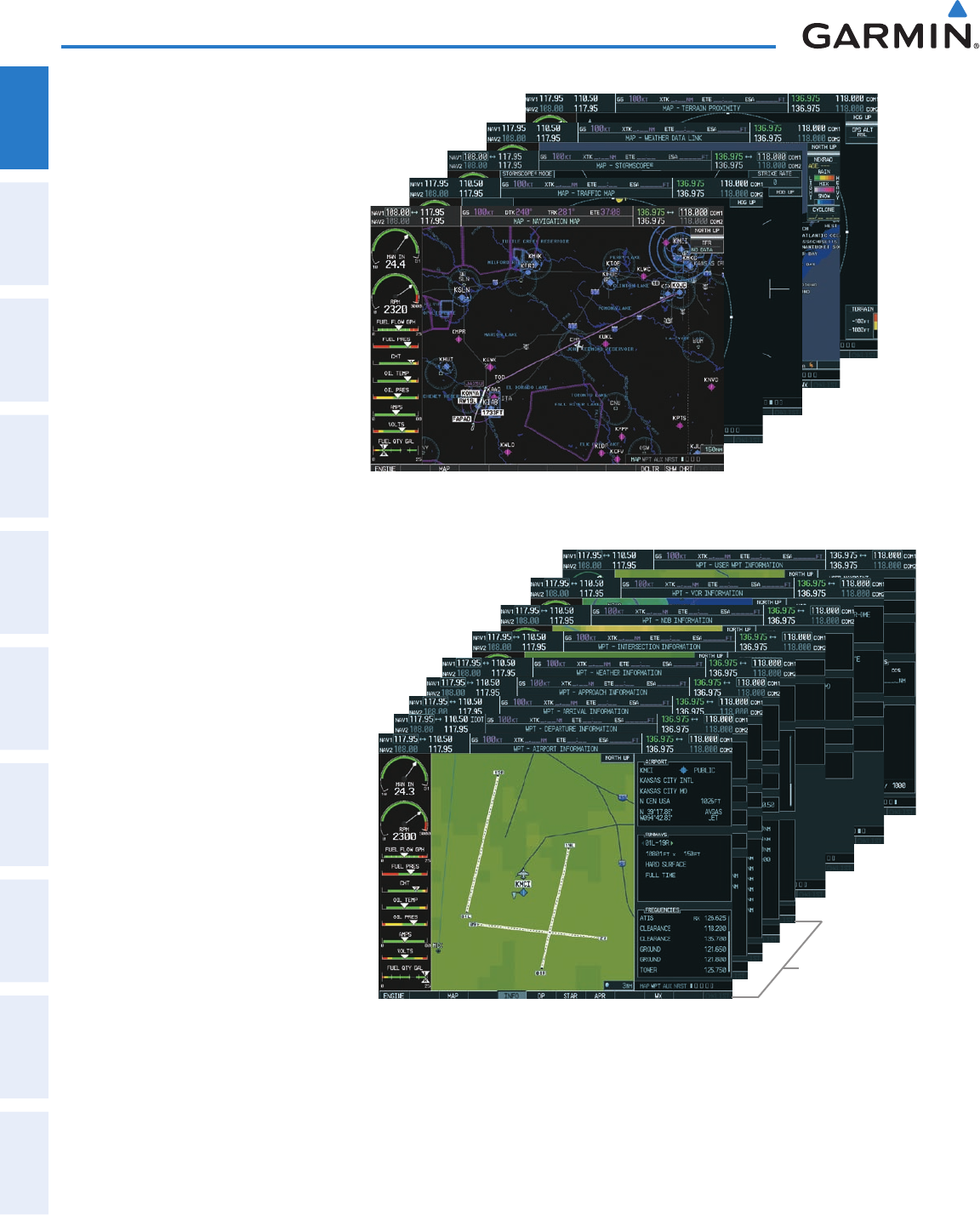
Garmin G1000 Pilot’s Guide for the Diamond DA40/40F
190-00592-06 Rev. A30
SYSTEM OVERVIEW
SYSTEM
OVERVIEW
FLIGHT
INSTRUMENTS
EIS
AUDIO PANEL
& CNS
FLIGHT
MANAGEMENT
HAZARD
AVOIDANCE
AFCS
ADDITIONAL
FEATURES
APPENDICESINDEX
•Map Page Group (MAP)
Navigation Map
Traffic Map
Stormscope (optional)
Weather Data Link (optional)
Terrain Proximity/TAWS
(TAWS optional)
Figure 1-23 Map Pages
•Waypoint Page Group (WPT)
Airport/Procedures/Weather Information Pages
- Airport Information
(INFO Softkey)
- Departure Information
(DP Softkey)
- Arrival Information
(STAR Softkey)
- Approach Information
(APR Softkey)
- Weather Information (optional)
(WX Softkey)
Intersection Information
NDB Information
VOR Information
User Waypoint Information
Figure 1-24 Waypoint Pages
Airport/
Procedures/
Weather
Information
Pages
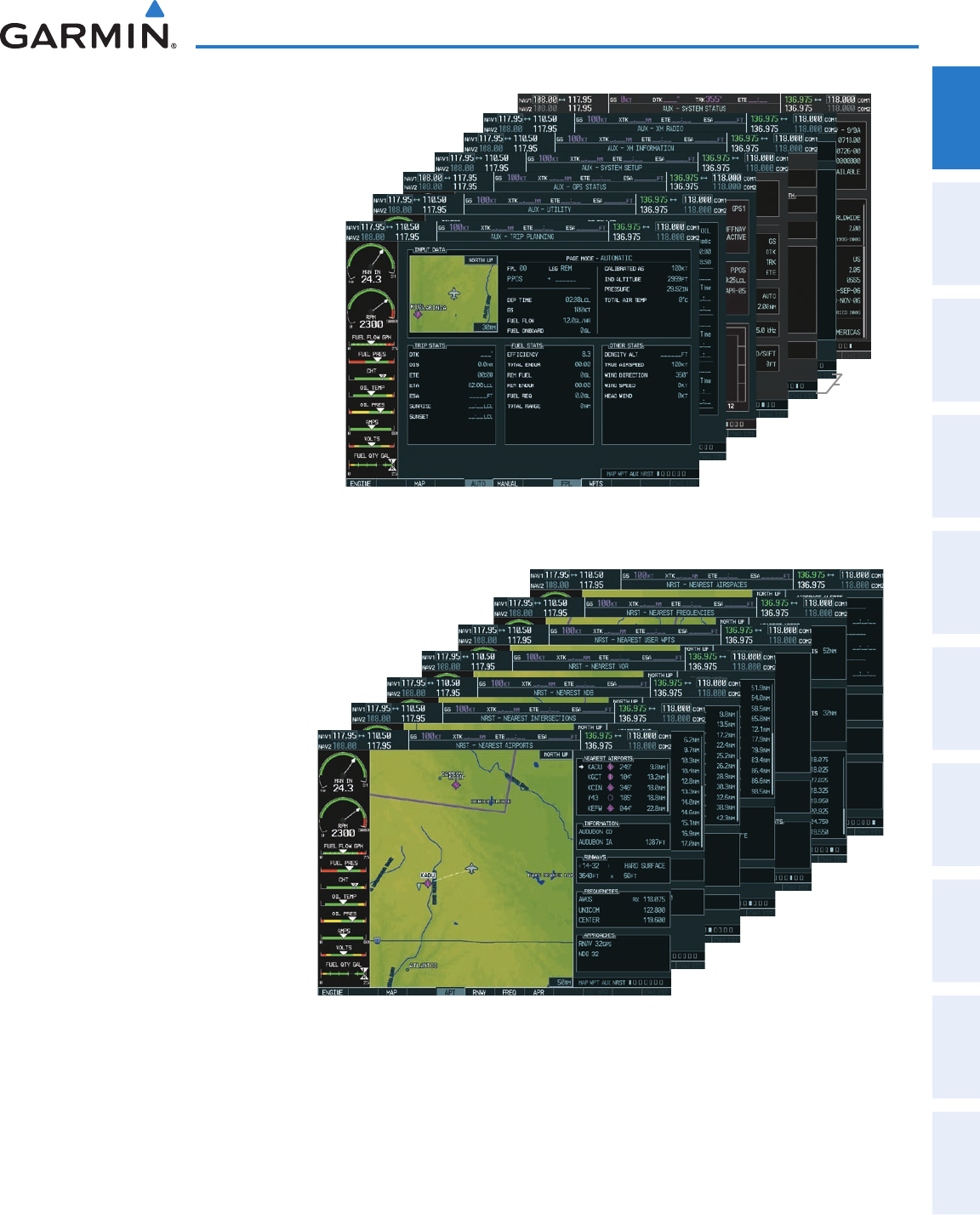
190-00592-06 Rev. A
Garmin G1000 Pilot’s Guide for the Diamond DA40/40F
31
SYSTEM OVERVIEW
SYSTEM
OVERVIEW
FLIGHT
INSTRUMENTS EIS AUDIO PANEL
& CNS
FLIGHT
MANAGEMENT
HAZARD
AVOIDANCE AFCS ADDITIONAL
FEATURES APPENDICES INDEX
•Auxiliary Page Group (AUX)
Trip Planning
Utility
GPS Status
System Setup
XM Satellite screens (optional)
- XM Information
(INFO Softkey)
- XM Radio
(RADIO Softkey)
System Status
Figure 1-25 Auxiliary Pages
XM
Pages
•Nearest Page Group (NRST)
Nearest Airports
Nearest Intersections
Nearest NDB
Nearest VOR
Nearest User Waypoints
Nearest Frequencies
Nearest Airspaces
Figure 1-26 Nearest Pages
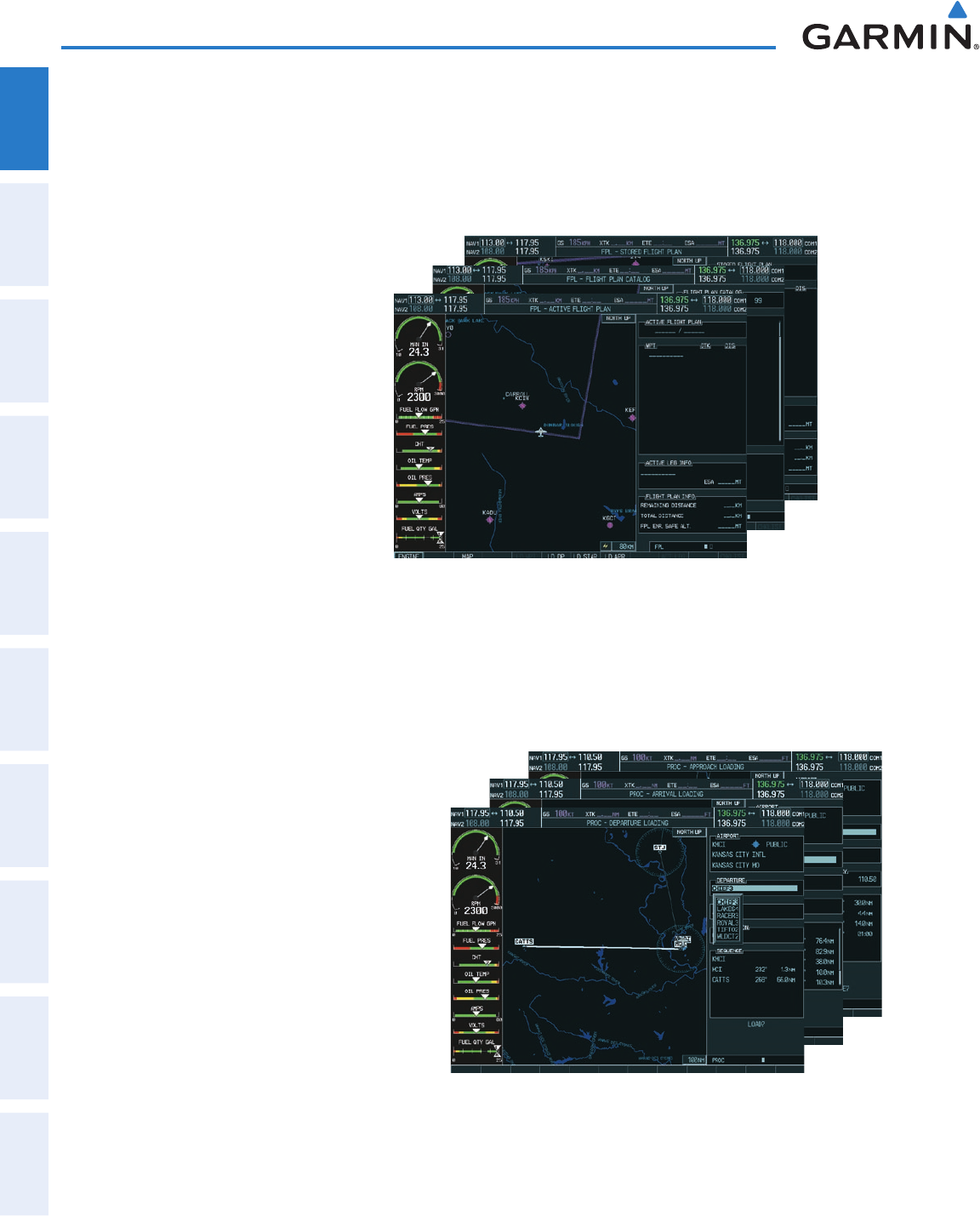
Garmin G1000 Pilot’s Guide for the Diamond DA40/40F
190-00592-06 Rev. A32
SYSTEM OVERVIEW
SYSTEM
OVERVIEW
FLIGHT
INSTRUMENTS
EIS
AUDIO PANEL
& CNS
FLIGHT
MANAGEMENT
HAZARD
AVOIDANCE
AFCS
ADDITIONAL
FEATURES
APPENDICESINDEX
In addition to the main page groups accessed exclusively using the FMS Knob, there are pages for flight
planning (FPL) and loading procedures (PROC) which are accessed by key. In some instances, softkeys may be
used to access the Procedure Loading pages.
The Flight Plan pages are accessed using the FPL Key on the MFD. Main pages within this group are selected
by turning the small FMS Knob.
Figure 1-27 Flight Plan Pages
•Flight Plan Page Group (FPL)
Active Flight Plan
Flight Plan Catalog
- Stored Flight Plan
(NEW Softkey)
The Procedure Loading pages may be accessed at any time on the MFD by pressing the PROC Key. A menu
is initialized, and when a departure, approach, or arrival is selected, the appropriate Procedure Loading page is
opened. These pages can also be accessed from the Active and Stored Flight Plan pages using the LD softkeys.
Turning the FMS Knob does not scroll through the Procedure Loading pages (note the single page icon in the
lower right corner).
Figure 1-28 Procedure Loading Pages
•Procedure Loading Page Group (PROC)
Departure Loading
Arrival Loading
Approach Loading
Information on optional electronic checklist pages is offered later in this section. Checklist pages may be
accessed from any page on the MFD using the CHKLIST Softkey.
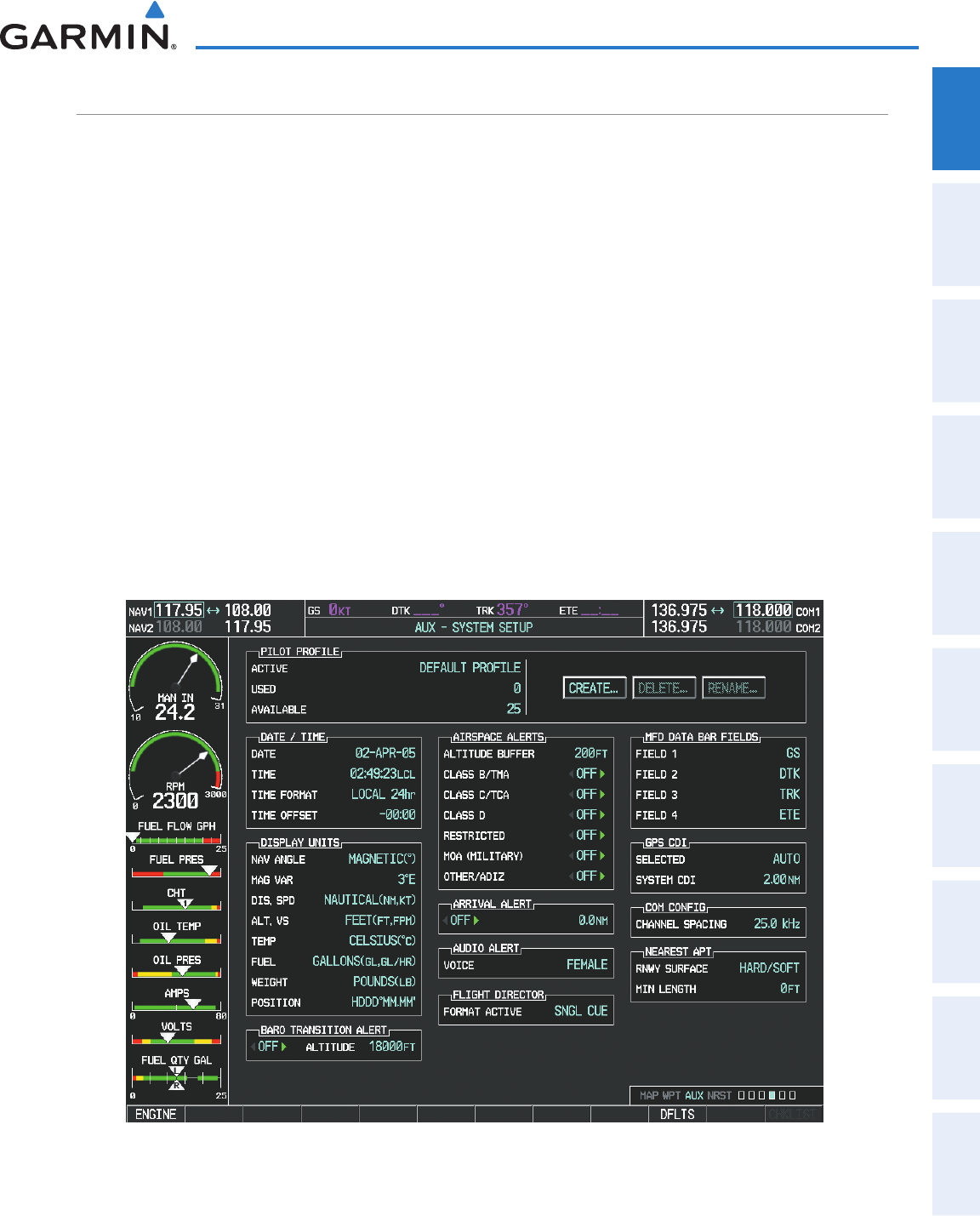
190-00592-06 Rev. A
Garmin G1000 Pilot’s Guide for the Diamond DA40/40F
33
SYSTEM OVERVIEW
SYSTEM
OVERVIEW
FLIGHT
INSTRUMENTS EIS AUDIO PANEL
& CNS
FLIGHT
MANAGEMENT
HAZARD
AVOIDANCE AFCS ADDITIONAL
FEATURES APPENDICES INDEX
SYSTEM SETTINGS
G1000 system settings are managed from the System Setup Page. The following settings can be changed:
•Date/time
•DisplayUnits
(see Flight Instruments Section)
•Airspacealerts(seeFlightManagementSection)
•Arrivalalerts(seeFlightManagementSection)
•MFDNavigationStatusBoxelds
(see Flight Management Section)
•CDIscalingforGPSnavigationsource
(see Flight Instruments Section)
•COMchannelspacing
(see Audio Panel and CNS Section)
•Criteriafordisplayingnearestairports
(see Flight Management Section)
•AudioAlerts
Restoring system setup defaults:
1) Use the FMS Knob to select the AUX - System Setup Page.
2) Press the DFLTS Softkey.
Or:
a) Press the MENU Key.
b) Highlight ‘Restore Defaults’ and press the ENT Key.
Figure 1-29 System Setup Page
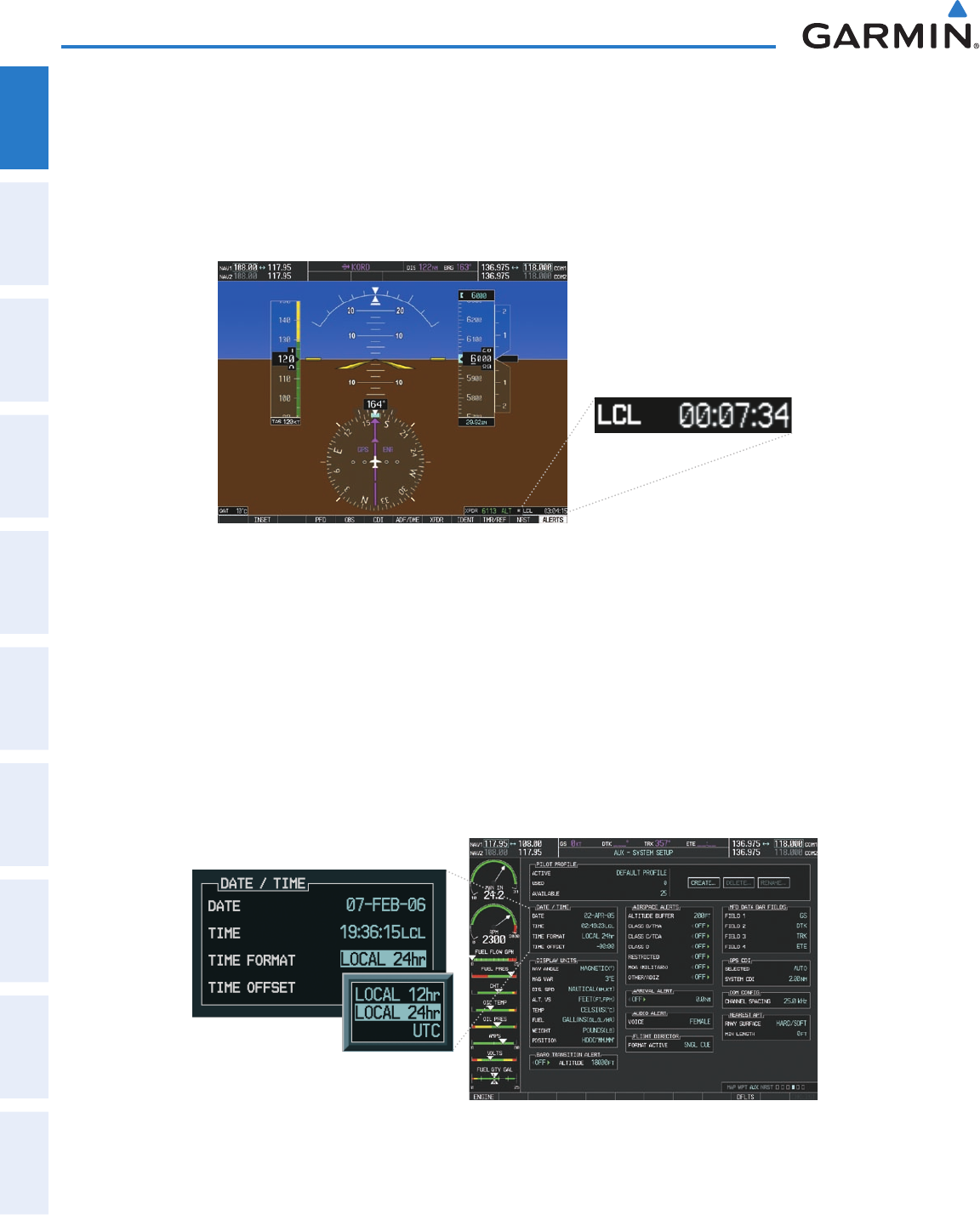
Garmin G1000 Pilot’s Guide for the Diamond DA40/40F
190-00592-06 Rev. A34
SYSTEM OVERVIEW
SYSTEM
OVERVIEW
FLIGHT
INSTRUMENTS
EIS
AUDIO PANEL
& CNS
FLIGHT
MANAGEMENT
HAZARD
AVOIDANCE
AFCS
ADDITIONAL
FEATURES
APPENDICESINDEX
DATE/TIME
The G1000 obtains the current Universal Coordinated Time (UTC) date and time directly from the GPS
satellite signals (shown on the AUX - GPS Status Page, Figure 1-11). System time (displayed in the lower
right corner of the PFD) can be displayed in three formats: local 12-hr, local 24-hr, or UTC. Local time is set
by adding/subtracting an offset (hours:minutes) to/from UTC.
Figure 1-30 System Time (Local 24-hr Format)
PFD
Configuring the system time:
1) Select the AUX - System Setup Page using the FMS Knob.
2) Press the FMS Knob to activate the cursor.
3) Turn the large FMS Knob to highlight the ‘Time Format’ field.
4) Turn the small FMS Knob to select the desired format and press the ENT Key to confirm selection. The ‘Time
Offset’ field is highlighted.
5) Use the FMS Knob to enter the desired time offset (±HH:MM) and press the ENT Key to confirm selection.
Figure 1-31 Date/Time Settings (AUX - System Setup Page)
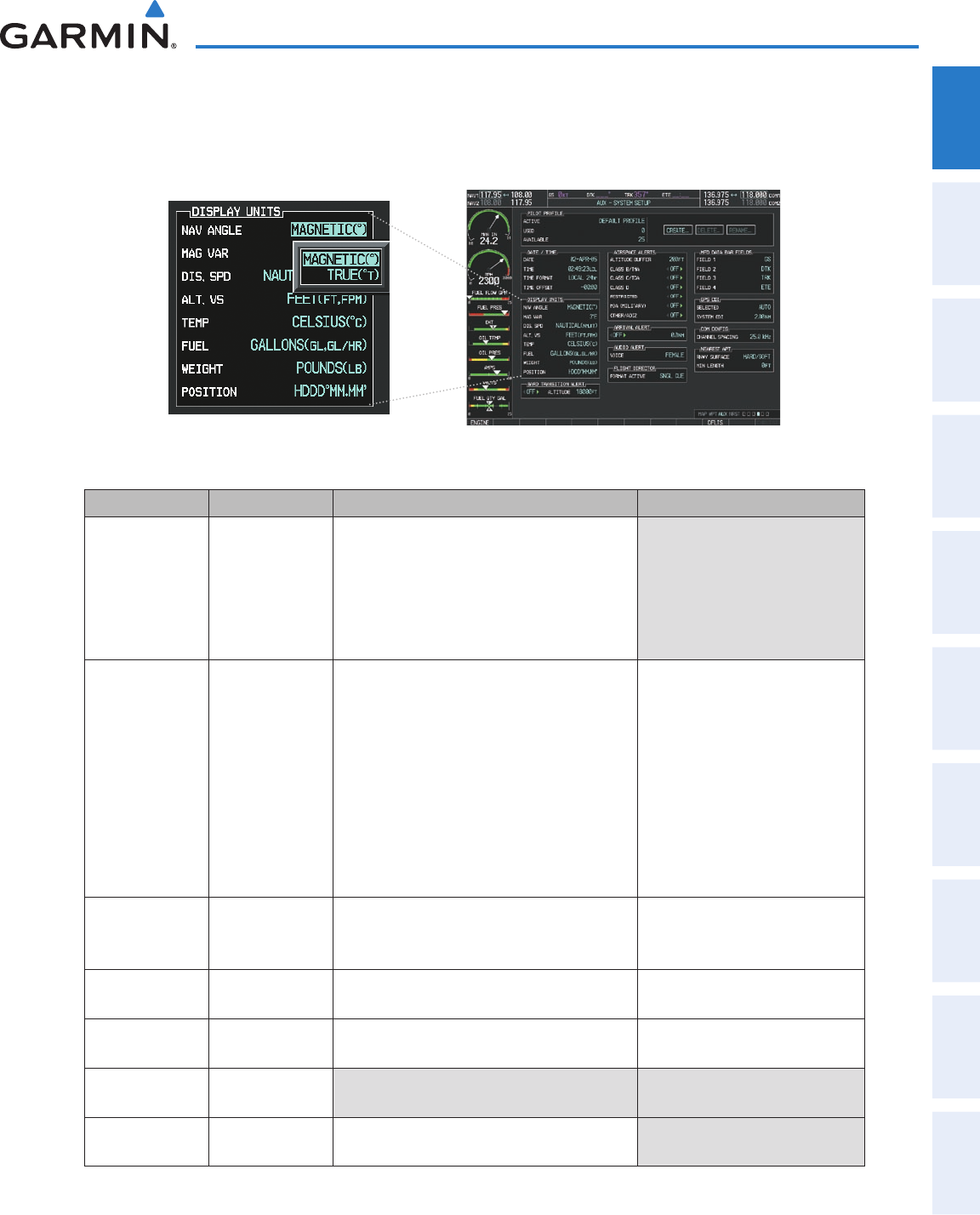
190-00592-06 Rev. A
Garmin G1000 Pilot’s Guide for the Diamond DA40/40F
35
SYSTEM OVERVIEW
SYSTEM
OVERVIEW
FLIGHT
INSTRUMENTS EIS AUDIO PANEL
& CNS
FLIGHT
MANAGEMENT
HAZARD
AVOIDANCE AFCS ADDITIONAL
FEATURES APPENDICES INDEX
DISPLAY UNITS
Units in which various quantities are displayed on the G1000 screens are listed on the System Setup Page.
The Navigation Angle reference can be set from here (refer to the Flight Instruments Section).
Figure 1-32 Display Unit Settings (AUX - System Setup Page)
Category Settings Affected Quantities Exceptions
Navigation Angle Magnetic (North)
True (North)
Heading
Course
Bearing
Track
Desired Track
Wind direction (Trip Planning Page)
Distance and
Speed
Nautical Crosstrack error (HSI)
Bearing distances (information windows)
DME distance (information window)
Flight plan distances
Map ranges
DIS, GS, TAS, XTK fields (Navigation Status Box)
All distances on MFD
Altitude buffer distance (System Setup)
Arrival Alert trigger distance (System Setup)
All speeds on MFD
Airspeed Indicator
True Airspeed (PFD)
Wind speed vector
Map range (Traffic Page, Terrain
Proximity/TAWS Page)
CDI scaling (System Setup)
Fuel range calculation (EIS)
Altitude and
Vertical Speed
Feet All altitudes on MFD
All elevations on MFD
Altimeter
Vertical Speed Indicator
VNV altitudes (Active Flight Plan)
Temperature Celsius
Fahrenheit
All temperatures on PFD
Total Air Temperature (Trip Planning Page)
Engine Indication System (EIS)
Fuel and
Fuel Flow
Gallons Fuel parameters (Trip Planning Page) Engine Indication System (EIS)
Weight Pounds N/A N/A
Position HDDD°MM.MM’
HDDD°MM’SS.S”
All positions N/A
Table 1-1 Display Units Settings (AUX - System Setup Page)
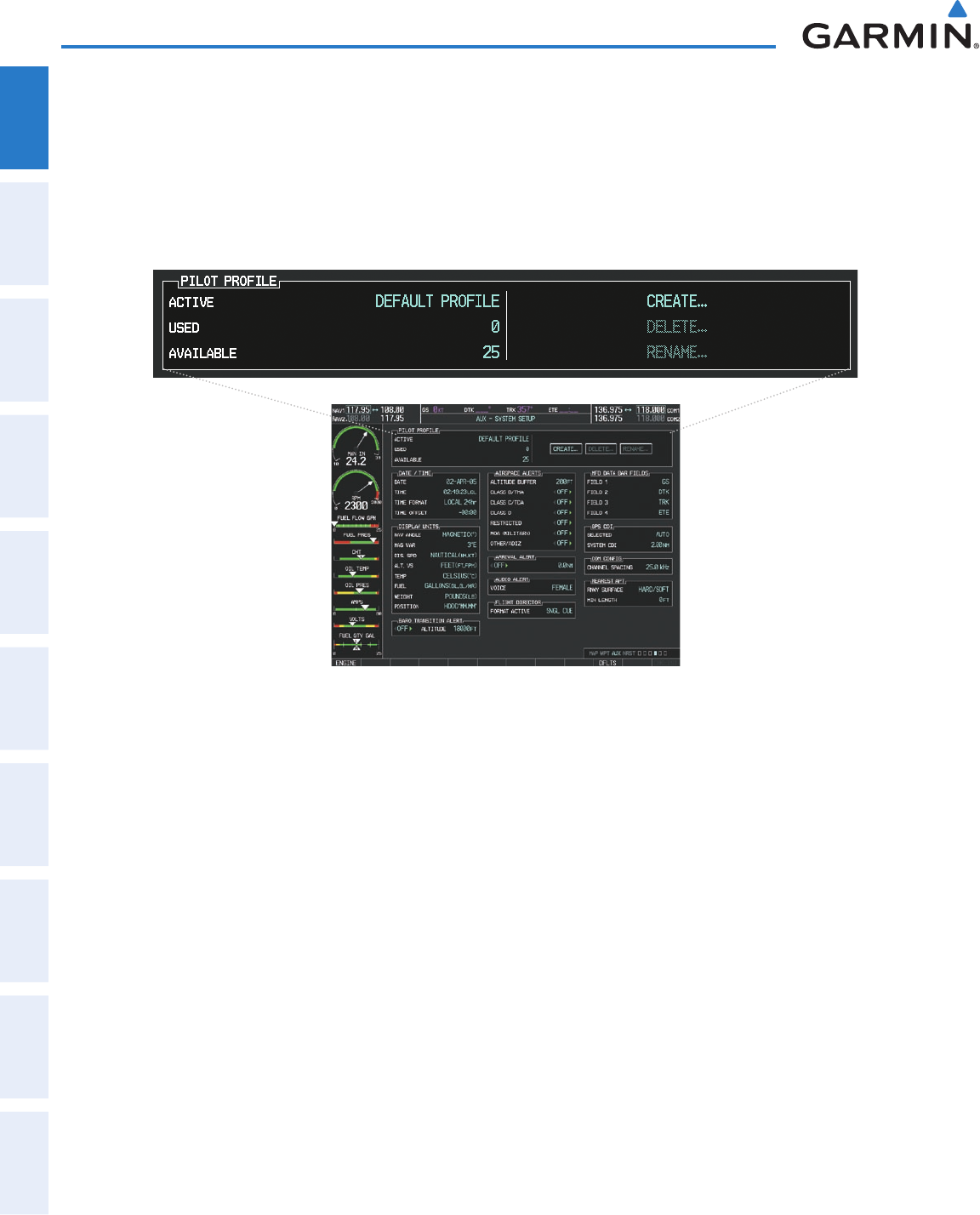
Garmin G1000 Pilot’s Guide for the Diamond DA40/40F
190-00592-06 Rev. A36
SYSTEM OVERVIEW
SYSTEM
OVERVIEW
FLIGHT
INSTRUMENTS
EIS
AUDIO PANEL
& CNS
FLIGHT
MANAGEMENT
HAZARD
AVOIDANCE
AFCS
ADDITIONAL
FEATURES
APPENDICESINDEX
PILOT PROFILES
System settings may be saved under a pilot profile. When the system is powered on, the last selected pilot
profile is shown on the MFD Power-up Splash Screen (Figure 1-5). The G1000 can store up to 25 profiles;
the currently active profile, the amount of memory used, and the amount of memory available are shown at
the top of the System Setup Page in the box labeled ‘Pilot Profile’. From here, pilot profiles may be created,
selected, renamed, or deleted.
Figure 1-33 Display Unit Settings (AUX - System Setup Page)
Creating a profile:
1) Use the FMS Knob to select the AUX - System Setup Page.
2) Press the FMS Knob momentarily to activate the flashing cursor.
3) Turn the large FMS Knob to highlight ‘CREATE’ in the Pilot Profile Box.
4) Press the ENT Key. A ‘Create Profile’ window is displayed.
5) Use the FMS Knob to enter a profile name up to 16 characters long and press the ENT Key. Pilot profile names
cannot begin with a blank as the first letter.
6) In the next field, use the small FMS Knob to select the desired settings upon which to base the new profile.
Profiles can be created based on Garmin factory defaults, default profile settings (initially based on Garmin
factory defaults unless edited by the pilot), or current system settings.
7) Press the ENT Key.
190-00592-06 Rev. A
Garmin G1000 Pilot’s Guide for the Diamond DA40/40F
37
SYSTEM OVERVIEW
SYSTEM
OVERVIEW
FLIGHT
INSTRUMENTS EIS AUDIO PANEL
& CNS
FLIGHT
MANAGEMENT
HAZARD
AVOIDANCE AFCS ADDITIONAL
FEATURES APPENDICES INDEX
8) With ‘CREATE’ highlighted, press the ENT Key to create the profile
Or:
Use the large FMS Knob to select ‘CREATE and ACTIVATE’ and press the ENT Key to activate the new profile.
9) To cancel the process, select ‘CANCEL’ with the large FMS Knob and press the ENT Key.
Selecting an active profile:
1) Use the FMS Knob to select the AUX - System Setup Page.
2) Press the FMS Knob momentarily to activate the flashing cursor.
3) Turn the large FMS Knob to highlight the active profile field in the Pilot Profile Box.
4) Turn the small FMS Knob to display the pilot profile list and highlight the desired profile.
5) Press the ENT Key. The G1000 loads and displays the system settings for the selected profile.
Renaming a profile:
1) Use the FMS Knob to select the AUX - System Setup Page.
2) Press the FMS Knob momentarily to activate the flashing cursor.
3) Turn the large FMS Knob to highlight ‘RENAME’ in the Pilot Profile Box.
4) Press the ENT Key.
5) In the ‘Rename Profile’ window, turn the FMS Knob to select the profile to rename.
6) Press the ENT Key.
7) Use the FMS Knob to enter a new profile name up to 16 characters long and press the ENT Key.
8) With ‘RENAME’ highlighted, press the ENT Key.
9) To cancel the process, use the large FMS Knob to select ‘CANCEL’ and press the ENT Key.
Deleting a profile:
1) Use the FMS Knob to select the AUX - System Setup Page.
2) Press the FMS Knob momentarily to activate the flashing cursor.
3) Turn the large FMS Knob to highlight ‘DELETE’ in the Pilot Profile Box.
4) Press the ENT Key.
5) In the ‘Delete Profile’ window, turn the FMS Knob to select the profile to delete.
6) Press the ENT Key.
7) With ‘DELETE’ highlighted, press the ENT Key.
8) To cancel the process, use the large FMS Knob to select ‘CANCEL’ and press the ENT Key.
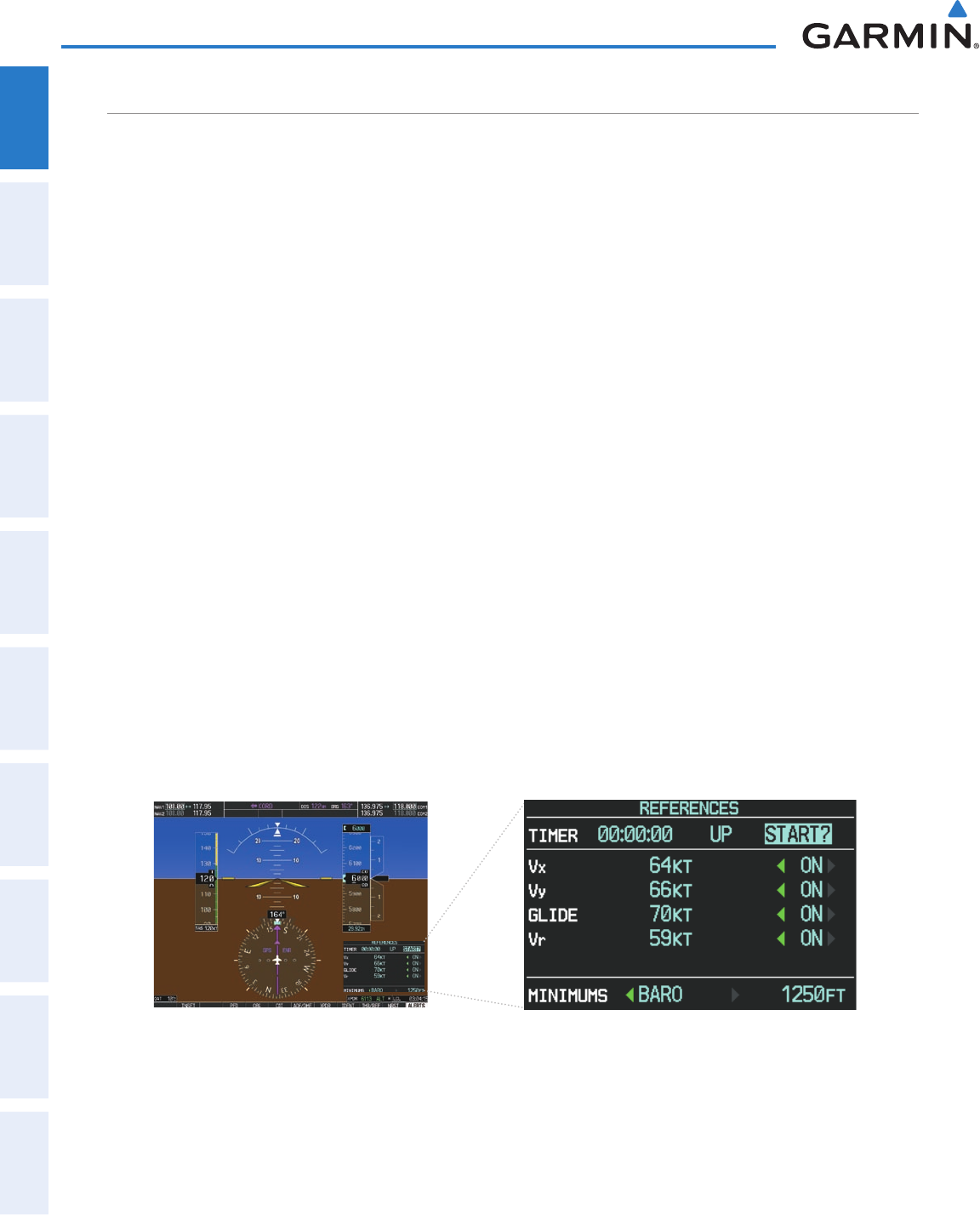
Garmin G1000 Pilot’s Guide for the Diamond DA40/40F
190-00592-06 Rev. A38
SYSTEM OVERVIEW
SYSTEM
OVERVIEW
FLIGHT
INSTRUMENTS
EIS
AUDIO PANEL
& CNS
FLIGHT
MANAGEMENT
HAZARD
AVOIDANCE
AFCS
ADDITIONAL
FEATURES
APPENDICESINDEX
TIMERS
The G1000 timers available include:
•Stopwatch-likegenerictimers(availablefromthePFDTimer/ReferencesWindowandontheMFDAUX-
Utility Page)
•Total-time-in-ighttimer(MFDAUX-UtilityPage)
•Timesincedeparture(MFDAUX-UtilityPage)
The generic timer can be set to count up or down from a specified time (HH:MM:SS). When the countdown
on the timer reaches zero the digits begin to count up from zero. If the timer is reset before reaching zero
on a countdown, the digits are reset to the initial value. If the timer is counting up when reset, the digits are
zeroed.
Setting the generic timer (PFD):
1) Press the
TMR/REF
Softkey.
2) Turn the
large FMS
Knob to select the timer field (hh/mm/ss).
3) Use the FMS Knob to enter the desired time and press the
ENT
Key.
4) With the UP/DN field highlighted, turn the
small FMS
Knob to select the timer counting direction.
5) Press the
ENT
Key.
6) With ‘START?’ highlighted, press the
ENT
Key to start the timer. The field changes to ‘STOP?’.
7) To stop the timer, press the ENT Key with ‘STOP?’ highlighted. The field changes to ‘RESET?’.
8) To reset the timer, press the ENT Key with ‘RESET?’ highlighted. The field changes back to ‘START?’ and the
digits are reset.
9) To remove the window, press the
CLR
Key or the
TMR/REF
Softkey.
Figure 1-34 Generic Timer (Timer/References Window)
PFD
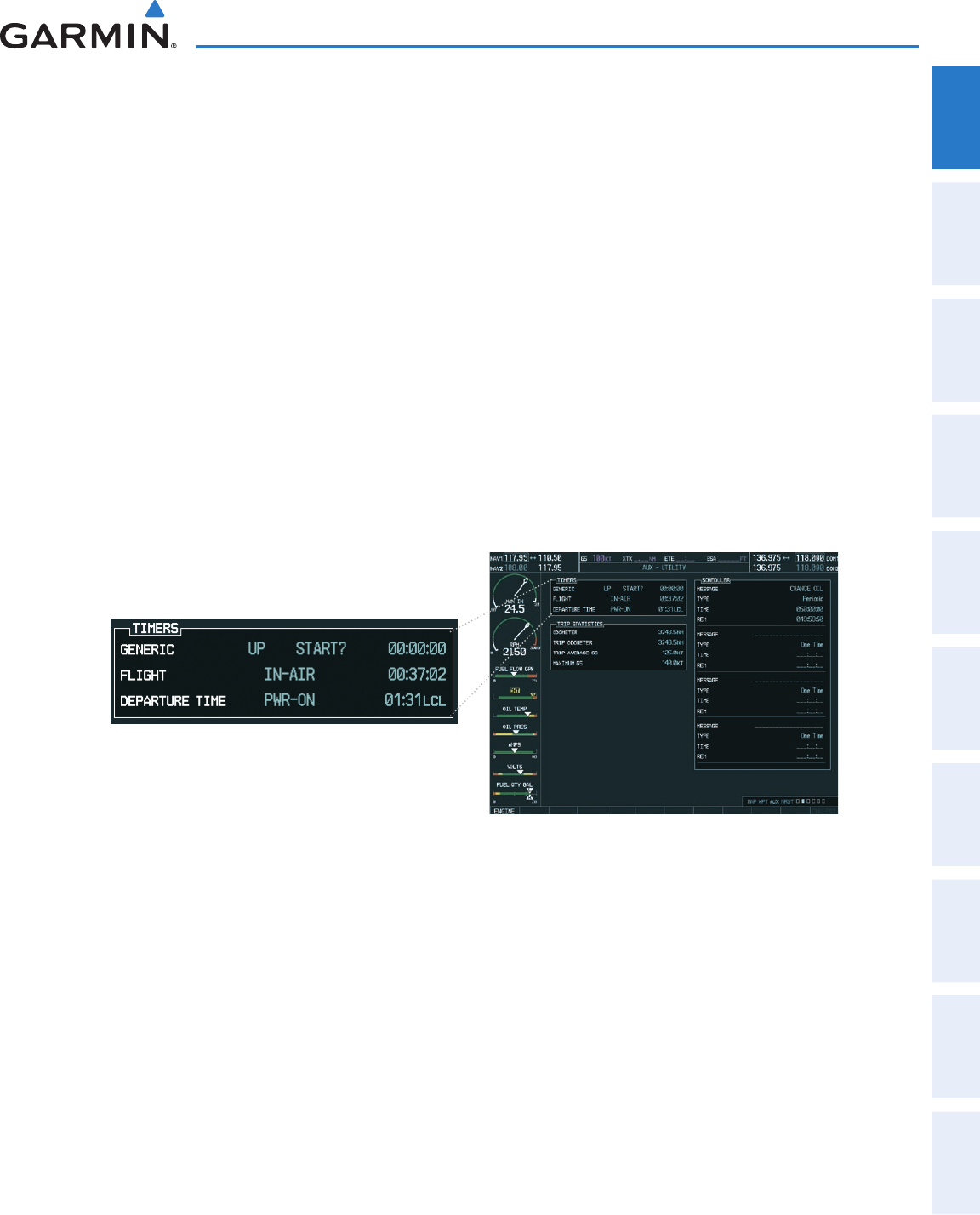
190-00592-06 Rev. A
Garmin G1000 Pilot’s Guide for the Diamond DA40/40F
39
SYSTEM OVERVIEW
SYSTEM
OVERVIEW
FLIGHT
INSTRUMENTS EIS AUDIO PANEL
& CNS
FLIGHT
MANAGEMENT
HAZARD
AVOIDANCE AFCS ADDITIONAL
FEATURES APPENDICES INDEX
The flight timer can be set to count up from zero starting at system power-up or from the time that the
aircraft lifts off; the timer can also be reset to zero at any time.
Setting the generic timer (MFD AUX - Utility Page):
1) Use the FMS Knob to select the AUX - Utility Page.
2) Press the FMS Knob momentarily to activate the flashing cursor.
3) Turn the small FMS Knob to select the timer counting direction (UP/DN) and press the ENT Key.
4) If a specific starting time is desired:
a) Use the large FMS Knob to highlight the HH:MM:SS field.
b) Use the FMS Knob to enter the desired time and press the
ENT
Key.
5) Turn the
large FMS
Knob to highlight ‘START?’ and press the
ENT
Key to start the timer. The field changes to
‘STOP?’.
6) To stop the timer, press the ENT Key with ‘STOP?’ highlighted. The field changes to ‘RESET?’.
7) To reset the timer, press the ENT Key with ‘RESET?’ highlighted. The field changes back to ‘START?’ and the
digits are reset.
Figure 1-35 Timers (AUX - Utility Page)
Setting the flight timer starting criterion:
1) Use the FMS Knob to select the AUX - Utility Page.
2) Press the FMS Knob momentarily to activate the flashing cursor.
3) Turn the large FMS Knob to highlight the field next to the flight timer.
4) Turn the
small FMS
Knob to select the starting criterion (PWR-ON or IN-AIR) and press the
ENT
Key.
Resetting the flight timer:
1) Use the FMS Knob to select the AUX - Utility Page.
2) Press the
MENU
Key.
3) With ‘Reset Flight Timer’ highlighted, press the
ENT
Key.
Garmin G1000 Pilot’s Guide for the Diamond DA40/40F
190-00592-06 Rev. A40
SYSTEM OVERVIEW
SYSTEM
OVERVIEW
FLIGHT
INSTRUMENTS
EIS
AUDIO PANEL
& CNS
FLIGHT
MANAGEMENT
HAZARD
AVOIDANCE
AFCS
ADDITIONAL
FEATURES
APPENDICESINDEX
The G1000 records the time at which departure occurs, depending on whether the pilot prefers the time
to be recorded from system power-up or from aircraft lift off. The displayed departure time can also be reset
to display the current time at the point of reset. The format in which the time is displayed is controlled
from the System Setup Page.
Setting the departure timer starting criterion:
1) Use the FMS Knob to select the AUX - Utility Page.
2) Press the FMS Knob momentarily to activate the flashing cursor.
3) Turn the large FMS Knob to highlight the field next to the departure time.
4) Turn the
small FMS
Knob to select the starting criterion (PWR-ON or IN-AIR) and press the
ENT
Key.
Resetting the departure time:
1) Use the FMS Knob to select the AUX - Utility Page.
2) Press the
MENU
Key.
3) Use the FMS Knob to highlight ‘Reset Departure Time’ and press the
ENT
Key.
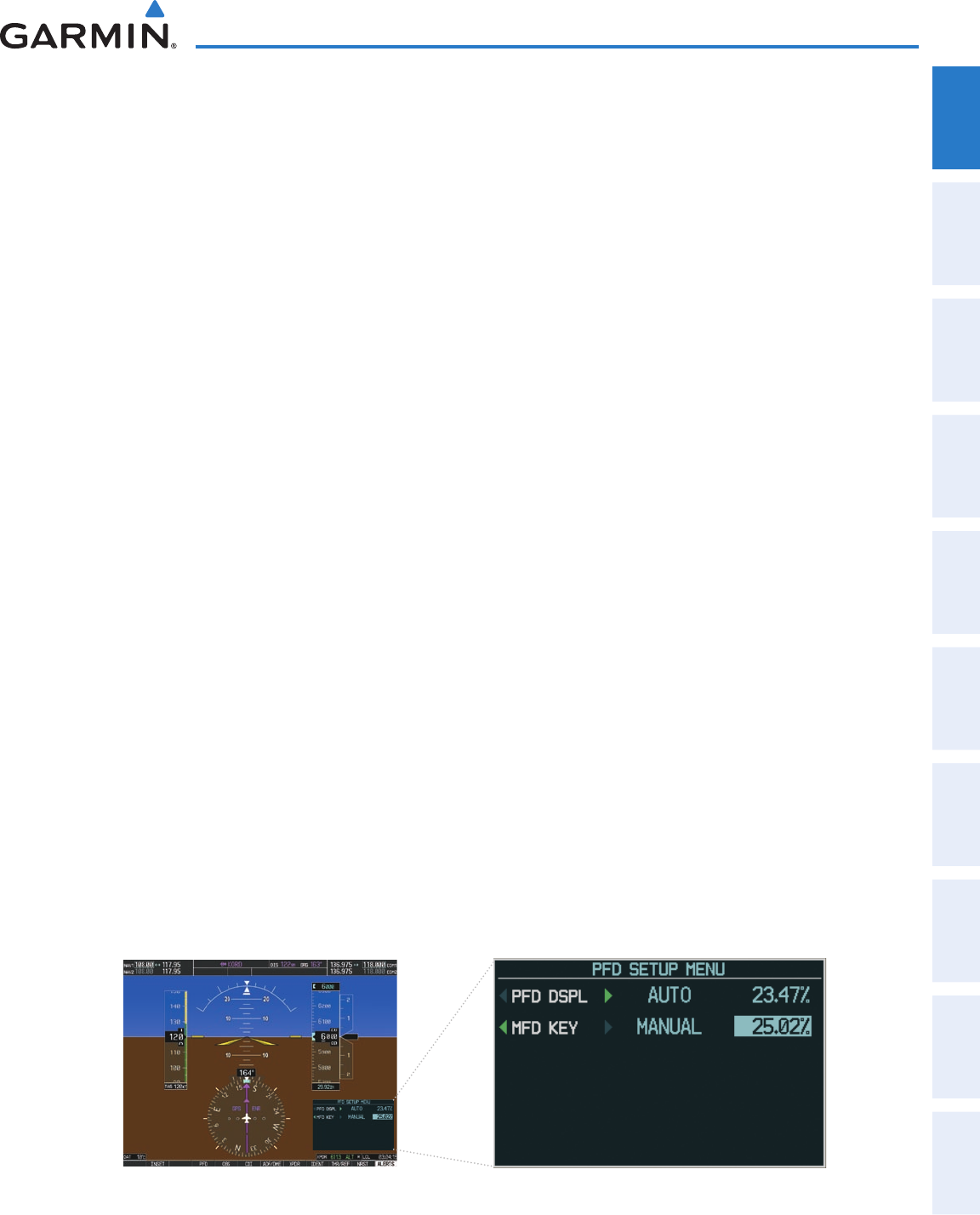
190-00592-06 Rev. A
Garmin G1000 Pilot’s Guide for the Diamond DA40/40F
41
SYSTEM OVERVIEW
SYSTEM
OVERVIEW
FLIGHT
INSTRUMENTS EIS AUDIO PANEL
& CNS
FLIGHT
MANAGEMENT
HAZARD
AVOIDANCE AFCS ADDITIONAL
FEATURES APPENDICES INDEX
1.7 DISPLAY BACKLIGHTING
The backlighting of the PFD and MFD displays and bezel and Audio Panel keys can be adjusted automatically or
manually. The default setting (automatic backlighting adjustment) uses photocell technology to automatically adjust
for ambient lighting conditions. Photocell calibration curves are pre-configured to optimize display appearance
through a broad range of cockpit lighting conditions. Manual backlighting adjustment can be accomplished using
the existing instrument panel dimmer bus or the following procedures. In normal operating mode, backlighting
can only be adjusted from the PFD. In Reversionary Mode, it can be adjusted from the remaining display.
Adjusting display backlighting:
1) Press the PFD
MENU
Key to display the PFD Setup Menu. ‘AUTO’ is now highlighted next to ‘PFD DSPL’.
2) Turn the
small FMS
Knob to select ‘MANUAL’.
3) Press the
ENT
Key. The intensity value is now highlighted.
4) Use the FMS Knob to enter the desired backlighting then press the
ENT
Key.
5) Turn the
large FMS
Knob to highlight ‘AUTO’ next to ‘MFD DSPL’ and repeat steps 2-4.
6) To remove the menu, press the
CLR
or
MENU
Key.
Adjusting key backlighting:
1) Press the PFD
MENU
Key to display the PFD Setup Menu. ‘AUTO’ is now highlighted next to ‘PFD DSPL’.
2) Turn the
large FMS
Knob to highlight ‘PFD DSPL’.
3) Turn the
small FMS
Knob in the direction of the green arrowhead to display ‘PFD KEY’.
4) Turn the
large FMS
Knob to highlight ‘AUTO’.
5) Turn the
small FMS
Knob to select ‘MANUAL’.
6) Press the
ENT
Key. The intensity value is now highlighted.
7) Use the FMS Knob to enter the desired backlighting and press the
ENT
Key.
8) Turn the
large FMS
Knob to highlight ‘MFD DSPL’.
9) Turn the
small FMS
Knob in the direction of the green arrowhead to display ‘MFD KEY’ and repeat steps 4-7.
10) To remove the menu, press the
CLR
or
MENU
Key.
Figure 1-36 PFD Setup Menu
PFD
Garmin G1000 Pilot’s Guide for the Diamond DA40/40F
190-00592-06 Rev. A42
SYSTEM OVERVIEW
SYSTEM
OVERVIEW
FLIGHT
INSTRUMENTS
EIS
AUDIO PANEL
& CNS
FLIGHT
MANAGEMENT
HAZARD
AVOIDANCE
AFCS
ADDITIONAL
FEATURES
APPENDICESINDEX
Bl a n k Pa g e
190-00592-06 Rev. A
Garmin G1000 Pilot’s Guide for the Diamond DA40/40F
43
FLIGHT INSTRUMENTS
SYSTEM
OVERVIEW
FLIGHT
INSTRUMENTS EIS AUDIO PANEL
& CNS
FLIGHT
MANAGEMENT
HAZARD
AVOIDANCE AFCS ADDITIONAL
FEATURES APPENDICES INDEX
SECTION 2 FLIGHT INSTRUMENTS
WARNING: If the airspeed, attitude, altitude, or heading indications become unusable, refer to the backup
instruments.
NOTE: The Automatic Flight Control System (AFCS) provides additional readouts and bugs on selected flight
instruments. Refer to the AFCS Section for details on these bugs and readouts, as they appear on the display
during certain AFCS modes.
Increased situational awareness is provided by replacing the traditional instruments on the panel with an easy-
to-scan Primary Flight Display (PFD) that features a large horizon, airspeed, attitude, altitude, vertical speed, and
course deviation information. In addition to the flight instruments, navigation, communication, terrain, traffic,
and weather information are also presented on the PFD and explained in other sections of this Pilot’s Guide.
The following flight instruments and supplemental flight data are displayed on the PFD:
•AirspeedIndicator,showing
– Indicated airspeed
– True airspeed
– Airspeed awareness ranges
– Vspeed reference flags
•AttitudeIndicatorwithslip/skidindication
•Altimeter,showing
– Trend vector
– Barometric setting
– Selected altitude
•VerticalDeviation,Glideslope,andGlidepath
Indicators
•VerticalSpeedIndicator(VSI)
•VerticalNavigation(VNV)indications
•Outsideairtemperature(OAT)
•HorizontalSituationIndicator,showing
– Turn Rate Indicator
– Bearing pointers and information windows
– Navigation source
– Course Deviation Indicator (CDI)
– Bearing pointers and information windows
– DME Information Window
•TransponderMode,Code,andIdent/Reply
•CourseDeviationIndicator(CDI)
•Timer/ReferencesWindow,showing
– Generic timer
– Vspeed values
– Barometric minimum descent altitude (MDA)
•Winddata
The PFD also displays various alerts and annunciations.
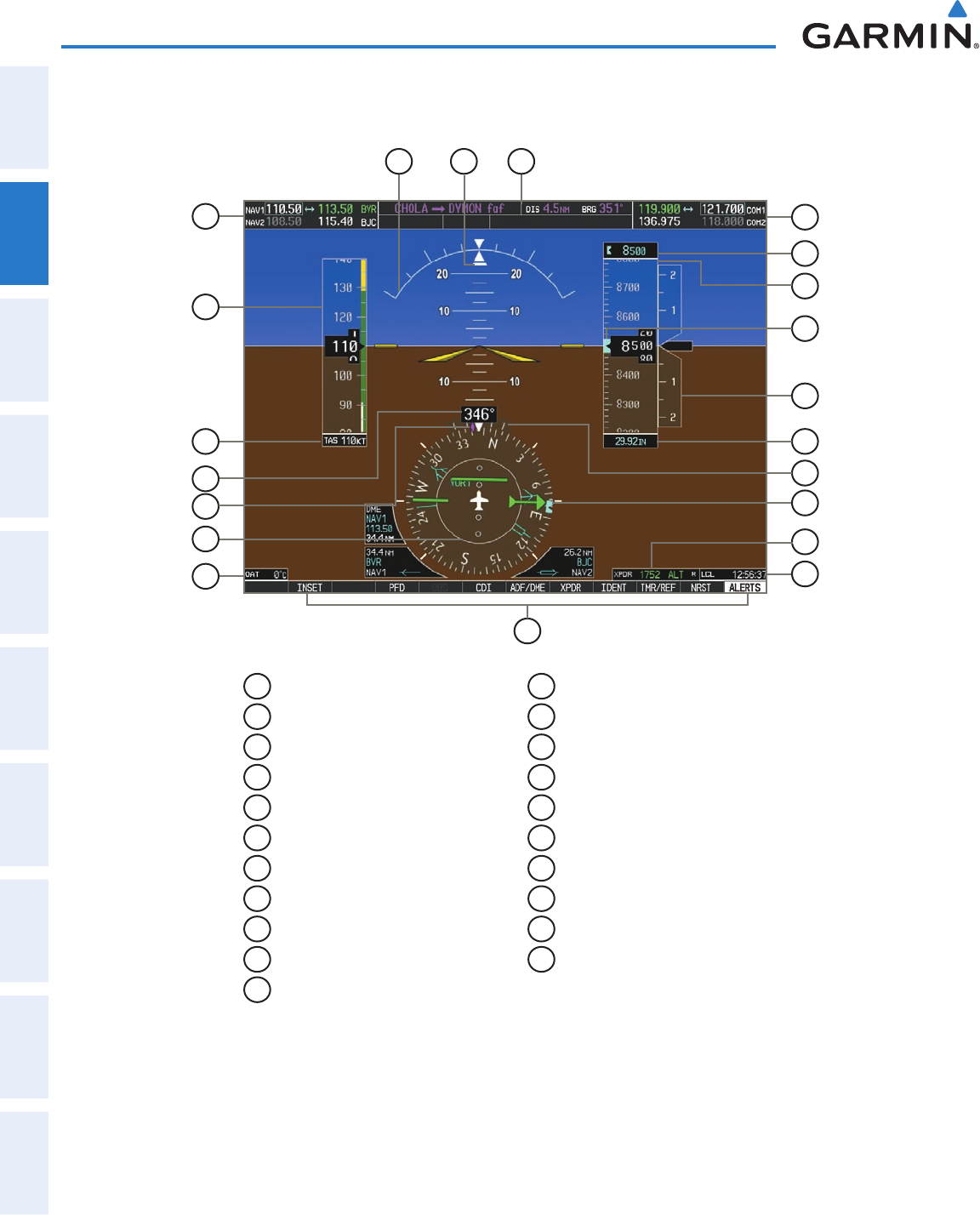
Garmin G1000 Pilot’s Guide for the Diamond DA40/40F
190-00592-06 Rev. A44
FLIGHT INSTRUMENTS
SYSTEM
OVERVIEW
FLIGHT
INSTRUMENTS
EIS
AUDIO PANEL
& CNS
FLIGHT
MANAGEMENT
HAZARD
AVOIDANCE
AFCS
ADDITIONAL
FEATURES
APPENDICESINDEX
21
3
16
4
11
15
7
6
20
13
18
19
12
14
17
8
9
Figure 2-1 Primary Flight Display (Default)
2
1
1
NAV Frequency Box
2
Airspeed Indicator
3
True Airspeed
4
Current Heading
5
Current Track Indicator
6
Horizontal Situation Indicator ( HSI)
7
Outside Air Temperature (OAT)
8
Softkeys
9
System Time
10
Transponder Data Box
11
Heading Bug
12
Turn Rate Indicator
13
Barometric Altimeter Setting
14
Vertical Speed Indicator (VSI)
15
Selected Altitude Bug
16
Altimeter
17
Selected Altitude
18
COM Frequency Box
19
Navigation Status Box
20
Slip/Skid Indicator
21
Attitude Indicator
10
5
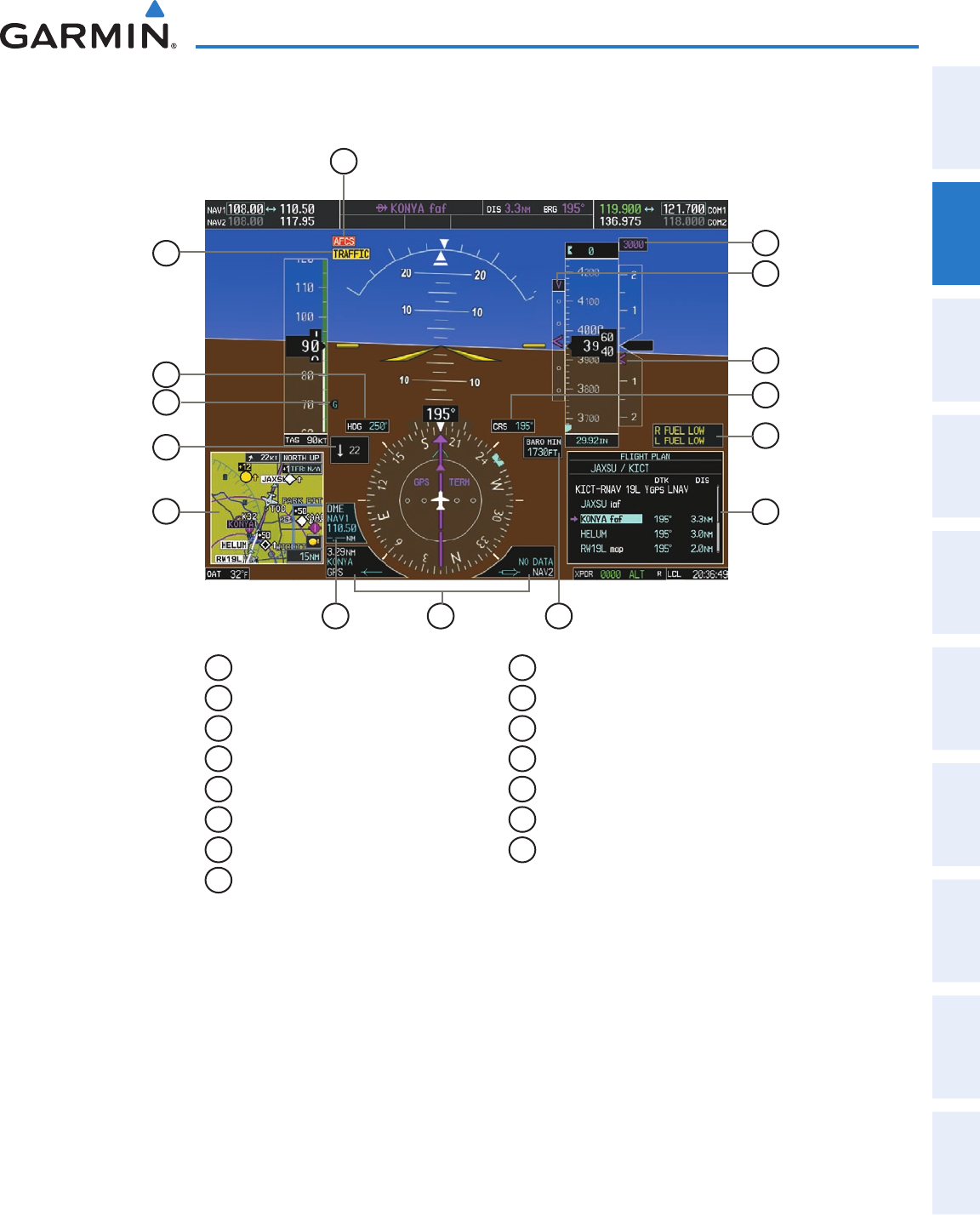
190-00592-06 Rev. A
Garmin G1000 Pilot’s Guide for the Diamond DA40/40F
45
FLIGHT INSTRUMENTS
SYSTEM
OVERVIEW
FLIGHT
INSTRUMENTS EIS AUDIO PANEL
& CNS
FLIGHT
MANAGEMENT
HAZARD
AVOIDANCE AFCS ADDITIONAL
FEATURES APPENDICES INDEX
2
3
4
6
5
1
87
15
11
12
14
9
13
10
Figure 2-2 Additional PFD Information
1
Traffic Annunciation
2
Selected Heading
3
Vspeed Reference
4
Wind Data
5
Inset Map
6
DME Information Window
7
Bearing Information Windows
8
Minimum Descent Altitude/
Decision Height
9
Flight Plan Window
10
Annunciation Window
11
Selected Course
12
Vertical Speed Required
13
Vertical Deviation Indicator
14
Current VNV Target Altitude
15
AFCS Status Annunciation
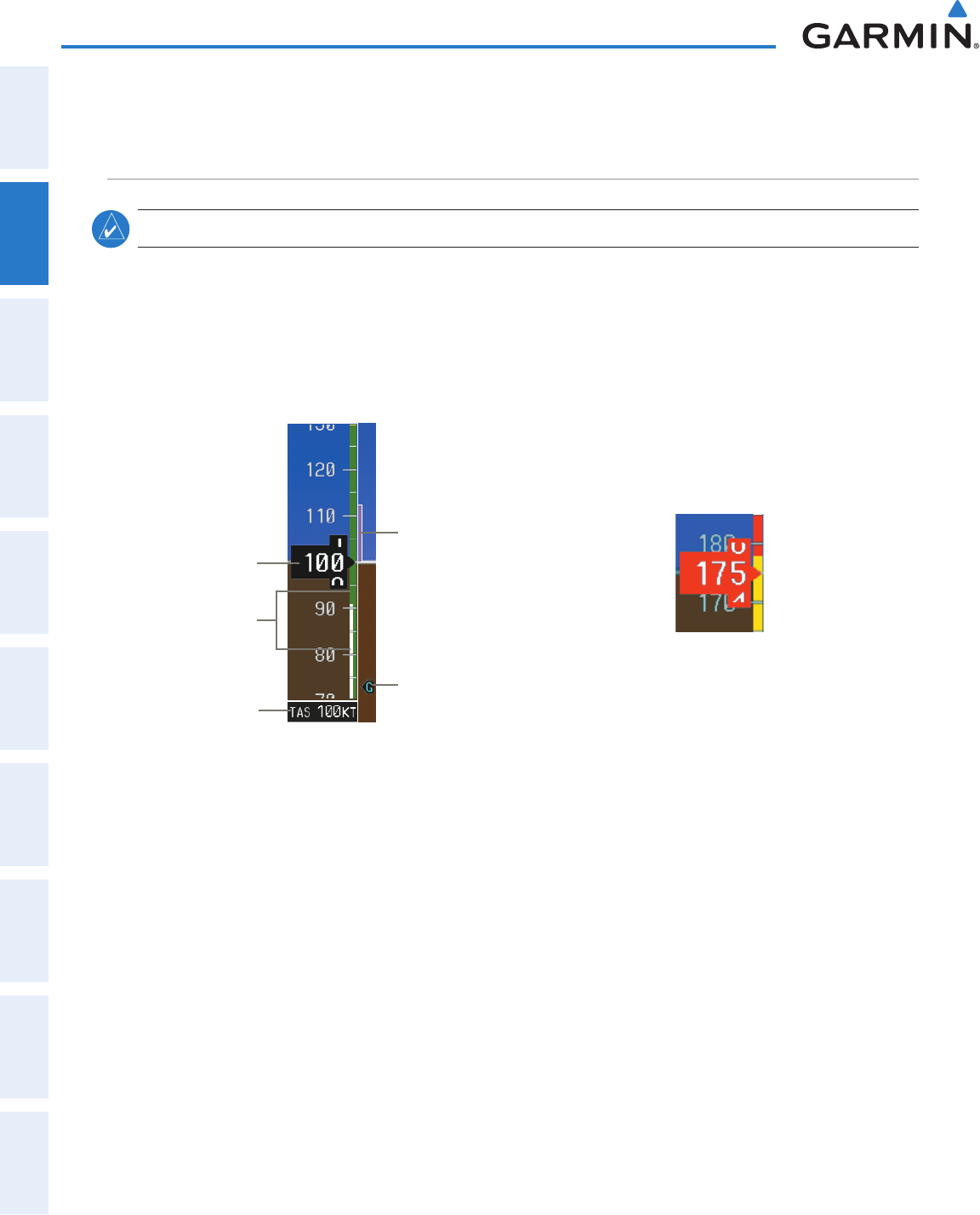
Garmin G1000 Pilot’s Guide for the Diamond DA40/40F
190-00592-06 Rev. A46
FLIGHT INSTRUMENTS
SYSTEM
OVERVIEW
FLIGHT
INSTRUMENTS
EIS
AUDIO PANEL
& CNS
FLIGHT
MANAGEMENT
HAZARD
AVOIDANCE
AFCS
ADDITIONAL
FEATURES
APPENDICESINDEX
2.1 FLIGHT INSTRUMENTS
AIRSPEED INDICATOR
NOTE: Refer to the Aircraft Flight Manual Supplement (AFMS) for airspeed criteria and Vspeed values.
The Airspeed Indicator displays airspeed on a moving tape rolling number gauge. The true airspeed is
displayed in knots below the Airspeed Indicator. The numeric labels and major tick marks on the moving
tape are marked at intervals of 10 knots. The minor tick marks on the moving tape are marked at intervals of
five knots. Speed indication starts at 20 knots, with 60 knots of airspeed viewable at any time. The indicated
airspeed is displayed inside the black pointer. The pointer remains black until reaching never-exceed speed
(VNE), at which point it turns red.
Figure 2-4 Red Pointer
Showing Overspeed V
NE
True
Airspeed
Figure 2-3 Airspeed Indicator
Speed
Ranges
Indicated
Airspeed
Airspeed
Trend
Vector
Vspeed
Reference
A color-coded (white, green, yellow, and red) speed range strip is located on the moving tape. The colors
denote flaps operating range, normal operating range, caution range, and never-exceed speed (VNE). Red and
yellow ranges are also present for low speed awareness. For EASA-certified aircraft, the yellow low airspeed
awareness band is not shown and the limits on the other lower speed ranges differ (refer to the AFMS for speed
criteria).
The Airspeed Trend Vector is a vertical, magenta line, extending up or down on the airspeed scale, shown
to the right of the color-coded speed range strip. The end of the trend vector corresponds to the predicted
airspeed in 6 seconds if the current rate of acceleration is maintained. If the trend vector crosses VNE, the text
of the actual airspeed readout changes to yellow. The trend vector is absent if the speed remains constant or if
any data needed to calculate airspeed is not available due to a system failure.
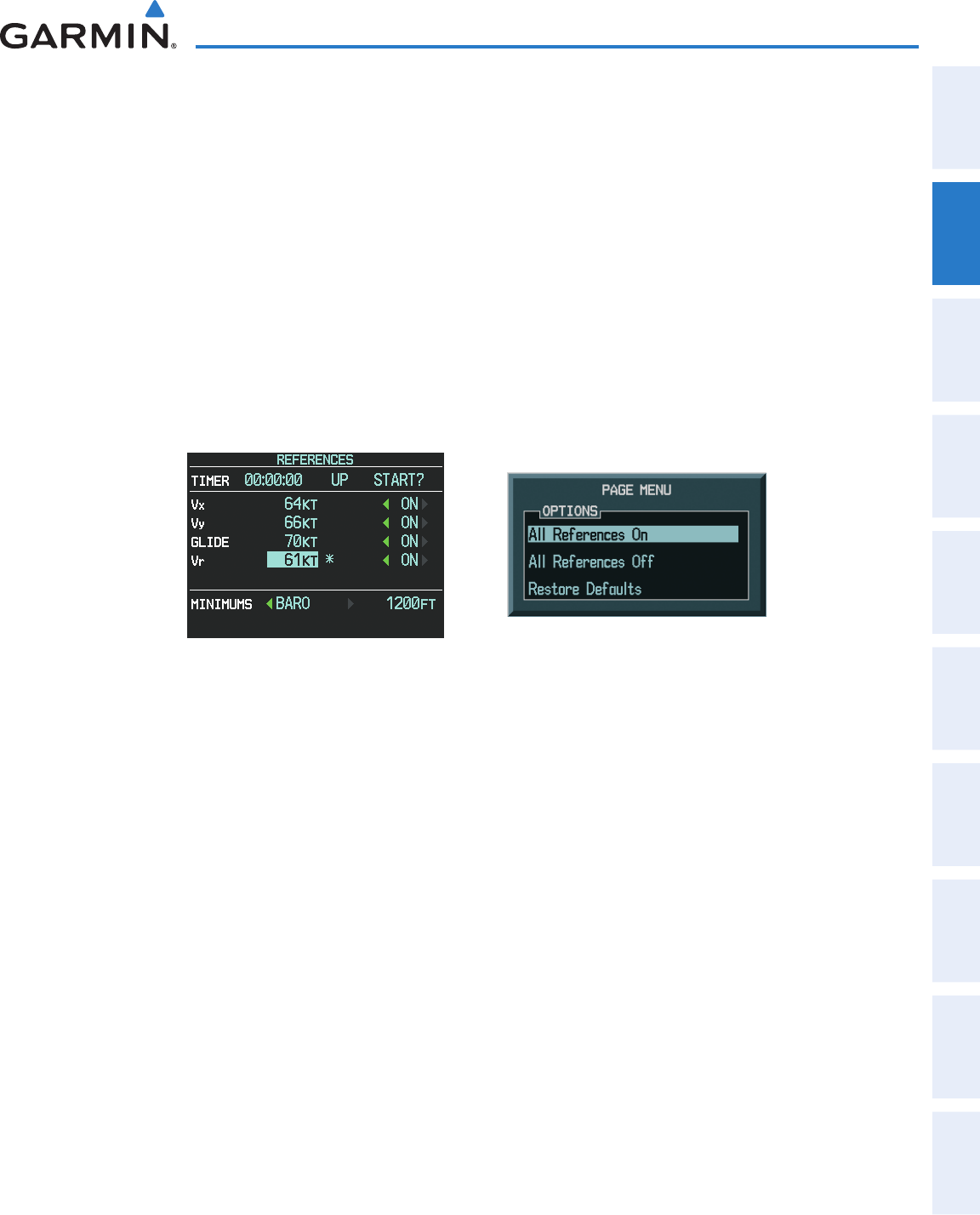
190-00592-06 Rev. A
Garmin G1000 Pilot’s Guide for the Diamond DA40/40F
47
FLIGHT INSTRUMENTS
SYSTEM
OVERVIEW
FLIGHT
INSTRUMENTS EIS AUDIO PANEL
& CNS
FLIGHT
MANAGEMENT
HAZARD
AVOIDANCE AFCS ADDITIONAL
FEATURES APPENDICES INDEX
Vspeeds (Glide, VR, VX, and VY) can be changed and their flags turned on/off from the Timer/References
Window. When active (on), the Vspeeds are displayed at their respective locations to the right of the airspeed
scale. By default, all Vspeed values are reset and all flags turned off when power is cycled.
Changing Vspeeds and turning Vspeed flags on/off:
1) Press the
TMR/REF
Softkey.
2) Turn the
large FMS
Knob to highlight the field of the desired Vspeed to be changed.
3) Use the FMS Knob to enter the desired value. When a speed has been changed from a default value, an asterisk
appears next to the speed (Figure 2-5).
4) Press the ENT Key or turn the large FMS Knob to highlight the ON/OFF field.
5) Turn the
small FMS
Knob clockwise to ON or counterclockwise to OFF.
6) To remove the window, press the
CLR
Key or the
TMR/REF
Softkey.
Figure 2-6 Timer/References Menu
Figure 2-5 Timer/References Window
Turning all Vspeed flags on/off:
1) Press the
TMR/REF
Softkey.
2) Press the
MENU
Key.
3) To activate all Vspeed flags, press the ENT Key with All References On highlighted.
4) To remove all Vspeed flags, turn the FMS Knob to highlight All References Off and press the
ENT
Key.
Restoring all Vspeed defaults:
1) Press the
TMR/REF
Softkey.
2) Press the
MENU
Key.
3) Turn the
FMS
Knob to highlight Restore Defaults and press the
ENT
Key.
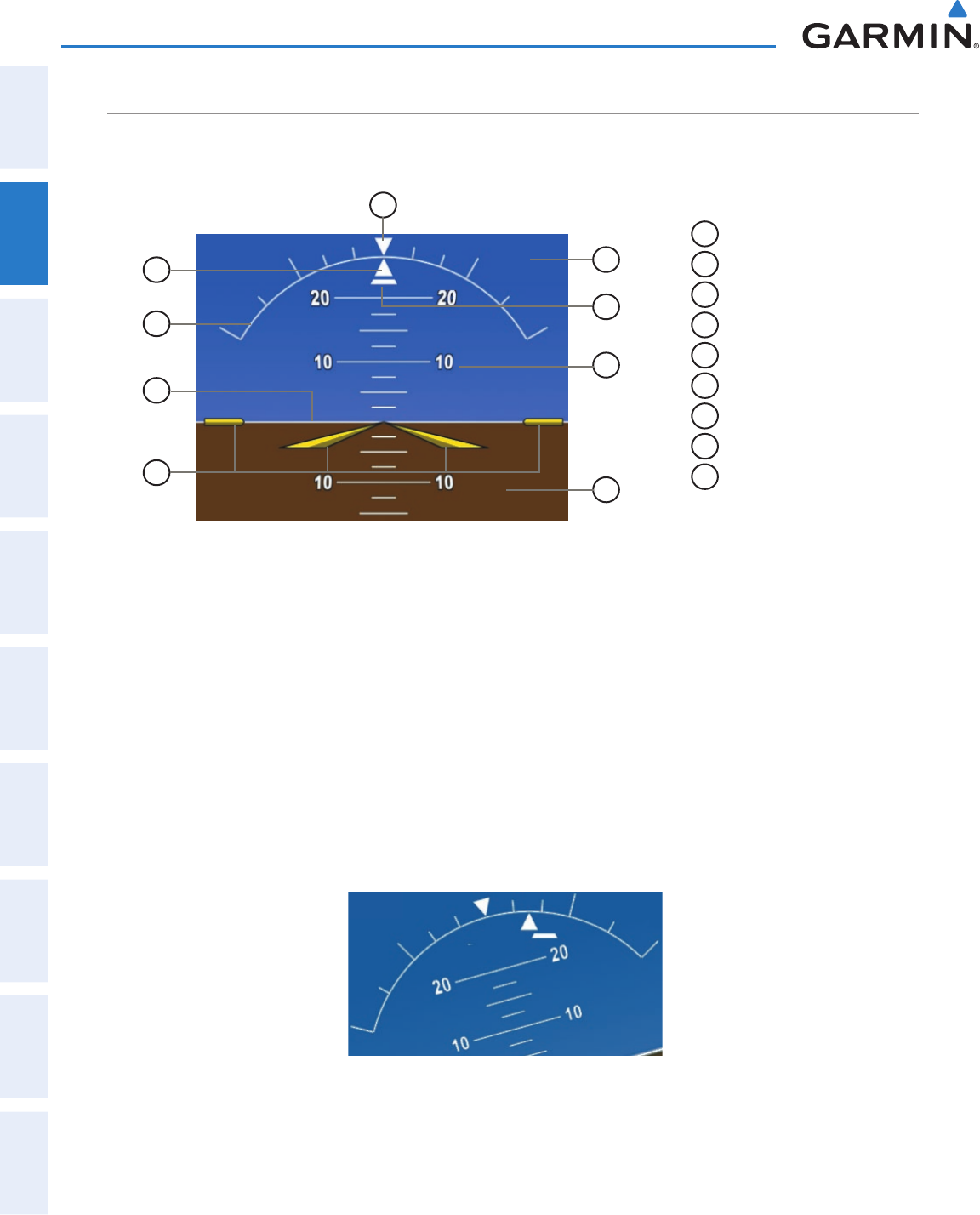
Garmin G1000 Pilot’s Guide for the Diamond DA40/40F
190-00592-06 Rev. A48
FLIGHT INSTRUMENTS
SYSTEM
OVERVIEW
FLIGHT
INSTRUMENTS
EIS
AUDIO PANEL
& CNS
FLIGHT
MANAGEMENT
HAZARD
AVOIDANCE
AFCS
ADDITIONAL
FEATURES
APPENDICESINDEX
ATTITUDE INDICATOR
Attitude information is displayed over a virtual blue sky and brown ground with a white horizon line. The
Attitude Indicator displays the pitch, roll, and slip/skid information.
1
Roll Pointer
2
Roll Scale
3
Horizon Line
4
Aircraft Symbol
5
Land Representation
6
Pitch Scale
7
Slip/Skid Indicator
8
Sky Representation
9
Roll Scale Zero
Figure 2-7 Attitude Indicator
9
1
3
4
2
7
8
6
5
The horizon line is part of the pitch scale. Above and below the horizon line, major pitch marks and numeric
labels are shown for every 10˚, up to 80˚. Minor pitch marks are shown for intervening 5˚ increments, up to
25˚ below and 45˚ above the horizon line. Between 20˚ below to 20˚ above the horizon line, minor pitch marks
occur every 2.5˚.
The inverted white triangle indicates zero on the roll scale. Major tick marks at 30˚ and 60˚ and minor tick
marks at 10˚, 20˚, and 45˚ are shown to the left and right of the zero. Angle of bank is indicated by the position
of the pointer on the roll scale.
The Slip/Skid Indicator is the bar beneath the roll pointer. The indicator moves with the roll pointer and
moves laterally away from the pointer to indicate lateral acceleration. Slip/skid is indicated by the location of
the bar relative to the pointer. One bar displacement is equal to one ball displacement on a traditional Slip/Skid
Indicator.
Figure 2-8 Slip/Skid Indication
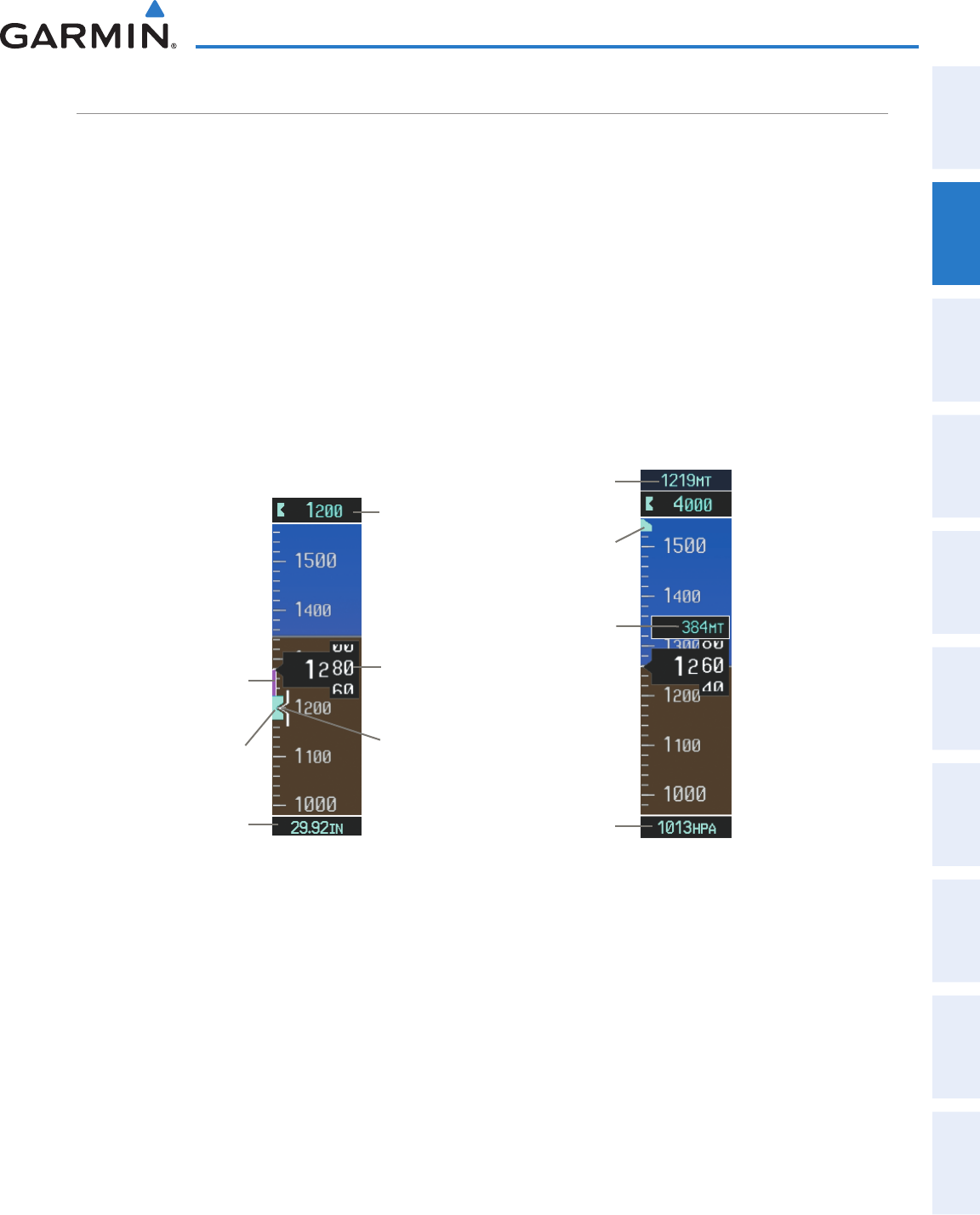
190-00592-06 Rev. A
Garmin G1000 Pilot’s Guide for the Diamond DA40/40F
49
FLIGHT INSTRUMENTS
SYSTEM
OVERVIEW
FLIGHT
INSTRUMENTS EIS AUDIO PANEL
& CNS
FLIGHT
MANAGEMENT
HAZARD
AVOIDANCE AFCS ADDITIONAL
FEATURES APPENDICES INDEX
ALTIMETER
The Altimeter displays 600 feet of barometric altitude values at a time on a moving tape rolling number gauge.
Numeric labels and major tick marks are shown at intervals of 100 feet. Minor tick marks are at intervals of 20
feet. The indicated altitude is displayed inside the black pointer.
The Selected Altitude is displayed above the Altimeter in the box indicated by a selection bug symbol. A bug
corresponding to this altitude is shown on the tape. If the Selected Altitude exceeds the range shown on the
tape, the bug appears at the upper or lower edge of the tape. When the metric value is selected it is displayed
in a separate box above the Selected Altitude.
Setting the Selected Altitude:
Turn the
ALT
Knob to set the Selected Altitude (large knob for 1000-ft increments, small knob for 100-ft
increments (increments reduce to 10 feet for approach).
If set, the Minimum Descent Altitude/Decision Height (MDA/DH) value is also available for the Selected Altitude.
Barometric
Minimum
Bug
Barometric
Setting Box
(Hectopascals)
Barometric
Setting
Altitude
Trend
Vector
Selected
Altitude
Bug
Selected
Altitude
Indicated
Altitude
Altimeter Setting (In Hg)
Indicated
Altitude
(Meters)
Selected
Altitude
(Meters)
Altimeter Setting (Metric)
Figure 2-9 Altimeter Settings, In Hg and Metric
Selected
Altitude
Bug
Garmin G1000 Pilot’s Guide for the Diamond DA40/40F
190-00592-06 Rev. A50
FLIGHT INSTRUMENTS
SYSTEM
OVERVIEW
FLIGHT
INSTRUMENTS
EIS
AUDIO PANEL
& CNS
FLIGHT
MANAGEMENT
HAZARD
AVOIDANCE
AFCS
ADDITIONAL
FEATURES
APPENDICESINDEX
Altitudes can also be displayed in meters. Note that the altitude tape does not change scale.
Displaying altitude in meters:
1) Press the PFD Softkey to display the second-level softkeys.
2) Press the ALT UNIT Softkey.
3) Press the METERS Softkey to turn on metric altitude readouts.
4) Press the
BACK
Softkey to return to the top-level softkeys.
When the altitude is displayed in meters, the large and small
ALT
Knobs adjust the Selected Altitude in 500
meter and 50 meter increments respectively.
A magenta Altitude Trend Vector extends up or down the left of the altitude tape, the end resting at the
approximate altitude to be reached in six seconds at the current vertical speed. The trend vector is not shown
if altitude remains constant or if data needed for calculation is not available due to a system failure.
The barometric pressure setting is displayed below the Altimeter in inches of mercury (in Hg) or hectopascals
(hPa) when metric units are selected. Adjusting the altimeter barometric pressure setting creates discontinuities
in VNV vertical navigation, moving the descent path. For large adjustments, it may take several minutes for the
aircraft to re-establish on the descent patch. If the change is made while nearing a waypoint with a VNV Target
Altitude, the aircraft may not re-establish on the descent path in time to meet the vertical constraint.
Selecting the altimeter barometric pressure setting:
Turn the BARO Knob to select the desired setting.
Selecting standard barometric pressure (29.92 in Hg):
1) Press the PFD Softkey to display the second-level softkeys.
2) Press the STD BARO Softkey.
Changing altimeter barometric pressure setting units:
1) Press the PFD Softkey to display the second-level softkeys.
2) Press the ALT UNIT Softkey.
3) Press the IN Softkey to display the barometric pressure setting in inches of mercury (in Hg).
Or, press the HPA Softkey to display the barometric pressure setting in hectopascals (hPa).
4) Press the
BACK
Softkey to return to the top-level softkeys.
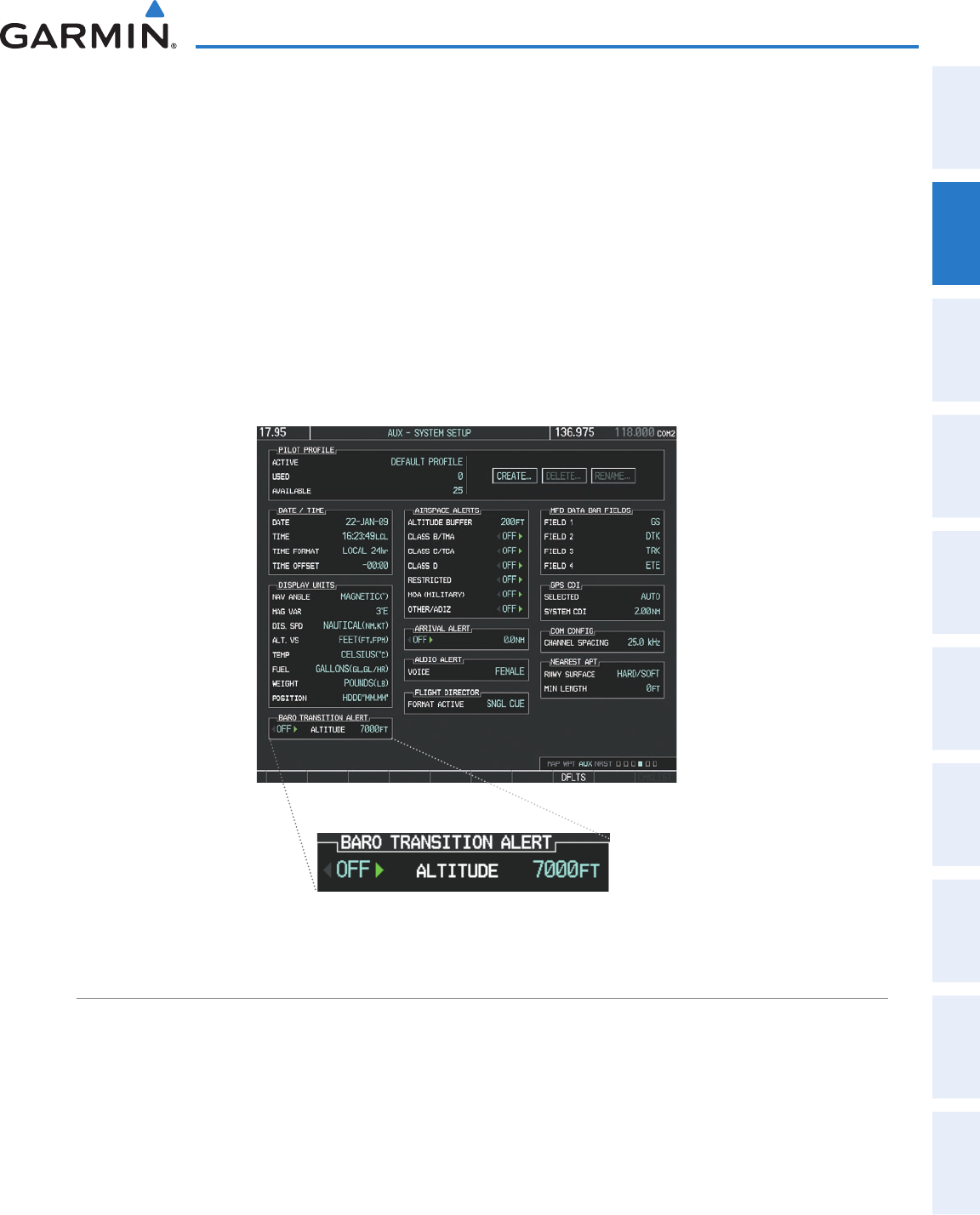
190-00592-06 Rev. A
Garmin G1000 Pilot’s Guide for the Diamond DA40/40F
51
FLIGHT INSTRUMENTS
SYSTEM
OVERVIEW
FLIGHT
INSTRUMENTS EIS AUDIO PANEL
& CNS
FLIGHT
MANAGEMENT
HAZARD
AVOIDANCE AFCS ADDITIONAL
FEATURES APPENDICES INDEX
A Baro Transition Alert is provided to alert the pilot to change the barometric pressure setting when crossing
the transition altitude in either direction. This is displayed by the flashing light blue barometric pressure setting
when crossing the transition altitude. The flashing stops when the barometric pressure setting is changed.
Setting the Baro Transition Alert:
1) Use the FMS Knob to select the AUX - System Setup Page on the MFD.
2) Press the FMS Knob to activate the cursor.
3) Turn the large FMS Knob to highlight Altitude in the Baro Transition Alert box.
4) Turn the small FMS Knob to turn the alert OFF or ON and press the ENT Key.
5) Turn the small FMS Knob to change the altitude and press the ENT Key.
6) To cancel the selection, press the FMS Knob.
Figure 2-10 Aux - System Setup Page, Baro Transition Alert
VERTICAL SPEED INDICATOR (VSI)
The Vertical Speed Indicator (VSI) displays the aircraft vertical speed on a fixed scale with labels at 1000 and
2000 fpm and minor tick marks every 500 fpm. Digits appear in the pointer when the climb or descent rate
is greater than 100 fpm. If the rate of ascent/descent exceeds 2000 fpm, the pointer appears at the edge of the
tape and the rate appears inside the pointer.
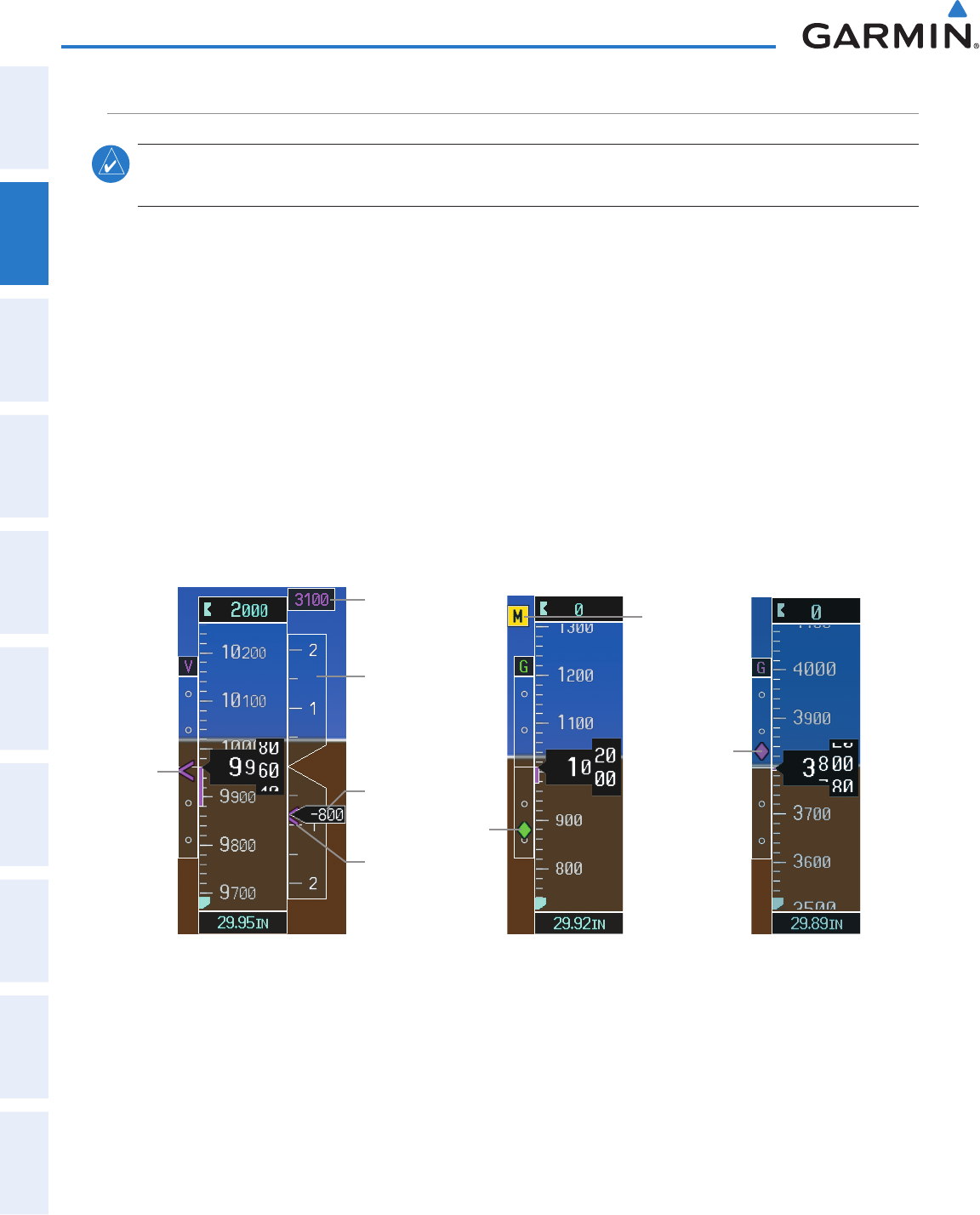
Garmin G1000 Pilot’s Guide for the Diamond DA40/40F
190-00592-06 Rev. A52
FLIGHT INSTRUMENTS
SYSTEM
OVERVIEW
FLIGHT
INSTRUMENTS
EIS
AUDIO PANEL
& CNS
FLIGHT
MANAGEMENT
HAZARD
AVOIDANCE
AFCS
ADDITIONAL
FEATURES
APPENDICESINDEX
VERTICAL DEVIATION
NOTE: The Glidepath Indicator is only shown for aircraft with GIA 63W Integrated Avionics Units when
WAAS is available.
The Vertical Deviation Indicator (VDI) is a magenta chevron indicating the baro-VNV vertical deviation when
Vertical Navigation (VNV) is being used. The VDI appears in conjunction with the “TOD within 1 minute”
alert. The VDI is removed from the display if vertical deviation becomes invalid. See the Flight Management
Section for details on VNV features, and refer to Section 2.2, Supplemental Flight Data, for more information
about VNV indications on the PFD.
The Glideslope Indicator appears to the left of the Altimeter whenever an ILS frequency is tuned in the
active NAV field. A green diamond acts as the Glideslope Indicator, like a glideslope needle on a conventional
indicator. If a localizer frequency is tuned and there is no glideslope, “NO GS” is heard.
The glidepath is analogous to the glideslope for GPS approaches supporting WAAS vertical guidance (LNAV+V,
L/VNAV, LPV). When an approach of this type is loaded into the flight plan and GPS is the selected navigation
source, the Glidepath Indicator appears as a magenta diamond during the approach. If the Glidepath Indicator
becomes unavilable past the final approach fix (FAF), “NO GP” is heard.
Full-scale deflection of two dots is 1000 feet.
Marker
Beacon
Annunciation
Glidepath
Indicator
Required
Vertical
Speed
Vertical
Speed
Pointer
Vertical
Speed
Indicator
VNV Target
Altitude
Vertical
Deviation
Indicator
Figure 2-11 Vertical Speed and
Deviation Indicators (VSI and VDI)
Figure 2-13 Glidepath Indicator
Glideslope
Indicator
Figure 2-12 Glideslope Indicator
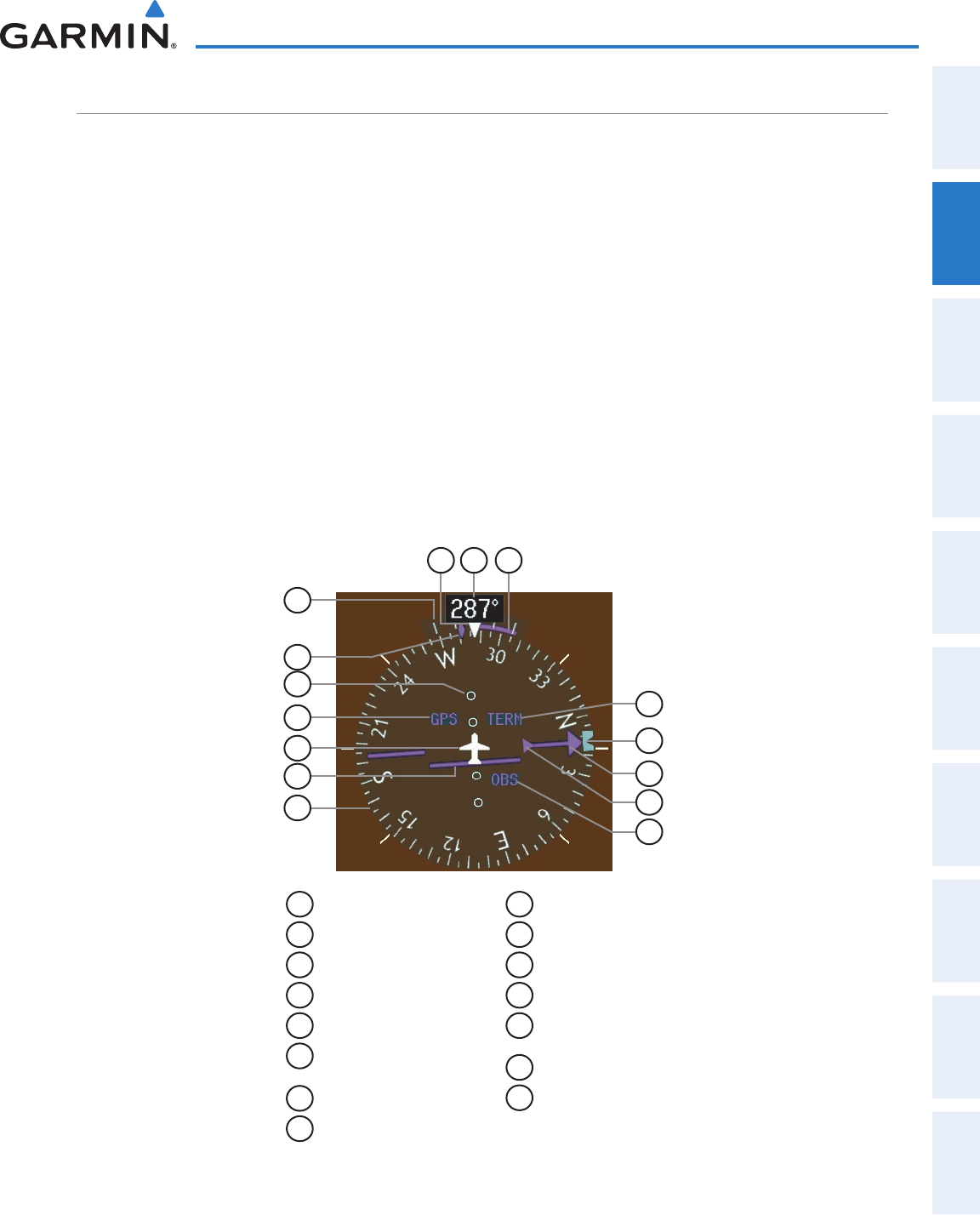
190-00592-06 Rev. A
Garmin G1000 Pilot’s Guide for the Diamond DA40/40F
53
FLIGHT INSTRUMENTS
SYSTEM
OVERVIEW
FLIGHT
INSTRUMENTS EIS AUDIO PANEL
& CNS
FLIGHT
MANAGEMENT
HAZARD
AVOIDANCE AFCS ADDITIONAL
FEATURES APPENDICES INDEX
HORIZONTAL SITUATION INDICATOR (HSI)
The Horizontal Situation Indicator (HSI) displays a rotating compass card in a heading-up orientation. Letters
indicate the cardinal points with numeric labels every 30˚. Major tick marks are at 10˚ intervals and minor tick
marks are at 5˚ intervals. A digital reading of the current heading appears on top of the HSI, and the current
track is represented on the HSI by a magenta diamond. The HSI also presents turn rate, course deviation,
bearing, and navigation source information. The HSI is available in two formats, a 360˚ compass rose and a
140˚ arc.
Changing the HSI display format:
1) Press the
PFD
Softkey.
2) Press the HSI FRMT Softkey.
3) Press the
360 HSI
or
ARC HSI
Softkey.
The 360˚ HSI contains a Course Deviation Indicator (CDI), with a Course Pointer, To/From Indicator, and a
sliding deviation bar and scale. The course pointer is a single line arrow (GPS, VOR1, and LOC1) or a double
line arrow (VOR2 and LOC2) which points in the direction of the set course. The To/From arrow rotates with
the course pointer and is displayed when the active NAVAID is received.
1
Turn Rate Indicator
2
Current Track Bug
3
Lateral Deviation Scale
4
Navigation Source
5
Aircraft Symbol
6
Course Deviation Indicator
(CDI)
7
Rotating Compass Rose
8
OBS Mode Active
9
To/From Indicator
10
Course Pointer
11
Heading Bug
12
Flight Phase
13
Turn Rate/Heading
Trend Vector
14
Current Heading
15
Lubber Line
Figure 2-14 Horizontal Situation Indicator (HSI)
11
7
6
5
3
2
1
12
10
4
1415 13
8
9
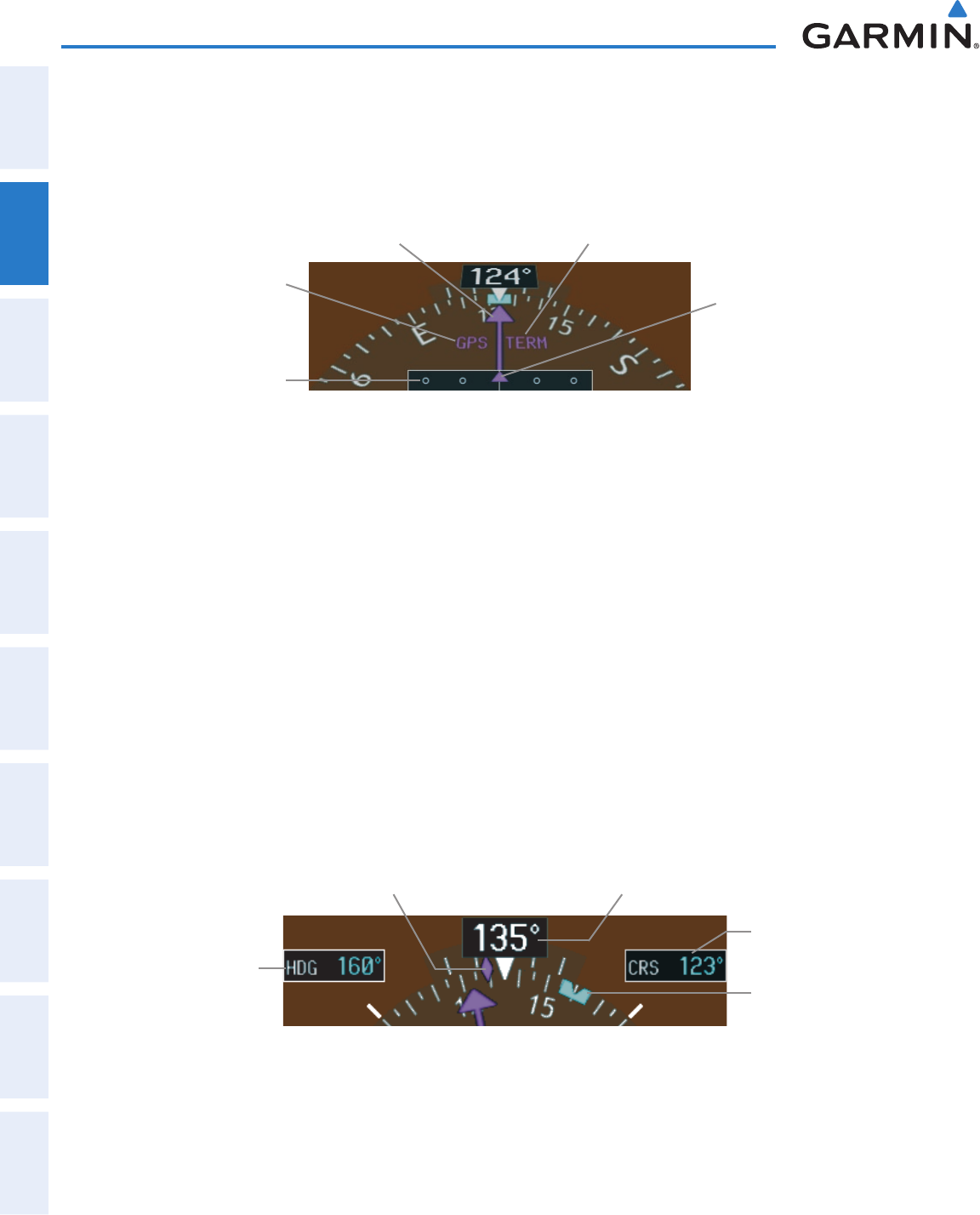
Garmin G1000 Pilot’s Guide for the Diamond DA40/40F
190-00592-06 Rev. A54
FLIGHT INSTRUMENTS
SYSTEM
OVERVIEW
FLIGHT
INSTRUMENTS
EIS
AUDIO PANEL
& CNS
FLIGHT
MANAGEMENT
HAZARD
AVOIDANCE
AFCS
ADDITIONAL
FEATURES
APPENDICESINDEX
The Arc HSI is a 140˚ expanded section of the compass rose. The Arc HSI contains a Course Pointer,
combined To/From Indicator and a sliding deviation indicator, and a deviation scale. Upon station passage, the
To/From Indicator flips and points to the tail of the aircraft, just like a conventional To/From flag. Depending
on the navigation source, the CDI on the Arc HSI can appear in two different ways, an arrowhead (GPS, VOR,
OBS) or a diamond (LOC).
Navigation
Source
Lateral
Deviation
Scale
Course
Deviation
and To/From
Indicator
Figure 2-15 Arc HSI
Course Pointer Flight Phase Annunciation
The selected heading is shown to the upper left of the HSI for 3 seconds after being adjusted. The light blue
heading bug on the compass rose corresponds to the selected heading. While the HSI is displayed as an arc, if
the heading bug is adjusted off the shown portion of the compass rose, the digital reading is displayed.
Adjusting the Selected Heading:
Turn the
HDG
Knob to set the Selected Heading.
Press the HDG Knob to synchronize the bug to the current heading.
The Selected Course is shown to the upper right of the HSI for 3 seconds after being adjusted. While the
HSI is displayed as an arc, the Selected Course is displayed whenever the Course Pointer is not within the 140˚
currently shown.
Adjusting the Selected Course:
Turn the
CRS
Knob to set the Selected Course.
Press the CRS Knob to re-center the CDI and return the course pointer to the bearing of the active waypoint or
navigation station.
Selected
Heading
Selected
Course
Selected
Heading
Bug
Figure 2-16 Heading and Course Indications
Current HeadingCurrent Track Bug
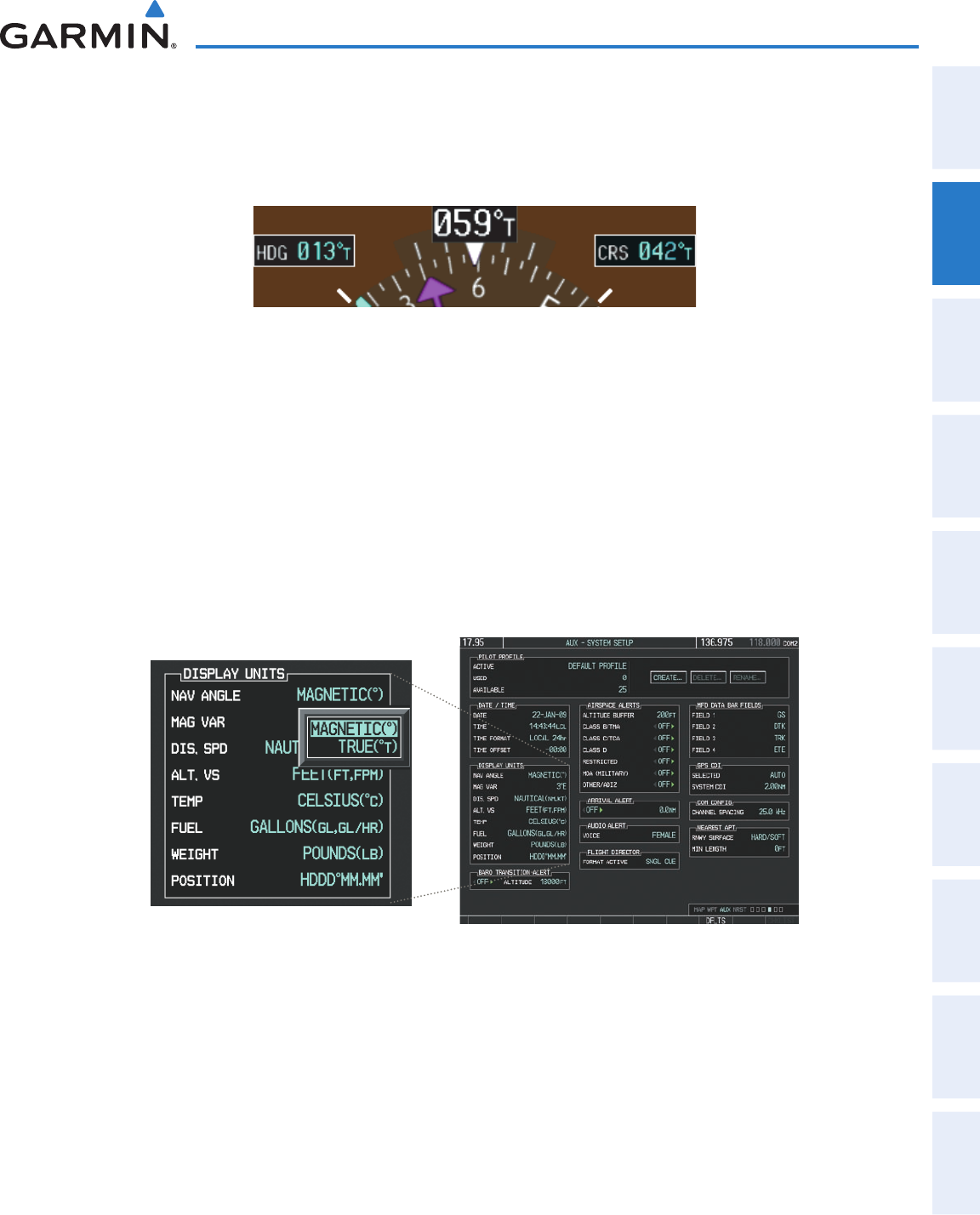
190-00592-06 Rev. A
Garmin G1000 Pilot’s Guide for the Diamond DA40/40F
55
FLIGHT INSTRUMENTS
SYSTEM
OVERVIEW
FLIGHT
INSTRUMENTS EIS AUDIO PANEL
& CNS
FLIGHT
MANAGEMENT
HAZARD
AVOIDANCE AFCS ADDITIONAL
FEATURES APPENDICES INDEX
Navigation angles (track, heading, course, bearing) are corrected to the computed magnetic variation (Mag
Var) or referenced to true north (T), set on the AUX - System Setup Page. When an approach referenced to
true north has been loaded into the flight plan, the system generates a message to change the navigation angle
setting to True at the appropriate time.
Figure 2-17 Heading and Course Indications (True)
Changing the navigation angle true/magnetic setting:
1) Use the FMS Knob to select the AUX - System Setup Page on the MFD.
2) Press the FMS Knob to activate the cursor.
3) Turn the
large FMS
Knob to highlight Nav Angle in the Display Units box.
4) Turn the small FMS Knob to highlight the desired setting and press the ENT Key.
•TRUE - References angles to true north (T)
•MAGNETIC - Angles corrected to the computed magnetic variation (Mag Var)
Figure 2-18 AUX - System Setup Page, Navigation Angle Settings
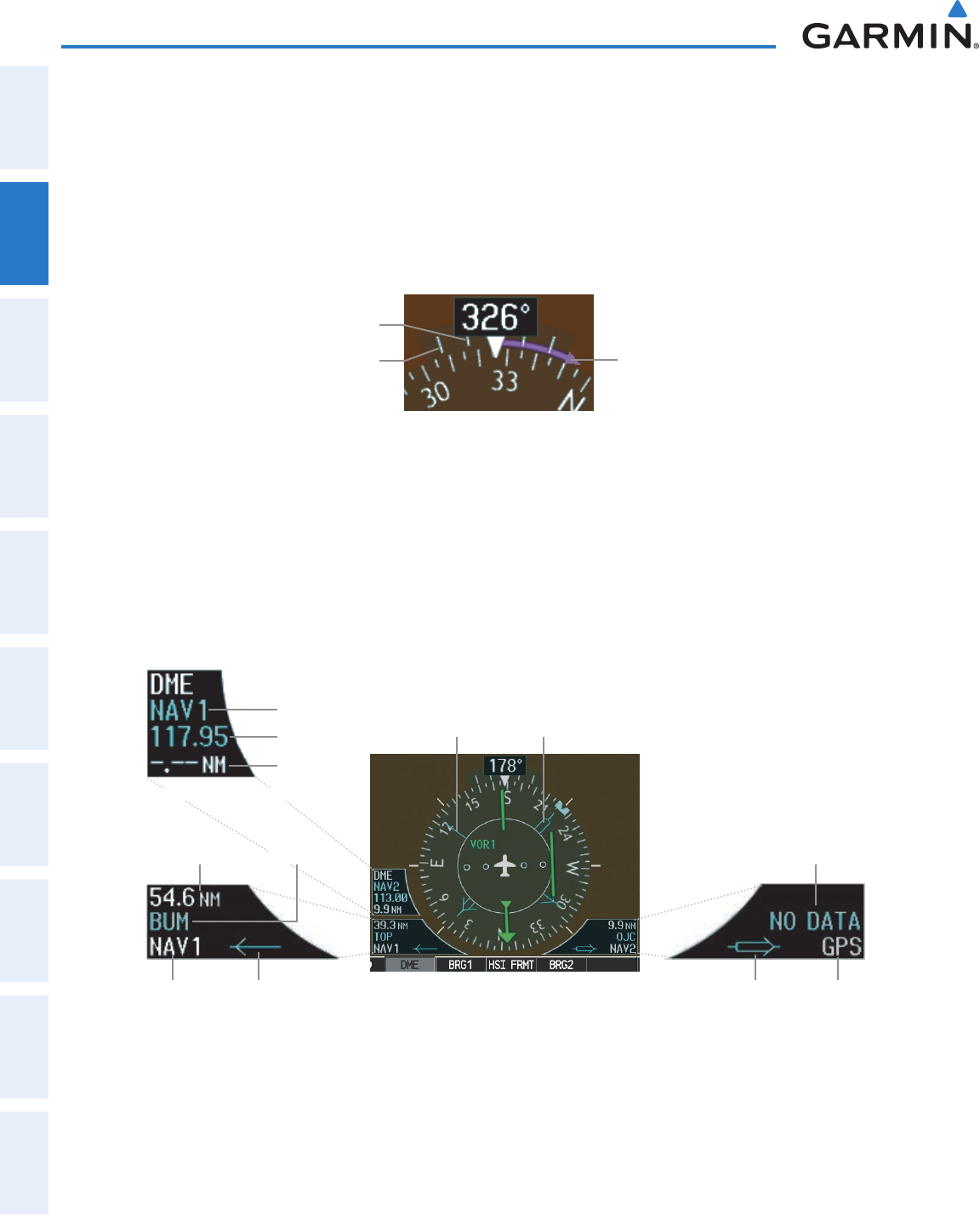
Garmin G1000 Pilot’s Guide for the Diamond DA40/40F
190-00592-06 Rev. A56
FLIGHT INSTRUMENTS
SYSTEM
OVERVIEW
FLIGHT
INSTRUMENTS
EIS
AUDIO PANEL
& CNS
FLIGHT
MANAGEMENT
HAZARD
AVOIDANCE
AFCS
ADDITIONAL
FEATURES
APPENDICESINDEX
TURN RATE INDICATOR
The Turn Rate Indicator is located directly above the rotating compass card. Tick marks to the left and right
of the lubber line denote half-standard and standard turn rates. A magenta Turn Rate Trend Vector shows the
current turn rate. The end of the trend vector gives the heading predicted in 6 seconds, based on the present
turn rate. A standard-rate turn is shown on the indicator by the trend vector stopping at the standard turn
rate tick mark, corresponding to a predicted heading of 18˚ from the current heading. At rates greater than 4
deg/sec, an arrowhead appears at the end of the magenta trend vector and the prediction is no longer valid.
Standard
Turn Rate
Half-Standard
Turn Rate Arrow Shown
for Turn Rate
> 4 deg/sec
Figure 2-19 Turn Rate Indicator and Trend Vector
BEARING POINTERS AND INFORMATION WINDOWS
Two bearing pointers and associated information can be displayed on the HSI for NAV, GPS, and ADF
sources by pressing the PFD Softkey then a BRG or DME Softkey. The bearing pointers are light blue and are
single-line (BRG1) or double-line (BRG2). A pointer symbol is shown in the information windows to indicate
the navigation source. The bearing pointers never override the CDI and are visually separated from the CDI
by a white ring. Bearing pointers may be selected but not necessarily visible due to data unavailability.
Figure 2-20 HSI with Bearing and DME Information
Bearing 2 Information Window
No
Waypoint
Selected
Pointer
Icon Bearing
Source
Bearing 1 Information Window
Pointer
Icon
Distance to
Bearing Source
Bearing
Source
Bearing 2
Pointer
Bearing 1
Pointer
Frequency
Tuning Mode
Distance
Station
Identifier
DME Information Window
190-00592-06 Rev. A
Garmin G1000 Pilot’s Guide for the Diamond DA40/40F
57
FLIGHT INSTRUMENTS
SYSTEM
OVERVIEW
FLIGHT
INSTRUMENTS EIS AUDIO PANEL
& CNS
FLIGHT
MANAGEMENT
HAZARD
AVOIDANCE AFCS ADDITIONAL
FEATURES APPENDICES INDEX
When a bearing pointer is displayed, the associated information window is also displayed. The Bearing
Information Windows are displayed at the lower sides of the HSI and give the following information:
•Bearingsource(NAV,GPS,ADF)
•Pointericon(BRG1=singleline,BRG2=double
line)
•Frequency(ADF)
•Station/waypointidentier(NAV,GPS)
•GPS-derived great circle distance to bearing
source
When the NAV radio is tuned to an ILS frequency the bearing source and the bearing pointer is removed
from the HSI. When NAV1 or NAV2 is the selected bearing source, the frequency is replaced by the station
identifier when the station is within range. If GPS is the bearing source, the active waypoint identifier is
displayed instead of a frequency.
The bearing pointer is removed from the HSI and NO DATA is displayed in the information window if
the NAV radio is not receiving a VOR station or if GPS is the bearing source and an active waypoint is not
selected.
Selecting bearing display and changing sources:
1) Press the PFD Softkey.
2) Press a BRG Softkey to display the desired bearing pointer and information window with a NAV source.
3) Press the BRG Softkey again to change the bearing source to GPS.
4) To remove the bearing pointer and information window, press the BRG Softkey again.
DME INFORMATION WINDOW
The DME Information Window is displayed above the BRG1 Information Window on the 360˚ HSI and in
a box above and along side the Arc HSI. It shows the DME label, tuning mode (NAV1, NAV2, or HOLD),
frequency, and distance. When a signal is invalid, the distance is replaced by –.– – NM Refer to the Audio
Panel and CNS Section for information on tuning the DMEs.
Displaying the DME Information Window:
1) Press the PFD Softkey.
2) Press the DME Softkey to display the DME Information Window.
3) To remove the DME Information Window, press the DME Softkey again.
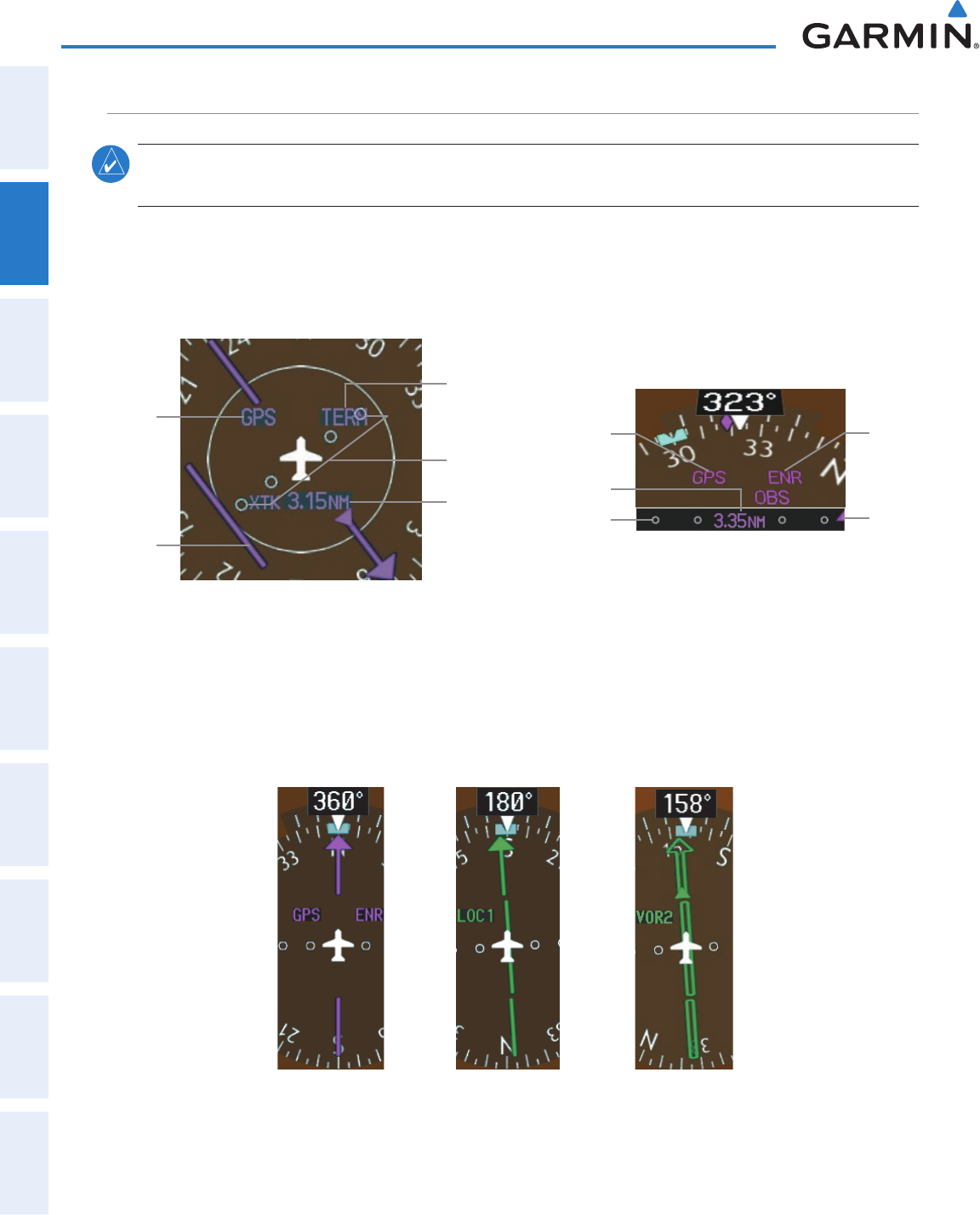
Garmin G1000 Pilot’s Guide for the Diamond DA40/40F
190-00592-06 Rev. A58
FLIGHT INSTRUMENTS
SYSTEM
OVERVIEW
FLIGHT
INSTRUMENTS
EIS
AUDIO PANEL
& CNS
FLIGHT
MANAGEMENT
HAZARD
AVOIDANCE
AFCS
ADDITIONAL
FEATURES
APPENDICESINDEX
COURSE DEVIATION INDICATOR (CDI)
NOTE: During a heading change of greater than 105˚ with respect to the course, the CDI on the Arc HSI
switches to the opposite side of the deviation scale and displays reverse sensing.
The Course Deviation Indicator (CDI) moves left or right from the course pointer along a lateral deviation
scale to display aircraft position relative to the course. If the course deviation data is not valid, the CDI is not
displayed.
Figure 2-21 Course Deviation Indicator
Flight
Phase
Scale
Crosstrack
Error
CDI
Navigation
Source
360º HSI
CDI Scale
Crosstrack
Error
Navigation
Source Flight
Phase
CDI
Arc HSI
The CDI can display two sources of navigation, GPS or VOR/LOC. The color indicates the current navigation
source, magenta for GPS and green for VOR and LOC. The full scale limits for the CDI are defined by a GPS-
derived distance when navigating GPS. When navigating using a VOR or localizer (LOC), the CDI uses the
same angular deviation as a mechanical CDI. If the CDI exceeds the maximum deviation on the scale (two dots)
while navigating with GPS, the crosstrack error (XTK) is displayed below the white aircraft symbol.
Figure 2-22 Navigation Sources
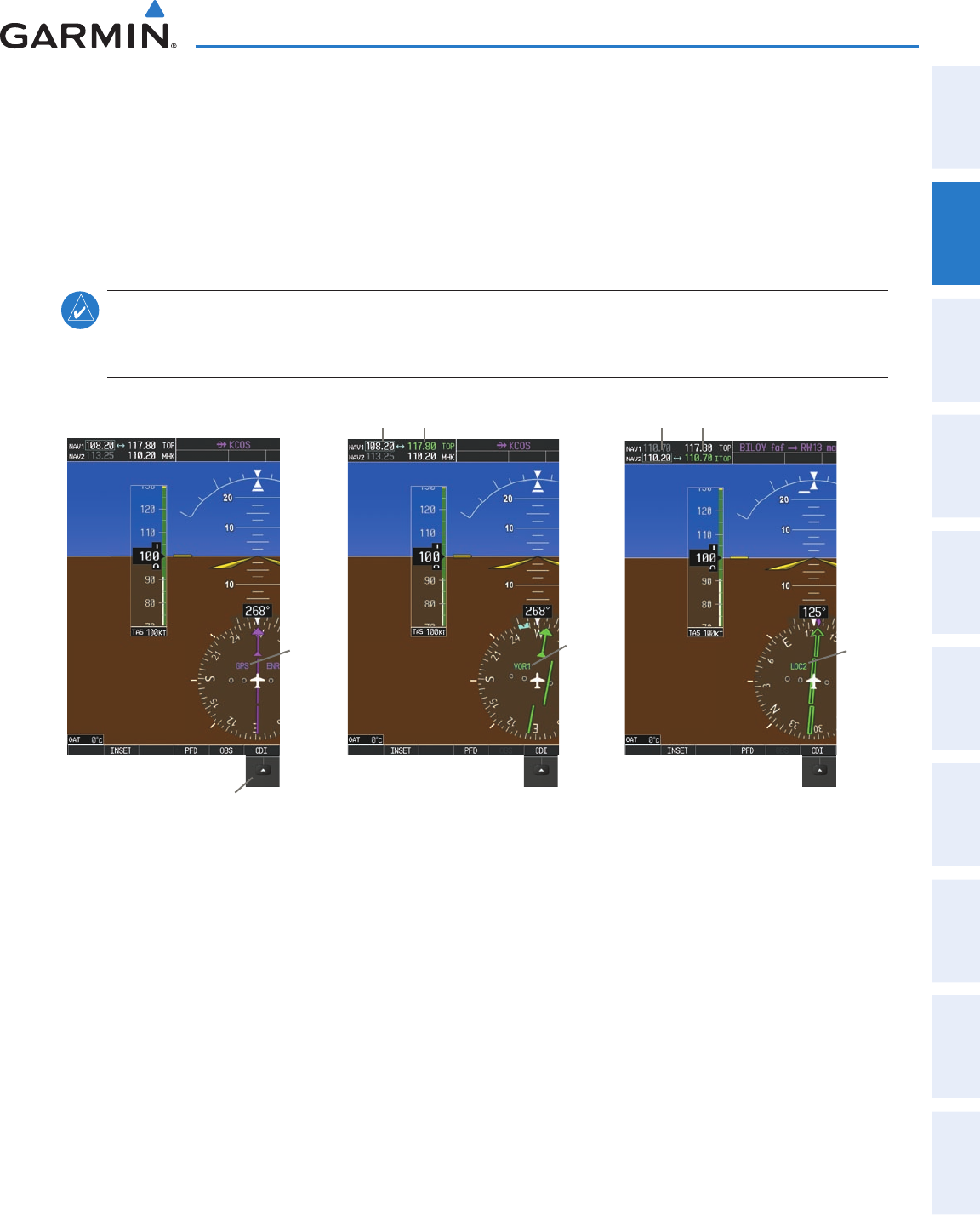
190-00592-06 Rev. A
Garmin G1000 Pilot’s Guide for the Diamond DA40/40F
59
FLIGHT INSTRUMENTS
SYSTEM
OVERVIEW
FLIGHT
INSTRUMENTS EIS AUDIO PANEL
& CNS
FLIGHT
MANAGEMENT
HAZARD
AVOIDANCE AFCS ADDITIONAL
FEATURES APPENDICES INDEX
Changing navigation sources:
1) Press the CDI Softkey to change from GPS to VOR1 or LOC1. This places the light blue tuning box over the
NAV1 standby frequency in the upper left corner of the PFD.
2) Press the CDI Softkey again to change from VOR1 or LOC1 to VOR2 or LOC2. This places the light blue tuning
box over the NAV2 standby frequency.
3) Press the CDI Softkey a third time to return to GPS.
NOTE
: KAP 140 equipped aircraft only: Each time the CDI Softkey is pressed or the navigation source
changes, a message appears (“NAV Source Changed – Select Desired Autopilot Mode”), regardless of
whether or not the autopilot is engaged.
Figure 2-23 Selecting a Navigation Source
LOC2
Selected
VOR1
Selected
Pressing the
CDI
Softkey Cycles through
Navigation Sources
GPS
Selected
NAV1 Selected for Tuning
and Navigating a VOR NAV2 Selected for Tuning
and Navigating an ILS
The system automatically switches from GPS to LOC navigation source and changes the CDI scaling accordingly
when all of the following occur:
•AlocalizerorILSapproachhasbeenloadedintotheactiveightplan
•Thenalapproachx(FAF)istheactivewaypoint,theFAFislessthan15nmaway,andtheaircraftismoving
toward the FAF
•Avalidlocalizerfrequencyhasbeentuned
•TheGPSCDIdeviationislessthan1.2timesfull-scaledeection
GPS steering guidance is still provided after the CDI automatically switches to LOC until LOC capture, up
to the Final Approach Fix (FAF) for an ILS approach, or until GPS information becomes invalid. Activating
a Vector-to-Final (VTF; see the Flight Management Section) also causes the CDI to switch to LOC navigation
source; GPS steering guidance is not provided after this switch.
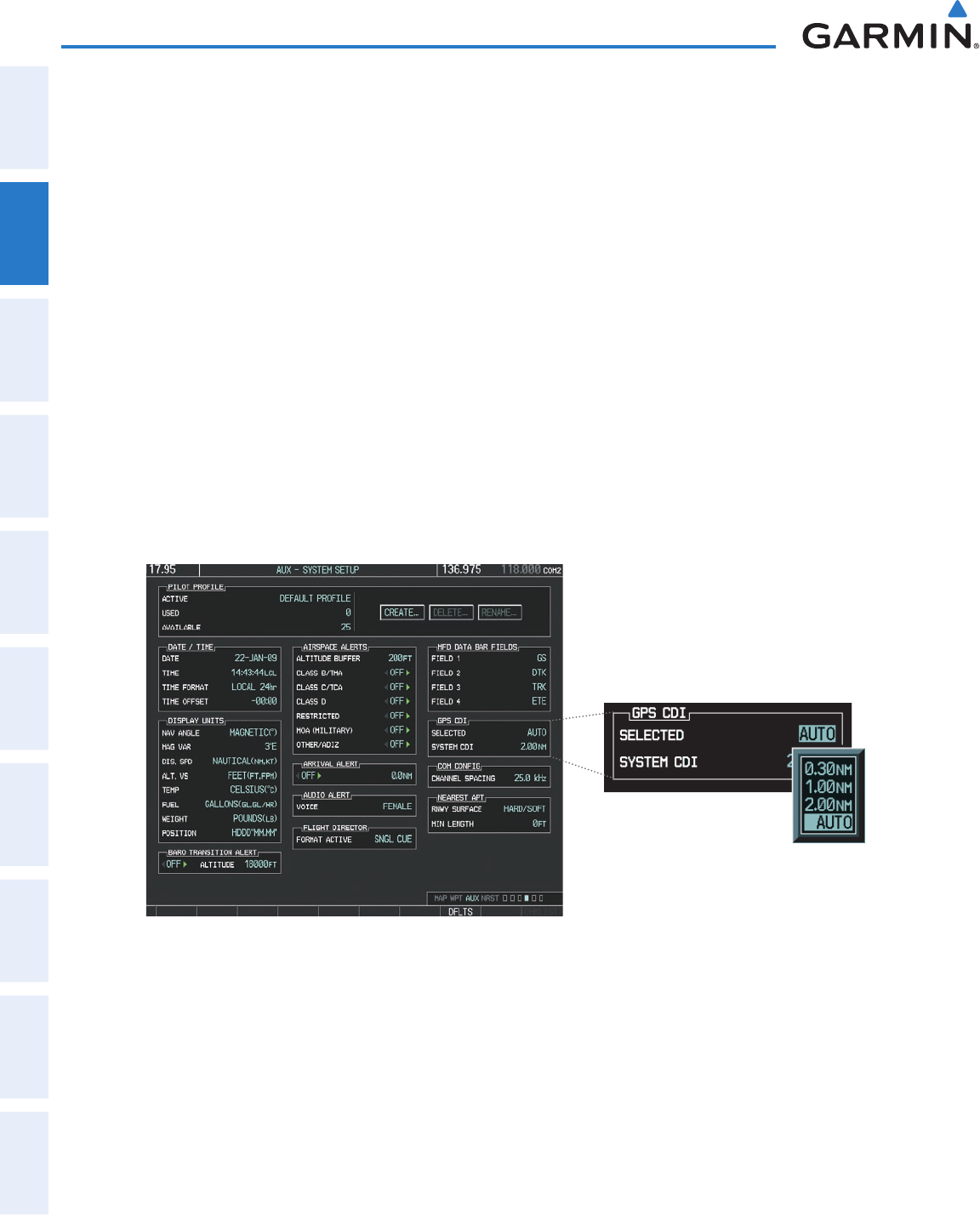
Garmin G1000 Pilot’s Guide for the Diamond DA40/40F
190-00592-06 Rev. A60
FLIGHT INSTRUMENTS
SYSTEM
OVERVIEW
FLIGHT
INSTRUMENTS
EIS
AUDIO PANEL
& CNS
FLIGHT
MANAGEMENT
HAZARD
AVOIDANCE
AFCS
ADDITIONAL
FEATURES
APPENDICESINDEX
GPS CDI SCALING
When GPS is the selected navigation source, the flight plan legs are sequenced automatically and
annunciations appear on the HSI for the flight phase. Flight phase annunciations are normally shown in
magenta, but when cautionary conditions exist the color changes to yellow. If the current leg in the flight plan
is a heading leg, HDG LEG is annunciated in magenta beneath the aircraft symbol.
The current GPS CDI scale setting is displayed as System CDI on the AUX - System Setup Page and the full-
scale deflection setting may also be changed (2.0 nm, 1.0 nm, 0.3 nm, or Auto) from this page. If the selected
scaling is smaller than the automatic setting for enroute and terminal phases, the CDI is scaled accordingly
and the selected setting is displayed rather than the flight phase annunciation.
Changing the selected GPS CDI setting:
1) Use the FMS Knob to select the AUX - System Setup Page on the MFD.
2) Press the FMS Knob to activate the cursor.
3) Turn the
large FMS
Knob to highlight Selected in the GPS CDI box.
4) Turn the small FMS Knob to highlight the desired setting and press the ENT Key.
5) To cancel the selection, press the FMS Knob or the CLR Key.
Figure 2-24 AUX - System Setup Page, GPS CDI Settings
When set to Auto (default), the GPS CDI scale automatically adjusts to the desired limits based upon the
current phase of flight (Figure 2-25, Table 2-1).
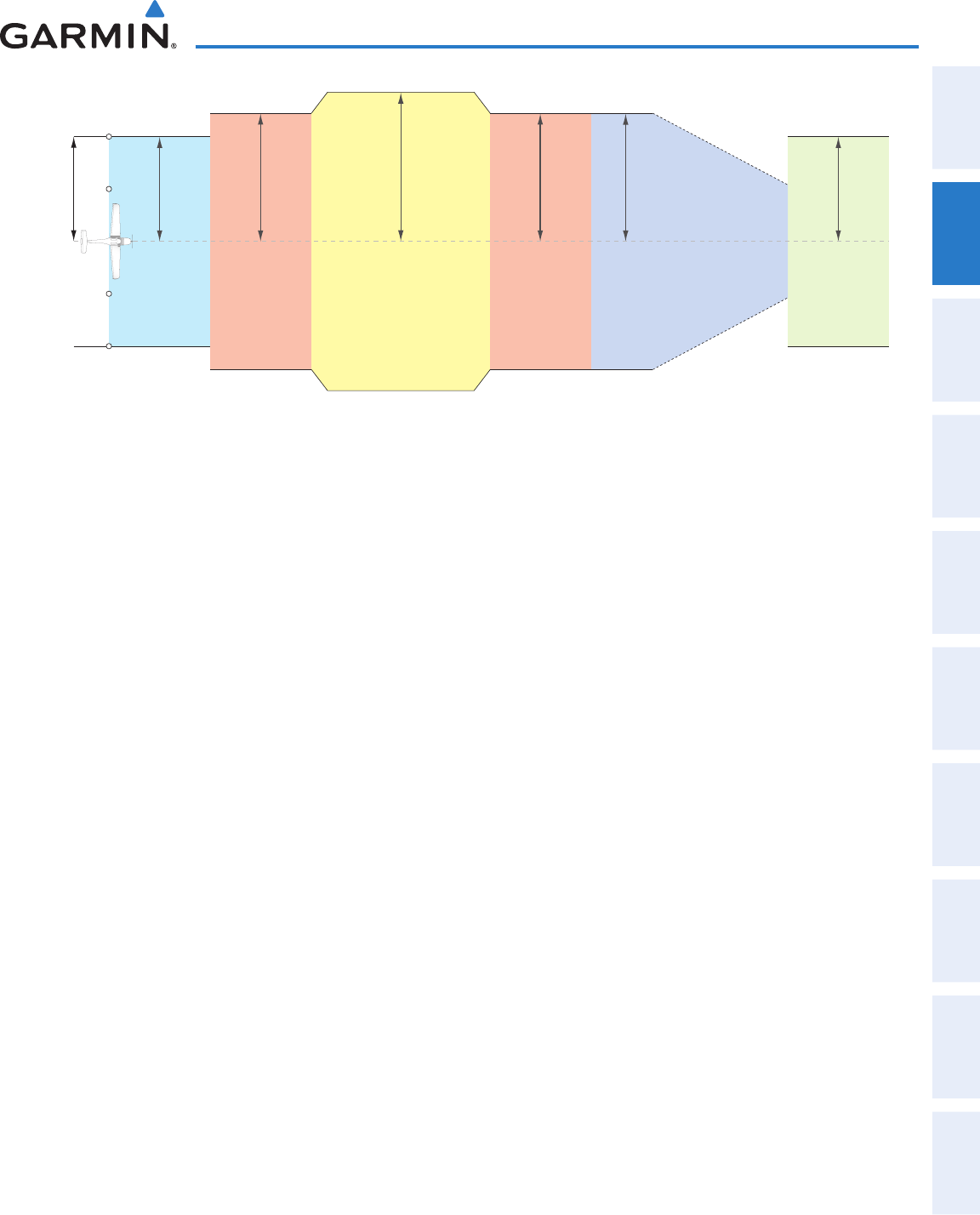
190-00592-06 Rev. A
Garmin G1000 Pilot’s Guide for the Diamond DA40/40F
61
FLIGHT INSTRUMENTS
SYSTEM
OVERVIEW
FLIGHT
INSTRUMENTS EIS AUDIO PANEL
& CNS
FLIGHT
MANAGEMENT
HAZARD
AVOIDANCE AFCS ADDITIONAL
FEATURES APPENDICES INDEX
Figure 2-25 Automatic CDI Scaling
2.0 nm
Enroute
(Oceanic if >200 nm
from nearest airport)
0.3 nm
Missed
Approach
1.0 nm
Approach
1.0 nm
Te rminal
1.0 nm
Te rminal
0.3 nm
Departure
CDI Full-scale Deflection
Refer to accompanying
approach CDI scaling figures
•Onceadepartureprocedureisactivated,theCDIisscaledfordeparture (0.3 nm).
•Thesystemswitchesfromdeparturetoterminal CDI scaling (1.0 nm) under the following conditions:
- The next leg in the procedure is not aligned with the departure runway
-
The next leg in the departure procedure is not CA, CD, CF, CI, CR, DF, FA, FC, FD, FM, IF, or TF (see
Glossary for leg type definitions)
- After any leg in the departure procedure that is not CA or FA
•At30nmfromthedepartureairporttheenroute phase of flight is automatically entered and CDI scaling
changes to 2.0 nm over a distance of 1.0 nm, except under the following conditions:
- When navigating with an active departure procedure, the flight phase and CDI scale does not change
until the aircraft arrives at the last departure waypoint (if more than 30 nm from the departure airport) or
the leg after the last departure waypoint has been activated or a direct-to waypoint is activated.
•Ifaftercompletingthedepartureprocedurethenearestairportismorethan200nmawayfromtheaircraft
and the approach procedure has not yet commenced, the CDI is scaled for oceanic flight (2.0 nm).
•Within31nmofthedestinationairport(terminal area), the CDI scale gradually ramps down from 2.0 nm
to 1.0 nm over a distance of 1.0 nm, except under the following conditions:
- When navigating with an active arrival route, the flight phase and CDI scale does not change until the
aircraft arrives at the first waypoint in the arrive route (if within 31 nm from the destination airport).
•Duringapproach, the CDI scale ramps down even further (see Figures 2-26 and 2-27). This transition
normally occurs within 2.0 nm of the final approach fix (FAF). The CDI switches to approach scaling
automatically once the approach procedure is activated or if Vector-to-Final (VTF) is selected.
- If the active waypoint is the FAF, the ground track and the bearing to the FAF must be within 45° of the
final approach segment course.
- If the active waypoint is part of the missed approach procedure, the active leg and preceding missed
approach legs must be aligned with the final approach segment course and the aircraft must not have
passed the turn initiation point.
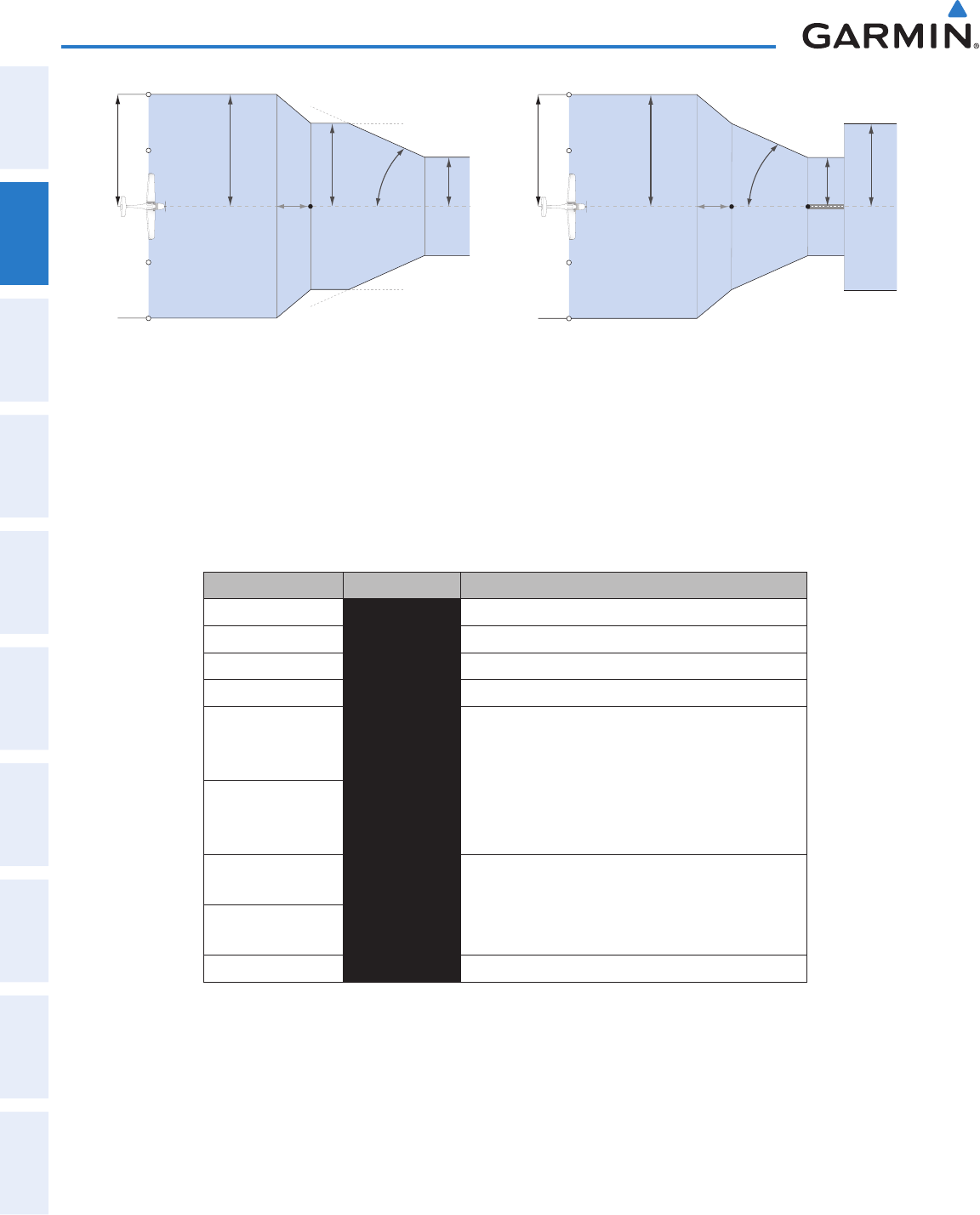
Garmin G1000 Pilot’s Guide for the Diamond DA40/40F
190-00592-06 Rev. A62
FLIGHT INSTRUMENTS
SYSTEM
OVERVIEW
FLIGHT
INSTRUMENTS
EIS
AUDIO PANEL
& CNS
FLIGHT
MANAGEMENT
HAZARD
AVOIDANCE
AFCS
ADDITIONAL
FEATURES
APPENDICESINDEX
Figure 2-26 Typical LNAV and LNAV+V Approach CDI Scaling
1.0 nm
2 nm
350 ft
angle set
by system
0.3 nm
FA F
CDI Full-scale Deflection
CDI scale is set to the smaller of 0.3 nm
or an angle set by the system
CDI scale varies if VTF is activated
Figure 2-27 Typical LNAV/VNAV and LPV Approach CDI Scaling
1.0 nm
2 nm
FA F
0.3 nm
course width
Landing
Threshold
CDI Full-scale Deflection
angle based
on database
information
CDI scale varies if VTF is activated
•Whenamissed approach is activated, the CDI scale changes to 0.3 nm.
•Thesystemautomaticallyswitchesbacktoterminal scaling under the following conditions:
- The next leg in the missed approach procedure is not aligned with the final approach path
-
The next leg in the missed approach procedure is not CA, CD, CF, CI, CR, DF, FA, FC, FD, FM, IF, or TF
- After any leg in the missed approach procedure that is not CA or FA
Flight Phase Annunciation Automatic CDI Full-scale Deflection
Departure DPRT 0.3 nm
Terminal TERM 1.0 nm
Enroute ENR 2.0 nm
Oceanic OCN 2.0 nm
Approach
(Non-precision) LNAV
1.0 nm decreasing to 350 feet depending on
variables (see Figure 2-26)
Approach
(Non-precision with
Vertical Guidance)
LNAV + V
Approach
(LNAV/VNAV) L/VNAV 1.0 nm decreasing to a specified course width, then
0.3 nm, depending on variables (see Figure 2-27)
Approach
(LPV) LPV
Missed Approach MAPR 0.3 nm
Table 2-1 Automatic GPS CDI Scaling
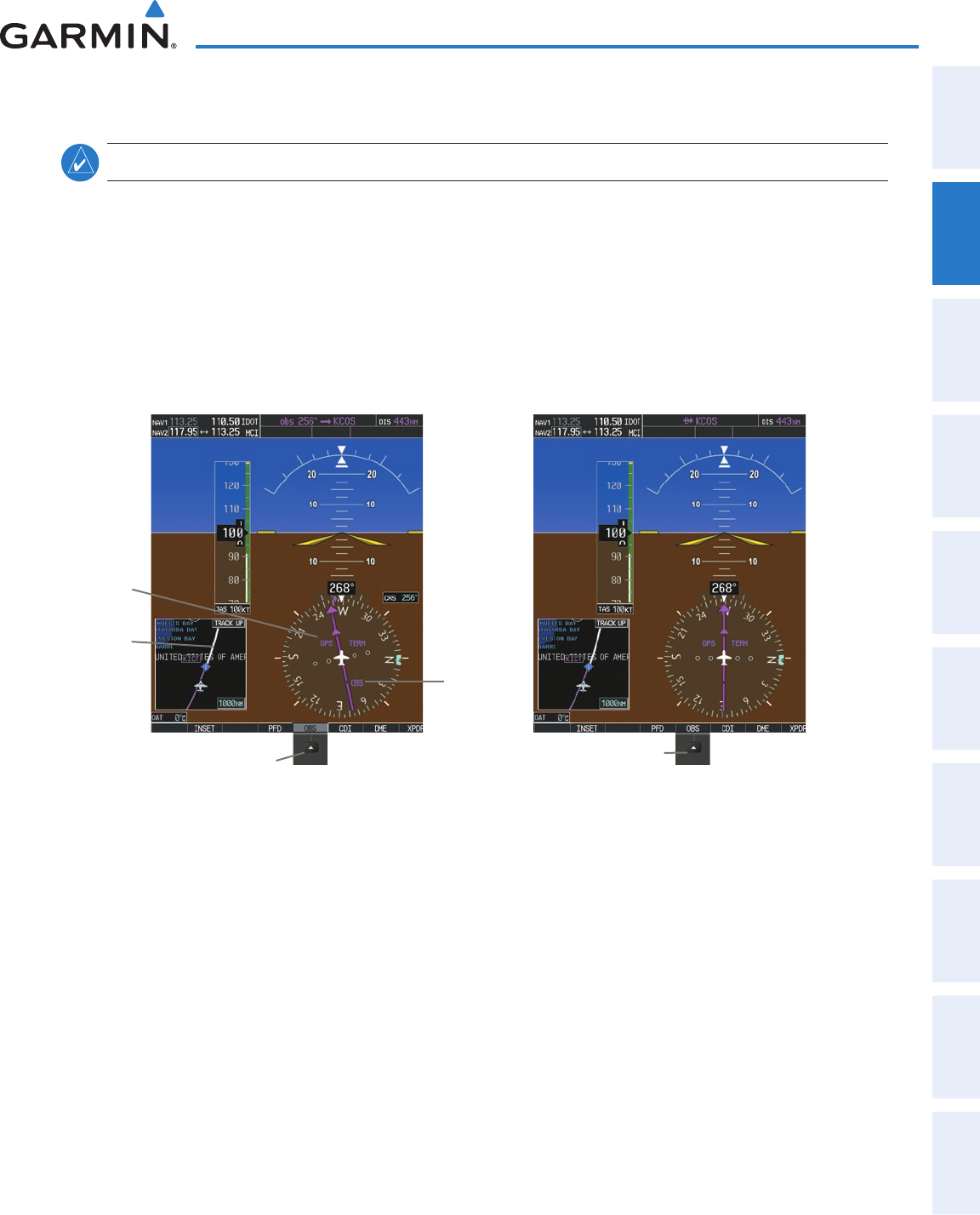
190-00592-06 Rev. A
Garmin G1000 Pilot’s Guide for the Diamond DA40/40F
63
FLIGHT INSTRUMENTS
SYSTEM
OVERVIEW
FLIGHT
INSTRUMENTS EIS AUDIO PANEL
& CNS
FLIGHT
MANAGEMENT
HAZARD
AVOIDANCE AFCS ADDITIONAL
FEATURES APPENDICES INDEX
OBS MODE
NOTE: VNV is inhibited while automatic waypoint sequencing has been suspended.
Enabling Omni-bearing Selector (OBS) Mode suspends the automatic sequencing of waypoints in a GPS
flight plan (GPS must be the selected navigation source), but retains the current Active-to waypoint as the
navigation reference even after passing the waypoint. OBS is annunciated to the lower right of the aircraft
symbol when OBS Mode is selected.
While OBS is enabled, a course line is drawn through the Active-to waypoint on the moving map. If
desired, the course to/from the waypoint can now be adjusted. When OBS Mode is disabled, the GPS flight
plan returns to normal operation, with automatic sequencing of waypoints, following the course set in OBS
Mode. The flight plan on the moving map retains the modified course line.
Figure 2-28 Omni-bearing Selector (OBS) Mode
Pressing the
OBS
Softkey Again, Returns
to Normal Operation
GPS
Selected
OBS
Mode
Enabled
Pressing the
OBS
Softkey Suspends
Waypoint Sequencing
Extended
Course
Line
Enabling/disabling OBS Mode while navigating a GPS flight plan:
1) Press the OBS Softkey to select OBS Mode.
2) Turn the CRS Knob to select the desired course to/from the waypoint. Press the CRS Knob to synchronize the
Selected Course with the bearing to the next waypoint.
3) Press the OBS Softkey again to return to automatic waypoint sequencing.
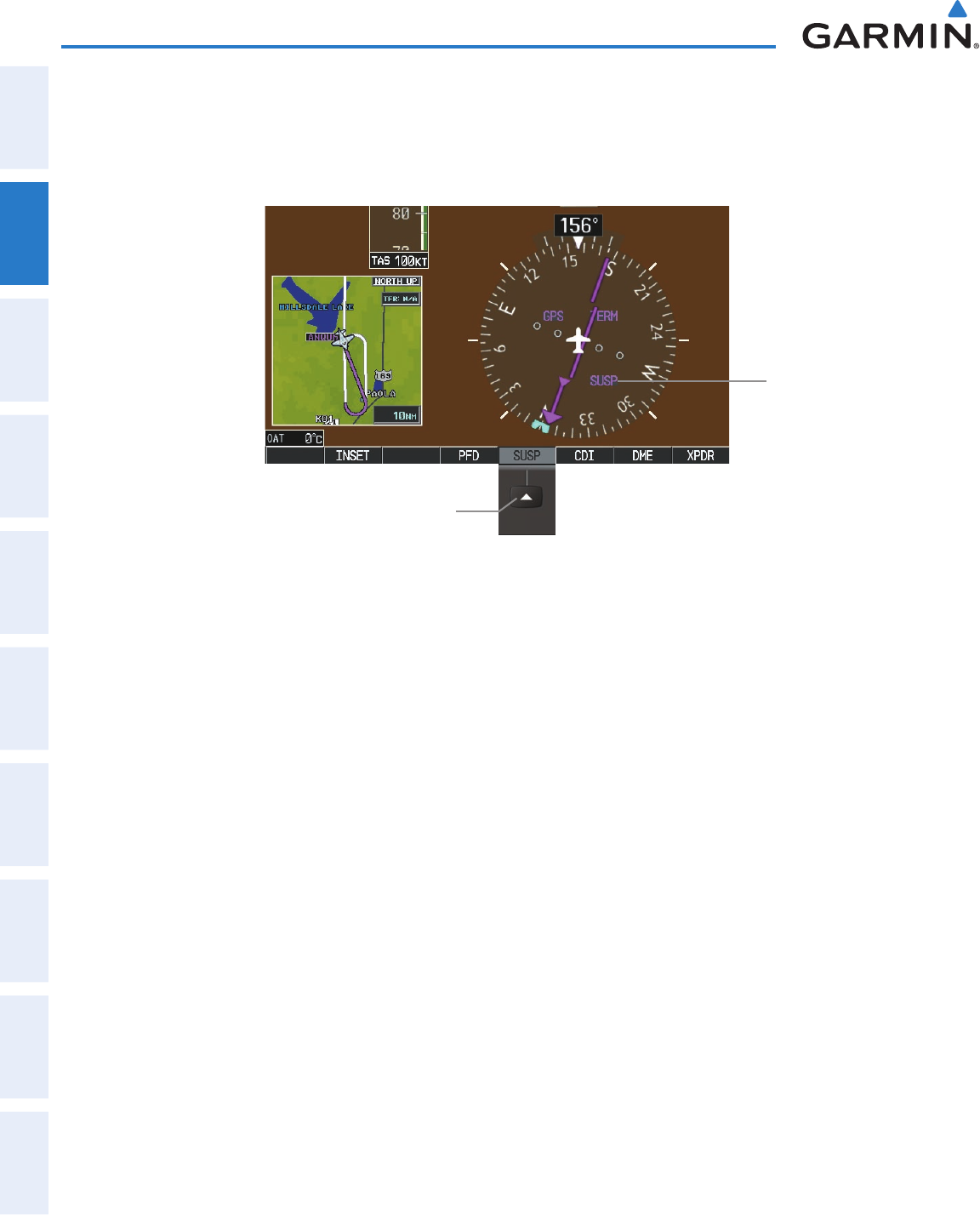
Garmin G1000 Pilot’s Guide for the Diamond DA40/40F
190-00592-06 Rev. A64
FLIGHT INSTRUMENTS
SYSTEM
OVERVIEW
FLIGHT
INSTRUMENTS
EIS
AUDIO PANEL
& CNS
FLIGHT
MANAGEMENT
HAZARD
AVOIDANCE
AFCS
ADDITIONAL
FEATURES
APPENDICESINDEX
As the aircraft crosses the missed approach point (MAP), automatic approach waypoint sequencing is
suspended. SUSP appears on the HSI at the lower right of the aircraft symbol in place of OBS and the
OBS
Softkey label changes to SUSP. Pressing the SUSP Softkey resumes automatic sequencing of approach
waypoints.
SUSP
Softkey Suspends
Waypoint Sequencing
SUSP
Annunciation
Figure 2-29 Suspending Automatic Waypoint Sequencing
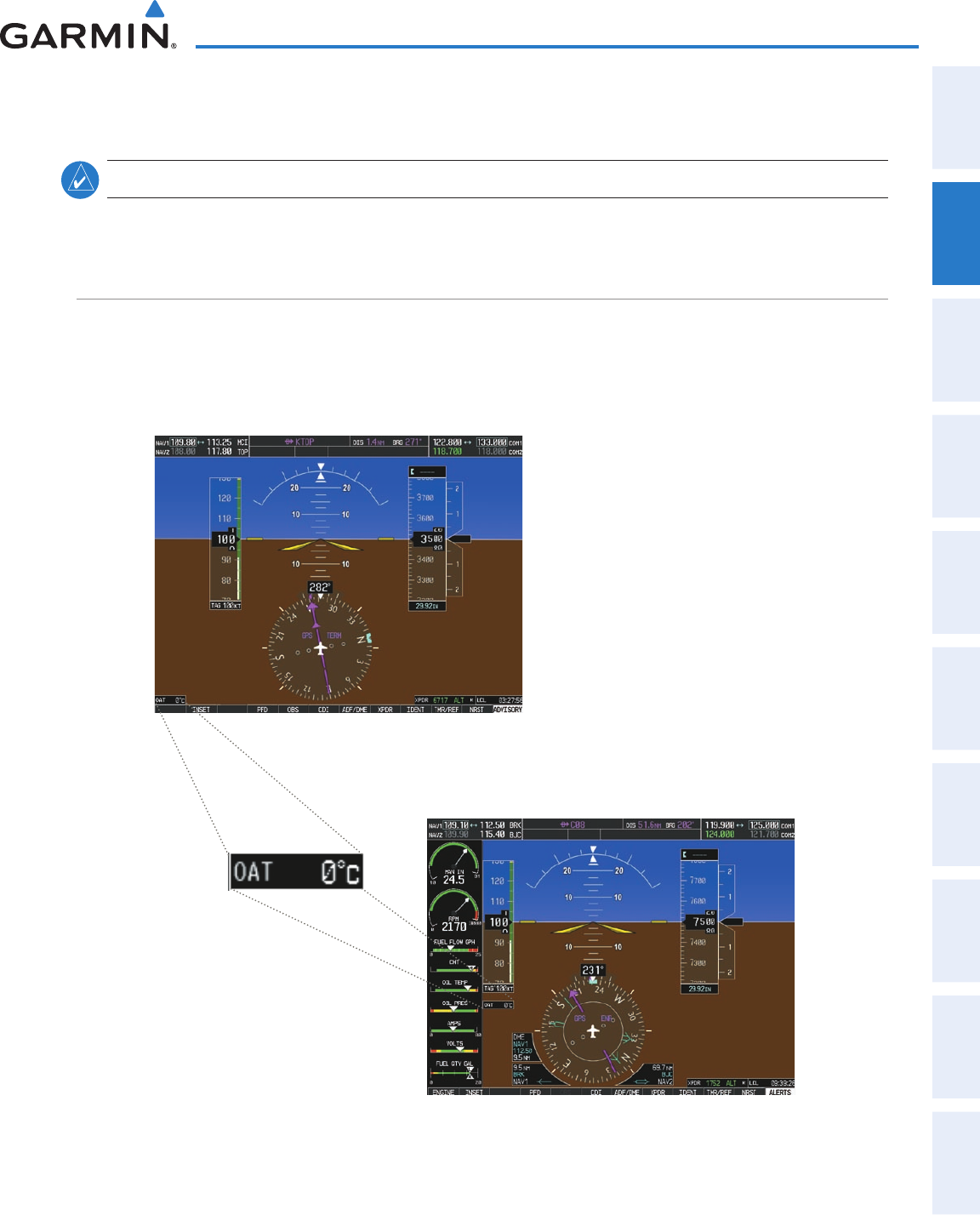
190-00592-06 Rev. A
Garmin G1000 Pilot’s Guide for the Diamond DA40/40F
65
FLIGHT INSTRUMENTS
SYSTEM
OVERVIEW
FLIGHT
INSTRUMENTS EIS AUDIO PANEL
& CNS
FLIGHT
MANAGEMENT
HAZARD
AVOIDANCE AFCS ADDITIONAL
FEATURES APPENDICES INDEX
2.2 SUPPLEMENTAL FLIGHT DATA
NOTE: Pressing the DFLTS Softkey turns off metric Altimeter display, the Inset Map and wind data display.
In addition to the flight instruments, the PFD also displays various supplemental information, including
temperatures, wind data, and Vertical Navigation (VNV) indications.
OUTSIDE AIR TEMPERATURE
The Outside Air Temperature (OAT) is displayed in degrees Celsius (°C) or Fahrenheit (°F) as selected by the
pilot, in the lower left of the PFD under normal display conditions. Temperature is displayed below the true
airspeed in reversionary mode.
Figure 2-30 Outside Air Temperature
Normal Display
Reversionary Mode
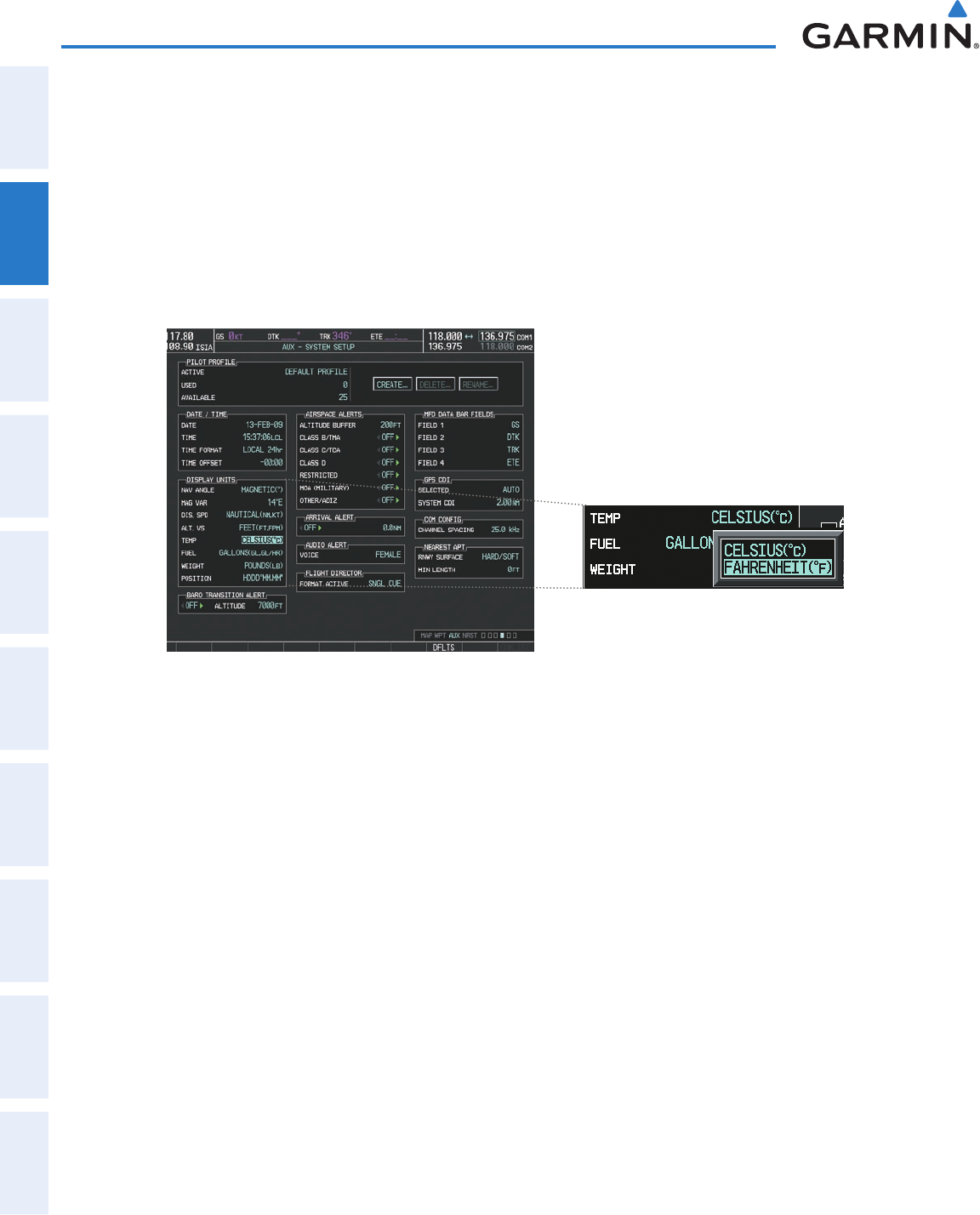
Garmin G1000 Pilot’s Guide for the Diamond DA40/40F
190-00592-06 Rev. A66
FLIGHT INSTRUMENTS
SYSTEM
OVERVIEW
FLIGHT
INSTRUMENTS
EIS
AUDIO PANEL
& CNS
FLIGHT
MANAGEMENT
HAZARD
AVOIDANCE
AFCS
ADDITIONAL
FEATURES
APPENDICESINDEX
Changing temperature display units:
1) Select the AUX - System Setup Page on the MFD using the FMS Knob.
2) Press the FMS Knob to activate the cursor.
3) Turn the
large FMS
Knob to highlight the TEMP field in the Display Units box.
4) Turn the small FMS Knob to highlight either CELSIUS or FAHRENHEIT and press the ENT Key to confirm the
selection.
5) To cancel the selection, press the FMS Knob or the CLR Key.
Figure 2-31 AUX - System Setup Page, Temperature Selection
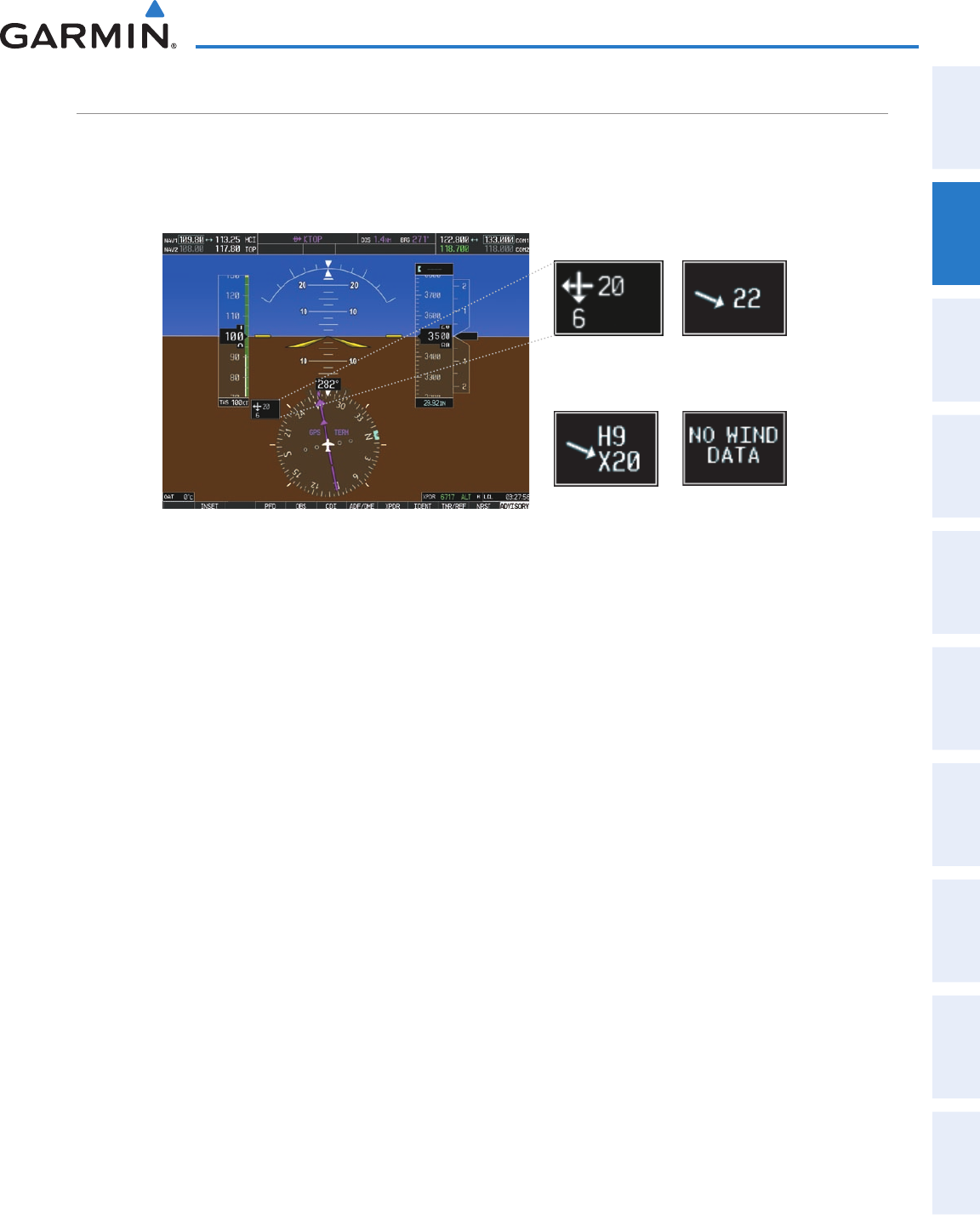
190-00592-06 Rev. A
Garmin G1000 Pilot’s Guide for the Diamond DA40/40F
67
FLIGHT INSTRUMENTS
SYSTEM
OVERVIEW
FLIGHT
INSTRUMENTS EIS AUDIO PANEL
& CNS
FLIGHT
MANAGEMENT
HAZARD
AVOIDANCE AFCS ADDITIONAL
FEATURES APPENDICES INDEX
WIND DATA
Wind direction and speed in knots can be displayed relative to the aircraft in a window to the upper left of
the HSI. When the window is selected for display, but wind information is invalid or unavailable, the window
displays NO WIND DATA. Wind data can be displayed in three different ways.
Figure 2-32 Wind Data
No Data
Option 2
Option 1
Option 3
Displaying wind data:
1) Press the PFD Softkey.
2) Press the WIND Softkey to display wind data below the Selected Heading.
3) Press one of the OPTN softkeys to change how wind data is displayed:
•OPTN 1: Headwind and crosswind components
•OPTN 2: Total wind direction and speed
•OPTN 3: Total wind direction with headwind (H), tailwind (T), and crosswind (X) speed components
4) To remove the window, press the OFF Softkey.
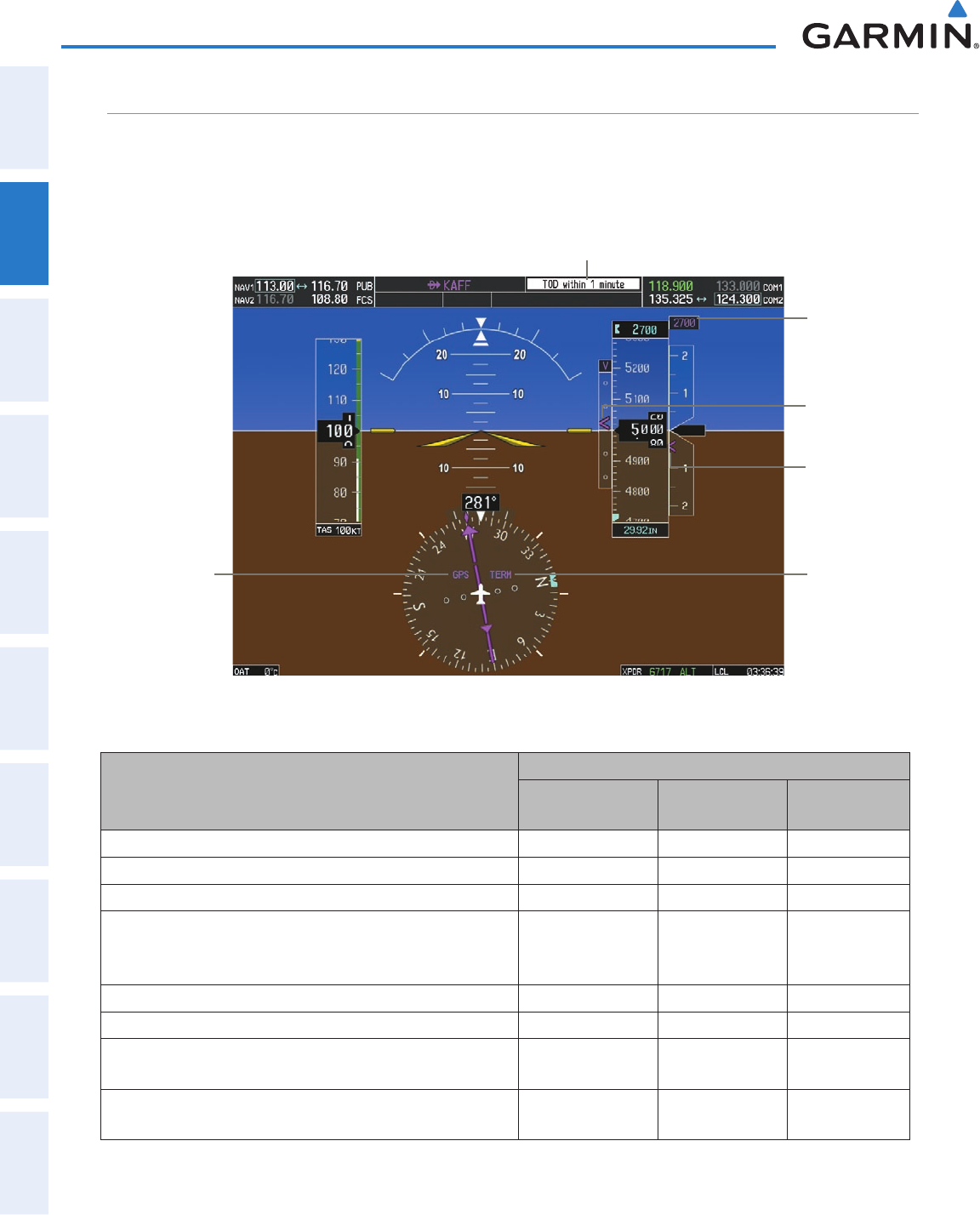
Garmin G1000 Pilot’s Guide for the Diamond DA40/40F
190-00592-06 Rev. A68
FLIGHT INSTRUMENTS
SYSTEM
OVERVIEW
FLIGHT
INSTRUMENTS
EIS
AUDIO PANEL
& CNS
FLIGHT
MANAGEMENT
HAZARD
AVOIDANCE
AFCS
ADDITIONAL
FEATURES
APPENDICESINDEX
VERTICAL NAVIGATION (VNV) INDICATIONS
When a VNV flight plan has been activated, VNV indications (VNV Target Altitude, RVSI, VDI) appear on the
PFD in conjunction with the “TOD within 1 minute” message and “Vertical track” voice alert. See the Flight
Management and AFCS sections for details on VNV features. VNV indications are removed from the PFD
according to the criteria listed in the table.
GPS is
Selected
Navigation
Source
Vertical
Deviation
Indicator
Required
Vertical
Speed Bug
Enroute
Phase of
Flight
VNV Target
Altitude
Figure 2-33 Vertical Navigation Indications (PFD)
Top of Descent Message
Criteria
VNV Indication Removed
Required Vertical
Speed (RVSI)
Vertical
Deviation (VDI)
VNV Target
Altitude
Aircraft > 1 min before the next TOD and not on a descent leg X X X
Aircraft > 1 min before the next TOD due to flight plan change X X X
VNV cancelled (CNCL VNV Softkey selected on MFD) X X X
Distance to active waypoint cannot be computed due to
unsupported flight plan leg type (see Flight Management
Section)
X X X
Aircraft > 250 feet below active VNV Target Altitude X X X
Current crosstrack or track angle error has exceeded limit X X X
Active altitude-constrained waypoint can not be reached within
maximum allowed flight path angle and vertical speed X X
Last altitude-constrained waypoint in active flight plan reached X X
(30 sec before) X
Table 2-2 VNV Indication Removal Criteria
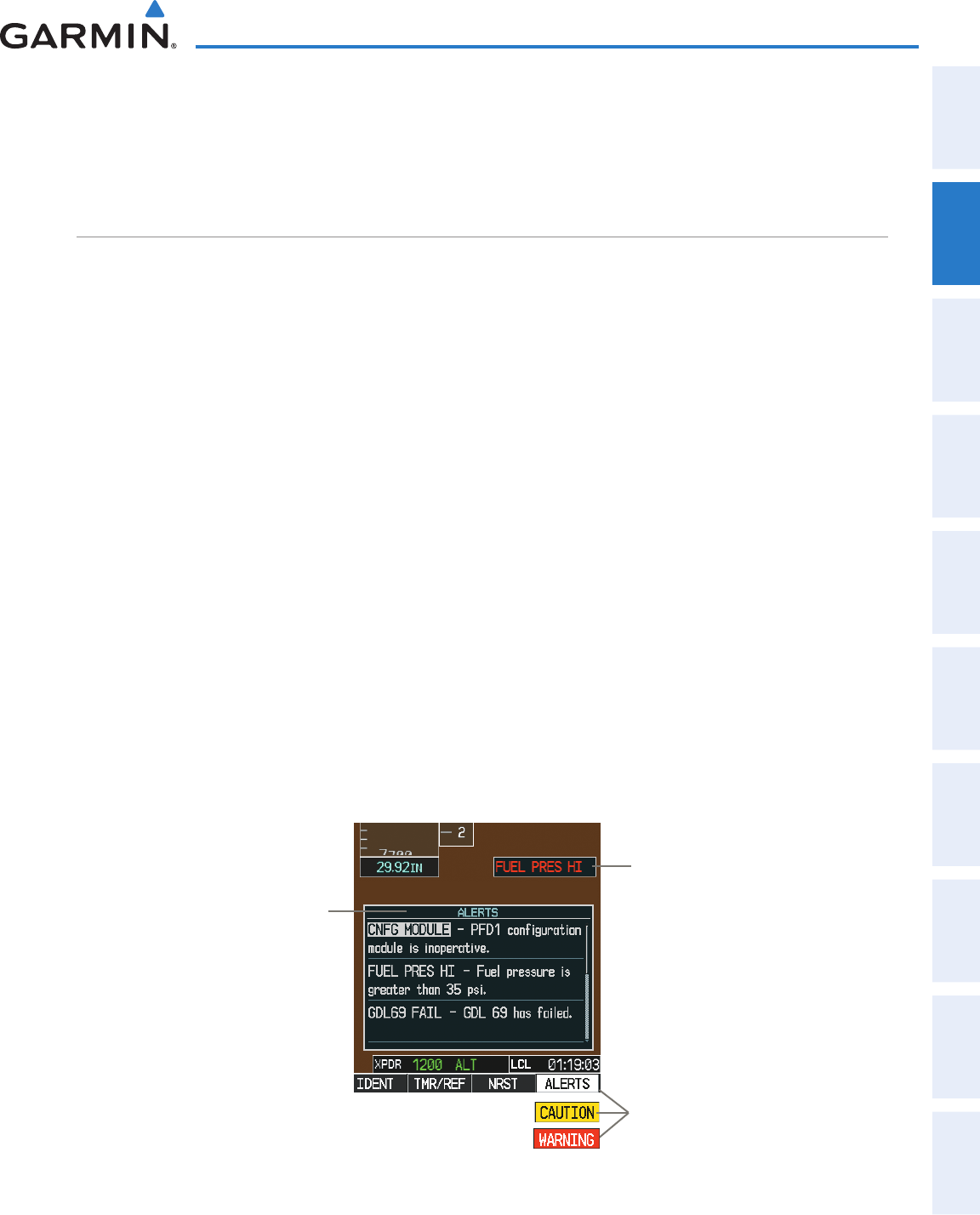
190-00592-06 Rev. A
Garmin G1000 Pilot’s Guide for the Diamond DA40/40F
69
FLIGHT INSTRUMENTS
SYSTEM
OVERVIEW
FLIGHT
INSTRUMENTS EIS AUDIO PANEL
& CNS
FLIGHT
MANAGEMENT
HAZARD
AVOIDANCE AFCS ADDITIONAL
FEATURES APPENDICES INDEX
2.3 PFD ANNUNCIATIONS AND ALERTING FUNCTIONS
The following annunciations and alerting functions are displayed on the PFD. Refer to Appendix A for more
information on alerts and annunciations.
SYSTEM ALERTING
Messages appear in the Alerts Window in the lower right corner of the PFD when a warning, caution, advisory
alert, or G1000 message advisory occurs. System alert messages are provided for awareness of G1000 system
problems or status and may or may not require pilot action. The Alerts Window allows system alerts to be
displayed simultaneously. The FMS Knob is used to scroll through the alert messages. The Alerts Window
is enabled/disabled by pressing the
ALERTS
Softkey. If the window is already open when a new message is
generated, pressing the ALERTS Softkey to acknowledge the message turns the softkey gray.
The ALERTS Softkey label changes to display the appropriate annunciation when an alert is issued. The
annunciation flashes and the appropriate aural alert sounds until acknowledged by pressing the softkey. The
softkey then reverts to the ALERTS label, and when pressed again opens the Alerts Window to display a
descriptive message of the alert.
Caution indicates the existence of abnormal conditions on the aircraft that may require pilot intervention. A
flashing CAUTION Softkey annunciation and single aural tone (one chime) indicate the presence of a caution.
The flashing CAUTION Softkey annunciation continues to flash until acknowledged by pressing the
CAUTION
Softkey.
Warnings are time-critical and require immediate attention. A flashing WARNING Softkey annunciation and
aural tone (single chime every two seconds) indicate the presence of a warning. The aural tone and flashing
WARNING Softkey annunciation continue until acknowledge
d
by pressing the
WARNING
Softkey.
The Annunciation Window appears to the right of the Vertical Speed Indicator and displays abbreviated
annunciation text for aircraft alerts. Warnings appear in red, cautions in yellow, advisory alerts in white,
and safe operating annunciations in green. New alerts are displayed at the top of the Annunciation Window,
regardless of priority. Once acknowledged, they are sequenced based on priority.
Alerts
Window
Softkey
Annunciations
Annunciation
Window
Figure 2-34 G1000 Alerting System
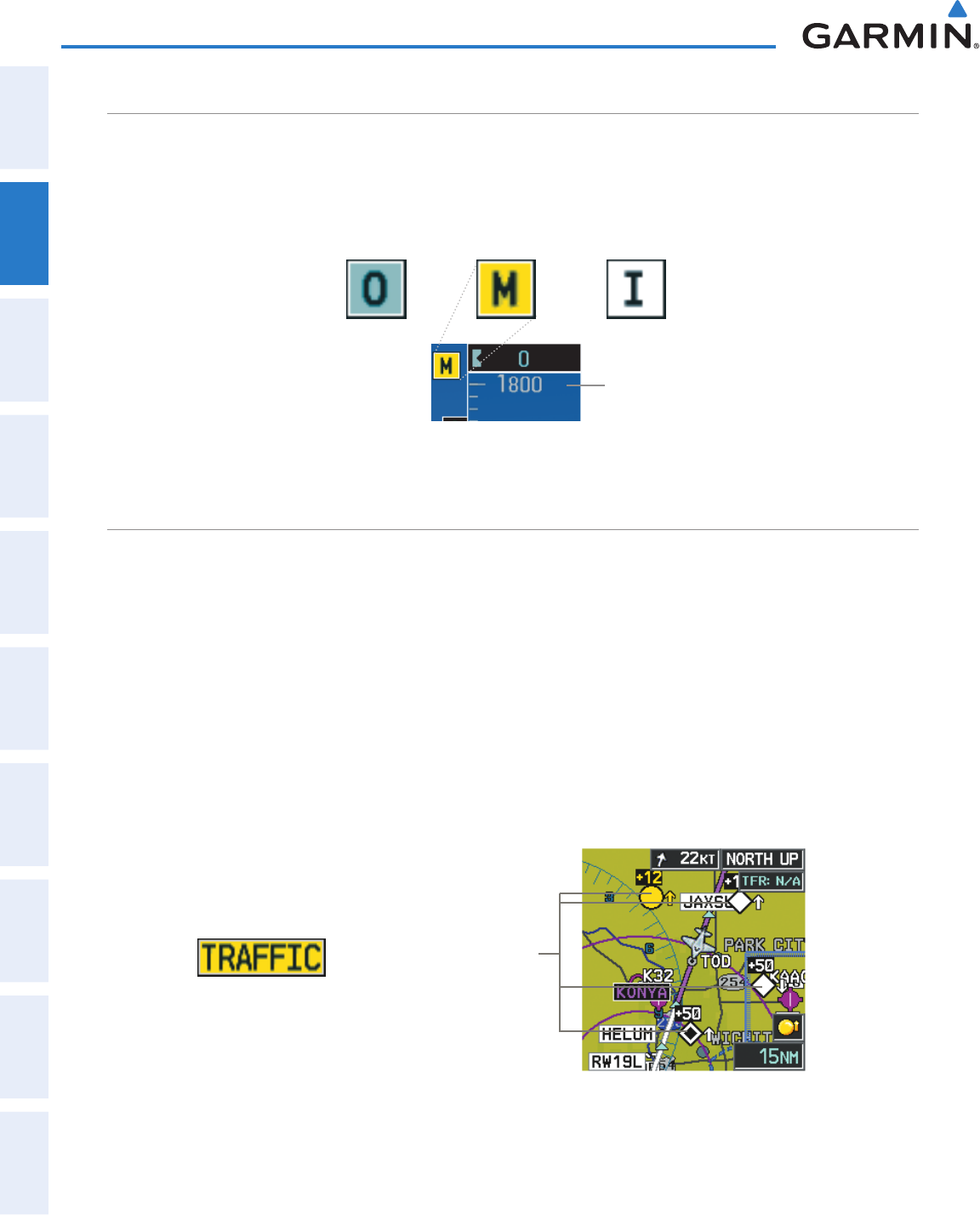
Garmin G1000 Pilot’s Guide for the Diamond DA40/40F
190-00592-06 Rev. A70
FLIGHT INSTRUMENTS
SYSTEM
OVERVIEW
FLIGHT
INSTRUMENTS
EIS
AUDIO PANEL
& CNS
FLIGHT
MANAGEMENT
HAZARD
AVOIDANCE
AFCS
ADDITIONAL
FEATURES
APPENDICESINDEX
MARKER BEACON ANNUNCIATIONS
Marker Beacon Annunciations are displayed on the PFD to the left of the Selected Altitude. Outer marker
reception is indicated in blue, middle in yellow, and inner in white. Refer to the Audio Panel and CNS Section
for more information on Marker Beacon Annunciations.
Figure 2-35 Marker Beacon Annunciations
Inner MarkerMiddle MarkerOuter Marker
Altimeter
TRAFFIC ANNUNCIATION
Traffic is displayed symbolically on the PFD Inset Map, the MFD Navigation Map Page, and various other
MFD page maps. Refer to the Hazard Avoidance Section and Appendix F for more details about the Traffic
Information Service (TIS) and optional Traffic Advisory Systems (TAS). When a traffic advisory (TA) is detected,
the following automatically occur:
•ThePFDInsetMapisenabledanddisplaystrafc
•Aashingblack-on-yellowTRAFFICannunciationappearstothetopleftoftheAttitudeIndicatorforve
seconds and remains displayed until no TAs are detected in the area
•Asingle“TRAFFIC” aural alert is heard, unless an optional Traffic Advisory System (TAS) is installed. Refer
to the applicable TAS documentation for alerts generated by TAS equipment.
If additional TAs appear, new aural and visual alerts are generated.
Traffic
Symbols
PFD Traffic Annunciation
PFD Inset Map with TAS Traffic Displayed
Figure 2-36 Traffic Annunciation and Inset Map with Traffic Displayed
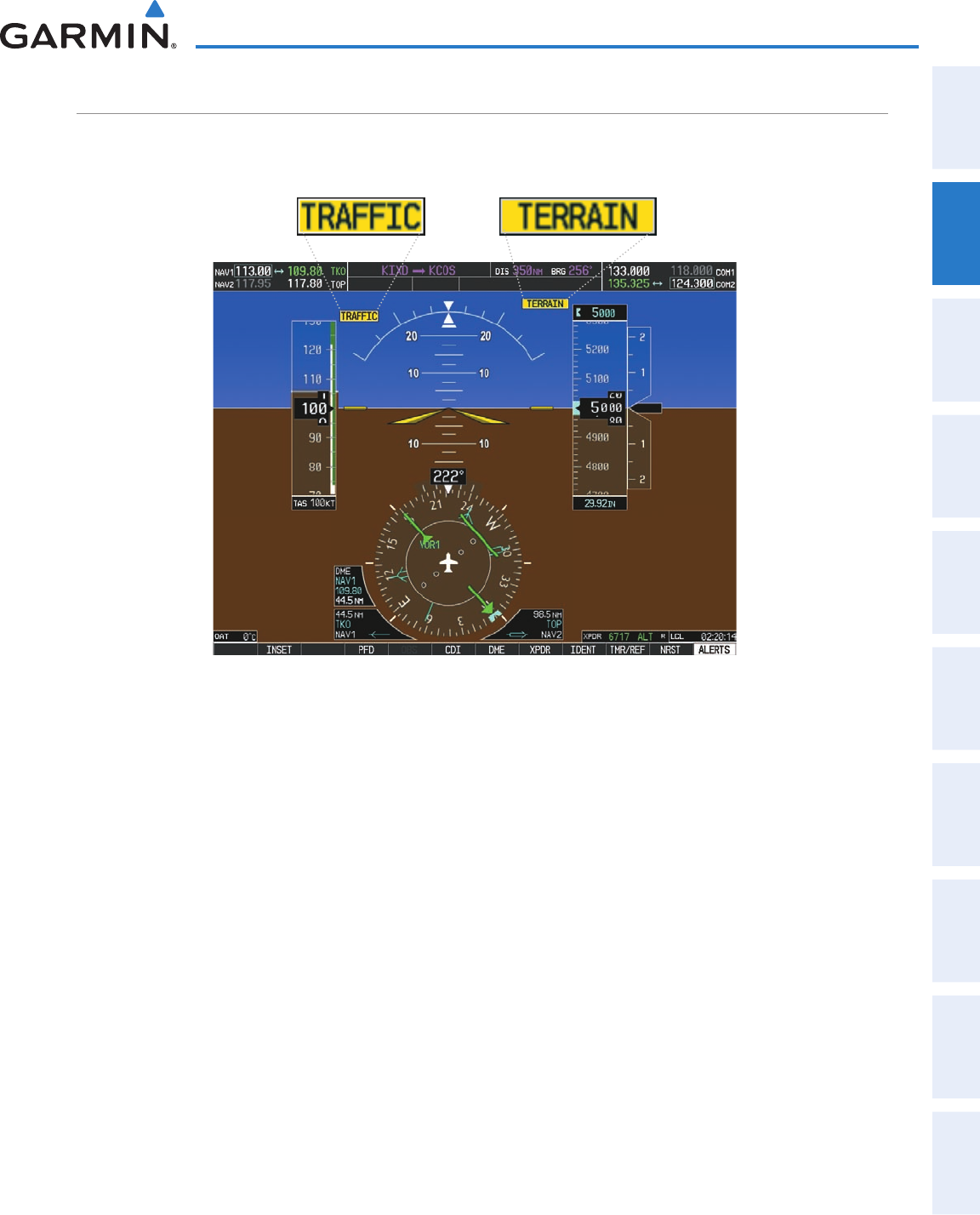
190-00592-06 Rev. A
Garmin G1000 Pilot’s Guide for the Diamond DA40/40F
71
FLIGHT INSTRUMENTS
SYSTEM
OVERVIEW
FLIGHT
INSTRUMENTS EIS AUDIO PANEL
& CNS
FLIGHT
MANAGEMENT
HAZARD
AVOIDANCE AFCS ADDITIONAL
FEATURES APPENDICES INDEX
TAWS ANNUNCIATIONS
Terrain Awareness and Warning System (TAWS) annunciations appear on the PFD at the top left of the Altimeter.
Refer to the Hazard Avoidance Section and Appendix A for information on TAWS alerts and annunciations.
Figure 2-37 Traffic and TAWS Annunciations
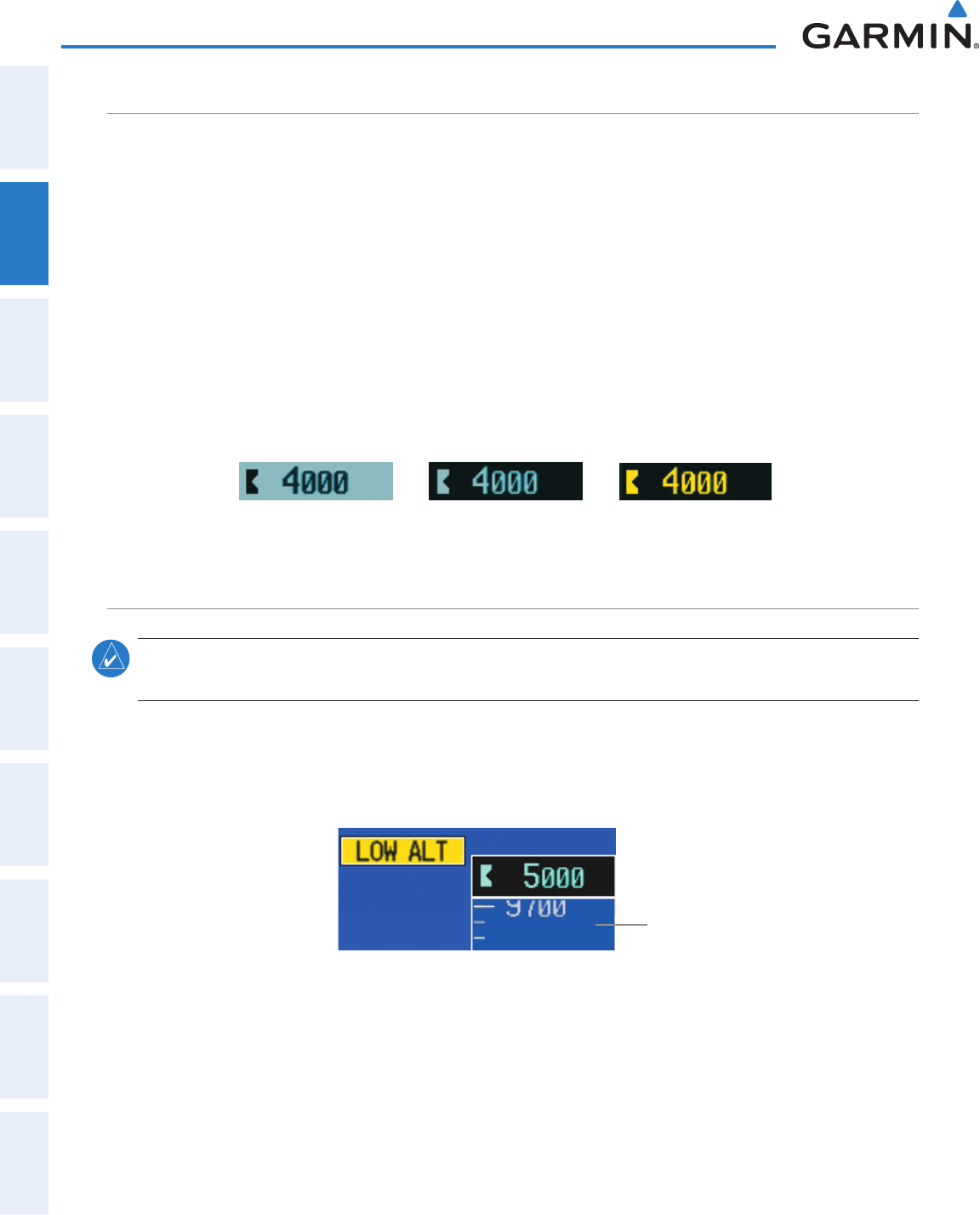
Garmin G1000 Pilot’s Guide for the Diamond DA40/40F
190-00592-06 Rev. A72
FLIGHT INSTRUMENTS
SYSTEM
OVERVIEW
FLIGHT
INSTRUMENTS
EIS
AUDIO PANEL
& CNS
FLIGHT
MANAGEMENT
HAZARD
AVOIDANCE
AFCS
ADDITIONAL
FEATURES
APPENDICESINDEX
ALTITUDE ALERTING
Altitude Alerting provides the pilot with a visual alert when approaching the Selected Altitude. Whenever the
Selected Altitude is changed, the Altitude Alerter is reset. The Altitude Alerter is independent of the GFC 700
AFCS, but alerting tones are heard only when the GFC 700 is installed. The following occur when approaching
the Selected Altitude:
•Uponpassingthrough1000feetoftheSelectedAltitudeanauraltoneisheard.TheSelectedAltitudechanges
to black text on a light blue background and flashes for 5 seconds.
•Whentheaircraftpasseswithin200feetoftheSelectedAltitude,theSelectedAltitudechangestolightblue
text on a black background and flashes for 5 seconds.
•AfterreachingtheSelectedAltitude,ifthepilotiesoutsidethedeviationband(±200feetoftheSelected
Altitude) an aural tone is heard. The Selected Altitude changes to yellow text on a black background and
flashes for 5 seconds.
Figure 2-38 Altitude Alerting Visual Annunciations
Within 1000 ft Within 200 ft Deviation of ±200 ft
LOW ALTITUDE ANNUNCIATION
NOTE: A Low Altitude Annunciation is available only when WAAS is available. This annunciation is not
shown for systems equipped with TAWS, unless TAWS is inhibited.
When the Final Approach Fix (FAF) is the active waypoint in a GPS WAAS approach using vertical guidance,
a Low Altitude Annunciation may appear if the current aircraft altitude is at least 164 feet below the prescribed
altitude at the FAF. A black-on-yellow LOW ALT annunciation appears to the top right of the Altimeter, flashing
for several seconds, then remaining displayed until the condition is resolved.
Figure 2-39 Low Altitude on GPS WAAS Approach
Altimeter
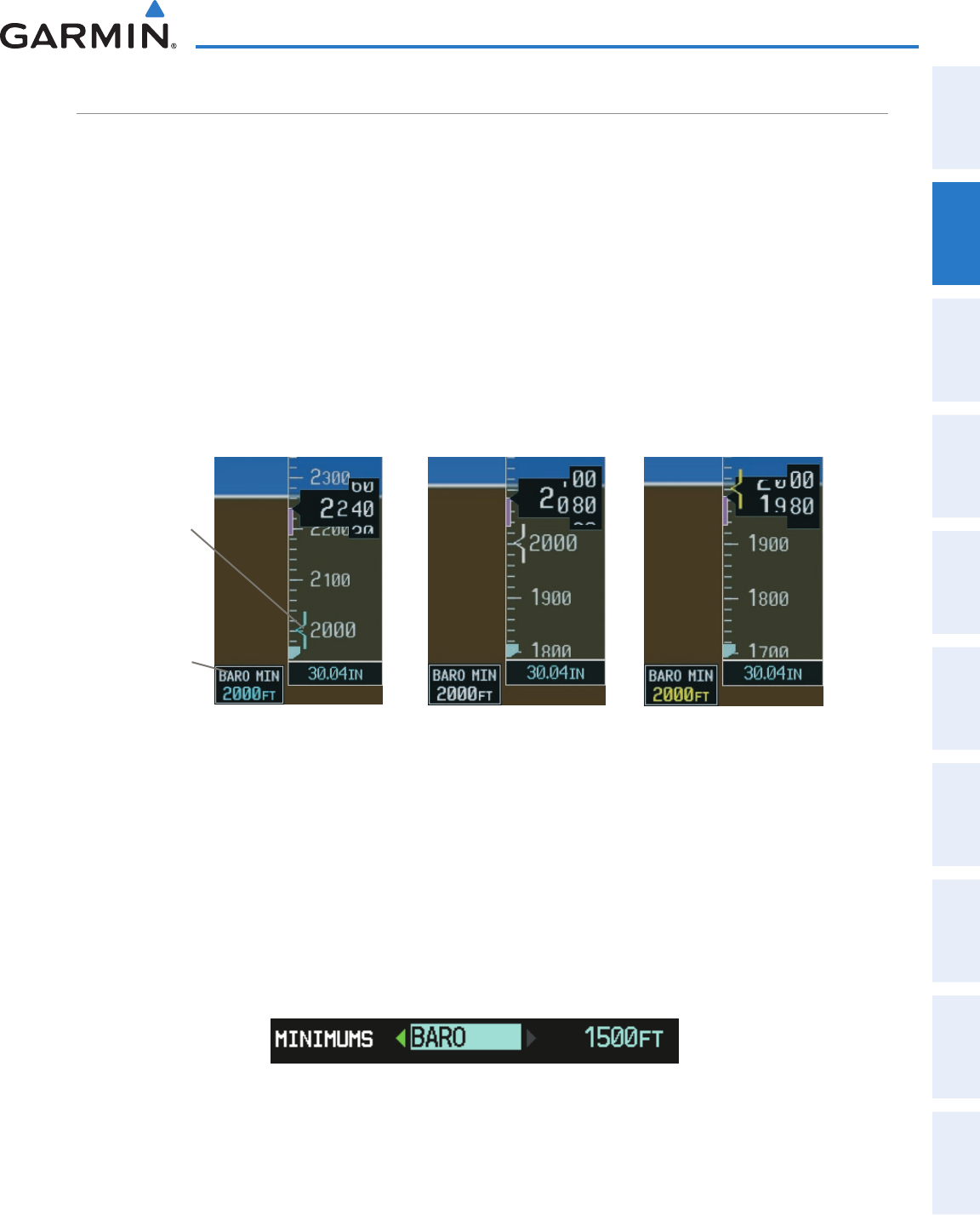
190-00592-06 Rev. A
Garmin G1000 Pilot’s Guide for the Diamond DA40/40F
73
FLIGHT INSTRUMENTS
SYSTEM
OVERVIEW
FLIGHT
INSTRUMENTS EIS AUDIO PANEL
& CNS
FLIGHT
MANAGEMENT
HAZARD
AVOIDANCE AFCS ADDITIONAL
FEATURES APPENDICES INDEX
MINIMUM DESCENT ALTITUDE/DECISION HEIGHT ALERTING
For altitude awareness, a barometric Minimum Descent Altitude (MDA) or Decision Height (DH) can be set
in the Timer/References Window and is reset when the power is cycled. When active, the altitude setting is
displayed to the bottom left of the Altimeter. Once the altitude is within the range of the tape, a bug appears
at the reference altitude on the Altimeter. The following visual annunciations occur when approaching the
MDA/DH:
•Whentheaircraftaltitudedescendstowithin2500feetoftheMDA/DHsetting,theBAROMINboxappears
with the altitude in light blue text. The bug appears on the altitude tape in light blue once in range.
•Whentheaircraftpassesthrough100feetoftheMDA/DH,thebugandtextturnwhite.
•OncetheaircraftreachesMDA/DH,thebugandtextturnyellowandtheauralalert,“Minimums.Minimums”,
is heard.
Figure 2-40 Barometric MDA/DH Alerting Visual Annunciations
Barometric
Minimum
Box
Barometric
Minimum
Bug
Light Blue Within 2500 ft Yellow When Altitude ReachedWhite Within 100 ft
Setting the barometric Minimum Descent Altitude/Decision Height and bug:
1) Press the
TMR/REF
Softkey.
2) Turn the large FMS Knob to highlight the Minimums field.
3) Turn the small FMS Knob to select BARO. Off is selected by default. Press the ENT Key or turn the large FMS
Knob to highlight the next field.
4) Use the small FMS Knob to enter the desired altitude from zero to 16,000 feet.
5) To remove the window, press the
CLR
Key or the
TMR/REF
Softkey.
Figure 2-41 Barometric MDA/DH
Alerting is inhibited while the aircraft is on the ground and until the aircraft reaches 150 feet above the MDA.
If the aircraft proceeds to climb after having reached the MDA, once it reaches 50 feet above the MDA, alerting
is disabled.
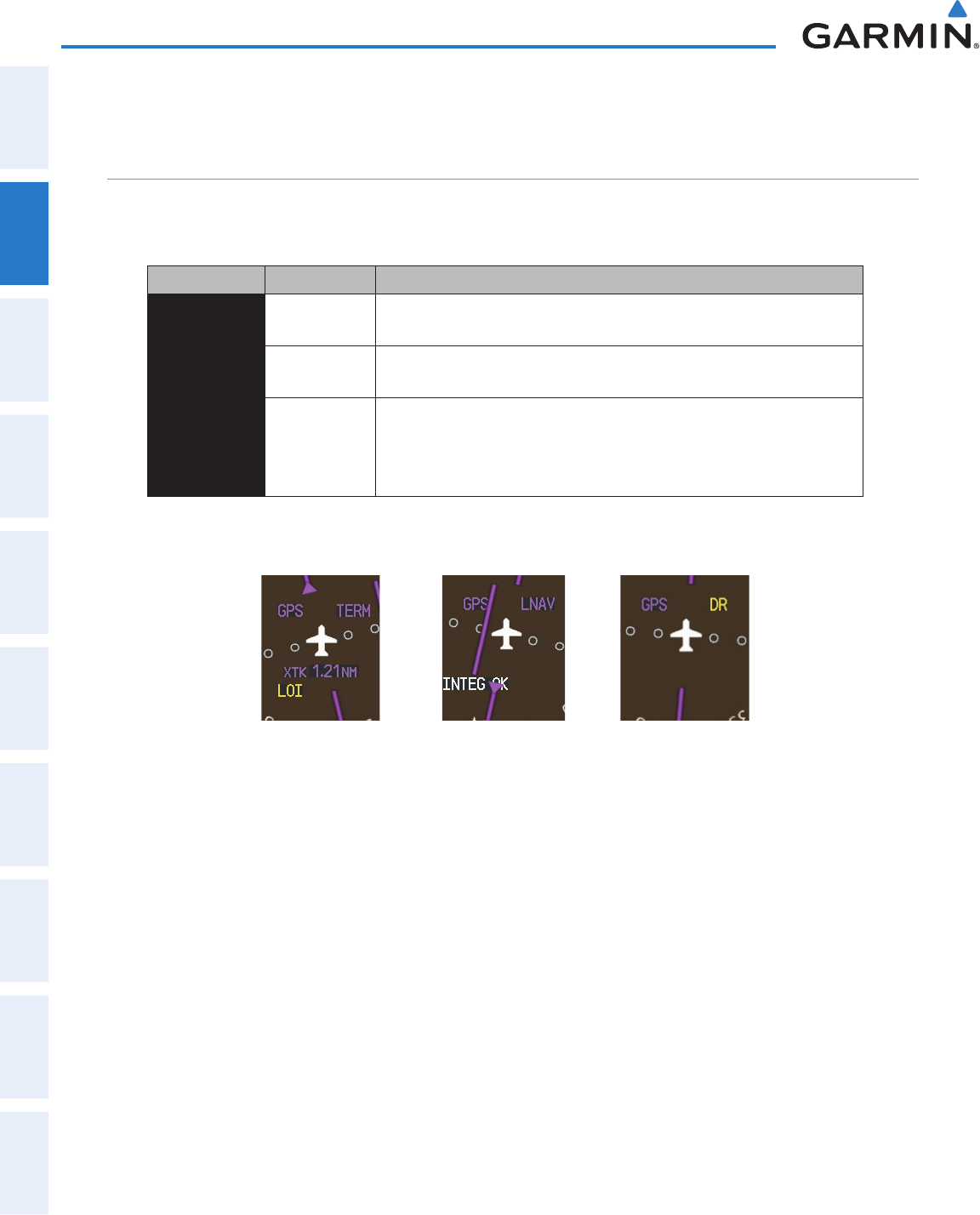
Garmin G1000 Pilot’s Guide for the Diamond DA40/40F
190-00592-06 Rev. A74
FLIGHT INSTRUMENTS
SYSTEM
OVERVIEW
FLIGHT
INSTRUMENTS
EIS
AUDIO PANEL
& CNS
FLIGHT
MANAGEMENT
HAZARD
AVOIDANCE
AFCS
ADDITIONAL
FEATURES
APPENDICESINDEX
2.4 ABNORMAL OPERATIONS
ABNORMAL GPS CONDITIONS
The annunciations listed in the table can appear on the HSI when abnormal GPS conditions occur. Refer to
the Flight Management Section for more information on Dead Reckoning (DR) Mode.
Annunciation Location Description
LOI Lower left of
aircraft symbol
Loss of Integrity Monitoring–GPS integrity is insufficient for the current
phase of flight
INTEG OK Lower left of
aircraft symbol
Integrity OK–GPS integrity has been restored to within normal limits
(annunciation displayed for 5 seconds)
DR
Upper right of
aircraft symbol
and PFD Inset
Map
Dead Reckoning–System is using projected position rather than GPS position
to compute navigation data and sequence active flight plan waypoints
Table 2-3 Abnormal GPS Conditions Annunciated on HSI
Figure 2-42 Example HSI Annunciations
In DR Mode the CDI is removed from the display when GPS is the selected navigation source. In addition, all
GPS-derived data is computed based upon an estimated position and is displayed as yellow text on the display
to denote degraded navigation source information. This data includes the following:
•NavigationStatusBoxeldsexceptActiveLeg,TAS,andDTK
•GPSBearingPointer
•WinddataandpointersintheWindDataBoxonthePFD
•TrackIndicator
•AllBearingPointerDistances
•ActiveFlightPlandistances,bearings,andETEvalues
These items should be verified when operating in Dead Reckoning Mode.
Also, while the G1000 is in DR Mode, the autopilot will not couple to GPS, and Terrain Proximity, TERRAIN-
SVS, and TAWS are disabled. Additionally, the accuracy of all nearest information (airports, airspaces, and
waypoints) is questionable. Finally, airspace alerts continue to function, but with degraded accuracy.
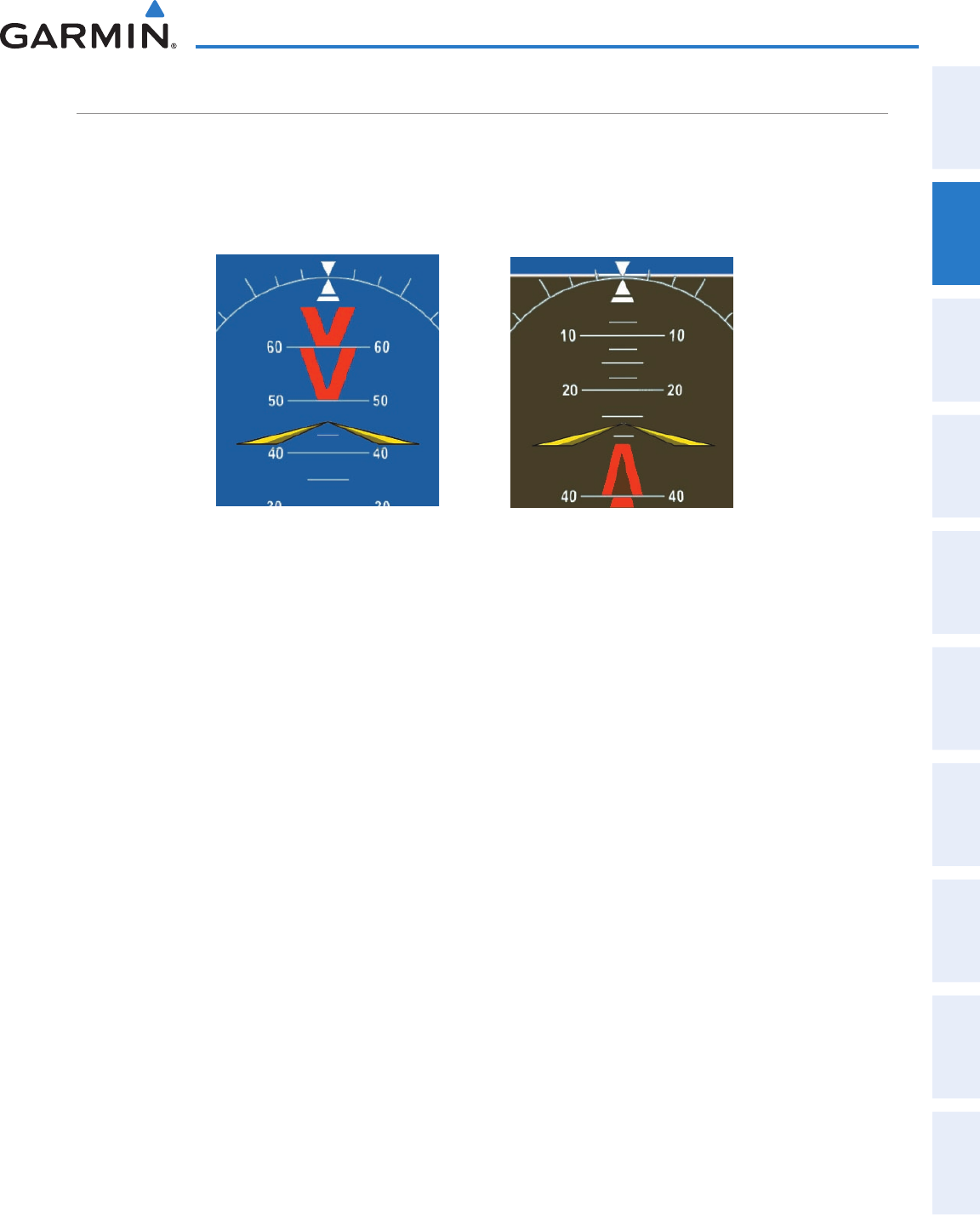
190-00592-06 Rev. A
Garmin G1000 Pilot’s Guide for the Diamond DA40/40F
75
FLIGHT INSTRUMENTS
SYSTEM
OVERVIEW
FLIGHT
INSTRUMENTS EIS AUDIO PANEL
& CNS
FLIGHT
MANAGEMENT
HAZARD
AVOIDANCE AFCS ADDITIONAL
FEATURES APPENDICES INDEX
UNUSUAL ATTITUDES
When the aircraft enters an unusual pitch attitude, red chevrons pointing toward the horizon warn of extreme
pitch. The chevrons are displayed on the Attitude Indicator, starting at 50˚ above and 30˚ below the horizon
line.
Figure 2-43 Pitch Attitude Warnings
Nose Low
Nose High
If pitch exceeds +30˚/-20˚ or bank exceeds 65˚, some information displayed on the PFD is removed. The
Altimeter and Airspeed, Attitude, Vertical Speed, and Horizontal Situation indicators remain on the display
and the Bearing Information, Alerts, and Annunciation windows can be displayed during such situations. The
following information is removed from the PFD and their softkeys are disabled when the aircraft experiences
unusual attitudes:
•TrafcAnnunciations
•AFCSAnnunciations
•FlightdirectorCommandBars
•InsetMap
•Outsideairtemperature(OAT)
•DMEInformationWindow
•Winddata
•TransponderStatusBox
•SystemTime
•PFDSetupMenu
•Windowsdisplayedinthelower
right corner of the PFD:
– Timer/References
– Nearest Airports
– Flight Plan
– Alerts
– Procedures
– ADF/DME Tuning
•MinimumDescentAltitude/
Decision Height readout
•VerticalDeviation,Glideslope,
and Glidepath Indicators
•AltimeterBarometricSetting
•SelectedAltitude
•VNVTargetAltitude
Garmin G1000 Pilot’s Guide for the Diamond DA40/40F
190-00592-06 Rev. A76
FLIGHT INSTRUMENTS
SYSTEM
OVERVIEW
FLIGHT
INSTRUMENTS
EIS
AUDIO PANEL
& CNS
FLIGHT
MANAGEMENT
HAZARD
AVOIDANCE
AFCS
ADDITIONAL
FEATURES
APPENDICESINDEX
Bl a n k Pa g e
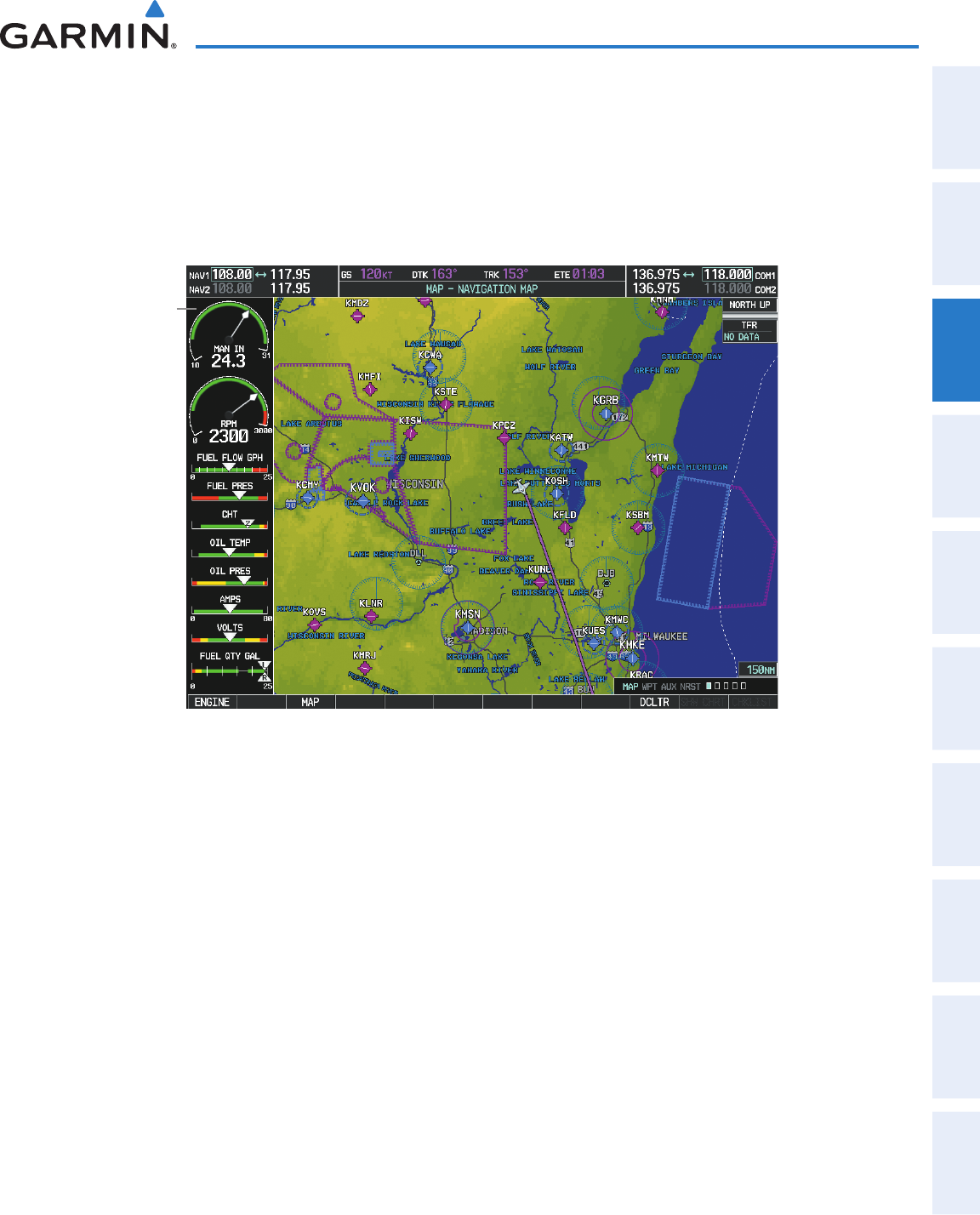
190-00592-06 Rev. A
Garmin G1000 Pilot’s Guide for the Diamond DA40/40F
77
ENGINE INDICATION SYSTEM
SYSTEM
OVERVIEW
FLIGHT
INSTRUMENTS EIS AUDIO PANEL
& CNS
FLIGHT
MANAGEMENT
HAZARD
AVOIDANCE AFCS ADDITIONAL
FEATURES APPENDICES INDEX
SECTION 3 ENGINE INDICATION SYSTEM
The G1000 Engine Indication System (EIS) displays critical engine, electrical, fuel, and other system parameters
on the left side of the Multi Function Display (MFD) during normal operations (Figure 3-1). EIS information can
be fully expanded to an entire page (EIS - Engine Page) using the ENGINE Softkey. In Reversionary Mode, the
displays are re-configured to present Primary Flight Display (PFD) symbology together with the EIS.
EIS Display
Figure 3-1 MFD (DA40)
Green bands on the instruments indicate normal ranges of operation; yellow and red bands indicate caution
and warning, respectively. White or uncolored bands indicate areas outside of normal operation not yet in the
caution or warning ranges. When unsafe operating conditions occur, the corresponding readouts flash to indicate
cautions and warnings. If sensory data to an instrument becomes invalid or unavailable, a red “X” is displayed
across the instrument.
Garmin G1000 Pilot’s Guide for the Diamond DA40/40F
190-00592-06 Rev. A78
ENGINE INDICATION SYSTEM
SYSTEM
OVERVIEW
FLIGHT
INSTRUMENTS
EIS
AUDIO PANEL
& CNS
FLIGHT
MANAGEMENT
HAZARD
AVOIDANCE
AFCS
ADDITIONAL
FEATURES
APPENDICESINDEX
3.1 EIS DISPLAY
1
Engine Manifold Pressure
Gauge (MAN IN HG)
Displays manifold pressure in inches of Mercury (in Hg) to indicate
engine power (DA40 only)
2
Tachometer (RPM) Displays propeller speed in revolutions per minute (rpm); the red band
indicates propeller overspeed
3
Fuel Flow Indicator
(FUEL FLOW GPH)
Displays current fuel flow in gallons per hour (gph)
4
Fuel Pressure Indicator
(FUEL PRESS PSI)
Displays the fuel pressure in pounds per square inch (psi) (Option for
EASA certified DA40 aircraft only)
5
Cylinder Head Temperature
Indicator (CHT)
Displays the head temperature of the hottest cylinder (number is shown
in pointer)
6
Oil Temperature Indicator
(OIL TEMP)
Displays engine oil temperature
7
Oil Pressure Indicator
(OIL PRES)
Displays pressure of oil supplied to the engine
8
Ammeter (AMPS) Displays the alternator load in amperes
9
Voltmeter (VOLTS) Displays the primary bus voltage
10
Fuel Quantity Indicator
(FUEL QTY GAL)
Displays the quantity, in gallons (gal), of fuel in the tanks; pointers labeled
L and R indicate the fuel quantity in each tank
Standard Tanks: Indicator ranges from 0 to 20 gal with tick marks every 5
gal; only displays to 17 gal per side when full
Long Range Tanks (optional): Indicator ranges from 0 to 25 gal with tick
marks every 5 gal; only displays to 24 gal per side when full
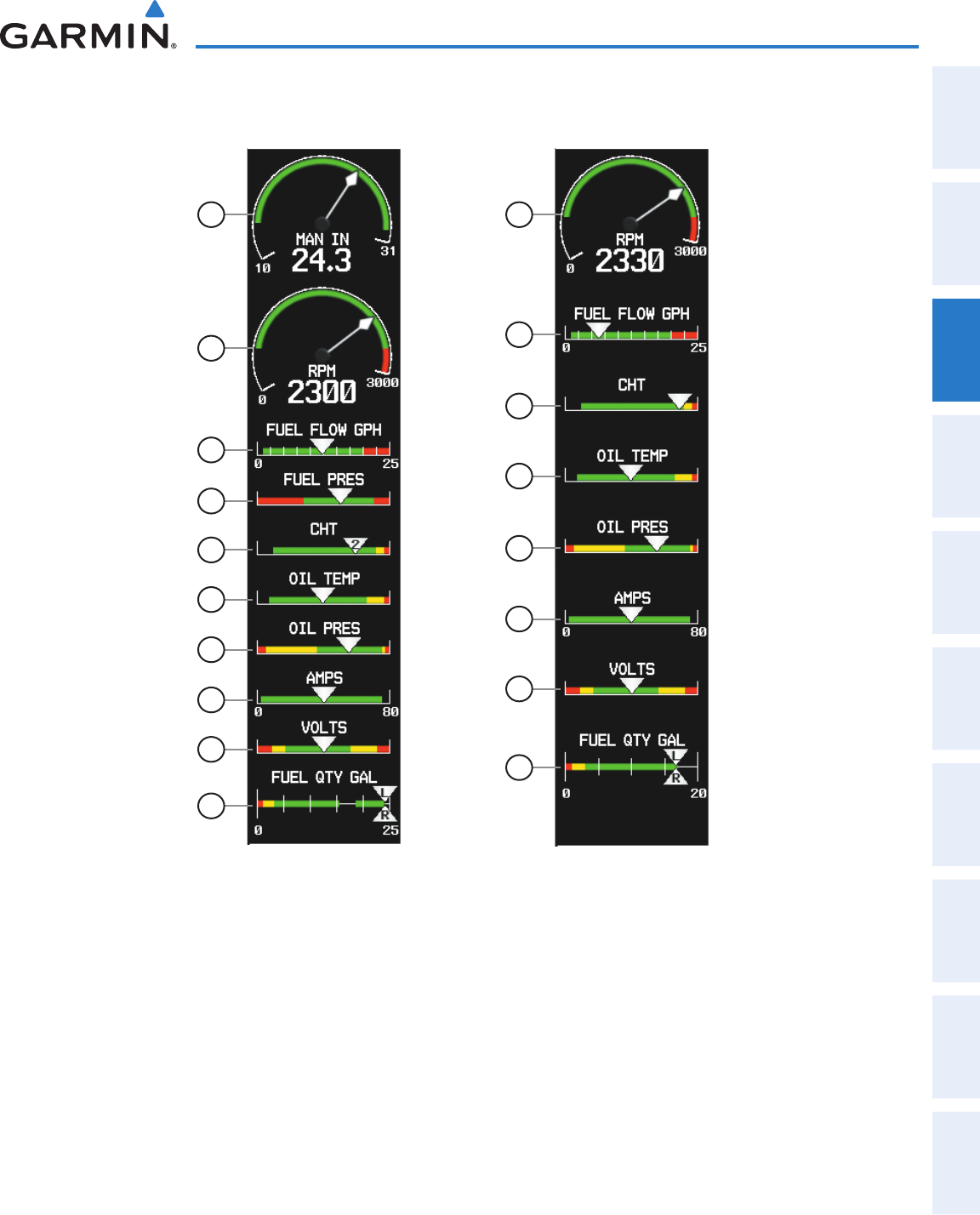
190-00592-06 Rev. A
Garmin G1000 Pilot’s Guide for the Diamond DA40/40F
79
ENGINE INDICATION SYSTEM
SYSTEM
OVERVIEW
FLIGHT
INSTRUMENTS EIS AUDIO PANEL
& CNS
FLIGHT
MANAGEMENT
HAZARD
AVOIDANCE AFCS ADDITIONAL
FEATURES APPENDICES INDEX
Figure 3-2 EIS Display
DA40F
7
10
5
3
2
6
9
8
DA40
7
10
5
4
3
2
1
6
9
8
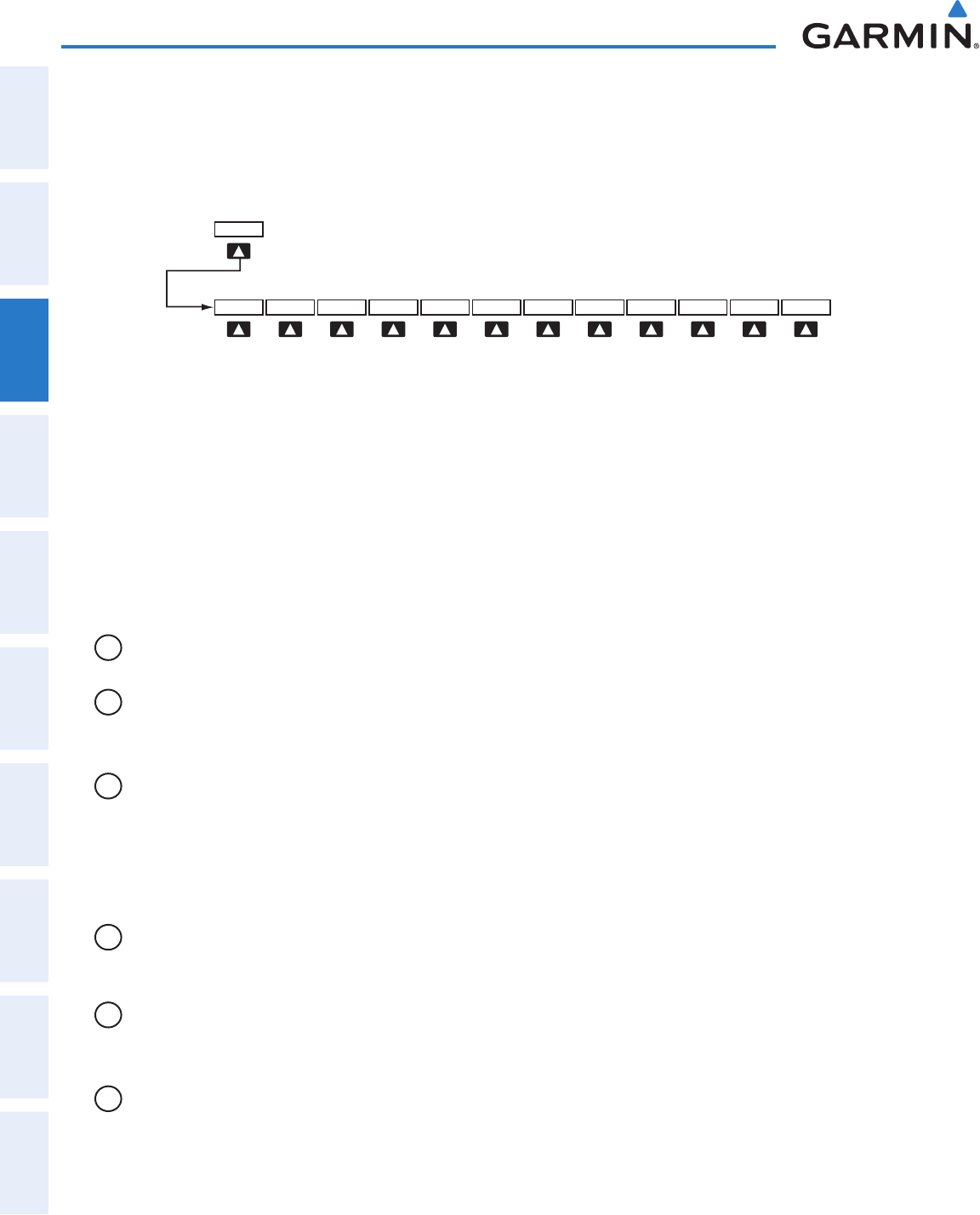
Garmin G1000 Pilot’s Guide for the Diamond DA40/40F
190-00592-06 Rev. A80
ENGINE INDICATION SYSTEM
SYSTEM
OVERVIEW
FLIGHT
INSTRUMENTS
EIS
AUDIO PANEL
& CNS
FLIGHT
MANAGEMENT
HAZARD
AVOIDANCE
AFCS
ADDITIONAL
FEATURES
APPENDICESINDEX
3.2 ENGINE PAGE
Pressing the ENGINE Softkey accesses the EIS - Engine Page, which displays all engine, fuel, fuel calculation,
electrical, and trim information.
Figure 3-3 Engine Page Softkeys
ENGINE
Press the ENGINE Softkey to
return to the top-level softkeys.
INC FUEL RST FUEL LEAN DEC FUEL
ENGINE
Press the BACK Softkey to
return to the top-level softkeys.
SYSTEM
ENGINE LEAN BACK
SYSTEM
ENGINE LEAN BACK
ENGINE
CYL SLCT ASSIST
SYSTEMENGINE LEAN BACK
DEC FUEL INC FUEL RST FUEL
ENGINE Displays EIS - Engine Page and second-level engine softkeys; press again to exit page
LEAN Accesses Leaning Assist Mode
DEC FUEL Decreases displayed fuel remaining in 1-gal increments
INC FUEL Increases displayed fuel remaining in 1-gal increments
RST FUEL Resets displayed fuel remaining to maximum fuel capacity for aircraft and fuel used to zero
1
Engine Manifold Pressure
Gauge (MAN IN HG)
Displays manifold pressure in inches of Mercury (in Hg) to indicate engine
power (DA40 only)
2
Oil Temperature and
Pressure Gauges
(OIL °F PSI)
Displays oil temperature in degrees Fahrenheit (°F) and pressure in pounds
per square inch (psi)
3
Fuel Quantity Gauges
(L/R FUEL QTY GAL)
Display the amount of fuel in gallons (gal) of fuel in the tanks.
Standard Tanks: Indicator ranges from 0 to 20 gal with tick marks every 5
gal; only displays to 17 gal per side when full
Long Range Tanks (optional): Indicator ranges from 0 to 25 gal with tick
marks every 5 gal; only displays to 24 gal per side when full
4
Total Time in Service
(TTL TIME IN SVC)
Displays the total flight hours and is activated when the aircraft becomes
airborne (note that time airborne does not necessarily correspond to
tachometer time)
5
Fuel Calculations Group
(FUEL CALCULATOR)
Displays calculated fuel used, endurance, and range (in nautical miles,
RANGE NM) based on the displayed fuel remaining and the fuel flow
totalizer
6
Electrical Group
(ELECTRICAL)
Displays the alternator load in amperes and the primary bus voltage
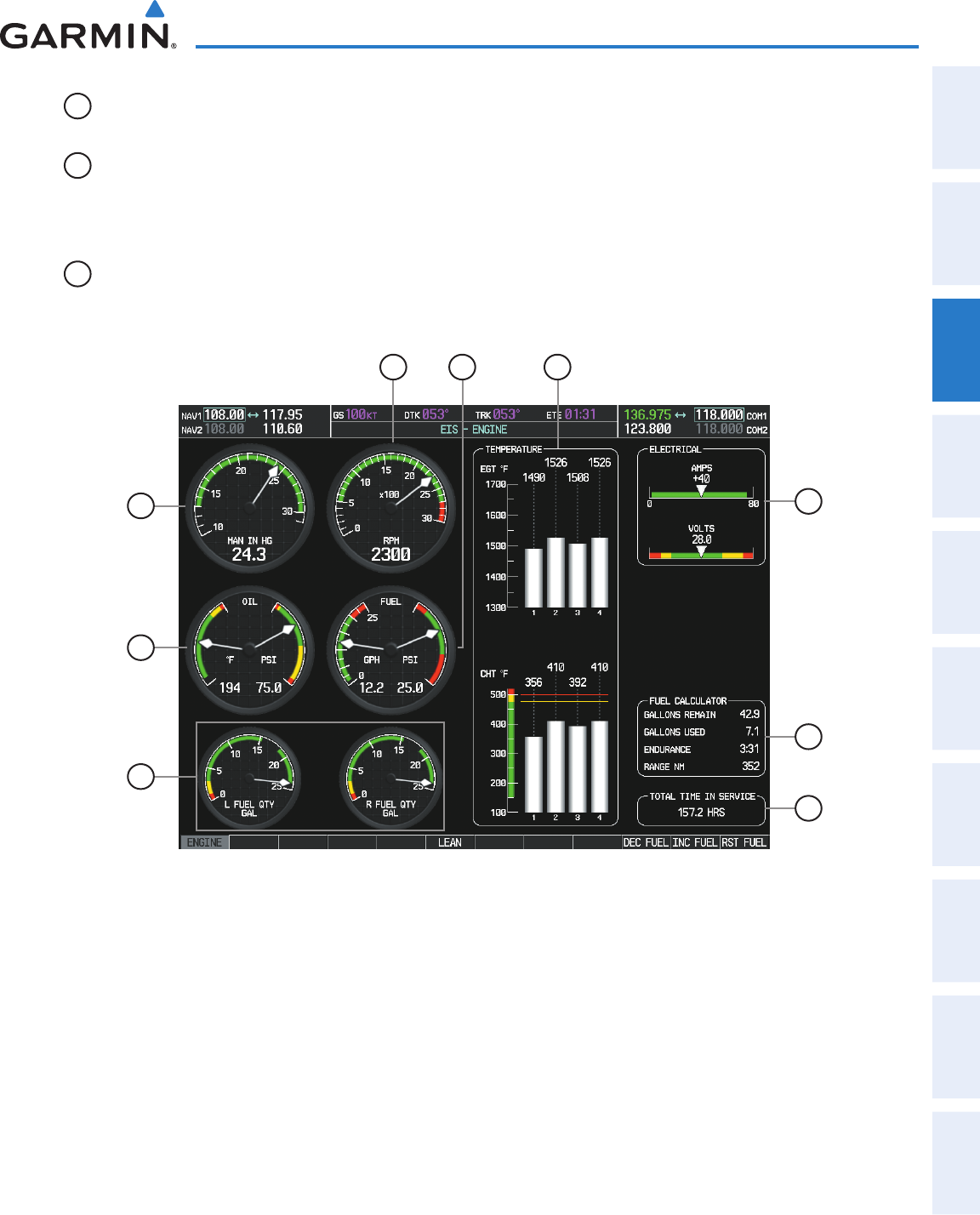
190-00592-06 Rev. A
Garmin G1000 Pilot’s Guide for the Diamond DA40/40F
81
ENGINE INDICATION SYSTEM
SYSTEM
OVERVIEW
FLIGHT
INSTRUMENTS EIS AUDIO PANEL
& CNS
FLIGHT
MANAGEMENT
HAZARD
AVOIDANCE AFCS ADDITIONAL
FEATURES APPENDICES INDEX
7
Engine Temperature
Group (TEMPERATURE)
Displays exhaust gas (EGT) and head (CHT) temperatures of all cylinders in °F
8
Fuel Flow and Pressure
Gauge (FUEL GPH PSI)
Fuel pressure option EASA
certified DA40 aircraft only
Displays fuel flow in gallons per hour (gph) and fuel pressure in pounds
per square inch (psi)
9
Tachometer (RPM) Displays propeller speed in revolutions per minute (rpm); the red band
indicates propeller overspeed
1
9 8
3
2
Figure 3-4 Engine Page (DA40)
6
4
5
7
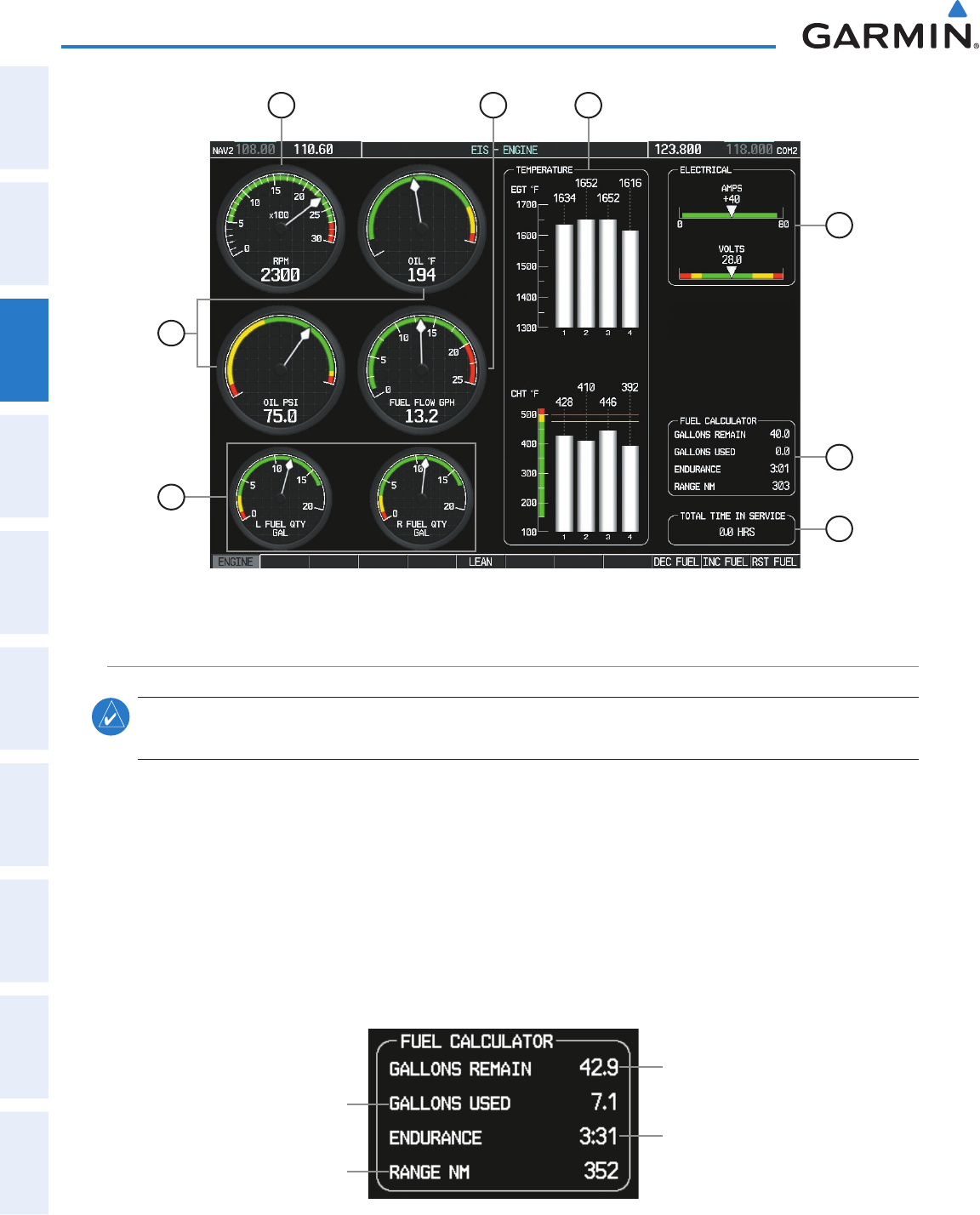
Garmin G1000 Pilot’s Guide for the Diamond DA40/40F
190-00592-06 Rev. A82
ENGINE INDICATION SYSTEM
SYSTEM
OVERVIEW
FLIGHT
INSTRUMENTS
EIS
AUDIO PANEL
& CNS
FLIGHT
MANAGEMENT
HAZARD
AVOIDANCE
AFCS
ADDITIONAL
FEATURES
APPENDICESINDEX
9 8
3
Figure 3-5 Engine Page (DA40F)
6
4
5
7
2
FUEL CALCULATIONS
NOTE: Fuel calculations do not use the aircraft fuel quantity indicators and are calculated from the last time
the fuel was reset.
Fuel used (GAL USED), endurance (ENDUR), and range (in nautical miles, RANGE NM) are calculated
based on the displayed fuel remaining (GAL REM) and the fuel flow totalizer. The calculated range also takes
into account the aircraft’s heading and the wind direction and speed. See the Flight Management Section for
information regarding the map feature related to the EIS Fuel Calculations.
Adjusting the fuel totalizer quantity:
On the Engine Page, use the DEC FUEL and INC FUEL softkeys to obtain the desired fuel remaining (GAL REM).
Resetting the fuel totalizer:
On the Engine Page, press the
RST FUEL
Softkey; this also resets the fuel remaining (GAL REM) to zero.
Calculated
Range
Calculated
Fuel Used Calculated
Endurance
Set Fuel
Remaining
Figure 3-6 Fuel Calculations Group
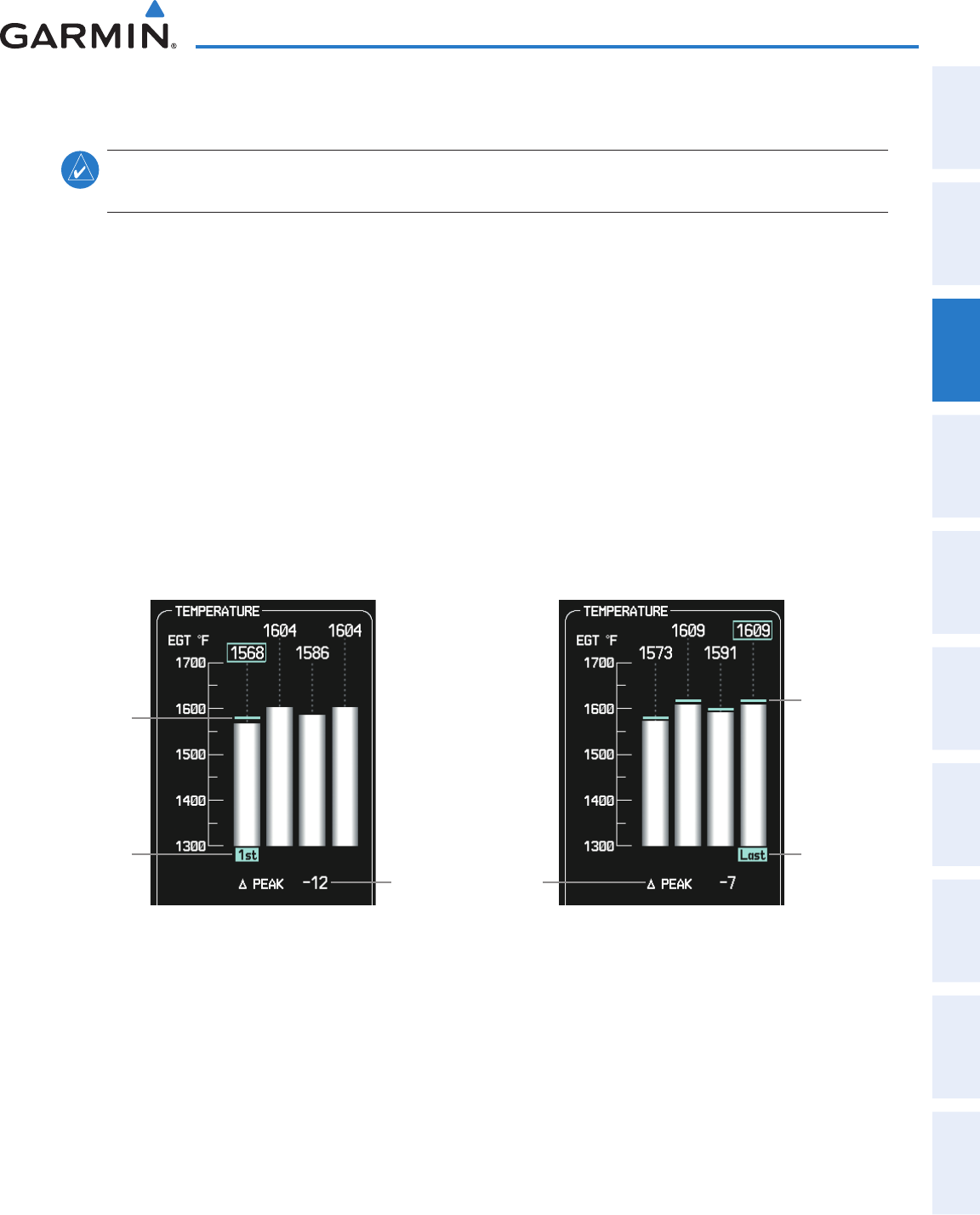
190-00592-06 Rev. A
Garmin G1000 Pilot’s Guide for the Diamond DA40/40F
83
ENGINE INDICATION SYSTEM
SYSTEM
OVERVIEW
FLIGHT
INSTRUMENTS EIS AUDIO PANEL
& CNS
FLIGHT
MANAGEMENT
HAZARD
AVOIDANCE AFCS ADDITIONAL
FEATURES APPENDICES INDEX
3.3 LEANING ASSIST MODE
NOTE
: The pilot should follow the engine manufacturer’s recommended leaning procedures in the Aircraft
Flight Manual Supplement (AFMS).
A leaning assist function is available on the Engine Page to assist in the leaning process.
Accessing Leaning Assist Mode:
1) Press the ENGINE Softkey to open the Engine Page.
2) Press the LEAN Softkey to identify peaks.
3) Press the LEAN Softkey again to exit Leaning Assist Mode.
When the LEAN Softkey is pressed, the system initially highlights the number and EGT readout of the cylinder
with the hottest EGT. The ∆ Peak temperature is the difference between the peak temperature and the present
temperature for the peaked cylinder. When the first peak is detected, “1st” is annunciated below that cylinder’s
EGT bar and the temperature is marked in light blue on the graph.
The system continues to detect peak EGTs for each cylinder lean of peak as the fuel flow is decreased, and the
peak of each cylinder’s EGT is indicated by a light blue marker on the graph. Once all cylinders are lean of peak,
the last cylinder to peak is denoted by the “Last” annunciation below its bar on the graph.
Figure 3-7 Leaning Assist Mode
Light Blue Bar
Represents Peak
Indicates First
Cylinder to Peak
Indicates Last
Cylinder to Peak
Light Blue Bars
Represent Peaks
Current Difference
from Peak Temperature
(Selected Cylinder)
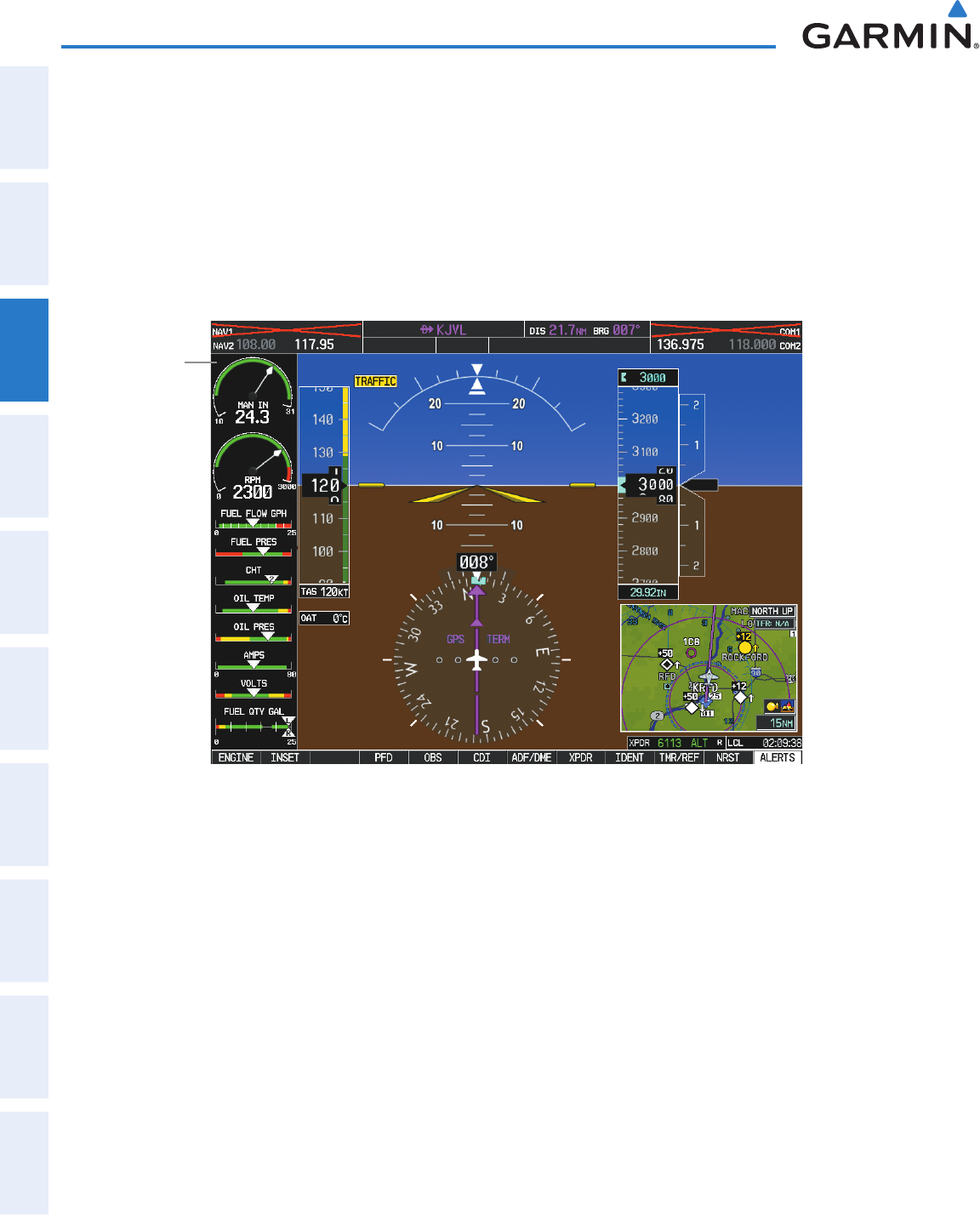
Garmin G1000 Pilot’s Guide for the Diamond DA40/40F
190-00592-06 Rev. A84
ENGINE INDICATION SYSTEM
SYSTEM
OVERVIEW
FLIGHT
INSTRUMENTS
EIS
AUDIO PANEL
& CNS
FLIGHT
MANAGEMENT
HAZARD
AVOIDANCE
AFCS
ADDITIONAL
FEATURES
APPENDICESINDEX
3.4 EIS DISPLAY IN REVERSIONARY MODE
In reversionary display mode, the remaining display is re-configured to present PFD symbology together with
the EIS Display (refer to the System Overview for information about display Reversionary Mode).
When the G1000 displays enter reversionary mode, the EIS is separated into three displays: Engine (identical to
the normal EIS Display on the MFD), Lean, and System. For a description of the Engine Display, refer to Section
3.1. The Lean Display presents temperature information and assistance for engine leaning. The System Display
shows various system parameters and fuel calculations.
Figure 3-8 Reversionary Mode (DA40)
EIS Display
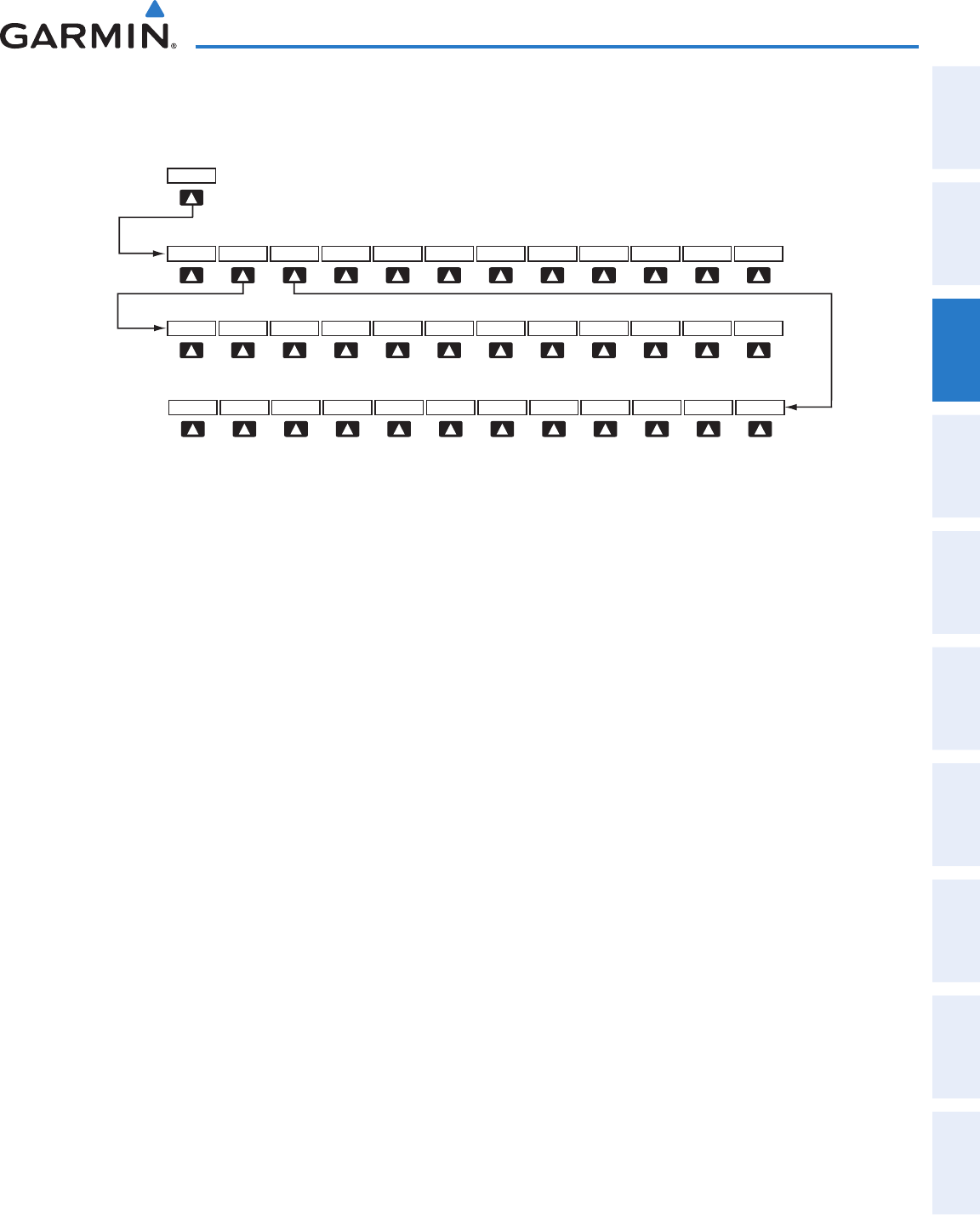
190-00592-06 Rev. A
Garmin G1000 Pilot’s Guide for the Diamond DA40/40F
85
ENGINE INDICATION SYSTEM
SYSTEM
OVERVIEW
FLIGHT
INSTRUMENTS EIS AUDIO PANEL
& CNS
FLIGHT
MANAGEMENT
HAZARD
AVOIDANCE AFCS ADDITIONAL
FEATURES APPENDICES INDEX
The Engine Display is shown by default. To return to the Engine Display from the Lean or System Display, press
the ENGINE or BACK Softkey.
Figure 3-9 EIS Softkeys (Reversionary Mode)
ENGINE
Press the ENGINE Softkey to
return to the top-level softkeys.
INC FUEL RST FUEL LEAN DEC FUEL
ENGINE
Press the BACK Softkey to
return to the top-level softkeys.
SYSTEM
ENGINE LEAN BACK
SYSTEM
ENGINE LEAN BACK
ENGINE
CYL SLCT ASSIST
SYSTEMENGINE LEAN BACK
DEC FUEL INC FUEL RST FUEL
•ENGINE Displays second-level engine softkeys
•LEAN Displays the EIS Lean Display
CYL SLCT Cycles through the cylinders to obtain information about a particular cylinder, shown in
light blue on the bar graphs
ASSIST Accesses Leaning Assist Mode
•SYSTEM Displays the EIS System Display
DEC FUEL Decreases displayed fuel remaining in 1-gal increments
INC FUEL Increases displayed fuel remaining in 1-gal increments
RST FUEL Resets displayed fuel remaining to maximum fuel capacity for aircraft and fuel used to zero
Garmin G1000 Pilot’s Guide for the Diamond DA40/40F
190-00592-06 Rev. A86
ENGINE INDICATION SYSTEM
SYSTEM
OVERVIEW
FLIGHT
INSTRUMENTS
EIS
AUDIO PANEL
& CNS
FLIGHT
MANAGEMENT
HAZARD
AVOIDANCE
AFCS
ADDITIONAL
FEATURES
APPENDICESINDEX
LEAN DISPLAY
NOTE
: The pilot should follow the engine manufacturer’s recommended leaning procedures in the Aircraft
Flight Manual Supplement (AFMS).
The EIS Lean Display provides information and a user interface to perform engine leaning. Exhaust gas
(EGT) and head (CHT) temperatures for each cylinder are displayed in bar graph form with a readout for the
temperature of the selected cylinder shown below each graph.
Accessing the EIS Lean Display:
1) Press the ENGINE Softkey.
2) Press the LEAN Softkey.
3) To return to the default Engine Display, press the ENGINE or BACK Softkey.
By default, the cylinder with the hottest temperature is selected (number highlighted in light blue) when the
LEAN Softkey is pressed. Bars for cylinders with temperatures in the normal range are shown in white. On the
CHT Bar Graph, caution and warning conditions are indicated in yellow and red, respectively.
Since only one cylinder’s EGT and CHT are displayed at a time, this information can be cycled through for
each cylinder using the CYL SLCT Softkey; the selected cylinder’s number is highlighted in light blue on the
bar graphs. This softkey is disabled when Leaning Assist Mode is selected.
Monitoring the desired cylinder’s temperatures:
From the Lean Display, press the CYL SLCT Softkey to cycle through each cylinder and view its temperature
information. The selected cylinder number is highlighted in light blue.
While in Reversionary Mode, the leaning assist function is available when the ASSIST Softkey is pressed
from the Lean Display to assist in the leaning process (refer to the section on Leaning Assist Mode for more
information).
1
Engine Manifold Pressure
Gauge (MAN IN HG)
Displays manifold pressure in inches of Mercury (in Hg) to indicate engine
power (DA40 only)
2
Tachometer (RPM) Displays propeller speed in revolutions per minute (rpm); the red band
indicates propeller overspeed
3
Fuel Flow (FFLOW GPH) Displays current fuel flow in gallons per hour (gph)
4
Exhaust Gas Temperature
Bar Graph (EGT °F)
Exhaust Gas Temperature (EGT) for each cylinder is represented as a bar;
below the graph, the EGT readout is given for the selected cylinder
(shown in light blue)
A hollow block appears to represent the peak EGT for the selected cylinder
when the ASSIST Softkey is pressed
5
EGT Deviation from Peak
(∆ PEAK)
Displays the current EGT deviation from peak for the selected cylinder in
degrees Fahrenheit (°F) when the ASSIST Softkey is pressed
6
Cylinder Head Temperature
Bar Graph (CHT °F)
Head temperature for each cylinder is represented as a bar; below the
graph, the CHT readout is given for the selected cylinder (shown in
light blue)
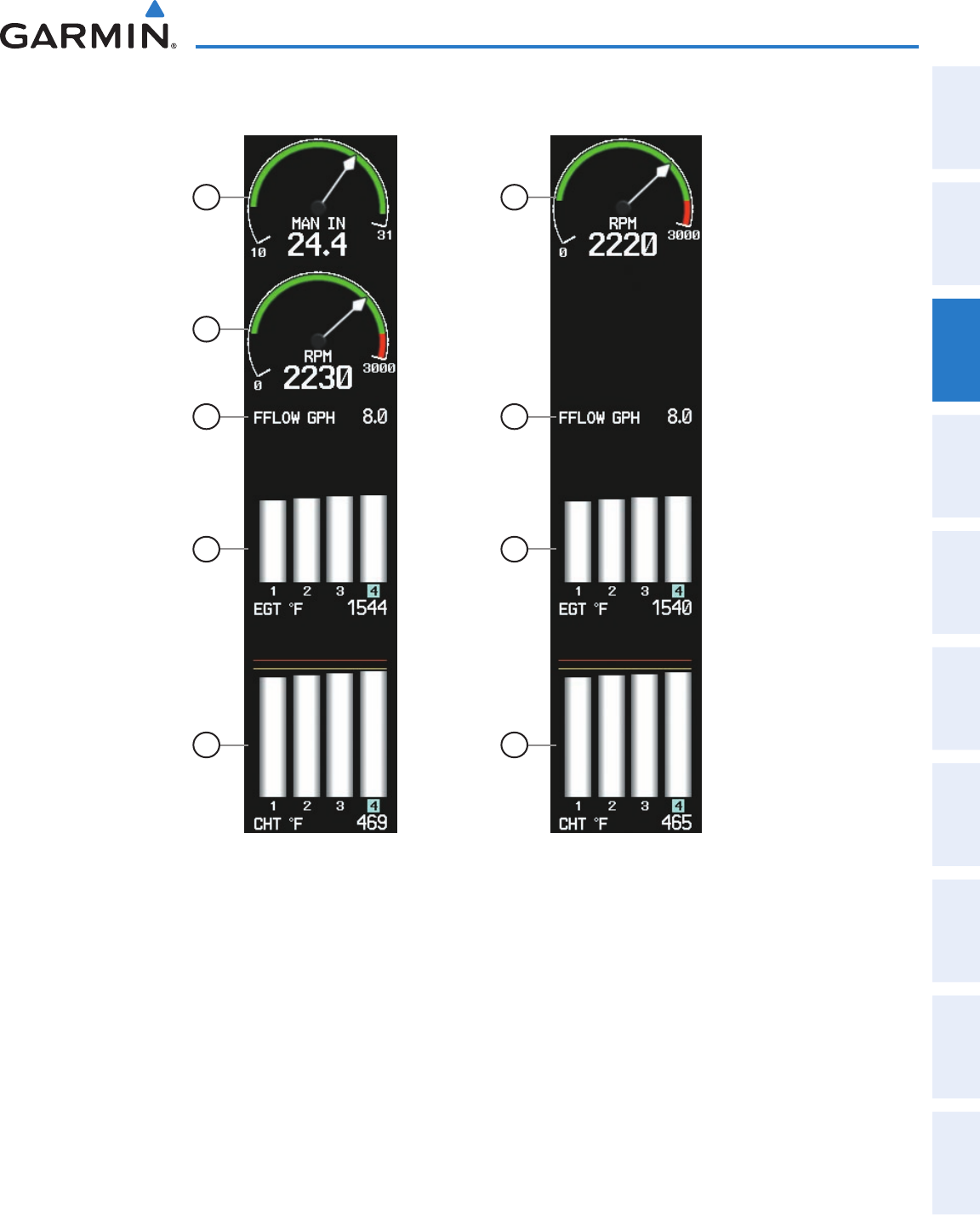
190-00592-06 Rev. A
Garmin G1000 Pilot’s Guide for the Diamond DA40/40F
87
ENGINE INDICATION SYSTEM
SYSTEM
OVERVIEW
FLIGHT
INSTRUMENTS EIS AUDIO PANEL
& CNS
FLIGHT
MANAGEMENT
HAZARD
AVOIDANCE AFCS ADDITIONAL
FEATURES APPENDICES INDEX
Figure 3-10 Lean Display
DA40
1
2
3
4
5
DA40F
2
3
4
5
Garmin G1000 Pilot’s Guide for the Diamond DA40/40F
190-00592-06 Rev. A88
ENGINE INDICATION SYSTEM
SYSTEM
OVERVIEW
FLIGHT
INSTRUMENTS
EIS
AUDIO PANEL
& CNS
FLIGHT
MANAGEMENT
HAZARD
AVOIDANCE
AFCS
ADDITIONAL
FEATURES
APPENDICESINDEX
SYSTEM DISPLAY
NOTE: Fuel calculations do not use the aircraft fuel quantity indicators and are calculated from the last time
the fuel was reset.
NOTE: Refer to the Aircraft Flight Manual Supplement (AFMS) for limitations.
The EIS System Display shows the dial gauges, various system parameters, and fuel calculations. Fuel
calculations are based on the displayed fuel remaining (GAL REM) and the fuel flow totalizer.
Accessing the EIS System Display:
1) Press the ENGINE Softkey.
2) Press the SYSTEM Softkey.
3) To return to the default Engine Display, press the ENGINE or BACK Softkey.
Adjusting the fuel totalizer quantity:
From the System Display, press the
DEC FUEL or INC FUEL
Softkey to adjust the fuel remaining (GAL REM).
Resetting the fuel totalizer:
From the System Display, press the
RST FUEL
Softkey. This also resets the fuel remaining (GAL REM) to zero.
1
Engine Manifold Pressure Gauge
(MAN IN HG)
Displays manifold pressure in inches of Mercury (in Hg) to indicate
engine power (DA40 only)
2
Tachometer (RPM) Shows propeller speed in revolutions per minute (rpm); the red band
indicates propeller overspeed
3
Oil Temperature (OIL °F) Engine oil temperature is shown in degrees Fahrenheit (°F)
4
Oil Pressure (OIL PSI) Pressure of oil supplied to the engine is displayed in pounds per square
inch (psi)
5
Voltmeter (VOLTS) Shows the primary bus voltage
6
Ammeter (AMPS) Shows the alternator load in amperes
7
Fuel Flow (FFLOW GPH) Displays current fuel flow in gallons per hour (gph)
8
Fuel Pressure (FPRESS PSI) Displays the fuel pressure in pounds per square inch (psi) (Option for
EASA certified DA40 aircraft only)
9
Fuel Remaining (GAL REM) Current fuel remaining in gallons as set by the pilot and adjusted for
fuel burn since last set
10
Fuel Used (GAL USED) Quantity of fuel used in gallons
11
Endurance (ENDUR) Flight time remaining with fuel onboard (HH:MM when more than an
hour remains)
12
Range (RANGE NM) Aircraft range in nautical miles
13
Total Time in Service (TTL
TIME IN SVC)
Displays the total flight hours and is activated when the aircraft becomes
airborne (note that time airborne does not necessarily correspond to
tachometer time)
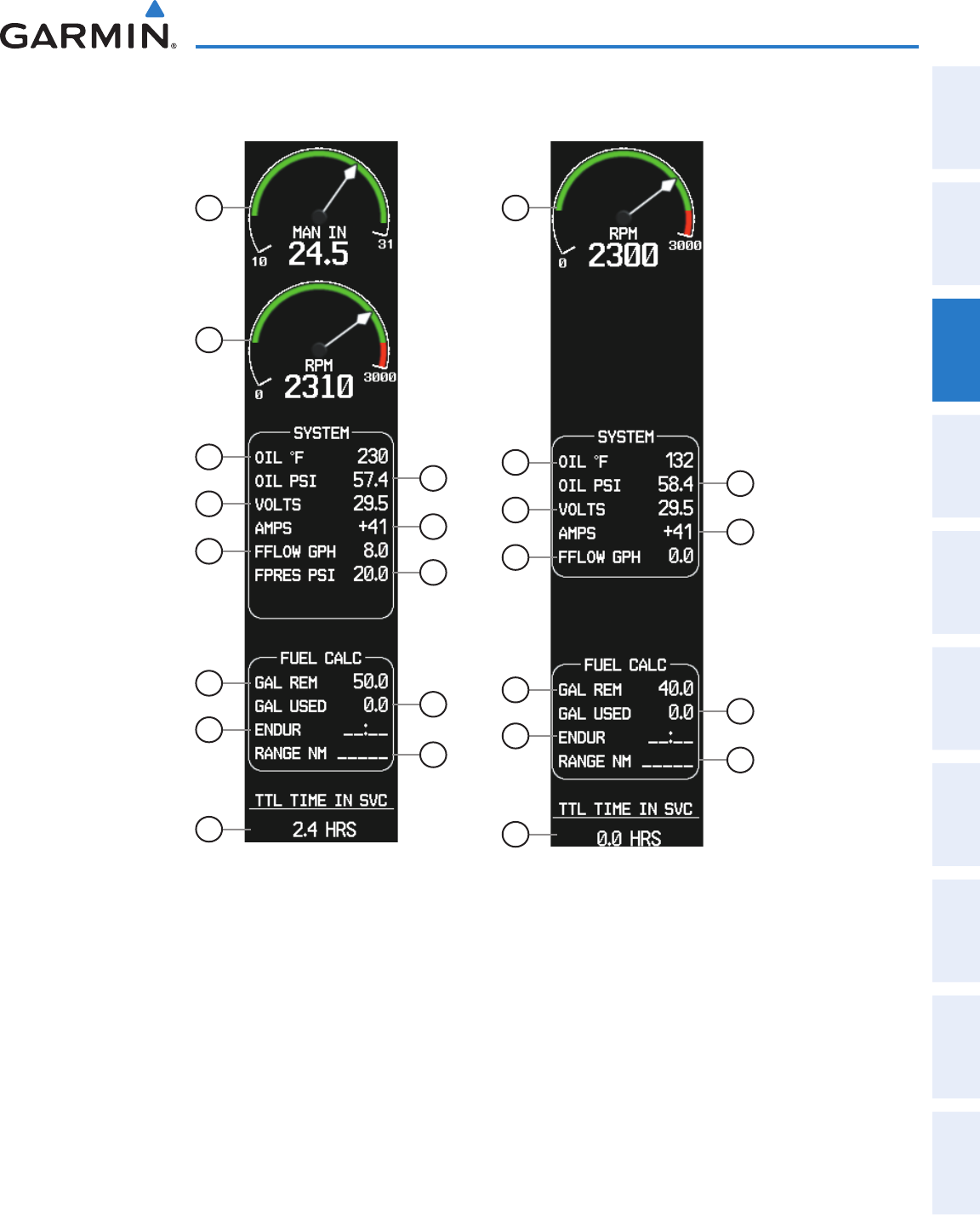
190-00592-06 Rev. A
Garmin G1000 Pilot’s Guide for the Diamond DA40/40F
89
ENGINE INDICATION SYSTEM
SYSTEM
OVERVIEW
FLIGHT
INSTRUMENTS EIS AUDIO PANEL
& CNS
FLIGHT
MANAGEMENT
HAZARD
AVOIDANCE AFCS ADDITIONAL
FEATURES APPENDICES INDEX
Figure 3-11 System Display
DA40
1
2
3
6
4
10
12
8
5
7
9
11
13
DA40F
2
3
6
4
10
12
5
7
9
11
13
Garmin G1000 Pilot’s Guide for the Diamond DA40/40F
190-00592-06 Rev. A90
ENGINE INDICATION SYSTEM
SYSTEM
OVERVIEW
FLIGHT
INSTRUMENTS
EIS
AUDIO PANEL
& CNS
FLIGHT
MANAGEMENT
HAZARD
AVOIDANCE
AFCS
ADDITIONAL
FEATURES
APPENDICESINDEX
Bl a n k Pa g e
190-00592-06 Rev. A
Garmin G1000 Pilot’s Guide for the Diamond DA40/40F
91
AUDIO PANEL AND CNS
SYSTEM
OVERVIEW
FLIGHT
INSTRUMENTS EIS AUDIO PANEL
& CNS
FLIGHT
MANAGEMENT
HAZARD
AVOIDANCE AFCS ADDITIONAL
FEATURES APPENDICES INDEX
SECTION 4 AUDIO PANEL AND CNS
4.1 OVERVIEW
The Communication/Navigation/Surveillance (CNS) system includes the Audio Panel, communication radios,
navigation radios, and Mode S transponder. The System Overview Section provides a block diagram description
of the Audio Panel and CNS system interconnection.
CNS operation in Diamond DA40/40F aircraft is performed by the following Line Replaceable Units (LRUs):
•PrimaryFlightDisplay(PFD)
•MultifunctionDisplay(MFD)
•IntegratedAvionicsUnit(2)
•AudioPanel
•ModeSTransponder
The MFD/PFD controls are used to tune the communication transceivers and navigation radios.
The Audio Panel provides the traditional audio selector functions of microphone and receiver audio selection.
The Audio Panel includes an intercom system (ICS) between the pilot, copilot, and passengers, a marker beacon
receiver, and a COM clearance recorder. Ambient noise from the aircraft radios is reduced by a feature called
Master Avionics Squelch (MASQ). When no audio is detected, MASQ processing further reduces the amount of
background noise from the radios.
The Mode S transponder is controlled with softkeys and the FMS Knob located on the Primary Flight Display
(PFD). The Transponder Data Box is located to the left of the System Time Box. The data box displays the active
four-digit code, mode, and reply status (Figure 4-1).
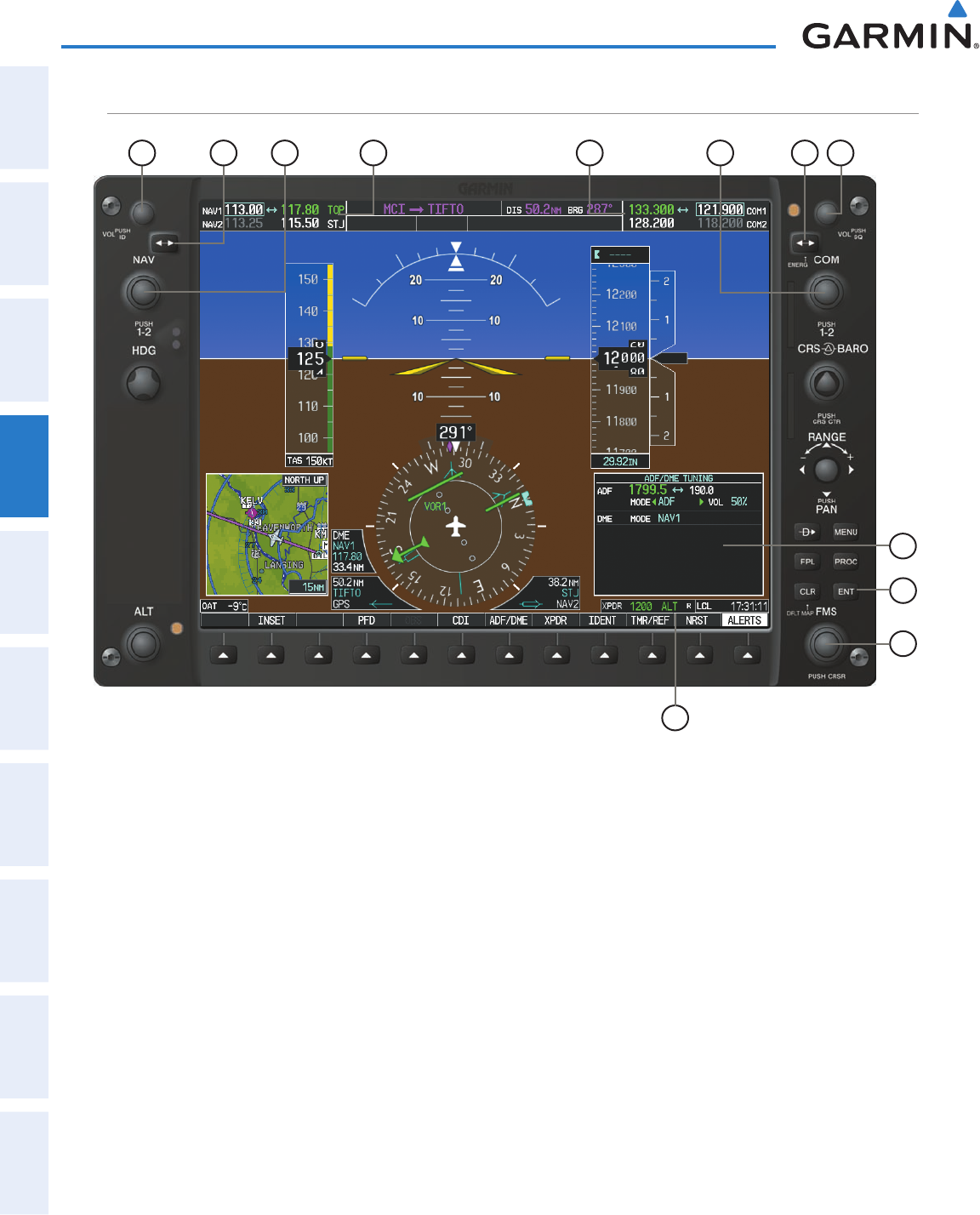
190-00592-06 Rev. A
Garmin G1000 Pilot’s Guide for the Diamond DA40/40F
92
AUDIO PANEL AND CNS
SYSTEM
OVERVIEW
FLIGHT
INSTRUMENTS
EIS
AUDIO PANEL
& CNS
FLIGHT
MANAGEMENT
HAZARD
AVOIDANCE
AFCS
ADDITIONAL
FEATURES
APPENDICESINDEX
MFD/PFD CONTROLS AND FREQUENCY DISPLAY
Figure 4-1 MFD/PFD Controls, COM/NAV Frequency Tuning Boxes, and ADF/DME Tuning Window (PFD Shown)
12
21 68
7
345
9
10
11
190-00592-06 Rev. A
Garmin G1000 Pilot’s Guide for the Diamond DA40/40F
93
AUDIO PANEL AND CNS
SYSTEM
OVERVIEW
FLIGHT
INSTRUMENTS EIS AUDIO PANEL
& CNS
FLIGHT
MANAGEMENT
HAZARD
AVOIDANCE AFCS ADDITIONAL
FEATURES APPENDICES INDEX
1
NAV VOL/ID Knob
– Controls NAV audio volume level. Press to turn the Morse code identifier audio on
and off. Volume level is shown in the NAV frequency field as a percentage.
2
NAV Frequency Transfer Key
– Transfers the standby and active NAV frequencies.
3
NAV Knob
– Tunes the standby frequencies for the NAV receiver (large knob for MHz; small knob for kHz).
Press to move the tuning box (light blue box) and Frequency Transfer Arrow between NAV1 and NAV2.
4
NAV Frequency Box
– Displays NAV standby and active frequency fields, volume, and station ID. The
frequency of the NAV radio selected for navigation is displayed in green.
5
COM Frequency Box
– Displays COM standby and active frequency fields and volume. The selected COM
transceiver frequency is displayed in green.
6
COM Knob
– Tunes the standby frequencies for the COM transceiver (large knob for MHz; small knob for
kHz). Press to move the tuning box (light blue box) and Frequency Transfer Arrow between COM1 and
COM2.
7
COM Frequency Transfer Key
– Transfers the standby and active COM frequencies. Press and hold this key
for two seconds to tune the emergency frequency (121.500 MHz) automatically into the active frequency
field.
8
COM
VOL/SQ Knob
– Controls COM audio volume level. Press to turn the COM automatic squelch on
and off. Volume level is shown in the COM frequency field as a percentage.
9
ADF
/DME Tuning Window
– Displays ADF frequencies, volume setting, and modes, and DME tuning
selection. Display by pressing the ADF/DME Softkey.
10
ENT Key
– Validates or confirms an ADF frequency or ADF/DME mode and Auto-tune selection.
11
FMS Knob
– Flight Management System Knob, used to enter transponder codes, enter ADF frequencies,
select ADF/DME modes, and Auto-tune entries when ADF/DME Tuning Window or NRST Window is
present. Press the FMS Knob to turn the selection cursor on and off. The large knob moves the cursor in
the window. The small knob selects individual characters for the highlighted cursor location.
12
Transponder Data Box
– Indicates the selected transponder code, operating mode, reply, and ident status
for the transponder.
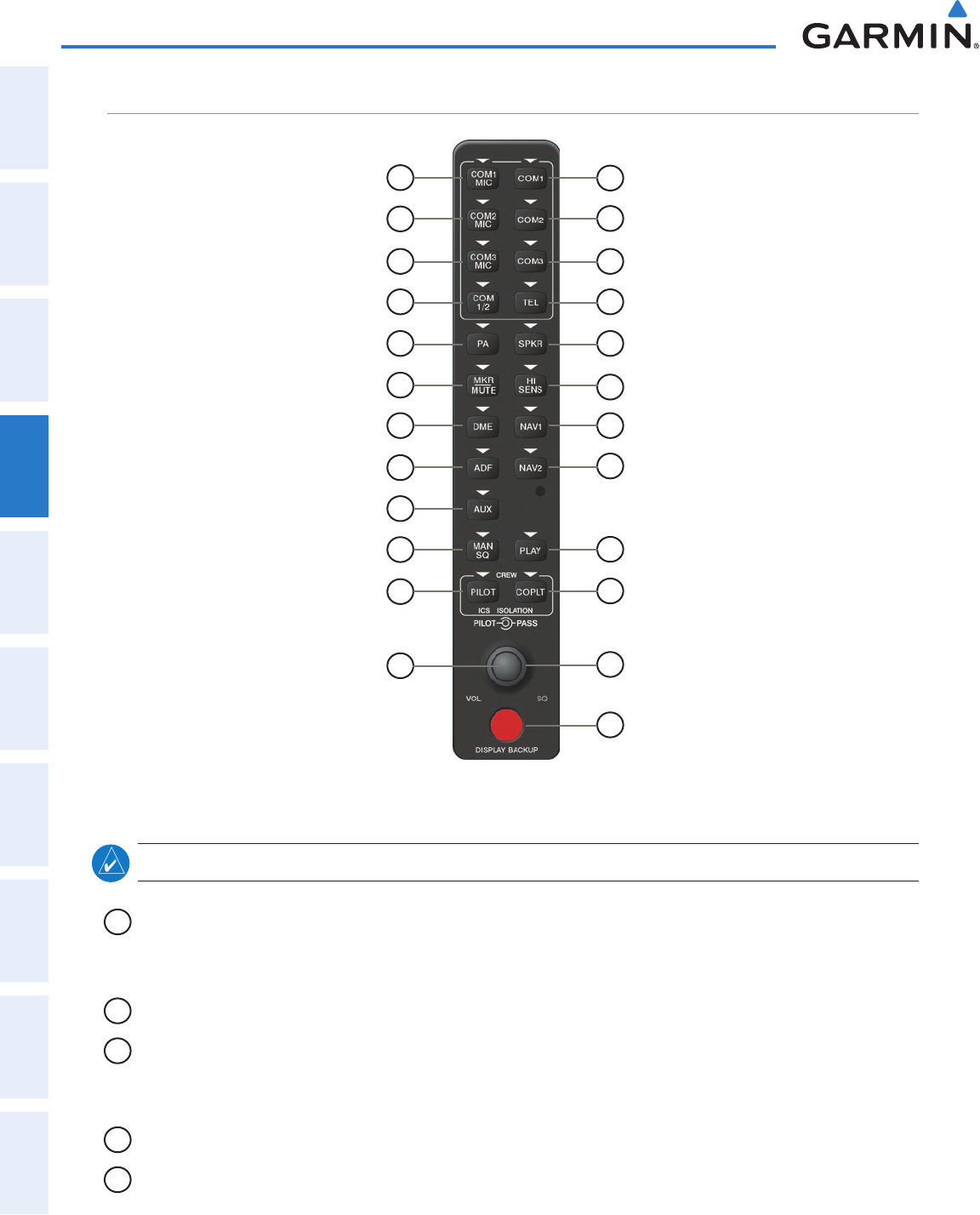
190-00592-06 Rev. A
Garmin G1000 Pilot’s Guide for the Diamond DA40/40F
94
AUDIO PANEL AND CNS
SYSTEM
OVERVIEW
FLIGHT
INSTRUMENTS
EIS
AUDIO PANEL
& CNS
FLIGHT
MANAGEMENT
HAZARD
AVOIDANCE
AFCS
ADDITIONAL
FEATURES
APPENDICESINDEX
AUDIO PANEL CONTROLS
Figure 4-2 Audio Panel Controls
17
18
15
13
11
9
20
7
5
3
1
14
2
16
4
6
8
10
12
22
24
23
21
19
NOTE: When a key is selected, a triangular annunciator above the key is illuminated.
1
COM1 MIC
– Selects the #1 transmitter for transmitting. COM1 receive is simultaneously selected when
this key is pressed allowing received audio from the #1 COM receiver to be heard. COM2 receive can be
added by pressing the COM2 Key.
2
COM1
– When selected, audio from the #1 COM receiver can be heard.
3
COM2 MIC
– Selects the #2 transmitter for transmitting. COM2 receive is simultaneously selected when
this key is pressed allowing received audio from the #2 COM receiver to be heard. COM1 receive can be
added by pressing the COM1 Key.
4
COM2
– When selected, audio from the #2 COM receiver can be heard.
5
COM3 MIC
– Not used in DA40/40F aircraft.
190-00592-06 Rev. A
Garmin G1000 Pilot’s Guide for the Diamond DA40/40F
95
AUDIO PANEL AND CNS
SYSTEM
OVERVIEW
FLIGHT
INSTRUMENTS EIS AUDIO PANEL
& CNS
FLIGHT
MANAGEMENT
HAZARD
AVOIDANCE AFCS ADDITIONAL
FEATURES APPENDICES INDEX
6
COM3
– Not used in DA40/40F aircraft.
7
COM 1/2
– Not used in DA40/40F aircraft.
8
TEL
– Not used in DA40/40F aircraft.
9
PA
– Selects the passenger address system. The selected COM transmitter is deselected when the PA Key
is pressed.
10
SPKR
– Selects and deselects the cabin speaker. COM and NAV receiver audio can be heard on the
speaker.
11
MKR/MUTE
– Selects marker beacon receiver audio. Mutes the currently received marker beacon receiver
audio. Unmutes automatically when new marker beacon audio is received. Also, stops play of recorded
COM audio.
12
HI SENS
– Press to increase marker beacon receiver sensitivity. Press again to return to low sensitivity.
13
DME
– Turns optional DME audio on or off.
14
NAV1
– When selected, audio from the #1 NAV receiver can be heard.
15
ADF
– Turns optional ADF receiver audio on or off.
16
NAV2
– When selected, audio from the #2 NAV receiver can be heard.
17
AUX
– Not used in DA40/40F aircraft.
18
MAN SQ
– Enables manual squelch for the intercom. When the intercom is active, press the PILOT Knob
to illuminate SQ. Turn the PILOT/PASS Knobs to adjust squelch.
19
PLAY
– Press once to play the last recorded COM audio. Press again while audio is playing and the
previous block of recorded audio is played. Each subsequent press plays each previously recorded block.
Pressing the
MKR/MUTE
Key during play of a memory block stops play.
20
PILOT
– Selects and deselects the pilot intercom isolation.
21
COPLT
– Selects and deselects the copilot intercom isolation.
22
PILOT Knob
– Press to switch between volume and squelch control as indicated by illumination of VOL
or SQ. Turn to adjust intercom volume or squelch. The MAN SQ Key must be selected to allow squelch
adjustment.
23
PASS Knob
– Turn to adjust Copilot/Passenger intercom volume or squelch. The MAN SQ Key must be
selected to allow squelch adjustment.
24
DISPLAY BACKUP Button
– Manually selects Reversionary Mode.
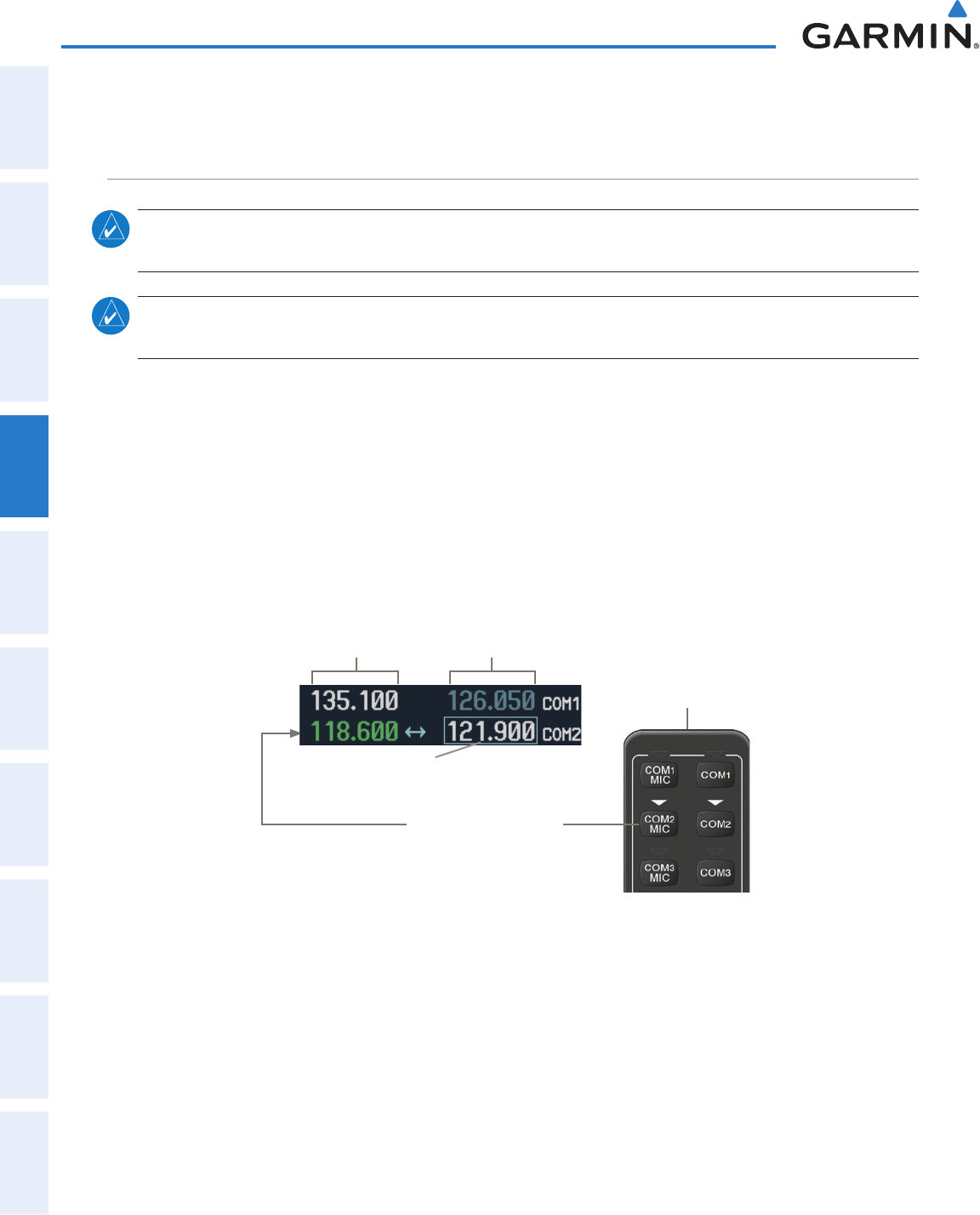
190-00592-06 Rev. A
Garmin G1000 Pilot’s Guide for the Diamond DA40/40F
96
AUDIO PANEL AND CNS
SYSTEM
OVERVIEW
FLIGHT
INSTRUMENTS
EIS
AUDIO PANEL
& CNS
FLIGHT
MANAGEMENT
HAZARD
AVOIDANCE
AFCS
ADDITIONAL
FEATURES
APPENDICESINDEX
4.2 COM OPERATION
COM TRANSCEIVER SELECTION AND ACTIVATION
NOTE: During PA Mode, the COM MIC Annunciator is extinguished and the COM active frequency color
changes to white, indicating that neither COM transmitter is active.
NOTE: When turning on the G1000 for use, the system remembers the last frequencies used and the active
COM transceiver state prior to shutdown.
The COM Frequency Box is composed of four fields; the two active frequencies are on the left side and the
two standby frequencies are on the right. The COM transceiver is selected for transmitting by pressing the
COM MIC
Keys on the Audio Panel. During reception of audio from the COM radio selected for transmission,
audio from the other COM radio is muted.
An active COM frequency displayed in green indicates that the COM transceiver is selected on the Audio
Panel (
COM1 MIC
or
COM2 MIC
Key). Both active COM frequencies appearing in white indicate that no COM
radio is selected for transmitting (PA Key is selected on the Audio Panel).
Frequencies in the standby field are displayed in either white or gray. The standby frequency in the tuning
box is white. The other standby frequency is gray.
Figure 4-3 Selecting a COM Radio for Transmit
Active
Fields Standby
Fields
Tuning Box
COM2 Radio is Selected
on the Audio Panel
Top Section of
the Audio Panel
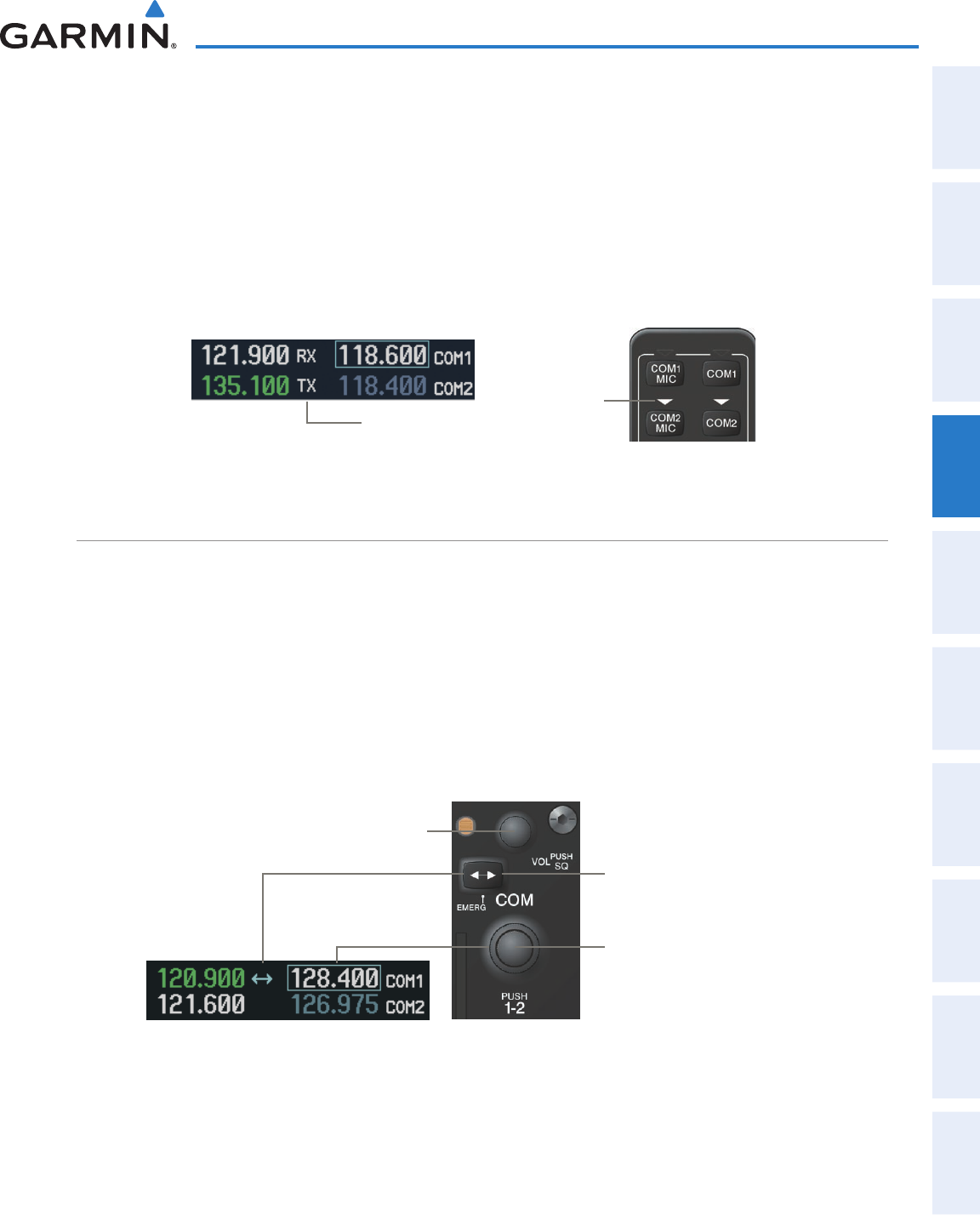
190-00592-06 Rev. A
Garmin G1000 Pilot’s Guide for the Diamond DA40/40F
97
AUDIO PANEL AND CNS
SYSTEM
OVERVIEW
FLIGHT
INSTRUMENTS EIS AUDIO PANEL
& CNS
FLIGHT
MANAGEMENT
HAZARD
AVOIDANCE AFCS ADDITIONAL
FEATURES APPENDICES INDEX
TRANSMIT/RECEIVE INDICATIONS
During COM transmission, a white TX appears by the active COM frequency replacing the Frequency
Transfer Arrow. On the Audio Panel, when the active COM is transmitting, the active transceiver
COM MIC
Key Annunciator flashes approximately once per second.
During COM signal reception, a white RX appears by the active COM frequency replacing the Frequency
Transfer Arrow. Entertainment audio, if selected, is muted during active COM radio reception. Refer to
Additional Audio Panel Functions later in this section, and details on the Data Link Receiver in the Additional
Features Section.
Figure 4-4 COM Radio Transmit and Receive Indications
Annunciator
Flashes During
Transmission
Transmit and
Receive Indicators
COM TRANSCEIVER MANUAL TUNING
The COM frequency controls and frequency boxes are on the right side of the MFD and PFD.
Manually tuning a COM frequency:
1) Turn the COM Knob to tune the desired frequency in the COM Tuning Box (large knob for MHz; small knob for
kHz).
2) Press the
Frequency Transfer
Key to transfer the frequency to the active field.
3) Adjust the volume level with the COM VOL/SQ Knob.
4) Press the COM VOL/SQ Knob to turn automatic squelch on and off.
Turn the
VOL/SQ
Knob to adjust
volume. Press the Knob to Turn
Automatic Squelch On or Off Press the
Frequency Transfer
Key to Transfer COM
Frequencies Between Active
and Standby Frequency Boxes
Turn the
COM
Knob to
Tune the Frequency in
the Tuning Box
Figure 4-5 COM Frequency Tuning
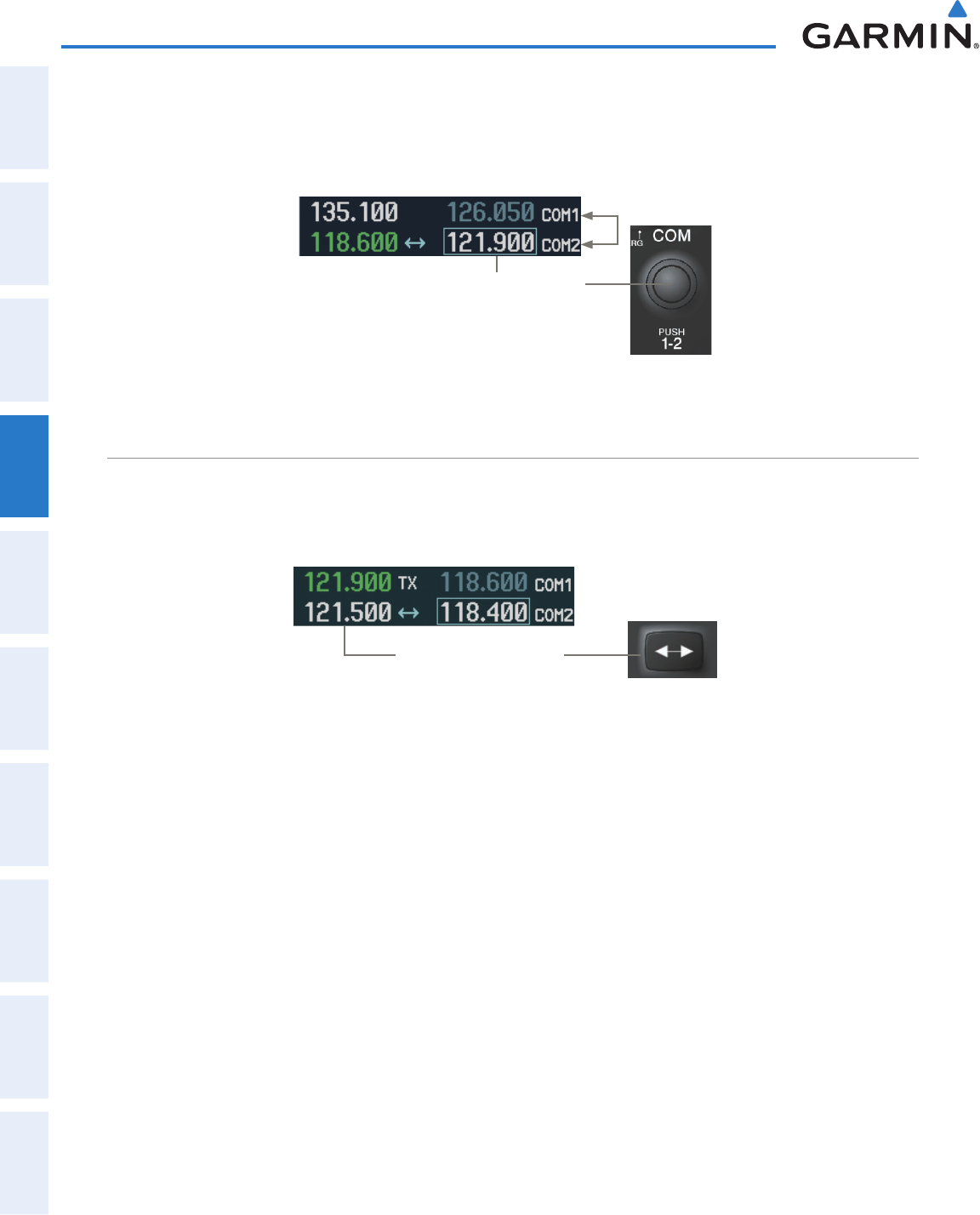
190-00592-06 Rev. A
Garmin G1000 Pilot’s Guide for the Diamond DA40/40F
98
AUDIO PANEL AND CNS
SYSTEM
OVERVIEW
FLIGHT
INSTRUMENTS
EIS
AUDIO PANEL
& CNS
FLIGHT
MANAGEMENT
HAZARD
AVOIDANCE
AFCS
ADDITIONAL
FEATURES
APPENDICESINDEX
SELECTING THE RADIO TO BE TUNED
Press the small COM Knob to transfer the frequency tuning box and Frequency Transfer Arrow between the
upper and lower radio frequency fields.
Figure 4-6 Switching COM Tuning Boxes
Press the
COM
Knob to
Switch the Tuning Box From
One COM Radio to the Other
QUICK-TUNING AND ACTIVATING 121.500 MHZ
Pressing and holding the COM
Frequency Transfer
Key for two seconds automatically loads the emergency
COM frequency (121.500 MHz) in the active field of the COM radio selected for tuning (the one with the
transfer arrow). In the example shown, pressing the Audio Panel COM2 MIC Key activates the transceiver.
Figure 4-7 Quickly Tuning 121.500 MHz
Press for Two Seconds to
Load 121.500 MHz
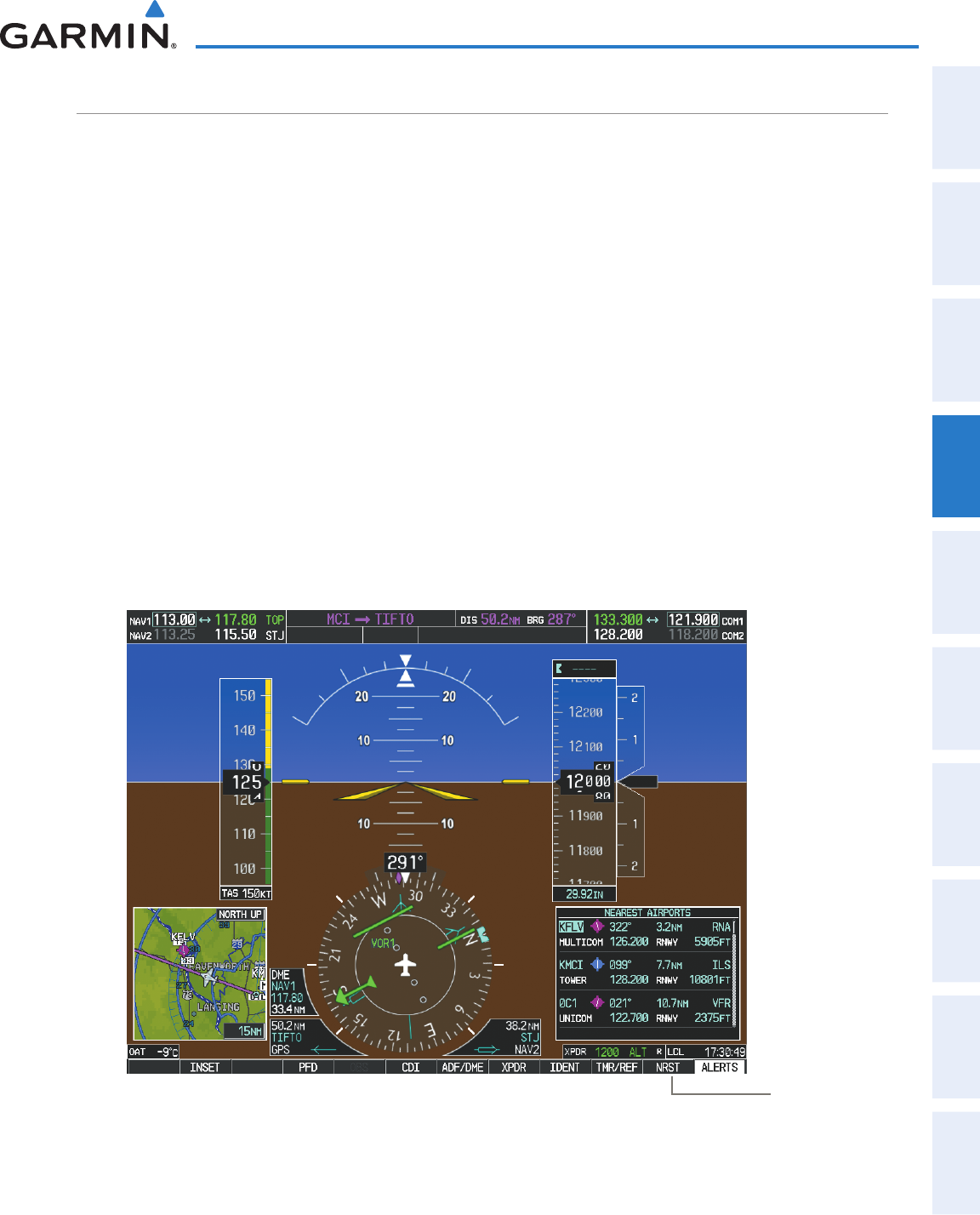
190-00592-06 Rev. A
Garmin G1000 Pilot’s Guide for the Diamond DA40/40F
99
AUDIO PANEL AND CNS
SYSTEM
OVERVIEW
FLIGHT
INSTRUMENTS EIS AUDIO PANEL
& CNS
FLIGHT
MANAGEMENT
HAZARD
AVOIDANCE AFCS ADDITIONAL
FEATURES APPENDICES INDEX
AUTO-TUNING THE COM FREQUENCY
COM frequencies can be automatically tuned from the following:
•NearestAirportsWindow(PFD)
•WPT–AirportInformationPage
•NRST–NearestAirportsPage
•NRST–NearestFrequenciesPage(ARTCC,FSS,WX)
•NRST–NearestAirspacesPage
AUTO-TUNING FROM THE PFD
COM frequencies for the nearest airports can be automatically tuned from the Nearest Airports Window on
the PFD. When the desired frequency is entered, it becomes a standby frequency. Pressing the
Frequency
Transfer
Key places this frequency into the COM Active Frequency Field.
Auto-tuning a COM frequency for a nearby airport from the PFD:
1) Press the
NRST
Softkey on the PFD to open the Nearest Airports Window. A list of 25 nearest airport identifiers
and COM frequencies is displayed.
2) Turn the
FMS
Knob to scroll through the list and highlight the desired COM frequency.
3) Press the
ENT
Key to load the COM frequency into the COM Standby Tuning Box.
4) Press the Frequency Transfer Key to transfer the frequency to the COM Active Frequency Field.
Figure 4-8 Nearest Airports Window (PFD)
Press the
NRST
Softkey to Open
the Nearest
Airports Window
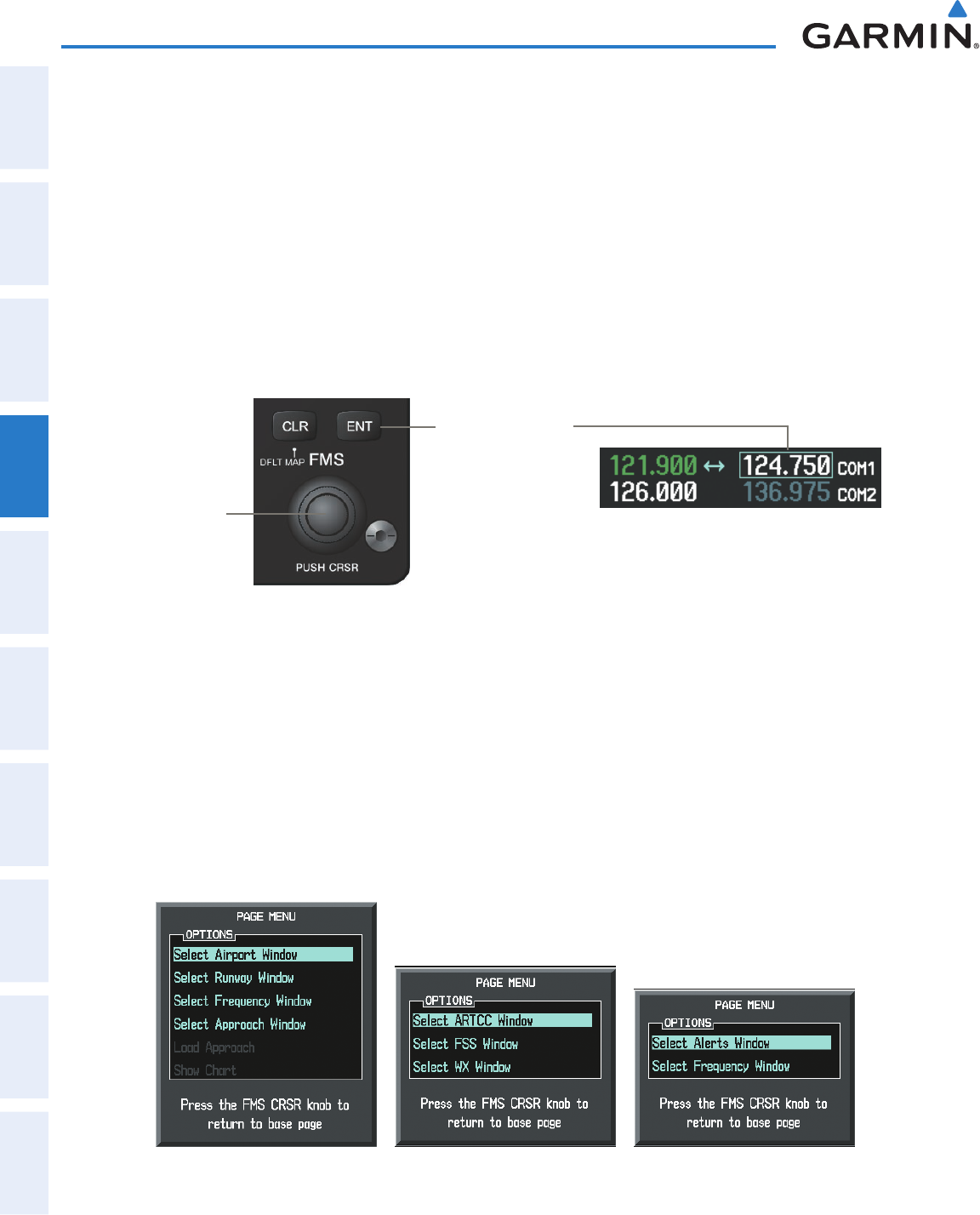
190-00592-06 Rev. A
Garmin G1000 Pilot’s Guide for the Diamond DA40/40F
100
AUDIO PANEL AND CNS
SYSTEM
OVERVIEW
FLIGHT
INSTRUMENTS
EIS
AUDIO PANEL
& CNS
FLIGHT
MANAGEMENT
HAZARD
AVOIDANCE
AFCS
ADDITIONAL
FEATURES
APPENDICESINDEX
AUTO-TUNING FROM THE MFD
Frequencies can be automatically loaded into the COM Frequency Box from pages in the NRST or WPT
page group by highlighting the frequency and pressing the ENT Key (Figures 4-9, 4-10, and 4-11).
Auto-tuning a COM frequency from the WPT and NRST Pages:
1) From any page that the COM frequency can be auto-tuned, activate the cursor by pressing the FMS Knob or the
appropriate softkey.
2) Turn the FMS Knob to place the cursor on the desired COM frequency (Figure 4-11).
3) Press the ENT Key to load the COM frequency into the standby field of the selected COM radio.
4) Press the Frequency Transfer Key to transfer the frequency to the COM Active Frequency Field.
Figure 4-9 Frequency Auto-Tuning from the MFD
Turn the
FMS
Knob to Scroll
Through a List
of Frequencies
Press the
ENT
Key to
Load a Highlighted
Frequency into
the COM Standby
Frequency Box
Or:
1) Press the MENU Key to display the page menu.
2) Turn the large FMS Knob to scroll through the menu options.
3) Press the ENT Key to place the cursor on the desired selection.
4) Scroll through the frequency selections with the FMS Knob or the ENT Key.
5) Press the ENT Key to load the COM frequency into the standby field of the selected COM radio.
6) Press the Frequency Transfer Key to transfer the frequency to the COM Active Frequency Field.
Figure 4-10 Nearest Pages Menus
Nearest Airspaces MenuNearest Airports Menu Nearest Frequencies Menu
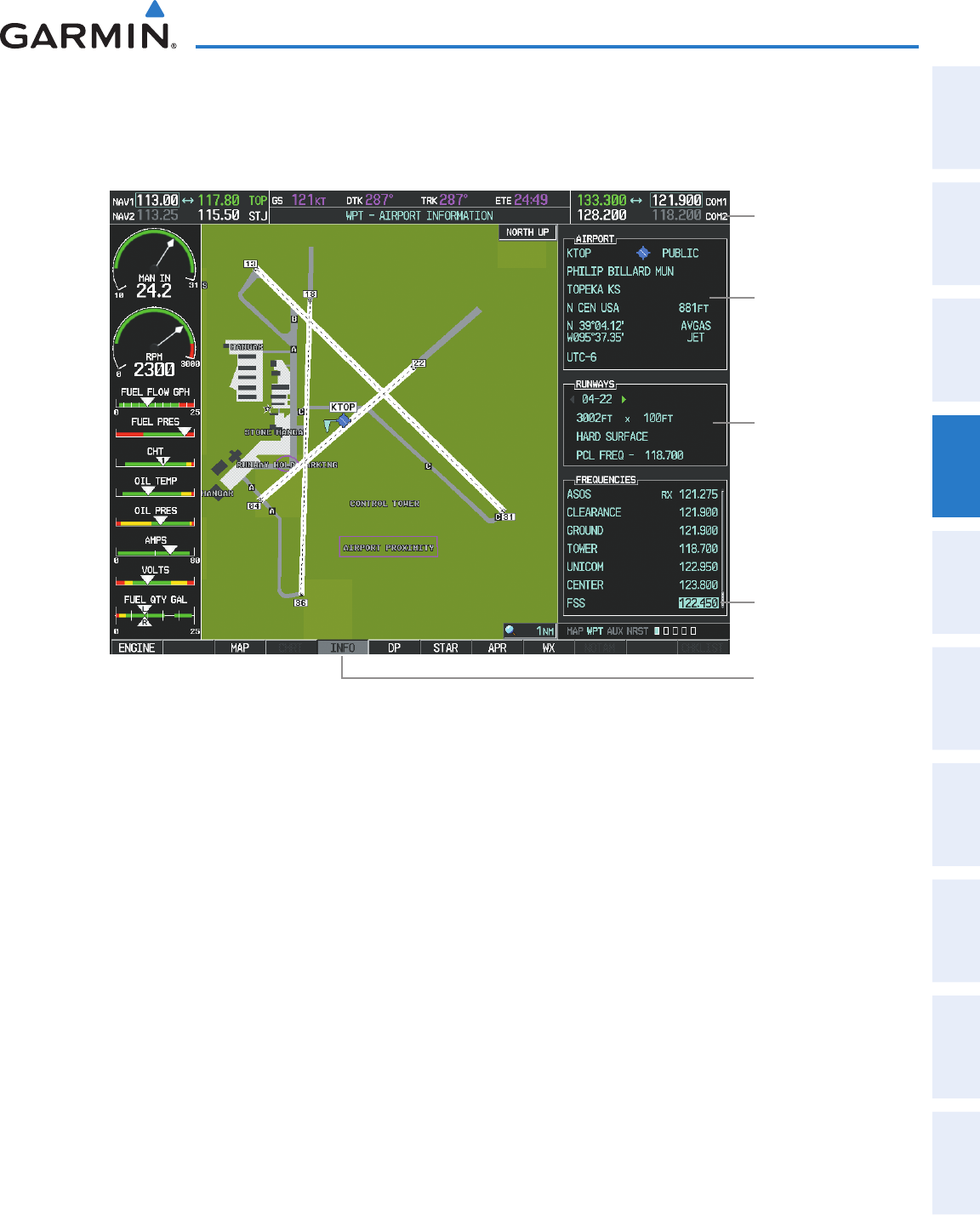
190-00592-06 Rev. A
Garmin G1000 Pilot’s Guide for the Diamond DA40/40F
101
AUDIO PANEL AND CNS
SYSTEM
OVERVIEW
FLIGHT
INSTRUMENTS EIS AUDIO PANEL
& CNS
FLIGHT
MANAGEMENT
HAZARD
AVOIDANCE AFCS ADDITIONAL
FEATURES APPENDICES INDEX
On the WPT - Airport Information Page, the cursor can be placed on the frequency field by pressing the
FMS Knob and scrolling through the list. The frequency is transferred to the COM Standby Field with the
ENT Key.
Figure 4-11 WPT – Airport Information Page
Press
ENT
Key to Load
Frequency into COM
Standby Field. Cursor
then Advances to
Next Frequency.
Press
INFO
Softkey for
AIRPORT, RUNWAYS,
and FREQUENCIES
Windows
Selected Airport
Identifier and
Information
Runway
Information
Press
Frequency
Transfer
Key to Load
Frequency into COM
Active Frequency Field
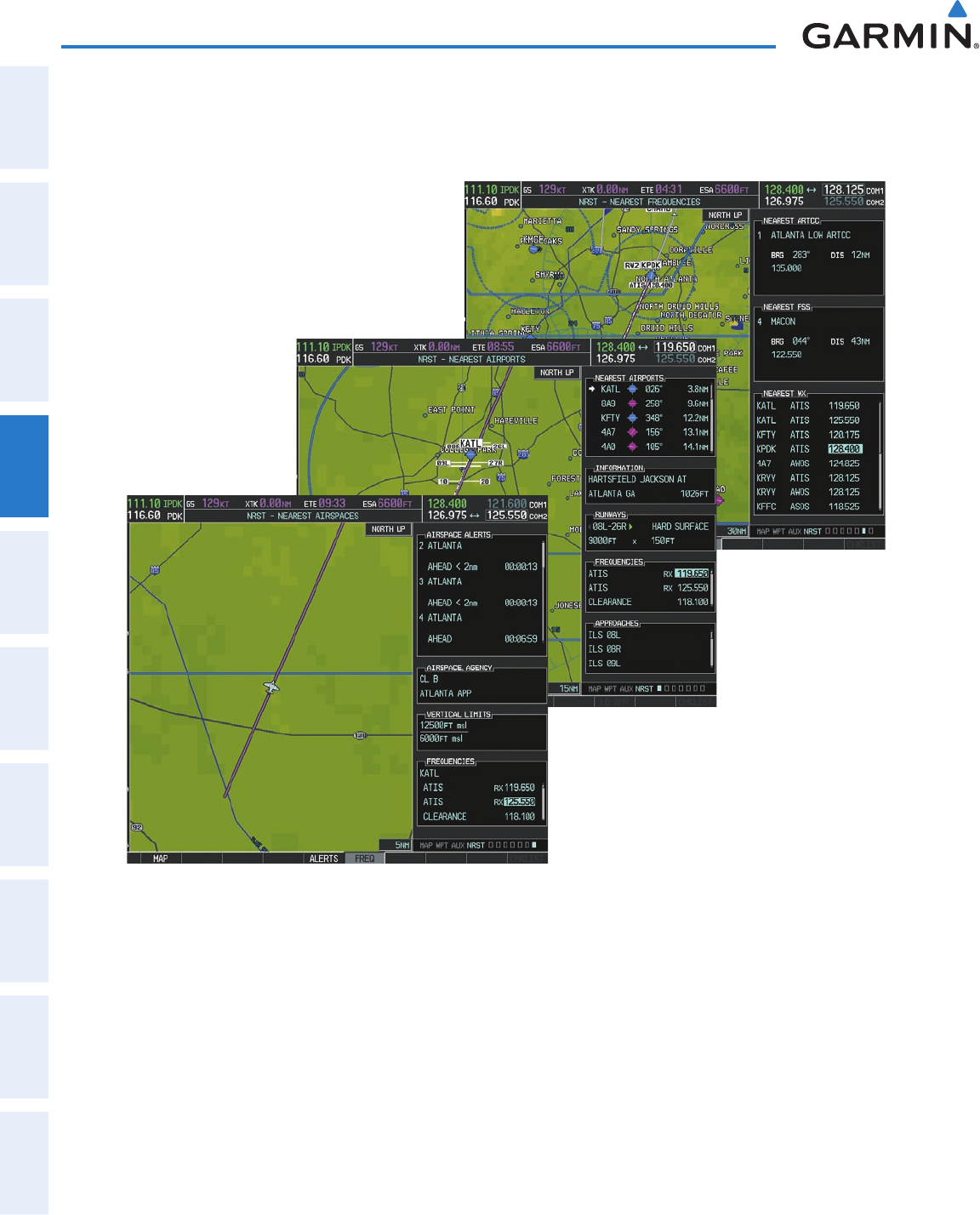
190-00592-06 Rev. A
Garmin G1000 Pilot’s Guide for the Diamond DA40/40F
102
AUDIO PANEL AND CNS
SYSTEM
OVERVIEW
FLIGHT
INSTRUMENTS
EIS
AUDIO PANEL
& CNS
FLIGHT
MANAGEMENT
HAZARD
AVOIDANCE
AFCS
ADDITIONAL
FEATURES
APPENDICESINDEX
COM frequencies can also be auto-tuned from the NRST – Nearest Airspaces, NRST – Nearest Frequencies,
and NRST – Nearest Airports Pages on the MFD in a similar manner using the appropriate softkeys or MENU
Key, the FMS Knob, and the ENT Key.
Figure 4-12 NRST – Nearest Airspaces, NRST – Nearest Airports, and NRST – Nearest Frequencies Pages
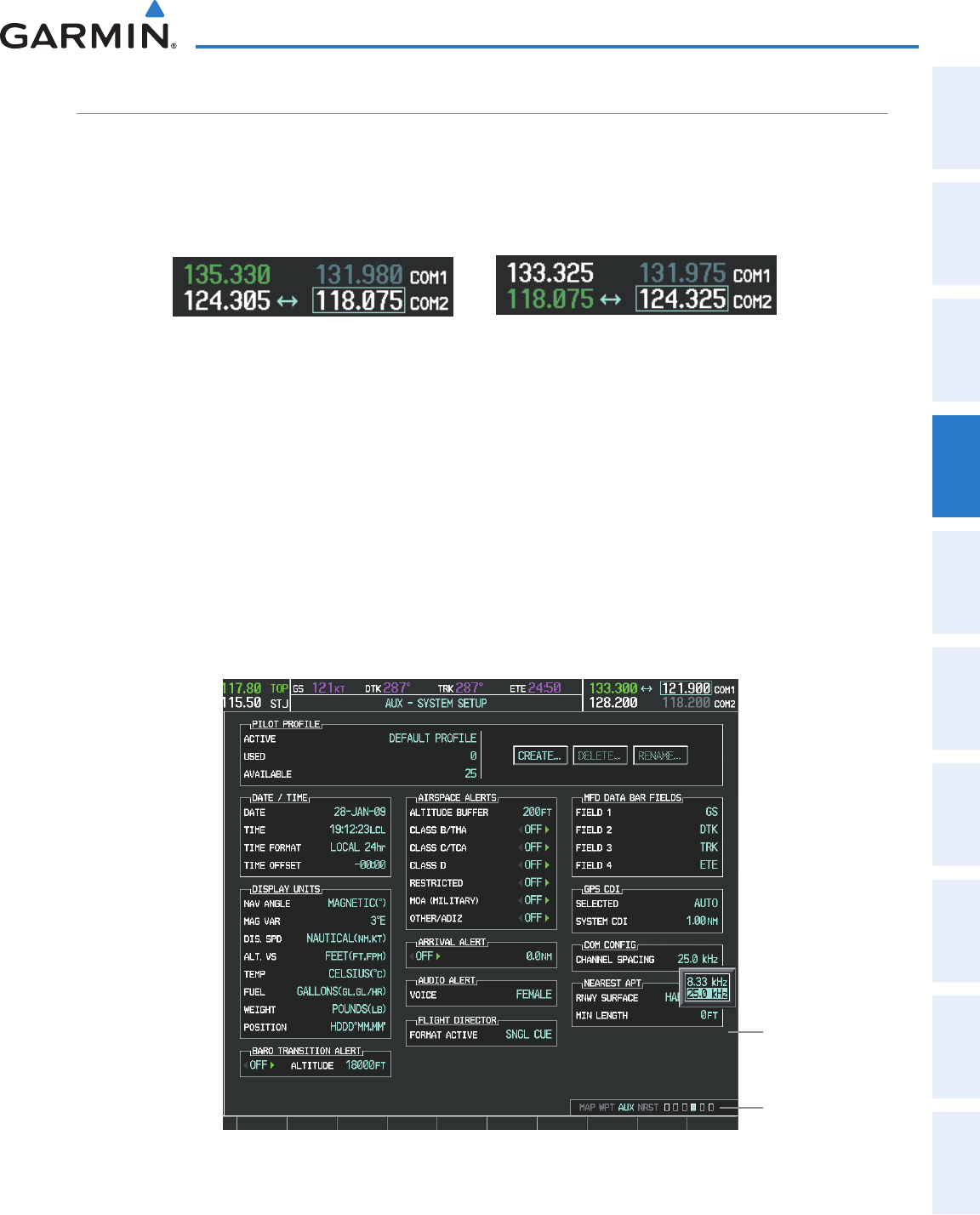
190-00592-06 Rev. A
Garmin G1000 Pilot’s Guide for the Diamond DA40/40F
103
AUDIO PANEL AND CNS
SYSTEM
OVERVIEW
FLIGHT
INSTRUMENTS EIS AUDIO PANEL
& CNS
FLIGHT
MANAGEMENT
HAZARD
AVOIDANCE AFCS ADDITIONAL
FEATURES APPENDICES INDEX
FREQUENCY SPACING
The G1000 COM radios can tune either 25-kHz spacing (118.000 to 136.975 MHz) or 8.33-kHz spacing
(118.000 to 136.990 MHz) for 760-channel or 3040-channel configuration. When 8.33-kHz channel spacing
is selected, all of the 25-kHz channel spacing frequencies are also available in the complete 3040-channel list.
COM channel spacing is set on the System Setup Page of the AUX Page Group.
Figure 4-13 COM Channel Spacing
25-kHz Channel
Spacing
8.33-kHz Channel
Spacing
Changing COM frequency channel spacing:
1) Select the AUX – System Setup Page.
2) Press the FMS Knob to activate the flashing cursor.
3) Turn the large FMS Knob to highlight the Channel Spacing Field in the COM Configuration Box.
4) Turn the small FMS Knob to select the desired channel spacing.
5) Press the ENT Key to complete the channel spacing selection.
While the COM CONFIG Window is selected, the G1000 softkeys are blank.
AUX - SYSTEM
SETUP PAGE
Figure 4-14 AUX – System Setup Page
Select 8.33-kHz
or 25.0-kHz
COM Frequency
Channel Spacing
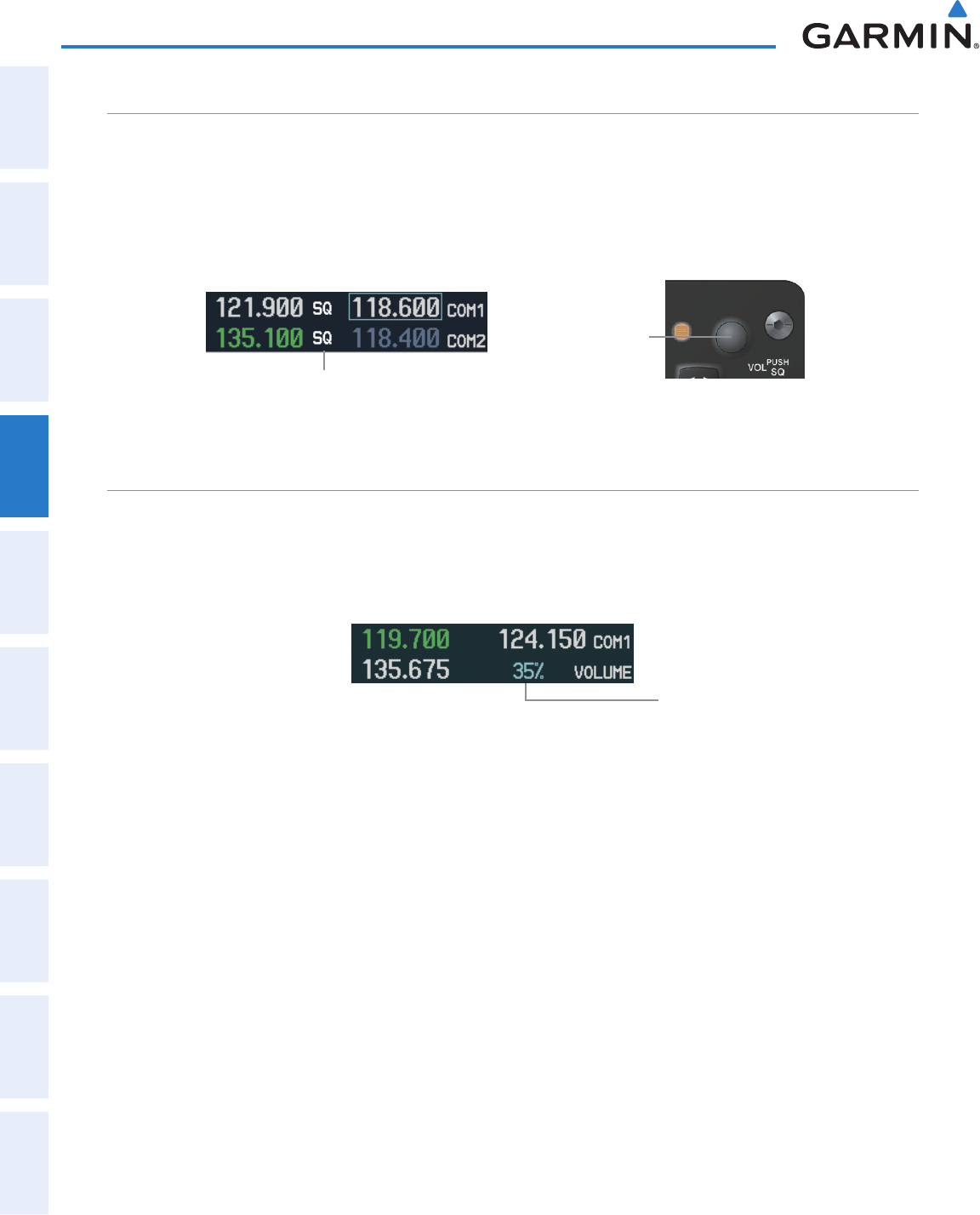
190-00592-06 Rev. A
Garmin G1000 Pilot’s Guide for the Diamond DA40/40F
104
AUDIO PANEL AND CNS
SYSTEM
OVERVIEW
FLIGHT
INSTRUMENTS
EIS
AUDIO PANEL
& CNS
FLIGHT
MANAGEMENT
HAZARD
AVOIDANCE
AFCS
ADDITIONAL
FEATURES
APPENDICESINDEX
AUTOMATIC SQUELCH
Automatic Squelch quiets unwanted static noise when no audio signal is received, while still providing good
sensitivity to weak COM signals. To disable Automatic Squelch, press the
VOL/SQ
Knob. When Automatic
Squelch is disabled, COM audio reception is always on. Continuous static noise is heard over the headsets and
speaker, if selected. Pressing the
VOL/SQ
Knob again enables Automatic Squelch.
When Automatic Squelch is disabled, a white SQ appears next to the COM frequency.
Figure 4-15 Overriding Automatic Squelch
Squelch
Indication
Press the COM
VOL/
SQ
Knob to turn off
Automatic Squelch.
Press again to restore
Automatic Squelch.
VOLUME
COM radio volume level can be adjusted from 0 to 100% using the
VOL/SQ
Knob. Turning the knob
clockwise increases volume, turning the knob counterclockwise decreases volume. When adjusting volume,
the level is displayed in place of the standby frequencies. Volume level indication remains for two seconds after
the change.
Figure 4-16 COM Volume Level
COM Volume
Level Remains for
Two Seconds
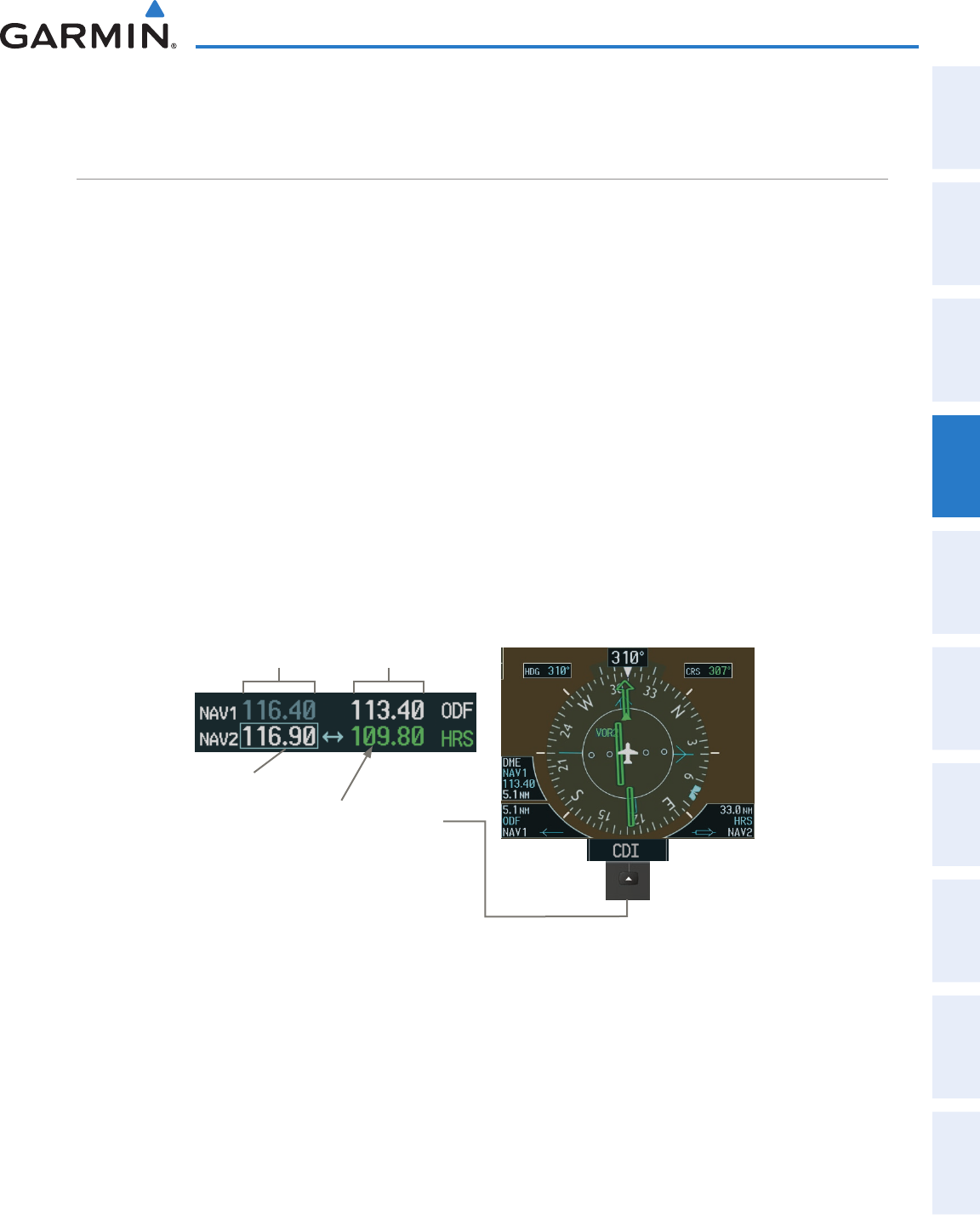
190-00592-06 Rev. A
Garmin G1000 Pilot’s Guide for the Diamond DA40/40F
105
AUDIO PANEL AND CNS
SYSTEM
OVERVIEW
FLIGHT
INSTRUMENTS EIS AUDIO PANEL
& CNS
FLIGHT
MANAGEMENT
HAZARD
AVOIDANCE AFCS ADDITIONAL
FEATURES APPENDICES INDEX
4.3 NAV OPERATION
NAV RADIO SELECTION AND ACTIVATION
The NAV Frequency Box is composed of four fields; two standby fields and two active fields. The active
frequencies are on the right side and the standby frequencies are on the left.
A NAV radio is selected for navigation by pressing the
CDI
Softkey located on the PFD. The active NAV
frequency selected for navigation is displayed in green. Pressing the
CDI
Softkey once selects NAV1 as the
navigation radio. Pressing the
CDI
Softkey a second time selects NAV2 as the navigation radio. Pressing the
CDI
Softkey a third time activates GPS mode. Pressing the
CDI
Softkey again cycles back to NAV1.
While cycling through the
CDI
Softkey selections, the NAV Tuning Box and the Frequency Transfer Arrow are
placed in the active NAV Frequency Field and the active NAV frequency color changes to green.
The three navigation modes that can be cycled through are:
•VOR1(orLOC1)–IfNAV1isselected,agreen single line arrow (not shown) labeled either VOR1 or LOC1
is displayed on the HSI and the active NAV1 frequency is displayed in green.
•VOR2(orLOC2)–IfNAV2isselected,agreen double line arrow (shown) labeled either VOR2 or LOC2 is
displayed on the HSI and the active NAV2 frequency is displayed in green.
•GPS–IfGPSModeisselected,amagenta single line arrow (not shown) appears on the HSI and neither NAV
radio is selected. Both active NAV frequencies are then displayed in white.
Figure 4-17 Selecting a NAV Radio for Navigation
Active
Fields
Standby
Fields
Tuning Box
The NAV Radio is
Selected by Pressing
the
CDI
Softkey
See the Flight Instruments Section for selecting the DME and Bearing Information windows and using VOR
or ADF as the source for the bearing pointer.
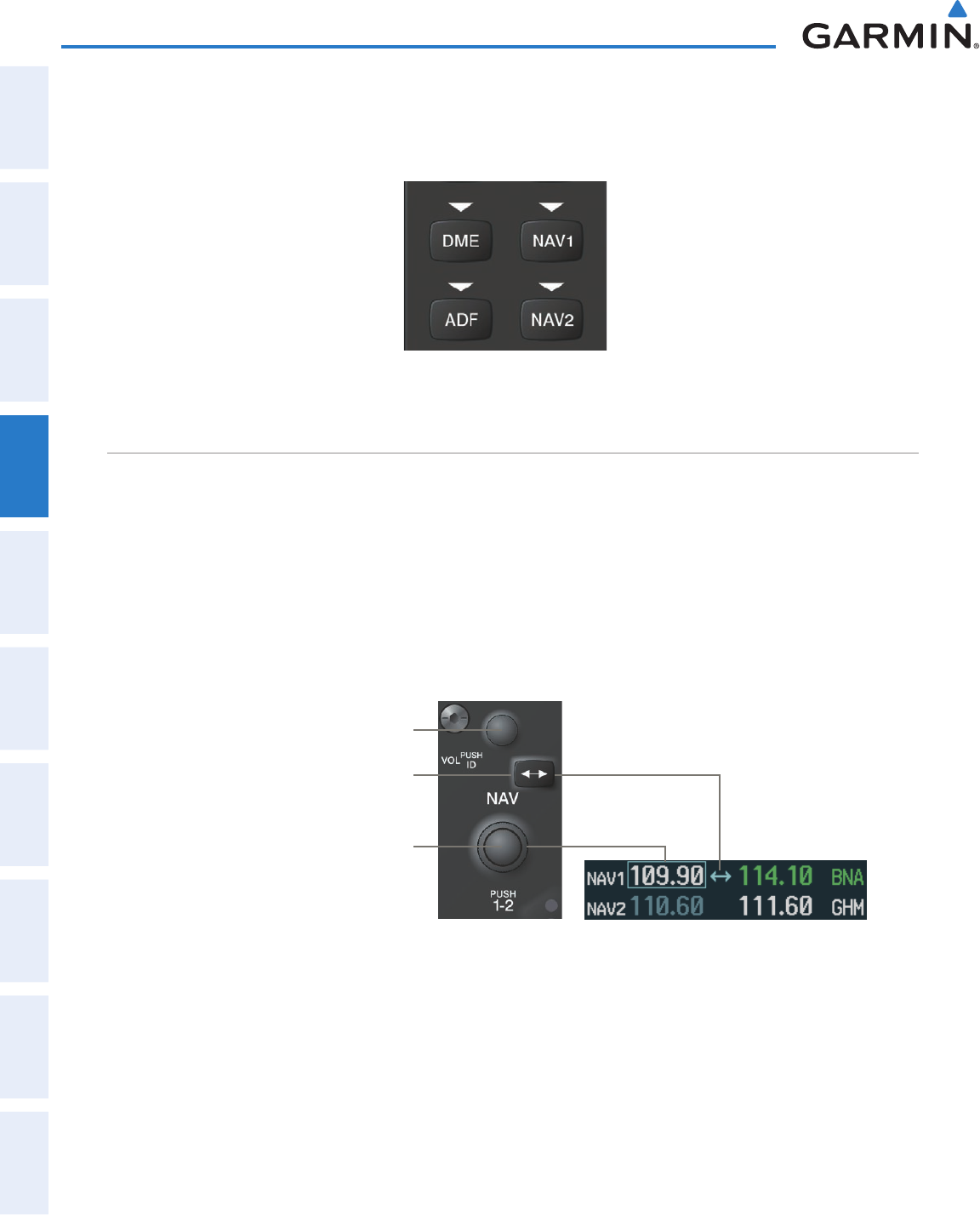
190-00592-06 Rev. A
Garmin G1000 Pilot’s Guide for the Diamond DA40/40F
106
AUDIO PANEL AND CNS
SYSTEM
OVERVIEW
FLIGHT
INSTRUMENTS
EIS
AUDIO PANEL
& CNS
FLIGHT
MANAGEMENT
HAZARD
AVOIDANCE
AFCS
ADDITIONAL
FEATURES
APPENDICESINDEX
NAV radios are selected for listening by pressing the corresponding keys on the Audio Panel.
Pressing the
NAV1, NAV2, ADF, or DME Key selects and deselects the navigation radio source. Selected audio can be heard over
the headset and the speaker (if selected). All radios can be selected individually or simultaneously.
Figure 4-18 Selecting a NAV Radio Receiver
NAV RECEIVER MANUAL TUNING
The NAV frequency controls and frequency boxes are on the left side of the MFD and PFD.
Manually tuning a NAV frequency:
1) Turn the
NAV
Knob to tune the desired frequency in the NAV Tuning Box.
2) Press the
Frequency Transfer
Key to transfer the frequency to the NAV Active Frequency Field.
3) Adjust the volume level with the NAV VOL/ID Knob.
4) Press the NAV VOL/ID Knob to turn the Morse code identifier audio on and off.
Figure 4-19 NAV Frequency Tuning
Press the
Frequency Transfer
Key to
Transfer NAV Frequencies Between
Active and Standby Frequency Fields
Turn the
NAV
Knob to
Tune the Frequency in
the Tuning Box
Turn
VOL/ID
Knob to adjust
volume. Press Knob to Turn
Morse Code On or Off.
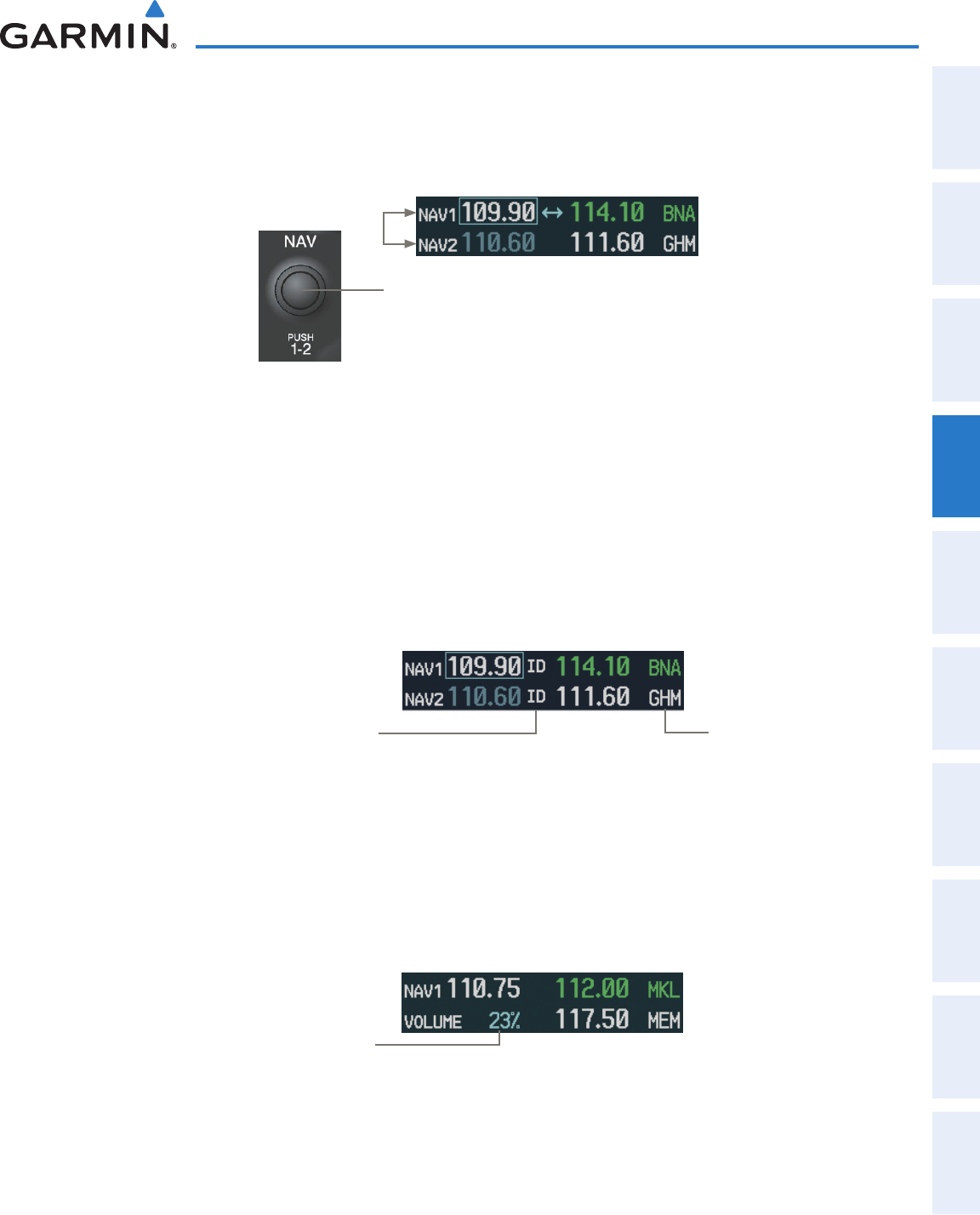
190-00592-06 Rev. A
Garmin G1000 Pilot’s Guide for the Diamond DA40/40F
107
AUDIO PANEL AND CNS
SYSTEM
OVERVIEW
FLIGHT
INSTRUMENTS EIS AUDIO PANEL
& CNS
FLIGHT
MANAGEMENT
HAZARD
AVOIDANCE AFCS ADDITIONAL
FEATURES APPENDICES INDEX
SELECTING THE RADIO TO BE TUNED
Press the small NAV Knob to transfer the frequency tuning box and Frequency Transfer Arrow between the
upper and lower radio frequency fields.
Figure 4-20 Switching NAV Tuning Boxes
Press the
NAV
Knob to
Switch the Tuning Box From
One NAV Radio to the Other
VOR/LOC ID
When the Morse code Identifier audio is on for a NAV radio, a white ID appears to the left of the active
NAV frequency.
In the example shown, in order to listen to either station identifier, press the NAV1 or NAV2 Key on the
Audio Panel. Pressing the VOL/ID Knob turns off the Morse code audio only in the radio with the NAV
Tuning Box. To turn off both NAV IDs, transfer the NAV Tuning Box between NAV1 and NAV2 with the small
NAV Knob and press the VOL/ID Knob again to turn the Morse code off in the other radio.
Figure 4-21 NAV Radio ID Indication
The Morse Code Identifier
for the GHM VOR is On Station
Identifier
VOLUME
NAV Radio volume level can be adjusted from 0 to 100% using the
VOL/ID
Knob. Turning the knob
clockwise increases volume, counterclockwise decreases volume.
When adjusting, the level is displayed in place of the standby frequencies. Volume level indication remains
for two seconds after the change.
Figure 4-22 NAV Volume Levels
NAV Volume
Level Remains
for Two Seconds
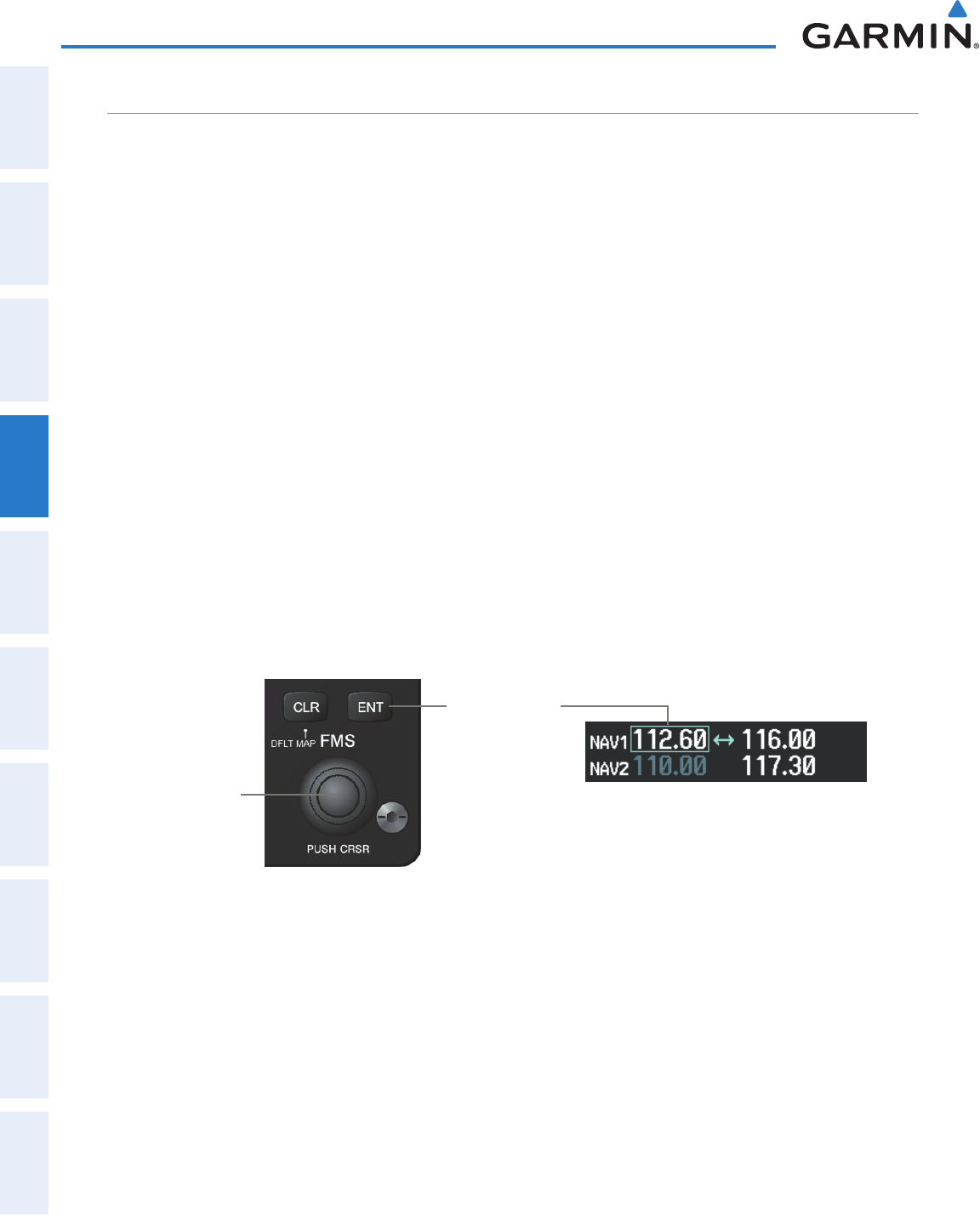
190-00592-06 Rev. A
Garmin G1000 Pilot’s Guide for the Diamond DA40/40F
108
AUDIO PANEL AND CNS
SYSTEM
OVERVIEW
FLIGHT
INSTRUMENTS
EIS
AUDIO PANEL
& CNS
FLIGHT
MANAGEMENT
HAZARD
AVOIDANCE
AFCS
ADDITIONAL
FEATURES
APPENDICESINDEX
AUTO-TUNING A NAV FREQUENCY FROM THE MFD
NAV frequencies can be selected and loaded from the following MFD pages:
•WPT–AirportInformation
•WPT–VORInformation
•NRST–NearestAirports
•NRST–NearestVOR
•NRST–NearestFrequencies(FSS,WX)
•NRST–NearestAirspaces
The MFD provides auto-tuning of NAV frequencies from waypoint and nearest pages. During enroute
navigation, the NAV frequency is entered automatically into the NAV standby frequency field. During approach
activation the NAV frequency is entered automatically into the NAV active frequency field.
Frequencies can be automatically loaded into the NAV Frequency Box from pages in the NRST or WPT page
group by highlighting the frequency and pressing the
ENT
Key (Figures 4-23, 4-24, and 4-25).
Auto-tuning a NAV frequency from the WPT and NRST Pages:
1) From any page that the NAV frequency can be auto-tuned, activate the cursor by pressing the FMS Knob or the
appropriate softkey.
2) Turn the FMS Knob to place the cursor on the desired NAV identifier or NAV frequency.
3) On the Nearest VOR and Nearest Airports pages, press the FREQ Softkey to place the cursor on the NAV
frequency (Figure 4-25).
4) Press the ENT Key to load the NAV frequency into the standby field of the selected NAV radio.
5) Press the Frequency Transfer Key to transfer the frequency to the NAV Active Frequency Field.
Figure 4-23 NAV Frequency Auto-Tuning from the MFD
Turn the
FMS
Knob to Scroll
Through a List
of Frequencies
Press the
ENT
Key to Load
a Highlighted
Frequency into
the NAV Standby
Frequency Box
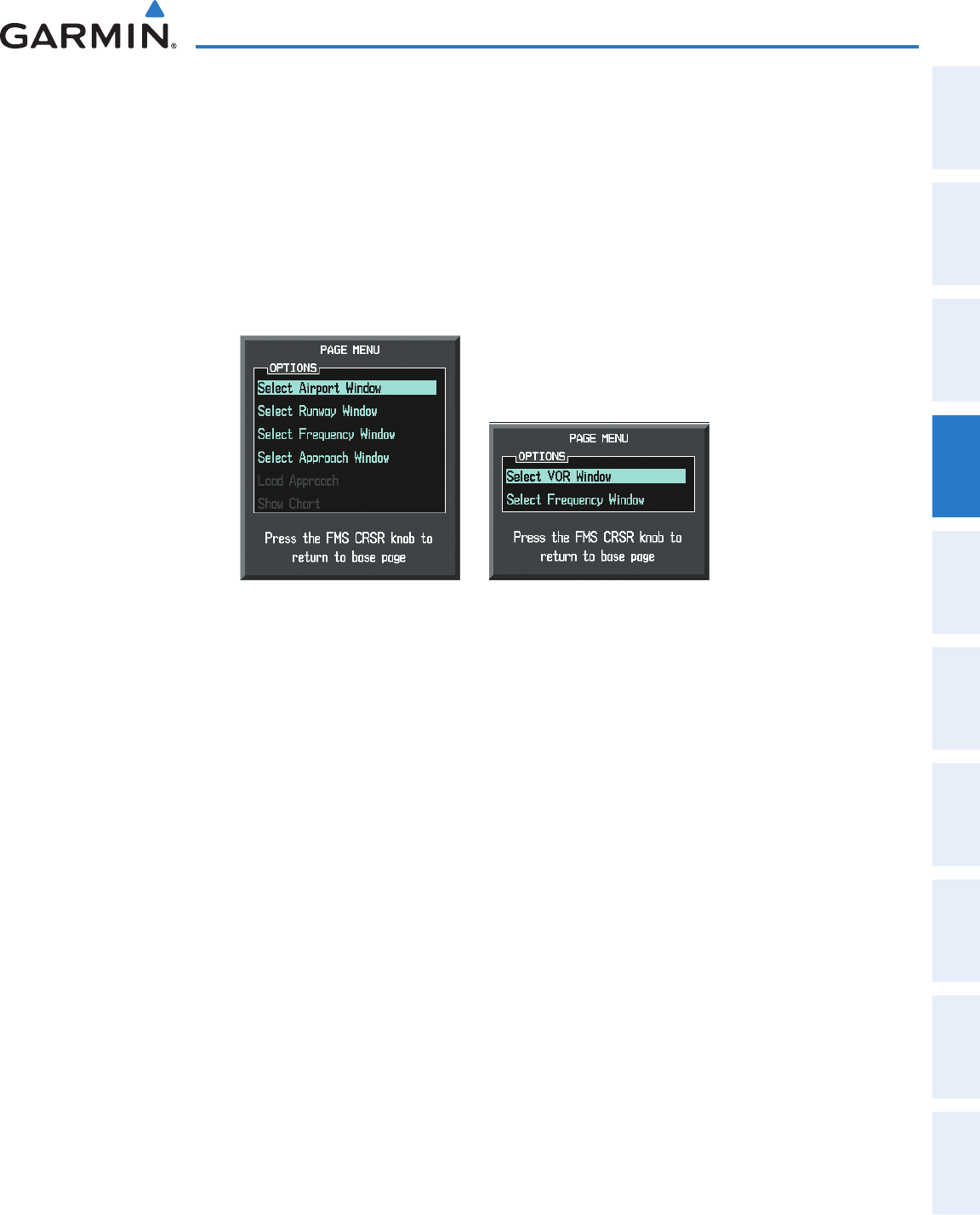
190-00592-06 Rev. A
Garmin G1000 Pilot’s Guide for the Diamond DA40/40F
109
AUDIO PANEL AND CNS
SYSTEM
OVERVIEW
FLIGHT
INSTRUMENTS EIS AUDIO PANEL
& CNS
FLIGHT
MANAGEMENT
HAZARD
AVOIDANCE AFCS ADDITIONAL
FEATURES APPENDICES INDEX
Or:
1) When on the NRST pages, press the MENU Key to display the page menu.
2) Turn the large FMS Knob to scroll through the menu options.
3) Press the ENT Key to place the cursor in the desired window.
4) Scroll through the frequency selections with the FMS Knob or the ENT Key.
5) Press the ENT Key to load the NAV frequency into the standby field of the selected NAV radio.
6) Press the Frequency Transfer Key to transfer the frequency to the NAV Active Frequency Field.
Figure 4-24 Nearest Pages Menus
Nearest VOR MenuNearest Airports Menu
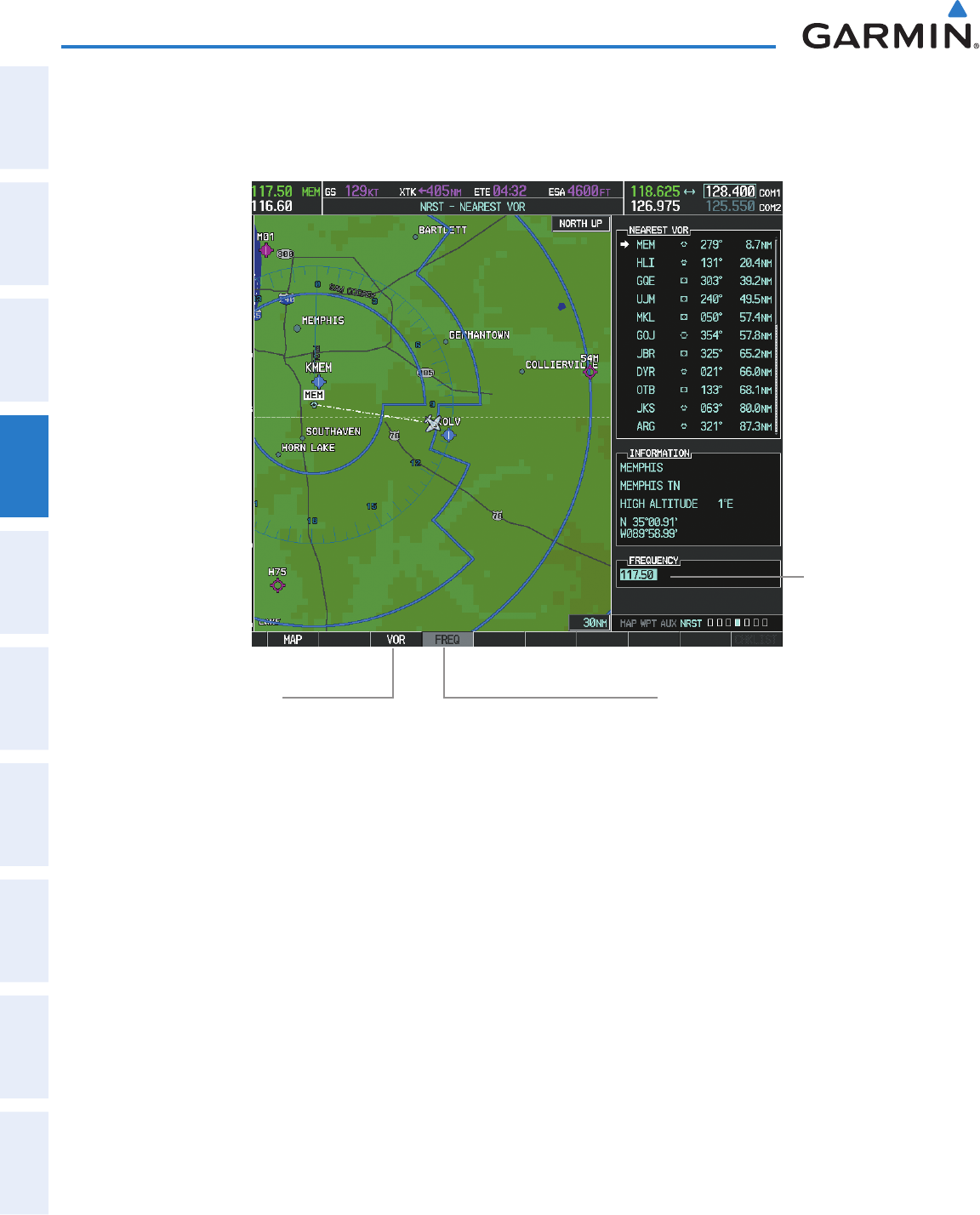
190-00592-06 Rev. A
Garmin G1000 Pilot’s Guide for the Diamond DA40/40F
110
AUDIO PANEL AND CNS
SYSTEM
OVERVIEW
FLIGHT
INSTRUMENTS
EIS
AUDIO PANEL
& CNS
FLIGHT
MANAGEMENT
HAZARD
AVOIDANCE
AFCS
ADDITIONAL
FEATURES
APPENDICESINDEX
In the example shown, the VOR list is selected with the VOR Softkey or from the page menu. The FMS Knob
or ENT Key is used to scroll through the list. The cursor is placed on the frequency with the FREQ Softkey and
loaded into the NAV Tuning Box with the ENT Key.
Press the
FREQ
Softkey to Place
the Cursor on the
VOR Frequency
Figure 4-25 Loading the NAV Frequency from the NRST – Nearest VOR Page
Press the
ENT
Key to Load
the Frequency
into the NAV
Standby Field.
Press the
VOR
Softkey to Place
the Cursor on the
VOR Identifier
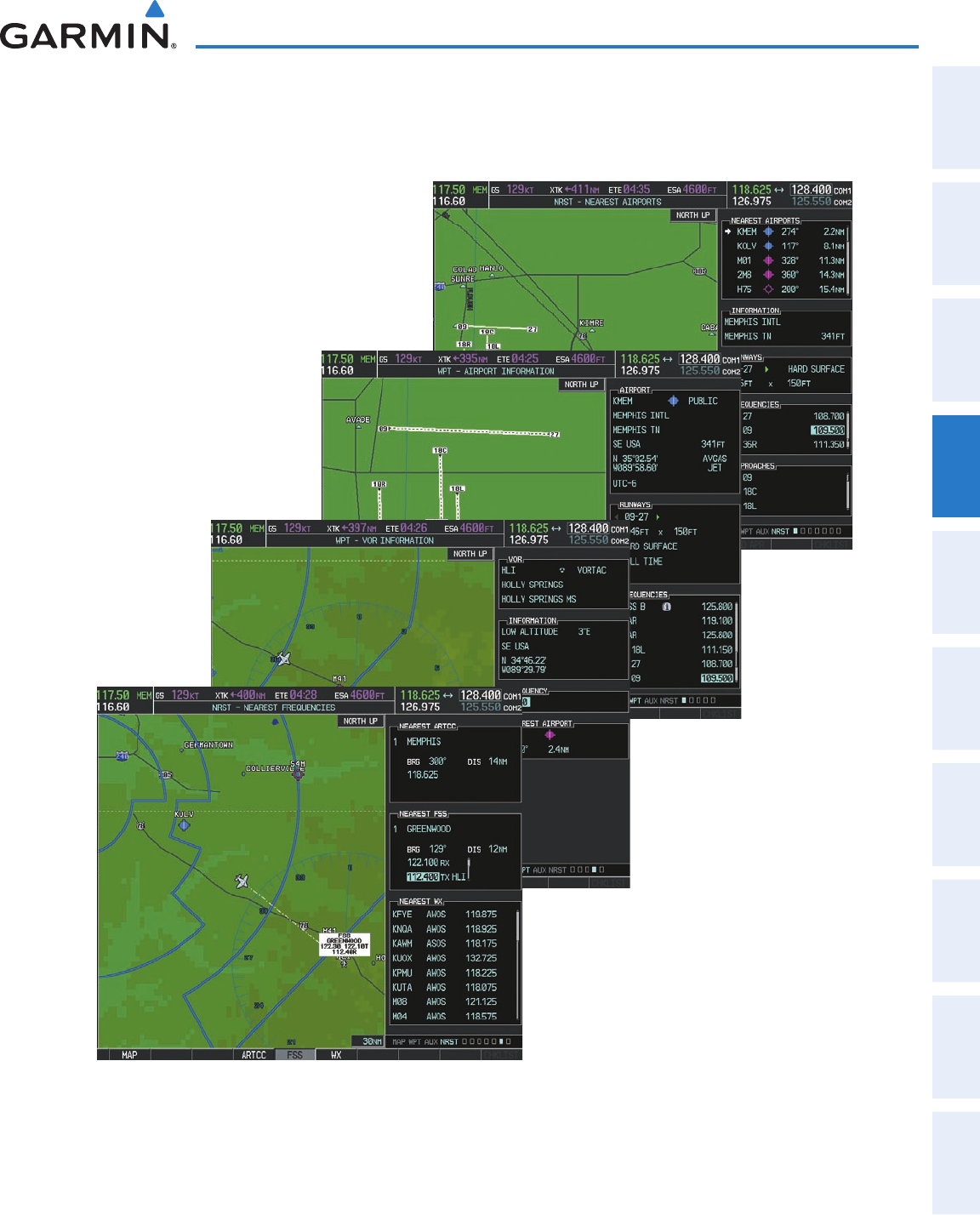
190-00592-06 Rev. A
Garmin G1000 Pilot’s Guide for the Diamond DA40/40F
111
AUDIO PANEL AND CNS
SYSTEM
OVERVIEW
FLIGHT
INSTRUMENTS EIS AUDIO PANEL
& CNS
FLIGHT
MANAGEMENT
HAZARD
AVOIDANCE AFCS ADDITIONAL
FEATURES APPENDICES INDEX
While enroute, NAV frequencies can also be auto-tuned from the NRST – Nearest Airports,
WPT – Airport Information, WPT – VOR Information, and NRST – Nearest Frequencies Pages on the MFD in
a similar manner using the appropriate softkeys or MENU Key, the FMS Knob, and the ENT Key.
Figure 4-26 NRST – Nearest Frequencies, WPT – VOR Information, WPT – Airport Information, and
NRST – Nearest Airports Pages
190-00592-06 Rev. A
Garmin G1000 Pilot’s Guide for the Diamond DA40/40F
112
AUDIO PANEL AND CNS
SYSTEM
OVERVIEW
FLIGHT
INSTRUMENTS
EIS
AUDIO PANEL
& CNS
FLIGHT
MANAGEMENT
HAZARD
AVOIDANCE
AFCS
ADDITIONAL
FEATURES
APPENDICESINDEX
AUTO-TUNING NAV FREQUENCIES ON APPROACH ACTIVATION
NOTE: The primary NAV frequency is auto-tuned upon loading a VOR or ILS/Localizer approach.
NOTE: When an ILS/LOC approach has been activated while navigating by GPS, the system automatically
switches to LOC as the final approach course is intercepted (within 15 nm of the FAF). See the Flight
Management Section for details.
NAV frequencies are automatically loaded into the NAV Frequency Box on approach activation.
When loading or activating a VOR or ILS/LOC approach, the approach frequency is automatically transferred
to a NAV frequency field as follows:
•If the current CDI navigation source is GPS, the approach frequency is transferred to the NAV1 active
frequency field. The frequency that was previously in the NAV1 active frequency field is transferred to
standby.
•IfthecurrentCDInavigationsourceisGPS,andiftheapproachfrequencyisalreadyloadedintotheNAV1
standby frequency field, the standby frequency is transferred to active.
•IfthecurrentCDInavigationsourceisNAV1orNAV2,theapproachfrequencyistransferredtothestandby
frequency fields of the selected CDI NAV radio.
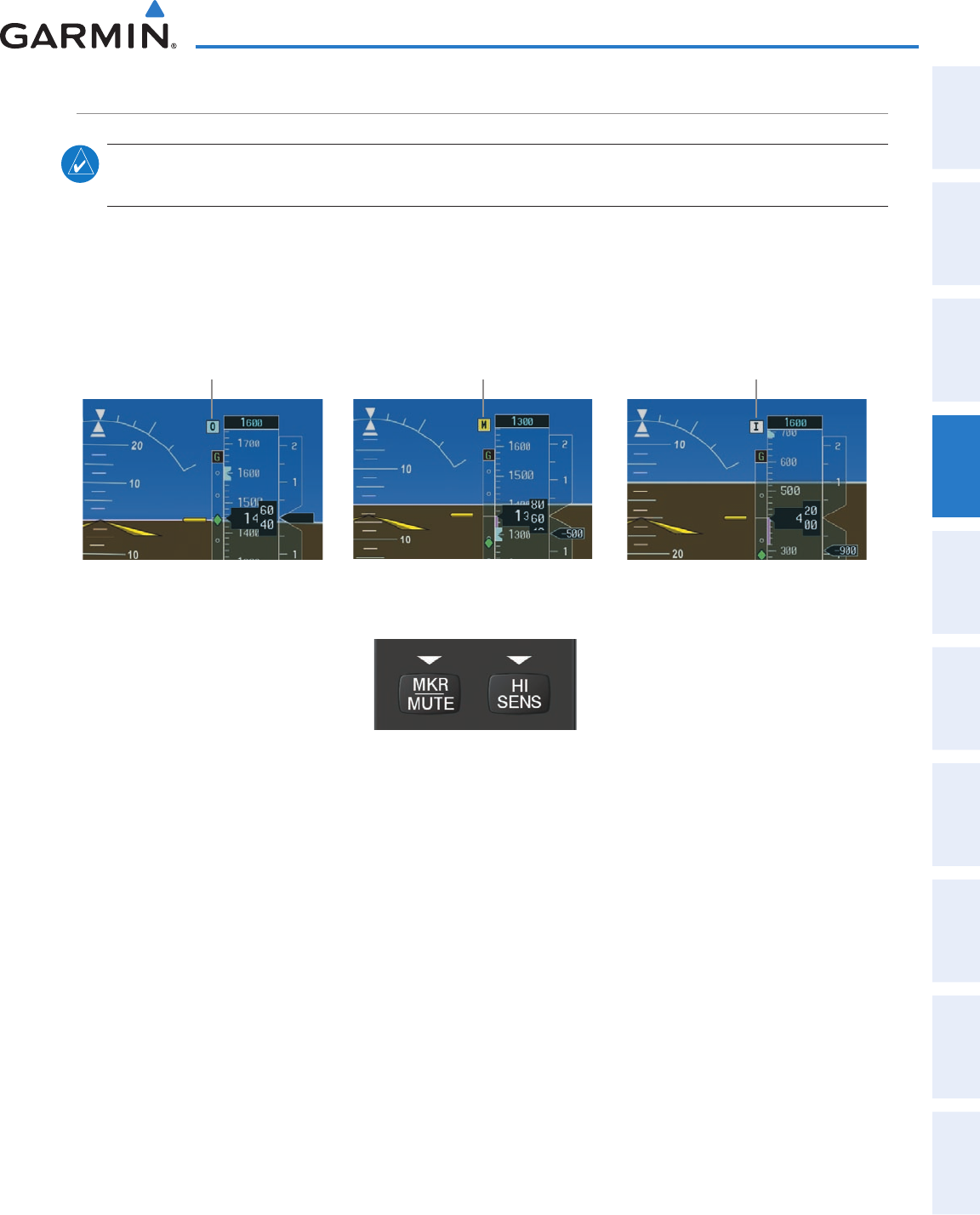
190-00592-06 Rev. A
Garmin G1000 Pilot’s Guide for the Diamond DA40/40F
113
AUDIO PANEL AND CNS
SYSTEM
OVERVIEW
FLIGHT
INSTRUMENTS EIS AUDIO PANEL
& CNS
FLIGHT
MANAGEMENT
HAZARD
AVOIDANCE AFCS ADDITIONAL
FEATURES APPENDICES INDEX
MARKER BEACON RECEIVER
NOTE: The marker beacon indicators operate independently of marker beacon audio and cannot be turned
off.
The marker beacon receiver is used as part of the ILS. The marker beacon receiver is always on and detects
any marker beacon signals within the reception range of the aircraft.
The receiver detects the three marker tones – outer, middle, and inner – and provides the marker beacon
annunciations located to the left of the Altimeter on the PFD.
Figure 4-27 Marker Beacon Annunciations on the PFD
Outer Marker
Indication Middle Marker
Indication Inner Marker
Indication
Figure 4-28 Marker Beacon Keys
The Audio Panel provides three different states of marker beacon operation; On, Muted, and Deselected.
Pressing the
MKR/MUTE
Key selects and deselects marker beacon audio. The key annunciator indicates when
marker beacon audio is selected.
During marker beacon audio reception, pressing the
MKR/MUTE
Key mutes the audio but does not affect the
marker annunciations (Figure 4-27). The marker tone is silenced, then waits for the next marker tone. The
MKR/MUTE
Key Annunciator is illuminated, indicating audio muting. The audio returns when the next marker
beacon signal is received. If the
MKR/MUTE
Key is pressed during signal reception (O, M, I indication) while
marker beacon audio is muted, the audio is deselected and the
MKR/MUTE
Key Annunciator is extinguished.
Pressing the HI SENS Key switches between high and low marker beacon receiver sensitivity. The HI SENS
function (annunciator illuminated) is used to provide an earlier indication when nearing a marker during an
approach. The LO SENS function (annunciator extinguished) results in a narrower marker dwell while over a
station.
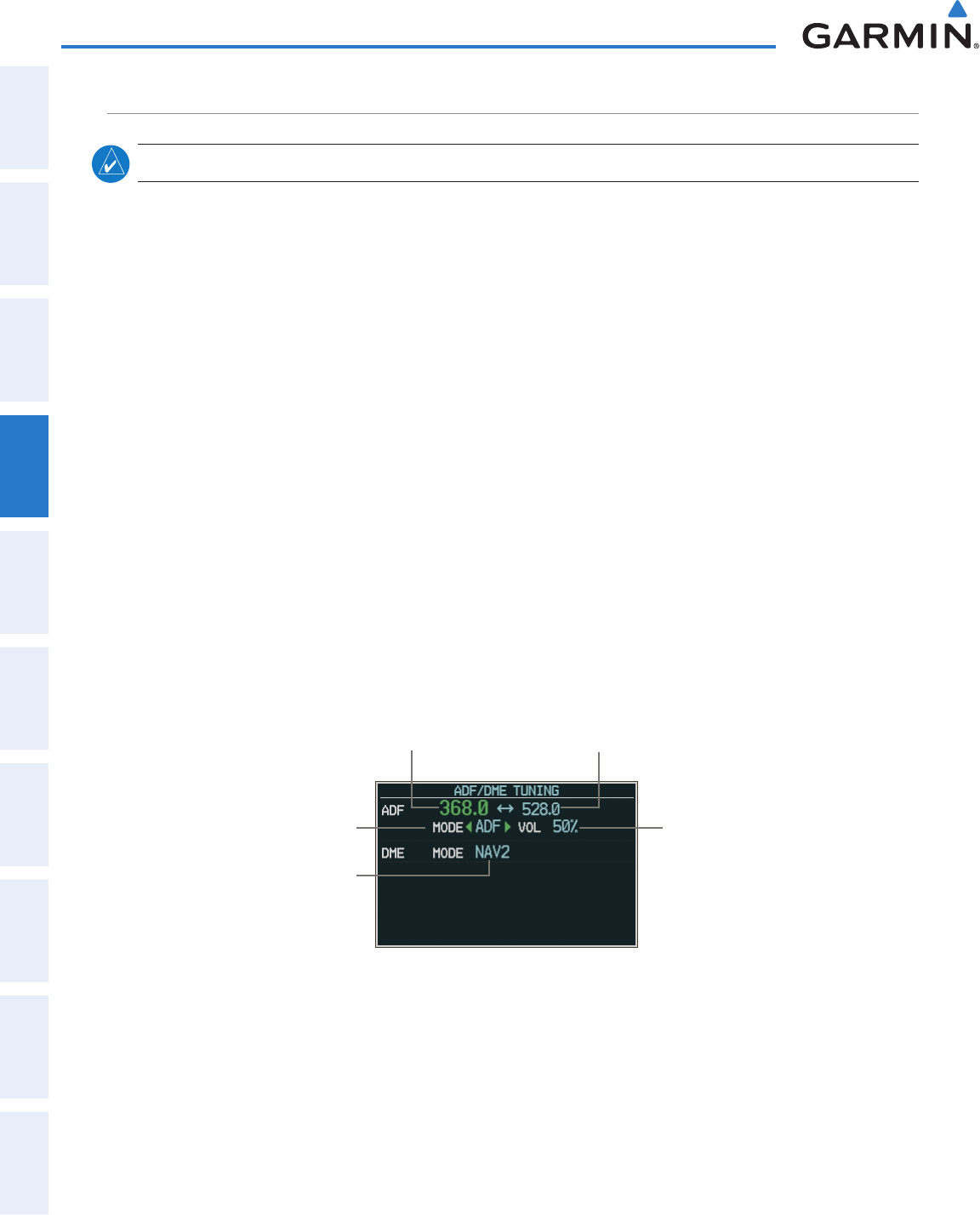
190-00592-06 Rev. A
Garmin G1000 Pilot’s Guide for the Diamond DA40/40F
114
AUDIO PANEL AND CNS
SYSTEM
OVERVIEW
FLIGHT
INSTRUMENTS
EIS
AUDIO PANEL
& CNS
FLIGHT
MANAGEMENT
HAZARD
AVOIDANCE
AFCS
ADDITIONAL
FEATURES
APPENDICESINDEX
ADF/DME TUNING
NOTE: When another auxiliary window is turned on, the ADF/DME Tuning Window is replaced on the PFD.
See the Flight Instruments Section for displaying the DME and bearing information windows (ADF) and
using the ADF as the source for the bearing pointer.
The G1000 system tunes the ADF receiver (optional) and DME transceiver (optional). The ADF is tuned by
entering the frequency in the ADF standby frequency field of the ADF/DME Tuning Window. (The softkey may
be labeled ADF/DME, ADF, or DME, depending on installed equipment.)
The UHF DME frequency is tuned by pairing with a VHF NAV frequency. DME frequency pairing is automatic
and only the VHF NAV frequency is shown.
The following ADF/DME information is displayed in the ADF/DME Tuning Window:
•Active and standby ADF frequencies
•ADF receiver mode
•ADF receiver volume
•DME tuning mode (DME transceiver pairing)
When the ADF/DME Tuning Window is displayed, the selection cursor is placed over the standby ADF
frequency field.
Turning the large
FMS
Knob moves the selection cursor through the various fields (standby ADF frequency,
ADF receiver mode, ADF radio volume, and DME tuning mode). Pressing the
FMS
Knob activates/deactivates
the selection cursor in the ADF/DME Tuning Window. The ADF frequency is entered using the FMS Knob and
the ENT Key.
Figure 4-29 ADF/DME Tuning Window
Active ADF Frequency Standby ADF Frequency
ADF
Mode
DME
Tuning
Mode
ADF
Volume
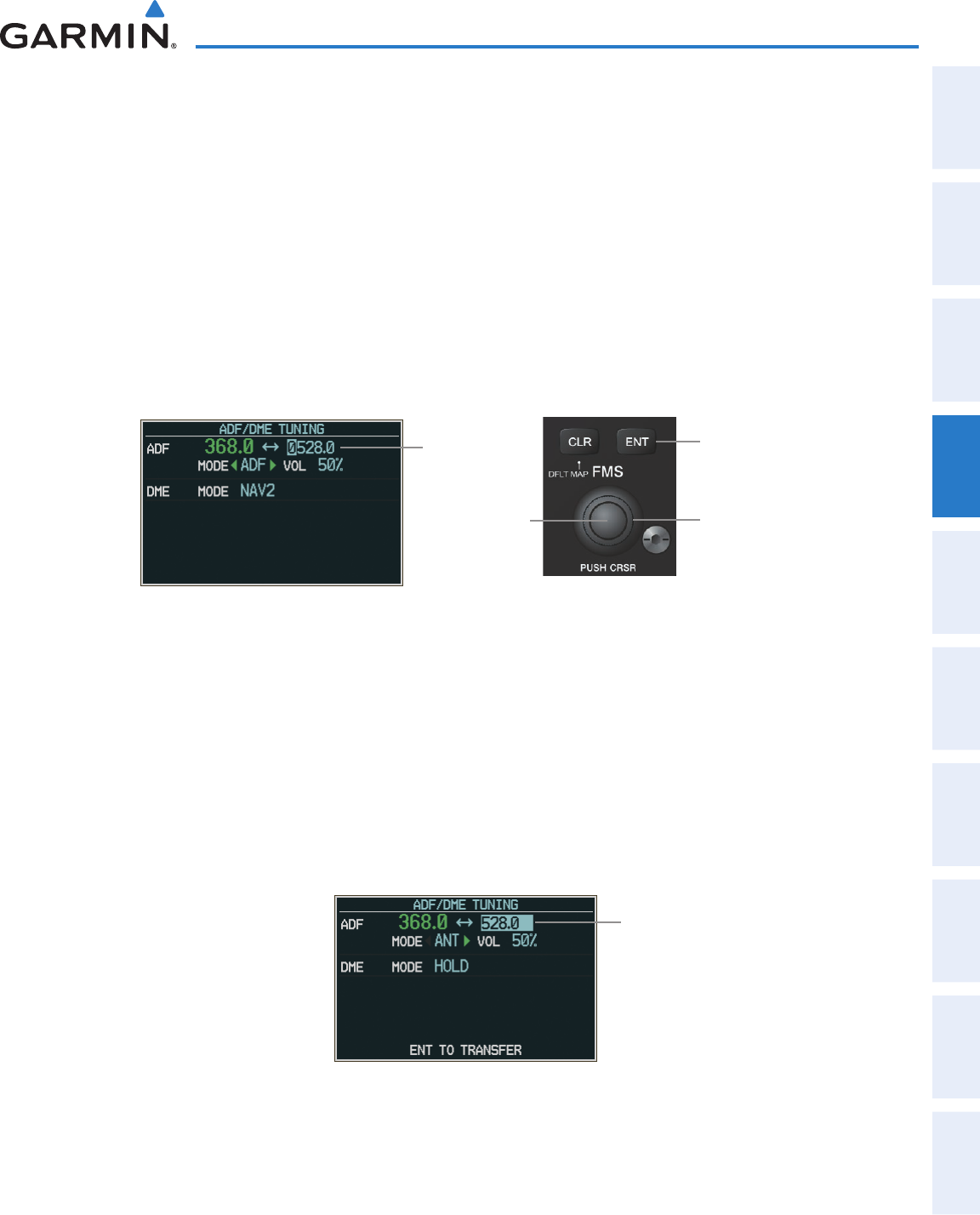
190-00592-06 Rev. A
Garmin G1000 Pilot’s Guide for the Diamond DA40/40F
115
AUDIO PANEL AND CNS
SYSTEM
OVERVIEW
FLIGHT
INSTRUMENTS EIS AUDIO PANEL
& CNS
FLIGHT
MANAGEMENT
HAZARD
AVOIDANCE AFCS ADDITIONAL
FEATURES APPENDICES INDEX
ADF TUNING
ADF frequencies in the 190.0-kHz to 1799.5-kHz range are entered in the standby ADF frequency field of the
ADF/DME Tuning Window. The G1000 System does not tune the ADF emergency frequency, 2182.0-kHz.
Tuning an ADF frequency:
1) Press the ADF/DME Softkey to display the ADF/DME Tuning Window.
2) Turn the large
FMS
Knob to place the selection cursor over the standby ADF frequency field.
3) Turn the small
FMS
Knob to begin data entry and change each digit.
4) Turn the large
FMS
Knob to move the cursor to the next digit position.
5) Press the
ENT
Key to complete data entry for the standby frequency.
Figure 4-30 Entering ADF Standby Frequencies
Press the
ENT
Key to
Complete ADF
Frequency Entry
Turn the Small
FMS
Knob to
Enter Data in
the Standby ADF
Frequency Field
Turn the Large
FMS
Knob
to Move the
Cursor to the
Next Character
Pressing the
CLR
Key before completing frequency entry cancels the frequency change and reverts back to
the previously entered frequency.
Pressing the
CLR
Key when the cursor is flashing, clears the frequency and replaces the standby field with
0000.0.
Transferring the active and standby ADF frequencies:
1) Turn the large
FMS
Knob to place the selection cursor over the standby ADF frequency field.
2) Press the
ENT
Key to complete the frequency transfer.
Figure 4-31 Transferring ADF Frequencies
Press the
ENT
Key to Transfer
the ADF
Frequencies
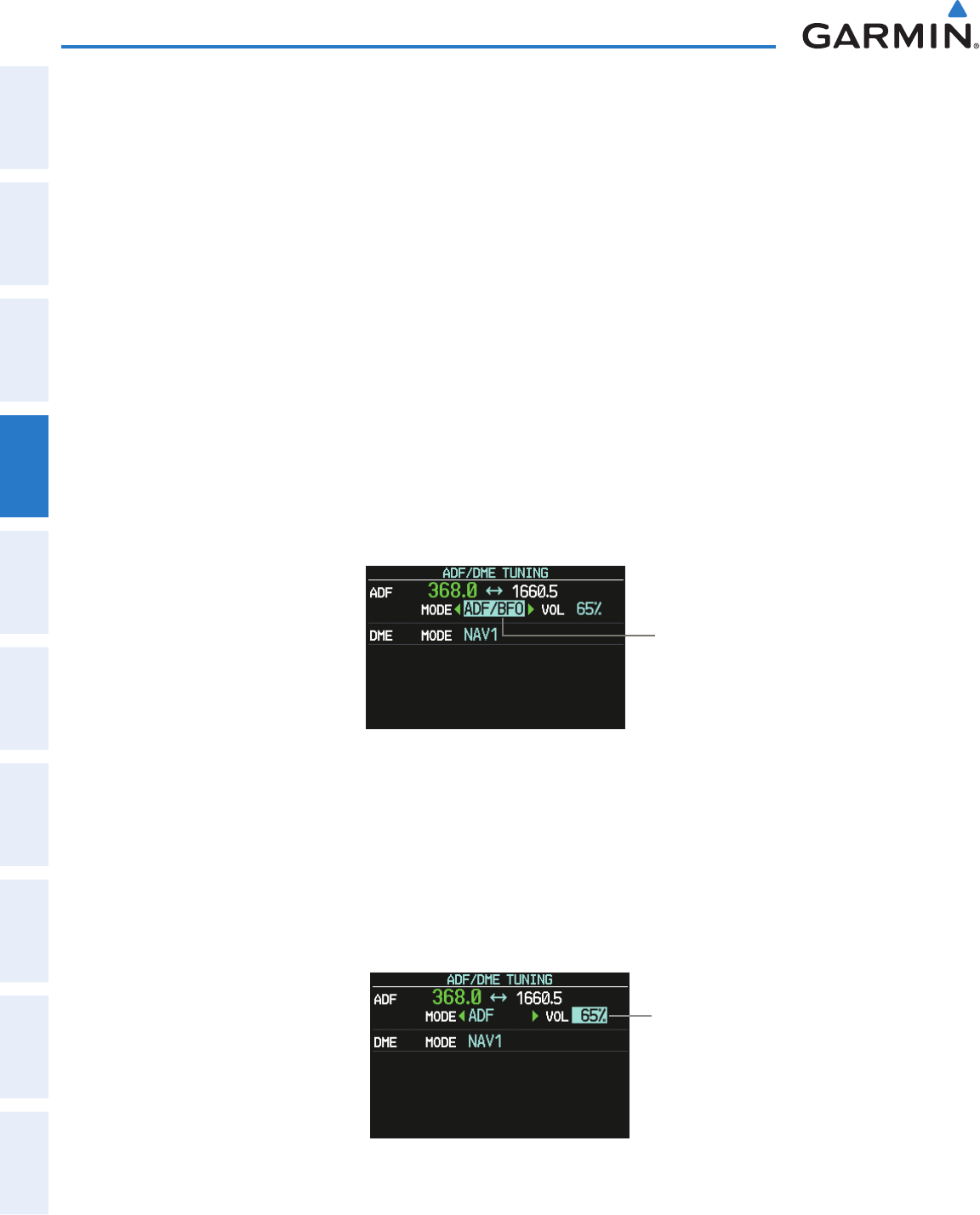
190-00592-06 Rev. A
Garmin G1000 Pilot’s Guide for the Diamond DA40/40F
116
AUDIO PANEL AND CNS
SYSTEM
OVERVIEW
FLIGHT
INSTRUMENTS
EIS
AUDIO PANEL
& CNS
FLIGHT
MANAGEMENT
HAZARD
AVOIDANCE
AFCS
ADDITIONAL
FEATURES
APPENDICESINDEX
SELECTING ADF RECEIVER MODE
The following modes can be selected: (In all modes NDB audio can be heard by selecting the
ADF
Key on
the Audio Panel.)
•ANT (Antenna) – The ADF bearing pointer parks on the HSI at 90 degrees. Best mode for listening to NDB
audio.
•ADF (Automatic Direction Finder) – The ADF pointer points to the relative bearing of the NDB station.
•ADF/BFO (ADF/Beat Frequency Oscillator) – The ADF pointer points to the relative bearing of the NDB
station and an audible tone confirms signal reception. This mode allows identification of the interrupted
carrier beacon stations used in various parts of the world.
•ANT/BFO (Antenna/Beat Frequency Oscillator) – The ADF bearing pointer parks on the HSI at 90 degrees
while an audible tone is provided when a signal is received. This mode also allows identification of the
interrupted carrier beacon stations and confirms signal reception.
Selecting an ADF receiver mode:
1) Turn the large
FMS
Knob to place the selection cursor over the ADF mode field.
2) Turn the small
FMS
Knob to select the desired ADF receiver mode.
Figure 4-32 Selecting ADF Receiver Mode
Turn the Small
FMS
Knob
to Select the
Mode
ADF receiver volume level can be adjusted in the tuning window from 0 to 100%. The default volume level
is set to 50%. The ADF volume level is the same for both Audio Panels.
Adjusting ADF receiver volume:
1) Turn the large
FMS
Knob to place the selection cursor over the ADF volume field.
2) Turn the small
FMS
Knob to adjust volume as desired.
Turn the Small
FMS
Knob
to Select the
Volume
Figure 4-33 Adjusting ADF Receiver Volume
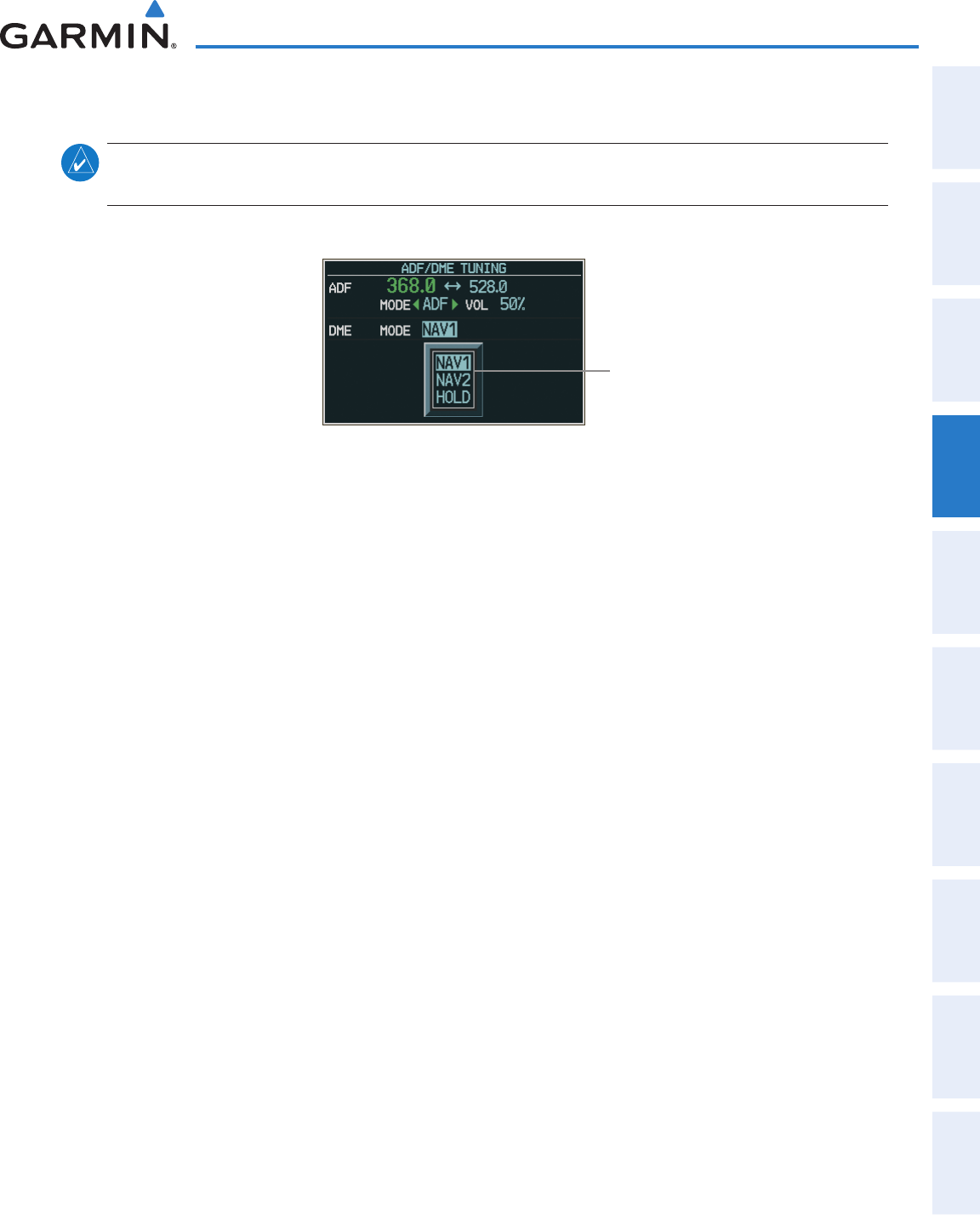
190-00592-06 Rev. A
Garmin G1000 Pilot’s Guide for the Diamond DA40/40F
117
AUDIO PANEL AND CNS
SYSTEM
OVERVIEW
FLIGHT
INSTRUMENTS EIS AUDIO PANEL
& CNS
FLIGHT
MANAGEMENT
HAZARD
AVOIDANCE AFCS ADDITIONAL
FEATURES APPENDICES INDEX
DME TUNING
NOTE: When turning on the G1000 for use, the system remembers the last frequency used for DME tuning
and the NAV1
,
NAV2,
or
HOLD
state prior to shutdown.
The DME transceiver is tuned by selecting NAV1, NAV2, or HOLD in the ADF/DME Tuning Window.
Figure 4-34 ADF/DME Tuning Window, DME Modes
DME
Modes
The following DME transceiver pairing can be selected:
•NAV1 – Pairs the DME frequency from the selected NAV1 frequency.
•NAV2 – Pairs the DME frequency from the selected NAV2 frequency.
•HOLD – When in the HOLD position, the DME frequency remains paired with the last selected NAV
frequency.
Selecting DME transceiver pairing:
1) Press the ADF/DME Softkey to display the ADF/DME Tuning Window.
2) Turn the small
FMS
Knob to select the DME tuning mode.
3) Press the
ENT
Key to complete the selection.
Pressing the CLR Key or FMS Knob while in the process of DME pairing cancels the data entry and reverts
back to the previously selected DME tuning state. Pressing the FMS Knob activates/deactivates the cursor in
the ADF/DME Tuning Window.
190-00592-06 Rev. A
Garmin G1000 Pilot’s Guide for the Diamond DA40/40F
118
AUDIO PANEL AND CNS
SYSTEM
OVERVIEW
FLIGHT
INSTRUMENTS
EIS
AUDIO PANEL
& CNS
FLIGHT
MANAGEMENT
HAZARD
AVOIDANCE
AFCS
ADDITIONAL
FEATURES
APPENDICESINDEX
4.4 GTX 33 MODE S TRANSPONDER
The GTX 33 Mode S Transponder provides Mode A, Mode C, and Mode S interrogation and reply capabilities.
Selective addressing or Mode Select (Mode S) capability includes the following features:
•Level-2replydatalinkcapability(usedtoexchangeinformationbetweenaircraftandATCfacilities)
•Surveillanceidentiercapability
•Altitudereporting
•Airbornestatusdetermination
•Transpondercapabilityreporting
•ModeSEnhancedSurveillance(EHS)requirements
•Acquisitionsquitter–Acquisitionsquitter,orshortsquitter,isthetransponder24-bitidenticationaddress.
The transmission is sent periodically, regardless of the presence of interrogations. The purpose of acquisition
squitter is to enable Mode S ground stations and aircraft equipped with a Traffic Avoidance System (TAS) to
recognize the presence of Mode S-equipped aircraft for selective interrogation.
The Hazard Avoidance Section provides more details on traffic avoidance systems.
TRANSPONDER CONTROLS
Transponder function is displayed on three levels of softkeys on the PFD: Top-level, Mode Selection, and
Code Selection. When the top-level
XPDR
Softkey is pressed, the Mode Selection softkeys appear:
STBY
,
ON
,
ALT
,
VFR
,
CODE
,
IDENT
,
BACK
.
When the
CODE
Softkey is pressed, the number softkeys appear:
0
,
1,
2
,
3
,
4
,
5
,
6
,
7
,
IDENT
,
BKSP,
BACK
. The digits
8
and
9
are not used for code entry. Pressing the numbered softkeys in sequence enters the
transponder code. If an error is made, the code selection cursor can be moved back to the left one digit with
each press of the
BKSP
Softkey.
Pressing the
BACK
Softkey during code selection reverts to the Mode Selection Softkeys. Pressing the
BACK
Softkey during mode selection reverts to the top-level softkeys.
The code can also be entered with the FMS Knob on the PFD. Code entry must be completed with either the
softkeys or the FMS Knob, but not a combination of both.
Pressing the
IDENT
Softkey while in Mode or Code Selection initiates the ident function and reverts to the
top-level softkeys.
After 45 seconds of transponder softkey inactivity, the system reverts back to the top-level softkeys.
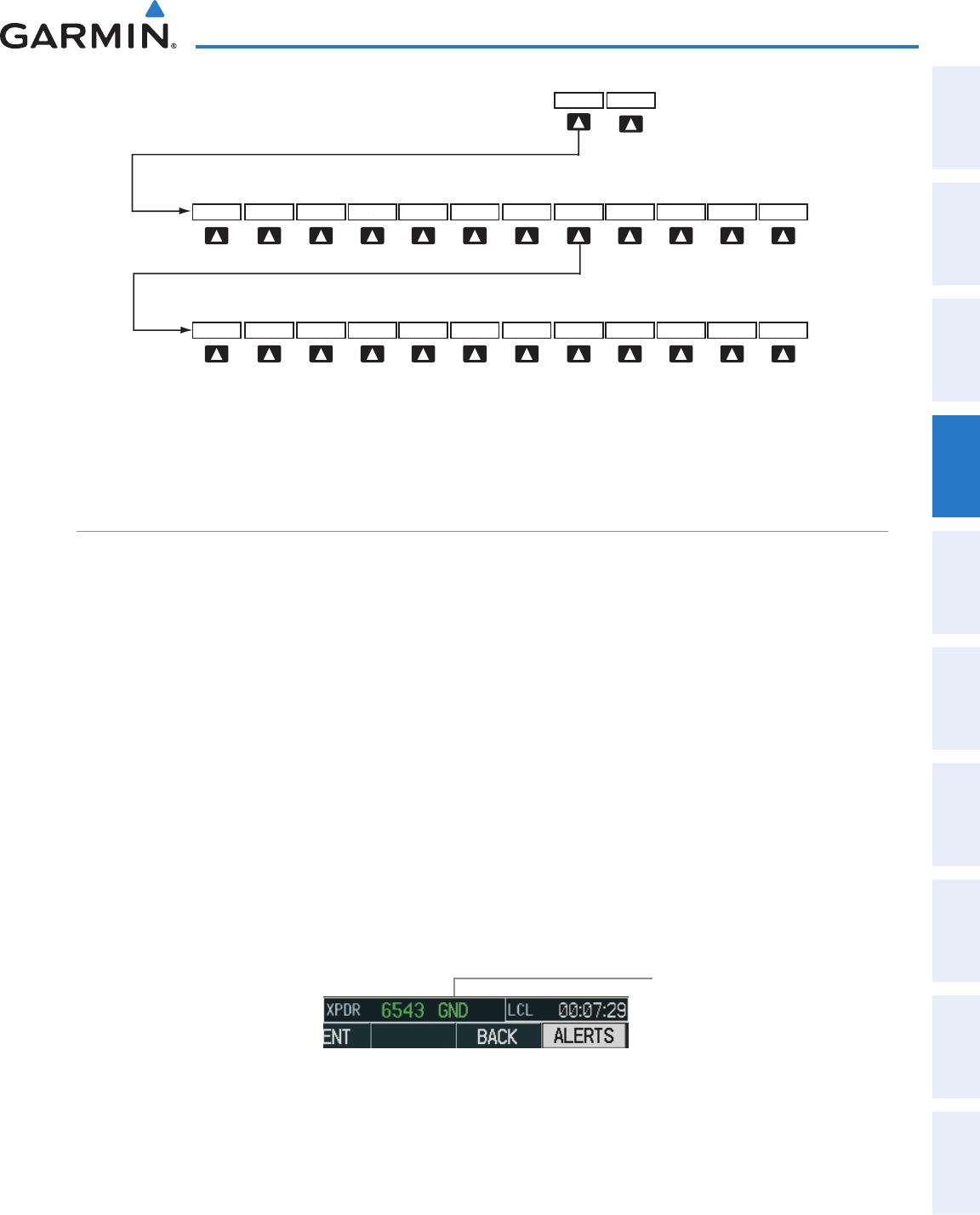
190-00592-06 Rev. A
Garmin G1000 Pilot’s Guide for the Diamond DA40/40F
119
AUDIO PANEL AND CNS
SYSTEM
OVERVIEW
FLIGHT
INSTRUMENTS EIS AUDIO PANEL
& CNS
FLIGHT
MANAGEMENT
HAZARD
AVOIDANCE AFCS ADDITIONAL
FEATURES APPENDICES INDEX
Figure 4-35 Transponder Softkeys (PFD)
Pressing the BACK Softkey
returns to the top-level softkeys.
ALERTS
ALERTSBACKBKSP
IDENT
76543210
STBY ON ALT VFR CODE IDENT BACK
XPDR IDENT
Pressing the BACK Softkey returns to the mode selection softkeys.
GND
TRANSPONDER MODE SELECTION
Mode selection can be automatic (Ground and Altitude Modes) or manual (Standby, ON, and Altitude Modes).
The
STBY
,
ON,
and
ALT
Softkeys can be accessed by pressing the
XPDR
Softkey.
Selecting a transponder mode:
1) Press the
XPDR
Softkey to display the Transponder Mode Selection Softkeys.
2) Press the desired softkey to activate the transponder mode.
GROUND MODE
Ground Mode is normally selected automatically when the aircraft is on the ground. The transponder
powers up in the last mode it was in when shut down. Ground Mode can be overridden by pressing any one
of the Mode Selection Softkeys. A green GND indication and transponder code appear in the mode field of
the Transponder Data Box. In Ground Mode, the transponder does not allow Mode A and Mode C replies,
but it does permit acquisition squitter and replies to discretely addressed Mode S interrogations.
When Standby Mode has been selected on the ground, the transponder can be returned to Ground Mode
by pressing the GND Softkey.
GND
Mode
Figure 4-36 Ground Mode
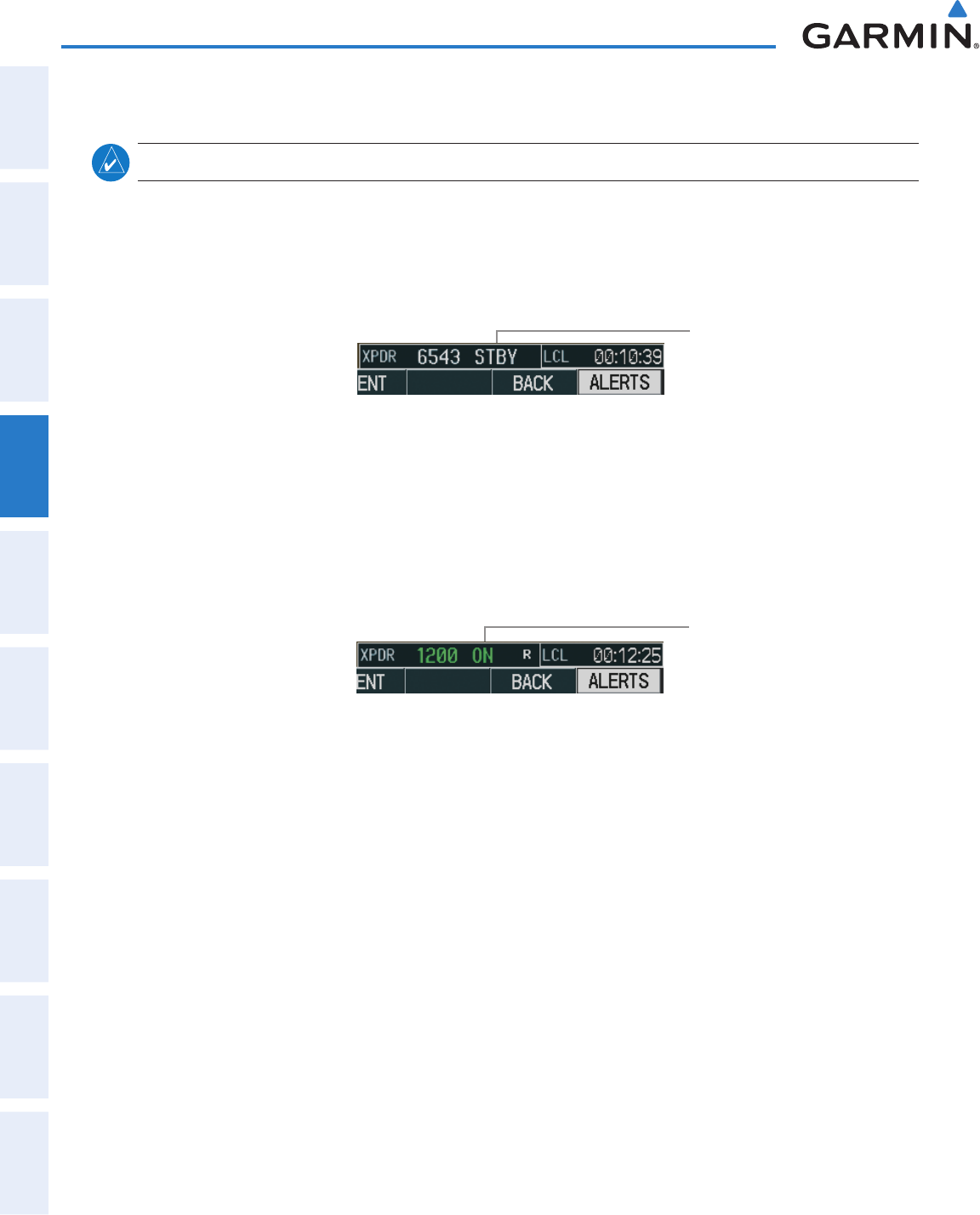
190-00592-06 Rev. A
Garmin G1000 Pilot’s Guide for the Diamond DA40/40F
120
AUDIO PANEL AND CNS
SYSTEM
OVERVIEW
FLIGHT
INSTRUMENTS
EIS
AUDIO PANEL
& CNS
FLIGHT
MANAGEMENT
HAZARD
AVOIDANCE
AFCS
ADDITIONAL
FEATURES
APPENDICESINDEX
STANDBY MODE (MANUAL)
NOTE: In Standby Mode, the IDENT function is inoperative.
Standby Mode can be selected at any time by pressing the
STBY
Softkey. In Standby, the transponder does
not reply to interrogations, but new codes can be entered. When Standby is selected, a white
STBY
indication
and transponder code appear in the mode field of the Transponder Data Box. In all other modes, these fields
appear in green.
STBY Mode (White
Code Number and
Mode)
Figure 4-37 Standby Mode
MANUAL ON MODE
ON Mode can be selected at any time by pressing the ON Softkey. ON Mode generates Mode A and Mode S
replies, but Mode C altitude reporting is inhibited. In ON Mode, a green ON indication and transponder
code appear in the mode field of the Transponder Data Box.
ON Mode
(No Altitude
Reporting)
Figure 4-38 ON Mode
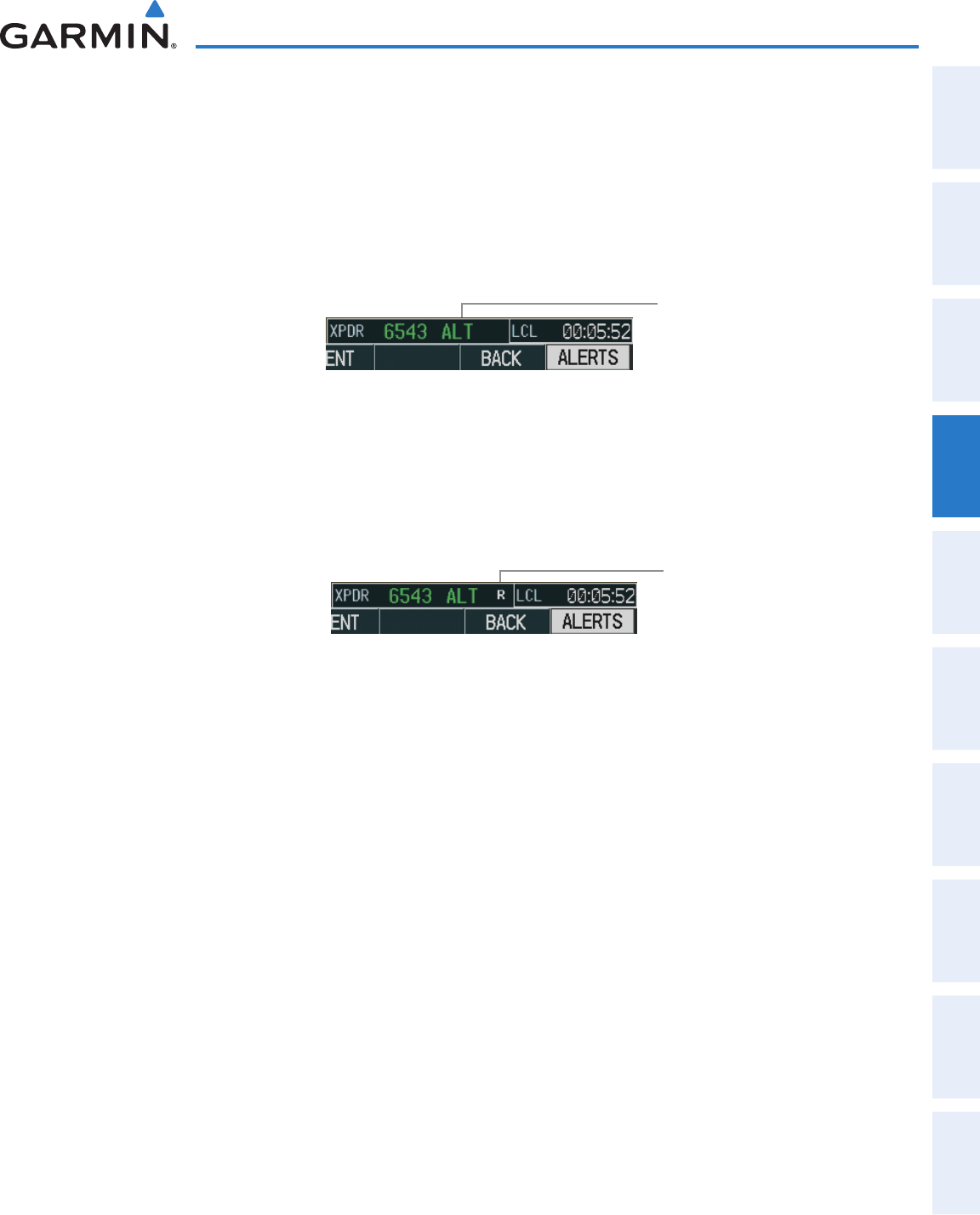
190-00592-06 Rev. A
Garmin G1000 Pilot’s Guide for the Diamond DA40/40F
121
AUDIO PANEL AND CNS
SYSTEM
OVERVIEW
FLIGHT
INSTRUMENTS EIS AUDIO PANEL
& CNS
FLIGHT
MANAGEMENT
HAZARD
AVOIDANCE AFCS ADDITIONAL
FEATURES APPENDICES INDEX
ALTITUDE MODE (AUTOMATIC OR MANUAL)
Altitude Mode is automatically selected when the aircraft becomes airborne. Altitude Mode may also be
selected manually by pressing the
ALT
Softkey.
If Altitude Mode is selected, a green ALT indication and transponder code appear in the mode field of the
Transponder Data Box, and all transponder replies requesting altitude information are provided with pressure
altitude information.
ALT Mode
(Mode C Altitude
Reporting)
Figure 4-39 Altitude Mode
REPLY STATUS
When the transponder sends replies to interrogations, a white R indication appears momentarily in the
reply status field of the Transponder Data Box.
Reply to
Interrogation
Figure 4-40 Reply Indication
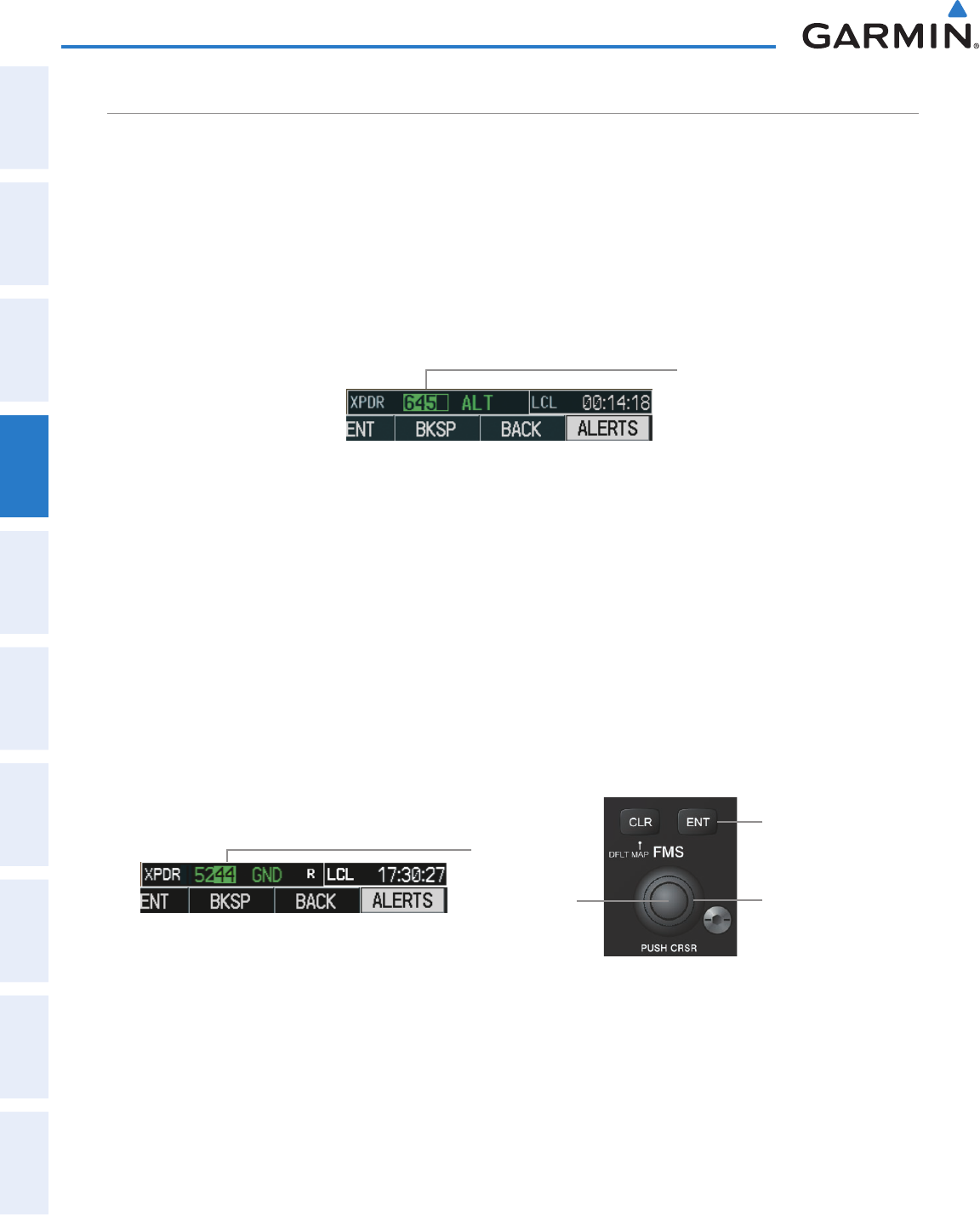
190-00592-06 Rev. A
Garmin G1000 Pilot’s Guide for the Diamond DA40/40F
122
AUDIO PANEL AND CNS
SYSTEM
OVERVIEW
FLIGHT
INSTRUMENTS
EIS
AUDIO PANEL
& CNS
FLIGHT
MANAGEMENT
HAZARD
AVOIDANCE
AFCS
ADDITIONAL
FEATURES
APPENDICESINDEX
ENTERING A TRANSPONDER CODE
Entering a transponder code with softkeys:
1) Press the
XPDR
Softkey to display the Transponder Mode Selection Softkeys.
2) Press the
CODE
Softkey to display the Transponder Code Selection Softkeys, for digit entry.
3) Press the digit softkeys to enter the code in the code field. When entering the code, the next softkey in sequence
must be pressed within 10 seconds, or the entry is cancelled and restored to the previous code. Pressing the
BKSP Softkey moves the code selection cursor to the previous digit. Five seconds after the fourth digit has been
entered, the transponder code becomes active.
Entering
a Code
Figure 4-41 Entering a Code
Entering a transponder code with the PFD FMS Knob:
1) Press the
XPDR
and the
CODE
Softkeys as in the previous procedure to enable code entry.
2) Turn the small FMS Knob on the PFD to enter the first two code digits.
3) Turn the large FMS Knob to move the cursor to the next code field.
4) Enter the last two code digits with the small FMS Knob.
5) Press the
ENT
Key to complete code digit entry.
Pressing the CLR Key or small FMS Knob before code entry is complete cancels code entry and restores the
previous code. Waiting for 10 seconds after code entry is finished activates the code automatically.
Figure 4-42 Entering a Code with the FMS Knob
Press the
ENT
Key to
Complete
Code Entry
Turn the Large
FMS
Knob
to Move the
Cursor to the
Next Code Field
Turn the Small
FMS
Knob to
Enter Two Code
Digits at a Time
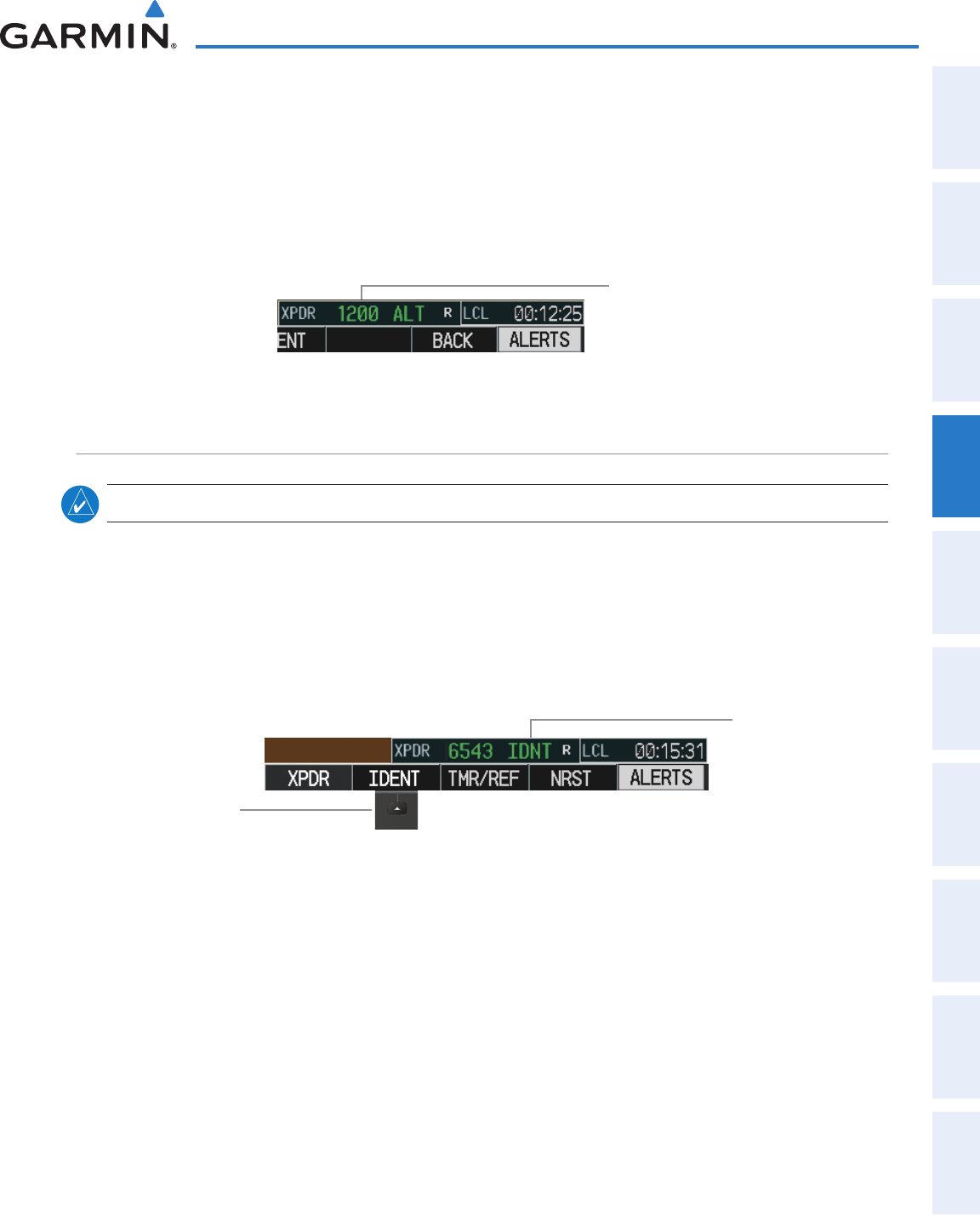
190-00592-06 Rev. A
Garmin G1000 Pilot’s Guide for the Diamond DA40/40F
123
AUDIO PANEL AND CNS
SYSTEM
OVERVIEW
FLIGHT
INSTRUMENTS EIS AUDIO PANEL
& CNS
FLIGHT
MANAGEMENT
HAZARD
AVOIDANCE AFCS ADDITIONAL
FEATURES APPENDICES INDEX
VFR CODE
The VFR code can be entered either manually or by pressing the
XPDR
Softkey, then the
VFR
Softkey.
When the
VFR
Softkey is pressed, the pre-programmed VFR code is automatically displayed in the code field
of the Transponder Data Box. Pressing the
VFR
Softkey again restores the previous identification code.
The pre-programmed VFR Code is set at the factory to 1200. If a VFR code change is required, contact a
Garmin-authorized service center for configuration.
Figure 4-43 VFR Code
VFR Code
IDENT FUNCTION
NOTE: In Standby Mode, the IDENT Softkey is inoperative.
Pressing the
IDENT
Softkey sends a distinct identity indication to Air Traffic Control (ATC). The indication
distinguishes the identing transponder from all the others on the air traffic controller’s screen. The
IDENT
Softkey appears on all levels of transponder softkeys. When the
IDENT
Softkey is pressed, a green
IDNT
indication is displayed in the mode field of the Transponder Data Box for a duration of 18 seconds.
After the
IDENT
Softkey is pressed while in Mode or Code Selection, the system reverts to the top-level
softkeys.
Press the
IDENT Softkey
to Initiate the
ID Function
IDNT
Indication
Figure 4-44 IDENT Softkey and Indication
190-00592-06 Rev. A
Garmin G1000 Pilot’s Guide for the Diamond DA40/40F
124
AUDIO PANEL AND CNS
SYSTEM
OVERVIEW
FLIGHT
INSTRUMENTS
EIS
AUDIO PANEL
& CNS
FLIGHT
MANAGEMENT
HAZARD
AVOIDANCE
AFCS
ADDITIONAL
FEATURES
APPENDICESINDEX
4.5 ADDITIONAL AUDIO PANEL FUNCTIONS
POWER-UP
The Audio Panel performs a self-test during power-up. During the self-test all Audio Panel annunciator lights
illuminate for approximately two seconds. Once the self-test is completed, most of the settings are restored to
those in use before the unit was last turned off.
MONO/STEREO HEADSETS
Stereo headsets are recommended for use in this aircraft.
Using a monaural headset in a stereo jack shorts the right headset channel output to ground. While this does
not damage the Audio Panel, a person listening on a monaural headset hears only the left channel in both ears.
If a monaural headset is used at one of the passenger positions, any other passenger using a stereo headset hears
audio in the left ear only.
SPEAKER
All of the radios can be heard over the cabin speaker. Pressing the
SPKR
Key selects and deselects the cabin
speaker. Speaker audio is muted when the PTT is pressed. Certain aural alerts and warnings (autopilot, traffic,
altitude) are always heard on the speaker, even when the speaker is not selected.
The speaker volume is adjustable within a nominal range. Contact a Garmin-authorized service center for
volume adjustment.
Figure 4-45 Passenger Address and Speaker Keys
190-00592-06 Rev. A
Garmin G1000 Pilot’s Guide for the Diamond DA40/40F
125
AUDIO PANEL AND CNS
SYSTEM
OVERVIEW
FLIGHT
INSTRUMENTS EIS AUDIO PANEL
& CNS
FLIGHT
MANAGEMENT
HAZARD
AVOIDANCE AFCS ADDITIONAL
FEATURES APPENDICES INDEX
INTERCOM
The Audio Panel includes a four-position intercom system (ICS) and a stereo music input for the pilot, copilot
and up to two passengers. The intercom provides Pilot and Copilot isolation from the passengers and aircraft
radios.
Figure 4-46 Intercom Controls
PILOT KEY
Annunciator
COPLT KEY
Annunciator Pilot Hears Copilot Hears Passenger Hears
OFF OFF
Selected radios, aural
alerts, pilot, copilot,
passengers, music
Selected radios, aural
alerts, pilot, copilot,
passengers, music
Selected radios, aural alerts,
pilot, copilot, passengers,
music
ON OFF Selected radios, aural
alerts, pilot
Copilot, passengers,
music
Copilot, passengers,
music
OFF ON
Selected radios, aural
alerts, pilot; passengers,
music
Copilot
Selected radios, aural alerts,
pilot, passengers,
music
ON ON Selected radios, aural
alerts, pilot, copilot
Selected radios, aural
alerts, pilot, copilot
Passengers;
music
Table 4-1 ICS Isolation Modes
Pilot isolation is selected when the PILOT Annunciator is illuminated. During Pilot isolation, the pilot can
hear the selected radios and aural alerts and warnings. The copilot and passengers can communicate with each
other. The copilot is isolated from aural alerts and warnings.
Copilot isolation is selected when the COPLT Annunciator is illuminated. The copilot is isolated from the
selected radios, aural alerts and warnings, and everyone else. The pilot and passengers can hear the selected
radios and communicate with each other.
When both the PILOT and COPLT Annunciators are illuminated, the pilot and copilot can hear the selected
radios and communicate with each other. The passengers are isolated from the pilot and copilot but can
communicate with each other.
When both the PILOT and COPLT Annunciators are extinguished, everyone hears the selected radios and is
able to communicate with everyone else.
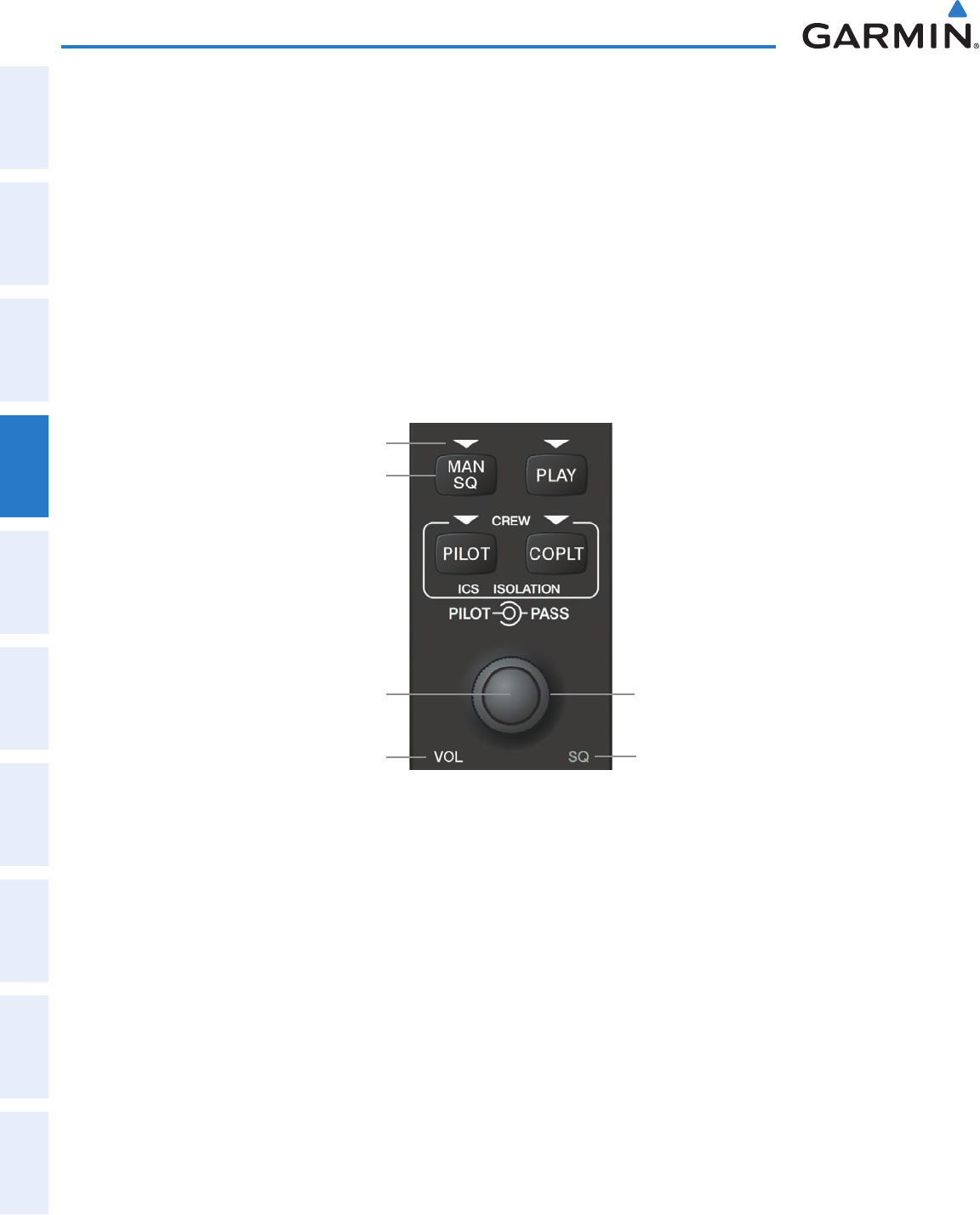
190-00592-06 Rev. A
Garmin G1000 Pilot’s Guide for the Diamond DA40/40F
126
AUDIO PANEL AND CNS
SYSTEM
OVERVIEW
FLIGHT
INSTRUMENTS
EIS
AUDIO PANEL
& CNS
FLIGHT
MANAGEMENT
HAZARD
AVOIDANCE
AFCS
ADDITIONAL
FEATURES
APPENDICESINDEX
INTERCOM VOLUME AND SQUELCH
The
PILOT/PASS
Knob controls volume or manual squelch adjustment for the pilot and copilot/passenger.
The small knob controls the pilot volume and squelch. The large knob controls the copilot/passenger volume
and squelch. The VOL and SQ annunciations at the bottom of the unit indicate which function the knob is
controlling. Pressing the
PILOT/PASS
Knob switches between volume and squelch control as indicated by
the VOL or SQ annunciation being illuminated.
The
MAN SQ
Key allows either automatic or manual control of the squelch setting. When the MAN SQ
Annunciator is extinguished (Automatic Squelch is on), the
PILOT/PASS
Knob controls only the volume
(pressing the
PILOT/PASS
Knob has no effect on the VOL/SQ selection).
When the MAN SQ Annunciator is illuminated (Manual Squelch), the
PILOT/PASS
Knob controls both
volume and squelch.
Figure 4-47 Volume/Squelch Control
Automatic/Manual Squelch
Copilot/Passenger
Volume or
Manual Squelch
Manual Squelch Annunciator;
Off for Automatic Squelch, On
for Manual Squelch
Pilot Volume or Manual
Squelch. Press to switch
between VOL and SQ. Turn
to adjust Squelch when SQ
Annunciation is lit, Volume
when VOL Annunciation is lit.
Volume Annunciation Squelch Annunciation
190-00592-06 Rev. A
Garmin G1000 Pilot’s Guide for the Diamond DA40/40F
127
AUDIO PANEL AND CNS
SYSTEM
OVERVIEW
FLIGHT
INSTRUMENTS EIS AUDIO PANEL
& CNS
FLIGHT
MANAGEMENT
HAZARD
AVOIDANCE AFCS ADDITIONAL
FEATURES APPENDICES INDEX
PASSENGER ADDRESS (PA) SYSTEM
A passenger address system is available for delivering voice messages over the cabin speaker. When the PA
Key is selected on the Audio Panel, the COM MIC Annunciator is extinguished, and the active COM frequency
changes to white, indicating that there is no COM selected. A Push-to-Talk (PTT) must be pressed to deliver PA
announcements. The PA Annunciator flashes about once per second while the PTT is depressed.
Figure 4-49 PA Key Selected for Cabin Announcements
PA
Key is Selected on
the Audio Panel
CLEARANCE RECORDER AND PLAYER
The Audio Panel contains a digital clearance recorder that continually records up to 2.5 minutes of the
selected COM radio signal. Recorded COM audio is stored in separate memory blocks. Once 2.5 minutes of
recording time have been reached, the recorder begins recording over the stored memory blocks, starting from
the oldest block.
The PLAY Key controls the play function. Pressing the PLAY Key once plays the latest recorded memory
block. The PLAY Annunciator flashes to indicate when play is in progress. The PLAY Annunciator turns off
after the present memory block has finished playing.
Pressing the
MKR/MUTE
Key during play of a memory block stops play. If a COM input signal is detected
during play of a recorded memory block, play is halted.
Pressing the PLAY Key while audio is playing begins playing the previously recorded memory block. Each
subsequent press of the PLAY Key selects the previously recorded memory block.
Powering off the unit automatically clears all recorded blocks.
Figure 4-49 Marker Mute and Play Keys
PLAY
Key
Controls the
Play Function
MKR/MUTE
Key Stops Play
190-00592-06 Rev. A
Garmin G1000 Pilot’s Guide for the Diamond DA40/40F
128
AUDIO PANEL AND CNS
SYSTEM
OVERVIEW
FLIGHT
INSTRUMENTS
EIS
AUDIO PANEL
& CNS
FLIGHT
MANAGEMENT
HAZARD
AVOIDANCE
AFCS
ADDITIONAL
FEATURES
APPENDICESINDEX
ENTERTAINMENT INPUTS
NOTE: The entertainment MUSIC INPUT cannot be completely turned off. Audio level for MUSIC INPUT can
be adjusted by a Garmin-authorized service center.
The Audio Panel provides a stereo entertainment input from the data link receiver or an MUSIC INPUT jack
for the crew and passengers. The MUSIC INPUT jack input is compatible with popular portable entertainment
devices such as MP3 and CD players through a 3.5-mm stereo phone jack, installed in a convenient location.
The headphone outputs of the entertainment devices are plugged into the MUSIC INPUT jack.
The current ICS state of isolation affects the distribution of the entertainment input (see Table 4-1).
CREW MUSIC
Music can be heard by the pilot and copilot when both the PILOT and the COPLT ICS Annunciators are
extinguished. Music can also be heard by the pilot when the COPLT Annunciator is illuminated and by the
copilot when the PILOT Annunciator is illuminated.
Mu s i c Mu t i n g
Music muting occurs when aircraft radio or marker beacon activity is heard. Music is always soft muted
when an interruption occurs from these sources. Soft muting is the gradual return of music to its original
volume level. The time required for music volume to return to normal is between one-half and four
seconds.
Mu s i c Mu t i n g en a B l e /Di s a B l e
Pressing and holding the
MKR/MUTE
Key for three seconds switches music muting on and off. When
switching, either one or two beeps are heard; one beep indicates that music muting is enabled, two beeps
indicate music muting is disabled. Music muting is reset (enabled) during power up.
PASSENGER MUSIC
Music can be heard only by the passengers and is never muted.
XM RADIO ENTERTAINMENT
XM Radio audio from the Data Link Receiver may be heard by the pilot and passengers simultaneously
(optional: requires subscription to XM Radio Service). Refer to the Additional Features Section for more
details on the Data Link Receiver.
Connecting a stereo input to the MUSIC INPUT jack removes the XM Radio Audio from that input.
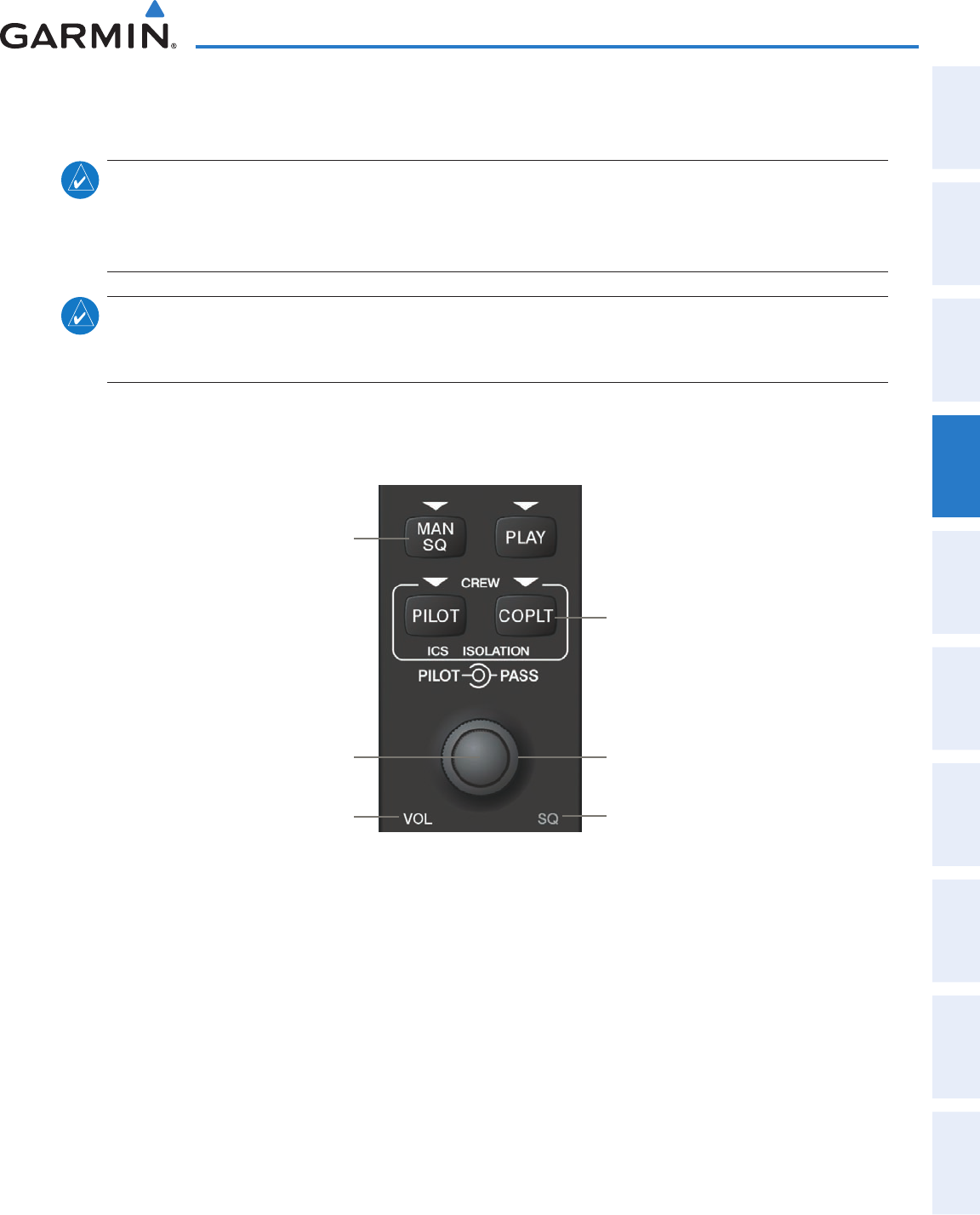
190-00592-06 Rev. A
Garmin G1000 Pilot’s Guide for the Diamond DA40/40F
129
AUDIO PANEL AND CNS
SYSTEM
OVERVIEW
FLIGHT
INSTRUMENTS EIS AUDIO PANEL
& CNS
FLIGHT
MANAGEMENT
HAZARD
AVOIDANCE AFCS ADDITIONAL
FEATURES APPENDICES INDEX
4.6 AUDIO PANEL PREFLIGHT PROCEDURE
NOTE: If the pilot and/or copilot are using headsets that have a high/low switch or volume control knob,
verify that the switch is in the high position and the volume control on the headsets are at maximum volume
setting. On single-pilot flights, verify that all other headsets are not connected to avoid excess noise in the
audio system.
NOTE: When the MAN SQ Key is pressed, the ICS squelch can be set manually by the pilot and copilot. If
manual squelch is set to full open (SQ annunciated and the knobs turned counterclockwise) background
noise is heard in the ICS system as well as during COM transmissions.
After powering up the G1000 System, the following steps aid in maximizing the use of the Audio Panel as well
as prevent pilot and copilot induced issues. These preflight procedures should be performed each time a pilot
boards the aircraft to insure awareness of all audio levels in the Audio Panel and radios.
Figure 4-50 Audio Panel Controls
Pilot and
Copilot ICS
Isolation Keys
Pilot Volume
or Manual
Squelch
Automatic/Manual
Squelch
Volume
Annunciation
Squelch
Annunciation
Copilot/Passenger
Volume or
Manual Squelch
Setting the Audio Panel during preflight:
1) Verify that the PILOT and COPLT Annunciators are extinguished.
2) Verify that the MAN SQ Annunciator is extinguished.
3) Turn the PILOT/PASS Knobs clockwise two full turns. This sets the headset intercom audio level to max volume
(least amount of attenuation).
4) Adjust radio volume levels (COM, NAV, etc.) to a suitable level.
5) Adjust the PILOT/PASS Knob volume to the desired intercom level.
Once this procedure has been completed, the pilot and copilot can change settings, keeping in mind the notes
above.
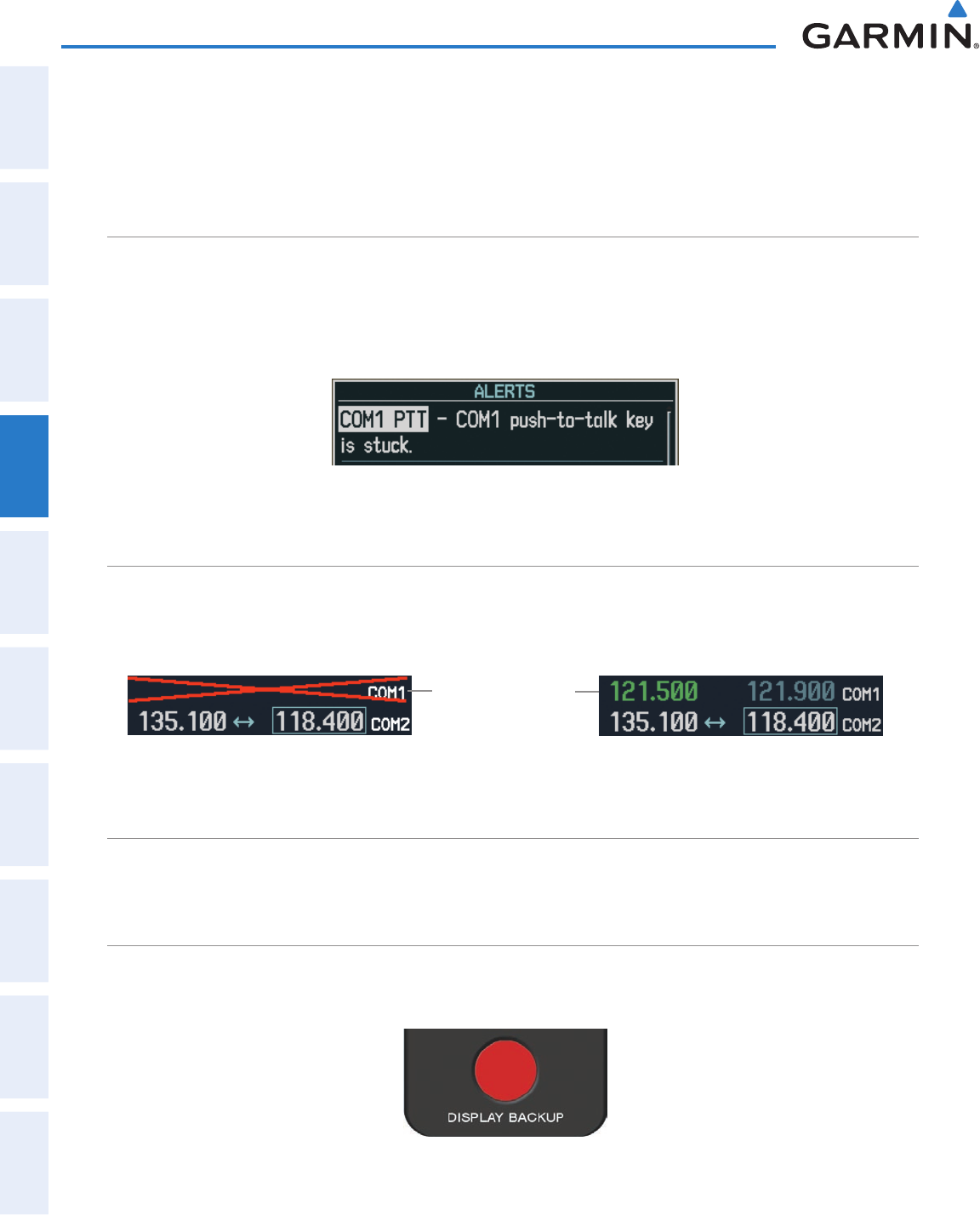
190-00592-06 Rev. A
Garmin G1000 Pilot’s Guide for the Diamond DA40/40F
130
AUDIO PANEL AND CNS
SYSTEM
OVERVIEW
FLIGHT
INSTRUMENTS
EIS
AUDIO PANEL
& CNS
FLIGHT
MANAGEMENT
HAZARD
AVOIDANCE
AFCS
ADDITIONAL
FEATURES
APPENDICESINDEX
4.7 ABNORMAL OPERATION
Abnormal operation of the G1000 includes equipment failures of the G1000 components and failure of
associated equipment, including switches and external devices.
STUCK MICROPHONE
If the push-to-talk (PTT) Key becomes stuck, the COM transmitter stops transmitting after 35 seconds of
continuous operation. An alert appears on the PFD to advise the pilot of a stuck microphone.
The
COM1 MIC
or
COM2 MIC
Key Annunciator on the Audio Panel flashes as long as the PTT Key remains
stuck.
Figure 4-51 Stuck Microphone Alert
COM TUNING FAILURE
In case of a COM system tuning failure, the emergency frequency (121.500 MHz) is automatically tuned in
the radio in which the tuning failure occurred. Depending on the failure mode, a red X may appear on the
frequency display.
Figure 4-52 COM Tuning Failure
Emergency Channel
Loaded Automatically
AUDIO PANEL FAIL-SAFE OPERATION
If there is a failure of the Audio Panel, a fail-safe circuit connects the pilot’s headset and microphone directly
to the COM1 transceiver. Audio is not available on the speaker during Fail-safe operation.
REVERSIONARY MODE
The red DISPLAY BACKUP Button selects the Reversionary Mode. See the System Overview Section for
more information on Reversionary Mode.
Figure 4-53 Display Backup Button
190-00592-06 Rev. A
Garmin G1000 Pilot’s Guide for the Diamond DA40/40F
131
FLIGHT MANAGEMENT
SYSTEM
OVERVIEW
FLIGHT
INSTRUMENTS EIS AUDIO PANEL
& CNS
FLIGHT
MANAGEMENT
HAZARD
AVOIDANCE AFCS ADDITIONAL
FEATURES APPENDICES INDEX
SECTION 5 FLIGHT MANAGEMENT
5.1 INTRODUCTION
The G1000 is an integrated flight, engine, communication, navigation and surveillance system. This section of
the Pilot’s Guide explains flight management using the G1000.
The most prominent part of the G1000 are the two full color displays: a Primary Flight Display (PFD) and a
Multi Function Display (MFD). The information to successfully navigate the aircraft using the GPS sensors is
displayed on the PFD and the MFD. See examples in the Figure 5-1 and Figure 5-2. Detailed descriptions of flight
management functions are discussed later in this section.
A brief description of the flight management data on the PFD and MFD follows.
Navigation mode indicates which sensor is providing the course data (e.g., GPS, VOR) and the flight plan phase
(e.g., Departure (DPRT), Terminal (TERM), Enroute (ENR), Oceanic (OCN), Approach (LNAV, LNAV+V, L/VNAV,
or LPV), or Missed Approach (MAPR)).
The Inset Map is a small version of the MFD Navigation Map and can be displayed in the lower left corner of
the PFD. When the system is in reversionary mode, the Inset Map is displayed in the lower right corner. The
Inset Map is displayed by pressing the INSET Softkey. Selecting the INSET Softkey again, then selecting the OFF
Softkey removes the Inset Map.
The Navigation Map displays aviation data (e.g., airports, VORs, airways, airspaces), geographic data (e.g.,
cities, lakes, highways, borders), topographic data (map shading indicating elevation), and hazard data (e.g.,
traffic, terrain, weather). The amount of displayed data can be reduced by selecting the DCLTR Softkey. The
Navigation Map can be oriented four different ways: North Up (NORTH UP), Track Up (TRK UP), Desired Track
Up (DTK UP), or Heading Up (HDG UP).
An aircraft icon is placed on the Navigation Map at the location corresponding to the calculated present position.
The aircraft position and the flight plan legs are accurately based on GPS calculations. The basemap upon which
these are placed are from a source with less resolution, therefore the relative position of the aircraft to map features
is not exact. The leg of the active flight plan currently being flown is shown as a magenta line on the navigation
map. The other legs are shown in white.
There are 28 different map ranges available, from 500 feet to 2000 nm. The current range is indicated in the
lower right corner of the map and represents the top-to-bottom distance covered by the map. To change the map
range on any map, turn the Joystick counter-clockwise to zoom in ( -, decreasing), or clockwise to zoom out (+,
increasing).
The Direct-to Window, the Flight Plan Window, the Procedures Window, and the Nearest Airports Window
can be displayed in the lower right corner of the PFD. Details of these windows are discussed in detail later in
the section.
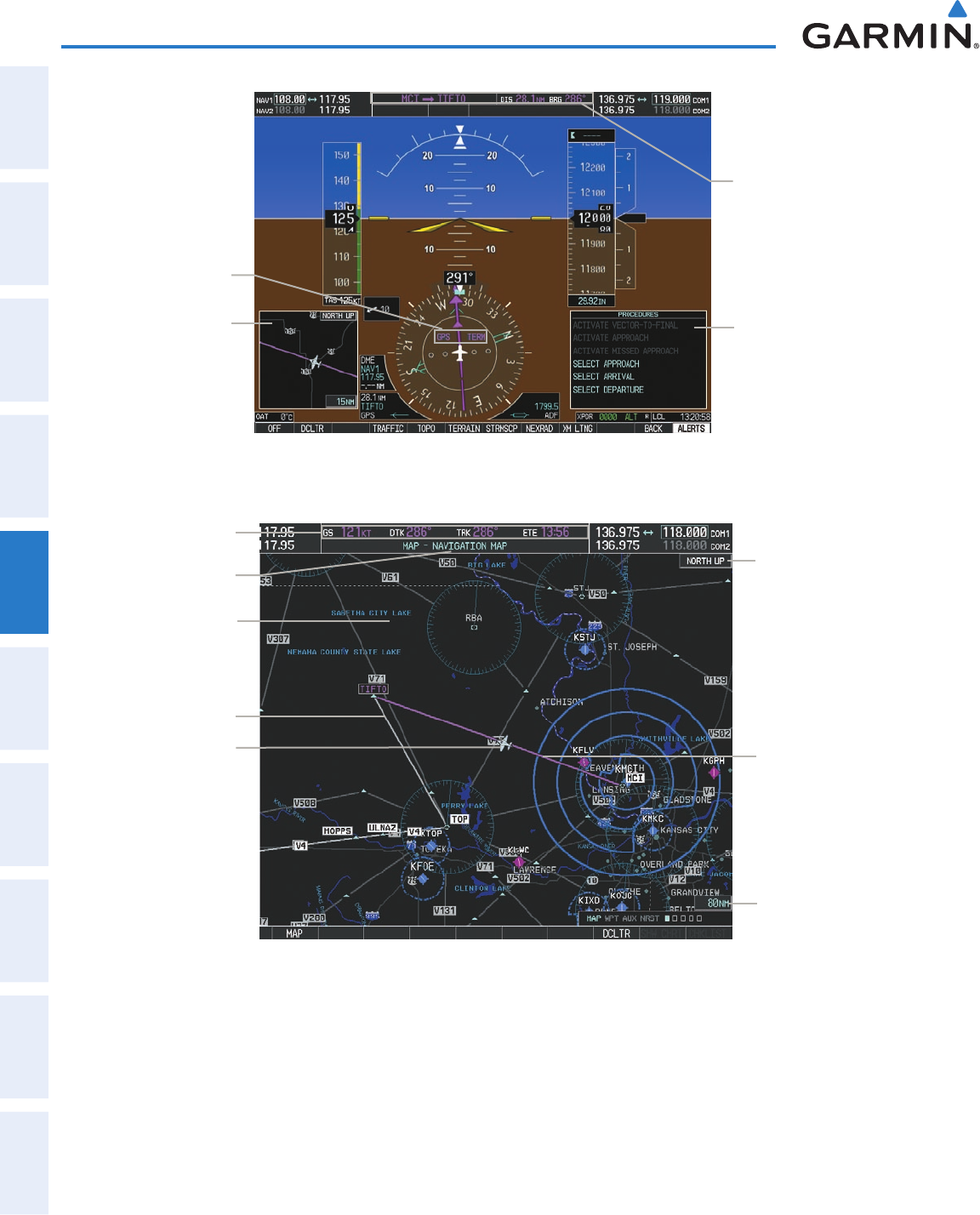
Garmin G1000 Pilot’s Guide for the Diamond DA40/40F
190-00592-06 Rev. A132
FLIGHT MANAGEMENT
SYSTEM
OVERVIEW
FLIGHT
INSTRUMENTS
EIS
AUDIO PANEL
& CNS
FLIGHT
MANAGEMENT
HAZARD
AVOIDANCE
AFCS
ADDITIONAL
FEATURES
APPENDICESINDEX
Figure 5-1 GPS Navigation Information on the PFD
Location of:
- Direct To Window
- Flight Plan Window
- Procedures Window
- Nearest Airports Window
Inset Map
Navigation Status Box
Navigation Mode
Figure 5-2 GPS Navigation Information on the MFD Navigation Page
Active Flight Plan Leg
Navigation Map
- Aviation Data
- Geographic Data
- Topographic Data
- Hazard Data
Navigation Status Box
Aircraft Icon
at Present Position
Navigation Page Title
Map Range
Map Orientation
Flight Plan Leg
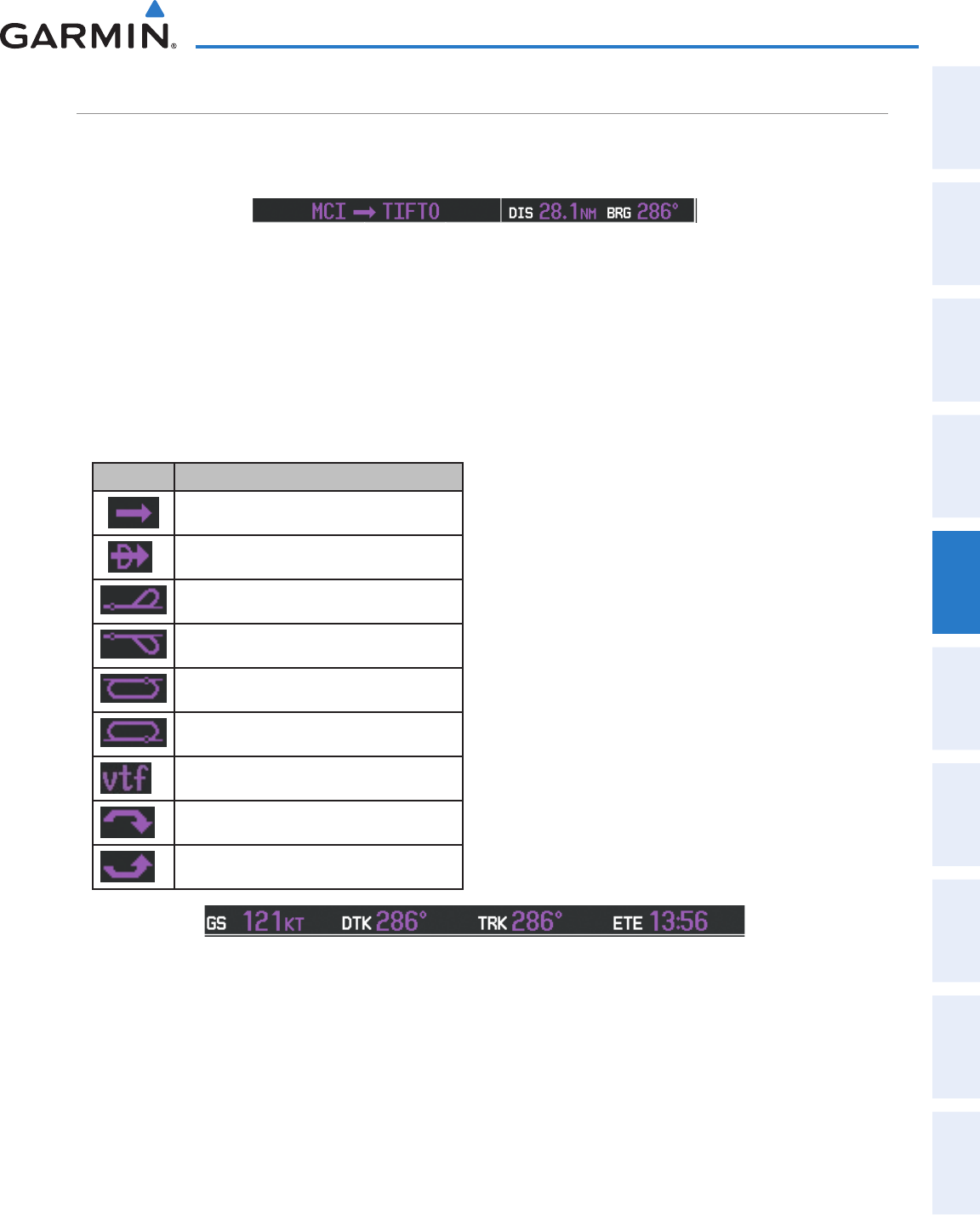
190-00592-06 Rev. A
Garmin G1000 Pilot’s Guide for the Diamond DA40/40F
133
FLIGHT MANAGEMENT
SYSTEM
OVERVIEW
FLIGHT
INSTRUMENTS EIS AUDIO PANEL
& CNS
FLIGHT
MANAGEMENT
HAZARD
AVOIDANCE AFCS ADDITIONAL
FEATURES APPENDICES INDEX
NAVIGATION STATUS BOX
The Navigation Status Box located at the top of the PFD contains two fields displaying the following
information:
PFD Navigation Status Box
•Activeightplanleg(e.g.,‘D->KICT’or‘KIXD-
>KCOS’)or flight plan annunciations (e.g., ‘Turn
right to 021˚ in 8 seconds’)
•Distance (DIS) and Bearing (BRG) to the next
waypoint or flight plan annunciations (e.g., ‘TOD
within 1 minute’)
The symbols used in the PFD status bar are:
Symbol Description
Active Leg
Direct-to
Right Procedure Turn
Left Procedure Turn
Right Holding Pattern
Left Holding Pattern
Vector to Final
Right DME Arc
Left DME Arc
The Navigation Status Box located at the top of the
MFD contains four data fields, each displaying one of
the following items:
•Bearing(BRG)
•Distance(DIS)
•DesiredTrack(DTK)
•EnrouteSafeAltitude(ESA)
•EstimatedTimeofArrival(ETA)
•EstimatedTimeEnroute(ETE)
•GroundSpeed(GS)
•MinimumSafeAltitude(MSA)
•TrueAirSpeed(TAS)
•TrackAngleError(TKE)
•Track(TRK)
•VerticalSpeedRequired(VSR)
•CrosstrackError(XTK)
MFD Navigation Status Box
The navigation information displayed in the four data fields can be selected on the MFD Data Bar Fields Box
on the AUX - System Setup Page. The default selections (in order left to right) are GS, DTK, TRK, and ETE.
Changing a field in the MFD Navigation Status Box:
1) Select the System Setup Page.
2) Press the FMS Knob momentarily to activate the flashing cursor.
3) Turn the large FMS Knob to highlight the desired field number in the MFD Data Bar Fields Box.
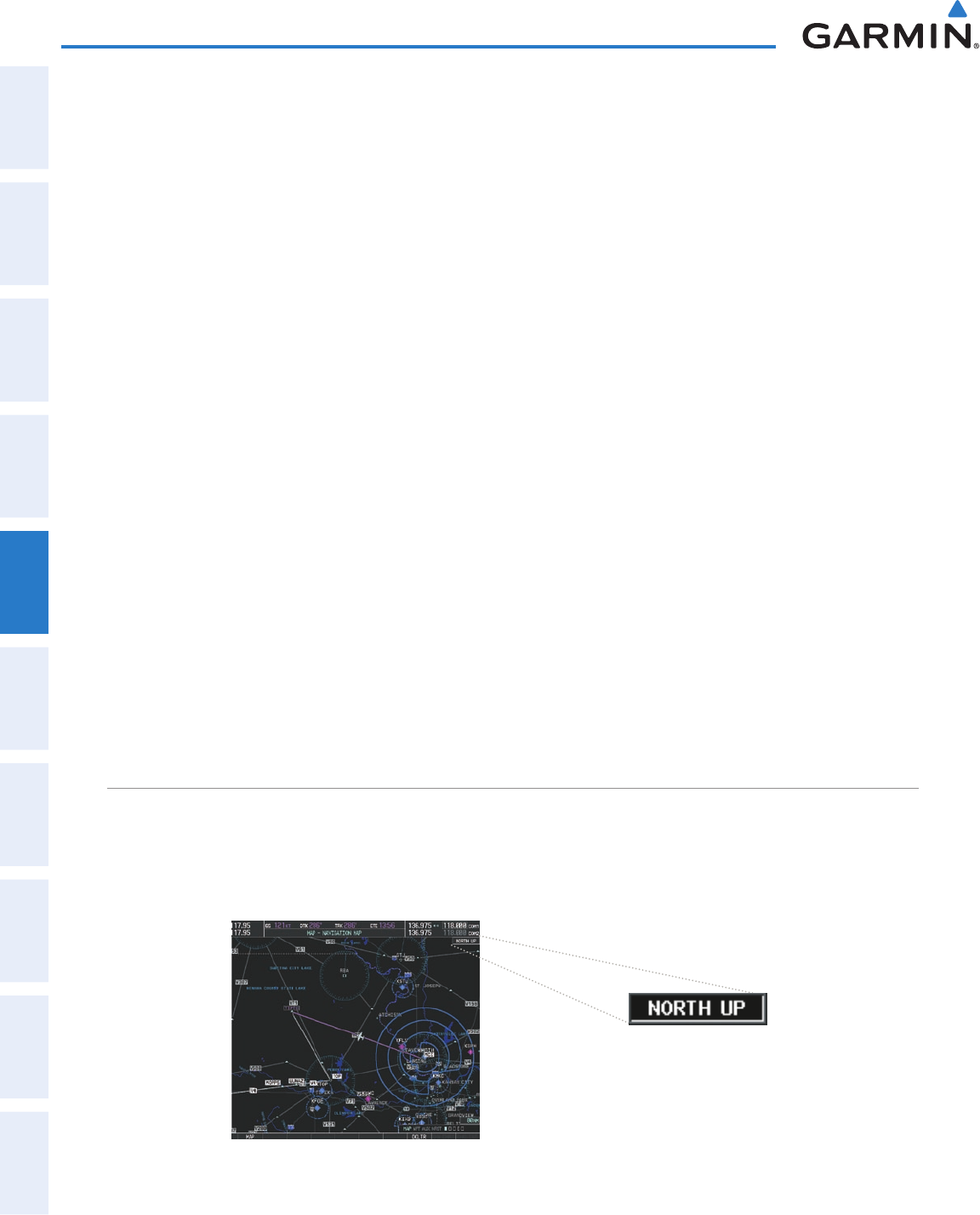
Garmin G1000 Pilot’s Guide for the Diamond DA40/40F
190-00592-06 Rev. A134
FLIGHT MANAGEMENT
SYSTEM
OVERVIEW
FLIGHT
INSTRUMENTS
EIS
AUDIO PANEL
& CNS
FLIGHT
MANAGEMENT
HAZARD
AVOIDANCE
AFCS
ADDITIONAL
FEATURES
APPENDICESINDEX
4) Turn the small FMS Knob to display and scroll through the data options list.
5) Select the desired data.
6) Press the ENT Key. Pressing the DFLTS Softkey returns any field to its default setting.
5.2 USING MAP DISPLAYS
Map displays are used extensively in the G1000 to provide situational awareness in flight. Most G1000 maps
can display the following information:
•Airports, NAVAIDs, airspaces, airways, land data
(highways, cities, lakes, rivers, borders, etc.) with
names
•Map Pointer information (distance and bearing to
pointer, location of pointer, name, and other pertinent
information)
•Maprange
•Wind direction and speed
•Maporientation
•Iconsforenabledmapfeatures
•Aircrafticon(representingpresentposition)
•Navrangering
•Flightplanlegs
•Userwaypoints
•Trackvector
•Topographyscale
•Topographydata
MAP ORIENTATION
Maps are shown in one of four different orientation options, allowing flexibility in determining aircraft
position relative to other items on the map (north up) or for determining where map items are relative to where
the aircraft is going (track up, desired track up, or heading up). The map orientation is shown in the upper
right corner of the map.
Figure 5-3 Map Orientation
•AllMapGroupPages(MAP)
•AllWaypointGroupPages(WPT)
•AUX-TripPlanning
•AllNearestGroupPages(NRST)
•FlightPlanPages(FPL)
•Direct-toWindow
•PFDInsetMap
•ProcedureLoadingPages
The information in this section applies to the following maps unless otherwise noted:
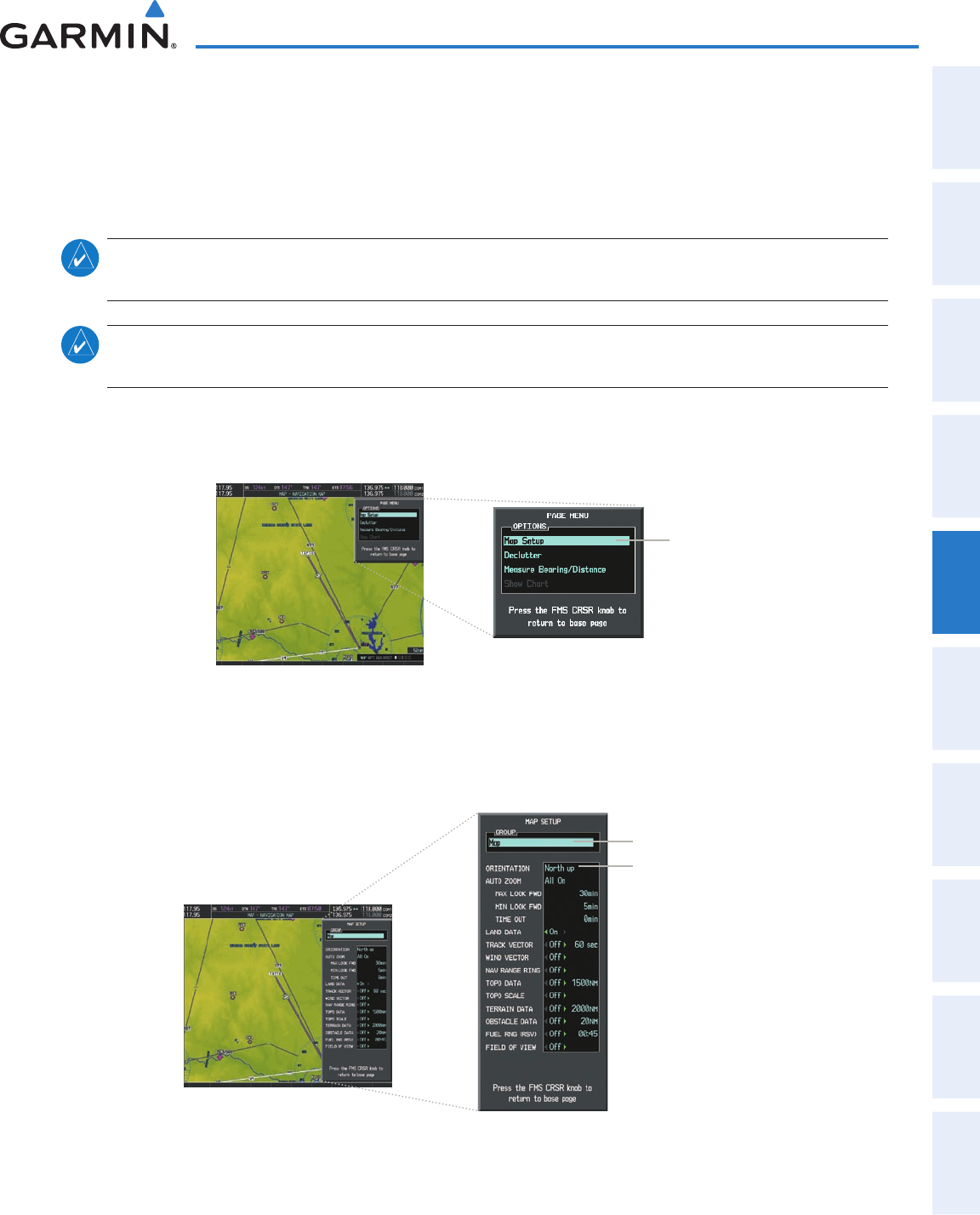
190-00592-06 Rev. A
Garmin G1000 Pilot’s Guide for the Diamond DA40/40F
135
FLIGHT MANAGEMENT
SYSTEM
OVERVIEW
FLIGHT
INSTRUMENTS EIS AUDIO PANEL
& CNS
FLIGHT
MANAGEMENT
HAZARD
AVOIDANCE AFCS ADDITIONAL
FEATURES APPENDICES INDEX
•Northup(NORTHUP)alignsthetopofthemapdisplaytonorth(defaultsetting).
•Trackup(TRKUP)alignsthetopofthemapdisplaytothecurrentgroundtrack.
•Desiredtrackup(DTKUP)alignsthetopofthemapdisplaytothedesiredcourse.
•Headingup(HDGUP)alignsthetopofthemapdisplaytothecurrentaircraftheading.
NOTE: When panning or reviewing active flight plan legs in a non-North Up orientation, the map does not
show the map orientation nor the wind direction and speed.
NOTE: Map orientation can only be changed on the Navigation Map Page. Any other displays that show
navigation data reflect the orientation selected for the Navigation Map Page:
Changing the Navigation Map orientation:
1) With the Navigation Map Page displayed, press the MENU Key. The cursor flashes on the ‘Map Setup’ option.
Figure 5-4 Navigation Map Page Menu Window
Map Setup
Selection
2) Press the ENT Key to display the Map Setup Window.
3) Turn the large FMS Knob, or press the ENT Key once, to select the ‘ORIENTATION’ field.
Figure 5-5 Map Setup Menu Window - Map Group
Orientation Field
Map Group Selection
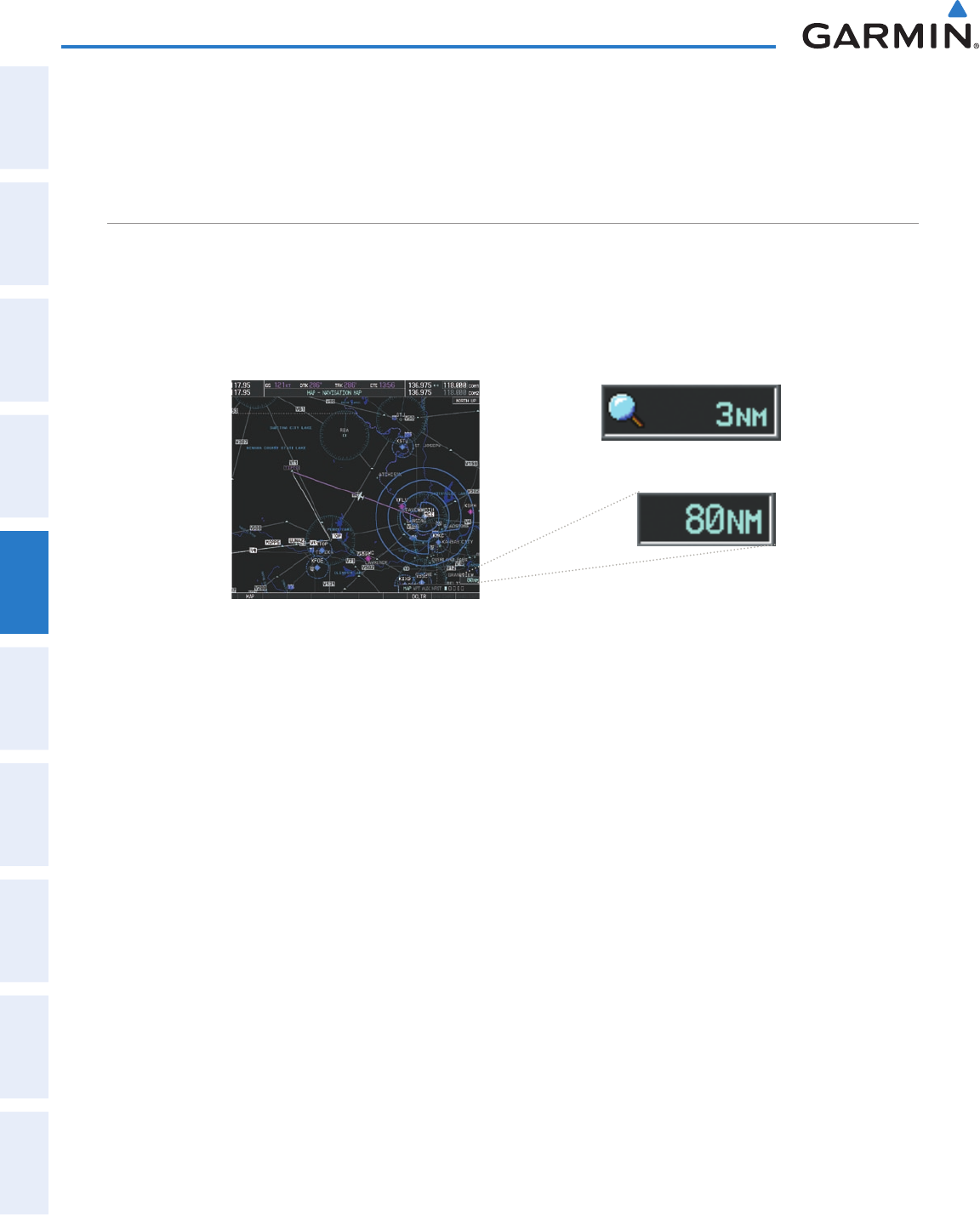
Garmin G1000 Pilot’s Guide for the Diamond DA40/40F
190-00592-06 Rev. A136
FLIGHT MANAGEMENT
SYSTEM
OVERVIEW
FLIGHT
INSTRUMENTS
EIS
AUDIO PANEL
& CNS
FLIGHT
MANAGEMENT
HAZARD
AVOIDANCE
AFCS
ADDITIONAL
FEATURES
APPENDICESINDEX
4) Turn the small FMS Knob to select the desired orientation.
5) Press the ENT Key to select the new orientation.
6) Press the FMS Knob to return to the base page.
MAP RANGE
There are 28 different map ranges available, from 500 feet to 2000 nm. The current range is indicated in
the lower right corner of the map and represents the top-to-bottom distance covered by the map. When the
map range is decreased to a point that exceeds the capability of the G1000 to accurately represent the map,
a magnifying glass icon is shown to the left of the map range. To change the map range turn the Joystick
counter-clockwise to decrease the range, or clockwise to increase the range.
Figure 5-6 Map Range
Range Overzoom
AUTO ZOOM
Auto zoom allows the G1000 to change the map display range to the smallest range clearly showing the
active waypoint. Auto zoom can be overridden by adjusting the range with the Joystick, and remains until
the active waypoint changes, a terrain or traffic alert occurs, the aircraft takes off, or the manual override times
out (timer set on Map Setup Window).
If a terrain caution or warning occurs, any map page displaying TAWS/TERRAIN data automatically adjusts
to the smallest map range clearly showing the highest priority alert. If a new traffic advisory alert occurs, any
map page capable of displaying traffic advisory alerts automatically adjusts to the smallest map range clearly
showing the traffic advisory. When terrain or traffic alerts clear, the map returns to the previous auto zoom
range based on the active waypoint.
The auto zoom function can be turned on or off independently for the PFDs and MFD. Control of the
ranges at which the auto zoom occurs is done by setting the minimum and maximum ‘look forward’ times
(set on the Map Setup Window for the Map Group). These settings determines the minimum and maximum
distance to display based upon the aircraft’s ground speed.
•Waypointsthatarelongdistancesapartcausethemaprangetoincreasetoapointwheremanydetailson
the map are decluttered. If this is not acceptable, lower the maximum look ahead time to a value that limits
the auto zoom to an acceptable range.
•Waypointsthatareveryshortdistancesapartcausethemaprangetodecreasetoapointwheresituational
awareness may not be what is desired. Increase the minimum look ahead time to a value that limits the auto
zoom to a minimum range that provides acceptable situational awareness.
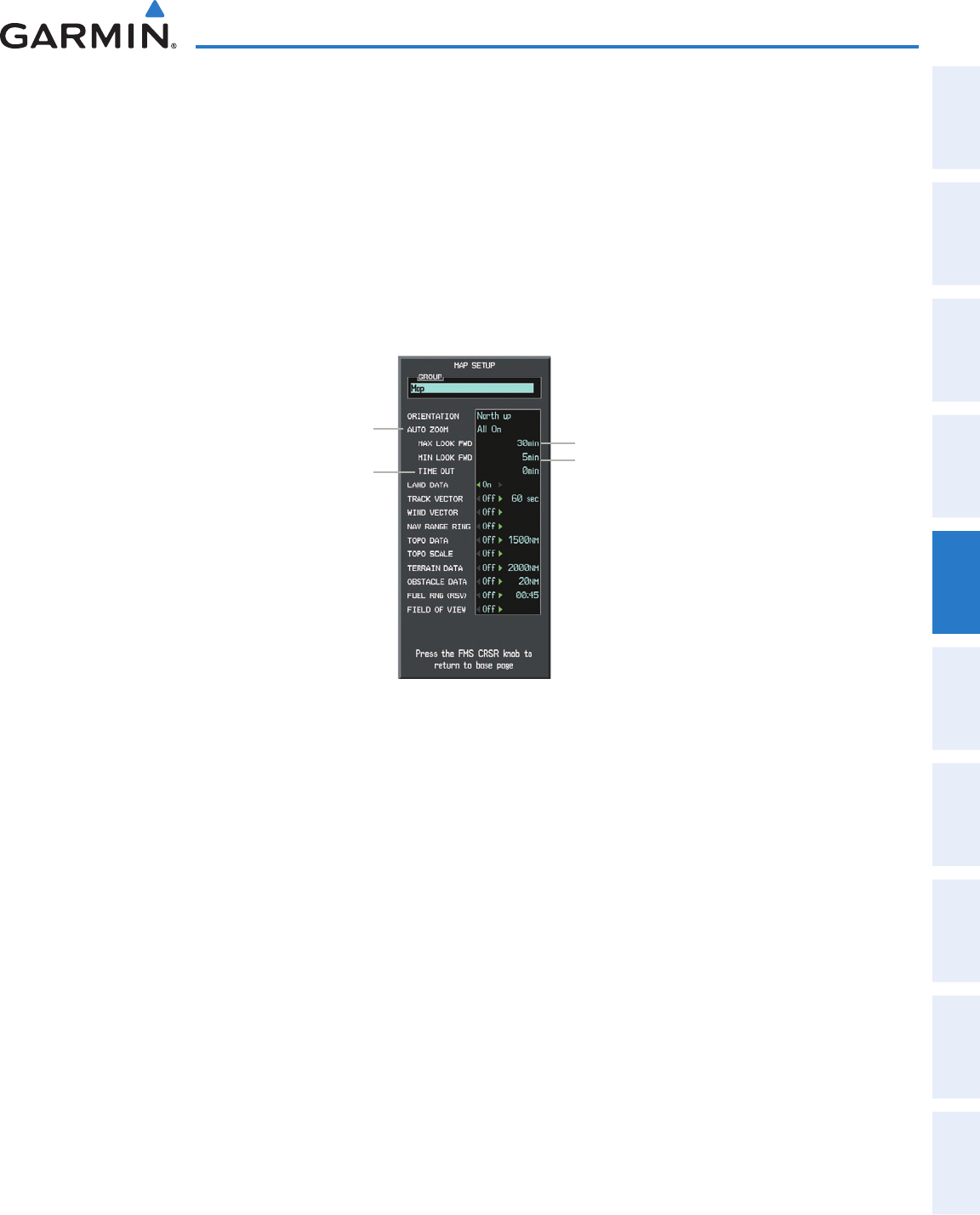
190-00592-06 Rev. A
Garmin G1000 Pilot’s Guide for the Diamond DA40/40F
137
FLIGHT MANAGEMENT
SYSTEM
OVERVIEW
FLIGHT
INSTRUMENTS EIS AUDIO PANEL
& CNS
FLIGHT
MANAGEMENT
HAZARD
AVOIDANCE AFCS ADDITIONAL
FEATURES APPENDICES INDEX
•Flightplansthathaveacombinationoflongandshortlegscausetherangetoincreaseanddecreaseas
waypoints sequence. To avoid this, auto zoom can be disabled or the maximum/minimum times can be
adjusted.
•The‘timeout’time(congurableontheMapSetupPagefortheMapGroup)determineshowlongauto
zoom is overridden by a manual adjustment of the range knob. At this expiration of this time, the auto
zoom range is restored. Setting the ‘time out’ value to zero causes the manual override to never time out.
•Whenthemaximum‘lookforward’timeissettozero,theupperlimitbecomesthemaximumrangeavailable
(2000 nm).
•Whentheminimum‘lookforward’timeissettozero,thelowerlimitbecomes1.5nm.
Figure 5-7 Map Setup Menu Window - Map Group, Auto Zoom
Auto Zoom:
Off, MFD Only, PFD Only, All On
Manual Range Override
Expiration Time
Maximum Look Forward Time
Minimum Look Forward Time
Configuring automatic zoom:
1) Press the MENU Key with the Navigation Map Page displayed. The cursor flashes on the ‘Map Setup’ option.
2) Press the ENT Key. The Map Setup Menu is displayed.
3) Select the ‘Map’ group.
4) Press the ENT Key.
5) Highlight the ‘AUTO ZOOM’ field.
6) Select ‘Off’, ‘MFD Only’, ‘PFD Only’, or ‘ALL On’.
7) Press the ENT Key to accept the selected option. The flashing cursor highlights the ‘MAX LOOK FWD’ field.
Times are from zero to 999 minutes.
8) Use the FMS Knobs to set the time. Press the ENT Key.
9) Repeat step 8 for ‘MIN LOOK FWD’ (zero to 99 minutes) and ‘MAX LOOK FWD’ (zero to 999 minutes).
10) Press the FMS Knob to return to the Navigation Map Page.
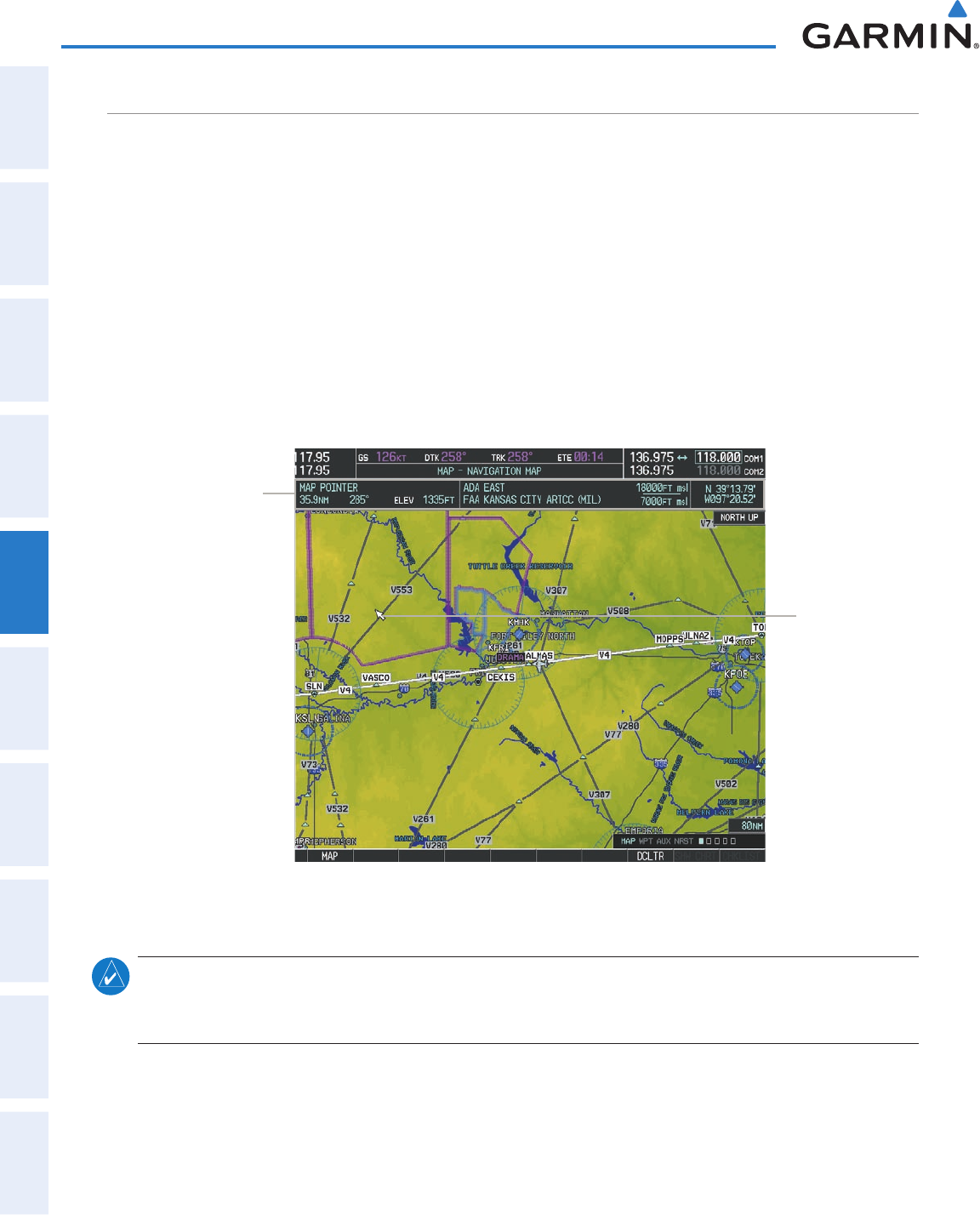
Garmin G1000 Pilot’s Guide for the Diamond DA40/40F
190-00592-06 Rev. A138
FLIGHT MANAGEMENT
SYSTEM
OVERVIEW
FLIGHT
INSTRUMENTS
EIS
AUDIO PANEL
& CNS
FLIGHT
MANAGEMENT
HAZARD
AVOIDANCE
AFCS
ADDITIONAL
FEATURES
APPENDICESINDEX
MAP PANNING
Map panning allows the pilot to:
•Viewpartsofthemapoutsidethedisplayedrangewithoutadjustingthemaprange
•Highlightandselectlocationsonthemap
•Reviewinformationforaselectedairport,NAVAIDoruserwaypoint
•Designatelocationsforuseinightplanning
•Viewairspaceandairwayinformation
When the panning function is selected by pressing the Joystick, the Map Pointer flashes on the map display.
A window also appears at the top of the map display showing the latitude/longitude position of the pointer,
the bearing and distance to the pointer from the aircraft’s present position, and the elevation of the land at the
position of the pointer.
Figure 5-8 Navigation Map - Map Pointer Activated
Map Pointer
Map Pointer Information
NOTE: The map is normally centered on the aircraft’s position. If the map has been panned and there has
been no pointer movement for about 60 seconds, the map reverts back to centered on the aircraft position
and the flashing pointer is removed.
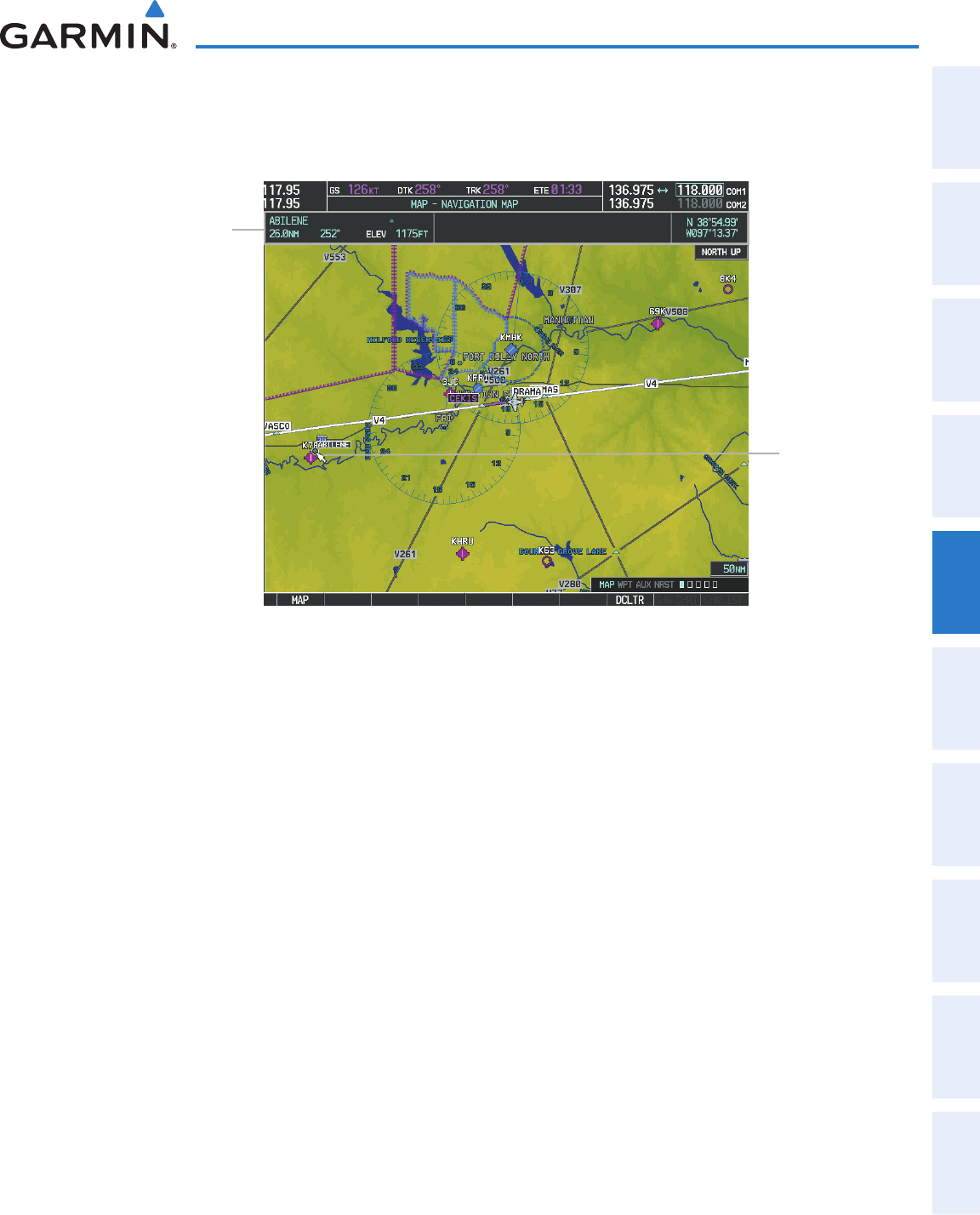
190-00592-06 Rev. A
Garmin G1000 Pilot’s Guide for the Diamond DA40/40F
139
FLIGHT MANAGEMENT
SYSTEM
OVERVIEW
FLIGHT
INSTRUMENTS EIS AUDIO PANEL
& CNS
FLIGHT
MANAGEMENT
HAZARD
AVOIDANCE AFCS ADDITIONAL
FEATURES APPENDICES INDEX
When the Map Pointer is placed on an object, the name of the object is highlighted (even if the name was
not originally displayed on the map). When any map feature or object is selected on the map display, pertinent
information is displayed.
Figure 5-9 Navigation Map - Map Pointer on Point of Interest
Map Pointer on
POI
Information about Point
of Interest
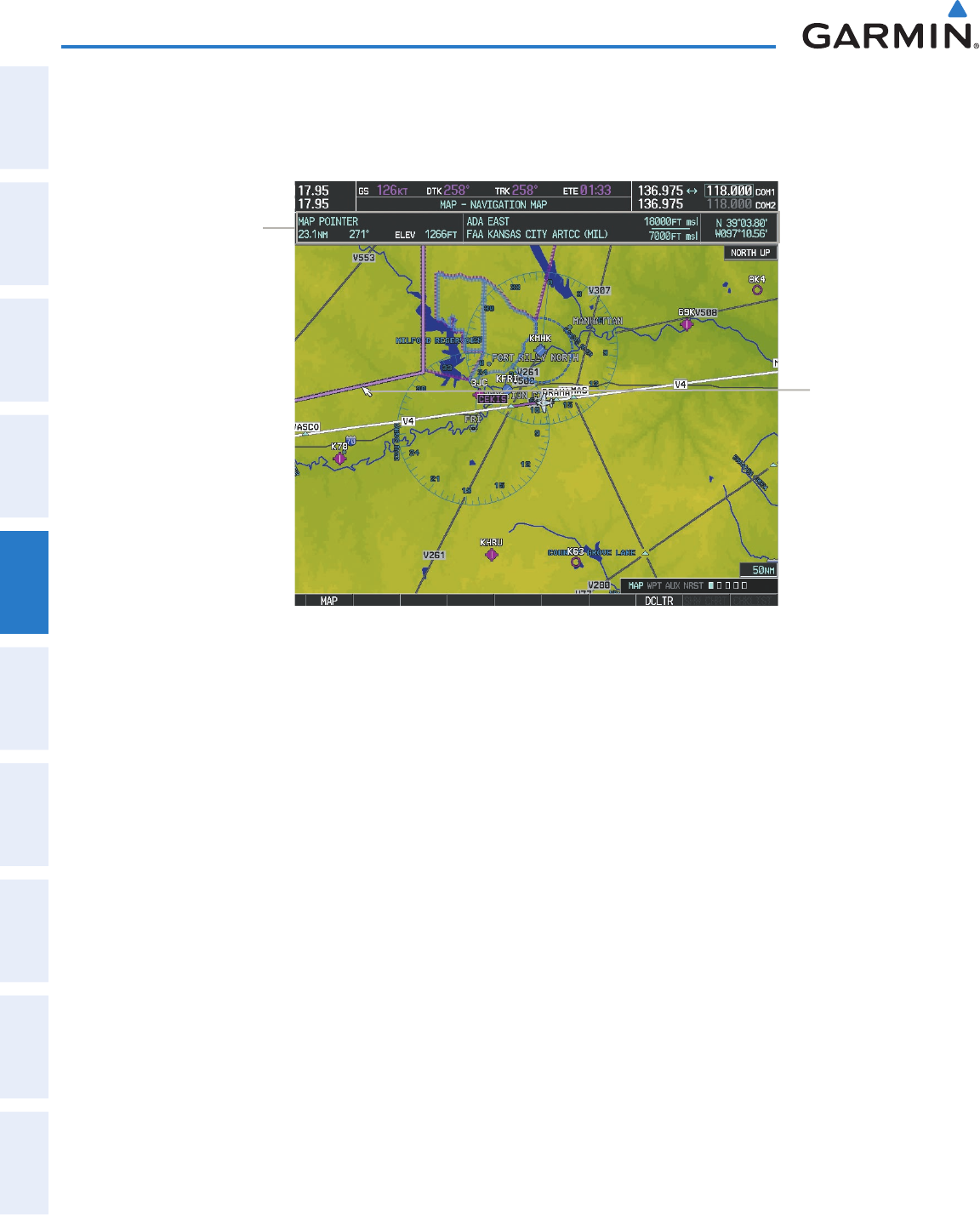
Garmin G1000 Pilot’s Guide for the Diamond DA40/40F
190-00592-06 Rev. A140
FLIGHT MANAGEMENT
SYSTEM
OVERVIEW
FLIGHT
INSTRUMENTS
EIS
AUDIO PANEL
& CNS
FLIGHT
MANAGEMENT
HAZARD
AVOIDANCE
AFCS
ADDITIONAL
FEATURES
APPENDICESINDEX
When the Map Pointer crosses an airspace boundary, the boundary is highlighted and airspace information
is shown at the top of the display. The information includes the name and class of airspace, the ceiling in feet
above Mean Sea Level (MSL), and the floor in feet MSL.
Figure 5-10 Navigation Map - Map Pointer on Airspace
Map Pointer on
Airspace
Information about
Airspace
Panning the map:
1) Press the Joystick to display the Map Pointer.
2) Move the Joystick to move the Map Pointer around the map.
3) Press the Joystick to remove the Map Pointer and recenter the map on the aircraft’s current position.
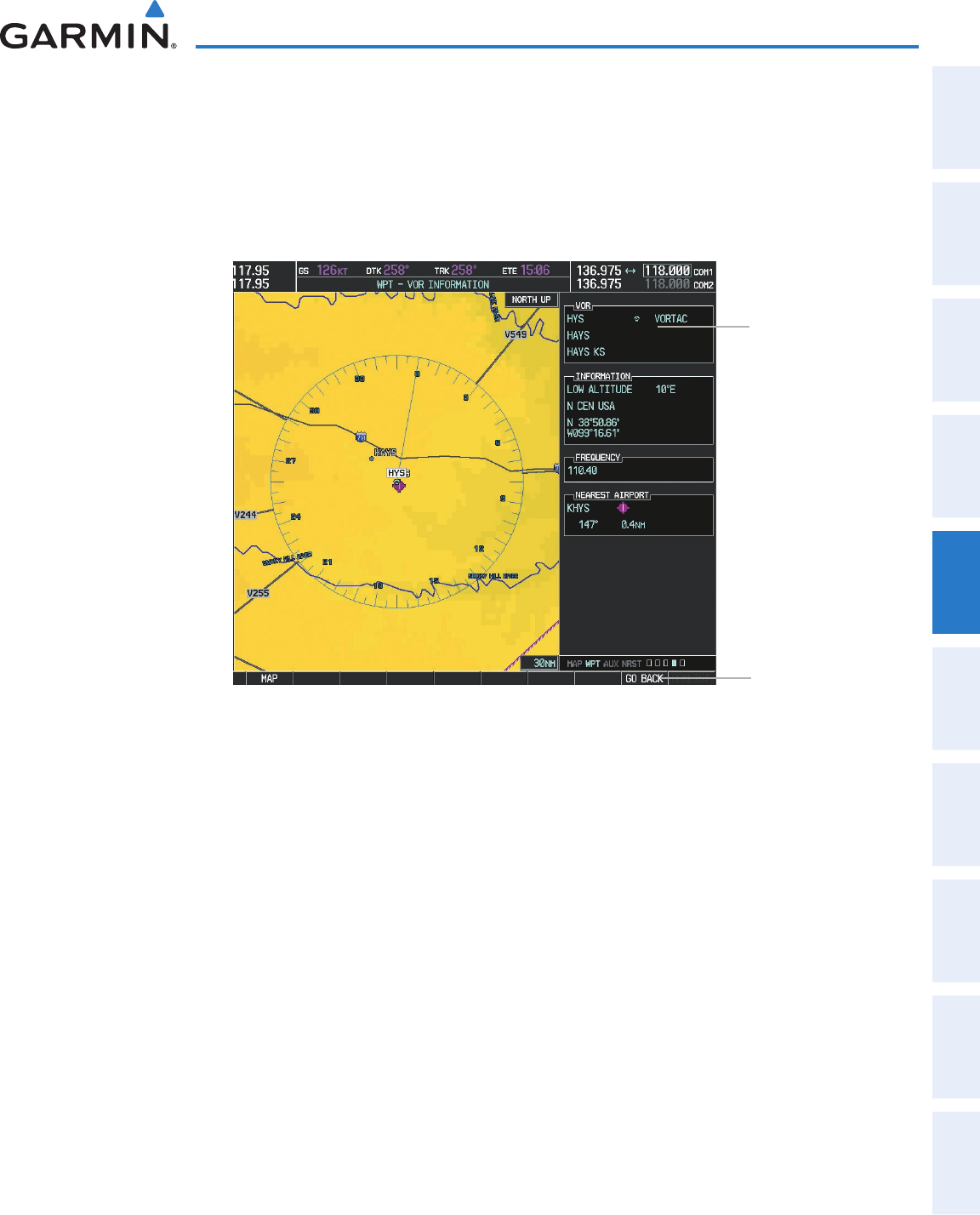
190-00592-06 Rev. A
Garmin G1000 Pilot’s Guide for the Diamond DA40/40F
141
FLIGHT MANAGEMENT
SYSTEM
OVERVIEW
FLIGHT
INSTRUMENTS EIS AUDIO PANEL
& CNS
FLIGHT
MANAGEMENT
HAZARD
AVOIDANCE AFCS ADDITIONAL
FEATURES APPENDICES INDEX
Reviewing information for an airport, NAVAID, or user waypoint:
1) Place the Map Pointer on a waypoint.
2) Press the ENT Key to display the Waypoint Information Page for the selected waypoint.
3) Press the GO BACK Softkey, the CLR Key, or the ENT Key to exit the Waypoint Information Page and return to
the Navigation Map showing the selected waypoint.
Figure 5-11 Navigation Map - Information Window - NAVAID
NAVAID
Information
GO BACK Softkey
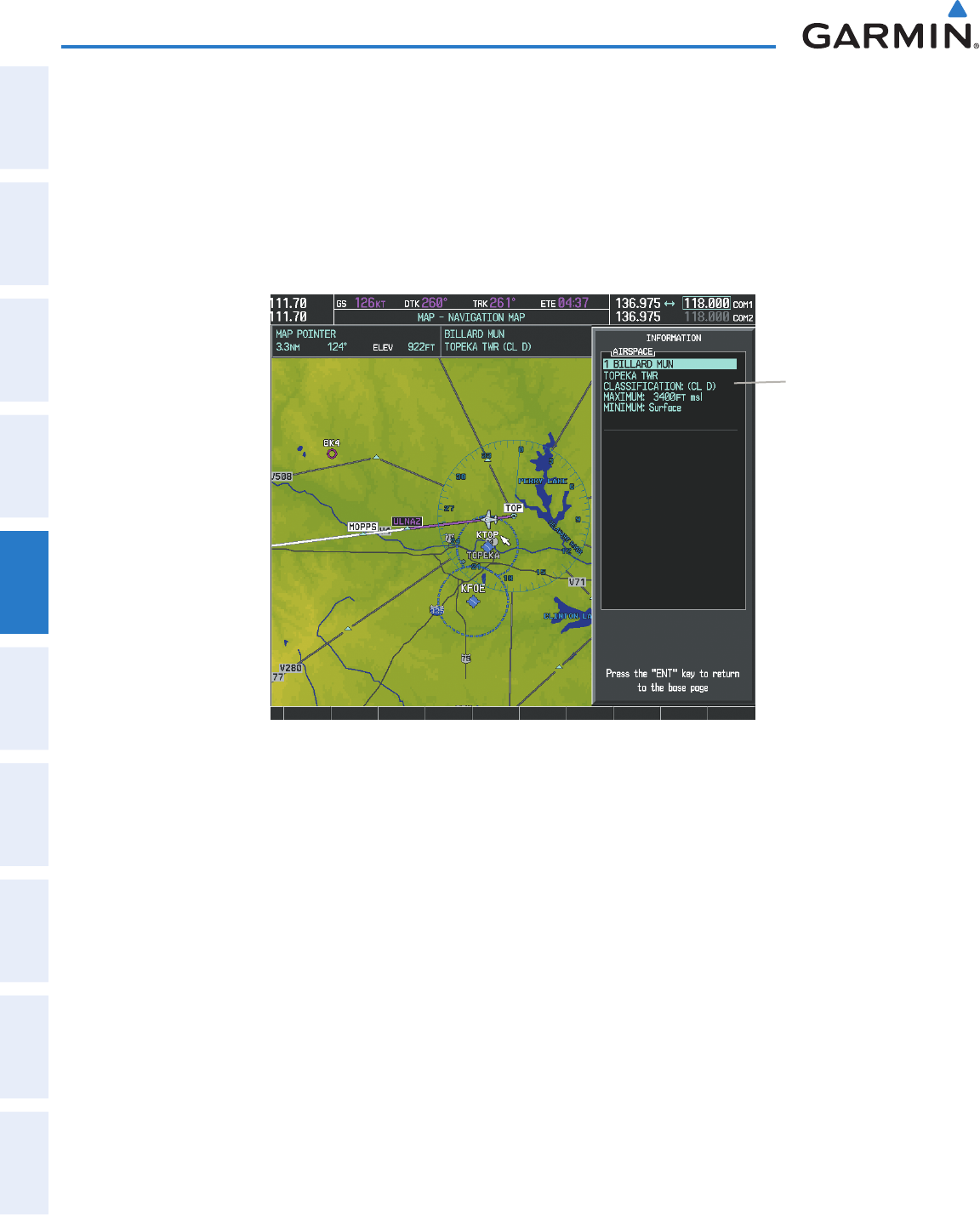
Garmin G1000 Pilot’s Guide for the Diamond DA40/40F
190-00592-06 Rev. A142
FLIGHT MANAGEMENT
SYSTEM
OVERVIEW
FLIGHT
INSTRUMENTS
EIS
AUDIO PANEL
& CNS
FLIGHT
MANAGEMENT
HAZARD
AVOIDANCE
AFCS
ADDITIONAL
FEATURES
APPENDICESINDEX
Viewing airspace information for a special-use or controlled airspace:
1) Place the Map Pointer on an open area within the boundaries of an airspace.
2) Press the ENT Key to display an options menu.
3) ‘Review Airspace?’ should already be highlighted, if not select it. Press the ENT Key to display the Airspace
Information Page for the selected airspace.
4) Press the CLR or ENT Key to exit the Airspace Information Page.
Figure 5-12 Navigation Map - Information Window - Airspace
Airspace
Information
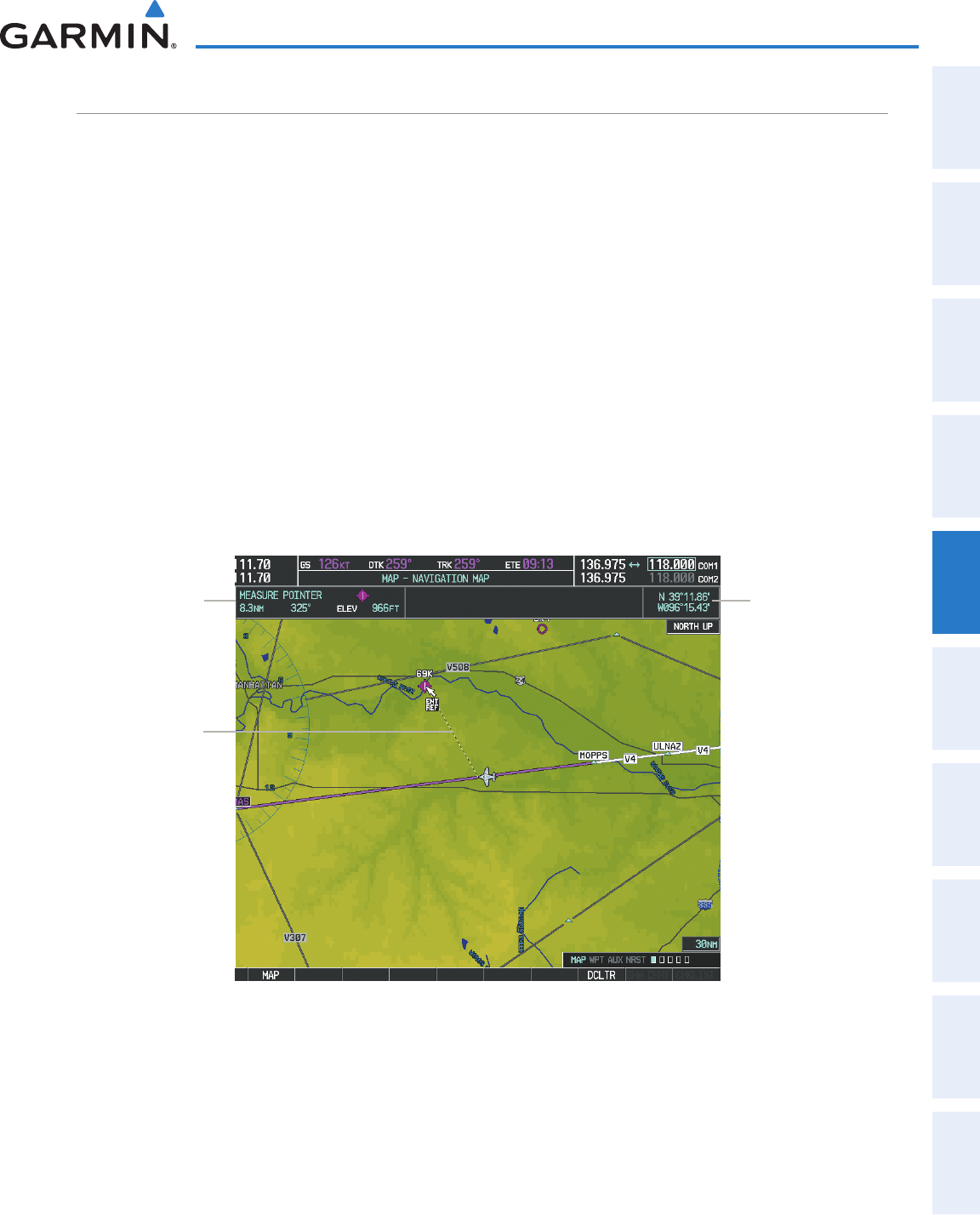
190-00592-06 Rev. A
Garmin G1000 Pilot’s Guide for the Diamond DA40/40F
143
FLIGHT MANAGEMENT
SYSTEM
OVERVIEW
FLIGHT
INSTRUMENTS EIS AUDIO PANEL
& CNS
FLIGHT
MANAGEMENT
HAZARD
AVOIDANCE AFCS ADDITIONAL
FEATURES APPENDICES INDEX
MEASURING BEARING AND DISTANCE
Distance and bearing from the aircraft’s present position to any point on the viewable navigation map may be
calculated using the ‘Measure Bearing and Distance’ selection from Navigation Map page menu. The bearing
and distance tool displays a dashed Measurement Line and a Measure Pointer to aid in graphically identifying
points with which to measure. Lat/Long, distance and elevation data for the Measure Pointer is provided in a
window at the top of the navigation map.
Measuring bearing and distance between any two points:
1) Press the MENU Key (with the Navigation Map Page displayed).
2) Highlight the ‘Measure Bearing/Distance’ field.
3) Press the ENT Key. A Measure Pointer is displayed on the map at the aircraft’s present position.
4) Move the Joystick to place the reference pointer at the desired location. The bearing and distance are displayed
at the top of the map. Elevation at the current pointer position is also displayed. Pressing the ENT Key changes
the starting point for measuring.
5) To exit the Measure Bearing/Distance option, press the Joystick; or select ‘Stop Measuring’ from the Page
Menu and press the ENT Key.
Figure 5-13 Navigation Map - Measuring Bearing and Distance
Pointer Lat/Long
Measurement
Information
Measurement Line
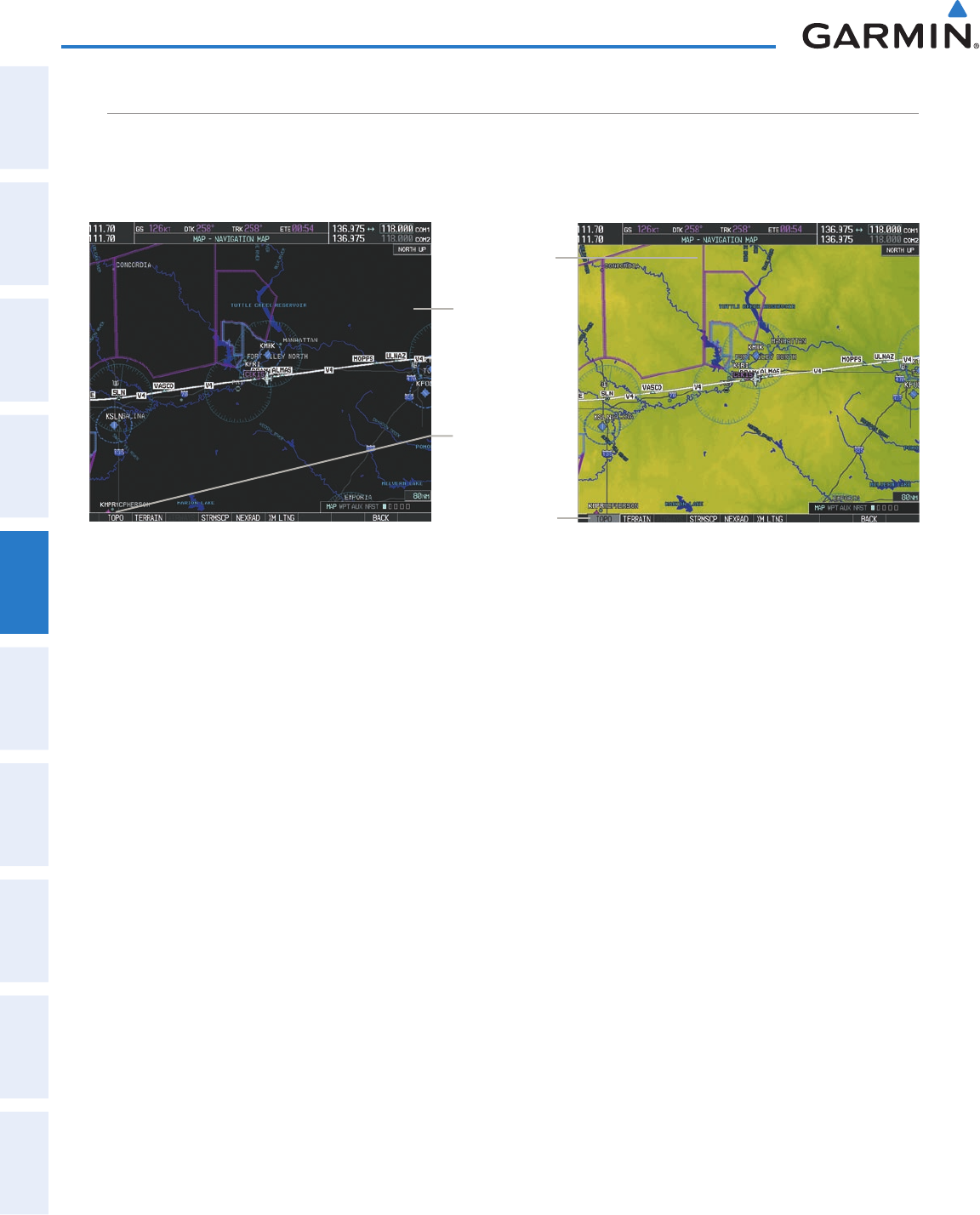
Garmin G1000 Pilot’s Guide for the Diamond DA40/40F
190-00592-06 Rev. A144
FLIGHT MANAGEMENT
SYSTEM
OVERVIEW
FLIGHT
INSTRUMENTS
EIS
AUDIO PANEL
& CNS
FLIGHT
MANAGEMENT
HAZARD
AVOIDANCE
AFCS
ADDITIONAL
FEATURES
APPENDICESINDEX
TOPOGRAPHY
All navigation maps can display various shades of topography colors representing land elevation, similar
to aviation sectional charts. Topographic data can be displayed or removed as described in the following
procedures.
Navigation Map
Black Background
TOPO Off
Figure 5-14 Navigation Map - Topographic Data
TOPO Softkey
Enabled
Navigation Map
Topographic Data
TOPO On
TOPO Softkey
Not Enabled
Displaying/removing topographic data on all pages displaying navigation maps:
1) Press the MAP Softkey (the INSET Softkey for the PFD Inset Map).
2) Press the TOPO Softkey.
3) Press the TOPO Softkey again to remove topographic data from the Navigation Map. When topographic data
is removed from the page, all navigation data is presented on a black background.
Displaying/removing topographic data (TOPO DATA) using the Navigation Map Page Menu:
1) Press the MENU Key with the Navigation Map Page displayed. The cursor flashes on the ‘Map Setup’ option.
2) Press the ENT Key. The Map Setup Menu is displayed.
3) Select the ‘Map’ group.
4) Press the ENT Key.
5) Highlight the ‘TOPO DATA’ field.
6) Select ‘On’ or ‘Off’.
7) Press the FMS Knob to return to the Navigation Map Page.
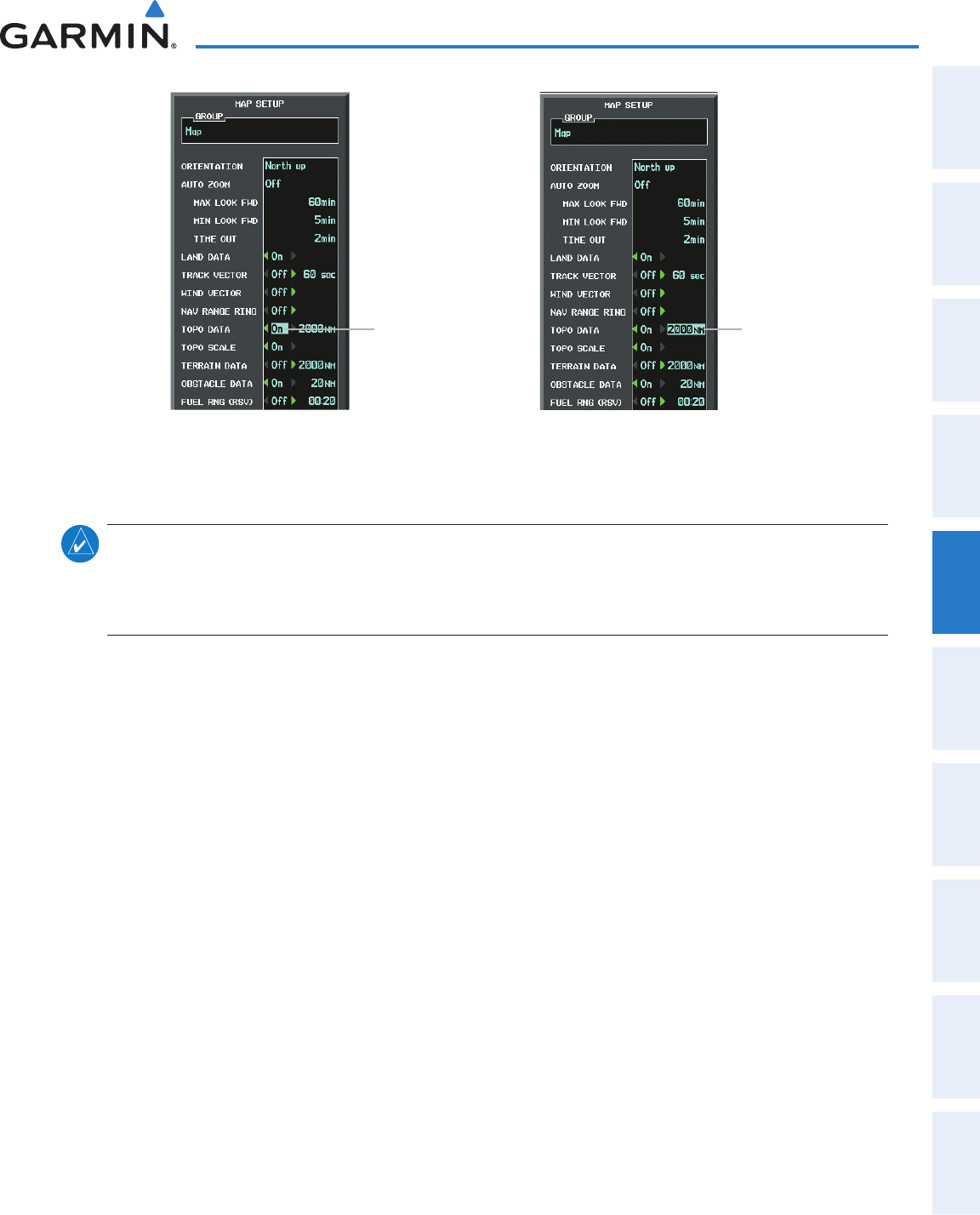
190-00592-06 Rev. A
Garmin G1000 Pilot’s Guide for the Diamond DA40/40F
145
FLIGHT MANAGEMENT
SYSTEM
OVERVIEW
FLIGHT
INSTRUMENTS EIS AUDIO PANEL
& CNS
FLIGHT
MANAGEMENT
HAZARD
AVOIDANCE AFCS ADDITIONAL
FEATURES APPENDICES INDEX
Figure 5-15 Navigation Map Setup Menu - TOPO DATA Setup
TOPO DATA
On/Off TOPO DATA
Range
The topographic data range is the maximum map range on which topographic data is displayed.
NOTE: Since the PFD Inset Map is much smaller than the MFD navigation maps, items are removed on the
PFD Inset Map two range levels smaller than the range selected in the Map Setup pages (e.g., a setting
of 100 nm removes the item at ranges above 100 nm on MFD navigation maps, while the PFD Inset Map
removes the same item at 50 nm).
Selecting a topographical data range (TOPO DATA):
1) Press the MENU Key with the Navigation Map Page displayed. The cursor flashes on the ‘Map Setup’ option.
2) Press the ENT Key. The Map Setup Menu is displayed.
3) Select the ‘Map’ group.
4) Press the ENT Key.
5) Highlight the ‘TOPO DATA’ range field. TOPO ranges are from 500 ft to 2000 nm.
6) To change the TOPO range setting, turn the small FMS Knob to display the range list.
7) Select the desired range using the small FMS Knob.
8) Press the ENT Key.
9) Press the FMS Knob to return to the Navigation Map Page.
In addition, the Navigation Map can display a topographic scale (located in the lower right hand side of the
map) showing a scale of the terrain elevation and current elevation values as shown following.
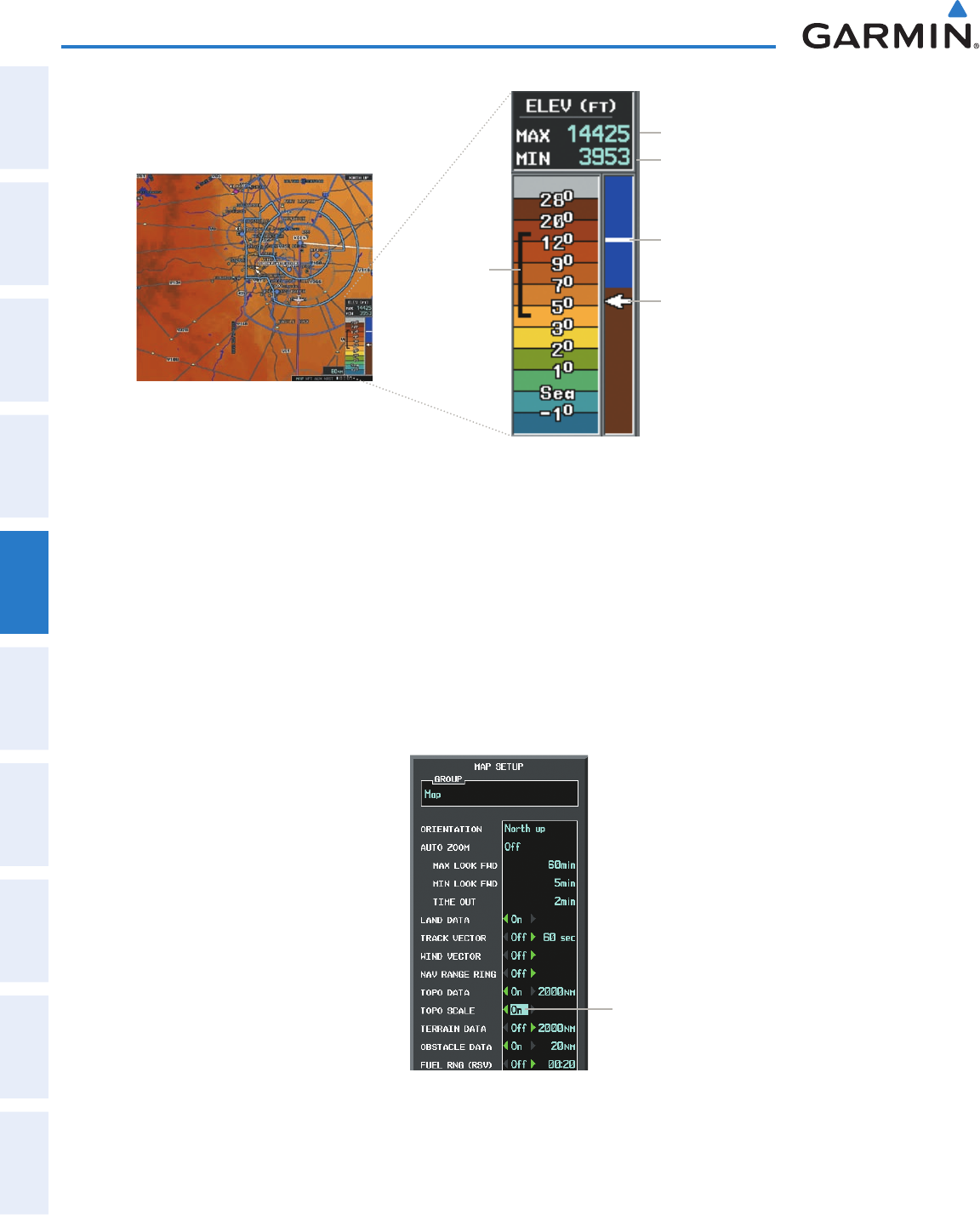
Garmin G1000 Pilot’s Guide for the Diamond DA40/40F
190-00592-06 Rev. A146
FLIGHT MANAGEMENT
SYSTEM
OVERVIEW
FLIGHT
INSTRUMENTS
EIS
AUDIO PANEL
& CNS
FLIGHT
MANAGEMENT
HAZARD
AVOIDANCE
AFCS
ADDITIONAL
FEATURES
APPENDICESINDEX
Figure 5-16 Navigation Map - TOPO SCALE
Maximum Displayed Elevation
Minimum Displayed Elevation
Aircraft Altitude (MSL)
Ground Elevation at Map Pointer
Location (only visible when Map
Pointer is displayed)
Range of
Displayed
Elevations
Displaying/removing the topographic scale (TOPO SCALE):
1) Press the MENU Key with the Navigation Map Page displayed. The cursor flashes on the ‘Map Setup’ option.
2) Press the ENT Key. The Map Setup Menu is displayed.
3) Select the ‘Map’ group and press the ENT Key.
4) Highlight the ‘TOPO SCALE’ field.
5) Select ‘On’ or ‘Off’.
6) Press the FMS Knob to return to the Navigation Map Page.
Figure 5-17 Navigation Map Setup Menu - TOPO SCALE Setup
TOPO SCALE
On/Off
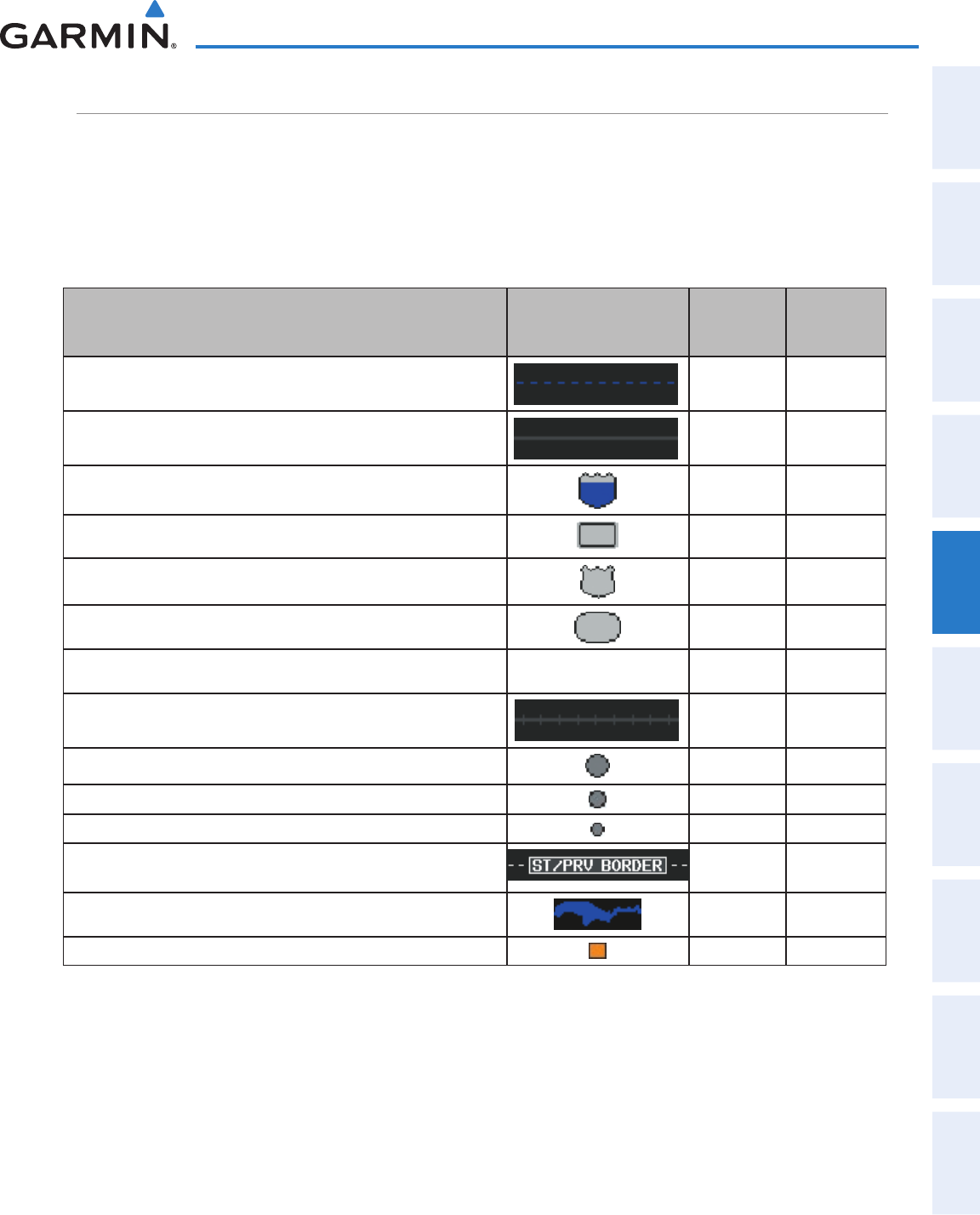
190-00592-06 Rev. A
Garmin G1000 Pilot’s Guide for the Diamond DA40/40F
147
FLIGHT MANAGEMENT
SYSTEM
OVERVIEW
FLIGHT
INSTRUMENTS EIS AUDIO PANEL
& CNS
FLIGHT
MANAGEMENT
HAZARD
AVOIDANCE AFCS ADDITIONAL
FEATURES APPENDICES INDEX
MAP SYMBOLS
This section discusses the types of land and aviation symbols that can be displayed. Each listed type of symbol
can be turned on or off, and the maximum range to display each symbol can be set. The decluttering of the
symbols from the map using the DCLTR Softkey is also discussed.
LAND SYMBOLS
The following items are configured on the land menu:
Land Symbols
(Text label size can be None, Small, Medium (Med), or Large
(Lrg)
Symbol Default
Range (nm)
Maximum
Range (nm)
Latitude/Longitude (LAT/LON) Off 2000
Highways and Roads
Interstate Highway (FREEWAY) 300 800
International Highway (FREEWAY) 300 800
US Highway (NATIONAL HWY) 30 80
State Highway (LOCAL HWY) 15 30
Local Road (LOCAL ROAD) N/A 8 15
Railroads (RAILROAD) 15 30
LARGE CITY (> 200,000) 800 1500
MEDIUM CITY (> 50,000) 100 200
SMALL CITY (> 5,000) 20 50
States and Provinces (STATE/PROV) 800 1500
Rivers and Lakes (RIVER/LAKE) 200 500
USER WAYPOINT 150 300
Table 5-1 Land Symbol Information
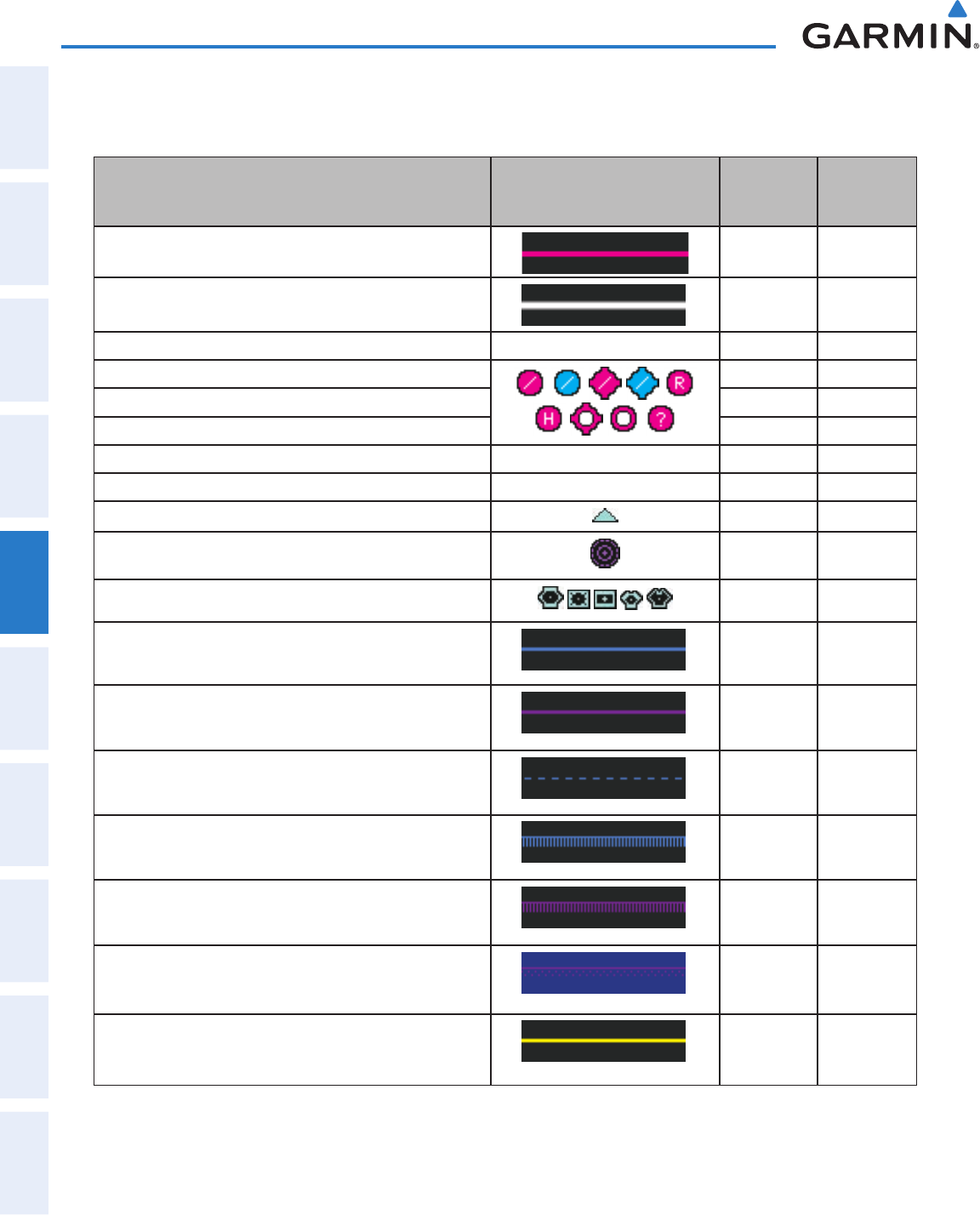
Garmin G1000 Pilot’s Guide for the Diamond DA40/40F
190-00592-06 Rev. A148
FLIGHT MANAGEMENT
SYSTEM
OVERVIEW
FLIGHT
INSTRUMENTS
EIS
AUDIO PANEL
& CNS
FLIGHT
MANAGEMENT
HAZARD
AVOIDANCE
AFCS
ADDITIONAL
FEATURES
APPENDICESINDEX
AVIATION SYMBOLS
The following items are configured on the aviation menu:
Aviation Symbols
(Text label size can be None, Small, Medium (Med),
or Large (Lrg)
Symbol Default
Range (nm)
Maximum
Range (nm)
Active Flight Plan Leg (ACTIVE FPL) 2000 2000
Non-active Flight Plan Leg (ACTIVE FPL) 2000 2000
Active Flight Plan Waypoint (ACTIVE FPL WPT) See Airports, NAVAIDs 2000 2000
Large Airports (LARGE APT)
250 500
Medium Airports (MEDIUM APT) 150 300
Small Airports (SMALL APT) 50 100
Taxiways (SAFETAXI) See Additional Features 3 20
Runway Extension (RWY EXTENSION) N/A Off 100
Intersection (INT WAYPOINT) 15 30
Non-directional Beacon (NDB WAYPOINT) 15 30
VOR (VOR WAYPOINT) 150 300
Class B Airspace/TMA (CLASS B/TMA) 200 500
Class C Airspace/TCA (CLASS C/TCA) 200 500
Class D Airspace (CLASS D) 150 300
Restricted Area (RESTRICTED) 200 500
Military Operations Area [MOA(MILITARY)] 200 500
Other/Air Defense Interdiction Zone (OTHER/ADIZ) 200 500
Temporary Flight Restriction (TFR) 500 2000
Table 5-2 Aviation Symbol Information
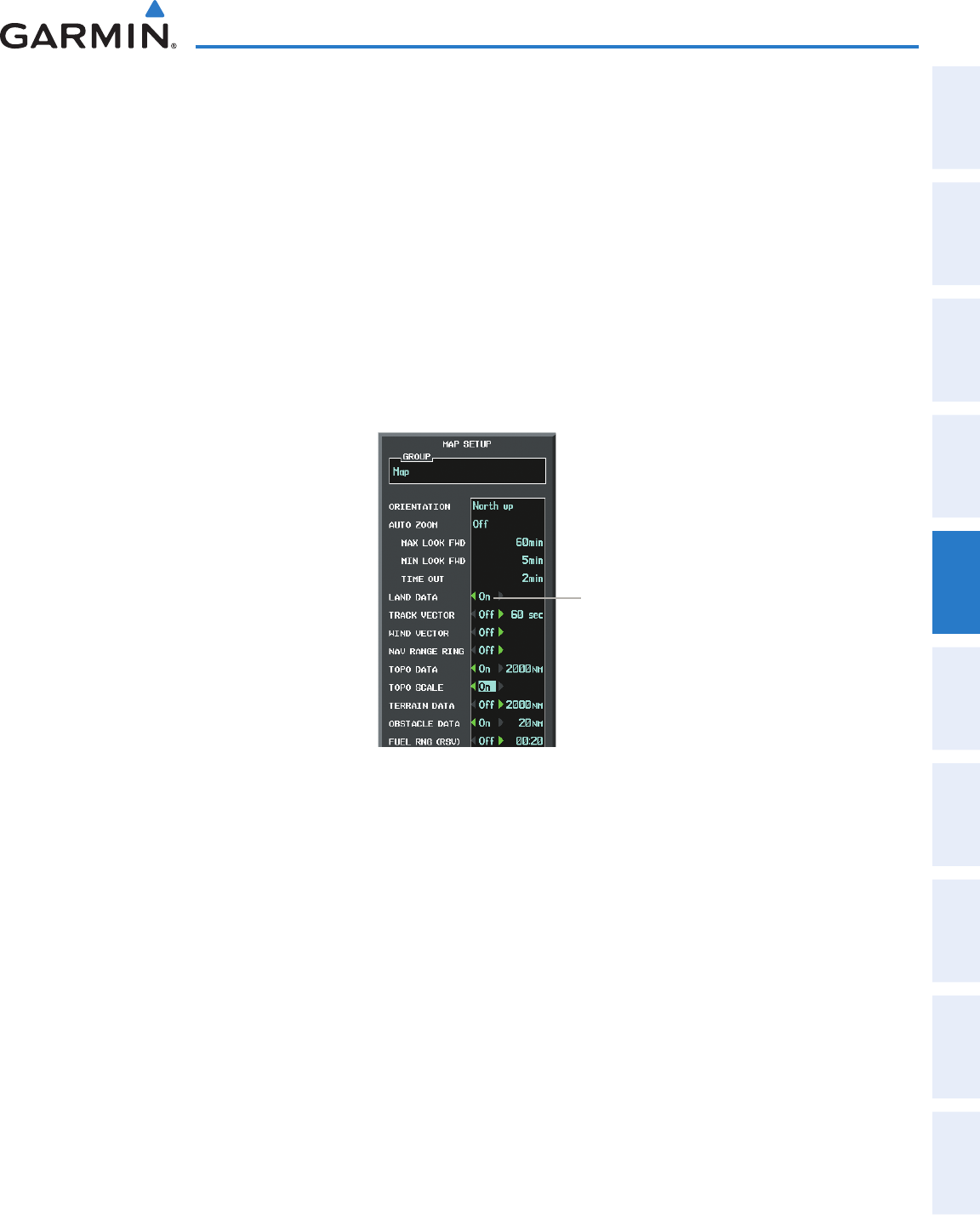
190-00592-06 Rev. A
Garmin G1000 Pilot’s Guide for the Diamond DA40/40F
149
FLIGHT MANAGEMENT
SYSTEM
OVERVIEW
FLIGHT
INSTRUMENTS EIS AUDIO PANEL
& CNS
FLIGHT
MANAGEMENT
HAZARD
AVOIDANCE AFCS ADDITIONAL
FEATURES APPENDICES INDEX
SYMBOL SETUP
All pages with maps can display land symbols (roads, lakes, borders, etc). Land symbols can be removed
totally (turned off).
Displaying/removing all land symbols:
1) Press the MENU Key with the Navigation Map Page displayed. The Page Menu is displayed and the cursor
flashes on the ‘Map Setup’ option.
2) Press the ENT Key. The Map Setup Group Menu is displayed and the cursor flashes on the ‘Map’ option.
3) Highlight the ‘LAND DATA’ field.
4) Select ‘On’ or ‘Off’.
5) Press the FMS Knob to return to the Navigation Map Page.
Figure 5-18 Navigation Map Setup Menu - TOPO SCALE Setup
LAND DATA
On/Off
The label size (TEXT) sets the size at which labels appear on the display (none, small, medium, and large).
The range (RNG) sets the maximum range at which items appear on the display.
Selecting a ‘Land’ or ‘Aviation’ group item text size and range:
1) Press the MENU Key with the Navigation Map Page displayed. The cursor flashes on the ‘Map Setup’ option.
2) Press the ENT Key. The Map Setup Menu is displayed.
3) Select the ‘Land’ or ‘Aviation’ group.
4) Press the ENT Key. The cursor flashes on the first field.
5) Select the desired land option.
6) Select the desired text size.
7) Press the ENT Key to accept the selected size.
6) Select the desired range.
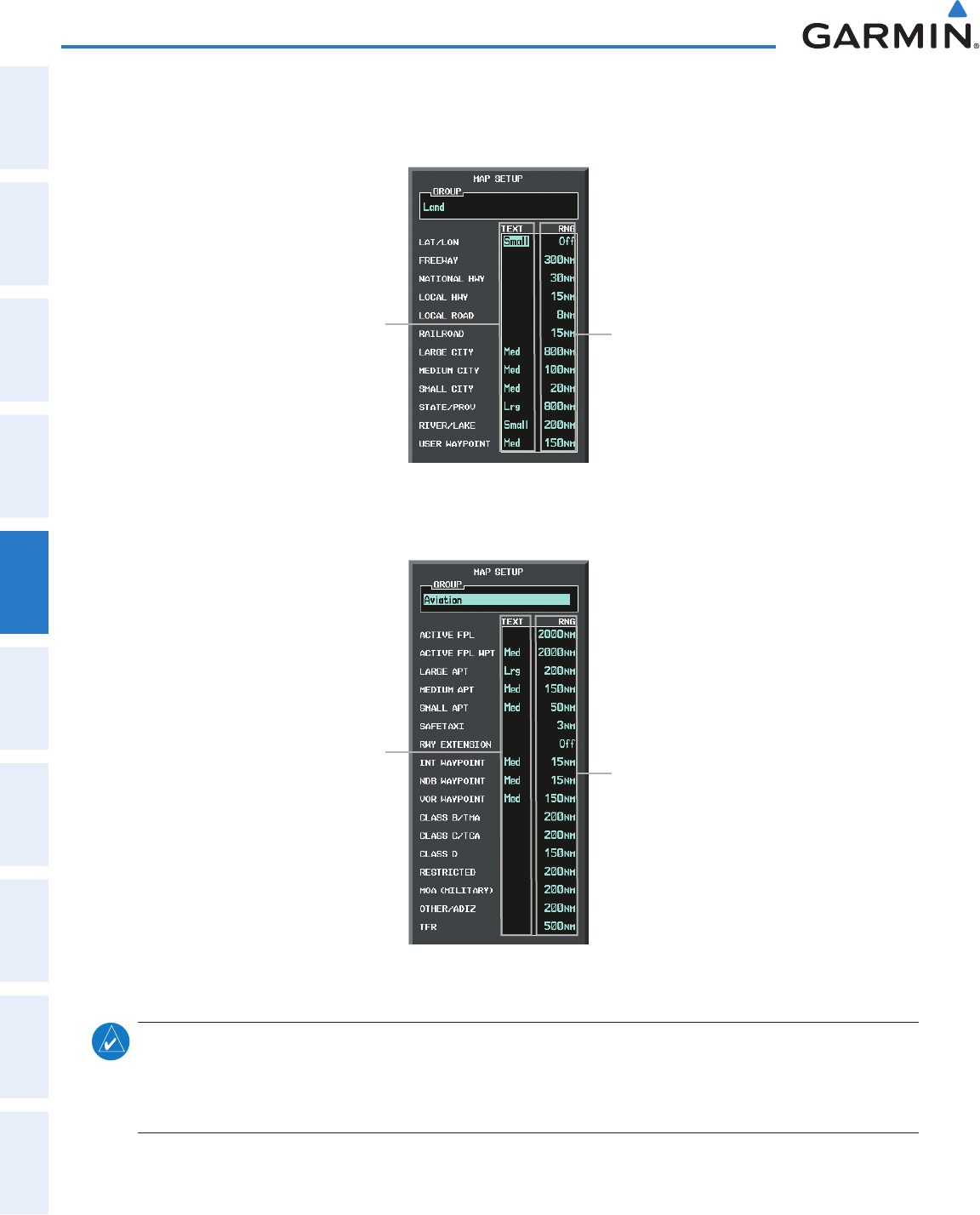
Garmin G1000 Pilot’s Guide for the Diamond DA40/40F
190-00592-06 Rev. A150
FLIGHT MANAGEMENT
SYSTEM
OVERVIEW
FLIGHT
INSTRUMENTS
EIS
AUDIO PANEL
& CNS
FLIGHT
MANAGEMENT
HAZARD
AVOIDANCE
AFCS
ADDITIONAL
FEATURES
APPENDICESINDEX
7) Press the ENT Key to accept the selected range.
8) Press the FMS Knob to return to the Navigation Map Page.
Figure 5-19 Navigation Map Setup Menu - LAND GROUP Setup
Maximum Display Range
Text Label Size
(None, Small Med, or Lrg)
Figure 5-20 Navigation Map Setup Menu - AVIATION GROUP Setup
Maximum Display Range
Text Label Size
(None, Small Med, or Lrg)
NOTE: Since the PFD Inset Map is much smaller than the MFD navigation maps, items are removed on the
PFD Inset Map two range levels smaller than the range selected in the Map Setup pages (e.g., a setting
of 100 nm removes the item at ranges above 100 nm on MFD navigation maps, while the PFD Inset Map
removes the same item at 50 nm).
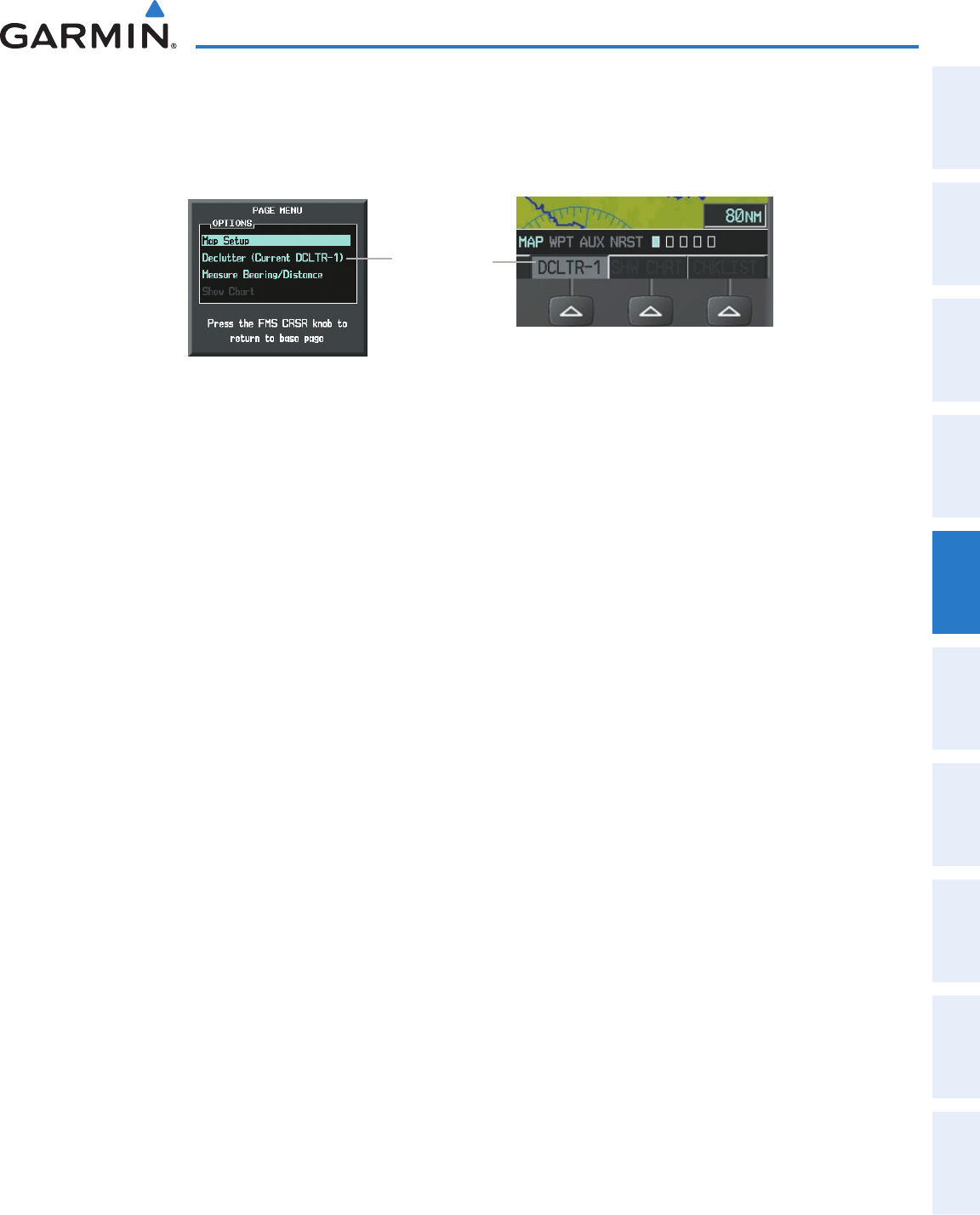
190-00592-06 Rev. A
Garmin G1000 Pilot’s Guide for the Diamond DA40/40F
151
FLIGHT MANAGEMENT
SYSTEM
OVERVIEW
FLIGHT
INSTRUMENTS EIS AUDIO PANEL
& CNS
FLIGHT
MANAGEMENT
HAZARD
AVOIDANCE AFCS ADDITIONAL
FEATURES APPENDICES INDEX
MAP DECLUTTER
The declutter feature allows the pilot to progressively step through four levels of removing map information.
The declutter level is displayed in the DCLTR Softkey and next to the Declutter Menu Option.
Figure 5-21 Navigation Map - Declutter Level Indications
Declutter Level
Navigation Map Page Menu
DCLTR Softkey
Decluttering the map:
Press the DCLTR Softkey with the Navigation Map Page displayed. The current declutter level is shown. With
each softkey selection, another level of map information is removed.
Or:
1) Press the MENU Key with the Navigation Map Page displayed.
2) Select ‘Declutter’. The current declutter level is shown.
3) Press the ENT Key.
Decluttering the PFD Inset Map:
1) Press the INSET Softkey.
2) Press the DCLTR Softkey. The current declutter level is shown. With each selection, another level of map
information is removed.
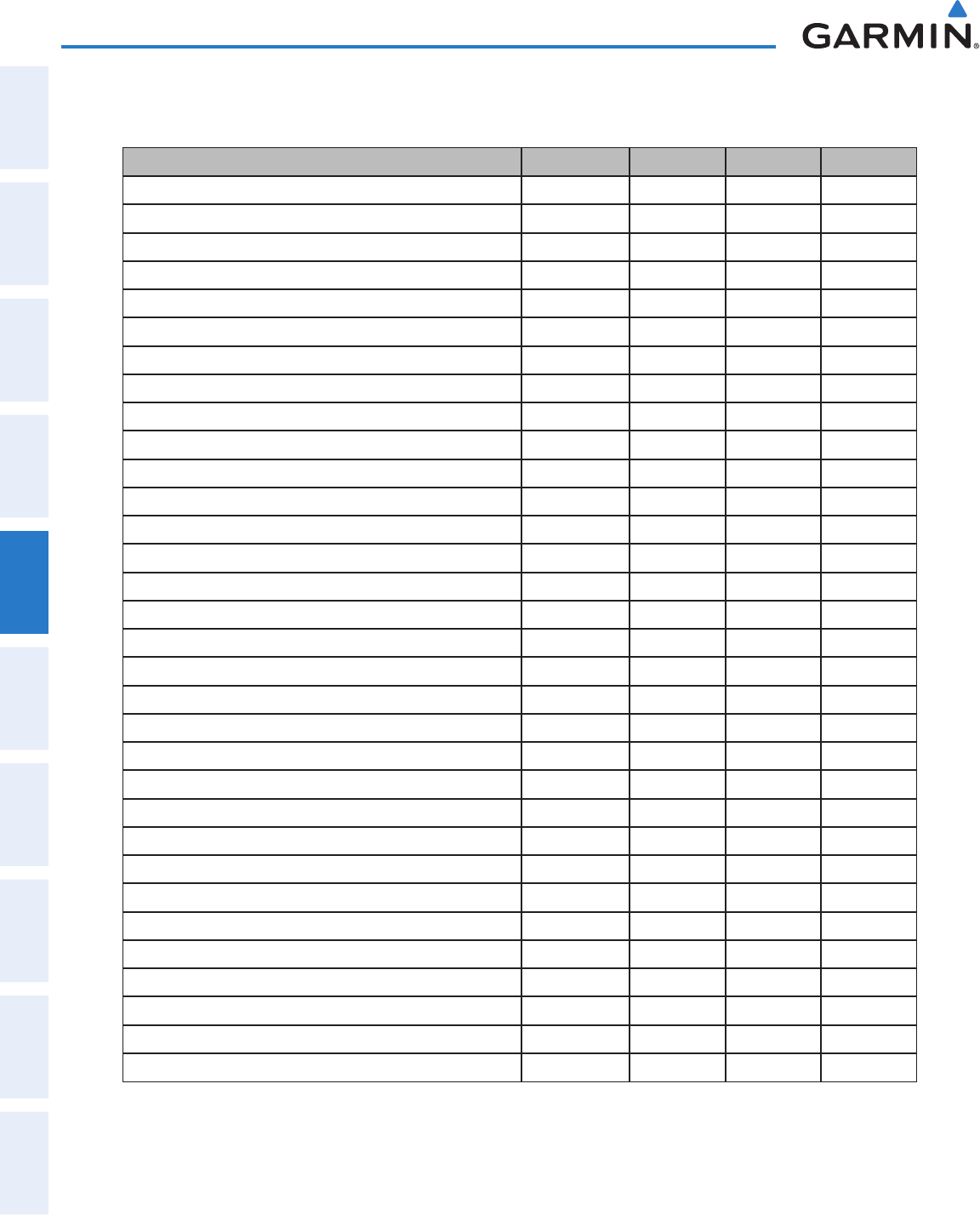
Garmin G1000 Pilot’s Guide for the Diamond DA40/40F
190-00592-06 Rev. A152
FLIGHT MANAGEMENT
SYSTEM
OVERVIEW
FLIGHT
INSTRUMENTS
EIS
AUDIO PANEL
& CNS
FLIGHT
MANAGEMENT
HAZARD
AVOIDANCE
AFCS
ADDITIONAL
FEATURES
APPENDICESINDEX
Table 5-3 lists the items displayed at each declutter level. The ‘X’ represents map items displayed for the
various levels of declutter.
Item No Declutter Declutter-1 Declutter-2 Declutter-3
Flight Plan Route Lines X X X X
Flight Plan Route Waypoints X X X X
Rivers/Lakes X X X X
Topography Data X X X X
International Borders X X X X
Track Vector X X X X
Navigation Range Ring X X X X
Fuel Range Ring X X X X
Terrain Data X X X X
Traffic X X X X
Airways X X X X
NEXRAD X X X
XM Lightning Data X X X
Airports X X X
Runway Labels X X X
Restricted X X X
MOA (Military) X X X
User Waypoints X X
Latitude/Longitude Grid X X
NAVAIDs X X
Class B Airspaces/TMA X X
Class C Airspaces/TCA X X
Class D Airspaces X X
Other Airspaces/ADIZ X X
TFRs X X
Obstacles X X
Land/Country Text X
Cities X
Roads X
Railroads X
State/Province Boundaries X
River/Lake Names X
Table 5-3 Navigation Map Items Displayed by Declutter Level
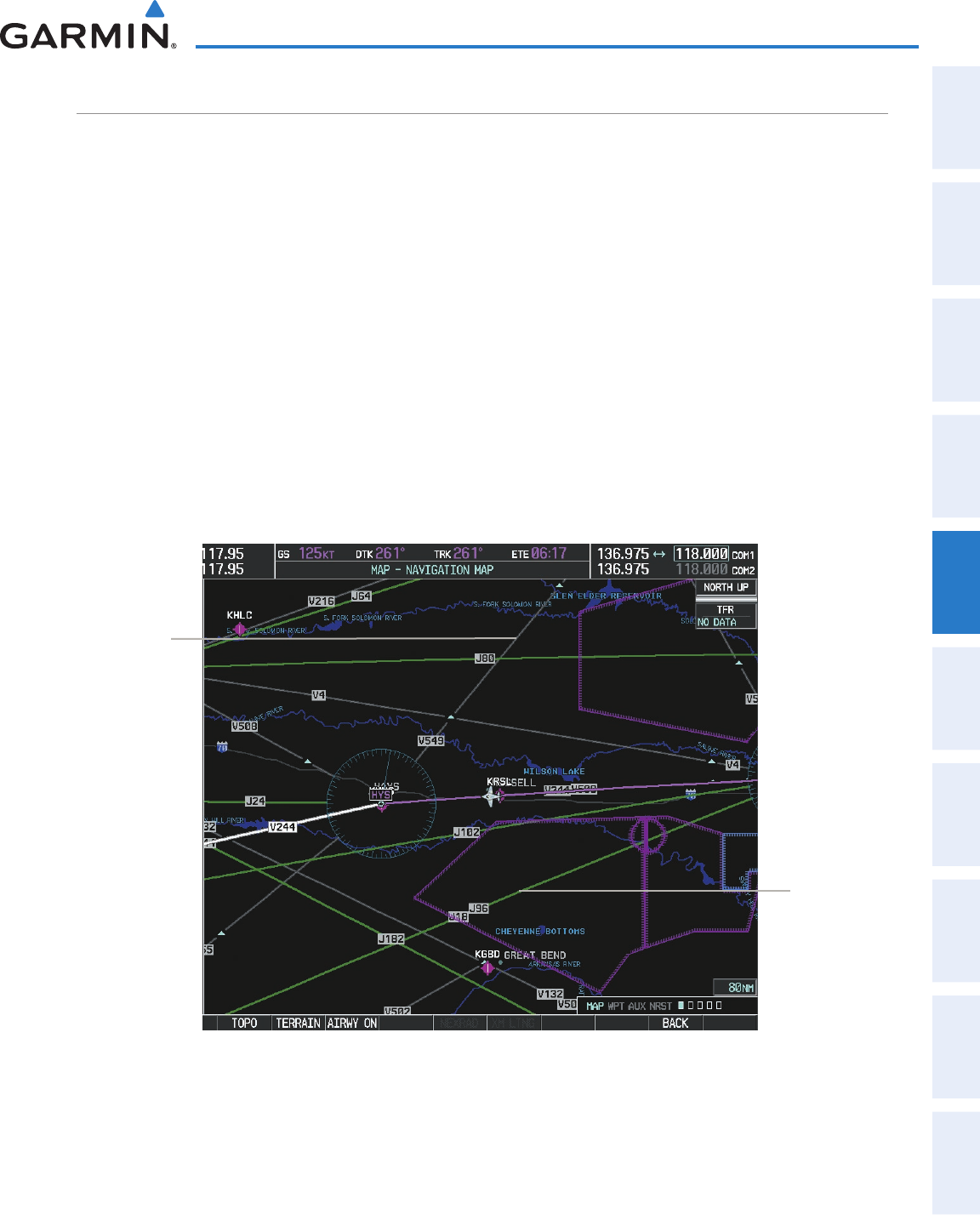
190-00592-06 Rev. A
Garmin G1000 Pilot’s Guide for the Diamond DA40/40F
153
FLIGHT MANAGEMENT
SYSTEM
OVERVIEW
FLIGHT
INSTRUMENTS EIS AUDIO PANEL
& CNS
FLIGHT
MANAGEMENT
HAZARD
AVOIDANCE AFCS ADDITIONAL
FEATURES APPENDICES INDEX
AIRWAYS
This airways discussion is based upon the North American airway structure. The airway structure in places
other than North America vary by location, etc. and are not discussed in this book. Low Altitude Airways (or
Victor Airways) primarily serve smaller piston-engine, propeller-driven airplanes on shorter routes and at lower
altitudes. Airways are eight nautical miles wide and start 1,200 feet above ground level (AGL) and extend up
to 18,000 feet mean sea level (MSL). Low Altitude Airways are designated with a “V” before the airway number
(hence the name “Victor Airways”) since they run primarily between VORs.
High Altitude Airways (or Jet Routes) primarily serve airliners, jets, turboprops, and turbocharged piston
aircraft operating above 18,000 feet MSL. Jet Routes start at 18,000 feet MSL and extend upward to 45,000 feet
MSL (altitudes above 18,000 feet are called “flight levels” and are described as FL450 for 45,000 feet MSL). Jet
Routes are designated with a “J” before the route number.
Low Altitude Airways are drawn in gray (the same shade used for roads). High Altitude Airways are drawn
in green. When both types of airways are displayed, High Altitude Airways are drawn on top of Low Altitude
Airways.
When airways are selected for display on the map, the airway waypoints (VORs, NDBs and Intersections) are
also displayed.
Figure 5-22 Airways on MFD Navigation Page
Low Altitude
Airway
(Victor Airway)
High Altitude
Airway
(Jet Route)
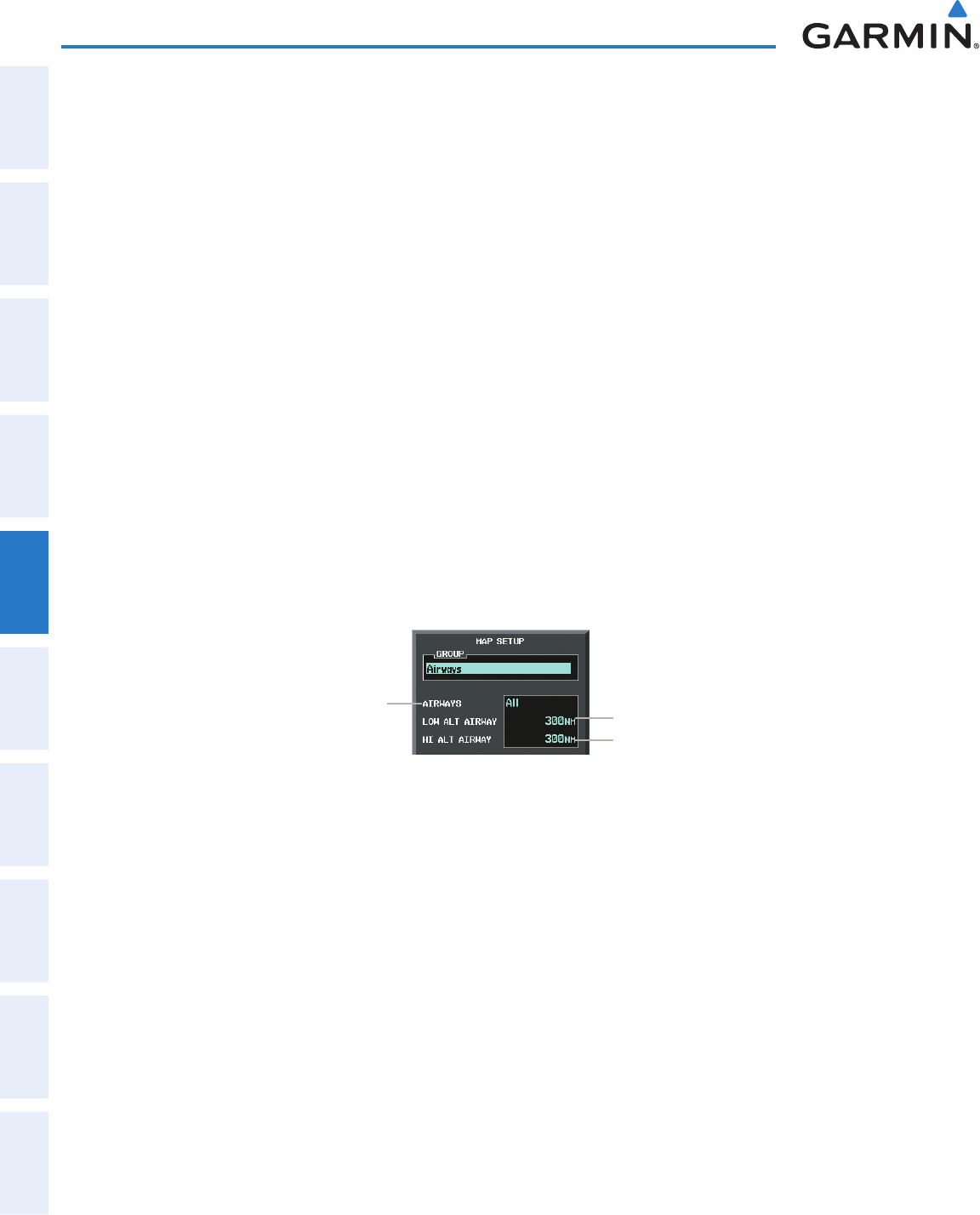
Garmin G1000 Pilot’s Guide for the Diamond DA40/40F
190-00592-06 Rev. A154
FLIGHT MANAGEMENT
SYSTEM
OVERVIEW
FLIGHT
INSTRUMENTS
EIS
AUDIO PANEL
& CNS
FLIGHT
MANAGEMENT
HAZARD
AVOIDANCE
AFCS
ADDITIONAL
FEATURES
APPENDICESINDEX
Airways may be displayed on the map at the pilot’s discretion using either a combination of AIRWAYS Softkey
presses, or menu selections using the MENU Key from the Navigation Map Page. The Airway range can also be
programmed to only display Airways on the MFD when the map range is at or below a specific number.
Displaying/removing airways:
1) Select the MAP Softkey.
2) Select the AIRWAYS Softkey. Both High and Low Altitude Airways are displayed (AIRWY ON).
3) Select the softkey again to display Low Altitude Airways only (AIRWY LO).
4) Select the softkey again to display High Altitude Airways only (AIRWY HI).
5) Select the softkey again to remove High Altitude Airways. No airways are displayed (AIRWAYS).
Or:
1) Press the MENU Key with the Navigation Map Page displayed. The cursor flashes on the ‘Map Setup’ option.
2) Press the ENT Key. The Map Setup Menu is displayed.
3) Turn the small FMS Knob to select the ‘Airways’ group, and press the ENT Key.
4) Turn the large FMS Knob to highlight the ‘AIRWAYS’ field.
5) Turn the FMS Knob to select ‘Off’, ‘All’, ‘LO Only’, or ‘HI Only’, and press the ENT Key.
6) Press the FMS Knob to return to the Navigation Map Page.
Figure 5-23 Navigation Map Setup Menu - AIRWAYS Setup
Low Altitude Airway Range
High Altitude Airway Range
Airway Display Selection
Off, All, LO Only, HI Only
The airway range is the maximum map range on which airways are displayed.
Selecting an airway range (LOW ALT AIRWAY or HI ALT AIRWAY):
1) Press the MENU Key with the Navigation Map Page displayed. The cursor flashes on the ‘Map Setup’ option.
2) Press the ENT Key. The Map Setup Menu is displayed.
3) Select the ‘Airway’ group.
4) Press the ENT Key.
5) Highlight the ‘LOW ALT AIRWAY’ or ‘HI ALT AIRWAY’ range field.
6) To change the range setting, turn the small FMS Knob to display the range list.
7) Select the desired range using the small FMS Knob.
8) Press the ENT Key.
9) Press the FMS Knob to return to the Navigation Map Page.
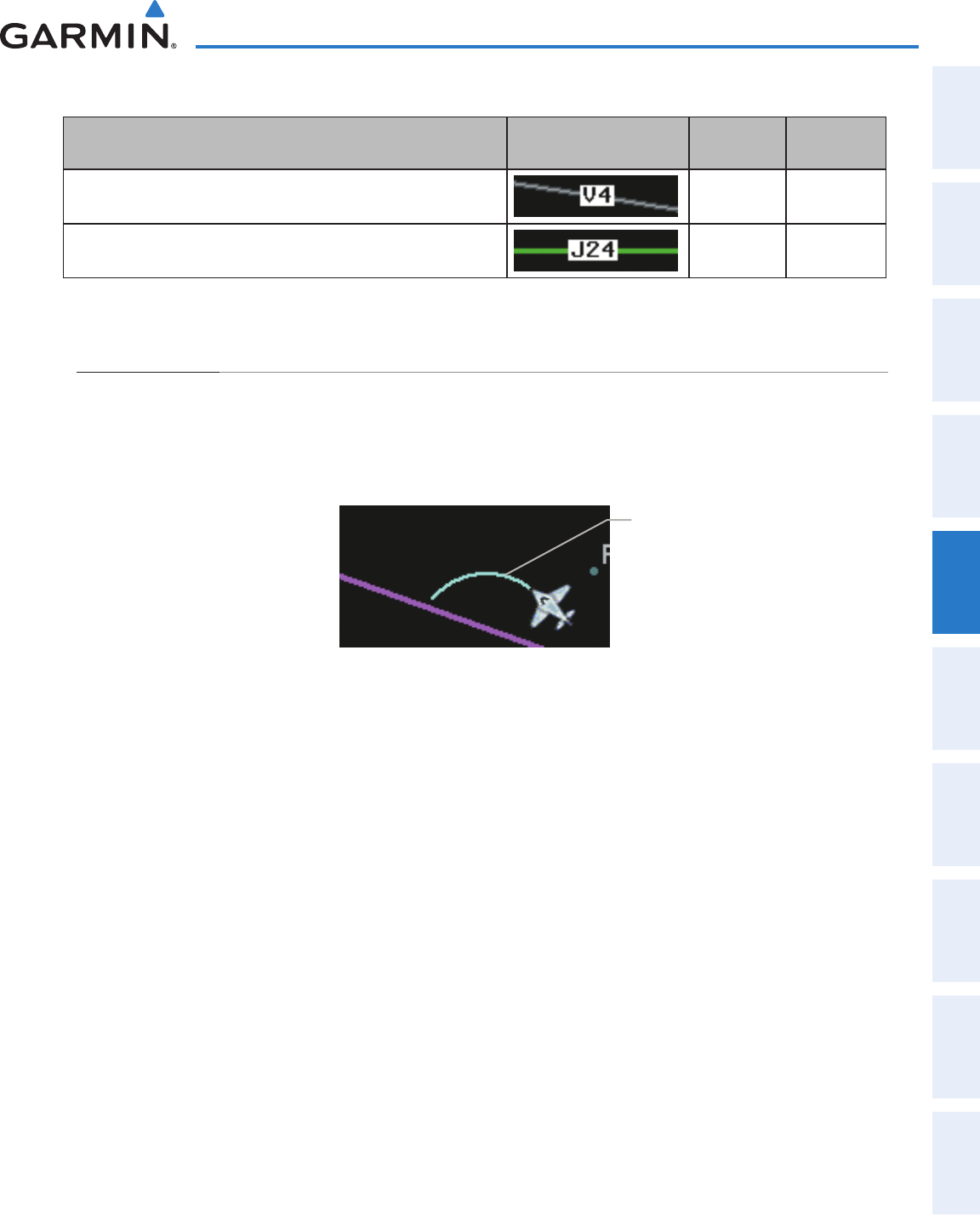
190-00592-06 Rev. A
Garmin G1000 Pilot’s Guide for the Diamond DA40/40F
155
FLIGHT MANAGEMENT
SYSTEM
OVERVIEW
FLIGHT
INSTRUMENTS EIS AUDIO PANEL
& CNS
FLIGHT
MANAGEMENT
HAZARD
AVOIDANCE AFCS ADDITIONAL
FEATURES APPENDICES INDEX
The following range items are configurable on the airways menu:
Airway Type Symbol Default
Range (nm)
Maximum
Range (nm)
Low Altitude Airway (LOW ALT AIRWAY) 200 500
High Altitude Airway (HI ALT AIRWAY) 300 500
Table 5-4 Airway Range Information
TRACK VECTOR
The Navigation Map can display a track vector that is useful in minimizing track angle error. The track vector
is a solid light blue line segment extended to a predicted location. The track vector look-ahead time is selectable
(30 sec, 60 sec (default), 2 min, 5 min, 10 min, 20 min) and determines the length of the track vector. The track
vector shows up to 90 degrees of a turn for the 30 and 60 second time settings.
Figure 5-24 Navigation Map -Track Vector
Track Vector
Displaying/removing the track vector:
1) Press the MENU Key with the Navigation Map Page displayed. The cursor flashes on the ‘Map Setup’ option.
2) Press the ENT Key. The Map Setup Menu is displayed.
3) Select the ‘Map’ group.
4) Press the ENT Key.
5) Highlight the ‘TRACK VECTOR’ field.
6) Select ‘On’ or ‘Off’. Press the ENT Key to accept the selected option. The flashing cursor highlights the look
ahead time field. Use the FMS Knob to select the desired time. Press the ENT Key.
7) Press the FMS Knob to return to the Navigation Map Page.
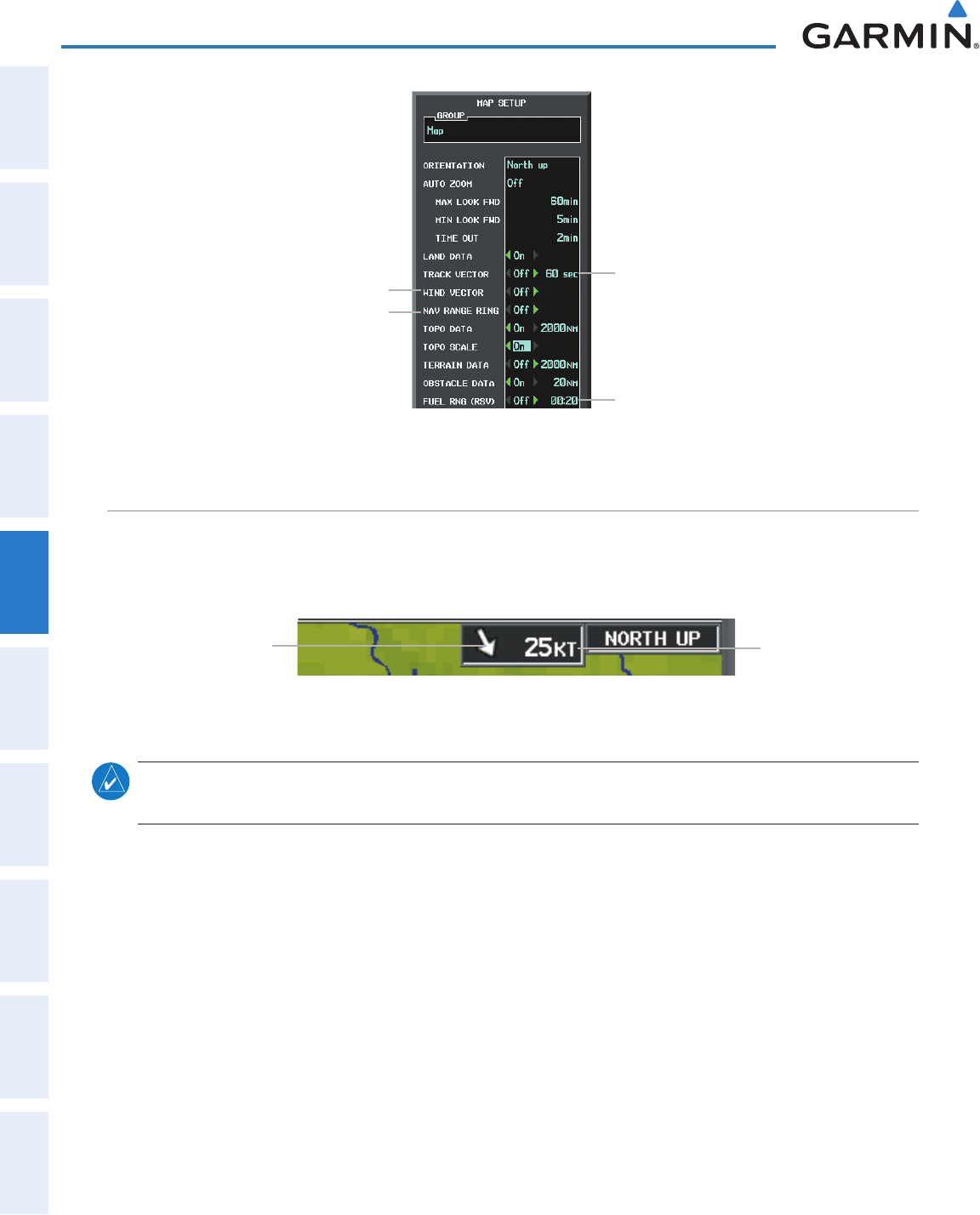
Garmin G1000 Pilot’s Guide for the Diamond DA40/40F
190-00592-06 Rev. A156
FLIGHT MANAGEMENT
SYSTEM
OVERVIEW
FLIGHT
INSTRUMENTS
EIS
AUDIO PANEL
& CNS
FLIGHT
MANAGEMENT
HAZARD
AVOIDANCE
AFCS
ADDITIONAL
FEATURES
APPENDICESINDEX
Figure 5-25 Navigation Map Setup Menu -TRACK VECTOR, WIND VECTOR, NAV RANGE RING, FUEL RANGE RING Setup
Track Vector
- On/Off
- Look Ahead Time
Fuel Range
- On/Off
- Fuel Reserve Time
Wind Vector On/Off
Nav Range Ring On/Off
WIND VECTOR
The map displays a wind vector arrow in the upper right-hand portion of the screen. Wind vector information
is displayed as a white arrow pointing in the direction in which the wind is moving for wind speeds greater than
or equal to 1 kt.
Figure 5-26 Navigation Map - Wind Vector
Wind Direction Wind Speed
NOTE: The wind vector is not displayed until the aircraft is moving. It is not displayed on the Waypoint
Information pages.
Displaying/removing the wind vector:
1) Press the MENU Key with the Navigation Map Page displayed. The cursor flashes on the ‘Map Setup’ option.
2) Press the ENT Key. The Map Setup Menu is displayed.
3) Select the ‘Map’ group.
4) Press the ENT Key.
5) Highlight the ‘WIND VECTOR’ field.
6) Select ‘On’ or ‘Off’.
7) Press the FMS Knob to return to the Navigation Map Page.
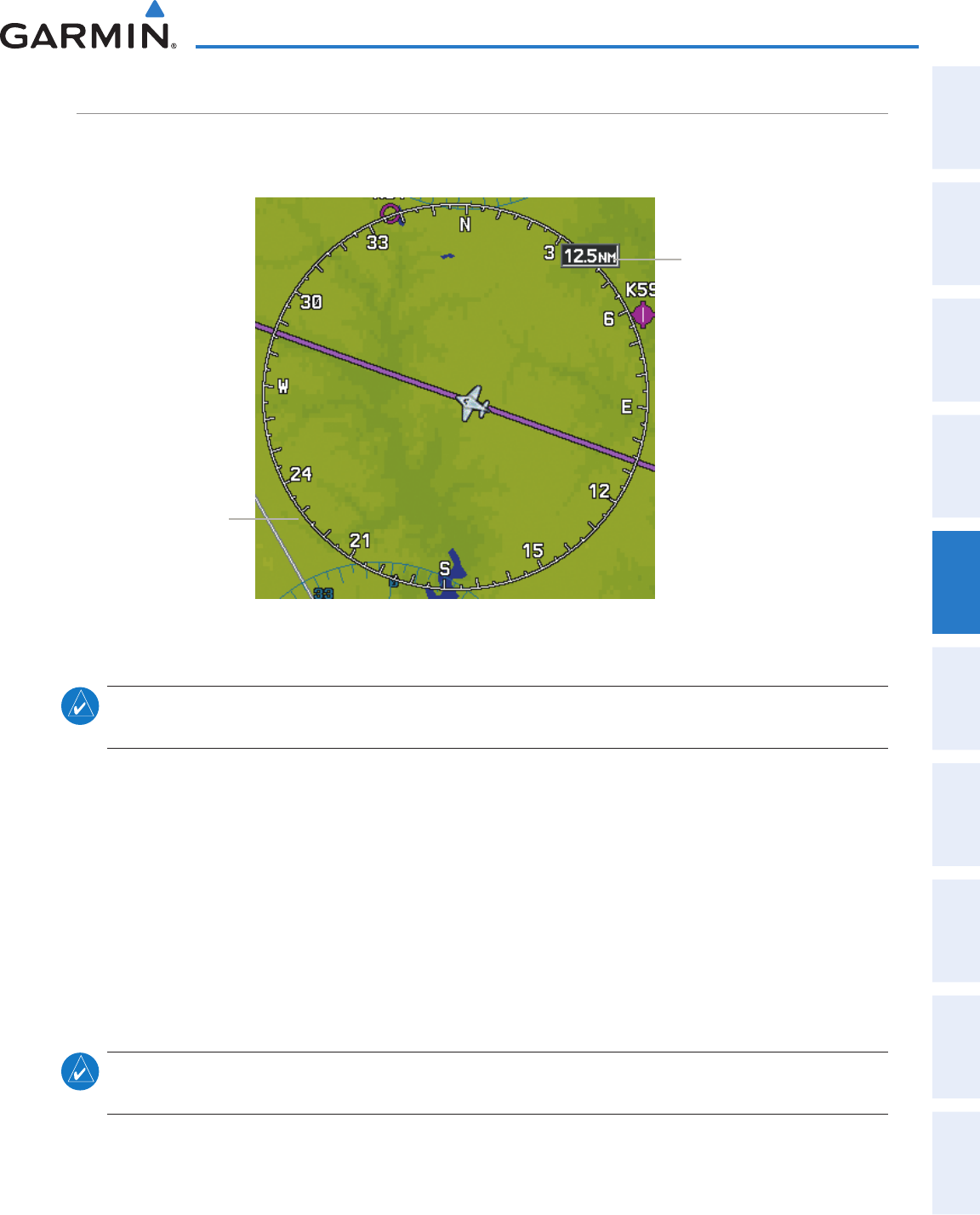
190-00592-06 Rev. A
Garmin G1000 Pilot’s Guide for the Diamond DA40/40F
157
FLIGHT MANAGEMENT
SYSTEM
OVERVIEW
FLIGHT
INSTRUMENTS EIS AUDIO PANEL
& CNS
FLIGHT
MANAGEMENT
HAZARD
AVOIDANCE AFCS ADDITIONAL
FEATURES APPENDICES INDEX
NAV RANGE RING
The Nav Range Ring shows the direction of travel (ground track) on a rotating compass card. The range is
determined by the map range. The range is 1/4 of the map range (e.g., 37.5 nm on a 150 nm map).
Figure 5-27 Navigation Map - Nav Range Ring
Nav Range Ring
Range (radius)
NOTE: The Nav Range Ring is not displayed on the Waypoint Information pages, Nearest pages, or Direct-to
Window map.
Displaying/removing the Nav Range Ring:
1) Press the MENU Key with the Navigation Map Page displayed. The cursor flashes on the ‘Map Setup’ option.
2) Press the ENT Key. The Map Setup Menu is displayed.
3) Select the ‘Map’ group.
4) Press the ENT Key.
5) Highlight the ‘NAV RANGE RING’ field.
6) Select ‘On’ or ‘Off’.
7) Press the FMS Knob to return to the Navigation Map Page.
NOTE: The Nav Range Ring is referenced to either magnetic or true north, based on the selection on the AUX
- System Setup Page.
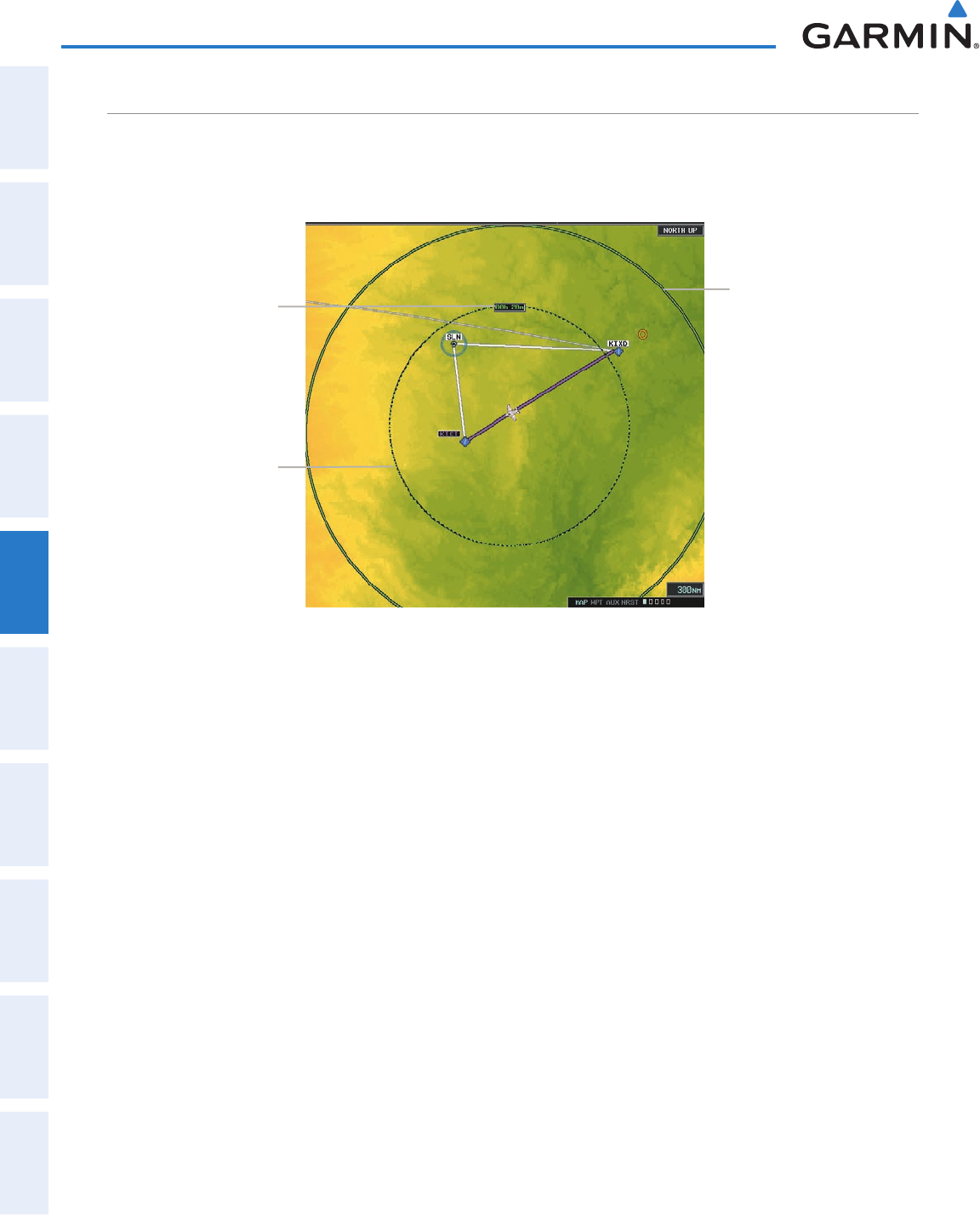
Garmin G1000 Pilot’s Guide for the Diamond DA40/40F
190-00592-06 Rev. A158
FLIGHT MANAGEMENT
SYSTEM
OVERVIEW
FLIGHT
INSTRUMENTS
EIS
AUDIO PANEL
& CNS
FLIGHT
MANAGEMENT
HAZARD
AVOIDANCE
AFCS
ADDITIONAL
FEATURES
APPENDICESINDEX
FUEL RANGE RING
The map can display a fuel range ring which shows the remaining flight distance. A dashed green circle
indicates the selected range to reserve fuel. A solid green circle indicates the total endurance range. If only
reserve fuel remains, the range is indicated by a solid yellow circle.
Figure 5-28 Navigation Map - Fuel Range Ring
Range to Reserve Fuel
Total Endurance Range
Time to Reserve Fuel
Displaying/removing the fuel range ring and selecting a fuel range time:
1) Press the MENU Key with the Navigation Map Page displayed. The cursor flashes on the ‘Map Setup’ option.
2) Press the ENT Key. The Map Setup Menu is displayed.
3) Select the ‘Map’ group.
4) Press the ENT Key.
5) Highlight the ‘FUEL RNG (RSV)’ field.
6) Select ‘On’ or ‘Off’.
7) Highlight the fuel reserve time field. This time should be set to the amount of flight time equal to the amount
of fuel reserve desired.
8) To change the reserve fuel time, enter a time (00:00 to 23:59; hours:minutes). The default setting is 00:45
minutes.
9) Press the ENT Key.
10) Press the FMS Knob to return to the Navigation Map Page.
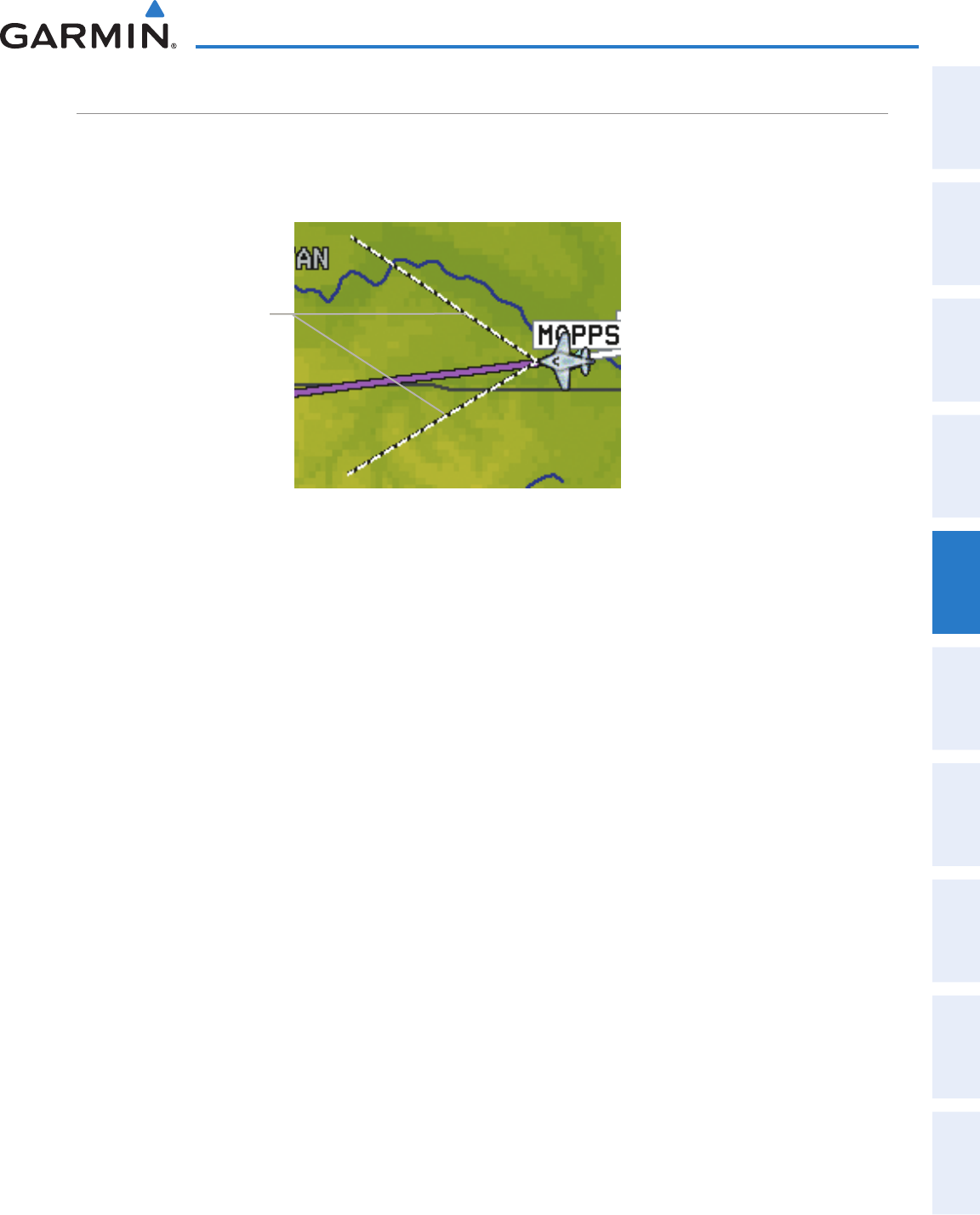
190-00592-06 Rev. A
Garmin G1000 Pilot’s Guide for the Diamond DA40/40F
159
FLIGHT MANAGEMENT
SYSTEM
OVERVIEW
FLIGHT
INSTRUMENTS EIS AUDIO PANEL
& CNS
FLIGHT
MANAGEMENT
HAZARD
AVOIDANCE AFCS ADDITIONAL
FEATURES APPENDICES INDEX
FIELD OF VIEW (SVS)
The map can display the boundaries of the PFD Synthetic Vision System (SVS) lateral field of view. The field
of view is shown as two dashed lines forming a V shape in front of the aircraft symbol on the map. This is only
available if SVS is installed on the aircraft.
Figure 5-29 Navigation Map - Field of View
Lateral Field
of View
Boundaries
Displaying/removing the field of view:
1) Press the MENU Key with the Navigation Map Page displayed. The cursor flashes on the ‘Map Setup’ option.
2) Press the ENT Key. The Map Setup Menu is displayed.
3) Select the ‘Map’ group.
4) Press the ENT Key.
5) Highlight the ‘FIELD OF VIEW’ field.
6) Select ‘On’ or ‘Off’.
7) Press the ENT Key.
8) Press the FMS Knob to return to the Navigation Map Page.
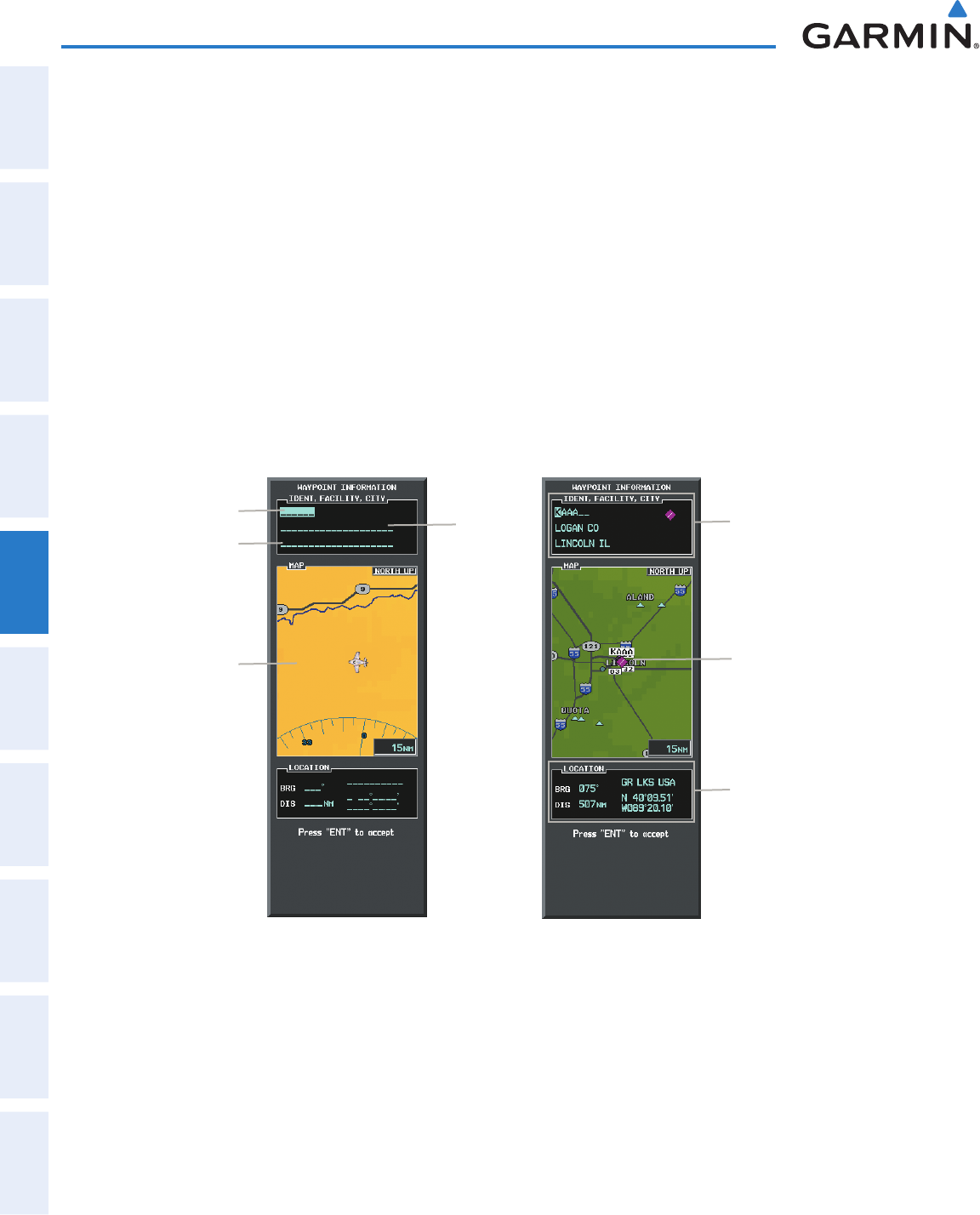
Garmin G1000 Pilot’s Guide for the Diamond DA40/40F
190-00592-06 Rev. A160
FLIGHT MANAGEMENT
SYSTEM
OVERVIEW
FLIGHT
INSTRUMENTS
EIS
AUDIO PANEL
& CNS
FLIGHT
MANAGEMENT
HAZARD
AVOIDANCE
AFCS
ADDITIONAL
FEATURES
APPENDICESINDEX
5.3 WAYPOINTS
Waypoints are predetermined geographical positions (internal database) or pilot-entered positions, and are
used for all phases of flight planning and navigation.
Communication and navigation frequencies can be tuned “automatically” from various Waypoint Information
(WPT) pages, Nearest (NRST) pages, and the Nearest Airports Window (on PFD). This auto-tuning feature
simplifies frequency entry over manual tuning. Refer to the CNS and Audio Panel section for details on auto-
tuning.
Waypoints can be selected by entering the ICAO identifier, entering the name of the facility, or by entering
the city name. See the System Overview section for detailed instructions on entering data in the G1000. As a
waypoint identifier, facility name, or location is entered, the G1000’s Spell’N’Find™ feature scrolls through the
database, displaying those waypoints matching the characters which have been entered to that point. A direct-to
navigation leg to the selected waypoint can be initiated by pressing the Direct-to Key on any of the waypoint
pages.
Figure 5-30 Waypoint Information Window
Map Area Showing
Entered Waypoint
Identifier Entry Field
Entered Waypoint on
Map
Facility
Entry Field
City Entry Field
- Waypoint Identifier
- Type (symbol)
- Facility Name
- City
Waypoint Location
If duplicate entries exist for the entered facility name or location, additional entries may be viewed by continuing
to turn the small FMS Knob during the selection process. If duplicate entries exist for an identifier, a Duplicate
Waypoints Window is displayed when the ENT Key is pressed.
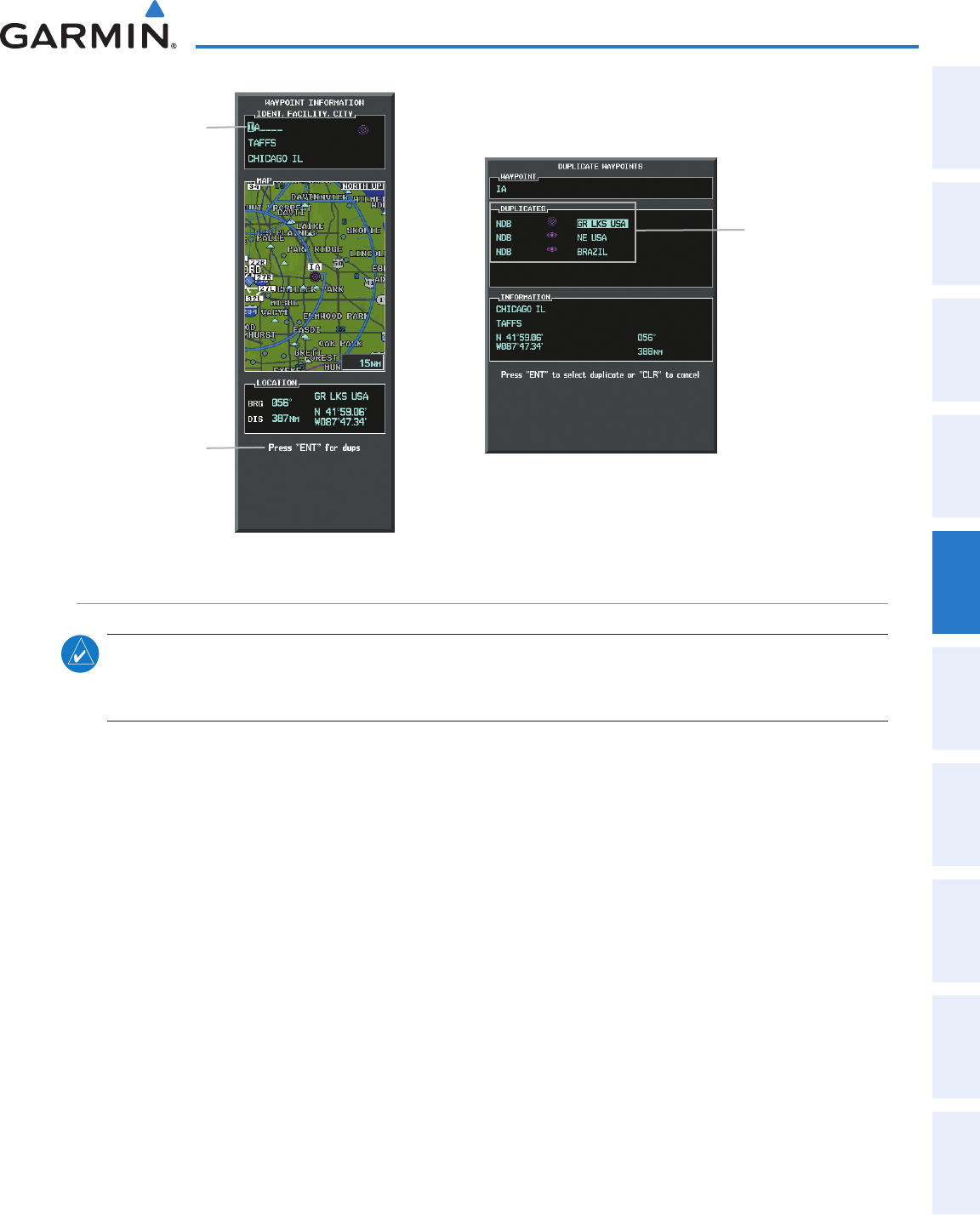
190-00592-06 Rev. A
Garmin G1000 Pilot’s Guide for the Diamond DA40/40F
161
FLIGHT MANAGEMENT
SYSTEM
OVERVIEW
FLIGHT
INSTRUMENTS EIS AUDIO PANEL
& CNS
FLIGHT
MANAGEMENT
HAZARD
AVOIDANCE AFCS ADDITIONAL
FEATURES APPENDICES INDEX
Figure 5-31 Waypoint Information Window - Duplicate Identifier
Duplicate Message
Identifier with
Duplicates
Duplicate
Waypoints
AIRPORTS
NOTE: ‘North Up’ orientation on the Airport Information Page cannot be changed; the pilot needs to be
aware of proper orientation if the Navigation Map orientation is different from the Airport Information Page
Map.
The Airport Information Page is the first page in WPT group and allows the pilot to view airport information,
load frequencies (COM, NAV, and lighting), review runways, and review instrument procedures that may be
involved in the flight plan. See the Audio Panel and CNS Section for more information on loading frequencies
(auto-tuning). After engine startup, the Airport Information Page defaults to the airport where the aircraft is
located. After a flight plan has been loaded, it defaults to the destination airport. On a flight plan with multiple
airports, it defaults to the airport which is the current active waypoint.
In addition to displaying a map of the currently selected airport and surrounding area, the Airport Information
Page displays airport information in three boxes labeled ‘AIRPORT’, ‘RUNWAYS’, and ‘FREQUENCIES’. For
airports with multiple runways, information for each runway is available.
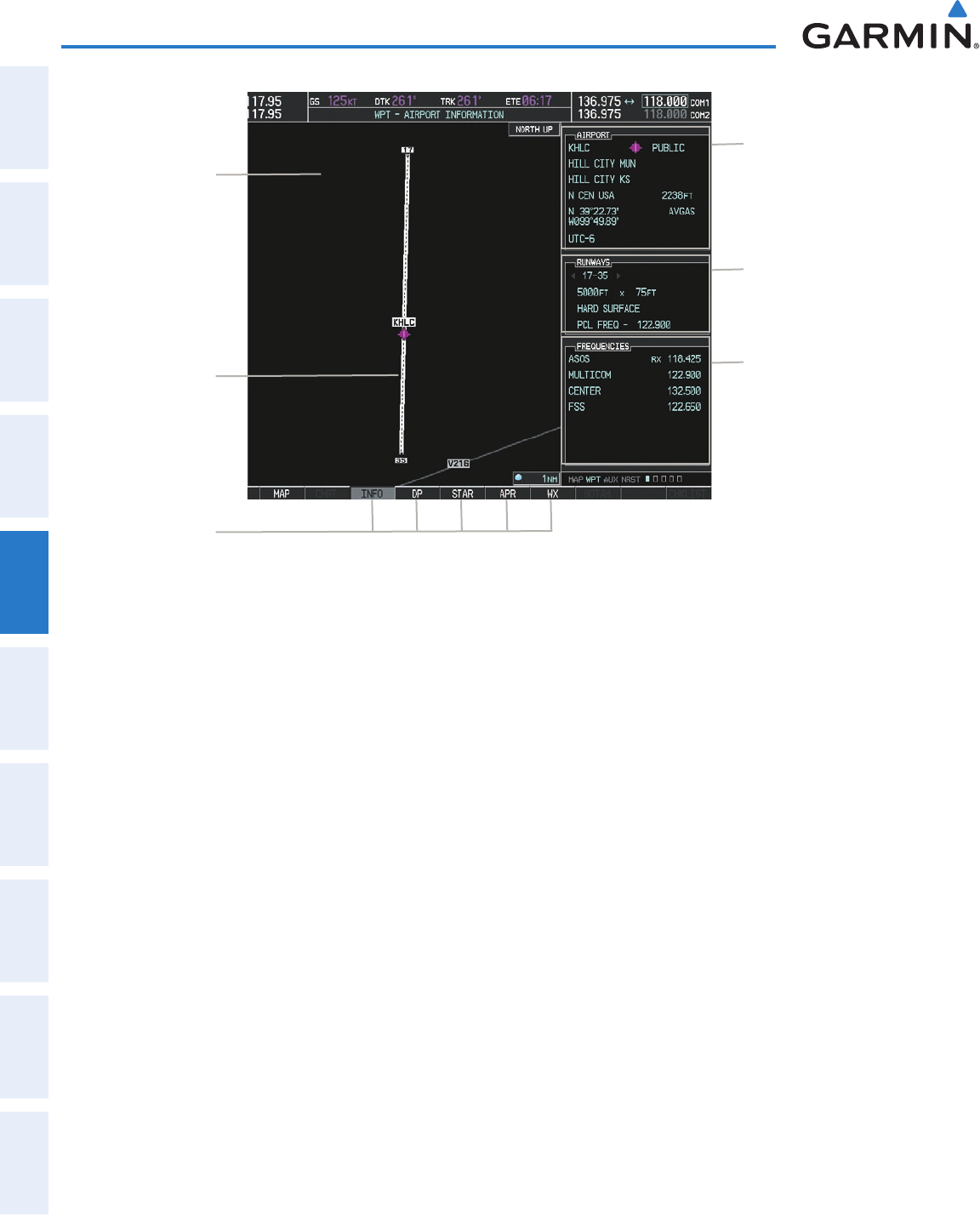
Garmin G1000 Pilot’s Guide for the Diamond DA40/40F
190-00592-06 Rev. A162
FLIGHT MANAGEMENT
SYSTEM
OVERVIEW
FLIGHT
INSTRUMENTS
EIS
AUDIO PANEL
& CNS
FLIGHT
MANAGEMENT
HAZARD
AVOIDANCE
AFCS
ADDITIONAL
FEATURES
APPENDICESINDEX
Figure 5-32 Airport Information Page
Airport/Runway
Diagram
Navigation Map
Showing Selected
Airport
Runway Information
- Designation
- Length/Width/Surface
- Lighting Available
Airport Information
- ID/Facility/City
- Usage Type/Region
- Lat/Long/Elev
- Fuel Available
- Time Zone (UTC Offset)
COM/NAV Freq. Info.
- Identification
- Frequency
- Availability
- Additional Information
Softkeys
The following descriptions and abbreviations are used on the Airport Information Page:
•Usagetype:Public,Military,orPrivate
•Runwaysurfacetype:Hard,Turf,Sealed,Gravel,Dirt,Soft,Unknown,orWater
•Runway lighting type: No Lights, Part Time, Full Time, Unknown, or PCL Freq (for pilot-controlled
lighting)
•COMAvailability:TX(transmitonly),RX(receiveonly),PT(parttime),i(additionalinformationavailable)
Selecting an airport for review by identifier, facility name, or location:
1) From the Airport Information Page, press the FMS Knob.
2) Use the FMS Knobs and enter an identifier, facility name, or location.
3) Press the ENT Key.
4) Press the FMS Knob to remove the cursor.
Selecting a runway:
1) With the Airport Information Page displayed, press the FMS Knob to activate the cursor.
2) Turn the large FMS Knob to place the cursor in the ‘RUNWAYS’ Box, on the runway designator.
3) Turn the small FMS Knob to display the desired runway (if more than one) for the selected airport.
4) To remove the flashing cursor, press the FMS Knob.
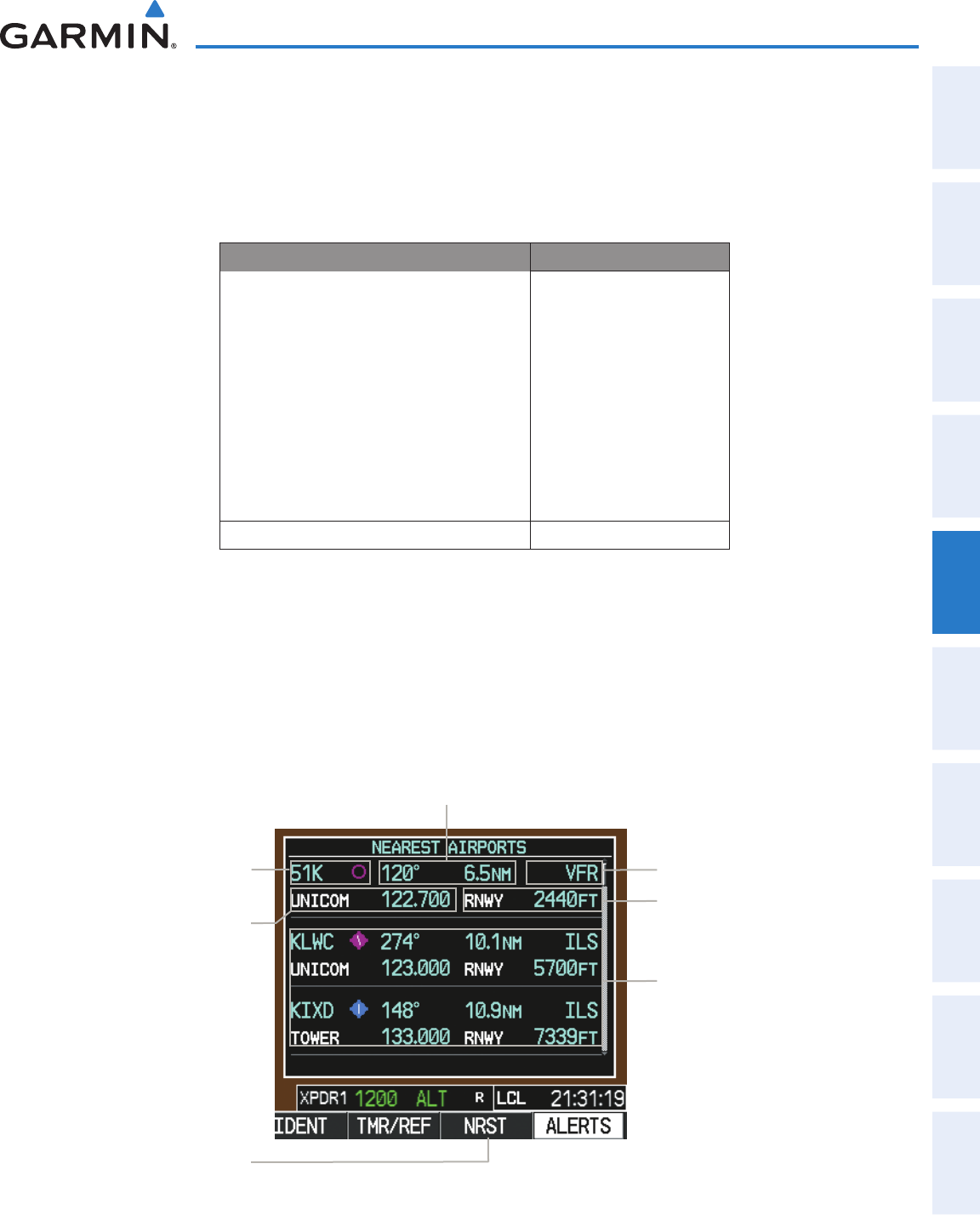
190-00592-06 Rev. A
Garmin G1000 Pilot’s Guide for the Diamond DA40/40F
163
FLIGHT MANAGEMENT
SYSTEM
OVERVIEW
FLIGHT
INSTRUMENTS EIS AUDIO PANEL
& CNS
FLIGHT
MANAGEMENT
HAZARD
AVOIDANCE AFCS ADDITIONAL
FEATURES APPENDICES INDEX
View a destination airport:
From the Airport Information Page press the MENU Key. Select ‘View Destination Airport’. The Destination
Airport is displayed.
The Airport Frequencies Box uses the descriptions and abbreviations listed in the following table:
Communication Frequencies Navigation Frequencies
Approach *
Arrival *
ASOS
ATIS
AWOS
Center
Class B *
Class C *
Clearance
Control
CTA *
Departure *
Gate
Ground
Helicopter
Multicom
Other
Pre-Taxi
Radar
Ramp
Terminal *
TMA *
Tower
TRSA *
Unicom
ILS
LOC
* May include Additional Information
Table 5-5 Airport Frequency Abbreviations
A departure, arrival, or approach can be loaded using the softkeys on the Airport Information Page. See the
procedures section for details. METARs or TAFs applicable to the selected airport can be selected for display (see
the Hazard Avoidance section for details about weather.
The G1000 provides a NRST Softkey on the PFD, which gives the pilot quick access to nearest airport
information (very useful if an immediate need to land is required). The Nearest Airports Window displays a
list of the 25 nearest airports (three entries can be displayed at one time). If there are more than three they are
displayed in a scrollable list. If there are no nearest airports available, “NONE WITHIN 200NM” is displayed.
Figure 5-33 Nearest Airports Window on PFD
COM Freq. Info.
- Identification
- Frequency
Airport Identifier/
Type Length of Longest
Runway
Approach Available
Additional Airports
(within 200 nm)
NRST Softkey
Bearing/Distance to Airport
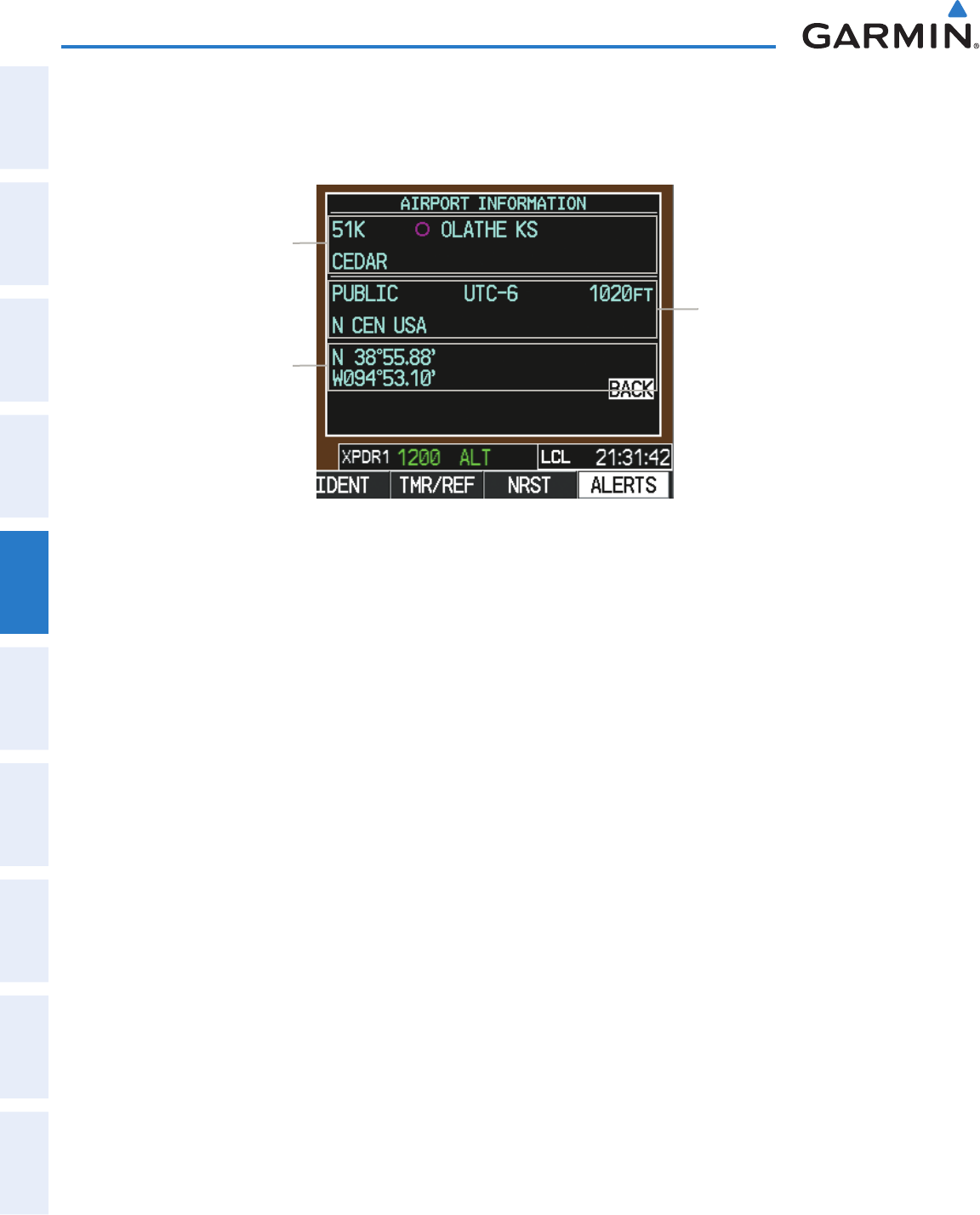
Garmin G1000 Pilot’s Guide for the Diamond DA40/40F
190-00592-06 Rev. A164
FLIGHT MANAGEMENT
SYSTEM
OVERVIEW
FLIGHT
INSTRUMENTS
EIS
AUDIO PANEL
& CNS
FLIGHT
MANAGEMENT
HAZARD
AVOIDANCE
AFCS
ADDITIONAL
FEATURES
APPENDICESINDEX
Pressing the ENT Key displays the PFD Airport Information Window for the highlighted airport. Pressing the
ENT Key again returns to the Nearest Airports Window with the cursor on the next airport in the list. Continued
presses of the ENT Key sequences through the information pages for all airports in the Nearest Airports list.
Figure 5-34 Airport Information Window on PFD
Airport Information
- Usage/Time/Elev
- Region
Airport Information
- Lat/Long
Airport Information
- ID/Type/City
- Facility
The Nearest Airports Page on the MFD is first in the group of NRST pages because of its potential use in
the event of an in-flight emergency. In addition to displaying a map of the currently selected airport and
surrounding area, the page displays nearest airport information in five boxes labeled ‘NEAREST AIRPORTS’,
‘INFORMATION’, ‘RUNWAYS’, ‘FREQUENCIES’, and ‘APPROACHES’.
The selected airport is indicated by a white arrow, and a dashed white line is drawn on the navigation map
from the aircraft position to the nearest airport. Up to five nearest airports, one runway, up to five frequencies,
and up to five approaches are visible at one time. If there are more than can be shown, each list can be scrolled.
If there are no items for display in a boxed area, text indicating that fact is displayed. The currently selected
airport remains in the list until it is unselected.
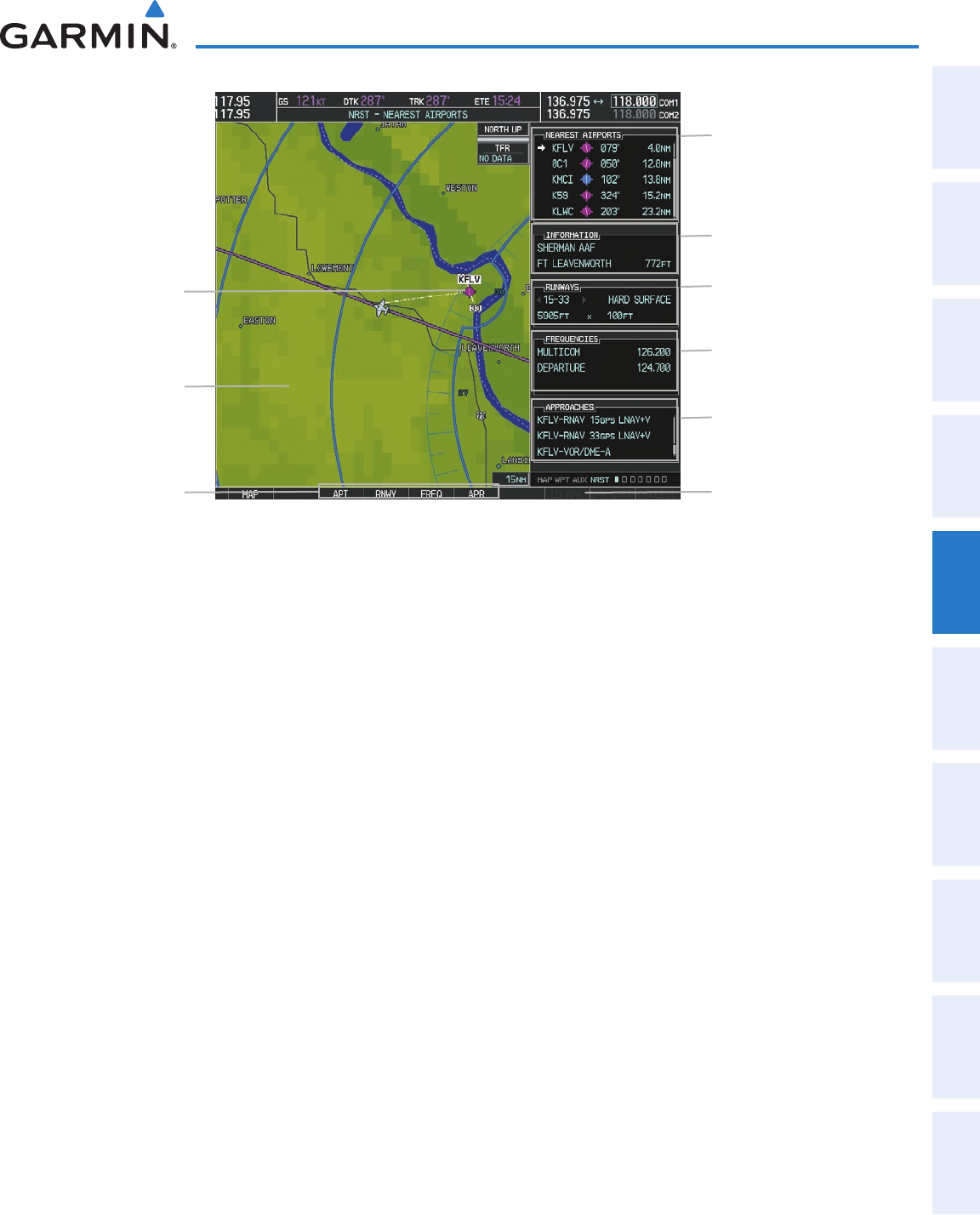
190-00592-06 Rev. A
Garmin G1000 Pilot’s Guide for the Diamond DA40/40F
165
FLIGHT MANAGEMENT
SYSTEM
OVERVIEW
FLIGHT
INSTRUMENTS EIS AUDIO PANEL
& CNS
FLIGHT
MANAGEMENT
HAZARD
AVOIDANCE AFCS ADDITIONAL
FEATURES APPENDICES INDEX
Figure 5-35 Nearest Airport Page
Nearest Airport
Navigation Map
Showing Nearest
Airport
Runway Information
- Designation/Surface
- Length/Width
Nearest Airports
- ID/Type
- Bearing/Distance
COM/NAV Freq. Info.
- Identification
- Frequency
Window Selection
Softkeys
Airport Information
- Facility/City/Elevation
Approaches Available
LD APR Softkey (only
available if an approach is
highlighted)
Viewing information for a nearest airport on the PFD:
1) Press the NRST Softkey to display the Nearest Airports Window.
2) Highlight the airport identifier with the FMS Knob and press the ENT Key to display the Airport Information
Window.
3) To return to the Nearest Airports Window press the ENT Key (with the cursor on ‘BACK’) or press the CLR
Key. The cursor is now on the next airport in the nearest airports list. (Repeatedly pressing the ENT Key
moves through the airport list, alternating between the Nearest Airports Window and the Airport Information
Window.)
4) Press the CLR Key to close the PFD Nearest Airports Window.
Viewing information for a nearest airport on the MFD:
1) Turn the large FMS Knob to select the NRST page group.
2) Turn the small FMS Knob to select the Nearest Airports Page (it is the first page of the group, so it may already
be selected. If there are no Nearest Airports available, “NONE WITHIN 200 NM” is displayed.
3) Press the APT Softkey; or press the FMS Knob; or press the MENU Key, highlight ‘Select Airport Window’ and
press the ENT Key. The cursor is placed in the ‘NEAREST AIRPORTS’ Box. The first airport in the nearest airports
list is highlighted.
4) Turn the FMS Knob to highlight the desired airport. (Pressing the ENT Key also moves to the next airport)
5) Press the FMS Knob to remove the flashing cursor.
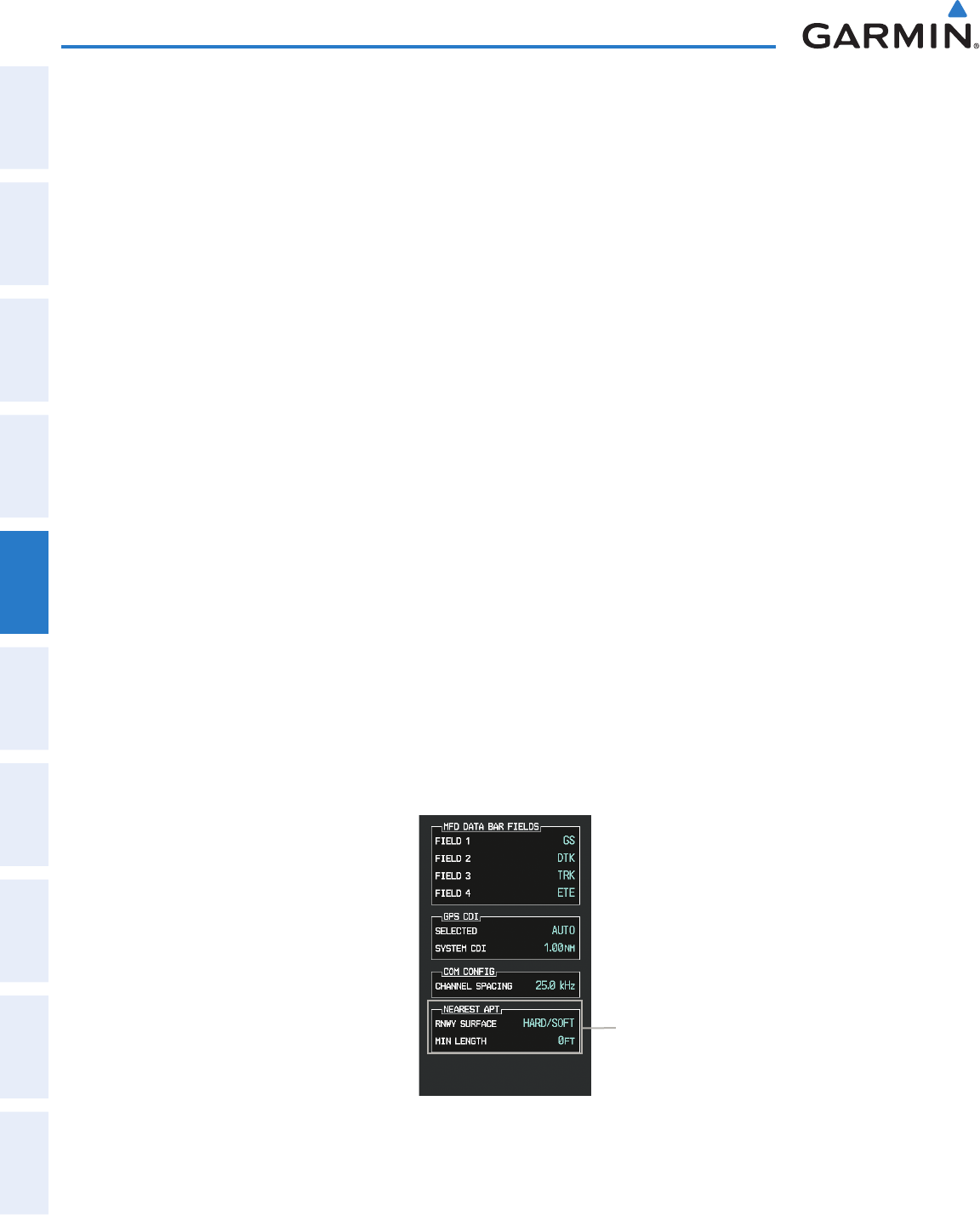
Garmin G1000 Pilot’s Guide for the Diamond DA40/40F
190-00592-06 Rev. A166
FLIGHT MANAGEMENT
SYSTEM
OVERVIEW
FLIGHT
INSTRUMENTS
EIS
AUDIO PANEL
& CNS
FLIGHT
MANAGEMENT
HAZARD
AVOIDANCE
AFCS
ADDITIONAL
FEATURES
APPENDICESINDEX
Viewing runway information for a specific airport:
1) With the Nearest Airports Page displayed, press the RNWY Softkey; or press the MENU Key, highlight ‘Select
Runway Window’; and press the ENT Key. The cursor is placed in the ‘RUNWAYS’ Box.
2) Turn the small FMS Knob to select the desired runway.
3) Press the FMS Knob to remove the flashing cursor.
See the Audio Panel and CNS Section for frequency selection and the Procedures section for approaches.
The Nearest Airports Box on the System Setup Page defines the minimum runway length and surface type
used when determining the 25 nearest airports to display on the MFD Nearest Airports Page. A minimum
runway length and/or surface type can be entered to prevent airports with small runways or runways that are
not appropriately surfaced from being displayed. Default settings are 0 feet (or meters) for runway length and
“HARD/SOFT” for runway surface type.
Selecting nearest airport surface matching criteria:
1) Use the FMS Knob to select the System Setup Page.
2) Press the FMS Knob momentarily to activate the flashing cursor.
3) Turn the large FMS Knob to highlight the runway surface field in the Nearest Airports Box.
4) Turn the small FMS Knob to select the desired runway option (ANY, HARD ONLY, HARD/SOFT).
5) Press the ENT Key.
Selecting nearest airport minimum runway length matching criteria:
1) Use the FMS Knob to select the System Setup Page.
2) Press the FMS Knob momentarily to activate the flashing cursor.
3) Turn the large FMS Knob to highlight the minimum length field in the Nearest Airport Box.
4) Use the FMS Knob to enter the minimum runway length (zero to 25,000 feet) and press the ENT Key.
Figure 5-36 System Setup Page - Nearest Airport Selection Criteria
Nearest Airport Criteria
- Type of Runway Surface
- Minimum Runway Length
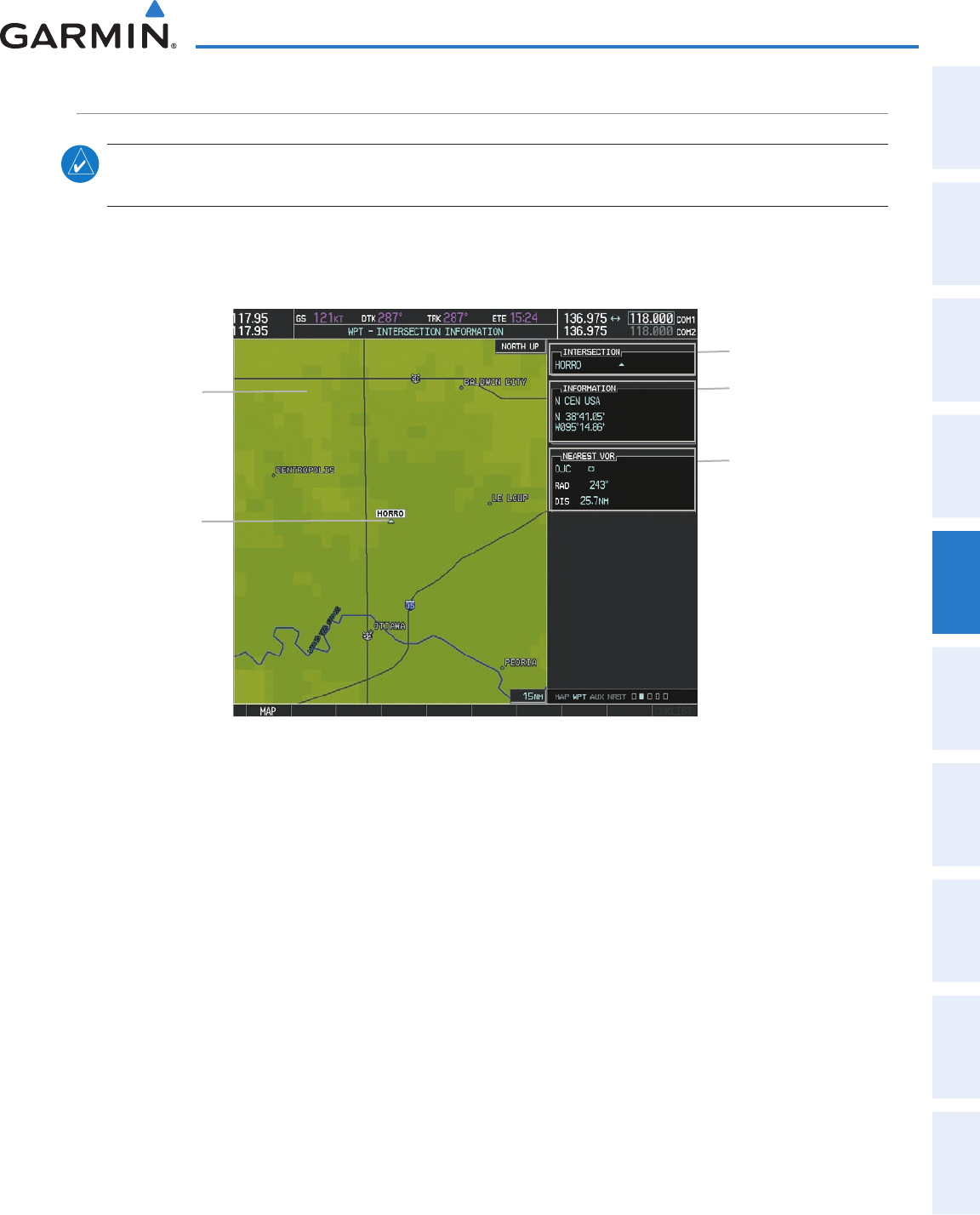
190-00592-06 Rev. A
Garmin G1000 Pilot’s Guide for the Diamond DA40/40F
167
FLIGHT MANAGEMENT
SYSTEM
OVERVIEW
FLIGHT
INSTRUMENTS EIS AUDIO PANEL
& CNS
FLIGHT
MANAGEMENT
HAZARD
AVOIDANCE AFCS ADDITIONAL
FEATURES APPENDICES INDEX
INTERSECTIONS
NOTE: The VOR displayed on the Intersection Information Page is the nearest VOR, not necessarily the VOR
used to define the intersection.
The Intersection Information Page is used to view information about intersections. In addition to displaying
a map of the currently selected intersection and surrounding area, the Intersection Information Page displays
intersection information in three boxes labeled ‘INTERSECTION’, ‘INFORMATION’, and ‘NEAREST VOR’.
Figure 5-37 Intersection Information Page
Selected Intersection
Navigation Map
Showing Selected
Intersection
Intersection Identifier
Nearest VOR Info
- Identifier/Type (symbol)
- Radial to VOR
- Distance to VOR
Intersection Info
- Region
- Lat/Long
Select an intersection:
1) With the Intersection Information Page displayed, enter an identifier in the Intersection Box.
2) Press the ENT Key.
3) Press the FMS
Knob to remove the flashing cursor.
Or:
1) With the Nearest Intersections Page displayed, press the FMS Knob
2) Press the ENT Key or turn either FMS Knob to select an identifier in the Nearest Intersection Box.
3) Press the FMS Knob to remove the flashing cursor.
The Nearest Intersections Page can be used to quickly find an intersection close to the flight path. In addition
to displaying a map of the surrounding area, the page displays information for up to 25 nearest intersections in
three boxes labeled ‘NEAREST INT’, ‘INFORMATION’, and ‘REFERENCE VOR’.
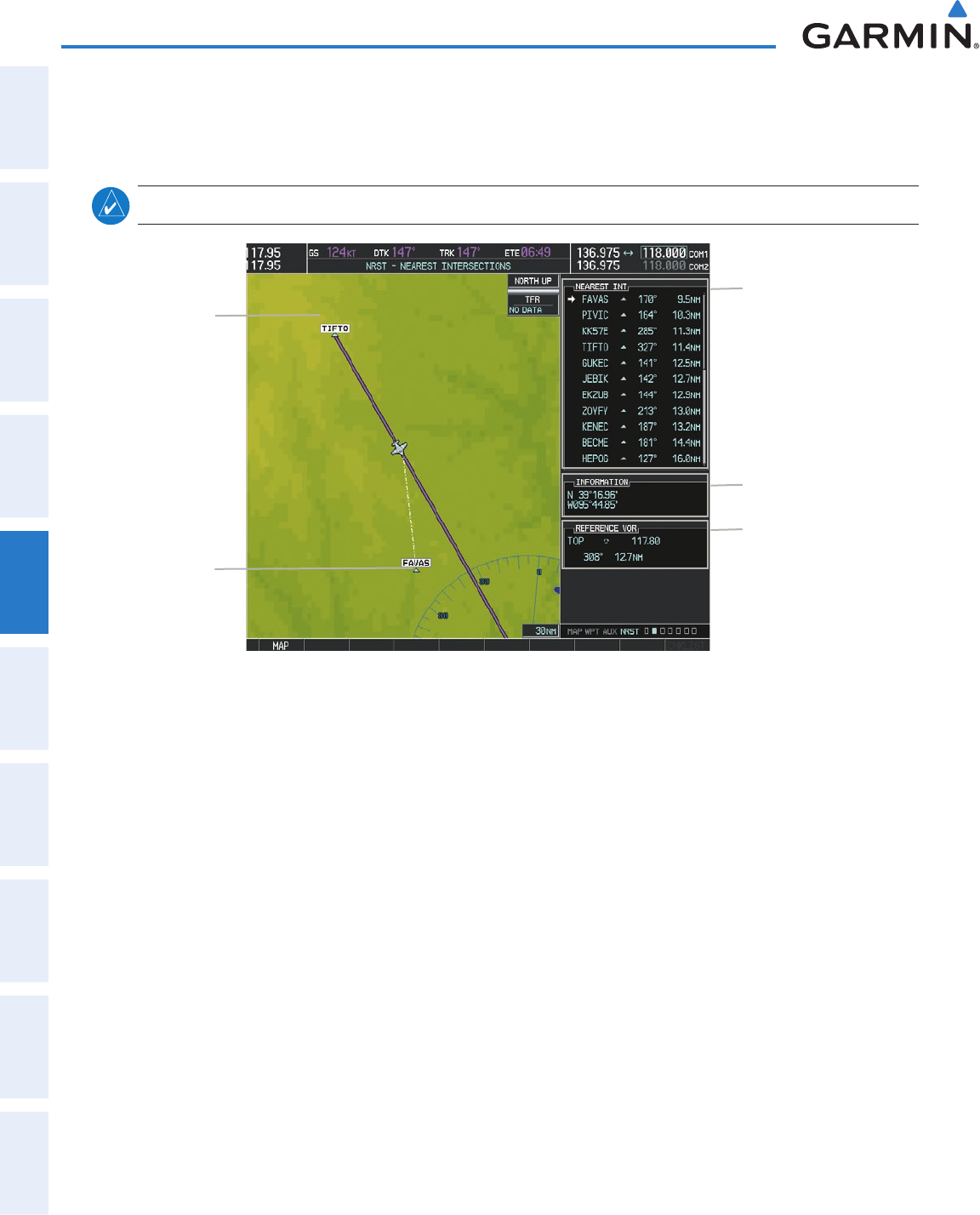
Garmin G1000 Pilot’s Guide for the Diamond DA40/40F
190-00592-06 Rev. A168
FLIGHT MANAGEMENT
SYSTEM
OVERVIEW
FLIGHT
INSTRUMENTS
EIS
AUDIO PANEL
& CNS
FLIGHT
MANAGEMENT
HAZARD
AVOIDANCE
AFCS
ADDITIONAL
FEATURES
APPENDICESINDEX
The selected intersection is indicated by a white arrow. Up to eleven intersections are visible at a time. If
there are more than can be shown, the list can be scrolled. If there are no items for display, text indicating that
fact is displayed
NOTE: The list only includes waypoints that are within 200 nm.
Figure 5-38 Nearest Intersections Page
Nearest
Intersection
Navigation Map
Showing Nearest
Intersection
Intersection Information
- Identifier/Symbol
- Bearing/Distance to
intersection from
aircraft position
Reference VOR Info
- Identifier/Type (symbol)
- VOR Frequency
- Bearing/Distance to VOR
Intersection Lat/Long
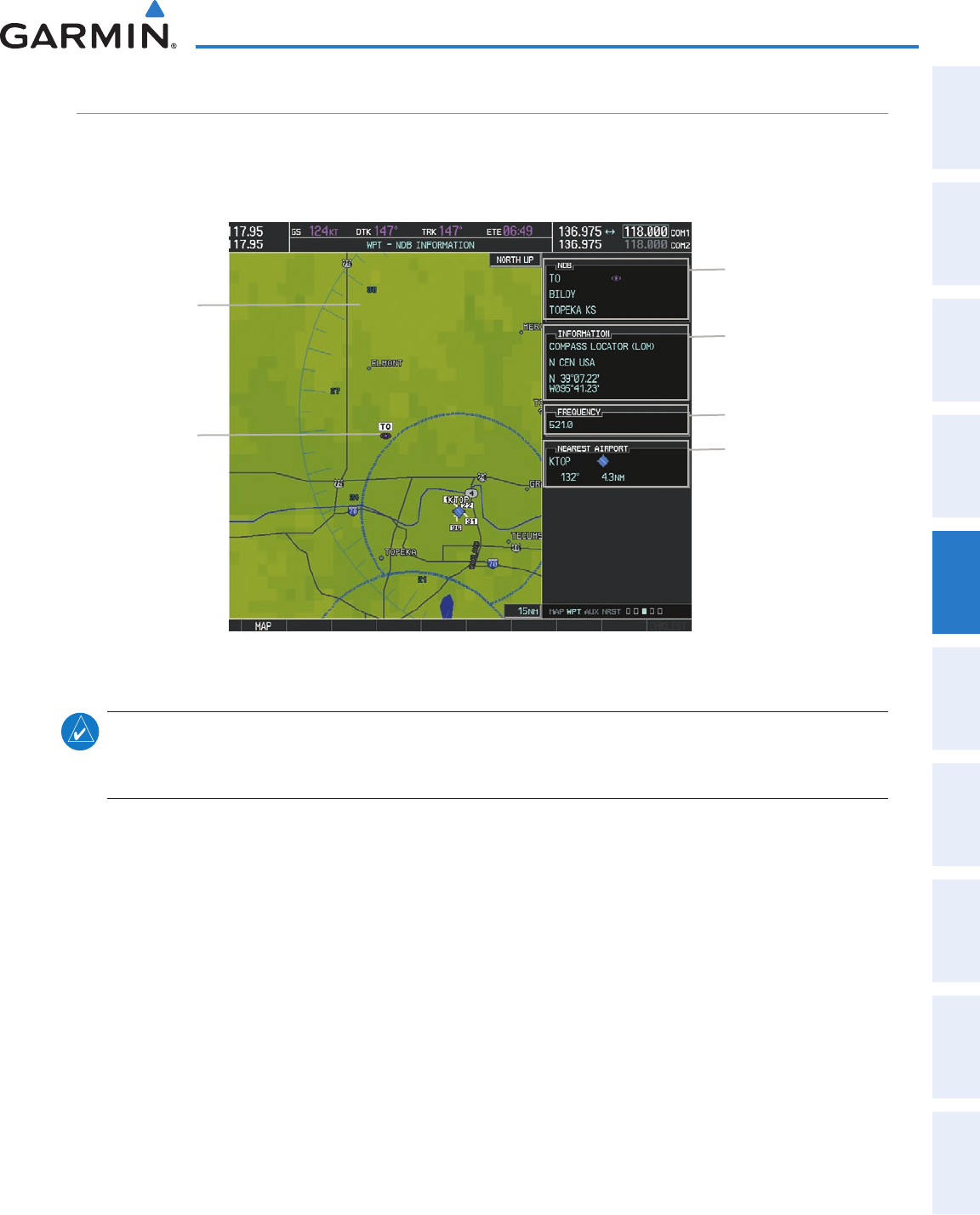
190-00592-06 Rev. A
Garmin G1000 Pilot’s Guide for the Diamond DA40/40F
169
FLIGHT MANAGEMENT
SYSTEM
OVERVIEW
FLIGHT
INSTRUMENTS EIS AUDIO PANEL
& CNS
FLIGHT
MANAGEMENT
HAZARD
AVOIDANCE AFCS ADDITIONAL
FEATURES APPENDICES INDEX
NDBS
The NDB Information Page is used to view information about NDBs. In addition to displaying a map of
the currently selected NDB and surrounding area, the page displays NDB information in four boxes labeled
‘NDB’, ‘INFORMATION’, ‘FREQUENCY’, and ‘NEAREST AIRPORT.
Figure 5-39 NDB Information Page
Selected NDB
Navigation Map
Showing Selected
NDB
NDB Identifier/Type
- Facility Name
- Nearest City
Nearest Airport Info
- Identifier/Type (symbol)
- Bearing/Distance to
Airport
NDB Information
- Type
- Region
- Lat/Long
NDB Frequency
NOTE: Compass locator (LOM): a low power, low or medium frequency radio beacon installed in conjunction
with the instrument landing system. When LOM is used, the locator is at the Outer Marker; when LMM is
used, the locator is at the Middle Marker.
Select an NDB:
1) With the NDB Information Page displayed, enter an identifier, the name of the NDB, or the city in which it’s
located in the NDB Box.
2) Press the ENT Key.
3) Press the
FMS
Knob to remove the flashing cursor.
Or:
1) With the Nearest NDB Page displayed, press the FMS Knob
2) Press the ENT Key or turn either FMS Knob to select an identifier in the Nearest NDB Box.
3) Press the FMS Knob to remove the flashing cursor.
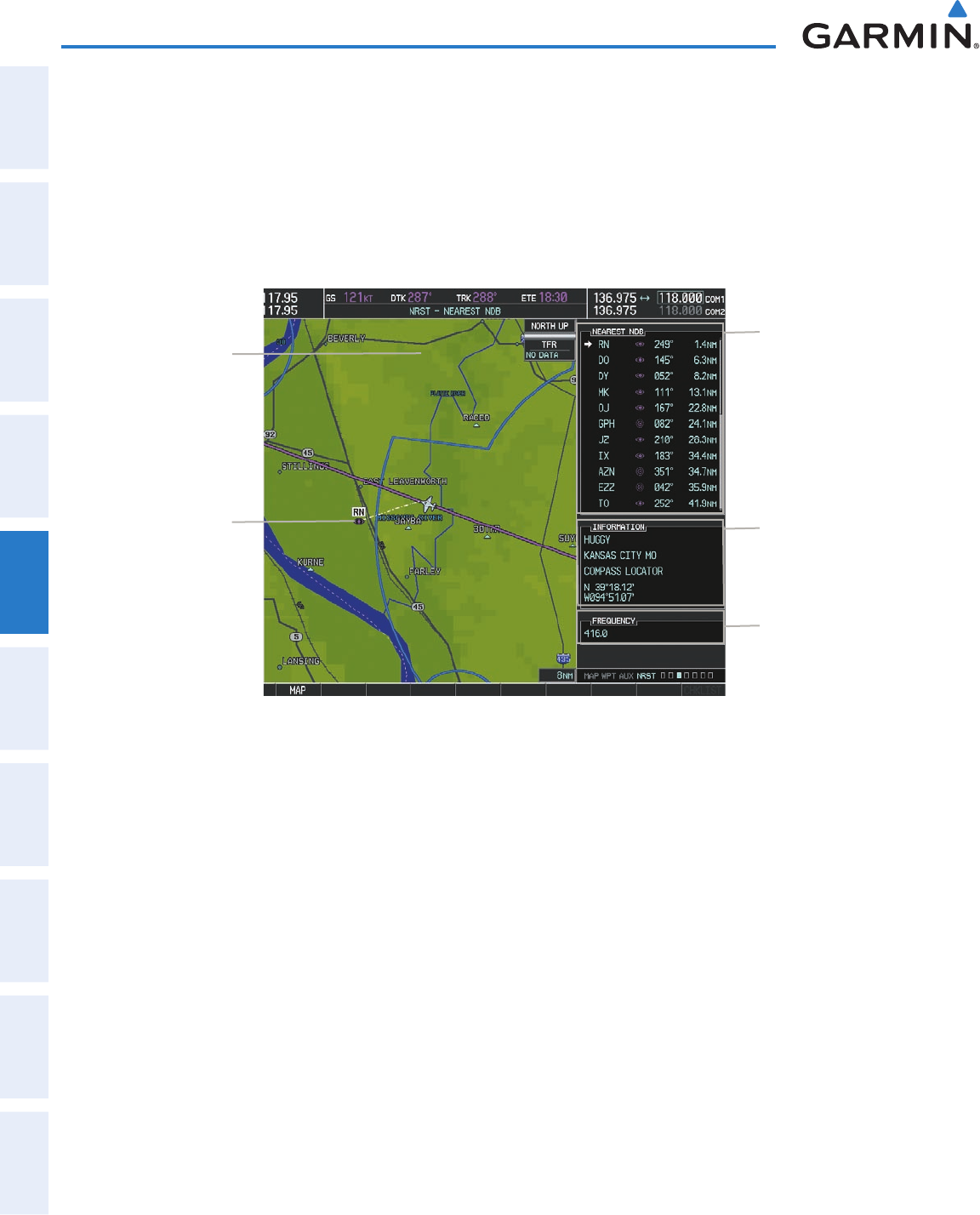
Garmin G1000 Pilot’s Guide for the Diamond DA40/40F
190-00592-06 Rev. A170
FLIGHT MANAGEMENT
SYSTEM
OVERVIEW
FLIGHT
INSTRUMENTS
EIS
AUDIO PANEL
& CNS
FLIGHT
MANAGEMENT
HAZARD
AVOIDANCE
AFCS
ADDITIONAL
FEATURES
APPENDICESINDEX
The Nearest NDB Page can be used to quickly find a NDB close to the flight path. In addition to displaying
a map of the surrounding area, the page displays information for up to 25 nearest NDBs in three boxes labeled
‘NEAREST NDB’, ‘INFORMATION’, and ‘FREQUENCY’.
A white arrow before the NDB identifier indicates the selected NDB. Up to eleven NDBs are visible at a time.
If there are more than can be shown, each list can be scrolled. The list only includes waypoints that are within
200nm. If there are no NDBs in the list, text indicating that there are no nearest NDBs is displayed. If there are
no nearest NDBs in the list, the information and frequency fields are dashed.
Figure 5-40 Nearest NDB Page
Nearest NDB
Navigation Map
Showing Selected
NDB
NDB Information
- Facility Name/City
- Type
- Lat/Long
NDB Identifier/Symbol
- Bearing/Distance to
NDB from aircraft
position
NDB Frequency
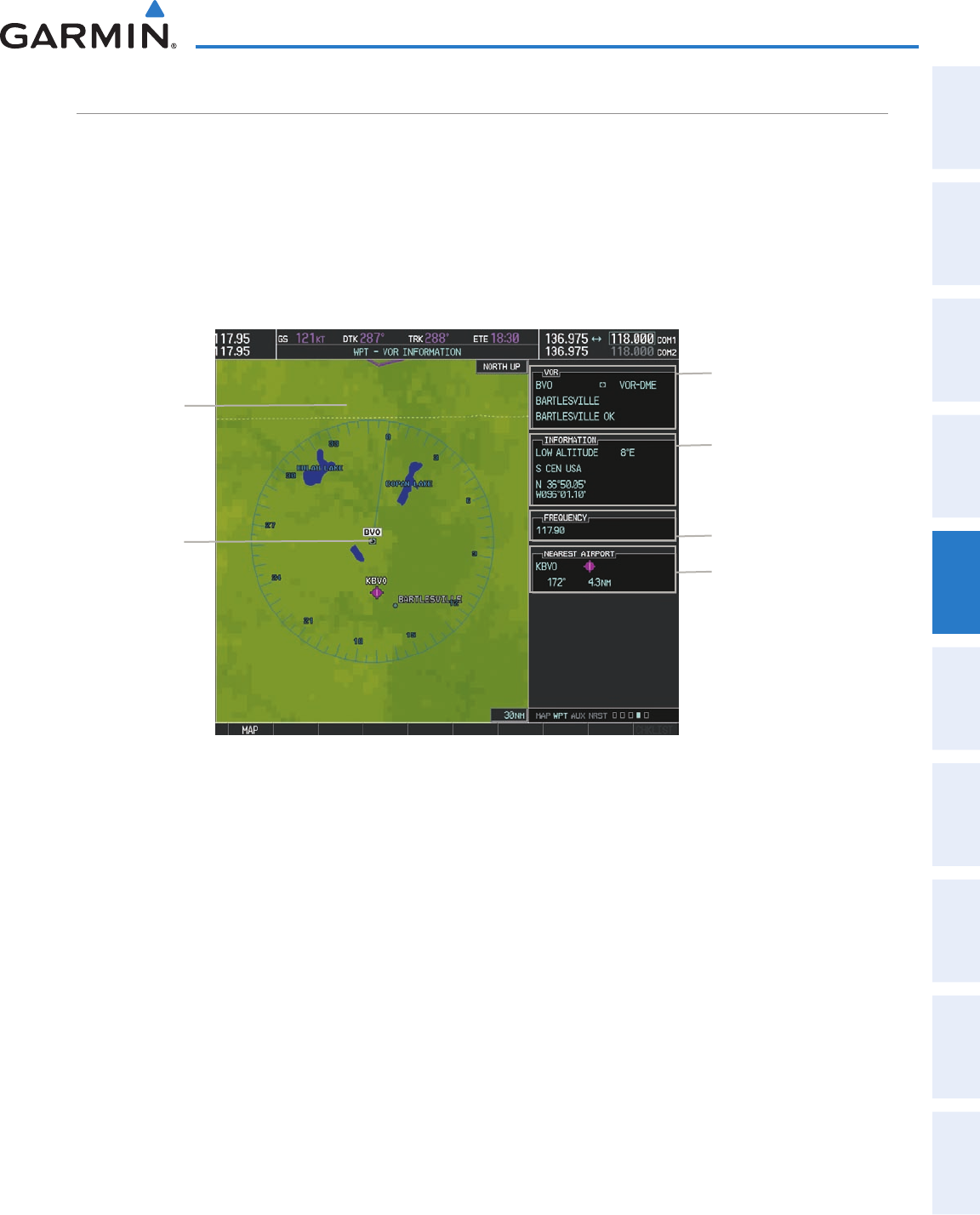
190-00592-06 Rev. A
Garmin G1000 Pilot’s Guide for the Diamond DA40/40F
171
FLIGHT MANAGEMENT
SYSTEM
OVERVIEW
FLIGHT
INSTRUMENTS EIS AUDIO PANEL
& CNS
FLIGHT
MANAGEMENT
HAZARD
AVOIDANCE AFCS ADDITIONAL
FEATURES APPENDICES INDEX
VORS
The VOR Information Page can be used to view information about VOR and ILS signals (since ILS signals
can be received on a NAV receiver), or to quickly auto-tune a VOR or ILS frequency. Localizer information
cannot be viewed on the VOR Information Page. If a VOR station is combined with a TACAN station it is
listed as a VORTAC on the VOR Information Page and if it includes only DME, it’s displayed as VOR-DME.
In addition to displaying a map of the currently selected VOR and surrounding area, the VOR Information
Page displays VOR information in four boxes labeled ‘VOR’, ‘INFORMATION’, ‘FREQUENCY’, and ‘NEAREST
AIRPORT’.
Figure 5-41 VOR Information Page
Selected VOR
Navigation Map
Showing
Selected VOR
VOR Identifier/Type
- Facility Name
- Nearest City
Nearest Airport Info
- Identifier/Type (symbol)
- Bearing/Distance to
Airport
VOR Information
- Class/Magnetic Variation
- Region
- Lat/Long
VOR Frequency
The VOR classes used in the VOR information box are: LOW ALTITUDE, HIGH ALTITUDE, and
TERMINAL
Select a VOR:
1) With the VOR Information Page displayed, enter an identifier, the name of the VOR, or the city in which it’s
located in the VOR Box.
2) Press the ENT Key.
3) Press the FMS Knob to remove the flashing cursor.
Or:
1) With the Nearest VOR Page displayed, press the FMS Knob or press the VOR Softkey.
2) Press the ENT Key or turn either FMS Knob to select an identifier in the Nearest VOR Box.
3) Press the FMS Knob to remove the flashing cursor.
Or:
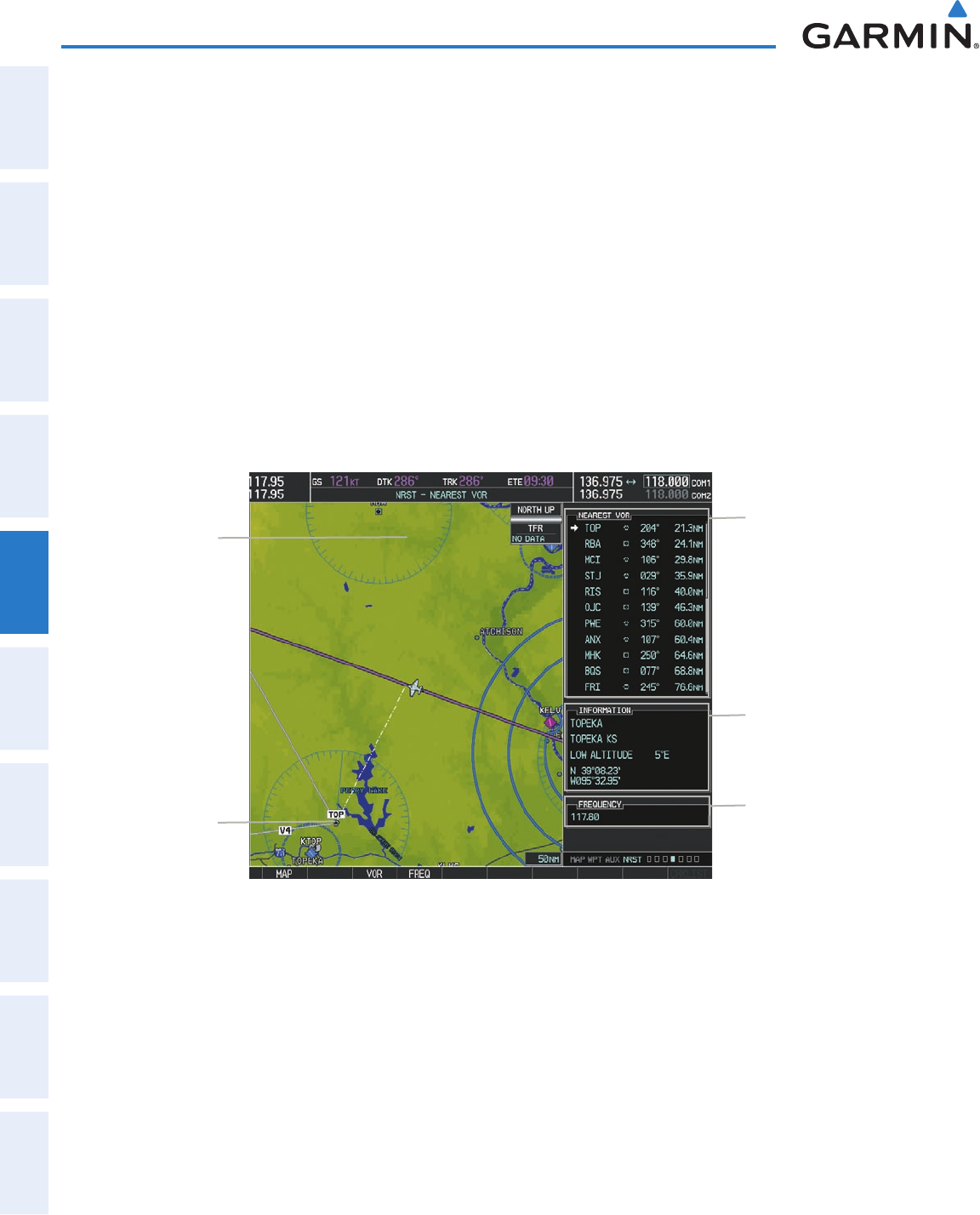
Garmin G1000 Pilot’s Guide for the Diamond DA40/40F
190-00592-06 Rev. A172
FLIGHT MANAGEMENT
SYSTEM
OVERVIEW
FLIGHT
INSTRUMENTS
EIS
AUDIO PANEL
& CNS
FLIGHT
MANAGEMENT
HAZARD
AVOIDANCE
AFCS
ADDITIONAL
FEATURES
APPENDICESINDEX
1) With the Nearest VOR Page displayed, press the MENU Key.
2) Highlight ‘SELECT VOR WINDOW’, and press the ENT Key.
3) Press the ENT Key or turn either FMS Knob to select an identifier in the Nearest VOR Box.
4) Press the FMS Knob to remove the flashing cursor.
The Nearest VOR Page can be used to quickly find a VOR station close to the aircraft. Also, a NAV frequency
from a selected VOR station can be loaded from the Nearest VOR Page. In addition to displaying a map of
the surrounding area, the Nearest VOR Page displays information for up to 25 nearest VOR stations in three
boxes labeled ‘NEAREST VOR’, ‘INFORMATION’, and ‘FREQUENCY’. The list only includes waypoints that
are within 200 nm
.
A white arrow before the VOR identifier indicates the selected VOR. Up to eleven VORs are visible at a
time. If there are more than can be shown, each list can be scrolled. If there are no VORs in the list, text
indicating that there are no nearest VORs is displayed. If there are no nearest VORs in the list, the information
is dashed.
Figure 5-42 Nearest VOR Page
Nearest VOR
Navigation Map
Showing Nearest
VOR
VOR Information
- Facility Name/City
- Class/Magnetic Variation
- Lat/Long
VOR Identifier/Symbol
- Bearing/Distance to VOR
from aircraft position
VOR Frequency
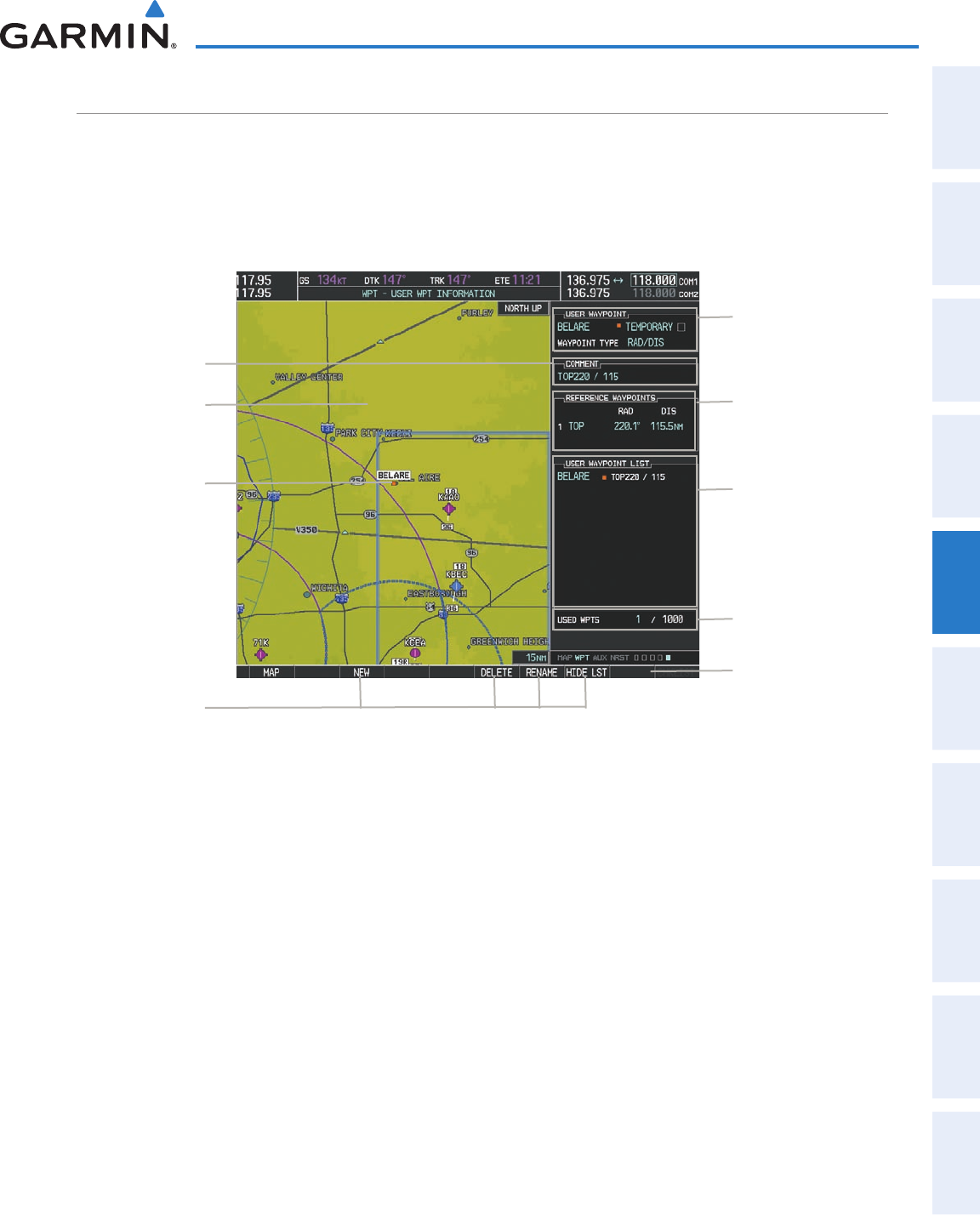
190-00592-06 Rev. A
Garmin G1000 Pilot’s Guide for the Diamond DA40/40F
173
FLIGHT MANAGEMENT
SYSTEM
OVERVIEW
FLIGHT
INSTRUMENTS EIS AUDIO PANEL
& CNS
FLIGHT
MANAGEMENT
HAZARD
AVOIDANCE AFCS ADDITIONAL
FEATURES APPENDICES INDEX
USER WAYPOINTS
The G1000 can create and store up to 1,000 user-defined waypoints. User waypoints can be created from
any map page (except PFD Inset Map, AUX-Trip Planning Page, or Procedure Pages) by selecting a position on
the map using the Joystick, or from the User Waypoint Information Page by referencing a bearing/distance
from an existing waypoint or bearing from two existing waypoints. Once a waypoint has been created, it can
be renamed, deleted, or moved.
Figure 5-43 User Waypoint Information Page
Selected User
Waypoint
Navigation Map
Showing Selected
User Waypoint
User Waypoint Info
- Identifier
- Temporary/Normal
- Waypoint Type
User Waypoint List
- Identifier
- Comment
Reference Wpt/Info
- Identifier/Rad/Dist or
- Identifiers/Radials or
- Region/Lat/Long
Softkeys
User Wpt Comment
# User Wpts Used
GO BACK Softkey
displayed if User Wpt
was created on map
page
Select a User Waypoint:
1) With the User Waypoint Information Page displayed, enter the name of the User Waypoint, or scroll to the
desired waypoint in the User Waypoint List using the large FMS Knob.
2) Press the ENT Key.
3) Press the
FMS
Knob to remove the flashing cursor.
Or:
1) With the Nearest User Waypoint Page displayed, press the FMS Knob
2) Press the ENT Key or turn either FMS Knob to select an identifier in the Nearest USR Box.
3) Press the FMS Knob to remove the flashing cursor.
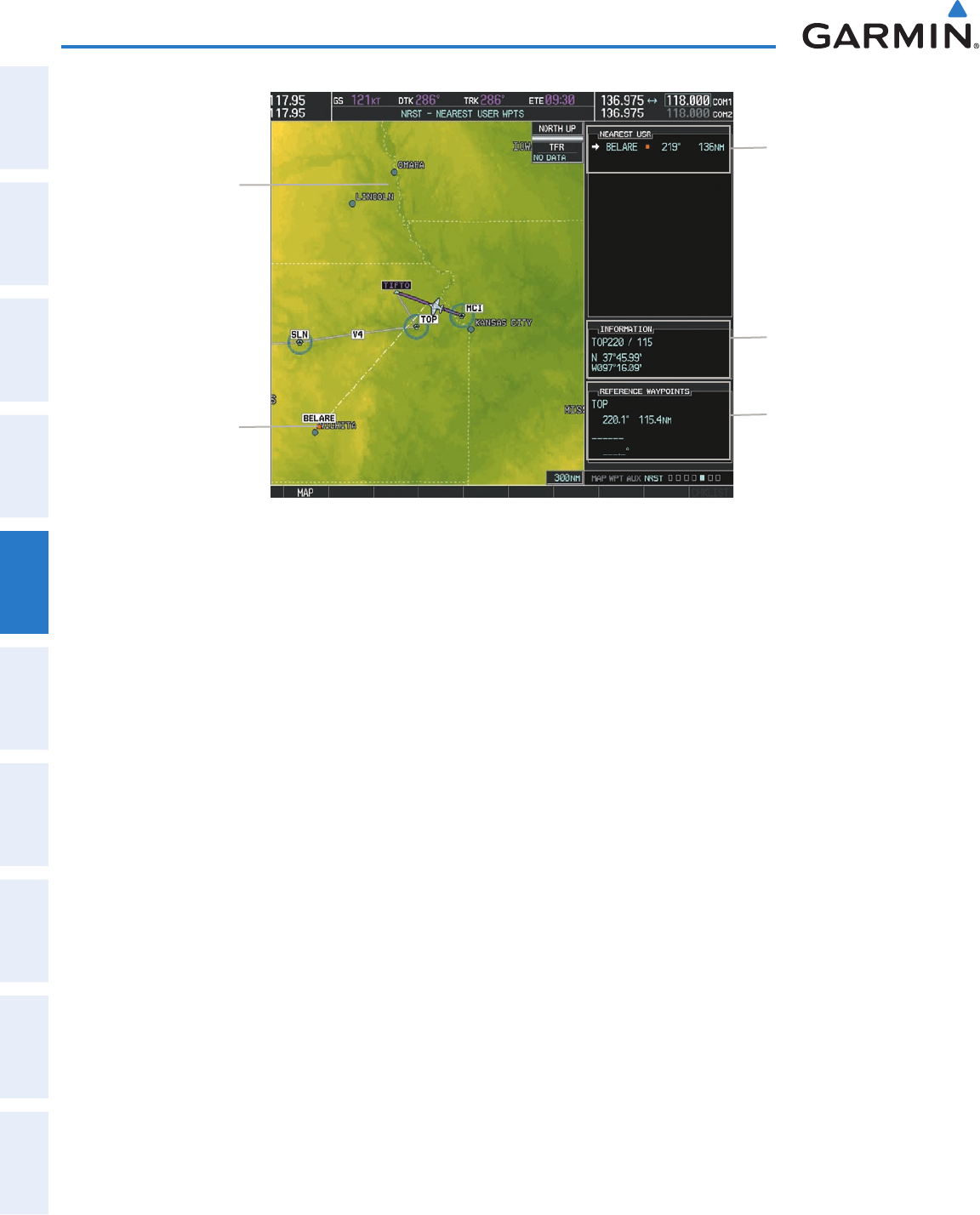
Garmin G1000 Pilot’s Guide for the Diamond DA40/40F
190-00592-06 Rev. A174
FLIGHT MANAGEMENT
SYSTEM
OVERVIEW
FLIGHT
INSTRUMENTS
EIS
AUDIO PANEL
& CNS
FLIGHT
MANAGEMENT
HAZARD
AVOIDANCE
AFCS
ADDITIONAL
FEATURES
APPENDICESINDEX
Figure 5-44 Nearest User Waypoint Page
Selected User
Waypoint
Navigation Map
Showing Selected
User Waypoint
Nearest User Wpt List
- Identifier
- Bearing/Distance from
aircraft position
User Waypoint Info
- Comment
- Lat/Long
Reference Wpt Info
- Identifier
- Radial/Distance
CREATING USER WAYPOINTS
User waypoints can be created from the User Waypoint Information Page in the following ways:
Creating user waypoints from the User Waypoint Information Page:
1) Select the NEW Softkey, or press the MENU Key and select ‘Create New User Waypoint’.
2) Enter a user waypoint name (up to six characters).
3) Press the ENT Key. The current aircraft position is the default location of the new waypoint.
4) If desired, define the type and location of the waypoint in one of the following ways:
a) Select “RAD/RAD” using the small FMS Knob, press the ENT Key, and enter the two reference waypoint
identifiers and radials into the REFERENCE WAYPOINTS window using the FMS Knobs.
Or:
b) Select “RAD/DIS” using the small FMS Knob, press the ENT Key, and enter the reference waypoint identifier,
the radial, and the distance into the REFERENCE WAYPOINTS window using the FMS Knobs.
Or:
c) Select “LAT/LON” using the small FMS Knob, press the ENT Key, and enter the latitude and longitude into
the INFORMATION window using the FMS Knobs.
5) Press the ENT Key to accept the new waypoint.
6) If desired, change the storage method of the waypoint to “TEMPORARY” or “NORMAL” by moving the cursor
to “TEMPORARY” and selecting the ENT Key to check or uncheck the box.
7) Press the FMS Knob to remove the flashing cursor.
Or:
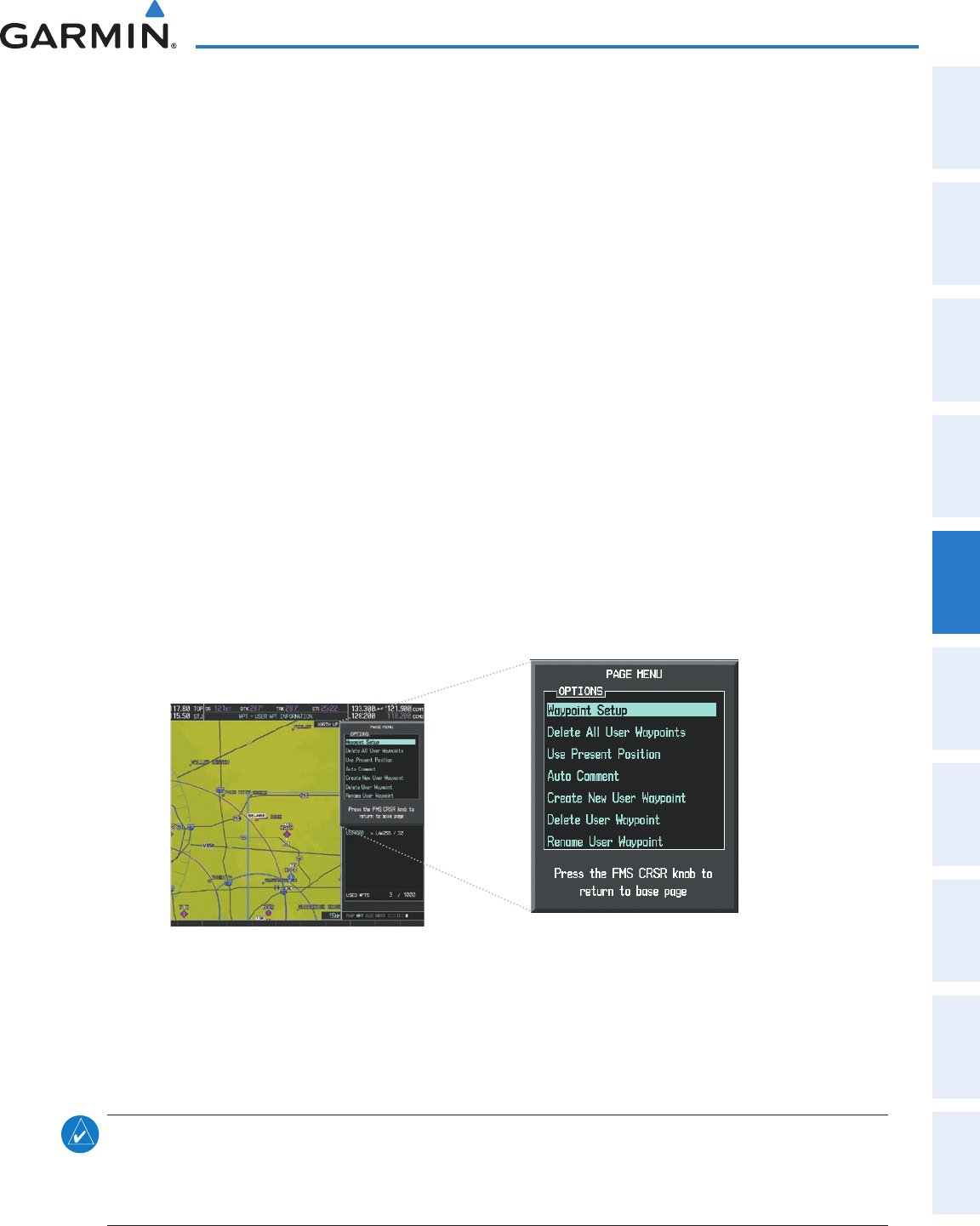
190-00592-06 Rev. A
Garmin G1000 Pilot’s Guide for the Diamond DA40/40F
175
FLIGHT MANAGEMENT
SYSTEM
OVERVIEW
FLIGHT
INSTRUMENTS EIS AUDIO PANEL
& CNS
FLIGHT
MANAGEMENT
HAZARD
AVOIDANCE AFCS ADDITIONAL
FEATURES APPENDICES INDEX
1) Press the FMS Knob to activate the cursor.
2) Enter a user waypoint name (up to six characters).
3) Press the ENT Key. The message ‘Are you sure you want to create the new User Waypoint AAAAAA?’ is
displayed.
4) With ‘YES’ highlighted, press the ENT Key.
5) If desired, define the type and location of the waypoint in one of the following ways:
a) Select “RAD/RAD” using the small FMS Knob, press the ENT Key, and enter the two reference waypoint
identifiers and radials into the REFERENCE WAYPOINTS window using the FMS Knobs.
Or:
b) Select “RAD/DIS” using the small FMS Knob, press the ENT Key, and enter the reference waypoint identifier,
the radial, and the distance into the REFERENCE WAYPOINTS window using the FMS Knobs.
Or:
c) Select “LAT/LON” using the small FMS Knob, press the ENT Key, and enter the latitude and longitude into
the INFORMATION window using the FMS Knobs.
6) Press the ENT Key to accept the new waypoint.
7) If desired, change the storage method of the waypoint to “TEMPORARY” or “NORMAL” by moving the cursor
to “TEMPORARY” and selecting the ENT Key to check or uncheck the box.
8) Press the FMS Knob to remove the flashing cursor.
Figure 5-45 User Waypoint Information Page Menu
Creating user waypoints from map pages:
1) Press the Joystick to activate the panning function and pan to the map location of the desired user waypoint.
2) Press the ENT Key. The User Waypoint Information Page is displayed with the captured position.
NOTE: If the pointer has highlighted a map database feature, one of three things happens upon pressing
the
ENT
Key: 1) information about the selected feature is displayed instead of initiating a new waypoint,
2) a menu pops up allowing a choice between ‘Review Airspaces’ or ‘Create User Waypoint’, or 3) a new
waypoint is initiated with the default name being the selected map item.
Garmin G1000 Pilot’s Guide for the Diamond DA40/40F
190-00592-06 Rev. A176
FLIGHT MANAGEMENT
SYSTEM
OVERVIEW
FLIGHT
INSTRUMENTS
EIS
AUDIO PANEL
& CNS
FLIGHT
MANAGEMENT
HAZARD
AVOIDANCE
AFCS
ADDITIONAL
FEATURES
APPENDICESINDEX
3) Enter a user waypoint name (up to six characters).
4) Press the ENT Key to accept the selected name. The first reference waypoint box is highlighted.
5) If desired, define the type and location of the waypoint in one of the following ways:
a) Select “RAD/RAD” using the small FMS Knob, press the ENT Key, and enter the two reference waypoint
identifiers and radials into the REFERENCE WAYPOINTS window using the FMS Knobs.
Or:
b) Select “RAD/DIS” using the small FMS Knob, press the ENT Key, and enter the reference waypoint identifier,
the radial, and the distance into the REFERENCE WAYPOINTS window using the FMS Knobs.
Or:
c) Select “LAT/LON” using the small FMS Knob, press the ENT Key, and enter the latitude and longitude into
the INFORMATION window using the FMS Knobs.
6) Press the ENT Key to accept the new waypoint.
7) If desired, change the storage method of the waypoint to “TEMPORARY” or “NORMAL” by moving the cursor
to “TEMPORARY” and selecting the ENT Key to check or uncheck the box.
8) Press the FMS Knob to remove the flashing cursor.
9) Press the GO BACK Softkey to return to the map page.
EDITING USER WAYPOINTS
Editing a user waypoint comment or location:
1) With the User Waypoint Information Page displayed, press the FMS Knob to activate the cursor.
2) Move the cursor to the desired field.
3) Turn the small FMS Knob to make any changes.
4) Press the ENT Key to accept the changes.
5) Press the FMS Knob to remove the flashing cursor.
Renaming user waypoints:
1) Highlight a user waypoint in the User Waypoint List. Press the RENAME Softkey, or press the MENU Key and
select ‘Rename User Waypoint’
2) Enter a new name.
3) Press the ENT Key. The message ‘Do you want to rename the user waypoint AAAAAA to BBBBBB?’ is
displayed.
4) With ‘YES’ highlighted, press the ENT Key.
5) Press the FMS Knob to remove the flashing cursor.
190-00592-06 Rev. A
Garmin G1000 Pilot’s Guide for the Diamond DA40/40F
177
FLIGHT MANAGEMENT
SYSTEM
OVERVIEW
FLIGHT
INSTRUMENTS EIS AUDIO PANEL
& CNS
FLIGHT
MANAGEMENT
HAZARD
AVOIDANCE AFCS ADDITIONAL
FEATURES APPENDICES INDEX
Changing the location of an existing waypoint to the aircraft present position:
1) Enter a waypoint name or select the waypoint in the User Waypoint List, then press the ENT Key.
2) Press the MENU Key.
3) Select ‘Use Present Position’.
4) Press the ENT Key twice. The new waypoint’s location is saved.
5) Press the FMS Knob to remove the flashing cursor.
A system generated comment for a user waypoint incorporates the reference waypoint identifier, bearing,
and distance. If a system generated comment has been edited, a new comment can be generated.
Resetting the comment field to the system generated comment:
1) Enter a waypoint name or select the waypoint in the User Waypoint List, then press the ENT Key.
2) Press the MENU Key.
3) Select ‘Auto Comment’.
4) Press the ENT Key. The generated comment is based on the reference point used to define the waypoint.
The default type of user waypoint (normal or temporary) can be changed using the user waypoint information
page menu. Temporary user waypoints are automatically deleted upon the next power cycle.
Changing the user waypoint storage duration default setting:
1) With the User Waypoint Information Page displayed, press the MENU Key.
2) Move the cursor to select ‘Waypoint Setup’, and press the ENT Key.
3) Select ‘NORMAL’ or ‘TEMPORARY’ as desired, and press the ENT Key
4) Press the FMS Knob to remove the flashing cursor and return to the User Waypoint Information Page.
Garmin G1000 Pilot’s Guide for the Diamond DA40/40F
190-00592-06 Rev. A178
FLIGHT MANAGEMENT
SYSTEM
OVERVIEW
FLIGHT
INSTRUMENTS
EIS
AUDIO PANEL
& CNS
FLIGHT
MANAGEMENT
HAZARD
AVOIDANCE
AFCS
ADDITIONAL
FEATURES
APPENDICESINDEX
DELETING USER WAYPOINTS
Deleting a single user waypoint
1) Highlight a User Waypoint in the User Waypoint List, or enter a waypoint in the User Waypoint field.
2) Press the DELETE Softkey or press the CLR Key. ‘Yes’ is highlighted in the confirmation window.
3) Press the ENT Key.
4) Press the FMS Knob to remove the flashing cursor.
Or:
1) Highlight a User Waypoint in the User Waypoint List, or enter a waypoint in the User Waypoint field.
2) Press the MENU Key.
3) Select ‘Delete User Waypoint’.
4) Press the ENT Key twice to confirm the selection.
5) Press the FMS Knob to remove the flashing cursor.
Deleting all user waypoints
1) Highlight a User Waypoint in the User Waypoint List.
2) Press the MENU Key.
3) Select ‘Delete All User Waypoints’
4) Press the ENT Key twice to confirm the selection.
5) Press the FMS Knob to remove the flashing cursor.
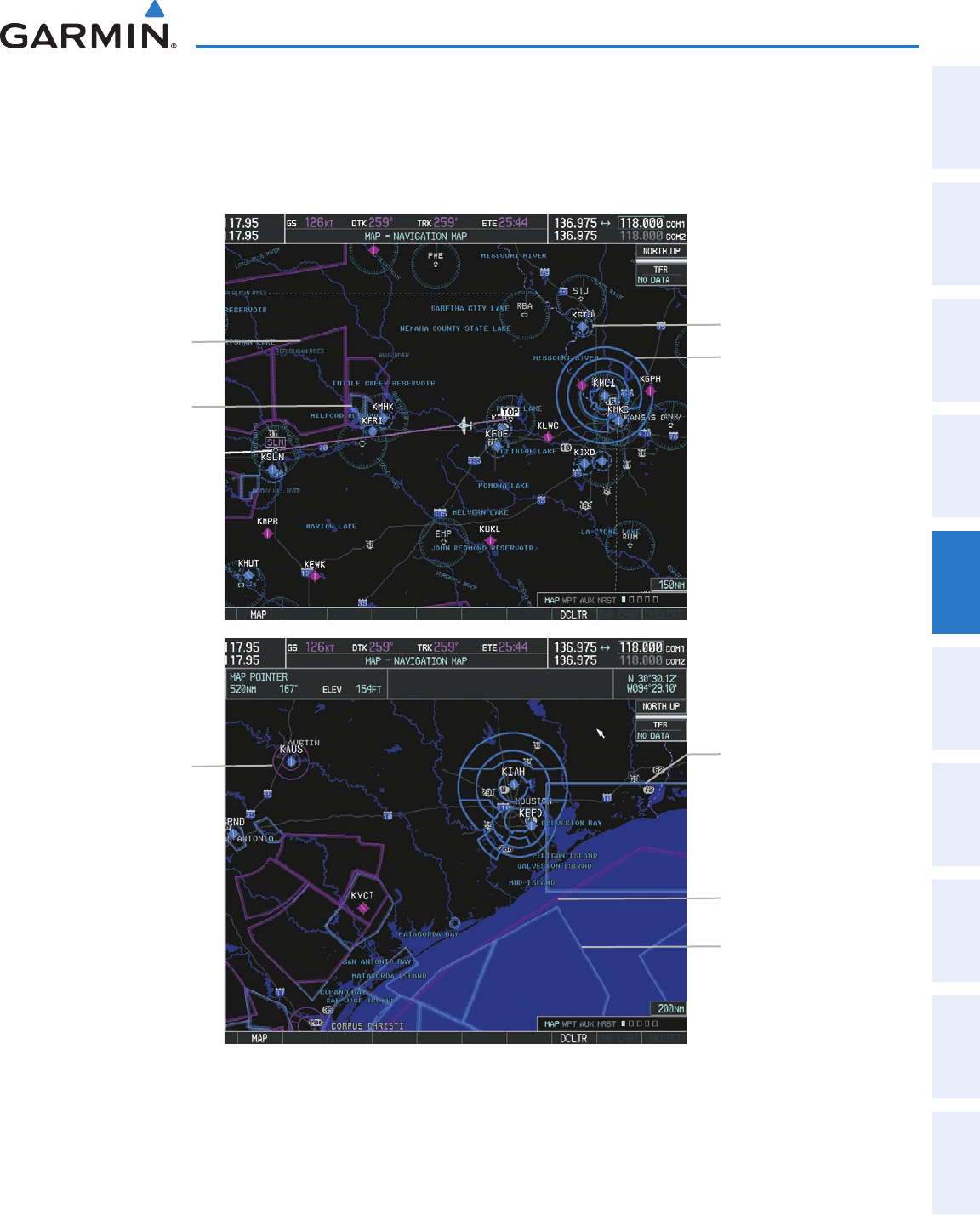
190-00592-06 Rev. A
Garmin G1000 Pilot’s Guide for the Diamond DA40/40F
179
FLIGHT MANAGEMENT
SYSTEM
OVERVIEW
FLIGHT
INSTRUMENTS EIS AUDIO PANEL
& CNS
FLIGHT
MANAGEMENT
HAZARD
AVOIDANCE AFCS ADDITIONAL
FEATURES APPENDICES INDEX
5.4 AIRSPACES
The G1000 can display the following types of airspaces: Class B/TMA, Class C/TCA, Class D, Restricted, MOA
(Military), Other Airspace, Air Defense Interdiction Zone (ADIZ), and Temporary Flight Restriction (TFR).
Figure 5-46 Airspaces
MOA (Military) Class D Airspace
Class B Airspace
Restricted Area
Class C Airspace Alert Area
ADIZ
Warning Area
The Nearest Airspaces Page, Airspace Alerts Window, and Airspace Alerts on the PFD provide additional
information about airspaces and the location of the aircraft in relationship to them.
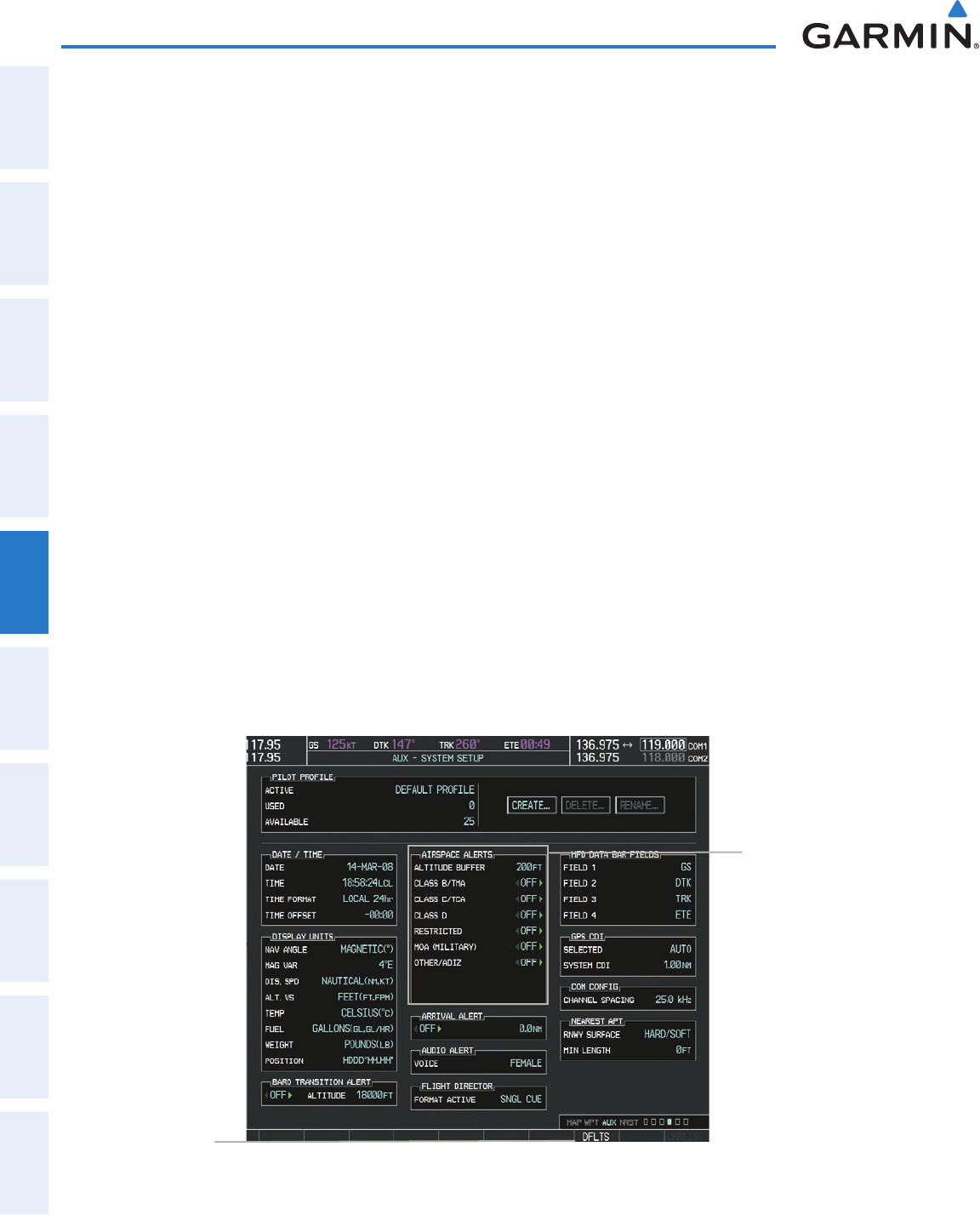
Garmin G1000 Pilot’s Guide for the Diamond DA40/40F
190-00592-06 Rev. A180
FLIGHT MANAGEMENT
SYSTEM
OVERVIEW
FLIGHT
INSTRUMENTS
EIS
AUDIO PANEL
& CNS
FLIGHT
MANAGEMENT
HAZARD
AVOIDANCE
AFCS
ADDITIONAL
FEATURES
APPENDICESINDEX
The Airspace Alerts Box allows the pilot to turn the controlled/special-use airspace message alerts on or off.
This does not affect the alerts listed on the Nearest Airspaces Page or the airspace boundaries depicted on the
Navigation Map Page. It simply turns on/off the warning provided when the aircraft is approaching or near an
airspace.
An altitude buffer is also provided which “expands” the vertical range above or below an airspace. For example,
if the buffer is set at 500 feet, and the aircraft is more than 500 feet above/below an airspace, an alert message is
not generated, but if the aircraft is less than 500 feet above/below an airspace and projected to enter it, the pilot
is notified with an alert message. The default setting for the altitude buffer is 200 feet.
Changing the altitude buffer distance setting:
1) Use the FMS Knob to select the AUX - System Setup Page.
2) Press the FMS Knob momentarily to activate the flashing cursor.
3) Turn the large FMS Knob to highlight the altitude buffer field in the Airspace Alerts Box.
4) Use the FMS Knob to enter an altitude buffer value and press the ENT Key.
5) Press the FMS Knob to remove the flashing cursor.
Turning an airspace alert on or off:
1) Use the FMS Knob to select the AUX - System Setup Page.
2) Press the FMS Knob momentarily to activate the flashing cursor.
3) Turn the large FMS Knob to highlight the desired field in the Airspace Alerts Box.
4) Turn the small FMS Knob clockwise to turn the airspace alert ON or counterclockwise to turn the alert OFF.
5) Press the FMS Knob to remove the flashing cursor.
Figure 5-47 System Setup Page - Airspace Alerts
DFLTS Softkey
Airspace Alerts Box
- Airspace Altitude Buffer
- Alert On/Off
(Default Settings Shown)
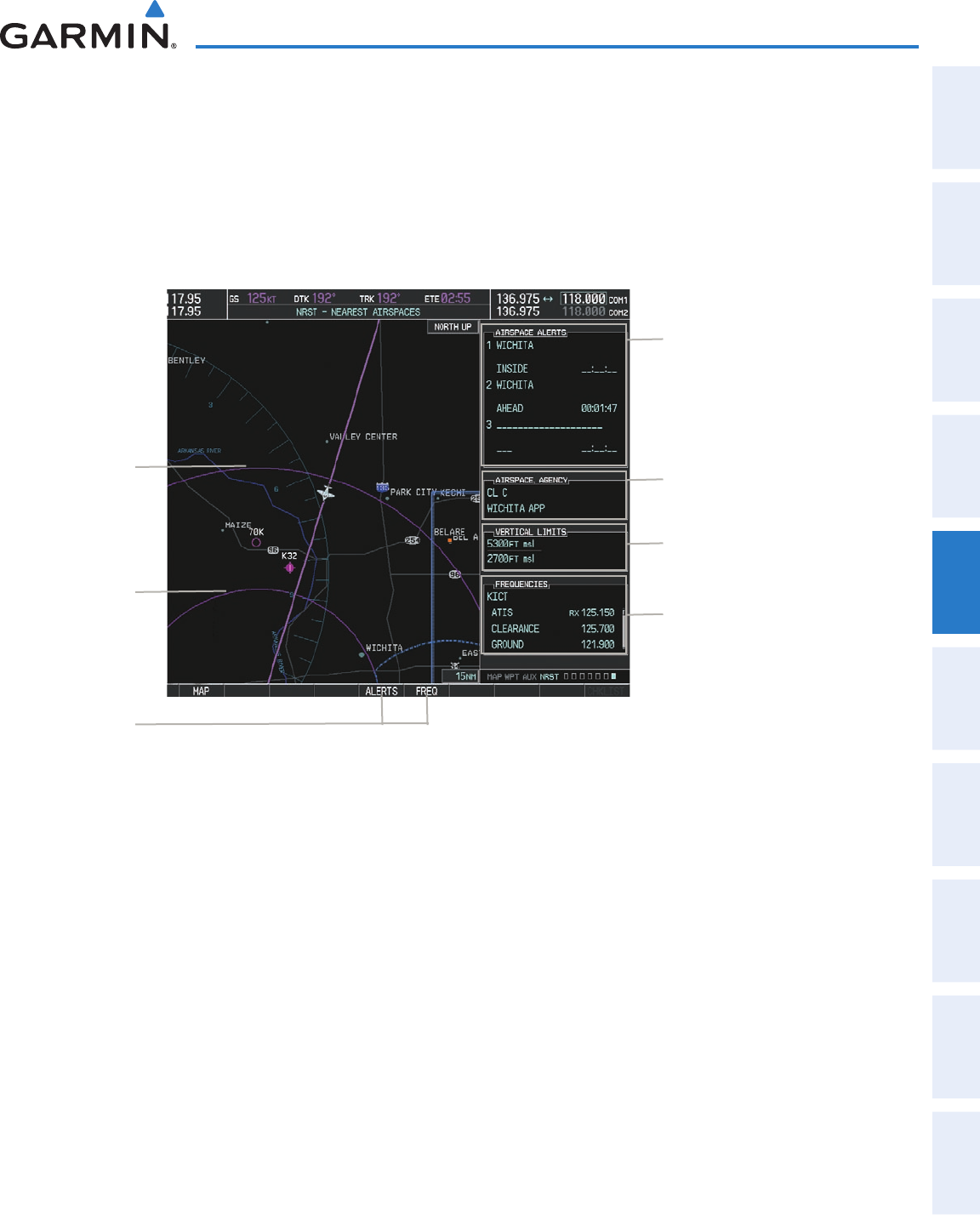
190-00592-06 Rev. A
Garmin G1000 Pilot’s Guide for the Diamond DA40/40F
181
FLIGHT MANAGEMENT
SYSTEM
OVERVIEW
FLIGHT
INSTRUMENTS EIS AUDIO PANEL
& CNS
FLIGHT
MANAGEMENT
HAZARD
AVOIDANCE AFCS ADDITIONAL
FEATURES APPENDICES INDEX
Map ranges for the airspace boundaries are selected from the Aviation Group in the Map Setup Menu. See Table
5-2 for the default and maximum ranges for each type of airspace and the symbol used to define the airspace
area.
The Nearest Airspaces Page can be used to quickly find airspaces close to the flight path. In addition, a selected
frequency associated with the airspace can be loaded from the Nearest Airspaces Page. In addition to displaying
a map of airspace boundaries and surrounding area, the Nearest Airspaces Page displays airspace information in
four boxes labeled ‘AIRSPACE ALERTS’, ‘AIRSPACE, AGENCY’, VERTICAL LIMITS’, and ‘FREQUENCIES’.
Figure 5-48 Nearest Airspaces Page
Airspace Alerts Info
- Name
- Proximity (Ahead, Inside,
Ahead < 2nm, Within 2nm)
- Time till Intercept (only if
Ahead or Ahead < 2nm)
Airspace Vertical Limits
- Ceiling
- Floor
Airspace/Agency Info
- Airspace Type
- Controlling Agency
Softkeys
Airspace 1
Associated Frequencies
- Type
- Availability/Info
- Frequency
Airspace 2
Airspace alerts and associated frequencies are shown in scrollable lists on the Nearest Airspaces Page. The
ALERTS and FREQ softkeys place the cursor in the respective list. The FREQ Softkey is enabled only if one or
more frequencies exist for a selected airspace.
Selecting and viewing an airspace alert with its associated information:
1) Select the Nearest Airspace Page.
2) Press the ALERTS Softkey; or press the FMS Knob; or press the MENU Key, highlight ‘Select Alerts Window’,
and press the ENT Key. The cursor is placed in the ‘AIRSPACE ALERTS’ Box.
3) Select the desired airspace.
4) Press the FMS Knob to remove the flashing cursor.
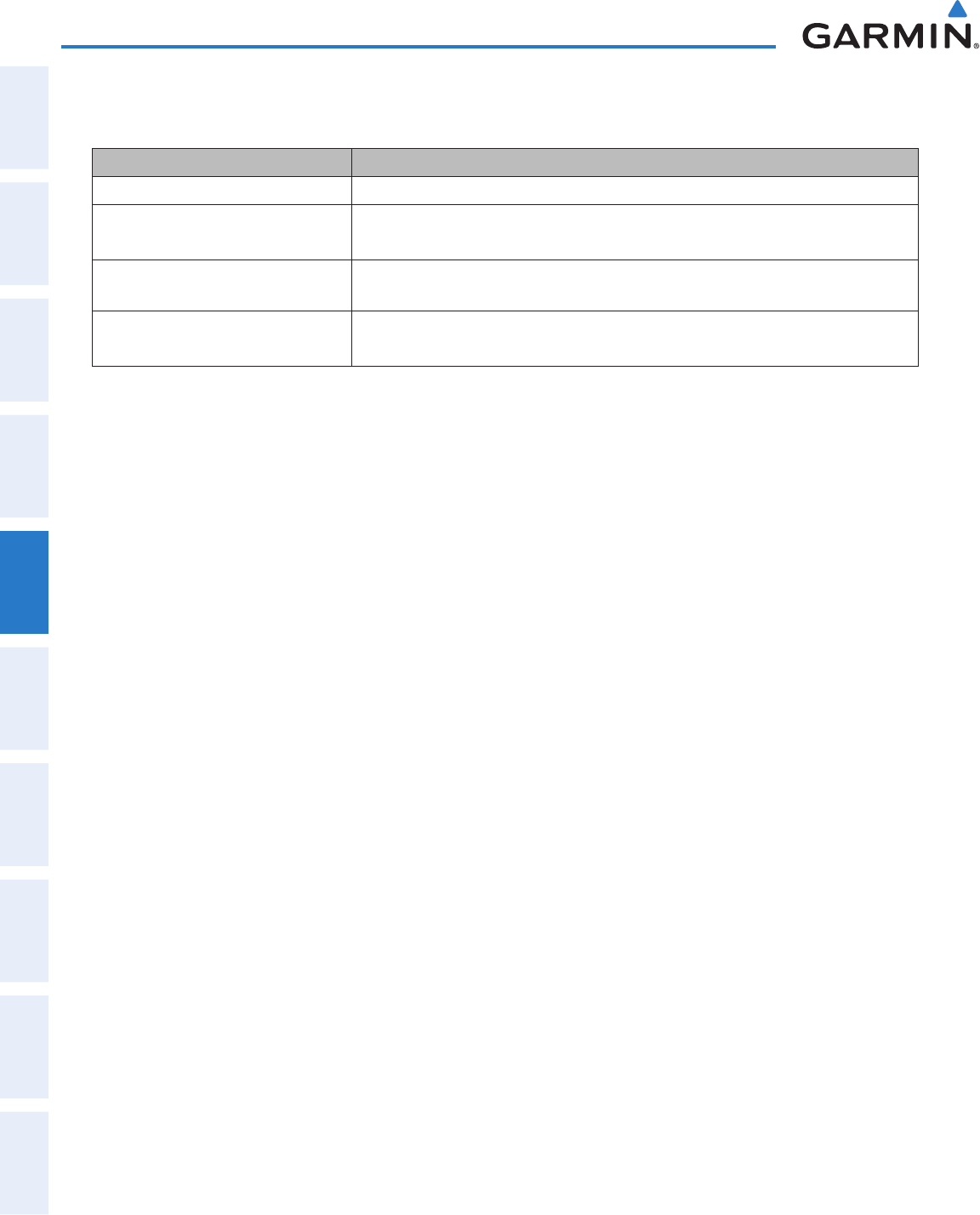
Garmin G1000 Pilot’s Guide for the Diamond DA40/40F
190-00592-06 Rev. A182
FLIGHT MANAGEMENT
SYSTEM
OVERVIEW
FLIGHT
INSTRUMENTS
EIS
AUDIO PANEL
& CNS
FLIGHT
MANAGEMENT
HAZARD
AVOIDANCE
AFCS
ADDITIONAL
FEATURES
APPENDICESINDEX
Pressing the PFD ALERTS Softkey displays the message window on the PFD. The following airspace alerts are
displayed in the message window:
Message Comments
INSIDE ARSPC
– Inside airspace. The aircraft is inside the airspace.
ARSPC AHEAD
– Airspace ahead –
less than 10 minutes.
Special use airspace is ahead of aircraft. The aircraft penetrates the airspace within 10
minutes.
ARSPC NEAR
– Airspace near and
ahead. Special use airspace is near and ahead of the aircraft position.
ARSPC NEAR
– Airspace near –
less than 2 nm. Special use airspace is within 2 nm of the aircraft position.
Table 5-6 PFD Airspace Alert Messages
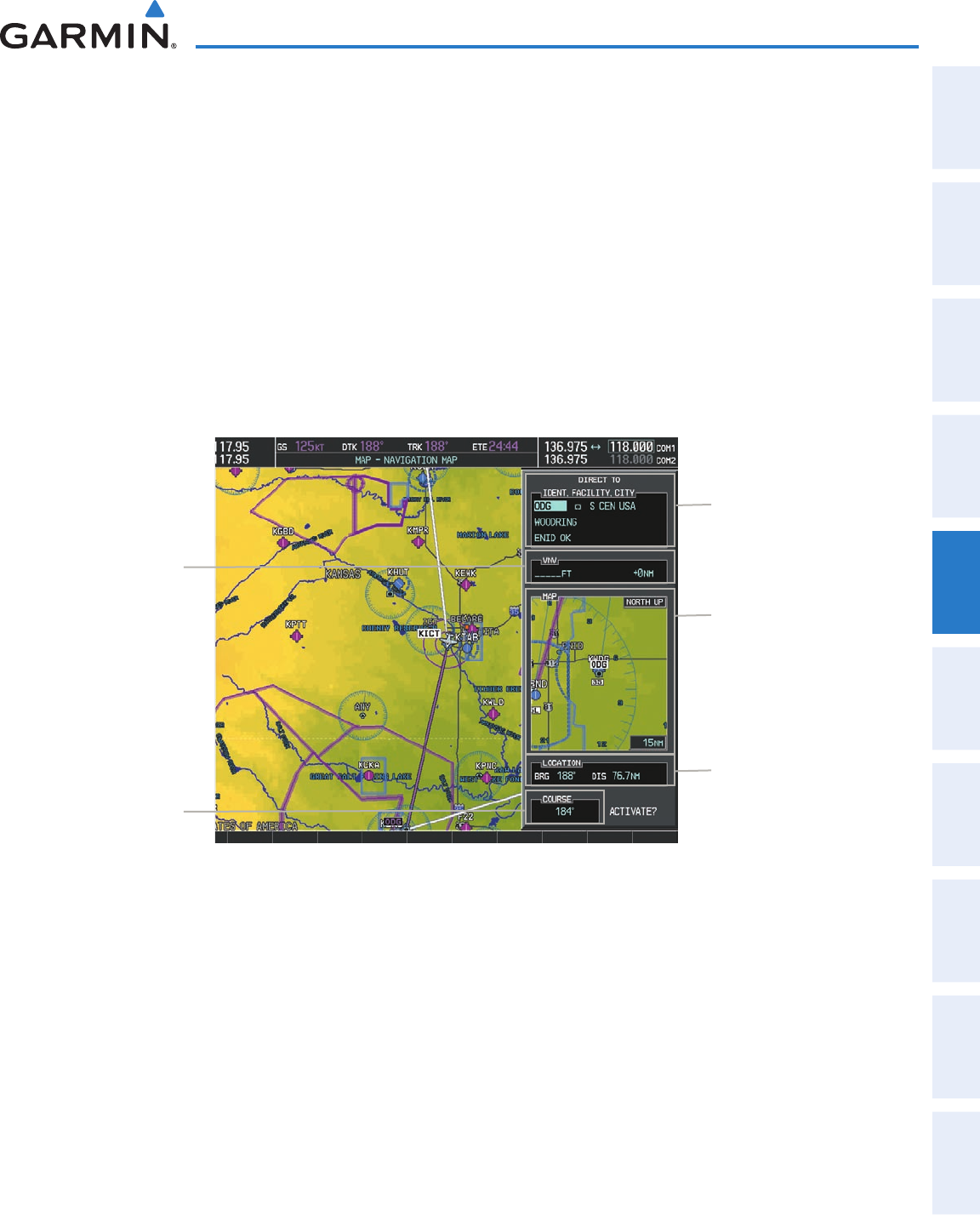
190-00592-06 Rev. A
Garmin G1000 Pilot’s Guide for the Diamond DA40/40F
183
FLIGHT MANAGEMENT
SYSTEM
OVERVIEW
FLIGHT
INSTRUMENTS EIS AUDIO PANEL
& CNS
FLIGHT
MANAGEMENT
HAZARD
AVOIDANCE AFCS ADDITIONAL
FEATURES APPENDICES INDEX
5.5 DIRECT-TO-NAVIGATION
The Direct-to method of navigation, initiated by pressing the Direct-to Key on either the MFD or PFD, is
quicker to use than a flight plan when the desire is to navigate to a single point such as a nearby airport.
Once a direct-to is activated, the G1000 establishes a point-to-point course line from the present position to the
selected direct-to destination. Course guidance is provided until the direct-to is replaced with a new direct-to or
flight plan, or cancelled.
A vertical navigation (VNV) direct-to creates a descent path (and provides guidance to stay on the path) from
the current altitude to a selected altitude at the direct-to waypoint. Vertical navigation is based on barometric
altitudes, not on GPS altitude, and is used for cruise and descent phases of flight.
The Direct-to Window allows selection and activation of direct-to navigation. The Direct-to Window displays
selected direct-to waypoint data on the PFD and the MFD.
Figure 5-49 Direct-to Window - MFD
Direct-to Point Info
- Identifier/Symbol/Region
- Facility Name
- City
Location of Destination
- Bearing/Distance
Map of Selected Point
Desired Course
VNV Constraints
- Altitude at Arrival
- Along Track Offset
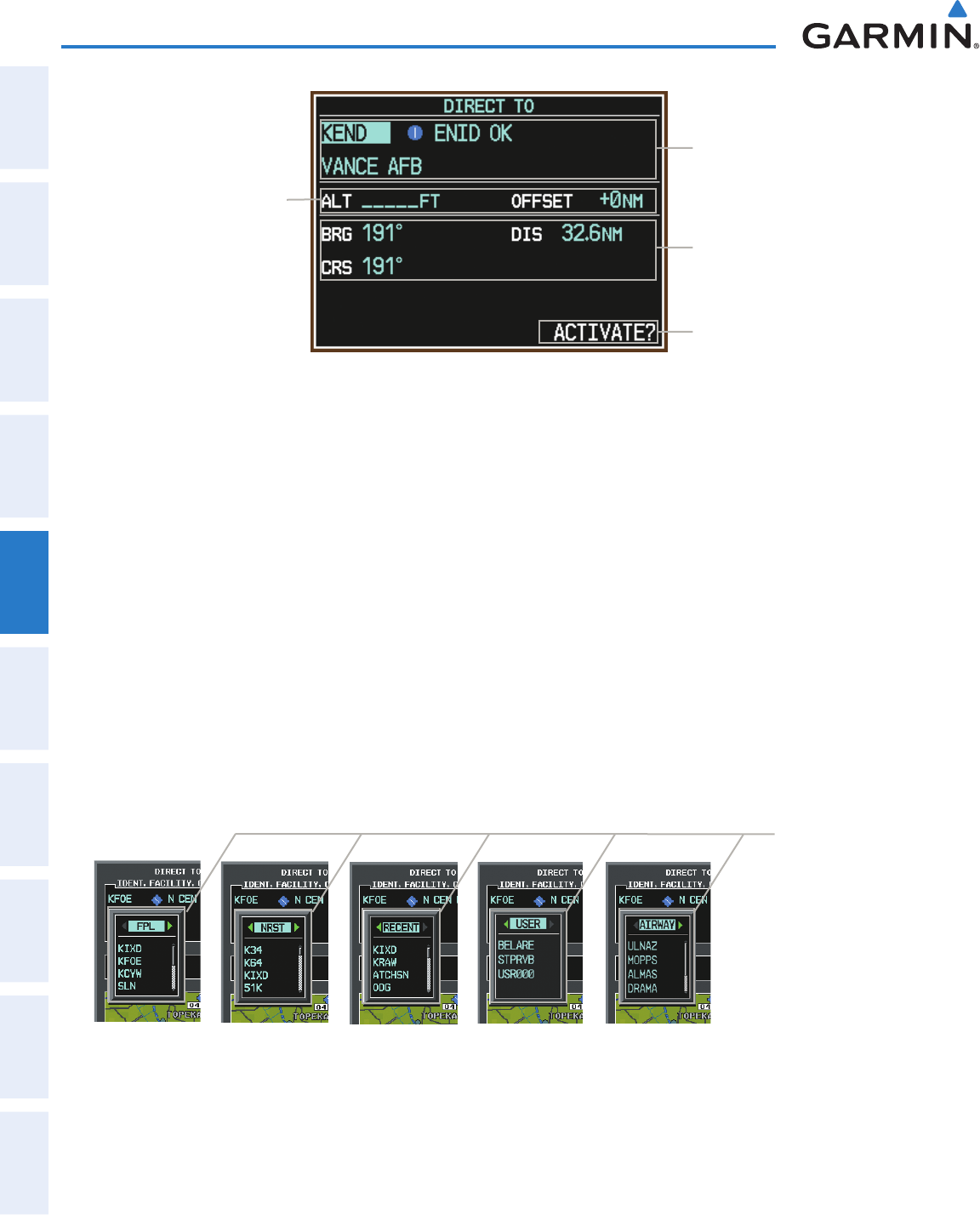
Garmin G1000 Pilot’s Guide for the Diamond DA40/40F
190-00592-06 Rev. A184
FLIGHT MANAGEMENT
SYSTEM
OVERVIEW
FLIGHT
INSTRUMENTS
EIS
AUDIO PANEL
& CNS
FLIGHT
MANAGEMENT
HAZARD
AVOIDANCE
AFCS
ADDITIONAL
FEATURES
APPENDICESINDEX
Figure 5-50 Direct-to Window - PFD
Direct-to Point Info
- Identifier/Symbol/City
- Facility Name
Activation Command
Direct-to Point Info
- Bearing/Distance
- Desired Course
VNV Constraints
- Altitude at Arrival
- Along Track Offset
Any waypoint can be entered as a direct-to destination from the Direct-to Window.
Entering a waypoint identifier, facility name, or city as a direct-to destination:
1) Press the Direct-to Key. The Direct-to Window is displayed (with the active flight plan wayoint as the default
selection or a blank waypoint field if no flight plan is active).
2) Turn the small FMS Knob clockwise to begin entering a waypoint identifier (turning it counter-clockwise brings
up the waypoint selection submenu - press the CLR Key to remove it), or turn the large FMS Knob to select the
facility name, or city field and turn the small FMS Knob to begin entering a facility name or city. If duplicate
entries exist for the entered facility or city name, additional entries can be viewed by turning the small FMS
Knob during the selection process.
3) Press the ENT Key. The ‘Activate?’ field is highlighted.
4) Press the ENT Key to activate the direct-to.
Any waypoint contained in the active flight plan can be selected as a direct-to waypoint from the Direct-to
Window, the Active Flight Plan Page, or the Active Flight Plan Window.
Figure 5-51 Waypoint Submenu
Waypoint Submenu
- Flight Plan Waypoints
- Nearest Waypoints
- Recent Waypoints
- User Waypoints
- Airway Waypoints
(only available when
active leg is part of an
airway)
190-00592-06 Rev. A
Garmin G1000 Pilot’s Guide for the Diamond DA40/40F
185
FLIGHT MANAGEMENT
SYSTEM
OVERVIEW
FLIGHT
INSTRUMENTS EIS AUDIO PANEL
& CNS
FLIGHT
MANAGEMENT
HAZARD
AVOIDANCE AFCS ADDITIONAL
FEATURES APPENDICES INDEX
Selecting an active flight plan waypoint as a direct-to destination:
1) While navigating an active flight plan, press the Direct-to Key. The Direct-to Window is displayed with the
active flight plan waypoint as the default selection.
2) Turn the small FMS Knob counter-clockwise to display a list of flight plan waypoints (the FPL list is populated
only when navigating a flight plan).
3) Select the desired waypoint.
4) Press the ENT Key. The cursor is now displayed on ‘ACTIVATE?’.
5) Press the ENT Key again to activate the direct-to.
Or:
1) Select the Active Flight Plan Page on the MFD, or the Active Flight Plan Window on the PFD.
2) Select the desired waypoint.
3) Press the Direct-to Key.
4) Press the ENT Key. The cursor is now displayed on ‘ACTIVATE?’.
5) Press the ENT Key again to activate the direct-to.
Any NRST, RECENT, USER, or AIRWAY waypoint can be selected as a direct-to destination in the Direct-to
Window.
Selecting a NRST, RECENT, USER, or AIRWAY waypoint as a direct-to destination:
1) Press the Direct-to Key. The Direct-to Window is displayed (with the active flight plan destination as the
default selection or a blank destination if no flight plan is active).
2) Turn the small FMS Knob counter-clockwise to display a list of flight plan waypoints (the FPL list is populated
only when navigating a flight plan).
3) Turn the small FMS Knob clockwise to display the NRST, RECENT, USER, or AIRWAY waypoints
4) Turn the large FMS Knob clockwise to select the desired waypoint.
5) Press the ENT Key. The cursor is now displayed on ‘ACTIVATE?’.
6) Press the ENT Key again to activate the direct-to.
The Direct-to Window can be displayed from any page and allows selection and activation of direct-to navigation.
If the direct-to is initiated from any page except the WPT pages, the default waypoint is the active flight plan
waypoint (if a flight plan is active) or a blank waypoint field. Direct-to requests on any WPT page defaults to the
displayed waypoint.
Selecting any waypoint as a direct-to destination:
1) Select the page or window containing the desired waypoint type and select the desired waypoint.
2) Press the Direct-to Key to display the Direct-to Window with the selected waypoint as the direct-to
destination.
3) Press the ENT Key. The cursor is now displayed on ‘ACTIVATE?’.
4) Press ENT again to activate the direct-to.
Garmin G1000 Pilot’s Guide for the Diamond DA40/40F
190-00592-06 Rev. A186
FLIGHT MANAGEMENT
SYSTEM
OVERVIEW
FLIGHT
INSTRUMENTS
EIS
AUDIO PANEL
& CNS
FLIGHT
MANAGEMENT
HAZARD
AVOIDANCE
AFCS
ADDITIONAL
FEATURES
APPENDICESINDEX
Selecting a nearby airport as a direct-to destination:
1) Press the NRST Softkey on the PFD; or turn the FMS Knob to display the Nearest Airports Page.
2) Select the desired airport (the nearest one is already selected).
3) Press the Direct-to Key.
4) Press the ENT Key. The cursor is now displayed on ‘ACTIVATE?’.
5) Press the ENT Key again to activate the direct-to.
Direct-to destinations may also be selected by using the pointer on the navigation map pages. If no airport,
NAVAID, or user waypoint exists at the desired location, a temporary waypoint named ‘MAPWPT’ is automatically
created at the location of the map arrow.
Selecting a waypoint as a direct-to destination using the pointer:
1) From a navigation map page, press the Joystick to display the pointer.
2) Move the Joystick to place the pointer at the desired destination location.
3) If the pointer is placed on an existing airport, NAVAID, or user waypoint, the waypoint name is highlighted.
4) Press the Direct-to Key to display the Direct-to Window with the selected point entered as the direct-to
destination.
5) Press the ENT Key. The cursor is now displayed on ‘ACTIVATE?’.
6) Press the ENT Key again to activate the direct-to.
Cancelling a Direct-to:
1) Press the Direct-to Key to display the Direct-to Window.
2) Press the MENU Key.
3) With ‘Cancel Direct-To NAV’ highlighted, press the ENT Key. If a flight plan is still active, the G1000 resumes
navigating the flight plan along the closest leg.
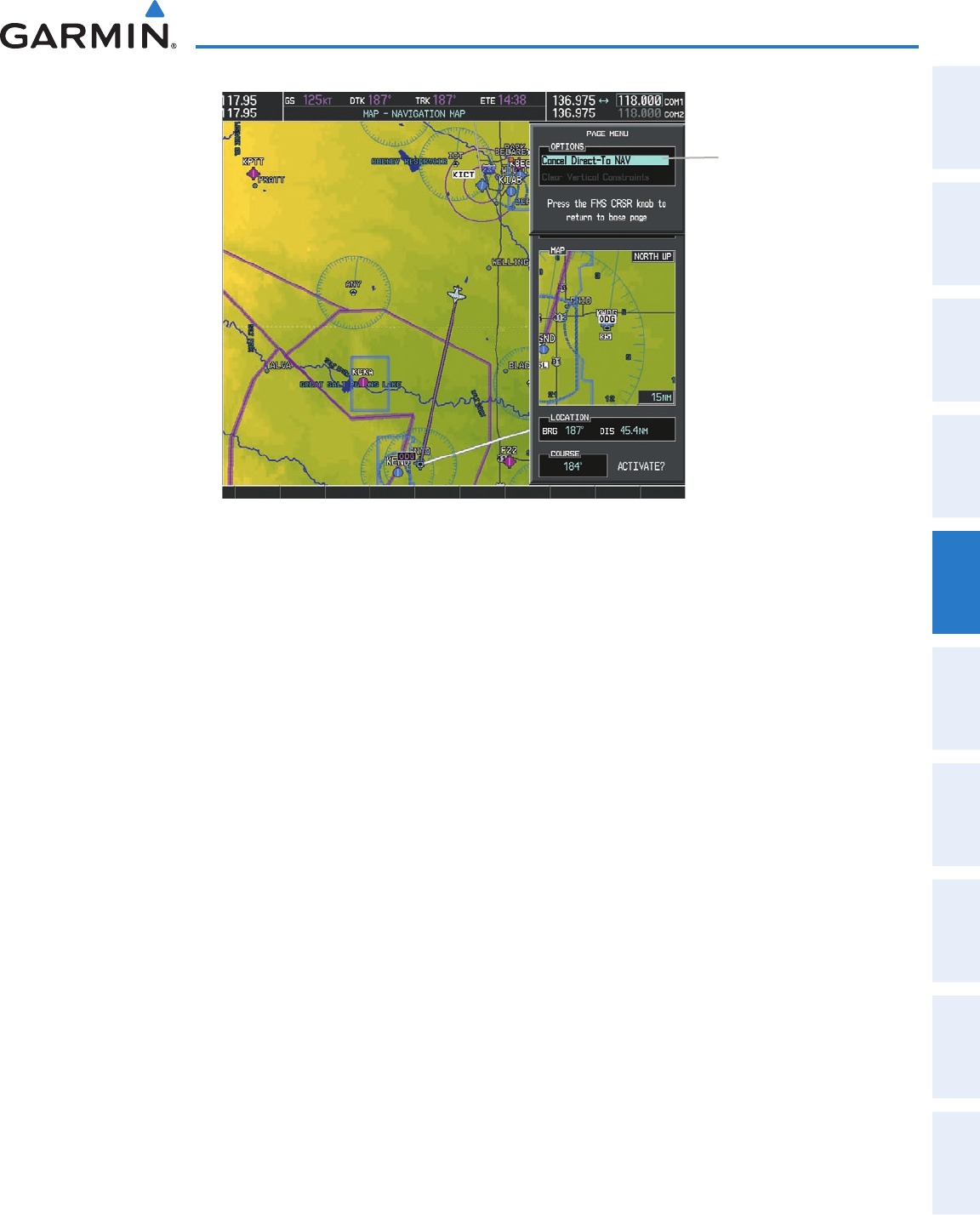
190-00592-06 Rev. A
Garmin G1000 Pilot’s Guide for the Diamond DA40/40F
187
FLIGHT MANAGEMENT
SYSTEM
OVERVIEW
FLIGHT
INSTRUMENTS EIS AUDIO PANEL
& CNS
FLIGHT
MANAGEMENT
HAZARD
AVOIDANCE AFCS ADDITIONAL
FEATURES APPENDICES INDEX
Figure 5-52 Direct-to Window - Cancelling Direct-to Navigation
Page Menu
- Cancel Direct-To
Navigation
When navigating a direct-to, the G1000 sets a direct great circle course to the selected destination. The course
to a destination can also be manually selected using the course field (‘COURSE’) on the Direct-to Window.
Selecting a manual direct-to course:
1) Press the Direct-to Key. The Direct-to Window is displayed with the destination field highlighted.
2) Highlight the course field.
3) Enter the desired course.
4) Press the ENT Key. The cursor is now displayed on ‘ACTIVATE?’.
5) Press the ENT Key again to activate the direct-to.
Reselecting the direct course from the current position:
1) Press the Direct-to Key. The Direct-to Window is displayed with the destination field highlighted.
2) Press the ENT Key. The cursor is now displayed on ‘ACTIVATE?’.
3) Press the ENT Key again to activate the direct-to.
A direct-to with altitude constraints creates a descent path (and provides guidance to stay on the path) from the
aircraft’s current altitude to the altitude of the direct-to waypoint. The altitude is reached at the waypoint, or at the
specified distance along the flight path if an offset distance has been entered. All VNV altitudes prior to the direct-
to destination are removed from the active flight plan upon successful activation of a direct-to destination that is
part of the active flight plan. All VNV altitudes following the direct-to waypoint are retained. See the section on
Vertical Navigation for more information regarding the use and purpose of VNV altitudes and offset distances.
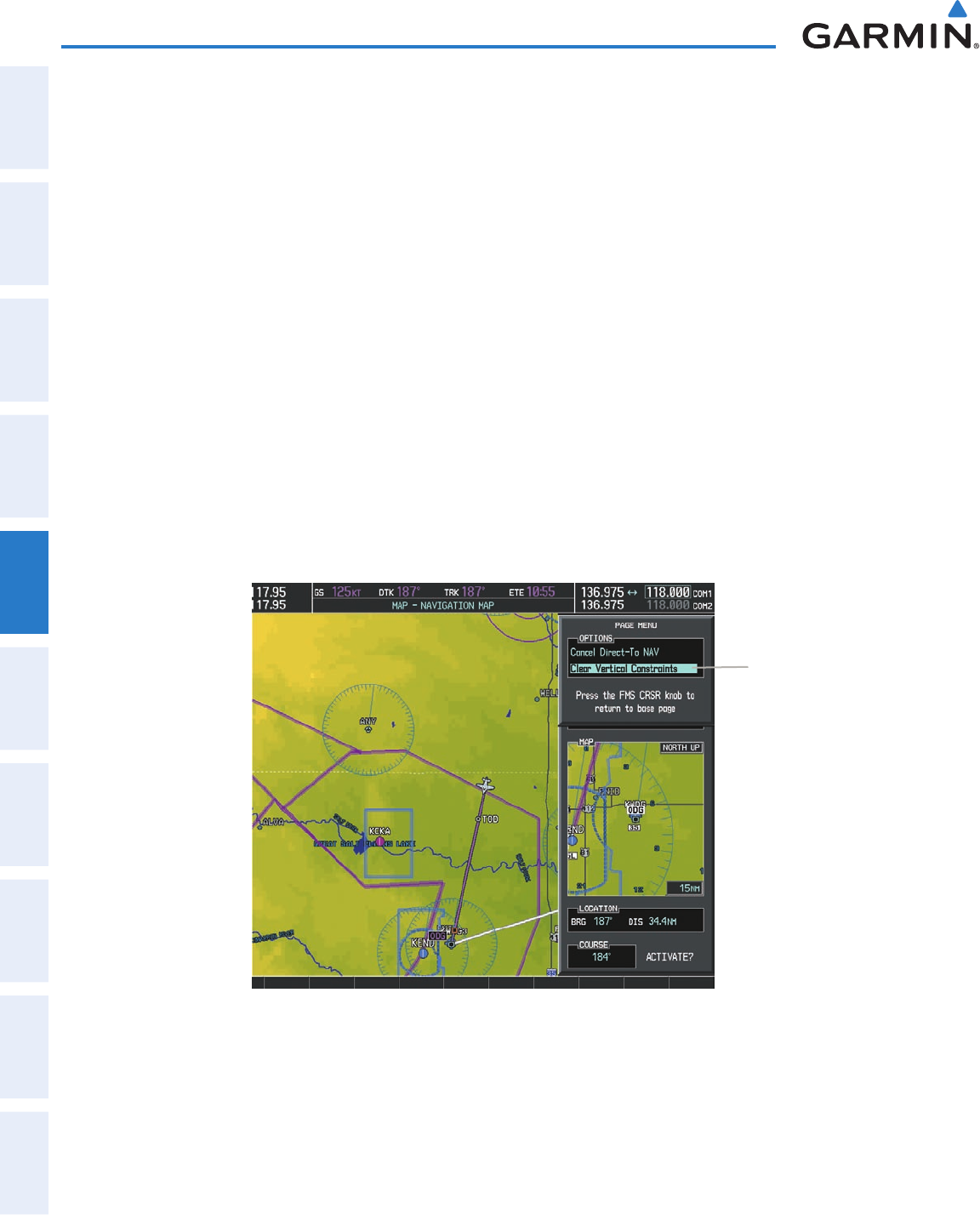
Garmin G1000 Pilot’s Guide for the Diamond DA40/40F
190-00592-06 Rev. A188
FLIGHT MANAGEMENT
SYSTEM
OVERVIEW
FLIGHT
INSTRUMENTS
EIS
AUDIO PANEL
& CNS
FLIGHT
MANAGEMENT
HAZARD
AVOIDANCE
AFCS
ADDITIONAL
FEATURES
APPENDICESINDEX
Entering a VNV altitude and along-track offset for the waypoint:
1) Press the Direct-to Key to display the Direct-to Window.
2) Turn the large FMS Knob to place the cursor over the ‘VNV’ altitude field.
3) Enter the desired altitude.
4) Press the ENT Key. The option to select MSL or AGL is now displayed.
5) Turn the small FMS Knob to select ‘MSL’ or ‘AGL’.
6) Press the ENT Key. The cursor is now flashing in the VNV offset distance field.
7) Enter the desired distance along-track before (-) or after (+) the offset waypoint.
8) Press the ENT Key. The ‘Activate?’ field is highlighted.
9) Press the ENT Key to activate.
Removing a VNV altitude constraint:
1) Press the Direct-to Key to display the Direct-to Window.
2) Press the MENU Key.
3) With ‘Clear Vertical Constraints’ highlighted, press the ENT Key.
Figure 5-53 Direct-to Window - Clearing Vertical Constraints
Page Menu
- Clear Vertical Navigation
Constraints
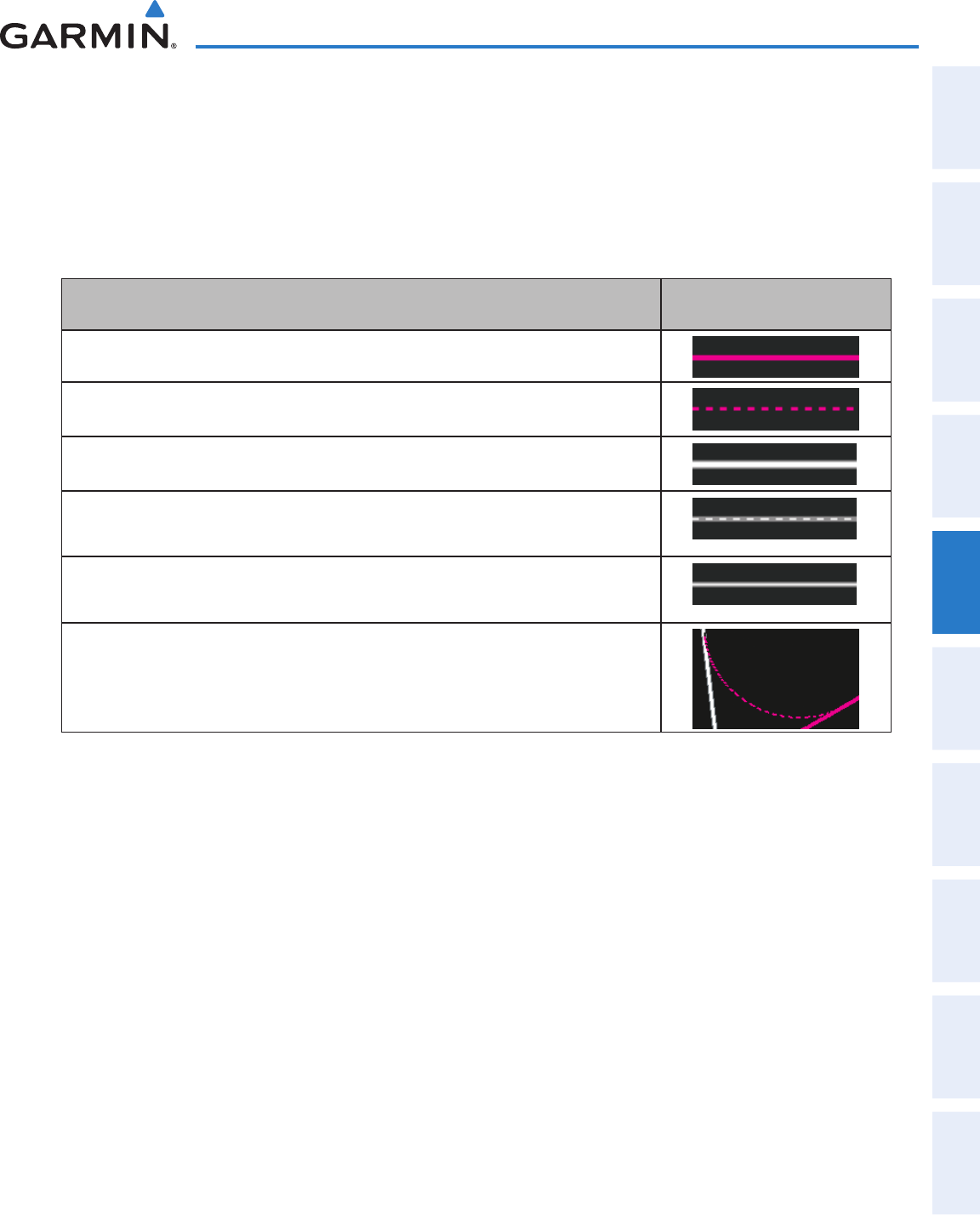
190-00592-06 Rev. A
Garmin G1000 Pilot’s Guide for the Diamond DA40/40F
189
FLIGHT MANAGEMENT
SYSTEM
OVERVIEW
FLIGHT
INSTRUMENTS EIS AUDIO PANEL
& CNS
FLIGHT
MANAGEMENT
HAZARD
AVOIDANCE AFCS ADDITIONAL
FEATURES APPENDICES INDEX
5.6 FLIGHT PLANNING
Flight planning on the G1000 consists of building a flight plan by entering waypoints one at a time, adding
waypoints along airways, and inserting departures, airways, arrivals, or approaches as needed. The G1000 allows
flight planning information to be entered from either the MFD or PFD. The flight plan is displayed on maps using
different line widths, colors, and types, based on the type of leg and the segment of the flight plan currently being
flown (departure, enroute, arrival, approach, or missed approach).
Flight Plan Leg Type Symbol
Active non-heading Leg
Active heading Leg
Non-heading Leg in the current flight segment
Heading Leg not in the current flight segment
Non-heading leg not in the active flight segment
Turn Anticipation Arc
Table 5-7 Flight Plan Leg Symbols
Up to 99 flight plans with up to 99 waypoints each can be created and stored in memory. One flight plan can be
activated at a time and becomes the active flight plan. The active flight plan is erased when the system is turned
off and overwritten when another flight plan is activated. When storing flight plans with an approach, departure,
or arrival, the G1000 uses the waypoint information from the current database to define the waypoints. If the
database is changed or updated, the G1000 automatically updates the information if the procedure has not been
modified. If an approach, departure, or arrival procedure is no longer available, the procedure is deleted from the
affected stored flight plan(s), and an alert is displayed (see Miscellaneous System Messages) advising that one or
more stored flight plans need to be edited.
Whenever an approach, departure, or arrival procedure is loaded into the active flight plan, a set of approach,
departure, or arrival waypoints is inserted into the flight plan along with a header line describing the instrument
procedure the pilot selected. The original enroute portion of the flight plan remains active (unless an instrument
procedure is activated) when the procedure is loaded.
When the database is updated, the airways need to be reloaded also. Each airway segment is reloaded from
the database given the entry waypoint, the airway identifier and the exit waypoint. This re-loads the sequence of
waypoints between the entry and exit waypoints (the sequence may change when the database is updated). The
update of an airway can fail during this process. If that happens, the airway waypoints are changed to regular
(non-airway) flight plan waypoints, and an alert is displayed (see Miscellaneous System Messages).
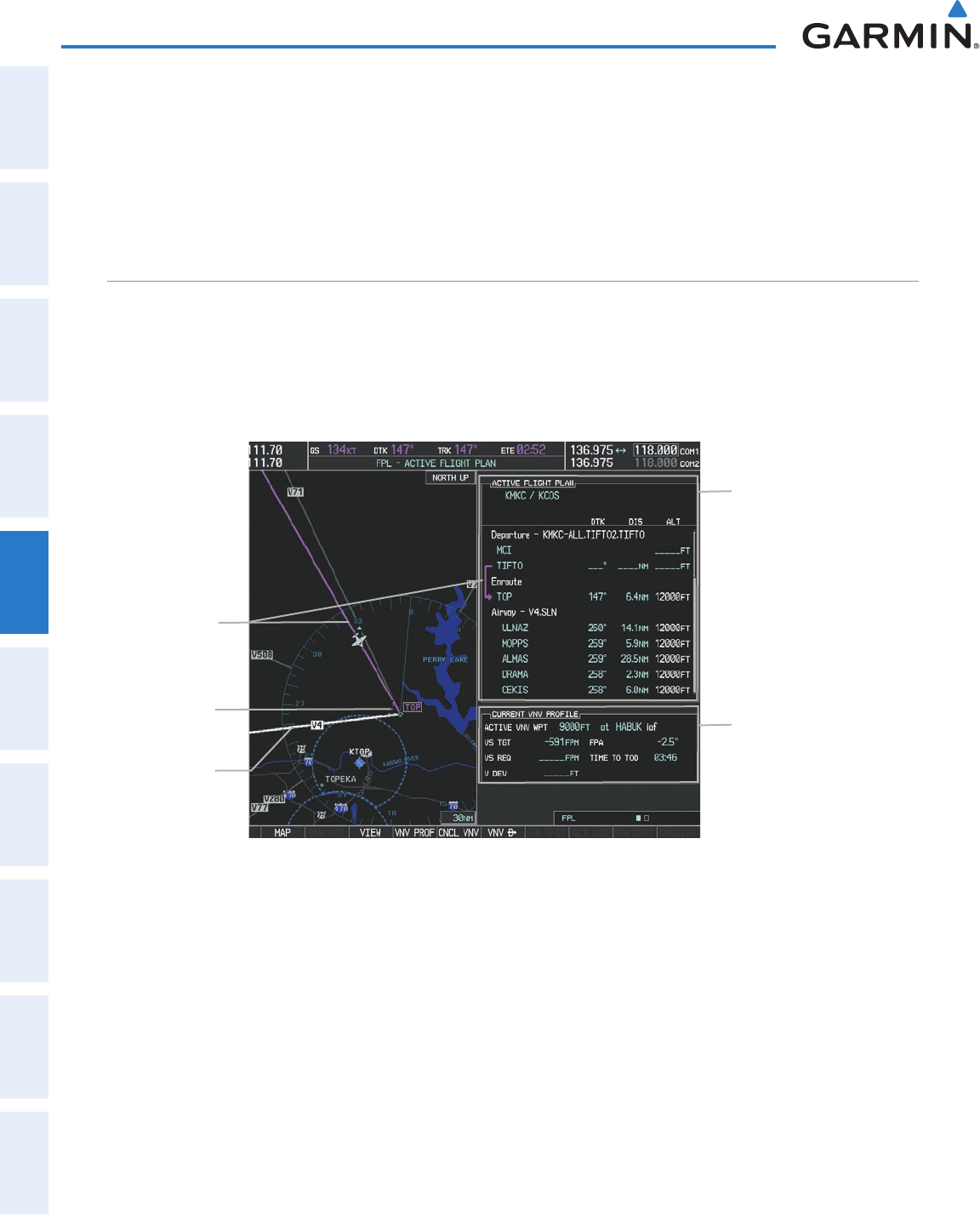
Garmin G1000 Pilot’s Guide for the Diamond DA40/40F
190-00592-06 Rev. A190
FLIGHT MANAGEMENT
SYSTEM
OVERVIEW
FLIGHT
INSTRUMENTS
EIS
AUDIO PANEL
& CNS
FLIGHT
MANAGEMENT
HAZARD
AVOIDANCE
AFCS
ADDITIONAL
FEATURES
APPENDICESINDEX
The following could cause the airway update to fail:
•Airwayidentier,entrywaypointorexitwaypointnotfoundinthenewdatabase.
•Airwayentry/exitwaypointisnotanacceptablewaypointfortheairway–eitherthewaypointisnolongeron
the airway, or there is a new directional restriction that prevents it being used.
•Loadingthenewairwaysequencewouldexceedthecapacityoftheightplan.
FLIGHT PLAN CREATION
There are three methods to create or modify a flight plan:
•ActiveFlightPlanPageontheMFD(create/modifytheactiveightplan)
•ActiveFlightPlanWindowonthePFD(create/modifytheactiveightplan)
•FlightPlanCatalogPageontheMFD(create/modifyastoredightplan)
Figure 5-54 Active Flight Plan Page
Active FPL Waypoint List
- Comment
- Procedure Header
- Waypoint Identifier
- Airway Identifier
- Desired Track to Waypoint
- Distance to Waypoint
- Waypoint Altitude Constraint
Vertical Navigation Profile
- Active Vertical WPT Alt/ID
- Vertical Speed Target
- Flight Path Angle
- Vertical Speed Target
- Time to Top of Descent
- Vertical Deviation
Active Flight
Plan Leg
Turn Anticipation
Arc
Non-Active,
Flight Plan Leg
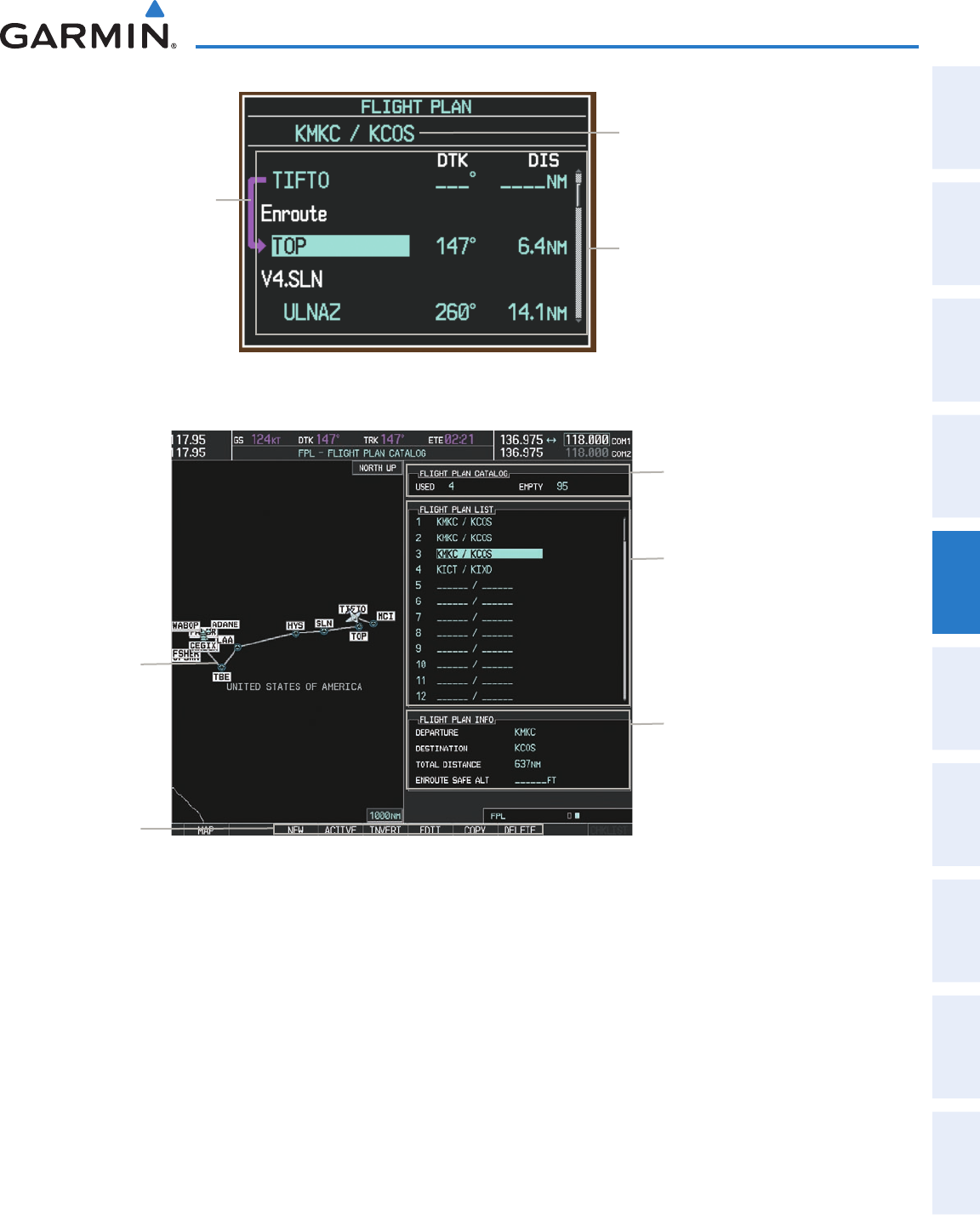
190-00592-06 Rev. A
Garmin G1000 Pilot’s Guide for the Diamond DA40/40F
191
FLIGHT MANAGEMENT
SYSTEM
OVERVIEW
FLIGHT
INSTRUMENTS EIS AUDIO PANEL
& CNS
FLIGHT
MANAGEMENT
HAZARD
AVOIDANCE AFCS ADDITIONAL
FEATURES APPENDICES INDEX
Active Flight Plan Comment
Figure 5-55 Active Flight Plan Window on PFD
Active Flight
Plan Leg
Active Flight Plan Waypoint List
- Waypoint ID
- Desired Track to Waypoint
- Distance to Waypoint
- Airway Identifier
Figure 5-56 Flight Plan Catalog Page
Flight Plan List
- Comment
Selected FPL Info
- Departure Waypoint
- Destination Waypoint
- Total Flight Plan Distance
- Enroute Safe Altitude
Catalog Contents
- # Used
- # Empty
Softkeys
Selected
Flight Plan
Map
The active flight plan is listed on the active Flight Plan Page on the MFD, and in the Active Flight Plan
Window on the PFD. It is the flight plan to which the G1000 is currently providing guidance, and is shown
on the navigation maps. Stored flight plans are listed on the Flight Plan Catalog Page, and are available for
activation (becomes the active flight plan).
Creating an active flight plan:
1) Press the FPL Key.
2) Press the FMS Knob to activate the cursor (only on MFD).
3) Turn the small FMS Knob to display the Waypoint Information Window. (Turning it clockwise displays a blank
Waypoint Information Window, turning it counter-clockwise displays the Waypoint Information Window with a
waypoint selection submenu allowing selection of active flight plan, nearest, recent, or airway waypoints).
Garmin G1000 Pilot’s Guide for the Diamond DA40/40F
190-00592-06 Rev. A192
FLIGHT MANAGEMENT
SYSTEM
OVERVIEW
FLIGHT
INSTRUMENTS
EIS
AUDIO PANEL
& CNS
FLIGHT
MANAGEMENT
HAZARD
AVOIDANCE
AFCS
ADDITIONAL
FEATURES
APPENDICESINDEX
4) Enter the identifier, facility, or city name of the departure waypoint or select a waypoint from the submenu of
waypoints and press the ENT Key. The active flight plan is modified as each waypoint is entered.
5) Repeat step numbers 3 and 4 to enter each additional flight plan waypoint.
6) When all waypoints have been entered, press the FMS Knob to remove the cursor.
Creating a stored flight plan:
1) Press the FPL Key.
2) Turn the small FMS Knob clockwise to display the Flight Plan Catalog Page.
3) Press the NEW Softkey; or press the MENU Key, highlight ‘Create New Flight Plan’, and press the ENT Key to
display a blank flight plan for the first empty storage location.
4) Turn the small FMS Knob to display the Waypoint Information Window. (Turning it clockwise displays a blank
Waypoint Information Window, turning it counter-clockwise displays the Waypoint Information Window with a
waypoint selection submenu allowing selection of active flight plan, nearest, recent, or airway waypoints).
5) Enter the identifier, facility, or city name of the departure waypoint or select a waypoint from the submenu of
waypoints and press the ENT Key.
6) Repeat step numbers 4 and 5 to enter each additional flight plan waypoint.
7) When all waypoints have been entered, press the FMS Knob to return to the Flight Plan Catalog Page. The new
flight plan is now in the list.
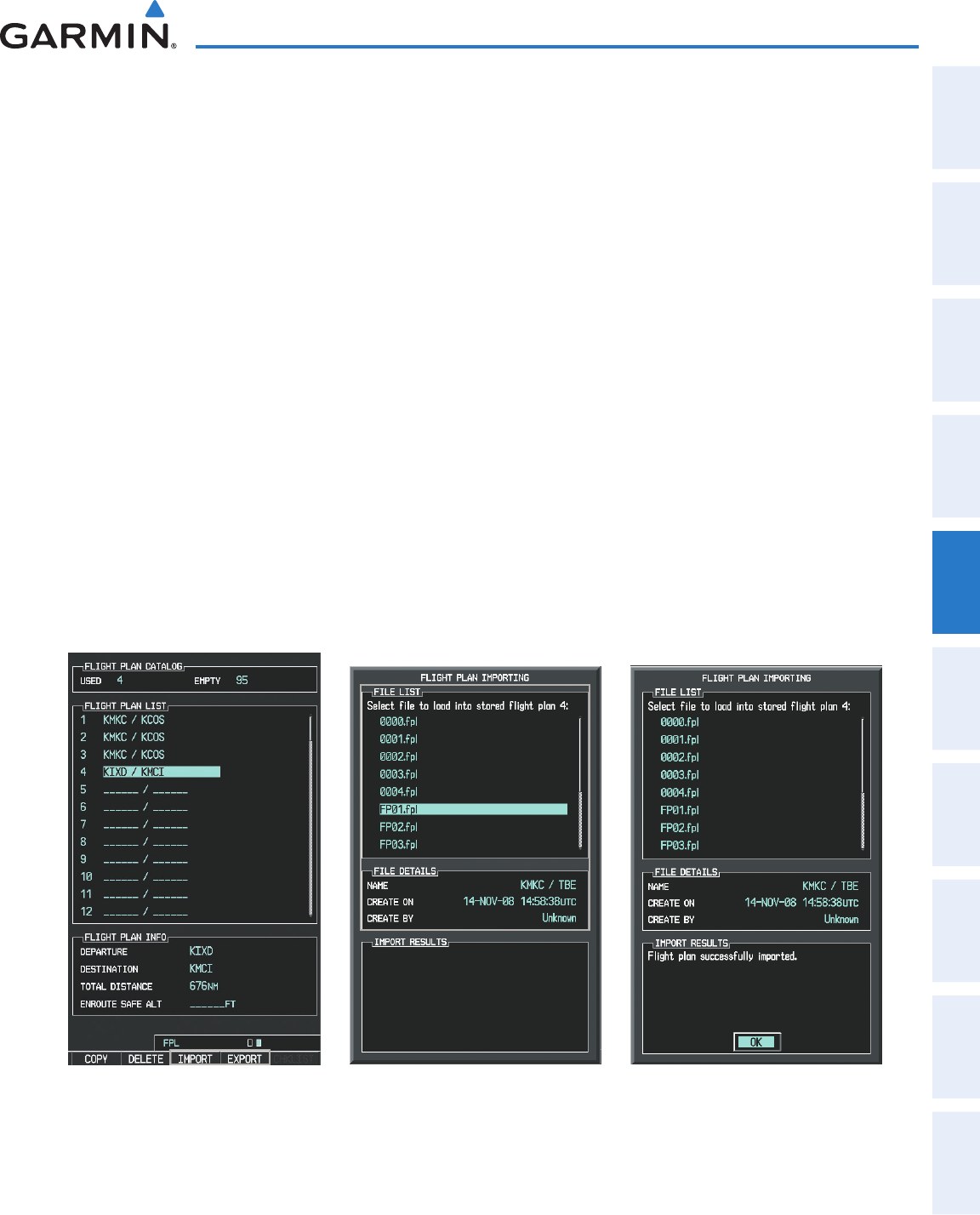
190-00592-06 Rev. A
Garmin G1000 Pilot’s Guide for the Diamond DA40/40F
193
FLIGHT MANAGEMENT
SYSTEM
OVERVIEW
FLIGHT
INSTRUMENTS EIS AUDIO PANEL
& CNS
FLIGHT
MANAGEMENT
HAZARD
AVOIDANCE AFCS ADDITIONAL
FEATURES APPENDICES INDEX
Flight plans can be imported from an SD Card or exported to an SD Card from the Stored Flight Plan Page.
Importing a Flight Plan from an SD Card
1) Insert the SD card containing the flight plan in the top card slot on the MFD.
2) Press the FPL Key on the Control Unit to display the Active Flight Plan Page on the MFD.
3) Turn the small FMS Knob to select the Flight Plan Catalog Page.
4) Press the FMS Knob to activate the cursor.
5) Turn either FMS Knob to highlight an empty or existing flight plan.
6) Press the IMPORT Softkey; or press the MENU Key, select “Import Flight Plan”, and press the ENT Key.
If an empty slot is selected, a list of the available flight plans on the SD card will be displayed.
Or:
If an existing flight plan is selected, an “Overwrite existing flight plan? OK or CANCEL” prompt is displayed.
Press the ENT Key to choose to overwrite the selected flight plan and see the list of available flight plans on the
SD card. If overwriting the existing flight plan is not desired, select “CANCEL” using the FMS Knob, press the
ENT Key, select another flight plan slot, and press the IMPORT Softkey again.
7) Turn the small FMS Knob to highlight the desired flight plan for importing.
8) Press the ENT Key to initiate the import.
9) Press the ENT Key again to confirm the import.
Figure 5-57 Flight Plan Import
Import/Export Softkeys List of Flight Plans to Import &
Details for the Selected File
Import Successful
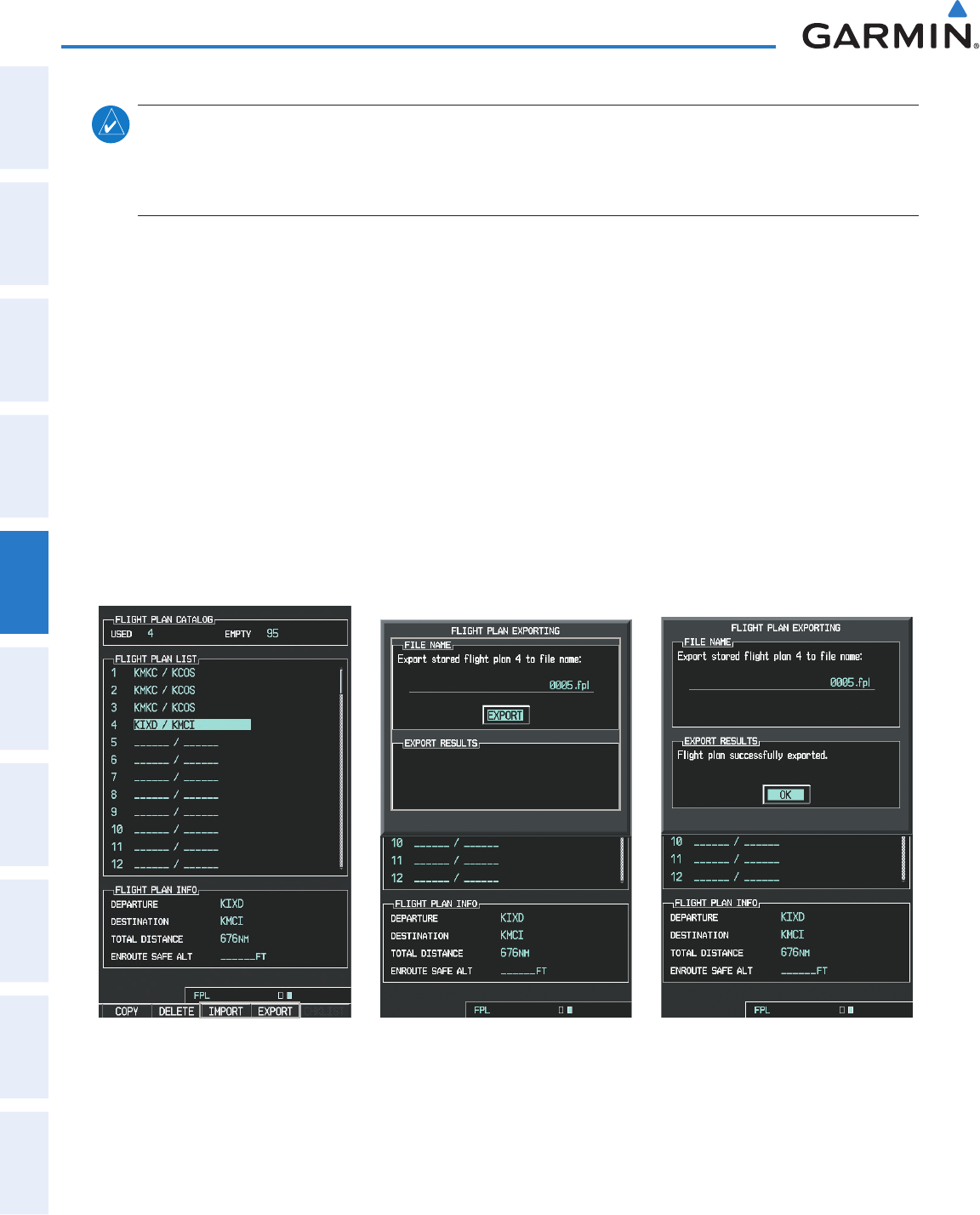
Garmin G1000 Pilot’s Guide for the Diamond DA40/40F
190-00592-06 Rev. A194
FLIGHT MANAGEMENT
SYSTEM
OVERVIEW
FLIGHT
INSTRUMENTS
EIS
AUDIO PANEL
& CNS
FLIGHT
MANAGEMENT
HAZARD
AVOIDANCE
AFCS
ADDITIONAL
FEATURES
APPENDICESINDEX
NOTE: If the imported flight plan contains a waypoint with a name that duplicates the name of a waypoint
already stored on the system, the system compares the coordinates of the imported waypoint with those of
the existing waypoint. If the coordinates are different, the imported waypoint is automatically renamed by
adding characters to the end of the name.
Exporting a Flight Plan to an SD Card
1) Insert the SD card into the top card slot on the MFD.
2) Press the FPL Key on the Control Unit to display the Active Flight Plan Page on the MFD.
3) Turn the small FMS Knob to select the Flight Plan Catalog Page.
4) Press the FMS Knob to activate the cursor.
5) Turn the large FMS Knob to highlight the flight plan to be exported.
6) Press the EXPORT Softkey; or press the MENU Key, select “Export Flight Plan”.
7) If desired, change the name for the exported file by turning the large FMS Knob to the left to highlight the
name, then use the small and large FMS knobs to enter the new name, and press the ENT Key.
8) Press the ENT Key to initiate the export.
9) Press the ENT Key to confirm the export.
Figure 5-58 Flight Plan Export
Import/Export Softkeys Stored Flight Plan to be Exported &
Exported Flight Plan Name
Export Successful
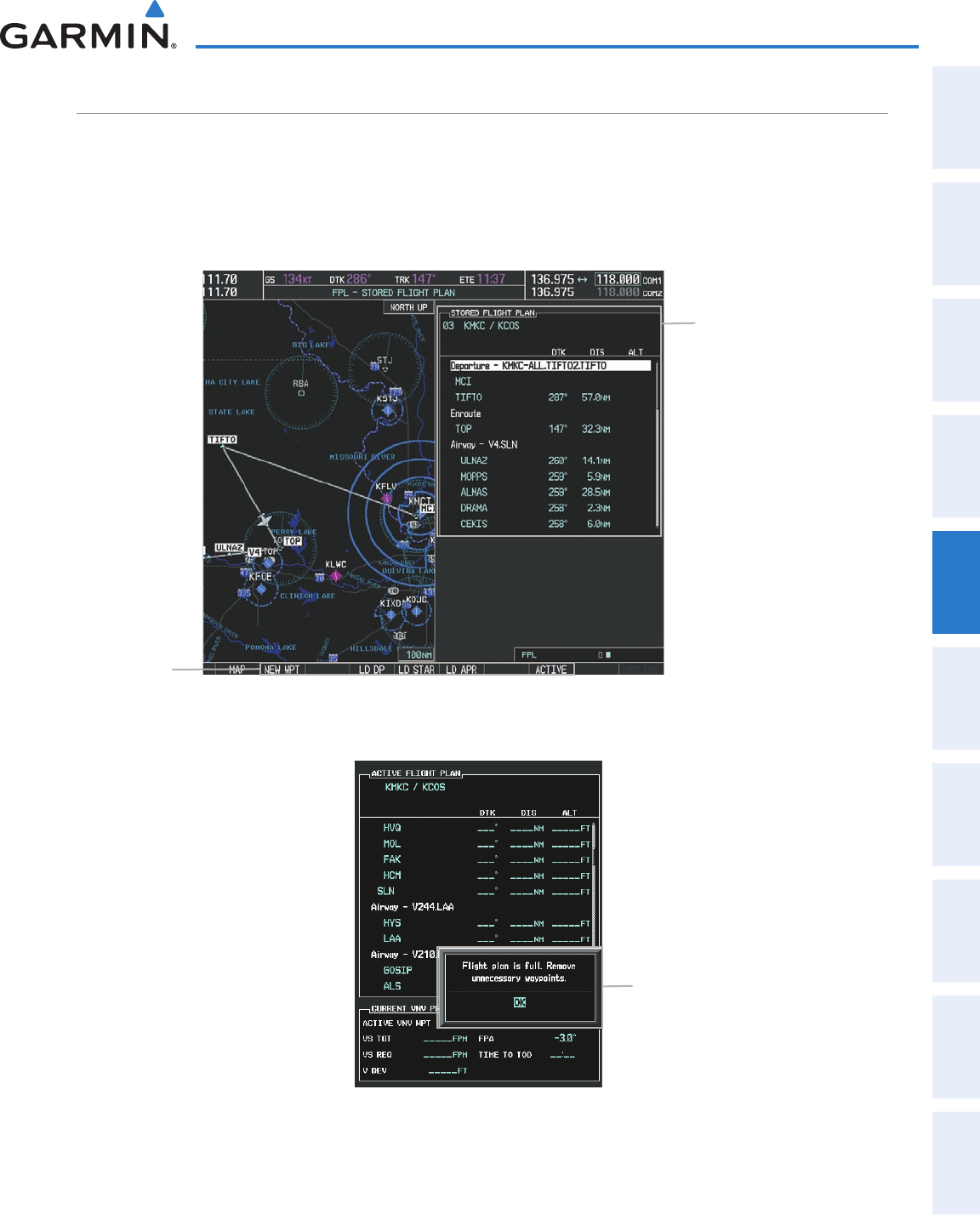
190-00592-06 Rev. A
Garmin G1000 Pilot’s Guide for the Diamond DA40/40F
195
FLIGHT MANAGEMENT
SYSTEM
OVERVIEW
FLIGHT
INSTRUMENTS EIS AUDIO PANEL
& CNS
FLIGHT
MANAGEMENT
HAZARD
AVOIDANCE AFCS ADDITIONAL
FEATURES APPENDICES INDEX
ADDING WAYPOINTS TO AN EXISTING FLIGHT PLAN
Waypoints can be added to the active flight plan or any stored flight plan. Choose the flight plan, select the
desired point of insertion, enter the waypoint, and it is added in front of the selected waypoint. Flight plans
are limited to 99 waypoints (including waypoints within airways and procedures). If the number of waypoints
in the flight plan exceeds 99, the message “Flight plan is full. Remove unnecessary waypoints.” appears and the
new waypoint(s) are not added to the flight plan.
Figure 5-59 Stored Flight Plan Page
Stored Flight Plan Selected
- Memory Slot
- Comment
- Procedure Identifier
- Waypoint Identifier
- Airway Identifier
- Desired Track to Waypoint
- Distance to Waypoint
- Waypoint Altitude Constraint
Softkeys
Figure 5-60 Active Flight Plan Page - FPL Full
Flight Plan Full Message
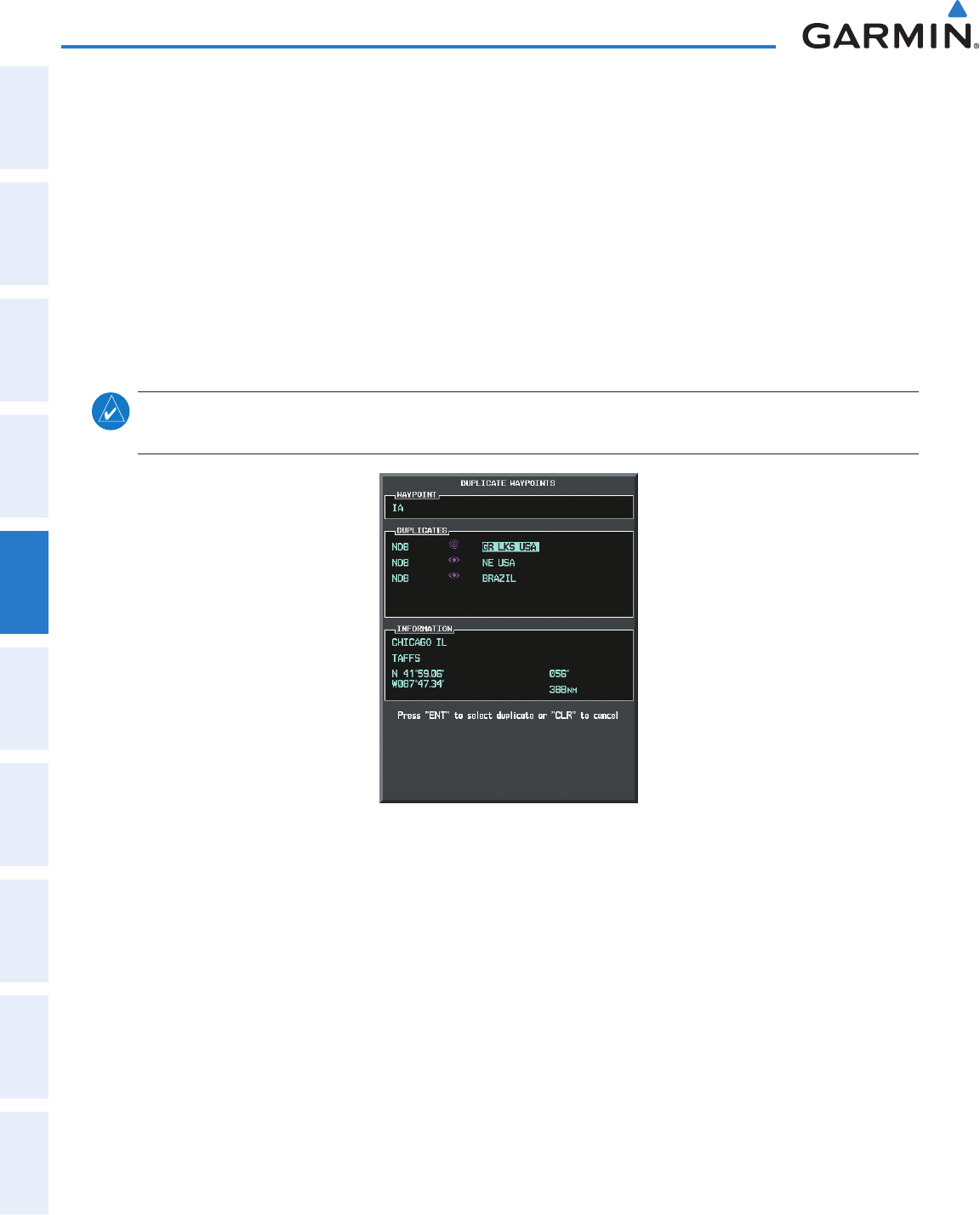
Garmin G1000 Pilot’s Guide for the Diamond DA40/40F
190-00592-06 Rev. A196
FLIGHT MANAGEMENT
SYSTEM
OVERVIEW
FLIGHT
INSTRUMENTS
EIS
AUDIO PANEL
& CNS
FLIGHT
MANAGEMENT
HAZARD
AVOIDANCE
AFCS
ADDITIONAL
FEATURES
APPENDICESINDEX
Adding a waypoint to a stored flight plan:
1) On the Flight Plan Catalog Page, press the FMS Knob to activate the cursor.
2) Highlight the desired flight plan.
3) Press the EDIT Softkey; or press the ENT Key, turn the large FMS Knob clockwise to select “EDIT” and press the
ENT Key. The Stored Flight Plan Page is displayed.
4) Select the point in the flight plan to add the new waypoint. The new waypoint is placed directly in front of the
highlighted waypoint.
5) Enter the identifier, facility, or city of the new waypoint.
6) Press the ENT Key. The new waypoint now exists in the flight plan.
NOTE: If the identifier entered in the Waypoint Information Window has duplicates, a Duplicate Waypoint
Window is displayed. Use the FMS Knob to select the correct waypoint.
Figure 5-61 Duplicate Waypoints Window
Adding a waypoint to the active flight plan:
1) Press the FPL Key.
2) Press the FMS Knob to activate the cursor (not required on the PFD).
3) Select the point in the flight plan before which to add the new waypoint. The new waypoint is placed directly
in front of the highlighted waypoint.
4) Turn the small FMS Knob to display the Waypoint Information Window. (Turning it clockwise displays a blank
Waypoint Information Window, turning it counter-clockwise displays the Waypoint Information Window
with a waypoint selection submenu allowing selection of active flight plan, nearest, recent, user, or airway
waypoints).
5) Enter the identifier, facility, or city name of the departure waypoint or select a waypoint from the submenu of
waypoints and press the ENT Key. The active flight plan is modified as each waypoint is entered.
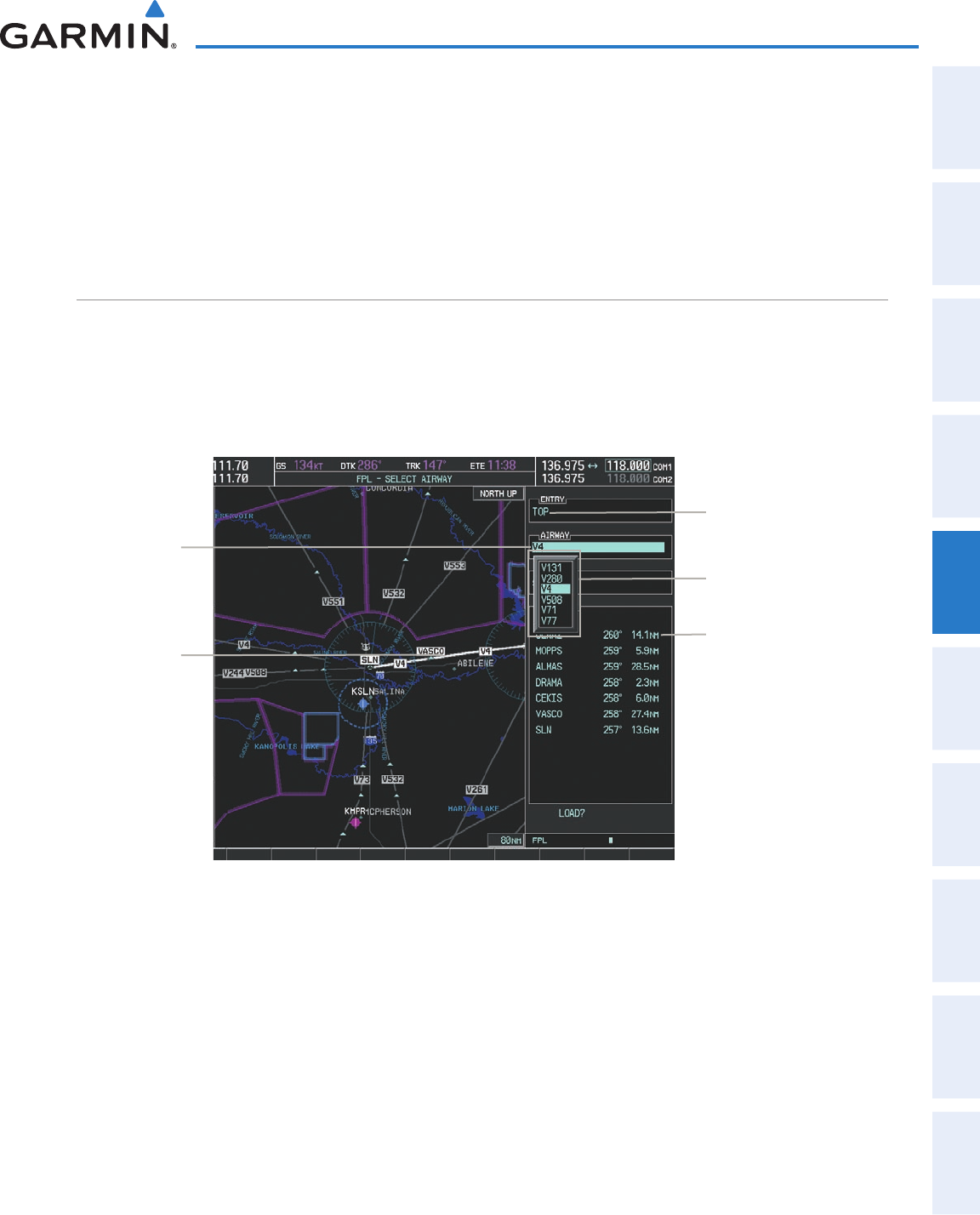
190-00592-06 Rev. A
Garmin G1000 Pilot’s Guide for the Diamond DA40/40F
197
FLIGHT MANAGEMENT
SYSTEM
OVERVIEW
FLIGHT
INSTRUMENTS EIS AUDIO PANEL
& CNS
FLIGHT
MANAGEMENT
HAZARD
AVOIDANCE AFCS ADDITIONAL
FEATURES APPENDICES INDEX
Creating and adding user waypoints to the active flight plan:
1) Press the Joystick to activate the panning function on the Active Flight Plan Page and pan to the map location
of the desired user waypoint.
2) Press the LD WPT Softkey; or press the MENU Key, select ‘Load Waypoint’, and press the ENT Key. The user
waypoint is created with a name of USRxxx (using the next available in sequence) and is added to the end of
the active flight plan.
ADDING AIRWAYS TO A FLIGHT PLAN
Airways can be added to the active flight plan or any stored flight plan. Choose a flight plan (add the desired
airway entry point if not already in the flight plan), select the waypoint after the desired airway entry point,
select the airway, and it is added in front of the selected waypoint. An airway can only be loaded if there is a
waypoint in the flight plan that is part of the desired airway and is not part of an arrival or approach procedure.
The G1000 also anticipates the desired airway and exit point based on loaded flight plan waypoints.
Figure 5-62 Select Airway Page - Selecting Airway
Airway Entry Waypoint
Selected Airway
Airways Available at TOP
Airway Waypoint
Sequence
Preview of
Selected Airway
Adding an airway to a flight plan:
1) Press the FPL Key.
2) Press the FMS Knob to activate the cursor (not required on the PFD).
3) Turn the large FMS Knob to highlight the waypoint after the desired airway entry point. If this waypoint is not
a valid airway entry point, a valid entry point should be entered at this time.
4) Turn the small FMS Knob one click clockwise and press the LD AIRWY Softkey, or press the MENU Key and
select “Load Airway”. The Select Airway Page is displayed. The LD AIRWY Softkey or the “Load Airway” menu
item is available only when a valid airway entry waypoint has been chosen (the waypoint ahead of the cursor
position).
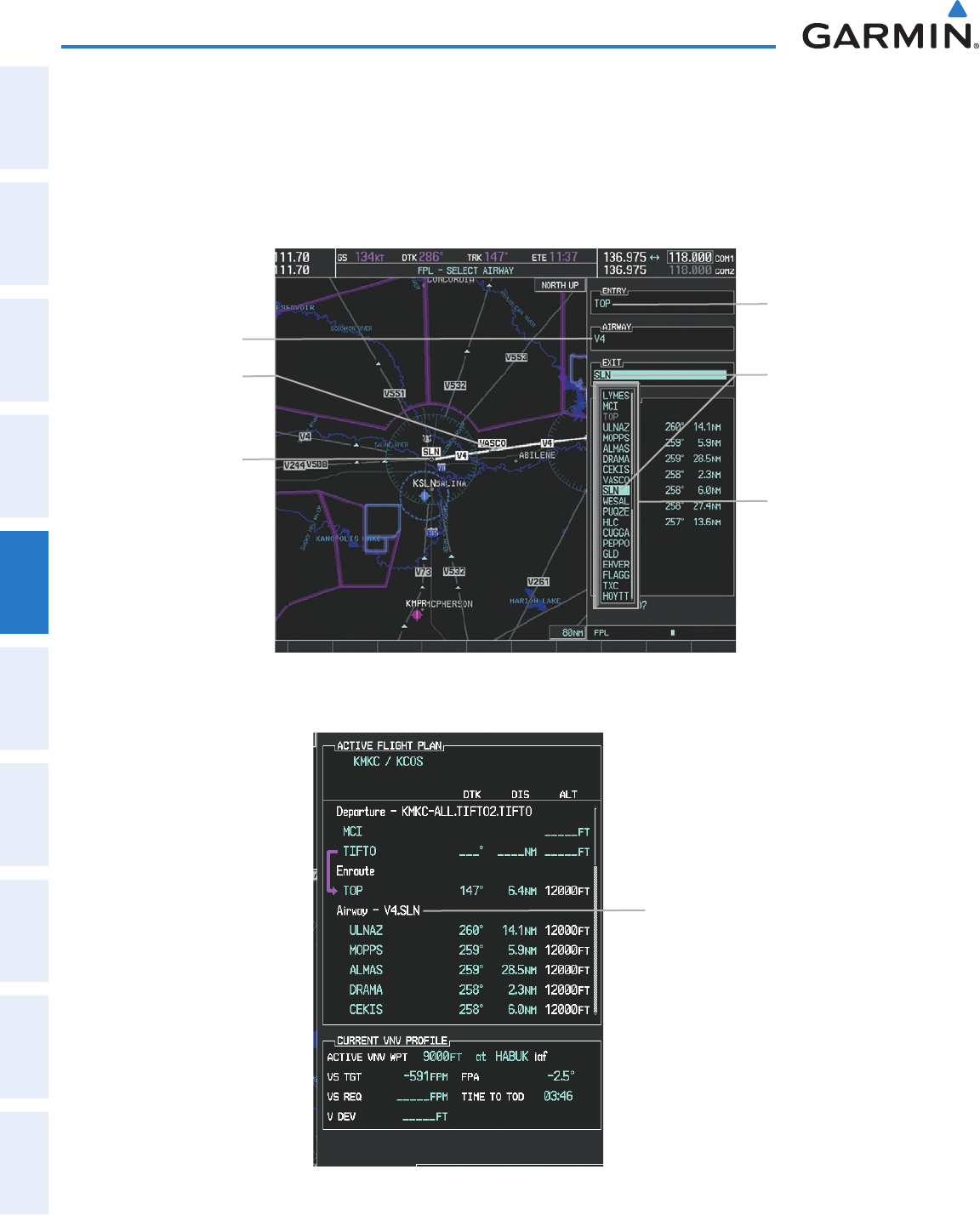
Garmin G1000 Pilot’s Guide for the Diamond DA40/40F
190-00592-06 Rev. A198
FLIGHT MANAGEMENT
SYSTEM
OVERVIEW
FLIGHT
INSTRUMENTS
EIS
AUDIO PANEL
& CNS
FLIGHT
MANAGEMENT
HAZARD
AVOIDANCE
AFCS
ADDITIONAL
FEATURES
APPENDICESINDEX
5) Turn the FMS Knob to select the desired airway from the list, and press the ENT Key. Low altitude airways are
shown first in the list, followed by “all” altitude airways, and then high altitude airways.
6) Turn the FMS Knob to select the desired airway exit point from the list, and press the ENT Key. ‘LOAD?’ is
highlighted.
7) Press the ENT Key. The system returns to editing the flight plan with the new airway inserted.
Figure 5-63 Select Airway Page - Selecting Exit Point
Airway Entry Waypoint
Selected Airway
Airway Exit Points
Available
Selected Exit Point
Selected Airway Exit
Point
Preview of
Selected Airway
Figure 5-64 Active Flight Plan Page - Airway Inserted
Inserted Airway Header
- Airway Identifier: [airway
identifier].[exit waypoint identifier]
(e.g., V4.SLN)
190-00592-06 Rev. A
Garmin G1000 Pilot’s Guide for the Diamond DA40/40F
199
FLIGHT MANAGEMENT
SYSTEM
OVERVIEW
FLIGHT
INSTRUMENTS EIS AUDIO PANEL
& CNS
FLIGHT
MANAGEMENT
HAZARD
AVOIDANCE AFCS ADDITIONAL
FEATURES APPENDICES INDEX
RESTRICTIONS ON ADDING AIRWAYS
Some airways have directional restrictions on all or part of the route. Airway “A2” in Europe has a directional
restriction over the whole route such that it can be flown only in the direction MTD-ABB-BNE-DEVAL.
Airway “UR975” in North Africa has more complicated directional restrictions within the list of airway
waypoints AMANO, VAKOR, LIBRO NELDA, DIRKA, GZO, KOSET, and SARKI:
•StartingfromAMANO,theairwaycanbeownonlytoLIBRO.
•StartingfromSARKI,theairwaycanbeownonlytoLIBRO.
•BetweenNELDAandGZO,theairwaycanbeownineitherdirection.
In the US, airways that are “one-way” for specified hours of operation are not uncommon. These airways
are always bidirectional in the G1000 database.
The system only allows correct airway sequences to be inserted. If the pilot subsequently inverts the flight
plan, the system inverts the airway waypoint sequence and removes the airway header.
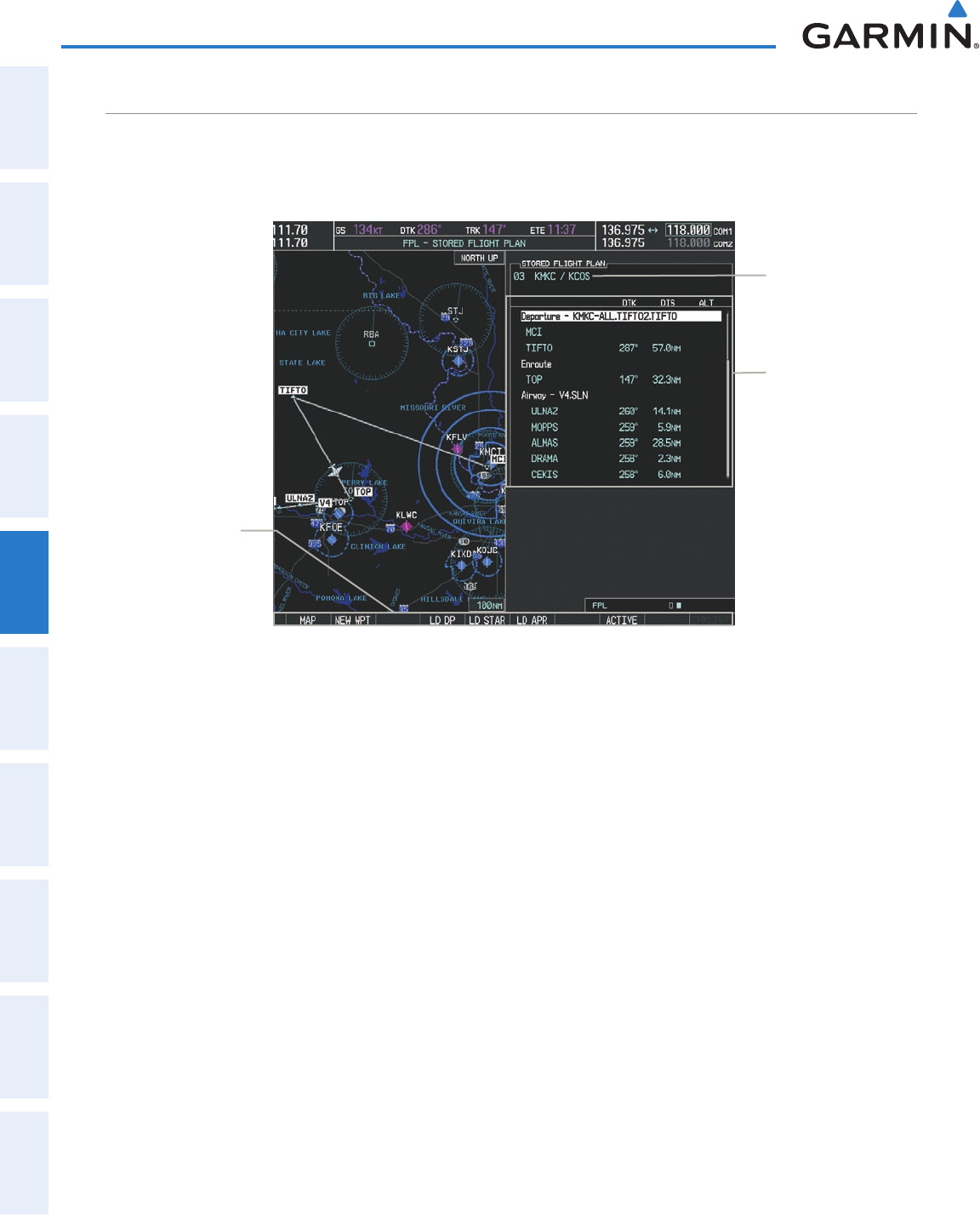
Garmin G1000 Pilot’s Guide for the Diamond DA40/40F
190-00592-06 Rev. A200
FLIGHT MANAGEMENT
SYSTEM
OVERVIEW
FLIGHT
INSTRUMENTS
EIS
AUDIO PANEL
& CNS
FLIGHT
MANAGEMENT
HAZARD
AVOIDANCE
AFCS
ADDITIONAL
FEATURES
APPENDICESINDEX
ADDING PROCEDURES TO A STORED FLIGHT PLAN
The G1000 allows the pilot to insert pre-defined instrument procedures from the navigation database into a
flight plan. The procedures are designed to facilitate routing of traffic leaving an airport (departure), arriving at
an airport (arrival), and landing at an airport (approach). See the procedures section for more details.
Figure 5-65 Stored Flight Plan Page
Flight Plan Name
Flight Plan Waypoint
List
Softkeys
Load Departure -
Load Arrival -
Load Approach -
Activate Flight Plan -
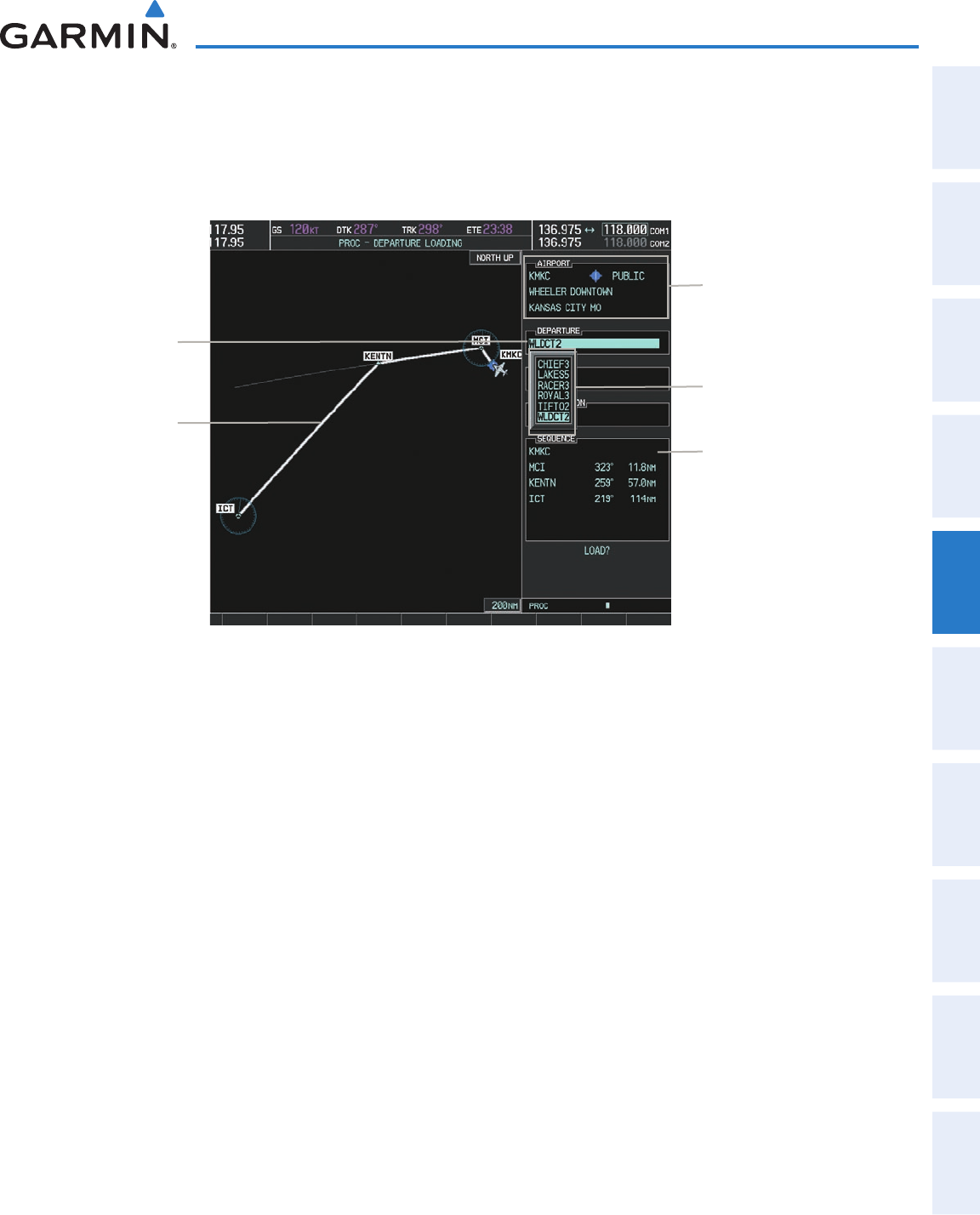
190-00592-06 Rev. A
Garmin G1000 Pilot’s Guide for the Diamond DA40/40F
201
FLIGHT MANAGEMENT
SYSTEM
OVERVIEW
FLIGHT
INSTRUMENTS EIS AUDIO PANEL
& CNS
FLIGHT
MANAGEMENT
HAZARD
AVOIDANCE AFCS ADDITIONAL
FEATURES APPENDICES INDEX
DEPARTURE (DP)
A Departure Procedure (DP) is loaded at the departure airport in the flight plan. Only one departure can
be loaded at a time in a flight plan. The route is defined by selection of a departure, the transition waypoints,
and a runway.
Figure 5-66 Departure Loading Page - Selecting the Departure
Departure Airport
Selected
Departure
Departures Available at
KMCI
Departure Waypoint
Sequence
Preview of
Selected
Departure
Loading a departure procedure into a stored flight plan:
1) Select a stored flight plan from the Flight Plan Catalog Page.
2) Press the EDIT Softkey; or press the MENU Key, select ‘EDIT FLIGHT PLAN’, and press the ENT Key. The Stored
Flight Plan Page is displayed.
3) Press the LD DP Softkey; or press the MENU Key, select “Load Departure”, and press the ENT Key. The
Departure Loading Page is displayed.
4) Select a departure. Press the ENT Key.
5) Select a transition for the selected departure. Press the ENT Key.
6) Select a runway served by the selected departure, if required. Press the ENT Key.
7) Press the ENT Key to load the selected departure procedure.
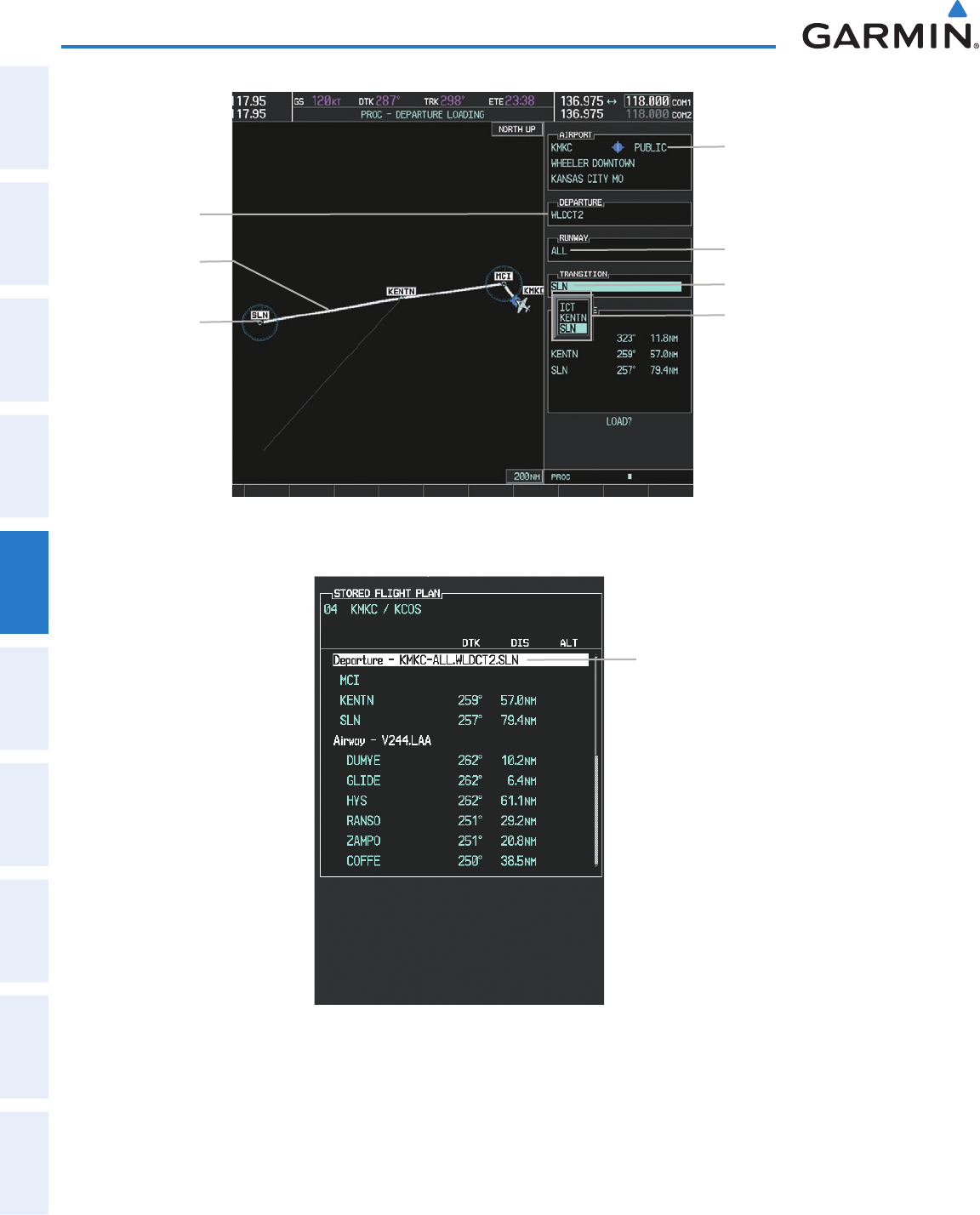
Garmin G1000 Pilot’s Guide for the Diamond DA40/40F
190-00592-06 Rev. A202
FLIGHT MANAGEMENT
SYSTEM
OVERVIEW
FLIGHT
INSTRUMENTS
EIS
AUDIO PANEL
& CNS
FLIGHT
MANAGEMENT
HAZARD
AVOIDANCE
AFCS
ADDITIONAL
FEATURES
APPENDICESINDEX
Figure 5-67 Departure Loading Page - Selecting Transition
Departure Airport
Selected
Departure
Departure Transition Points
Available
Selected Runway
Selected
Departure End
Point
Preview of
Selected
Departure Selected Transition
Figure 5-68 Stored Flight Plan Page - Departure Inserted
Inserted Departure Header
- Departure Identifier: [departure
airport]-[departure runway].
[departure transition].
[departure end point]
(e.g., KMKC-ALL.WLDCT2.SLN)
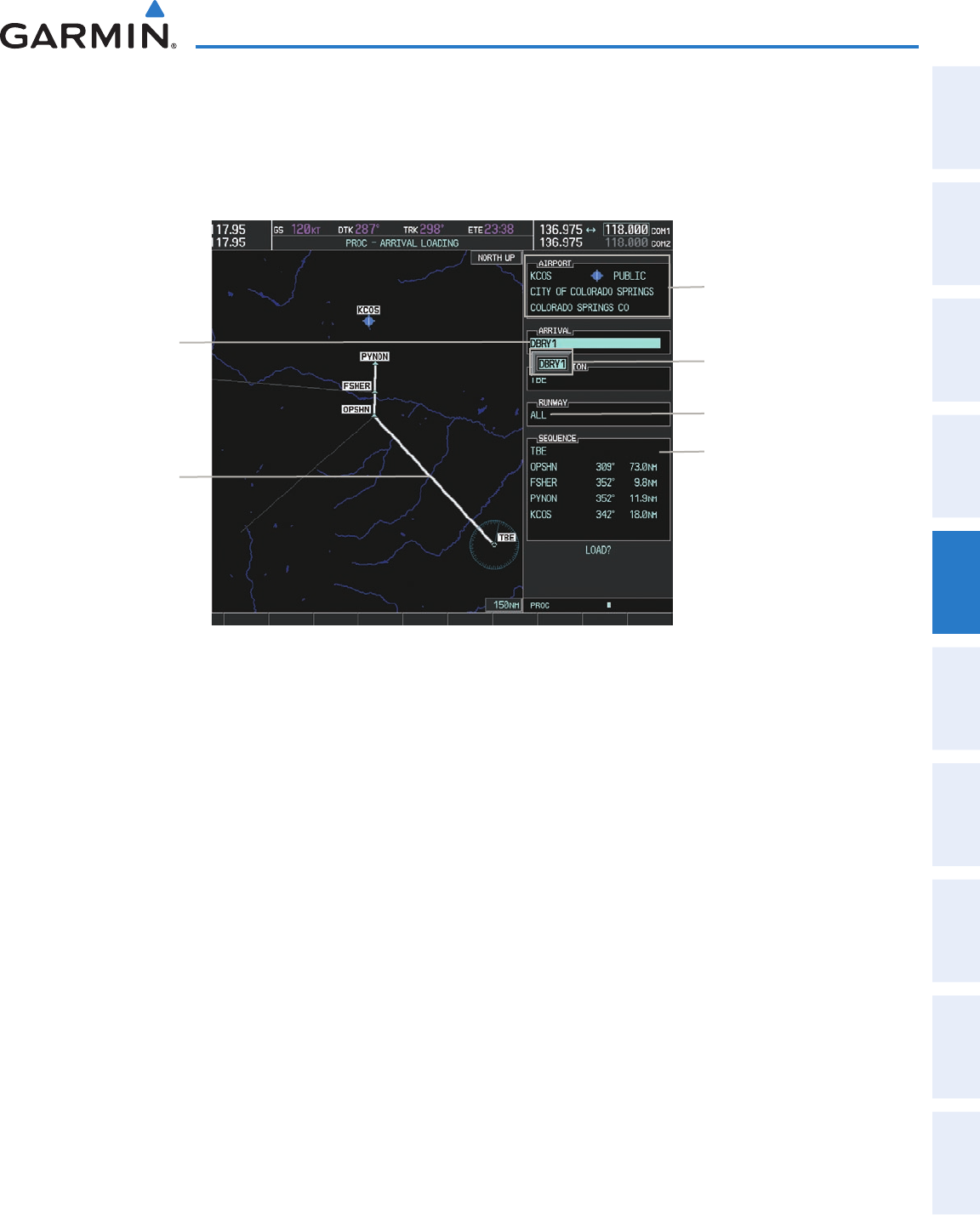
190-00592-06 Rev. A
Garmin G1000 Pilot’s Guide for the Diamond DA40/40F
203
FLIGHT MANAGEMENT
SYSTEM
OVERVIEW
FLIGHT
INSTRUMENTS EIS AUDIO PANEL
& CNS
FLIGHT
MANAGEMENT
HAZARD
AVOIDANCE AFCS ADDITIONAL
FEATURES APPENDICES INDEX
ARRIVAL (STAR)
A Standard Terminal Arrival (STAR) is loaded at the destination airport in the flight plan. Only one arrival
can be loaded at a time in a flight plan. The route is defined by selection of an arrival, the transition waypoints,
and a runway.
Figure 5-69 Arrival Loading Page - Selecting the Arrival
Destination Airport
Selected Arrival
Arrivals Available at KCOS
Arrival Waypoint Sequence
Preview of
Selected Arrival
Selected Runway
Loading an arrival procedure into a stored flight plan:
1) Select a stored flight plan from the Flight Plan Catalog Page.
2) Press the EDIT Softkey; or press the MENU Key, select ‘EDIT FLIGHT PLAN’, and press the ENT Key. The Stored
Flight Plan Page is displayed.
3) Press the LD STAR Softkey; or press the MENU Key, select “Load Arrival”, and press the ENT Key. The Arrival
Loading Page is displayed.
4) Select an arrival. Press the ENT Key.
5) Select a transition for the selected arrival. Press the ENT Key.
6) Select a runway served by the selected arrival, if required. Press the ENT Key.
7) Press the ENT Key to load the selected arrival procedure.
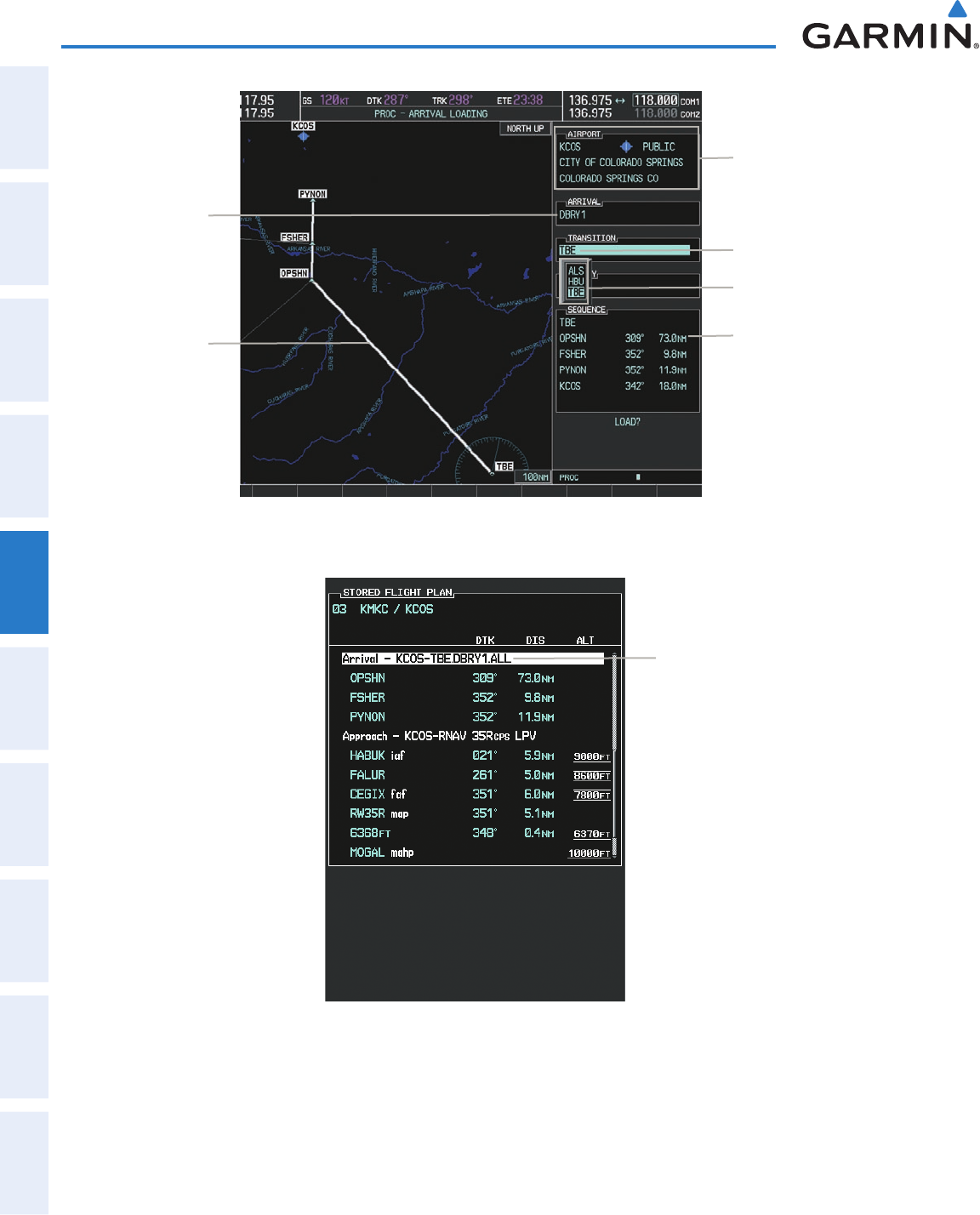
Garmin G1000 Pilot’s Guide for the Diamond DA40/40F
190-00592-06 Rev. A204
FLIGHT MANAGEMENT
SYSTEM
OVERVIEW
FLIGHT
INSTRUMENTS
EIS
AUDIO PANEL
& CNS
FLIGHT
MANAGEMENT
HAZARD
AVOIDANCE
AFCS
ADDITIONAL
FEATURES
APPENDICESINDEX
Figure 5-70 Arrival Loading Page - Selecting the Transition
Destination Airport
Selected Arrival
Transitions Available with
DBRY1
Arrival Waypoint Sequence
Preview of
Selected Arrival
Selected Transition
Figure 5-71 Stored Flight Plan Page - Arrival Inserted
Inserted Arrival Header
- Arrival Identifier:
[arrival airport]-[arrival transition].
[arrival].[arrival runway]
(e.g., KCOS-TBE.DBRY1.ALL)
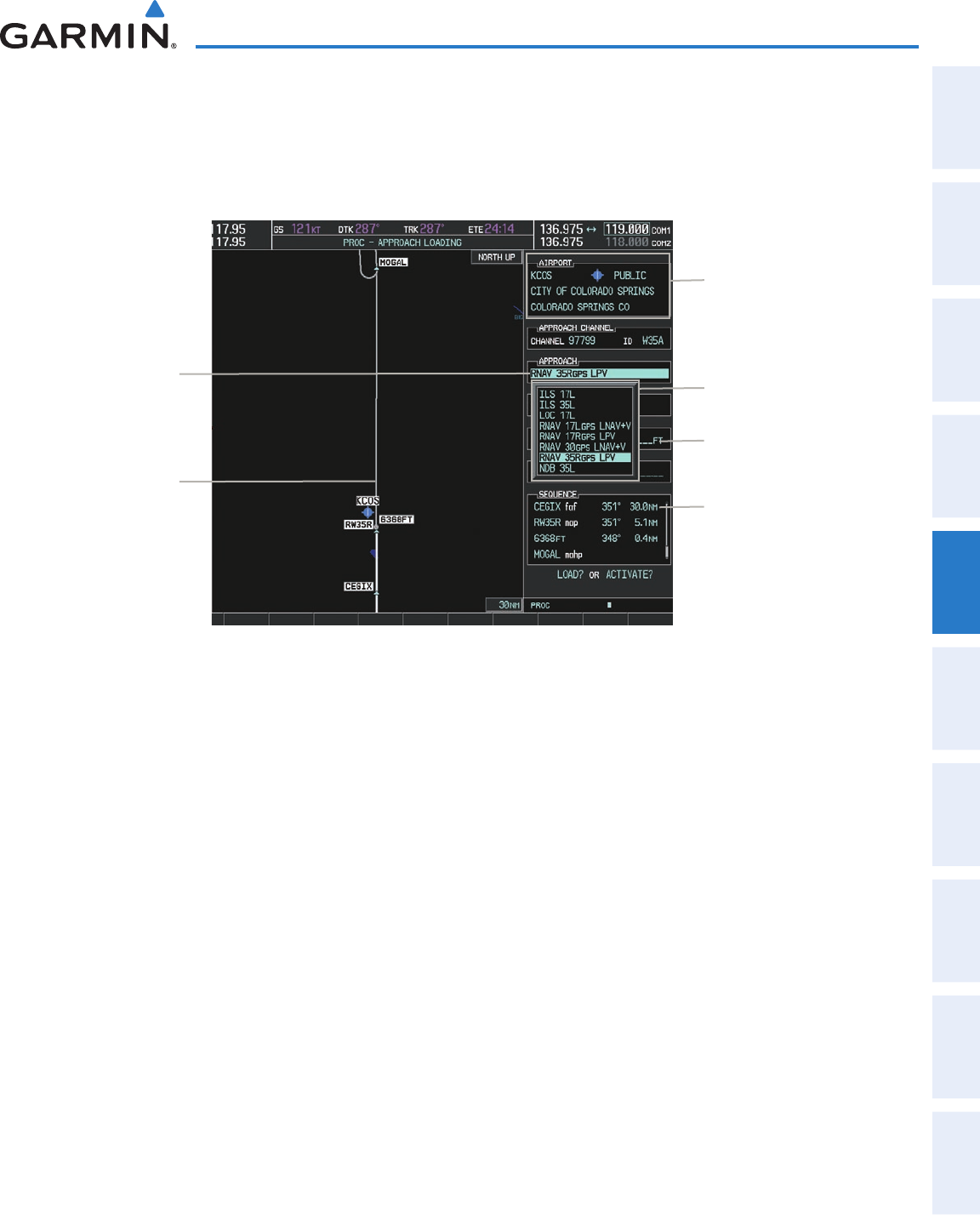
190-00592-06 Rev. A
Garmin G1000 Pilot’s Guide for the Diamond DA40/40F
205
FLIGHT MANAGEMENT
SYSTEM
OVERVIEW
FLIGHT
INSTRUMENTS EIS AUDIO PANEL
& CNS
FLIGHT
MANAGEMENT
HAZARD
AVOIDANCE AFCS ADDITIONAL
FEATURES APPENDICES INDEX
APPROACH (APPR)
An Approach Procedure (APPR) can be loaded at any airport that has an approach available. Only one
approach can be loaded at a time in a flight plan. The route for a selected approach is defined by designating
transition waypoints.
Figure 5-72 Approach Loading Page - Selecting the Approach
Destination Airport
Selected
Approach Approaches Available at
KCOS
Approach Waypoint
Sequence
Preview of
Selected
Approach
Barometric Minimum
Loading an approach procedure into a stored flight plan:
1) Select a stored flight plan from the Flight Plan Catalog Page.
2) Press the EDIT Softkey; or press the MENU Key, select ‘EDIT FLIGHT PLAN’, and press the ENT Key. The Stored
Flight Plan Page is displayed.
3) Press the LD APR Softkey; or press the MENU Key, select “Load Approach”, and press the ENT Key. The
Approach Loading Page is displayed.
4) Select an approach. Press the ENT Key.
5) Select a transition for the selected approach. Press the ENT Key.
6) Press the ENT Key to load the selected approval procedure.
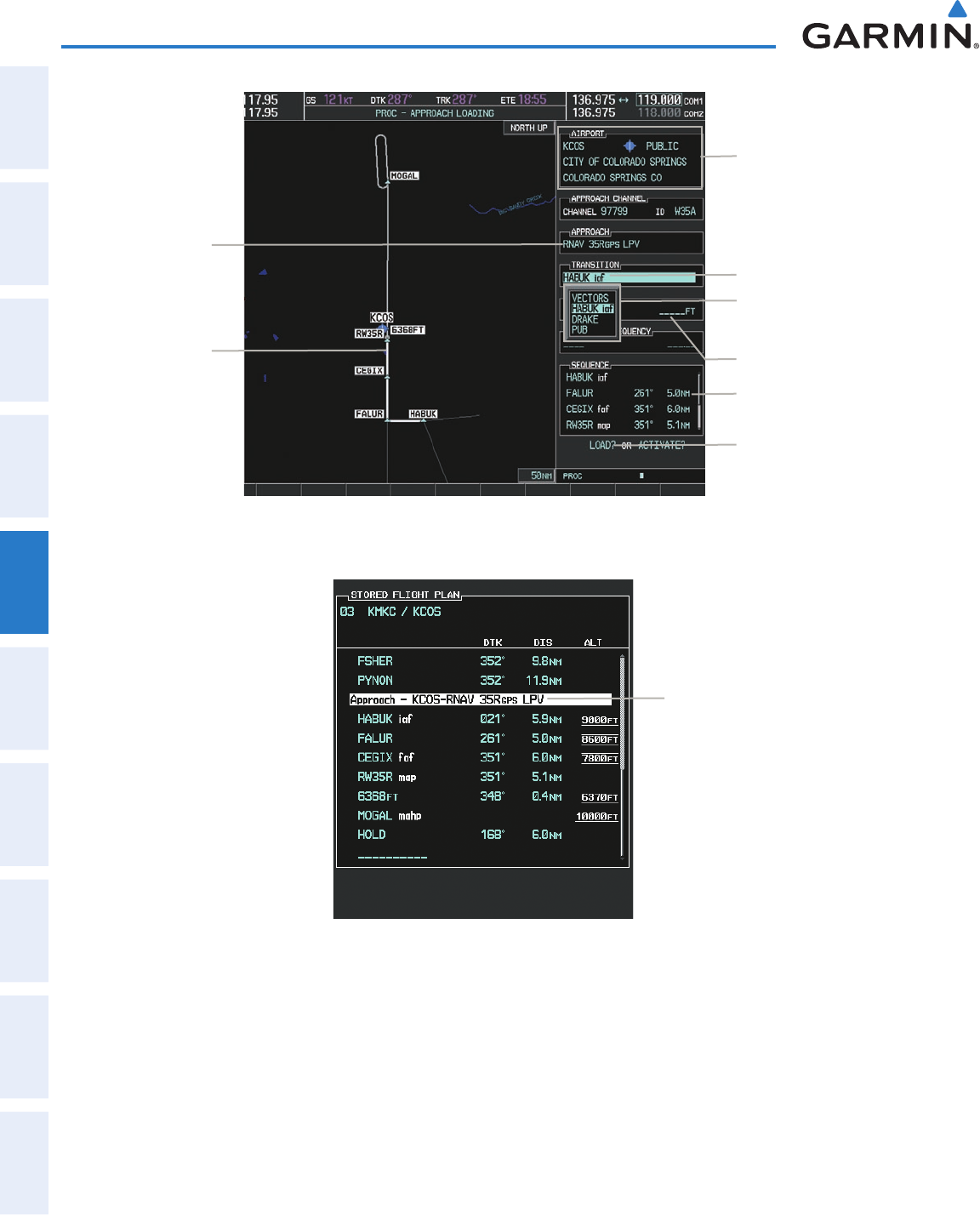
Garmin G1000 Pilot’s Guide for the Diamond DA40/40F
190-00592-06 Rev. A206
FLIGHT MANAGEMENT
SYSTEM
OVERVIEW
FLIGHT
INSTRUMENTS
EIS
AUDIO PANEL
& CNS
FLIGHT
MANAGEMENT
HAZARD
AVOIDANCE
AFCS
ADDITIONAL
FEATURES
APPENDICESINDEX
Figure 5-73 Approach Loading Page - Selecting the Transition
Destination Airport
Selected
Approach
Transitions Available with
Selected Approach
Approach Waypoint
Sequence
Preview of
Selected
Approach
Load Approach?
Selected Transition
Barometric Minimum
Figure 5-74 Stored Flight Plan Page - Approach Inserted
Inserted Approach Header
- Approach Identifier: [approach
airport].[runway and approach type]
(e.g., KCOS-RNAV 35RGPS LPV)
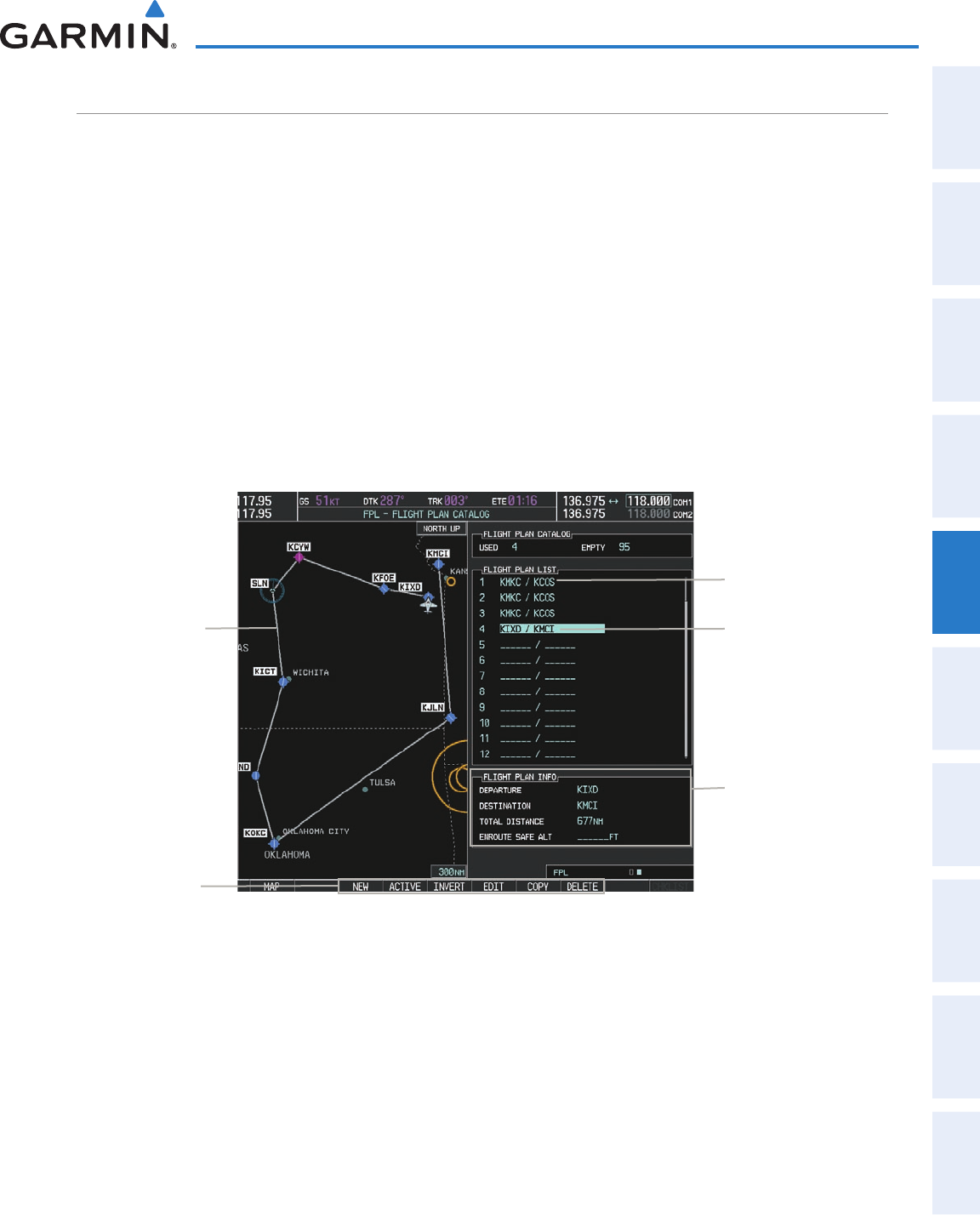
190-00592-06 Rev. A
Garmin G1000 Pilot’s Guide for the Diamond DA40/40F
207
FLIGHT MANAGEMENT
SYSTEM
OVERVIEW
FLIGHT
INSTRUMENTS EIS AUDIO PANEL
& CNS
FLIGHT
MANAGEMENT
HAZARD
AVOIDANCE AFCS ADDITIONAL
FEATURES APPENDICES INDEX
FLIGHT PLAN STORAGE
The G1000 can store up to 99 flight plans, numbered 1 through 99. The active flight plan is erased when
the G1000 is powered off or when another flight plan is activated. Details about each stored flight plan can be
viewed on the Flight Plan Catalog Page and on the Stored Flight Plan Page.
Viewing information about a stored flight plan:
1) Press the FPL Key on the MFD to display the Active Flight Plan Page.
2) Turn the small FMS Knob clockwise one click to display the Flight Plan Catalog Page.
3) Press the FMS Knob to activate the cursor and turn the FMS Knob to highlight the desired flight plan.
4) The Flight Plan Information is displayed showing departure, destination, total distance, and enroute safe altitude
information for the selected Flight Plan.
5) Press the EDIT Softkey to open the Stored Flight Plan Page and view the waypoints in the flight plan.
6) Press the FMS Knob to exit the Stored Flight Plan Page.
Figure 5-75 Stored Flight Plan Information
Preview of Selected
Flight Plan
Stored Flight Plan Info
- Departure Airport
- Destination Airport
- Total Flight Plan Distance
- Enroute Safe Altitude
Flight Plan Name
(Comment)
Selected Flight Plan
Stored FPL Editing
Softkeys
Storing an active flight plan from the Active Flight Plan Page or the Active Flight Plan Window:
1) Press the MENU Key.
2) Highlight ‘Store Flight Plan’.
3) Press the ENT Key.
4) With ‘OK’ highlighted, press the ENT Key. The flight plan is stored in the next available position in the flight
plan list on the Flight Plan Catalog Page.
Garmin G1000 Pilot’s Guide for the Diamond DA40/40F
190-00592-06 Rev. A208
FLIGHT MANAGEMENT
SYSTEM
OVERVIEW
FLIGHT
INSTRUMENTS
EIS
AUDIO PANEL
& CNS
FLIGHT
MANAGEMENT
HAZARD
AVOIDANCE
AFCS
ADDITIONAL
FEATURES
APPENDICESINDEX
SORT FLIGHT PLANS
The stored flight plans can be sorted alphanumerically based on the flight plan name (comment) assigned
to each flight plan.
Sorting by comment (flight plan name):
1) Press the FPL Key and turn the small FMS Knob to display the Flight Plan Catalog Page.
2) Press the MENU Key.
3) Highlight ‘Sort By Comment’ and press the ENT Key. A confirmation window is displayed.
4 ) With ‘OK’ highlighted, press the ENT Key to change flight plan ordering. To cancel the request, press the CLR
Key, or highlight ‘CANCEL’ and press the ENT Key.
ACTIVATE A FLIGHT PLAN
Activating a stored flight plan erases the active flight plan and replaces it with the flight plan being activated.
Inverting a stored flight plan reverses the waypoint order and activates it.
Activating a stored flight plan on the MFD:
1) Press the FPL Key and turn the small FMS Knob to display the Flight Plan Catalog Page.
2) Press the FMS Knob to activate the cursor, and turn the FMS Knob to highlight the desired flight plan.
3) Press the ACTIVE Softkey; or press the MENU Key, highlight ‘Activate Flight Plan’, and press the ENT Key. The
‘Activate Stored Flight Plan?’ window is displayed.
4) With ‘OK’ highlighted, press the ENT Key. To cancel the request, press the CLR Key, or highlight ‘CANCEL’ and
press the ENT Key.
Inverting and activating a stored flight plan on the MFD:
1) Press the FPL Key and turn the small FMS Knob to display the Flight Plan Catalog Page.
2) Press the FMS Knob to activate the cursor, and turn the FMS Knob to highlight the desired flight plan.
3) Press the INVERT Softkey; or press the MENU Key, highlight ‘Invert & activate FPL?’, and press the ENT Key.
The ‘Invert and activate stored flight plan?’ window is displayed.
4) With ‘OK’ highlighted, press the ENT Key. To cancel the request, press the CLR Key, or highlight ‘CANCEL’ and
press the ENT Key.
COPY A FLIGHT PLAN
The G1000 allows copying a flight plan into a new flight plan memory slot, allowing editing, etc., without
affecting the original flight plan. This can be used to duplicate an existing stored flight plan for use in creating
a modified version of the original stored flight plan.
Copying a stored flight plan on the MFD:
1) Press the FPL Key and turn the small FMS Knob to display the Flight Plan Catalog Page.
2) Press the FMS Knob to activate the cursor, and turn the FMS Knob to highlight the desired flight plan.
190-00592-06 Rev. A
Garmin G1000 Pilot’s Guide for the Diamond DA40/40F
209
FLIGHT MANAGEMENT
SYSTEM
OVERVIEW
FLIGHT
INSTRUMENTS EIS AUDIO PANEL
& CNS
FLIGHT
MANAGEMENT
HAZARD
AVOIDANCE AFCS ADDITIONAL
FEATURES APPENDICES INDEX
3) Press the COPY Softkey; or press the MENU Key, highlight ‘Copy Flight Plan’, and press the ENT Key. The ‘Copy
to Flight Plan XX?’ window is displayed.
4) With ‘OK’ highlighted, press the ENT Key to copy the flight plan. To cancel the request, press the CLR Key, or
highlight ‘CANCEL’ and press the ENT Key.
DELETE A STORED FLIGHT PLAN
Individual or all stored flight plans can be deleted from the G1000 memory.
Deleting a stored flight plan:
1) Press the FPL Key and turn the small FMS Knob to display the Flight Plan Catalog Page.
2) Press the FMS Knob to activate the cursor, and turn the FMS Knob to highlight the desired flight plan.
3) Press the DELETE Softkey; press the CLR Key; or press the MENU Key, highlight ‘Delete Flight Plan’, and press
the ENT Key. The ‘Delete Flight Plan XX?’ window is displayed.
4) With ‘OK’ highlighted, press the ENT Key to delete the flight plan. To cancel the request, press the CLR Key, or
highlight ‘CANCEL’ and press the ENT Key.
Deleting all stored flight plans:
1) Press the FPL Key and turn the small FMS Knob to display the Flight Plan Catalog Page.
2) Press the MENU Key.
3) Highlight ‘Delete All’ and press the ENT Key. A ‘Delete all flight plans?’ confirmation window is displayed.
4) With ‘OK’ highlighted, press the ENT Key to delete all flight plans. To cancel the request, press the CLR Key, or
highlight ‘CANCEL’ and press the ENT Key.
FLIGHT PLAN EDITING
The active flight plan or any stored flight plan can be edited. The edits made to the active flight plan affect
navigation as soon as they are entered.
DELETING THE ACTIVE FLIGHT PLAN
The G1000 allows deleting an active flight plan. Deleting the active flight plan suspends navigation by the
G1000.
Deleting the active flight plan:
1) Press the FPL Key to display the Active Flight Plan Page (MFD) or the Active Flight Plan Window (PFD).
2) Press the MENU Key, highlight ‘Delete Flight Plan’, and press the ENT Key. The ‘Delete all waypoints in flight
plan?’ window is displayed.
3) With ‘OK’ highlighted, press the ENT Key to delete the active flight plan. To cancel the request, press the CLR
Key, or highlight ‘CANCEL’ and press the ENT Key.
Garmin G1000 Pilot’s Guide for the Diamond DA40/40F
190-00592-06 Rev. A210
FLIGHT MANAGEMENT
SYSTEM
OVERVIEW
FLIGHT
INSTRUMENTS
EIS
AUDIO PANEL
& CNS
FLIGHT
MANAGEMENT
HAZARD
AVOIDANCE
AFCS
ADDITIONAL
FEATURES
APPENDICESINDEX
DELETING FLIGHT PLAN ITEMS
Individual waypoints, entire airways, and entire procedures can be deleted from a flight plan. Some waypoints
in the final approach segment (such as the FAF or MAP) can not be deleted individually. Attempting to delete
a waypoint that is not allowed results in a window displaying ‘Invalid flight plan modification.’
Deleting an individual waypoint from the active flight plan:
1) Press the FPL Key to display the Active Flight Plan Page (MFD) or the Active Flight Plan Window (PFD).
2) Press the FMS Knob to activate the cursor (not required on the PFD) and turn the large FMS Knob to highlight
the waypoint to be deleted.
3) Press the CLR Key. The ‘Remove XXXXX?’ window is displayed.
4) With ‘OK’ highlighted, press the ENT Key. To cancel the request, press the CLR Key, or highlight ‘CANCEL’ and
press the ENT Key.
5) Press the FMS Knob to remove the flashing cursor.
Deleting an entire airway from the active flight plan:
1) Press the FPL Key to display the Active Flight Plan Page (MFD) or the Active Flight Plan Window (PFD).
2) Press the FMS Knob to activate the cursor (not required on the PFD) and turn the large FMS Knob to highlight
the white header of the airway to be deleted.
3) Press the CLR Key. The ‘Remove <airway name>?’ window is displayed.
4) With ‘OK’ highlighted, press the ENT Key. To cancel the request, press the CLR Key, or highlight ‘CANCEL’ and
press the ENT Key.
5) Press the FMS Knob to remove the flashing cursor.
Deleting an entire procedure from the active flight plan:
1) Press the FPL Key to display the Active Flight Plan Page (MFD) or the Active Flight Plan Window (PFD).
2) Press the FMS Knob to activate the cursor (not required on the PFD) and turn the large FMS Knob to highlight
the white header of the procedure to be deleted.
3) Press the CLR Key. The ‘Remove <procedure name> from flight plan?’ window is displayed.
4) With ‘OK’ highlighted, press the ENT Key. To cancel the request, press the CLR Key, or highlight ‘CANCEL’ and
press the ENT Key.
5) Press the FMS Knob to remove the flashing cursor.
Or:
1) Press the FPL Key to display the Active Flight Plan Page (MFD) or the Active Flight Plan Window (PFD).
2) Press the MENU Key to display the Page Menu and turn the FMS Knob to highlight ‘Remove <procedure>’.
3) Press the ENT Key. The ‘Remove <procedure name> from flight plan?’ window is displayed.
4) With ‘OK’ highlighted, press the ENT Key. To cancel the request, press the CLR Key, or highlight ‘CANCEL’ and
press the ENT Key.
190-00592-06 Rev. A
Garmin G1000 Pilot’s Guide for the Diamond DA40/40F
211
FLIGHT MANAGEMENT
SYSTEM
OVERVIEW
FLIGHT
INSTRUMENTS EIS AUDIO PANEL
& CNS
FLIGHT
MANAGEMENT
HAZARD
AVOIDANCE AFCS ADDITIONAL
FEATURES APPENDICES INDEX
Deleting an individual waypoint from a stored flight plan:
1) Press the FPL Key to display the Active Flight Plan Page.
2) Turn the small FMS Knob clockwise one click to display the Flight Plan Catalog Page.
3) Press the FMS Knob to activate the cursor and turn the FMS Knob to highlight the flight plan to be edited.
4) Press the EDIT Softkey; or press the MENU Key, select ‘Edit Flight Plan’ and press the ENT Key. The Stored
Flight Plan Page is displayed.
5) Turn the large FMS Knob to highlight the waypoint to be deleted.
6) Press the CLR Key. The ‘Remove XXXXX?’ window is displayed.
7) With ‘OK’ highlighted, press the ENT Key. To cancel the request, press the CLR Key, or highlight ‘CANCEL’ and
press the ENT Key.
8) Press the FMS Knob to remove the flashing cursor.
Deleting an entire airway from a stored flight plan:
1) Press the FPL Key to display the Active Flight Plan Page.
2) Turn the small FMS Knob clockwise one click to display the Flight Plan Catalog Page.
3) Press the FMS Knob to activate the cursor and turn the FMS Knob to highlight the flight plan to be edited.
4) Press the EDIT Softkey; or press the MENU Key, select ‘Edit Flight Plan’ and press the ENT Key. The Stored
Flight Plan Page is displayed.
5) Turn the large FMS Knob to highlight the white header of the airway to be deleted.
6) Press the CLR Key. The ‘Remove <airway name>?’ window is displayed.
7) With ‘OK’ highlighted, press the ENT Key. To cancel the request, press the CLR Key, or highlight ‘CANCEL’ and
press the ENT Key.
8) Press the FMS Knob to remove the flashing cursor.
Deleting an entire procedure from a stored flight plan:
1) Press the FPL Key to display the Active Flight Plan Page.
2) Turn the small FMS Knob clockwise one click to display the Flight Plan Catalog Page.
3) Press the FMS Knob to activate the cursor and turn the FMS Knob to highlight the flight plan to be edited.
4) Press the EDIT Softkey; or press the MENU Key, select ‘Edit Flight Plan’ and press the ENT Key. The Stored
Flight Plan Page is displayed.
5) Turn the large FMS Knob to highlight the white header of the procedure to be deleted.
6) Press the CLR Key. The ‘Remove <procedure name> from flight plan?’ window is displayed.
7) With ‘OK’ highlighted, press the ENT Key. To cancel the request, press the CLR Key, or highlight ‘CANCEL’ and
press the ENT Key.
8) Press the FMS Knob to remove the flashing cursor.
Or:
Garmin G1000 Pilot’s Guide for the Diamond DA40/40F
190-00592-06 Rev. A212
FLIGHT MANAGEMENT
SYSTEM
OVERVIEW
FLIGHT
INSTRUMENTS
EIS
AUDIO PANEL
& CNS
FLIGHT
MANAGEMENT
HAZARD
AVOIDANCE
AFCS
ADDITIONAL
FEATURES
APPENDICESINDEX
1) Press the FPL Key to display the Active Flight Plan Page.
2) Turn the small FMS Knob clockwise one click to display the Flight Plan Catalog Page.
3) Press the FMS Knob to activate the cursor and turn the FMS Knob to highlight the flight plan to be edited.
4) Press the EDIT Softkey; or press the MENU Key, select ‘Edit Flight Plan’ and press the ENT Key. The Stored
Flight Plan Page is displayed.
5) Press the MENU Key to display the Page Menu and turn the FMS Knob to highlight ‘Remove <procedure>’.
6) Press the ENT Key. The ‘Remove <procedure name> from flight plan?’ window is displayed.
7) With ‘OK’ highlighted, press the ENT Key. To cancel the request, press the CLR Key, or highlight ‘CANCEL’ and
press the ENT Key.
8) Press the FMS Knob to remove the flashing cursor.
CHANGING FLIGHT PLAN COMMENTS (NAMES)
The comment field (or name) of each flight plan can be changed to something that is useful for identification
and sorting.
Changing the active flight plan comment:
1) Press the FPL Key to display the Active Flight Plan Page.
2) Press the FMS Knob to activate the cursor and turn the large FMS Knob to highlight the comment field.
3) Use the FMS Knobs to edit the comment.
4) Press the ENT Key to accept the changes.
5) Press the FMS Knob to remove the flashing cursor.
Changing a stored flight plan comment:
1) Press the FPL Key to display the Active Flight Plan Page.
2) Turn the small FMS Knob clockwise one click to display the Flight Plan Catalog Page.
3) Press the FMS Knob to activate the cursor and turn the FMS Knob to highlight the flight plan to be edited.
4) Press the EDIT Softkey; or press the MENU Key, select ‘Edit Flight Plan’ and press the ENT Key. The Stored
Flight Plan Page is displayed.
5) Turn the large FMS Knob to highlight the comment field.
6) Use the FMS Knobs to edit the comment.
7) Press the ENT Key to accept the changes.
8) Press the FMS Knob to remove the flashing cursor.
ALONG TRACK OFFSETS
A waypoint having an “along track offset” distance from an existing waypoint can be entered into a flight plan.
Along track offset waypoints lie along the path of the existing flight plan, and can be used to make the system
reach a specified altitude before or after reaching the specified flight plan waypoint. Offset distances can be
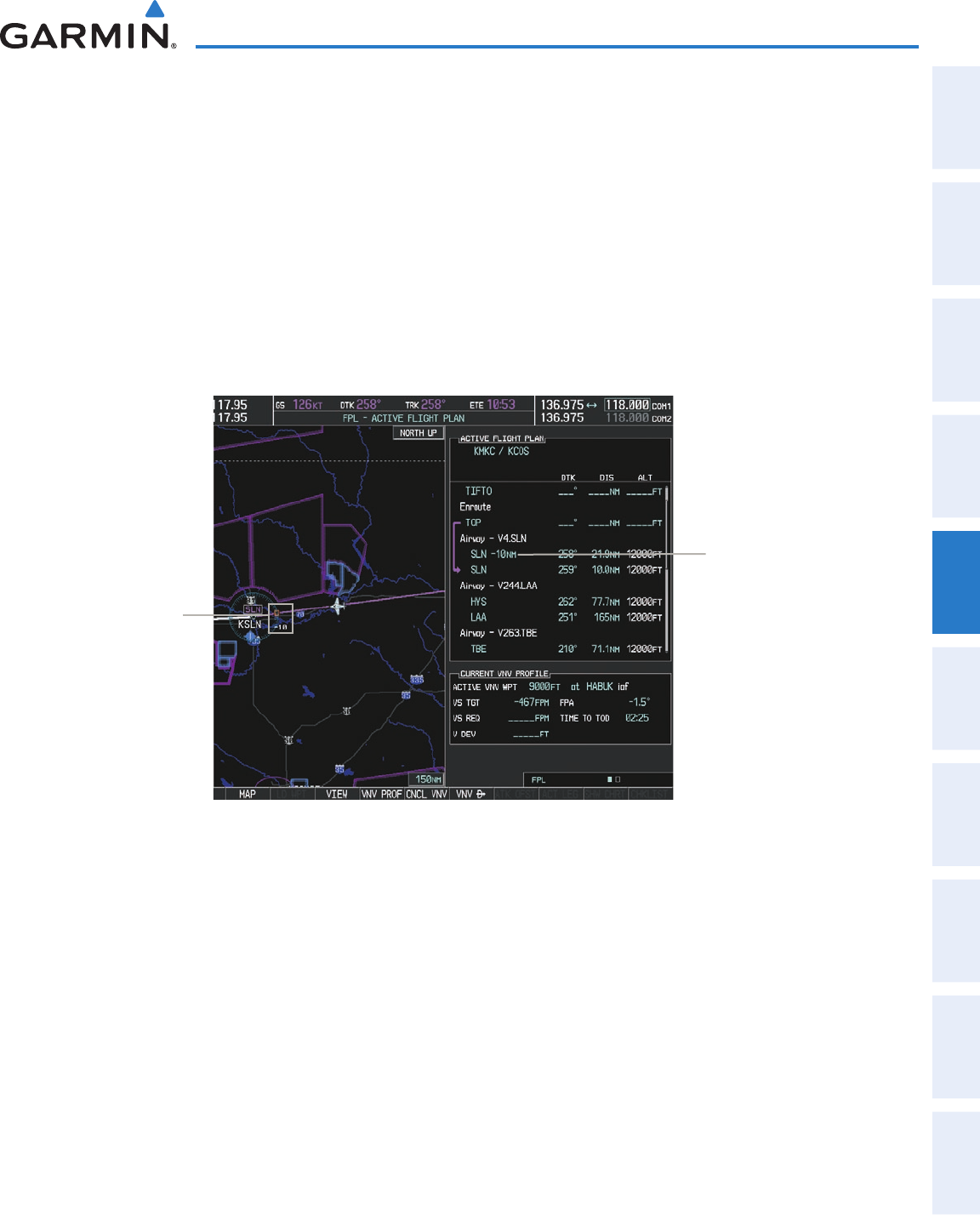
190-00592-06 Rev. A
Garmin G1000 Pilot’s Guide for the Diamond DA40/40F
213
FLIGHT MANAGEMENT
SYSTEM
OVERVIEW
FLIGHT
INSTRUMENTS EIS AUDIO PANEL
& CNS
FLIGHT
MANAGEMENT
HAZARD
AVOIDANCE AFCS ADDITIONAL
FEATURES APPENDICES INDEX
entered from 1 to 99 nm in increments of 1 nm. Entering a negative offset distance results in an along track
offset waypoint inserted before the selected waypoint, whereas entering a positive offset distance results in an
along track offset waypoint inserted after the selected waypoint. Multiple offset waypoints are allowed.
A waypoint must be adjacent to its parent waypoint in the flight plan, so the system limits the along-track
distance to less than the length of the leg before or after the selected waypoint. If the selected waypoint is the
active waypoint, the distance is limited to less than the distance to go to the active waypoint. Assigning an along
track offset to a leg with indeterminate length is not permitted. An along track offset is not allowed at or after
the final approach fix of an approach.
An along track offset distance cannot be modified once entered. If the along track offset distance must be
changed, the existing along track offset waypoint must be deleted and a new one created with the new offset
distance.
Figure 5-76 Along Track Offset
Along Track
Offset Waypoint
and Distance
Along Track Offset
Waypoint and Distance
from Flight Plan Waypoint
Entering an along track offset distance:
1) Press the FPL Key to display the Active Flight Plan Page (MFD) or the Active Flight Plan Window (PFD).
2) Press the FMS Knob to activate the cursor (not required on the PFD) and turn the large FMS Knob to highlight
the waypoint for the along track offset.
3) Press the ATK OFST Softkey (MFD only); or press the MENU Key, highlight ‘Create ATK Offset Waypoint’, and
press the ENT Key.
4) Enter a positive or negative offset distance in the range of +/- 1 to 99 nm (limited by leg distances).
5) Press the ENT Key to create the offset waypoint.
6) Press the FMS Knob to remove the flashing cursor.
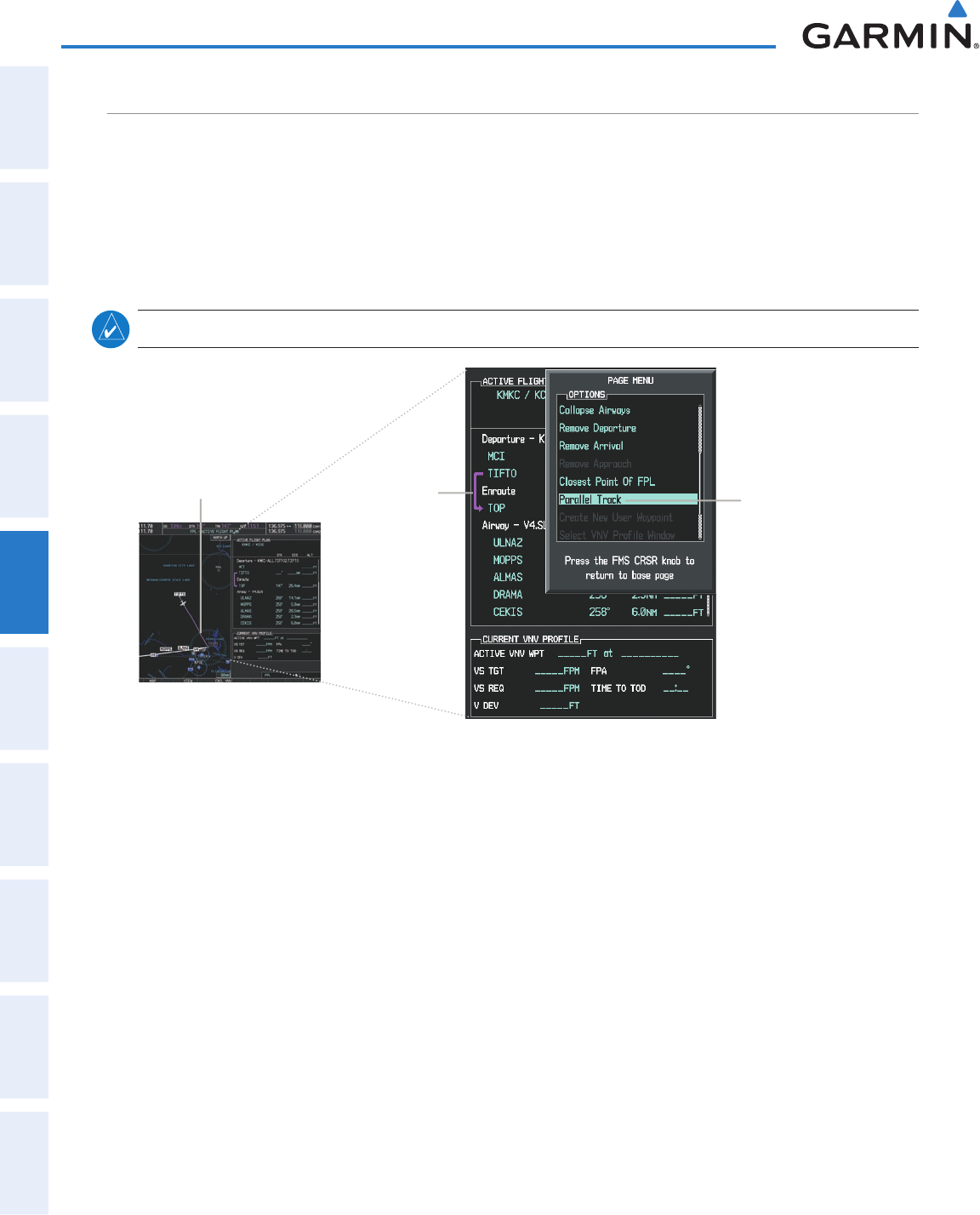
Garmin G1000 Pilot’s Guide for the Diamond DA40/40F
190-00592-06 Rev. A214
FLIGHT MANAGEMENT
SYSTEM
OVERVIEW
FLIGHT
INSTRUMENTS
EIS
AUDIO PANEL
& CNS
FLIGHT
MANAGEMENT
HAZARD
AVOIDANCE
AFCS
ADDITIONAL
FEATURES
APPENDICESINDEX
PARALLEL TRACK
The Parallel Track (PTK) feature allows creation of a parallel course offset of 1 to 50 nm left or right of the
current flight plan. When Parallel Track is activated, the course line drawn on the map pages shows the parallel
course, and waypoint names have a lower case “p” placed after the identifier.
Using direct-to, loading an approach, a holding pattern, or editing and activating the flight plan automatically
cancels Parallel Track. Parallel Track is also cancelled if a course change occurs greater than 120° or the parallel
tracks overlap as a result of the course change.
NOTE: Vertical navigation is unavailable while the Parallel Track feature is active.
Figure 5-77 Active Flight Plan Window - Selecting Parallel Track
Selecting Parallel
Track
Active Flight Plan prior to Parallel Track
Activating parallel track:
1) Press the FPL Key to display the Active Flight Plan Page (MFD) or the Active Flight Plan Window (PFD)
2) Press the MENU Key, highlight ‘Parallel Track’, and press the ENT Key. The Parallel Track Window is displayed
with the direction field highlighted.
3) Turn the small FMS Knob to select ‘Left’ or ‘Right’ and press the ENT Key. The ‘DISTANCE’ field is highlighted.
4) Turn the small FMS Knob to enter a distance from 1-99 nm and press the ENT Key. ‘ACTIVATE PARALLEL
TRACK’ is highlighted.
5) Press the ENT Key to activate parallel track. Press the FMS Knob or the CLR Key to cancel the parallel track
activation.
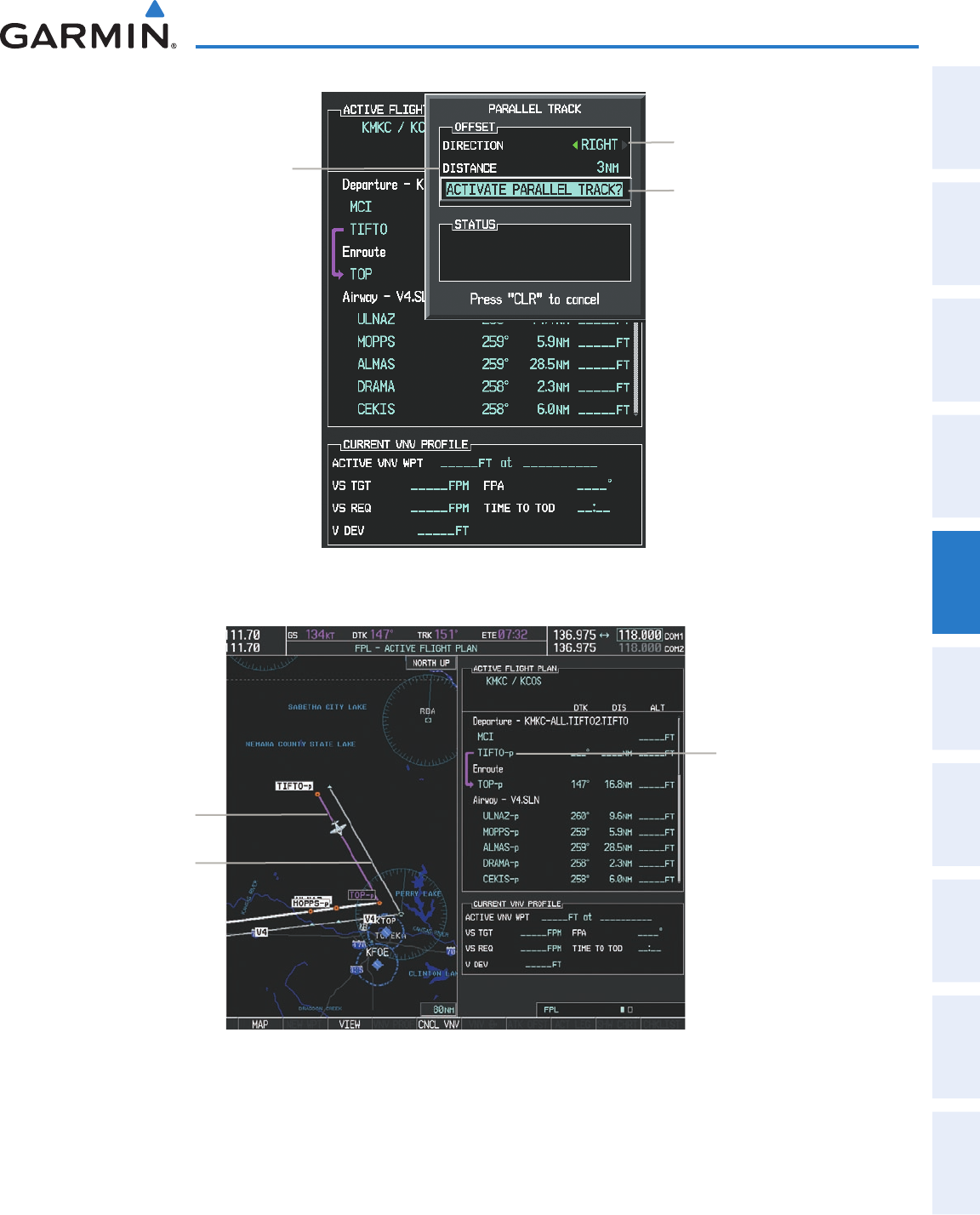
190-00592-06 Rev. A
Garmin G1000 Pilot’s Guide for the Diamond DA40/40F
215
FLIGHT MANAGEMENT
SYSTEM
OVERVIEW
FLIGHT
INSTRUMENTS EIS AUDIO PANEL
& CNS
FLIGHT
MANAGEMENT
HAZARD
AVOIDANCE AFCS ADDITIONAL
FEATURES APPENDICES INDEX
Figure 5-78 Parallel Track Window
Offset Direction
Offset Distance
Activation Prompt
Figure 5-79 Parallel Track Active
Parallel Track Waypoints
- TIFTO-p
- TOP-p
- ULNAZ-p
- ...
- LAA-p
Activating Parallel Track
affects the entire active
flight segment (e.g.,
enroute)
Parallel Track
Original Track
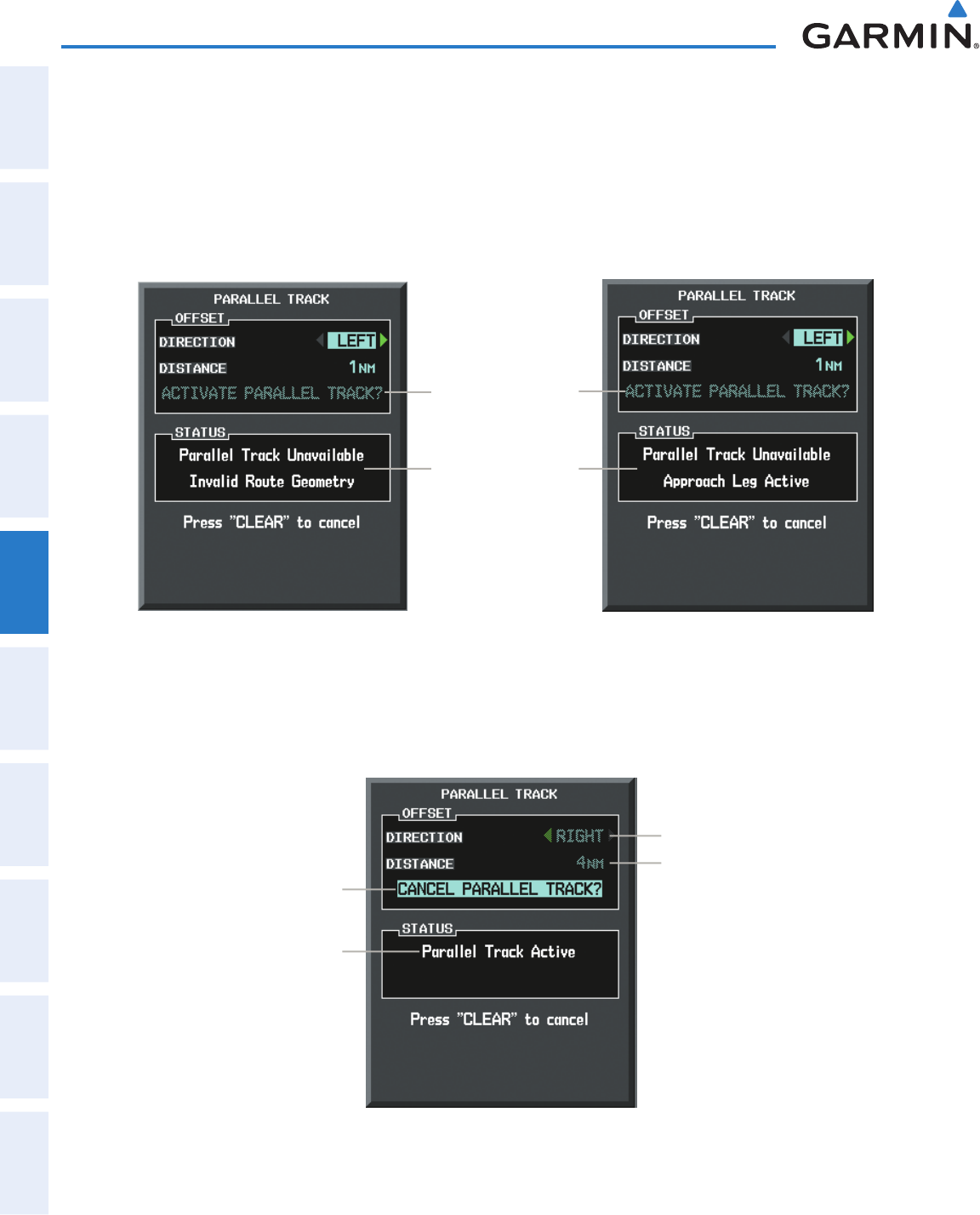
Garmin G1000 Pilot’s Guide for the Diamond DA40/40F
190-00592-06 Rev. A216
FLIGHT MANAGEMENT
SYSTEM
OVERVIEW
FLIGHT
INSTRUMENTS
EIS
AUDIO PANEL
& CNS
FLIGHT
MANAGEMENT
HAZARD
AVOIDANCE
AFCS
ADDITIONAL
FEATURES
APPENDICESINDEX
If the parallel track proposed by the offset direction and distance is not allowed by the system, the activation
prompt is displayed, but disabled. Parallel Track cannot be activated if a course is set using direct-to or if the
active leg is the first leg of the departure procedure. Attempting to activate parallel track with these conditions
results in the message ‘Parallel Track Unavailable Invalid Route Geometry’. If an approach leg is active the status
indicates that the system is unable to activate the parallel track with the message ‘Parallel Track Unavailable
Approach Leg Active’. If the offset direction and distance results in an unreasonable route geometry the status
indicates that the system is unable to activate the parallel track because of invalid geometry.
Figure 5-80 Parallel Track Unavailable
Subdued Prompt
(Unavailable)
Unavailable Status
Invalid Approach
Geometry Active
If the active leg is not a track between two fixes (TF) or a course to a fix (DF) leg, the status
indicates that the system is unable to activate the parallel track because parallel track is not available for the
active leg type.
Figure 5-81 Cancelling Parallel Track
Cancel Prompt
Active Status
Offset Direction &
Distance Subdued
(Unavailable)
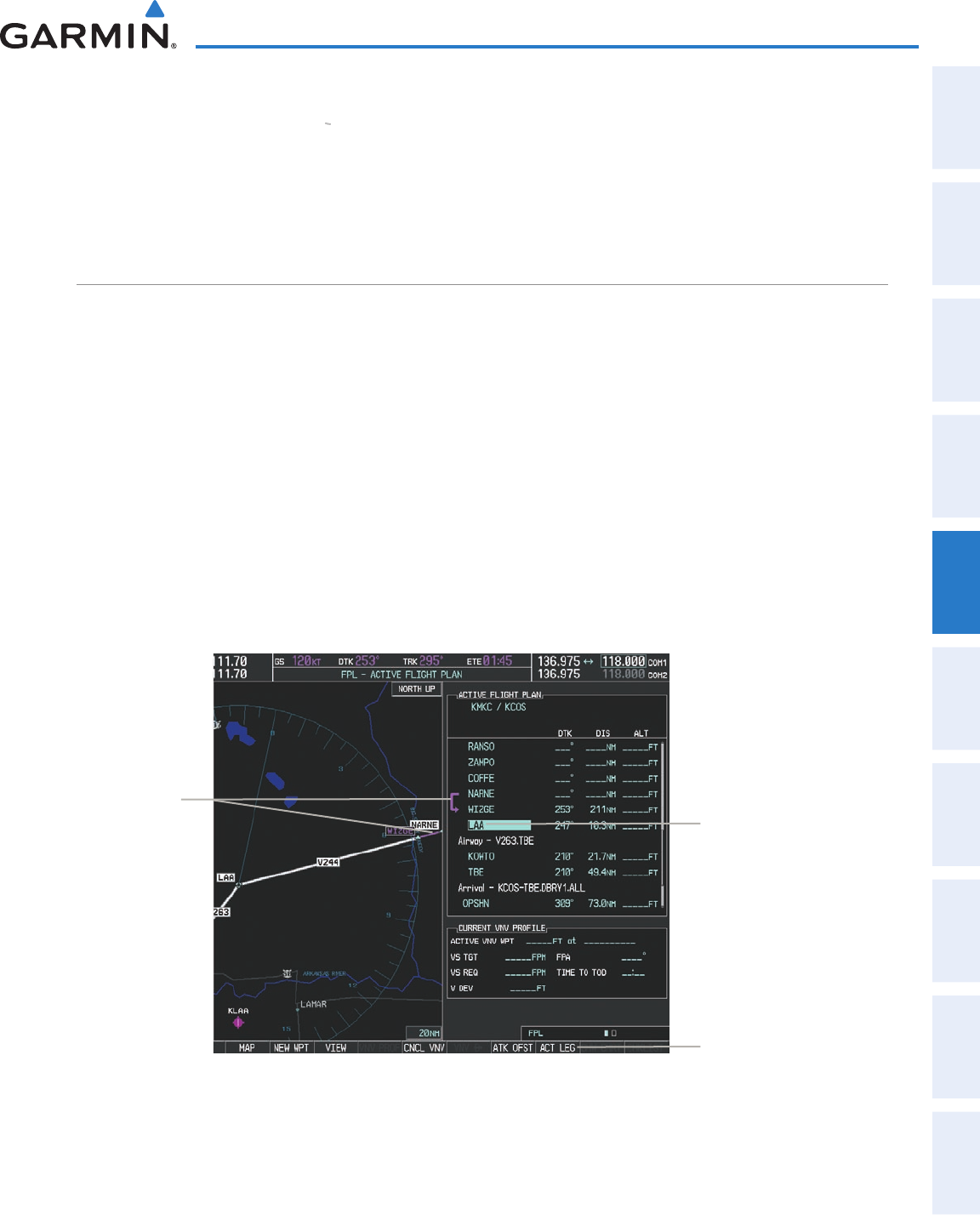
190-00592-06 Rev. A
Garmin G1000 Pilot’s Guide for the Diamond DA40/40F
217
FLIGHT MANAGEMENT
SYSTEM
OVERVIEW
FLIGHT
INSTRUMENTS EIS AUDIO PANEL
& CNS
FLIGHT
MANAGEMENT
HAZARD
AVOIDANCE AFCS ADDITIONAL
FEATURES APPENDICES INDEX
Cancelling parallel track:
1) Press the FPL Key to display the Active Flight Plan Page (MFD) or the Active Flight Plan Window (PFD)
2) Press the MENU Key, highlight ‘Parallel Track’, and press the ENT Key. The Parallel Track Window is displayed
with ‘CANCEL PARALLEL TRACK?’ highlighted.
3) Press the ENT Key.
ACTIVATING A FLIGHT PLAN LEG
The G1000 allows selection of a highlighted leg as the “active leg” (the flight plan leg which is currently
used for navigation guidance).
Activating a flight plan leg:
1) Press the FPL Key to display the Active Flight Plan Page (MFD) or the Active Flight Plan Window (PFD)
2) Press the FMS Knob to activate the cursor (not required on the PFD) and turn the large FMS Knob to highlight
the destination waypoint for the desired leg.
3) Press the ACT LEG Softkey (MFD only); or press the MENU Key, highlight ‘Activate Leg’, and press the ENT K e y .
A confirmation window is displayed with ‘ACTIVATE’ highlighted.
4) Press the ENT Key to activate the flight plan leg. To cancel, press the CLR Key, or highlight ‘CANCEL’ and press
the ENT Key.
5) Press the FMS Knob to remove the flashing cursor.
Figure 5-82 Active Flight Plan Page - Selecting the Leg Destination Waypoint
Current
Active Leg
Activate Leg Softkey
Selected Destination
Waypoint
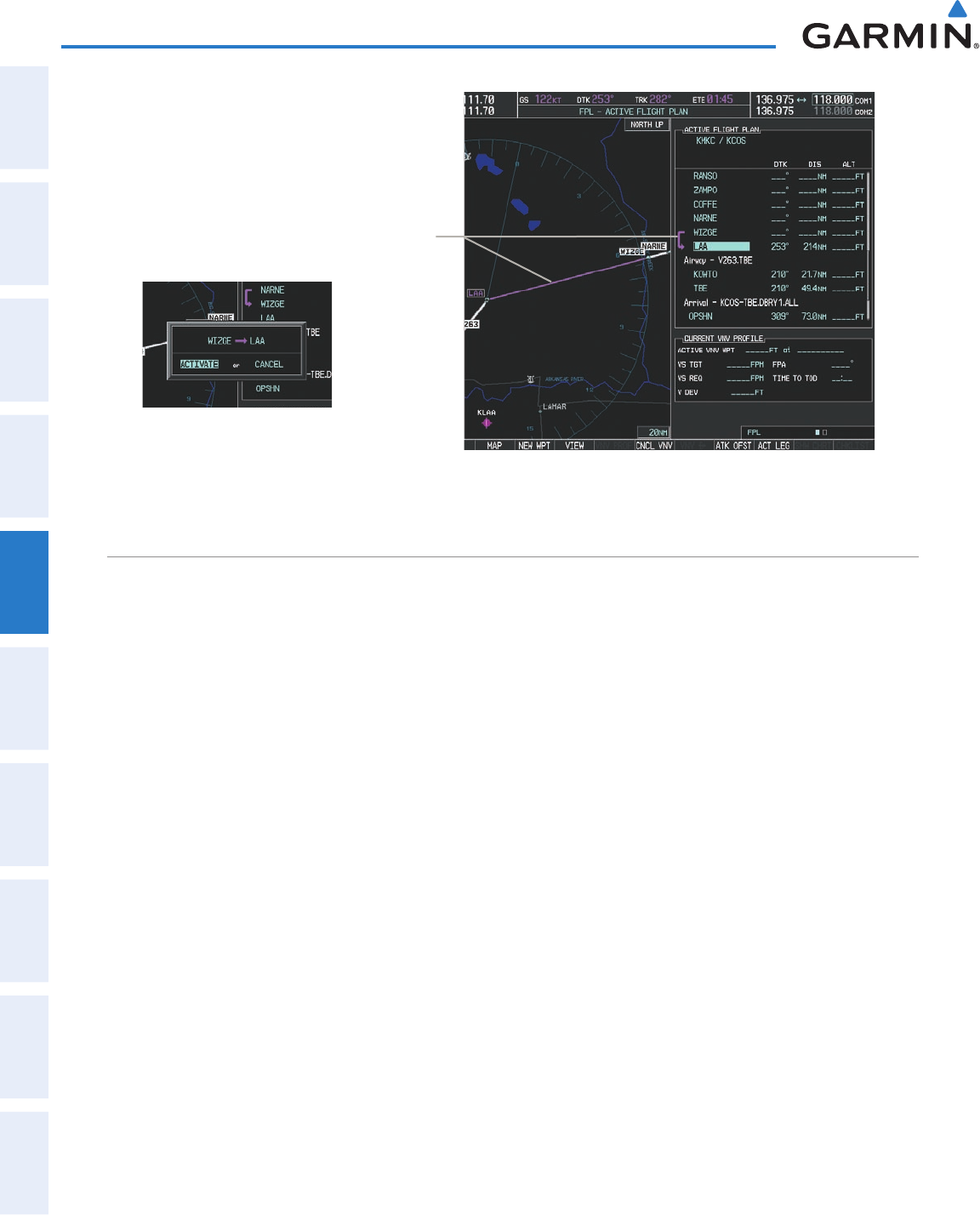
Garmin G1000 Pilot’s Guide for the Diamond DA40/40F
190-00592-06 Rev. A218
FLIGHT MANAGEMENT
SYSTEM
OVERVIEW
FLIGHT
INSTRUMENTS
EIS
AUDIO PANEL
& CNS
FLIGHT
MANAGEMENT
HAZARD
AVOIDANCE
AFCS
ADDITIONAL
FEATURES
APPENDICESINDEX
Figure 5-83 Active Flight Plan Page - New Active Leg
New Active
Flight Plan Leg
Confirmation Window
INVERTING A FLIGHT PLAN
Any flight plan may be inverted (reversed) for navigation back to the original departure point.
Inverting the active flight plan:
1) Press the FPL Key to display the Active Flight Plan Page (MFD) or the Active Flight Plan Window (PFD)
2) Press the MENU Key, highlight ‘Invert Flight Plan’, and press the ENT Key. An ‘Invert Active Flight Plan?’
confirmation window is displayed.
3) Select ‘OK’.
4) Press the ENT Key to invert and activate the active flight plan. To cancel, press the CLR Key, or highlight
‘CANCEL’ and press the ENT Key.
Inverting and activating a stored flight plan:
1) Press the FPL Key on the MFD to display the Active Flight Plan Page.
2) Turn the small FMS Knob clockwise one click to display the Flight Plan Catalog Page.
3) Press the FMS Knob to activate the cursor and turn the FMS Knob to highlight the flight plan to be inverted.
4) Press the INVERT Softkey; or press the MENU Key, select ‘Invert & Activate Flight Plan’ and press the ENT Key.
An ‘Invert and activate stored flight plan?’ confirmation window is displayed.
5) Select ‘OK’.
6) Press the ENT Key to invert and activate the stored flight plan. To cancel, press the CLR Key, or highlight
‘CANCEL’ and press the ENT Key.
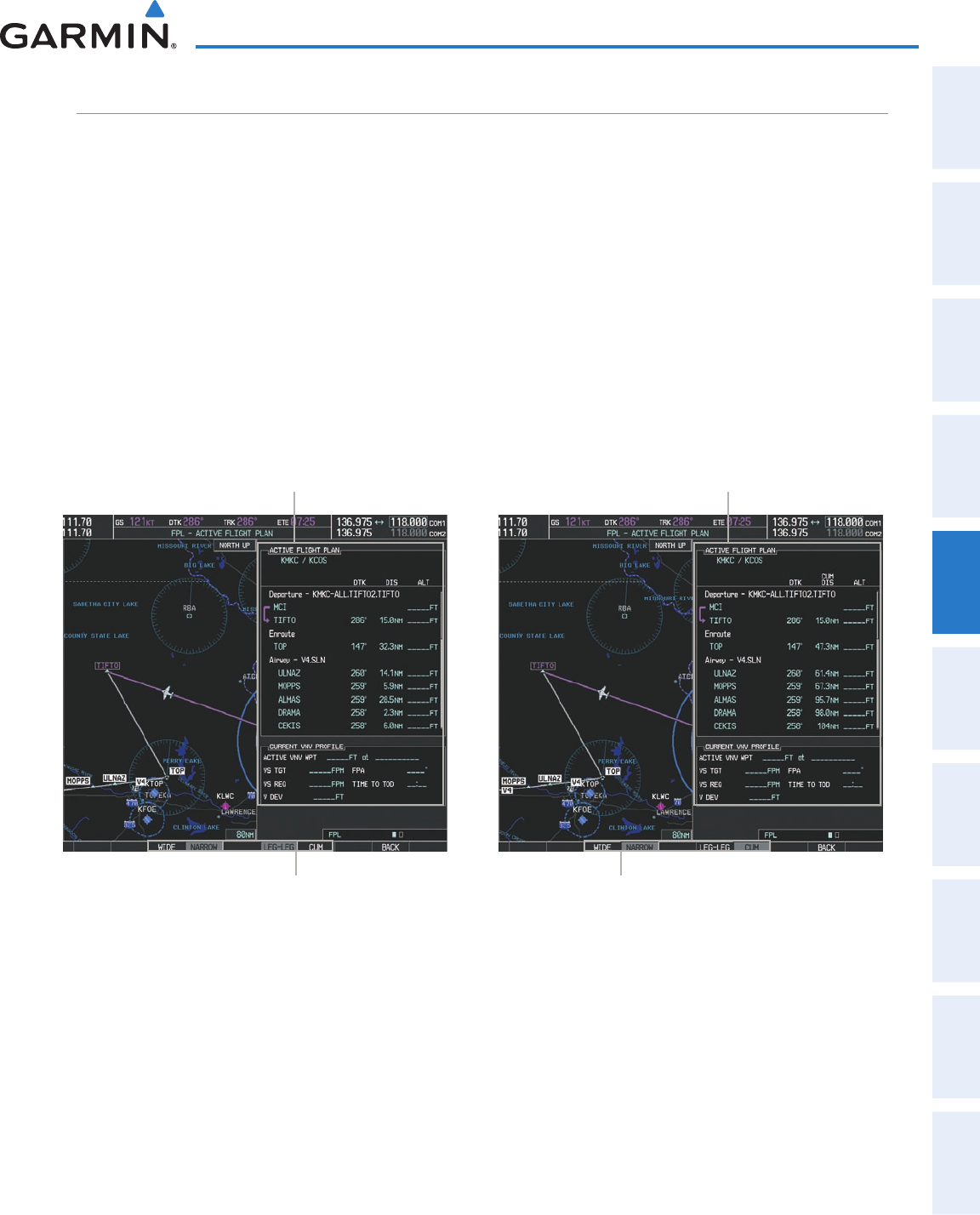
190-00592-06 Rev. A
Garmin G1000 Pilot’s Guide for the Diamond DA40/40F
219
FLIGHT MANAGEMENT
SYSTEM
OVERVIEW
FLIGHT
INSTRUMENTS EIS AUDIO PANEL
& CNS
FLIGHT
MANAGEMENT
HAZARD
AVOIDANCE AFCS ADDITIONAL
FEATURES APPENDICES INDEX
FLIGHT PLAN VIEWS
Information about flight plans can be viewed in more than one way. The active flight plan can be configured
to show cumulative distance over the length of the flight plan or the distance for each leg of the flight plan;
and the active flight plan can be viewed in a narrow or wide view. In the wide view, additional information is
displayed: Fuel Remaining (FUEL REM), Estimated Time Enroute (ETE), Estimated Time of Arrival (ETA), and
Bearing to the waypoint (BRG).
Switching between leg-to-leg waypoint distance and cumulative waypoint distance:
1) Press the FPL Key on the MFD to display the Active Flight Plan Page.
2) Press the VIEW Softkey to display the CUM and LEG-LEG Softkeys.
3) Press the CUM Softkey to view cumulative waypoint distance, or press the LEG-LEG Softkey to view leg-to-leg
waypoint distance.
4) Press the BACK Softkey to return to the top level active flight plan softkeys.
Figure 5-84 Active Flight Plan - Leg to Leg vs. Cumulative Distance
Active Flight Plan
Leg to Leg Distance
Active Flight Plan
Cumulative Distance
WIDE Softkey, NARROW Softkey, LEG-LEG Softkey, CUM Softkey
Switching between wide and narrow view:
1) Press the FPL Key on the MFD to display the Active Flight Plan Page.
2) Press the VIEW Softkey to display the WIDE and NARROW Softkeys.
3) Press the WIDE Softkey to display the wide view, or press the NARROW Softkey to display the narrow view.
4) Press the BACK Softkey to return to the top level active flight plan softkeys.
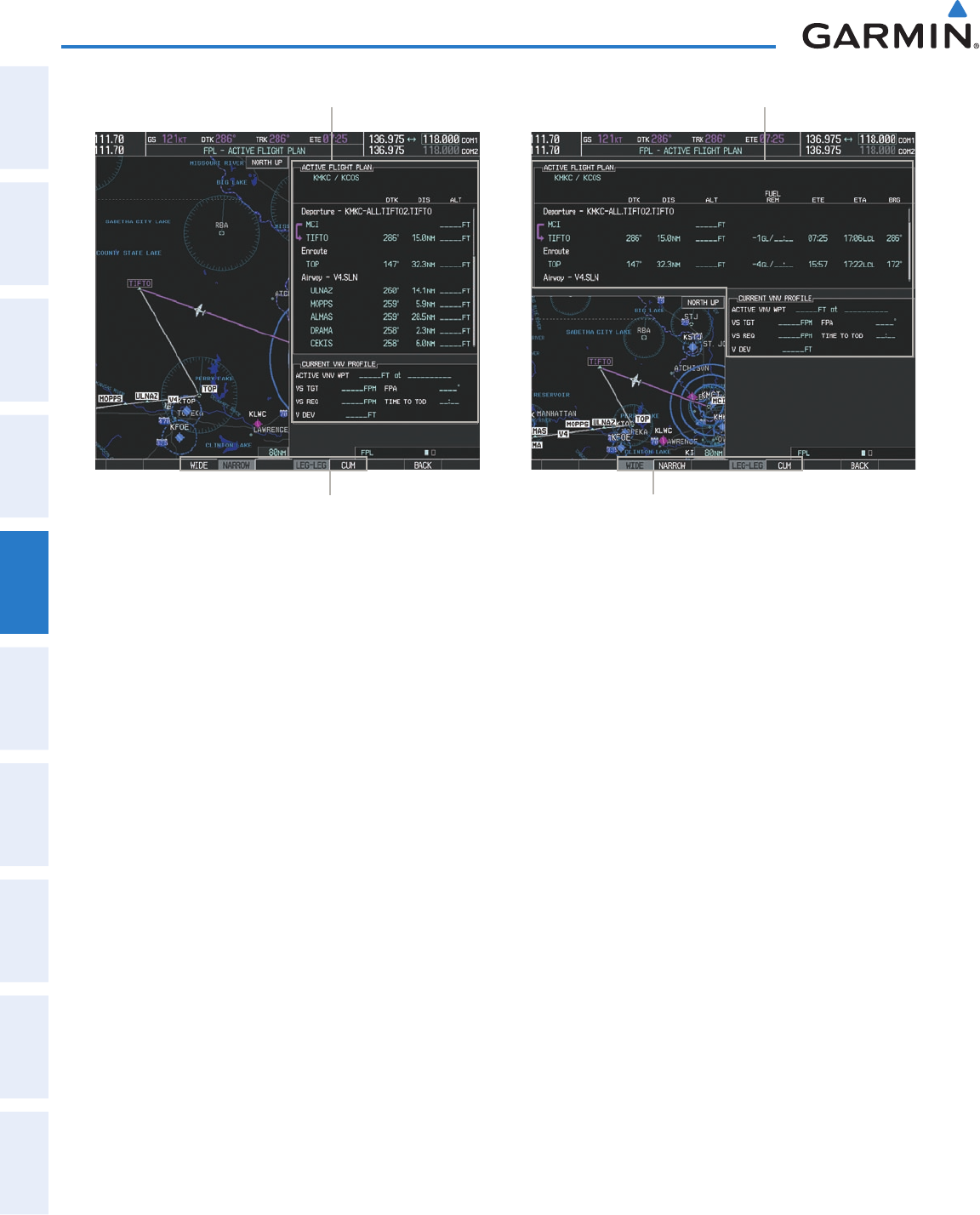
Garmin G1000 Pilot’s Guide for the Diamond DA40/40F
190-00592-06 Rev. A220
FLIGHT MANAGEMENT
SYSTEM
OVERVIEW
FLIGHT
INSTRUMENTS
EIS
AUDIO PANEL
& CNS
FLIGHT
MANAGEMENT
HAZARD
AVOIDANCE
AFCS
ADDITIONAL
FEATURES
APPENDICESINDEX
Figure 5-85 Active Flight Plan - Wide vs. Narrow View
WIDE Softkey, NARROW Softkey, LEG-LEG Softkey, CUM Softkey
Active Flight Plan
Narrow View
Active Flight Plan
Wide View
COLLAPSING AIRWAYS
The G1000 allows airways on the active flight plan to be collapsed or expanded from the Active Flight Plan
Page/Window. When airways have been collapsed, it is indicated on the airway heading.
When airways are collapsed, leg-to-leg computed values such as DIS or ETE shown for the exit waypoint
reflects the total of all the legs on the airway that have been hidden in the collapsed display. The DTK value is
inhibited because it is not usable in this context.
The Active Flight Plan Page always keeps the following three waypoints visible: “From” waypoint, “To”
waypoint, and the “Next” waypoint. To prevent one or more of these waypoints from being hidden in a collapsed
airway segment, the airway segment that contains either the “To” or the “Next” waypoint is automatically
expanded. When an airway is loaded, airways are automatically expanded to facilitate flight plan review.
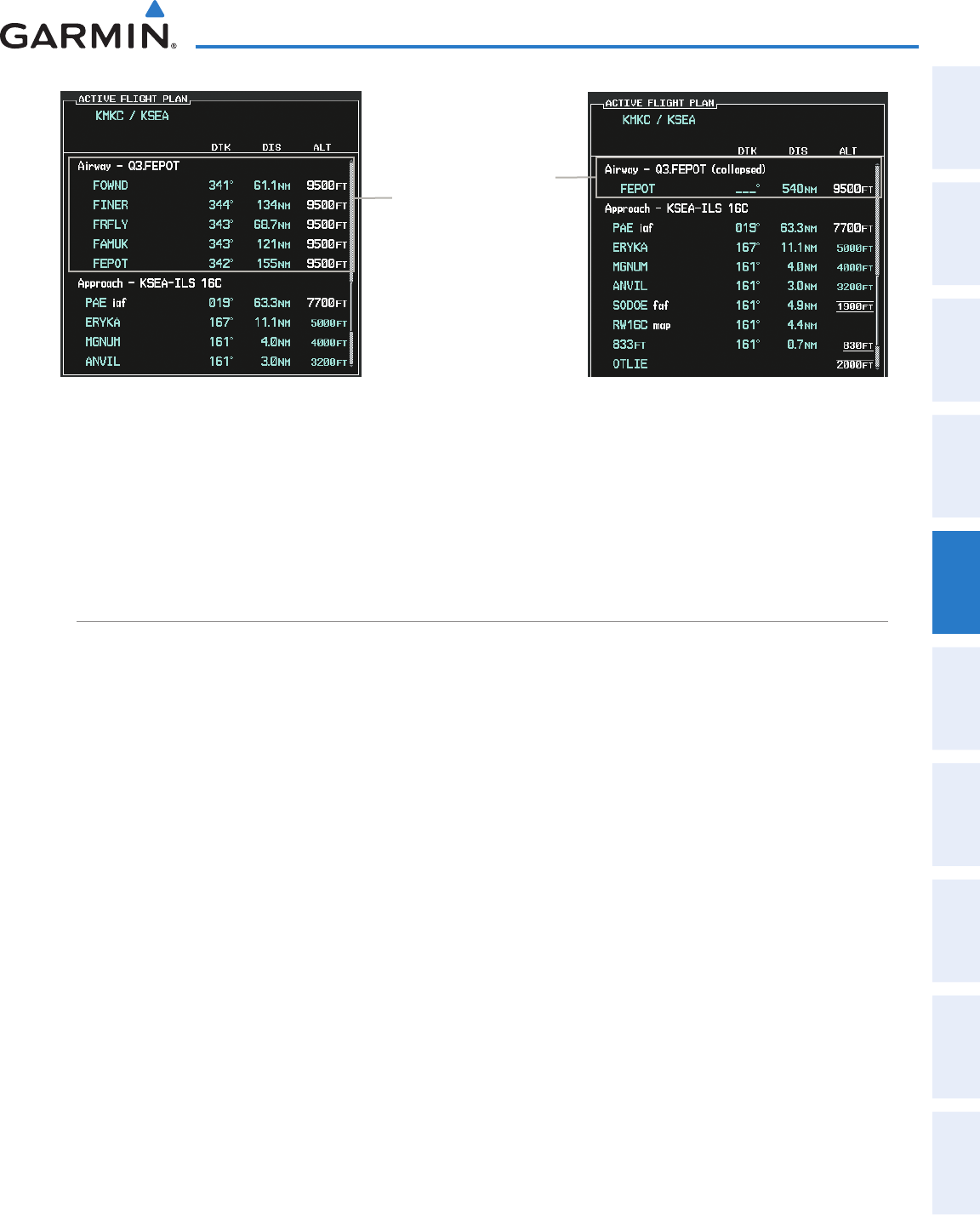
190-00592-06 Rev. A
Garmin G1000 Pilot’s Guide for the Diamond DA40/40F
221
FLIGHT MANAGEMENT
SYSTEM
OVERVIEW
FLIGHT
INSTRUMENTS EIS AUDIO PANEL
& CNS
FLIGHT
MANAGEMENT
HAZARD
AVOIDANCE AFCS ADDITIONAL
FEATURES APPENDICES INDEX
Figure 5-86 Expanded/Collapsed Airways
Q3.FEPOT Airway
Collapsed View
Expanded View
Collapsing/expanding the airways in the active flight plan:
1) Press the FPL Key to display the Active Flight Plan Page (MFD) or the Active Flight Plan Window (PFD)
2) Press the MENU Key, highlight ‘Collapse Airways’ or ‘Expand Airways’, and press the ENT Key. The airways are
collapsed/expanded.
CLOSEST POINT OF FPL
‘Closest Point of FPL’ calculates the bearing and closest distance at which a flight plan passes a reference
waypoint, and creates a new user waypoint along the flight plan at the location closest to a chosen reference
waypoint.
Determining the closest point along the active flight plan to a selected waypoint:
1) Press the FPL Key to display the Active Flight Plan Page (MFD) or the Active Flight Plan Window (PFD)
2) Press the MENU Key, highlight ‘Closest Point of FPL’’, and press the ENT Key. A window appears with the
reference waypoint field highlighted.
3) Enter the identifier of the reference waypoint and press the ENT Key. The G1000 displays the bearing (BRG) and
distance (DIS) to the closest point along the flight plan to the selected reference waypoint and creates a user
waypoint at this location. The name for the new user waypoint is derived from the identifier of the reference
waypoint.
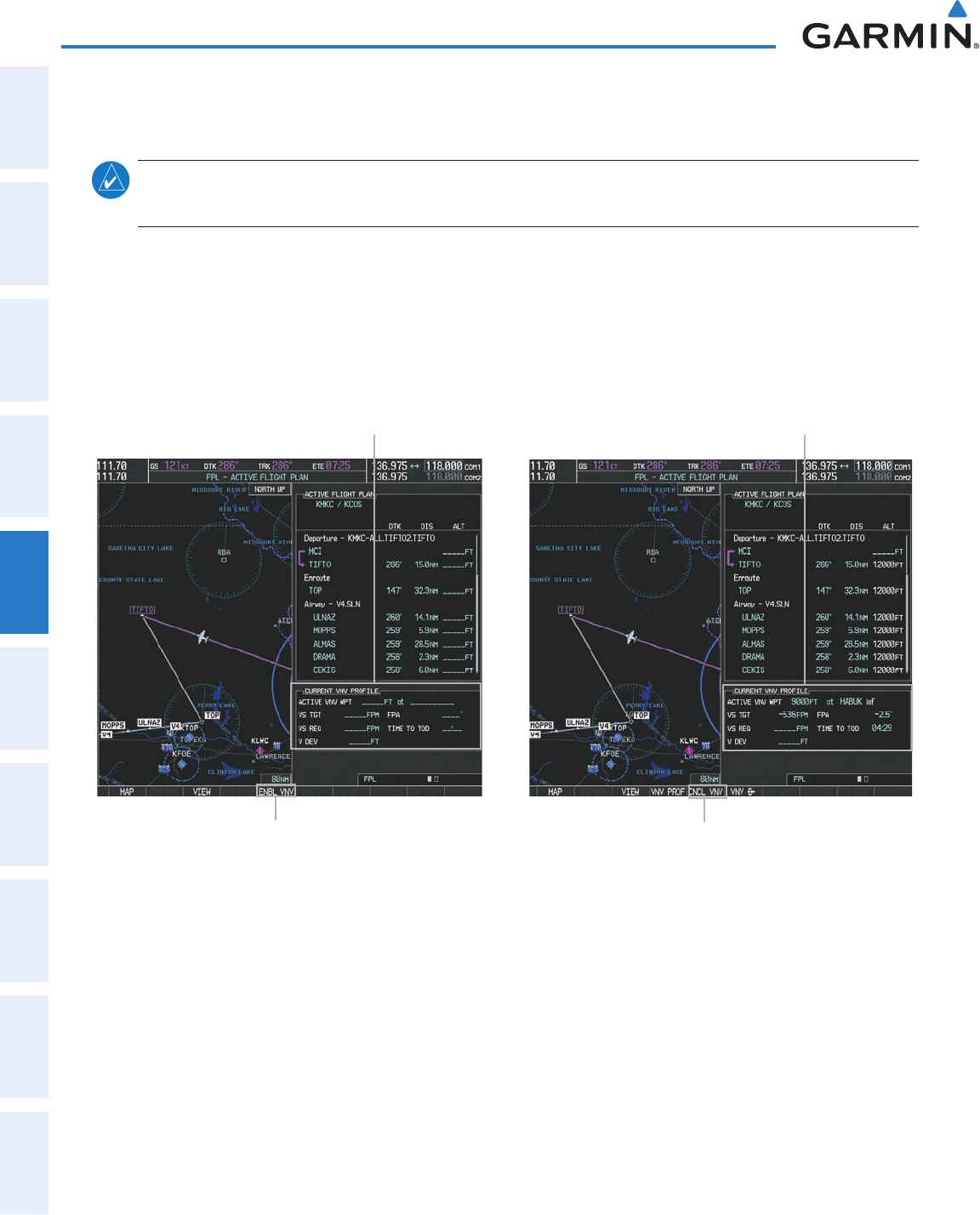
Garmin G1000 Pilot’s Guide for the Diamond DA40/40F
190-00592-06 Rev. A222
FLIGHT MANAGEMENT
SYSTEM
OVERVIEW
FLIGHT
INSTRUMENTS
EIS
AUDIO PANEL
& CNS
FLIGHT
MANAGEMENT
HAZARD
AVOIDANCE
AFCS
ADDITIONAL
FEATURES
APPENDICESINDEX
5.7 VERTICAL NAVIGATION
NOTE: The G1000 supports vertical navigation for all lateral leg types except for CA, CI, FA, FM, HA, HM, PI,
VA, VD, VI, VR, and VM. Vertical constraints are not retained in stored flight plans.
The G1000 system Vertical Navigation (VNV) feature provides vertical profile guidance during the enroute
and teminal phases of flight. Guidance based on specified altitudes at waypoints in the active flight plan or to a
direct-to waypoint is provided. It includes vertical path guidance to a descending path, which is provided as a
linear deviation from the desired path. The desired path is defined by a line joining two waypoints with specified
altitudes or as a vertical angle from a specified waypoint/altitude. The vertical waypoints are integrated into the
active flight plan. Both manual and autopilot-coupled guidance are supported.
Figure 5-87 Enabling/Disabling Vertical Navigation
CNCL VNV Softkey
Current Vertical Navigation Profile
Disabled (fields dashed)
ENBL VNV Softkey
Current Vertical Navigation Profile
Enabled (valid data)
Enabling VNV guidance:
1) Press the FPL Key to display the Active Flight Plan Page on the MFD.
2) Press the ENBL VNV Softkey; or press the MENU Key, highlight ‘Enable VNV’, and press the ENT Key. Vertical
navigation is enabled, and vertical guidance begins with the waypoint shown in the CURRENT VNV PROFILE box
(defaults first waypoint in the active flight plan with an altitude enabled for vertical navigation (e.g., HABUK)).
Disabling VNV guidance:
1) Press the FPL Key to display the Active Flight Plan Page on the MFD.
2) Press the CNCL VNV Softkey; or press the MENU Key, highlight ‘Cancel VNV’, and press the ENT Key. Vertical
navigation is disabled.
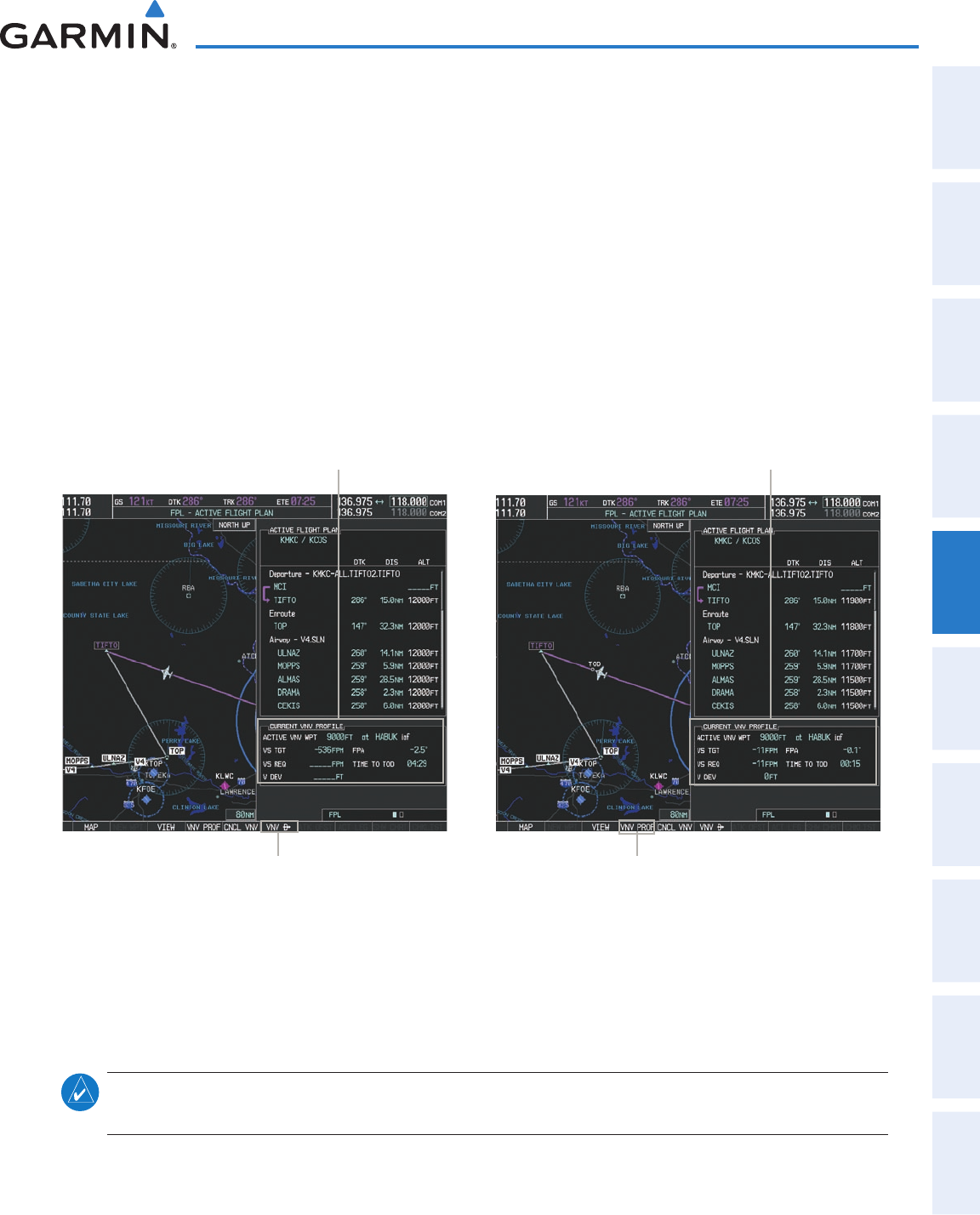
190-00592-06 Rev. A
Garmin G1000 Pilot’s Guide for the Diamond DA40/40F
223
FLIGHT MANAGEMENT
SYSTEM
OVERVIEW
FLIGHT
INSTRUMENTS EIS AUDIO PANEL
& CNS
FLIGHT
MANAGEMENT
HAZARD
AVOIDANCE AFCS ADDITIONAL
FEATURES APPENDICES INDEX
Canceling vertical navigation results in vertical deviation (V DEV), vertical speed required (VS REQ), and time
to top of descent/bottom of descent (TIME TO TOD/BOD) going invalid. The Vertical Deviation Indicator (VDI)
and Required Vertical Speed Indicator (RVSI) on the PFD are removed, and the V DEV, VS REQ, and TIME TO
TOD items displayed in the CURRENT VNV PROFILE box are dashed. VNV remains disabled until manually
enabled. Vertical guidance in reversionary mode can only be enabled for a direct-to waypoint.
The G1000 allows a vertical navigation direct-to to any waypoint in the active flight plan with an altitude
constraint “designated” for vertical guidance. Selecting the VNV Direct-to Softkey on the Active Flight Plan Page
allows the flight plan to be flown, while vertical guidance based on the altitude constraint at the VNV direct-to
waypoint is provided. The altitude change begins immediately and is spread along the flight plan from current
position to the vertical direct-to waypoint, not just along the leg for the direct-to waypoint. A direct-to with
altitude constraint activated by pressing the Direct-to Key also provides vertical guidance, but would bypass
flight plan waypoints between the current position in the flight plan and the direct-to waypoint. A top of descent
(TOD) point is computed based on the default flight path angle; descent begins once the TOD is reached.
Figure 5-88 Vertical Navigation Direct-To
Current Vertical Navigation Profile
Prior to VNV Direct-to
VNV Direct-To Softkey VNV PROF Softkey
Current Vertical Navigation Profile
After VNV Direct-to
Activating a vertical navigation direct-to:
1) Press the FPL Key to display the Active Flight Plan Page on the MFD.
2) Press the FMS Knob to activate the cursor and turn the FMS Knob to highlight the desired waypoint.
NOTE: The selected waypoint must have a designated altitude constraint (light blue number) to be used. If
not, the first waypoint in the flight plan with a designated altitude constraint is selected.
3) Select the VNV Direct-To Softkey; or press the MENU Key, highlight ‘VNV Direct-To’, and press the ENT Key.
An ‘Activate vertical Direct-to to: NNNNNFT at XXXXXX?’ confirmation window is displayed.
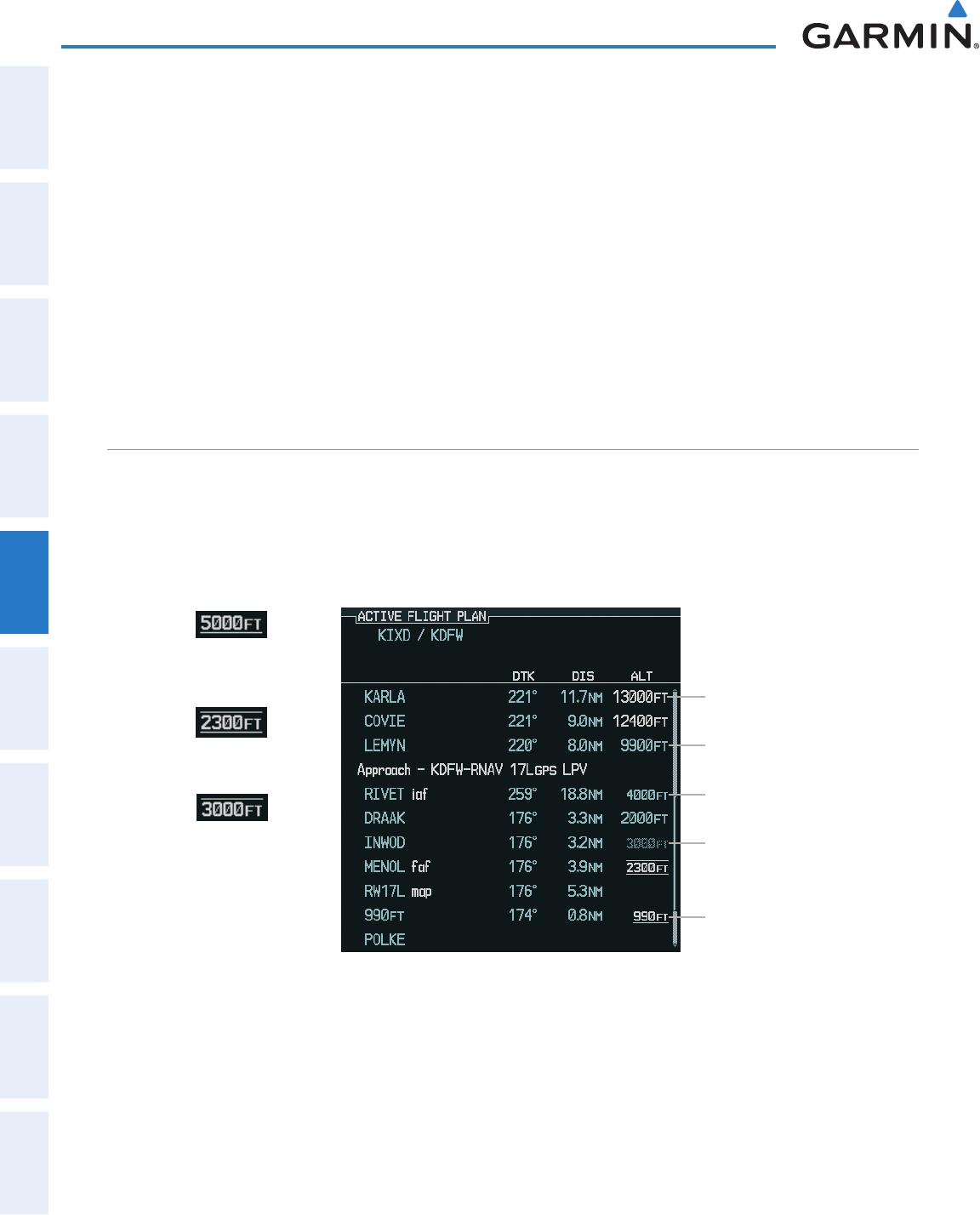
Garmin G1000 Pilot’s Guide for the Diamond DA40/40F
190-00592-06 Rev. A224
FLIGHT MANAGEMENT
SYSTEM
OVERVIEW
FLIGHT
INSTRUMENTS
EIS
AUDIO PANEL
& CNS
FLIGHT
MANAGEMENT
HAZARD
AVOIDANCE
AFCS
ADDITIONAL
FEATURES
APPENDICESINDEX
4) Press the ENT Key. Vertical guidance begins to the altitude constraint for the selected waypoint.
5) Press the FMS Knob to remove the flashing cursor.
The vertical navigation profile can be modified by directly entering a vertical speed target (VS TGT) and/or flight
path angle (FPA) in the CURRENT VNV PROFILE box.
Modifying the VS TGT and FPA:
1) Press the FPL Key to display the Active Flight Plan Page on the MFD.
2) Press the VNV PROF Softkey; or press the MENU Key, highlight ‘Select VNV Profile Window’, and press the ENT
Key. The cursor is now located in the CURRENT VNV PROFILE box.
3) Turn the FMS Knobs as needed to edit the values.
4) Press the FMS Knob to remove the flashing cursor.
ALTITUDE CONSTRAINTS
The G1000 system can use altitude constraints associated with lateral waypoints to give guidance for vertical
navigation. These altitudes are, depending on the specific instance, manually entered or retrieved from the
published altitudes in the navigation database. The navigation database only contains altitudes for procedures
that call for “Cross at” altitudes. If the procedure states “Expect to cross at,” then the altitude is not in the
database. In this case the altitude may be entered manually.
Large Light Blue Text
Small White Text with
Altitude Restriction Bar
Large White Text
Small Light Blue
Subdued Text
Small Light Blue Text
Figure 5-89 Waypoint Altitude Constraints
Cross AT
or ABOVE
5,000 ft
Cross AT
or BELOW
3,000 ft
Cross AT
2,300 ft
Altitude Constraint
Examples
Displayed Text
Examples
190-00592-06 Rev. A
Garmin G1000 Pilot’s Guide for the Diamond DA40/40F
225
FLIGHT MANAGEMENT
SYSTEM
OVERVIEW
FLIGHT
INSTRUMENTS EIS AUDIO PANEL
& CNS
FLIGHT
MANAGEMENT
HAZARD
AVOIDANCE AFCS ADDITIONAL
FEATURES APPENDICES INDEX
White Text Light Blue Text Light Blue Subdued Text
Large
Text
Altitude calculated by the system
estimating the altitude of the aircraft as
it passes over the navigation point. This
altitude is provided as a reference and is
not designated to be used in determining
vertical speed and deviation guidance.
Altitude has been entered manually.
Altitude is designated for use in giving
vertical speed and deviation guidance.
Altitude does not match the published
altitude in navigation database or no
published altitude exists.
The system cannot use this
altitude in determining vertical
speed and deviation guidance
because of an invalid constraint
condition
Small
Text
Altitude is not designated to be used in
determining vertical speed and deviation
guidance. Altitude has been retrieved
from the navigation database and is
provided as a reference.
Altitude is designated for use in giving
vertical speed and deviation guidance.
Altitude has been retrieved from the
navigation database or has been entered
manually and matches a published
altitude in the navigation database.
The system cannot use this
altitude in determining vertical
speed and deviation guidance
because of an invalid constraint
condition
Table 5-8 Altitude Constraint Size and Color Coding
Altitudes associated with approach procedures are “auto-designated”. This means the system automatically
uses the altitudes loaded with the approach for giving vertical speed and deviation guidance. Note that these
altitudes are displayed as blue text up to, but not including the FAF. The FAF is always a “reference only”
altitude and cannot be designated, unless the selected approach does not provide vertical guidance. In this case,
the FAF altitude can be designated.
Altitudes that have been designated for use in vertical guidance can be “un-designated” using the CLR Key.
The altitude is now displayed only as a reference. It is not used to give vertical guidance. Other displayed
altitudes may change due to re-calculations or be rendered invalid as a result of manually changing an altitude
to a non-designated altitude.
Designating a waypoint altitude to be used for vertical guidance:
1) Press the FPL Key to display the Active Flight Plan Page on the MFD.
2) Press the FMS Knob, and turn to highlight the desired waypoint altitude.
3) Turn the small FMS Knob to enter editing mode.
4) Press the ENT Key. The altitude is now shown in blue, indicating it is usable for vertical guidance.
Designating a procedure waypoint altitude to be used for vertical guidance:
1) Press the FPL Key to display the Active Flight Plan Page on the MFD.
2) Press the FMS Knob, and turn to highlight the desired waypoint altitude.
3) Press the ENT Key. The altitude is now shown in blue, indicating it is usable for vertical guidance.
Altitude constraints are displayed and entered in feet mean sea level (MSL) values to the nearest hundred. An
altitude constraint in feet above ground level (AGL) format is supported for airports. When a database altitude
restriction is displayed, the G1000 allows entry of a different altitude when creating a waypoint, effectively
overriding the database restriction (only before the FAF). When a database altitude restriction of type “AT or
ABOVE” or “AT or BELOW” is activated, the system uses the “AT” portion of the restriction to define the vertical
profile.
Garmin G1000 Pilot’s Guide for the Diamond DA40/40F
190-00592-06 Rev. A226
FLIGHT MANAGEMENT
SYSTEM
OVERVIEW
FLIGHT
INSTRUMENTS
EIS
AUDIO PANEL
& CNS
FLIGHT
MANAGEMENT
HAZARD
AVOIDANCE
AFCS
ADDITIONAL
FEATURES
APPENDICESINDEX
An altitude constraint is invalid if:
•Meetingtheconstraintrequirestheaircrafttoclimb
•Meetingtheconstraintrequiresthemaximumightpathangle(6°down)ormaximumverticalspeed(-6000
fpm) to be exceeded
•ThealtitudeconstraintresultsinaTODbehindtheaircraftpresentposition
•Theconstraintiswithinalegtypeforwhichaltitudeconstraintsarenotsupported
•ThealtitudeconstraintisaddedtotheFAFofanapproachthatprovidesverticalguidance(i.e.,ILSorGPS
WAAS approach)
•ThealtitudeconstraintisaddedtoawaypointpasttheFAF.
Entering/modifiying an altitude constraint:
1) Press the FPL Key to display the Active Flight Plan Page on the MFD.
2) Press the FMS Knob, and turn to highlight the desired waypoint altitude constraint.
3) Enter an altitude constraint value using the FMS Knobs. To enter altitudes as a flight level, turn the small
FMS Knob counter-clockwise past zero or clockwise past 9 on the first character, and the system automatically
changes to show units of Flight Level. Turn the large FMS Knob clockwise to highlight the first zero and enter
the three digit flight level.
4) Press the ENT Key to accept the altitude constraint; if the selected waypoint is an airport, an additional choice
is displayed. Turn the small FMS Knob to choose ‘MSL’ or ‘AGL’, and press the ENT Key to accept the altitude.
Altitude constraints can be modified or deleted after having been added to the flight plan. In the event
an altitude constraint is deleted and the navigation database contains an altitude restriction for the lateral
waypoint, the G1000 displays the altitude restriction from the database provided no predicted altitude
can be provided. The G1000 also provides a way to reinstate a published altitude constraint that has been
edited.
Deleting an altitude constraint provided by the navigation database:
1) Press the FPL Key to display the Active Flight Plan Page on the MFD.
2) Press the FMS Knob, and turn to highlight the desired waypoint altitude constraint.
3) Press the CLR Key. A ‘Remove VNV altitude constraint?’ confirmation window is displayed.
4) Select ‘OK’ and press the ENT Key.
Deleting an altitude constraint that has been manually entered:
1) Press the FPL Key to display the Active Flight Plan Page on the MFD.
2) Press the FMS Knob, and turn to highlight the desired waypoint altitude constraint.
3) Press the CLR Key. A ‘Remove or Revert to published VNV altitude of nnnnnFT?’ confirmation window is
displayed.
4) Select ‘REMOVE’ and press the ENT Key. The manually entered altitude is deleted (it is replaced by a system
calculated altitude, if available).
190-00592-06 Rev. A
Garmin G1000 Pilot’s Guide for the Diamond DA40/40F
227
FLIGHT MANAGEMENT
SYSTEM
OVERVIEW
FLIGHT
INSTRUMENTS EIS AUDIO PANEL
& CNS
FLIGHT
MANAGEMENT
HAZARD
AVOIDANCE AFCS ADDITIONAL
FEATURES APPENDICES INDEX
Reverting a manually entered altitude constraint back to the navigation database value:
1) Press the FPL Key to display the Active Flight Plan Page on the MFD.
2) Press the FMS Knob, and turn to highlight the desired waypoint altitude constraint.
3) Press the CLR Key. A ‘Remove or Revert to published VNV altitude of nnnnnFT?’ confirmation window is
displayed.
4) Select ‘REVERT’ and press the ENT Key. The altitude is changed to the navigation database value.
5) Press the FMS Knob to remove the flashing cursor.
Modifying a system calculated altitude constraint:
1) Press the FPL Key to display the Active Flight Plan Page on the MFD.
2) Press the FMS Knob, and turn to highlight the desired waypoint altitude constraint.
3) Press the CLR Key. An ‘Edit or Revert to published VNV altitude of nnnnnFT?’ confirmation window is
displayed.
4) Select ‘EDIT’ and press the ENT Key.
5) Edit the value using the FMS Knobs, and press the ENT Key.
6) Press the FMS Knob to remove the flashing cursor.
Garmin G1000 Pilot’s Guide for the Diamond DA40/40F
190-00592-06 Rev. A228
FLIGHT MANAGEMENT
SYSTEM
OVERVIEW
FLIGHT
INSTRUMENTS
EIS
AUDIO PANEL
& CNS
FLIGHT
MANAGEMENT
HAZARD
AVOIDANCE
AFCS
ADDITIONAL
FEATURES
APPENDICESINDEX
5.8 PROCEDURES
The G1000 can access the whole range of instrument procedures available. Departures (DPs), arrivals (STARs),
and non-precision and precision approaches (APPRs) are stored within the database and can be loaded using the
Procedures (PROC) Key.
The selected procedure for the departure or arrival airport is added to the active flight plan. No waypoints are
required to be in the active flight plan to load procedures; however, if the departure and arrival airport are already
loaded, the procedure loading window defaults to the appropriate airport, saving some time selecting the correct
airport on the Procedure Loading Page. Whenever an approach is selected, the choice to either “load” or “activate”
is given. “Loading” adds the approach to the end of the flight plan without immediately using it for navigation
guidance. This allows continued navigation via the intermediate waypoints in the original flight plan, but keeps
the procedure available on the Active Flight Plan Page for quick activation when needed. “Activating” also adds
the procedure to the end of the flight plan but immediately begins to provide guidance to the first waypoint in
the approach.
DEPARTURES
A Departure Procedure (DP) is loaded at the departure airport in the flight plan. Only one departure can be
loaded at a time in a flight plan. If a departure is loaded when another departure is already in the active flight
plan, the new departure replaces the previous departure. The route is defined by selection of a departure, the
transition waypoints, and a runway.
LOADING A DEPARTURE INTO THE ACTIVE FLIGHT PLAN
Loading a departure into the active flight plan using the PROC Key:
1) Press the PROC Key. The Procedures Window is displayed.
2) Highlight ‘SELECT DEPARTURE’.
3) Press the ENT Key. The Departure Loading Page is displayed.
4) Select a departure from the list and press the ENT Key.
5) Select a runway (if required) and press the ENT Key.
6) Select a transition (if required) and press the ENT Key. ‘LOAD?’ is highlighted.
7) Press the ENT Key to load the departure procedure.
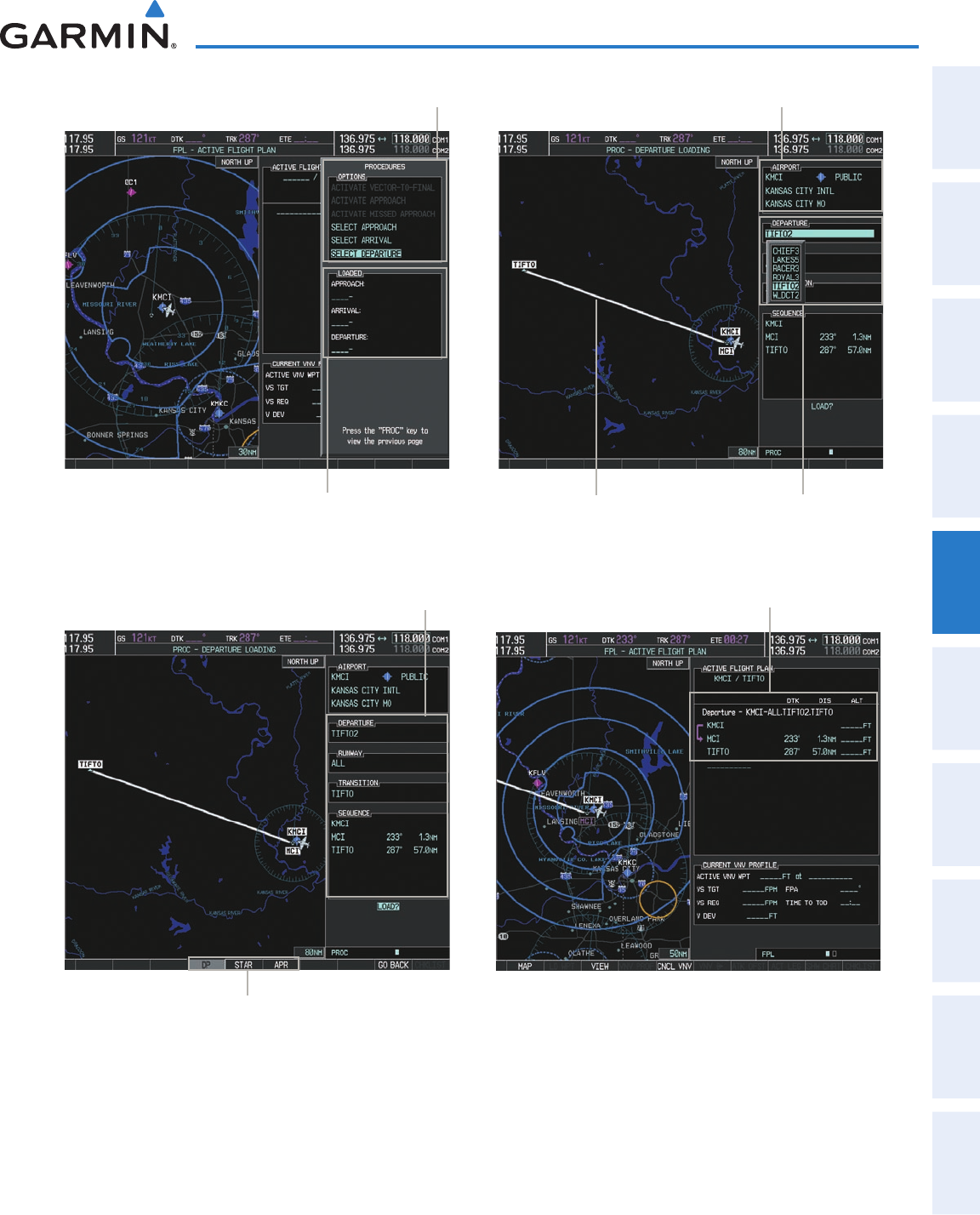
190-00592-06 Rev. A
Garmin G1000 Pilot’s Guide for the Diamond DA40/40F
229
FLIGHT MANAGEMENT
SYSTEM
OVERVIEW
FLIGHT
INSTRUMENTS EIS AUDIO PANEL
& CNS
FLIGHT
MANAGEMENT
HAZARD
AVOIDANCE AFCS ADDITIONAL
FEATURES APPENDICES INDEX
Figure 5-90 Departure Selection
Departure Airport
Departure Preview
Available Procedure Actions
Departure Choices
Loaded Procedures
Procedure Loading Page Selection Softkeys
Figure 5-91 Departure Loading
Loaded Departure
Selected Departure
Garmin G1000 Pilot’s Guide for the Diamond DA40/40F
190-00592-06 Rev. A230
FLIGHT MANAGEMENT
SYSTEM
OVERVIEW
FLIGHT
INSTRUMENTS
EIS
AUDIO PANEL
& CNS
FLIGHT
MANAGEMENT
HAZARD
AVOIDANCE
AFCS
ADDITIONAL
FEATURES
APPENDICESINDEX
Viewing available departures at an airport:
1) From the Airport Information Page (first page in the WPT group), press the DP Softkey. The Departure Information
Page is displayed, defaulting to the airport displayed on the Airport information Page.
2) To select another airport, press the FMS Knob to activate the cursor, enter an identifier/facility name/city, and
press the ENT Key.
3) Press the FMS Knob, then turn the large FMS Knob to highlight the Departure. The departure is previewed on
the map.
4) Turn the small FMS Knob to view the available departures. Press the ENT Key to select the departure. The cursor
moves to the Runway box. The departure is previewed on the map.
5) Turn the small FMS Knob to view the available runways. Press the ENT Key to select the runway. The cursor
moves to the Transition box. The departure is previewed on the map.
6) Turn the small FMS Knob to view the available transitions. Press the ENT Key to select the transition. The cursor
moves to the Sequence box. The departure is previewed on the map.
7) Press the INFO Softkey to return to the Airport Information Page.
REMOVING A DEPARTURE FROM THE ACTIVE FLIGHT PLAN
When plans change while flying IFR, departures can be easily removed from the Active Flight Plan.
Removing a departure procedure from the active flight plan:
1) Press the FPL Key to display the Active Flight Plan Page (MFD) or the Active Flight Plan Window (PFD)
2) Press the MENU Key, and highlight ‘Remove Departure’.
3) Press the ENT Key. A confirmation window is displayed listing the departure procedure.
4) With ‘OK’ highlighted, press the ENT Key. To cancel the removal request, highlight ‘CANCEL’ and press the ENT
Key.
Or:
1) Press the FPL Key to display the Active Flight Plan Page (MFD) or the Active Flight Plan Window (PFD)
2) Press the FMS Knob, and turn to highlight the departure header in the active flight plan.
3) Press the CLR Key. A confirmation window is displayed listing the departure procedure.
4) With ‘OK’ highlighted, press the ENT Key. To cancel the removal request, highlight ‘CANCEL’ and press the ENT
Key.
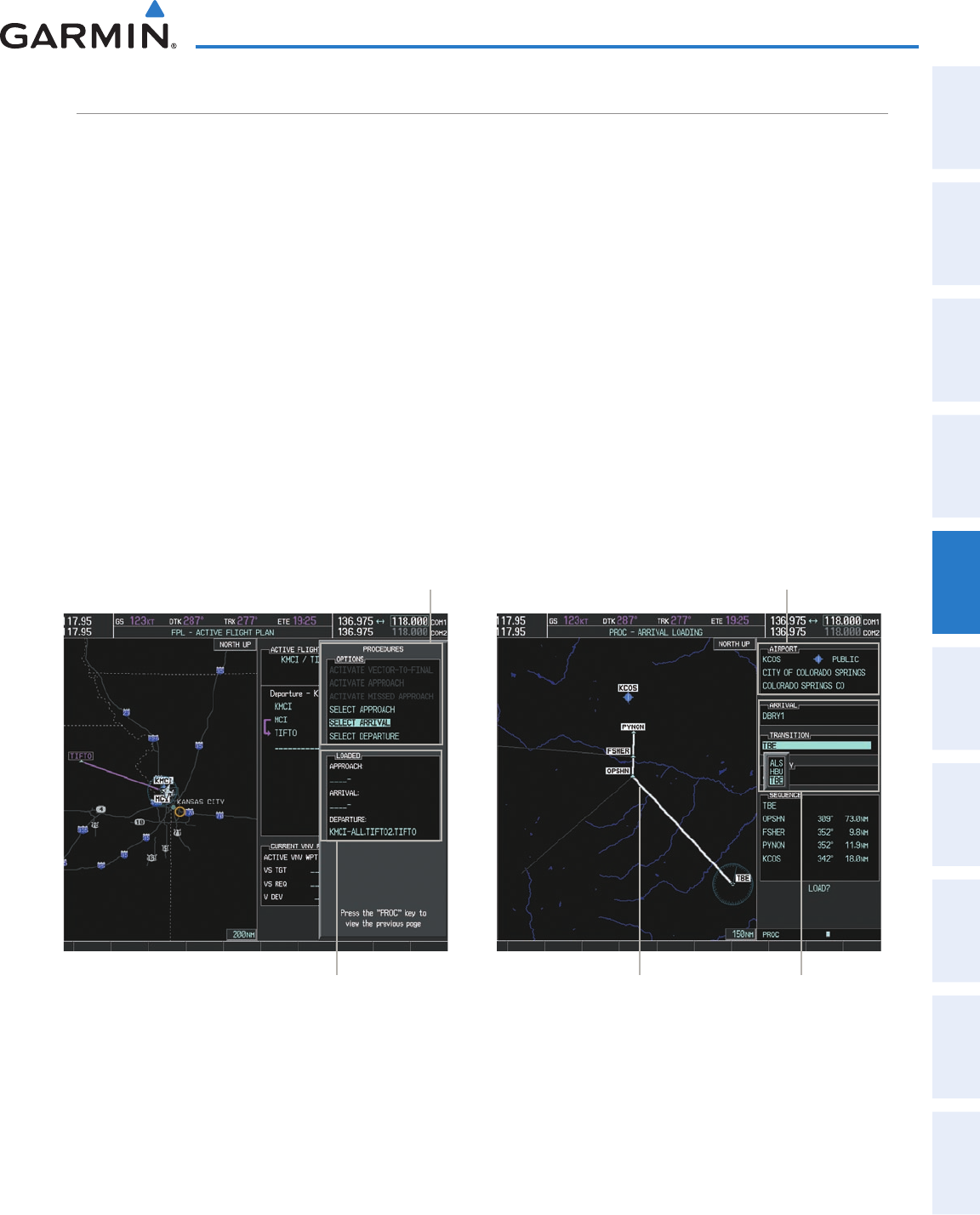
190-00592-06 Rev. A
Garmin G1000 Pilot’s Guide for the Diamond DA40/40F
231
FLIGHT MANAGEMENT
SYSTEM
OVERVIEW
FLIGHT
INSTRUMENTS EIS AUDIO PANEL
& CNS
FLIGHT
MANAGEMENT
HAZARD
AVOIDANCE AFCS ADDITIONAL
FEATURES APPENDICES INDEX
ARRIVALS
A Standard Terminal Arrival (STAR) can be loaded at any airport that has one available. Only one arrival
can be loaded at a time in a flight plan. If an arrival is loaded when another arrival is already in the active
flight plan, the new arrival replaces the previous arrival. The route is defined by selection of an arrival, the
transition waypoints, and a runway.
LOADING AN ARRIVAL INTO THE ACTIVE FLIGHT PLAN
Loading an arrival into the active flight plan using the PROC Key:
1) Press the PROC Key. The Procedures Window is displayed.
2) Highlight ‘SELECT ARRIVAL’.
3) Press the ENT Key. The Arrival Loading Page is displayed.
4) Select an arrival from the list and press the ENT Key.
6) Select a transition (if required) and press the ENT Key.
7) Select a runway (if required) and press the ENT Key. ‘LOAD?’ is highlighted.
8) Press the ENT Key to load the arrival procedure.
Figure 5-92 Arrival Selection
Destination Airport
Arrival Preview
Available Procedure Actions
Arrival Choices
Loaded Procedures
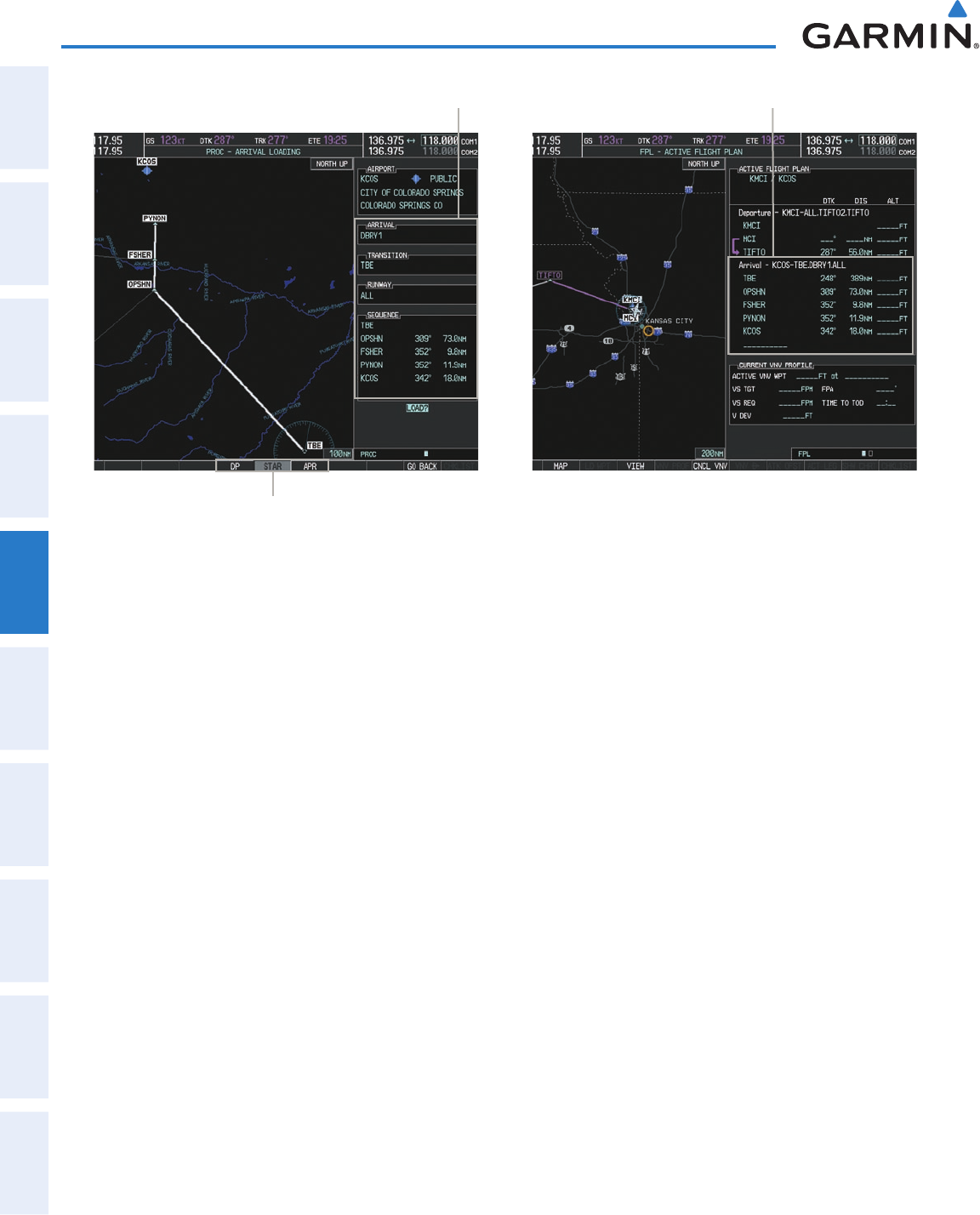
Garmin G1000 Pilot’s Guide for the Diamond DA40/40F
190-00592-06 Rev. A232
FLIGHT MANAGEMENT
SYSTEM
OVERVIEW
FLIGHT
INSTRUMENTS
EIS
AUDIO PANEL
& CNS
FLIGHT
MANAGEMENT
HAZARD
AVOIDANCE
AFCS
ADDITIONAL
FEATURES
APPENDICESINDEX
Figure 5-93 Arrival Loading
Loaded ArrivalSelected Arrival
Procedure Loading Page Selection Softkeys
Viewing available arrivals at an airport:
1) From the Airport Information Page (first page in the WPT group), press the STAR Softkey. The Arrival Information
Page is displayed, defaulting to the airport displayed on the Airport Information Page.
2) To select another airport, press the FMS Knob to activate the cursor, enter an identifier/facility name/city, and
press the ENT Key.
3) Press the FMS Knob, then turn the large FMS Knob to highlight the Arrival. The arrival is previewed on the
map.
4) Turn the small FMS Knob to view the available arrivals. Press the ENT Key to select the arrival. The cursor moves
to the Transition box. The arrival is previewed on the map.
5) Turn the small FMS Knob to view the available transitions. Press the ENT Key to select the transition. The cursor
moves to the Runway box. The arrival is previewed on the map.
6) Turn the small FMS Knob to view the available runways. Press the ENT Key to select the runway. The cursor
moves to the Sequence box. The arrival is previewed on the map.
7) Press the INFO Softkey to return to the Airport Information Page.
190-00592-06 Rev. A
Garmin G1000 Pilot’s Guide for the Diamond DA40/40F
233
FLIGHT MANAGEMENT
SYSTEM
OVERVIEW
FLIGHT
INSTRUMENTS EIS AUDIO PANEL
& CNS
FLIGHT
MANAGEMENT
HAZARD
AVOIDANCE AFCS ADDITIONAL
FEATURES APPENDICES INDEX
REMOVING AN ARRIVAL FROM THE ACTIVE FLIGHT PLAN
When plans change while flying IFR, arrivals can be easily removed from the Active Flight Plan.
Removing an arrival from the active flight plan:
1) Press the FPL Key to display the Active Flight Plan Page (MFD) or the Active Flight Plan Window (PFD)
2) Press the MENU Key, and highlight ‘Remove Arrival’.
3) Press the ENT Key. A confirmation window is displayed listing the arrival procedure.
4) With ‘OK’ highlighted, press the ENT Key. To cancel the removal request, highlight ‘CANCEL’ and press the ENT
Key.
Or:
1) Press the FPL Key to display the Active Flight Plan Page (MFD) or the Active Flight Plan Window (PFD)
2) Press the FMS Knob, and turn to highlight the arrival header in the active flight plan.
3) Press the CLR Key. A confirmation window is displayed listing the arrival procedure.
4) With ‘OK’ highlighted, press the ENT Key. To cancel the removal request, highlight ‘CANCEL’ and press the ENT
Key.
APPROACHES
NOTE: If certain GPS parameters (WAAS, RAIM, etc.) are not available, some published approach procedures
for the desired airport may not be displayed in the list of available approaches.
An Approach Procedure (APPR) can be loaded at any airport that has one available, and provides guidance
for non-precision and precision approaches to airports with published instrument approach procedures.
Only one approach can be loaded at a time in a flight plan. If an approach is loaded when another approach
is already in the active flight plan, the new approach replaces the previous approach. The route is defined by
selection of an approach and the transition waypoints.
Whenever an approach is selected, the choice to either “load” or “activate” is given. “Loading” adds the
approach to the end of the flight plan without immediately using it for navigation guidance. This allows
continued navigation via the intermediate waypoints in the original flight plan, but keeps the procedure
available on the Active Flight Plan Page for quick activation when needed. “Activating” also adds the
procedure to the end of the flight plan but immediately begins to provide guidance to the first waypoint in
the approach.
When selecting an approach, a “GPS” designation to the right of the procedure name indicates the procedure
can be flown using the GPS receiver. Some procedures do not have this designation, meaning the GPS
receiver can be used for supplemental navigation guidance only. If the GPS receiver cannot be used for
primary guidance, the appropriate navigation receiver must be used for the selected approach (e.g., VOR or
ILS). The final course segment of ILS approaches, for example, must be flown by tuning the NAV receiver to
the proper frequency and selecting that NAV receiver on the CDI.
The G1000 WAAS GPS allows for flying LNAV, LNAV/VNAV, and LPV approaches according to the published
chart. LNAV+V is a standard LNAV approach with advisory vertical guidance provided for assistance in
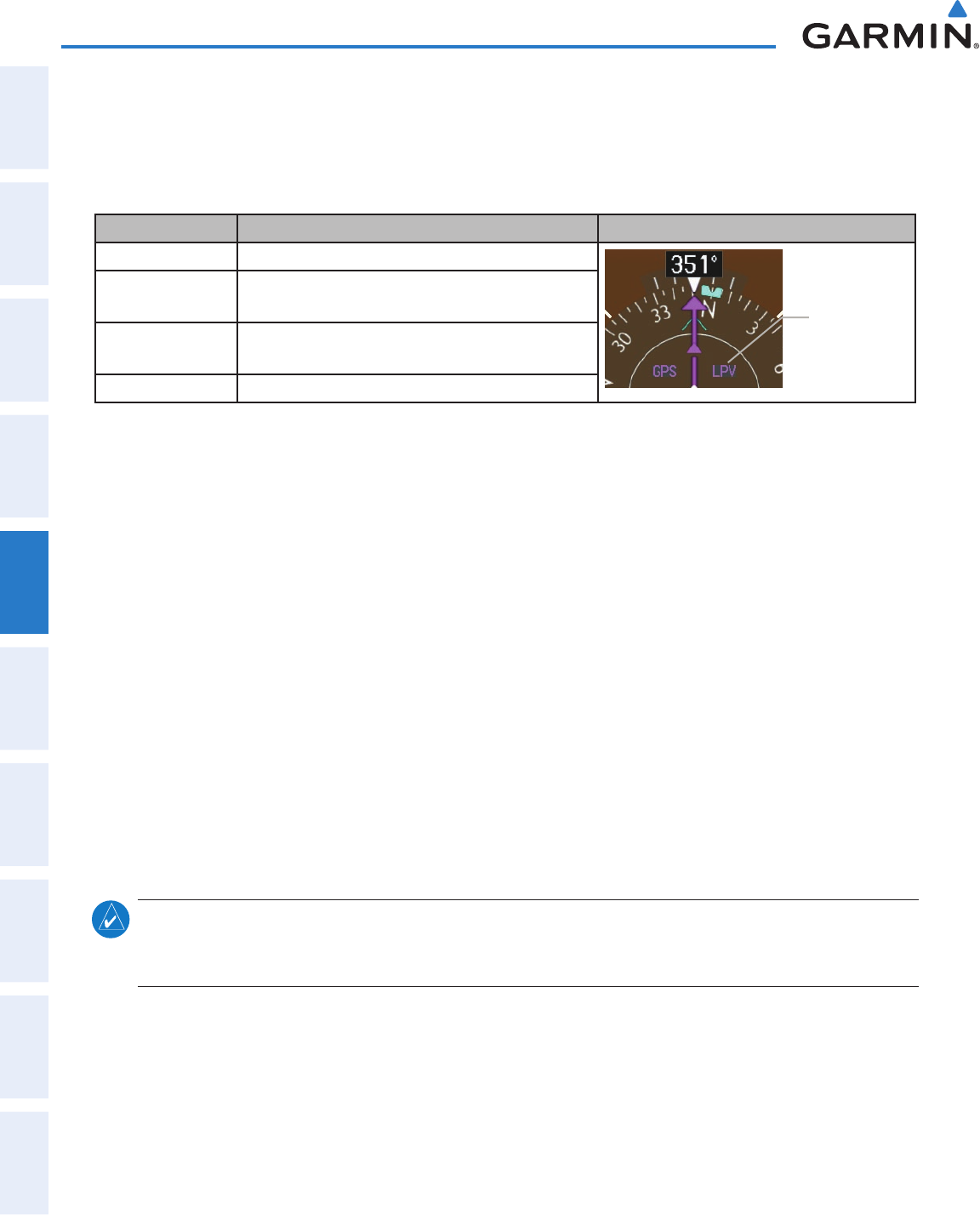
Garmin G1000 Pilot’s Guide for the Diamond DA40/40F
190-00592-06 Rev. A234
FLIGHT MANAGEMENT
SYSTEM
OVERVIEW
FLIGHT
INSTRUMENTS
EIS
AUDIO PANEL
& CNS
FLIGHT
MANAGEMENT
HAZARD
AVOIDANCE
AFCS
ADDITIONAL
FEATURES
APPENDICESINDEX
maintaining a constant vertical glidepath similar to an ILS glideslope on approach. This guidance is displayed
on the G1000 PFD in the same location as the ILS glideslope using a magenta diamond. In all cases where
LNAV+V is indicated by the system during an approach, LNAV minima are used. The active approach type
is annunciated on the HSI as shown in the following table:
HSI Annunciation Description Example on HSI
LNAV GPS approach using published LNAV minima
Approach Type
- LNAV
- LNAV+V
- L/VNAV
- LPV
LNAV+V GPS approach using published LNAV minima.
Advisory vertical guidance is provided
L/VNAV GPS approach using published LNAV/VNAV
minima
LPV GPS approach using published LPV minima
Table 5-9 Approach Types
LOADING AN APPROACH INTO THE ACTIVE FLIGHT PLAN
Loading an approach into the active flight plan using the PROC Key:
1) Press the PROC Key. The Procedures Window is displayed.
2) Highlight ‘SELECT APPROACH’, and press the ENT Key. The Approach Loading Page is displayed.
3) Select an approach from the list and press the ENT Key.
4) Select a transition (if required) and press the ENT Key.
5) Barometric Minimums
a) To set ‘MINIMUMS’, turn the small FMS Knob to select ‘BARO’, and press the ENT Key. Turn the small FMS
Knob to select the altitude, and press the ENT Key.
Or:
b) To skip setting minimums, press the ENT Key.
6) Press the ENT Key with ‘LOAD?’ highlighted to load the arrival procedure; or turn the large FMS Knob to
highlight ‘ACTIVATE’ and press the ENT Key to load and activate the approach procedure.
NOTE: When GPS is not approved for the selected final approach course, the message ‘NOT APPROVED
FOR GPS’ is displayed. GPS provides guidance to the approach, but the HSI must to be switched to a NAV
receiver to fly the final course of the approach.
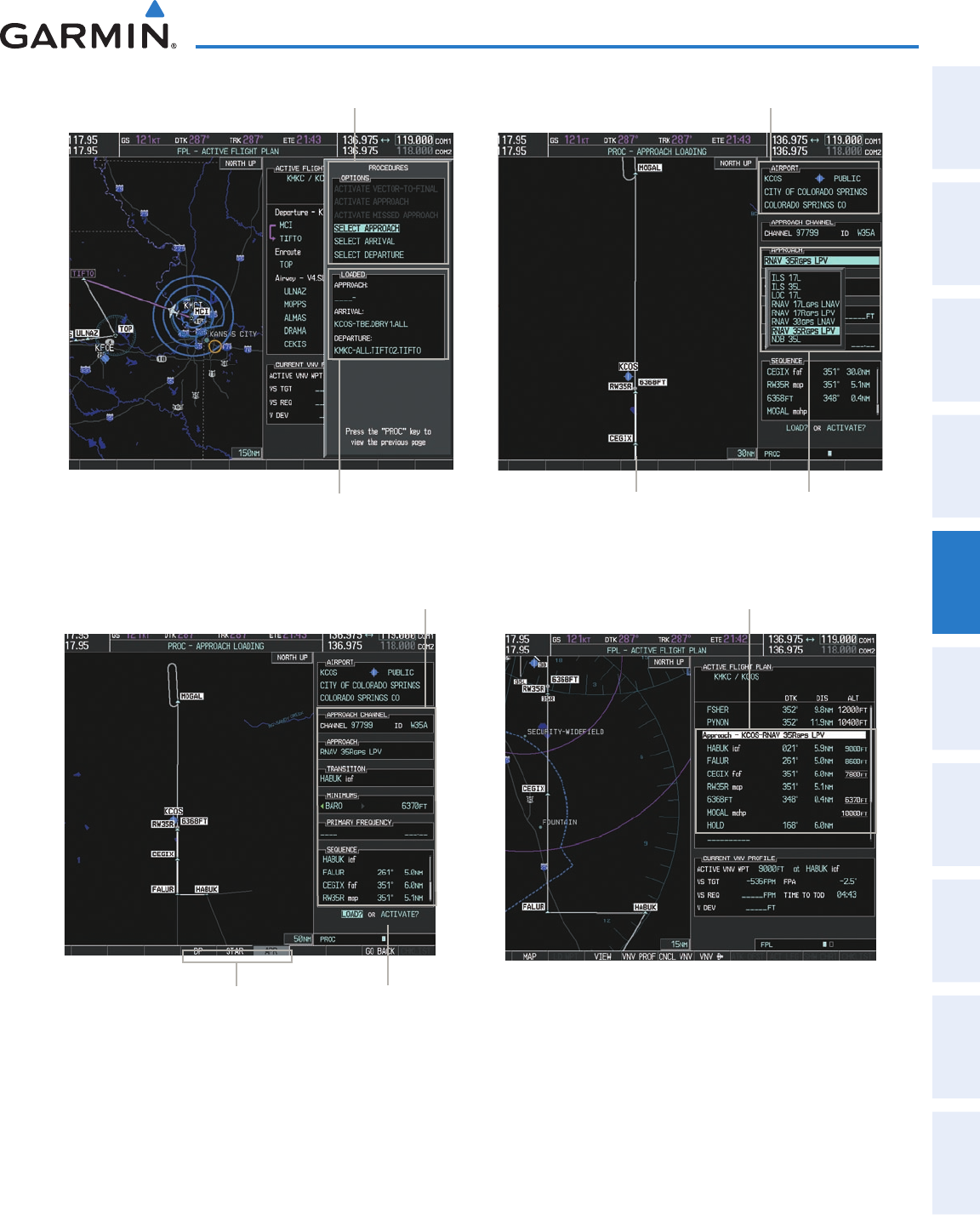
190-00592-06 Rev. A
Garmin G1000 Pilot’s Guide for the Diamond DA40/40F
235
FLIGHT MANAGEMENT
SYSTEM
OVERVIEW
FLIGHT
INSTRUMENTS EIS AUDIO PANEL
& CNS
FLIGHT
MANAGEMENT
HAZARD
AVOIDANCE AFCS ADDITIONAL
FEATURES APPENDICES INDEX
Figure 5-94 Approach Selection
Destination Airport
Approach Preview
Available Procedure Actions
Approach Choices
Loaded Procedures
Figure 5-95 Approach Loading
Loaded ApproachSelected Approach
LOAD or ACTIVATE? AnnunciationProcedure Loading Page Selection Softkeys
Garmin G1000 Pilot’s Guide for the Diamond DA40/40F
190-00592-06 Rev. A236
FLIGHT MANAGEMENT
SYSTEM
OVERVIEW
FLIGHT
INSTRUMENTS
EIS
AUDIO PANEL
& CNS
FLIGHT
MANAGEMENT
HAZARD
AVOIDANCE
AFCS
ADDITIONAL
FEATURES
APPENDICESINDEX
Viewing available approaches at an airport:
1) From the Airport Information Page (first page in the WPT group), press the APR Softkey. The Departure
Information Page is displayed, defaulting to the airport displayed on the Airport information Page.
2) To select another airport, press the FMS Knob to activate the cursor, enter an identifier/facility name/city, and
press the ENT Key.
3) Press the FMS Knob, then turn the large FMS Knob to highlight the Approach. The approach is previewed on
the map.
4) Turn the small FMS Knob to view the available approaches. Press the ENT Key to select the approach. The
cursor moves to the Runway box. The approach is previewed on the map.
5) Turn the small FMS Knob to view the available runways. Press the ENT Key to select the runway. The cursor
moves to the Transition box. The approach is previewed on the map.
6) Turn the small FMS Knob to view the available transitions. Press the ENT Key to select the transition. The cursor
moves to the Sequence box. The approach is previewed on the map.
7) Press the INFO Softkey to return to the Airport Information Page.
Loading an approach into the active flight plan from the Nearest Airport Page:
1) Select the Nearest Airports Page.
2) Press the FMS Knob, then turn the large FMS Knob to highlight the desired nearest airport. The airport is
previewed on the map.
3) Press the APR Softkey; or press the MENU Key, highlight ‘Select Approach Window’, and press the ENT Key.
4) Turn the FMS Knob to highlight the desired approach.
5) Press the LD APR Softkey; or press the MENU Key, highlight ‘Load Approach’, and press the ENT Key. The
Approach Loading Page is displayed with the transitions field highlighted.
6) Turn the FMS Knob to highlight the desired transition.
7) Barometric Minimums
a) To set ‘MINIMUMS’, turn the small FMS Knob to select ‘BARO’, and press the ENT Key. Turn the small FMS
Knob to select the altitude, and press the ENT Key. The ‘LOAD?’ field is highlighted.
Or:
b) To skip setting minimums, press the ENT Key. The ‘LOAD?’ field is highlighted.
8) Press the ENT Key with ‘LOAD?’ highlighted to load the arrival procedure; or turn the large FMS Knob to
highlight ‘ACTIVATE’ and press the ENT Key to load and activate the approach procedure. The G1000 continues
navigating the current flight plan until the approach is activated. When GPS is not approved for the selected
final approach course, the message ‘NOT APPROVED FOR GPS’ is displayed. GPS provides guidance to the
approach, but the HSI must to be switched to a NAV receiver to fly the final course of the approach.
190-00592-06 Rev. A
Garmin G1000 Pilot’s Guide for the Diamond DA40/40F
237
FLIGHT MANAGEMENT
SYSTEM
OVERVIEW
FLIGHT
INSTRUMENTS EIS AUDIO PANEL
& CNS
FLIGHT
MANAGEMENT
HAZARD
AVOIDANCE AFCS ADDITIONAL
FEATURES APPENDICES INDEX
ACTIVATING AN APPROACH
A previously loaded approach can be activated from the Procedures Window.
Activating a previously loaded approach:
1) Press the PROC Key. The Procedures Window is displayed with ‘Activate Approach’ highlighted.
2) Press the ENT Key to activate the approach.
In many cases, it may be easiest to “load” the full approach while still some distance away, enroute to the
destinationairport.Later,ifvectoredtonal,usethestepsabovetoselect‘ActivateVector-To-Final’—which
makes the inbound course to the FAF waypoint active.
Activating a previously loaded approach with vectors to final:
1) Press the PROC Key to display the Procedures Window.
2) Highlight ‘ACTIVATE VECTOR-TO-FINAL’ and press the ENT Key.
Loading and activating an approach using the MENU Key:
1) From the Approach Loading Page, press the MENU Key. The page menu is displayed with ‘Load & Activate
Approach’ highlighted.
2) Press the ENT Key. When GPS is not approved for the selected final approach course, the message ‘NOT
APPROVED FOR GPS’ is displayed. GPS provides guidance to the approach, but the HSI must to be switched to
a NAV receiver to fly the final course of the approach.
REMOVING AN APPROACH FROM THE ACTIVE FLIGHT PLAN
When plans change while flying IFR, approaches can be easily removed from the Active Flight Plan.
Removing an approach from the active flight plan:
1) Press the FPL Key to display the Active Flight Plan Page (MFD) or the Active Flight Plan Window (PFD)
2) Press the MENU Key, and highlight ‘Remove Approach’.
3) Press the ENT Key. A confirmation window is displayed listing the approach procedure.
4) With ‘OK’ highlighted, press the ENT Key. To cancel the removal, highlight ‘CANCEL’ and press the ENT Key.
Or:
1) Press the FPL Key to display the Active Flight Plan Page (MFD) or the Active Flight Plan Window (PFD)
2) Press the FMS Knob, and turn to highlight the approach header in the active flight plan.
3) Press the CLR Key. A confirmation window is displayed listing the approach procedure.
4) With ‘OK’ highlighted, press the ENT Key. To cancel the removal, highlight ‘CANCEL’ and press the ENT Key.
5) Press the FMS Knob to remove the flashing cursor.
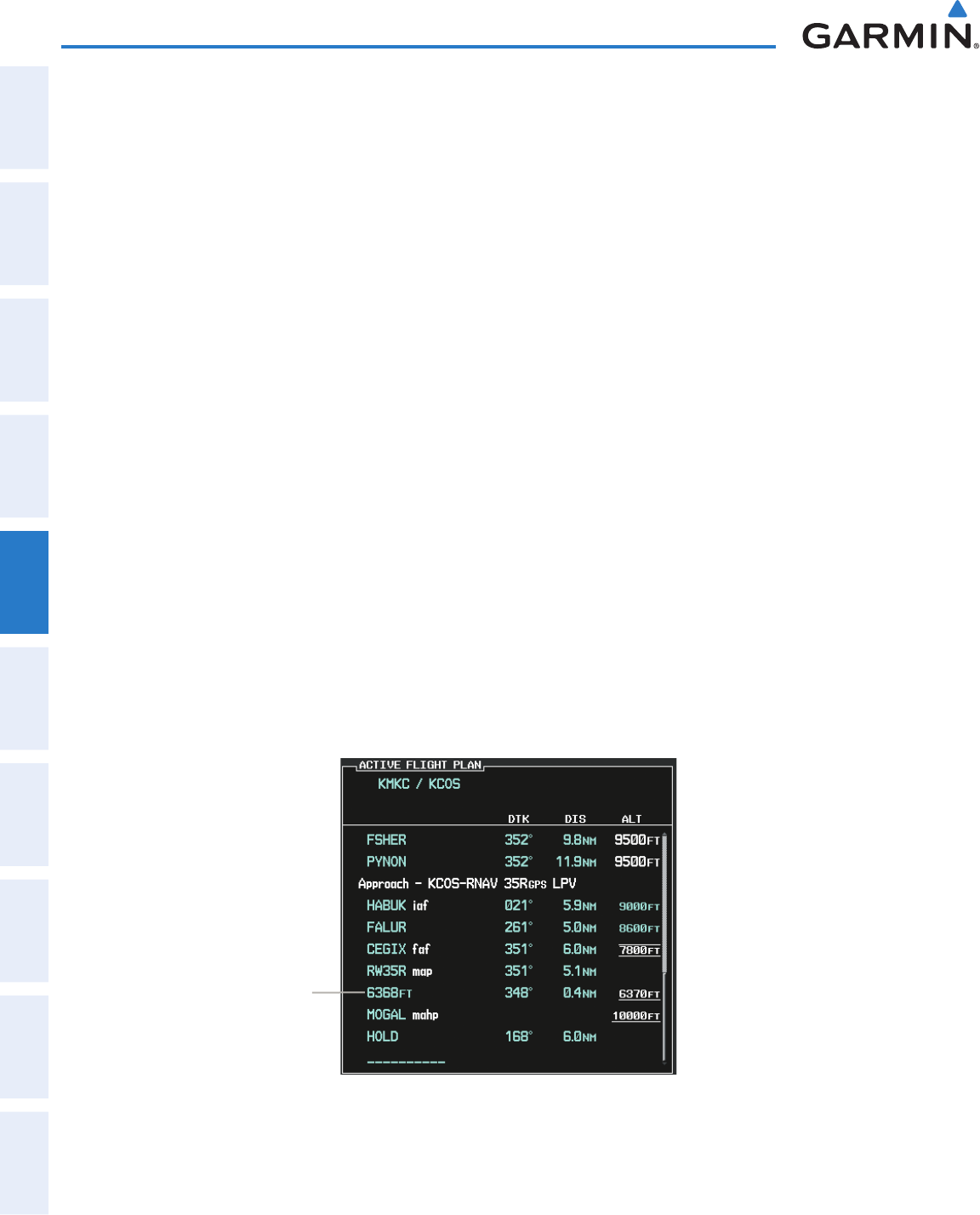
Garmin G1000 Pilot’s Guide for the Diamond DA40/40F
190-00592-06 Rev. A238
FLIGHT MANAGEMENT
SYSTEM
OVERVIEW
FLIGHT
INSTRUMENTS
EIS
AUDIO PANEL
& CNS
FLIGHT
MANAGEMENT
HAZARD
AVOIDANCE
AFCS
ADDITIONAL
FEATURES
APPENDICESINDEX
MISSED APPROACH
Activating a missed approach in the active flight plan:
1) Press the PROC Key.
2) Turn the FMS Knob to highlight ‘ACTIVATE MISSED APPROACH’.
3) Press the ENT Key. The aircraft automatically sequences to the MAHP.
Or:
Press the Go-Around Button.
COURSE TO ALTITUDE
In this missed approach procedure, the altitude immediately following the MAP (in this case ‘6368ft’) is
not part of the published procedure. It is simply a Course to Altitude (CA) leg which guides the aircraft along
the runway centerline until the altitude required to safely make the first turn toward the MAHP is exceeded.
This altitude is provided by Jeppesen, and may be below, equal to, or above the published minimums for
this approach. In this case, if the aircraft altitude is below the specified altitude (6,368 feet) after crossing
the MAP, a direct-to is established to provide a course on runway heading until an altitude of 6,368 feet is
reached. After reaching 6,368 feet, a direct-to is established to the published MAHP (in this case MOGAL).
If the aircraft altitude is above the specified altitude after crossing the MAP, a direct-to is established to the
published fix (MOGAL) to begin the missed approach procedure.
In some missed approach procedures this Course to Altitude leg may be part of the published procedure.
For example, a procedure may dictate a climb to 5,500 feet, then turn left and proceed to the Missed Approach
Hold Point (MAHP). In this case, the altitude would appear in the list of waypoints as ‘5500ft’. Again, if the
aircraft altitude is lower than the prescribed altitude, a direct-to is established on a Course to Altitude leg
when the missed approach procedure is activated.
Figure 5-96 Course to Altitude
Course to Altitude Leg
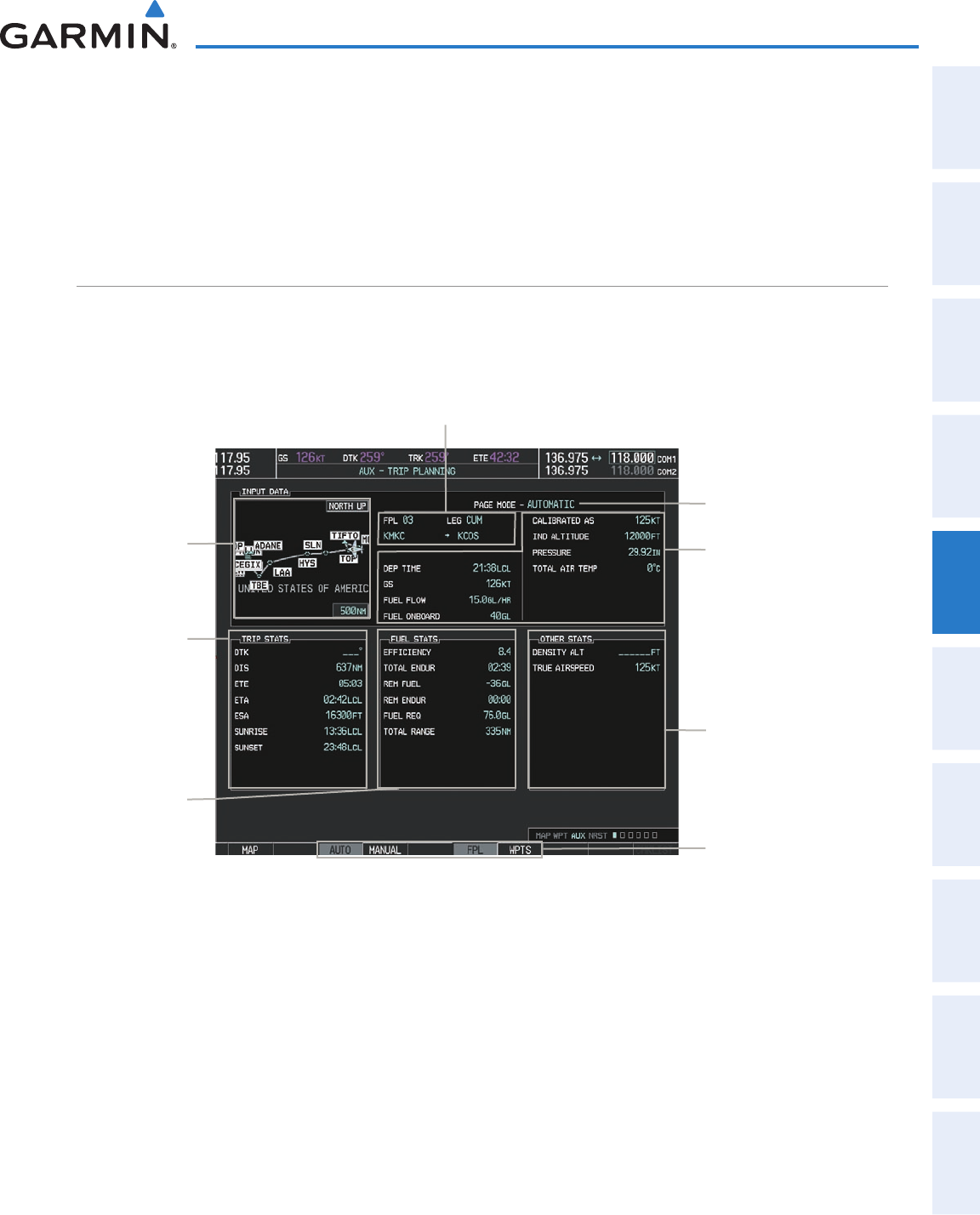
190-00592-06 Rev. A
Garmin G1000 Pilot’s Guide for the Diamond DA40/40F
239
FLIGHT MANAGEMENT
SYSTEM
OVERVIEW
FLIGHT
INSTRUMENTS EIS AUDIO PANEL
& CNS
FLIGHT
MANAGEMENT
HAZARD
AVOIDANCE AFCS ADDITIONAL
FEATURES APPENDICES INDEX
5.9 TRIP PLANNING
The G1000 allows the pilot to view trip planning information, fuel information, and other information for
a specified flight plan or flight plan leg based on automatic data, or based on manually entered data. Weight
planning is also available, based on manually entered fuel data and the active flight plan (to estimate remaining
fuel).
TRIP PLANNING
All of the input of data needed for calculation and viewing of the statistics is done on the Trip Planning Page
located in the AUX Page Group.
Figure 5-97 Trip Planning Page
Trip Statistics
Desired Track -
Distance -
Est. Time Enroute -
Est. Time of Arrival -
Enroute Safe Altitude -
Sunrise Time (local) -
Sunset Time (local) -
Trip Input Data (sensor/pilot)
- Departure Time (local)
- Ground Speed
- Fuel Flow
- Fuel On Board Aircraft
- Calibrated Airspeed
- Indicated Altitude
- Barometric Pressure
- Total Air Temperature
Softkeys
- Automatic/Manual Page Mode
- Flight Plan/Waypoint Mode
Preview of Selected
Flight Plan/
Flight Plan Leg
Trip Planning Page Mode
- Automatic/Manual
Selected Flight Plan Segment
- FPL Number/Cumulative Legs (CUM or REM) or Leg Number (NN)
- Waypoints Defining Selected Flight Plan/Flight Plan Leg
Fuel Statistics
Efficiency -
Total Endurance -
Remaining Fuel -
Remaining Endurance -
Fuel Required -
Total Range -
Other Statistics
- Density Altitude
- True Airspeed (TAS)
The trip planning inputs are based on sensor inputs (automatic page mode) or on pilot inputs (manual page
mode). Some additional explanation of the sources for some of the inputs is as follows:
•Departure time (DEP TIME) - This defaults to the current time in automatic page mode. The computations
are from the aircraft present position, so the aircraft is always just departing.
•Calibrated airspeed (CALIBRATED AS) - The primary source is from the air data system, and the secondary
source of information is GPS ground speed.
•Indicated altitude (IND ALTITUDE) - The primary source is the barometric altitude, and the secondary source
of information is GPS altitude.
Garmin G1000 Pilot’s Guide for the Diamond DA40/40F
190-00592-06 Rev. A240
FLIGHT MANAGEMENT
SYSTEM
OVERVIEW
FLIGHT
INSTRUMENTS
EIS
AUDIO PANEL
& CNS
FLIGHT
MANAGEMENT
HAZARD
AVOIDANCE
AFCS
ADDITIONAL
FEATURES
APPENDICESINDEX
TRIP STATISTICS
The trip statistics are calculated based on the selected starting and ending waypoints and the trip planning
inputs.
In flight plan mode (FPL) with a stored flight plan selected (NN), and the entire flight plan (CUM) selected,
the waypoints are the starting and ending waypoints of the selected flight plan.
In flight plan mode (FPL) with a stored flight plan selected (NN), and a specific leg (NN) selected, the
waypoints are the endpoints of the selected leg.
In flight plan mode (FPL) with the active flight plan selected (00), and the remaining flight plan (REM)
selected, the ‘from’ waypoint is the present position of the aircraft and the ‘to’ waypoint is the endpoint of the
active flight plan.
In flight plan mode (FPL) with the active flight plan selected (00), and a specific leg (NN) selected, the
‘from’ waypoint is the current aircraft position and the ‘to’ waypoint is the endpoint of the selected leg.
In waypoint (WPTS) mode these are manually selected waypoints (if there is an active flight plan, these
default to the endpoints of the active leg).
Some of the calculated trip statistics are dashed when the selected leg of the active flight plan has already
been flown.
•DesiredTrack(DTK)-DTKisshownasnnn°andisthedesiredtrackbetweentheselectedwaypoints.
It is dashed unless only a single leg is selected.
•Distance(DIS)-Thedistanceisshownintenthsofunitsupto99.9,andinwholeunitsupto9999.
•Estimatedtimeenroute(ETE)-ETEisshownashours:minutesuntillessthananhour,thenitisshown
as minutes:seconds.
•Estimated time of arrival (ETA) - ETA is shown as hours:minutes and is the local time at the
destination.
- If in waypoint mode then the ETA is the ETE added to the departure time.
- If a flight plan other than the active flight plan is selected it shows the ETA by adding to the departure
time all of the ETEs of the legs up to and including the selected leg. If the entire flight plan is selected,
then the ETA is calculated as if the last leg of the flight plan was selected.
- If the active flight plan is selected the ETA reflects the current position of the aircraft and the current
leg being flown. The ETA is calculated by adding to the current time the ETEs of the current leg up to
and including the selected leg. If the entire flight plan is selected, then the ETA is calculated as if the
last leg of the flight plan was selected.
•Enroutesafealtitude(ESA)-TheESAisshownasnnnnnFT
•Destinationsunrise and sunset times (SUNRISE, SUNSET) - These times are shown as hours:minutes
and are the local time at the destination.
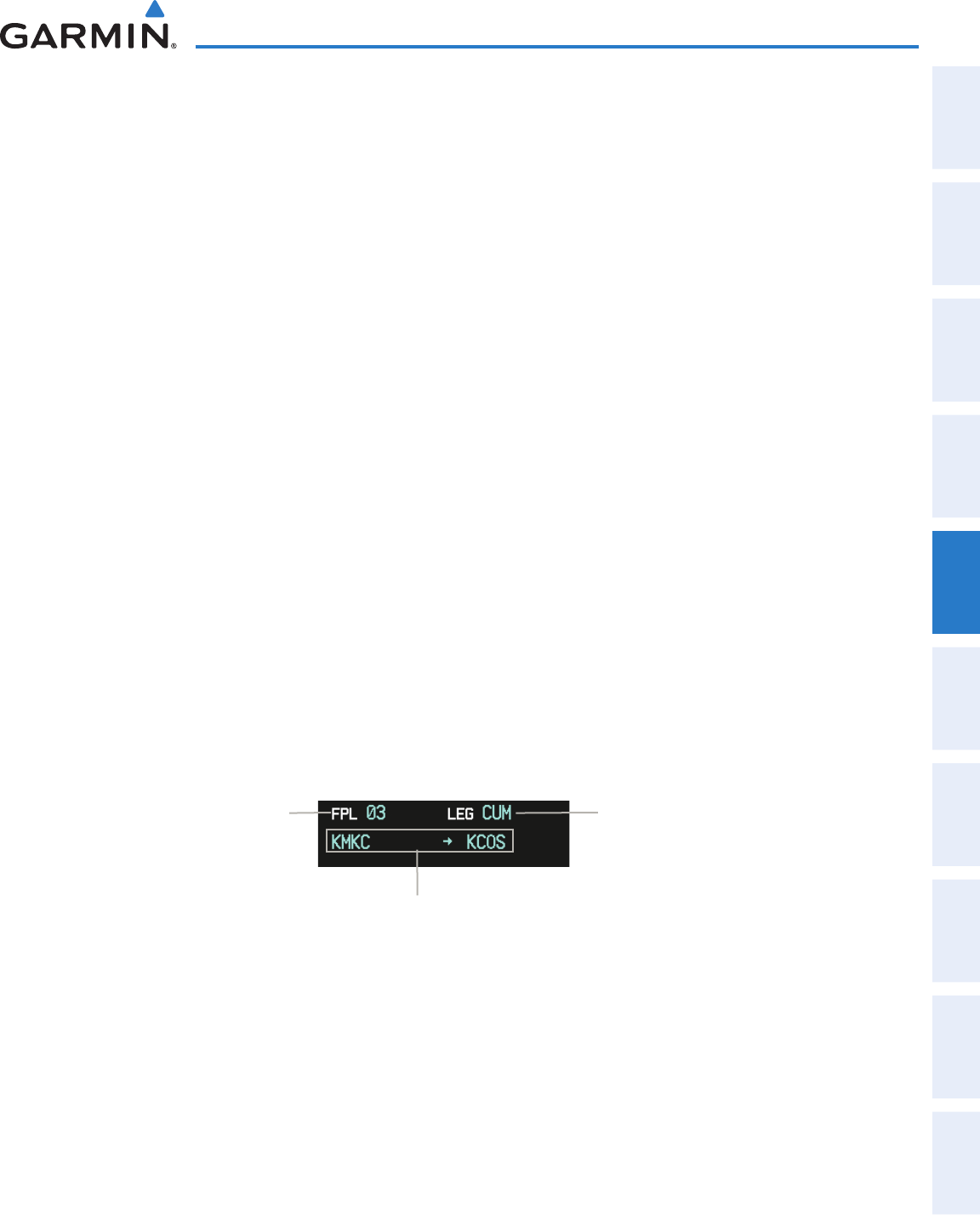
190-00592-06 Rev. A
Garmin G1000 Pilot’s Guide for the Diamond DA40/40F
241
FLIGHT MANAGEMENT
SYSTEM
OVERVIEW
FLIGHT
INSTRUMENTS EIS AUDIO PANEL
& CNS
FLIGHT
MANAGEMENT
HAZARD
AVOIDANCE AFCS ADDITIONAL
FEATURES APPENDICES INDEX
FUEL STATISTICS
The fuel statistics are calculated based on the selected starting and ending waypoints and the trip planning
inputs. Some of the calculated trip statistics are dashed when the selected leg of the active flight plan has
already been flown.
•Fuel efficiency (EFFICIENCY) - This value is calculated by dividing the current ground speed by the
current fuel flow.
•Timeoffuel endurance (TOTAL ENDUR) - This time is shown as hours:minutes. This value is obtained
by dividing the amount of fuel on board by the current fuel flow.
•Fuelonboarduponreachingendofselectedleg(REM FUEL) - This value is calculated by taking the
amount of fuel onboard and subtracting the fuel required for trip.
•Fuelenduranceremainingatendofselectedleg(REMENDUR)-Thisvalueiscalculatedbysubtracting
the time of fuel endurance by the amount of time to go.
•Fuel required for trip (FUEL REQ) - This value is calculated by multiplying the time to go by the fuel
flow.
•Totalrangeatenteredfuelow(TOTALRANGE)-Thisvalueiscalculatedbymultiplyingthetimeoffuel
endurance by the ground speed.
OTHER STATISTICS
These statistics are calculated based on the system sensor inputs or the manual trip planning inputs.
•Density altitude (DENSITY ALT)
•True airspeed (TRUE AIRSPEED)
The pilot may select automatic (AUTO) or manual (MANUAL) page mode, and flight plan (FPL) or waypoint
(WPTS) mode. In automatic page mode, only the FPL, LEG, or waypoint IDs are editable (based on FPL/WPTS
selection).
Figure 5-98 Trip Planning Page - Flight Plan Mode
Selected Leg(s)
Stored Flight Plan
- CUM: Beginning to End of FPL
- NN: Beginning to End of Selected Leg
Active Flight Plan
- REM: Pres. Pos. to End of FPL
- NN: Pres. Pos. to End of Selected Leg
Starting and Ending Waypoint of
Selected Flight Plan Segment
Selected Flight Plan
NN -
00 is Active FPL
01-99 are Stored FPLs
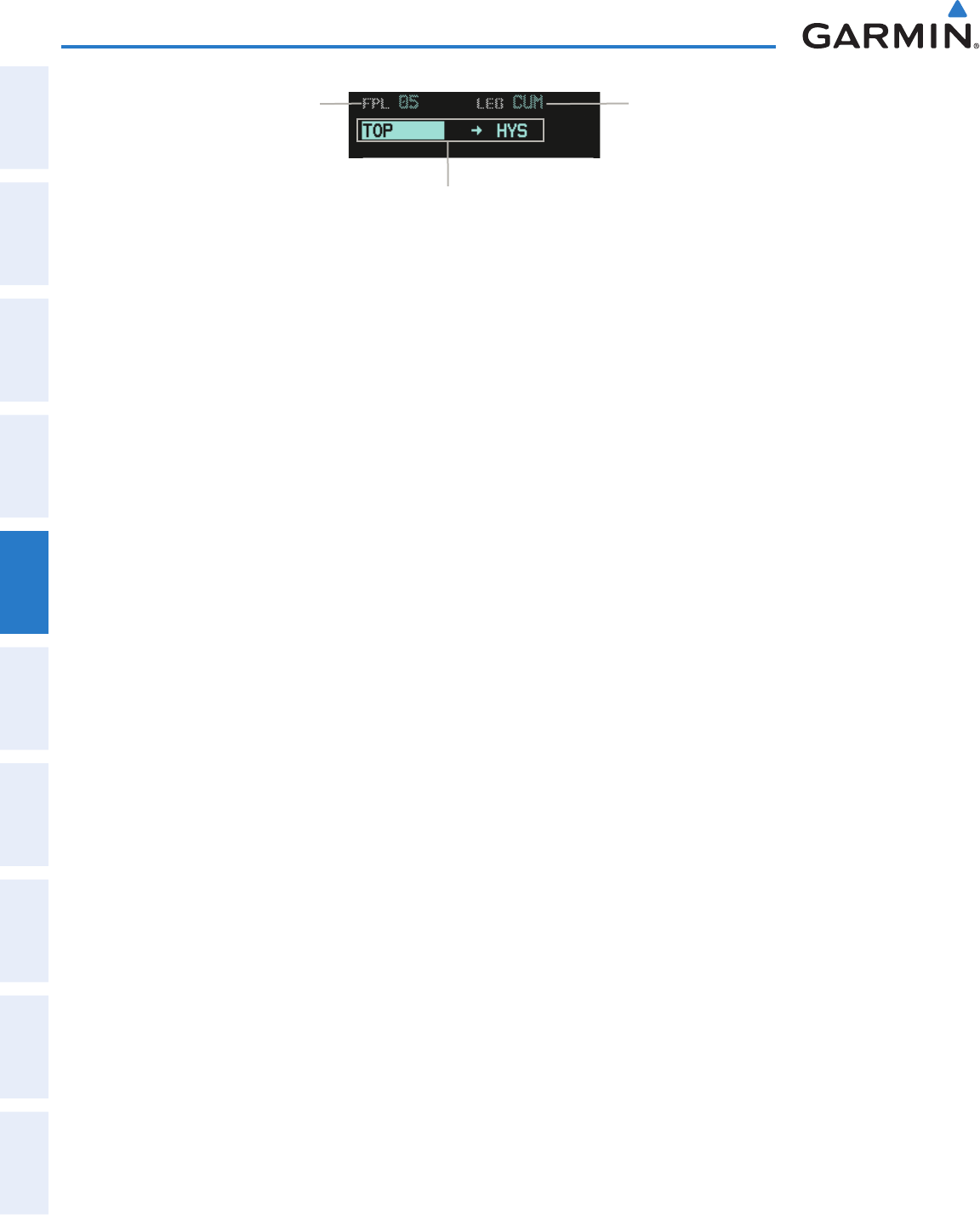
Garmin G1000 Pilot’s Guide for the Diamond DA40/40F
190-00592-06 Rev. A242
FLIGHT MANAGEMENT
SYSTEM
OVERVIEW
FLIGHT
INSTRUMENTS
EIS
AUDIO PANEL
& CNS
FLIGHT
MANAGEMENT
HAZARD
AVOIDANCE
AFCS
ADDITIONAL
FEATURES
APPENDICESINDEX
Figure 5-99 Trip Planning Page - Waypoint Mode
Selected Leg(s)
Not Available
Selected Starting and Ending Waypoints
Selected Flight Plan
Not Available
Selecting automatic or manual page mode:
Press the AUTO Softkey or the MANUAL Softkey; or press the MENU Key, highlight ‘Auto Mode’ or ‘Manual
Mode’, and press the ENT Key.
Selecting flight plan or waypoint mode:
Press the FPL Softkey or the WPTS Softkey; or press the MENU Key, highlight ‘Flight Plan Mode’ or ‘Waypoints
Mode’, and press the ENT Key.
Selecting a flight plan and leg for trip statistics:
1) Press the FMS Knob to activate the cursor in the flight plan number field.
2) Turn the small FMS Knob to select the desired flight plan number.
3) Turn the large FMS Knob to highlight ‘CUM’ or ‘REM’. The statistics for each leg can be viewed by turning the
small FMS Knob to select the desired leg. The Inset Map also displays the selected data.
Selecting waypoints for waypoint mode:
1) Press the WPTS Softkey; or press the MENU Key, highlight ‘Waypoints Mode’, and press the ENT Key. The
cursor is positioned in the waypoint field directly below the FPL field.
2) Turn the FMS knobs to select the desired waypoint (or select from the Page Menu ‘Set WPT to Present Position’
if that is what is desired), and press the ENT Key. The cursor moves to the second waypoint field.
3) Turn the FMS knobs to select the desired waypoint, and press the ENT Key. The statistics for the selected leg
are displayed.
In manual page mode, the other eight trip input data fields must be entered by the pilot, in addition to flight
plan and leg selection.
Entering manual data for trip statistics calculations:
1) Press the MANUAL Softkey or select ‘Manual Mode’ from the Page Menu, and press the ENT Key. The cursor
may now be positioned in any field in the top right two boxes.
2) Turn the FMS Knobs to move the cursor onto the DEP TIME field and enter the desired value. Press the ENT Key.
The statistics are calculated using the new value and the cursor moves to the next entry field. Repeat until all
desired values have been entered.
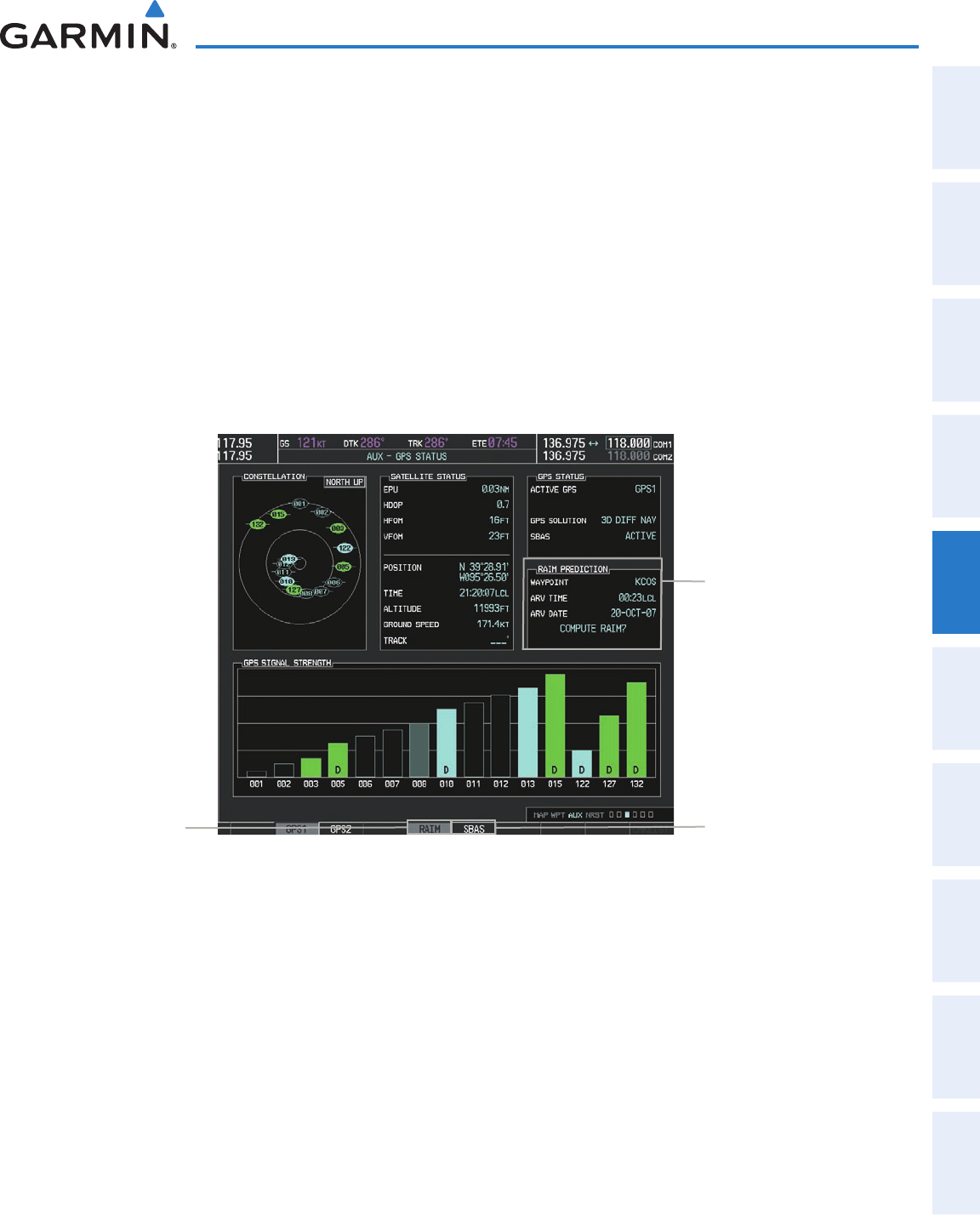
190-00592-06 Rev. A
Garmin G1000 Pilot’s Guide for the Diamond DA40/40F
243
FLIGHT MANAGEMENT
SYSTEM
OVERVIEW
FLIGHT
INSTRUMENTS EIS AUDIO PANEL
& CNS
FLIGHT
MANAGEMENT
HAZARD
AVOIDANCE AFCS ADDITIONAL
FEATURES APPENDICES INDEX
5.10 RAIM PREDICTION
RAIM (Receiver Autonomous Integrity Monitoring) is a GPS receiver function that performs a consistency
check on all tracked satellites. RAIM ensures that the available satellite geometry allows the receiver to calculate
a position within a specified RAIM protection limit (2.0 nm for oceanic, 2.0 nm for enroute, 1.0 nm for terminal,
and 0.3 nm for non-precision approaches). During oceanic, enroute, and terminal phases of flight, RAIM is
available nearly 100% of the time. The RAIM prediction function also indicates whether RAIM is available at a
specified date and time. RAIM computations predict satellite coverage within ±15 min of the specified arrival
date and time. Because of the tighter protection limit on approaches, there may be times when RAIM is not
available. RAIM prediction must be initiated manually if there is concern over WAAS coverage at the destination
or some other reason that compromises navigation precision. If RAIM is not predicted to be available for the
final approach course, the approach does not become active. If RAIM is not available when crossing the FAF, the
missed approach procedure must be flown.
Figure 5-100 RAIM Prediction
SBAS Softkey
(displays SBAS Selection)
RAIM PREDICTION Box
- Prediction Waypoint
- Arrival Time
- Arrival Date
- RAIM Status
RAIM Softkey
(displays RAIM
PREDICTION)
Predicting RAIM availability at a selected waypoint:
1) Select the AUX-GPS Status Page.
2) Press the FMS Knob. The RAIM Prediction ‘WAYPOINT’ field is highlighted.
3) Turn the small FMS Knob to display the Waypoint Information Window. (Turning it clockwise displays a blank
Waypoint Information Window, turning it counter-clockwise displays the Waypoint Information Window with a
waypoint selection submenu allowing selection of active flight plan, nearest, recent, or airway waypoints).
Garmin G1000 Pilot’s Guide for the Diamond DA40/40F
190-00592-06 Rev. A244
FLIGHT MANAGEMENT
SYSTEM
OVERVIEW
FLIGHT
INSTRUMENTS
EIS
AUDIO PANEL
& CNS
FLIGHT
MANAGEMENT
HAZARD
AVOIDANCE
AFCS
ADDITIONAL
FEATURES
APPENDICESINDEX
4) Enter the identifier, facility, or city name of the departure waypoint; or select a waypoint from the submenu of
waypoints and press the ENT Key to accept the waypoint entry.
5) Turn the FMS Knobs to enter an arrival time and press the ENT Key.
6) Turn the FMS Knobs to enter an arrival date and press the ENT Key.
7) Press the ENT Key with ‘COMPUTE RAIM?’ highlighted to begin the computation.
Predicting RAIM availability at the aircraft present position:
1) Select the AUX-GPS Status Page.
2) Press the FMS Knob. The RAIM Prediction ‘WAYPOINT’ field is highlighted.
3) Press the MENU Key, highlight ‘Set WPT to Present Position’, and press the ENT Key.
4) Press the ENT Key to accept the waypoint entry.
5) Turn the FMS Knobs to enter an arrival time and press the ENT Key.
6) Turn the FMS Knobs to enter an arrival date and press the ENT Key.
7) Press the ENT Key with ‘COMPUTE RAIM?’ highlighted to begin the computation.
Status of the RAIM computation for the selected waypoint, time, and date is displayed at the bottom of the
RAIM PREDICTION Box as follows:
•‘COMPUTERAIM?’ - RAIM has not been computed.
•‘COMPUTINGAVAILABILITY’-RAIM calculation is in progress.
•‘RAIM AVAILABLE’ - RAIM is predicted to be available.
•‘RAIM NOT AVAILABLE’ - RAIM is predicted to be unavailable.
The Satellite Based Augmentation System (SBAS) provides increased navigation accuracy when available. SBAS
can be enabled or disabled manually on the GPS Status Page.
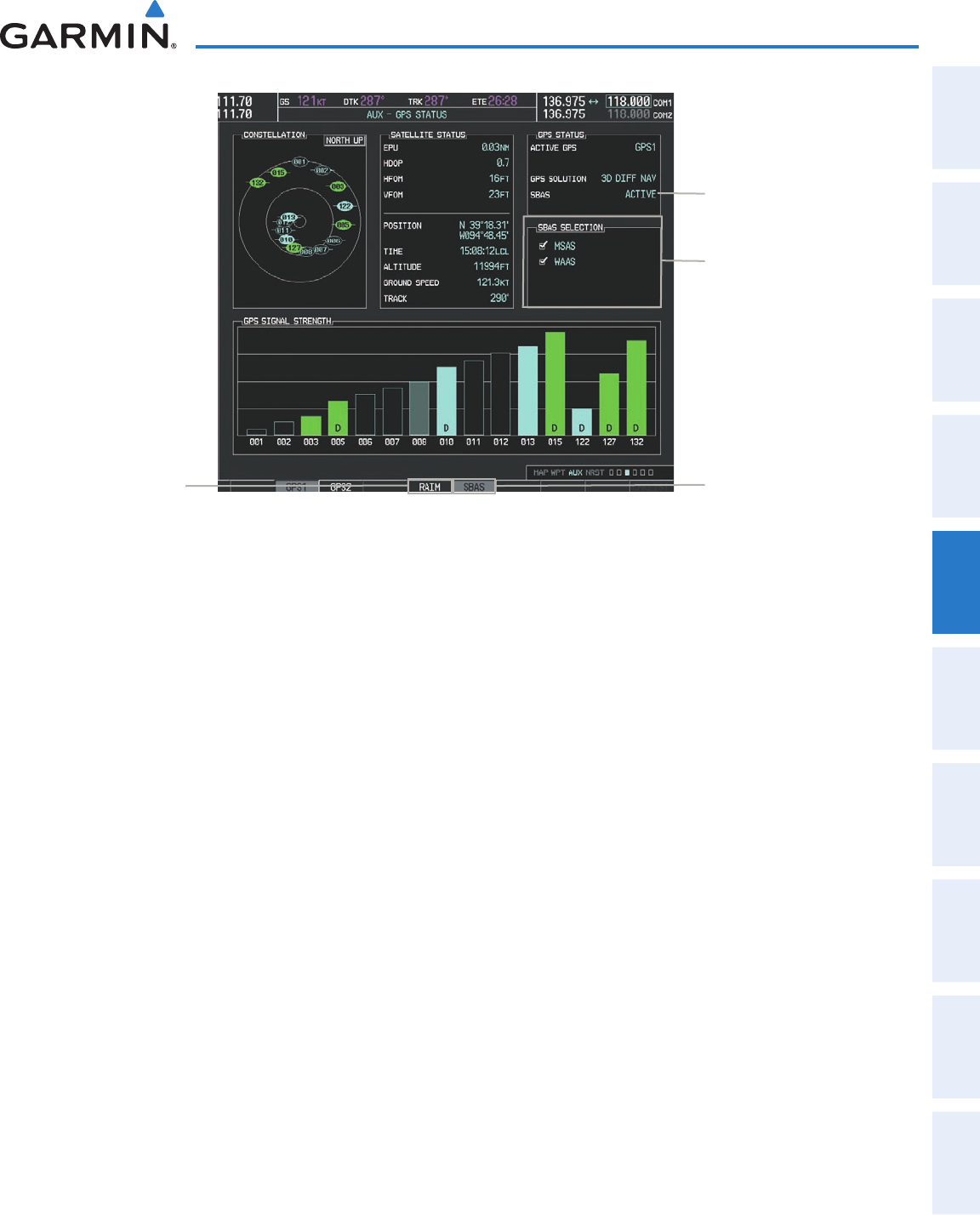
190-00592-06 Rev. A
Garmin G1000 Pilot’s Guide for the Diamond DA40/40F
245
FLIGHT MANAGEMENT
SYSTEM
OVERVIEW
FLIGHT
INSTRUMENTS EIS AUDIO PANEL
& CNS
FLIGHT
MANAGEMENT
HAZARD
AVOIDANCE AFCS ADDITIONAL
FEATURES APPENDICES INDEX
Figure 5-101 SBAS Display - Active
SBAS Softkey
(displays SBAS Selection)
SBAS SELECTION Box
-
MSAS Enable/Disable
-
WAAS Enable/Disable
RAIM Softkey
(displays RAIM
PREDICTION)
SBAS Status
Enabling/Disabling SBAS:
1) Select the AUX-GPS Status Page.
2) Press the
FMS
Knob
, and turn the large FMS Knob to highlight ‘MSAS’ or ‘WAAS’.
3) Press the ENT Key to disable SBAS. Press the ENT Key again to enable SBAS.
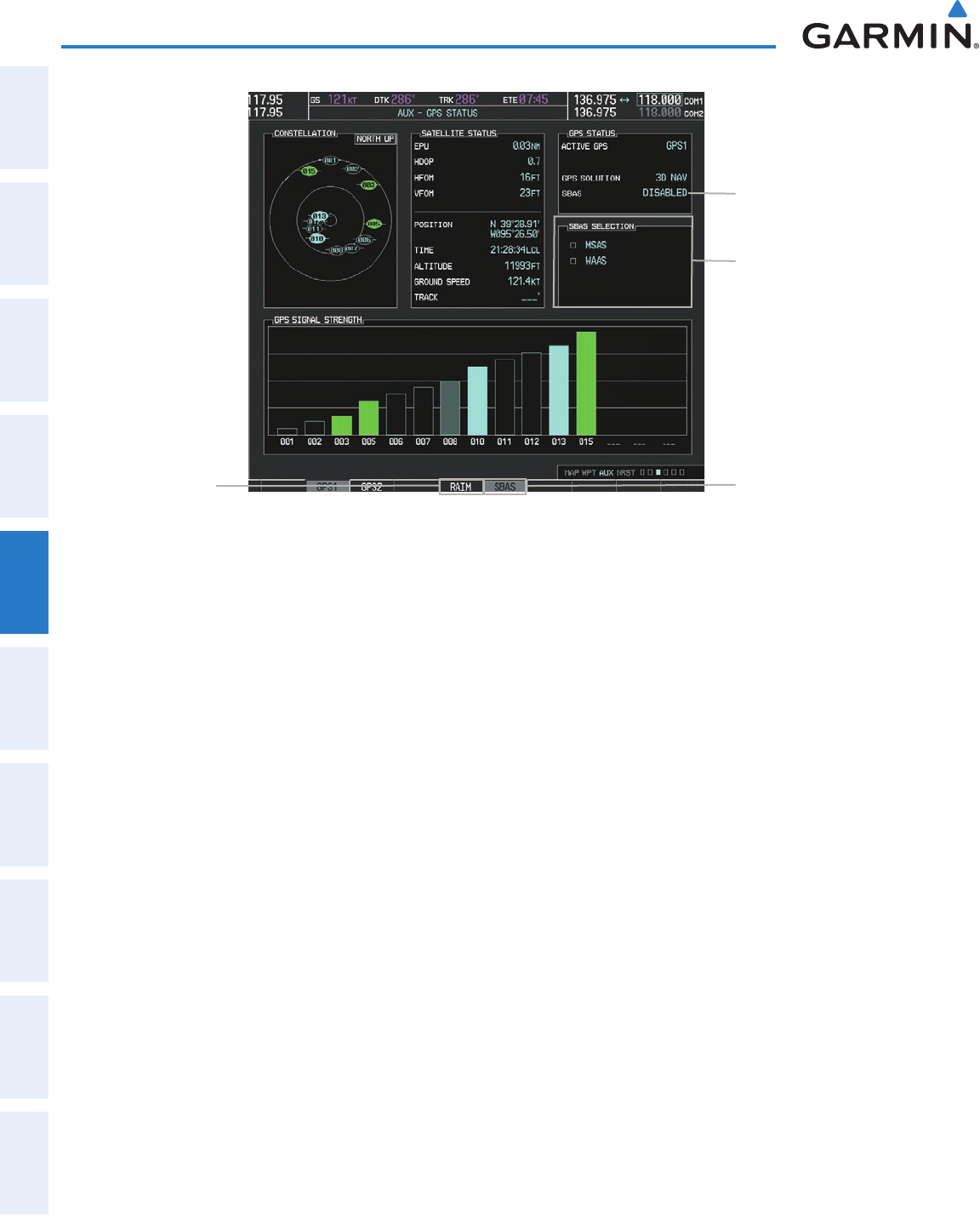
Garmin G1000 Pilot’s Guide for the Diamond DA40/40F
190-00592-06 Rev. A246
FLIGHT MANAGEMENT
SYSTEM
OVERVIEW
FLIGHT
INSTRUMENTS
EIS
AUDIO PANEL
& CNS
FLIGHT
MANAGEMENT
HAZARD
AVOIDANCE
AFCS
ADDITIONAL
FEATURES
APPENDICESINDEX
Figure 5-102 SBAS Display - Disabled
SBAS Softkey
(displays SBAS Selection)
SBAS SELECTION Box
-
MSAS Enable/Disable
-
WAAS Enable/Disable
RAIM Softkey
(displays RAIM
PREDICTION)
SBAS Status
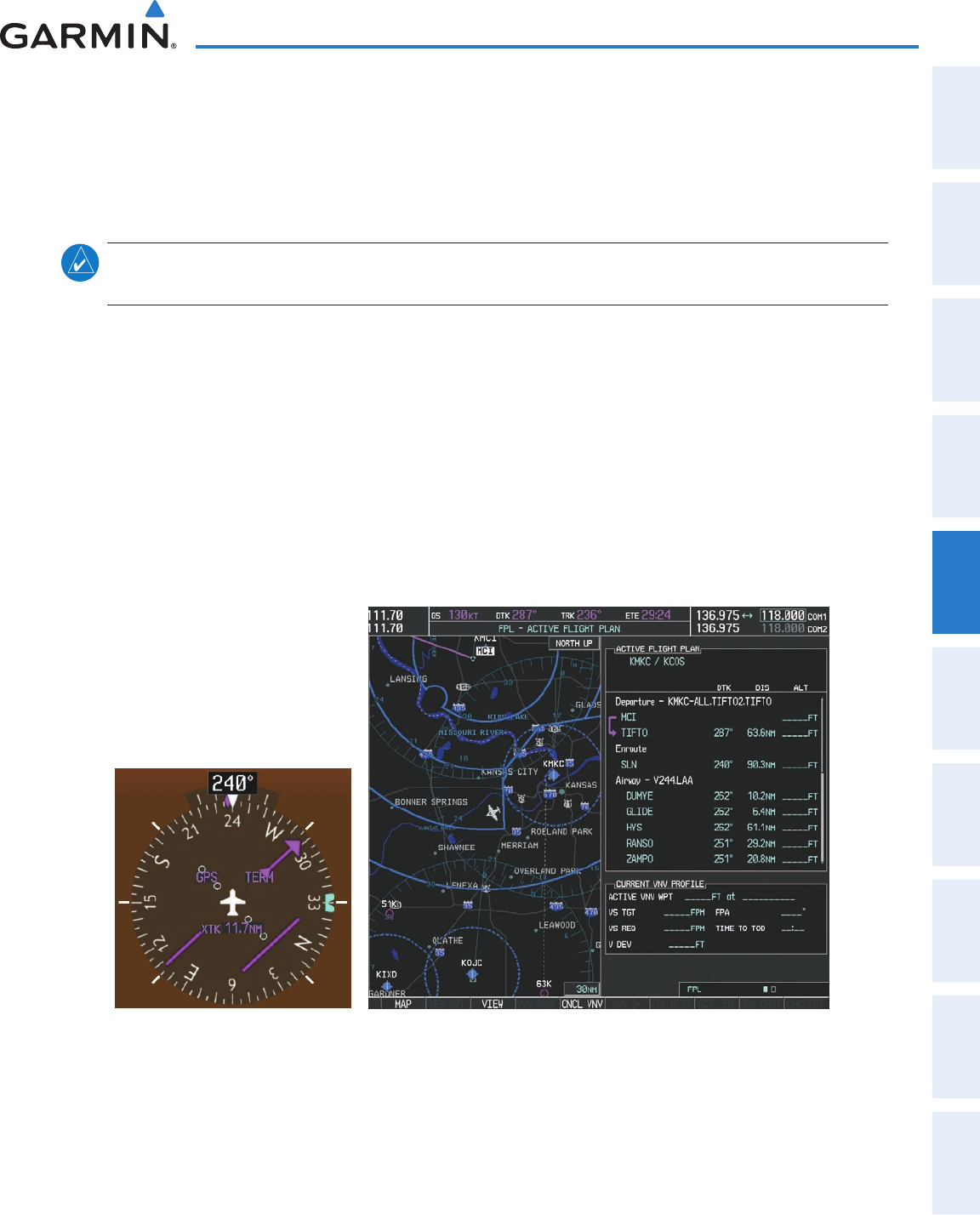
190-00592-06 Rev. A
Garmin G1000 Pilot’s Guide for the Diamond DA40/40F
247
FLIGHT MANAGEMENT
SYSTEM
OVERVIEW
FLIGHT
INSTRUMENTS EIS AUDIO PANEL
& CNS
FLIGHT
MANAGEMENT
HAZARD
AVOIDANCE AFCS ADDITIONAL
FEATURES APPENDICES INDEX
5.11 NAVIGATING A FLIGHT PLAN
The following discussion is an example of navigating a flight plan with the WAAS capable GPS system while the
G1000 provides vertical guidance through descents. A lateral flight plan (LNAV) would be navigated in much the
same way, but would not include vertical guidance when the final approach course is active.
NOTE: The following example flight plan is for instructional purposes only. All database information depicted
should be considered not current.
The example is a flight plan from KMKC to KCOS filed using the TIFTO2 departure, various Victor Airways,
and the DBRY1 arrival with the transition at TBE. The flight plan includes an enroute altitude of 12,000 feet, an
LPV (WAAS) approach selected for runway 35R, and a missed approach executed at the Missed Approach Point
(MAP). A few enroute changes are demonstrated.
1) Prior to departure, the TIFTO2 departure, the airways, and the DBRY1 arrival at KCOS are loaded. See the
Procedures section for loading departures and arrivals. Note the magenta arrow in Figure 5-103 indicating the
active departure leg.
After takeoff, ATC assigns a heading of 240º.
2) Figure 5-103 shows the aircraft on the assigned heading of 240º. ‘TERM’ (Terminal) is the current CDI flight
phase displayed on the HSI indicating 1.0 nm CDI scaling.
Figure 5-103 Assigned Heading of 240º
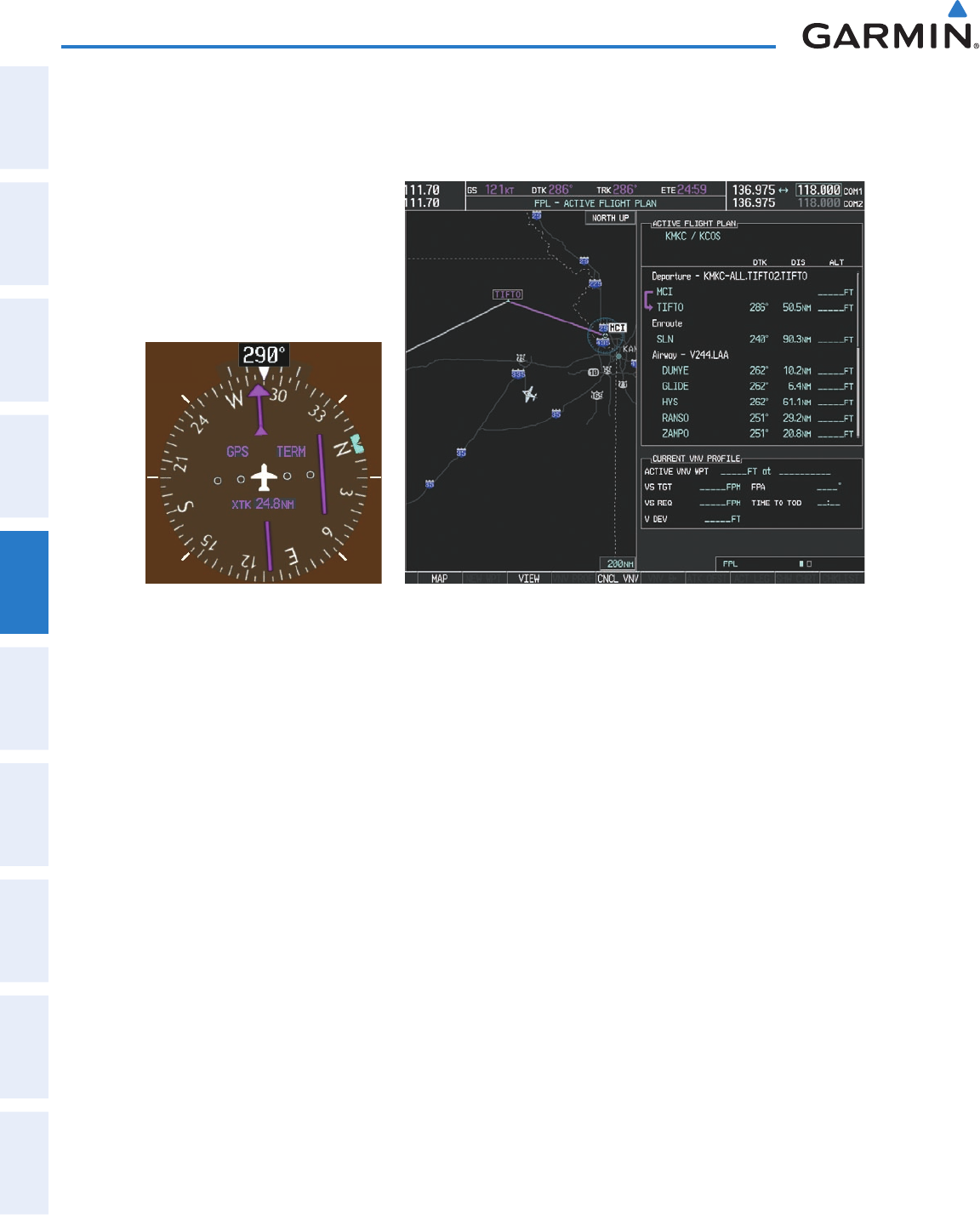
Garmin G1000 Pilot’s Guide for the Diamond DA40/40F
190-00592-06 Rev. A248
FLIGHT MANAGEMENT
SYSTEM
OVERVIEW
FLIGHT
INSTRUMENTS
EIS
AUDIO PANEL
& CNS
FLIGHT
MANAGEMENT
HAZARD
AVOIDANCE
AFCS
ADDITIONAL
FEATURES
APPENDICESINDEX
3) ATC now assigns routing to join V4. A heading of 290º is assigned to intercept V4. The aircraft turns to heading
290° as seen in Figure 5-104.
Figure 5-104 Assigned Heading of 290º
4) Enter V4 into the flight plan.
a) Press the FMS Knob to activate the cursor.
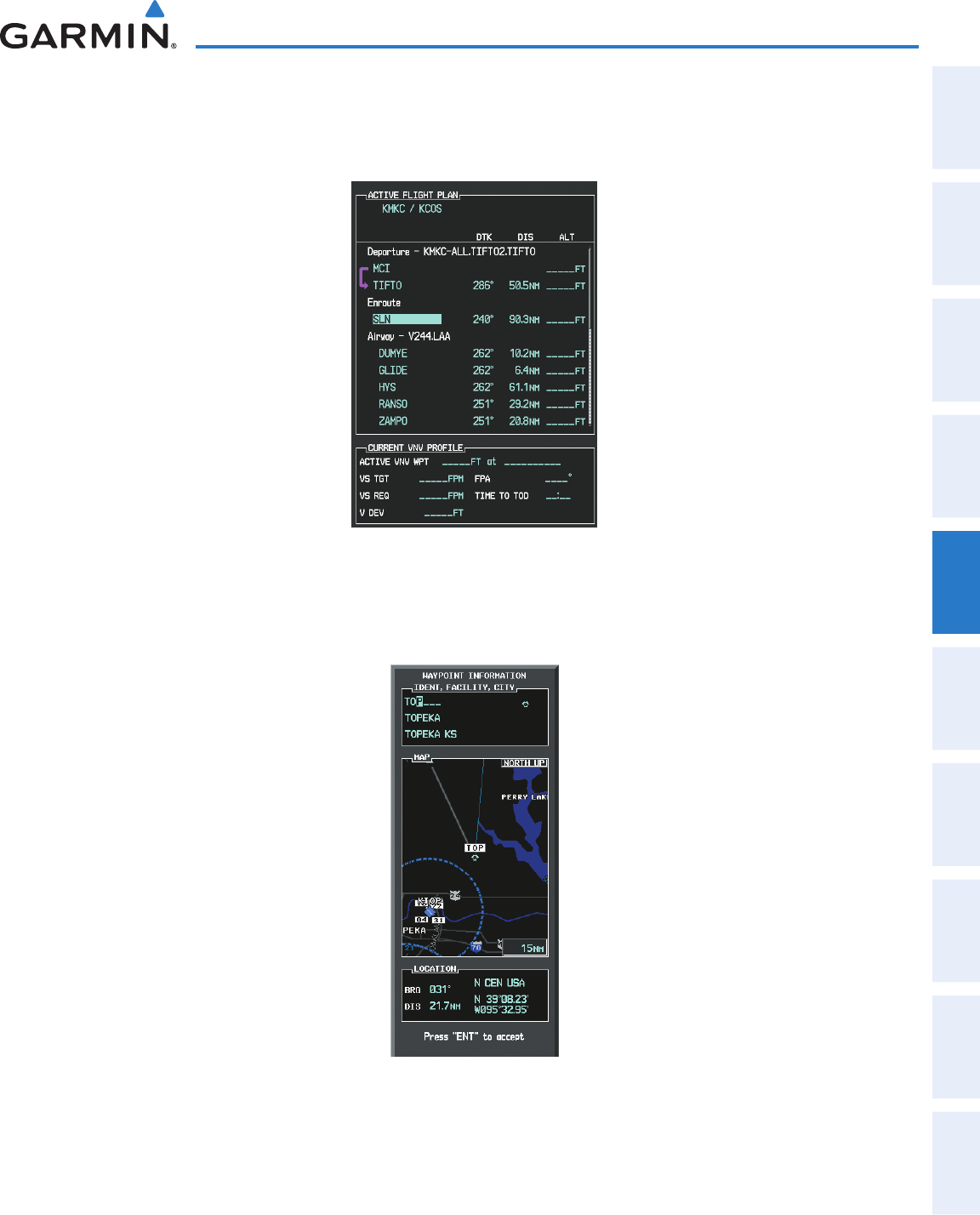
190-00592-06 Rev. A
Garmin G1000 Pilot’s Guide for the Diamond DA40/40F
249
FLIGHT MANAGEMENT
SYSTEM
OVERVIEW
FLIGHT
INSTRUMENTS EIS AUDIO PANEL
& CNS
FLIGHT
MANAGEMENT
HAZARD
AVOIDANCE AFCS ADDITIONAL
FEATURES APPENDICES INDEX
b) The desired entry point for V4 (TOP) must be entered. Turn the large FMS Knob to highlight the desired flight
plan insertion point (SLN) as shown in Figure 5-105. When the V4 entry point (TOP) is inserted, it is placed
immediately above the highlighted waypoint (SLN).
Figure 5-105 Begin Adding V4 to the Flight Plan
c) Turn the small FMS Knob to display the Waypoint Information Window. Enter the desired entry point for V4,
Topeka VOR (TOP), as shown in Figure 5-106.
Figure 5-106 Entering V4 Entry Point
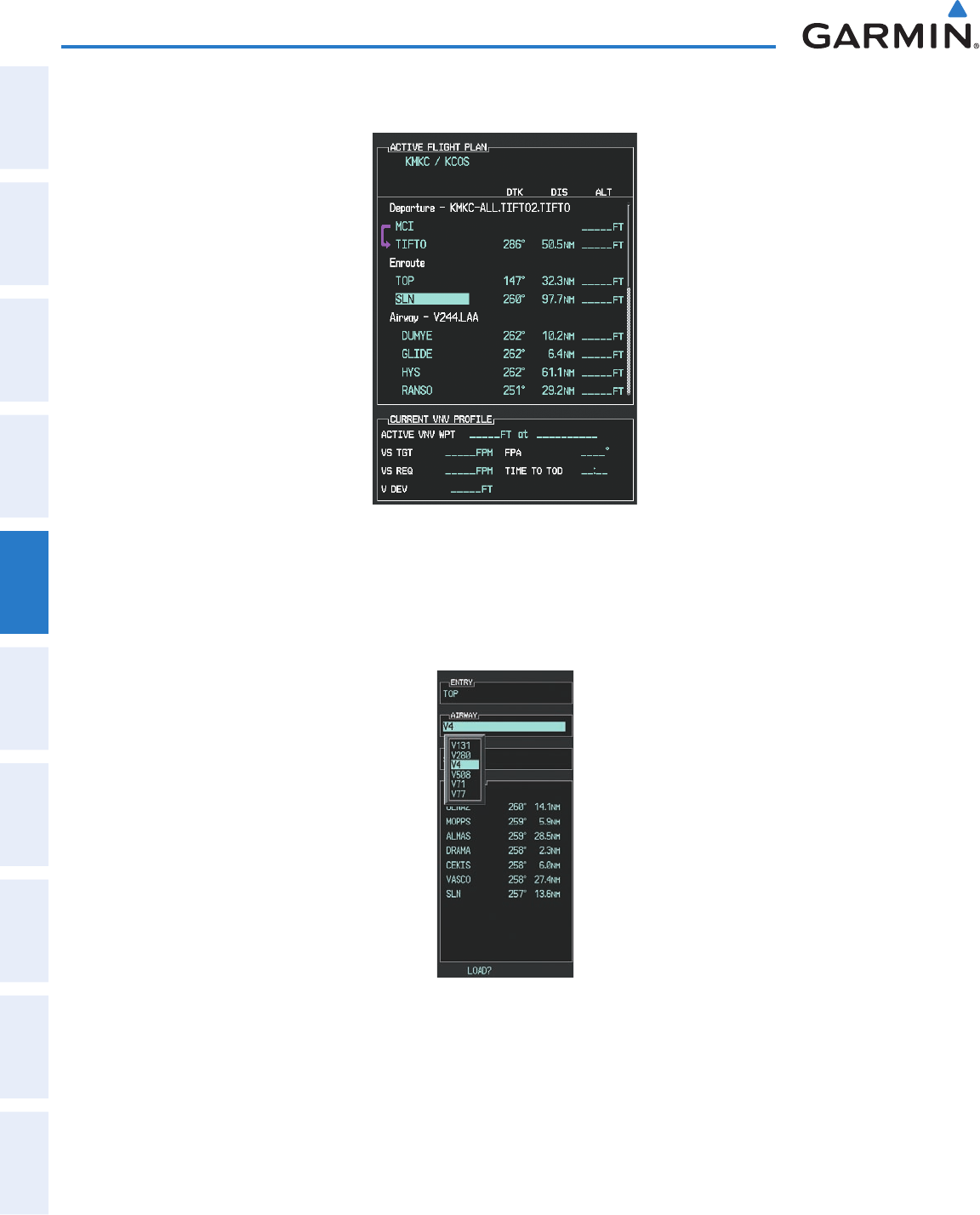
Garmin G1000 Pilot’s Guide for the Diamond DA40/40F
190-00592-06 Rev. A250
FLIGHT MANAGEMENT
SYSTEM
OVERVIEW
FLIGHT
INSTRUMENTS
EIS
AUDIO PANEL
& CNS
FLIGHT
MANAGEMENT
HAZARD
AVOIDANCE
AFCS
ADDITIONAL
FEATURES
APPENDICESINDEX
d) Press the ENT Key. TOP is inserted into the flight plan as in Figure 5-107.
Figure 5-107 TOP Inserted into the Flight Plan
e) With SLN still highlighted as in Figure 5-104, turn the small FMS Knob clockwise. The Waypoint Information
Page is displayed and the LD AIRWY Softkey is now available.
f) Press the LD AIRWY Softkey to display the list of available airways for TOP as seen in Figure 5-108.
Figure 5-108 List of Available Airways for TOP
g) Turn either FMS Knob to highlight V4 in the list as seen in Figure 5-108.
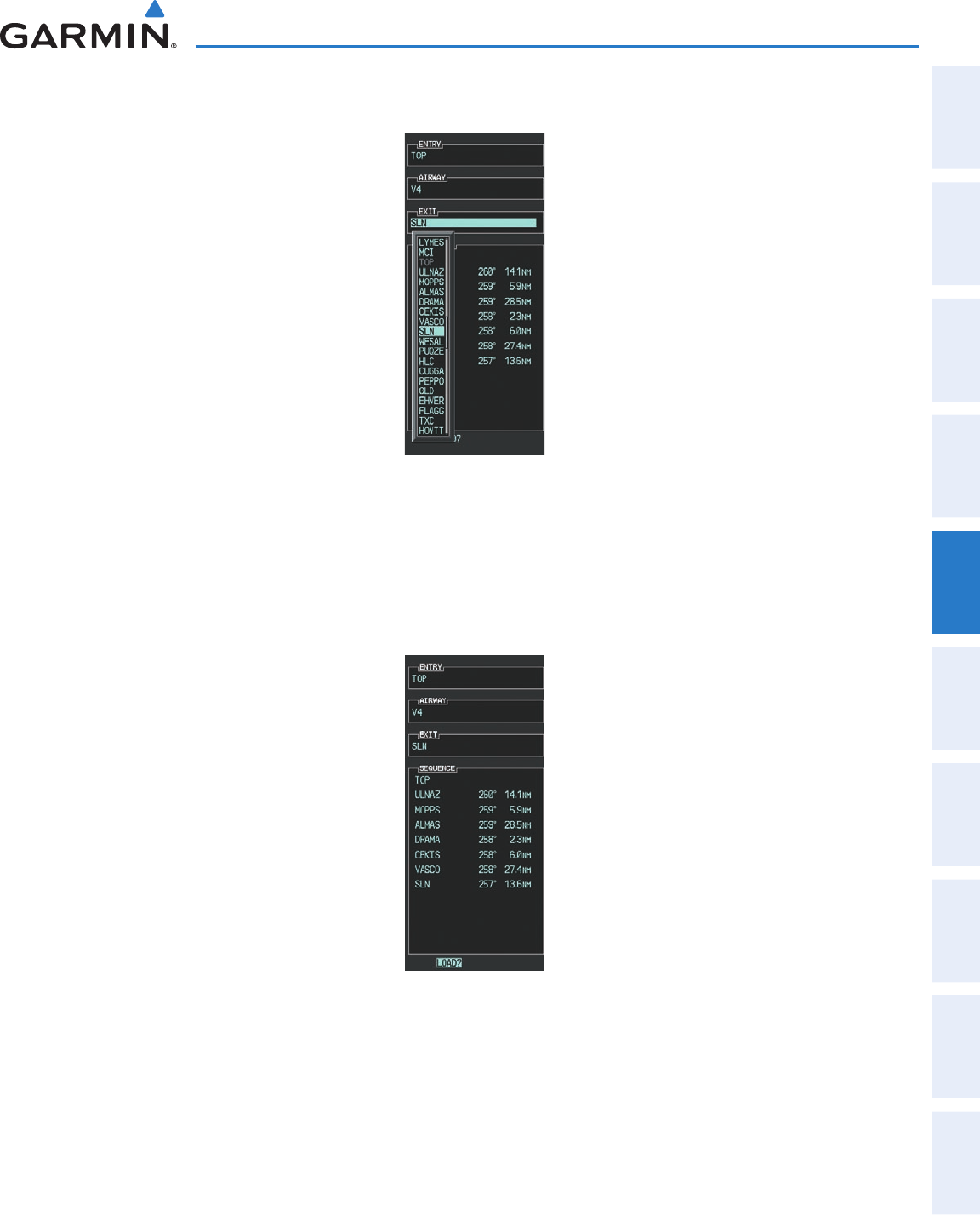
190-00592-06 Rev. A
Garmin G1000 Pilot’s Guide for the Diamond DA40/40F
251
FLIGHT MANAGEMENT
SYSTEM
OVERVIEW
FLIGHT
INSTRUMENTS EIS AUDIO PANEL
& CNS
FLIGHT
MANAGEMENT
HAZARD
AVOIDANCE AFCS ADDITIONAL
FEATURES APPENDICES INDEX
h) Press the ENT Key. The list of available exits for V4 is now displayed as in Figure 5-109.
Figure 5-109 List of Available Exits for V4
i) If necessary, turn either FMS Knob to select the desired exit. In this case Salina VOR (SLN) is selected as in
Figure 5-109.
j) Press the ENT Key. The selected airway and exit are displayed, and the prompt “LOAD?” highlighted as in
Figure 5-110.
Figure 5-110 Ready to Load V4
k) Press the ENT Key.
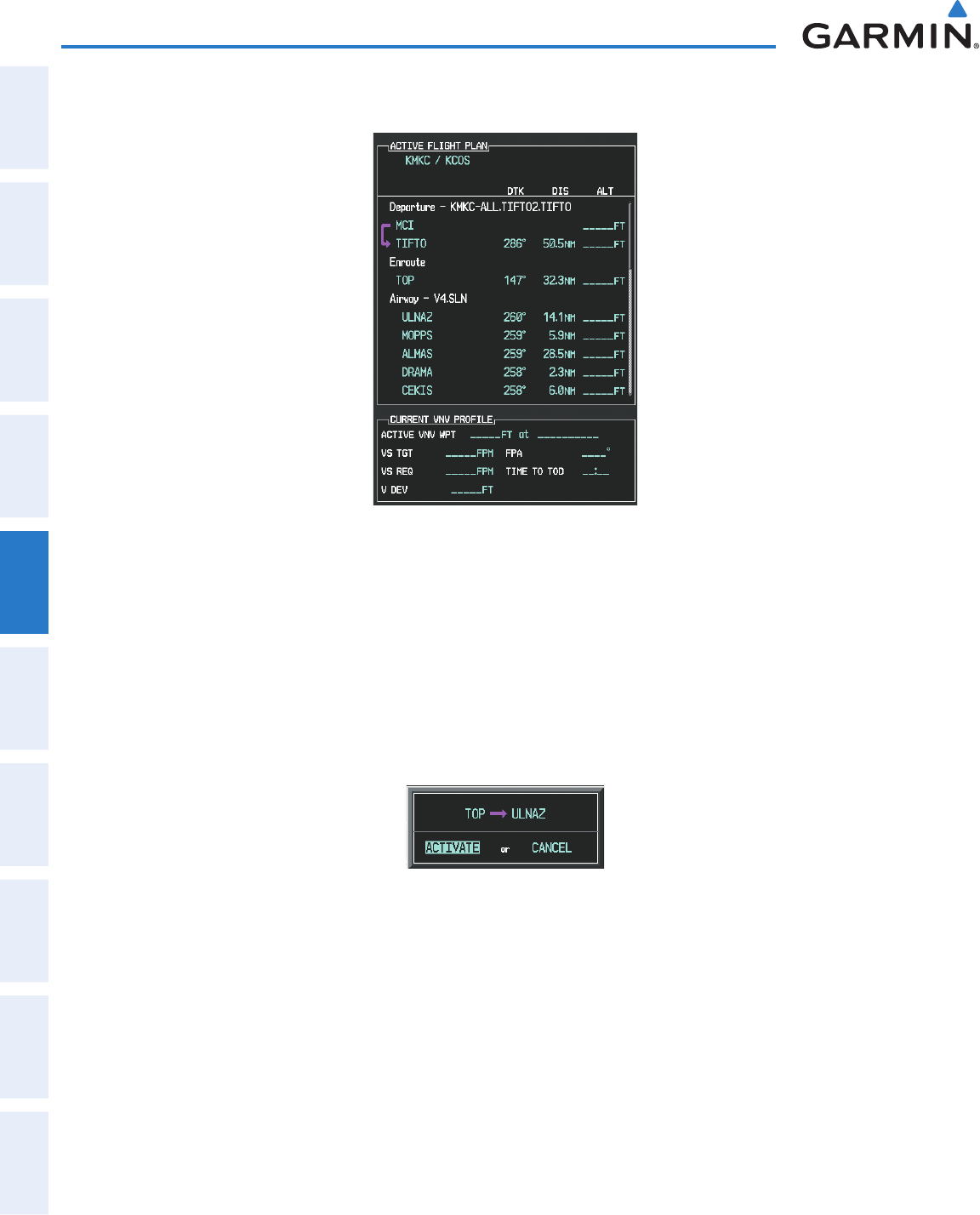
Garmin G1000 Pilot’s Guide for the Diamond DA40/40F
190-00592-06 Rev. A252
FLIGHT MANAGEMENT
SYSTEM
OVERVIEW
FLIGHT
INSTRUMENTS
EIS
AUDIO PANEL
& CNS
FLIGHT
MANAGEMENT
HAZARD
AVOIDANCE
AFCS
ADDITIONAL
FEATURES
APPENDICESINDEX
l) V4 is now loaded into the flight plan as shown in Figure 5-111.
Figure 5-111 V4 is Loaded in the Flight Plan
5) Making V4 the active leg of the flight plan.
a) Press the FMS Knob to activate the cursor.
b) Turn the large FMS Knob to highlight ULNAZ. The TO waypoint of the leg is selected in order to activate the
leg.
c) Press the ACT LEG Softkey. The confirmation window is now displayed as in Figure 5-112. Note the TOP to
ULNAZ leg is actually part of V4.
Figure 5-112 Comfirm Active Leg
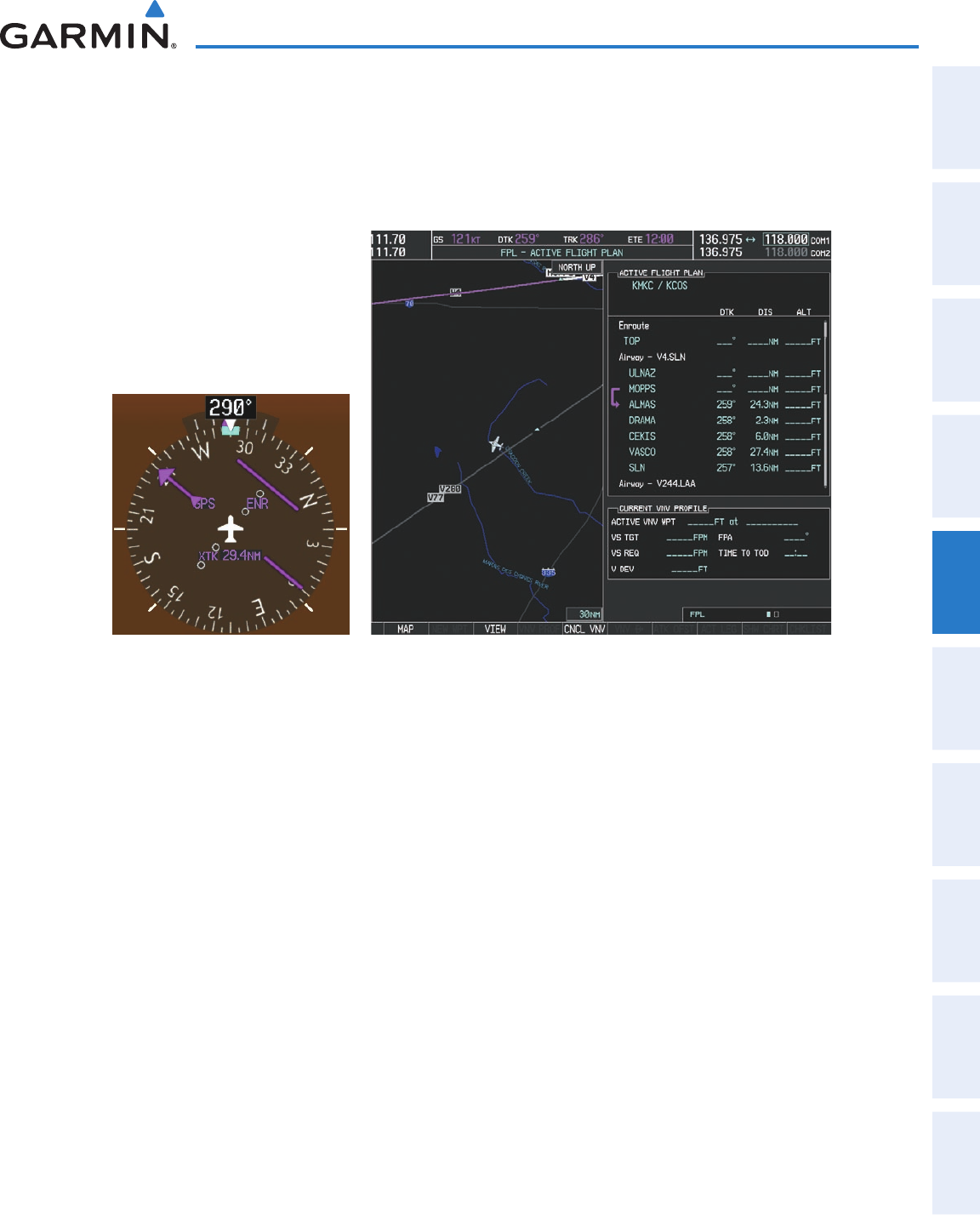
190-00592-06 Rev. A
Garmin G1000 Pilot’s Guide for the Diamond DA40/40F
253
FLIGHT MANAGEMENT
SYSTEM
OVERVIEW
FLIGHT
INSTRUMENTS EIS AUDIO PANEL
& CNS
FLIGHT
MANAGEMENT
HAZARD
AVOIDANCE AFCS ADDITIONAL
FEATURES APPENDICES INDEX
d) Verify the displayed leg is the desired leg and press the ENT Key. Note in Figure 5-113, the magenta arrow in
the flight plan window and magenta line on the map indicating V4 is now the active flight plan leg. Note the
phase of flight remained in Terminal (TERM) mode up to this point because a departure leg was active. Since a
leg after the departure is now active, the current CDI flight phase is ENR (Enroute) and CDI scaling has changed
to 2.0 nm.
Figure 5-113 V4 Now Active Leg
6) The aircraft continues on heading 290º. When crosstrack distance is less than 2.0 nm, the XTK disappears from
the HSI and the CDI is positioned on the last dot indicating a 2.0 nm distance from the centerline of the next
course.
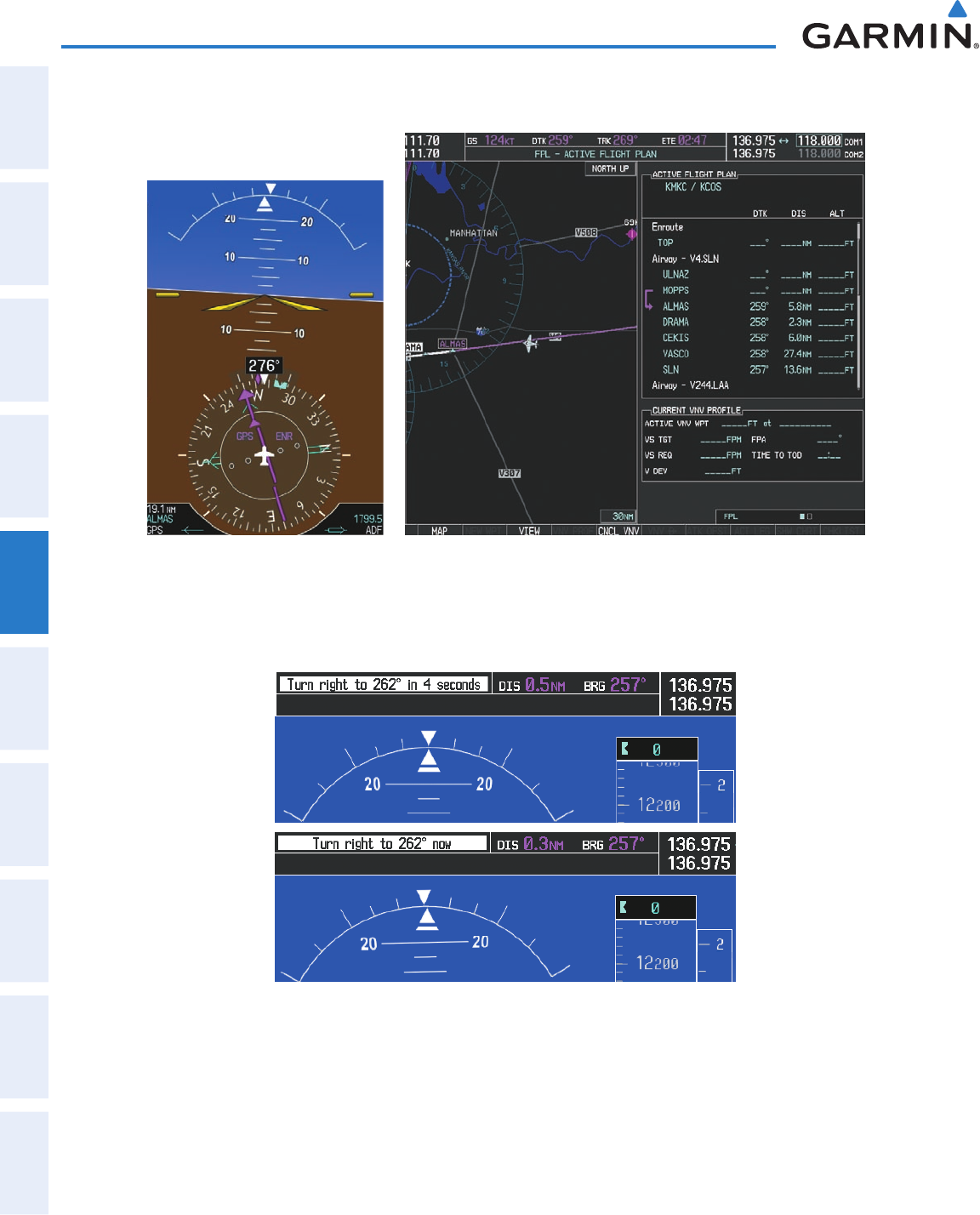
Garmin G1000 Pilot’s Guide for the Diamond DA40/40F
190-00592-06 Rev. A254
FLIGHT MANAGEMENT
SYSTEM
OVERVIEW
FLIGHT
INSTRUMENTS
EIS
AUDIO PANEL
& CNS
FLIGHT
MANAGEMENT
HAZARD
AVOIDANCE
AFCS
ADDITIONAL
FEATURES
APPENDICESINDEX
7) As the CDI approaches center, the aircraft turns onto the active leg as seen in Figure 5-114.
Figure 5-114 Turn on to Active Leg
8) At SLN, Victor Airway 244 (V244) is intercepted. Turn prompts are displayed in the PFD Navigation Status Box
as seen in Figure 5-115.
Figure 5-115 Turn to Intercept V244
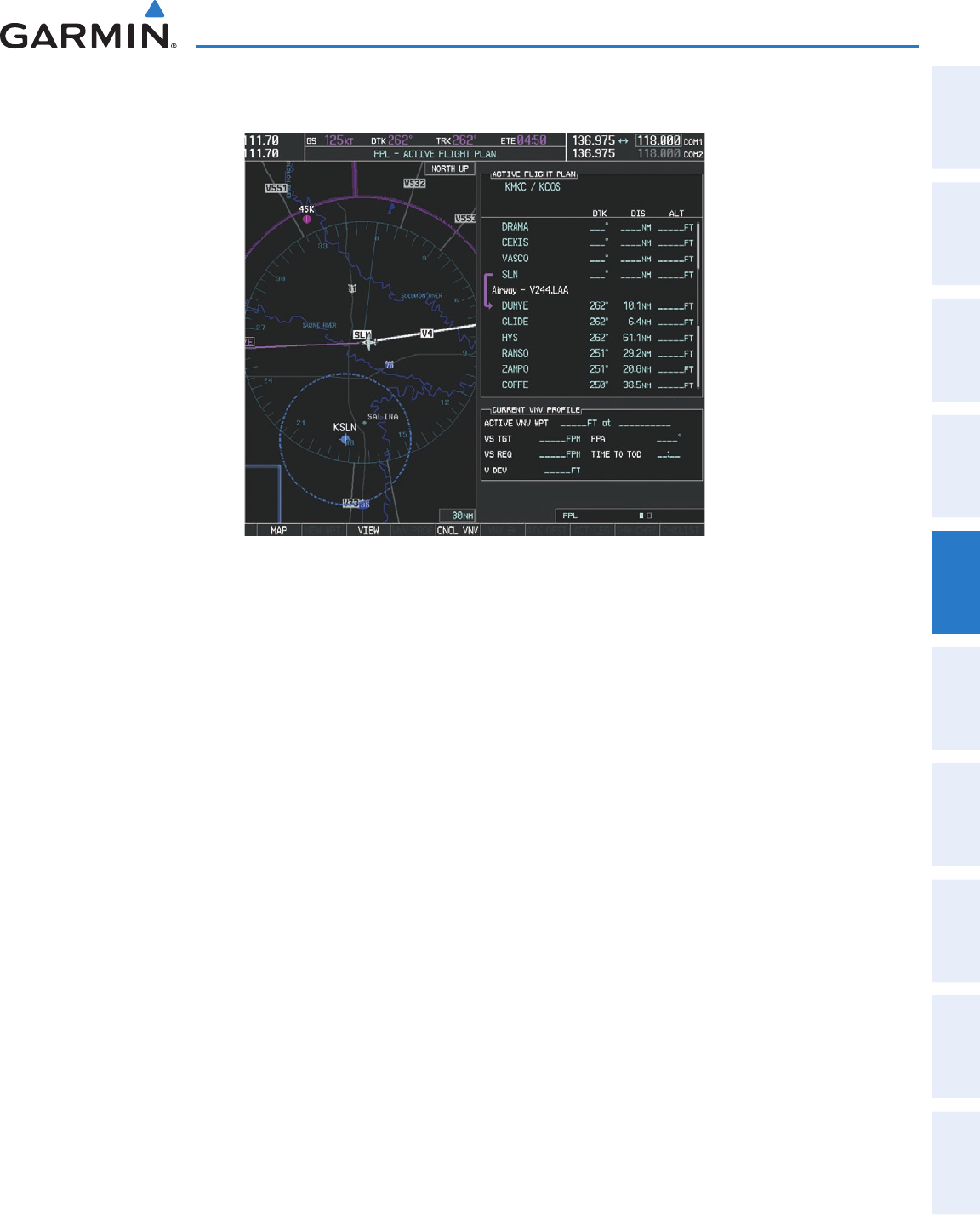
190-00592-06 Rev. A
Garmin G1000 Pilot’s Guide for the Diamond DA40/40F
255
FLIGHT MANAGEMENT
SYSTEM
OVERVIEW
FLIGHT
INSTRUMENTS EIS AUDIO PANEL
& CNS
FLIGHT
MANAGEMENT
HAZARD
AVOIDANCE AFCS ADDITIONAL
FEATURES APPENDICES INDEX
9) As seen in Figure 5-116, V244 is now the active flight plan leg.
Figure 5-116 V244 Now Active Leg
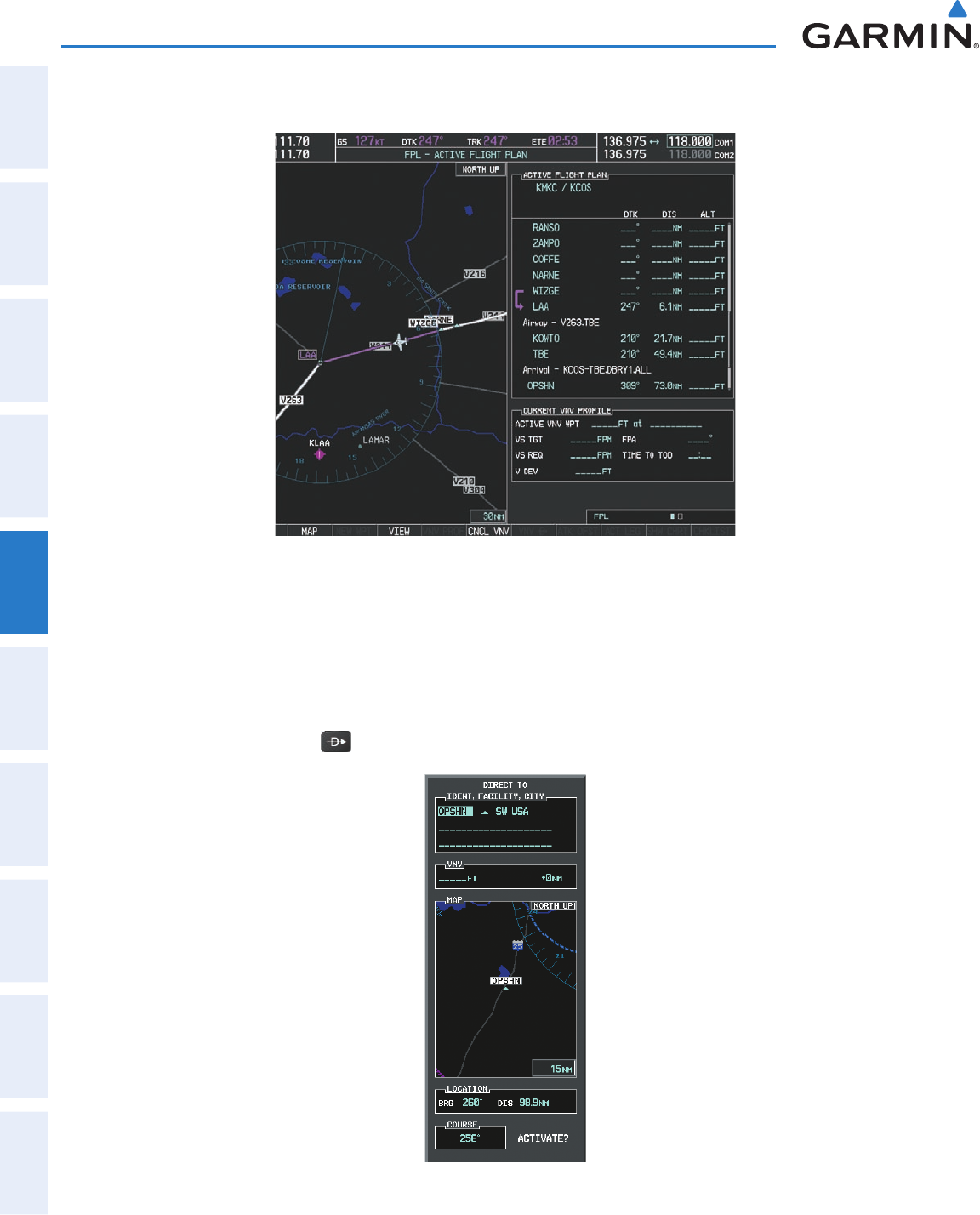
Garmin G1000 Pilot’s Guide for the Diamond DA40/40F
190-00592-06 Rev. A256
FLIGHT MANAGEMENT
SYSTEM
OVERVIEW
FLIGHT
INSTRUMENTS
EIS
AUDIO PANEL
& CNS
FLIGHT
MANAGEMENT
HAZARD
AVOIDANCE
AFCS
ADDITIONAL
FEATURES
APPENDICESINDEX
10) At Lamar VOR (LAA) V263 is intercepted. See Figure 5-117.
Figure 5-117 HYS to LAA Legs Active
11) ATC grants clearance to proceed direct to the OPSHN intersection to begin the arrival procedure. ATC advises
to expect an altitude of 10,000 feet at OPSHN.
a) Press the FMS Knob to activate the cursor.
b) Turn the large FMS Knob to select OPSHN in the flight plan list.
c) Press the
Direct-to
( )
Key. The Direct-to Window is now displayed as shown in Figure 5-118.
Figure 5-118 Direct To OPSHN
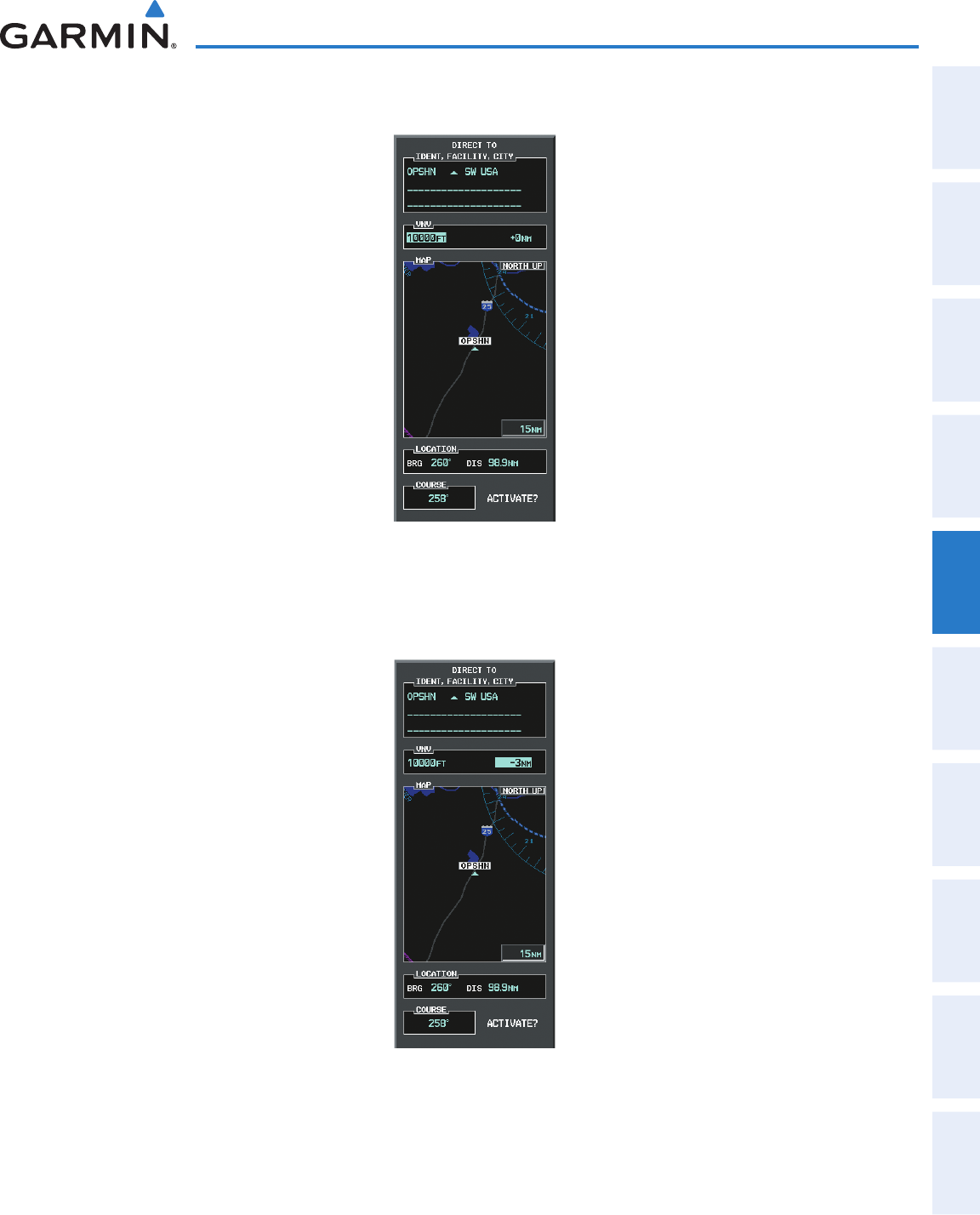
190-00592-06 Rev. A
Garmin G1000 Pilot’s Guide for the Diamond DA40/40F
257
FLIGHT MANAGEMENT
SYSTEM
OVERVIEW
FLIGHT
INSTRUMENTS EIS AUDIO PANEL
& CNS
FLIGHT
MANAGEMENT
HAZARD
AVOIDANCE AFCS ADDITIONAL
FEATURES APPENDICES INDEX
d) Turn the large FMS Knob to place the cursor in the VNV altitude field as shown in Figure 5-119.
Figure 5-119 Enter VNV Altitude
e) An altitude of 10,000 feet is entered as requested by ATC.
f) Press the ENT Key. The cursor is now displayed in the VNV offset field as shown in Figure 5-120.
Figure 5-120 Enter VNV Offset Distance
g) Enter the offset, or distance from the waypoint at which to reach the selected altitude. In this case, three miles
prior to OPSHN is entered. In other words, the G1000 gives vertical guidance so the aircraft arrives at an
altitude of 10,000 feet three miles prior to OPSHN.
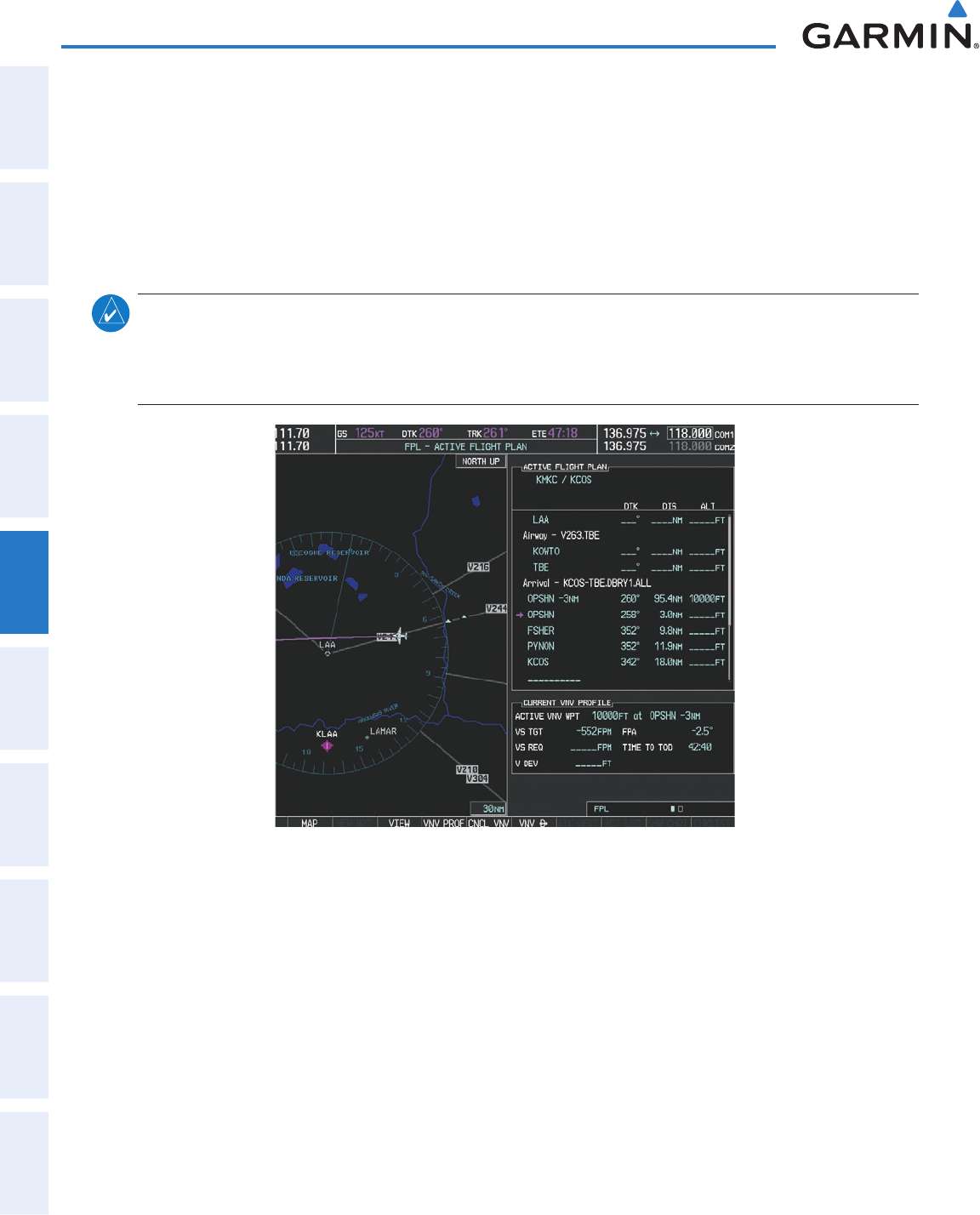
Garmin G1000 Pilot’s Guide for the Diamond DA40/40F
190-00592-06 Rev. A258
FLIGHT MANAGEMENT
SYSTEM
OVERVIEW
FLIGHT
INSTRUMENTS
EIS
AUDIO PANEL
& CNS
FLIGHT
MANAGEMENT
HAZARD
AVOIDANCE
AFCS
ADDITIONAL
FEATURES
APPENDICESINDEX
h) Press the ENT Key twice to activate the direct-to. Note, in Figure 5-121, the magenta arrow indicating the direct-
to OPSHN after the offset waypoint for OPSHN. The preceding offset waypoint indicates the offset distance
and altitude that were previously entered. The remaining waypoints in the loaded arrival procedure have no
database specified altitudes, therefore, dashes are displayed. Keep the CDI centered and maintain a track along
the magenta line to OPSHN.
Note the Direct-to waypoint is within the loaded arrival procedure, therefore, phase of flight scaling for the CDI
changes to Terminal Mode and is annunciated by displaying ‘TERM’ on the HSI.
NOTE: If the loaded arrival procedure has waypoints with altitude constraints retrieved from the database
to be used as is, the altitude must be manually accepted by placing the cursor over the desired altitude,
then pressing the ENT Key. The altitude is now displayed as light blue meaning it is used by the system to
determine vertical speed and deviation guidance.
Figure 5-121 Direct-to Active
12) The aircraft is proceeding to OPSHN. The expected approach is the RNAV LPV approach to runway 35R, so it is
selected.
a) Press the
PROC
Key to display the Procedures Window.
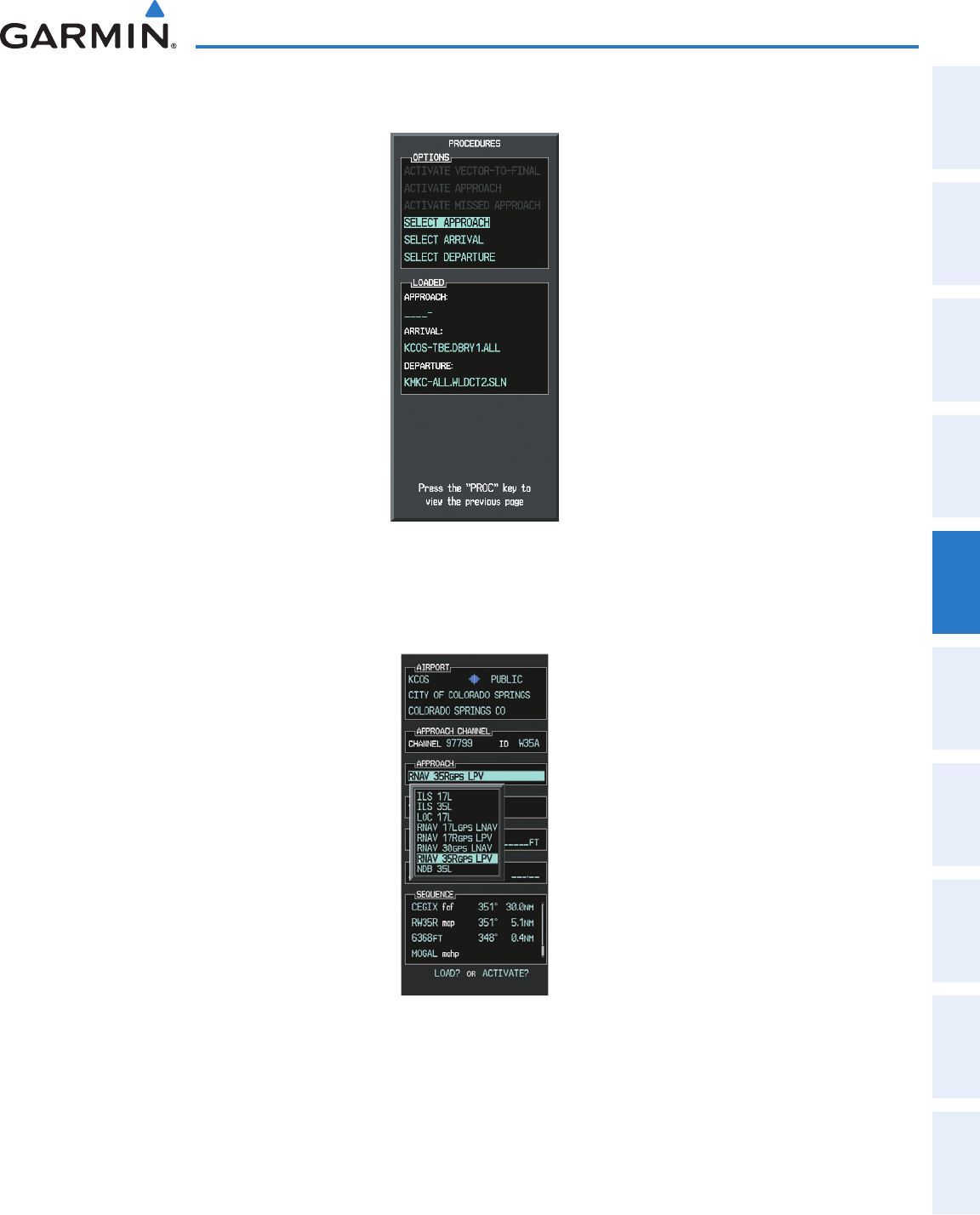
190-00592-06 Rev. A
Garmin G1000 Pilot’s Guide for the Diamond DA40/40F
259
FLIGHT MANAGEMENT
SYSTEM
OVERVIEW
FLIGHT
INSTRUMENTS EIS AUDIO PANEL
& CNS
FLIGHT
MANAGEMENT
HAZARD
AVOIDANCE AFCS ADDITIONAL
FEATURES APPENDICES INDEX
b) ‘SELECT APPROACH’ should be highlighted as shown in Figure 5-122.
Figure 5-122 Proceudures Window
c) Press the ENT Key. A list of available approaches for the destination airport is displayed as in Figure 5-123.
Figure 5-123 List of Available Approaches
d) Turn either
FMS
Knob to select the LPV approach for 35R as shown in Figure 5-1201.
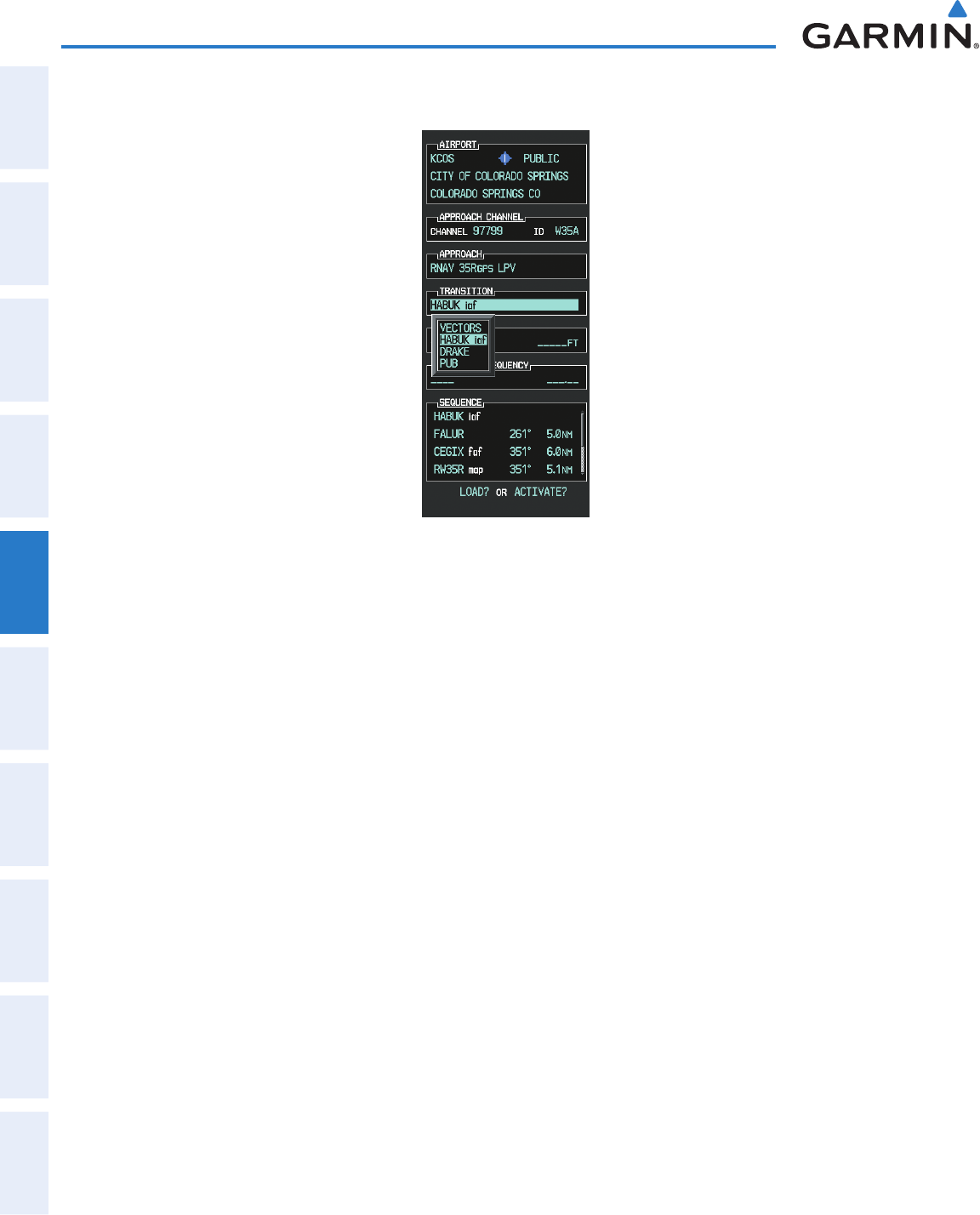
Garmin G1000 Pilot’s Guide for the Diamond DA40/40F
190-00592-06 Rev. A260
FLIGHT MANAGEMENT
SYSTEM
OVERVIEW
FLIGHT
INSTRUMENTS
EIS
AUDIO PANEL
& CNS
FLIGHT
MANAGEMENT
HAZARD
AVOIDANCE
AFCS
ADDITIONAL
FEATURES
APPENDICESINDEX
e) Press the ENT Key. A list of available transitions for the selected approach is displayed as in Figure 5-124.
Figure 5-124 List of Available Transitions
f) Turn either FMS Knob to select the desired transition. In this case, the Initial Approach Fix (IAF) at HABUK is
used.
g) Press the ENT Key.
h) Barometric Minimums
To set MINIMUMS’, turn the small FMS Knob to select ‘BARO’, and press the ENT Key. Turn the small
FMS Knob to select the altitude, and press the ENT Key.
Or:
To skip setting minimums, press the ENT Key.
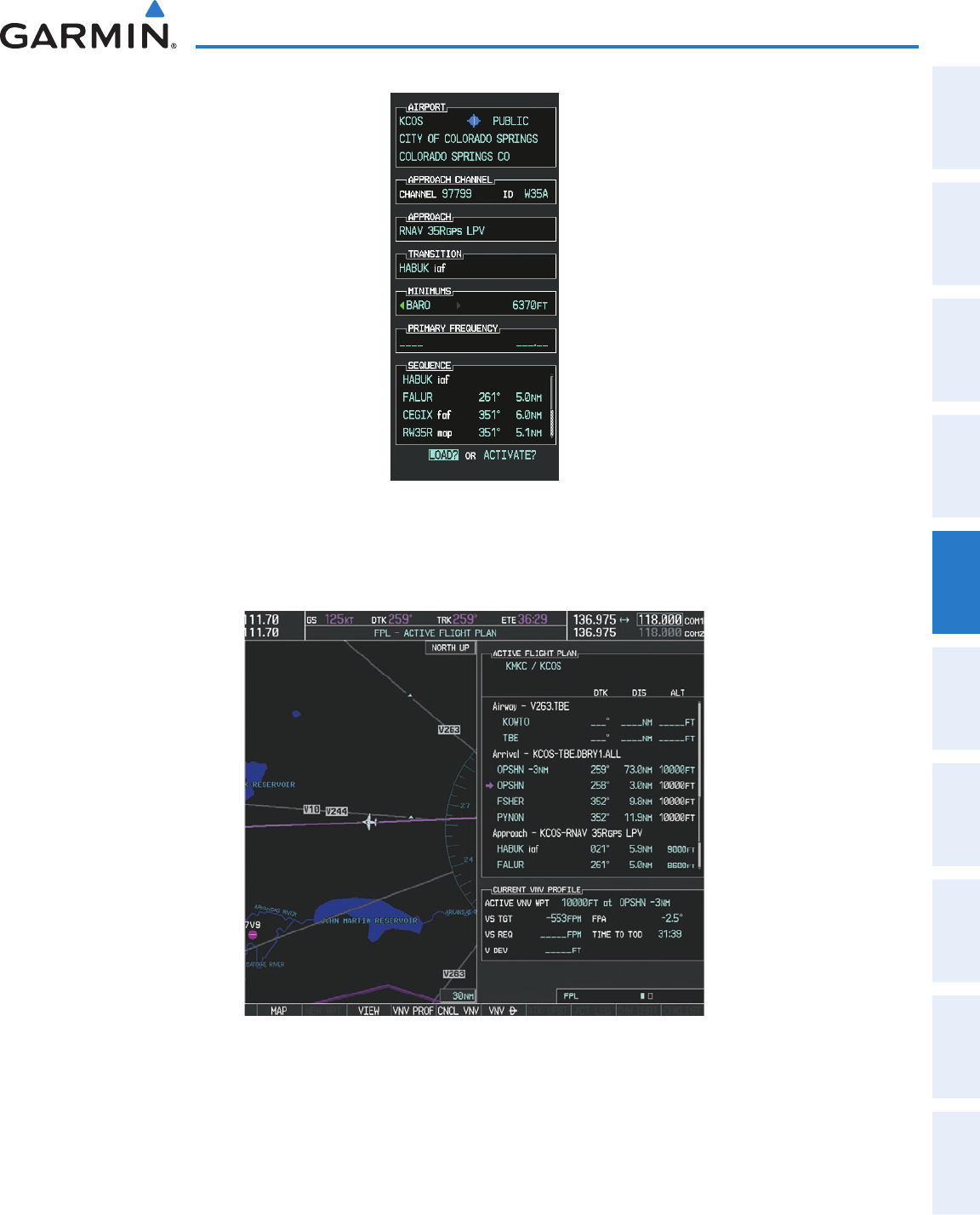
190-00592-06 Rev. A
Garmin G1000 Pilot’s Guide for the Diamond DA40/40F
261
FLIGHT MANAGEMENT
SYSTEM
OVERVIEW
FLIGHT
INSTRUMENTS EIS AUDIO PANEL
& CNS
FLIGHT
MANAGEMENT
HAZARD
AVOIDANCE AFCS ADDITIONAL
FEATURES APPENDICES INDEX
Figure 5-125 Barometric Minimums Set
i) With ‘LOAD?’ highlighted, again press the ENT Key. The selected approach is added to the flight plan as seen
in Figure 5-126.
Figure 5-126 Loaded Approach
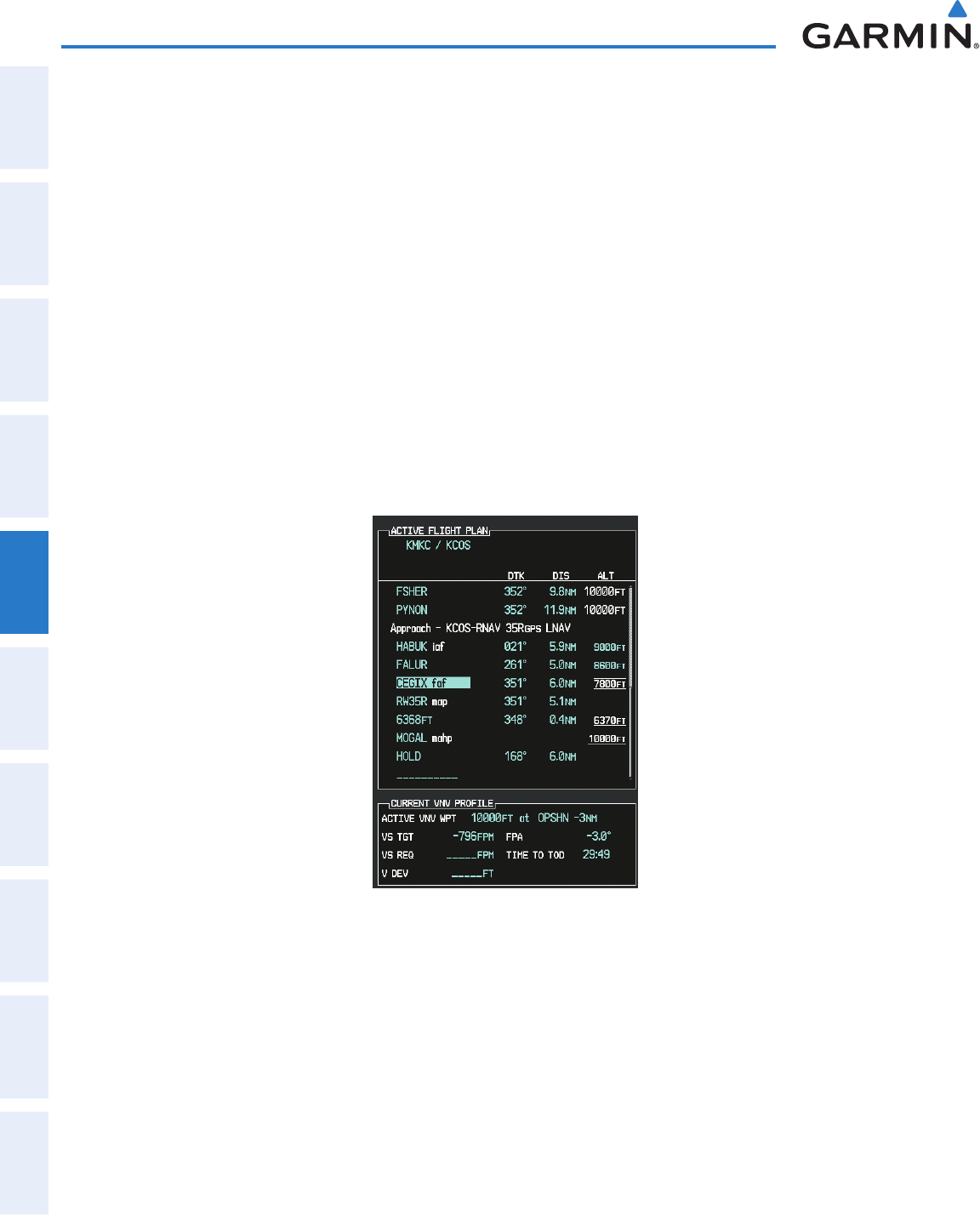
Garmin G1000 Pilot’s Guide for the Diamond DA40/40F
190-00592-06 Rev. A262
FLIGHT MANAGEMENT
SYSTEM
OVERVIEW
FLIGHT
INSTRUMENTS
EIS
AUDIO PANEL
& CNS
FLIGHT
MANAGEMENT
HAZARD
AVOIDANCE
AFCS
ADDITIONAL
FEATURES
APPENDICESINDEX
13) Note the altitude constraints associated with each of the approach waypoints as seen in Figure 5-127. These
altitudes are loaded from the database and are displayed as light blue text, indicating these values are
“designated” for use in computing vertical deviation guidance.
Note: To no longer use the displayed altitude for calculating vertical deviation guidance, perform the
following:
a) Press the FMS Knob to activate the cursor.
b) Turn the small FMS Knob to highlight the desired altitude.
c) Press the CLR Key.
d) Press the FMS Knob to deactivate the cursor.
After making the altitude “non-designated”, it is displayed as white text.
Altitude constraint values associated with the Final Approach Fix (FAF) and waypoints beyond the FAF cannot be
designated for vertical guidance. These altitude values are always displayed as white text, as in Figure 5-127.
Vertical guidance from the FAF and on to the Missed Approach Point (MAP) is given using the WAAS GPS
altitude source, therefore, the displayed altitude values are for reference only.
Figure 5-127 Vertical Guidance is Active to the FAF
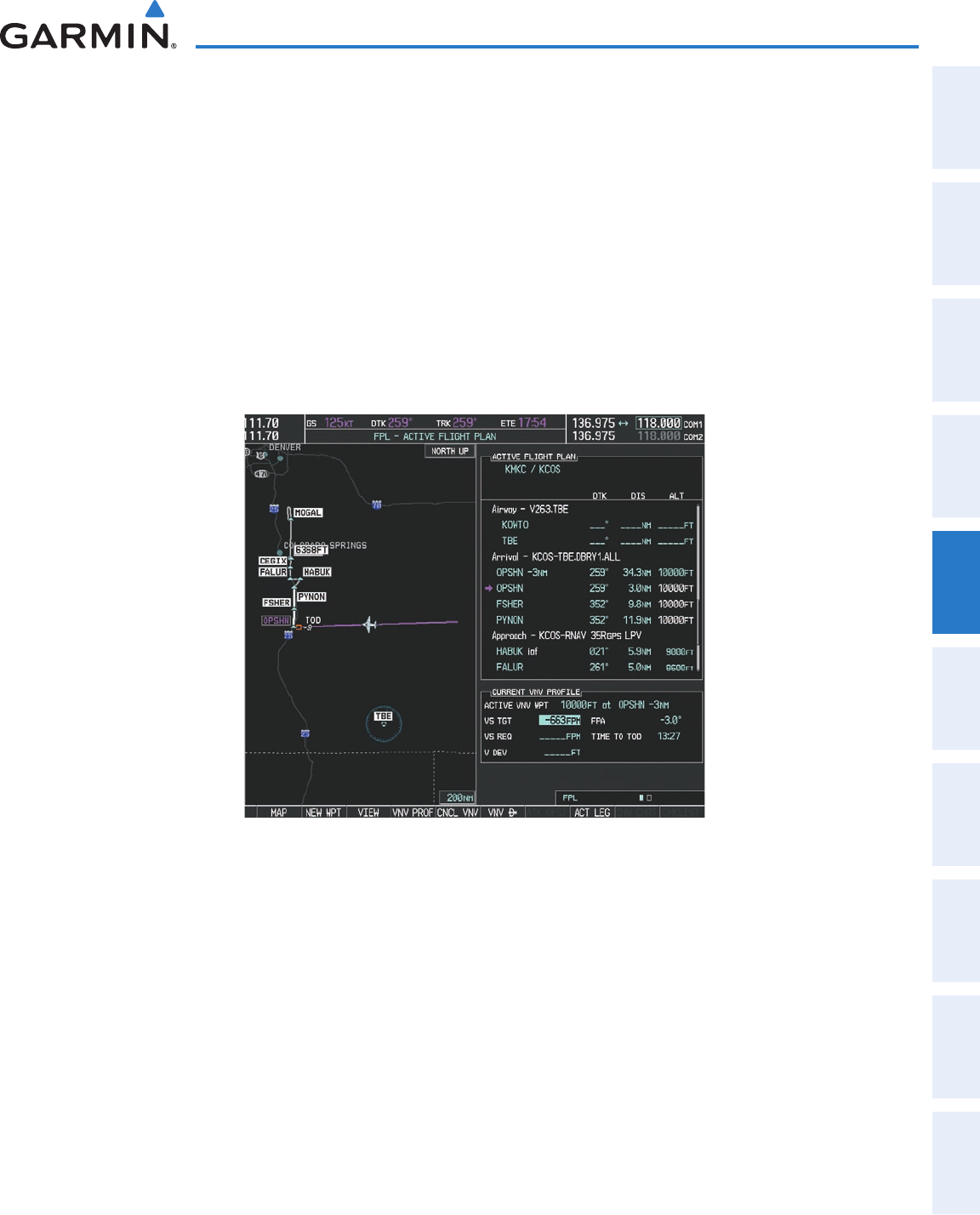
190-00592-06 Rev. A
Garmin G1000 Pilot’s Guide for the Diamond DA40/40F
263
FLIGHT MANAGEMENT
SYSTEM
OVERVIEW
FLIGHT
INSTRUMENTS EIS AUDIO PANEL
& CNS
FLIGHT
MANAGEMENT
HAZARD
AVOIDANCE AFCS ADDITIONAL
FEATURES APPENDICES INDEX
14) As the aircraft approaches OPSHN, it may be desirable to adjust the speed, or steepness of the upcoming
descent. The default Flight Path Angle (FPA) is -3.0 degrees and a required vertical speed is computed to
maintain the -3.0 FPA. To change the vertical flight path, perform the following steps.
a) Press the VNV PROF Softkey to place the cursor in the target vertical speed field (VS TGT) as shown in Figure
5-128.
b) At this point, the descent vertical speed can be selected, or the FPA can be selected. Turn the large FMS Knob
to select the desired selection field, then turn the small FMS Knob to enter the desired value.
Note the information now displayed in the ‘CURRENT VNV PROFILE’ box. Also, note the offset waypoint (orange
box) and gray circle are now displayed on the map. The gray circle marks the Top of Descent (TOD). In this
example, vertical guidance is provided at the TOD that results in a -3.0 degree FPA descent to an altitude of
10,000 feet upon reaching the offset waypoint.
Figure 5-128 Adjusting the Descent
c) Press the ENT Key.
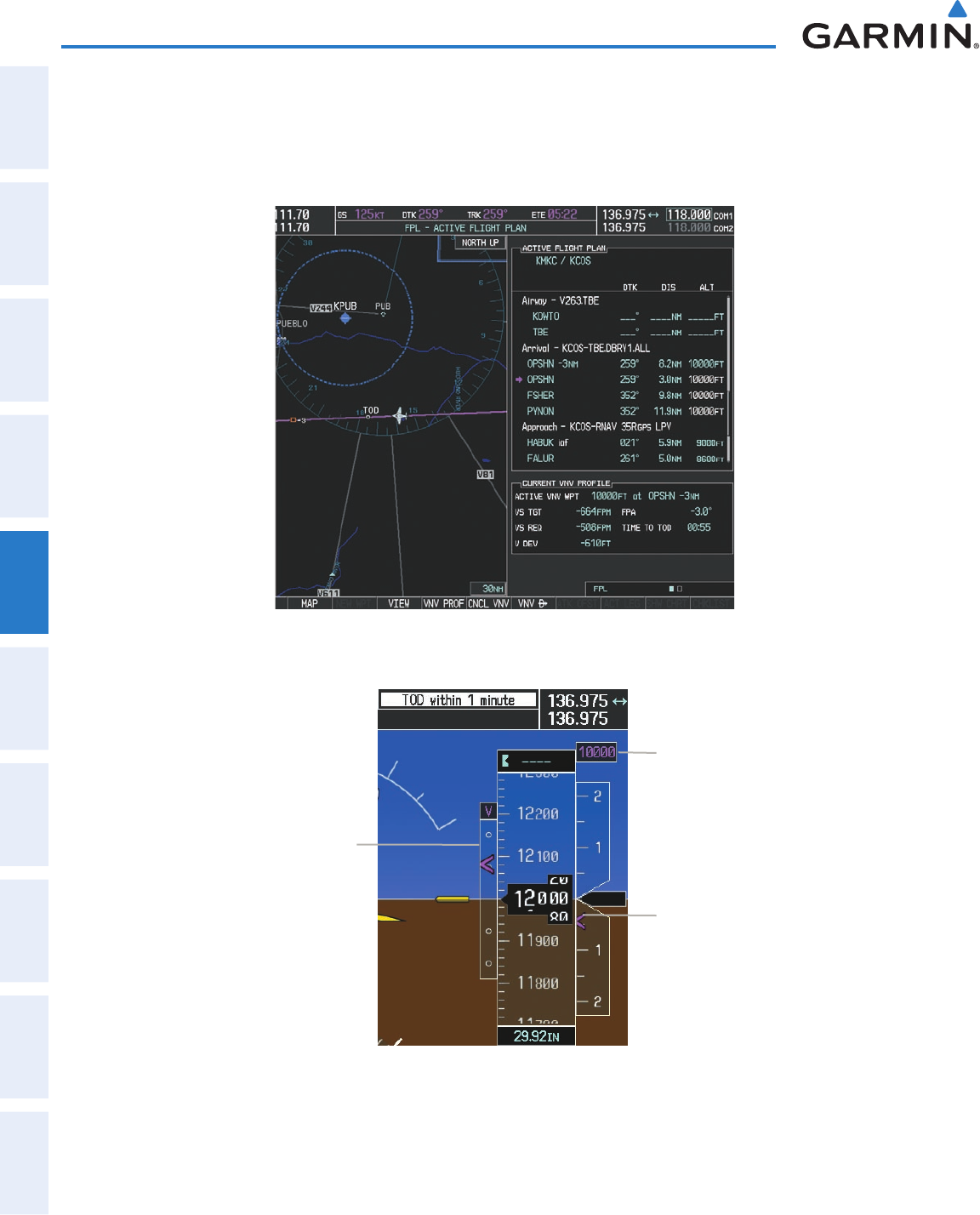
Garmin G1000 Pilot’s Guide for the Diamond DA40/40F
190-00592-06 Rev. A264
FLIGHT MANAGEMENT
SYSTEM
OVERVIEW
FLIGHT
INSTRUMENTS
EIS
AUDIO PANEL
& CNS
FLIGHT
MANAGEMENT
HAZARD
AVOIDANCE
AFCS
ADDITIONAL
FEATURES
APPENDICESINDEX
15) As seen in Figure 5-129, the aircraft is approaching TOD. Note the target vertical speed required to reached
the selected altitude. The Vertical Deviation Indicator (VDI) and the Required Vertical Speed Indicator (RVSI) are
now displayed on the PFD as shown in Figure 5-130. When the aircraft is within one minute of the TOD, it is
annunciated as shown in Figure 5-130, and an aural alert ‘Vertical track’ will be heard.
Figure 5-129 Approaching Top of Descent (TOD)
Figure 5-130 VDI & RVSI Upon Reaching Top of Descent (TOD)
Required Vertical
Speed Indicator
(RVSI)
Vertical Deviation
Indicator (VDI)
Target Altitude
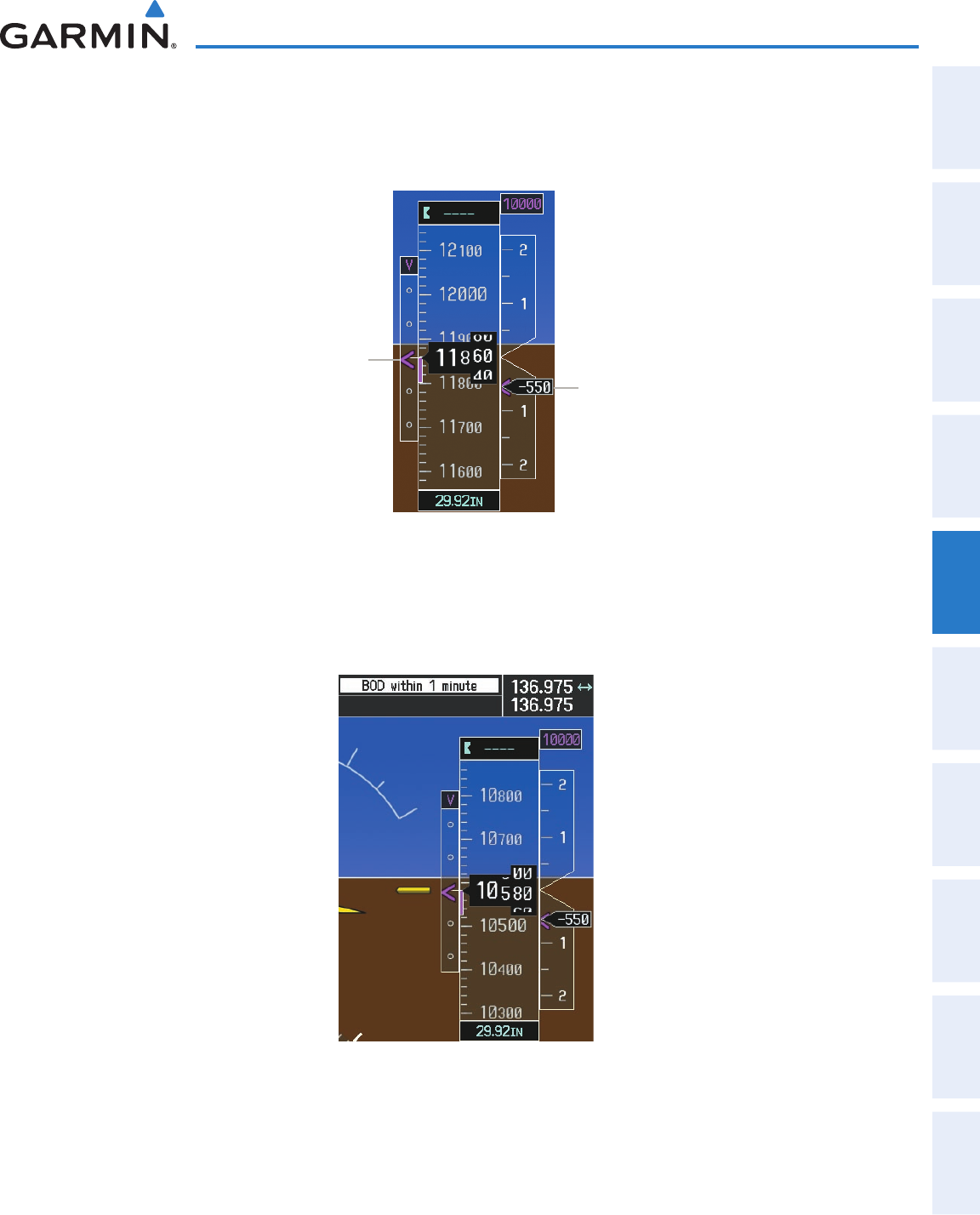
190-00592-06 Rev. A
Garmin G1000 Pilot’s Guide for the Diamond DA40/40F
265
FLIGHT MANAGEMENT
SYSTEM
OVERVIEW
FLIGHT
INSTRUMENTS EIS AUDIO PANEL
& CNS
FLIGHT
MANAGEMENT
HAZARD
AVOIDANCE AFCS ADDITIONAL
FEATURES APPENDICES INDEX
16) Upon reaching TOD, a descent vertical speed is established which places the VSI pointer in line with the RVSI as
shown in Figure 5-131.
Figure 5-131 VDI & RVSI Showing Correctly Established Descent
Align Actual Vertical Speed
with
Required Vertical Speed
Keep Vertical Deviation
Indicator Centered
17) When the aircraft is one minute from the bottom of descent (BOD) it is annunciated as shown in Figure 5-132.
Upon reaching the offset waypoint for OPSHN, the aircraft is at 10,000 feet.
Figure 5-132 Approaching Bottom of Descent (BOD) at OPSHN Offset Waypoint
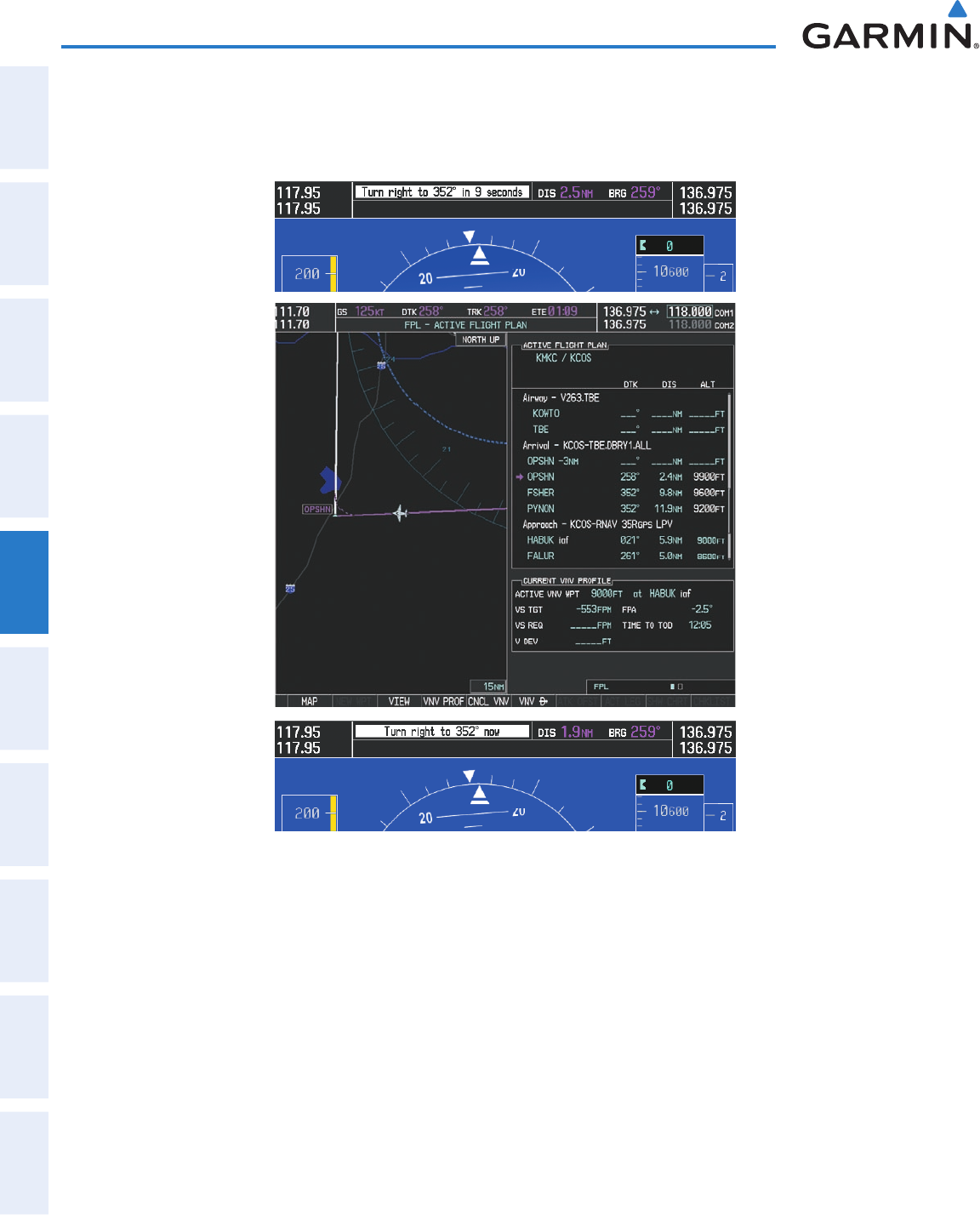
Garmin G1000 Pilot’s Guide for the Diamond DA40/40F
190-00592-06 Rev. A266
FLIGHT MANAGEMENT
SYSTEM
OVERVIEW
FLIGHT
INSTRUMENTS
EIS
AUDIO PANEL
& CNS
FLIGHT
MANAGEMENT
HAZARD
AVOIDANCE
AFCS
ADDITIONAL
FEATURES
APPENDICESINDEX
18) The aircraft is approaching OPSHN. The upcoming turn and next heading are annunciated at the top left of the
PFD as seen in Figure 5-133. Initiate the turn and maneuver the aircraft on a track through the turn radius to
intercept the magenta line for the OPSHN to FSHER leg and center the CDI.
Figure 5-133 Turn to intercept OPSHN to FSHER Leg
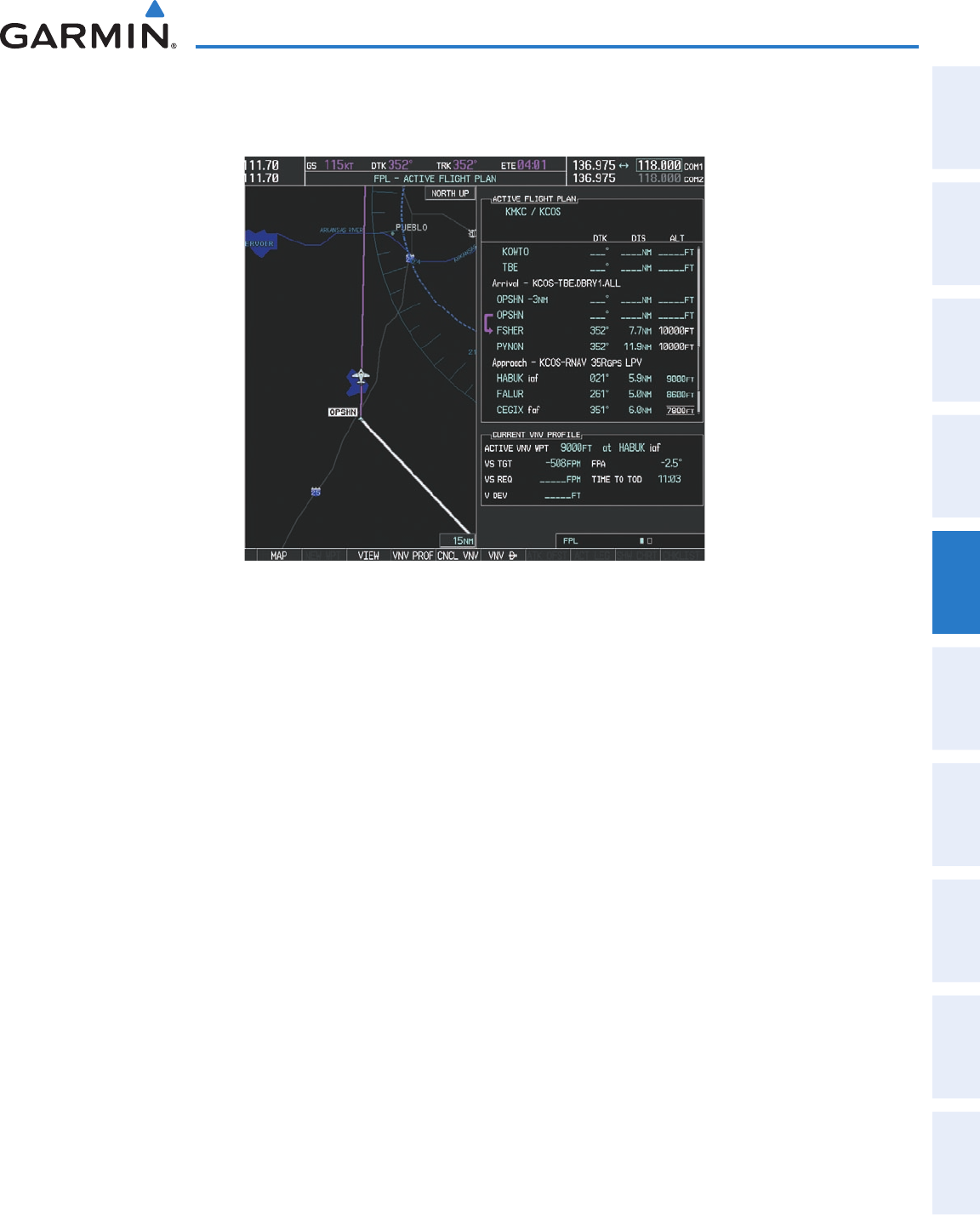
190-00592-06 Rev. A
Garmin G1000 Pilot’s Guide for the Diamond DA40/40F
267
FLIGHT MANAGEMENT
SYSTEM
OVERVIEW
FLIGHT
INSTRUMENTS EIS AUDIO PANEL
& CNS
FLIGHT
MANAGEMENT
HAZARD
AVOIDANCE AFCS ADDITIONAL
FEATURES APPENDICES INDEX
19) After passing OPSHN, the next leg of the arrival turns magenta as shown in Figure 5-134. The magenta arrow
in the flight plan list now indicates the OPSHN to FSHER leg of the arrival procedure is now active.
Figure 5-134 Tracking the OPSHN to FSHER Leg
20) The flight continues through the arrival procedure to PYNON (see Figure 5-135). At a point 31 nm from the
destination airport, the phase of flight scaling for the CDI changes to Terminal Mode and is annunciated by
displaying ‘TERM’ on the HSI.
A descent to HABUK is in the next leg. Note the TOD point on the map. Annunciations for the upcoming turn
and descent, as well as the VDI and RVSI, appear on the PFD as the flight progresses.
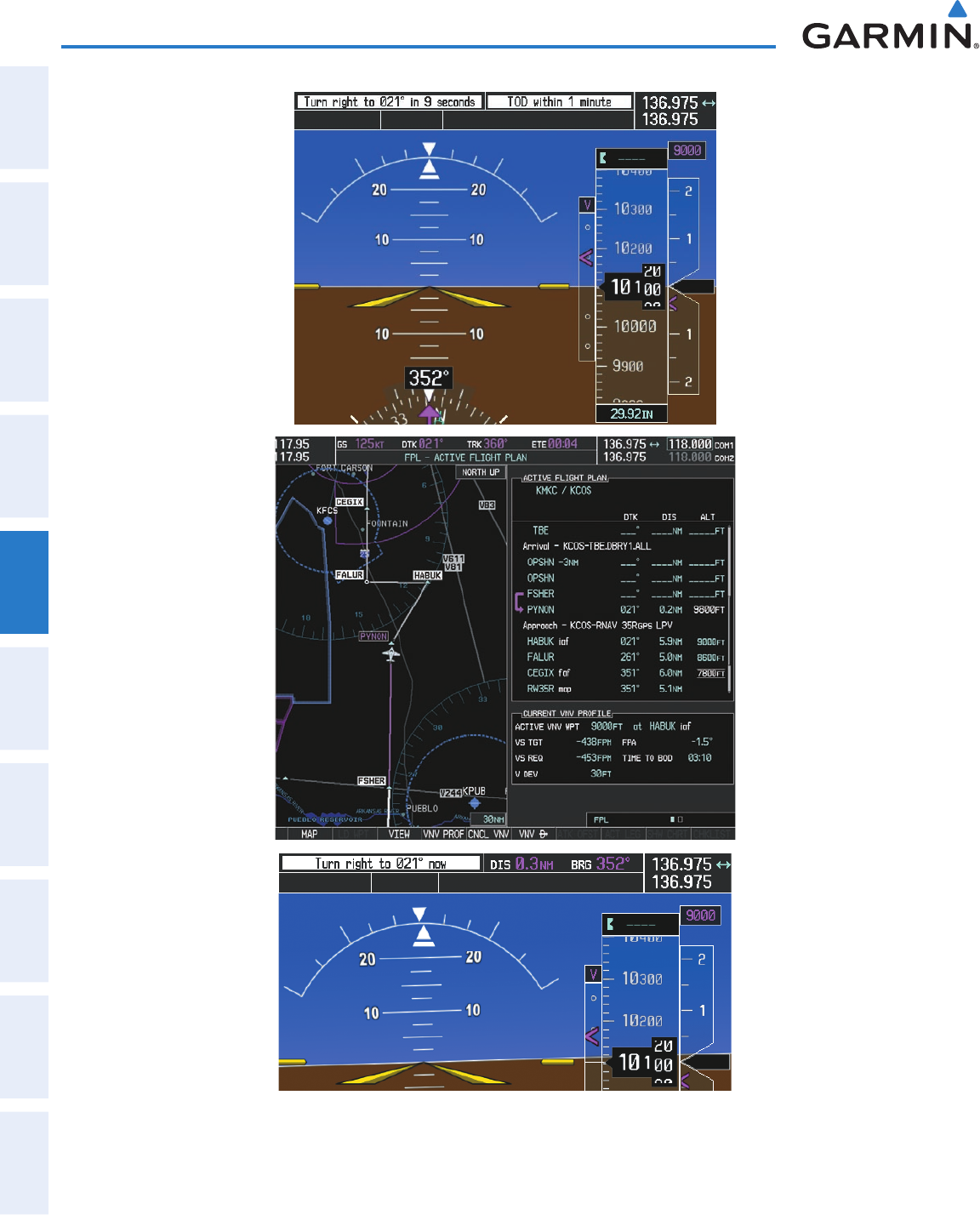
Garmin G1000 Pilot’s Guide for the Diamond DA40/40F
190-00592-06 Rev. A268
FLIGHT MANAGEMENT
SYSTEM
OVERVIEW
FLIGHT
INSTRUMENTS
EIS
AUDIO PANEL
& CNS
FLIGHT
MANAGEMENT
HAZARD
AVOIDANCE
AFCS
ADDITIONAL
FEATURES
APPENDICESINDEX
Figure 5-135 Approaching PYNON
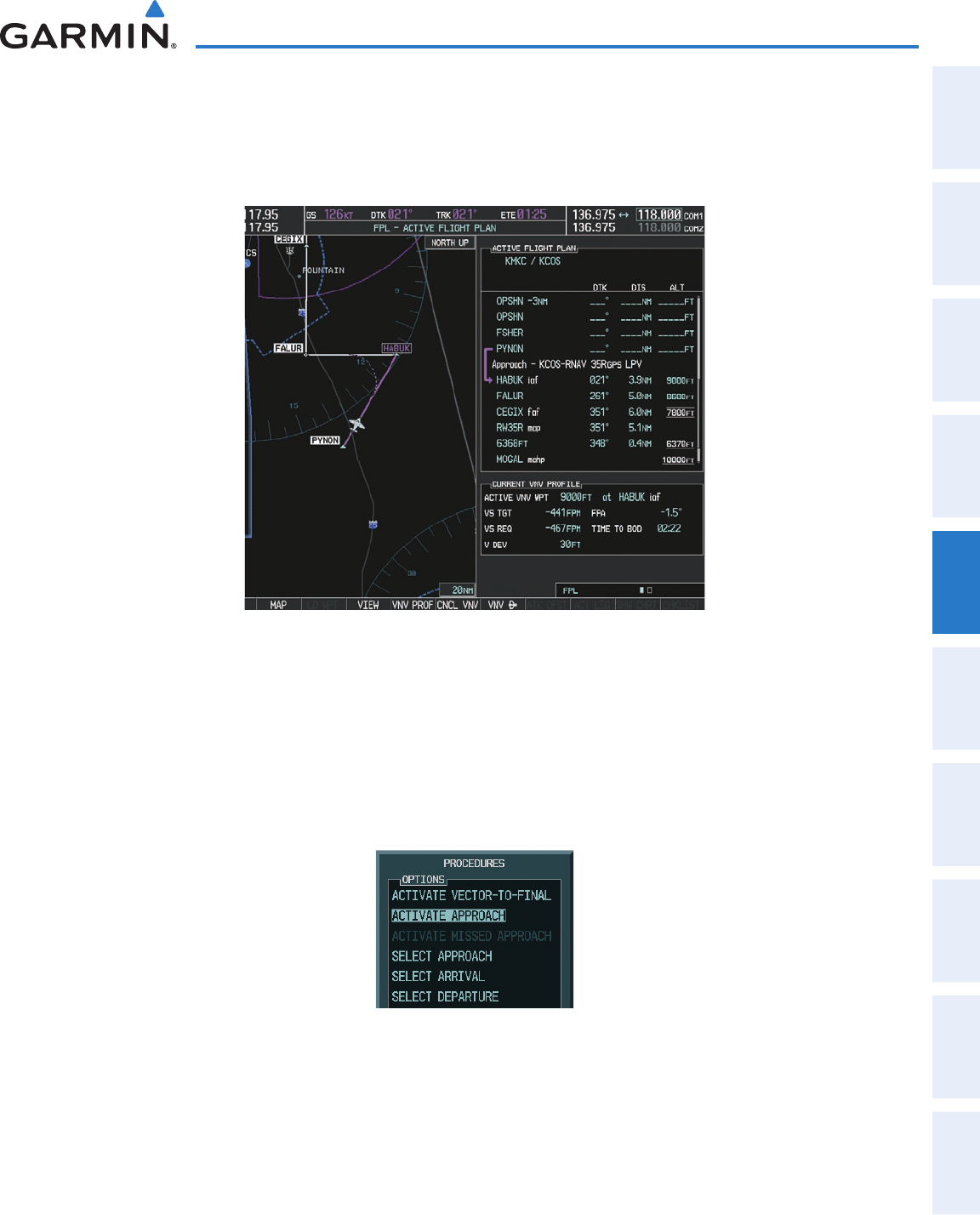
190-00592-06 Rev. A
Garmin G1000 Pilot’s Guide for the Diamond DA40/40F
269
FLIGHT MANAGEMENT
SYSTEM
OVERVIEW
FLIGHT
INSTRUMENTS EIS AUDIO PANEL
& CNS
FLIGHT
MANAGEMENT
HAZARD
AVOIDANCE AFCS ADDITIONAL
FEATURES APPENDICES INDEX
21) Upon passing PYNON the approach procedure automatically becomes active. The approach may be activated
at any point to proceed directly to the IAF. In this example, the aircraft has progressed through the final
waypoint of the arrival and the flight plan has automatically sequenced to the IAF as the active leg, activating
the approach procedure (see Figure 5-136).
Figure 5-136 Approach is Now Active
Note: To manually activate the approach procedure, perform the following steps:
a) Press the
PROC
Key.
b) Turn the large
FMS
Knob to highlight ‘ACTIVATE APPROACH’ as shown in Figure 5-137.
c) Press the
ENT
Key to activate the approach.
Figure 5-137 Manually Activate Approach
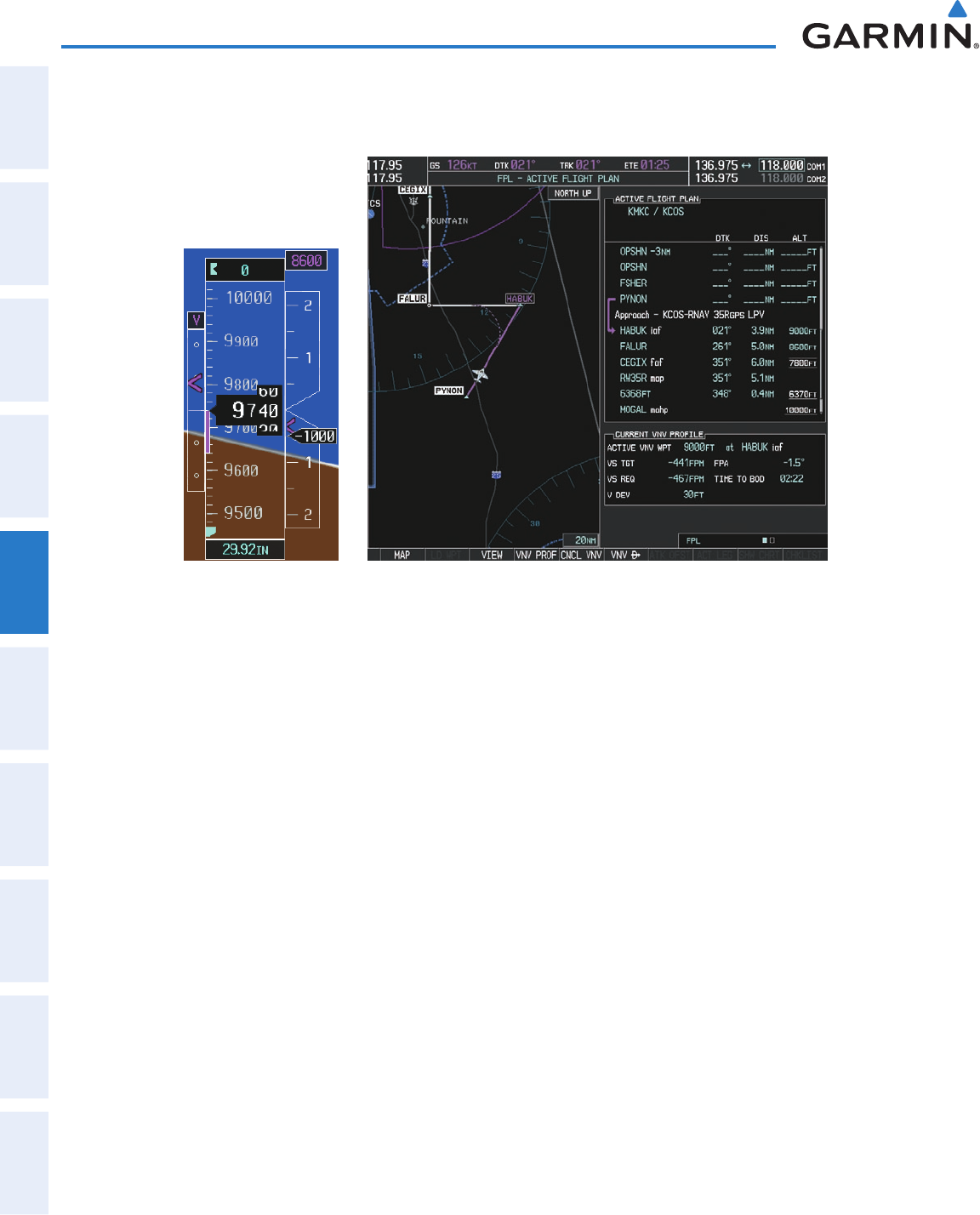
Garmin G1000 Pilot’s Guide for the Diamond DA40/40F
190-00592-06 Rev. A270
FLIGHT MANAGEMENT
SYSTEM
OVERVIEW
FLIGHT
INSTRUMENTS
EIS
AUDIO PANEL
& CNS
FLIGHT
MANAGEMENT
HAZARD
AVOIDANCE
AFCS
ADDITIONAL
FEATURES
APPENDICESINDEX
22) The IAF is the next waypoint. At the TOD, establish a descent vertical speed as previously discussed in Step 16.
The aircraft altitude is 9,000 feet upon reaching HABUK.
Figure 5-138 Descending Turn to the Initial Approach Fix (IAF)
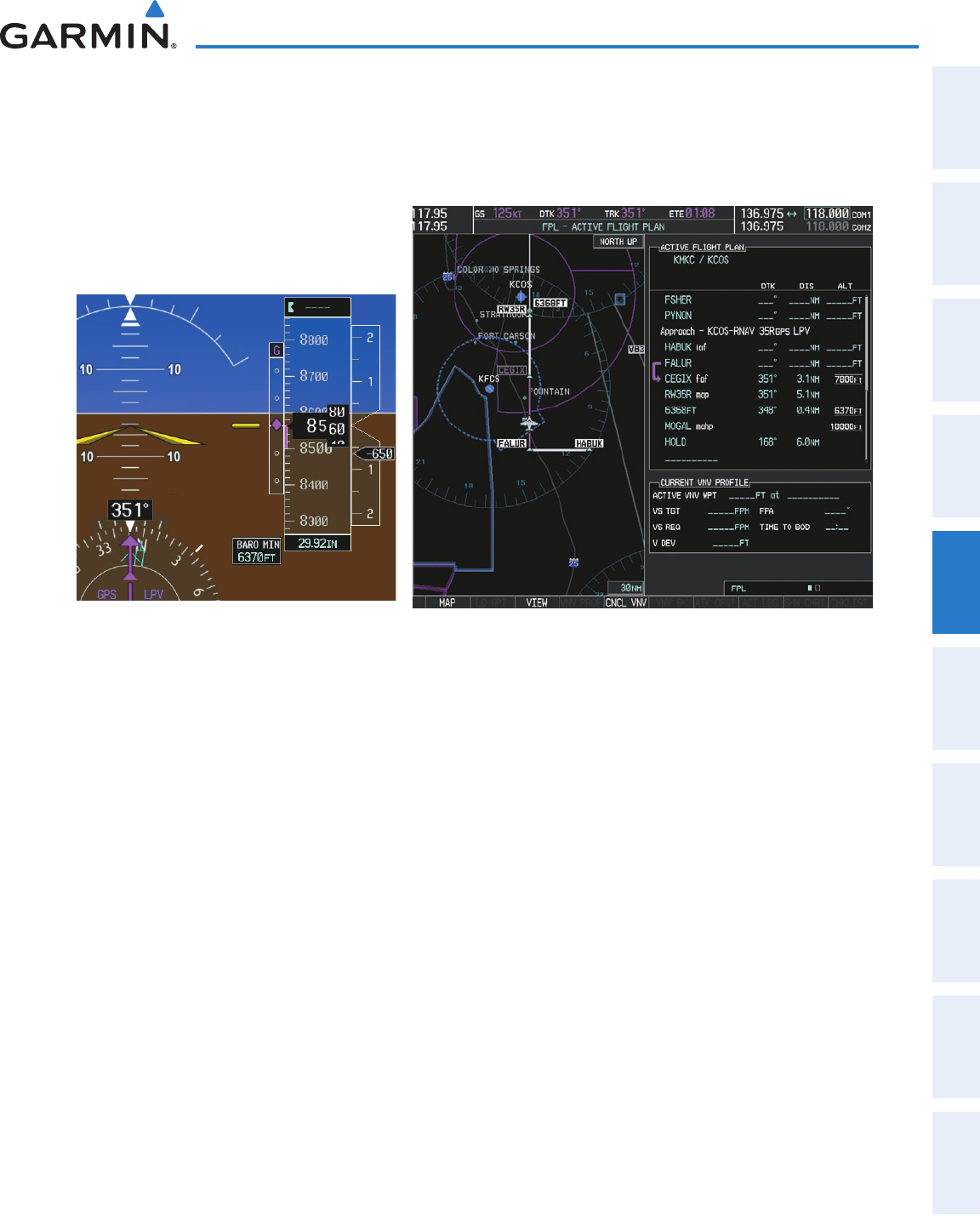
190-00592-06 Rev. A
Garmin G1000 Pilot’s Guide for the Diamond DA40/40F
271
FLIGHT MANAGEMENT
SYSTEM
OVERVIEW
FLIGHT
INSTRUMENTS EIS AUDIO PANEL
& CNS
FLIGHT
MANAGEMENT
HAZARD
AVOIDANCE AFCS ADDITIONAL
FEATURES APPENDICES INDEX
23) After crossing FALUR the next waypoint is the FAF. The flight phase changes to LPV on the HSI indicating the
current phase of flight is in Approach Mode and the approach type is LPV. CDI scaling changes accordingly and is
used much like a localizer when flying an ILS approach. The RVSI is no longer displayed and the VDI changes to
the Glidepath Indicator (as shown in Figure 5-139) when the final approach course becomes active.
Figure 5-139 Descending to the FAF
The descent continues through the FAF (CEGIX) using the Glidepath Indicator, as one would use a glideslope
indicator, to obtain an altitude “AT” 7,800 feet at the FAF. Note the altitude restriction lines over and under (At)
the altitude in the ‘ALT’ field in Figure 5-139.
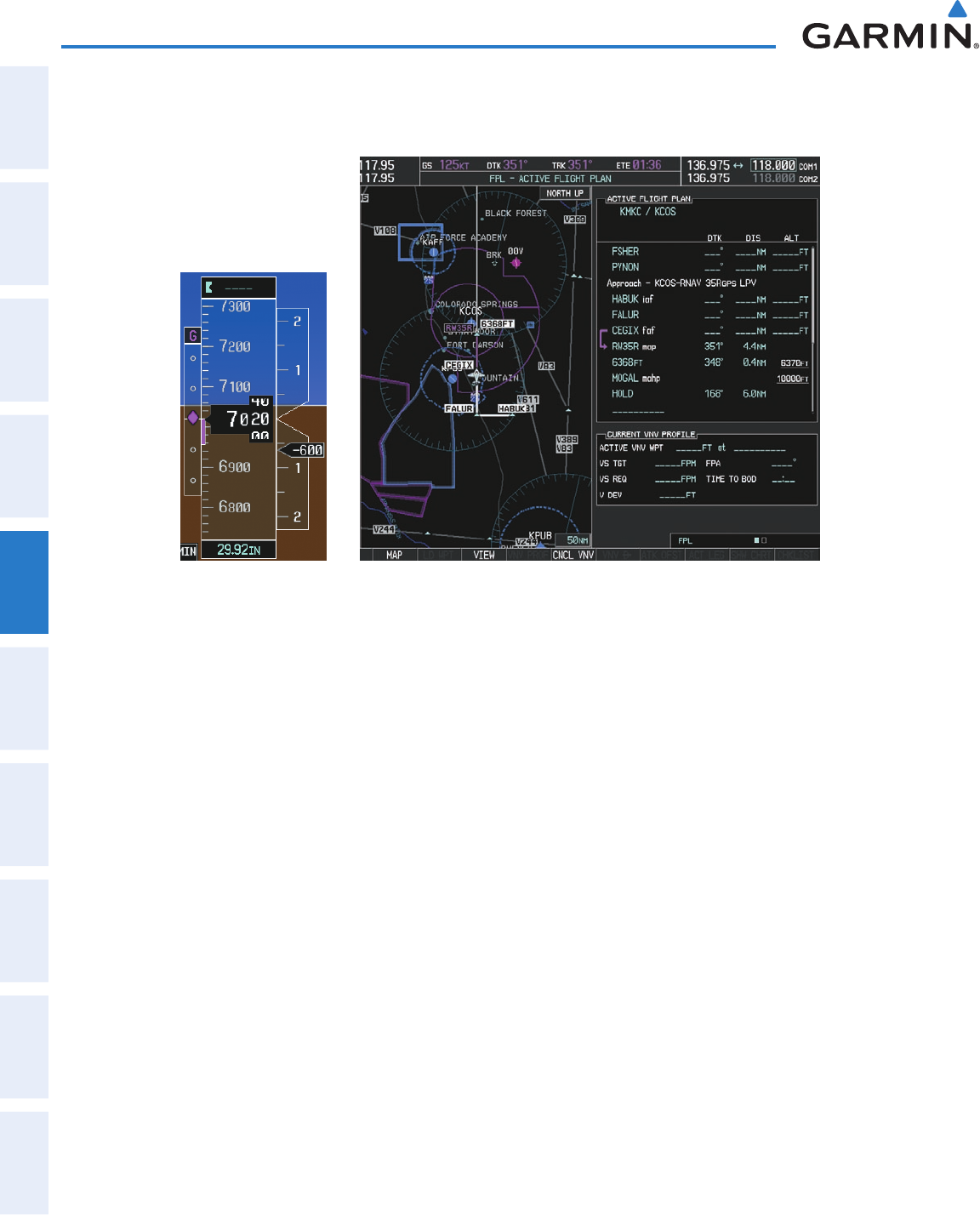
Garmin G1000 Pilot’s Guide for the Diamond DA40/40F
190-00592-06 Rev. A272
FLIGHT MANAGEMENT
SYSTEM
OVERVIEW
FLIGHT
INSTRUMENTS
EIS
AUDIO PANEL
& CNS
FLIGHT
MANAGEMENT
HAZARD
AVOIDANCE
AFCS
ADDITIONAL
FEATURES
APPENDICESINDEX
24) After crossing CEGIX, the aircraft continues following the glidepath to maintain the descent to “AT or ABOVE”
6,370 feet at the Missed Approach Point (MAP) (RW35R) as seen in Figure 5-140.
Figure 5-140 Descending to the Missed Approach Point
In this missed approach procedure, the altitude immediately following the MAP (in this case ‘6368ft’) is not part
of the published procedure. It is simply a Course to Altitude (CA) leg which guides the aircraft along the runway
centerline until the altitude required to safely make the first turn toward the MAHP is exceeded. This altitude
is provided by Jeppesen, and may be below, equal to, or above the published minimums for this approach. In
this case, if the aircraft altitude is below the specified altitude (6,368 feet) after crossing the MAP, a direct-to
is established to provide a course on runway heading until an altitude of 6,368 feet is reached. After reaching
6,368 feet, a direct-to is established to the published MAHP (in this case MOGAL). If the aircraft altitude is
above the specified altitude after crossing the MAP, a direct-to is established to the published fix (MOGAL) to
begin the missed approach procedure.
In some missed approach procedures this Course to Altitude leg may be part of the published procedure. For
example, a procedure may dictate a climb to 5,500 feet, then turn left and proceed to the Missed Approach Hold
Point (MAHP). In this case, the altitude would appear in the list of waypoints as ‘5500ft’. Again, if the aircraft
altitude is lower than the prescribed altitude, a direct-to is established on a Course to Altitude leg when the
missed approach procedure is activated.
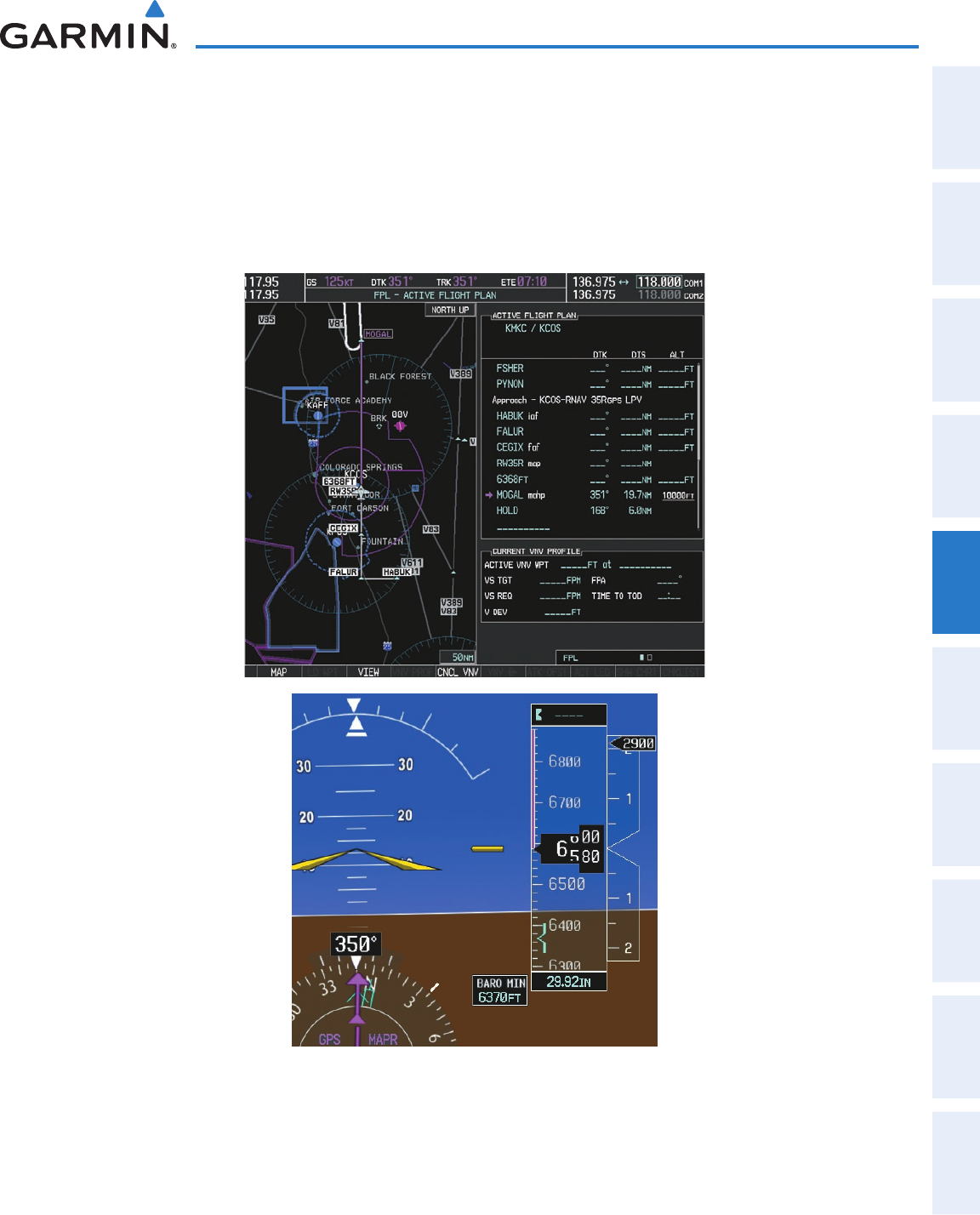
190-00592-06 Rev. A
Garmin G1000 Pilot’s Guide for the Diamond DA40/40F
273
FLIGHT MANAGEMENT
SYSTEM
OVERVIEW
FLIGHT
INSTRUMENTS EIS AUDIO PANEL
& CNS
FLIGHT
MANAGEMENT
HAZARD
AVOIDANCE AFCS ADDITIONAL
FEATURES APPENDICES INDEX
25) Upon reaching the MAP, it is decided to execute a missed approach. Automatic waypoint sequencing is
suspended past the MAP. Press the
SUSP
Softkey on the PFD to resume automatic waypoint sequencing
through the missed approach procedure.
A direct-to is initiated to MOGAL, which is the Missed Approach Hold Point (MAHP) as seen in Figure 5-141.
The aircraft is climbing to 10,000 feet. The CDI flight phase now changes from LPV to MAPR as seen on the
HSI.
Figure 5-141 Missed Approach Active
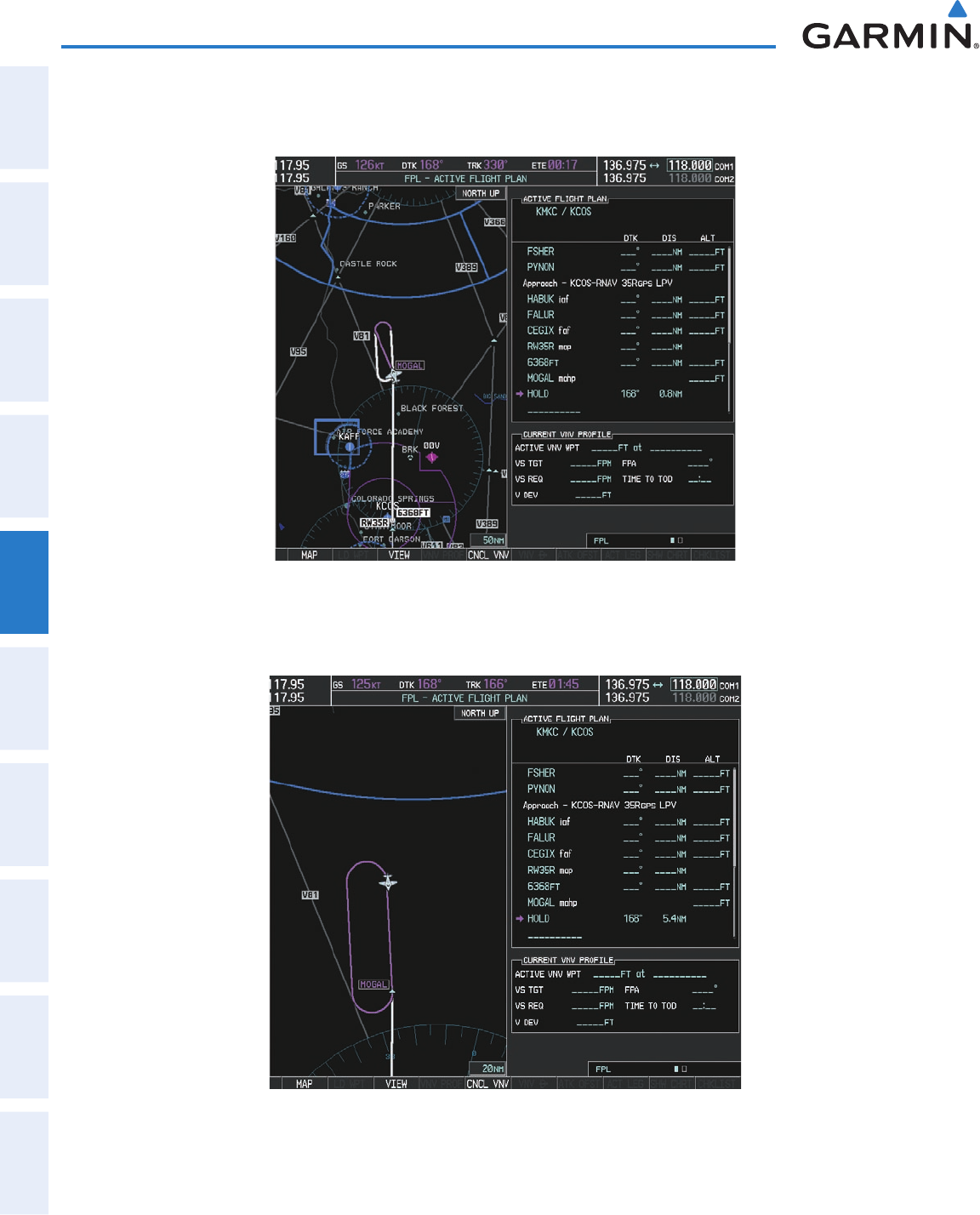
Garmin G1000 Pilot’s Guide for the Diamond DA40/40F
190-00592-06 Rev. A274
FLIGHT MANAGEMENT
SYSTEM
OVERVIEW
FLIGHT
INSTRUMENTS
EIS
AUDIO PANEL
& CNS
FLIGHT
MANAGEMENT
HAZARD
AVOIDANCE
AFCS
ADDITIONAL
FEATURES
APPENDICESINDEX
26) The aircraft continues climbing to “AT or ABOVE” 10,000 feet at MOGAL. A holding pattern is established at
the MAHP (MOGAL) as shown in Figure 5-142.
Figure 5-142 Establishing the Holding Pattern
27) The aircraft maintains 10,000 feet while following the magenta line through the hold as in Figure 5-143.
Figure 5-143 Hold Established
190-00592-06 Rev. A
Garmin G1000 Pilot’s Guide for the Diamond DA40/40F
275
FLIGHT MANAGEMENT
SYSTEM
OVERVIEW
FLIGHT
INSTRUMENTS EIS AUDIO PANEL
& CNS
FLIGHT
MANAGEMENT
HAZARD
AVOIDANCE AFCS ADDITIONAL
FEATURES APPENDICES INDEX
5.12 ABNORMAL OPERATION
This section discusses the Dead Reckoning mode of operation and the subsequent indications.
NOTE: Dead Reckoning Mode only functions in Enroute (ENR) or Oceanic (OCN) phase of flight. In all other
phases, an invalid GPS solution produces a “NO GPS POSITION” annunciation on the map and the G1000
stops using GPS.
While in Enroute or Oceanic phase of flight, if the G1000 detects an invalid GPS solution or is unable to
calculate a GPS position, the system automatically reverts to Dead Reckoning (DR) Mode. In DR Mode, the G1000
uses its last-known position combined with continuously updated airspeed and heading data (when available) to
calculate and display the aircraft’s current estimated position.
It is important to note that estimated navigation data supplied by the G1000 in DR Mode may become increasingly
unreliable and must not be used as a sole means of navigation. If while in DR Mode airspeed and/or heading data
is also lost or not available, the DR function may not be capable of accurately tracking estimated position and,
consequently, the system may display a path that is different than the actual movement of the aircraft. Estimated
position information displayed by the G1000 through DR while there is no heading and/or airspeed data available
should not be used for navigation.
DR Mode is inherently less accurate than the standard GPS/WAAS Mode due to the lack of satellite measurements
needed to determine a position. Changes in wind speed and/or wind direction compounds the relative inaccuracy
of DR Mode. Because of this degraded accuracy, other navigation equipment must be relied upon for position
awareness until GPS-derived position data is restored.
DR Mode is indicated on the G1000 by the appearance of the letters ‘DR’ superimposed in yellow over the ‘own
aircraft’ symbol as shown in Figure 5-144. In addition, ‘DR’ is prominently displayed in yellow on the HSI slightly
above and to the right of the aircraft symbol on the CDI as shown in Figure 5-144. Also, the CDI deviation bar
is removed from the display. Lastly, but at the same time, a ‘GPS NAV LOST’ alert message appears on the PFD.
Normal navigation using GPS/WAAS source data resumes automatically once a valid GPS solution is restored.
As a result of operating in DR Mode, all GPS-derived data is computed based upon an estimated position and
is displayed as yellow text on the display to denote degraded navigation source information as shown in Figure
5-144.
Also, while the G1000 is in DR Mode, the autopilot does not couple to GPS, and both TAWS and Terrain SVS are
disabled. Additionally, the accuracy of all nearest information (airports, airspaces, and waypoints) is questionable.
Finally, airspace alerts continue to function, but with degraded accuracy.
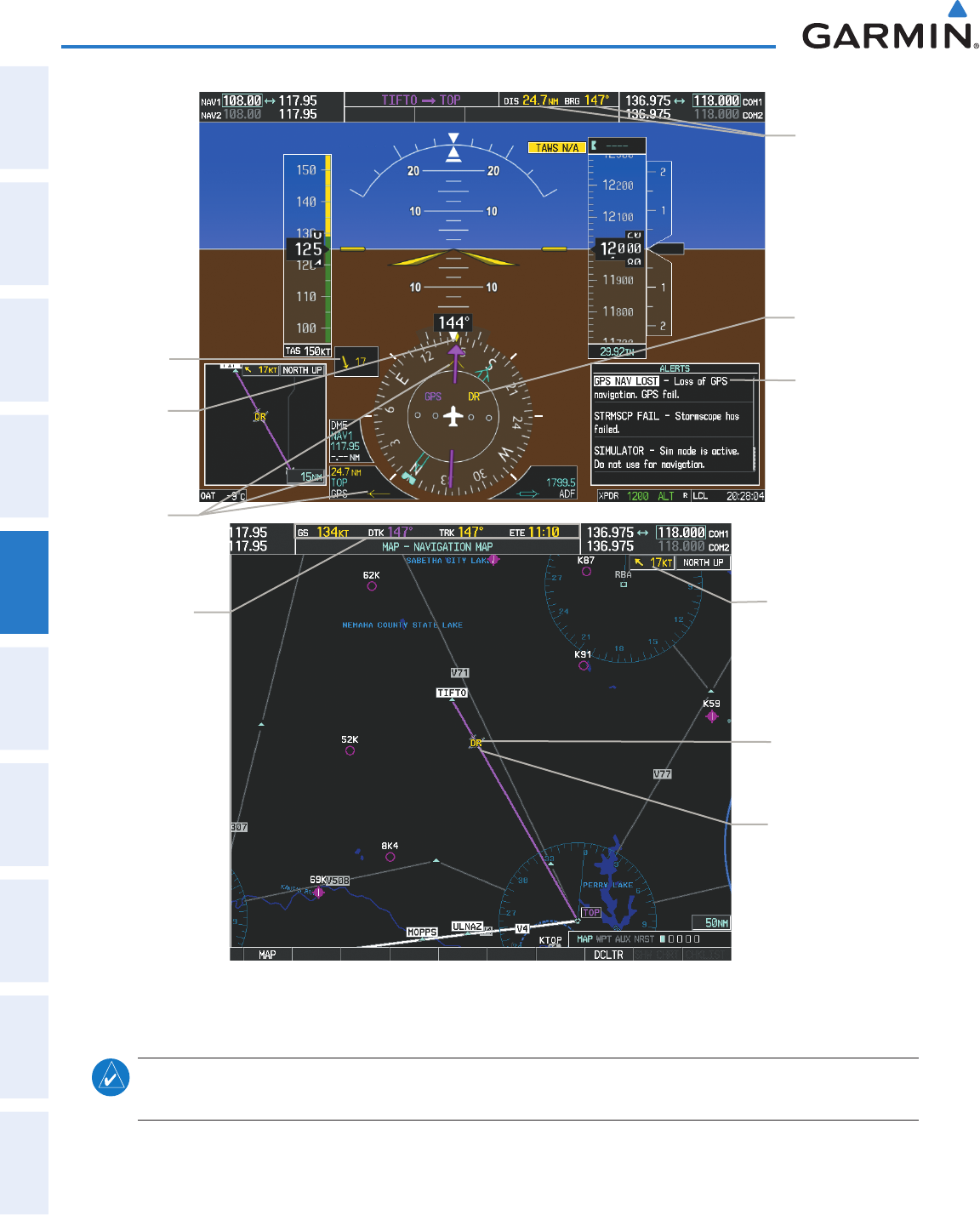
Garmin G1000 Pilot’s Guide for the Diamond DA40/40F
190-00592-06 Rev. A276
FLIGHT MANAGEMENT
SYSTEM
OVERVIEW
FLIGHT
INSTRUMENTS
EIS
AUDIO PANEL
& CNS
FLIGHT
MANAGEMENT
HAZARD
AVOIDANCE
AFCS
ADDITIONAL
FEATURES
APPENDICESINDEX
Distance &
Bearing
GPS Navigation
Lost Message
Dead Reckoning
Annunciaion
Figure 5-144 Dead Reckoning Mode - GPS Derived Data Shown in Yellow
Dead Reckoning
Annunciation
Subdued Aircraft
Symbol
Nav Data Bar
All data except
Active Leg,
TAS, and DTK
are in yellow
Wind Data
Wind Data
Bearing
Pointer/
Distance
Current
Track
Indicator
NOTE: The Inset Map is removed from the PFD any time aircraft pitch is greater than +30° or less than –20°,
or when a 65° bank angle is reached.
190-00592-06 Rev. A
Garmin G1000 Pilot’s Guide for the Diamond DA40/40F
277
HAZARD AVOIDANCE
SYSTEM
OVERVIEW
FLIGHT
INSTRUMENTS EIS AUDIO PANEL
& CNS
FLIGHT
MANAGEMENT
HAZARD
AVOIDANCE AFCS ADDITIONAL
FEATURES APPENDICES INDEX
SECTION 6 HAZARD AVOIDANCE
Hazard avoidance features available for the G1000 are designed to aid situational awareness and provide advisory
information with regard to potential hazards to flight safety associated with weather, terrain, and air traffic.
Weather
•GDL69AXM® Satellite Weather (Optional)
•L-3STORMSCOPE® WX-500 Series II Weather Mapping Sensor (Optional)
Terrain Avoidance
•TerrainProximity
•TERRAIN-SVS(StandardwithSVSOption)
•TerrainAwarenessandWarningSystem(TAWS)(Optional)
Traffic
•TIS(TrafcInformationService)
•AvidyneTAS600® Traffic Advisory System (Optional)
6.1 XM SATELLITE WEATHER
NOTE: XM Satellite Weather data provides information for avoiding hazardous weather. Do not utilize XM
Weather information to penetrate hazardous weather.
NOTE: XM Lightning and optional L-3 STORMSCOPE
®
WX-500 Lightning are mutually exclusive
.
XM Satellite Weather is provided through the GDL 69A, a remote-mounted data-link satellite receiver. Received
graphical weather information and associated text is displayed on the Multi Function Display (MFD) and the
Primary Flight Display (PFD) Inset Map. The GDL 69A can also receive XM Satellite Radio® entertainment
services. Both weather data and entertainment programming operate in the S-band frequency range to provide
continuous reception capabilities at any altitude throughout North America.
XM Satellite Radio services are subscription-based. For more information on specific service packages, visit
www.xmradio.com.
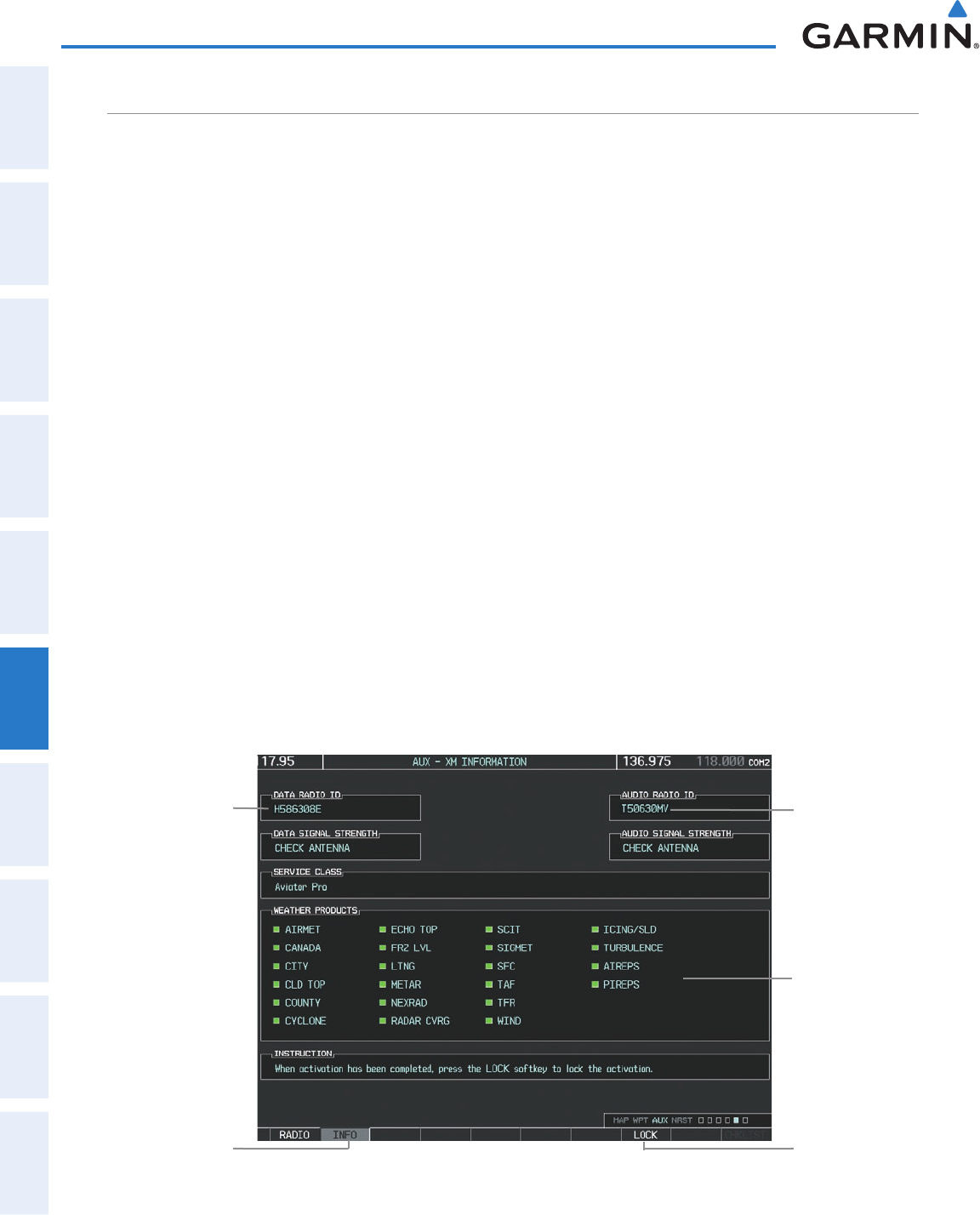
Garmin G1000 Pilot’s Guide for the Diamond DA40/40F
190-00592-06 Rev. A
278
HAZARD AVOIDANCE
SYSTEM
OVERVIEW
FLIGHT
INSTRUMENTS
EIS
AUDIO PANEL
& CNS
FLIGHT
MANAGEMENT
HAZARD
AVOIDANCE
AFCS
ADDITIONAL
FEATURES
APPENDICESINDEX
ACTIVATING SERVICES
Before XM Satellite Weather can be used, the service must be activated. Service is activated by providing XM
Satellite Radio with coded IDs unique to the installed GDL 69A. XM Satellite Radio and XM Satellite Weather
services each have coded IDs. The Data and Audio Radio IDs must be provided to XM Satellite Radio to activate
the weather service and entertainment subscriptions, respectively. These IDs are located on:
•ThelabelonthebackoftheDataLinkReceiver
•TheXMInformationPageontheMFD(Figure6-1)
•TheXMSatelliteRadioActivationInstructionsincludedwiththeunit(availableatwww.garmin.com,P/N
190-00355-04)
Contact the installer if the Audio and Data Radio IDs cannot be located.
XM Satellite Radio uses the coded IDs to send an activation signal that allows the G1000 to display weather
data and/or entertainment programming provided through the GDL 69A.
Activating XM Satellite Weather and XM Satellite Radio services:
1) Contact XM Satellite Radio by email (address listed on their website, www.xmradio.com) or by the customer
service phone number listed on the website. Follow the instructions provided by XM Satellite Radio services.
2) Select the XM page in the Auxiliary Page Group.
3) Press the INFO Softkey to display the XM Information Page.
4) Verify that the desired services are activated.
5) Press the LOCK Softkey.
6) Turn the large FMS Knob to highlight ‘YES’.
7) To complete activation, press the ENT Key.
Figure 6-1 XM Information Page
Audio Radio ID
(for XM
Satellite Radio)
Weather
Products
(Available
Products for
Service Class
Indicated in
Green)
Data Radio ID
(for XM Weather)
Select to Lock
Subscription
Information
Select to Display XM
Information page
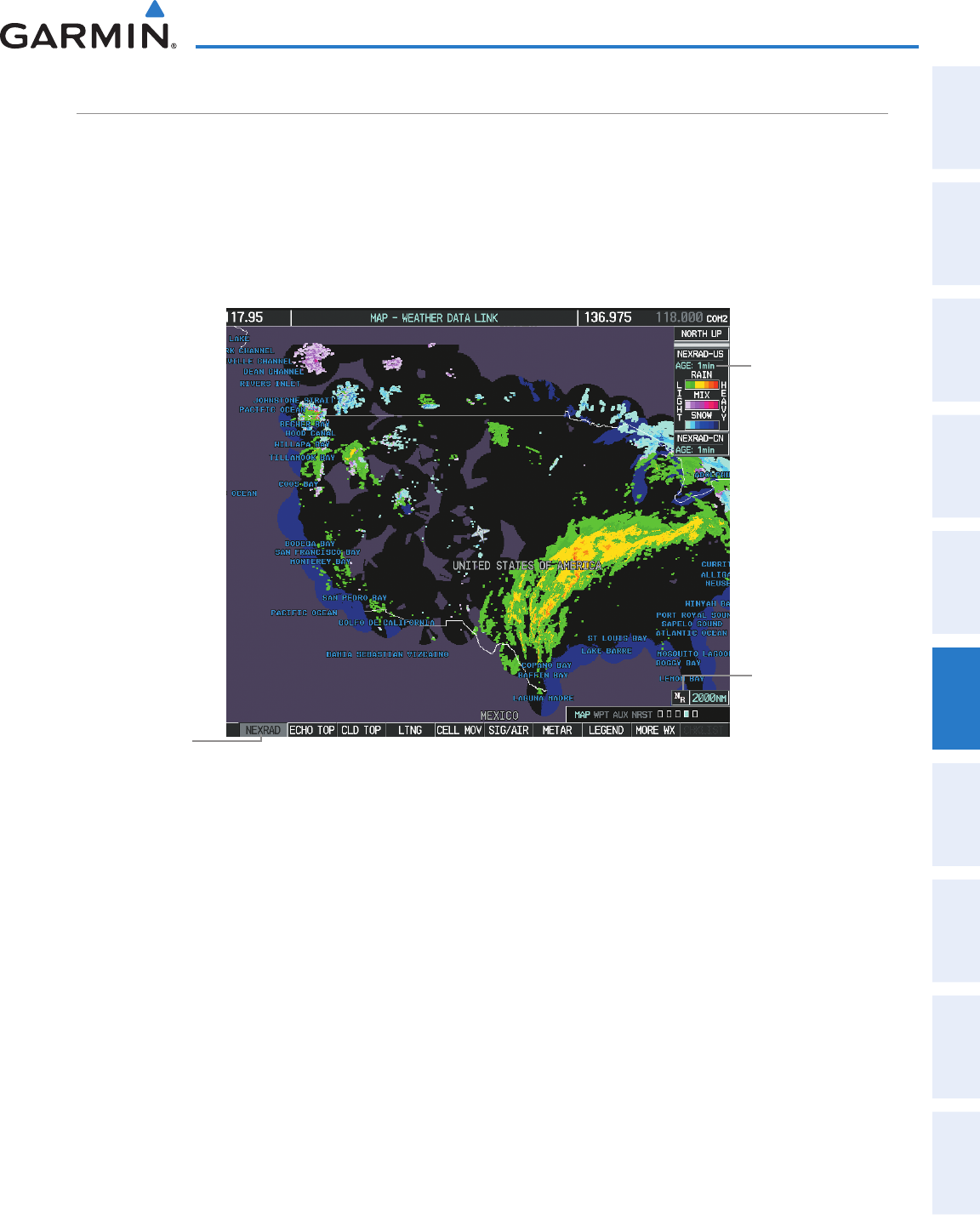
190-00592-06 Rev. A
Garmin G1000 Pilot’s Guide for the Diamond DA40/40F
279
HAZARD AVOIDANCE
SYSTEM
OVERVIEW
FLIGHT
INSTRUMENTS EIS AUDIO PANEL
& CNS
FLIGHT
MANAGEMENT
HAZARD
AVOIDANCE AFCS ADDITIONAL
FEATURES APPENDICES INDEX
USING XM SATELLITE WEATHER PRODUCTS
The primary map for viewing XM Weather data is the Weather Data Link Page in the Map Page Group. This
is the only G1000 map display capable of showing information for all available XM weather products.
Viewing the Weather Data Link Page:
1) Turn the large
FMS
Knob to select the Map Page Group.
2) Turn the small
FMS
Knob
to select the Weather Data Link Page.
Figure 6-2 Weather Data Link Page
NEXRAD
Weather
Product
Selected for
Display
NEXRAD Weather
Product Display
Enabled
NEXRAD Weather
Product Age
When a weather product is active on the Weather Data Link Page or the Navigation Map Page, the age of the
data is displayed on the screen (Figure 6-2). The age of the product is based on the time difference between
when the data was assembled on the ground and the current GPS time. Weather products are refreshed at
specific intervals (defined in the Refresh Rate column in Table 6-1).
If for any reason, a weather product is not refreshed within the 30-, 60-, 90-, or 180 minute Expiration Time
intervals (see Table 6-1), the data is considered expired and is removed from the display. This ensures that the
displayed data is consistent with what is currently being broadcast by XM Satellite Radio services. If more than
half of the expiration time has elapsed, the color of the product age displayed changes to yellow.
Table 6-1 shows the weather product symbols, the expiration time and the refresh rate. The refresh rate
represents the interval at which XM Satellite Radio broadcasts new signals that may or may not contain new
weather data. It does not represent the rate at which weather data is updated or new content is received by
the Data Link Receiver. Weather data is updated at intervals that are defined and controlled by XM Satellite
Radio and its data vendors.
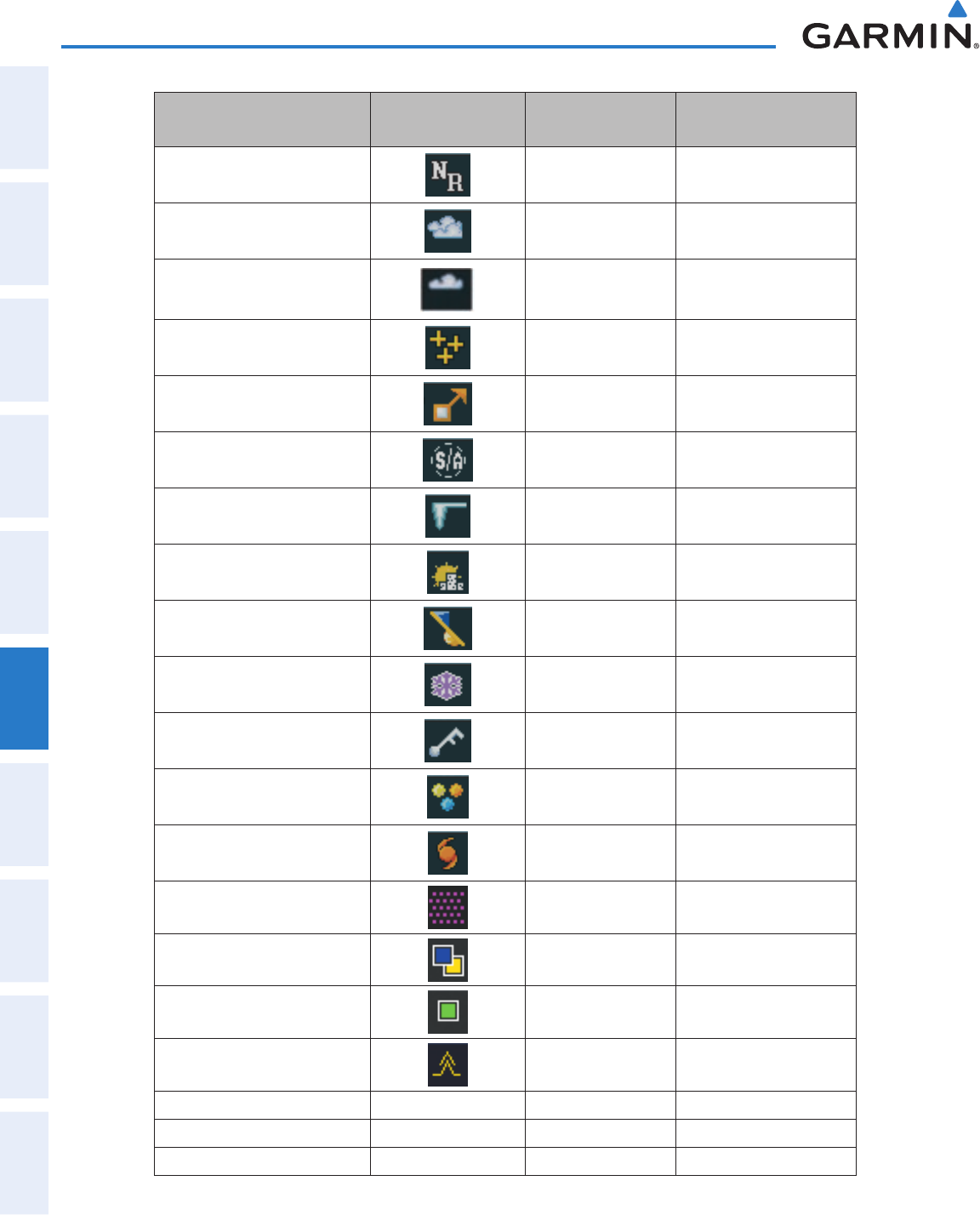
Garmin G1000 Pilot’s Guide for the Diamond DA40/40F
190-00592-06 Rev. A
280
HAZARD AVOIDANCE
SYSTEM
OVERVIEW
FLIGHT
INSTRUMENTS
EIS
AUDIO PANEL
& CNS
FLIGHT
MANAGEMENT
HAZARD
AVOIDANCE
AFCS
ADDITIONAL
FEATURES
APPENDICESINDEX
Weather Product Symbol Expiration Time
(Minutes)
Refresh Rate
(Minutes)
NEXRAD 30 5
Cloud Top (CLD TOP) 60 15
Echo Top (ECHO TOP) 30 7.5
XM Lightning (LTNG) 30 5
Cell Movement (CELL MOV) 30 1.25
SIGMETs/AIRMETs (SIG/AIR) 60 12
METARs 90 12
City Forecast (CITY) 90 12
Surface Analysis (SFC) 60 12
Freezing Levels (FRZ LVL) 60 12
Winds Aloft (WIND) 60 12
County Warnings (COUNTY) 60 5
Cyclone Warnings (CYCLONE) 60 12
Icing Potential (CIP and SLD)
(ICNG) 90 22
Pilot Weather Report
(PIREPs) 90 12
Air Report
(AIREPs) 90 12
Turbulence
(TURB) 180 18
Radar Coverage No product image 30 5
TFRs No product image 60 12
TAFs No product image 60 12
Table 6-1 Weather Product Symbols and Data Timing
190-00592-06 Rev. A
Garmin G1000 Pilot’s Guide for the Diamond DA40/40F
281
HAZARD AVOIDANCE
SYSTEM
OVERVIEW
FLIGHT
INSTRUMENTS EIS AUDIO PANEL
& CNS
FLIGHT
MANAGEMENT
HAZARD
AVOIDANCE AFCS ADDITIONAL
FEATURES APPENDICES INDEX
Table 6-2 shows which XM products can be displayed (indicated with a ‘+’ symbol) on specific maps.
Weather Product
PFD Inset Map
Navigation Map Page
Weather Data Link
Page
Weather Information
Page
AUX - Trip Planning
Page
Nearest Page Group
Flight Plan Pages
NEXRAD + + + + + +
Cloud Top (CLD TOP) +
Echo Top (ECHO TOP) +
XM Lightning (LTNG) + + + + + +
Cell Movement (CELL MOV) + + + + + +
SIGMETs/AIRMETs (SIG/AIR) +
METARs + +
City Forecast (CITY) +
Surface Analysis (SFC) +
Freezing Levels (FRZ LVL) +
Winds Aloft (WIND) +
County Warnings (COUNTY) +
Cyclone Warnings (CYCLONE) +
Icing Potential (ICNG) +
PIREPs + +
AIREPs + +
Turbulence (TURB) +
Radar Coverage + +
TFRs +++++++
TAFs + +
Table 6-2 Weather Product Display Maps
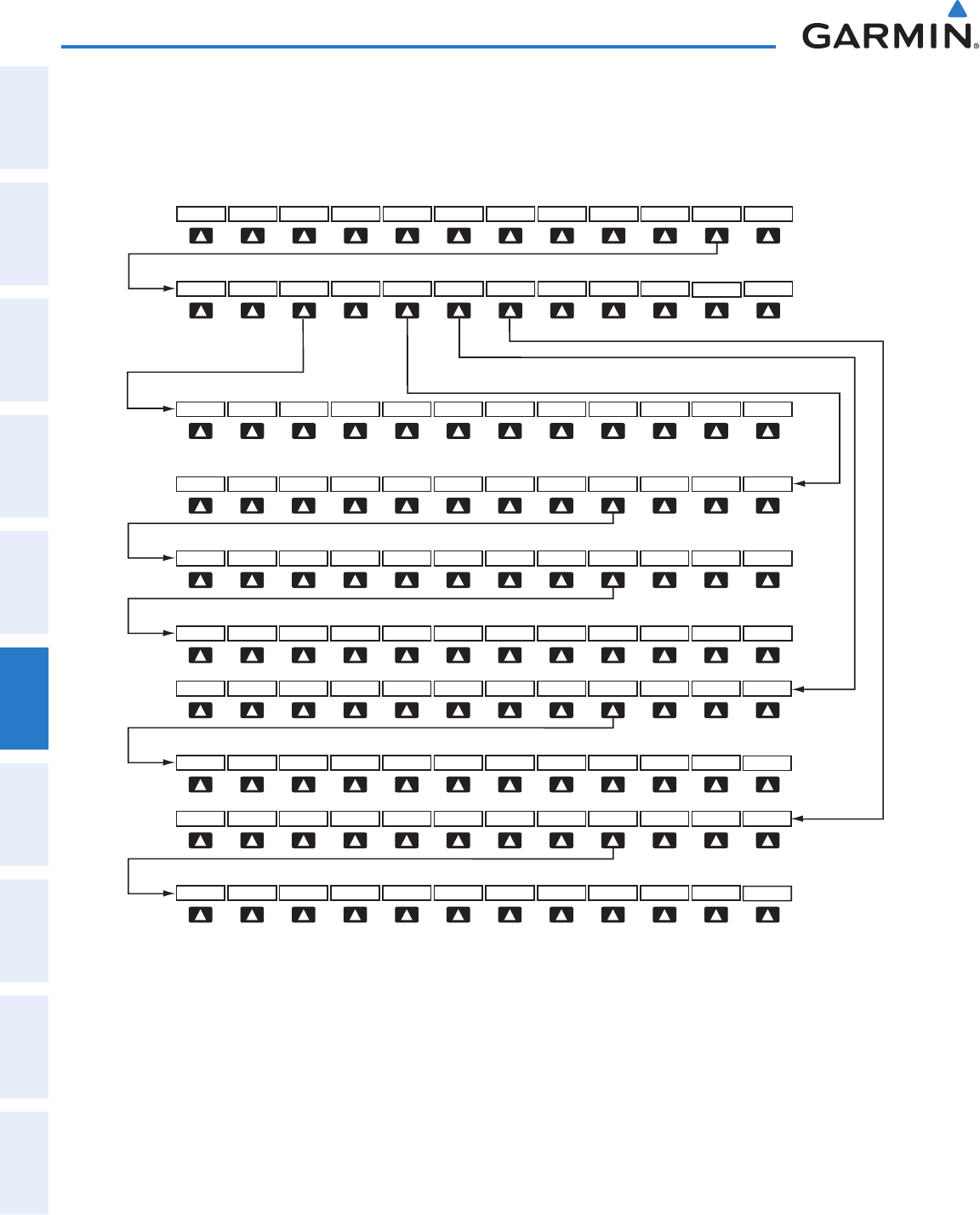
Garmin G1000 Pilot’s Guide for the Diamond DA40/40F
190-00592-06 Rev. A
282
HAZARD AVOIDANCE
SYSTEM
OVERVIEW
FLIGHT
INSTRUMENTS
EIS
AUDIO PANEL
& CNS
FLIGHT
MANAGEMENT
HAZARD
AVOIDANCE
AFCS
ADDITIONAL
FEATURES
APPENDICESINDEX
Softkeys control the display of weather information on most MFD pages and the PFD Inset Map (Figure 6-3
shows the weather product softkeys for the Weather Data Link Page). When a weather product is selected
for display, the corresponding softkey label changes to gray to indicate the product is enabled. Unavailable
weather products have subdued softkey labels (softkeys are disabled from selection).
Figure 6-3 Weather Data Link Weather Product Softkeys
Select the BACK Softkey
to move up one level.
COUNTYFRZ LVLBACK
NEXRAD
ENGINE MORE WX
LTNG CLD TOP
ICNG OFF
ECHO TOP
CELL MOV
SIG/AIR METAR
LEGEND
CHKLIST
SFC OFF
CYCLONE
24 HR
36 HR 12 HR BACK
LEGEND
CURRENT
48 HR
OFF
9000
12000 6000 BACK
LEGEND
3000
15000
SFC
PREV OFF NEXT
27000
30000 24000 BACK
LEGEND
21000
33000
18000
PREV OFF NEXT
42000 BACK
LEGEND
39000
36000
PREV OFF NEXT
SFC Softkey label changes
to reflect current selection.
WIND/ICNG/TURB Softkey labels
change to reflect current selection.
PREV and NEXT Softkeys cycle through Winds Aloft,
Icing, and Turbulence altitude selection softkeys.
WIND OFF
TURB OFF AIREPS PIREPS
9000
120006000 BACK
LEGEND
3000
15000
1000
PREV OFF NEXT
27000
3000024000 BACK
LEGEND
21000
18000
PREV OFF NEXT
30000
3300027000 BACK
LEGEND
24000
36000
21000
PREV OFF NEXT
45000 BACK
LEGEND
42000
39000
PREV OFF NEXT
The setup menus for the Navigation Map Page and the Weather Data Link Page control the map range settings
above which weather products data are decluttered from the display. If a map range larger than the weather
product map range setting is selected, the weather product data is removed from the map. The menus also
provide a means in addition to the softkeys for enabling/disabling display of weather products.
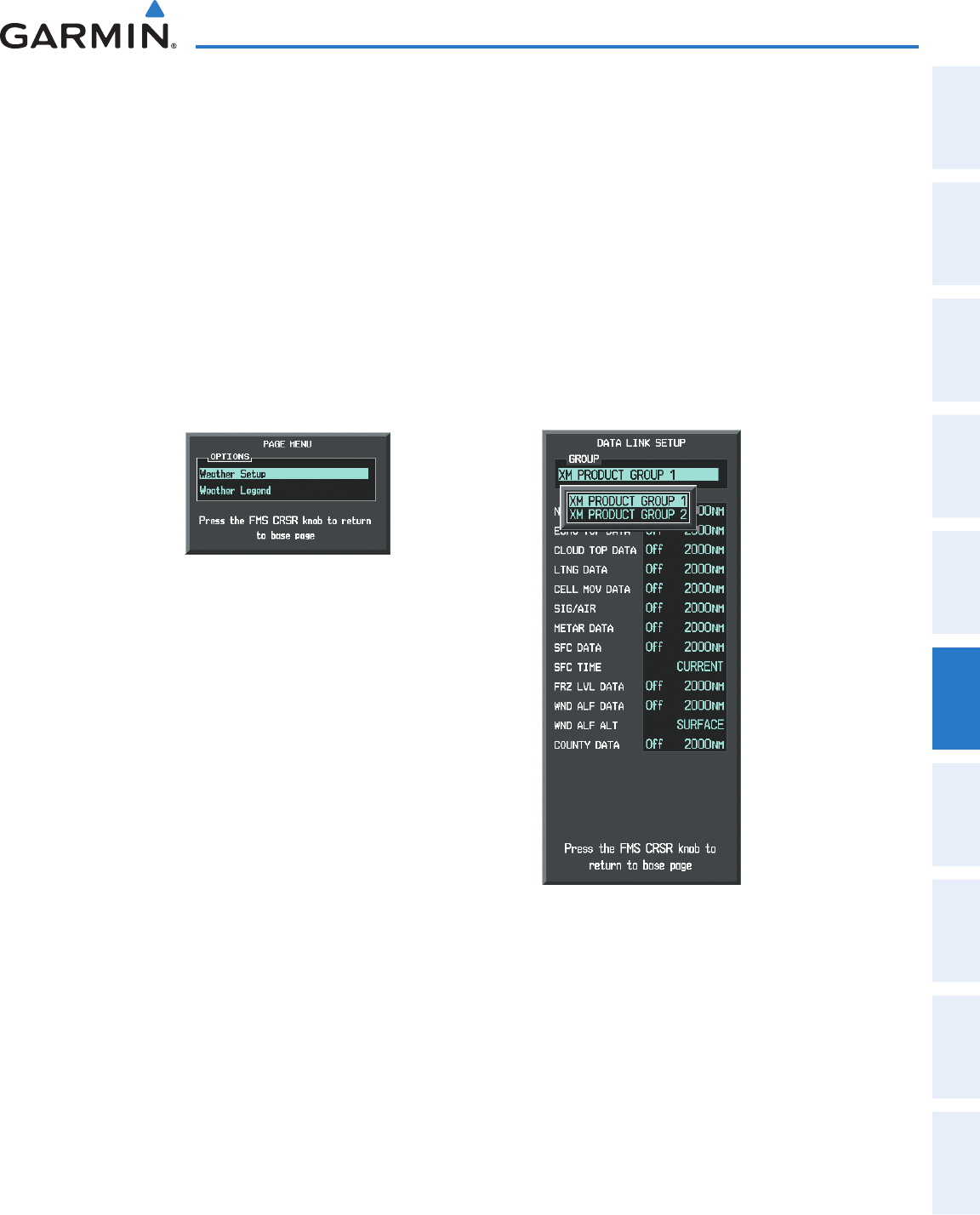
190-00592-06 Rev. A
Garmin G1000 Pilot’s Guide for the Diamond DA40/40F
283
HAZARD AVOIDANCE
SYSTEM
OVERVIEW
FLIGHT
INSTRUMENTS EIS AUDIO PANEL
& CNS
FLIGHT
MANAGEMENT
HAZARD
AVOIDANCE AFCS ADDITIONAL
FEATURES APPENDICES INDEX
Setting up and customizing the Weather Data Link Page:
1) Select the Weather Data Link Page.
2) Press the
MENU
Key.
3) With ‘Weather Setup’ highlighted, press the
ENT
Key (Figure 6-4).
4) Turn the small
FMS
Knob to select ‘XM Product Group 1’ or ‘XM Product Group 2’, and press the
ENT
Key
(Figure 6-5).
5) Turn the large
FMS
Knob or press the
ENT
Key to scroll through product selections.
6) Turn the small
FMS
Knob to scroll through options for each product (ON/OFF, range settings, etc.).
7) Press the
ENT
Key to select an option.
8) Press the FMS Knob or CLR Key to return to the Weather Data Link Page with the changed settings.
Figure 6-5 Weather Data Link Page Setup Menu
Figure 6-4 Weather Data Link Page Menu
Restoring default Weather Data Link Page settings:
1) Select the Weather Data Link Page.
2) Press the MENU Key.
3) With ‘Weather Setup’ highlighted, press the
ENT
Key.
4) Press the
MENU
Key.
5) Highlight the desired default(s) to restore (all or for selection) and press ENT Key.
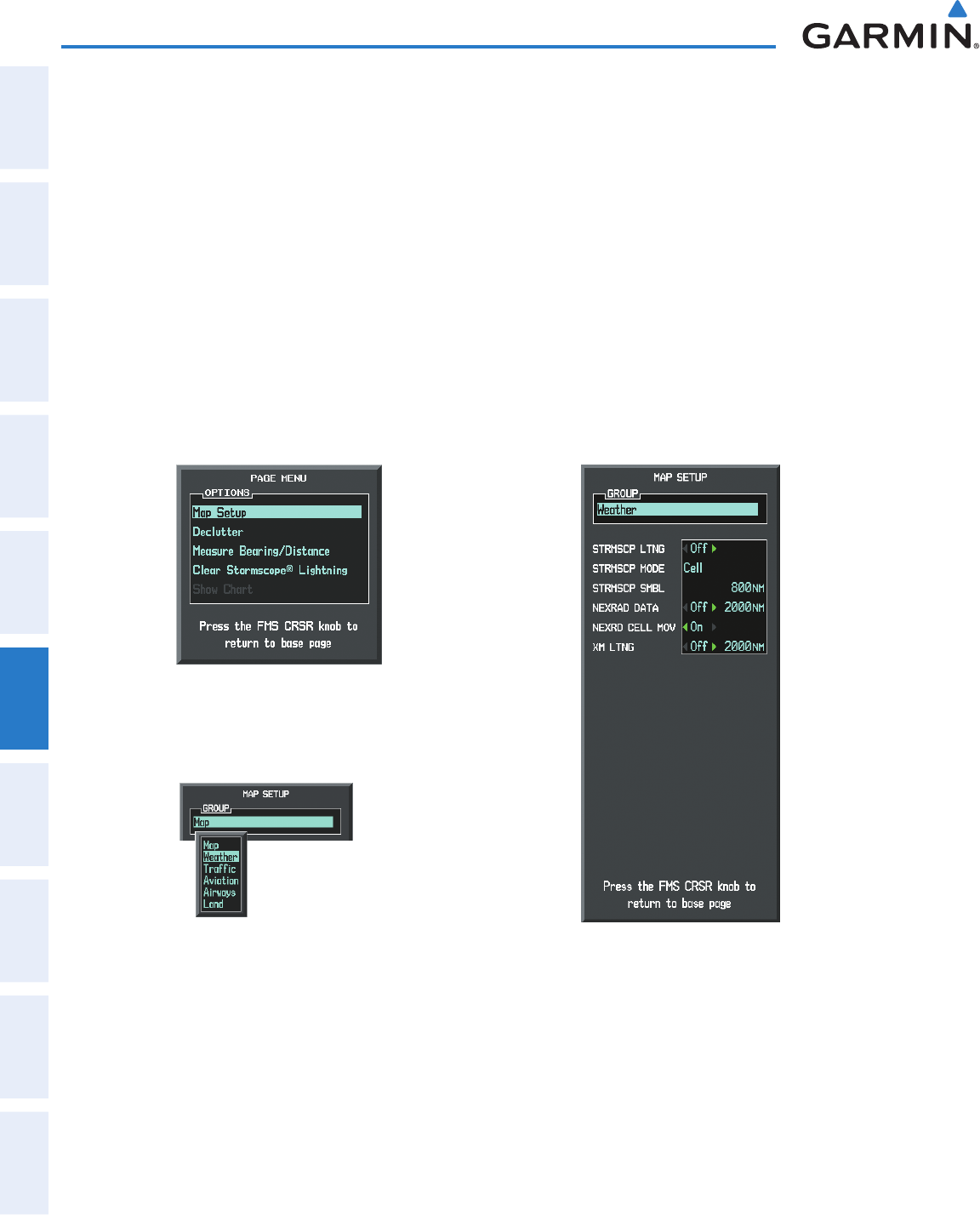
Garmin G1000 Pilot’s Guide for the Diamond DA40/40F
190-00592-06 Rev. A
284
HAZARD AVOIDANCE
SYSTEM
OVERVIEW
FLIGHT
INSTRUMENTS
EIS
AUDIO PANEL
& CNS
FLIGHT
MANAGEMENT
HAZARD
AVOIDANCE
AFCS
ADDITIONAL
FEATURES
APPENDICESINDEX
Maps besides the Weather Data Link Page use settings based on those selected for the Navigation Map Page.
Setting up and customizing weather data for the Navigation Map Page:
1) Select the Navigation Map Page.
2) Press the MENU Key.
3) With ‘Map Setup’ highlighted, press the
ENT
Key (Figure 6-6).
4) Turn the small FMS Knob to select the ‘Weather’ Group and press the ENT Key (Figure 6-7).
5) Turn the large
FMS
Knob or press the
ENT
Key to scroll through product selections (Figure 6-8).
6) Turn the small
FMS
Knob to scroll through options for each product (ON/OFF, range settings).
7) Press the
ENT
Key to select an option.
8) Press the FMS Knob or CLR Key to return to the Navigation Map Page with the changed settings.
Figure 6-7 Navigation Map Page Setup Menu
Figure 6-6 Navigation Map Page Menu
Figure 6-8 Navigation Map Page Setup Menu, Weather Group
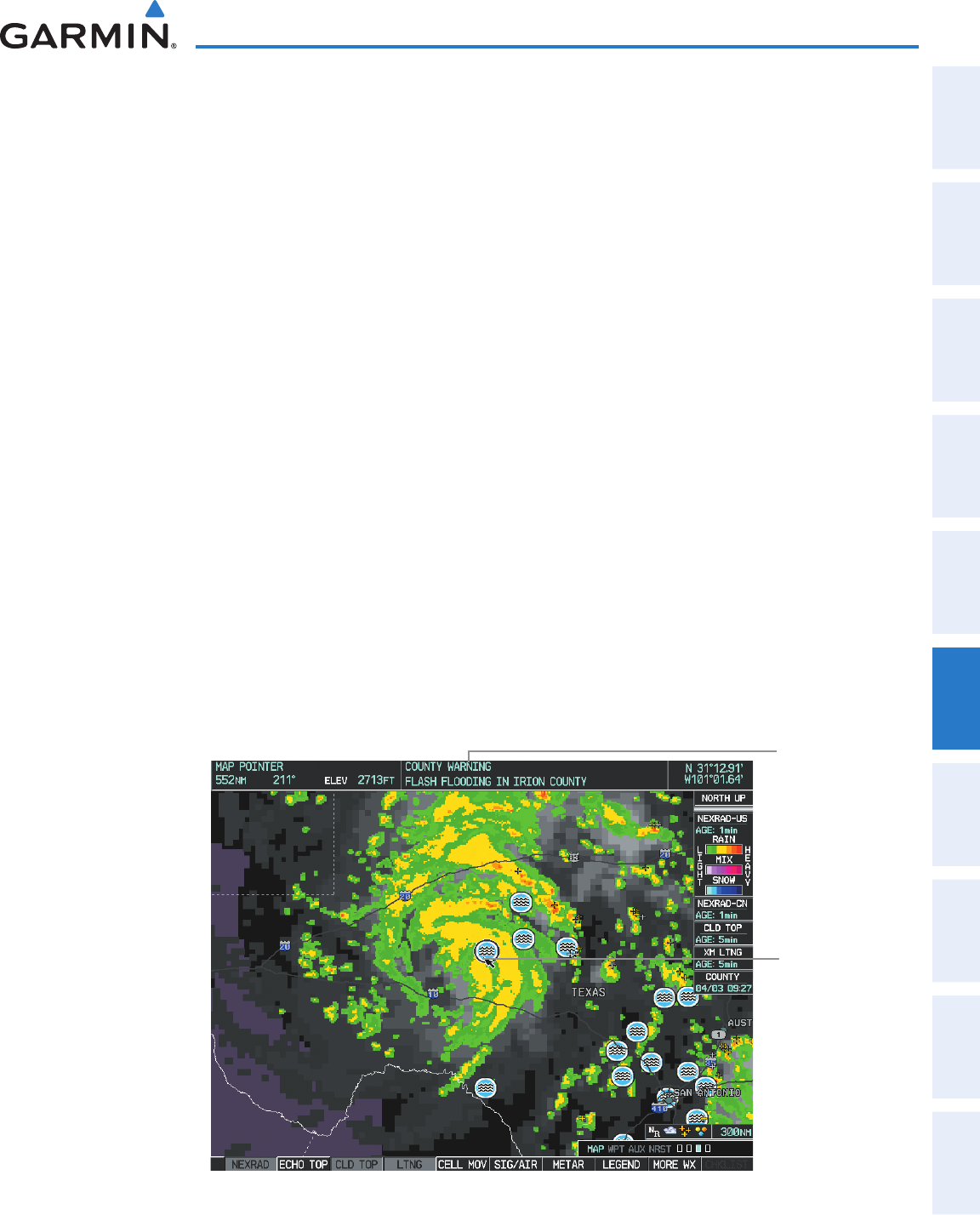
190-00592-06 Rev. A
Garmin G1000 Pilot’s Guide for the Diamond DA40/40F
285
HAZARD AVOIDANCE
SYSTEM
OVERVIEW
FLIGHT
INSTRUMENTS EIS AUDIO PANEL
& CNS
FLIGHT
MANAGEMENT
HAZARD
AVOIDANCE AFCS ADDITIONAL
FEATURES APPENDICES INDEX
Each active weather product has an associated legend which can be displayed on the Weather Data Link
Page.
Viewing legends for displayed weather products
1) Select the Weather Data Link Page.
2) Press the LEGEND Softkey to display the legends for the displayed weather products.
Or:
a) Press the MENU Key.
b) Select ‘Weather Legend’ and press the ENT Key.
3) Turn the FMS Knob to scroll through the legends if more are available than fit in the window.
4) To remove the Legend Window, press the LEGEND Softkey, the ENT or the CLR Key, or press the FMS Knob.
Additional information about the following can be displayed by panning over the display on the map:
•EchoTops
•CellMovement
•SIGMETs
•AIRMETs
•METARs
•CountyWarnings
•TFRs
•AIREPs
•PIREPs
The map panning feature is enabled by pressing the RANGE Knob. The map range is adjusted by turning
the RANGE Knob. If the map range is adjusted while panning is enabled, the map is re-centered on the Map
Pointer.
Figure 6-9 Panning on the Weather Data Link Page
Additional
Information on
Weather Feature
Selected with
Map Pointer
Flash Flood
Warning
Selected with
Map Pointer
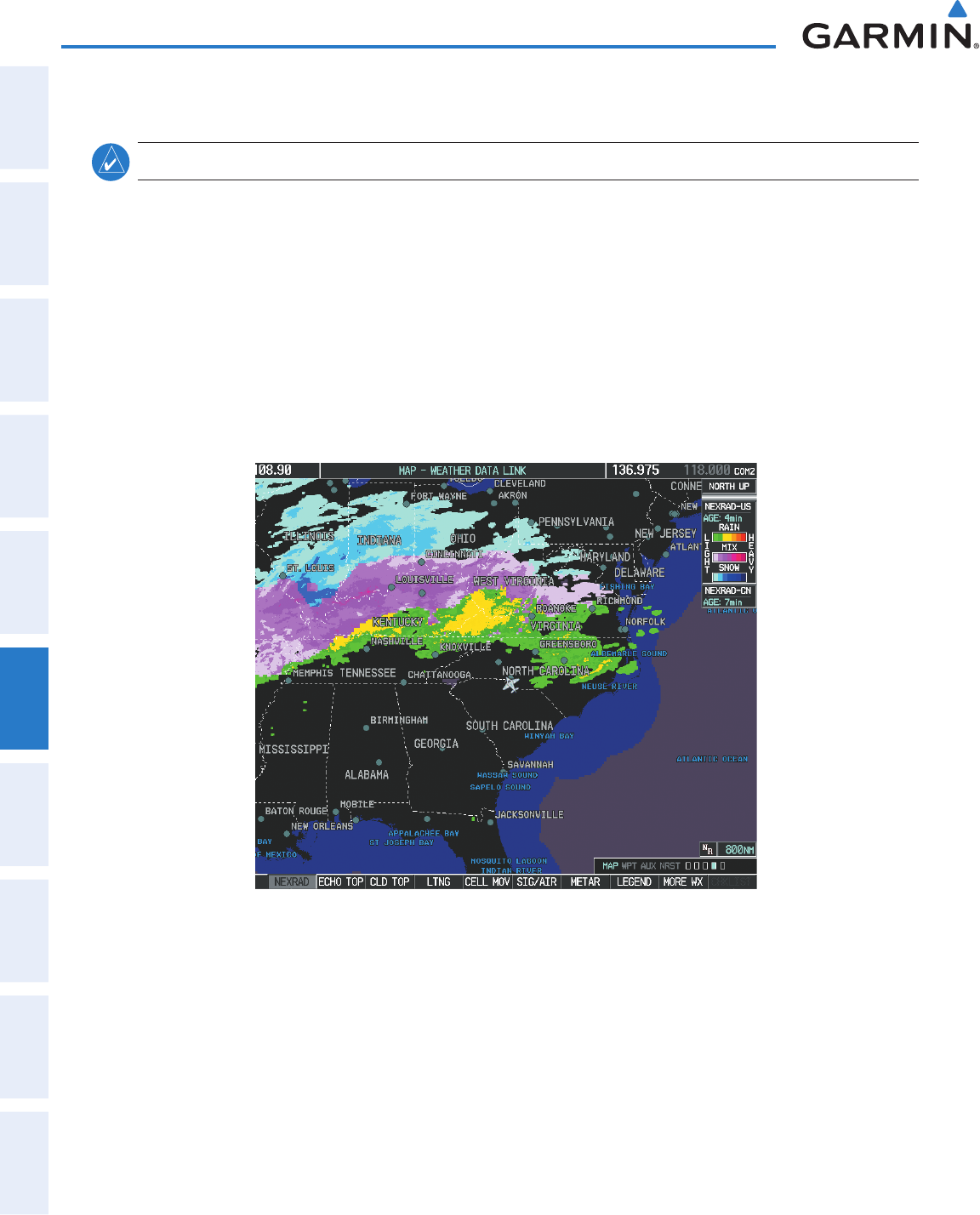
Garmin G1000 Pilot’s Guide for the Diamond DA40/40F
190-00592-06 Rev. A
286
HAZARD AVOIDANCE
SYSTEM
OVERVIEW
FLIGHT
INSTRUMENTS
EIS
AUDIO PANEL
& CNS
FLIGHT
MANAGEMENT
HAZARD
AVOIDANCE
AFCS
ADDITIONAL
FEATURES
APPENDICESINDEX
NEXRAD
NOTE: NEXRAD cannot be displayed at the same time as terrain.
WSR-88D, or NEXRAD (NEXt-generation RADar), is a network of 158 high-resolution Doppler radar
systems that are operated by the National Weather Service (NWS). NEXRAD data provides centralized
meteorological information for the continental United States and selected overseas locations. The maximum
range of a single NEXRAD radar site is 250 nm. In addition to a wide array of services, the NEXRAD network
provides important information about severe weather and air traffic safety.
NEXRAD data is not real-time. The lapsed time between collection, processing, and dissemination of
NEXRAD images can be significant and may not reflect the current radar synopsis. Due to the inherent delays
and the relative age of the data, it should be used for long-range planning purposes only. Never use NEXRAD
data or any radar data to penetrate hazardous weather. Rather, use it in an early-warning capacity of pre-
departure and enroute evaluation.
Figure 6-10 NEXRAD Data on the Weather Data Link Page
NEXRAD data can be displayed on the following maps:
•PFDInsetMap
•NavigationMapPage
•WeatherDataLinkPage
•AirportInformationPage
•TripPlanningPage
•NearestPages
•FlightPlanPages
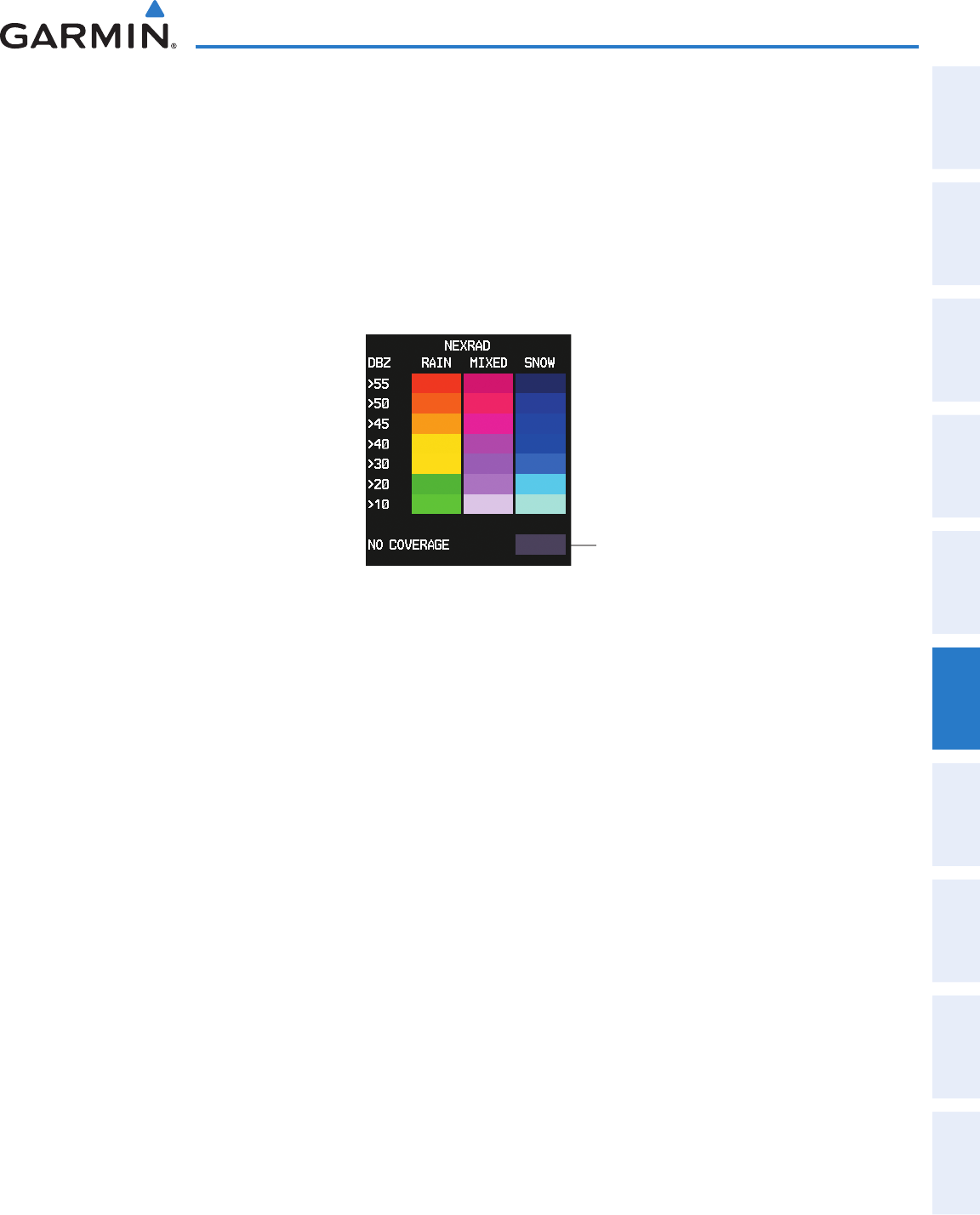
190-00592-06 Rev. A
Garmin G1000 Pilot’s Guide for the Diamond DA40/40F
287
HAZARD AVOIDANCE
SYSTEM
OVERVIEW
FLIGHT
INSTRUMENTS EIS AUDIO PANEL
& CNS
FLIGHT
MANAGEMENT
HAZARD
AVOIDANCE AFCS ADDITIONAL
FEATURES APPENDICES INDEX
Displaying NEXRAD weather information:
1) Press the MAP Softkey (for the PFD Inset Map, press the INSET Softkey). This step is not necessary on the
Weather Data Link Page.
2) Press the NEXRAD Softkey.
Composite data from all the NEXRAD radar sites in the United States is shown. This data is composed of
the maximum reflectivity from the individual radar sweeps. The display of the information is color-coded to
indicate the weather severity level. All weather product legends can be viewed on the Weather Data Link Page.
For the NEXRAD legend (Figure 6-11), press the
LEGEND
Softkey when NEXRAD is selected for display.
No Radar Coverage
Figure 6-11 NEXRAD Data with Legend
The display of radar coverage is always active when either NEXRAD or ECHO TOPS is selected. Areas
where NEXRAD radar coverage and Echo Tops information is not currently available or is not being collected
are indicated in grayish-purple. Radar capability exists in these areas, but it is not active or is off-line.
Re f l e c t i v i t y
Reflectivity is the amount of transmitted power returned to the radar receiver. Colors on the NEXRAD
display are directly correlative to the level of detected reflectivity. Reflectivity as it relates to hazardous
weather can be very complex.
The role of radar is essentially to detect moisture in the atmosphere. Simply put, certain types of weather
reflect radar better than others. The intensity of a radar reflection is not necessarily an indication of the
weather hazard level. For instance, wet hail returns a strong radar reflection, while dry hail does not. Both
wet and dry hail can be extremely hazardous.
The different NEXRAD echo intensities are measured in decibels (dB) relative to reflectivity (Z). NEXRAD
measures the radar reflectivity ratio, or the energy reflected
back to
the radar receiver (
designated by the
letter Z)
. The value of Z increases as the returned signal strength increases.
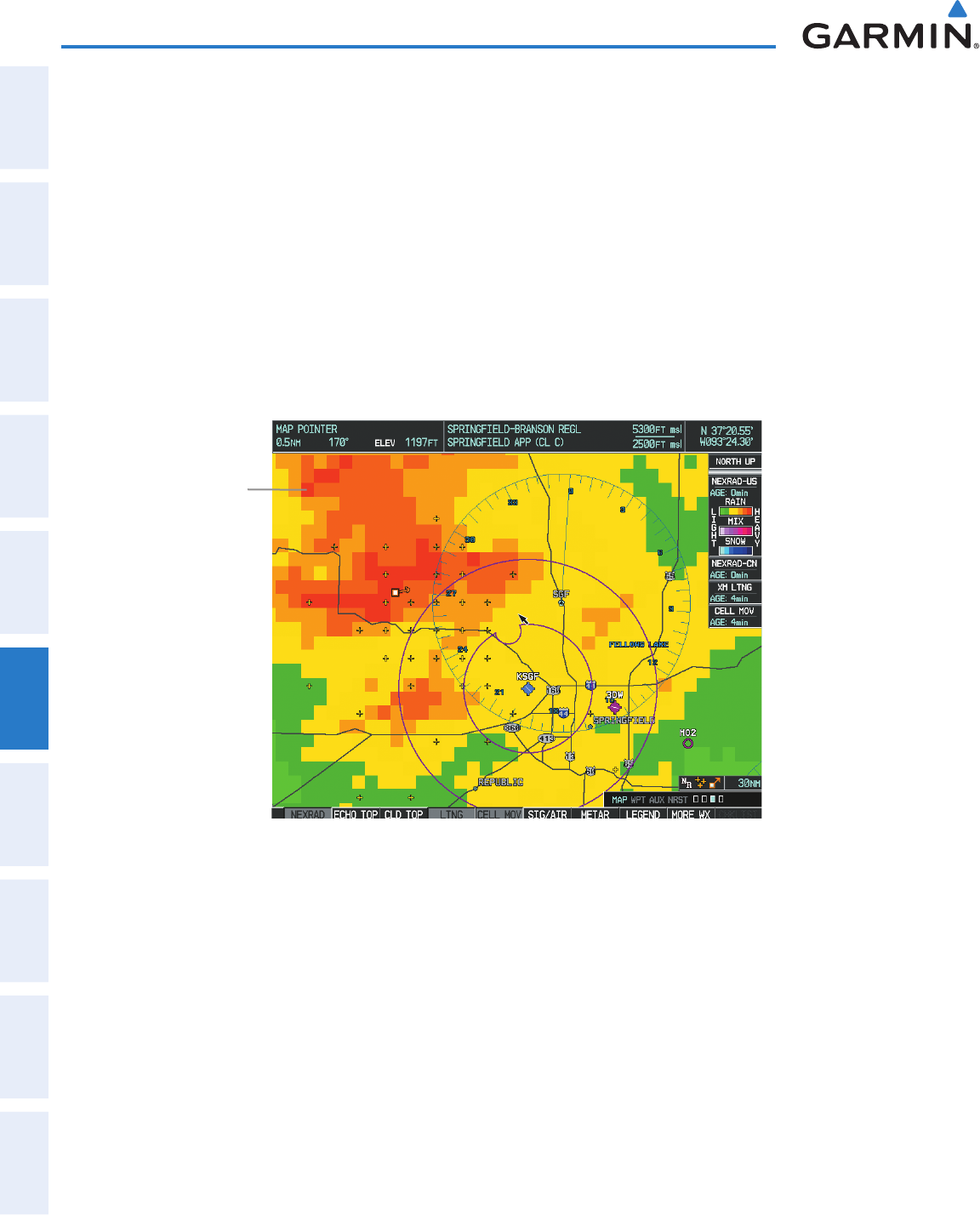
Garmin G1000 Pilot’s Guide for the Diamond DA40/40F
190-00592-06 Rev. A
288
HAZARD AVOIDANCE
SYSTEM
OVERVIEW
FLIGHT
INSTRUMENTS
EIS
AUDIO PANEL
& CNS
FLIGHT
MANAGEMENT
HAZARD
AVOIDANCE
AFCS
ADDITIONAL
FEATURES
APPENDICESINDEX
neXRaD li M i tat i o n s
NEXRAD radar images may have certain limitations:
•NEXRADbasereectivitydoesnotprovidesufcientinformationtodeterminecloudlayersorprecipitation
characteristics (wet hail vs. rain). For example, it is not possible to distinguish between wet snow, wet
hail, and rain.
•NEXRADbasereectivityissampledattheminimumantennaelevationangle.AnindividualNEXRAD
site cannot depict high altitude storms at close ranges. It has no information about storms directly over
the site.
•Whenzoomedintoarangeof30nm,eachsquareblockonthedisplayrepresentsanareaoffoursquare
kilometers. The intensity level reflected by each square represents the
highest
level of NEXRAD data
sampled within the area (Figure 6-12).
Figure 6-12 NEXRAD Data - Zoomed
Block Area is 4 km
2
The following may cause abnormalities in displayed NEXRAD radar images:
•Groundclutter
•Strobesandspuriousradardata
•Sunstrobes(whentheradarantennapointsdirectlyatthesun)
•Interferencefrombuildingsormountains,whichmaycauseshadows
•Metallicdustfrommilitaryaircraft,whichcancausealterationsinradarscans
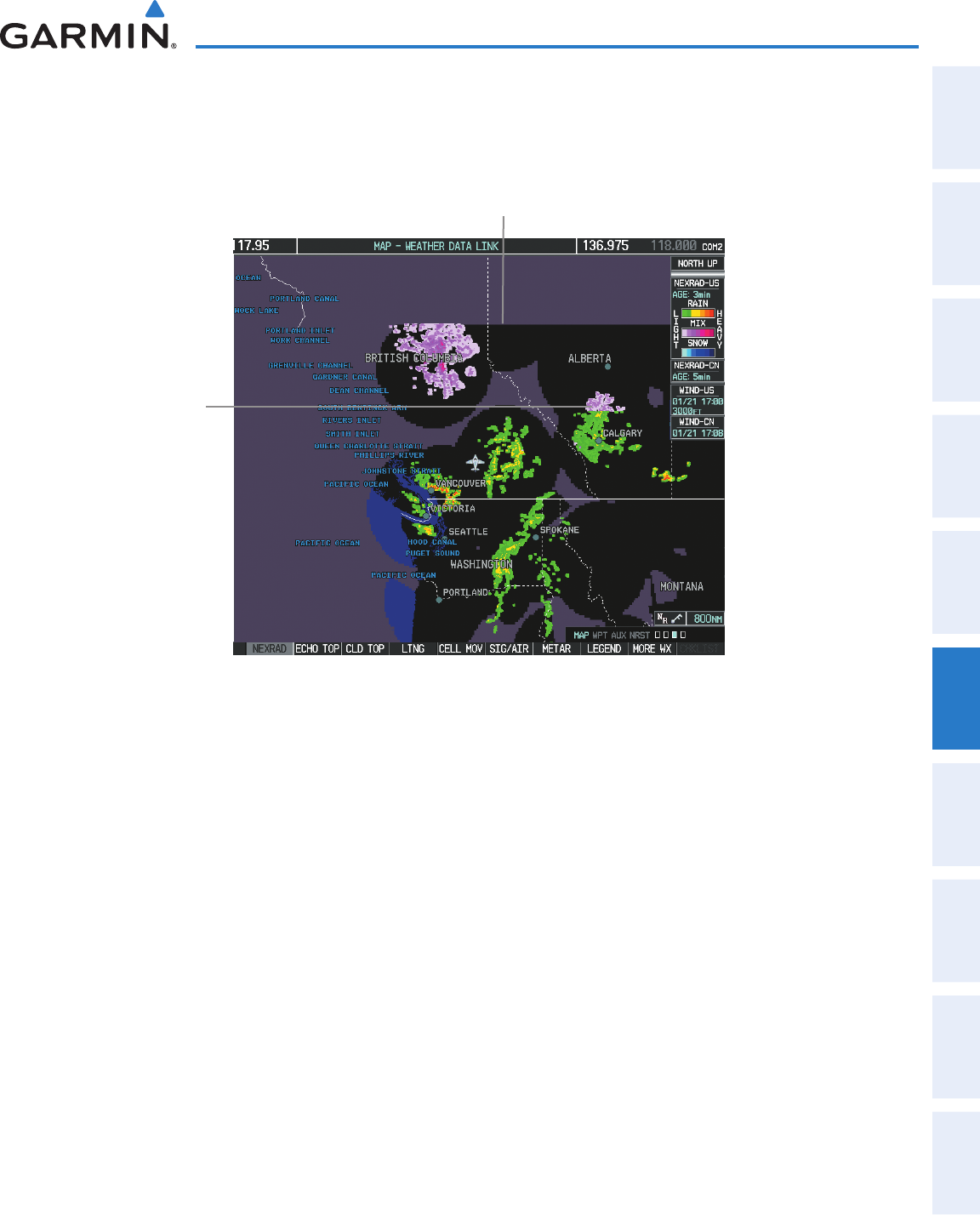
190-00592-06 Rev. A
Garmin G1000 Pilot’s Guide for the Diamond DA40/40F
289
HAZARD AVOIDANCE
SYSTEM
OVERVIEW
FLIGHT
INSTRUMENTS EIS AUDIO PANEL
& CNS
FLIGHT
MANAGEMENT
HAZARD
AVOIDANCE AFCS ADDITIONAL
FEATURES APPENDICES INDEX
neXRaD li M i tat i o n s (ca n a D a )
•Radarcoverageextendsto55ºN.
•Anyprecipitationdisplayedbetween52ºNand55ºNisdisplayedasmixedbecauseitisunknown.
Figure 6-13 NEXRAD Data - Canada
Precipitation
Above 52
º
N
No Coverage Above 55
º
N
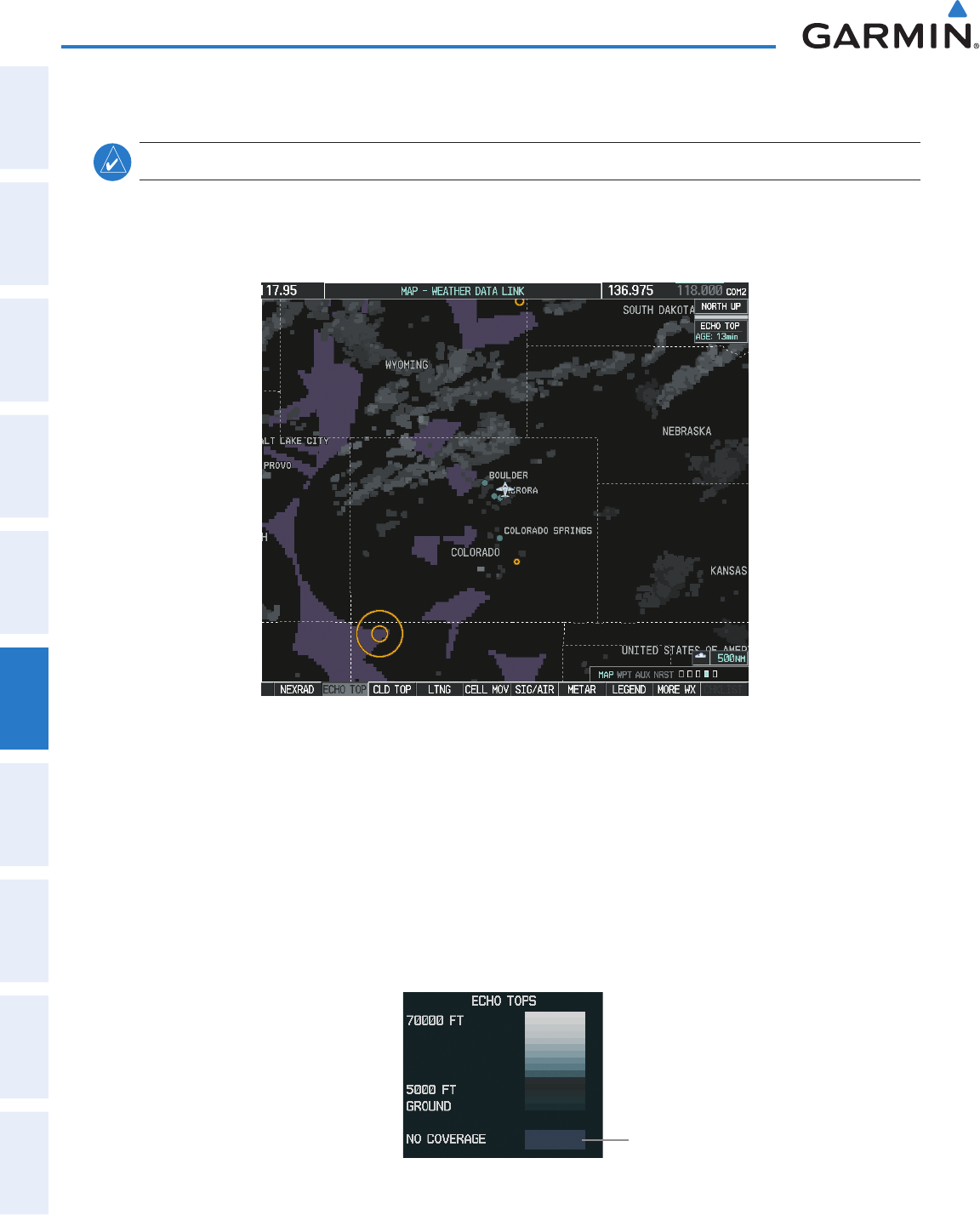
Garmin G1000 Pilot’s Guide for the Diamond DA40/40F
190-00592-06 Rev. A
290
HAZARD AVOIDANCE
SYSTEM
OVERVIEW
FLIGHT
INSTRUMENTS
EIS
AUDIO PANEL
& CNS
FLIGHT
MANAGEMENT
HAZARD
AVOIDANCE
AFCS
ADDITIONAL
FEATURES
APPENDICESINDEX
ECHO TOPS
NOTE: Display of Echo Tops is mutually exclusive with Cloud Tops and NEXRAD.
Echo Tops data (Figure 6-14) shows the location, elevation, and direction of the highest radar echo. The
highest radar echo does not indicate the top of a storm or clouds; rather it indicates the highest altitude at
which precipitation is detected. Information is derived from NEXRAD data.
Figure 6-14 Echo Tops Data
Displaying Echo Tops information:
1) Select the Weather Data Link Page.
2) Press the ECHO TOP Softkey.
To display the Echo Tops legend (Figure 6-15), press the
LEGEND
Softkey when Echo Tops is selected for
display. Since Echo Tops and Cloud Tops use the same color scaling to represent altitude, display of these
weather products is mutually exclusive. When Echo Tops is activated, NEXRAD and Cloud Tops data are
removed.
Figure 6-15 ECHO TOPS Legend
No Radar Coverage
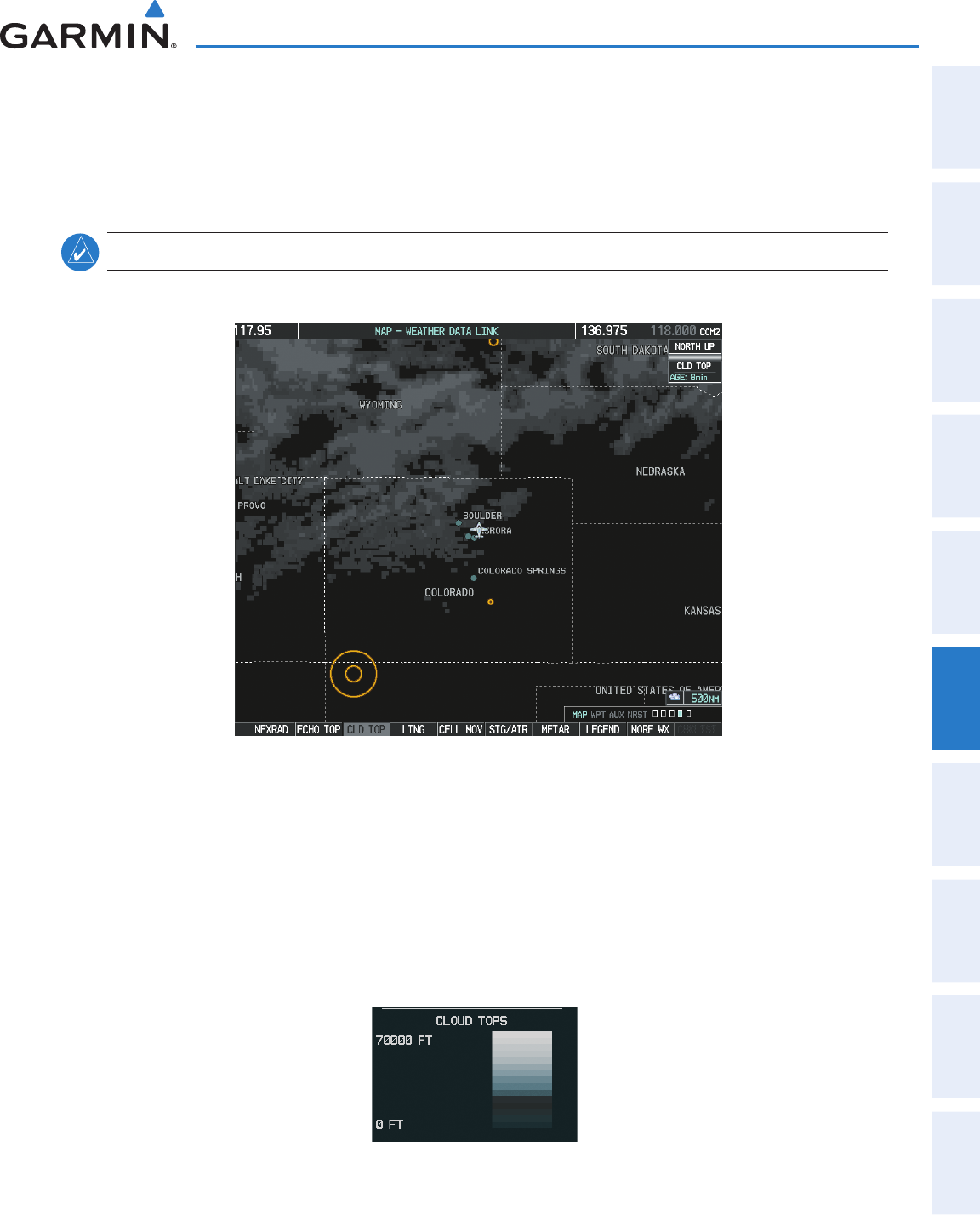
190-00592-06 Rev. A
Garmin G1000 Pilot’s Guide for the Diamond DA40/40F
291
HAZARD AVOIDANCE
SYSTEM
OVERVIEW
FLIGHT
INSTRUMENTS EIS AUDIO PANEL
& CNS
FLIGHT
MANAGEMENT
HAZARD
AVOIDANCE AFCS ADDITIONAL
FEATURES APPENDICES INDEX
The display of radar coverage is always active when either NEXRAD or ECHO TOPS is selected. Areas
where NEXRAD radar coverage and Echo Tops information is not currently available or is not being collected
are indicated in grayish-purple. Radar capability exists in these areas, but it is not active or is off-line.
CLOUD TOPS
NOTE: Cloud Tops and Echo Tops cannot be displayed at the same time.
Cloud Tops data (Figure 6-16) depicts cloud top altitudes as determined from satellite imagery.
Figure 6-16 Cloud Tops Data
Displaying Cloud Tops information:
1) Select the Weather Data Link Page.
2) Press the CLOUD TOPS Softkey.
To display the Cloud Tops legend (Figure 6-17), press the
LEGEND
Softkey when Cloud Tops is selected for
display. Since Cloud Tops and Echo Tops use the same color scaling to represent altitude, display of these
weather products is mutually exclusive. When Cloud Tops is activated, Echo Tops data is removed.
Figure 6-17 Cloud Tops Legend
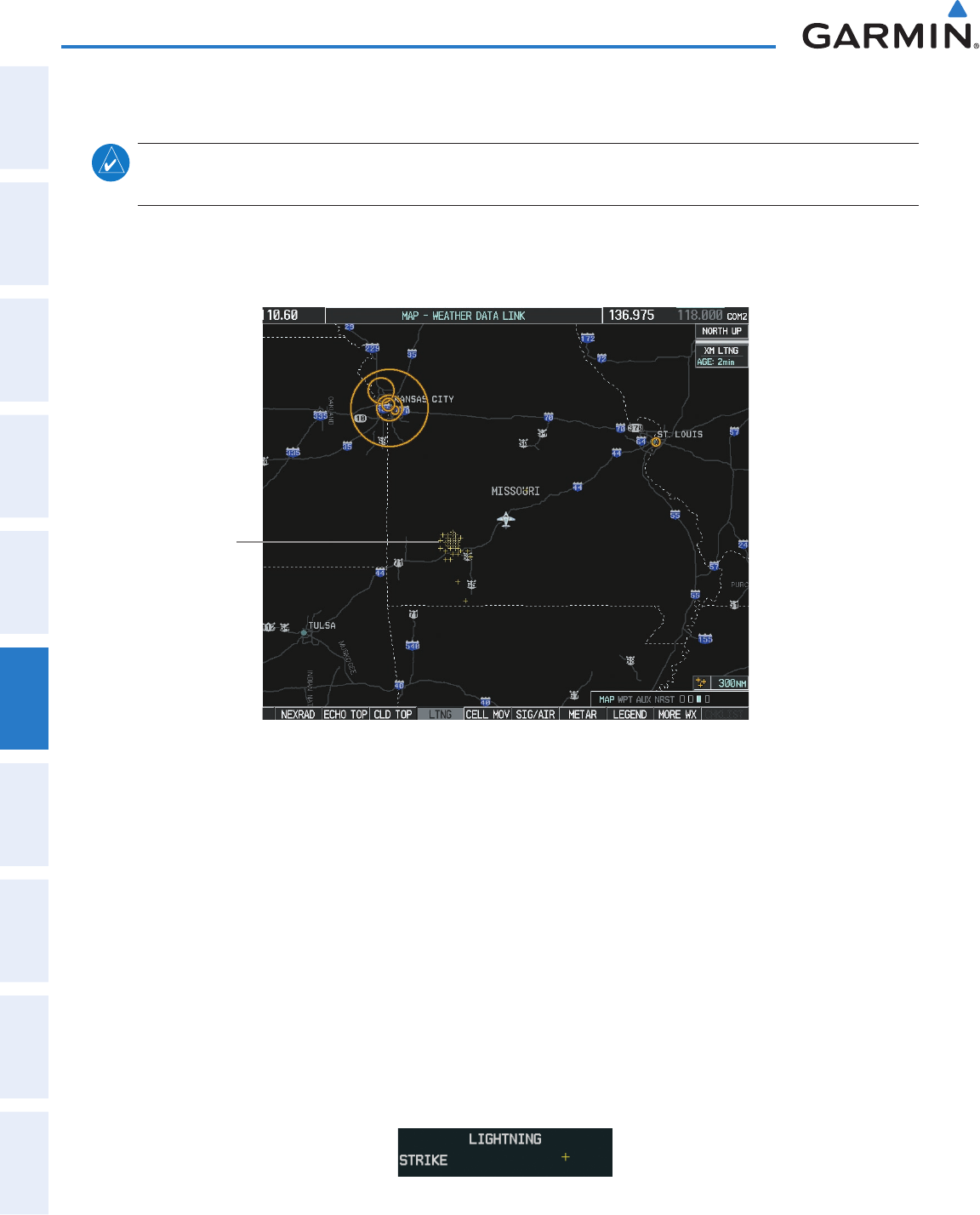
Garmin G1000 Pilot’s Guide for the Diamond DA40/40F
190-00592-06 Rev. A
292
HAZARD AVOIDANCE
SYSTEM
OVERVIEW
FLIGHT
INSTRUMENTS
EIS
AUDIO PANEL
& CNS
FLIGHT
MANAGEMENT
HAZARD
AVOIDANCE
AFCS
ADDITIONAL
FEATURES
APPENDICESINDEX
XM LIGHTNING
NOTE: L-3 STORMSCOPE
®
WX-500 Lightning and GDL 69/69A XM
®
Satellite Weather Lightning
are
mutually exclusive
.
Lightning data (Figure 6-18) shows the approximate location of cloud-to-ground lightning strikes. A strike
icon represents a strike that has occurred within a two-kilometer region. The exact location of the lightning
strike is not displayed.
Figure 6-18 Lightning Data
Lightning
Strikes
XM Lightning data displays on the following maps:
•PFDInsetMap
•NavigationMapPage
•WeatherDataLinkPage
•TripPlanningPage
•NearestPages
•FlightPlanPages
Displaying XM Lightning information:
1) Press the MAP Softkey (for the PFD Inset Map, press the INSET Softkey). This step is not necessary on the
Weather Data Link Page.
2) Press the XM LTNG Softkey (LTNG Softkey on the Weather Data Link Page).
To display the XM Lightning legend on the Weather Data Link Page (Figure 6-19), press the
LEGEND
Softkey
when XM Lightning is selected for display.
Figure 6-19 Lightning Legend
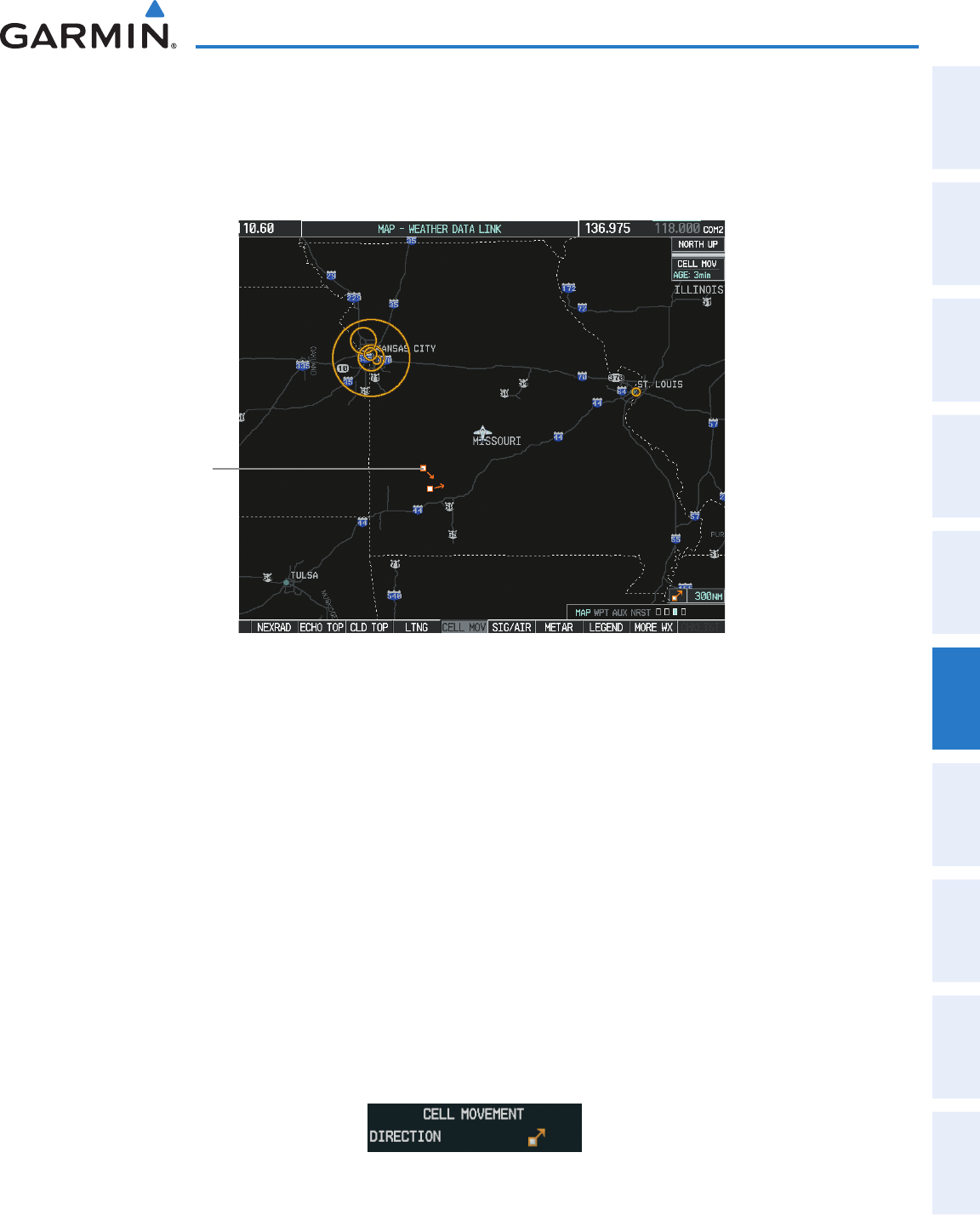
190-00592-06 Rev. A
Garmin G1000 Pilot’s Guide for the Diamond DA40/40F
293
HAZARD AVOIDANCE
SYSTEM
OVERVIEW
FLIGHT
INSTRUMENTS EIS AUDIO PANEL
& CNS
FLIGHT
MANAGEMENT
HAZARD
AVOIDANCE AFCS ADDITIONAL
FEATURES APPENDICES INDEX
CELL MOVEMENT
Cell Movement data (Figure 6-20) shows the location and movement of storm cells as identified by the
ground-based system. Cells are represented by yellow squares, with direction of movement indicated with
short, orange arrows.
Figure 6-20 Cell Movement Data
Storm Cells
On most applicable maps, Cell Movement data is selected for display along with NEXRAD. On the Weather
Data Link Page, Cell Movement data can be selected independently. Cell Movement data can be displayed
on the following maps:
•PFDInsetMap
•NavigationMap
•AUX-TripPlanningPage
•NearestPages
Displaying Cell Movement information:
1) Press the MAP Softkey (for the PFD Inset Map, press the INSET Softkey). This step is not necessary on the
Weather Data Link Page.
2) Press the NEXRAD Softkey (CEL MOV Softkey on the Weather Data Link Page). For Cell Movement to be
displayed on maps other than the Weather Data Link Page, Cell Movement must be turned on in the Navigation
Map Setup Menu (see “Setting Up XM Satellite Weather”).
To display the Cell Movement legend on the Weather Data Link Page, (Figure 6-21), press the
LEGEND
Softkey when Cell Movement is selected for display.
Figure 6-21 Cell Movement Legend
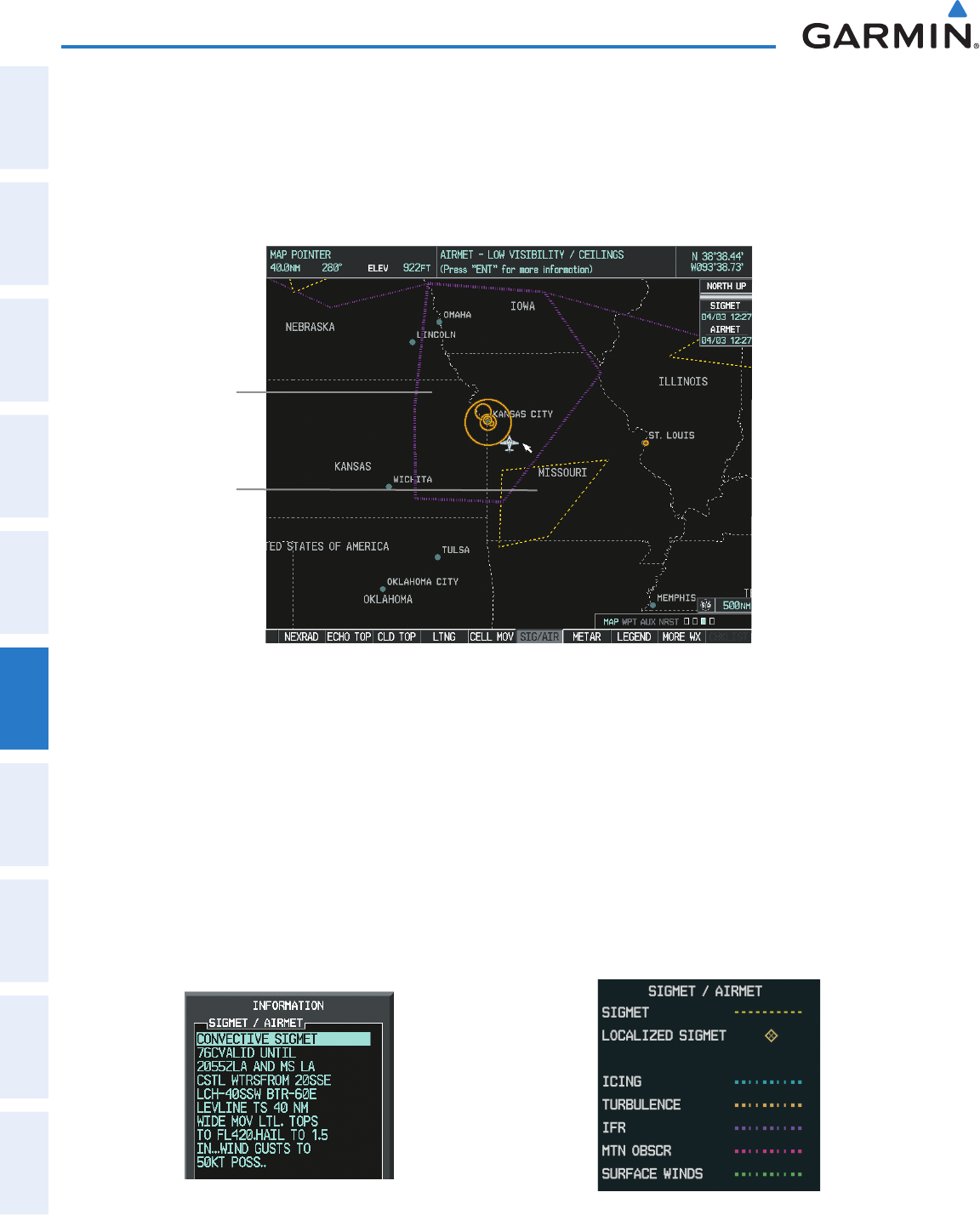
Garmin G1000 Pilot’s Guide for the Diamond DA40/40F
190-00592-06 Rev. A
294
HAZARD AVOIDANCE
SYSTEM
OVERVIEW
FLIGHT
INSTRUMENTS
EIS
AUDIO PANEL
& CNS
FLIGHT
MANAGEMENT
HAZARD
AVOIDANCE
AFCS
ADDITIONAL
FEATURES
APPENDICESINDEX
SIGMETS AND AIRMETS
SIGMETs (SIGnificant METeorological Information) and AIRMETs (AIRmen’s METeorological Information)
are broadcast for potentially hazardous weather considered of extreme importance to all aircraft. A Convective
SIGMET is issued for hazardous convective weather. A localized SIGMET is a significant weather condition
occurring at a localized geographical position.
Figure 6-22 SIGMET/AIRMET Data
SIGMET
AIRMET
Displaying SIGMETs and AIRMETs:
1) Select the Weather Data Link Page.
2) Press the SIG/AIR Softkey.
3) To view the text of the
SIGMET or AIRMET, press the
RANGE Knob
and move the Map Pointer over the
icon.
4)
Press the ENT key. Figure 6-23 shows sample SIGMET text.
To display the SIGMET and AIRMET legend (Figure 6-24), press the
LEGEND
Softkey when SIGMETs and
AIRMETs are selected for display.
Figure 6-24 SIGMET/AIRMET Legend
Figure 6-23 Sample SIGMET Text
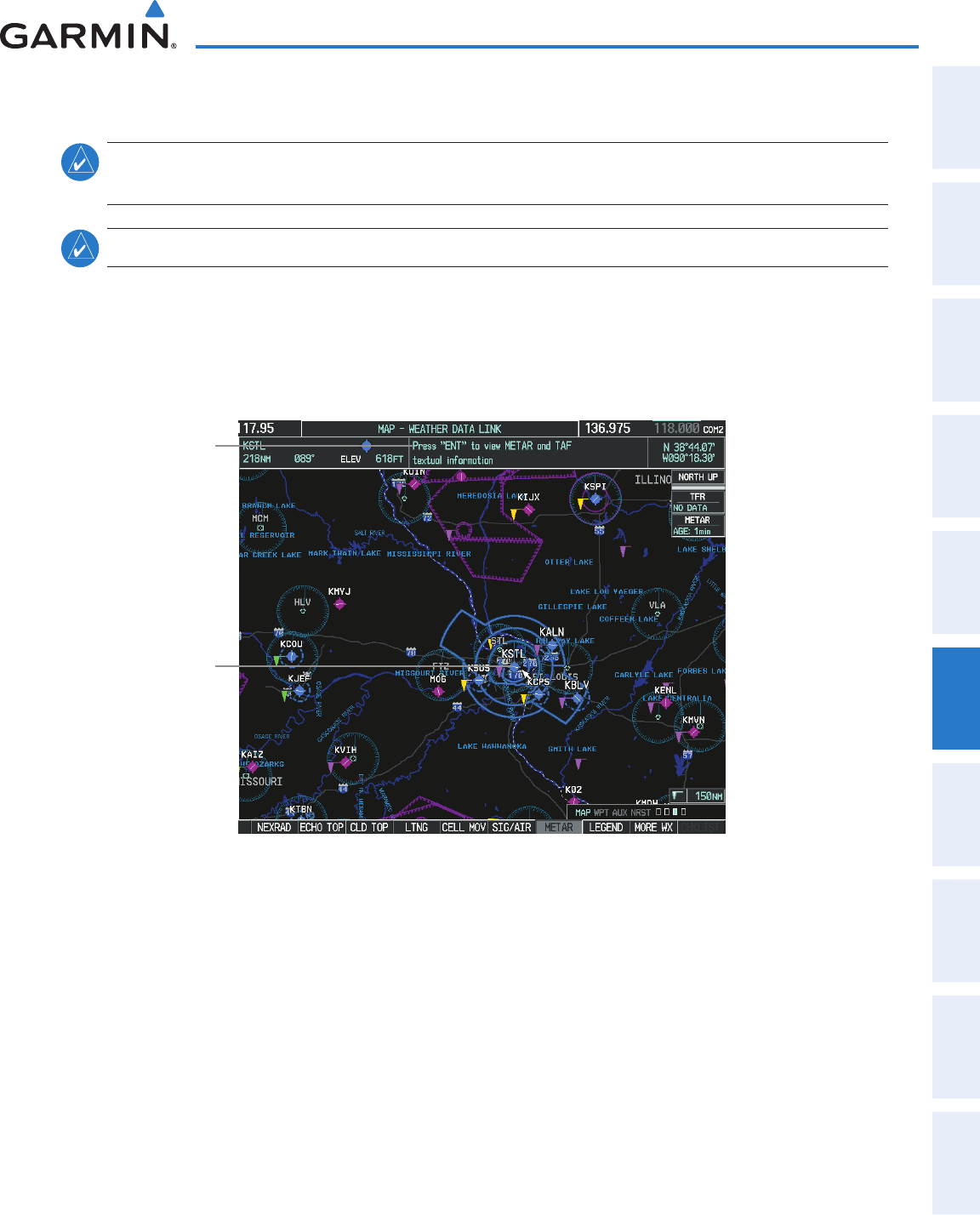
190-00592-06 Rev. A
Garmin G1000 Pilot’s Guide for the Diamond DA40/40F
295
HAZARD AVOIDANCE
SYSTEM
OVERVIEW
FLIGHT
INSTRUMENTS EIS AUDIO PANEL
& CNS
FLIGHT
MANAGEMENT
HAZARD
AVOIDANCE AFCS ADDITIONAL
FEATURES APPENDICES INDEX
METARS AND TAFS
NOTE: Atmospheric pressure as reported for METARs is given in hectopascals (hPa), except for in the United
States, where it is reported in inches of mercury (in Hg). Temperatures are reported in Celsius.
NOTE: METAR information is only displayed within the installed aviation database service area.
METAR (METeorological Aerodrome Report) is the standard format for pre-flight weather briefings.
METARs are updated hourly and are considered current. METARs typically contain information about the
temperature, dewpoint, wind, precipitation, cloud cover, cloud heights, visibility, and barometric pressure.
They can also contain information on precipitation amounts, lightning, and other critical data. METARs are
shown as colored flags at airports that provide them.
Figure 6-25 METAR Flags on the Weather Data Link Page
Instructions for
Viewing METAR and
TAF Text
Selected Airport
TAF (Terminal Aerodrome Report) is the standard format for 24-hour weather forecasts. TAFs may contain
some METAR data, but generally cover a smaller area. It typically forecasts significant weather changes,
temporary changes, probable changes, and expected changes in weather conditions.
METAR and TAF text are displayed on the Weather Information Page. METAR data is displayed first in a
decoded fashion, then as raw text. TAF information is displayed only in its raw form.
Displaying METAR and TAF text:
1) On the Weather Data Link Page, press the METAR Softkey.
2) Press the RANGE Knob and pan to the desired airport.
3) Press the ENT Key. The Weather Information Page is shown with METAR and TAF text.
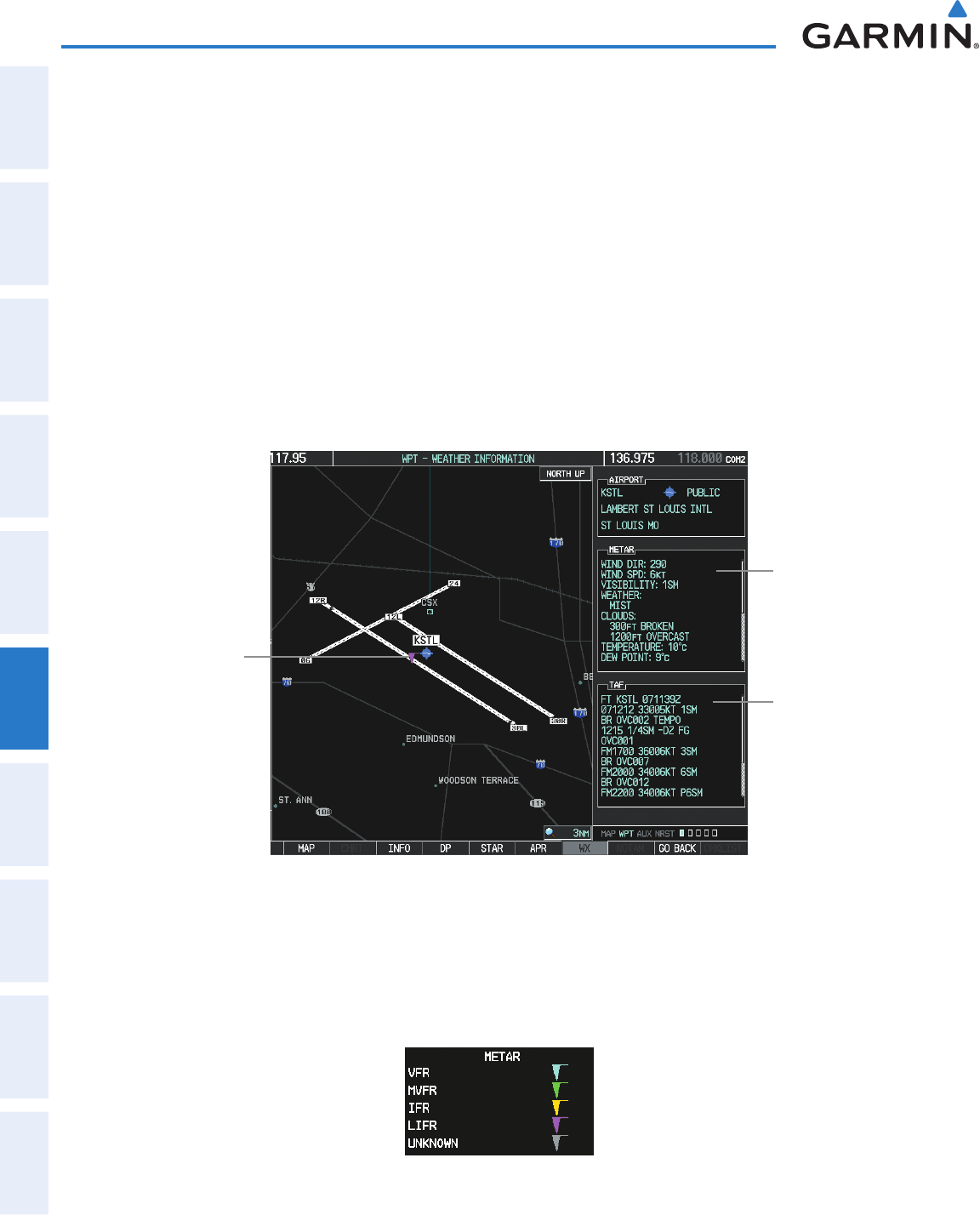
Garmin G1000 Pilot’s Guide for the Diamond DA40/40F
190-00592-06 Rev. A
296
HAZARD AVOIDANCE
SYSTEM
OVERVIEW
FLIGHT
INSTRUMENTS
EIS
AUDIO PANEL
& CNS
FLIGHT
MANAGEMENT
HAZARD
AVOIDANCE
AFCS
ADDITIONAL
FEATURES
APPENDICESINDEX
4) Use the FMS Knob or the ENT Key to scroll through the METAR and TAF text. METAR text must be completely
scrolled through before scrolling through the TAF text.
5) Press the FMS Knob or the CLR Key to return to the Weather Data Link Page.
Or:
1) Select the Weather Information Page.
a) Turn the large
FMS
Knob to select the Waypoint Page Group.
b) Press the WX Softkey to select the Weather Information Page.
2) Press the FMS Knob to display the cursor.
3) Use the FMS Knob to enter the desired airport and press the
ENT
Key.
4) Use the FMS Knob or the ENT Key to scroll through the METAR and TAF text. Note that the METAR text must
be completely scrolled through before scrolling through the TAF text.
Figure 6-26 METAR and TAF Text on the Weather Information Page
METAR Text for the
Selected Airport
TAF Text for the
Selected Airport
METAR Symbol
To display the METAR legend on the Weather Data Link Page (Figure 6-27), press the
LEGEND
Softkey when
METARs are selected for display.
The METAR flag color is determined by the information in the METAR text. A gray METAR flag is displayed
when the METAR text does not contain adequate information.
Figure 6-27 METAR Legend
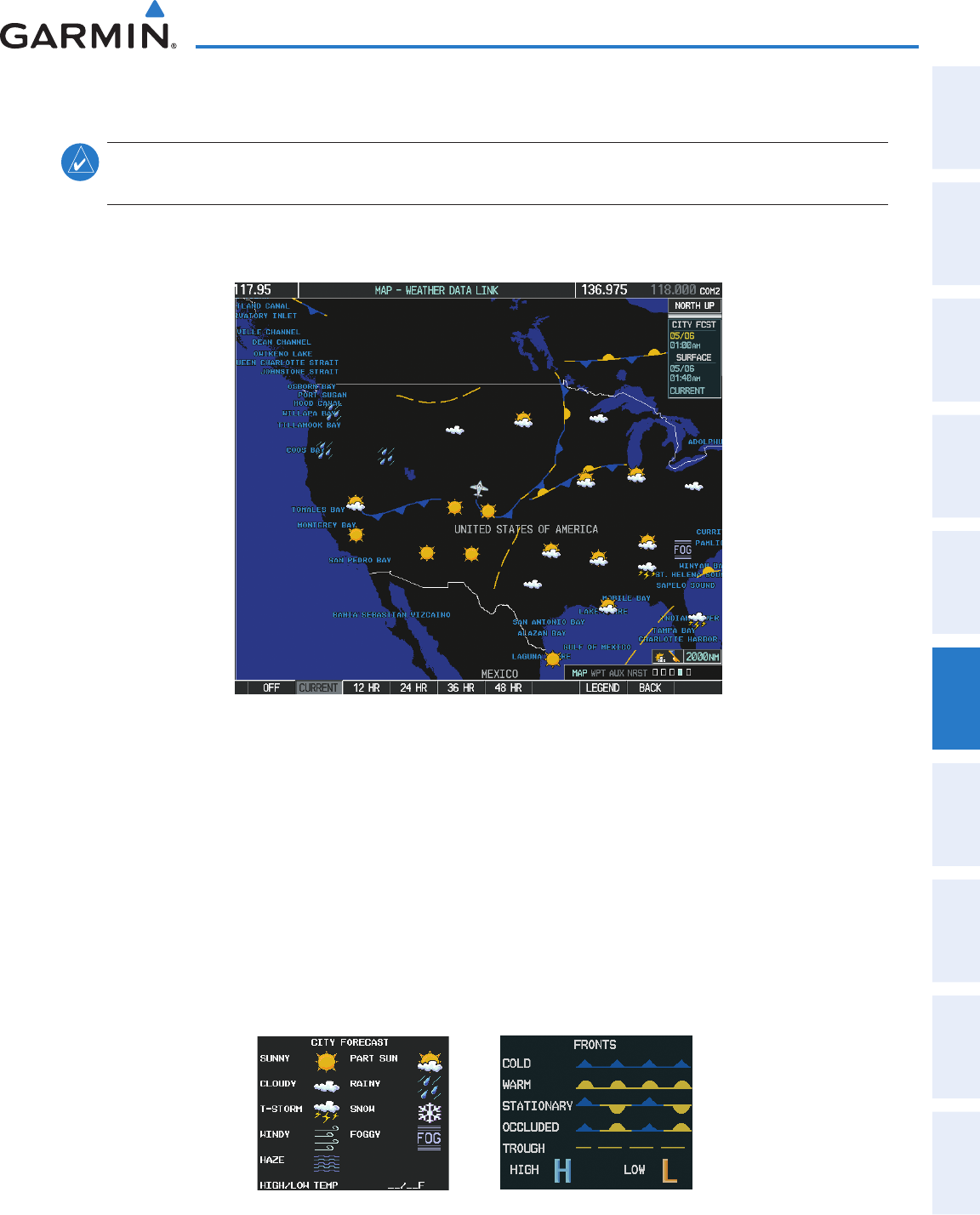
190-00592-06 Rev. A
Garmin G1000 Pilot’s Guide for the Diamond DA40/40F
297
HAZARD AVOIDANCE
SYSTEM
OVERVIEW
FLIGHT
INSTRUMENTS EIS AUDIO PANEL
& CNS
FLIGHT
MANAGEMENT
HAZARD
AVOIDANCE AFCS ADDITIONAL
FEATURES APPENDICES INDEX
SURFACE ANALYSIS AND CITY FORECAST
NOTE: Surface Analysis and City Forecast data are displayed only within the installed Aviation Database
service area.
Surface Analysis and City Forecast information is available for current and forecast weather conditions.
Forecasts are available for intervals of 12, 24, 36, and 48 hours.
Figure 6-28 Current Surface Analysis Data
Displaying Surface Analysis and City Forecast information:
1) Select the Weather Data Link Page.
2) Press the MORE WX Softkey.
3) Press the SFC Softkey.
4) Select the desired forecast time: CURRENT, 12 HR, 24 HR, 36 HR, or 48 HR. The SFC Softkey label changes
to reflect the forecast time selected.
To display the Surface Analysis and City Forecast legend (Figure 2-29), press the
LEGEND
Softkey when
Surface Analysis and City Forecast are selected to be displayed.
Figure 6-29 Surface Analysis Legend
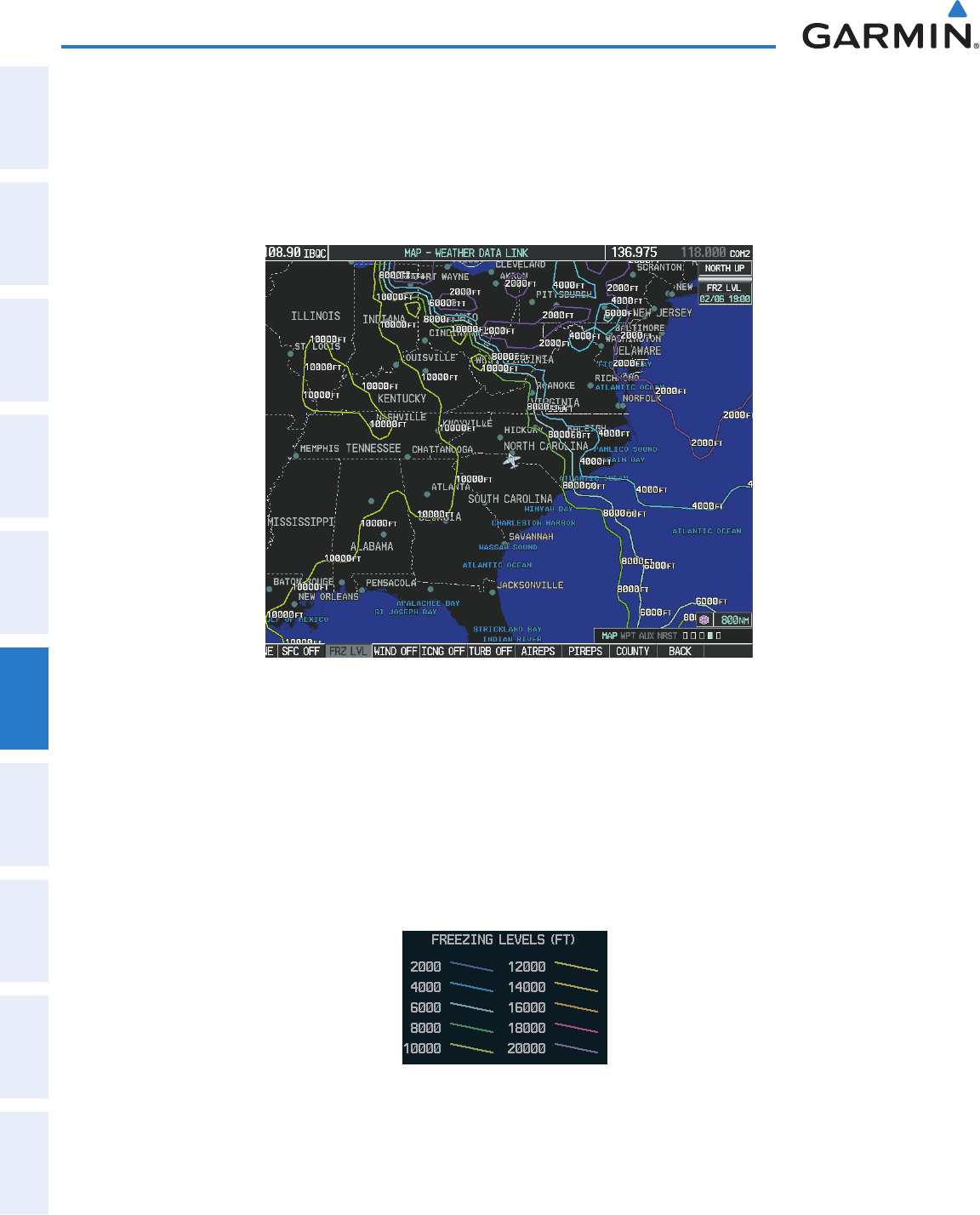
Garmin G1000 Pilot’s Guide for the Diamond DA40/40F
190-00592-06 Rev. A
298
HAZARD AVOIDANCE
SYSTEM
OVERVIEW
FLIGHT
INSTRUMENTS
EIS
AUDIO PANEL
& CNS
FLIGHT
MANAGEMENT
HAZARD
AVOIDANCE
AFCS
ADDITIONAL
FEATURES
APPENDICESINDEX
FREEZING LEVELS
Freezing Level data shows the color-coded contour lines for the altitude and location at which the first
isotherm is found (Figure 6-30). When no data is displayed for a given altitude, the data for that altitude has
not been received, or is out of date and has been removed from the display. New data appears at the next
update.
Figure 6-30 Freezing Level Data
Displaying Freezing Level information:
1) Select the Weather Data Link Page.
2) Press the MORE WX Softkey.
3) Press the FRZ LVL Softkey.
To display the Freezing Level legend (Figure 6-31), press the
LEGEND
Softkey when Freezing Level data is
selected to be displayed.
Figure 6-31 Freezing Level Legend
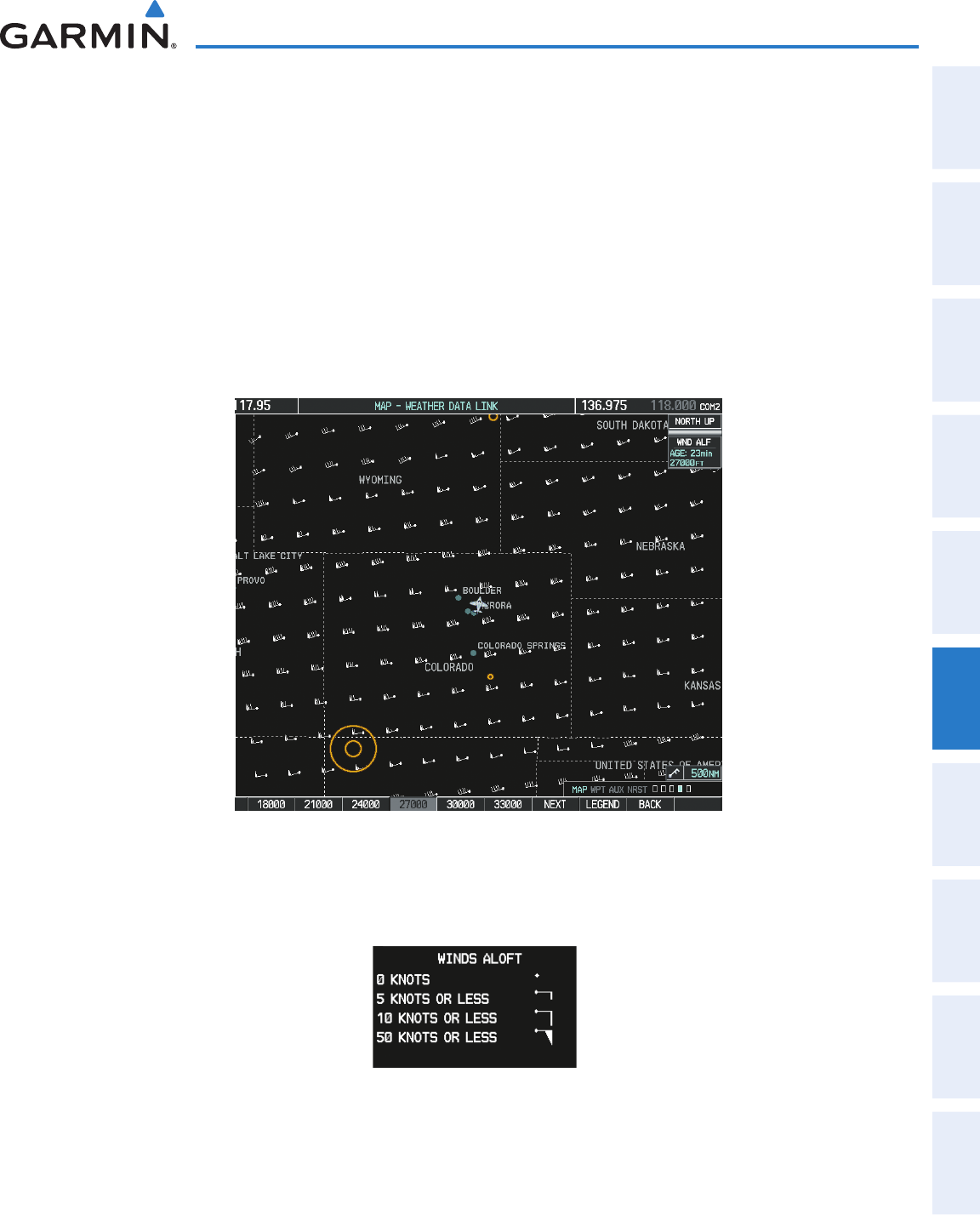
190-00592-06 Rev. A
Garmin G1000 Pilot’s Guide for the Diamond DA40/40F
299
HAZARD AVOIDANCE
SYSTEM
OVERVIEW
FLIGHT
INSTRUMENTS EIS AUDIO PANEL
& CNS
FLIGHT
MANAGEMENT
HAZARD
AVOIDANCE AFCS ADDITIONAL
FEATURES APPENDICES INDEX
WINDS ALOFT
Winds Aloft data (Figure 6-32) shows the forecasted wind speed and direction at the surface and at selected
altitudes. Altitude can be displayed in 3,000-foot increments up to 42,000 feet MSL.
Displaying Winds Aloft data:
1) Select the Weather Data Link Page.
2) Press the
MORE WX
Softkey.
3) Press the
WIND
Softkey.
4) Select the desired altitude level: SFC (surface) up to 42,000 feet. Press the
NEXT
or
PREV
Softkey to cycle
through the altitude softkeys. The
WIND
Softkey label changes to reflect the altitude selected.
Figure 6-32 Winds Aloft Data at 27,000 Feet
To display the Winds Aloft legend (Figure 6-33), press the
LEGEND
Softkey when Winds Aloft is
selected for display.
Figure 6-33 Winds Aloft Data with Legend
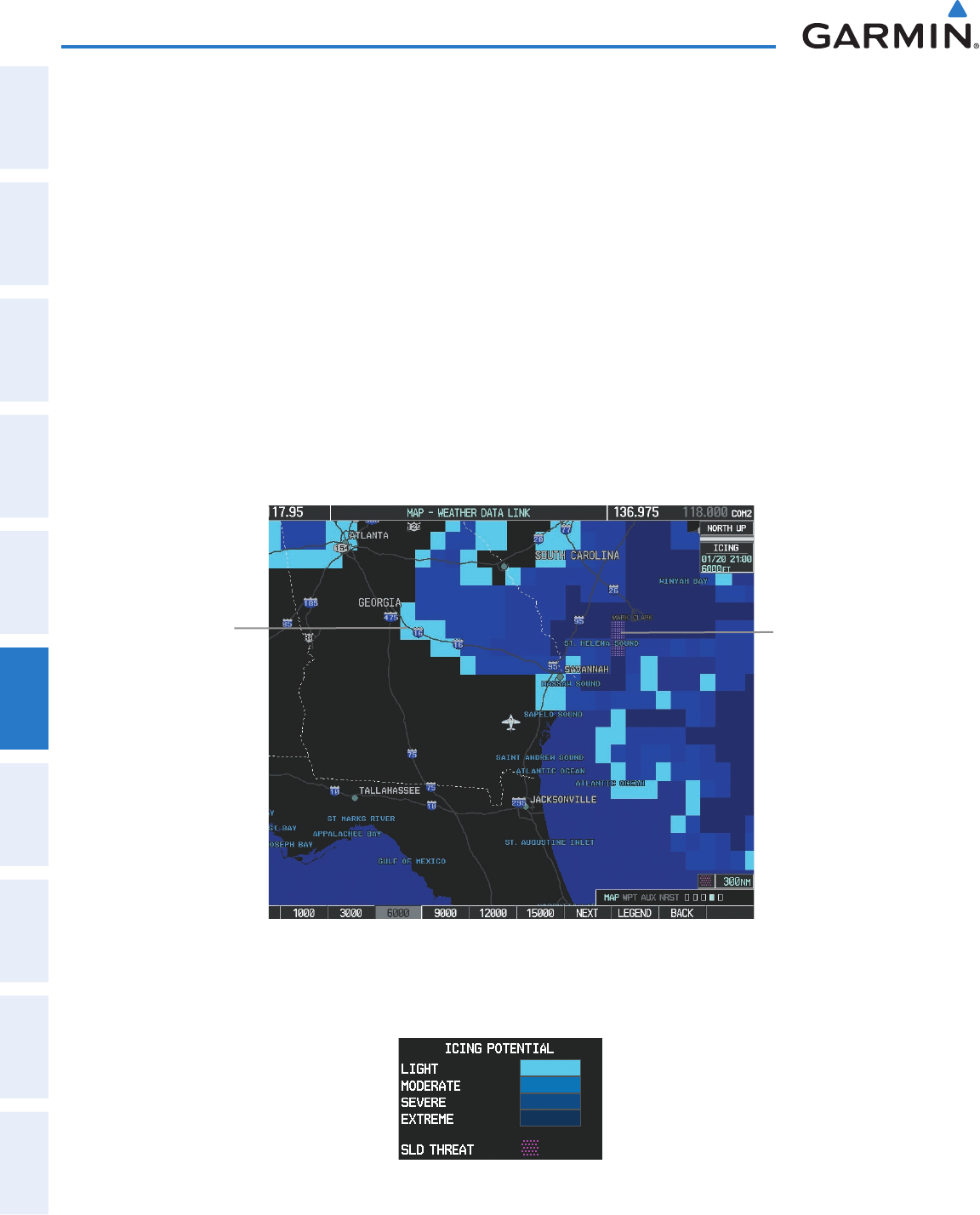
Garmin G1000 Pilot’s Guide for the Diamond DA40/40F
190-00592-06 Rev. A
300
HAZARD AVOIDANCE
SYSTEM
OVERVIEW
FLIGHT
INSTRUMENTS
EIS
AUDIO PANEL
& CNS
FLIGHT
MANAGEMENT
HAZARD
AVOIDANCE
AFCS
ADDITIONAL
FEATURES
APPENDICESINDEX
ICING (CIP & SLD)
Current Icing Product (CIP) data (Figure 6-34) shows a graphical view of the current icing environment.
Icing severity is displayed in four categories: light, moderate, severe, and extreme (not specific to aircraft type).
The CIP product is not a forecast, but a presentation of the current conditions at the time of the analysis.
Supercooled Large Droplet (SLD) icing conditions are characterized by the presence of relatively large,
super cooled water droplets indicative of freezing drizzle and freezing rain aloft. SLD threat areas are depicted
as magenta dots over the CIP colors.
Displaying Icing data:
1) Select the Weather Data Link Page.
2) Press the
MORE WX
Softkey.
3) Press the
ICNG
Softkey.
4) Select the desired altitude level: 1,000 feet up to 30,000 feet. Press the
NEXT
or
PREV
Softkey to cycle through
the altitude softkeys. The
ICNG
Softkey label changes to reflect the altitude selected.
Figure 6-34 Icing Data at 6,000 Feet
Light
Icing
Supercooled
Large Droplets
To display the Icing Potential legend (Figure 6-35), press the
LEGEND
Softkey when Icing is selected for
display.
Figure 6-35 Icing Potential Legend
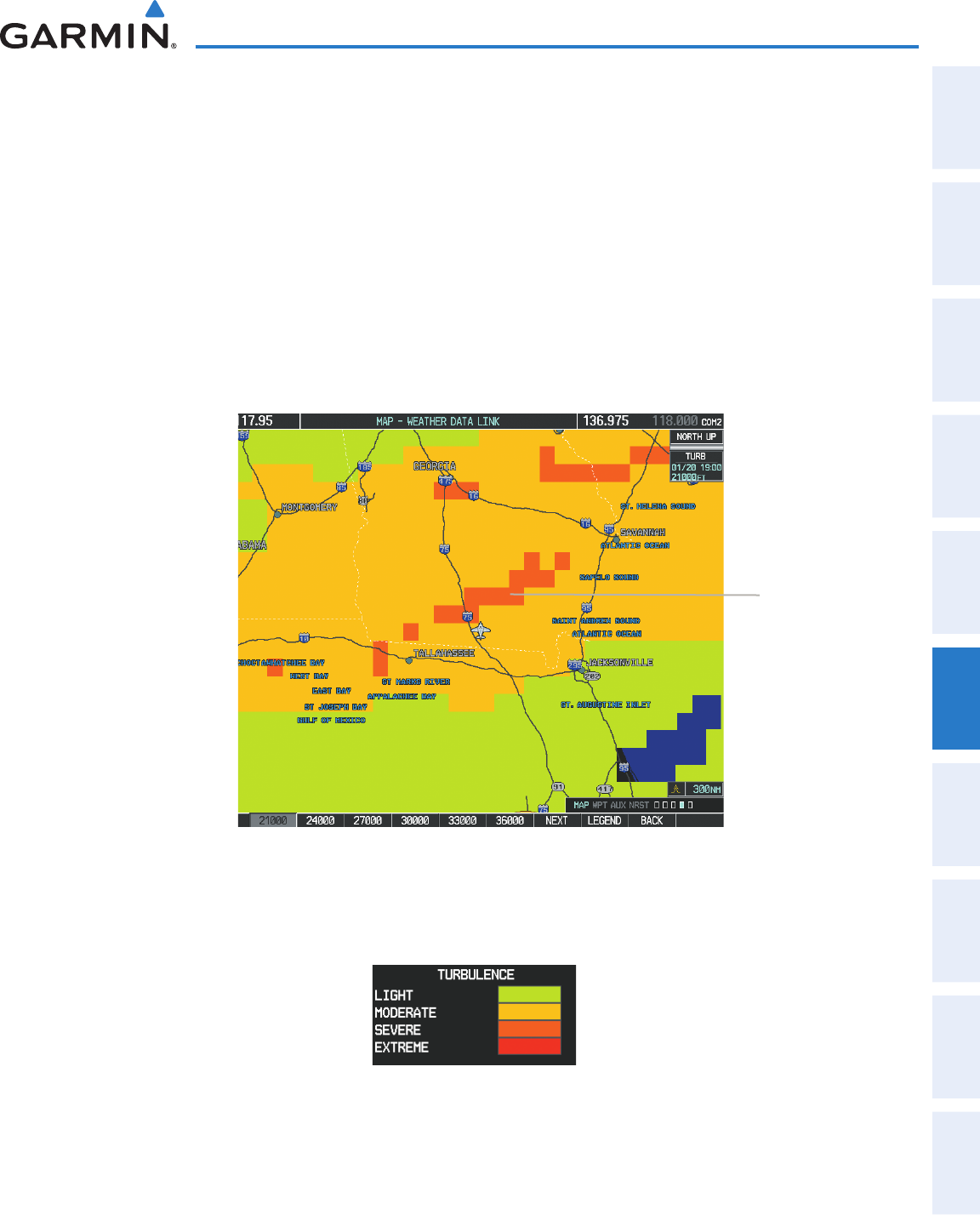
190-00592-06 Rev. A
Garmin G1000 Pilot’s Guide for the Diamond DA40/40F
301
HAZARD AVOIDANCE
SYSTEM
OVERVIEW
FLIGHT
INSTRUMENTS EIS AUDIO PANEL
& CNS
FLIGHT
MANAGEMENT
HAZARD
AVOIDANCE AFCS ADDITIONAL
FEATURES APPENDICES INDEX
TURBULENCE
Turbulence data (Figure 6-36) identifies the potential for erratic movement of high-altitude air mass
associated winds. Turbulence is classified as light, moderate, severe or extreme, at altitudes between 21,000
and 45,000 feet.Turbulence data is intended to supplement AIRMETs and SIGMETs.
Displaying Turbulence data:
1) Select the Weather Data Link Page.
2) Press the
MORE WX
Softkey.
3) Press the
TURB
Softkey.
4) Select the desired altitude level: 21,000 feet up to 45,000 feet. Press the
NEXT
or
PREV
Softkey to cycle
through the altitude softkeys. The
TURB
Softkey label changes to reflect the altitude selected.
Figure 6-36 Turbulence Data at 21,000 Feet
Severe
Turbulence
To display the Turbulence legend (Figure 6-37), press the
LEGEND
Softkey when Turbulence is selected
for display.
Figure 6-37 Turbulence Legend
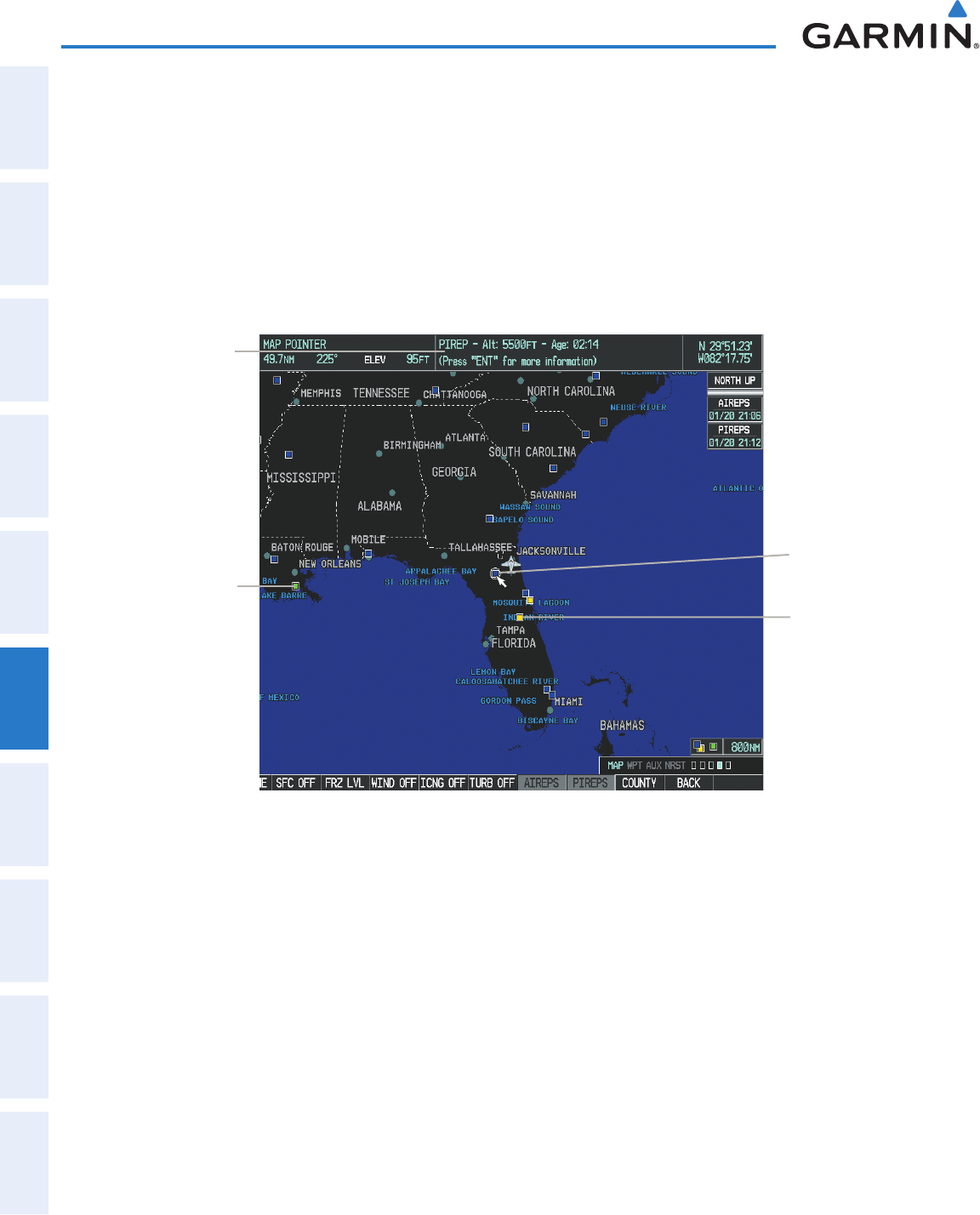
Garmin G1000 Pilot’s Guide for the Diamond DA40/40F
190-00592-06 Rev. A
302
HAZARD AVOIDANCE
SYSTEM
OVERVIEW
FLIGHT
INSTRUMENTS
EIS
AUDIO PANEL
& CNS
FLIGHT
MANAGEMENT
HAZARD
AVOIDANCE
AFCS
ADDITIONAL
FEATURES
APPENDICESINDEX
PIREPS AND AIREPS
Pilot Weather Reports (PIREPs) (Figure 6-38) provide timely weather information for a particular route of
flight. When significant weather conditions are reported or forecast, Air Traffic Control (ATC) facilities are
required to solicit PIREPs. A PIREP may contain unforecast adverse weather conditions, such as low in-flight
visibility, icing conditions, wind shear, and turbulence. PIREPs are issued as either Routine (UA) or Urgent
(UUA).
Another type of PIREP is an Air Report (AIREP). AIREPs are used almost exclusively by commerical airlines
at high altitudes.
Figure 6-38 AIREPs and PIREPs on the Weather Data Link Page
Instructions for
Viewing PIREP
and AIREP Text
Routine
PIREP
Selected
Urgent
PIREP
AIREP
Displaying PIREP and AIREP text:
1) Select the Weather Data Link Page.
2) Press the
MORE WX
Softkey.
3) Press the
AIREPS
or
PIREPS
Softkey.
4) Press the RANGE Knob and pan to the desired weather report. A gray circle will appear around the weather
report when it is selected.
5) Press the ENT Key. The Weather Information Page is shown with PIREP or AIREP text. The data is first displayed
in a decoded fashion, then as raw text.
6) Use the FMS Knob or the ENT Key to scroll through the PIREP or AIREP text.
7) Press the FMS Knob or the CLR Key to return to the Weather Data Link Page.
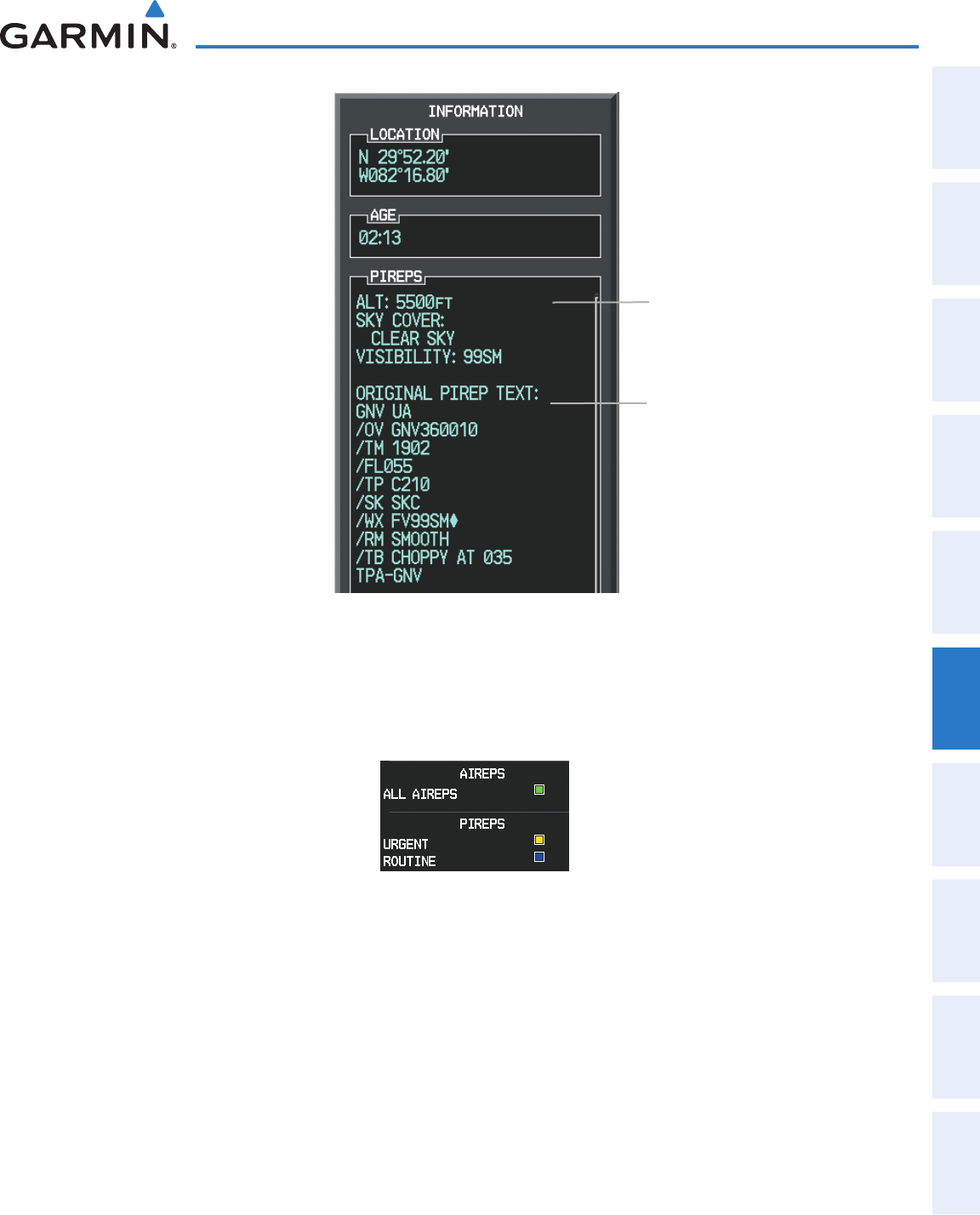
190-00592-06 Rev. A
Garmin G1000 Pilot’s Guide for the Diamond DA40/40F
303
HAZARD AVOIDANCE
SYSTEM
OVERVIEW
FLIGHT
INSTRUMENTS EIS AUDIO PANEL
& CNS
FLIGHT
MANAGEMENT
HAZARD
AVOIDANCE AFCS ADDITIONAL
FEATURES APPENDICES INDEX
Raw PIREP Text
Decoded PIREP Text
Figure 6-39 PIREP Text on the Weather Data Link Page
To display the PIREP or AIREP legend (Figure 6-40), press the
LEGEND
Softkey when PIREPs or AIREPs are
selected for display.
The PIREP color is determined by the type (routine or urgent).
Figure 6-40 AIREPs & PIREPs Legend
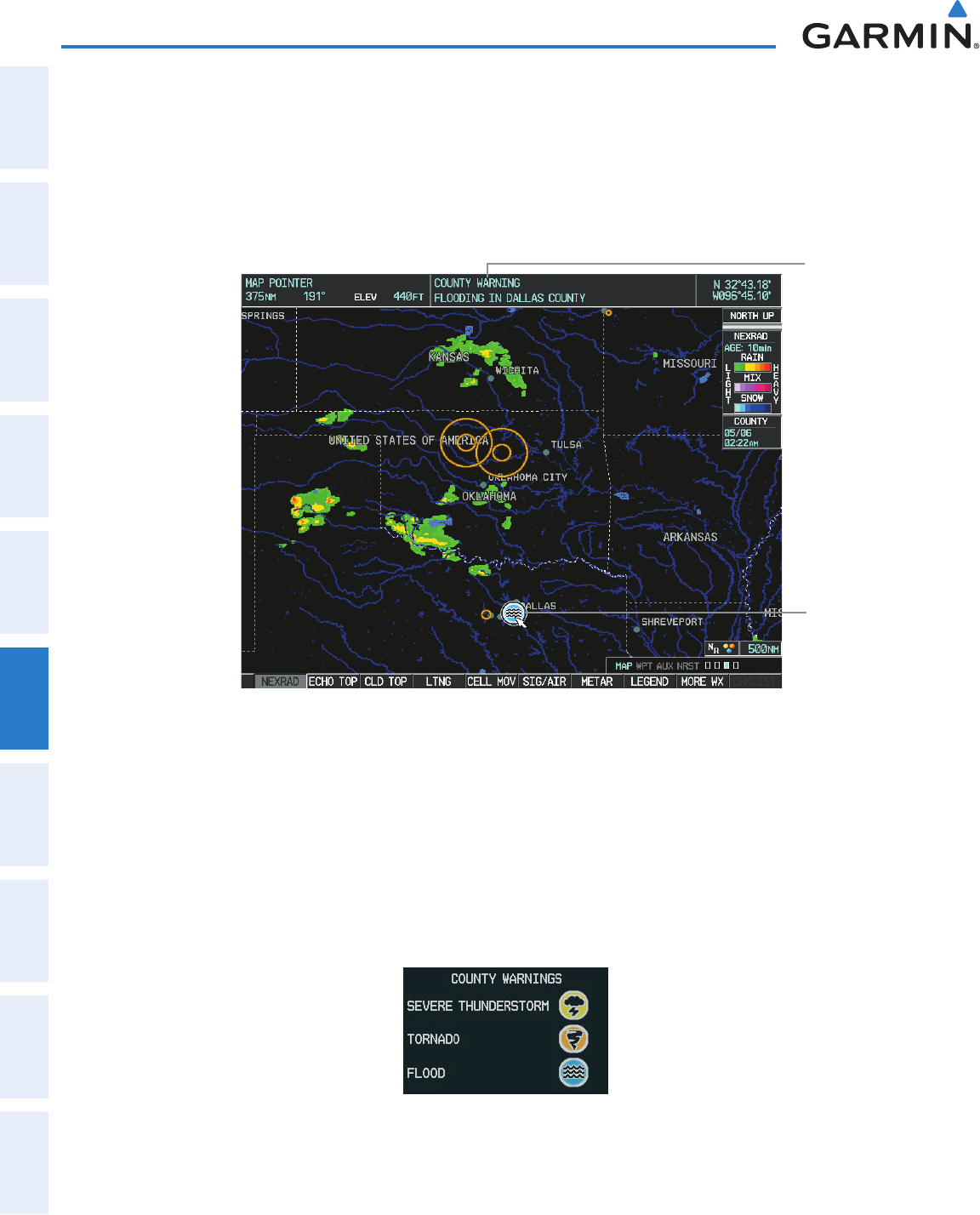
Garmin G1000 Pilot’s Guide for the Diamond DA40/40F
190-00592-06 Rev. A
304
HAZARD AVOIDANCE
SYSTEM
OVERVIEW
FLIGHT
INSTRUMENTS
EIS
AUDIO PANEL
& CNS
FLIGHT
MANAGEMENT
HAZARD
AVOIDANCE
AFCS
ADDITIONAL
FEATURES
APPENDICESINDEX
COUNTY WARNINGS
County data (Figure 6-41) provides specific public awareness and protection weather warnings from the
National Weather Service (NWS). This can include information on fires, tornadoes, severe thunderstorms,
flood conditions, and other natural disasters.
Figure 6-41 County Flood Warning
Additional
Information on
Flood Warning
Selected with
Map Pointer
Flood Warning
Displaying County Warning information:
1) Select the Weather Data Link Page.
2) Press the MORE WX Softkey.
3) Press the COUNTY Softkey.
To display the County Warnings legend (Figure 6-42), press the
LEGEND
Softkey when County Warnings
are selected to be displayed.
Figure 6-42 County Warnings Legend
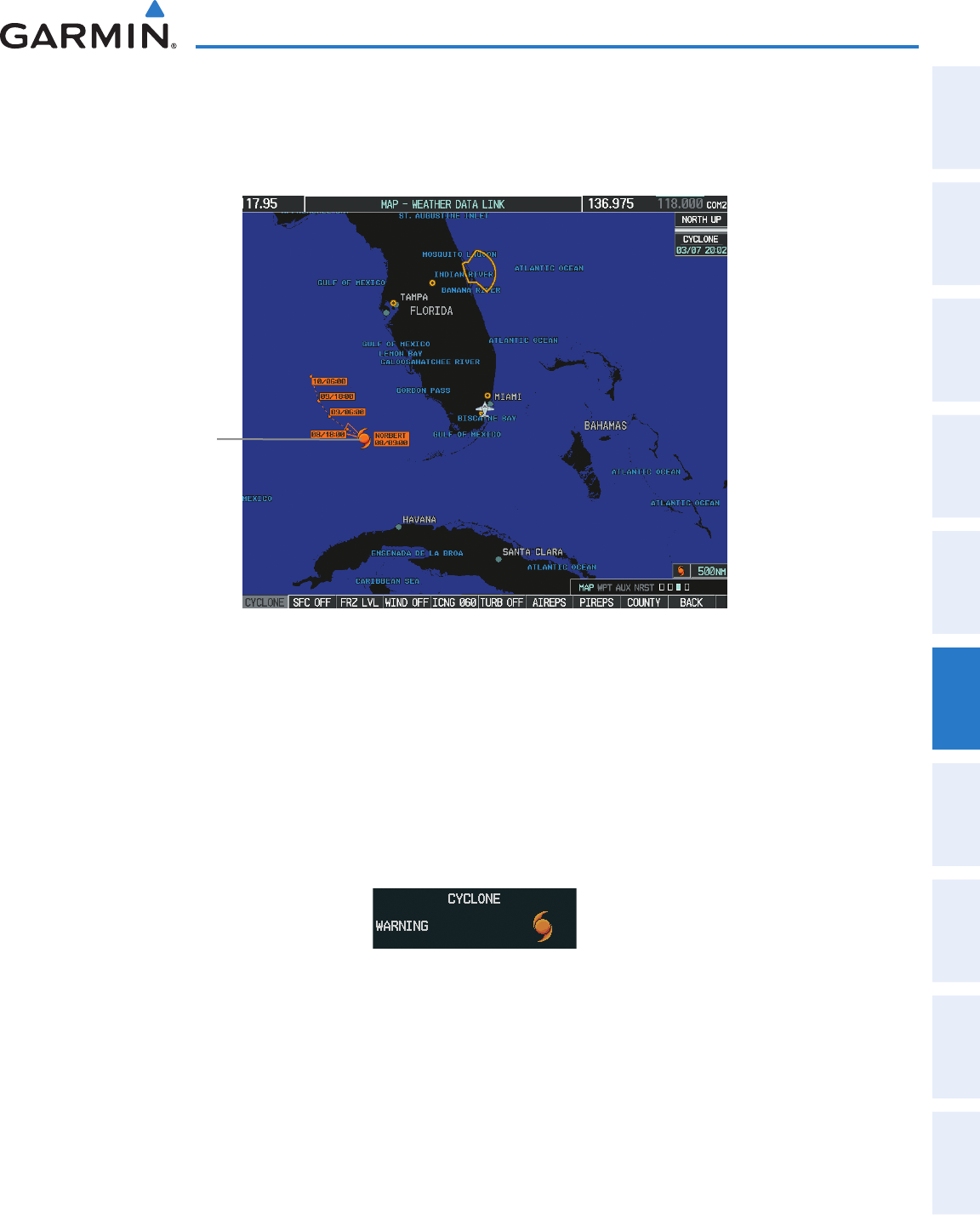
190-00592-06 Rev. A
Garmin G1000 Pilot’s Guide for the Diamond DA40/40F
305
HAZARD AVOIDANCE
SYSTEM
OVERVIEW
FLIGHT
INSTRUMENTS EIS AUDIO PANEL
& CNS
FLIGHT
MANAGEMENT
HAZARD
AVOIDANCE AFCS ADDITIONAL
FEATURES APPENDICES INDEX
CYCLONE
The Cyclone weather product (Figure 6-43) shows the current location of cyclones (hurricanes) and their
projected tracks.
Figure 6-43 Cyclone Data Selected for Display
Cyclone
Displaying cyclone (hurricane) track information:
1) Select the Weather Data Link Page.
2) Press the MORE WX Softkey.
3) Press the CYCLONE Softkey.
To display the Cyclone legend (Figure 6-44), press the
LEGEND
Softkey when Cyclones are selected to be
displayed.
Figure 6-44 Cyclone Legend
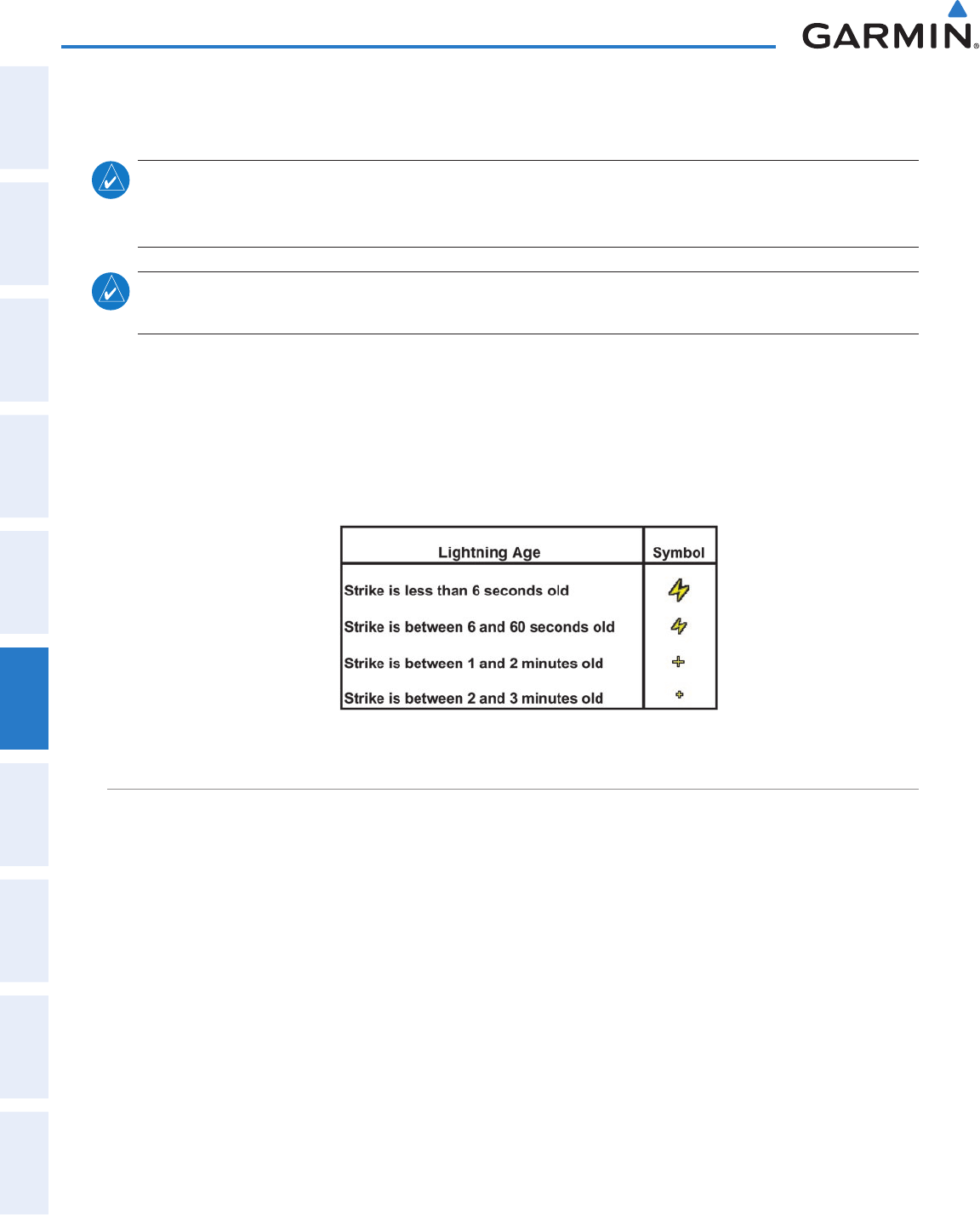
Garmin G1000 Pilot’s Guide for the Diamond DA40/40F
190-00592-06 Rev. A
306
HAZARD AVOIDANCE
SYSTEM
OVERVIEW
FLIGHT
INSTRUMENTS
EIS
AUDIO PANEL
& CNS
FLIGHT
MANAGEMENT
HAZARD
AVOIDANCE
AFCS
ADDITIONAL
FEATURES
APPENDICESINDEX
6.2 WX-500 STORMSCOPE
NOTE: The Stormscope system is not intended for hazardous thunderstorm penetration. Weather information
on the G1000 MFD is approved for weather avoidance only. Refer to the WX-500 User’s Guide for a detailed
description of Stormscope operation.
NOTE: L-3 STORMSCOPE
®
WX-500 Lightning and GDL 69/69A XM
®
Satellite Weather Lightning
are
mutually exclusive
.
The following pages can display Stormscope data:
•StormscopePage •AUX-TripPlanningPage
•NavigationMap •NearestPages
To display Stormscope data on the Navigation Map, AUX - Trip Planning Page, or any of the Nearest Pages,
press the
MAP
Softkey, then press the
STRMSCP
Softkey. These pages can also display cell or strike data using the
yellow lightning strike symbology shown in Table 6-3.
Table 6-3 Lightning Age and Symbols
SETTING UP STORMSCOPE ON THE NAVIGATION MAP
Setting up Stormscope options on the Navigation Map:
1) On the Navigation Map Page, press the MENU Key.
2) With ‘Map Setup’ selected (Figure 6-45), press the ENT Key.
3) Turn the small FMS Knob to display the group selection window. Turn the small FMS Knob to select ‘Weather’
(Figure 6-46), and press the ENT Key.
4) Turn the large FMS Knob to highlight and move between the product selections.
5) When an item is highlighted, turn the small FMS Knob to select the option.
6) Press the ENT Key.
7) Press the
FMS
Knob to return to the Navigation Map Page.
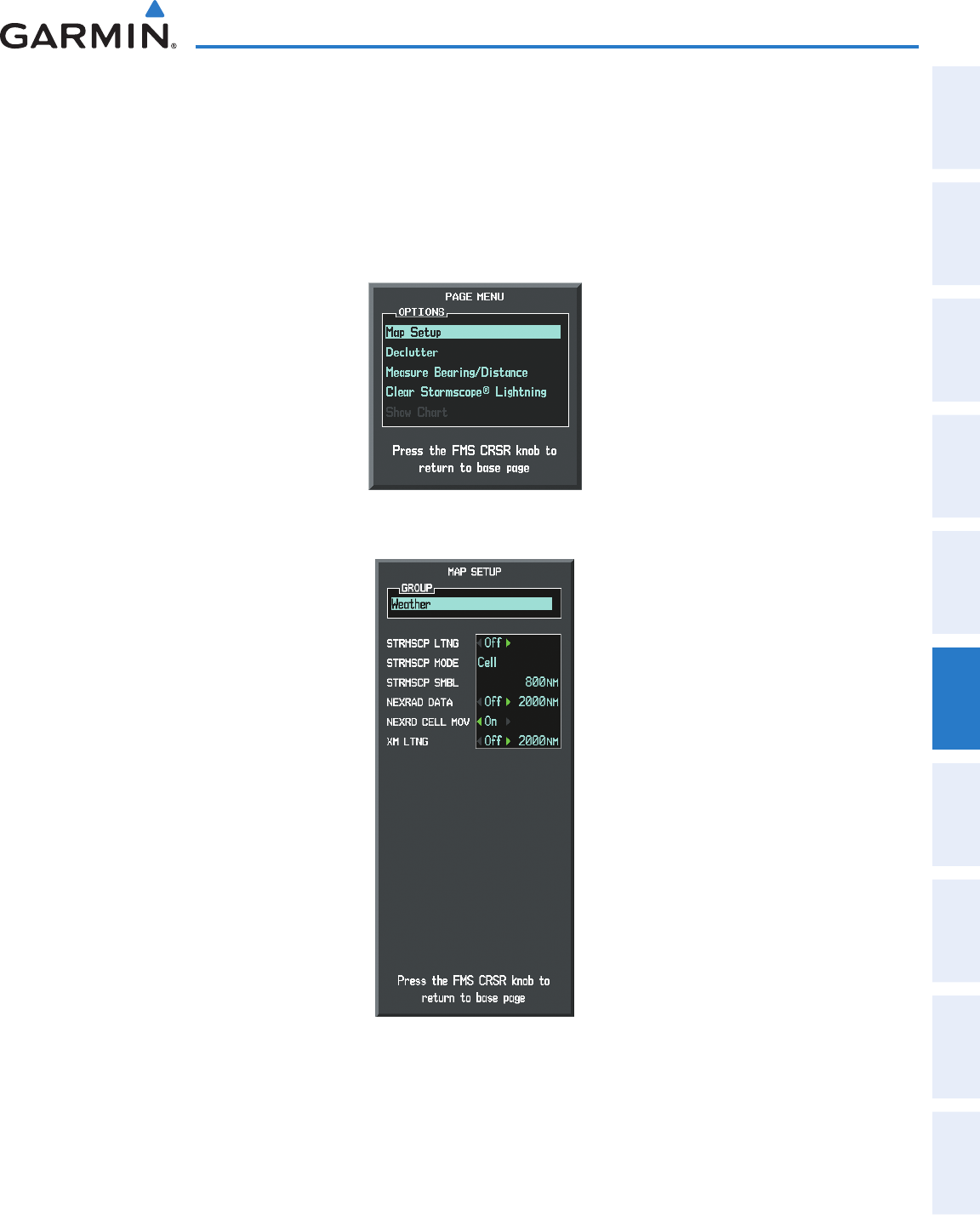
190-00592-06 Rev. A
Garmin G1000 Pilot’s Guide for the Diamond DA40/40F
307
HAZARD AVOIDANCE
SYSTEM
OVERVIEW
FLIGHT
INSTRUMENTS EIS AUDIO PANEL
& CNS
FLIGHT
MANAGEMENT
HAZARD
AVOIDANCE AFCS ADDITIONAL
FEATURES APPENDICES INDEX
The following options are available (Figure 6-46):
•STRMSCP LTNG – Turns the display of Stormscope data on or off.
•STRMSCP MODE – Selects the CELL or STRIKE mode of lightning activity. Cell mode identifies clusters
or cells of electrical activity. Strike mode indicates the approximate location of lightning strikes.
•STRMSCP SMBL – Selects the range at which Stormscope data displays. Stormscope data is removed
when a map range greater than the STRMSCP SMBL value is selected.
Figure 6-45 Page Menu
Figure 6-46 Map Setup Menu
CELL AND STRIKE MODE ON THE NAVIGATION MAP
On the Navigation Map, cell mode identifies cells of lightning activity (Figure 6-40). Stormscope identifies
clusters of electrical activity that indicate cells. Strike mode indicates the approximate location of lightning
strikes.
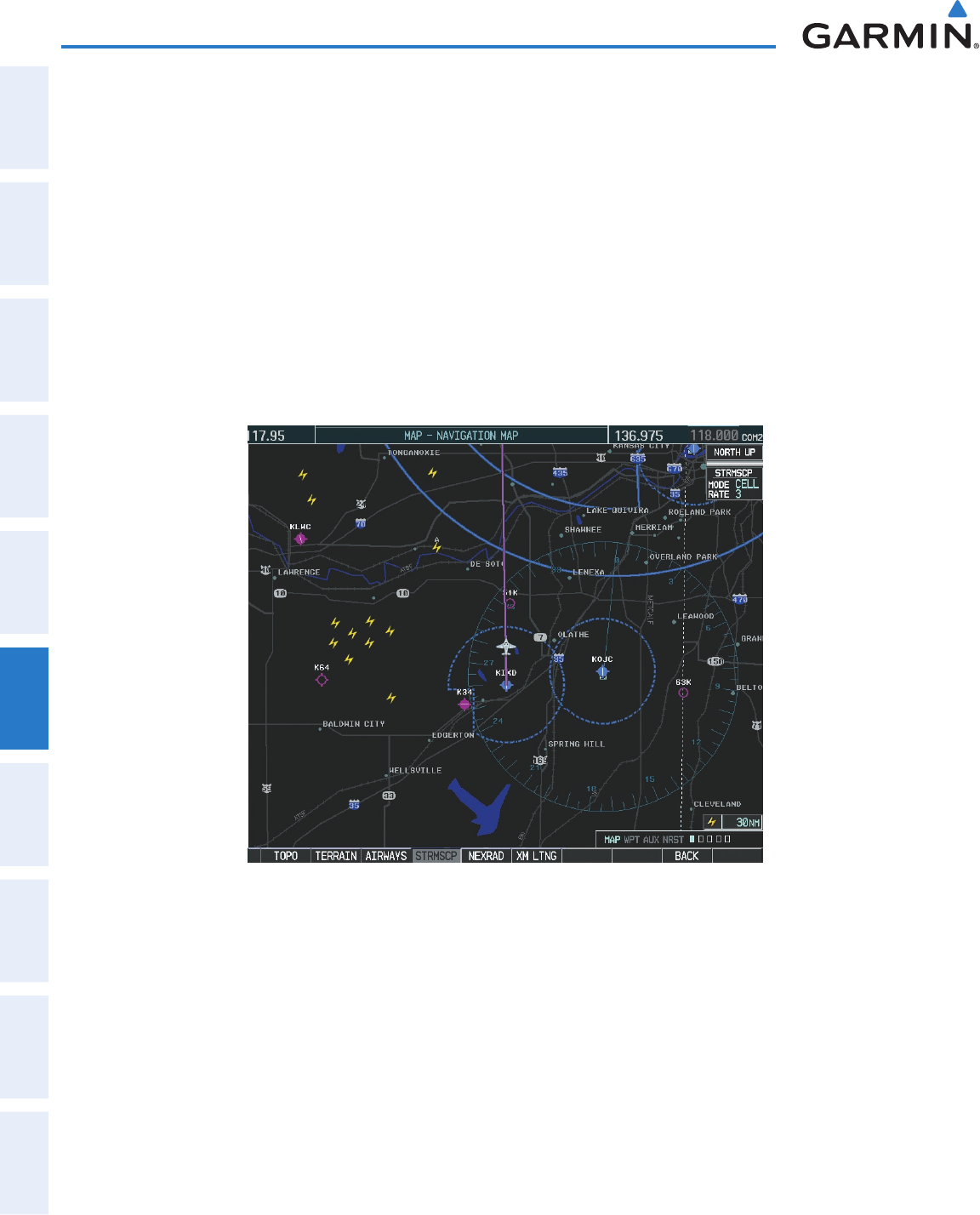
Garmin G1000 Pilot’s Guide for the Diamond DA40/40F
190-00592-06 Rev. A
308
HAZARD AVOIDANCE
SYSTEM
OVERVIEW
FLIGHT
INSTRUMENTS
EIS
AUDIO PANEL
& CNS
FLIGHT
MANAGEMENT
HAZARD
AVOIDANCE
AFCS
ADDITIONAL
FEATURES
APPENDICESINDEX
Selecting the ‘cell’ or ‘strike’ mode on the Navigation Map:
1) Press the MENU Key.
2) With ‘Map Setup’ selected, press the ENT Key.
3) Select the ‘Weather’ group.
4) Press the ENT Key. The cursor flashes on ‘STRMSCP LTNG’.
5) Turn the
large FMS
Knob to select ‘STRMSCP MODE’.
6) Turn the
small
FMS Knob to change between ‘CELL’ and ‘STRIKE’ options. When an item is selected, press the
ENT Key.
7) Press the
FMS
knob to return to the Navigation Map Page.
Figure 6-47 Navigation Map Page with Stormscope
Lightning Data
If heading input is lost, strikes and/or cells must be cleared manually after the execution of each turn
(Figure 6-4 1). This is to ensure that the strike and/or cell positions are depicted accurately in relation to the
nose of the aircraft.
Manually clearing Stormscope data on the Navigation Map:
1) Press the
MENU
Key.
2) Select ‘Clear Stormscope Lightning’.
3) Press the
ENT
Key.
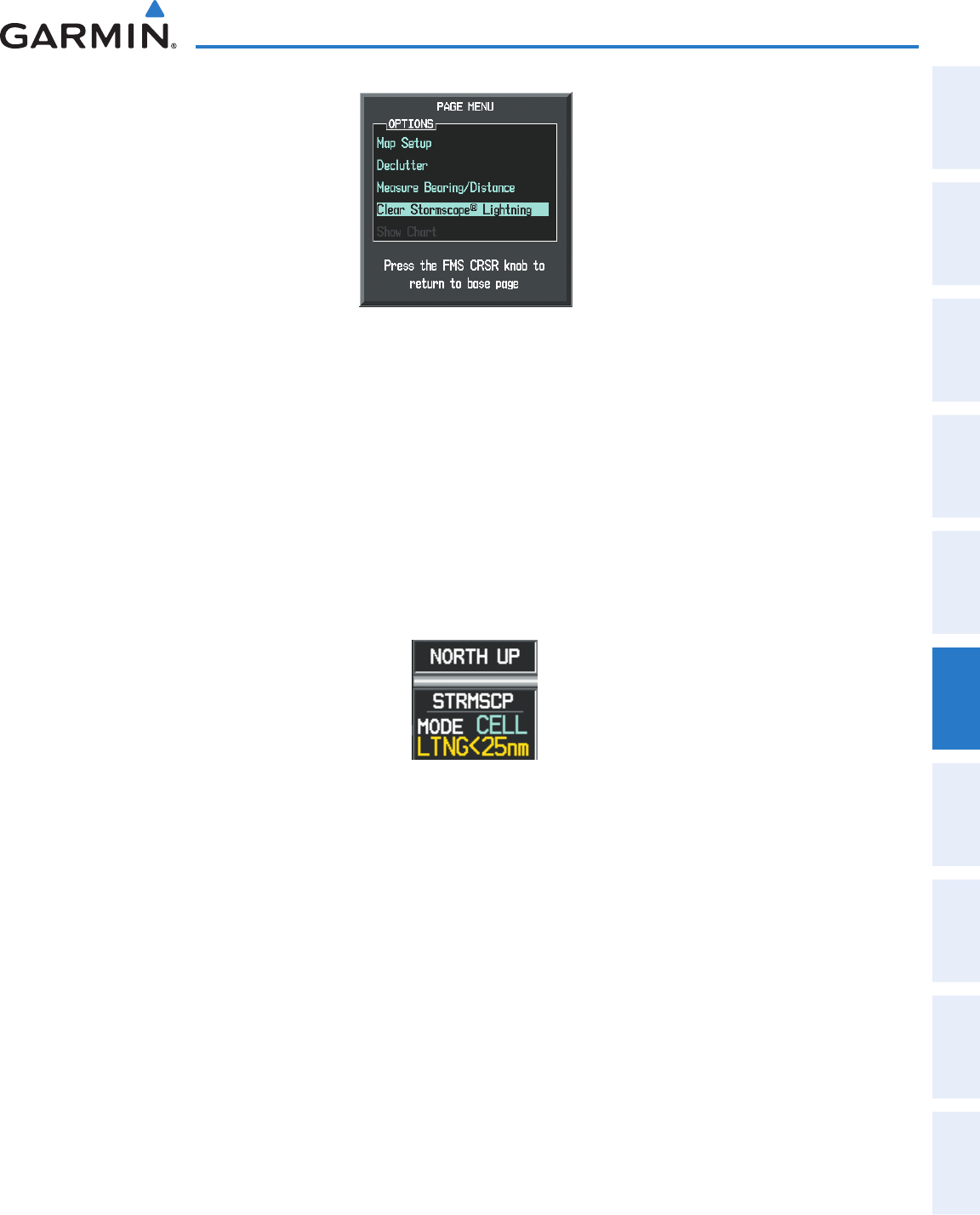
190-00592-06 Rev. A
Garmin G1000 Pilot’s Guide for the Diamond DA40/40F
309
HAZARD AVOIDANCE
SYSTEM
OVERVIEW
FLIGHT
INSTRUMENTS EIS AUDIO PANEL
& CNS
FLIGHT
MANAGEMENT
HAZARD
AVOIDANCE AFCS ADDITIONAL
FEATURES APPENDICES INDEX
Figure 6-48 Navigation Map Page Options Menu
ZOOM RANGE ON THE NAVIGATION MAP
Stormscope lightning data can be displayed up to 800 nm zoom range (in North up mode) on the Navigation
Map Page.
However, in the track up mode at the 500 nm range, a portion of Stormscope lightning data
can be behind the aircraft and therefore not visible on the Navigation Map
. Since the range for Stormscope
data is 400 nm diameter total (200 nm in front and 200 nm behind), the 500 nm range in North up mode
shows all the data.
At a map range of less than 25 nm, Stormscope lightning data is not displayed, but can still be present. The
presence of Stormscope lightning data is indicated by the annunciation ‘LTNG < 25 nm’ in the upper right
corner (Figure 6-49).
Figure 6-49 Lightning Display Range Annunciation
Selecting a Stormscope range on the Navigation Map:
1) Press the MENU Key.
2) Select ‘MAP SETUP’.
3) Select the ‘Weather’ group.
4) Press the ENT Key.
5) Turn the
large FMS
Knob to select ‘STRMSCP SMBL’.
6) Turn the
small FMS
Knob to select the maximum display range.
7) Press the
ENT
Key.
8) Press the
FMS
Knob to return to the Navigation Map Page.
To change the display range on the Navigation Map Page, turn the RANGE Knob clockwise to zoom out or
counter-clockwise to zoom in.
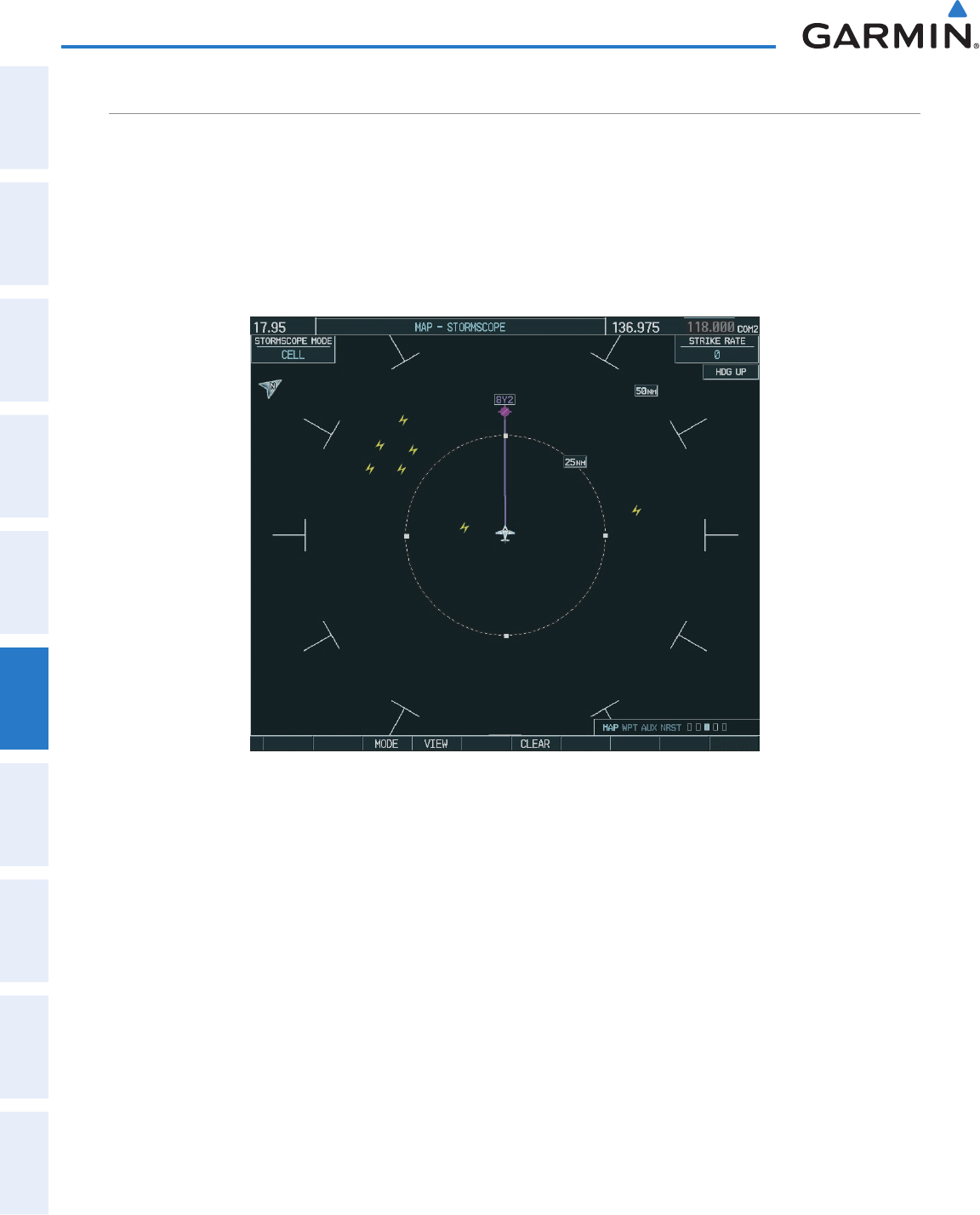
Garmin G1000 Pilot’s Guide for the Diamond DA40/40F
190-00592-06 Rev. A
310
HAZARD AVOIDANCE
SYSTEM
OVERVIEW
FLIGHT
INSTRUMENTS
EIS
AUDIO PANEL
& CNS
FLIGHT
MANAGEMENT
HAZARD
AVOIDANCE
AFCS
ADDITIONAL
FEATURES
APPENDICESINDEX
SELECTING THE STORMSCOPE PAGE
Stormscope lightning data can be displayed at the ranges of 25 nm, 50 nm, 100 nm, and 200 nm.
Adjusting the Stormscope Map Range:
1) Turn the large
FMS
Knob to select the Map Page Group.
2) Turn the small
FMS
Knob
to select the Stormscope Page.
3) To change the map range, turn the RANGE Knob clockwise to zoom out or counter-clockwise to zoom in.
Figure 6-50 Stormscope Page
Changing between ‘cell’ and ‘strike’ mode on the Stormscope Page:
1) Select the Stormscope Page.
2) Press the
MODE
Softkey. The
CELL
and
STRIKE
softkeys are displayed.
3) Press the
CELL
Softkey to display ‘CELL’ data or press the
STRIKE
Softkey to display ‘STRIKE’ data. ‘CELL’ or
‘STRIKE’ is displayed in the mode box in the upper left corner of the Stormscope Page.
4) Press the
BACK
Softkey to return to the main Stormscope page.
Changing the viewing mode between 360˚ and 120˚ on the Stormscope Page:
1) Select the Stormscope Page.
2) Press the
VIEW
Softkey. The
360
and
ARC
softkeys are displayed. Press the 360 Softkey to display a 360˚
viewing area or press the ARC Softkey to display a 120˚ viewing area.
3) Press the
BACK
Softkey to return to the main Stormscope page.
190-00592-06 Rev. A
Garmin G1000 Pilot’s Guide for the Diamond DA40/40F
311
HAZARD AVOIDANCE
SYSTEM
OVERVIEW
FLIGHT
INSTRUMENTS EIS AUDIO PANEL
& CNS
FLIGHT
MANAGEMENT
HAZARD
AVOIDANCE AFCS ADDITIONAL
FEATURES APPENDICES INDEX
6.3 TERRAIN PROXIMITY
WARNING: Do not use Terrain Proximity information for primary terrain avoidance. Terrain Proximity is
intended only to enhance situational awareness.
NOTE: Terrain data is not displayed when the aircraft latitude is greater than 75
°
North or 60
°
South.
G1000 Terrain Proximity is a terrain awareness system that does not comply with TSO-C151b certification
standards. It increases situational awareness and aids in reducing controlled flight into terrain (CFIT). Do not
confuse Terrain Proximity with Terrain Awareness and Warning System (TAWS). TAWS is more sophisticated
and robust, and it is TSO-C151b certified. Terrain Proximity does not provide warning annunciations or voice
alerts. It only provides color indications on map displays when terrain and obstacles are within a certain altitude
threshold from the aircraft. Although the terrain and obstacle color map displays are the same, TAWS uses more
sophisticated algorithms to assess aircraft distance from terrain and obstacles.
Terrain Proximity requires the following components to operate properly:
•Valid3-DGPSposition
•Validterrain/obstacledatabase
Terrain Proximity displays altitudes of terrain and obstructions relative to the aircraft position and altitude with
reference to a database that may contain inaccuracies. Terrain and obstructions are shown only if they are in the
database. Terrain and obstacle information should be used as an aid to situational awareness. They should never
be used to navigate or maneuver around terrain.
Note that all obstructions may not be available in the terrain and obstacle database. No terrain and obstacle
information is shown without a valid 3-D GPS position.
The G1000 GPS receiver provides the horizontal position and altitude. GPS altitude is derived from satellite
position. GPS altitude is then converted to a mean sea level (MSL)-based altitude (GPS-MSL altitude) and is used
to determine terrain and obstacle proximity. GPS-MSL altitude accuracy is affected by satellite geometry, but is
not subject to variations in pressure and temperature that normally affect pressure altitude sensors. GPS-MSL
altitude does not require local altimeter settings to determine MSL altitude. It is a widely-used MSL altitude
source.
Terrain and obstacle databases are referenced to MSL. Using the GPS position and altitude, the Terrain Proximity
feature portrays a 2-D picture of the surrounding terrain and obstacles relative to the position and altitude of the
aircraft. GPS position and GPS-MSL altitude are used to calculate and predict the aircraft’s flight path in relation
to the surrounding terrain and obstacles. In this way, the pilot can view predicted dangerous terrain and obstacle
conditions.
DISPLAYING TERRAIN PROXIMITY DATA
The symbols and colors in Figure 6-51 and Table 6-4 are used to represent obstacles and aircraft altitude
when the Terrain Proximity Page is selected for display. Terrain Proximity uses black, yellow, and red to
represent terrain information relative to aircraft altitude. The color of each obstacle is associated with the
altitude of the aircraft.
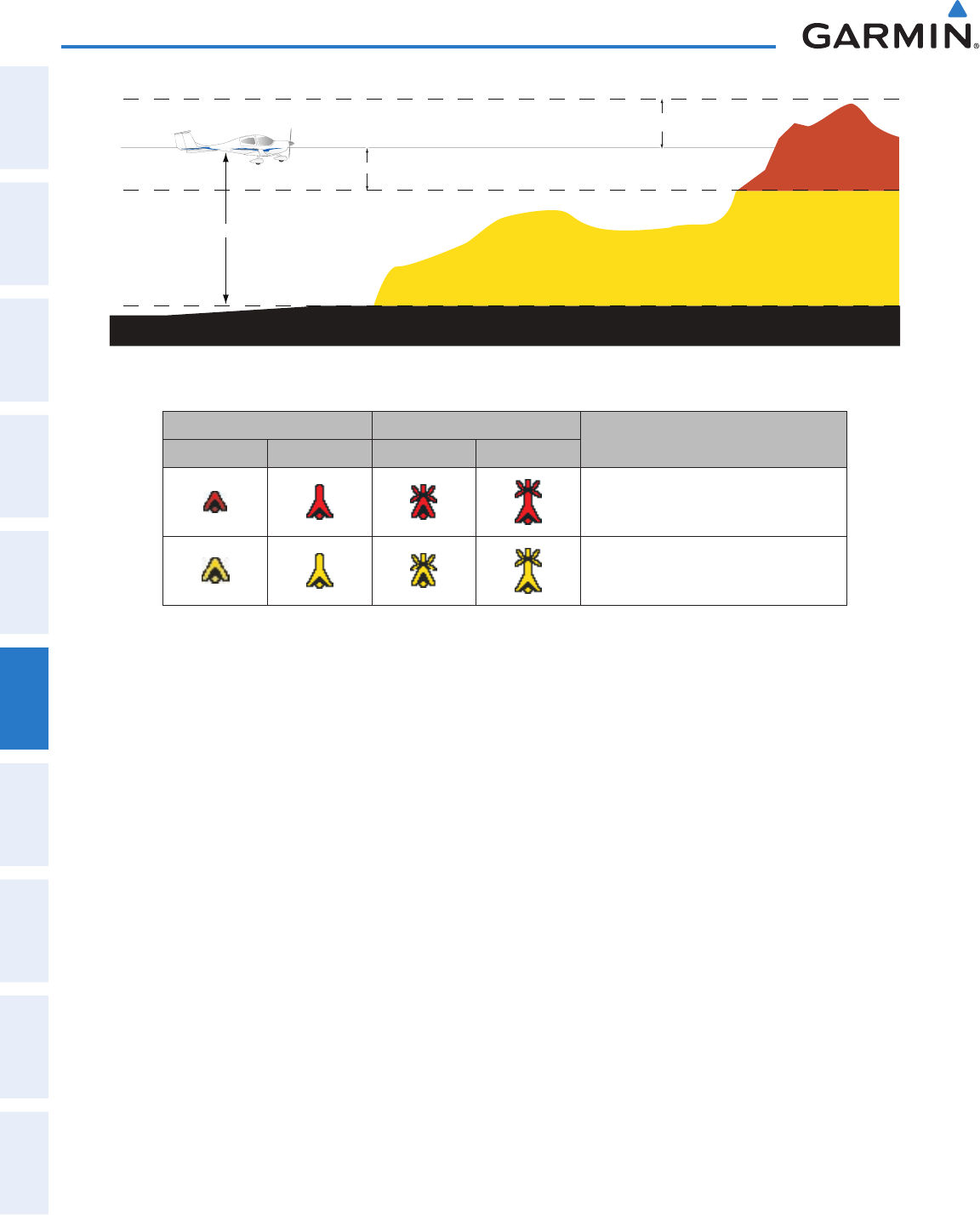
Garmin G1000 Pilot’s Guide for the Diamond DA40/40F
190-00592-06 Rev. A
312
HAZARD AVOIDANCE
SYSTEM
OVERVIEW
FLIGHT
INSTRUMENTS
EIS
AUDIO PANEL
& CNS
FLIGHT
MANAGEMENT
HAZARD
AVOIDANCE
AFCS
ADDITIONAL
FEATURES
APPENDICESINDEX
1000 ft
Aircraft Altitude
100 ft Threshold
Terrain Above Aircraft Altitude
Red terrain is above
or within 100 ft below
the aircraft altitude
Yellow terrain is between 100 ft and 1000 ft below the aircraft altitude
Black terrain is more than 1000 ft below the aircraft altitude
Figure 6-51 Terrain Altitude/Color Correlation for Terrain Proximity
Unlighted Obstacle Lighted Obstacle Obstacle Location
< 1000’ AGL > 1000’ AGL < 1000’ AGL > 1000’ AGL
Red obstacle is above or within 100 ft
below the aircraft altitude
Yellow obstacle is between 100 ft and
1000 ft below the aircraft altitude
Table 6-4 Terrain Proximity Terrain/Obstacle Colors and Symbology
Terrain and obstacle information can be displayed on the following pages:
•PFDInsetMap
•NavigationMapPage
•TerrainProximityPage
•TripPlanningPage
•FlightPlanPage
Displaying terrain and obstacle information (maps other than the Terrain Proximity Page):
1) Press the MAP Softkey (for the PFD Inset Map, select the INSET Softkey).
2) Press the TERRAIN Softkey to display terrain and obstacle data.
When Terrain Proximity is selected on maps other than the Terrain Proximity Page, an icon to indicate the
feature is enabled for display and a legend for Terrain Proximity colors are shown (Figure 6-55).
The Navigation Map Page Setup Menu provides a means in addition to the softkey for enabling/disabling
display of terrain and obstacles. The setup menu also controls the map range settings above which terrain and
obstacle data are decluttered from the display. If a map range larger than the map range setting is selected, the
data is removed from the map.
Terrain data can be selected for display independently of obstacle data; however, obstacles recognized by
Terrain Proximity as yellow or red are shown when terrain is selected for display and the map range is within
the setting limit.
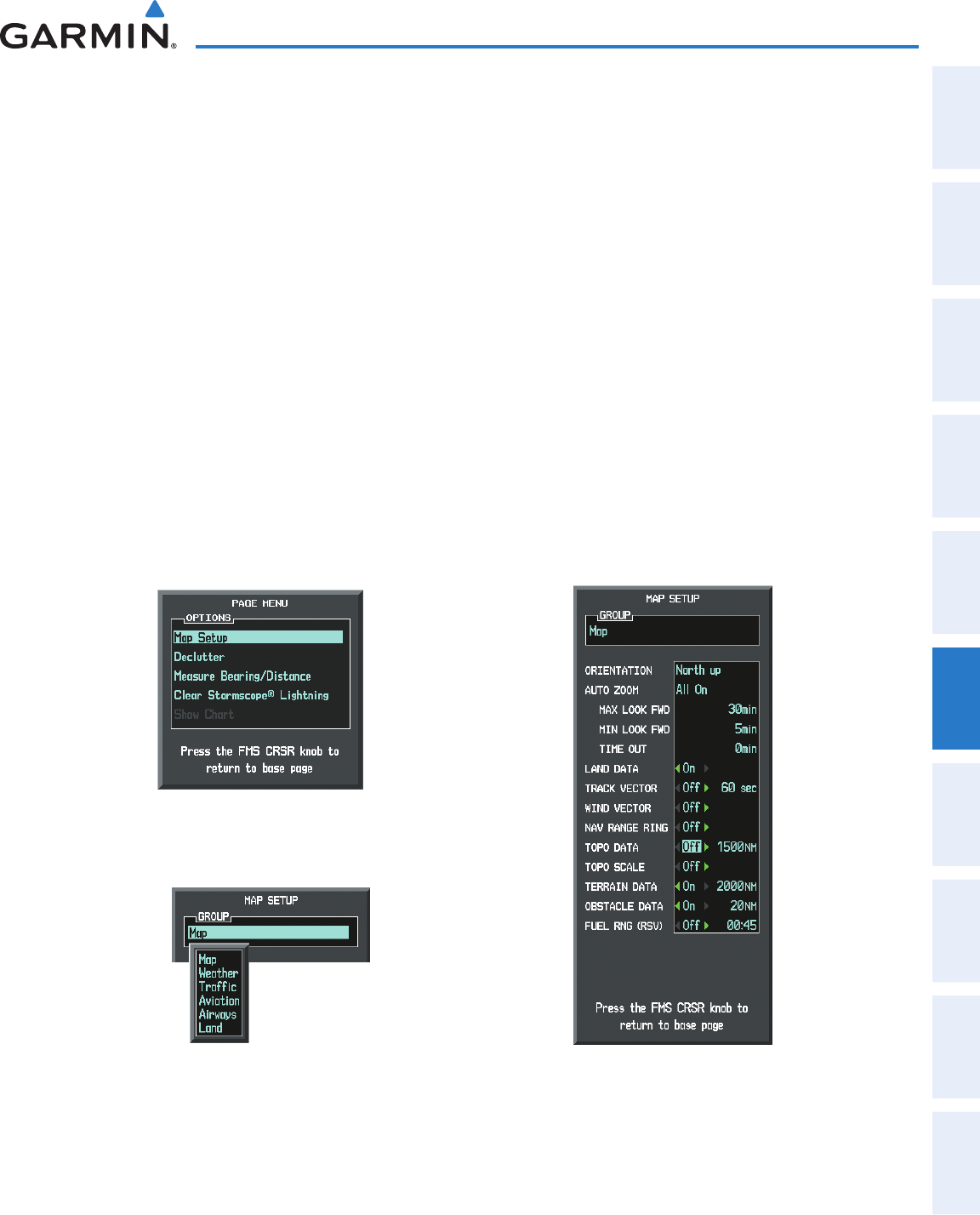
190-00592-06 Rev. A
Garmin G1000 Pilot’s Guide for the Diamond DA40/40F
313
HAZARD AVOIDANCE
SYSTEM
OVERVIEW
FLIGHT
INSTRUMENTS EIS AUDIO PANEL
& CNS
FLIGHT
MANAGEMENT
HAZARD
AVOIDANCE AFCS ADDITIONAL
FEATURES APPENDICES INDEX
Maps besides the Terrain Proximity Page use settings based on those selected for the Navigation Map Page.
The maximum display ranges for obstacles on each map are dependent on the range setting made for the
Navigation Map. If the maximum range for obstacle display on the Navigation Map is adjusted to below 20 nm,
the highest obstacle display range settings on the other applicable maps are also adjusted proportionally.
Customizing terrain and obstacle display on the Navigation Map Page:
1) Select the Navigation Map Page.
2) Press the MENU Key.
3) With ‘Map Setup’ highlighted, press the
ENT
Key (Figure 6-52).
4) Turn the small FMS Knob to select the ‘Map’ Group and press the ENT Key (Figure 6-53).
5) Turn the large
FMS
Knob or press the
ENT
Key to scroll through product selections (Figure 6-54).
•TERRAIN DATA – Turns the display of terrain data on or off and sets maximum range at which terrain is shown
•OBSTACLE DATA – Turns the display of obstacle data on or off and sets maximum range at which obstacles are shown
6) Turn the small
FMS
Knob to scroll through options for each product (ON/OFF, range settings).
7) Press the
ENT
Key to select an option.
8) Press the FMS Knob or CLR Key to return to the Navigation Map Page with the changed settings.
Figure 6-53 Navigation Map Page Setup Menu
Figure 6-52 Navigation Map Page Menu
Figure 6-54 Navigation Map Page Setup Menu, Map Group
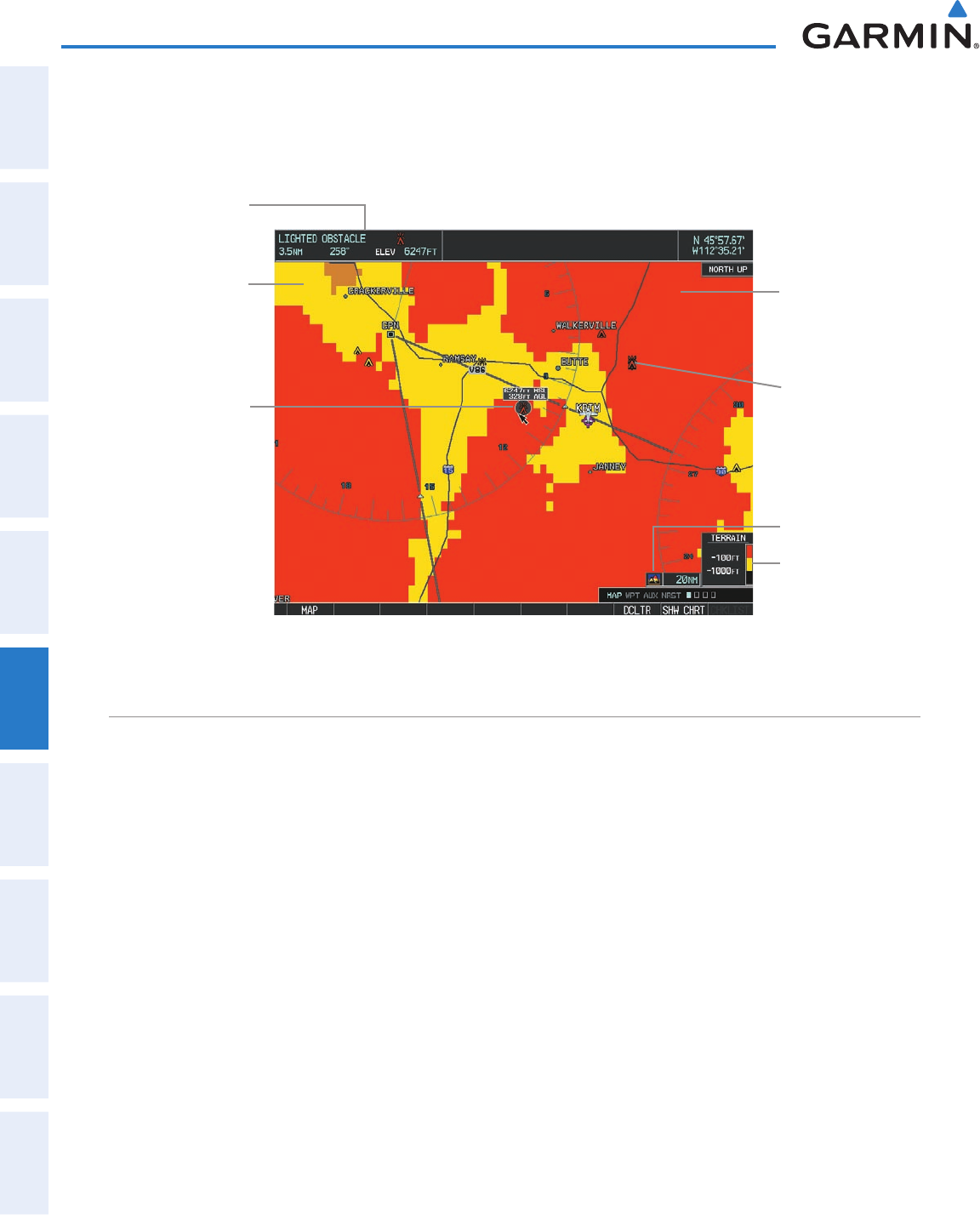
Garmin G1000 Pilot’s Guide for the Diamond DA40/40F
190-00592-06 Rev. A
314
HAZARD AVOIDANCE
SYSTEM
OVERVIEW
FLIGHT
INSTRUMENTS
EIS
AUDIO PANEL
& CNS
FLIGHT
MANAGEMENT
HAZARD
AVOIDANCE
AFCS
ADDITIONAL
FEATURES
APPENDICESINDEX
Additional information about obstacles can be displayed by panning over the display on the map. The map
panning feature is enabled by pressing the RANGE Knob. The map range is adjusted by turning the RANGE
Knob. If the map range is adjusted while panning is enabled, the map is re-centered on the Map Pointer.
Figure 6-55 Terrain Information on the Navigation Map Page
Additional Information
on Obstacle Selected
with Map Pointer
Yellow Terrain Area
(Between 100’ and
1000’ Below Aircraft
Altitude)
Red Lighted
Obstacles
(Above or Within
100’ Below Aircraft
Altitude)
Lighted Obstacle
Selected with Map
Pointer
Terrain Legend
Terrain Display
Enabled
Red Terrain Area
(Above or Within
100’ Below Aircraft
Altitude)
TERRAIN PROXIMITY PAGE
The Terrain Proximity Page is specialized to show terrain and obstacle data in relation to the aircraft’s current
altitude, without clutter from the basemap. Aviation data (airports, VORs, and other NAVAIDs) can be displayed
for reference.
Aircraft orientation on this map is always heading up unless there is no valid heading. Two views are available
relative to the position of the aircraft: the 360° default display and the radar-like ARC (120°) display. Map
range is adjustable with the RANGE Knob from 1 to 200 nm, as indicated by the map range rings (or arcs).
Displaying the Terrain Proximity Page:
1) Turn the large
FMS
Knob to select the Map Page Group.
2) Turn the small
FMS
Knob
to select the Terrain Proximity Page.
3) To change the view,
a) Press the
VIEW
Softkey.
b) Press the 360 or ARC Softkey to select the desired view.
Or:
a) Press the MENU Key.
b) Select ‘View 120º’ or ‘View 360º’ (choice dependent on current state) and press the ENT Key to change the view.
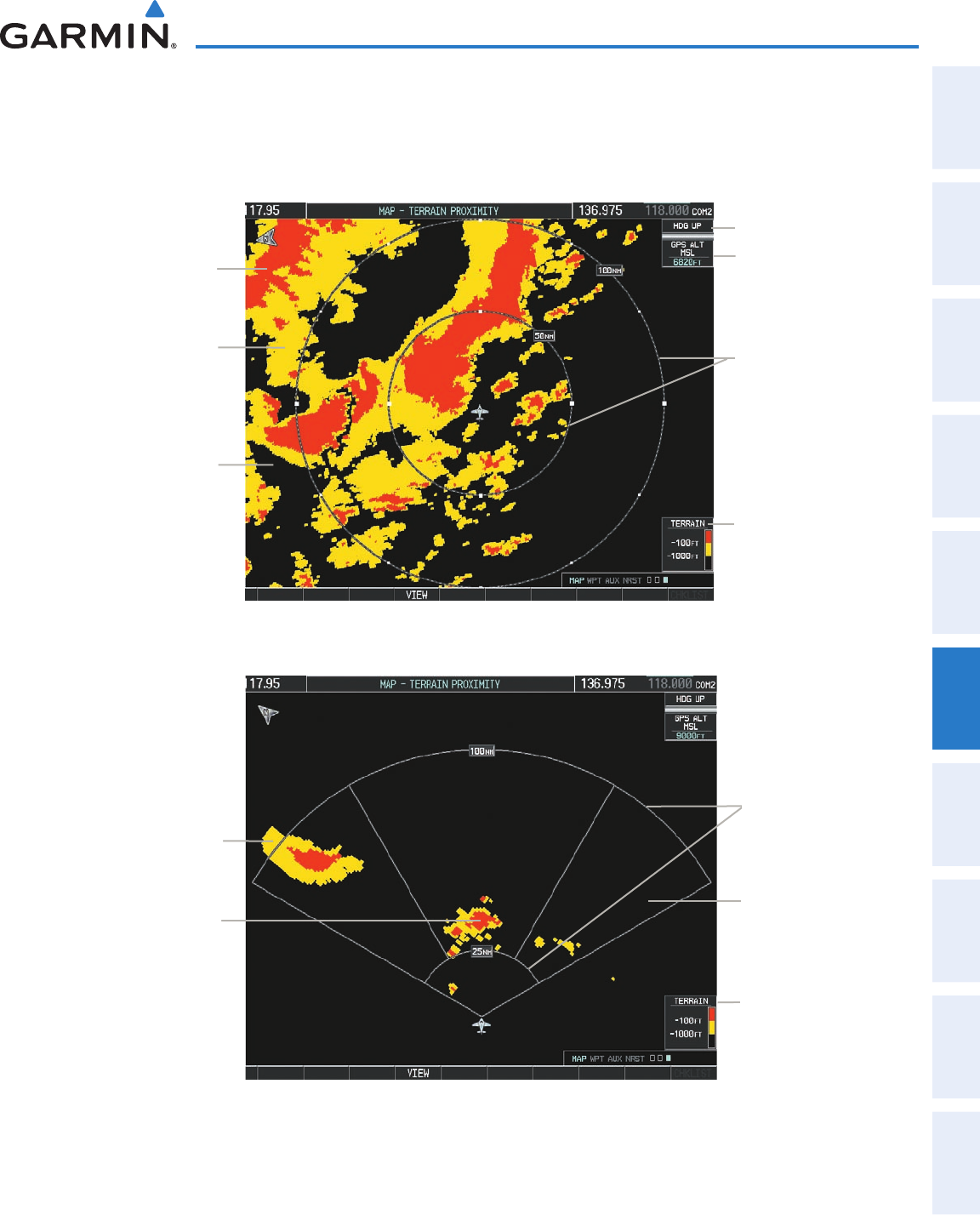
190-00592-06 Rev. A
Garmin G1000 Pilot’s Guide for the Diamond DA40/40F
315
HAZARD AVOIDANCE
SYSTEM
OVERVIEW
FLIGHT
INSTRUMENTS EIS AUDIO PANEL
& CNS
FLIGHT
MANAGEMENT
HAZARD
AVOIDANCE AFCS ADDITIONAL
FEATURES APPENDICES INDEX
Showing/hiding aviation information on the Terrain Proximity Page:
1) Press the MENU Key.
2) Select ‘Show Aviation Data’ or ‘Hide Aviation Data’ (choice dependent on current state) and press the ENT Key.
Figure 6-56 Terrain Proximity Page
Yellow Terrain
(Between 100’ and
1000’ Below the
Aircraft Altitude)
Red Terrain
(Above or Within
100’ Below the
Aircraft Altitude)
Black Terrain
(More than 1000’
Below the Aircraft
Altitude)
Terrain Legend
Map Range Rings
Map Orientation
Current Aircraft
GPS-derived MSL
Altitude
Figure 6-57 Terrain Proximity Page (ARC View)
Yellow Terrain
(Between 100’ and
1000’ Below the
Aircraft Altitude)
Red Terrain
(Above or Within
100’ Below the
Aircraft Altitude)
Black Terrain
(Terrain More than
1000’ Below the
Aircraft Altitude)
Map Range Arcs
Terrain Legend
Garmin G1000 Pilot’s Guide for the Diamond DA40/40F
190-00592-06 Rev. A
316
HAZARD AVOIDANCE
SYSTEM
OVERVIEW
FLIGHT
INSTRUMENTS
EIS
AUDIO PANEL
& CNS
FLIGHT
MANAGEMENT
HAZARD
AVOIDANCE
AFCS
ADDITIONAL
FEATURES
APPENDICESINDEX
6.4 TERRAIN-SVS
WARNING: Do not use TERRAIN-SVS information for primary terrain avoidance. TERRAIN-SVS is intended
only to enhance situational awareness.
NOTE: Terrain data is not displayed when the aircraft latitude is greater than 75
°
North or 60
°
South.
NOTE: TERRAIN-SVS is standard when the Synthetic Vision System (SVS) option is installed. The TAWS
option will take precedence over TERRAIN-SVS.
G1000 TERRAIN-SVS is a terrain awareness system available with the Synthetic Vision System (SVS). SVS
functionality is offered as an optional enhancement. Optional Terrain Awareness and Warning System (TAWS)
or standard TERRAIN-SVS is integrated within SVS to provide visual and auditory alerts to indicate the presence
of threatening terrain relevant to the projected flight path. For detailed information regarding SVS, refer to the
Synthetic Vision System (SVS) section of the G1000 Pilot’s Guide.
TERRAIN-SVS does not comply with TSO-C151b certification standards. It increases situational awareness and
aids in reducing controlled flight into terrain (CFIT). Do not confuse TERRAIN-SVS with Terrain Awareness and
Warning System (TAWS). TAWS is more sophisticated and robust, and it is TSO-C151b certified. Although the
terrain and obstacle color map displays are the same, TAWS uses more sophisticated algorithms to assess aircraft
distance from terrain and obstacles.
TERRAIN-SVS does not provide the following:
•PrematureDescentAlerting(PDA)
•ExcessiveDescentRate(EDR)
•NegativeClimbRate(NCR)
•Descentto500FeetCallout(DFC)
TERRAIN-SVS requires the following components to operate properly:
•Valid3-DGPSposition
•Validterrain/obstacledatabase
TERRAIN-SVS displays altitudes of terrain and obstructions relative to the aircraft position and altitude with
reference to a database that may contain inaccuracies. Terrain and obstructions are shown only if they are in the
database. Terrain and obstacle information should be used as an aid to situational awareness. They should never
be used to navigate or maneuver around terrain.
Note that all obstructions may not be available in the terrain and obstacle database. No terrain and obstacle
information is shown without a valid 3-D GPS position.
The G1000 GPS receiver provides the horizontal position and altitude. GPS altitude is derived from satellite
position. GPS altitude is then converted to a mean sea level (MSL)-based altitude (GPS-MSL altitude) and is used
to determine terrain and obstacle proximity. GPS-MSL altitude accuracy is affected by satellite geometry, but is not
subject to variations in pressure and temperature that normally affect pressure altitude sensors. GPS-MSL altitude
does not require local altimeter settings to determine MSL altitude. It is a widely-used MSL altitude source.
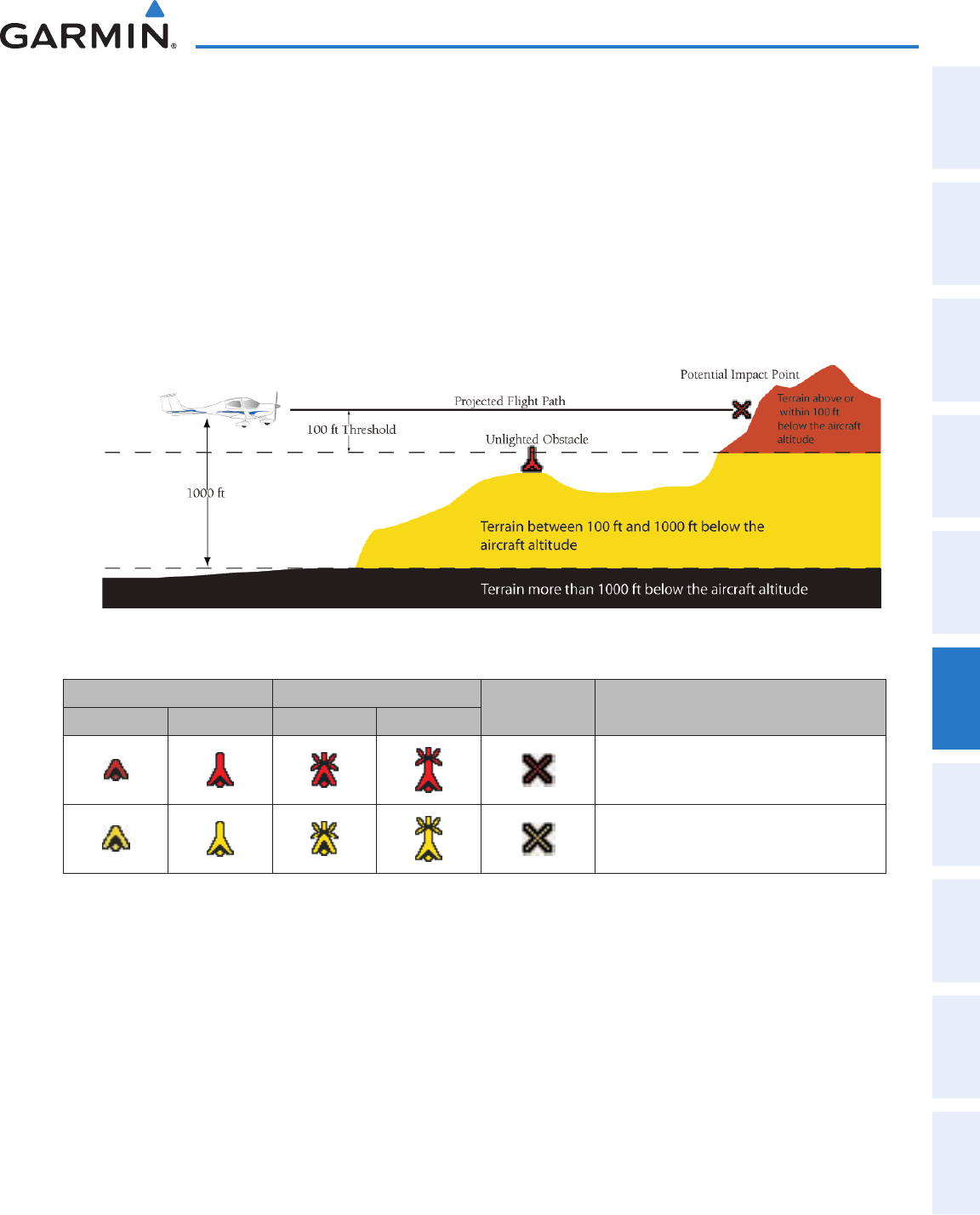
190-00592-06 Rev. A
Garmin G1000 Pilot’s Guide for the Diamond DA40/40F
317
HAZARD AVOIDANCE
SYSTEM
OVERVIEW
FLIGHT
INSTRUMENTS EIS AUDIO PANEL
& CNS
FLIGHT
MANAGEMENT
HAZARD
AVOIDANCE AFCS ADDITIONAL
FEATURES APPENDICES INDEX
Terrain and obstacle databases are referenced to MSL. Using the GPS position and altitude, the TERRAIN-SVS
feature portrays a 3-D picture of the surrounding terrain and obstacles relative to the position and altitude of the
aircraft. GPS position and GPS-MSL altitude are used to calculate and predict the aircraft’s flight path in relation
to the surrounding terrain and obstacles. In this way, the pilot can view predicted dangerous terrain and obstacle
conditions.
DISPLAYING TERRAIN-SVS DATA
TERRAIN-SVS uses yellow (caution) and red (warning) to depict terrain and obstacles (with heights greater
than 200 feet above ground level, AGL) alerts relative to aircraft altitude. Colors are adjusted automatically as
the aircraft altitude changes. The colors and symbols in Figure 6-51 and Table 6-5 are used to represent terrain,
obstacles, and potential impact points.
Figure 6-58 Terrain Altitude/Color Correlation for TERRAIN-SVS
Unlighted Obstacle Lighted Obstacle Potential
Impact Points Obstacle Location
< 1000’ AGL > 1000’ AGL < 1000’ AGL > 1000’ AGL
WARNING: Red obstacle is above or within
100’ below current aircraft altitude
CAUTION: Yellow obstacle is between 100’
and 1000’ below current aircraft altitude
Table 6-5 TERRAIN-SVS Obstacle Colors and Symbology
TERRAIN-SVS information can be displayed on the following maps:
•PFDInsetMap
•NavigationMapPage
•TERRAIN-SVSPage
•TripPlanningPage
•FlightPlanPages
Garmin G1000 Pilot’s Guide for the Diamond DA40/40F
190-00592-06 Rev. A
318
HAZARD AVOIDANCE
SYSTEM
OVERVIEW
FLIGHT
INSTRUMENTS
EIS
AUDIO PANEL
& CNS
FLIGHT
MANAGEMENT
HAZARD
AVOIDANCE
AFCS
ADDITIONAL
FEATURES
APPENDICESINDEX
Displaying terrain and obstacle information (maps other than the TERRAIN-SVS Page):
1) Press the MAP Softkey (for the PFD Inset Map, select the INSET Softkey).
2) Press the TERRAIN Softkey to display terrain and obstacle data.
When TERRAIN-SVS is selected on maps other than the TERRAIN-SVS Page, an icon to indicate the feature
is enabled for display and a legend for TERRAIN-SVS terrain colors are shown (Figure 6-65).
The Navigation Map Page Setup Menu provides a means in addition to the softkey for enabling/disabling
display of terrain and obstacles. The setup menu also controls the map range settings above which terrain and
obstacle data are decluttered from the display. If a map range larger than the map range setting is selected, the
data is removed from the map.
Terrain data can be selected for display independently of obstacle data; however, obstacles for which warnings
and cautions are issued are shown when terrain is selected for display and the map range is within the setting
limit.
Maps besides the TERRAIN-SVS Page use settings based on those selected for the Navigation Map Page. The
maximum display ranges for obstacles on each map are dependent on the range setting made for the Navigation
Map. If the maximum range for obstacle display on the Navigation Map is adjusted to below 20 nm, the
highest obstacle display range settings on the other applicable maps are also adjusted proportionally.
Customizing terrain and obstacle display on the Navigation Map Page:
1) Select the Navigation Map Page.
2) Press the MENU Key.
3) With ‘Map Setup’ highlighted, press the
ENT
Key (Figure 6-59).
4) Turn the small FMS Knob to select the ‘Map’ Group and press the ENT Key (Figure 6-60).
5) Turn the large
FMS
Knob or press the
ENT
Key to scroll through product selections (Figure 6-61).
• TERRAIN DATA – Turns the display of terrain data on or off and sets maximum range at which terrain is
shown
• OBSTACLE DATA – Turns the display of obstacle data on or off and sets maximum range at which obstacles are
shown
6) Turn the small
FMS
Knob to scroll through options for each product (ON/OFF, range settings).
7) Press the
ENT
Key to select an option.
8) Press the FMS Knob or CLR Key to return to the Navigation Map Page with the changed settings.
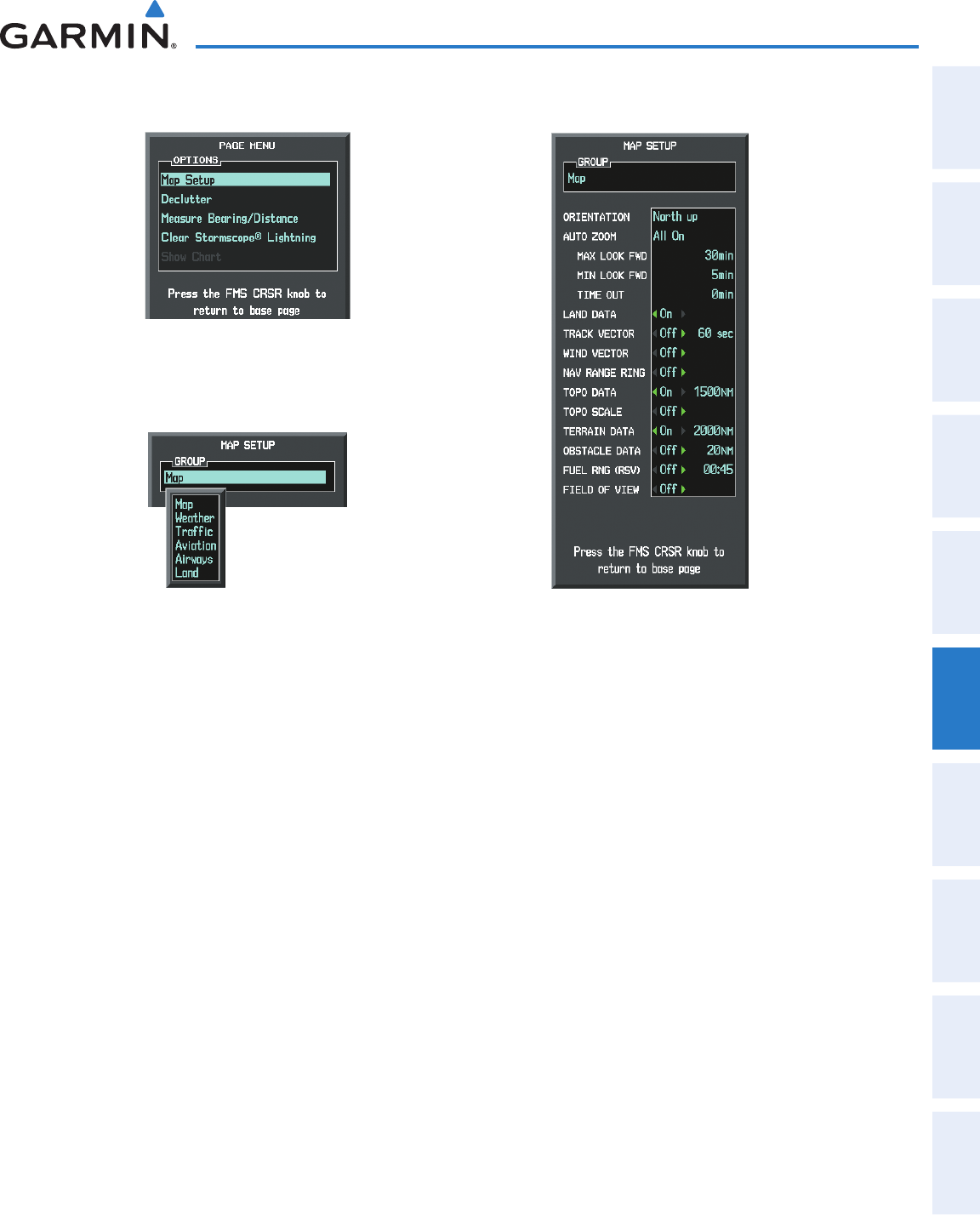
190-00592-06 Rev. A
Garmin G1000 Pilot’s Guide for the Diamond DA40/40F
319
HAZARD AVOIDANCE
SYSTEM
OVERVIEW
FLIGHT
INSTRUMENTS EIS AUDIO PANEL
& CNS
FLIGHT
MANAGEMENT
HAZARD
AVOIDANCE AFCS ADDITIONAL
FEATURES APPENDICES INDEX
Figure 6- 60 Navigation Map Page Setup Menu
Figure 6-59 Navigation Map Page Menu
Figure 6-61 Navigation Map Page Setup Menu, Map Group
Garmin G1000 Pilot’s Guide for the Diamond DA40/40F
190-00592-06 Rev. A
320
HAZARD AVOIDANCE
SYSTEM
OVERVIEW
FLIGHT
INSTRUMENTS
EIS
AUDIO PANEL
& CNS
FLIGHT
MANAGEMENT
HAZARD
AVOIDANCE
AFCS
ADDITIONAL
FEATURES
APPENDICESINDEX
TERRAIN-SVS PAGE
The TERRAIN-SVS Page is specialized to show terrain, obstacle, and potential impact point data in relation
to the aircraft’s current altitude, without clutter from the basemap. Aviation data (airports, VORs, and other
NAVAIDs) can be displayed for reference. If an obstacle and the projected flight path of the aircraft intersect,
the display automatically zooms in to the closest potential point of impact on the TERRAIN-SVS Page.
Aircraft orientation on this map is always heading up unless there is no valid heading. Two views are available
relative to the position of the aircraft: the 360° default display and the radar-like ARC (120°) display. Map range
is adjustable with the RANGE Knob from 1 to 200 nm, as indicated by the map range rings (or arcs).
Displaying the TERRAIN-SVS Page:
1) Turn the large
FMS
Knob to select the Map Page Group.
2) Turn the small
FMS
Knob
to select the TERRAIN-SVS Page.
Changing the TERRAIN-SVS Page view:
1) Press the
VIEW
Softkey.
2) Press the 360 or ARC Softkey to select the desired view.
Or:
1) Press the MENU Key.
2)
Select ‘View 120º’ or ‘View 360º’ (choice dependent on current state) and press the ENT Key to change the view
Showing/hiding aviation information on the TERRAIN-SVS Page:
1) Press the MENU Key.
2) Select ‘Show Aviation Data’ or ‘Hide Aviation Data’ (choice dependent on current state) and press the ENT Key.
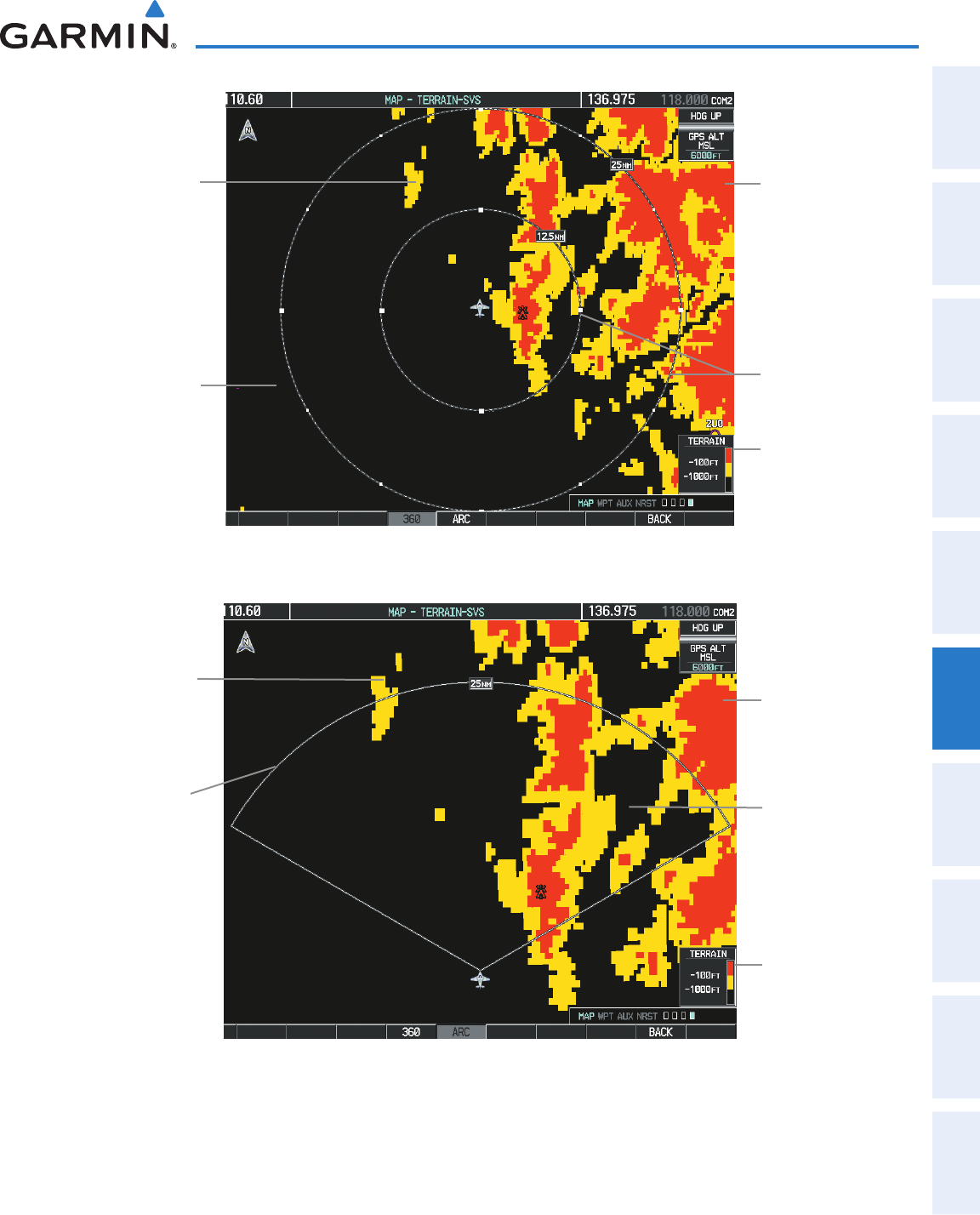
190-00592-06 Rev. A
Garmin G1000 Pilot’s Guide for the Diamond DA40/40F
321
HAZARD AVOIDANCE
SYSTEM
OVERVIEW
FLIGHT
INSTRUMENTS EIS AUDIO PANEL
& CNS
FLIGHT
MANAGEMENT
HAZARD
AVOIDANCE AFCS ADDITIONAL
FEATURES APPENDICES INDEX
Figure 6-62 TERRAIN-SVS Page
Black Terrain
(Terrain More than
1000’ Below the
Aircraft Altitude)
Terrain Legend
Map Range Rings
Yellow Terrain
(Caution - Terrain
Between 100’ and
1000’ Below the
Aircraft Altitude)
Red Terrain
(Warning - Terrain
Above or Within
100’ Below the
Aircraft Altitude)
Figure 6-63 TERRAIN-SVS Page (ARC View)
Red Terrain
(Warning - Terrain
Above or Within
100’ Below the
Aircraft Altitude)
Black Terrain
(Terrain More than
1000’ Below the
Aircraft Altitude)
Terrain Legend
Map Range Arc
Yellow Terrain
(Caution - Terrain
Between 100’
and 1000’ Below
the Aircraft
Altitude)
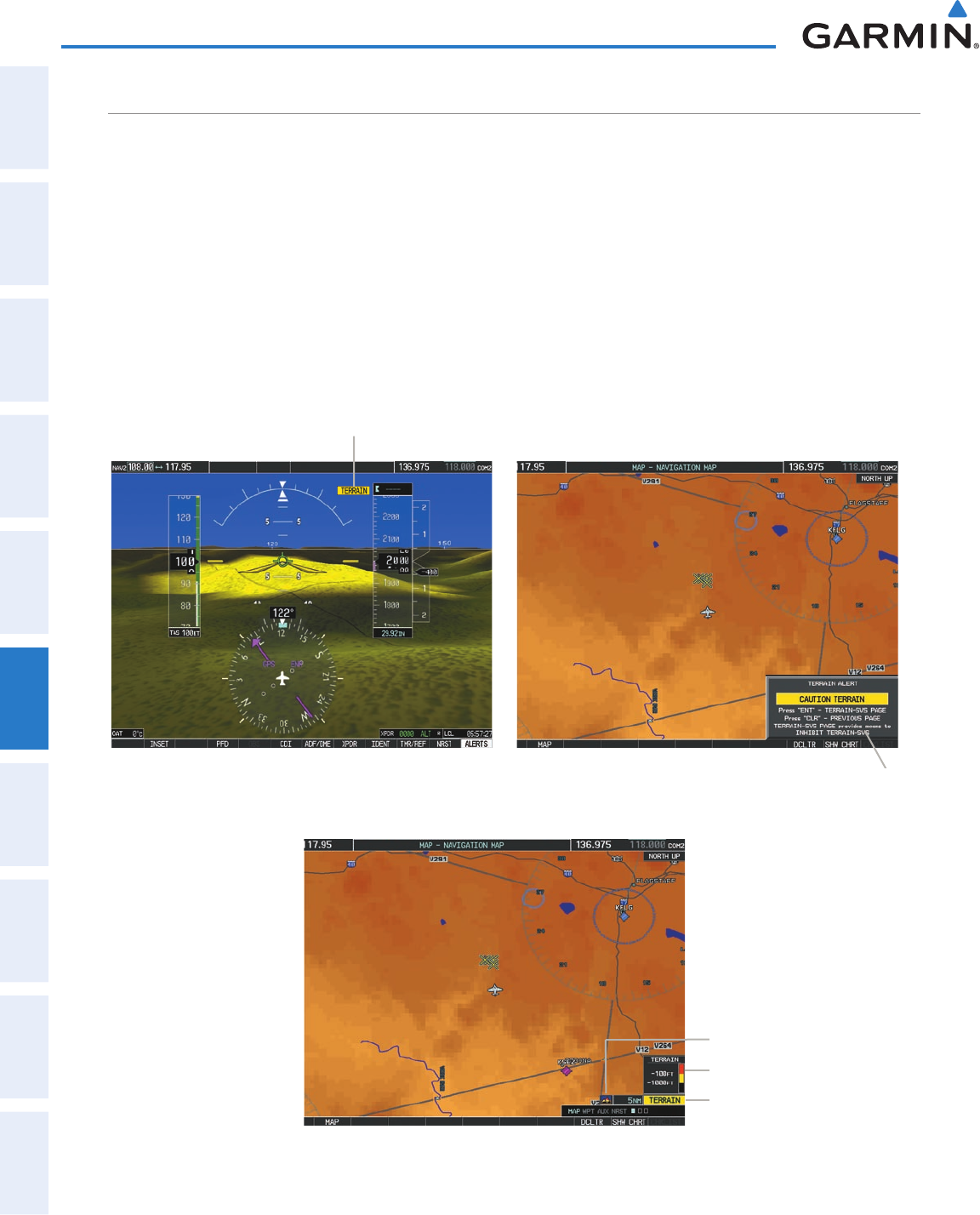
Garmin G1000 Pilot’s Guide for the Diamond DA40/40F
190-00592-06 Rev. A
322
HAZARD AVOIDANCE
SYSTEM
OVERVIEW
FLIGHT
INSTRUMENTS
EIS
AUDIO PANEL
& CNS
FLIGHT
MANAGEMENT
HAZARD
AVOIDANCE
AFCS
ADDITIONAL
FEATURES
APPENDICESINDEX
TERRAIN-SVS ALERTS
Alerts are issued when flight conditions meet parameters that are set within TERRAIN-SVS software
algorithms. TERRAIN-SVS alerts typically employ a CAUTION or a WARNING alert severity level, or both.
When an alert is issued, visual annunciations are displayed and aural alerts are simultaneously issued. Table
6-6 shows TERRAIN-SVS alert types with corresponding annunciations and aural messages.
When an alert is issued, annunciations appear on the PFD and MFD. The TERRAIN-SVS Alert Annunciation
is shown to the upper left of the Altimeter on the PFD and below the Terrain Legend on the MFD. If the
TERRAIN-SVS Page is not displayed at the time, a pop-up alert appears on the MFD. To acknowledge the
pop-up alert:
•PresstheCLR Key (returns to the currently viewed page), or
•PresstheENT Key (accesses the TERRAIN-SVS Page)
Alert Annunciation
Figure 6-64 TERRAIN-SVS Alert Annunciations Pop-up
Alert
Figure 6-65 Navigation Map Page
(After TERRAIN-SVS Pop-up Alert Acknowledgment)
Alert Annunciation
Terrain Legend
Terrain Display Enabled
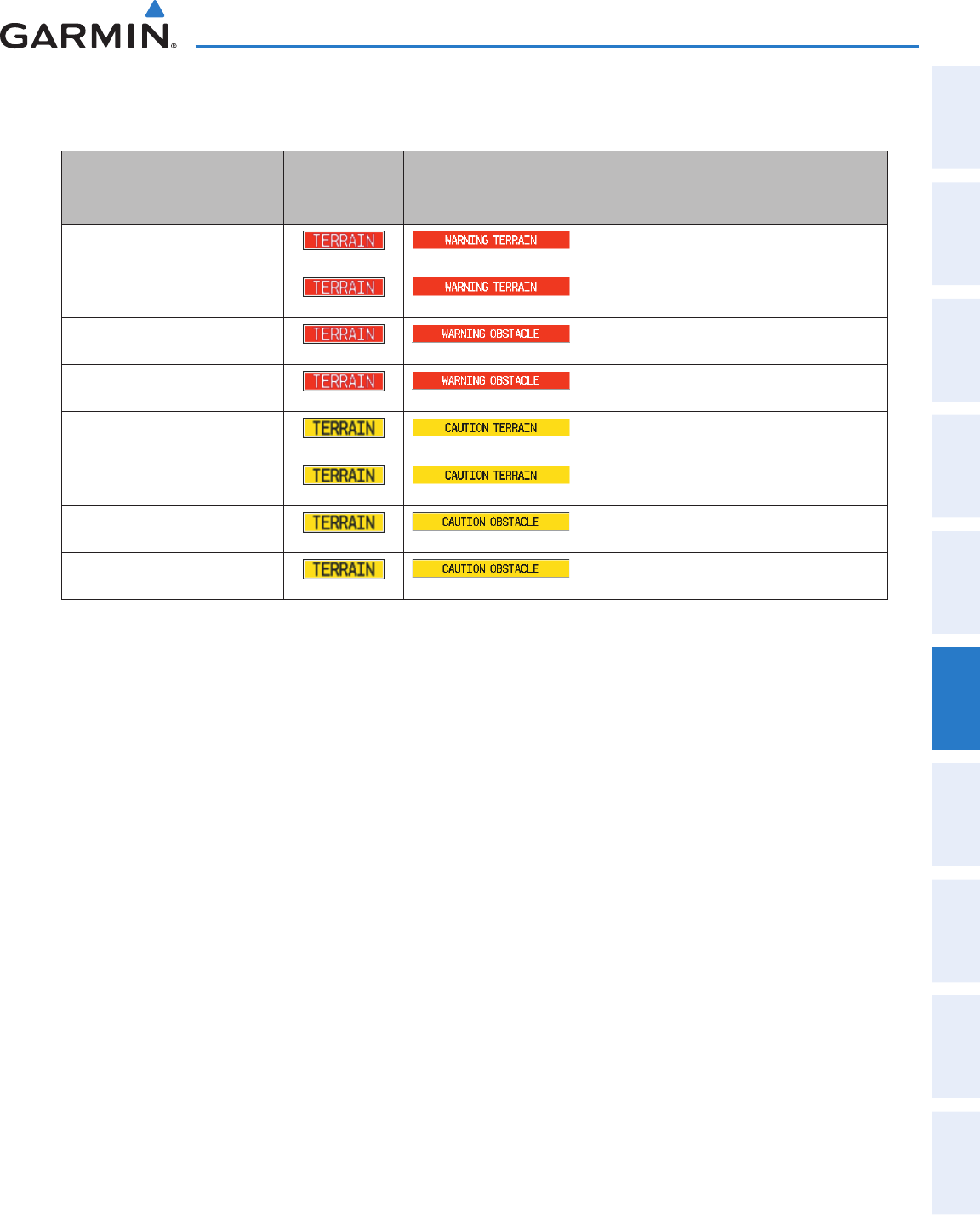
190-00592-06 Rev. A
Garmin G1000 Pilot’s Guide for the Diamond DA40/40F
323
HAZARD AVOIDANCE
SYSTEM
OVERVIEW
FLIGHT
INSTRUMENTS EIS AUDIO PANEL
& CNS
FLIGHT
MANAGEMENT
HAZARD
AVOIDANCE AFCS ADDITIONAL
FEATURES APPENDICES INDEX
Alert Type
PFD/MFD
Alert
Annunciation
MFD
Pop-Up Alert Aural Message
Reduced Required Terrain Clearance
Warning (RTC)
“Warning; Terrain, Terrain”
Imminent Terrain Impact Warning (ITI) “Warning; Terrain, Terrain”
Reduced Required Obstacle Clearance
Warning (ROC)
“Warning; Obstacle, Obstacle”
Imminent Obstacle Impact Warning (IOI) “Warning; Obstacle, Obstacle”
Reduced Required Terrain Clearance
Caution (RTC)
“Caution; Terrain, Terrain”
Imminent Terrain Impact Caution (ITI) “Caution; Terrain, Terrain”
Reduced Required Obstacle Clearance
Caution (ROC)
“Caution; Obstacle, Obstacle”
Imminent Obstacle Impact Caution (IOI) “Caution; Obstacle, Obstacle”
Table 6-6 TERRAIN-SVS Alerts Summary
FORWARD LOOKING TERRAIN AVOIDANCE
Reduced Required Terrain Clearance (RTC) and Reduced Required Obstacle Clearance (ROC)
alerts are issued when the aircraft flight path is above terrain, yet is projected to come within the minimum
clearance values in Figure 6-66. When an RTC alert is issued, a potential impact point is displayed on the
TERRAIN-SVS Page.
Imminent Terrain Impact (ITI) and Imminent Obstacle Impact (IOI) alerts are issued when the
aircraft is below the elevation of a terrain or obstacle cell in the aircraft’s projected path. ITI and IOI alerts
are accompanied by a potential impact point displayed on the TERRAIN-SVS Page. The alert is annunciated
when the projected vertical flight path is calculated to come within minimum clearance altitudes in Figure
6-66.
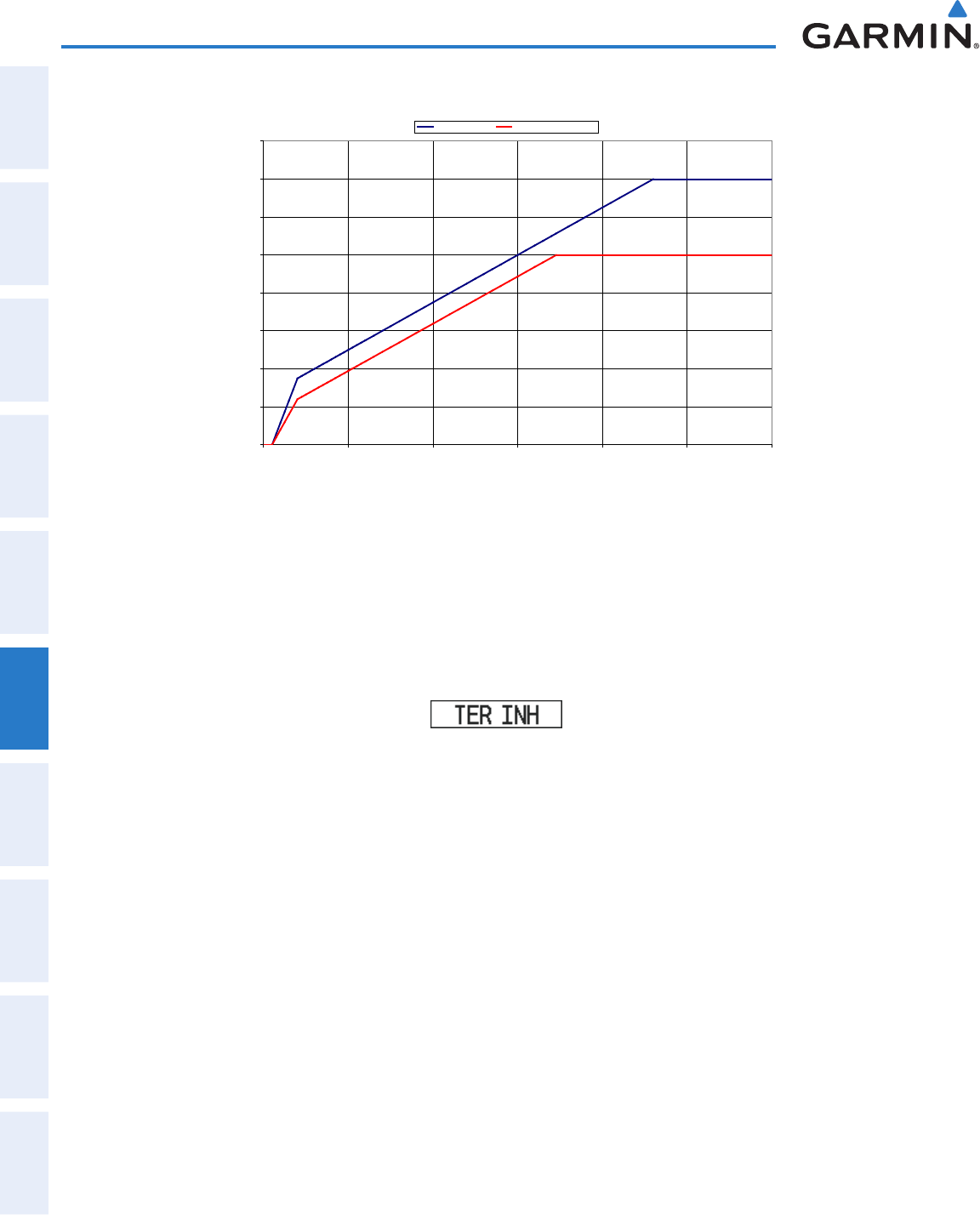
Garmin G1000 Pilot’s Guide for the Diamond DA40/40F
190-00592-06 Rev. A
324
HAZARD AVOIDANCE
SYSTEM
OVERVIEW
FLIGHT
INSTRUMENTS
EIS
AUDIO PANEL
& CNS
FLIGHT
MANAGEMENT
HAZARD
AVOIDANCE
AFCS
ADDITIONAL
FEATURES
APPENDICESINDEX
Required Terrain Clearance
0
100
200
300
400
500
600
700
800
0 5 10 15 20 25 30
Distance From Runway (NM)
Required Terrain Clearance (FT)
RTC Level (FT) RTC Descending (FT)
Figure 6-66 FLTA Alert Minimum Terrain and Obstacle Clearance Values
Distance From Runway (NM)
Required Terrain Clearance (FT)
FLTA alerts are automatically inhibited when the aircraft is less than 200 feet above the destination runway
elevation while within 0.5 nm of the approach runway or the aircraft is between runway ends
PDA and FLTA aural and visual alerts can be manually inhibited. Discretion should be used when inhibiting
TERRAIN-SVS and the system should be enabled when appropriate. When TERRAIN-SVS is inhibited, the
alert annunciation ‘TER INH’ is shown on the PFD and MFD (Figure 6-67).
Figure 6-67 TERRAIN-SVS Alerting Disabled
(TERRAIN-SVS Inhibited) Annunciation
Inhibiting/enabling TERRAIN-SVS alerting:
1) Select the TERRAIN-SVS Page.
2) Press the INHIBIT Softkey to inhibit or enable TERRAIN-SVS (choice dependent on current state).
Or:
a) Press the MENU Key.
b) Select ‘Inhibit TERRAIN-SVS’ or ‘Enable TERRAIN-SVS’ (choice dependent on current state) and press the ENT
Key.
If TERRAIN-SVS alerts are inhibited when the Final Approach Fix is the active waypoint in a GPS WAAS
approach, a ‘LOW ALT’ annunciation may appear on the PFD next to the Altimeter if the current aircraft
altitude is at least 164 feet below the prescribed altitude at the Final Approach Fix. See the Flight Instruments
Section for details.
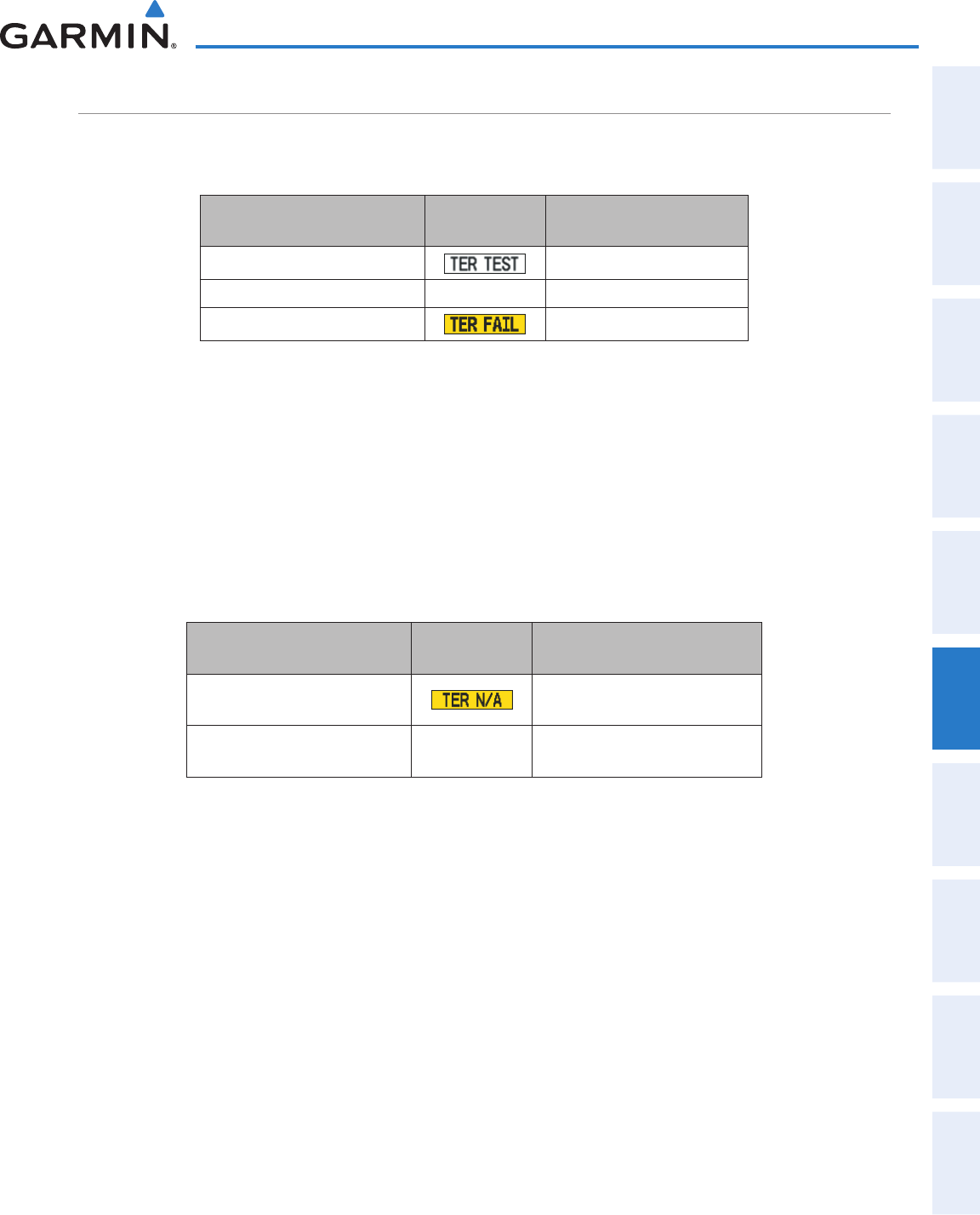
190-00592-06 Rev. A
Garmin G1000 Pilot’s Guide for the Diamond DA40/40F
325
HAZARD AVOIDANCE
SYSTEM
OVERVIEW
FLIGHT
INSTRUMENTS EIS AUDIO PANEL
& CNS
FLIGHT
MANAGEMENT
HAZARD
AVOIDANCE AFCS ADDITIONAL
FEATURES APPENDICES INDEX
SYSTEM STATUS
During power-up, TERRAIN-SVS conducts a self-test of its aural and visual annunciations. An aural alert is
issued at test completion.
Alert Type PFD/MFD Alert
Annunciation Aural Message
System Test in Progress None
System Test Pass None “Terrain System Test OK”
Terrain System Test Fail “Terrain System Failure”
Table 6-7 TERRAIN-SVS System Test Status Annunciations
TERRAIN-SVS continually monitors several system-critical items such as database validity, hardware status,
and GPS status. If the terrain/obstacle database is not available, the aural message “Terrain System Failure”
is generated along with the ‘TER FAIL’ alert annunciation.
TERRAIN-SVS requires a 3-D GPS navigation solution along with specific vertical accuracy minimums.
Should the navigation solution become degraded or if the aircraft is out of the database coverage area, the
annunciation ‘TER N/A’ is generated in the annunciation window and on the TERRAIN-SVS Page. The aural
message “Terrain System Not Available” is generated. When the GPS signal is re-established and the aircraft
is within the database coverage area, the aural message “Terrain System Available” is generated.
Alert Type PFD/MFD Alert
Annunciation Aural Message
No GPS position
Excessively degraded GPS signal “Terrain System Not Available”
GPS signal re-established None “Terrain System Available”
Table 6-8 TERRAIN-SVS Status Annunciations
Garmin G1000 Pilot’s Guide for the Diamond DA40/40F
190-00592-06 Rev. A
326
HAZARD AVOIDANCE
SYSTEM
OVERVIEW
FLIGHT
INSTRUMENTS
EIS
AUDIO PANEL
& CNS
FLIGHT
MANAGEMENT
HAZARD
AVOIDANCE
AFCS
ADDITIONAL
FEATURES
APPENDICESINDEX
6.5 TERRAIN AWARENESS & WARNING SYSTEM (TAWS)
WARNING: Do not use TAWS information for primary terrain avoidance. TAWS is intended only to enhance
situational awareness.
NOTE: The data contained in the TAWS databases comes from government agencies. Garmin accurately
processes and cross-validates the data but cannot guarantee the accuracy and completeness of the data.
TAWS (Terrain Awareness and Warning System) is an optional feature to increase situational awareness and aid
in reducing controlled flight into terrain (CFIT). TAWS provides visual and aural annunciations when terrain and
obstacles are within the given altitude threshold from the aircraft. The displayed alerts and warnings are advisory
in nature only.
TAWS satisfies TSO-C151b Class B requirements for certification. Class B TAWS is required for all Part 91
aircraft operations with six or more passenger seats and for Part 135 turbine aircraft operations with six to nine
passenger seats (FAR Parts 91.223, 135.154).
TAWS requires the following to operate properly:
•Avalidterrain/obstacle/airportterraindatabase
•Avalid3-DGPSpositionsolution
TAWS uses terrain and obstacle information supplied by government sources. Terrain information is based on
terrain elevation information in a database that may contain inaccuracies. Individual obstructions may be shown
if available in the database. The data undergoes verification by Garmin to confirm accuracy of the content, per
TSO-C151b. However, the displayed information should never be understood as being all-inclusive and data
may be inaccurate.
TAWS uses information provided from the GPS receiver to provide a horizontal position and altitude. GPS
altitude is derived from satellite measurements. GPS altitude is converted to a mean sea level (MSL)-based altitude
(GPS-MSL altitude) and is used to determine TAWS alerts. GPS-MSL altitude accuracy is affected by factors such
as satellite geometry, but it is not subject to variations in pressure and temperature that normally affect pressure
altitude devices. GPS-MSL altitude does not require local altimeter settings to determine MSL altitude. Therefore,
GPS altitude provides a highly accurate and reliable MSL altitude source to calculate terrain and obstacle alerts.
The terrain and obstacle databases used by TAWS are referenced to mean sea level (MSL). Using the GPS
position and GPS-MSL altitude, TAWS displays a 2-D (or 3-D with SVS) picture of the surrounding terrain and
obstacles relative to the position and altitude of the aircraft. Furthermore, the GPS position and GPS-MSL altitude
are used to calculate and “predict” the aircraft’s flight path in relation to the surrounding terrain and obstacles. In
this manner, TAWS can provide advanced alerts of predicted dangerous terrain conditions.
Baro-corrected altitude (or indicated altitude) is derived by adjusting the altimeter setting for local atmospheric
conditions. The most accurate baro-corrected altitude can be achieved by frequently updating the altimeter setting
to the nearest reporting station along the flight path. However, because actual atmosphere conditions seldom
match the standard conditions defined by the International Standard Atmosphere (ISA) model (where pressure,
temperature, and lapse rates have fixed values), it is common for the baro-corrected altitude (as read from the
altimeter) to differ from the GPS-MSL altitude. This variation results in the aircraft’s true altitude differing from
the baro-corrected altitude.
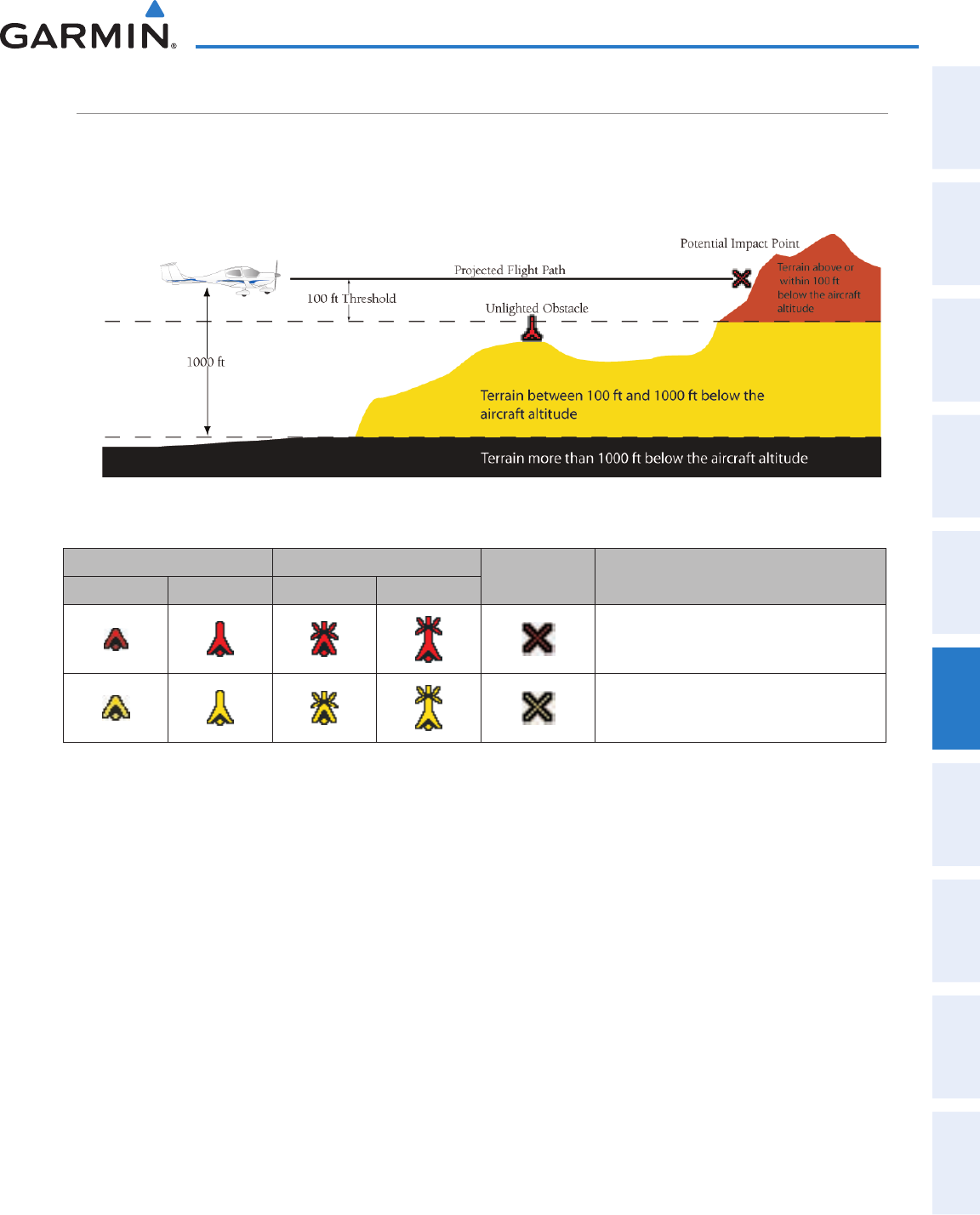
190-00592-06 Rev. A
Garmin G1000 Pilot’s Guide for the Diamond DA40/40F
327
HAZARD AVOIDANCE
SYSTEM
OVERVIEW
FLIGHT
INSTRUMENTS EIS AUDIO PANEL
& CNS
FLIGHT
MANAGEMENT
HAZARD
AVOIDANCE AFCS ADDITIONAL
FEATURES APPENDICES INDEX
DISPLAYING TAWS DATA
TAWS uses yellow (caution) and red (warning) to depict terrain and obstacles (with heights greater than 200
feet above ground level, AGL) alerts relative to aircraft altitude. Colors are adjusted automatically as the aircraft
altitude changes. The colors and symbols in Figure 6-60 and Table 6-9 are used to represent terrain, obstacles,
and potential impact points.
Figure 6-68 Terrain Altitude/Color Correlation for TAWS
Unlighted Obstacle Lighted Obstacle Potential
Impact Points Obstacle Location
< 1000’ AGL > 1000’ AGL < 1000’ AGL > 1000’ AGL
WARNING: Red obstacle is above or within
100’ below current aircraft altitude
CAUTION: Yellow obstacle is between 100’
and 1000’ below current aircraft altitude
Table 6-9 TAWS Obstacle Colors and Symbology
TAWS information can be displayed on the following maps:
•PFDInsetMap
•NavigationMapPage
•TAWS-BPage
•TripPlanningPage
•FlightPlanPages
Displaying terrain and obstacle information (maps other than the TAWS Page):
1) Press the MAP Softkey (for the PFD Inset Map, select the INSET Softkey).
2) Press the TERRAIN Softkey to display terrain and obstacle data.
When TAWS is selected on maps other than the TAWS-B Page, an icon to indicate the feature is enabled for
display and a legend for TAWS terrain colors are shown (Figure 6-75).
The Navigation Map Page Setup Menu provides a means in addition to the softkey for enabling/disabling
display of terrain and obstacles. The setup menu also controls the map range settings above which terrain and
obstacle data are decluttered from the display. If a map range larger than the map range setting is selected, the
data is removed from the map.
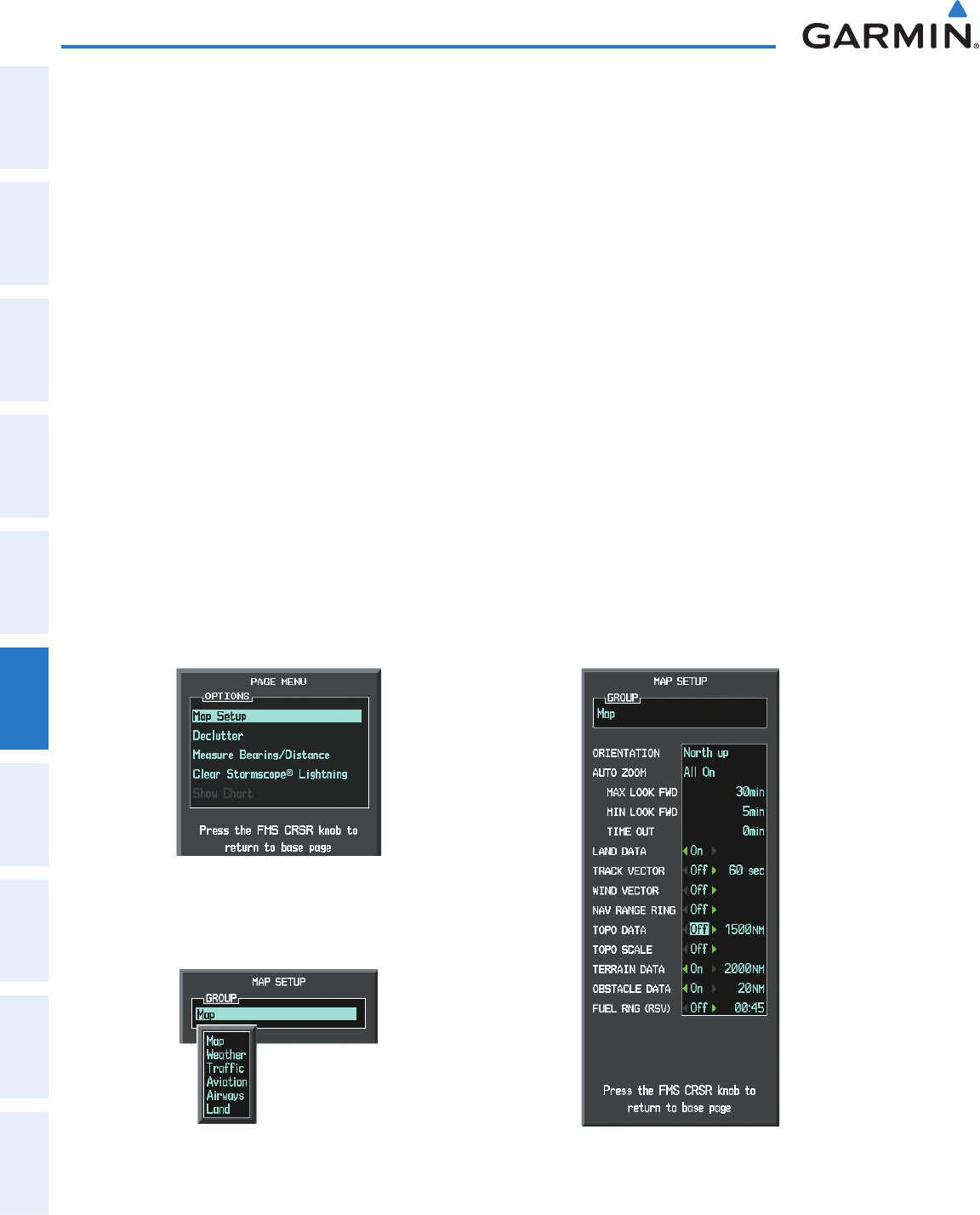
Garmin G1000 Pilot’s Guide for the Diamond DA40/40F
190-00592-06 Rev. A
328
HAZARD AVOIDANCE
SYSTEM
OVERVIEW
FLIGHT
INSTRUMENTS
EIS
AUDIO PANEL
& CNS
FLIGHT
MANAGEMENT
HAZARD
AVOIDANCE
AFCS
ADDITIONAL
FEATURES
APPENDICESINDEX
Terrain data can be selected for display independently of obstacle data; however, obstacles for which warnings
and cautions are issued are shown when terrain is selected for display and the map range is within the setting
limit.
Maps besides the TAWS-B Page use settings based on those selected for the Navigation Map Page. The
maximum display ranges for obstacles on each map are dependent on the range setting made for the Navigation
Map. If the maximum range for obstacle display on the Navigation Map is adjusted to below 20 nm, the highest
obstacle display range settings on the other applicable maps are also adjusted proportionally.
Customizing terrain and obstacle display on the Navigation Map Page:
1) Select the Navigation Map Page.
2) Press the MENU Key.
3) With ‘Map Setup’ highlighted, press the
ENT
Key (Figure 6-69).
4) Turn the small FMS Knob to select the ‘Map’ Group and press the ENT Key (Figure 6-70).
5) Turn the large
FMS
Knob or press the
ENT
Key to scroll through product selections (Figure 6-71).
•TERRAIN DATA – Turns the display of terrain data on or off and sets maximum range at which terrain is shown
•OBSTACLE DATA – Turns the display of obstacle data on or off and sets maximum range at which obstacles are shown
6) Turn the small
FMS
Knob to scroll through options for each product (ON/OFF, range settings).
7) Press the
ENT
Key to select an option.
8) Press the FMS Knob or CLR Key to return to the Navigation Map Page with the changed settings.
Figure 6-70 Navigation Map Page Setup Menu
Figure 6-69 Navigation Map Page Menu
Figure 6-71 Navigation Map Page Setup Menu, Map Group
190-00592-06 Rev. A
Garmin G1000 Pilot’s Guide for the Diamond DA40/40F
329
HAZARD AVOIDANCE
SYSTEM
OVERVIEW
FLIGHT
INSTRUMENTS EIS AUDIO PANEL
& CNS
FLIGHT
MANAGEMENT
HAZARD
AVOIDANCE AFCS ADDITIONAL
FEATURES APPENDICES INDEX
TAWS-B PAGE
The TAWS-B Page is specialized to show terrain, obstacle, and potential impact point data in relation to
the aircraft’s current altitude, without clutter from the basemap. Aviation data (airports, VORs, and other
NAVAIDs) can be displayed for reference. If an obstacle and the projected flight path of the aircraft intersect,
the display automatically zooms in to the closest potential point of impact on the TAWS-B Page.
Aircraft orientation on this map is always heading up unless there is no valid heading. Two views are available
relative to the position of the aircraft: the 360° default display and the radar-like ARC (120°) display. Map
range is adjustable with the RANGE Knob from 1 to 200 nm, as indicated by the map range rings (or arcs).
Displaying the TAWS-B Page:
1) Turn the large
FMS
Knob to select the Map Page Group.
2) Turn the small
FMS
Knob
to select the TAWS Page.
Changing the TAWS-B Page view:
1) Press the
VIEW
Softkey.
2) Press the 360 or ARC Softkey to select the desired view.
Or:
1) Press the MENU Key.
2)
Select ‘View 120º’ or ‘View 360º’ (choice dependent on current state) and press the ENT Key to change the view
Showing/hiding aviation information on the TAWS-B Page:
1) Press the MENU Key.
2) Select ‘Show Aviation Data’ or ‘Hide Aviation Data’ (choice dependent on current state) and press the ENT Key.
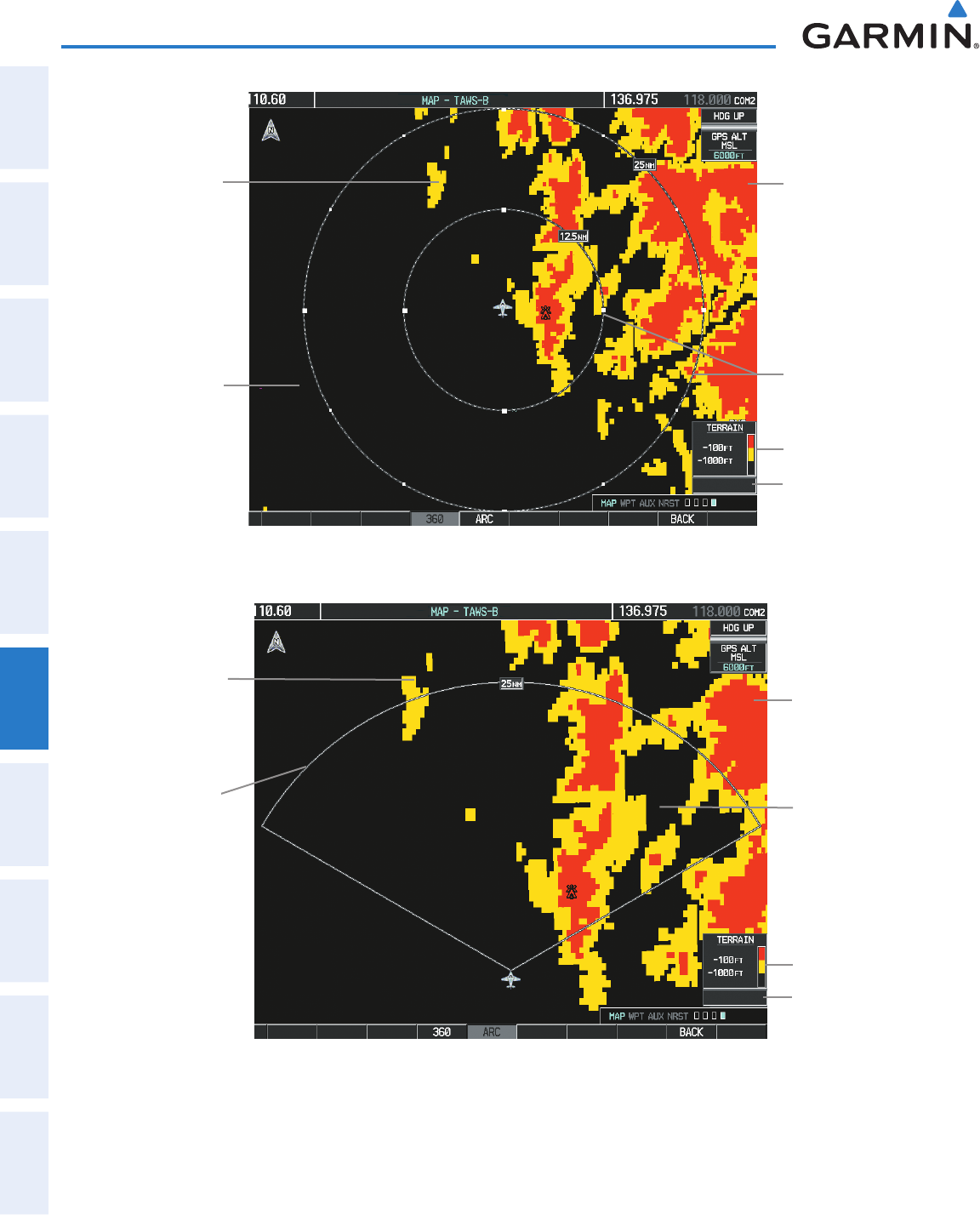
Garmin G1000 Pilot’s Guide for the Diamond DA40/40F
190-00592-06 Rev. A
330
HAZARD AVOIDANCE
SYSTEM
OVERVIEW
FLIGHT
INSTRUMENTS
EIS
AUDIO PANEL
& CNS
FLIGHT
MANAGEMENT
HAZARD
AVOIDANCE
AFCS
ADDITIONAL
FEATURES
APPENDICESINDEX
Figure 6-72 TAWS-B Page
Black Terrain
(Terrain More than
1000’ Below the
Aircraft Altitude)
Terrain Legend
Map Range Rings
Yellow Terrain
(Caution - Terrain
Between 100’ and
1000’ Below the
Aircraft Altitude)
Red Terrain
(Warning - Terrain
Above or Within
100’ Below the
Aircraft Altitude)
Annunciation
Window
Figure 6-73 TAWS-B Page (ARC View)
Red Terrain
(Warning - Terrain
Above or Within
100’ Below the
Aircraft Altitude)
Black Terrain
(Terrain More than
1000’ Below the
Aircraft Altitude)
Terrain Legend
Map Range Arc
Yellow Terrain
(Caution - Terrain
Between 100’
and 1000’ Below
the Aircraft
Altitude)
Annunciation
Window
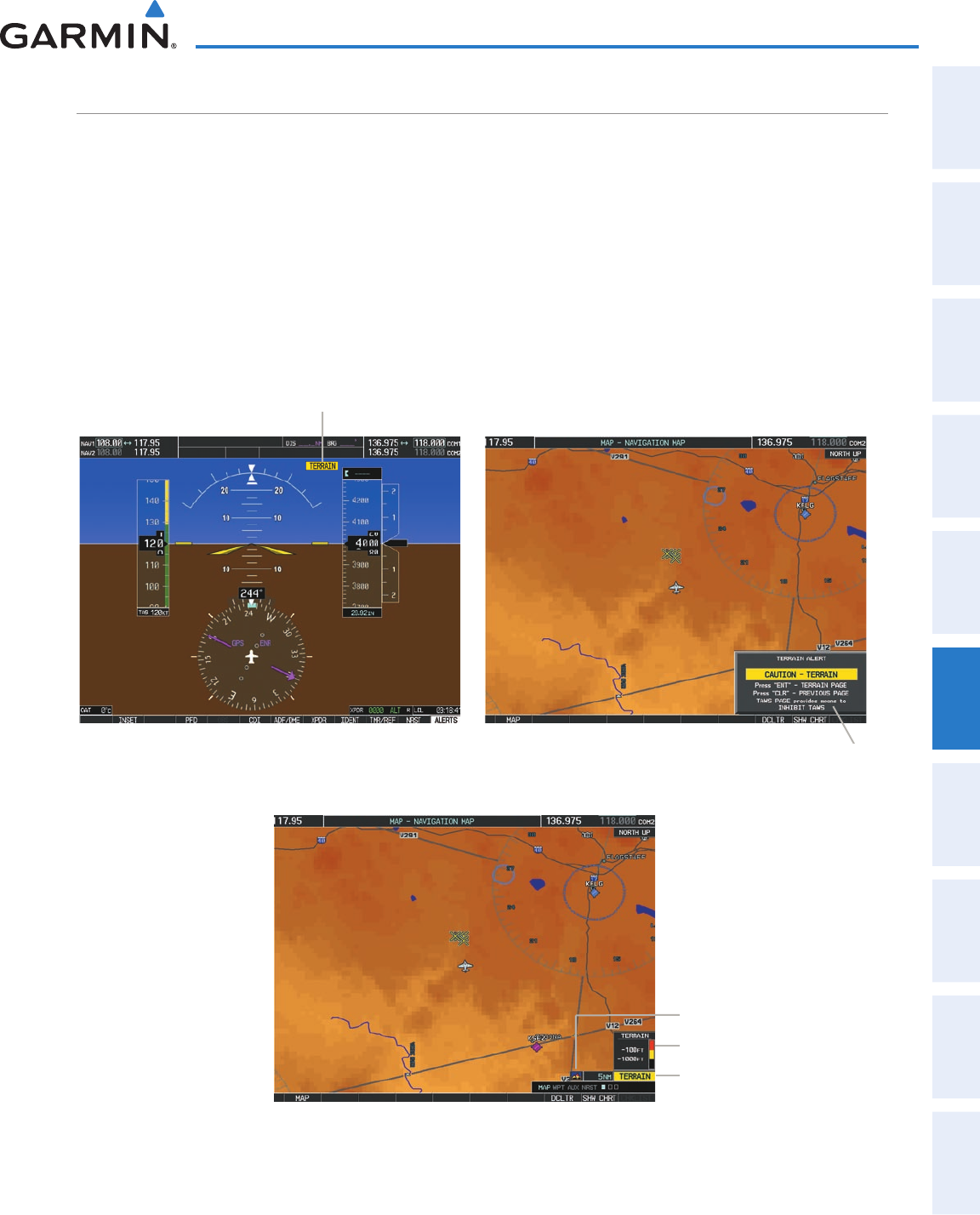
190-00592-06 Rev. A
Garmin G1000 Pilot’s Guide for the Diamond DA40/40F
331
HAZARD AVOIDANCE
SYSTEM
OVERVIEW
FLIGHT
INSTRUMENTS EIS AUDIO PANEL
& CNS
FLIGHT
MANAGEMENT
HAZARD
AVOIDANCE AFCS ADDITIONAL
FEATURES APPENDICES INDEX
TAWS ALERTS
Alerts are issued when flight conditions meet parameters that are set within TAWS software algorithms.
TAWS alerts typically employ a CAUTION or a WARNING alert severity level, or both. When an alert is issued,
visual annunciations are displayed and aural alerts are simultaneously issued. Table 6-10 shows TAWS alert
types with corresponding annunciations and aural messages.
When an alert is issued, annunciations appear on the PFD and MFD. The TAWS Alert Annunciation is shown
to the upper left of the Altimeter on the PFD and below the Terrain Legend on the MFD. If the TAWS-B Page is
not displayed at the time, a pop-up alert appears on the MFD. To acknowledge the pop-up alert:
•PresstheCLR Key (returns to the currently viewed page), or
•PresstheENT Key (accesses the TAWS-B Page)
Alert Annunciation
Figure 6-74 TAWS Alert Annunciations Pop-up
Alert
Figure 6-75 Navigation Map Page
(After TAWS Pop-up Alert Acknowledgment)
Alert Annunciation
Terrain Legend
Terrain Display Enabled
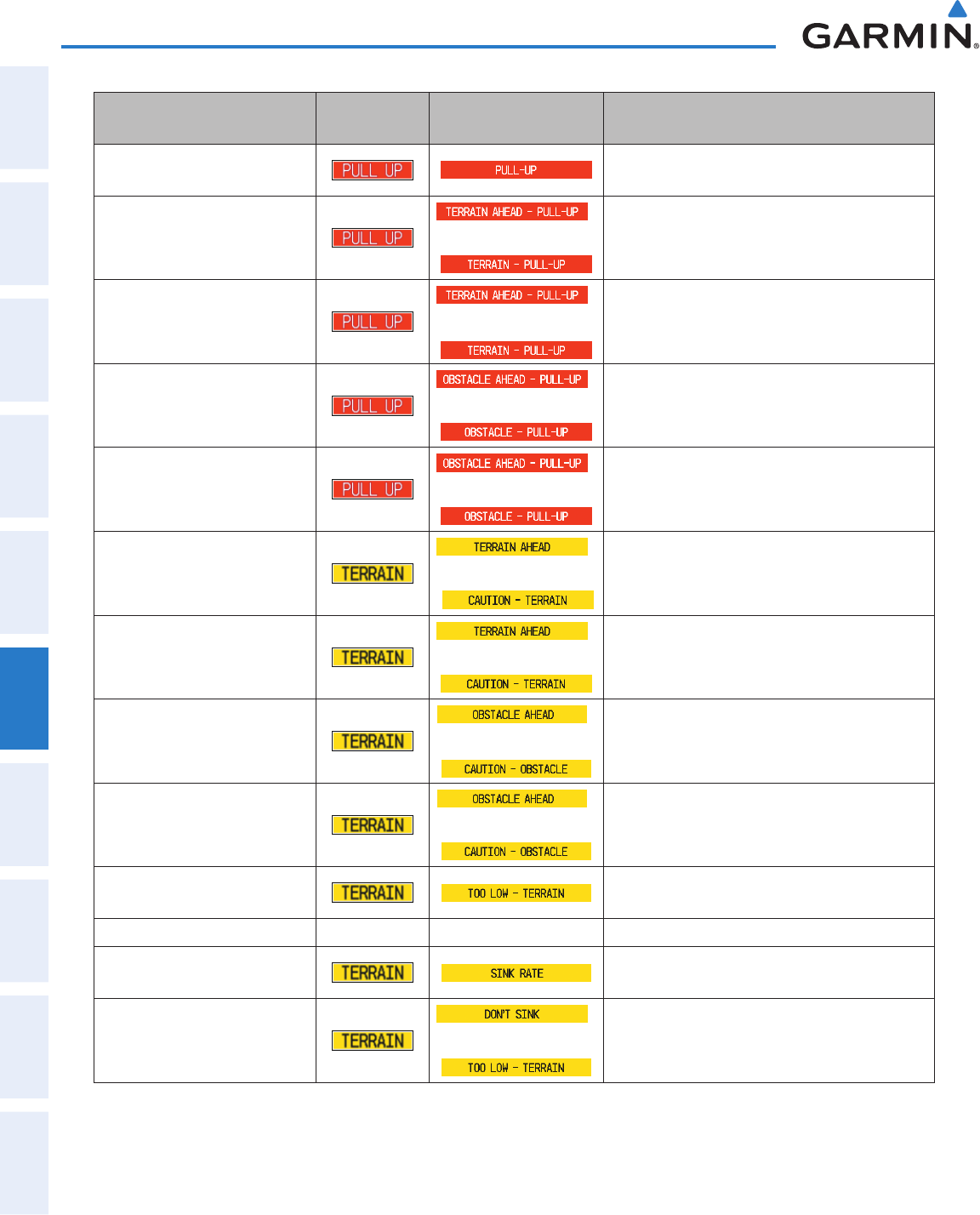
Garmin G1000 Pilot’s Guide for the Diamond DA40/40F
190-00592-06 Rev. A
332
HAZARD AVOIDANCE
SYSTEM
OVERVIEW
FLIGHT
INSTRUMENTS
EIS
AUDIO PANEL
& CNS
FLIGHT
MANAGEMENT
HAZARD
AVOIDANCE
AFCS
ADDITIONAL
FEATURES
APPENDICESINDEX
Alert Type
PFD/MFD Alert
Annunciation
MFD Pop-Up Alert Aural Message
Excessive Descent Rate Warning
(EDR) “Pull Up”
Reduced Required Terrain
Clearance Warning (RTC)
*
or
“Terrain Ahead, Pull Up; Terrain Ahead, Pull Up”*
or
“Terrain, Terrain; Pull Up, Pull Up”
Imminent Terrain Impact
Warning (ITI)
*
or
Terrain Ahead, Pull Up; Terrain Ahead, Pull Up’*
or
“Terrain, Terrain; Pull Up, Pull Up”
Reduced Required Obstacle
Clearance Warning (ROC)
*
or
“
Obstacle Ahead, Pull Up; Obstacle Ahead, Pull Up
”*
or
“
Obstacle, Obstacle; Pull Up, Pull Up
”
Imminent Obstacle Impact
Warning (IOI)
*
or
“Obstacle Ahead, Pull Up; Obstacle Ahead, Pull Up”*
or
“Obstacle, Obstacle; Pull Up, Pull Up”
Reduced Required Terrain
Clearance Caution (RTC)
*
or
“Terrain Ahead; Terrain Ahead”*
or
“Caution, Terrain; Caution, Terrain”
Imminent Terrain Impact Caution
(ITI)
*
or
“Terrain Ahead; Terrain Ahead”*
or
“Caution, Terrain; Caution, Terrain”
Reduced Required Obstacle
Clearance Caution (ROC)
*
or
“Obstacle Ahead; Obstacle Ahead”*
or
“Caution, Obstacle; Caution, Obstacle”
Imminent Obstacle Impact
Caution (IOI)
*
or
“Obstacle Ahead; Obstacle Ahead”*
or
“Caution, Obstacle; Caution, Obstacle”
Premature Descent Alert
Caution (PDA) “Too Low, Terrain”
Altitude Callout “500” None None “Five-Hundred”
Excessive Descent Rate Caution
(EDR) “Sink Rate”
Negative Climb Rate Caution
(NCR)
*
or
“Don’t Sink”*
or
“Too Low, Terrain”
* Alerts with multiple messages are configurable at installation and are installation-dependent. Alerts for the default
configuration are indicated with asterisks.
Table 6-10 TAWS Alerts Summary
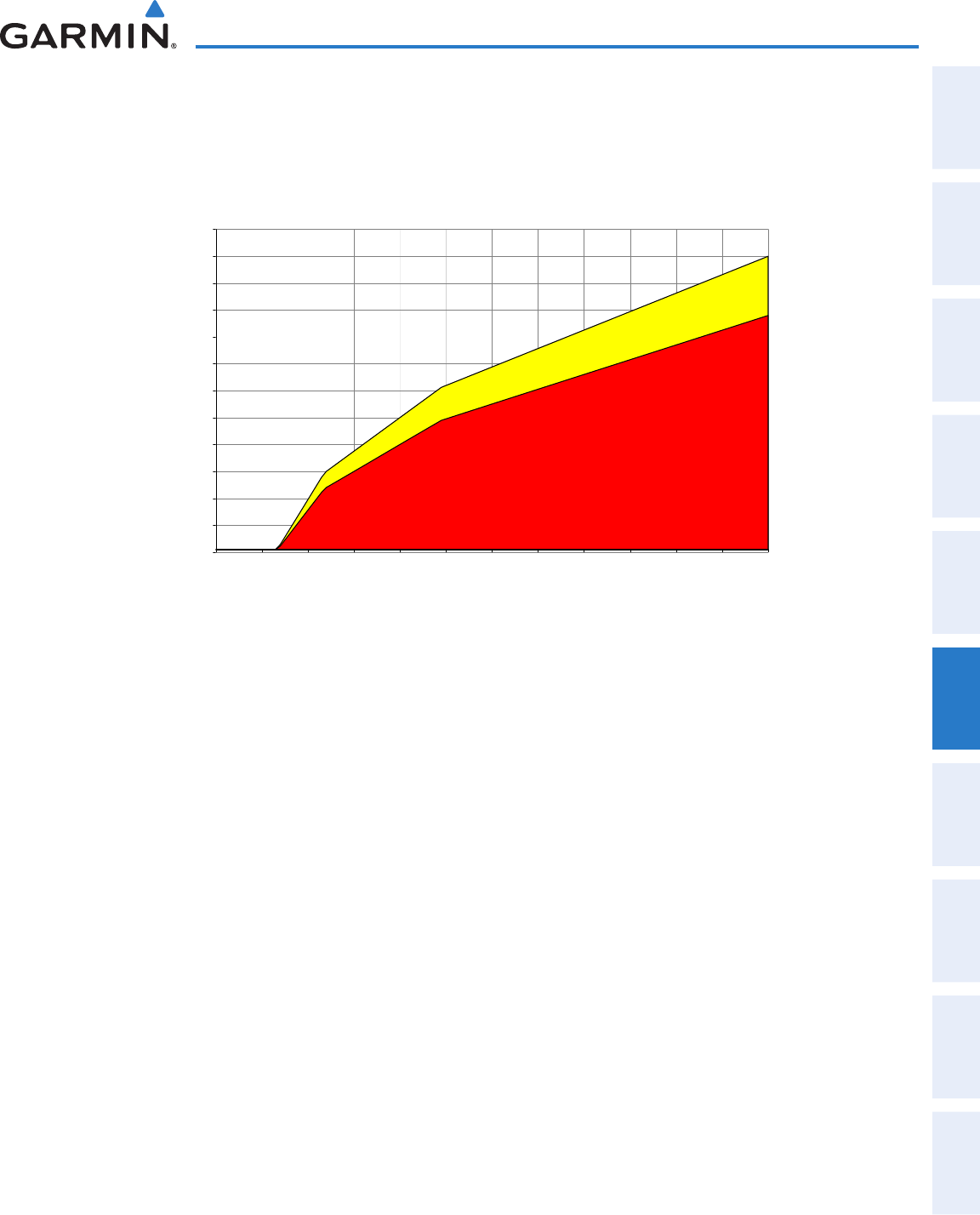
190-00592-06 Rev. A
Garmin G1000 Pilot’s Guide for the Diamond DA40/40F
333
HAZARD AVOIDANCE
SYSTEM
OVERVIEW
FLIGHT
INSTRUMENTS EIS AUDIO PANEL
& CNS
FLIGHT
MANAGEMENT
HAZARD
AVOIDANCE AFCS ADDITIONAL
FEATURES APPENDICES INDEX
EXCESSIVE DESCENT RATE ALERT
The purpose of the Excessive Descent Rate (EDR) alert is to provide suitable notification when the
aircraft is determined to be closing (descending) upon terrain at an excessive speed. Figure 6-76 shows the
parameters for the alert as defined by TSO-C151b.
0
500
1000
1500
2000
2500
3000
3500
4000
4500
5000
5500
6000
0
1000
2000
3000
4000
5000
6000
7000
8000
9000
10000
11000
12000
Descent Rate (FPM)
Height Above Terrain (Feet)
Caution: “SINK RATE”
Warning: “PULL UP”
Figure 6-76 Excessive Descent Rate Alert Criteria
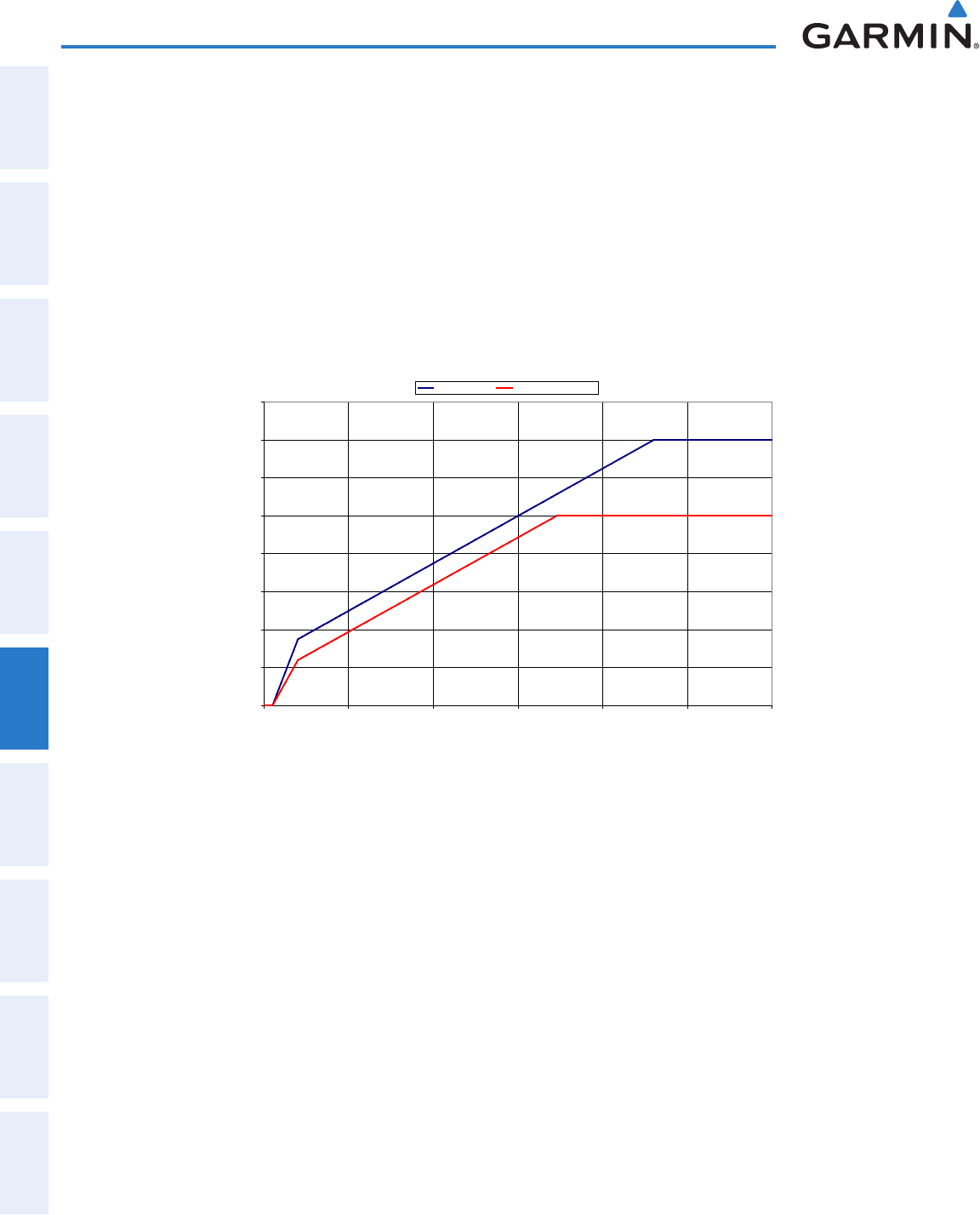
Garmin G1000 Pilot’s Guide for the Diamond DA40/40F
190-00592-06 Rev. A
334
HAZARD AVOIDANCE
SYSTEM
OVERVIEW
FLIGHT
INSTRUMENTS
EIS
AUDIO PANEL
& CNS
FLIGHT
MANAGEMENT
HAZARD
AVOIDANCE
AFCS
ADDITIONAL
FEATURES
APPENDICESINDEX
FORWARD LOOKING TERRAIN AVOIDANCE
Reduced Required Terrain Clearance (RTC) and Reduced Required Obstacle Clearance (ROC)
alerts are issued when the aircraft flight path is above terrain, yet is projected to come within the minimum
clearance values in Figure 6-77. When an RTC alert is issued, a potential impact point is displayed on the
TAWS-B Page.
Imminent Terrain Impact (ITI) and Imminent Obstacle Impact (IOI) alerts are issued when the
aircraft is below the elevation of a terrain or obstacle cell in the aircraft’s projected path. ITI and IOI alerts are
accompanied by a potential impact point displayed on the TAWS-B Page. The alert is annunciated when the
projected vertical flight path is calculated to come within minimum clearance altitudes in Figure 6-77.
Required Terrain Clearance
0
100
200
300
400
500
600
700
800
0 5 10 15 20 25 30
Distance From Runway (NM)
Required Terrain Clearance (FT)
RTC Level (FT) RTC Descending (FT)
Figure 6-77 FLTA Alert Minimum Terrain and Obstacle Clearance Values
Distance From Runway (NM)
Required Terrain Clearance (FT)
FLTA alerts are automatically inhibited when the aircraft is less than 200 feet above the destination runway
elevation while within 0.5 nm of the approach runway or the aircraft is between runway ends
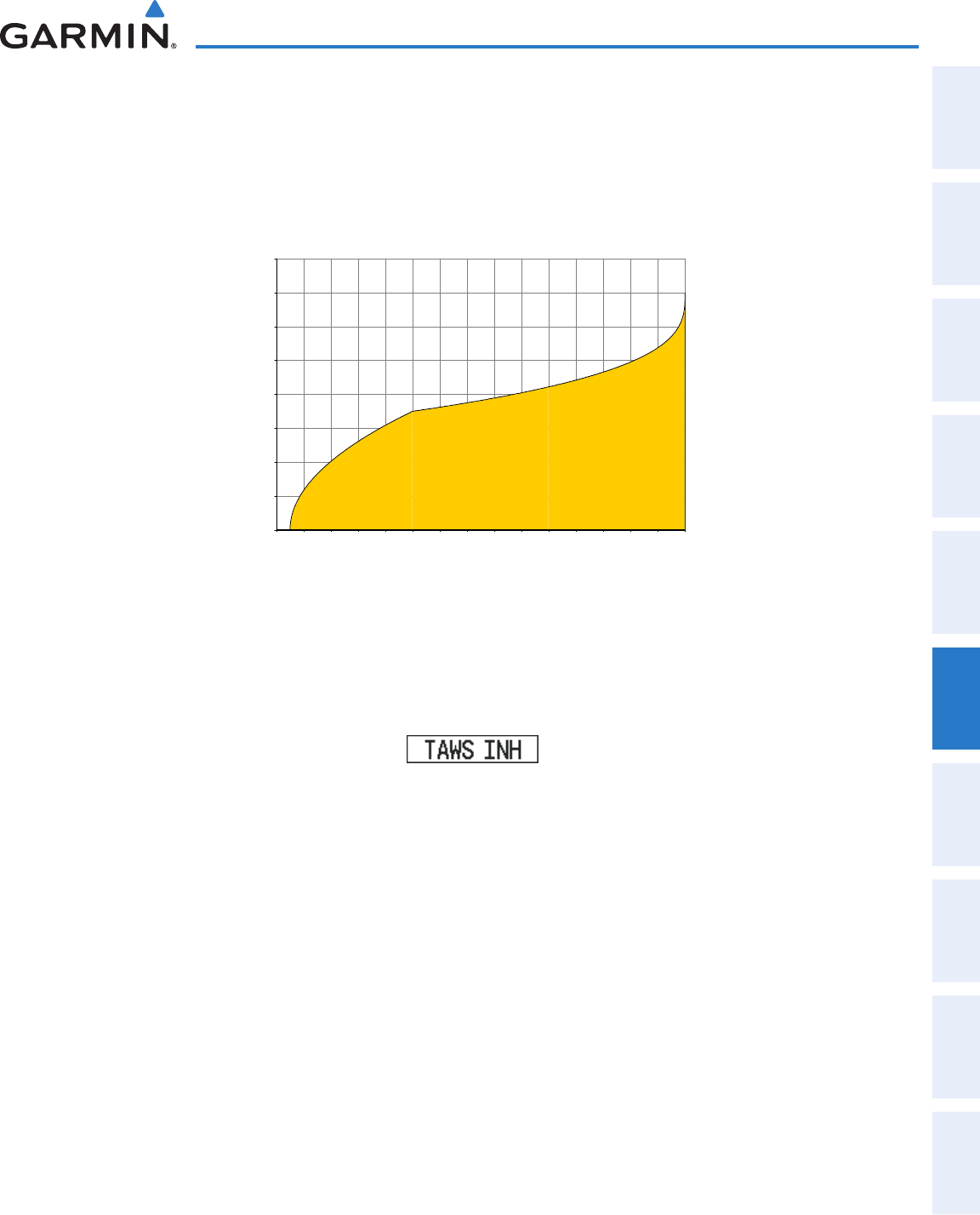
190-00592-06 Rev. A
Garmin G1000 Pilot’s Guide for the Diamond DA40/40F
335
HAZARD AVOIDANCE
SYSTEM
OVERVIEW
FLIGHT
INSTRUMENTS EIS AUDIO PANEL
& CNS
FLIGHT
MANAGEMENT
HAZARD
AVOIDANCE AFCS ADDITIONAL
FEATURES APPENDICES INDEX
PREMATURE DESCENT ALERTING
A Premature Descent Alert (PDA) is issued when the system detects that the aircraft is significantly
below the normal approach path to a runway (Figure 6-78).
PDA alerting begins when the aircraft is below 700 feet AGL within 15 nm of the destination airport and
ends when the aircraft is 0.5 nm from the runway threshold.
Figure 6-78 PDA Alerting Threshold
0
100
200
300
400
500
600
700
800
0
1
2
3
4
5
6
7
8
9
10
11
12
13
14
15
Height Above Destination (Feet)
Distance to Destination (NM)
PDA ALERTING AREA
PDA and FLTA aural and visual alerts can be manually inhibited. Discretion should be used when inhibiting
TAWS and the system should be enabled when appropriate. When TAWS is inhibited, the alert annunciation
‘TAWS INH’ is shown on the PFD and MFD (Figure 6-79).
Figure 6-79 TAWS Alerting Disabled
(TAWS Inhibited) Annunciation
Inhibiting/enabling TAWS alerting:
1) Select the TAWS-B Page.
2) Press the INHIBIT Softkey to inhibit or enable TAWS (choice dependent on current state).
Or:
a) Press the MENU Key.
b) Select ‘Inhibit TAWS’ or ‘Enable TAWS’ (choice dependent on current state) and press the ENT Key.
If TAWS alerts are inhibited when the Final Approach Fix is the active waypoint in a GPS WAAS approach,
a ‘LOW ALT’ annunciation may appear on the PFD next to the Altimeter if the current aircraft altitude is at
least 164 feet below the prescribed altitude at the Final Approach Fix. See the Flight Instruments Section
for details.
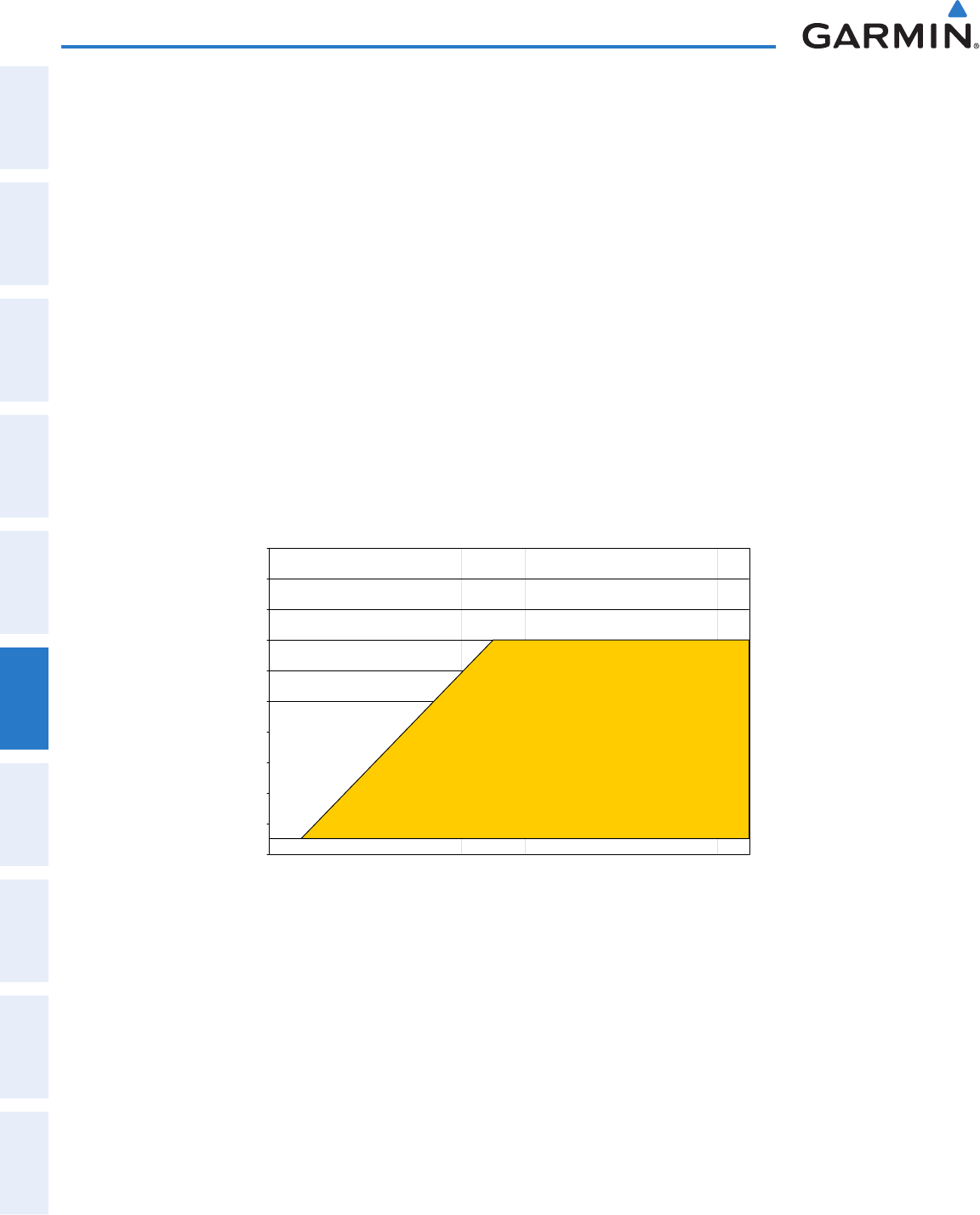
Garmin G1000 Pilot’s Guide for the Diamond DA40/40F
190-00592-06 Rev. A
336
HAZARD AVOIDANCE
SYSTEM
OVERVIEW
FLIGHT
INSTRUMENTS
EIS
AUDIO PANEL
& CNS
FLIGHT
MANAGEMENT
HAZARD
AVOIDANCE
AFCS
ADDITIONAL
FEATURES
APPENDICESINDEX
FIVE-HUNDRED AURAL ALERT
The purpose of the aural alert message “Five-hundred” is to provide an advisory alert that the aircraft is 500
feet above terrain. When the aircraft descends within 500 feet of terrain, the aural message “Five-hundred” is
generated. There are no display annunciations or pop-up alerts that accompany the aural message.
NEGATIVE CLIMB RATE AFTER TAKEOFF ALERT (NCR)
The Negative Climb Rate (NCR) After Takeoff alert (also referred to as “Altitude Loss After Takeoff”)
provides alerts when the system determines the aircraft is losing altitude (closing upon terrain) after takeoff.
The aural message “Don’t Sink” is given for NCR alerts, accompanied by an annunciation and a pop-up terrain
alert on the display. NCR alerting is only active when departing from an airport and when the following
conditions are met:
•Heightabovetheterrainislessthan700feet
•Distancefromthedepartureairportis2nmorless
•Headingchangefromthedepartureheadingislessthan110degrees
Figures 6-80 and 6-81 show the NCR alerting parameters as defined by TSO-C151b.
Figure 6-80 Negative Climb Rate (NCR) Altitude Loss
0
100
200
300
400
500
600
700
800
900
1000
0 20 40 60 80 100 120 140
Altitude Loss (Feet)
Height Above Terrain (Feet)
“DON’T SINK”
or
“TOO LOW, TERRAIN”
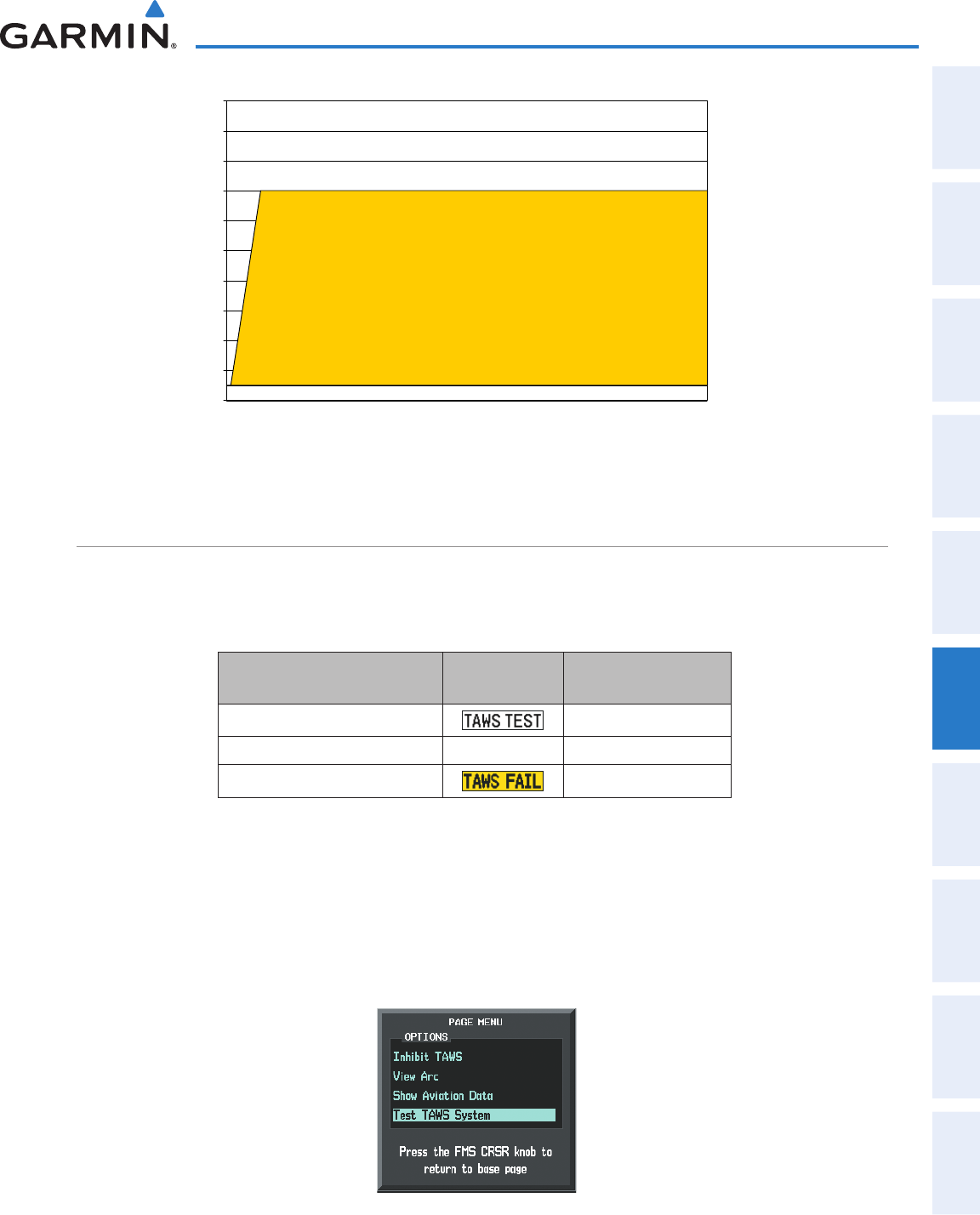
190-00592-06 Rev. A
Garmin G1000 Pilot’s Guide for the Diamond DA40/40F
337
HAZARD AVOIDANCE
SYSTEM
OVERVIEW
FLIGHT
INSTRUMENTS EIS AUDIO PANEL
& CNS
FLIGHT
MANAGEMENT
HAZARD
AVOIDANCE AFCS ADDITIONAL
FEATURES APPENDICES INDEX
Figure 6-81 Negative Climb Rate (NCR) Sink Rate
0
100
200
300
400
500
600
700
800
900
1000
0 500 1000 1500 2000 2500 3000 3500 4000 4500 5000 5500 6000 6500 7000
Sink Rate (FPM)
Height Above Terrain (Feet)
“DON’T SINK”
or
“TOO LOW, TERRAIN”
SYSTEM STATUS
During power-up, TAWS conducts a self-test of its aural and visual annunciations. The system test can also be
manually initiated. An aural alert is issued at test completion. TAWS System Testing is disabled when ground
speed exceeds 30 knots.
Alert Type PFD/MFD Alert
Annunciation Aural Message
System Test in Progress None
System Test Pass None “TAWS System Test OK”
TAWS System Test Fail “TAWS System Failure”
Table 6-11 TAWS System Test Status Annunciations
Manually testing the TAWS System:
1) Select the TAWS-B Page.
2) Press the MENU Key (Figure 6-82).
3) Select ‘Test TAWS’ and press the ENT Key to confirm the selection.
Figure 6-82 TAWS-B Page Menu
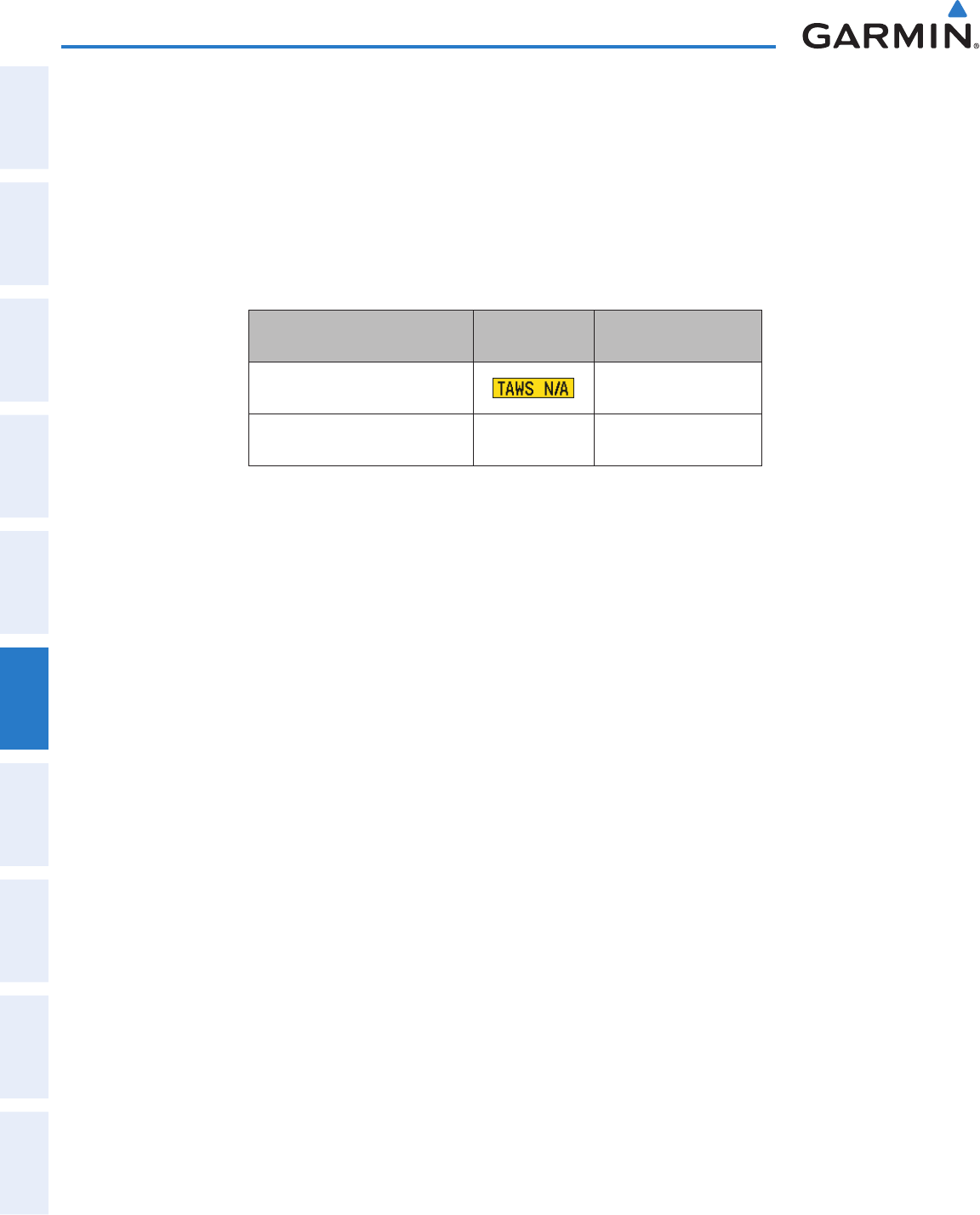
Garmin G1000 Pilot’s Guide for the Diamond DA40/40F
190-00592-06 Rev. A
338
HAZARD AVOIDANCE
SYSTEM
OVERVIEW
FLIGHT
INSTRUMENTS
EIS
AUDIO PANEL
& CNS
FLIGHT
MANAGEMENT
HAZARD
AVOIDANCE
AFCS
ADDITIONAL
FEATURES
APPENDICESINDEX
TAWS continually monitors several system-critical items such as database validity, hardware status, and GPS
status. If the terrain/obstacle database is not available, the aural message “TAWS System Failure” is generated
along with the ‘TAWS FAIL’ alert annunciation.
TAWS requires a 3-D GPS navigation solution along with specific vertical accuracy minimums. Should the
navigation solution become degraded or if the aircraft is out of the database coverage area, the annunciation
‘TAWS N/A’ is generated in the annunciation window and on the TAWS Page. The aural message “TAWS Not
Available” is generated. When the GPS signal is re-established and the aircraft is within the database coverage
area, the aural message “TAWS Available” is generated.
Alert Type PFD/MFD Alert
Annunciation Aural Message
No GPS position
Excessively degraded GPS signal “TAWS Not Available”
GPS signal re-established None “TAWS Available”
Table 6-12 TAWS Status Annunciations
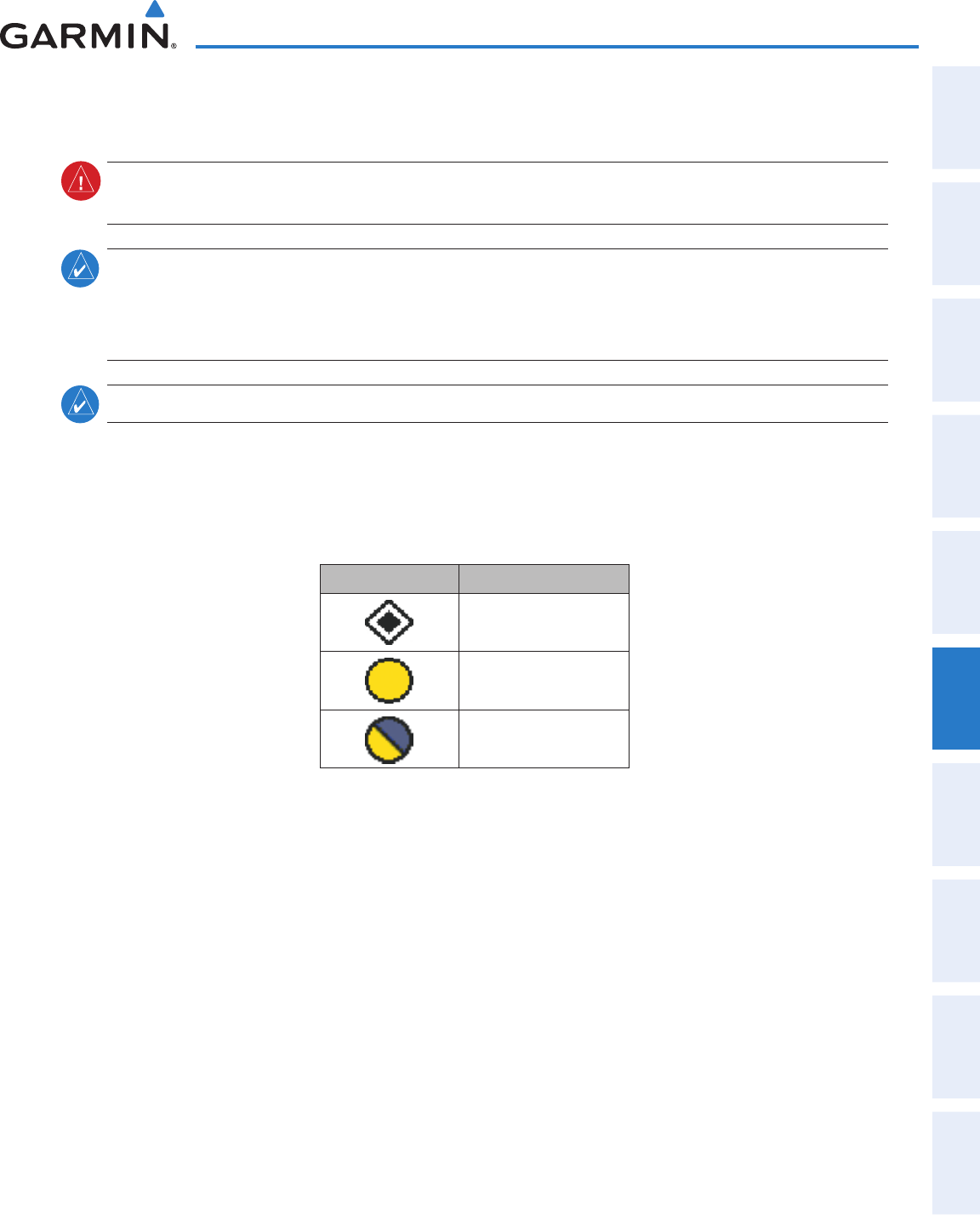
190-00592-06 Rev. A
Garmin G1000 Pilot’s Guide for the Diamond DA40/40F
339
HAZARD AVOIDANCE
SYSTEM
OVERVIEW
FLIGHT
INSTRUMENTS EIS AUDIO PANEL
& CNS
FLIGHT
MANAGEMENT
HAZARD
AVOIDANCE AFCS ADDITIONAL
FEATURES APPENDICES INDEX
6.6 TRAFFIC INFORMATION SERVICE (TIS)
WARNING
: The Traffic Information Service (TIS) is intended for advisory use only. TIS is intended to help the
pilot locate traffic visually. It is the responsibility of the pilot to see and maneuver to avoid traffic.
NOTE: TIS is available only when the aircraft is within the service volume of a TIS-capable terminal radar
site. Aircraft without an operating transponder are invisible to both Traffic Advisory Systems (TAS) and TIS.
Aircraft without altitude reporting capability are shown without altitude separation data or climb descent
indication.
NOTE: TIS is disabled if a Traffic Advisory System (TAS) is installed.
Traffic Information Service (TIS) is designed to help in detection and avoidance of other aircraft. TIS uses the
Mode S transponder for the traffic data link. TIS receives traffic information from ground stations, and is updated
every 5 seconds. The G1000 displays up to eight traffic targets within a 7.5-nm radius, from 3000 feet below to
3500 feet above the requesting aircraft. Traffic is displayed according to TCAS symbology using three different
symbols (Table 6-13).
TIS Symbol Description
Non-Threat Traffic
Traffic Advisory (TA)
Traffic Advisory Off Scale
Table 6-13 TIS Traffic Symbols
Proximity Advisories (PAs) are defined as traffic within the 5.0-nm range, within ±1200 feet of altitude separation.
They are not Traffic Advisories (TA), which alert the crew to intruding aircraft. When traffic meets the advisory
criteria for the TA, a solid yellow circle symbol is generated. A TA which is detected but is outside the range of
the map on which traffic is displayed are indicated with a message in the lower left corner of the map.
TIS also provides a vector line showing the direction in which the traffic is moving, to the nearest 45°. Traffic
information for which TIS is unable to determine the bearing (non-bearing traffic) is displayed in the center of
the Traffic Map Page (Figure 6-87) or in a banner at the lower left corner of maps other than the Traffic Map Page
on which traffic can be displayed.
The altitude difference between the requesting aircraft and other intruder aircraft is displayed above/below the
traffic symbol in hundreds of feet. If the other aircraft is above the requesting aircraft, the altitude separation
appears above the traffic symbol; if below, the altitude separation appears below. Altitude trend is displayed as
an up/down arrow (for speeds greater than 500 fpm in either direction) to the right of the target symbol. Traffic
symbols for aircraft without altitude reporting capability appear without altitude separation or climb/descent
information.
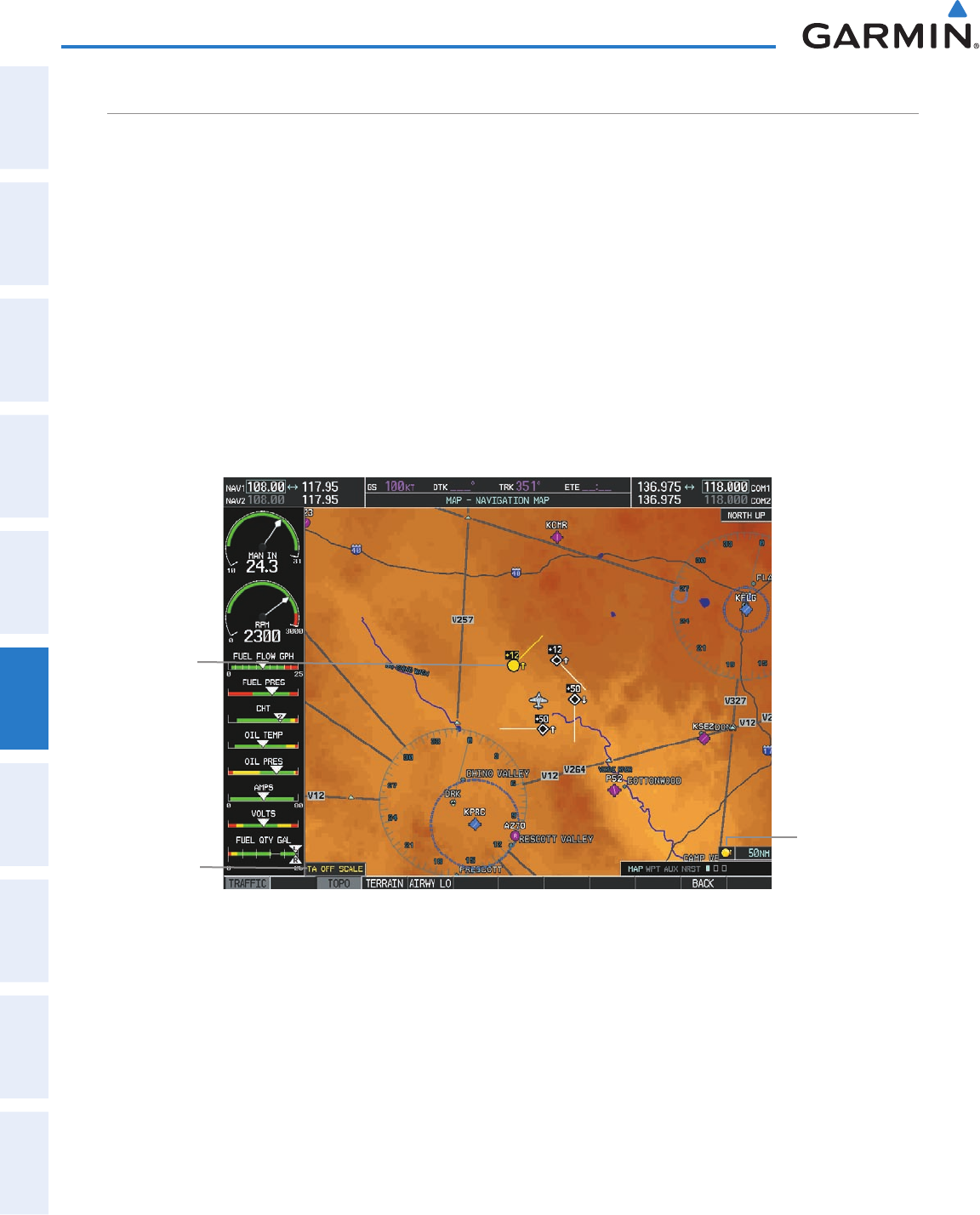
Garmin G1000 Pilot’s Guide for the Diamond DA40/40F
190-00592-06 Rev. A
340
HAZARD AVOIDANCE
SYSTEM
OVERVIEW
FLIGHT
INSTRUMENTS
EIS
AUDIO PANEL
& CNS
FLIGHT
MANAGEMENT
HAZARD
AVOIDANCE
AFCS
ADDITIONAL
FEATURES
APPENDICESINDEX
DISPLAYING TRAFFIC DATA
Traffic information can be displayed on the following maps (when TIS is operating):
•PFDInsetMap
•NavigationMapPage
•TrafcMapPage
•TripPlanningPage
•NearestPages
•ActiveFlightPlanPage
Displaying traffic information (maps other than the Traffic Map Page):
1) Press the MAP Softkey.
2) Press the TRAFFIC Softkey to display traffic data.
When traffic is selected on maps other than the Traffic Map Page, an icon is shown to indicate the feature is
enabled for display.
Figure 6-83 TIS Traffic on the Navigation Map Page
Traffic Advisory
Traffic Status
Banner
Traffic Display
Enabled
190-00592-06 Rev. A
Garmin G1000 Pilot’s Guide for the Diamond DA40/40F
341
HAZARD AVOIDANCE
SYSTEM
OVERVIEW
FLIGHT
INSTRUMENTS EIS AUDIO PANEL
& CNS
FLIGHT
MANAGEMENT
HAZARD
AVOIDANCE AFCS ADDITIONAL
FEATURES APPENDICES INDEX
Displaying traffic information (PFD Inset Map):
1) Press the INSET Softkey.
2) Press the TRAFFIC Softkey to display traffic data on the inset map (TRFC-1).
3) Press the softkey again to display the traffic-only inset (TRFC-2).
4) Press the softkey again to remove traffic data.
The Navigation Map Page Setup Menu provides a means in addition to the softkey for enabling/disabling
display of traffic. The setup menu also controls the map range settings above which traffic data (symbols
and labels) are decluttered from the display. If a map range larger than the map range setting is selected, the
data is removed from the map. Maps besides the Traffic Map Page use settings based on those selected for the
Navigation Map Page.
Customizing traffic display on the Navigation Map Page:
1) Select the Navigation Map Page.
2) Press the MENU Key.
3) With ‘Map Setup’ highlighted, press the
ENT
Key (Figure 6-84).
4) Turn the small FMS Knob to select the ‘Traffic’ Group and press the ENT Key (Figure 6-85).
5) Turn the large
FMS
Knob or press the
ENT
Key to scroll through product selections (Figure 6-86).
•TRAFFIC – Turns the display of traffic data on or off
•TRAFFIC MODE – Selects the traffic mode for display; select from:
- All Traffic - Displays all traffic
- TA/PA - Displays Traffic Alerts and Proximity Advisories
- TA ONLY - Displays Traffic Alerts only
•TRAFFIC SMBL – Selects the maximum range at which traffic symbols are shown
•TRAFFIC LBL – Selects the maximum range at which traffic labels are shown (with the option to turn off)
6) Turn the small
FMS
Knob to scroll through options for each product (ON/OFF, range settings, etc.).
7) Press the
ENT
Key to select an option.
8) Press the FMS Knob or CLR Key to return to the Navigation Map Page with the changed settings.
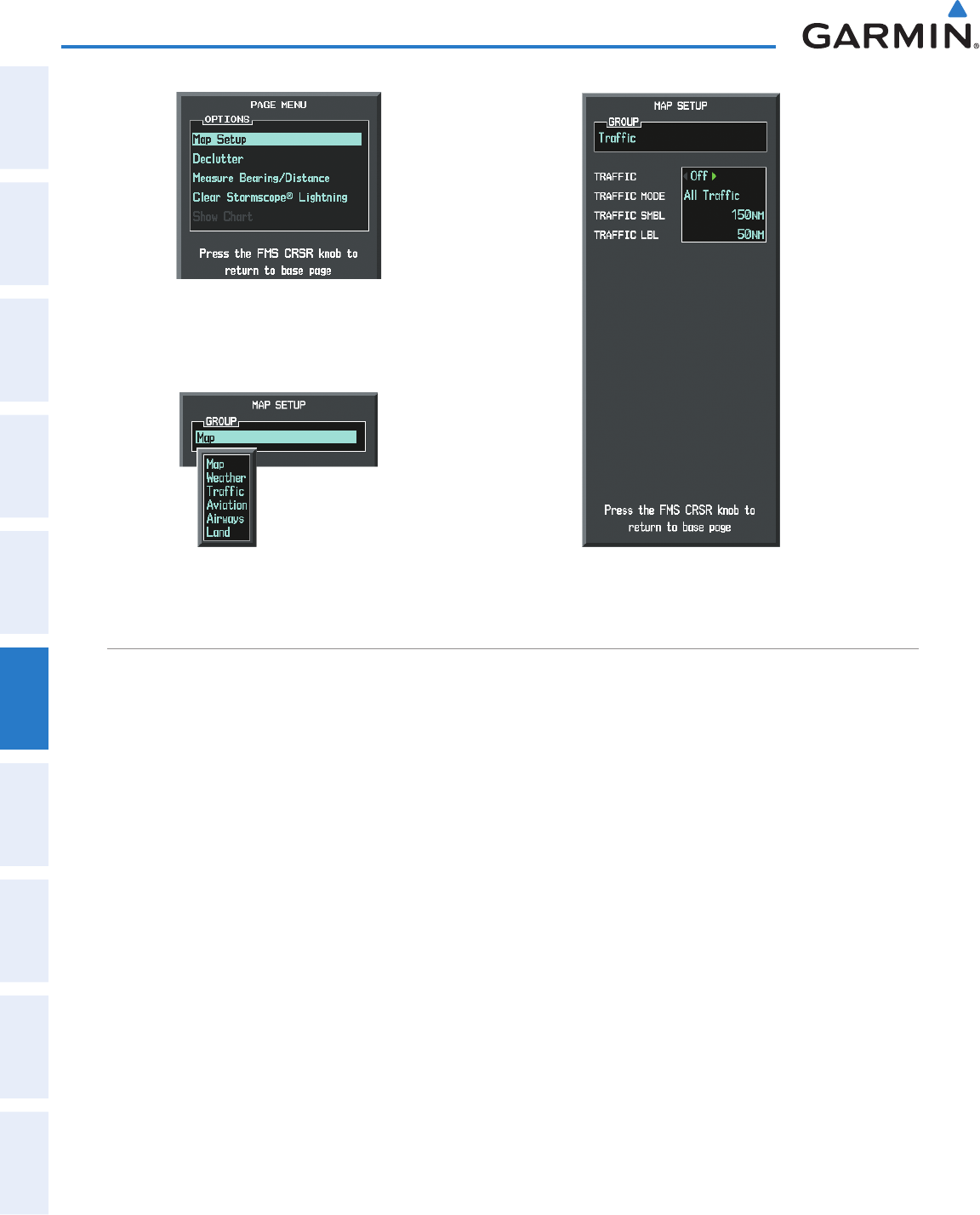
Garmin G1000 Pilot’s Guide for the Diamond DA40/40F
190-00592-06 Rev. A
342
HAZARD AVOIDANCE
SYSTEM
OVERVIEW
FLIGHT
INSTRUMENTS
EIS
AUDIO PANEL
& CNS
FLIGHT
MANAGEMENT
HAZARD
AVOIDANCE
AFCS
ADDITIONAL
FEATURES
APPENDICESINDEX
Figure 6-85 Navigation Map Page Setup Menu
Figure 6-84 Navigation Map Page Menu
Figure 6-86 Navigation Map Page Setup Menu, Traffic Group
TRAFFIC MAP PAGE
The Traffic Map Page is specialized to show surrounding TIS traffic data in relation to the aircraft’s current
position and altitude, without clutter from the basemap. Aircraft orientation on this map is always heading up
unless there is no valid heading. Map range is adjustable with the RANGE Knob from 2 to 12 nm, as indicated
by the map range rings.
The traffic mode is annunciated in the upper left corner of the Traffic Map Page. When the aircraft is on the
ground, TIS automatically enters Standby Mode. Once the aircraft is airborne, TIS switches from Standby to
Operating Mode and the G1000 begins to display traffic information. Refer to the System Status discussion for
more information.
Displaying traffic on the Traffic Map Page:
1) Turn the large
FMS
Knob to select the Map Page Group.
2) Turn the small
FMS
Knob
to select the Traffic Map Page.
3) Confirm TIS is in Operating Mode:
Press the
OPERATE
Softkey to begin displaying traffic.
Or:
a) Press the
MENU
Key.
b) Select ‘Operate Mode’ (shown if TIS is in Standby Mode) and press the ENT Key.
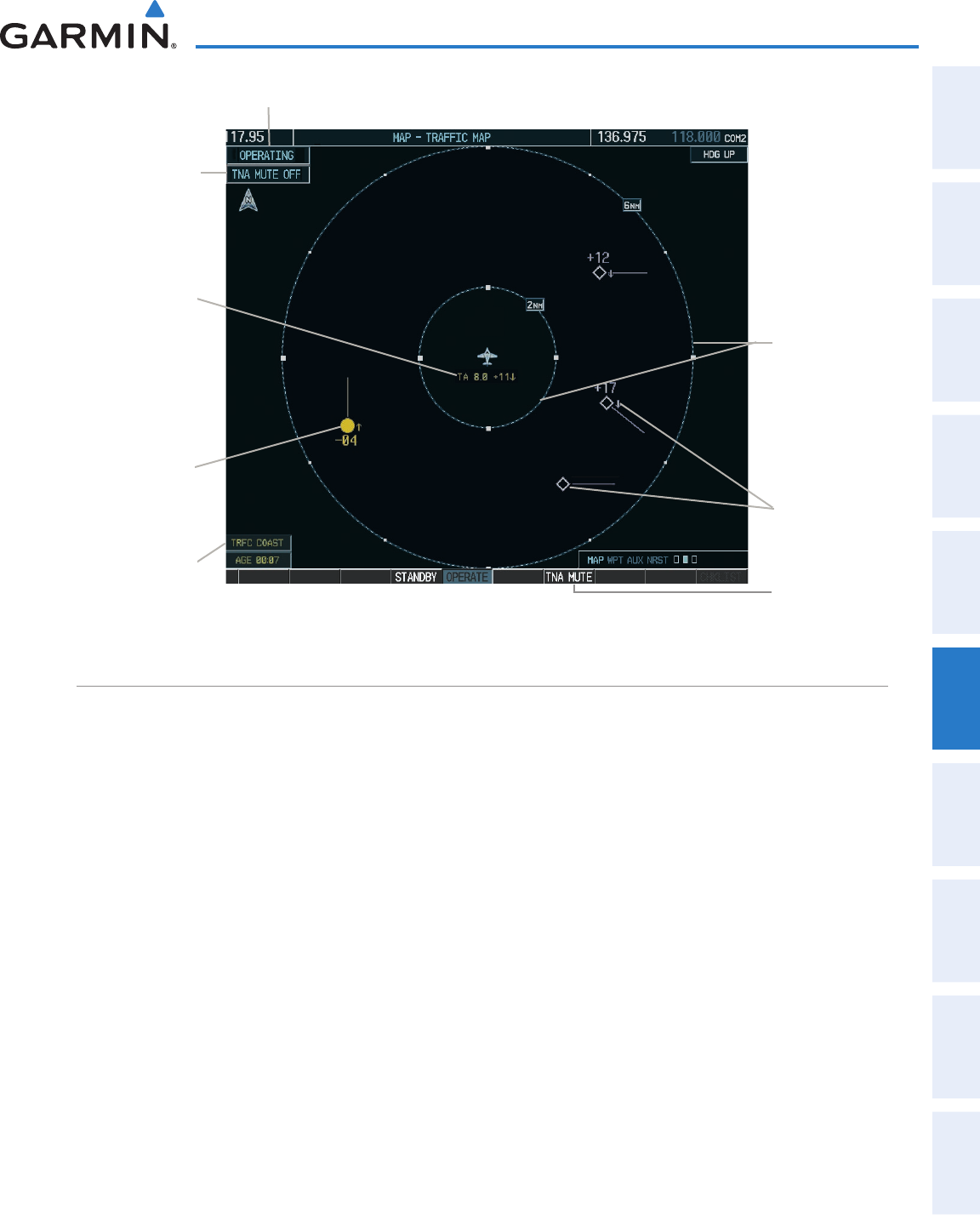
190-00592-06 Rev. A
Garmin G1000 Pilot’s Guide for the Diamond DA40/40F
343
HAZARD AVOIDANCE
SYSTEM
OVERVIEW
FLIGHT
INSTRUMENTS EIS AUDIO PANEL
& CNS
FLIGHT
MANAGEMENT
HAZARD
AVOIDANCE AFCS ADDITIONAL
FEATURES APPENDICES INDEX
Figure 6-87 Traffic Map Page
“Non-Bearing” Traffic
(System Unable to
Determine Bearing)
Distance is 8.0 nm,
1100’ Above,
Descending
Non-Threat
Traffic
Traffic Advisory
400’ Below,
Climbing
Traffic Status
Banner
Traffic Mode Annunciation
“TIS Not Available”
Voice Alert Status
Range
Marking
Rings
Select
to Mute
“TIS Not
Available”
Voice Alert
TIS ALERTS
When the number of TAs on the Traffic Map Page increases from one scan to the next, the following occur:
•Asingle“Traffic” voice alert is generated.
•A‘TRAFFIC’AnnunciationappearstothetopleftoftheAttitudeIndicatoronthePFD,ashingfor5seconds
and remaining displayed until no TAs are detected in the area.
•ThePFDInsetMapisautomaticallydisplayedwithtrafc.
To reduce the number of nuisance alerts due to proximate aircraft, the “Traffic” voice alert is generated only
when the number of TAs increases. For example, when the first TA is displayed, a voice and visual annunciation
are generated. As long as a single TA remains on the display, no additional voice alerts are generated. If a second
TA appears on the display or if the number of TAs initially decreases and then subsequently increases, another
voice alert is generated.
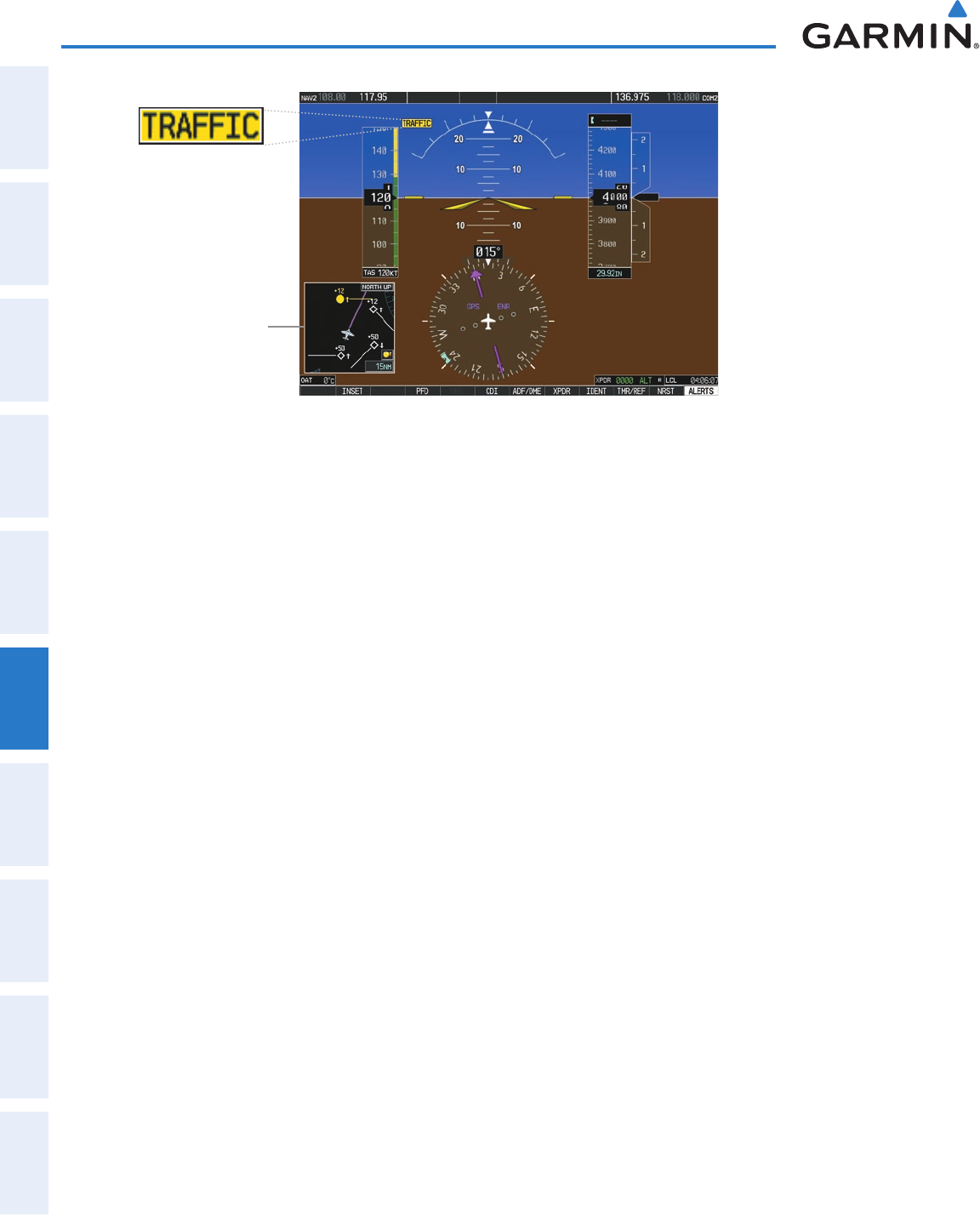
Garmin G1000 Pilot’s Guide for the Diamond DA40/40F
190-00592-06 Rev. A
344
HAZARD AVOIDANCE
SYSTEM
OVERVIEW
FLIGHT
INSTRUMENTS
EIS
AUDIO PANEL
& CNS
FLIGHT
MANAGEMENT
HAZARD
AVOIDANCE
AFCS
ADDITIONAL
FEATURES
APPENDICESINDEX
Figure 6-88 Traffic Annunciation (PFD)
Inset Map
Displays When
TA is Detected
A “TIS Not Available” (TNA) voice alert is generated when the TIS service becomes unavailable or is out of
range. TIS may be unavailable in the radar coverage area due to the following:
•RadarsiteTISModeSsensorisnotoperationalorisoutofservice
•TrafcorrequestingaircraftisbeyondthemaximumrangeoftheTIS-capableModeSradarsite.
•Trafcorrequestingaircraftisabovetheradarsiteintheconeofsilenceandoutofrangeofanadjacentsite.
•Trafcorrequestingaircraftisbelowradarcoverage.Inatterrain,thecoverageextendsfromabout3000
feet upward at 55 miles. Terrain and obstacles around the radar site can further decrease radar coverage in all
directions.
•Trafcdoesnothaveanoperatingtransponder.
The “TIS Not Available” (TNA) voice alert can be manually muted to reduce nuisance alerting. TNA muting
status is shown in the upper left corner of the Traffic Map Page.
Muting the “TIS Not Available” voice alert:
1) Select the Traffic Map Page.
2) Press the
TNA MUTE
Softkey. The status is displayed in the upper left corner of the Traffic Map Page.
Or:
a) Press the
MENU
Key.
b) Select ‘‘’Not Available” Mute On’ (shown if TNA muting is currently off) and press the ENT Key.
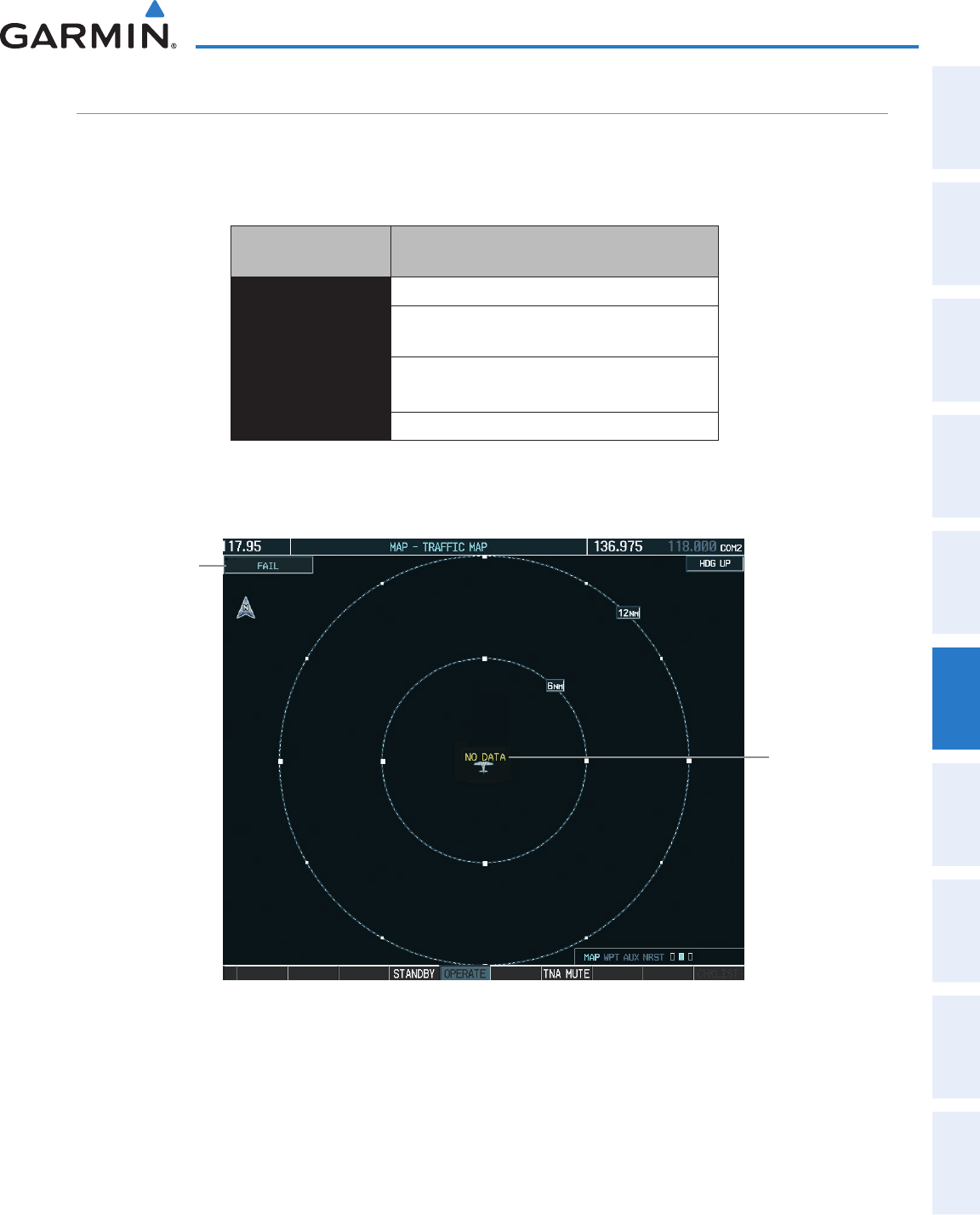
190-00592-06 Rev. A
Garmin G1000 Pilot’s Guide for the Diamond DA40/40F
345
HAZARD AVOIDANCE
SYSTEM
OVERVIEW
FLIGHT
INSTRUMENTS EIS AUDIO PANEL
& CNS
FLIGHT
MANAGEMENT
HAZARD
AVOIDANCE AFCS ADDITIONAL
FEATURES APPENDICES INDEX
SYSTEM STATUS
The G1000 performs an automatic test of TIS during power-up. If TIS passes the test, TIS enters Standby
Mode (on the ground) or Operating Mode (in the air). If TIS fails the power up test, an annunciation is shown
in the center of the Traffic Map Page.
Traffic Map Page
Annunciation Description
NO DATA Data is not being received from the transponder*
DATA FAILED Data is being received from the transponder, but
a failure is detected in the data stream*
FAILED The transponder has failed*
UNAVAILABLE TIS is unavailable or out of range
* Contact a service center or Garmin dealer for corrective action
Table 6-14 TIS Failure Annunciations
Figure 6-89 TIS Power-up Test Failure
Data Not Received
from Transponder
System Test has Failed
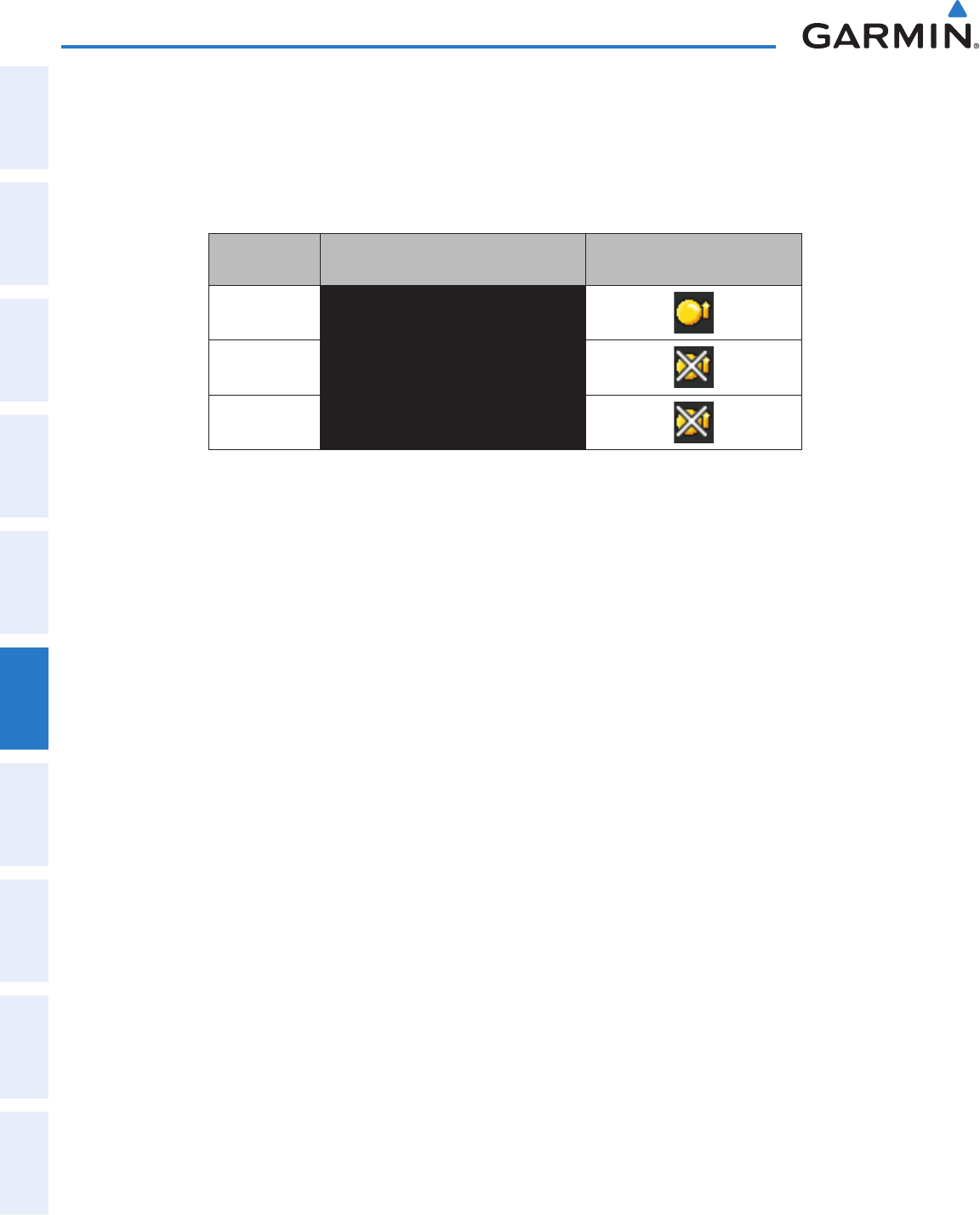
Garmin G1000 Pilot’s Guide for the Diamond DA40/40F
190-00592-06 Rev. A
346
HAZARD AVOIDANCE
SYSTEM
OVERVIEW
FLIGHT
INSTRUMENTS
EIS
AUDIO PANEL
& CNS
FLIGHT
MANAGEMENT
HAZARD
AVOIDANCE
AFCS
ADDITIONAL
FEATURES
APPENDICESINDEX
The traffic mode is annunciated in the upper left corner of the Traffic Map Page. When the aircraft is on the
ground, TIS automatically enters Standby Mode. If traffic is selected for display on another map while Standby
Mode is selected, the traffic display enabled icon is crossed out (also the case whenever TIS has failed). Once
the aircraft is airborne, TIS switches to Operating Mode and traffic information is displayed. The mode can be
changed manually using softkeys or the page menu.
Mode Traffic Mode Annunciation
(Traffic Map Page)
Traffic Display Enabled Icon
(Other Maps)
TIS Operating OPERATING
TIS Standby STANDBY
(also shown in white in center of page)
TIS Failed* FAIL
* See Table 6-16 for additional failure annunciations
Table 6-15 TIS Modes
Switching between TIS modes:
1) Select the Traffic Map Page.
2) Press the
STANDBY
or
OPERATE
Softkey to switch between modes. The mode is displayed in the upper left
corner of the Traffic Map Page.
Or:
a) Press the
MENU
Key.
b) Select ‘Operate Mode’ or ‘Standby Mode’ (choice dependent on current state) and press the ENT Key.
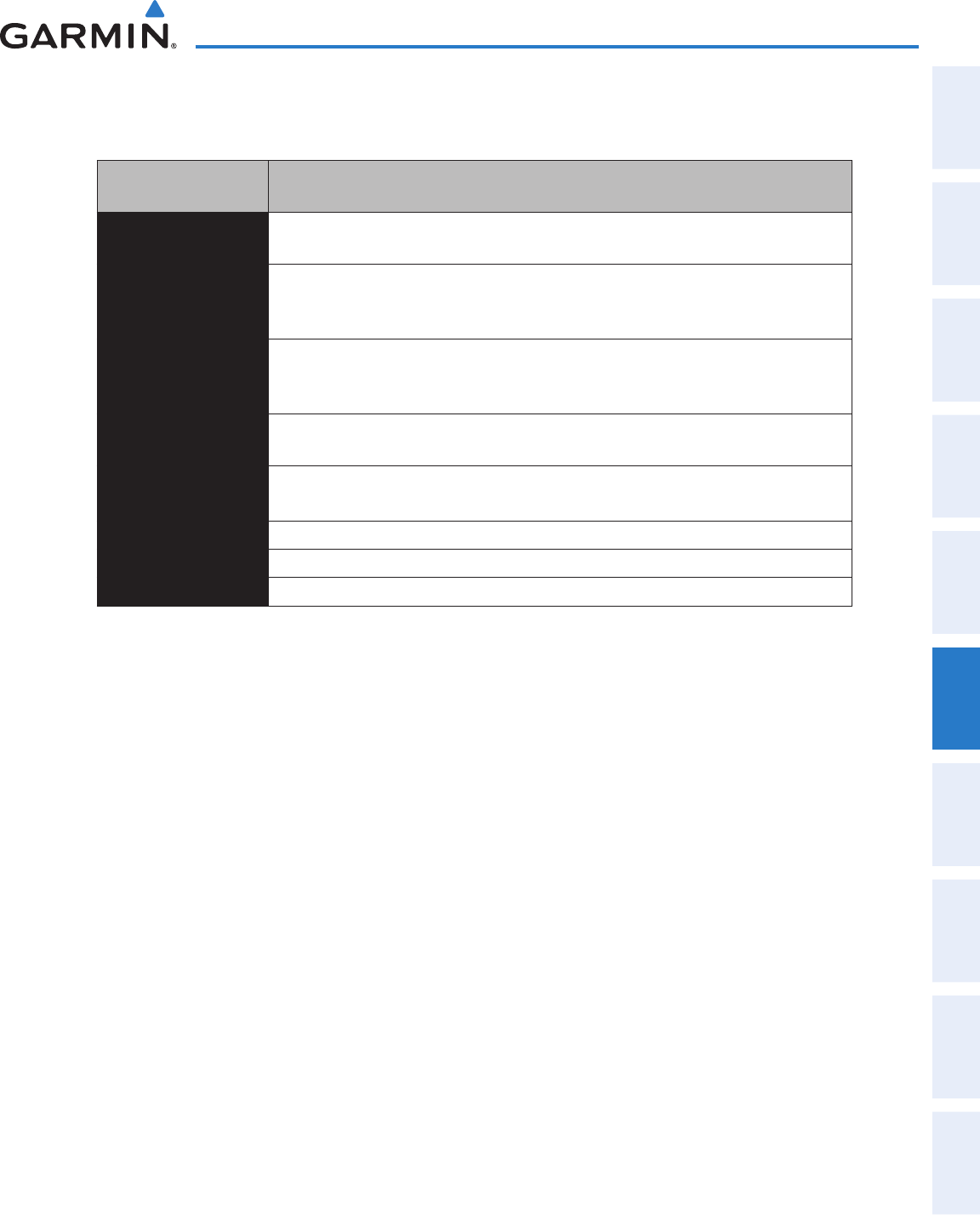
190-00592-06 Rev. A
Garmin G1000 Pilot’s Guide for the Diamond DA40/40F
347
HAZARD AVOIDANCE
SYSTEM
OVERVIEW
FLIGHT
INSTRUMENTS EIS AUDIO PANEL
& CNS
FLIGHT
MANAGEMENT
HAZARD
AVOIDANCE AFCS ADDITIONAL
FEATURES APPENDICES INDEX
The annunciations to indicate the status of traffic information appear in a banner at the lower left corner of
maps on which traffic can be displayed (Table 6-16).
Traffic Status Banner
Annunciation Description
TA OFF SCALE A Traffic Advisory is outside the selected display range*
Annunciation is removed when traffic comes within the selected display range
TA X.X ± XX ↕
System cannot determine bearing of Traffic Advisory**
Annunciation indicates distance in nm, altitude separation in hundreds of feet, and
altitude trend arrow (climbing/descending)
AGE MM:SS
Appears if traffic data is not refreshed within 6 seconds
If after another 6 seconds data is not received, traffic is removed from the display
The quality of displayed traffic information is reduced as the age increases
TRFC COAST The displayed data is not current (6 to 12 seconds since last message)
The quality of displayed traffic information is reduced when this message is displayed
TRFC RMVD Traffic is removed because it is too old for coasting (12 to 60 seconds since last message)
Traffic may exist within the selected display range, but it is not displayed
TRFC FAIL Traffic data has failed
NO TRFC DATA Traffic has not been detected
TRFC UNAVAIL The traffic service is unavailable or out of range
*Shown as symbol on Traffic Map Page
**Shown in center of Traffic Map Page
Table 6-16 TIS Traffic Status Annunciations
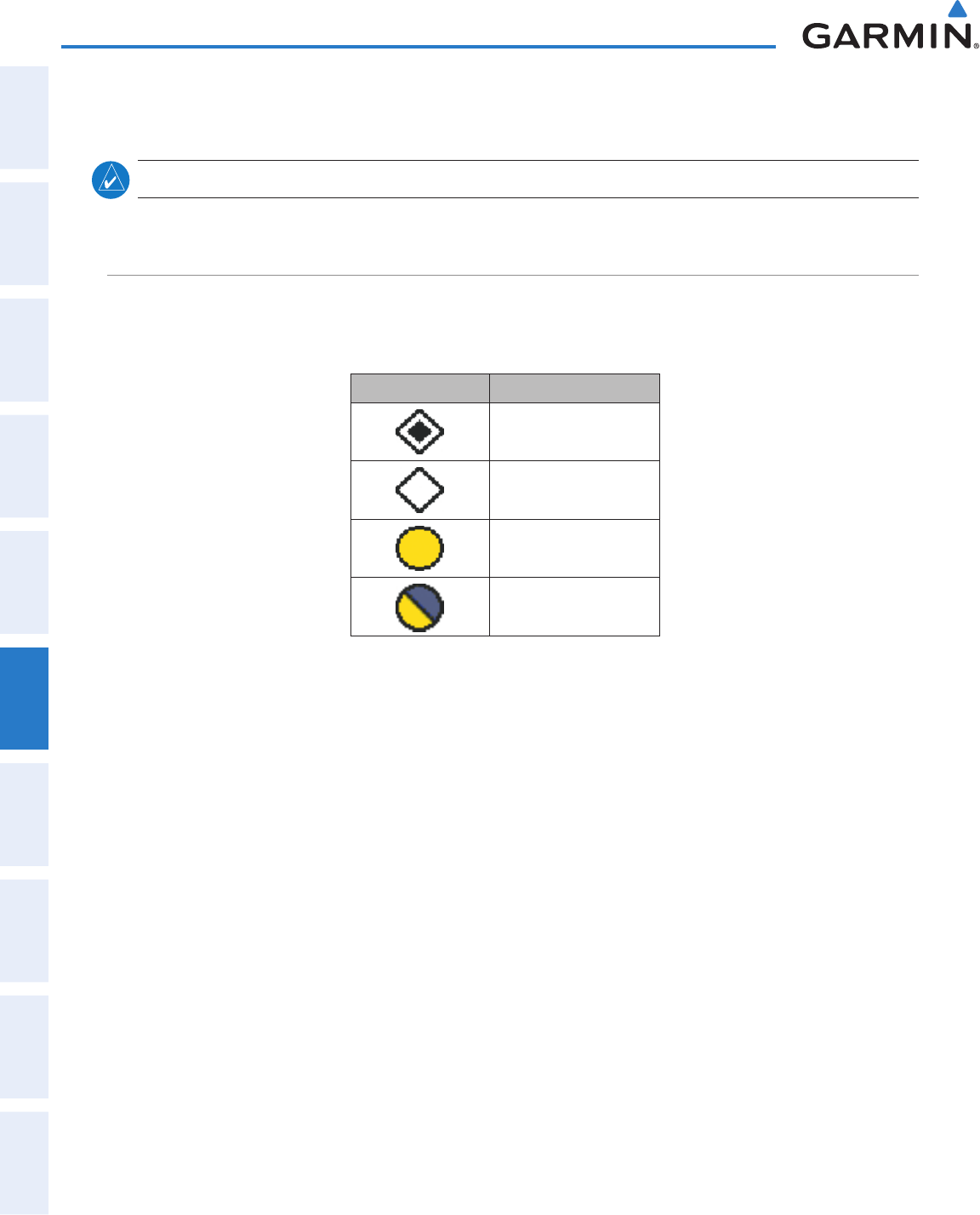
Garmin G1000 Pilot’s Guide for the Diamond DA40/40F
190-00592-06 Rev. A
348
HAZARD AVOIDANCE
SYSTEM
OVERVIEW
FLIGHT
INSTRUMENTS
EIS
AUDIO PANEL
& CNS
FLIGHT
MANAGEMENT
HAZARD
AVOIDANCE
AFCS
ADDITIONAL
FEATURES
APPENDICESINDEX
6.7 TRAFFIC ADVISORY SYSTEM
NOTE: TIS is disabled when Traffic Advisory System (TAS) is installed.
Refer to the Avidyne TAS600 Series Pilot’s Guide for a detailed discussion of the Avidyne TAS600.
TAS SYMBOLOGY
Traffic Advisory System (TAS) is designed to help in detection and avoidance of other aircraft. TAS uses an on-
board interrogator-processor and the Mode S transponder for the air-to-air traffic data link. Traffic is displayed
according to TCAS symbology using four different symbols.
TAS Symbol Description
Non-Threat Traffic
Proximity Advisory (PA)
Traffic Advisory (TA)
Traffic Advisory Off Scale
Table 6-17 TAS Symbol Description
A Non-threat Advisory, shown as an open white diamond, indicates that an intruding aircraft is at greater than
±1200 feet relative altitude or the distance is beyond 5 nm.
A Proximity Advisory indicates that the intruding aircraft is within ±1200 feet and is within 5 nm range, but
is still not considered a threat.
A Traffic Advisory (TA) alerts the crew to a potentially hazardous intruding aircraft. Closing rate, distance,
and vertical separation meet TA criteria. A Traffic Advisory that is beyond the selected display range is indicated
by a half TA symbol at the edge of the screen at the relative bearing of the intruder.
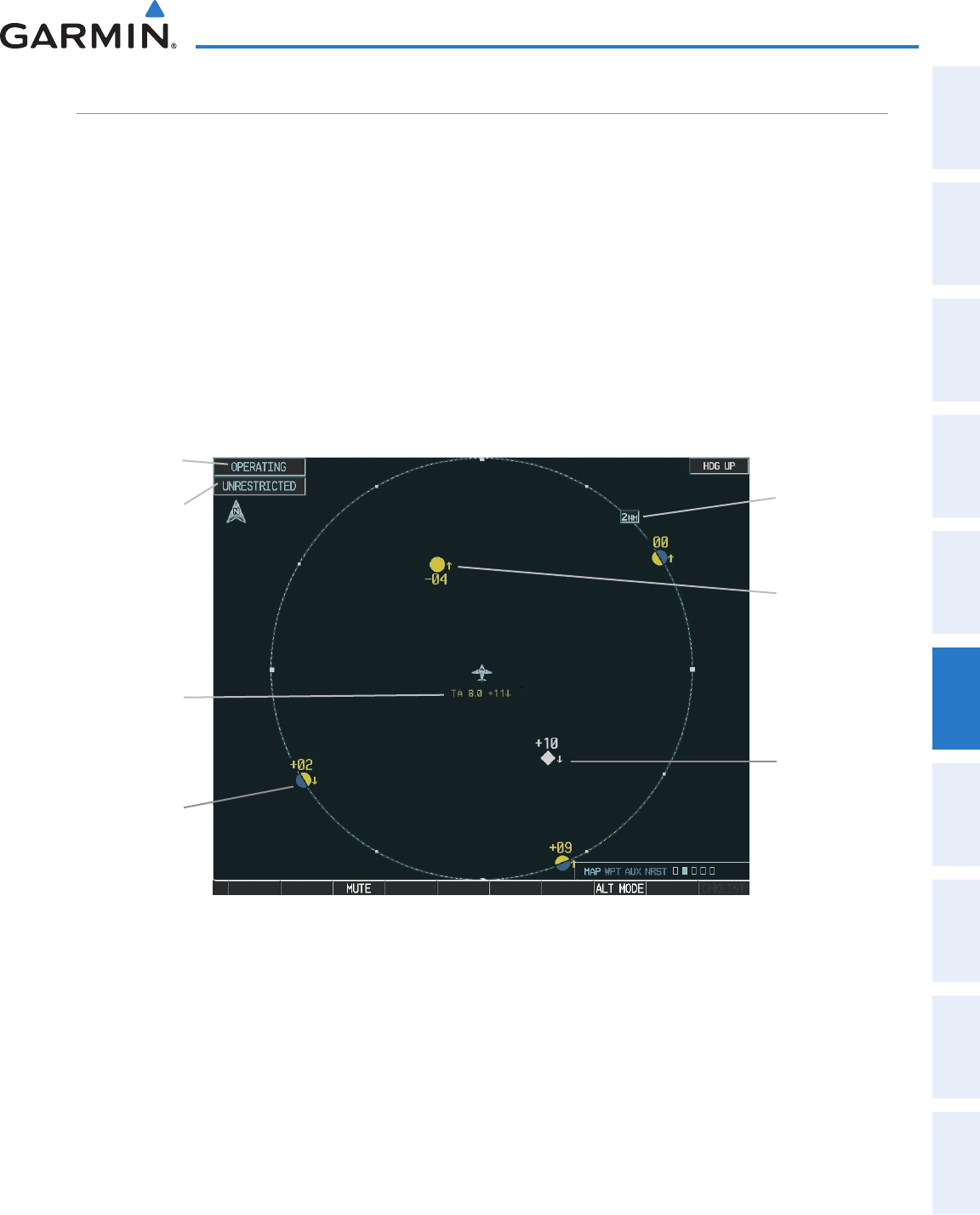
190-00592-06 Rev. A
Garmin G1000 Pilot’s Guide for the Diamond DA40/40F
349
HAZARD AVOIDANCE
SYSTEM
OVERVIEW
FLIGHT
INSTRUMENTS EIS AUDIO PANEL
& CNS
FLIGHT
MANAGEMENT
HAZARD
AVOIDANCE AFCS ADDITIONAL
FEATURES APPENDICES INDEX
DISPLAYING TRAFFIC DATA
Traffic information is displayed on the following maps:
•PFDInsetMap
•NavigationMapPage
•TrafcMapPage
•TripPlanningPage
•NearestPages
•ActiveFlightPlanPage
Displaying traffic on the Traffic Map Page:
1) Turn the large
FMS
Knob to select the Map Page Group.
2) Turn the small
FMS
Knob
to select the Traffic Map Page.
3) Turn the RANGE Knob clockwise to display a larger area or counter-clockwise to display a smaller area.
Figure 6-90 Traffic Map Page
Operating
Mode
Altitude
Mode
Traffic Advisory,
Aircraft is
400’ Below,
Climbing
Off Scale
Traffic
“Non-Bearing”
Traffic (Bearing
Undetermined),
Distance 8.0 nm,
1100’ Above,
Descending Proximity
Traffic, 1000’
Above,
Descending
Traffic Display
Range
The Traffic Map Page shows surrounding TAS traffic data in relation to the aircraft’s current position and
altitude, without basemap clutter. Aircraft orientation is always heading up unless there is no valid heading.
Map range is adjustable with the RANGE Knob from 2 to 24 nm, as indicated by the map range rings.
The traffic mode and altitude display mode are annunciated in the upper left corner.
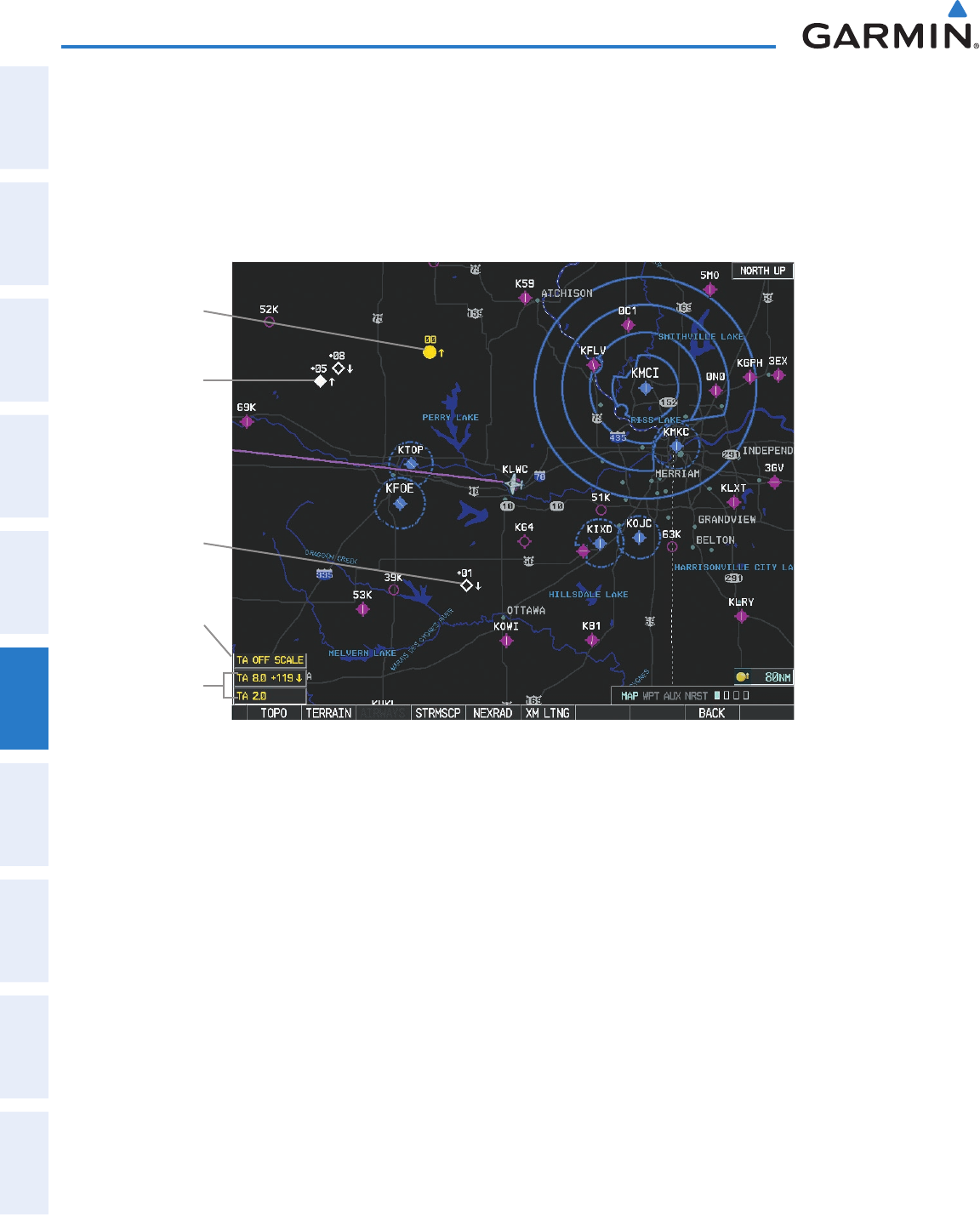
Garmin G1000 Pilot’s Guide for the Diamond DA40/40F
190-00592-06 Rev. A
350
HAZARD AVOIDANCE
SYSTEM
OVERVIEW
FLIGHT
INSTRUMENTS
EIS
AUDIO PANEL
& CNS
FLIGHT
MANAGEMENT
HAZARD
AVOIDANCE
AFCS
ADDITIONAL
FEATURES
APPENDICESINDEX
Displaying traffic information (maps other than the Traffic Map Page):
1) Press the MAP Softkey.
2) Press the TRAFFIC Softkey to display traffic data.
When traffic is selected on maps other than the Traffic Map Page, a traffic icon is shown to indicate TAS is
enabled for display.
Proximity
Traffic
Figure 6-91 TAS Traffic on Navigation Map
Traffic
Advisory
TA Off Scale
Banner
Non-Bearing
Traffic Advisories
Non-Threat
Traffic
Displaying traffic information (PFD Inset Map):
1) Press the INSET Softkey.
2) Press the TRAFFIC Softkey to display traffic data on the inset map (TRFC-1).
3) Press the softkey again to display the traffic-only inset (TRFC-2).
4) Press the softkey again to remove traffic data.
190-00592-06 Rev. A
Garmin G1000 Pilot’s Guide for the Diamond DA40/40F
351
HAZARD AVOIDANCE
SYSTEM
OVERVIEW
FLIGHT
INSTRUMENTS EIS AUDIO PANEL
& CNS
FLIGHT
MANAGEMENT
HAZARD
AVOIDANCE AFCS ADDITIONAL
FEATURES APPENDICES INDEX
ALTITUDE DISPLAY
Changing the altitude display mode:
1) On the Traffic Page, press the
ALT MODE
Softkey.
2) Press one of the following Softkeys:
• BELOW
• NORMAL
• ABOVE
• UNREST (unrestricted)
3) To return to the Traffic Page, press the BACK Softkey.
Or:
1) Press the MENU Key.
2) Turn the small
FMS
Knob
to select one of the following:
• BELOW
• NORMAL
• ABOVE
• UNREST (unrestricted)
3) Press the ENT Softkey.
TRAFFIC MAP PAGE DISPLAY RANGE
The display range on the Traffic Map Page can be changed at any time. Map range is adjustable with the
RANGE Knob from 2 to 24 nm, as indicated by the map range rings.
Changing the display range on the Traffic Page:
1) Turn the RANGE Knob.
2) The following range options are available:
• 2 nm
• 2 and 6 nm
• 6 and 12 nm
• 12 and 24 nm
The Navigation Map Page Setup Menu also controls the display of traffic. The setup menu controls the map
range settings. Traffic data symbols and labels can be decluttered from the display. If a map range larger than
the map range setting is selected, the data is removed from the map. Maps besides the Traffic Map Page use
settings based on those selected for the Navigation Map Page.
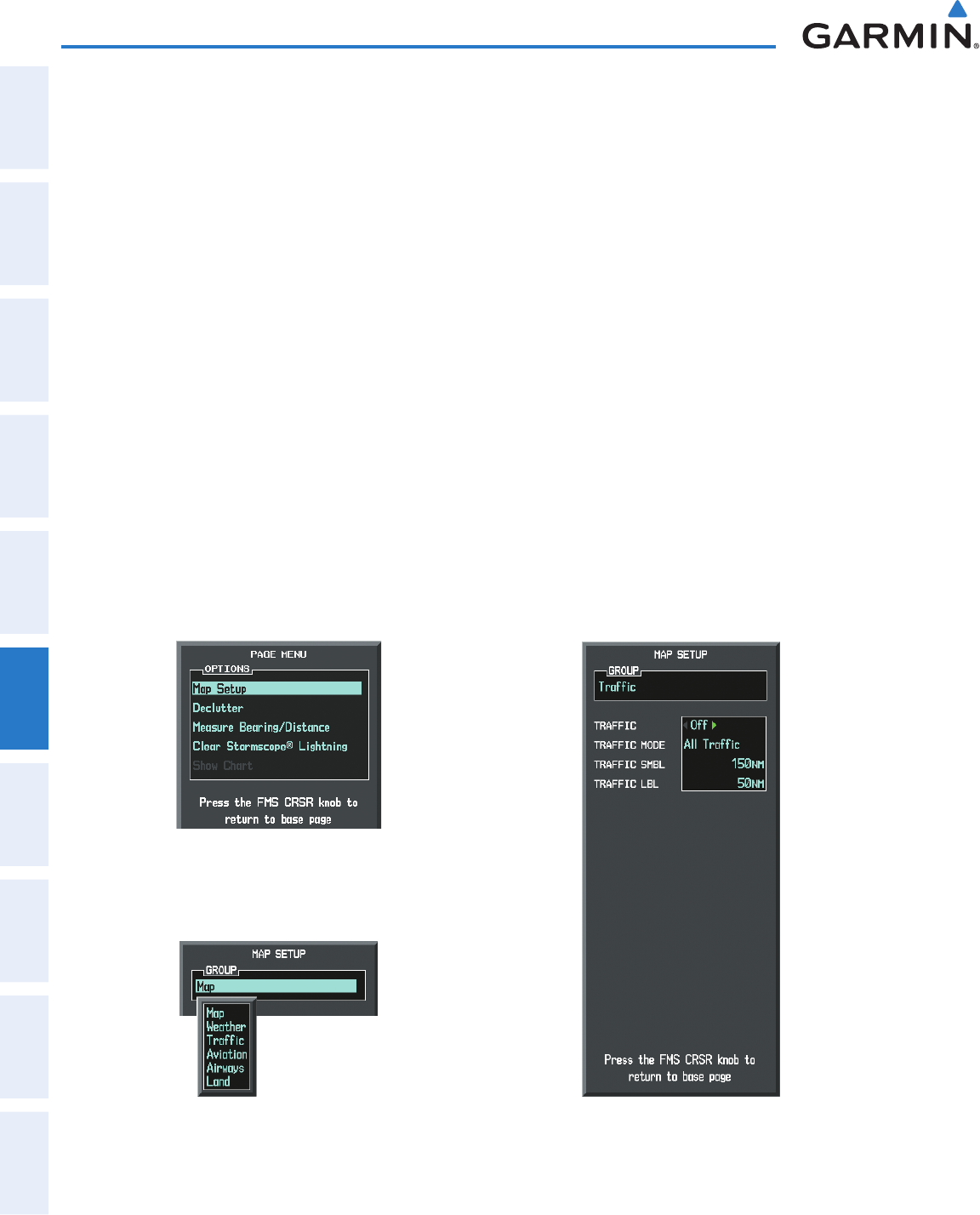
Garmin G1000 Pilot’s Guide for the Diamond DA40/40F
190-00592-06 Rev. A
352
HAZARD AVOIDANCE
SYSTEM
OVERVIEW
FLIGHT
INSTRUMENTS
EIS
AUDIO PANEL
& CNS
FLIGHT
MANAGEMENT
HAZARD
AVOIDANCE
AFCS
ADDITIONAL
FEATURES
APPENDICESINDEX
Customizing the traffic display on the Navigation Map Page:
1) Select the Navigation Map Page.
2) Press the MENU Key.
3) With Map Setup highlighted, press the
ENT
Key (Figure 6-92).
4) Turn the small FMS Knob to select the Traffic Group and press the ENT Key (Figure 6-93).
5) Turn the large
FMS
Knob or press the
ENT
Key to scroll through the selections (Figure 6-94).
•TRAFFIC – Turns the display of traffic data on or off
•TRAFFIC MODE – Selects the traffic mode for display; select from:
- All Traffic - Displays all traffic
- TA/PA - Displays Traffic Alerts and Proximity Advisories
- TA ONLY - Displays Traffic Alerts only
•TRAFFIC SMBL – Selects the maximum range at which traffic symbols are shown
•TRAFFIC LBL – Selects the maximum range at which traffic labels are shown with the option to turn off
6) Turn the small
FMS
Knob to scroll through options (ON/OFF, range settings, etc.).
7) Press the
ENT
Key to select an option.
8) Press the FMS Knob or CLR Key to return to the Navigation Map Page.
Figure 6-93 Navigation Map Page Setup Menu
Figure 6-92 Navigation Map Page Menu
Figure 6-94 Navigation Map Page Setup Menu, Traffic Group
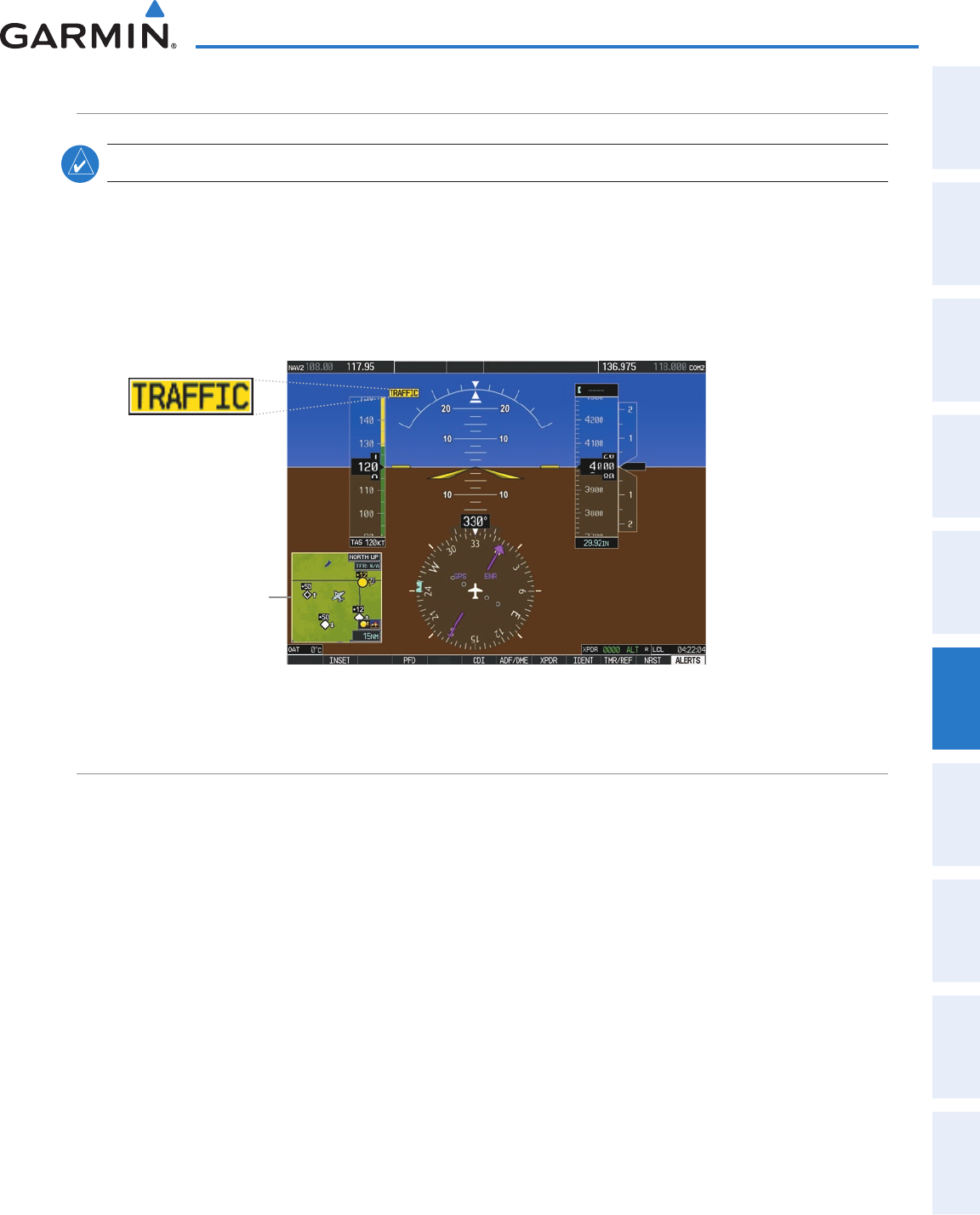
190-00592-06 Rev. A
Garmin G1000 Pilot’s Guide for the Diamond DA40/40F
353
HAZARD AVOIDANCE
SYSTEM
OVERVIEW
FLIGHT
INSTRUMENTS EIS AUDIO PANEL
& CNS
FLIGHT
MANAGEMENT
HAZARD
AVOIDANCE AFCS ADDITIONAL
FEATURES APPENDICES INDEX
TAS ALERTS
NOTE: Refer to the TAS600 documentation for information on alerts generated by the TAS equipment.
When the number of TAs on the Traffic Map Page increases from one scan to the next, the following occur:
•A“Traffic” voice alert is generated followed by the clock position, relative altitude and range of the TA.
•ATRAFFICAnnunciationappearsatthetoprightoftheairspeedonthePFD,ashingfor5secondsand
remaining displayed until no TAs are detected in the area.
•ThePFDInsetMapisautomaticallydisplayedwithTAtrafc.
Figure 6-95 Traffic Annunciation (PFD)
Inset Map
Displays When
TA is Detected
TAS VOICE ALERTS
To listen to an update of Traffic Advisories press the MUTE Softkey twice. If no Traffic Advisories (TAs) are
in effect, a “No Advisories” statement is heard.
Muting the TAS voice alert in progress:
1) Select the Traffic Map Page.
2) Select the
MUTE
Softkey while the voice alert is playing. Subsequent voice alerts will be heard.
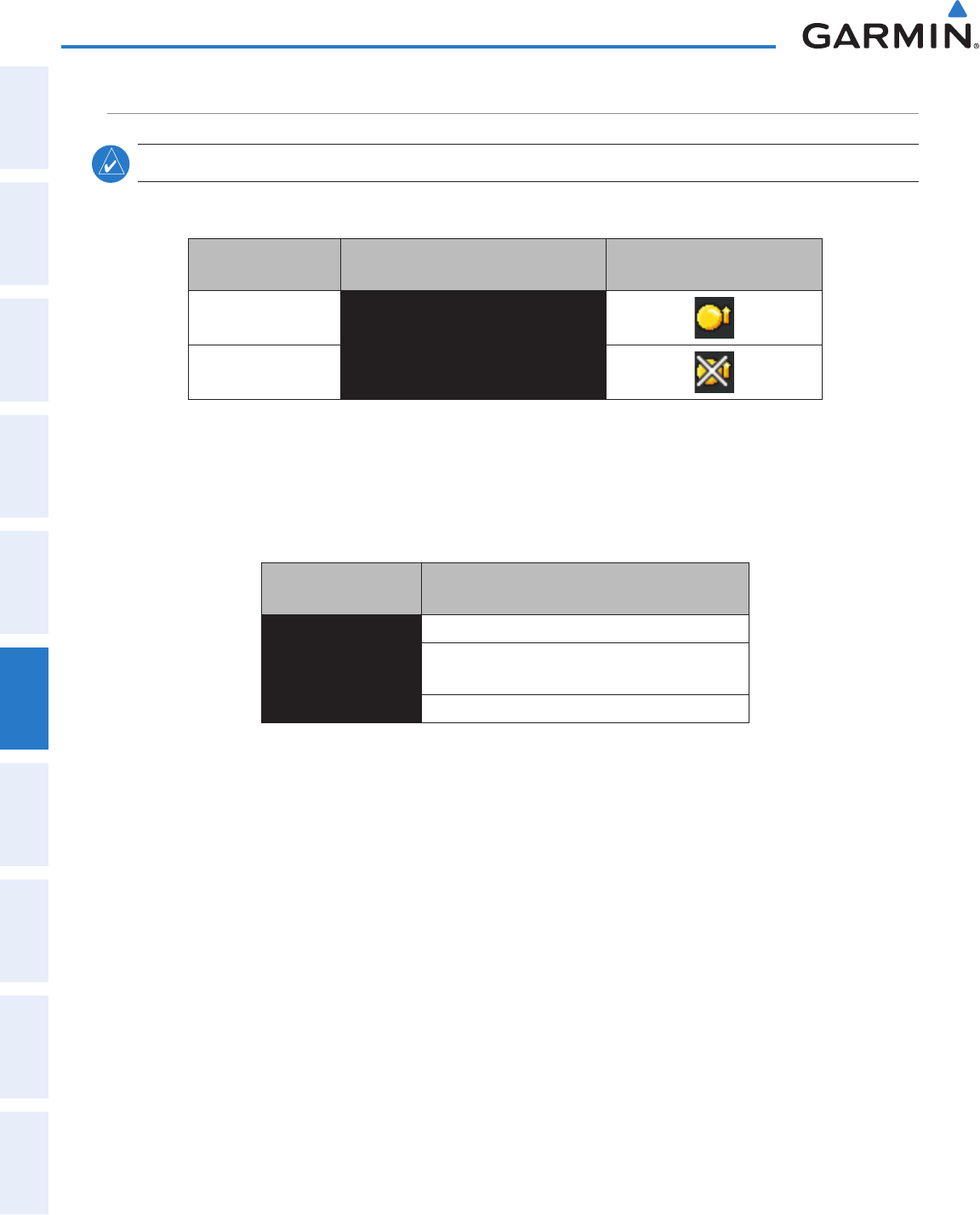
Garmin G1000 Pilot’s Guide for the Diamond DA40/40F
190-00592-06 Rev. A
354
HAZARD AVOIDANCE
SYSTEM
OVERVIEW
FLIGHT
INSTRUMENTS
EIS
AUDIO PANEL
& CNS
FLIGHT
MANAGEMENT
HAZARD
AVOIDANCE
AFCS
ADDITIONAL
FEATURES
APPENDICESINDEX
SYSTEM STATUS
NOTE: Refer to the TAS600 documentation for information on the operating mode.
The traffic mode is annunciated in the upper left corner of the Traffic Map Page.
Mode Traffic Mode Annunciation
(Traffic Map Page)
Traffic Display Enabled Icon
(Other Maps)
TAS Operating OPERATING
TAS Failed* FAIL
* See Table 6-21 for additional failure annunciations
Table 6-18 TAS Modes
If the unit fails, an annunciation as to the cause of the failure is shown in the center of the Traffic Map Page.
Traffic Map Page
Annunciation Description
NO DATA Data is not being received from the TAS unit
DATA FAILED Data is being received from the TAS unit, but the
unit is self-reporting a failure
FAILED Incorrect data format received from the TAS unit
Table 6-19 TAS Failure Annunciations
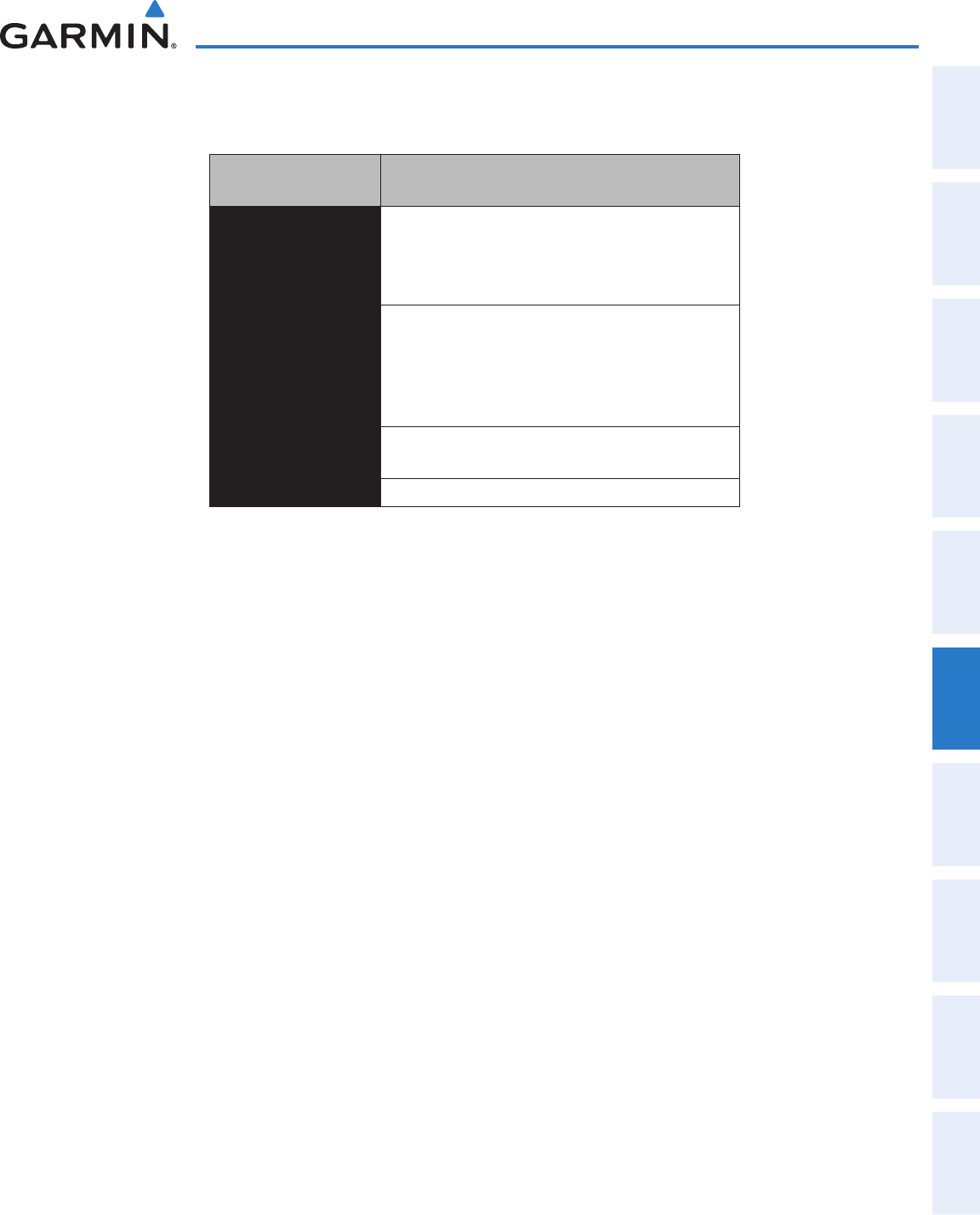
190-00592-06 Rev. A
Garmin G1000 Pilot’s Guide for the Diamond DA40/40F
355
HAZARD AVOIDANCE
SYSTEM
OVERVIEW
FLIGHT
INSTRUMENTS EIS AUDIO PANEL
& CNS
FLIGHT
MANAGEMENT
HAZARD
AVOIDANCE AFCS ADDITIONAL
FEATURES APPENDICES INDEX
The annunciations to indicate the status of traffic information appear in a banner at the lower left corner of
maps on which traffic can be displayed.
Traffic Status Banner
Annunciation Description
TA OFF SCALE
A Traffic Advisory is outside the selected display
range*
Annunciation is removed when traffic comes within
the selected display range
TA X.X ± XX ↕
System cannot determine bearing of Traffic
Advisory**
Annunciation indicates distance in nm, altitude
separation in hundreds of feet, and altitude trend
arrow (climbing/descending)
TRFC FAIL TAS unit has failed (unit is self-reporting a failure or
sending incorrectly formatted data)
NO TRFC DATA Data is not being received from the TAS unit
*Shown as symbol on Traffic Map Page
**Shown in center of Traffic Map Page
Table 6-20 TAS Traffic Status Annunciations
Garmin G1000 Pilot’s Guide for the Diamond DA40/40F
190-00592-06 Rev. A
356
HAZARD AVOIDANCE
SYSTEM
OVERVIEW
FLIGHT
INSTRUMENTS
EIS
AUDIO PANEL
& CNS
FLIGHT
MANAGEMENT
HAZARD
AVOIDANCE
AFCS
ADDITIONAL
FEATURES
APPENDICESINDEX
Bl a n k Pa g e
190-00592-06 Rev. A
Garmin G1000 Pilot’s Guide for Diamond DA40/40F
357
AUTOMATIC FLIGHT CONTROL SYSTEM
SYSTEM
OVERVIEW
FLIGHT
INSTRUMENTS EIS AUDIO PANEL
& CNS
FLIGHT
MANAGEMENT
HAZARD
AVOIDANCE AFCS ADDITIONAL
FEATURES APPENDICES INDEX
SECTION 7 AUTOMATIC FLIGHT CONTROL SYSTEM (OPTIONAL)
NOTE: The approved Aircraft Flight Manual Supplement (AFMS) always supersedes the information in this
Pilot’s Guide.
NOTE: A failure of the primary (#1) Integrated Avionics Unit (IAU) results in loss of the flight director. Any
IAU failure results in loss of the autopilot and manual electric trim.
The GFC 700 is a digital Automatic Flight Control System (AFCS), fully integrated within the G1000 System
avionics architecture. The System Overview section provides a block diagram (Figure 1-1) to support this
system description. GFC 700 AFCS functionality in Diamond DA40/40F aircraft is distributed across the
following Line Replaceable Units (LRUs):
•GDU1040PrimaryFlightDisplay(PFD)
•GDU1042/1044Multi-FunctionDisplay(MFD)
•GIA63/63WIntegratedAvionicsUnits(2)
•GSA81AFCSServo(3)
•GSM85ServoMounts(3)
The GFC 700 AFCS can be divided into these main operating functions:
•Flight Director (FD)—Flightdirectoroperationtakesplacewithintheprimary(#1)IAU.Flightdirector
commands are displayed on the PFD. The flight director provides:
– Command Bars showing pitch/roll guidance
– Pitch/roll mode selection and processing
– Autopilot communication
•Autopilot (AP)—Autopilotoperationoccurswithinthepitch,roll,andpitchtrimservoandprovidesservo
monitoring and automatic flight control in response to flight director steering commands, AHRS attitude and
rate information, and airspeed.
•Manual Electric Trim (MET)—Thepitchtrimservoprovidesmanualelectrictrimcapabilitywhenthe
autopilot is not engaged.
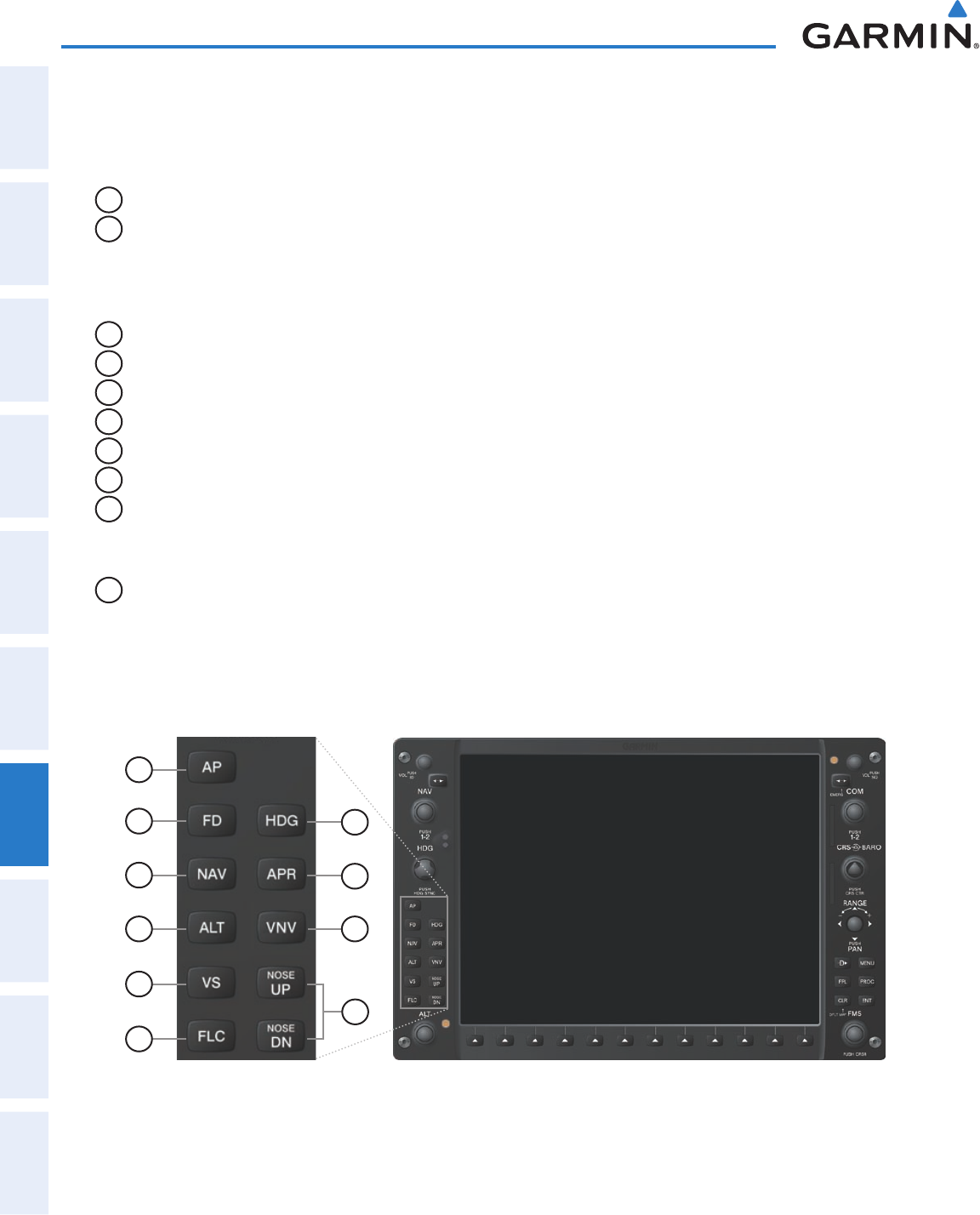
Garmin G1000 Pilot’s Guide for Diamond DA40/40F
190-00592-06 Rev. A
358
AUTOMATIC FLIGHT CONTROL SYSTEM
SYSTEM
OVERVIEW
FLIGHT
INSTRUMENTS
EIS
AUDIO PANEL
& CNS
FLIGHT
MANAGEMENT
HAZARD
AVOIDANCE
AFCS
ADDITIONAL
FEATURES
APPENDICESINDEX
7.1 AFCS CONTROLS
The following dedicated AFCS keys are located on the bezel of the MFD:
1
AP Key Engages/disengages the autopilot
2
FD Key Activates/deactivates the flight director only
Pressing once turns on the flight director in the default pitch and roll modes. Pressing
again deactivates the flight director and removes the Command Bars. If the autopilot
is engaged, the key is disabled.
3
NAV Key Selects/deselects Navigation Mode
4
ALT Key Selects/deselects Altitude Hold Mode
5
VS Key Selects/deselects Vertical Speed Mode
6
FLC Key Selects/deselects Flight Level Change Mode
7
HDG Key Selects/deselects Heading Select Mode
8
APR Key Selects/deselects Approach Mode
9
VNV Key
(GDU 1044
only)
Selects/deselects Vertical Path Tracking Mode for Vertical Navigation flight control
10
NOSE UP/NOSE
DN Keys
Control the mode reference in Pitch Hold, Vertical Speed, and Flight Level Change
modes
Figure 7-1 Dedicated MFD AFCS Controls (GDU 1044)
1
2
3
4
5
6
7
8
10
9
190-00592-06 Rev. A
Garmin G1000 Pilot’s Guide for Diamond DA40/40F
359
AUTOMATIC FLIGHT CONTROL SYSTEM
SYSTEM
OVERVIEW
FLIGHT
INSTRUMENTS EIS AUDIO PANEL
& CNS
FLIGHT
MANAGEMENT
HAZARD
AVOIDANCE AFCS ADDITIONAL
FEATURES APPENDICES INDEX
The following AFCS controls are located in the cockpit separately from the MFD:
AP DISC Switch
(Autopilot Disconnect)
Disengages the autopilot and interrupts pitch trim operation
This switch may be used to mute the aural autopilot disconnect alert.
The AP DISC Switch is located on each control stick.
CWS Button
(Control Wheel Steering)
While pressed, allows manual control of the aircraft while the autopilot is
engaged and synchronizes the flight director’s Command Bars with the current
aircraft pitch (if not in Glideslope Mode) and roll (if in Roll Hold Mode)
Upon release of the CWS Button, the flight director may establish new
reference points, depending on the current pitch and roll modes. CWS
operation details are discussed in the flight director modes section.
The CWS Button is located on the top of the left control stick.
GA Switch (Go Around) Disengages the autopilot and selects flight director Go Around Mode
If an approach procedure is loaded this switch also activates the missed
approach when the selected navigation source is GPS or when the navigation
source is VOR/LOC and a valid frequency has been tuned.
The GA Switch is located on the throttle handle.
AP TRIM Switch
(Autopilot Trim)
Used to command manual electric trim
This composite switch is split into left and right sides. The left switch is
the ARM contact and the right switch controls the DN (forward) and UP
(rearward) contacts. The AP TRIM ARM switch can be used to disengage
the autopilot and to acknowledge an autopilot disconnect alert and mute the
associated aural tone.
Manual trim commands are generated only when both sides of the switch
are operated simultaneously. If either side of the switch is active separately for
more than three seconds, MET function is disabled and ‘PTRM’ is displayed
as the AFCS Status Annunciation on the PFD. The function remains disabled
until both sides of the switch are inactivated.
The AP TRIM Switch is located on the left control stick.
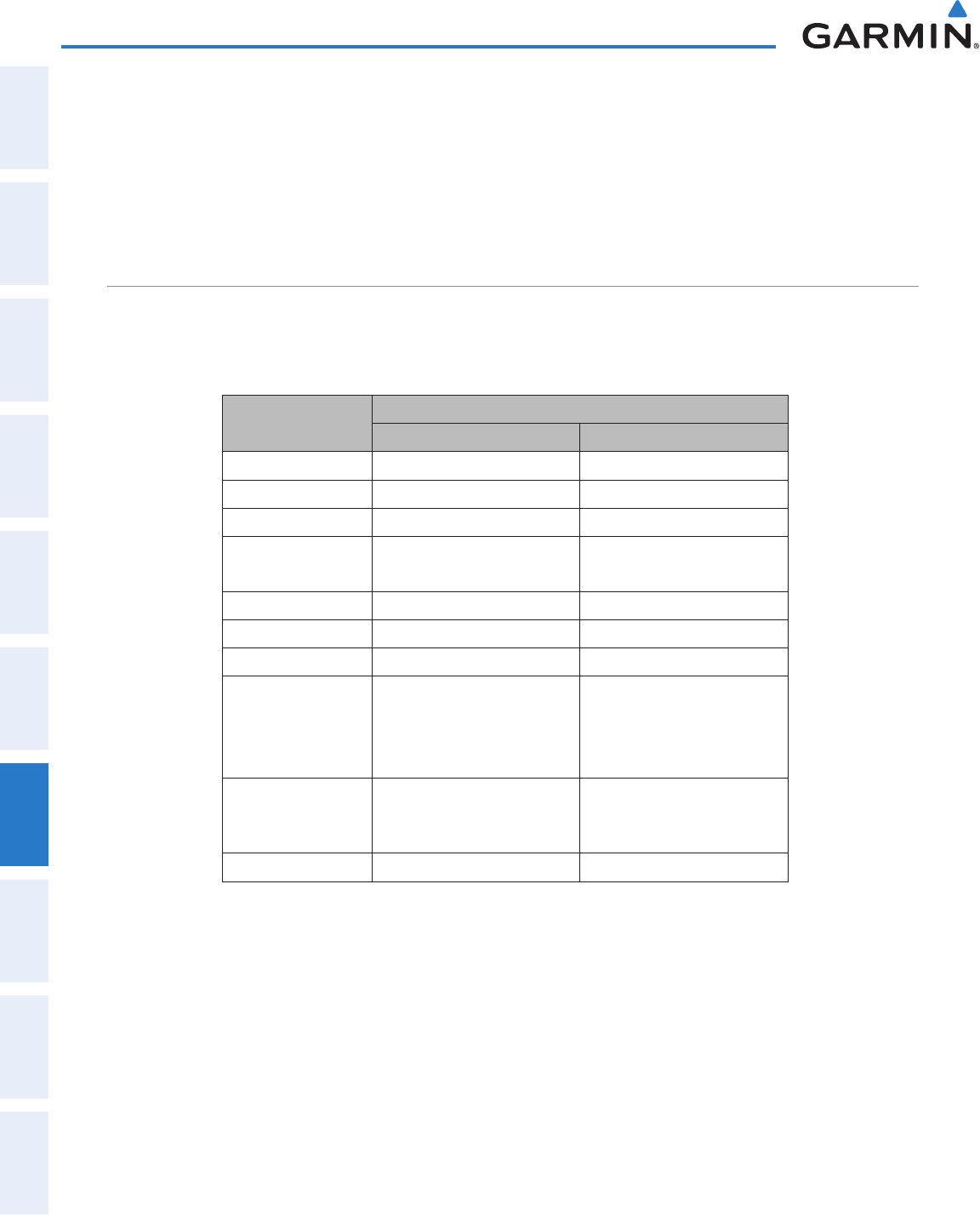
Garmin G1000 Pilot’s Guide for Diamond DA40/40F
190-00592-06 Rev. A
360
AUTOMATIC FLIGHT CONTROL SYSTEM
SYSTEM
OVERVIEW
FLIGHT
INSTRUMENTS
EIS
AUDIO PANEL
& CNS
FLIGHT
MANAGEMENT
HAZARD
AVOIDANCE
AFCS
ADDITIONAL
FEATURES
APPENDICESINDEX
7.2 FLIGHT DIRECTOR OPERATION
The flight director function provides pitch and roll commands to the AFCS and displays them on the PFD.
With the flight director activated, the aircraft can be hand-flown to follow the path shown by the Command Bars.
Maximum commanded pitch (-15°/+20°) and roll (22°) angles, vertical acceleration, and roll rate are limited to
values established during AFCS certification. The flight director also provides commands to the autopilot.
ACTIVATING THE FLIGHT DIRECTOR
An initial press of a key listed in Table 7-1 (when the flight director is not active) activates the flight director
in the listed modes. The flight director may be turned off and the Command Bars removed from the display by
pressing the
FD
Key again. The FD Key is disabled when the autopilot is engaged.
Control Pressed Modes Selected
Lateral Vertical
FD Key Roll Hold (default) ROL Pitch Hold (default) PIT
AP Key Roll Hold (default) ROL Pitch Hold (default) PIT
CWS Button Roll Hold (default) ROL Pitch Hold (default) PIT
GA Switch Takeoff (on ground)
Go Around (in air)
TO
GA
Takeoff (on ground)
Go Around (in air)
TO
GA
ALT Key Roll Hold (default) ROL Altitude Hold ALT
VS Key Roll Hold (default) ROL Vertical Speed VS
VNV Key Roll Hold (default) ROL Vertical Path Tracking* VPTH
NAV Key Navigation**
GPS
VOR
LOC
BC
Pitch Hold (default) PIT
APR Key Approach**
GPS
VOR
LOC
Pitch Hold (default) PIT
HDG Key Heading Select HDG Pitch Hold (default) PIT
*Valid VNV flight plan must be entered before VNV Key press activates flight director.
**The selected navigation receiver must have a valid VOR or LOC signal or active GPS
course before
NAV
or
APR
Key press activates flight director.
Table 7-1 Flight Director Activation
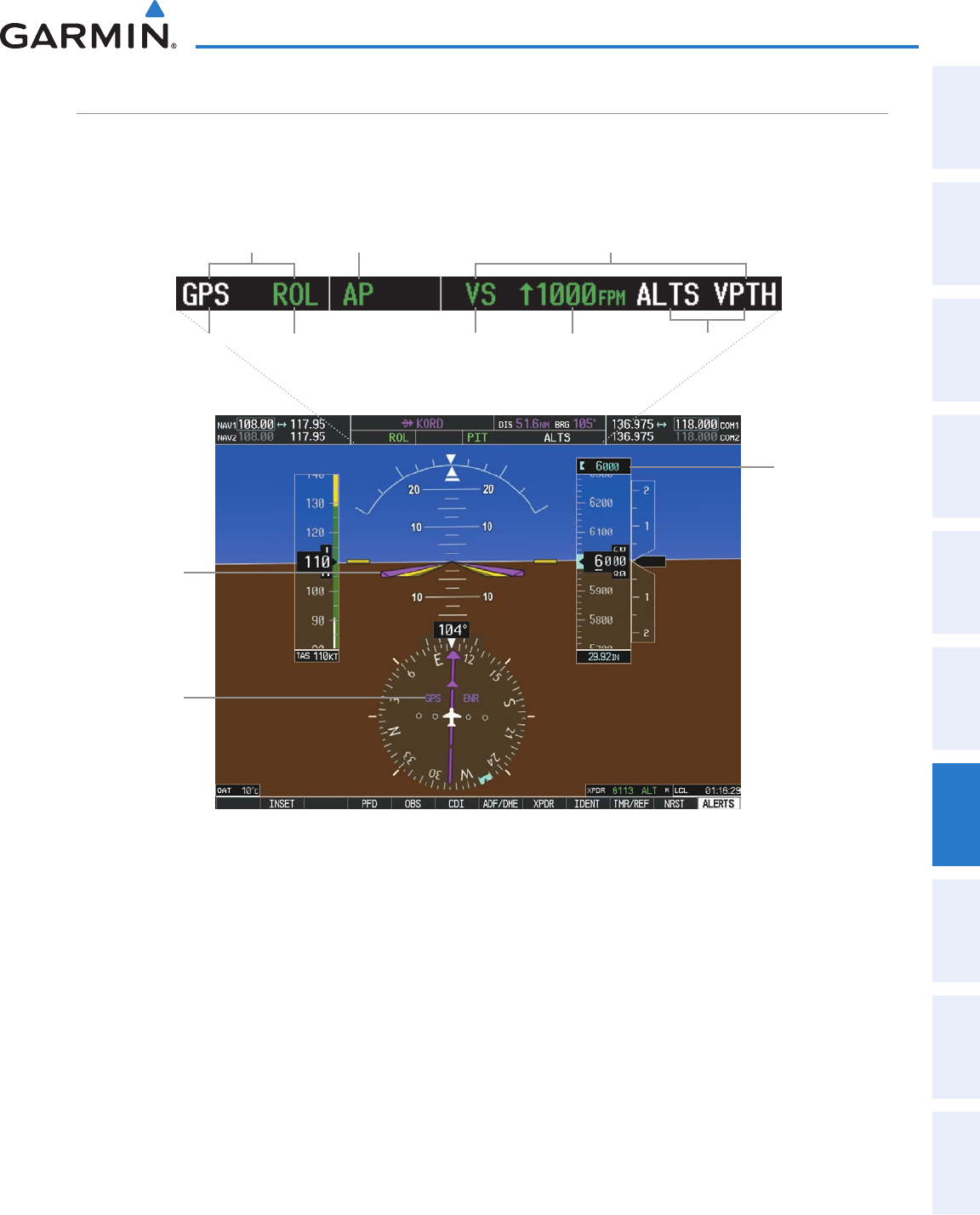
190-00592-06 Rev. A
Garmin G1000 Pilot’s Guide for Diamond DA40/40F
361
AUTOMATIC FLIGHT CONTROL SYSTEM
SYSTEM
OVERVIEW
FLIGHT
INSTRUMENTS EIS AUDIO PANEL
& CNS
FLIGHT
MANAGEMENT
HAZARD
AVOIDANCE AFCS ADDITIONAL
FEATURES APPENDICES INDEX
AFCS STATUS BOX
Flight director mode annunciations are displayed on the PFD when the flight director is active. Autopilot
status is displayed in the center of the AFCS Status Box. Lateral flight director modes are displayed on the left
and vertical on the right. Armed modes are annunciated in white and active in green.
GPS is
Selected
Navigation
Source
Command
Bars
Selected
Altitude
Figure 7-2 PFD AFCS Display
AFCS Status Box
Lateral Modes
Active
Autopilot
Status
Active Mode
Reference
Armed
Vertical Modes
Armed
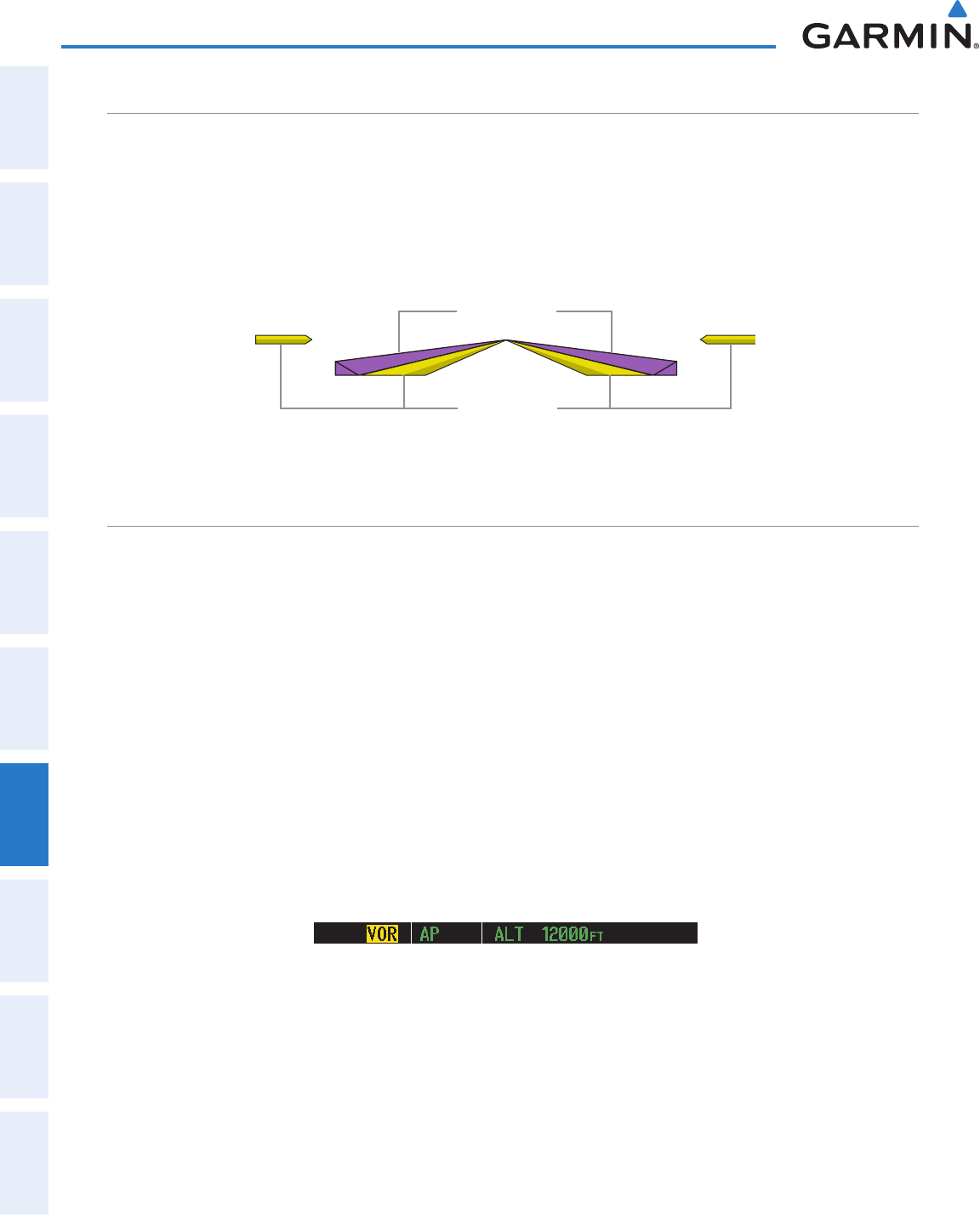
Garmin G1000 Pilot’s Guide for Diamond DA40/40F
190-00592-06 Rev. A
362
AUTOMATIC FLIGHT CONTROL SYSTEM
SYSTEM
OVERVIEW
FLIGHT
INSTRUMENTS
EIS
AUDIO PANEL
& CNS
FLIGHT
MANAGEMENT
HAZARD
AVOIDANCE
AFCS
ADDITIONAL
FEATURES
APPENDICESINDEX
COMMAND BARS
Upon activation of the flight director, Command Bars are displayed on the PFD as a single magenta cue. The
Command Bars move together vertically to indicate pitch commands and bank left or right to indicate roll
commands. The Command Bars do not override the aircraft symbol.
If the attitude information sent to the flight director becomes invalid or unavailable, the Command Bars are
removed from the display. The flight director Command Bars also disappear if the pitch exceeds +30˚/-20˚ or
bank exceeds 65˚.
Aircraft Symbol
Command Bars
Figure 7-3 Command Bars
FLIGHT DIRECTOR MODES
Flight director modes are normally selected independently for the pitch and roll axes. Unless otherwise
specified, all mode keys are alternate action (i.e., press on, press off). In the absence of specific mode selection,
the flight director reverts to the default pitch and/or roll mode(s).
Armed modes are annunciated in white and active in green in the AFCS Status Box. Under normal operation,
when the control for the active flight director mode is pressed, the flight director reverts to the default mode(s)
for the axis(es). Automatic transition from armed to active mode is indicated by the white armed mode
annunciation moving to the green active mode field and flashing for 10 seconds.
If the information required to compute a flight director mode becomes invalid or unavailable, the flight
director automatically reverts to the default mode for that axis. A flashing yellow mode annunciation and
annunciator light indicate loss of sensor (ADC) or navigation data (VOR, LOC, GPS, VNV, WAAS) required to
compute commands. When such a loss occurs, the system automatically begins to roll the wings level (enters
Roll Hold Mode) or maintain the pitch angle (enters Pitch Hold Mode), depending on the affected axis. The
flashing annunciation stops when the affected mode key is pressed or another mode for the axis is selected. If
after 10 seconds no action is taken, the flashing annunciation stops.
Figure 7-4 Loss of VOR Signal
The flight director is automatically disabled if the attitude information required to compute the default flight
director modes becomes invalid or unavailable.
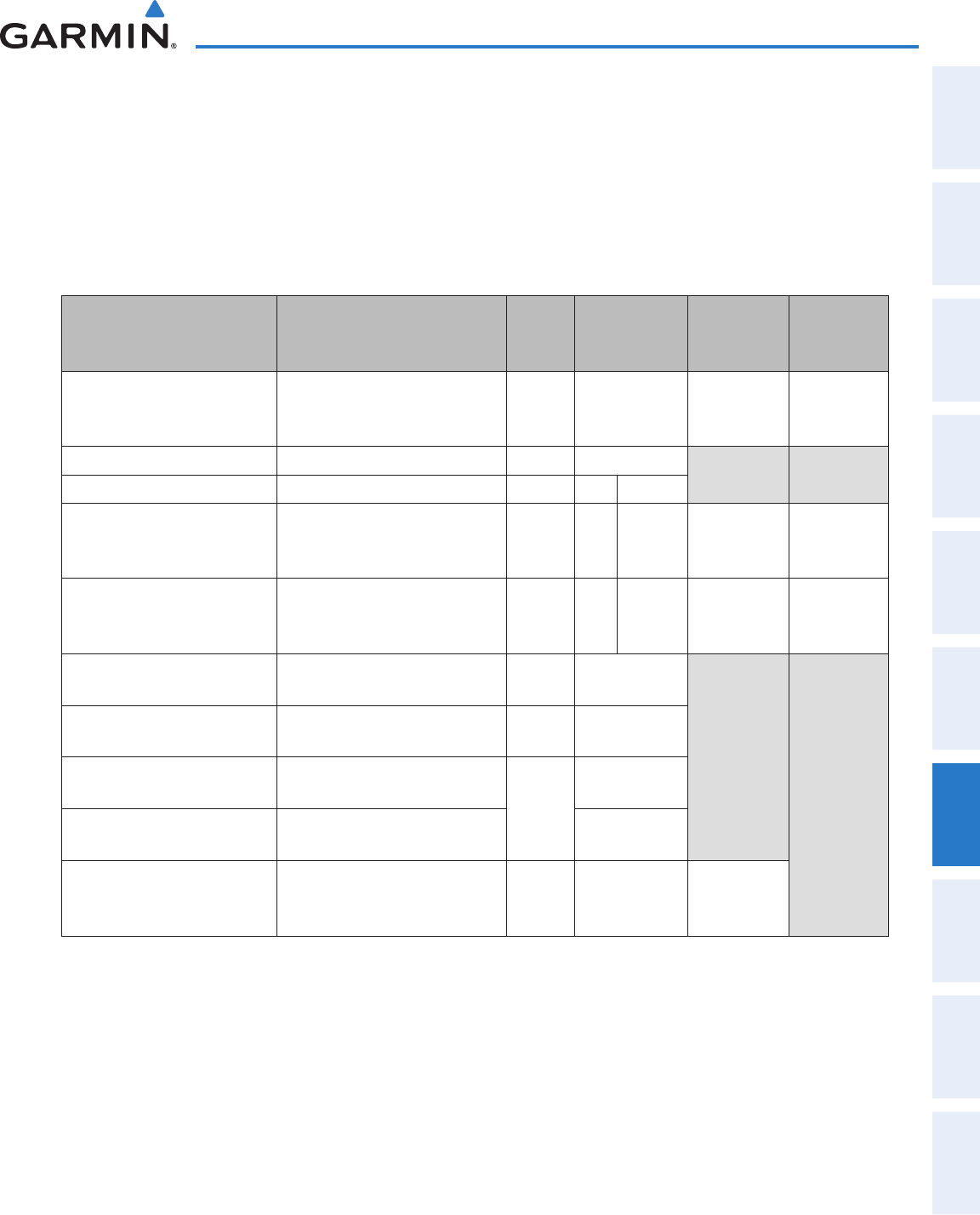
190-00592-06 Rev. A
Garmin G1000 Pilot’s Guide for Diamond DA40/40F
363
AUTOMATIC FLIGHT CONTROL SYSTEM
SYSTEM
OVERVIEW
FLIGHT
INSTRUMENTS EIS AUDIO PANEL
& CNS
FLIGHT
MANAGEMENT
HAZARD
AVOIDANCE AFCS ADDITIONAL
FEATURES APPENDICES INDEX
7.3 VERTICAL MODES
Table 7-2 lists the vertical modes with their corresponding controls and annunciations. The mode reference is
displayed next to the active mode annunciation for Altitude Hold, Vertical Speed, and Flight Level Change modes.
The NOSE UP/NOSE DN Keys can be used to change the vertical mode reference while operating under Pitch
Hold, Vertical Speed, or Flight Level Change Mode. Increments of change and acceptable ranges of values for
each of these references using the NOSE UP/NOSE DN Keys are also listed in the table.
Vertical Mode Description Control Annunciation Reference
Range
Reference
Change
Increment
Pitch Hold
Holds aircraft pitch attitude; may
be used to climb/descend to the
Selected Altitude
(default) PIT -15° to +20° 0.5°
Selected Altitude Capture Captures the Selected Altitude * ALTS
Altitude Hold Holds current Altitude Reference ALT Key ALT nnnnn f T
Vertical Speed
Holds aircraft vertical speed; may
be used to climb/descend to the
Selected Altitude
VS Key VS nnnn f p m -3000 to
+1500 fpm 100 fpm
Flight Level Change
Holds aircraft airspeed while
aircraft is climbing/descending to
the Selected Altitude
FLC Key FLC nnn k T 70 to 165 kt 1 kt
Vertical Path Tracking Captures and tracks descent legs
of an active vertical profile
VNV
Key VPTH
VNV Target Altitude Capture Captures the Vertical Navigation
(VNV) Target Altitude ** ALTV
Glidepath*** Captures and tracks the WAAS
glidepath on approach APR
Key
GP
Glideslope Captures and tracks the ILS
glideslope on approach GS
Go Around
Disengages the autopilot and
commands a constant pitch angle
and wings level
GA
Switch GA 7°
* ALTS is armed automatically when PIT, VS, FLC, or GA is active, and under VPTH when the Selected Altitude is to be captured
instead of the VNV Target Altitude.
** ALTV is armed automatically under VPTH when the VNV Target Altitude is to be captured instead of the Selected Altitude.
***GP is available in installations with GIA 63W IAUs when WAAS is available.
Table 7-2 Flight Director Vertical Modes
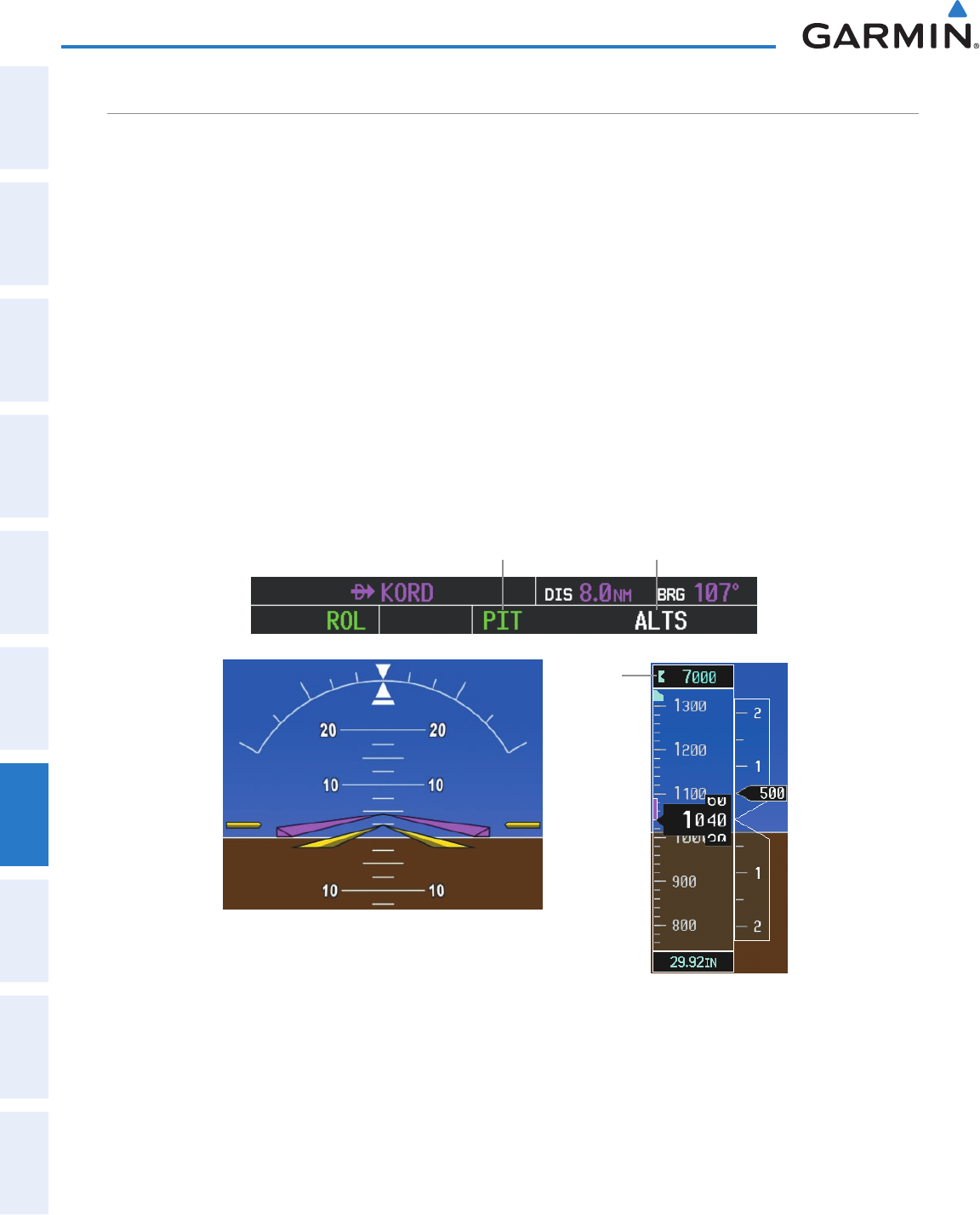
Garmin G1000 Pilot’s Guide for Diamond DA40/40F
190-00592-06 Rev. A
364
AUTOMATIC FLIGHT CONTROL SYSTEM
SYSTEM
OVERVIEW
FLIGHT
INSTRUMENTS
EIS
AUDIO PANEL
& CNS
FLIGHT
MANAGEMENT
HAZARD
AVOIDANCE
AFCS
ADDITIONAL
FEATURES
APPENDICESINDEX
PITCH HOLD MODE (PIT)
When the flight director is activated (the FD Key is pressed), Pitch Hold Mode is selected by default. Pitch
Hold Mode is indicated as the active pitch mode by the green annunciation ‘PIT’. This mode may be used for
climb or descent to the Selected Altitude (shown above the Altimeter), since Selected Altitude Capture Mode is
automatically armed when Pitch Hold Mode is activated.
In Pitch Hold Mode, the flight director maintains a constant pitch attitude, the pitch reference. The pitch
reference is set to the aircraft pitch attitude at the moment of mode selection. If the aircraft pitch attitude
exceeds the flight director pitch command limitations, the flight director commands a pitch angle equal to the
nose-up/down limit.
CHANGING THE PITCH REFERENCE
When operating in Pitch Hold Mode, the pitch reference can be adjusted by:
•Usingthe
NOSE UP/NOSE DN
Keys
•Pressingthe
CWS
Button, hand-flying the aircraft to establish a new pitch reference, then releasing the
CWS
Button
Figure 7-5 Pitch Hold Mode
Selected
Altitude
Command Bars Maintain
Desired Pitch Reference
Pitch Hold
Mode Active Selected Altitude
Capture Mode Armed
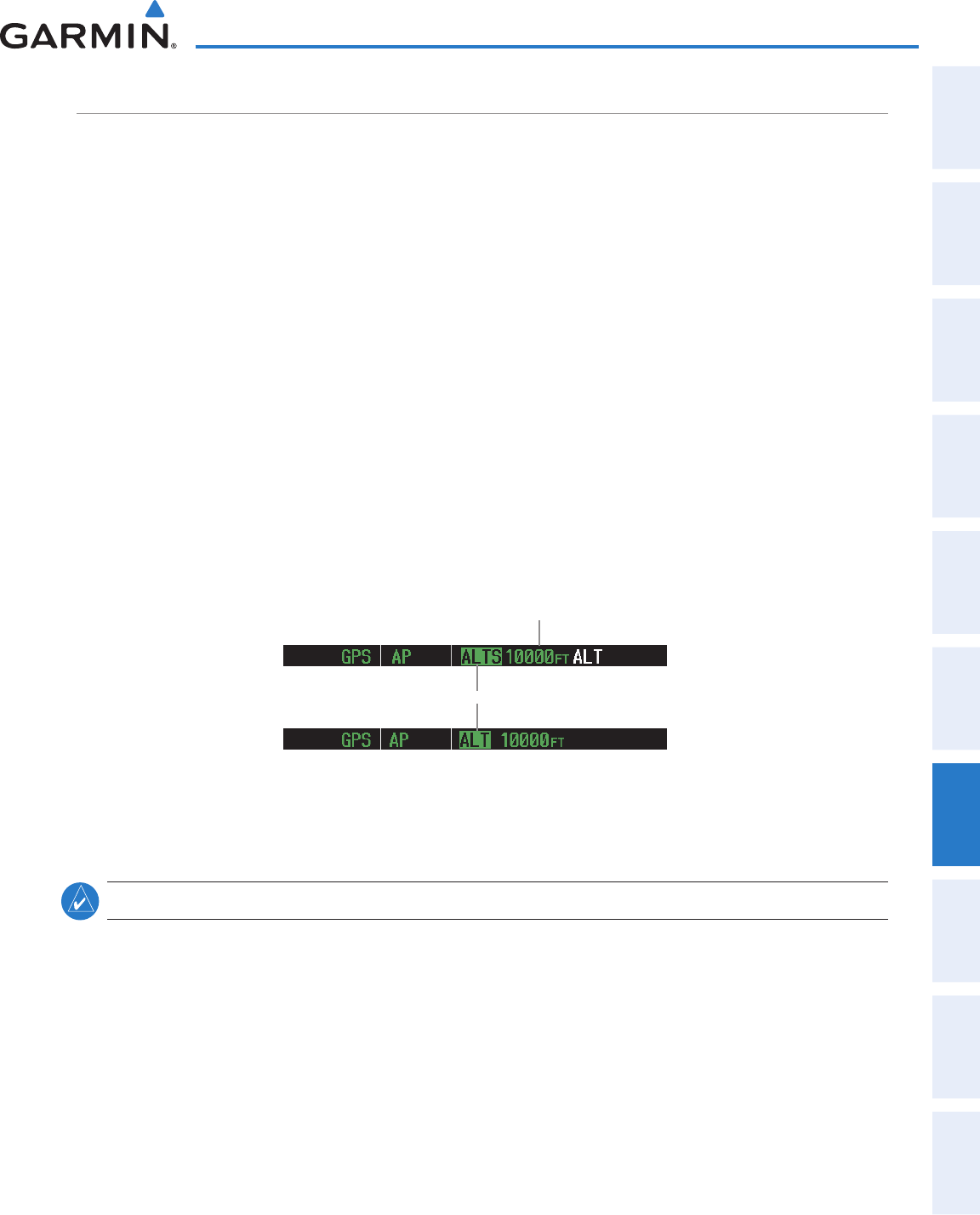
190-00592-06 Rev. A
Garmin G1000 Pilot’s Guide for Diamond DA40/40F
365
AUTOMATIC FLIGHT CONTROL SYSTEM
SYSTEM
OVERVIEW
FLIGHT
INSTRUMENTS EIS AUDIO PANEL
& CNS
FLIGHT
MANAGEMENT
HAZARD
AVOIDANCE AFCS ADDITIONAL
FEATURES APPENDICES INDEX
SELECTED ALTITUDE CAPTURE MODE (ALTS)
Selected Altitude Capture Mode is automatically armed with activation of the following modes:
•PitchHold
•VerticalSpeed
•FlightLevelChange
•GoAround
•VerticalPathTracking(iftheSelectedAltitudeisto
be captured instead of the VNV Target Altitude)
The white ‘ALTS’ annunciation indicates Selected Altitude Capture Mode is armed (see Figure 7-5 for example).
The ALT Knob is used to set the Selected Altitude (shown above the Altimeter) until Selected Altitude Capture
Mode becomes active.
As the aircraft nears the Selected Altitude, the flight director automatically transitions to Selected Altitude
Capture Mode with Altitude Hold Mode armed (Figure 7-6). This automatic transition is indicated by the green
‘ALTS’ annunciation flashing for up to 10 seconds and the appearance of the white ‘ALT” annunciation. The
Selected Altitude is shown as the Altitude Reference beside the ‘ALTS’ annunciation.
At 50 feet from the Selected Altitude, the flight director automatically transitions from Selected Altitude
Capture to Altitude Hold Mode and holds the Selected Altitude (shown as the Altitude Reference). As Altitude
Hold Mode becomes active, the white ‘ALT’ annunciation moves to the active pitch mode field and flashes green
for 10 seconds to indicate the automatic transition.
Figure 7-6 Automatic Mode Transitions During Altitude Capture
Flash up to 10 sec, Indicating Automatic Transition
Altitude Reference
(in this case, equal to
Selected Altitude)
CHANGING THE SELECTED ALTITUDE
NOTE: Pressing the CWS Button while in Selected Altitude Capture Mode does not cancel the mode.
Use of the ALT Knob to change the Selected Altitude while Selected Altitude Capture Mode is active causes
the flight director to revert to Pitch Hold Mode with Selected Altitude Capture Mode armed for the new
Selected Altitude.
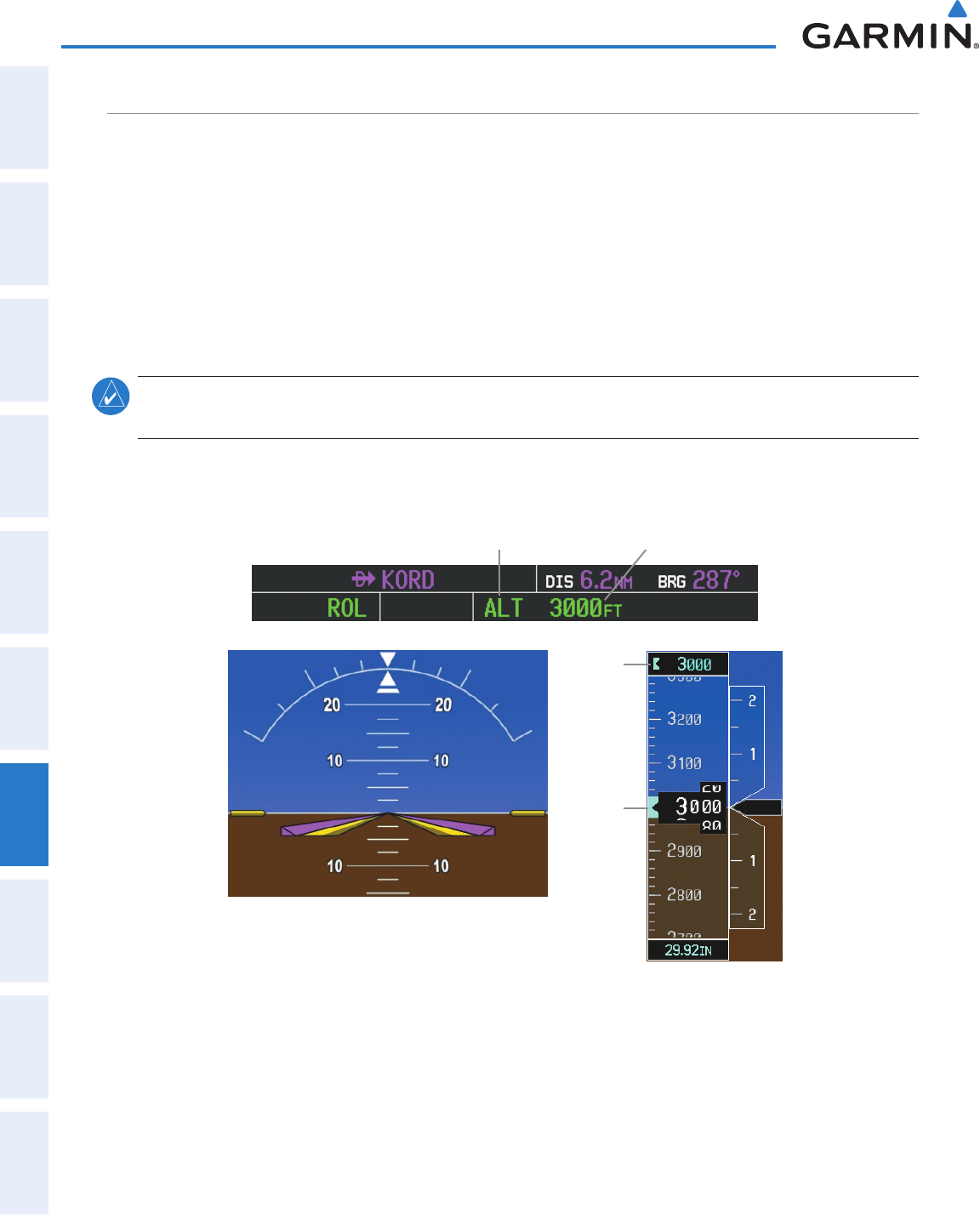
Garmin G1000 Pilot’s Guide for Diamond DA40/40F
190-00592-06 Rev. A
366
AUTOMATIC FLIGHT CONTROL SYSTEM
SYSTEM
OVERVIEW
FLIGHT
INSTRUMENTS
EIS
AUDIO PANEL
& CNS
FLIGHT
MANAGEMENT
HAZARD
AVOIDANCE
AFCS
ADDITIONAL
FEATURES
APPENDICESINDEX
ALTITUDE HOLD MODE (ALT)
Altitude Hold Mode can be activated by pressing the
ALT
Key; the flight director maintains the current aircraft
altitude (to the nearest 10 feet) as the Altitude Reference. The flight director’s Altitude Reference, shown in the
AFCS Status Box, is independent of the Selected Altitude, displayed above the Altimeter. Altitude Hold Mode
active is indicated by a green ‘ALT’ annunciation in the AFCS Status Box.
Altitude Hold Mode is automatically armed when the flight director is in Selected Altitude Capture Mode (see
Figure 7-6). Selected Altitude Capture Mode automatically transitions to Altitude Hold Mode when the altitude
error is less than 50 feet. In this case, the Selected Altitude becomes the flight director’s Altitude Reference.
CHANGING THE ALTITUDE REFERENCE
NOTE: Turning the ALT Knob while in Altitude Hold Mode changes the Selected Altitude, but not the flight
director’s Altitude Reference, and does not cancel the mode.
With the
CWS
Button depressed, the aircraft can be hand-flown to a new Altitude Reference. When the
CWS
Button is released at the desired altitude, the new altitude is established as the Altitude Reference.
Figure 7-7 Altitude Hold Mode
Command Bars Hold Pitch Attitude
to Maintain Altitude Reference
Altitude Hold
Mode Active Altitude
Reference
Selected
Altitude
Selected
Altitude
Bug
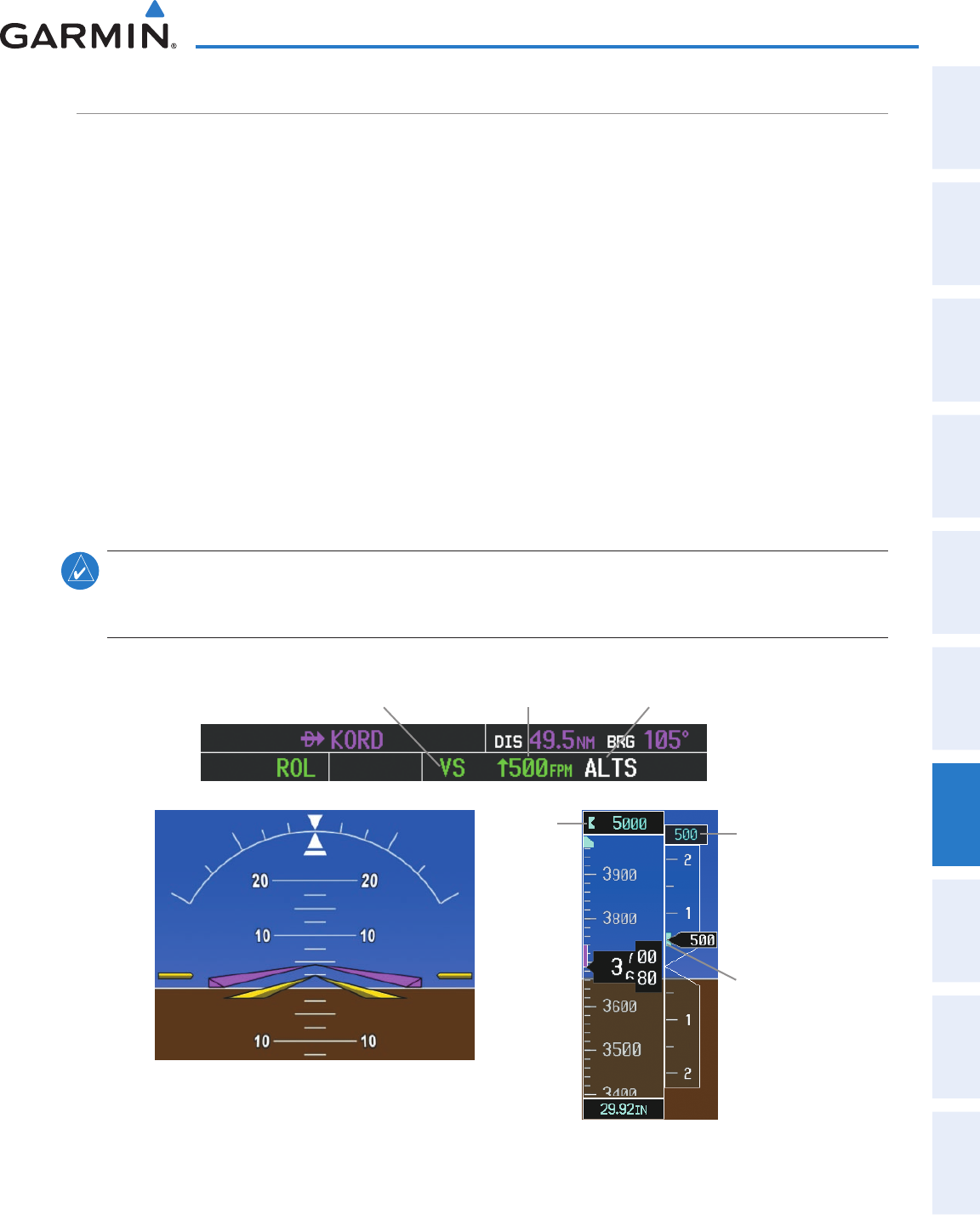
190-00592-06 Rev. A
Garmin G1000 Pilot’s Guide for Diamond DA40/40F
367
AUTOMATIC FLIGHT CONTROL SYSTEM
SYSTEM
OVERVIEW
FLIGHT
INSTRUMENTS EIS AUDIO PANEL
& CNS
FLIGHT
MANAGEMENT
HAZARD
AVOIDANCE AFCS ADDITIONAL
FEATURES APPENDICES INDEX
VERTICAL SPEED MODE (VS)
In Vertical Speed Mode, the flight director acquires and maintains a Vertical Speed Reference. Current aircraft
vertical speed (to the nearest 100 fpm) becomes the Vertical Speed Reference at the moment of Vertical Speed
Mode activation. This mode may be used for climb or descent to the Selected Altitude (shown above the
Altimeter) since Selected Altitude Capture Mode is automatically armed when Vertical Speed Mode is selected.
When Vertical Speed Mode is activated by pressing the
VS
Key, ‘VS’ is annunciated in green in the AFCS Status
Box along with the Vertical Speed Reference. The Vertical Speed Reference is also displayed above the Vertical
Speed Indicator. A Vertical Speed Reference Bug corresponding to the Vertical Speed Reference is shown on
the indicator.
CHANGING THE VERTICAL SPEED REFERENCE
The Vertical Speed Reference (shown both in the AFCS Status Box and above the Vertical Speed Indicator)
may be changed by:
•Usingthe
NOSE UP/NOSE DN
Keys
•Pressingthe
CWS
Button, hand-flying the aircraft to attain a new Vertical Speed Reference, then releasing
the
CWS
Button
NOTE: If the Selected Altitude is reached during CWS maneuvering, the Altitude Reference is not changed.
To adjust the Altitude Reference in this case, the CWS Button must be pressed again after the Selected
Altitude is reached.
Figure 7-8 Vertical Speed Mode
Vertical Speed
Mode Active
Vertical Speed
Reference
Selected Altitude
Capture Mode
Armed
Command Bars Indicate Climb to
Attain Vertical Speed Reference
Vertical
Speed
Reference
Bug
Selected
Altitude Vertical
Speed
Reference
Garmin G1000 Pilot’s Guide for Diamond DA40/40F
190-00592-06 Rev. A
368
AUTOMATIC FLIGHT CONTROL SYSTEM
SYSTEM
OVERVIEW
FLIGHT
INSTRUMENTS
EIS
AUDIO PANEL
& CNS
FLIGHT
MANAGEMENT
HAZARD
AVOIDANCE
AFCS
ADDITIONAL
FEATURES
APPENDICESINDEX
FLIGHT LEVEL CHANGE MODE (FLC)
NOTE: The Selected Altitude should be set before selecting Flight Level Change Mode.
Flight Level Change Mode is selected by pressing the
FLC
Key. This mode acquires and maintains the
Airspeed Reference while climbing or descending to the Selected Altitude (shown above the Altimeter). When
Flight Level Change Mode is active, the flight director continuously monitors Selected Altitude, airspeed, and
altitude.
The Airspeed Reference is set to the current airspeed upon mode activation. Flight Level Change Mode is
indicated by a green ‘FLC’ annunciation beside the Airspeed Reference in the AFCS Status Box. The Airspeed
Reference is also displayed directly above the Airspeed Indicator, along with a bug corresponding to the Airspeed
Reference along the tape.
Engine power must be adjusted to allow the autopilot to fly the aircraft at a pitch attitude corresponding
to the desired flight profile (climb or descent) while maintaining the Airspeed Reference. The flight director
maintains the current altitude until either engine power or the Airspeed Reference are adjusted and does not
allow the aircraft to climb or descend away from the Selected Altitude.
CHANGING THE AIRSPEED REFERENCE
The Airspeed Reference (shown in both the AFCS Status Box and above the Airspeed Indicator) may be
adjusted by:
•Usingthe
NOSE UP/NOSE DN
Keys
•Pressingthe
CWS
Button, hand-flying the aircraft to a new airspeed, then releasing the
CWS
Button to
establish the new Airspeed Reference
NOTE: If the Selected Altitude is reached during CWS maneuvering, the Altitude Reference is not changed.
To adjust the Altitude Reference in this case, the CWS Button must be pressed again after the Selected
Altitude is reached.
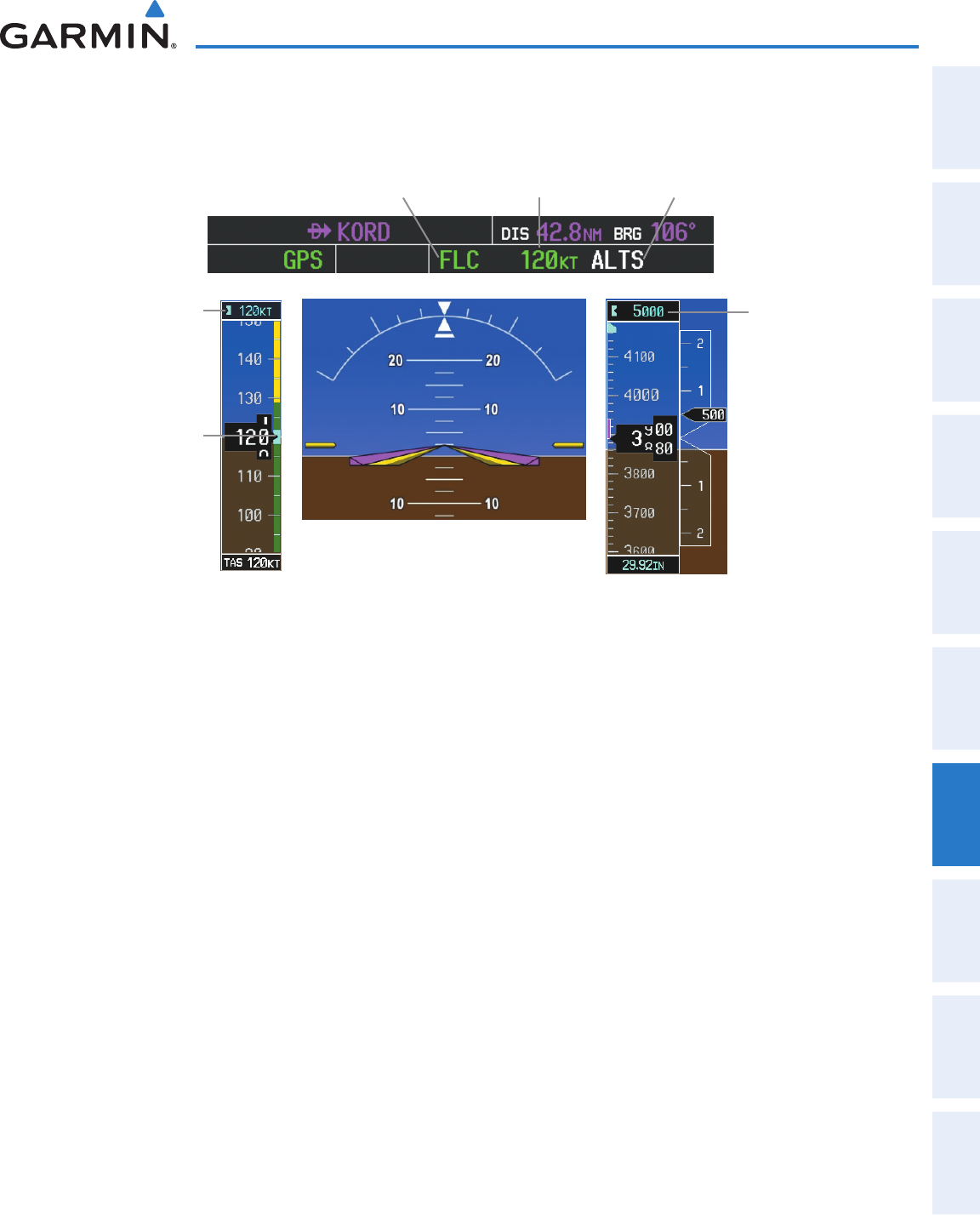
190-00592-06 Rev. A
Garmin G1000 Pilot’s Guide for Diamond DA40/40F
369
AUTOMATIC FLIGHT CONTROL SYSTEM
SYSTEM
OVERVIEW
FLIGHT
INSTRUMENTS EIS AUDIO PANEL
& CNS
FLIGHT
MANAGEMENT
HAZARD
AVOIDANCE AFCS ADDITIONAL
FEATURES APPENDICES INDEX
Figure 7-9 Flight Level Change Mode
Flight Level Change
Mode Active Airspeed
Reference
Selected Altitude
Capture Mode
Armed
Command Bars Indicate Climb
to Attain Selected Altitude
Airspeed
Reference
Bug
Airspeed
Reference Airspeed
Reference
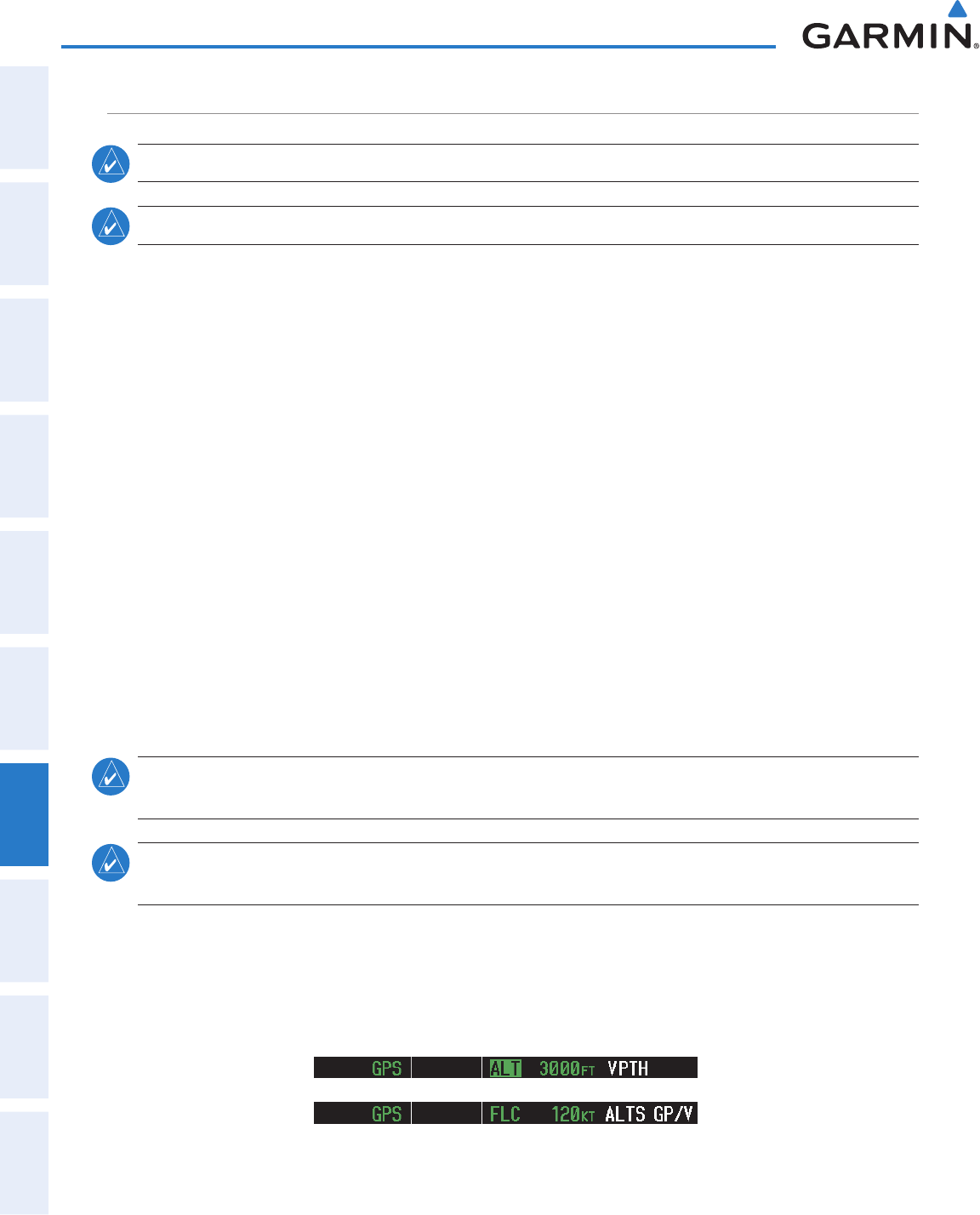
Garmin G1000 Pilot’s Guide for Diamond DA40/40F
190-00592-06 Rev. A
370
AUTOMATIC FLIGHT CONTROL SYSTEM
SYSTEM
OVERVIEW
FLIGHT
INSTRUMENTS
EIS
AUDIO PANEL
& CNS
FLIGHT
MANAGEMENT
HAZARD
AVOIDANCE
AFCS
ADDITIONAL
FEATURES
APPENDICESINDEX
VERTICAL NAVIGATION MODES (VPTH, ALTV)
NOTE: VNV is disabled when parallel track or dead reckoning mode is active.
NOTE: The Selected Altitude takes precedence over any other vertical constraints.
Vertical Navigation (VNV) flight control is available for enroute/terminal cruise and descent operations any
time that VNV flight planning is available. Refer to the Flight Management Section for more information on
VNV flight plans. Conditions for availability include, but are not limited to:
•TheselectednavigationsourceisGPS.
•AVNVightplan(withatleastonealtitude-constrainedwaypoint)orverticaldirect-toisactive.
•VNVisenabled(VNV ENBL Softkey pressed on the MFD).
•Crosstrackerrorisvalidandwithincertainlimits.
•Desired/actualtrackarevalidortrackangleerroriswithincertainlimits.
•TheVNVTargetAltitudeoftheactivewaypointisnomorethan250ftabovethecurrentaircraftaltitude.
The flight director may be armed for VNV at any time, but no target altitudes are captured during a climb.
The Command Bars provide vertical profile guidance based on specified altitudes (entered manually or loaded
from the database) at waypoints in the active flight plan or vertical direct-to. The appropriate VNV flight control
modes are sequenced by the flight director to follow the path defined by the vertical profile. Upon reaching
the last waypoint in the VNV flight plan, the flight director transitions to Altitude Hold Mode and cancels any
armed VNV modes.
VERTICAL PATH TRACKING MODE (VPTH)
NOTE: If another pitch mode key is pressed while Vertical Path Tracking Mode is selected, Vertical Path
Tracking Mode reverts to armed.
NOTE: Pressing the CWS Button while Vertical Path Tracking Mode is active does not cancel the mode. The
autopilot guides the aircraft back to the descent path upon release of the CWS Button.
When a vertical profile (VNV flight plan) is active and the VNV Key is pressed, Vertical Path Tracking
Mode is armed in preparation for descent path capture. ‘VPTH’ (or ‘/V’ when Glidepath or Glideslope Mode
is concurrently armed) is annunciated in white in addition to previously armed modes. If applicable, the
appropriate altitude capture mode is armed for capture of the next VNV Target Altitude (ALTV) or the Selected
Altitude (ALTS), whichever is greater.
Figure 7-10 Vertical Path Tracking Armed Annunciations
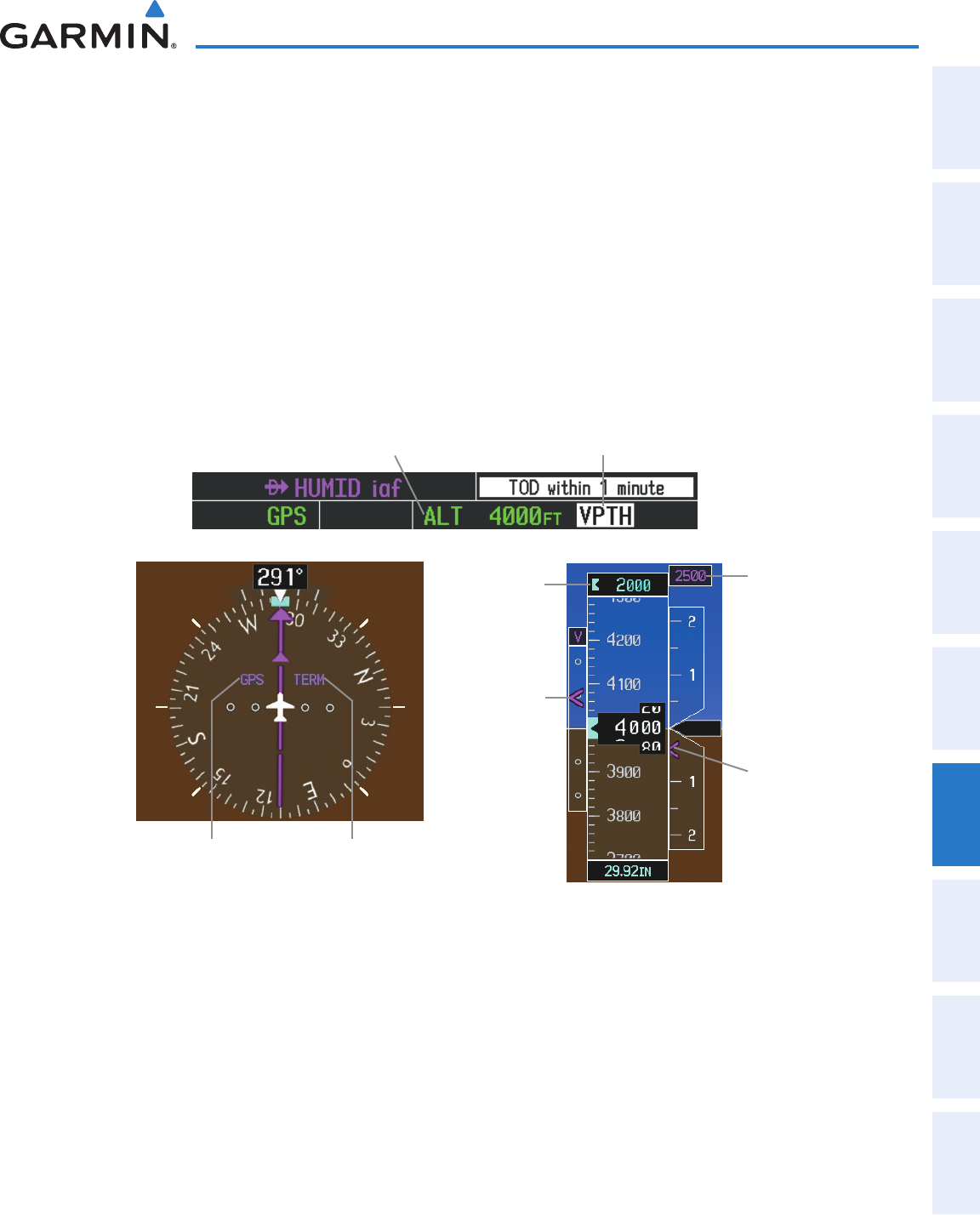
190-00592-06 Rev. A
Garmin G1000 Pilot’s Guide for Diamond DA40/40F
371
AUTOMATIC FLIGHT CONTROL SYSTEM
SYSTEM
OVERVIEW
FLIGHT
INSTRUMENTS EIS AUDIO PANEL
& CNS
FLIGHT
MANAGEMENT
HAZARD
AVOIDANCE AFCS ADDITIONAL
FEATURES APPENDICES INDEX
Prior to descent path interception, the Selected Altitude must be set below the current aircraft altitude
by at least 75 feet. For the flight director to transition from Altitude Hold to Vertical Path Tracking Mode,
acknowledgment is required within 5 minutes of descent path interception by:
•PressingtheVNV Key •AdjustingtheSelectedAltitude
If acknowledgment is not received within 1 minute of descent path interception, the white ‘VPTH’
annunciation starts to flash. Flashing continues until acknowledged or the descent path is intercepted. If
the descent is not confirmed by the time of interception, Vertical Path Tracking Mode remains armed and the
descent is not captured.
In conjunction with the “TOD [top of descent] within 1 minute” annunciation in the Navigation Status Box
and the “Vertical track” voice message, VNV indications (VNV Target Altitude, vertical deviation, and vertical
speed required) appear on the PFD in magenta (Figure 7-11).
Figure 7-11 Vertical Path Capture
VNV Target
Altitude
Selected
Altitude Below
VNV Target
Vertical
Deviation
Indicator
Required
Vertical
Speed Bug
Vertical Path Tracking
Armed, (Flashing Indicates
Acknowledgment Required)
Altitude Hold
Mode Active
Terminal
Phase
of Flight
GPS is
Selected
Navigation
Source
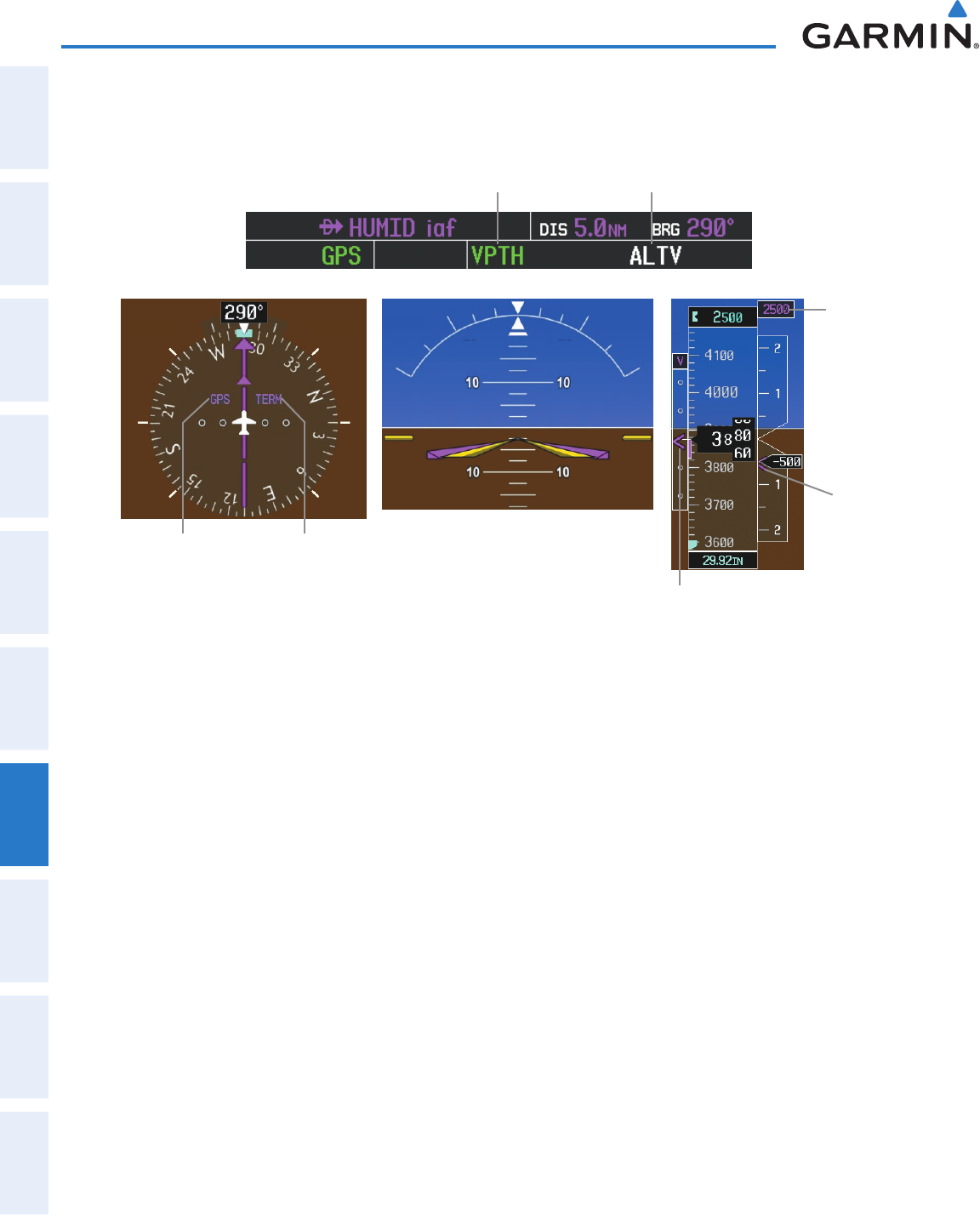
Garmin G1000 Pilot’s Guide for Diamond DA40/40F
190-00592-06 Rev. A
372
AUTOMATIC FLIGHT CONTROL SYSTEM
SYSTEM
OVERVIEW
FLIGHT
INSTRUMENTS
EIS
AUDIO PANEL
& CNS
FLIGHT
MANAGEMENT
HAZARD
AVOIDANCE
AFCS
ADDITIONAL
FEATURES
APPENDICESINDEX
When a descent leg is captured (i.e., vertical deviation becomes valid), Vertical Path Tracking becomes
active and tracks the descent profile. An altitude capture mode (‘ALTS’ or ‘ALTV’) is armed as appropriate.
Figure 7-12 Vertical Path Tracking Mode
Command Bars Indicate Descent to
Maintain Required Vertical Speed
VNV Target
Altitude
Vertical
Deviation
Indicator
Required
Vertical
Speed
Indication
Terminal
Phase of
Flight
GPS is
Selected
Navigation
Source
VNV Target Altitude
Capture Armed
Vertical Path
Tracking Active
If the Altimeter’s barometric setting is adjusted while Vertical Path Tracking is active, the flight director
increases/decreases the descent rate by up to 500 fpm to re-establish the aircraft on the descent path (without
commanding a climb). Adjusting the altimeter barometric setting creates discontinuities in VNV vertical
deviation, moving the descent path. For large adjustments, it may take several minutes for the aircraft to re-
establish on the descent path. If the change is made while nearing a waypoint with a VNV Target Altitude,
the aircraft may not re-establish on the descent path in time to meet the vertical constraint.
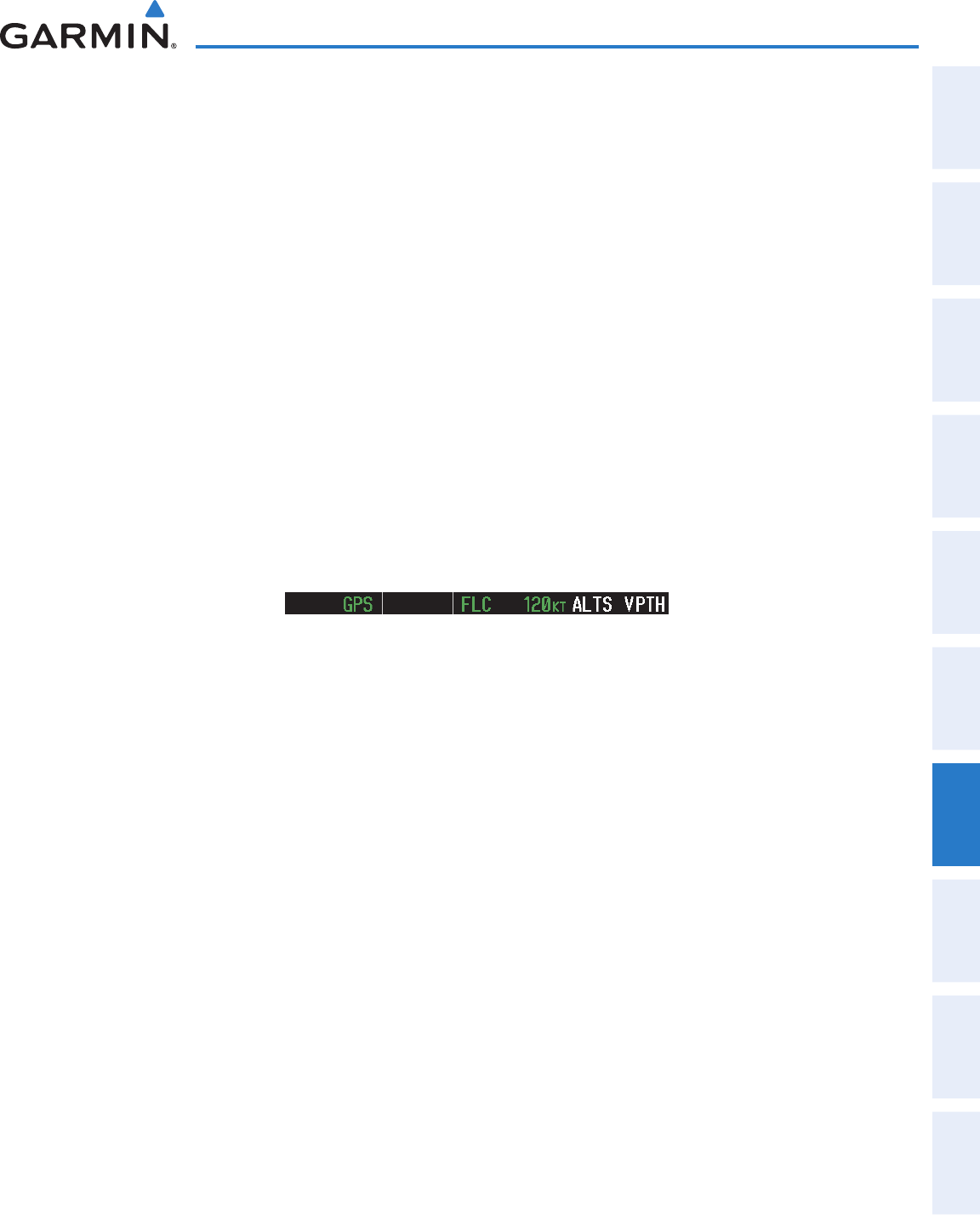
190-00592-06 Rev. A
Garmin G1000 Pilot’s Guide for Diamond DA40/40F
373
AUTOMATIC FLIGHT CONTROL SYSTEM
SYSTEM
OVERVIEW
FLIGHT
INSTRUMENTS EIS AUDIO PANEL
& CNS
FLIGHT
MANAGEMENT
HAZARD
AVOIDANCE AFCS ADDITIONAL
FEATURES APPENDICES INDEX
au t o M a t i c Re v e R s i o n t o Pi t c h ho l D Mo D e
Several situations can occur while Vertical Path Tracking Mode is active which cause the flight director to
revert to Pitch Hold Mode:
•Verticaldeviationexceeds200feetduringanoverspeedcondition.
•Verticaldeviationexperiencesadiscontinuitythatbothexceeds200feetinmagnitudeandresultsinthe
vertical deviation exceeding 200 feet in magnitude. Such discontinuities are usually caused by flight plan
changes that affect the vertical profile.
•Verticaldeviationbecomesinvalid(theVerticalDeviationIndicatorisremovedfromthePFD).
•AdisplayentersReversionaryMode(thisdoesnotapplytoanactiveverticaldirect-to).
Unless VNV is disabled, Vertical Path Tracking Mode and the appropriate altitude capture mode become
armed following the reversion to Pitch Hold Mode to allow for possible profile recapture.
no n -Pa t h De s c e n t s
Pitch Hold, Vertical Speed, and Flight Level Change modes can also be used to fly non-path descents
while VNV flight control is selected. If the VS or FLC Key is pressed while Vertical Path Tracking Mode is
selected, Vertical Path Tracking Mode reverts to armed along with the appropriate altitude capture mode to
allow profile re-capture.
Figure 7-13 Flight Level Change VNV Non-Path Descent
To prevent immediate profile re-capture, the following must be satisfied:
•Atleast10secondshavepassedsincethenon-pathtransitionwasinitiated
•Verticaldeviationfromtheprolehasexceeded250feet,butisnowlessthan200feet
Pressing the VNV Key twice re-arms Vertical Path Tracking for immediate profile re-capture.
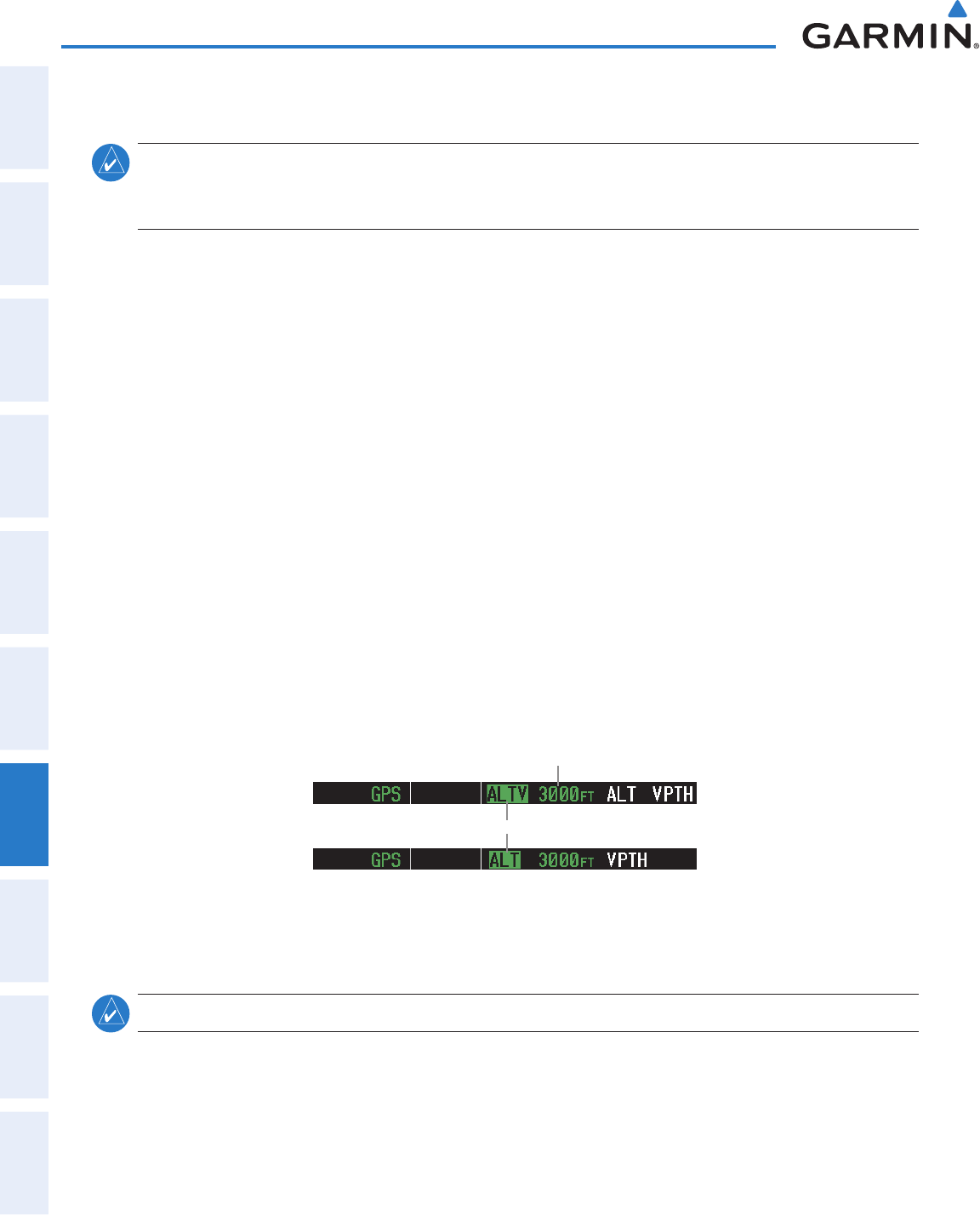
Garmin G1000 Pilot’s Guide for Diamond DA40/40F
190-00592-06 Rev. A
374
AUTOMATIC FLIGHT CONTROL SYSTEM
SYSTEM
OVERVIEW
FLIGHT
INSTRUMENTS
EIS
AUDIO PANEL
& CNS
FLIGHT
MANAGEMENT
HAZARD
AVOIDANCE
AFCS
ADDITIONAL
FEATURES
APPENDICESINDEX
VNV TARGET ALTITUDE CAPTURE MODE (ALTV)
NOTE: Armed VNV Target Altitude and Selected Altitude capture modes are mutually exclusive. However,
Selected Altitude Capture Mode is armed implicitly (not annunciated) whenever VNV Target Altitude Capture
Mode is armed.
VNV Target Altitude Capture is analogous to Selected Altitude Capture Mode and is armed automatically
after the VNV Key is pressed and the next VNV Target Altitude is to be intercepted before the Selected
Altitude. The annunciation ‘ALTV’ indicates that the VNV Target Altitude is to be captured. VNV Target
Altitudes are shown in the active flight plan or vertical direct-to, and can be entered manually or loaded
from a database (see the Flight Management Section for details). At the same time as “TOD within 1 minute”
is annunciated in the Navigation Status Box, the active VNV Target Altitude is displayed above the Vertical
Speed Indicator (see Figure 7-11).
As the aircraft nears the VNV Target Altitude, the flight director automatically transitions to VNV Target
Altitude Capture Mode with Altitude Hold Mode armed. This automatic transition is indicated by the green
‘ALTV’ annunciation flashing for up to 10 seconds and the appearance of the white ‘ALT” annunciation. The
VNV Target Altitude is shown as the Altitude Reference beside the ‘ALTV’ annunciation and remains displayed
above the Vertical Speed Indicator. The Required Vertical Speed Indication (RVSI) is removed once VNV
Target Altitude Capture Mode becomes active.
At 50 feet from the VNV Target Altitude, the flight director automatically transitions from VNV Target
Altitude Capture to Altitude Hold Mode and tracks the level leg. As Altitude Hold Mode becomes active, the
white ‘ALT’ annunciation moves to the active vertical mode field and flashes green for 10 seconds to indicate
the automatic transition. The flight director automatically arms Vertical Path Tracking, allowing upcoming
descent legs to be captured and subsequently tracked.
Figure 7-14 Automatic Mode Transitions During Altitude Capture
Flash up to 10 sec, Indicating Automatic Transition
Altitude Reference (In
This Case, Equal To
VNV Altitude Target)
ch a n g i n g t h e vnv ta R g e t al t i t u D e
NOTE: Pressing the CWS Button while in VNV Target Altitude Capture Mode does not cancel the mode.
Changing the current VNV Target Altitude while VNV Target Altitude Capture Mode is active causes the
flight director to revert to Pitch Hold Mode. Vertical Path Tracking and the appropriate altitude capture
mode are armed in preparation to capture the new VNV Target Altitude or the Selected Altitude, depending
on which altitude is to be intercepted first.
VNV target altitudes can be changed while editing the active flight plan (see the Flight Management
Section for details).
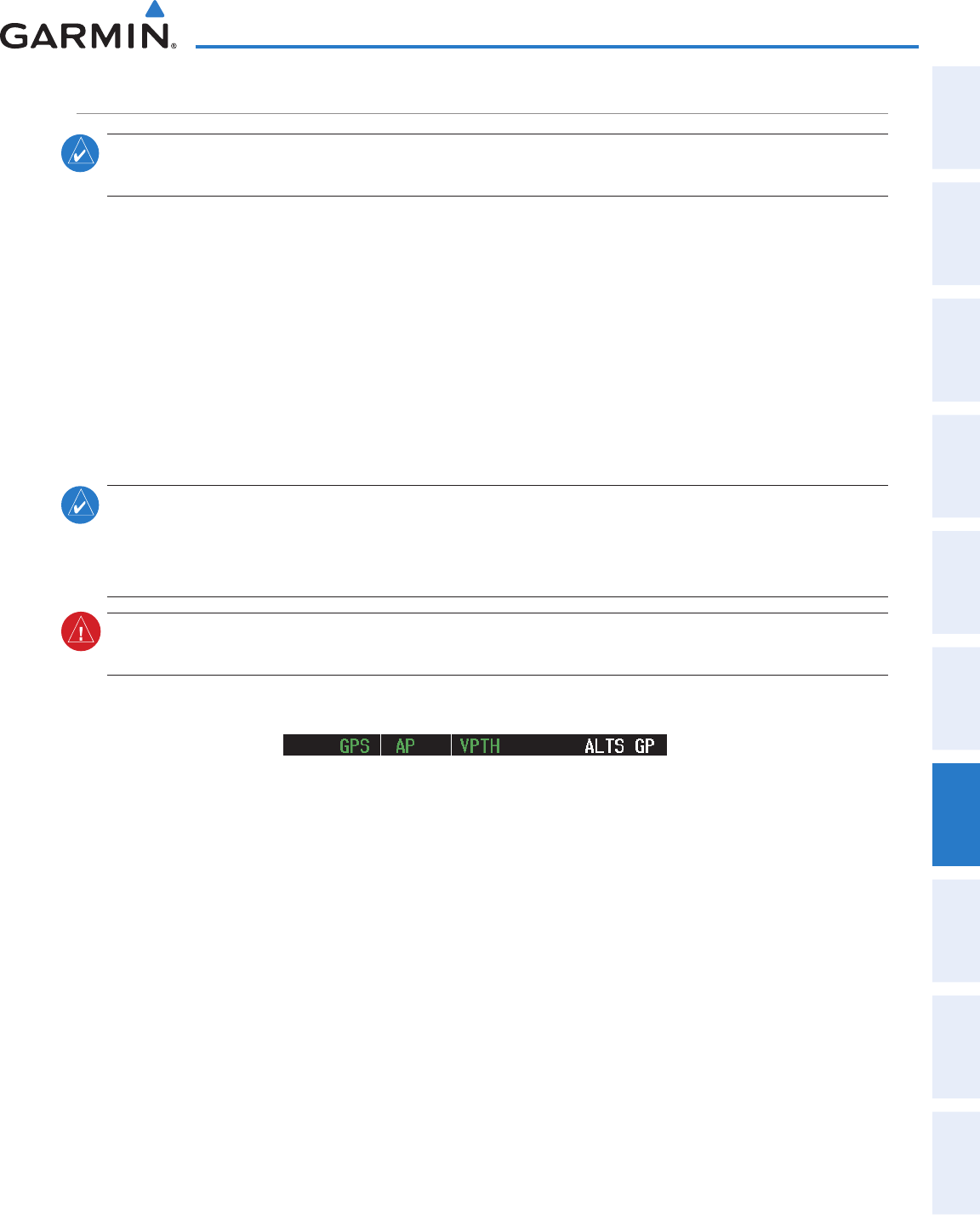
190-00592-06 Rev. A
Garmin G1000 Pilot’s Guide for Diamond DA40/40F
375
AUTOMATIC FLIGHT CONTROL SYSTEM
SYSTEM
OVERVIEW
FLIGHT
INSTRUMENTS EIS AUDIO PANEL
& CNS
FLIGHT
MANAGEMENT
HAZARD
AVOIDANCE AFCS ADDITIONAL
FEATURES APPENDICES INDEX
GLIDEPATH MODE (GP) (WAAS ONLY)
NOTE: Pressing the CWS Button while Glidepath Mode is active does not cancel the mode. The autopilot
guides the aircraft back to the glidepath upon release of the CWS Button.
Glidepath Mode is available only in installations with GIA 63W IAUs when WAAS is available. Glidepath
Mode is used to track the WAAS-based glidepath. When Glidepath Mode is armed, ‘GP’ is annunciated in white
in the AFCS Status Box.
Selecting Glidepath Mode:
1) Ensure a GPS approach with vertical guidance or vertical descent angle (LPV, LNAV/VNAV, LNAV+V) is loaded
into the active flight plan. The active waypoint must be part of the flight plan (cannot be a direct-to a waypoint
not in the flight plan.
2) Ensure that GPS is the selected navigation source (use the CDI Softkey to cycle through navigation sources).
3) Press the APR Key.
NOTE: Some RNAV (GPS) approaches provide a vertical descent angle as an aid in flying a stabilized
approach. These approaches are NOT considered Approaches with Vertical Guidance (APV). Approaches
that are annunciated on the HSI as LNAV or LNAV+V are considered Nonprecision Approaches (NPA) and
are flown to an MDA even though vertical glidepath (GP) information may be provided.
WARNING: When flying an LNAV approach (with vertical descent angle) with the autopilot coupled, the
aircraft will not level off at the MDA even if the MDA is set in the altitude preselect.
Upon reaching the glidepath, the flight director transitions to Glidepath Mode and begins to capture and
track the glidepath.
Figure 7-15 Glidepath Mode Armed
Once the following conditions have been met, the glidepath can be captured:
•Theactivewaypointisatorafterthenalapproachx(FAF)
•Verticaldeviationisvalid
•TheCDIisatlessthanfullscaledeviation
•Automaticsequencingofwaypointshasnotbeensuspended(no‘SUSP’annunciationontheHSI)
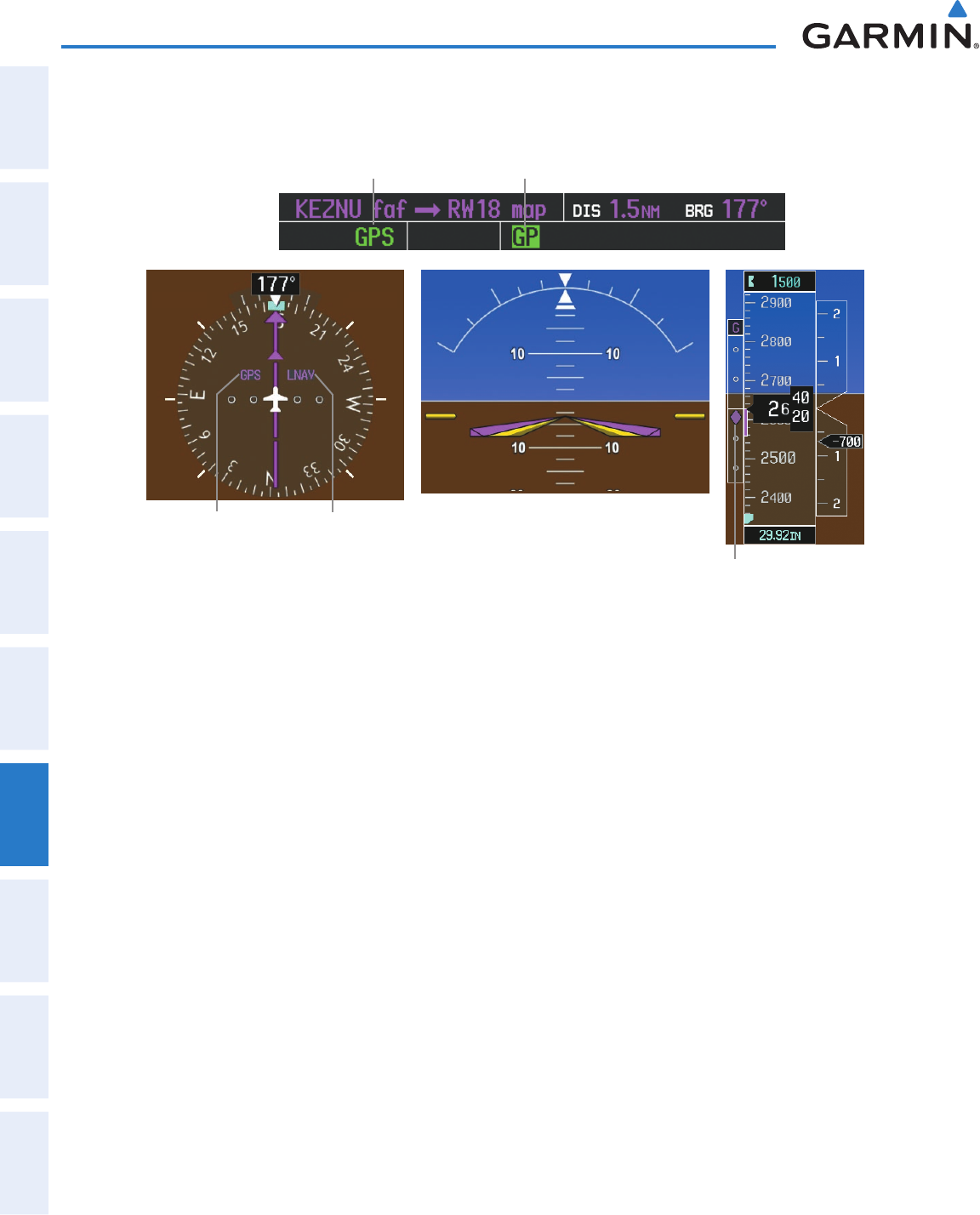
Garmin G1000 Pilot’s Guide for Diamond DA40/40F
190-00592-06 Rev. A
376
AUTOMATIC FLIGHT CONTROL SYSTEM
SYSTEM
OVERVIEW
FLIGHT
INSTRUMENTS
EIS
AUDIO PANEL
& CNS
FLIGHT
MANAGEMENT
HAZARD
AVOIDANCE
AFCS
ADDITIONAL
FEATURES
APPENDICESINDEX
Figure 7-16 Glidepath Mode
Command Bars Indicate
Descent on Glidepath
Glidepath
Mode Active
GPS Approach
Mode Active
Glidepath
Indicator
LNAV
Approach
Active
GPS is Selected
Navigation
Source
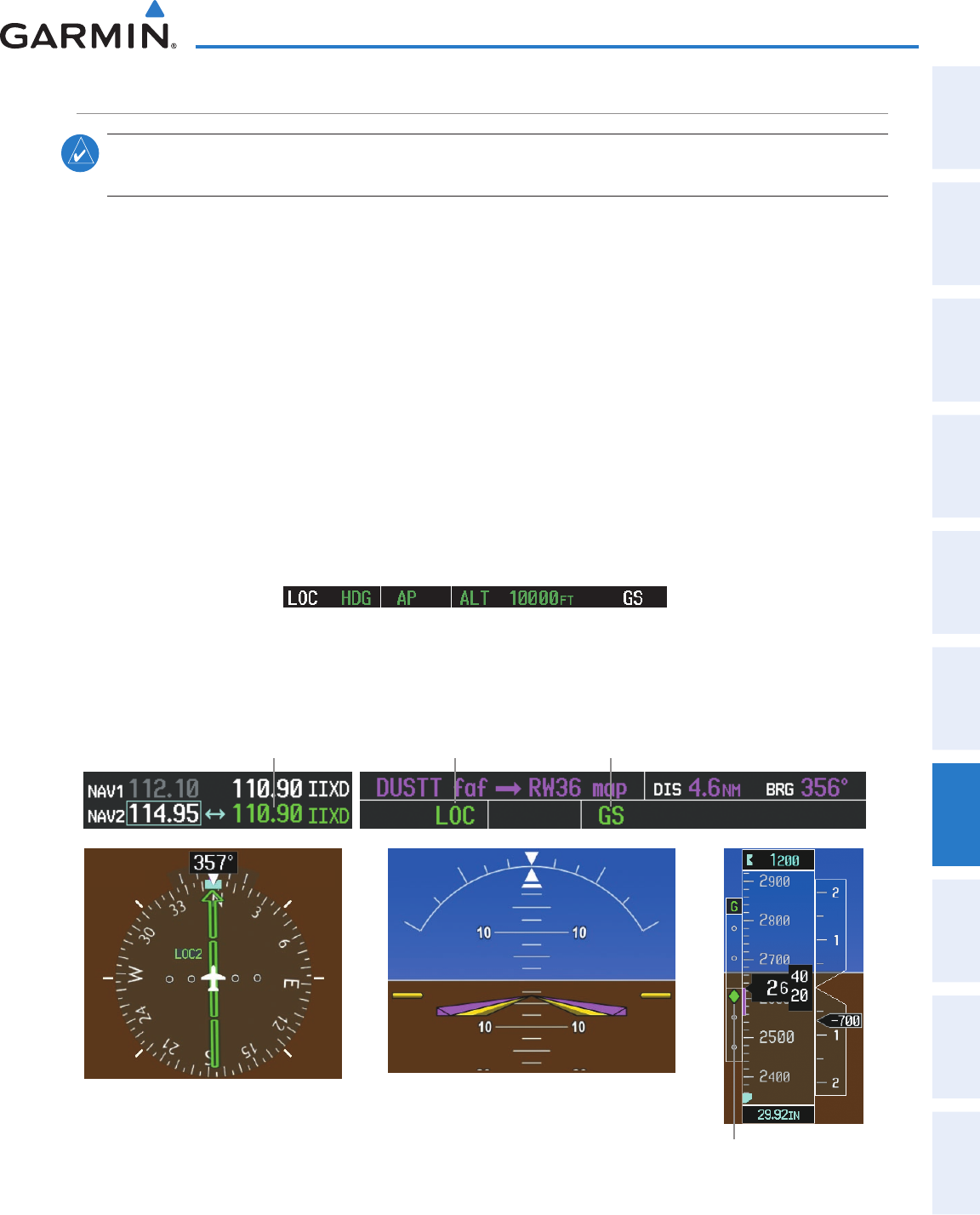
190-00592-06 Rev. A
Garmin G1000 Pilot’s Guide for Diamond DA40/40F
377
AUTOMATIC FLIGHT CONTROL SYSTEM
SYSTEM
OVERVIEW
FLIGHT
INSTRUMENTS EIS AUDIO PANEL
& CNS
FLIGHT
MANAGEMENT
HAZARD
AVOIDANCE AFCS ADDITIONAL
FEATURES APPENDICES INDEX
GLIDESLOPE MODE (GS)
NOTE: Pressing the CWS Button while Glideslope Mode is active does not cancel the mode. The autopilot
guides the aircraft back to the glideslope upon release of the CWS Button.
Glideslope Mode is available for LOC/ILS approaches to capture and track the glideslope. When Glideslope
Mode is armed (annunciated as ‘GS’ in white), LOC Approach Mode is armed as the lateral flight director
mode.
Selecting Glideslope Mode:
1) Ensure a valid localizer frequency is tuned.
2) Ensure that LOC is the selected navigation source (use the CDI Softkey to cycle through navigation sources).
3) Press the APR Key.
Or:
1) Ensure that GPS is the selected navigation source (use the CDI Softkey to cycle through navigation sources).
2) Ensure a LOC/ILS approach is loaded into the active flight plan.
3) Ensure the corresponding LOC frequency is tuned.
4) Press the APR Key.
Figure 7-17 Glideslope Mode Armed
Once LOC is the navigation source, the localizer and glideslope can be captured. Upon reaching the glideslope,
the flight director transitions to Glideslope Mode and begins to capture and track the glideslope.
Figure 7-18 Glideslope Mode
NAV2 (localizer) is Selected
Navigation Source
Command Bars Indicate Descent
on Localizer/Glideslope Path
Glideslope
Indicator
Approach
Mode Active Glideslope
Mode Active
Active ILS
Frequency Tuned
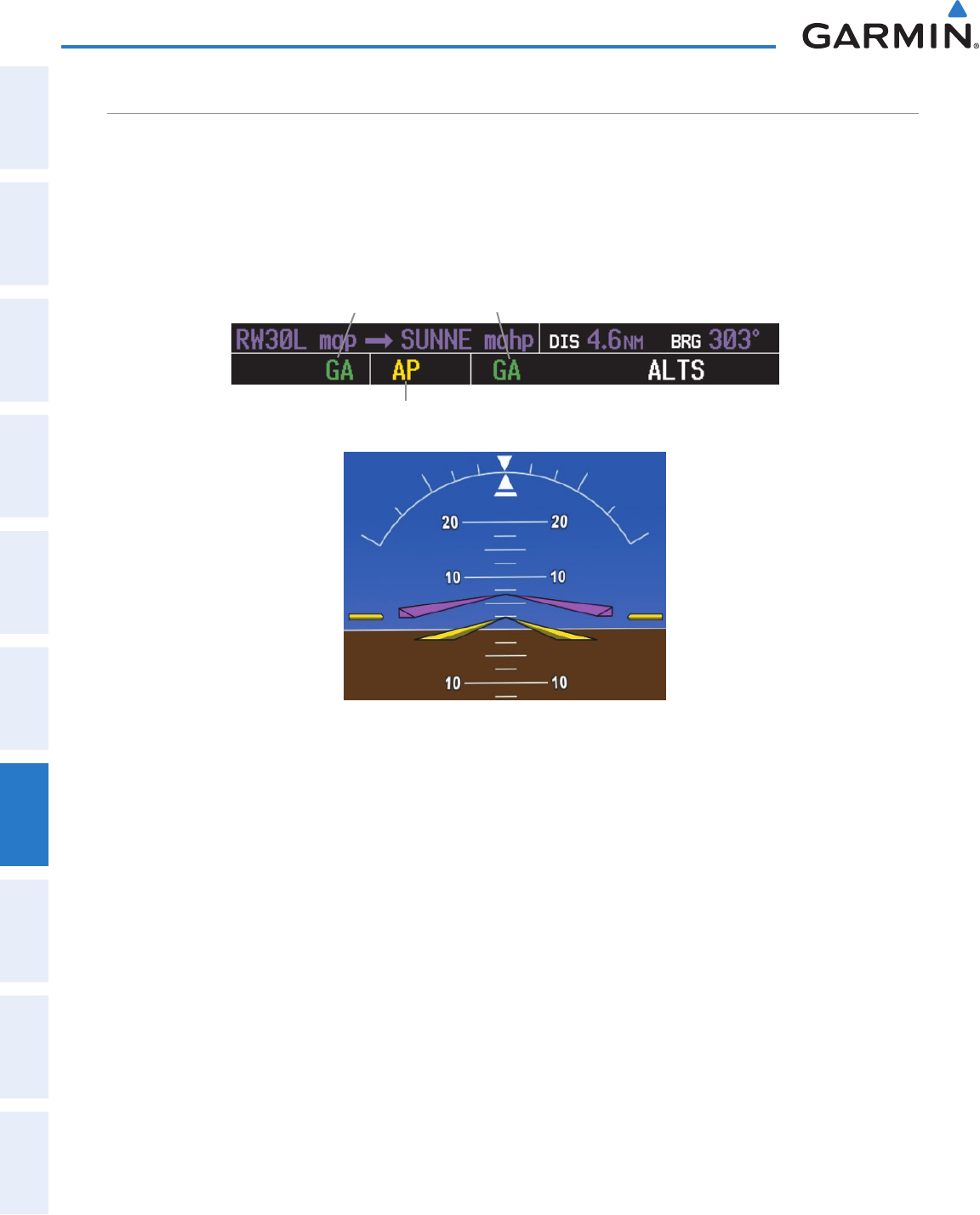
Garmin G1000 Pilot’s Guide for Diamond DA40/40F
190-00592-06 Rev. A
378
AUTOMATIC FLIGHT CONTROL SYSTEM
SYSTEM
OVERVIEW
FLIGHT
INSTRUMENTS
EIS
AUDIO PANEL
& CNS
FLIGHT
MANAGEMENT
HAZARD
AVOIDANCE
AFCS
ADDITIONAL
FEATURES
APPENDICESINDEX
GO AROUND MODE (GA)
Pushing the
GA Switch
engages the flight director in a wings-level, pitch-up attitude, allowing the execution
of a missed approach or a go around. This mode is a coupled pitch and roll mode and is annunciated as ‘GA’
in both the active pitch and roll mode fields. Go Around Mode disengages the autopilot and arms Selected
Altitude Capture Mode automatically. Subsequent autopilot engagement is allowed. Attempts to modify the
aircraft attitude (i.e., with the
CWS
Button or
NOSE UP/NOSE DN
Keys) result in reversion to Pitch and Roll
Hold modes.
Figure 7-19 Go Around Mode
Command Bars Indicate Climb
Go Around Mode Active
Autopilot Disconnect Annunciation
Flashes Yellow 5 sec
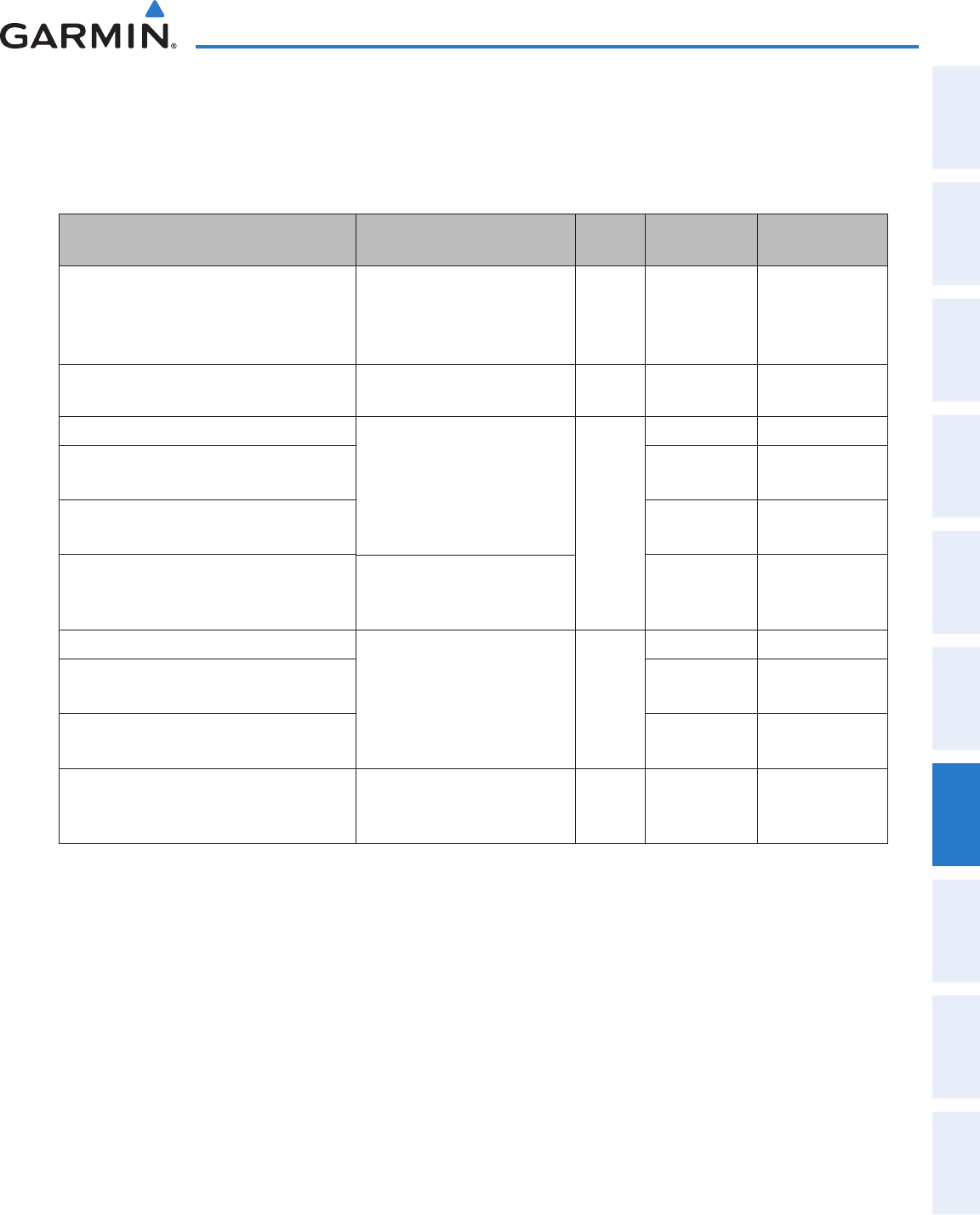
190-00592-06 Rev. A
Garmin G1000 Pilot’s Guide for Diamond DA40/40F
379
AUTOMATIC FLIGHT CONTROL SYSTEM
SYSTEM
OVERVIEW
FLIGHT
INSTRUMENTS EIS AUDIO PANEL
& CNS
FLIGHT
MANAGEMENT
HAZARD
AVOIDANCE AFCS ADDITIONAL
FEATURES APPENDICES INDEX
7.4 LATERAL MODES
The GFC 700 offers the lateral modes listed in Table 7-3. Refer to the vertical modes section for information
regarding Go Around Mode.
Lateral Mode Description Control Annunciation Maximum Roll
Command Limit
Roll Hold
Holds the current aircraft roll
attitude or rolls the wings level,
depending on the commanded
bank angle
(default) ROL 22º
Heading Select Captures and tracks the
Selected Heading
HDG
Key HDG 22º
Navigation, GPS
Captures and tracks the
selected navigation source (GPS,
VOR, LOC) NAV
Key
GPS 22º
Navigation, VOR Enroute Capture/Track VOR 22º Capture
10º Track
Navigation, LOC Capture/Track
(No Glideslope) LOC 22º Capture
10º Track
Navigation Backcourse Capture/Track
Captures and tracks a
localizer signal for backcourse
approaches
BC 22º Capture
10º Track
Approach, GPS
Captures and tracks the
selected navigation source (GPS,
VOR, LOC)
APR
Key
GPS 22º
Approach, VOR Capture/Track VAPP 22º Capture
10º Track
Approach, LOC Capture/Track
(Glideslope Mode automatically armed) LOC 22º Capture
10º Track
Go Around
Disengages the autopilot and
commands a constant pitch
angle and wings level
GA
Switch GA Wings Level
The GFC 700 limits turn rate to 3 degrees per second (standard rate turn).
Table 7-3 Flight Director Lateral Modes
The CWS Button does not change lateral references for Heading Select, Navigation, Backcourse, or Approach
modes. The autopilot guides the aircraft back to the Selected Heading/Course upon release of the CWS
Button.
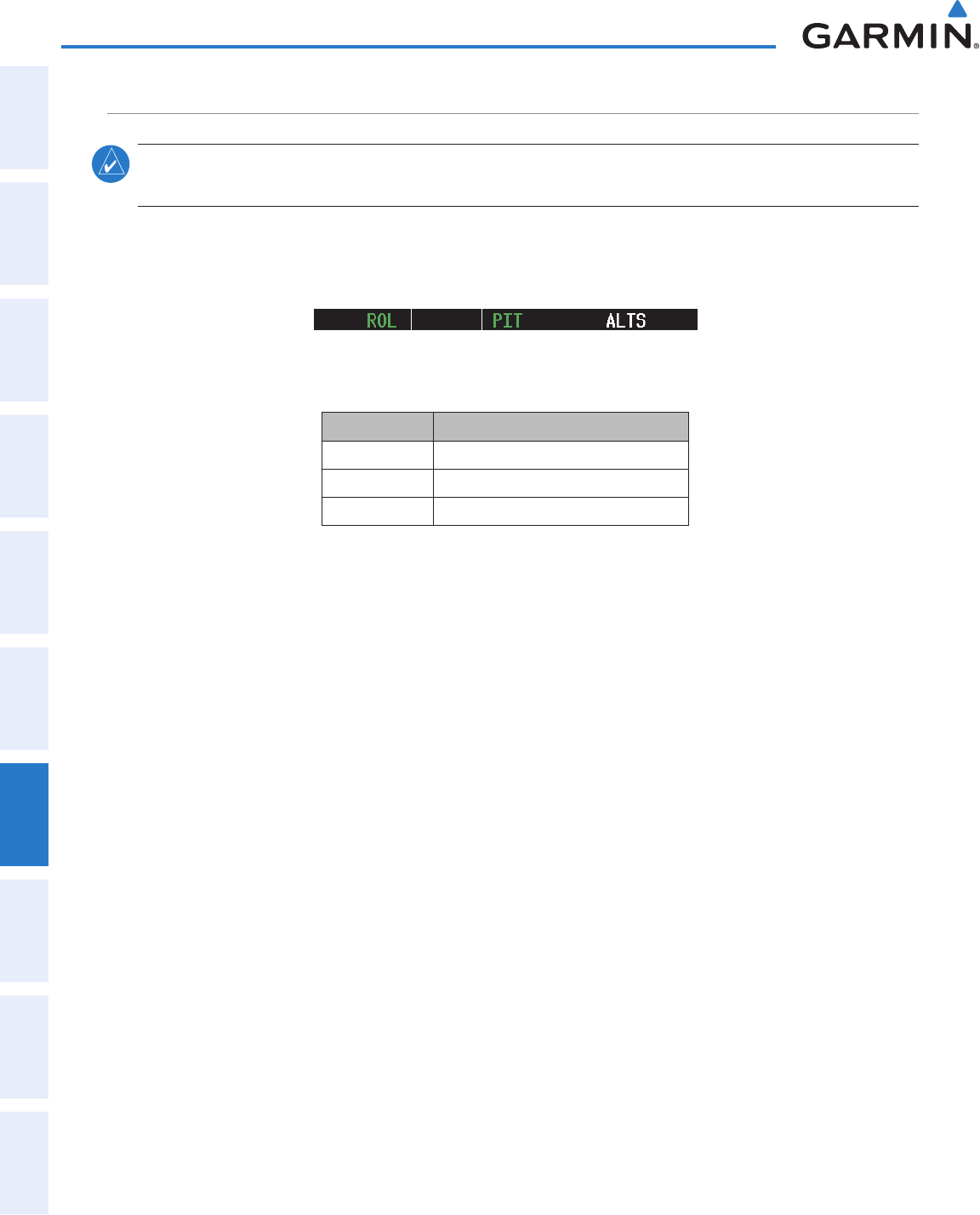
Garmin G1000 Pilot’s Guide for Diamond DA40/40F
190-00592-06 Rev. A
380
AUTOMATIC FLIGHT CONTROL SYSTEM
SYSTEM
OVERVIEW
FLIGHT
INSTRUMENTS
EIS
AUDIO PANEL
& CNS
FLIGHT
MANAGEMENT
HAZARD
AVOIDANCE
AFCS
ADDITIONAL
FEATURES
APPENDICESINDEX
ROLL HOLD MODE (ROL)
NOTE: If Roll Hold Mode is activated as a result of a mode reversion, the flight director rolls the wings
level.
When the flight director is activated, Roll Hold Mode is selected by default. This mode is annunciated as
‘ROL’ in the AFCS Status Box. The current aircraft bank angle is held, subject to the bank angle conditions listed
in Table 7-4.
Figure 7-20 Roll Hold Mode Annunciation
Bank Angle Flight Director Response
< 6° Rolls wings level
6 to 22° Maintains current aircraft roll attitude
> 22° Limits bank to 22°
Table 7-4 Roll Hold Mode Responses
CHANGING THE ROLL REFERENCE
The roll reference can be changed by pressing the
CWS
Button, establishing the desired bank angle, then
releasing the
CWS
Button.
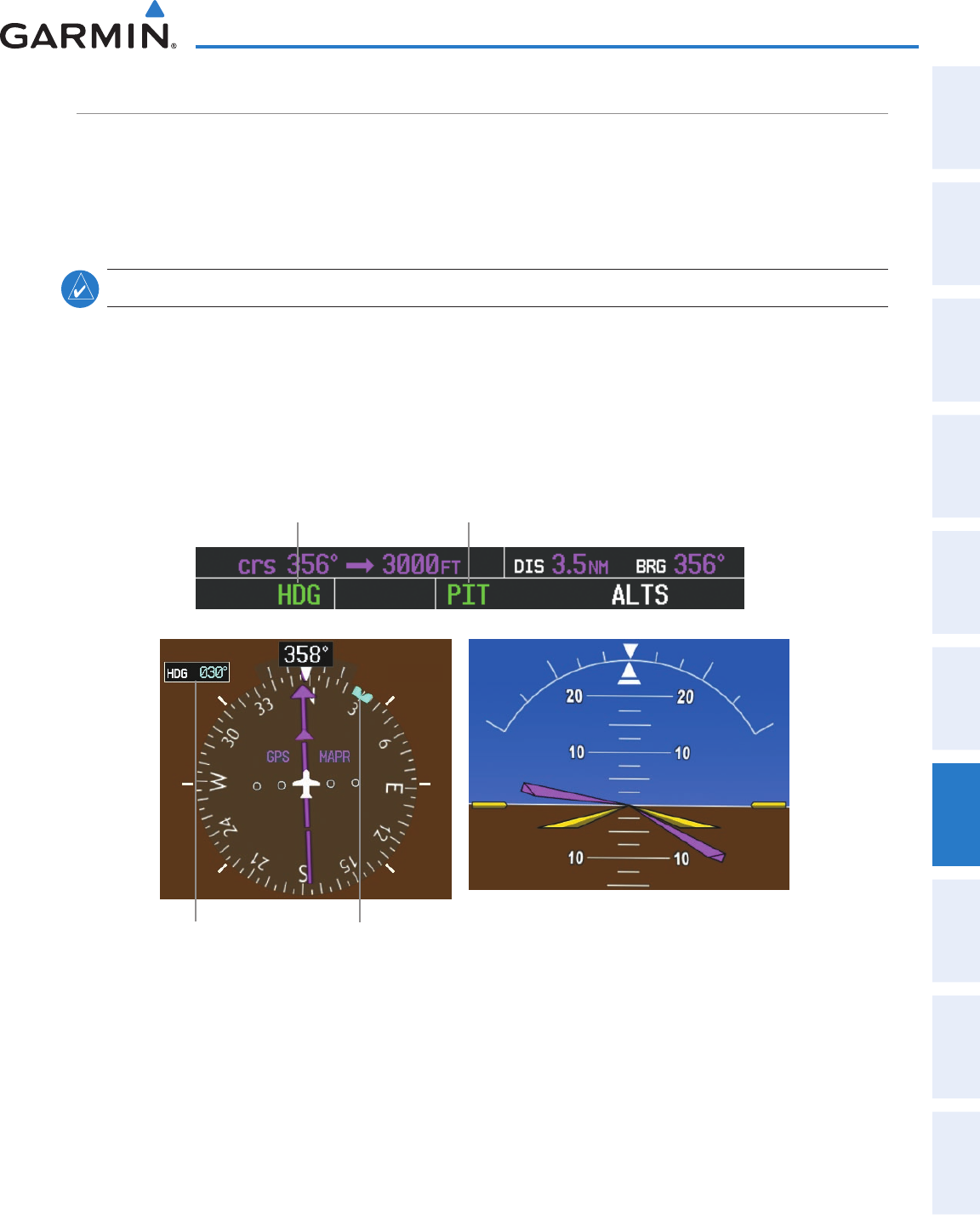
190-00592-06 Rev. A
Garmin G1000 Pilot’s Guide for Diamond DA40/40F
381
AUTOMATIC FLIGHT CONTROL SYSTEM
SYSTEM
OVERVIEW
FLIGHT
INSTRUMENTS EIS AUDIO PANEL
& CNS
FLIGHT
MANAGEMENT
HAZARD
AVOIDANCE AFCS ADDITIONAL
FEATURES APPENDICES INDEX
HEADING SELECT MODE (HDG)
Heading Select Mode is activated by pressing the HDG Key. Heading Select Mode acquires and maintains the
Selected Heading. The Selected Heading is shown by a light blue bug on the HSI and in the box to the upper
left of the HSI.
CHANGING THE SELECTED HEADING
NOTE: Pressing the HDG Knob synchronizes the Selected Heading to the current heading.
The Selected Heading is adjusted using the HDG Knob. Pressing the CWS Button and hand-flying the
aircraft does not change the Selected Heading. The autopilot guides the aircraft back to the Selected Heading
upon release of the CWS Button.
Turns are commanded in the same direction as Selected Heading Bug movement, even if the bug is turned
more than 180° from the present heading (e.g., a 270° turn to the right). However, Selected Heading changes
of more than 340° at a time result in turn reversals.
Figure 7-21 Heading Select Mode
Command Bars Track
Selected Heading
Selected
Heading
Bug
Selected
Heading
Pitch Mode
Active
Heading Select
Mode Active
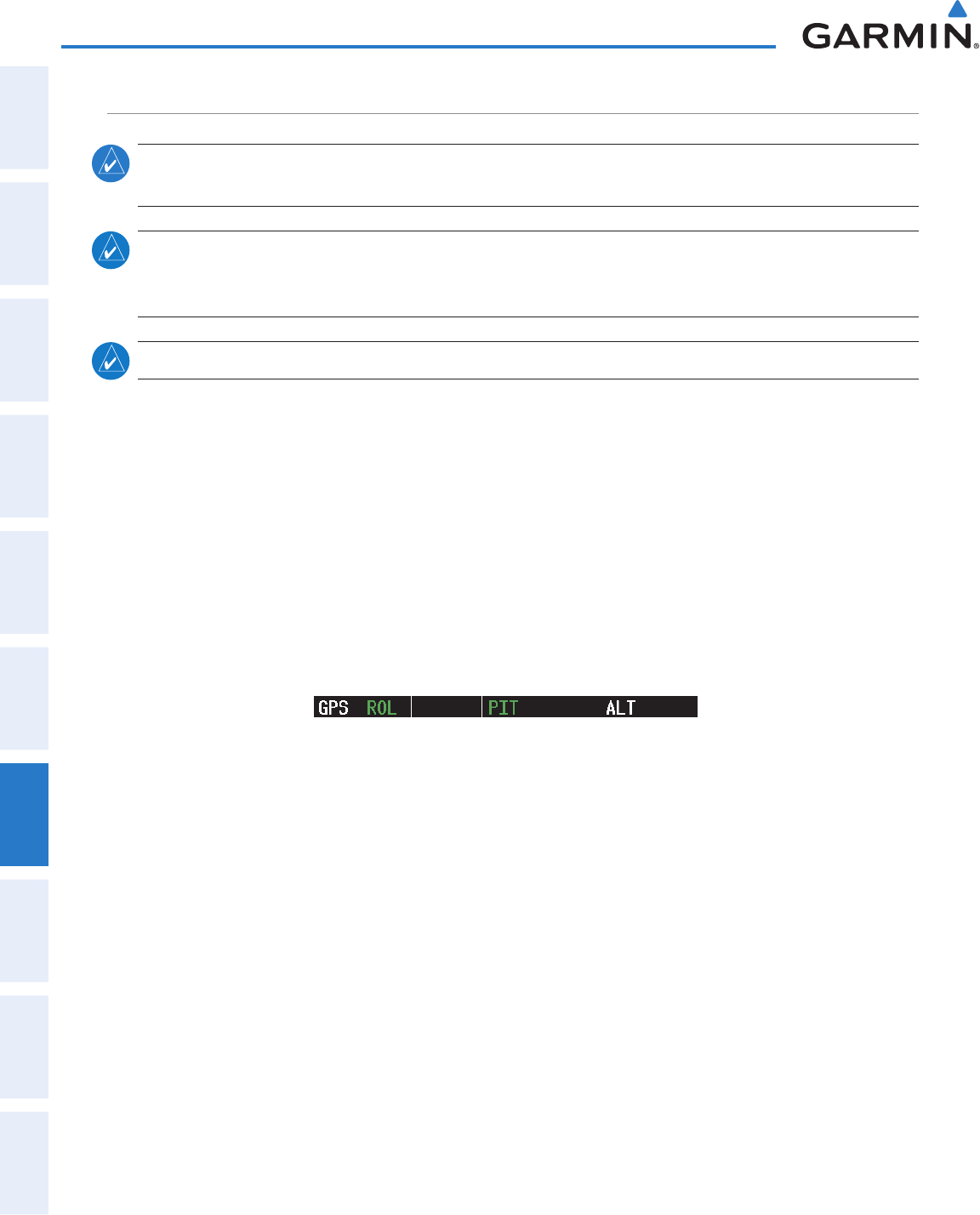
Garmin G1000 Pilot’s Guide for Diamond DA40/40F
190-00592-06 Rev. A
382
AUTOMATIC FLIGHT CONTROL SYSTEM
SYSTEM
OVERVIEW
FLIGHT
INSTRUMENTS
EIS
AUDIO PANEL
& CNS
FLIGHT
MANAGEMENT
HAZARD
AVOIDANCE
AFCS
ADDITIONAL
FEATURES
APPENDICESINDEX
NAVIGATION MODES (GPS, VOR, LOC, BC)
NOTE: The selected navigation receiver must have a valid VOR or LOC signal or active GPS course for the
flight director to enter Navigation Mode.
NOTE: When intercepting a flight plan leg, the flight director gives commands to capture the active leg at
approximately a 45° angle to the track between the waypoints defining the active leg. The flight director
does not give commands fly to the starting waypoint of the active leg.
NOTE: When making a backcourse approach, set the Selected Course to the localizer front course.
Pressing the NAV Key selects Navigation Mode. Navigation Mode acquires and tracks the selected navigation
source (GPS, VOR, LOC). The flight director follows GPS roll steering commands when GPS is the selected
navigation source. When the navigation source is VOR or LOC, the flight director creates roll steering commands
from the Selected Course and deviation. Navigation Mode can also be used to fly non-precision GPS and LOC
approaches where glideslope capture is not required.
Backcourse Navigation Mode is selected when the localizer front course is greater than 105° from the aircraft
heading. Backcourse Navigation Mode captures and tracks a localizer signal in the backcourse direction. The
annunciation ‘BC’ in the AFCS Status Box indicates Backcourse Navigation Mode.
If the Course Deviation Indicator (CDI) shows greater than one dot when the NAV Key is pressed, the selected
mode is armed. If the CDI is less than one dot, Navigation Mode is automatically captured when the NAV Key
is pressed. The armed annunciation appears in white to the left of the active roll mode.
Figure 7-22 GPS Navigation Mode Armed
When the CDI has automatically switched from GPS to LOC during a LOC/ILS approach, GPS Navigation
Mode remains active, providing GPS steering guidance until the localizer signal is captured. LOC Navigation
Mode is armed automatically when the navigation source switch takes place if the APR Key is not pressed prior
to the automatic source switch.
If Navigation Mode is active and either of the following occur, the flight director reverts to Roll Hold Mode
(wings rolled level):
•DifferentVORtunedwhileinVORNavigationMode(VORNavigationModerevertstoarmed)
•Navigationsourcemanuallyswitched(withtheCDI Softkey)
•DuringaLOC/ILSapproachtheFAFiscrossedwhileinGPSNavigationModeaftertheautomaticnavigation
source switch from GPS to LOC
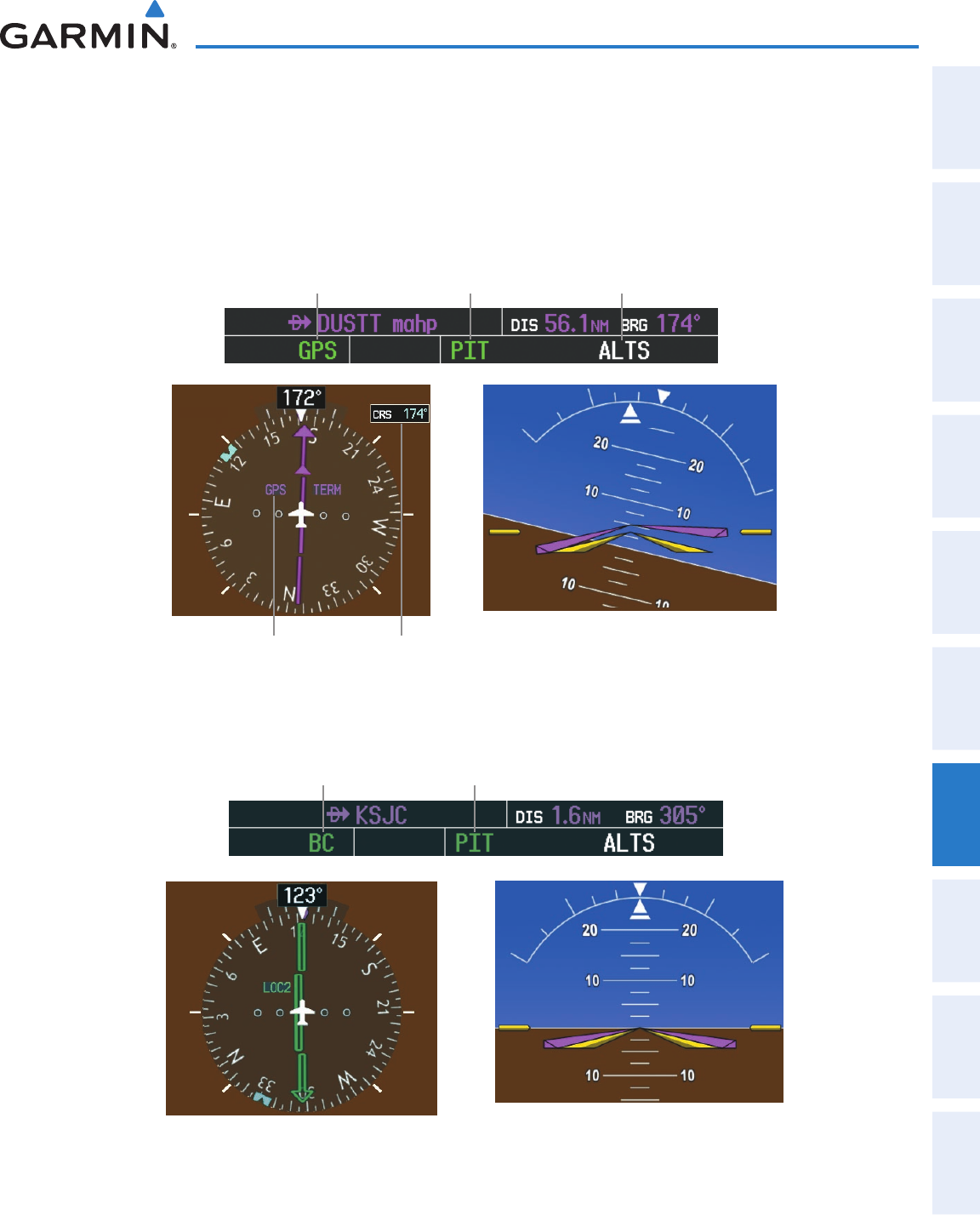
190-00592-06 Rev. A
Garmin G1000 Pilot’s Guide for Diamond DA40/40F
383
AUTOMATIC FLIGHT CONTROL SYSTEM
SYSTEM
OVERVIEW
FLIGHT
INSTRUMENTS EIS AUDIO PANEL
& CNS
FLIGHT
MANAGEMENT
HAZARD
AVOIDANCE AFCS ADDITIONAL
FEATURES APPENDICES INDEX
CHANGING THE SELECTED COURSE
The Selected Course is controlled using the CRS Knob (while in VOR, LOC, or OBS Mode). Pressing the
CWS Button and hand-flying the aircraft does not change the Selected Course while in Navigation Mode.
The autopilot guides the aircraft back to the Selected Course (or GPS flight plan) when the CWS Button is
released.
Figure 7-23 Navigation Mode
Command Bars Indicate Left
Turn to Track GPS Course and Climb
to Intercept Selected Altitude
GPS is Selected
Navigation
Source
Selected
Course
GPS Navigation
Mode Active
Pitch Mode
Active
Selected Altitude
Capture Mode
Armed
Figure 7-24 Backcourse Mode
LOC2 is Selected Navigation Source Command Bars Hold Pitch Attitude
Pitch Hold
Mode Active
Backcourse
Mode Active
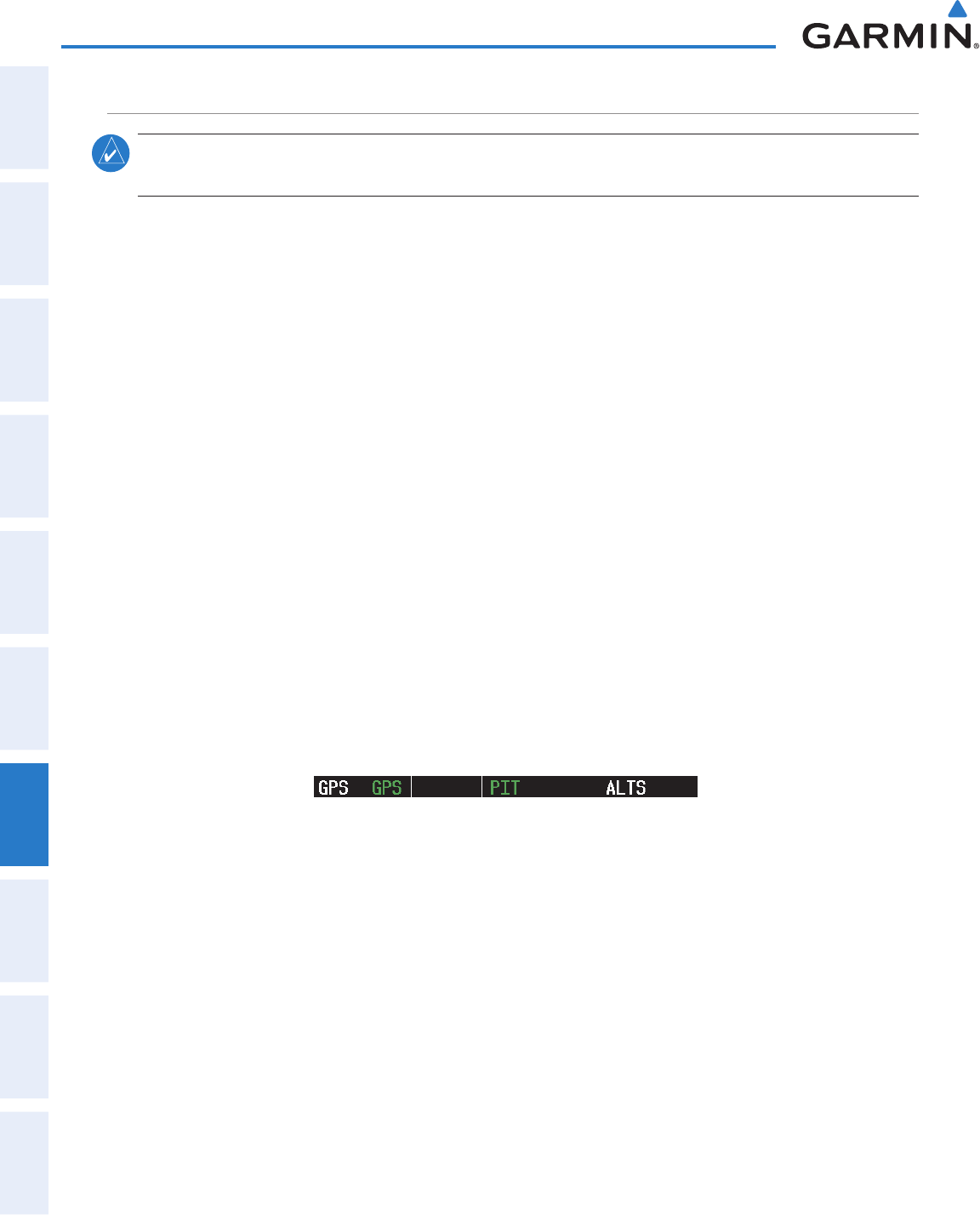
Garmin G1000 Pilot’s Guide for Diamond DA40/40F
190-00592-06 Rev. A
384
AUTOMATIC FLIGHT CONTROL SYSTEM
SYSTEM
OVERVIEW
FLIGHT
INSTRUMENTS
EIS
AUDIO PANEL
& CNS
FLIGHT
MANAGEMENT
HAZARD
AVOIDANCE
AFCS
ADDITIONAL
FEATURES
APPENDICESINDEX
APPROACH MODES (GPS, VAPP, LOC)
NOTE: The selected navigation receiver must have a valid VOR or LOC signal or active GPS course for the
flight director to enter Approach Mode.
Approach Mode is activated when the APR Key is pressed. Approach Mode acquires and tracks the selected
navigation source (GPS, VOR, or LOC), depending on loaded approach. This mode uses the selected navigation
receiver deviation and desired course inputs to fly the approach. Pressing the APR Key when the CDI is greater
than one dot arms the selected approach mode (annunciated in white to the left of the active lateral mode). If
the CDI is less than one dot, the LOC is automatically captured when the APR Key is pressed.
VOR Approach Mode (VAPP) provides greater sensitivity for signal tracking than VOR Navigation Mode.
Selecting VOR Approach Mode:
1) Ensure a valid VOR frequency is tuned
2) Ensure that VOR is the selected navigation source (use the CDI Softkey to cycle through navigation sources if
necessary).
3) Press the APR Key.
When GPS Approach Mode is armed, Glidepath Mode is also armed.
Selecting GPS Approach Mode:
1) Ensure a GPS approach is loaded into the active flight plan. The active waypoint must be part of the flight plan
(cannot be a direct-to a waypoint not in the flight plan).
2) Ensure that GPS is the selected navigation source (use the CDI Softkey to cycle through navigation sources if
necessary).
3) Press the APR Key.
Figure 7-25 GPS Approach Mode Armed
190-00592-06 Rev. A
Garmin G1000 Pilot’s Guide for Diamond DA40/40F
385
AUTOMATIC FLIGHT CONTROL SYSTEM
SYSTEM
OVERVIEW
FLIGHT
INSTRUMENTS EIS AUDIO PANEL
& CNS
FLIGHT
MANAGEMENT
HAZARD
AVOIDANCE AFCS ADDITIONAL
FEATURES APPENDICES INDEX
LOC Approach Mode allows the autopilot to fly a LOC/ILS approach with a glideslope. When LOC Approach
Mode is armed, Glideslope Mode is also armed automatically. LOC captures are inhibited if the difference
between aircraft heading and localizer course exceeds 105°.
Selecting LOC Approach Mode:
1) Ensure a valid localizer frequency is tuned.
2) Ensure that LOC is the selected navigation source (use the CDI Softkey to cycle through navigation sources if
necessary).
3) Press the APR Key.
Or:
1) Ensure that GPS is the selected navigation source (use the CDI Softkey to cycle through navigation sources if
necessary).
2) Ensure a LOC/ILS approach is loaded into the active flight plan.
3) Ensure the corresponding LOC frequency is tuned.
4) Press the APR Key.
If the following occurs, the flight director reverts to Roll Hold Mode (wings rolled level):
•ApproachModeisactiveandaVectors-To-Finalisactivated
•ApproachModeisactiveandNavigationsourceismanuallyswitched
•During a LOC/ILS approach, GPS Navigation Mode is active and the FAF is crossed after the automatic
navigation source switch from GPS to LOC
CHANGING THE SELECTED COURSE
The Selected Course is controlled using the CRS Knob (while in VOR, LOC, or OBS Mode). Pressing the
CWS Button and hand-flying the aircraft does not change the Selected Course while in Approach Mode.
The autopilot guides the aircraft back to the Selected Course (or GPS flight plan) when the CWS Button is
released.
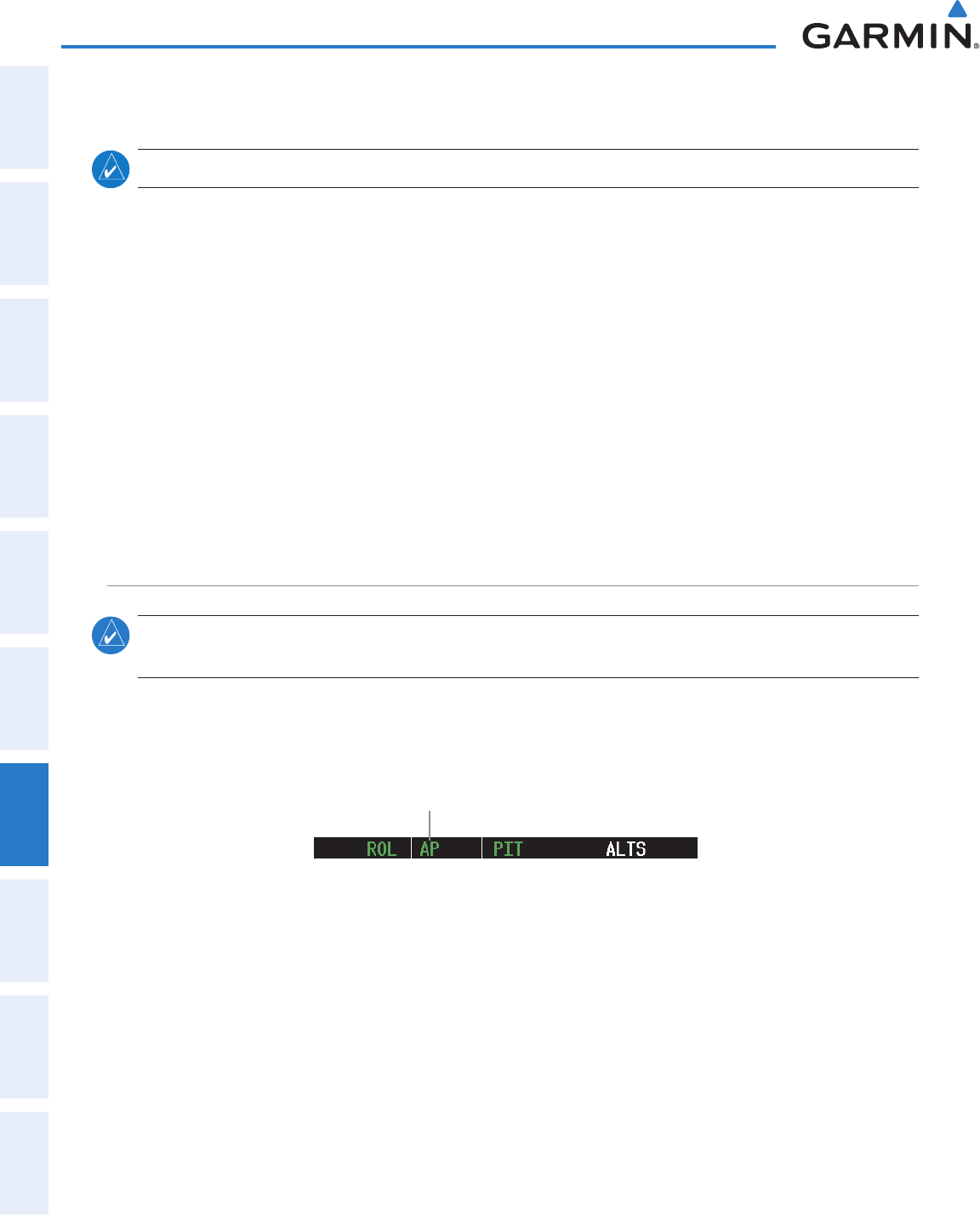
Garmin G1000 Pilot’s Guide for Diamond DA40/40F
190-00592-06 Rev. A
386
AUTOMATIC FLIGHT CONTROL SYSTEM
SYSTEM
OVERVIEW
FLIGHT
INSTRUMENTS
EIS
AUDIO PANEL
& CNS
FLIGHT
MANAGEMENT
HAZARD
AVOIDANCE
AFCS
ADDITIONAL
FEATURES
APPENDICESINDEX
7.5 AUTOPILOT OPERATION
NOTE: Refer to the AFM for specific instructions regarding emergency procedures.
The autopilot operates flight control surface servos to provide automatic flight control. Pitch and roll commands
are provided to the servos, based on the active flight director modes. The autopilot uses pitch and roll rates to
stabilize the aircraft attitude during upsets and flight director maneuvers. Flight director commands are rate- and
attitude-limited, combined with pitch and roll damper control, and sent to the pitch and roll servo motors.
Pitch autotrim provides trim commands to the pitch trim servo to relieve any sustained effort required by the
pitch servo. The pitch servo measures the output effort (torque) and provides this signal to the pitch trim servo.
The pitch trim servo commands the motor to reduce the average pitch servo effort.
When the autopilot is not engaged, the pitch trim servo may be used to provide manual electric trim (MET).
This allows the aircraft to be trimmed using a control wheel switch rather than the trim wheel. Manual trim
commands are generated only when both halves of the AP TRIM Switch are operated simultaneously. Trim
speeds are scheduled with airspeed to provide more consistent response.
Servo motor control limits the maximum servo speed and torque. The servo mounts are equipped with slip-
clutches set to certain values. This allows the servos to be overridden in case of an emergency.
ENGAGING THE AUTOPILOT
NOTE: Autopilot engagement/disengagement is not equivalent to servo engagement/disengagement. Use
the CWS Button to disengage the pitch and roll servos while the autopilot remains active.
When the
AP
Key is pressed, the autopilot and flight director (if not already engaged) are activated. Engagement
is indicated by a green ‘AP’ annunciation in the center of the AFCS Status Box. The flight director engages in
Pitch and Roll Hold modes when initially activated.
Figure 7-26 Autopilot and Yaw Damper Engaged
Autopilot
Engaged
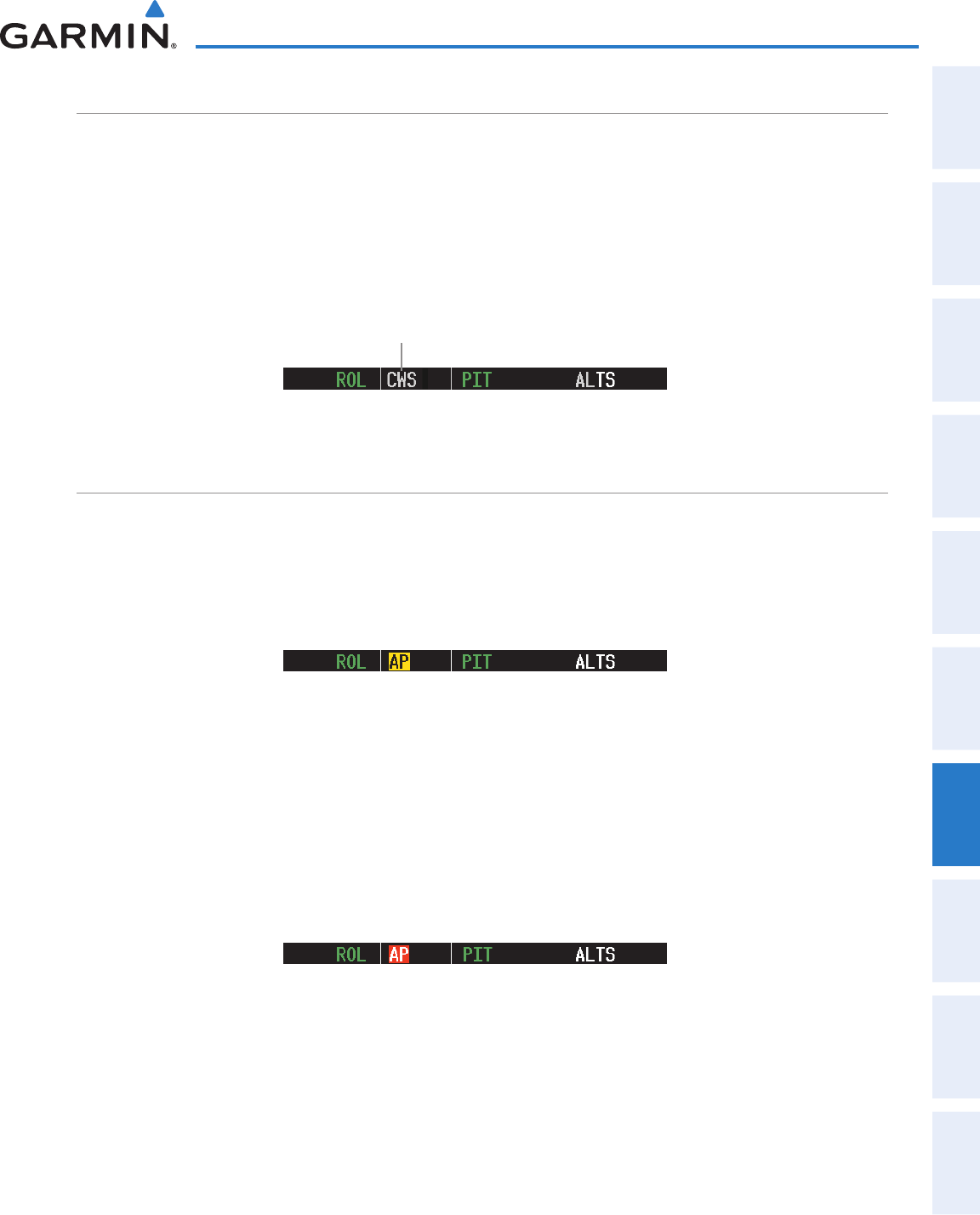
190-00592-06 Rev. A
Garmin G1000 Pilot’s Guide for Diamond DA40/40F
387
AUTOMATIC FLIGHT CONTROL SYSTEM
SYSTEM
OVERVIEW
FLIGHT
INSTRUMENTS EIS AUDIO PANEL
& CNS
FLIGHT
MANAGEMENT
HAZARD
AVOIDANCE AFCS ADDITIONAL
FEATURES APPENDICES INDEX
CONTROL WHEEL STEERING
During autopilot operation, the aircraft may be hand-flown without disengaging the autopilot. Pressing and
holding the
CWS
Button disengages the pitch and roll servos from the flight control surfaces and allows the
aircraft to be hand-flown. At the same time, the flight director is synchronized to the aircraft attitude during
the maneuver. The ‘AP’ annunciation is temporarily replaced by ‘CWS’ in white for the duration of CWS
maneuvers.
In most scenarios, releasing the
CWS
Button reengages the autopilot with a new reference. Refer to the flight
director modes section for specific CWS behavior in each mode.
Figure 7-27 CWS Annunciation
Control Wheel Steering
DISENGAGING THE AUTOPILOT
The autopilot is manually disengaged by pushing the
AP DISC Switch, GA Switch, AP TRIM ARM Switch,
or
the
AP
Key on the MFD. Manual disengagement is indicated by a five-second flashing yellow ‘AP’ annunciation
and a two-second autopilot disconnect aural alert. After manual disengagement, the autopilot disconnect aural
alert may be cancelled by pushing the AP TRIM ARM or
AP DISC
Switch (
AP DISC
Switch also cancels the
flashing ‘AP’ annunciation).
Figure 7-28 Manual Autopilot Disengagement
Automatic autopilot disengagement is indicated by a flashing red ‘AP’ annunciation and by the autopilot
disconnect aural alert, which continue until acknowledged by pushing the AP DISC or
AP TRIM ARM
Switch.
Automatic disengagement occurs due to:
•Systemfailure
•Inabilitytocomputedefaultightdirectormodes
(FD also disengages automatically)
•Invalidsensordata
Figure 7-29 Automatic Autopilot Disengagement
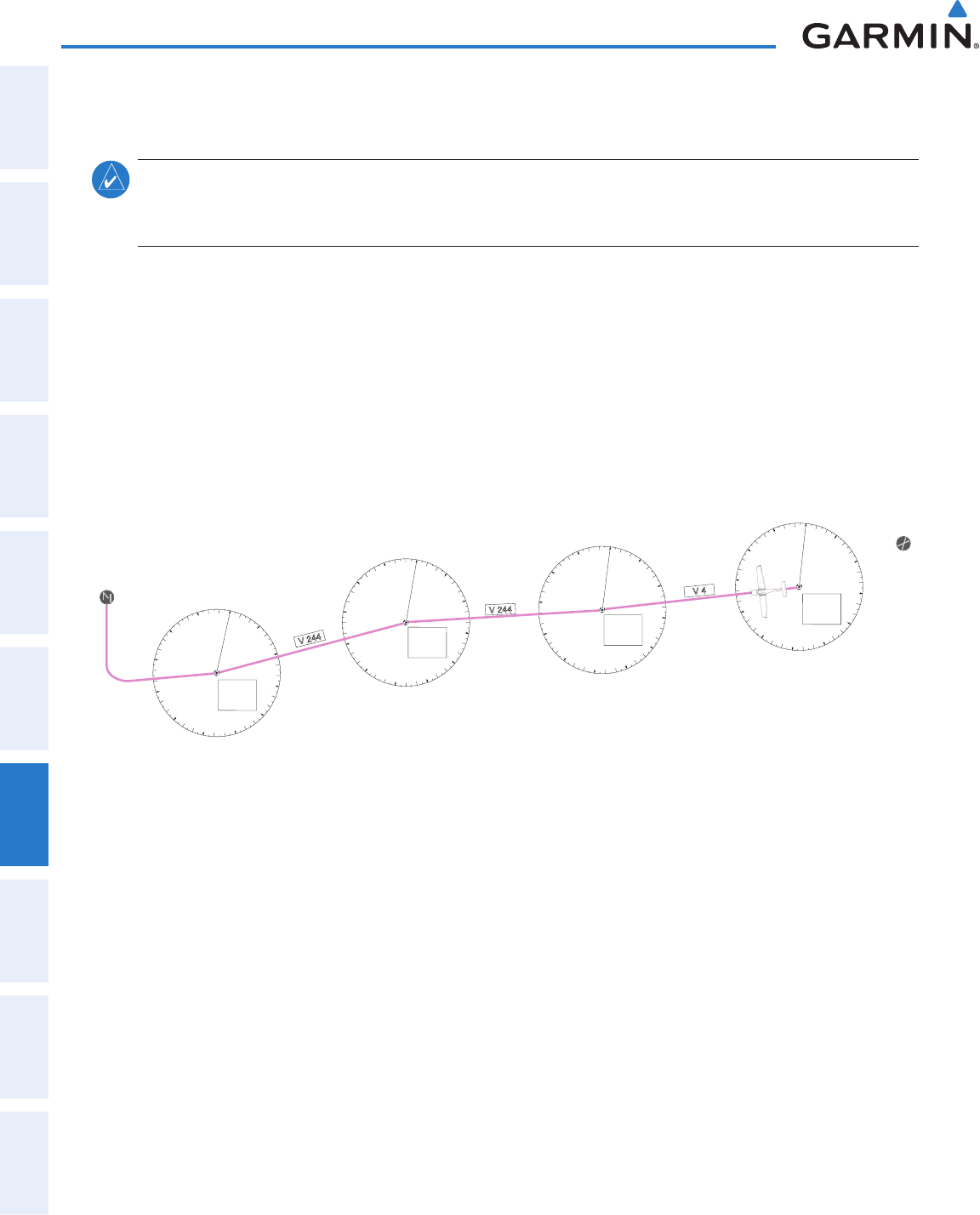
Garmin G1000 Pilot’s Guide for Diamond DA40/40F
190-00592-06 Rev. A
388
AUTOMATIC FLIGHT CONTROL SYSTEM
SYSTEM
OVERVIEW
FLIGHT
INSTRUMENTS
EIS
AUDIO PANEL
& CNS
FLIGHT
MANAGEMENT
HAZARD
AVOIDANCE
AFCS
ADDITIONAL
FEATURES
APPENDICESINDEX
7.6 EXAMPLE FLIGHT PLAN
NOTE: The following example flight plan and diagrams (not to be used for navigation) in this section are
for instructional purposes only and should be considered not current. Numbered portions of accompanying
diagrams correspond to numbered procedure steps.
This scenario-based set of procedures (based on the example flight plan found in the Flight Management
Section) shows various GFC 700 AFCS modes used during a flight. In this scenario, the aircraft departs Charles
B. Wheeler Downtown Airport (KMKC), enroute to Colorado Springs Airport (KCOS). After departure, the
aircraft climbs to 12,000 ft and airway V4 is intercepted, following ATC vectors.
Airway V4 is flown to Salina VOR (SLN) using VOR navigation, then airway V244 is flown using GPS navigation.
The ILS approach for runway 35L and LPV (WAAS) approach for runway 35R are shown and a missed approach
is executed.
Figure 7-30 Flight Plan Overview
0
3
6
9
12
15
18
21
24
27
30
33
0
3
6
9
12
15
18
21
24
27
30
33
Salina
VOR
(SLN)
KMKC
Lamar
VOR
(LAA)
0
3
6
9
12
15
18
21
24
27
30
33
Hays
VOR
(HYS)
KCOS
V 244
V 4
V 244
0
3
6
9
12
15
18
21
24
27
30
33
To peka
VOR
(TOP)
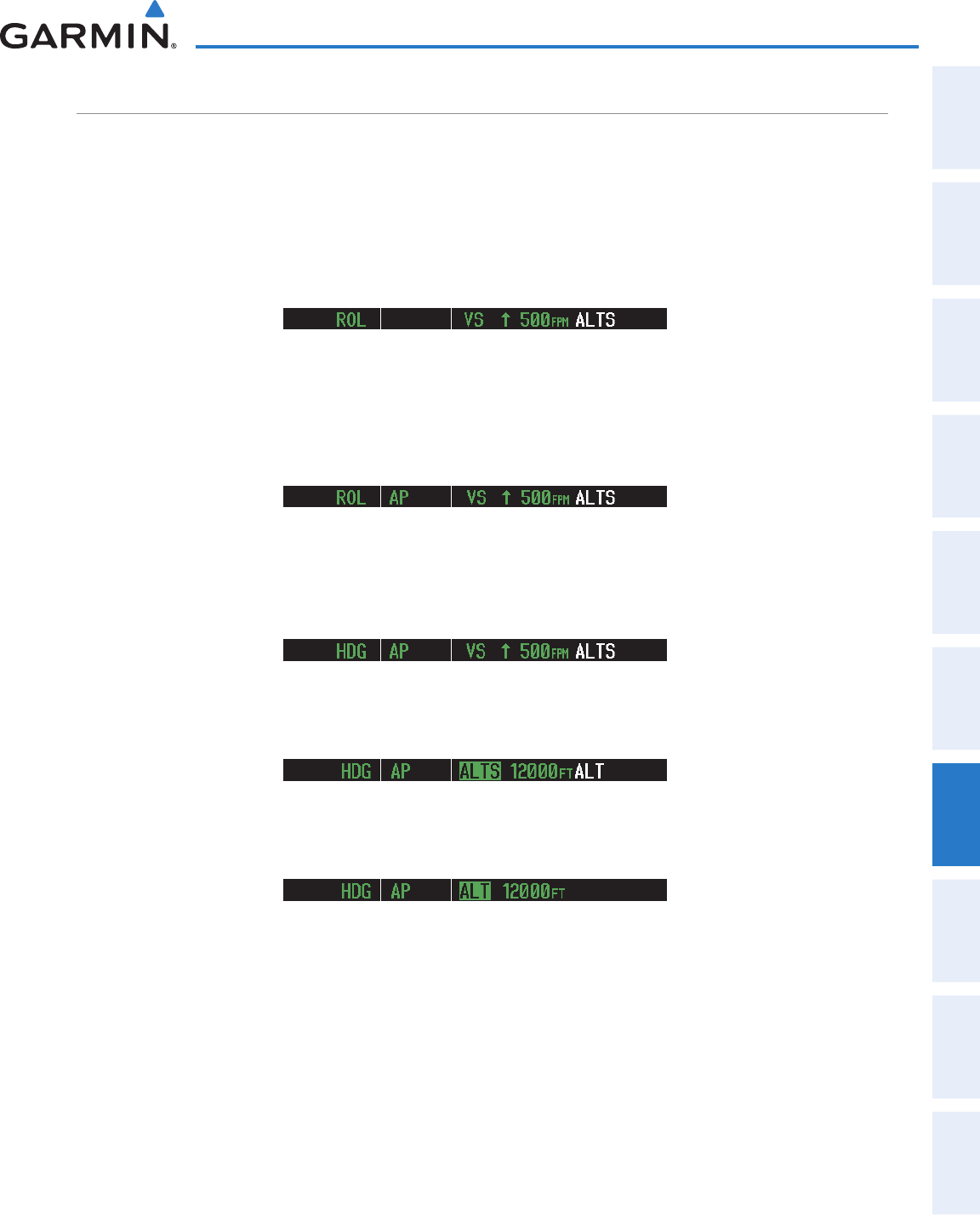
190-00592-06 Rev. A
Garmin G1000 Pilot’s Guide for Diamond DA40/40F
389
AUTOMATIC FLIGHT CONTROL SYSTEM
SYSTEM
OVERVIEW
FLIGHT
INSTRUMENTS EIS AUDIO PANEL
& CNS
FLIGHT
MANAGEMENT
HAZARD
AVOIDANCE AFCS ADDITIONAL
FEATURES APPENDICES INDEX
DEPARTURE
Climbing to the Selected Altitude and flying an assigned heading:
1) Before takeoff, set the Selected Altitude to 12,000 feet using the ALT Knob.
2) In this example, Vertical Speed Mode is used to capture the Selected Altitude (Pitch Hold, Vertical Speed, or
Flight Level Change Mode may be used).
a) Press the VS Key to activate Vertical Speed Mode.
The Vertical Speed Reference may be adjusted after Vertical Speed Mode is selected using the NOSE UP/
NOSE DN Keys or pushing the CWS Button while hand-flying the aircraft to establish a new Vertical Speed
Reference.
b) Press the
AP
Key to engage the autopilot in a climb using Vertical Speed Mode.
3) Use the HDG Knob to set the Selected Heading, complying with ATC vectors to intercept Airway V4.
Press the HDG Key to activate Heading Select Mode while the autopilot is engaged in the climb. The autopilot
follows the Selected Heading Bug on the HSI and turns the aircraft to the desired heading.
4) As the aircraft nears the Selected Altitude, the flight director transitions to Selected Altitude Capture Mode,
indicated by the green ‘ALTS’ annunciation flashing for up to 10 seconds.
At 50 feet from the Selected Altitude, the green ‘ALT’ annunciation flashes for up to 10 seconds; the autopilot
transitions to Altitude Hold Mode and levels the aircraft.
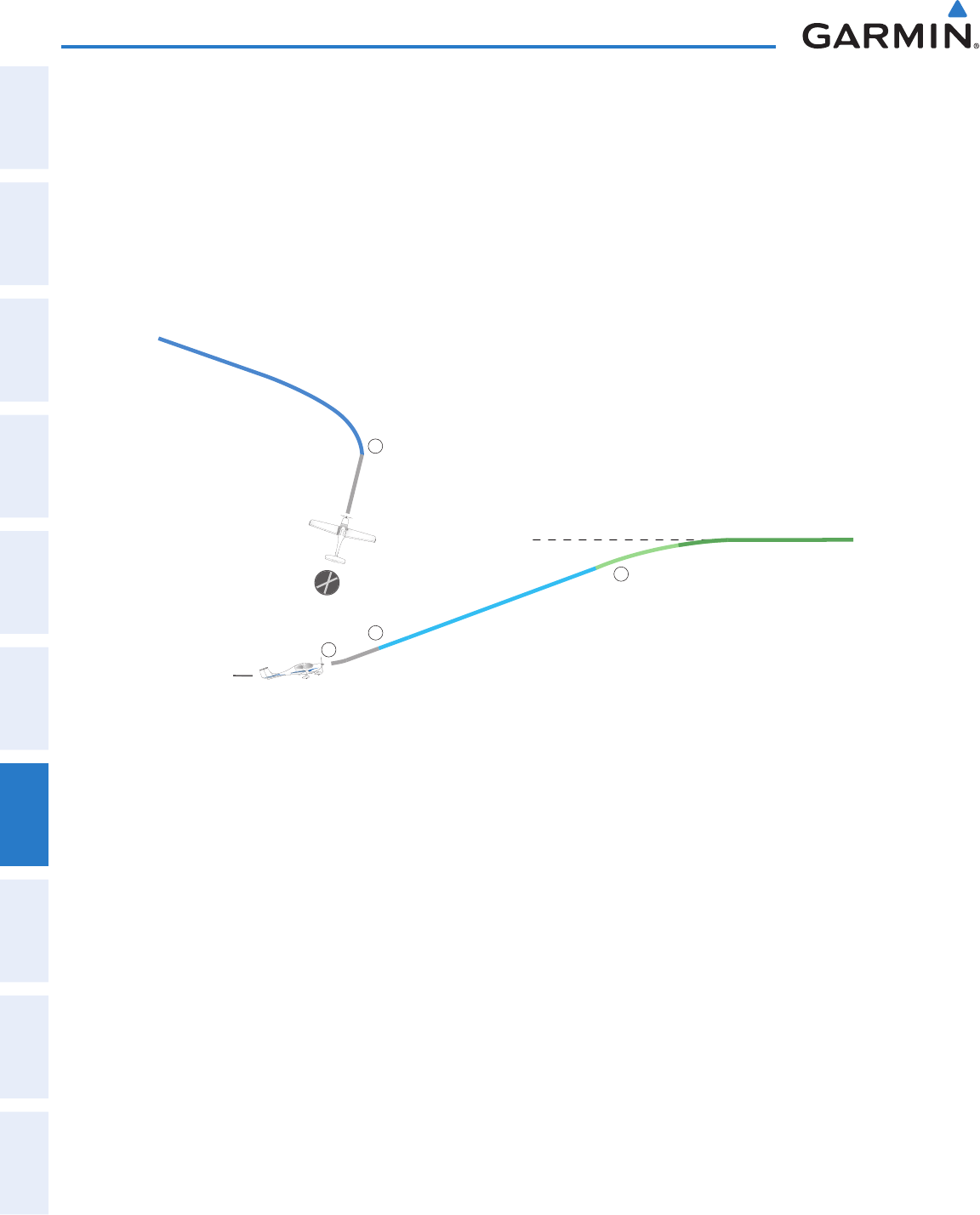
Garmin G1000 Pilot’s Guide for Diamond DA40/40F
190-00592-06 Rev. A
390
AUTOMATIC FLIGHT CONTROL SYSTEM
SYSTEM
OVERVIEW
FLIGHT
INSTRUMENTS
EIS
AUDIO PANEL
& CNS
FLIGHT
MANAGEMENT
HAZARD
AVOIDANCE
AFCS
ADDITIONAL
FEATURES
APPENDICESINDEX
Figure 7-31 Departure
Selected Altitude of 12,000 MSL
1
2
3
4
HDG Mode
VS Mode
ALT Mode
KMKC
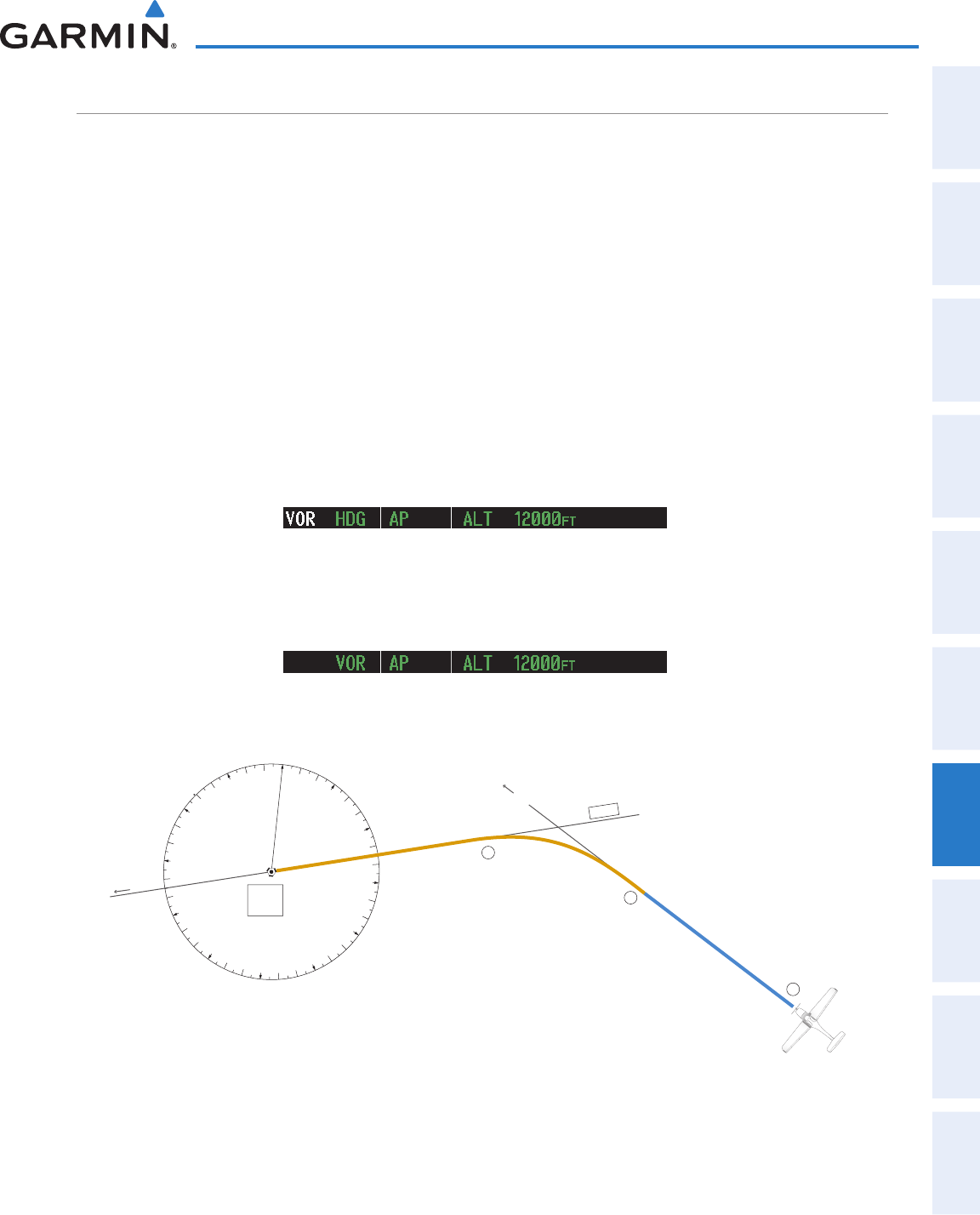
190-00592-06 Rev. A
Garmin G1000 Pilot’s Guide for Diamond DA40/40F
391
AUTOMATIC FLIGHT CONTROL SYSTEM
SYSTEM
OVERVIEW
FLIGHT
INSTRUMENTS EIS AUDIO PANEL
& CNS
FLIGHT
MANAGEMENT
HAZARD
AVOIDANCE AFCS ADDITIONAL
FEATURES APPENDICES INDEX
INTERCEPTING A VOR RADIAL
During climb-out, the autopilot continues to fly the aircraft in Heading Select Mode. Airway V4 to Salina
VOR (SLN) should now be intercepted. Since the enroute flight plan waypoints correspond to VORs, flight
director Navigation Mode using either VOR or GPS as the navigation source may be used. In this scenario, VOR
Navigation Mode is used for navigation to the first VOR waypoint in the flight plan.
Intercepting a VOR radial:
1) Arm VOR Navigation Mode:
a) Tune the VOR frequency.
b) Press the CDI Softkey to set the navigation source to VOR.
c) Use the CRS Knob to set the Selected Course to 255°. Note that at this point, the flight director is still in
Heading Select Mode and the autopilot continues to fly 290°.
d) Press the
NAV
Key. This arms VOR Navigation Mode and the white ‘VOR’ annunciation appears to the left of
the active lateral mode.
2) As the aircraft nears the Selected Course, the flight director transitions from Heading Select to VOR Navigation
Mode and the ‘VOR’ annunciation flashes green. The autopilot begins turning to intercept the Selected
Course.
3) The autopilot continues the turn until the aircraft is established on the Selected Course.
Figure 7-32 Intercepting a VOR Radial
0
3
6
9
12
15
18
21
24
27
30
33
HDG Mode, VOR Armed
VOR NAV Mode
V 4
Salina
VOR
(SLN)
1
2
3
Hdg
290
o
255
o
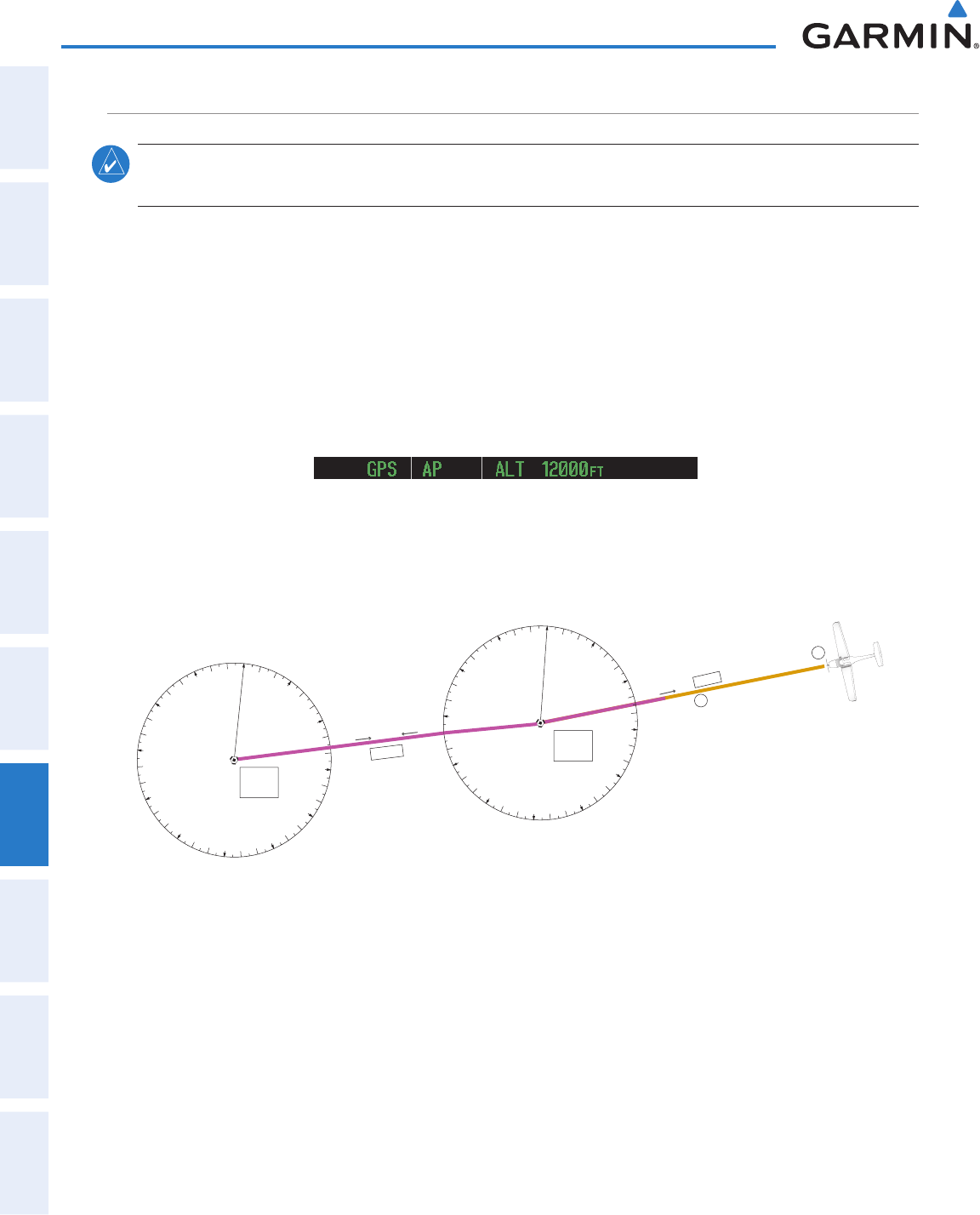
Garmin G1000 Pilot’s Guide for Diamond DA40/40F
190-00592-06 Rev. A
392
AUTOMATIC FLIGHT CONTROL SYSTEM
SYSTEM
OVERVIEW
FLIGHT
INSTRUMENTS
EIS
AUDIO PANEL
& CNS
FLIGHT
MANAGEMENT
HAZARD
AVOIDANCE
AFCS
ADDITIONAL
FEATURES
APPENDICESINDEX
FLYING A FLIGHT PLAN/GPS COURSE
NOTE: Changing the navigation source cancels Navigation Mode and causes the flight director to revert
back to Roll Hold Mode (wings rolled level).
As the aircraft closes on Salina VOR, GPS is used to navigate the next leg, airway V244. The aircraft is
currently tracking inbound on Airway V4.
Flying a GPS flight plan:
1) Transition from VOR to GPS Navigation Mode:
a) Press the
CDI
Softkey until GPS is the selected navigation source.
b) Press the
NAV
Key to activate GPS Navigation Mode. The autopilot guides the aircraft along the active flight
plan leg.
2) Following the flight plan, the autopilot continues to steer the aircraft under GPS guidance. Note that in GPS
Navigation Mode, course changes defined by the flight plan are automatically made without pilot action
required.
Figure 7-33 Transition to GPS Flight Plan
0
3
6
9
12
15
18
21
24
27
30
33
VOR NAV Mode
GPS NAV Mode
V 244
1
2
V 4
076
o
075o
260
o
0
3
6
9
12
15
18
21
24
27
30
33
Salina
VOR
(SLN)
Hays
VOR
(HYS)
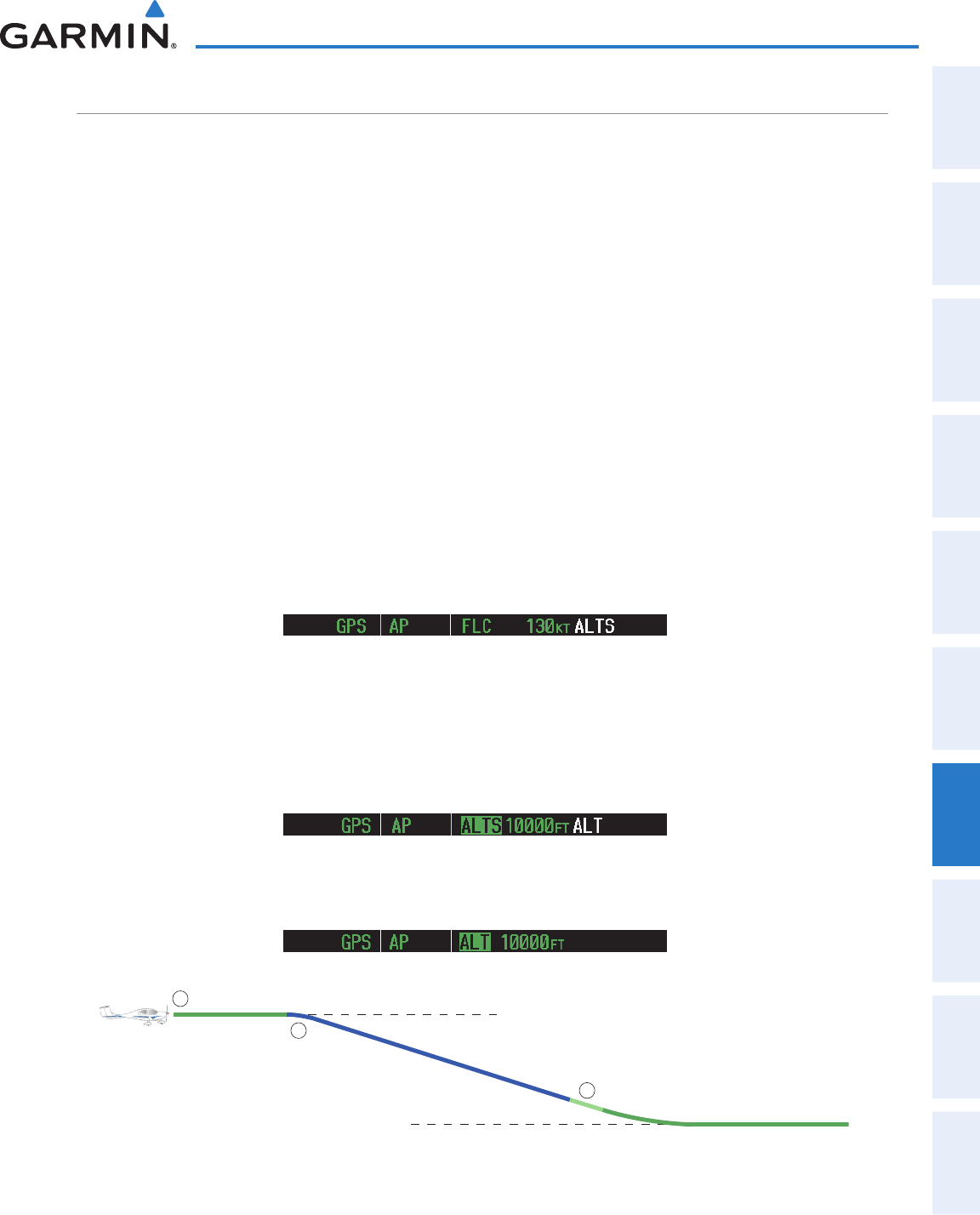
190-00592-06 Rev. A
Garmin G1000 Pilot’s Guide for Diamond DA40/40F
393
AUTOMATIC FLIGHT CONTROL SYSTEM
SYSTEM
OVERVIEW
FLIGHT
INSTRUMENTS EIS AUDIO PANEL
& CNS
FLIGHT
MANAGEMENT
HAZARD
AVOIDANCE AFCS ADDITIONAL
FEATURES APPENDICES INDEX
DESCENT
While flying the arrival procedure, the aircraft is cleared for descent in preparation for the approach to KCOS.
Three methods are presented for the descent:
•FlightLevelChangedescent–FlightLevelChangeModecanbeusedtodescendtotheSelectedAltitudeata
constant airspeed. This descent method does not account for flight plan waypoint altitude constraints.
•Vertical Path Tracking descent – Vertical Path Tracking Mode is used to follow the vertical descent path
defined in the GPS flight plan. Altitude constraints correspond to waypoints in the flight plan. Before VNV
flight control can provide vertical profile guidance, a VNV flight plan must be entered and enabled.
•Non-pathdescentinaVNVscenario–AVNVightplanisenteredandenabled,howeverPitchHold,Vertical
Speed, or Flight Level Change Mode can be used to descend to the VNV Target Altitude prior to reaching the
planned TOD. Flight Level Change Mode is used in the example.
Flight Level Change descent:
1) Select Flight Level Change Mode:
a) Using the ALT Knob, set the Selected Altitude to 10,000 feet.
b) Press the
FLC
Key to activate Flight Level Change Mode. The annunciation ‘FLC’ appears next to the
Airspeed Reference, which defaults to the current aircraft airspeed. Selected Altitude Capture Mode is armed
automatically.
2) Use the NOSE UP/NOSE DN Keys or push the CWS Button while hand-flying the aircraft to adjust the
commanded airspeed while maintaining the same power, or reduce power to allow descent in Flight Level
Change Mode while the autopilot maintains the current airspeed.
3) As the aircraft nears the Selected Altitude, the flight director transitions to Selected Altitude Capture Mode,
indicated by the green ‘ALTS’ annunciation flashing for up to 10 seconds.
The green ‘ALT’ annunciation flashes for up to 10 seconds upon reaching 50 feet from the Selected Altitude; the
autopilot transitions to Altitude Hold Mode and levels the aircraft.
Figure 7-34 FLC Descent
Cruise Altitude of 12,000 MSL
Selected Altitude of 10,000 MSL
ALT Mode
FLC Mode
ALT Mode
1
2
3
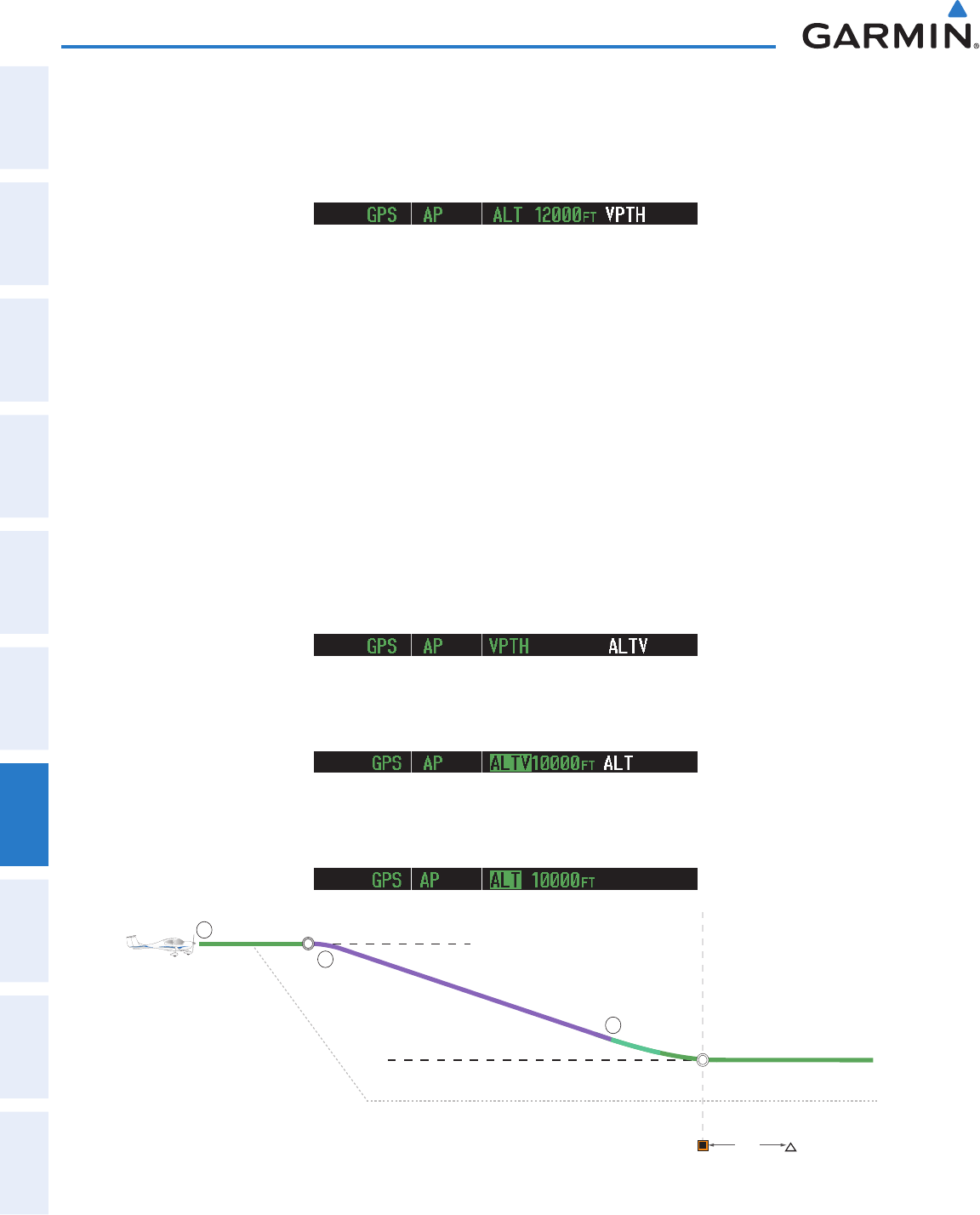
Garmin G1000 Pilot’s Guide for Diamond DA40/40F
190-00592-06 Rev. A
394
AUTOMATIC FLIGHT CONTROL SYSTEM
SYSTEM
OVERVIEW
FLIGHT
INSTRUMENTS
EIS
AUDIO PANEL
& CNS
FLIGHT
MANAGEMENT
HAZARD
AVOIDANCE
AFCS
ADDITIONAL
FEATURES
APPENDICESINDEX
Vertical Path Tracking descent to VNV Target Altitude:
1) Select VNV flight control:
a) Press the
VNV
Key to arm Vertical Path Tracking Mode. The white annunciation ‘VPTH’ appears.
b) Using the ALT Knob, set the Selected Altitude below the flight plan’s VNV Target Altitude of 10,000 feet.
If the Selected Altitude is not at least 75 ft below the VNV Target Altitude, the flight director captures the
Selected Altitude rather than the VNV Target Altitude once Vertical Path Tracking Mode becomes active (ALTS is
armed rather than ALTV).
c) If Vertical Path Tracking Mode is armed more than 5 minutes prior to descent path capture, acknowledgment is
required for the flight director to transition from Altitude Hold to Vertical Path Tracking Mode. To proceed with
descent path capture if the white ‘VPTH’ annunciation begins flashing, do one of the following
• Press the VNV Key • Turn the ALT Knob to adjust the Selected Altitude
If the descent is not confirmed by the time of interception, Vertical Path Tracking Mode remains armed and the
descent is not captured.
2) When the top of descent (TOD) is reached, the flight director transitions to Vertical Path Tracking Mode and
begins the descent to the VNV Target Altitude. Intention to capture the VNV Target Altitude is indicated by the
white ‘ALTV’ annunciation.
3) As the aircraft nears the VNV Target Altitude, the flight director transitions to VNV Target Altitude Capture Mode,
indicated by the green ‘ALTV’ annunciation flashing for up to 10 seconds.
The green ‘ALT’ annunciation flashes for up to 10 seconds upon reaching 50 feet from the VNV Target Altitude;
the autopilot transitions to Altitude Hold Mode and levels the aircraft at the vertical waypoint.
Figure 7-35 VPTH Descent
OPSHN
3 nm
Cruise Altitude of 12,000 MSL
VNAV Target Altitude of 10,000 MSL ALT Mode
VPTH Mode
Selected Altitude (set below VNAV Target Altitude)
1
2
3
TOD
BOD
ALT Mode
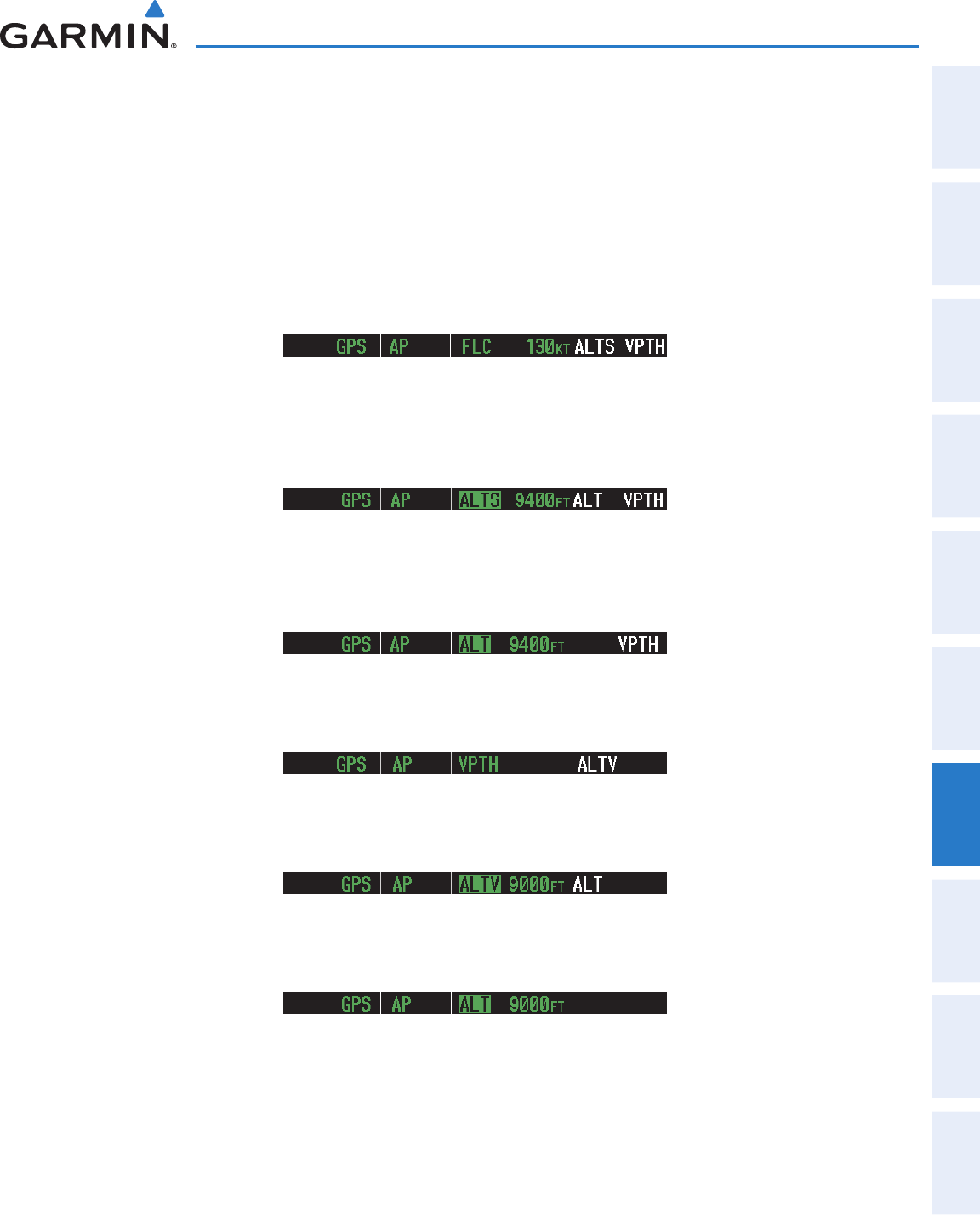
190-00592-06 Rev. A
Garmin G1000 Pilot’s Guide for Diamond DA40/40F
395
AUTOMATIC FLIGHT CONTROL SYSTEM
SYSTEM
OVERVIEW
FLIGHT
INSTRUMENTS EIS AUDIO PANEL
& CNS
FLIGHT
MANAGEMENT
HAZARD
AVOIDANCE AFCS ADDITIONAL
FEATURES APPENDICES INDEX
Non-path descent using Flight Level Change Mode:
1) Using Flight Level Change Mode, command a non-path descent to an intermediate altitude above the next VNV
flight plan altitude:
a) Using the ALT Knob, set the Selected Altitude below the current aircraft altitude to an altitude (in this case
9,400 feet) at which to level off between VNV flight plan altitudes.
b) Press the FLC Key before the planned TOD during an altitude hold while VPTH is armed. The Airspeed Reference
defaults to the current aircraft airspeed. Vertical Path Tracking and Selected Altitude Capture Mode are armed
automatically.
2) Reduce power to allow descent in Flight Level Change Mode. The autopilot maintains the Airspeed Reference.
3) As the aircraft nears the Selected Altitude, the flight director transitions to Selected Altitude Capture Mode,
indicated by the green ‘ALTS’ annunciation flashing for up to 10 seconds.
The green ‘ALT’ annunciation flashes for up to 10 seconds upon reaching 50 feet from the Selected Altitude; the
autopilot transitions to Altitude Hold Mode and levels the aircraft. After leveling off, reset Selected Altitude at
or below 9,000 ft.
4) When the next TOD is reached, Vertical Path Tracking becomes active (may require acknowledgment to allow
descent path capture).
5) As the aircraft nears the VNV Target Altitude, the flight director transitions to VNV Target Altitude Capture Mode,
indicated by the green ‘ALTV’ annunciation flashing for up to 10 seconds.
The green ‘ALT’ annunciation flashes for up to 10 seconds upon reaching 50 feet from the VNV Target Altitude;
the autopilot transitions to Altitude Hold Mode and levels the aircraft at the vertical waypoint.
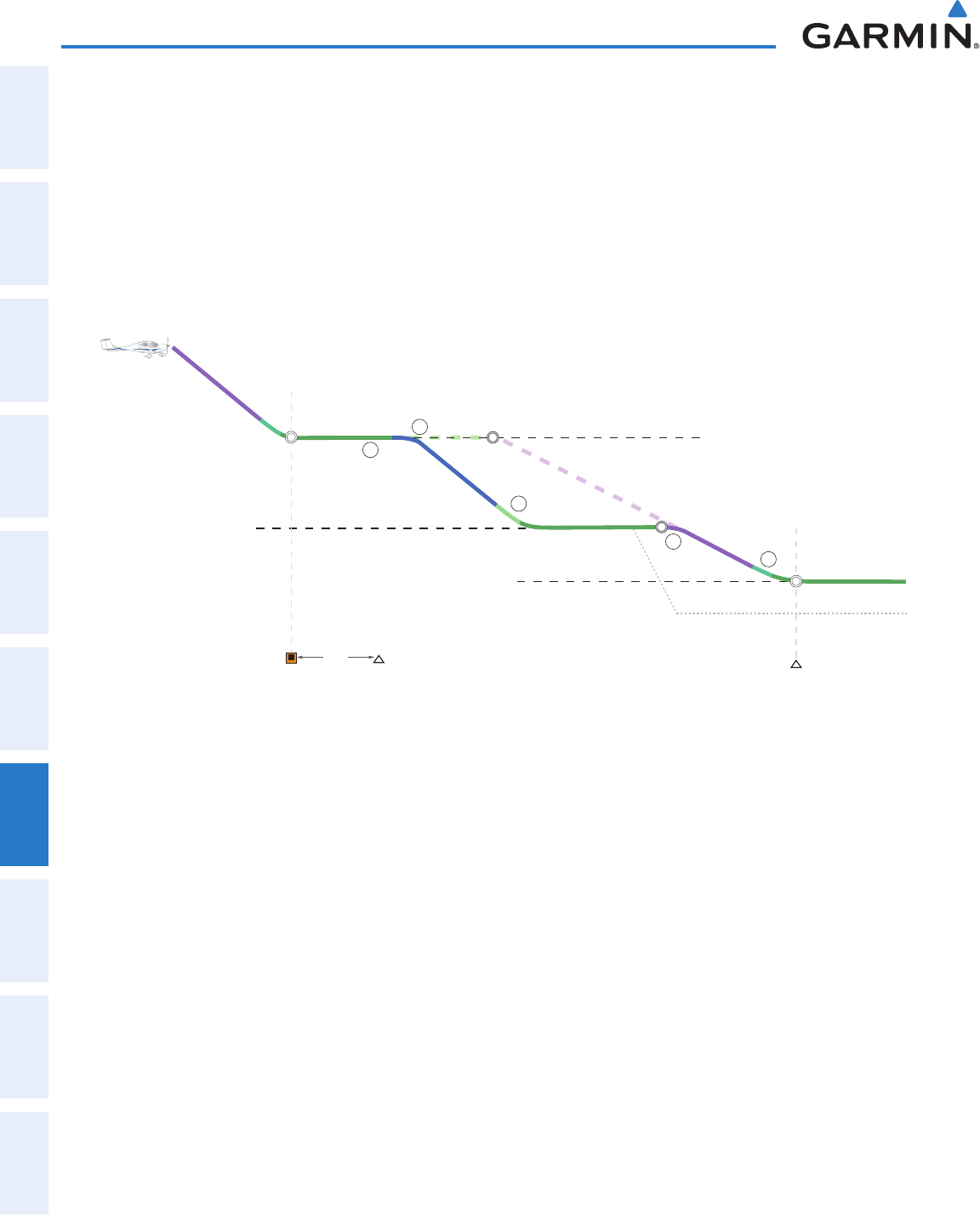
Garmin G1000 Pilot’s Guide for Diamond DA40/40F
190-00592-06 Rev. A
396
AUTOMATIC FLIGHT CONTROL SYSTEM
SYSTEM
OVERVIEW
FLIGHT
INSTRUMENTS
EIS
AUDIO PANEL
& CNS
FLIGHT
MANAGEMENT
HAZARD
AVOIDANCE
AFCS
ADDITIONAL
FEATURES
APPENDICESINDEX
Figure 7-36 Non-path Descent
HABUK
VNAV Target Altitude of 10,000 MSL
VNAV Target Altitude of 9,000 MSL ALT Mode
Planned Descent Path
Selected Altitude of 9,400 MSL
ALT Mode
VPTH Mode
1
2
3
FLC Mode
4
VPTH Mode
ALT Mode
Selected Altitude
5
TOD
Planned
TOD
BOD
BOD
OPSHN
3 nm
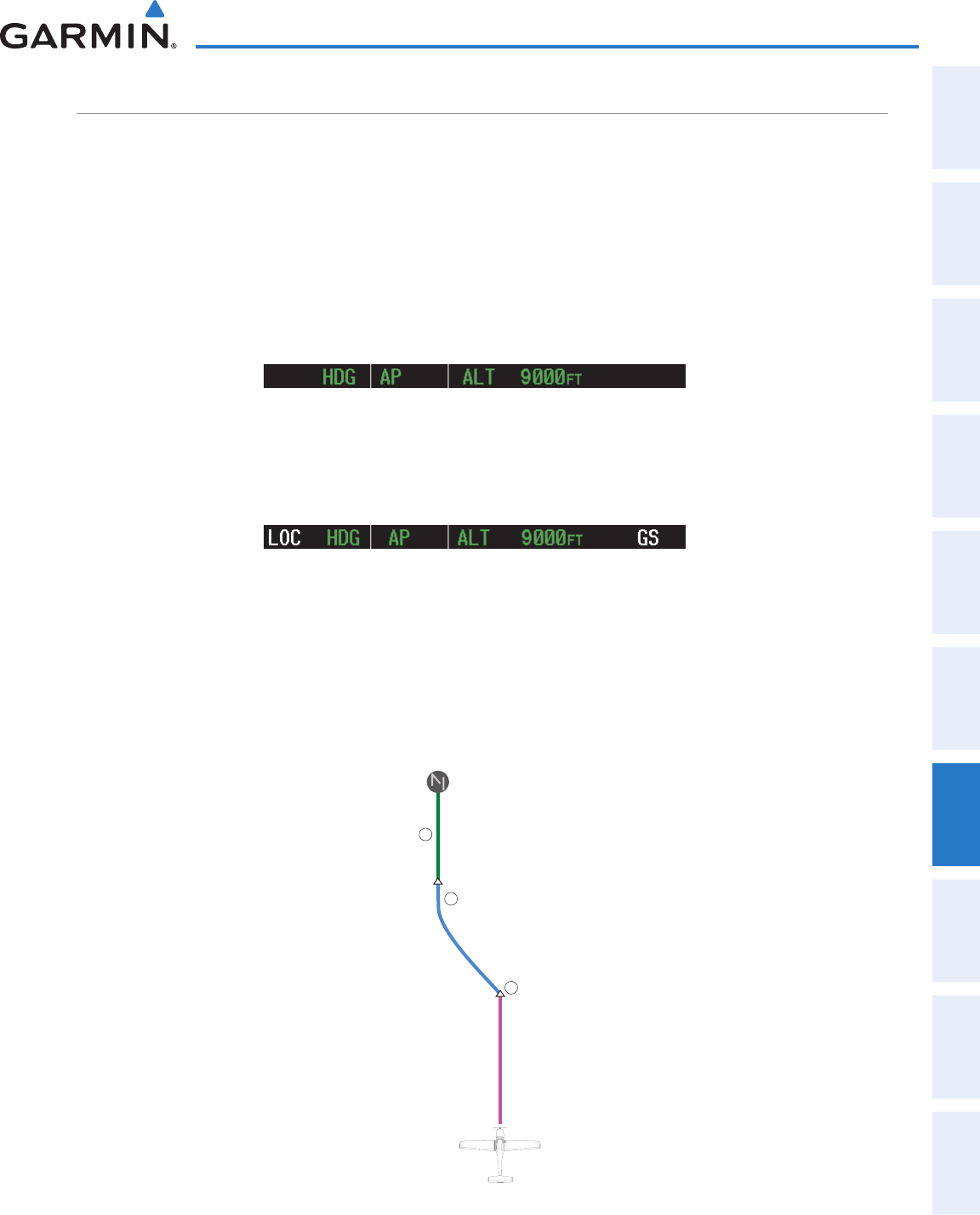
190-00592-06 Rev. A
Garmin G1000 Pilot’s Guide for Diamond DA40/40F
397
AUTOMATIC FLIGHT CONTROL SYSTEM
SYSTEM
OVERVIEW
FLIGHT
INSTRUMENTS EIS AUDIO PANEL
& CNS
FLIGHT
MANAGEMENT
HAZARD
AVOIDANCE AFCS ADDITIONAL
FEATURES APPENDICES INDEX
APPROACH
Flying an ILS approach:
1) Transition from GPS Navigation Mode to Heading Select Mode.
a) Select the Runway 35L ILS approach for KCOS and select ‘VECTORS’ for the transition. Load and activate the
approach into the flight plan.
b) Use the HDG Knob to set the Selected Heading after getting vectors from ATC.
c) Press the HDG Key. The autopilot turns the aircraft to the desired heading.
d) Use Heading Select Mode to comply with ATC vectors as requested.
2) Arm LOC Approach and Glideslope modes.
a) Ensure the appropriate localizer frequency is tuned.
b) Press the APR Key when cleared for approach to arm Approach and Glideslope modes. ‘LOC’ and ‘GS’ appear
in white as armed mode annunciations.
c)
The navigation source automatically switches to LOC. After this switch occurs, the localizer signal can be captured
and the flight director determines when to begin the turn to intercept the final approach course. The flight
director now provides guidance to the missed approach point.
3) There are two options available at this point, as the autopilot flies the ILS approach:
• Push the AP DISC Switch at the decision
height and land the aircraft.
• Use the
GA Switch
to execute a missed
approach.
Figure 7-37 ILS Approach to KCOS
HDG Mode
LOC APR/
GS Mode
PETEY
1
2
3
GPS NAV Mode
KCOS
PYNON
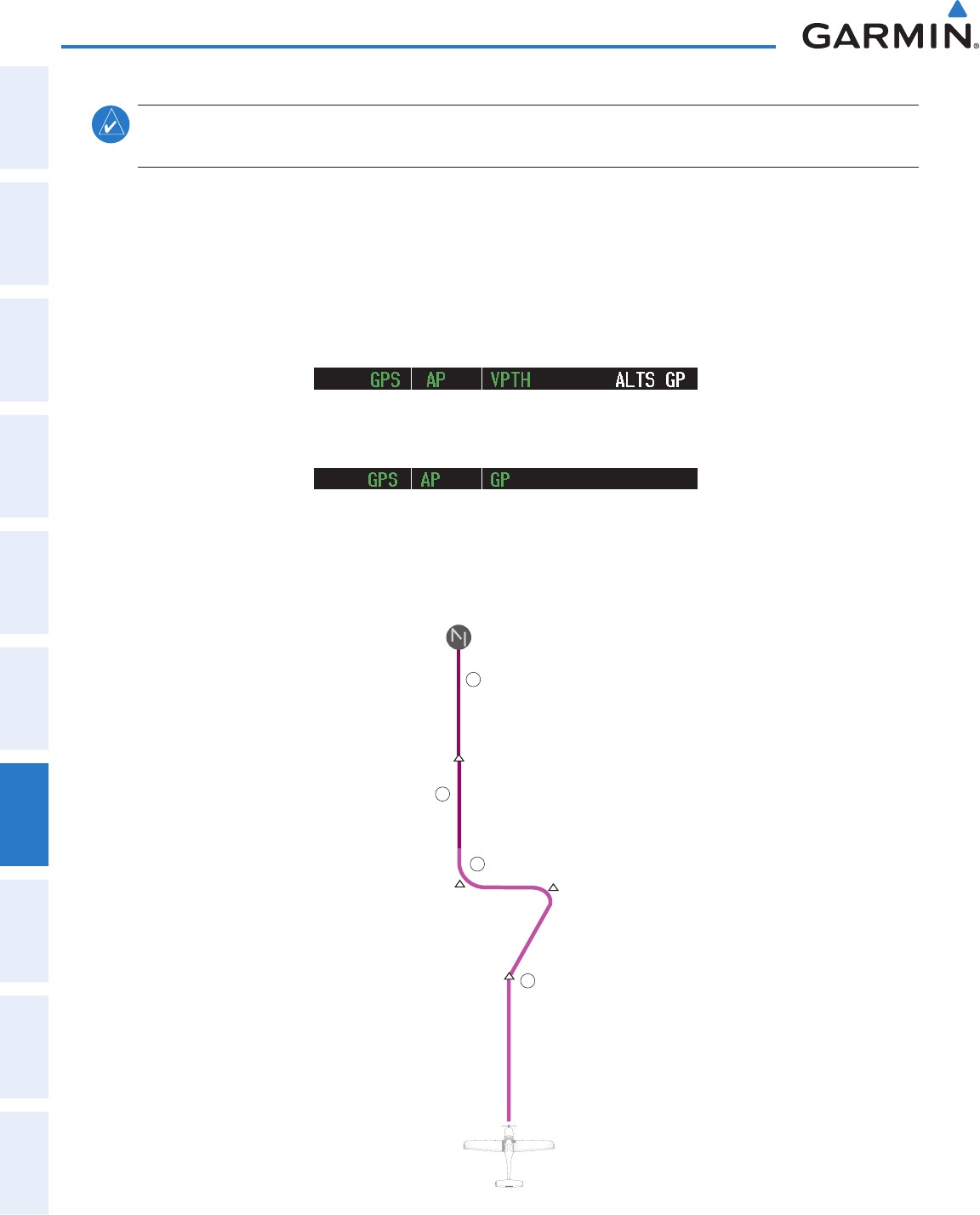
Garmin G1000 Pilot’s Guide for Diamond DA40/40F
190-00592-06 Rev. A
398
AUTOMATIC FLIGHT CONTROL SYSTEM
SYSTEM
OVERVIEW
FLIGHT
INSTRUMENTS
EIS
AUDIO PANEL
& CNS
FLIGHT
MANAGEMENT
HAZARD
AVOIDANCE
AFCS
ADDITIONAL
FEATURES
APPENDICESINDEX
NOTE: Support for WAAS precision approaches is available only in installations with GIA 63W IAUs when
WAAS is available.
Flying a RNAV GPS approach with vertical guidance:
1) Arm flight director modes for a RNAV GPS approach with vertical guidance:
a) Make sure the navigation source is set to GPS (use CDI Softkey to change navigation source).
b) Select the Runway 35R LPV approach for KCOS. Load and activate the approach into the flight plan.
2) Press the APR Key once clearance for approach has been received. GPS Approach Mode is activated and
Glidepath Mode is armed.
3) Once the glidepath is captured, Glidepath Mode becomes active. The flight director now provides guidance to
the missed approach point.
4) There are two options available at this point, as the autopilot flies the approach:
• Push the AP DISC Switch at the Decision
height and land the aircraft.
• Use the
GA Switch
to execute a missed
approach.
4
GPS APR/
GP Mode
FALUR
1
2
3
GPS NAV Mode
KCOS
HABUK
PYNON
CEGIX
Figure 7-38 LPV Approach to KCOS
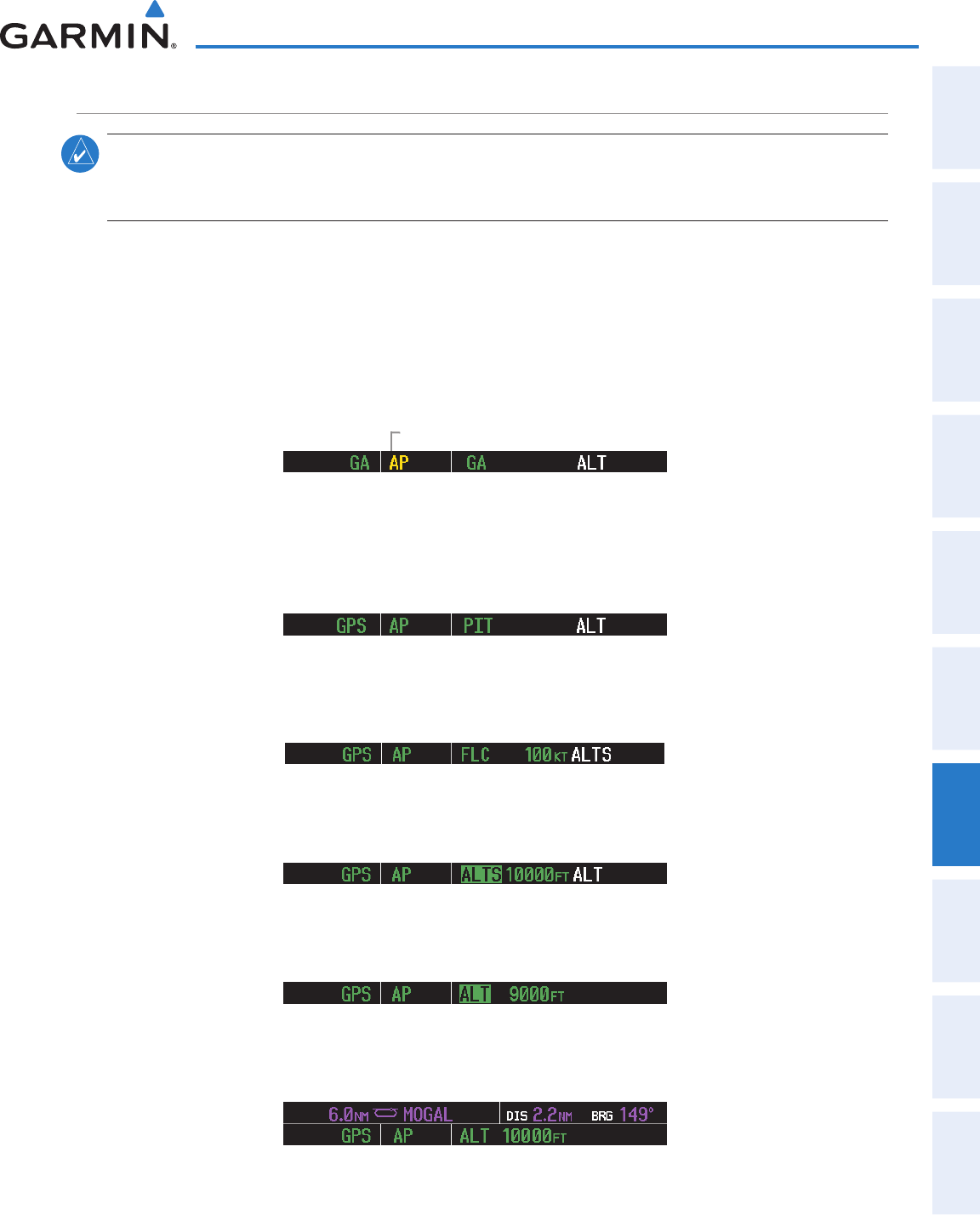
190-00592-06 Rev. A
Garmin G1000 Pilot’s Guide for Diamond DA40/40F
399
AUTOMATIC FLIGHT CONTROL SYSTEM
SYSTEM
OVERVIEW
FLIGHT
INSTRUMENTS EIS AUDIO PANEL
& CNS
FLIGHT
MANAGEMENT
HAZARD
AVOIDANCE AFCS ADDITIONAL
FEATURES APPENDICES INDEX
GO AROUND/MISSED APPROACH
NOTE: As a result of calculations performed by the system while flying the holding pattern, the display may
re-size automatically and the aircraft may not precisely track the holding pattern as depicted on the PFD and
MFD.
Flying a missed approach:
1) Push the GA Switch at the Decision Height and apply go around power to execute a missed approach. The
flight director Command Bars establish a nose-up climb to follow. If flying an ILS or LOC approach the CDI also
switches to GPS as the navigation source.
Note that when the
GA Switch
is pushed, the missed approach is activated and the autopilot disconnects,
indicated by the ‘AP’ annunciation flashing yellow for 5 seconds.
Flashes 5 sec
2) Start the climb to the prescribed altitude in the published Missed Approach Procedure (in this case, 10,000 ft).
a) Press the
AP
Key to re-engage the autopilot.
b) Press the
NAV
Key to have the autopilot fly to the hold.
3) Use the
ALT Kno
b to set a Selected Altitude to hold.
To hold the current airspeed during the climb, press the FLC Key.
As the aircraft nears the Selected Altitude, the flight director transitions to Selected Altitude Capture Mode,
indicated by the green ‘ALTS’ annunciation flashing for up to 10 seconds.
The green ‘ALT’ annunciation flashes for up to 10 seconds upon reaching 50 feet from the Selected Altitude; the
autopilot transitions to Altitude Hold Mode and levels the aircraft.
4) The autopilot flies the holding pattern after the missed approach is activated. Annunciations are displayed in
the Navigation Status Box, above the AFCS Status Box.
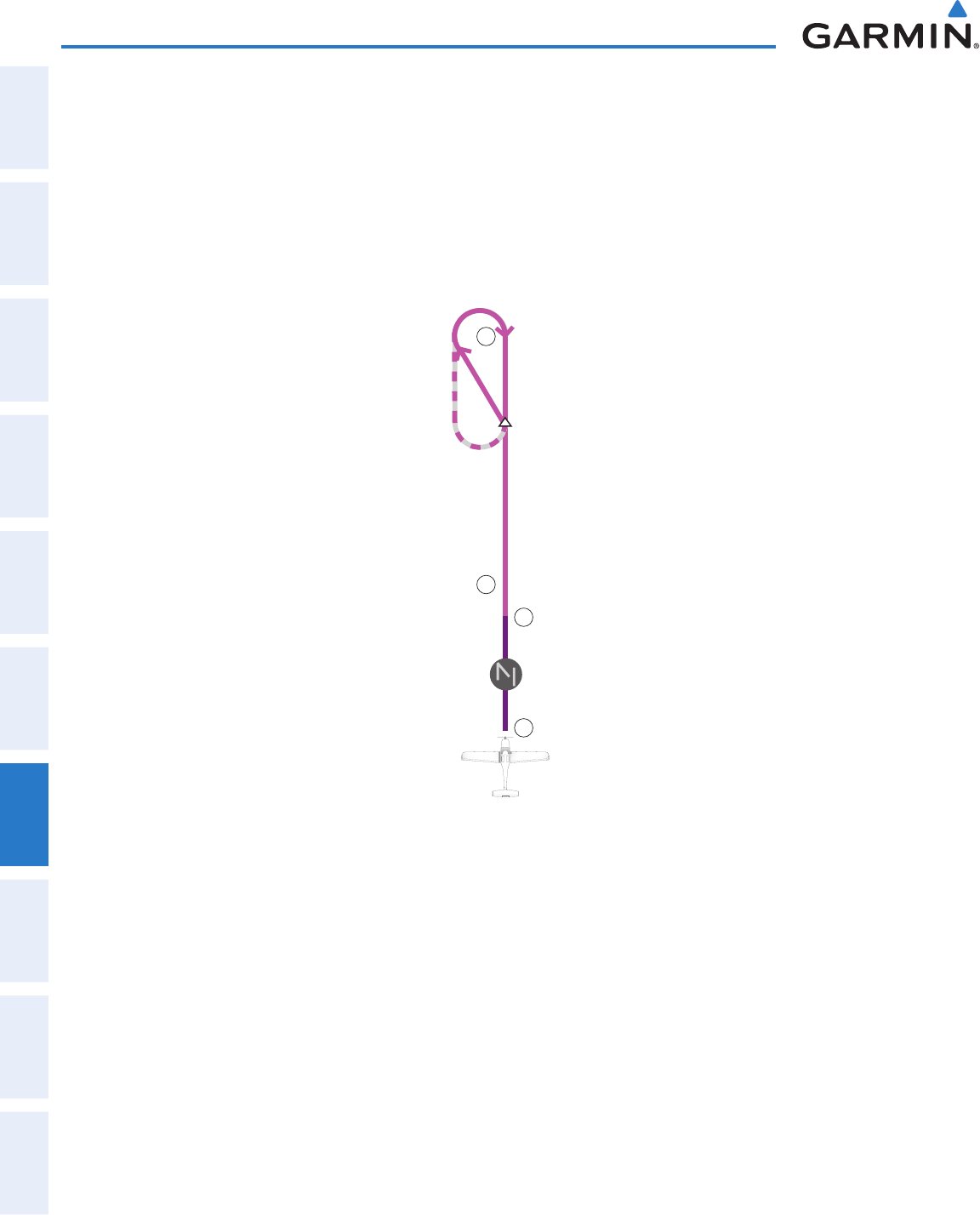
Garmin G1000 Pilot’s Guide for Diamond DA40/40F
190-00592-06 Rev. A
400
AUTOMATIC FLIGHT CONTROL SYSTEM
SYSTEM
OVERVIEW
FLIGHT
INSTRUMENTS
EIS
AUDIO PANEL
& CNS
FLIGHT
MANAGEMENT
HAZARD
AVOIDANCE
AFCS
ADDITIONAL
FEATURES
APPENDICESINDEX
Figure 7-39 Go Around/Missed Approach
3
4
1
2
KCOS
MOGAL
GA Mode
GPS NAV Mode
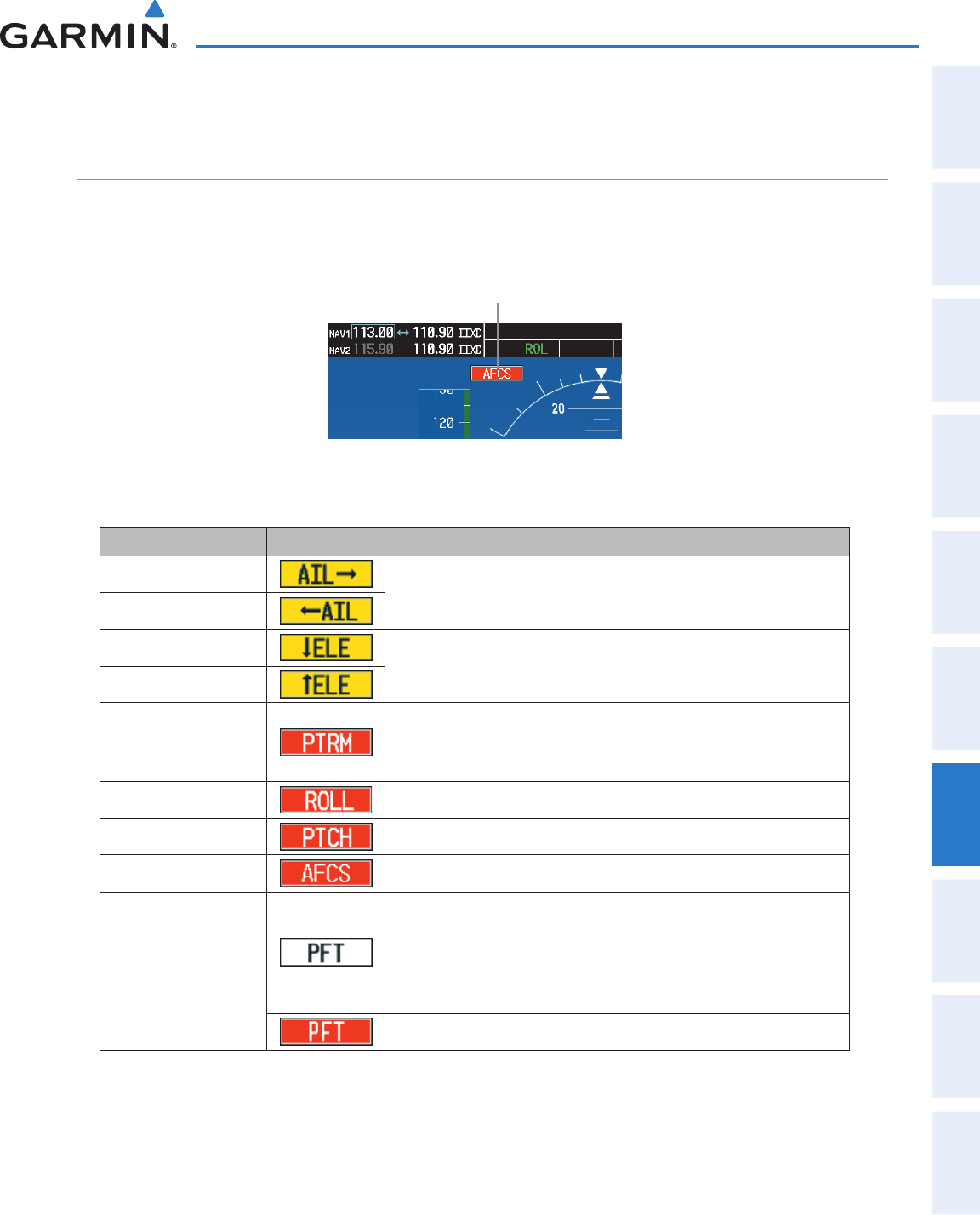
190-00592-06 Rev. A
Garmin G1000 Pilot’s Guide for Diamond DA40/40F
401
AUTOMATIC FLIGHT CONTROL SYSTEM
SYSTEM
OVERVIEW
FLIGHT
INSTRUMENTS EIS AUDIO PANEL
& CNS
FLIGHT
MANAGEMENT
HAZARD
AVOIDANCE AFCS ADDITIONAL
FEATURES APPENDICES INDEX
7.7 AFCS ANNUNCIATIONS AND ALERTS
AFCS STATUS ALERTS
The annunciations in Table 7-5 (listed in order of increasing priority) can appear on the PFD above the
Airspeed and Attitude indicators. Only one annunciation may occur at a time, and messages are prioritized by
criticality.
Figure 7-40 AFCS Status Annunciation
AFCS Status Annunciation
Alert Condition Annunciation Description
Aileron Mistrim Right Roll servo providing sustained force in the indicated direction
Aileron Mistrim Left
Elevator Mistrim Down Pitch servo providing sustained force in the indicated direction
Elevator Mistrim Up
Pitch Trim Failure
(or stuck AP TRIM
Switch)
If AP engaged, take control of the aircraft and disengage AP
If AP disengaged, move AP TRIM switches separately to unstick
Roll Failure Roll axis control failure; AP inoperative
Pitch Failure Pitch axis control failure; AP inoperative
System Failure AP and MET are unavailable; FD may still be available
Preflight Test
Performing preflight system test; aural alert sounds at completion
Do not press the AP DISC Switch during servo power-up and preflight
system tests as this may cause the preflight system test to fail or never
to start (if servos fail their power-up tests). Power must be cycled to
the servos to remedy the situation.
Preflight system test failed; aural alert sounds at failure
Table 7-5 AFCS Status Field Alerts
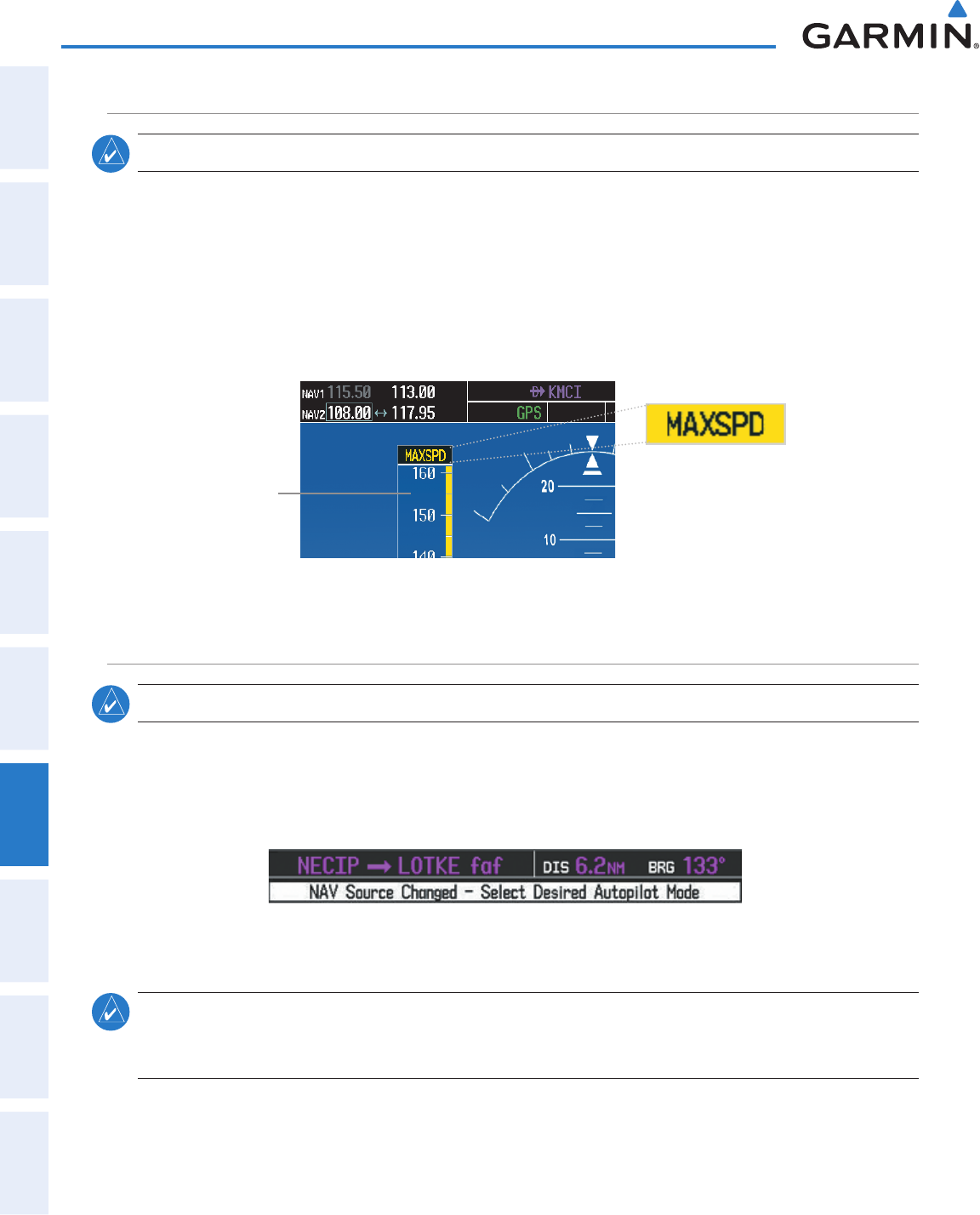
Garmin G1000 Pilot’s Guide for Diamond DA40/40F
190-00592-06 Rev. A
402
AUTOMATIC FLIGHT CONTROL SYSTEM
SYSTEM
OVERVIEW
FLIGHT
INSTRUMENTS
EIS
AUDIO PANEL
& CNS
FLIGHT
MANAGEMENT
HAZARD
AVOIDANCE
AFCS
ADDITIONAL
FEATURES
APPENDICESINDEX
OVERSPEED PROTECTION
NOTE: Overspeed protection is not active in Altitude Hold, Glideslope or Glidepath Modes.
While Pitch Hold, Vertical Speed, Flight Level Change, Vertical Path Tracking, or an altitude capture mode is
active, airspeed is monitored by the flight director and pitch commands are limited for overspeed protection.
Overspeed protection is provided in situations where the flight director cannot acquire and maintain the mode
reference for the selected vertical mode without exceeding the certified maximum autopilot airspeed.
When an autopilot overspeed condition occurs, the Airspeed Reference appears in a box above the Airspeed
Indicator, flashing a yellow ‘MAXSPD’ annunciation. Engine power should be reduced and/or the pitch reference
adjusted to slow the aircraft. The annunciation disappears when the overspeed condition is resolved.
Airspeed
Indicator
Figure 7-41 Overspeed Annunciation
ANNUNCIATIONS FOR KAP 140 AUTOPILOT SYSTEM
NOTE: Refer to the autopilot manufacturer’s Pilot’s Guide for more information.
When GPS approach mode becomes active and the necessary approach criteria are met, a message appears
in the AFCS Status Box alerting the pilot to a change in autopilot NAV source (“NAV Source Changed – Select
Desired Autopilot Mode”). The annunciation shall blink for five seconds and remain in the AFCS Status Box
for 30 seconds.
Figure 7-42 KAP 140 Annunciation (Informative)
NOTE
: KAP 140 equipped aircraft only: Each time the CDI Softkey is pressed or the navigation source
is changed (i.e. missed approach), the following message appears in the message window, “NAV Source
Changed – Select Desired Autopilot Mode.”
190-00592-06 Rev A
Garmin G1000 Pilot’s Guide for the Diamond DA40/40F
403
ADDITIONAL FEATURES
SYSTEM
OVERVIEW
FLIGHT
INSTRUMENTS EIS AUDIO PANEL
& CNS
FLIGHT
MANAGEMENT
HAZARD
AVOIDANCE AFCS ADDITIONAL
FEATURES APPENDICES INDEX
SECTION 8 ADDITIONAL FEATURES
NOTE: With the availability of SafeTaxi, ChartView, or FliteCharts in electronic form, it is still advisable to
carry another source of charts on board the aircraft.
Additional features of the system include the following:
•Synthetic Vision System (SVS)
•SafeTaxi® diagrams
•ChartViewandFliteCharts® electronic charts
•XMRadioentertainment
•Scheduler
•Electronic Checklists
The optional Synthetic Vision System (SVS) provides a three-dimensional forward view of terrain features on
the PFD. SVS imagery shows the pilot’s view of relevant features in relation to the aircraft attitude, as well as the
flight path pertaining to the active flight plan.
SafeTaxi diagrams provide detailed taxiway, runway, and ramp information at more than 700 airports in the
United States. By decreasing range on an airport that has a SafeTaxi diagram available, a close up view of the
airport layout can be seen.
The optional ChartView and FliteCharts provide on-board electronic terminal procedures charts. Electronic
charts offer the convenience of rapid access to essential information. Either ChartView or FliteCharts may be
configured in the system, but not both.
The optional XM Radio entertainment audio feature of the GDL 69A Data Link Receiver handles more than 170
channels of music, news, and sports. XM Radio offers more entertainment choices and longer range coverage
than commercial broadcast stations.
The Scheduler feature can be used to enter and display short term or long term reminder messages such as
Switch fuel tanks, Change oil, or Altimeter-Transponder Check in the Messages Window on the PFD.
Optional checklists help to quickly find the proper procedure on the ground or during flight.
Garmin G1000 Pilot’s Guide for the Diamond DA40/40F
190-00592-06 Rev A404
ADDITIONAL FEATURES
SYSTEM
OVERVIEW
FLIGHT
INSTRUMENTS
EIS
AUDIO PANEL
& CNS
FLIGHT
MANAGEMENT
HAZARD
AVOIDANCE
AFCS
ADDITIONAL
FEATURES
APPENDICESINDEX
8.1 SYNTHETIC VISION SYSTEM (SVS) (OPTIONAL)
WARNING:
Use appropriate primary systems for navigation, and for terrain, obstacle, and traffic avoidance.
SVS is intended as an aid to situational awareness only and may not provide either the accuracy or reliability
upon which to solely base decisions and/or plan maneuvers to avoid terrain, obstacles, or traffic.
The optional Synthetic Vision System (SVS) is a visual enhancement to the G1000 Integrated Flight Deck. SVS
depicts a forward-looking attitude display of the topography immediately in front of the aircraft. The field of
view is 30 degrees to the left and 35 degrees to the right. SVS information is shown on the Primary Flight Display
(PFD), or on the Multifunction Display (MFD) in Reversionary Mode (Figure 8-81). The depicted imagery is
derived from the aircraft attitude, heading, GPS three-dimensional position, and a nine arc-second database of
terrain, obstacles, and other relevant features. The terrain data resolution of nine arc-seconds, meaning that
the terrain elevation contours are stored in squares measuring nine arc-seconds on each side, is required for the
operation of SVS. Loss of any of the required data, including temporary loss of the GPS signal, will cause SVS to
be disabled until the required data is restored.
The SVS terrain display shows land contours (colors are consistent with those of the topographical map display),
large water features, towers, and other obstacles over 200’ AGL that are included in the obstacle database. Cultural
features on the ground such as roads, highways, railroad tracks, cities, and state boundaries are not displayed
even if those features are found on the MFD map. The terrain display also includes a north–south east–west grid
with lines oriented with true north and spaced at one arc-minute intervals to assist in orientation relative to the
terrain.
The optional Terrain Awareness and Warning System (TAWS) or standard Terrain-SVS is integrated within
SVS to provide visual and auditory alerts to indicate the presence of terrain and obstacle threats relevant to the
projected flight path. Terrain alerts are displayed in red and yellow shading on the PFD.
The terrain display is intended for situational awareness only. It may not provide the accuracy or fidelity on
which to base decisions and plan maneuvers to avoid terrain or obstacles. Navigation must not be predicated
solely upon the use of the Terrain–SVS or TAWS terrain or obstacle data displayed by the SVS.
The following SVS enhancements appear on the PFD:
•Pathways
•FlightPathMarker
•HorizonHeadingMarks
•TrafcDisplay
•AirportSigns
•RunwayDisplay
•TerrainAlerting
•ObstacleAlerting
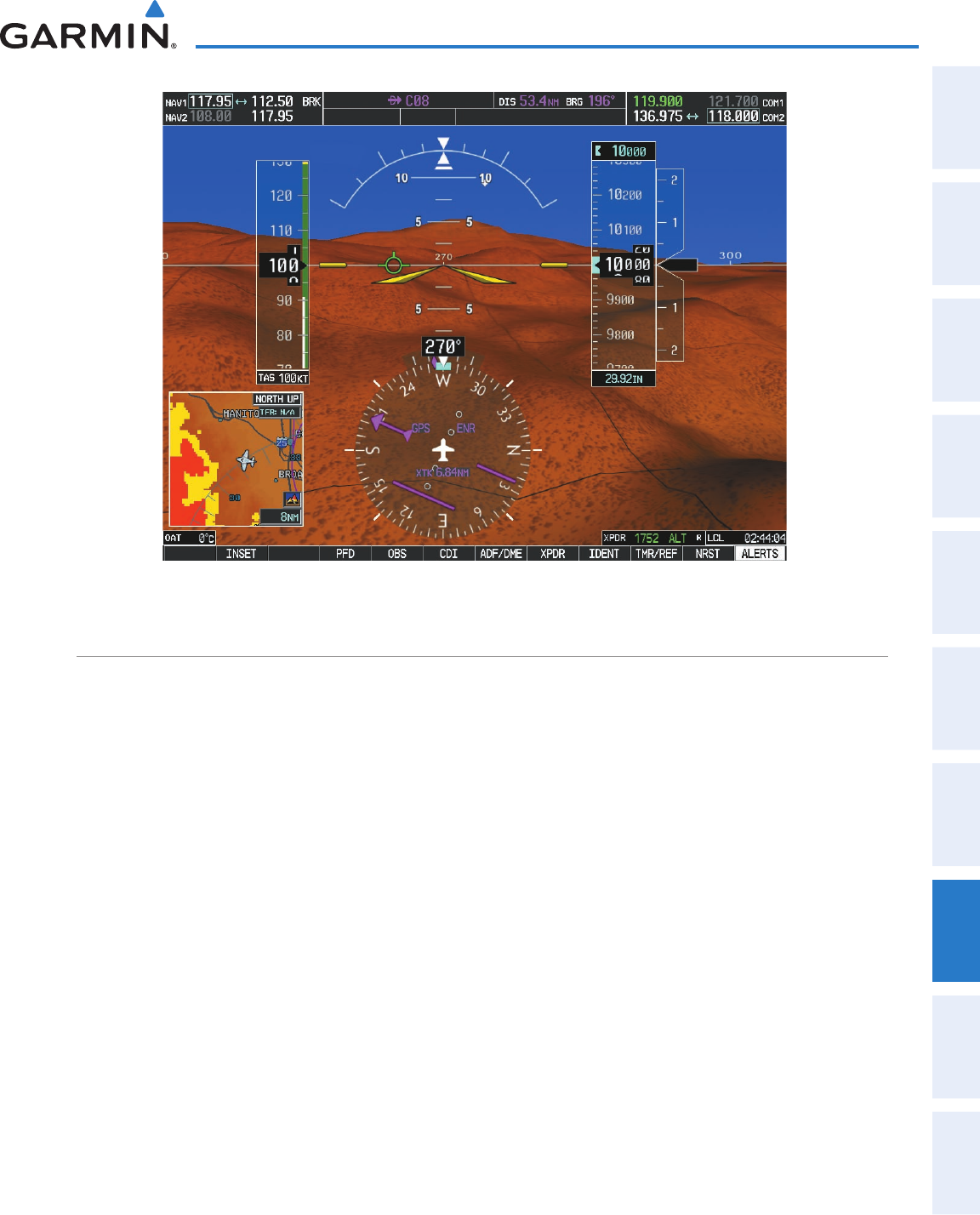
190-00592-06 Rev A
Garmin G1000 Pilot’s Guide for the Diamond DA40/40F
405
ADDITIONAL FEATURES
SYSTEM
OVERVIEW
FLIGHT
INSTRUMENTS EIS AUDIO PANEL
& CNS
FLIGHT
MANAGEMENT
HAZARD
AVOIDANCE AFCS ADDITIONAL
FEATURES APPENDICES INDEX
Figure 8-1 Synthetic Vision Imagery
SVS OPERATION
SVS is activated from the PFD using the softkeys located along the bottom edge of the display. Pressing the
softkeys turns the related function on or off. When SVS is enabled, the pitch scale increments are reduced to
10 degrees up and 7.5 degrees down.
SVS functions are displayed on three levels of softkeys. The PFD Softkey leads into the PFD function Softkeys,
including synthetic vision. Pressing the
SYN VIS
Softkey displays the SVS feature softkeys. The softkeys are
labeled PATHWAY, SYN
TERR, HRZN
HDG
, and APTSIGNS. The BACK Softkey returns to the previous
level of softkeys. Synthetic Terrain must be active before any other SVS feature may be activated.
HRZN
HDG
, APTSIGNS, and PATHWAY Softkeys are only available when the SYN
TERR Softkey is
activated (gray with black characters). After activating the SYN TERR Softkey, the HRZN
HDG
, APTSIGNS,
and PATHWAY softkeys may be activated in any combination to display desired features. When system power
is cycled, the last selected state (on or off) of the SYN TERR, HRZN
HDG
, APTSIGNS, and PATHWAY
softkeys is remembered by the system.
•PATHWAY Softkey enables display of rectangular boxes that represent course guidance.
•SYN
TERR Softkey enables synthetic terrain depiction.
•HRZN
HDG
Softkey enables horizon heading marks and digits.
•APTSIGNS Softkey enables airport signposts.
Garmin G1000 Pilot’s Guide for the Diamond DA40/40F
190-00592-06 Rev A406
ADDITIONAL FEATURES
SYSTEM
OVERVIEW
FLIGHT
INSTRUMENTS
EIS
AUDIO PANEL
& CNS
FLIGHT
MANAGEMENT
HAZARD
AVOIDANCE
AFCS
ADDITIONAL
FEATURES
APPENDICESINDEX
Figure 8-2 SVS Softkeys
Pressing the BACK Softkey
returns to the top-level softkeys.
BACK
BACK
PFD
Pressing the BACK Softkey returns to the previous level of softkeys.
SYN VIS
PATHWAYSYN TERR HRZN HDG APTSIGNS
Activating and deactivating SVS:
1) Press the PFD Softkey.
2) Press the SYN VIS Softkey.
3) Press the SYN TERR Softkey. The SVS display will cycle on or off with the SYN TERR Softkey.
Activating and deactivating Pathways:
1) Press the PFD Softkey.
2) Press the SYN VIS Softkey.
3) Press the PATHWAY Softkey. The Pathway feature will cycle on or off with the PATHWAY Softkey.
Activating and deactivating Horizon Headings:
1) Press the PFD Softkey.
2) Press the SYN VIS Softkey.
3) Press the HRZN HDG Softkey. The horizon heading display will cycle on or off with the HRZN HDG Softkey.
Activating and deactivating Airport Signs:
1) Press the PFD Softkey.
2) Press the SYN VIS Softkey.
3) Press the APTSIGNS Softkey. Display of airport signs will cycle on or off with the APTSIGNS Softkey.
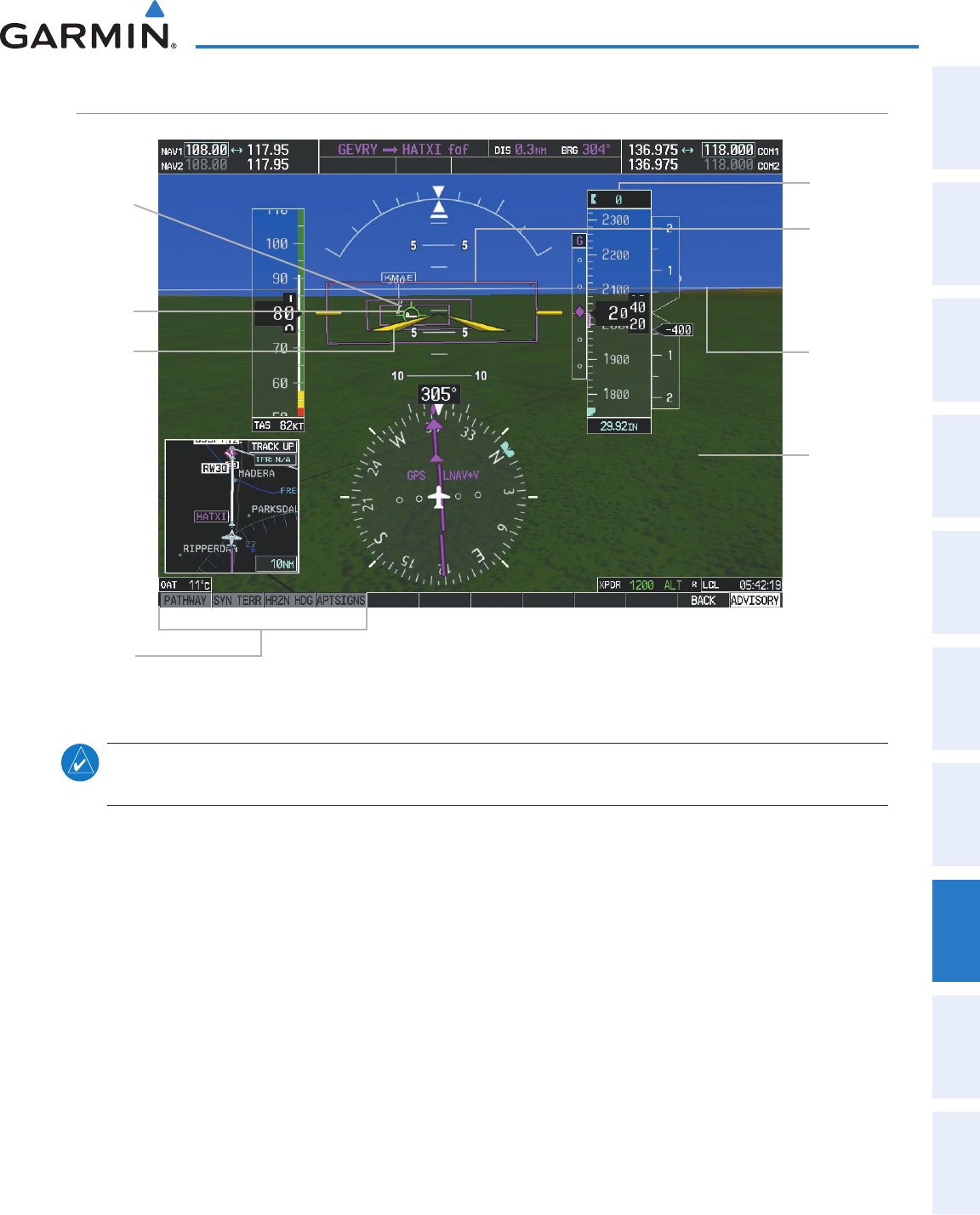
190-00592-06 Rev A
Garmin G1000 Pilot’s Guide for the Diamond DA40/40F
407
ADDITIONAL FEATURES
SYSTEM
OVERVIEW
FLIGHT
INSTRUMENTS EIS AUDIO PANEL
& CNS
FLIGHT
MANAGEMENT
HAZARD
AVOIDANCE AFCS ADDITIONAL
FEATURES APPENDICES INDEX
SVS FEATURES
Figure 8-3 SVS on the Primary Flight Display
SVS
Softkeys
Synthetic
Terrain
Pathways
Color
Matches CDI
Indicating
NAV Source
Flight
Path
Marker
Airport
Runway
Zero
Pitch Line
(ZPL) with
Compass
Heading
Marks
Airplane
Symbol
Selected
Altitude
NOTE: Pathways and terrain features are not a substitute for standard course and altitude deviation
information provided by the CDI, VSI, and VDI.
PATHWAYS
Pathways provide a three-dimensional perspective view of the selected route of flight shown as colored
rectangular boxes representing the horizontal and vertical flight path of the active flight plan. The box
size represents 700 feet wide by 200 feet tall during enroute, oceanic, and terminal flight phases. During
an approach, the box width is 700 feet or one half full scale deviation on the HSI, whichever is less. The
height is 200 feet or one half full scale deviation on the VDI, whichever is less. The altitude at which the
pathway boxes are displayed is determined by the higher of either the selected altitude or the VNAV altitude
programmed for the active leg in the flight plan (Figure 8-4).
The color of the rectangular boxes may be magenta, green, or white depending on the route of flight and
navigation source selected. The active GPS or GPS overlay flight plan leg is represented by magenta boxes
that correspond to the Magenta CDI. A localizer course is represented by green boxes that correspond to a
green CDI. An inactive leg of an active flight plan is represented by white boxes corresponding to a white line
drawn on the Inset map or MFD map indicating an inactive leg.
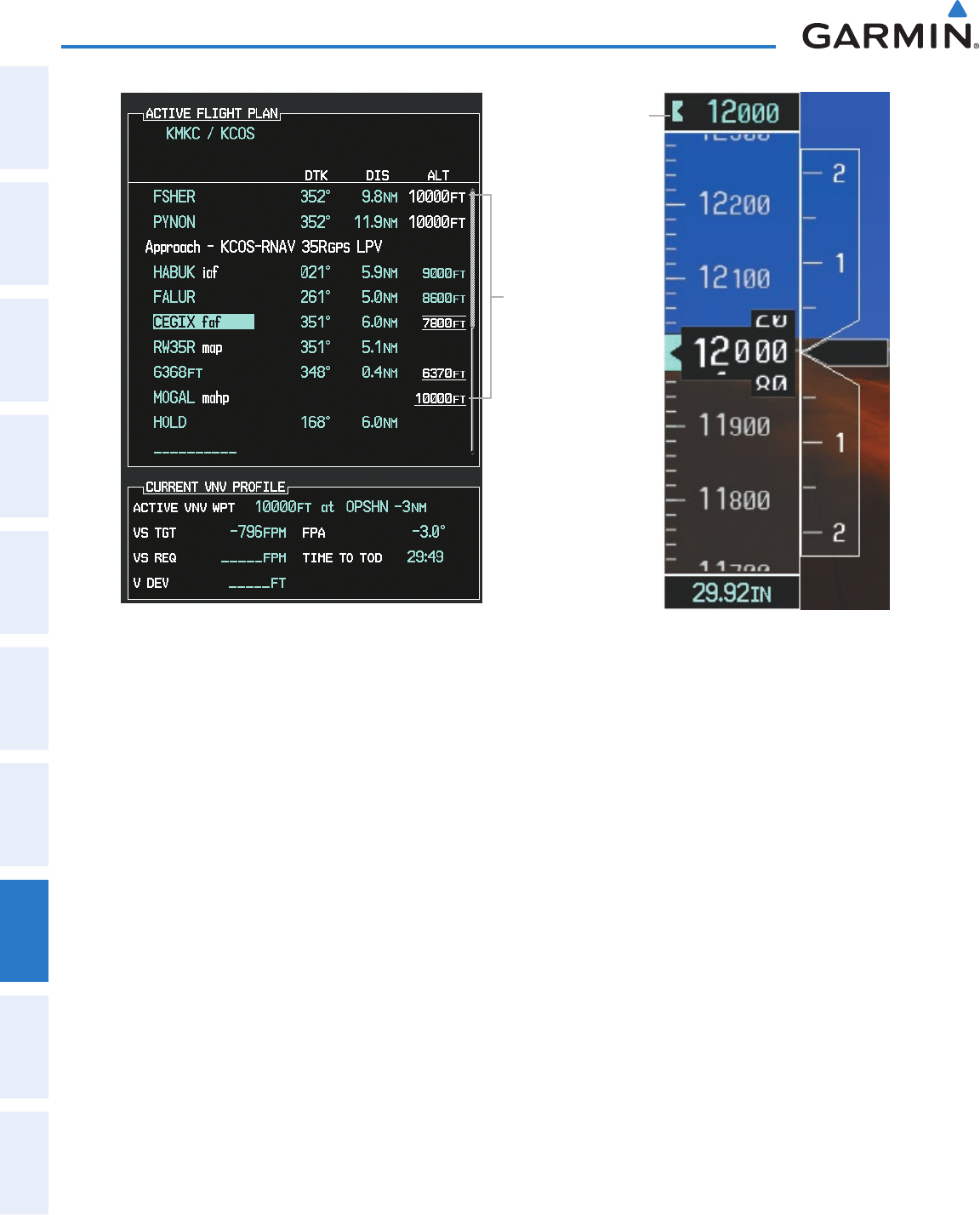
Garmin G1000 Pilot’s Guide for the Diamond DA40/40F
190-00592-06 Rev A408
ADDITIONAL FEATURES
SYSTEM
OVERVIEW
FLIGHT
INSTRUMENTS
EIS
AUDIO PANEL
& CNS
FLIGHT
MANAGEMENT
HAZARD
AVOIDANCE
AFCS
ADDITIONAL
FEATURES
APPENDICESINDEX
Figure 8-4 Programmed and Selected Altitude
Selected
Altitude
Programmed
Altitudes
Pathways provide supplemental glidepath information on an active ILS, LPV, LNAV/VNAV, and some LNAV
approaches. Pathways are intended as an aid to situational awareness and should not be used independent
of the CDI, VDI, glide path indicator, and glide slope indicator. They are removed from the display when
the selected navigation information is not available. Pathways are not displayed beyond the active leg when
leg sequencing is suspended and are not displayed on any portion of the flight plan leg that would lead to
intercepting a leg in the wrong direction.
De P a R t u R e a n D en R o u t e
Prior to intercepting an active flight plan leg, pathways are displayed as a series of boxes with pointers at
each corner that point in the direction of the active waypoint. Pathways are not displayed for the first leg
of the flight plan if that segment is a Heading-to-Altitude leg. The first segment displaying pathways is the
first active GPS leg or active leg with a GPS overlay. If this leg of the flight plan route is outside the SVS
field of view, pathways will not be visible until the aircraft has turned toward this leg. While approaching
the center of the active leg and prescribed altitude, the number of pathway boxes decreases to a minimum
of four.
Pathways are displayed along the flight plan route at the highest of either the selected altitude or the
programmed altitude for the leg. Climb profiles cannot be displayed due to the variables associated with
aircraft performance. Flight plan legs requiring a climb are indicated by pathways displayed at a level above
the aircraft at the altitude selected or programmed.
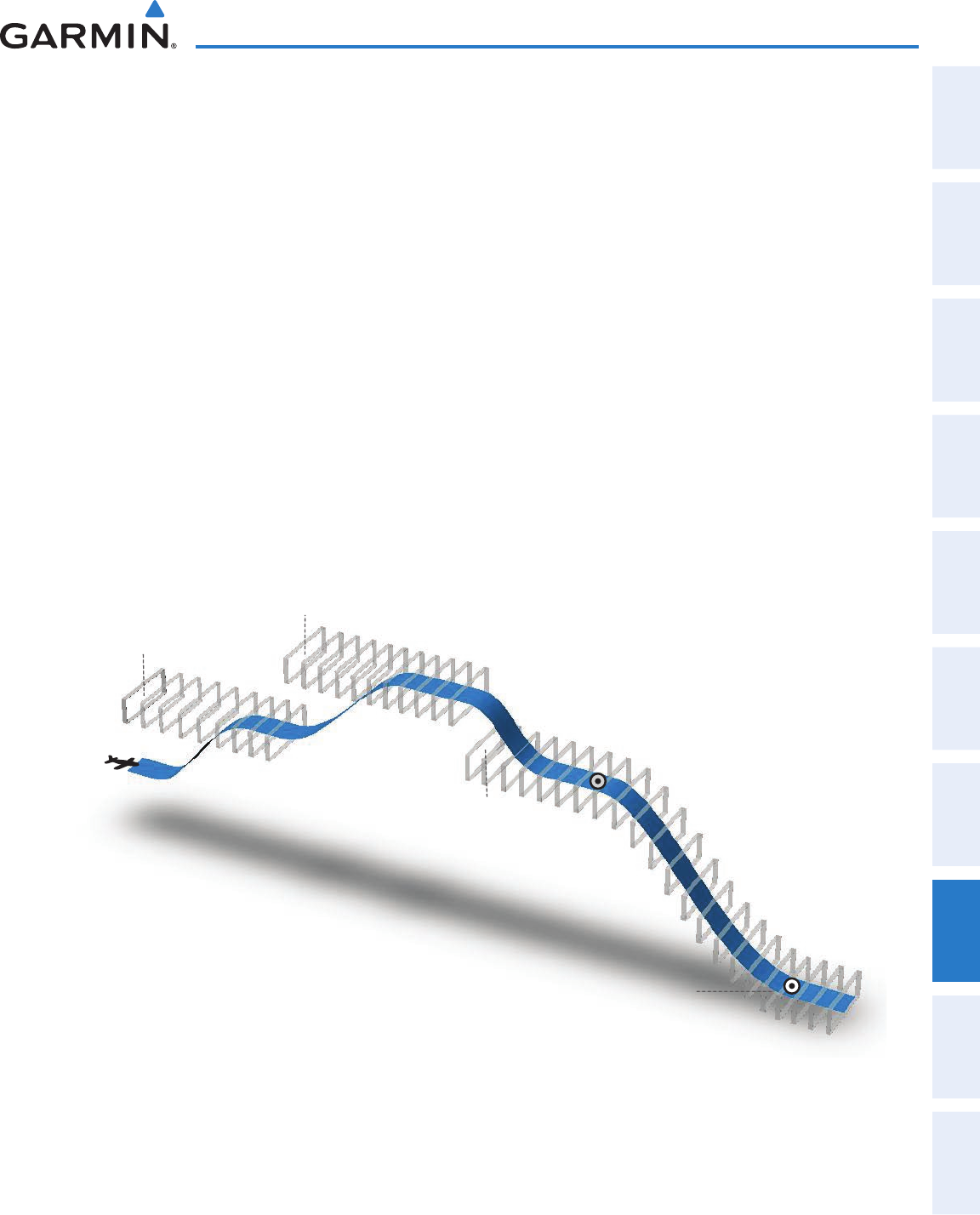
190-00592-06 Rev A
Garmin G1000 Pilot’s Guide for the Diamond DA40/40F
409
ADDITIONAL FEATURES
SYSTEM
OVERVIEW
FLIGHT
INSTRUMENTS EIS AUDIO PANEL
& CNS
FLIGHT
MANAGEMENT
HAZARD
AVOIDANCE AFCS ADDITIONAL
FEATURES APPENDICES INDEX
De s c e n t a n D aP P R o a c h
Pathways are shown descending only for a programmed descent (Figures 8-5, 8-6). When the flight plan
includes programmed descent segments, pathways are displayed along the descent path provided that the
selected altitude is lower than the programmed altitude.
During a Vectors-to-Final (VTF) approach transition, pathways are displayed along the final approach
course inbound to the Missed Approach Point (MAP). Pathways are shown level at the selected altitude
or at the next programmed crossing altitude, whichever is higher, up to the point along the final approach
course where the altitude intercepts the extended vertical descent path, glidepath, or glideslope. From
the vertical path descent, glidepath, or glideslope intercept point, the pathways are shown inbound to the
Missed Approach Point (MAP) along the published lateral and vertical descent path.
During an ILS approach, the initial approach segment is displayed in magenta at the segment altitudes
if GPS is selected as the navigation source on the CDI. When switching to localizer inbound with LOC
selected as the navigation source on the CDI, pathways are displayed in green along the localizer and glide
slope.
VOR, LOC BC, and ADF approach segments that are approved to be flown using GPS are displayed in
magenta boxes. Segments that are flown using other than GPS or ILS, such as heading legs or VOR final
approach courses are not displayed.
Figure 8-5 SVS Pathways, Enroute and Descent
Climbs NOT
displayed
by pathway
TOD
Programmed descent
displayed by pathway
Selected Altitude
set for Departure
Selected Altitude
set for Enroute
Selected Altitude or Programmed Altitude
(whichever is higher)
Selected Altitude
for Step Down
Non-programmed descents NOT displayed by pathway
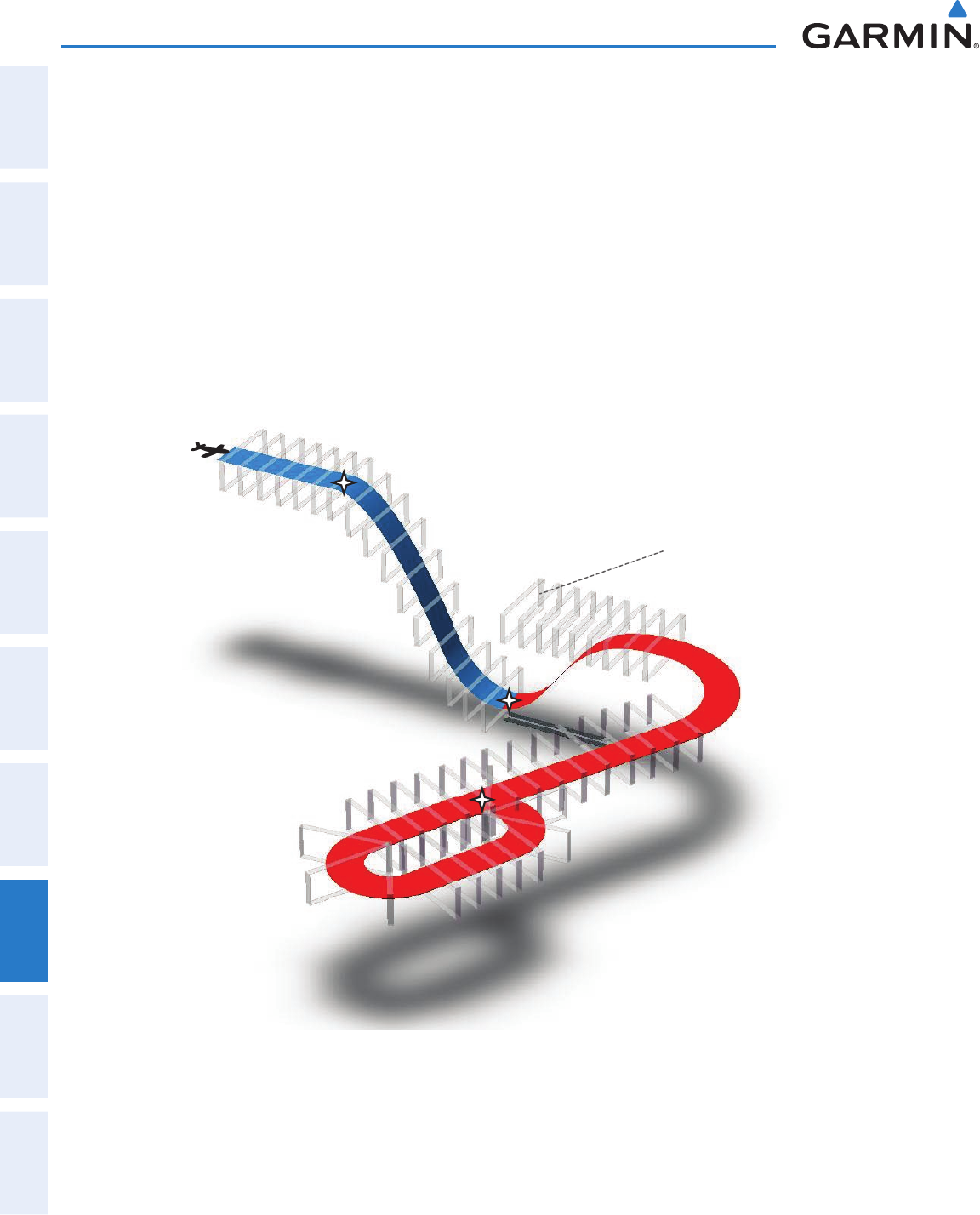
Garmin G1000 Pilot’s Guide for the Diamond DA40/40F
190-00592-06 Rev A410
ADDITIONAL FEATURES
SYSTEM
OVERVIEW
FLIGHT
INSTRUMENTS
EIS
AUDIO PANEL
& CNS
FLIGHT
MANAGEMENT
HAZARD
AVOIDANCE
AFCS
ADDITIONAL
FEATURES
APPENDICESINDEX
Mi s s e D aP P R o a c h
Upon activating the missed approach, pathways lead to the Missed Approach Holding Point (MAHP) and
are displayed as a level path at the published altitude for the MAHP, or the selected altitude, whichever is
the highest. If the initial missed approach leg is a Course-to-Altitude (CA) leg, the pathways boxes will
be displayed level at the altitude published for the MAHP. If the initial missed approach leg is defined by
a course using other than GPS, pathways are not displayed for that segment. In this case, the pathways
displayed for the next leg may be outside the field of view and will be visible when the aircraft has turned
in the direction of that leg.
Pathways are displayed along each segment including the path required to track course reversals that are
part of a procedure, such as holding patterns. Pathways boxes will not indicate a turn to a MAHP unless a
defined geographical waypoint exists between the MAP and MAHP.
Figure 8-6 SVS Pathways, Approach, Missed Approach, and Holding
Descent displayed
by pathway Selected Altitude
or Programmed Altitude
(whichever is higher)
FAF
MAP
MAHP
Climbs NOT displayed
by pathway
Turn Segment
NOT displayed
by pathway
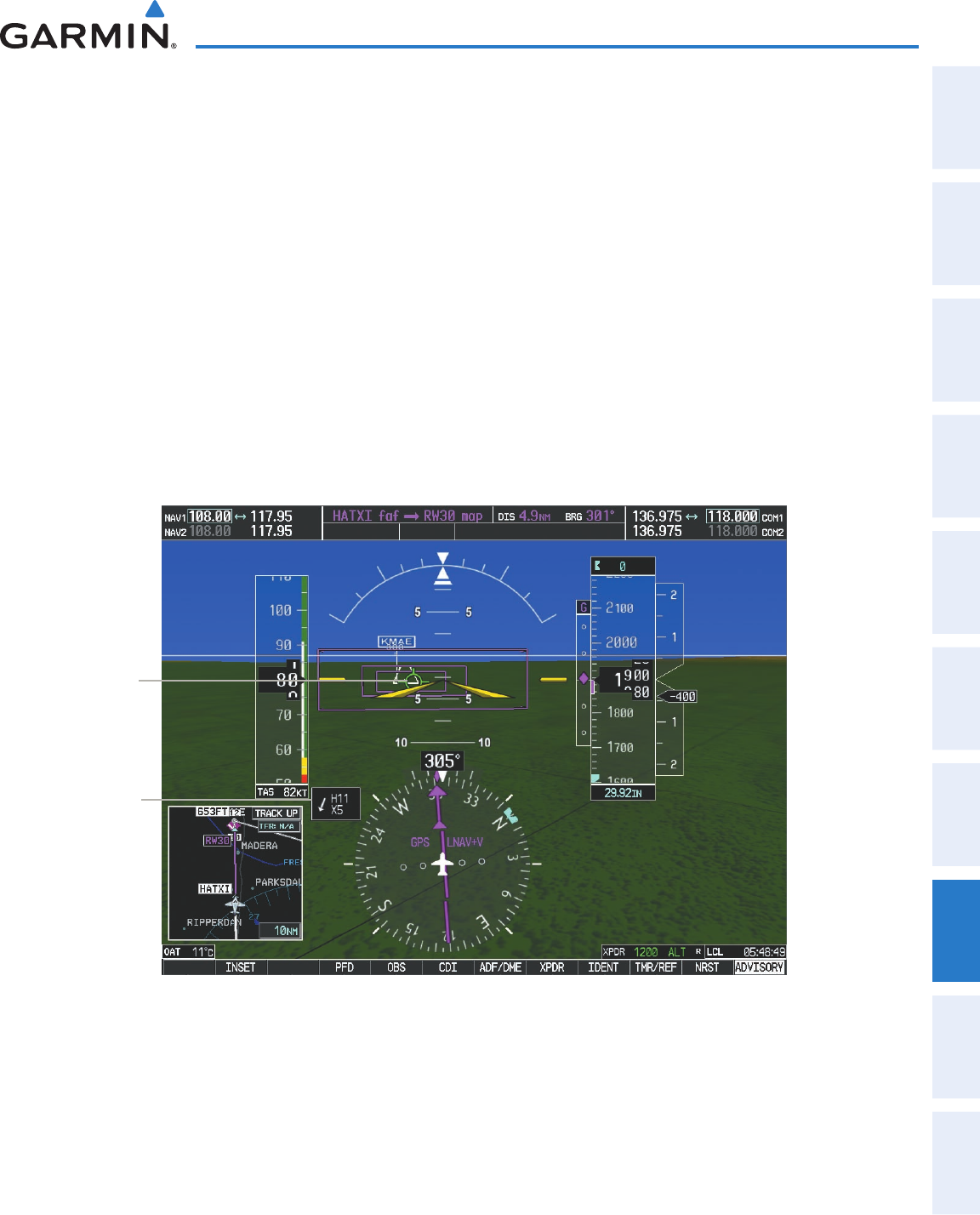
190-00592-06 Rev A
Garmin G1000 Pilot’s Guide for the Diamond DA40/40F
411
ADDITIONAL FEATURES
SYSTEM
OVERVIEW
FLIGHT
INSTRUMENTS EIS AUDIO PANEL
& CNS
FLIGHT
MANAGEMENT
HAZARD
AVOIDANCE AFCS ADDITIONAL
FEATURES APPENDICES INDEX
FLIGHT PATH MARKER
The Flight Path Marker (FPM), also known as a Velocity Vector, is displayed on the PFD at groundspeeds
above 30 knots. The FPM depicts the approximate projected path of the aircraft accounting for wind speed
and direction relative to the three-dimensional terrain display.
The FPM is always available when the Synthetic Terrain feature is in operation. The FPM represents the
direction of the flight path as it relates to the terrain and obstacles on the display, while the airplane symbol
represents the aircraft heading.
The FPM works in conjunction with the Pathways feature to assist the pilot in maintaining desired altitudes
and direction when navigating a flight plan. When on course and altitude the FPM is aligned inside the
pathway boxes as shown (Figure 8-7).
The FPM may also be used to identify a possible conflict with the aircraft flight path and distant terrain or
obstacles. Displayed terrain or obstacles in the aircraft’s flight path extending above the FPM could indicate
a potential conflict, even before an alert is issued by TAWS. However, decisions regarding terrain and/or
obstacle avoidance should not be made using only the FPM.
Flight Path
Marker
(FPM)
Wind
Vector
Figure 8-7 Flight Path Marker and Pathways
ZERO PITCH LINE
The Zero Pitch Line is drawn completely across the display and represents the aircraft attitude with respect
to the horizon. It may not align with the terrain horizon, particularly when the terrain is mountainous or
when the aircraft is flown at high altitudes.
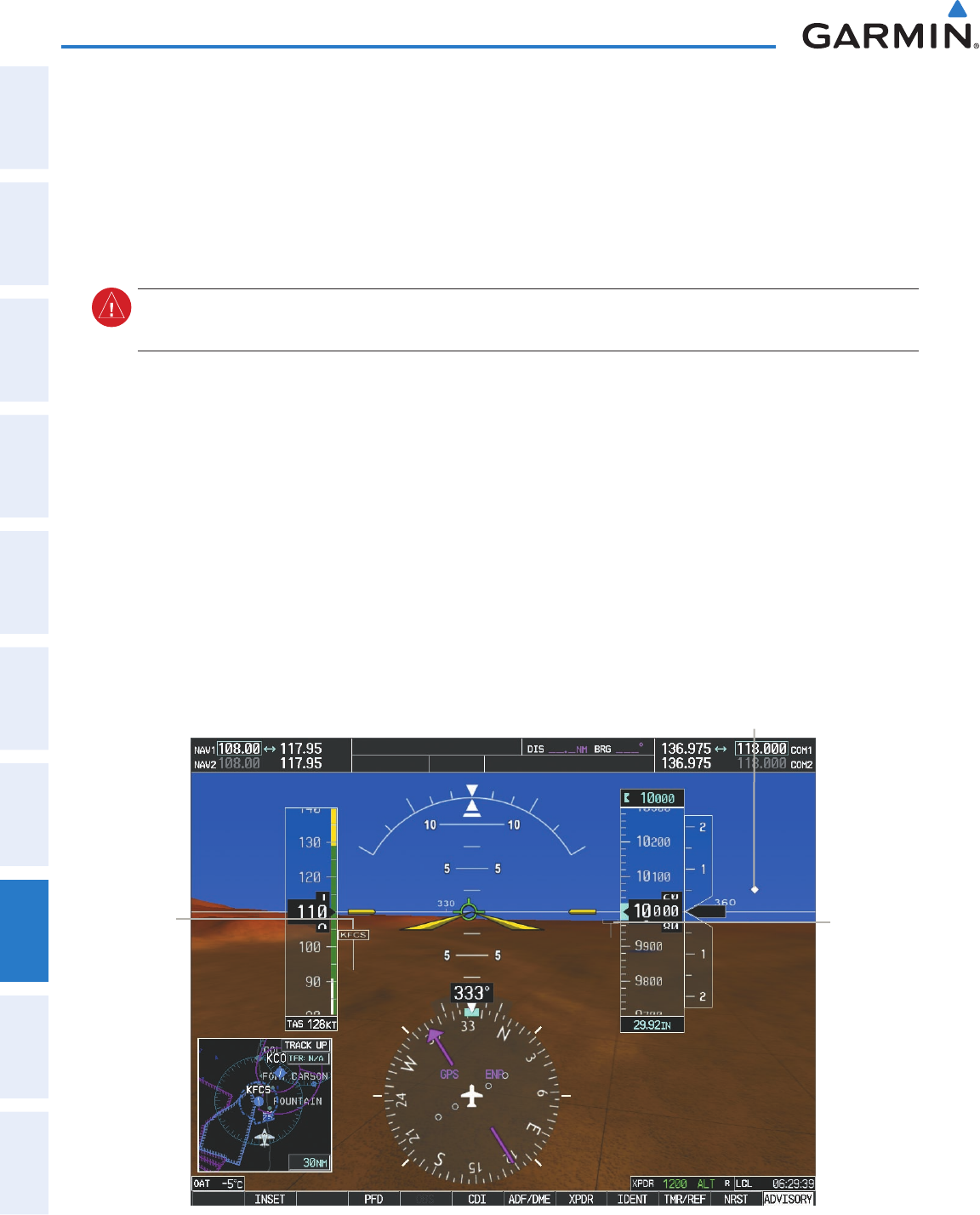
Garmin G1000 Pilot’s Guide for the Diamond DA40/40F
190-00592-06 Rev A412
ADDITIONAL FEATURES
SYSTEM
OVERVIEW
FLIGHT
INSTRUMENTS
EIS
AUDIO PANEL
& CNS
FLIGHT
MANAGEMENT
HAZARD
AVOIDANCE
AFCS
ADDITIONAL
FEATURES
APPENDICESINDEX
HORIZON HEADING
The Horizon Heading is synchronized with the HSI and shows approximately 60 degrees of compass
heading in 30-degree increments on the Zero Pitch Line. Horizon Heading tick marks and digits appearing
on the zero pitch line are not visible behind either the airspeed or altitude display. Horizon Heading is used
for general heading awareness, and is activated and deactivated by pressing the HRZN HDG Softkey.
TRAFFIC
WARNING:
Intruder aircraft at or below 500 ft. AGL may not appear on the SVS display or may appear as a
partial symbol.
Traffic symbols are displayed in their approximate locations as determined by the related traffic systems.
Traffic symbols are displayed in three dimensions, appearing larger as they are getting closer, and smaller
when they are further away. Traffic within 1000 feet laterally of the aircraft will not be displayed on the SVS
display. Traffic symbols and coloring are consistent with that used for traffic displayed in the Inset map or
MFD traffic page. If the traffic altitude is unknown, the traffic will not be displayed on the SVS display. For
more details refer to the traffic system discussion in the Hazard Avoidance section.
AIRPORT SIGNS
Airport Signs provide a visual representation of airport location and identification on the synthetic terrain
display. When activated, the signs appear on the display when the aircraft is approximately 15 nm from
an airport and disappear at approximately 4.5 nm. Airport signs are shown without the identifier until
the aircraft is approximately eight nautical miles from the airport. Airport signs are not shown behind the
airspeed or altitude display. Airport signs are activated and deactivated by pressing the APTSIGNS Softkey.
Figure 8-8 Airport Signs
Airport
Sign with
Identifier
(Between
4.5 nm and
8 nm)
Airport
Sign
without
Identifier
(Between
8 nm and
15 nm)
Traffic
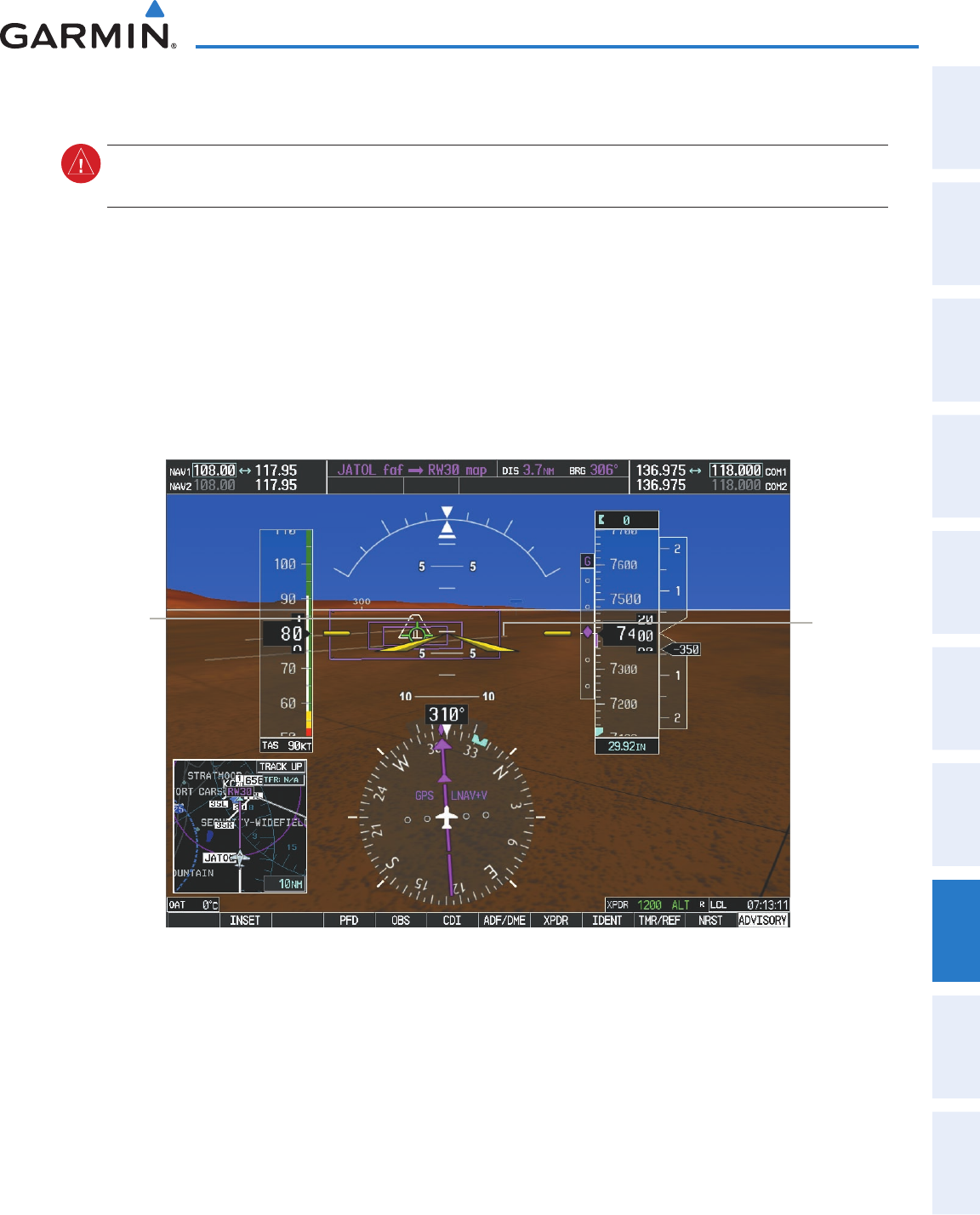
190-00592-06 Rev A
Garmin G1000 Pilot’s Guide for the Diamond DA40/40F
413
ADDITIONAL FEATURES
SYSTEM
OVERVIEW
FLIGHT
INSTRUMENTS EIS AUDIO PANEL
& CNS
FLIGHT
MANAGEMENT
HAZARD
AVOIDANCE AFCS ADDITIONAL
FEATURES APPENDICES INDEX
RUNWAYS
WARNING:
Do not use SVS runway depiction as the sole means for determining the proximity of the aircraft
to the runway or for maintaining the proper approach path angle during landing.
Runway data provides improved awareness of runway location with respect to the surrounding terrain. All
runway thresholds are depicted at their respective elevations as defined in the database. In some situations,
where threshold elevations differ significantly, crossing runways may appear to be layered. As runways are
displayed, those within 45 degrees of the aircraft heading are displayed in white. Other runways will be gray
in color. When an approach for a specific runway is active, that runway will appear brighter and be outlined
with a white box, regardless of the runway orientation as related to aircraft heading. As the aircraft gets closer
to the runway, more detail such as runway numbers and centerlines will be displayed.
Other
Runway
on Airport
Figure 8-9 Airport Runways
Runway
Selected for
Approach
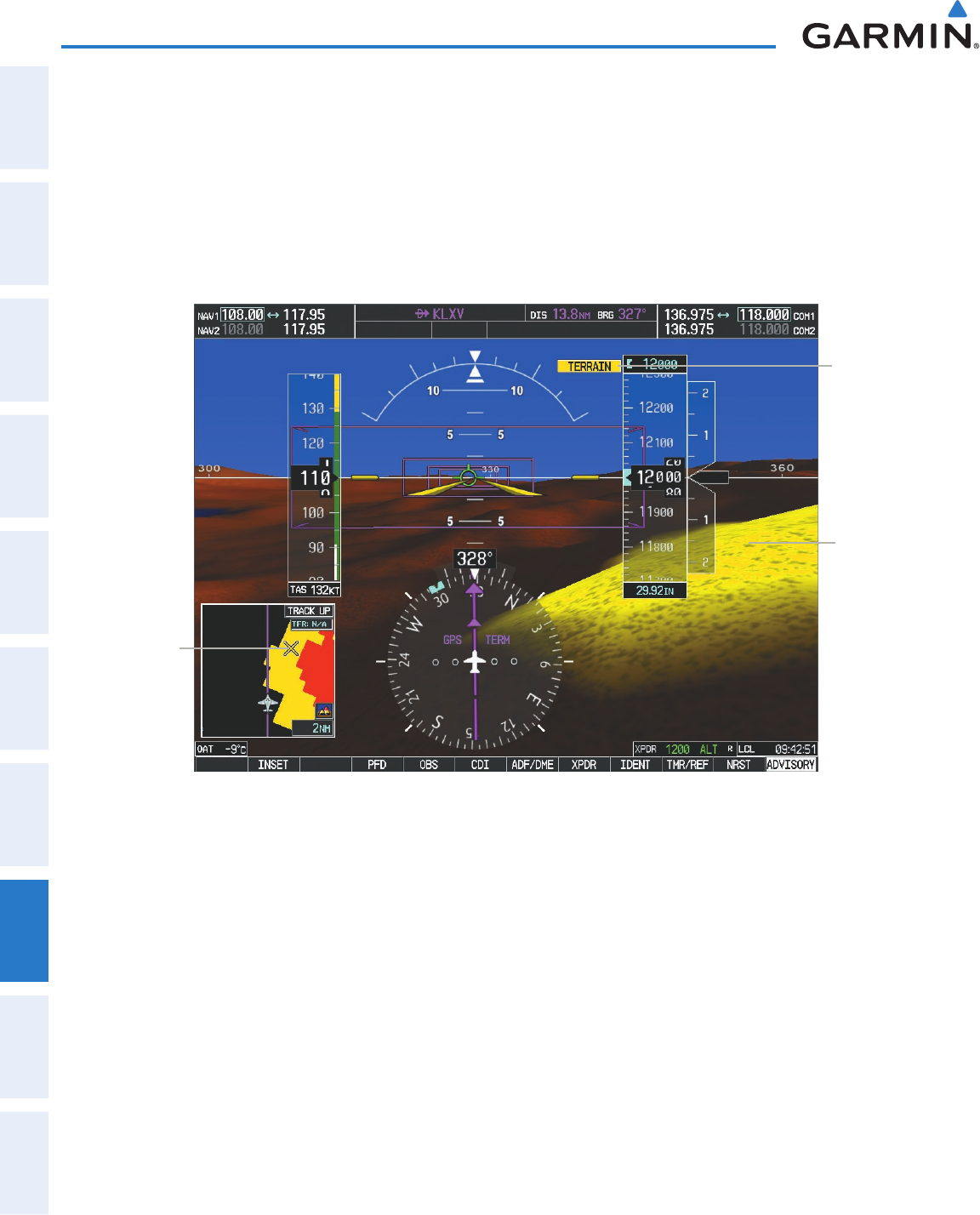
Garmin G1000 Pilot’s Guide for the Diamond DA40/40F
190-00592-06 Rev A414
ADDITIONAL FEATURES
SYSTEM
OVERVIEW
FLIGHT
INSTRUMENTS
EIS
AUDIO PANEL
& CNS
FLIGHT
MANAGEMENT
HAZARD
AVOIDANCE
AFCS
ADDITIONAL
FEATURES
APPENDICESINDEX
TERRAIN-SVS AND TAWS ALERTING
Terrain alerting on the synthetic terrain display is triggered by Forward-looking Terrain Avoidance (FLTA)
alerts, and corresponds to the red and yellow X symbols on the Inset Map and MFD map displays. For more
detailed information regarding Terrain-SVS and TAWS, refer to the Hazard Avoidance Section.
In some instances, a terrain or obstacle alert may be issued with no conflict shading displayed on the
synthetic terrain. In these cases, the conflict is outside the SVS field of view to the left or right of the
aircraft.
TERRAIN
Annunciation
Figure 8-10 Terrain Alert
Potential
Impact
Point
Terrain
Caution
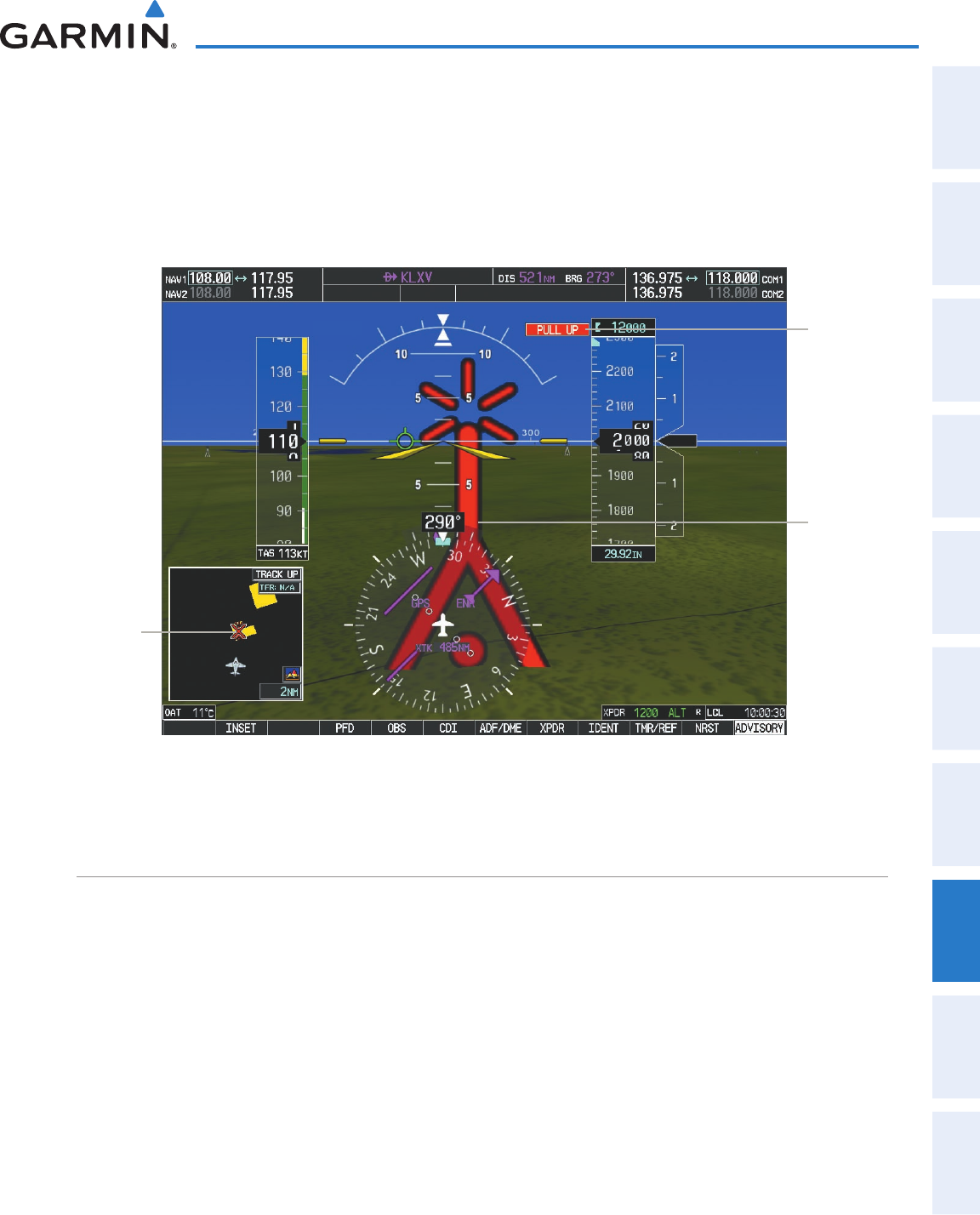
190-00592-06 Rev A
Garmin G1000 Pilot’s Guide for the Diamond DA40/40F
415
ADDITIONAL FEATURES
SYSTEM
OVERVIEW
FLIGHT
INSTRUMENTS EIS AUDIO PANEL
& CNS
FLIGHT
MANAGEMENT
HAZARD
AVOIDANCE AFCS ADDITIONAL
FEATURES APPENDICES INDEX
Obstacles are represented on the synthetic terrain display by standard two-dimensional tower symbols found
on the Inset map and MFD maps and charts. Obstacle symbols appear in the perspective view with relative
height above terrain and distance from the aircraft. Unlike the Inset map and MFD moving map display,
obstacles on the synthetic terrain display do not change colors to warn of potential conflict with the aircraft’s
flight path until the obstacle is associated with an actual FLTA alert. Obstacles greater than 1000 feet below the
aircraft altitude are not shown. Obstacles are shown behind the airspeed and altitude displays.
Figure 8-11 Obstacle
Potential
Impact
Point
Obstacle
Warning
TERRAIN
Annunciation
FIELD OF VIEW
The PFD field of view can be represented on the MFD Navigation Map Page. Two dashed lines forming a
V-shape in front of the aircraft symbol on the map, represent the forward viewing area shown on the PFD.
Configuring field of view:
1) While viewing the Navigation Map Page, press the MENU Key to display the PAGE MENU.
2) Turn the large
FMS
Knob to highlight Map Setup and press the
ENT
Key.
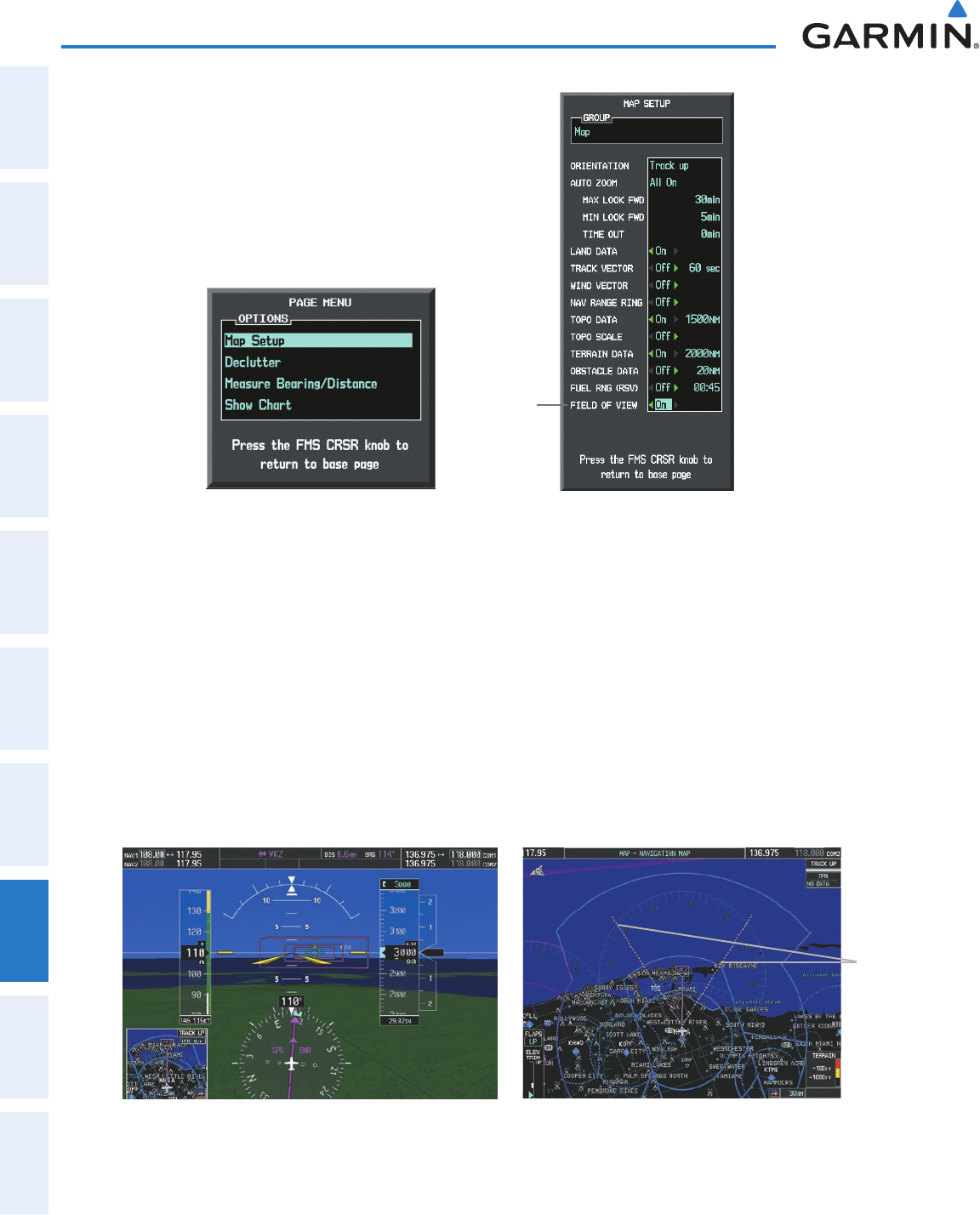
Garmin G1000 Pilot’s Guide for the Diamond DA40/40F
190-00592-06 Rev A416
ADDITIONAL FEATURES
SYSTEM
OVERVIEW
FLIGHT
INSTRUMENTS
EIS
AUDIO PANEL
& CNS
FLIGHT
MANAGEMENT
HAZARD
AVOIDANCE
AFCS
ADDITIONAL
FEATURES
APPENDICESINDEX
Figure 8-12 Option Menus
Navigation Map Page OPTIONS Menu Map Setup Menu, Map Group, Field of View Option
Field of
View
3) Turn the FMS Knob to select the Map Group and press the ENT Key.
4) Turn the large FMS Knob to scroll through the Map Group options to FIELD OF VIEW.
5) Turn the small FMS Knob to select On or Off.
6) Press the
FMS
Knob to return to the Navigation Map Page.
The following figure compares the PFD forward looking depiction with the MFD plan view and FIELD OF
VIEW turned on.
Figure 8-13 PFD and MFD Field of View Comparison
Lines
Depict
PFD Field
of View
SVS View on the PFD Field of View on the MFD
190-00592-06 Rev A
Garmin G1000 Pilot’s Guide for the Diamond DA40/40F
417
ADDITIONAL FEATURES
SYSTEM
OVERVIEW
FLIGHT
INSTRUMENTS EIS AUDIO PANEL
& CNS
FLIGHT
MANAGEMENT
HAZARD
AVOIDANCE AFCS ADDITIONAL
FEATURES APPENDICES INDEX
8.2 SAFETAXI
SafeTaxi is an enhanced feature that gives greater map detail when viewing airports at close range. The
maximum map ranges for enhanced detail are pilot configurable. When viewing at ranges close enough to
show the airport detail, the map reveals taxiways with identifying letters/numbers, airport Hot Spots, and airport
landmarks including ramps, buildings, control towers, and other prominent features. Resolution is greater at
lower map ranges. When the MFD display is within the SafeTaxi ranges, the airplane symbol on the airport
provides enhanced position awareness.
Designated Hot Spots are recognized at airports with many intersecting taxiways and runways, and/or complex
ramp areas. Airport Hot Spots are outlined to caution pilots of areas on an airport surface where positional
awareness confusion or runway incursions happen most often. Hot Spots are defined with a magenta circle or
outline around the region of possible confusion.
Any map page that displays the navigation view can also show the SafeTaxi airport layout within the maximum
configured range. The following is a list of pages where the SafeTaxi feature can be seen:
•NavigationMapPage
•InsetMap(PFD)
•WeatherDatalinkPage
•AirportInformationPage
•IntersectionInformationPage
•NDBInformationPage
•VORInformationPage
•UserWaypointInformationPage
•TripPlanningPage
•NearestPages
•ActiveandStoredFlightPlanPages
During ground operations the aircraft’s position is displayed in reference to taxiways, runways, and airport
features. In the example shown, the aircraft is on taxiway Bravo inside the High Alert Intersection boundary
on KSFO airport. Airport Hot Spots are outlined in magenta. When panning over the airport, features such as
runway holding lines and taxiways are shown at the cursor.
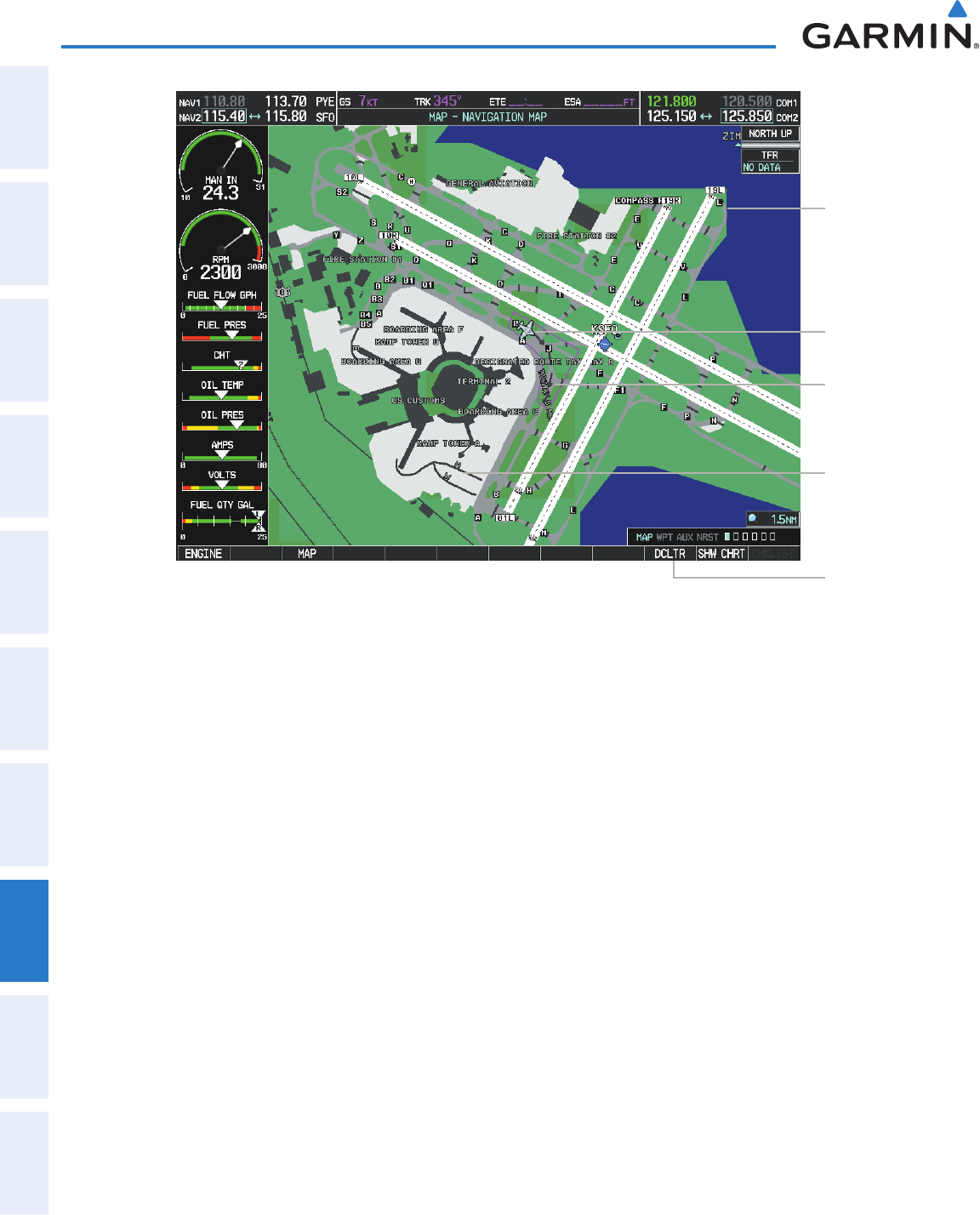
Garmin G1000 Pilot’s Guide for the Diamond DA40/40F
190-00592-06 Rev A418
ADDITIONAL FEATURES
SYSTEM
OVERVIEW
FLIGHT
INSTRUMENTS
EIS
AUDIO PANEL
& CNS
FLIGHT
MANAGEMENT
HAZARD
AVOIDANCE
AFCS
ADDITIONAL
FEATURES
APPENDICESINDEX
Figure 8-14 SafeTaxi Depiction on the Navigation Map Page
DCLTR
Softkey
Removes Taxiway
Markings
Airport
Features
Aircraft
Position
Taxiway
Identification
Airport Hot
Spot Outline
The DCLTR Softkey (declutter) label advances to DCLTR-1, DCLTR -2, and DCLTR-3 each time the softkey is
pressed for easy recognition of decluttering level. Pressing the DCLTR Softkey removes the taxiway markings
and airport feature labels. Pressing the DCLTR-1 Softkey removes VOR and station ID, the VOR symbol, and
intersection names if within the airport plan view. Pressing the DCLTR-2 Softkey removes the airport runway
layout, unless the airport in view is part of an active route structure. Pressing the DCLTR-3 Softkey cycles back
to the original map detail. Refer to Map Declutter Levels in the Flight Management Section.
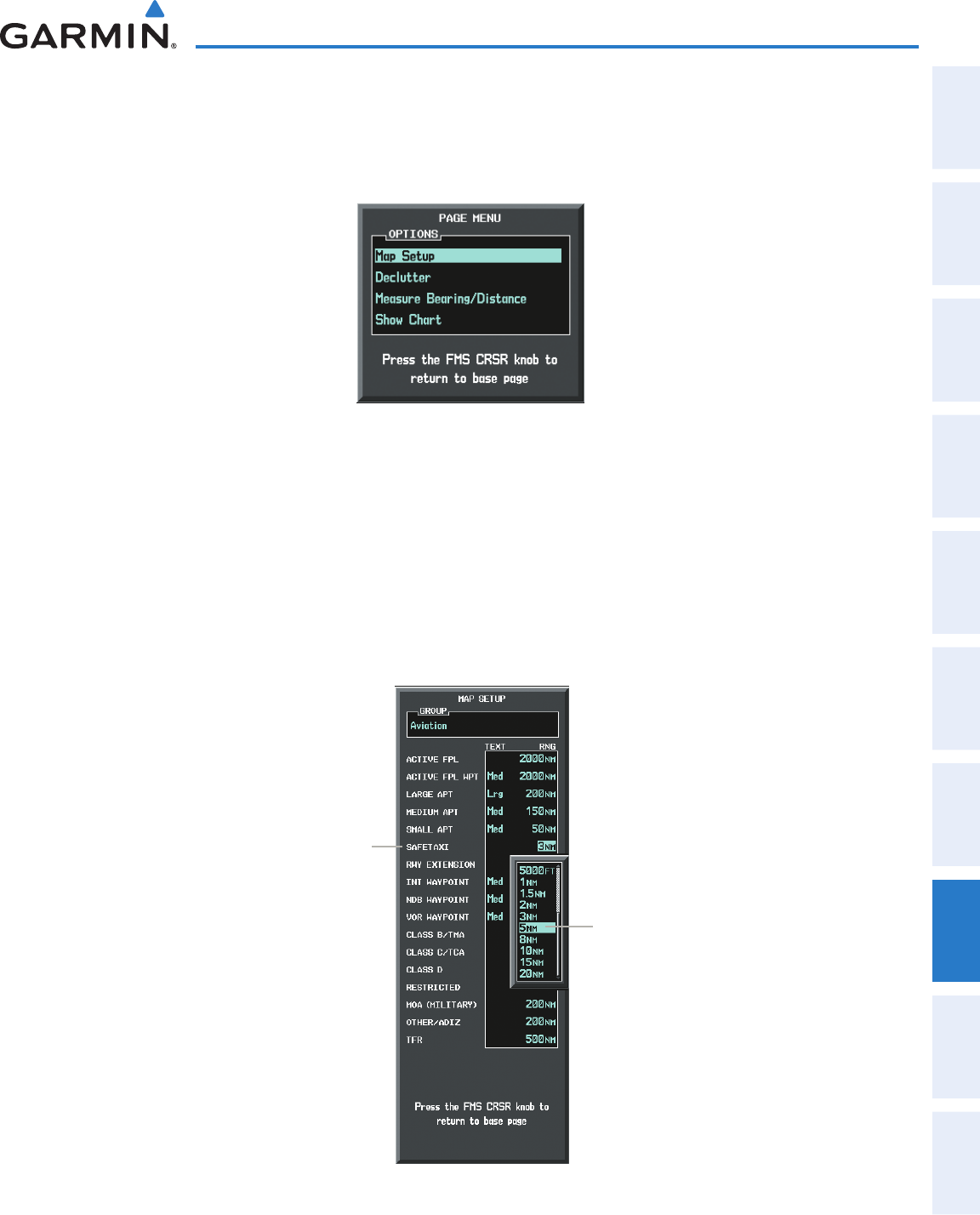
190-00592-06 Rev A
Garmin G1000 Pilot’s Guide for the Diamond DA40/40F
419
ADDITIONAL FEATURES
SYSTEM
OVERVIEW
FLIGHT
INSTRUMENTS EIS AUDIO PANEL
& CNS
FLIGHT
MANAGEMENT
HAZARD
AVOIDANCE AFCS ADDITIONAL
FEATURES APPENDICES INDEX
Configuring SafeTaxi range:
1) While viewing the Navigation Map Page, press the MENU Key to display the PAGE MENU.
2) Turn the large
FMS
Knob to highlight the Map Setup Menu Option and press the
ENT
Key.
Figure 8-15 Navigation Map PAGE MENU, Map Setup Option
3) Turn the FMS Knob to select the Aviation Group and press the ENT Key.
4) Turn the large FMS Knob to scroll through the Aviation Group options to SAFETAXI.
5) Turn the small FMS Knob to display the range of distances.
6) Turn either FMS Knob to select the desired distance for maximum SafeTaxi display range.
7) Press the ENT Key to complete the selection.
8) Press the
FMS
Knob to return to the Navigation Map Page.
SAFETAXI
Option
Figure 8-16 MAP SETUP Menu, Aviation Group, SAFETAXI Range Options
SafeTaxi
Range
Options
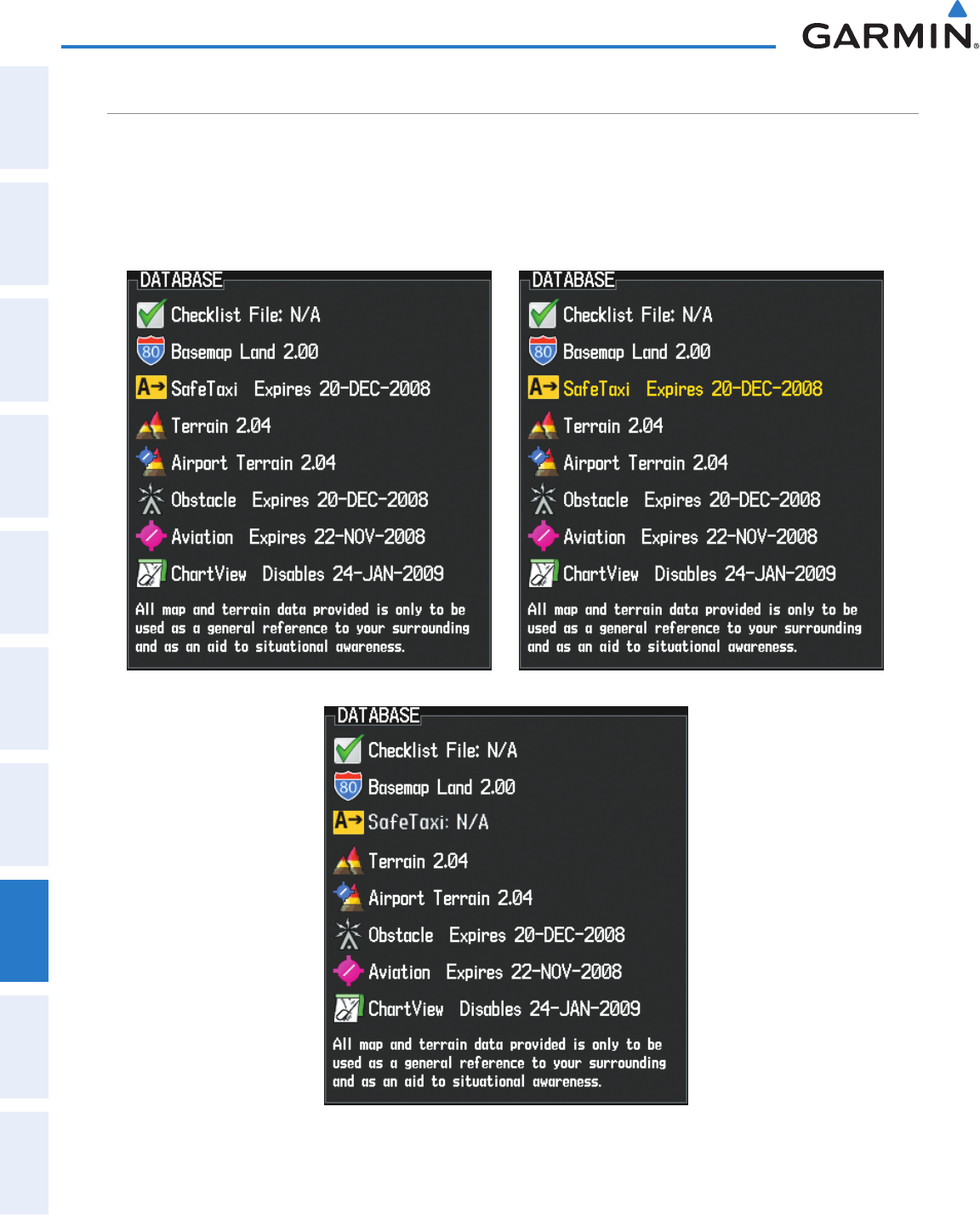
Garmin G1000 Pilot’s Guide for the Diamond DA40/40F
190-00592-06 Rev A420
ADDITIONAL FEATURES
SYSTEM
OVERVIEW
FLIGHT
INSTRUMENTS
EIS
AUDIO PANEL
& CNS
FLIGHT
MANAGEMENT
HAZARD
AVOIDANCE
AFCS
ADDITIONAL
FEATURES
APPENDICESINDEX
SAFETAXI CYCLE NUMBER AND REVISION
The SafeTaxi database is revised every 56 days. SafeTaxi is always available for use after the expiration date.
When turning on the G1000, the Power-up Page indicates whether the databases are current, out of date, or not
available. The Power-up Page shows the SafeTaxi database is current when the SafeTaxi Expires date is shown in
white. When the SafeTaxi cycle has expired, the SafeTaxi Expires date appears in yellow. The message SafeTaxi:
N/A appears in white if no SafeTaxi data is available on the database card.
Figure 8-17 Power-up Page, SafeTaxi Database
SafeTaxi Database is Current SafeTaxi Database has Expired
SafeTaxi Database Not Available
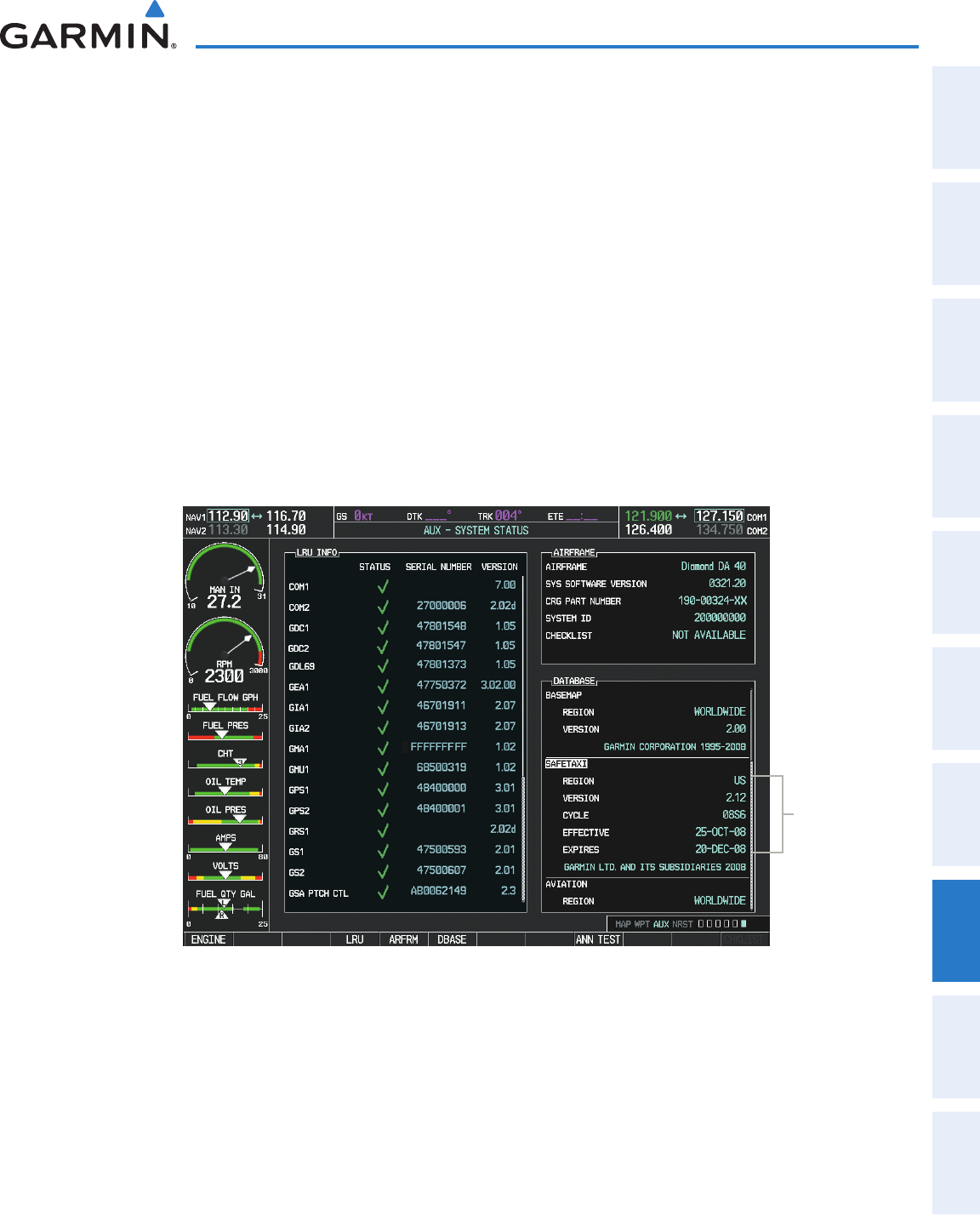
190-00592-06 Rev A
Garmin G1000 Pilot’s Guide for the Diamond DA40/40F
421
ADDITIONAL FEATURES
SYSTEM
OVERVIEW
FLIGHT
INSTRUMENTS EIS AUDIO PANEL
& CNS
FLIGHT
MANAGEMENT
HAZARD
AVOIDANCE AFCS ADDITIONAL
FEATURES APPENDICES INDEX
The SafeTaxi Region, Version, Cycle, Effective date and Expires date of the database cycle can also be found
on the AUX - System Status page. SafeTaxi information appears in blue and yellow text. The EFFECTIVE
date appears in blue when data is current and in yellow when the current date is before the effective date.
The EXPIRES date appears in blue when data is current and in yellow when expired (Figures 8-18 and 8-19).
SafeTaxi REGION NOT AVAILABLE appears in blue if SafeTaxi data is not available on the database card
(Figure 8-19). Expired SafeTaxi data is never disabled.
Press the DBASE Softkey for scrolling through the database information. Scroll through the database with
the FMS knob or ENT Key.
The SafeTaxi database cycle number shown in the figure, 08S6, is deciphered as follows:
08 – Indicates the year 2008
S – Indicates the data is for SafeTaxi
6 – Indicates the sixth issue of the SafeTaxi database for the year
The SafeTaxi EFFECTIVE date 25–OCT–08 is the beginning date for the current database cycle. SafeTaxi
EXPIRES date 20–DEC–08 is the revision date for the next database cycle.
Figure 8-18 AUX – System Status Page, SafeTaxi Current Information
SafeTaxi Data
The SafeTaxi database is provided by Garmin. Refer to Updating Garmin Databases in Appendix B for
instructions on revising the SafeTaxi database.
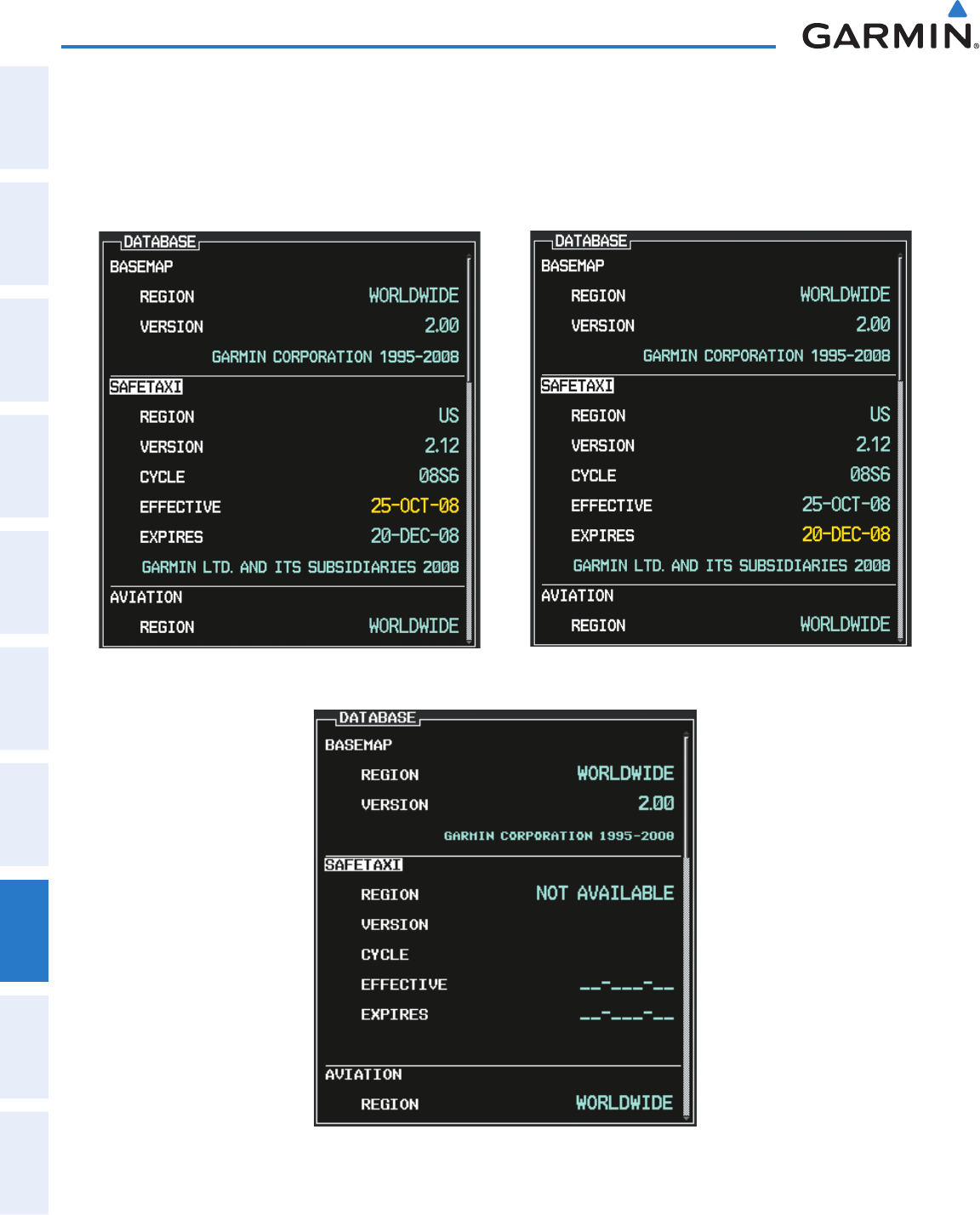
Garmin G1000 Pilot’s Guide for the Diamond DA40/40F
190-00592-06 Rev A422
ADDITIONAL FEATURES
SYSTEM
OVERVIEW
FLIGHT
INSTRUMENTS
EIS
AUDIO PANEL
& CNS
FLIGHT
MANAGEMENT
HAZARD
AVOIDANCE
AFCS
ADDITIONAL
FEATURES
APPENDICESINDEX
The other three possible AUX - System Status page conditions are shown here. The EFFECTIVE date is the
beginning date for this database cycle. If the present date is before the effective date, the EFFECTIVE date
appears in yellow and the EXPIRES date appears in blue. The EXPIRES date is the revision date for the next
database cycle. NOT AVAILABLE indicates that SafeTaxi is not available on the database card or no database
card is inserted.
Figure 8-19 AUX – System Status Page, SafeTaxi Expired, SafeTaxi Not Available
Current Date is before Effective Date SafeTaxi Database has Expired
SafeTaxi Database Not Installed
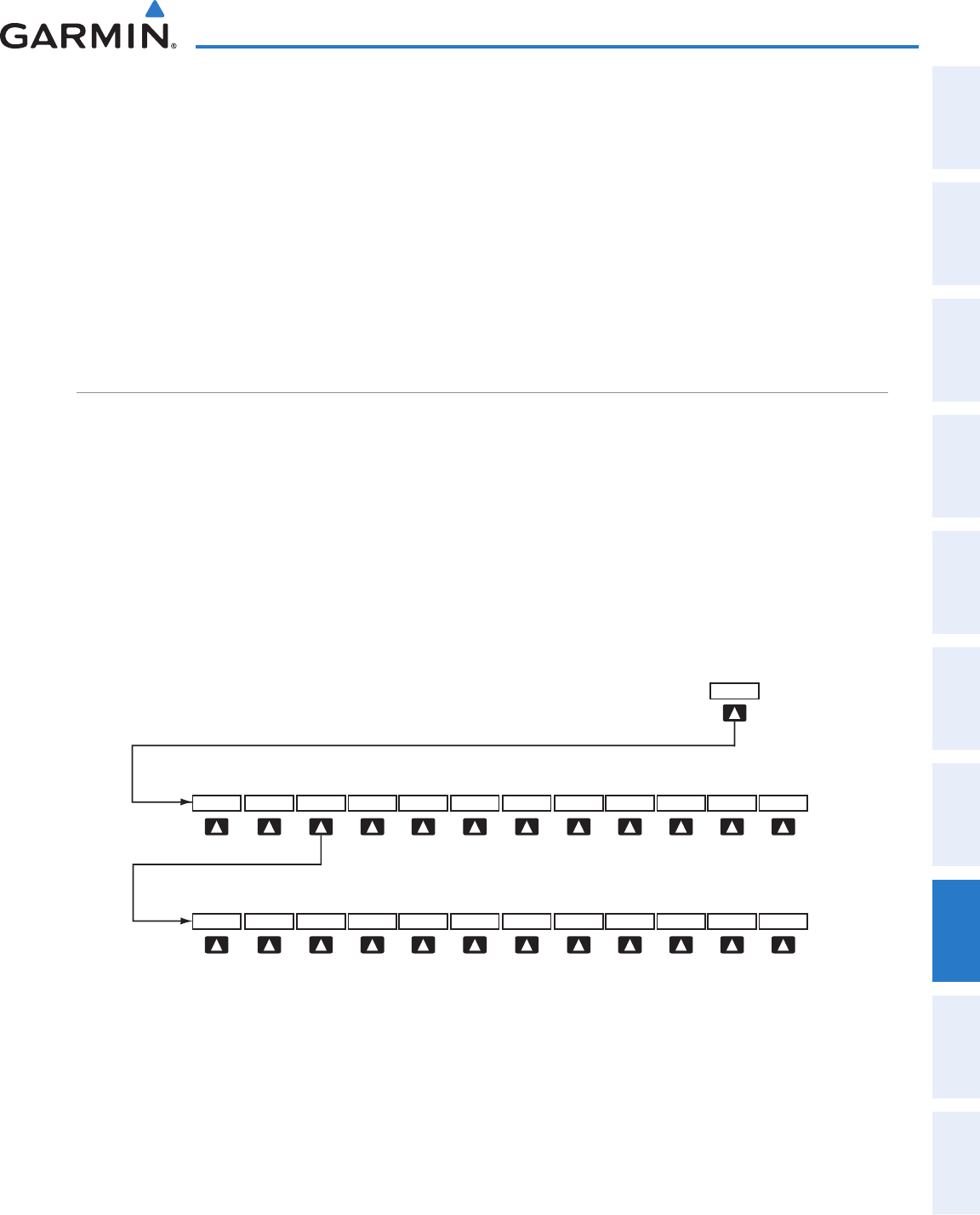
190-00592-06 Rev A
Garmin G1000 Pilot’s Guide for the Diamond DA40/40F
423
ADDITIONAL FEATURES
SYSTEM
OVERVIEW
FLIGHT
INSTRUMENTS EIS AUDIO PANEL
& CNS
FLIGHT
MANAGEMENT
HAZARD
AVOIDANCE AFCS ADDITIONAL
FEATURES APPENDICES INDEX
8.3 CHARTVIEW
ChartView resembles the paper version of Jeppesen terminal procedures charts. The charts are displayed in full
color with high-resolution. The MFD depiction shows the aircraft position on the moving map in the plan view
of approach charts and on airport diagrams. Airport Hot Spots are outlined in magenta.
The ChartView database subscription is available from Jeppesen, Inc. Available data includes:
•Arrivals(STAR)
•DepartureProcedures(DP)
•Approaches
•AirportDiagrams
•NOTAMs
CHARTVIEW SOFTKEYS
ChartView functions are displayed on three levels of softkeys. While on the Navigation Map Page, Nearest
Airports Page, or Flight Plan Page, pressing the
SHW CHRT
Softkey displays the available terminal chart and
advances to the chart selection level of softkeys: CHRT OPT, CHRT, INFO, DP, STAR, APR, WX, NOTAM,
and GO
BACK. The chart selection softkeys shown below appear on the Airport Information Page.
Pressing the GO
BACK Softkey reverts to the top level softkeys and previous page.
Pressing the CHRT OPT Softkey advances to the next level of softkeys: ALL, HEADER, PLAN, PROFILE,
MINIMUMS, FIT
WDTH, FULL
SCN, and BACK.
While viewing the CHRT OPT Softkeys, after 45 seconds of softkey inactivity, the system reverts to the chart
selection softkeys.
Figure 8-20 ChartView SHW CHRT, Chart Selection, and Chart Option Softkeys
Pressing the GO BACK Softkey returns
to the top-level softkeys and previous page.
Pressing the BACK Softkey returns
to the Chart Selection Softkeys.
MINIMUMS
CHRT OPT CHRT INFO DP STAR APR WX NOTAM GO BACK
SHW CHRT
ALL HEADER PLAN PROFILE FIT WDTH FULL SCN BACK
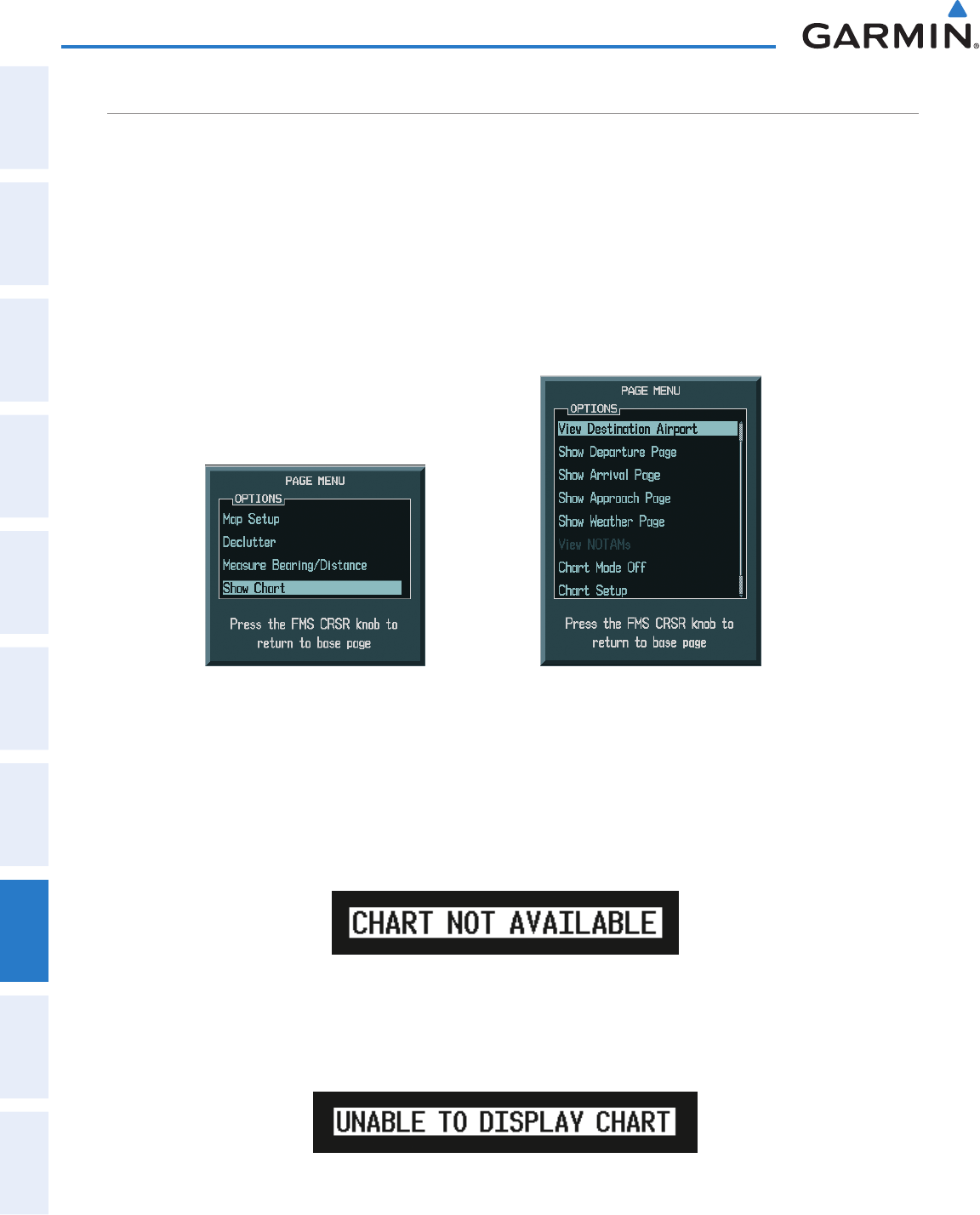
Garmin G1000 Pilot’s Guide for the Diamond DA40/40F
190-00592-06 Rev A424
ADDITIONAL FEATURES
SYSTEM
OVERVIEW
FLIGHT
INSTRUMENTS
EIS
AUDIO PANEL
& CNS
FLIGHT
MANAGEMENT
HAZARD
AVOIDANCE
AFCS
ADDITIONAL
FEATURES
APPENDICESINDEX
TERMINAL PROCEDURES CHARTS
Selecting Terminal Procedures Charts:
While viewing the Navigation Map Page, Nearest Airport Page, or Flight Plan Page, press the SHW CHRT
Softkey.
Or:
1) Press the MENU Key to display the PAGE MENU.
2) Turn the large FMS Knob to scroll through the OPTIONS Menu to Show Chart.
3) Press the ENT Key to display the chart.
Navigation Map Page OPTIONS Menu Waypoint Airport Information Page OPTIONS Menu
Figure 8-21 Option Menus
When no terminal procedure chart is available for the nearest airport or the selected airport, the banner
CHART NOT AVAILABLE appears on the screen. The CHART NOT AVAILABLE banner does not refer to
the Jeppesen subscription, but rather the availability of a particular airport chart selection or procedure for a
selected airport.
Figure 8-22 Chart Not Available Banner
If there is a problem in rendering the data (such as a data error or a failure of an individual chart), the banner
UNABLE TO DISPLAY CHART is then displayed.
Figure 8-23 Unable To Display Chart Banner
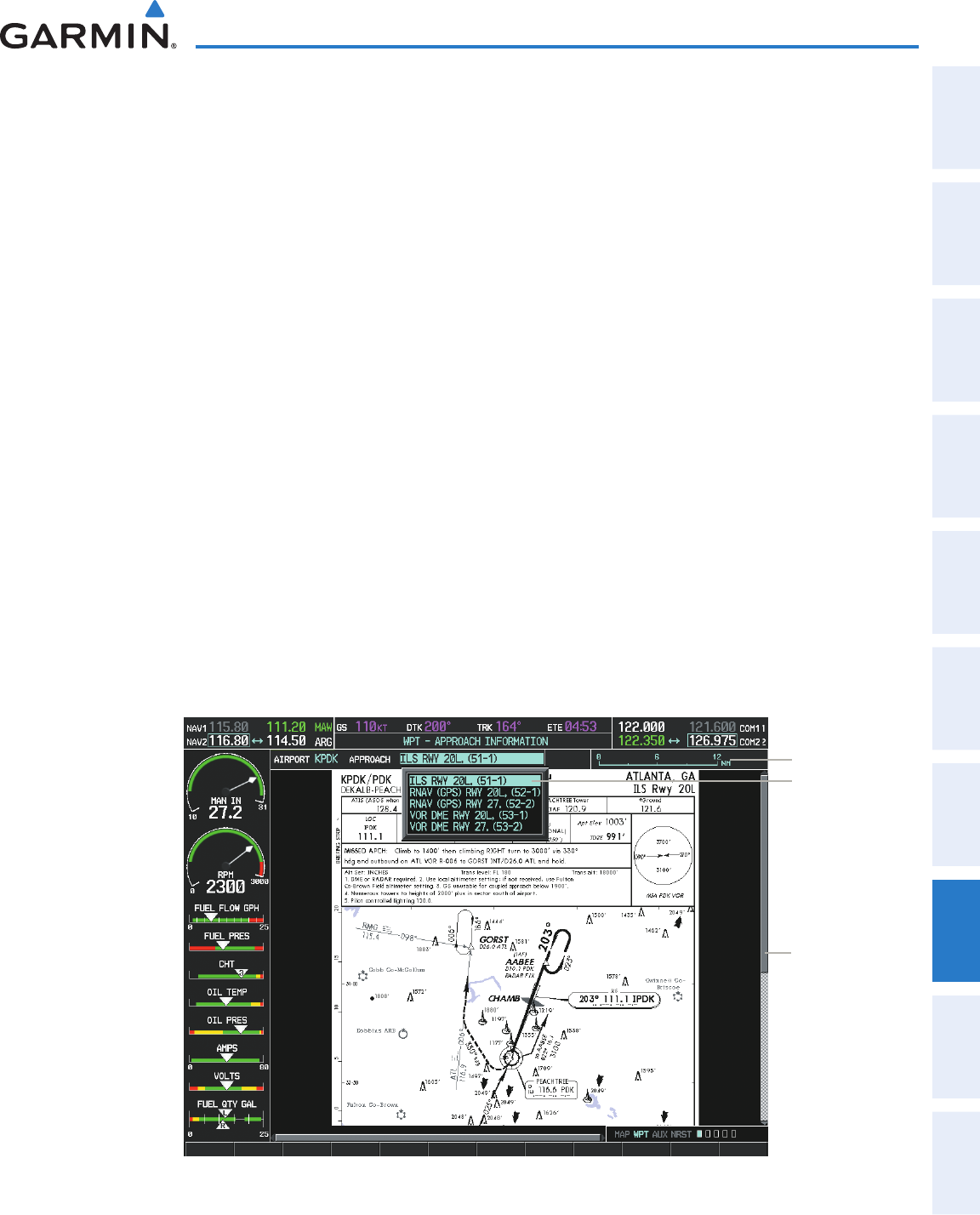
190-00592-06 Rev A
Garmin G1000 Pilot’s Guide for the Diamond DA40/40F
425
ADDITIONAL FEATURES
SYSTEM
OVERVIEW
FLIGHT
INSTRUMENTS EIS AUDIO PANEL
& CNS
FLIGHT
MANAGEMENT
HAZARD
AVOIDANCE AFCS ADDITIONAL
FEATURES APPENDICES INDEX
When a chart is not available by pressing the SHW CHRT Softkey or selecting a Page Menu Option, charts
may be obtained for other airports from the WPT Pages or Flight Plan Pages.
If a chart is available for the destination airport, or the airport selected in the active flight plan, the chart
appears on the screen. When no flight plan is active, or when not flying to a direct-to destination, pressing the
SHW CHRT Softkey displays the chart for the nearest airport, if available.
The chart shown is one associated with the WPT – Airport Information page. Usually this is the airport runway
diagram. Where no runway diagram exists, but Take Off Minimums or Alternate Minimums are available, that
page appears. If Airport Information pages are unavailable, the Approach Chart for the airport is shown.
Selecting a chart:
1) While viewing the Navigation Map Page, Flight Plan Page, or Nearest Airports Page, press the SHW CHRT
Softkey. The airport diagram or approach chart is displayed on the Airport Information Page.
2) Press the
FMS
Knob to activate the cursor.
3) Turn the large FMS Knob to select either the Airport Identifier Box or the Approach Box. (Press the APR Softkey
if the Approach Box is not currently shown).
4) Turn the small and large FMS Knob to enter the desired airport identifier.
5) Press the ENT Key to complete the airport selection.
6) Turn the large FMS Knob to select the Approach Box.
7) Turn the small
FMS
Knob to show the approach chart selection choices.
8) Turn either
FMS
Knob to scroll through the available charts.
9) Press the ENT Key to complete the chart selection.
Figure 8-24 Approach Information Page, Chart Selection
Select Desired
Approach Chart
From Menu
Scroll Through
Chart With
the
Joystick
Chart Scale
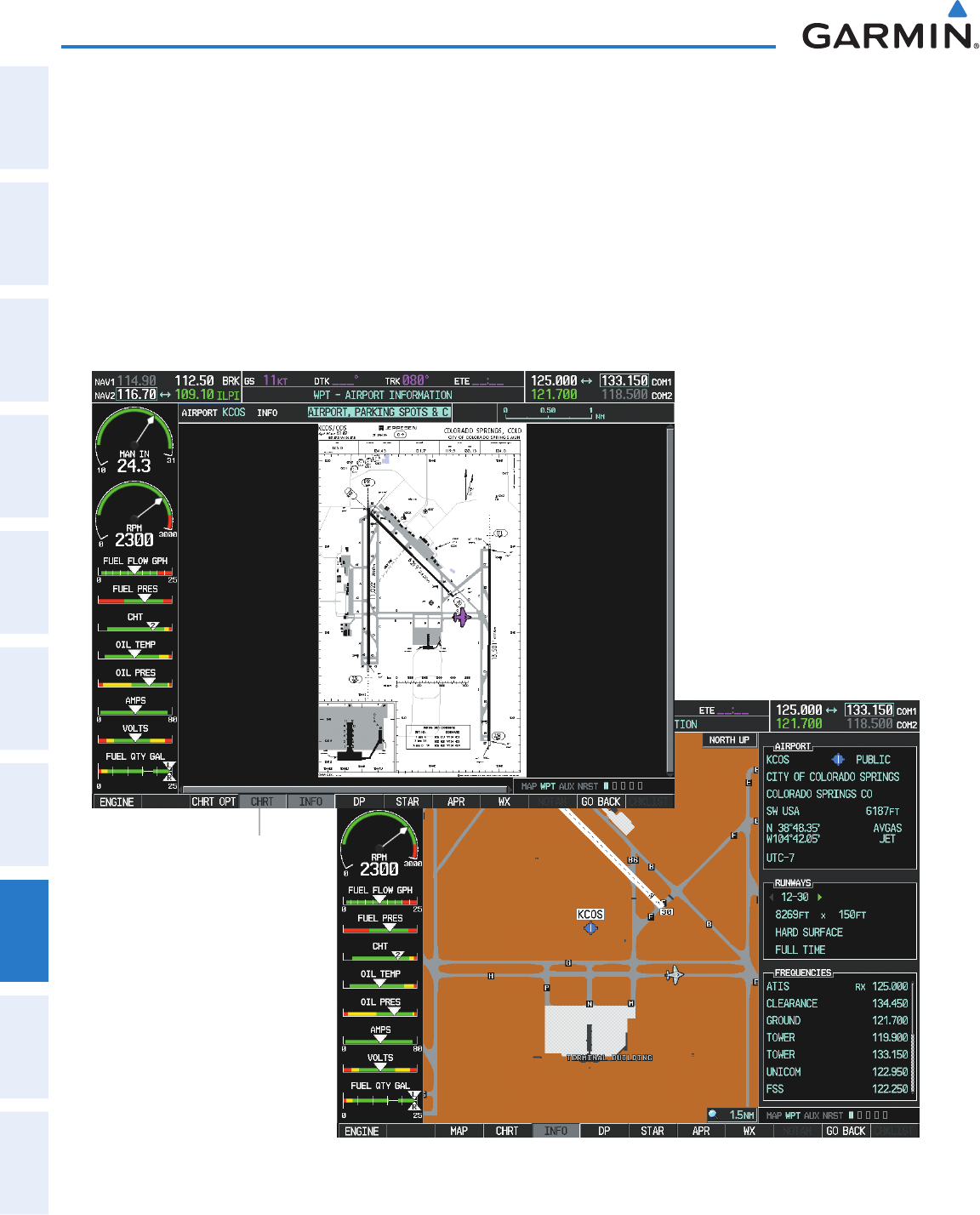
Garmin G1000 Pilot’s Guide for the Diamond DA40/40F
190-00592-06 Rev A426
ADDITIONAL FEATURES
SYSTEM
OVERVIEW
FLIGHT
INSTRUMENTS
EIS
AUDIO PANEL
& CNS
FLIGHT
MANAGEMENT
HAZARD
AVOIDANCE
AFCS
ADDITIONAL
FEATURES
APPENDICESINDEX
While the APPROACH Box is selected using the FMS Knob, the G1000 softkeys are blank. Once the desired
chart is selected, the chart scale can be changed and the chart page can be scrolled using the Joystick. Pressing
the Joystick centers the chart on the screen.
The aircraft symbol is shown on the chart only if the chart is to scale and the aircraft position is within
the boundaries of the chart. The aircraft symbol is not displayed when the Aircraft Not Shown Icon appears
(Figure 8-15). If the Chart Scale Box displays a banner NOT TO SCALE, the aircraft symbol is not shown. The
Aircraft Not Shown Icon may appear at certain times, even if the chart is displayed to scale.
Pressing the CHRT Softkey switches between the ChartView diagram and the associated map in the WPT
page group. In the example shown, the CHRT Softkey switches between the Colorado Springs, CO (KCOS)
Airport Diagram and the navigation map on the WPT – Airport Information page.
Figure 8-25 CHRT Softkey, Airport Information Page
Press
CHRT
Softkey
to Switch Between
ChartView and WPT -
Airport Information Page
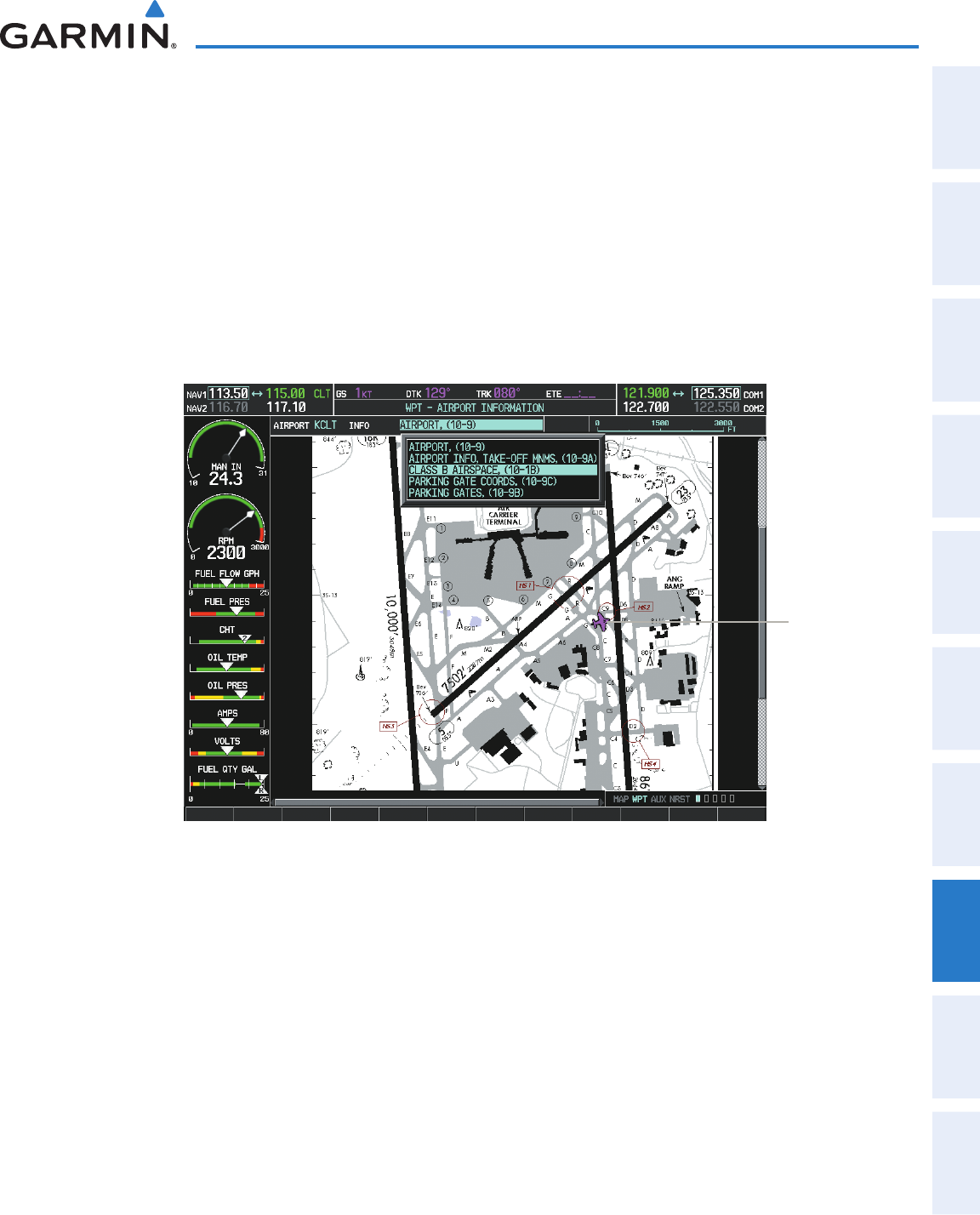
190-00592-06 Rev A
Garmin G1000 Pilot’s Guide for the Diamond DA40/40F
427
ADDITIONAL FEATURES
SYSTEM
OVERVIEW
FLIGHT
INSTRUMENTS EIS AUDIO PANEL
& CNS
FLIGHT
MANAGEMENT
HAZARD
AVOIDANCE AFCS ADDITIONAL
FEATURES APPENDICES INDEX
Pressing the INFO Softkey returns to the airport diagram when the view is on a different chart. If the
displayed chart is the airport diagram, the INFO Softkey has no effect.
The aircraft position is shown in magenta on the ChartView diagrams when the location of the aircraft is
within the chart boundaries. In the example shown, the aircraft is taxiing on Taxiway Alpha on the Charlotte,
NC (KCLT) airport.
Another source for additional airport information is from the INFO Box above the chart for certain airports.
This information source is not related to the INFO Softkey. When the INFO Box is selected using the FMS
Knob, the G1000 softkeys are blank. The Charlotte, NC airport has five additional charts offering information;
the Airport Diagram, Take-off Minimums, Class B Airspace, Airline Parking Gate Coordinates, and Airline
Parking Gate Location. (The numbers in parentheses after the chart name are Jeppesen designators.)
Aircraft
Current
Position
Figure 8-26 Airport Information Page, INFO View, Full Screen Width
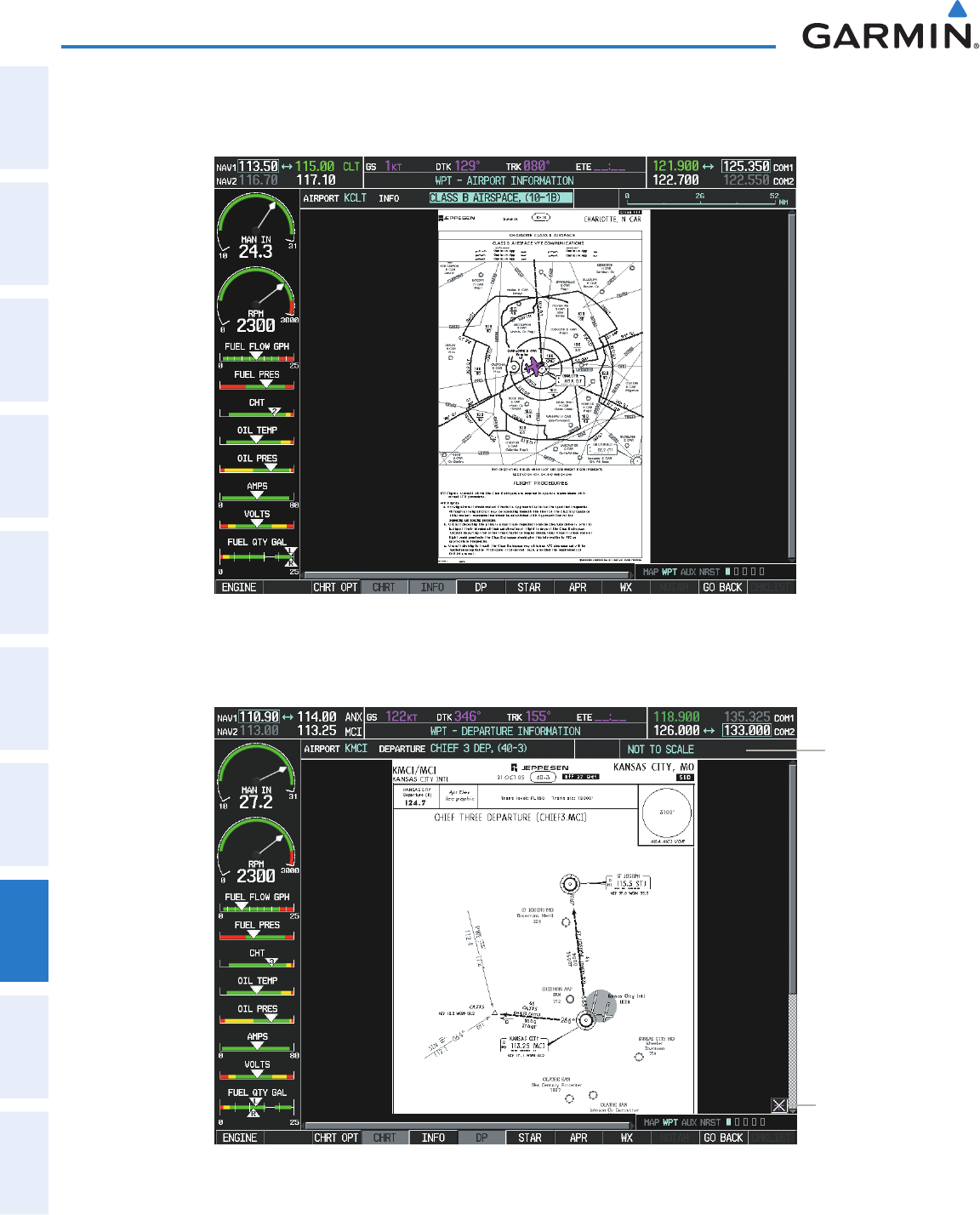
Garmin G1000 Pilot’s Guide for the Diamond DA40/40F
190-00592-06 Rev A428
ADDITIONAL FEATURES
SYSTEM
OVERVIEW
FLIGHT
INSTRUMENTS
EIS
AUDIO PANEL
& CNS
FLIGHT
MANAGEMENT
HAZARD
AVOIDANCE
AFCS
ADDITIONAL
FEATURES
APPENDICESINDEX
In the example shown in Figure 8-26, the Class B Chart is selected. Pressing the ENT Key displays the
Charlotte Class B Airspace Chart (Figure 8-27).
Figure 8-27 Airport Information Page, Class B Chart Selected from INFO View
Pressing the DP Softkey displays the Departure Procedure Chart if available.
Figure 8-28 Departure Information Page
Chart Not
To Scale
Aircraft Not
Shown Icon
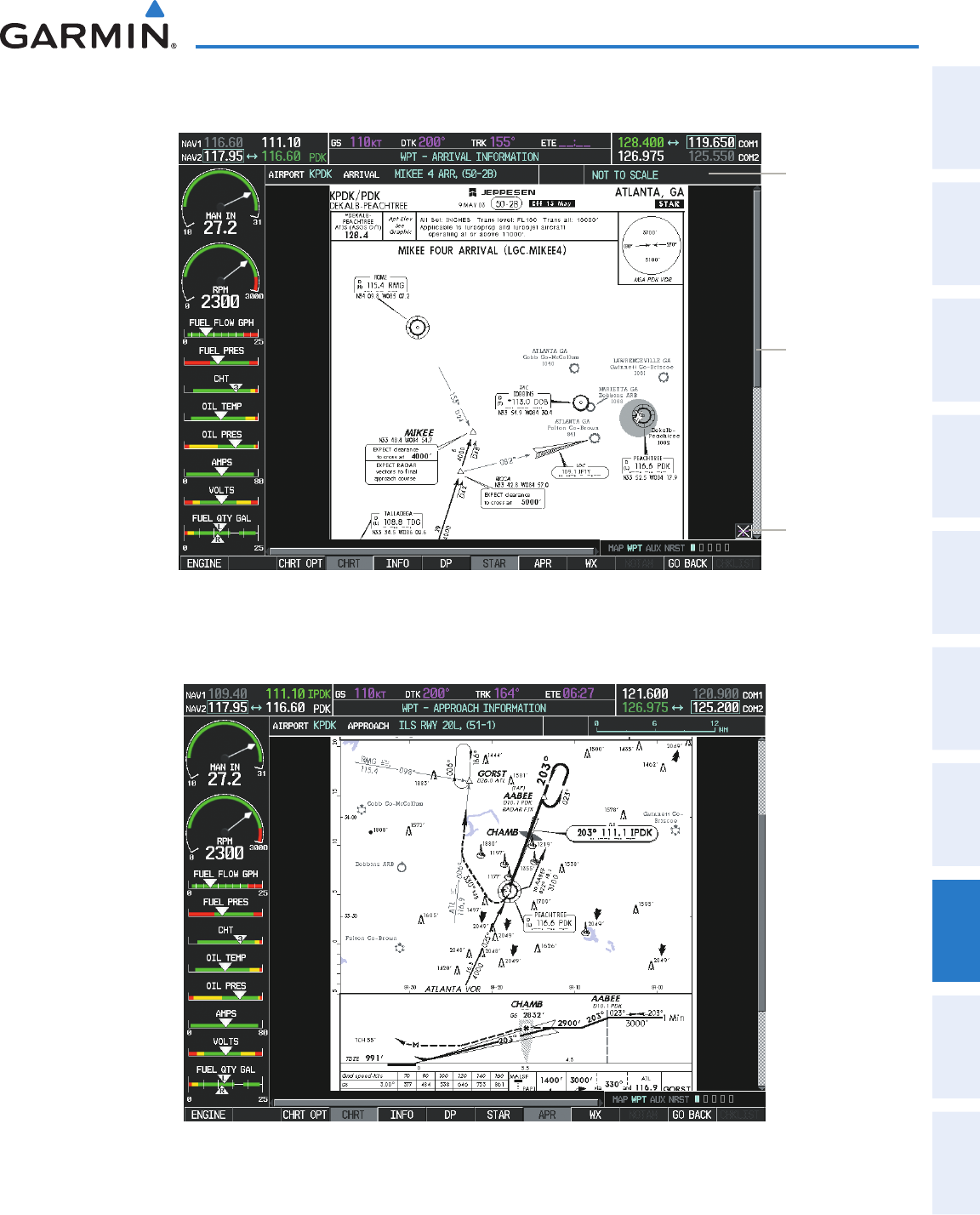
190-00592-06 Rev A
Garmin G1000 Pilot’s Guide for the Diamond DA40/40F
429
ADDITIONAL FEATURES
SYSTEM
OVERVIEW
FLIGHT
INSTRUMENTS EIS AUDIO PANEL
& CNS
FLIGHT
MANAGEMENT
HAZARD
AVOIDANCE AFCS ADDITIONAL
FEATURES APPENDICES INDEX
Pressing the STAR Softkey displays the Standard Terminal Arrival Chart if available.
Change Range
and Scroll
Through the
Chart With the
Joystick
Figure 8-29 Arrival Information Page
Chart Not
To Scale
Aircraft Not
Shown Icon
Pressing the APR Softkey displays the approach chart for the airport if available.
Figure 8-30 Approach Information Page
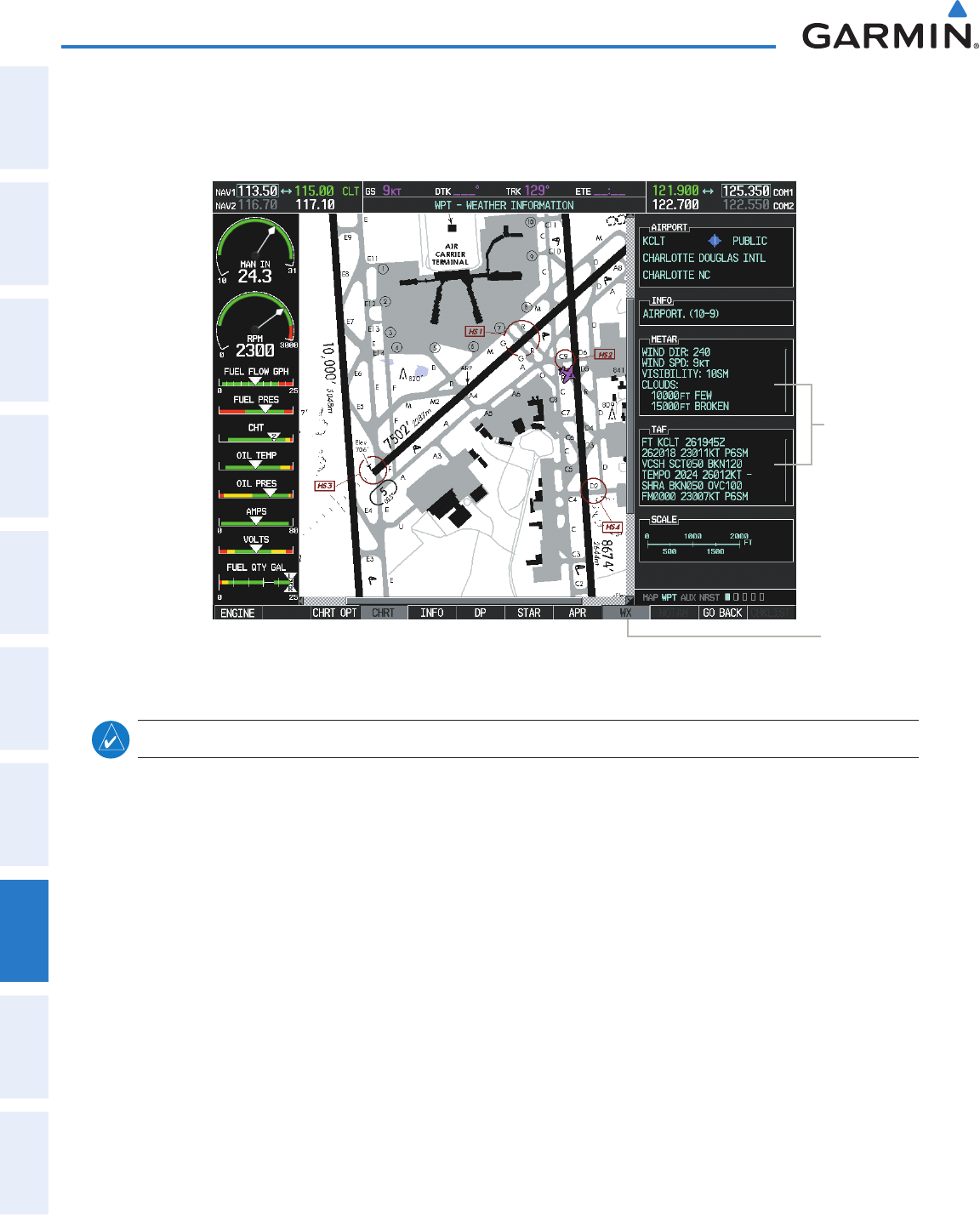
Garmin G1000 Pilot’s Guide for the Diamond DA40/40F
190-00592-06 Rev A430
ADDITIONAL FEATURES
SYSTEM
OVERVIEW
FLIGHT
INSTRUMENTS
EIS
AUDIO PANEL
& CNS
FLIGHT
MANAGEMENT
HAZARD
AVOIDANCE
AFCS
ADDITIONAL
FEATURES
APPENDICESINDEX
Pressing the WX Softkey shows the airport weather frequency information, and includes weather data such as
METAR and TAF from the XM Data Link Receiver, when available. Weather information is available only when
an XM Data Link Receiver is installed and the XM Weather subscription is current.
Figure 8-31 Weather Information Page
WX
Softkey
Selected
WX Info
When
Available
NOTE
: A subdued softkey label indicates the function is disabled.
Recent NOTAMS applicable to the current ChartView cycle are included in the ChartView database. Pressing
the NOTAM Softkey shows the local NOTAM information for selected airports, when available. When NOTAMS
are not available, the NOTAM Softkey label appears subdued and is disabled as shown in Figure 8-31. The
NOTAM Softkey may appear on the Airport Information Page and all of the chart page selections.
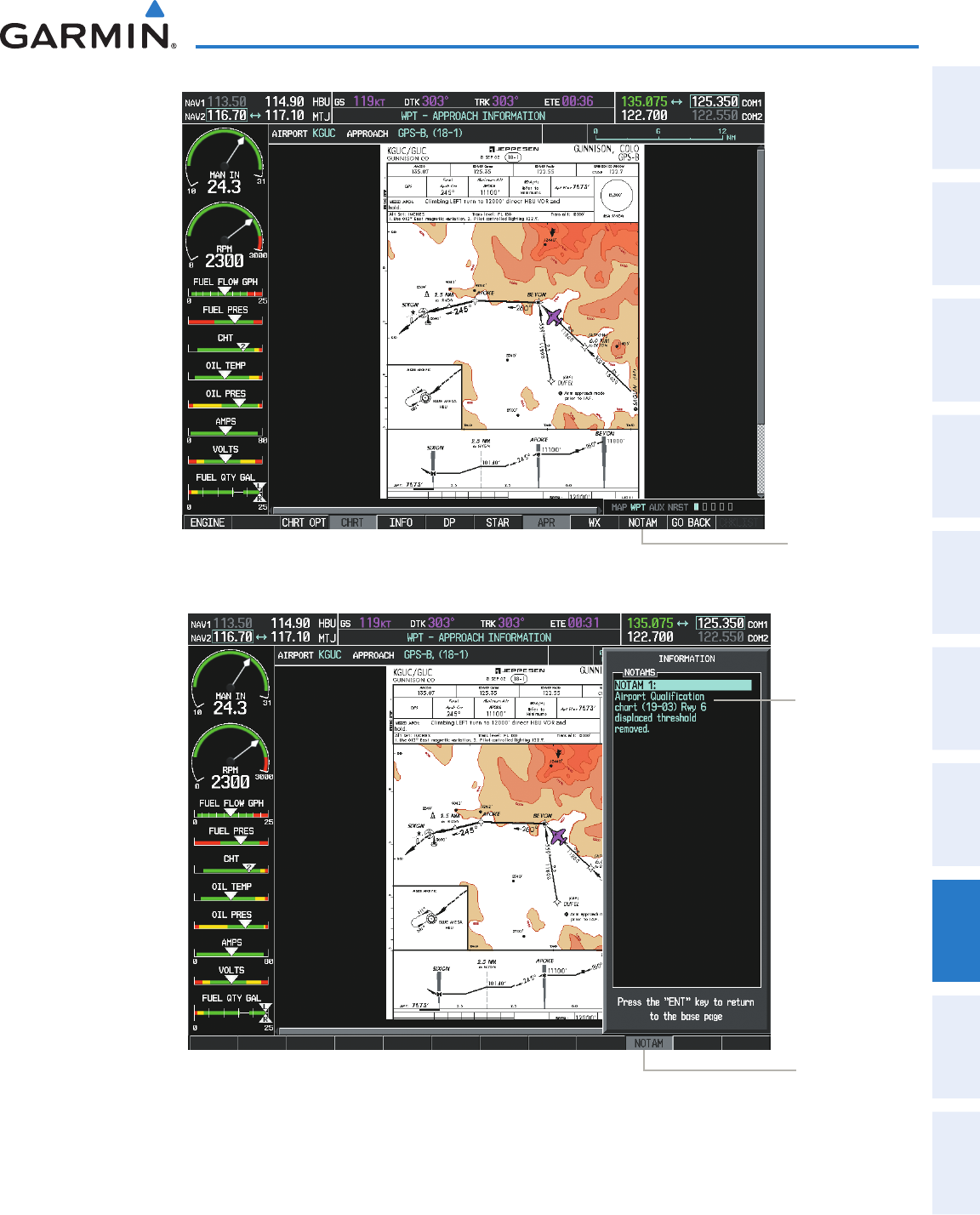
190-00592-06 Rev A
Garmin G1000 Pilot’s Guide for the Diamond DA40/40F
431
ADDITIONAL FEATURES
SYSTEM
OVERVIEW
FLIGHT
INSTRUMENTS EIS AUDIO PANEL
& CNS
FLIGHT
MANAGEMENT
HAZARD
AVOIDANCE AFCS ADDITIONAL
FEATURES APPENDICES INDEX
Figure 8-32 NOTAM Softkey Highlighted
NOTAM
Softkey
Appears for
Selected
Airports
Figure 8-33 Airport Information Page, Local NOTAMs
Local
NOTAM on
This Airport
NOTAM
Softkey
Selected
Pressing the NOTAM Softkey again removes the NOTAMS information.
Pressing the GO
BACK Softkey reverts to the previous page (Navigation Map Page, Nearest Pages, or Flight
Plan Page).
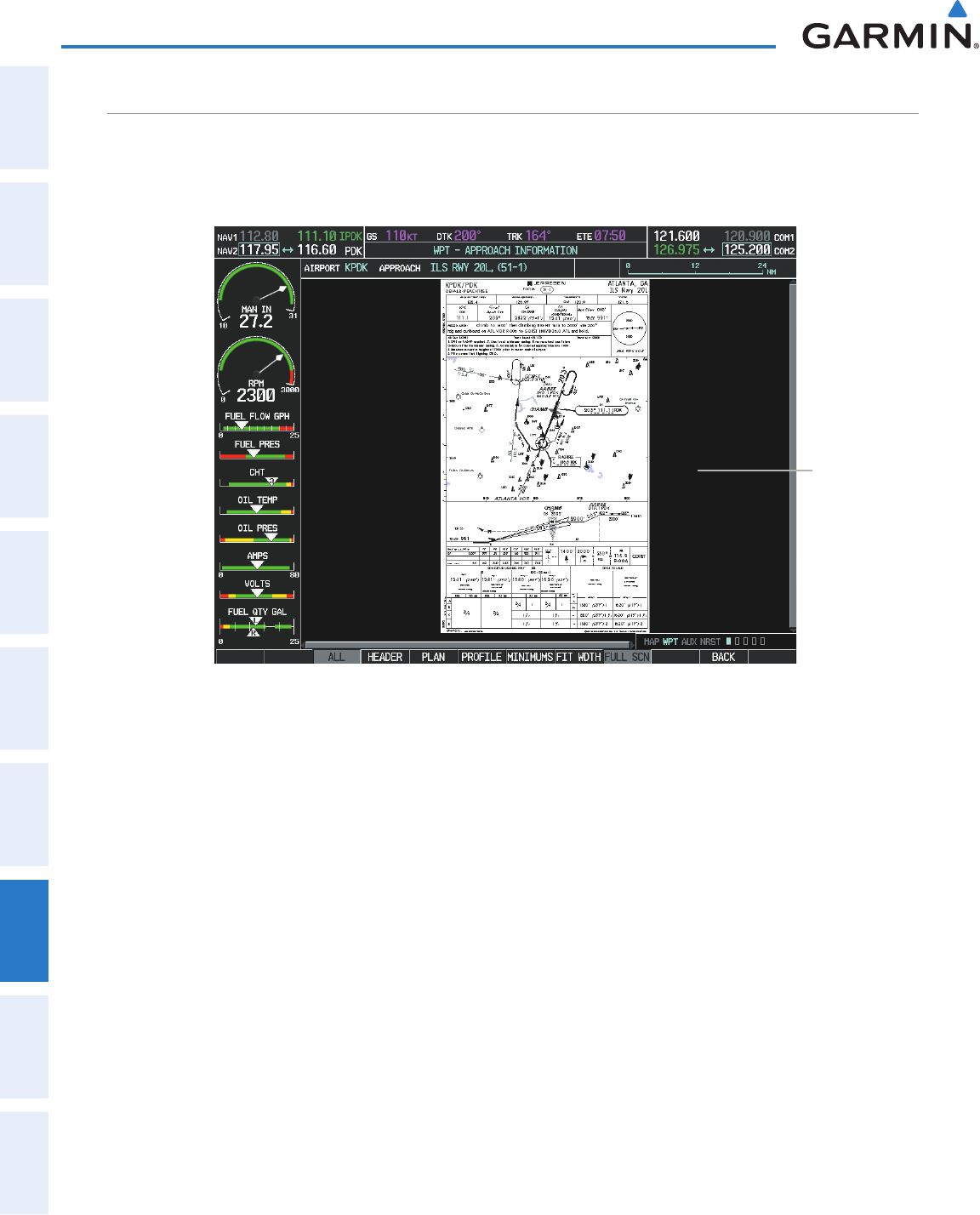
Garmin G1000 Pilot’s Guide for the Diamond DA40/40F
190-00592-06 Rev A432
ADDITIONAL FEATURES
SYSTEM
OVERVIEW
FLIGHT
INSTRUMENTS
EIS
AUDIO PANEL
& CNS
FLIGHT
MANAGEMENT
HAZARD
AVOIDANCE
AFCS
ADDITIONAL
FEATURES
APPENDICESINDEX
CHART OPTIONS
Pressing the CHRT OPT Softkey displays the next level of softkeys, the chart options level (Figure 8-20).
Pressing the ALL Softkey shows the complete approach chart on the screen.
Figure 8-34 Approach Information Page, ALL View
Complete
Chart
Shown
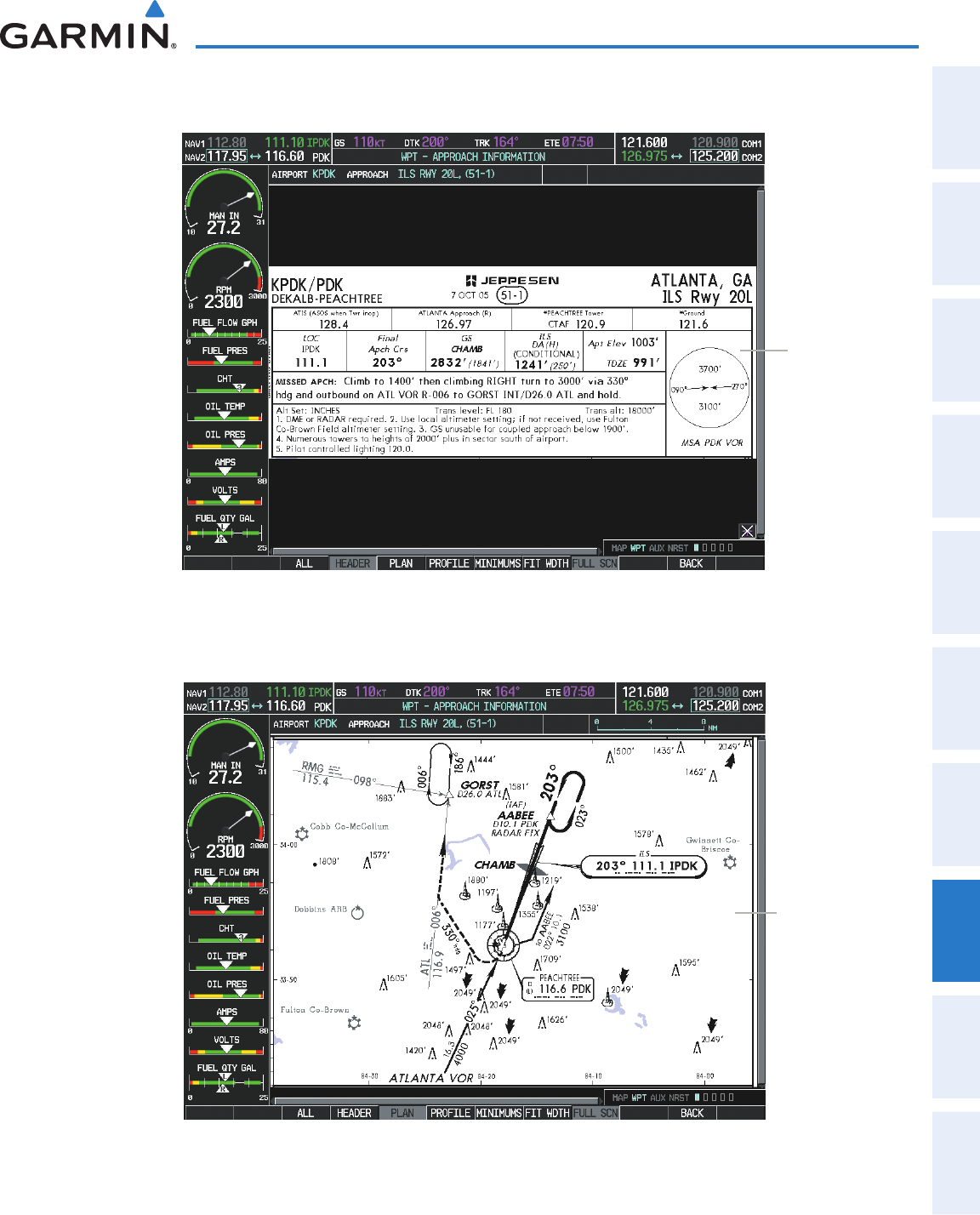
190-00592-06 Rev A
Garmin G1000 Pilot’s Guide for the Diamond DA40/40F
433
ADDITIONAL FEATURES
SYSTEM
OVERVIEW
FLIGHT
INSTRUMENTS EIS AUDIO PANEL
& CNS
FLIGHT
MANAGEMENT
HAZARD
AVOIDANCE AFCS ADDITIONAL
FEATURES APPENDICES INDEX
Pressing the HEADER Softkey shows the header view (approach chart briefing strip) on the screen.
Approach
Chart
Briefing Strip
Figure 8-35 Approach Information Page, Header View
Pressing the PLAN Softkey shows the approach chart two dimensional plan view.
Figure 8-36 Approach Information Page, Plan View
Approach
Chart Plan
View
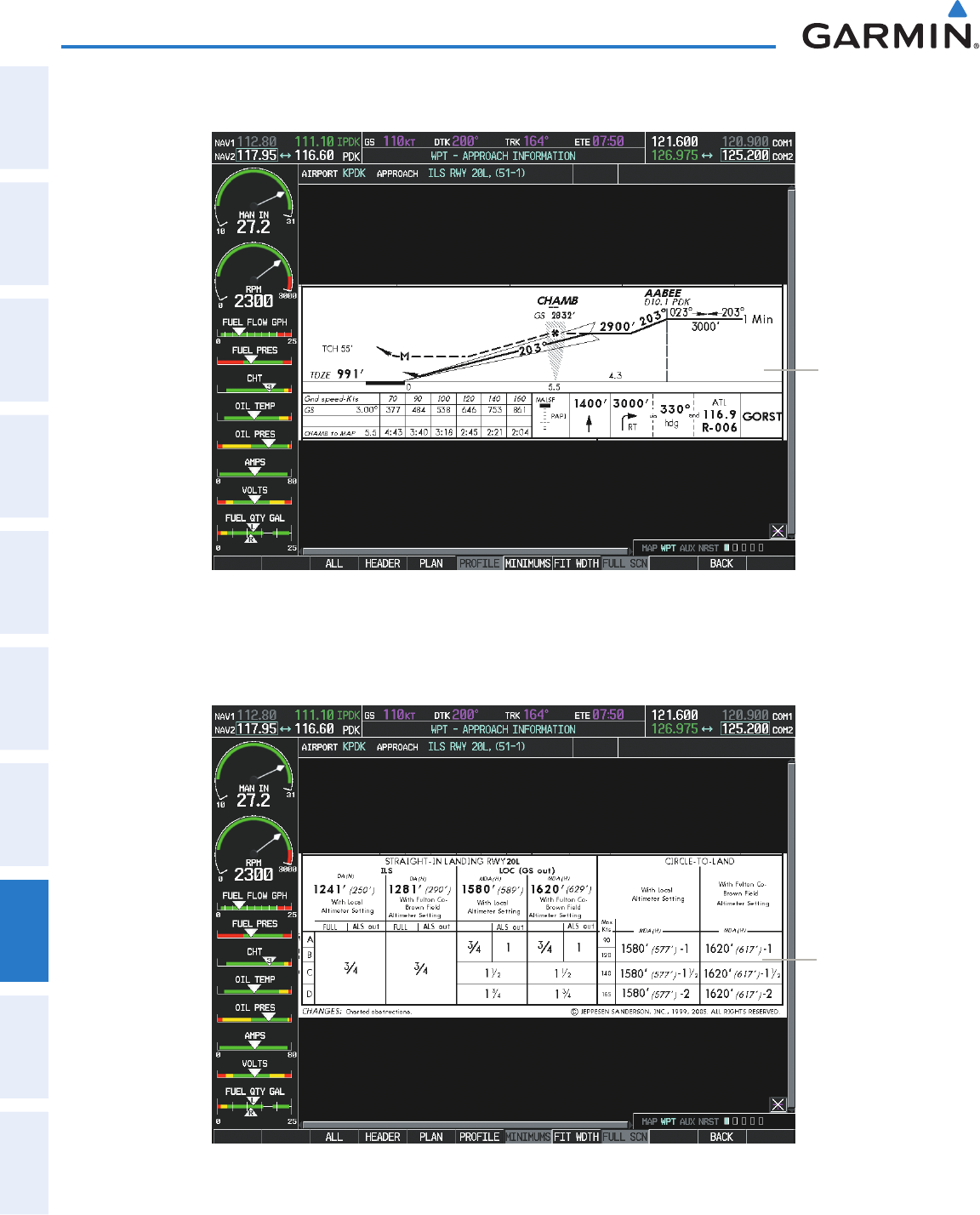
Garmin G1000 Pilot’s Guide for the Diamond DA40/40F
190-00592-06 Rev A434
ADDITIONAL FEATURES
SYSTEM
OVERVIEW
FLIGHT
INSTRUMENTS
EIS
AUDIO PANEL
& CNS
FLIGHT
MANAGEMENT
HAZARD
AVOIDANCE
AFCS
ADDITIONAL
FEATURES
APPENDICESINDEX
Pressing the PROFILE Softkey displays the approach chart descent profile strip.
Approach
Chart Descent
Profile Strip
Figure 8-37 Approach Information Page, Profile View, Full Screen Width
Pressing the MINIMUMS Softkey displays the minimum descent altitude/visibility strip at the bottom of the
approach chart.
Minimum
Descent
Altitude/
Visibility Strip
Figure 8-38 Approach Information Page, Minimums View, Full Screen Width
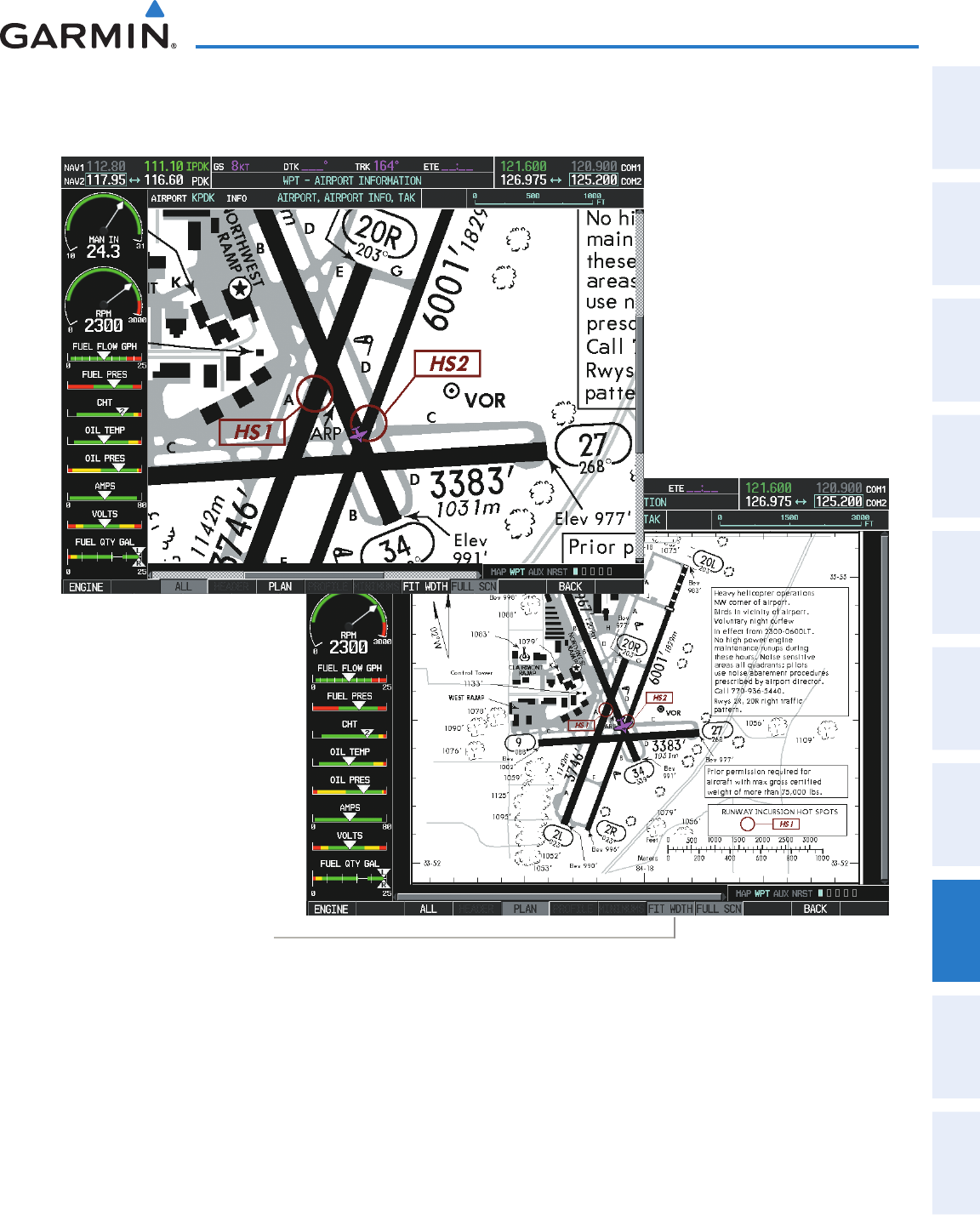
190-00592-06 Rev A
Garmin G1000 Pilot’s Guide for the Diamond DA40/40F
435
ADDITIONAL FEATURES
SYSTEM
OVERVIEW
FLIGHT
INSTRUMENTS EIS AUDIO PANEL
& CNS
FLIGHT
MANAGEMENT
HAZARD
AVOIDANCE AFCS ADDITIONAL
FEATURES APPENDICES INDEX
If the chart scale has been adjusted to view a small area of the chart, pressing the FIT WIDTH Softkey
changes the chart size to fit the available screen width.
Press
FIT WDTH
Softkey to Show
Full Chart Width
Figure 8-39 Airport Information Page, FIT WDTH Softkey Selected
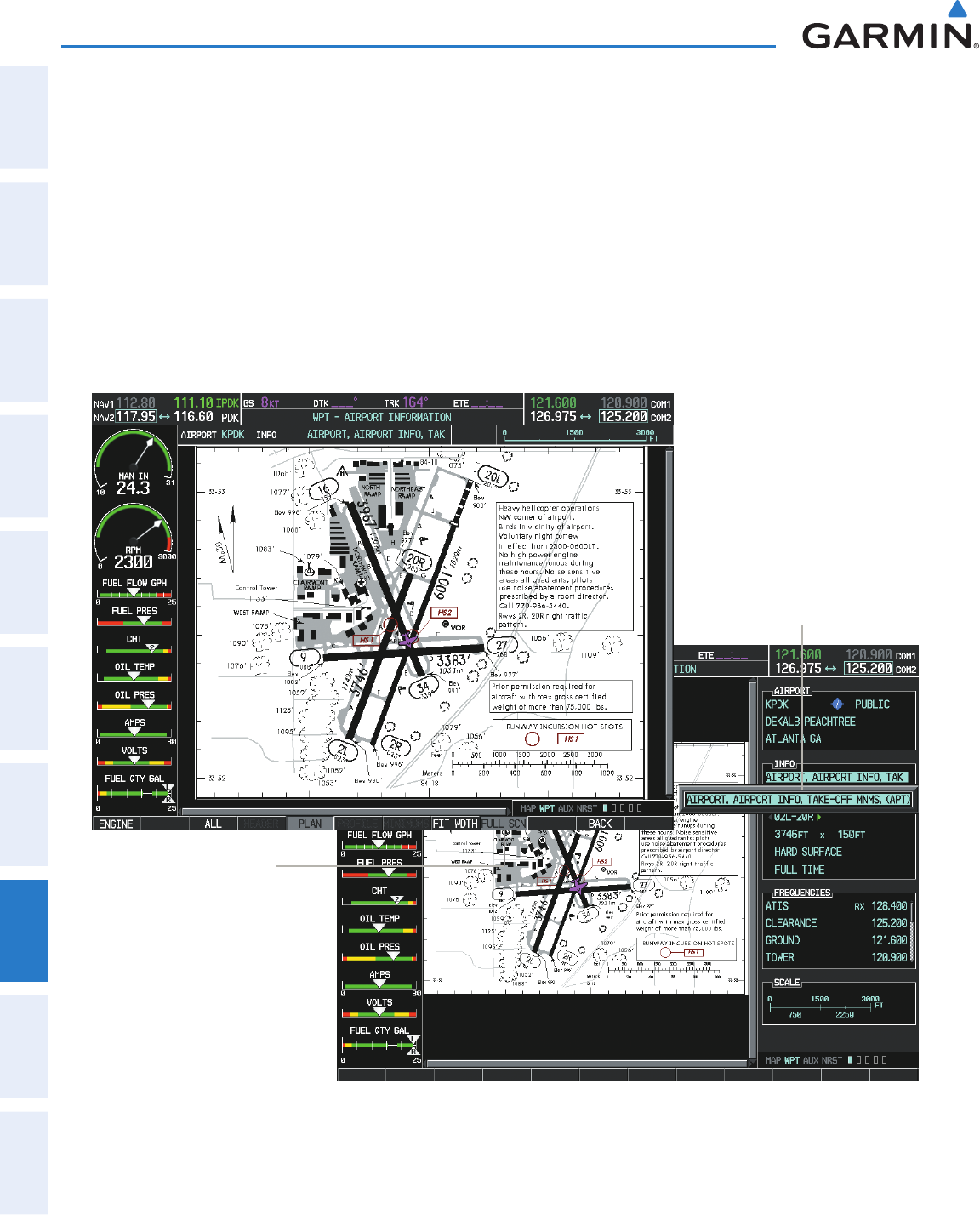
Garmin G1000 Pilot’s Guide for the Diamond DA40/40F
190-00592-06 Rev A436
ADDITIONAL FEATURES
SYSTEM
OVERVIEW
FLIGHT
INSTRUMENTS
EIS
AUDIO PANEL
& CNS
FLIGHT
MANAGEMENT
HAZARD
AVOIDANCE
AFCS
ADDITIONAL
FEATURES
APPENDICESINDEX
Pressing the FULL
SCN Softkey alternates between removing and replacing the data window to the right.
Selecting Additional Information:
1) While viewing the Airport Taxi Diagram, press the FULL SCN Softkey to display the information windows
(AIRPORT, INFO).
2) Press the
FMS
Knob to activate the cursor.
3) Turn the large
FMS
Knob to highlight the AIRPORT, INFO, RUNWAYS, or FREQUENCIES Box (INFO Box shown).
4) Turn the small
FMS
Knob to select the INFO Box choices. If multiple choices are available, scroll to the desired
choice with the large
FMS
Knob and press the ENT Key to complete the selection.
5) Press the
FMS
Knob again to deactivate the cursor.
Figure 8-40 Airport Information Page, Full Screen and Info Window
Press
FULL SCN
Softkey to Switch
Between Full
Screen and Chart
With Info Window
Available
Information
Pressing the BACK Softkey, or waiting for 45 seconds reverts to the chart selection softkeys.
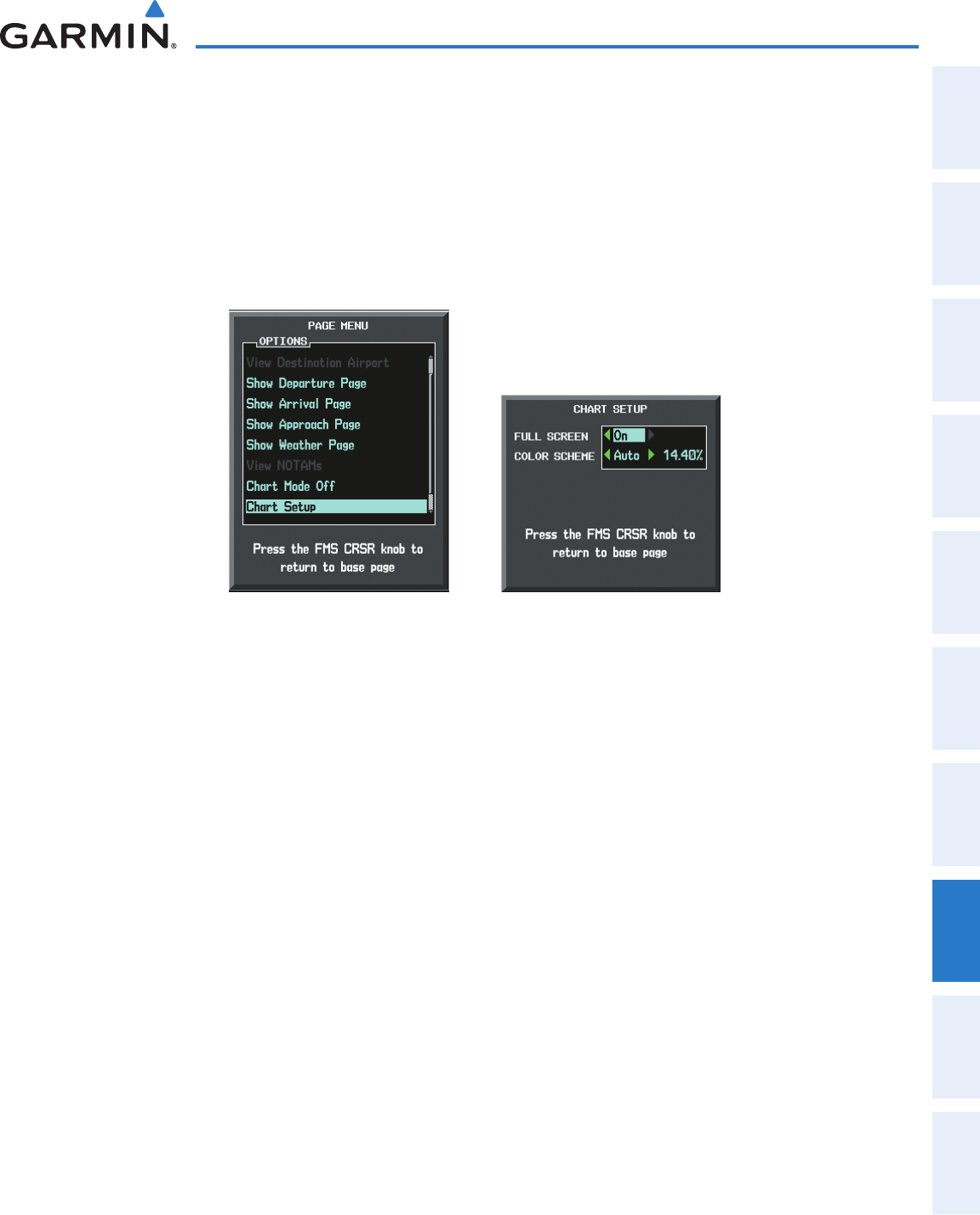
190-00592-06 Rev A
Garmin G1000 Pilot’s Guide for the Diamond DA40/40F
437
ADDITIONAL FEATURES
SYSTEM
OVERVIEW
FLIGHT
INSTRUMENTS EIS AUDIO PANEL
& CNS
FLIGHT
MANAGEMENT
HAZARD
AVOIDANCE AFCS ADDITIONAL
FEATURES APPENDICES INDEX
The full screen view can also be selected by using the page menu option.
Selecting full screen On or Off:
1) While viewing a terminal chart press the MENU Key to display the Page Menu OPTIONS.
2) Turn the large
FMS
Knob to highlight the Chart Setup Menu Option and press the
ENT
Key.
3) Turn the large
FMS
Knob to move between the FULL SCREEN and COLOR SCHEME Options.
4) Turn the small
FMS
Knob to choose between the On and Off Full Screen Options.
Figure 8-41 Page Menus
Full Screen On/Off SelectionChart Setup Option
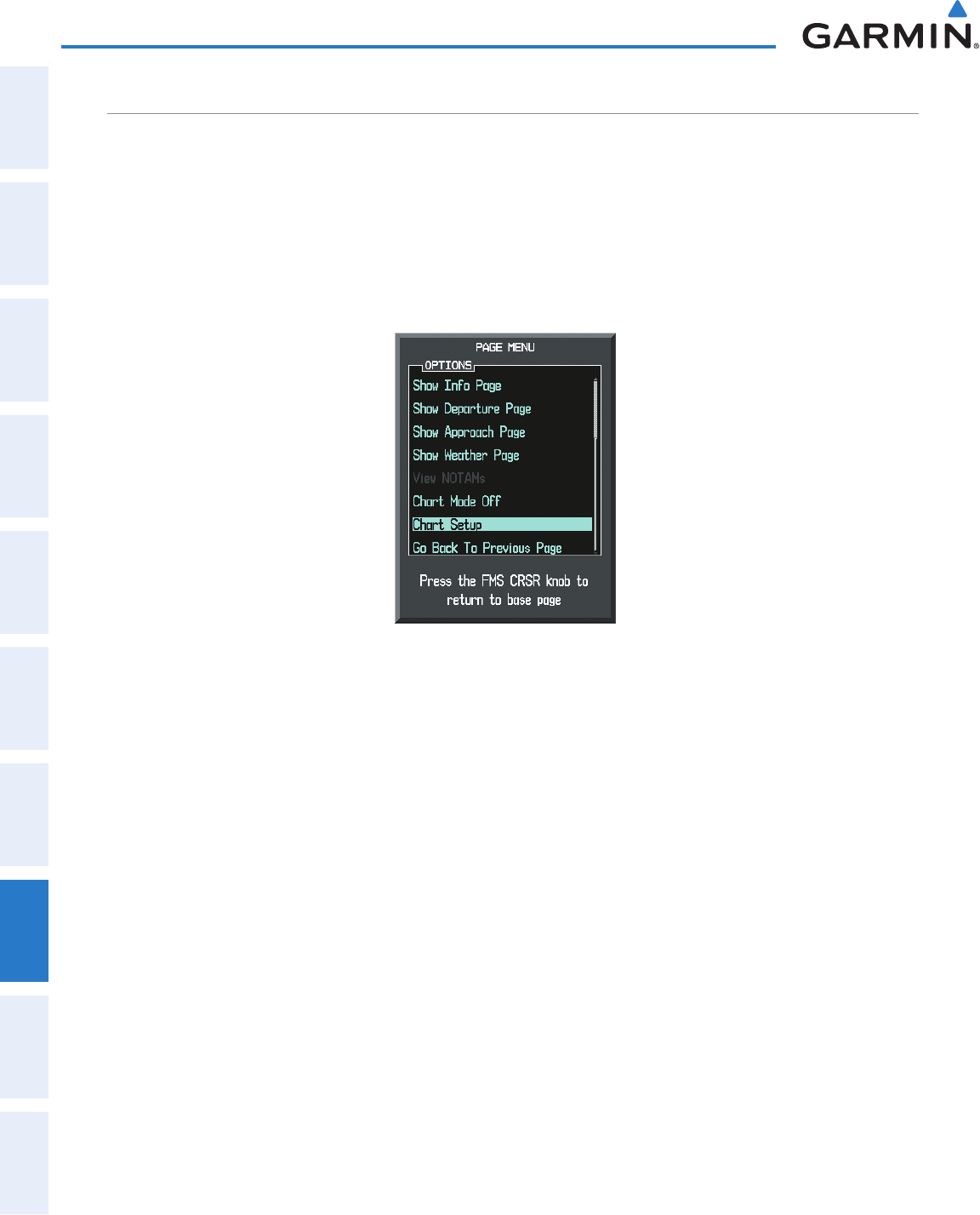
Garmin G1000 Pilot’s Guide for the Diamond DA40/40F
190-00592-06 Rev A438
ADDITIONAL FEATURES
SYSTEM
OVERVIEW
FLIGHT
INSTRUMENTS
EIS
AUDIO PANEL
& CNS
FLIGHT
MANAGEMENT
HAZARD
AVOIDANCE
AFCS
ADDITIONAL
FEATURES
APPENDICESINDEX
DAY/NIGHT VIEW
ChartView can be displayed on a white or black background for day or night viewing. The Day View offers
a better presentation in a bright environment. The Night View gives a better presentation for viewing in a dark
environment. When the CHART SETUP Box is selected the G1000 softkeys are blank.
Selecting Day, Night, or Automatic View:
1) While viewing a terminal chart press the MENU Key to display the Page Menu OPTIONS.
2) Turn the large
FMS
Knob to highlight the Chart Setup Menu Option and press the
ENT
Key.
Figure 8-42 Waypoint Information Page, OPTIONS Menu
3) Turn the large
FMS
Knob to move to the COLOR SCHEME Option (Figure 8-43).
4) Turn the small
FMS
Knob to choose between Day, Auto, and Night Options.
5) If Auto Mode is selected, turn the large FMS Knob to select the percentage field. Use the small FMS Knob to
change the percentage value. The percentage value is the day/night crossover point based on the percentage of
backlighting intensity. For example, if the value is set to 15%, the day/night display changes when the display
backlight reaches 15% of full brightness.
The display must be changed in order for the new setting to become active. This may be accomplished by
selecting another page or changing the display range.
6) Press the FMS Knob when finished to remove the Chart Setup Menu.
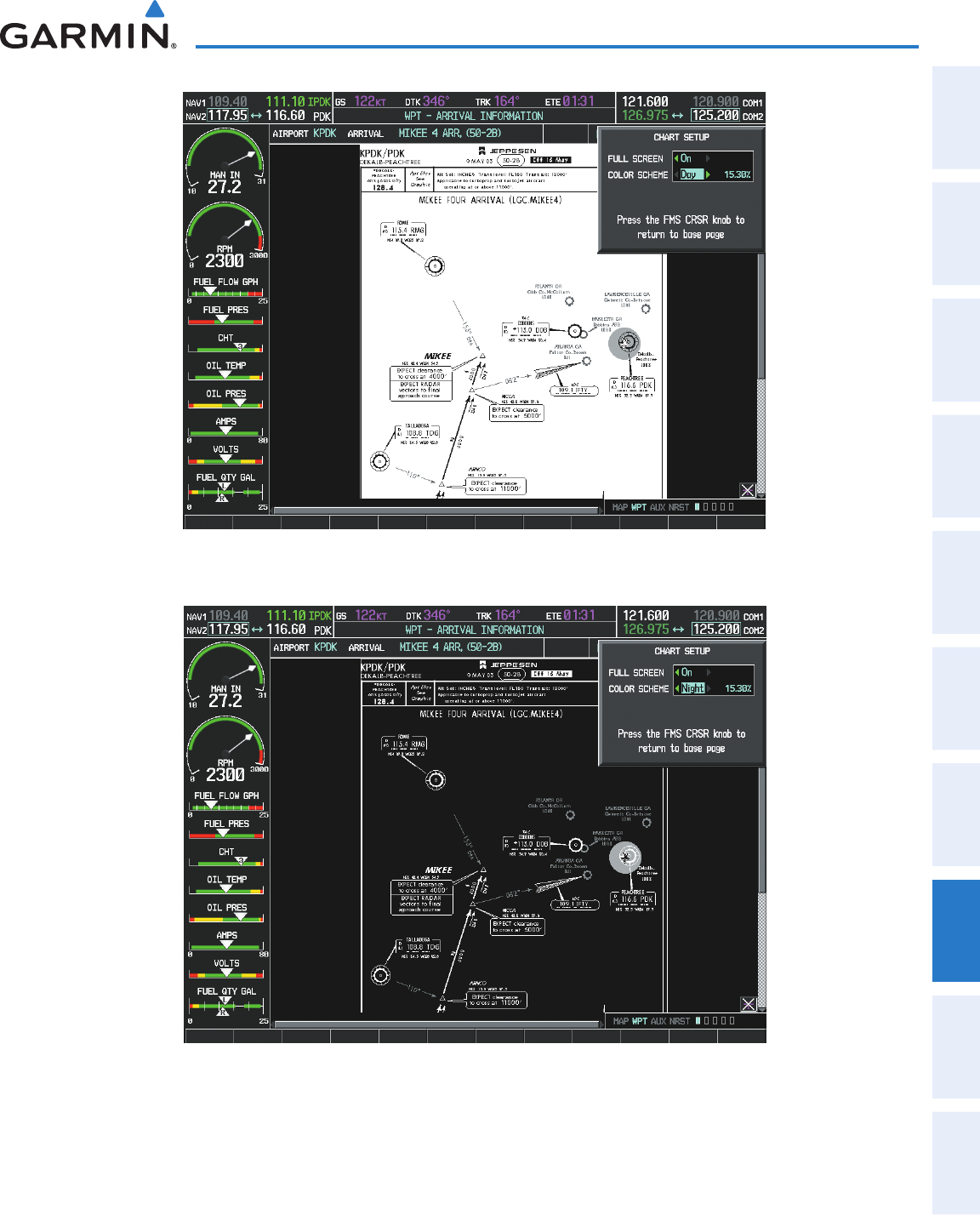
190-00592-06 Rev A
Garmin G1000 Pilot’s Guide for the Diamond DA40/40F
439
ADDITIONAL FEATURES
SYSTEM
OVERVIEW
FLIGHT
INSTRUMENTS EIS AUDIO PANEL
& CNS
FLIGHT
MANAGEMENT
HAZARD
AVOIDANCE AFCS ADDITIONAL
FEATURES APPENDICES INDEX
Figure 8-43 Arrival Information Page, Day View
Figure 8-44 Arrival Information Page, Night View
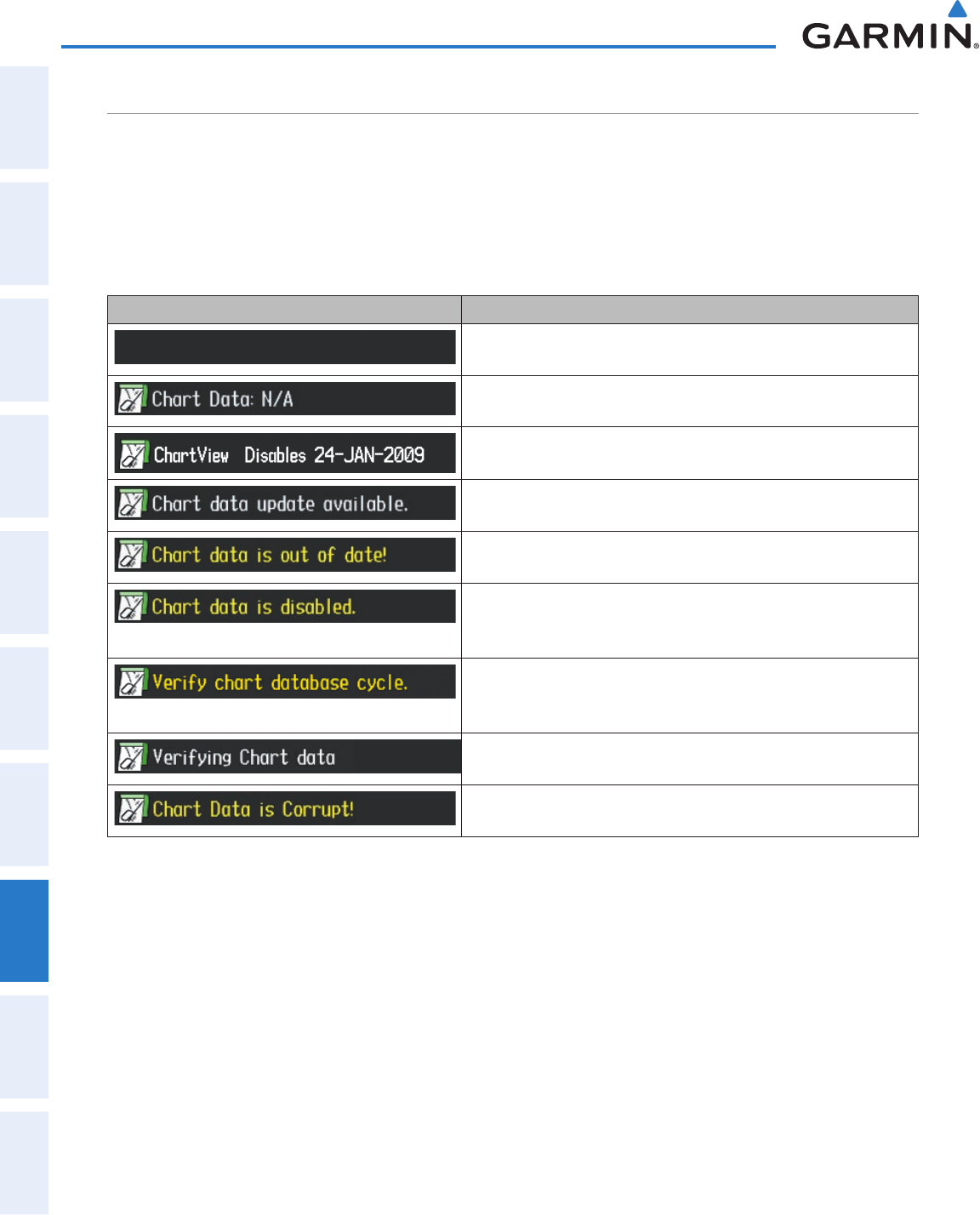
Garmin G1000 Pilot’s Guide for the Diamond DA40/40F
190-00592-06 Rev A440
ADDITIONAL FEATURES
SYSTEM
OVERVIEW
FLIGHT
INSTRUMENTS
EIS
AUDIO PANEL
& CNS
FLIGHT
MANAGEMENT
HAZARD
AVOIDANCE
AFCS
ADDITIONAL
FEATURES
APPENDICESINDEX
CHARTVIEW CYCLE NUMBER AND EXPIRATION DATE
The ChartView database is revised every 14 days. Charts are still viewable during a period that extends from
the cycle expiration date to the disabled date. ChartView is disabled 70 days after the expiration date and is no
longer available for viewing upon reaching the disabled date. When turning on the G1000, the Power-up Page
indicates any of nine different possible criteria for ChartView availability. See the table below for the various
ChartView Power-up Page displays and the definition of each.
Power-up Page Display Definition
Blank Line. G1000 system is not configured for ChartView. Contact
a Garmin-authorized service center for configuration.
System is configured for ChartView but no chart database is
installed. Contact Jeppesen for a ChartView database.
Normal operation. ChartView database is valid and within current
cycle.
ChartView database is within 1 week after expiration date. A new
cycle is available for update.
ChartView database is beyond 1 week after expiration date, but still
within the 70 day viewing period.
ChartView database has timed out. Database is beyond 70 days
after expiration date. ChartView database is no longer available for
viewing.
System time is not available. GPS satellite data is unknown or
G1000 has not yet locked onto satellites. Check database cycle
number for effectivity.
System is verifying chart database when new cycle is installed for the
first time.
After verifying, chart database is found to be corrupt. ChartView is
not available.
Table 8-1 ChartView Power-up Page Annunciations and Definitions
Examples of four possible Power-up Page conditions are shown here. ‘ChartView Disables’ plus a date in
white, indicates chart data is current. This indication for normal operation shows how long the charts may be
viewed. ‘Chart data update available.’ in white, indicates the chart data cycle has expired within the past week
and the next chart cycle is available. ‘Chart data is out of date!’ in yellow, indicates charts are still viewable, but
approaching the disable date. ‘Chart data is disabled.’ in yellow, indicates the chart cycle has been disabled and
is no longer viewable.
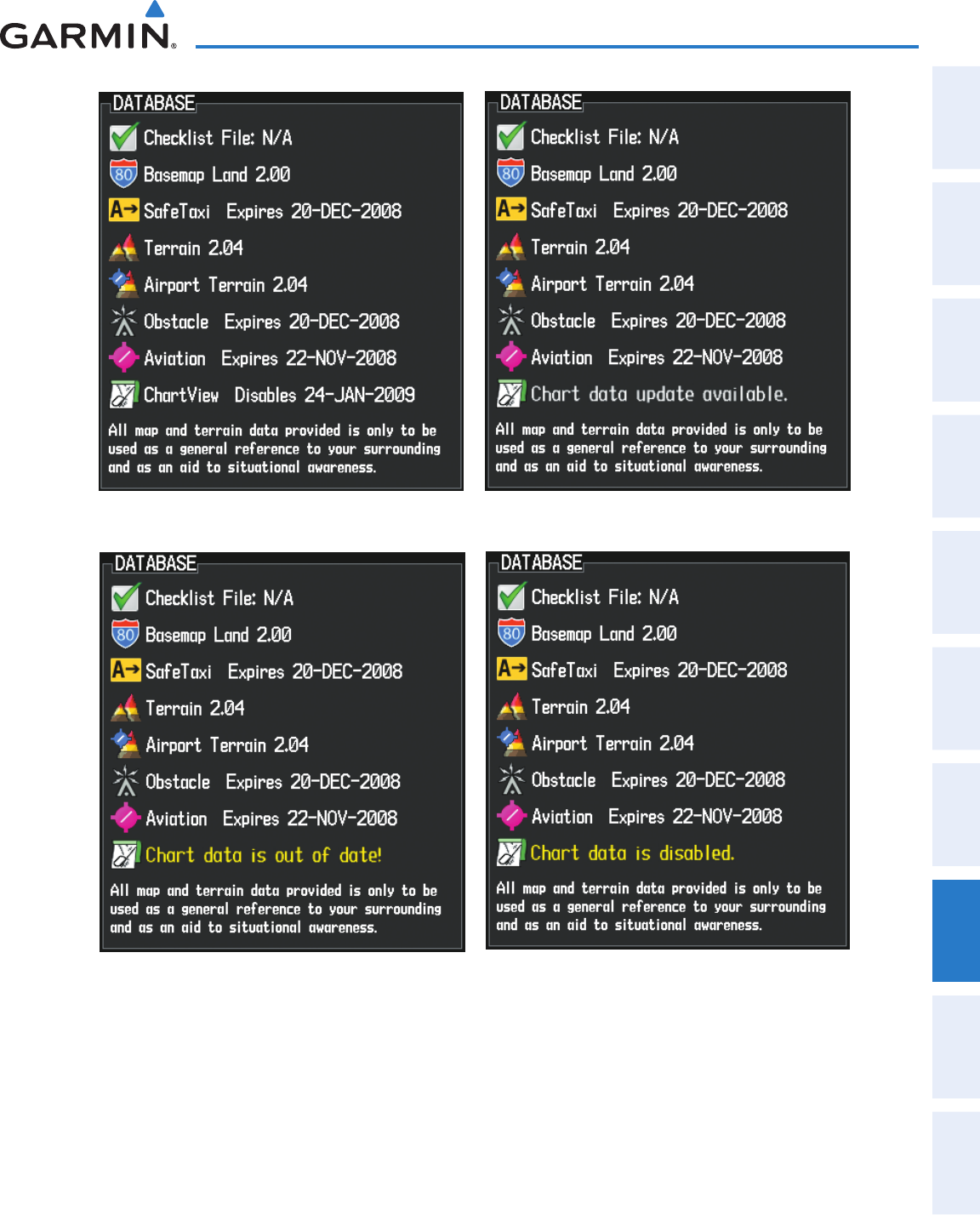
190-00592-06 Rev A
Garmin G1000 Pilot’s Guide for the Diamond DA40/40F
441
ADDITIONAL FEATURES
SYSTEM
OVERVIEW
FLIGHT
INSTRUMENTS EIS AUDIO PANEL
& CNS
FLIGHT
MANAGEMENT
HAZARD
AVOIDANCE AFCS ADDITIONAL
FEATURES APPENDICES INDEX
Figure 8-45 Examples of Power-up Page, ChartView Database
Chart Cycle has Expired,
Next Cycle is Available
ChartView Database is
Current and Available
Chart Cycle has Expired but is Still Viewable
for 70 Days from Expiration Date Chart Cycle is No
Longer Viewable
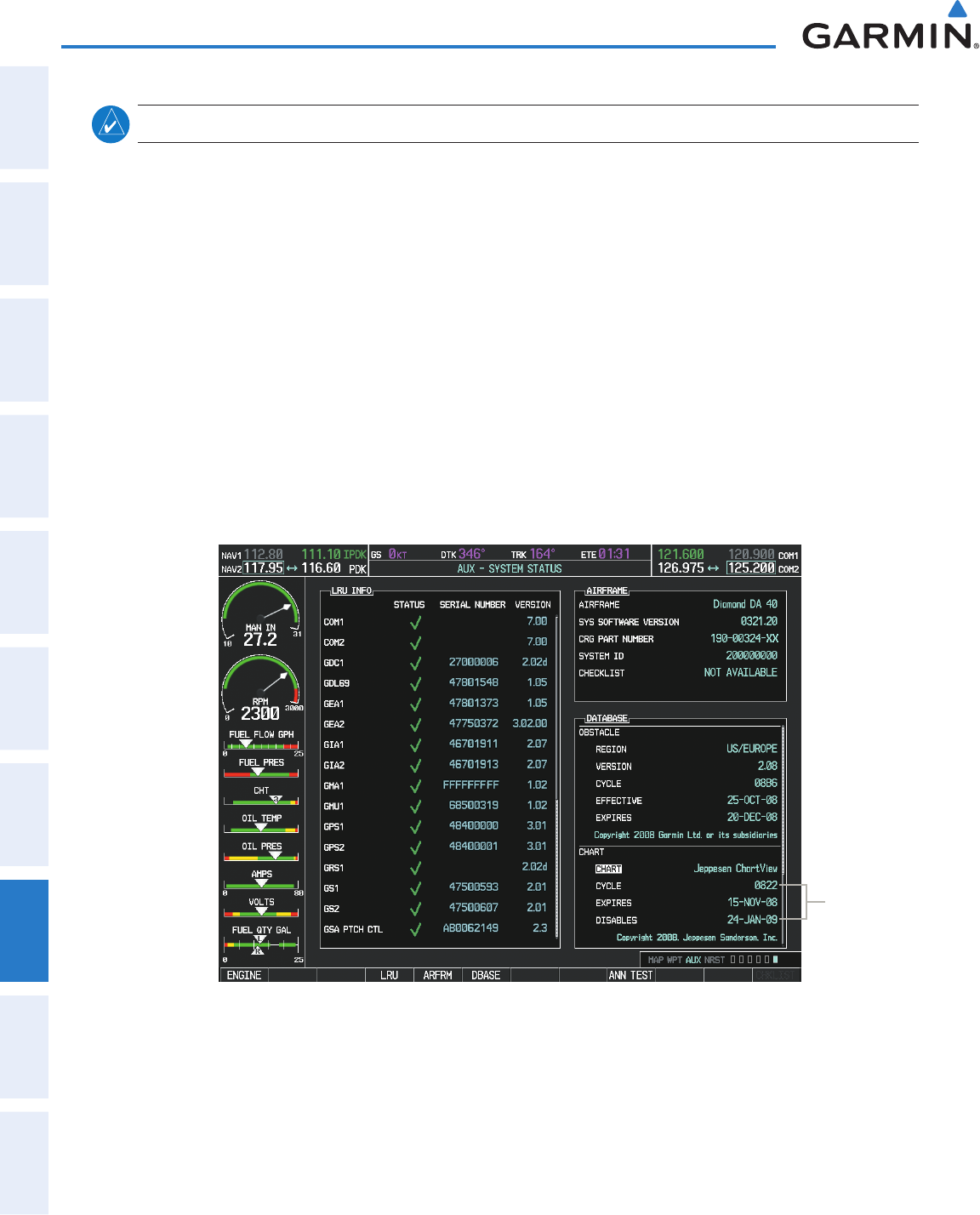
Garmin G1000 Pilot’s Guide for the Diamond DA40/40F
190-00592-06 Rev A442
ADDITIONAL FEATURES
SYSTEM
OVERVIEW
FLIGHT
INSTRUMENTS
EIS
AUDIO PANEL
& CNS
FLIGHT
MANAGEMENT
HAZARD
AVOIDANCE
AFCS
ADDITIONAL
FEATURES
APPENDICESINDEX
NOTE
: A subdued softkey label indicates the function is disabled.
The ChartView time critical information can also be found on the AUX - System Status page. The database
CYCLE number, EXPIRES, and DISABLES dates of the ChartView subscription appear in either blue or yellow
text. When the ChartView EXPIRES date is reached, ChartView becomes inoperative 70 days later. This is
shown as the DISABLES date. When the DISABLES date is reached, charts are no longer available for viewing.
The
SHW CHRT
Softkey label then appears subdued and is disabled until a revised issue of ChartView is
installed.
Press the DBASE Softkey for scrolling through the database information. Scroll through the database with
the FMS knob or ENT Key.
The ChartView database cycle number shown in the figure, 0822, is deciphered as follows:
08 – Indicates the year 2008
22 – Indicates the 22nd issue of the ChartView database for the year
The EXPIRES date 15–NOV–08 is the date that this database should be replaced with the next issue.
The DISABLES date 24–JAN–09 is the date that this database becomes inoperative.
Figure 8-46 AUX – System Status Page, ChartView Current and Available
ChartView
Data
The ChartView database is provided directly from Jeppesen. Refer to Updating Jeppesen Databases in
Appendix B for instructions on revising the ChartView database.
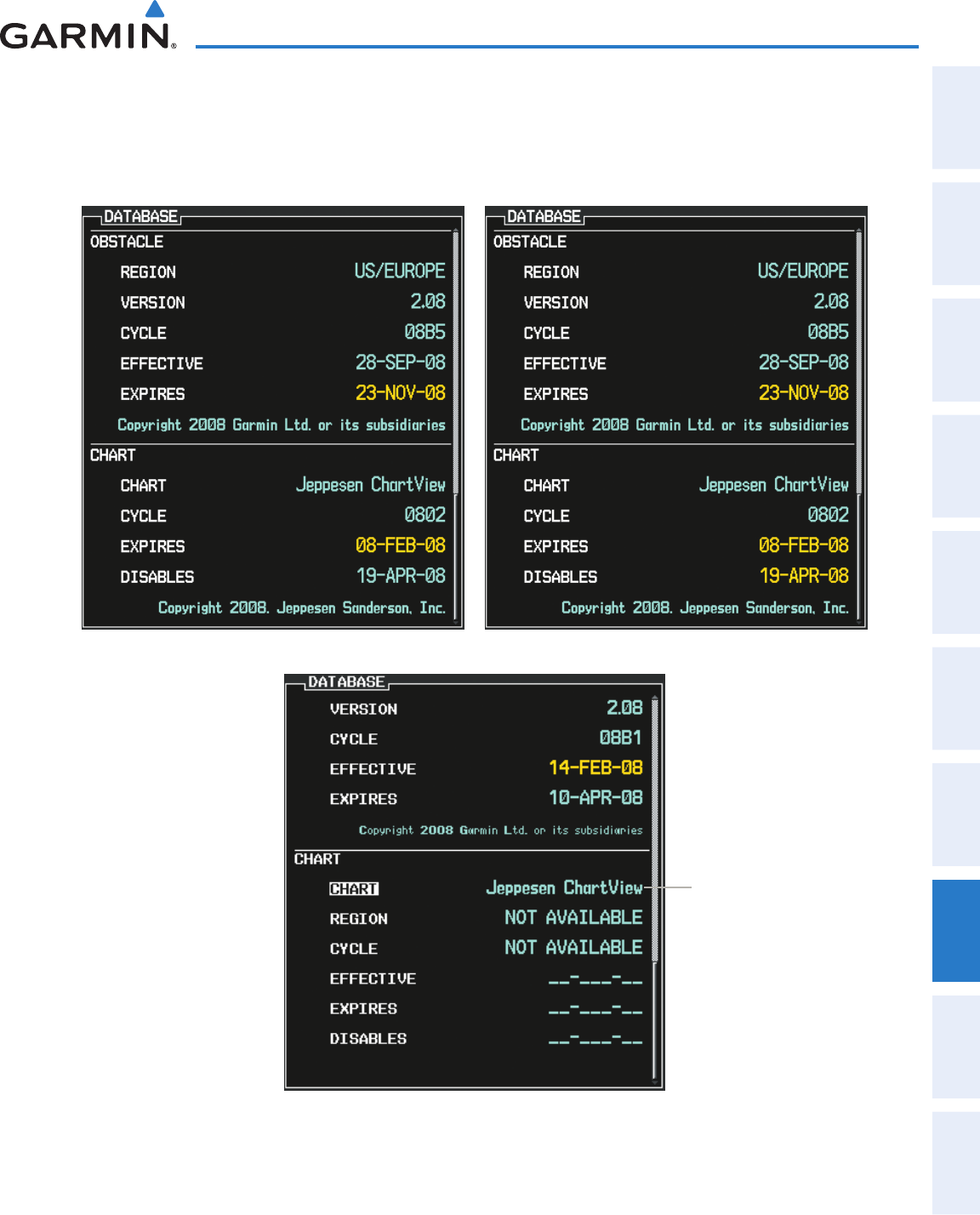
190-00592-06 Rev A
Garmin G1000 Pilot’s Guide for the Diamond DA40/40F
443
ADDITIONAL FEATURES
SYSTEM
OVERVIEW
FLIGHT
INSTRUMENTS EIS AUDIO PANEL
& CNS
FLIGHT
MANAGEMENT
HAZARD
AVOIDANCE AFCS ADDITIONAL
FEATURES APPENDICES INDEX
The other three possible AUX - System Status page conditions are shown here. The EXPIRES date, in yellow,
is the revision date for the next database cycle. The DISABLES date, in yellow, is the date that this database
cycle is no longer viewable. REGION and CYCLE NOT AVAILABLE in blue, indicate that no ChartView data is
available on the database card or no database card is inserted.
Figure 8-47 AUX – System Status Page, ChartView Expired, ChartView Disabled, ChartView Not Available
ChartView Database has Expired, but is not Disabled ChartView Database is Disabled
ChartView Database is Not Available
System is
Configured for
ChartView but
Database is not
Available
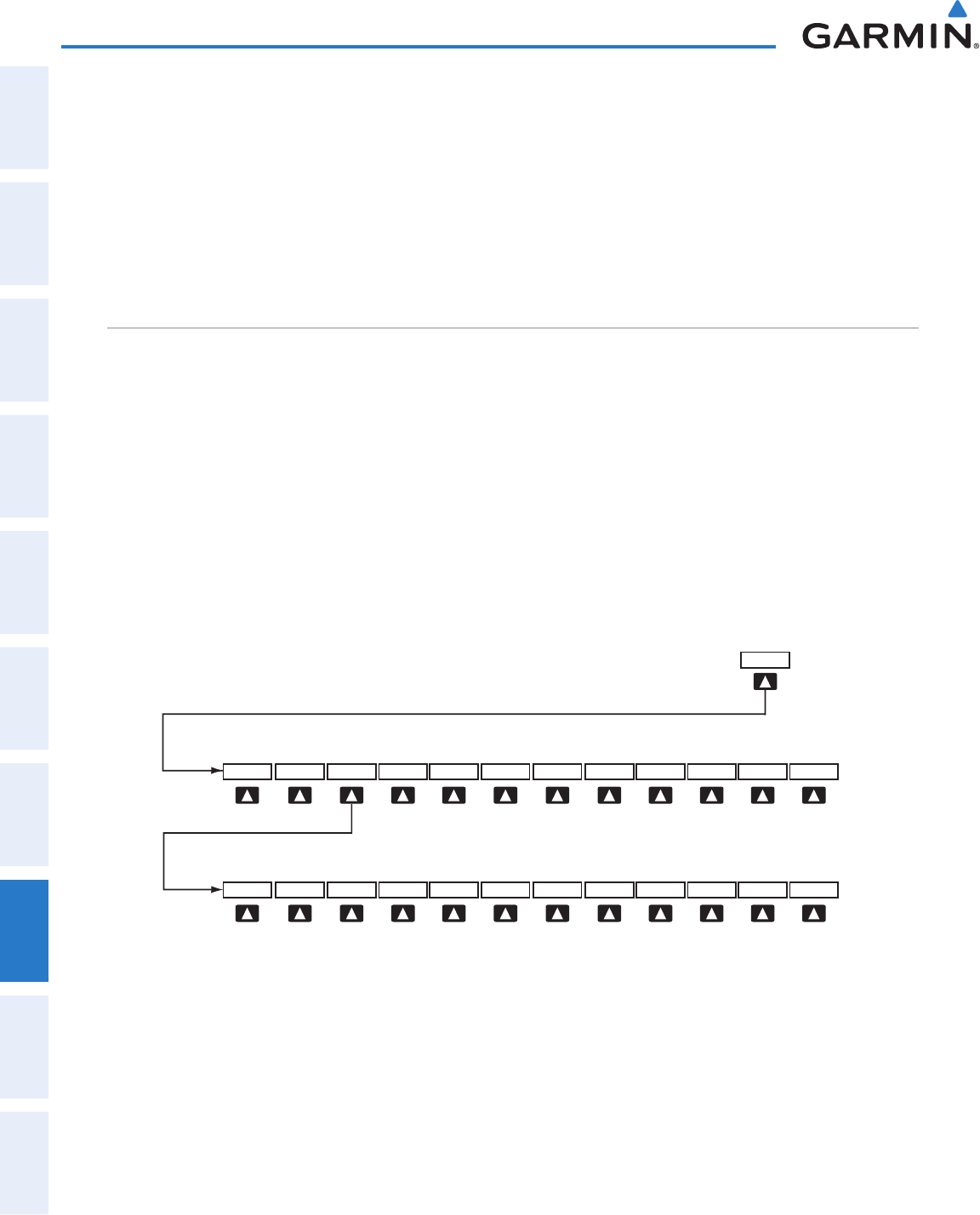
Garmin G1000 Pilot’s Guide for the Diamond DA40/40F
190-00592-06 Rev A444
ADDITIONAL FEATURES
SYSTEM
OVERVIEW
FLIGHT
INSTRUMENTS
EIS
AUDIO PANEL
& CNS
FLIGHT
MANAGEMENT
HAZARD
AVOIDANCE
AFCS
ADDITIONAL
FEATURES
APPENDICESINDEX
8.4 FLITECHARTS
FliteCharts resemble the paper version of National Aeronautical Charting Office (NACO) terminal procedures
charts. The charts are displayed with high-resolution and in color for applicable charts. FliteCharts database
subscription is available from Garmin. Available data includes:
•Arrivals(STAR)
•DepartureProcedures(DP)
•Approaches
•AirportDiagrams
FLITECHARTS SOFTKEYS
FliteCharts functions are displayed on three levels of softkeys. While on the Navigation Map Page, Nearest
Airports Page, or Flight Plan Page, pressing the
SHW CHRT
Softkey displays the available terminal chart and
advances to the chart selection level of softkeys: CHRT OPT, CHRT, INFO, DP, STAR, APR, WX, and
GO
BACK. The chart selection softkeys appear on the Airport Information Page.
Pressing the GO
BACK Softkey reverts to the top level softkeys and previous page.
Pressing the CHRT OPT Softkey displays the available terminal chart and advances to the next level of
softkeys: ALL, FIT
WDTH, FULL
SCN, and BACK.
While viewing the CHRT OPT Softkeys, after 45 seconds of softkey inactivity, the system reverts to the chart
selection softkeys.
NOTAMs are not available with FliteCharts. The NOTAM Softkey label appears subdued and is disabled.
Figure 8-48 FliteCharts SHW CHRT, Chart Selection, and Chart Option Softkeys
Presssing the GO BACK Softkey returns
to the top-level softkeys and previous page.
Pressing the BACK Softkey returns
to the Chart Selection Softkeys.
ALL
GO BACK
SHW CHRT
WX
APR
STAR
DP
INFO
CHRT
CHRT OPT
FIT WDTH
FULL SCN
BACK
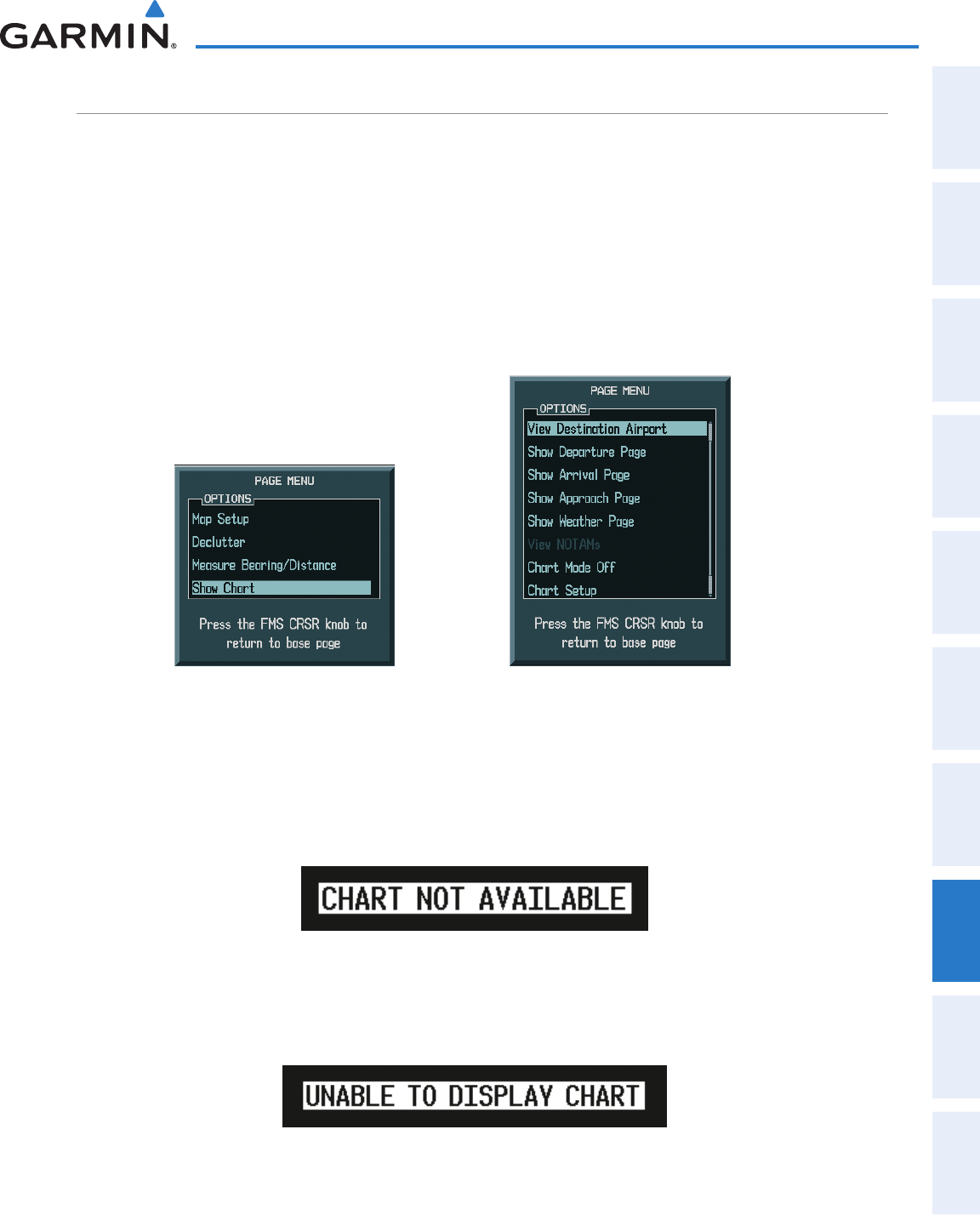
190-00592-06 Rev A
Garmin G1000 Pilot’s Guide for the Diamond DA40/40F
445
ADDITIONAL FEATURES
SYSTEM
OVERVIEW
FLIGHT
INSTRUMENTS EIS AUDIO PANEL
& CNS
FLIGHT
MANAGEMENT
HAZARD
AVOIDANCE AFCS ADDITIONAL
FEATURES APPENDICES INDEX
TERMINAL PROCEDURES CHARTS
Selecting Terminal Procedures Charts:
While viewing the Navigation Map Page, Nearest Airport Page, or Flight Plan Page, press the SHW CHRT
Softkey.
Or:
1) Press the MENU Key to display the PAGE MENU.
2) Turn the large FMS Knob to scroll through the OPTIONS Menu to Show Chart.
3) Press the ENT Key to display the chart.
Navigation Map Page OPTIONS Menu Waypoint Airport Information Page OPTIONS Menu
Figure 8-49 Option Menus
When no terminal procedure chart is available, the banner CHART NOT AVAILABLE appears on the screen.
The CHART NOT AVAILABLE banner does not refer to the FliteCharts subscription, but rather the availability
of a particular airport chart selection or procedure for a selected airport.
Figure 8-50 Chart Not Available Banner
If there is a problem in rendering the data (such as a data error or a failure of an individual chart), the banner
UNABLE TO DISPLAY CHART is then displayed.
Figure 8-51 Unable To Display Chart Banner
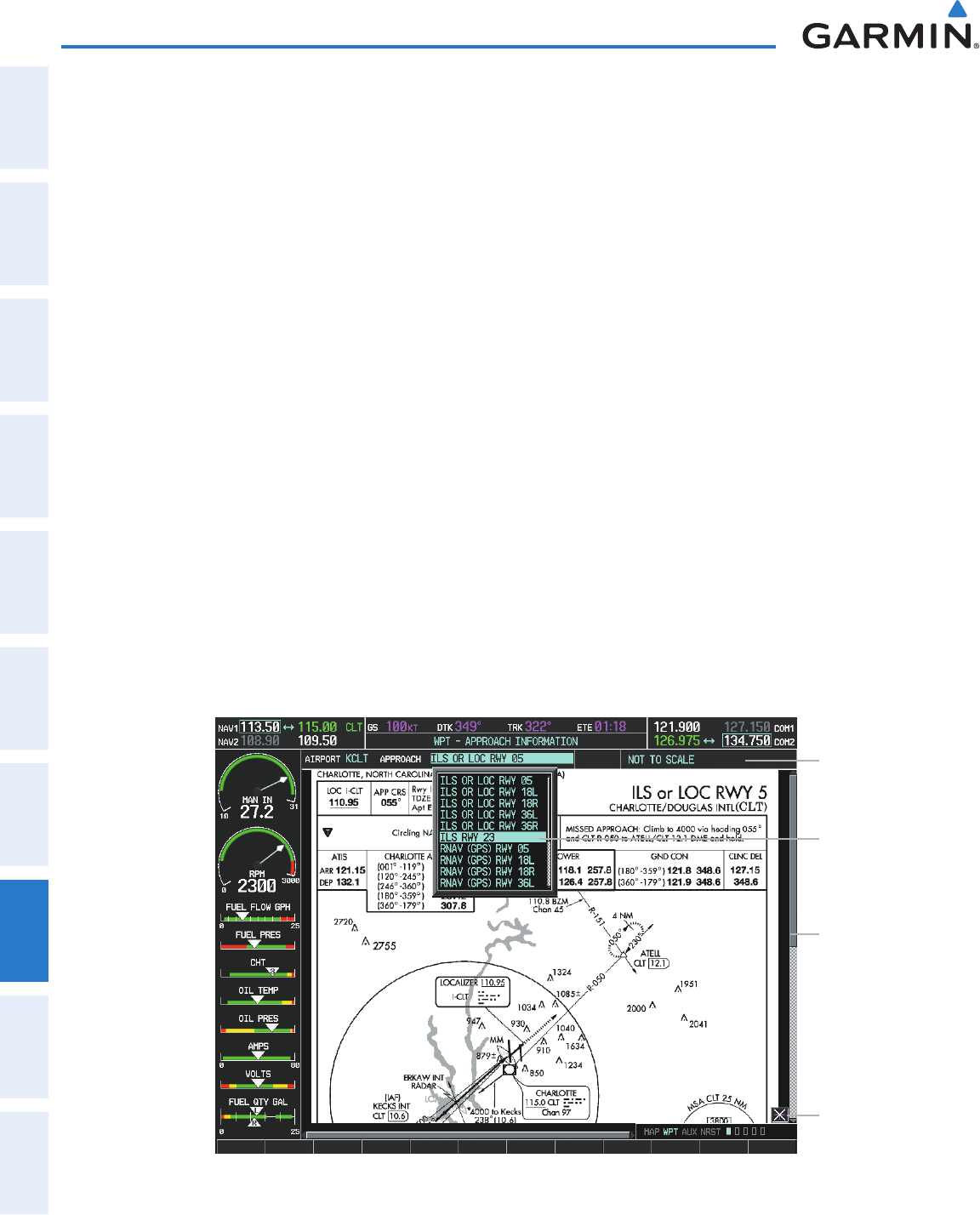
Garmin G1000 Pilot’s Guide for the Diamond DA40/40F
190-00592-06 Rev A446
ADDITIONAL FEATURES
SYSTEM
OVERVIEW
FLIGHT
INSTRUMENTS
EIS
AUDIO PANEL
& CNS
FLIGHT
MANAGEMENT
HAZARD
AVOIDANCE
AFCS
ADDITIONAL
FEATURES
APPENDICESINDEX
When a chart is not available by pressing the SHW CHRT Softkey or selecting a Page Menu Option, charts
may be obtained for other airports from the WPT Pages or Flight Plan Pages.
If a chart is available for the destination airport, or the airport selected in the active flight plan, the chart
appears on the screen. When no flight plan is active, or when not flying to a direct-to destination, pressing the
SHW CHRT Softkey displays the chart for the nearest airport, if available.
The chart shown is one associated with the WPT – Airport Information page. Usually this is the airport runway
diagram. Where no runway diagram exists, but Take Off Minimums or Alternate Minimums are available, that
page appears. If Airport Information pages are unavailable, the Approach Chart for the airport is shown.
Selecting a chart:
1) While viewing the Navigation Map Page, Flight Plan Page, or Nearest Airports Page, press the SHW CHRT
Softkey. The airport diagram or approach chart is displayed on the Airport Information Page.
2) Press the
FMS
Knob to activate the cursor.
3) Turn the large FMS Knob to select either the Airport Identifier Box or the Approach Box. (Press the APR Softkey
if the Approach Box is not currently shown).
4) Turn the small and large FMS Knob to enter the desired airport identifier.
5) Press the ENT Key to complete the airport selection.
6) Turn the large FMS Knob to select the Approach Box.
7) Turn the small
FMS
Knob to show the approach chart selection choices.
8) Turn either
FMS
Knob to scroll through the available charts.
9) Press the ENT Key to complete the chart selection.
Select Desired
Approach Chart
from Menu
Pan Chart
With the
Joystick
Chart Not
To Scale
Aircraft Not
Shown Icon
Figure 8-52 Approach Information Page, Chart Selection
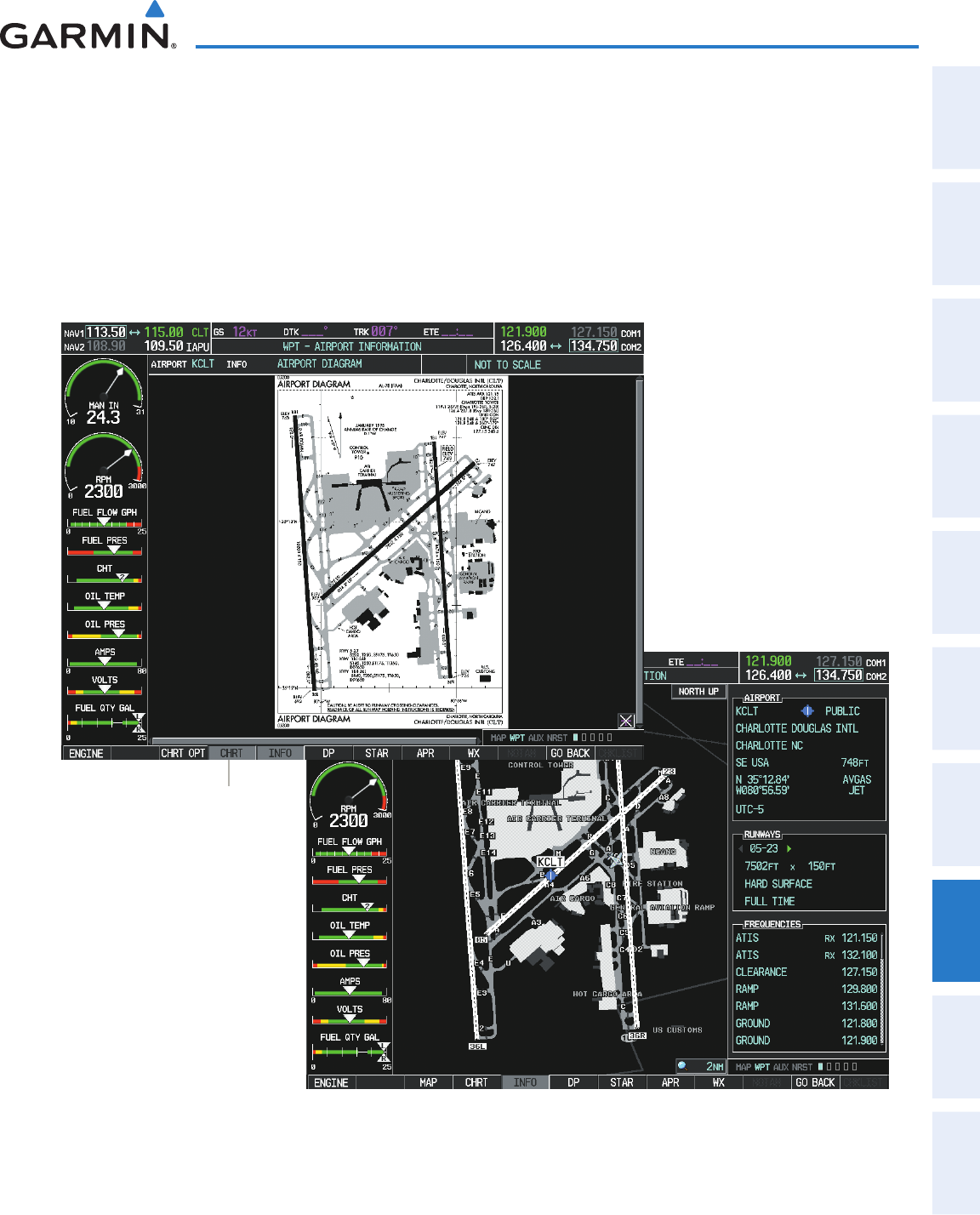
190-00592-06 Rev A
Garmin G1000 Pilot’s Guide for the Diamond DA40/40F
447
ADDITIONAL FEATURES
SYSTEM
OVERVIEW
FLIGHT
INSTRUMENTS EIS AUDIO PANEL
& CNS
FLIGHT
MANAGEMENT
HAZARD
AVOIDANCE AFCS ADDITIONAL
FEATURES APPENDICES INDEX
While the APPROACH Box is selected using the FMS Knob, the G1000 softkeys are blank. Once the desired
chart is selected, the chart scale can be changed and the chart can be panned using the Joystick. Pressing the
Joystick centers the chart on the screen.
The aircraft symbol is not shown on FliteCharts. The Chart Scale Box displays a banner NOT TO SCALE, and
the Aircraft Not Shown Icon is displayed in the lower right corner of the screen.
Pressing the CHRT Softkey alternates between the FliteCharts diagram and the associated map in the WPT
page group. In the example shown, the CHRT Softkey switches between the Charlotte, NC (KCLT) Airport
Diagram and the navigation map on the WPT – Airport Information page.
Figure 8-53 CHRT Softkey, Airport Information Page
Press
CHRT
Softkey
to Switch Between
FliteCharts and
Navigation Map Page
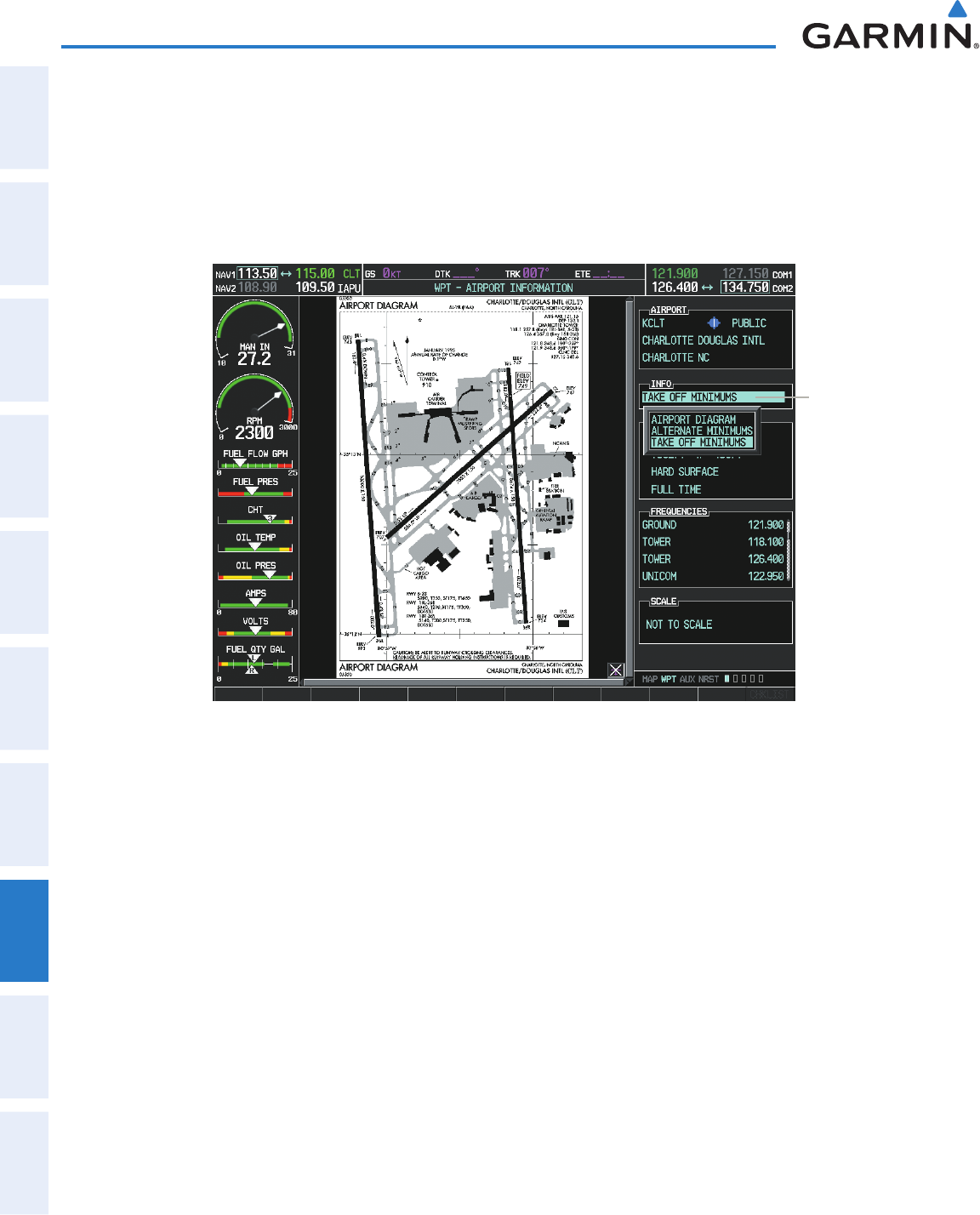
Garmin G1000 Pilot’s Guide for the Diamond DA40/40F
190-00592-06 Rev A448
ADDITIONAL FEATURES
SYSTEM
OVERVIEW
FLIGHT
INSTRUMENTS
EIS
AUDIO PANEL
& CNS
FLIGHT
MANAGEMENT
HAZARD
AVOIDANCE
AFCS
ADDITIONAL
FEATURES
APPENDICESINDEX
Pressing the INFO Softkey returns to the airport diagram when the view is on a different chart. If the
displayed chart is the airport diagram, the INFO Softkey has no effect.
Another source for additional airport information is from the INFO Box above the chart or to the right of the
chart (Figure 8-54) for certain airports. This information source is not related to the INFO Softkey. When the
INFO Box is selected using the FMS Knob, the G1000 softkeys are blank. The Charlotte, NC airport has three
additional charts offering information; the Airport Diagram, Alternate Minimums, and Take-off Minimums.
Figure 8-54 Airport Information Page, INFO View with Airport Information
Info Box
Selected
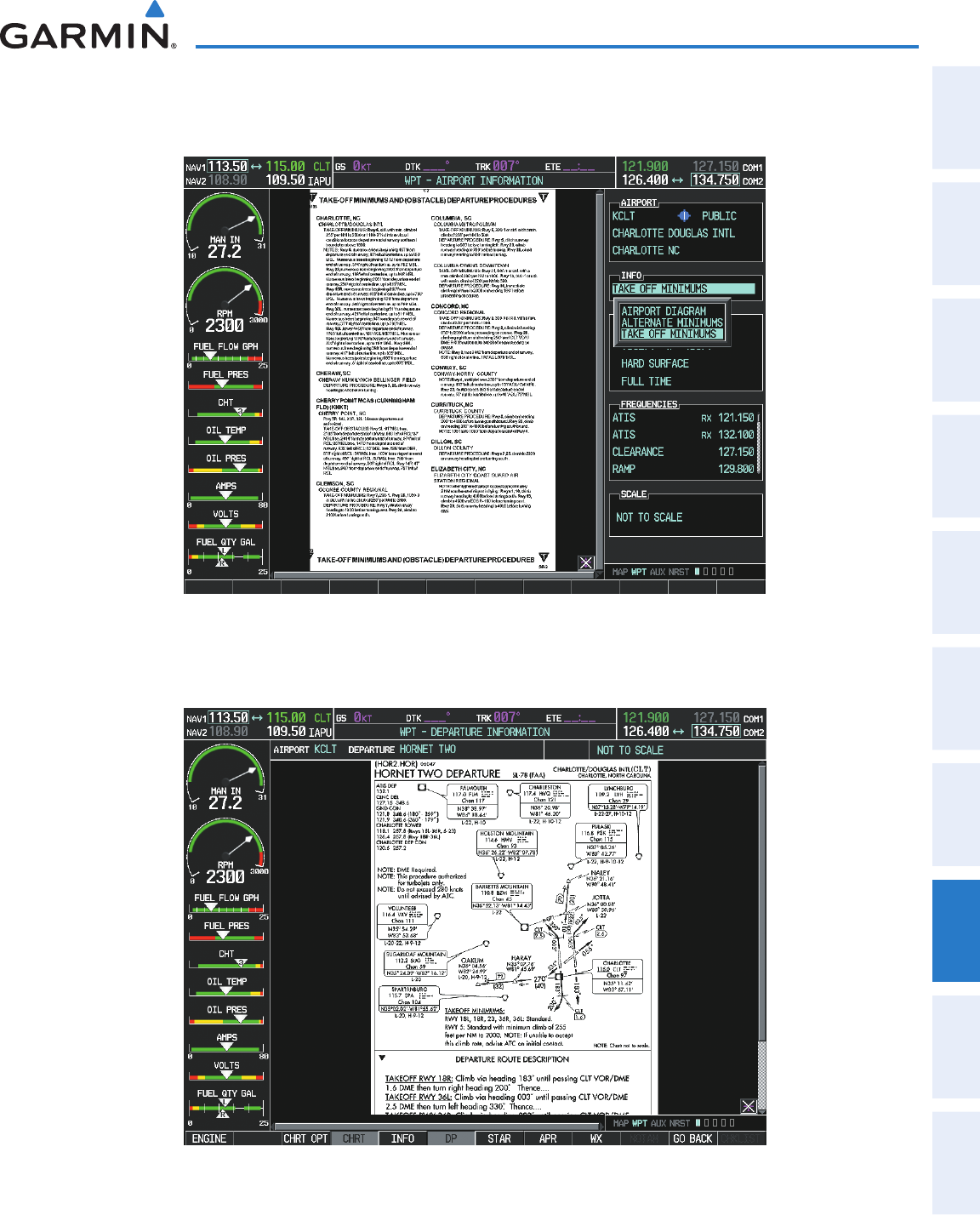
190-00592-06 Rev A
Garmin G1000 Pilot’s Guide for the Diamond DA40/40F
449
ADDITIONAL FEATURES
SYSTEM
OVERVIEW
FLIGHT
INSTRUMENTS EIS AUDIO PANEL
& CNS
FLIGHT
MANAGEMENT
HAZARD
AVOIDANCE AFCS ADDITIONAL
FEATURES APPENDICES INDEX
In the example shown in Figure 8-54, TAKE OFF MINIMUMS is selected. Pressing the ENT Key displays the
Take-off Minimums and Departure Procedures Chart (Figure 8-55).
Figure 8-55 Airport Information Page, TAKE OFF MINIMUMS Selected from INFO View
Pressing the DP Softkey displays the Departure Procedure Chart if available.
Figure 8-56 Departure Information Page
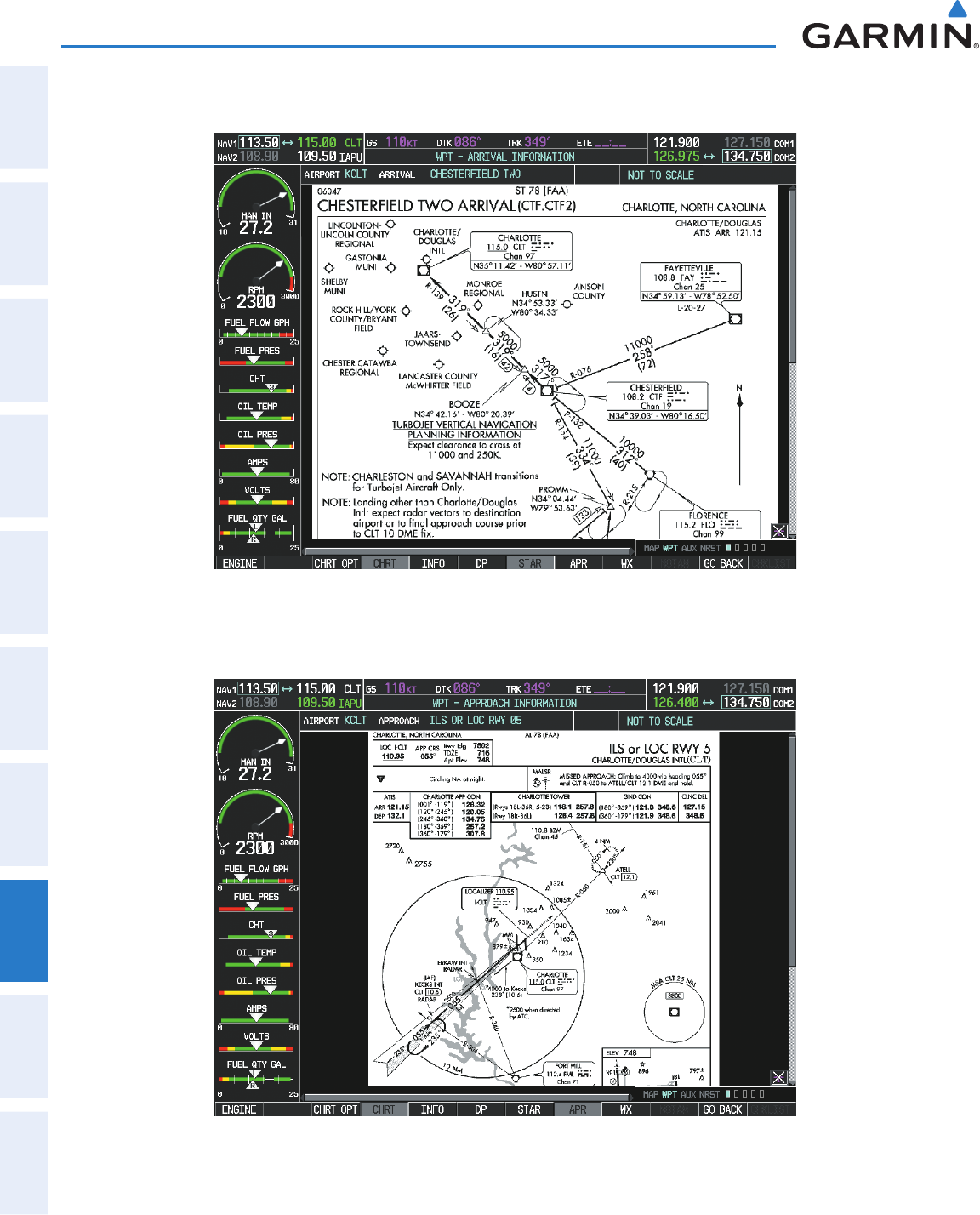
Garmin G1000 Pilot’s Guide for the Diamond DA40/40F
190-00592-06 Rev A450
ADDITIONAL FEATURES
SYSTEM
OVERVIEW
FLIGHT
INSTRUMENTS
EIS
AUDIO PANEL
& CNS
FLIGHT
MANAGEMENT
HAZARD
AVOIDANCE
AFCS
ADDITIONAL
FEATURES
APPENDICESINDEX
Pressing the STAR Softkey displays the Standard Terminal Arrival Chart if available.
Figure 8-57 Arrival Information Page
Pressing the APR Softkey displays the approach chart for the airport if available.
Figure 8-58 Approach Information Page
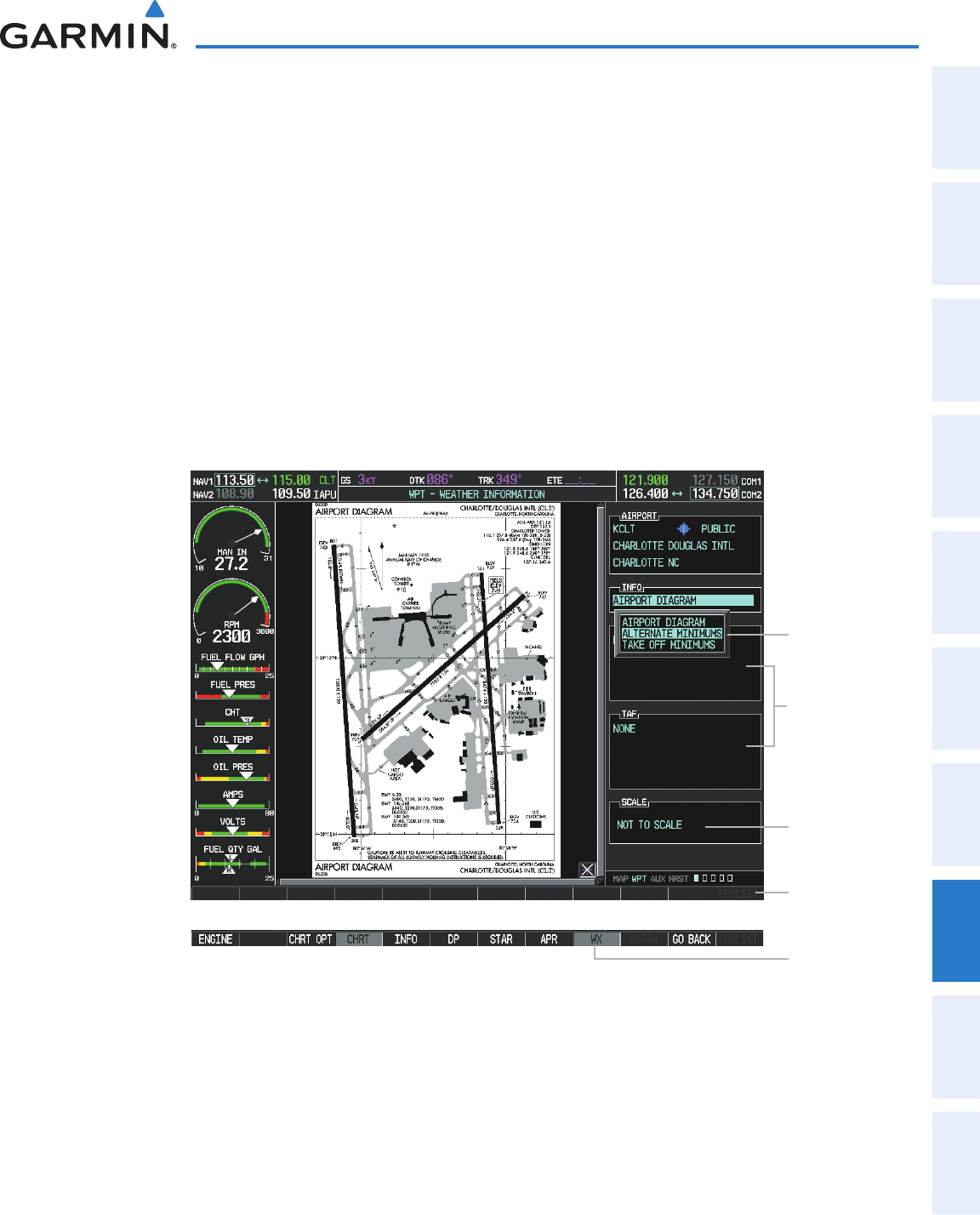
190-00592-06 Rev A
Garmin G1000 Pilot’s Guide for the Diamond DA40/40F
451
ADDITIONAL FEATURES
SYSTEM
OVERVIEW
FLIGHT
INSTRUMENTS EIS AUDIO PANEL
& CNS
FLIGHT
MANAGEMENT
HAZARD
AVOIDANCE AFCS ADDITIONAL
FEATURES APPENDICES INDEX
Pressing the WX Softkey shows the airport weather frequency information, when available, and includes
weather data such as METAR and TAF from the XM Data Link Receiver. Weather information is available only
when an XM Data Link Receiver is installed and the XM Weather subscription is current.
Selecting Additional Information:
1) While viewing the Airport Taxi Diagram, press the WX Softkey to display the information windows (AIRPORT,
INFO).
2) Press the
FMS
Knob to activate the cursor.
3) Turn the large
FMS
Knob to highlight the INFO Box.
4) Turn the small
FMS
Knob to select the INFO Box choices. When the INFO Box is selected the G1000 softkeys
are blank. If multiple choices are available, scroll to the desired choice with the large
FMS
Knob and press the
ENT Key to complete the selection.
5) Press the
FMS
Knob again to deactivate the cursor.
Figure 8-59 Weather Information Page, WX Softkey Selected
Chart Not
To Scale
WX
Softkey
Selected
Info Available
on This Airport
WX Info
When
Available
Softkeys are
Blank during
Info Box
Selection
Pressing the GO
BACK Softkey reverts to the previous page (Navigation Map Page or Flight Plan Page).
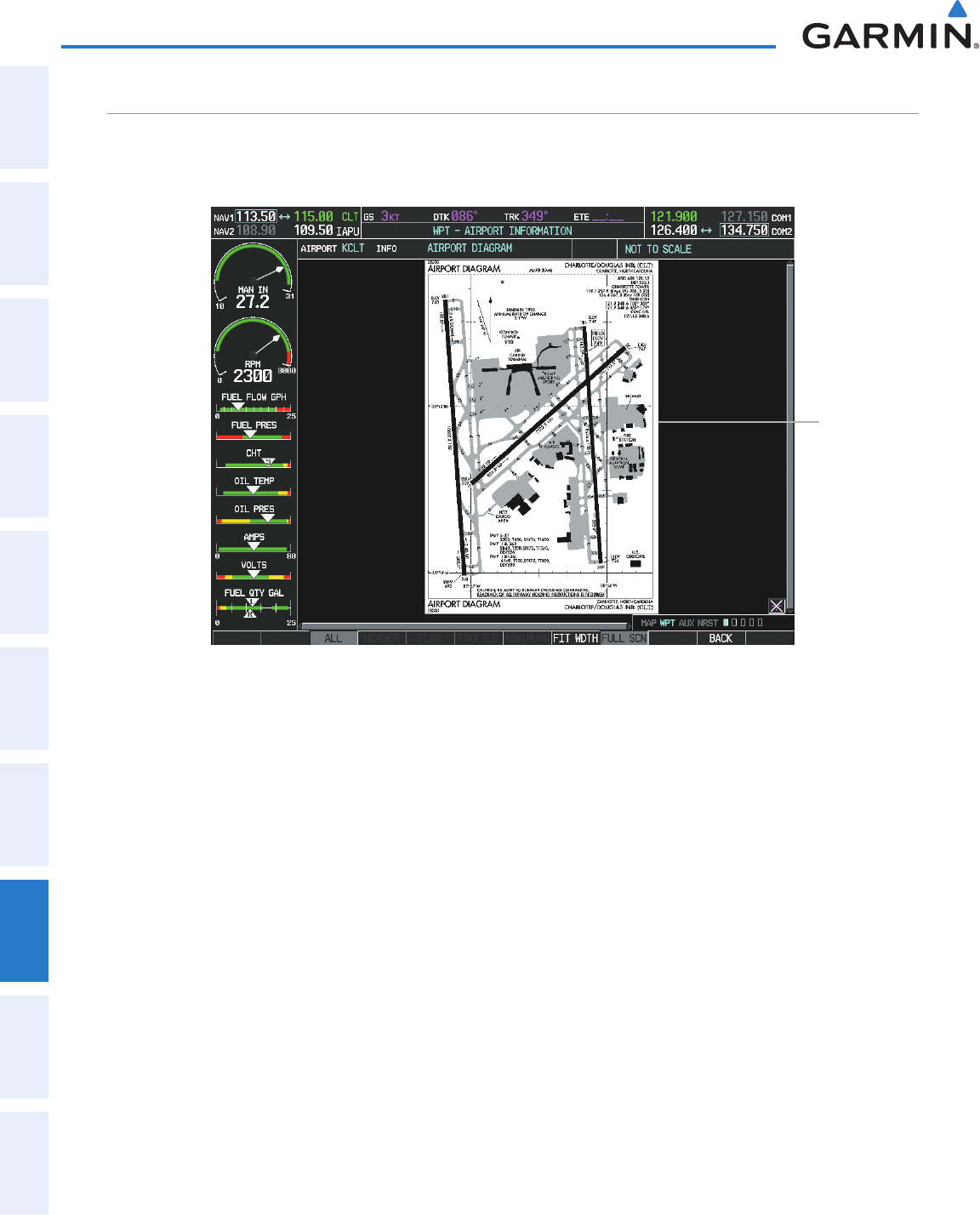
Garmin G1000 Pilot’s Guide for the Diamond DA40/40F
190-00592-06 Rev A452
ADDITIONAL FEATURES
SYSTEM
OVERVIEW
FLIGHT
INSTRUMENTS
EIS
AUDIO PANEL
& CNS
FLIGHT
MANAGEMENT
HAZARD
AVOIDANCE
AFCS
ADDITIONAL
FEATURES
APPENDICESINDEX
CHART OPTIONS
Pressing the CHRT OPT Softkey displays the next level of softkeys, the chart options level (Figure 8-48).
Pressing the ALL Softkey shows the complete chart on the screen.
Complete
Chart
Shown
Figure 8-60 Airport Information Page, ALL View Selected
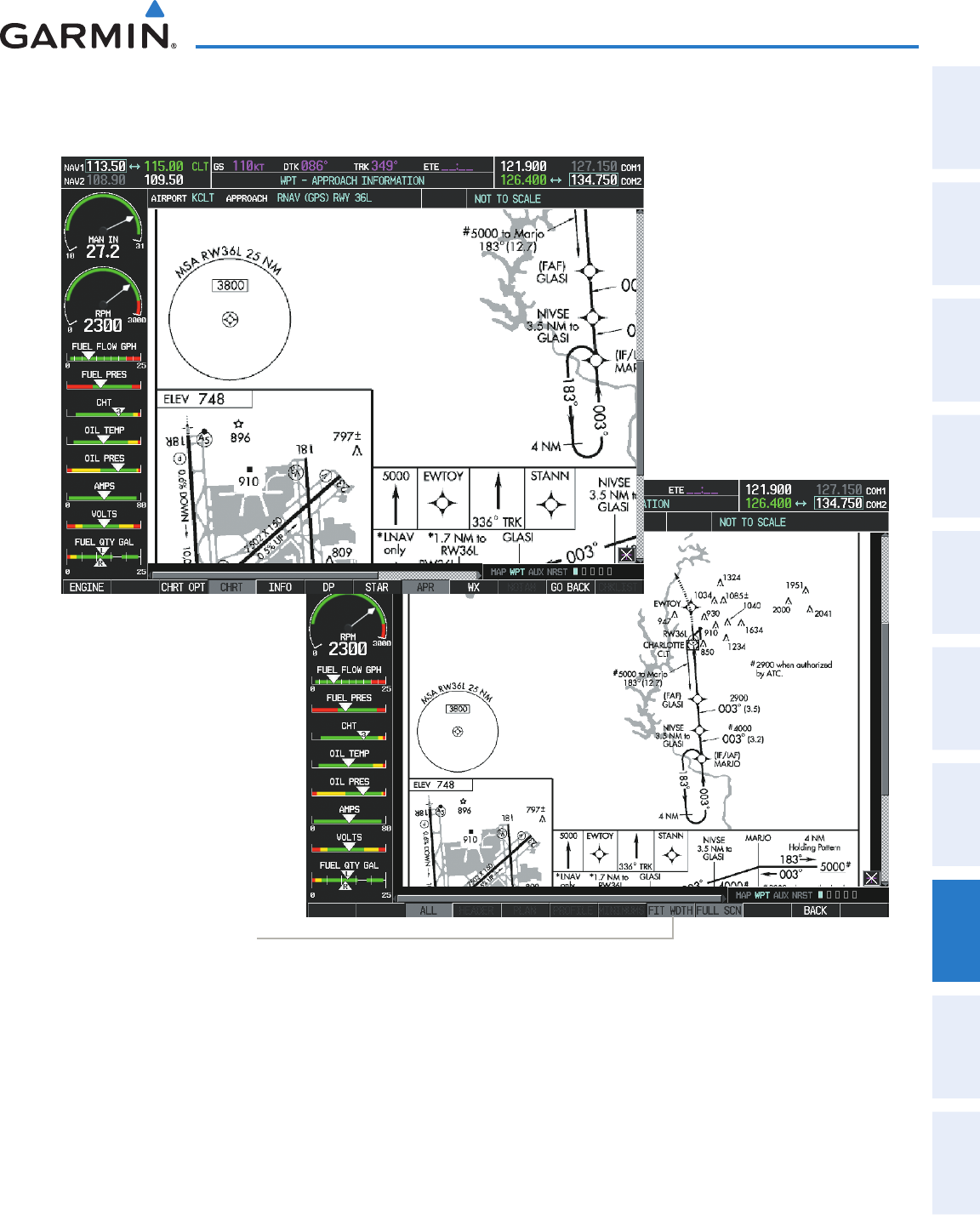
190-00592-06 Rev A
Garmin G1000 Pilot’s Guide for the Diamond DA40/40F
453
ADDITIONAL FEATURES
SYSTEM
OVERVIEW
FLIGHT
INSTRUMENTS EIS AUDIO PANEL
& CNS
FLIGHT
MANAGEMENT
HAZARD
AVOIDANCE AFCS ADDITIONAL
FEATURES APPENDICES INDEX
Pressing the FIT WIDTH Softkey fits the width of the chart in the display viewing area. In the example
shown, the chart at close range is replaced with the full width chart.
Figure 8-61 Approach Information Page, FIT WDTH Softkey Selected
Press
FIT WDTH
Softkey to Show
Full Chart Width
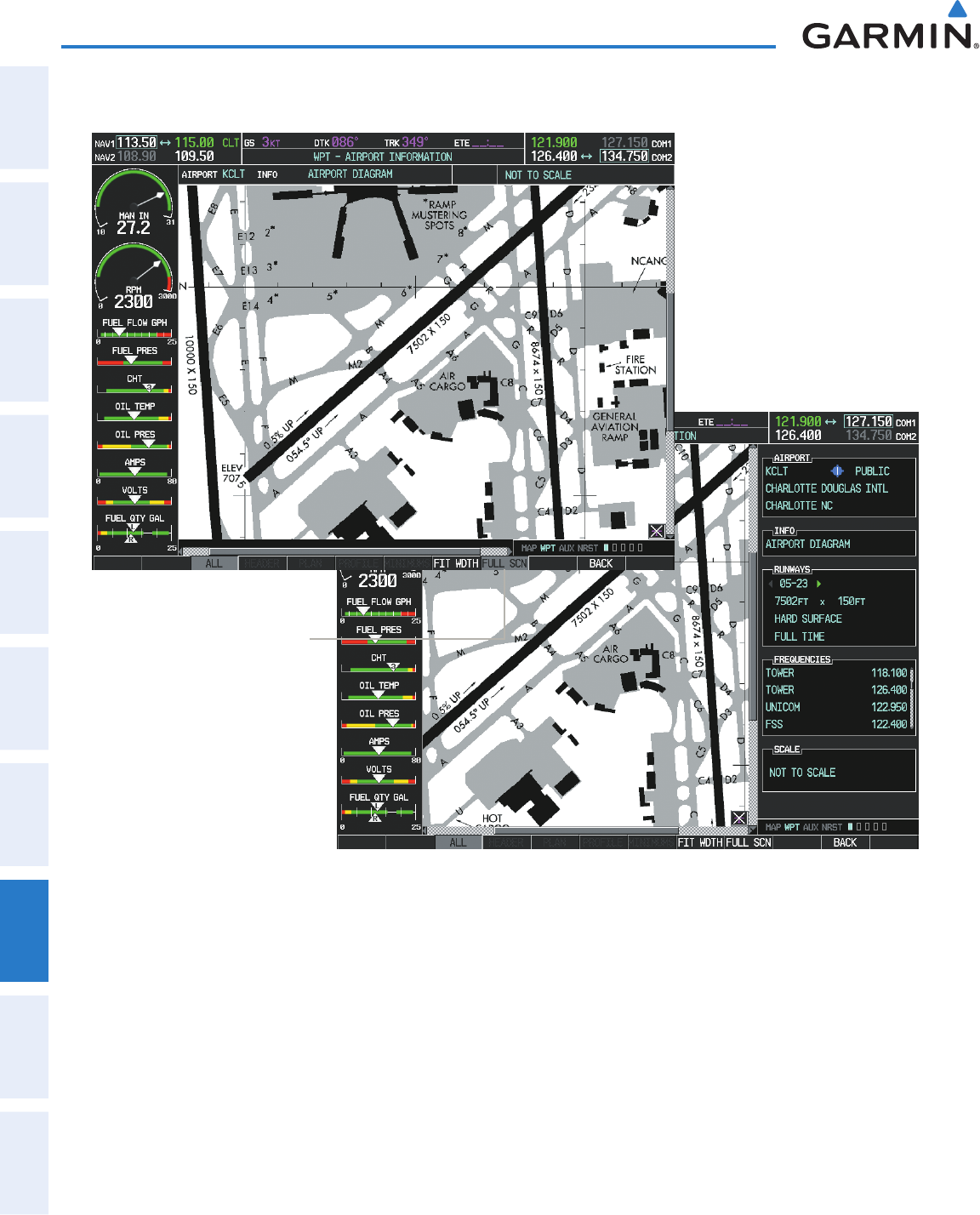
Garmin G1000 Pilot’s Guide for the Diamond DA40/40F
190-00592-06 Rev A454
ADDITIONAL FEATURES
SYSTEM
OVERVIEW
FLIGHT
INSTRUMENTS
EIS
AUDIO PANEL
& CNS
FLIGHT
MANAGEMENT
HAZARD
AVOIDANCE
AFCS
ADDITIONAL
FEATURES
APPENDICESINDEX
Pressing the FULL
SCN Softkey alternates between removing and replacing the data window to the right.
Press
FULL SCN
Softkey to Switch
Between Chart on
Full Screen and Chart
with Info Window
Figure 8-62 Airport Information Page, Full Screen and Info Window
Pressing the BACK Softkey, or waiting for 45 seconds reverts to the chart selection softkeys.
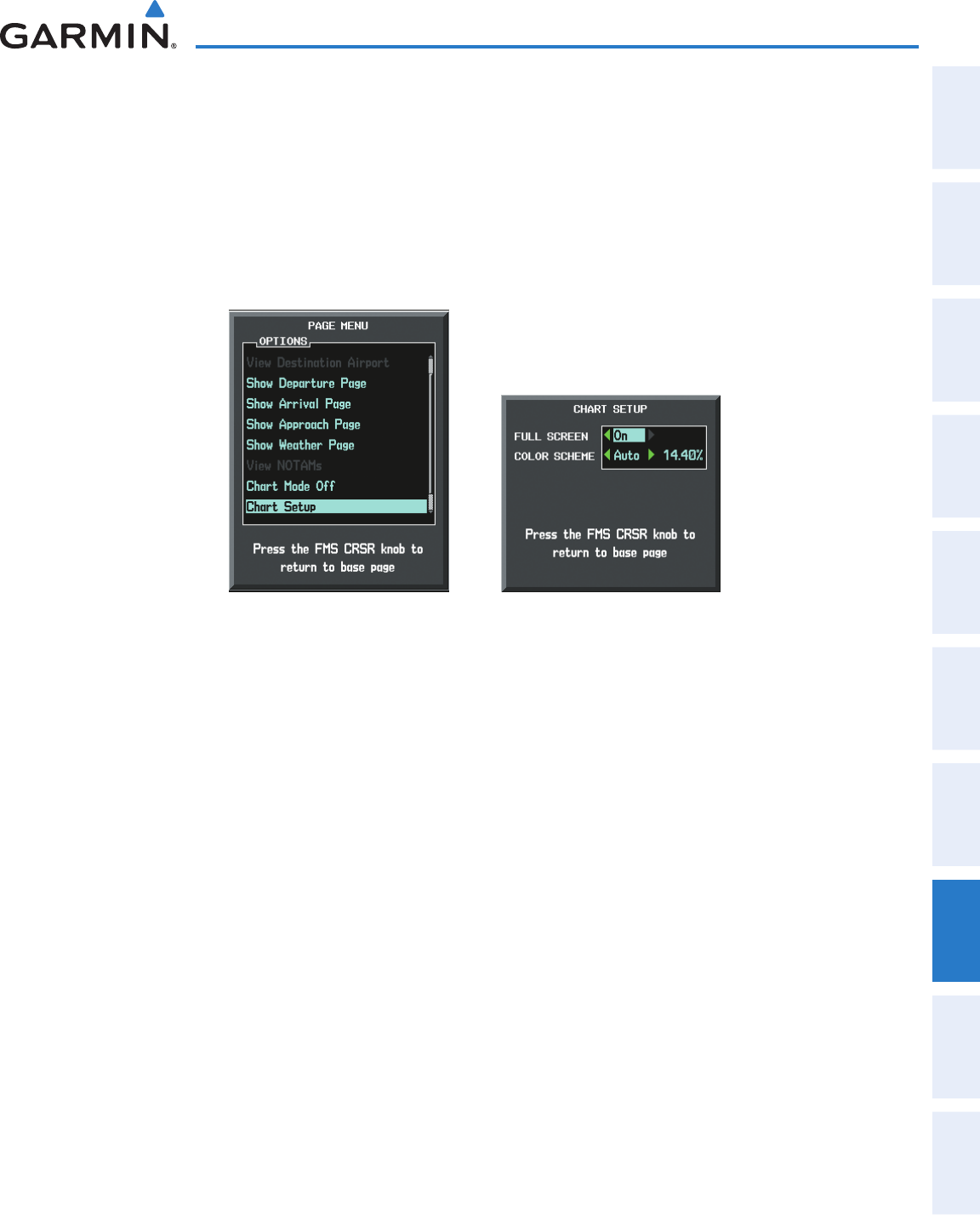
190-00592-06 Rev A
Garmin G1000 Pilot’s Guide for the Diamond DA40/40F
455
ADDITIONAL FEATURES
SYSTEM
OVERVIEW
FLIGHT
INSTRUMENTS EIS AUDIO PANEL
& CNS
FLIGHT
MANAGEMENT
HAZARD
AVOIDANCE AFCS ADDITIONAL
FEATURES APPENDICES INDEX
The full screen view can also be selected by using the page menu option.
Selecting full screen On or Off:
1) While viewing a terminal chart press the MENU Key to display the Page Menu OPTIONS.
2) Turn the large
FMS
Knob to highlight the Chart Setup Menu Option and press the
ENT
Key.
3) Turn the large
FMS
Knob to move between the FULL SCREEN and COLOR SCHEME Options.
4) Turn the small
FMS
Knob to choose between the On and Off Full Screen Options.
Figure 8-63 Page Menus
Full Screen On/Off SelectionChart Setup Option
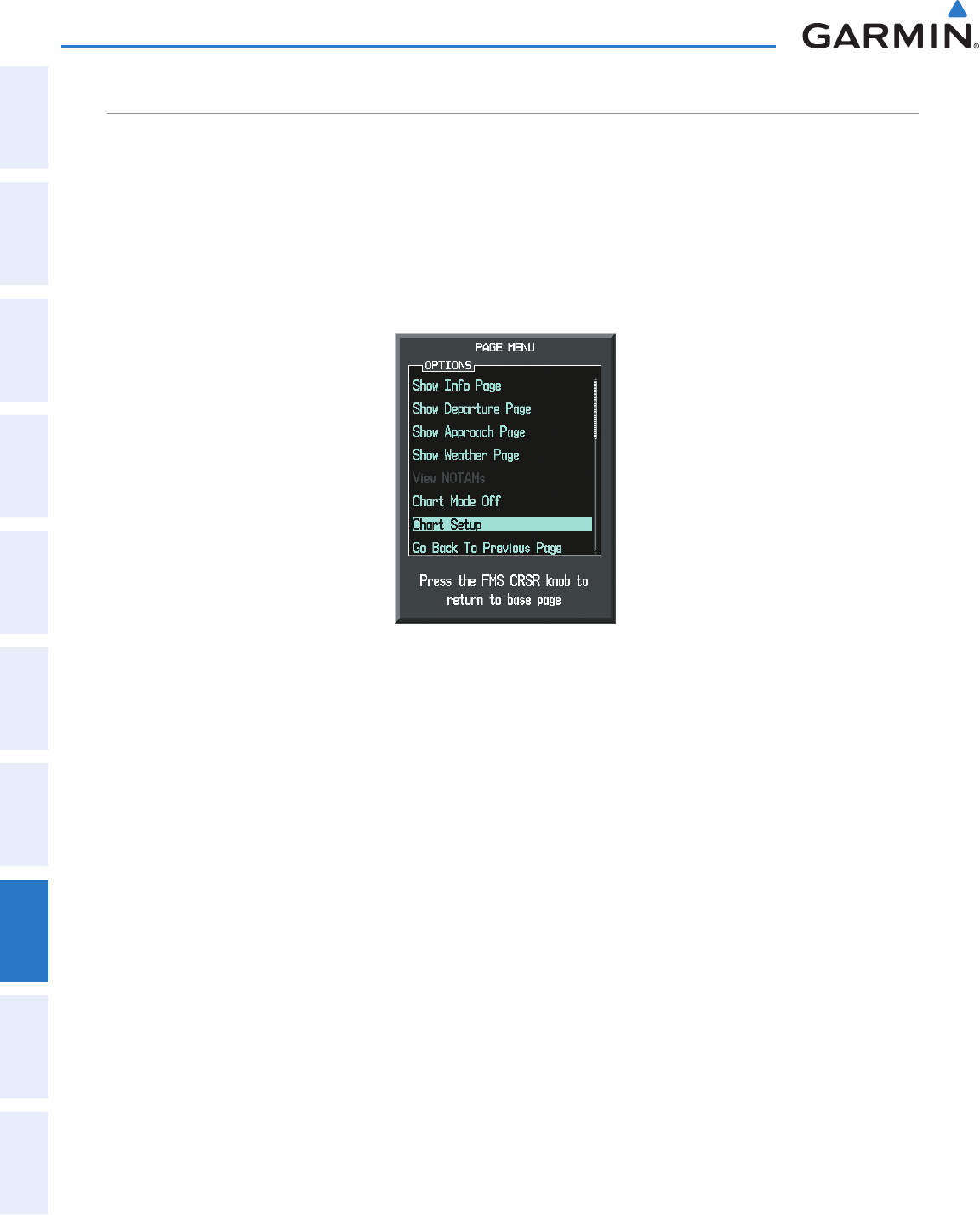
Garmin G1000 Pilot’s Guide for the Diamond DA40/40F
190-00592-06 Rev A456
ADDITIONAL FEATURES
SYSTEM
OVERVIEW
FLIGHT
INSTRUMENTS
EIS
AUDIO PANEL
& CNS
FLIGHT
MANAGEMENT
HAZARD
AVOIDANCE
AFCS
ADDITIONAL
FEATURES
APPENDICESINDEX
DAY/NIGHT VIEW
FliteCharts can be displayed on a white or black background for day or night viewing. The Day View offers
a better presentation in a bright environment. The Night View gives a better presentation for viewing in a dark
environment. When the CHART SETUP Box is selected the G1000 softkeys are blank.
Selecting Day, Night, or Automatic View:
1) While viewing a terminal chart press the MENU Key to display the Page Menu OPTIONS.
2) Turn the large
FMS
Knob to highlight the Chart Setup Menu Option and press the
ENT
Key.
Figure 8-64 Waypoint Information Page, OPTIONS Menu
3) Turn the large
FMS
Knob to move to the COLOR SCHEME Option (Figure 8-65).
4) Turn the small
FMS
Knob to choose between Day, Auto, and Night Options.
5) If Auto Mode is selected, turn the large FMS Knob to select the percentage field. Use the small FMS Knob to
change the percentage value. The percentage value is the day/night crossover point based on the percentage of
backlighting intensity. For example, if the value is set to 15%, the day/night display changes when the display
backlight reaches 15% of full brightness.
The display must be changed in order for the new setting to become active. This may be accomplished by
selecting another page or changing the display range.
6) Press the FMS Knob when finished to remove the Chart Setup Menu.
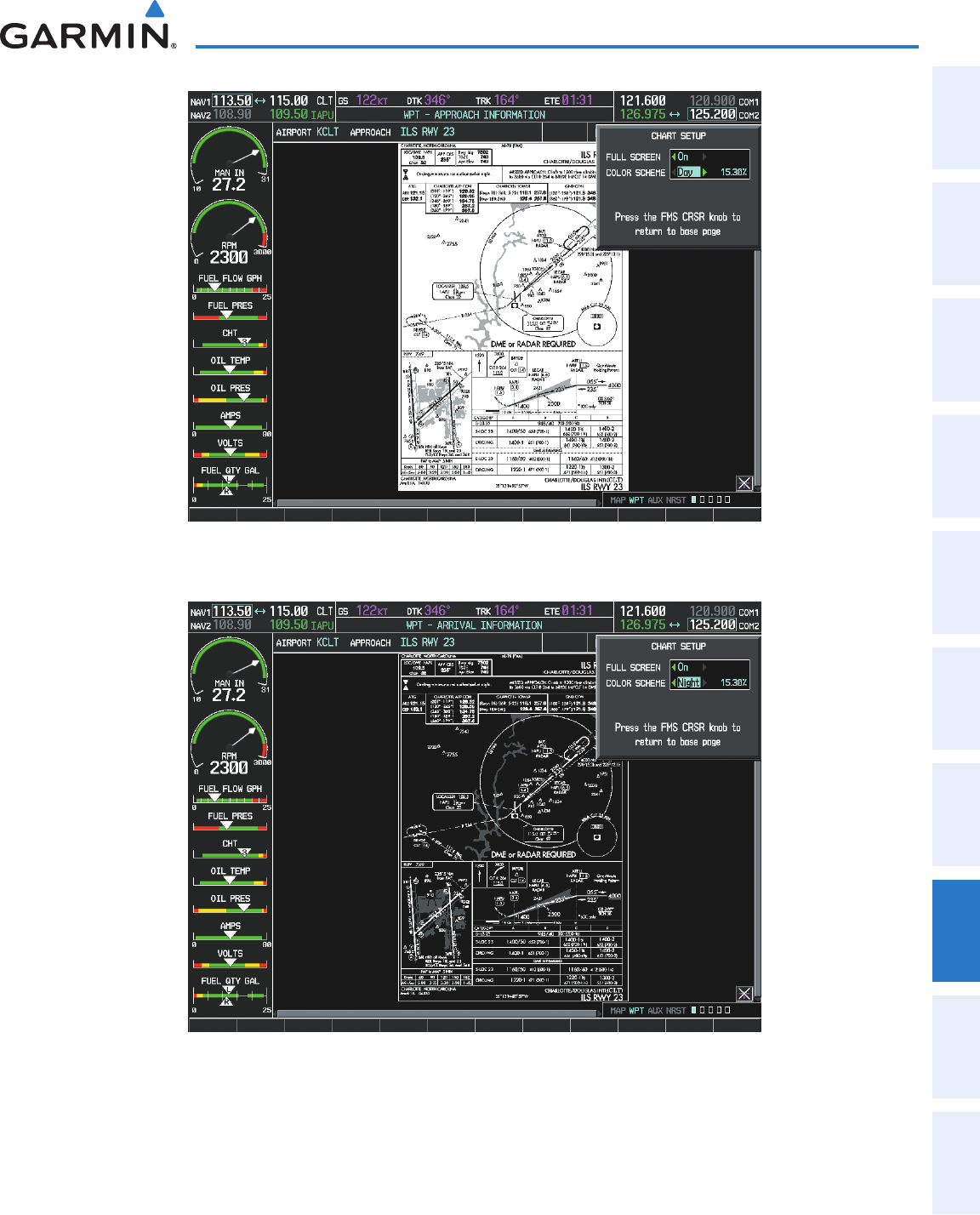
190-00592-06 Rev A
Garmin G1000 Pilot’s Guide for the Diamond DA40/40F
457
ADDITIONAL FEATURES
SYSTEM
OVERVIEW
FLIGHT
INSTRUMENTS EIS AUDIO PANEL
& CNS
FLIGHT
MANAGEMENT
HAZARD
AVOIDANCE AFCS ADDITIONAL
FEATURES APPENDICES INDEX
Figure 8-65 Approach Information Page, Day View
Figure 8-66 Approach Information Page, Night View
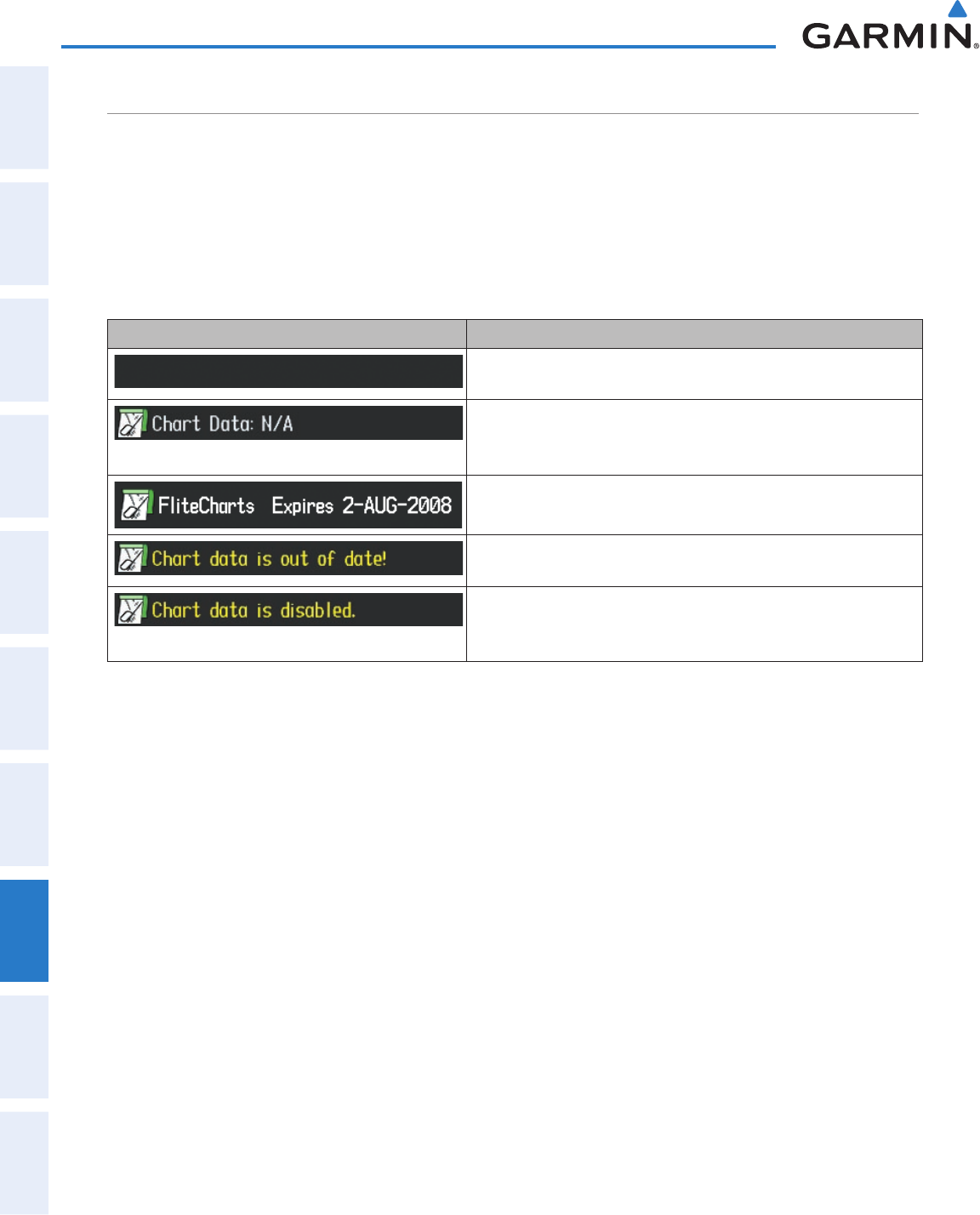
Garmin G1000 Pilot’s Guide for the Diamond DA40/40F
190-00592-06 Rev A458
ADDITIONAL FEATURES
SYSTEM
OVERVIEW
FLIGHT
INSTRUMENTS
EIS
AUDIO PANEL
& CNS
FLIGHT
MANAGEMENT
HAZARD
AVOIDANCE
AFCS
ADDITIONAL
FEATURES
APPENDICESINDEX
FLITECHARTS CYCLE NUMBER AND EXPIRATION DATE
FliteCharts data is revised every 28 days. Charts are still viewable during a period that extends from the
cycle expiration date to the disabled date. FliteCharts is disabled 180 days after the expiration date and are
no longer available for viewing upon reaching the disabled date. When turning on the G1000, the Power-up
Page indicates any of five different possible criteria for chart availability. These indications are whether the
databases are not configured, not available, current, out of date, or disabled. See the table below for the various
FliteCharts Power-up Page displays and the definition of each.
Power-up Page Display Definition
Blank Line. G1000 system is not configured for FliteCharts. Contact
a Garmin-authorized service center for configuration.
System is configured for FliteCharts but no chart database is
installed. Refer to Updating Garmin Databases in Appendix B for the
FliteCharts database
Normal operation. FliteCharts database is valid and within current
cycle.
FliteCharts database is beyond the expiration date, but still within
the 180 day viewing period.
FliteCharts database has timed out. Database is beyond 180 days
after expiration date. FliteCharts database is no longer available for
viewing.
Table 8-2 FliteCharts Power-up Page Annunciations and Definitions
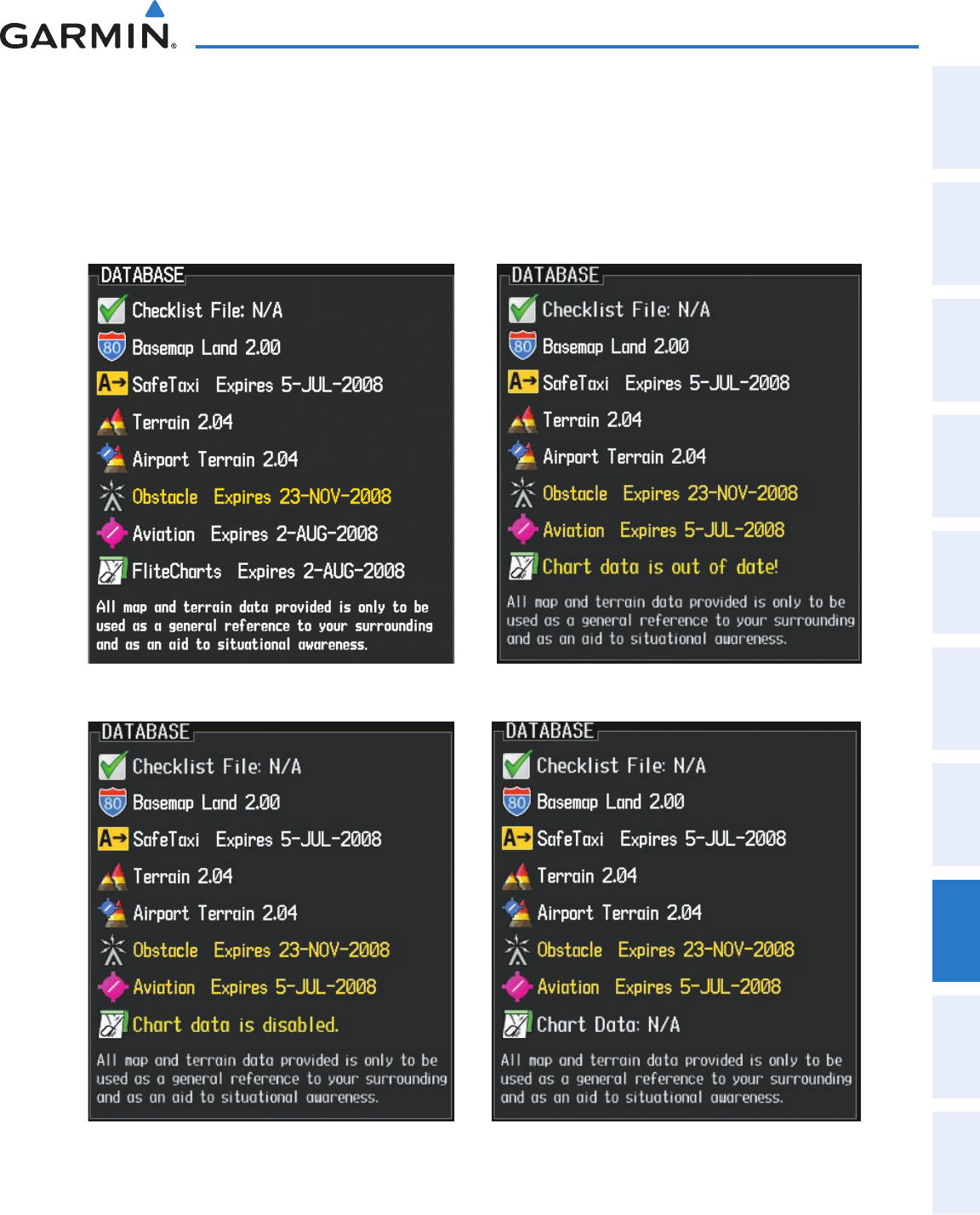
190-00592-06 Rev A
Garmin G1000 Pilot’s Guide for the Diamond DA40/40F
459
ADDITIONAL FEATURES
SYSTEM
OVERVIEW
FLIGHT
INSTRUMENTS EIS AUDIO PANEL
& CNS
FLIGHT
MANAGEMENT
HAZARD
AVOIDANCE AFCS ADDITIONAL
FEATURES APPENDICES INDEX
Examples of four possible Power-up Page messages are shown here. ‘FliteCharts Expires’ plus a date in white,
indicates the chart database is current. ‘Chart data is out of date!’ in yellow, indicates charts are still viewable,
but approaching the disable date.
When the 180 day grace period has expired, ‘Chart data is disabled.’ in yellow indicates that the FliteCharts
database has expired and is no longer viewable. ‘Chart Data: N/A’ appears in white if no FliteCharts data is
available on the database card or no database card is inserted.
Figure 8-67 FliteCharts Power-up Page Messages
FliteCharts Database is Disabled FliteCharts Database is Not Available
FliteCharts Database is Current
and Available FliteCharts Database is
Expired but Still Available
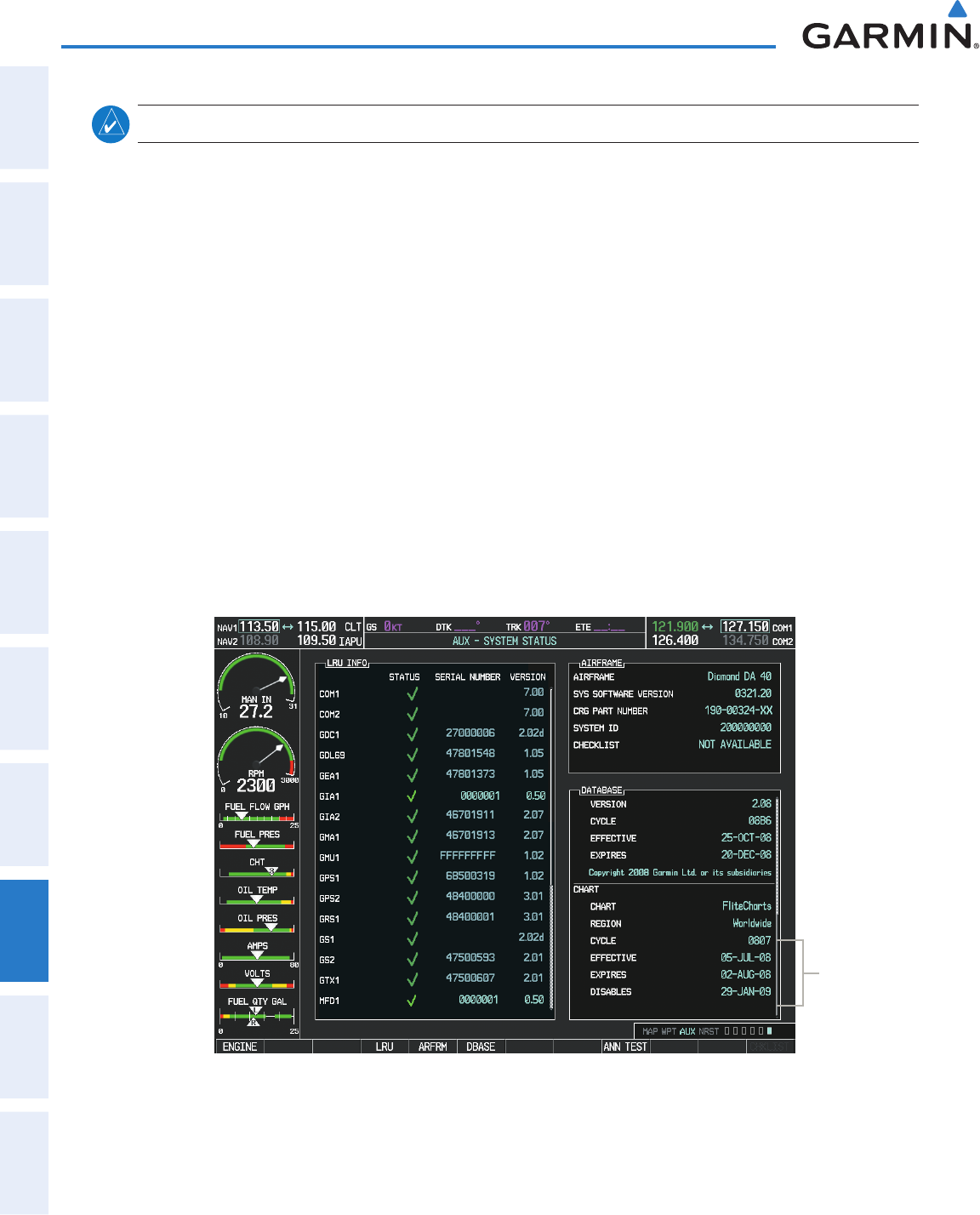
Garmin G1000 Pilot’s Guide for the Diamond DA40/40F
190-00592-06 Rev A460
ADDITIONAL FEATURES
SYSTEM
OVERVIEW
FLIGHT
INSTRUMENTS
EIS
AUDIO PANEL
& CNS
FLIGHT
MANAGEMENT
HAZARD
AVOIDANCE
AFCS
ADDITIONAL
FEATURES
APPENDICESINDEX
NOTE
: A subdued softkey label indicates the function is disabled.
FliteCharts time critical information can also be found on the AUX - System Status page. The FliteCharts
database REGION, CYCLE number, EFFECTIVE, EXPIRES, and DISABLES dates of the subscription appear in
either blue or yellow text. Dates shown in blue are current data. Dates shown in yellow indicate the data is not
within the current subscription period.
FliteCharts becomes inoperative 180 days after the FliteCharts EXPIRES date is reached, and is no longer
available for viewing. This date is shown as the DISABLES date. After the disable date the
SHW CHRT
Softkey
label appears subdued and is unavailable until a revised issue of FliteCharts is installed.
Press the DBASE Softkey for scrolling through the database information. Scroll through the database with
the FMS knob or ENT Key.
The FliteCharts database cycle number shown in the figure, 0807, is deciphered as follows:
08 – Indicates the year 2007
07 – Indicates the seventh issue of the FliteCharts database for the year
The FliteCharts EFFECTIVE date 05–JUL–08 is the first date that this database is current.
The FliteCharts EXPIRES date 02–AUG–08 is the last date that this database is current.
The DISABLES date 29–JAN–09 is the date that this database becomes inoperative.
FliteCharts
Data
Figure 8-68 AUX – System Status Page, FliteCharts Current and Available
The FliteCharts database is provided from Garmin. Refer to Updating Garmin Databases in Appendix B for
instructions on revising the FliteCharts database.
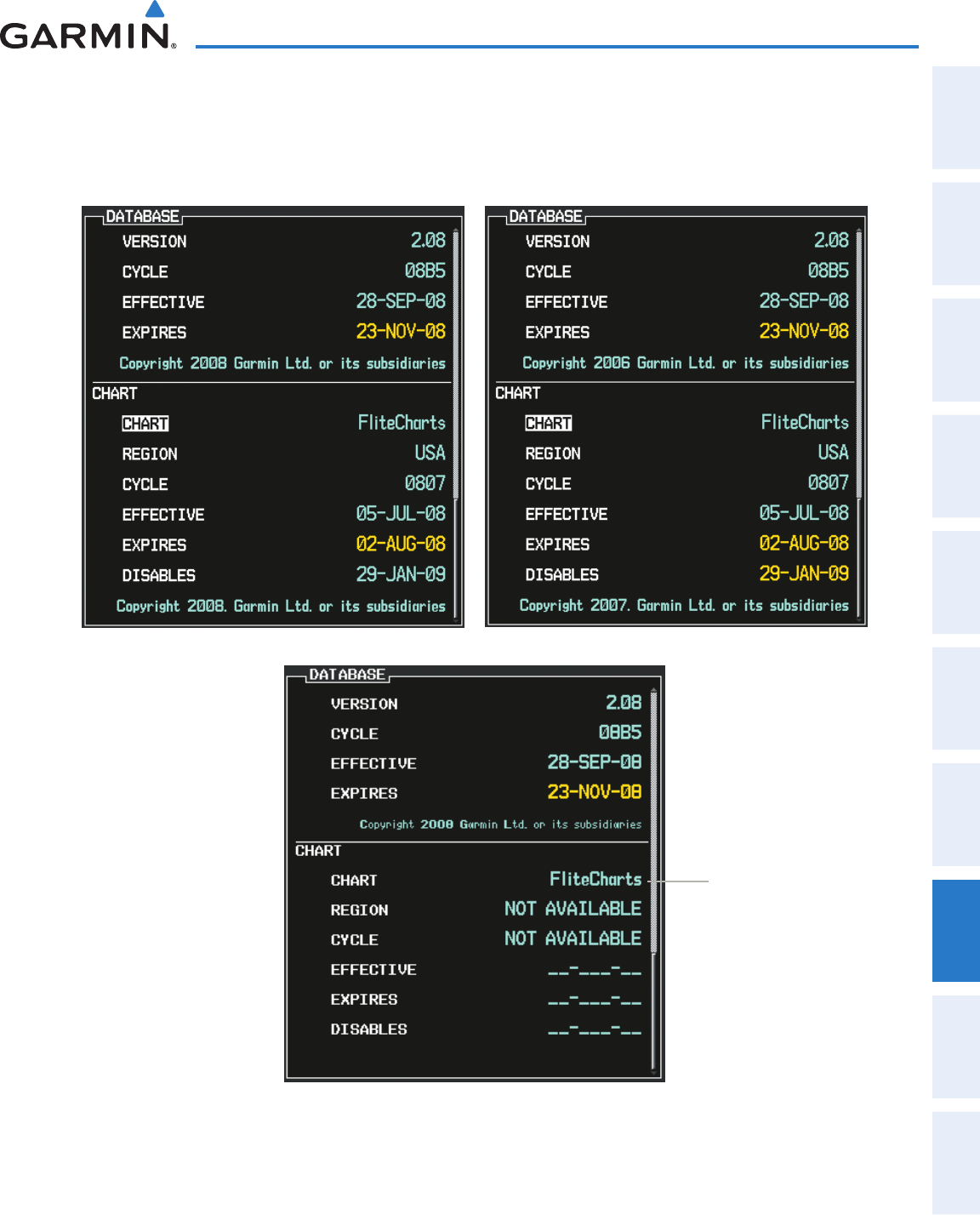
190-00592-06 Rev A
Garmin G1000 Pilot’s Guide for the Diamond DA40/40F
461
ADDITIONAL FEATURES
SYSTEM
OVERVIEW
FLIGHT
INSTRUMENTS EIS AUDIO PANEL
& CNS
FLIGHT
MANAGEMENT
HAZARD
AVOIDANCE AFCS ADDITIONAL
FEATURES APPENDICES INDEX
The other three possible AUX - System Status page conditions are shown here. The EXPIRES date, in yellow,
is the revision date for the next database cycle. The DISABLES date, in yellow, is the date that this database cycle
is no longer viewable. REGION and CYCLE NOT AVAILABLE in blue, indicate that FliteCharts database is not
available on the database card or no database card is inserted.
Figure 8-69 AUX – System Status Page, FliteCharts Expired,
FliteCharts Disabled, FliteCharts Not Available
FliteCharts Database has Expired, but is not Disabled FliteCharts Database is Disabled
FliteCharts Database is Not Available
System is
Configured for
FliteCharts but
Database is not
Installed
Garmin G1000 Pilot’s Guide for the Diamond DA40/40F
190-00592-06 Rev A462
ADDITIONAL FEATURES
SYSTEM
OVERVIEW
FLIGHT
INSTRUMENTS
EIS
AUDIO PANEL
& CNS
FLIGHT
MANAGEMENT
HAZARD
AVOIDANCE
AFCS
ADDITIONAL
FEATURES
APPENDICESINDEX
8.5 XM RADIO ENTERTAINMENT (OPTIONAL)
NOTE: Refer to the Hazard Avoidance Section for information about XM Weather products.
The optional XM Radio entertainment feature of the GDL 69A Data Link Receiver is available for the pilot’s and
passengers’ enjoyment. The GDL 69A can receive XM Satellite Radio® entertainment services at any altitude
throughout the Continental U.S. Entertainment audio is not available on the GDL 69 Data Link Receiver.
XM Satellite Radio offers a variety of radio programming over long distances without having to constantly
search for new stations. Based on signals from satellites, coverage far exceeds land-based transmissions.
XM Satellite Radio services are subscription-based. For more information on specific service packages, visit
www.xmradio.com.
ACTIVATING XM SATELLITE RADIO SERVICES
The service is activated by providing XM Satellite Radio with either one or two coded IDs, depending on the
equipment. Either the Audio Radio ID or the Data Radio ID, or both, must be provided to XM Satellite Radio
to activate the entertainment subscription.
It is not required to activate both the entertainment and weather service subscriptions with the GDL 69A.
Either or both services can be activated. XM Satellite Radio uses one or both of the coded IDs to send an
activation signal that, when received by the GDL 69A, allows it to play entertainment programming.
These IDs are located:
•OnthelabelonthebackoftheDataLinkReceiver
•OntheXMInformationPageontheMFD(Figure8-70)
•OntheXMSatelliteRadioActivationInstructionsincludedwiththeunit(availableatwww.garmin.com,P/N
190-00355-04)
Contact the installer if the Data Radio ID and the Audio Radio ID cannot be located.
NOTE
: The LOCK Softkey on the XM Information Page (Auxiliary Page Group) is used to save GDL 69A
activation data when the XM services are initially set up. It is not used during normal XM Radio operation,
but there should be no adverse effects if inadvertently pressed during flight. Refer to the GDL 69/69A XM
Satellite Radio Activation Instructions (190-00355-04, Rev F or later) for further information.
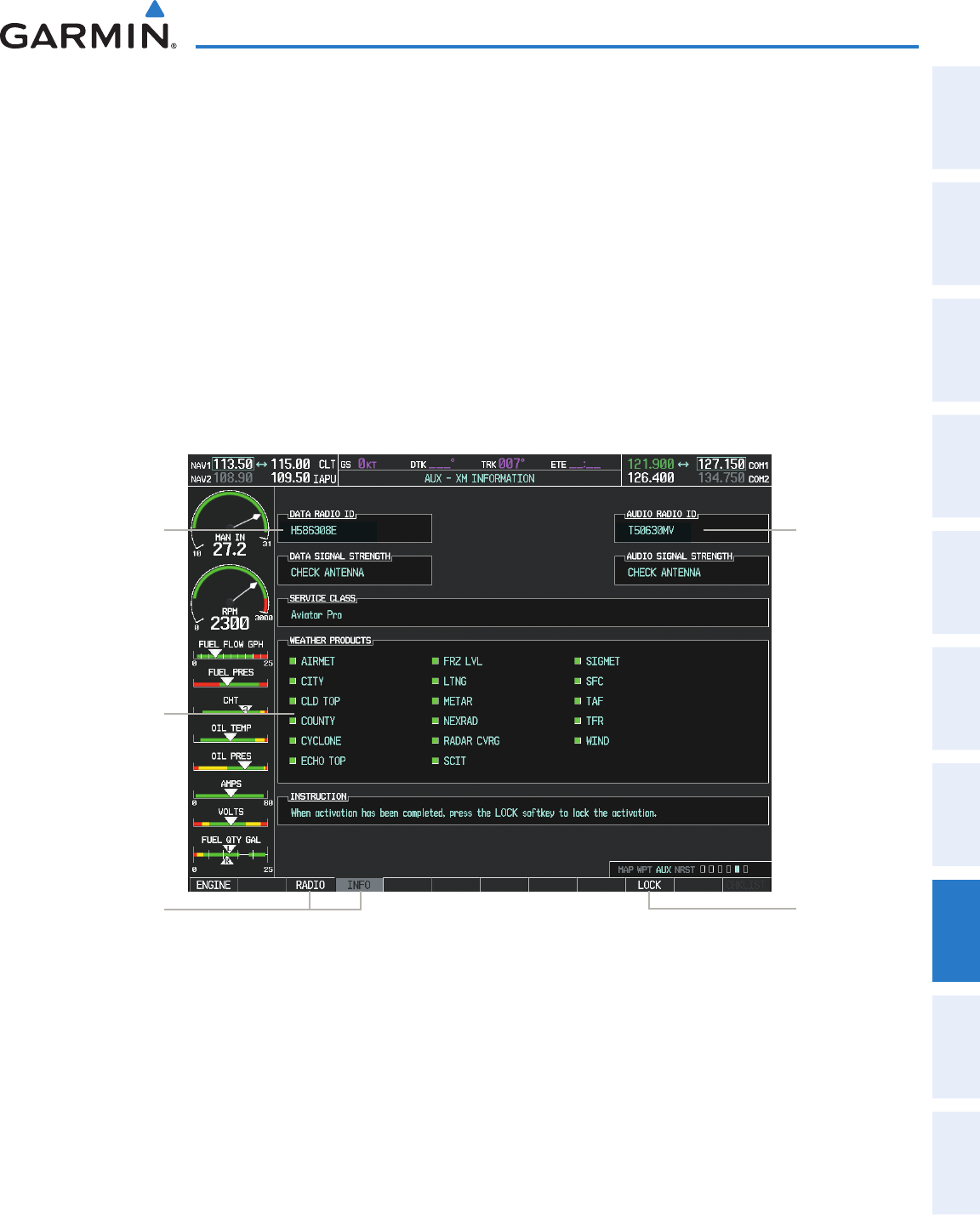
190-00592-06 Rev A
Garmin G1000 Pilot’s Guide for the Diamond DA40/40F
463
ADDITIONAL FEATURES
SYSTEM
OVERVIEW
FLIGHT
INSTRUMENTS EIS AUDIO PANEL
& CNS
FLIGHT
MANAGEMENT
HAZARD
AVOIDANCE AFCS ADDITIONAL
FEATURES APPENDICES INDEX
Activating the XM Satellite Radio services:
1) Contact XM Satellite Radio through the email address listed on their website (www.xmradio.com) or by the
customer service phone number listed on the website. Follow the instructions provided by XM Satellite Radio
services.
2) Select the Auxiliary Page Group.
3) Select the next to last page in the AUX Page Group.
4) Press the INFO Softkey to display the XM Information Page.
5) Verify that the desired services are activated.
6) Press the LOCK Softkey.
7) Turn the large FMS Knob to highlight YES.
8) To complete activation, press the ENT Key.
RADIO
and
INFO
Softkeys
Figure 8-70 XM Information Page
Audio
Radio ID
Weather
Products
Window
Data
Radio ID
LOCK
Softkey
is Used to Save
Activation
Data During
Initial Setup
If XM weather services have not been activated, all the weather product boxes are blank on the XM Information
Page and a yellow Activation Required message is displayed in the center of the Weather Data Link Page (Map
Page Group). The Service Class refers to the groupings of weather products available for subscription.
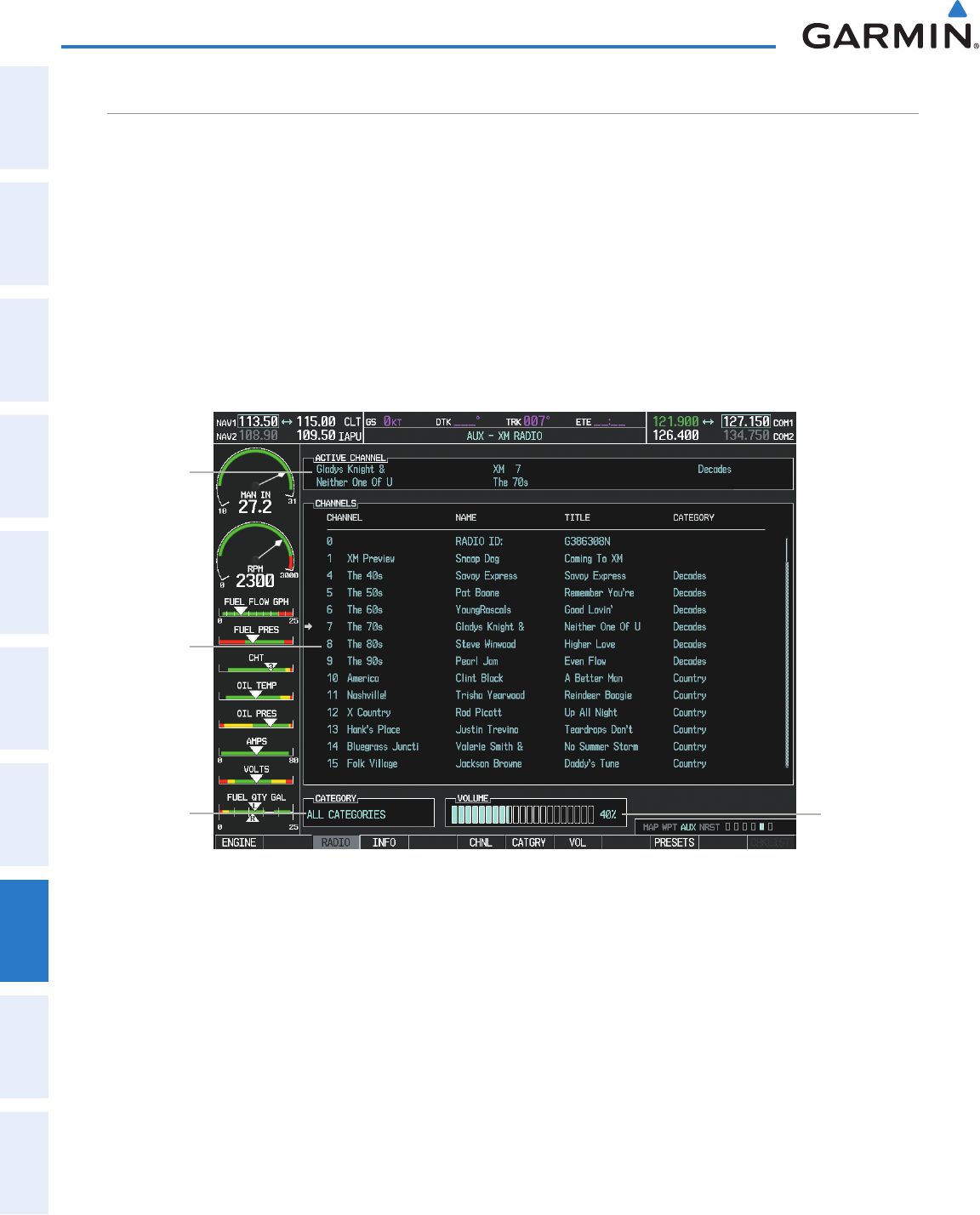
Garmin G1000 Pilot’s Guide for the Diamond DA40/40F
190-00592-06 Rev A464
ADDITIONAL FEATURES
SYSTEM
OVERVIEW
FLIGHT
INSTRUMENTS
EIS
AUDIO PANEL
& CNS
FLIGHT
MANAGEMENT
HAZARD
AVOIDANCE
AFCS
ADDITIONAL
FEATURES
APPENDICESINDEX
USING XM RADIO
The optional GRC 10 Remote Control Unit provides control of the XM Radio functions idependent of the
MFD controls. See the GRC 10 User’s Guide for details.
The XM Radio Page provides information and control of the audio entertainment features of the XM Satellite
Radio.
Selecting the XM Radio Page:
1) Turn the large
FMS
Knob to select the Auxiliary Page Group.
2) Turn the small
FMS
Knob to select the displayed AUX - XM Information Page.
3) Press the
RADIO
Softkey to show the XM Radio Page where audio entertainment is controlled.
Figure 8-71 XM Radio Page
Volume
Field
Categories
Field
Channel
List
Active
Channel
ACTIVE CHANNEL AND CHANNEL LIST
The Active Channel Box on the XM Radio Page displays the currently selected channel that the XM Radio
is using.
The Channels List Box of the XM Radio Page shows a list of the available channels for the selected category.
Channels can be stepped through one at a time or may be selected directly by channel number.
Selecting a channel from the channel list:
1) While on the XM Radio Page, press the CHNL Softkey.
2) Press the CH + Softkey to go up through the list in the Channel Box, or move down the list with the
CH – Softkey.
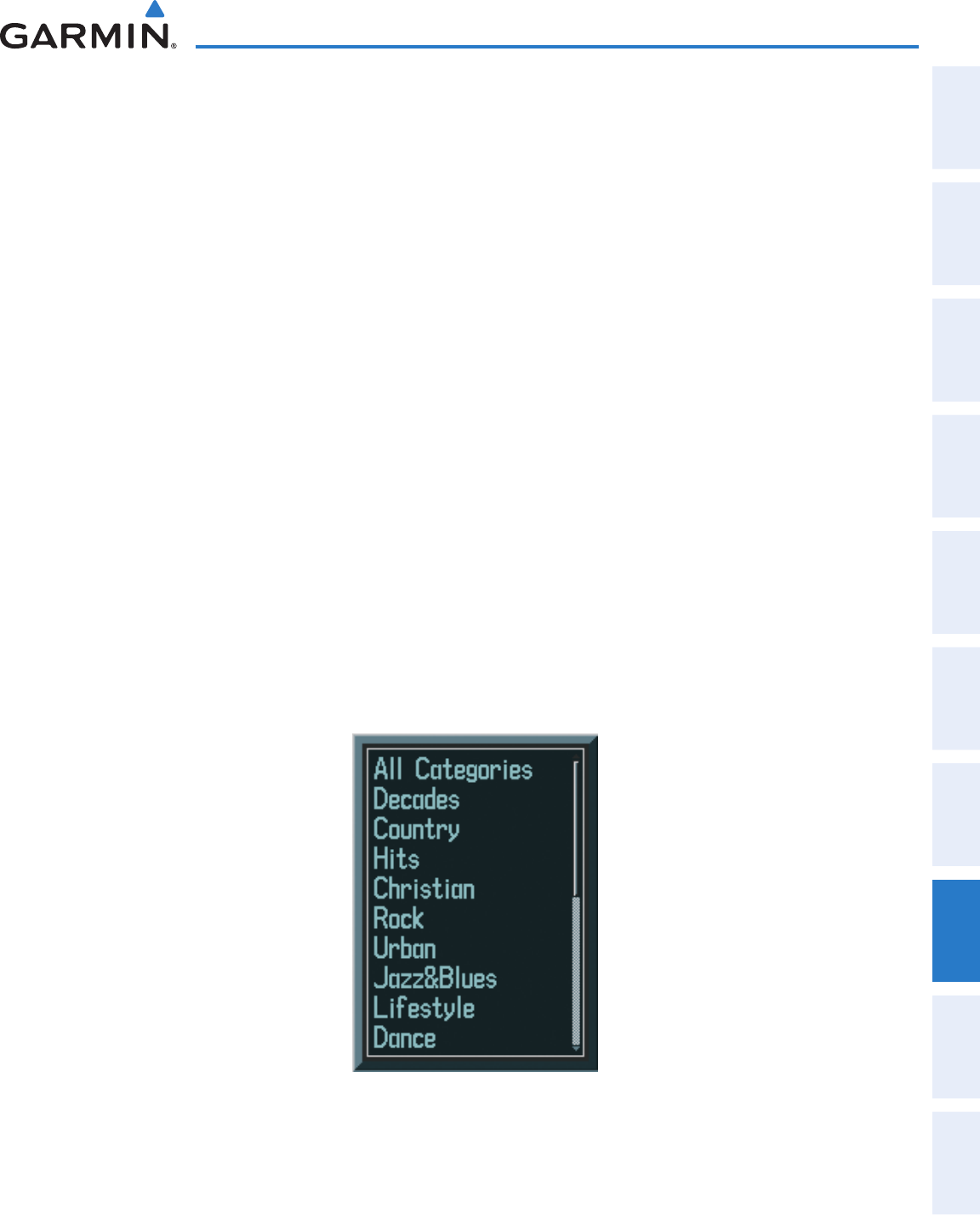
190-00592-06 Rev A
Garmin G1000 Pilot’s Guide for the Diamond DA40/40F
465
ADDITIONAL FEATURES
SYSTEM
OVERVIEW
FLIGHT
INSTRUMENTS EIS AUDIO PANEL
& CNS
FLIGHT
MANAGEMENT
HAZARD
AVOIDANCE AFCS ADDITIONAL
FEATURES APPENDICES INDEX
Or:
1) Press the
FMS
Knob to highlight the channel list and turn the large
FMS
Knob to scroll through the channels.
2) Press the ENT Key to activate the selected channel.
Selecting a channel directly:
1) While on the XM Radio Page, press the CHNL Softkey.
2) Press the DIR CH Softkey. The channel number in the Active Channel Box is highlighted.
3) Press the numbered softkeys located on the bottom of the display to directly select the desired channel
number.
4) Press the ENT Key to activate the selected channel.
CATEGORY
The Category Box of the XM Radio Page displays the currently selected category of audio. Categories of
channels such as jazz, rock, or news can be selected to list the available channels for a type of music or other
contents. One of the optional categories is PRESETS to view channels that have been programmed.
Selecting a category:
1) Press the CATGRY Softkey on the XM Radio Page.
2) Press the CAT + and CAT - Softkeys to cycle through the categories.
Or:
Turn the small
FMS
Knob to display the Categories list. Highlight the desired category with the small
FMS
Knob
and press the
ENT
Key. Selecting All Categories places all channels in the list.
Figure 8-72 Categories List
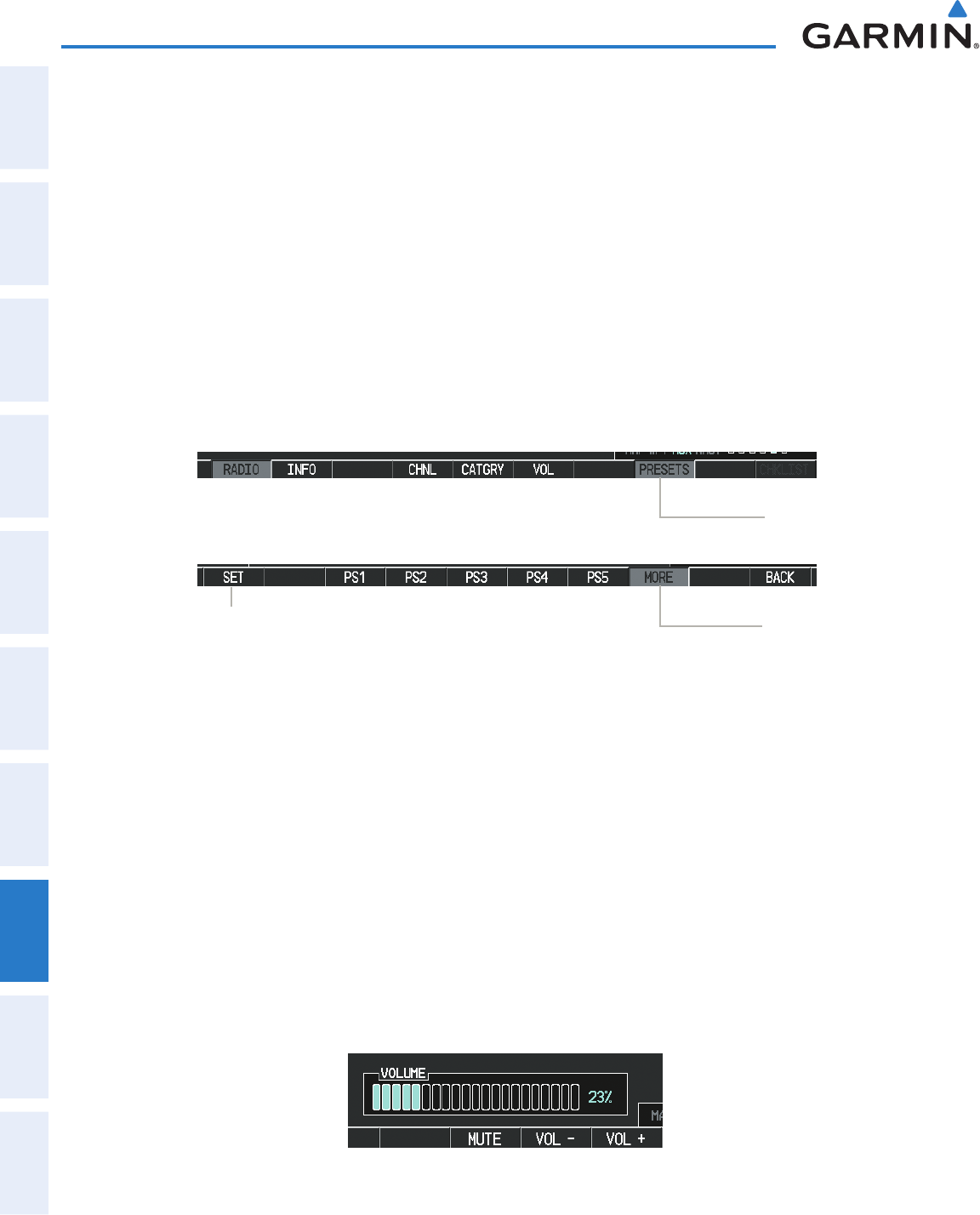
Garmin G1000 Pilot’s Guide for the Diamond DA40/40F
190-00592-06 Rev A466
ADDITIONAL FEATURES
SYSTEM
OVERVIEW
FLIGHT
INSTRUMENTS
EIS
AUDIO PANEL
& CNS
FLIGHT
MANAGEMENT
HAZARD
AVOIDANCE
AFCS
ADDITIONAL
FEATURES
APPENDICESINDEX
PRESETS
Up to 15 channels from any category can be assigned a preset number. The preset channels are selected by
pressing the PRESETS and MORE Softkeys. Then the preset channel can be selected directly and added to
the channel list for the Presets category.
Setting a preset channel number:
1) On the XM Radio Page, while listening to an Active Channel that is wanted for a preset, press the PRESETS
Softkey to access the first five preset channels (PS1 - PS5).
2) Press the MORE Softkey to access the next five channels (PS6 – PS10), and again to access the last five
channels (PS11 – PS15). Pressing the MORE Softkey repeatedly cycles through the preset channels.
3) Press any one of the (PS1 - PS15) softkeys to assign a number to the active channel.
4) Press the SET Softkey on the desired channel number to save the channel as a preset.
Figure 8-73 Accessing and Selecting XM Preset Channels
Press
PRESETS
to
Access the Preset
Channels Softkeys
Press
MORE
to Cycle
Through the Preset
Channels
Press
SET
to
Save Each
Preset Channel
Pressing the BACK Softkey, or waiting during 45 seconds of softkey inactivity, returns the system to the top
level softkeys.
VOLUME
Radio volume is shown as a percentage of full volume. Volume level is controlled by pressing the VOL
Softkey, which brings up the MUTE Softkey and the volume increase and decrease softkeys.
Adjusting the volume:
1) With the XM Radio Page displayed, press the VOL Softkey.
2) Press the VOL – Softkey to reduce volume or press the VOL + Softkey to increase volume. (Once the VOL
Softkey is pressed, the volume can also be adjusted using the small FMS Knob.)
3) Press the MUTE Softkey to mute the audio. Press the MUTE Softkey again to unmute the audio.
Figure 8-74 Volume Control
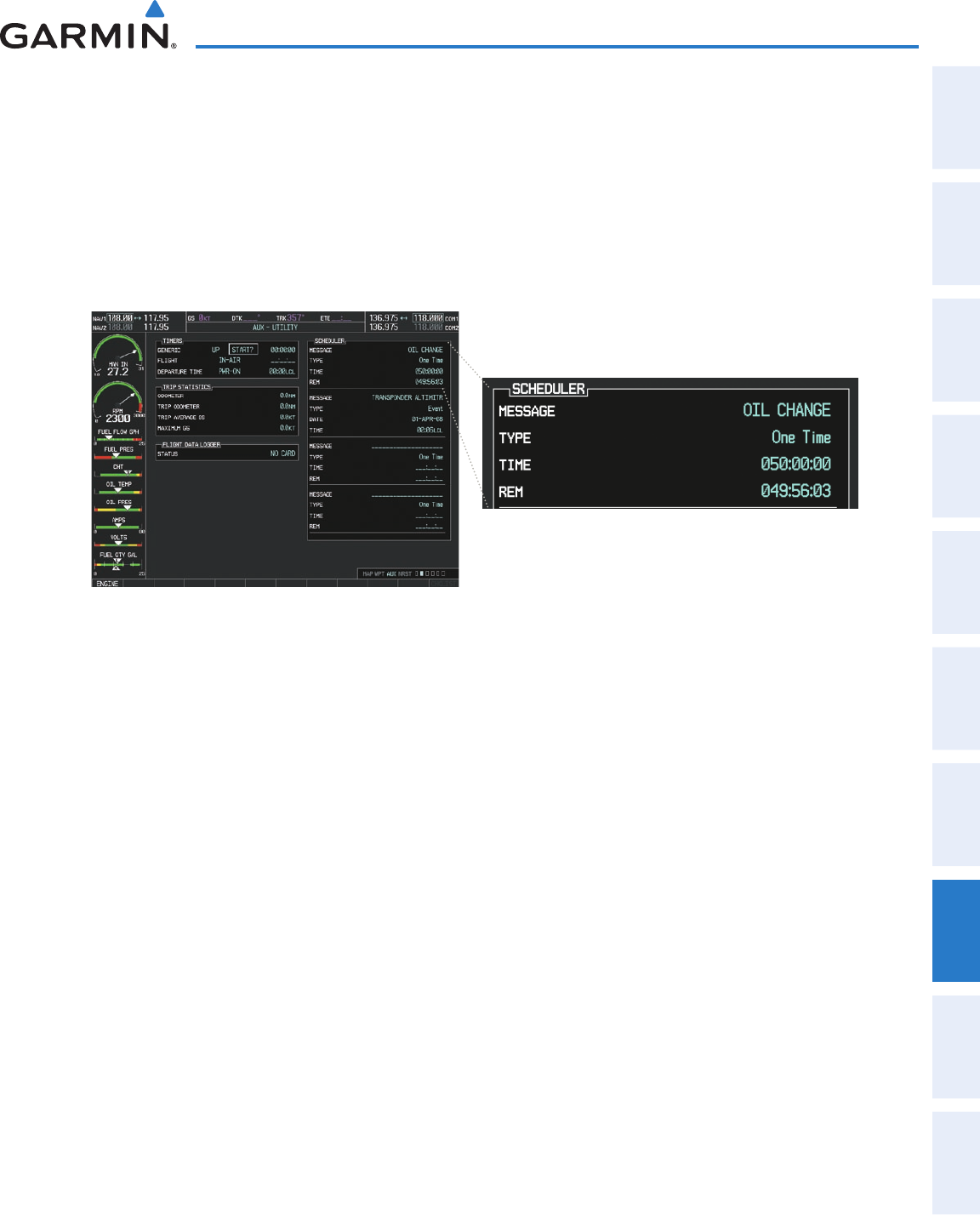
190-00592-06 Rev A
Garmin G1000 Pilot’s Guide for the Diamond DA40/40F
467
ADDITIONAL FEATURES
SYSTEM
OVERVIEW
FLIGHT
INSTRUMENTS EIS AUDIO PANEL
& CNS
FLIGHT
MANAGEMENT
HAZARD
AVOIDANCE AFCS ADDITIONAL
FEATURES APPENDICES INDEX
8.6 SCHEDULER
The Scheduler feature can be used to enter and display reminder messages (e.g., Change oil, Switch fuel tanks,
or Altimeter-Transponder Check) in the Messages Window on the PFD. Messages can be set to display based on
a specific date and time (event), once the message timer reaches zero (one-time; default setting), or recurrently
whenever the message timer reaches zero (periodic). Message timers set to periodic alerting automatically reset
to the original timer value once the message is displayed. When power is cycled, all messages are retained until
deleted, and message timer countdown is resumed.
Figure 8-75 Scheduler (Utility Page)
Entering a scheduler message:
1) Select the AUX - Utility Page.
2) Press the FMS Knob momentarily to activate the flashing cursor.
3) Turn the large FMS Knob to highlight the first empty scheduler message naming field.
4) Use the FMS Knob to enter the message text to be displayed in the Messages Window and press the
ENT
Key.
5) Press the ENT Key again or use the large FMS Knob to move the cursor to the field next to Type.
6) Turn the small FMS Knob to select the message type:
• Event—Message issued at the specied date/time
• One-time—Message issued when the message timer reaches zero (default setting)
• Periodic—Message issued each time the message timer reaches zero
7) Press the ENT Key again or use the large FMS Knob to move the cursor to the next field.
8) For periodic and one-time message, use the FMS Knob to enter the timer value (HH:MM:SS) from which to
countdown and press the ENT Key.
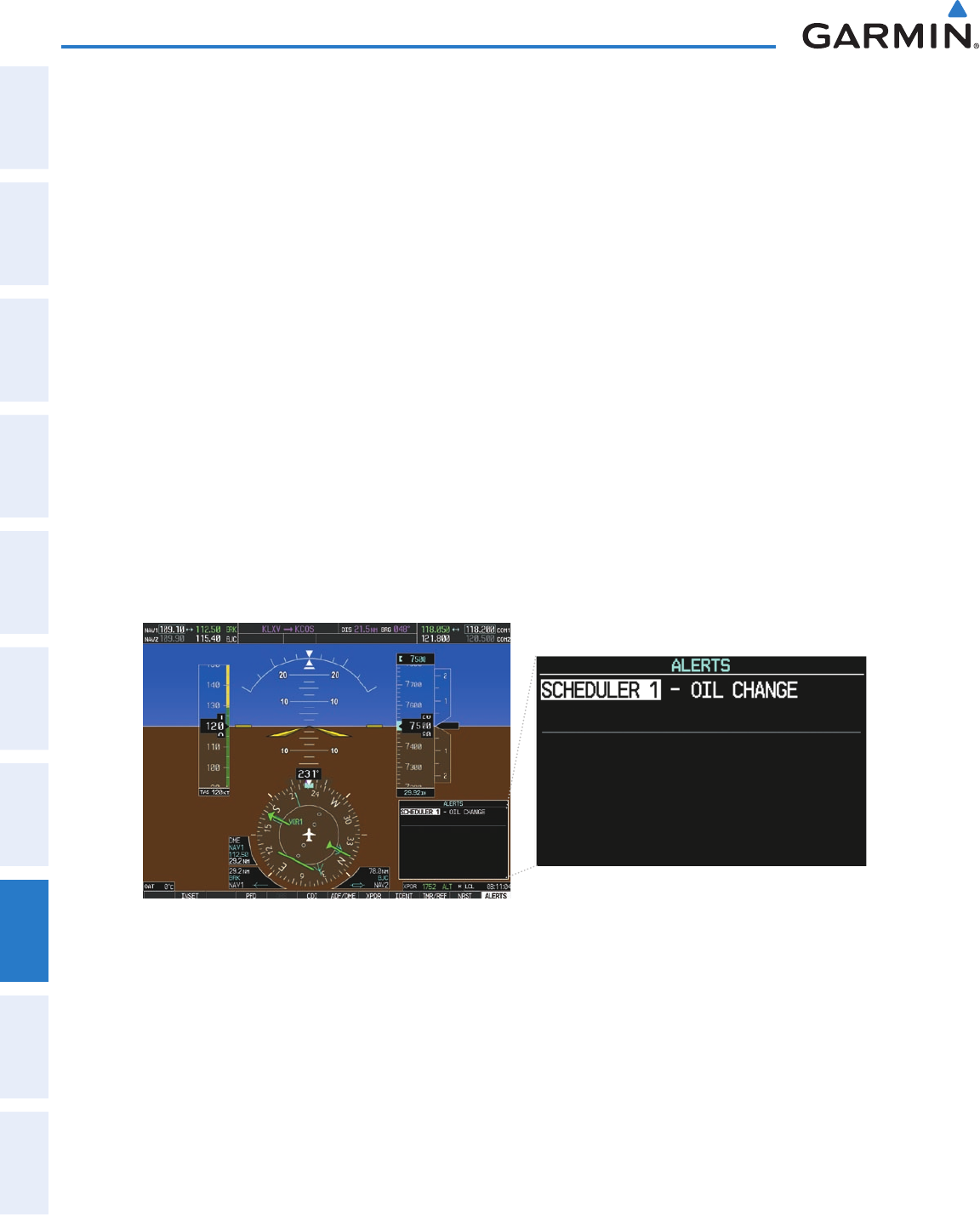
Garmin G1000 Pilot’s Guide for the Diamond DA40/40F
190-00592-06 Rev A468
ADDITIONAL FEATURES
SYSTEM
OVERVIEW
FLIGHT
INSTRUMENTS
EIS
AUDIO PANEL
& CNS
FLIGHT
MANAGEMENT
HAZARD
AVOIDANCE
AFCS
ADDITIONAL
FEATURES
APPENDICESINDEX
9) For event-based messages:
a) Use the FMS Knob to enter the desired date (DD-MM-YY) and press the ENT Key.
b) Press the ENT Key again or use the large FMS Knob to move the cursor to the next field.
c) Use the FMS Knob to enter the desired time (HH:MM) and press the ENT Key.
10) Press the ENT Key again or use the large FMS Knob to move the cursor to enter the next message.
Deleting a scheduler message:
1) Select the AUX - Utility Page.
2) Press the FMS Knob momentarily to activate the flashing cursor.
3) Turn the large FMS Knob to highlight the name field of the scheduler message to be deleted.
4) Press the CLR Key to clear the message text. If the CLR Key is pressed again, the message is restored.
5) Press the ENT Key while the message line is cleared to clear the message text.
Scheduler messages appear in the Messages Window on the PFD. When a scheduler message is waiting, the
ALERTS Softkey label changes to ADVISORY. Pressing the ADVISORY Softkey opens the Messages Window
and acknowledges the scheduler message. The softkey label reverts to ALERTS when pressed. Pressing the
ALERTS Softkey again removes the Messages Window from the display, and the scheduler message is deleted
from the message queue.
Figure 8-76 PFD Messages Window
190-00592-06 Rev A
Garmin G1000 Pilot’s Guide for the Diamond DA40/40F
469
ADDITIONAL FEATURES
SYSTEM
OVERVIEW
FLIGHT
INSTRUMENTS EIS AUDIO PANEL
& CNS
FLIGHT
MANAGEMENT
HAZARD
AVOIDANCE AFCS ADDITIONAL
FEATURES APPENDICES INDEX
8.7 ELECTRONIC CHECKLISTS
NOTE: The checklists presented here are for example only and may not reflect checklists actually available
for the Diamond DA40. This material is not intended to replace the checklist information presented in the
AFM or the Pilot Safety and Warning Supplements document.
NOTE: Garmin is not responsible for the content of checklists. Diamond DA40 checklists are created,
modified, and updated by the aircraft manufacturer.
The optional checklist functions are displayed on two levels of softkeys that are available on any MFD page.
Figure 8-77 Checklist Softkeys
CHKLIST
DCLTR
SYSTEM
MAP
The DONE Softkey label changes to UNDO
when the checklist item is already checked.
EXITDONESYSTEM EMERGCY
SHW CHRT
(Optional)
The MFD is able to display optional electronic checklists which allow a pilot to quickly find the proper
procedure on the ground and during each phase of flight. The G1000 accesses the checklists from an SD
card inserted into the bezel slot. If the SD card contains an invalid checklist file or no checklist, the Power-up
Page messages display Invalid Checklist File or Checklist File Not Present and the CHKLIST Softkey is not
available.
Accessing and navigating checklists:
1) From any page on the MFD, press the CHKLIST Softkey.
2) Turn the large FMS Knob to select the GROUP field.
3) Turn the small FMS Knob to select the desired procedure and press the ENT Key.
4) Turn the large FMS Knob to select the Checklist field.
5) Turn the FMS Knob to select the desired checklist and press the ENT Key.
6) Turn the FMS Knob to scroll through the checklist and highlight the desired checklist item. A hollow white box
is used for the checkmark.
The following colors are used for checklist items:
• Blue - Items has not been highlighted
• White - Item is highlighted for checking
• Green - Item has been checked
• Yellow - Warning notes
7) Press the ENT Key or DONE Softkey to check the highlighted checklist item. The line item turns green and a
checkmark is placed in the box next to it. The next line item is automatically highlighted for checking.
Press the CLR Key to remove a check mark from an item.
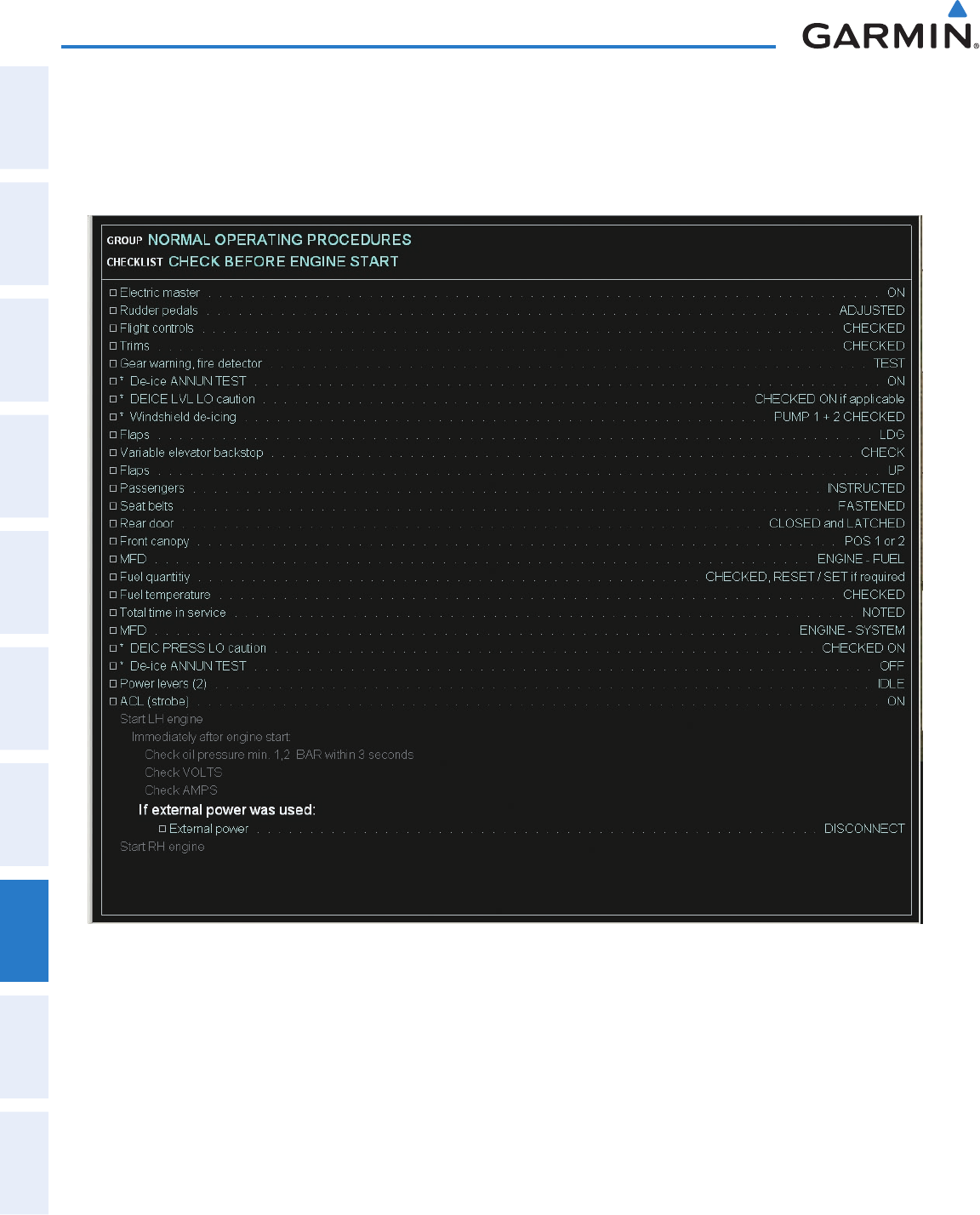
Garmin G1000 Pilot’s Guide for the Diamond DA40/40F
190-00592-06 Rev A470
ADDITIONAL FEATURES
SYSTEM
OVERVIEW
FLIGHT
INSTRUMENTS
EIS
AUDIO PANEL
& CNS
FLIGHT
MANAGEMENT
HAZARD
AVOIDANCE
AFCS
ADDITIONAL
FEATURES
APPENDICESINDEX
8) Once the last item in a checklist is checked, the next highlighted item is, Go to the next checklist? Press the ENT
Key to advance to the next checklist displayed.
9) Press the EXIT Softkey or hold down the CLR Key momentarily to exit the Checklist Page and return to the page
last viewed.
Figure 8-78 Sample Checklist
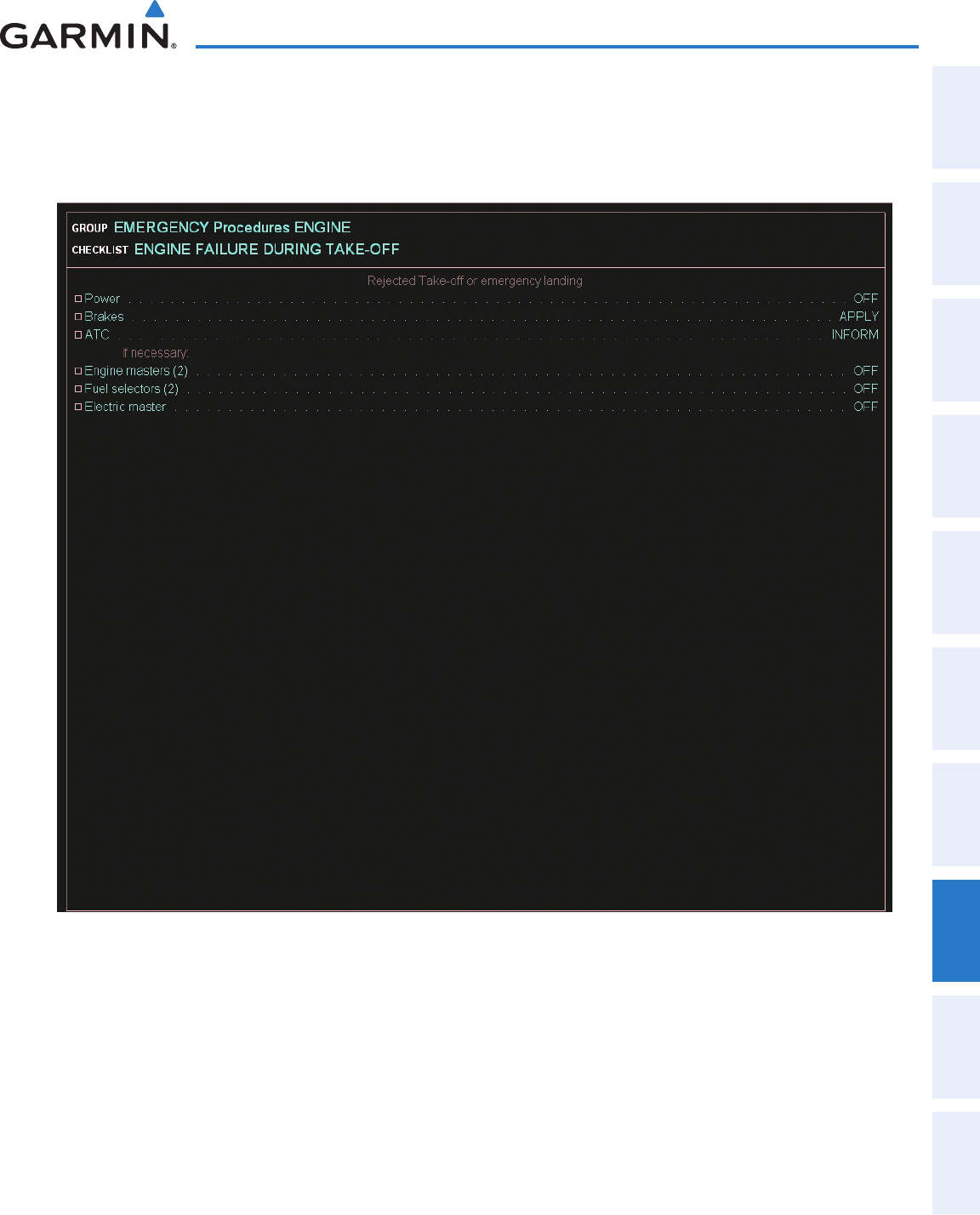
190-00592-06 Rev A
Garmin G1000 Pilot’s Guide for the Diamond DA40/40F
471
ADDITIONAL FEATURES
SYSTEM
OVERVIEW
FLIGHT
INSTRUMENTS EIS AUDIO PANEL
& CNS
FLIGHT
MANAGEMENT
HAZARD
AVOIDANCE AFCS ADDITIONAL
FEATURES APPENDICES INDEX
Immediately accessing emergency procedures:
1) From any page, press the CHKLIST Softkey.
2) Press the EMERGCY Softkey.
Figure 8-79 Emergency Checklist Page Example
Garmin G1000 Pilot’s Guide for the Diamond DA40/40F
190-00592-06 Rev A472
ADDITIONAL FEATURES
SYSTEM
OVERVIEW
FLIGHT
INSTRUMENTS
EIS
AUDIO PANEL
& CNS
FLIGHT
MANAGEMENT
HAZARD
AVOIDANCE
AFCS
ADDITIONAL
FEATURES
APPENDICESINDEX
8.8 FLIGHT DATA LOGGING
The G1000 has the ability to record certain flight and engine parameters on an SD card with a maximum size of
four-gigabytes. A two-gigabyte SD card containing no other data, is capable of storing 2,000 hours of data. The
following data will automatically be recorded once every second as long as the system is operating and an SD card
resides in the top card slot of the MFD.
•ActiveWaypoint
•AttitudePitchAngle
•AttitudeRollAngle
•Autopilot(AP)Engaged
•BaroAdjustment/Correction
•Baro-CorrectedAltitude
•BatteryAMP
•BatteryVolts
•BearingtoNextWaypoint
•CarburetorTemperature
•COM1Frequency
•COM2Frequency
•CurrentPosition
•Cylinderheadtemperature,cylinders1-4
•DistancetoNextWaypoint
•EngineRPM
•ExhaustGasTemperature,cylinders1-4
•FuelFlow
•FuelPressure
•FuelQuanityLeft
•FuelQuanityRight
•GFC700PitchCommand
•GFC700PitchMode
•GFC700RollCommand
•GFC700RollMode
•GPSAltitude
•GPSAltitudeRelativetoMeanSeaLevel
•GPSFix
•GPSHorizontalAlertLimit
•GPSHorizontalProtectionLevel
•GPSVertical Alert Limit
•GPSVerticalSpeed
•GroundSpeed
•GroundTrackMagnetic
•HorizontalCDI
•HSISource
•IndicatedAirSpeed
•Lateral/Y/RightAcceleration
•Local24hrTime
•LocalDate
•MagneticHeading
•MagneticVariation
•ManifoldPressure
•NAV1Frequency
•NAV2Frequency
•Normal/Z/UpAcceleration
•OilPressure
•OilTemperature
•OutsideAirTemperature
•SelectedCourse
•TrueAirspeed
•UTCTime
•VerticalCDI
•VerticalSpeed
•WAASGPSHorizontal Protection Level
•WAASGPSVertical Protection Level
•WindDirection
•WindSpeed

190-00592-06 Rev A
Garmin G1000 Pilot’s Guide for the Diamond DA40/40F
473
ADDITIONAL FEATURES
SYSTEM
OVERVIEW
FLIGHT
INSTRUMENTS EIS AUDIO PANEL
& CNS
FLIGHT
MANAGEMENT
HAZARD
AVOIDANCE AFCS ADDITIONAL
FEATURES APPENDICES INDEX
The file containing the recorded data will appear in the format shown in Figure 8-80. This file can be imported
into most computer spreadsheet applications.
log_090210_104506_KIXD.csv
Local Date
YYMMDD Local 24hr Time
HHMMSS
Nearest Airport
(A blank will be
inserted if no
airport is found)
Figure 8-80 Log File Format
Data logging status can be monitored on the AUX-UTILITY Page.
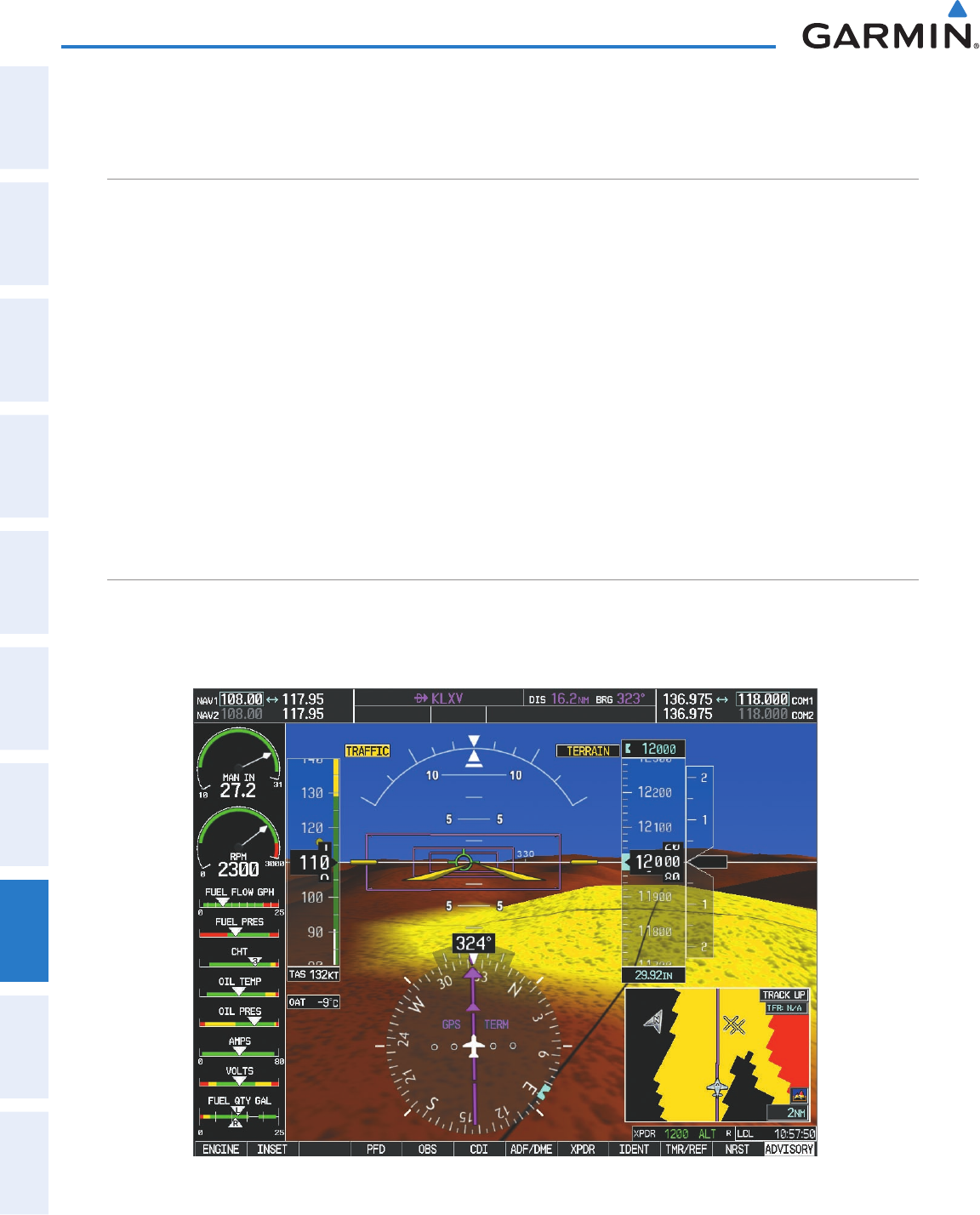
Garmin G1000 Pilot’s Guide for the Diamond DA40/40F
190-00592-06 Rev A474
ADDITIONAL FEATURES
SYSTEM
OVERVIEW
FLIGHT
INSTRUMENTS
EIS
AUDIO PANEL
& CNS
FLIGHT
MANAGEMENT
HAZARD
AVOIDANCE
AFCS
ADDITIONAL
FEATURES
APPENDICESINDEX
8.9 ABNORMAL OPERATION
SVS TROUBLESHOOTING
SVS is intended to be used with traditional attitude, heading, obstacle, terrain, and traffic inputs. SVS is
disabled when valid attitude or heading data is not available for the display. In case of invalid SVS data, the PFD
display reverts to the standard blue-over-brown attitude display.
SVS becomes disabled without the following data resources:
•Attitudedata
•Headingdata
•GPSpositiondata
•9Arc-secondTerraindata
•Obstacledata
•TAWSfunctionisnotavailable,intestmode,orfailed
•Thepositionoftheaircraftexceedstherangeoftheterraindatabase.
REVERSIONARY MODE
SVS can be displayed on the Multifunction Display (MFD) in Reversionary Mode. If it is enabled when switching
to Reversionary Mode, SVS will take up to 30 seconds to be displayed. The standard, non-SVS PFD display will
be shown in the interim.
Figure 8-81 SVS Reversionary Mode
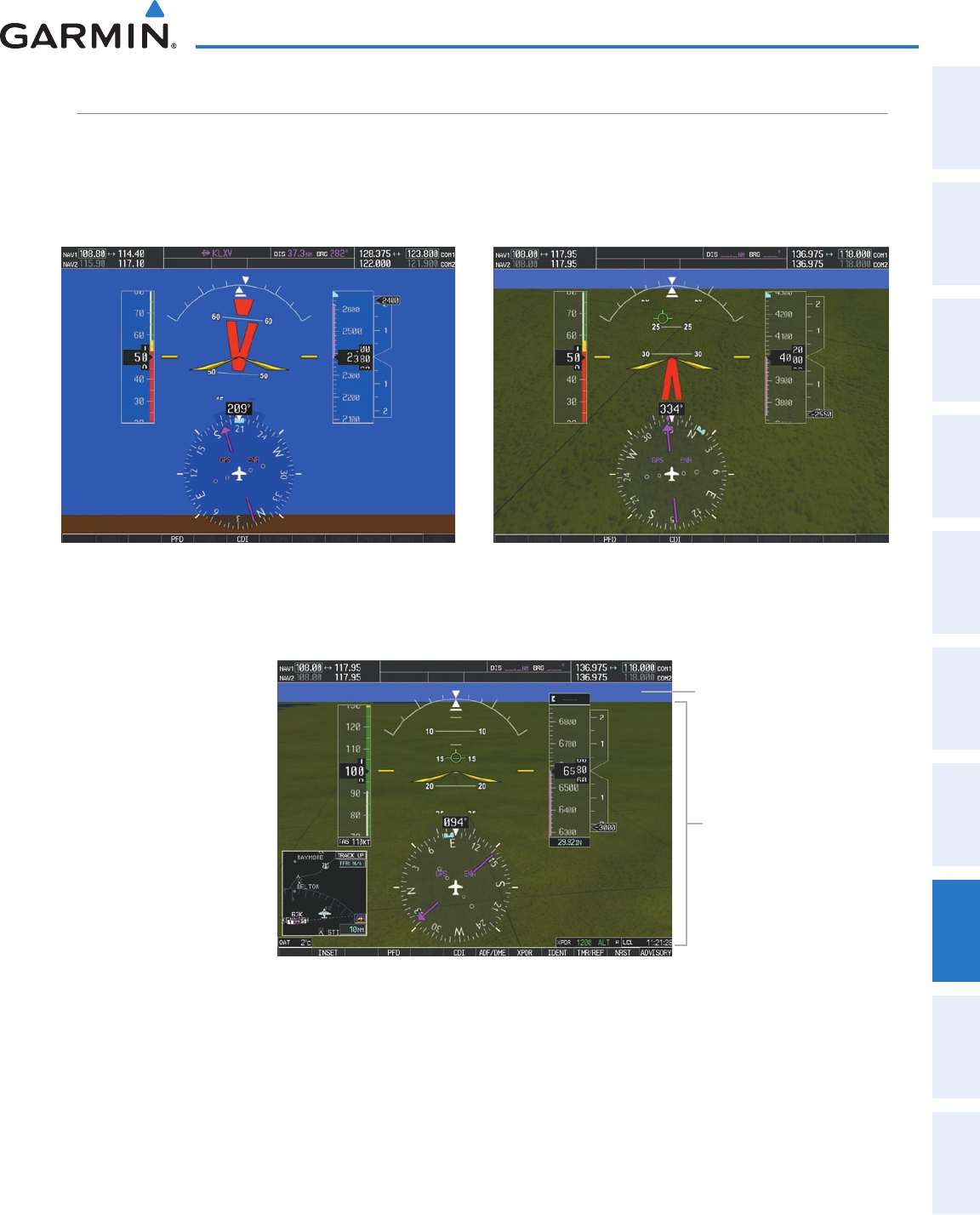
190-00592-06 Rev A
Garmin G1000 Pilot’s Guide for the Diamond DA40/40F
475
ADDITIONAL FEATURES
SYSTEM
OVERVIEW
FLIGHT
INSTRUMENTS EIS AUDIO PANEL
& CNS
FLIGHT
MANAGEMENT
HAZARD
AVOIDANCE AFCS ADDITIONAL
FEATURES APPENDICES INDEX
UNUSUAL ATTITUDES
Unusual attitudes are displayed with red chevrons overlaid on the display indicating the direction to fly to
correct the unusual attitude condition. The display shows either a brown or blue colored bar at the top or
bottom of the screen to represent earth or sky. This is intended to prevent losing sight of the horizon during
extreme pitch attitudes.
Figure 8-82 Unusual Attitude Display
The blue colored bar is also displayed when terrain gradient is great enough to completely fill the display.
Blue Band
Figure 8-83 Blue Sky Bar with Full Display Terrain
Terrain
Completely
Fills Display
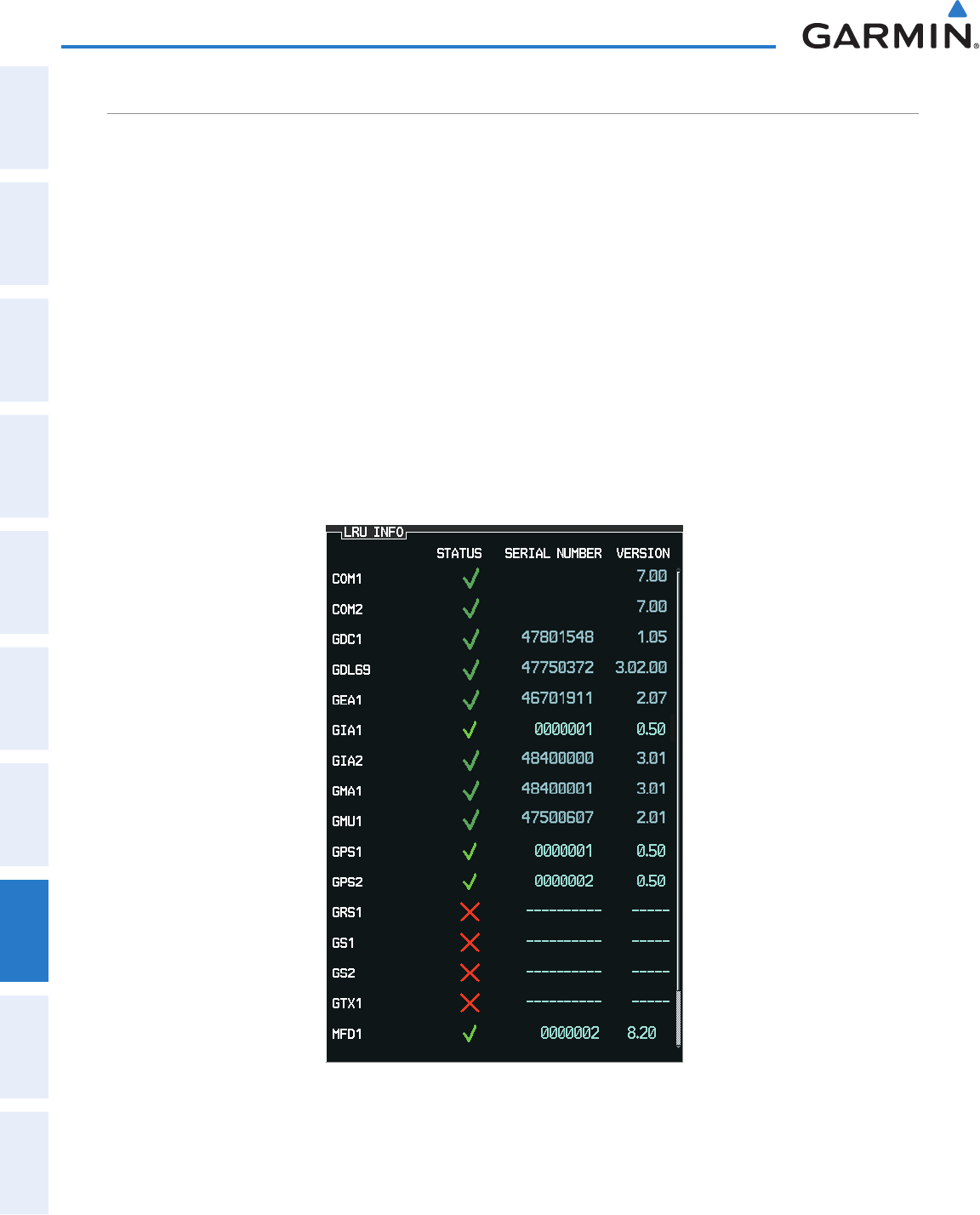
Garmin G1000 Pilot’s Guide for the Diamond DA40/40F
190-00592-06 Rev A476
ADDITIONAL FEATURES
SYSTEM
OVERVIEW
FLIGHT
INSTRUMENTS
EIS
AUDIO PANEL
& CNS
FLIGHT
MANAGEMENT
HAZARD
AVOIDANCE
AFCS
ADDITIONAL
FEATURES
APPENDICESINDEX
GDL 69/69A DATA LINK RECEIVER TROUBLESHOOTING
Some quick troubleshooting steps listed below can be performed to find the possible cause of a failure.
•Ensuretheowner/operatoroftheaircraftinwhichtheDataLinkReceiverisinstalledhassubscribedtoXM
•EnsuretheXM subscription has been activated
•PerformaquickcheckofthecircuitbreakerstoensurethatpowerisappliedtotheDataLinkReceiver
•EnsurethatnothingispluggedintotheAuxAudioInjackbecausethiswouldpreventXMradiofrombeing
heard
For troubleshooting purposes, check the LRU Information Box on the AUX - System Status Page for Data Link
Receiver (GDL 69/69A) status, serial number, and software version number. If a failure has been detected in the
GDL 69/69A the status is marked with a red X.
Selecting the System Status Page:
1) Turn the large FMS Knob to select the AUX Page Group.
2) Turn the small FMS Knob to select the System Status Page (the last page in the AUX Page Group).
Figure 8-84 LRU Information Window on System Status Page
190-00592-06 Rev A
Garmin G1000 Pilot’s Guide for the Diamond DA40/40F
477
ADDITIONAL FEATURES
SYSTEM
OVERVIEW
FLIGHT
INSTRUMENTS EIS AUDIO PANEL
& CNS
FLIGHT
MANAGEMENT
HAZARD
AVOIDANCE AFCS ADDITIONAL
FEATURES APPENDICES INDEX
If a failure still exists, the following messages may provide insight as to the possible problem:
Message Message Location Description
CHECK ANTENNA XM Radio Page - active channel field Data Link Receiver antenna error; service required
UPDATING XM Radio Page - active channel field Data Link Receiver updating encryption code
NO SIGNAL XM Radio Page - active channel field
Weather Datalink Page - center of page Loss of signal; signal strength too low for receiver
LOADING XM Radio Page - active channel field Acquiring channel audio or information
OFF AIR XM Radio Page - active channel field Channel not in service
--- XM Radio Page - active channel field Missing channel information
WEATHER DATA LINK FAILURE Weather Datalink Page - center of page No communication from Data Link Receiver
within last 5 minutes
ACTIVATION REQUIRED Weather Datalink Page - center of page XM subscription is not activated
Table 8-3 GDL 69/69A Data Link Receiver Error Messages
Garmin G1000 Pilot’s Guide for the Diamond DA40/40F
190-00592-06 Rev A478
ADDITIONAL FEATURES
SYSTEM
OVERVIEW
FLIGHT
INSTRUMENTS
EIS
AUDIO PANEL
& CNS
FLIGHT
MANAGEMENT
HAZARD
AVOIDANCE
AFCS
ADDITIONAL
FEATURES
APPENDICESINDEX
Bl a n k Pa g e
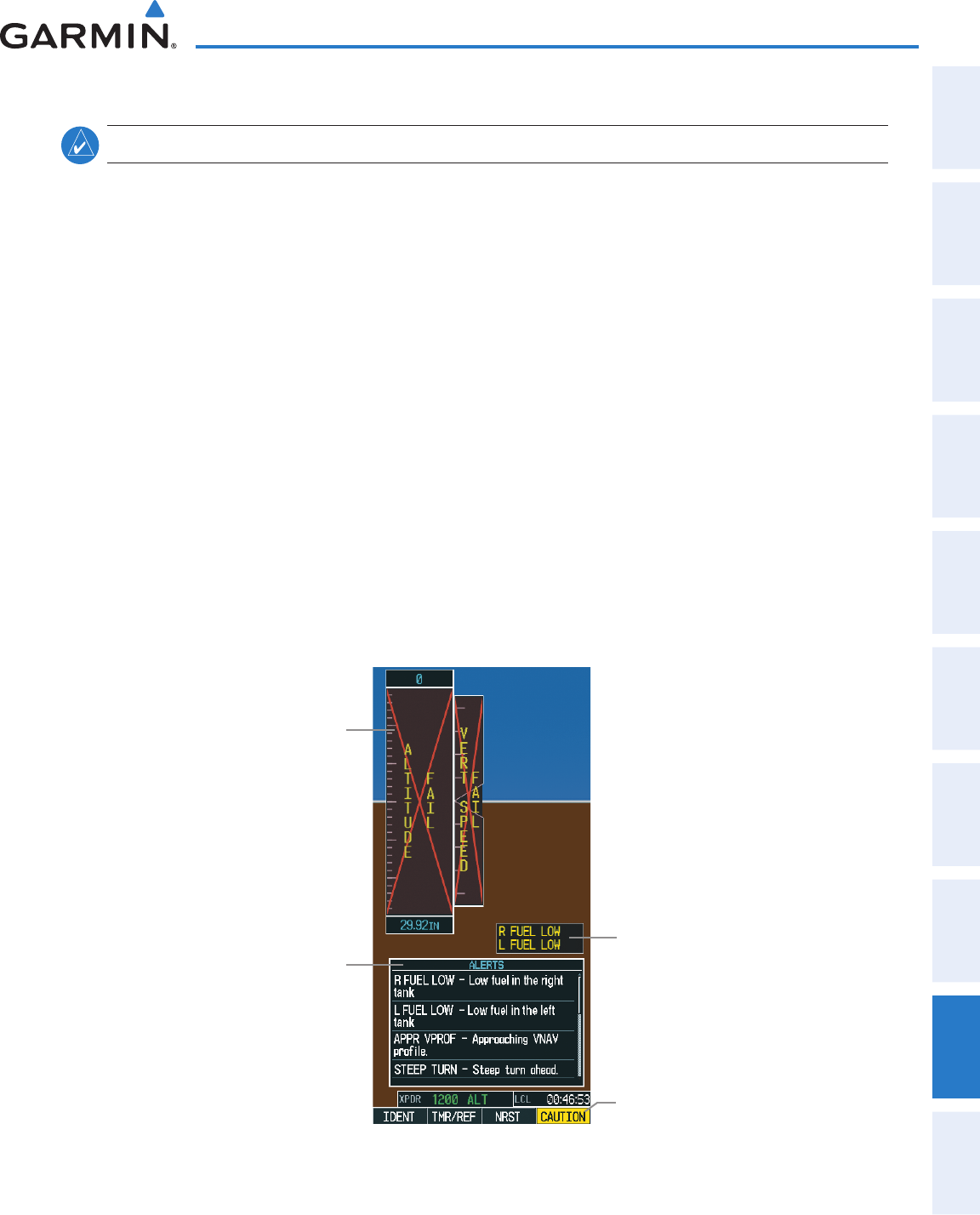
190-00592-06 Rev. A
Garmin G1000 Pilot’s Guide for the Diamond DA40/40F
SYSTEM
OVERVIEW
FLIGHT
INSTRUMENTS EIS AUDIO PANEL
& CNS
FLIGHT
MANAGEMENT
HAZARD
AVOIDANCE AFCS ADDITIONAL
FEATURES APPENDICES INDEX
479
APPENDIX A
ANNUNCIATIONS AND ALERTS
NOTE:
The Aircraft Flight Manual (AFM) supersedes information found in this document.
The G1000 Alerting System conveys alerts using the following:
•Annunciation Window: The Annunciation Window displays abbreviated annunciation text. Text color is
based on alert levels described in the following section. The Annunciation Window is located to the right
of the Altimeter and Vertical Speed Indicator. All aircraft annunciations can be displayed simultaneously
in the Annunciation Window. A white horizontal line separates annunciations that are acknowledged from
annunciations that are not yet acknowledged. Higher priority annunciations are displayed towards the top of
the window.
•Alerts Window: The Alerts Window displays text messages for up to 64 prioritized alert messages. Pressing
the ALERTS Softkey displays the Alerts Window. Pressing the ALERTS Softkey a second time removes the
Alerts Window from the display. When the Alerts Window is displayed, the FMS Knob can be used to scroll
through the alert message list.
•Softkey Annunciation: During certain alerts, the ALERTS Softkey may appear as a flashing annunciation
to accompany an alert. The ALERTS Softkey assumes a new label consistent with the alert level (WARNING,
CAUTION, or ADVISORY). By selecting the softkey when flashing an annunciation, the alert is acknowledged.
The softkey label then returns to ALERTS. If alerts are still present, the ALERTS label is displayed in white
with black text. Selecting the ALERTS Softkey a second time views the alert text messages.
•System Annunciations: Typically, a large red ‘X’ appears over instruments whose information is supplied by
a failed Line Replaceable Unit (LRU). See the G1000 System Annunciations Section for more information.
System
Annunciation
(Red ‘X’)
Alerts
Window
Annunciation
Window
Softkey
Annunciation
Figure A-1 G1000 Alerting System
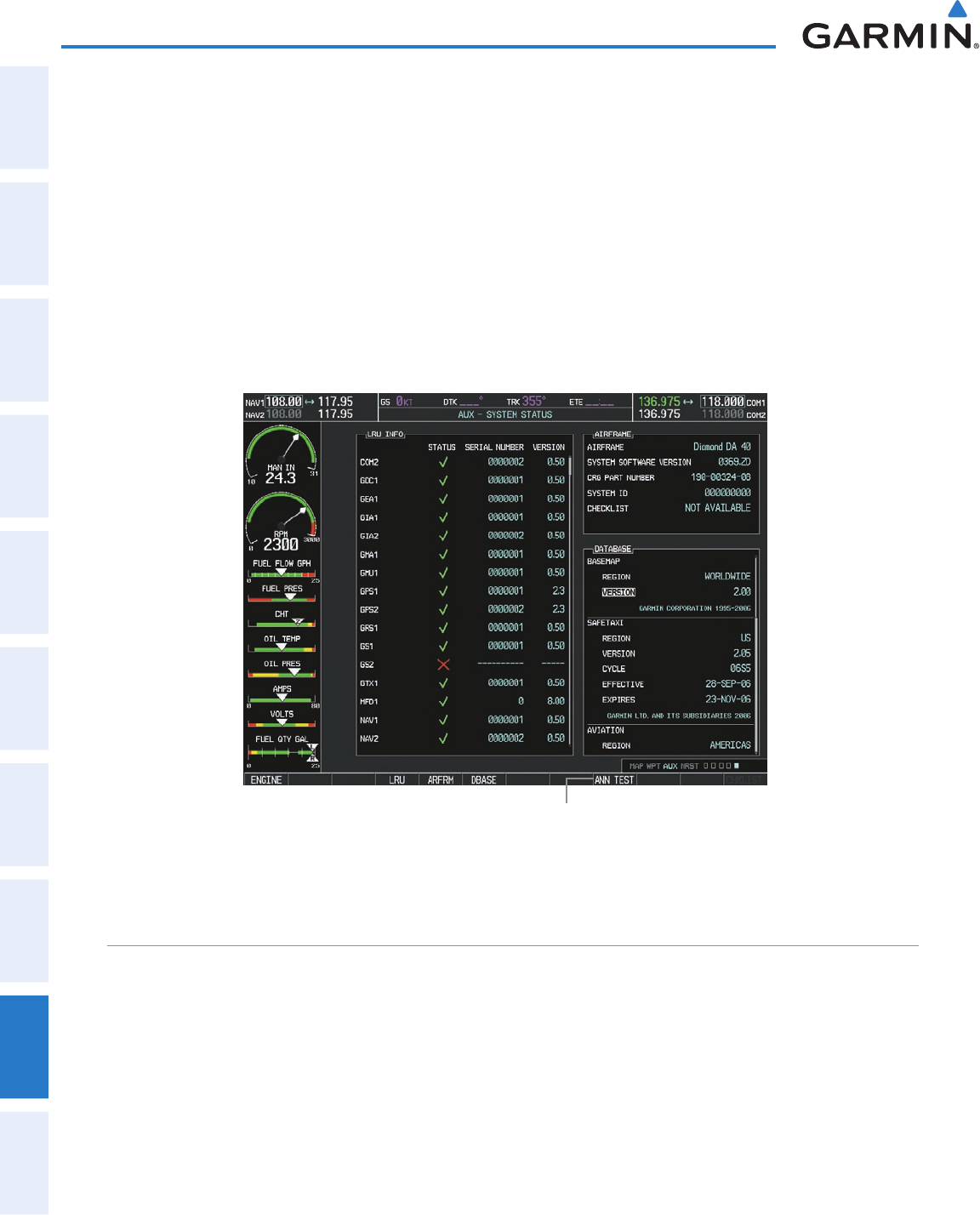
Garmin G1000 Pilot’s Guide for the Diamond DA40/40F
190-00592-06 Rev. A
SYSTEM
OVERVIEW
FLIGHT
INSTRUMENTS
EIS
AUDIO PANEL
& CNS
FLIGHT
MANAGEMENT
HAZARD
AVOIDANCE
AFCS
ADDITIONAL
FEATURES
APPENDICESINDEX
480
APPENDIX A
•Audio Alerting System: The G1000 System issues audio alert tones when specific system conditions are met.
See the Alert Level Definitions Section for more information. The annunciation tone may be tested from the
AUX - System Status Page.
Testing the system annunciation tone:
1) Use the FMS Knob to select the AUX - System Status Page.
2) Select the ANN TEST Softkey.
Or:
a) Press the MENU Key.
b) Highlight ‘Enable Annunciator Test Mode’ and press the ENT Key.
Figure A-2 Annunciation Tone Testing
(AUX-System Status Page)
Press to Test Annunciation Tone
ALERT LEVEL DEFINITIONS
The G1000 Alerting System, as installed in Diamond DA40/40F aircraft, uses three alert levels.
•WARNING: This level of alert requires immediate attention.
Warning alert text is shown in red in the Annunciation Window and is accompanied by a continuous chime
and a flashing ‘WARNING’ Softkey annunciation. Pressing the WARNING Softkey acknowledges the presence
of the warning alert and stops the aural chime.
•CAUTION: This level of alert indicates the existence of abnormal conditions on the aircraft that may require
intervention.
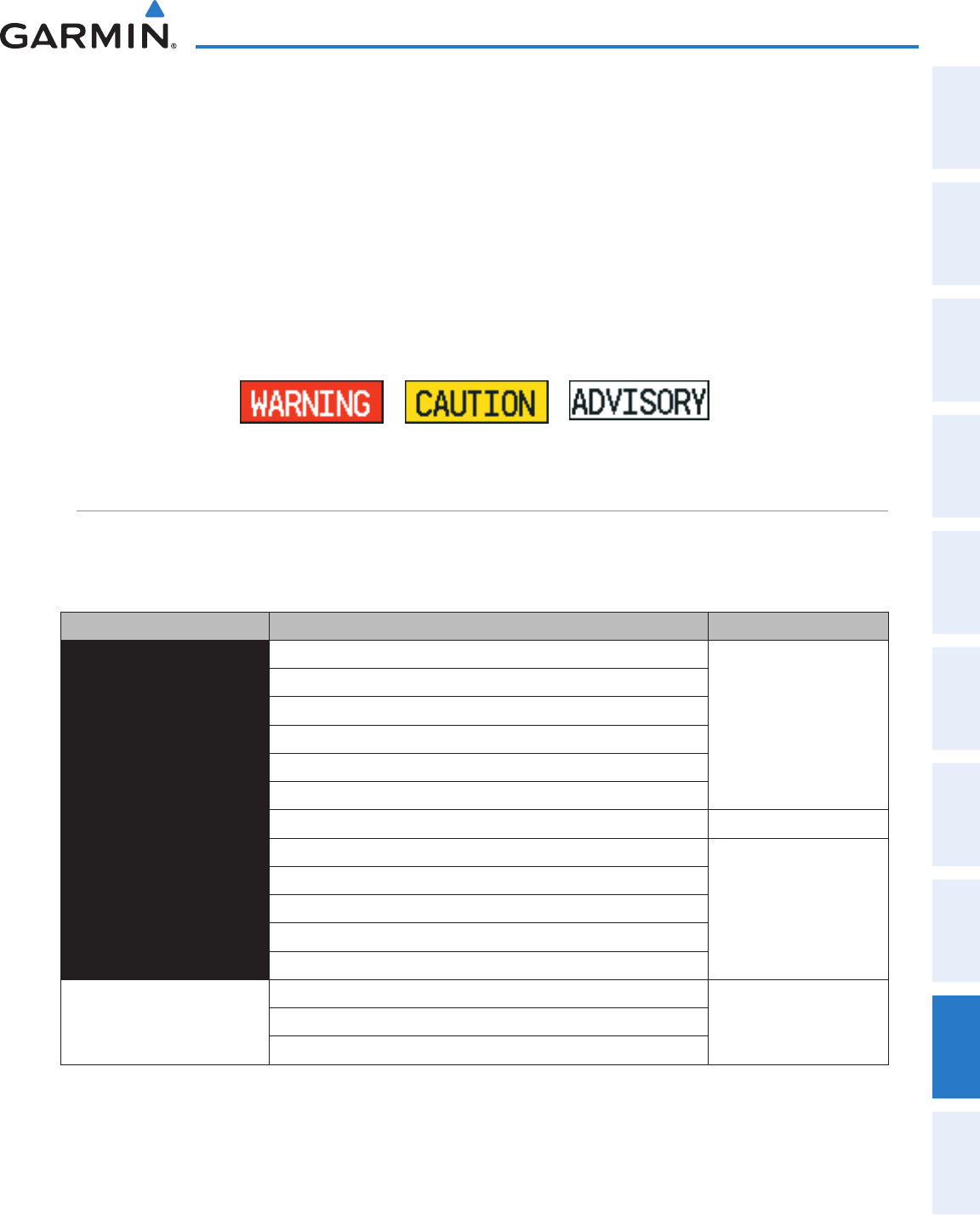
190-00592-06 Rev. A
Garmin G1000 Pilot’s Guide for the Diamond DA40/40F
SYSTEM
OVERVIEW
FLIGHT
INSTRUMENTS EIS AUDIO PANEL
& CNS
FLIGHT
MANAGEMENT
HAZARD
AVOIDANCE AFCS ADDITIONAL
FEATURES APPENDICES INDEX
481
APPENDIX A
Caution alert text is shown in yellow in the Annunciation Window and is accompanied by a single chime
and a flashing ‘CAUTION’ Softkey annunciation. Pressing the CAUTION Softkey acknowledges the presence
of the caution alert.
•ANNUNCIATION OR MESSAGE ADVISORY: This level of alert provides general information.
Annunciation alert text is shown in white in the Annunciation Window; no aural tone is generated. An
annunciation alert is accompanied by a flashing ADVISORY Softkey annunciation. Pressing the ADVISORY
Softkey acknowledges the presence of the annunciation alert.
Message advisory alerts do not issue annunciations in the Annunciation Window. Instead, message advisory
alerts only issue a flashing ‘ADVISORY’ Softkey annunciation. Selecting the ADVISORY Softkey acknowledges
the presence of the message advisory alert and displays the alert text message in the Alerts Window.
Figure A-3 Softkey Annunciation (ALERTS Softkey Labels)
AIRCRAFT ALERTS
The following alerts are configured specifically for the Diamond DA40/40F. Red annunciation window text
signifies warnings and yellow, cautions. See the Aircraft Flight Manual Supplement (AFMS) for recommended
pilot actions.
Annunciation Window Text Alerts Window Message Audio Alert
OIL PRES LO Oil pressure is below 25 psi.
Continuous Aural Tone
FUEL PRES LO* Fuel pressure is below 14 psi. (1.0 psi on DA40F)
FUEL PRES HI* Fuel pressure is greater than 35 psi. (8 psi on DA40F)
ALTERNATOR Alternator failed. Battery is only elec source.
STARTER ENGD Starter is engaged.
DOOR OPEN Canopy and/or rear door is not closed and locked.
TRIM FAIL** Autopilot automatic trim has failed. None
L FUEL LOW Left fuel quantity is less than 3 gallons.
Single Aural Tone
R FUEL LOW Right fuel quantity is less than 3 gallons
LOW VOLTS On-board voltage is below 24 V.
PITOT FAIL Pitot heat is inoperative.
PITOT OFF Pitot heat is off.
None
PFD FAN FAIL – The cooling fan for the PFD is inoperative.
NoneMFD FAN FAIL – The cooling fan for the MFD is inoperative.
GIA FAN FAIL – The cooling fan for the GIAs is inoperative.
* Values differ for the DA40F; refer to the Aircraft Flight Manual Supplement (AFMS) for more information.
** KAP 140 installations only.
Garmin G1000 Pilot’s Guide for the Diamond DA40/40F
190-00592-06 Rev. A
SYSTEM
OVERVIEW
FLIGHT
INSTRUMENTS
EIS
AUDIO PANEL
& CNS
FLIGHT
MANAGEMENT
HAZARD
AVOIDANCE
AFCS
ADDITIONAL
FEATURES
APPENDICESINDEX
482
APPENDIX A
VOICE ALERTS
The following audio alerts are announced by the system using a voice of male or female gender. If the
optional Terrain Awareness and Warning System is installed, voice alerts are also generated (refer to the TAWS
Alerts section).
Voice Alert Alert Trigger
“Minimums, Minimums”
Issued when the aircraft transitions through the minimum descent altitude/decision height (MDA/DH)
“Vertical Track” Aircraft is one minute from Top of Descent - issued only when vertical navigation is enabled
“Traffic” TIS voice alert - issued when a Traffic Advisory (TA) is issued
“Traffic Not Available” TIS voice alert - issued when the TIStraffic system fails or cannot communicate
“Traffic, Traffic” TAS voice alert - issued when a Traffic Advisory (TA) is issued
“Traffic Advisory System
Test Passed”
TAS voice alert - issued when the TAS passes a pilot-initiated self test
“Traffic Advisory System
Test Failed”
TAS voice alert - issued when the TAS fails a pilot-initiated self test
Selecting the audio alert voice:
1) Use the FMS Knob to select the AUX - System Setup Page.
2) Press the FMS Knob to activate the cursor.
3) Turn the large FMS Knob to highlight the voice in the Audio Alert Box.
4) Turn the small FMS Knob to select the desired voice, press the ENT Key.
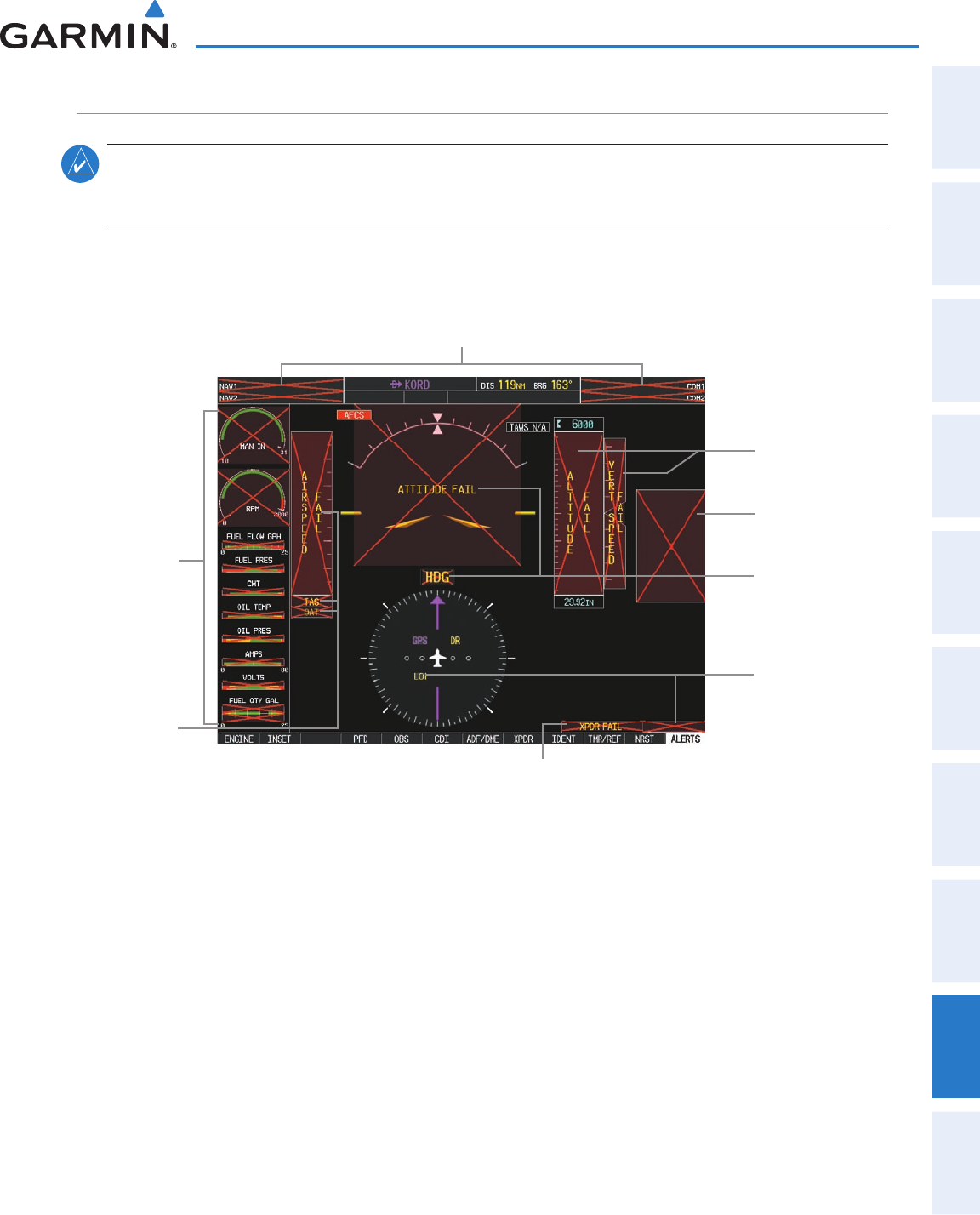
190-00592-06 Rev. A
Garmin G1000 Pilot’s Guide for the Diamond DA40/40F
SYSTEM
OVERVIEW
FLIGHT
INSTRUMENTS EIS AUDIO PANEL
& CNS
FLIGHT
MANAGEMENT
HAZARD
AVOIDANCE AFCS ADDITIONAL
FEATURES APPENDICES INDEX
483
APPENDIX A
G1000 SYSTEM ANNUNCIATIONS
NOTE: Upon power-up, certain windows remain invalid as G1000 equipment begins to initialize. All windows
should be operational within one minute of power-up. If any window continues to remain flagged, the
G1000 System should be serviced by a Garmin-authorized repair facility.
When an LRU or an LRU function fails, a large red ‘X’ is typically displayed on windows associated with
the failed data (refer to Figure B-1 for all possible flags and the responsible LRUs). Refer to the Aircraft Flight
Manual (AFM) for additional information regarding pilot responses to these annunciations.
GIA 63/63W
Integrated
Avionics Units
GRS 77 AHRS
OR
GMU 44
Magnetometer
GDC 74A
Air Data
Computer
GEA 71
Engine
Airframe Unit
OR
GIA 63/63W
Integrated
Avionics Unit
GDC 74A
Air Data
Computer
Figure A-4 G1000 System Failure Annunciations
GTX 33 Transponder OR
GIA 63/63W Integrated Avionics Units
GIA 63/63W Integrated Avionics Units
Database
Mismatch in
PFD and MFD
The status of detected LRUs can be checked on the AUX - System Status Page (Figure A-2). Active LRUs
are indicated by green check marks; failed, by red ‘X’s. Failed LRUs should be noted and a service center or
Garmin-authorized dealer informed.
Viewing LRU information:
1) Use the FMS Knob to select the AUX - System Status Page.
2) To place the cursor in the ‘LRU Info’ Box,
a) Select the LRU Softkey.
Or:
a) Press the MENU Key.
b) With ‘Select LRU Window’ highlighted, press the ENT Key.
3) Use the FMS Knob to scroll through the box to view LRU status information.
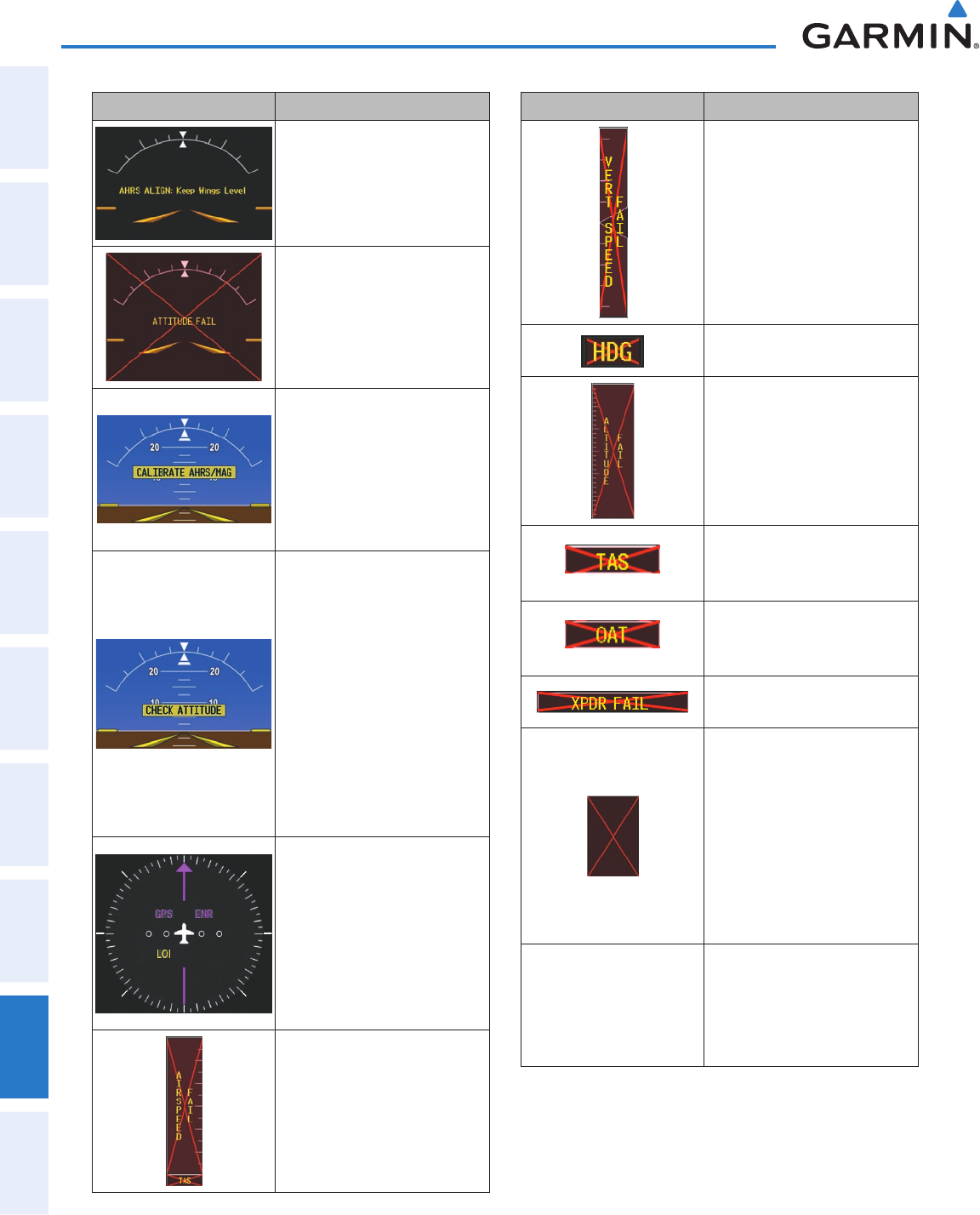
Garmin G1000 Pilot’s Guide for the Diamond DA40/40F
190-00592-06 Rev. A
SYSTEM
OVERVIEW
FLIGHT
INSTRUMENTS
EIS
AUDIO PANEL
& CNS
FLIGHT
MANAGEMENT
HAZARD
AVOIDANCE
AFCS
ADDITIONAL
FEATURES
APPENDICESINDEX
484
APPENDIX A
System Annunciation Comment
Attitude and Heading
Reference System is aligning.
Display system is not receiving
attitude information from the
AHRS.
AHRS calibration incomplete or
configuration module failure.
This annunciation is seen only
when the autopilot is engaged.
The annunciation indicates an
AHRS monitor has detected
an abnormal flight parameter,
possibly caused by strong
turbulence. In this case, the
situation should correct itself
within a few seconds. If there
is an actual failure, a red “X”
soon appears over the Attitude
Indicator.
GPS information is either
not present or is invalid for
navigation use. Note that
AHRS utilizes GPS inputs
during normal operation.
AHRS operation may be
degraded if GPS signals are not
present (see AFM).
Display system is not receiving
airspeed input from air data
computer.
System Annunciation Comment
Display system is not receiving
vertical speed input from the
air data computer.
Display system is not receiving
valid heading input from AHRS.
Display system is not receiving
altitude input from the air data
computer.
Display system is not receiving
valid true airspeed information
from air data computer.
Display system is not receiving
valid OAT information from air
data computer.
Display system is not receiving
valid transponder information.
Different versions of GDU
software are installed in the
PFD and MFD. This can also
indicate different versions of the
navigation database installed
in the PFD and MFD. In some
circumstances, a cross-talk error
between the PFD and MFD can
cause this annunciation.
Other Various Red X
Indications
A red ‘X’ through any other
display field (such as engine
instrumentation fields)
indicates that the field is not
receiving valid data.
190-00592-06 Rev. A
Garmin G1000 Pilot’s Guide for the Diamond DA40/40F
SYSTEM
OVERVIEW
FLIGHT
INSTRUMENTS EIS AUDIO PANEL
& CNS
FLIGHT
MANAGEMENT
HAZARD
AVOIDANCE AFCS ADDITIONAL
FEATURES APPENDICES INDEX
485
APPENDIX A
G1000 SYSTEM MESSAGE ADVISORIES
NOTE
: This section provides information regarding G1000 message advisories that may be displayed by the
system. Knowledge of the aircraft, systems, flight conditions, and other existing operational priorities must
be considered when responding to a message.
This section describes various G1000 System message advisories. Certain messages are issued due to an LRU
or LRU function failure. Such messages are normally accompanied by a corresponding red ‘X’ annunciation as
shown previously in the G1000 System Annunciations section.
PRIMARY FLIGHT DISPLAY & MULTI FUNCTION DISPLAY
Message Advisory Comments
DATA LOST
– Pilot stored data was
lost. Recheck settings.
The pilot profile data was lost. System reverts to default pilot profile and settings. The
pilot may reconfigure the MFD & PFD with preferred settings, if desired.
XTALK ERROR
– A flight display
crosstalk error has occurred.
The MFD and PFD are not communicating with each other. The G1000 system should
be serviced.
PFD1 SERVICE
– PFD1 needs service.
Return unit for repair. The PFD and/or MFD self-test has detected a problem. The G1000 system should be
serviced.
MFD1 SERVICE
– MFD1 needs
service. Return unit for repair.
MANIFEST
– PFD1 software
mismatch, communication halted. The PFD and/or MFD has incorrect software installed. The G1000 system should be
serviced.
MANIFEST
– MFD1 software
mismatch, communication halted.
PFD1 CONFIG
– PFD1 config error.
Config service req’d.
The PFD configuration settings do not match backup configuration memory. The
G1000 system should be serviced.
MFD1 CONFIG
– MFD1 config error.
Config service req’d.
The MFD configuration settings do not match backup configuration memory. The
G1000 system should be serviced.
SW MISMATCH
– GDU software
version mismatch. Xtalk is off.
The MFD and PFD have different software versions installed. The G1000 system
should be serviced.
PFD1 COOLING
– PFD1 has poor
cooling. Reducing power usage. The PFD and/or MFD is overheating and is reducing power consumption by dimming
the display. If problem persists, the G1000 system should be serviced.
MFD1 COOLING
– MFD1 has poor
cooling. Reducing power usage.
PFD1 KEYSTK
– PFD1 [key name] is
stuck. A key is stuck on the PFD and/or MFD bezel. Attempt to free the stuck key by pressing
it several times. The G1000 system should be serviced if the problem persists.
MFD1 KEYSTK
– MFD1 [key name]
is stuck.
CNFG MODULE
– PFD1 configuration
module is inoperative.
The PFD1 configuration module backup memory has failed. The G1000 system should
be serviced.
PFD1 VOLTAGE
– PFD1 has low
voltage. Reducing power usage The PFD1 voltage is low. The G1000 system should be serviced.
MFD1 VOLTAGE
– MFD1 has low
voltage. Reducing power usage The MFD voltage is low. The G1000 system should be serviced.
Garmin G1000 Pilot’s Guide for the Diamond DA40/40F
190-00592-06 Rev. A
SYSTEM
OVERVIEW
FLIGHT
INSTRUMENTS
EIS
AUDIO PANEL
& CNS
FLIGHT
MANAGEMENT
HAZARD
AVOIDANCE
AFCS
ADDITIONAL
FEATURES
APPENDICESINDEX
486
APPENDIX A
DATABASES
Message Advisory Comments
MFD1 DB ERR
– MFD1 aviation
database error exists. The MFD and/or PFD detected a failure in the aviation database. Attempt to reload
the aviation database. If problem persists, the G1000 system should be serviced.
PFD1 DB ERR
– PFD1 aviation
database error exists.
MFD1 DB ERR
– MFD1 basemap
database error exists. The MFD and/or PFD detected a failure in the basemap database.
PFD1 DB ERR
– PFD1 basemap
database error exists.
MFD1 DB ERR
– MFD1 terrain
database error exists. The MFD and/or PFD detected a failure in the terrain database. Ensure that the
terrain card is properly inserted in display. Replace terrain card. If problem persists,
The G1000 system should be serviced.
PFD1 DB ERR
– PFD1 terrain
database error exists.
MFD1 DB ERR – MFD1 terrain
database missing. The terrain database is present on another LRU, but is missing on the specified LRU.
PFD1 DB ERR – PFD1 terrain
database missing.
MFD1 DB ERR
– MFD1 obstacle
database error exists. The MFD and/or PFD detected a failure in the obstacle database. Ensure that the data
card is properly inserted. Replace data card. If problem persists, The G1000 system
should be serviced.
PFD1 DB ERR
– PFD1 obstacle
database error exists.
MFD1 DB ERR – MFD1 obstacle
database missing. The obstacle database is present on another LRU, but is missing on the specified LRU.
PFD1 DB ERR – PFD1 obstacle
database missing.
MFD1 DB ERR
– MFD1 airport terrain
database error exists. The MFD and/or PFD detected a failure in the airport terrain database. Ensure that
the data card is properly inserted. Replace data card. If problem persists, The G1000
system should be serviced.
PFD1 DB ERR
– PFD1 airport terrain
database error exists.
MFD1 DB ERR – MFD1 airport
terrain database missing. The airport terrain database is present on another LRU, but is missing on the specified
LRU.
PFD1 DB ERR – PFD1 airport
terrain database missing.
MFD1 DB ERR
– MFD1 Safe Taxi
database error exists. The MFD and/or PFD detected a failure in the Safe Taxi database. Ensure that the
data card is properly inserted. Replace data card. If problem persists, The G1000
system should be serviced.
PFD1 DB ERR
– PFD1 Safe Taxi
database error exists.
MFD1 DB ERR
– MFD1 Chartview
database error exists.
The MFD and/or PFD detected a failure in the ChartView database (optional feature).
Ensure that the data card is properly inserted. Replace data card. If problem persists,
The G1000 system should be serviced.
MFD1 DB ERR
– MFD1 FliteCharts
database error exists.
The MFD and/or PFD detected a failure in the FliteCharts database (optional feature).
Ensure that the data card is properly inserted. Replace data card. If problem persists,
The G1000 system should be serviced.
190-00592-06 Rev. A
Garmin G1000 Pilot’s Guide for the Diamond DA40/40F
SYSTEM
OVERVIEW
FLIGHT
INSTRUMENTS EIS AUDIO PANEL
& CNS
FLIGHT
MANAGEMENT
HAZARD
AVOIDANCE AFCS ADDITIONAL
FEATURES APPENDICES INDEX
487
APPENDIX A
DATABASES (CONT.)
Message Advisory Comments
DB MISMATCH
– Aviation database
version mismatch. Xtalk is off.
The PFD and MFD have different aviation database versions installed. Crossfill is off.
Install correct aviation database version in both displays.
DB MISMATCH
– Aviation database
type mismatch. Xtalk is off.
The PFD and MFD have different aviation database types installed (Americas,
European, etc.). Crossfill is off. Install correct aviation database type in both displays.
DB MISMATCH
– Terrain database
version mismatch.
The PFD and MFD have different terrain database versions installed. Install correct
terrain database version in both displays.
DB MISMATCH
– Terrain database
type mismatch.
The PFD and MFD have different terrain database types installed. Install correct
terrain database type in both displays.
DB MISMATCH
– Obstacle database
version mismatch.
The PFD and MFD have different obstacle database versions installed. Install correct
obstacle database version in both displays.
DB MISMATCH
– Airport Terrain
database mismatch.
The PFD and MFD have different airport terrain databases installed. Install correct
airport terrain database in both displays.
GMA 1347 AUDIO PANEL
Message Advisory Comments
GMA1 FAIL
– GMA1 is inoperative. The audio panel self-test has detected a failure. The audio panel is unavailable. The
G1000 system should be serviced.
GMA1 CONFIG
– GMA1 config error.
Config service req’d.
The audio panel configuration settings do not match backup configuration memory.
The G1000 system should be serviced.
MANIFEST
– GMA1 software
mismatch, communication halted.
The audio panel has incorrect software installed. The G1000 system should be serviced.
GMA1 SERVICE
– GMA1 needs
service. Return unit for repair.
The audio panel self-test has detected a problem in the unit. Certain audio functions may
still be available, and the audio panel may still be usable. The G1000 system should be
serviced when possible.
GEA 71 ENGINE/AIRFRAME UNIT
Message Advisory Comments
GEA1 CONFIG
– GEA1 config error.
Config service req’d.
The GEA1 configuration settings do not match those of backup configuration memory.
The G1000 system should be serviced.
MANIFEST
– GEA1 software
mismatch, communication halted.
The #1 GEA 71 has incorrect software installed. The G1000 system should be
serviced.
GDC 74A AIR DATA COMPUTER
Message Advisory Comments
MANIFEST
– GDC1 software
mismatch, communication halted. The GDC 74A has incorrect software installed. The G1000 system should be serviced.
ADC1 ALT EC – ADC1 altitude error
correction is unavailable. GDC1 is reporting that the altitude error correction is unavailable.
ADC1 AS EC – ADC1 airspeed error
correction is unavailable. GDC1 is reporting that the airspeed error correction is unavailable.
Garmin G1000 Pilot’s Guide for the Diamond DA40/40F
190-00592-06 Rev. A
SYSTEM
OVERVIEW
FLIGHT
INSTRUMENTS
EIS
AUDIO PANEL
& CNS
FLIGHT
MANAGEMENT
HAZARD
AVOIDANCE
AFCS
ADDITIONAL
FEATURES
APPENDICESINDEX
488
APPENDIX A
GIA 63 INTEGRATED AVIONICS UNIT
Message Comments
GIA1 CONFIG
– GIA1 config error.
Config service req’d. The GIA1 and/or GIA2 configuration settings do not match backup configuration
memory. The G1000 system should be serviced.
GIA2 CONFIG
– GIA2 config error.
Config service req’d.
GIA1 CONFIG
– GIA1 audio config
error. Config service req’d. The GIA1 and/or GIA2 have an error in the audio configuration. The G1000 system
should be serviced.
GIA2 CONFIG
– GIA2 audio config
error. Config service req’d.
GIA1 COOLING
– GIA1 temperature
too low. The GIA1 and/or GIA2 temperature is too low to operate correctly. Allow units to
warm up to operating temperature.
GIA2 COOLING
– GIA2 temperature
too low.
GIA1 COOLING
– GIA1 over
temperature. The GIA1 and/or GIA2 temperature is too high. If problem persists, the G1000 system
should be serviced.
GIA2 COOLING
– GIA2 over
temperature.
GIA1 SERVICE
– GIA1 needs service.
Return the unit for repair. The GIA1 and/or GIA2 self-test has detected a problem in the unit. The G1000 system
should be serviced.
GIA2 SERVICE
– GIA2 needs service.
Return the unit for repair.
MANIFEST
– GIA1 software
mismatch, communication halted. The GIA1 and/or GIA 2 has incorrect software installed. The G1000 system should be
serviced.
MANIFEST
– GIA2 software
mismatch, communication halted.
COM1 TEMP
– COM1 over temp.
Reducing transmitter power. The system has detected an over temperature condition in COM1 and/or COM2. The
transmitter will operate at reduced power. If the problem persists, the G1000 system
should be serviced.
COM2 TEMP
– COM2 over temp.
Reducing transmitter power.
COM1 SERVICE
– COM1 needs
service. Return unit for repair. The system has detected a failure in COM1 and/or COM2. COM1 and/or COM2 may
still be usable. The G1000 system should be serviced when possible.
COM2 SERVICE
– COM2 needs
service. Return unit for repair.
COM1 PTT
– COM1 push-to-talk key
is stuck. The COM1 and/or COM2 external push-to-talk switch is stuck in the enable (or
“pressed”) position. Press the PTT switch again to cycle its operation.
If the problem persists, the G1000 system should be serviced.
COM2 PTT
– COM2 push-to-talk key
is stuck.
COM1 RMT XFR
– COM1 remote
transfer key is stuck. The COM1 and/or COM2 transfer switch is stuck in the enabled (or “pressed”)
position. Press the transfer switch again to cycle its operation. If the problem
persists, the G1000 system should be serviced.
COM2 RMT XFR
– COM2 remote
transfer key is stuck.
190-00592-06 Rev. A
Garmin G1000 Pilot’s Guide for the Diamond DA40/40F
SYSTEM
OVERVIEW
FLIGHT
INSTRUMENTS EIS AUDIO PANEL
& CNS
FLIGHT
MANAGEMENT
HAZARD
AVOIDANCE AFCS ADDITIONAL
FEATURES APPENDICES INDEX
489
APPENDIX A
GIA 63 (CONT.)
Message Comments
RAIM UNAVAIL
– RAIM is not
available from FAF to MAP waypoints.
GPS satellite coverage is insufficient to perform Receiver Autonomous Integrity
Monitoring (RAIM) from the FAF to the MAP waypoints.
LOI
– GPS integrity lost. Crosscheck
with other NAVS. Loss of GPS integrity monitoring.
GPS NAV LOST
– Loss of GPS
navigation. Insufficient satellites. Loss of GPS navigation due to insufficient satellites.
GPS NAV LOST
– Loss of GPS
navigation. Position error. Loss of GPS navigation due to position error.
GPS NAV LOST
– Loss of GPS
navigation. GPS fail. Loss of GPS navigation due to GPS failure.
ABORT APR
– Loss of GPS navigation.
Abort approach. Abort approach due to loss of GPS navigation.
TRUE APR
– True north approach.
Change HDG reference to TRUE.
Displayed after passing the first waypoint of a true north approach when the nav
angle is set to ‘AUTO’.
GPS1 FAIL
– GPS1 is inoperative. A failure has been detected in the GPS1 and/or GPS2 receiver. The receiver is
unavailable. The G1000 system should be serviced.
GPS2 FAIL
– GPS2 is inoperative.
GPS1 SERVICE
– GPS1 needs service.
Return unit for repair. A failure has been detected in the GPS1 and/or GPS2 receiver. The receiver may still
be available. The G1000 system should be serviced.
GPS2 SERVICE
– GPS2 needs service.
Return unit for repair.
NAV1 SERVICE
– NAV1 needs service.
Return unit for repair. A failure has been detected in the NAV1 and/or NAV2 receiver. The receiver may still
be available. The G1000 system should be serviced.
NAV2 SERVICE
– NAV2 needs service.
Return unit for repair.
NAV1 RMT XFR
– NAV1 remote
transfer key is stuck. The remote NAV1 and/or NAV2 transfer switch is stuck in the enabled (or “pressed”)
state. Press the transfer switch again to cycle its operation. If the problem persists,
the G1000 system should be serviced.
NAV2 RMT XFR
– NAV2 remote
transfer key is stuck.
G/S1 FAIL
– G/S1 is inoperative. A failure has been detected in glideslope receiver 1 and/or receiver 2. The G1000
system should be serviced.
G/S2 FAIL
– G/S2 is inoperative.
G/S1 SERVICE
– G/S1 needs service.
Return unit for repair. A failure has been detected in glideslope receiver 1 and/or receiver 2. The receiver
may still be available. The G1000 system should be serviced when possible.
G/S2 SERVICE
– G/S2 needs service.
Return unit for repair.
Garmin G1000 Pilot’s Guide for the Diamond DA40/40F
190-00592-06 Rev. A
SYSTEM
OVERVIEW
FLIGHT
INSTRUMENTS
EIS
AUDIO PANEL
& CNS
FLIGHT
MANAGEMENT
HAZARD
AVOIDANCE
AFCS
ADDITIONAL
FEATURES
APPENDICESINDEX
490
APPENDIX A
GIA 63W INTEGRATED AVIONICS UNIT
Message Advisory Comments
GIA1 CONFIG
– GIA1 config error.
Config service req’d. The GIA1 and/or GIA2 configuration settings do not match backup configuration
memory. The G1000 system should be serviced.
GIA2 CONFIG
– GIA2 config error.
Config service req’d.
GIA1 CONFIG
– GIA1 audio config
error. Config service req’d. The GIA1 and/or GIA2 have an error in the audio configuration. The G1000 system
should be serviced.
GIA2 CONFIG
– GIA2 audio config
error. Config service req’d.
GIA1 COOLING
– GIA1 temperature
too low. The GIA1 and/or GIA2 temperature is too low to operate correctly. Allow units to
warm up to operating temperature.
GIA2 COOLING
– GIA2 temperature
too low.
GIA1 COOLING
– GIA1 over
temperature. The GIA1 and/or GIA2 temperature is too high. If problem persists, the G1000 system
should be serviced.
GIA2 COOLING
– GIA2 over
temperature.
GIA1 SERVICE
– GIA1 needs service.
Return the unit for repair. The GIA1 and/or GIA2 self-test has detected a problem in the unit. The G1000 system
should be serviced.
GIA2 SERVICE
– GIA2 needs service.
Return the unit for repair.
HW MISMATCH
– GIA hardware
mismatch. GIA1 communication
halted. A GIA mismatch has been detected, where only one is WAAS capable.
HW MISMATCH
– GIA hardware
mismatch. GIA2 communication
halted.
MANIFEST
– GIA1 software
mismatch, communication halted. The GIA1 and/or GIA 2 has incorrect software installed. The G1000 system should be
serviced.
MANIFEST
– GIA2 software
mismatch, communication halted.
COM1 TEMP
– COM1 over temp.
Reducing transmitter power. The system has detected an over temperature condition in COM1 and/or COM2. The
transmitter operates at reduced power. If the problem persists, the G1000 system
should be serviced.
COM2 TEMP
– COM2 over temp.
Reducing transmitter power.
COM1 SERVICE
– COM1 needs
service. Return unit for repair. The system has detected a failure in COM1 and/or COM2. COM1 and/or COM2 may
still be usable. The G1000 system should be serviced when possible.
COM2 SERVICE
– COM2 needs
service. Return unit for repair.
COM1 PTT
– COM1 push-to-talk key
is stuck. The COM1 and/or COM2 external push-to-talk switch is stuck in the enable (or
“pressed”) position. Press the PTT switch again to cycle its operation.
If the problem persists, the G1000 system should be serviced.
COM2 PTT
– COM2 push-to-talk key
is stuck.
190-00592-06 Rev. A
Garmin G1000 Pilot’s Guide for the Diamond DA40/40F
SYSTEM
OVERVIEW
FLIGHT
INSTRUMENTS EIS AUDIO PANEL
& CNS
FLIGHT
MANAGEMENT
HAZARD
AVOIDANCE AFCS ADDITIONAL
FEATURES APPENDICES INDEX
491
APPENDIX A
GIA 63W (CONT.)
Message Advisory Comments
COM1 RMT XFR
– COM1 remote
transfer key is stuck. The COM1 and/or COM2 transfer switch is stuck in the enabled (or “pressed”)
position. Press the transfer switch again to cycle its operation. If the problem
persists, the G1000 system should be serviced.
COM2 RMT XFR
– COM2 remote
transfer key is stuck.
LOI
– GPS integrity lost. Crosscheck
with other NAVS. GPS integrity is insufficient for the current phase of flight.
GPS NAV LOST
– Loss of GPS
navigation. Insufficient satellites. Loss of GPS navigation due to insufficient satellites.
GPS NAV LOST
– Loss of GPS
navigation. Position error. Loss of GPS navigation due to position error.
GPS NAV LOST
– Loss of GPS
navigation. GPS fail. Loss of GPS navigation due to GPS failure.
ABORT APR
– Loss of GPS navigation.
Abort approach. Abort approach due to loss of GPS navigation.
APR DWNGRADE
– Approach
downgraded. Use LNAV minima when approach is downgraded.
TRUE APR – True north approach.
Change HDG reference to TRUE.
Displayed after passing the first waypoint of a true north approach when the nav
angle is set to ‘MAGNETIC’.
GPS1 SERVICE
– GPS1 needs service.
Return unit for repair. A failure has been detected in the GPS1 and/or GPS2 receiver. The receiver may still
be available. The G1000 system should be serviced.
GPS2 SERVICE
– GPS2 needs service.
Return unit for repair.
NAV1 SERVICE
– NAV1 needs service.
Return unit for repair. A failure has been detected in the NAV1 and/or NAV2 receiver. The receiver may still
be available. The G1000 system should be serviced.
NAV2 SERVICE
– NAV2 needs service.
Return unit for repair.
NAV1 RMT XFR
– NAV1 remote
transfer key is stuck. The remote NAV1 and/or NAV2 transfer switch is stuck in the enabled (or “pressed”)
state. Press the transfer switch again to cycle its operation. If the problem persists,
the G1000 system should be serviced.
NAV2 RMT XFR
– NAV2 remote
transfer key is stuck.
G/S1 FAIL
– G/S1 is inoperative. A failure has been detected in glideslope receiver 1 and/or receiver 2. The G1000
system should be serviced.
G/S2 FAIL
– G/S2 is inoperative.
G/S1 SERVICE
– G/S1 needs service.
Return unit for repair. A failure has been detected in glideslope receiver 1 and/or receiver 2. The receiver
may still be available. The G1000 system should be serviced when possible.
G/S2 SERVICE
– G/S2 needs service.
Return unit for repair.
Garmin G1000 Pilot’s Guide for the Diamond DA40/40F
190-00592-06 Rev. A
SYSTEM
OVERVIEW
FLIGHT
INSTRUMENTS
EIS
AUDIO PANEL
& CNS
FLIGHT
MANAGEMENT
HAZARD
AVOIDANCE
AFCS
ADDITIONAL
FEATURES
APPENDICESINDEX
492
APPENDIX A
GTX 33 TRANSPONDER
Message Advisory Comments
XPDR1 CONFIG
– XPDR1 config error.
Config service req’d.
The transponder configuration settings do not match those of backup configuration
memory. The G1000 system should be serviced.
MANIFEST
– GTX1 software
mismatch, communication halted.
The transponder has incorrect software installed. The G1000 system should be
serviced.
XPDR1 SRVC
– XPDR1 needs service.
Return unit for repair. The #1 transponder should be serviced when possible.
XPDR1 FAIL
– XPDR1 is inoperative. There is no communication with the #1 transponder.
GRS 77 ATTITUDE AND HEADING REFERENCE SYSTEM
Message Advisory Comments
AHRS1 TAS
– AHRS1 not receiving
valid airspeed.
The #1 AHRS is not receiving true airspeed from the air data computer. The AHRS
relies on GPS information to augment the lack of airspeed. The G1000 system should
be serviced.
AHRS1 GPS
– AHRS1 using backup
GPS source.
The #1 AHRS is using the backup GPS path. Primary GPS path has failed. The G1000
system should be serviced when possible.
AHRS1 GPS
– AHRS1 not receiving
any GPS information.
The #1 AHRS is not receiving any or any useful GPS information. Check AFMS
limitations. The G1000 system should be serviced.
AHRS1 GPS
– AHRS1 not receiving
backup GPS information.
The #1 AHRS is not receiving backup GPS information. The G1000 system should be
serviced.
AHRS1 GPS
– AHRS1 operating
exclusively in no-GPS mode.
The #1 AHRS is operating exclusively in no-GPS mode. The G1000 system should be
serviced.
AHRS MAG DB – AHRS magnetic
model database version mismatch.
The #1 AHRS earth magnetic field model is out of date. Update magnetic field model
when practical.
AHRS1 SRVC
– AHRS1 Magnetic-field
model needs update.
The #1 AHRS earth magnetic field model is out of date. Update magnetic field model
when practical.
GEO LIMITS
– AHRS1 too far North/
South, no magnetic compass.
The aircraft is outside geographical limits for approved AHRS operation. Heading is
flagged as invalid.
MANIFEST
– GRS1 software
mismatch, communication halted. The #1 AHRS has incorrect software installed. The G1000 system should be serviced.
GDL 69/69A SATELLITE DATALINK RECEIVER
Message Advisory Comments
GDL69 CONFIG
– GDL 69 config
error. Config service req’d.
GDL 69 configuration settings do not match those of backup configuration memory.
The G1000 system should be serviced.
GDL69 FAIL
– GDL 69 has failed. A failure has been detected in the GDL 69. The receiver is unavailable. The G1000
system should be serviced.
MANIFEST
– GDL software mismatch,
communication halted. The GDL 69 has incorrect software installed. The G1000 system should be serviced.
190-00592-06 Rev. A
Garmin G1000 Pilot’s Guide for the Diamond DA40/40F
SYSTEM
OVERVIEW
FLIGHT
INSTRUMENTS EIS AUDIO PANEL
& CNS
FLIGHT
MANAGEMENT
HAZARD
AVOIDANCE AFCS ADDITIONAL
FEATURES APPENDICES INDEX
493
APPENDIX A
GMU 44 MAGNETOMETER
Message Advisory Comments
HDG FAULT
– AHRS1 magnetometer
fault has occurred.
A fault has occurred in the #1 GMU 44. Heading is flagged as invalid. The AHRS uses
GPS for backup mode operation. The G1000 system should be serviced.
MANIFEST
– GMU1 software
mismatch, communication halted. The GMU 44 has incorrect software installed. The G1000 system should be serviced.
MISCELLANEOUS
Message Advisory Comments
FPL WPT LOCK
– Flight plan waypoint
is locked.
Upon power-up, the G1000 system detects that a stored flight plan waypoint is
locked. This occurs when an aviation database update eliminates an obsolete
waypoint. The flight plan cannot find the specified waypoint and flags this message.
This can also occur with user waypoints in a flight plan that is deleted.
Remove the waypoint from the flight plan if it no longer exists in any database,
OR
update the waypoint name/identifier to reflect the new information.
FPL WPT MOVE
– Flight plan
waypoint moved.
The system has detected that a waypoint coordinate has changed due to a new
aviation database update. Verify that stored flight plans contain correct waypoint
locations.
TIMER EXPIRD
– Timer has expired. The system notifies the pilot that the timer has expired.
DB CHANGE
– Database changed.
Verify user modified procedures.
This occurs when a stored flight plan contains procedures that have been manually
edited. This alert is issued only after an aviation database update. Verify that the
user-modified procedures in stored flight plans are correct and up to date.
DB CHANGE
– Database changed.
Verify stored airways.
This occurs when a stored flight plan contains an airway that is no longer consistent
with the aviation database. This alert is issued only after an aviation database update.
Verify use of airways in stored flight plans and reload airways as needed.
FPL TRUNC
– Flight plan has been
truncated.
This occurs when a newly installed aviation database eliminates an obsolete approach
or arrival used by a stored flight plan. The obsolete procedure is removed from the
flight plan. Update flight plan with current arrival or approach.
LOCKED FPL
– Cannot navigate
locked flight plan.
This occurs when the pilot attempts to activate a stored flight plan that contains
locked waypoint. Remove locked waypoint from flight plan. Update flight plan with
current waypoint.
WPT ARRIVAL
– Arriving at waypoint
-[xxxx] Arriving at waypoint [xxxx], where [xxxx] is the waypoint name.
STEEP TURN
– Steep turn ahead. A steep turn is 15 seconds ahead. Prepare to turn.
INSIDE ARSPC
– Inside airspace. The aircraft is inside the airspace.
ARSPC AHEAD
– Airspace ahead less
than 10 minutes.
Special use airspace is ahead of aircraft. The aircraft will penetrate the airspace within
10 minutes.
ARSPC NEAR
– Airspace near and
ahead. Special use airspace is near and ahead of the aircraft position.
ARSPC NEAR
– Airspace near – less
than 2 nm. Special use airspace is within 2 nm of the aircraft position.
APR INACTV
– Approach is not active. The system notifies the pilot that the loaded approach is not active. Activate
approach when required.
Garmin G1000 Pilot’s Guide for the Diamond DA40/40F
190-00592-06 Rev. A
SYSTEM
OVERVIEW
FLIGHT
INSTRUMENTS
EIS
AUDIO PANEL
& CNS
FLIGHT
MANAGEMENT
HAZARD
AVOIDANCE
AFCS
ADDITIONAL
FEATURES
APPENDICESINDEX
494
APPENDIX A
MISCELLANEOUS (CONT.)
Message Advisory Comments
SLCT FREQ
– Select appropriate
frequency for approach.
The system notifies the pilot to load the approach frequency for the appropriate NAV
receiver. Select the correct frequency for the approach.
SLCT NAV
– Select NAV on CDI for
approach.
The system notifies the pilot to set the CDI to the correct NAV receiver. Set the CDI to
the correct NAV receiver.
PTK FAIL
– Parallel track unavailable:
bad geometry. Bad parallel track geometry.
PTK FAIL
– Parallel track unavailable:
invalid leg type. Invalid leg type for parallel offset.
PTK FAIL
– Parallel track unavailable:
past IAF. IAF waypoint for parallel offset has been passed.
UNABLE V WPT
– Can’t reach current
vertical waypoint.
The current vertical waypoint can not be reached within the maximum flight path
angle and vertical speed constraints. The system automatically transitions to the next
vertical waypoint.
VNV
– Unavailable. Unsupported leg
type in flight plan.
The lateral flight plan contains a procedure turn, vector, or other unsupported leg
type prior to the active vertical waypoint. This prevents vertical guidance to the active
vertical waypoint.
VNV
– Unavailable. Excessive
crosstrack error. The current crosstrack exceeds the limit, causing vertical deviation to go invalid.
VNV
– Unavailable. Excessive track
angle error.
The current track angle error exceeds the limit, causing the vertical deviation to go
invalid.
VNV
– Unavailable. Parallel course
selected. A parallel course has been selected, causing the vertical deviation to go invalid.
NO WGS84 WPT
– Non WGS 84
waypoint for navigation -[xxxx]
The selected waypoint [xxxx] does not use the WGS 84 datum. Cross-check position
with alternate navigation sources.
TRAFFIC FAIL
– Traffic device has
failed.
The G1000 is no longer receiving data from the traffic system. The traffic device
should be serviced.
STRMSCP FAIL
– Stormscope has
failed. Stormscope has failed. The G1000 System should be serviced.
FAILED PATH – A data path has
failed. A data path connected to the GDU or the GIA 63/63W has failed.
MAG VAR WARN
– Large magnetic
variance. Verify all course angles.
The GDU’s internal model cannot determine the exact magnetic variance for
geographic locations near the magnetic poles. Displayed magnetic course angles may
differ from the actual magnetic heading by more than 2°.
SCHEDULER [#]
– <message>. Message criteria entered by the user.
SVS –
SVS DISABLED: Out of available
terrain region.
Synthetic Vision is disabled because the aircraft is not within the boundaries of the
installed terrain database.
SVS –
SVS DISABLED: Terrain DB
resolution too low.
Synthetic Vision is disabled because a terrain database of sufficient resolution (9 arc-
second or better) is not currently installed.
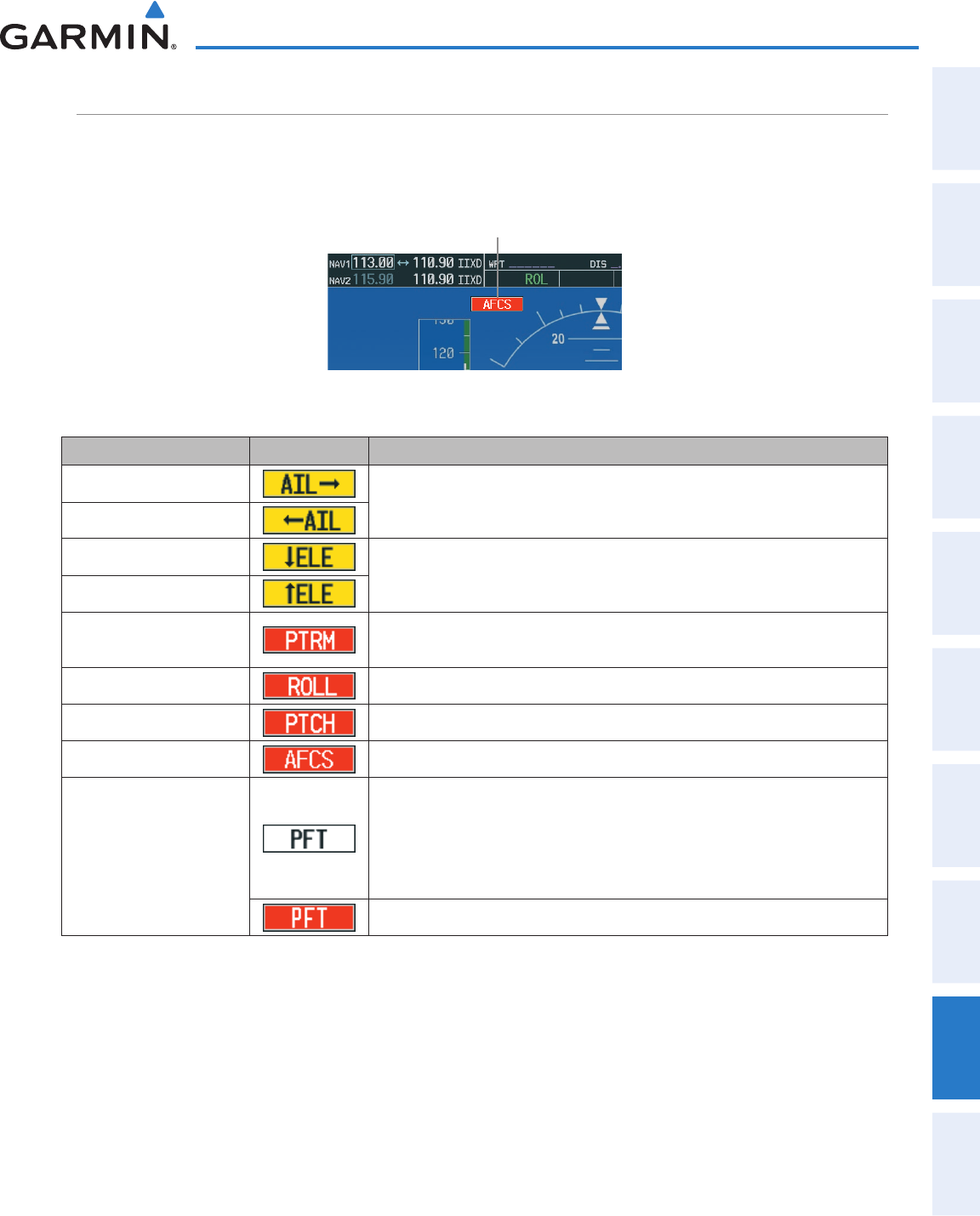
190-00592-06 Rev. A
Garmin G1000 Pilot’s Guide for the Diamond DA40/40F
SYSTEM
OVERVIEW
FLIGHT
INSTRUMENTS EIS AUDIO PANEL
& CNS
FLIGHT
MANAGEMENT
HAZARD
AVOIDANCE AFCS ADDITIONAL
FEATURES APPENDICES INDEX
495
APPENDIX A
AFCS STATUS ANNUNCIATIONS
The following annunciations (listed in order of increasing priority) can appear on the PFD above the
Airspeed and Attitude indicators. Only one annunciation may occur at a time, and messages are prioritized by
criticality.
Figure A-5 AFCS Status Annunciation
AFCS Status Annunciation
Alert Condition Annunciation Description
Aileron Mistrim Right Roll servo providing sustained force in the indicated direction
Aileron Mistrim Left
Elevator Mistrim Down Pitch servo providing sustained force in the indicated direction
Elevator Mistrim Up
Pitch Trim Failure
(or stuck AP TRIM Switch)
If AP engaged, take control of the aircraft and disengage AP
If AP disengaged, move AP TRIM switches separately to unstick
Roll Failure Roll axis control failure; AP inoperative
Pitch Failure Pitch axis control failure; AP inoperative
System Failure AP and MET are unavailable; FD may still be available
Preflight Test
Performing preflight system test; aural alert sounds at completion
Do not press the AP DISC Switch during servo power-up and preflight system
tests as this may cause the preflight system test to fail or never to start (if
servos fail their power-up tests). Power must be cycled to the servos to remedy
the situation.
Preflight system test failed; aural alert sounds at failure
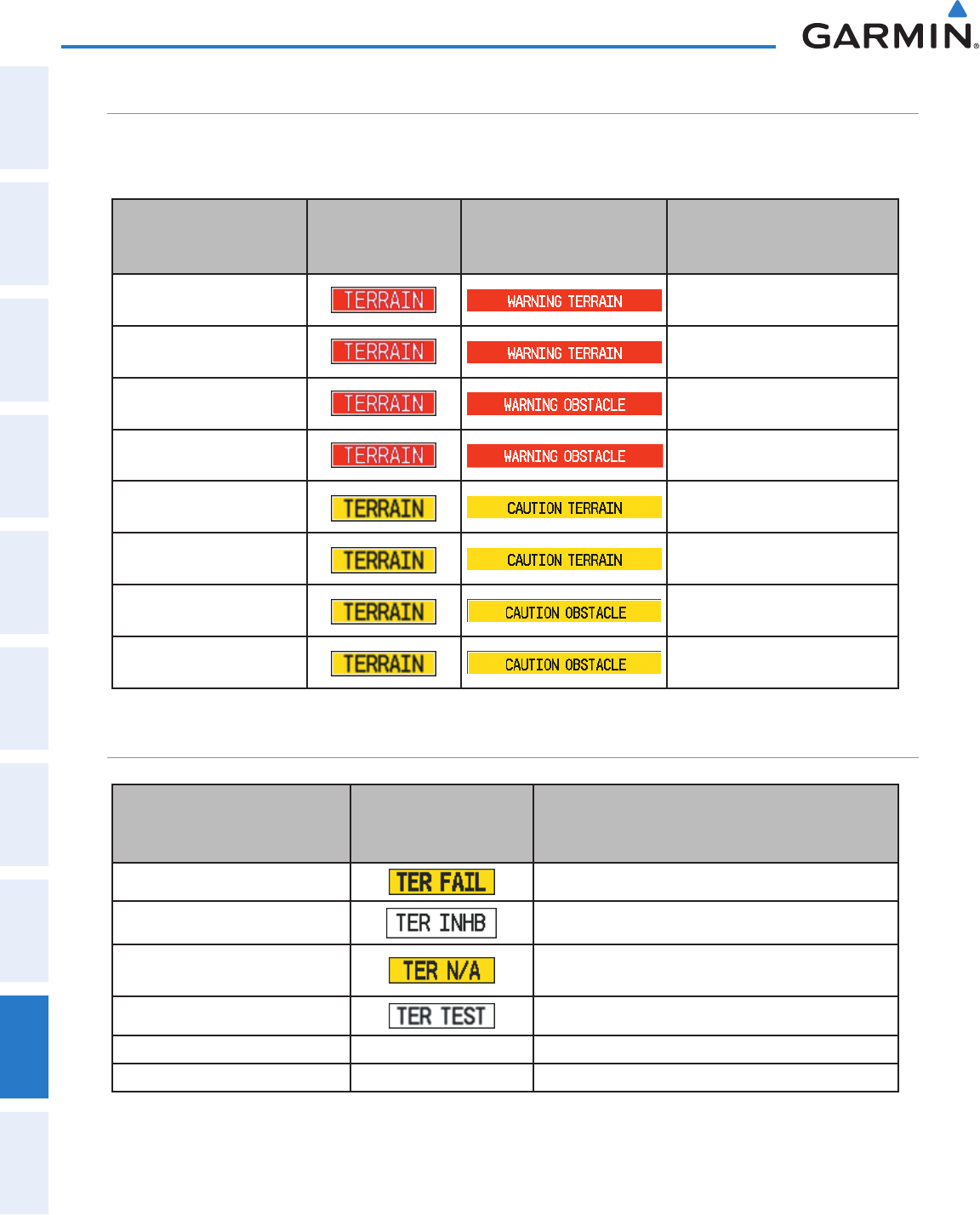
Garmin G1000 Pilot’s Guide for the Diamond DA40/40F
190-00592-06 Rev. A
SYSTEM
OVERVIEW
FLIGHT
INSTRUMENTS
EIS
AUDIO PANEL
& CNS
FLIGHT
MANAGEMENT
HAZARD
AVOIDANCE
AFCS
ADDITIONAL
FEATURES
APPENDICESINDEX
496
APPENDIX A
SVS TERRAIN ALERTS
Annunciations appear on the PFD and MFD. Pop-up alerts appear only on the MFD. For more information
on SVS Terrain, refer to the Hazard Avoidance Section.
Alert Type
PFD/MFD
TERRAIN-SVS Page
Annunciation
Pop-Up Alert
(MFD Navigation Map
Page)
Aural Message
Reduced Required Terrain
Clearance Warning (RTC) “Warning; Terrain, Terrain”
Imminent Terrain Impact
Warning (ITI) “Warning; Terrain, Terrain”
Reduced Required Obstacle
Clearance Warning (ROC) “Warning; Obstacle, Obstacle”
Imminent Obstacle Impact
Warning (IOI) “Warning; Obstacle, Obstacle”
Reduced Required Terrain
Clearance Caution (RTC) “Caution; Terrain, Terrain”
Imminent Terrain Impact
Caution (ITI) “Caution; Terrain, Terrain”
Reduced Required Obstacle
Clearance Caution (ROC) “Caution; Obstacle, Obstacle”
Imminent Obstacle Impact
Caution (IOI) “Caution; Obstacle, Obstacle”
SVS TERRAIN STATUS ANNUNCIATIONS
Alert Type
PFD/MFD
TERRAIN-SVS Page
Annunciation
Aural Message
System Test Fail “Terrain System Failure”
Terrain Alerting is disabled None
No GPS position or excessively
degraded GPS signal “Terrain System Not Available”
System Test in progress None
System Test pass None “Terrain System Test OK”
GPS signal is re-established None “Terrain System Available”
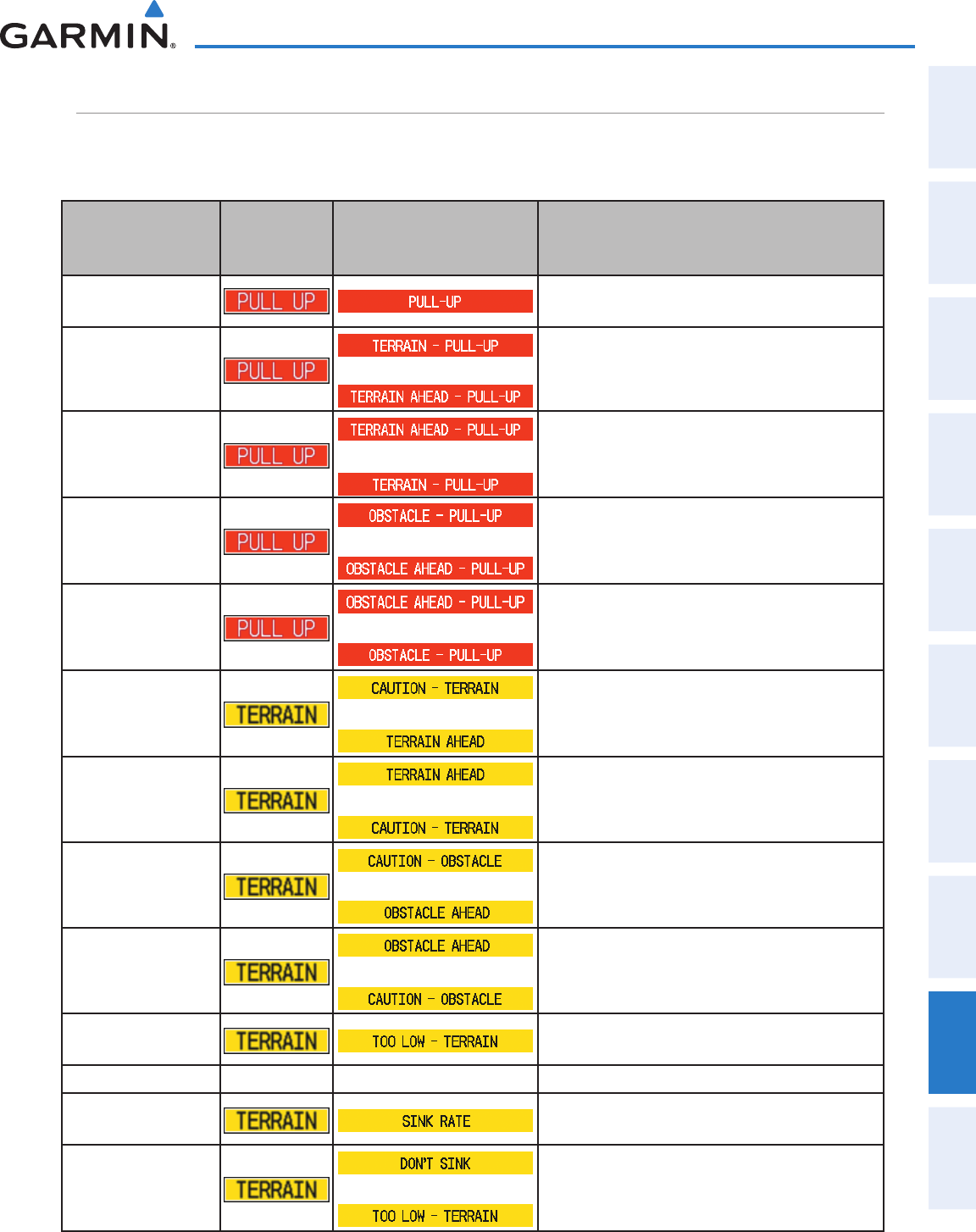
190-00592-06 Rev. A
Garmin G1000 Pilot’s Guide for the Diamond DA40/40F
SYSTEM
OVERVIEW
FLIGHT
INSTRUMENTS EIS AUDIO PANEL
& CNS
FLIGHT
MANAGEMENT
HAZARD
AVOIDANCE AFCS ADDITIONAL
FEATURES APPENDICES INDEX
497
APPENDIX A
TERRAIN AWARENESS AND WARNING SYSTEM (TAWS) ALERTS
Annunciations appear on the PFD and MFD. Pop-up alerts appear only on the MFD. For more information
on TAWS, refer to the Hazard Avoidance Section.
Alert Type
Annunciation
(PFD/MFD
TAWS Page)
Pop-Up Alert
(MFD Navigation Map
Page)
Aural Message
Excessive Descent
Rate Warning (EDR) “Pull Up”
Reduced Required
Terrain Clearance
Warning (RTC)
or
“Terrain, Terrain; Pull Up, Pull Up”
or
“Terrain Ahead, Pull Up; Terrain Ahead, Pull Up”
Imminent Terrain
Impact Warning (ITI) or
Terrain Ahead, Pull Up; Terrain Ahead, Pull Up”
or
“Terrain, Terrain; Pull Up, Pull Up”
Reduced Required
Obstacle Clearance
Warning (ROC)
or
“Obstacle, Obstacle; Pull Up, Pull Up”
or
“Obstacle Ahead, Pull Up; Obstacle Ahead, Pull Up”
Imminent Obstacle
Impact Warning (IOI) or
“Obstacle Ahead, Pull Up; Obstacle Ahead, Pull Up”
or
“Obstacle, Obstacle; Pull Up, Pull Up”
Reduced Required
Terrain Clearance
Caution (RTC)
or
“Caution, Terrain; Caution, Terrain”
or
“Terrain Ahead; Terrain Ahead”
Imminent Terrain
Impact Caution (ITI) or
“Terrain Ahead; Terrain Ahead”
or
“Caution, Terrain; Caution, Terrain”
Reduced Required
Obstacle Clearance
Caution (ROC)
or
“Caution, Obstacle; Caution, Obstacle”
or
“Obstacle Ahead; Obstacle Ahead”
Imminent Obstacle
Impact Caution (IOI) or
“Obstacle Ahead; Obstacle Ahead”
or
“Caution, Obstacle; Caution, Obstacle”
Premature Descent
Alert Caution (PDA) “Too Low, Terrain”
Altitude Callout “500” None None “Five-Hundred”
Excessive Descent
Rate Caution (EDR) “Sink Rate”
Negative Climb Rate
Caution (NCR) or
“Don’t Sink”
or
“Too Low, Terrain”
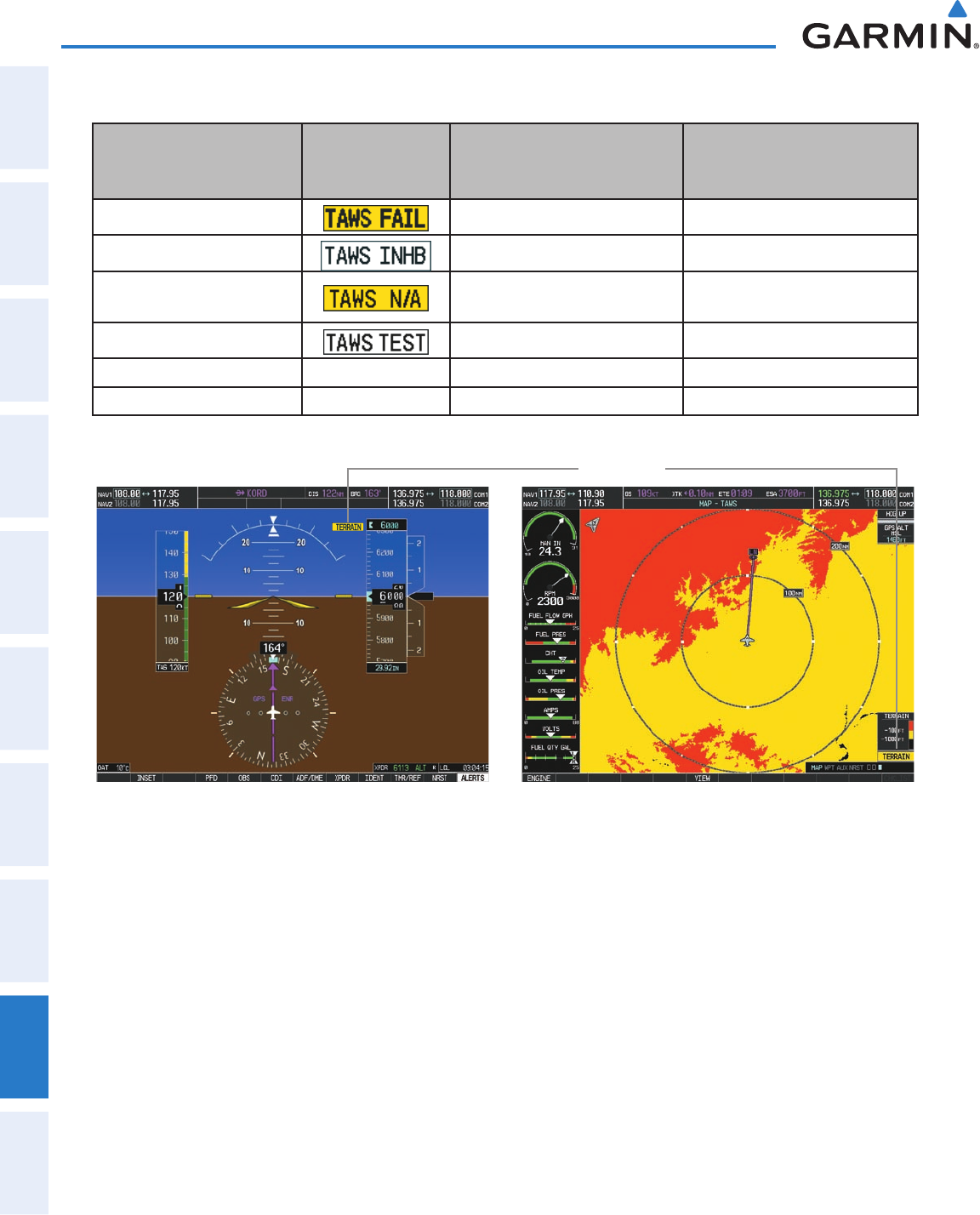
Garmin G1000 Pilot’s Guide for the Diamond DA40/40F
190-00592-06 Rev. A
SYSTEM
OVERVIEW
FLIGHT
INSTRUMENTS
EIS
AUDIO PANEL
& CNS
FLIGHT
MANAGEMENT
HAZARD
AVOIDANCE
AFCS
ADDITIONAL
FEATURES
APPENDICESINDEX
498
APPENDIX A
TAWS SYSTEM STATUS ANNUNCIATIONS
Alert Type
Annunciation
(PFD/MFD TAWS
Page)
Pop-Up Alert
(MFD Navigation Map Page) Aural Message
TAWS System Test Fail None “TAWS System Failure”
TAWS Alerting is disabled None None
No GPS position or excessively
degraded GPS signal None “TAWS Not Available”
System Test in progress None None
System Test pass None None “TAWS System Test OK”
GPS signal is re-established None None “TAWS Available”
Figure A-6 TAWS Annunciation Locations
PFD MFD
Annunciation
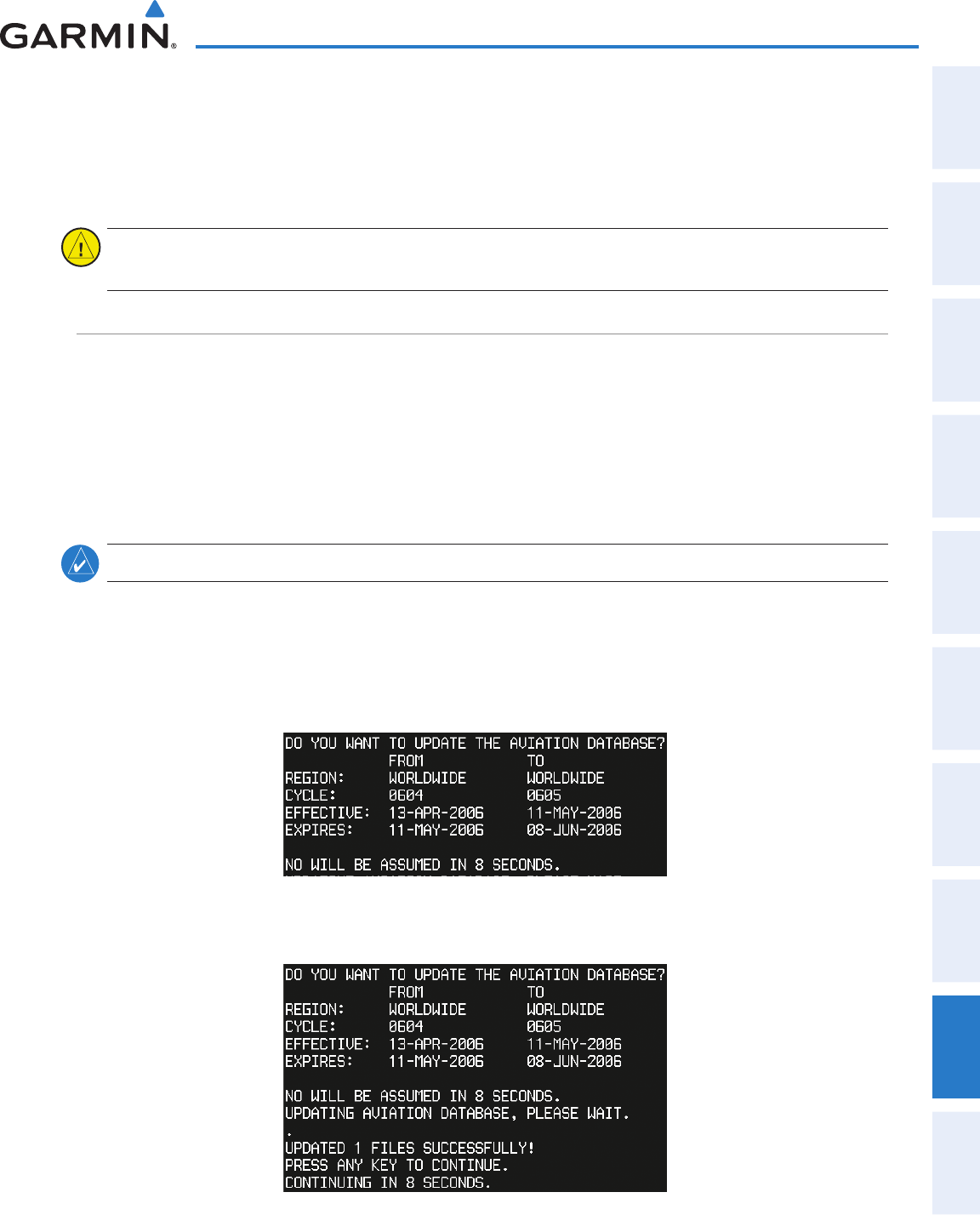
190-00592-06 Rev. A
Garmin G1000 Pilot’s Guide for the Diamond DA40/40F
SYSTEM
OVERVIEW
FLIGHT
INSTRUMENTS EIS AUDIO PANEL
& CNS
FLIGHT
MANAGEMENT
HAZARD
AVOIDANCE AFCS ADDITIONAL
FEATURES APPENDICES INDEX
499
APPENDIX B
SD CARD USE AND DATABASES
The G1000 System uses Secure Digital (SD) cards to load and store various types of data. For basic flight
operations, SD cards are required for database storage as well as Jeppesen aviation and ChartView database
updates.
CAUTION: Do not load Jeppesen navigation data (except ChartView) onto Garmin Supplemental Data
Cards.
JEPPESEN DATABASES
The Jeppesen aviation database is updated on a 28-day cycle. The optional ChartView database is updated
on a 14-day cycle. If the ChartView database is not updated within 70 days of the expiration date, ChartView
no longer functions.
Both these databases are provided directly from Jeppesen. The ChartView database should be copied to the
Garmin supplied Supplemental Data Card which resides in the bottom card slot on the MFD. The aviation
database must be installed from the Jeppesen or user supplied SD data card. Contact Jeppesen (www.jeppesen.
com) for subscription and update information.
NOTE: After the aviation database is installed, the card may be removed.
Updating the Jeppesen aviation database:
1) With the G1000 System OFF, insert the SD card containing the aviation database update into the top card slot
of the PFD to be updated (label of SD card should face left).
2) Turn the G1000 System ON. A prompt similar to the following is displayed in the upper left corner of the PFD:
Figure B-1 Database Update Prompt
3) Press the ENT Key to start the database update. A prompt similar to the following is displayed:
Figure B-2 Database Update Confirmation
Garmin G1000 Pilot’s Guide for the Diamond DA40/40F
190-00592-06 Rev. A
SYSTEM
OVERVIEW
FLIGHT
INSTRUMENTS
EIS
AUDIO PANEL
& CNS
FLIGHT
MANAGEMENT
HAZARD
AVOIDANCE
AFCS
ADDITIONAL
FEATURES
APPENDICESINDEX
500
APPENDIX B
4) After the update completes, the PFD continues to power-up normally.
5) Turn the G1000 System OFF and remove the SD card.
6) Repeat steps 1 through 4 for the MFD. The MFD and PFD databases are now updated. Remove the SD card
when finished.
7) Verify the correct update cycle is loaded during MFD power-up.
GARMIN DATABASES
NOTE: The data contained in the terrain and obstacle databases comes from government agencies. Garmin
accurately processes and cross-validates the data, but cannot guarantee the accuracy and completeness of
the data.
The following G1000 databases are stored on Supplemental Data Cards provided by Garmin:
•Expanded basemap –The basemap database contains data for the topography and land features, such as
rivers, lakes, and towns. It is updated only periodically, with no set schedule. There is no expiration date.
•Terrain–Theterraindatabasecontainsterrainmappingdata.Itisupdatedperiodicallyandhasnoexpiration
date.
•Airportterrain–Theairportterraindatabasecontainsairportdiagramdata.Itisupdatedperiodicallyand
has no expiration date.
•Obstacle–Theobstacledatabasecontainsdataforobstacles,suchastowers,thatposeapotentialhazardto
aircraft. Obstacles 200 feet and higher are included in the obstacle database. It is very important to note that
not all obstacles are necessarily charted and therefore may not be contained in the obstacle database. This
database is updated on a 56-day cycle.
•SafeTaxi – The SafeTaxi database contains detailed airport diagrams for selected airports. These diagrams aid
in following ground control instructions by accurately displaying the aircraft position on the map in relation
to taxiways, ramps, runways, terminals, and services. This database is updated on a 56-day cycle.
•FliteCharts – The FliteCharts database contains procedure charts for the United States only. This database
is updated on a 28-day cycle. If not updated within 180 days of the expiration date, FliteCharts no longer
functions.
Since these databases are not stored internally in the PFD or MFD, a Supplemental Data Card containing
identical database versions must be kept in each display unit. After subscribing to the desired databases
product, these database products will be downloaded to two Supplemental Data Cards (with the exception of
FliteCharts, which is loaded on only one card). Insert each Supplemental Data Card into the correct location
shown in Figure B-3. If one of the Supplemental Data Cards contains the ChartView database, or the FliteCharts
database, this card must be inserted into the bottom card slot on the MFD. These cards must not be removed
except to update the databases stored on each card.
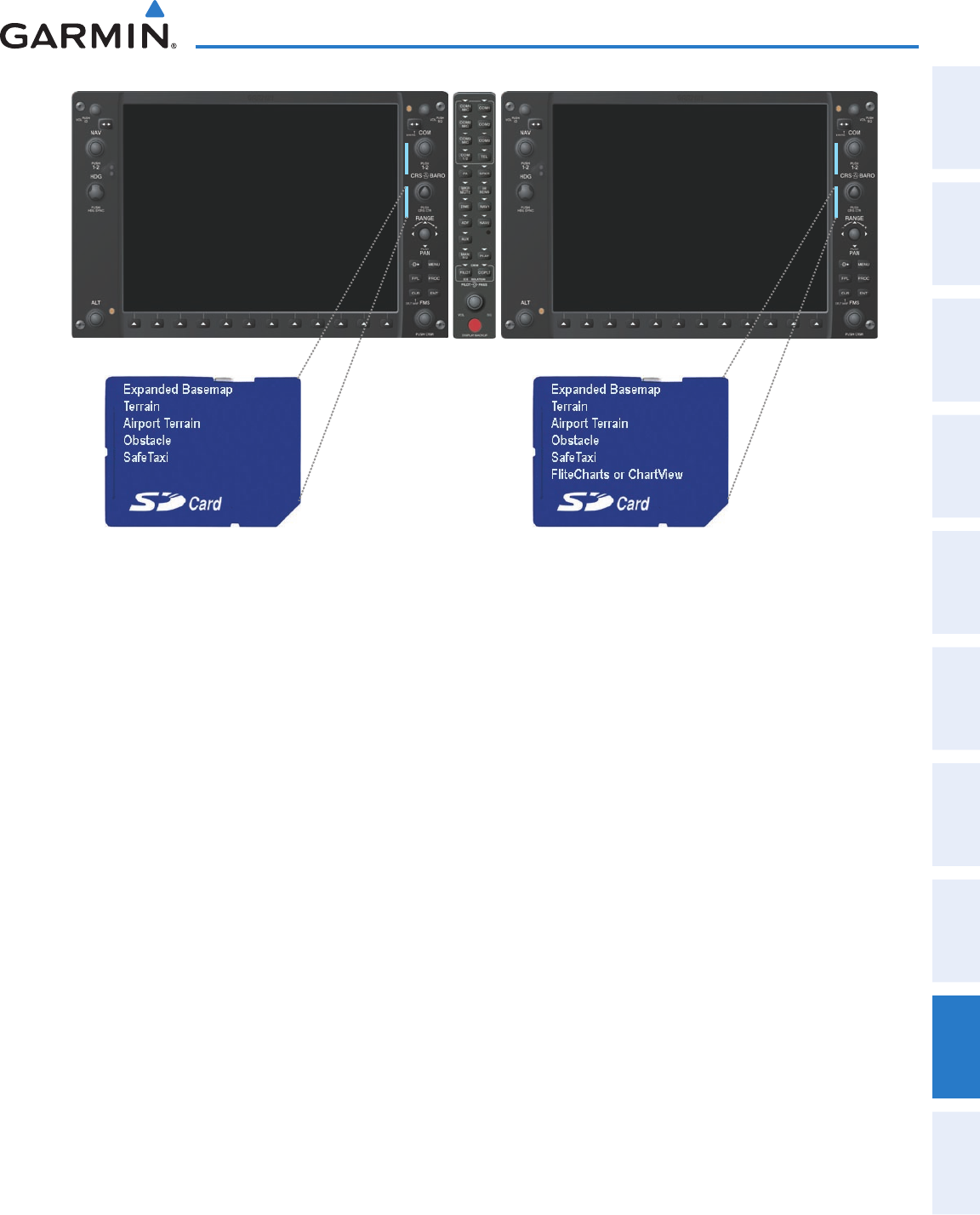
190-00592-06 Rev. A
Garmin G1000 Pilot’s Guide for the Diamond DA40/40F
SYSTEM
OVERVIEW
FLIGHT
INSTRUMENTS EIS AUDIO PANEL
& CNS
FLIGHT
MANAGEMENT
HAZARD
AVOIDANCE AFCS ADDITIONAL
FEATURES APPENDICES INDEX
501
APPENDIX B
Figure B-3 Correct Database Locations
PFD MFD
The Garmin database updates can be obtained by following the instructions detailed in the ‘Aviation Databases’
section of the Garmin website (www.garmin.com). Once the updated files have been downloaded from the
website, a PC equipped with an appropriate SD card reader is used to unpack and program the new databases
onto the existing Supplemental Data Cards. The following equipment is required to perform the update:
•Windows-compatiblePCcomputer(Windows2000orXPrecommended)
•SanDiskSDCardReader,P/NsSDDR-93orSDDR-99orequivalentcardreader
•UpdateddatabaseobtainedfromtheGarminwebsite
•Existing010-00330-42SupplementalDatabaseSDCardsfrombothPFDandMFD
In some cases it may be necessary to obtain an unlock code from Garmin in order to make the database
product functional. It may also be necessary to have the system configured by a Garmin authorized service
facility in order to use some database features.
Updating Garmin databases:
1) Copy the data to the appropriate data cards.
2) Insert one SD card in the bottom card slot of the MFD and one in the bottom card slot of each PFD. The SD card
containing the ChartView or FliteCharts database must be inserted into the bottom slot on the MFD.
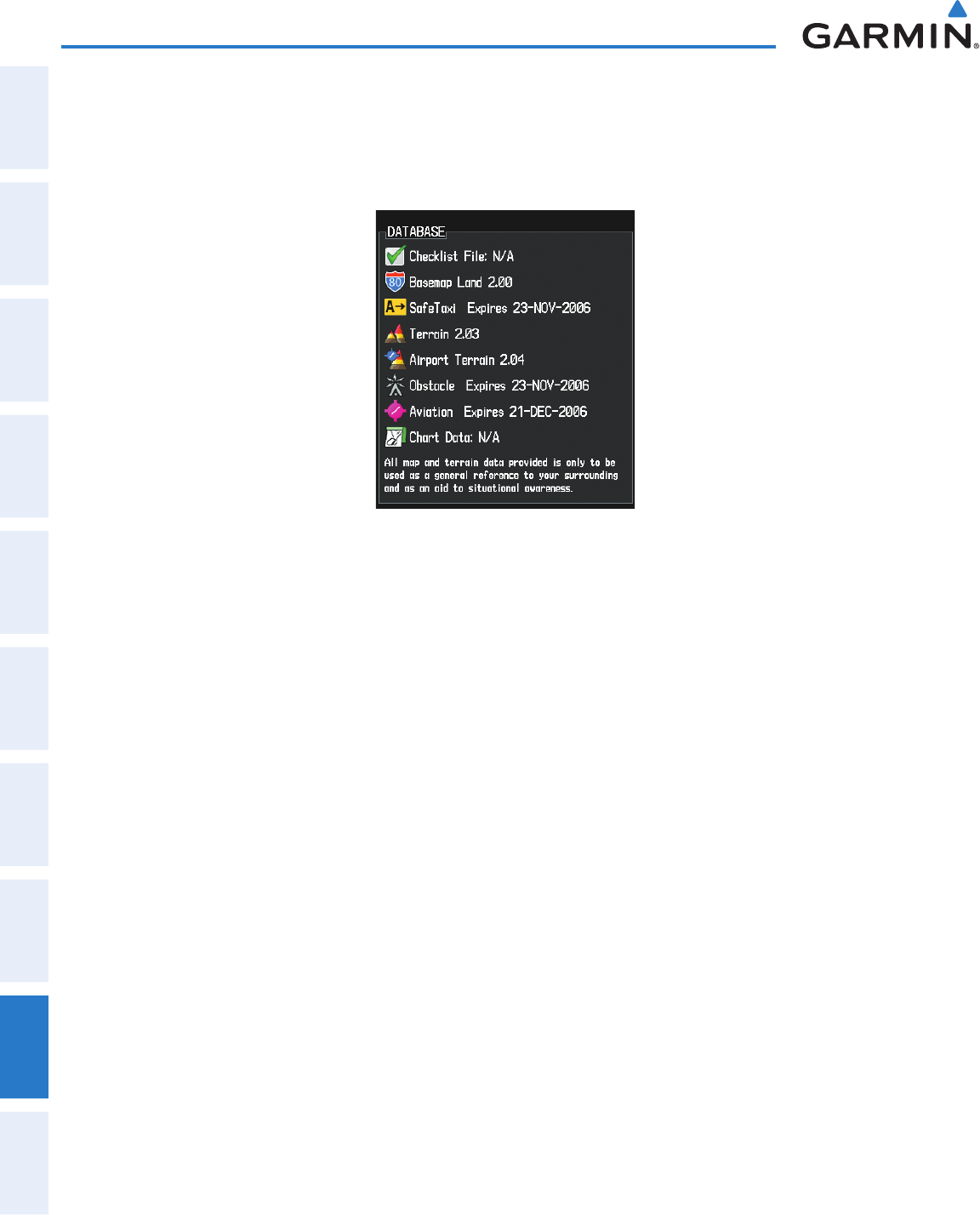
Garmin G1000 Pilot’s Guide for the Diamond DA40/40F
190-00592-06 Rev. A
SYSTEM
OVERVIEW
FLIGHT
INSTRUMENTS
EIS
AUDIO PANEL
& CNS
FLIGHT
MANAGEMENT
HAZARD
AVOIDANCE
AFCS
ADDITIONAL
FEATURES
APPENDICESINDEX
502
APPENDIX B
3) Apply power to the G1000 System. View the MFD power-up splash screen. Check that the databases are
initialized and displayed on the splash screen. When updating the terrain and FliteCharts databases, an ‘in
progress’ message may be seen. If this message is present, wait for the system to finish loading before verifying
the correct databases are initialized, then proceed to step 3.
Figure B-4 Database Information on the Splash Screen
4) Acknowledge the Power-up Page agreement by pressing the
ENT
Key or the right most softkey.
5) Use the FMS Knob to select the AUX - System Setup Page.
6) Select the DBASE Softkey to place the cursor in the ‘DATABASE’ box.
7) Turn the FMS Knob to scroll through the list and check that all databases are current and there are no errors.
8) Power down the G1000.
190-00592-06 Rev. A
Garmin G1000 Pilot’s Guide for the Diamond DA40/40F
SYSTEM
OVERVIEW
FLIGHT
INSTRUMENTS EIS AUDIO PANEL
& CNS
FLIGHT
MANAGEMENT
HAZARD
AVOIDANCE AFCS ADDITIONAL
FEATURES APPENDICES INDEX
503
APPENDIX C
ACC accuracy
ACT, ACTV active, activate
ADC air data computer
ADF Automatic Direction Finder
ADI Attitude Direction Indicator
AF Arc to fix
AFCS Automatic Flight Control System
AFM Airplane Flight Manual
AFMS Airplane Flight Manual Supplement
AFRM airframe
AGL Above Ground Level
AHRS Attitude and Heading Reference
System
AIM Airman’s Information Manual
AIRMET Airman’s Meteorological Information
ALRT alert
ALT altitude
ALT, ALTN alternator
AMPS amperes
ANNUNC annunciation
ANT antenna
AP autopilot
AP DISC autopilot disconnect
APR approach
APT airport, aerodrome
ARINC Aeronautical Radio Incorporated
ARSPC airspace
ARTCC Air Route Traffic Control Center
ARV arrival
AS airspeed
ASB Aviation Support Branch
ASOS Automated Surface Observing
System
ATC Air Traffic Control
ATCRBS ATC Radar Beacon System
ATIS Automatic Terminal Information
Service
ATK along-track
AUTOSEQ automatic sequence
AUX auxiliary
AWOS Automated Weather Observing
System
B ALT barometric altitude
BARO barometric setting
BATT battery
BC backcourse
Bearing The compass direction from the
present position to a destination
waypoint
BFO beat frequency oscillator
BKSP backspace
BRG bearing
C center runway
ºC degrees Celsius
CA Course to Altitude
CALC calculator
Calibrated Airspeed Indicated airspeed corrected for
installation and instrument errors.
CD Course to DME distance
CDI Course Deviation Indicator
CDU Control Display Unit
CF Course to Fix
CHT Cylinder Head Temperature
CHKLIST checklist
CHNL channel
CI Course to Intercept
CLD cloud
CLR clear
cm centimeter
CNS Communication, Navigation, &
Surveillance
CO carbon monoxide
COM communication radio
CONFIG configuration
COOL coolant
COPLT co-pilot
Course The line between two points to be
followed by the aircraft
Course to Steer The recommended direction to steer
in order to reduce course error or
stay on course. Provides the most
efficient heading to get back to the
desired course and proceed along
the flight plan
CR Course to Radial
CRG Cockpit Reference Guide
CRNT current
Crosstrack Error The distance the aircraft is off a
desired course in either direction, left
or right
CRS course
CRS Course to Steer
CRSR cursor
CTA Control Area
CTRL control
GLOSSARY
Garmin G1000 Pilot’s Guide for the Diamond DA40/40F
190-00592-06 Rev. A
SYSTEM
OVERVIEW
FLIGHT
INSTRUMENTS
EIS
AUDIO PANEL
& CNS
FLIGHT
MANAGEMENT
HAZARD
AVOIDANCE
AFCS
ADDITIONAL
FEATURES
APPENDICESINDEX
504
APPENDIX C
Cumulative The total of all legs in a flight plan.
CVR Cockpit Voice Recorder
CVRG coverage
CWS control wheel steering
CYL cylinder
D ALT density altitude
DB, DBASE database
dBZ decibels ‘Z’ (radar return)
DCLTR, DECLTR declutter
DEC FUEL decrease fuel
deg degree
DEIC, DEICE de-icing
DEP departure
Desired Track The desired course between the
active “from” and “to” waypoints
DEST destination
DF Direct to Fix
DFLT default
DGRD degrade
DH decision height
Dilution of Precision A measure of GPS satellite geometry
quality on a scale of one to ten (lower
numbers equal better geometry,
where higher numbers equal poorer
geometry)
DIR direction
DIS distance
Distance The ‘great circle’ distance from the
present position to a destination
waypoint
DME Distance Measuring Equipment
DOP Dilution of Precision
DP Departure Procedure
DPRT departure
DR dead reckoning
DSBL disabled
DTK Desired Track
E empty, east
ECU Engine Control Unit
Efficiency A measure of fuel consumption,
expressed in distance per unit of fuel
EGT Exhaust Gas Temperature
EIS Engine Indication System
ELEV elevation
ELEV elevator
EMERGCY emergency
EMI Electromagnetic Interference
ENDUR endurance
Endurance Flight endurance, or total possible
flight time based on available fuel on
board
ENG engine
ENGD engaged
ENR enroute
Enroute Safe Altitude The recommended minimum altitude
within ten miles left or right of the
desired course on an active flight
plan or direct-to
ENT enter
EPE Estimated Position Error
EPU Estimated Position Uncertainty
ERR error
ESA Enroute Safe Altitude
Estimated Position Error A measure of horizontal GPS
position error derived by satellite
geometry conditions and other
factors
Estimated Time of Arrival The estimated time at which the
aircraft should reach the destination
waypoint, based upon current speed
and track
Estimated Time Enroute The estimated time it takes to
reach the destination waypoint from
the present position, based upon
current ground speed
ETA Estimated Time of Arrival
ETE Estimated Time Enroute
EXPIRD expired
ºF degrees Fahrenheit
FA Course From Fix to Altitude
FAA Federal Aviation Administration
FADEC Full Authority Digital Engine Control
FAF Final Approach Fix
FAIL failure
FC Course From Fix to Distance
FCC Federal Communication Commission
FCST forecast
FD Course From Fix to DME Distance
FD flight director
FDE Fault Detection and Exclusion
FFLOW fuel flow
FIS-B Flight Information Services-
Broadcast
FISDL Flight Information Service Data Link
FL flight level
FLC Flight Level Change
FM Course From Fix to Manual
Termination
190-00592-06 Rev. A
Garmin G1000 Pilot’s Guide for the Diamond DA40/40F
SYSTEM
OVERVIEW
FLIGHT
INSTRUMENTS EIS AUDIO PANEL
& CNS
FLIGHT
MANAGEMENT
HAZARD
AVOIDANCE AFCS ADDITIONAL
FEATURES APPENDICES INDEX
505
APPENDIX C
FMS Flight Management System
FOB Fuel On Board
FPL flight plan
FPM Flight Path Marker
fpm feet per minute
FREQ frequency
FRZ freezing
FSS Flight Service Station
ft foot/feet
Fuel Flow The fuel flow rate, expressed in units
of fuel per hour
Fuel On Board The total amount of usable fuel on
board the aircraft
G/S, GS glideslope
GA go-around
gal, gl gallon(s)
GBOX gearbox
GDC Garmin Air Data Computer
GDL Garmin Satellite Data Link
GDU Garmin Display Unit
GEA Garmin Engine/Airframe Unit
GEO geographic
GFC Garmin Flight Control
GIA Garmin Integrated Avionics Unit
GLS Global Navigation Satellite Landing
System
GMA Garmin Audio Panel System
GMT Greenwich Mean Time
GMU Garmin Magnetometer Unit
GND ground
gph gallons per hour
GPS Global Positioning System
Grid MORA Grid Minimum Off-Route Altitude;
one degree latitude by one degree
longitude in size and clears the
highest elevation reference point in
the grid by 1000 feet for all areas of
the grid
Groundspeed The velocity that the aircraft is
travelling relative to a ground
position
Ground Track
see Track
GRS Garmin Reference System
GS Ground speed
GTX Garmin Transponder
HA Hold Terminating at Altitude
HDG heading
Heading The direction an aircraft is pointed,
based upon indications from a
magnetic compass or a properly set
directional gyro
HF Hold Terminating at Fix
HFOM Horizontal Figure of Merit
Hg mercury
HI high
HI SENS High Sensitivity
HM Hold with Manual Termination
Horizontal Figure of Merit A measure of the uncertainty in
the aircraft’s horizontal position
hPa hectopascal
HPL Horizontal Protection Level
hr hour
HSDB High-Speed Data Bus
HSI Horizontal Situation Indicator
HT heat
HUL Horizontal Uncertainty Level
Hz Hertz
I Inner Marker
IAF Initial Approach Fix
IAT Indicated Air Temperature
IAU Integrated Avionics Unit
ICAO International Civil Aviation
Organization
ICS Intercom System
ID Identification/Morse Code Identifier
IDENT, IDNT identification
IF Initial Fix
IFR Instrument Flight Rules
IG Imperial gallon
ILS Instrument Landing System
IMC Instrument Meteorological
Conditions
in inch
INACTV inactive
INC FUEL increase fuel
IND indicated
Indicated Information provided by properly
calibrated and set instrumentation
on the aircraft panel
INFO information
in HG inches of mercury
INT intersection(s)
INTEG integrity (RAIM unavailable)
IrDA, IRDA Infrared Data Association
KEYSTK key stuck
kg kilogram
Garmin G1000 Pilot’s Guide for the Diamond DA40/40F
190-00592-06 Rev. A
SYSTEM
OVERVIEW
FLIGHT
INSTRUMENTS
EIS
AUDIO PANEL
& CNS
FLIGHT
MANAGEMENT
HAZARD
AVOIDANCE
AFCS
ADDITIONAL
FEATURES
APPENDICESINDEX
506
APPENDIX C
kHz kilohertz
km kilometer
kt knot
L left, left runway
LAT latitude
LBL label
lb pound
LCD Liquid Crystal Display
LCL local
LED Light Emitting Diode
Left Over Fuel On Board The amount of fuel remaining
on board after the completion of
one or more legs of a flight plan or
direct-to
Left Over Fuel Reserve The amount of flight time remaining,
based on the amount of fuel on
board after the completion of one or
more legs of a flight plan or direct-
to, and a known consumption rate
Leg The portion of a flight plan between
two waypoints
LIFR Low Instrument Flight Rules
LNAV Lateral Navigation
LO low
LOC localizer
LOI loss of integrity (GPS)
LON longitude
LPV Localizer Performance with Vertical
guidance
LRU Line Replacement Unit
LT left
LTNG lightning
LVL level
M Middle Marker
m meter
MAG Magnetic
MAG VAR Magnetic Variation
MAHP Missed Approach Hold Point
MAN IN manifold pressure (inches Hg)
MAN SQ Manual Squelch
MAP Missed Approach Point
MASQ Master Avionics Squelch
MAX maximum
MAXSPD maximum speed (overspeed)
MDA barometric minimum descent
altitude
MET manual electric trim
METAR Meteorological Aviation Routine
MEPT manual electric pitch trim
MFD Multi Function Display
MGRS Military Grid Reference System
MHz megahertz
MIC microphone
MIN minimum
Minimum Safe Altitude Uses Grid MORAs to determine
a safe altitude within ten miles of
the aircraft present position
MKR marker beacon
MOA Military Operations Area
MOV movement
mpm meters per minute
MSA Minimum Safe Altitude
MSG message
MSL Mean Sea Level
MT meter
mV millivolt(s)
MVFR Marginal Visual Flight Rules
N north
NAV navigation
NAVAID NAVigation AID
NDB Non-directional Beacon
NEXRAD Next Generation Radar
nm nautical mile(s)
NPT
NRST nearest
O Outer Marker
OAT Outside Air Temperature
OBS Omni Bearing Selector
OFST offset
OXY oxygen
P ALT pressure altitude
PA Passenger Address
PA Proximity Advisory
PASS passenger(s)
PC personal computer
PFD Primary Flight Display
PI Procedure Turn to Course Intercept
PIT, PTCH pitch
POSN position
PPM parts per million
P. POS Present Position
PRES, PRESS pressure
PROC procedure(s), procedure turn
psi pounds per square inch
PT Procedure Turn
190-00592-06 Rev. A
Garmin G1000 Pilot’s Guide for the Diamond DA40/40F
SYSTEM
OVERVIEW
FLIGHT
INSTRUMENTS EIS AUDIO PANEL
& CNS
FLIGHT
MANAGEMENT
HAZARD
AVOIDANCE AFCS ADDITIONAL
FEATURES APPENDICES INDEX
507
APPENDIX C
PTK parallel track
PTT Push-to-Talk
PWR power
QTY quantity
R right, right runway
RAD radial
RAIM Receiver Autonomous Integrity
Monitoring
RAM random access memory
REF reference
REM remaining (fuel remaining)
REQ required
RES reserve (fuel reserve entered by
pilot)
REV reverse, revision, revise
RF Constant Radius Turn to Fix
RMI Radio Magnetic Indicator
RMT remote
RNG range
RNWY runway
ROL roll
ROM read only memory
rpm revolutions per minute
RST FUEL reset fuel
RSV reserve (fuel reserve entered by
pilot)
RT right
RVRSNRY reversionary
RX receive
S south
SA Selective Availability
SAT Static Air Temperature
SBAS Satellite-Based Augmentation
System
SCIT Storm Cell Identification and
Tracking
SD Secure Digital
sec second(s)
SEL, SLCT select
SFC surface
SIAP Standard Instrument Approach
Procedures
SID Standard Instrument Departure
SIGMET Significant Meteorological
Information
Sim simulator
SLP/SKD slip/skid
SMBL symbol
SPD speed
SPI Special Position Identification
SPKR speaker
SQ squelch
SRVC, SVC service
STAL stall
STAR Standard Terminal Arrival Route
STATS statistics
STBY standby
STD standard
STRMSCP Stormscope
SUA Special Use Airspace
SUSP suspend
SVS Synthetic Vision System
SW software
SYS system
T true
TA Traffic Advisory
TACAN Tactical Air Navigation System
TAF Terminal Aerodrome Forecast
TAS True Airspeed
TAS Traffic Advisory System
TAT Total Air Temperature
TAWS Terrain Awareness and Warning
System
TCA Terminal Control Area
TCAS Traffic Collision Avoidance System
TEL telephone
TEMP temperature
TERM terminal
TF Track Between Two Fixes
TFR Temporary Flight Restriction
T HDG True Heading
TIS Traffic Information System
TIT Turbine Inlet Temperature
TKE Track Angle Error
TMA Terminal Maneuvering Area
TMR/REF Timer/Reference
Topo topographic
Track Direction of aircraft movement
relative to a ground position; also
‘Ground Track’
Track Angle Error The angle difference between the
desired track and the current track
TRG target
TRK track
TRSA Terminal Radar Service Area
TRUNC truncated
Garmin G1000 Pilot’s Guide for the Diamond DA40/40F
190-00592-06 Rev. A
SYSTEM
OVERVIEW
FLIGHT
INSTRUMENTS
EIS
AUDIO PANEL
& CNS
FLIGHT
MANAGEMENT
HAZARD
AVOIDANCE
AFCS
ADDITIONAL
FEATURES
APPENDICESINDEX
508
APPENDIX C
TTL total
TURN procedure turn
TX transmit
UNAVAIL unavailable
USR user
UTC Coordinated Universal Time
UTM/UPS Universal Transverse Mercator/
Universal Polar Stereographic Grid
V, Vspeed velocity (airspeed)
VA Heading Vector to Altitude
VAPP VOR approach
VAR variation
VD Heading Vector to DME Distance
Vdc volts, direct current
VERT vertical
Vertical Figure of Merit A measure of the uncertainty in
the aircraft’s vertical position
Vertical Speed Required The vertical speed necessary
to descend/climb from a current
position and altitude to a defined
target position and altitude, based
upon current groundspeed
VFOM Vertical Figure of Merit
VFR Visual Flight Rules
VHF Very High Frequency
VI Heading Vector to Intercept
VLOC VOR/Localizer Receiver
VM Heading Vector to Manual
Termination
VMC Visual Meteorological Conditions
VNAV, VNV vertical navigation
VOL volume
VOR VHF Omni-directional Range
VORTAC very high frequency omnidirectional
range station and tactical air
navigation
VPL Vertical Protection Level
VPROF VNV profile, vertical profile
VPTH VNV path, vertical path
VR Heading Vector to Radial
VS vertical speed
VSI Vertical Speed Indicator
VSR Vertical Speed Required
VTF vector to final
W watt(s), west
WAAS Wide Area Augmentation System
WARN warning (GPS position error)
WGS-84 World Geodetic System - 1984
WPT waypoint(s)
WW world wide
WX weather
XFER, XFR transfer
XPDR transponder
XTALK cross-talk
XTK cross-track
190-00592-06 Rev. A
Garmin G1000 Pilot’s Guide for the Diamond DA40/40F
SYSTEM
OVERVIEW
FLIGHT
INSTRUMENTS EIS AUDIO PANEL
& CNS
FLIGHT
MANAGEMENT
HAZARD
AVOIDANCE AFCS ADDITIONAL
FEATURES APPENDICES INDEX
509
APPENDIX D
FREQUENTLY ASKED QUESTIONS
If a particular aspect of G1000 operational capability is not addressed by these commonly asked questions or in
the index, contact Garmin (see the copyright page or back cover for contact information) or a Garmin-authorized
dealer. Garmin is dedicated to supporting its products and customers.
Wh a t i s Waas?
The Wide Area Augmentation System (WAAS) uses a system of ground stations to correct any GPS signal
errors. These ground stations correct for errors caused by ionospheric disturbances, timing, and satellite
orbit errors. It also provides vital integrity information regarding the health of each GPS satellite. The signal
correction is then broadcast through one of two geostationary satellites. This correction information can then
be received by any WAAS-enabled GPS receiver.
WAAS is designed to provide the additional accuracy, availability, and integrity necessary to enable users to
rely on GPS for all phases of flight. WAAS is currently available in the United States, including Alaska and
Hawaii.
ho W D o e s Waas a f f e c t a P P R o a c h o P e R a t i o n s ?
Both LNAV/VNAV and LPV approaches use the accuracy of WAAS to include vertical (glide path) guidance
capability. The additional accuracy and vertical guidance capability allows improved instrument approaches to
an expanded number of airports throughout the U.S.
The implementation of LPV approaches further improves precision approach capabilities. LPV approaches
are designed to make full use of the improved GPS signal from the WAAS. This approach combines the LNAV/
VNAV vertical accuracy with lateral guidance similar to the typical Instrument Landing System (ILS). LPV
approaches allow lower approach minimums.
If WAAS is not available for the final approach course, the approach downgrades, as indicated by the “Approach
downgraded. Use LNAV minima.” message.
Wh a t i s RaiM a n D h o W D o e s i t a f f e c t a P P R o a c h o P e R a t i o n s ?
When WAAS is unavailable, the GPS receivers use Receiver Autonomous Integrity Monitoring (RAIM) to
perform the following functions:
•MonitorandverifyintegrityandgeometryoftrackedGPS satellites
•Notifypilotwhensatelliteconditionsdonotprovidenecessarycoveragetosupportacertainphaseofight
•Predict satellite coverage of a destination area to determine whether the number of available satellites is
sufficient to satisfy requirements (refer to the System Overview Section for instructions on RAIM prediction)
•Detectandexcludebadsatellitesfromthenavigationsolution(FaultDetectionandExclusion,FDE)
RAIM ensures that satellite geometry allows for a navigation solution calculation within a specified protection
limit (4.0 nm for oceanic, 2.0 nm for enroute, 1.0 nm for terminal, and 0.3 nm for non-precision approaches).
Without WAAS or RAIM, GPS position accuracy integrity cannot be monitored.
Garmin G1000 Pilot’s Guide for the Diamond DA40/40F
190-00592-06 Rev. A
SYSTEM
OVERVIEW
FLIGHT
INSTRUMENTS
EIS
AUDIO PANEL
& CNS
FLIGHT
MANAGEMENT
HAZARD
AVOIDANCE
AFCS
ADDITIONAL
FEATURES
APPENDICESINDEX
510
APPENDIX D
Wh y M i g h t t h e R e B e n o a P P R o a c h e s a v a i l a B l e f o R a f l i g h t P l a n ?
Approaches are available for the final destination airport in a flight plan or as a direct-to (keep in mind
that some VOR/VORTAC identifiers are similar to airport identifiers). If a destination airport does not have a
published approach, the G1000 indicates “NONE” for the available procedures.
Wh a t h a P P e n s W h e n a n a P P R o a c h i s s e l e c t e D ? ca n a f l i g h t P l a n W i t h a n a P P R o a c h , a D e P a R t u R e , o R a n
a R R i v a l B e s t o R e D ?
When an approach, departure, or arrival is loaded into the active flight plan, a set of approach, departure,
or arrival waypoints is inserted into the flight plan, along with a header line showing the title of the selected
instrument procedure. The original enroute portion of the flight plan remains active, unless the instrument
procedure is activated. This may be done either when the procedure is loaded or at a later time.
Flight plans can also be stored with an approach, a departure, or an arrival. Note that the active flight plan
is erased when the system is turned off. Also, the active flight plan is overwritten when another flight plan is
activated. When storing flight plans with an approach, a departure, or an arrival, the G1000 uses the waypoint
information from the current database to define the waypoints. If the database is changed or updated, the
G1000 System automatically updates the information, provided the procedure has not been modified. Should
an approach, departure, or arrival procedure no longer be available, the flight plan becomes locked until the
procedure is deleted from the flight plan.
ca n “s l a n t go l f ” (“/g”) B e f i l e D u s i n g t h e g1000?
“/G” may be filed for a flight plan. The G1000 System meets the requirements of TSO-C129a with GIA 63 and
TSO-C146a with GIA 63W Class A1 or A2 installation. GPS approaches are not to be flown with an expired
database. See the approved Airplane Flight Manual (AFM) as well as the Aeronautical Information Manual
(AIM) for more information.
Wh a t D o e s t h e oBs so f t k e y D o ?
The OBS Softkey is used to select manual sequencing of waypoints. Activating OBS mode sets the current
active-to waypoint as the primary navigation reference and prevents the system from sequencing to the next
waypoint in a flight plan. When OBS mode is cancelled, automatic waypoint sequencing is continued, and
the G1000 automatically activates the next waypoint in the flight plan once the aircraft has crossed the present
active waypoint.
Normal (OBS not activated)
•Automatic sequencing of waypoints
•ManualcoursechangeonHSInotpossible
•Alwaysnavigates‘TO’theactivewaypoint
•Mustbeinthismodefornalapproach
course
OBS
•Manualsequencing-‘holds’onselected
waypoint
•Manuallyselectcoursetowaypointfrom
HSI
•Indicates‘TO’or‘FROM’waypoint
•Cannotbesetfornalapproachcourseor
published holding patterns
190-00592-06 Rev. A
Garmin G1000 Pilot’s Guide for the Diamond DA40/40F
SYSTEM
OVERVIEW
FLIGHT
INSTRUMENTS EIS AUDIO PANEL
& CNS
FLIGHT
MANAGEMENT
HAZARD
AVOIDANCE AFCS ADDITIONAL
FEATURES APPENDICES INDEX
511
APPENDIX D
When OBS mode is active, the G1000 allows the pilot to set a desired course to/from a waypoint using the
CRS/BARO
Knob
and HSI (much like a VOR).
The most common application for using the OBS Softkey is the missed approach. The G1000 suspends
automatic waypoint sequencing (indicated by a ‘SUSP’ annunciation placed on the HSI) when the missed
approach point (MAP) is crossed. This prevents the G1000 from automatically sequencing to the missed
approach holding point (MAHP). During this time, the
OBS
Softkey designation changes to
SUSP
. Selecting
the
SUSP
Softkey reactivates automatic waypoint sequencing. The
OBS
Softkey then resumes its normal
functionality.
Wh y M i g h t t h e g1000 n o t a u t o M a t i c a l l y s e q u e n c e t o t h e n e X t W a y P o i n t ?
The G1000 only sequences flight plan waypoints when automatic sequencing is enabled (i.e., no ‘OBS’ or
‘SUSP’ annunciation on the HSI). For automatic sequencing to occur, the aircraft must also cross the bisector of
the turn being navigated. The bisector is a line passing through the waypoint common to two flight plan legs
at an equal angle from each leg.
ho W c a n a W a y P o i n t B e s k i P P e D i n a n a P P R o a c h , a D e P a R t u R e , o R a n a R R i v a l ?
The G1000 allows the pilot to manually select any approach, departure, or arrival leg as the active leg of
the flight plan. This procedure is performed on the MFD from the Active Flight Plan Page by highlighting the
desired waypoint and selecting the ACT LEG Softkey then the ENT Key to approve the selection. The GPS
then provides navigation along the selected flight plan leg.
Wh e n D o e s t u R n a n t i c i Pat i o n B e g i n ?
The G1000 smooths adjacent leg transitions based on a normal 15° bank angle (with the ability to roll up to
30°) and provides three pilot cues for turn anticipation:
•Awaypointalert(‘NextDTK###°in#seconds’or‘NextHDG###°in#seconds’)appearsonthePFD10
seconds before the turn point and flashes as it counts down to zero.
•Aashingturnadvisory(‘Turn[right/left]to###°in#seconds’)appearsonthePFD10secondsbeforethe
turn and flashes as it counts down to zero. ‘Turn [right/left] to ###° now’ or ‘Next [DTK/HDG] to ###° now’
is displayed when the pilot is to begin the turn and the HSI (GPS mode) automatically sequences to the next
DTK or HDG value.
•The To/From indicator on the HSI ips momentarily to indicate that the midpoint of the turn has been
crossed.
Wh e n D o e s t h e cDi s c a l e c h a n g e ?
Once a departure is activated, the G1000 Course Deviation Indicator (CDI) full scale deflection is set to 0.3
nm. The CDI scale changes to 1.0 nm (terminal mode) then ramps up to 2.0 nm (enroute mode) at 30 nm
from the departure airport. When 31 nm from the destination, the CDI scale smoothly transition from 2.0 nm
back to 1.0 nm (terminal mode). At 2.0 nm before the FAF during an active approach, the CDI scale transitions
down further based on the type of approach activated (LNAV, LNAV/VNAV, LPV). When a missed approach is
activated, the CDI is set to 0.3 nm. See the Flight Instruments Section for more details on CDI scaling.
Garmin G1000 Pilot’s Guide for the Diamond DA40/40F
190-00592-06 Rev. A
SYSTEM
OVERVIEW
FLIGHT
INSTRUMENTS
EIS
AUDIO PANEL
& CNS
FLIGHT
MANAGEMENT
HAZARD
AVOIDANCE
AFCS
ADDITIONAL
FEATURES
APPENDICESINDEX
512
APPENDIX D
Wh y D o e s t h e hsi n o t R e s P o n D l i k e a voR W h e n oBs M o D e i s a c t i v e ?
Unlike a VOR, the CDI scale used on GPS equipment is based on the crosstrack distance to the desired
course, not on the angular relationship to the destination. Therefore, the CDI deflection on the GPS is constant
regardless of the distance to the destination and does not become less sensitive when further away from the
destination.
Wh a t i s t h e c o R R e c t M i s s e D a P P R o a c h P R o c e D u R e ? ho W i s t h e M i s s e D a P P R o a c h h o l D i n g P o i n t s e l e c t e D ?
To comply with TSO specifications, the G1000 does not automatically sequence past the MAP. The first
waypoint in the missed approach procedure becomes the active waypoint when the SUSP Softkey is selected
after crossing the MAP. All published missed approach procedures must be followed, as indicated on the
approach plate.
To execute the missed approach procedure prior to the MAP (not recommended), select the Active Flight Plan
Page and use the ACT LEG Softkey to activate the missed approach portion of the procedure.
af t e R a M i s s e D a P P R o a c h , h o W c a n t h e s a M e a P P R o a c h B e R e -s e l e c t e D ? ho W c a n a n e W a P P R o a c h B e
a c t i v a t e D ?
NOTE
: Do not attempt to reactivate the current approach prior to crossing the missed approach point
(MAP). If an attempt to do so is made, an alert message “Are you sure you want to discontinue the current
approach?” appears. The G1000 directs the pilot back to the transition waypoint and does not take into
consideration any missed approach procedures, if the current approach is reactivated.
After flying the missed approach procedure, the pilot may reactivate the same approach for another attempt by
pressing the
PROC
Key. Once the clearance is given for another attempt, activate the approach by highlighting
‘ACTIVATE APPROACH’ using the large
FMS
Knob and pressing the
ENT
Key. The G1000 provides navigation
along the desired course to the waypoint and rejoins the approach in sequence from that point.
To activate a new approach for the same airport, select the new procedure by pressing the
PROC
Key. Choose
‘SELECT APPROACH’, select the desired approach from the list shown, and press the
ENT
Key. Select the
desired transition, then activate the approach using the
ENT
Key.
To activate a new approach to a different airport, press the Direct-to Key and select the desired airport using
the FMS Knobs. Press the ENT Key to accept the selected airport, then follow the steps in the preceding
paragraph to select an approach for the new airport.
190-00592-06 Rev. A
Garmin G1000 Pilot’s Guide for the Diamond DA40/40F
SYSTEM
OVERVIEW
FLIGHT
INSTRUMENTS EIS AUDIO PANEL
& CNS
FLIGHT
MANAGEMENT
HAZARD
AVOIDANCE AFCS ADDITIONAL
FEATURES APPENDICES INDEX
513
APPENDIX E
GENERAL TIS INFORMATION
NOTE
: Aircraft without an operating transponder are invisible to TIS.
NOTE
: TIS is not intended to be used as a collision avoidance system and does not relieve the pilot of the
responsibility to “see and avoid” other aircraft. TIS should not be used for avoidance maneuvers during
instrument meteorological conditions (IMC) or when there is no visual contact with the intruder aircraft.
The Traffic Information Service (TIS) provides traffic advisory information to non-TAS/TCAS-equipped aircraft.
TIS is a ground-based service providing the relative locations of all ATCRBS Mode-A and Mode-C transponder
equipped aircraft within a specified service volume. The TIS ground sensor uses real-time track reports to generate
traffic notification. The G1000 System displays TIS traffic information on the Traffic Map Page of the MFD. TIS
information may also be displayed for overlay on the MFD Navigation Map Page, as well as on the PFD Inset
Map. Surveillance data includes all transponder-equipped aircraft within the coverage volume. The G1000
System displays up to eight traffic targets within a 7.5-nm radius, from 3,000 feet below, to 3,500 feet above the
requesting aircraft.
The main difference between the Traffic Information System (TIS) and Traffic Advisory (TAS) or Traffic Collision
Avoidance Systems (TCAS) is the source of surveillance data. TAS/TCAS uses an airborne interrogator with a half-
second update rate, while TIS utilizes the terminal Mode-S ground interrogator and accompanying data link to
provide a five-second update rate. TIS and TAS/TCAS have similar ranges.
TIS relies on surveillance of the Mode-S radar system, which is a “secondary surveillance” radar system similar
to that used by ATCRBS. Many limitations are inherent in secondary radar surveillance. Information provided by
TIS is neither better nor more accurate than the information used by ATC. TIS is intended only to assist in visual
acquisition of other aircraft in visual meteorological conditions (VMC). While TIS is a useful aid for visual traffic
avoidance, system limitations must be considered to ensure proper use. No recommended avoidance maneuvers
are given, nor authorized, as a direct result of a TIS intruder display or TIS advisory.
•TISoperationmaybeintermittentduringturnsorothermaneuvering.
•TISisdependentontwo-way,line-of-sightcommunicationsbetweentheaircraftandtheMode-Sradarantenna.
Whenever the structure of the aircraft comes between the transponder antenna and the ground-based radar
antenna, the signal may be temporarily interrupted.
NOTE: Refer to the TIS Limitations section of the Aeronautical Information Manual (AIM) for a more
comprehensive explanation of limitations and anomalies associated with TIS.
NOTE
: TIS is unavailable at low altitudes in many areas of the United States. This is often the case in
mountainous regions.
Garmin G1000 Pilot’s Guide for the Diamond DA40/40F
190-00592-06 Rev. A
SYSTEM
OVERVIEW
FLIGHT
INSTRUMENTS
EIS
AUDIO PANEL
& CNS
FLIGHT
MANAGEMENT
HAZARD
AVOIDANCE
AFCS
ADDITIONAL
FEATURES
APPENDICESINDEX
514
APPENDIX E
WARNING
: Garmin is not responsible for Mode S geographical coverage. Operation of the ground stations
is the responsibility of the FAA. Refer to the AIM for a Terminal Mode S radar site map.
TIS information is collected during a single radar sweep. Collected information is then sent through the Mode
S uplink on the next radar sweep. Because of this, the surveillance information is approximately five seconds old.
TIS ground station tracking software uses prediction algorithms to compensate for this delay. These algorithms
use track history data to calculate expected intruder positions consistent with the time of display. Occasionally,
aircraft maneuvering may cause variations in this calculation and create slight errors on the Traffic Map Page which
affect relative bearing information and the target track vector and may delay display of the intruder information.
However, intruder distance and altitude typically remain relatively accurate and may be used to assist in spotting
traffic. The following errors are common examples:
•When the client or intruder aircraft maneuvers excessively or abruptly, the tracking algorithm may report
incorrect horizontal position until the maneuvering aircraft stabilizes.
•When a rapidly closing intruder is on a course that intercepts the client aircraft course at a shallow angle
(either overtaking or head-on) and either aircraft abruptly changes course within 0.25 nm, TIS may display the
intruder aircraft on the incorrect side of the client aircraft.
These are rare occurrences and are typically resolved within a few radar sweeps once the client/intruder aircraft
course stabilizes.
Pilots using TIS can provide valuable assistance in the correction of malfunctions by reporting observations
of undesirable performance. Reports should identify the time of observation, location, type and identity of the
aircraft, and describe the condition observed. Reports should also include the type of transponder and transponder
software version. Since TIS performance is monitored by maintenance personnel, not ATC, malfunctions should
be reported in the following ways:
•BytelephonetothenearestFlightServiceStation(FSS)facility
•ByFAAForm8000-7,SafetyImprovementReport(postage-paidcardcanbeobtainedatFAAFSSs,General
Aviation District Offices, Flight Standards District Offices, and General Aviation Fixed Base Operators)
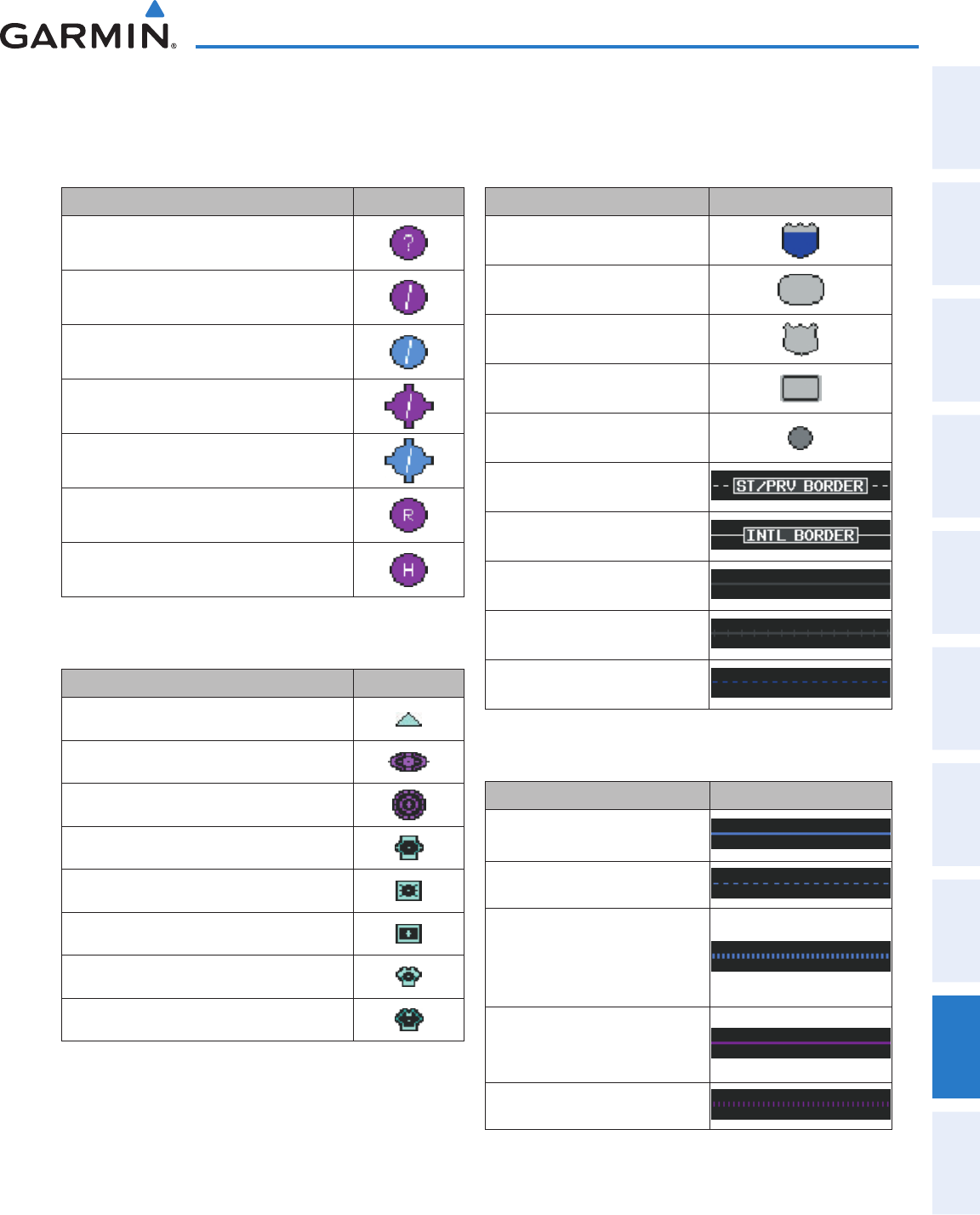
190-00592-06 Rev. A
Garmin G1000 Pilot’s Guide for the Diamond DA40/40F
SYSTEM
OVERVIEW
FLIGHT
INSTRUMENTS EIS AUDIO PANEL
& CNS
FLIGHT
MANAGEMENT
HAZARD
AVOIDANCE AFCS ADDITIONAL
FEATURES APPENDICES INDEX
515
APPENDIX F
MAP SYMBOLS
AIRPORTS
Item Symbol
Unknown Airport
Non-towered, Non-serviced Airport
Towered, Non-serviced Airport
Non-towered, Serviced Airport
Towered, Serviced Airport
Restricted (Private) Airport
Heliport
NAVAIDS
Item Symbol
Intersection
LOM (compass locator at outer marker)
NDB (non-directional radio beacon)
VOR
VOR/DME
VOR/ILS
VORTAC
TACAN
BASEMAP
Item Symbol
Interstate Highway
State Highway
US Highway
National Highway
City
State/Province Border
International Border
Road
Railroad
Latitude/Longitude
AIRSPACE BOUNDARIES
Item Symbol
ICAO Control Area
Class B Airspace
Mode C Tower Area
Warning Area
Alert Area
Caution Area
Danger Area
Prohibited Area
Restricted Area
Training Area
Unknown Area
Class C
Terminal Radar Service Area
Mode C Area
Military Operations Area (MOA)
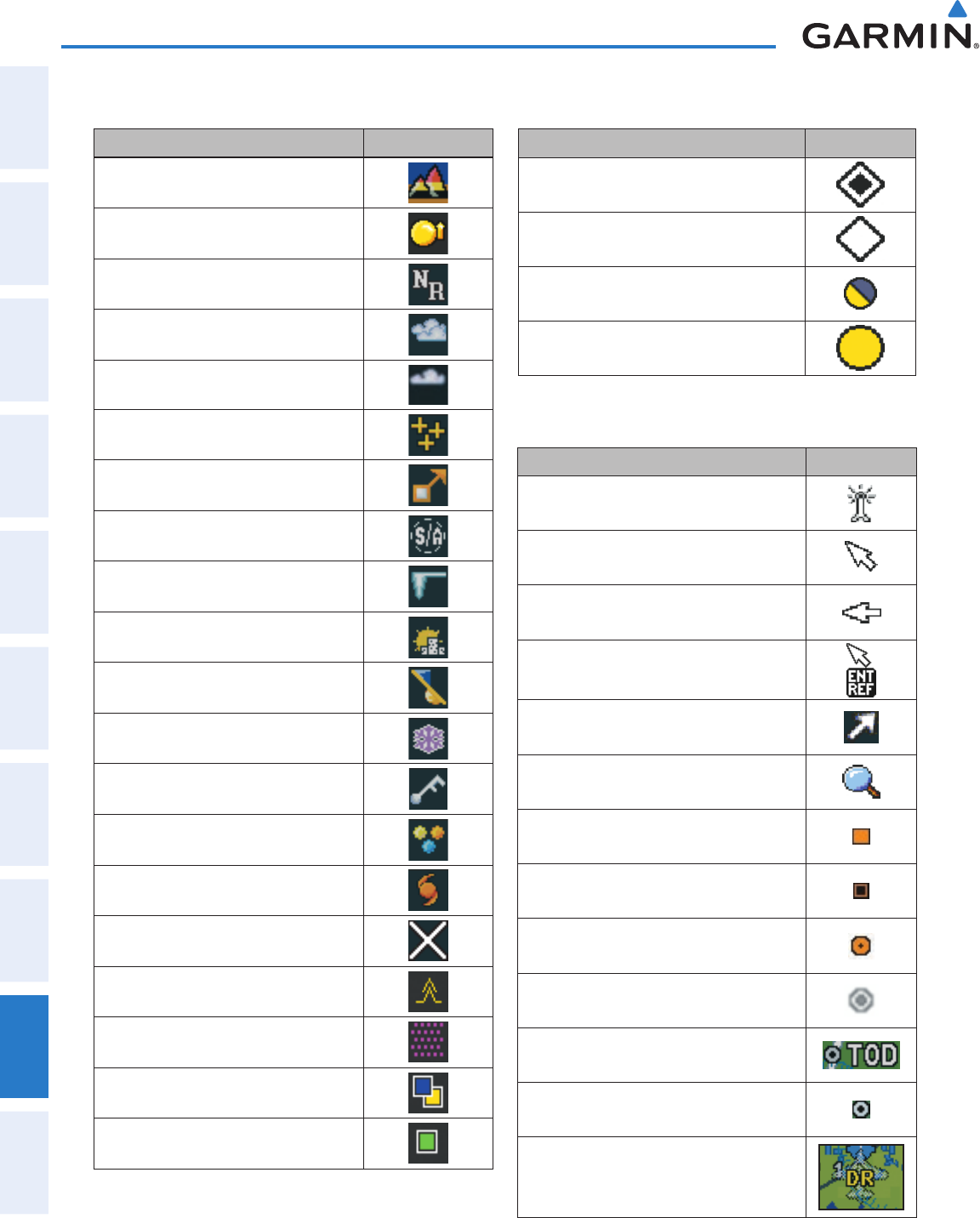
Garmin G1000 Pilot’s Guide for the Diamond DA40/40F
190-00592-06 Rev. A
SYSTEM
OVERVIEW
FLIGHT
INSTRUMENTS
EIS
AUDIO PANEL
& CNS
FLIGHT
MANAGEMENT
HAZARD
AVOIDANCE
AFCS
ADDITIONAL
FEATURES
APPENDICESINDEX
516
APPENDIX F
HAZARD AVOIDANCE FEATURES
Feature Symbol
Terrain Proximity/TAWS display enabled
Traffic display enabled
NEXRAD display enabled
Cloud Top display enabled
Echo Top display enabled
XM Lightning display enabled
Cell Movement display enabled
SIGMETs/AIRMETs display enabled
METARs display enabled
City Forecast display enabled
Surface Analysis display enabled
Freezing Levels display enabled
Winds Aloft display enabled
County Warnings display enabled
Cyclone Warnings display enabled
Loss of hazard avoidance feature
(loss of GPS position)
Turbulence
Icing Potential
PIREPs
AIREPs
TRAFFIC
Item Symbol
Non-threat Traffic
Proximity Advisory (not used with TIS)
Traffic Advisory, Out of Range
Traffic Advisory
MISCELLANEOUS
Item Symbol
ARTCC Frequency or FSS Frequency
Map Pointer (when panning)
Elevation Pointer
(on Topography Scale when panning)
Measuring Pointer
Wind Vector
Overzoom Indicator
User Waypoint
Vertical Navigation Along Track Waypoint
Parallel Track Waypoint
Unanchored Flight Path Waypoint
Top of Descent (TOD)
Bottom of Descent (BOD)
Navigating using Dead Reckoning
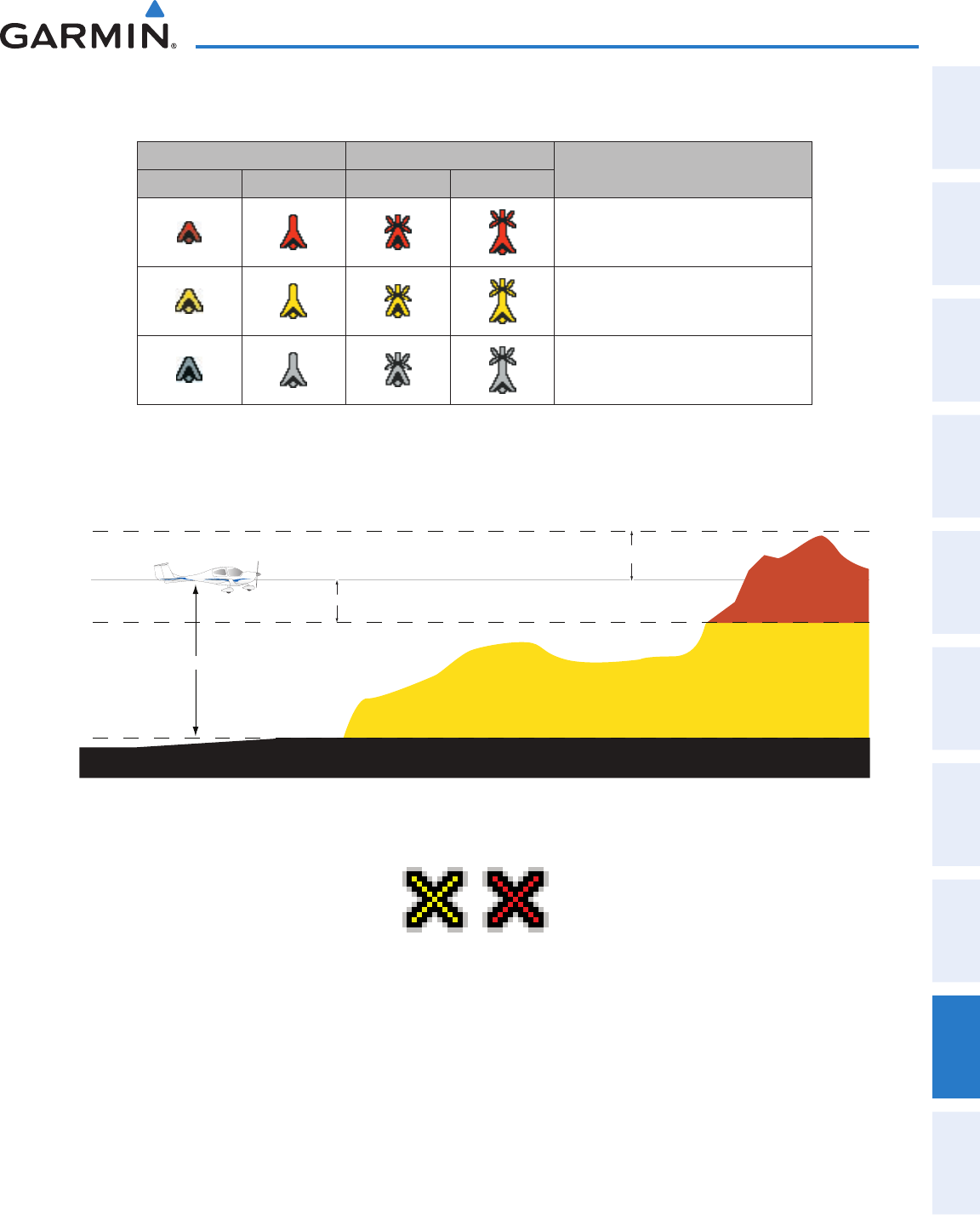
190-00592-06 Rev. A
Garmin G1000 Pilot’s Guide for the Diamond DA40/40F
SYSTEM
OVERVIEW
FLIGHT
INSTRUMENTS EIS AUDIO PANEL
& CNS
FLIGHT
MANAGEMENT
HAZARD
AVOIDANCE AFCS ADDITIONAL
FEATURES APPENDICES INDEX
517
APPENDIX F
OBSTACLE DATABASE
Unlighted Obstacle Lighted Obstacle Obstacle Location
< 1000’ AGL > 1000’ AGL < 1000’ AGL > 1000’ AGL
Red obstacle is above or within 100 ft
below the aircraft altitude
Yellow obstacle is between 100 ft and
1000 ft below the aircraft altitude
Gray obstacle is more than 1000 ft
below aircraft altitude
Table F-1 Obstacle Colors
TERRAIN AVOIDANCE COLORS AND SYMBOLS
1000 ft
Aircraft Altitude
100 ft Threshold
Terrain Above Aircraft Altitude
Red terrain is above
or within 100 ft below
the aircraft altitude
Yellow terrain is between 100 ft and 1000 ft below the aircraft altitude
Black terrain is more than 1000 ft below the aircraft altitude
Figure F-1 Terrain Altitude/Color Correlation
Figure F-2 TAWS Potential Impact Points
Garmin G1000 Pilot’s Guide for the Diamond DA40/40F
190-00592-06 Rev. A
SYSTEM
OVERVIEW
FLIGHT
INSTRUMENTS
EIS
AUDIO PANEL
& CNS
FLIGHT
MANAGEMENT
HAZARD
AVOIDANCE
AFCS
ADDITIONAL
FEATURES
APPENDICESINDEX
518
APPENDIX F
Bl a n k Pa g e
190-00592-06 Rev. A
Garmin G1000 Pilot’s Guide for the Diamond DA40/40F
I-1
INDEX
SYSTEM
OVERVIEW
FLIGHT
INSTRUMENTS EIS AUDIO PANEL
& CNS
FLIGHT
MANAGEMENT
HAZARD
AVOIDANCE AFCS ADDITIONAL
FEATURES APPENDICES INDEX
A
Activate a Flight Plan --------------------------------------208
Active channel ----------------------------------------------464
Active frequency -------------------------------------- 96, 105
ADF --------------------------------------------------------114
ADF
ADF mode ----------------------------------------- 114, 116
ANT mode ------------------------------------------------116
Volume ----------------------------------------------------114
ADF/BFO ----------------------------------------------------116
ADF/DME tuning -------------------------------------------117
ADF volume -------------------------------------------------116
AHRS -------------------------------------------------- 492, 493
Air Data Computer (ADC) ----------------------------------- 3
AIRMETs -----------------------------------------------------294
Airport
Information ----------------------------------------------166
Airspace Alerts -------------------------------------- 181, 182
Airspeed indicator --------------------------------------44, 46
Airspeed Reference ----------------------------------------368
Airspeed Trend Vector -------------------------------------- 46
Airways
Collapsed -------------------------------------------------221
Expanded -------------------------------------------------221
Alerting system ---------------------------------------------479
Alert levels --------------------------------------------------480
Alerts --------------------------------------------------------479
Aircraft ----------------------------------------------------481
Audio voice ----------------------------------------------482
Alerts window ----------------------------------------------- 69
Along Track Offset ---------------------------------- 212, 213
ALT -----------------------------------------------------------271
Altimeter -------------------------------------------------44, 49
Altitude
Constraints ---------------------------------------- 224, 258
Altitude alerting --------------------------------------------- 72
Altitude capture ------------------------------------- 365, 374
Altitude Hold Mode (ALT) ---------------------------------366
Altitude Reference ---------------------------- 365, 366, 374
Ammeter ----------------------------------------------------- 88
Annunciations
AFCS Status ----------------------------------------------495
G1000 System ------------------------------- 10, 483–484
TAWS Status ---------------------------------------------498
Test tone --------------------------------------------- 12, 480
Annunciation Window ------------------------------------- 45
Annunciator lights -----------------------------------------124
ANT/BFO ----------------------------------------------------116
Approach ----------------------------------------------------510
Activating ------------------------------------------------237
ILS ---------------------------------------------------------397
Loading -------------------------------------- 205, 234, 236
Missed ----------------------------------------------------399
Removing -------------------------------------------------237
Approach box ----------------------------------------------447
Approach Mode, AFCS ----------------------- 384, 397, 398
APR softkey ------------------------------------------ 236, 242
Arrival procedure 189, 203, 231, 233, 234, 236, 256, 258,
267
Assist, engine leaning --------------------------------- 83–85
Attitude and Heading Reference System (AHRS) ---- 3, 8,
13–14
Attitude indicator ------------------------------------------- 44
Audio alerting system -------------------------------------480
Audio Panel ----------------------------------------------- 2, 10
Audio panel controls
SPKR ------------------------------------------------------124
Audio panel fail-safe operation --------------------------130
Automatic Flight Control System (AFCS) ----- 1, 357–402
Controls ------------------------------------------- 358–359
Example procedures ----------------------------- 388–395
Status Annunciations -----------------------------------401
Status Box ------------------------------------------------361
Automatic squelch -----------------------------------------104
Autopilot ---------------------------------------357, 386–387
Disconnect ---------------------------------- 359, 378, 387
Auto-tuning -------------------------------------------------112
Auto-tuning, COM ------------------------------------------ 99
Auto-tuning, NAV ------------------------------------------108
Auto Zoom --------------------------------------------------136
Auxiliary Pages (AUX) -------------------------------------- 31
AUX - system status page 442, 443, 444, 460, 461, 463
Aviation Symbols ------------------------------------ 148, 149
B
Backlighting ------------------------------------------------- 41
Barometric altimeter setting --------------------------44, 50
Bearing/distance, measuring -----------------------------143
Bearing information ---------------------------------------- 57
Bearing Information Windows ---------------------------- 45
Bearing pointer ---------------------------------------------- 56
Bearing source ---------------------------------------------- 57
Bus voltage -------------------------------------------------- 88
C
Calibrated Airspeed ----------------------------------------239
CDI --------------------------------- 233, 247, 258, 266, 273
CELL MOV Softkey -----------------------------------------293
Chart Not Available --------------------------------- 424, 445
Chart options ---------------------------------------- 432, 452
Chart setup box ------------------------------------- 438, 456
ChartView --------------------------------403, 423, 442, 444
ChartView database -------------------------- 440, 442, 443
ChartView functions ---------------------------------------423
ChartView plan view --------------------------------------433
ChartView profile view ------------------------------------434
ChartView softkeys ----------------------------------------423
ChartView subscription -----------------------------------442
Garmin G1000 Pilot’s Guide for the Diamond DA40/40F
190-00592-06 Rev. AI-2
INDEX
SYSTEM
OVERVIEW
FLIGHT
INSTRUMENTS
EIS
AUDIO PANEL
& CNS
FLIGHT
MANAGEMENT
HAZARD
AVOIDANCE
AFCS
ADDITIONAL
FEATURES
APPENDICESINDEX
Checklists -------------------------------------------- 469–470
Checklist softkeys ------------------------------------------469
CLD TOP Softkey -------------------------------------------291
Closest Point ------------------------------------------------221
COM channel spacing -------------------------------------103
COM frequency box ------------------------------------93, 96
Command Bars, flight director ---------------------------362
Communication (COM) frequency box ------------------ 44
COM tuning failure ----------------------------------------130
Controls
AFCS ----------------------------------------------- 358–359
PFD/MFD -----------------------------------------18–19, 28
Softkeys ----------------------------------------------- 20–23
Control Wheel Steering (CWS) -------------------- 359, 387
Copy a Flight Plan -----------------------------------------208
County Warnings -------------------------------------------304
Course Deviation Indicator (CDI) -------------------- 58–59
Changing scale ------------------------------------------511
Course To Altitude -----------------------------------------238
Cyclone ------------------------------------------------------305
Cylinder Head Temperature (CHT °F) -------------------- 78
D
Databases ----------------------------------------7, 8, 12, 499
Data entry ----------------------------------------------- 27–28
Data Link Receiver -------------------------------------------- 4
Datalink receiver troubleshooting -----------------------476
Data logging ------------------------------------------------473
Date and time ----------------------------------------------- 34
Day/Night views ------------------------------------- 438, 456
Day view ---------------------------------438, 439, 456, 457
Dead Reckoning --------------------------------------------- 74
DEC FUEL softkey ------------------------------------------- 82
Decision Height (DH) -----------------------------------45, 73
Declutter, display -------------------------------------------- 75
Declutter maps ------------------------------------------21, 26
Delete Flight Plans -----------------------------------------209
Deleting
An entire airway ---------------------------------- 210, 211
An entire procedure ----------------------------- 210, 211
An individual waypoint -------------------------- 210, 211
Flight Plan Items ----------------------------------------210
Density Altitude --------------------------------------------241
Departure
Procedure -----------------------------201, 216, 228, 230
Select -----------------------------------228, 231, 234, 237
Time -------------------------------------------------------239
Timer ------------------------------------------------------- 40
Dilution of Precision (DOP) -------------------------------- 17
Direct-to - 160, 183, 184, 185, 186, 187, 222, 223, 256,
258, 273
Display backup ------------------------------------------10, 95
Display controls ---------------------------------------- 18–25
DME
HOLD mode ----------------------------------------------117
NAV1 mode ----------------------------------------------117
NAV2 mode ----------------------------------------------117
Tuning mode -------------------------------------- 114, 117
DME information ----------------------------------------56, 57
DR mode ----------------------------------------------------- 74
E
ECHO TOP Softkey -----------------------------------------290
Electronic checklists ------------------- 403–404, 469, 470
Emergency checklist ---------------------------------------471
Emergency frequency --------------------------------------130
Endurance, calculated (ENDUR) ----------------------80, 82
Engine Airframe Unit ----------------------------------------- 3
Engine Indication System (EIS) ----------------------- 77–90
Engine Manifold Pressure (MAN IN HG) -- 78, 80, 86, 88
Entertainment inputs --------------------------------------128
Estimated Position Error (EPE) ---------------------------- 17
Exhaust Gas Temperature (EGT) --------------------- 83–84
F
Fail-safe operation -----------------------------------------130
Field of View (SVS) -----------------------------------------159
Flight data --------------------------------------------------472
Flight director ----------------------------------357, 360–361
Pitch modes --------------------------------------- 363–369
Roll modes -----------------------------------------------379
Flight Level Change Mode (FLC) ----------------- 368, 393
Flight plan
Closest point to reference -----------------------------221
Storing ----------------------------------------------------510
Flight timer --------------------------------------------------- 39
FliteCharts ------------------------ 444, 446, 458, 461, 500
FliteCharts database --------------------------------------460
FliteCharts functions --------------------------------------444
FPA ---------------------------------------------------- 224, 263
Freezing Levels -------------------------------------- 297, 298
Frequency
Nearest ---------------------------------------------------179
Frequency spacing -----------------------------------------103
Frequency transfer arrow ---------------------------------- 97
Frequently asked questions -------------------------------509
Fuel
Calculations ----------------------------------------------- 82
Efficiency -------------------------------------------------241
Endurance ------------------------------------------------241
Flow -------------------------------------------------------- 81
Quantity --------------------------------------------------- 80
Remaining ------------------------------------------------241
Required --------------------------------------------------241
Statistics --------------------------------------------------241
Fuel calculations -------------------------------------------- 88
Fuel Flow (FFLOW GPH) --------------------------78, 86, 88
Fuel on Board ----------------------------------------------241
190-00592-06 Rev. A
Garmin G1000 Pilot’s Guide for the Diamond DA40/40F
I-3
INDEX
SYSTEM
OVERVIEW
FLIGHT
INSTRUMENTS EIS AUDIO PANEL
& CNS
FLIGHT
MANAGEMENT
HAZARD
AVOIDANCE AFCS ADDITIONAL
FEATURES APPENDICES INDEX
Fuel Quantity (FUEL QTY GAL) ---------------------------- 78
Fuel remaining (GAL REM) -------------------------------- 88
Fuel used (GAL USED) -------------------------------------- 88
G
GDL 69/69A ------------------------------------------------277
GFC 700 AFCS--------------------------------------- 357–402
Glidepath ----------------------------------------------------271
Glidepath indicator ----------------------------------------- 52
Glidepath Mode (GP) ------------------------- 375, 384, 398
Glideslope ---------------------------------------------------271
Glideslope indicator ---------------------------------------- 52
Glideslope Mode (GS) ------------------------------ 377, 397
Global Positioning System (GPS)
Navigation ---------------------------------------- 183–276
Go Around Mode (GA) ---------------- 359, 378, 399–400
GTX 33 Transponder ---------------------------------------118
H
Heading ------------------------------------------------------ 44
Heading bug ------------------------------------------------- 44
Heading Select Mode (HDG) ---------------------- 381, 389
HI SENS ------------------------------------------------------113
Horizontal situation indicator -------------------------44, 53
HSI double green arrow -----------------------------------105
HSI magenta arrow ----------------------------------------105
HSI single green arrow ------------------------------------105
I
ID indicator -------------------------------------------------107
ILS approach ------------------------------------------------397
Indicated airspeed ------------------------------------------ 46
Indicated Altitude ------------------------------------------239
INFO box ----------------------------------------------------448
Inset Map, PFD ---------------------------------------------- 45
Integrated Avionics Unit (IAU) ------------------------------2
Intercom system (ICS) -------------------------------------128
Intersection
Information --------------------------------------- 167–168
Inverting a flight plan -------------------------------------208
IOI ----------------------------------------------------- 323, 332
J
Jeppesen aviation database ------------------------------499
L
Land Symbols -----------------------------------------------147
Line Replaceable Units (LRU) -----------------------2–5, 11
LNAV ---------------------------------------------------------247
LO SENS -----------------------------------------------------113
Low Altitude Annunciation -------------------------------- 72
LPV ---------------------------------------------------- 247, 273
LPV approach -----------------------------------------------388
M
Manual Electric Trim (MET) ------------------------ 357, 386
Map
Panning ---------------------------------------------------138
Map Pages (MAP)------------------------------------------- 30
Map symbols -----------------------------------------------515
Marker beacon ---------------------------------------------113
Marker beacon annunciations ---------------------------- 70
MASQ processing ------------------------------------------- 91
Measurement units, changing displayed ---------------- 35
Menus -------------------------------------------------------- 27
Message advisories - 481, 485, 486, 487, 491, 492, 493,
494
METARs -----------------------------------------------------295
Minimum Descent Altitude (MDA) -------------------45, 73
Missed Approach-----------189, 238, 243, 247, 273, 399
Mode S ----------------------------------------------- 118, 119
Morse code identifier --------------------------------------107
Multi Function Display (MFD) ------------------------------- 2
Controls ---------------------------------------------- 18–19
Softkeys ---------------------------------------------------- 25
N
National Weather Service ---------------------------------304
NAV frequency box ----------------------------------------- 93
Navigation
Database ------------------------------------------ 224, 225
Map -------------------------------------------------------186
Navigation Mode, AFCS --------------- 382–383, 391–392
Navigation mode selection -------------------------------105
Navigation (NAV) frequency box ------------------------- 44
Navigation source ------------------------------------- 58–59
Navigation status box -------------------------------------- 44
Nav radio selection ----------------------------------------105
NAV tuning knob ------------------------------------------107
Nearest
Airport ------------- 163, 164, 165, 166, 179–182, 236
Airport Minimum Runway Length --------------------166
Airports Page ------------------------------- 164, 165, 166
Airport Surface Matching ------------------------------166
VOR ------------------------------------------------ 179–180
Nearest Pages (NRST) -------------------------------------- 31
NEXRAD Softkey -------------------------------------------286
Night view -------------------------------438, 439, 456, 457
Non-path descent -----------------------------373, 395–396
Normal display operation ------------------------------------ 9
O
OBS Mode-------------------------------------------63, 63–64
Obstacles --------------------------------------------- 487, 490
Oil Pressure (OIL PSI) -----------------------------------78, 80
Oil Temperature (OIL °F) ----------------------------------- 78
Omni Bearing Selector (OBS) ---------------------- 510–511
Garmin G1000 Pilot’s Guide for the Diamond DA40/40F
190-00592-06 Rev. AI-4
INDEX
SYSTEM
OVERVIEW
FLIGHT
INSTRUMENTS
EIS
AUDIO PANEL
& CNS
FLIGHT
MANAGEMENT
HAZARD
AVOIDANCE
AFCS
ADDITIONAL
FEATURES
APPENDICESINDEX
Other Statistics -------------------------------------- 239, 241
Outside Air Temperature (OAT) -----------------------44, 65
Overspeed protection, autopilot -------------------------402
P
Page groups -------------------------------------------- 29–32
Page menus -------------------------------------------------- 27
Parallel Track ----------------------------------------- 214, 216
Passenger address -----------------------------------------127
PA system ---------------------------------------------------127
Pilot profiles -------------------------------------------- 36–37
Pitch Hold Mode (PIT) -------------------------------------364
Pitch modes, flight director ------------------------ 363–369
Pitch Reference ---------------------------------------------364
Power-up page -------------------------------- 440, 459, 469
Power-up, system --------------------------------------------- 8
Primary Flight Display (PFD) --------------------------------- 2
Controls ---------------------------------------------- 18–19
Softkeys ----------------------------------------------- 20–22
Procedure examples, AFCS ------------------------ 388–400
Procedure Loading Pages (PROC) ------------------------ 32
Q
Quick tuning 121.500 MHz ------------------------------- 98
R
RAIM -------------------- 16, 233, 243, 244, 245, 246, 509
Range --------------------------------------------------------157
Receiver Autonomous Integrity Monitoring -------- 16–17
Receiver Autonomous Integrity Monitoring (RAIM) --243
Required
Vertical Speed -------------------------------------------264
Vertical Speed Indicator --------------------------------264
Reversionary mode ----------------------------------------130
Reversionary Mode -------------------------------------- 9–10
ROC --------------------------------------------------- 323, 332
Roll Hold Mode (ROL) -------------------------------------380
Roll modes, flight director ------------------------- 379–382
Roll Reference ----------------------------------------------380
RVSI --------------------------------------------------- 264, 265
RX indicator -------------------------------------------------- 97
S
SafeTaxi -----------------------------------403, 417, 420, 500
SafeTaxi database ------------------------------------------421
SBAS -------------------------------------------- 243, 245, 246
Scheduler --------------------------------------------- 467, 471
Secure Digital (SD) card ------------------- 7, 469, 472, 499
Selected Altitude -------------44, 365, 367, 370, 374, 389
Selected Altitude Bug -------------------------------------- 44
Selected Altitude Capture Mode ------365, 366, 367, 370
Selected Course ---------------------------- 45, 54, 383, 385
Selected Heading -------------------------------- 45, 54, 381
Selecting a COM radio ------------------------------------- 96
Sequencing, automatic ------------------------------------511
Service Class ------------------------------------------------463
Servos -----------------------------------------------------4, 386
SIGMETs -----------------------------------------------------294
Slip/Skid Indicator ---------------------------------------44, 48
Softkeys------------------------------------------------------- 44
EIS ------------------------------------------------------25, 80
LTNG ------------------------------------------------------292
MFD -------------------------------------------------------- 25
PFD ---------------------------------------------------- 20–22
Sort Flight Plans --------------------------------------------208
Speaker ------------------------------------------------------124
Splash screen, power-up ------------------------------------- 8
Standby frequency ------------------------------- 96, 99, 105
ADF --------------------------------------------------------114
Standby frequency field ------------------------------------ 96
Stereo headsets --------------------------------------------124
Stormscope -------------------------------------------------306
Stuck microphone ------------------------------------------130
Sunrise -------------------------------------------------------240
Sunset -------------------------------------------------------240
Surface Analysis --------------------------------------------297
SVS troubleshooting ---------------------------------------474
Symbols, map -----------------------------------------------515
Synthetic vision (SVS) ------------------------------ 403, 404
System annunciations -------------------------------- 10, 479
System Page (EIS) ------------------------------------------- 88
System power-up --------------------------------------------- 8
System time -------------------------------------------------- 44
T
Tachometer (RPM) ---------------------------- 78, 81, 86, 88
TAFs ----------------------------------------------------------295
TAS -----------------------------------------------------------492
TAWS -------------------------------------321, 330, 497, 498
Terminal procedures charts ------------------------ 424, 445
Terrain -------------------------------------------------------487
Color indications ----------------------------------------517
Terrain Awareness and Warning System (TAWS) - 71, 497
Terrain Proximity -------------------------------------------311
Terrain-SVS --------------------------------------------------316
Timer
Departure -------------------------------------------------- 40
Flight ------------------------------------------------------- 39
Timer, PFD generic ------------------------------------------ 38
TIS ------------------------------------------------------------339
TOD --------------------------------------------- 263, 264, 270
TOPO DATA ------------------------------------ 144, 145, 154
Top of Descent -------------------------------------- 263, 264
TOPO SCALE ------------------------------------------------146
Total flight hours ----------------------------------------80, 88
Track indicator ----------------------------------------------- 44
Track Vector -------------------------------------------------155
190-00592-06 Rev. A
Garmin G1000 Pilot’s Guide for the Diamond DA40/40F
I-5
INDEX
SYSTEM
OVERVIEW
FLIGHT
INSTRUMENTS EIS AUDIO PANEL
& CNS
FLIGHT
MANAGEMENT
HAZARD
AVOIDANCE AFCS ADDITIONAL
FEATURES APPENDICES INDEX
Traffic Annunciation ------------------------------------45, 70
Traffic Information Service (TIS) ------------------- 513–514
Voice alerts ------------------------------------------------ 70
Transponder ---------------------------------------------------- 3
Transponder code entry -----------------------------------122
Transponder data box ----------------------------------91, 93
Transponder ground mode -------------------------------119
Transponder mode field ---------------------- 119, 120, 121
Transponder softkeys --------------------------------------119
Transponder standby mode ------------------------------120
Transponder status box ------------------------------------ 44
Trend Vector
Turn Rate -------------------------------------------------- 56
Trend Vector, Airspeed -------------------------------------- 46
Trim, Manual Electric ------------------------- 357, 359, 386
Trip Planning ----------------------------------- 239, 240, 241
Trip statistics ----------------------------------------- 240, 241
True Airspeed ------------------------------------- 44, 46, 241
Tuning ADF frequencies -----------------------------------115
Turn anticipation -------------------------------------------511
Turn Rate Indicator -------------------------------------44, 56
TX indicator -------------------------------------------------- 97
U
Unable to display chart ---------------------------- 424, 445
Updating Garmin databases ---------------------- 421, 460
Updating Jeppesen databases ---------------------------442
V
VDI ---------------------------------------------------- 264, 265
Vertical deviation ------------------------------------------372
Vertical deviation guidance ------------------------------225
Vertical Deviation Indicator ------------------------------264
Vertical Deviation Indicator (VDI) ------------------------- 52
Vertical navigation -----------------------------------------224
Direct-to --------------------------------------------------223
Vertical Navigation (VNV)
Flight control -------------------------------------- 370–374
Vertical Path Tracking Mode (VPTH) -------370–371, 394
Vertical speed guidance-----------------------------------225
Vertical speed indicator --------------------------------44, 51
Vertical Speed Mode (VS) ---------------------------------367
Vertical Speed Reference ---------------------------------367
VFR code ----------------------------------------------------123
VNAV --------------------------------------------------------188
VNV --------------------------------------------- 263, 494, 508
VNV guidance
Disabling -------------------------------------------------222
Enabling --------------------------------------------------222
VNV indications --------------------------------------------- 68
VNV Target Altitude --------------------------- 52, 370–373
VNV Target Altitude Capture Mode (ALTV) ------------374
Voice alerts, TIS ---------------------------------------------- 70
Voice alerts, TIS Traffic ------------------------------ 343, 482
VOL annunciation ------------------------------------------126
Voltmeter ----------------------------------------------------- 88
Volume level
ADF ------------------------------------------------- 114, 116
VOR
Nearest -------------------------------------------- 179–180
VOR selection -----------------------------------------------105
VSI ------------------------------------------------------------265
Vspeed references --------------------------------------45, 47
VS TGT ------------------------------------------------ 224, 263
W
WAAS ------------------------------------------- 247, 388, 490
Warranty -------------------------------------------------------- i
Waypoint
Automatic sequencing -------------------------- 510, 511
Skipping --------------------------------------------------511
Waypoint Pages (WPT) ------------------------------------- 30
Waypoint Selection Submenu -- 184, 191, 194, 196, 243
Wind -------------------------------------------------- 134, 156
Wind data ---------------------------------------------------- 45
Winds Aloft -------------------------------------------------299
WIND Softkey -----------------------------------------------299
X
XM
Radio ----------------------------------------------- 277, 462
Receiver troubleshooting ------------------------------476
Satellite Weather ----------------------------------------277
Activating ------------------------------------------------278
XM channel list ---------------------------------------------464
XM presets --------------------------------------------------466
XM radio ----------------------------------------------------464
XM radio entertainment ----------------------------------128
XM radio volume -------------------------------------------466
XM satellite radio ----------------------------------- 462, 464
XM Satellite Radio -------------------------------------------- 4
XM Satellite Weather
AIREPs ----------------------------------------------------302
Icing -------------------------------------------------------300
PIREPs-----------------------------------------------------302
Turbulence ------------------------------------------------301
Z
Zoom
Auto -------------------------------------------------------136
Garmin G1000 Pilot’s Guide for the Diamond DA40/40F
190-00592-06 Rev. AI-6
INDEX
SYSTEM
OVERVIEW
FLIGHT
INSTRUMENTS
EIS
AUDIO PANEL
& CNS
FLIGHT
MANAGEMENT
HAZARD
AVOIDANCE
AFCS
ADDITIONAL
FEATURES
APPENDICESINDEX
Bl a n k Pa g e
Untitled-1 1 11/13/2007 9:15:37 AM

Garmin International, Inc.
1200 East 151st Street
Olathe, KS 66062, U.S.A.
p:913.397.8200
f:913.397.8282
Garmin AT, Inc.
2345 Turner Road SE
Salem, OR 97302, U.S.A.
p:503.391.3411
f:503.364.2138
Garmin (Europe) Ltd.
Liberty House, Bulls Copse Road
Houndsdown Business Park
Southampton, SO40 9RB, U.K.
p:44/0870.8501241
f:44/0870.8501251
Garmin Corporation
No. 68, Jangshu 2nd Road
Shijr, Taipei County, Taiwan
p:886/02.2642.9199
f:886/02.2642.9099
www.garmin.com
System Software 0321.20 or later
G1000®Integrated Flight Deck
Pilot’s Guide
G1000®
Pilot’s Guide Diamond
DA40/40F
190-00592-06
Revision A
