Gemini Data Loggers TGRF-3XXX-C Wireless Data Logging System - 3000 Series User Manual
Gemini Data Loggers (UK) Limited Wireless Data Logging System - 3000 Series
User manual

Tinytag Radio Data Loggers
Technical Manual

1 Tinytag Radio Data Logger Technical Manual
01
1.1 About this Document
This document describes the Tinytag radio data logger
system.
This document also describes characteristics of the
Tinytag Explorer and the Radio Gateway Service that is
installed alongside this software used with radio loggers.
All users are encouraged to upgrade to the latest version
and only version 4.7 is described in detail.

2 Table of Contents
02
1 Tinytag Radio Data Logger Technical Manual 1
1.1 About this Document 1
2 Table of Contents 2
3 Radio Gateway Service Computer
Requirements 3
4 Radio System Component Overview 4
4.1 Tinytag Explorer 4
4.2 Radio Gateway Server 5
4.3 Receiver 6
4.4 Radio Logger 6
4.5 Repeater 6
4.6 Receiver Cables 6
4.7 Mesh Network 7
5 Point-to-Point Radio 8
6 Receiver Con gurations 9
6.1 Direct 9
6.2 Multiple Receivers 9
6.3 Multiple Computers Running the Radio
Gateway Service 9
Receiver Con guration (Continued) 10
Receiver Con guration (Continued) 11
6.4 Repeater 12
6.5 Back-to-Back Receivers 12
7 Mesh Network Behaviour 13
7.1 Switching On a Device 13
7.2 Moving a Device 13
7.3 Starting the Radio Gateway Service 13
7.4 Switching On the Receiver 13
7.5 Redundant Routing 13
Mesh Network Behaviour (Continued) 14
Mesh Network Behaviour (Continued) 15
Mesh Network Behaviour (Continued) 16
7.6 Radio Con guration 17
7.6.1 Adjusting the Radio Range 17
7.6.2 Receive Sensitivity 17
7.6.3 Transmit Power 17
7.7 Very slow logging intervals 17
7.8 Very fast logging intervals 18
7.9 Data organisation 18
7.10 Alarms 18
8 Buttons and Lights 19
9 Rapid Installation 20
9.1 Introduction 20
9.2 Receiver First 20
9.3 Nearby Loggers Next 20
9.4 Distance Order 20
9.5 Don’t Rush It 20
9.6 Transplanting the Network to a New
Location 20
10 Troubleshooting 21
10.1 Tinytag Explorer Status Bar Indicator
Flashes Red 21
10.2 Firewall Con guration 21
11 Data Logging 22
11.1 No stopping 22
11.2 Time zones 22
11.3 Current Readings 22
12 Other Radio Gateway Functions 23
12.1 Modbus 23
12.2 Data Export 23
12.3 Proprietary Radio Gateway Service
Protocol 24
13 Modbus 25
13.1 Properties and Registers 25
13.2 Devices 25
13.3 Expected Values 25
13.4 Unit Identi ers 25
13.5 Function Codes 25
13.6 32-bit Values 25
13.7 Freshness 25
13.8 Device Connection 25
13.9 Missing Properties 26
13.10 Concurrent Connections 26
13.11 Modsak 26
14 Power 27
14.1 Batteries 27
14.2 Low Power Warnings 27
14.3 The E ect of the Mesh Network 27
15 Regulatory Compliance 28
Notes 29

3 Radio Gateway Service Computer Requirements
03
The requirements for running the Radio Gateway Service
on a computer are shown below. Note that additional
requirements apply if you are running Tinytag Explorer
on the same computer.
Operating System: Windows 2000, XP, Vista
or Windows 7.
Processor: 200MHz Pentium III
processor or better
Memory: 512Mb
Hard Disk Space: At least 30Mb available
Monitor for installation: Minimum 256 colours,
resolution 800 x 600
The requirements for
running the Radio
Gateway Service on an
existing server are shown
below.
CPU time: Negligible
Memory: 20Mb
Hard Disk Space: Typically 10Mb for
programs, 5Mb for data.
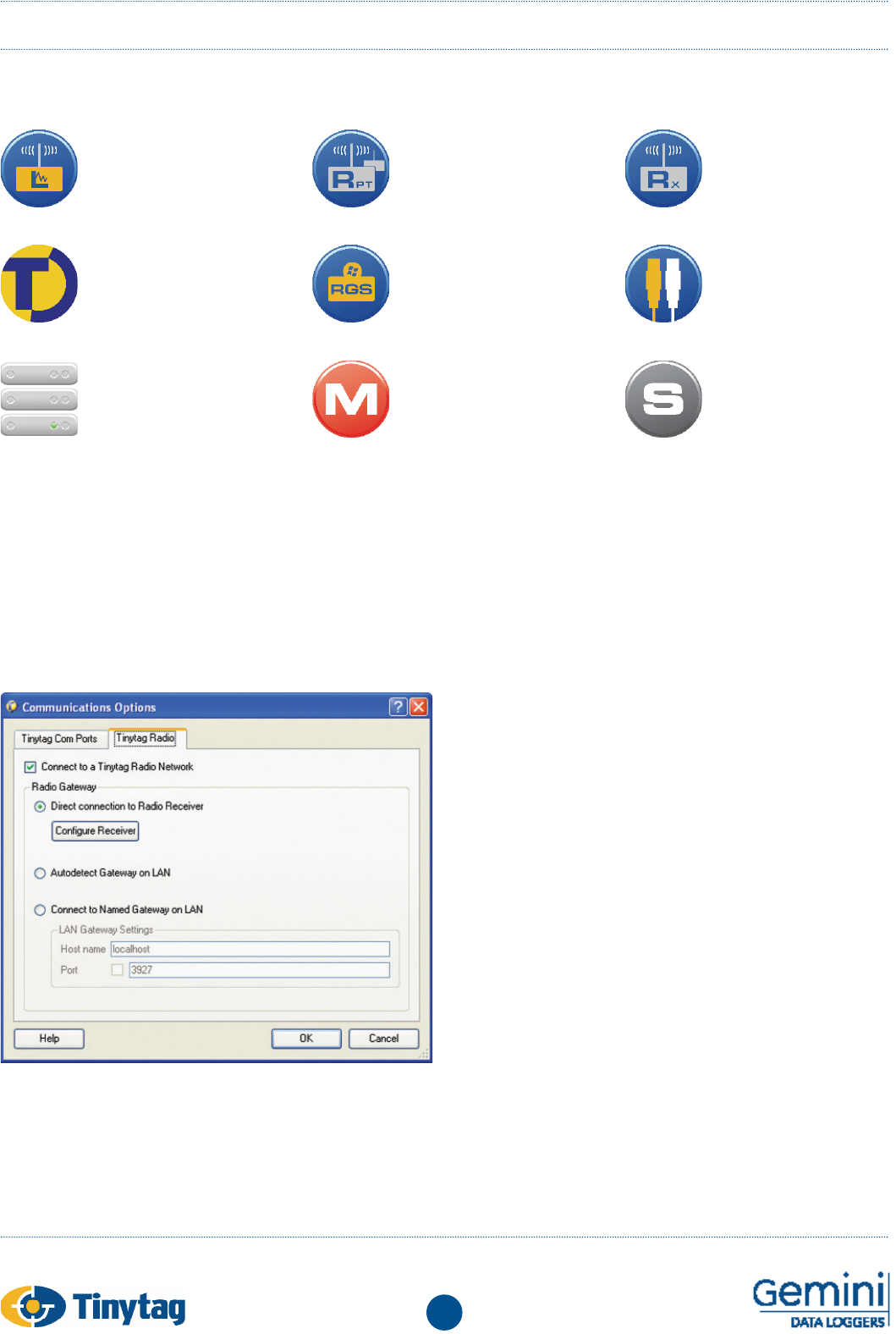
4.1 Tinytag Explorer Software
The radio edition of Tinytag Explorer is installed with
the same installation disk as regular Tinytag Explorer but
uses a di erent activation code. This activation code
adds the “radio” tab to the radio con guration dialog
box which allows the user to con gure a Radio Gateway
Server, which Tinytag Explorer can then connect to.
The rest of Tinytag Explorer is unchanged. The graphing
and data export features behave identically between
wired and radio loggers. It is possible to create an
overlay with data from mixed wired/radio sources, and
it is possible to view this overlay on normal (non-radio)
versions of Tinytag Explorer. This allows users with an
existing investment in wired loggers to start using radio
with minimal impact on their current processes.
4 Radio System Component Overview
Tinytag Radio System Components Key
Tinytag Radio Logger
Tinytag Explorer
Server
Tinytag Repeater
Tinytag Radio Gateway Service
Master
Tinytag Receiver
Tinytag Receiver Cables
Slave
04
4 Radio System Component Overview (Continued)
05
4.2 Radio Gateway Service
The Radio Gateway Service is installed with Tinytag
Explorer.
The Radio Gateway is a windows service. This means
it runs in the background as soon as the computer is
turned on. Its purpose is to connect to the radio receiver,
collate measurements, and make information available
to Tinytag Explorer. The Radio Gateway Service bu ers
measurements (and other data) on disk in les with a .jf
extension which use a proprietary le format.
On a networked system, the Radio Gateway Service must
be installed on the computer which is connected directly
to the receiver. It then makes this information available
to any networked computers running the radio edition of
Tinytag Explorer.
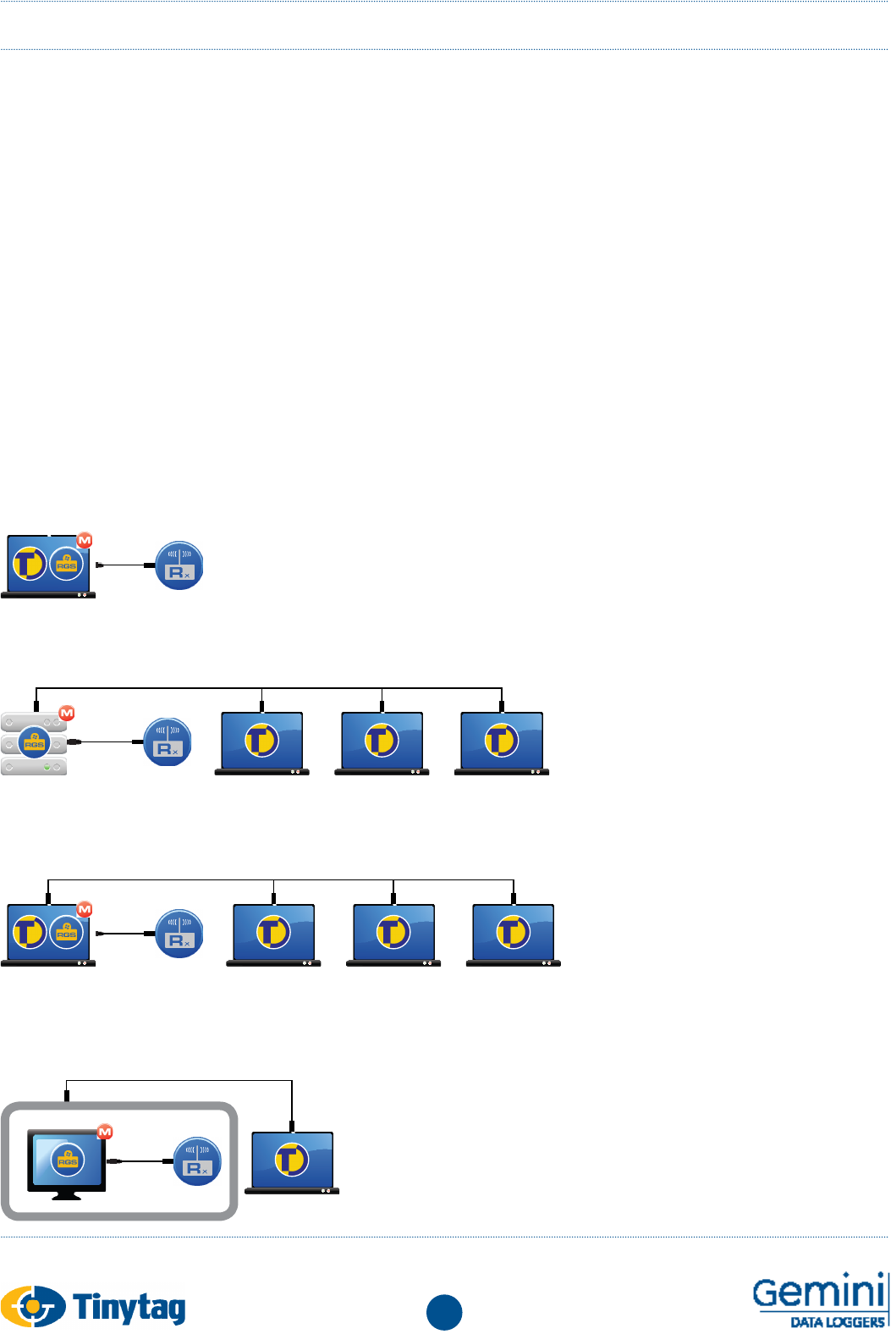
This can be used in various con gurations:
Note that this generally means there will only be
one computer running the Radio Gateway Service in
the system. It is possible to run it on more than one
computer; this con guration is described later in the
“Receiver Con gurations” section.
NETWORK
NETWORK
2. The Radio Gateway Service installed on a server.
Many other users in the same o ce run Tinytag
Explorer.
3. The Radio Gateway Service installed on one user’s
computer. Many other users in the same o ce run
Tinytag Explorer.
4. The Radio Gateway Service installed on one old
computer in a dirty location near the receiver. Tinytag
Explorer runs on a nice computer in a nice o ce.
1. Standalone. The Radio Gateway Service and Tinytag
Explorer don’t have to be on the same computer, but
they very often are. This con guration is the most
common, because it is the simplest.
NETWORK
4 Radio System Component Overview (Continued)
Ideally the Radio Gateway Service would be left running
24/7 to allow it to collate all data. No measurements will
be lost if the computer is shut down for up to 2 weeks
(at a 10 minute measurement interval), however this will
a ect battery life and there may be a delay in displaying
new measurements due to the need to retransmit
cached measurements. If the Radio Gateway Service
is shut down, it will detect any measurements that
weren’t collated on their rst transmission and arrange
retransmission. This ensures that no data is permanently
lost.
Ensure the following settings are correct for best
performance if your custom software solution relies on
the Radio Gateway Service.
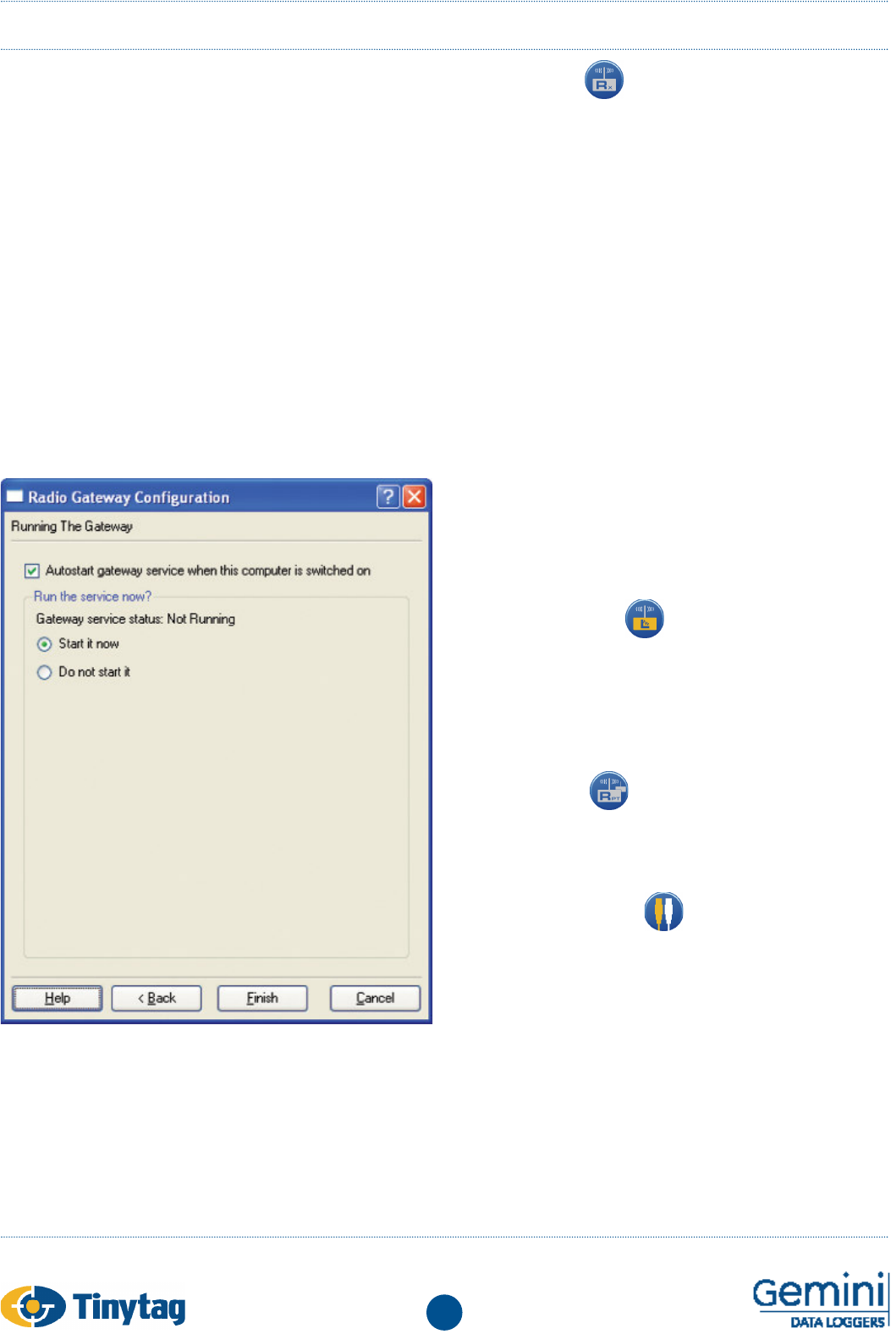
“Autostart service when the computer is turned on”
needs to be ticked. Tinytag Explorer knows to start the
windows service if it is not running, but your software
may not. It needs to be started automatically.
4.3 Receiver
When a receiver is connected to the Radio Gateway
Service, this connection becomes the point where
information enters and leaves the mesh network system.
The primary purpose of the mesh network is to nd a
way to funnel information downstream towards the
computer running the Radio Gateway Service. It is
this behaviour which gives the “receiver” its name. At
the physical layer (point-to-point radio layer) a logger
and receiver behave identically – they are both radio
transmitters and radio receivers.
Receivers can be used in a variety of con gurations, not
all of which involve connecting the Receiver directly to
the Radio Gateway Service. These are described in a
later chapter.
If the computer the receiver is connected to is turned
o , communications between the Radio Gateway Service
and the receiver will stop, but back-up batteries in the
receiver will keep it powered and the mesh network will
be maintained. Individual data loggers will store their
measurements until communications with the gateway
can be re-established. When the computer is turned on
again, the radio gateway will request transmission of any
stored data.
4.4 Radio Logger
The radio logger participates in the mesh network like
any other device, but most importantly it also takes
measurements.
After a measurement has been taken, it is stored locally
and then transmitted to the computer (and the Radio
Gateway Service) via the mesh network.
4.5 Repeater
A receiver which is not connected to any computer can
act as a repeater to improve the range of an installation
and to connect to other devices which have poor
communications.
4.6 Receiver Cables
Receivers use a one part cable, CAB-0022-5M; 5 pin
connector to USB. It is 5m long. This appears as a virtual
com port.
06
4 Radio System Component Overview (Continued)
07
4.7 Mesh Network
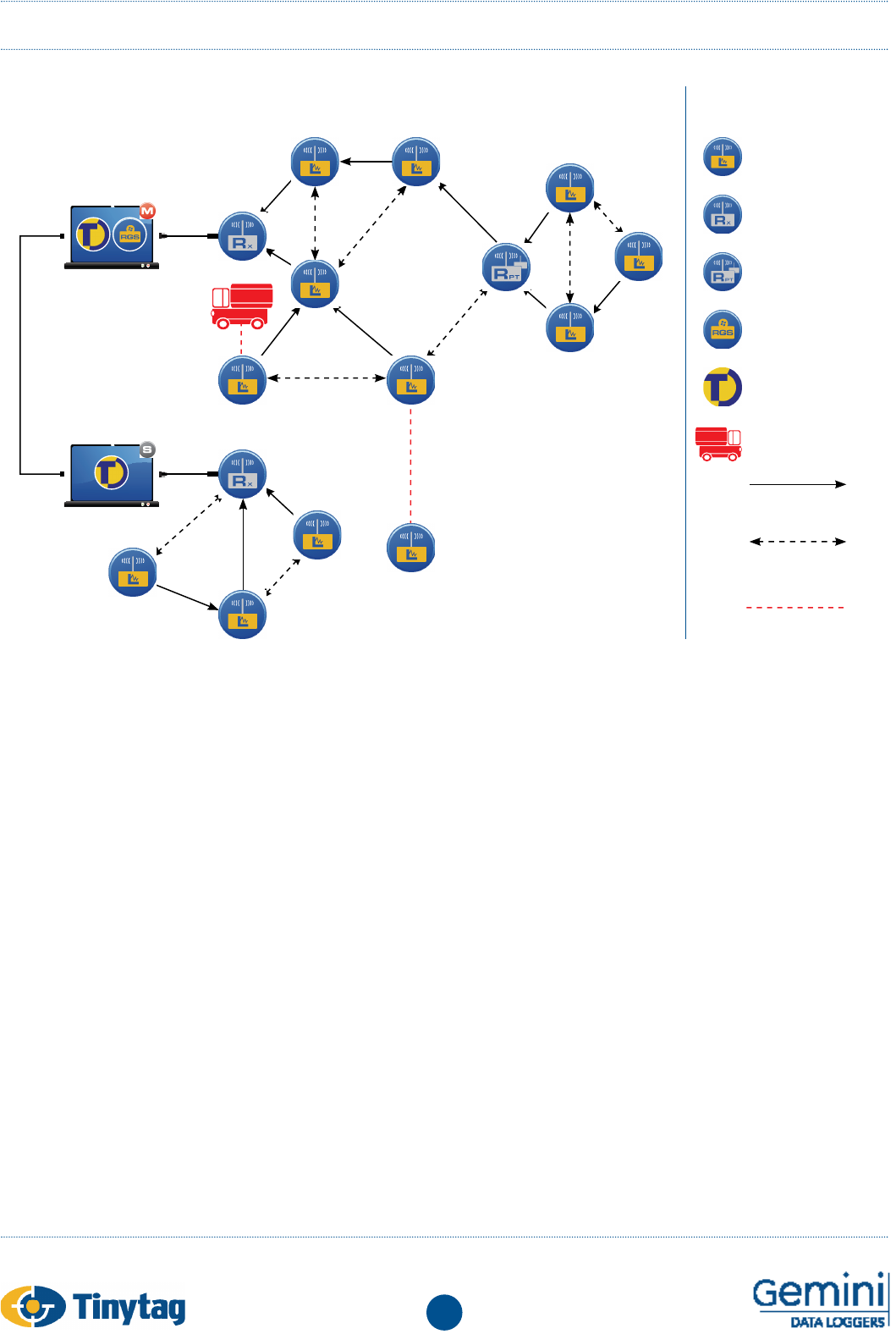
All devices in the radio system participate in a mesh
network.
Tinytag Radio System
Components Key
There is a good overview of the general operation of
Mesh networks in the Tinytag Explorer Radio online help,
in the “Parts of the System” section.
Mesh networks are ideally suited to data logging
because they have the following characteristics:
1. Robustness. The mesh network allows information
to be routed around obstacles. For example a van
parked in front of a data logger will not cause a
problem, because that logger will be able to transmit
its information to the receiver via another device.
The mesh will adapt to moving obstacles – it is self-
healing.
2. Low set-up costs. In general it is possible to throw
data loggers into a measurement site and it “just
works”. The system will be able to automatically
establish a mesh which connects all devices. This
avoids the “radio survey” step which is necessary for
point-to-point radio links.
Several advantages are unique to the Tinytag mesh
network:
1. All devices are capable of meshing. Some mesh
network systems from other vendors di erentiate
between “mesh routing hubs” (which are often mains
powered, and may need to be placed with some care)
and non-meshing “transmitters”. The Tinytag solution
is more robust because having a larger number of
mesh-capable devices will allow it to form a more
e ective mesh. The number of redundant routing
options is a key parameter that will be discussed later.
2. All devices can be recon gured remotely. This is
possible because all devices “listen” across the mesh
network.
3. All devices are loggers, and data will not be lost due
to momentary interruptions (a van driving in front
of the logger) or temporary interruptions (the van is
parked overnight) to the radio service. This capability
also relies on devices being able to “listen” across
the mesh, because that enables the Radio Gateway
Service to request retransmissions.
LOCAL RECORDING
NETWORK
OBSTACLE
Tinytag
Radio Logger
Tinytag
Receiver
Tinytag
Repeater
Radio Gateway
Service
Tinytag
Explorer
Obstacle
Communication
Route
Alternative
Communication
Route
Out of Range
5 Point-to-Point Radio
08
Di erent radio frequencies are used for di erent countries.
869.8MHz Used in the EU. Devices using
this frequency can be identi ed
by their part number ending
–A. Older part numbers which
do not have a single letter part
number su x also use this
frequency.
917.8MHz Used in Australia. Devices using
this frequency can be identi ed
by their part number ending -B.
917.8MHz Used in USA, Canada. Devices
using this frequency can be
identi ed by their part number
ending -C.
Naturally, parts using di erent frequencies can not
interoperate.
The radio uses FSK modulation, with +/-32 kHz
deviation.
The transmission power is <3mW in EU & Australia &
<0.75mW in USA & Canada.
In free space the range is approximately 200m.
These frequencies will easily penetrate most internal or
external walls; however the range may be reduced.
Indoors the range is quite variable. It is usually reduced
to between 30% and 80% of full range. However it
will sometimes be increased, maybe up to double the
nominal range, due to “lucky” re ections o other
buildings, steel roofs, etc. This variability works to the
advantage of the mesh network because the unlucky
majority will be able to relay their information via the
lucky one with the extra-long range.
The radio system works well indoors and out. The
frequencies will usually penetrate steel-walled rooms,
through door seals, windows, ventilation etc. Even
though the radio waves cannot penetrate a metal wall
(whether a fridge, or corrugated iron shed), the signal
will probably still get through gaps around door seals
and other openings.
These frequencies are very slightly absorbed by water.
Wet walls are not a problem, but the signal will not
get through a room lled with shelves full of fruit, for
example.
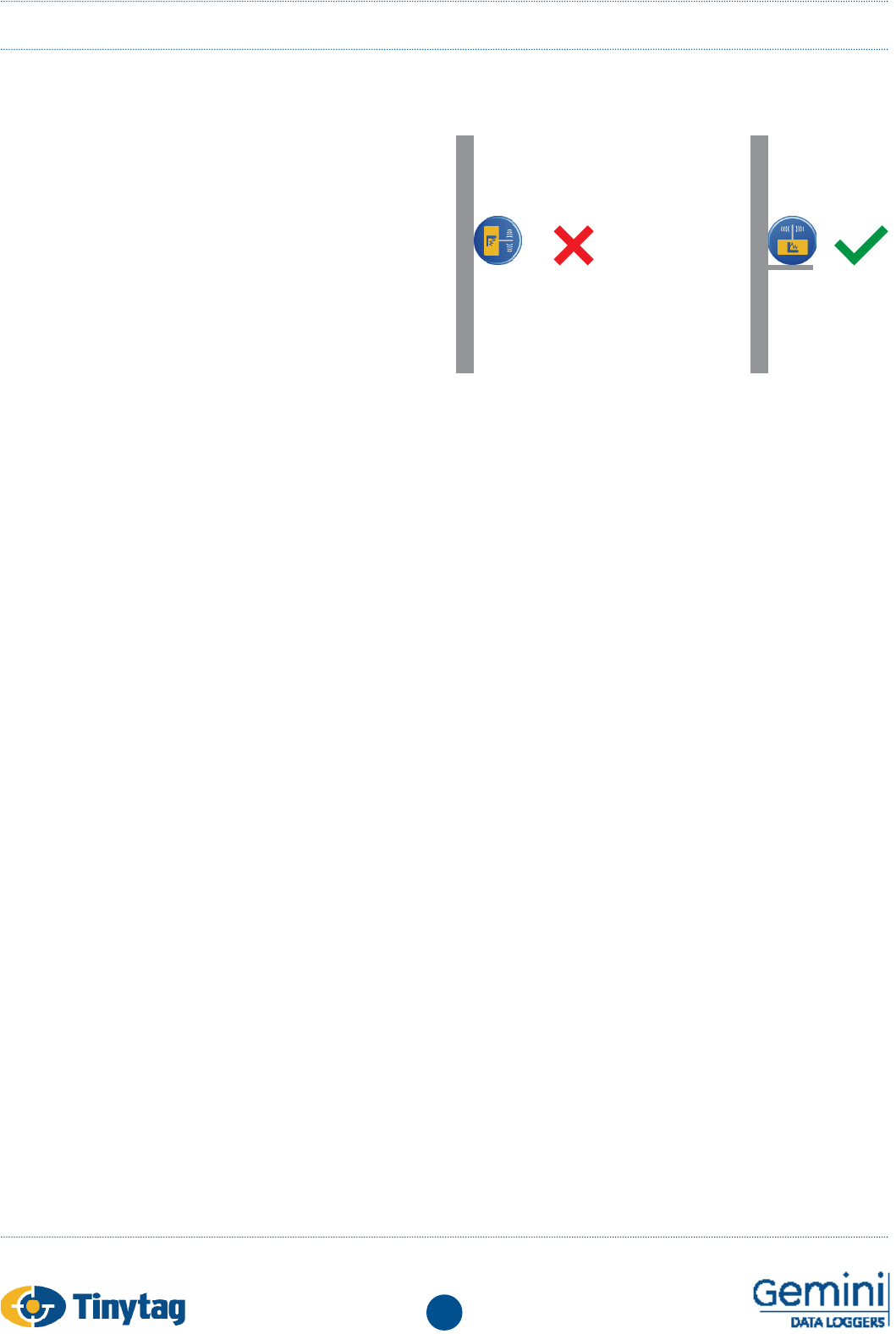
Ideally the antenna should be oriented vertically. Most of
the energy is emitted perpendicular to the antenna.
The radio is obviously a ected by line of sight. Please
note that “line of sight” means that of the antenna – not
your line of sight while standing over a logger on the
oor!
WALL WALL
6 Receiver Con gurations
09
6.1 Direct
Normally the receiver is connected directly to the
computer running the Radio Gateway Service (via a 5m
long USB cable).
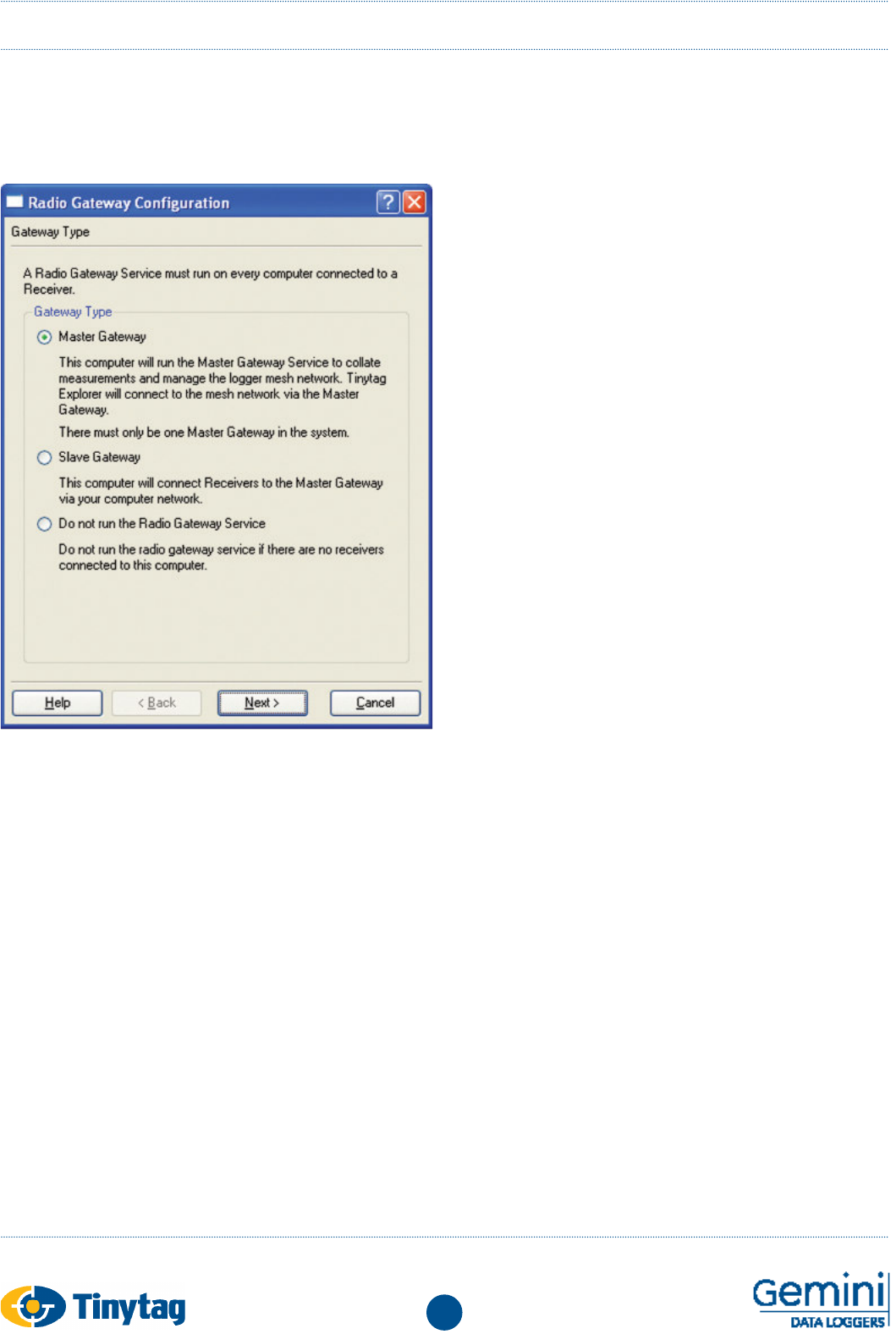
It is con gured as a Master Gateway which means
it collates measurements, stores them locally on the
hard disk, manages retransmission to ll in any missed
data, and makes all the information available to Tinytag
Explorer and other software.
An extension cable is available if the ideal site for a
receiver is not within reach of a PC. This is CAB-0023-XM
(where X is the length of the cable in metres, up to 50m).
It is possible to use an rs232/Ethernet converter if the
receiver must be located a larger distance from the
PC. The Radio Gateway software is unaware that the
receiver is remote provided this rs232/Ethernet converter
provides a ‘virtual com port’ on the computer where it is
running.
The default con guration of the Radio Gateway Service
will automatically scan all com ports to nd any receivers.
A manual com port con guration option is provided for
use if your computer has other devices using com ports.
6.2 Multiple Receivers
Multiple receivers can provide:
Redundancy
The radio system will continue to function if one receiver
fails.
Range
Consider a radio system covering two warehouses, but
the radio link between each warehouse is unreliable
when all doors are closed overnight.
It may be appropriate to locate one receiver in each
warehouse.
Capacity
There is a limit to the amount of radio tra c that can be
handled by one receiver. Having multiple receivers can
improve capacity because they can share tra c.
It is better to locate the two receivers at opposite ends
of a large warehouse containing many radio devices.
Each radio logger will nd a mesh to its nearest receiver.
For this tra c sharing to occur, they must not be within
radio range of each other. If the two receivers in the
warehouse were adjacent then they would both hear all
tra c.
6.3 Multiple Computers Running the Radio
Gateway Service
All computers connected to a receiver must be running
the Radio Gateway Service.
One of these must be con gured as the Master
Gateway. As described in the section describing the
“Direct” con guration, the Master Gateway collated
all measurements, and makes information available to
Tinytag Explorer and other software.
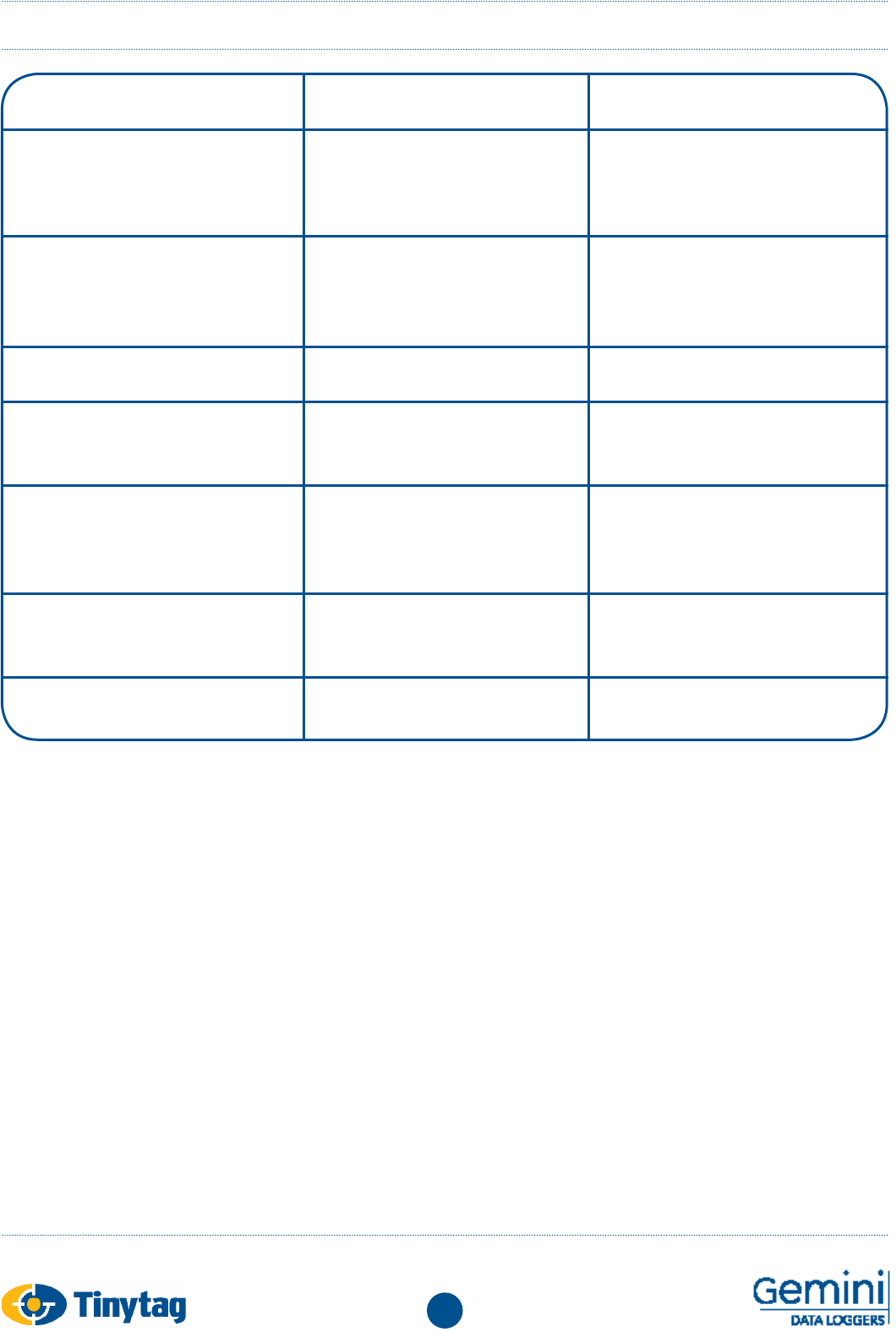
All other computers connected to a receiver must be
con gured as a Slave Gateway. The Slave Gateway
is a very lightweight program which simply relays data
between any connected receivers and the Master.
6 Receiver Con gurations (Continued)
10
Connects to Receivers?
Information from
Receivers
Readings collated?
Readings stored on
hard disk?
Information made
available to Tinytag
Explorer?
Minimum number in
one system.
Maximum number
Master Gateway
Yes. It connects to any
receivers plugged in to
this computer.
Processed locally.
Yes.
Yes.
Yes.
1
1
Slave Gateway
Yes. It connects to any
receivers plugged in to
this computer.
Shuttled to the
Master Gateway for
processing.
No.
No.
No.
0
no limit
11
6 Receiver Con gurations (Continued)
There is a minor di erence to the behaviour of a receiver
depending on whether it is connected to Master or Slave
Gateway. A receiver that loses contact with the Master
Gateway (maybe because the computer has shut down)
will continue to maintain the mesh network centred
around that receiver. This ensures that the mesh is ready
for use as soon as the computer running the Radio
Gateway Service reboots.
A receiver that loses contact with a Slave Gateway will
cease to maintain its local mesh, and other radio devices
will switch over to another receiver within an hour. It is
therefore less critical that any computers running the
Slave Gateway be left running 24/7.
NETWORK (FEEDS INFO BACK TO MASTER RECEIVER)
NETWORK (FEEDS INFO BACK TO MASTER RECEIVER)
6 Receiver Con gurations (Continued)
6.4 Repeater
A receiver which is not connected to any computer will,
like every radio device, continue to participate in the
mesh network. It can act as a repeater for other devices
which have poor contact with other devices in the mesh,
or to improve the range of an installation.
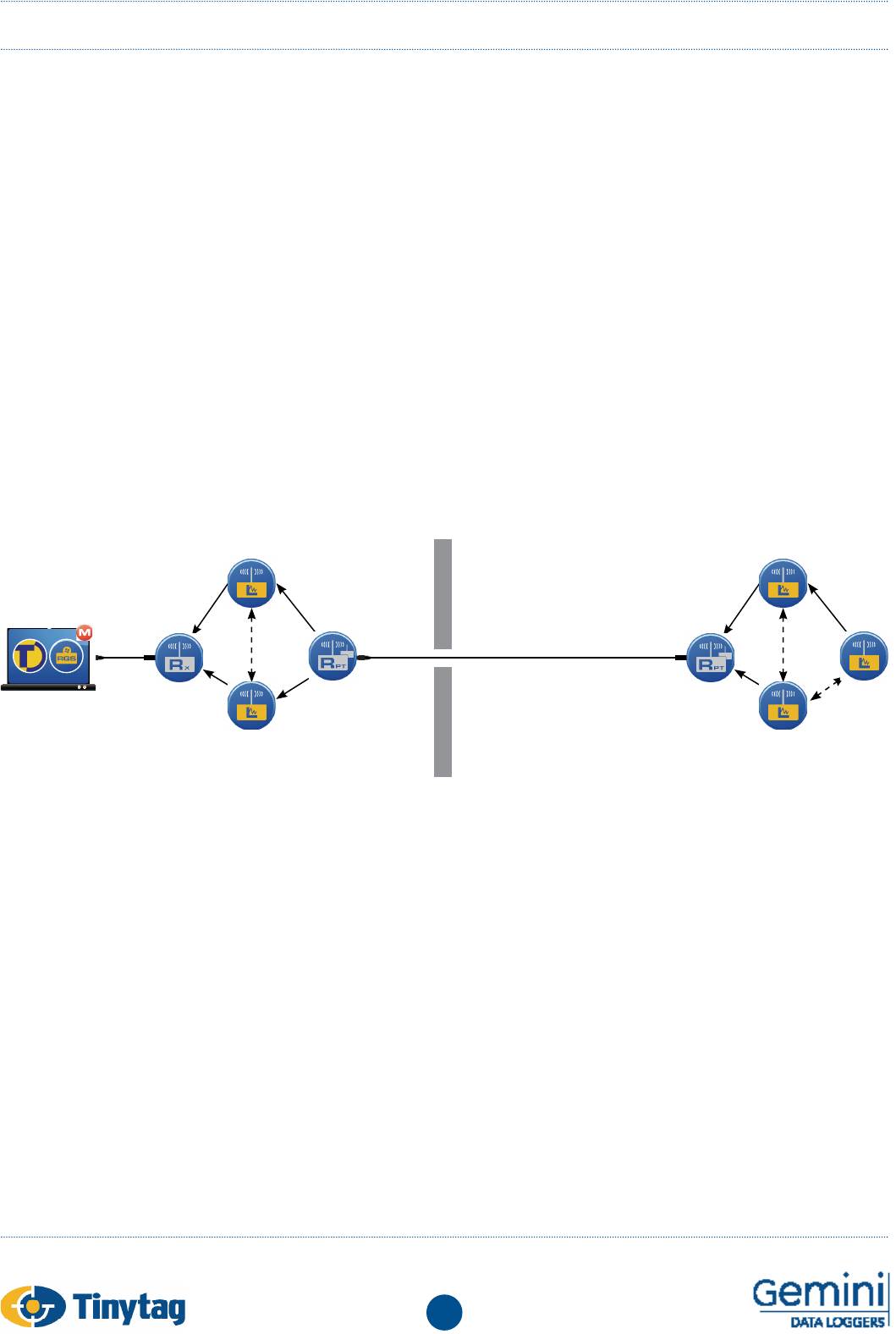
6.5 Back-to-Back Receivers
A receiver can be connected to another receiver using
cable CAB-0026-XM, where X is the length in metres, up
to 50m.
In this mode the pair of receivers will participate in mesh
networking over the cable. They relay information from
one to the other, in either direction, more e ectively than
using radio for the same hop.
This con guration can be used to bridge between
islands of the mesh network; for example, bridging
between a warehouse and a steel-walled cold store. In
general this approach should only be used where it is not
possible for the receiver to be connected to a computer.
12
WALL
13
7 Mesh Network Behaviour
7.1 Switching On a Device
When a device is rst switched on it will send new
measurements downstream as soon as it has any
radio contact with another device. If there is a mesh
established this should happen within a few minutes.
When the Radio Gateway Service sees the rst of these
measurements it knows that the new logger exists.
At this point it should quickly determine the identity
of the logger, and begin collating measurements and
requesting retransmissions if any measurements are lost.
7.2 Moving a Device
When a device is moved from one place in the mesh to
another it may take between 30 and 60 minutes to work
out its new place in the mesh.
This meshing process works on a 30 minute cycle. After
being moved the logger may not fully adapt until after
one whole cycle.
7.3 Starting the Radio Gateway Service
When the Radio Gateway Service is rst started it needs
to wait for a packet to arrive from each logger before
it knows which loggers are present in the mesh. This
is another process which will take up to one logging
interval for each logger.
An exception is loggers which had previously established
a direct connection to the receiver (that is, not via any
mesh repeaters) within the last 4 days. It will probe these
loggers immediately to see if they still exist within direct
range.
This again assumes that there is a well established mesh;
in particular, that the receiver is not just being switched
on at the same time.
7.4 Switching On the Receiver
Receivers need to nd their place in the mesh exactly
like a logger. This adds an extra 30 minutes on to the
“Starting the Radio Gateway Service” scenario.
If the Radio Gateway Service is being shut down,
possibly over night, it is desirable to avoid this delay by
leaving the receiver running. For receivers which rely on
external USB power it is possible to leave the receiver
powered from USB hub while the computer is switched
o . This solution does rely on retaining power for the
USB hub.
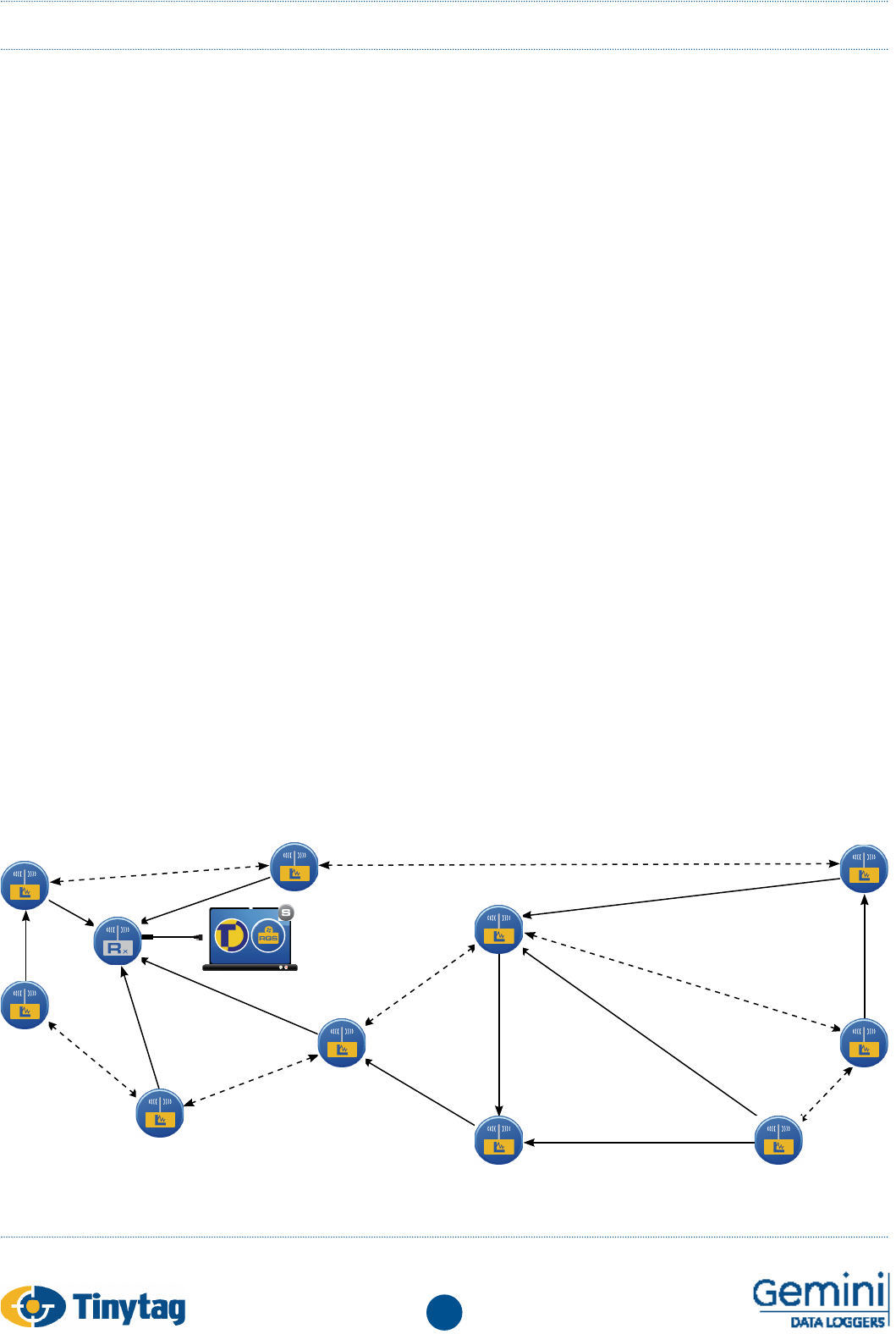
7.5 Redundant Routing
The best way to ensure reliable communications is
to provide redundant routing options. Every device
should have at least two other devices in front of it, but
preferably more.
Very often a radio device will nd that an individual
packet is not being received by its chosen downstream
neighbour, either due to a momentary obstacle or
momentary radio interference. The Tinytag radio mesh
devices can respond to this very quickly by immediately
switching to the second best downstream route. It
is not a problem even if this is a sideways hop – the
information still gets through with a few seconds delay.
In this way the mesh is constantly adapting to changing
radio interference patterns to ensure reliable delivery.
However this strategy only works if every node has at
least two possible devices in front of it. A device with
only one possible route is very much more fragile.
In most cases this redundancy is easy to achieve - just
scatter plenty of loggers within the measurement area,
and locate the receiver so that it is within range of plenty
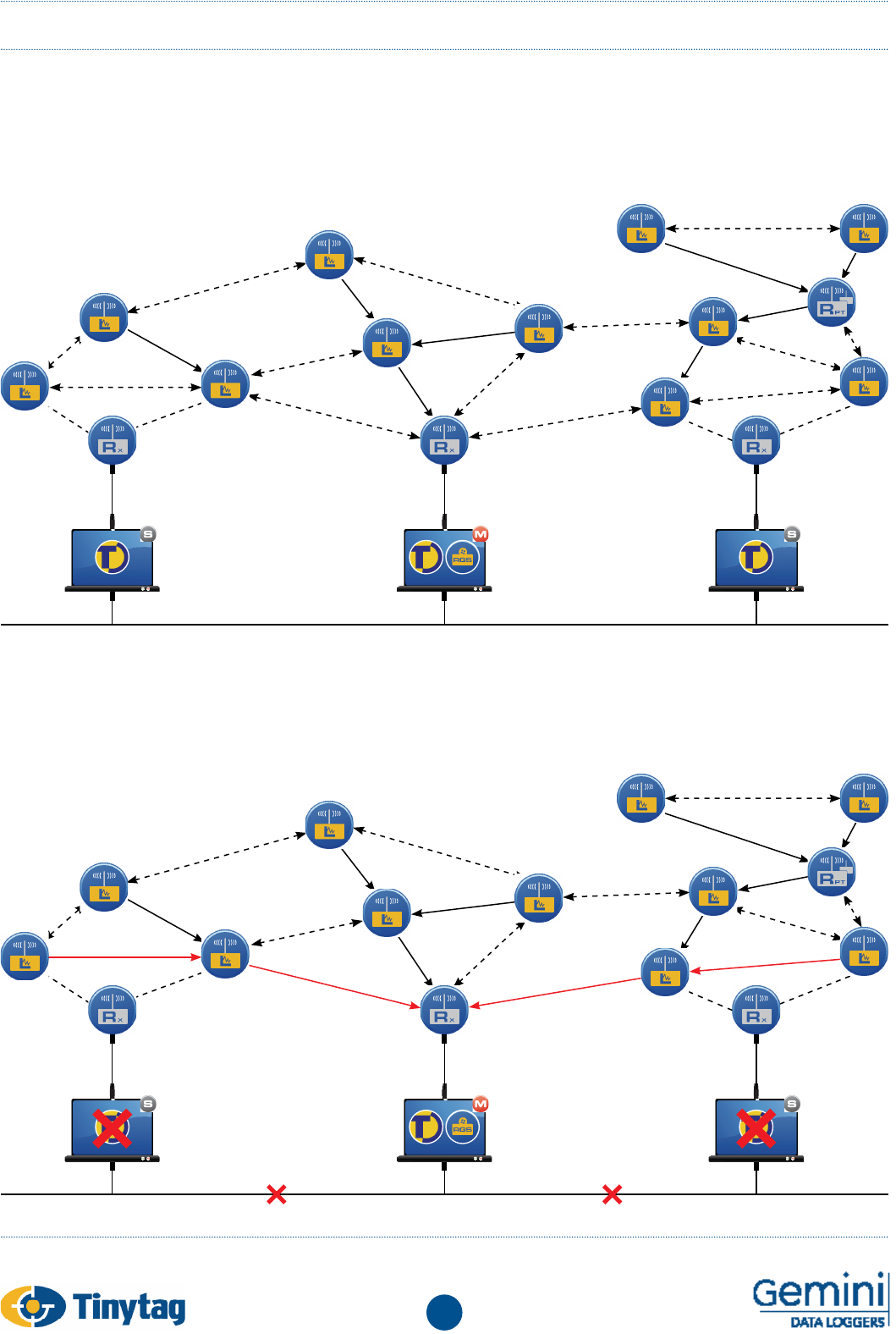
of loggers. (a)
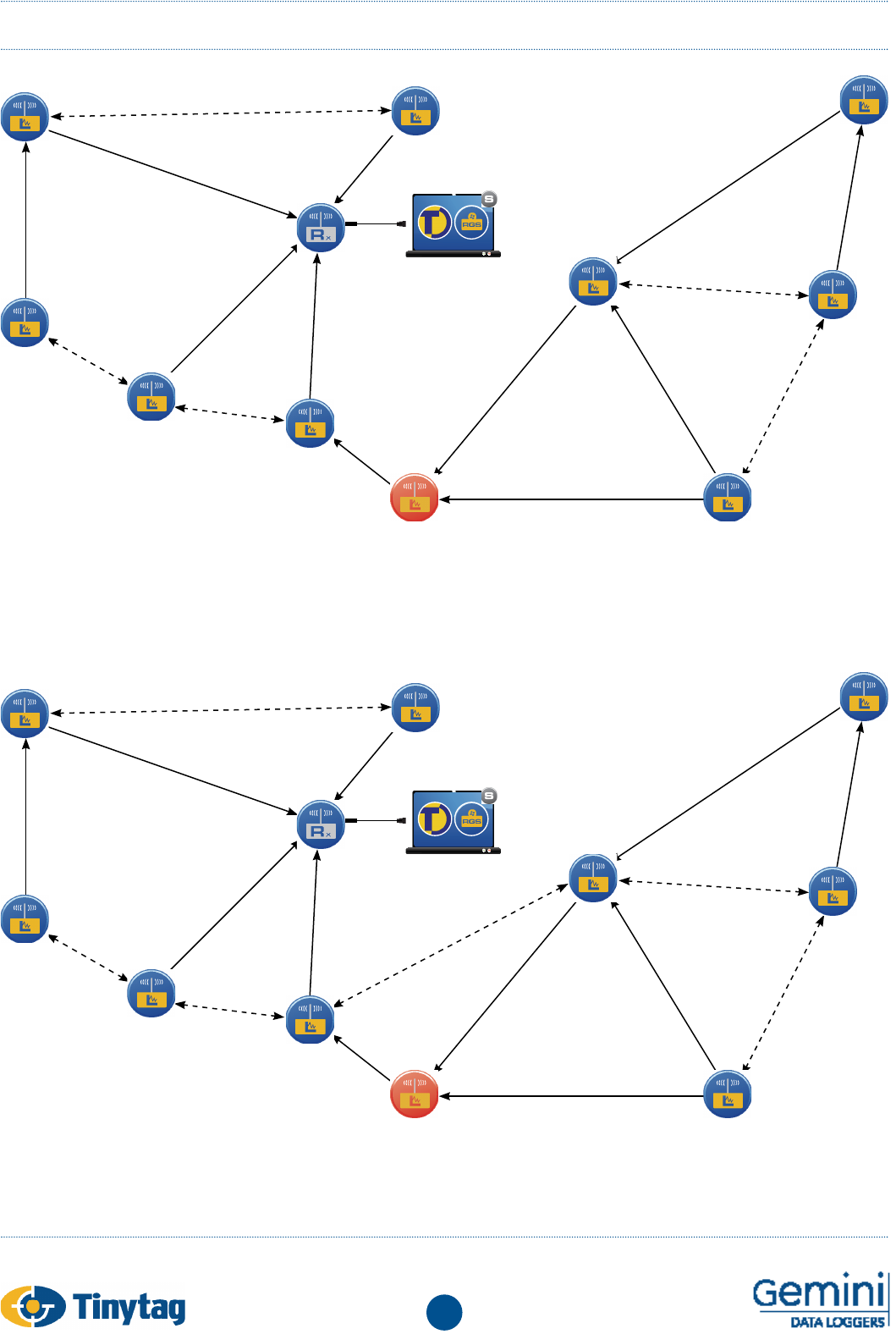
(a) Good – plenty of redundant routing options for all devices.
7 Mesh Network Behaviour (Continued)
14
(b) Not Good – the red logger has only one place to
send its data, so everything upstream of there (to the
right) will not be reliable.
(c) Modifying the position of the red logger, so
it has more than one place to send its data, will
improve the range and therefore the reliability of the
communications.
15
7 Mesh Network Behaviour (Continued)
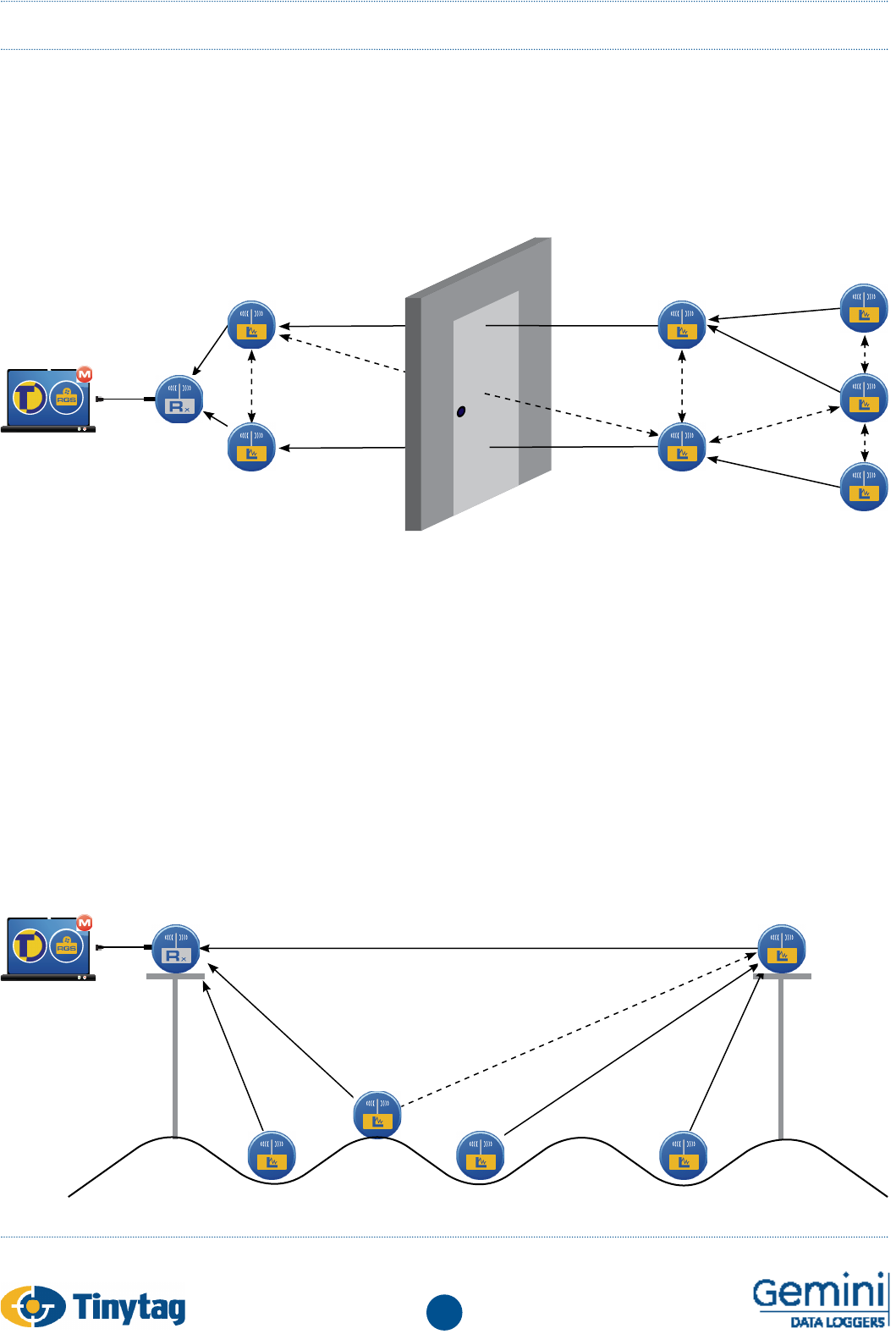
In some cases it can be bene cial to add or move a
device to improve redundancy:
1. If there is a radio restriction, for example a narrow
doorway through a thick steel wall, then it is good to
have a pair of devices on either side of the doorway
(better than just a single device on either side).
2. In some cases it is not possible to provide a clean
radio path for loggers that are physically close to
each other, perhaps because they are at ground
level on an undulating ground. In this case it may be
possible to elevate a small fraction of the loggers so
that they can overlook the others. The majority of
loggers will need to relay via the elevated minority.
If it is not possible to move the logger in this way, it
may be possible to install a receiver as a repeater.
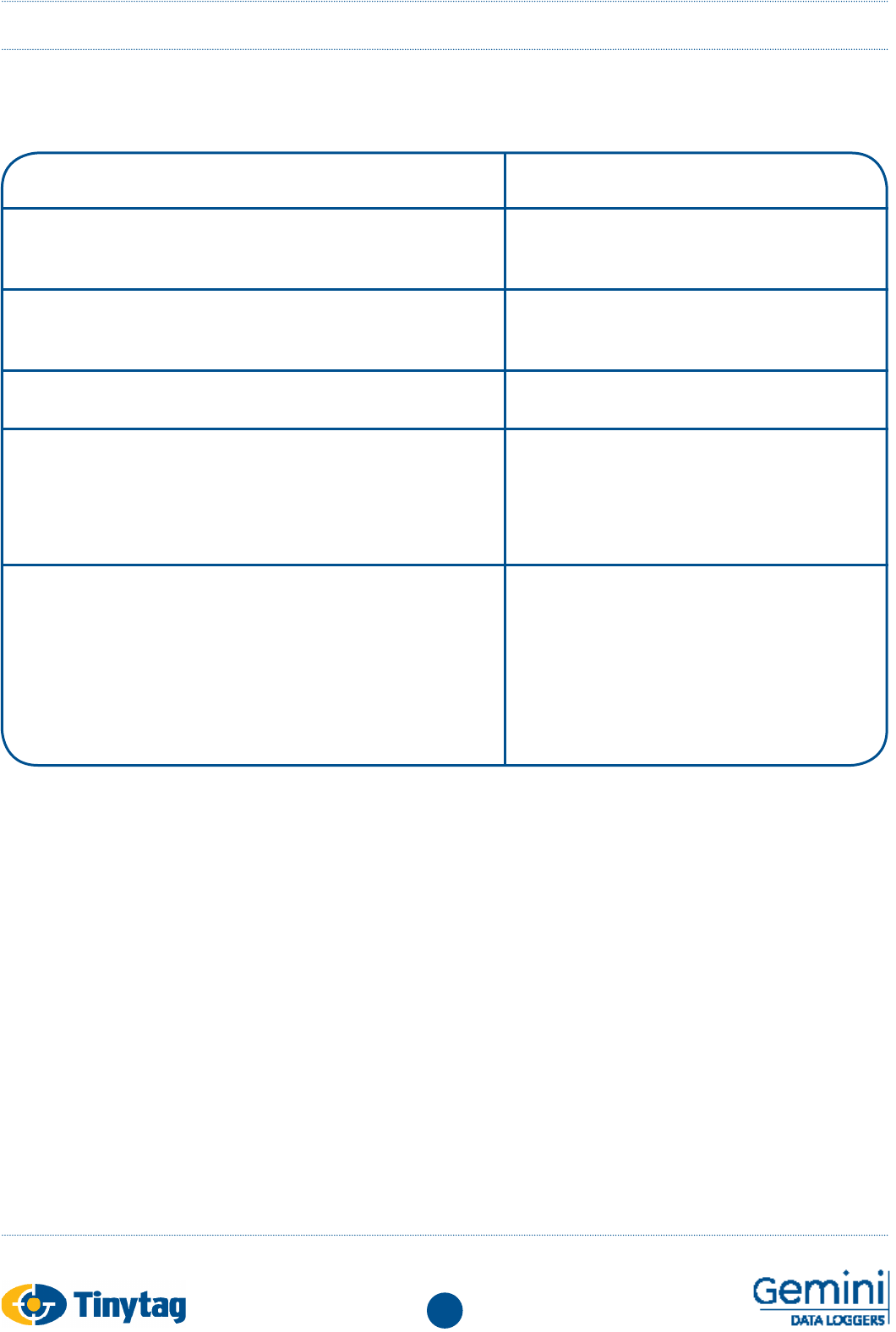
The network is a ected by the number of redundant
routing options (the number of peer loggers within range
of each other):
16
7 Mesh Network Behaviour (Continued)
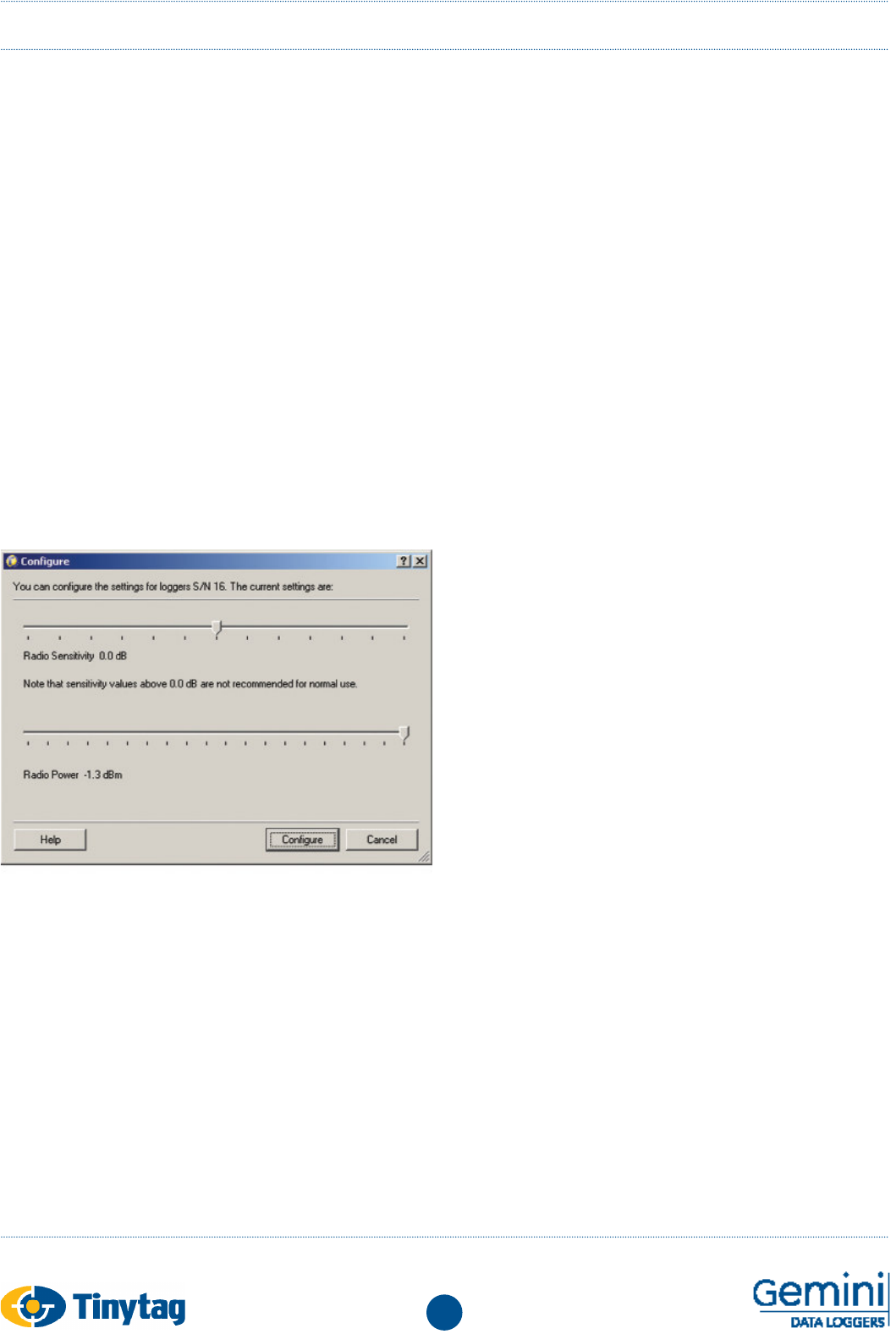
The network is a ected by the number of redundant
routing options (the number of peer loggers within range
of each other):
Number of Peer Loggers Within Range
1
2-3
4-15
15-20
20+
E ect
A single point of failure. Not
ideal.
A mesh with alternative routes.
Good.
A dense mesh. Ideal.
More peers than it needs.
Could reduce range to increase
battery life, but probably not
worth it.
Reducing range (by adjusting
sensitivity, then transmit
power) will increase battery
life, and can help if the system
will not form a robust mesh
automatically.
17
7 Mesh Network Behaviour (Continued)
7.6 Radio Con guration
7.6.1 Adjusting the Radio Range
This section details how the Radio Range can be
adjusted for each logger in the mesh network by
changing the values of the parameters in the Radio
Con guration program. Reducing the radio range can
be bene cial when there are 20 or more loggers within
range of each other, as this situation can make the mesh
network less robust.
In most cases these parameters do not need to be
adjusted, and incorrect con guration may adversely
a ect the performance of your radio network. We
therefore advise that you only use this feature following
the advice of Tinytag Technical Support.
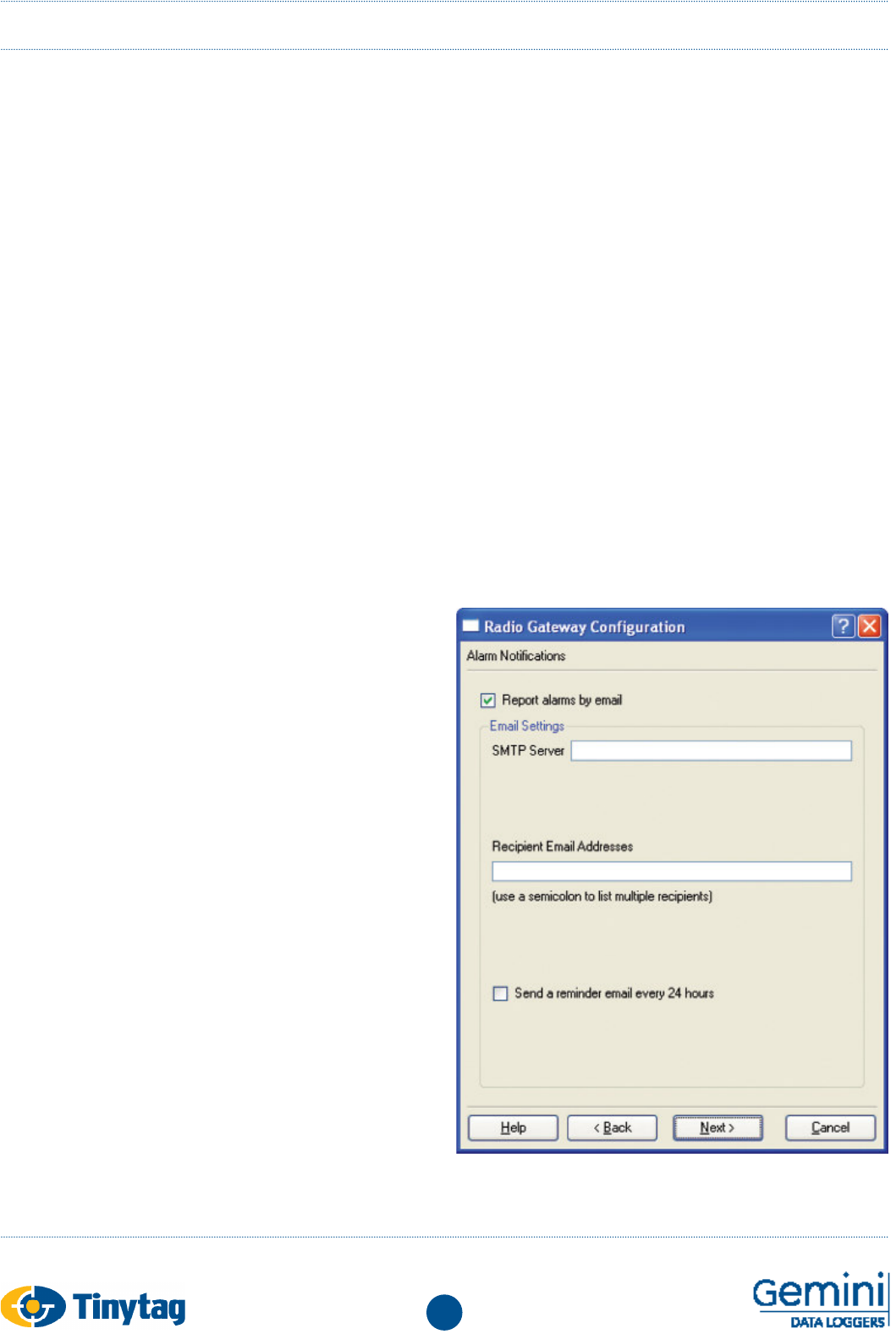
7.6.2 Receive Sensitivity
The primary parameter to a ect radio performance is
Receive Sensitivity. This parameter adjusts the threshold
at which the receiver will decode a receiver signal,
relative to a baseline threshold of 9dB above the noise
oor.
The default value for this parameter is zero dB, and may
be adjusted between -6dB and +6dB.
In the default con guration, radio range is typically
250m.
Radio range may be reduced by reducing the sensitivity:
Change in dB Radio Range
0dB 250m
-3dB 190m
-6dB 140m
Reducing the range in this way will have an a ect on the
mesh network connections established by the loggers.
In some circumstances the mesh can be less robust for
loggers which are within range of more than 20 other
loggers.
Reducing the range can also increase battery lifetime.
It is possible to reduce the total amount of radio tra c
processed by one device, by allowing it to ignore
irrelevant distant tra c. However, this may also have the
opposite e ect, if it results in increasing the number of
hops required for data to reach the receiver.
The radio range may be increased by increasing the
sensitivity:
Change in dB Radio Range
0dB 250m
+3dB 330m
+6dB 450m
Sensitivity values above 0dB will adversely a ect the
power consumption of a device.
The higher sensitivity means that it is less able to
distinguish between good signals and background noise,
and will spend extra battery power decoding spurious
signals.
For a device with a permanent external DC supply this
may not be a problem.
Note that this gure is a typical measurement, and not
a guaranteed minimum. It may be a ected by many
factors including the surrounding physical environment
(buildings, equipment, etc) or other local radio
transmitters.
7.6.3 Transmit Power
The radio range can also be adjusted by changing the
transmit power. The default con guration is for devices
to transmit at their maximum power, which is -1.2dBm.
The transmit power may be reduced in 1dB steps down to
-20dBm, which reduces range down to typically 25m.
7.7 Very Slow Logging Intervals
Some of the connection timings above depend on the
logging interval. The logging interval a ects the time
taken for a logger to connect to the Radio Gateway
Service, because that service will normally only discover
that a logger is present when it transmits a measurement.
Other information which can also trigger this connection
process is transmitted hourly; therefore loggers with
very slow logging intervals will still connect without
unreasonable delay.
18
7 Mesh Network Behaviour (Continued)
7.8 Very Fast Logging Intervals
Normally loggers will transmit every measurement as it is
taken. If the logging interval is faster than 2 minutes then
multiple measurements are sent in a burst. This batching
process avoids radio congestion, and maximises capacity.
The Replication Timebase Parameter can be changed to
adjust the interval between measurement transmissions.
A data logger will not transmit measurements more
frequently than between one and two multiples of the
Replication Timebase.
The default value for this parameter is one minute.
Note that this parameter is di erent from the
Measurement Interval, which can be controlled using
Tinytag Explorer and is typically set to 10 minutes. Under
normal circumstances, measurements are transmitted
as soon as they are taken, and arrive on the computer
system almost immediately.
The Replication Timebase Parameter may be increased
to save battery power, at the expense of less frequent
measurement updates onto the computer system.
For example, if the Measurement Interval is 10 minutes,
and the Replication Timebase is 30 minutes, the
radio data logger will record between three and six
measurements (30 to 60 minutes) before transmitting
them all back to the computer system.
This saves battery power due to reduced transmission
overheads.
7.9 Data Organisation
Every measurement is written to memory and transmitted
downstream as soon as it is taken. Every measurement
transmission carries the logger serial number and
a measurement sequence number, therefore it is
impossible for measurements to be mixed up between
devices or recorded in the wrong order.
The Radio Gateway Service uses these sequence
numbers to control retransmissions. If the sequence
numbers are not consecutive then it requests a
retransmission to cover the gap.
If the Radio Gateway Service is aware of a gap when a
logger is downloaded into Tinytag Explorer then it will
ask the user whether they want to see the data so far, or
wait until the gap has been lled in.
Data is transferred at approximately 6k per minute.
Data can be transferred from multiple loggers
simultaneously. It will prioritise loggers that Tinytag
Explorer is waiting for, and loggers that are nearly
complete.
If the data gap can not be lled in because too much
time has passed (approximately two weeks in the default
con guration) and the logger has overwritten its memory
then Tinytag Explorer will leave a gap on the graph.
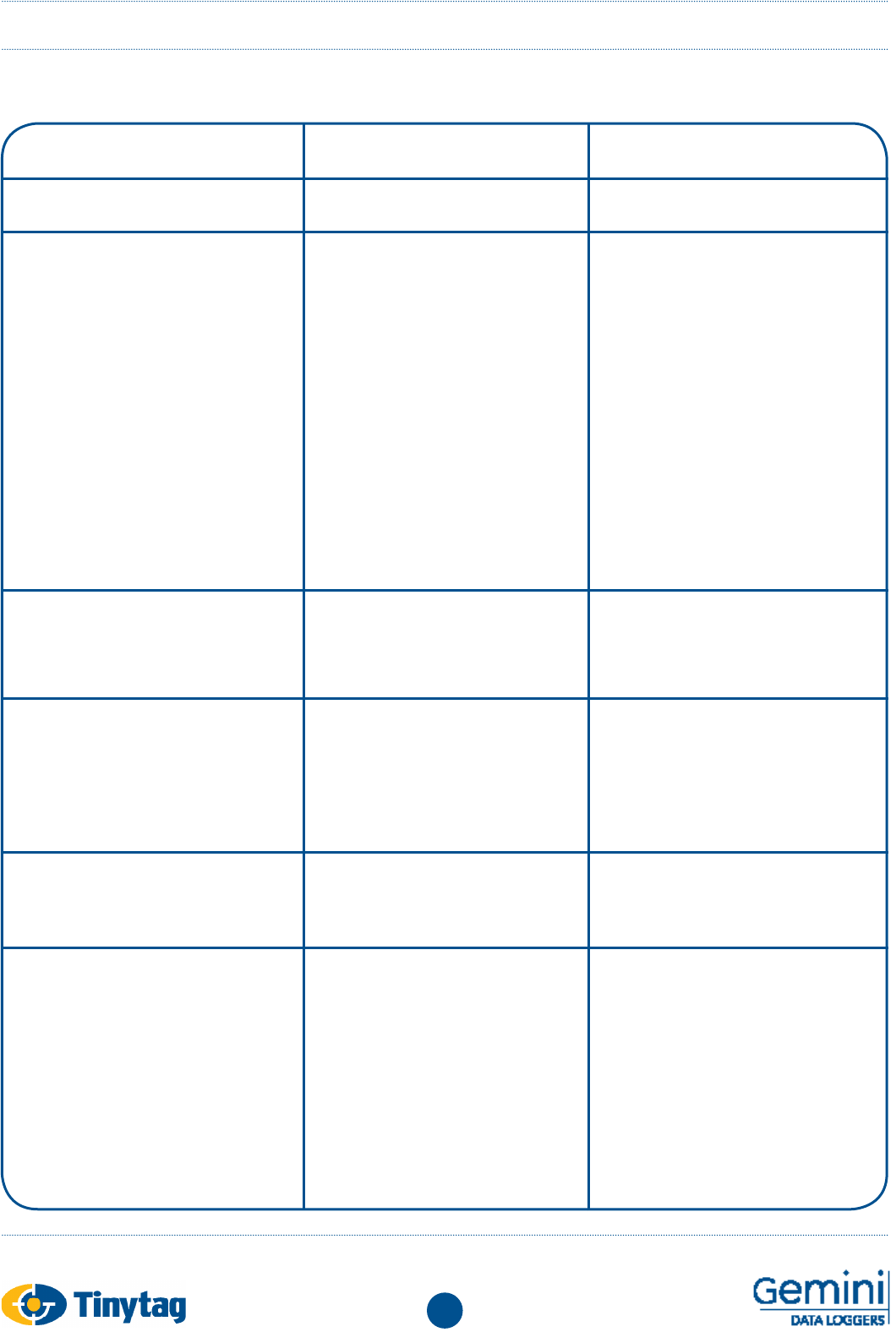
7.10 Alarms
When con guring the radio network, you can enable
alarm noti cation emails. When an alarm is triggered, an
email will be sent to the address provided during setup,
detailing the logger and probe that triggered the alarm.
If an alarm is con gured then the critical parameter is
sampled every few seconds. An alarm indicator will be
sent downstream immediately, and this will show up in
Tinytag Explorer immediately.
However, the Radio Gateway Service does not send an
alarm warning email/SMS immediately; it delays for ve
minutes in case another logger should raise another
alarm so that it can deliver all the alarm warnings in one
email/SMS.
Also note that the batching process described under
“very fast logging intervals” also applies to alarm
indicators. An alarm indicator may have to wait up to 2
minutes before radio transmission on loggers that have a
fast logging interval.
19
8 Buttons and Lights
Tinytag Radio devices have an LED indicator that shows the current status of the unit:
Action
n/a
n/a
n/a
Press and brie y hold
the on/o switch.
Press and brie y hold
the on/o switch.
Press and hold the on/
o switch to turn the
device on.
Wave a magnet across
the top of the case next
to the LED eight times.
Each wave must be
within one second.
LED
No Indicators
Red ashing every 4
seconds
Green ash every 4
seconds
Green indicator shows
for one second.
It then brie y ashes
green then red.
Red indicator shows for
one second.
Each wave should be
greeted with a green
ash.
The eighth ash causes
a red/green alternating
ash which lasts for ve
seconds.
Status/Operation
Device is powered o
The device is powered
on and has a problem.
Either:
a) Battery is Low.
b) Device has not yet
established its place
in the mesh network.
c) An alarm indicator is
signalled.
Check the nature of the
problem using Tinytag
Explorer.
The device is powered
on, and does not have
any problems.
The device has been
switched on.
The device has been
switched o .
The device has been
reset to its factory
con guration.

20
9 Rapid Installation
9.1 Introduction
This section describes best practices for installing a
system to minimise the time necessary to prove that the
mesh network is working as expected.
Note that deviating from this process will not cause any
signi cant problem; at worst it may take an extra hour
before all the devices show up.
9.2 Receiver First
The rst step in setting up a demonstration system
should be placing the receiver. It should be in a location
where it will be within range of plenty of the data
loggers. An elevated position may help.
Con gure and start the Radio Gateway Service.
Check using Tinytag Explorer that:
1. Tinytag Explorer has been able to connect to the
Gateway Service, and
2. The Gateway Service has been able to connect to the
receiver.
This should only take a few seconds. Do all of this before
powering up any loggers.
9.3 Nearby Loggers Next
The rst loggers to be switched on should be those
nearest to the receiver.
These loggers should be within direct range of the
receiver, they should connect at full performance within a
few minutes.
Do not hold the logger with your hand around the
antenna. A logger sends its rst transmission within a
few seconds of switching on, and this should prompt
the Radio Gateway Service to start its connection
process. If your hand is around the antenna then this rst
transmission may be lost. In this case (or if the receiver
does not catch this rst transmission for some other
reason) the Radio Gateway Service will start connecting
on the next logging interval.
9.4 Distance Order
Power up the remaining loggers, starting with those
closest to the receiver – this order will minimise the time
necessary for them all to connect.
In most cases these loggers should establish a
preliminary place in the mesh and connect within a few
minutes, otherwise the full meshing process will allow
them to connect after 30 minutes.
9.5 Don’t Rush It
If one logger is not working it may be tempting to move
it a little. Then move it again. Then reboot it. And it is
still not working so maybe you move it again.
Then you give up and go for lunch, and nd it is working
when you return.
It does take time to establish the mesh network, and
moving its location may increase the time taken for the
meshing to stabilise. Some patience is necessary.
9.6 Transplanting the Network to a New
Location
Some additional steps are appropriate if you are moving
an entire mesh network system to a new location to
minimise your setup time.
Set the logging interval on all loggers to 2 minutes. Fast
enough to prompt them to connect quickly, but not so
quick that any delay in connecting will cause them to ll
up their memory with data which would then need to be
downloaded.
Clear the logger’s memory. Note that this will erase
any readings already taken. This ensures that the Radio
Gateway Service will not need to transfer all historic data
during the installation at the new location.

21
10 Troubleshooting
10.1 Tinytag Explorer Status Bar Indicator
Flashes Red
The connection between Tinytag Explorer and the Radio
Gateway Service has been broken. Click on the Status
Bar and press the Connect button. This may be either a
computer network connection or a software connection
within the same computer.
If it cannot connect, then the Radio Gateway Service
has a problem. If the Gateway Service is running on a
di erent computer then maybe that computer is turned
o . If it is running on the same computer then maybe the
service has not started.
Note that this indicator shows Connected as soon as
Tinytag Explorer has connected to the Radio Gateway
Service. This does not indicate that the Gateway Service
has connected to its receiver (via USB) or any loggers (via
radio).
10.2 Firewall Con guration
Tinytag Explorer needs to be able to communicate with
the Radio Gateway Server. They connect using TCP and
UDP which allows them to run on di erent computers.
This connection will be under the control of any rewall
running on these computers.
The Tinytag Explorer installer automatically con gures
the windows rewall to allow this connection, so most
likely no action is necessary.
Any third party rewall will need to be con gured to
permit the following connections:
UDP port 3927: For autodetection
TCP port 3927: For all other communications

22
11 Data Logging
11.1 No stopping
Tinytag radio data loggers will start logging as soon as
they are switched on. They do not need to be ‘launched’.
It is possible to adjust any con guration option (logging
interval, channels, etc) without stopping the logging
process.
11.2 Time zones
Radio data loggers store a timestamp with every
measurement. This timestamp is traceable to GMT.
Note that Tinytag Explorer will display this timestamp
in your local time zone. This means that timestamps
displayed on the graph or readings view will be di erent
for users in di erent time zones, or will change when
users move in and out of daylight savings time.
Timestamps are not a ected in any way by the time zone
of the user who installed or con gured the data logger.
11.3 Current Readings
Current Readings are updated every few seconds. The
update interval will be extended when viewing current
readings from multiple devices (or if multiple users are
viewing current readings simultaneously). Note that
extensive use of this feature may a ect battery life due
to the extra radio activity.
23
12 Other Radio Gateway Functions
12.1 Modbus
The Radio Gateway Service is a windows service which
runs 24/7 to collate data from radio loggers.
This data is made available to other software – primarily
to Tinytag Explorer, but also to other software through
various protocols.
The Radio Gateway Service provides a standard modbus-
over-TCP interface, providing read-only access to data
logger con guration and instantaneous measurements
(instantaneous measurement means the last received
logged measurement).
Modbus may be a convenient option for software which
uses Tinytag data loggers as part of an industrial process
control or SCADA system.
For more details about Modbus, see Section 13.
12.2 Data Export
Radio Loggers transmit measurements and other
information to a single Radio Receiver device using
radio. The Receiver relays this information over a USB
cable where it is collected by the Radio Gateway Service.
The Radio Gateway Service provides access to historic
logged measurements for third party software by
downloading CSV les over http. There is one CSV le
per logger. The URLs are listed on the Radio Gateway
Server’s pages.
The content of these downloads is a snapshot of the
data, generated on demand when the download is
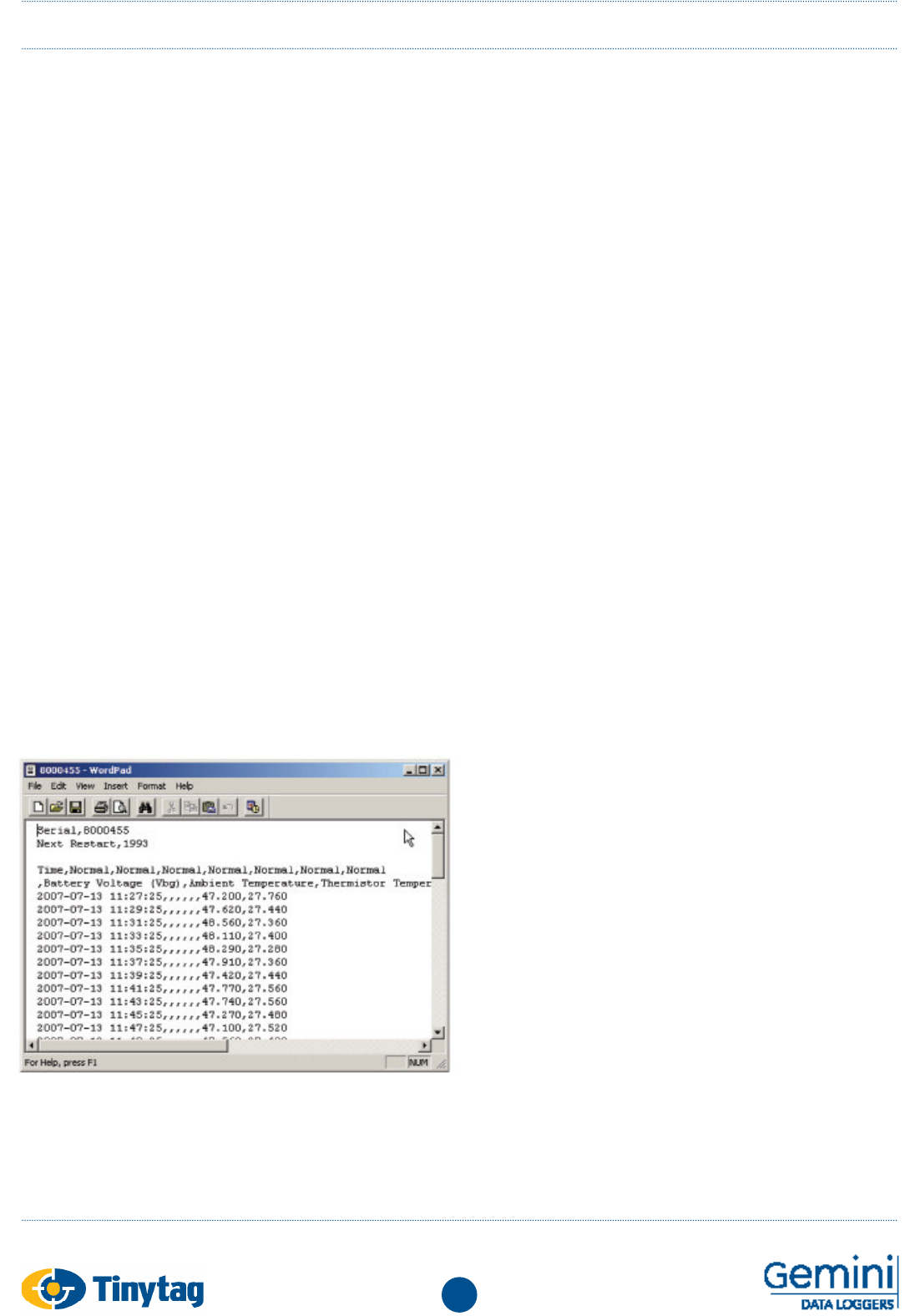
requested. The following example was downloaded from
http://hostname:3927/Exports/all_readings/8000455.csv
The rst few lines of this le is a header which consists of:
• Various properties, name and value in the rst two
columns, for example ‘Serial’ and ‘Next Restart’.
• A blank line.
• Two rows of titles for measurement columns. For
example “Maximum” and “Temperature”. For
loggers that do not support maximum and minimum
readings, this row will contain “Normal” rather than
“Maximum”.
Measurements are in the subsequent rows after the
header.
The rst column contains the time stamps. Timestamps
always use GMT time, and are written in ISO format
(yyyy-mm-dd hh:mm:ss). The second and subsequent
columns contain measurements in SI units.
• Measurements listed in time order.
• If there is a gap because of a communications delay
then measurements will be held back until the Radio
Gateway Service has been able to ll the gap in. (i.e.
guaranteed to preserve time order)
• Multiple users can access the CSV data without
interfering with each other.
In rare cases it is possible that one ‘row’ of
measurements is split between consecutive transfers.
The last line of one transfer will contain half of the
expected measurements. The rst line of the next will
contain the same timestamp, and the other half of the
measurements. This will happen if the transfer is started
part way through the Radio Gateway Service receiving
measurements from the logger.
To access these les, rst click ‘Radio Gateway Status:
Connected’ in the bottom right hand corner of Tinytag
Explorer. The pop-up box that appears should say
‘Connection Established to Radio Gateway Server’.
Clicking on Radio Gateway Server will take you to the
Radio Gateway Server’s pages.
The ‘Exports’ tab at the top of the page shows all les
available to download. In the left hand column (‘raw
data’) the data can be downloaded to view in Tinytag
Explorer. The right hand column will download the data
in CSV format. Each le is identi ed by the loggers’
serial number.

24
12 Other Radio Gateway Functions (Continued)
The CSV les linked from the Exports page will always
download every measurement, which is ine cient and
cumbersome for systems which need to keep up to date
by tracking new measurements as they arrive. In order
to download only new measurements it is necessary for
a custom software solution to keep track of the Next
Restart value from its previous download, and add
this to the URL which is downloaded. For example, the
measurements received after the snapshot shown above
can be downloaded from http://hostname:3927/Exports/
all_readings/8000455.csv?restart=1993
Note that this URL – ending in ?restart=1993 – does
not appear anywhere in the Radio Gateway Service web
pages. It must be generated by the software solution
which wants to perform incremental transfers.
12.3 Proprietary Radio Gateway Service Protocol
The Radio Gateway Service supports a simple text-based
proprietary network protocol which provides read-write
access to logger con guration. This is the protocol
used by Tinytag Explorer to access the Radio Gateway
Service.

25
13 Modbus
13.1 Properties and Registers
The modbus protocol provides read/write access to
numbered 16-bit registers. The radio loggers natively
use numbered properties which are somewhat similar to
modbus registers.
The Radio Gateway Service automatically translates
between these two systems. The translation primarily
involves changing data types. Modbus registers are
always 16-bit integers, while radio logger properties
have high-level data types. For example, the logger
description is a length limited string. Logging interval is
a 32-bit integer.
This property-to-register mapping is generated
automatically. Di erent types of device have di erent
properties; therefore they may have di erent registers
too.
13.2 Devices
The web view in the Radio Gateway Service site includes
a Devices tab which contains an index of all devices
currently or recently connected to the Radio Gateway
Service, with links to a page showing detail for each
individual device. Near the top of these device detail
pages is a link labelled Modbus Registers which links to a
page showing:
• Which logger properties are exposed as Modbus
registers
• Which Modbus address is used for each property
• How many Modbus registers are used for each
property. For example, 32-bit properties will be
spread over two 16-bit registers.
13.3 Expected Values
The Modbus tab on the Radio Gateway Service web
view shows the current value of every register on every
device.
The Properties tab shows the equivalent in high-level
data types.
13.4 Unit Identi ers
The Modbus protocol supports up to 254 devices,
identi ed by a unit identi er. Unit identi ers are
automatically assigned to device serial numbers.
The unit identi er of each device is shown on the
Modbus tab page of the Radio Gateway Service web
view. These values are stored under the Tinytag Explorer
program les, in json format, in the le:
\Program Files\Tinytag\Tinytag Explorer\var\storage\
units.db
It is possible to manually adjust the assignment of unit
identi ers to serial numbers by stopping the Radio
Gateway Service, editing this le, and restarting.
It is also possible to clear the current assignments by
stopping the Radio Gateway Service, deleting this
le, and restarting. This may be necessary at sites
where more than 254 devices have been used and
decommissioned, because the unit identi ers will remain
reserved for the decommissioned devices.
13.5 Function Codes
The Radio Gateway Service supports only Modbus
function code 0x03: Read Holding Registers.
13.6 32-bit Values
All values wider than 16 bits are mapped onto multiple
16 bit registers.
The request packet for function code 0x03 (Read
Holding Registers) includes a byte containing the
“quantity of registers” to be read. This is interpreted as
the number of 16-bit words which should be transferred.
For example, when requesting the 32-bit value starting
at address 50688, this “quantity of registers” byte
should contain the value 2. The response will contain the
content of two registers: four bytes.
13.7 Freshness
Most registers have a corresponding register containing
the number of seconds since the property was refreshed
from the device. Some properties are refreshed daily,
others are never refreshed. Properties containing ‘current
measurements’ are updated every time a measurement
is received from the device.
These registers will contain the value 0xFFFF if some
error occurred in processing that property. The maximum
normal value (for example, if the property was refreshed
more than 65535 seconds ago) is 0xFFFE.
13.8 Device Connection
No Modbus interaction is possible until a device is
fully connected. That is, when the device leaves the
Connecting group in Tinytag Explorer’s Radio Navigator
pane, and the device detail page in the Radio Gateway
Service site shows its state as HAPPY.
It is not possible to read any registers from a device
which is not yet fully connected. The Radio Gateway
Service will return an Illegal Data Address error code.
At this point, the Current Readings registers may not yet
have been refreshed, and will all contain 0xFFFF. For the
oating point registers, this corresponds to NaN. These
registers will be refreshed when the rst measurement is
received, at the next logging interval.

26
13 Modbus (Continued)
13.9 Missing Properties
The Radio Gateway Service will return an Illegal Data
Address error code if the requested property has not
been fetched, or is missing from the device. This should
not happen under normal circumstances, but may occur
if:
• Requesting a register corresponding to a diagnostic/
debugging property, and the Radio Gateway Service
is not in a diagnostic mode.
• The device does not contain an expected property.
The device’s characteristics are inconsistent with its
driver in the Radio Gateway Service. This may happen
if using prototype devices, or a pre-release version of
the Radio Gateway Service.
• The device detail page can be used to con rm
exactly which properties have been received by the
Radio Gateway Service.
13.10 Concurrent Connections
The Radio Gateway Service enforces a limit of no more
than 4 concurrent modbus TCP connections.
There is no additional limit to concurrent modbus
transactions.
TCP connections are closed after being idle for 10
seconds.
13.11 Modsak
Modsak is a third party modbus diagnostic tool, available
at: http://www.wingpath.co.uk/modbus/modsak.php.
Gemini Data Loggers is a user of Modsak, but does not
endorse or support this product.
The device detail page in the Radio Gateway Service
site contains a download link for a Modsak con guration
le. When opened, this con gures Modsak to show most
registers from that device, and, when you press the Start
button, it continuously polls for new values.
Note that Modsak can not format modbus registers as
text strings; therefore these registers are omitted from
the download Modsak con guration line.
Also note that Modsak does not distinguish signed and
unsigned values: all numbers are formatted as signed in
Modsak, which may or may not be correct.
27
14.1 Batteries
Radio Loggers and Receivers are provided with alkaline
batteries unless lithium batteries are requested.
Lithium batteries cannot be provided to overseas
customers due to transportation regulations.
Although lithium batteries provide a longer battery life,
and increase the temperature measurement range of the
logger, replacement batteries are very hard to nd and
are very expensive. Alkaline batteries are cheap and can
be found very easily.
Loggers and Receivers using alkaline batteries require
two batteries. Devices using lithium batteries require one
battery.
14.2 Low Power Warnings
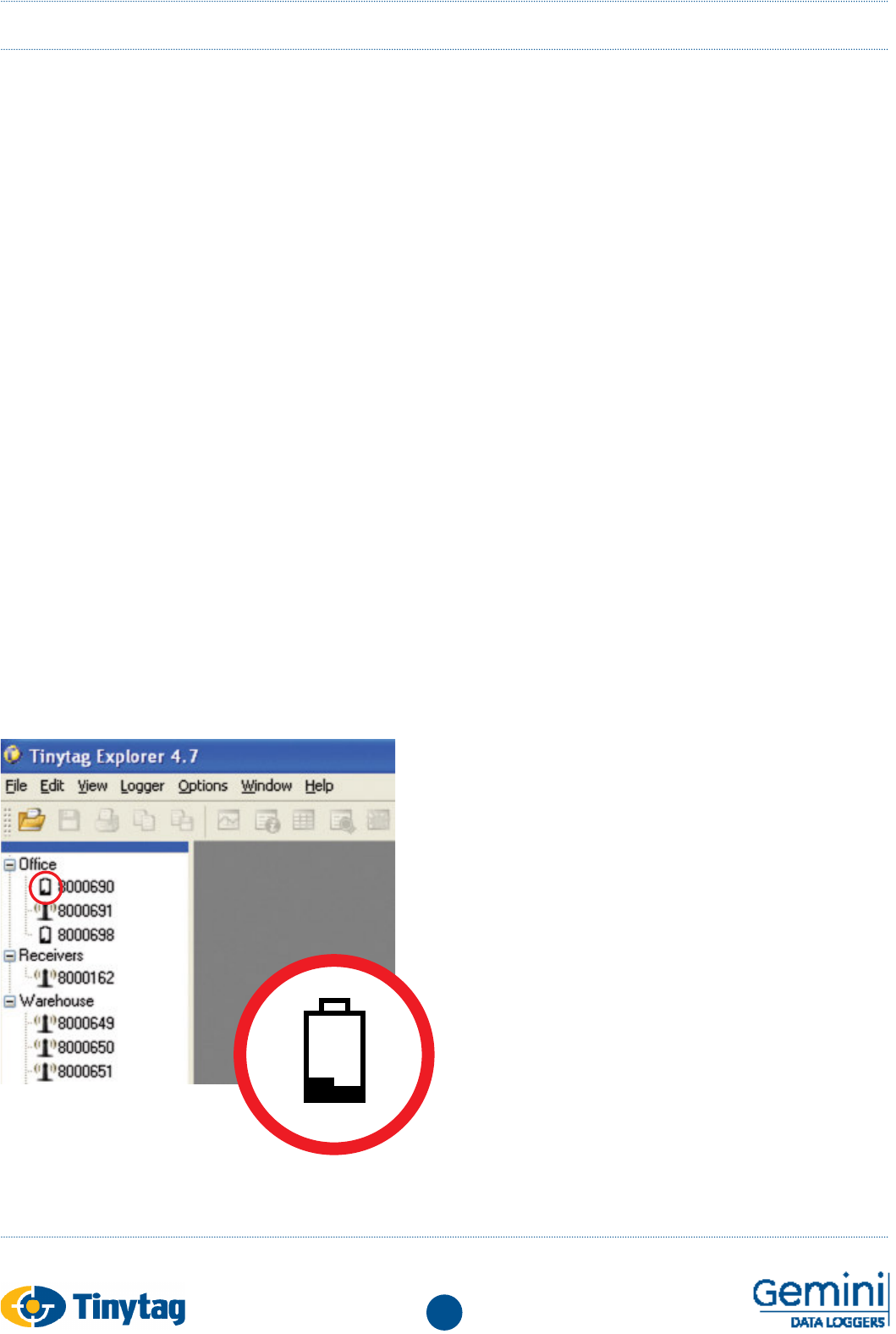
Tinytag Explorer displays a low battery ashing icon in its
navigator pane for devices where the battery voltage is
below a critical threshold.
Battery voltage is heavily temperature dependent.
When the battery begins to be at, it is quite likely that
the warning may show during a cold night and them
clear during the day as the temperature rises, and this
will continue for several weeks before the low battery
indicator remains on.
Low battery warnings are not indicated using the same
email/SMS system as alarms (because you would not
want to be woken up in the night with a text message
saying that the batteries need to be changed sometime
in the next week.)
14.3 The E ect of the Mesh Network
A common assumption is that loggers which are acting
as repeaters in the mesh will drain their batteries faster
than those that do not. This is false.
The e ect on battery life of the mesh network primarily
depends on the number of radio messages that a logger
will hear. Battery life will be slightly shorter in:
1. Networks with many devices.
2. Networks carrying data with a fast logging interval.
3. In networks spread over a large area, devices near the
receiver. (In smaller networks, all devices are near the
receiver).
Interference from other devices using a close frequency
may also have an impact on battery life.
14 Power
Low Battery Warning

28
15 Regulatory Compliance
This equipment meets the applicable technical
requirements of EN 300 220-1 and EN 300 220-3 for a
power Class 7a transmitter & a Class 2 receiver.
It is compliant with the applicable technical EMC
requirements of EN 301 489-1 and EN 301 489-3.
It is compliant with the essential requirements of EC
Directive 99/5/EC (the R&TTE Directive).
Note for users under FCC authority:
This equipment has been tested and found to comply
with the limits for a Class A digital device, pursuant to
Part 15 of the FCC Rules. These limits are designed
to provide reasonable protection against harmful
interference when the equipment is operated in a
commercial environment. This equipment generates,
uses, and can radiate radio frequency energy and, if not
installed and used in accordance with the instruction
manual, may cause harmful interference to radio
communications. Operation of this equipment in a
residential area is likely to cause harmful interference
in which case the user will be required to correct the
interference at their expense.
Changes or modi cations not expressly approved by the
manufacturer could void the user’s authority to operate
the equipment.

29
Notes


Gemini Data Loggers (UK) Ltd.
Scienti c House, Terminus Road,
Chichester, West Sussex,
PO19 8UJ England.
www.tinytag.info
t: +44 (0)1243 813000
f: +44 (0)1243 531948
e: sales@tinytag.info
PN 9800-0037 ISSUE 1A