General Research of Electronics 0705 Scanning Receiver User Manual Triple Trunking

General Research of Electronics Inc Scanning Receiver Triple Trunking

Users manual

0705  Owner’s Manual Triple Trunking   Mobile/Base Radio Scanner  0705  Thank you for purchasing your Triple Trunking Handheld Radio Scanner. Your scanner scans conventional frequencies and trunked systems. Please read this user’s guide before installing, setting up and using your new scanner.  What’s Included Scanner  Antenna  AC Adaptor DC Cable with Fuse DIN-E Sleeve & Remove keys (2) Mounting Bracket Knob (2) Rubber washer (2) Lock washer (2) Screw (2) Rubber Foot (3) Preprogrammed Frequency Addendum User’s Guide   Contents  will add    Your Scanner  VOLUME / OFF  Squelch  Headphones   Page 1
0705  Owner’s Manual PC/IF   (Spectrum Sweeper Symbol) – Spectrum Sweeper. SCAN – Starts a scan. FUNC – Function MAN – Manually selecting a channel. TRUNK – Accesses trunking functions. WX/(Skywarn Symbol) – Weather search and Skywarn. PRI – Priority TEXT – Activates text buttons. PAUSE – Pause the search, tune, scan, etc. MODE – Changes receive mode. DIM – Dimmer. TUNE – Enters Tune mode. ATT – Attenuator. /¥, ¥/ – Navigates functions. SRCH – Search.  1-9 / A-Z – Numbers and letters. Zero enters special characters. ./DELAY – Decimal point, space, delay functions. CLEAR – Clears an incorrect entry. L/OUT – Locks out channels, frequencies, or Talk Group IDs. PROG – Program. ENT – Enter.  INSTALL YOUR SCANNER  You can mount your trunking scanner in your vehicle, install it for mobility, or install it as a base station.  Mounting Your Scanner in Your Dashboard  If you are unsure about how to install your scanner in your vehicle, consult your automobile manufacturer, dealer, or a qualified installer. Before installing, confirm your scanner fits in the desired mounting area and you have all the necessary materials. Your scanner requires a 2 x 7 1/8 x 5 5/16 inch (50 x 180 x 135 mm) mounting area.  1. Remove the four rear screws and pull off the black case before installing your scanner.   Page 2
0705  Owner’s Manual 2. Install the DIN sleeve into the opening in your dashboard, lip facing out.  3. Push out the top and bottom tabs to hold the sleeve firmly in place.  4. Slide the scanner into the sleeve until it locks in place.  To remove your scanner from the DIN sleeve, insert the two keys straight into the scanner’s front panel. Then remove the scanner by pulling front panel.  When mounting in your dashboard, you will need to connect an external antenna and an external speaker.  Mobile Mounting in Your Vehicle  You can mount your scanner under the dashboard, or on top of it, using the mounting bracket.  1. Attach the three protective rubber feet to the mounting bracket when you use the scanner on a flat surface. Do not use them when you mount the bracket with screws.  2. Use the supplied mounting bracket as a template to mark positions for the two mounting screws.  3. At the marked positions, drill holes slightly smaller than the screws.  4. Remove the paper backing from each washer and stick one inside of each bracket’s ear, aligning the washer’s hole with the bracket’s hole.  5. Attach the mounting bracket to your vehicle’s surface using the supplied screws and lockwashers.  6. Slide the scanner into the bracket, aligning the scanner’s holes with the holes in the bracket, and then screw the mounting knobs into the scanner.  When drilling holes, be sure to avoid obstructions behind the mounting surface. Consult a qualified installer if in doubt.  Using Your Scanner as a Base Station  You can place your scanner on a desk, shelf, or table to use it as a base station. Since the speaker is on the bottom of the scanner, you may want to use the mounting bracket to elevate your scanner off the surface for better sound. Follow the mobile vehicle mounting instructions above to affix your scanner to a desk, shelf, table or other flat surface (except that the bracket will be below the scanner).  Page 3
0705  Owner’s Manual  POWER YOUR SCANNER  You can power your scanner from a wall outlet, through your vehicle’s ignition, or from your vehicle’s cigarette lighter.  From a Wall Outlet  1. Connect the tip of the supplied AC adaptor to the DC 13.8V jack at the rear of your scanner.  2. Plug the AC adaptor into your wall outlet.  You must use a Class 2 power source that supplies 13.8V DC and delivers at least 600mA. Its center tip must be set to positive and its plug must fit the scanner’s DC 13.8V jack. Using an adaptor that does not meet these specifications could damage the scanner or the adaptor.  WARNING: To prevent electric shock, do not use the AC adaptor’s polarized plug with an extension cord, receptacle, or other outlet unless you can fully insert the blades to prevent blade exposure.  Through Your Vehicle’s Ignition  1. Disconnect the cable from the negative (-) terminal of your vehicle’s battery.  2. Ground the black wire of the supplied DC power cord to your vehicle’s chassis.  Be sure the grounding screw makes complete contact with the metal frame of your vehicle.  3. Connect the red wire of the supplied DC power cord to a voltage source that turns on and off with the ignition switch, such as a spare accessory terminal in your vehicle’s fuse box.  4. Insert the power cord’s barrel plug into the scanner’s DC 13.8V jack.  5. Reconnect the cable to the negative (-) terminal of your vehicle’s battery.  From Your Vehicle’s Cigarette Lighter  To power your scanner from a 12V power source in your vehicle, such as a cigarette-lighter socket, you need a 12V, 600mA DC cigarette-lighter adaptor (not supplied).  Page 4
0705  Owner’s Manual  1. Insert the adapter’s barrel plug into the scanner’s DC 13.8V jack.  2. Plug the adaptor’s other end into your vehicle’s cigarette lighter or power socket.  When you use a cigarette-lighter adaptor, you might hear electrical noise from your engine while scanning. This is normal.  You must use a power source that supplies 12V DC and delivers at least 600 mA. Its center tip must be set to positive and its plug must fit the scanner’s DC 13.8V jack. Using an adaptor that does not meet these specifications could damage the scanner or the adaptor.  Connecting the Antenna  To connect an external antenna, always follow the installation instructions supplied with the antenna. Use 50-ohm, RG-58, or RG-8, coaxial cable. If the antenna is over 50 feet from the scanner, use RG-8 low-loss dielectric coaxial cable.  To attach the supplied antenna:  1. Align the antenna slots with the tabs on the scanner, and slide the antenna into place.  2. Turn while pushing down until the antenna locks into place.  Warning: Use extreme caution when installing or removing an outdoor antenna. If the antenna starts to fall, let it go! It could contact overhead power lines. If the antenna touches a power line, touching the antenna, mast, cable, or guy wires can cause electrocution and death. Call the power company to remove the antenna. DO NOT attempt to do so yourself.  Headphones  You can plug headphones into your scanner’s headphone jack at the front panel. This automatically mutes the scanner’s speaker.  Even though some earphones/headphones let you hear some outside sounds when listening at normal volume levels, they still can present a traffic hazard.  To protect your hearing, follow these earphone or headphones guidelines:   Page 5
0705  Owner’s Manual . Do not listen at extremely high volume levels. Extended high-volume listening can lead to permanent hearing loss. . Set the volume to the lowest setting before listening. Turn on the scanner, and adjust the volume to a comfortable level. . After you set the volume, do not increase it. Over time, your ears adapt to the volume level, so a volume level that does not cause discomfort might still damage your hearing.  External Speaker  When you mount your scanner in your dashboard, you will need to connect an external speaker. Connect the external speaker to the EXT SP jack at the rear panel.  Keytones  The scanner sounds a tone each time you press a key.  To set the keytone:  1. Turn on the scanner. “Multi-system Trunking Scanner” appears.  2. While “Multi-system Trunking Scanner” appears, press 1 to turn on the keytone or 2 to turn it off.  Dimmer  Repeatedly press DIM to adjust the brightness of the display backlight to Dark, Light Off, or Light.  Squelch and Attenuator  The squelch and attenuator help you control your scanner’s sensitivity. If you hear a hissing sound, the scanner will remain on an active channel, even after a disconnect tone or a stopped transmission.  If you set the squelch precisely at the threshold where the hissing sound stops, the scanner may pick up unwanted, partial, or very weak transmissions. To prevent this, most users prefer a position a bit past the threshold.  With the attenuator on, the scanner might not receive weak signals. You can reduce interference using two attenuator modes: . Global . (Default) The attenuator setting is applied to all channels, bands, or groups. . Normal . Lets you set the attenuator in each channel, band, or group.  Page 6
0705  Owner’s Manual  To set squelch:  1. Turn off the scanner and turn SQUELCH fully counterclockwise.  2. Turn on the scanner. You should hear a hissing sound.  3. Turn the SQUELCH clockwise to decrease the scanner’s sensitivity, turn the SQUELCH counterclockwise to increase its sensitivity.  To set the attenuator mode:  1. To set Global mode, press FUNC and then ATT. On the display “G” appears.  2. To set the attenuator for each channel, press FUNC and then ATT. On the display “G” disappears. For each channel: . To turn on the attenuator, press ATT. “A” appears. . To turn off the attenuator, press ATT again. “A” disappears.  You cannot set the attenuator while scanning.  Delay  Some conversations might take several seconds between transmissions. To avoid missing a reply, a delay is automatically set for each channel. The scanner stops for 2 seconds after a transmission stops before it resumes scanning or searching.  To turn on/off the delay:  1. Press ./DELAY. DLY appears if the delay is on.  2. To turn on the delay, press ./DELAY again. “dly” appears if the delay is off.  Scanner Setup  A frequency, expressed in kHz or MHz, is the tuning location of a station.  Your scanner saves frequencies to channels and groups the channels into banks. The scanner’s 10 banks each hold 100 channels (1,000 channels total).  Page 7
0705  Owner’s Manual  The scanner is preset to the most common AM or FM receive modes for each frequency range. However, some amateur transmissions may operate in a different mode. If the transmission sounds weak or distorted, you may have the channel set to the wrong receive mode:  AM – Amplitude Modulation, primarily used for aircraft, military, some amateur and government transmissions. FM – Frequency Modulation, used for most public safety transmissions, broadcast, business, and amateur radio transmissions. CT – FM transmissions with Continuous Tone Coded Squelch System (CTCSS) DC – FM transmissions with Digital Coded Squelch (DCS) MO – Motorola Trunking System ED – EDACS Trunking System LT – LTR Trunking System  If you change the receive mode using MODE key, the scanner shows the receive mode for small caps (ex. fm, am, ct, or dc). If you want to change the default setting, press FUNC then press MODE.  Defining a Channel  To define a channel:  1. Press MAN.  2. Enter the bank (0-9) and channel number (00-99) where you want to store the frequency (Example: 101 for Bank 1, Channel 1).  3. Press MAN again. M and the bank and channel number appear.  4. Press PROG. M changes to P.  5. Use the number keys to enter the frequency (including the decimal point). If you make a mistake, press CLEAR to delete a single digit or hold CLEAR about 2 seconds to start over.  Your scanner automatically rounds to the nearest valid frequency. For example, if you enter 151.553, your scanner rounds to 151.550.  6. If necessary, press MODE to change the receiving mode.   Page 8
0705  Owner’s Manual 7. Press ENT.    If the frequency is already stored in the bank, “Dupl.Freq. ChXXX” appears. To copy the duplicate frequency anyway, press ENT or press CLEAR to cancel.  If you made a mistake in Step 5, “Invalid Freq.” bliefly appears and the scanner beeps when you press ENT. Start again from Step 5.  8. Press MAN again. M and the bank and channel number appear.  Copying a Frequency  When you copy a frequency, all the channel conditions, including mode, are also copied.  To copy a frequency:  1. Press TUNE.  2. Tune the frequency you want to copy.    3. If necessary, press MODE to change the receiving mode.  4. Press FUNC then ENT. “Bank 9 Store?” appears.  5. To select a new bank, press the bank number.  6. Press ENT. “Channel Stored!” appears briefly.    If the frequency is already stored in the bank, “Dupl.Freq. ChXXX” appears. To copy the duplicate frequency anyway, press ENT or press CL to cancel.  7. Press MAN.  Deleting Saved Frequencies  To delete a saved frequency:  1. Press MAN.   Page 9
0705  Owner’s Manual 2. Use the number keys to enter the frequency’s channel number.  3. Press MAN.  4. Press PGM. M changes to P.  5. Press FUNC.  6. Press CLEAR. “0.0000” appears.  To delete all saved frequencies in a bank:  1. Press PROG. M changes to P.  2. Press FUNC.  3. Use the number keys to enter the bank number.    4. Press FUNC then CLEAR. “Clear entire bank?” appears.  5. Press 1 to clear all. Any other key aborts.  CTCSS AND DCS  CTCSS and DCS allow multiple users to share a single radio frequency without hearing each other’s transmissions. Your scanner features an advanced, DSP-based CTCSS and DCS decoder that displays CTCSS or DCS codes when available.  CTCSS, DCS, and digital voice transmissions operate independently of each other. Your scanner will not decode digital voice transmissions for CTCSS or DCS channels. Use FM mode for mixed analog and digital voice transmissions.  To define a channel’s CTCSS or DCS code:  1. Press PROG. M changes to P.  2. Navigate to the channel.  3. Enter a conventional frequency.  Page 10
0705  Owner’s Manual  4. Press MODE until the desired mode (CT or DC) appears with the default search code value.    5. Press FUNC, then MODE.    6. Use the /¥ or ¥/ to select the desired CTCSS or DCS code.  You can enter the code manually. The scanner automatically fills in the code. See Appendix B for a list of codes.  6. Press ENT.  To save a CTCSS or DCS code:  Press ENT while the code appears.  Scanner Cloning  You can transfer the programmed data to and from another 0705 scanner using a connecting cable which has 1/8-inch stereo (TRS) phone plugs on both ends (not supplied).  You can also upload or download the programmed data to or from a PC using an optional USB cable and application software.  To clone the scanner data:  1. Turn on both scanners.  2. Connect the connecting cable to each scanner’s PC/IF jack. “** CLONE MODE ** Press UP to send Remove cable to exit.” appears.  3. Press /¥. “Confirm to send data?” appears.  4. Press 1 to send the data to the other unit or press any other key to cancel.  5. To exit the clone mode, remove the cable.  “CLONE MODE Incorrect Model” appears if you connect a scanner other than a 0705.   Page 11
0705  Owner’s Manual Searching  You can search for transmissions in the scanner’s preprogrammed search bank, which is divided into eight search bands. For SR0-SR2, you can directly select a channel or search through the band.    Seek Search  When Seek Search is active, the scanner stops on active frequencies for five seconds and then resumes searching automatically.    To activate Seek Search:  1. Press FUNC then 7. “Seek Search ON” appears briefly and “S” appears on the display.  2. To turn off Seek Search, press FUNC then 7 again. “Seek Search OFF” appears briefly.  Search Banks  To search preprogrammed search banks:  1. Press SRCH repeatedly to select a search bank.  Bank   Band SR0   Marine SR1   CB SR2   FRS/GMRS/MURS SR3   Public Safety SR4   Aircraft SR5   Amateur Bands SR6   Railroad SR7    Limit search (User changeable)  SR3 through SR5 banks contain several groups. To turn off a group, press the group number; the group number disappears. To turn the group back on, press the group number again.  2. Adjust the Squelch. After the set delay, the scanner starts searching. When the scanner finds an active frequency, it stops searching.  3. To pause while searching, press PAUSE. The scanner stops searching and “*** PAUSED ***” appears.  Page 12
0705  Owner’s Manual To resume, press PAUSE again.  4. If the scanner stops on an unwanted frequency, you can press L/OUT to lock out the frequency.  In the SR6 Railraod and SR7 Limit search bands, press FUNC then /¥ to start searching up fro the lowest frequency or ¥/ to start searching down from the highest frequency.  To search banks SR0-SR2:  1. Press SRCH repeatedly to select SR0, SR1, or SR2.    2. To search the entire band, press FUNC then SRCH. Press FUNC then SRCH again to return to the previous mode. “MAN” or “SRCH” appears. MAN: Manually select/SRCH: Searches through the band.  3. To select a channel while MAN appears, press a channel number or use /¥ or ¥/.  4. Adjust the Squelch. After the set delay, the scanner starts searching while SRCH appears. When the scanner finds an active frequency, it stops searching.  5. If the scanner stops on an unwanted frequency, you can press L/OUT to lock out the frequency. For more information, see Locking Out Frequencies.  6. To pause while searching, press PAUSE. The scanner stops searching and “*** PAUSED ***” appears. To resume, press PAUSE again.  Zeromatic  While searching, the scanner stops if a transmission triggers the squelch setting.  A narrow-band FM transmission can have a deviation of +/- 5 KHz, and the actual total bandwidth, including the tails of the sidebands, can be even greater. However, search intervals smaller than that can stop your scanner short of the correct (center) frequency.    The Zeromatic function allows the scanner to find the correct center frequency for search banks SR3, SR4, SR5, SR6 and SR7. When active, Zeromatic automatically tunes to the frequency that is the closest step increment to the correct center frequency.  To activate Zeromatic:  1. Press FUNC then 0. “Zeromatic ON.” appears briefly, then ZM appears.  Page 13
0705  Owner’s Manual  2. To turn Zeromatic off, press FUNC then 0 again. “ZM” changes to “zm.”  Programming a Search Range  To program the search range of Bank SR7:    1. Repeatedly press SRCH to select SR7.  2. Press PROG then SRCH. “Enter SR7 Search Range Limits” appears. L blinks for the lower-limit of the range.  3. Use the number keys to enter the lower-limit frequency (including the decimal point).    4. Press ENT. U appears.  5. Use the number keys to enter the upper-limit frequency (including the decimal point), then press ENT.  If either entered frequency is incorrect, “Invalid Freq.” appears briefly.  6. Press SRCH to start searching.  7. Adjust the Squelch. After the set delay, the scanner starts searching. When the scanner finds an active frequency, it stops searching.  Spectrum Sweeper  Spectrum Sweeper provides a powerful tool to rapidly detect, monitor and save frequencies of nearby or high-power transmissions. Spectrum Sweeper resembles more expensive portable frequency counters, but provides many advantages over typical portable frequency counters.  Spectrum Sweeper is more sensitive than portable frequency counters and will detect transmissions at a greater distance. Spectrum Sweeper rapidly searches the RF spectrum in 1 MHz segments. If it detects a signal, Spectrum Sweeper searches in finer steps until the signal source is found.  Spectrum Sweeper can search all frequencies, or you can define frequency ranges, to avoid ranges with constant activity, such as paging or broadcast transmitters.    To use Spectrum Sweeper:  Page 14
0705  Owner’s Manual  1. Hold the Spectrum Sweeper button (SS-SYMBOL) for approximately 1 second.  2. To change the scanned band (All Band or Police/Fire), press FUNC then (SS-SYMBOL). For a list of Spectrum Sweeper Bands, see Appendix D.  3. To turn off a bank, press the bank or group number while Spectrum Sweeper is active.  Priority mode is not available while using the Spectrum Sweeper .  Special Spectrum Sweeper  Special Spectrum Sweeper divides the frequency range by 1 MHz segments.  If you lock out 5 frequencies within 1 MHz segment, the scanner will skip that segment in subsequent sweeps.  To use Special Spectrum Sweeper :  1. Press FUNC.  2. Use /¥ or ¥/ to select “Sp. Sweeper” appears for Special Spectrum Sweeper .  3. To turn off Special Spectrum Sweeper, press FUNC and then /¥ or ¥/ again.  Locking Out Frequencies  When you lock out frequencies during a search, the scanner continues searching, but ignores the locked out frequencies. You can lock out up to 50 frequencies in each bank. If you try to lock out more, “L/O Memory Full!” appears.  While using Spectrum Sweeper, you can lock out 150 frequencies if searching all bands and 50 frequencies while searching PubSafety frequencies. If you lock out 5 frequencies within a 1 MHz segment, the scanner will skip that segment in subsequent sweeps.  If you lock out all the frequencies in a search bank and only that search bank is activated, “All ranges Locked out!” appears and the scanner does not search.  Spectrum Sweeper still performs a fine step search for locked out signals. Spectrum Sweeper will not stop  Page 15
0705  Owner’s Manual on the signal, but scan may take longer.  To lock out a frequency:  When the scanner stops on a frequency, press L/OUT.  To review and unlock frequencies:  1. Press SRCH to enter search mode.  2. Press FUNC then L/OUT. The first locked-out frequency and lockout list appear. If the search bank has no locked-out frequencies, “No Lockout” appears.  3. Press /¥ or ¥/ to review the list. The current position and the total locked-out number also appear as “Lockout XX of YY.” (Example: Lockout 10 of 30.)  4. (Optional) To unlock a frequency, select the frequency then press CLEAR.  5. Press FUNC then L/OUT again to exit.  To unlock all frequencies in a search bank:  1. Press SRCH.  2. Select the search bank.  3. Press FUNC then press L/OUT. The Lockout list appears.  4. Press FUNC then 6. “Clear entire list?” appears.  5. Press 1. “List cleared” appears. Pressing any other key cancels the clearing.  Saving Found Frequencies  To save a frequency found during a search:  1. When the scanner stops on a frequency, press FUNC then PROG. “Store in ChXXX?” appears and the frequency flashes.   Page 16
0705  Owner’s Manual 2. To change the target channel, enter the bank and channel number.  3. Press ENT. “Channel Stored!” appears briefly, then the search resumes.  Scanning  Scanning sequentially checks all saved channels for activity. You must save frequencies into channels to scan. The scanner does not scan empty channels or unsaved frequencies.  You can increase the scanning speed by locking out channels with continuous transmissions, such as a weather channel or turning off entire banks. Turning off a bank prevents the scanner from scanning any channels within the bank. You cannot turn off all banks. There must be at least one active bank to scan.  To scan:  1. Press SCAN. The scanner checks all unlocked channels in the active banks.  2. To change the scan direction, press /¥ or ¥/.  3. To lock out a channel, when the scanner stops on the channel, press L/OUT. Then the scan resumes.  4. To turn off a bank, press the bank’s number so the bank’s number disappears. To turn on a bank, press the number key so the bank’s number appears.  5. To stop on a channel, press PAUSE.  Locking Out Channels  You can increase the scanning speed by locking out channels with continuous transmissions.  To locked out a channel:  1. Press MAN.  2. Enter the bank and channel number or use /¥ or ¥/ to select the channel.  3. Press L/OUT. On the display, “lo” changes to “LO.”  4. To unlock a locked-out channel, press L/OUT again.  Page 17
0705  Owner’s Manual  To review all locked out channels:  1. Press MAN.  2. Repeatedly pressing FUNC and then L/OUT to view each locked-out channel.  3. To unlock a channel, press L/OUT. “LO” changes to “lo.”  4. When you finish reviewing locked-out channels, press MAN.  You can manually select any channel in a bank, even in turned-off banks.  Priority Scanning  In addition to the 1,000 programmable memory channels, your scanner has one Priority channel. When Priority is turned on, the scanner checks the Priority channel every 2 seconds. This lets you scan without missing a transmission on the Priority channel.  Priority scanning does not operate if the scanner stops on a trunking transmission. Priority check seems random during peak hours.  To turn on the priority feature:  1. Press PRI so “pri” changes “PRI” on the display during scanning.  2. To turn off the priority feature, press PRI again.  To make an existing channel a Priority channel:  1. Press MAN.  2. Use the number keys to enter the bank and channel number.    The Priority channel cannot be a trunking channel (MOT, ED, or LTR).  3. Press MAN.  4. Press FUNC, then hold PRI until the display blinks.  Page 18
0705  Owner’s Manual  To modify the Priority channel:  1. Press PROG.  2. Press PRI.  3. Use the number keys to enter the frequency.  4. Press ENT.  If the frequency is incorrect, “Invalid Freq” appears briefly.  Weather Alerts  The Federal Communications Commission (FCC) has allocated channels for use by the National Oceanic and Atmospheric Administration (NOAA). NOAA broadcasts Specific Area Message Encoding (SAME) alerts that include digitally encoded data about the severity of the alert.  Regulatory agencies in other countries have also allocated channels for use by their weather reporting authorities.   If you program a weather channel as the Priority channel, your scanner can detect the 1050 Hz weather alert tone. All alerts are received (FIPS settings are ignored), and the scanner stays on the Priority channel only if the scanner detects a weather alert.  To perform a weather scan:  To hear your local forecast and regional weather information, press WX. Your scanner scans through the weather band then stops within a few seconds on the next available weather broadcast.  To program a weather channel:  1. Press WX.  2. Select the weather channel.  3. Press FUNC and then PRI.   Page 19
0705  Owner’s Manual SAME Standby Mode  SAME alerts include FIPS codes to identify areas, established by the US Census bureau. You can set your scanner to alert for all areas or limit weather alerts to up to 10 specific areas by FIPS code.  The National Weather Service maintains a current list of FIPS codes at www.nws.noaa.gov/nwr/.  To configure your scanner for SAME Standby mode, follow these steps:  1. Press WX until you identify the weather station with the strongest signal for your location.  2. Press FUNC, and then PGM to access the FIPS code entry table.  3. Use the /¥ or ¥/ keys to select the desired FIPS code storage location.  4. Use the numeric keys to enter the desired FIPS code, and then press ENT to store the code. Repeat this process for all the FIPS codes that you wish to store.  Subdivisions  State Code  County Code 0-9 (0=entire area)   01-50 (00=all states)  XXX (000=all counties) Example: 048439 (0=All; 48=Texas; 439=Tarrant County)  5. Press L/OUT to lock out or enable specific FIPS entries.  6. Press WX to exit the FIPS code entry table.  Notes: . Press WX then a number key to quickly review stored FIPS codes. Press L/OUT to toggle lockout status. . The scanner sounds an alert or beep when it receives the SAME code. If you do not stop the alert (or beep) for five minutes, the alert stops and the scanner beeps every ten seconds. If the scanner receives a new message after five minutes, it sounds the alert or beep. To stop the sound and ready the scanner to receive a new alert signal before the five minute time out, press any key except DIM.  7. Press FUNC, and then WX to initiate SAME standby. The scanner will monitor the selected weather radio station for alerts with FIPS codes that match the codes you entered in the FIPS entry table.    Note: The scanner searches the weather frequencies while SAME standby mode when squelch is off.  To exit SAME standby, press FUNC, and then WX.  Page 20
0705  Owner’s Manual  To test the weather alert:  1. Press WX. Your scanner scans through the weather bands.  2. Set the Squelch to the lowest setting so that you hear static.  3. Press FUNC and then WX. “SAME Standby” appears.  4. Hold ENT for about 2 seconds. The display indicates the type of message, and the scanner sounds an alert or series of beeps.  5. Press any key except DIM to stop testing.  Skywarn  Skywarn is an organized group of trained weather observers. Using Skywarn, you can hear trained observers in your area call in official reports to a control station that relays those reports to NOAA and other emergency agencies.  Before using this feature, save local Skywarn frequencies for your area into Channel 999.  To use Skywarn:  Hold the Skywarn button (SKY). Skywarn appears.  If the skywarn channel is empty, “Not programmed” appears.  Monitoring  When monitoring, the scanner remains on a single channel.  Your scanner features a power save circuit that allows the scanner to “sleep” briefly while waiting for a call on a monitored channel.  To monitor a channel:  1. Press MAN.   Page 21
0705  Owner’s Manual 2. Use the number keys to enter the channel number and press MAN.  To find a frequency to monitor:  1. Press TUNE. The currently-tuned frequency and “*** PAUSED ***” appear.  2. (Optional) Use the number keys to change the frequency and press ENT.  3. Press PAUSE. The scanner searches for a frequency. To change the tune direction, press /¥ or ¥/. When the scanner finds an active frequency, it stops.  4. Press PAUSE to monitor the frequency.  The transmission signal level is indicated by the 5 dots.  To set a default tuning frequency:  1. Press MAN.    2. (Optional) Use the number keys to enter the frequency number.  3. Press FUNC, then TUNE. The scanner saves the frequency. For example, if you save the frequency 145.31000 MHz, the next time you press TUNE, the scanner starts tuning at 145.31000 MHz.  Trunking Setup  Instead of transmitting on a specific frequency, trunking systems choose one of several frequencies during a 2-way radio transmission and simultaneously transmit a Talk Group ID that identifies the 2-way radio user. This allows trunking systems to allocate fewer frequencies to multiple 2-way radio users.  Defining a Trunking Bank  You can define any of the 10 banks as a trunking bank, but each bank can only scan for one system: Motorola, EDACS (GE/Ericsson), or LTR (EF Johnson).  Trunking banks can contain both trunking and non-trunking channels.  To define a Trunking Bank:   Page 22
0705  Owner’s Manual 1. Press PROG, then press TRUNK to enter the ID program mode.  2. Press FUNC, then use /¥ or ¥/ to select a bank.  3. Repeatedly press MODE to select a trunking mode (Motorola, EDACS, or LTR).  4. Press PROG.  Trunking Modes  In Closed mode, the scanner stops only on transmissions with saved and unlocked Talk Group IDs. This lets you focus a scan on the frequencies you have identified, ignoring other transmissions.  In Open mode, the scanner stops for transmissions on any unlocked channel. This lets you search for Talk Group IDs that you can then save.  While scanning, “–“ appears for Closed mode and “+” appears for Open mode under the channel storage bank’s number. When the scanner stops on a channel, ”OPEN” or “CLOSED” appears.  To set Open or Closed mode for a bank:  1. Press MAN.  2. Use /¥ or ¥/ to select a bank.  3. Press FUNC then DELAY. “Bank OPEN” or “Bank CLOSED” appears.  Saving Trunking Channels  Trunking channels are defined using the same procedure for non-trunking channels. In each bank, you can mix channel modes, including conventional, but you can scan only one trunking mode at a time, either EDACS, Motorola, or LTR.  Trunked modes (MO, ED, and LT) can only be selected for frequencies above 137 MHz that use trunking operations.  Motorola control frequencies change daily, you should save all the control frequencies in the same bank. If you do not know the control frequency, save all the Motorola frequencies in the same bank.   Page 23
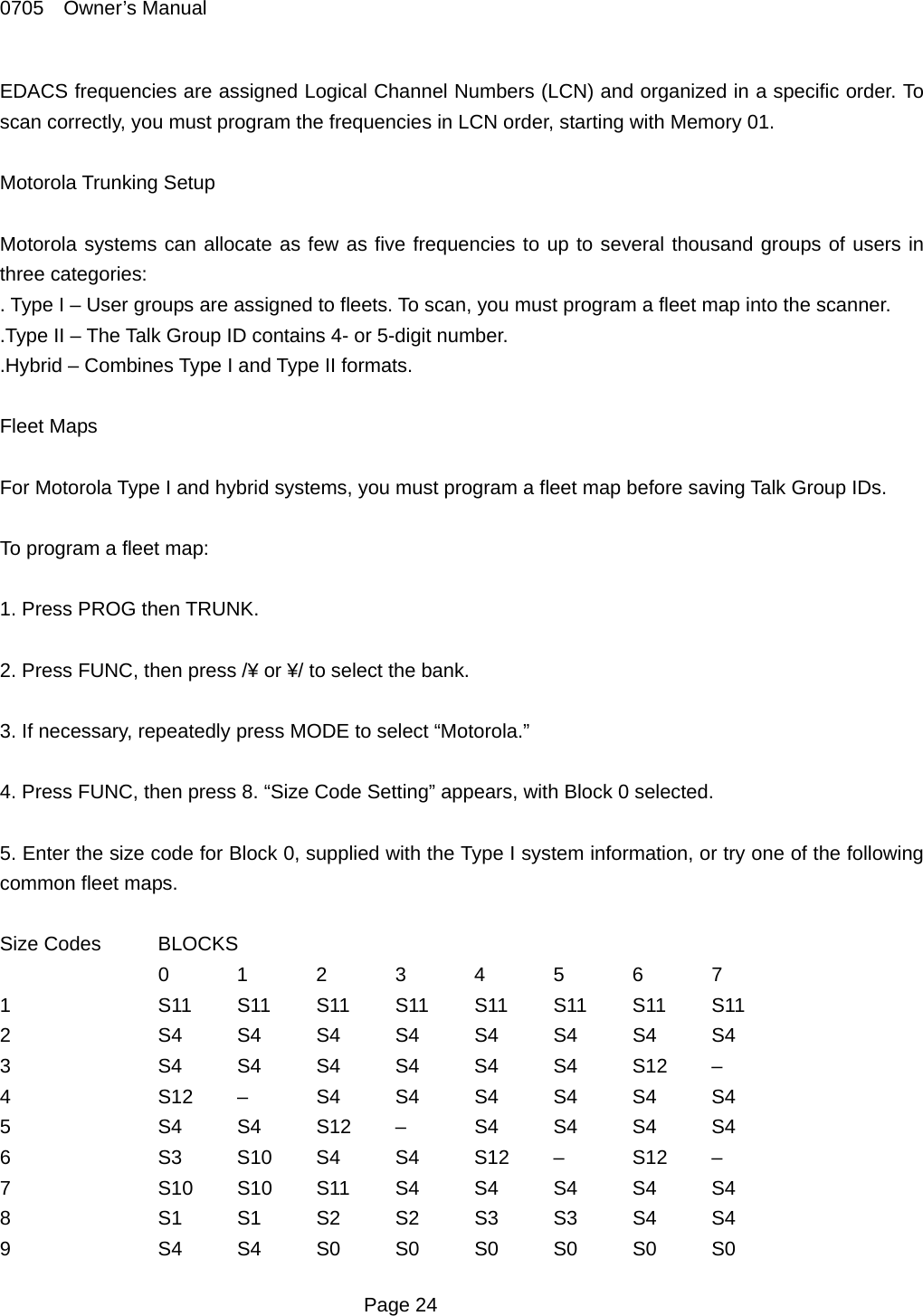
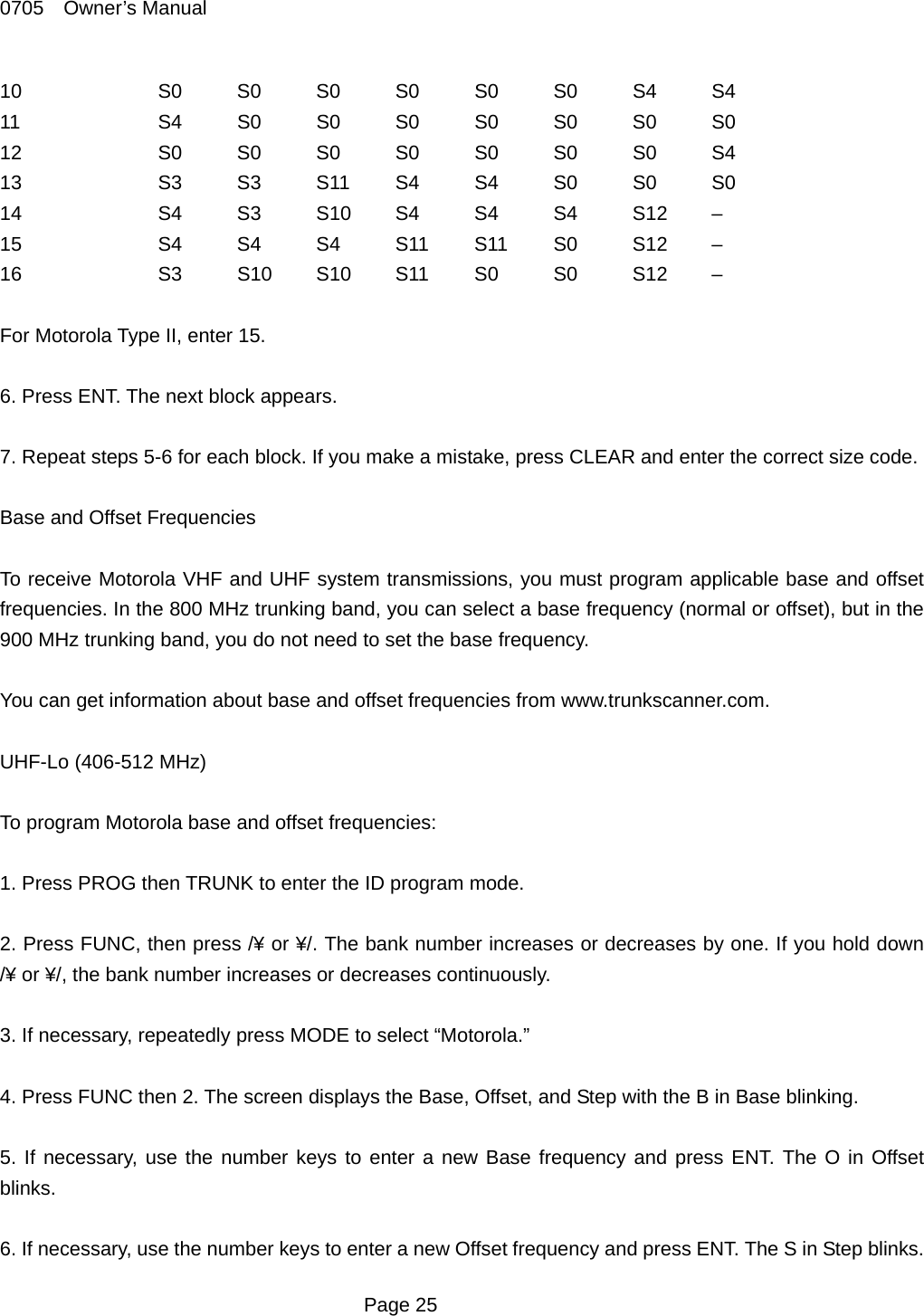
0705  Owner’s Manual EDACS frequencies are assigned Logical Channel Numbers (LCN) and organized in a specific order. To scan correctly, you must program the frequencies in LCN order, starting with Memory 01.    Motorola Trunking Setup  Motorola systems can allocate as few as five frequencies to up to several thousand groups of users in three categories:   . Type I – User groups are assigned to fleets. To scan, you must program a fleet map into the scanner. .Type II – The Talk Group ID contains 4- or 5-digit number. .Hybrid – Combines Type I and Type II formats.  Fleet Maps  For Motorola Type I and hybrid systems, you must program a fleet map before saving Talk Group IDs.  To program a fleet map:  1. Press PROG then TRUNK.  2. Press FUNC, then press /¥ or ¥/ to select the bank.  3. If necessary, repeatedly press MODE to select “Motorola.”  4. Press FUNC, then press 8. “Size Code Setting” appears, with Block 0 selected.  5. Enter the size code for Block 0, supplied with the Type I system information, or try one of the following common fleet maps.  Size Codes  BLOCKS 0 1 2 3 4 5 6 7 1    S11 S11 S11 S11 S11 S11 S11 S11 2    S4 S4 S4 S4 S4 S4 S4 S4 3    S4 S4 S4 S4 S4 S4 S12 – 4    S12 –  S4 S4 S4 S4 S4 S4 5    S4 S4 S12 –  S4 S4 S4 S4 6    S3 S10 S4 S4 S12 –  S12 – 7    S10 S10 S11 S4 S4 S4 S4 S4 8    S1 S1 S2 S2 S3 S3 S4 S4 9    S4 S4 S0 S0 S0 S0 S0 S0  Page 24
0705  Owner’s Manual 10   S0 S0 S0 S0 S0 S0 S4 S4 11    S4 S0 S0 S0 S0 S0 S0 S0 12   S0 S0 S0 S0 S0 S0 S0 S4 13   S3 S3 S11 S4 S4 S0 S0 S0 14   S4 S3 S10 S4 S4 S4 S12 – 15   S4 S4 S4 S11 S11 S0 S12 – 16   S3 S10 S10 S11 S0 S0 S12 –  For Motorola Type II, enter 15.  6. Press ENT. The next block appears.  7. Repeat steps 5-6 for each block. If you make a mistake, press CLEAR and enter the correct size code.  Base and Offset Frequencies  To receive Motorola VHF and UHF system transmissions, you must program applicable base and offset frequencies. In the 800 MHz trunking band, you can select a base frequency (normal or offset), but in the 900 MHz trunking band, you do not need to set the base frequency.  You can get information about base and offset frequencies from www.trunkscanner.com.  UHF-Lo (406-512 MHz)  To program Motorola base and offset frequencies:  1. Press PROG then TRUNK to enter the ID program mode.  2. Press FUNC, then press /¥ or ¥/. The bank number increases or decreases by one. If you hold down /¥ or ¥/, the bank number increases or decreases continuously.  3. If necessary, repeatedly press MODE to select “Motorola.”  4. Press FUNC then 2. The screen displays the Base, Offset, and Step with the B in Base blinking.  5. If necessary, use the number keys to enter a new Base frequency and press ENT. The O in Offset blinks.  6. If necessary, use the number keys to enter a new Offset frequency and press ENT. The S in Step blinks.  Page 25
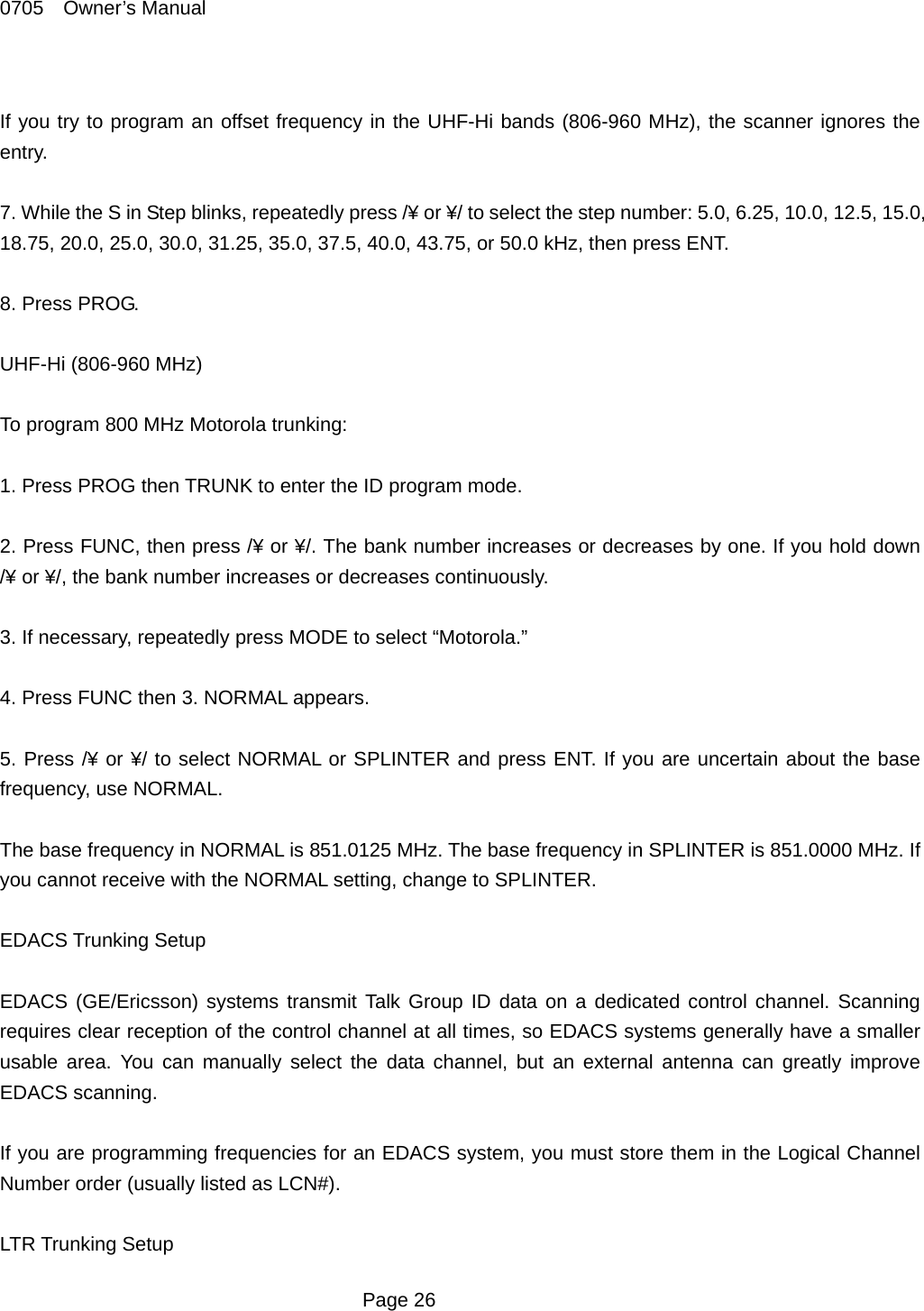
0705  Owner’s Manual  If you try to program an offset frequency in the UHF-Hi bands (806-960 MHz), the scanner ignores the entry.  7. While the S in Step blinks, repeatedly press /¥ or ¥/ to select the step number: 5.0, 6.25, 10.0, 12.5, 15.0, 18.75, 20.0, 25.0, 30.0, 31.25, 35.0, 37.5, 40.0, 43.75, or 50.0 kHz, then press ENT.  8. Press PROG.  UHF-Hi (806-960 MHz)  To program 800 MHz Motorola trunking:  1. Press PROG then TRUNK to enter the ID program mode.  2. Press FUNC, then press /¥ or ¥/. The bank number increases or decreases by one. If you hold down /¥ or ¥/, the bank number increases or decreases continuously.  3. If necessary, repeatedly press MODE to select “Motorola.”  4. Press FUNC then 3. NORMAL appears.  5. Press /¥ or ¥/ to select NORMAL or SPLINTER and press ENT. If you are uncertain about the base frequency, use NORMAL.  The base frequency in NORMAL is 851.0125 MHz. The base frequency in SPLINTER is 851.0000 MHz. If you cannot receive with the NORMAL setting, change to SPLINTER.  EDACS Trunking Setup  EDACS (GE/Ericsson) systems transmit Talk Group ID data on a dedicated control channel. Scanning requires clear reception of the control channel at all times, so EDACS systems generally have a smaller usable area. You can manually select the data channel, but an external antenna can greatly improve EDACS scanning.  If you are programming frequencies for an EDACS system, you must store them in the Logical Channel Number order (usually listed as LCN#).  LTR Trunking Setup  Page 26
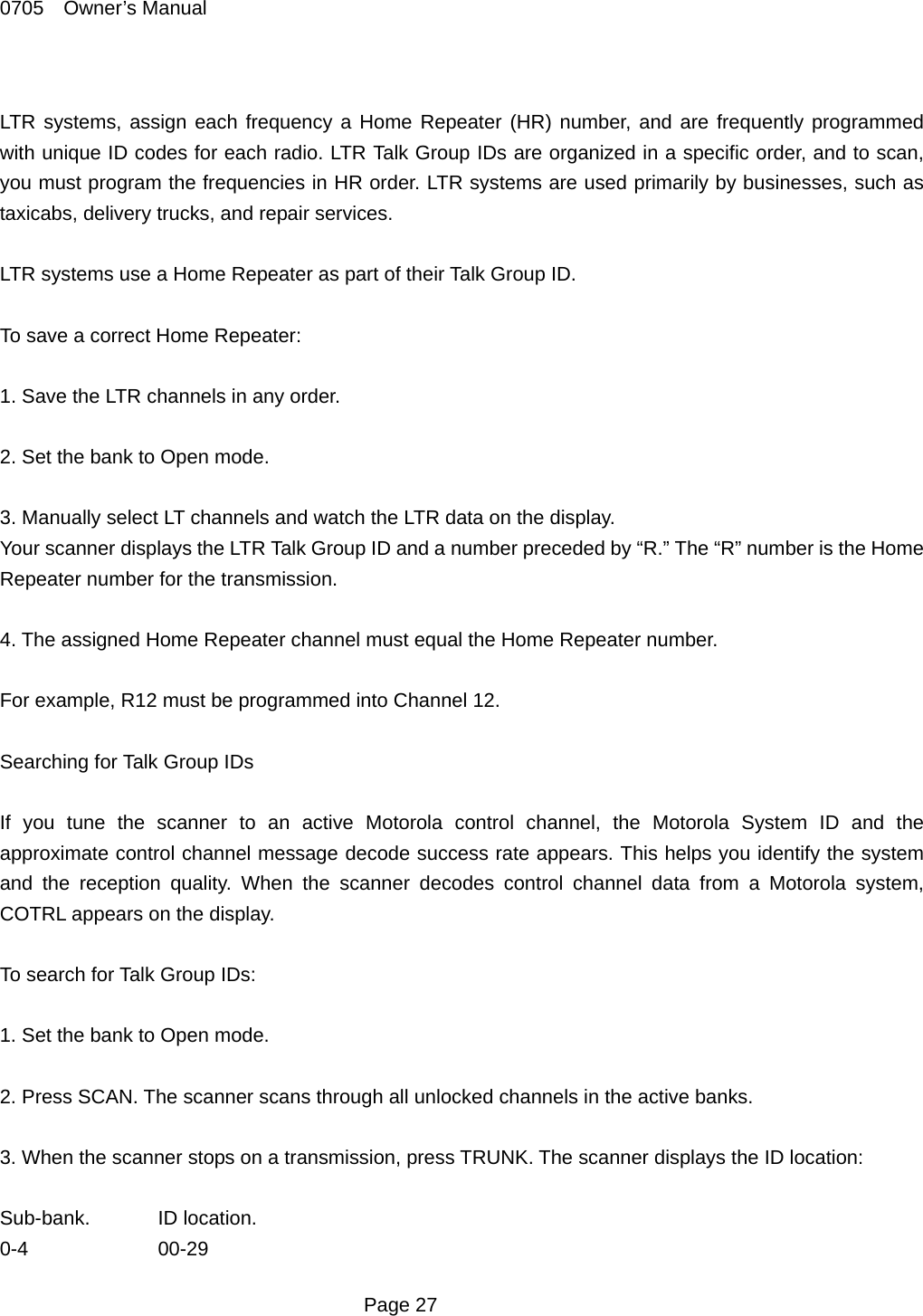
0705  Owner’s Manual  LTR systems, assign each frequency a Home Repeater (HR) number, and are frequently programmed with unique ID codes for each radio. LTR Talk Group IDs are organized in a specific order, and to scan, you must program the frequencies in HR order. LTR systems are used primarily by businesses, such as taxicabs, delivery trucks, and repair services.  LTR systems use a Home Repeater as part of their Talk Group ID.  To save a correct Home Repeater:  1. Save the LTR channels in any order.  2. Set the bank to Open mode.  3. Manually select LT channels and watch the LTR data on the display. Your scanner displays the LTR Talk Group ID and a number preceded by “R.” The “R” number is the Home Repeater number for the transmission.  4. The assigned Home Repeater channel must equal the Home Repeater number.  For example, R12 must be programmed into Channel 12.  Searching for Talk Group IDs  If you tune the scanner to an active Motorola control channel, the Motorola System ID and the approximate control channel message decode success rate appears. This helps you identify the system and the reception quality. When the scanner decodes control channel data from a Motorola system, COTRL appears on the display.  To search for Talk Group IDs:  1. Set the bank to Open mode.  2. Press SCAN. The scanner scans through all unlocked channels in the active banks.  3. When the scanner stops on a transmission, press TRUNK. The scanner displays the ID location:  Sub-bank. ID location. 0-4   00-29  Page 27
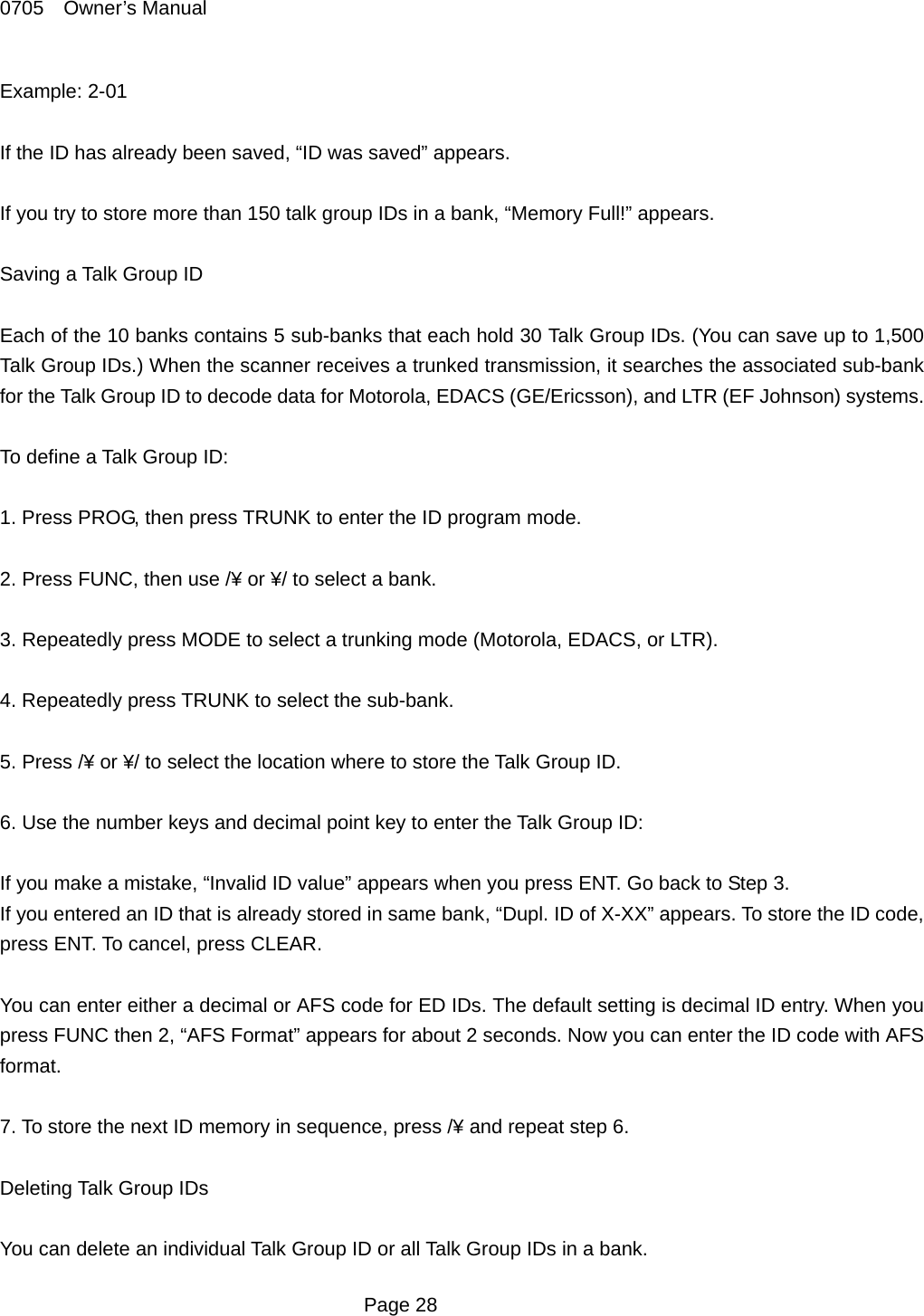
0705  Owner’s Manual Example: 2-01  If the ID has already been saved, “ID was saved” appears.  If you try to store more than 150 talk group IDs in a bank, “Memory Full!” appears.  Saving a Talk Group ID  Each of the 10 banks contains 5 sub-banks that each hold 30 Talk Group IDs. (You can save up to 1,500 Talk Group IDs.) When the scanner receives a trunked transmission, it searches the associated sub-bank for the Talk Group ID to decode data for Motorola, EDACS (GE/Ericsson), and LTR (EF Johnson) systems.    To define a Talk Group ID:  1. Press PROG, then press TRUNK to enter the ID program mode.  2. Press FUNC, then use /¥ or ¥/ to select a bank.  3. Repeatedly press MODE to select a trunking mode (Motorola, EDACS, or LTR).  4. Repeatedly press TRUNK to select the sub-bank.  5. Press /¥ or ¥/ to select the location where to store the Talk Group ID.  6. Use the number keys and decimal point key to enter the Talk Group ID:  If you make a mistake, “Invalid ID value” appears when you press ENT. Go back to Step 3. If you entered an ID that is already stored in same bank, “Dupl. ID of X-XX” appears. To store the ID code, press ENT. To cancel, press CLEAR.  You can enter either a decimal or AFS code for ED IDs. The default setting is decimal ID entry. When you press FUNC then 2, “AFS Format” appears for about 2 seconds. Now you can enter the ID code with AFS format.  7. To store the next ID memory in sequence, press /¥ and repeat step 6.  Deleting Talk Group IDs  You can delete an individual Talk Group ID or all Talk Group IDs in a bank.  Page 28
0705  Owner’s Manual  To delete a Talk Group ID:  1. Press PROG then TRUNK.  2. Press FUNC, /¥ or ¥/ to select ID memory.  3. Press FUNC then CLEAR.  To delete ALL talk group IDs in a bank:  1. Press PROG.  2. Press TRUNK to enter a Talk Group ID memory mode.  3. Select a Talk Group ID bank using FUNC, /¥ or ¥/.  4. Press FUNC then 6. “Clear entire list? Press 1 to clear all, any other key aborts” appears.  5. To clear the Talk Group IDs, Press 1. To cancel the deletion, press any key except 1.  Trunk Scanning  In each bank, you can scan only one trunking mode at a time, either EDACS, Motorola, or LTR. You can, however, mix conventional channels and frequencies in a bank.  1. Press SCAN. The scanner scans through all unlocked channels in the active banks. If necessary, you turn off the bank which stores conventional channels.  For Motorola channels, your scanner displays the Talk Group ID memory location, received frequency, VC (voice channel), and the Motorola ID number.  2. To change the scanning direction, press /¥ or ¥/.  Your scanner automatically mutes the audio while it decodes control channel data. However, we recommend you turn SQ clockwise and leave it set to a point just after the hiss stops. This lets the scanner quickly acquire the data channel.  For Motorola trunking systems, more than one talk group can transmit at a time. If you manually tune the  Page 29
0705  Owner’s Manual scanner, you will hear the talk group on that channel, but the display will alternate between all active Talk Group IDs.  For EDACS and Motorola (above 406 MHz range), the scanner monitors the control channel between each transmission to identify talk groups. For some Motorola (under 512 MHz range) and LTR systems, the scanner uses the subaudible data sent with each transmission to identify talk groups.  Trunking Delay  You can set a Talk Group ID delay separately from the channel delay. When active, the scanner checks the Talk Group ID for the delay time when a transmission ends.  To set a Talk Group ID delay:  1. Press FUNC then ./DELAY while you are programming the Trunk Group ID. “ENTER key saves. 2.0 seconds” appears.  2. Use /¥ or ¥/ to set ID Delay: None, 0.5, 1.0, 1.5, 2.0, 2.5, 3.0, 3.5, or 4.0 seconds.  3. Press ENT.  Locking Out Talk Group IDs  You can only lock out Talk Group IDs when the scanner is in the Closed mode.  To lock out Talk Group IDs:  1. Press PROG then TRUNK.  2. Press FUNC, /¥ or ¥/ to move to the desired bank.  3. Press /¥ or ¥/ to select the ID.  4. Press L/OUT to lock out the ID. “lo” changes to “LO.”  5. To remove the lockout from a trunking ID, manually select the ID memory, and press L/OUT. “LO” changes to “lo.”  You cannot clear all lockouts from a talk group at the same time.  Page 30
0705  Owner’s Manual  To review locked-out Talk Group IDs:  1. Press PROG then TRUNK.  2. Press FUNC. Then L/OUT. The first locked out ID appears. If the ID memory bank has no locked-out ID, you hear the low beep tone.  3. Press /¥ or ¥/ to scroll through the list.  4. Press PROG to exit.  Turning Off Sub-Banks  To turn off a sub-bank:  1. Press TRUNK repeatedly to select the desired sub-bank.  2. Press FUNC then 1 to turn the sub-bank on if it is off or off if it is on.  To turn off a sub-bank while scanning:  1. When the scanner stops on a transmission, press FUNC.  2. Press TRUNK. The display indicates which sub-bank is turned on or off. The active sub-bank number appears.  3. Press FUNC and the number of the sub-bank you desire to turn on or off. For example to turn sub-bank 4 on or off, press FUNC. Then press 4.  This function activates when the receiving channel bank is Closed mode.  Talk Group ID Hold  You can set your scanner to follow a trunking signal that you want to track during scanning.  To set Talk Group ID Hold:  1. While the scanner is stopped on a voice channel (VC appears), hold down TRUNK until “ID hold ON”  Page 31
0705  Owner’s Manual appears. When the scanner receives a transmission, the “S” on the display changes to “H.”  2. To release ID hold, press SCAN or TRUNK.  Scanner Maintenance  . Handle the scanner carefully; do not drop it. . Use and store the scanner only in normal temperature environments. . Keep the scanner dry; if it gets wet, wipe it dry immediately. . Keep the scanner away from dust and dirt, and wipe it with a damp cloth occasionally to keep it looking new.  Text Tags  While scanning, if the scanner stops on a channel with a saved text tag, the text appears on the display. Otherwise, the Talk Group ID appears on the display.  You can define text tags to identify channel transmissions, Talk Group IDs, or banks.  To access the numbers while you assign the text tag, press 1. Then press the desired number you want to enter.  To enter lowercase character or a character from the second set for the key 0, press FUNC after pressing the first numeral key.  To assign a Text Tag to a channel:  1. Press MAN.  2. Enter the bank and channel number.  3. Press PROG. M changes to P.  4. Press TEXT, and enter the text using the text keys (up to 16 characters). When you press a key, the associated letters appear on the screen. Press the corresponding number. For example, when you press ABC, A, B, and C appear on the display. To select A, press 1. To select B, press 2. To select C, press 3.   Page 32
0705  Owner’s Manual If you make a mistake, press /¥ or ¥/ to move to the character you want to change.  5. Press ENT to save the text.  To assign a Text Tag to a Talk Group ID:  1. Press PROG.  2. Press TRUNK.  3. Press FUNC then /¥ or ¥/ to select the desired bank.  4. Press TRUNK to select the desired sub-bank.  5. Press or hold down /¥ or ¥/ to select the desired group ID.  6. Press TEXT, and enter the text using the text keys (up to 16 characters).  When you press a key, the associated letters appear on the screen. Press the corresponding number. For example, when you press ABC, A, B, and C appear on the display. To select A, press 1. To select B, press 2. To select C, press 3.  If you make a mistake, press /¥ or ¥/ to move to the character you want to change.  7. Press ENT to store.  To assigning a Text Tag to a bank:  1. Press PROG.  2. Press FUNC then press bank number. “Bank X (0 through 9) selected.” appears.  3. Press TEXT, and enter the text using the text keys (up to 16 characters).  When you press a key, the associated letters appear on the screen. Press the corresponding number. For example, when you press ABC, A, B, and C appear on the display. To select A, press 1. To select B, press 2. To select C, press 3.  If you make a mistake, press /¥ or ¥/ to move to the character you want to change.  Page 33
0705  Owner’s Manual  4. Press ENT to store.  To display the Talk Group ID:  1. If the scanner displays the text tag for a transmission, press TEXT. The ID code appears.  2. Press TEXT again to cancel.  Troubleshooting  The scanner is not working at all. What’s wrong?  The AC/DC adaptor or DC cable might not be connected. Be sure the cable’s barrel plug is fully inserted into the DC 13.8V jack. The center tip of the cable’s barrel plug must be set to positive.  If the scanner does not operate when you connect a DC adaptor or DC cable, unplug the DC adaptor or cable from the power source and clean the socket, or check the adaptor’s internal fuse.  The scanner does not receive any stations or reception is poor. What’s wrong?  Check the antenna.  Check the squelch.  Check the Attenuator.  The scanner might need to be initialized. Turn the scanner off then on again, or initialize the scanner.  The scanner is on but does not scan. What’s wrong?  The squelch might not be adjusted correctly. Turn SQ clockwise.  There might only be one channel or no channels stored in the scanner. Save more frequencies into channels.  Birdie Frequencies  All scanners have signals created inside the scanner’s receiver. These birdie frequencies can interfere  Page 34
0705  Owner’s Manual with transmissions on the same frequencies. If the interference is not severe, you might be able to turn SQ clockwise to omit the birdie.  To find the birdies:  1. Disconnect the antenna and moving it away from the scanner. Make sure that no other nearby radio or TV sets are turned on near the scanner.  2. Start a search of every frequency range from its lowest frequency to the highest. When the search stops, often without any sound, this is a birdie.    3. Make a list of all the birdies in your scanner for future reference.  Initializing the Scanner  If the scanner’s display locks up or does not work properly after you connect a power source or install batteries, you might need to initialize it.  This procedure clears the scanner’s memory. Initialize the scanner only after trying all other methods to correct issues.  To initialize the scanner:  1. Turn off the scanner, then turn it on again. “Multi-system Trunking Scanner” appears.  2. While “Multi-system Trunking Scanner” appears, press 0.  3. Press 1.  4. Press ENT. “Initializing please stand by” appears for about 5 seconds. When the initialization is complete, M000 appears on the second line of the display. Bank 0 Ch 00 appears.  Do not turn off the scanner until the initialization is complete.    Service and Repair  If your scanner is not performing as it should, take it to your local store for assistance. Modifying or tampering with the scanner’s internal components can cause a malfunction and might invalidate its warranty and void your FCC authorization to operate it.  Page 35
0705  Owner’s Manual  Scanning Legally  Your scanner covers frequencies used by many different groups including police and fire departments, ambulance services, government agencies, private companies, amateur radio services, military operations, pager services, and wireline (telephone and telegraph) service providers. It is legal to listen to almost every transmission your scanner can receive. However, there are some transmissions you should never intentionally listen to. These include:  . telephone conversations (cellular, cordless, or other private means of telephone signal transmission) . pager transmissions . any scrambled or encrypted transmissions  According to the Electronic Communications Privacy Act (ECPA), as amended, you are subject to fines and possible imprisonment for intentionally listening to, using, or divulging the contents of such a transmission unless you have the consent of a party to the communication (unless such activity is otherwise illegal).  This scanner is designed to prevent reception of illegal transmissions, in compliance with the law which requires that scanners be manufactured in such a way as to not be easily modifiable to pick up those transmissions. Do not open your scanner’s case to make any modifications that could allow it to pick up transmissions that it is not legal to listen to. Doing so could subject you to legal penalties.  In some areas, mobile use of this scanner is unlawful or requires a permit. Check the laws in your area. It is also illegal in many areas to interfere with the duties of public safety officials by traveling to the scene of an incident without authorization.  We encourage responsible, legal scanner use.  FCC Notice  This equipment has been tested and found to comply with the limits for a scanning receiver, pursuant to Part 15 of the FCC Rules. These limits are designed to provide reasonable protection against harmful interference in a residential installation. This equipment generates, uses and can radiate radio frequency energy and, if not installed and used in accordance with the instructions, may cause harmful interference to radio communications.  However, there is no guarantee that interference will not occur in a particular installation. If this equipment does cause harmful interference to radio or television reception, which can be determined by turning the  Page 36
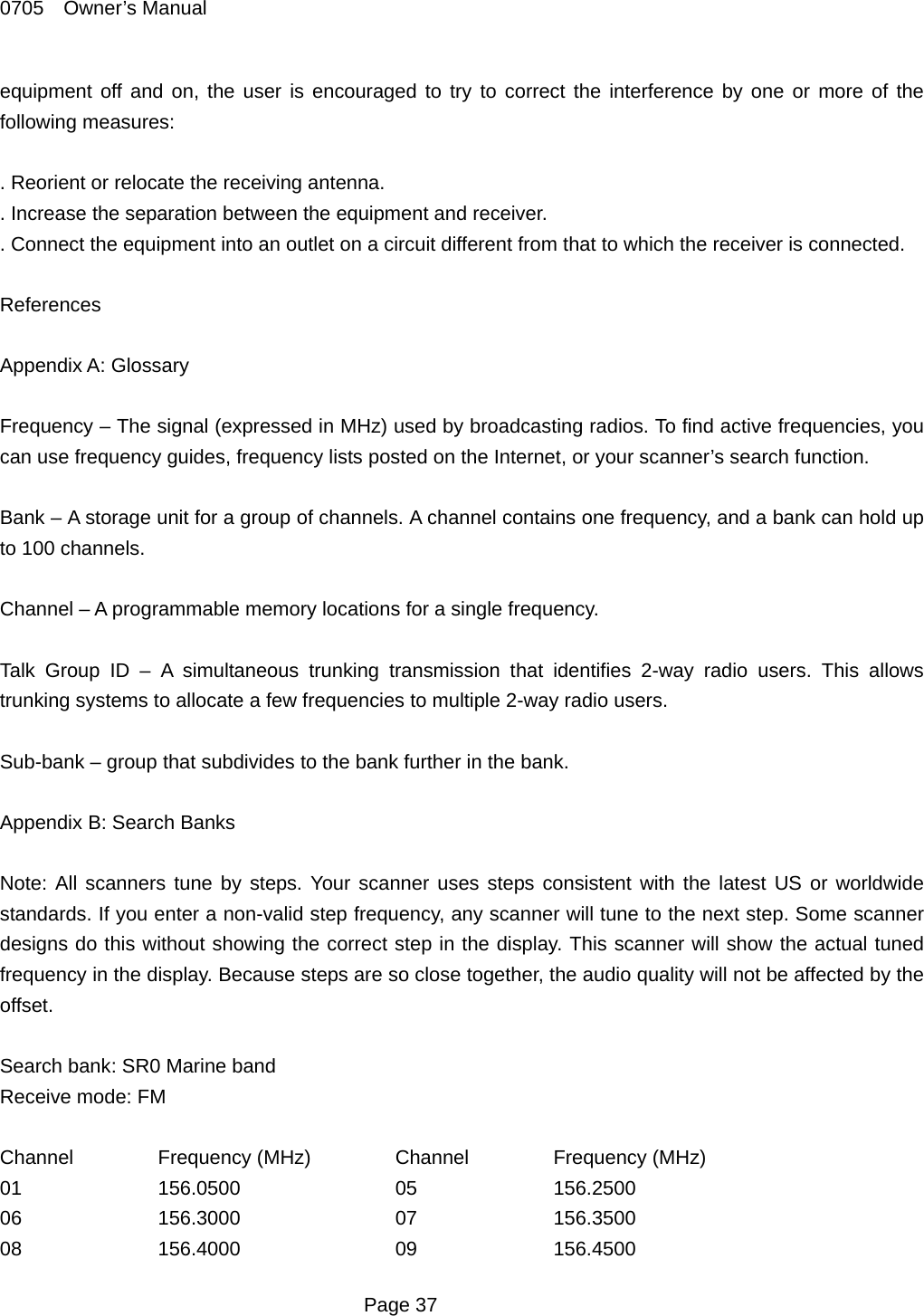
0705  Owner’s Manual equipment off and on, the user is encouraged to try to correct the interference by one or more of the following measures:  . Reorient or relocate the receiving antenna. . Increase the separation between the equipment and receiver. . Connect the equipment into an outlet on a circuit different from that to which the receiver is connected.  References  Appendix A: Glossary  Frequency – The signal (expressed in MHz) used by broadcasting radios. To find active frequencies, you can use frequency guides, frequency lists posted on the Internet, or your scanner’s search function.  Bank – A storage unit for a group of channels. A channel contains one frequency, and a bank can hold up to 100 channels.  Channel – A programmable memory locations for a single frequency.  Talk Group ID – A simultaneous trunking transmission that identifies 2-way radio users. This allows trunking systems to allocate a few frequencies to multiple 2-way radio users.  Sub-bank – group that subdivides to the bank further in the bank.  Appendix B: Search Banks  Note: All scanners tune by steps. Your scanner uses steps consistent with the latest US or worldwide standards. If you enter a non-valid step frequency, any scanner will tune to the next step. Some scanner designs do this without showing the correct step in the display. This scanner will show the actual tuned frequency in the display. Because steps are so close together, the audio quality will not be affected by the offset.  Search bank: SR0 Marine band Receive mode: FM  Channel   Frequency (MHz)   Channel   Frequency (MHz) 01  156.0500  05  156.2500 06  156.3000  07  156.3500 08  156.4000  09  156.4500  Page 37
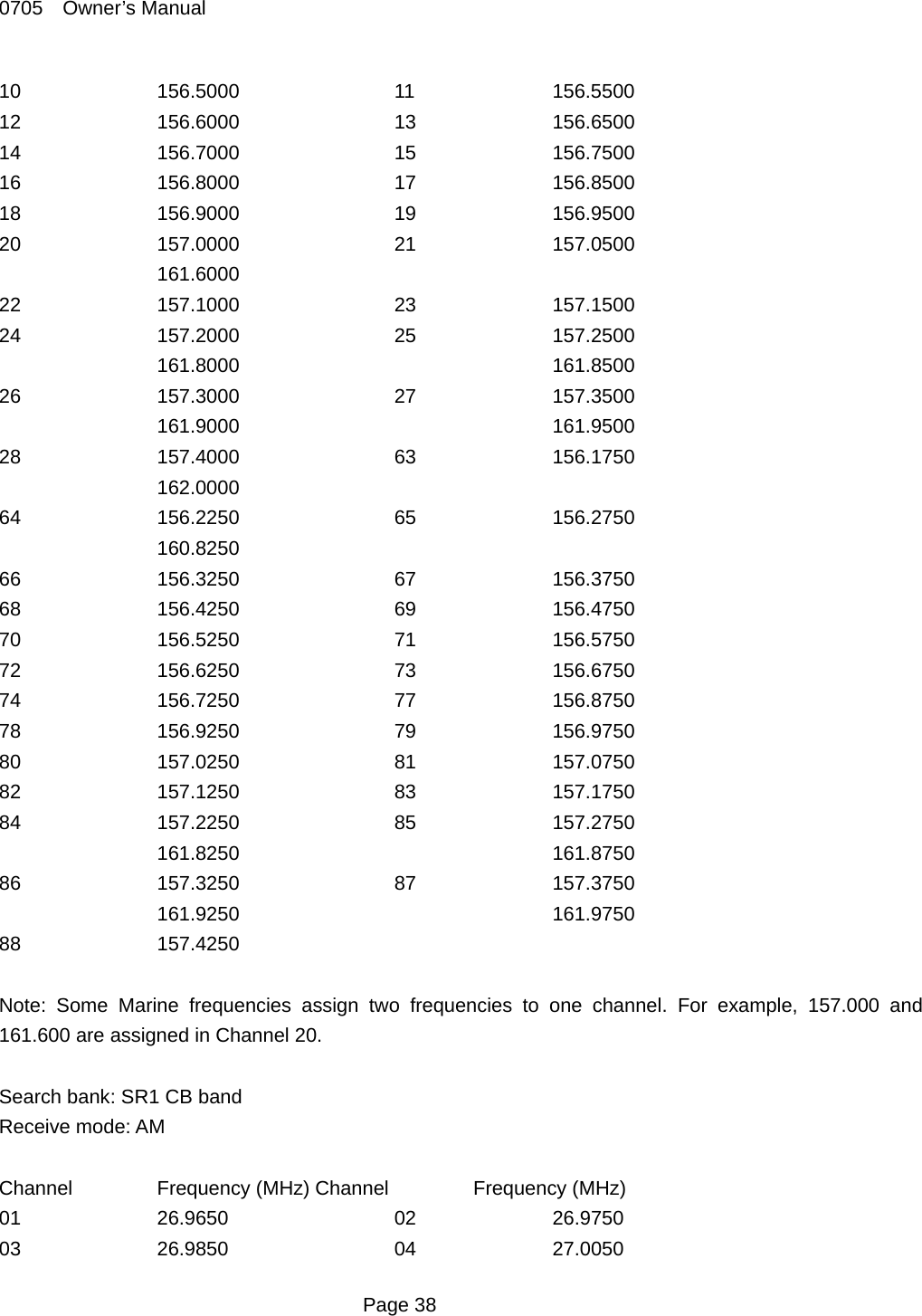
0705  Owner’s Manual 10  156.5000  11  156.5500 12  156.6000  13  156.6500 14  156.7000  15  156.7500 16  156.8000  17  156.8500 18  156.9000  19  156.9500 20  157.0000  21  157.0500   161.6000 22  157.1000  23  157.1500 24  157.2000  25  157.2500   161.8000    161.8500 26  157.3000  27  157.3500   161.9000    161.9500 28  157.4000  63  156.1750   162.0000 64  156.2250  65  156.2750   160.8250 66  156.3250  67  156.3750 68  156.4250  69  156.4750 70  156.5250  71  156.5750 72  156.6250  73  156.6750 74  156.7250  77  156.8750 78  156.9250  79  156.9750 80  157.0250  81  157.0750 82  157.1250  83  157.1750 84  157.2250  85  157.2750   161.8250    161.8750 86  157.3250  87  157.3750   161.9250    161.9750 88   157.4250  Note: Some Marine frequencies assign two frequencies to one channel. For example, 157.000 and 161.600 are assigned in Channel 20.  Search bank: SR1 CB band Receive mode: AM  Channel   Frequency (MHz) Channel   Frequency (MHz) 01  26.9650   02  26.9750 03  26.9850   04  27.0050  Page 38
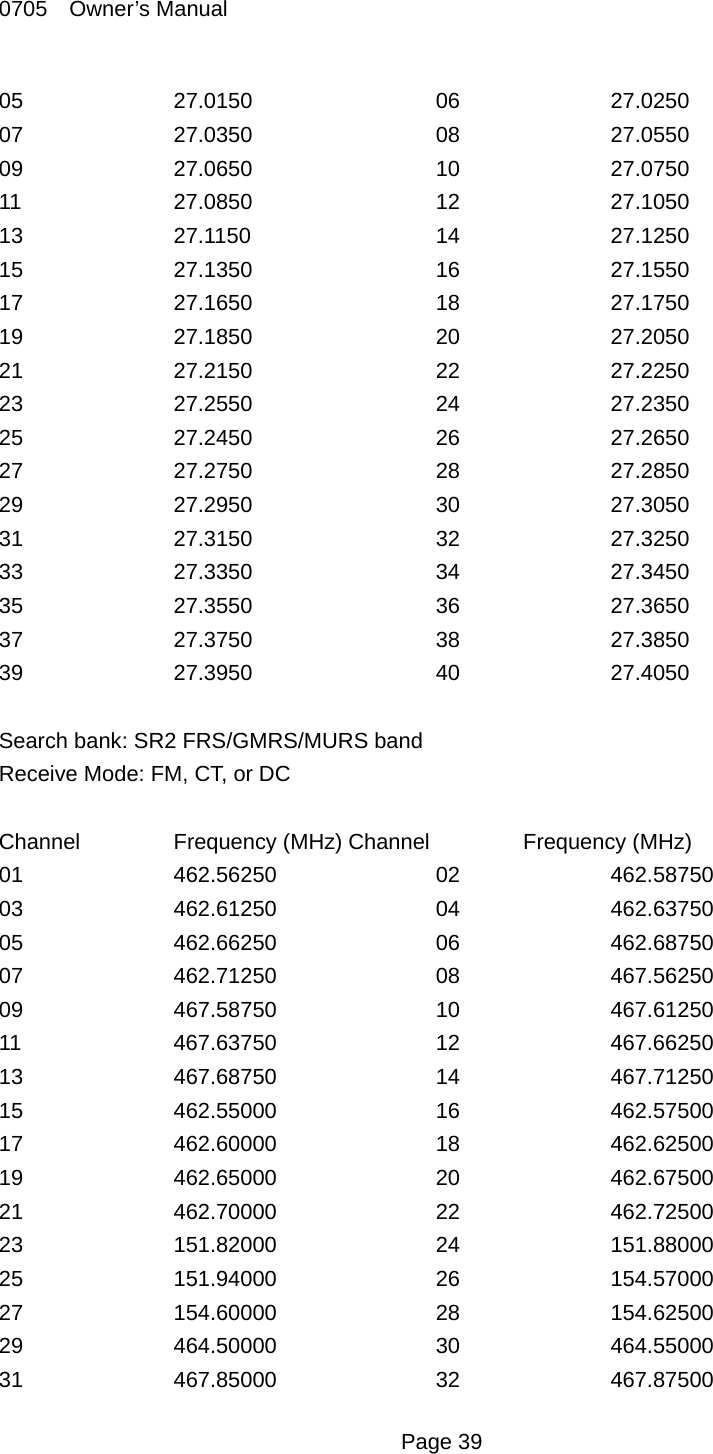
0705  Owner’s Manual 05  27.0150   06  27.0250 07  27.0350   08  27.0550 09  27.0650   10  27.0750 11  27.0850   12  27.1050 13  27.1150   14  27.1250 15  27.1350   16  27.1550 17  27.1650   18  27.1750 19  27.1850   20  27.2050 21  27.2150   22  27.2250 23  27.2550   24  27.2350 25  27.2450   26  27.2650 27  27.2750   28  27.2850 29  27.2950   30  27.3050 31  27.3150   32  27.3250 33  27.3350   34  27.3450 35  27.3550   36  27.3650 37  27.3750   38  27.3850 39  27.3950   40  27.4050  Search bank: SR2 FRS/GMRS/MURS band Receive Mode: FM, CT, or DC  Channel   Frequency (MHz) Channel   Frequency (MHz) 01  462.56250  02  462.58750 03  462.61250  04  462.63750 05  462.66250  06  462.68750 07  462.71250  08  467.56250 09  467.58750  10  467.61250 11  467.63750  12  467.66250 13  467.68750  14  467.71250 15  462.55000  16  462.57500 17  462.60000  18  462.62500 19  462.65000  20  462.67500 21  462.70000  22  462.72500 23  151.82000  24  151.88000 25  151.94000  26  154.57000 27  154.60000  28  154.62500 29  464.50000  30  464.55000 31  467.85000  32  467.87500  Page 39
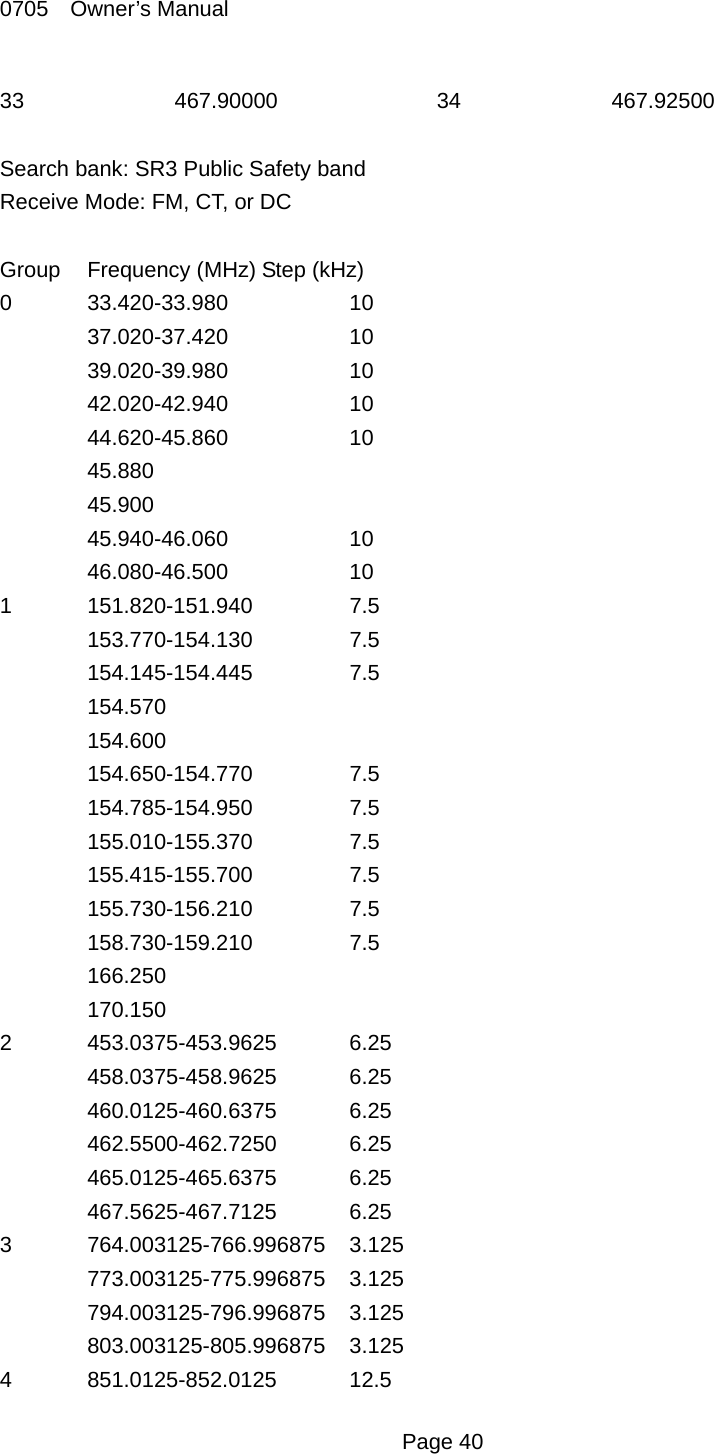
0705  Owner’s Manual 33  467.90000  34  467.92500  Search bank: SR3 Public Safety band Receive Mode: FM, CT, or DC  Group  Frequency (MHz) Step (kHz) 0 33.420-33.980   10  37.020-37.420  10  39.020-39.980  10  42.020-42.940  10  44.620-45.860  10  45.880  45.900  45.940-46.060  10  46.080-46.500  10 1 151.820-151.940   7.5  153.770-154.130  7.5  154.145-154.445  7.5  154.570  154.600  154.650-154.770  7.5  154.785-154.950  7.5  155.010-155.370  7.5  155.415-155.700  7.5  155.730-156.210  7.5  158.730-159.210  7.5  166.250  170.150 2 453.0375-453.9625 6.25  458.0375-458.9625 6.25  460.0125-460.6375 6.25  462.5500-462.7250 6.25  465.0125-465.6375 6.25  467.5625-467.7125 6.25 3 764.003125-766.996875 3.125  773.003125-775.996875 3.125  794.003125-796.996875 3.125  803.003125-805.996875 3.125 4 851.0125-852.0125 12.5  Page 40
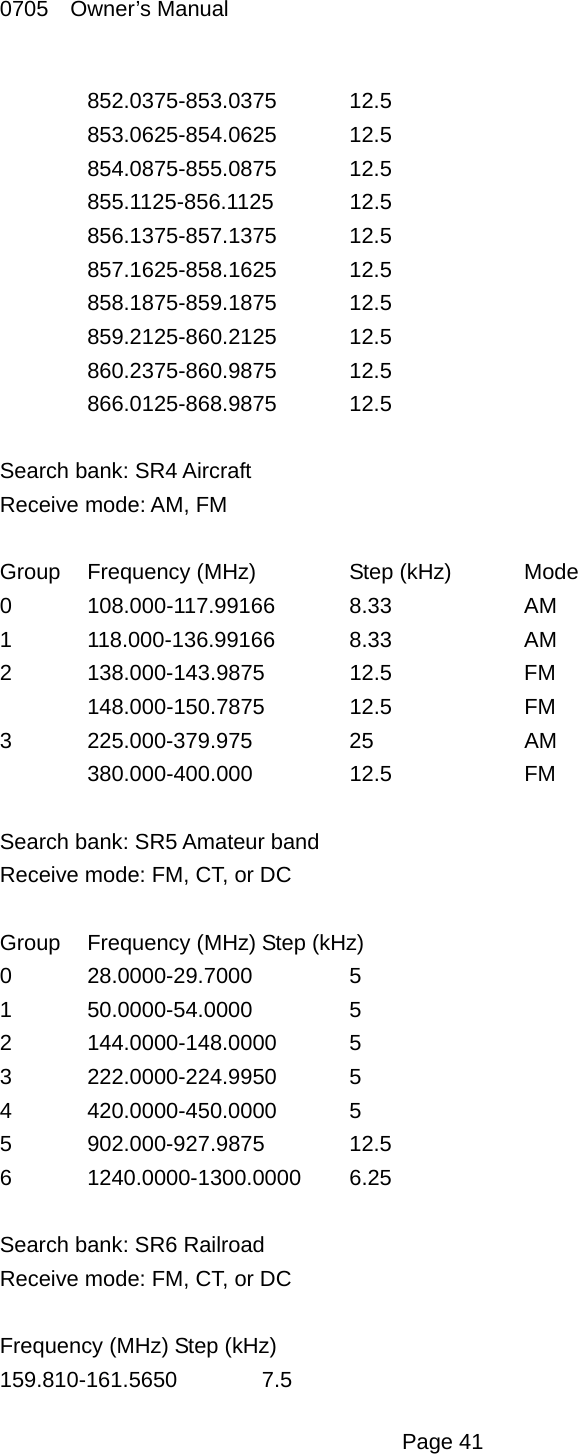
0705  Owner’s Manual  852.0375-853.0375 12.5  853.0625-854.0625 12.5  854.0875-855.0875 12.5  855.1125-856.1125 12.5  856.1375-857.1375 12.5  857.1625-858.1625 12.5  858.1875-859.1875 12.5  859.2125-860.2125 12.5  860.2375-860.9875 12.5  866.0125-868.9875 12.5  Search bank: SR4 Aircraft Receive mode: AM, FM  Group  Frequency (MHz)   Step (kHz)  Mode 0 108.000-117.99166 8.33   AM 1 118.000-136.99166 8.33   AM 2 138.000-143.9875  12.5   FM  148.000-150.7875 12.5  FM 3 225.000-379.975   25   AM  380.000-400.000  12.5  FM  Search bank: SR5 Amateur band Receive mode: FM, CT, or DC  Group  Frequency (MHz) Step (kHz) 0 28.0000-29.7000   5 1 50.0000-54.0000   5 2 144.0000-148.0000 5 3 222.0000-224.9950 5 4 420.0000-450.0000 5 5 902.000-927.9875  12.5 6 1240.0000-1300.0000 6.25  Search bank: SR6 Railroad Receive mode: FM, CT, or DC  Frequency (MHz) Step (kHz) 159.810-161.5650 7.5  Page 41
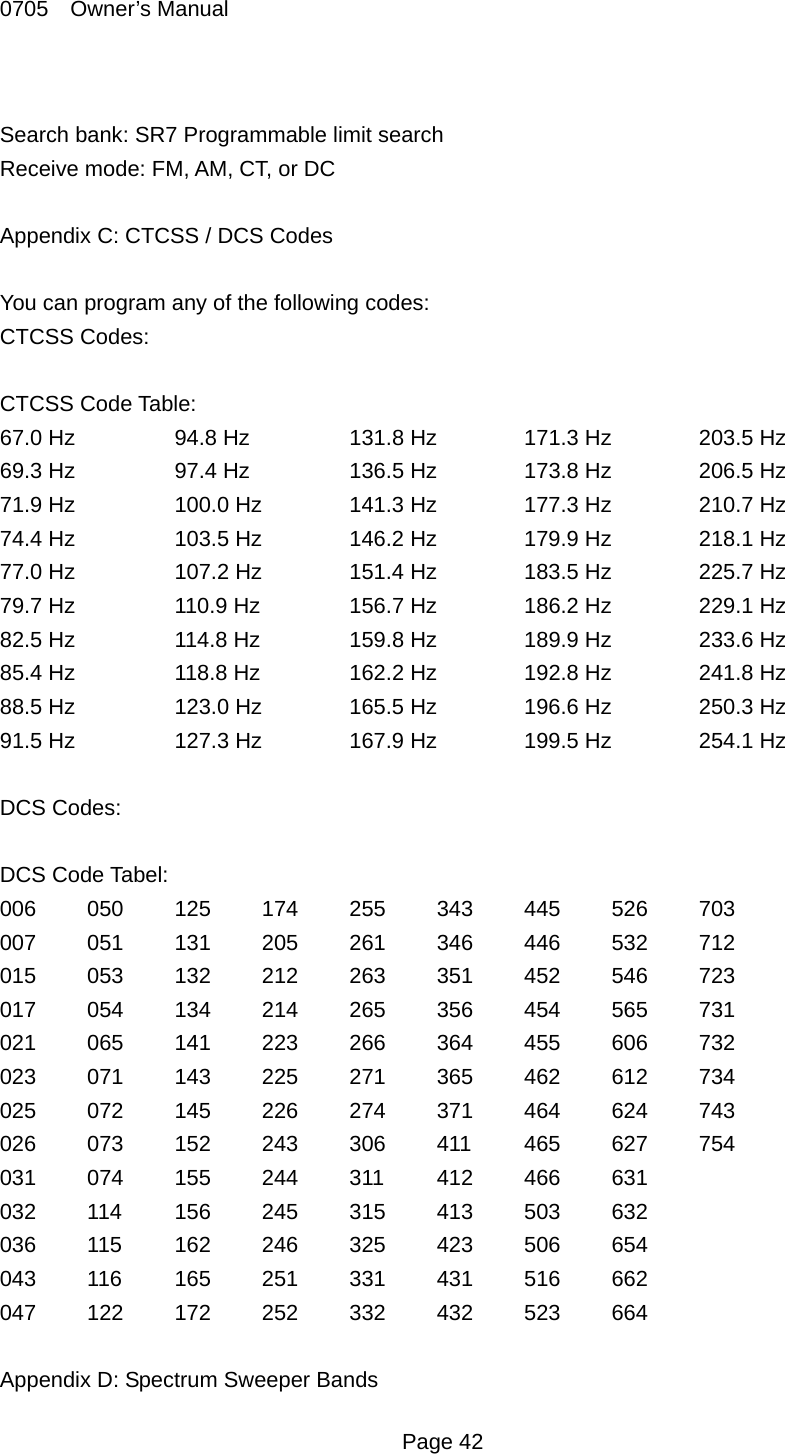
0705  Owner’s Manual  Search bank: SR7 Programmable limit search Receive mode: FM, AM, CT, or DC  Appendix C: CTCSS / DCS Codes  You can program any of the following codes: CTCSS Codes:  CTCSS Code Table: 67.0 Hz    94.8 Hz    131.8 Hz  171.3 Hz  203.5 Hz 69.3 Hz    97.4 Hz    136.5 Hz  173.8 Hz  206.5 Hz 71.9 Hz    100.0 Hz  141.3 Hz 177.3 Hz 210.7 Hz 74.4 Hz    103.5 Hz  146.2 Hz 179.9 Hz 218.1 Hz 77.0 Hz    107.2 Hz  151.4 Hz 183.5 Hz 225.7 Hz 79.7 Hz    110.9 Hz   156.7 Hz  186.2 Hz  229.1 Hz 82.5 Hz    114.8 Hz   159.8 Hz  189.9 Hz  233.6 Hz 85.4 Hz    118.8 Hz   162.2 Hz  192.8 Hz  241.8 Hz 88.5 Hz    123.0 Hz  165.5 Hz 196.6 Hz 250.3 Hz 91.5 Hz    127.3 Hz  167.9 Hz 199.5 Hz 254.1 Hz  DCS Codes:  DCS Code Tabel: 006 050 125 174 255 343 445 526 703 007 051 131 205 261 346 446 532 712 015 053 132 212 263 351 452 546 723 017 054 134 214 265 356 454 565 731 021 065 141 223 266 364 455 606 732 023 071 143 225 271 365 462 612 734 025 072 145 226 274 371 464 624 743 026 073 152 243 306 411 465 627 754 031 074 155 244 311 412 466 631 032 114 156 245 315 413 503 632 036 115 162 246 325 423 506 654 043 116 165 251 331 431 516 662 047 122 172 252 332 432 523 664  Appendix D: Spectrum Sweeper Bands  Page 42
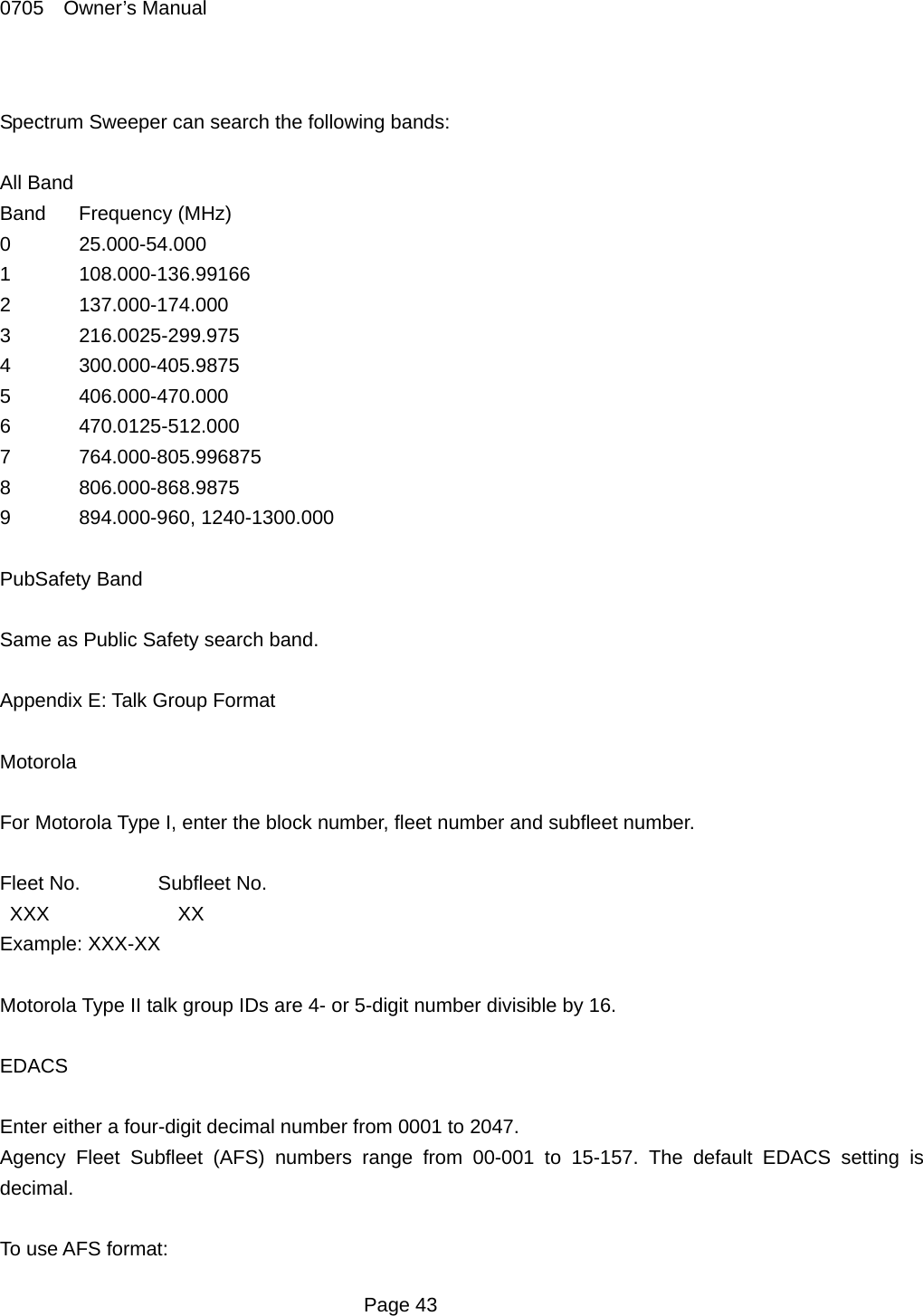
0705  Owner’s Manual  Spectrum Sweeper can search the following bands:  All Band Band Frequency (MHz) 0 25.000-54.000 1 108.000-136.99166 2 137.000-174.000 3 216.0025-299.975 4 300.000-405.9875 5 406.000-470.000 6 470.0125-512.000 7 764.000-805.996875 8 806.000-868.9875 9 894.000-960, 1240-1300.000  PubSafety Band  Same as Public Safety search band.  Appendix E: Talk Group Format  Motorola  For Motorola Type I, enter the block number, fleet number and subfleet number.  Fleet No.  Subfleet No.  XXX      XX Example: XXX-XX  Motorola Type II talk group IDs are 4- or 5-digit number divisible by 16.  EDACS  Enter either a four-digit decimal number from 0001 to 2047. Agency Fleet Subfleet (AFS) numbers range from 00-001 to 15-157. The default EDACS setting is decimal.  To use AFS format:  Page 43
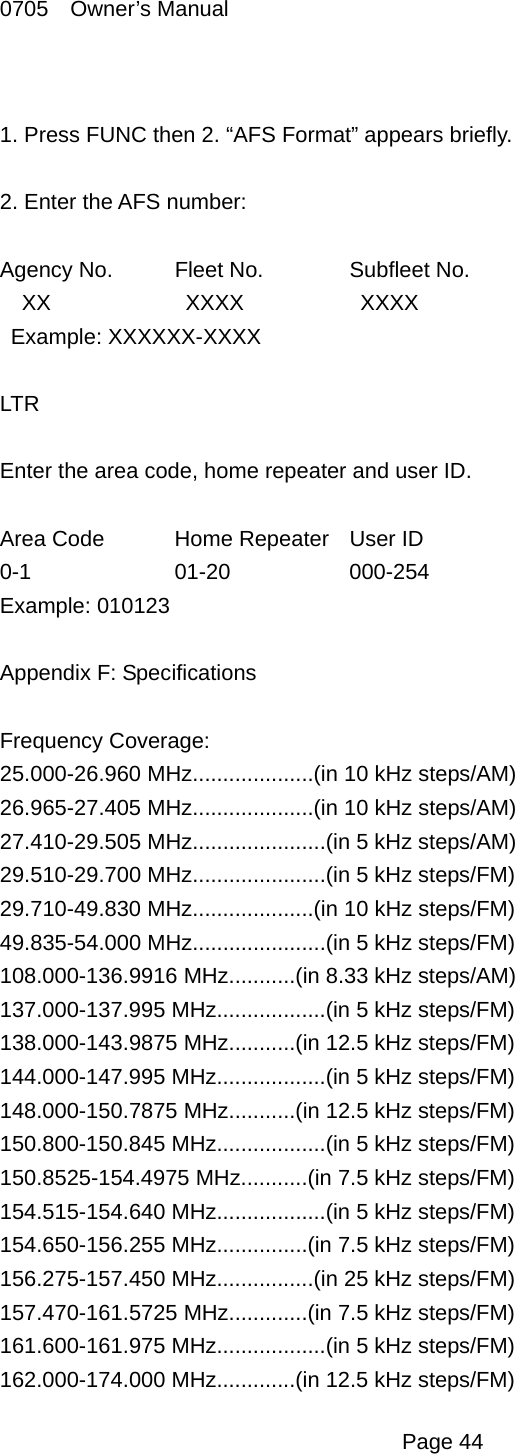
0705  Owner’s Manual  1. Press FUNC then 2. “AFS Format” appears briefly.  2. Enter the AFS number:  Agency No.  Fleet No.  Subfleet No. XX     XXXX     XXXX  Example: XXXXXX-XXXX  LTR  Enter the area code, home repeater and user ID.  Area Code  Home Repeater  User ID 0-1   01-20   000-254 Example: 010123  Appendix F: Specifications  Frequency Coverage: 25.000-26.960 MHz....................(in 10 kHz steps/AM) 26.965-27.405 MHz....................(in 10 kHz steps/AM) 27.410-29.505 MHz......................(in 5 kHz steps/AM) 29.510-29.700 MHz......................(in 5 kHz steps/FM) 29.710-49.830 MHz....................(in 10 kHz steps/FM) 49.835-54.000 MHz......................(in 5 kHz steps/FM) 108.000-136.9916 MHz...........(in 8.33 kHz steps/AM) 137.000-137.995 MHz..................(in 5 kHz steps/FM) 138.000-143.9875 MHz...........(in 12.5 kHz steps/FM) 144.000-147.995 MHz..................(in 5 kHz steps/FM) 148.000-150.7875 MHz...........(in 12.5 kHz steps/FM) 150.800-150.845 MHz..................(in 5 kHz steps/FM) 150.8525-154.4975 MHz...........(in 7.5 kHz steps/FM) 154.515-154.640 MHz..................(in 5 kHz steps/FM) 154.650-156.255 MHz...............(in 7.5 kHz steps/FM) 156.275-157.450 MHz................(in 25 kHz steps/FM) 157.470-161.5725 MHz.............(in 7.5 kHz steps/FM) 161.600-161.975 MHz..................(in 5 kHz steps/FM) 162.000-174.000 MHz.............(in 12.5 kHz steps/FM)  Page 44
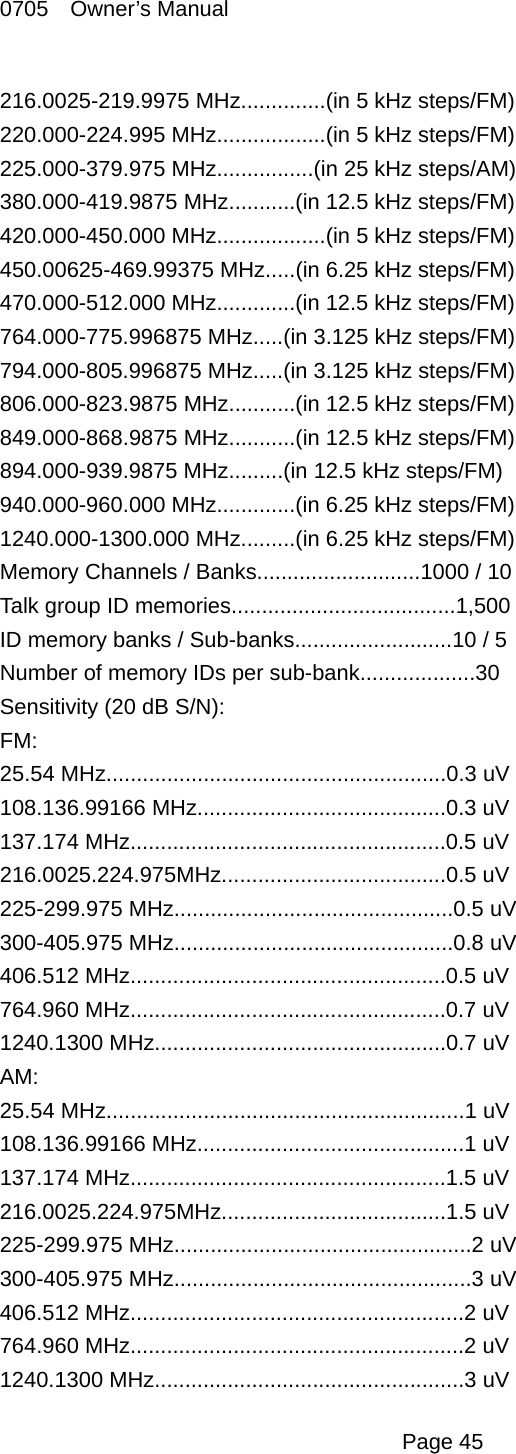
0705  Owner’s Manual 216.0025-219.9975 MHz..............(in 5 kHz steps/FM) 220.000-224.995 MHz..................(in 5 kHz steps/FM) 225.000-379.975 MHz................(in 25 kHz steps/AM) 380.000-419.9875 MHz...........(in 12.5 kHz steps/FM) 420.000-450.000 MHz..................(in 5 kHz steps/FM) 450.00625-469.99375 MHz.....(in 6.25 kHz steps/FM) 470.000-512.000 MHz.............(in 12.5 kHz steps/FM) 764.000-775.996875 MHz.....(in 3.125 kHz steps/FM) 794.000-805.996875 MHz.....(in 3.125 kHz steps/FM) 806.000-823.9875 MHz...........(in 12.5 kHz steps/FM) 849.000-868.9875 MHz...........(in 12.5 kHz steps/FM) 894.000-939.9875 MHz.........(in 12.5 kHz steps/FM) 940.000-960.000 MHz.............(in 6.25 kHz steps/FM) 1240.000-1300.000 MHz.........(in 6.25 kHz steps/FM) Memory Channels / Banks...........................1000 / 10 Talk group ID memories.....................................1,500 ID memory banks / Sub-banks..........................10 / 5 Number of memory IDs per sub-bank...................30 Sensitivity (20 dB S/N): FM: 25.54 MHz........................................................0.3 uV 108.136.99166 MHz.........................................0.3 uV 137.174 MHz....................................................0.5 uV 216.0025.224.975MHz.....................................0.5 uV 225-299.975 MHz..............................................0.5 uV 300-405.975 MHz..............................................0.8 uV 406.512 MHz....................................................0.5 uV 764.960 MHz....................................................0.7 uV 1240.1300 MHz................................................0.7 uV AM: 25.54 MHz...........................................................1 uV 108.136.99166 MHz............................................1 uV 137.174 MHz....................................................1.5 uV 216.0025.224.975MHz.....................................1.5 uV 225-299.975 MHz.................................................2 uV 300-405.975 MHz.................................................3 uV 406.512 MHz.......................................................2 uV 764.960 MHz.......................................................2 uV 1240.1300 MHz...................................................3 uV  Page 45
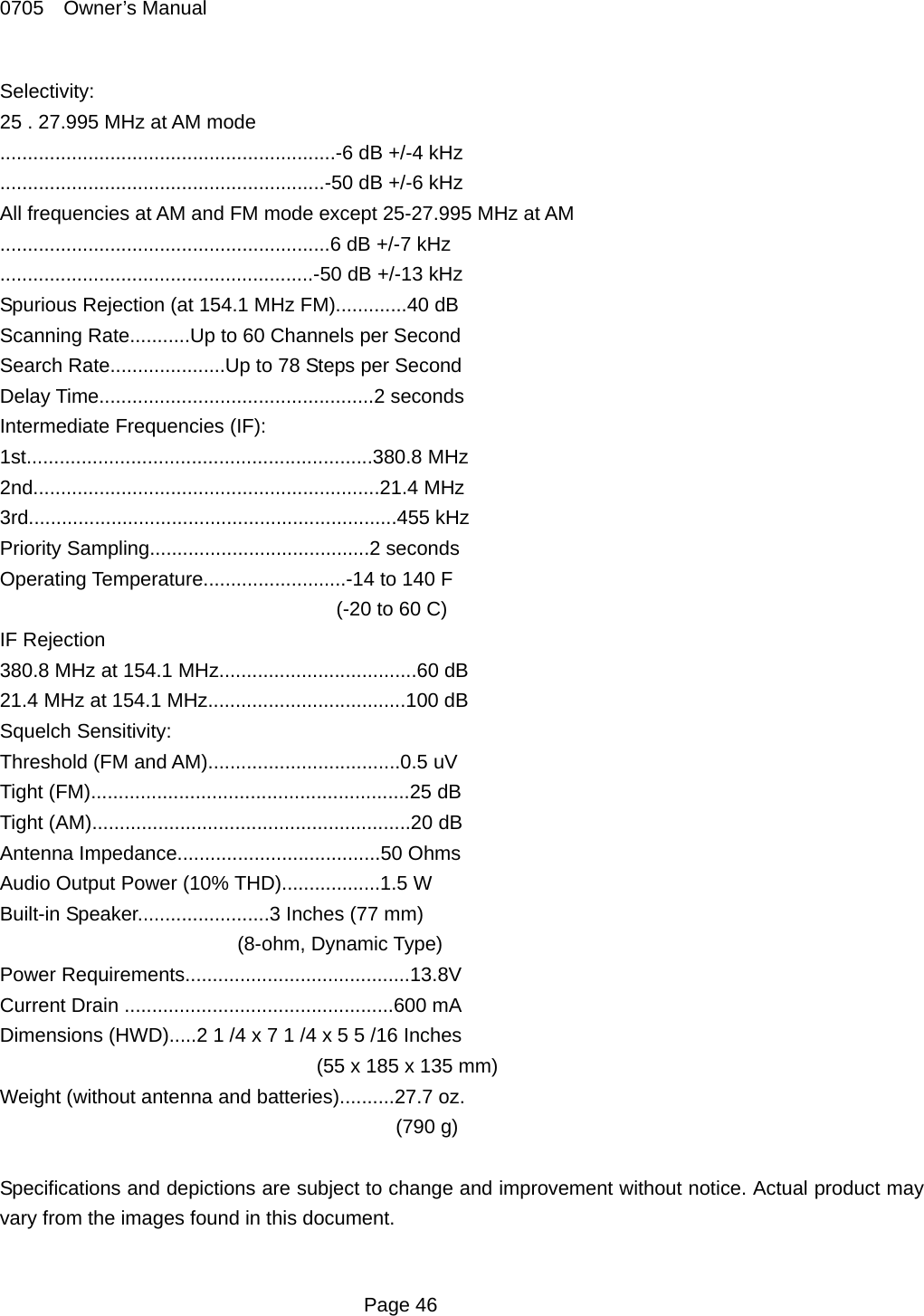
0705  Owner’s Manual Selectivity: 25 . 27.995 MHz at AM mode .............................................................-6 dB +/-4 kHz ...........................................................-50 dB +/-6 kHz All frequencies at AM and FM mode except 25-27.995 MHz at AM ............................................................6 dB +/-7 kHz .........................................................-50 dB +/-13 kHz Spurious Rejection (at 154.1 MHz FM).............40 dB Scanning Rate...........Up to 60 Channels per Second Search Rate.....................Up to 78 Steps per Second Delay Time..................................................2 seconds Intermediate Frequencies (IF): 1st...............................................................380.8 MHz 2nd...............................................................21.4 MHz 3rd...................................................................455 kHz Priority Sampling........................................2 seconds Operating Temperature..........................-14 to 140 F (-20 to 60 C) IF Rejection 380.8 MHz at 154.1 MHz....................................60 dB 21.4 MHz at 154.1 MHz....................................100 dB Squelch Sensitivity: Threshold (FM and AM)...................................0.5 uV Tight (FM)..........................................................25 dB Tight (AM)..........................................................20 dB Antenna Impedance.....................................50 Ohms Audio Output Power (10% THD)..................1.5 W Built-in Speaker........................3 Inches (77 mm) (8-ohm, Dynamic Type) Power Requirements.........................................13.8V Current Drain .................................................600 mA Dimensions (HWD).....2 1 /4 x 7 1 /4 x 5 5 /16 Inches (55 x 185 x 135 mm) Weight (without antenna and batteries)..........27.7 oz. (790 g)  Specifications and depictions are subject to change and improvement without notice. Actual product may vary from the images found in this document.   Page 46
0705  Owner’s Manual  Page 47  Printed in China GE-07D-2570 Date Code  Motorola, Smartnet, ASTRO and Privacy Plus are registered trademarks of Motorola Inc. EDACS is a registered trademark of Motorola Inc. EDACs is a registered trademark of MA-COM Inc. LTR is a registered trademark of EF Johnson.

Navigation menu