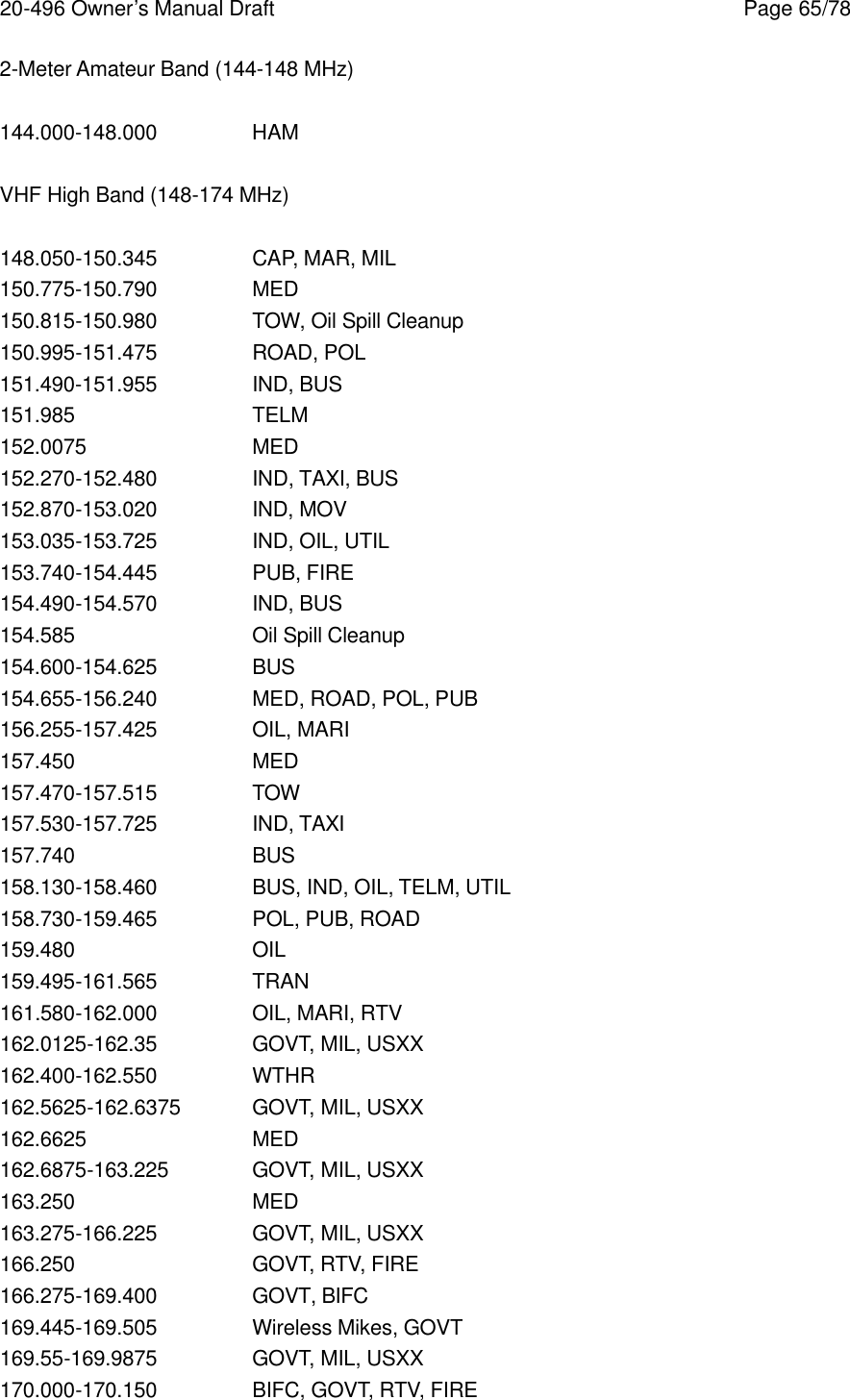
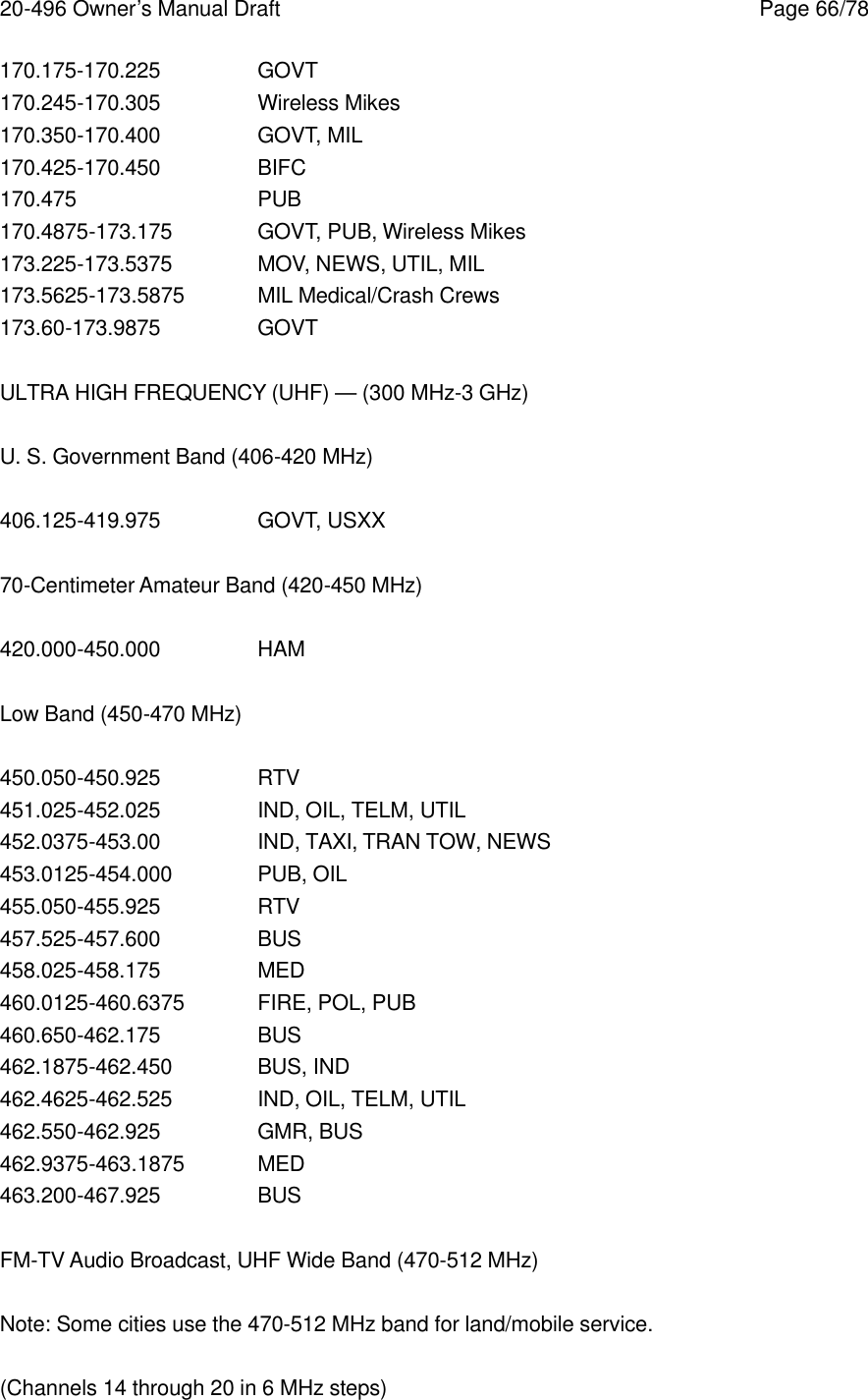
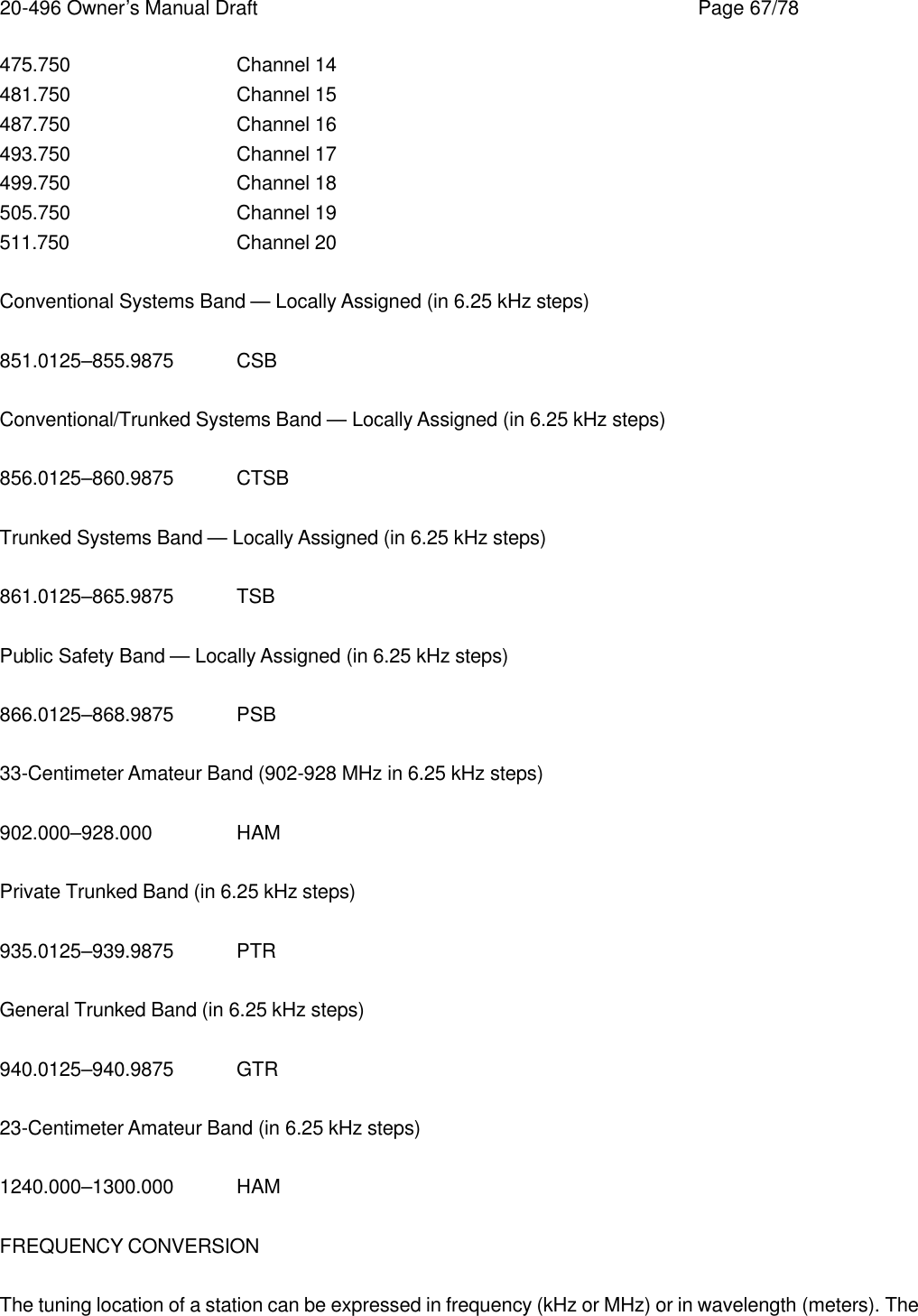
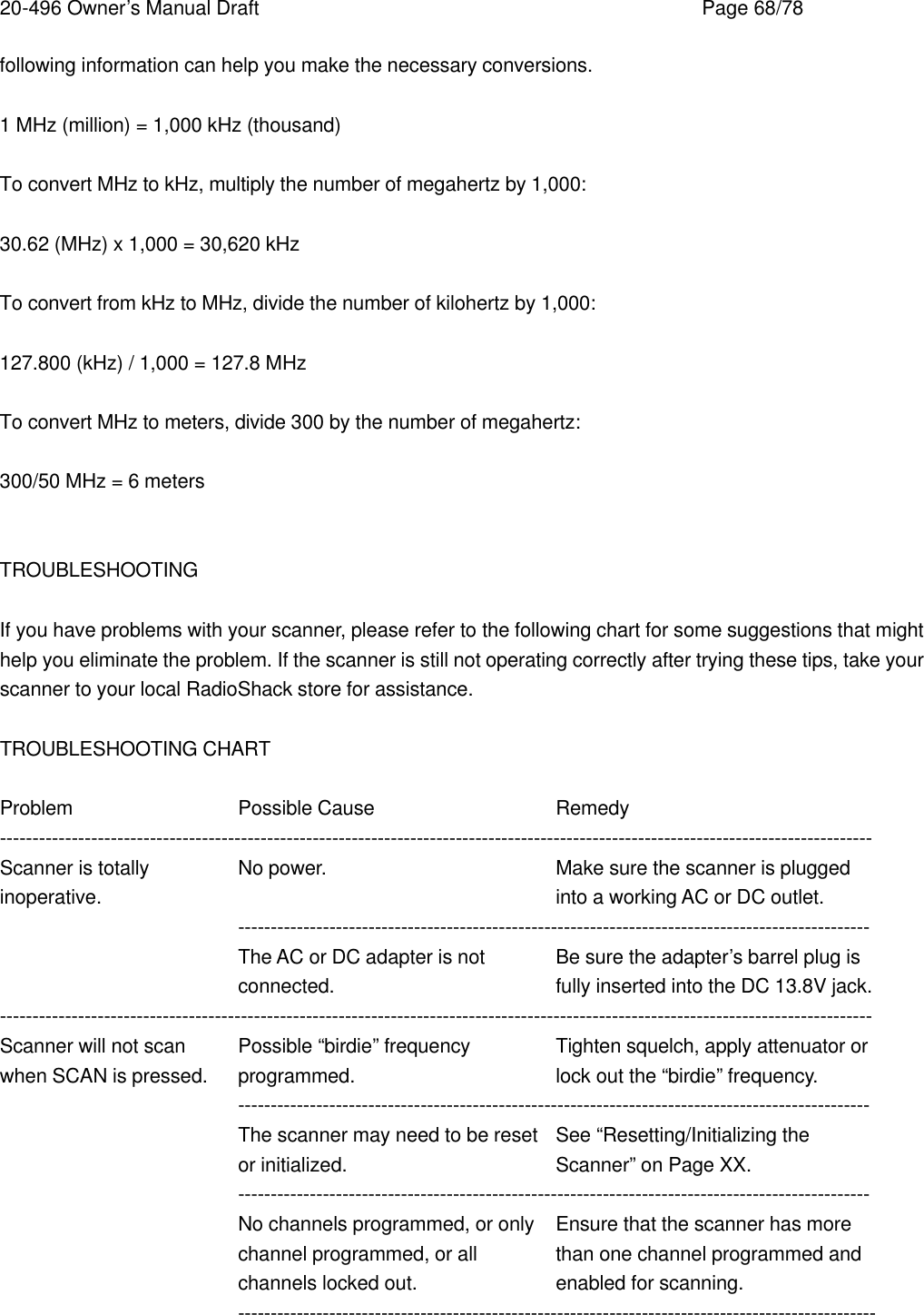
General Research of Electronics 2000496 Scanning Receiver User Manual OwnersManual letter

General Research of Electronics Inc Scanning Receiver OwnersManual letter

Users Manual

20-496 Owner’s Manual Draft    Page 1/78 20-496 Owner’s Manual-Draft  LOGO  PRO-2096 500-Channel Mobile/Desktop Digital Trunking Scanner Catalog # 20-496  OWNER’S MANUAL — Please read before using this equipment.  Thank you for purchasing the RadioShack PRO-2096 Mobile/Desktop Digital Scanner. This product is the first of an innovative and exciting new generation of RadioShack scanning receivers capable of receiving Phase 1 APCO-25 C4FM/IMBE digital voice modulation from the newest and most sophisticated conventional and trunked radio networks.  Your RadioShack Mobile/Desktop Digital Scanner is ready to receive digital conventional and trunked radio transmissions. No additional hardware or add-on cards are needed.  IMPORTANT:  If an icon appears at the end of a paragraph, go to the box on that page with the corresponding icon for pertinent information. ! — Warning  ! — Important  thunder mark — Caution light mark — Hint  note mark — Note   TABLE OF CONTENTS  Features The FCC Wants You to Know Scanning Legally Getting Familiar With Your Scanner About the Keypad Understanding Your Scanner’s Memory Organization Channel Storage Banks Channels Search Banks Understanding Your Scanner’s Channel Receive Modes Preparation Mounting the Scanner in Your Vehicle Powering the Scanner from Vehicle’s Battery Using the Scanner as a Base Station Connecting an Extension Speaker Connecting an Earphone/Headphones
20-496 Owner’s Manual Draft    Page 2/78 Listening Safely Connecting an Supplied Antenna Programming Your Scanner Programming Conventional Channels Programming Trunked Systems Programming Motorola Analog, Digital, and APCO-25 Trunking Systems Programming EDACS Trunking Systems Programming Motorola VHF and UHF Trunking Systems Programming Motorola 800 MHz Splinter Systems Talkgroup IDs Programming the Priority Channels Programming Channels for CTCSS and DCS Operation General Programming Notes Operating Your Scanner Initial Preparation Searching and Tuning Searching a Preprogrammed Frequency Range Using Zeromatic Using Seek Search Manually Tuning a Frequency Using Frequency Copy Copying a Frequency into a Specified Channel Copying a Frequency into a Vacant Channel in a Specified Bank Coping a Frequency into the Priority Channel Special Features Listening to the Weather Band Listening to a Weather Channel Using the Delay Function Locking Out Channels or Frequencies Changing the Receive mode Using the Attenuator Turning the Key Tone On and Off Using Dimmer Changing the Display Contrast Working with V-Scanners Using the Digital AGC Function Cloning the Programmed Data Cloning V-Scanner Data Trunking Special Features Trunking Operation Activating ID Lockout While Scanning Trunked Delay Function Clearing Talkgroup IDs
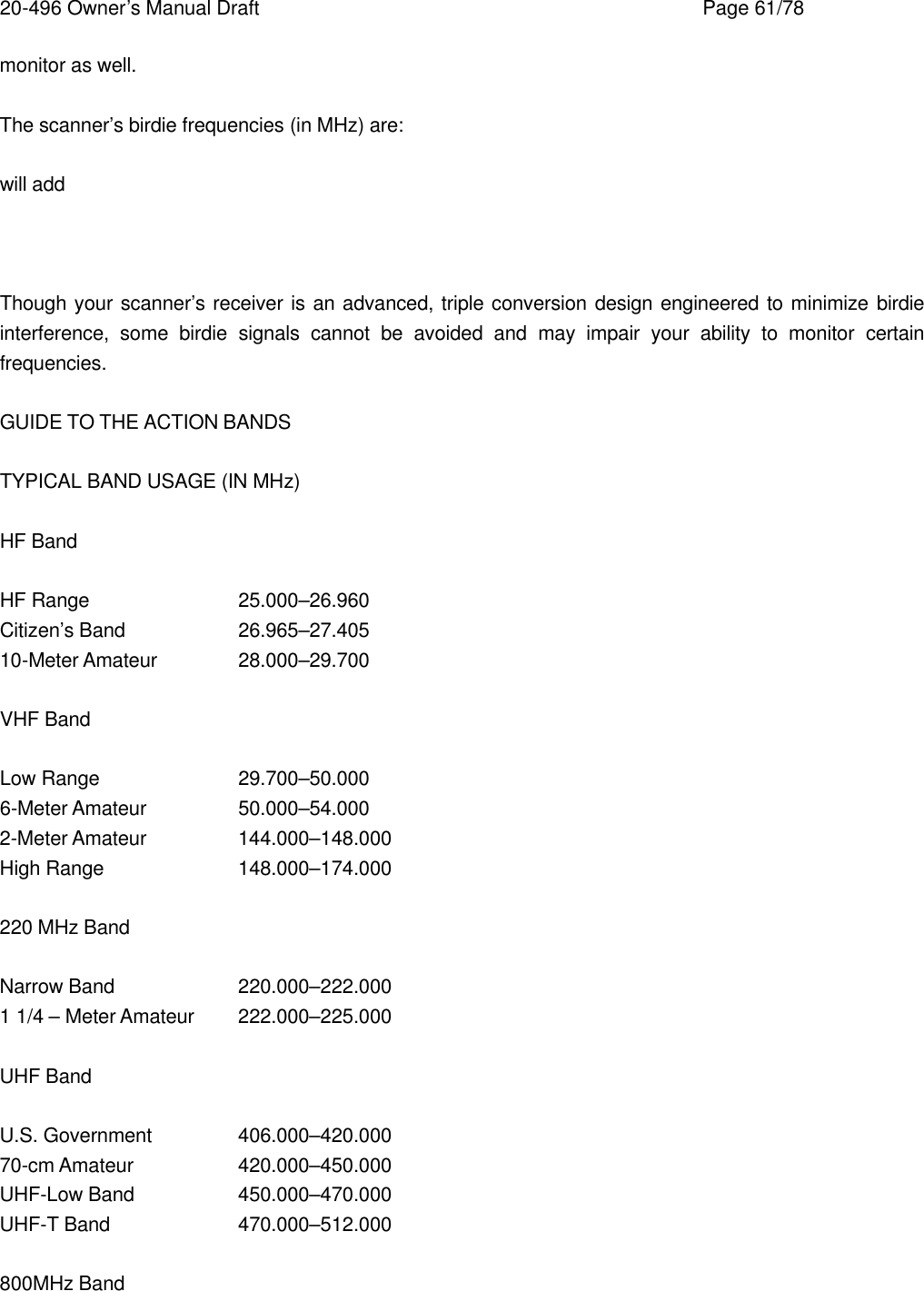
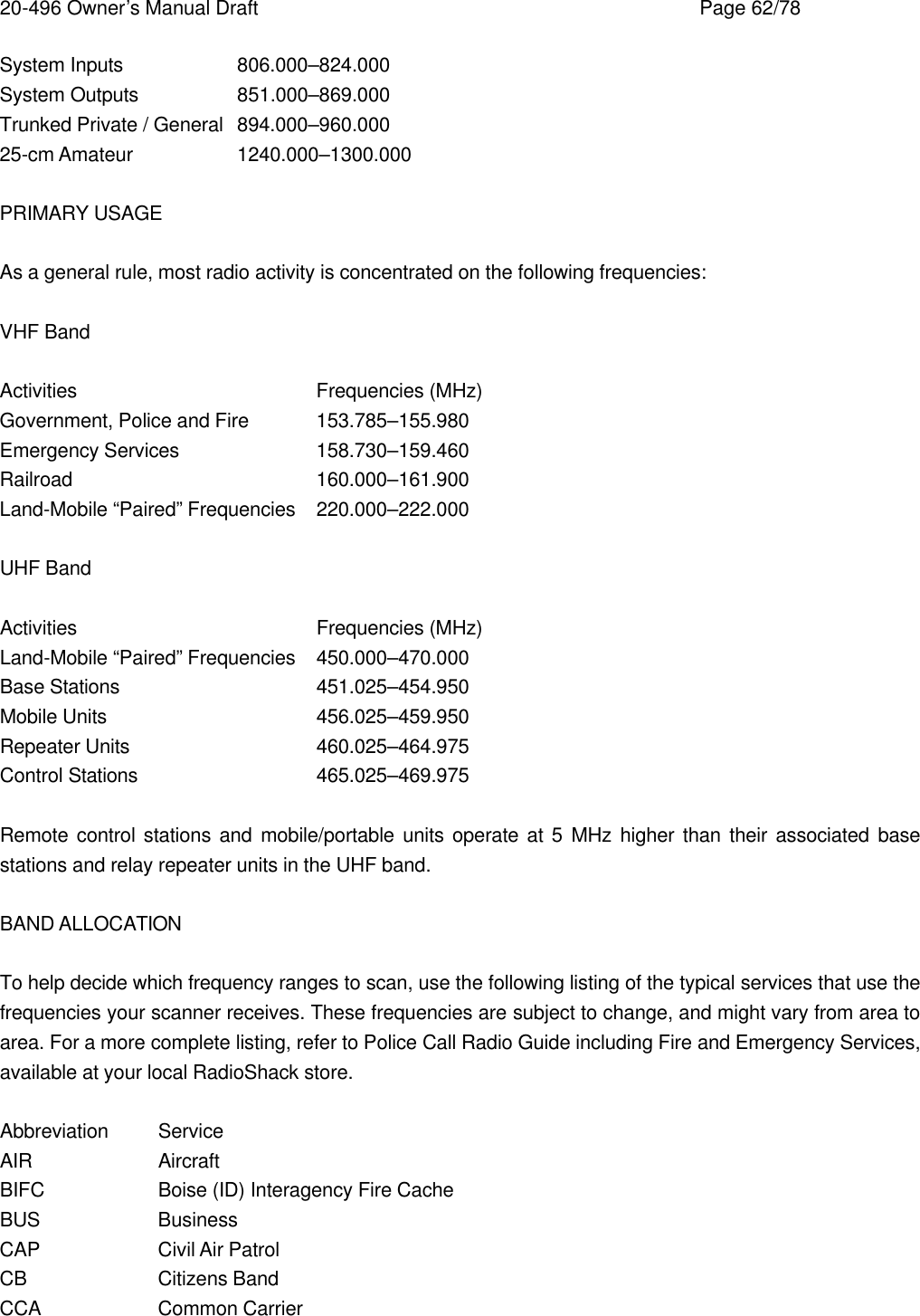
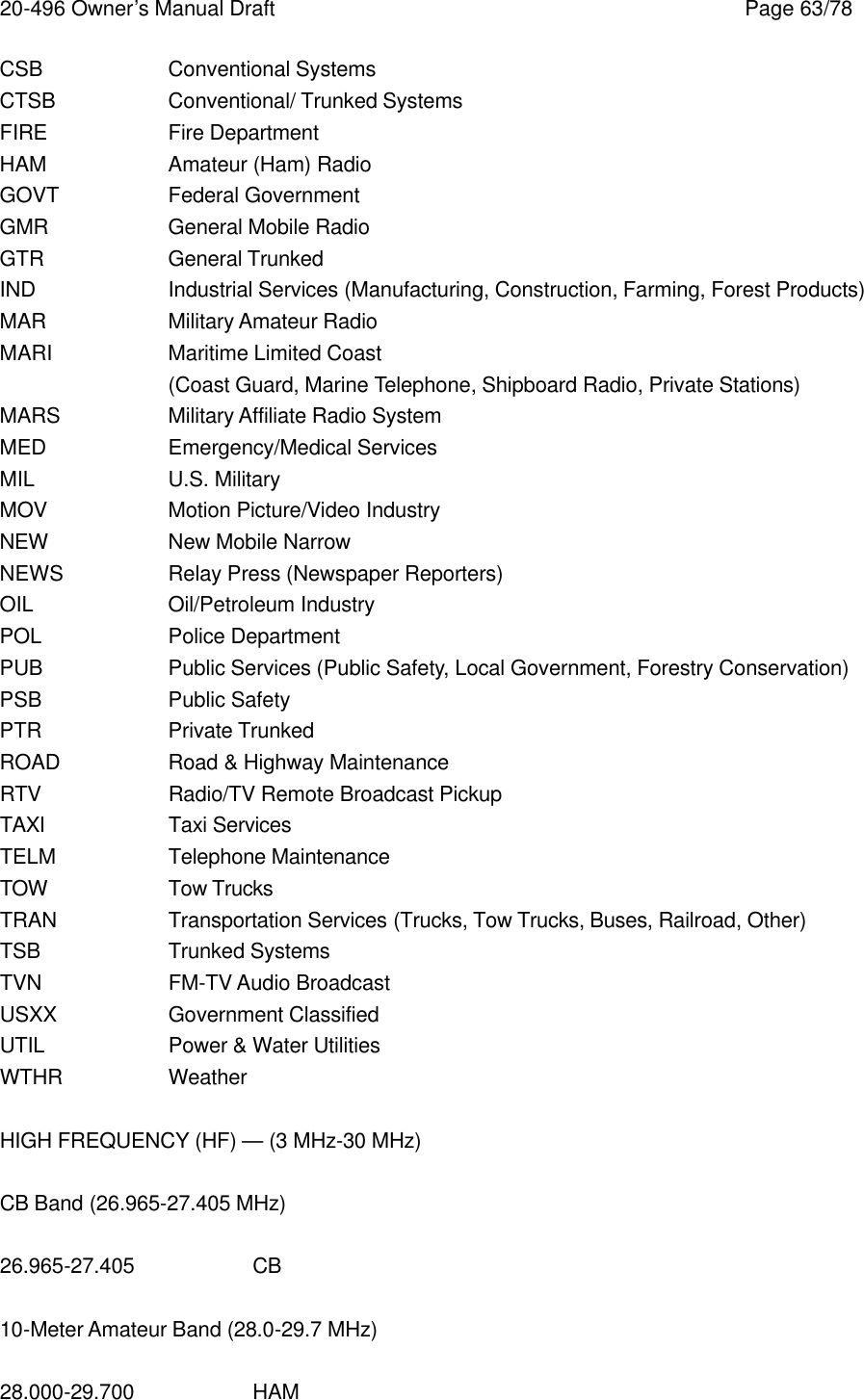
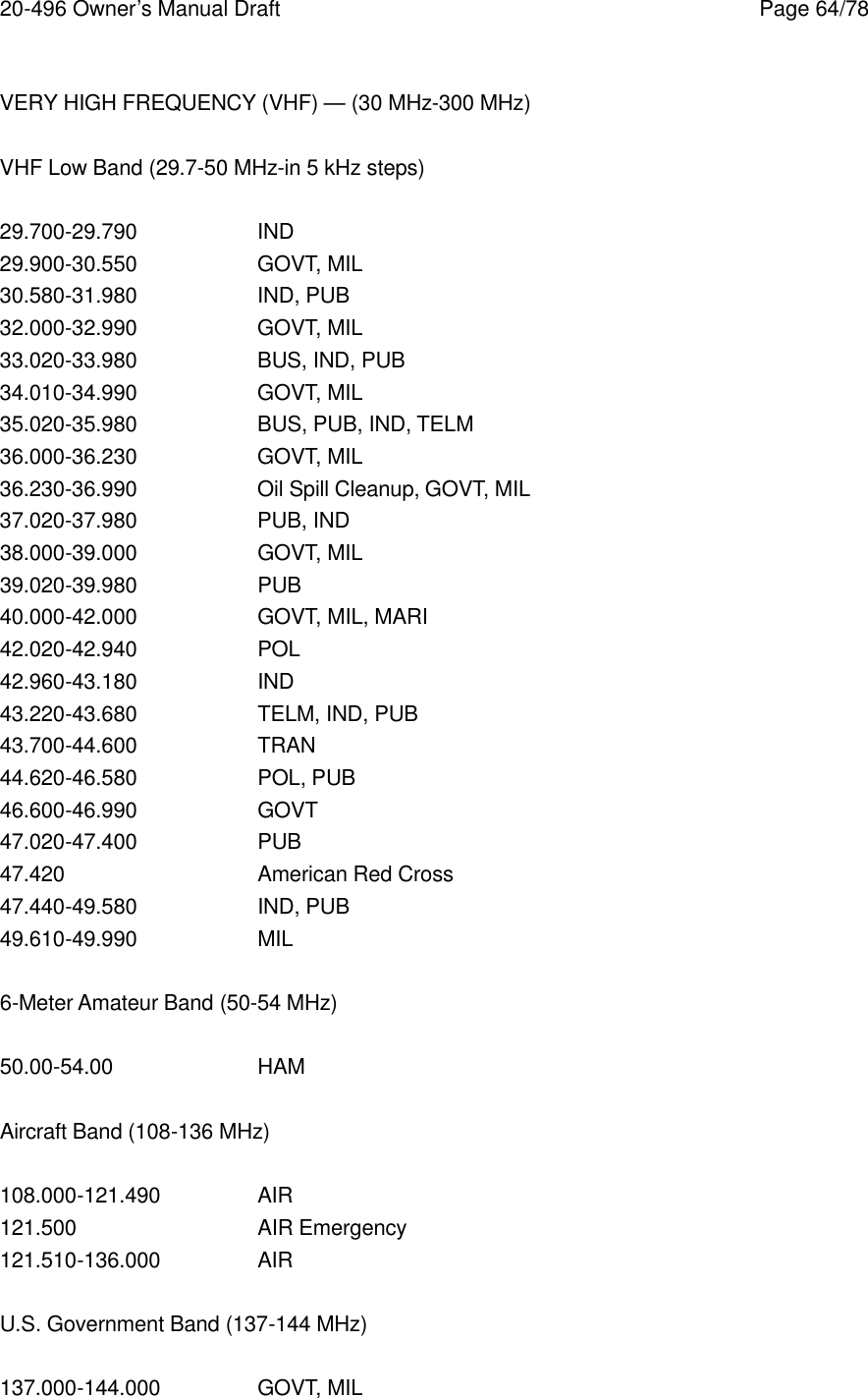
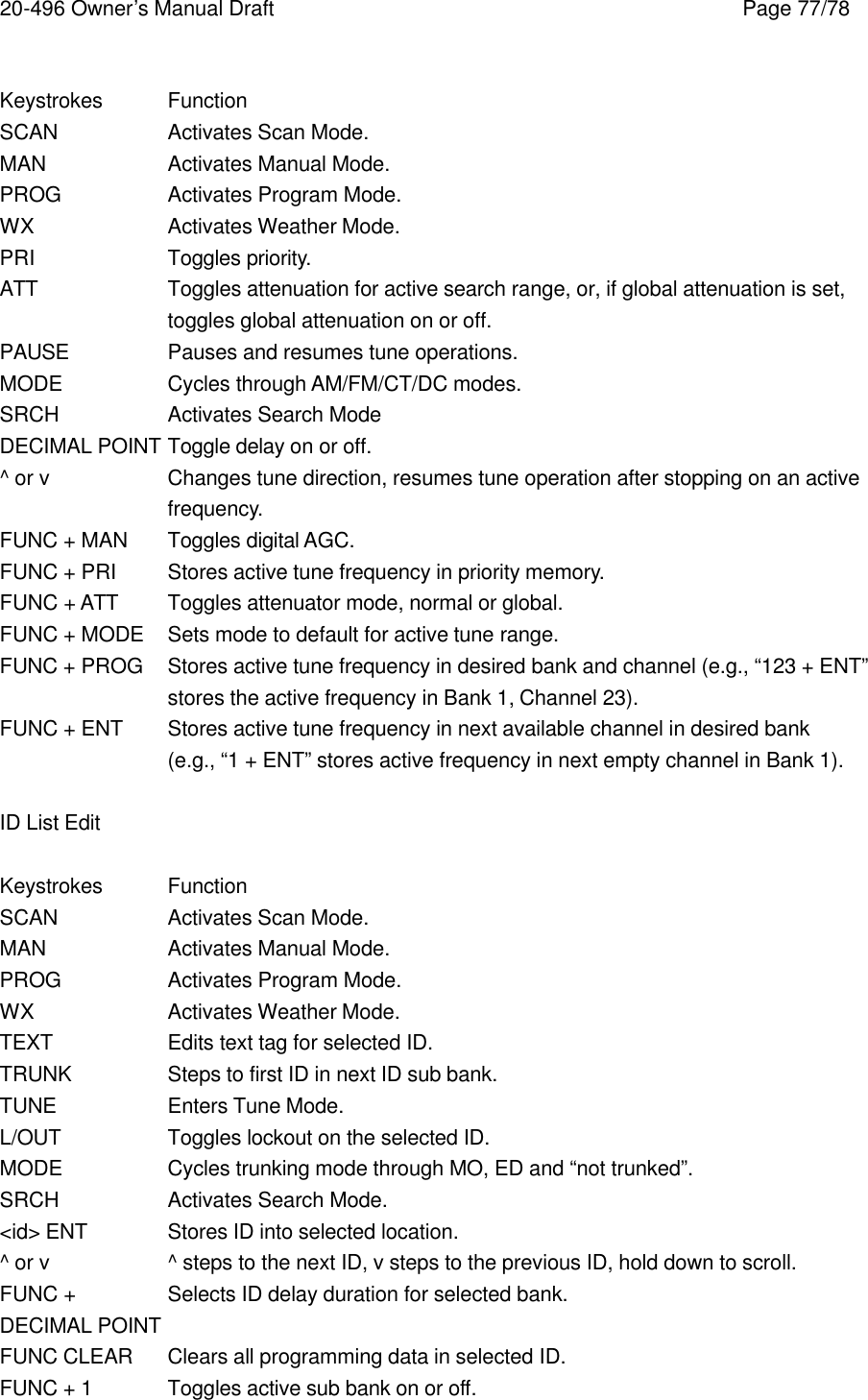
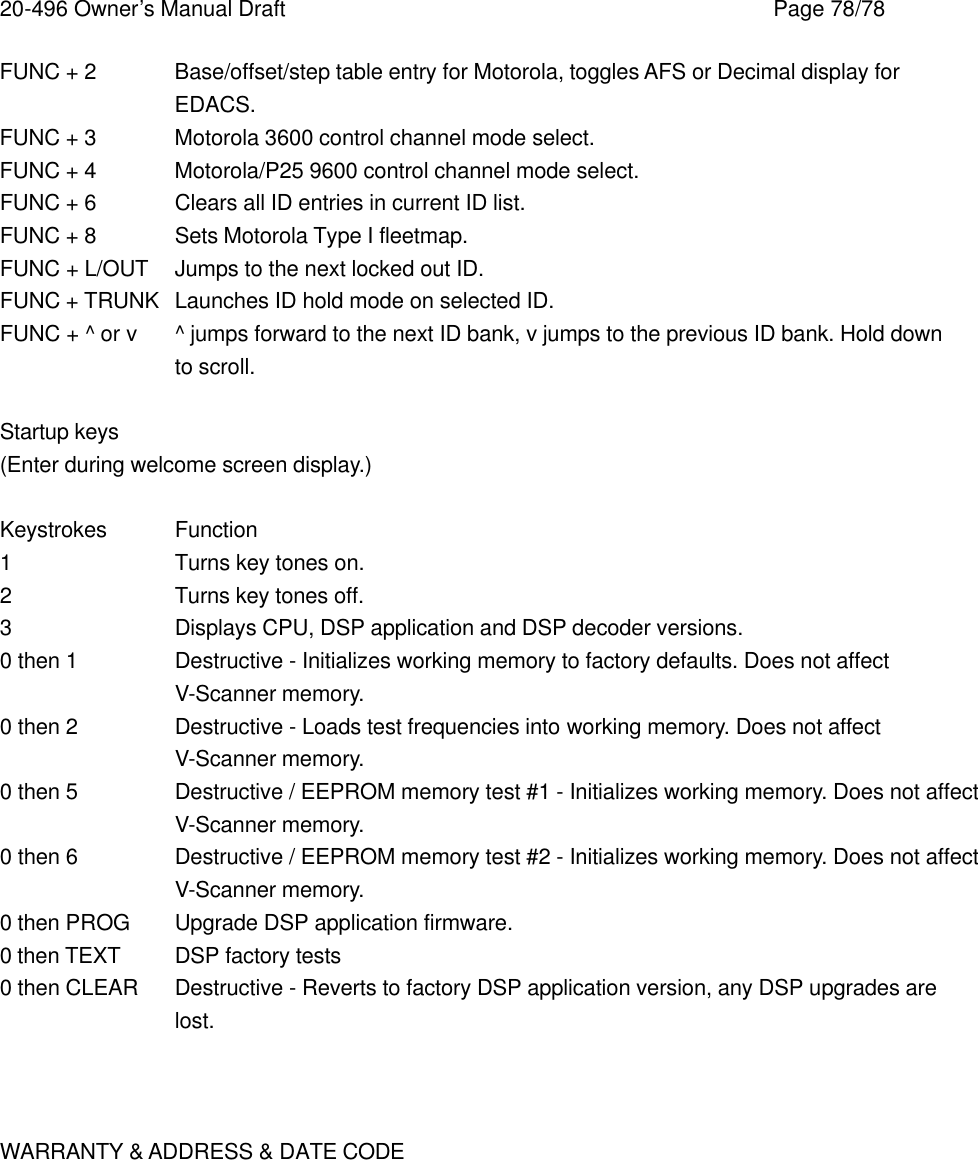
20-496 Owner’s Manual Draft    Page 3/78 Digital Operation Updating the DSP Firmware A General Guide To Frequencies Guide To The Action Bands Typical Band Usage (in MHz) Primary Usage Band Allocation Frequency Conversion Troubleshooting Troubleshooting Chart Resetting / Initializing the Scanner Care Service and Repair Specifications Command Quick Reference Guide  © 2004 RadioShack Corporation All Rights Reserved.  RadioShack, RadioShack.com, Hypersearch, Hyperscan, V-Scanner, and Adaptaplug are trademarks used by RadioShack Corporation. Motorola, Smartnet, ASTRO and Privacy Plus are registered trademarks of Motorola Inc. EDACS is a registered trademark of MA-COM Inc. The IMBE™ voice coding Technology embodied in this product is protected by intellectual property rights including patent rights, copyrights and trade secrets of Digital Voice Systems, Inc. This voice coding Technology is licensed solely for use within this Communications Equipment. The user of this Technology is explicitly prohibited from attempting to decompile, reverse engineer, or disassemble the Object Code, or in any other way convert the Object Code into a human readable form. U.S. Pat. Nos. 5,870,405 and 5,517,511. This device made under license under one or more of the following U.S. Patents: 4,590,473; 4,636,791; 5,148,482; 5,185,796; 5,271,017; 5,377,229   FEATURES  Your RadioShack Mobile/Desktop Digital Scanner features Intelligent Adaptive Digital Tracking for optimal reception of digital signals from a variety of digital conventional and trunked radio system types. No special sound quality settings or adjustments are needed for the different digital systems that you monitor.  APCO-25 digital voice modulation provides public safety radio users with clear digital voice signals and other features not available in traditional analog systems. Your scanner uses advanced Digital Signal Processing (DSP) technology to receive and decode APCO-25 digital signals from both conventional and trunked radio networks. Additionally, your scanner features automatic detection of digital signals. No
20-496 Owner’s Manual Draft    Page 4/78 special scanner programming is required to receive conventional or trunked digital traffic.  The DSP module in your scanner features updateable firmware. If DSP improvements become available, you can easily download an update file from the Internet and apply the file to your scanner to obtain the latest DSP firmware version.  Your scanner is designed to track Motorola analog and Astro® digital trunking systems using 3600 bps control channel operation, APCO 25 digital trunking systems using 9600 bps control channel operation, and M/A-COM EDACS® trunking systems.  The scanner lets you scan conventional transmissions, and is preprogrammed with service search banks for your convenience. By pressing a single button, you can quickly search those frequencies most commonly used by public safety and other agencies.  Your RadioShack Mobile/Desktop Digital Scanner features RadioShack’s exciting new 11-in-1 V-Scanner technology. V-Scanner stands for Virtual Scanner. V-Scanner allows you to build and store eleven separate configuration profiles in V-Scanner folder memory. Stored V-Scanners can be recalled, edited and activated at any time, giving you a powerful tool that allows you to quickly reconfigure your scanner for use in different areas or applications.  This scanner gives you direct access to over 59,000 frequencies including those used by police and fire departments, ambulance services, government agencies, air, and amateur radio services.  Your scanner includes the following features:  500 Channels – 10 channel storage banks with 50 channels each.  V-Scanner Folders – eleven 500 channel virtual scanner folders at your fingertips.  Phase 1 APCO-25 Digital Reception – automatic detection and reception of digital voice modulation from conventional, trunked and mixed-mode networks.  Intelligent Adaptive Digital Tracking – ensures optimal reception of digital signals from a variety of digital conventional and trunked radio system types.  Digital AGC – automatically compensates for audio level variances in digital transmissions.  Simultaneous Multi-System Trunking Operation – quickly tracks up to ten Motorola, APCO-25 or EDACS trunking systems at the same time. Mix conventional channels and trunking systems in the same channel storage banks. Scan conventional frequencies and trunked systems simultaneously. Automatically detects Motorola 3600 bps or APCO-25 9600 bps control channel operation.  Automatic Channel Tracking – automatically determines the trunking system frequencies for Motorola and
20-496 Owner’s Manual Draft    Page 5/78 APCO-25 trunking systems, using only the active system control channel.  CTCSS and DCS Subaudible Encoded Squelch Modes – restricts conventional channel reception to transmissions using specified subaudible CTCSS tone or DCS data code when scanning or parked on a single channel. Code Search feature instantly displays the tone or code in use. Takes advantage of subaudible squelch tail elimination turn off codes when they are present.  10 ID List Banks – let you store 1500 IDs in 10 ID banks, each with 5 ID sub-banks. 30 IDs are available in each ID sub-bank. ID text tags let you easily identify the user of a particular talkgroup ID code.  Weather Priority Alert – while scanning, automatically sounds an alarm tone to advise of hazardous weather conditions when it detects the alert signal on the local National Oceanic and Atmospheric Administration (NOAA) weather channel during WX priority operation.  SAME/FIPS Weather Alert – displays the weather event text for the specific cities or counties you choose so you can see and hear the reason for the alert.  Data Cloning – lets you transfer the programmed data to another PRO-2096 (and PRO-96) scanner. You can also upload or download the programmed data to or from a PC using an optional PC interface kit and application software.  12-Character, 4-Line, Alphanumeric Display – shows you detailed operating information clearly.  Triple Conversion Superheterodyne Receiver – virtually eliminates any interference from intermediate frequency (IF) images, so you hear only the frequency you select.  Preprogrammed Frequency Ranges – lets you search for transmissions within preset frequency ranges or within ranges you set, to reduce search time and select interesting frequencies more quickly.  Hyperscan™ and Hypersearch™ – the scanner scans at up to 60 channels per second and searches up to 75 frequencies per second, to help you quickly find transmissions.  Scan Delay – delays scanning for about 2 seconds before moving to another channel in conventional mode, so you can hear more replies that are made on the same channel.  Adjustable Trunking Delay – waits for reply activity on a trunking call for the amount of time you specify.  Priority Channel — allows you to configure the scanner to check one channel every 2 seconds so you do not miss important transmissions.  Attenuator — allows you to set, by channel or globally, a 20 dB attenuator to reduce receiver overload and interference from nearby strong signals.
20-496 Owner’s Manual Draft    Page 6/78 Text Input — lets you input a text label for each channel, talkgroup ID, channel storage bank, or other memory location so you can easily identify the transmission.  Lock Out Function — lets you set your scanner to skip over specified channels or frequencies when scanning or searching, and skip over IDs when tracking trunked systems.  Key Lock — lets you lock the scanner's keys to prevent accidentally changing the scanner's programming.  DIN-E Size Cabinet  Memory Backup — keeps the channel frequencies stored in memory for an extended time even without battery power.  Your scanner can receive these frequencies:  . 25 – 54 MHz . 108 – 136.9875 MHz . 137 – 174 MHz . 216.0025 – 225 MHz . 406 – 512 MHz . 806 – 823.9875 MHz . 849 – 868.9875 MHz . 894 – 960 MHz . 1240 – 1300 MHz  Use “A General Guide To Frequencies” on Page XX to help you target frequency ranges in your service area so you can search for a wide variety of transmissions.   THE FCC WANTS YOU TO KNOW  This equipment has been tested and found to comply with the limits for a scanning receiver, pursuant to Part 15 of the FCC Rules. These limits are designed to provide reasonable protection against harmful interference in a residential installation. This equipment generates, uses and can radiate radio frequency energy and, if not installed and used in accordance with the instructions, may cause harmful interference to radio communications.  However, there is no guarantee that interference will not occur in a particular installation. If this equipment does cause harmful interference to radio or television reception, which can be determined by turning the equipment off and on, the user is encouraged to try to correct the interference by one or more of the following measures:  Reorient or relocate the receiving antenna.
20-496 Owner’s Manual Draft    Page 7/78  Increase the separation between the equipment and receiver.  Connect the equipment into an outlet on a circuit different from that to which the receiver is connected.  SCANNING LEGALLY  Your scanner covers frequencies used by many different groups including police and fire departments, ambulance services, government agencies, private companies, amateur radio services, military operations, pager services, and wireline (telephone and telegraph) service providers. It is legal to listen to almost every transmission your scanner can receive. However, there are some transmissions you should never intentionally listen to. These include:  . Telephone conversations (cellular, cordless, or other private means of telephone signal transmission) . Pager transmissions . Any scrambled or encrypted transmissions  According to the Electronic Communications Privacy Act (ECPA), you are subject to fines and possible imprisonment for intentionally listening to, using, or divulging the contents of such a transmission unless you have the consent of a party to the communication (unless such activity is otherwise illegal).  This scanner has been designed to prevent reception of illegal transmissions. This is done to comply with the legal requirement that scanners be manufactured so as to not be easily modifiable to pick up those transmissions. Do not open your scanner's case to make any modifications that could allow it to pick up transmissions that are illegal to monitor. Doing so could subject you to legal penalties.  In some areas, mobile use of this scanner is unlawful or requires a permit. Check the laws in your area. It is also illegal in many areas to interfere with the duties of public safety officials by traveling to the scene of an incident without authorization.  We encourage responsible, safe and legal scanner use.  GETTING FAMILIAR WITH YOUR SCANNER  Though you may be anxious to begin using your new scanner right away, we recommend that you take the time to read this manual thoroughly so that you may fully understand the advanced features and capabilities of your PRO-2096 scanning receiver.  Once you understand a few simple terms used in this manual and familiarize yourself with your scanner's features, you can put the scanner to work for you. You simply determine which frequencies and trunking systems you want to receive, and then program the scanner to scan them.  A frequency is the receiving signal location (expressed in MHz). To find active frequencies, you can use
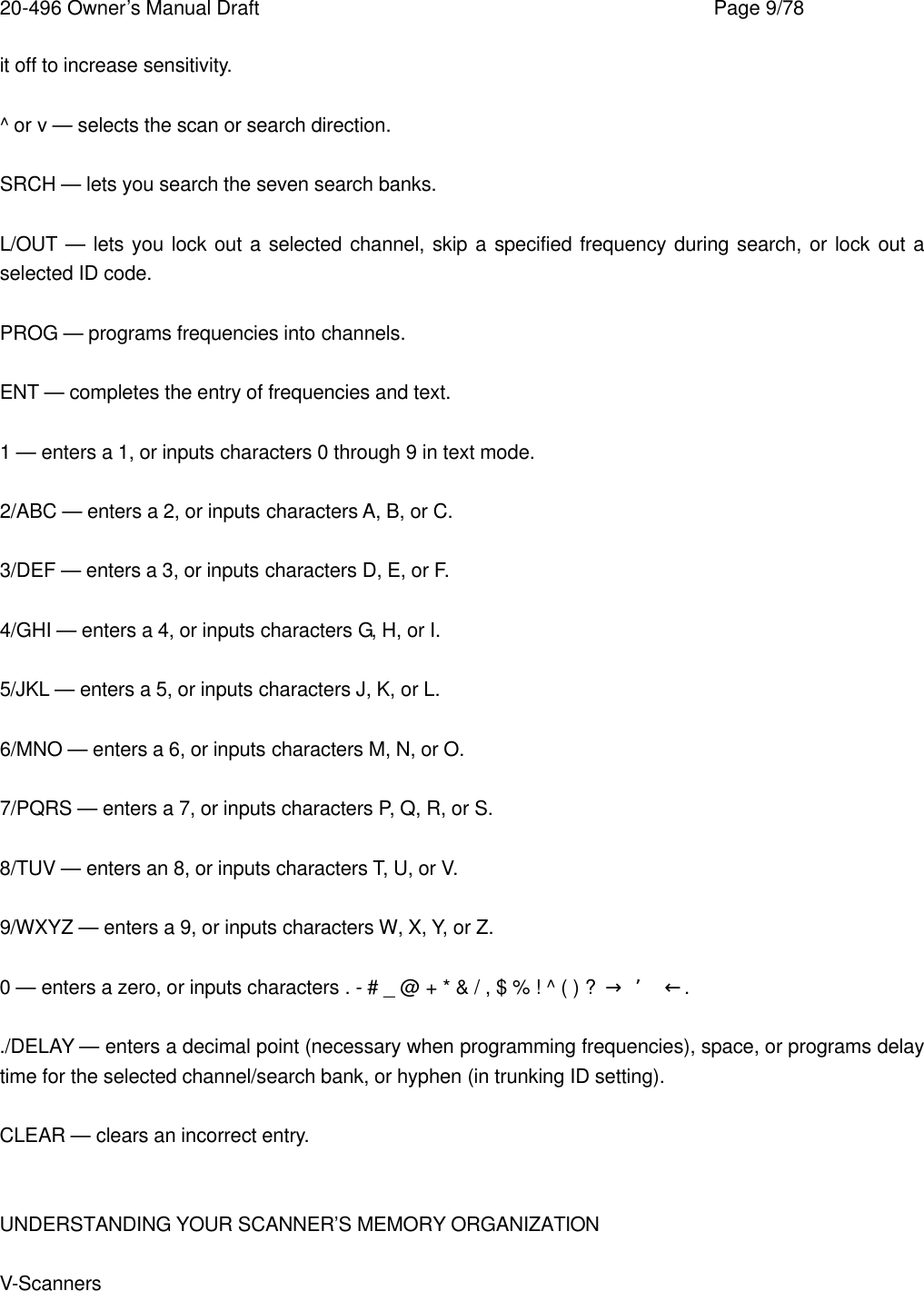
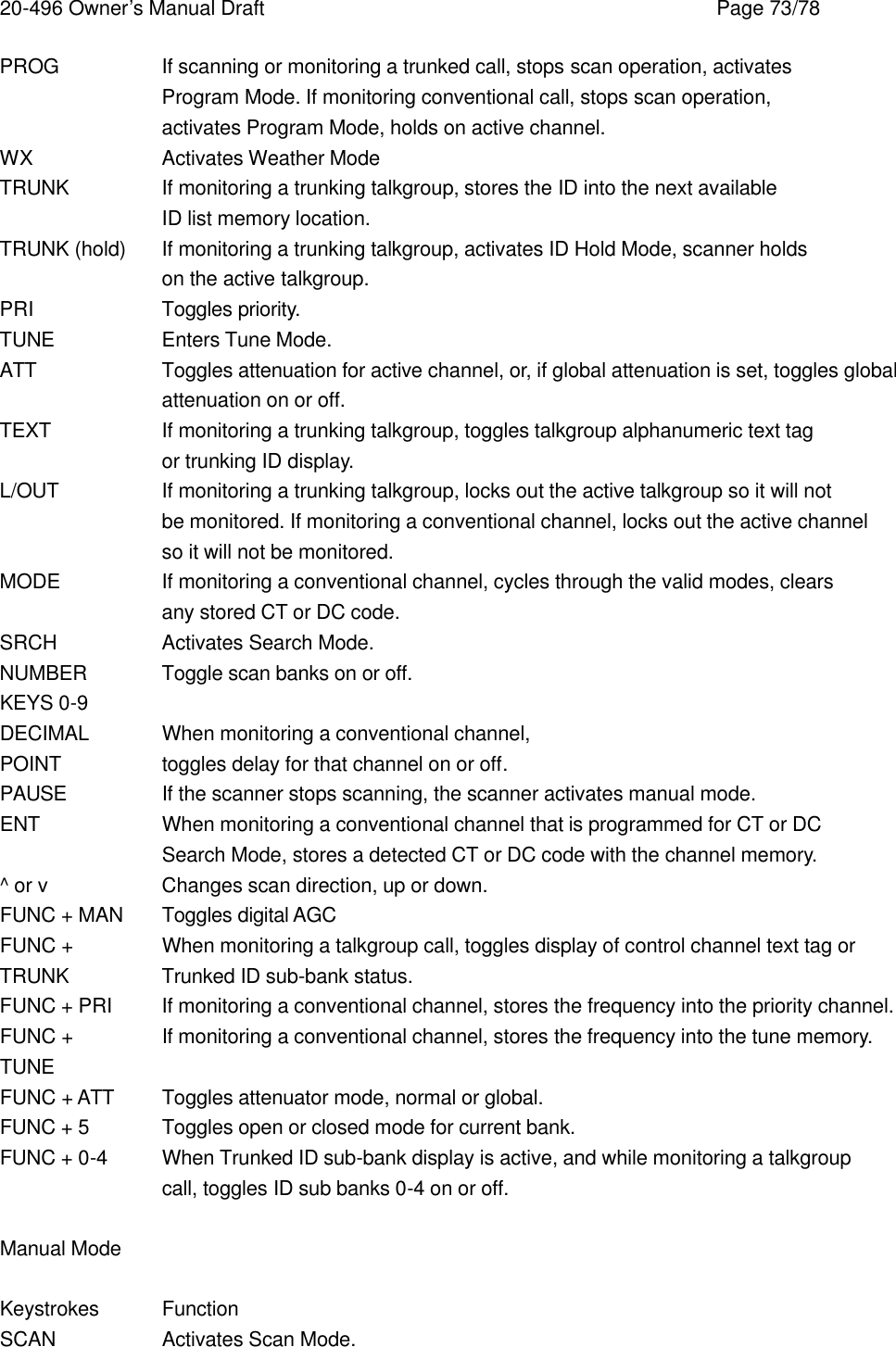
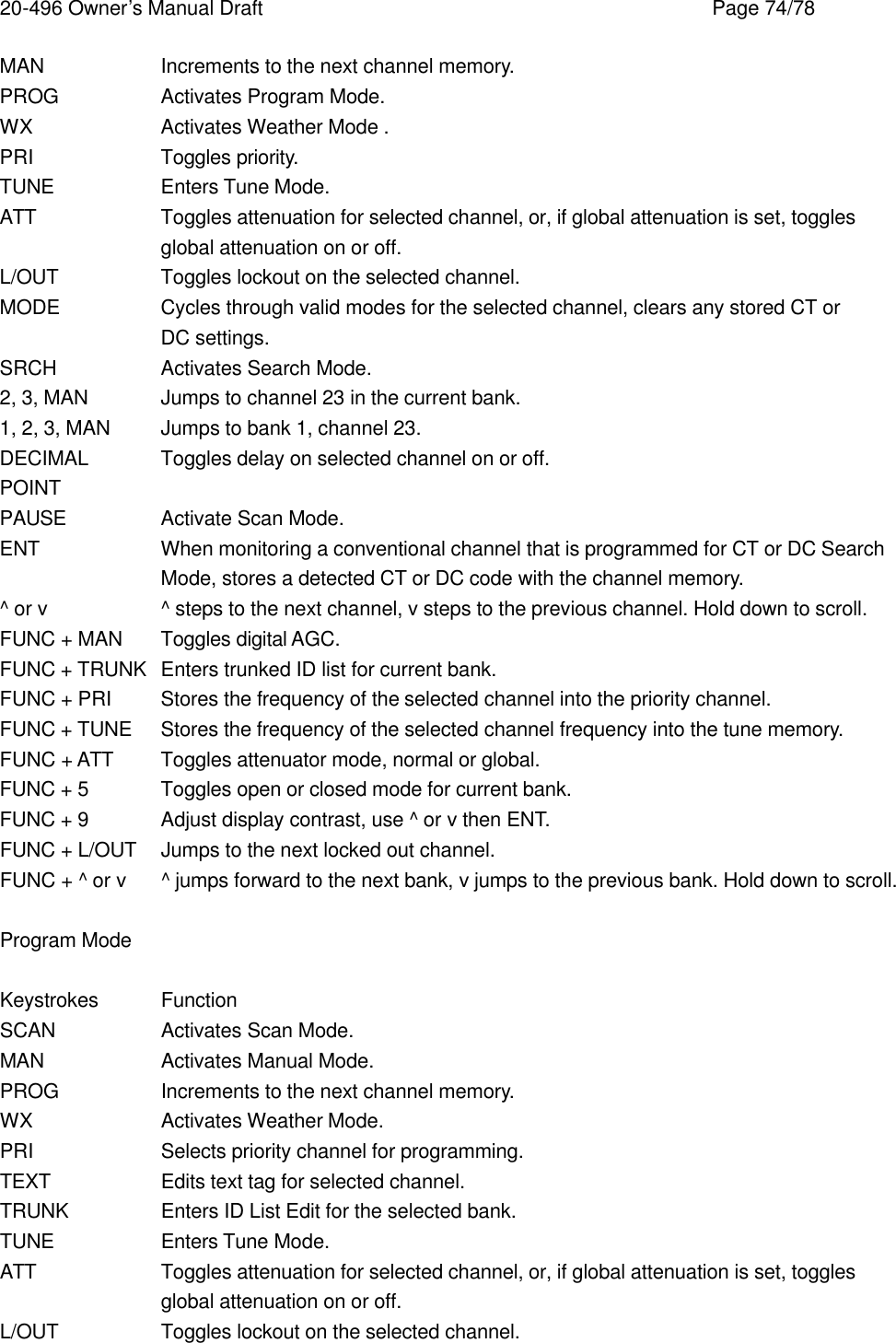
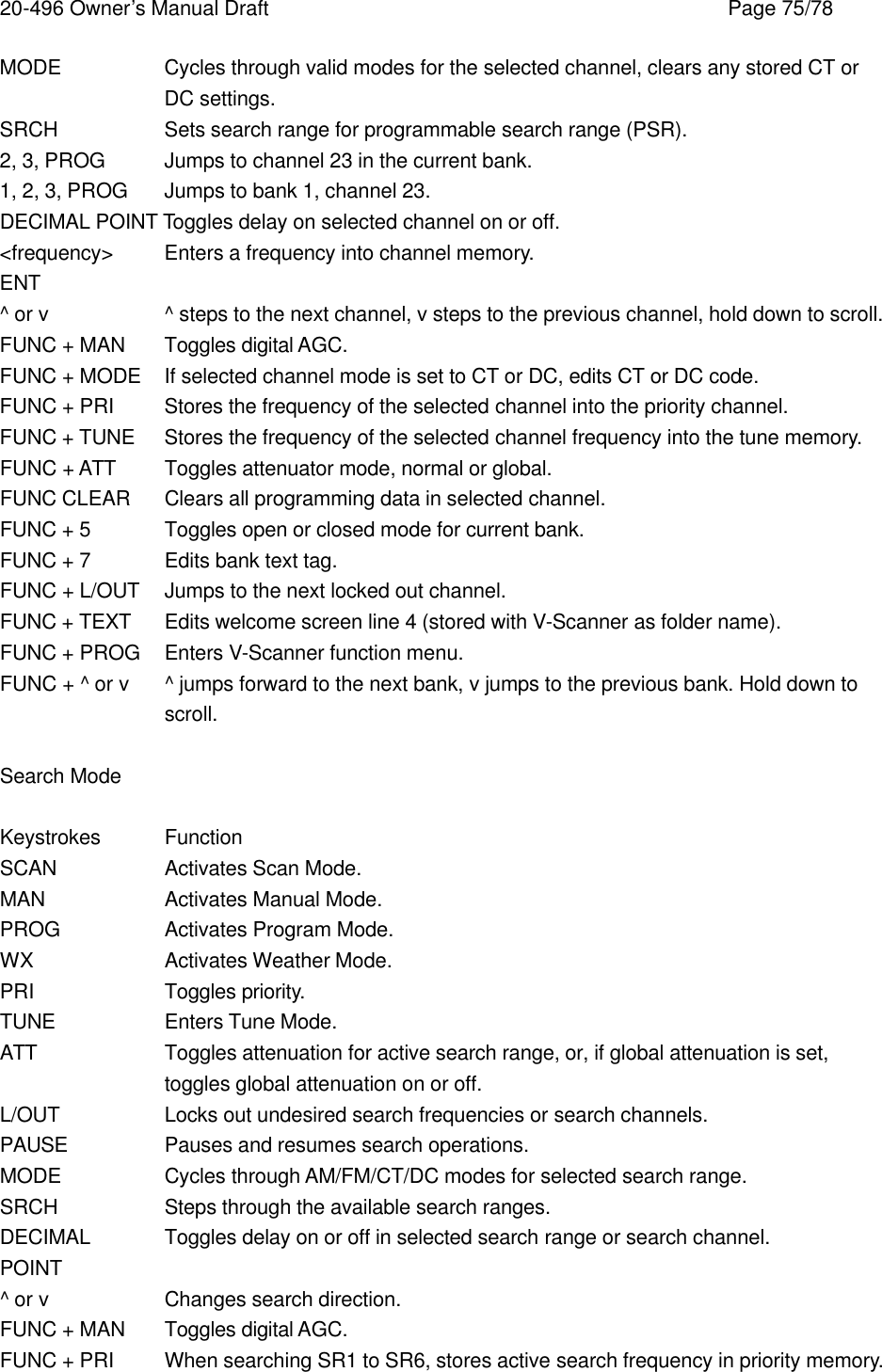
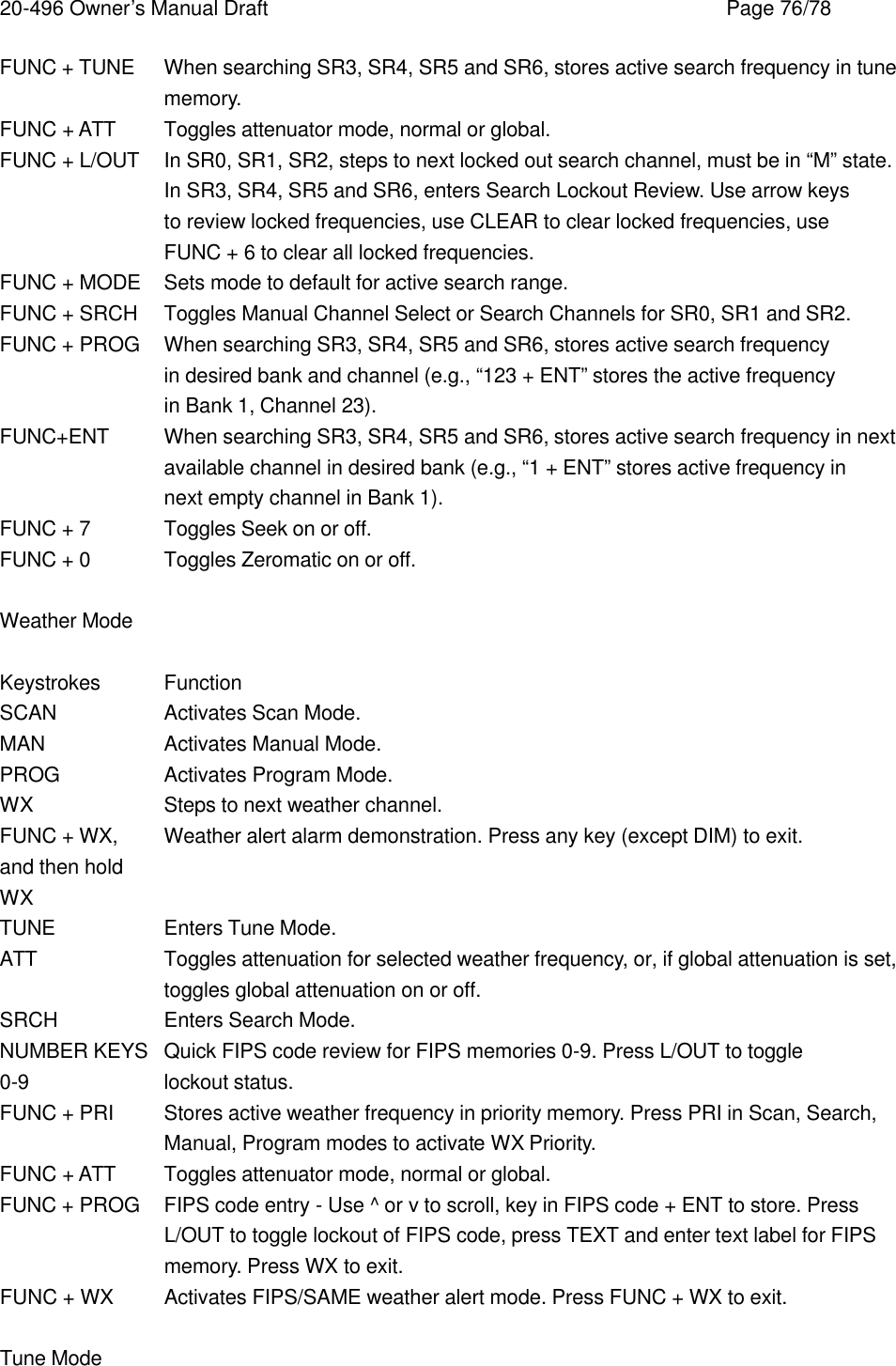
20-496 Owner’s Manual Draft    Page 8/78 frequency guides available from your local RadioShack store, frequency listings posted on the Internet, or the built in search function.  Your scanner’s SEARCH banks contained preprogrammed frequencies in the scanner’s memory (see “Searching a Preprogrammed Frequency Range” on Page XX for the frequency list). You can even change the frequency range on one of the SEARCH banks (SR6) to customize your own search parameters.  Once you identify the frequencies you wish to monitor, you can store them into programmable memory locations called channels, which are grouped in channel storage banks. You can then scan the channel-storage banks to see if there is activity on the frequencies stored there. Each time the scanner finds an active frequency, it stops and monitors the radio traffic on that channel until the transmission ends, then resumes scanning. For detailed programming instructions, see “Programming Your Scanner” on Page XX.  ABOUT THE KEYPAD  Here is a brief overview of your scanner's keys and their functions.  SCAN — scans through the programmed channels.  FUNC — lets you use various functions by pressing this key in combination with other keys. When using the FUNC key, press the FUNC key first, then release it, then quickly press the next key in the function key sequence.  MAN — stops scanning and lets you directly enter a channel number.  WX — scans through the seven preprogrammed weather channels.  TRUNK — stores the trunking ID code or holds the trunking ID while scanning.  PRI — sets and turns the priority function on or off.  TEXT — lets you input text.  PAUSE — pauses search or tune operation.  MODE — changes the receive mode (AM, FM, CT, DC, MO, ED).  DIM (dimmer) — changes three levels of back lighting brightness (Light, Dark, OFF).  TUNE — allows you input a frequency and tunes up or down automatically or manually with the ^ or v keys.  ATT — turns attenuation on to reduce the scanner's sensitivity and block extremely strong signals, or turns
20-496 Owner’s Manual Draft    Page 9/78 it off to increase sensitivity.  ^ or v — selects the scan or search direction.  SRCH — lets you search the seven search banks.  L/OUT — lets you lock out a selected channel, skip a specified frequency during search, or lock out a selected ID code.  PROG — programs frequencies into channels.  ENT — completes the entry of frequencies and text.  1 — enters a 1, or inputs characters 0 through 9 in text mode.  2/ABC — enters a 2, or inputs characters A, B, or C.  3/DEF — enters a 3, or inputs characters D, E, or F.  4/GHI — enters a 4, or inputs characters G, H, or I.  5/JKL — enters a 5, or inputs characters J, K, or L.  6/MNO — enters a 6, or inputs characters M, N, or O.  7/PQRS — enters a 7, or inputs characters P, Q, R, or S.  8/TUV — enters an 8, or inputs characters T, U, or V.  9/WXYZ — enters a 9, or inputs characters W, X, Y, or Z.  0 — enters a zero, or inputs characters . - # _ @ + * & / , $ % ! ^ ( ) ?  → ’ ←.  ./DELAY — enters a decimal point (necessary when programming frequencies), space, or programs delay time for the selected channel/search bank, or hyphen (in trunking ID setting).  CLEAR — clears an incorrect entry.   UNDERSTANDING YOUR SCANNER’S MEMORY ORGANIZATION  V-Scanners
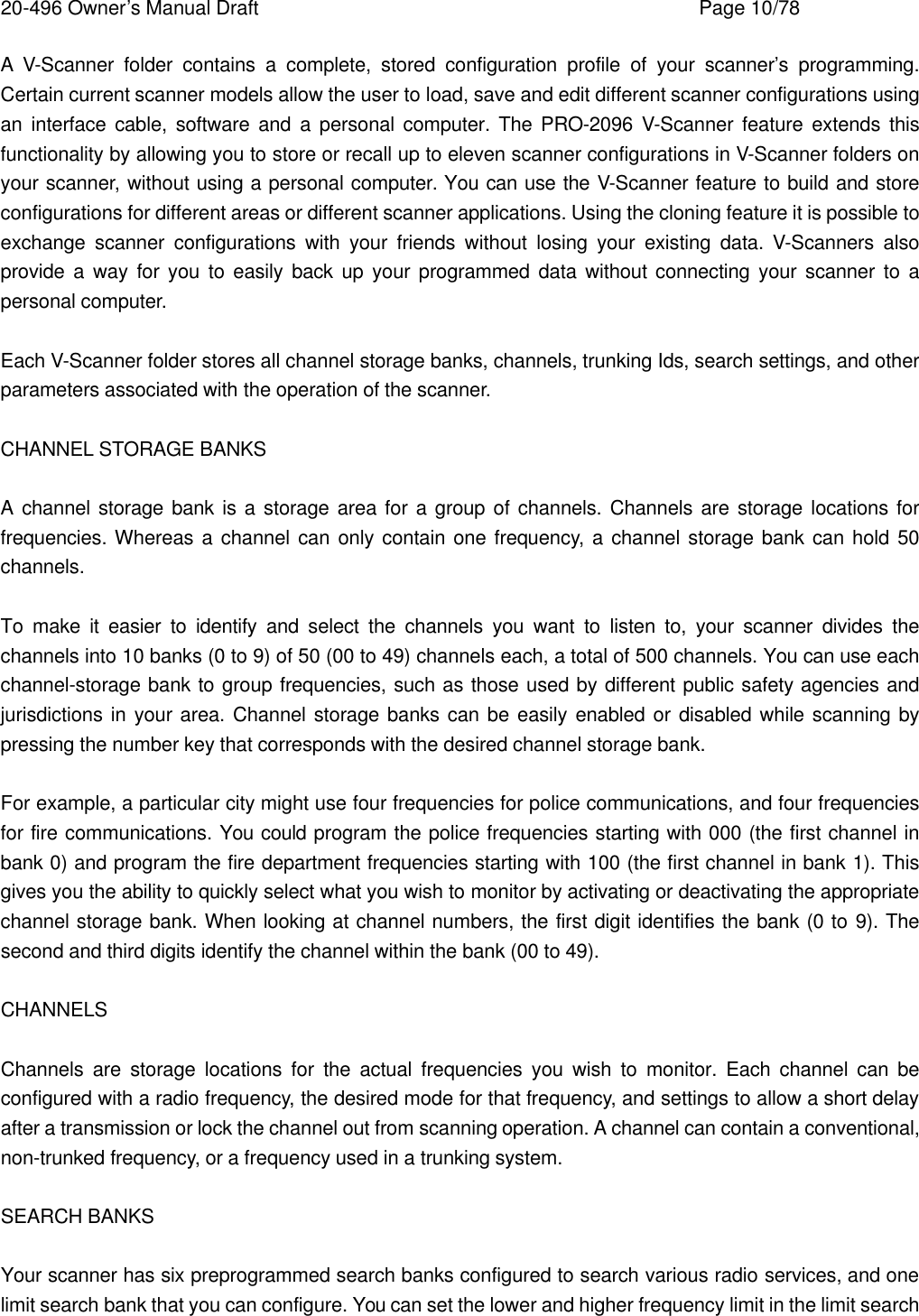
20-496 Owner’s Manual Draft    Page 10/78 A V-Scanner folder contains a complete, stored configuration profile of your scanner’s programming. Certain current scanner models allow the user to load, save and edit different scanner configurations using an interface cable, software and a personal computer. The PRO-2096 V-Scanner feature extends this functionality by allowing you to store or recall up to eleven scanner configurations in V-Scanner folders on your scanner, without using a personal computer. You can use the V-Scanner feature to build and store configurations for different areas or different scanner applications. Using the cloning feature it is possible to exchange scanner configurations with your friends without losing your existing data. V-Scanners also provide a way for you to easily back up your programmed data without connecting your scanner to a personal computer.  Each V-Scanner folder stores all channel storage banks, channels, trunking Ids, search settings, and other parameters associated with the operation of the scanner.  CHANNEL STORAGE BANKS  A channel storage bank is a storage area for a group of channels. Channels are storage locations for frequencies. Whereas a channel can only contain one frequency, a channel storage bank can hold 50 channels.  To make it easier to identify and select the channels you want to listen to, your scanner divides the channels into 10 banks (0 to 9) of 50 (00 to 49) channels each, a total of 500 channels. You can use each channel-storage bank to group frequencies, such as those used by different public safety agencies and jurisdictions in your area. Channel storage banks can be easily enabled or disabled while scanning by pressing the number key that corresponds with the desired channel storage bank.  For example, a particular city might use four frequencies for police communications, and four frequencies for fire communications. You could program the police frequencies starting with 000 (the first channel in bank 0) and program the fire department frequencies starting with 100 (the first channel in bank 1). This gives you the ability to quickly select what you wish to monitor by activating or deactivating the appropriate channel storage bank. When looking at channel numbers, the first digit identifies the bank (0 to 9). The second and third digits identify the channel within the bank (00 to 49).  CHANNELS  Channels are storage locations for the actual frequencies you wish to monitor. Each channel can be configured with a radio frequency, the desired mode for that frequency, and settings to allow a short delay after a transmission or lock the channel out from scanning operation. A channel can contain a conventional, non-trunked frequency, or a frequency used in a trunking system.  SEARCH BANKS  Your scanner has six preprogrammed search banks configured to search various radio services, and one limit search bank that you can configure. You can set the lower and higher frequency limit in the limit search
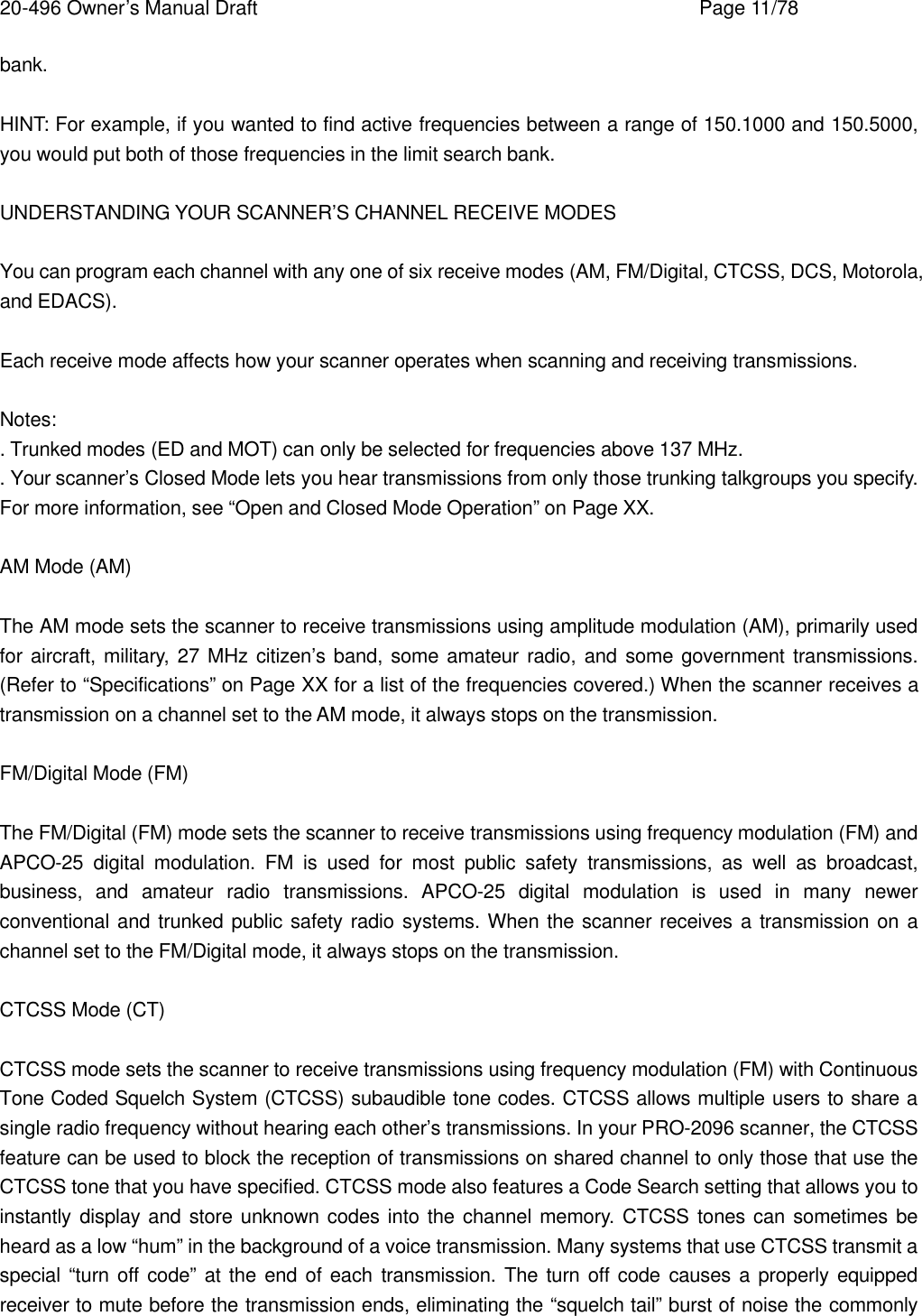
20-496 Owner’s Manual Draft    Page 11/78 bank.  HINT: For example, if you wanted to find active frequencies between a range of 150.1000 and 150.5000, you would put both of those frequencies in the limit search bank.  UNDERSTANDING YOUR SCANNER’S CHANNEL RECEIVE MODES  You can program each channel with any one of six receive modes (AM, FM/Digital, CTCSS, DCS, Motorola, and EDACS).  Each receive mode affects how your scanner operates when scanning and receiving transmissions.  Notes: . Trunked modes (ED and MOT) can only be selected for frequencies above 137 MHz. . Your scanner’s Closed Mode lets you hear transmissions from only those trunking talkgroups you specify. For more information, see “Open and Closed Mode Operation” on Page XX.  AM Mode (AM)  The AM mode sets the scanner to receive transmissions using amplitude modulation (AM), primarily used for aircraft, military, 27 MHz citizen’s band, some amateur radio, and some government transmissions. (Refer to “Specifications” on Page XX for a list of the frequencies covered.) When the scanner receives a transmission on a channel set to the AM mode, it always stops on the transmission.  FM/Digital Mode (FM)  The FM/Digital (FM) mode sets the scanner to receive transmissions using frequency modulation (FM) and APCO-25 digital modulation. FM is used for most public safety transmissions, as well as broadcast, business, and amateur radio transmissions. APCO-25 digital modulation is used in many newer conventional and trunked public safety radio systems. When the scanner receives a transmission on a channel set to the FM/Digital mode, it always stops on the transmission.  CTCSS Mode (CT)  CTCSS mode sets the scanner to receive transmissions using frequency modulation (FM) with Continuous Tone Coded Squelch System (CTCSS) subaudible tone codes. CTCSS allows multiple users to share a single radio frequency without hearing each other’s transmissions. In your PRO-2096 scanner, the CTCSS feature can be used to block the reception of transmissions on shared channel to only those that use the CTCSS tone that you have specified. CTCSS mode also features a Code Search setting that allows you to instantly display and store unknown codes into the channel memory. CTCSS tones can sometimes be heard as a low “hum” in the background of a voice transmission. Many systems that use CTCSS transmit a special “turn off code” at the end of each transmission. The turn off code causes a properly equipped receiver to mute before the transmission ends, eliminating the “squelch tail” burst of noise the commonly
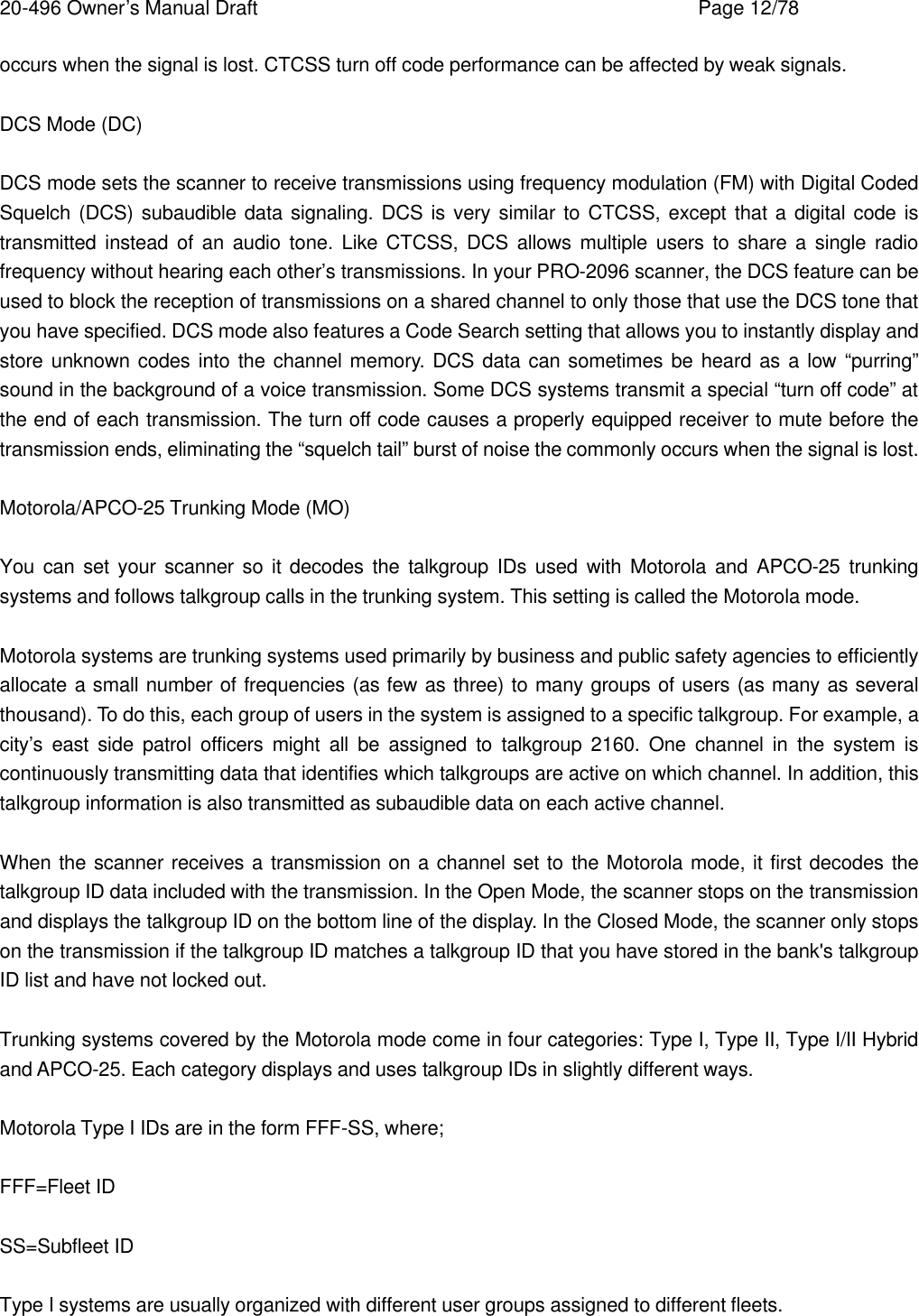
20-496 Owner’s Manual Draft    Page 12/78 occurs when the signal is lost. CTCSS turn off code performance can be affected by weak signals.  DCS Mode (DC)  DCS mode sets the scanner to receive transmissions using frequency modulation (FM) with Digital Coded Squelch (DCS) subaudible data signaling. DCS is very similar to CTCSS, except that a digital code is transmitted instead of an audio tone. Like CTCSS, DCS allows multiple users to share a single radio frequency without hearing each other’s transmissions. In your PRO-2096 scanner, the DCS feature can be used to block the reception of transmissions on a shared channel to only those that use the DCS tone that you have specified. DCS mode also features a Code Search setting that allows you to instantly display and store unknown codes into the channel memory. DCS data can sometimes be heard as a low “purring” sound in the background of a voice transmission. Some DCS systems transmit a special “turn off code” at the end of each transmission. The turn off code causes a properly equipped receiver to mute before the transmission ends, eliminating the “squelch tail” burst of noise the commonly occurs when the signal is lost.  Motorola/APCO-25 Trunking Mode (MO)  You can set your scanner so it decodes the talkgroup IDs used with Motorola and APCO-25 trunking systems and follows talkgroup calls in the trunking system. This setting is called the Motorola mode.  Motorola systems are trunking systems used primarily by business and public safety agencies to efficiently allocate a small number of frequencies (as few as three) to many groups of users (as many as several thousand). To do this, each group of users in the system is assigned to a specific talkgroup. For example, a city’s east side patrol officers might all be assigned to talkgroup 2160. One channel in the system is continuously transmitting data that identifies which talkgroups are active on which channel. In addition, this talkgroup information is also transmitted as subaudible data on each active channel.  When the scanner receives a transmission on a channel set to the Motorola mode, it first decodes the talkgroup ID data included with the transmission. In the Open Mode, the scanner stops on the transmission and displays the talkgroup ID on the bottom line of the display. In the Closed Mode, the scanner only stops on the transmission if the talkgroup ID matches a talkgroup ID that you have stored in the bank's talkgroup ID list and have not locked out.  Trunking systems covered by the Motorola mode come in four categories: Type I, Type II, Type I/II Hybrid and APCO-25. Each category displays and uses talkgroup IDs in slightly different ways.  Motorola Type I IDs are in the form FFF-SS, where;  FFF=Fleet ID  SS=Subfleet ID  Type I systems are usually organized with different user groups assigned to different fleets.
20-496 Owner’s Manual Draft    Page 13/78  Notes: . For example, a valid fleet-subfleet ID identifying all detectives within a police department might be 000-12, where 000 identifies all police users and 12 identifies the Detective division. . Tuning the scanner to an active control channel while in Motorola mode will display the Motorola System ID and the approximate control channel message decode success rate. This information can help you identify the Motorola trunking system that you are monitoring and the receive quality of the control channel signal.  To properly map the raw Type I data to the correct fleet-subfleet format, you must program the correct fleet map into the scanner. Fleet map information is widely available on the Internet for most Type I systems in use.  Type II and APCO-25 system talkgroups are identified by a 5-digit number. Valid Type II talkgroup IDs are divisible by 16, while APCO-25 talkgroups are not. Use care to ensure that you enter the correct Type II IDs into your scanner. Type I/II hybrid systems use both fleet-subfleet and 5-digit formats for talkgroup IDs.  EDACS Trunking Mode (ED)  You can set your scanner so it decodes the talkgroup IDs used with EDACS (GE/Ericsson/M/ACOM) trunking systems. This setting is called the EDACS mode.  EDACS systems are used primarily by business or private communications service providers, as well as by some public safety organizations. EDACS systems transmit active talkgroup information only on a dedicated control channel.  EDACS frequencies are organized in a specific order. Each frequency is assigned a Logical Channel Number (LCN). For the scanner to correctly switch to an active frequency, you must program the frequencies in LCN order, starting with Memory 01. EDACS talkgroup IDs are entered as a 4-digit decimal number from 0001 to 2047 or AFS (Agency Fleet Subfleet) number from 00-001 to 15-157.  When there is activity on an EDACS system, that information is sent out on the control channel. The scanner decodes the ID for the active talkgroup. In the Open Mode, the scanner then goes to the transmission and displays the talkgroup ID on the bottom line of the display. In the Closed Mode, the scanner only goes to transmissions with IDs that match talkgroup IDs you have stored in the bank's talkgroup ID list that are not locked out   PREPARATION  MOUNTING THE SCANNER IN YOUR VEHICLE  Before you mount the scanner, make sure you have all the necessary materials. Then confirm that the
20-496 Owner’s Manual Draft    Page 14/78 scanner fits your vehicle’s mounting area. This scanner is a DIN-E size unit that requires a 2-inch high by 7 1/8 –inch wide by 5 5/16inch deep (50 x 180 x 135 mm) mounting area.  IN-DASH Mounting  1. Remove the sleeve from your PRO-2096.  2. Install the sleeve into the dashboard.  After the sleeve is correctly installed in the dashboard, bend the appropriate tabs to hold the sleeve firmly in place.  3. Do the required electrical connections (power cable and antenna, etc.).  4. Slide the scanner into the sleeve until it is locked.  Removing the Unit from In-Dash Mounting  Insert the 2 handles into the slots at left and right of the front panel. Then, while gently pulling the handles away from each other, slide out the scanner.  Mounting the Scanner with Mounting Bracket  Caution: Be sure to avoid obstructions behind the mounting surface.  1. Choose a mounting location, then use the supplied mounting bracket as a template to mark the positions for the mounting screw holes.  2. In the marked positions, drill holes slightly smaller than the supplied screws.  3. Attach the mounting bracket to the mounting location using the supplied screws and lock washers.  4. Remove the sleeve from the unit, and attach the top and bottom cabinet to the scanner.  5. Attach a rubber washer to both of the mounting bracket’s holes.  6. Attach the scanner to the mounting bracket using the supplied mounting knobs.  7. Connect the antenna and power cable to the scanner.  POWERING THE SCANNER FROM VEHICLE’S BATTERY  You can power your scanner using either the supplied DC power cord or from your vehicle’s cigarette
20-496 Owner’s Manual Draft    Page 15/78 lighter socket using an optional DC cigarette lighter power cable.  Cautions: . You must use a power source that supplies 12V DC and delivers at least 500 mA. Its center tip must be set to positive and its plug must fit the scanner’s DC 13.8V jack. The supplied DC power cord meets these specifications. Using a power cord that does not meet these specifications could damage the scanner or the adapter. . Always connect the adapter or DC power cord to the scanner before you connect it to the power source. When you finish, disconnect the adapter or DC power cord from the power source before you disconnect it from the scanner. . For added safety and protect your scanner, disconnect the cable from your vehicle battery’s negative (-) terminal before you begin.  Follow these steps to connect the supplied DC power cord.  1. Connect the power cord’s black wire to a chassis ground, such as a metal screw attached to a metal part of the vehicle’s frame. Be sure that the screw is not insulated from the frame by a plastic part.  2. Connect the power cord’s red wire (with in-line fuse) to a source of voltage that turns on and off with the ignition switch, such as a spare accessory terminal in your vehicle’s fuse box.  3. Insert the power cord’s barrel plug into the DC 13.8V jack on the back of the scanner.  4. Reconnect the cable to the vehicle battery’s negative (-) terminal.  To power the scanner from a vehicle’s 12V power source (such as a cigarette-lighter socket), you need a 12V, 600 mA DC cigarette-lighter adapter (not supplied), available at your local RadioShack store.  To connect an optional DC cigarette-lighter power cable, insert its barrel plug into the DC 13.8V jack on the back of the scanner, then plug the power cable into your vehicle’s cigarette lighter socket.  Note: If you use a cigarette-lighter power cable and your vehicle’s engine is running, you might hear electrical noise from the engine while scanning. This is normal.  USING THE SCANNER AS A BASE STATION  You can place this scanner on a desk, shelf, or table to use it as a base station.  To use the base station, you must change the outer cabinet from the sleeve.  Using Standard AC Power  You can power the scanner using the supplied 13.8V, 600mA AC adapter. To power the scanner using an
20-496 Owner’s Manual Draft    Page 16/78 AC adapter, insert the AC adapter’s barrel plug into the scanner’s DC 13.8V jack. Then connect the other end of the adapter to a standard AC outlet.  Cautions: . You must use a Class 2 power source that supplies 13.8V DC and delivers at least 600mA. Its center tip must be set to positive and its plug must fit the scanner’s DC 13.8V jack. Using an adapter that does not meet these specifications could damage the scanner or the adapter. . Always connect the AC adapter to the scanner before you connect it to AC power. When you finish, disconnect the adapter from AC power before you disconnect it from the scanner.  Warning: To prevent electric shock, do not use the AC adapter’s polarized plug with an extension cord, receptacle, or other outlet unless you can fully insert the blades to prevent blade exposure.  CONNECTING AN EXTENSION SPEAKER  In a noisy area, an extension speaker (not supplied), available at your local RadioShack store, might provide more comfortable listening. Plug the speaker cable’s 1/8-inch (3.5 mm) mini-plug into your scanner’s EXT SP jack.  CONNECTING AN EARPHONE/HEADPHONES  For private listening, you can connect an earphone or headphones with a 1/8-inch (3.5 mm) plug to the (headphone) jack on the front of the scanner. (Your local RadioShack store carries a wide selection of earphones and headphones). This automatically disconnects the internal speaker.  LISTENING SAFELY  To protect your hearing, follow these guidelines when you use an earphone or headphones.  . Set the volume to zero before putting on headphones. With the headphones on, adjust the volume to a comfortable level. . Avoid increasing the volume once you set it. Over time, your sensitivity to a volume level decreases, so volume levels that do not cause discomfort might damage your hearing. .  Avoid or limit listening at high volume levels. Prolonged exposure to high volume levels can cause permanent hearing loss.  Traffic Safety  Do not wear an earphone or headphones while you drive a vehicle or ride a bicycle. This can create a traffic hazard and can be illegal in some areas. Even though some earphones and headphones let you hear some outside sounds when you listen at normal levels, they still can present a traffic hazard.  CONNECTING AN SUPPLIED ANTENNA
20-496 Owner’s Manual Draft    Page 17/78  To attach the supplied antenna to the antenna jack on the back of your scanner, align the slots around the antenna’s connector with the studs on the antenna jack. Slide the antenna push over the jack and turn the antenna’s base clockwise until it locks into place.  The scanner’s sensitivity depends on its location and the antenna’s length. For the best reception of the transmissions you want to hear, adjust the antenna’s length according to the chart below.  Frequency    Antenna Length 25-54 MHz    Extend fully 108-174 MHz    Extend 4 segments 216-225 MHz    Extend 3 segments 406-1300 MHz    Collapse fully  Connecting an Optional External Antenna  The antenna connector on your scanner makes it easy to use the scanner with a variety of antennas, such as an external mobile antenna or outdoor base station antenna. Your local RadioShack store sells a variety of antennas.  Always use 50-ohm coaxial cable, such as RG-58 or RG-8, to connect an outdoor antenna. For length over 50 feet, use RG-8 low-loss dielectric coaxial cable. If your antenna’s cable does not have a BNC connector, you will also need a BNC adapter (not supplied, available at your local RadioShack store).  WARNING: Use extreme caution when installing or removing an outdoor antenna. If the antenna starts to fall, let it go! It could contact overhead power lines. If the antenna touches a power line, touching the antenna, mast, cable, or guy wires can cause electrocution and death. Call the power company to remove the antenna. DO NOT attempt to do so yourself.  Follow the installation instructions supplied with the antenna, route the antenna cable to the scanner, then connect it to the antenna jack.   PROGRAMMING YOUR SCANNER  PROGRAMMING CONVENTIONAL CHANNELS  Good references for active frequencies are RadioShack’s Police Call, Aeronautical Frequency Directory, and Maritime Frequency Directory. We update these directories every year, so be sure to get a current copy.  Storing Conventional Frequencies
20-496 Owner’s Manual Draft    Page 18/78 Follow these steps to store conventional frequencies in to channels.  Notes: . When the scanner is in Manual or Program mode, indicated with M or P in the top left hand corner of the display, you can select your desired bank and channel number using direct channel entry, the ^ or v arrow keys, and with FUNC and the ^ or v arrow keys. . For direct channel entry, press MAN or PROG, enter the channel storage bank (0-9) and channel number (00-49) where you want to store a frequency, then press MAN or PROG again. For example, Bank 3, Channel 23 is entered as “323”. The scanner advances to the selected channel storage bank and channel, and the channel storage bank and channel number appear at the upper left corner of the display (for example: M323 or P323). . Press FUNC, then ^ or v to jump to the next or previous channel storage bank. . Press FUNC, then hold ^ or v to scroll through the channel storage banks.  1. To begin programming your scanner, press PROG. M changes to P. Select the desired channel storage bank and channel, and press PROG to advance to that channel.  2. Use the number keys and ./DELAY to enter the frequency (including the decimal point) you want to store.  3. If you make a mistake, press CLEAR to backspace and correct the incorrect digit, or press and hold CLEAR for about 2 seconds to clear the entire field and start over.  4. Press ENT to store the frequency into the channel.  Notes: . If you made a mistake in entering the frequency, Invalid Freq briefly appears and the scanner beeps when you press ENT. Enter the frequency again. . Your scanner automatically rounds the entered frequency to the nearest valid frequency. For example, if you enter a frequency of 151.53, your scanner accepts it as 151.5275. Reception of the frequency will not be adversely affected. . If you enter a frequency that has already been entered elsewhere in the same bank, the scanner sounds an error tone and displays Dupl.f and the channel number that has been duplicated. If the dual entry is an error press CLEAR and enter the correct frequency. If the dual entry is intentional press ENT to accept. . You may replace any frequency by selecting the bank and channel, pressing PROG and entering the new frequency. . You can clear programmed frequency data by pressing FUNC, then CLEAR. . If you make an error in the entry process, press CLEAR as often as needed to erase the incorrect data, or press and hold CLEAR for one second to clear the entire field.  5. By default, the scanner will configure the channels you enter for a two second delay after a transmission is received. This is indicated by the D character that appears in the top row of the display. If you do not want the scanner to pause for reply traffic before resuming scanning operation, press ./DELAY until D is not visible in the top line of the display.
20-496 Owner’s Manual Draft    Page 19/78  6. If necessary, press MODE to change the receiving mode. Valid modes for conventional frequencies include AM, FM/Digital, CTCSS and DCS. To program a specific code for CTCSS or DCS mode, press FUNC MODE, then enter the desired code followed by ENT, or use the ^ or v keys to scroll to the desired code and press ENT to store the code with the channel memory. For more information on CTCSS and DCS programming, see “Programming channels for CTCSS and DCS operation” on Page XX.  7. If desired, program a text tag for the channel (see “Assigning a Text Tag to a Channel” on Page XX).  When you are ready to program additional channels, press PROG or ^ to move up to the next channel memory location, or v to move down.  PROGRAMMING TRUNKED SYSTEMS  This section of the manual provides instructions to program your scanner to receive trunked radio systems. If you are just getting started with trunked system monitoring or have any questions about how your PRO-2096 scanner operates when tracking trunked radio systems. See “Trunking Special Features” on Page XX.  For best results, program only one trunking system in each channel storage bank of your scanner. Your scanner will lock on to the first active control channel it finds in a channel storage bank and follow the activity from that trunking system.  HINT: Certain multi-zone Motorola systems use the same talkgroup IDs at multiple radio sites to cover a large geographical area. In these types of systems it may be possible to program multiple control channel frequencies into the same channel storage bank and allow the scanner to lock on to the different control channels as you move from zone to zone. This approach only works in networked systems where the same talkgroup IDs are used at multiple sites. It is not possible to program Motorola/APCO-25 and EDACS systems into the same channel storage bank.  Channel storage banks may contain both conventional, non-trunked channels,  and control or system channels for a trunked system. The scanner will check for activity on the conventional channels after processing the trunking system.  PROGRAMMING MOTOROLA ANALOG, DIGITAL, AND APCO-25 TRUNKING SYSTEMS  1. Press PROG and FUNC then ^ or v to select the desired channel storage bank to program.  Notes: . You can also press FUNC, then TRUNK to access the ID list from manual mode. . When monitoring Motorola trunked radio systems, it is only necessary to program the trunking control channel. . For APCO-25 trunking systems using the 9600 bps control channel, program the system using the steps
20-496 Owner’s Manual Draft    Page 20/78 outlined above for Motorola systems. Your scanner will automatically detect the proper control channel type. . Some systems rotate the control channel on a daily basis. For best results, program all known control channel frequencies into the trunking channel storage bank. .  To program Motorola UHF trunking systems, see “Programming Motorola VHF and UHF Trunking Systems” on Page XX. .  To program Motorola 800 MHz “splinter” systems, see “Programming Motorola 800 MHz Splinter Systems” on Page XX. . To program Motorola Type I/IIi fleet maps, see “Programming Fleet Maps” on Page XX.  2. Press TRUNK to access the ID list and set the correct trunking bank type. If the bank has never been programmed with a trunking system, the scanner will display Not trunked! Press mode.  3. Press MODE until Motorola appears in the display. This sets the channel storage bank for Motorola operation.  4. Press PROG to return to the channel storage bank.  5. Select a channel to begin programming trunking system frequencies. Use direct channel entry or the ^ or v keys.  6. Enter the trunking frequency and press ENT. If necessary, press MODE to change the receiving mode to MO (Motorola).  7. Repeat Steps 5 and 6 to enter the other trunking system control channel frequencies for the system you wish to monitor.  PROGRAMMING EDACS TRUNKING SYSTEMS  1. Press PROG and FUNC, and then ^ or v to select the desired channel storage bank to program.  Note: It is necessary to program all EDACS system channels into your scanner in Logical Channel Number (LCN) order, beginning with LCN 1 in channel 01 of the channel storage bank. Do not program EDACS system channels in channel 00 of a channel storage bank. Refer to frequency publications or Internet  sites to obtain correct LCN frequencies for the EDACS systems you wish to monitor. If the EDACS system you are programming skips channels in the LCN order, leave those channels blank in your scanner.  2. Press TRUNK to access the ID list and set the correct trunking bank type. If the bank has never been programmed with a trunking system, the scanner will display Not trunked! Press mode.  3. Press MODE until EDACS appears in the display. This sets the channel storage bank for EDACS operation.
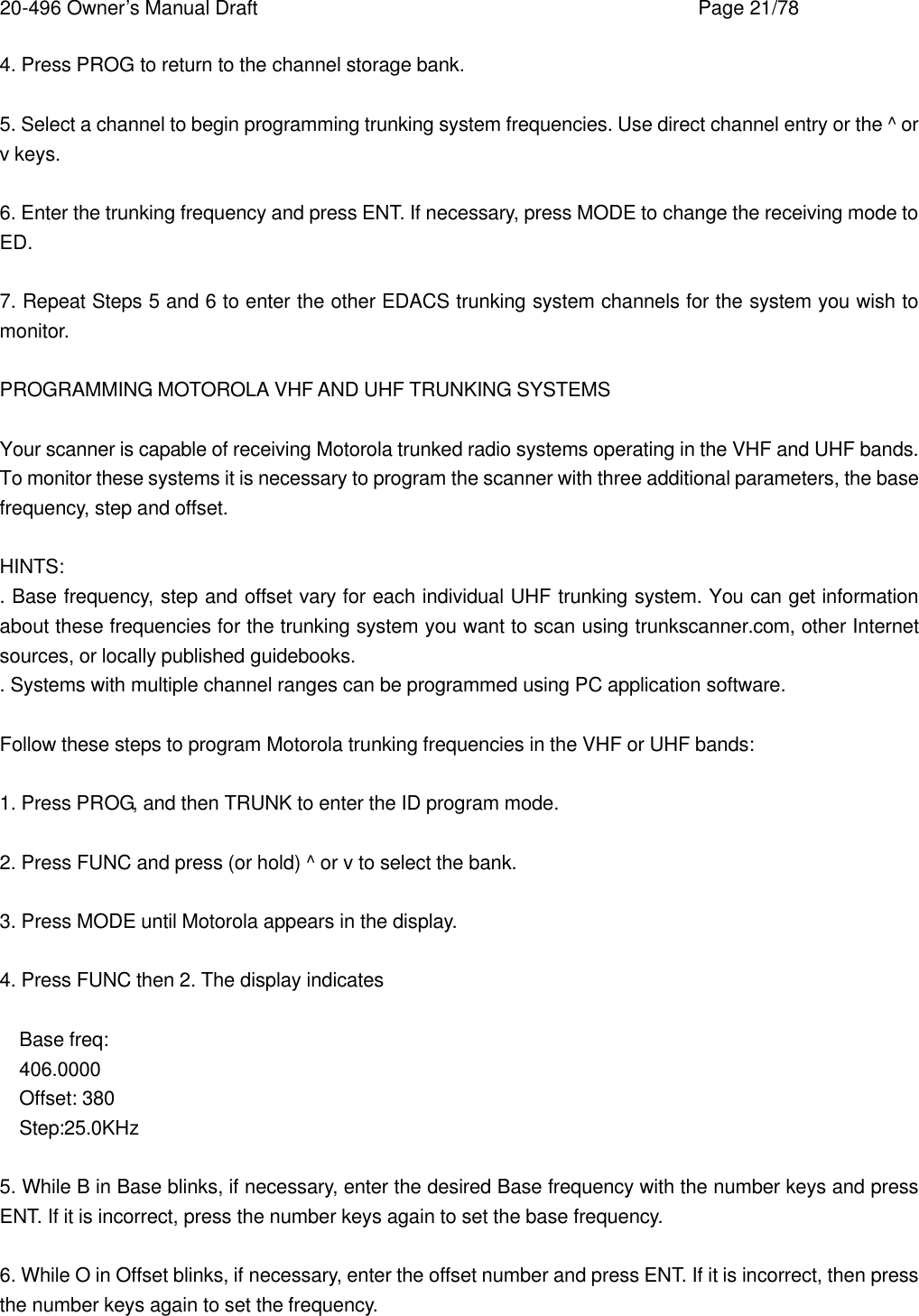
20-496 Owner’s Manual Draft    Page 21/78 4. Press PROG to return to the channel storage bank.  5. Select a channel to begin programming trunking system frequencies. Use direct channel entry or the ^ or v keys.  6. Enter the trunking frequency and press ENT. If necessary, press MODE to change the receiving mode to ED.  7. Repeat Steps 5 and 6 to enter the other EDACS trunking system channels for the system you wish to monitor.  PROGRAMMING MOTOROLA VHF AND UHF TRUNKING SYSTEMS  Your scanner is capable of receiving Motorola trunked radio systems operating in the VHF and UHF bands. To monitor these systems it is necessary to program the scanner with three additional parameters, the base frequency, step and offset.  HINTS: . Base frequency, step and offset vary for each individual UHF trunking system. You can get information about these frequencies for the trunking system you want to scan using trunkscanner.com, other Internet sources, or locally published guidebooks. . Systems with multiple channel ranges can be programmed using PC application software.  Follow these steps to program Motorola trunking frequencies in the VHF or UHF bands:  1. Press PROG, and then TRUNK to enter the ID program mode.  2. Press FUNC and press (or hold) ^ or v to select the bank.  3. Press MODE until Motorola appears in the display.  4. Press FUNC then 2. The display indicates  Base freq: 406.0000 Offset: 380 Step:25.0KHz  5. While B in Base blinks, if necessary, enter the desired Base frequency with the number keys and press ENT. If it is incorrect, press the number keys again to set the base frequency.  6. While O in Offset blinks, if necessary, enter the offset number and press ENT. If it is incorrect, then press the number keys again to set the frequency.
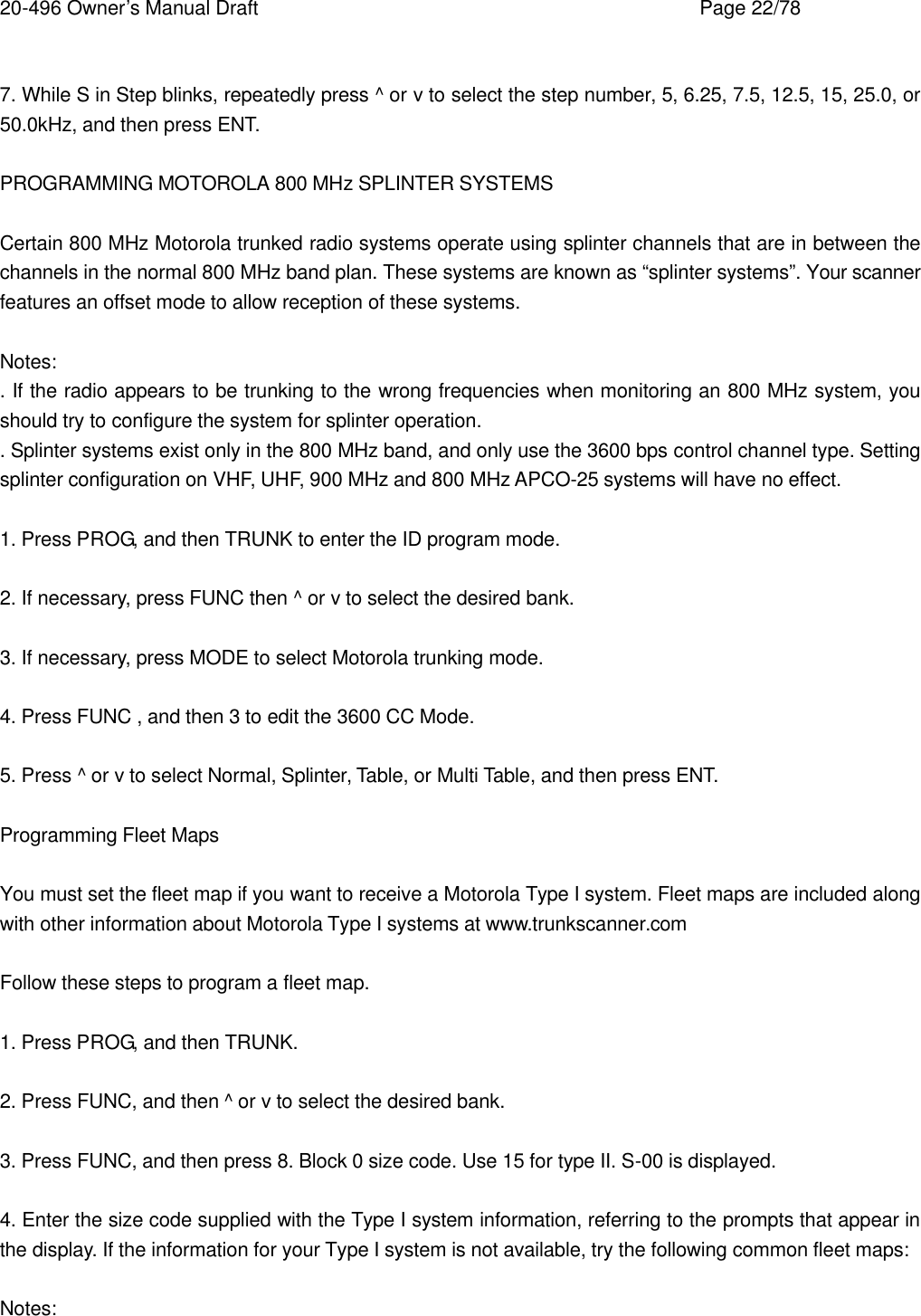
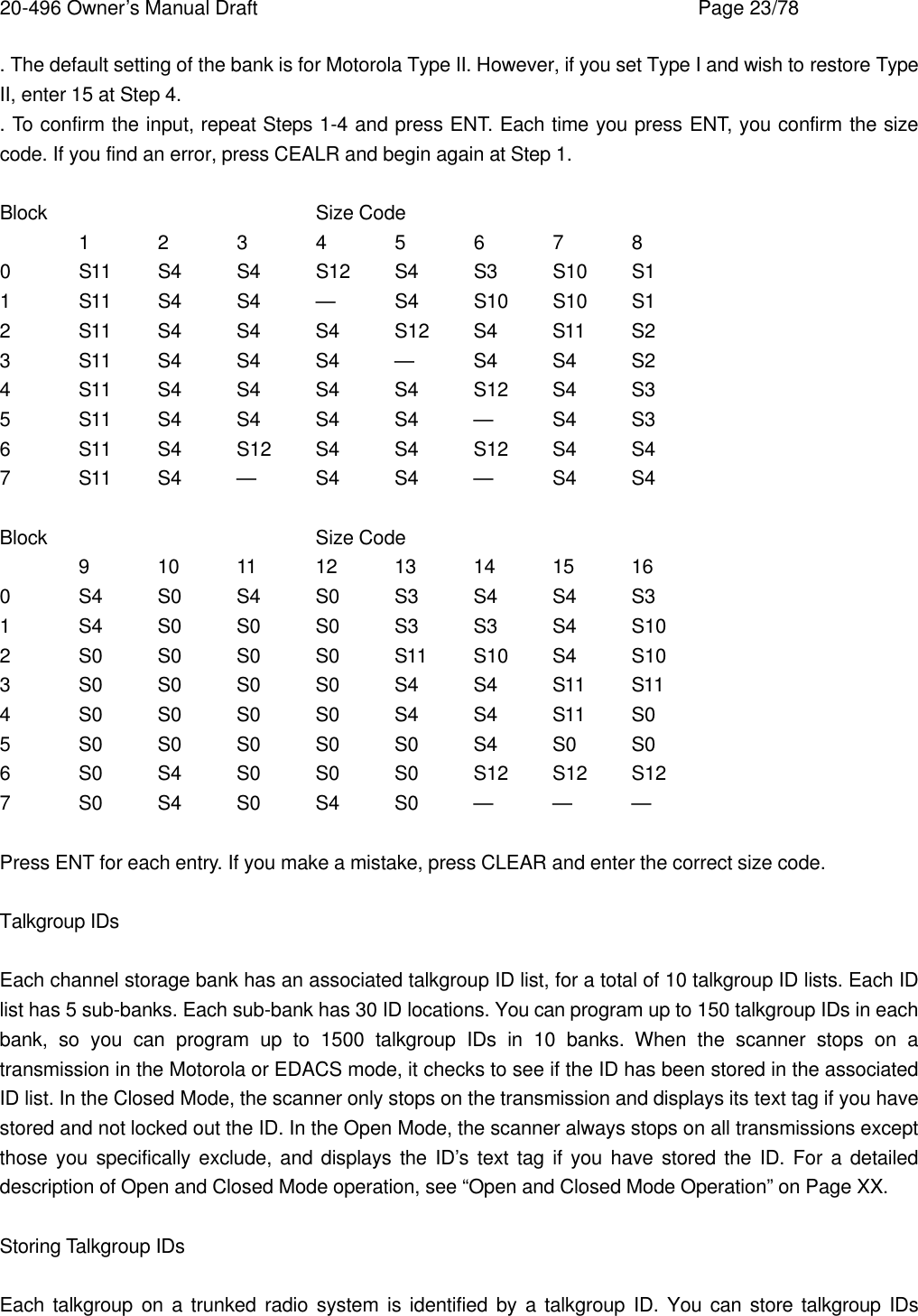
20-496 Owner’s Manual Draft    Page 22/78  7. While S in Step blinks, repeatedly press ^ or v to select the step number, 5, 6.25, 7.5, 12.5, 15, 25.0, or 50.0kHz, and then press ENT.  PROGRAMMING MOTOROLA 800 MHz SPLINTER SYSTEMS  Certain 800 MHz Motorola trunked radio systems operate using splinter channels that are in between the channels in the normal 800 MHz band plan. These systems are known as “splinter systems”. Your scanner features an offset mode to allow reception of these systems.  Notes: . If the radio appears to be trunking to the wrong frequencies when monitoring an 800 MHz system, you should try to configure the system for splinter operation. . Splinter systems exist only in the 800 MHz band, and only use the 3600 bps control channel type. Setting splinter configuration on VHF, UHF, 900 MHz and 800 MHz APCO-25 systems will have no effect.  1. Press PROG, and then TRUNK to enter the ID program mode.  2. If necessary, press FUNC then ^ or v to select the desired bank.  3. If necessary, press MODE to select Motorola trunking mode.  4. Press FUNC , and then 3 to edit the 3600 CC Mode.  5. Press ^ or v to select Normal, Splinter, Table, or Multi Table, and then press ENT.  Programming Fleet Maps  You must set the fleet map if you want to receive a Motorola Type I system. Fleet maps are included along with other information about Motorola Type I systems at www.trunkscanner.com  Follow these steps to program a fleet map.  1. Press PROG, and then TRUNK.  2. Press FUNC, and then ^ or v to select the desired bank.  3. Press FUNC, and then press 8. Block 0 size code. Use 15 for type II. S-00 is displayed.  4. Enter the size code supplied with the Type I system information, referring to the prompts that appear in the display. If the information for your Type I system is not available, try the following common fleet maps:  Notes:
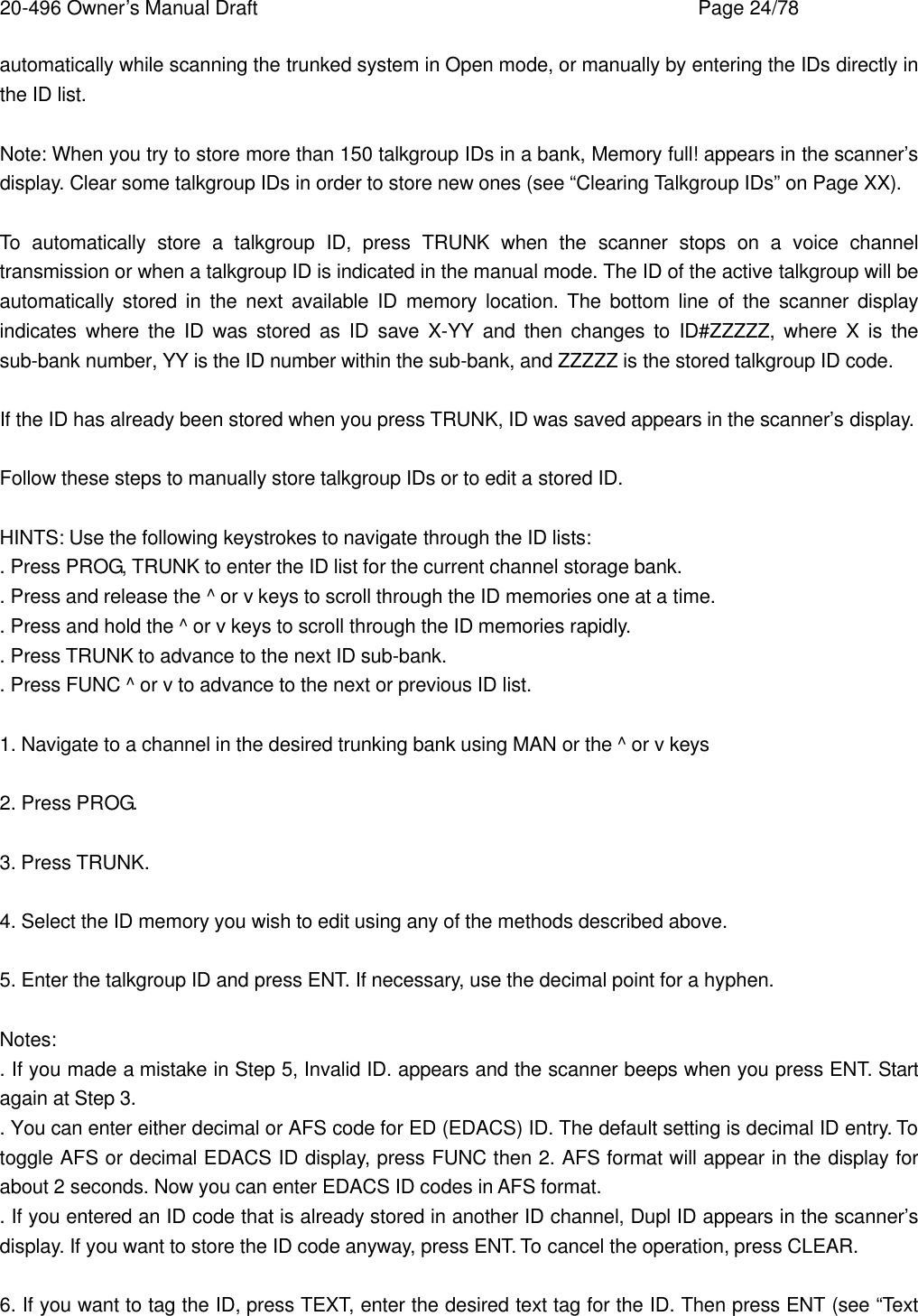
20-496 Owner’s Manual Draft    Page 23/78 . The default setting of the bank is for Motorola Type II. However, if you set Type I and wish to restore Type II, enter 15 at Step 4. . To confirm the input, repeat Steps 1-4 and press ENT. Each time you press ENT, you confirm the size code. If you find an error, press CEALR and begin again at Step 1.  Block    Size Code 1 2 3 4 5 6 7 8 0 S11 S4 S4 S12 S4 S3 S10 S1 1 S11 S4 S4 —    S4 S10 S10 S1 2 S11 S4 S4 S4 S12 S4 S11 S2 3 S11 S4 S4 S4 — S4 S4 S2 4 S11 S4 S4 S4 S4 S12 S4 S3 5 S11 S4 S4 S4 S4 — S4 S3 6 S11 S4 S12 S4 S4 S12 S4 S4 7 S11 S4 — S4 S4 —    S4 S4  Block    Size Code 9 10 11 12 13 14 15 16 0 S4 S0 S4 S0 S3 S4 S4 S3 1 S4 S0 S0 S0 S3 S3 S4 S10 2 S0 S0 S0 S0 S11 S10 S4 S10 3 S0 S0 S0 S0 S4 S4 S11 S11 4 S0 S0 S0 S0 S4 S4 S11 S0 5 S0 S0 S0 S0 S0 S4 S0 S0 6 S0 S4 S0 S0 S0 S12 S12 S12 7 S0 S4 S0 S4 S0 — — —  Press ENT for each entry. If you make a mistake, press CLEAR and enter the correct size code.  Talkgroup IDs  Each channel storage bank has an associated talkgroup ID list, for a total of 10 talkgroup ID lists. Each ID list has 5 sub-banks. Each sub-bank has 30 ID locations. You can program up to 150 talkgroup IDs in each bank, so you can program up to 1500 talkgroup IDs in 10 banks. When the scanner stops on a transmission in the Motorola or EDACS mode, it checks to see if the ID has been stored in the associated ID list. In the Closed Mode, the scanner only stops on the transmission and displays its text tag if you have stored and not locked out the ID. In the Open Mode, the scanner always stops on all transmissions except those you specifically exclude, and displays the ID’s text tag if you have stored the ID. For a detailed description of Open and Closed Mode operation, see “Open and Closed Mode Operation” on Page XX.  Storing Talkgroup IDs  Each talkgroup on a trunked radio system is identified by a talkgroup ID. You can store talkgroup IDs
20-496 Owner’s Manual Draft    Page 24/78 automatically while scanning the trunked system in Open mode, or manually by entering the IDs directly in the ID list.  Note: When you try to store more than 150 talkgroup IDs in a bank, Memory full! appears in the scanner’s display. Clear some talkgroup IDs in order to store new ones (see “Clearing Talkgroup IDs” on Page XX).  To automatically store a talkgroup ID, press TRUNK when the scanner stops on a voice channel transmission or when a talkgroup ID is indicated in the manual mode. The ID of the active talkgroup will be automatically stored in the next available ID memory location. The bottom line of the scanner display indicates where the ID was stored as ID save X-YY and then changes to ID#ZZZZZ, where X is the sub-bank number, YY is the ID number within the sub-bank, and ZZZZZ is the stored talkgroup ID code.  If the ID has already been stored when you press TRUNK, ID was saved appears in the scanner’s display.  Follow these steps to manually store talkgroup IDs or to edit a stored ID.  HINTS: Use the following keystrokes to navigate through the ID lists: . Press PROG, TRUNK to enter the ID list for the current channel storage bank. . Press and release the ^ or v keys to scroll through the ID memories one at a time. . Press and hold the ^ or v keys to scroll through the ID memories rapidly. . Press TRUNK to advance to the next ID sub-bank. . Press FUNC ^ or v to advance to the next or previous ID list.  1. Navigate to a channel in the desired trunking bank using MAN or the ^ or v keys  2. Press PROG.  3. Press TRUNK.  4. Select the ID memory you wish to edit using any of the methods described above.  5. Enter the talkgroup ID and press ENT. If necessary, use the decimal point for a hyphen.  Notes: . If you made a mistake in Step 5, Invalid ID. appears and the scanner beeps when you press ENT. Start again at Step 3. . You can enter either decimal or AFS code for ED (EDACS) ID. The default setting is decimal ID entry. To toggle AFS or decimal EDACS ID display, press FUNC then 2. AFS format will appear in the display for about 2 seconds. Now you can enter EDACS ID codes in AFS format. . If you entered an ID code that is already stored in another ID channel, Dupl ID appears in the scanner’s display. If you want to store the ID code anyway, press ENT. To cancel the operation, press CLEAR.  6. If you want to tag the ID, press TEXT, enter the desired text tag for the ID. Then press ENT (see “Text
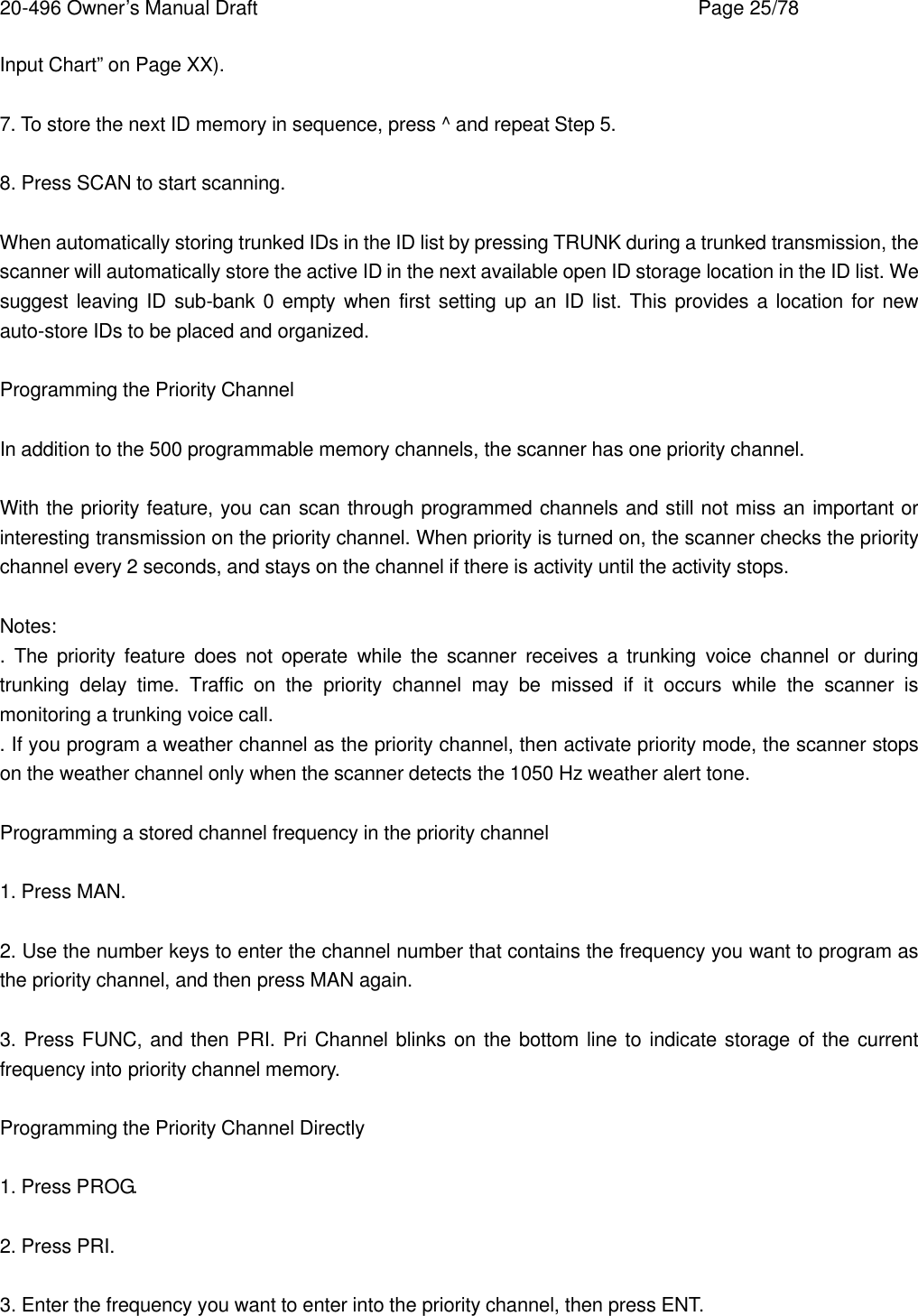
20-496 Owner’s Manual Draft    Page 25/78 Input Chart” on Page XX).  7. To store the next ID memory in sequence, press ^ and repeat Step 5.  8. Press SCAN to start scanning.  When automatically storing trunked IDs in the ID list by pressing TRUNK during a trunked transmission, the scanner will automatically store the active ID in the next available open ID storage location in the ID list. We suggest leaving ID sub-bank 0 empty when first setting up an ID list. This provides a location for new auto-store IDs to be placed and organized.  Programming the Priority Channel  In addition to the 500 programmable memory channels, the scanner has one priority channel.  With the priority feature, you can scan through programmed channels and still not miss an important or interesting transmission on the priority channel. When priority is turned on, the scanner checks the priority channel every 2 seconds, and stays on the channel if there is activity until the activity stops.  Notes: .  The priority feature does not operate while the scanner receives a trunking voice channel or during trunking  delay time. Traffic on the priority channel may be missed if it occurs while the scanner is monitoring a trunking voice call. . If you program a weather channel as the priority channel, then activate priority mode, the scanner stops on the weather channel only when the scanner detects the 1050 Hz weather alert tone.  Programming a stored channel frequency in the priority channel  1. Press MAN.  2. Use the number keys to enter the channel number that contains the frequency you want to program as the priority channel, and then press MAN again.  3. Press FUNC, and then PRI. Pri Channel blinks on the bottom line to indicate storage of the current frequency into priority channel memory.  Programming the Priority Channel Directly  1. Press PROG.  2. Press PRI.  3. Enter the frequency you want to enter into the priority channel, then press ENT.
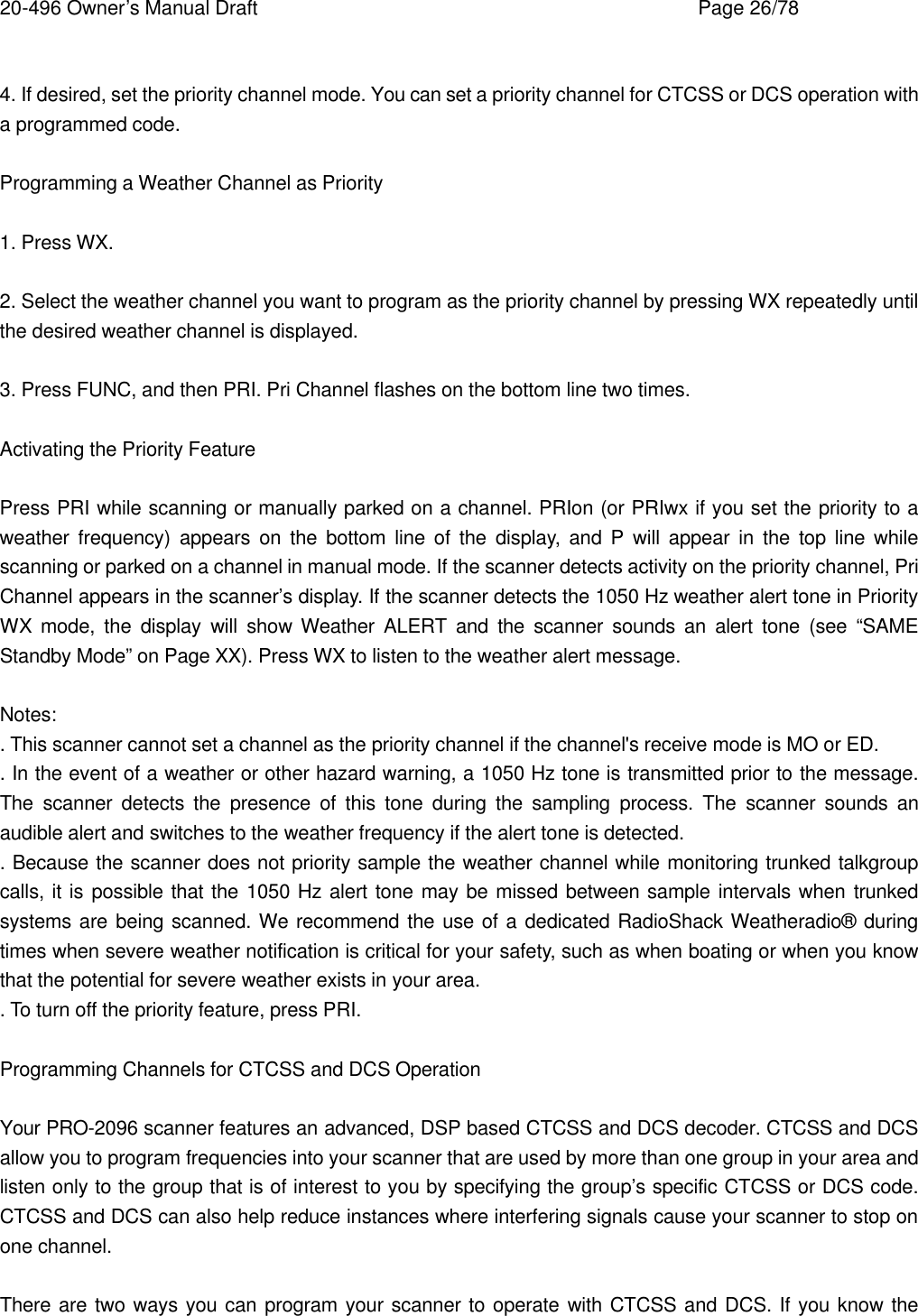
20-496 Owner’s Manual Draft    Page 26/78  4. If desired, set the priority channel mode. You can set a priority channel for CTCSS or DCS operation with a programmed code.  Programming a Weather Channel as Priority  1. Press WX.  2. Select the weather channel you want to program as the priority channel by pressing WX repeatedly until the desired weather channel is displayed.  3. Press FUNC, and then PRI. Pri Channel flashes on the bottom line two times.  Activating the Priority Feature  Press PRI while scanning or manually parked on a channel. PRIon (or PRIwx if you set the priority to a weather frequency) appears on the bottom line of the display, and P will appear in the top line while scanning or parked on a channel in manual mode. If the scanner detects activity on the priority channel, Pri Channel appears in the scanner’s display. If the scanner detects the 1050 Hz weather alert tone in Priority WX mode, the display will show Weather ALERT and the scanner sounds an alert tone (see “SAME Standby Mode” on Page XX). Press WX to listen to the weather alert message.  Notes: . This scanner cannot set a channel as the priority channel if the channel's receive mode is MO or ED. . In the event of a weather or other hazard warning, a 1050 Hz tone is transmitted prior to the message. The scanner detects the presence of this tone during the sampling process. The scanner sounds an audible alert and switches to the weather frequency if the alert tone is detected. . Because the scanner does not priority sample the weather channel while monitoring trunked talkgroup calls, it is possible that the 1050 Hz alert tone may be missed between sample intervals when trunked systems are being scanned. We recommend the use of a dedicated RadioShack Weatheradio® during times when severe weather notification is critical for your safety, such as when boating or when you know that the potential for severe weather exists in your area. . To turn off the priority feature, press PRI.  Programming Channels for CTCSS and DCS Operation  Your PRO-2096 scanner features an advanced, DSP based CTCSS and DCS decoder. CTCSS and DCS allow you to program frequencies into your scanner that are used by more than one group in your area and listen only to the group that is of interest to you by specifying the group’s specific CTCSS or DCS code. CTCSS and DCS can also help reduce instances where interfering signals cause your scanner to stop on one channel.  There are two ways you can program your scanner to operate with CTCSS and DCS. If you know the
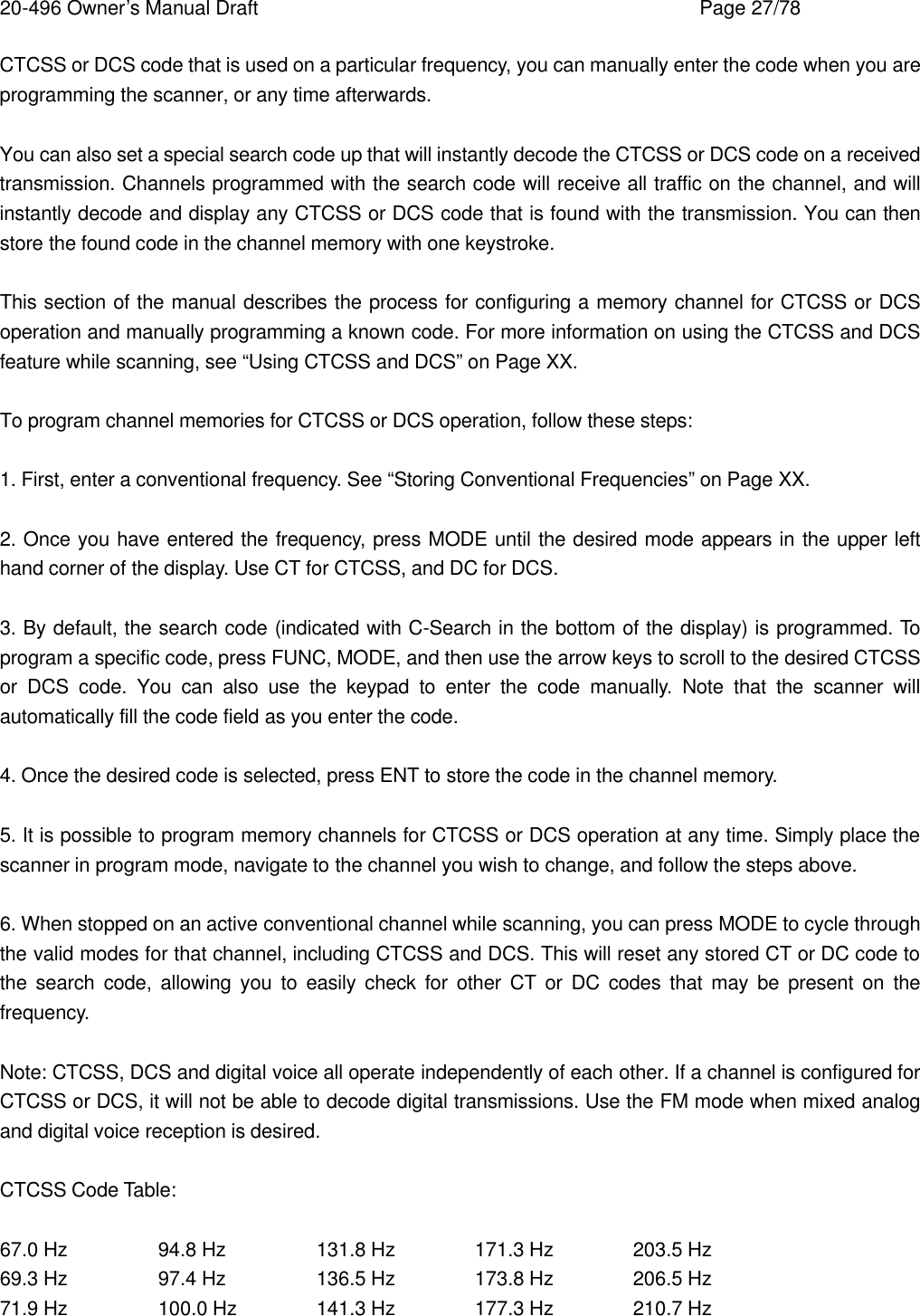
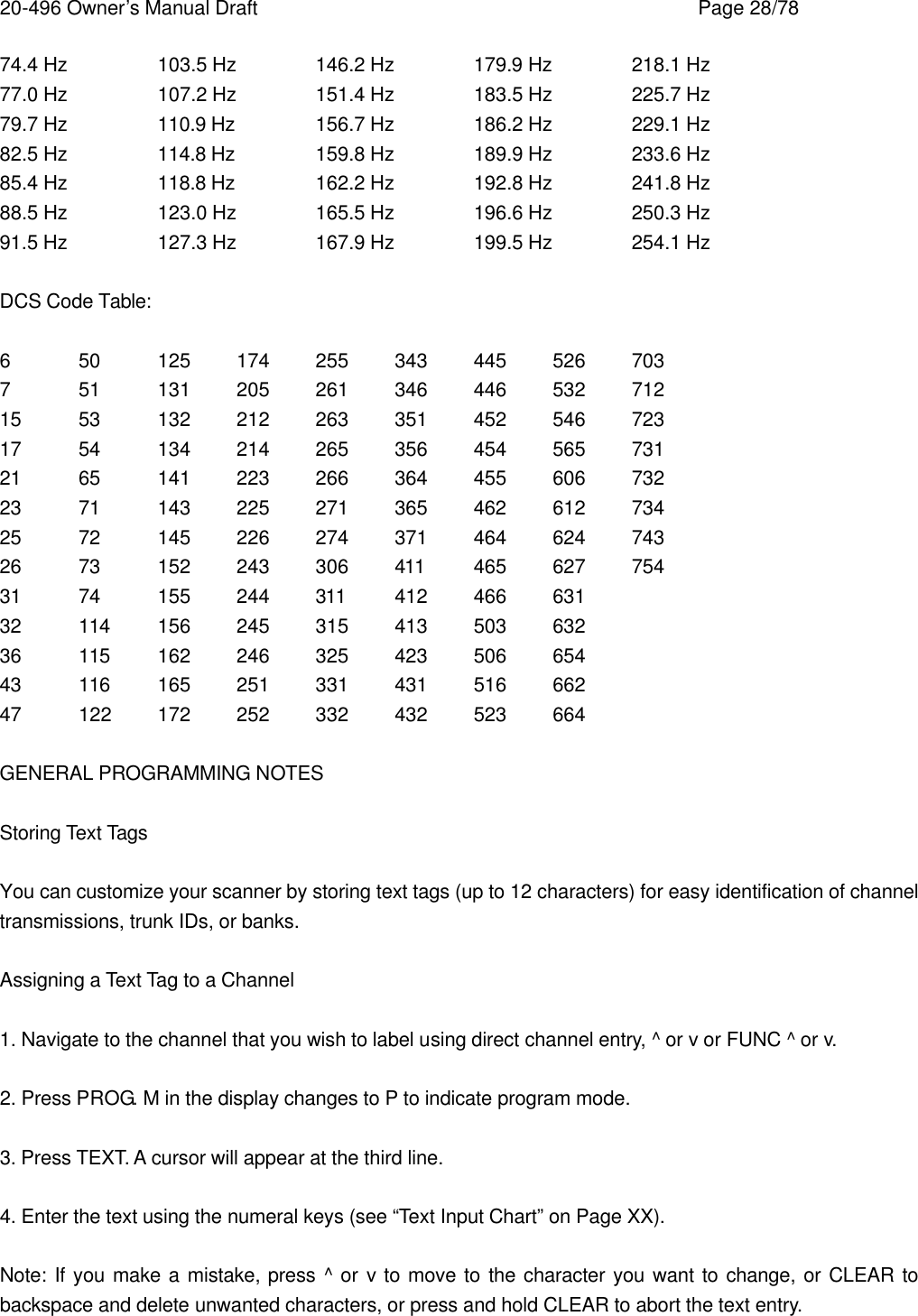
20-496 Owner’s Manual Draft    Page 27/78 CTCSS or DCS code that is used on a particular frequency, you can manually enter the code when you are programming the scanner, or any time afterwards.  You can also set a special search code up that will instantly decode the CTCSS or DCS code on a received transmission. Channels programmed with the search code will receive all traffic on the channel, and will instantly decode and display any CTCSS or DCS code that is found with the transmission. You can then store the found code in the channel memory with one keystroke.  This section of the manual describes the process for configuring a memory channel for CTCSS or DCS operation and manually programming a known code. For more information on using the CTCSS and DCS feature while scanning, see “Using CTCSS and DCS” on Page XX.  To program channel memories for CTCSS or DCS operation, follow these steps:  1. First, enter a conventional frequency. See “Storing Conventional Frequencies” on Page XX.  2. Once you have entered the frequency, press MODE until the desired mode appears in the upper left hand corner of the display. Use CT for CTCSS, and DC for DCS.  3. By default, the search code (indicated with C-Search in the bottom of the display) is programmed. To program a specific code, press FUNC, MODE, and then use the arrow keys to scroll to the desired CTCSS or DCS code. You can also use the keypad to enter the code manually. Note that the scanner will automatically fill the code field as you enter the code.  4. Once the desired code is selected, press ENT to store the code in the channel memory.  5. It is possible to program memory channels for CTCSS or DCS operation at any time. Simply place the scanner in program mode, navigate to the channel you wish to change, and follow the steps above.  6. When stopped on an active conventional channel while scanning, you can press MODE to cycle through the valid modes for that channel, including CTCSS and DCS. This will reset any stored CT or DC code to the search code, allowing you to easily check for other CT or DC codes that may be present on the frequency.  Note: CTCSS, DCS and digital voice all operate independently of each other. If a channel is configured for CTCSS or DCS, it will not be able to decode digital transmissions. Use the FM mode when mixed analog and digital voice reception is desired.  CTCSS Code Table:  67.0 Hz    94.8 Hz    131.8 Hz   171.3 Hz   203.5 Hz 69.3 Hz    97.4 Hz    136.5 Hz   173.8 Hz   206.5 Hz 71.9 Hz    100.0 Hz   141.3 Hz   177.3 Hz   210.7 Hz
20-496 Owner’s Manual Draft    Page 28/78 74.4 Hz    103.5 Hz   146.2 Hz   179.9 Hz   218.1 Hz 77.0 Hz    107.2 Hz   151.4 Hz   183.5 Hz   225.7 Hz 79.7 Hz    110.9 Hz   156.7 Hz   186.2 Hz   229.1 Hz 82.5 Hz    114.8 Hz   159.8 Hz   189.9 Hz   233.6 Hz 85.4 Hz    118.8 Hz   162.2 Hz   192.8 Hz   241.8 Hz 88.5 Hz    123.0 Hz   165.5 Hz   196.6 Hz   250.3 Hz 91.5 Hz    127.3 Hz   167.9 Hz   199.5 Hz   254.1 Hz  DCS Code Table:  6 50 125 174 255 343 445 526 703 7 51 131 205 261 346 446 532 712 15 53 132 212 263 351 452 546 723 17 54 134 214 265 356 454 565 731 21 65 141 223 266 364 455 606 732 23 71 143 225 271 365 462 612 734 25 72 145 226 274 371 464 624 743 26 73 152 243 306 411 465 627 754 31 74 155 244 311 412 466 631 32 114 156 245 315 413 503 632 36 115 162 246 325 423 506 654 43 116 165 251 331 431 516 662 47 122 172 252 332 432 523 664  GENERAL PROGRAMMING NOTES  Storing Text Tags  You can customize your scanner by storing text tags (up to 12 characters) for easy identification of channel transmissions, trunk IDs, or banks.  Assigning a Text Tag to a Channel  1. Navigate to the channel that you wish to label using direct channel entry, ^ or v or FUNC ^ or v.  2. Press PROG. M in the display changes to P to indicate program mode.  3. Press TEXT. A cursor will appear at the third line.  4. Enter the text using the numeral keys (see “Text Input Chart” on Page XX).  Note: If you make a mistake, press ^ or v to move to the character you want to change, or CLEAR to backspace and delete unwanted characters, or press and hold CLEAR to abort the text entry.
20-496 Owner’s Manual Draft    Page 29/78  For example, to identify a channel as “FIRE Ch 6” (for “Fire Channel 6”):  “F” is the third letter associated with 3 on the keypad. Press 3, and then 3.  “I” is the third letter associated with 4 on the keypad. Press 4, and then 3.  “R” is the third letter associated with 7 on the keypad. Press 7, and then 3.  “E” is the second letter associated with 3 on the keypad. Press 3, and then 2.  Space is entered by pressing ./DELAY.  “C” is the third letter associated with 2 on the keypad. Press 2, and then 3.  “h” is the second letter associated with 4 on the keypad. Press 4, and then FUNC (for the lower case set),and then press 2.  Space is entered by pressing ./DELAY.  “6” is the sixth number associated with 1 on the keypad. Press 1, and then 6.  5. Press ENT to store the text with the channel.  Assigning a Text Tag to a Group ID  1. Press PROG.  2. Press TRUNK.  3. Press FUNC then ^ or v to select the desired bank.  4. Press TRUNK to select the desired sub-bank.  5. Press or hold down ^ or v to select the desired group ID.  6. Press TEXT then enter the text using the numeral keys (see “Text Input Chart” on Page XX). Use ^, v, or CLEAR to edit your entry, or press and hold CLEAR to abort the text entry.  7. Press ENT to store the text with the ID.  Assigning a Text Tag to a Channel Storage Bank
20-496 Owner’s Manual Draft    Page 30/78 1. Select a channel within the desired channel storage bank by pressing MAN and entering the channel storage bank number (000 for bank 0 or 200 for bank 2, for example). Press MAN again.  2. Press PROG.  3. Press FUNC, and then 7. The cursor appears at the third line of the display. Enter the text using the keypad. (See “Text Input Chart”). Use ^, v, or CLEAR to edit your entry, or press and hold CLEAR to abort the text entry.  4. Press ENT to store the text with the bank.  Text Input Chart  Press Character    Press Character 1 1 2 3 4 5 6 7 8 9 0 2 A B C   2 FUNC a b c 3 D E F   3 FUNC d e f 4 G H I   4 FUNC g h i 5 J K L   5 FUNC j k l 6 M N O   6 FUNC m n o 7 P Q R S   7 FUNC p q r s 8 T U V   8 FUNC t u v 9 W X Y Z   9 FUNC w x y z 0 . - # _ @ + * & / ,    0 FUNC $ % ! ^ ( ) ? -> ‘ <- ./DELAY Space   CLEAR Backspace  Notes: . To enter a number, press 1, then press the desired number you want to enter. .  To enter a lowercase character or a character from the second set for the key 0, press FUNC after pressing the first numeral key.   OPERATING YOUR SCANNER  INITIAL PREPARATION  Turning on the Scanner and Setting Squelch  1. To turn on the scanner, turn VOL (volume) clockwise. DSP loading message and Welcome To Digital Trunking appears in the display. After about 5 seconds, you might hear a rushing sound. Then adjust VOL to a comfortable level.  2. Turn SQ (squelch) fully counterclockwise until the indicator points to OFF, then turn SQ clockwise until
20-496 Owner’s Manual Draft    Page 31/78 the rushing sound stops.  3. To turn off the scanner, turn VOL counterclockwise to OFF.  Notes: . The scanner will not enter scan mode if there are no frequencies stored in channels, or if all channels are locked out in the channel storage bank(s) that you are attempting to scan. In either of these cases, the scanner will display All channels Locked out! See “Programming Your Scanner” on Page XX. . If SQ is adjusted so you always hear a rushing sound, the scanner will not scan properly. Rotate the squelch control until the rushing sound stops. . If SQ is adjusted precisely at the threshold where the rushing sound stops, the radio will be most sensitive to very weak signals. The radio may also receive unwanted noise or signals that are too weak to understand. Most users prefer to position the squelch control a little bit past the point of threshold to avoid receiving noise or signals that are too weak to understand.  Scanning  To begin scanning channels or to start scanning again after monitoring a specific channel, press SCAN.  Notes: . You must store frequencies into channels before the scanner can scan them. The scanner does not scan through empty channels. . To change the scanning direction, press ^ or v while scanning.  The scanner scans through all channels (except those you have locked out) in the active channel storage banks (see “Turning Channel Storage Banks Off and On” on Page XX and “Locking Out Channels or Frequencies” on Page XX).  Turning Channel Storage Banks Off and On  To turn off channel storage banks while scanning, press the bank's number key so the bank's number disappears. For example, to turn off bank 1, press 1. The scanner does not scan any of the channels within the banks you turned off.  To turn on channel storage banks while scanning, press the number key until the bank’s number appears. For example to turn bank 1 on again, press 1.  You cannot turn off all channel storage banks. There must be at least one active channel storage bank.  You can manually select any channel in a channel storage bank, even if the bank is turned off.  Monitoring a Single Channel
20-496 Owner’s Manual Draft    Page 32/78 You can monitor a single channel with your scanner by navigating to that channel while in manual mode. The scanner will receive traffic on the selected frequency.  Using CTCSS and DCS  Your scanner’s advanced, DSP based CTCSS and DCS decoder allows you to listen only to the group that is of interest to you by specifying the group’s specific CTCSS or DCS code for a certain frequency. CTCSS and DCS can also help reduce instances where interfering signals cause your scanner to stop on one channel.  When your scanner stops on a conventional frequency that is configured for CTCSS or DCS, it checks for a match between the transmitted CTCSS or DCS code and the code that is stored with the channel memory. If the transmitted and stored codes match, the scanner stops on the transmission and allows the audio to pass to the speaker. If the codes do not match, the scanner resumes scan operation. If the special “search” code is in use, the scanner will instantly display any detected CTCSS code if programmed for CTCSS mode, or DCS code if programmed for DCS code. You can store the detected code into the channel memory by pressing ENT while the code is displayed.  For more information about your scanner’s receive modes, including CTCSS and DCS, see “Understanding Your Scanner’s Channel Receive Modes” on Page XX. For information on programming memory channels for CTCSS or DCS operation, see “Programming channels for CTCSS and DCS operation” on Page XX.  Deleting Frequencies from Channels  In certain circumstances you may wish to completely clear the contents of a channel. One example would be to create empty channels in a selected channel storage bank so the frequency copy function has empty channels available for copied frequencies. (See “Copying a Frequency into a Vacant Channel in a Specified Bank” on Page XX.)  1. Press PROG.  2. Use the number keys and press PROG to select the channel with the frequency you want to delete, or use the ^ or v keys to navigate to the desired channel.  3. Press FUNC, and then CLEAR. The frequency is cleared, 0.0000 appears in the display.  SEARCHING AND TUNING  Finding and Storing Active Frequencies  You can search for transmissions using the scanner’s preprogrammed search banks. The search banks include six preprogrammed search ranges, SR0 to SR5. You can change the search range of Bank SR6
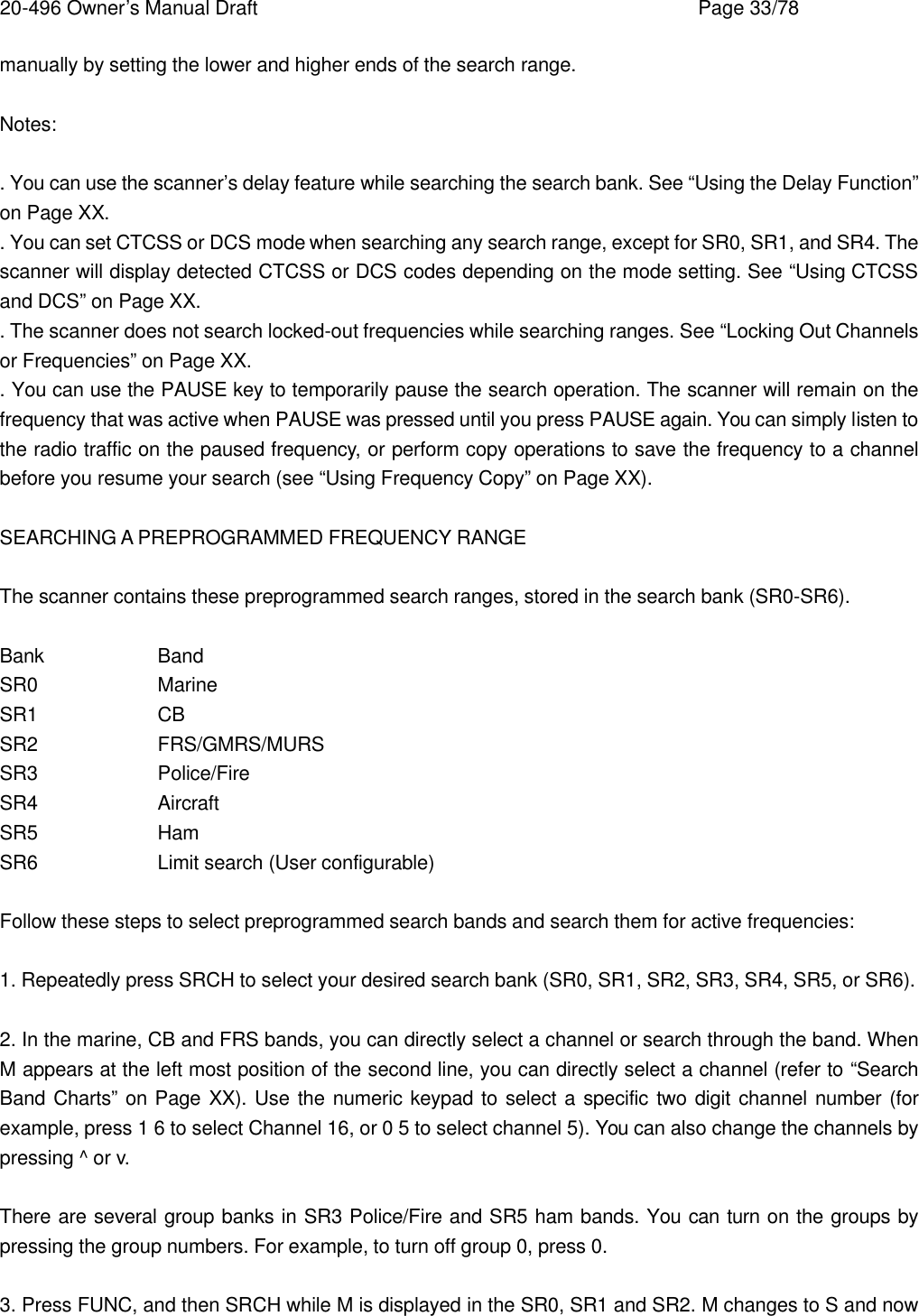
20-496 Owner’s Manual Draft    Page 33/78 manually by setting the lower and higher ends of the search range.  Notes:  . You can use the scanner’s delay feature while searching the search bank. See “Using the Delay Function” on Page XX. . You can set CTCSS or DCS mode when searching any search range, except for SR0, SR1, and SR4. The scanner will display detected CTCSS or DCS codes depending on the mode setting. See “Using CTCSS and DCS” on Page XX. . The scanner does not search locked-out frequencies while searching ranges. See “Locking Out Channels or Frequencies” on Page XX. . You can use the PAUSE key to temporarily pause the search operation. The scanner will remain on the frequency that was active when PAUSE was pressed until you press PAUSE again. You can simply listen to the radio traffic on the paused frequency, or perform copy operations to save the frequency to a channel before you resume your search (see “Using Frequency Copy” on Page XX).  SEARCHING A PREPROGRAMMED FREQUENCY RANGE  The scanner contains these preprogrammed search ranges, stored in the search bank (SR0-SR6).  Bank    Band SR0    Marine SR1    CB SR2    FRS/GMRS/MURS SR3    Police/Fire SR4    Aircraft SR5    Ham SR6    Limit search (User configurable)  Follow these steps to select preprogrammed search bands and search them for active frequencies:  1. Repeatedly press SRCH to select your desired search bank (SR0, SR1, SR2, SR3, SR4, SR5, or SR6).  2. In the marine, CB and FRS bands, you can directly select a channel or search through the band. When M appears at the left most position of the second line, you can directly select a channel (refer to “Search Band Charts” on Page XX). Use the numeric keypad to select a specific two digit channel number (for example, press 1 6 to select Channel 16, or 0 5 to select channel 5). You can also change the channels by pressing ^ or v.  There are several group banks in SR3 Police/Fire and SR5 ham bands. You can turn on the groups by pressing the group numbers. For example, to turn off group 0, press 0.  3. Press FUNC, and then SRCH while M is displayed in the SR0, SR1 and SR2. M changes to S and now
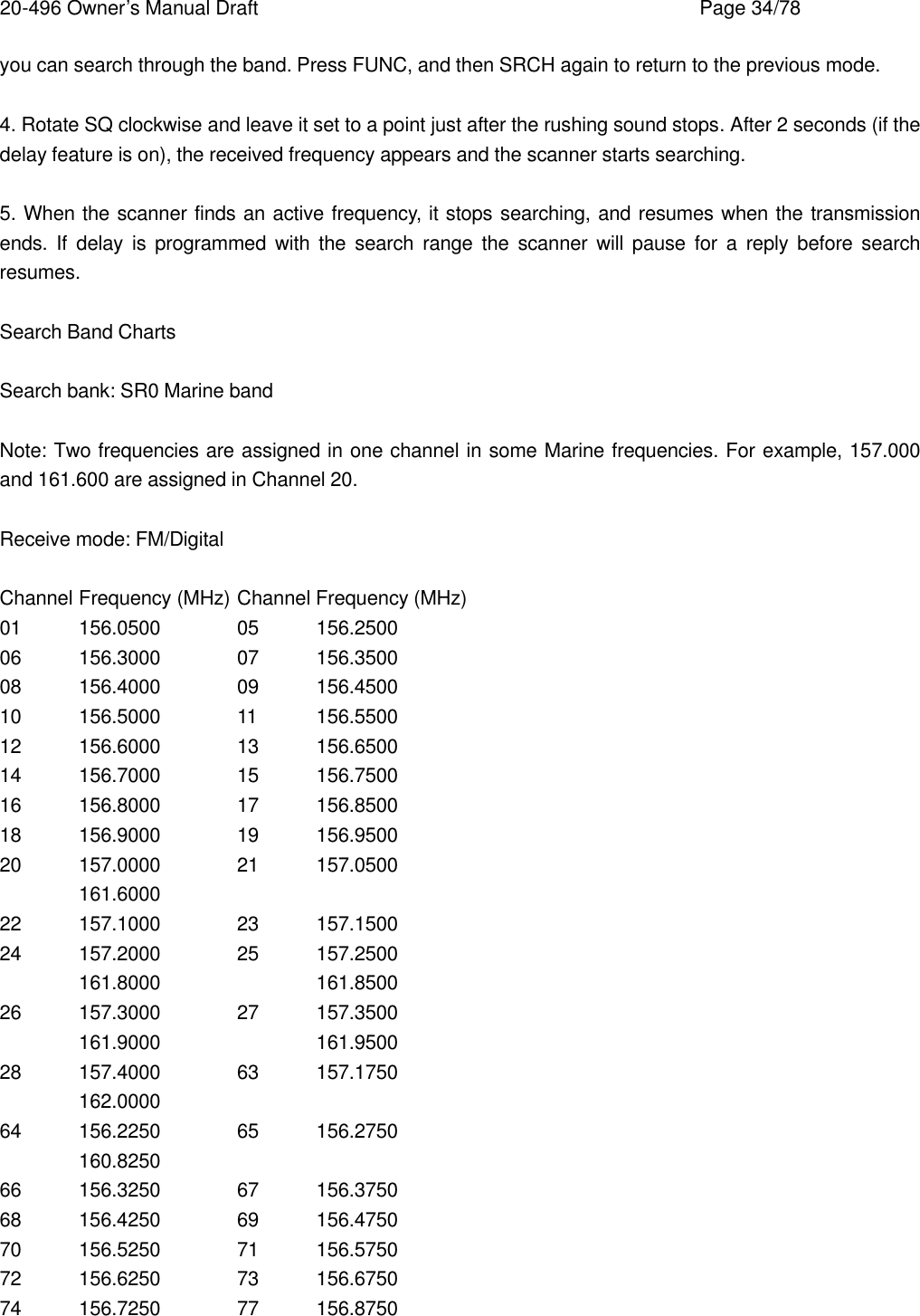
20-496 Owner’s Manual Draft    Page 34/78 you can search through the band. Press FUNC, and then SRCH again to return to the previous mode.  4. Rotate SQ clockwise and leave it set to a point just after the rushing sound stops. After 2 seconds (if the delay feature is on), the received frequency appears and the scanner starts searching.  5. When the scanner finds an active frequency, it stops searching, and resumes when the transmission ends. If delay is programmed with the search range the scanner will pause for a reply before search resumes.  Search Band Charts  Search bank: SR0 Marine band  Note: Two frequencies are assigned in one channel in some Marine frequencies. For example, 157.000 and 161.600 are assigned in Channel 20.  Receive mode: FM/Digital  Channel Frequency (MHz) Channel Frequency (MHz) 01 156.0500 05 156.2500 06 156.3000 07 156.3500 08 156.4000 09 156.4500 10 156.5000 11 156.5500 12 156.6000 13 156.6500 14 156.7000 15 156.7500 16 156.8000 17 156.8500 18 156.9000 19 156.9500 20 157.0000 21 157.0500 161.6000 22 157.1000 23 157.1500 24 157.2000 25 157.2500 161.8000    161.8500 26 157.3000 27 157.3500 161.9000    161.9500 28 157.4000 63 157.1750  162.0000 64 156.2250 65 156.2750  160.8250 66 156.3250 67 156.3750 68 156.4250 69 156.4750 70 156.5250 71 156.5750 72 156.6250 73 156.6750 74 156.7250 77 156.8750
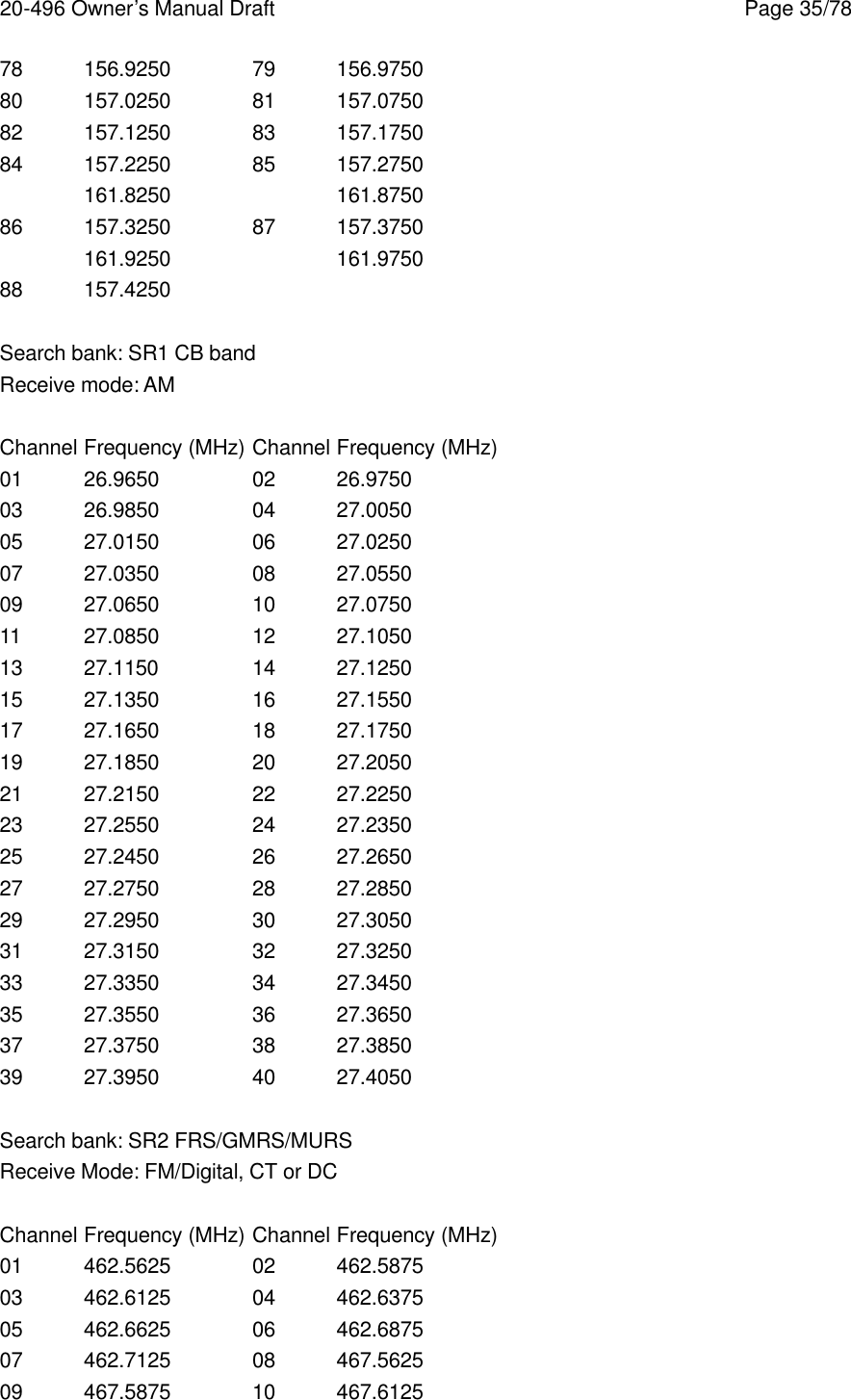
20-496 Owner’s Manual Draft    Page 35/78 78 156.9250 79 156.9750 80 157.0250 81 157.0750 82 157.1250 83 157.1750 84 157.2250 85 157.2750  161.8250    161.8750 86 157.3250 87 157.3750  161.9250    161.9750 88 157.4250  Search bank: SR1 CB band Receive mode: AM  Channel Frequency (MHz) Channel Frequency (MHz) 01 26.9650   02 26.9750 03 26.9850   04 27.0050 05 27.0150   06 27.0250 07 27.0350   08 27.0550 09 27.0650   10 27.0750 11 27.0850   12 27.1050 13 27.1150    14 27.1250 15 27.1350   16 27.1550 17 27.1650   18 27.1750 19 27.1850   20 27.2050 21 27.2150   22 27.2250 23 27.2550   24 27.2350 25 27.2450   26 27.2650 27 27.2750   28 27.2850 29 27.2950   30 27.3050 31 27.3150   32 27.3250 33 27.3350   34 27.3450 35 27.3550   36 27.3650 37 27.3750   38 27.3850 39 27.3950   40 27.4050  Search bank: SR2 FRS/GMRS/MURS Receive Mode: FM/Digital, CT or DC  Channel Frequency (MHz) Channel Frequency (MHz) 01 462.5625 02 462.5875 03 462.6125 04 462.6375 05 462.6625 06 462.6875 07 462.7125 08 467.5625 09 467.5875 10 467.6125
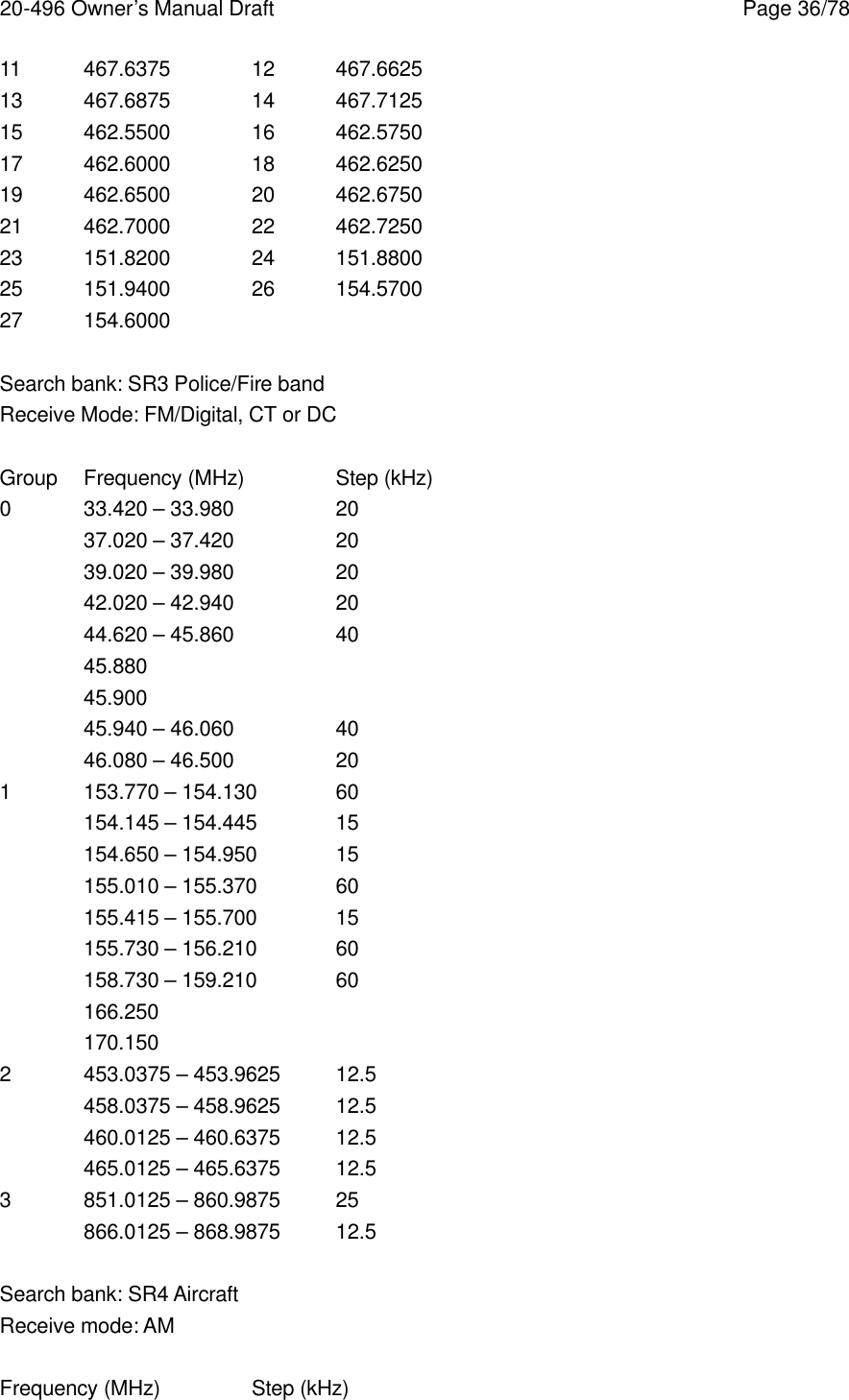
20-496 Owner’s Manual Draft    Page 36/78 11 467.6375 12 467.6625 13 467.6875 14 467.7125 15 462.5500 16 462.5750 17 462.6000 18 462.6250 19 462.6500 20 462.6750 21 462.7000 22 462.7250 23 151.8200 24 151.8800 25 151.9400 26 154.5700 27 154.6000  Search bank: SR3 Police/Fire band Receive Mode: FM/Digital, CT or DC  Group Frequency (MHz)   Step (kHz) 0 33.420 – 33.980    20 37.020 – 37.420    20 39.020 – 39.980    20 42.020 – 42.940    20 44.620 – 45.860    40 45.880 45.900 45.940 – 46.060    40 46.080 – 46.500    20 1 153.770 – 154.130 60 154.145 – 154.445 15 154.650 – 154.950 15 155.010 – 155.370 60 155.415 – 155.700 15 155.730 – 156.210 60 158.730 – 159.210 60 166.250 170.150 2 453.0375 – 453.9625 12.5 458.0375 – 458.9625 12.5 460.0125 – 460.6375 12.5 465.0125 – 465.6375 12.5 3 851.0125 – 860.9875 25 866.0125 – 868.9875 12.5  Search bank: SR4 Aircraft Receive mode: AM  Frequency (MHz)   Step (kHz)
20-496 Owner’s Manual Draft    Page 37/78 108.000 – 136.9875 12.5  Search bank: SR5 Ham band Receive mode: FM/Digital, CT, DC or AM (depending on group)  Group Frequency (MHz)   Step (kHz) 0 28.0000 – 29.7000 5 1 50.0000 – 54.0000 5 2 144.0000 – 148.0000 5 3 222.0000 – 225.0000 5 4 420.0000 – 450.0000 12.5 5 1240.0000 – 1300.0000 6.25  Search bank: SR6 Programmable limit search Receive mode: FM/Digital, AM, CT or DC  Searching Active Frequencies in Your Desired Frequency Range  You can search a specific range of frequencies by programming SR6 with lower and upper frequency limits.  1. Press PROG then SRCH. PSR (Program Search) appears in the top line and the cursor blinks L on the second line for the lower limit frequency.  2. Use the number keys and ./DELAY to enter the desired lower limit frequency (including the decimal point).  3. Press ENT to set the lower limit frequency. The cursor moves to upper frequency field. If the entered frequency is incorrect, Invalid Freq briefly appears in the scanner’s display.  4. Enter your desired upper frequency and press ENT.  5. Rotate SQ clockwise and leave it set to a point just after the rushing sound stops.  6. Press SRCH to start searching. When the scanner finds an active frequency, it stops searching.  USING ZEROMATIC  You can set Zeromatic on or off by pressing FUNC then 0. Press FUNC, and then 0 again to toggle the Zeromatic setting. When this feature is turned on, Zeromatic ON briefly appears in the display, then z appears at the first digit of the second line. When searching with Zeromatic on, the scanner will automatically tune to the correct center frequency (or the step increment closest to the correct center frequency). When searching with Zeromatic off, the scanner will unmute faster on a detected signal but the frequency may not be exact. If the scanner stops on a signal before it reaches the correct center frequency,
20-496 Owner’s Manual Draft    Page 38/78 you can step up or down to the correct frequency using the ^ or v keys. Zeromatic functions only in search banks 3, 4, 5 and 6.  USING SEEK SEARCH  While the scanner is searching, you can activate seek search by pressing FUNC then 7. Seek ON appears on the bottom line. The scanner stops on each active frequency for five seconds and resumes searching automatically.  . You can copy and save a frequency into a specified bank, channel, or priority channel when the scanner finds an active frequency. See “Using Frequency Copy” on Page XX to save the frequency. The frequency copy works only in search banks 1, 2, 3, 4, 5, and 6.  . There are several group banks in SR3 Police/Fire and SR5 ham bands. You can turn off or on the groups by pressing the group numbers. For example, to toggle group bank 0, press 0.  .  In the Air and Limit search bands, press FUNC then press ^ to start searching up from the lowest frequency or press v to start searching down from the highest frequency.  . You can press ^ or v at any time to change the search direction, or force a search resume while stopped on an active frequency.  . Use ^ or v while paused to increment the frequency one step at a time.  MANUALLY TUNING A FREQUENCY  You can manually set the scanner to move through all receivable frequencies, or select a specific frequency as a starting point.  1. Press TUNE. TUNE, the current frequency, and ** PAUSED ** appear in the display.  2. Use the number keys to enter the frequency where you want the scanner to start.  3. Press ENT to store the frequency. Use the arrow keys to step up and down from the stored frequency, or press PAUSE to begin automatic tuning.  4. While automatic tuning, press ^ or v to change the direction of the tune. When the scanner finds an active frequency, it stops on the frequency.  Note: If you press PAUSE while tuning, the scanner stops tuning and **PAUSED** appears in the display. Press PAUSE again, and the scanner resumes tuning. While tune mode is paused, you can step up or down one frequency at a time by using the ^ or v keys.
20-496 Owner’s Manual Draft    Page 39/78 USING FREQUENCY COPY  You can easily copy a frequency into a specified channel, a vacant channel in a specified bank, or a priority channel. This feature provides and easy method of storing frequencies of interest you encounter while searching or tuning.  Note: You cannot copy a frequency from the Marine search bands.  COPYING A FREQUENCY INTO A SPECIFIED CHANNEL  You can copy a frequency into a specified channel when the scanner stops on that frequency during search mode or manual tuning. If a CTCSS or DCS code is detected on the transmission, the detected code will be copied into the channel memory as well.  Note: If you try to copy a frequency that is already stored, the scanner sounds the notice tone 3 times after you press ENT. Dupl.f Chxxx appears at the bottom line. If you want to copy the duplicate frequency anyway, press ENT, or if not, press CLEAR to cancel.  1. Press FUNC, and then PROG when you find a frequency. Chan Store? appears on the bottom line. After about 1 second, the frequency to be copied flashes on the indicator.  2. Press the desired bank and the channel number where you want to store the frequency. The display indicates the bank and channel number, and briefly displays the frequency that is currently programmed into the selected channel. You can repeat this step as needed until you find an acceptable destination channel. After about 1 second, the frequency to be copied flashes.  3. Press ENT. All the conditions such as receive mode and delay condition are copied onto the channel. Chan Store! briefly appears in the scanner’s display. The scanner automatically returns to search mode.  COPYING A FREQUENCY INTO A VACANT CHANNEL IN A SPECIFIED BANK  You can copy a frequency into a vacant channel in a specified bank when the scanner stops on the frequency during search or tune mode.  Note: If you try to copy a frequency that is already stored in the same bank, the scanner sounds the notice tone 3 times after you press ENT. Dupl.f Chxxx appears at the bottom line. If you want to copy the duplicate frequency anyway, press ENT, or if not, press CLEAR to cancel.  1. Press FUNC, and then ENT when you find a frequency you want to copy. Bank9 Store? appears in the scanner’s display.  2. If you want to copy the frequency into bank 9, press ENT. It is stored in the first available vacant channel in the bank. Or, press your desired bank number to store, then press ENT to store the frequency in the
20-496 Owner’s Manual Draft    Page 40/78 selected bank. Chan Store! appears for 2 seconds. All the conditions such as receiving mode and delay condition are copied on the channel. After about 2 seconds, the scanner automatically returns to search mode.  COPING A FREQUENCY INTO THE PRIORITY CHANNEL  You can copy a frequency into the priority channel (see “Programming the Priority Channel” on Page XX) when the scanner stops on the frequency during Search, Scan, Manual, Tune, or WX mode.  Press FUNC, and then PRI when the frequency is on the display. The display flashes twice and the frequency is copied to the priority channel.   SPECIAL FEATURES  LISTENING TO THE WEATHER BAND  The FCC (Federal Communications Commission) has allocated channels for use by the National Oceanic and Atmospheric Administration (NOAA). Regulatory agencies in other countries have also allocated channels for use by their weather reporting authorities.  NOAA and your local weather reporting authority broadcast your local forecast and regional weather information on one or more of these channels.  LISTENING TO A WEATHER CHANNEL  To hear your local forecast and regional weather information, press WX. Your scanner scans through the weather band then stops on the first active weather frequency. Press WX repeatedly to find the strongest weather frequency for your location. If necessary, use ATT to apply attenuation to weather channels with interference.  SAME Standby Mode  The National Weather Service precedes each weather alert with a digitally encoded SAME (Specific Area Message Encoding) signal, then a 1050 Hz tone. The SAME signal includes a FIPS (Federal Information Processing Standard) area code, and an event code that corresponds with the type of alert being sent. You can configure your scanner to operate in SAME Standby mode, where it monitors a selected weather radio station for SAME alerts for areas you specify. You can program your scanner with up to 10 FIPS codes for the areas you desire. The National Weather Service maintains a current list of FIPS codes at http://www.nws.noaa.gov/nwr/ .  To configure your scanner for SAME Standby mode, follow these steps:
20-496 Owner’s Manual Draft    Page 41/78 1. Press WX until you identify the weather station with the strongest signal for your location.  2. Press FUNC, and then PROG to access the FIPS code entry table.  3. Use the ^ or v keys to select the desired FIPS code storage location.  4. Use the numeric keys to enter the desired FIPS code, and then press ENT to store the code. Press TEXT to label the code entry with an alphanumeric text table if desired. Repeat this process for all the FIPS codes that you wish to store.  5. Press L/OUT to lock out or enable specific FIPS entries.  6. Press WX to exit the FIPS code entry table.  Notes: . Press WX, then the numeric keys 0-9 to quickly review stored FIPS codes. Press L/OUT to toggle lockout status. . Your scanner can also detect the 1050 Hz weather alert tone when a weather channel is set as the priority channel and weather priority operation is enabled. (see “Programming a Weather Channel as Priority” on Page XX). In this mode all alerts are received. FIPS settings are ignored. . The scanner sounds an alert or beep when it receives the SAME code. If you do not stop the alert (or beep) for five minutes, the alert stops and the scanner beeps every ten seconds. If the scanner receives a new message after five minutes, it sounds the alert or beep. To stop the sound and ready the scanner to receive a new alert signal before the five minute time out, press any key except DIM.  7. Press FUNC, and then WX to initiate SAME standby. The scanner will monitor the selected weather radio station for alerts with FIPS codes that match the codes you entered in the FIPS entry table. To exit SAME standby, press FUNC, and then WX.  Weather Alert Alarm Demonstration  To hear the SAME weather alert alarms, press WX for more than 2 seconds while SAME Standby is active.  The display indicates the type of message, and the scanner sounds the alarm associated with that type of message. The alarm sound changes automatically every 3 seconds.  Press any key except DIM to end the alarm demonstration mode.  USING THE DELAY FUNCTION  You can configure your conventional, non-trunked channels for a 2 second delay to avoid missing reply traffic on the same channel. When delay is set for a conventional channel, the scanner will pause for reply traffic before resuming the scan operation.
20-496 Owner’s Manual Draft    Page 42/78  To toggle the delay setting for a channel, press./DELAY.  Notes: . Delay is automatically set as the default for each channel when you turn on the scanner. . The delay function operates differently when monitoring trunked radio systems. For more information, see “Trunked Delay Function” on Page XX.  LOCKING OUT CHANNELS OR FREQUENCIES  You can lock out channels to force the scanner to skip and ignore any traffic while scanning. You can also lock out up to 50 frequencies while searching to skip undesired transmissions.  Locking Out Channels  To lock out a channel while scanning, press L/OUT when the scanner stops on the channel.  To lock out a channel manually, select the channel then press L/OUT so L appears in the scanner’s display.  Notes: . You can still manually select and monitor locked-out channels. .  Locking out a channel with an active trunking control channel will disable monitoring of that trunking system.  To remove the lockout from a channel, manually select the channel and press L/OUT so L disappears.  Reviewing the Lock-Out Channels  To review all locked out channels, press MAN, and then repeatedly press FUNC and then L/OUT. The scanner will advance to the next locked out channel each time you press FUNC, and then L/OUT.  Locking Out Search Frequencies  To lock out a frequency during a search, press L/OUT when the scanner stops on that frequency. The scanner will lock out the frequency and continues searching.  Notes: . You can lock out as many as 50 frequencies in each search bank. If you try to lock out more, Memory full! will appear in the display, and you will be unable to lock out any more frequencies until some have been cleared. See “Clearing a Locked-Out Search Frequency” on Page XX”. . If you lock out all frequencies in one search bank and only this search bank is activated, All ranges Locked out! appears in the display and the scanner will not search.
20-496 Owner’s Manual Draft    Page 43/78 Reviewing Locked-Out Search Frequencies  To review the frequencies within a search bank that you locked out:  1. Press SRCH to set search mode, and select the desired search bank to review its locked out frequencies.  2. Press FUNC and then L/OUT. The last locked-out frequency and Lockout list appear. Press ^ or v to scroll through the list. The locked-out number and the total locked-out number also appears as L/O XX of YY. (The tenth of twenty five locked out frequencies would appear as L/O 10 of 25). If the search bank has no locked-out frequencies, Empty. Lockout list appears in the scanner’s display. Press SRCH to cancel reviewing locked-out frequencies.  Clearing a Locked-Out Search Frequency  To clear a locked-out frequency, select that frequency (see “Reviewing the Lock-Out Channels” on Page XX), and then press CLEAR.  If all locked-out frequencies are cleared within a channel storage bank, Empty. Lockout list appears in the scanner’s display.  Clearing All Locked-Out Frequencies in a Search Bank  1. Press SRCH.  2. Select the search bank in which you want to clear all locked-out frequencies.  3. Press FUNC and then press L/OUT. Lockout list appears in the scanner’s display.  4. Press FUNC and then 6. The scanner will display Confirm list clear? 1=YES Press other key for NO. Press 1 to clear all locked-out frequencies. List cleared appears for about 2 seconds. Press any key other than 1 to cancel clear.  CHANGING THE RECEIVE MODE  The scanner defaults to the commonly used AM or FM/Digital receive mode for each frequency range. The preset mode is correct in most cases. However, some amateur radio transmissions and trunked systems do not operate in the preset mode. If you try to listen to a transmission when the scanner is not set to the correct receive mode, the transmission might sound weak or distorted.  To change the receive mode, repeatedly press MODE. The receive mode changes as follows:  AM – configures the channel for AM mode.
20-496 Owner’s Manual Draft    Page 44/78  FM/DIGITAL– configures the channel for the FM/DIGITAL mode.  CT – configures the channel for CTCSS mode.  DC – configures the channel for DCS mode.  MO – configures the channel for the MO mode for analog or digital Motorola trunking system channels, or APCO-25 trunking system channels.  Note: MO  and ED modes are not available when performing service searches, limit searches and the TUNE function.  ED – configures the channel for the ED mode for EDACS trunking system channels.  USING THE ATTENUATOR  To reduce interference or noise caused by strong signals, you can reduce the scanner’s sensitivity with the attenuator.  There are two attenuator modes in your scanner. Normal attenuator mode allows you to set the attenuator on a per-channel basis. Normal mode is useful when individual channels are found to be prone to interference.  Global attenuator mode applies attenuation to every channel in the scanner, and overrides any normal mode attenuator settings that you may have entered  To assign attenuation to a channel in the scanner:  Press ATT when the scanner is stopped on a channel, or by manually navigating to a channel by using direct channel entry or pressing the ^ or v arrow keys. A will appear in the top line of the display. Press ATT again to toggle attenuation off.  To assign attenuation to a search bank:  Press ATT while searching. Attenuation will be applied to the active search bank, or search group within a search bank. Press ATT again to turn attenuation off.  Notes: . The attenuator is very effective at reducing strong signal overload interference when using the scanner in areas close to cellular telephone transmitting facilities. . If you turn on the attenuator, the scanner might not receive weak signals. . Activating the normal attenuator mode on a Motorola or APCO Project 25 trunking control channel will
20-496 Owner’s Manual Draft    Page 45/78 apply attenuation to all calls received on that trunking system. You can press ATT during a trunking call or while manually tuned to a system control channel to toggle attenuation on or off for the trunking system.  To use the global attenuator:  1. Press FUNC and then ATT to set the attenuator to global mode. Global ATT will appear for 2 seconds at the bottom line, and then ATT- appears in the scanner’s display while scanning.  2. Press ATT to activate the attenuator. ATTon appears in the bottom line of the display. When the scanner is stopped on a channel or searching, a will appear in the top line of the display. Press ATT to toggle global attenuation off. ATT- appears on the bottom line of the display while scanning.  3. Press FUNC and then ATT again to turn off the global attenuation mode. Normal ATT appears on the bottom line for about 2 seconds.  TURNING THE KEY TONE ON AND OFF  Each time you press any of the scanner’s keys, the scanner sounds a tone. You can turn the scanner’s key tone off or on.  1. If the scanner is on, turn VOL OFF/MAX counterclockwise until it clicks to turn the scanner off.  2. Turn VOL OFF/MAX clockwise to turn the scanner on. Welcome To Digital Trunking appears in the scanner’s display.  3. While Welcome To Digital Trunking appears, press 1 to turn on the key tone or 2 to turn it off.  USING Dimmer  You can change back lighting brightness using DIM. Pressing DIM key to rotate Dark lighting, Light Off, and Light.  CHANGING THE DISPLAY CONTRAST  1. Press MAN.  2. Press FUNC and then 9. Use Up/Down keys to set contrast appears in the scanner’s display.  3. Press ^ or v to adjust the contrast.  4. Press ENT to set the display contrast.
20-496 Owner’s Manual Draft    Page 46/78 WORKING WITH V-SCANNERS  The PRO-2096 V-Scanner (Virtual Scanner) feature allows you to edit, store, recall and use up to eleven full sets of scanner memory profiles. With V-Scanners it is possible to create separate scanner memory profiles for different areas you visit or different ways that you use the scanner.  Your scanner contains two types of storage memory. Working memory is the memory that your scanner uses while you are programming, cloning, or using your scanner. V-Scanner memory is the memory that your scanner uses to store saved configurations in V-Scanner folders for later recall and use. Your scanner features ten V-Scanner folders (0-9) for configuration storage. An additional “scratchpad” V-Scanner folder can be accessed with the decimal point (.) key and is indicated in the display with the “#” symbol. The scratchpad folder offers a convenient location to temporarily store the contents of working memory when managing the V-Scanner memory.  Working with V-Scanner folders is much like working with computer application files, such as spreadsheets and word processing documents. Any programming changes you make to the scanner’s working memory can be saved to one of the ten V-Scanner folders, or the scratchpad folder. When you save working memory to a V-Scanner folder, all settings contained in working memory are saved, including channels, talkgroups, lockout status, contrast settings, etc. Previously saved V-Scanner folders can be recalled and loaded into working memory. You can also erase the contents of V-Scanner folders, or move the contents of one folder to another using working memory. V-Scanner folder names are stored in Line 4 from the Welcome screen that appears when you first power on the scanner. You can change the contents of line 4 from the current working memory configuration. This information is saved when you store the V-Scanner.  Follow these steps to edit the V-Scanner name stored in Line 4 of the Welcome screen:  1. Press PROG  2. Press FUNC, TEXT. The scanner will display the Line 4 edit screen with a flashing cursor:  LCD illustration (same as 20-526)  3. Use standard text entry procedures to enter a V-Scanner name, up to 12 characters long. Press ENT when finished. Refer to the “Text Input Chart” on Page XX for more information on text entry.  You can only change the name of a V-Scanner while it is loaded into working memory. It is not possible to change the V-Scanner folder name from the V-Scanner menus. Always use FUNC, TEXT while in program mode to assign a V-Scanner folder name to the current working memory. This name will be stored with the V-Scanner when it is saved, and will appear while you are performing V-Scanner operations. If you press TEXT while in a V-Scanner operations menu, you will be prompted to use FUNC,TEXT while in program mode to assign or change the name of the V-Scanner folder.  Follow these steps to perform V-Scanner operations:
20-496 Owner’s Manual Draft    Page 47/78  1. Press PROG  2. Press FUNC, PROG. The scanner will display the V-Scanner menu:  LCD illustration (same as 20-526)  Select the option that corresponds with the function that you wish to execute.  3. If you want to save the contents of the scanner’s working memory to a V-Scanner folder, press 1. The scanner will display:  LCD illustration (same as 20-526)  Press the number key that corresponds with the V-Scanner folder you wish to save the current configuration to, or press CLEAR to return to the V-Scanner menu. Your selected folder location and the name of any previously stored V-Scanner will appear in the display. For example, assume you are saving to V-Scanner folder 1, and have previously stored a V-Scanner configuration with the name “My V-Scanner” in that location. If you choose V-Scanner Folder 1, the scanner will display:  LCD illustration (same as 20-526)  Press ENT to accept the choice, another number key to change your selection, or CLEAR to abort and return to the V-Scanner menu. The scanner gives you one final opportunity to abort before proceeding:  LCD illustration (same as 20-526)  Press ENT to confirm your choice and proceed with the V-Scanner save operation.  While saving, the scanner will display:  LCD illustration (same as 20-526)  The contents of the selected V-Scanner folder will be replaced with your current working memory data.  4. To load the contents of a V-Scanner folder to the scanner’s working memory, press 2. The scanner will display:  LCD illustration (same as 20-526)  Press the number key that corresponds with the V-Scanner folder you wish to load into the scanner’s working memory, or press CLEAR to return to the V-Scanner menu. If you select a V-Scanner folder, the scanner will prompt you to verify your choice. For example, if you choose V-Scanner Folder 1, the scanner
20-496 Owner’s Manual Draft    Page 48/78 will display:  LCD illustration (same as 20-526)  Press ENT to accept the choice, another number key to change your selection, or CLEAR to abort and return to the V-Scanner menu. The scanner gives you one final opportunity to abort before proceeding:  LCD illustration (same as 20-526)  While loading, the scanner will display:  LCD illustration (same as 20-526)  The contents of the scanner’s current working memory will be replaced with the data from the selected V-Scanner folder.  5. To delete the contents of a V-Scanner folder, select 3. The scanner will display:  LCD illustration (same as 20-526)  Press the number key that corresponds with the V-Scanner folder you wish to clear, or press CLEAR to return to the V-Scanner menu. If you select a V-Scanner folder, the scanner will display the name of the V-Scanner currently stored in that folder, and prompt you to verify your choice. For example, if you choose V-Scanner Folder 1, the scanner will display:  LCD illustration (same as 20-526)  Press ENT to accept the choice, another number key to change your selection, or CLEAR to abort and return to the V-Scanner menu. The scanner gives you one final opportunity to abort before proceeding:  LCD illustration (same as 20-526)  While the folder is being cleared, the scanner will display  LCD illustration (same as 20-526)  This display appears after each V-Scanner operation. Pressing ENT will return to the main V-Scanner menu. Press CLEAR to exit the V-Scanner main menu.  LCD illustration (same as 20-526)  This display appears if a failure is encountered while performing a V-Scanner operation. Press ENT to try again.
20-496 Owner’s Manual Draft    Page 49/78  LCD illustration (same as 20-526)  If you wish to create a new configuration based on your current one, save the current working memory to a V-Scanner folder, then edit the working memory with your changes. When you are finished with your edits, save your updated working memory to a new V-Scanner folder, leaving the V-Scanner folder with your original configuration intact. You may then use either your original configuration or the modified one.  Be sure to assign a name to each V-Scanner before you save it to a V-Scanner folder. You assign a V-Scanner name while using the configuration in working memory by pressing PROG, and then FUNC, TEXT. The text you enter here is stored in line 4 of the welcome message and saved with the contents of the V-Scanner when you write it to a folder.  You can use the V-Scanner feature to back up your work. Save your configuration to a V-Scanner folder after you make changes to a working memory configuration. If for any reason your scanner’s working memory is accidentally altered or lost, you can recall the backup configuration data from the V-Scanner folder.  There will be an approximately 13 second pause after you select the desired V-Scanner and press the ENT key to confirm your choice when saving or loading V-Scanner data. During this period the scanner is transferring V-Scanner data to or from working memory.  USING THE DIGITAL AGC FUNCTION  You may find that the audio level varies greatly among different users on digital systems that you monitor. Many analog conventional and trunked radio systems include components with automatic gain control to help normalize the audio levels of analog transmissions in the system. Digital radio systems typically do not include any automatic gain control functionality and tend to reproduce a user’s voice audio signal more faithfully with regard to audio levels. This can result in a low level audio signal if a user on the system is not speaking close enough to their radio microphone.  Your PRO-2096 features Digital AGC, which can compensate for these low audio levels when they occur. By default, Digital AGC is turned on. If desired, you can toggle the Digital AGC function on or off by pressing FUNC, and then MAN at any time. The display will briefly show DSP AGC Off or DSP AGC On accordingly.  Notes: . Digital AGC has no effect on analog transmissions. . You may notice more background noise with Digital AGC on.  CLONING THE PROGRAMMED DATA  You can transfer the contents of the current scanner working memory to and from another PRO-2096 and
20-496 Owner’s Manual Draft    Page 50/78 PRO-96 scanner using an optional connecting cable with 1/8-inch (3.5 mm) phone plugs on both ends (use RadioShack part number 42-2420 available at your local RadioShack store), or to a computer application designed to work with this scanner using a PC interface cable (use RadioShack part number 20-289, available at your local RadioShack store).  Notes: . CLONE MODE Incorrect Model appears if the scanner receives data from another scanner other than a PRO-2096 and PRO-96. . This scanner can send/receive the data to or from a PRO-96 scanner. But Right (PRO-96) and Dimmer (PRO-2096) setting does not transfer. There are to set the default setting.  Follow these steps to clone the data.  1. Turn on both scanners.  2. Connect the connecting cable to each scanner’s PC/IF jack. *CLONE MODE* UP to send, Remove Cable to Exit appears in the scanner’s display.  3. Press ^. Confirm send data? 1=YES Press other key for NO. appears in the scanner’s display.  4. Press 1 to send the data to the other unit or press any other key to cancel the operation.  5. The scanner sends the data. Do not disconnect the PC/IF cable or interrupt power to either scanner while the transfer is taking place.  6. To exit the clone mode, remove the cable.  CLONING V-SCANNER DATA  Your PRO-2096 Digital Scanner supports cloning of both working memory and V-Scanner memory to and from other PRO-2096 and PRO-96 scanners or PC application software. This section describes the process of cloning V-Scanner memory between two radios.  Two types of V-Scanner memory clone are supported. Full Clone transfers all V-Scanner folders from one PRO-2096 (the “source” radio) to a second PRO-2096 or PRO-96 (the “destination” radio). Selective Clone transfers selected V-Scanner folders from a “local” controlling radio to a “remote” slave radio.  CAUTION: The Full Clone feature should be used with caution – it overwrites all V-Scanner memory in the destination radio with the contents of the V-Scanner memory in the source radio. This operation cannot be undone.  Performing a Full Clone
20-496 Owner’s Manual Draft    Page 51/78 1. Identify the source and destination radios. Turn both radios on. Connect the two radios together using a male 1/8” to male 1/8” cloning cable. Both radios will show the clone mode display:  LCD illustration (same as 20-526)  2. Press PROG on the source radio. The source radio display will indicate:  LCD illustration (same as 20-526)  If you wish to replace the V-Scanner memory contents in the destination radio with the V-Scanner memory contents of the source radio, press ENT now. All eleven V-Scanner folders will be transferred from the source radio to the destination radio. While the transfer is taking place, the destination radio will display:  LCD illustration (same as 20-526)  Do not disturb the source radio, destination radio or cable until the transfer is complete. Interrupting the transfer may result in corrupted data. Transferring all data will take approximately four minutes.  3. When the transfer is complete press ENT on the source radio and remove the cloning cable. Both radios will restart.  4. Repeat steps 1-3 to clone multiple radios.  Selective Cloning  Selective cloning allows you to choose the specific source and destination folders within a local and remote radio.  CAUTION: This feature should be used with caution – it overwrites the selected destination V-Scanner folder with the contents of the selected source V-Scanner folder. This operation cannot be undone.  1. Identify the local and remote radios. Turn both radios on.  2. On the local radio, press PROG FUNC PROG to enter the V-Scanner menu, then press SRCH. The local radio display will indicate:  LCD illustration (same as 20-526)  3. Connect the two radios together using a male 1/8” phone plug to male 1/8” phone plug cloning cable. The local radio will handshake with the remote radio to prepare for the cloning session. During V-Scanner selective cloning operations, the local radio controls the session for both sending and receiving folders to and from the remote radio. Once the radios are connected, the local radio display will indicate:
20-496 Owner’s Manual Draft    Page 52/78 LCD illustration (same as 20-526)  In addition to the two options indicated on the display, you can browse the V-Scanner contents on both radios simultaneously by pressing SRCH on the source radio, or press CLEAR to exit.  4. To send a V-Scanner folder from the local radio to the remote radio, press ^. Use the 0-9 and . keys to select the source V-Scanner folder on the local radio that you wish to send. The name of the source folder will be indicated in the display. You may browse the V-Scanner contents by pressing the 0-9 and . keys in succession until the desired folder is located. Press ^ or v to move between the source and destination folder fields. Use the 0-9 and . keys to select the destination V-Scanner folder on the remote radio where you wish to store the sent data. Again, you may browse the V-Scanner contents on the remote scanner by pressing the 0-9 and . keys until the desired folder is located. Once you have selected the desired source and destination folders, press ENT to execute the send operation. The scanner gives you one more opportunity to abort before beginning the send operation. You may abort the send operation by pressing CLEAR.  5. To receive a V-Scanner folder from the remote radio into the local radio, press the v key. Use the 0-9 and . keys to select the destination V-Scanner folder on the local radio where you wish to store the received data. The name of the destination folder will be indicated in the display. You may browse the local V-Scanner contents by pressing the 0-9 and . keys in succession until the desired folder is located. Press ^ or v to move between the destination and source folder fields. Use the 0-9 and . keys to select the source V-Scanner folder on the remote radio where you wish to store the sent data. Again, you may browse the V-Scanner contents on the remote scanner by pressing the 0-9 and . keys until the desired folder is located. Once you have selected the desired source and destination folders, press ENT to execute the receive operation. The scanner gives you one more opportunity to abort before beginning the receive operation. You may abort the send operation by pressing CLEAR.  6. After data transfer is complete, you will be prompted to press ENT. This will return you to the main V-Scanner menu. To perform additional V-Scanner selective clone operations, press SRCH again. When finished, press CLEAR to exit the V-Scanner menu and unplug the cloning cable from both radios.   TRUNKING SPECIAL FEATURES  TRUNKING OPERATION  Your scanner tracks transmissions from Motorola Type I, II and IIi analog trunked systems, Motorola digital trunked systems, and APCO 25 digital trunked systems. Your scanner also follows transmissions on GE/Ericsson/M/A-COM (EDACS) type systems.  Trunking systems allocate a few frequencies to many different users, and use a control channel to send system activity data to all of the mobile units operating on the system. When a mobile unit wishes to place a call, it sends a call request signal to the trunking system. The system chooses one frequency from
20-496 Owner’s Manual Draft    Page 53/78 allocated system channels in that trunking system and announces the start of the call on the control channel. Your scanner uses the control channel data to follow activity on the talkgroups you wish to monitor.  Traditional conventional radio systems operate using a single radio frequency for each group of radio users, and in some cases, multiple groups sharing the same radio channel in the same geographical area. This frequently results in heavy traffic and often requires that radio users wait long periods for the frequency to clear before they can place their calls. Trunked systems allow large groups of radio users to use radio frequencies more efficiently. Instead of selecting a specific frequency to transmit on, a trunked system chooses one of several frequencies when the 2-way radio user transmits. The system  automatically transmits the call on that frequency, and also sends a code that identifies that 2-way radio user’s transmission on a control channel.  Notes: To receive trunking signals from a trunked radio system, you must: . Store all the trunking control frequencies for Motorola or APCO-25 systems in one channel storage bank, or . Store all the trunking system frequencies for EDACS in one channel storage bank, and . Configure the channel storage bank ID list for the type of trunking system being monitored, and . Enter ID codes into the ID memory for the bank . For detailed trunked system programming instructions, see “Programming Trunked Systems” on Page XX and “Storing Talkgroup IDs” on Page XX.  Your scanner lets you easily hear both the call and response transmissions for that 2-way radio user and therefore follow the entire conversation. For Motorola, APCO-25 and EDACS trunking systems, the scanner monitors the control channel between each transmission to determine active talkgroups.  Your PRO-2096 automatically calculates Motorola and APCO-25 trunking system voice channel frequencies while decoding the control channel. This eliminates the need to enter all the Motorola system frequencies.  The control channels for some Motorola trunked radio systems may change on a day-to-day basis. To ensure that you will not miss traffic when the control channel changes, enter all the known control channel frequencies into the channel storage bank. If the control channel changes, your scanner will automatically lock on to the new control channel. If you do not know which system channels are used for the control channel operation, we recommend that you enter all the system frequencies into the same bank.  Note: Frequency fleet map and talkgroup information are also widely available on the Internet. For example, at www.trunkscanner.com.  When the scanner decodes the Motorola control channel and finds talkgroup activation on a voice channel, the scanner displays the control channel memory location on the top line, the received frequency with VC (voice channel) on the second line, the bank and control channel memory location number on the third line and the Motorola talkgroup ID number on the bottom line.
20-496 Owner’s Manual Draft    Page 54/78  IMPORTANT: To listen to the transmission, the mode setting of the trunking control or system channels must match the mode setting of the associated ID list (MOT for Motorola and APCO-25, or ED for EDACS). When an ID code is received, the ID list for the bank is searched, and if found, the text name stored for the ID appears in the scanner’s display. If not found, scanning resumes immediately unless the bank is in open trunking mode.  Setting Squelch for Trunking  For optimal receiver performance when scanning both trunked and conventional systems, we recommend that you set the squelch close to threshold. Navigate to a programmed channel in manual mode. While the channel is idle, turn the squelch control fully counterclockwise. You will hear a loud rushing noise from the speaker. Turn the squelch control clockwise until the noise stops. You may find it necessary to set the control a bit further in the clockwise direction to prevent very weak signals or interference from stopping the scan operation.  Talkgroup ID Hold  You can set your scanner to follow a trunking signal that you want to track during scanning.  While the scanner is stopped on a voice channel (VC appears next to the frequency in the display), hold down TRUNK (or press and release PAUSE) until ID hold ON appears in the scanner’s display.  To manually activate ID hold mode on a selected ID, enter the ID list, scroll to the desired ID, then press FUNC TRUNK. The scanner will initiate ID hold operation on the selected talkgroup.  When ID hold is activated and the scanner receives a voice channel, the scan indication S at the first digit in the top line changes to H to indicate that the call is being monitored while the scanner is in ID hold.  To release ID hold, press SCAN, PAUSE, or TRUNK.  Turning an ID Sub-Bank On or Off  Follow these steps to turn the ID sub-bank on or off during the program mode:  1. Press TRUNK repeatedly to select the desired sub-bank.  2. Press FUNC then 1 to toggle the sub-bank on or off. The on/off state of the sub-bank will appear in the scanner’s display.  Follow these steps to turn the ID sub-bank on or off during the scan mode:  1. The channel storage bank must be set to Closed Mode to change the state of a sub-bank while
20-496 Owner’s Manual Draft    Page 55/78 scanning.  2. Press FUNC and then TRUNK while the scanner is stopped on a voice channel transmission. The bank text display is replaced with a sub-bank status display, T IDbk 01234. The flashing cursor will indicate the current active sub-bank.  3. Press FUNC and the number of the sub-bank you wish to turn on or off (0-4). For example, to toggle sub-bank 4 on or off, press FUNC, then 4.  Open and Closed Mode Operation  You can set your scanner to change the way it receives transmissions on Motorola, APCO-25 and EDACS trunked radio systems. These settings, called Open Mode and Closed Mode, control whether the scanner monitors all traffic from a trunked radio system, or only traffic from talkgroups you specify. Unlike the channel mode settings described above, Open/Close mode settings apply to a trunking system programmed into a single bank.  Note: In Open Mode, you hear all active talkgroups except those you specifically exclude, making it easy to hear everything going on. In Closed Mode, you hear only those talkgroups you specify. This makes it easy to listen only to talkgroups you are interested in and exclude others  Each scanner bank can be programmed with one trunked system. You can set each of the scanner’s channel storage banks to Open or Closed Mode.  Conventional modes (AM, FM/Digital, CT and DC) are not affected by the Open/Closed Mode setting of a bank.  When you set a channel storage bank to Open Mode, + appears under the bank’s number while scanning. When you set a channel storage bank to Closed Mode, - appears under the channel storage bank’s number while scanning.  Traffic on locked out talkgroup IDs is ignored when the scanner is operating in Open and Closed Modes.  In Open Mode, the scanner will stop on all talkgroup traffic, except for traffic on talkgroups that are entered in the ID list and locked out. In Closed Mode, the scanner will only stop on talkgroup traffic if the ID is entered in the ID list and not locked out.  Open Mode scanning is useful in cases where you wish to monitor all traffic on the trunked system, except for certain talkgroups which you specify by entering them into the ID list and locking them out. Open Mode scanning allows you to search the trunking system for new or previously unknown talkgroup activity while ignoring traffic on undesired talkgroups.  Closed Mode scanning is useful in cases where you wish to restrict the traffic you monitor to a certain set of
20-496 Owner’s Manual Draft    Page 56/78 talkgroups only these talkgroups are specified in the ID list and not locked out.  Toggling Open and Closed Modes  To toggle Open or Closed Mode state for a bank, press FUNC, 5 while stopped on a channel in the bank in SCAN, MAN or PGM modes. The scanner will briefly display Bank OPEN or Bank CLOSED to indicate the new Open or Closed state for the bank.  Manual ID Lockout Toggle  1. Press PROG.  2. Press TRUNK.  3. Press FUNC, and then ^ or v to move to the desired bank.  4. Press ^ or v to select the ID memory.  5. Press L/OUT to toggle the lock out status of the selected ID.  ACTIVATING ID LOCKOUT WHILE SCANNING  When scanning a trunked radio system in Open Mode, you can lock out a trunked ID by pressing L/OUT while the scanner is stopped on a voice call. If the ID has not been previously entered into the ID list for that bank, it will be added and locked out automatically.  When scanning a trunked radio system in Closed Mode, it is possible to lock out an ID by pressing L/OUT while the ID is active with a voice call.  Reviewing Locked-Out Talkgroup IDs  You can easily review and clear locked talkgroup IDs in the ID list. This process is similar to finding and clearing locked out conventional channels, except it is performed while in a trunked ID list.  1. Press PROG and then TRUNK.  2. Press FUNC, and then L/OUT. The first locked out ID in the ID list is displayed.  3. Press L/OUT to unlock the selected ID, or press FUNC, and then L/OUT again to continue reviewing locked IDs.  Changing from ID Text Tag Display to ID Code Display
20-496 Owner’s Manual Draft    Page 57/78 By default, your scanner displays the stored alphanumeric text tag when receiving a trunked voice call. You can toggle the display to show the text tag or the talkgroup ID code by pressing TEXT while the scanner is stopped on a trunked talkgroup call.  TRUNKED DELAY FUNCTION  The trunking ID delay is set separately from the channel delay on a per channel storage bank basis. Trunking ID delay specifies the amount of time the scanner dwells on the control channel looking for reply traffic on the previous talkgroup before resuming scan operation. Customizing the trunked ID delay may be useful if you are missing a lot of reply traffic on a particular system. We recommend starting with the default value of 2.0 seconds.  1. While in the desired ID list, press FUNC, and then ./DELAY.  2. Press ^ or v to select None, 0.5, 1.0, 1.5, 2.0, 2.5, 3.0, 3.5, or 4.0 seconds.  3. Press ENT.  Hints: . Most Motorola trunking systems include a “hang time” where the channel remains assigned to a talkgroup for a short period after the user unkeys their microphone. This hang time is typically 1.5 seconds but can vary among different systems. The scanner’s trunked delay function begins after this hang time expires. Therefore, the total amount of delay present after a user unkeys their microphone equals the trunking system hang time, plus any trunked ID delay that you have programmed into the scanner. For example, if you wish to wait a total of two seconds for a reply trunked call, and the system you are monitoring is using 1.5 seconds of hang time, you should set the trunked delay for that system to 0.5 seconds. EDACS systems do not employ hang time. . Conventional channel delay is fixed at 2 seconds and is controlled independently of trunked ID delay. Refer to “Using the Delay Function” on Page XX for more information.  CLEARING TALKGROUP IDS  You can clear IDs from the ID list to make room for new IDs.  1. Press PROG and then TRUNK.  2. Press FUNC, ^ or v to select an ID memory.  3. Press FUNC and then CLEAR to clear the contents of the selected ID.  Clearing All Talkgroup IDs in One Bank  You can clear all talkgroup IDs within a bank. This lets you quickly delete all talkgroup IDs from a bank if
20-496 Owner’s Manual Draft    Page 58/78 you want to use the bank to store different data (such as a new set of talkgroup IDs).  1. Press PROG.  2. Press TRUNK to enter a talk group ID memory mode.  3. Select a talkgroup ID bank using FUNC, ^ or v.  4. Press FUNC and then 6. Confirm list clear? 1=YES Press other key for NO. appears in the scanner’s display.  5. Press 1 to clear all talkgroup IDs within a bank. List cleared appears in the scanner’s display.  To cancel the delete operation, press any key except 1. The scanner returns to the talkgroup ID memory mode.   DIGITAL OPERATION  Your scanner is equipped with advanced Digital Signal Processing circuitry to receive and decode Phase 1 APCO-25 C4FM (four level FM) digital voice transmissions. This section of the manual will help you understand the differences between traditional analog and digital modulation.  For ease of use, your scanner is designed to automatically detect digital modulation on any conventional channel programmed for FM/Digital (FM) modulation. It is not necessary to configure individual channels for digital operation.  Many digital trunked radio systems are actually mixed mode systems that support both analog and digital modulation. Certain user groups on these systems may use analog modulation, while others use digital modulation. Your scanner will automatically detect the type of modulation being used and switch to the correct modulation mode without special programming or user intervention.  Your scanner also features Intelligent Adaptive Digital Tracking for optimal reception of digital signals from a variety of digital conventional and trunked radio system types. No special sound quality settings or adjustments are needed for different C4FM system types.  Digital modulation represents a breakthrough in public safety communications technology. Digital modulation typically provides a clear, distortion free audio signal throughout the service area of the system you are monitoring. However, there are some important differences between analog and digital voice performance that you should be aware of while scanning.  In most cases, digital voice transmissions will be surprisingly crisp and clear, and without noise or distortion, even when corresponding analog signals from the same system contain some static. However, if you are in
20-496 Owner’s Manual Draft    Page 59/78 a location with marginal reception, you may find that the voice quality of digital signals deteriorates very rapidly, resulting in missing syllables or entire words. If this happens, try reorienting the scanner or antenna for better reception. You may also try pressing the ATT key and apply attenuation to reduce the overload effects of nearby strong transmitters.  Under certain very weak digital signal conditions, the scanner may lose synchronization with the digital signal and briefly revert to analog FM, resulting in the reception of the raw, undecoded digital signal. This is a normal indication of a digital signal that is too weak to decode.  UPDATING THE DSP FIRMWARE  If necessary, the firmware for the DSP module can be updated by the user in the field by downloading a file from the Internet and transferring it to the scanner.  From time to time, improvements may be incorporated into the DSP firmware. These improvements will typically be designed to address issues that may be present with decoding the digital audio signals, and audio quality improvements. With updateable DSP firmware, you can ensure that your scanner is using the most recent DSP version available.  To update your scanner’s DSP firmware, you will need the following items:  . The PC to scanner interface cable  . A personal computer running Windows 95 or greater  . A firmware update file from www.radioshack.com  Follow these steps to update your scanner’s DSP firmware:  1. Go to http://www.radioshack.com  2. Click on the Product Manuals tab.  3. Select Software Downloads from the drop down menu.  4. Click on PRO-2096 DSP Firmware  5. Full download and upgrade instructions are provided on the Firmware Upgrade page.  6. To check the DSP version number, turn on the scanner and press 3 while Welcome to Digital Trunking appears in the scanner display. The scanner will display version information as follows:  LCD illustration ?????????????
20-496 Owner’s Manual Draft    Page 60/78  The “CPU” and “DSP-Voc” firmware versions are permanently installed at time of manufacture and cannot be updated in the field. The “DSP-App” version is field upgradeable. The original factory version is indicated by “F” preceding the version number. The DSP-App version number will be preceded by “U” after the DSP version is updated via Internet download.   A GENERAL GUIDE TO FREQUENCIES  Reception of the frequencies covered by your scanner is mainly “line-of-sight.” That means you usually cannot hear stations that are beyond the horizon.  US Weather Frequencies (in MHz)  162.400   162.425    162.450 162.475   162.500    162.525 162.550  Ham Radio Frequencies  Ham radio operators often transmit emergency information when other means of communication break down. The chart below shows the frequencies the scanner receives that ham radio operators normally use.  Wavelength Frequencies (MHz) 10-Meter   28.000 — 29.700 6-Meter    50.000 — 54.000 2-Meter    144.000 — 148.000 70-cm    420.000 — 450.000 33-cm    902.000 — 928.000 23-cm    1240.000 — 1300.000  Birdie Frequencies  Every scanner has birdie frequencies. Birdies are signals created inside the scanner’s receiver. On rare occasions, birdies can cause interference to channels you want to listen to.  Birdies typically occur with approximately equal strength with and without the scanner’s antenna attached. If you receive an interfering signal and suspect that it is a birdie, try removing the scanner’s antenna. If the interference disappears, the interference may be the result of other electronic equipment in the vicinity of the scanner. If the interference remains, it is likely a birdie signal.  It may be possible to adjust the squelch control and/or attenuator to minimize the effects of a birdie signal on scanning operation. Both of these methods will likely have some effect on the signal you are trying to
20-496 Owner’s Manual Draft    Page 61/78 monitor as well.  The scanner’s birdie frequencies (in MHz) are:  will add    Though your scanner’s receiver is an advanced, triple conversion design engineered to minimize birdie interference, some birdie signals cannot be avoided and may impair your ability to monitor certain frequencies.  GUIDE TO THE ACTION BANDS  TYPICAL BAND USAGE (IN MHz)  HF Band  HF Range    25.000–26.960 Citizen’s Band    26.965–27.405 10-Meter Amateur   28.000–29.700  VHF Band  Low Range    29.700–50.000 6-Meter Amateur    50.000–54.000 2-Meter Amateur    144.000–148.000 High Range    148.000–174.000  220 MHz Band  Narrow Band    220.000–222.000 1 1/4 – Meter Amateur 222.000–225.000  UHF Band  U.S. Government   406.000–420.000 70-cm Amateur    420.000–450.000 UHF-Low Band    450.000–470.000 UHF-T Band    470.000–512.000  800MHz Band
20-496 Owner’s Manual Draft    Page 62/78 System Inputs    806.000–824.000 System Outputs    851.000–869.000 Trunked Private / General 894.000–960.000 25-cm Amateur    1240.000–1300.000  PRIMARY USAGE  As a general rule, most radio activity is concentrated on the following frequencies:  VHF Band  Activities    Frequencies (MHz) Government, Police and Fire 153.785–155.980 Emergency Services    158.730–159.460 Railroad    160.000–161.900 Land-Mobile “Paired” Frequencies 220.000–222.000  UHF Band  Activities    Frequencies (MHz) Land-Mobile “Paired” Frequencies 450.000–470.000 Base Stations   451.025–454.950 Mobile Units   456.025–459.950 Repeater Units   460.025–464.975 Control Stations   465.025–469.975  Remote control stations and mobile/portable units operate at 5 MHz higher than their associated base stations and relay repeater units in the UHF band.  BAND ALLOCATION  To help decide which frequency ranges to scan, use the following listing of the typical services that use the frequencies your scanner receives. These frequencies are subject to change, and might vary from area to area. For a more complete listing, refer to Police Call Radio Guide including Fire and Emergency Services, available at your local RadioShack store.  Abbreviation Service AIR    Aircraft BIFC    Boise (ID) Interagency Fire Cache BUS    Business CAP    Civil Air Patrol CB    Citizens Band CCA    Common Carrier
20-496 Owner’s Manual Draft    Page 63/78 CSB    Conventional Systems CTSB    Conventional/ Trunked Systems FIRE    Fire Department HAM    Amateur (Ham) Radio GOVT    Federal Government GMR    General Mobile Radio GTR    General Trunked IND    Industrial Services (Manufacturing, Construction, Farming, Forest Products) MAR    Military Amateur Radio MARI    Maritime Limited Coast (Coast Guard, Marine Telephone, Shipboard Radio, Private Stations) MARS    Military Affiliate Radio System MED    Emergency/Medical Services MIL    U.S. Military MOV    Motion Picture/Video Industry NEW    New Mobile Narrow NEWS    Relay Press (Newspaper Reporters) OIL    Oil/Petroleum Industry POL    Police Department PUB    Public Services (Public Safety, Local Government, Forestry Conservation) PSB    Public Safety PTR    Private Trunked ROAD    Road & Highway Maintenance RTV    Radio/TV Remote Broadcast Pickup TAXI    Taxi Services TELM    Telephone Maintenance TOW    Tow Trucks TRAN    Transportation Services (Trucks, Tow Trucks, Buses, Railroad, Other) TSB    Trunked Systems TVN    FM-TV Audio Broadcast USXX    Government Classified UTIL    Power & Water Utilities WTHR    Weather  HIGH FREQUENCY (HF) — (3 MHz-30 MHz)  CB Band (26.965-27.405 MHz)  26.965-27.405    CB  10-Meter Amateur Band (28.0-29.7 MHz)  28.000-29.700    HAM
20-496 Owner’s Manual Draft    Page 64/78  VERY HIGH FREQUENCY (VHF) — (30 MHz-300 MHz)  VHF Low Band (29.7-50 MHz-in 5 kHz steps)  29.700-29.790    IND 29.900-30.550    GOVT, MIL 30.580-31.980    IND, PUB 32.000-32.990    GOVT, MIL 33.020-33.980    BUS, IND, PUB 34.010-34.990    GOVT, MIL 35.020-35.980    BUS, PUB, IND, TELM 36.000-36.230    GOVT, MIL 36.230-36.990    Oil Spill Cleanup, GOVT, MIL 37.020-37.980    PUB, IND 38.000-39.000    GOVT, MIL 39.020-39.980    PUB 40.000-42.000    GOVT, MIL, MARI 42.020-42.940    POL 42.960-43.180    IND 43.220-43.680    TELM, IND, PUB 43.700-44.600    TRAN 44.620-46.580    POL, PUB 46.600-46.990    GOVT 47.020-47.400    PUB 47.420   American Red Cross 47.440-49.580    IND, PUB 49.610-49.990    MIL  6-Meter Amateur Band (50-54 MHz)  50.00-54.00    HAM  Aircraft Band (108-136 MHz)  108.000-121.490    AIR 121.500   AIR Emergency 121.510-136.000    AIR  U.S. Government Band (137-144 MHz)  137.000-144.000    GOVT, MIL
20-496 Owner’s Manual Draft    Page 65/78 2-Meter Amateur Band (144-148 MHz)  144.000-148.000    HAM  VHF High Band (148-174 MHz)  148.050-150.345    CAP, MAR, MIL 150.775-150.790    MED 150.815-150.980    TOW, Oil Spill Cleanup 150.995-151.475    ROAD, POL 151.490-151.955    IND, BUS 151.985   TELM 152.0075    MED 152.270-152.480    IND, TAXI, BUS 152.870-153.020    IND, MOV 153.035-153.725    IND, OIL, UTIL 153.740-154.445    PUB, FIRE 154.490-154.570    IND, BUS 154.585   Oil Spill Cleanup 154.600-154.625    BUS 154.655-156.240    MED, ROAD, POL, PUB 156.255-157.425    OIL, MARI 157.450   MED 157.470-157.515    TOW 157.530-157.725    IND, TAXI 157.740   BUS 158.130-158.460    BUS, IND, OIL, TELM, UTIL 158.730-159.465    POL, PUB, ROAD 159.480   OIL 159.495-161.565    TRAN 161.580-162.000    OIL, MARI, RTV 162.0125-162.35    GOVT, MIL, USXX 162.400-162.550    WTHR 162.5625-162.6375 GOVT, MIL, USXX 162.6625    MED 162.6875-163.225 GOVT, MIL, USXX 163.250   MED 163.275-166.225    GOVT, MIL, USXX 166.250   GOVT, RTV, FIRE 166.275-169.400    GOVT, BIFC 169.445-169.505    Wireless Mikes, GOVT 169.55-169.9875    GOVT, MIL, USXX 170.000-170.150    BIFC, GOVT, RTV, FIRE
20-496 Owner’s Manual Draft    Page 66/78 170.175-170.225    GOVT 170.245-170.305    Wireless Mikes 170.350-170.400    GOVT, MIL 170.425-170.450    BIFC 170.475   PUB 170.4875-173.175 GOVT, PUB, Wireless Mikes 173.225-173.5375 MOV, NEWS, UTIL, MIL 173.5625-173.5875 MIL Medical/Crash Crews 173.60-173.9875    GOVT  ULTRA HIGH FREQUENCY (UHF) — (300 MHz-3 GHz)  U. S. Government Band (406-420 MHz)  406.125-419.975    GOVT, USXX  70-Centimeter Amateur Band (420-450 MHz)  420.000-450.000    HAM  Low Band (450-470 MHz)  450.050-450.925    RTV 451.025-452.025    IND, OIL, TELM, UTIL 452.0375-453.00    IND, TAXI, TRAN TOW, NEWS 453.0125-454.000 PUB, OIL 455.050-455.925    RTV 457.525-457.600    BUS 458.025-458.175    MED 460.0125-460.6375 FIRE, POL, PUB 460.650-462.175    BUS 462.1875-462.450 BUS, IND 462.4625-462.525 IND, OIL, TELM, UTIL 462.550-462.925    GMR, BUS 462.9375-463.1875 MED 463.200-467.925    BUS  FM-TV Audio Broadcast, UHF Wide Band (470-512 MHz)  Note: Some cities use the 470-512 MHz band for land/mobile service.  (Channels 14 through 20 in 6 MHz steps)
20-496 Owner’s Manual Draft    Page 67/78 475.750   Channel 14 481.750   Channel 15 487.750   Channel 16 493.750   Channel 17 499.750   Channel 18 505.750   Channel 19 511.750   Channel 20  Conventional Systems Band — Locally Assigned (in 6.25 kHz steps)  851.0125–855.9875 CSB  Conventional/Trunked Systems Band — Locally Assigned (in 6.25 kHz steps)  856.0125–860.9875 CTSB  Trunked Systems Band — Locally Assigned (in 6.25 kHz steps)  861.0125–865.9875 TSB  Public Safety Band — Locally Assigned (in 6.25 kHz steps)  866.0125–868.9875 PSB  33-Centimeter Amateur Band (902-928 MHz in 6.25 kHz steps)  902.000–928.000   HAM  Private Trunked Band (in 6.25 kHz steps)  935.0125–939.9875 PTR  General Trunked Band (in 6.25 kHz steps)  940.0125–940.9875 GTR  23-Centimeter Amateur Band (in 6.25 kHz steps)  1240.000–1300.000 HAM  FREQUENCY CONVERSION  The tuning location of a station can be expressed in frequency (kHz or MHz) or in wavelength (meters). The
20-496 Owner’s Manual Draft    Page 68/78 following information can help you make the necessary conversions.  1 MHz (million) = 1,000 kHz (thousand)  To convert MHz to kHz, multiply the number of megahertz by 1,000:  30.62 (MHz) x 1,000 = 30,620 kHz  To convert from kHz to MHz, divide the number of kilohertz by 1,000:  127.800 (kHz) / 1,000 = 127.8 MHz  To convert MHz to meters, divide 300 by the number of megahertz:  300/50 MHz = 6 meters   TROUBLESHOOTING  If you have problems with your scanner, please refer to the following chart for some suggestions that might help you eliminate the problem. If the scanner is still not operating correctly after trying these tips, take your scanner to your local RadioShack store for assistance.  TROUBLESHOOTING CHART  Problem   Possible Cause   Remedy -------------------------------------------------------------------------------------------------------------------------------------- Scanner is totally    No power.   Make sure the scanner is plugged inoperative.      into a working AC or DC outlet. -------------------------------------------------------------------------------------------------    The AC or DC adapter is not Be sure the adapter’s barrel plug is    connected.   fully inserted into the DC 13.8V jack. -------------------------------------------------------------------------------------------------------------------------------------- Scanner will not scan Possible “birdie” frequency   Tighten squelch, apply attenuator or when SCAN is pressed. programmed.   lock out the “birdie” frequency. -------------------------------------------------------------------------------------------------    The scanner may need to be reset See “Resetting/Initializing the    or initialized.   Scanner” on Page XX. -------------------------------------------------------------------------------------------------    No channels programmed, or only Ensure that the scanner has more    channel programmed, or all than one channel programmed and    channels locked out.    enabled for scanning. --------------------------------------------------------------------------------------------------
20-496 Owner’s Manual Draft    Page 69/78    SQ is not adjusted properly. Turn SQ clockwise until scanning        resumes. -------------------------------------------------------------------------------------------------------------------------------------- The scanner does not The digital channel or talkgroup is The scanner can only receive receive digital    not using APCO-25 digital    APCO-25 C4FM IMBE digital transmissions on digital modulation.   signals. frequencies or trunking -------------------------------------------------------------------------------------------------- systems.   The digital channel or      The scanner will not receive    talkgroup is encrypted.    encrypted traffic. -------------------------------------------------------------------------------------------------    The digital channel or talkgroup is Reposition the scanner or use an    being transmitted from a distant outdoor antenna to improve    location.    reception. --------------------------------------------------------------------------------------------------------------------------------------   RESETTING/INITIALIZING THE SCANNER  If the scanner’s display locks up or does not work properly after you connect a power source, you might need to reset or initialize it.  IMPORTANT: If you have problems with the scanner, first try to reset it to retain all memory. If that does not work, you can initialize the scanner. You may be able to save the information in your scanner’s memory into your computer, a V-Scanner folder or another scanner before trying to initialize it. See “Cloning the Programmed Data” on Page XX and “Working with V-Scanners” on Page XX.  Resetting the Scanner  1. Turn off the scanner, then turn it on again.  2. Insert a pointed object, such as a straightened paper clip, into the reset hole on the back of the scanner. Then gently press and release the reset button inside the opening.  Note: Pressing the reset button does not clear the scanner’s working memory or the V-Scanner folders.  Initializing the Scanner  IMPORTANT: Initialilzing the Scanner clears all information you stored in the scanner’s working memory. Initialize the scanner only when you are sure the scanner is not working properly. V-Scanner memory is not affected when the scanner is initialized.  1. Turn off the scanner, then turn it on again. The scanner briefly displays the DSP boot version, and then Welcome To Digital Trunking appears.
20-496 Owner’s Manual Draft    Page 70/78  Note: Do not turn off the scanner until the initialization is complete. When the initialization is complete, M000 appears on the top line of the display. Bank 0 Ch 00 appears on the bottom line.  2. Press 0. The scanner displays:  LCD illustration (same as 20-526)  3. Press 1. The scanner displays:  LCD illustration (same as 20-526)  4. Press ENT. The scanner displays:  LCD illustration (same as 20-526)   CARE  Keep the scanner dry; if it gets wet, wipe it dry immediately. Use and store the scanner only in normal temperature environments. Handle the scanner carefully; do not drop it. Keep the scanner away from dust and dirt, and wipe it with a damp cloth occasionally to keep it looking new.   SERVICE AND REPAIR  If your scanner is not performing as it should, take it to your local RadioShack store for assistance. To locate your nearest RadioShack, use the store locator feature on RadioShack's website (www.radioshack.com), or call 1-800-The Shack (843-7422) and follow the menu options. Modifying or tampering with the scanner's internal components can cause a malfunction and might invalidate its warranty and void your FCC authorization to operate it.   SPECIFICATIONS  Frequency Coverage:  Frequency Range (MHz) Programming/Search Step Value 25–54   5 kHz 108–136.9875    12.5 kHz 137–174   5, 6.25 or 7.5 kHz 216.0025–221.9975 5 kHz 222.0000 –225.0000 5 kHz
20-496 Owner’s Manual Draft    Page 71/78 406–512   6.25 kHz 806–823.9875    6.25 kHz 849–868.9875    6.25 kHz 894–960   6.25 kHz 1240–1300    6.25 kHz  Memory Organization : V-Scanners     eleven 500 channel virtual scanners Memory channels     500 Channel storage banks    10 Number of channels per channel storage bank 50 Talkgroup ID memories    1500 ID memory banks     10 Sub-banks per bank    5 Number of memory IDs per sub-bank    30  Sensitivity (20 dB S/N): FM: 25–54 MHz     0.3 µV 108–136.9875 MHz    0.3 µV 137–174 MHz     0.5 µV 216–225 MHz     0.5 µV 406–512 MHz     0.5 µV 806–960 MHz     0.7 µV 1240–1300 MHz     0.7 µV AM: 25–54 MHz     1 µV 108–136.9875 MHz    1 µV 137–174 MHz     1.5 µV 216–225 MHz     1.5 µV 406–512 MHz     2 µV 806–960 MHz     2 µV 1240–1300 MHz     3 µV  Selectivity: 25 – 27.995 MHz in AM mode -6 dB      +/-5 kHz -50 dB      +/-6 kHz All frequencies at AM and FM mode except 25 – 27.995 MHz at AM -6 dB      +/-8 kHz -50 dB      +/-14 kHz  IF Rejection
20-496 Owner’s Manual Draft    Page 72/78 380.8 MHz at 174 MHz    60 dB 21.4 MHz at 174 MHz    100 dB Spurious Rejection (at 174 MHz FM)     40 dB Scanning Speed and Delay Scanning Rate     Up to 60 Channels per Second Search Rate     Up to 75 Steps per Second Conventional Channel Delay Time   2 seconds Priority Sampling     2 seconds Trunking Talkgroup Delay Time   User configurable Intermediate Frequencies (IF): 1st      380.7275-380.86875 MHz 2nd      21.4 MHz 3rd      455 kHz Squelch Sensitivity: Threshold (FM and AM)    0.5 µV Tight (FM)     25 dB Tight (AM)     20 dB Antenna Impedance    50 Ohms Audio Output Power (10% THD)   1.5 W Built-in Speaker     3 Inches (77 mm) 8-ohm Dynamic Type Power Requirement:    13.8 V Current Drain     600 mA Physical Dimensions (HWD)    2 1/4 × 7 1/4 × 5 5/16 inches (55 × 185 × 135 mm) Weight (without cabinet and accessories)    27.7 oz. (790 g) Operating Temperature    -4 to 140° F (-20 to 60° C)  Specifications are typical: individual units might vary. Specifications are subject to change and improvement without notice.    COMMAND QUICK REFERENCE GUIDE  Scan Mode  Keystrokes Function SCAN    Activates Scan Mode, resumes scan when stopped on a channel or talkgroup. MAN    If scanning or monitoring a trunked call, stops scan operation, activates Manual Mode. If monitoring conventional call, stops scan operation, activates Manual Mode, holds on active channel.
20-496 Owner’s Manual Draft    Page 73/78 PROG    If scanning or monitoring a trunked call, stops scan operation, activates Program Mode. If monitoring conventional call, stops scan operation, activates Program Mode, holds on active channel. WX    Activates Weather Mode TRUNK    If monitoring a trunking talkgroup, stores the ID into the next available ID list memory location. TRUNK (hold) If monitoring a trunking talkgroup, activates ID Hold Mode, scanner holds on the active talkgroup. PRI    Toggles priority. TUNE    Enters Tune Mode. ATT    Toggles attenuation for active channel, or, if global attenuation is set, toggles global attenuation on or off. TEXT    If monitoring a trunking talkgroup, toggles talkgroup alphanumeric text tag or trunking ID display. L/OUT    If monitoring a trunking talkgroup, locks out the active talkgroup so it will not be monitored. If monitoring a conventional channel, locks out the active channel so it will not be monitored. MODE    If monitoring a conventional channel, cycles through the valid modes, clears any stored CT or DC code. SRCH    Activates Search Mode. NUMBER Toggle scan banks on or off. KEYS 0-9 DECIMAL When monitoring a conventional channel, POINT    toggles delay for that channel on or off. PAUSE    If the scanner stops scanning, the scanner activates manual mode. ENT    When monitoring a conventional channel that is programmed for CT or DC Search Mode, stores a detected CT or DC code with the channel memory. ^ or v    Changes scan direction, up or down. FUNC + MAN Toggles digital AGC FUNC +   When monitoring a talkgroup call, toggles display of control channel text tag or TRUNK    Trunked ID sub-bank status. FUNC + PRI If monitoring a conventional channel, stores the frequency into the priority channel. FUNC +   If monitoring a conventional channel, stores the frequency into the tune memory. TUNE FUNC + ATT Toggles attenuator mode, normal or global. FUNC + 5 Toggles open or closed mode for current bank. FUNC + 0-4 When Trunked ID sub-bank display is active, and while monitoring a talkgroup call, toggles ID sub banks 0-4 on or off.  Manual Mode  Keystrokes Function SCAN    Activates Scan Mode.
20-496 Owner’s Manual Draft    Page 74/78 MAN    Increments to the next channel memory. PROG    Activates Program Mode. WX    Activates Weather Mode . PRI    Toggles priority. TUNE    Enters Tune Mode. ATT    Toggles attenuation for selected channel, or, if global attenuation is set, toggles global attenuation on or off. L/OUT    Toggles lockout on the selected channel. MODE    Cycles through valid modes for the selected channel, clears any stored CT or DC settings. SRCH    Activates Search Mode. 2, 3, MAN Jumps to channel 23 in the current bank. 1, 2, 3, MAN Jumps to bank 1, channel 23. DECIMAL Toggles delay on selected channel on or off. POINT PAUSE    Activate Scan Mode. ENT    When monitoring a conventional channel that is programmed for CT or DC Search Mode, stores a detected CT or DC code with the channel memory. ^ or v    ^ steps to the next channel, v steps to the previous channel. Hold down to scroll. FUNC + MAN Toggles digital AGC. FUNC + TRUNK Enters trunked ID list for current bank. FUNC + PRI Stores the frequency of the selected channel into the priority channel. FUNC + TUNE Stores the frequency of the selected channel frequency into the tune memory. FUNC + ATT Toggles attenuator mode, normal or global. FUNC + 5 Toggles open or closed mode for current bank. FUNC + 9 Adjust display contrast, use ^ or v then ENT. FUNC + L/OUT Jumps to the next locked out channel. FUNC + ^ or v    ^ jumps forward to the next bank, v jumps to the previous bank. Hold down to scroll.  Program Mode  Keystrokes Function SCAN    Activates Scan Mode. MAN    Activates Manual Mode. PROG    Increments to the next channel memory. WX    Activates Weather Mode. PRI    Selects priority channel for programming. TEXT    Edits text tag for selected channel. TRUNK    Enters ID List Edit for the selected bank. TUNE    Enters Tune Mode. ATT    Toggles attenuation for selected channel, or, if global attenuation is set, toggles global attenuation on or off. L/OUT    Toggles lockout on the selected channel.
20-496 Owner’s Manual Draft    Page 75/78 MODE    Cycles through valid modes for the selected channel, clears any stored CT or DC settings. SRCH    Sets search range for programmable search range (PSR). 2, 3, PROG Jumps to channel 23 in the current bank. 1, 2, 3, PROG Jumps to bank 1, channel 23. DECIMAL POINT Toggles delay on selected channel on or off. <frequency> Enters a frequency into channel memory. ENT ^ or v    ^ steps to the next channel, v steps to the previous channel, hold down to scroll. FUNC + MAN Toggles digital AGC. FUNC + MODE If selected channel mode is set to CT or DC, edits CT or DC code. FUNC + PRI Stores the frequency of the selected channel into the priority channel. FUNC + TUNE Stores the frequency of the selected channel frequency into the tune memory. FUNC + ATT Toggles attenuator mode, normal or global. FUNC CLEAR Clears all programming data in selected channel. FUNC + 5 Toggles open or closed mode for current bank. FUNC + 7 Edits bank text tag. FUNC + L/OUT Jumps to the next locked out channel. FUNC + TEXT Edits welcome screen line 4 (stored with V-Scanner as folder name). FUNC + PROG Enters V-Scanner function menu. FUNC + ^ or v ^ jumps forward to the next bank, v jumps to the previous bank. Hold down to scroll.  Search Mode  Keystrokes Function SCAN    Activates Scan Mode. MAN    Activates Manual Mode. PROG    Activates Program Mode. WX    Activates Weather Mode. PRI    Toggles priority. TUNE    Enters Tune Mode. ATT    Toggles attenuation for active search range, or, if global attenuation is set, toggles global attenuation on or off. L/OUT    Locks out undesired search frequencies or search channels. PAUSE    Pauses and resumes search operations. MODE    Cycles through AM/FM/CT/DC modes for selected search range. SRCH    Steps through the available search ranges. DECIMAL Toggles delay on or off in selected search range or search channel. POINT ^ or v    Changes search direction. FUNC + MAN Toggles digital AGC. FUNC + PRI When searching SR1 to SR6, stores active search frequency in priority memory.
20-496 Owner’s Manual Draft    Page 76/78 FUNC + TUNE When searching SR3, SR4, SR5 and SR6, stores active search frequency in tune memory. FUNC + ATT Toggles attenuator mode, normal or global. FUNC + L/OUT In SR0, SR1, SR2, steps to next locked out search channel, must be in “M” state. In SR3, SR4, SR5 and SR6, enters Search Lockout Review. Use arrow keys to review locked frequencies, use CLEAR to clear locked frequencies, use FUNC + 6 to clear all locked frequencies. FUNC + MODE Sets mode to default for active search range. FUNC + SRCH Toggles Manual Channel Select or Search Channels for SR0, SR1 and SR2. FUNC + PROG When searching SR3, SR4, SR5 and SR6, stores active search frequency in desired bank and channel (e.g., “123 + ENT” stores the active frequency in Bank 1, Channel 23). FUNC+ENT When searching SR3, SR4, SR5 and SR6, stores active search frequency in next available channel in desired bank (e.g., “1 + ENT” stores active frequency in next empty channel in Bank 1). FUNC + 7 Toggles Seek on or off. FUNC + 0 Toggles Zeromatic on or off.  Weather Mode  Keystrokes Function SCAN    Activates Scan Mode. MAN    Activates Manual Mode. PROG    Activates Program Mode. WX    Steps to next weather channel. FUNC + WX, Weather alert alarm demonstration. Press any key (except DIM) to exit. and then hold WX TUNE    Enters Tune Mode. ATT    Toggles attenuation for selected weather frequency, or, if global attenuation is set, toggles global attenuation on or off. SRCH    Enters Search Mode. NUMBER KEYS Quick FIPS code review for FIPS memories 0-9. Press L/OUT to toggle 0-9    lockout status. FUNC + PRI Stores active weather frequency in priority memory. Press PRI in Scan, Search, Manual, Program modes to activate WX Priority. FUNC + ATT Toggles attenuator mode, normal or global. FUNC + PROG FIPS code entry - Use ^ or v to scroll, key in FIPS code + ENT to store. Press L/OUT to toggle lockout of FIPS code, press TEXT and enter text label for FIPS memory. Press WX to exit. FUNC + WX Activates FIPS/SAME weather alert mode. Press FUNC + WX to exit.  Tune Mode
20-496 Owner’s Manual Draft    Page 77/78  Keystrokes Function SCAN    Activates Scan Mode. MAN    Activates Manual Mode. PROG    Activates Program Mode. WX    Activates Weather Mode. PRI    Toggles priority. ATT    Toggles attenuation for active search range, or, if global attenuation is set, toggles global attenuation on or off. PAUSE    Pauses and resumes tune operations. MODE    Cycles through AM/FM/CT/DC modes. SRCH    Activates Search Mode DECIMAL POINT Toggle delay on or off. ^ or v    Changes tune direction, resumes tune operation after stopping on an active frequency. FUNC + MAN Toggles digital AGC. FUNC + PRI Stores active tune frequency in priority memory. FUNC + ATT Toggles attenuator mode, normal or global. FUNC + MODE Sets mode to default for active tune range. FUNC + PROG Stores active tune frequency in desired bank and channel (e.g., “123 + ENT” stores the active frequency in Bank 1, Channel 23). FUNC + ENT Stores active tune frequency in next available channel in desired bank (e.g., “1 + ENT” stores active frequency in next empty channel in Bank 1).  ID List Edit  Keystrokes Function SCAN    Activates Scan Mode. MAN    Activates Manual Mode. PROG    Activates Program Mode. WX    Activates Weather Mode. TEXT    Edits text tag for selected ID. TRUNK    Steps to first ID in next ID sub bank. TUNE    Enters Tune Mode. L/OUT    Toggles lockout on the selected ID. MODE    Cycles trunking mode through MO, ED and “not trunked”. SRCH    Activates Search Mode. <id> ENT Stores ID into selected location. ^ or v    ^ steps to the next ID, v steps to the previous ID, hold down to scroll. FUNC +   Selects ID delay duration for selected bank. DECIMAL POINT FUNC CLEAR Clears all programming data in selected ID. FUNC + 1 Toggles active sub bank on or off.
20-496 Owner’s Manual Draft    Page 78/78 FUNC + 2 Base/offset/step table entry for Motorola, toggles AFS or Decimal display for EDACS. FUNC + 3 Motorola 3600 control channel mode select. FUNC + 4 Motorola/P25 9600 control channel mode select. FUNC + 6 Clears all ID entries in current ID list. FUNC + 8 Sets Motorola Type I fleetmap. FUNC + L/OUT Jumps to the next locked out ID. FUNC + TRUNK Launches ID hold mode on selected ID. FUNC + ^ or v ^ jumps forward to the next ID bank, v jumps to the previous ID bank. Hold down to scroll.  Startup keys (Enter during welcome screen display.)  Keystrokes Function 1    Turns key tones on. 2    Turns key tones off. 3    Displays CPU, DSP application and DSP decoder versions. 0 then 1   Destructive - Initializes working memory to factory defaults. Does not affect V-Scanner memory. 0 then 2   Destructive - Loads test frequencies into working memory. Does not affect V-Scanner memory. 0 then 5   Destructive / EEPROM memory test #1 - Initializes working memory. Does not affect V-Scanner memory. 0 then 6   Destructive / EEPROM memory test #2 - Initializes working memory. Does not affect V-Scanner memory. 0 then PROG Upgrade DSP application firmware. 0 then TEXT DSP factory tests 0 then CLEAR Destructive - Reverts to factory DSP application version, any DSP upgrades are lost.    WARRANTY & ADDRESS & DATE CODE

Navigation menu