Goodman Mfg Co Lp Furnace Gas Fired Warm Air Users Manual
GAS-FIRED WARM AIR FURNACE to the manual e271dcec-018f-48b3-97ec-97efb66f6c17
2015-02-02
: Goodman-Mfg Goodman-Mfg-Goodman-Mfg-Co-Lp-Furnace-Gas-Fired-Warm-Air-Furnace-Users-Manual-429685 goodman-mfg-goodman-mfg-co-lp-furnace-gas-fired-warm-air-furnace-users-manual-429685 goodman-mfg pdf
Open the PDF directly: View PDF  .
.
Page Count: 56
INSTALLATION INSTRUCTIONS
*MH95/ACSH96/AMEH96/
GCH95/GME95/GCH9
G
AS
-F
IRED
W
ARM
A
IR
F
URNACE
ATTENTION INSTALLING PERSONNEL
As a professional installer you have an obligation to know the product better than the customer. This includes all safety
precautions and related items.
Prior to actual installation, thoroughly familiarize yourself with this Instruction Manual. Pay special attention to all safety
warnings. Often during installation or repair it is possible to place yourself in a position which is more hazardous than
when the unit is in operation.
Remember, it is your responsibility to install the product safely and to know it well enough to be able to instruct a customer
in its safe use.
Safety is a matter of common sense...a matter of thinking before acting. Most dealers have a list of specific good safety
practices...follow them.
The precautions listed in this Installation Manual are intended as supplemental to existing practices. However, if there is
a direct conflict between existing practices and the content of this manual, the precautions listed here take precedence.
(Type FSP CATEGORY IV Direct or Non Direct Vent Air Furnace)
RECOGNIZE THIS SYMBOL AS A SAFETY PRECAUTION.
Installer: Affix all manuals adjacent to the unit.
These furnaces comply with requirements
embodied in the American National Stan-
dard / National Standard of Canada ANSI
Z21.47·CSA-2.3 Gas Fired Central Fur-
naces.
NOTE: Please contact your distributor or our website
for the applicable Specification Sheet referred to in this manual.
Goodman Manufacturing Company, L.P.
5151 San Felipe, Suite 500, Houston, TX 77056
www.goodmanmfg.com or www.amana-hac.com
© 2006-2013 Goodman Manufacturing Company, L.P.
IO-299R
5/2013
2
Table of Contents
I. Component Identification ................................................................................................................................................ 5
II. Safety Considerations .................................................................................................................................................... 6
ELECTROSTATIC DISCHARGE (ESD) PRECAUTIONS .................................................................................................. 7
III. Product Application ...................................................................................................................................................... 7
IV. Location Requirements & Considerations................................................................................................................. 8
GENERAL ......................................................................................................................................................... 8
CLEARANCES AND ACCESSIBILITY ........................................................................................................................... 9
FURNACE SUSPENSION ........................................................................................................................................ 9
EXISTING FURNACE REMOVAL .............................................................................................................................. 9
THERMOSTAT LOCATION ..................................................................................................................................... 10
V. Combustion & Ventilation Air Requirements ............................................................................................................. 10
VI. Installation Positions .................................................................................................................................................. 12
VII. Horizontal Applications & Considerations ............................................................................................................... 12
GENERAL ....................................................................................................................................................... 12
DRAIN TRAP AND LINES .................................................................................................................................... 12
LEVELING ....................................................................................................................................................... 12
ALTERNATE VENT/FLUE AND COMBUSTION AIR CONNECTIONS .................................................................................... 12
ALTERNATE ELECTRICAL AND GAS LINE CONNECTIONS ............................................................................................ 13
DRAIN PAN ..................................................................................................................................................... 13
FREEZE PROTECTION ........................................................................................................................................ 13
FURNACE SUSPENSION ...................................................................................................................................... 13
VIII. Propane Gas /High Altitude Installations ............................................................................................................... 13
IX. Vent/Flue Pipe & Combustion Air Pipe ..................................................................................................................... 15
GENERAL ....................................................................................................................................................... 15
DUAL CERTIFICATION: NON-DIRECT/DIRECT VENT ................................................................................................... 15
MATERIALS AND JOINING METHODS ..................................................................................................................... 15
PROPER VENT/FLUE AND COMBUSTION AIR PIPING PRACTICES ................................................................................. 15
TERMINATION LOCATIONS ................................................................................................................................... 16
CANADIAN VENTING REQUIREMENTS ..................................................................................................................... 16
STANDARD FURNACE CONNECTIONS ..................................................................................................................... 16
ALTERNATE FURNACE CONNECTIONS ..................................................................................................................... 17
NON-DIRECT VENT (SINGLE PIPE) PIPING ............................................................................................................ 18
DIRECT VENT (DUAL PIPE) PIPING ...................................................................................................................... 19
VENT/INTAKE TERMINATIONS FOR INSTALLATION OF MULTIPLE DIRECT VENT FURNACES .................................................. 20
CONCENTRIC VENT TERMINATION ......................................................................................................................... 20
SIDE WALL VENT KIT........................................................................................................................................ 20
X. Condensate Drain Lines & Drain Trap ........................................................................................................................ 20
STANDARD RIGHT OR LEFT SIDE DRAIN HOSE CONNECTIONS .................................................................................. 21
ALTERNATE VENT/FLUE DRAIN HOSE CONNECTIONS.................................................................................................22
UPRIGHT INSTALLATIONS-TRAP ON LEFT SIDE..........................................................................................................23
HORIZONTAL INSTALLATIONS .............................................................................................................................. 24
XI. Electrical Connections ................................................................................................................................................ 26
WIRING HARNESS ............................................................................................................................................ 26
115 VOLT LINE CONNECTIONS ............................................................................................................................ 26
JUNCTION BOX RELOCATION ............................................................................................................................... 26
24 VOLT THERMOSTAT WIRING .......................................................................................................................... 27
GME95/AMEH96 FURNACE WITH 2-STAGE CONDENSER FIELD WIRING ................................................................. 27
115 VOLT LINE CONNECTION OF ACCESSORIES (ELECTRONIC AIR CLEANER) ........................................................... 27
24 VOLT HUMIDIFIER ........................................................................................................................................ 28
XII. Gas Supply and Piping ............................................................................................................................................... 28
GENERAL ........................................................................................................................................................ 28
GAS PIPING CONNECTIONS................................................................................................................................28
PROPANE GAS TANKS AND PIPING...................................................................................................................... 31
XIII. Circulating Air & Filters ............................................................................................................................................. 31
DUCTWORK - AIR FLOW ................................................................................................................................... 31
CHECKING DUCT STATIC ................................................................................................................................... 32
BOTTOM RETURN AIR OPENING [UPFLOW MODELS].............................................................................................. 32
FILTERS - READ THIS SECTION BEFORE INSTALLING THE RETURN AIR DUCTWORK ..................................................... 32
UPRIGHT INSTALLATIONS ................................................................................................................................... 33
HORIZONTAL INSTALLATIONS .............................................................................................................................. 33
3
WARNING
GOODMAN WILL NOT BE RESPONSIBLE FOR ANY INJURY OR PROPERTY
DAMAGE ARISING FROM IMPROPER SERVICE OR SERVICE PROCEDURES.
IF YOU INSTALL OR PERFORM SERVICE ON THIS UNIT, YOU ASSUME
RESPONSIBILITY FOR ANY PERSONAL INJURY OR PROPERY DAMAGE WHICH
MAY RESULT. MANY JURISDICTIONS REQUIRE A LICENSE TO INSTALL OR
SERVICE HEATING AND AIR CONDITIONING EQUIPMENT.
Table of Contents
XIV. Startup Procedure & Adjustment ............................................................................................................................. 33
HEAT ANTICIPATOR SETTING .............................................................................................................................. 33
DRAIN TRAP PRIMING ....................................................................................................................................... 33
FURNACE OPERATION ........................................................................................................................................ 33
GAS SUPPLY PRESSURE MEASUREMENT .............................................................................................................. 34
GAS MANIFOLD PRESSURE MEASUREMENT AND ADJUSTMENT.................................................................................. 35
GAS INPUT RATE MEASUREMENT (NATURAL GAS ONLY) ........................................................................................ 35
TEMPERATURE RISE .......................................................................................................................................... 36
CIRCULATOR BLOWER SPEEDS ........................................................................................................................... 36
CIRCULATOR BLOWER FAN TIMING ADJUSTMENT .................................................................................................. 37
SETTING FURNACE OPERATING MODE .................................................................................................................. 37
XV. Normal Sequence of Operation ................................................................................................................................. 37
POWER UP..................................................................................................................................................... 37
HEATING MODE ............................................................................................................................................... 37
(MODE DIP SWITCH IS SET TO “1 STG” POSITION).............................................................................................. 37
(MODE DIP SWITCH IS SET TO “2 STG” POSITION) ............................................................................................. 38
COOLING MODE ............................................................................................................................................... 38
FAN ONLY MODE ............................................................................................................................................. 38
XVI. Operational Checks .................................................................................................................................................. 38
BURNER FLAME ............................................................................................................................................... 38
XVII. Safety Circuit Description ....................................................................................................................................... 38
GENERAL ........................................................................................................................................................ 38
INTEGRATED CONTROL MODULE .......................................................................................................................... 38
PRIMARY LIMIT ................................................................................................................................................ 39
AUXILIARY LIMIT .............................................................................................................................................. 39
ROLLOUT LIMIT ............................................................................................................................................... 39
PRESSURE SWITCHES ....................................................................................................................................... 39
FLAME SENSOR ............................................................................................................................................... 39
XVIII. Troubleshooting ...................................................................................................................................................... 39
ELECTROSTATIC DISCHARGE (ESD) PRECAUTIONS ................................................................................................ 39
DIAGNOSTIC CHART ......................................................................................................................................... 39
FAULT RECALL ................................................................................................................................................ 39
RESETTING FROM LOCKOUT .............................................................................................................................. 39
XIX. Maintenance .............................................................................................................................................................. 40
ANNUAL INSPECTION ......................................................................................................................................... 40
FILTERS.......................................................................................................................................................... 40
BURNERS........................................................................................................................................................ 40
INDUCED DRAFT AND CIRCULATOR BLOWERS ........................................................................................................ 40
CONDENSATE TRAP AND DRAIN SYSTEM (QUALIFIED SERVICER ONLY)...................................................................... 40
FLAME SENSOR (QUALIFIED SERVICER ONLY)....................................................................................................... 40
IGNITER (QUALIFIED SERVICER ONLY).................................................................................................................. 40
FLUE PASSAGES (QUALIFIED SERVICER ONLY) ..................................................................................................... 40
XX. Before Leaving an Installation................................................................................................................................... 41
XXI. Repair & Replacement Parts .................................................................................................................................... 41
Troubleshooting Chart ..................................................................................................................................................... 42
Blower Performance Data ................................................................................................................................................ 44
Wiring Diagram ................................................................................................................................................................. 49
Special Instructions for Products Installed in the State of Massachusetts .................................................................. 52
4
I
F
THE
INFORMATION
IN
THESE
INSTRUCTIONS
IS
NOT
FOLLOWED
EXACTLY
,
A
FIRE
OR
EXPLOSION
MAY
RESULT
CAUSING
PROPERTY
DAMAGE
,
PERSONAL
INJURY
OR
LOSS
OF
LIFE
.
- D
O
NOT
STORE
OR
USE
GASOLINE
OR
OTHER
FLAMMABLE
VAPORS
AND
LIQUIDS
IN
THE
VICINITY
OF
THIS
OR
ANY
OTHER
APPLIANCE
.
- WHAT TO DO IF YOU SMELL GAS:
* D
O
NOT
TRY
TO
LIGHT
ANY
APPLIANCE
.
* D
O
NOT
TOUCH
ANY
ELECTRICAL
SWITCH
;
DO
NOT
USE
ANY
PHONE
IN
YOUR
BUILDING
.
* I
MMEDIATELY
CALL
YOUR
GAS
SUPPLIER
FROM
A
NEIGHBORS
PHONE
. F
OLLOW
THE
GAS
SUPPLIERS
INSTRUCTIONS
.
* I
F
YOU
CANNOT
READCH
YOUR
GAS
SUPPLIER
,
CALL
THE
FIRE
DEPARTMENT
.
- I
NSTALLATION
AND
SERVICE
MUST
BE
PERFORMED
BY
A
QUALIFIED
INSTALLER
,
SERVICE
AGENCY
OR
THE
GAS
SUPPLIER
WARNING
S
HOULD
OVERHEATING
OCCUR
OR
THE
GAS
SUPPLY
FAIL
TO
SHUT
OFF
,
TURN
OFF
THE
MANUAL
GAS
SHUTOFF
VALVE
EXTERNAL
TO
THE
FURNACE
BEFORE
TURNING
OFF
THE
ELECTRICAL
SUPPLY
.
WARNING
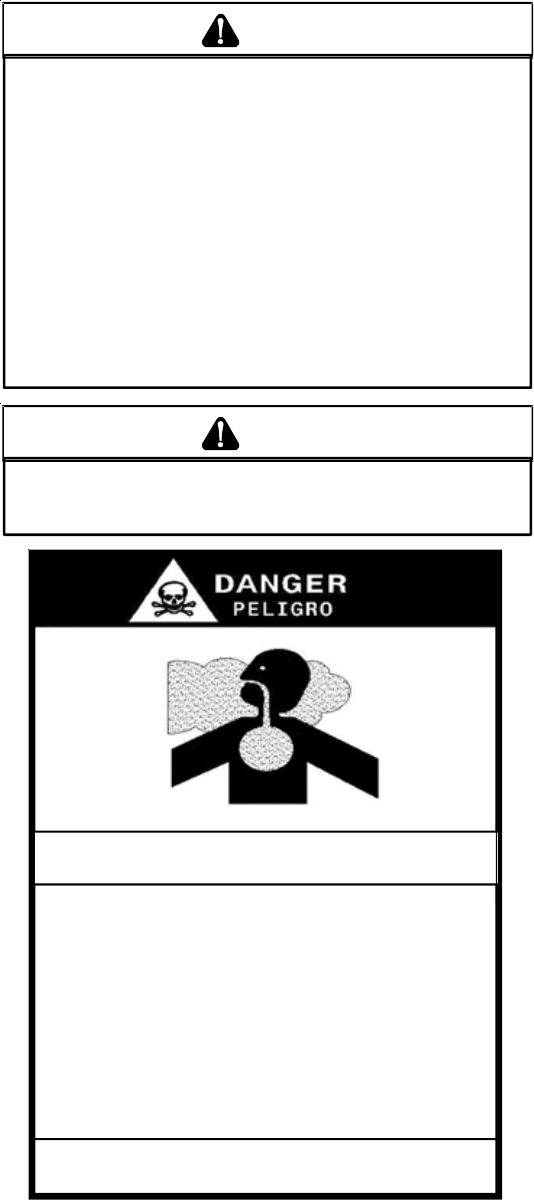
CARBON MONOXIDE POISONING HAZARD
-
Special Warning for Installation of Furnace or Air Handling Units in
Enclosed Areas such as Garages, Utility Rooms or Parking Areas
Carbon monoxide producing devices (such as an automobile, space
heater, gas water heater, etc.) should not be operated in enclosed areas
such as unventilated garages, utility rooms or parking areas because of
the danger of carbon monoxide (CO) poisoning resulting from the exhaust
emissions. If a furnace or air handler is installed in an enclosed area such
as a garage, utility room or parking area and a carbon monoxide producing
device is operated therein, there must be adequate, direct outside
ventilation.
This ventilation is necessary to avoid the danger of CO poisoning which
can occur if a carbon monoxide producing device continues to operate in
the enclosed area. Carbon monoxide emissions can be (re)circulated
throughout the structure if the furnace or air handler is operating in any
mode.
CO can cause serious illness including permanent brain damage or death.
B10259-216
TO THE INSTALLER
Before installing this unit, please read this manual thoroughly to
familiarize yourself with specific items which must be adhered to,
including but not limited to: unit maximum external static pressure,
gas pressures, BTU input rating, proper electrical connections, cir-
culating air temperature rise, minimum or maximum CFM, and mo-
tor speed connections.
SHIPPING I NSPECTION
All units are securely packed in shipping containers tested according to
International Safe Transit Association specifications. The carton must be
checked upon arrival for external damage. If damage is found, a request
for inspection by carrier’s agent must be made in writing immediately.
The furnace must be carefully inspected on arrival for damage and bolts
or screws which may have come loose in transit. In the event of damage
the consignee should:
1. Make a notation on delivery receipt of any visible damage to
shipment or container.
2. Notify carrier promptly and request an inspection.
3. With concealed damage, carrier must be notified as soon as
possible - preferably within five days.
4. File the claim with the following support documents within a
nine month statute of limitations.
•Original or certified copy of the Bill of Lading, or indemnity
bond.
•Original paid freight bill or indemnity in lieu thereof.
•Original or certified copy of the invoice, showing trade and
other discounts or reductions.
•Copy of the inspection report issued by carrier’s
representative at the time damage is reported to carrier.
The carrier is responsible for making prompt inspection of damage
and for a thorough investigation of each claim. The distributor or manu-
facturer will not accept claims from dealers for transportation dam-
age.
Keep this literature in a safe place for future reference.
5
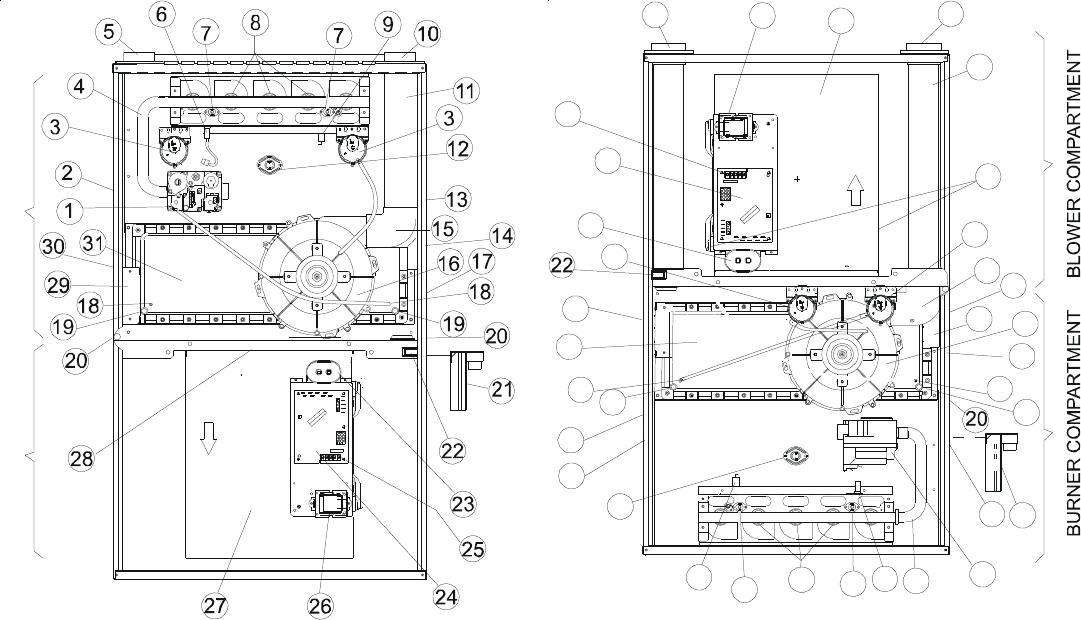
I. COMPONENT IDENTIFICATION
1 Gas Valve
2 Gas Line Entrance (Alternate)
3 Pressure Switch
4 Gas Manifold
5 Combustion Air Intake Connection / “Coupling”
6 Hot Surface Igniter
7 Rollout Limit
8 Burners
9 Flame Sensor
10 Flue Pipe Connection / “Coupling”
11 Flue Pipe (Internal)
12 Primary Limit
13 Gas Line Entrance
14 Flue Pipe Connection (Alternate)
15 Rubber Elbow
16 Induced Draft Blower
17 Electrical Connection Inlets (Alternate)
18 Coil Front Cover Pressure Tap
19 Coil Front Cover Drain Port
20 Drain Line Penetrations
21 Drain Trap
22 Blower Door Interlock Switch
23 Capacitor
24 Integrated Control Module
(with fuse and diagnostic LED)
25 24-Volt Thermostat Connections
26 Transformer (40 VA)
27 Circulator Blower
28 Auxiliary Limit
29 Junction Box
30 Electrical Connection Inlets
31 Coil Front Cover
Upflow/Horizontal Counterflow/Horizontal
1
97874
6
12
13
21
20
19
18
3
24
23
25
526 27 10
28
3
15 14
16
18 19
2
11
17
30
29
31
BLOWER COMPARTMENT BURNER COMPARTMENT
*
*
*
*
*
*
*
*
*
6
T
HIS
PRODUCT
CONTAINS
OR
PRODUCES
A
CHEMICAL
OR
CHEMICALS
WHICH
MAY
CAUSE
SERIOUS
ILLNESS
OR
DEATH
AND
WHICH
ARE
KNOWN
TO
THE
S
TATE
OF
C
ALIFORNIA
TO
CAUSE
CANCER
,
BIRTH
DEFECTS
OR
OTHER
REPRODUCTIVE
HARM
.
WARNING
H
EATING
UNIT
SHOULD
NOT
BE
UTILIZED
WITHOUT
REASONABLE
,
ROUTINE
,
INSPECTION
,
MAINTENANCE
AND
SUPERVISION
.I
F
THE
BUILDING
IN
WHICH
ANY
SUCH
DEVICE
IS
LOCATED
WILL
BE
VACANT
,
CARE
SHOULD
BE
TAKEN
THAT
SUCH
DEVICE
IS
ROUTINELY
INSPECTED
,
MAINTAINED
AND
MONITORED
.
IN
THE
EVENT
THAT
THE
BUILDING
MAYBE
EXPOSED
TO
FREEZING
TEMPERATURES
AND
WILL
BE
VACANT
,
ALL
WATER
‐
BEARING
PIPES
SHOULD
BE
DRAINED
,
THE
BUILDING
SHOULD
BE
PROPERLY
WINTERIZED
,
AND
THE
WATER
SOURCE
CLOSED
.
IN
THE
EVENT
THAT
THE
BUILDING
MAY
BE
EXPOSED
TO
FREEZING
TEMPERATURES
AND
WILL
BE
VACANT
,
ANY
HYDRONIC
COIL
UNITS
SHOULD
BE
DRAINED
AS
WELL
AND
,
IN
SUCH
CASE
,
ALTERNATIVE
HEAT
SOURCES
SHOULD
BE
UTILIZED
.
WARNING
T
O
PREVENT
POSSIBLE
PROPERTY
DAMAGE
,
PERSONAL
INJURY
OR
DEATH
DUE
TO
ELECTRICAL
SHOCK
,
THE
FURNACE
MUST
BE
LOCATED
TO
PROTECT
THE
ELECTRICAL
COMPONENTS
FROM
WATER
.
WARNING
CARBON MONOXIDE POISONING HAZARD
-
Special Warning for Installation of Furnace or Air Handling Units in
Enclosed Areas such as Garages, Utility Rooms or Parking Areas
Carbon monoxide producing devices (such as an automobile, space
heater, gas water heater, etc.) should not be operated in enclosed areas
such as unventilated garages, utility rooms or parking areas because of
the danger of carbon monoxide (CO) poisoning resulting from the exhaust
emissions. If a furnace or air handler is installed in an enclosed area such
as a garage, utility room or parking area and a carbon monoxide producing
device is operated therein, there must be adequate, direct outside
ventilation.
This ventilation is necessary to avoid the danger of CO poisoning which
can occur if a carbon monoxide producing device continues to operate in
the enclosed area. Carbon monoxide emissions can be (re)circulated
throughout the structure if the furnace or air handler is operating in any
mode.
CO can cause serious illness including permanent brain damage or death.
B10259-216
II. SAFETY CONSIDERATIONS
Adhere to the following warnings and cautions when installing, adjust-
ing, altering, servicing, or operating the furnace. To ensure proper
installation and operation, thoroughly read this manual for specifics
pertaining to the installation and application of this product.
This furnace is manufactured for use with natural gas. It may be field
converted to operate on L.P. gas by using the appropriate L.P. conver-
sion kit listed in the PROPANE GAS/HIGH ALTITUDE INSTALLA-
TIONS section of this manual
Install this furnace only in a location and position as specified in LO-
CATION REQUIREMENTS & CONSIDERATIONS section and IN-
STALLATION POSITIONS section of this manual.
Provide adequate combustion and ventilation air to the furnace as
specified in COMBUSTION & VENTILATION AIR REQUIREMENTS
section of this manual.
Combustion products must be discharged to the outdoors. Connect
this furnace to an approved vent system only, as specified in VENT/
FLUE PIPE & COMBUSTION AIR PIPE section of this manual.
Never test for gas leaks with an open flame. Use a commercially avail-
able soap solution made specifically for the detection of leaks to check
all connections, as specified in GAS SUPPLY AND PIPING section of
this manual.
Always install a furnace to operate within the furnace’s intended tem-
perature-rise range with a duct system which has external static pres-
sure within the allowable range, as specified on the furnace rating plate
and OPERATIONAL CHECKS section of these instructions.
When a furnace is installed so that supply ducts carry air circulated
by the furnace to areas outside the space containing the furnace, the
return air shall also be handled by duct(s) sealed to the furnace casing
and terminating outside the space containing the furnace.
A gas-fired furnace for installation in a residential garage must be in-
stalled as specified in the LOCATION REQUIREMENTS AND CON-
SIDERATIONS section of this manual.
This furnace may be used as a construction site heater only if certain
conditions are met. These conditions are listed in the PRODUCT
APPLICATION section of this manual.
T
O
PREVENT
PERSONAL
INJURY
OR
DEATH
DUE
TO
IMPROPER
INSTALLATION
,
ADJUSTMENT
,
ALTERATION
,
SERVICE
OR
MAINTENANCE
,
REFER
TO
THIS
MANUAL
.F
OR
ADDITIONAL
ASSISTANCE
OR
INFORMATION
,
CONSULT
A
QUALIFIED
INSTALLER
,
SERVICER
AGENCY
OR
THE
GAS
SUPPLIER
.
WARNING
I
F
THE
INFORMATION
IN
THESE
INSTRUCTIONS
IS
NOT
FOLLOWED
EXACTLY
,
A
FIRE
OR
EXPLOSION
MAY
RESULT
CAUSING
PROPERTY
DAMAGE
,
PERSONAL
INJURY
OR
LOSS
OF
LIFE
.
D
O
NOT
STORE
OR
USE
GASOLINE
OR
OTHER
FLAMMABLE
VAPORS
AND
LIQUIDS
IN
THE
VICINITY
OF
THIS
OR
ANY
OTHER
APPLIANCE
.
D
O
NOT
TRY
TO
LIGHT
ANY
APPLIANCE
.
D
O
NOT
TOUCH
ANY
ELECTRICAL
SWITCH
;
DO
NOT
USE
ANY
PHONE
IN
YOUR
BUILDING
.
I
MMEDIATELY
CALL
YOUR
GAS
SUPPLIER
FROM
A
NEIGHBOR
’
S
PHONE
.F
OLLOW
THE
GAS
SUPPLIER
’
S
INSTRUCTIONS
.
I
F
YOU
CANNOT
REACH
YOUR
GAS
SUPPLIER
,
CALL
THE
FIRE
DEPARTMENT
.
I
NSTALLATION
AND
SERVICE
MUST
BE
PERFORMED
BY
A
QUALIFIED
INSTALLER
,
SERVICE
AGENCY
OR
THE
GAS
SUPPLIER
.
WHATTODOIFYOUSMELLGAS:
WARNING
7
• It must be installed with two-pipe systems for combustion
air, especially if VOC’s or other contaminants are present
in the conditioned space.
• All other warranty exclusions and restrictions apply This
furnace is an ETL dual-certified appliance and is
appropriate for use with natural or propane gas (NOTE: If
using propane, a propane conversion kit is required).
Dual certification means that the combustion air inlet pipe is op-
tional and the furnace can be vented as a:
Non-direct vent (single pipe) central forced air furnace in
which combustion air is taken from the installation area
or from air ducted from the outside or,
Direct vent (dual pipe) central forced air furnace in which
all combustion air supplied directly to the furnace burners
through a special air intake system outlined in these
instructions.
This furnace may be used as a construction site heater ONLY if the
following conditions are met:
• The vent system is permanently installed per these
installation instructions.
• A room thermostat is used to control the furnace. Fixed
jumpers that provide continuous heating CANNOT be
used.
• Return air ducts are provided and sealed to the furnace.
• A return air temperature range between 60ºF (16ºC) and
80ºF (27ºC) is maintained.
• Air filters are installed in the system and maintained
during construction, replaced as appropriate during
construction, and upon completion of construction are
replaced.
• The input rate and temperature rise are set per the furnace
rating plate.
• 100% outside air is provided for combustion air
requirements during construction. Temporary ducting can
be used.
NOTE: Do not connect the temporary duct directly to the
furnace. The duct must be sized according to the
instructions under Section V, Combustion and Ventilation
Air Requirements, Section 5.3.3.
•The furnace heat exchanger, components, duct system,
air filters and evaporator coils are thoroughly cleaned
following final construction clean up.
• All furnace operating conditions (including ignition, input
rate, temperature rise and venting) are verified according
to these installation instructions.
NOTE: The Commonwealth of Massachusetts requires that the
following additional requirements must also be met:
• Gas furnaces must be installed by a licensed plumber or
gas fitter.
• A T-handle gas cock must be used.
• If the unit is to be installed in an attic, the passageway to
and the service area around the unit must have flooring.
To ensure proper installation and operation, thoroughly read this
manual for specifics pertaining to the installation and application
of this product.
S
HOULD
OVERHEATING
OCCUR
OR
THE
GAS
SUPPLY
FAIL
TO
SHUT
OFF
,
TURN
OFF
THE
MANUAL
GAS
SHUTOFF
VALVE
EXTERNAL
TO
THE
FURNACE
BEFORE
TURNING
OFF
THE
ELECTRICAL
SUPPLY
.
WARNING
P
OSSIBLE
PROPERTY
DAMAGE
,
PERSONAL
INJURY
OR
DEATH
DUE
TO
FIRE
,
EXPLOSION
,
SMOKE
,
SOOT
,
CONDENSATION
,
ELECTRICAL
SHOCK
OR
CARBON
MONOXIDE
MAY
RESULT
FROM
IMPROPER
INSTALLATION
,
REPAIR
OPERATION
,
OR
MAINTENANCE
OF
THIS
PRODUCT
.
WARNING
ELECTROSTATIC DISCHARGE (ESD) PRECAUTIONS
NOTE: Discharge static electricity accumulated in the body before
touching the unit. An electrostatic discharge can adversely affect
electrical components.
Use the following precautions during furnace installation and ser-
vicing to protect the integrated control module from damage. By
putting the furnace, the control, and the person at the same electro-
static potential, these steps will help avoid exposing the integrated
control module to electrostatic discharge. This procedure is appli-
cable to both installed and non-installed (ungrounded) furnaces.
1. Disconnect all power to the furnace. Do not touch the
integrated control module or any wire connected to the control
prior to discharging your body’s electrostatic charge to
ground.
2. Firmly touch a clean, unpainted, metal surface of the
furnaces near the control. Any tools held in a person’s hand
during grounding will be discharged.
3. Service integrated control module or connecting wiring
following the discharge process in step 2. Use caution not
to recharge your body with static electricity; (i.e., do not move
or shuffle your feet, do not touch ungrounded objects, etc.).
If you come in contact with an ungrounded object, repeat
step 2 before touching control or wires.
4. Discharge your body to ground before removing a new
control from its container. Follow steps 1 through 3 if
installing the control on a furnace. Return any old or new
controls to their containers before touching any ungrounded
object.
III. PRODUCT APPLICATION
This furnace is primarily designed for residential home-heating
applications. It is NOT designed or certified for use in mobile
homes, trailers or recreational vehicles. This unit is NOT designed
or certified for outdoor applications. The furnace must be installed
indoors (i.e., attic space, crawl space, or garage area provided the
garage area is enclosed with an operating door).
This furnace can be used in the following non-industrial commer-
cial applications:
Schools, Office buildings, Churches, Retail stores
Nursing homes, Hotels/motels, Common or office areas
In such applications , the furnace must be installed with the follow-
ing stipulations:
• It must be installed per the installation instructions
provided and per local and national codes.
• It must be installed indoors in a building constructed on
site.
• It must be part of a ducted system and not used in a free
air delivery application.
• It must not be used as a “make-up” air unit.
8
• Provide provisions for venting combustion products outdoors
through a proper venting system. Special consideration
should be given to vent/flue pipe routing and combustion air
intake pipe when applicable. Refer to Vent/Flue Pipe and
Combustion Air Pipe -Termination Locations for appropriate
termination locations and to determine if the piping system
from furnace to termination can be accomplished within the
guidelines given. NOTE: The length of flue and/or
combustion air piping can be a limiting factor in the location
of the furnace.
• Locate the furnace so condensate flows downwards to the
drain. Do not locate the furnace or its condensate drainage
system in any area subject to below freezing temperatures
without proper freeze protection. Refer to Condensate Drain
Lines and Trap for further details.
• Ensure adequate combustion air is available for the furnace.
Improper or insufficient combustion air can expose building
occupants to gas combustion products that could include
carbon monoxide. Refer to Combustion and Ventilation Air
Requirements.
• Set the furnace on a level floor to enable proper condensate
drainage. If the floor becomes wet or damp at times, place
the furnace above the floor on a concrete base sized
approximately 1-1/2" larger than the base of the furnace.
Refer to the Horizontal Applications and Considerations for
leveling of horizontal furnaces.
• Ensure upflow or horizontal furnaces are not installed directly
on carpeting, or any other combustible material. The only
combustible material allowed is wood.
• A special accessory subbase must be used for upright
counterflow unit installations over any combustible
material (including wood). Refer to subbase instructions
for installation details. (NOTE: A subbase will not be
required if an air conditioning coil is located beneath the
furnace between the supply air opening and the
combustible floor.
• Exposure to contaminated combustion air will result in
safety and performance-related problems. Do not install
the furnace where the combustion air is exposed to the
following substances:
chlorinated waxes or cleaners
chlorine-based swimming pool chemicals
water softening chemicals
deicing salts or chemicals
carbon tetrachloride
halogen type refrigerants
cleaning solutions (such as perchloroethylene)
printing inks
paint removers
varnishes
hydrochloric acid
cements and glues
antistatic fabric softeners for clothes dryers
and masonry acid washing materials
P
OSSIBLE
PROPERTY
DAMAGE
,
PERSONAL
INJURY
OR
DEATH
DUE
TO
FIRE
,
EXPLOSION
,
SMOKE
,
SOOT
,
CONDENSATION
,
ELECTRICAL
SHOCK
OR
CARBON
MONOXIDE
MAY
RESULT
FROM
IMPROPER
INSTALLATION
,
REPAIR
,
OPERATION
,
OR
MAINTENANCE
OF
THIS
PRODUCT
.
WARNING
T
O
PREVENT
PERSONAL
INJURY
,
PROPERTY
DAMAGE
OR
DEATH
DUE
TO
FIRE
,
DO
NOT
INSTALL
THIS
FURNACE
IN
A
MOBILE
HOME
,
TRAILER
OR
RECREATIONAL
VEHICLE
.
WARNING
To ensure proper furnace operation, install, operate and maintain the
furnace in accordance with these installation and operation instruc-
tions, all local building codes and ordinances. In their absence, follow
the latest edition of the National Fuel Gas Code (NFPA 54/ANSI Z223.1),
and/or CAN/CSA B149.1-05.1-05 Installation Codes, local plumbing or
waste water codes, and other applicable codes.
A copy of the National Fuel Gas Code (NFPA 54/ANSI Z223.1) can be
obtained from any of the following:
American National Standards Institute
1430 Broadway
New York, NY 10018
National Fire Protection Association
1 Batterymarch Park
Quincy, MA 02269
CSA International
8501 East Pleasant Valley
Cleveland, OH 44131
A copy of the CAN/CSA B149.1-05.1-05 Installation Codes can also
be obtained from:
CSA International
178 Rexdale Boulevard
Etobicoke, Ontario, Canada M9W 1R3
The rated heating capacity of the furnace should be greater than or
equal to the total heat loss of the area to be heated. The total heat
loss should be calculated by an approved method or in accor-
dance with “ASHRAE Guide” or “Manual J-Load Calculations” pub-
lished by the Air Conditioning Contractors of America.
IV. LOCATION REQUIREMENTS & CONSIDERATIONS
GENERAL
T
O
PREVENT
POSSIBLE
EQUIPMENT
DAMAGE
,
PROPERTY
DAMAGE
,
PERSONAL
INJURY
OR
DEATH
,
THE
FOLLOWING
BULLET
POINTS
MUST
BE
OBSERVED
WHEN
INSTALLING
THE
UNIT
.
WARNING
Follow the instructions listed below when selecting a furnace loca-
tion. Refer also to the guidelines provided in Combustion and
Ventilation Air Requirements.
• Centrally locate the furnace with respect to the proposed
or existing air distribution system.
• Ensure the temperature of the return air entering the
furnace is between 55°F and 100°F when the furnace is
heating.
*NOTE: Please contact your distributor or our website for the applicable Specification Sheet referred to in this manual.
9
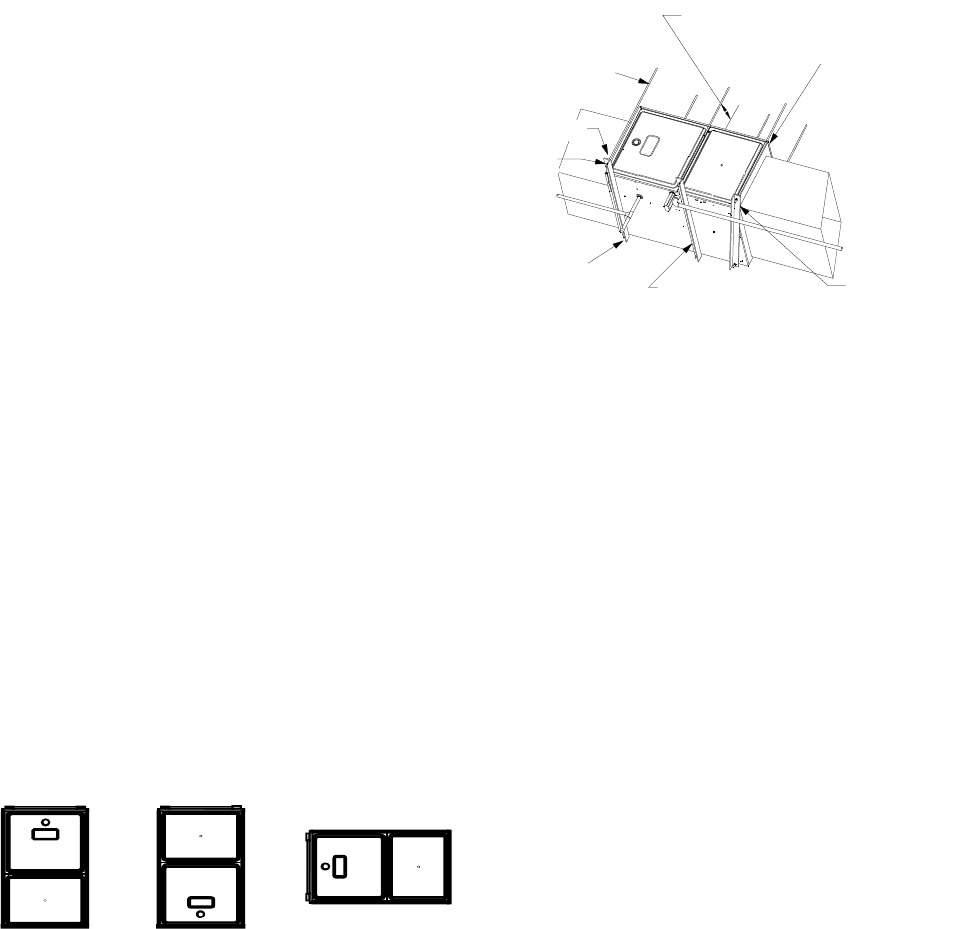
FURNACE SUSPENSION
If suspending the furnace from rafters or joists, use 3/8" threaded rod
and 2”x2”x1/8” angle iron as shown below. The length of rod will de-
pend on the application and the clearances necessary.
TILT OUTWARD TO ALLOW FOR
DOOR AND CIRCULATOR BLOWER
REMOVAL
3/8" DIAMETER
THREADED ROD
(6 PLACES)
PROVIDE 8" MINMUM CLEARANCE BETWEEN
CENTER ROD AND FURNACE CABINET
TO ALLOW FOR CIRCULATOR BLOWER REMOVAL
ASSURE FURNACE IS LEVEL FROM
END TO END AND HAS A SLIGHT
FORWARD TILT WITH THE FRONT
OF THE FURNACE 0"-3/4"
BELOW THE BACK OF THE FURNACE
POSITION AS CLOSE AS POSSIBLE
TO BLOWER DECK TO ALLOW FOR
CIRCULATOR BLOWER REMVOAL
2"X2"X1/8" ANGLE IRON
(3 PLACES)
HOLD DOWN
NUTS
SUPPORT
NUTS
Suspended Furnace
EXISTING FURNACE REMOVAL
NOTE: When an existing furnace is removed from a venting system
serving other appliances, the venting system may be too large to
properly vent the remaining attached appliances.
The following vent testing procedure is reproduced from the American
National Standard/National Standard of Canada for Gas-Fired Cen-
tral Furnaces ANSI Z21.47-Latest Edition, CSA-2.3b--Latest Edition
Section 1.23.1.
The following steps shall be followed with each appliance connected to the
venting system placed in operation, while any other appliances connected
to the venting system are not in operation:
a. Seal any unused openings in the venting system;
b. Inspect the venting system for proper size and horizontal pitch, as
required by the National Fuel Gas Code, ANSI Z223.1 or the CSA
B149.1-05.1-05 Installation Codes and these instructions. Deter-
mine that there is no blockage or restriction, leakage, corrosion and
other deficiencies which could cause an unsafe condition;
c. In so far as practical, close all building doors and windows and all
doors between the space in which the appliance(s) connected to the
venting system are located and other spaces of the building. Turn on
clothes dryers and any appliance not connected to the venting sys-
tem. Turn on any exhaust fans, such as range hoods and bathroom
exhausts, so they shall operate at maximum speed. Do not operate a
summer exhaust fan. Close fireplace dampers;
d. Follow the lighting instructions. Place the appliance being inspected
in operation. Adjust thermostat so appliance shall operate continu-
ously;
e. Test for draft hood equipped spillage at the draft hood relief opening
after 5 minutes of main burner operation. Use the flame of a match
or candle;
f. After it has been determined that each appliance connected to the
venting system properly vents when tested as outlined above, re-
turn doors, windows, exhaust fans, fireplace dampers and any other
gas burning appliance to their previous conditions of use;
g. If improper venting is observed during any of the above tests, the
common venting system must be corrected.
Corrections must be in accordance with the latest edition of the
National Fuel Gas Code NFPA 54/ANSI Z223.1 and/or CSA B149.1-
05.1-05 Installation Codes.
• Seal off a non-direct vent furnace if it is installed near an
area frequently contaminated by any of the above substances.
This protects the non-direct vent furnace from airborne
contaminants. To ensure that the enclosed non-direct vent
furnace has an adequate supply of combustion air, vent from
a nearby uncontaminated room or from outdoors. Refer to
the Combustion and Ventilation Air Requirements for details.
• If the furnace is used in connection with a cooling unit, install
the furnace upstream or in parallel with the cooling unit.
Premature heat exchanger failure will result if the cooling
unit is placed ahead of the furnace.
For vertical (upflow or downflow) applications, the minimum
cooling coil width shall not be less than furnace width minus
1”. Additionally, a coil installed above an upflow furnace or
under a counterflow furnace may be the same width as the
furnace or may be one size larger than the furnace. Example:
a “C” width coil may be installed with a “B” width furnace.
For upflow applications, the front of the coil and furnace must
face the same direction.
• If the furnace is installed in a residential garage, position the
furnace so that the burners and ignition source are located
not less than 18 inches (457 mm) above the floor. Protect
the furnace from physical damage by vehicles.
• If the furnace is installed horizontally, the furnace access
doors must be vertical so that the burners fire horizontally
into the heat exchanger. Do not install the unit with the
access doors on the “up/top” or “down/bottom” side of
the furnace.
CLEARANCES AND A CCESSIBILITY
Installations must adhere to the clearances to combustible mate-
rials to which this furnace has been design certified. The mini-
mum clearance information for this furnace is provided on the unit’s
clearance label. These clearances must be permanently main-
tained. Clearances must also accommodate an installation’s gas,
electrical, and drain trap and drain line connections. If the alternate
vent/flue connection is used, additional clearance must be pro-
vided to accommodate these connections. Refer to Vent Flue Pipe
and Combustion Air Pipe for details. NOTE: In addition to the
required clearances to combustible materials, a minimum of 24
inches service clearance must be available in front of the unit.
TOP
BOTTOM
SIDE SIDE SIDE
TOP
BOTTOM
Upflow Counterflow Horizontal
A furnace installed in a confined space (i.e., a closet or utility room)
must have two ventilation openings with a total minimum free area
of 0.25 square inches per 1,000 BTU/hr of furnace input rating.
Refer to the Specification Sheet applicable to your model for mini-
mum clearances to combustible surfaces. One of the ventilation
openings must be within 12 inches of the top; the other opening
must be within 12 inches of the bottom of the confined space. In a
typical construction, the clearance between the door and door frame
is usually adequate to satisfy this ventilation requirement.
10
Most homes will require outside air be supplied to the furnace area by
means of ventilation grilles or ducts connecting directly to the outdoors
or spaces open to the outdoors such as attics or crawl spaces.
The following information on air for combustion and ventilation is reproduced
from the National Fuel Gas Code NFPA 54/ANSI Z223.1 Section 5.3.
5.3.1 General:
(a) The provisions of 5.3 apply to gas utilization equipment installed in
buildings and which require air for combustion, ventilation and dilu-
tion of flue gases from within the building. They do not apply to (1)
direct vent equipment which is constructed and installed so that all
air for combustion is obtained from the outside atmosphere and all
flue gases are discharged to the outside atmosphere, or (2) enclosed
furnaces which incorporate an integral total enclosure and use only
outside air for combustion and dilution of flue gases.
(b) Equipment shall be installed in a location in which the facilities for
ventilation permit satisfactory combustion of gas, proper venting
and the maintenance of ambient temperature at safe limits under
normal conditions of use. Equipment shall be located so as not to
interfere with proper circulation of air. When normal infiltration
does not provide the necessary air, outside air shall be introduced.
(c) In addition to air needed for combustion, process air shall be pro-
vided as required for: cooling of equipment or material, controlling
dew point, heating, drying, oxidation or dilution, safety exhaust,
odor control, and air for compressors.
(d) In addition to air needed for combustion, air shall be supplied for
ventilation, including all air required for comfort and proper working
conditions for personnel.
(e) While all forms of building construction cannot be covered in detail,
air for combustion, ventilation and dilution of flue gases for gas
utilization equipment vented by natural draft normally may be ob-
tained by application of one of the methods covered in 5.3.3 and
5.3.4.
(f) Air requirements for the operation of exhaust fans, kitchen ventila-
tion systems, clothes dryers, and fireplaces shall be considered in
determining the adequacy of a space to provide combustion air
requirements.
5.3.2 Equipment Located in Unconfined Spaces:
In unconfined spaces (see definition below) in buildings, infiltration may
be adequate to provide air for combustion ventilation and dilution of
flue gases. However, in buildings of tight construction (for example,
weather stripping, heavily insulated, caulked, vapor barrier, etc.), addi-
tional air may need to be provided using the methods described in 5.3.3-
b or 5.3.4.
Space, Unconfined.
For purposes of this Code, a space whose volume is not less than 50
cubic feet per 1,000 BTU per hour of the aggregate input rating of all
appliances installed in that space. Rooms communicating directly with
the space in which the appliances are installed through openings not
furnished with doors, are considered a part of the unconfined space.
5.3.3 Equipment Located in Confined Spaces:
(a) All Air from Inside the Building: The confined space shall be pro-
vided with two permanent openings communicating directly with
an additional room(s) of sufficient volume so that the combined vol-
ume of all spaces meets the criteria for an unconfined space. The
total input of all gas utilization equipment installed in the combined
space shall be considered in making this determination. Each opening
shall have a minimum free area of 1 square inch per 1,000 BTU per
hour of the total input rating of all gas utilization equipment in the
confined space, but not less than 100 square inches. One opening
shall be within 12 inches of the top and one within 12 inches of the
bottom of the enclosure.
If resizing is required on any portion of the venting system, use the
appropriate table in Appendix G in the latest edition of the National Fuel
Gas Code ANSI Z223.1 and/or CSA B149.1-05.1-05 Installation Codes.
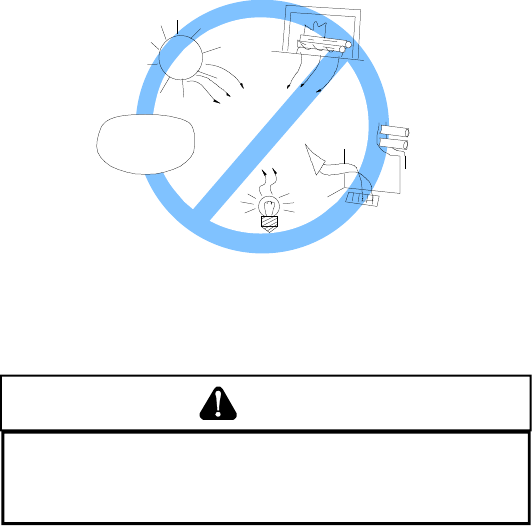
THERMOSTAT LOCATION
The thermostat should be placed approximately five feet from the floor
on a vibration-free, inside wall in an area having good air circulation.
Do not install the thermostat where it may be influenced by any of the
following:
•Drafts, or dead spots behind doors, in corners, or under
cabinets.
•Hot or cold air from registers.
•Radiant heat from the sun.
•Light fixtures or other appliances.
•Radiant heat from a fireplace.
•Concealed hot or cold water pipes, or chimneys.
•Unconditioned areas behind the thermostat, such as an
outside wall.
HOT
COLD
DRAFTS OR DEAD SPOTS
-BEHIND DOORS
-IN CORNERS
-UNDER CABINETS
Thermostat Influences
Consult the instructions packaged with the thermostat for mount-
ing instructions and further precautions.
V. COMBUSTION & VENTILATION AIR REQUIREMENTS
WARNING
POSSIBLE PROPERTY DAMAGE PERSONAL INJURY OR DEATH MAY OCCUR IF
THE FURNACE IS NOT PROVIDED WITH ENOUGH FRESH AIR FOR PROPER
COMBUSTION AND VENTILATION OF FLUE GASES. MOST HOMES REQUIRE
OUTSIDE AIR BE SUPPLIED TO THE FURNACE AREA.
Improved construction and additional insulation in buildings have
reduced heat loss by reducing air infiltration and escape around
doors and windows. These changes have helped in reducing
heating/cooling costs but have created a problem supplying com-
bustion and ventilation air for gas fired and other fuel burning appli-
ances. Appliances that pull air out of the house (clothes dryers,
exhaust fans, fireplaces, etc.) increase the problem by starving
appliances for air.
House depressurization can cause back drafting or improper com-
bustion of gas-fired appliances, thereby exposing building occu-
pants to gas combustion products that could include carbon mon-
oxide.
If this furnace is to be installed in the same space with other gas appli-
ances, such as a water heater, ensure there is an adequate supply of
combustion and ventilation air for the other appliances. Refer to the
latest edition of the National Fuel Gas Code NFPA 54/ANSI Z223.1
(Section 5.3), or CSA B149.1-05 Installation Codes (Sections 7.2,
7.3, or 7.4), or applicable provisions of the local building codes for
determining the combustion air requirements for the appliances.
11
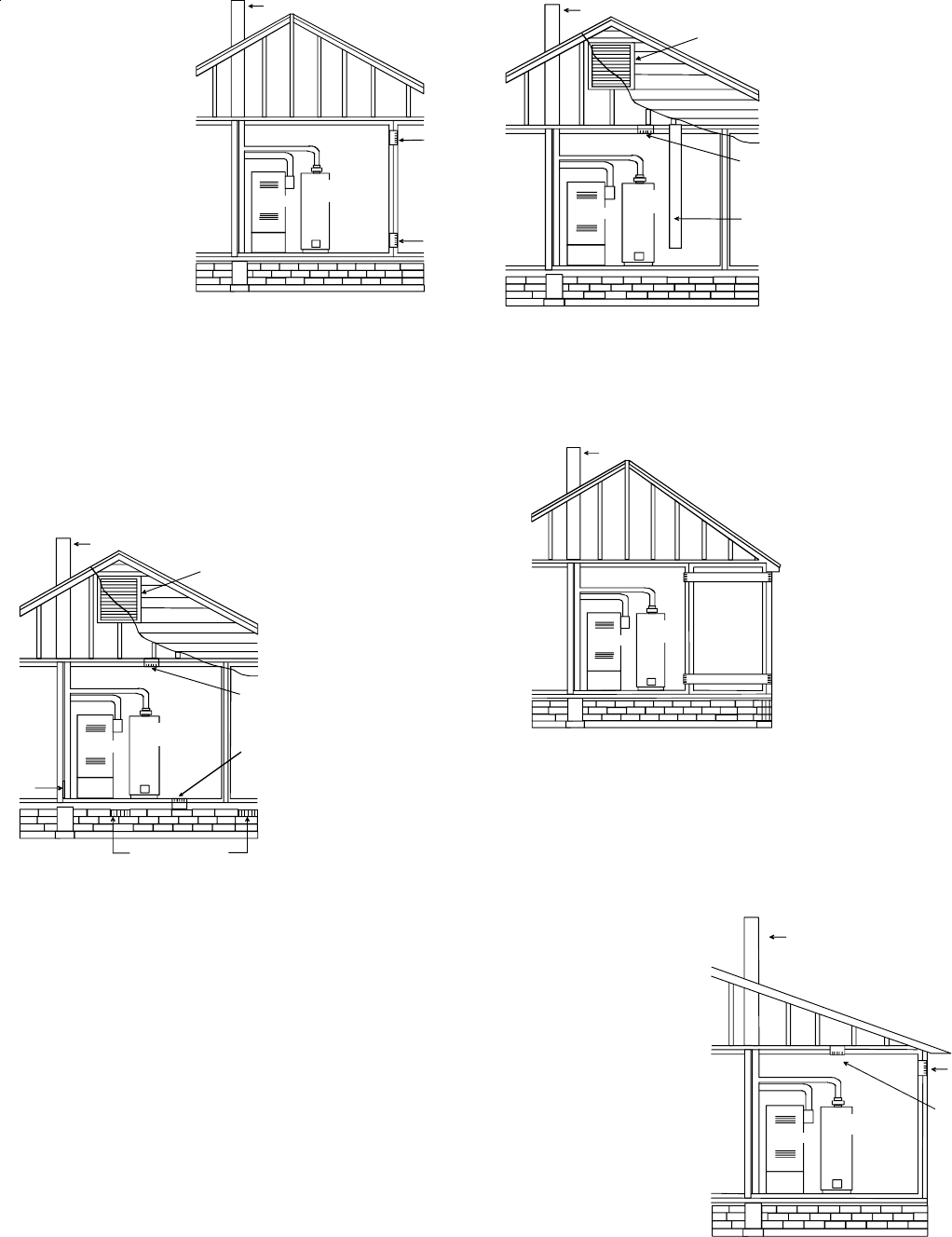
Furnace
Water
Heater
Opening
Chimney or Gas Vent
Opening
NOTE: Each opening must have
a free area of not less than one
square inch per 1000 BTU of
the total input rating of all equip-
ment in the enclosure, but not
less than 100 square inches.
Equipment Located in Confined Spaces; All Air from Inside Building.
See 5.3.3-a.
(b) All Air from Outdoors: The confined space shall be provided with
two permanent openings, one commencing within 12 inches of the
top and one commencing within 12 inches of the bottom of the
enclosure. The openings shall communicate directly, or by ducts,
with the outdoors or spaces (crawl or attic) that freely communicate
with the outdoors.
1. When directly communicating with the outdoors, each opening
shall have a minimum free area of 1 square inch per 4,000 BTU
per hour of total input rating of all equipment in the enclosure.
Furnace
Water
Heater
Outlet Air
Chimney or Gas Vent
NOTE: The inlet and outlet air
openings must each have a free
area of not less than one square
inch per 4000 BTU of the
total input rating of all equipment
in the enclosure.
Inlet Air
Ventilation louvers for
unheated crawl space
A
lternate
air inlet
Ventilation louvers
(each end of attic)
Equipment Located in Confined Spaces; All Air from Outdoors—
Inlet Air from Ventilated Crawl Space and Outlet Air to Ventilated
Attic. See 5.3.3-b
2. When communicating with the outdoors through vertical ducts,
each opening shall have a minimum free area of 1 square inch per
4,000 BTU per hour of total input rating of all equipment in the
enclosure.
Furnace
Water
Heater
Outlet Air
Chimney or Gas Vent
NOTE: The inlet and outlet air
openings must each have a free
area of not less than one square
inch per 4000 BTU of the
total input rating of all equipment
in the enclosure.
Inlet air duct
[ends 1 ft (300 mm)
above floor]
Ventilation louvers
(each end of attic)
Equipment Located in Confined Spaces; All Air from Outdoors
Through Ventilated Attic. See 5.3.3-b.
3. When communicating with the outdoors through horizontal ducts,
each opening shall have a minimum free area of 1 square inch per
2,000 BTU per hour of total input rating of all equipment in the
enclosure.
Furnace
Water
Heater
Chimney or Gas Vent
NOTE: The air duct openings
must have a free area of not
less than one square inch per
2000 BTU of the total input
rating of all equipment in the
enclosure*.
Outlet air duct
Inlet air duct
*If the appliance room is located against an outside wall and the air openings communicate directly with the
outdoors, each opening shall have a free area of not less than one square inch per 4,000 BTU per hour of
the total input rating of all appliances in the enclosure.
Equipment Located in Confined Spaces; All Air from Outdoors.
See 5.3.3-b.
4. When ducts are used, they shall be of the same cross-sectional
area as the free area of the openings to which they connect. The
minimum dimension of rectangular air ducts shall not be less
than 3 inches.
Furnace
Water
Heater
Opening
Chimney or Gas Vent
NOTE: The single opening must have
a free area of not less than one
square inch per 3000 BTU of
the total input rating of all equip-
ment in the enclosure, but not less than
the sum of the areas of all vent
connectors in the confined space.
Alternate
Opening
Location
Equipment Located in Confined Spaces; All Air from Outdoors -
Single Air Opening. See 5.3.3-b.
12
5. When directly communicating with the outdoors, the single open-
ing shall have a minimum free area of 1 square inch per 3,000
BTU per hour of total input rating of all equipment in the enclo-
sure.
5.3.4 Specially Engineered Installations:
The requirements of 5.3.3 shall not necessarily govern when special
engineering, approved by the authority having jurisdiction, provides an
adequate supply of air for combustion, ventilation, and dilution of flue
gases.
5.3.5 Louvers and Grilles:
In calculating free area in 5.3.3, consideration shall be given to the block-
ing effect of louvers, grilles or screens protecting openings. Screens used
shall not be smaller than 1/4 inch mesh. If the area through a design of
louver or grille is known, it should be used in calculating the size of
opening required to provide the free area specified. If the design and free
area is not known, it may be assumed that wood louvers will have 20-25
percent free area and metal louvers and grilles will have 60-75 percent
free area. Louvers and grilles shall be fixed in the open position or
interlocked with the equipment so that they are opened automatically
during equipment operation.
5.3.6 Special Conditions Created by Mechanical Exhausting or Fire-
places:
Operation of exhaust fans, ventilation systems, clothes dryers, or fire-
places may create conditions requiring special attention to avoid unsat-
isfactory operation of installed gas utilization equipment. Air from
Inside Building. See 5.3.3-a.
VI. INSTALLATION POSITIONS
This furnace may be installed in an upright position or horizontal
on either the left or right side panel. Do not install this furnace on
its back. For upright upflow furnaces, return air ductwork may be
attached to the side panel(s) and/or basepan. For horizontal up-
flow furnaces, return air ductwork must be attached to the basepan.
For both upright or horizontal counterflow furnaces, return duct-
work must be attached to the basepan (top end of the blower com-
partment). NOTE: Ductwork must never be attached to the back of
the furnace. For upflow installations requiring 1,800 CFM or more,
use either two side returns or a bottom return or a combination of
side and bottom. Contact your distributor for proper airflow require-
ments and number of required ductwork connections. Refer to
“Recommended Installation Positions” figure for appropriate in-
stallation positions, ductwork connections, and resulting airflow
arrangements.
VII. HORIZONTAL APPLICATIONS & CONSIDERATIONS
GENERAL
Horizontal applications, in particular, may dictate many of the
installation’s specifics such as airflow direction, ductwork connec-
tions, flue and combustion air pipe connections, etc. The basic
application of this furnace as a horizontal furnace differs only slightly
from an upright installation. When installing a furnace horizontally,
additional consideration must be given to the following:
LOCATION
Horizontal Furnace
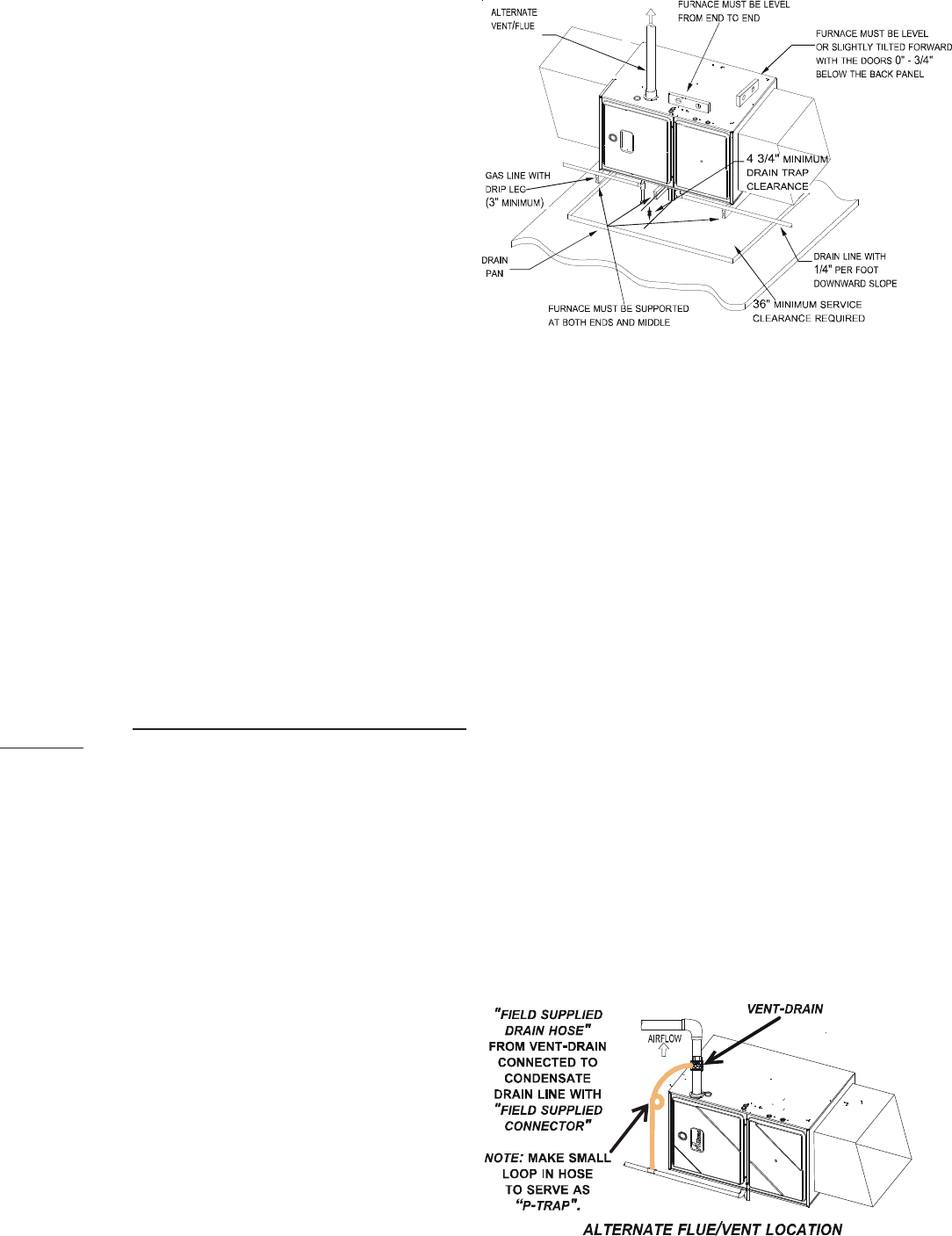
DRAIN TRAP AND LINES
In horizontal applications the condensate drain trap is secured to the
furnace side panel, suspending it below the furnace. A minimum clear-
ance of 4 3/4 inches below the furnace must be provided for the drain
trap. Additionally, the appropriate downward piping slope must be main-
tained from the drain trap to the drain location. Refer to Condensate
Drain Trap and Lines for further details. If the drain trap and drain line
will be exposed to temperatures near or below freezing, adequate mea-
sures must be taken to prevent condensate from freezing.
LEVELING
Leveling ensures proper condensate drainage from the heat exchanger
and induced draft blower. For proper flue pipe drainage, the furnace
must be level lengthwise from end to end. The furnace should also be
level from back to front or have a slight tilt with the access doors downhill
(approximately 3/4 inches) from the back panel. The slight tilt allows
the heat exchanger condensate, generated in the recuperator coil, to
flow forward to the recuperator coil front cover.
ALTERNATE VENT/FLUE AND COMBUSTION AIR CONNECTIONS
In horizontal installations, provisions for alternate vent/flue piping is
available for upflow furnaces with left air discharge. Counterflow fur-
naces include provisions for both alternate vent/flue and combustion
air piping with right air discharge. These configurations allow the flue
and combustion air piping to be run vertically through the furnace. Re-
fer to the “Recommended Installation Positions” figure for further de-
tail. The standard piping connections may also be used in these posi-
tions. Refer to Vent/Flue Pipe and Combustion Air Pipe for details
concerning the conversion to the alternate vent/flue air connections.
When using the horizontal alternate vent configuration, you must
use the RF000142 vent drain kit. See following illustration.
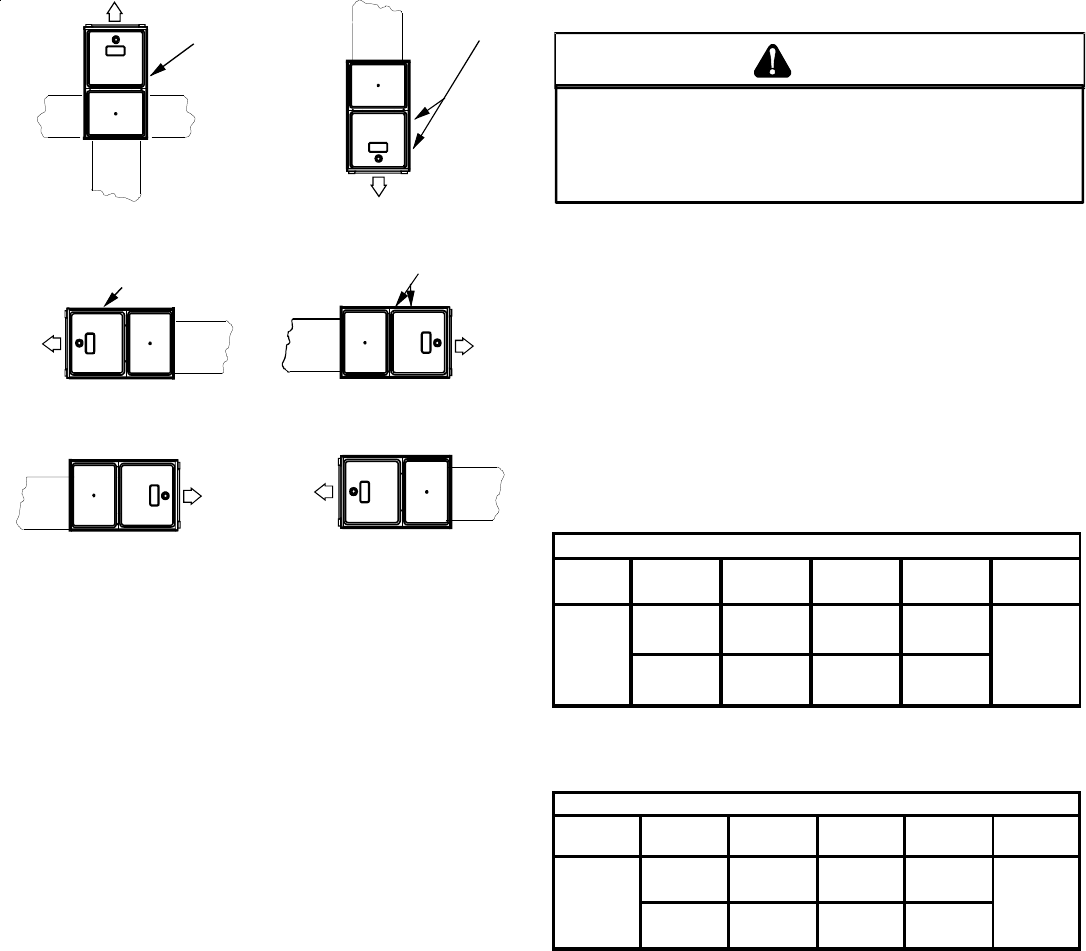
13
VIII. PROPANE GAS /HIGH ALTITUDE INSTALLATIONS
P
OSSIBLE
PROPERTY
DAMAGE
,
PERSONAL
INJURY
OR
DEATH
MAY
OCCUR
IF
THE
CORRECT
CONVERSION
KITS
ARE
NOT
INSTALLED
. T
HE
APPROPRIATE
KITS
MUST
BE
APPLIED
TO
ENSURE
SAFE
AND
PROPER
FURNACE
OPERATION
. A
LL
CONVERSIONS
MUST
BE
PERFORMED
BY
A
QUALIFIED
INSTALLER
OR
SERVICE
AGENCY
.
WARNING
This furnace is shipped from the factory configured for natural gas at
standard altitude. Propane gas installations require an orifice change
to compensate for the energy content difference between natural and
propane gas.
For furnaces being converted to LP gas, it is strongly recommended
that a LPLP03 kit also be installed. The use of this kit will prevent
the furnace from firing when the LP gas supply pressure is too low
to support proper combustion.
High altitude installations may require both a pressure switch and
an orifice change. These changes are necessary to compensate
for the natural reduction in the density of both the gas fuel and the
combustion air at higher altitude.
For installations above 7000 feet, please refer to your distributor
for required kit(s).
Altitude Gas Kit Orifice Manifold
Pressure
Pressure
Switch
*MH95, ACSH96, GCH95, GCH9 GAS ORIFICE CHART
Natural
Propane
2 LPM-06* supports both Honeywell and White-Rodgers 2-stage valves
NOTE: In Canada, gas furnaces are certified to 4500 feet.
0-7000
None
LPM-06*2
#43
#55
3.5" w.c.
10.0" w.c.
None
Altitude Gas Kit Orifice Manifold
Pressure
Pressure
Switch
2 LPM-06* supports both Honeywell and White-Rodgers 2-stage valves
NOTE: In Canada, gas furnaces are certified to 4500 feet.
0-7000
None
LPM-06*2
#45
#55
3.5" w.c.
10.0" w.c.
None
AMEH96, GME95 GAS ORIFICE CHART
Natural
Propane
Contact the distributor for a tabular listing of appropriate
manufacturer’s kits for propane gas and/or high altitude installations.
The indicated kits must be used to insure safe and proper furnace
operation. All conversions must be performed by a qualified installer,
or service agency.
AIR
DISCHARGE
AIR
DISCHARGE
AIR
DISCHARGE
Bottom
Return
Duct
Connection
Bottom
Return
Duct
Connection
Bottom
Return
Duct
Connection
Side
Return
Duct
Connection
Side
Return
Duct
Connection
UPFLOW
UPRIGHT
UPFLOW HORIZONTAL
RIGHT AIR DISCHARGE
UPFLOW HORIZONTAL
LEFT AIR DISCHARGE
ALTERNATE FLUE
PIPE LOCATION
ALTERNATE FLUE PIPE
LOCATION
AIR
DISCHARGE
AIR
DISCHARGE
AIR
DISCHARGE
Bottom
Return
Duct
Connection
Bottom
Return
Duct
Connection
Bottom
Return
Duct
Connection
COUNTERFLOW
UPRIGHT
COUNTERFLOW HORIZONTAL
RIGHT AIR DISCHARGE
COUNTERFLOW HORIZONTAL
LEFT AIR DISCHARGE
ALTERNATE FLUE AND
COMBUSTION AIR PIPE
LOCATIONS
ALTERNATE FLUE AND
COMBUSTION AIR PIPE
LOCATIONS
Recommended Installation Positions
NOTE: Alternate “vertical” piping connections can not be used when
an upflow furnace is installed with supply air discharging to the
right, or when a counterflow furnace is installed with supply air
discharging to the left. In either case, use the standard flue and
combustion air piping connections.
ALTERNATE E LECTRICAL AND G AS L INE C ONNECTIONS
This furnace has provisions allowing for electrical and gas line
connections through either side panel. In horizontal applications
the connections can be made either through the “top” or “bottom”
of the furnace.
DRAIN PAN
A drain pan must be provided if the furnace is installed above a
conditioned area. The drain pan must cover the entire area under
the furnace (and air conditioning coil if applicable).
FREEZE PROTECTION
Refer to Horizontal Applications and Conditions - Drain Trap and
Lines.
FURNACE SUSPENSION
If the furnace is installed in a crawl space it must be suspended from
the floor joist or supported by a concrete pad. Never install the fur-
nace on the ground or allow it to be exposed to water. Refer to Loca-
tion Requirements and Considerations - Furnace Suspension for fur-
ther details.
14
v
V
X
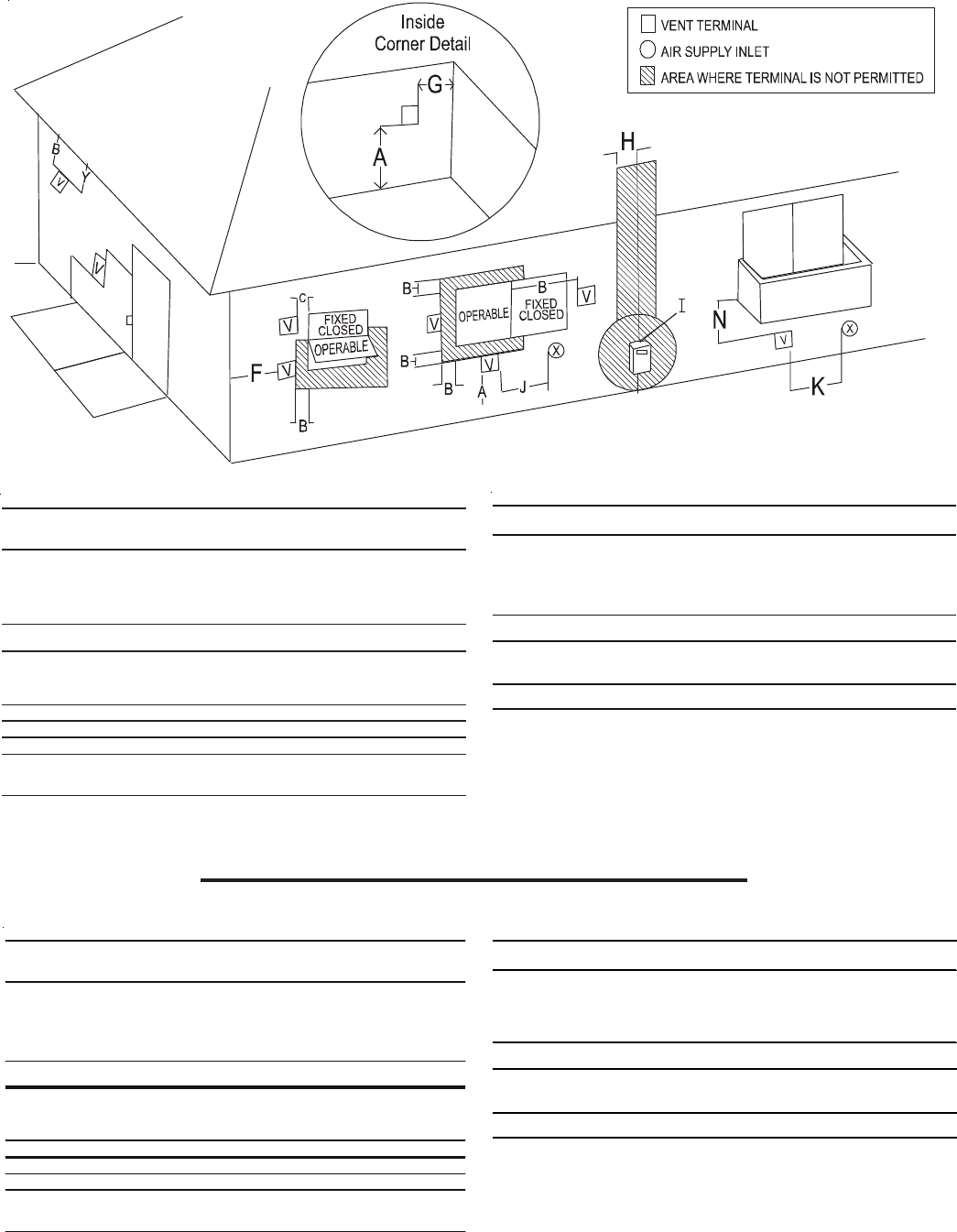
DIRECT VENT TERMINAL CLEARANCES
1 In accordance with the current CSA B149.1, Natural Gas and Propane Installation Code.
2 In accordance with the current ANSI Z223.1/NFPA 54, National Fuel Gas Code.
† A vent shall not terminate directly above a sidewalk or paved driveway that is located between two single fanily dwellings and serves
both dwellings.
‡ Permitted only if veranda, porch, deck or balcony is fully open on a minimum of two sides beneath the floor.
* For clearances not specified in ANSI Z223.1/NFPA 54 or CSA B149.1, the following statement shall be included:
“Clearance in accordance wtih local installation codes and the requirements of the gas supplier and the manufacturer’s installation
instruction.”
Canadian Installations
1
U.S. Installations
2
I= Clearance to service
regulator vent outlet.
3 ft. (91 cm). *
J= Clearance to nonmechanical air
supply inlet to building or the
combustion air inlet to any other
appliance.
6 in. (15 cm) for appliances 10,000
Btuh (3 kW), 12 in. (30 cm) for
appliances > 10,000 Btuh (3kW) and
100,000 Btuh (30 kW), 36 in. (91 cm)
for appliances > 100,000 Btuh (30 kW).
6 in. (15 cm) for appliances 10,000
Btuh (3 kW), 9 in. (23 cm) for
appliances > 10,000 Btuh (3kW) and
50,000 Btuh (15 kW), 12 in. (30 cm) for
appliances > 50,000 Btuh (15 kW).
K= Clearance to a mechanical
air supply inlet.
6 ft. (1.83 m) 3 ft. (91 cm) above if within
10 ft. (3 m) horizontally.
L= Clearance above paved sidewalk or
paved driveway located on public
property.
7 ft. (2.13m) † *
M= Clearance under veranda, porch,
deck or balcony.
12 in. (30 cm) ‡ *
Canadian Installations
1
U.S. Installations
2
A= Clearance above grade,
veranda, porch, deck or
balcony. (See 1.24.6-i(9)b.)
12 in. (30 cm) 12 in. (30 cm)
B= Clearance to window or
door that may be opened.
6 in. (15 cm) for appliances
10,000 Btuh (3 kW), 12 in. (30 cm) for
appliances > 10,000 Btuh (3 kW) and
100,000 Btuh (30 kW), 36 in. (91 cm)
for appliances > 100,000 Btuh (30
kW).
6 in. (15 cm) for appliances
10,000 Btuh (3 kW), 9 in. (23 cm) for
appliances > 10,000 Btuh (3 kW) and
50,000 Btuh (15 kW), 12 in. (30 cm) for
appliances > 500,000 Btuh (15 kW).
C= Clearance to permanently
closed window.
**
D= Vertical clearance to ventilated soffit
located above the terminal within a
horizontal distance of 2 feet (61 cm)
from the center line of the terminal.
**
E= Clearance to unventilated soffit. * *
F= Clearance to outside corner. * *
G= Clearance to inside corner. * *
H= Clearance to each side of center
line extended above meter/regulator
assembly.
3 ft. (91 cm) within a height 15 ft.
(4.5 m) above the meter/regulator
assembly.
*
OTHER THAN DIRECT VENT TERMINAL CLEARANCES
1 In accordance with the current CSA B149.1, Natural Gas and Propane Installation Code.
2 In accordance with the current ANSI Z223.1/NFPA 54, National Fuel Gas Code.
† A vent shall not terminate directly above a sidewalk or paveable driveway that is located between two single family dwellings and
serves both dwelling.
‡ Permitted only if veranda, porch, deck or balcony is fully open on a minimum of two sides beneath the floor.
* For clearances not specified in ANSI Z223.1/NFPA 54 or CSA B149.1, the following statement shall be included:
“Clearance in accordance wtih local installation codes and the requirements of the gas supplier and the manufacturer’s installation
instruction.”
Canadian Installations
1
U.S. Installations
2
I= Clearance to sevice
regulator vent outlet.
3 ft. (91 cm). *
J= Clearance to nonmechanical air
supply inlet to building or the
combustion air inlet to any other
appliance.
6 in. (15 cm) for appliances 10,000
Btuh (3 kW), 12 in. (30 cm) for
appliances > 10,000 Btuh (3kW) and
100,000 Btuh (30 kW), 36 in. (91 cm)
for appliances > 100,000 Btuh (30 kW).
4 ft. (1.2 m) below or to side of
opening; 1 ft. (300 m) above opening.
K= Clearance to a mechanical
air supply inlet.
6 ft. (1.83 m) 3 ft. (91 cm) above if within
10 ft. (3 m) horizontally.
L= Clearance above paved sidewalk or
paved driveway located on public
property.
7 ft. (2.13m) † 7 ft. (2.13m)
M= Clearance under veranda, porch,
deck or balcony.
12 in. (30 cm) ‡ *
Canadian Installations
1
U.S. Installations
2
A= Clearance above grade,
veranda, porch, deck or
balcony. (See 1.24.6-i(9)b.)
12 in. (30 cm) 12 in. (30 cm)
B= Clearance to window or
door that may be opened.
6 in. (15 cm) for appliances
10,000 Btuh (3 kW), 12 in. (30 cm) for
appliances > 10,000 Btuh (3 kW) and
100,000 Btuh (30 kW), 36 in. (91 cm)
for appliances > 100,000 Btuh (30
kW).
4 ft. (1.2 m) below or to side of
opening; 1 ft. (300 m) above opening.
C= Clearance to permanently
closed window.
**
D= Vertical clearance to ventilated soffit
located above the terminal within a
horizontal distance of 2 feet (61 cm)
from the center line of the terminal.
**
E= Clearance to unventilated soffit. * *
F= Clearance to outside corner. * *
G= Clearance to inside corner. * *
H= Clearance to each side of center
line extended above meter/regulator
assembly.
3 ft. (91 cm) within a height 15 ft.
(4.5 m) above the meter/regulator
assembly.
*
15
IX. VENT/FLUE PIPE & COMBUSTION AIR PIPE
GENERAL
F
AILURE
TO
FOLLOW
THESE
INSTRUCTIONS
CAN
RESULT
IN
BODILY
INJURY
OR
DEATH
. C
AREFULLY
READ
AND
FOLLOW
ALL
INSTRUCTIONS
GIVEN
IN
THIS
SECTION
.
WARNING
U
PON
COMPLETION
OF
THE
FURNACE
INSTALLATION
,
CAREFULLY
INSPECT
THE
ENTIRE
FLUE
SYSTEM
BOTH
INSIDE
AND
OUTSIDE
OF
THE
FURNACE
TO
ASSURE
IT
IS
PROPERLY
SEALED
. L
EAKS
IN
THE
FLUE
SYSTEM
CAN
RESULT
IN
SERIOUS
PERSONAL
INJURY
OR
DEATH
DUE
TO
EXPOSURE
TO
FLUE
PRODUCTS
,
INCLUDING
CARBON
MONOXIDE
.
WARNING
A condensing gas furnace achieves its high level of efficiency by ex-
tracting almost all of the heat from the products of combustion and
cooling them to the point where condensation takes place. Because
of the relatively low flue gas temperature and water condensation re-
quirements, PVC pipe is used as venting material.
This furnace must not be connected to Type B, BW, or L vent or vent
connector, and must not be vented into any portion of a factory built
or masonry chimney except when used as a pathway for PVC as
described later in this section. Never common vent this appliance
with another appliance or use a vent which is used by a solid fuel
appliance. Do not use commercially available “no hub connec-
tors” other than those shipped with this product.
It is the responsibility of the installer to follow the manufacturers’
recommendations and to verify that all vent/flue piping and con-
nectors are compatible with furnace flue products. Additionally, it
is the responsibility of the installer to ensure that all piping and
connections possess adequate structural integrity and support to
prevent flue pipe separation, shifting, or sagging during furnace
operation.
DUAL C ERTIFICATION: NON-DIRECT/DIRECT V ENT
This furnace is dual certified and may be installed as a non-direct
vent (single pipe) or direct vent (dual pipe) appliance. A non-direct
vent installation requires only a vent/flue pipe, while a direct vent
installation requires both a vent/flue pipe and a combustion air
intake pipe. Refer to the appropriate section for details concerning
piping size, length, number of elbows, furnace connections, and
terminations.
MATERIALS AND JOINING METHODS
T
O
AVOID
BODILY
INJURY
,
FIRE
OR
EXPLOSION
,
SOLVENT
CEMENTS
MUST
BE
KEPT
AWAY
FROM
ALL
IGNITION
SOURCES
(
I
.
E
., S
PARKS
,
OPEN
FLAMES
,
AND
EXCESSIVE
HEAT
)
AS
THEY
ARE
COMBUSTIBLE
LIQUIDS
. A
VOID
BREATHING
CEMENT
VAPORS
OR
CONTACT
WITH
SKIN
AND
/
OR
EYES
.
WARNING
Two- or three-inch nominal diameter PVC Schedule 40 pipe meet-
ing ASTM D1785, PVC primer meeting ASTM F656, and PVC sol-
vent cement meeting ASTM D2564 specifications must be used.
Fittings must be DWV type fittings meeting ASTM D2665 and ASTM
D3311. Carefully follow the manufacturer’s instructions for cutting,
cleaning, and solvent cementing of PVC.
The use of Schedule 40 PVC or ABS cellular core (Foam Core) plas-
tic pipe is also acceptable as a flue/vent and intake pipe material. PVC
primer meeting ASTM F656 and PVC solvent cement meeting ASTM
D2564 specifications must be used. Fittings must be DWV type fit-
tings meeting ASTM D2665 and ASTM D3311. Carefully follow the
manufactures instructions for cutting, cleaning and solvent cement-
ing of PVC.
In addition to PVC and ABS pipe and fittings, Innoflue® by
Centrotherm Eco Systems and PolyPro® by M&G Duravent are also
approved vent and combustion air materials for installations in the
U.S.A. and Canada. Manufacturers Installation instructions for these
products must be followed. These products have specific instructions
for installing, joining and terminating. Do not mix materials or compo-
nents of one manufacturer with materials or components of another
manufacturer.
For Canadian installations; all PVC pipe, fittings and joining mate-
rials must be UL S636 listed.
As an alternative to PVC pipe, primer, solvent cement, and fittings,
ABS materials which are in compliance with the following specifi-
cations may be used. Two-or-three-inch ABS Schedule 40 pipe
must meet ASTM D1527 and, if used in Canada, must be CSA
listed. Solvent cement for ABS to ABS joints must meet ASTM
D2235 and, if used in Canada, must be CSA listed. The solvent
cement for the PVC to ABS transition joint must meet ASTM D3138.
Fittings must be DWV type fittings meeting ASTM D2661 and ASTM
D3311 and, if used in Canada, must be CSA listed. Carefully
follow the pipe manufacturers’ instructions for cutting, cleaning,
and solvent cementing PVC and/or ABS.
All 90° elbows must be medium radius (1/4 bend DWV) or long
radius (Long sweep 1/4 bend DWV) types conforming to ASTM
D3311. A medium radius (1/4 bend DWV) elbow measures 3 1/
16” minimum from the plane of one opening to the centerline of the
other opening for 2” diameter pipe, and 4 9/16” minimum for 3”
pipe.
PROPER VENT/FLUE AND COMBUSTION A IR PIPING PRACTICES
Adhere to these instructions to ensure safe and proper furnace
performance. The length, diameter, and number of elbows of the
vent/flue pipe and combustion air pipe (when applicable) affects
the performance of the furnace and must be carefully sized. All
piping must be installed in accordance with local codes and these
instructions.
Piping must be adequately secured and supported to prohibit sag-
ging, joint separation, and/or detachment from the furnace. Hori-
zontal runs of vent/flue piping must be supported every three to five
feet and must maintain a 1/4 inch per foot downward slope, back
towards the furnace, to properly return condensate to the furnace’s
drain system. Allowances should be made for minor expansion
and contraction due to temperature variations. For this reason,
particular care must be taken to secure piping when a long run is
followed by a short offset of less than 40 inches.
Precautions should be taken to prevent condensate from freez-
ing inside the vent/flue pipe and/or at the vent/flue pipe termina-
tion. It is our recommendation that all vent/flue piping exposed to
temperatures below 35°F for extended periods of time should be
insulated with 1/2” thick closed cell foam. Also all vent/flue piping
exposed outdoors in excess of the terminations shown in this
manual (or in unheated areas) should be insulated with 1/2” thick
closed cell foam. Inspect piping for leaks prior to installing insu-
lation.
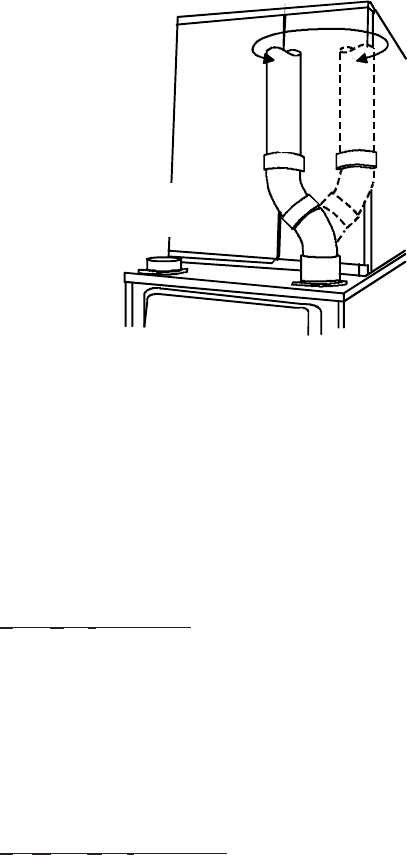
16
TERMINATION LOCATIONS
NOTES: Refer to Location Requirements and Considerations for
combustion air contaminant restrictions.
The following bullets and diagram describe the restrictions concern-
ing the appropriate location of vent/flue pipe and combustion air intake
pipe (when applicable) terminations. Refer to Non-Direct Vent (Single
Pipe) Piping and Direct Vent (Dual Pipe) Piping located in this section
for specific details on termination construction.
• All terminations (flue and/or intake) must be located at least
12 inches above ground level or the anticipated snow level.
• Vent terminations (non-direct and direct vent) must terminate
at least 3 feet above any forced air inlet located within 10
feet.
NOTE: This provision does not apply to the combustion air
intake termination of a direct vent application.
• The vent termination of a non-direct vent application must
terminate at least 4 feet below, 4 feet horizontally from, or
1 foot above any door, window, or gravity air inlet into any
building.
• The vent termination of a direct vent application must
terminate at least 12 inches from any opening through
which flue gases may enter a building (door, window, or
gravity air inlet).
• The vent termination of vent pipe run vertically through a
roof must terminate at least 12 inches above the roof line
(or the anticipated snow level) and be at least 12 inches
from any vertical wall (including any anticipated snow build
up).
• A vent termination shall not terminate over public walkways
or over an area where condensate or vapor could create
a nuisance or hazard or could be detrimental to the
operation of regulators, relief valves, or other equipment.
• The combustion air intake termination of a direct vent
application should not terminate in an area which is
frequently dusty or dirty.
NOTE: In Canada, the Canadian Fuel Gas Code takes precedence
over the preceding termination restrictions.
CANADIAN V ENTING R EQUIREMENTS
In Canada, venting must conform to the requirements of the cur-
rent CAN/CSA-B149.1-05 Installation Code. Use only CSA-listed,
ULC-S636 compliant two- or three-inch diameter PVC or ABS pipe,
solvent cement, and fittings throughout. The certified piping should
be clearly marked with the ULC Std “S636” on the pipe and fittings.
Carefully follow the pipe manufacturers’ instructions for cutting,
cleaning, and solvent cementing PVC and/or ABS.
The vent can be run through an existing unused chimney provided
the space between the vent pipe and the chimney is insulated and
closed with a weather-tight, corrosion-resistant flashing.
STANDARD FURNACE C ONNECTIONS
It is the responsibility of the installer to ensure that the piping con-
nections to the furnace are secure, airtight, and adequately sup-
ported.
As shipped, attachment “couplings” for vent/flue and combustion
air intake pipe connections are provided on the furnace’s top cover
(upflow) or basepan (counterflow). To use the standard connec-
tions, field supplied vent/flue pipe and combustion air intake pipe
(when applicable) should be secured directly to the furnace at these
locations.
VENT/FLUE PIPE
Vent/flue pipe can be secured to the vent/flue coupling using the rub-
ber coupling and worm gear hose clamps provided with this furnace
(see “Standard Connections” figure). The rubber coupling allows sepa-
ration of the vent/flue pipe from the furnace during servicing. Combus-
tion Air and Vent piping should be routed in a manner to avoid contact
with refrigerant lines, metering devices, condensate drain lines, etc.
If necessary, clearances may be increased by utilizing two 45 deg.
Long-Sweep Elbows and creating an “S” joint to provide additional
space at connection locations. This joint can be rotated on the fitting
to establish maximum clearance between refrigerant lines, metering
devices, and condensate drain lines, etc. This joint is the equivalent
of one 90 deg. elbow when considering elbow count.
45 DEGREE
LONG-SWEEP
ELBOWS
V
E
N
T
Increased Clearance Configuration
NOTE: Do not use other commercially available “no hub connec-
tors” due to possible material conflicts. The vent/flue pipe can also
be secured using a PVC or ABS elbow or coupling using the ap-
propriate glue (see Section IX, Materials and Joining Methods).
NOTE: For non-direct vent installations, a minimum of one 90°
elbow should be installed on the combustion air intake coupling
to guard against inadvertent blockage.
COMBUSTION AIR PIPE
DIRECT VENT I NSTALLATIONS
On upflow units secure the combustion air intake pipe directly to the
air intake coupling. On counterflow units secure the combustion air
intake pipe to the air intake coupling using the rubber coupling and
worm gear hose clamps provided with the unit. The counterflow rub-
ber coupling allows service removal of air intake piping internal to the
furnace blower compartment. NOTE: Because of probable material
conflicts, do not use other commercially available “no hub connec-
tors”. The combustion air intake pipe can also be secured directly to
the counterflow unit air intake pipe coupling.
NON-DIRECT V ENT INSTALLATIONS
A minimum of one 90° elbow should be installed on the combustion air
intake “coupling” to guard against inadvertent blockage.
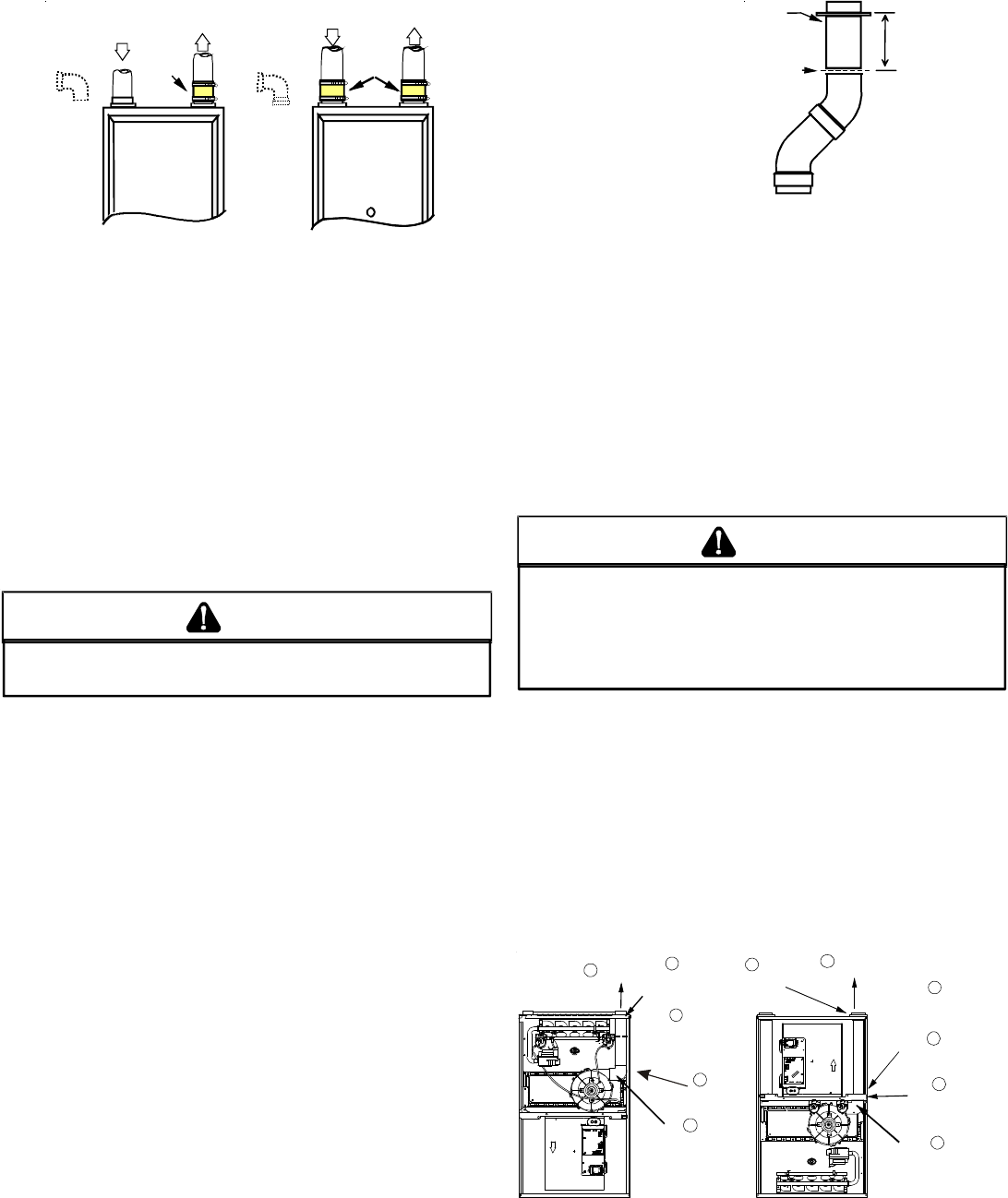
17
FLANGE
CUT HERE
3.75"
Vent/Flue Pipe Cuts
5. Remove plastic plug from alternate vent/flue location. Relocate
and install plug in standard vent/flue location (top cover).
Counterflow units.
Remove plastic plug from alternate vent/flue location. Relocate
and install plug in standard vent/flue location (basepan). Plug
remaining hole in blower deck with plastic plug included in the
drain kit bag.
6. Upflow and Counterflow units.
Insert cut section of vent/flue pipe and coupling into alternate
vent/flue location. Using a rubber coupling and worm gear
hose clamps from the drain kit bag, attach the vent/flue pipe
and coupling to the induced draft blower. Secure the coupling
to the cabinet using the screws removed in step 1 or with
field-supplied 3/8” #8 self drilling screws.
T
HE
RUBBER
ELBOW
IS
NOT
DESIGNED
TO
SUPPORT
A
LOAD
. W
HEN
THE
RUBBER
ELBOW
IS
MOUNTED
EXTERNALLY
TO
THE
FURNACE
CABINET
,
EXTREME
CARE
MUST
BE
TAKEN
TO
ADEQUATELY
SUPPORT
FIELD
-
SUPPLIED
VENT
/
FLUE
PIPING
,
AS
DAMAGE
CAN
RESULT
IN
LEAKS
CAUSING
BODILY
INJURY
OR
DEATH
DUE
TO
EXPOSURE
TO
FLUE
GASES
,
INCLUDING
CARBON
MONOXIDE
.
WARNING
7. Upflow and Counterflow units.
For upright installations, externally mount the rubber elbow
to the vent/flue coupling using a worm gear hose clamp.
Secure field supplied vent/flue piping to the rubber elbow
using a worm gear hose clamp. NOTE: Use of the alternate
vent/flue location for upright installations, requires the drain
trap be installed on the same side of the unit as the flue
pipe.
8. Upflow and Counterflow units.
For horizontal installations, externally secure the field-
supplied vent/flue pipe directly to the vent/flue coupling
using a PVC or ABS coupling or elbow.
4
CUT PIPE PER
VENT/FLUE
PIPE CUTS
DIAGRAM
UPFLOW
REMOVE
4 SCREWS
3
REMOVE
PIPE
2
DETACH RUBBER
ELBOW FROM
ID BLOWER AND
VENT/FLUE
PIPE
1.
REMOVE
4 SCREWS
2
DETACH RUBBER
ELBOW FROM
ID BLOWER AND
VENT/FLUE
PIPE
COUNTERFLOW
3
REMOVE
PIPE
5
REMOVE
A
ND RELOCATE
5
REMOVE
AND RELOCATE
1
REMOVE
3 SCREWS
1
4
CUT PIPE PER
VENT/FLUE PIPE CUTS
DIAGRAM
RUBBER
COUPLING
WITH WORM
GEAR CLAMPS
RUBBER
COUPLINGS
WITH WORM
GEAR CLAMPS
COMBUSTION
AIR PIPE
(DIRECT VENT ONLY)
COMBUSTION
AIR PIPE
(DIRECT VENT ONLY)
VENT/FLUE
PIPE
VENT/FLUE
PIPE
90º PVC
ELBOW
(NON-DIRECT VENT)
90º PVC
ELBOW
(NON-DIRECT VENT)
STANDARD CONNECTIONS
OR
OR
UPFLOW COUNTERFLOW
ALTERNATE FURNACE C ONNECTIONS
If the standard locations are undesirable for a specific installation,
alternate side panel locations are available on the upflow models for
the vent/flue. Counterflow furnaces include provisions for both alter-
nate vent/flue and combustion air piping. These locations may be of
particular benefit to upright upflow installations requiring additional
access to an A coil, or to upright counterflow installations requiring
additional access to a filter or electronic air cleaner, or to horizontal
installations desiring vent/flue (upflow and counterflow) and combus-
tion air intake (counterflow only) piping run vertically from the side of
the cabinet.
NOTE: Standard and alternate locations can be combined (i.e., an
installation may use the standard combustion air intake location
but use the alternate vent/flue location), if needed.
E
DGES
OF
SHEET
METAL
HOLES
MAY
BE
SHARP
. U
SE
GLOVES
AS
A
PRECAUTION
WHEN
REMOVING
HOLE
PLUGS
.
WARNING
ALTERNATE VENT/FLUE LOCATION
The alternate vent/flue location is the large hole directly in line with
the induced draft blower outlet. To use the alternate vent/flue
location refer to the following steps, the “Vent/Flue Pipe Cuts”
figure, and the “Alternate Vent/Flue Location” figure.
NOTE: Counterflow instructions follow the upflow instructions.
1. Remove and save the four screws securing the vent/flue
coupling to the furnace top panel.
Counterflow units.
1. Remove and save the four screws securing the vent/flue
coupling to the furnace basepan. Also remove the three
screws securing the furnace’s internal vent/flue piping to
the blower deck.
2. Upflow and Counterflow units.
Loosen the worm gear hose clamps on the rubber elbow
and detach it from both the induced draft blower and the
vent/flue pipe.
3. Upflow and Counterflow units.
Remove the vent/flue pipe from the furnace.
4. Cut the vent/flue pipe 3.75 inches from the flanged end of
the pipe. See Vent/Flue Pipe Cuts figure. The section of
pipe attached to the coupling will reach through the side
panel to the induced draft blower. Discard remaining pipe
and elbows.
Counterflow units.
Cut the vent/flue pipe 3.75 inches from the blower deck
coupling. See Vent/Flue Pipe Cuts figure. Save vent/flue pipe
attached to blower deck coupling for use in the alternate
location. Discard remaining pipe and elbows.
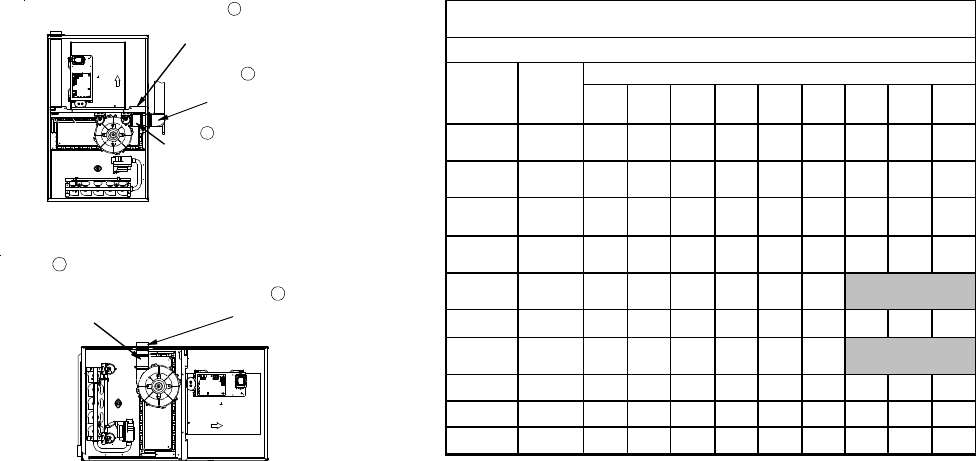
18
5
A
DDITIONAL PLUG
FROM DRAIN KIT
7
EXTERNALLY
MOUNT
RUBBER ELBOW
6
SECURE TO
ID BLOWER WITH
RUBBER COUPLING
AND HOSE
CLAMPS
COUNTERFLOW/UPRIGHT
(UPFLOW SIMILAR)
UPFLOW/HORIZONTAL
(COUNTERFLOW SIMILAR)
6
SECURE TO
ID BLOWER WITH
RUBBER COUPLING
AND HOSE
CLAMPS
6
SECURE TO
CABINET WITH
SCREWS
Alternate Vent/Flue Location
NON-DIRECT VENT (SINGLE PIPE) PIPING
Non-direct vent installations require only a vent/flue pipe. The vent
pipe can be run horizontally with an exit through the side of the
building or run vertically with an exit through the roof of the building.
The vent can also be run through an existing unused chimney;
however, it must extend a minimum of 12 inches above the top of
the chimney. The space between the vent pipe and the chimney
must be closed with a weather-tight, corrosion-resistant flashing.
For details concerning connection of the vent/flue pipe to the fur-
nace, refer to Vent/Flue Pipe and Combustion Air - Standard Fur-
nace Connections or Alternate Furnace Connections for specific
details. Refer to the following Non-Direct Vent (Single Pipe) Piping
- Vent/Flue Pipe Terminations for specific details on termination
construction.
Although non-direct vent installations do not require a combustion
air intake pipe, a minimum of one 90° elbow should be attached to
the furnace’s combustion air intake if: an upright installation uses
the standard intake location. This elbow will guard against inad-
vertent blockage of the air intake.
VENT/FLUE PIPE LENGTHS AND DIAMETERS
Refer to the following table for applicable length, elbows, and pipe
diameter for construction of the vent/flue pipe system of a non-
direct vent installation. In addition to the vent/flue pipe, a single 90°
elbow should be secured to the combustion air intake to prevent
inadvertent blockage. The tee used in the vent/flue termination must
be included when determining the number of elbows in the piping sys-
tem.
012345678
40,000 2
or 2 1/2 1009590858075706560
45,000 2
or 2 1/2 250 245 240 235 230 225 220 215 210
60,000 2
or 2 1/2 110105100959085807570
70,000 2
or 2 1/2 220 215 210 205 200 195 190 185 180
80,000 2
or 2 1/2 35 30 25 20 15 10
80,000 3 132 125 118 111 104 97 90 83 76
90,000 2
or 2 1/2 45 40 35 30 25 20
90,000 3 147 140 133 126 119 112 105 98 91
100,000 3 98 91 84 77 70 63 56 49 42
115,000 3 140 133 126 119 112 105 98 91 84
Not Applicable
Not Applicable
*MH95/ACSH96/AMEH96/GCH95/GME95
Direct Vent (2 - Pipe) and Non-Direct Vent (1- Pipe) (6)
Maximum Allowable Length of Vent/Flue Pipe & Combustion Air Pipe (ft) (1) (2)
Unit Input
(Btu)
Pipe
Size (4)
(in.)
Number of Elbows (3) (5)
1) Maximum allowable limits listed on individual lengths for inlet and flue and
NOT a combination.
2) Minimum requirement for each vent pipe is five (5) feet in length and one
elbow/tee.
3) Tee used in the vent/flue termination must be included when determining
the number of elbows in the piping system.
4) 2 1/2” or 3” diameter pipe can be used in place of 2” diameter pipe.
5) Increased Clearance Configurations using (2) 45 deg. Long Sweep
elbows should be considered equivalent to one 90 deg. elbow.
6) One 90° elbow should be secured to the combustion air intake connec-
tion.
VENT/FLUE PIPE TERMINATIONS
NOTE: If either a 90 degree or 45 degree elbow is used for termina-
tion, it must be pointed downward.
The vent/flue pipe may terminate vertically, as through a roof, or
horizontally, as through an outside wall.
Vertical vent/flue pipe terminations should be as shown in the fol-
lowing figure. Refer to Vent/Flue Pipe and Combustion Air Pipe -
Termination Locations for details concerning location restrictions.
The penetration of the vent through the roof must be sealed tight
with proper flashing such as is used with a plastic plumbing vent.
Horizontal vent/flue pipe terminations should be as shown in the
following figure. Refer to Section IX, Vent/Flue Pipe and Combus-
tion Air Pipe - Termination Locations for details concerning loca-
tion restrictions. A 2 3/8” diameter wall penetration is required for
2” diameter pipe. A 3” diameter hole is required for a 2 1/2” pipe
and a 3 1/2” diameter hole is required for 3” diameter pipe. To
secure the pipe passing through the wall and prohibit damage to
piping connections, a coupling should be installed on either side
of the wall and solvent cemented to a length of pipe connecting the
two couplings. The length of pipe should be the wall thickness
plus the depth of the socket fittings to be installed on the inside and
outside of the wall. The wall penetration should be sealed with sili-
cone caulking material.
In a basement installation, the vent/flue pipe can be run between
joist spaces. If the vent pipe must go below a joist and then up into
the last joist space to penetrate the header, two 45° elbows should be
used to reach the header rather than two 90° elbows.
NOTE: Terminate both pipes in the same pressure zone (same
side of roof, no major obstacles between pipes, etc.)
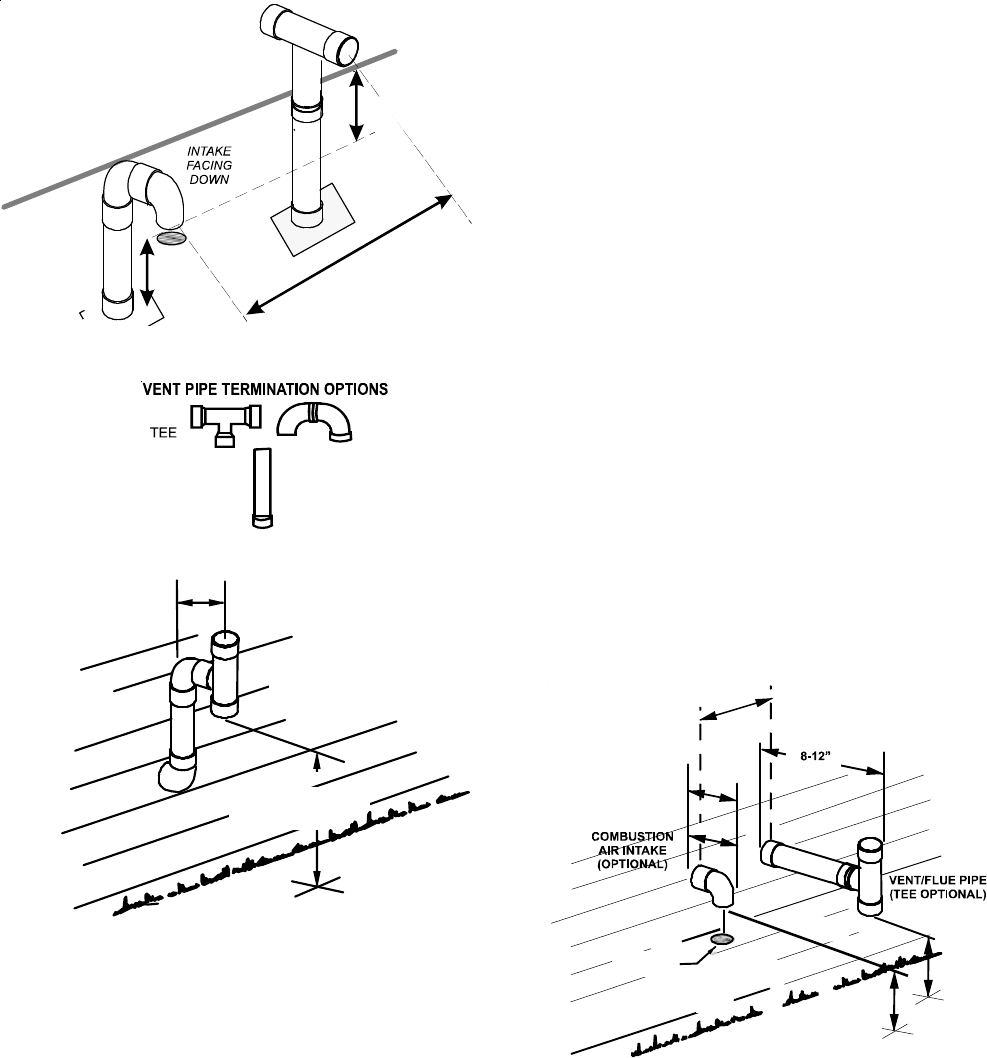
19
COMBUSTION AIR INTAKE
(OPTIONAL)
*Not required for
single pipe installation
TEE (OPTIONAL)
96” MAX. - 3” MIN.
ROOF LINE
INTAKE
SCREEN
OPTIONAL
12” MIN
HEIGHT DIFFERENCE
BETWEEN
INTAKE AND VENT
12” MIN TO ROOF OR HIGHEST
ANTICIPATED SNOW LEVEL
STRAIGHT
ELBOWS
_______________
VENT/FLUE TEE (
or
45° ELBOW
TURNED DOWN or
90° ELBOW TURNED
DOWN
OPTIONAL)
12" MIN. ABOVE
HIGHEST ANTICIPATED
SNOW LEVEL
12" MIN.
Horizontal Termination (Single Pipe)
Above Highest Anticipated Snow Level
DIRECT VENT (DUAL PIPE) PIPING
The inlet air screens provided in the installation instruction packet are
available for the installer to use in the inlet of the combustion air pipe to
prevent animals from building nests in the combustion air pipe. Instal-
lation of screens, while strongly recommended, is not required and
will not affect performance of the unit.
Direct vent installations require both a combustion air intake and a
vent/flue pipe. The pipes may be run horizontally and exit through
the side of the building or run vertically and exit through the roof of
the building. The pipes may be run through an existing unused
chimney; however, they must extend a minimum of 12 inches above
the top of the chimney. The space between the pipes and the chim-
ney must be closed with a weather tight, corrosion resistant flashing.
Both the combustion air intake and a vent/flue pipe terminations must
be in the same atmospheric pressure zone. For details concerning
connection of pipes to the furnace, refer to the Vent/Flue Pipe and
Combustion Pipe - Standard Furnace Connections or Alternate Fur-
nace Connections.
VENT/FLUE AND COMBUSTION AIR PIPE LENGTHS AND DIAMETERS
Refer to the following table for applicable length, elbows, and pipe di-
ameter for construction of the vent/flue and combustion air intake
pipe systems of a direct vent (dual pipe) installation. The number
of elbows tabulated represents the number of elbows and/or tees
in each (Vent/Flue & Combustion Air Intake) pipe. Elbows and/or
tees used in the terminations must be included when determining
the number of elbows in the piping systems.
If the combustion air intake pipe is to be installed above a finished
ceiling or other area where dripping of condensate will be objec-
tionable, insulation of the combustion air pipe may be required.
Use 1/2” thick closed cell foam insulation such as Armaflex™ or
Insultube where required.
VENT/FLUE AND COMBUSTION AIR PIPE TERMINATIONS
The vent/flue and combustion air pipes may terminate vertically, as
through a roof, or horizontally, as through an outside wall.
Refer to Vent/Flue Pipe and Combustion Pipe - Termination Loca-
tions for details concerning location restrictions. The penetrations
through the roof must be sealed tight with proper flashing such as
is used with a plastic plumbing vent.
Horizontal terminations should be as shown in the following fig-
ure. Refer to Vent/Flue Pipe and Combustion Pipe - Termination
Location for location restrictions. A 2 3/8” diameter wall penetra-
tion is required for 2” diameter pipe. A 3” diameter hole is required
for a 2 1/2” pipe and a 3 1/2” diameter hole is required for 3” diameter
pipe. The wall penetration should be sealed with silicone caulking
material.
90º OR 45°
ELBOW
SCREEN
(OPTIONAL)
12" MIN. TO GRADE OR
HIGHEST ANTICIPATED
SNOW LEVEL
6” MAX
10”- 24”
4” MIN
Standard Horizontal Terminations (Dual Pipe)
Vent & Combustion Air Intake Measurements for Standard Hori-
zontal Terminations (Dual Pipe)
Center to center = 10” min / 24” max.
Vertical separation: 0” - 24”
Vent termination from wall = 8” min / 12” max.
Combustion air intake from wall = 6” max.
Vent and intake clearance to ground
or anticipated snow level = 12” min.
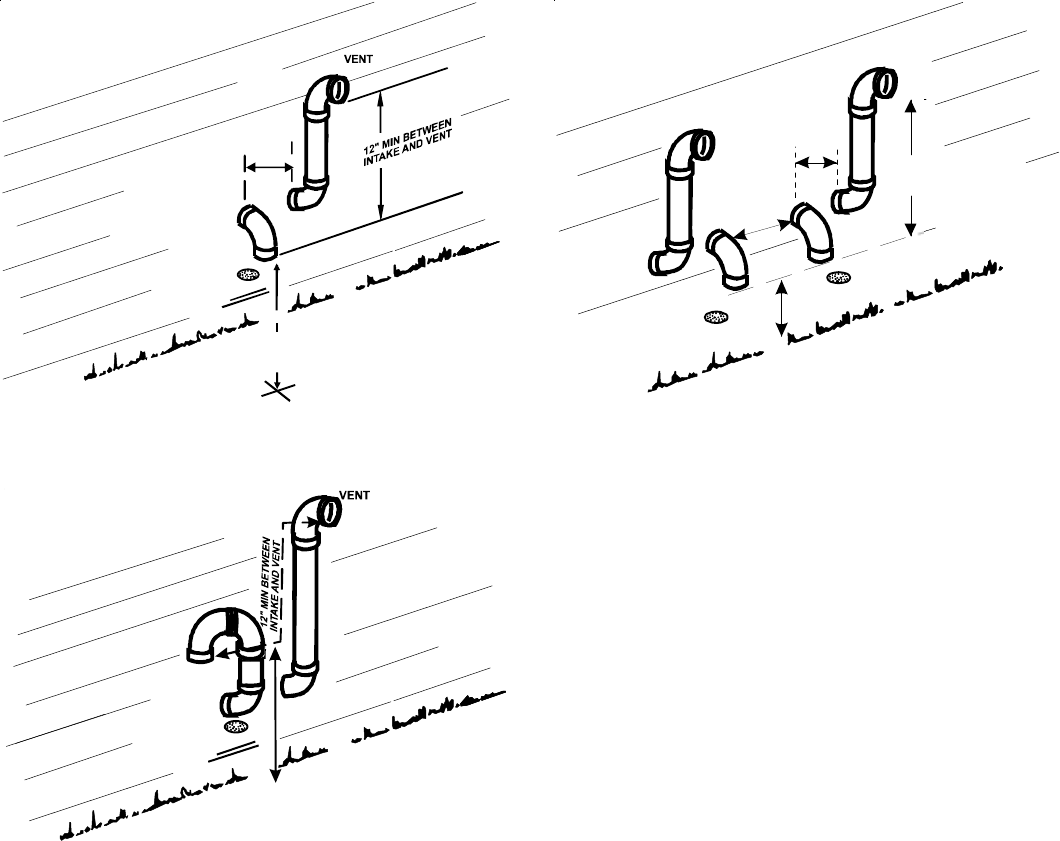
20
SCREEN
(OPTIONAL)
AIR
INTAKE
90°
ELBOWS
12" MIN. ABOVE
HIGHEST ANTICIPATED
SNOW LEVEL
3” - 24”
Alternate Horizontal Vent Termination (Dual Pipe)
SCREEN
(OPTIONAL)
AIR
INTAKE
90°
ELBOWS
12" MIN. ABOVE
HIGHEST ANTICIPATED
SNOW LEVEL
3”-24” BETWEEN PIPES
Combustion Air Intake may also be snorkeled to obtain 12” min. ground
clearance.
Alternate Vent Termination Above Anticipated Snow Level
(Dual Pipe)
In a basement installation, the pipes may be run between the joist
spaces. If the pipes must go below the joist and then up into the
last joist space to penetrate the header, two 45° elbows should be
used to reach the header rather than two 90° elbows.
VENT/INTAKE T ERMINATIONS F OR I NSTALLATION OF M ULTIPLE
DIRECT VENT F URNACES
If more than one direct vent furnace is to be installed vertically
through a common roof top, maintain the same minimum clear-
ances between the exhaust vent and air intake terminations of
adjacent units as with the exhaust vent and air intake terminations
of a single unit.
If more than one direct vent furnace is to be installed horizontally
through a common side wall, maintain the clearances as in the
following figure. Always terminate all exhaust vent outlets at the
same elevation and always terminate all air intakes at the same
elevation.
3” MIN
12” MIN TO GRADE OR HIGHEST
ANTICIPATED SNOW LEVEL
12” MIN SEPARATION
3” - 24”
OPTIONAL
INTAKE
SCREENS
Termination of Multiple Direct Vent Furnaces
CONCENTRIC VENT TERMINATION
Refer to the directions provided with the Concentric Vent Kit (DCVK)
for installation specifications.
SIDE WALL VENT KIT
This kit is to be used with 2” or 3” direct vent systems. The vent kit
must terminate outside the structure and may be installed with the
intake and exhaust pipes located side-by-side or with one pipe above
the other. This kit is NOT intended for use with single pipe (indirect
vent) installations.
Refer to the directions furnished with the Side Wall Vent Kit (p/n
0170K00000S) for installation specifications.
X. CONDENSATE DRAIN LINES & DRAIN TRAP
A condensing gas furnace achieves its high level of efficiency by
extracting almost all of the heat from the products of combustion
and cooling them to the point where condensation takes place.
The condensate which is generated must be piped to an appropri-
ate drain location.
In upright installations, the furnace’s drain hoses may exit either
the right or left side of the furnace. NOTE: If the alternate vent/flue
outlet is utilized in an upright installation, the drain trap and drain
connections must be located on the same side as the alternate
vent/flue outlet.
In horizontal installations, the drain hoses will exit through the
bottom (down side) of the unit with the drain trap suspended be-
neath the furnace. The field-supplied drain system must be in
accordance with all local codes and the instructions in the follow-
ing sections.
Follow the bullets listed below when installing the drain system.
Refer to the following sections for specific details concerning fur-
nace drain trap installation and drain hose hook ups.
• The drain trap supplied with the furnace must be used.
• The drain line between furnace and drain location must
maintain a 1/4 inch per foot downward slope toward
the drain.
• Do not trap the drain line in any other location than at
the drain trap supplied with the furnace.
• If the drain line is routed through an area which may
see temperatures near or below freezing, precautions
must be taken to prevent condensate from freezing
within the drain line.
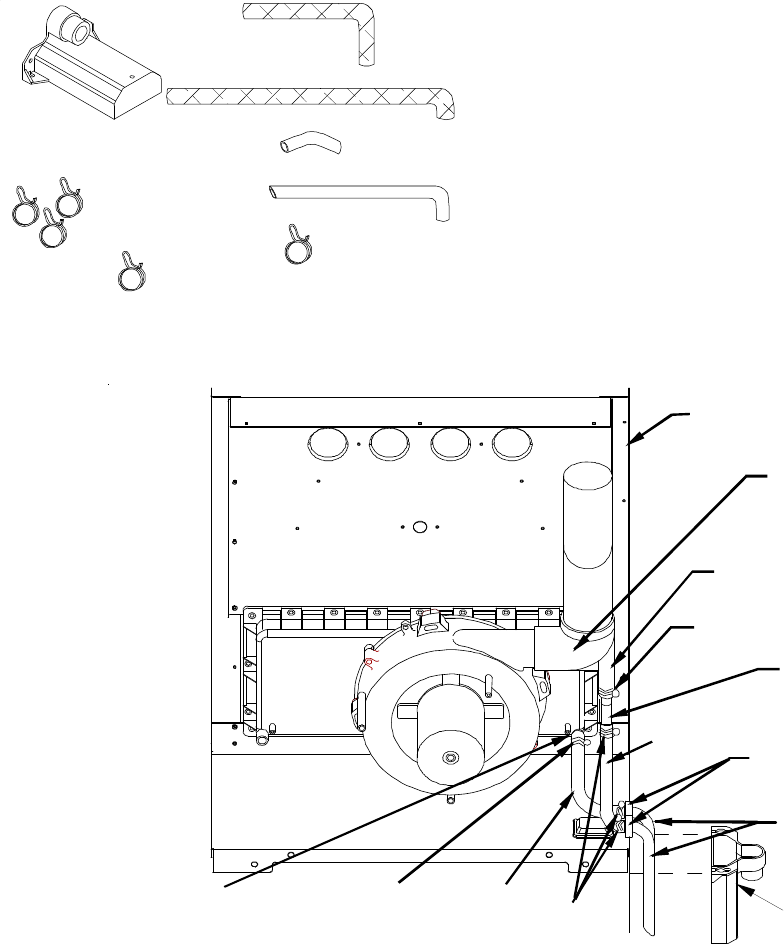
21
• If an air conditioning coil is installed with the furnace, a
common drain may be used. An open tee must be
installed in the drain line, near the cooling coil, to relieve
positive air pressure from the coil’s plenum. This is
necessary to prohibit any interference with the function of
the furnace’s drain trap.
NOTE: In vertical installations, air conditioning coil condensate may
drain into the furnace trap as long as there is a trap between the coil and
the furnace trap and the drain pipe is not terminating below the water
level of the furnace trap.
STANDARD RIGHT OR LEFT SIDE DRAIN HOSE CONNECTIONS
All installations positions require the use of the drain trap, hoses, tubes,
and clamps. The following quantity of hoses, tubes, and hose clamps
are provided with the unit.
DRAIN TRAP
QTY: 1
GREEN
HOSE CLAMPS
QTY: 3 SILVER
HOSE CLAMP
QTY: 1
TUBE 2
QTY: 2
TUBE 1
QTY: 1
HOSE B
QTY: 1
HOSE A
QTY: 1
RED
HOSE CLAMP
QTY: 1
Hose and Tube Identification
In a upright installation drain hoses are connected to drain ports on the
rubber elbow and the recuperator coil front cover. The drain lines are
then routed through the right side panel and into the drain trap secured
to the outside of the cabinet.
NOTE: Refer to Alternate Vent/Flue Hose Connections for upright
installations using an alternate vent/flue outlet.
1. Remove the rubber plug from the right side of the front cover
drain port.
2. Secure Hose A to front cover drain port with a red hose
clamp. Route hose to rear side panel grommet hole.
3. Cut and remove 1/4 inch from the end of the drain port on
the rubber elbow.
4. Insert Tube 1 into rubber elbow drain port and secure with
silver hose clamp. Angle tube outward toward front of
furnace.
5. Cut 17 3/4 inches from the long end of Hose B and discard.
Secure the remaining hose to Tube 1 with a green hose
clamp. Route the other end of Hose B to front right side
panel grommet hole.
For details concerning mounting of the drain trap, refer to Vertical
Drain Trap Mounting.
6. Insert short end of each of tube 2 through side panel
grommet holes. Secure tubes to hoses A and B with green
hose clamps. Ensure hoses and tubes maintain a
downward slope for proper drainage and that they are not
kinked or binding.
DRAIN
TRAP
FRONT
COVER
DRAIN PORT
TUBE(S) 2
GREEN
HOSE
CLAMPS
(3 PLACES)
RIGHT SIDE
PANEL
RUBBER ELBOW
DRAIN PORT
TUBE 1
SIDE PANEL
GROMMET
HOLES
HOSE
B
HOSE
A
RUBBER
ELBOW
RED HOSE
CLAMP
SILVER HOSE CLAMP
Upright “Standard” Connections -Right Side
(Upflow Shown, Counterflow Similar)
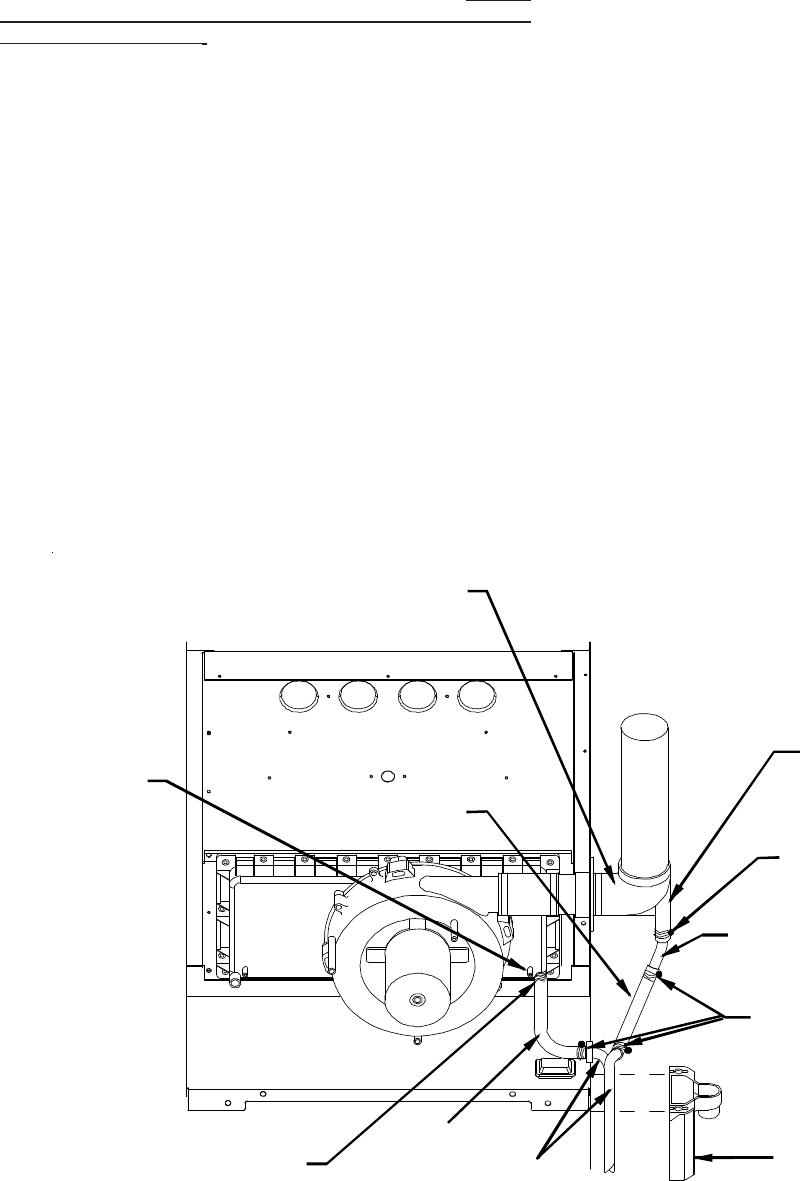
22
ALTERNATE VENT/FLUE DRAIN HOSE CONNECTIONS
Upright installations using the alternate vent/flue outlet will require
“right-side only” drain hoses to be connected as follows. Refer to
Vent/Flue Pipe and Combustion Air Pipe for details on alternate
vent/flue pipe connection.
1. Remove the rubber plug from the right-side drain port on
the front cover . Save for use in step 3.
2. Secure Hose A to front cover drain port with a red hose
clamp. Route hose to rear right side panel grommet hole.
3. Remove grommet from front right-side panel drain hole.
Seal hole in grommet with large end of plug. Reinstall
grommet and plug into side panel drain hole.
4. Cut 1/4 inch from the end of the drain port on the externally
mounted rubber elbow. Discard cut portion.
5. Insert Tube 1 into rubber elbow drain port and secure with a
silver hose clamp. Angle tube toward trap.
6. Cut 17 3/4 inches from the long end of Hose B and discard.
7. Secure straight end of Hose B to exposed end of Tube 1
with a green hose clamp. Route hose toward right side
panel grommet holes.
8. Insert short end of one Tube 2 through rear right side panel
grommet drain hole. Secure tube to Hose A with a green
hose clamp.
9. Insert short end of remaining Tube 2 into Hose B from
rubber elbow and secure with green hose clamp. Ensure
hoses and tubes maintain a downward slope for proper
drainage and are not kinked or binding.
Upright “Alternate: Connections - Right Side Only
(Upflow Shown, Counterflow Similar)
RUBBER ELBOW
(EXTERNALLY
MOUNTED)
TUBE 1
GREEN HOSE
CLAMPS
(3 PLACES)
HOSE B
TUBE(S) 2 DRAIN TRAP
HOSE A
FRONT
COVER
DRAIN
PORT
RUBBER
ELBOW
DRAIN PORT
RED HOSE
CLAMP
SILVER HOSE CLAMP
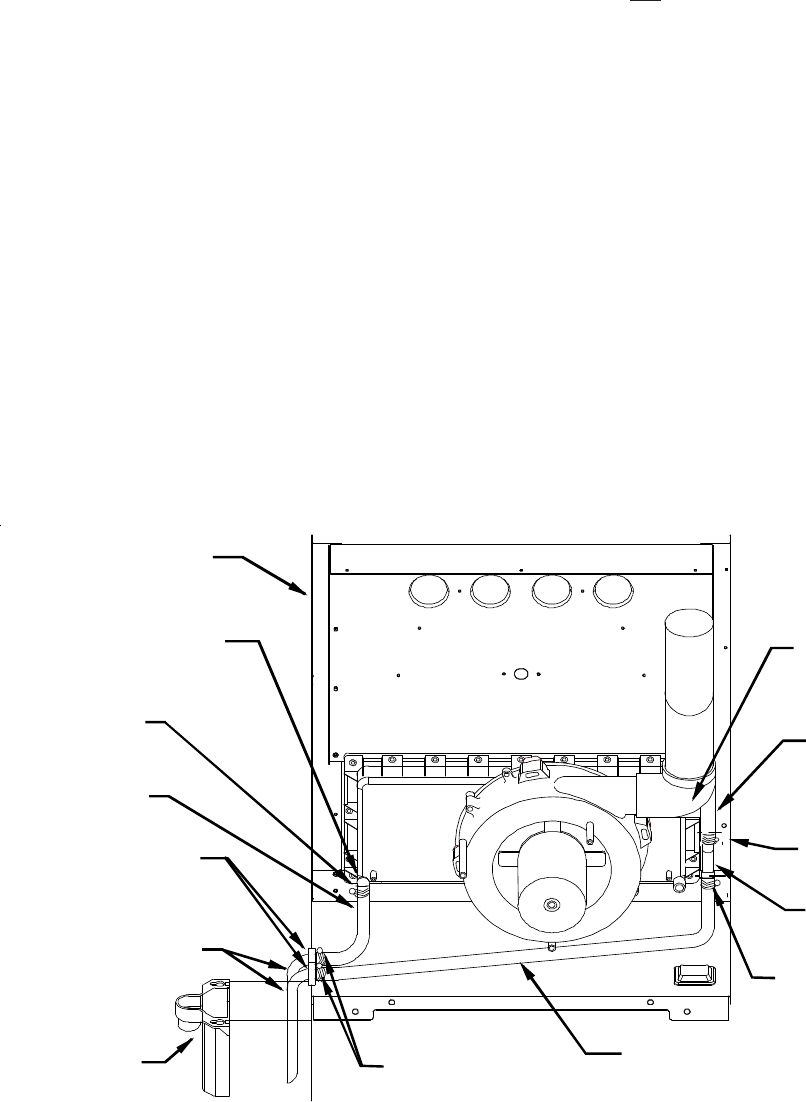
23
UPRIGHT INSTALLATIONS-TRAP ON L EFT SIDE
NOTE: For left side trap installation, grommets must be moved to
the left side of the furnace and the plugs installed on the right side
of the furnace.
1. Remove the rubber plug from the left side drain port on the
front cover.
2. Secure Hose A to front cover drain port with a red hose
clamp. Route hose to rear side panel grommet hole.
3. Cut and remove 1/4 inch from the end of the drain port on
the rubber elbow.
Upright “Standard” Connections - Left Side
(Upflow Shown, Counterflow Similar)
4. Insert Tube 1 into rubber elbow drain port and secure with silver
hose clamp. Angle tube outward toward front of furnace.
5. Cut “X” inches from the long end of Hose B and discard. Refer
to table for appropriate length to cut. Secure remaining hose
to Tube 1 with a green hose clamp. Route other end of Hose B
to front left side panel grommet hole.
NOTE: Long hose “B” must always be connected to Tube 1 and
the elbow and not on the front cover.
6. Insert short end of each Tube 2 through side panel grommet
holes. Secure tubes to Hose A and Hose B with green hose
clamps. Ensure hoses and tubes maintain a downward
slope for proper drainage and that they are not kinked or
binding.
LEFT
SIDE PANEL
FRONT COVER
DRAIN PORT
HOSE A
SIDE PANEL
DRAIN
HOLES
TUBE(S) 2
DRAIN
TRAP
GREEN HOSE
CLAMP
TUBE 1
RUBBER
ELBOW
HOSE B
RUBBER
ELBOW
DRAIN PORT
RED HOSE
CLAMP
SILVER HOSE
CLAMP
GREEN
HOSE CLAMP
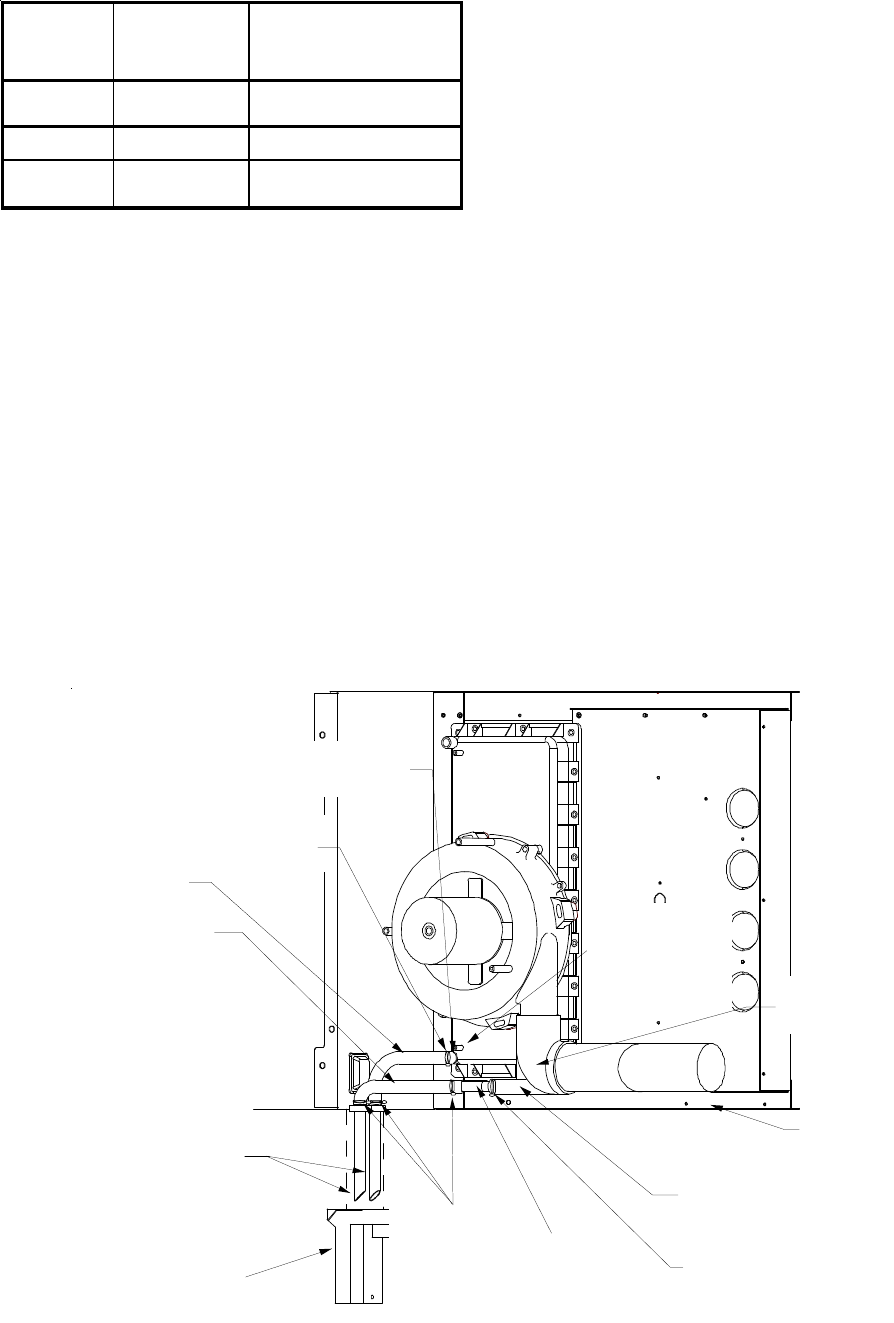
24
Cabinet Width
(inches)
Models
(kBTU_Tons)
"X" Length to Cut From Long
End of Hose B
(inches)
17 1/2 040_3, 045_30,
060_3 7
21 070_40, 080_5 3 1/2
090_50, 100_5
115_50 None24 1/2
UPRIGHT DRAIN TRAP MOUNTING (LEFT OR RIGHT SIDE PANEL)
1. Insert drain tubes into drain trap and position the drain trap
against the side panel. NOTE: Drain tubes must reach the
bottom of the drain trap.
2. Secure drain trap to side panel at the mounting holes
(dimples or crosshairs on counterflow models) located
below the grommet drain holes.
3. Attach PVC drain line to drain trap outlet with either a 90°
elbow or coupling.
HORIZONTAL I NSTALLATIONS
RIGHT SIDE DOWN
Horizontal installations with the right side down require that the
drain hoses be connected to the right side front cover drain port
and the rubber elbow drain port.
NOTE: On counterflow models, relocation of the front cover pressure
switch hose is required.
Make connections as follows:
1. Remove the rubber plug from right side of the front cover drain
port.
Counterflow furnaces
Relocate the front cover pressure switch hose connection
from the left side pressure tap to the right (down) side tap.
The pressure switch hose must be connected to the down
side to guard against blocked drain conditions. Cut hose
to appropriate length to minimize sagging. Plug left (unused)
pressure tap with plug removed from right side.
2. Secure Hose A to front cover drain tap with a red hose clamp.
Route hose to rear right (down) side panel grommet holes.
3. Cut 1/4 inch from the end of the drain port on the rubber
elbow and discard.
4. Insert Tube 1 into rubber elbow drain port and secure with a
silver hose clamp. Angle tube outward toward front of furnace.
5. Cut 17 3/4 inches from the long end of Hose B and discard.
6. Secure remaining end of Hose B to exposed end of Tube 1
with a green hose clamp. Route hose to front right down
side panel grommet holes.
7. Cut 5 1/2 inches straight length from the long end of each
Tube 2 and discard the radius pieces.
8. Insert approximately one inch of each Tube 2 through the
right down side panel grommet holes. Secure tubes to
Hose A and Hose B using green hose clamps. Ensure
hoses and tubes maintain a downward slope for proper
drainage and are not kinked or bound.
For details concerning mounting of the drain trap, refer to Conden-
sate Drain Lines and Drain Trap - Horizontal Drain Trap Mounting.
HOSE A
HOSE B
GREEN
HOSE
CLAMP
(3 PLACES)
TUBE 1
RUBBER
ELBOW
RIGHT
SIDE
PANEL
DRAIN TRAP
TUBES 2
RUBBER ELBOW
DRAIN PORT
FRONT COVER
DRAIN PORT
FRONT
COVER
PRESSURE
TAP
RED HOSE
CLAMP
SILVER HOSE
CLAMP
Horizontal Connections - Right Side Down
(Upflow Shown, Counterflow Similar)
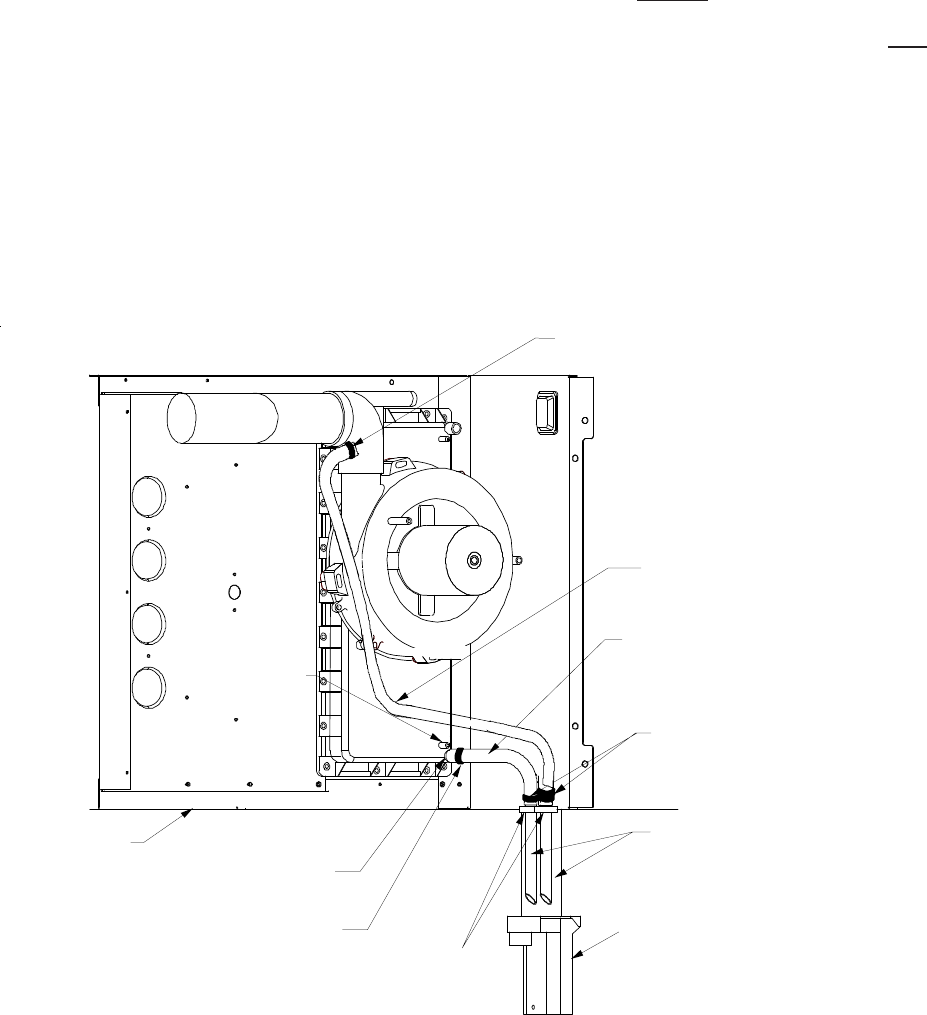
25
LEFT SIDE DOWN
Horizontal installations with the left side panel down will require
drain hoses to be connected to the left side front cover drain port
and the side drain port on the rubber elbow.
1. Remove the rubber plug from the front cover left (down)
side drain port.
2. Relocate the front cover pressure switch hose connection
from the right side (as shipped) pressure tap to the left
(down) side tap. The pressure switch hose must be
connected to the down side to guard against blocked drain
conditions. Cut hose to appropriate length to minimize
sagging. Plug right (unused) pressure tap with plug
removed from left side.
3. Secure Hose A to front cover drain port with a red hose clamp.
Route hose to rear left (down) side panel grommet holes.
NOTE: For left side drainage, grommets must be relocated to
left side panel.
4. Remove the rubber cap from the side drain port on the rubber
elbow.
5. Secure the short end of Hose B to rubber elbow side drain
port using a green hose clamp. NOTE: For left side drainage,
route hose to far left (down) side panel grommet holes.
NOTE: Horizontal left side connections (when using new
side port drain elbow) does not require connecting a hose
to the induced draft blower housing.
6. Cut 5 1/2 inches straight length from the long end of each
Tube 2 and discard radius ends.
7. Insert approximately one inch of each Tube 2 through left
side panel grommet hole. Secure tubes to Hose A and
Hose B with a green hose clamps. NOTE: Tube must
reach bottom of trap. Ensure hoses and tubes maintain a
downward slope for proper drainage and that they are not kinked
or binding.
For details concerning mounting of the drain trap, refer to Conden-
sate Drain Lines and Drain Trap - Horizontal Drain Trap Mounting.
LEFT SIDE
PANEL FRONT COVER
DRAIN PORT
SIDE PANEL
GROMMET
HOLES
DRAIN TRAP
TUBE(S) 2
GREEN HOSE
CLAMP
HOSE A
HOSE B
FRONT
COVER
PRESSURE
TAP
RED HOSE CLAMP
GREEN HOSE
CLAMP
Horizontal Connections - Left Side Down
(Upflow Shown, Counterflow Similar)
HORIZONTAL DRAIN TRAP MOUNTING (LEFT OR RIGHT SIDE PANEL)
1. Position the drain trap against side panel with drain tubes inserted into trap. Note that the trap may be orientated with the outlet
facing either the furnace’s top cover or base pan.
2. Secure drain trap to side panel at the dimples or crosshairs located on either side of the grommet drain holes.
3. Confirm that tubes reach bottom of drain trap and that all hoses maintain a downward slope and are not kinked or binding.
4. Attach PVC drain line to drain trap outlet with either a 90° elbow or coupling.
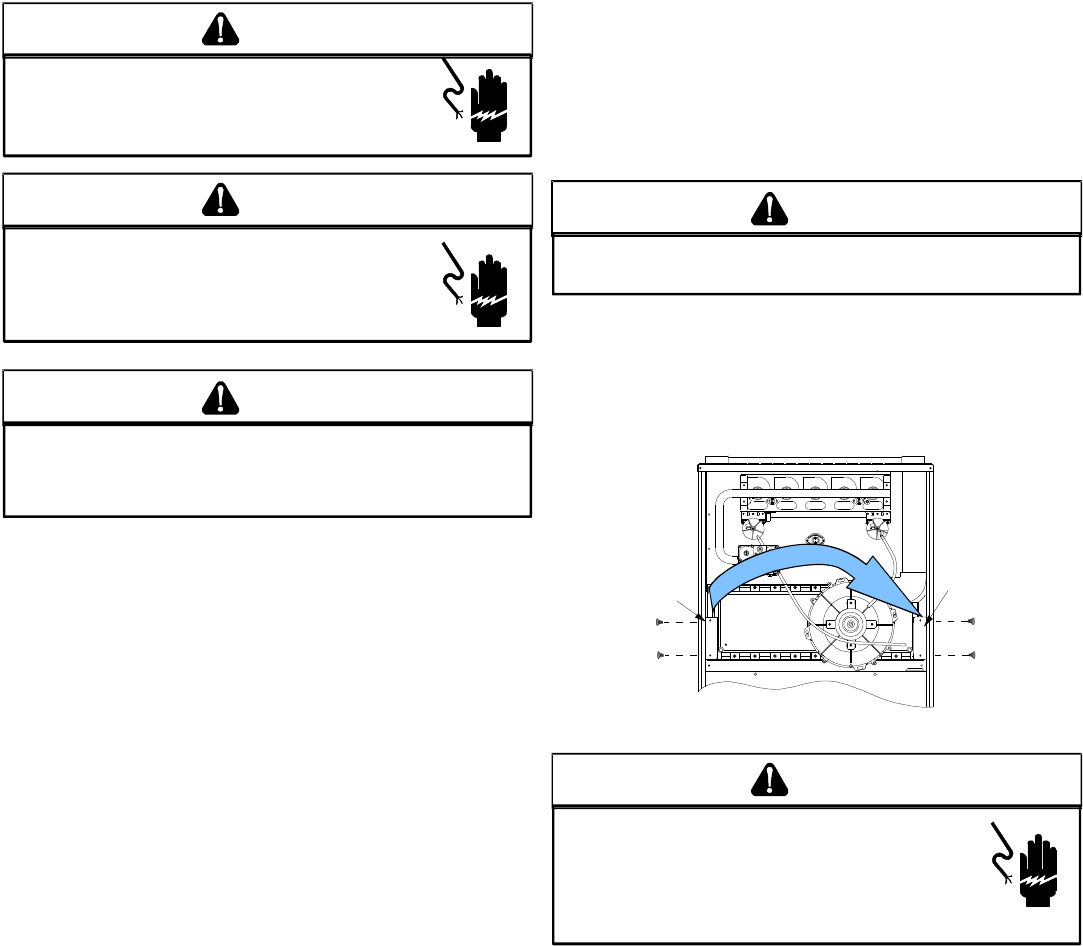
26
XI. ELECTRICAL CONNECTIONS
HIGH VOLTAGE!
T
O
AVOID
THE
RISK
OF
ELECTRICAL
SHOCK
,
WIRING
TO
THE
UNIT
MUST
BE
POLARIZED
AND
GROUNDED
.
WARNING
HIGH VOLTAGE!
T
O
AVOID
PERSONAL
INJURY
OR
DEATH
DUE
TO
ELECTRICAL
SHOCK
,
DISCONNECT
ELECTRICAL
POWER
BEFORE
SERVICING
OR
CHANGING
ANY
ELECTRICAL
WIRING
.
WARNING
L
ABEL
ALL
WIRES
PRIOR
TO
DISCONNECTION
WHEN
SERVICING
CONTROLS
. W
IRING
ERRORS
CAN
CAUSE
IMPROPER
AND
DANGEROUS
OPERATION
. V
ERIFY
PROPER
OPERATION
AFTER
SERVICING
.
CAUTION
WIRING H ARNESS
The wiring harness is an integral part of this furnace. Field alter-
ation to comply with electrical codes should not be required. Wires
are color coded for identification purposes. Refer to the wiring
diagram for wire routings. If any of the original wire as supplied
with the furnace must be replaced, it must be replaced with wiring
material having a temperature rating of at least 105°C. Any re-
placement wiring must be copper conductor.
115 VOLT L INE CONNECTIONS
Before proceeding with electrical connections, ensure that the sup-
ply voltage, frequency, and phase correspond to that specified on
the unit rating plate. Power supply to the furnace must be N.E.C.
Class 1, and must comply with all applicable codes. The furnace
must be electrically grounded in accordance with local codes or, in
their absence, with the latest edition of The National Electric Code,
ANSI NFPA 70 and/or The Canadian Electric Code CSA C22.1.
Use a separate fused branch electrical circuit containing properly
sized wire, and fuse or circuit breaker. The fuse or circuit breaker
must be sized in accordance with the maximum overcurrent pro-
tection specified on the unit rating plate. An electrical disconnect
must be provided at the furnace location.
NOTE: Line polarity must be observed when making field
connections.
Connect hot, neutral, and ground wires as shown in the wiring
diagram located on the unit’s blower door. For direct vent applica-
tions, the cabinet opening to the junction box must be sealed air
tight using either a UL approved bushing such as Heyco Liquid
Tight or by applying a UL approved non-reactive sealant to bush-
ing.
Line polarity must be observed when making field connections.
Line voltage connections can be made through either the right or left
side panel. The furnace is shipped configured for a left side (right side
for counterflows) electrical connection with the junction box located
inside the burner compartment. To make electrical connections
through the opposite side of the furnace, the junction box must be
relocated to the other side of the burner compartment prior to making
electrical connections. To relocate the junction box, observe the fol-
lowing steps.
JUNCTION BOX RELOCATION
E
DGES
OF
SHEET
METAL
HOLES
MAY
BE
SHARP
. U
SE
GLOVES
AS
A
PRECAUTION
WHEN
REMOVING
HOLE
PLUGS
.
WARNING
1. Remove the burner compartment door.
2. Remove and save the two screws securing the junction box
to the side panel.
3. Relocate junction box and associated plugs and grommets
to opposite side panel. Secure with screws removed in
step 2.
*
*
*
**
*
*
*
*
STANDARD
JUNCTION BOX
LOCATION
ALTERNATE
JUNCTION BOX
LOCATION
Junction Box Relocation
HIGH VOLTAGE!
T
O
AVOID
THE
RISK
OF
INJURY
,
ELECTRICAL
SHOCK
OR
DEATH
,
THE
FURNACE
MUST
BE
ELECTRICALLY
GROUNDED
IN
ACCORDANCE
WITH
LOCAL
CODES
OR
IN
THEIR
ABSENCE
,
WITH
THE
LATEST
EDITION
OF
THE
N
ATIONAL
E
LECTRIC
C
ODE
.
WARNING
To ensure proper unit grounding, the ground wire should run from
the furnace ground screw located inside the furnace junction box
all the way back to the electrical panel. NOTE: Do not use gas
piping as an electrical ground. To confirm proper unit grounding,
turn off the electrical power and perform the following check.
1. Measure resistance between the neutral (white) connection
and one of the burners.
2. Resistance should measure 10 ohms or less. This furnace
is equipped with a blower door interlock switch which
interrupts unit voltage when the blower door is opened for
servicing. Do not defeat this switch.
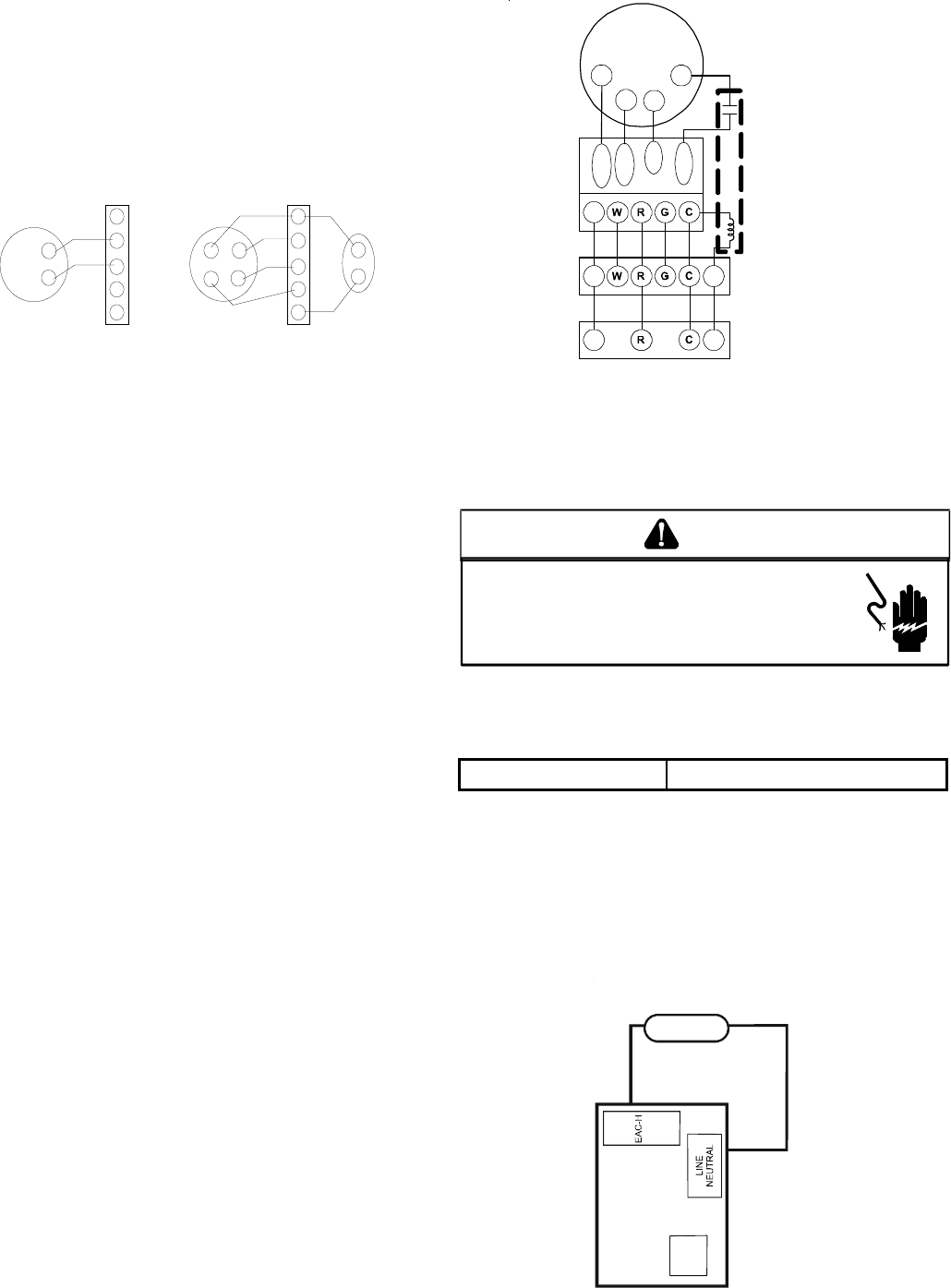
27
Furnace
Control
Remote Condensing Unit
Heating/Cooling
Room Thermostat
Y
Y1
Y1 Y2
Lo-Heat
Hi-Heat
Cool
Line-H
T4 T2
T3 T5
ECO-TECH
MOTOR
Field
Supplied
Relay
Y2
Field Wiring for GME95 /AMEH96 Furnacewith 2-Stage
Condenser
115 VOLT LINE CONNECTION OF ACCESSORIES (ELECTRONIC
AIR C LEANER)
HIGH VOLTAGE!
T
O
AVOID
PERSONAL
INJURY
OR
DEATH
DUE
TO
ELECTRICAL
SHOCK
,
DISCONNECT
ELECTRICAL
POWER
BEFORE
SERVICING
OR
CHANGING
ANY
ELECTRICAL
WIRING
.
WARNING
The furnace’s integrated control module is equipped with line voltage
accessory terminals for controlling power to an optional field-supplied
electronic air cleaner.
The accessory load specifications are as follows:
Electronic Air Cleaner 1.0 Amp maximum at 120 VAC
Turn OFF power to the furnace before installing any accessories.
Follow the air cleaner manufacturers’ instructions for locating, mount-
ing, grounding, and controlling these accessories. Accessory wiring
connections are to be made through the 1/4" quick connect terminals
provided on the furnace integrated control module. The electronic air
cleaner hot terminal is identified as EAC-H. The electronic air cleaner
neutral terminal is identified as LINE NEUTRAL. All field wiring must
conform to applicable codes. Connections should be made as shown
below.
ELECTRONIC
A
IR CLEANER
OPTIONAL
A
CCESSORIES
12 PIN
CONNECTOR
120 VAC
NEUTRAL
TERMINALS
120 VAC
HOT AND
PARK
TERMINALS
INTEGRATED
CONTROL
MODULE
Accessories Wiring
24 VOLT THERMOSTAT WIRING
NOTE: Wire routing must not interfere with circulator blower
operation, filter removal, or routine maintenance.
Low voltage connections can be made through either the right or left
side panel. Thermostat wiring entrance holes are located in the blower
compartment. Wire routing must not to interfere with circulator blower
operation, filter removal, or routine maintenance. Refer to the follow-
ing figure for thermostat connections to the integrated control module
terminal strip.
WWW
Y
YY
C
C
R
RR
GG
W
Y
C
R
G
HEATING
ROOM
THERMOSTAT
HEATING AND
COOLING ROOM
THERMOSTAT
FURNACE
FURNACE REMOTE
CONDENSING
UNIT
Thermostat Diagram
This furnace is equipped with a 40 VA transformer to facilitate use with
most cooling equipment. Consult the wiring diagram, located on the
blower compartment door, for further details of 115 Volt and 24 Volt
wiring.
GME95/AMEH96 FURNACE WITH 2-STAGE CONDENSER
FIELD WIRING
The GME95/AMEH96 model furnaces may be used with a 2-stage
outdoor air conditioner. A two stage cooling/single stage gas heat ther-
mostat is required, in addition to a field supplied relay. The relay must
have a 24VAC coil and contacts rated for up to 1 horse power at
125VAC.
1. Install the field supplied relay on the control mounting panel
near the furnace ignition control. The relay should be installed
such that the motor leads will reach the relay contact terminals.
2. Connect the “Y2” (high stage cool) thermostat terminal to one
coil terminal of the field supplied relay. Connect the other field
supplied relay coil terminal to the “C” terminal on the furnace
ignition control. Typical 18AWG thermostat wire may be used.
3. Connect the common terminal of the field supplied relay to the
“LINE-H” terminal on the furnace ignition control. Use wiring
having copper conductors only and a temperature rating of at
least 105°C.
4. Using the GME95/AMEH96 airflow tables in this manual,
determine the motor speed tap needed to deliver the required
high stage cooling airflow. Connect the selected motor speed
tap to the normally open terminal on the field supplied relay.
Use wiring having copper conductors only and a temperature
rating of at least 105°C.
5. See the following wiring schematic.
28
If it is necessary for the installer to supply additional line voltage wiring
to the inside of the furnace, the wiring must conform to all local codes,
and have a minimum temperature rating of 105°C. All line voltage wire
splices must be made inside the furnace junction box.
The integrated control module electronic air cleaner terminals (EAC)
are energized with 115 volts whenever the circulator blower is en-
ergized.
24 VOLT HUMIDIFIER
The yellow wire connected to the I.D. Blower pressure switch is
powered anytime the pressure switch is closed and provides 24
VAC humidifier control. Remove the yellow wire and connect a field
supplied jumper wire with a “piggyback” terminal to the pressure
switch terminal. Reconnect the yellow wire to the “piggyback” ter-
minal on the jumper wire and then connect the 24 VAC line of the
humidifier to the stripped end of the jumper wire. Using a wire nut
or a field-supplied quick connect terminal can make this connec-
tion. The wiring must conform to all local and national codes. Con-
nect the COM side of the humidifier to the B/C terminal on the
furnace control board (or to the COM side of the 24 VAC trans-
former). DO NOT CONNECT 115V HUMIDIFIER TO THESE TERMI-
NALS.
XII. GAS SUPPLY AND PIPING
GENERAL
The furnace rating plate includes the approved furnace gas input
rating and gas types. The furnace must be equipped to operate on
the type of gas applied. This includes any conversion kits required
for alternate fuels and/or high altitude.
T
O
PREVENT
UNRELIABLE
OPERATION
OR
EQUIPMENT
DAMAGE
,
THE
I
NLET
GAS
SUPPLY
PRESSURE
MUST
BE
AS
SPECIFIED
ON
THE
UNIT
RATING
PLATE
WITH
ALL
OTHER
HOUSEHOLD
GAS
FIRED
APPLIANCES
OPERATING
.
CAUTION
Inlet gas supply pressures must be maintained within the ranges
specified below. The supply pressure must be constant and avail-
able with all other household gas fired appliances operating. The
minimum gas supply pressure must be maintained to prevent
unreliable ignition. The maximum must not be exceeded to pre-
vent unit overfiring.
Natural Gas Minimum: 4.5" w.c. Maximum: 10.0" w.c.
Propane Gas Minimum: 11.0" w.c. Maximum: 13.0" w.c.
Inlet Gas Supply Pressure
HIGH ALTITUDE DERATE
When this furnace is installed at high altitude, the appropriate High
Altitude orifice kit must be applied. This is required due to the
natural reduction in the density of both the gas fuel and combus-
tion air as altitude increases. The kit will provide the proper design
certified input rate within the specified altitude range.
High altitude kits are purchased according to the installation alti-
tude and usage of either natural or propane gas. Contact your
distributor for a tabular listing of appropriate altitude ranges and
corresponding manufacturer’s high altitude (Natural, Propane Gas,
and/or Pressure Switch) kits.
Do not derate the furnace by adjusting the manifold pressure to a
lower pressure than specified on the furnace rating plate. The
combination of the lower air density and a lower manifold pressure
will prohibit the burner orifice from drawing the proper amount of
air into the burner. This may cause incomplete combustion, flash-
back, and possible yellow tipping.
In some areas the gas supplier may artificially derate the gas in an
effort to compensate for the effects of altitude. If the gas is artificially
derated, the appropriate orifice size must be determined based upon
the BTU/ft3 content of the derated gas and the altitude. Refer to the
National Fuel Gas Code, NFPA 54/ANSI Z223.1, and information pro-
vided by the gas supplier to determine the proper orifice size.
A different pressure switch may be required at high altitude regardless
of the BTU/ft3 content of the fuel used. Contact your distributor for a
tabular listing of appropriate altitude ranges and corresponding
manufacturer’s pressure switch kits.
PROPANE GAS CONVERSION
P
OSSIBLE
PROPERTY
DAMAGE
,
PERSONAL
INJURY
OR
DEATH
MAY
OCCUR
IF
THE
CORRECT
CONVERSION
KITS
ARE
NOT
INSTALLED
. T
HE
APPROPRIATE
KITS
MUST
BE
APPLIED
TO
ENSURE
SAFE
AND
PROPER
FURNACE
OPERATION
. A
LL
CONVERSIONS
MUST
BE
PERFORMED
BY
A
QUALIFIED
INSTALLER
OR
SERVICE
AGENCY
.
WARNING
This unit is configured for natural gas. The appropriate
manufacturer’s propane gas conversion kit, must be applied for
propane gas installations. Refer to the Section VIII, Propane Gas
/ High Altitude Installations section for details.
Consult the furnace Specification Sheet for a listing of appropirate
kits. The indicated kits must be used to insure safe and proper
furnace operation. All conversions must be performed by a quali-
fied installer or service agency.
GAS VALVE
This unit is equipped with a 24 volt gas valve controlled during
furnace operation by the integrated control module. As shipped,
the valve is configured for natural gas. The valve is field convertible
for use with propane gas by replacing the regulator spring with a
propane gas spring from an appropriate manufacturer’s propane
gas conversion kit. Taps for measuring the gas supply pressure
and manifold pressure are provided on the valve.
The gas valve has a manual ON/OFF control located on the valve
itself. This control may be set only to the “ON” or “OFF” position.
Refer to the lighting instructions label or Section XIV, Startup Pro-
cedure & Adjustment for use of this control during start up and shut
down periods.
GAS PIPING CONNECTIONS
GENERAL
CAUTION
TO AVOID POSSIBLE UNSATISFACTORY OPERATION OR EQUIPMENT DAMAGE
DUE TO UNDERFIRING OF EQUIPMENT, USE THE PROPER SIZE OF
NATURAL/PROPANE GAS PIPING NEEDED WHEN RUNNING PIPE FROM THE
METER/TANK TO THE FURNACE.
When sizing a trunk line, be sure to include all appliances which
will operate simultaneously.
The gas piping supplying the furnace must be properly sized based
on the gas flow required, specific gravity of the gas, and length of
the run. The gas line installation must comply with local codes, or
in their absence, with the latest edition of the National Fuel Gas
Code, NFPA 54/ANSI Z223.1.
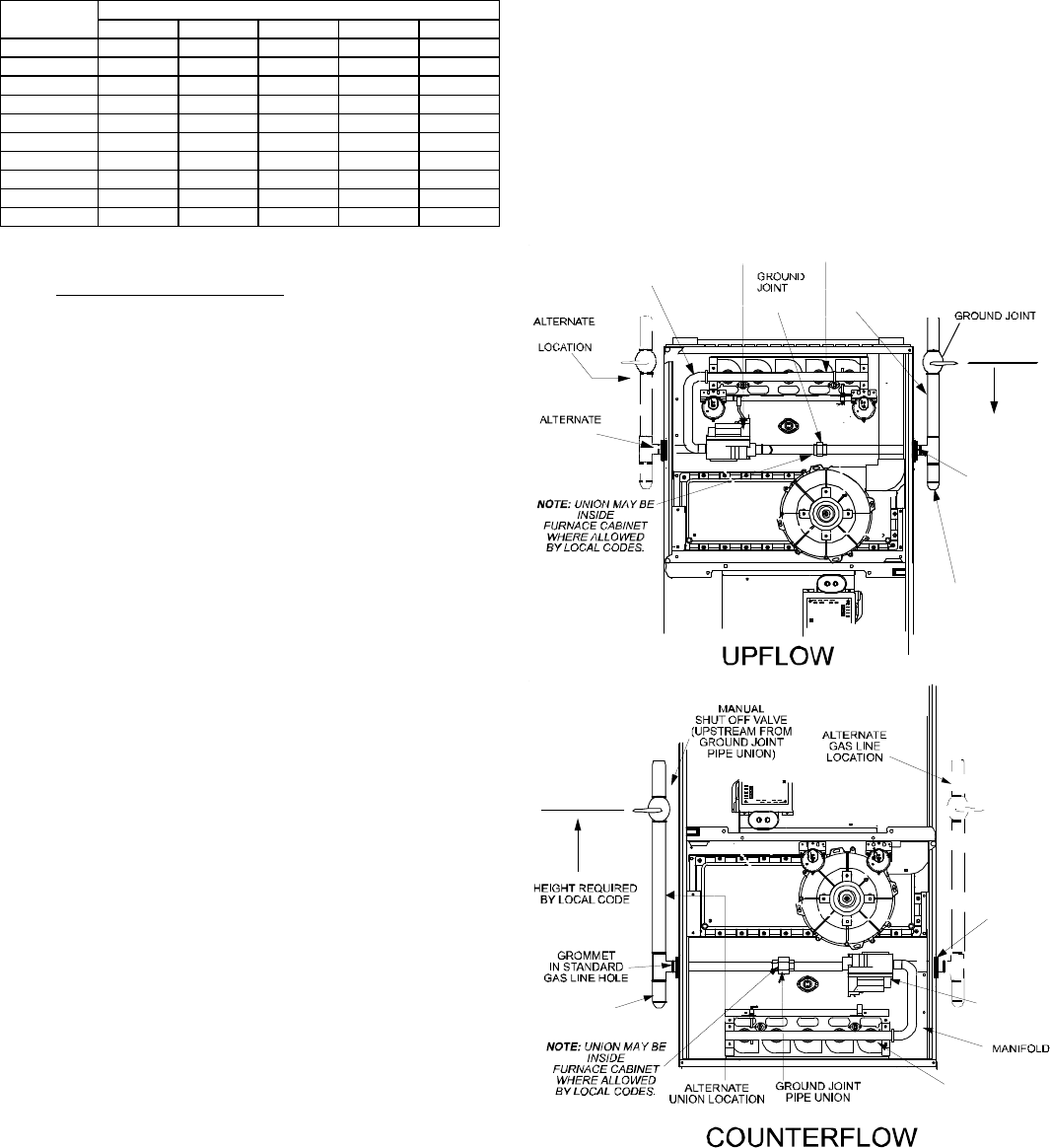
29
Natural Gas Capacity of Pipe
In Cubic Feet of Gas Per Hour (CFH)
Length of Nominal Black Pipe Size
Pipe in Feet 1/2" 3/4" 1" 1 1/4" 1 1/2"
10 132 278 520 1050 1600
20 92 190 350 730 1100
30 73 152 285 590 980
40 63 130 245 500 760
50 56 115 215 440 670
60 50 105 195 400 610
70 46 96 180 370 560
80 43 90 170 350 530
90 40 84 160 320 490
100 38 79 150 305 460
(Pressure 0.5 psig or less and pressure drop of 0.3" W.C.; Based on
0.60 Specific Gravity Gas)
CFH = BTUH Furnace Input
Heating Value of Gas (BTU/Cubic Foot)
To connect the furnace to the building’s gas piping, the installer must
supply a ground joint union, drip leg, manual shutoff valve, and line and
fittings to connect to gas valve. In some cases, the installer may also
need to supply a transition piece from 1/2" pipe to a larger pipe size.
The following stipulations apply when connecting gas piping. Refer to
Gas Piping Connections figure for typical gas line connections to the
furnace.
•Gas piping must be supported external to the furnace cabinet
so that the weight of the gas line does not distort the burner
rack, manifold or gas valve.
•Use black iron or steel pipe and fittings for building piping.
Where possible, use new pipe that is properly chamfered,
reamed, and free of burrs and chips. If old pipe is used, be
sure it is clean and free of rust, scale, burrs, chips, and old
pipe joint compound.
•Use pipe joint compound on male threads ONLY. Always
use pipe joint compound (pipe dope) that is APPROVED
FOR ALL GASES. DO NOT apply compound to the first two
threads.
•Use ground joint unions.
•Install a drip leg to trap dirt and moisture before it can enter
the gas valve. The drip leg must be a minimum of three
inches long.
•Install a 1/8" NPT pipe plug fitting, accessible for test gauge
connection, immediately upstream of the gas supply
connection to the furnace.
•Always use a back-up wrench when making the connection
to the gas valve to keep it from turning. The orientation of
the gas valve on the manifold must be maintained as
shipped from the factory. Maximum torque for the gas valve
connection is 375 in-lbs; excessive over-tightening may
damage the gas valve.
•Install a manual shutoff valve between the gas meter and
unit within six feet of the unit. If a union is installed, the
union must be downstream of the manual shutoff valve,
between the shutoff valve and the furnace.
•Tighten all joints securely.
•Connect the furnace to the building piping by one of the
following methods:
–Rigid metallic pipe and fittings.
–Semi-rigid metallic tubing and metallic fittings.
Aluminum alloy tubing must not be used in exterior
locations. In order to seal the grommet cabinet penetration,
rigid pipe must be used to reach the outside of the cabinet.
A semi-rigid connector to the gas piping may be used from
there.
•Use listed gas appliance connectors in accordance with their
instructions. Connectors must be fully in the same room as
the furnace.
•Protect connectors and semi-rigid tubing against physical and
thermal damage when installed. Ensure aluminum-alloy tubing
and connectors are coated to protect against external corrosion
when in contact with masonry, plaster, or insulation, or subjected
to repeated wetting by liquids such as water (except rain water),
detergents, or sewage.
MANUAL
SHUT OFF VALVE
(UPSTREAM FROM
PIPE UNION)
GROMMET
IN STANDARD
GAS LINE HOLE
GAS LINE
GROMMET IN
GAS LINE
HOLE
HEIGHT REQUIRED
BY LOCAL CODE
PIPE
UNION
DRIP LEG
MANIFOLD
BURNERSGAS VALVE
ALTERNATE
UNION
LOCATION
GROMMET IN
ALTERNATE
GAS LINE
HOLE
DRIP LEG
BURNERS
GAS VALVE
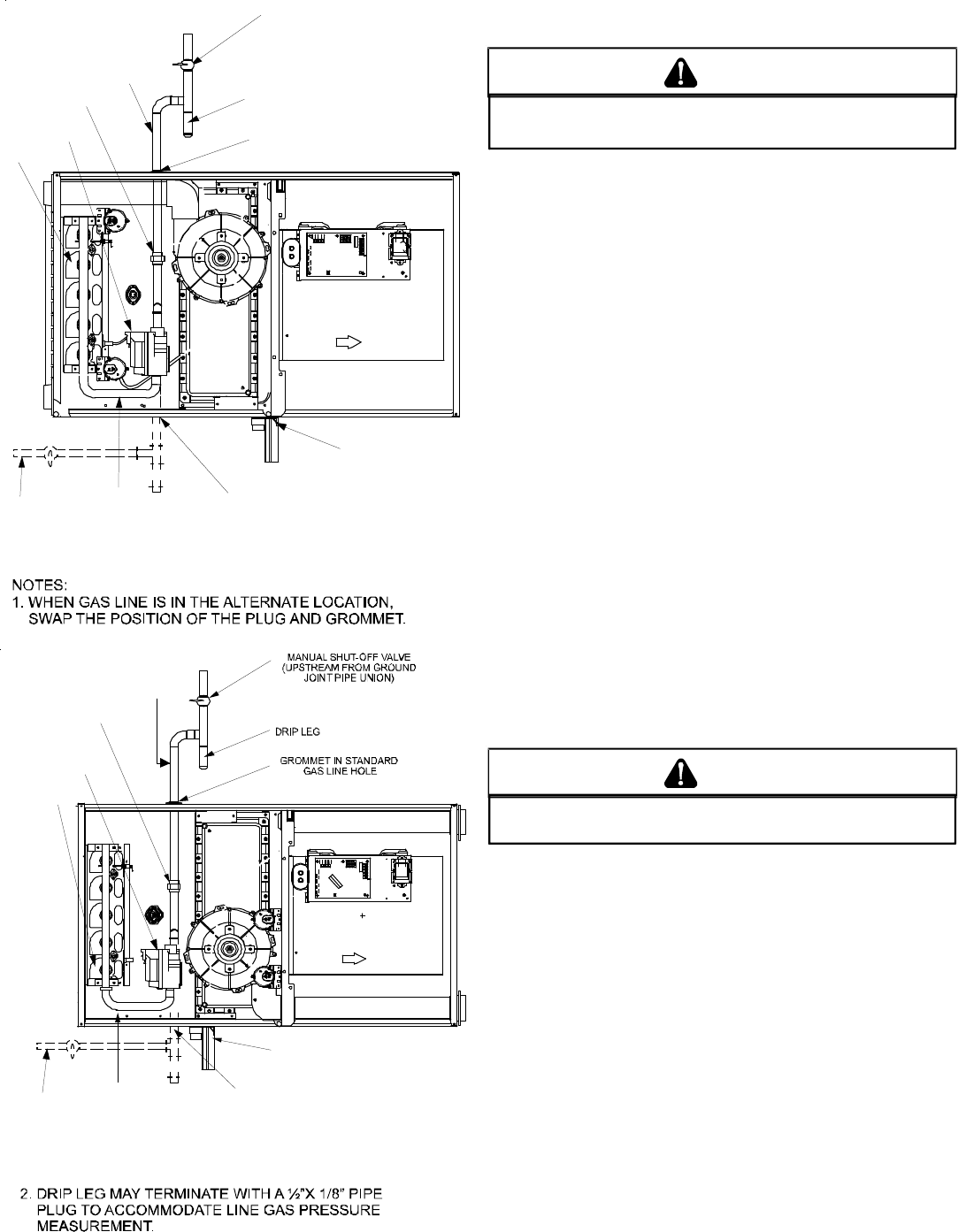
30
HORIZONTAL [UPFLOW MODEL]
MANUAL SHUT-OFF VALVE
(UPSTREAM FROM GROUND
JOINT PIPE UNION)
DRIP LEG
GROMMET IN STANDARD
GAS LINE HOLE
DRAIN TRAP
ALTER NATE GAS
LINE LOCATION
MANIFOLD GROMMET IN ALTERNATE
GAS LINE HOLE
GAS VALVE
BURNERS
A
LTE R NAT E
UNION
LOCATION
GROUND
JOINT
PIPE
UNION
GAS VALVE
BURNERS
MANIFOLD
DRAIN TRAP
ALTERNATE GAS
LINE LOCATION
GORMMET IN ALTERNATE
GAS LINE HOLE
HORIZONTAL [COUNTERFLOW]
ALTERNATE
UNION
LOCATION
GROUND
JOINT
PIPE
UNION
Gas Piping Connections
E
DGES
OF
SHEET
METAL
HOLES
MAY
BE
SHARP
. U
SE
GLOVES
AS
A
PRECAUTION
WHEN
REMOVING
HOLE
PLUGS
.
WARNING
DIRECT/STANDARD INLET PIPING
When gas piping enters directly to the gas valve through the standard
inlet hole, the installer must supply straight pipe with a ground joint
union to reach the exterior of the furnace. The rigid pipe must be long
enough to reach the outside of the cabinet to seal the grommet cabi-
net penetration. A semi-rigid connector to the gas piping can be used
outside the cabinet per local codes.
INDIRECT/ALTERNATE INLET PIPING
When gas piping enters indirectly to the gas valve through the
alternate gas inlet hole, the following 1/2 inch pipe fittings (starting
from the gas valve) to reach the outside of the cabinet must be
supplied:
•(1) Close nipple
•(1) 90 degree street elbow
•(1) 2 1/2” pipe nipple
•(1) 90 degree elbow
•Straight Pipe
•The straight pipe must be long enough to reach the outside of
the cabinet so as to seal the grommet cabinet penetration and
to install the ground joint union outside the cabinet. A semi-rigid
connector to the gas piping can be used outside the cabinet
per local codes.
GAS PIPING CHECKS
Before placing unit in operation, leak test the unit and gas connec-
tions.
T
O
AVOID
THE
POSSIBILITY
OF
EXPLOSION
OR
FIRE
,
NEVER
USE
A
MATCH
OR
OPEN
FLAME
TO
TEST
FOR
LEAKS
.
WARNING
Check for leaks using an approved chloride-free soap and water
solution, an electronic combustible gas detector, or other approved
testing methods.
NOTE: Never exceed specified pressures for testing. Higher
pressure may damage the gas valve and cause subsequent
overfiring, resulting in heat exchanger failure.
Disconnect this unit and shutoff valve from the gas supply piping
system before pressure testing the supply piping system with pres-
sures in excess of 1/2 psig (3.48 kPa).
Isolate this unit from the gas supply piping system by closing its
external manual gas shutoff valve before pressure testing supply
piping system with test pressures equal to or less than 1/2 psig
(3.48 kPa).
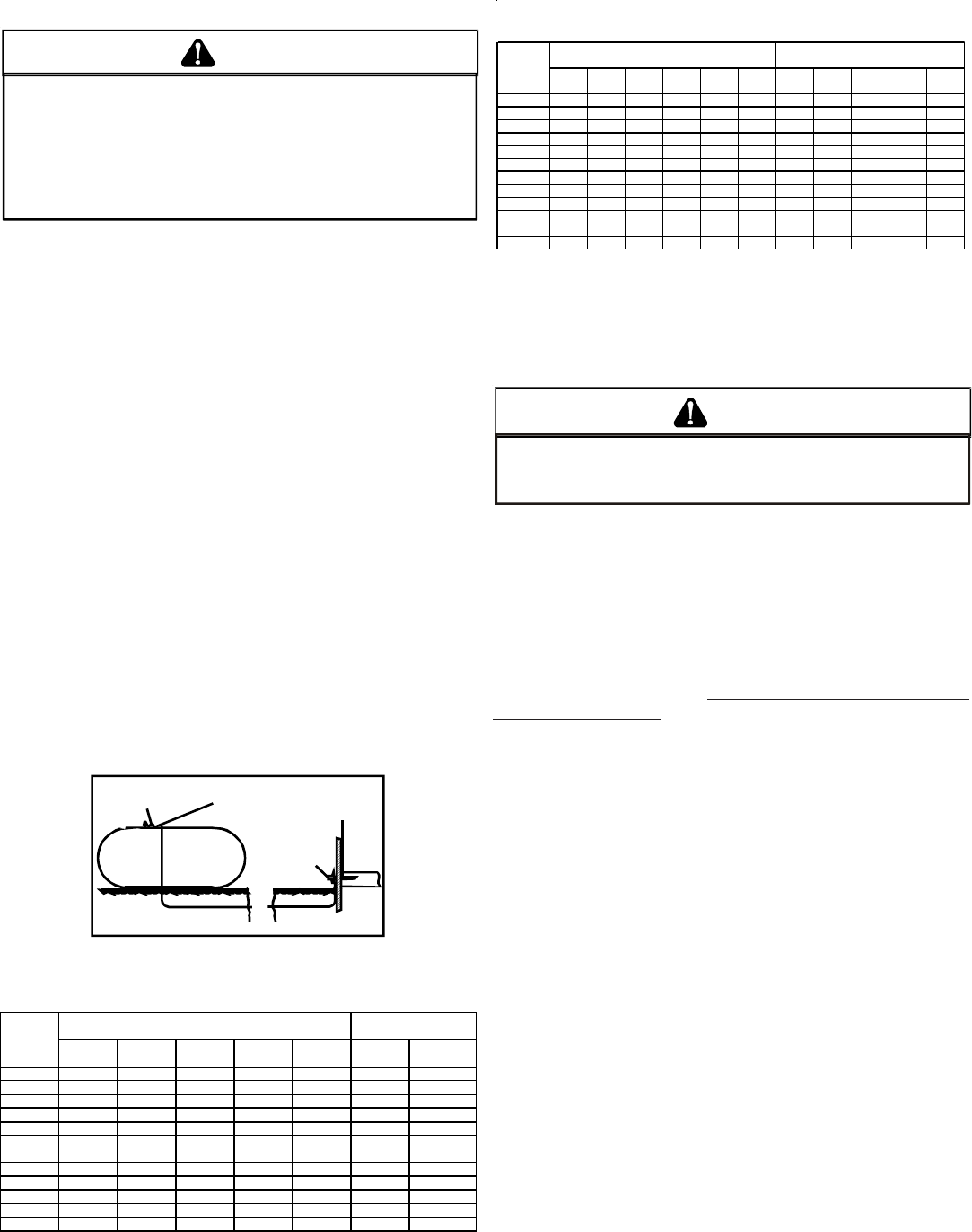
31
PROPANE GAS TANKS AND PIPING
I
F
THE
GAS
FURNACE
IS
INSTALLED
IN
A
BASEMENT
,
AN
EXCAVATED
AREA
OR
A
CONFINED
SPACE
,
IT
IS
STRONGLY
RECOMMENDED
TO
CONTACT
A
PROPANE
SUPPLIER
TO
INSTALL
A
GAS
DETECTING
WARNING
DEVICE
IN
CASE
OF
A
GAS
LEAK
.
• S
INCE
PROPANE
GAS
IS
HEAVIER
THAN
AIR
,
ANY
LEAKING
AS
CAN
SETTLE
IN
ANY
LOW
AREAS
OR
CONFINED
SPACES
.
• P
ROPANE
GAS
ODORANT
MAY
FADE
,
MAKING
THE
GAS
U
NDETECTABLE
EXCEPT
FOR
WITH
A
WARNING
DEVICE
.
WARNING
A gas detecting warning system is the only reliable way to detect a
propane gas leak. Rust can reduce the level of odorant in propane
gas. Do not rely on your sense of smell. Contact a local propane
gas supplier about installing a gas detecting warning system. If
the presence of gas is suspected, follow the instructions on Page
4 of this manual.
All propane gas equipment must conform to the safety standards
of the National Board of Fire Underwriters, NBFU Manual 58.
For satisfactory operation, propane gas pressure must be 11 inch
w.c. at the furnace manifold with all gas appliances in operation.
Maintaining proper gas pressure depends on three main factors:
1. Vaporization rate, depending on temperature of the liquid,
and “wetted surface” area of the container or containers.
2. Proper pressure regulation. (Two-stage regulation is
recommended for both cost and efficiency).
3. Pressure drop in lines between regulators, and between
second stage regulator and the appliance. Pipe size will
depend on length of pipe run and total load of all appliances.
Complete information regarding tank sizing for vaporization, recom-
mended regulator settings, and pipe sizing is available from most regu-
lator manufacturers and propane gas suppliers.
Since propane gas will quickly dissolve white lead and most stan-
dard commercial compounds, special pipe dope must be used.
Shellac-based compounds resistant to the actions of liquefied
petroleum gases such as Gasolac®, Stalactic®, Clyde’s® or John
Crane® are satisfactory.
Refer to the following illustration for typical propane gas installa-
tions.
200 PSIG
Maximum
5 to 15 PSIG
(20 PSIG Max.) Continuous
11" W.C.
Second Stage
Regulator
First Stage
Regulator
Propane Gas Installation (Typ.)
Sizing Between First and Second Stage Regulator*
Maximum Propane Capacities listed are based on 2 psig pressure drop at 10 psig setting.
Capacities in 1,000 BTU/hour.
Pipe or Nominal Pipe Size
Tubing Tubing Size, O.D. Type L Schedule 40
Length, 3/8" 1/2" 5/8" 3/4" 7/8" 1/2" 3/4"
Feet
10 730 1,700 3,200 5,300 8,300 3,200 7,500
20 500 1,100 2,200 3,700 5,800 2,200 4,200
30 400 920 2,000 2,900 4,700 1,800 4,000
40 370 850 1,700 2,700 4,100 1,600 3,700
50 330 770 1,500 2,400 3,700 1,500 3,400
60 300 700 1,300 2,200 3,300 1,300 3,100
80 260 610 1,200 1,900 2,900 1,200 2,600
100 220 540 1,000 1,700 2,600 1,000 2,300
125 200 490 900 1,400 2,300 900 2,100
150 190 430 830 1,300 2,100 830 1,900
175 170 400 780 1,200 1,900 770 1,700
200 160 380 730 1,100 1,800 720 1,500
To convert to capacities at 15 psig settings - multiply by 1.130
To convert to capacities at 5 psig settings - multiply by 0.879
Propane Gas Piping Chart I
Sizing Between Single or Second Stage Regulator and Appliance*
Maximum Propane Capacities Listed are Based on 1/2" W.C. pressure drop at 11" W.C. setting.
Capacities in 1,000 BTU/hour.
Pipe or Nominal Pipe Size
Tubing Tubing Size, O.D. Type L Schedule 40
Length, 3/8" 1/2" 5/8" 3/4" 7/8" 1-1/8" 1/2" 3/4" 1" 1-1/4" 1-1/2"
Feet
10 39 92 199 329 501 935 275 567 1,071 2,205 3,307
20 26 62 131 216 346 630 189 393 732 1,496 2,299
30 21 50 107 181 277 500 152 315 590 1,212 1,858
40 19 41 90 145 233 427 129 267 504 1,039 1,559
50 18 37 79 131 198 376 114 237 448 913 1,417
60 16 35 72 121 187 340 103 217 409 834 1,275
80 13 29 62 104 155 289 89 185 346 724 1,066
100 11 26 55 90 138 255 78 162 307 630 976
125 10 24 48 81 122 224 69 146 275 567 866
150 9 21 43 72 109 202 63 132 252 511 787
200 8 19 39 66 100 187 54 112 209 439 665
250 8 17 36 60 93 172 48 100 185 390 590
*Data in accordance with NFPA pamphlet NO. 54
Propane Gas Piping Chart II
XIII. CIRCULATING AIR & FILTERS
DUCTWORK - AIR FLOW
N
EVER
ALLOW
THE
PRODUCTS
OF
COMBUSTION
,
INCLUDING
CARBON
M
ONOXIDE
,
TO
ENTER
THE
RETURN
DUCT
WORK
OR
CIRCULATION
A
IR
SUPPLY
.
WARNING
Duct systems and register sizes must be properly designed for the
CFM and external static pressure rating of the furnace. Design the
ductwork in accordance with the recommended methods of “Air Con-
ditioning Contractors of America” Manual D.
Install the duct system in accordance with Standards of the National
Board of Fire Underwriters for the Installation of Air Conditioning, Warm
Air Heating and Ventilating Systems. Pamphlets No. 90A and 90B.
A closed return duct system must be used, with the return duct con-
nected to the furnace. NOTE: Ductwork must never be attached to
the back of the furnace. Flexible joints may be used for supply and
return connections to reduce noise transmission. To prevent the blower
from interfering with combustion air or draft when a central return is
used, a connecting duct must be installed between the unit and the
utility room wall. Never us a room, closet, or alcove as a return air
chamber.
When the furnace is used in connection with a cooling unit, the fur-
nace should be installed in parallel with or on the upstream side of the
cooling unit to avoid condensation in the heating element. With a par-
allel flow arrangement, the dampers or other means used to control
the flow of air must be adequate to prevent chilled air from entering the
furnace and, if manually operated, must be equipped with means to
prevent operation of either unit unless the damper is in the full heat or
cool position.
When the furnace is installed without a cooling coil, it is recommended
that a removable access panel be provided in the outlet air duct. This
opening shall be accessible when the furnace is installed and shall be
of such a size that the heat exchanger can be viewed for visual light
inspection or such that a sampling probe can be inserted into the air-
stream. The access panel must be made to prevent air leaks when
the furnace is in operation.
When the furnace is heating, the temperature of the return air entering
the furnace must be between 55°F and 100°F.
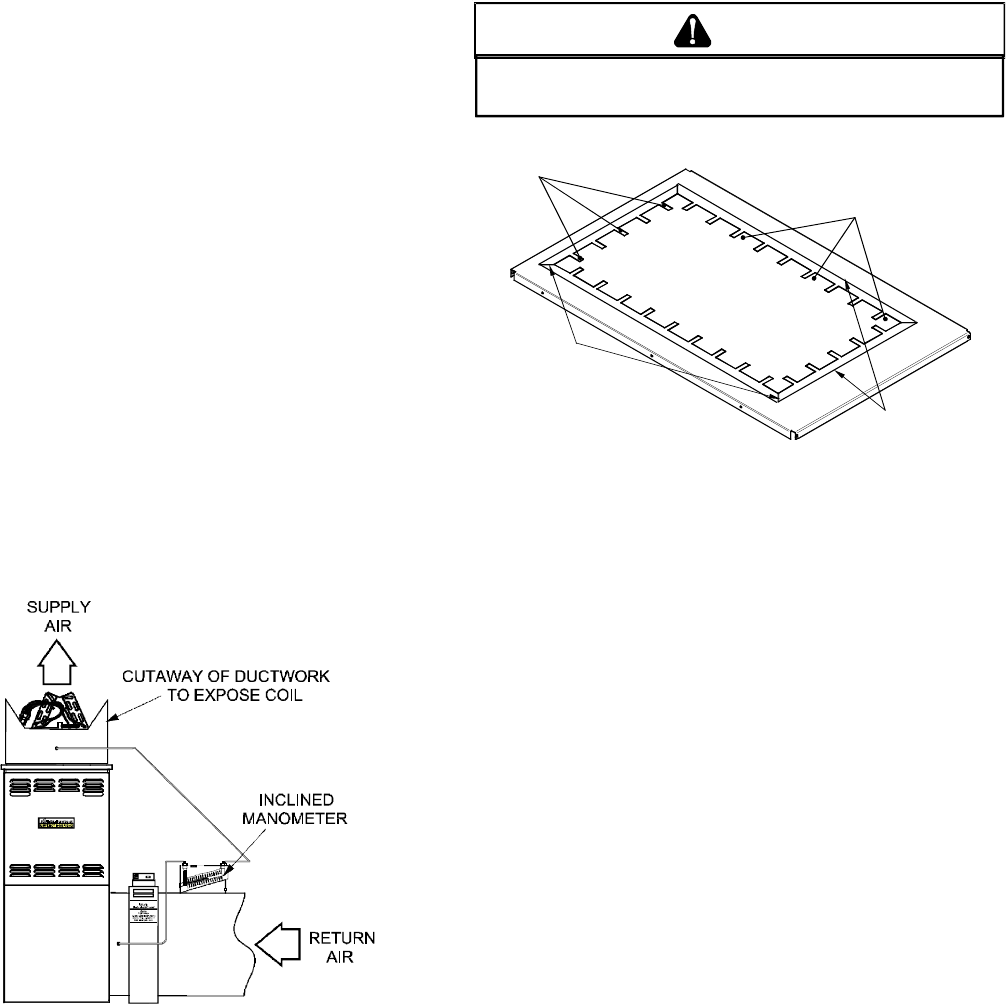
32
CHECKING DUCT STATIC
Refer to your furnace rating plate for the maximum ESP (external
duct static) rating.
Total external static refers to everything external to the furnace cabi-
net. Cooling coils, filters, ducts, grilles, registers must all be consid-
ered when reading your total external static pressure. The supply duct
pressure must be read between the furnace and the cooling coil. This
reading is usually taken by removing the “A” shaped block off plate
from the end on the coil; drilling a test hole in it and reinstalling the
block off plate. Take a duct static reading at the test hole. Tape up the
test hole after your test is complete. The negative pressure must be
read between the filter and the furnace blower.
Too much external static pressure will result in insufficient air that can
cause excessive temperature rise. This can cause limit switch trip-
ping and heat exchanger failure.
To determine total external duct static pressure, proceed as fol-
lows;
1. With clean filters in the furnace, use a draft gauge (inclined ma-
nometer) to measure the static pressure of the return duct at the
inlet of the furnace. (Negative Pressure)
2. Measure the static pressure of the supply duct. (Positive Pres-
sure)
3. The difference between the two numbers is .4” w.c.
Example:
static reading from return duct = -.1" w.c.
static reading from supply duct = .3" w.c.
total external static pressure on this system = .4" w.c.
NOTE: Both readings may be taken simultaneously and read directly
on the manometer if so desired. If an air conditioner coil or Electronic
Air Cleaner is used in conjunction with the furnace, the readings must
also include theses components, as shown in the following drawing.
4. Consult proper tables for the quantity of air. If the total external
static pressure exceeds the maximum listed on the furnace rat-
ing plate, check for closed dampers, registers, undersized and/
or oversized poorly laid out duct work.
Checking Static Pressure
(80% Furnace Shown, 90% Similar)
BOTTOM RETURN AIR OPENING [UPFLOW MODELS]
The bottom return air opening on upflow models utilizes a “lance and
cut” method to remove sheet metal from the duct opening in the base
pan. To remove, simply press out the lanced sections by hand to ex-
pose the metal strips retaining the sheet metal over the duct opening.
Using tin snips, cut the metal strips and remove the sheet metal to
free the duct flanges. Using the scribe line along the duct flange as a
guide, unfold the duct flanges around the perimeter of the opening
using a pair of seamer pliers or seamer tongs. NOTE: Airflow area will
be reduced by approximately 18% if duct flanges are not unfolded.
This could cause performance issues and noise issues.
E
DGES
OF
SHEET
METAL
HOLES
MAY
BE
SHARP
. U
SE
GLOVES
AS
A
PRECAUTION
WHEN
REMOVING
HOLE
PLUGS
.
WARNING
CUT FOUR CORNERS
AFTER REMOVING SHEET
METAL
CUT USING TIN SNIPS
PRESS OUT BY HAND
SCRIBE LINES OUTLINING
DUCT FLANGES
Duct Flange Cut Outs
When the furnace is used in connection with a cooling unit, the fur-
nace should be installed in parallel with or on the upstream side of the
cooling unit to avoid condensation in the heating element. With a par-
allel flow arrangement, the dampers or other means used to control
the flow of air must be adequate to prevent chilled air from entering the
furnace and, if manually operated, must be equipped with means to
prevent operation of either unit unless the damper is in the full heat or
cool position. When the furnace is installed without a cooling coil, it is
recommended that a removable access panel be provided in the out-
let air duct. This opening shall be accessible when the furnace is
installed and shall be of such a size that the heat exchanger can be
viewed for visual light inspection or such that a sampling probe can be
inserted into the air stream. The access panel must be made to pre-
vent air leaks when the furnace is in operation. When the furnace is
heating, the temperature of the return air entering the furnace must be
between 55°F and 100°F.
FILTERS - READ THIS SECTION BEFORE INSTALLING THE
RETURN A IR D UCTWORK
Filters must be used with this furnace. Discuss filter maintenance
with the building owner. Filters do not ship with this furnace, but
must be provided by the installer. Filters must comply with UL900
or CAN/ULCS111 standards. If the furnace is installed without fil-
ters, the warranty will be voided.
On upflow units, guide dimples locate the side return cutout
locations. Use a straight edge to scribe lines connecting the
dimples. Cut out the opening on these lines.
NOTE: An undersized opening will cause reduced airflow.
Refer to Minimum Filter Area tables to determine filter area require-
ments.
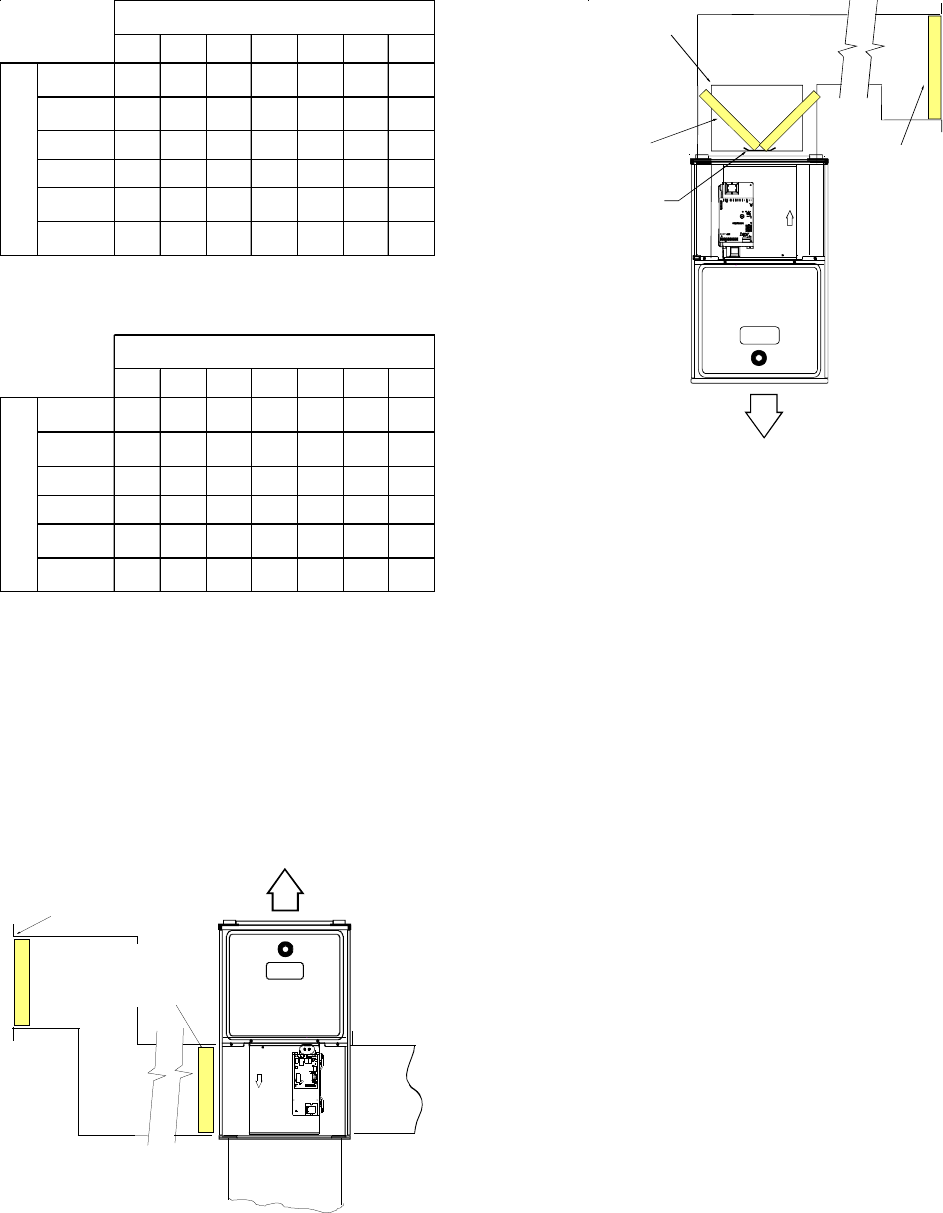
33
600 800 1000 1200 1400 1600 2000
040_3BXA
0453BXA 194* 194* 240 288 --- --- ---
060_3BXA
0703BXA --- 324* 324* 324* 336 --- ---
0704CXA --- --- 291* 291* 336 384 ---
0904CXA --- --- 432* 432* 432* 432* ---
080_5CXA
0905DXA --- --- --- 388* 388* 388* 480
100_5DXA
1155DXA --- --- --- 486* 486* 486* 486*
Input__Airflow
COOLING AIRFLOW REQUIREMENT (CFM)
*Minimum filter area dictated by heating airflow requirement.
Permanent Minimum Filter Area (sq. in)
[Based on a 600 ft/min filter face velocity]
600 800 1000 1200 1400 1600 2000
040_3BXA
0453BXA 388* 388* 480 576 --- --- ---
060_3BXA
0703BXA --- 647* 647* 647* 672 --- ---
0704CXA 583* 583* 672 768
0904CXA --- --- 863* 863* 863* 863* ---
080_5CXA
0905DXA --- --- --- 777* 777* 777* 960
100_5DXA
1155DXA --- --- --- 971* 971* 971* 971*
Input__Airflow
COOLING AIRFLOW REQUIREMENT (CFM)
*Minimum filter area dictated by heating airflow requirement.
Disposable Minimum Filter area (sq. in)
[Based on 300 ft/min filter face velocity]
UPRIGHT INSTALLATIONS
Depending on the installation and/or customer preference, differing
filter arrangements can be applied. Filters can be installed in the cen-
tral return register or a side panel external filter rack kit (upflows). As
an alternative a media air filter or electronic air cleaner can be used as
the requested filter.
The following figure shows possible filter locations.
FILTER
AIR FLOW
CENTRAL
RETURN
GRILLE
FILTER
SIDE RETURN
EXTERNAL FILTER
RACK KIT
(EITHER SIDE)
Possible Upright Upflow
FILTER
FILTER
AIR FLOW
FILTER
ACCESS
DOOR
CENTRAL
RETURN
GRILLE
RETURN
DUCT
FILTER
FILTER
SUPPORT
BRACKET
(PROVIDED)
Possible Upright Counterflow
Filter Locations
NOTE: Internal filter retention is not provided on this furnace.
HORIZONTAL INSTALLATIONS
Filters must be installed in either the central return register or in the
return air duct work.
XIV. STARTUP PROCEDURE & ADJUSTMENT
Furnace must have a 115 VAC power supply properly connected
and grounded. Proper polarity must be maintained for correct op-
eration. In addition to the following start-up and adjustment items,
refer to further information in Section XVI, Operational Checks.
HEAT ANTICIPATOR S ETTING
The heat anticipator in the room thermostat must be correctly ad-
justed to obtain the proper number of cycles per hour and to pre-
vent “overshooting” of the setting. Set the heat anticipator setting to
0.7 amps. Follow the thermostat manufacturer’s instructions on
how to adjust the heat anticipator setting.
DRAIN TRAP PRIMING
The drain trap must be primed prior to furnace startup. To prime, fill
the drain trap with water. This ensures proper furnace drainage
upon startup and prohibits the possibility of flue gases escaping
through the drain system. Air conditioning condensate may be drained
into the furnace trap.
FURNACE OPERATION
Purge gas lines of air prior to startup. Be sure not to purge lines into
an enclosed burner compartment. Follow NFPA 54, National Fuel Gas
Code 8.3 for proper purging methods. In Canada, follow approved
purging methods in B149.1
Check for leaks using an approved chloride-free soap and water
solution, an electronic combustible gas detector, or other approved
method. Verify that all required kits (propane gas, high altitude,
etc.) have been appropriately installed.
FURNACE STARTUP
1. Close the manual gas shutoff valve external to the furnace.
2. Turn off the electrical power to the furnace.
3. Set the room thermostat to the lowest possible setting.
4. Remove the burner compartment door.
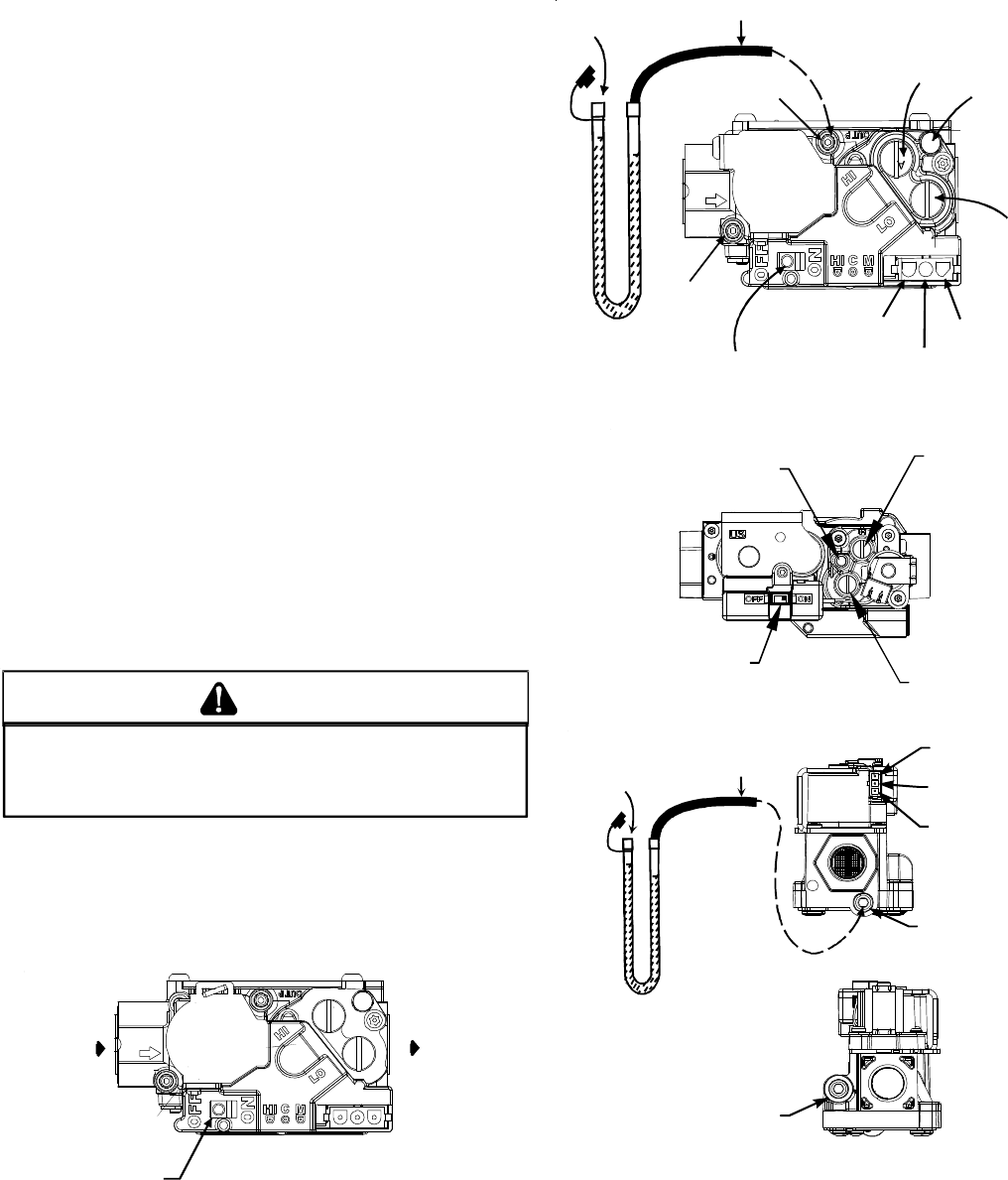
34
NOTE: This furnace is equipped with an ignition device which
automatically lights the burner. Do not try to light the burner by
hand.
5. Move the furnace gas valve manual control to the OFF
position.
6. Wait five minutes then smell for gas. Be sure to check near
the floor as some types of gas are heavier than air.
7. If you smell gas after five minutes, immediately follow the
instructions on page 4 of this manual. If you do not smell
gas after five minutes, move the furnace gas valve manual
control to the ON position.
8. Replace the burner compartment door.
9. Open the manual gas shutoff valve external to the furnace.
10. Turn on the electrical power to the furnace.
11. Adjust the thermostat to a setting above room temperature.
12. After the burners are lit, set the thermostat to desired
temperature.
FURNACE SHUTDOWN
1. Set the thermostat to the lowest setting. The integrated control
will close the gas valve and extinguish flame. Following a 15
second delay, the induced draft blower will be de-energized.
After a 100 or 150 second delay period (field selectable), the
circulator blower will be de-energized.
2. Remove the burner compartment door and move the furnace
gas valve manual control to the OFF position.
3. Close the manual gas shutoff valve external to the furnace.
4. Replace the burner compartment door.
GAS SUPPLY PRESSURE MEASUREMENT
T
O
PREVENT
UNRELIABLE
OPERATION
OR
EQUIPMENT
DAMAGE
,
THE
I
NLET
GAS
SUPPLY
PRESSURE
MUST
BE
AS
SPECIFIED
ON
THE
UNIT
RATING
PLATE
WITH
ALL
OTHER
HOUSEHOLD
GAS
FIRED
APPLIANCES
OPERATING
.
CAUTION
The line pressure supplied to the gas valve must be within the
range specified in the Inlet Gas Supply Pressure table. The supply
pressure can be measured at the gas valve inlet pressure tap or at
a hose fitting installed in the gas piping drip leg. The supply pres-
sure must be measured with the burners operating. To measure
the gas supply pressure, use the following procedure.
INLET OUTLET
Gas Valve On/Off
Selector Switch
White-Rodgers Model 36G54 (Two-Stage)
Inlet
Pressure
Tap
Low Fire
Regulator
Adjust
Manometer
Manometer
Hose
High Fire Regulator
Adjust Regulator
Vent
Outlet
Pressure Boss
Open to
Atmosphere
On/Off Switch
High Fire Coil
Terminal (HI)Coaxial Coil
Terminal (M)
Common
Terminal(C)
White-Rodgers Model 36G54 Connected to Manometer
Gas Valve On/Off
Selector Switch
Regulator
Vent
High Fire
Regulator
Adjust
Low Fire
Regulator
Adjust
i
Manometer
Manometer
Hose
Common
Terminal(C)
High Fire Coil
Terminal (HI)
Low Fire Coil
Terminal (LO)
Inlet Pressure Tap
1/8 NPT
Open to
Atmosphere
Outlet Pressure Tap
1/8 NPT
Honeywell Model VR9205 Connected to Manometer
1. Turn OFF gas to furnace at the manual gas shutoff valve
external to the furnace.
2. Connect a calibrated water manometer (or appropriate gas
pressure gauge) at either the gas valve inlet pressure tap
or the gas piping drip leg. See Honeywell VR9205 gas valve
figure or White-Rodgers 36G54 gas valve figure for location
of inlet pressure tap.
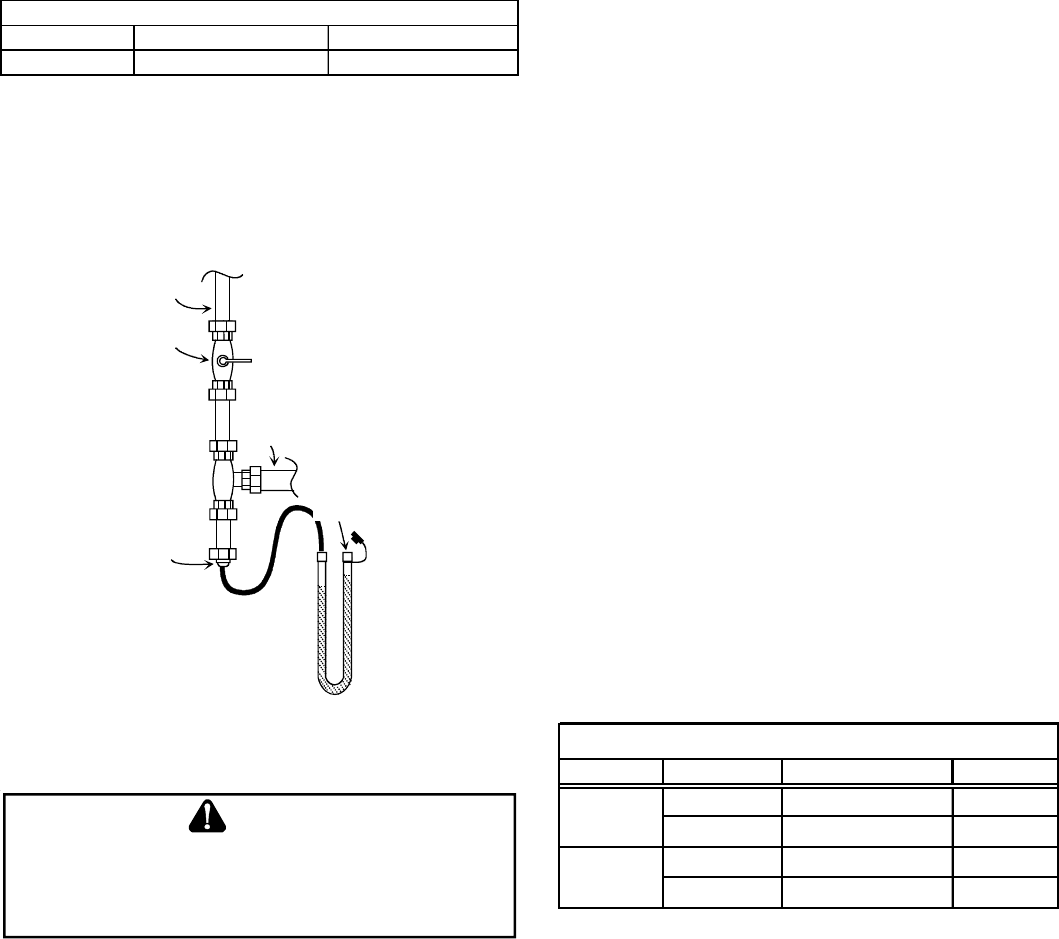
35
NOTE: If measuring gas pressure at the drip leg or Honeywell VR9205
gas valve, a field-supplied hose barb fitting must be installed prior to
making the hose connection. If using the inlet pressure tap on the
White-Rodgers 36G54 gas valve, then use the 36G Valve Pressure
Check Kit, Goodman Part No. 0151K00000S.
3. Turn ON the gas supply and operate the furnace and all other
gas consuming appliances on the same gas supply line.
4. Measure furnace gas supply pressure with burners firing.
Supply pressure must be within the range specified in the
Inlet Gas Supply Pressure table.
Natural Gas Minimum: 4.5" w.c. Maximum: 10.0" w.c.
Propane Gas Minimum: 11.0" w.c. Maximum: 13.0" w.c.
Inlet Gas Supply Pressure
If supply pressure differs from table, make the necessary adjust-
ments to pressure regulator, gas piping size, etc., and/or consult
with local gas utility.
5. Turn OFF gas to furnace at the manual shutoff valve and
disconnect manometer. Reinstall plug before turning on
gas to furnace.
6. Turn OFF any unnecessary gas appliances stated in step
3.
Gas Line
Gas
Shutoff
Valve
Gas Line
To Furnace
Drip Leg Cap
With Fitting
Manometer Hose
Manometer
Open To
Atmosphere
Measuring Inlet Gas Pressure (Alt. Method)
GAS MANIFOLD PRESSURE MEASUREMENT AND ADJUSTMENT
T
O
PREVENT
UNRELIABLE
OPERATION
OR
EQUIPMENT
DAMAGE
,
THE
GAS
MANIFOLD
PRESSURE
MUST
BE
AS
SPECIFIED
ON
THE
UNIT
RATING
PLATE
.O
NLY
MINOR
ADJUSTMENTS
SHOULD
BE
MADE
BY
ADJUSTING
THE
GAS
VALVE
PRESSURE
REGULATOR
.
CAUTION
Only small variations in gas pressure should be made by adjust-
ing the gas valve pressure regulator. The manifold pressure must
be measured with the burners operating. To measure and adjust
the manifold pressure, use the following procedure.
1. Turn OFF gas to furnace at the manual gas shutoff valve
external to the furnace.
2. Turn off all electrical power to the system.
3. Outlet pressure tap connections:
a. Honeywell VR9205 valve: Remove the outlet pressure
tap plug. Install an 1/8" NPT hose barb fitting into the outlet
pressure tap.
b. White-Rodgers 36G54 valve: Back outlet pressure test screw
(inlet/outlet pressure tap) out one turn (counterclockwise,
not more than one turn).
4. Attach a hose and manometer to the outlet pressure barb fitting
(Honeywell valve) or outlet pressure tap (White-Rodgers valve).
5. Turn ON the gas supply.
6. Turn on power and close thermostat “R” and “W1” contacts to
provide a call for low stage heat.
7. Measure the gas manifold pressure with burners firing. Adjust
manifold pressure using the Manifold Gas Pressure table
shown below.
8. Remove regulator cover screw from the low (LO) outlet
pressure regulator adjust tower and turn screw clockwise
to increase pressure or counterclockwise to decrease
pressure. Replace regulator cover screw.
9. Close thermostat “R” and “W2” contacts to provide a call for
high stage heat.
10. Remove regulator cover screw from the high (HI) outlet
pressure regulator adjust tower and turn screw clockwise
to increase pressure or counterclockwise to decrease
pressure. Replace regulator cover screw.
11. Turn off all electrical power and gas supply to the system.
12. Remove the manometer hose from the hose barb fitting or
outlet pressure tap.
13. Replace outlet pressure tap:
a. Honeywell VR9205 valve: Remove the 1/8" NPT hose barb
fitting from the outlet pressure tap. Replace the outlet
pressure tap plug and seal with a high quality thread
sealer.
b. White-Rodgers 36G54 valve: Turn outlet pressure test
screw in to seal pressure port (clockwise, 7 in-lb
minimum).
14. Turn on electrical power and gas supply to the system.
15. Close thermostat contacts “R” and “W1/W2” to energize the
valve.
Using a leak detection solution or soap suds, check for leaks at
outlet pressure boss plug (Honeywell valve) or screw (White-Rodg-
ers valve). Bubbles forming indicate a leak. SHUT OFF GAS AND
REPAIR ALL LEAKS IMMEDIATELY!
NOTE: For gas to gas conversion, consult your dealer for
appropriate conversion.
Gas Rate Range Nominal
Low Stage 1.7 to 2.3" w.c. 2.0" w.c.
High Stage 3.2 to 3.8" w.c. 3.5" w.c.
Low Stage 5.7 to 6.3" w.c. 6.0" w.c.
High Stage 9.7 to 10.3" w.c. 10.0" w.c.
Manifold Gas Pressure
Natural
Propane
GAS INPUT RATE MEASUREMENT (NATURAL GAS ONLY)
The gas input rate to the furnace must never be greater than that
specified on the unit rating plate. To measure natural gas input
using the gas meter, use the following procedure.
1. Turn OFF the gas supply to all other gas-burning appliances
except the furnace.
2. While the furnace is operating, time and record one complete
revolution of the smallest gas meter dial.
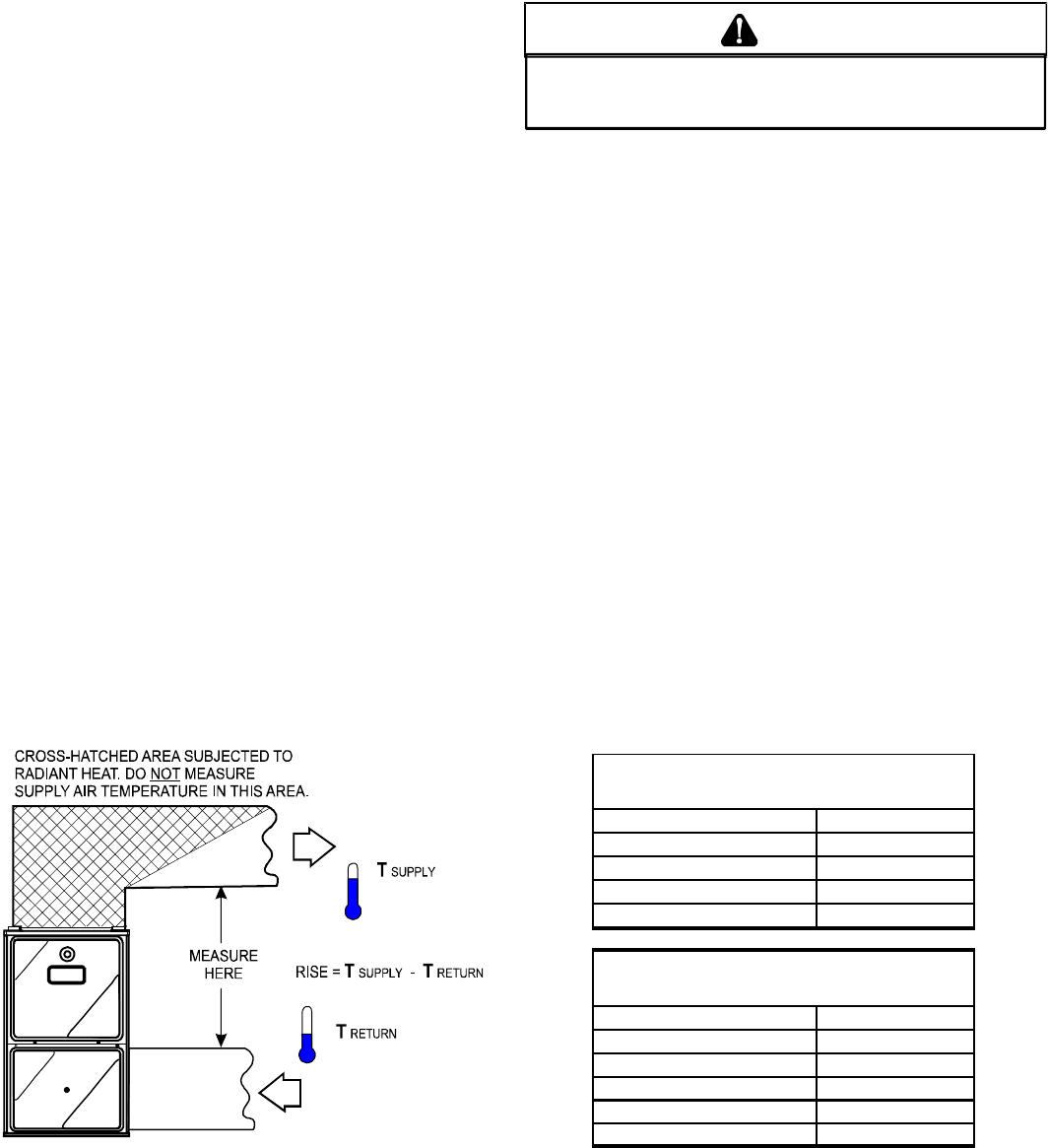
36
3. Calculate the number of seconds per cubic foot (sec/ ft3) of
gas being delivered to the furnace. If the dial is a one cubic
foot dial, divide the number of seconds recorded in step 2
by one. If the dial is a two cubic foot dial, divide the number
of seconds recorded in step 2 by two.
4. Calculate the furnace input in BTUs per hour (BTU/ hr). Input
equals the installation’s gas heating value multiplied by a
conversion factor (hours to seconds), divided by the number
of seconds per cubic foot. The measured input must not be
greater than the input indicated on the unit rating plate.
EXAMPLE:
Installation’s gas heating (HTG) value: 1,000 BTU/ft3
(Obtained from gas supplier)
Installation’s seconds per cubic foot: 34 sec/ ft3
Conversion Factor (hours to seconds): 3600 sec/hr
Input = (Htg. value x 3600) ÷ seconds per cubic foot
Input = (1,000 BTU/ft3 x 3600 sec/hr) ÷ 34 sec/ ft3
Input = 106,000 BTU/hr
This measured input must not be greater than the input
indicated on the unit rating plate.
5. Turn ON gas and relight appliances turned off in step 1.
Ensure all the appliances are functioning properly and that
all pilot burners are operating.
TEMPERATURE RISE
Temperature rise must be within the range specified on the unit
rating plate. An incorrect temperature rise may result in condens-
ing in or overheating of the heat exchanger. An airflow and tem-
perature rise table is provided in the Specification Sheet applicable
to your model.
Determine and adjust temperature rise as follows:
1. Operate furnace with burners firing for approximately ten
minutes. Ensure all registers are open and all duct
dampers are in their final (fully or partially open) position.
2. Place thermometers in the return and supply ducts as close
to the furnace as possible. Thermometers must not be
influenced by radiant heat by being able to “see” the heat
exchanger.
SUPPLY
AIR
RETURN
AIR
Temperature Rise Measurement
3. Subtract the return air temperature from the supply air
temperature to determine the air temperature rise. Allow
adequate time for thermometer readings to stabilize.
4. Adjust temperature rise by adjusting the circulator blower speed.
Increase blower speed to reduce temperature rise. Decrease
blower speed to increase temperature rise. Refer to Startup
Procedure and Adjustment -Circulator Blower Speeds for speed
changing details.
CIRCULATOR BLOWER SPEEDS
T
O
PREVENT
PREMATURE
FAILURE
OF
HEAT
EXCHANGER
,
PROPERTY
DAMAGE
,
PERSONAL
INJURY
OR
DEATH
,
DO
NOT
ADJUST
THE
LIMIT
CONTROL
(
FACTORY
-
SET
).
WARNING
This furnace is equipped with a multi-speed circulator blower. This
blower provides ease in adjusting blower speeds. The Specifica-
tion Sheet applicable to your model provides an airflow table, show-
ing the relationship between airflow (CFM) and external static pres-
sure (E.S.P.), for the proper selection of heating and cooling speeds.
The cooling blower speed is shipped set on HIGH, and the heating
blower speed is set as indicated in the Specification Sheet appli-
cable to your model. These blower speeds should be adjusted by
the installer to match the installation requirements so as to provide
the correct heating temperature rise and correct cooling CFM.
To adjust the circulator blower speed, proceed as follows:
1. Turn OFF power to the furnace.
2. Select the heating and cooling blower speeds that match
the installation requirements from the airflow table in the
Specification Sheet.
3. Relocate desired motor leads to the circulator blower heat
and cool speed terminals on the integrated control module.
(Terminals are identified as LO HEAT-H, HI HEAT-H and
COOL-H (hot)). If a heating speed and the cooling blower
speed are the same, a jumper wire must be used between
the heat and cool terminals.
4. Connect all unused blower motor leads to the “PARK”
terminals on the integrated control module. Any leads not
connected to the “PARK” terminals must be taped.
5. Turn ON power to furnace.
6. Verify proper temperature rise as outlined in Section XIV,
Startup Procedure and Adjustment - Temperature Rise.
LOW RED
MEDIUM LOW ORANGE
MEDIUM LOW BLUE
HIGH BLACK
COMMON/NEUTRAL WHITE
T1-LOW YELLOW
T2-MED-LOW RED
T3-MED ORANGE
T4-MED-HI BLUE
T5-HI BLACK
COMMON\NEUTRAL WHITE
*MH95, ACSH96, GCH95, GCH9
Circulator Blower Speeds
AMEH96, GME95
Circulator Blower Speeds
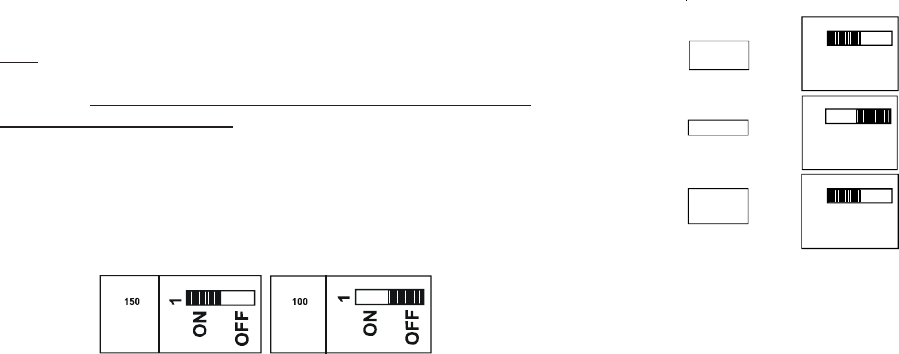
37
CIRCULATOR BLOWER FAN TIMING ADJUSTMENT
NOTE: Items in this section refer to the air circulator blower fan
NOT to the induced draft blower. The induced draft blower timing
sequence is not adjustable. The circulator blower fan timing is
adjustable only on models with optional “heating fan OFF delay”
adjustment pins or switches. It is NOT adjustable in any other
circumstances.
As shipped, the circulator blower fan will remain on for 150 seconds
after the gas valve closes. When a call for cooling occurs, the circu-
lator fan comes on and remains on for 45 seconds after the call for
cooling ends. During normal heating operation, the circulator fan will
come on approximately 34 seconds after the gas valve opens.
SECOND
DELAY SECOND
DELAY
Switch viewed in an upflow installation.
Adjustment Switch
SETTING FURNACE OPERATING MODE
This furnace is designed to operate with either a single gas input rate
or with two distinct gas input rates. The Mode DIP switch is used to
select the single gas input rate or two distinct input rates.
Setting the Mode switch to “1 STG” forces the furnace to operate at
the furnace’s highest input rate only. Operation is as described
under Sequence of Operation (Integrated Ignition Control) – Mode
DIP Switch is set to “1 STG” position.
Setting the Mode switch to “2 STG” allows the furnace to operate at
the furnace’s highest input AND at an input rate that is 75% of the
highest input rate. For this mode of operation, the furnace oper-
ates at the low input rate for a pre-determined time period then
steps to the high input rate. Operation is as described under Se-
quence of Operation (Integrated Ignition Control) – Mode DIP Switch
is set to “2 STG” position.
The time period is determined by the 2nd Stg Dly DIP switch. Setting
the 2nd Stg Dly DIP switch to 5 minutes fixes the delay period at 5
minutes. Setting the 2nd Stg Dly DIP switch to Auto enables an
algorithm that calculates a delay period based on the heating cycle
time and the total cycle time. The delay period can range from 1
minute to 12 minutes.
NOTE: The ACSH, AMH, AMEH, GCH, GDH, GMH and GME hybrid
furnaces require a single stage thermostat. These furnaces utilize a
control board with single stage or two stage capability. The second
stage feature is established by setting dip switch #2 on the board,
either one stage or two stage. All of the second stage timing is then
controlled by dipswitch 3 on the circuit board.
O
N
OFF
2
ON
OFF
3
SECOND
STAGE
ONLY
5
MINUTES
ON
OFF
1
150
SECOND
DELAY
100
SECOND
DELAY
1-STAGE
2-STAGE
HEAT OFF
DELAY
MODE
AUTO
XV. NORMAL SEQUENCE OF OPERATION
POWER UP
The normal power up sequence is as follows:
•115 VAC power applied to furnace.
•Integrated control module performs internal checks.
•Integrated control module LED will light.
•Integrated control module monitors safety circuits
continuously.
•Furnace awaits call from thermostat.
HEATING MODE
(MODE DIP SWITCH IS SET TO “1 STG” POSITION)
The normal operational sequence in heating mode is as follows:
•R and W thermostat contacts close, initiating a call for heat.
•Integrated control module performs safety circuit checks.
•Induced draft blower is energized for 15 second pre-purge
period causing pressure switch contacts to close.
•Igniter warm up begins after 15 second prepurge expires.
•Low and high stage gas valves open at end of igniter warm
up period, delivering gas to burners and establishing flame.
•Integrated control module monitors flame presence. Gas
valve will remain open only if flame is detected.
•Circulator blower is energized on high heat speed following
a fixed thirty second blower on delay. Electronic air cleaner
terminals are energized with circulator blower.
•Furnace operates; integrated control module monitors
safety circuits continuously.
•R and W thermostat contacts open, completing the call for
heat.
•Gas valve closes, extinguishing flame.
•Induced draft blower is de-energized following a fifteen
second post purge.
• The circulator blower remains at high heat speed for thirty
seconds. The circulator blower then switches to low heat
speed for the remainder of the selected heat off delay period.
For example, the selected heat off delay period is 150 seconds.
The circulator blower operates at high heat for 30 seconds
and at low speed for 150 - 30 = 120 seconds.
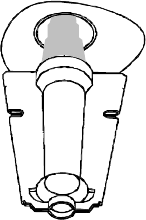
38
(MODE DIP SWITCH IS SET TO “2 STG” POSITION)
The normal operational sequence in sequence is as follows:
•R and W thermostat contacts close, initiating a call for heat.
•Integrated control module performs safety circuit checks.
•Induced draft blower is energized for 15 second prepurge
period causing pressure switch contacts to close.
•Igniter warm up begins after 15 second prepurge expires.
•Low and high-stage gas valves open at end of igniter warm
up period, delivering gas to burners and establishing flame.
•High-stage gas valve closes after five seconds; low-stage
gas valve remains open.
•Integrated control module monitors flame presence. Gas valve
will remain open only if flame is detected.
•Circulator blower is energized on low heat speed following a
fixed thirty second blower on delay. Electronic air cleaner
terminals are energized with circulator blower.
•Furnace is now operating in low-stage heating mode.
•Furnace operates; integrated control module monitors
safety circuits continuously.
•If low-stage delay period expires, control will shift operation
from low-stage heating mode operation to high-stage
heating mode operation. Control will energize circulator
blower high heat speed and high stage gas valve.
•Furnace is now operating in high-stage heating mode.
•R and W thermostat contacts open, completing the call for
heat.
•Induced draft blower is de-energized following a fifteen
second post purge.
•Circulator blower is de-energized following a heat off delay
period (selectable 100 or 150 seconds; factory set at 150
seconds).
If the furnace is operating in the low-stage heating mode
when thermostat contacts open, circulator remains at low
heat speed for the selected delay off period.
If the furnace is operating in high-stage heating mode when
the thermostat contacts open, the circulator blower remains
at high heat speed for thirty seconds. The circulator blower
then switches to low heat speed for the remainder of the
selected heat off delay period. For example, the selected
heat off delay period is 150 seconds. The circulator blower
operates at high heat for 30 seconds and at low speed for
150 - 30 = 120 seconds.
•Furnace awaits the next call from thermostat.
COOLING MODE
The normal operational sequence in cooling mode is as follows:
•R and Y thermostat contacts close, initiating a call for cool.
•Integrated control module performs safety circuit checks.
•Outdoor fan and compressor are energized.
•Circulator blower is energized on cool speed following a fixed
five second on delay. Electronic air cleaner terminals are
energized with circulator blower.
•Furnace circulator blower and outdoor cooling unit run,
integrated control module monitors safety circuits
continuously.
•R and Y thermostat contact open, completing the call for cool.
•Outdoor fan and compressor are de-energized.
•Circulator blower is de-energized following a fixed forty five
second cool off delay period. Electronic air cleaner terminals
are de-energized.
•Furnace awaits the next call from thermostat.
FAN ONLY MODE
The normal operational sequence in fan only mode is as follows:
•R and G thermostat contacts close, initiating a call for fan.
•Integrated control module performs safety circuit checks.
•Circulator blower is energized on low heat speed. Electronic
air cleaner terminals are energized.
•Circulator blower runs, integrated control module monitors
safety circuits continuously.
•R and G thermostat contacts open, completing the call for
fan.
•Circulator blower is de-energized. Electronic air cleaner
terminals are de-energized.
•Furnace awaits the next call from thermostat.
XVI. OPERATIONAL CHECKS
BURNER FLAME
The burner flames should be inspected with the burner compart-
ment door installed. A sight glass is provided for inspection pur-
poses. Flames should be stable, quiet, soft, and blue (dust may
cause orange tips but they must not be yellow). Flames should
extend directly outward from the burners without curling, floating, or
lifting off. Flames must not impinge on the sides of the heat ex-
changer firing tubes.
Check the
Burner Flames for:
1. Stable, soft and blue.
2. Not curling, floating
or lifting off.
Burner Flame
XVII. SAFETY CIRCUIT DESCRIPTION
GENERAL
A number of safety circuits are employed to ensure safe and proper
furnace operation. These circuits serve to control any potential
safety hazards and serve as inputs in the monitoring and diagno-
sis of abnormal function. These circuits are continuously moni-
tored during furnace operation by the integrated control module.
INTEGRATED CONTROL MODULE
The integrated control module is an electronic device which, if a po-
tential safety concern is detected, the module will take the necessary
precautions and provide diagnostic information through an LED.
39
PRIMARY LIMIT
The primary limit control is located on the partition panel and monitors
heat exchanger compartment temperatures. It is a normally-closed
(electrically), automatic reset, temperature-activated sensor. The limit
guards against the overheating as a result of insufficient conditioned
air passing over the heat exchanger.
AUXILIARY LIMIT
The auxiliary limit control(s) are located on or near the circulator blower
and monitors heat exchanger compartment temperatures. They are
a normally-closed (electrically), manual-reset, temperature activated
sensors. These limits guard against overheating as a result of insuf-
ficient conditioned air passing over the heat exchanger.
ROLLOUT LIMIT
The rollout limit control(s) are mounted on the burner/manifold assembly
and monitor the burner flame. They are normally-closed (electrically),
manual-reset, temperature-activated sensors. These limits guard
against burner flames not being properly drawn into the heat exchanger.
PRESSURE SWITCHES
The pressure switches are normally-open (closed during operation),
single-pole single-throw, negative air pressure-activated switches.
They monitor the airflow (combustion air and flue products) through
the heat exchanger via pressure taps located on the induced draft
blower and the coil front cover. These switches guard against insuffi-
cient airflow (combustion air and flue products) through the heat ex-
changer and/or blocked condensate drain conditions.
FLAME SENSOR
The flame sensor is a probe mounted to the burner/manifold assem-
bly which uses the principle of flame rectification to determine the pres-
ence or absence of flame.
XVIII. TROUBLESHOOTING
ELECTROSTATIC DISCHARGE (ESD) PRECAUTIONS
NOTE: Discharge body’s static electricity before touching unit. An
electrostatic discharge can adversely affect electrical components.
Use the following precautions during furnace installation and ser-
vicing to protect the integrated control module from damage. By
putting the furnace, the control, and the person at the same electro-
static potential, these steps will help avoid exposing the integrated
control module to electrostatic discharge. This procedure is appli-
cable to both installed and uninstalled (ungrounded) furnaces.
1. Disconnect all power to the furnace. Do not touch the
integrated control module or any wire connected to the control
prior to discharging your body’s electrostatic charge to ground.
2. Firmly touch a clean, unpainted, metal surface of the furnaces
near the control. Any tools held in a person’s hand during
grounding will be discharged.
3. Service integrated control module or connecting wiring following
the discharge process in step 2. Use caution not to recharge
your body with static electricity; (i.e., do not move or shuffle
your feet, do not touch ungrounded objects, etc.). If you come
in contact with an ungrounded object, repeat step 2 before
touching control or wires.
4. Discharge your body to ground before removing a new control
from its container. Follow steps 1 through 3 if installing the
control on a furnace. Return any old or new controls to their
containers before touching any ungrounded object.
DIAGNOSTIC CHART
HIGH VOLTAGE!
T
O
AVOID
PERSONAL
INJURY
OR
DEATH
DUE
TO
ELECTRICAL
SHOCK
,
DISCONNECT
ELECTRICAL
POWER
BEFORE
P
ERFORMAING
ANY
SERVICE
OR
MAINTENANCE
.
WARNING
Refer to the Troubleshooting Chart at the end of this manual for assis-
tance in determining the source of unit operational problems. The red
diagnostic LED blinks to assist in troubleshooting the unit. The num-
ber of blinks refers to a specific fault code.
FAULT RECALL
The ignition control is equipped with a momentary pushbutton switch
that can be used to display on the diagnostic LED the last five faults
detected by the control. The control must be in Standby Mode (no ther-
mostat inputs) to use the feature. Depress the pushbutton switch for
approximately 2 seconds. Release the switch when the LED is turned
off. The diagnostic LED will then display the flash codes associated
with the last five detected faults. The order of display is the most re-
cent fault to the least recent fault.
RESETTING FROM LOCKOUT
Furnace lockout results when a furnace is unable to achieve ignition
after three attempts during a single call for heat. It is characterized by
a non-functioning furnace and a one flash diagnostic LED code. If the
furnace is in “lockout”, it will (or can be) reset in any of the following
ways.
1. Automatic reset. The integrated control module will
automatically reset itself and attempt to resume normal
operations following a one hour lockout period.
2. Manual power interruption. Interrupt 115 volt power to the
furnace for 1 - 20 seconds.
3. Manual thermostat cycle. Lower the thermostat so that
there is no longer a call for heat then reset to previous setting.
Interrupt thermostat signal to the furnace for 1 - 20 seconds.
NOTE: If the condition which originally caused the lockout still
exists, the control will return to lockout. Refer to Troubleshooting -
Diagnostic Chart for aid in determining the cause.
40
XIX. MAINTENANCE
HIGH VOLTAGE!
T
O
AVOID
PERSONAL
INJURY
OR
DEATH
DUE
TO
ELECTRICAL
SHOCK
,
DISCONNECT
ELECTRICAL
POWER
BEFORE
PERFORMING
ANY
MAINTENANCE
. I
F
YOU
MUST
HANDLE
THE
IGNITER
,
HANDLE
WITH
CARE
. T
OUCHING
THE
IGNITER
ELEMENT
WITH
BARE
FINGERS
,
ROUGH
HANDLING
OR
VIBRATION
COULD
DAMAGE
THE
IGNITER
RESULTING
IN
PREMATURE
FAILURE
. O
NLY
A
QUALIFIED
SERVICER
SHOULD
EVER
HANDLE
THE
IGNITER
.
WARNING
ANNUAL INSPECTION
The furnace should be inspected by a qualified installer, or service
agency at least once per year. This check should be performed at the
beginning of the heating season. This will ensure that all furnace com-
ponents are in proper working order and that the heating system func-
tions appropriately. Pay particular attention to the following items. Re-
pair or service as necessary.
•Flue pipe system. Check for blockage and/or leakage. Check
the outside termination and the connections at and internal
to the furnace.
•Heat exchanger. Check for corrosion and/or buildup within
the heat exchanger passageways.
•Burners. Check for proper ignition, burner flame, and flame
sense.
•Drainage system. Check for blockage and/or leakage.
Check hose connections at and internal to furnace.
•Wiring. Check electrical connections for tightness and/or
corrosion. Check wires for damage.
•Filters.
FILTERS
T
O
ENSURE
PROPER
UNIT
PERFORMANCE
,
ADHERE
TO
THE
FILTER
SIZES
GIVEN
IN
THE
RECOMMENDED
M
INIMUM
F
ILTER
S
IZE
T
ABLE
OR
S
PECIFICATION
S
HEET
APPLICABLE
TO
YOUR
MODEL
*
CAUTION
*NOTE: Please contact your distributor or our website for the
applicable Specification Sheet referred to in this manual.
MAINTENANCE
Improper filter maintenance is the most common cause of inad-
equate heating or cooling performance. Filters should be cleaned
(permanent) or replaced (disposable) every two months or as re-
quired. When replacing a filter, it must be replaced with a filter of
the same type and size.
FILTER REMOVAL
Depending on the installation, differing filter arrangements can be
applied. Filters can be installed in either the central return register
or a side panel external filter rack (upflow only). A media air filter or
electronic air cleaner can be used as an alternate filter. Follow the
filter sizes given in the Recommended Minimum Filter size table to
ensure proper unit performance.
To remove filters from an external filter rack in an upright upflow instal-
lation, follow the directions provided with external filter rack kit.
HORIZONTAL U NIT F ILTER R EMOVAL
Filters in horizontal installations are located in the central return regis-
ter or the ductwork near the furnace.
To remove:
1. Turn OFF electrical power to furnace.
2. Remove filter(s) from the central return register or ductwork.
3. Replace filter(s) by reversing the procedure for removal.
4. Turn ON electrical power to furnace.
MEDIA AIR FILTER OR ELECTRONIC AIR CLEANER REMOVAL
Follow the manufacturer’s directions for service.
BURNERS
Visually inspect the burner flames periodically during the heating sea-
son. Turn on the furnace at the thermostat and allow several minutes
for flames to stabilize, since any dislodged dust will alter the flames
normal appearance. Flames should be stable, quiet, soft, and blue
(dust may cause orange tips but they must not be yellow). They should
extend directly outward from the burners without curling, floating, or
lifting off. Flames must not impinge on the sides of the heat exchanger
firing tubes.
INDUCED DRAFT AND CIRCULATOR BLOWERS
The bearings in the induced draft blower and circulator blower motors
are permanently lubricated by the manufacturer. No further lubrication
is required. Check motor windings for accumulation of dust which
may cause overheating. Clean as necessary.
CONDENSATE TRAP AND DRAIN SYSTEM (QUALIFIED SERVICER
ONLY)
Annually inspect the drain tubes, drain trap, and field-supplied drain
line for proper condensate drainage. Check drain system for hose
connection tightness, blockage, and leaks. Clean or repair as
necessary.
FLAME SENSOR (QUALIFIED SERVICER ONLY)
Under some conditions, the fuel or air supply can create a nearly
invisible coating on the flame sensor. This coating acts as an
insulator causing a drop in the flame sense signal. If the flame
sense signal drops too low the furnace will not sense flame and
will lock out. The flame sensor should be carefully cleaned by a
qualified servicer using emery cloth or steel wool. Following clean-
ing, the flame sense signal should be 1 to 6 microamps at 115
volts.
IGNITER (QUALIFIED SERVICER ONLY)
If the igniter and the surrounding air are at about 70°F and the
igniter wires are not connected to any other electrical components,
the resistance of the igniter should not exceed 75 ohms. If it does,
the igniter should be replaced.
FLUE PASSAGES (QUALIFIED SERVICER ONLY)
The heat exchanger flue passageways should be inspected at the
beginning of each heating season. If necessary, clean the pas-
sageways as outlined below.
1. Turn OFF the electrical power and gas supply to the furnace.
2. Disconnect the gas line and remove the burner/ manifold
assembly by removing the screws securing the assembly
to the partition panel.
3. Disconnect the flue pipe system from the induced draft
blower.
4. Remove the induced draft blower and, drain and pressure
tap hoses from the recuperator coil front cover.
5. Remove the recuperator coil front cover to expose the coil tubes
and turbulators.
41
6. Remove the recuperator coil turbulators individually by slowly
pulling each turbulator forward firmly.
7. Clean the recuperator coil tubes using a long handle wire brush,
such as a gun cleaning brush.
8. Clean the primary heat exchanger tubes using a wire brush
attached to a length of high grade stainless steel cable, such
as drain cleanout cable. Attach a variable speed reversible
drill to the other end of the cable. Slowly rotate the cable with
the drill and insert it into one of the heat exchanger tubes.
While reversing the drill, work the cable in and out several times
to obtain sufficient cleaning. Repeat for each tube.
9. Clean residue from furnace using a vacuum cleaner.
10. Replace the parts removed in the previous steps in reverse
order.
11. Turn on electrical power and gas to furnace. Check for leaks
and proper unit operation.
12. Severe heat exchanger fouling is an indication of an operational
problem. Perform the checks listed in Section XIV, Startup
Procedure and Adjustments to reduce the chances of repeated
fouling.
XX. BEFORE LEAVING AN INSTALLATION
•Cycle the furnace with the thermostat at least three times.
Verify cooling and fan only operation.
•Review the Owner’s Manual with the homeowner and
discuss proper furnace operation and maintenance.
•Leave literature packet near furnace.
XXI. REPAIR & REPLACEMENT PARTS
•When ordering any of the listed functional parts, be sure to
provide the furnace model, manufacturing, and serial
numbers with the order.
•Although only functional parts are shown in the parts list, all
sheet metal parts, doors, etc. may be ordered by description.
•Parts are available from your distributor.
Functional Parts List-
Gas Valve Blower Motor
Gas Manifold Blower Wheel
Natural Gas Orifice Blower Mounting Bracket
Propane Gas Orifice Blower Cutoff
Igniter Blower Housing
Flame Sensor Capacitor
Rollout Limit Switch Heat Exchanger
Primary Limit Switch Coil Front Cover
Auxiliary Limit Switch Integrated Control Module
Pressure Switch Transformer
Induced Draft Blower
Door Switch
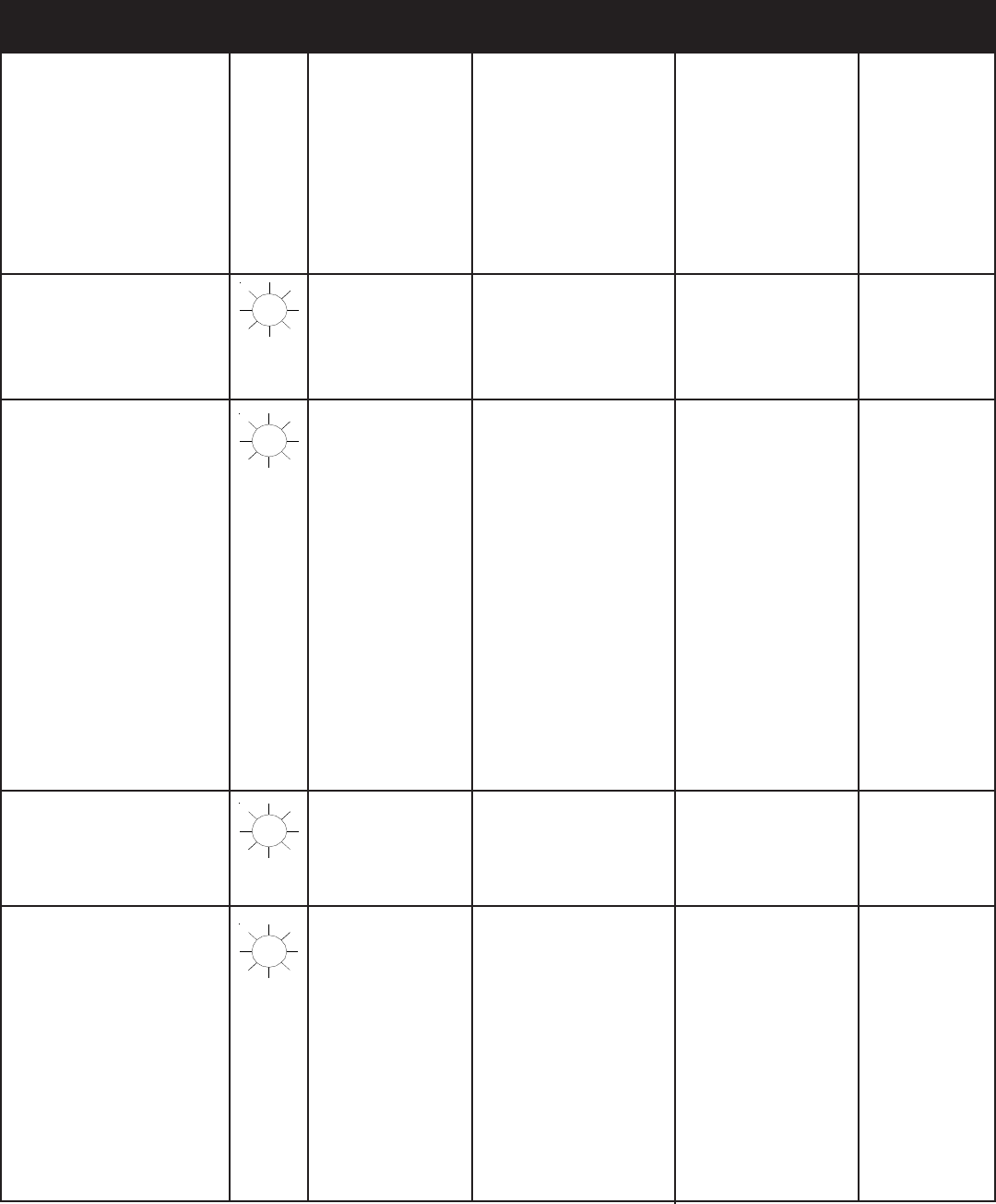
42
1Integrated control module will automatically attempt to reset from lockout after one hour.
TROUBLESHOOTING CHART
• Furnace lockout due
to an excessive
number of ignition
“retries” (3 total)1.
• Locate and correct gas
interruption.
• Check front cover
pressure switch
operation (hose, wiring,
contact operation).
Correct if necessary.
• Replace or realign
igniter.
• Check flame sense
signal. Sand sensor if
coated and/or oxidized.
• Check flue piping for
blockage, proper
length, elbows, and
termination.
• Verify proper induced
draft blower perfor-
mance.
• Turn power
OFF prior to
repair.
• Igniter is
fragile, handle
with care.
• Sand flame
sensor with
emery cloth.
• See “Vent/Flue
Pipe” section
for piping
details.
• Furnace fails to operate.
• Integrated control module
diagnostic LED is
flashing ONE (1) flash.
1
1 FLASH
• Failure to establish flame.
Cause may be no gas to
burners, front cover
pressure switch stuck open,
bad igniter or igniter
alignment, improper orifices,
or coated/oxidized or
improperly connected flame
sensor.
• Loss of flame after establish-
ment. Cause may be
interrupted gas supply, lazy
burner flames (improper gas
pressure or restriction in flue
and/or combustion air
piping), front cover pressure
switch opening, or improper
induced draft blower
performance.
• Pressure switch
circuit is closed.
• Induced draft
blower is not
operating.
• Replace induced draft
blower pressure switch.
• Repair short.
• Turn power OFF
prior to repair.
• Replace pressure
switch with proper
replacement part.
• Furnace fails to operate.
• Integrated control module
diagnostic LED is
flashing TWO (2) flashes.
2
2 FLASHES
• Induced draft blower
pressure switch contacts
sticking.
• Shorts in pressure switch
circuit.
• Inspect pressure
switch hose. Repair, if
necessary,
• Inspect flue and/or inlet
air piping for blockage,
proper length, elbows,
and termination. Check
drain system. Correct
as necessary.
• Correct pressure switch
setpoint or contact
motion.
• Tighten or correct
wiring connection.
• Pressure switch hose
blocked, pinched or
connected improperly.
• Blocked flue and/or inlet air
pipe, blocked drain system,
or weak induced draft
blower.
• Incorrect pressure switch
setpoint or malfunctioning
switch contacts.
• Loose or improperly
connected wiring.
• Pressure switch
circuit not closed.
• Induced draft blower
is operating.
• Induced draft blower runs
continuously with no
further furnace operation.
• Integrated control module
diagnostic LED is
flashing THREE (3)
flashes.
3
3 FLASHES
• Turn power
OFF prior to
repair.
• Replace
pressure
switch with
proper
replacement
part.
Fault Description(s) Possible Causes
Associated
LED Code2
• Normal Operation •Normal Operation • None •Normal Operation
ON
CONTINUOUS
ON
• No 115 volt power to
furnace, or no 24 volt
power to integrated
control module.
• Blown fuse or circuit
breaker.
• Integrated control
module has an
internal fault.
• Manual disconnect switch
OFF, door switch open, or
24 volt wires improperly
connected or loose.
• Blown fuse or circuit
breaker.
• Integrated control module
has an internal fault.
• Assure 115 and 24 volt
power to furnace
integrated control module.
• Check integrated control
module fuse (3A).
Replace if necessary.
• Check for possible shorts
in 115 and 24 volt circuits.
Repair as necessary.
• Replace bad integrated
control module.
• Turn power OFF
prior to repair.
• Replace
integrated
control module
fuse with 3A
automotive fuse.
• Read precautions
in “Electrostatic
Discharge” section
of manual.
• Furnace fails to operate.
• Integrated control module
diagnostic LED provides
no signal.
NONE
Fault Description(s) Possible Causes Corrective Action Cautions and Notes
Symptoms of Abnormal
Operation
Associated
LED Code2
2LED Flash code will cease if power to the control module is interrupted through the disconnect or door switch.
• LED is Steady On.
43
2 LED Flash code will cease if power to the control module is interrupted through the disconnect or door switch.
TROUBLESHOOTING CHART
4
4 FLASHES
• Circulator blower runs
continuously. No furnace
operation.
• Integrated control module
diagnostic LED is flashing
FOUR (4) flashes.
6
6 FLASHES
7
7 FLASHES
• Furnace fails to operate.
• Integrated control module
diagnostic LED is flashing
SIX (6) flashes.
• No furnace operation.
• Normal furnace
operation.
• Integrated control module
diagnostic LED is
flashing SEVEN (7)
flashes.
• Rollout limit open.
• Integrated control
module fuse is
blown.
• Flame sense
microamp signal is
low.
• Flame sensor is coated/
oxidized.
• Flame sensor incorrectly
positioned in burner
flame.
• Lazy burner flame due to
improper gas pressure or
combustion air.
• Sand flame sensor.
• Inspect for proper sensor
alignment.
• Compare current gas
pressure to rating plate
info. Adjust as needed.
• Turn power OFF
prior to repair.
• Clean flame sensor
with steel wool.
• See “Vent/Flue
Pipe” section for
piping details.
• See rating plate for
proper gas
pressure.
• See “Vent/Flue
Pipe” section for
piping details.
• Replace induced
draft blower with
proper replace-
ment part.
• Replace inte-
grated control
module fuse with
3A automotive
fuse.
• Read precautions
in “Electrostatic
Discharge”
section of manual.
• Replace rollout
limit with correct
replacement part.
• Primary limit
circuit is open.
• Induced draft blower runs
continuously. No furnace
operation.
• Integrated control module
diagnostic LED is flashing
continuously.
C
CONTINUOUS
FLASHING
• Polarity of 115
or 24 volt
power is
reversed.
• Polarity of 115 volt AC
power to furnace or
integrated control module
is reversed.
• Red and blue wires to
transformer are reversed.
• Poor unit ground.
• Review wiring diagram to
correct polarity.
• Verify proper ground.
Correct if necessary.
• Reverse red and blue
wires connected to
transformer.
• Turn power OFF
prior to repair.
• Normal operation.
• LED is steady on STEADY
• Check burners for proper
alignment.
• Check flue and air inlet
piping for blockage,
proper length, elbows,
and termination. Correct
as necessary.
• Check rollout limit. Replace
if necessary.
• Check induced draft
blower for proper
performance. Replace, if
necessary.
• Tighten or correct wiring
connection.
• Repair short in 24 volt AC
control/safety circuit(s).
• Replace integrated control
module fuse (3A).
• Flame rollout.
• Misaligned burners,
blocked flue and/or air
inlet pipe, or failed
induced draft blower.
• Loose or improperly
connected wiring.
• Short in 24 volt AC
control circuits or safety
circuits.
•Faulty rollout limit.
• Induced draft blower and
circulator blower runs
continuously. No furnace
operation.
• Integrated control module
diagnostic LED is flashing
FIVE (5) flashes.
5
5 FLASHES
• Flame sensed
with no call for
heat.
• Short to ground in flame
sense circuit. • Correct short at flame
sensor or in flame
sensor wiring.
• Turn power OFF
prior to repair.
• Insufficient conditioned air
over the heat exchanger.
Blocked filters, restrictive
ductwork, improper
circulator blower speed, or
failed circulator blower.
• Faulty primary limit switch.
• Loose or improperly
connected wiring.
• Check primary limit.
Replace if necessary.
• Check filters and
ductwork for blockage.
Clean filters or remove
obstruction.
• Check circulator blower
speed and performance.
Correct speed or replace
blower if necessary.
• Tighten or correct wiring
connection.
• Turn power OFF
prior to repair.
• Replace primary
switch with proper
replacement part.
• Replace blower
with correct
replacement part.
• Furnace not operating.
• Integrated control module
diagnostic LED is
flashing EIGHT (8)
flashes. 8 FLASHES
• Problem with
igniter circuit.
• Improperly connected
igniter.
• Bad igniter.
• Poor unit ground.
• Poor burner ground.
• Faulty integrated control
module.
• Check and correct wiring
from integrated control
module to igniter.
•Replace bad igniter.
•Check and correct unit
ground wiring.
• Replace bad integrated
control module.
• Turn power OFF
prior to repair.
• Replace igniter
with proper
replacement part.
• Read precautions
in “Electrostatic
Discharge”
section of manual.
ON
Cautions
& Notes
Corrective Action
Possible Causes
Fault
Description(s)
Symptoms of
Abnormal Operation
Associated
LED Code2
44
*MH95
BLOWER PERFORMANCE DATA
1. CFM in chart is without filters(s). Filters do not ship with this furnace, but must be provided by the installer. If the furnace requires two return filters, this chart assumes
both filters are installed.
2. All furnaces ship as high speed cooling and medium-speed heating. Installer must adjust blower cooling & heating speed as needed.
3. For most jobs, about 400 CFM per ton when cooling is desirable.
4. INSTALLATION IS TO BE ADJUSTED TO OBTAIN TEMPERATURE RISE WITHIN THE RANGE SPECIFIED ON THE RATING PLATE.
5. The chart is for information only. For satisfactory operation, external static pressure must not exceed value shown on rating plate. The shaded area indicates ranges
in excess of maximum external static pressure allowed when heating. The data for 0.6" w.c. to 0.8" w.c. is shown for air conditioning purposes only.
6. At higher altitudes, a properly de-rated unit will have approximately the same temperature rise at a particular CFM, while the ESP at that CFM will be lower.
Tons AC
at 0.5" 0.6 0.7 0.8
ESP CFM RISE CFM RISE CFM RISE CFM RISE CFM RISE CFM CFM CFM
HIGH 3.0
1352 29 1318 30 1260 31 1202 33 1128 35 1044 955 853
*MH950453BX* MED 2.5
1214 32 1172 34 1123 35 1064 37 1012 39 938 859 741
(MED-HI) MED-LO 2.0
997 40 994 40 960 41 923 43 884 45 817 741 611
LOW 1.5
757 52 753 52 734 54 704 56 674 59 620 524 438
HIGH 3.0
1449 41 1409 42 1326 45 1273 47 1201 49 1194 1136 1018
*MH950703BX* MED 2.5
1192 50 1172 51 1141 52 1094 54 1046 57 973 904 793
(MED-HI) MED-LO 2.0
981 61 962 62 943 63 917 65 888 67 830 764 665
LOW 1.5
750 79 730 81 714 83 692 86 657 90 620 570 502
HIGH 4.0
2069 29 1965 30 1871 32 1756 34 1661 36 1549 1415 1275
*MH950704CX* MED 3.5
1752 34 1724 34 1667 36 1603 37 1488 40 1402 1290 1082
(MED-HI) MED-LO 3.0
1437 41 1437 41 1417 42 1369 43 1320 45 1256 1140 984
LOW 2.5
1184 50 1177 50 1161 51 1132 52 1095 54 1047 928 837
HIGH 4.0
1970 40 1874 42 1757 45 1667 48 1566 51 1431 1334 1182
*MH950904CX* MED 3.5
1713 46 1650 48 1572 50 1510 52 1418 56 1313 1211 1079
(MED-HI) MED-LO 3.0
1439 55 1412 56 1370 58 1327 60 1260 63 1166 1078 956
LOW 2.5
1183 67 1155 69 1122 74 1108 72 1062 75 1011 931 816
HIGH 5.0
2058 39 1997 40 1928 42 1852 43 1777 45 1682 1600 1487
*MH950905CX* MED 4.0
1718 47 1685 48 1632 49 1586 51 1520 53 1458 1369 1281
(MED-HI) MED-LO 3.5
1502 54 1464 55 1429 56 1380 58 1319 61 1272 1200 1137
LOW 3.0
1305 62 1277 63 1253 64 1212 66 1175 69 1127 1081 1010
HIGH 5.0
2147 37 2114 37 2057 39 2030 39 1978 40 1889 1784 1713
*MH950905DX* MED 4.0
1675 47 1686 47 1640 48 1623 49 1557 51 1501 1455 1360
(MED-HI) MED-LO 3.5
1489 53 1470 54 1436 55 1409 56 1361 58 1318 1243 1130
LOW 3.0
1307 61 1265 63 1234 64 1203 66 1168 68 1096 1053 991
HIGH 5.0
2134 46 2103 47 2029 48 1941 51 1906 51 1818 1733 1625
*MH951155DX* MED 4.0
1678 58 1643 60 1643 60 1577 62 1527 64 1489 1423 1339
(MED-HI) MED-LO 3.5
1453 68 1440 68 1426 69 1363 72 1349 73 1314 1253 1205
LOW 3.0
1259 78 1239 79 1220 80 1181 83 1159 85 1118 1082 1015
BLOWER PERFORMANCE
(CFM & Temperature Rise vs. External Static Pressure)
Model
Heating Speed
As Shipped
Motor
Speed
EXTERNAL STATIC PRESSURE (Inches Water Column)
0.1 0.2 0.3 0.4 0.5
45
BLOWER PERFORMANCE DATA ACSH96
1. CFM in chart is without filters(s). Filters do not ship with this furnace, but must be provided by the installer. If the furnace requires two return filters, this chart assumes
both filters are installed.
2. All furnaces ship as high speed cooling and medium-speed heating. Installer must adjust blower cooling & heating speed as needed.
3. For most jobs, about 400 CFM per ton when cooling is desirable.
4. INSTALLATION IS TO BE ADJUSTED TO OBTAIN TEMPERATURE RISE WITHIN THE RANGE SPECIFIED ON THE RATING PLATE.
5. The chart is for information only. For satisfactory operation, external static pressure must not exceed value shown on rating plate. The shaded area indicates ranges
in excess of maximum external static pressure allowed when heating. The data for 0.6" w.c. to 0.8" w.c. is shown fo air conditioning purposes only.
6. At higher altitudes, a properly de-rated unit will have approximately the same temperature rise at a particular CFM, while the ESP at that CFM will be lower.
Tons AC
at 0.5" 0.6 0.7 0.8
ESP CFM RISE CFM RISE CFM RISE CFM RISE CFM RISE CFM CFM CFM
HIGH 3.0 1415 28 1352 30 1290 31 1196 34 1127 36 1035 936 825
ACSH960453BX* MED 2.5 1221 33 1178 34 1127 36 1073 38 1007 40 932 834 733
(MED-HI) MED-LO 2.0 1034 39 1000 40 976 41 935 43 881 46 818 733 662
LOW 1.5 8604784548812507835174054682619534
HIGH 3.0 1431 42 1368 44 1296 47 1228 49 1150 53 1055 962 860
ACSH960703BX* MED 2.5 1212 50 1182 51 1138 53 1091 55 1019 59 944 871 769
(MED-HI) MED-LO 2.0 1002 60 978 62 956 63 921 66 878 69 825 738 647
LOW 1.5 8137480575790767598072683689644605
HIGH 4.0 1755 34 1674 36 1632 37 1510 40 1423 42 1325 1241 1116
ACSH960704CX* MED 3.5 1656 36 1585 38 1536 39 1429 42 1355 45 1268 1145 1059
(MED-HI) MED-LO 3.0 1551 39 1488 41 1427 42 1353 45 1290 47 1195 1100 1017
LOW 2.5 1286 47 1258 48 1241 49 1185 51 1112 54 1067 983 886
HIGH 4.0 1734 46 1652 49 1578 51 1508 53 1413 57 1336 1248 1154
ACSH960904CX* MED 3.5 1642 49 1558 52 1487 54 1418 57 1336 60 1243 1164 1039
(MED-HI) MED-LO 3.0 1522 53 1458 55 1396 58 1321 61 1253 64 1182 1101 986
LOW 2.5 1287 63 1244 65 1184 68 1148 70 1098 73 1034 953 849
HIGH 5.0 2189 37 2109 38 2025 40 1948 41 1862 43 1757 1644 1537
ACSH960905DX* MED 4.0 1885 43 1831 44 1776 45 1711 47 1637 49 1539 1453 1346
(MED-HI) MED-LO 3.5 1665 48 1627 50 1584 51 1524 53 1462 55 1400 1323 1220
LOW 3.0 1474 55 1440 56 1401 57 1356 59 1310 61 1255 1193 1109
HIGH 5.0 2134 46 2103 47 2029 48 1941 51 1906 51 1818 1733 1625
ACSH961155DX* MED 4.0 1678 58 1643 60 1643 60 1577 62 1527 64 1489 1423 1339
(MED-HI) MED-LO 3.5 1453 68 1440 68 1426 69 1363 72 1349 73 1314 1253 1205
LOW 3.0 1259 78 1239 79 1220 80 1181 83 1159 85 1118 1082 1015
BLOWER PERFORMANC
E
(CFM & Temperature Rise vs. External Static Pressure)
Model
Heating Speed
As Shipped
Motor
Speed
EXTERNAL STATIC PRESSURE (Inches Water Column)
0.10.20.30.40.5
46
1. CFM in chart is without filters(s). Filters do not ship with this furnace, but must be provided by the installer. If the furnace requires two return filters, this chart assumes
both filters are installed.
2. All furnaces ship as high speed cooling and medium-speed heating. Installer must adjust blower cooling & heating speed as needed.
3. For most jobs, about 400 CFM per ton when cooling is desirable.
4. INSTALLATION IS TO BE ADJUSTED TO OBTAIN TEMPERATURE RISE WITHIN THE RANGE SPECIFIED ON THE RATING PLATE.
5. The chart is for information only. For satisfactory operation, external static pressure must not exceed value shown on rating plate. The shaded area indicates ranges
in excess of maximum external static pressure allowed when heating. The data for 0.6" w.c. to 0.8" w.c. is shown fo air conditioning purposes only.
6. At higher altitudes, a properly de-rated unit will have approximately the same temperature rise at a particular CFM, while the ESP at that CFM will be lower.
AMEH96
BLOWER PERFORMANCE DATA
0.6 0.7 0.8
CFM RISE CFM RISE CFM RISE CFM RISE CFM RISE CFM CFM CFM
T1 - YELLOW 1.5 726 48 670 53 617 57 553 64 490 72 429 378 336
T2 - RED 2.0 905 39 860 41 812 43 761 46 712 49 663 610 574
T3 - ORANGE 2.5 1121 31 1074 33 1039 34 998 35 959 37 923 882 839
T4 - BLUE 3.0 1274 28 1239 28 1199 29 1166 30 1129 31 1096 1059 1021
T5 - BLACK 3.0 1306 27 1261 28 1232 29 1195 29 1162 30 1132 1090 1057
T1 - YELLOW 1.5 714 80 667 79 604 87 548 96 484 109 422 367 325
T2 - RED 2.0 904 58 851 62 804 66 761 69 708 75 664 612 572
T3 - ORANGE 2.5 1125 47 1075 49 1045 51 999 53 956 55 921 877 839
T4 - BLUE 3.0 1312 40 1271 42 1228 43 1202 44 1165 45 1127 1087 1044
T5 - BLACK 3.5 1423 37 1386 38 1354 39 1321 40 1278 41 1210 1134 1032
T1 - YELLOW 3.0 1297 54 1253 56 1209 58 1161 61 1111 63 1067 1022 974
T2 - RED 3.5 1507 47 1455 48 1422 49 1377 51 1334 53 1296 1251 1195
T3 - ORANGE 4.0 1677 42 1637 43 1602 44 1562 45 1526 46 1484 1441 1324
T4 - BLUE 4.0 1879 37 1842 38 1800 39 1762 40 1700 41 1566 1437 1319
T5 - BLACK 5.0 2044 35 1967 36 1894 37 1795 39 1702 41 1578 1452 1320
T1 - YELLOW 3.0 1331 66 1275 69 1206 73 1145 77 1080 81 1021 953 889
T2 - RED 3.5 1512 58 1452 60 1392 63 1336 66 1279 69 1219 1175 1115
T3 - ORANGE 4.0 1713 51 1666 53 1614 57 1569 56 1513 58 1468 1414 1364
T4 - BLUE 4.0 1892 46 1845 48 1802 49 1752 50 1707 52 1656 1614 1577
T5 - BLACK 5.0 2080 42 2038 43 2005 44 1960 45 1920 46 1879 1843 1791
A
MEH960603BX*
(MED-HI)
A
MEH960805CX*
(MED-HI)
(CFM & TEMPERATURE RISE VS. EXTERNAL STATIC PRESSURE)
0.4 0.5
A
MEH960403BX*
(MED-HI)
A
MEH961005DX*
(MED-HI)
EXTERNAL STATIC PRESSURE (Inches Water Column)
Model
--------------
Heating Speed
As Shipped
0.3
Mot or
Speed
Tons
A
C at
0.5"
ESP
0.1 0.2
47
1. CFM in chart is without filters(s). Filters do not ship with this furnace, but must be provided by the installer. If the furnace requires two return filters, this chart assumes
both filters are installed.
2. All furnaces ship as high speed cooling and medium-speed heating. Installer must adjust blower cooling & heating speed as needed.
3. For most jobs, about 400 CFM per ton when cooling is desirable.
4. INSTALLATION IS TO BE ADJUSTED TO OBTAIN TEMPERATURE RISE WITHIN THE RANGE SPECIFIED ON THE RATING PLATE.
5. The chart is for information only. For satisfactory operation, external static pressure must not exceed value shown on rating plate. The shaded area indicates ranges
in excess of maximum external static pressure allowed when heating. The data for 0.6" w.c. to 0.8" w.c. is shown fo air conditioning purposes only.
6. At higher altitudes, a properly de-rated unit will have approximately the same temperature rise at a particular CFM, while the ESP at that CFM will be lower.
GCH95 / GCH9115
BLOWER PERFORMANCE DATA
Tons AC
at 0.5" 0.6 0.7 0.8
ESP CFM RISE CFM RISE CFM RISE CFM RISE CFM RISE CFM CFM CFM
HIGH 3.0 1415 28 1352 30 1290 31 1196 34 1127 36 1035 936 825
GCH950453BX* MED 2.5 1221 33 1178 34 1127 36 1073 38 1007 40 932 834 733
(MED-HI) MED-LO 2.0 1034 39 1000 40 976 41 935 43 881 46 818 733 662
LOW 1.5 860 47 845 48 812 50 783 51 740 54 682 619 534
HIGH 3.0 1431 42 1368 44 1296 47 1228 49 1150 53 1055 962 860
GCH950703BX* MED 2.5 1212 50 1182 51 1138 53 1091 55 1019 59 944 871 769
(MED-HI) MED-LO 2.0 1002 60 978 62 956 63 921 66 878 69 825 738 647
LOW 1.5 813 74 805 75 790 76 759 80 726 83 689 644 605
HIGH 4.0 1755 34 1674 36 1632 37 1510 40 1423 42 1325 1241 1116
GCH950704CX* MED 3.5 1656 36 1585 38 1536 39 1429 42 1355 45 1268 1145 1059
(MED-HI) MED-LO 3.0 1551 39 1488 41 1427 42 1353 45 1290 47 1195 1100 1017
LOW 2.5 1286 47 1258 48 1241 49 1185 51 1112 54 1067 983 886
HIGH 4.0 1734 46 1652 49 1578 51 1508 53 1413 57 1336 1248 1154
GCH960904CX* MED 3.5 1642 49 1558 52 1487 54 1418 57 1336 60 1243 1164 1039
(MED-HI) MED-LO 3.0 1522 53 1458 55 1396 58 1321 61 1253 64 1182 1101 986
LOW 2.5 1287 63 1244 65 1184 68 1148 70 1098 73 1034 953 849
HIGH 5.0 2189 37 2109 38 2025 40 1948 41 1862 43 1757 1644 1537
GCH950905DX* MED 4.0 1885 43 1831 44 1776 45 1711 47 1637 49 1539 1453 1346
(MED-HI) MED-LO 3.5 1665 48 1627 50 1584 51 1524 53 1462 55 1400 1323 1220
LOW 3.0 1474 55 1440 56 1401 57 1356 59 1310 61 1255 1193 1109
HIGH 5.0 2134 46 2103 47 2029 48 1941 51 1906 51 1818 1733 1625
GCH91155DX* MED 4.0 1678 58 1643 60 1643 60 1577 62 1527 64 1489 1423 1339
(MED-HI) MED-LO 3.5 1453 68 1440 68 1426 69 1363 72 1349 73 1314 1253 1205
LOW 3.0 1259 78 1239 79 1220 80 1181 83 1159 85 1118 1082 1015
BLOWER PERFORMANCE
(CFM & Temperature Rise vs. External Static Pressure)
Model
Heating Speed
As Shipped
Motor
Speed
EXTERNAL STATIC PRESSU RE (Inches Water Col umn)
0.10.20.30.40.5
48
1. CFM in chart is without filters(s). Filters do not ship with this furnace, but must be provided by the installer. If the furnace requires two return filters, this chart assumes
both filters are installed.
2. All furnaces ship as high speed cooling and medium-speed heating. Installer must adjust blower cooling & heating speed as needed.
3. For most jobs, about 400 CFM per ton when cooling is desirable.
4. INSTALLATION IS TO BE ADJUSTED TO OBTAIN TEMPERATURE RISE WITHIN THE RANGE SPECIFIED ON THE RATING PLATE.
5. The chart is for information only. For satisfactory operation, external static pressure must not exceed value shown on rating plate. The shaded area indicates ranges
in excess of maximum external static pressure allowed when heating. The data for 0.6" w.c. to 0.8" w.c. is shown fo air conditioning purposes only.
6. At higher altitudes, a properly de-rated unit will have approximately the same temperature rise at a particular CFM, while the ESP at that CFM will be lower.
GME95
BLOWER PERFORMANCE DATA
0.6 0.7 0.8
CFM RISE CFM RISE CFM RISE CFM RISE CFM RISE CFM CFM CFM
T1 - YELLOW 1.5 726 48 670 53 617 57 553 64 490 72 429 378 336
T2 - RED 2.0 905 39 860 41 812 43 761 46 712 49 663 610 574
T3 - ORANGE 2.5 1121 31 1074 33 1039 34 998 35 959 37 923 882 839
T4 - BLUE 3.0 1274 28 1239 28 1199 29 1166 30 1129 31 1096 1059 1021
T5 - BLACK 3.0 1306 27 1261 28 1232 29 1195 29 1162 30 1132 1090 1057
T1 - YELLOW 1.5 714 80 667 79 604 87 548 96 484 109 422 367 325
T2 - RED 2.0 904 58 851 62 804 66 761 69 708 75 664 612 572
T3 - ORANGE 2.5 1125 47 1075 49 1045 51 999 53 956 55 921 877 839
T4 - BLUE 3.0 1312 40 1271 42 1228 43 1202 44 1165 45 1127 1087 1044
T5 - BLACK 3.5 1423 37 1386 38 1354 39 1321 40 1278 41 1210 1134 1032
T1 - YELLOW 3.0 1297 54 1253 56 1209 58 1161 61 1111 63 1067 1022 974
T2 - RED 3.5 1507 47 1455 48 1422 49 1377 51 1334 53 1296 1251 1195
T3 - ORANGE 4.0 1677 42 1637 43 1602 44 1562 45 1526 46 1484 1441 1324
T4 - BLUE 4.0 1879 37 1842 38 1800 39 1762 40 1700 41 1566 1437 1319
T5 - BLACK 5.0 2044 35 1967 36 1894 37 1795 39 1702 41 1578 1452 1320
T1 - YELLOW 3.0 1331 66 1275 69 1206 73 1145 77 1080 81 1021 953 889
T2 - RED 3.5 1512 58 1452 60 1392 63 1336 66 1279 69 1219 1175 1115
T3 - ORANGE 4.0 1713 51 1666 53 1614 57 1569 56 1513 58 1468 1414 1364
T4 - BLUE 4.0 1892 46 1845 48 1802 49 1752 50 1707 52 1656 1614 1577
T5 - BLACK 5.0 2080 42 2038 43 2005 44 1960 45 1920 46 1879 1843 1791
0.3
Motor
Speed
Tons
AC at
0.5"
ESP
0.1 0.2
GME950603BX*
(MED-HI)
GME950805CX*
(MED-HI)
(CFM & TEMPERATURE RISE VS. EXTERNAL STATIC PRESSURE)
0.4 0.5
GME950403BX*
(MED-HI)
GME951005DX*
(MED-HI)
EXTERNAL STATIC PRESSURE (Inches Water Column)
Model
--------------
Heating Speed
As Shipped
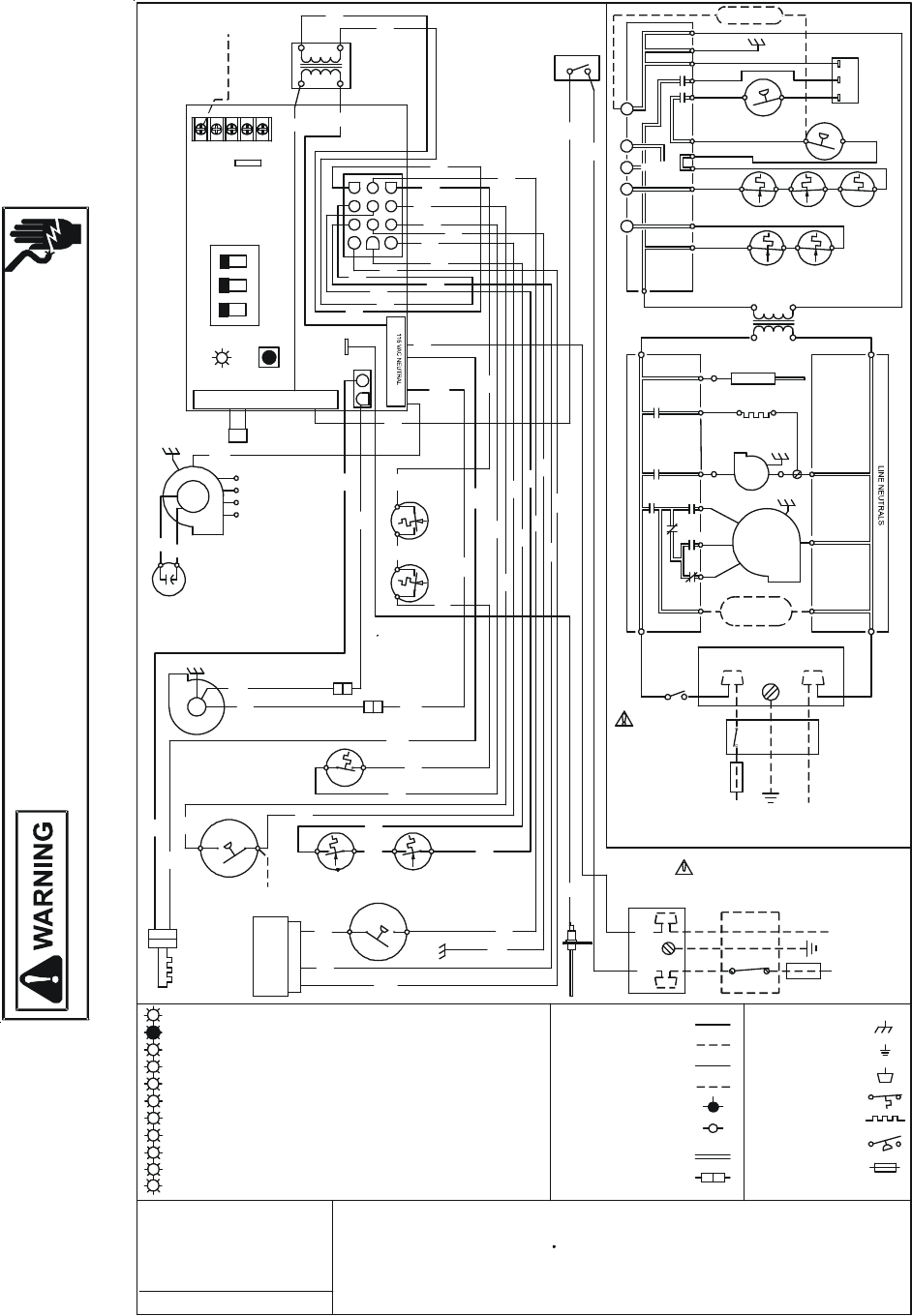
49
*MH95[0453,0704,0905D]
*MH95[0703,0904,1155]
Wiring is subject to change. Always refer to the wiring diagram on the unit for the most up-to-date wiring.
WIRING DIAGRAM
HIGH VOLTAGE!
D
ISCONNECT
ALL
POWER
BEFORE
SERVICING
OR
INSTALLING
THIS
UNIT
.
M
ULTIPLE
POWER
SOURCES
MAY
BE
PRESENT
. F
AILURE
TO
DO
SO
MAY
CAUSE
PROPERTY
DAMAGE
,
PERSONAL
INJURY
OR
DEATH
.
R
YL YELLOW
OR ORANGE
PU PURPLE
GN GREEN
BK BLACK
BR BROWN
WH WHITE
BL BLUE
GY GRAY
RD RED
COLOR CODES:
LOW VOLTAGE (24V)
LOW VOLTAGE FIELD
HI VOLTAGE (115V)
HI VOLTAGE FIELD
NOTES:
1. SE T HEAT ANTICIPATOR ON ROOM THERM OSTAT AT 0.7 AM PS.
2. MANUFACTURER'S SPECIFIED REPLACEMENT PARTS MUST BE USED WHEN SERVICING.
0140F00663 REV. A
OR (MED LOW)
BL (MED)
RD (LOW)
GAS VALVE (HONEY WELL)
C
PM
CG W
INTERNAL TO
INTEGRATED CONTROL
JUNCTION
EQUIPMENT GND
FIELD GND
DIAGNOSTIC
LED
2 CIRCUIT
CONNECTOR
HOT
SURFACE
IGNITER
OVERCURRENT
PROT. DEVICE
IGNITER
TH (3)
INTEGRATED
CONTROL MODULE
JUNCTION BOX
LINE-H
INTEGRATED CONTROL MODULE
GND
DISCONNECT
LN
DISCONNECT POWER
BEFORE SERVICING.
WIRING TO UNIT
MUST BE
PROPERLY
POLARIZED
AND GROUNDED.
OVERCURRENT PROTECTION DEVICE
BR
GY
RD
BL
BK
4. IF HEATING AND COOLING BLOWER SPEEDS ARE NOT THE SAME, DISCARD JUMPER BEFORE CONNECTING BLOWER LEADS. UNUSED
BLOWER LEADS MUST BE PLACED ON "PARK" TERMINALS OF INTEGRATED CONTROL OR TAPED.
3. IF ANY OF THE ORIGINAL WIRE AS SUPPLIED WITH THE FURNACE MUST BE REPLACED, IT MUST BE REPLACED WITH WIRING MATERIAL
HAVING A TEMPERATURE RATING OF AT LEAST 105
TERMINAL
SWITCH (PRESS.)
5. UNIT MUST BE PERMANENTLY GROUNDED AND CONFORM TO N.E.C. AND LOCAL CODES.
PK PINK
115 VAC HOT AND PARK TERMINALS
LINE-H
FLAME
SENSOR
FRONT COVER
PRESSURE SWITCH
( SINGLE CONTROL ON 45K BTU )
N
O
C
GY
BK
PLUG CONNECTION
FIELD SPLICE
SWITCH (TEMP.)
OR
24V THERMOSTAT
CONNECTIONS
GR
GND
115 VAC
24 VAC
BLOWER
COMPARTMENT
DOOR SWITCH
(OPEN WHEN
DOOR OPEN)
DOOR
SWITCH
WARNING:DISCONNECT POWER BEFORE
SERVICING.WIRING TO UNIT MUST BE
PROPERLY POLARIZED AND GROUNDED.
BK
GND
DISCONNECT
L
POWER SUPPLY WITH
OVERCURRENT PROTECTION
DEVICE
WH
JUNCTION
BOX
OR
ID BLOWER
PRESSURE
SWITCH
HEAT-H
GND
WH
RD
WH
GND
BURNER COMPARTMENT
BLOWER COMPARTMENT
NOTE 4
SEE
N
O
COOL-H
BK (HI)
BR BR
CAPACITOR
YL
WH
YL
CONTROL
PRIMARY LIMIT
AUTO RESET
BL
PU
MANUAL RESET ROLLOUT LIMIT CONTROL(S)
RD
OR
PK
BK
WH WH
BLOWER
INDUCED DRAFT
MANUAL RESET
AUXILIARY LIMITS
(1) IN UPFLOW
BLOWER DECK
(2) IN C'FLOW
BLOWER HOUSING
C
CIRCULATOR
BLOWER
FS
LIMIT CONTROLS
MANUAL RESET AUXILIARY
HI
HEAT-H
LO
HEAT-H
IGNITER
HOT SURFACE
IND
IGN
EAC-H AIR CLEANER
ELECTRONIC
BLWR
CIRCULATOR
BLWR
ID
FLAME SENSOR
115 VAC
TRANSFORMER
40 VA
24 VAC
GND
CONTROL
LIMIT
PRIMARY
AUTO RESET
(SINGLE CONTROL ON 45K BTU)
LIMIT CONTROL(S)
MANUAL RESET ROLLOUT
RO1 (5)
RO2 (11)
HLO (1)
HLI (7)
MVC (9)
GND (8)
BL
YL OR
RD
GR BR
PK
GY
BK
MICRO
TO
C
G
Y
W
R
TRANSFORMER
40 VA
2
WH
OR
BL
YL
OR
OR GY
PK
RD
OR
GY
XFMR-H
TERMINALS
GY
OR
GR
BR
1
2
3
12 11 10
98
7
65
WARNING:
C. USE COPPER CONDUCTORS ONLY.
24 VAC
HUMIDIFIER
24 VAC
HUMIDIFIER
HUMIDIFIER
PSO (4)
MVL(2)
PS (10)
C
NO
CNO
FRONT COVER
PRESSURE SWITCH
ID BLOWER
PRESSURE
SWITCH
0
C
7
6
5
4
3
2
1
OFF = CONTROL FAILURE
STEADY ON = NORMAL OPERATION
1 FLASH =
2 FLASHES = PRESSURE SWITCH STUCK CLOSED
3 FLASHES = PRESSURE SWITCH STUCK OPEN
4 FLASHES = OPEN HIGH LIMIT
5 FLASHES = FLAME SENSE WITHOUT GAS VALVE
OPEN ROLLOUT OR OPEN FUSE
7 FLASHES = LOW FLAME SIGNAL
6 FLASHES =
SYSTEM LOCKOUT (RETRIES EXCEEDED)
CONTINUOUS/RAPID FLASHES = REVERSED 115 VAC POLARITY
CONTROL
MODULE
INTEGRATED
FUSE
ON OFF
2ND
STAGE
DELAY
MODE
HEAT
OFF
DELAY
FS
1
3
2
HI
PM
GAS
VALVE
C
HI
MVH (12)
FACTORY SETTINGS
SHOWN
*
*
*
*
SEE
NOTE 6
COOL-H
TO 115VAC/ 1 Ø /60 HZ POWER SUPPLY WITH
PU
Y
6. TO RECALL THE LAST 5 FAULTS, MOST RECENT TO LEAST RECENT, DEPRESS SWITCH FOR MORE THAN 2 SECONDS WHILE IN
STANDBY (NO THERMOSTAT INPUTS)
8
GY
BK
WH
BK
TR
(
6
)
XFMR-H
4
N
TO 115 V
A
C / 1Ø / 60HZ
1
PK
WH
WH WH
OR
8 FLASHES = CHECK IGNITER OR IMPROPER GROUNDING
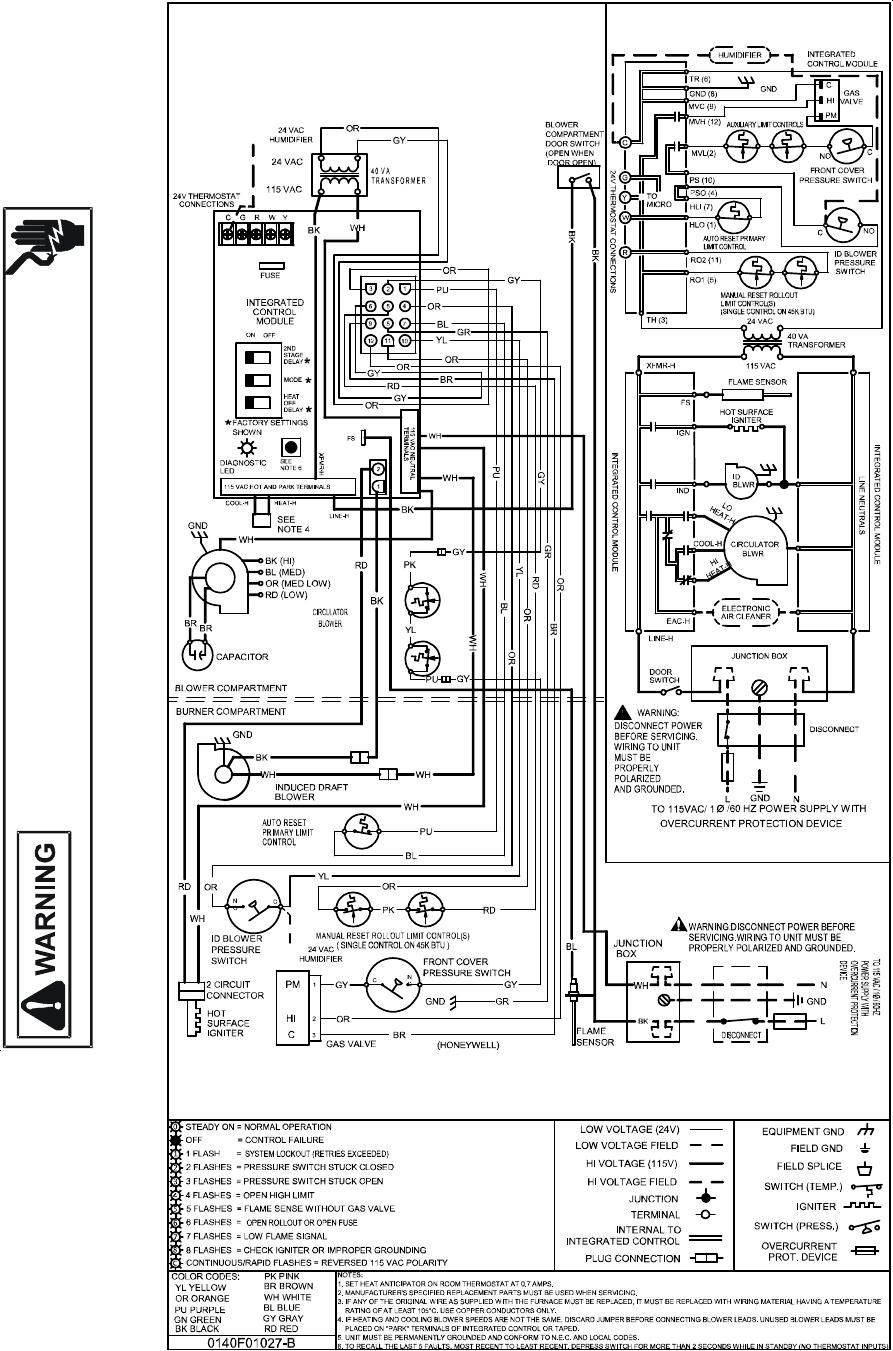
50
Wiring is subject to change. Always refer to the wiring diagram on the unit for the most up-to-date wiring.
HIGH VOLTAGE!
D
ISCONNECT
ALL
POWER
BEFORE
SERVICING
OR
INSTALLING
THIS
UNIT
.
M
ULTIPLE
POWER
SOURCES
MAY
BE
PRESENT
. F
AILURE
TO
DO
SO
MAY
CAUSE
PROPERTY
DAMAGE
,
PERSONAL
INJURY
OR
DEATH
.
WIRING DIAGRAM ACSH96 / GCH95 / GCH9
*MH950905CX
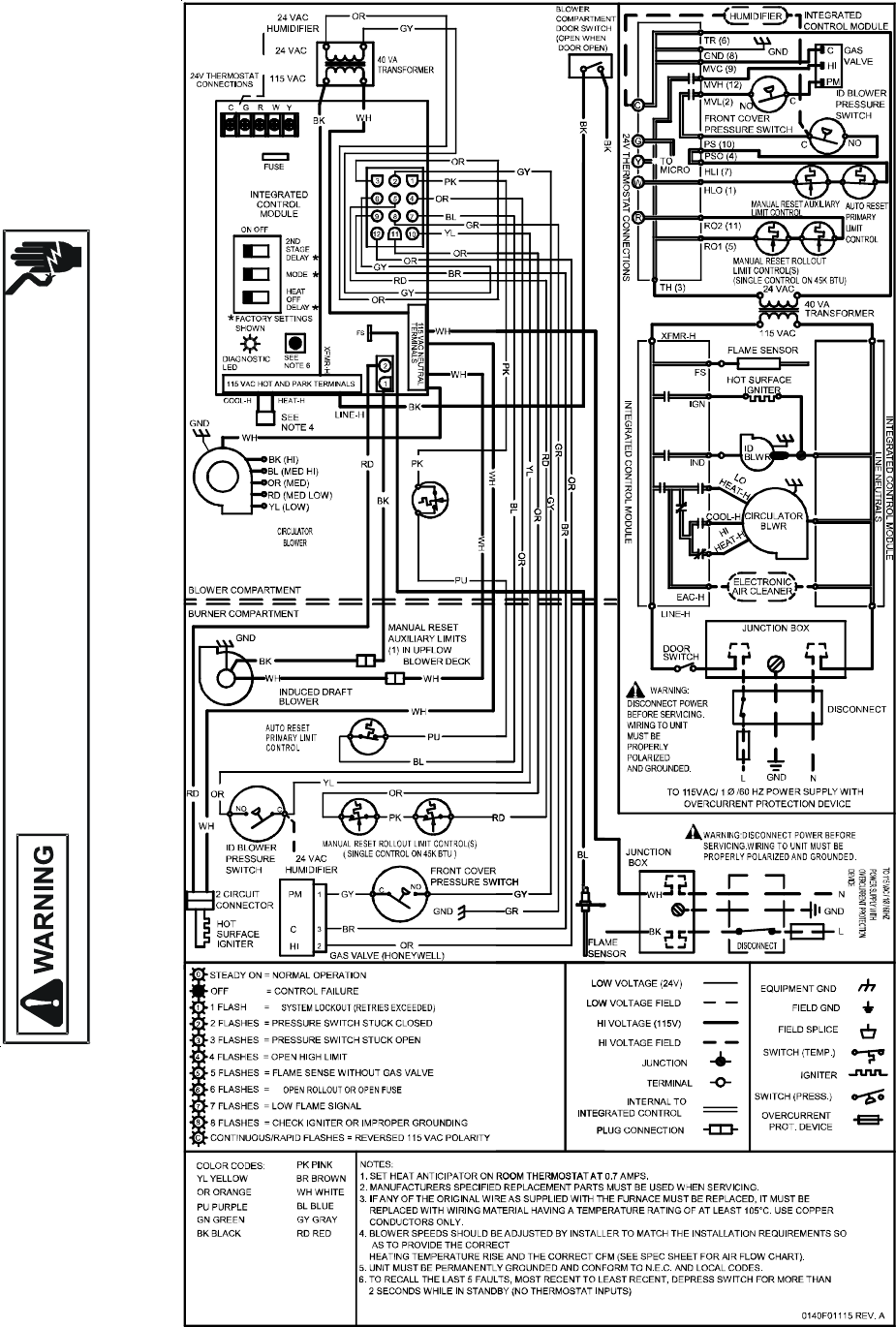
51
GME95 / AMEH96
Wiring is subject to change. Always refer to the wiring diagram on the unit for the most up-to-date wiring.
HIGH VOLTAGE!
D
ISCONNECT
ALL
POWER
BEFORE
SERVICING
OR
INSTALLING
THIS
UNIT
.
M
ULTIPLE
POWER
SOURCES
MAY
BE
PRESENT
. F
AILURE
TO
DO
SO
MAY
CAUSE
PROPERTY
DAMAGE
,
PERSONAL
INJURY
OR
DEATH
.
WIRING DIAGRAM
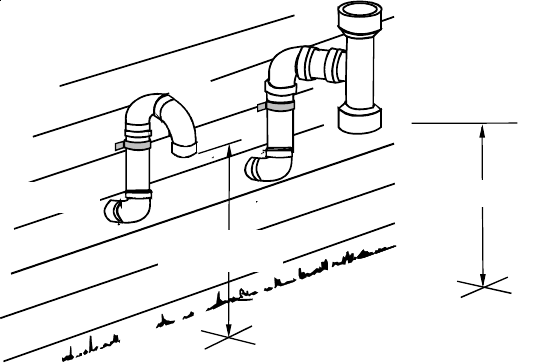
52
VENT/FLUE
TEE
COMBUSTION
AIR INTAKE.
DISTANCE BETWEEN
COMBUSTION AIR
INTAKE AND GRADE
DISTANCE BETWEEN
VENT AND GRADE
For all side wall horizontally vented gas fueled equipment installed
in every dwelling, building or structure used in whole or in part for
residential purposes, including those owned or operated by the
Commonwealth and where the side wall exhaust vent termination
is less than seven (7) feet above finished grade in the area of the
venting, including but not limited to decks and porches, the follow-
ing requirements shall be satisfied:
1. INSTALLATION OF CARBON MONOXIDE DETECTORS. At
the time of installation of the side wall horizontal vented gas
fueled equipment, the installing plumber or gasfitter shall
observe that a hard wired carbon monoxide detector with
an alarm and battery back-up is installed on the floor level
where the gas equipment is to be installed. In addition, the
installing plumber or gasfitter shall observe that a battery
operated or hard wired carbon monoxide detector with an
alarm is installed on each additional level of the dwelling,
building or structure served by the side wall horizontal vented
gas fueled equipment. It shall be the responsibility of the
property owner to secure the services of qualified licensed
professionals for the installation of hard wired carbon
monoxide detectors
a. In the event that the side wall horizontally vented gas fueled
equipment is installed in a crawl space or an attic, the
hard wired carbon monoxide detector with alarm and
battery back-up may be installed on the next adjacent
floor level.
b. In the event that the requirements of this subdivision can
not be met at the time of completion of installation, the
owner shall have a period of thirty (30) days to comply
with the above requirements; provided, however, that
during said thirty (30) day period, a battery operated carbon
monoxide detector with an alarm shall be installed.
2. APPROVED CARBON MONOXIDE DETECTORS. Each
carbon monoxide detector as required in accordance with
the above provisions shall comply with NFPA 720 and be
ANSI/UL 2034 listed and IAS certified.
3. SIGNAGE. A metal or plastic identification plate shall be
permanently mounted to the exterior of the building at a
minimum height of eight (8) feet above grade directly in line
with the exhaust vent terminal for the horizontally vented
gas fueled heating appliance or equipment. The sign shall
read, in print size no less than one-half (1/2) inch in size,
“GAS VENT DIRECTLY BELOW. KEEP CLEAR OF ALL
OBSTRUCTIONS”.
4. INSPECTION. The state or local gas inspector of the side
wall horizontally vented gas fueled equipment shall not
approve the installation unless, upon inspection, the
inspector observes carbon monoxide detectors and signage
installed in accordance with the provisions of 248 CMR
5.08(2)(a)1 through 4.
EXEMPTIONS
The following equipment is exempt from 248 CMR 5.08(2)(a)1
through 4:
1. The equipment listed in Chapter 10 entitled “Equipment
Not Required To Be Vented” in the most current edition of
NFPA 54 as adopted by the Board; and
2. Product Approved side wall horizontally vented gas fueled
equipment installed in a room or structure separate from
the dwelling, building or structure used in whole or in part
for residential purposes.
(c) MANUFACTURER REQUIREMENTS - GAS EQUIPMENT
VENTING SYSTEM PROVIDED. When the manufacturer
of Product Approved side wall horizontally vented gas
equipment provides a venting system design or venting
system components with the equipment, the instructions
provided by the manufacturer for installation of the
equipment and the venting system shall include:
1. Detailed instructions for the installation of the venting system
design or the venting system components; and
2. A complete parts list for the venting system design or venting
system.
(d) MANUFACTURER REQUIREMENTS - GAS EQUIPMENT
VENTING SYSTEM NOT PROVIDED. When the
manufacturer of a Product Approved side wall horizontally
vented gas fueled equipment does not provide the parts
for venting the flue gases, but identifies “special venting
systems”, the following requirements shall be satisfied
by the manufacturer:
1. The referenced “special venting system” instructions shall
be included with the appliance or equipment installation
instructions; and
2. The “special venting systems” shall be Product Approved
by the Board, and the instructions for that system shall
include a parts list and detailed installation instructions.
(e) A copy of all installation instructions for all Product
Approved side wall horizontally vented gas fueled
equipment, all venting instructions, all parts lists for
venting instructions, and/or all venting design instructions
shall remain with the appliance or equipment at the
completion of the installation.
SPECIAL INSTRUCTIONS FOR PRODUCTS INSTALLED
IN THE STATE OF MASSACHUSETTS
53
THIS PAGE LEFT INTENTIONALLY BLANK
54
THIS PAGE LEFT INTENTIONALLY BLANK
55
THIS PAGE LEFT INTENTIONALLY BLANK

56
Quality Makes the Difference!
“All of our systems are designed and manufactured with the same high quality standards regard-
less of size or efficiency. We have designed these units to significantly reduce the most frequent
causes of product failure. They are simple to service and forgiving to operate. We use quality
materials and components. Finally, every unit is run tested before it leaves the factory. That’s why
we know. . . There’s No Better Quality.”
Visit our web sites at www.goodmanmfg.com or www.amana-hac.com for information on:
•Products
•Warranties
•Customer Services
•Parts
•Contractor Programs and Training
•Financing Options
NOTE: SPECIFICATIONS AND PERFORMANCE DATA LISTED HEREIN
ARE SUBJECT TO CHANGE WITHOUT NOTICE.
© 2006-2013 Goodman Manufacturing Company, L.P.
