HES 3059006.002, Pages 1 4 Rev C__010714 5200 Series Installation Guide HES5200Install Instructions
User Manual: HES HES 5200 Series Installation Guide Installation Guide
Open the PDF directly: View PDF  .
.
Page Count: 2
Installation Instructions
5200 Series Electric Strike
HES, Inc.
Phoenix, AZ
800-626-7590
www.hesinnovations.com
1
Electrical Specifications
Minimum Wire Gauge Requirements
(Based on Round Trip)
Solenoid Voltage
12 VDC 24 VDC
200 feet or less
200 – 300 feet
300 – 400 feet
18 gauge
16 gauge
14 gauge
20 gauge
18 gauge
16 gauge
3
ASSA ABLOY, the global leader
in door opening solutions
Product Components
12
5200 Electric Strike Body Trim Enhancer 12-Volt and 24-Volt Pigtails
Electrical Ratings for Solenoid
Continuous Duty 12 VDC
50
.24
24 VDC
200
.12
Resistance in Ohms
Amps
Solenoids are rated at +/- 10% indicated value.
*10% maximum duty cycle (2 minutes maximum on time)
Indoor use only
4
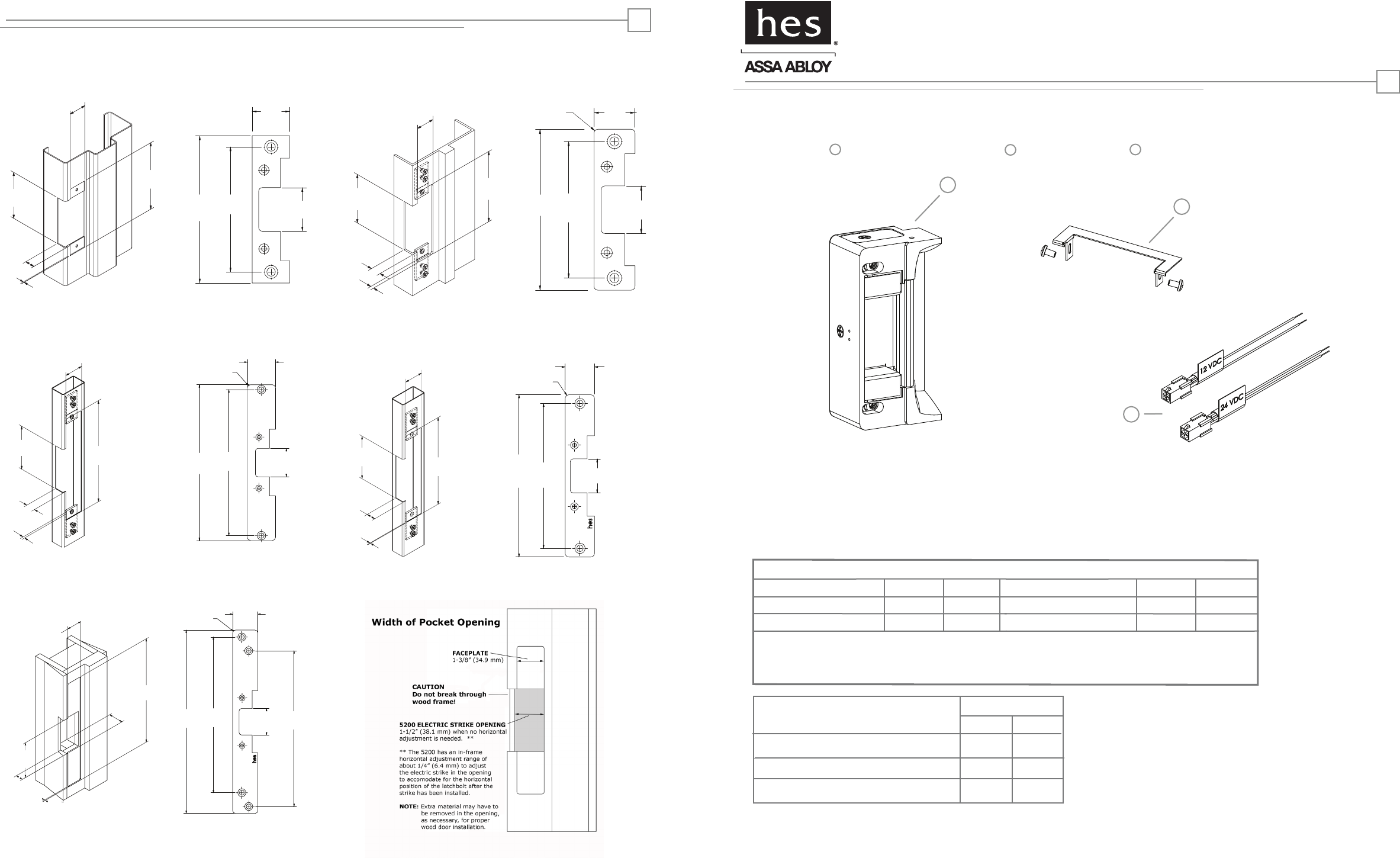
Cutout Templates for Frame Preparation
© 2015, Hanchett Entry Systems, Inc., an ASSA ABLOY Group company.
3059006.002 rev C
1
2
3
Diagram 1: Product Components
Intermittent Duty* 12–16 VAC
50
.24 – .32
24 VAC
200
.12
Resistance in Ohms
Amps
501 Faceplate Option (4-7/8” x 1-1/4”), Square Corners and Flat Faceplate
Used with cylindrical locksets in ANSI metal jambs
501A Faceplate Option (4-7/8” x 1-1/4”), Radius Corners and Flat Faceplate
Used with cylindrical locksets or spring latches in aluminum frames
[mm]
Inches
1 -1/4"
[31.8]
4 -7/8"
[124]
3 -3/8"
[85.7]
13/16"
[20.6]
3/32"
[2.3]
4 -7/8"
[124]
4 -1/8"
[104.8] 1 -7/16"
[36.6]
1 -1/4"
[31.8]
R 1/8"
[3]
3 -3/8"
[85.7]
1 -1/4"
[31.8]
4 -7/8"
[124]
13/16"
[20.6]
[2.3]
3/32"
[mm]
Inches
1 -1/4"
[31.8]
4 -7/8"
[124]
4 -1/8"
[104.8] 1 -7/16"
[36.6]
[mm]
Inches
3-3/8"
[85.7]
13/16"
[20.6]
3/32"
[2.3]
1 -7/16"
[36.5]
7-15/16"
[201.6] 1 -7/16"
[36.6]
7 -15/16"
[201.6]
7 -7/16"
[189]
1 -7/16"
[36.6]
R 3/16"
[4.1]
502 Faceplate Option (7-5/16” x 1-7/16”), Radius Corners and Flat Faceplate
Used with cylindrical locksets or spring latches in aluminum frames
[mm]
Inches
1 -1/4"
[36.5]
3 -3/8"
[85.7] 6 -7/8"
[174.3]
13/16"
[20.6]
3/32"
[2.3]
6 -7/8"
[174.3] 6 -1/8"
[155.6]
1 -1/4"
[31.8]
1 -7/16"
[36.6]
R 3/16"
[4.1]
503 Faceplate Option (6-7/8” x 1-1/4”), Radius Corners and Flat Faceplate
Used with cylindrical locksets or spring latches in aluminum frames
[mm]
Inches
10"
[254]
1 -3/8"
[34.9]
3 -3/8"
[85.7]
13/16"
[20.6]
3/32"
[2.3]
1 -3/8"
[34.9]
10"
[254]
8 -1/2"
[215.6] 8 -1/2"
[215.6]
1 -7/16"
[36.6]
1 -3/8"
[34.9]
R 1/8"
[4]
504 Faceplate Option (10” x 1-3/8”), Radius Corners and Flat Faceplate
Used with cylindrical locksets; four-point mounting for wood installations
NOTE: The 5200 has an in-frame horizontal adjustment range of about 1/4” (6.4 mm) to allow adjustment of the electric strike in the frame
opening to accomodate for the horizontal position of the latchbolt after the strike has been installed. The “Adjusting the Horizontal”
section provides steps for this adjustment.

2
Installation
3
Installation (continued)
LBM Wiring
White
Orange Normally Open
Green Normally Closed
Common
Normally Open
Yellow Normally Closed
DIAGRAM 5: CYLINDRICAL LOCKSETS
LBSM Wiring
Brown
Blue Normally Open
Yellow Normally Closed
Common
Note 1: The 5200 series Electric Strikes are
pre-set for FAIL SECURE OPERATION.
Note 2: There are two #2-56 screws located
on the back of the strike for coverting
the operation mode.
10. To convert from FAIL SECURE OPERATION
to FAIL SAFE OPERATION, LOOSEN the two
#2-56 screws located on the back of the
strike, but DO NOT REMOVE them.
11. MOVE the Selector Stop Pins to the FAIL
SAFE OPERATION position as pictured in
Diagram 5.
12. TIGHTEN the two #2-56 screws to secure
the strike in FAIL SAFE OPERATION.
13. VERIFY the 5200 is now in FAIL SAFE
OPERATION.
14. IF the 5200 still operates as FAIL SECURE,
THEN ENSURE the #2-56 screws are fully
seated and tightened.
Diagram 5: FAIL SAFE OPERATION Mode Setting
Brown
Blue
Yellow
White
Orange
Green
Converting the Operation Mode
Diagram 3: Latchbolt Monitor Diagram 4: Latchbolt Strike Monitor
Verifying the Operation Mode
15. TURN the horizontal adjustment screws slowly to
adjust the strike in-frame, as shown in Diagram 6.
16. DO NOT REMOVE the screws or ROTATE them more
than 3 full turns.
17. TIGHTEN the screws securely once the strike has
been adjusted to allow the K-Nut teeth to dig into
the strike housing and prevent slippage during use.
Adjusting the Horizontal
Diagram 6: Horizontal Adjustment
K-NUT
b
Horizontal
Adjustment
Screws
Note: For 12 VDC, the Plug In Connector (pigtail)
marked “12 VDC” should be used; for 24 VDC,
the pigtail marked “24 VDC should be used.
1. SELECT the appropriate pigtail that matches system
power and electrically CONNECT as illustrated in
Diagram 2.
2. If no connector is present, CONFIGURE the wires as
illustrated in Diagram 2.
3. If using the Latchbolt Monitor (LBM) or Latchbolt
Strike Monitor (LBSM), REFER to Diagrams 3 and 4
on Page 3 to complete wiring.
Note: The 5200 ships in FAIL SECURE OPERATION
mode.
4. USE Diagrams 5 and 6 on Page 3 as a guide to
convert 5200 to FAIL SAFE OPERATION, if needed.
5. ATTACH the appropriate faceplate.
CAUTION!
Before connecting any device at the installation site, verify input voltage using a multimeter.
Many power supplies and low voltage transformers operate at higher levels than listed. Any input voltage exceeding
10% of the solenoid rating may cause severe damage to the unit and will void the warranty.
6. PREPARE the frame using the appropriate template
for the faceplate (see Page 4).
RED
RED/GREEN
BLACK
VIOLET
RED
BLACK
VIOLET
RED/GREEN
IF CONNECTOR IS MISSING
(+ 12 VDC)
(-NEG)
(+ 24 VDC)
(-NEG)
or
Electric
Strike
Electric
Strike
CONNECT
TOGETHER
CONNECT
TOGETHER
CONNECT
TOGETHER
7. Electrically CONNECT the wires from the power
source to the 5200.
8. INSTALL the 5200 in the jamb cutout.
9. IF horizontal adjustment is needed,
THEN GO TO the “Adjusting the Horizontal”
section (see Page 3).
Preparing the Strike
Finishing the Installation
Preparing the Frame
Diagram 2: 12V to 24V Conversion
