HONDA Front Tine, Gas Tiller Manual L0512014
User Manual: HONDA HONDA Front Tine, Gas Tiller Manual HONDA Front Tine, Gas Tiller Owner's Manual, HONDA Front Tine, Gas Tiller installation guides
Open the PDF directly: View PDF  .
.
Page Count: 52
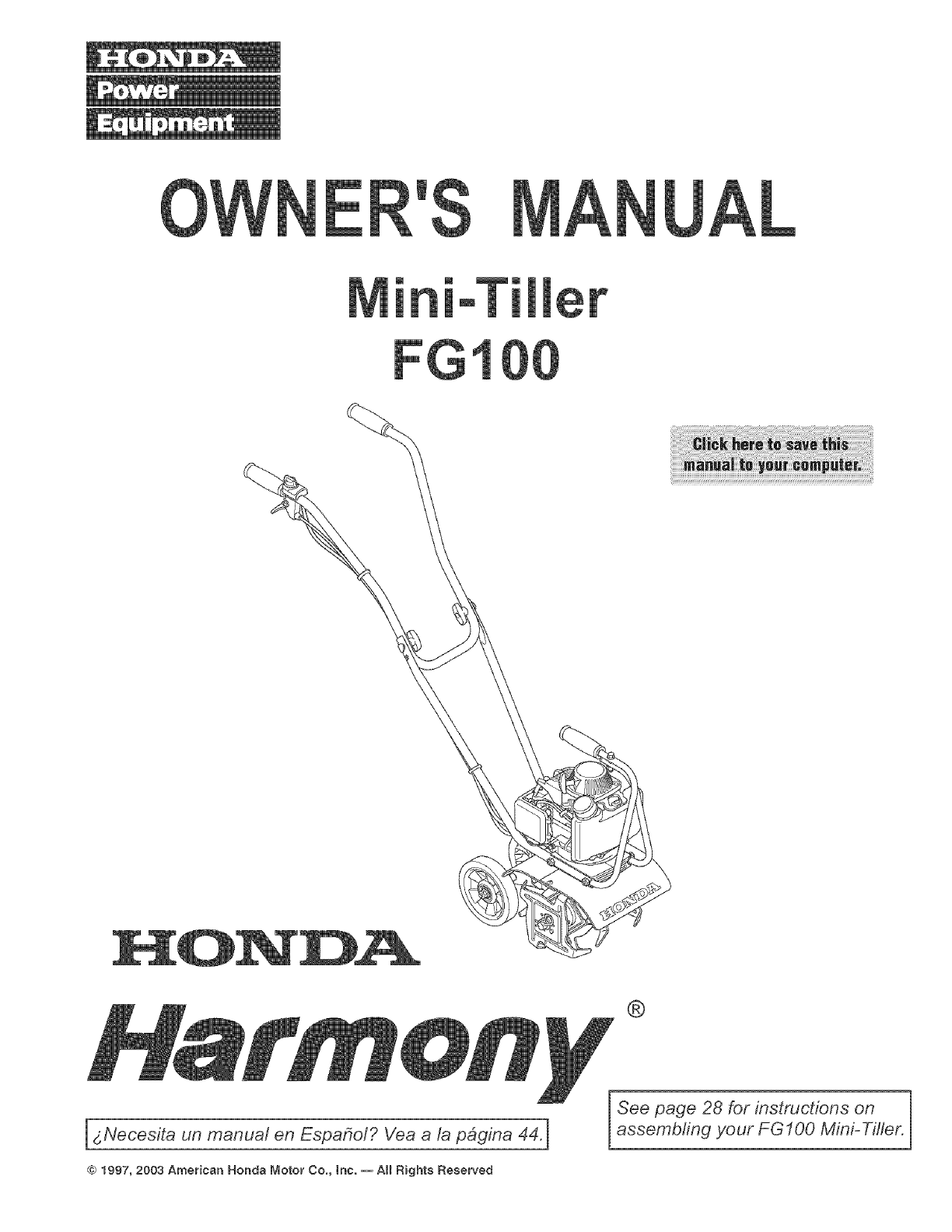
[] "..Tiller
FG
®
IgNecesita un en Espahol? a p_gina 44. l
1
manuat Vea /a
© 1997, 2003 American Honda Motor Co,, tnc, -- ALl Rights Reserved
See page 28 for instructions on
assembling your FG 100 Mini-Tiller.
The engine exhaust from this product contains
chemicals known to the State of California to cause
cancer, birth defects, or other reproductive harm.
Keep this owner's manual handy, so you can refer to it any time, and make sure the manual stays with the
tiller if you sell it.
This owner's manual is considered a permanent part of the tiller and should remain with the tiller if resold.
The information and specifications included in this publication were in effect at the time of approval for
printing. American Honda Motor Co., Inc. reserves the right, however, to discontinue or change
specifications or design at any time without notice and without incurring any obligation whatever.
FGIO0 TILLER
Congratulations on your selection of a Honda Harmony FG100 Tiller. We are certain you will be pleased
with your purchase of one of the finest tillers on the market.
We want to help you get the best results from your new tiller and to operate it safely. This manual contains
the information on how to do that; please read it carefully.
As you read this manual, you will find information preceded by a [NOTICE] symbol. That information is
intended to help you avoid damage to your tiller, other property, or the environment.
We suggest you read the Distributor's Limited Warranty (Page 40) to fully understand its coverage and
your responsibilities of ownership.
When your tiller needs scheduled maintenance, keep in mind that your authorized Honda servicing dealer
is specially trained in servicing Honda tillers. Your Honda servicing dealer is dedicated to your satisfaction
and will be pleased to answer your questions and concerns.
Left and right sides of this unit are determined from the operator's position, standing behind the filler
handlebars, facing the direction of forward travel.
Best Wishes,
Power Equipment Division
American Honda Motor Co., Inc.
© 1997, 2000 American Honda Motor Co., Inc. -All Rights Reserved
FGI00 TILLER
A FEW WORDS ABOUT SAFETY
Your safety, and the safety of others, is very important. And using this tifler is an important responsibilky.
To help you make informed decisions about safety, we have provided operating procedures and other
information on Rabels in this manual. This information alerts you to potential hazards that could hurt you or
others.
Of course, it is not practical or possibUe to warn you about all the hazards associated with operating or
maintaining a tiIRer. You must use your own good judgment.
You wifl find important safety information in a variety of forms, including:
_, Safety Labels--on the tiller.
Safety Messages--preceded by a safety alert symbol _ and one of the following three words:
DANGER, WARNING, or CAUTION.
These signal words mean:
You WILL be KILLED or SERIOUSLY HURT if you don't follow instructions.
You CAN be KILLED or SERIOUSLY HURT if you don't follow instructions.
You CAN BE HURT if you don't follow instructions.
Safety Headings--such as IMPORTANT SAFETY INFORMATtON.
Safety Section--such as TILLER SAFETY.
instructions--how to use this tiller correctly and safely.
This entire book is filled with important safety information--please read it carefully.
2
CONTENTS
TILLER SAFETY ............................................. 4
IMPORTANT SAFETY INFORMATION ........ 4
ATTACHMENTS AND MODIFICATIONS ..... 5
IMPORTANT MESSAGE TO EMPLOYERS. 5
IMPORTANT MESSAGE TO PARENTS ...... 5
SAFETY LABEL LOCATIONS ...................... 6
CONTROLS ..................................................... 7
COMPONENT IDENTIFICATION ................. 7
DESCRIPTION OF CONTROLS ................... 8
Throttle Lever .............................................. 8
Engine Switch .............................................. 8
Choke Lever ................................................ 8
Priming Bulb ................................................ 8
Transport Wheels ........................................ 9
Carrying Handle .......................................... 9
Recoil Starter Grip ....................................... 9
Drag Bar ...................................................... 9
Tine Spacers ................................................. 9
BEFORE OPERATION .................................... 10
ARE YOU READY TO OPERATE THE
TILLER? ........................................................ 10
tS YOUR WORKING AREA READY? ........... 11
tS YOUR TILLER READY TO GO? .............. 11
OPERATION .................................................... 12
SAFETY PRECAUTIONS ............................. 12
Moving The Tiller ......................................... 12
Drag Bar Installation .................................... 12
Handlebar Adjustment ................................. 12
Starting/Stopping The Engine ..................... 13
TILLER OPERATION .................................... 14
Handling Tips .............................................. 14
Tilling In Rocky Soil ..................................... 15
Narrow Cultivating ....................................... 16
MAINTENANCE & ADJUSTMENTS ............... 17
THE IMPORTANCE OF MAINTENANCE ..... 17
MAINTENANCE SAFETY ............................. 17
MAINTENANCE SCHEDULE ....................... 18
ENGINE MAINTENANCE ............................. 19
Engine Oil .................................................... 19
Air Filter ....................................................... 20
Spark Plug ................................................... 22
Spark Arrester ............................................. 23
Cooling Fins ................................................ 24
Throttle Cable .............................................. 24
Idle Speed ................................................... 24
FUEL SYSTEM ............................................ 25
Refueling ..................................................... 25
Fuel Recommendations .............................. 25
TRANSMISSION LUBRICATION .................. 27
FGI00 TILLER
ASSEMBLY ..................................................... 28
THE IMPORTANCE OF PROPER
ASSEMBLY .................................................. 28
iMPORTANT SAFETY PRECAUTIONS ....... 28
UNPACKING ................................................ 29
LOOSE PARTS ............................................ 29
TILLER ASSEMBLY ..................................... 30
TRANSPORTING/STORAGE ......................... 34
TRANSPORTING ......................................... 34
STORAGE .................................................... 34
STORAGE PRECAUTIONS ......................... 36
REMOVAL FROM STORAGE ...................... 36
TAKING CARE OF UNEXPECTED
PROBLEMS .................................................... 37
STARTING PROBLEMS ............................... 37
ENGINE OPERATING PROBLEMS ............. 37
SPECIRCATIONS .......................................... 38
TECHNICAL & CONSUMER
iNFORMATiON ............................................... 39
SERIAL NUMBER LOCATIONS ................... 39
CONSUMER INFORMATION ....................... 39
HONDA PUBLICATIONS ............................. 39
AVAILABLE OPTIONS ................................. 39
WARRANTY ................................................. 40
EMISSION CONTROL
SYSTEM WARRANTY ................................. 42
WARRANTY SERVICE INFORMATION ...... 44
OXYGENATED FUELS ................................ 45
CARBURETOR MODIFICATIONS FOR
HIGH ALTITUDE OPERATION .................... 45
EMISSION CONTROL
SYSTEM iNFORMATiON ............................. 46
THE AIR INDEX ............................................ 47
REPLACEMENT PARTS .............................. 47
QUICK REFERENCE ............. inside Back Cover
MAINTENANCE ................. inside Back Cover
TUNEUP ............................ inside Back Cover
3
TILLER SAFETY
iMPORTANT SAFETY iNFORMATiON
Most accidents with this product can be prevented if you follow all instructions in this manual and on the
product. The most common hazards, according to accident statistics, are discussed below, along with the
best way to protect yourself and others.
Honda Tiller Usage
Honda tillers are designed to give safe and dependable service if operated according to instructions and
intended use.
Honda tillers are intended to be used by an experienced, trained, operator who is familiar with the use of
power equipment. Do not allow a child or an inexperienced, untrained operator to use this tiller. Operating
this equipment requires special effort on your part to ensure your safety and the safety of others. Read and
understand this owner's manual.
Avoid Rotating Tines
The rotating tines can cause injury. Keep away from the tine shield whenever the engine is running, if you
need to adjust the tines or work around the tines for any reason, always stop the engine. Disconnect the
spark plug cap if you need to clean or handle the tines.
C_ear Tilling Area
The tiller tines can throw rocks and other objects with enough force to cause injury. Before tilling, carefully
inspect the area and remove all large debris.
Keep Shields in Place
Guards and shields are designed to protect you from being hit by thrown objects. They also help protect
you from hot engine parts and moving components. For your safety and the safety of others, keep all
guards and shields in place when operating the tiller.
Refuel with Care
Gasoline is extremely flammable and gasoline vapor can explode. Refuel only outdoors, in a
well-ventilated area, with the engine off. Never smoke near gasoline, and keep other flames and sparks
away. Always store gasoline in an approved container.
Wear Protective Clothing
Wearing protective clothing will reduce your risk of injury. Long pants and eye protection reduce the risk of
injuries from thrown objects. Sturdy shoes with aggressive soles will help protect your feet and give you
better traction on slopes or uneven ground. Clothing worn by the operator should be close-fitting. Loose
clothing should not be permitted because it may get caught in moving parts. Tie up or restrain long hair.
Turn Engine Off When Not Tilling
tf you need to leave the tiller for any reason, even just to inspect the area ahead, always stop the engine.
4 FG100 TmLLER
TILLER SAFETY
ATTACHMENTS AND MODiFiCATiONS
Do not make any modifications to your tiller. Modifying your tiller, or installing non-Honda attachments, can
make your tiller unsafe.
if you need attachments for your tiller, use only genuine Honda attachments. These products have been
designed for your tiller and are covered by the Accessories, Replacement & Parts and Appea/ Warranty
(Page 41).
Non-Honda attachments are usually designed for universaJ applications. Although aftermarket attachments
may fit on your tiller, they may not meet factory specifications and could make your tiller unsafe.
iMPORTANT MESSAGE TO EMPLOYERS
As an employer, you have speciaJ responsibilities to the people who work for you.
Before you ask anyone to operate this tiller, you need to determine whether the person is old enough,
large enough, and strong enough to safely handle and control the tiller.
if you decide the person is, make sure the employee reads and understands all instructions and warnings
in this manual, and on the labels before operating the tiller.
AiJow adequate time for hands-on training by a qualified instructor, and personaJly supervise practice
sessions until you feel sure the employee is ready to operate the tiJler.
Also be sure employees wear proper clothing and have eye protection and any other gear that may be
required by local ordinances or your insurance company.
Remember, too, that you are responsible for keeping the tiller properly maintained and in safe operating
condition.
Your commitment to safety on the job can help prevent accidents and result in longer and more productive
years of service.
iMPORTANT MESSAGE TO PARENTS
Your child's safety is very important to Honda. Read this message if you decide to permit your youngster to
operate this tiJler. Tillers are tools, not toys. As with any equipment, bad judgments can result in serious
injuries. You can prevent accidents by making good decisions about if, when, and how your youngster
operates this equipment.
The first question you'iJ need to ask is whether your youngster is capable of operating this tiller safely.
Remember, young people vary widely, and AGE IS NOT THE ONLY FACTOR. PhysicaJly, a youngster
must be LARGE ENOUGH AND STRONG ENOUGH to easily start the tiller and control its direction. The
youngster also needs enough size, strength, and coordination to comfortably reach and operate the controls.
Another, tougher question you need to ask is if your youngster has enough MATURITY AND
RESPONSIBILITY to safely operate this tiJler. Does the young person think through problems and come to
logical solutions? Be honest! Anyone who takes unnecessary risks and doesn't obey rules should not
operate this tiJler.
if you decide that your son or daughter can handle the tiller safely, carefuJiy read the owner's manual with
your youngster. Make sure you both understand all instructions and safety information. Also, be sure your
youngster wears sturdy shoes and other protective clothing when operating or handling the tiller.
SUPERVISION is also very important. Walk with your youngster during the first few minutes of tilling. Even
after the youngster has become confident with the tiller, do not let the young person use the tiJler without
good adult supervision. An adult should also be present during refueling and maintenance. In fact, it's up
to the parents to make sure the tiller is properly maintained and kept in safe operating condition.
By always placing safety first, your youngster will acquire useful skills and a sense of accomplishment. And
you'll both get the best results from your tiller.
FG100 TILLER 5
TILLER SAFETY
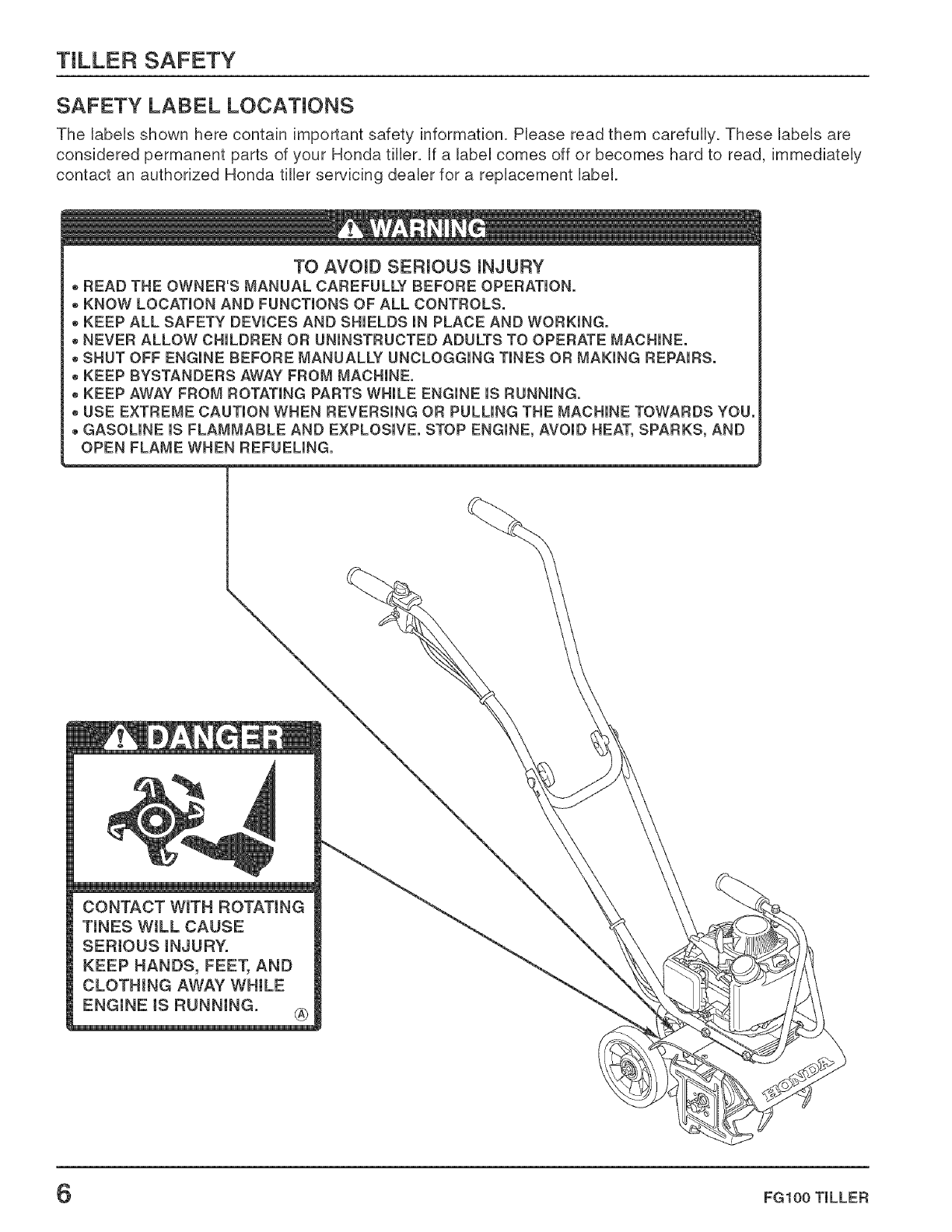
SAFETY LABEL LOCATIONS
The BabeUsshown here contain important safety information. Please read them carefuUUy.These RabeUsare
considered permanent parts of your Honda tiIRer, if a RabeUcomes off or becomes hard to read, immediateUy
contact an authorized Honda tiller servicing deaBer for a repUacement RabeL
TO AVOmD SERmOUS mNJURY
READ THE OWNER'S MANUAL CAREFULLY BEFORE OPERATION.
KNOW LOCATION AND FUNCTIONS OF ALL CONTROLS.
e KEEP ALL SAFETY DEVICES AND SHIELDS IN PLACE AND WORKING.
e NEVER ALLOW CHILDREN OR UNINSTRUCTED ADULTS TO OPERATE MACHINE.
e SHUT OFF ENGINE BEFORE MANUALLY UNCLOGGING TINES OR MAKING REPAIRS.
KEEP BYSTANDERS AWAY FROM MACHINE.
e KEEP AWAY FROM ROTATING PARTS WHILE ENGINE IS RUNNING.
USE EXTREME CAUTION WHEN REVERSING OR PULLING THE MACHINE TOWARDS YOU.
,GASOLINE IS FLAMMABLE AND EXPLOSIVE. STOP ENGINE, AVOID HEAT, SPARKS, AND
OPEN FLAME WHEN REFUELING.
CONTACT WiTH ROTATmNG
TINES WmLL CAUSE
SERIOUS iNJURY.
KEEP HANDS, FEET, AND
CLOTHING AWAY WHmLE
ENGINE IS RUNNING. ®
6 FG100 TILLER
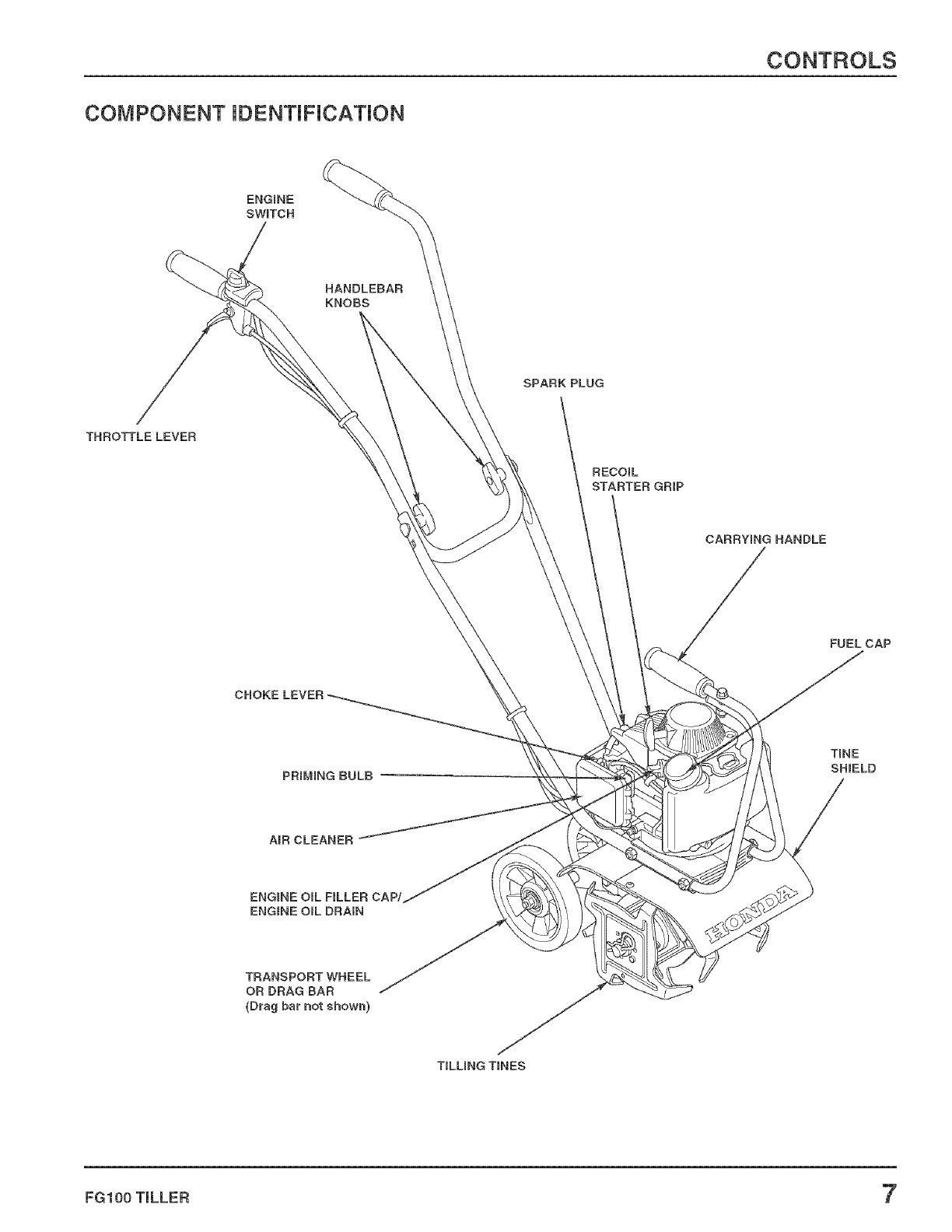
COMPONENT iDENTiFiCATiON
ENGINE
SWITCH
HANDLEBAR
KNOBS
SPARK PLUG
THROTTLE LEVER
RECOIL
STARTER GRIP
CARRYING HANDLE
FUELCAP
CHOKE LEVER
TmNE
SHIELD
ENGINE OIL FmLLER CAP/
ENGINE OraLDRAIN
TmLUNG TmNES
FG100 TmLLER 7
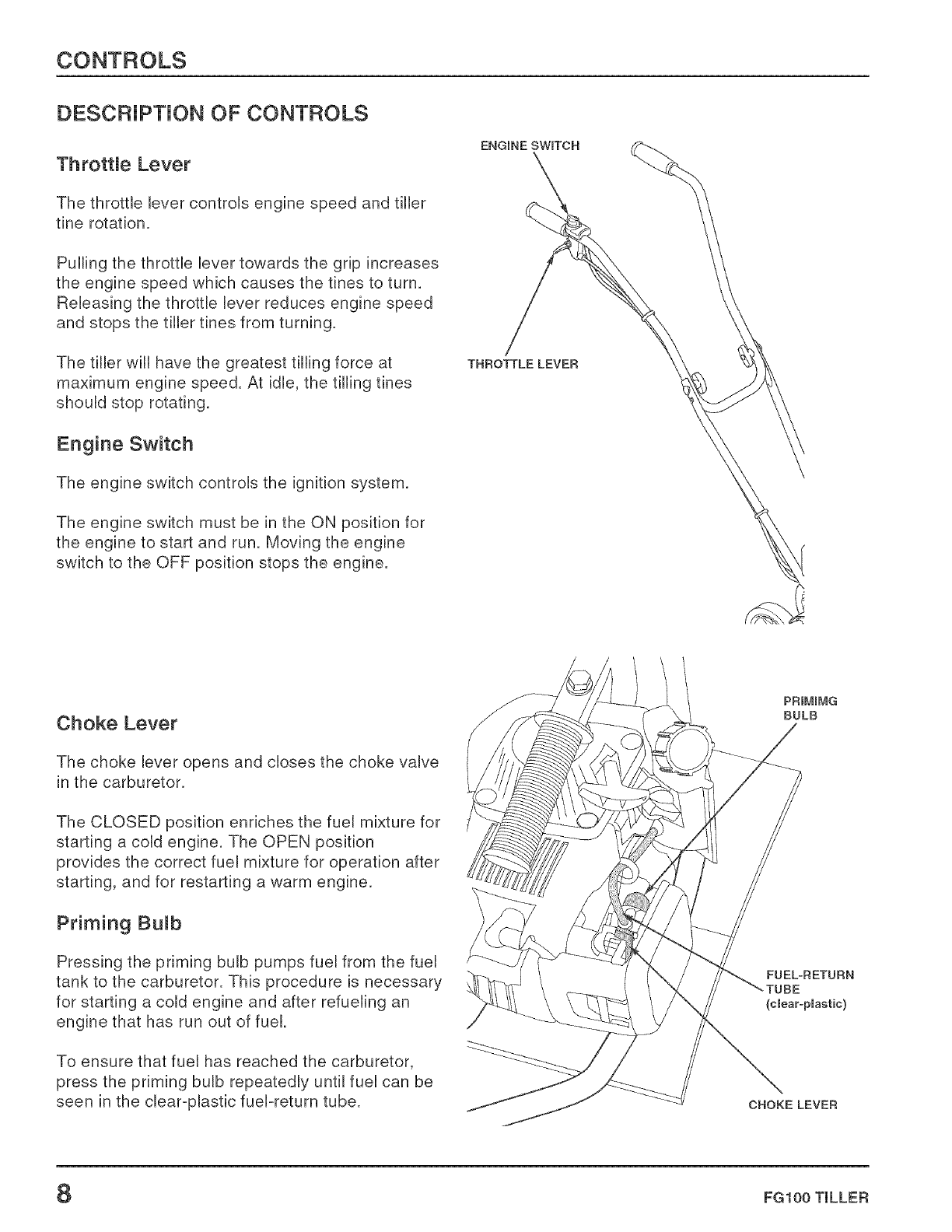
DESCRiPTiON OF CONTROLS
Throttme Lever
The throttle lever controls engine speed and tiller
fine rotation.
Pulling the throttle lever towards the grip increases
the engine speed which causes the tines to turn.
Releasing the throttle lever reduces engine speed
and stops the tiller tines from turning.
The tiller will have the greatest tilling force at
maximum engine speed. At idle, the tilling tines
should stop rotating.
Engine Switch
The engine switch controls the ignition system.
The engine switch must be in the ON position for
the engine to start and run. Moving the engine
switch to the OFF position stops the engine.
ENGINE SWITCH
THBOTTLE LEVEB
Choke Lever
The choke lever opens and closes the choke valve
in the carburetor.
The CLOSED position enriches the fuel mixture for
starting a cold engine. The OPEN position
provides the correct fuel mixture for operation after
starting, and for restarting a warm engine.
Priming Bulb
Pressing the priming bulb pumps fuel from the fuel
tank to the carburetor. This procedure is necessary
for starting a cold engine and after refueling an
engine that has run out of fuel.
To ensure that fuel has reached the carburetor,
press the priming bulb repeatedly until fuel can be
seen in the dear-plastic fuel-return tube. CHOKE LEVEB
8 FG100 TmLLER
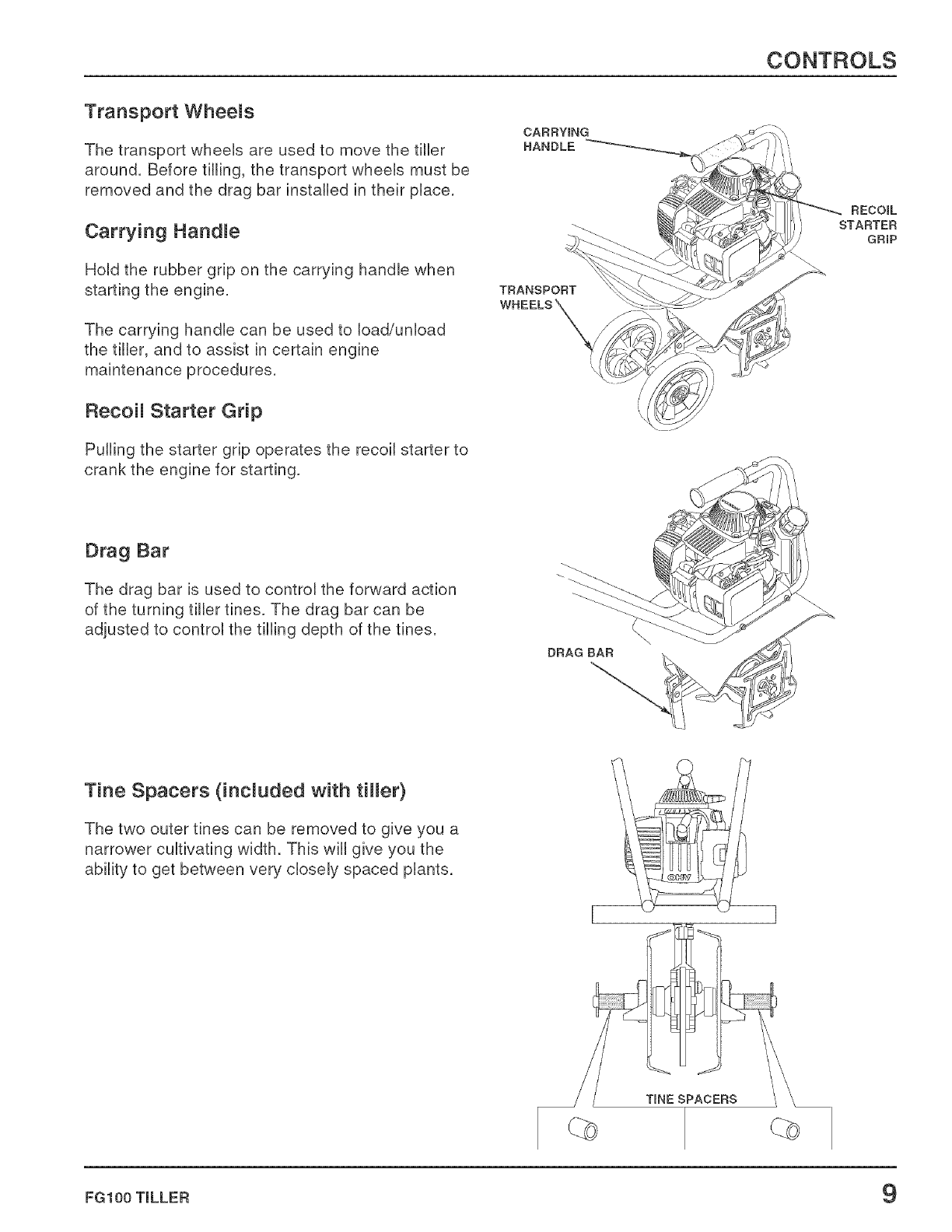
Transport Wheems
The transport wheels are used to move the tiller
around. Before tilling, the transport wheels must be
removed and the drag bar installed in their place.
Carrying Handle
Hold the rubber grip on the carrying handle when
starting the engine.
The carrying handle can be used to load/unload
the tiller, and to assist in certain engine
maintenance procedures.
Recoil Starter Grip
Pulling the starter grip operates the recoil starter to
crank the engine for starting.
CARRYING
HANDLE
TRANSPORT
RECOIL
STARTER
GRIP
Drag Bar
The drag bar is used to control the forward action
of the turning tiller tines. The drag bar can be
adjusted to control the tilling depth of the tines.
DRAG BAR
Tine Spacers (incmuded with tiller)
The two outer tines can be removed to give you a
narrower cultivating width. This will give you the
ability to get between very closely spaced plants.
TINESPACERS
FG100 TILLER 9
BEFORE OPERATION
ARE YOU READY TO OPERATE THE TILLER?
Your safety is your responsibility. A little time spent in preparation will significantly reduce your risk of injury.
Know_edge
Read and understand this manual. Know what the controls do and how to operate them.
Familiarize yourself with the tiller and its operation before you begin to use it. Know what to do in case of
emergencies.
Physica_ and Menta_ Readiness
You must be alert and in good physical condition to operate the tiller. Do not operate the tiller if you are
tired, ill, or under the influence of alcohol, medication, or any substance that might impair your vision,
dexterity, or judgment.
tf you have any physical problem that may be aggravated by strenuous work, consult your physician before
operating the filler.
Protective C_othing
Wearing protective clothing will reduce your risk of injury. Do not wear loose clothing, jewelry, short pants,
sandals, or go barefoot. Secure hair so it is above shoulder level.
Hand and Body Protection
Wear gloves, a long-sleeved shirt, and long pants made of heavy material. Clothing should fit closely but
allow freedom of movement, and should have no strings, straps, etc. that could catch on brush or the filler.
Keep clothing fastened.
Foot Protection
Wear sturdy work boots with good toe protection and nonslip soles.
10 FG100 TILLER
BEFORE OPERATION
JS YOUR WORKING AREA READY?
Objects thrown by the tiller can cause serious injury. Be especiaUly carefuU when crossing graveU drives,
walks or roads. Before operating the tiIRer, carefuUUy inspect the area, and remove aUlobjects that couUd be
thrown by, or entangled in, the tilling attachment, such as rocks, broken glass, nails, wire, or string.
Never operate the tiller without good visibility or light.
Clear the area of cMIdren, bystanders, and pets. Keep aH children, bystanders, and pets at Reast
50 feet (15 meters) away from where the tiIRer is being operated.
tf anyone approaches you wMle you are operating the tiller, release the throttle lever and stop the engine.
JS YOUR TILLER READY TO GO?
For your safety, and to maximize the service life of your equipment, it is very important to take a few
moments before you operate the tiller to check its condition. Be sure to take care of any problem you find,
or have your servicing dealer correct it, before you operate the tiller.
Improperly maintaining this tiller, or failing to correct a problem
before operation, could cause a malfunction in which you could be
seriously injured.
Always perform a pre-operation inspection before each operation,
and correct any problem.
Safety hspeetion
Look around the engine for signs of oil or gasoline leaks. Wipe up any spills before starting the engine.
,, Replace any damaged parts.
Check that all fasteners are in place and secure. Tighten as necessary.
Tiller Tine mnspection
,, Look for signs of damage to the tilling tines (or any accessory installed). Replace any tiller tines and
parts that are worn out, bent, cracked, chipped, or damaged in any way.
Make sure the tiller accessory is properly installed and securely fastened (see attachment installation
instructions).
Check that the debris shield is securely installed and in good condition.
Mair_terlance hspeetion
Check the oim mevem(see page 19). Running the engine with a low oil level can cause engine damage.
Check the air filter (see page 20). A dirty air filter will restrict air flow to the carburetor, reducing engine
and tiller performance.
Check throttle operation (see page 24). The throttle must operate smoothly for good throttle control.
Check the fuel mevem(see page 25). Starting with a full tank will help to eliminate or reduce operating
interruptions for refueling.
SAFETY PRECAUTIONS
Before operating the filler for the first time, please review the IMPORTANT SAFETY INFORMATION (see
page 4) and the chapter titled BEFORE OPERATION (see page 10).
Even if you have operated other fillers, take time to become familiar wkh the operation of tMs filler's
controls and handling.
For your safety, avoid starting or operating the engine in an enclosed area, such as a garage. Your
engine's exhaust contains poisonous carbon monoxide gas wMch can collect rapidly in an enclosed area
and cause illness or death.
tf the filler starts to shake or vibrate, stop the engine immediately. After the filler tines have completely
stopped, inspect them to determine the cause of the vibration. Sudden vibration is a sign of a hazardous
problem, such as loose or damaged tilling tines (or tiller attachment), hidden objects in the soil, or the
ground that is too hard to till. Do not operate the tiller until the problem is corrected.
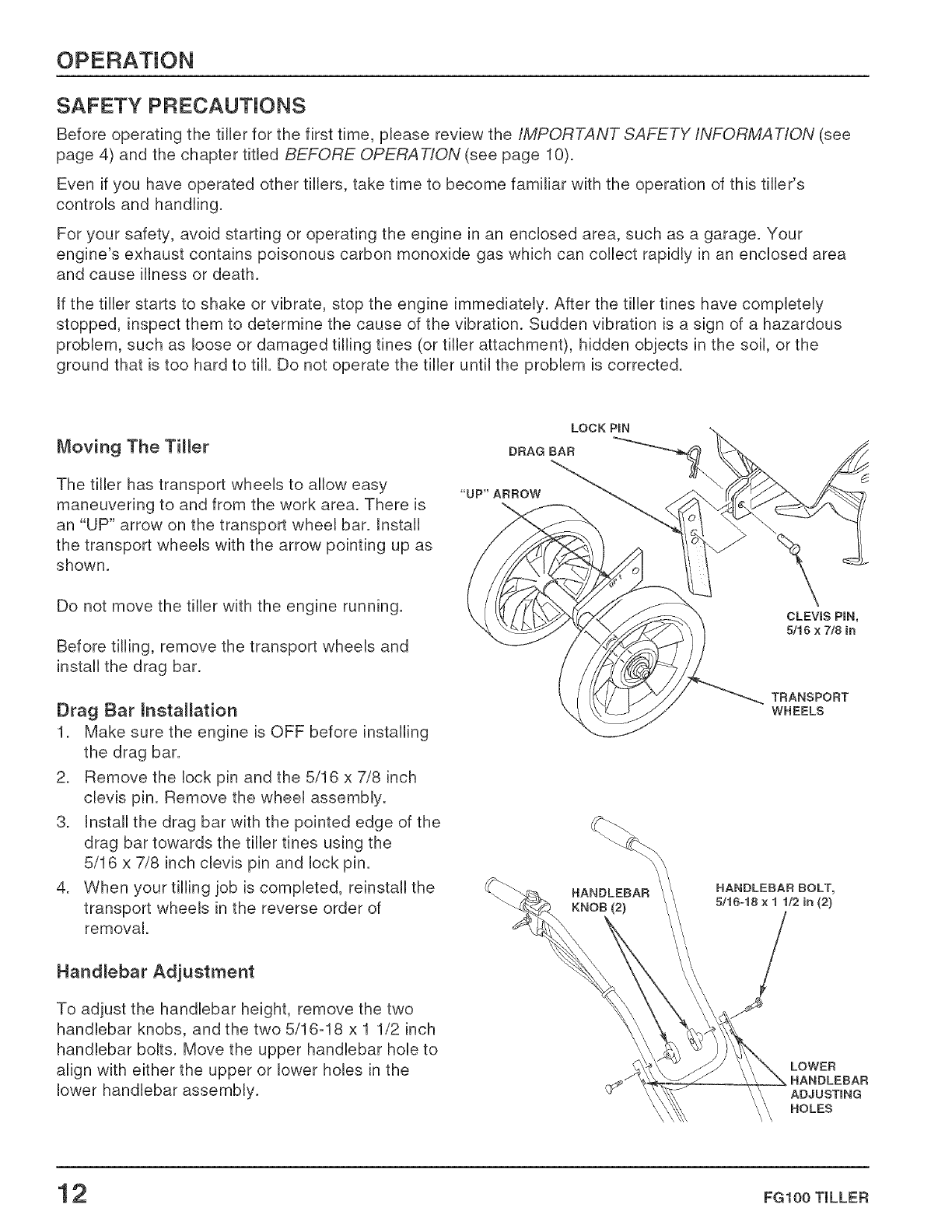
Moving The Tiller
The tiller has transport wheels to allow easy
maneuvering to and from the work area. There is
an "UP" arrow on the transport wheel bar. Install
the transport wheels with the arrow pointing up as
shown.
Do not move the tiller with the engine running.
Before tilling, remove the transport wheels and
install the drag bar.
Drag Bar hstaHation
1. Make sure the engine is OFF before installing
the drag bar.
2. Remove the lock pin and the 5/16 x 7/8 inch
clevis pin. Remove the wheel assembly.
3. tnstall the drag bar with the pointed edge of the
drag bar towards the tiller tines using the
5/16 x 7/8 inch clevis pin and lock pin.
4. When your tilling job is completed, reinstall the
transport wheels in the reverse order of
removal.
Handlebar Adjustment
To adjust the handlebar height, remove the two
handlebar knobs, and the two 5/16o18 x 1 1/2 inch
handlebar bolts. Move the upper handlebar hole to
align with either the upper or lower holes in the
lower handlebar assembly.
CLEVIS PmN,
5/1{} x 7/8 in
TRANSPORT
WHEELS
HANDLEBAR ROLT,
5/16o18xll/2in(2)
LOWER
HANDLEBAR
ADJUSTING
HOLES
12 FG100 TILLER
Starting The Engine
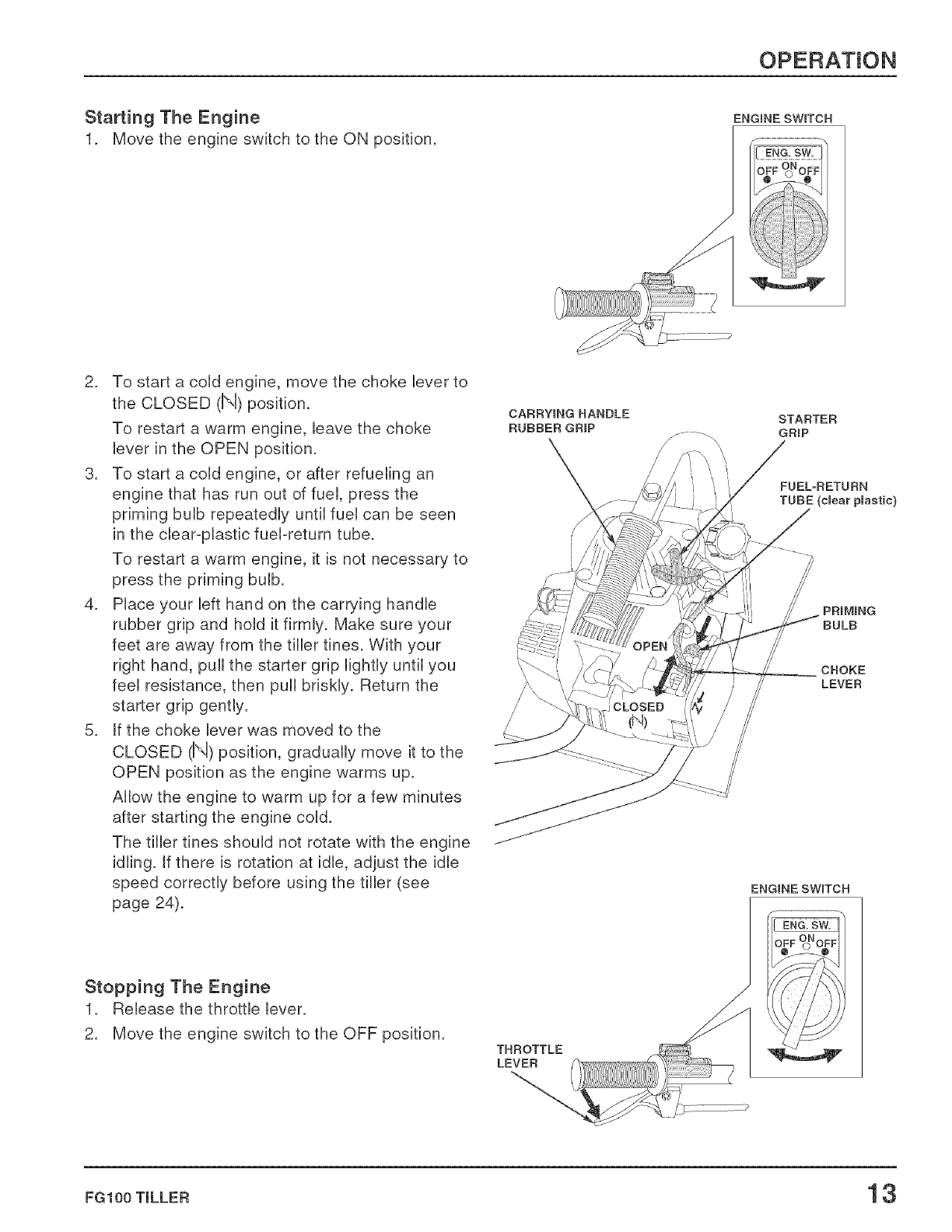
1. Move the engine switch to the ON position.
ENGINE SWITCH
2. To start a cold engine, move the choke lever to
the CLOSED (N) position.
To restart a warm engine, leave the choke
lever in the OPEN position.
3. To start a cold engine, or after refueling an
engine that has run out of fuel, press the
priming bulb repeatedly until fuel can be seen
in the clear-plastic fuel-return tube.
To restart a warm engine, it is not necessary to
press the priming bulb.
4. Place your left hand on the carrying handle
rubber grip and hold it firmly. Make sure your
feet are away from the tiller tines. With your
right hand, pull the starter grip lightly until you
feel resistance, then pull briskly. Return the
starter grip gently.
5. tf the choke lever was moved to the
CLOSED (N) position, gradually move it to the
OPEN position as the engine warms up.
Allowthe engine to warm up for a few minutes
after starting the engine cold.
The tiller tines should not rotate with the engine
idling. If there is rotation at idle, adjust the idle
speed correctly before using the tiller (see
page 24).
CARRYING HANDLE
RUBBER GRIP STARTER
GRIP
FUEL=RETURN
TUBE (cBear plastic)
PRIMING
BULB
CHOKE
LEVER
ENGINE SWITCH
Stopping The Engine
1. Release the throttle lever.
2. Move the engine switch to the OFF position. THROTTLE
LEVER
TILLER OPERATION
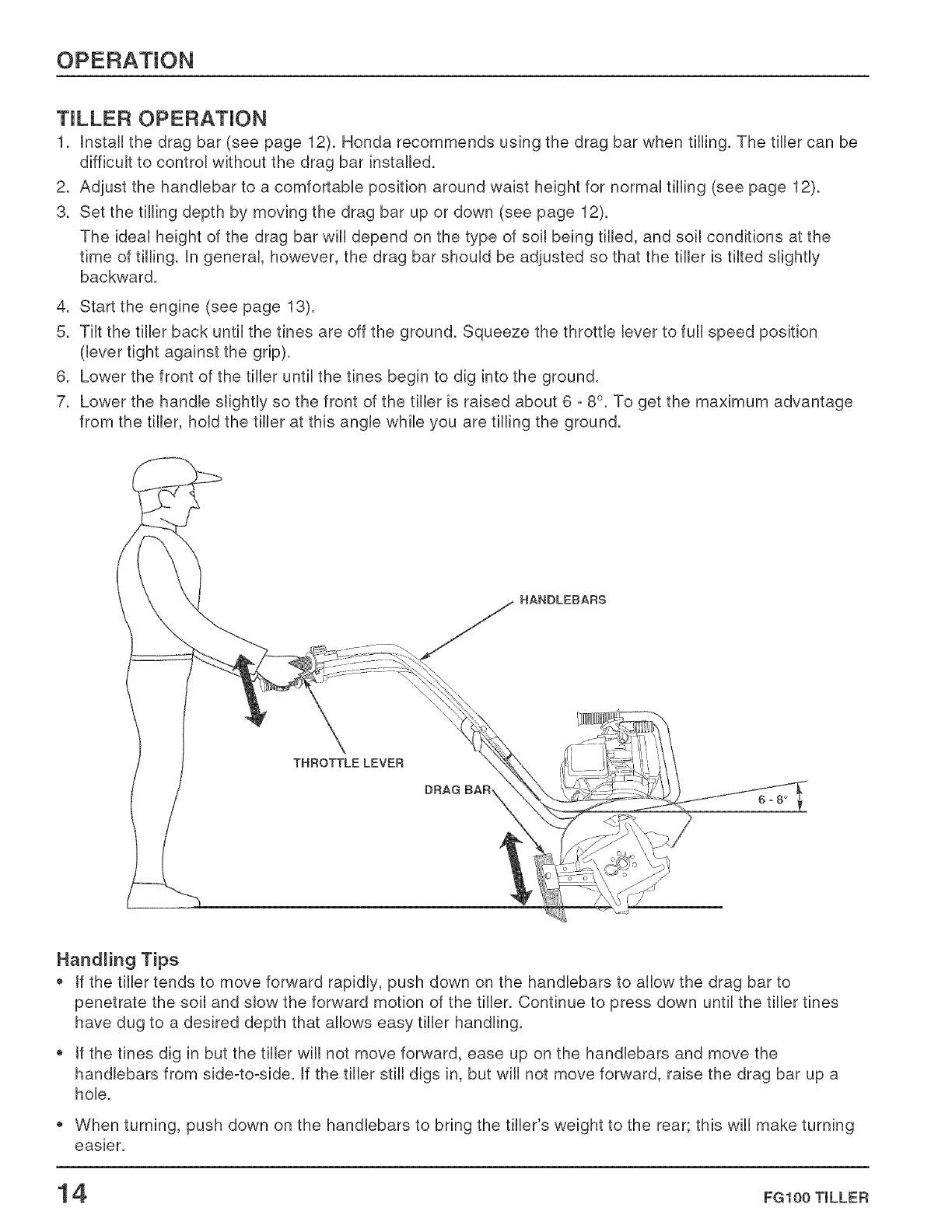
1. Install the drag bar (see page 12). Honda recommends using the drag bar when filling. The filler can be
difficult to control without the drag bar installed.
2. Adjust the handlebar to a comfortable position around waist height for normal tilling (see page 12).
3. Set the filling depth by moving the drag bar up or down (see page 12).
The ideal height of the drag bar will depend on the type of soil being filled, and soil condkions at the
time of tilling, tn general, however, the drag bar should be adjusted so that the filler is tilted slightly
backward.
4. Start the engine (see page 13).
5. Tilt the tiller back until the tines are off the ground. Squeeze the throttle lever to full speed position
(lever tight against the grip).
6. Lower the front of the tiller until the tines begin to dig into the ground.
7. Lower the handle slightly so the front of the tiller is raised about 6 - 8°. To get the maximum advantage
from the tiller, hold the tiller at this angle while you are tilling the ground.
HANDLEBARS
6 _ 8 °
Handling Tips
, tf the filler tends to move forward rapidly, push down on the handlebars to allow the drag bar to
penetrate the soil and slow the forward motion of the filler. Continue to press down until the tiller tines
have dug to a desired depth that allows easy filler handling.
tf the tines dig in but the tiller will not move forward, ease up on the handlebars and move the
handlebars from side-to-side, tf the tiller still digs in, but will not move forward, raise the drag bar up a
hole.
When turning, push down on the handlebars to bring the tiller's weight to the rear; this will make turning
easier.
14 FG100 TILLER
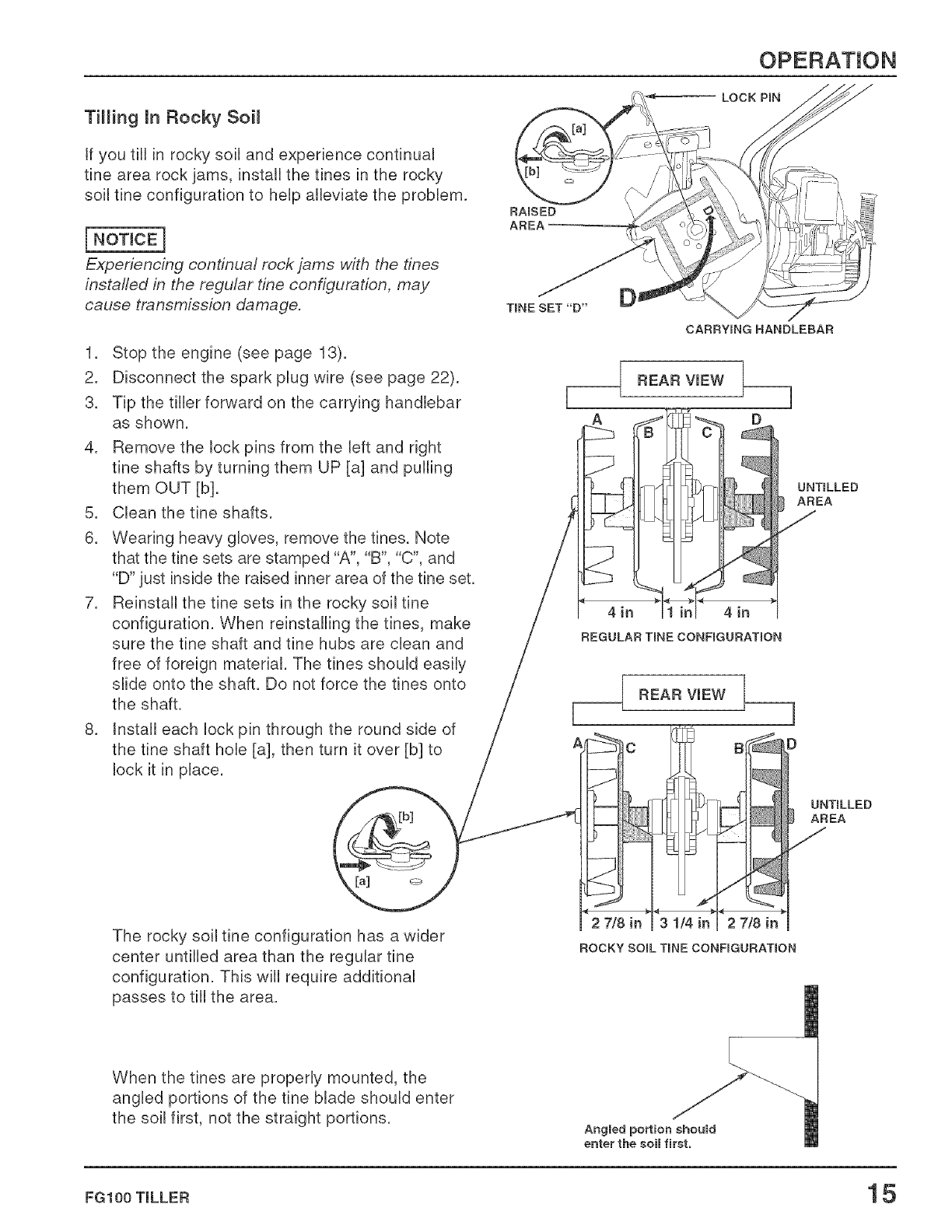
THHng mnRocky Soi_
tf you till in rocky soil and experience continual
fine area rock jams, install the tines in the rocky
soil tine configuration to help alleviate the problem.
[ NOTICE i
Experiencing continual rock jams with the tines
instafled in the regular tine configuration, may
cause transmission damage.
1. Stop the engine (see page 13).
2. Disconnect the spark plug wire (see page 22).
3. Tip the tiller forward on the carrying handlebar
as shown.
4. Remove the lock pins from the left and right
tine shafts by turning them UP [a] and pulling
them OUT [b].
5. Clean the tine shafts.
6. Wearing heavy gloves, remove the tines. Note
that the fine sets are stamped "A", "B", "C", and
"D" just inside the raised inner area of the fine set.
7. Reinstall the fine sets in the rocky soil fine
configuration. When reinstalling the tines, make
sure the fine shaft and fine hubs are clean and
free of foreign material. The tines should easily
slide onto the shaft. Do not force the tines onto
the shaft.
8. Install each lock pin through the round side of
the fine shaft hole [a], then turn it over [b] to
lock it in place.
The rocky soil fine configuration has a wider
center untilled area than the regular fine
configuration. This will require additional
passes to till the area.
RAISED
AREA
LOCK PmN
CARRYING HANDLEBAR
--I REAR VIEW
REGULAR TmNE CONRGURATmON
27/8in 31/4in 27/8in
ROCKY SOIL TIRE CONRGURATION
UNTILLED
AREA
UNTILLED
AREA
When the tines are properly mounted, the
angled portions of the fine blade should enter
the soil first, not the straight portions.
enter the soil first.
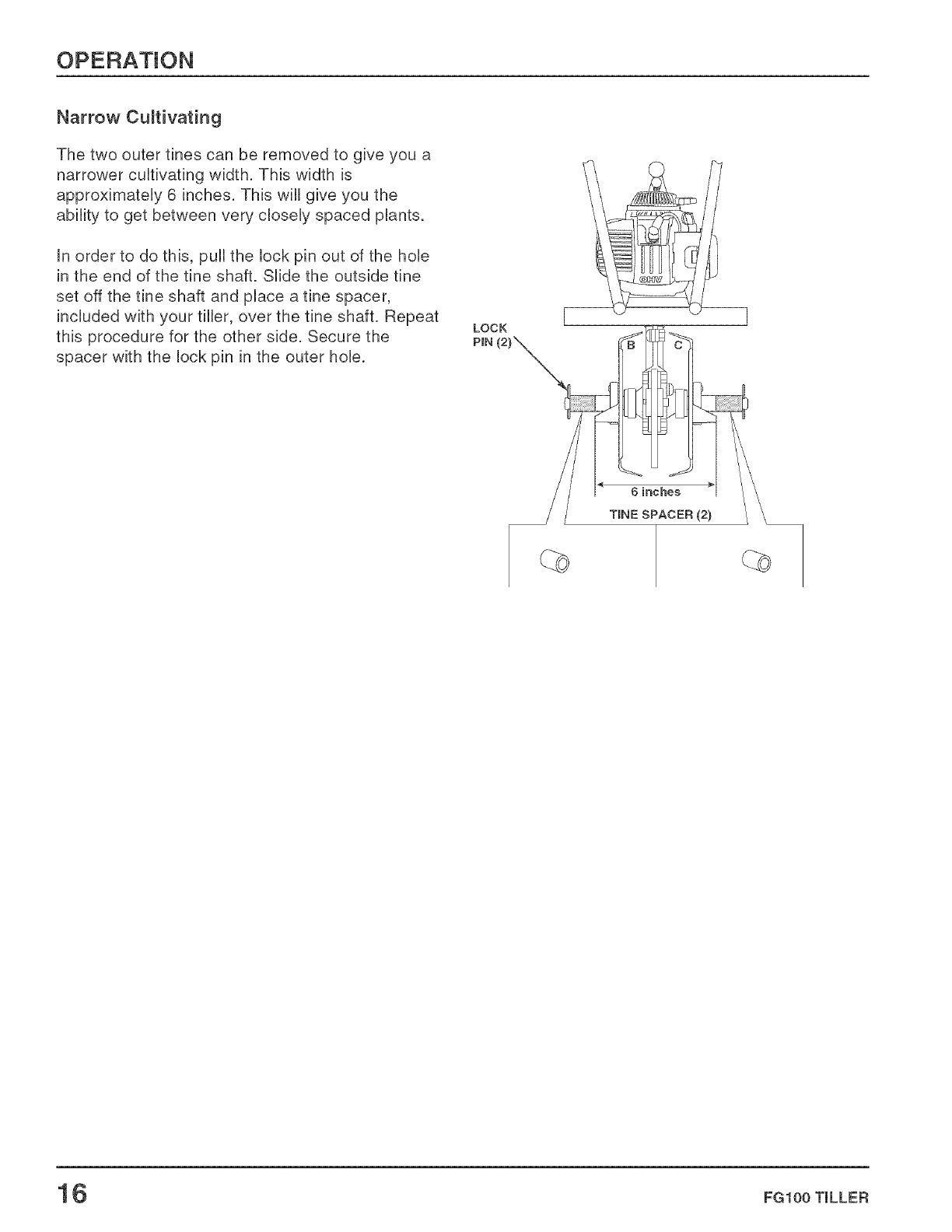
Narrow Cuffivating
The two outer tines can be removed to give you a
narrower cukivating width. This width is
approximateUy 6 inches. This wiUlgive you the
ability to get between very closeUy spaced pUants.
tn order to do this, puUUthe Uockpin out of the hoUe
in the end of the fine shaft. Slide the outside fine
set off the fine shaft and pUace a tine spacer,
incUuded with your tiller, over the tine shaft. Repeat
this procedure for the other side. Secure the
spacer with the Rock pin in the outer hoUe.
LOCK
PIN
6 inches
TmNE SPACER (2)
16 FG100 TILLER
MAINTENANCE & ADJUSTMENTS
THE iMPORTANCE OF MAINTENANCE MAINTENANCE SAFETY
Good maintenance is essential for safe,
economical, and trouble-free operation, tt will also
help reduce air pollution.
Improperly maintaining this tiller, or failure to
correct a problem before operation, can cause a
malfunction in which you can be seriously hurt or
killed.
Always follow the inspection and maintenance
recommendations and schedules in this owner's
manual.
To help you properly care for your tiller, the
following pages include a maintenance schedule,
routine inspection procedures, and simple
maintenance procedures using basic hand tools.
Other service tasks that are more difficult, or
require special tools, are best handled by
professionals and are normally performed by a
Honda technician or other qualified mechanic.
The maintenance schedule applies to normal
operating conditions. If you operate your tiller
under severe conditions, such as sustained
high-load or high-temperature operation, or use it
in unusually wet or dusty conditions, consult your
servicing dealer for recommendations applicable to
your individual needs and use.
Remember that your authorized Honda servicing
dealer knows your tiller best and is fully equipped
to maintain and repair it.
To ensure the best quality and reliability, use only
new, genuine Honda parts or their equivalents for
repair and replacement.
Maintenance, replacement, or repair of the
emission control devices and systems may be
performed by any engine repair establishment
or individual, using parts that are "certified" to
EPA standards.
Some of the most important safety precautions
follow. However, we cannot warn you of every
conceivable hazard that can arise in performing
maintenance. Only you can decide whether or not
you should perform a given task.
Failure to properly follow maintenance instructions
and precautions can cause you to be seriously hurt
or killed.
Always follow the procedures and precautions in
the owner's manual.
Safety Precautions
Make sure the engine is off before you begin any
maintenance or repairs. This will eliminate several
potential hazards:
Carbon monoxide poisoning from engine
exhaust.
Be sure there is adequate ventilation whenever
you operate the engine.
Burns from hot parts.
Let the engine and exhaust system cool before
touching.
Injury from moving parts.
Do not run the engine unless instructed to do
SO.
,Read the instructions before you begin, and make
sure you have the tools and skills required.
To reduce the possibility of fire or explosion, be
careful when working around gasoline. Use only a
nonflammable solvent, not gasoline, to clean
parts. Keep cigarettes, sparks, and flames away
from all fuel-related parts.
MAINTENANCE & ADJUSTMENTS
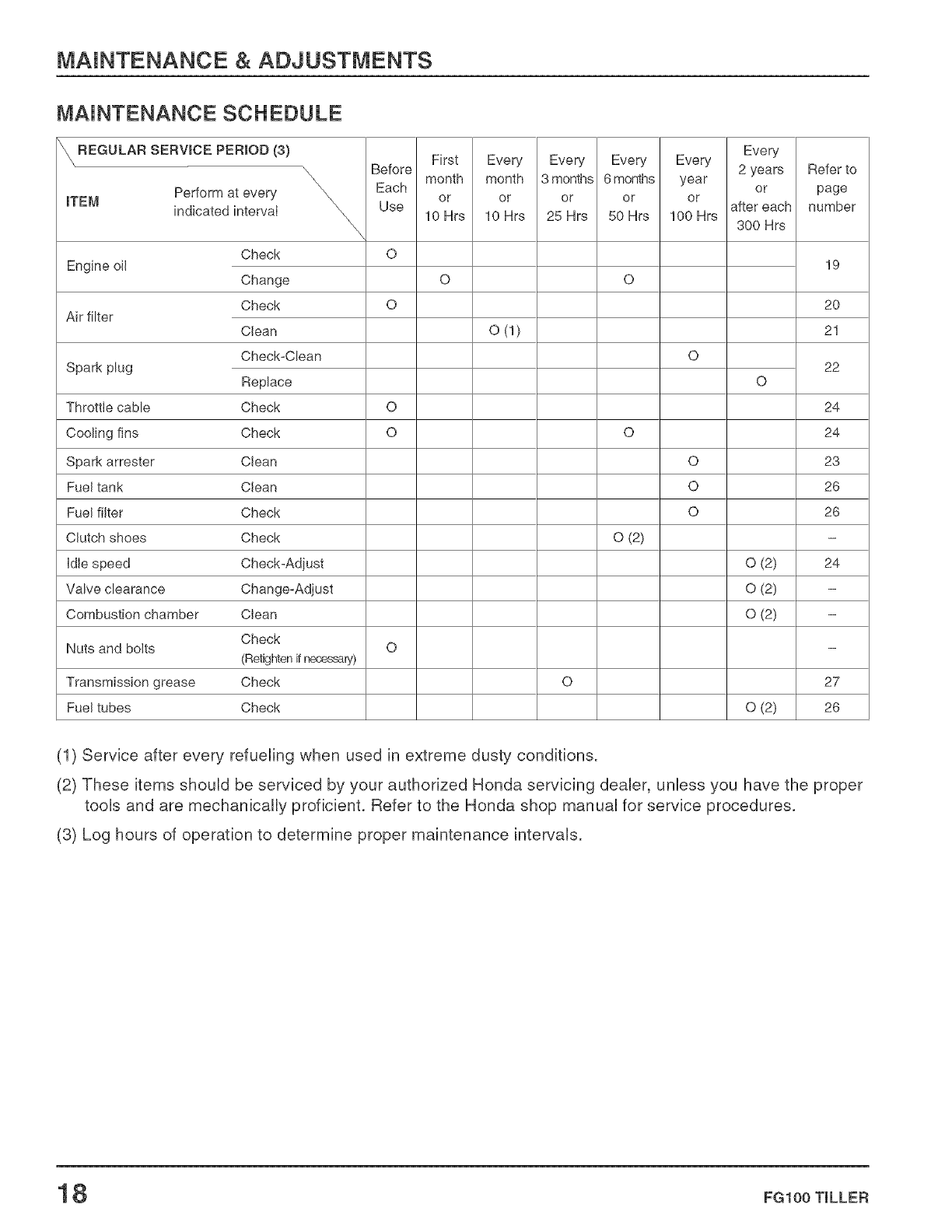
MAINTENANCE SCHEDULE
REGULAR SERVICE PERIOD (3) Before First Every Every Every Every
\\ month month 3months 6months year
_TEM Perform at every \ Each or or or or or
indicated interval \, Use 10 Hrs 10 Hrs 25 Hrs 50 Hrs 100 Hrs
\\
\
Check 0
Engine oil Change
Check 0
Air filter Clean
Check-Clean
Spark plug Replace
Throttle cable Check 0
Cooling fins Check 0
Spark arrester Clean
Fuel tank Clean
Fuel filter Check
Clutch shoes Check
Idle speed Check-Adjust
Valve clearance Change-Adjust
Combustion chamber Clean
Check
Nuts and bolts 0
(Retightenifnece_._y)
Transmission grease Check
Fuel tubes Check
0
o(1)
0
0
0 (2)
0
0
0
0
0
Every
2 years
or
after each
300 Hrs
0
0 (2)
o (2)
0 (2)
o (2)
Refer to
page
number
19
2O
21
22
24
24
23
26
26
24
m
27
26
(1) Service after every refueUing when used in extreme dusty conditions.
(2) These items shouUd be serviced by your authorized Honda servicing dealer, unless you have the proper
tooUs and are mechanicaIRy proficient. Refer to the Honda shop manual for service procedures.
(3) Log hours of operation to determine proper maintenance intervals.
18 FG100 TILLER
MAINTENANCE & ADJUSTMENTS
ENGINE MAINTENANCE
Engine OH LevemCheck
Check the engine oil ReveUbefore each use, or
every 10 hours if operated continuously. AUso,
check the oiUon a ReveUsurface, with the engine
stopped and in an upright position.
,
2.
3.
,
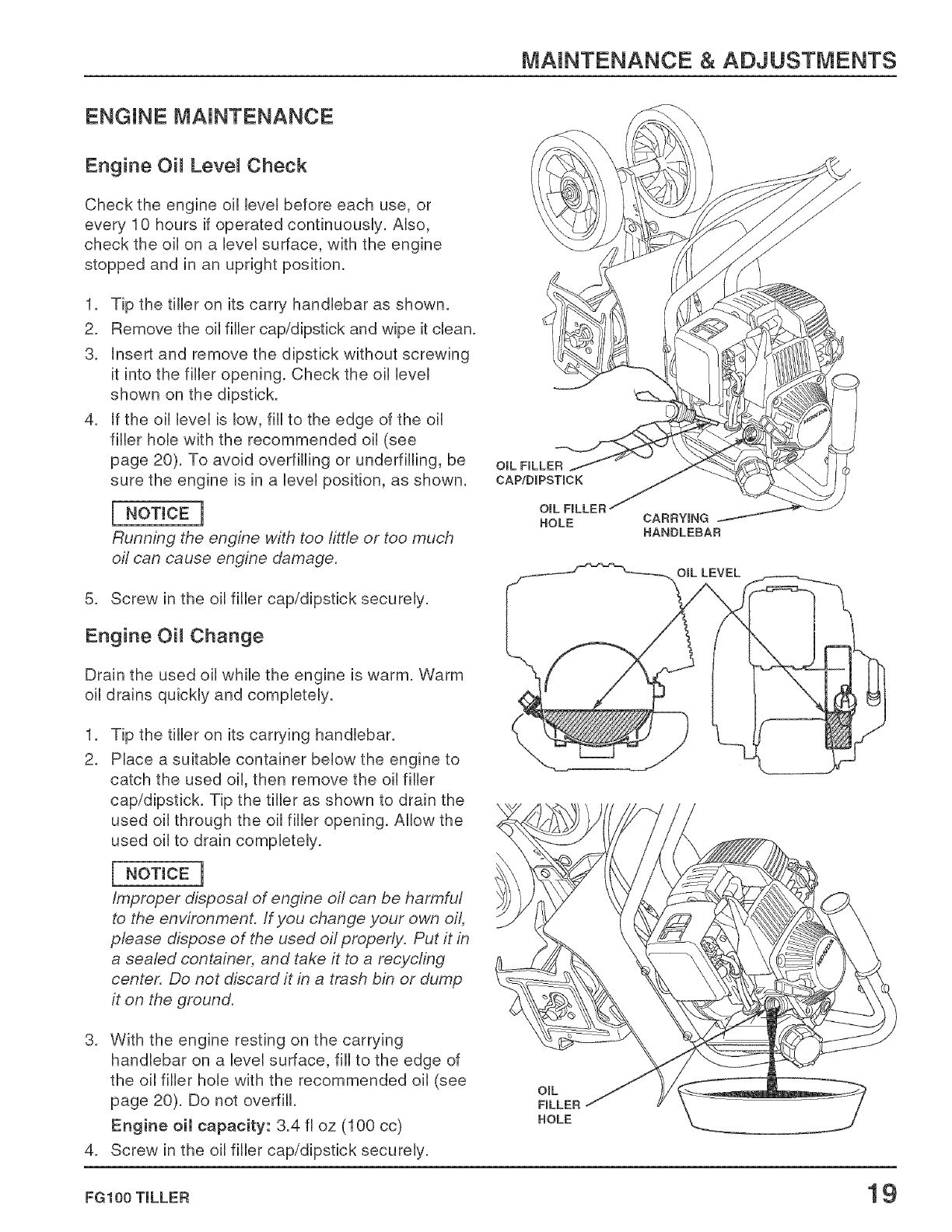
Tip the tiller on its carry handUebar as shown.
Remove the oil filler cap/dipstick and wipe it clean.
Insert and remove the dipstick without screwing
it into the filler opening. Check the oil leveU
shown on the dipstick.
tf the oiUReveUis Row,fiH to the edge of the oil
filler hole with the recommended oil (see
page 20). To avoid overfilling or underfilling, be
sure the engine is in a level position, as shown.
[.oT oE1
Running the engine with too little or too much
of can cause engine damage.
5. Screw in the oil filler cap/dipstick securely.
Engine OimChange
Drain the used oil while the engine is warm. Warm
oil drains quickly and completely.
,
2.
Tip the tiller on its carrying handlebar.
Place a suitable container below the engine to
catch the used oil, then remove the oil filler
cap!dipstick. Tip the tiller as shown to drain the
used oil through the oil filler opening. Allow the
used oil to drain completely.
Improper disposal of engine oil can be harmful
to the environment. If you change your own oi1,
please dispose of the used oil properly. Put it in
a sealed container, and take it to a recycling
center. Do not discard it in a trash bin or dump
it on the ground.
3. With the engine resting on the carrying
handlebar on a level surface, fill to the edge of
the oil filler hole with the recommended oil (see
page 20). Do not overfill.
Engine oim capacity: 3.4 fi oz (100 cc)
4. Screw in the oil filler cap!dipstick securely.
OIL FILLER
CAP/DIPSTmCK
OmL
HOLE
OraL
FILLED
HOLE
CABBYmNG
HANDLEBAR
OIL LEVEL
MAINTENANCE & ADJUSTMENTS
Engine OiJ Recommendations
Oil is a major factor affecting performance and
service life. Use 4-stroke automotive detergent oil.
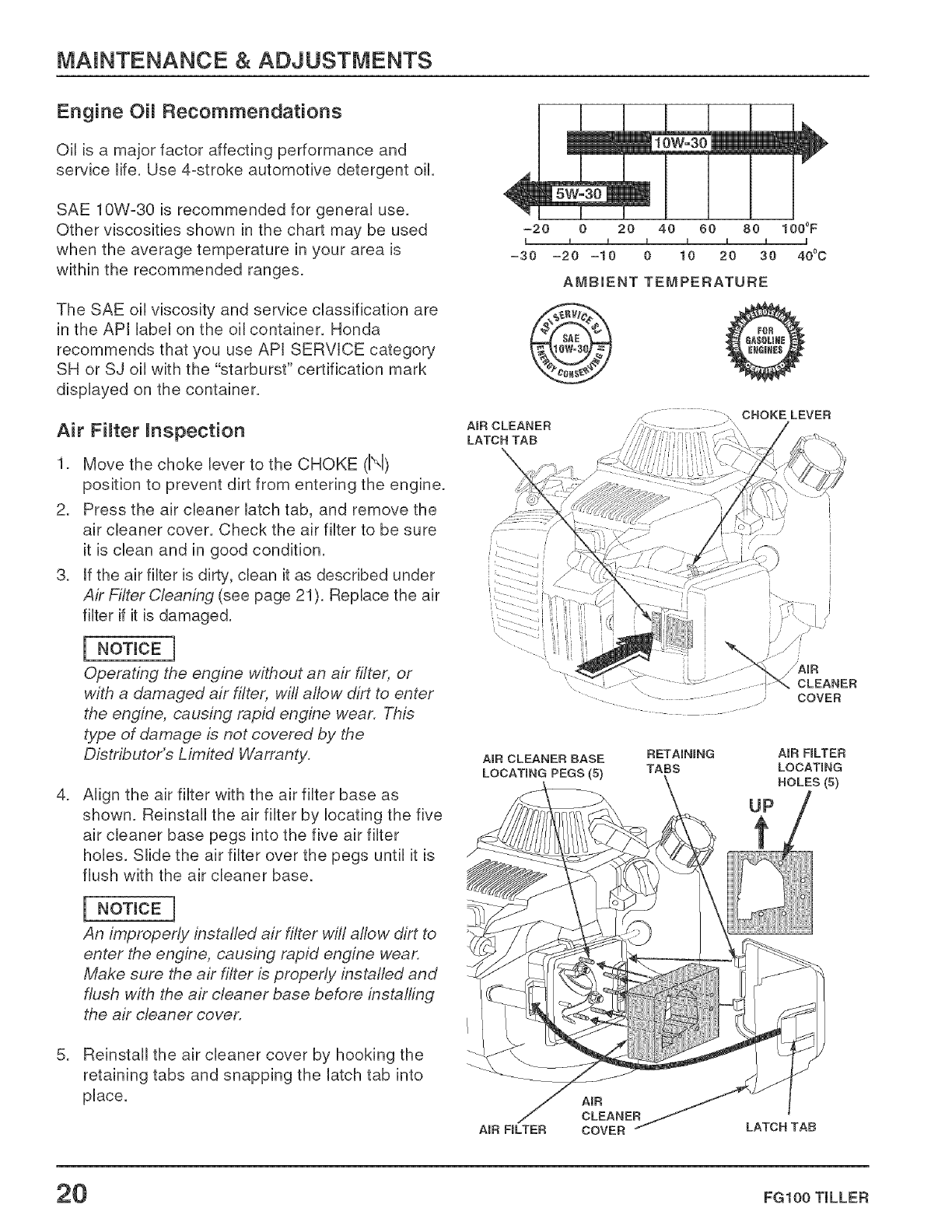
SAE 10W-30 is recommended for general use.
Other viscosities shown in the chart may be used
when the average temperature in your area is
within the recommended ranges.
The SAE oil viscosity and service classification are
in the APJ label on the oil container. Honda
recommends that you use APJ SERVICE category
SH or SJ oil with the "starburst" certification mark
displayed on the container.
Air FiJter inspection
1. Move the choke lever to the CHOKE (N)
position to prevent dirt from entering the engine.
2. Press the air cleaner latch tab, and remove the
air cleaner cover. Check the air filter to be sure
it is clean and in good condition.
3. Jfthe air fiker is dirty, clean it as described under
Air Filter Cleaning (see page 21). Replace the air
filter if it is damaged.
i .oT oE1
Operating the engine without an air filter, or
with a damaged air filter, wi!l allow dirt to enter
the engine, causing rapid engine wear. This
type of damage is not covered by the
Distributor's Limited Warranty.
,Align the air filter with the air filter base as
shown. Reinstall the air filter by locating the five
air cleaner base pegs into the five air filter
holes. Slide the air filter over the pegs until it is
flush with the air cleaner base.
I NOTICE 1
An improperly installed air filter will allow dirt to
enter the engine, causing rapid engine wear.
Make sure the air filter is properly installed and
flush with the air cleaner base before instafling
the air cleaner cover.
5. Reinstall the air cleaner cover by hooking the
retaining tabs and snapping the latch tab into
place.
_ 10W-30 #,
-20 0 20 40 80 80 100OF
nP_P P 0 I
-30 -20 -10 O 10 20 30 40°C
AMBIENT TEMPERATURE
@ @
AIR CLEANER
LATCH TAR
....... ...._ CHOKE LEVER
/
AIR CLEANER BASE
LOCATING PEGS (5)
RETAINING AIR RLTER
TABS LOCATING
HOLES (5)
UP
AIR
AIR FILTER COVER
l
LATCH TAR
20 FG100 TILLER
MAINTENANCE & ADJUSTMENTS
Air FHter Cmeaning
A dirty air filter restricts air flow to the carburetor,
reducing engine performance. If you operate the
engine in very dusty areas, clean the air filter after
each refueling.
1. Remove the air filter (see page 20).
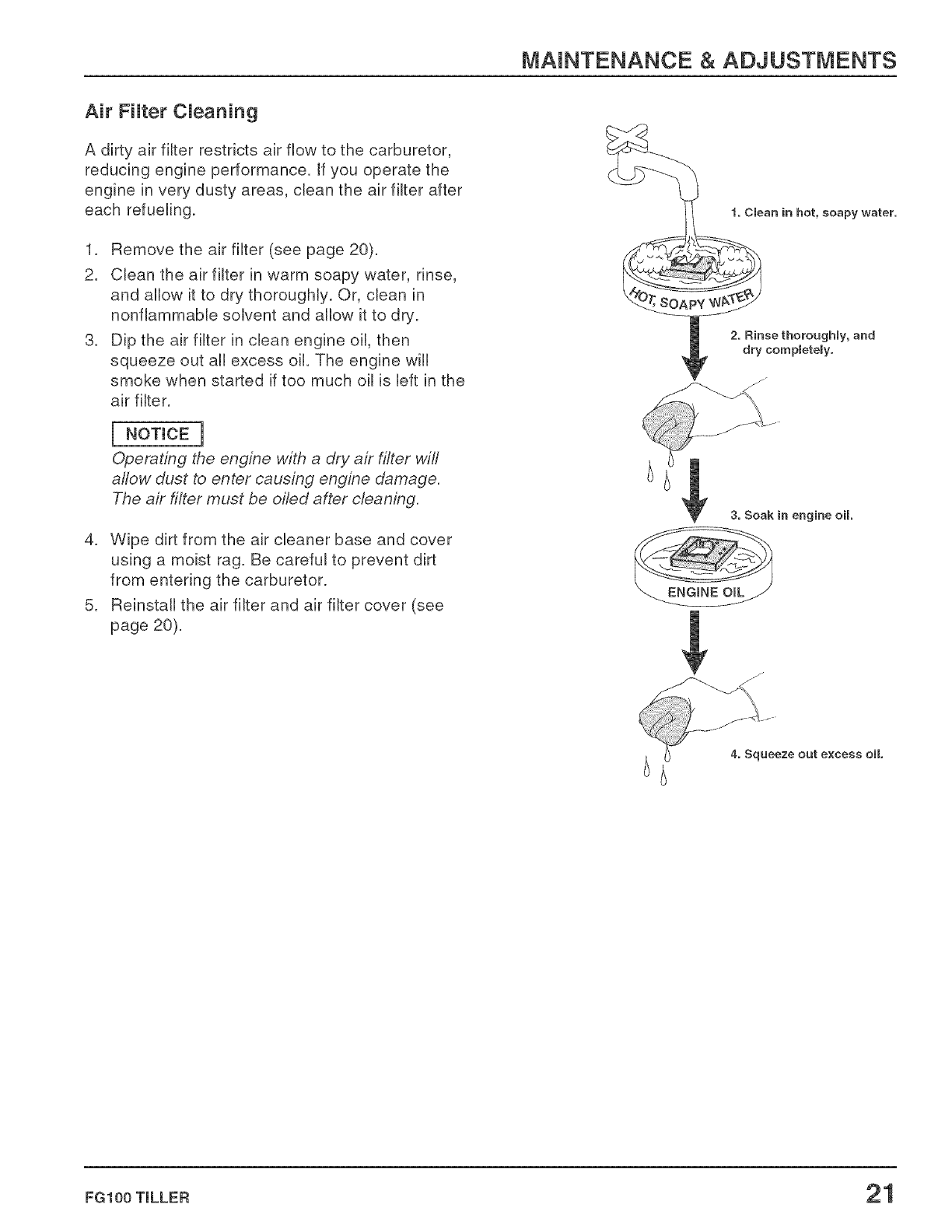
2. Clean the air filter in warm soapy water, rinse,
and allow it to dry thoroughly. Or, clean in
nonflammable solvent and allow it to dry.
3. Dip the air filter in clean engine oil, then
squeeze out all excess oil. The engine will
smoke when started if too much oil is left in the
air filter.
NOTICE !
Operating the engine with a dcv air fi/ter wih'
allow dust to enter causing engine damage.
The air fi/ter must be oiled after cleaning.
4. Wipe dirt from the air cleaner base and cover
using a moist rag. Be careful to prevent dirt
from entering the carburetor.
5. Reinstall the air filter and air filter cover (see
page 20).
. an in hot, soapy water.
2. Rinse thoroughly, and
dry completely.
FG100 TILLER 21
MAINTENANCE & ADJUSTMENTS
Spark Pmug Service
Recommended spark plugs:
NGK - CSHSB or CRSHSB
DENSO- U16FS°UB or U16FSR-UB
I NOTmCE ]
Incorrect spark plugs can cause engine damage.
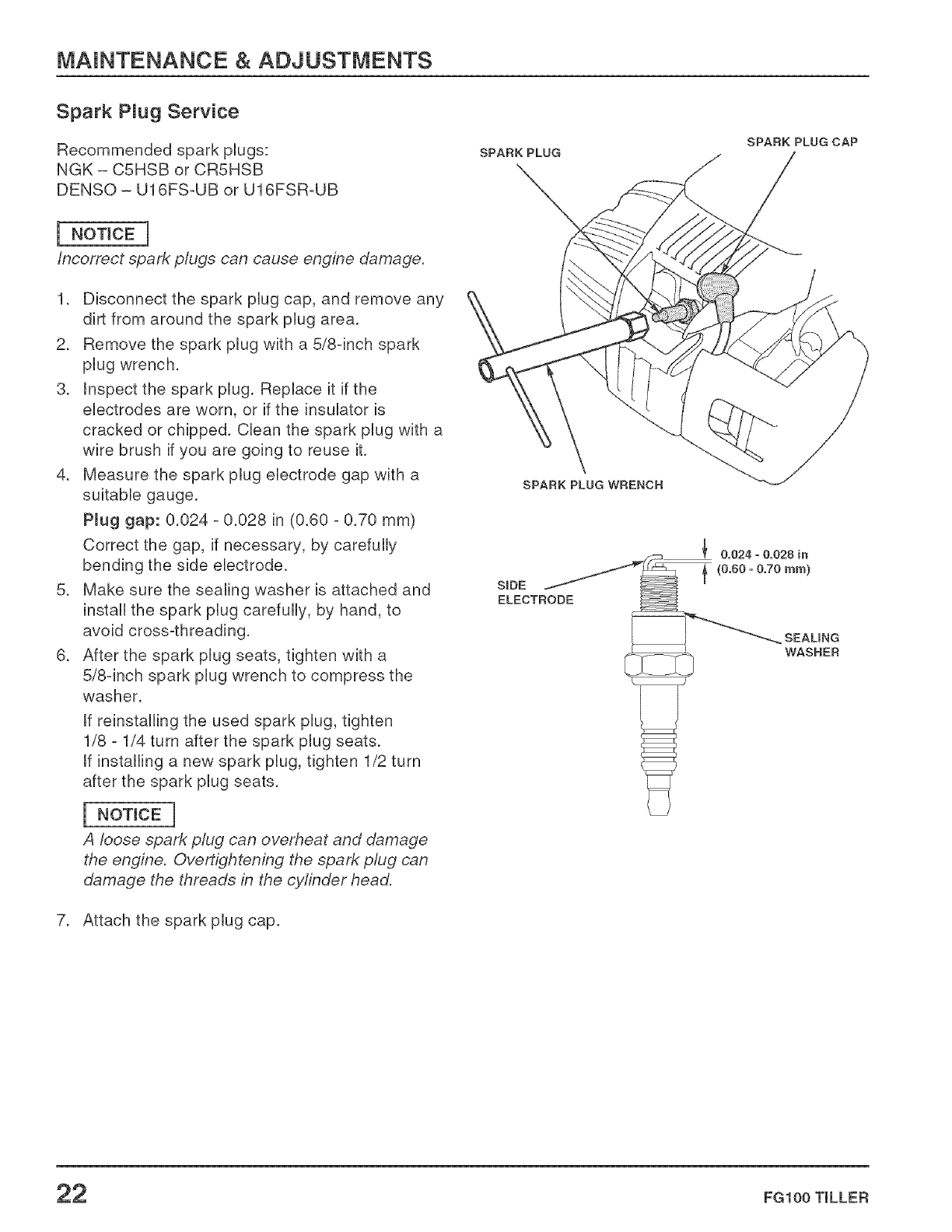
1. Disconnect the spark pUug cap, and remove any
dirt from around the spark pUug area.
2. Remove the spark pUug with a 5/8qnch spark
plug wrench.
3. Inspect the spark pUug. Repbce it if the
eUectrodes are worn, or if the insuUator is
cracked or chipped. CUean the spark pUug with a
wire brush if you are going to reuse it.
4. Measure the spark plug eUectrode gap with a
suitable gauge.
Pmug gap: 0.024 - 0.028 in (0.60 - 0.70 mm)
Correct the gap, if necessary, by carefuUly
bending the side eUectrode.
5. Make sure the sealing washer is attached and
install the spark pRug carefuUly, by hand, to
avoid cross-threading.
6. After the spark pUug seats, tighten with a
5/8qnch spark plug wrench to compress the
washer.
tf reinstalling the used spark plug, tighten
1/8 - 1/4 turn after the spark plug seats.
tf installing a new spark plug, tighten 1/2 turn
after the spark plug seats.
I .oT,oE1
A loose spark plug can overheat and damage
the engine. Overtightening the spark plug can
damage the threads in the cylinder head.
7. Attach the spark plug cap.
SPARK PLUG
SPARK PLUG WRENCH
SIDE
ELECTRODE
SPARK PLUG CAP
22 FG100 TILLER
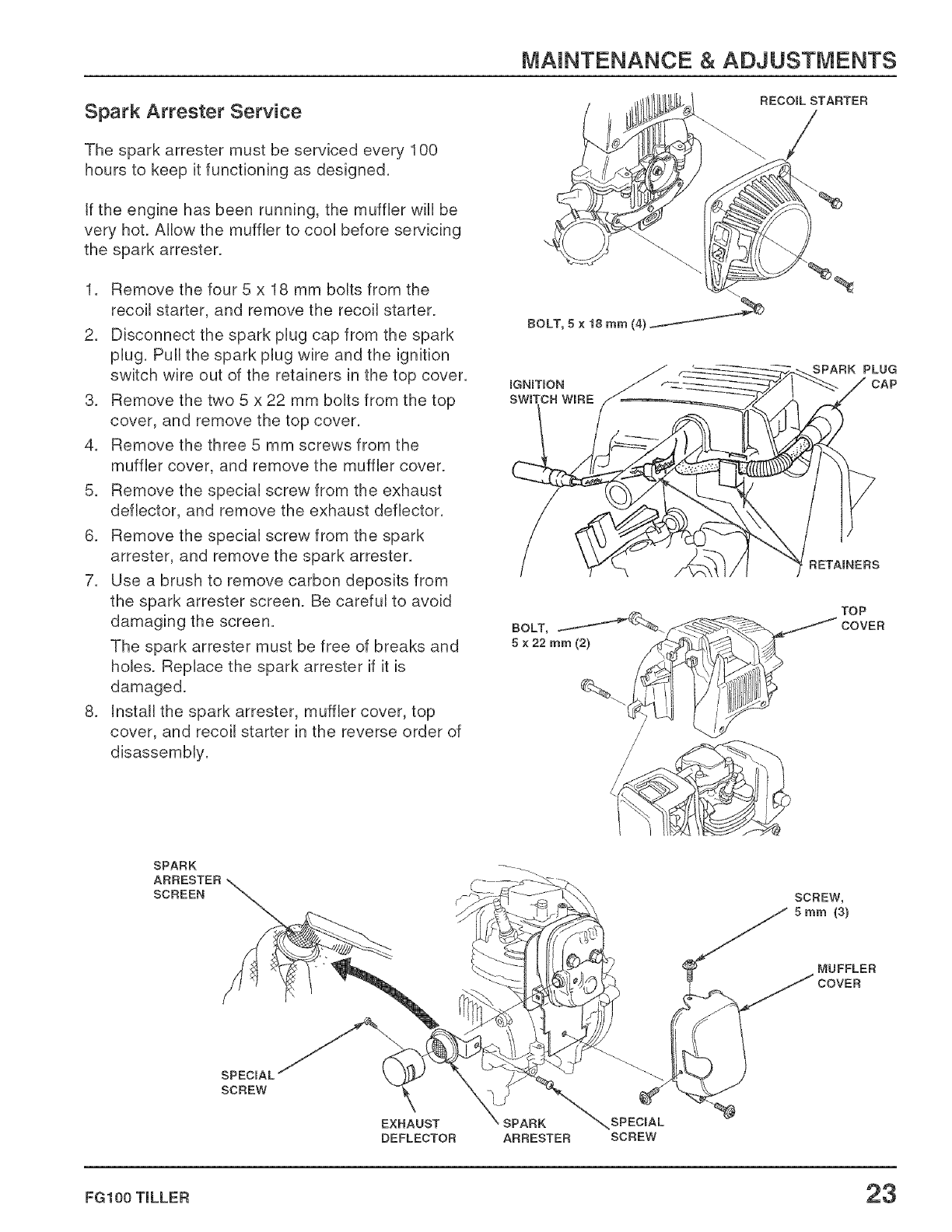
Spark Attester Service
The spark arrester must be serviced every 100
hours to keep it functioning as designed.
tf the engine has been running, the muffler will be
very hot. Allow the muffler to cool before servicing
the spark arrester.
1. Remove the four 5 x 18 mm bolts from the
recoil starter, and remove the recoil starter.
2. Disconnect the spark plug cap from the spark
plug. Pull the spark plug wire and the ignition
switch wire out of the retainers in the top cover.
3. Remove the two 5 x 22 mm bolts from the top
cover, and remove the top cover.
4. Remove the three 5 mm screws from the
muffler cover, and remove the muffler cover.
5. Remove the special screw from the exhaust
deflector, and remove the exhaust deflector.
6. Remove the special screw from the spark
arrester, and remove the spark arrester.
7. Use a brush to remove carbon deposits from
the spark arrester screen. Be careful to avoid
damaging the screen.
The spark arrester must be free of breaks and
holes. Replace the spark arrester if it is
damaged.
8. Install the spark arrester, muffler cover, top
cover, and recoil starter in the reverse order of
disassembly.
SPARK
ARRESTER
SCREEN
SPECIAL
SCREW
EXHAUST
DEFLECTOR
MAINTENANCE & ADJUSTMENTS
RECOIL STARTER
/
BOLT, 5 x 18 mm (4)
iGNiTiON
SWITCH WiRE
SPARK PLUG
CAP
RETAINERS
TOP
/COVER
SPARK
ARRESTER
SCREW,
COVER
SPECIAL
SCREW
FG100 TILLER 23
MAINTENANCE & ADJUSTMENTS
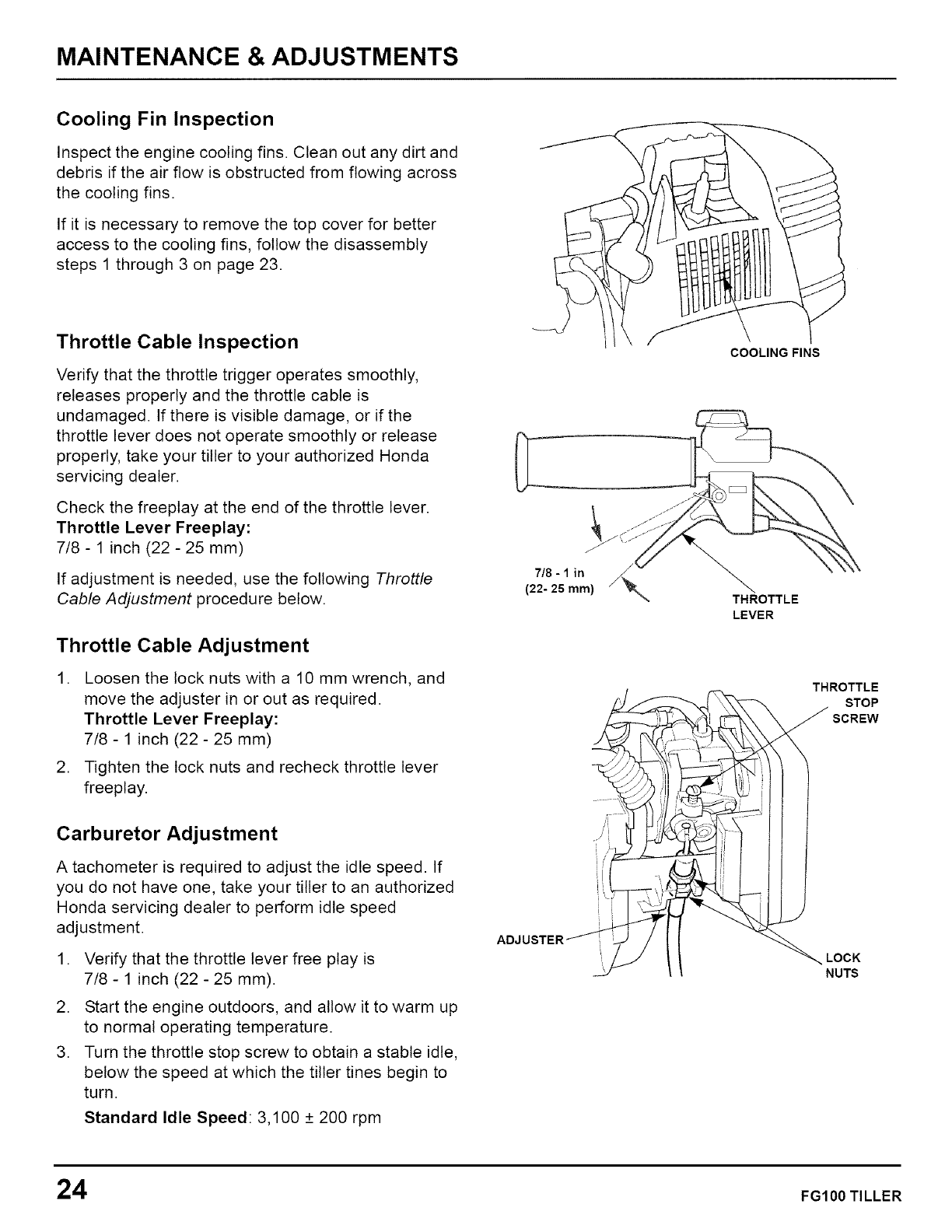
Cooling Fin Inspection
Inspect the engine cooling fins. Clean out any dirt and
debris if the air flow is obstructed from flowing across
the cooling fins.
If it is necessary to remove the top cover for better
access to the cooling fins, follow the disassembly
steps 1 through 3 on page 23.
Throttle Cable Inspection
Verify that the throttle trigger operates smoothly,
releases properly and the throttle cable is
undamaged. If there is visible damage, or if the
throttle lever does not operate smoothly or release
properly, take your tiller to your authorized Honda
servicing dealer.
Check the freeplay at the end of the throttle lever.
Throttle Lever Freeplay:
7/8 - 1 inch (22 - 25 mm)
If adjustment is needed, use the following Throttle
Cable Adjustment procedure below.
Throttle Cable Adjustment
1. Loosen the lock nuts with a 10 mm wrench, and
move the adjuster in or out as required.
Throttle Lever Freeplay:
7/8 - 1 inch (22 - 25 mm)
2. Tighten the lock nuts and recheck throttle lever
freeptay.
Carburetor Adjustment
A tachometer is required to adjust the idle speed. If
you do not have one, take your tiller to an authorized
Honda servicing dealer to perform idle speed
adjustment.
1. Verify that the throttle lever free play is
7/8 - 1 inch (22 - 25 mm).
2. Start the engine outdoors, and allow it to warm up
to normal operating temperature.
3. Turn the throttle stop screw to obtain a stable idle,
below the speed at which the tiller tines begin to
turn.
Standard Idle Speed: 3,100 + 200 rpm
7/8 -1 in j_
J\
(22- 25 mm)
ADJUSTER
COOLING FINS
THROTTLE
LEVER
THROTTLE
STOP
SCREW
LOCK
NUTS
24 FG100 TILLER
MAINTENANCE & ADJUSTMENTS
FUEL SYSTEM
Refueling
Fuem Tank Capacity: 0.75 US qt (1.5 US pt, 0.7 ()
Chock the fuel level by looking through the
translucent fuel tank.
tf the fuel level is low, refuel in a weIFventilated
area with the engine stopped. If the engine has
been running, allow it to cool first.
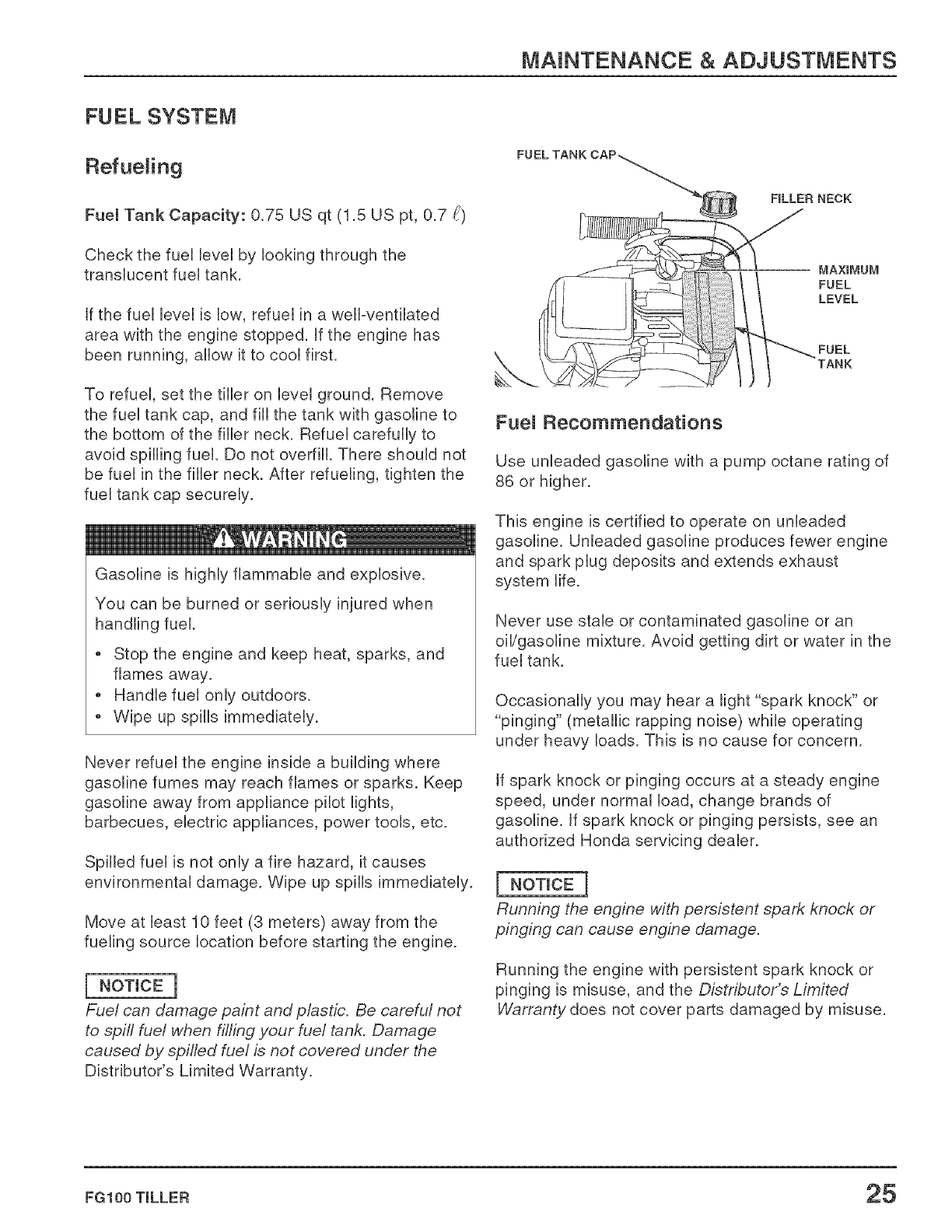
To refuel, set the tiller on level ground. Remove
the fuel tank cap, and fill the tank with gasoline to
the bottom of the filler neck. Refuel carefully to
avoid spilling fuel. Do not overfill. There should not
be fuel in the filler neck. After refueling, tighten the
fuel tank cap securely.
Gasoline is highly flammable and explosive.
You can be burned or seriously injured when
handling fuel.
Stop the engine and keep heat, sparks, and
flames away.
o Handle fuel only outdoors.
Wipe up spills immediately.
Never refuel the engine inside a building where
gasoline fumes may reach flames or sparks. Keep
gasoline away from appliance pilot lights,
barbecues, electric appliances, power tools, etc.
Spilled fuel is not only a fire hazard, it causes
environmental damage. Wipe up spills immediately.
Move at least 10 feet (3 meters) away from the
fueling source location before starting the engine.
[ NOTICE ]
Fuel can damage paint and plastic. Be careful not
to spill fuel when t!lting your fuel tank. Damage
caused by spilled fuel is not covered under the
Distributor's Limited Warranty.
FUEL
FILLER NECK
MAXIMUM
FUEL
LEVEL
Fuem Recommendations
Use unleaded gasoline with a pump octane rating of
86 or higher.
This engine is certified to operate on unleaded
gasoline. Unleaded gasoline produces fewer engine
and spark plug deposits and extends exhaust
system life.
Never use stale or contaminated gasoline or an
oil/gasoline mixture. Avoid getting dirt or water in the
fuel tank.
Occasionally you may hear a light "spark knock" or
"pinging" (metallic rapping noise) while operating
under heavy loads. This is no cause for concern.
tf spark knock or pinging occurs at a steady engine
speed, under normal load, change brands of
gasoline. If spark knock or pinging persists, see an
authorized Honda servicing dealer.
I NOTICE ]
Running the engine with persistent spark knock or
pinging can cause engine damage.
Running the engine with persistent spark knock or
pinging is misuse, and the Distributor's Limited
Warranty does not cover parts damaged by misuse.
FG100 TILLER 25
MAINTENANCE & ADJUSTMENTS
Fuem Tube Rnspection
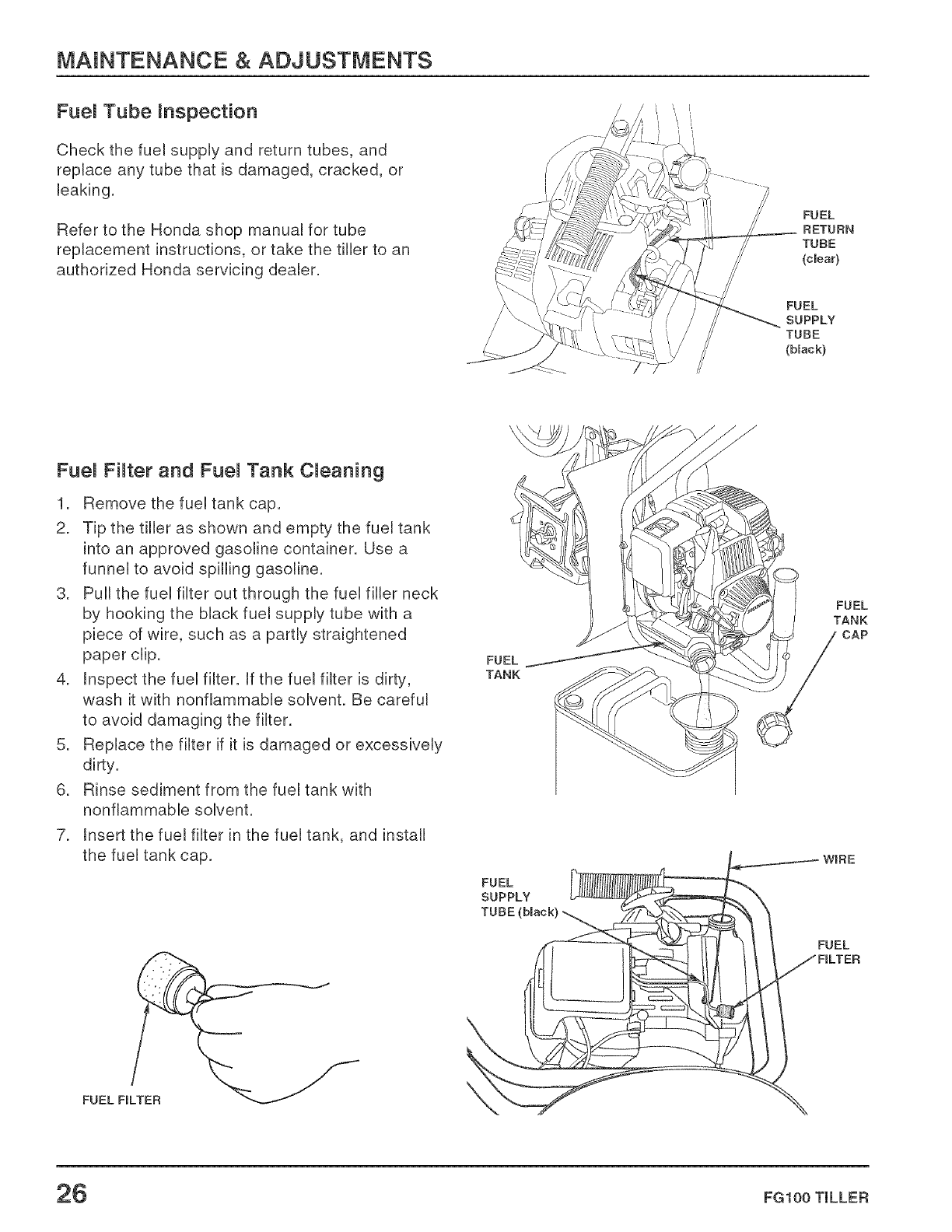
Check the fuel supply and return tubes, and
replace any tube that is damaged, cracked, or
leaking.
Refer to the Honda shop manual for tube
replacement instructions, or take the filler to an
authorized Honda servicing dealer.
FUEL
RETURN
TUBE
(clear)
FUEL
SUPPLY
TUBE
(black)
Fuem FHter and FuemTank Cmeaning
1. Remove the fuel tank cap.
2. Tip the tiller as shown and empty the fuel tank
into an approved gasoline container. Use a
funnel to avoid spilling gasoline.
3. Pull the fuel fiker out through the fuel filler neck
by hooking the black fuel supply tube wkh a
piece of wire, such as a partly straightened
paper clip.
4. Inspect the fuel filter. If the fuel filter is dirty,
wash it with nonflammable solvent. Be careful
to avoid damaging the filter.
5. Replace the filter if it is damaged or excessively
dirty.
6. Rinse sediment from the fuel tank with
nonflammable solvent.
7. Insert the fuel filter in the fuel tank, and install
the fuel tank cap.
FUEL FmLTER
FUEL
TANK
FUEL
SUPPLY
TUBE
\
FUEL
TANK
FUEL
26 FG100 TILLER
MAINTENANCE & ADJUSTMENTS
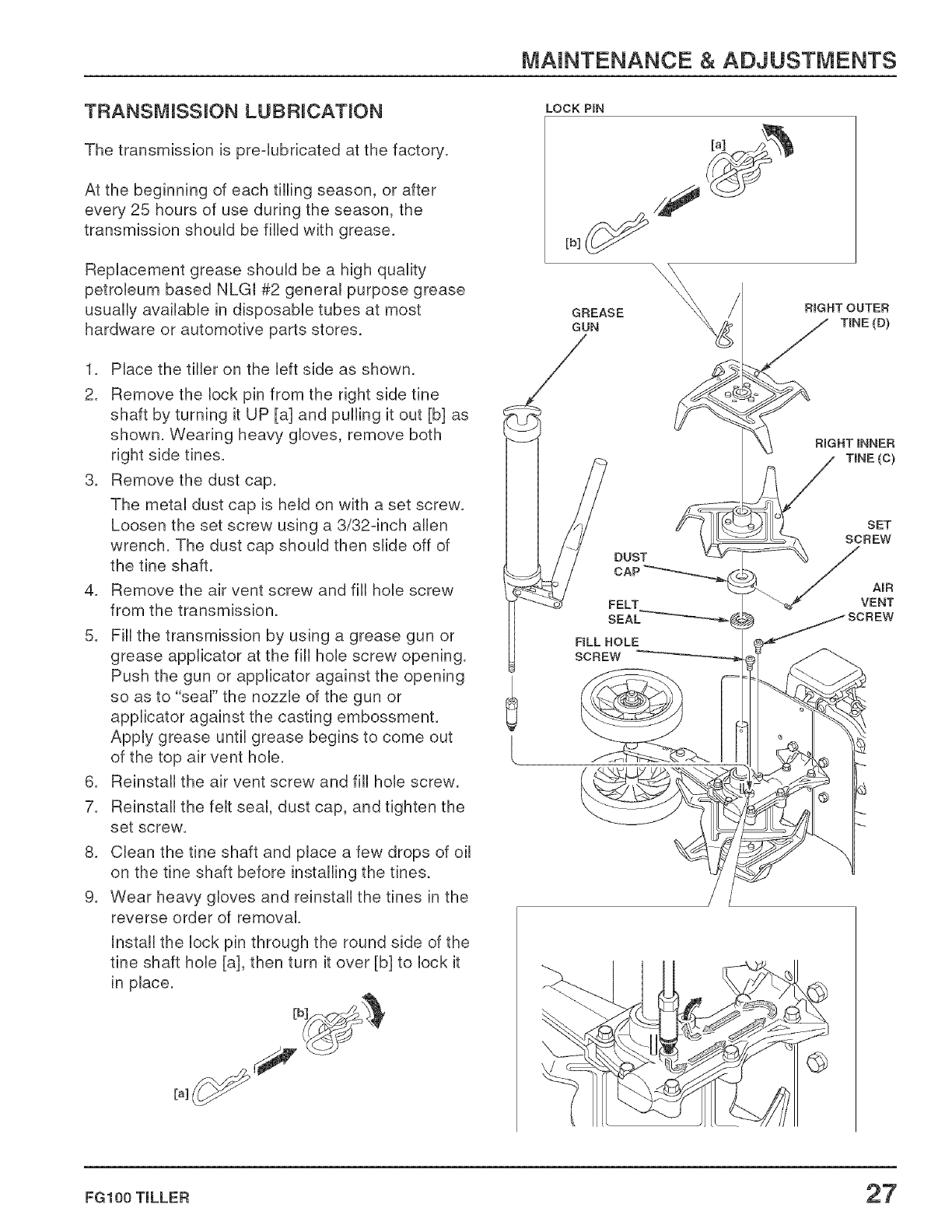
TRANSMmSSRON LUBRRCATRON
The transmission is prequbricated at the factory.
At the beginning of each tilling season, or after
every 25 hours of use during the season, the
transmission shouUd be filled with grease.
RepUacement grease shouUd be a high quaUky
petroUeum based NLGI #2 general purpose grease
usually availabUe in disposable tubes at most
hardware or automotive parts stores.
1. PRace the tiller on the Reftside as shown.
2. Remove the Rock pin from the right side tine
shaft by turning it UP [a] and pulling it out [b] as
shown. Wearing heavy groves, remove both
right side tines.
3. Remove the dust cap.
The metal dust cap is held on with a set screw.
Loosen the set screw using a 3/32-inch allen
wrench. The dust cap should then slide off of
the fine shaft.
4. Remove the air vent screw and fill hole screw
from the transmission.
5. Fill the transmission by using a grease gun or
grease applicator at the fill hole screw opening.
Push the gun or applicator against the opening
so as to "seal" the nozzle of the gun or
applicator against the casting embossment.
Apply grease until grease begins to come out
of the top air vent hole.
6. Reinstall the air vent screw and fill hole screw.
7. Reinstall the felt seal, dust cap, and tighten the
set screw.
8. Clean the fine shaft and place a few drops of oil
on the fine shaft before installing the tines.
9. Wear heavy gloves and reinstall the tines in the
reverse order of removal.
Install the lock pin through the round side of the
fine shaft hole [a], then turn it over [b] to lock it
in place.
[a]
LOCK PmN
\\ /RIGHT OUTER
GREASE
GUN _ TmNE(D)
RIGHT INNER
T_NE(c)
SET
SCREW
AIR
VENT
FILL HOLE
SCREW
FGIO0 TILLER 27
THE iMPORTANCE OF PROPER ASSEMBLY
Proper assembly is essential to operator safety and the reliability of the machine. Any error or oversight
made by the person assembling and servicing a unit can result in faulty operation, damage to the machine,
or injury to the operator.
Improper assembly can cause an unsafe condition that can lead to
serious injury or death.
Follow the procedures and precautions in the assembly instructions
carefully.
Some of the most important safety precautions are given below. However, we cannot warn you of every
conceivable hazard that can arise in performing this assembly. Only you can decide whether or not you
should perform a given task.
Failure to properly follow instructions and precautions can cause you
to be seriously hurt or killed.
Follow the procedures and precautions in this manual carefully.
JMPOF{TANT SAFETY PF{ECAUTJONS
Make sure you have a clear understanding of all basic shop safety practices and that you are wearing
appropriate clothing and safety equipment. When performing this assembly, be especially careful of the
following:
[] Read the instructions before you begin and be sure you have the tools and skills required to perform
the tasks safely.
Make sure the engine is off before you begin any maintenance or repairs. This will help eliminate
several potential hazards:
[] Carbon monoxide poisoning from engine exhaust.
Be sure there is adequate ventilation whenever you run the engine.
[] Burns from hot parts.
Let the engine and exhaust system cool before touching.
[] Injury from moving parts.
Do not run the engine unless the instruction tells you to do so. Even then, keep your hands, fingers,
and clothing away from moving parts. Do not run the engine when any protective guard or shield is
removed.
To reduce the possibility of a fire or explosion, be careful when working around gasoline or batteries.
Use only a nonflammable solvent, not gasoline, to clean parts. Keep all cigarettes, sparks, and flames
away from all fuel-related parts.
28 FG100 TILLER
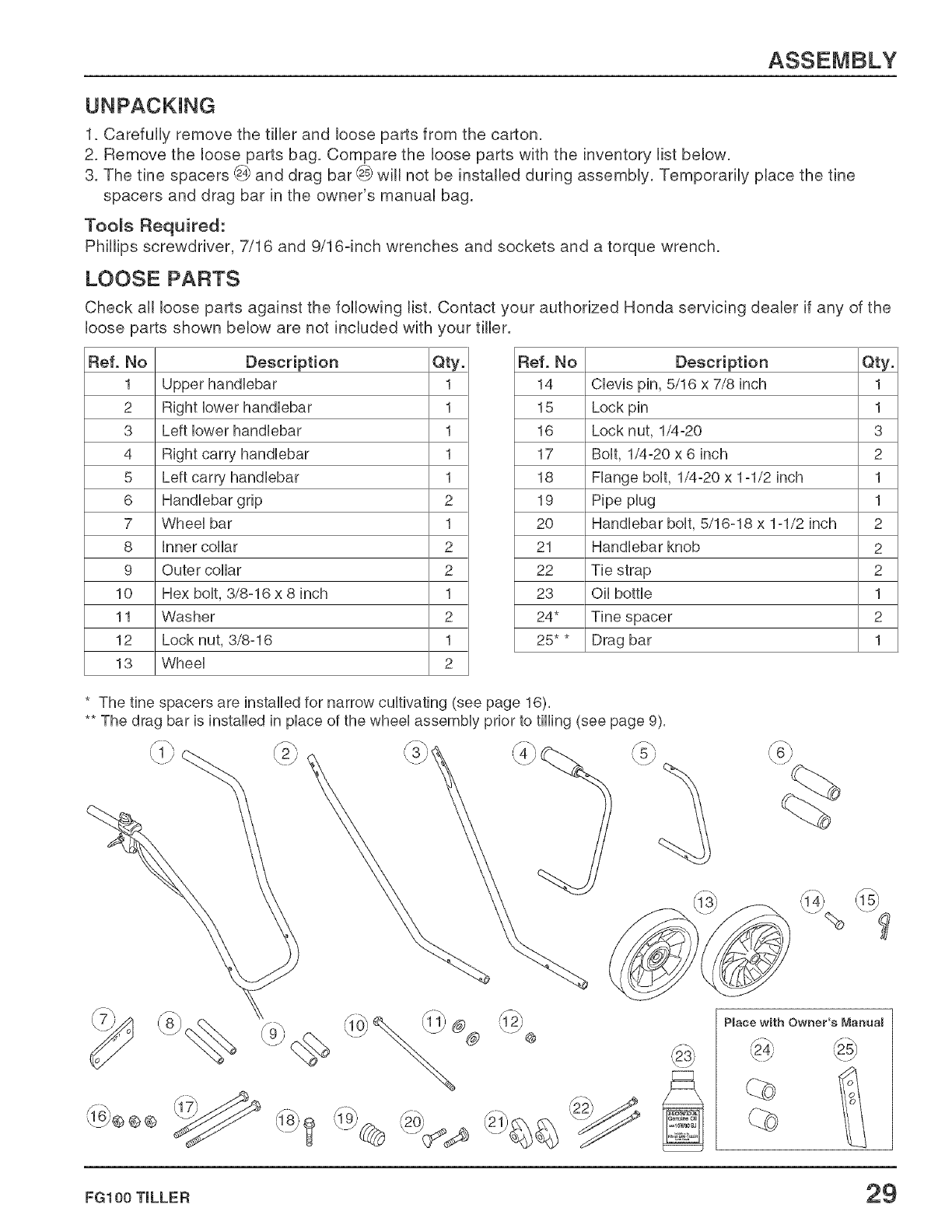
1. Carefu[Jy remove the tiJJer and loose parts from the carton.
2. Remove the Roose parts bag. Compare the Roose parts with the inventory list beJow.
3. The fine spacers @ and drag bar @wi[[ not be insta[Red during assembly. Temporarily pJace the tine
spacers and drag bar in the owner's manual bag.
Tools Required:
Phillips screwdriver, 7/16 and 9/16dnch wrenches and sockets and a torque wrench.
LOOSE PARTS
Check aJ[ loose parts against the following list. Contact your authorized Honda servicing dealer if any of the
loose parts shown beJow are not incJuded with your filler.
Ref. No Description Qty.
1 Upper handlebar 1
2 Right lower handlebar 1
3 Left lower handlebar 1
4 Right carry handlebar 1
5 Left carry handlebar 1
6 Handlebar grip 2
7 Wheel bar 1
8 Inner co[Jar 2
9 Outer co[Jar 2
10 Hex bolt, 3/8-16 x 8 inch 1
11 Washer 2
12 Lock nut, 3/8-16 1
13 Wheel 2
Ref. No Description Qty.
14 Clevis pin, 5/16 x 7/8 inch 1
15 Lock pin 1
16 Lock nut, 1/4-20 3
17 Bolt, 1/4-20 x 6 inch 2
18 Flange bolt, 1/4-20 x 1-1/2 inch 1
19 1
20 Handlebar bolt, 5/16-18 x 1-1/2 inch 2
21 Handlebar knob 2
22 Tie strap 2
23 0[[ bottle 1
24* T[ne spacer 2
25* * Drag bar 1
* The t[ne spacers are installed for narrow cultivating (see page 16),
** The drag bar is installed in place of the wheel assembly prior to tilling (see page 9),
Place with Owner's Manual
FGIO0 TILLER 29
TILLER ASSEMBLY
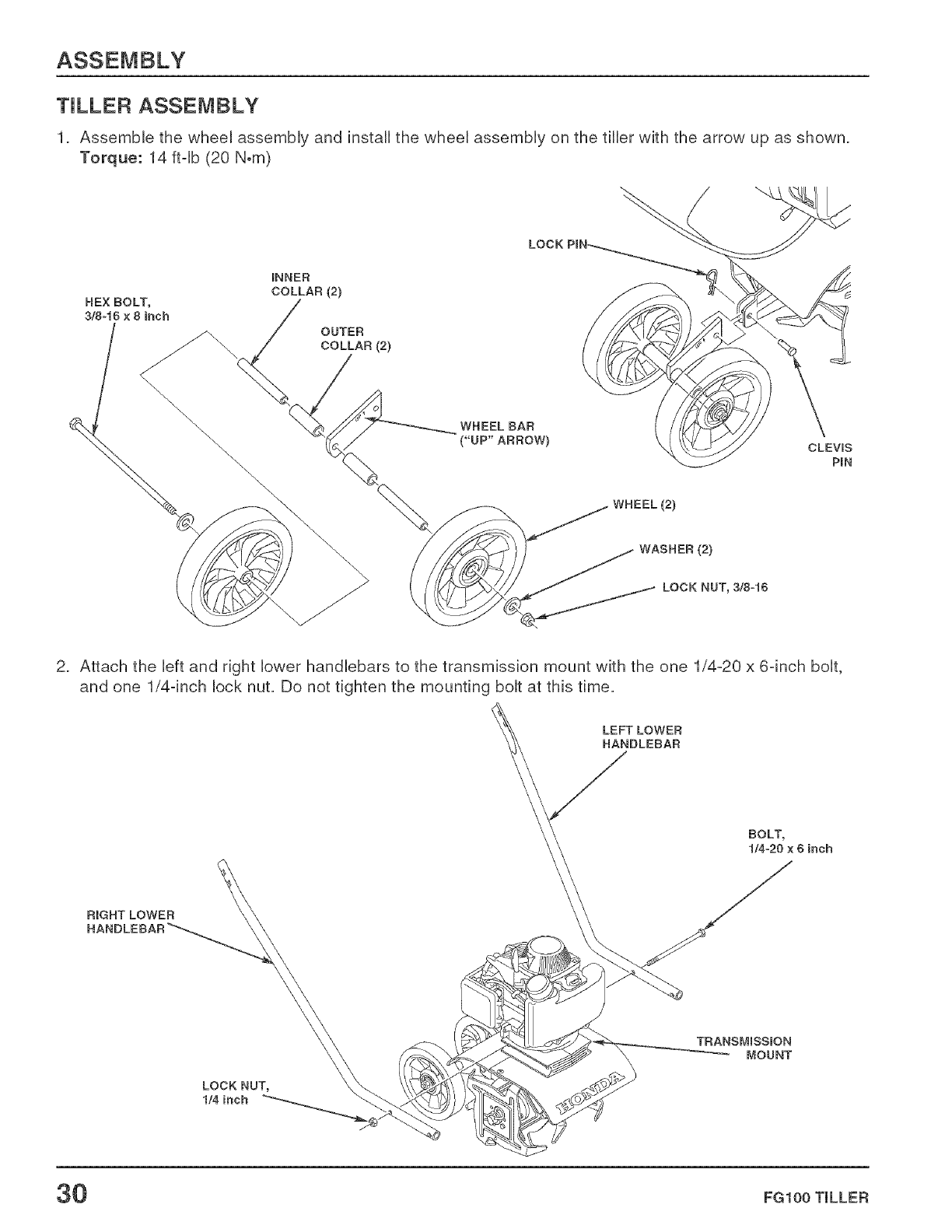
1. AssemMe the wheel assembly and install the wheel assembly on the tiller with the arrow up as shown.
Torque: 14 ftqb (20 N°m)
LOCK
ruNNER
COLLAR (2)
\/ COLLAR (2)
WHEEL
CLEVIS
PIN
2. Attach the Reftand right Rower handlebars to the transmission mount with the one 1/4o20 x 64nch bout,
and one 1/44nch Rock nut. Do not tighten the mounting bout at this time.
LEFT LOWER
HANDLEBAR
BOLT,
1/4o20 × 6 inch
RIGHT LOWER
LOCK NUT,
1/4 inch __
TRANSMISSION
MOUNT
30 FGIO0 TILLER
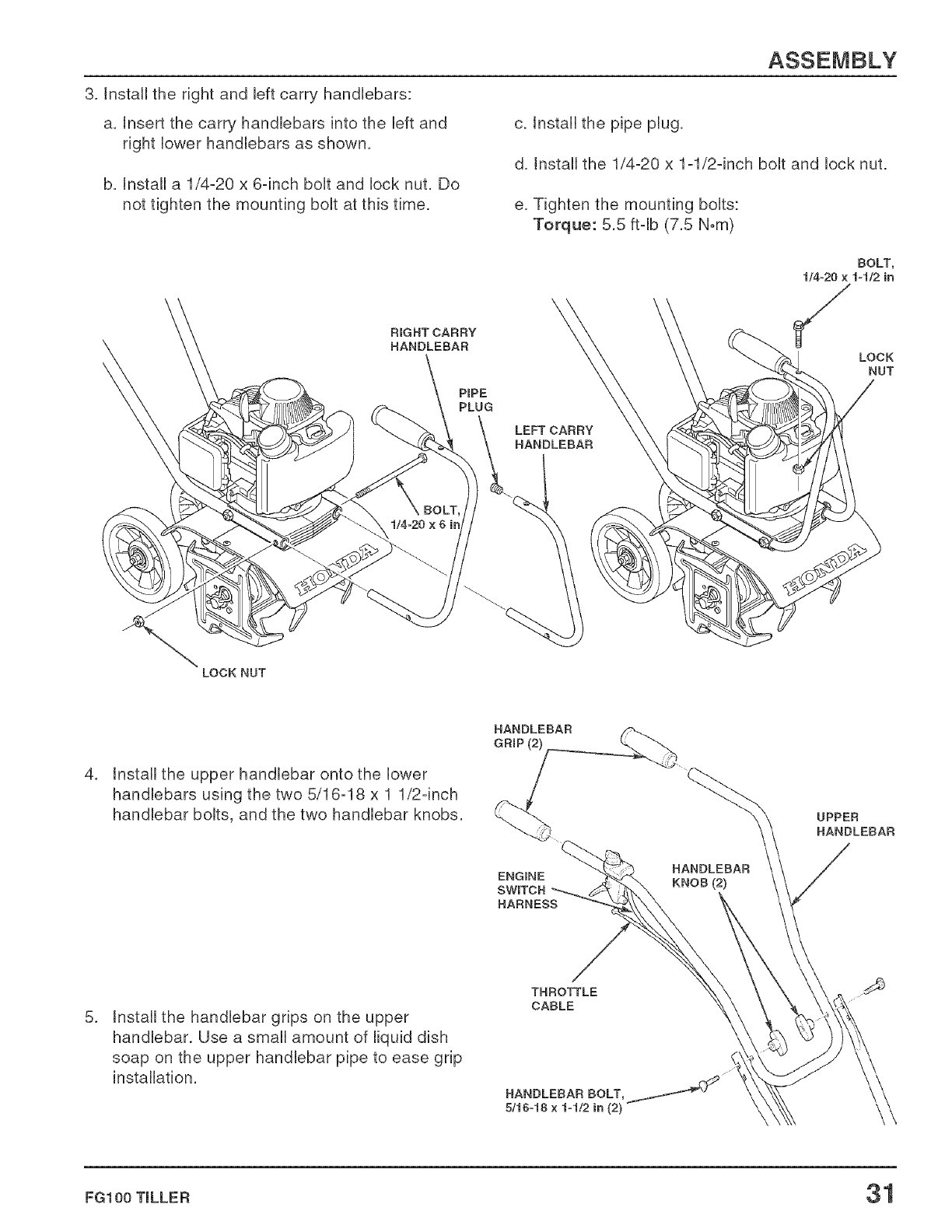
3. install the right and left carry handlebars:
a. Insert the carry handlebars into the left and
right lower handlebars as shown.
b. install a 1/4-20 x 6-inch bolt and lock nut. Do
not tighten the mounting bolt at this time.
c. Install the pipe plug.
d. install the 1/4-20 x 1-1/2-inch bolt and lock nut.
e. Tighten the mounting bolts:
Torque: 5.5 ftqb (7.5 N,m)
BOLT,
1/4-20 × 1-1/2 in
LOCK
NUT
LOCK NUT
,install the upper handlebar onto the lower
handlebars using the two 5/16-18 x 1 1!2-inch
handlebar bolts, and the two handlebar knobs.
HANDLEBAR
GRIP (2)
HANDLEBAR
ENGINE
SWITCH KNOB (2)
HARNESS
UPPER
HANDLEBAR
,install the handlebar grips on the upper
handlebar. Use a small amount of liquid dish
soap on the upper handlebar pipe to ease grip
installation.
THROTTLE
CABLE
HANDLEBAR BOLT
5/16o18 × 1-1/2 in (2) \\
FG100 TILLER 31
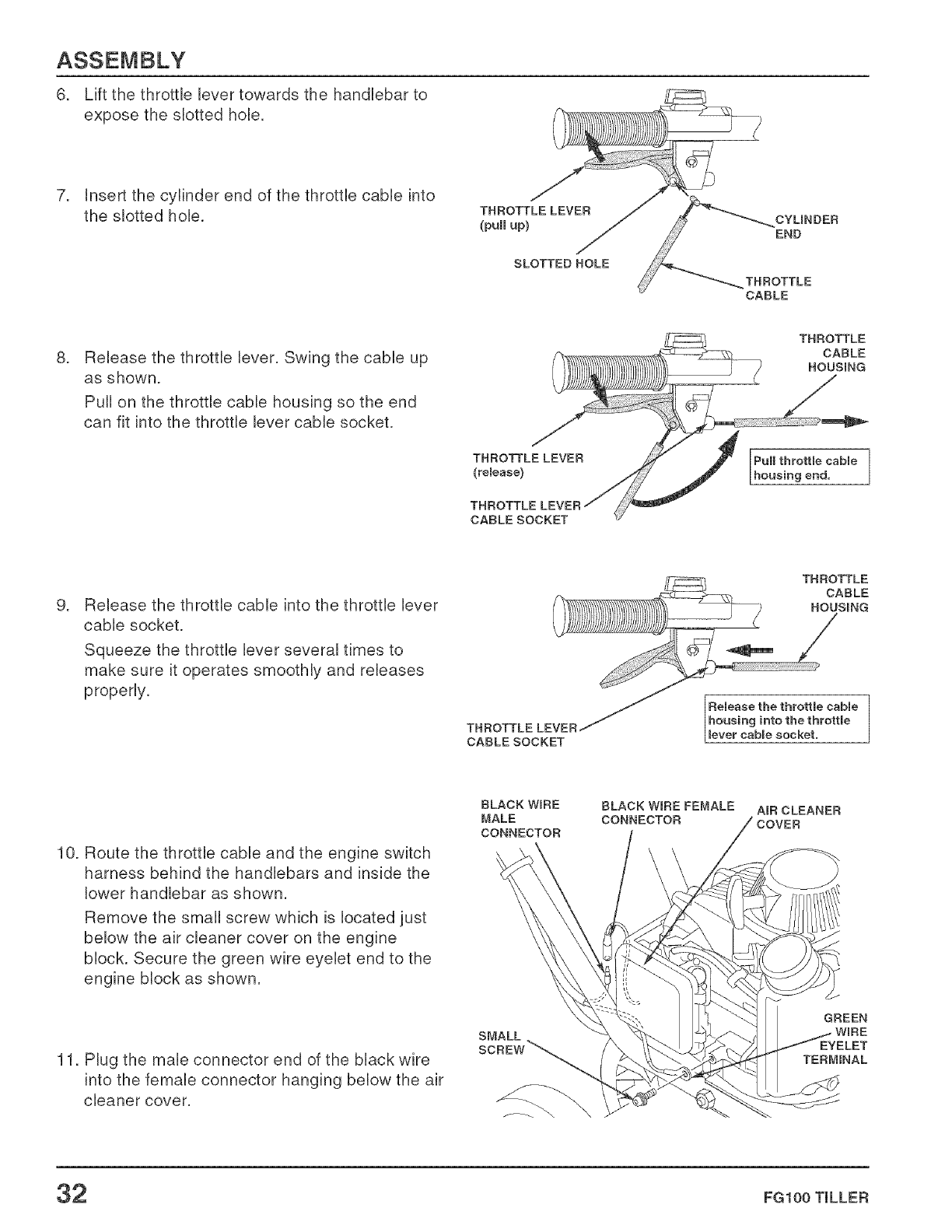
6. Lift the throttle lever towards the handlebar to
expose the slotted hole.
,Insert the cylinder end of the throttle cable into
the slotted hole. THROTTLE LEVER
(pull up}
SLOTTED HOLE
CYMNDER
END
THROTTLE
CABLE
,Release the throttle lever. Swing the cable up
as shown.
Pull on the throttle cable housing so the end
can fit into the throttle lever cable socket.
THROTTLE LEVER
(reRease)
THROTTLE
CABLE
HOUSING
CABLE SOCKET
,Release the throttle cable into the throttle lever
cable socket.
Squeeze the throttle lever several times to
make sure it operates smoothly and releases
properly.
THROTTLE LEVER
CABLESOCKET
THROTTLE
CABLE
HOUSING
10. Route the throttle cable and the engine switch
harness behind the handlebars and inside the
lower handlebar as shown.
Remove the small screw which is located just
below the air cleaner cover on the engine
block. Secure the green wire eyelet end to the
engine block as shown.
11. Plug the male connector end of the black wire
into the female connector hanging below the air
cleaner cover.
BLACK WIRE
MALE
CONNECTOR
BLACK WIRE FEMALE
CONNECTOR AmRCLEANER
COVER
GREEN
EYELET
TERMINAL
32 FG100 TILLER
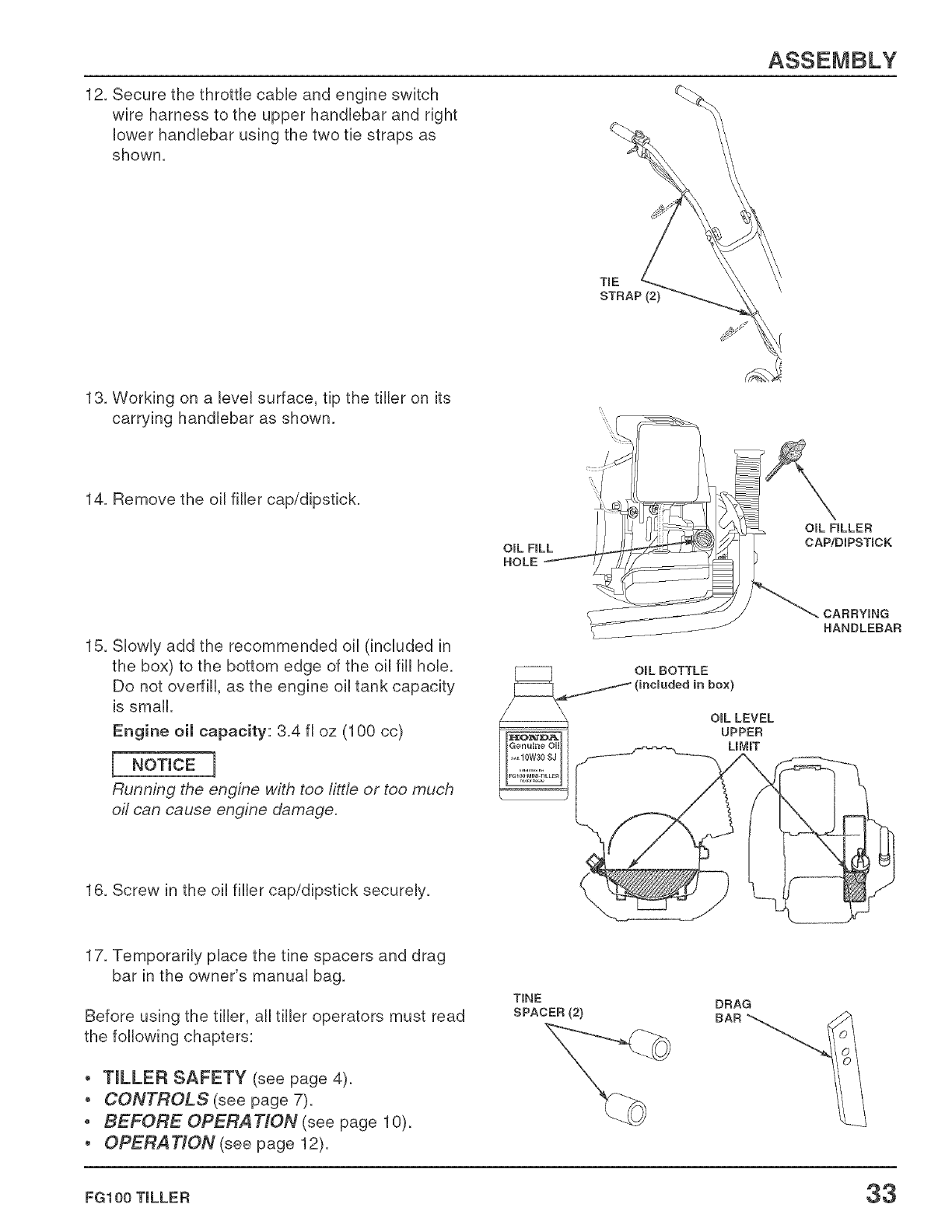
12. Secure the throttle came and engine switch
wire harness to the upper handUebar and right
lower handlebar using the two tie straps as
shown.
Tree
STRAP(2)
13. Working on a BeveUsurface, tip the filler on its
carrying handUebar as shown.
14. Remove the oil filler cap!dipstick.
OraLFILL
HOLE
OraLFILLER
CAP!DIPSTICK
15. Slowly add the recommended oil (incUuded in
the box) to the bottom edge of the oil fill hole.
Do not overfill, as the engine oil tank capacity
is small.
Engine oH capacity: 3.4 fi oz (100 cc)
NOTICE ]
Running the engine with too little or too much
off can cause engine damage.
OIL BOTTLE
(incBuded in box)
0ARRYmNG
HANDLEBAR
16. Screw in the oil filler cap/dipstick securely.
17. Temporarily place the tine spacers and drag
bar in the owner's manual bag.
Before using the tiller, all tiller operators must read
the following chapters:
o TroLLER SAFETY (see page 4).
oCONTROLS (see page 7).
,BEFORE OPERATION (see page 10).
,OPERATION (see page 12).
TINE
SPACER (2) DRAG
BAR_
FG100 TILLER 33
TFIANS PO FITING/STOFIAG E
Before Loading
Always turn the engine switch to the OFF position.
Make sure the fuel cap is securely tightened.
Install the wheels to provide added stability when
transporting (see page 12).
tf the engine has been running, allow it to cool for at
least 15 minutes before loading the tiller on the
transport vehicle. A hot engine and exhaust system
can burn you and can ignite some materials.
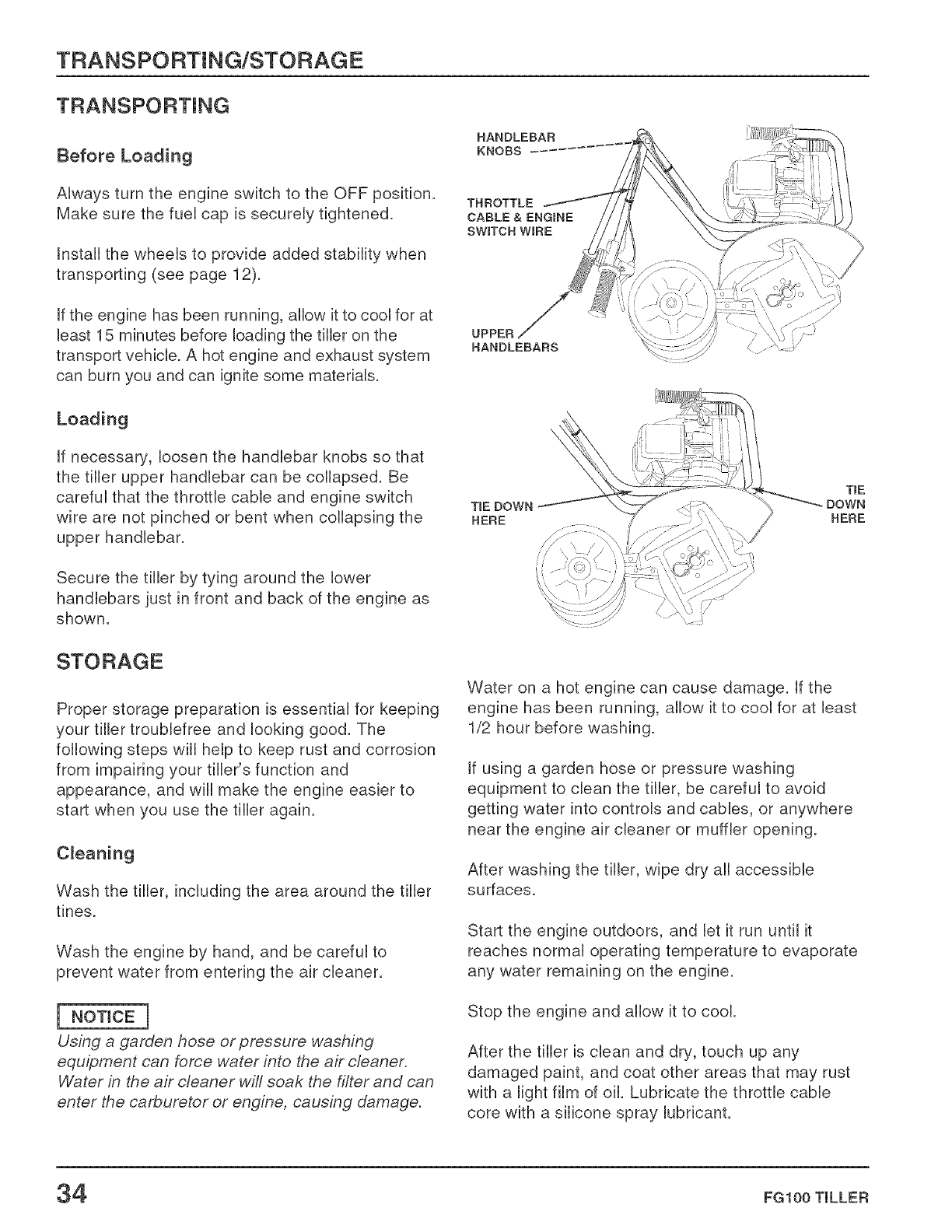
Loading
tf necessary, loosen the handlebar knobs so that
the tiller upper handlebar can be collapsed. Be
careful that the throttle cable and engine switch
wire are not pinched or bent when collapsing the
upper handlebar.
Secure the tiller by tying around the lower
handlebars just in front and back of the engine as
shown.
THROTT LE
CABLE & ENGINE
SWmTCH WmRE
UPPER
HANDLEBARS
TIE DOWN
BEBE
TIE
HERE
Proper storage preparation is essential for keeping
your tiller troublefree and looking good. The
following steps will help to keep rust and corrosion
from impairing your tiller's function and
appearance, and will make the engine easier to
start when you use the tiller again.
C_eaning
Wash the tiller, including the area around the tiller
tines.
Wash the engine by hand, and be careful to
prevent water from entering the air cleaner.
I NOTICE ]
Using a garden hose or pressure washing
equipment can force water into the air cleaner.
Water in the air cleaner wi/! soak the filter and can
enter the carburetor or engine, causing damage.
Water on a hot engine can cause damage. If the
engine has been running, allow it to cool for at least
1/2 hour before washing.
tf using a garden hose or pressure washing
equipment to clean the tiller, be careful to avoid
getting water into controls and cables, or anywhere
near the engine air cleaner or muffler opening.
After washing the tiller, wipe dry all accessible
surfaces.
Start the engine outdoors, and let it run until it
reaches normal operating temperature to evaporate
any water remaining on the engine.
Stop the engine and allow it to cool.
After the filler is clean and dry, touch up any
damaged paint, and coat other areas that may rust
with a light film of oil. Lubricate the throttle cable
core with a silicone spray lubricant.
34 FG100 TILLER
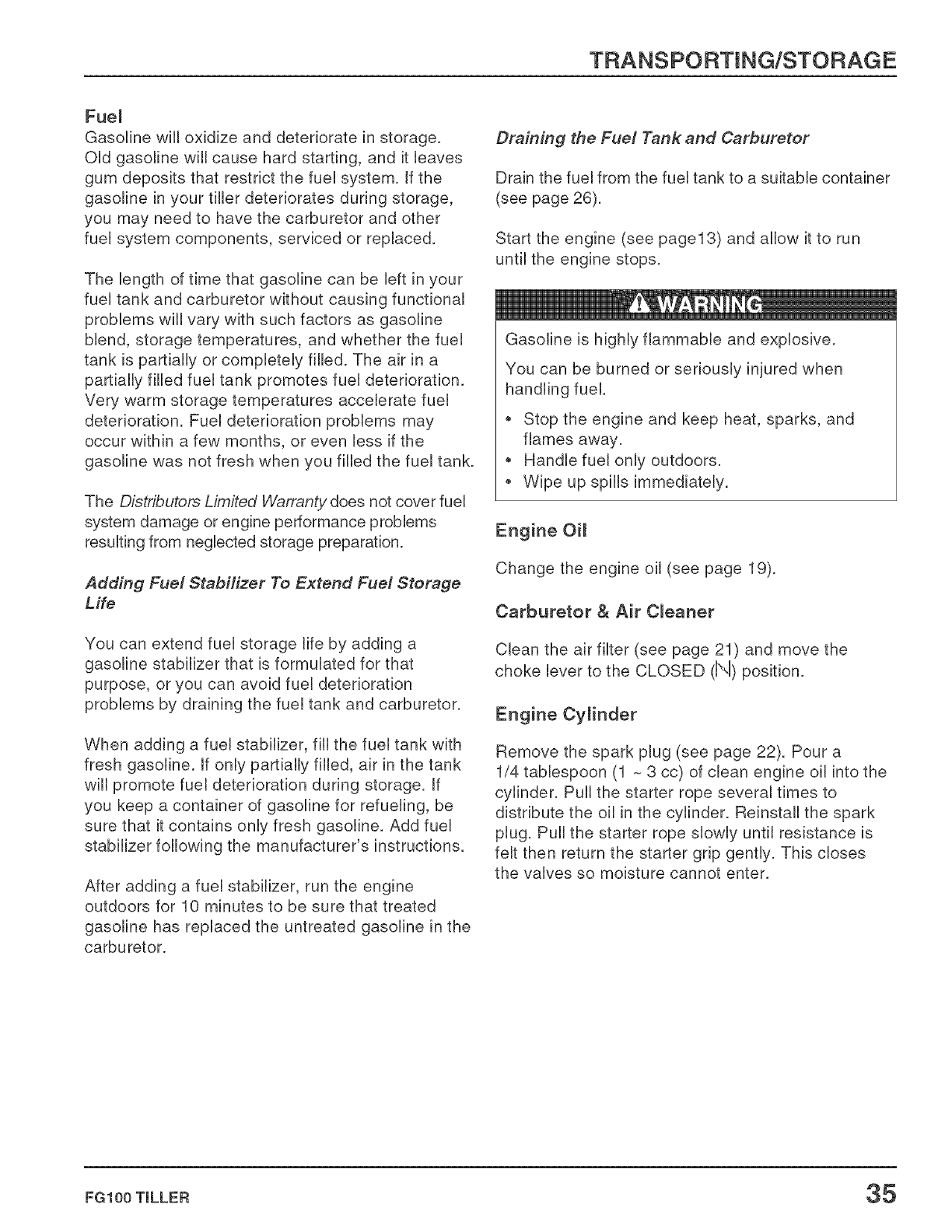
TRANSPORTING/STORAGE
Fuem
Gasoline will oxidize and deteriorate in storage.
Old gasoline will cause hard starting, and it leaves
gum deposits that restrict the fuel system. If the
gasoline in your filler deteriorates during storage,
you may need to have the carburetor and other
fuel system components, serviced or replaced.
The length of time that gasoline can be left in your
fuel tank and carburetor wkhout causing functional
problems will vary with such factors as gasoline
blend, storage temperatures, and whether the fuel
tank is partially or completely filled. The air in a
partially filled fuel tank promotes fuel deterioration.
Very warm storage temperatures accelerate fuel
deterioration. Fuel deterioration problems may
occur within a few months, or even less if the
gasoline was not fresh when you filled the fuel tank.
The D/stributors L£mited Warranty does not cover fuel
system damage or engine performance problems
resulting from neglected storage preparation.
Adding Fuel Stabilizer To Extend Fuel Storage
Life
You can extend fuel storage life by adding a
gasoline stabilizer that is formulated for that
purpose, or you can avoid fuel deterioration
problems by draining the fuel tank and carburetor.
When adding a fuel stabilizer, fill the fuel tank with
fresh gasoline. If only partially filled, air in the tank
will promote fuel deterioration during storage, tf
you keep a container of gasoline for refueling, be
sure that it contains only fresh gasoline. Add fuel
stabilizer following the manufacturer's instructions.
After adding a fuel stabilizer, run the engine
outdoors for 10 minutes to be sure that treated
gasoline has replaced the untreated gasoline in the
carbu retor.
Draining the Fuel Tank and Carburetor
Drain the fuel from the fuel tank to a suitable container
(see page 26).
Start the engine (see page13) and allow it to run
until the engine stops.
Gasoline is highly flammable and explosive.
You can be burned or seriously injured when
handling fuel.
Stop the engine and keep heat, sparks, and
flames away.
Handle fuel only outdoors.
Wipe up spills immediately.
Engine Oi_
Change the engine oil (see page 19).
Carburetor & Air Cmeaner
Clean the air filter (see page 21) and move the
choke lever to the CLOSED (N) position.
Engine Cylinder
Remove the spark plug (see page 22). Pour a
1/4 tablespoon (1 - 3 cc) of clean engine oil into the
cylinder. Pull the starter rope several times to
distribute the oil in the cylinder. Reinstall the spark
plug. Pull the starter rope slowly until resistance is
felt then return the starter grip gently. This doses
the valves so moisture cannot enter.
FG100 TILLER 35
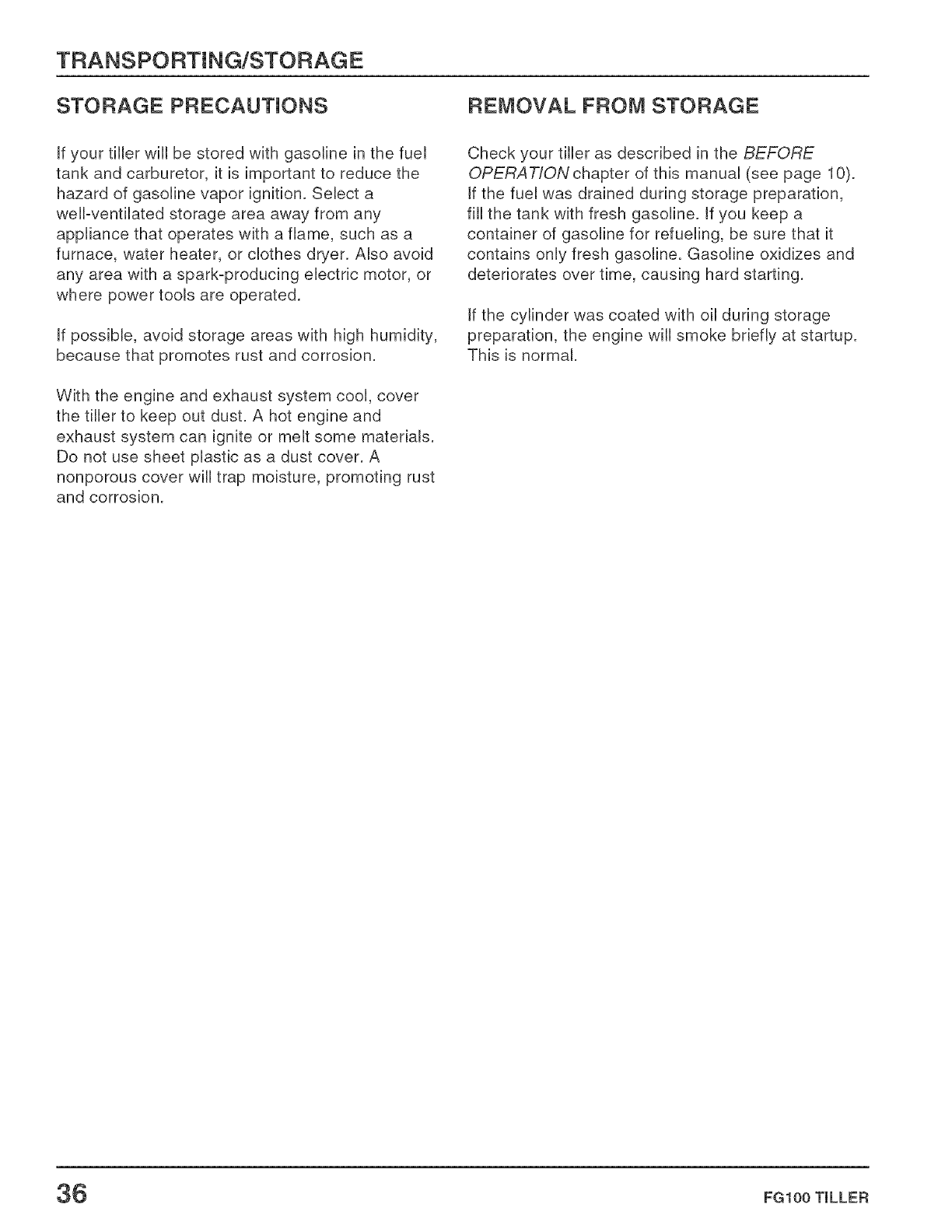
TRANSPORTING/STORAGE
STORAGE PRECAUTIONS REMOVAL FROM STORAGE
if your tiller will be stored with gasoline in the fuel
tank and carburetor, it is important to reduce the
hazard of gasoline vapor ignition. Select a
well-ventilated storage area away from any
appliance that operates with a flame, such as a
furnace, water heater, or clothes dryer. Also avoid
any area with a spark-producing electric motor, or
where power tools are operated.
if possible, avoid storage areas with high humidity,
because that promotes rust and corrosion.
With the engine and exhaust system cool, cover
the tiller to keep out dust. A hot engine and
exhaust system can ignite or melt some materials.
Do not use sheet plastic as a dust cover. A
nonporous cover will trap moisture, promoting rust
and corrosion.
Check your tiller as described in the BEFORE
OPERA T/ON chapter of this manual (see page 10).
if the fuel was drained during storage preparation,
fill the tank with fresh gasoline. If you keep a
container of gasoline for refueling, be sure that it
contains only fresh gasoline. Gasoline oxidizes and
deteriorates over time, causing hard starting.
if the cylinder was coated with oil during storage
preparation, the engine will smoke briefly at startup.
This is normal.
36 FG100 TILLER
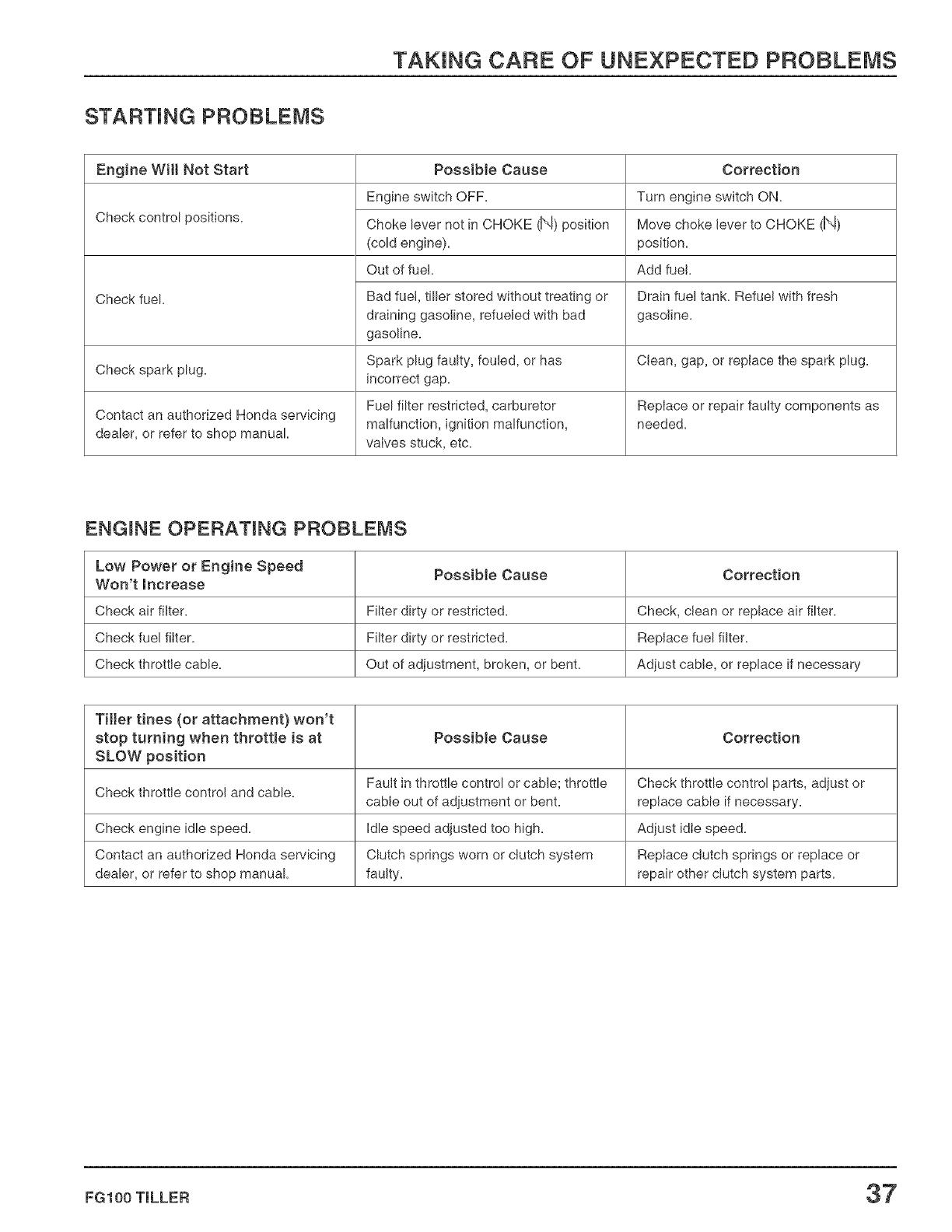
TAKING CARE OF UNEXPECTED PROBLEMS
STARTING PROBLEMS
Possible Cause
Engine Wit1 Not Start
Check control positions=
Check fuel=
Engine switch OFF.
Choke lever not in CHOKE (N) position
(cold engine).
Out of fuel,
Bad fue!, tiller stored without treating or
draining gasoline, refueled with bad
gasoline.
Correction
Turn engine switch ON.
Move choke lever to CHOKE (Ix!)
position=
Add fuel
Drain fuel tank. Refuel with fresh
gasoline.
Spark plug faulty, fouled, or has Clean, gap, or replace the spark plug.
Check spark plug= incorrect gap.
Fuel filter restricted, carburetor Replace or repair faulty components as
Contact an authorized Honda servicing malfunction, ignition malfunction, needed.
dealer, or refer to shop manual. vaIves stuck, etc.
ENGRNE OPERATRNG PROBLEMS
Low Power or Engine Speed Possible Cause Correction
Won't increase
Check air filter. Filter dirty or restricted= Check, clean or replace air filter=
Check fuel fiIter. Filter dirty or restricted= Replace fuel filter=
Check throttle cable= Out of adjustment, broken, or bent= Adjust cable, or replace if necessary
Tiller tines (or attachment} won't
stop turning when throtUe is at Possible Cause Correction
SLOW position
FauIt in throttle control or cable; throttle Check throttle control parts, adjust or
Check throttle control and cable= cable out of adjustment or bent= replace cable if necessary=
Check engine idle speed= Idle speed adjusted too high= Adjust idle speed=
Contact an authorized Honda servicing Clutch springs worn or clutch system Repiace clutch springs or replace or
dealer, or refer to shop manual= faulty= repair other clutch system parts=
FG100 TILLER 37
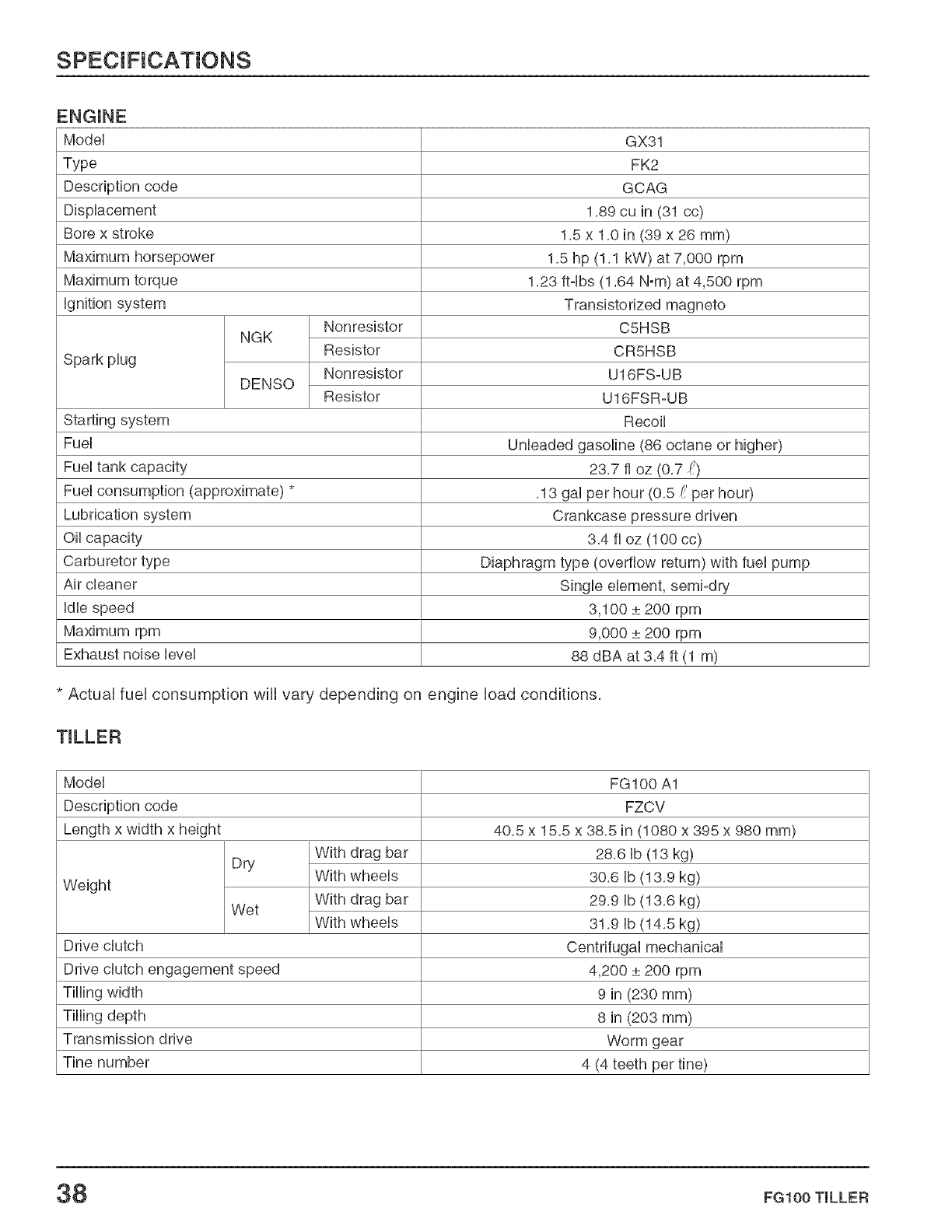
SPECIFiCATiONS
Model
Type
Description code
Displacement
Bore x stroke
Maximum horsepower
Maximum torque
ignition system
Spark plug
NGK
DENSO
Nonresistor
Resistor
Nonresistor
Resistor
GX31
FK2
GCAG
1,89 cu in (31 cc)
1,5 x 1,0 in (39 x 26 mm)
1,5 hp (1,1 kW) at 7,000 rpm
1,23 ft°lbs (1,64 Nom) at 4,500 rpm
Transistorized magneto
C5HSB
CR5HSB
U16FS°UB
U16FSR°UB
Recoil
Unleaded gasoline (86 octane or higher)
23,7 fl oz (0,7 {")
,13 gai per hour (0,5 8 per hour)
Starting system
Fuel
Fuel tank capacity
Fuel consumption (approximate) *
Lubrication system Crankcase pressure driven
Oil capacity 3,4 fi oz (100 cc)
Carburetor type Diaphragm type (overflow return) with fuel pump
Air cleaner Single element, semi-dry
Idle speed 3,100 ± 200 rpm
Maximum rpm 9,000 ± 200 rpm
Exhaust noise level 88 dBA at 3,4 ft (1 m)
* Actual fuel consumption will vary depending on engine Road conditions.
Model
Description code
Length x width x height
Dry
Weight
Wet
Drive clutch
Drive clutch engagement speed
Tilling depth
Transmission drive
Tine number
With drag bar
With wheels
With drag bar
With wheels
FG100 A1
FZCV
40,5 x 15,5 x 38,5 in (1080 x 395 x 980 mm)
28,6 Ib (13 kg)
30,6 Ib (13,9 kg)
29,9 Ib (13,6 kg)
31,9 Ib (14,5 kg)
Centrifugal mechanical
4,200 ± 200 rpm
9 in (230 mm)
8 in (203 mm)
Worm gear
4 (4 teeth per tine)
38 FGIO0 TILLER
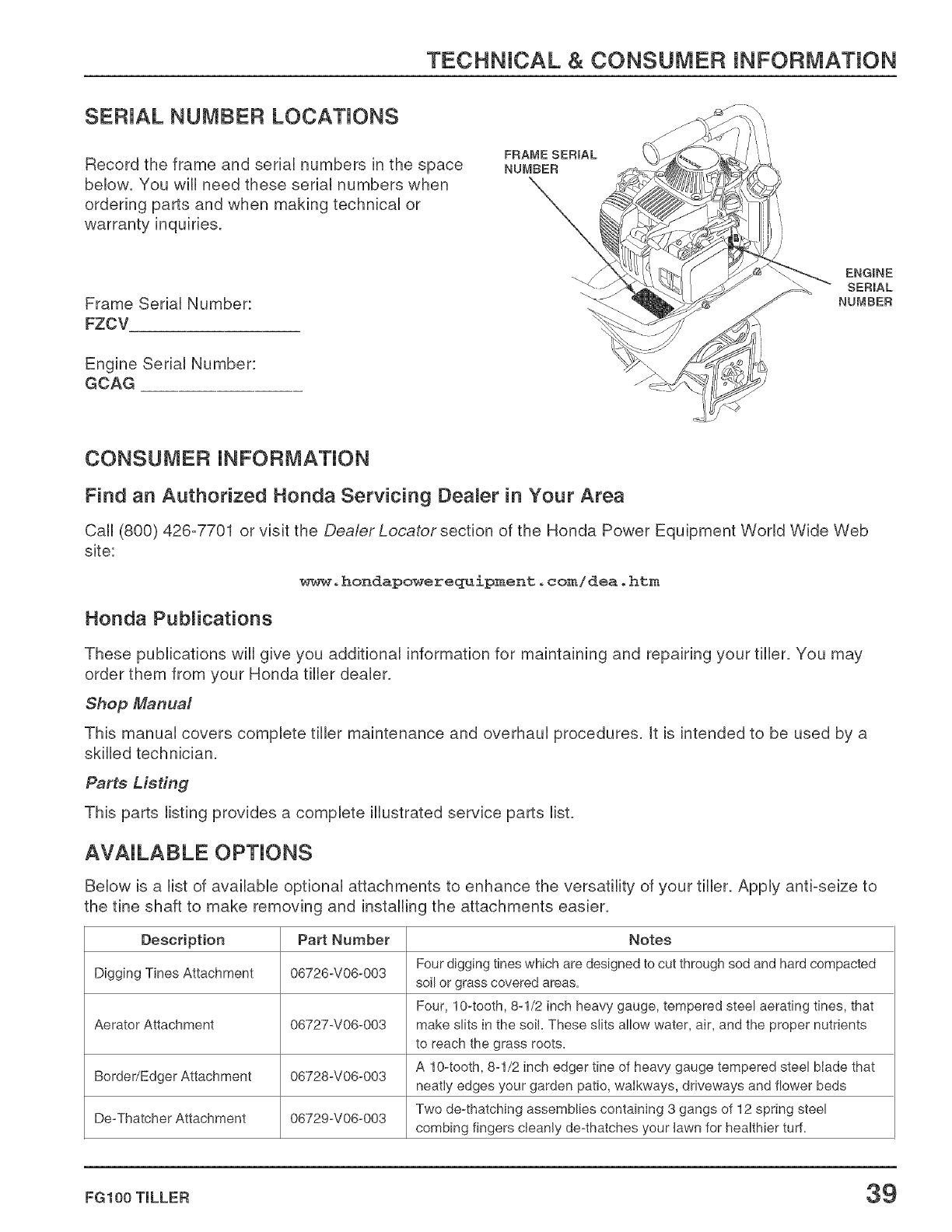
TECHNICAL & CONSUMER iNFORMATiON
SERIAL NUMBER LOCATIONS
Record the frame and seriaJ numbers in the space
beJow. You wiJJ need these seriaJ numbers when
ordering parts and when making technicaJ or
warranty inquiries.
FRAMESERIAL
NUMBER
Frame SeriaJ Number:
FZCV
EngineSeriaJNumber:
GCAG
ENGmNE
SERIAL
NUMBER
CONSUMER iNFORMATiON
Find an Authorized Honda Servicing DeaJer in Your Area
CaJJ (800) 426-7701 or visit the Dealer Locator section of the Honda Power Equipment World Wide Web
site:
_z_ hondapowerequipment _conl/dea, htm
Honda PubJications
These pubJicafions will give you additionaJ information for maintaining and repairing your tiller. You may
order them from your Honda tiller deaJer.
Shop Manual
This manuaJ covers complete tiller maintenance and overhauJ procedures. Jt is intended to be used by a
skilled technician.
Parts Listing
This parts listing provides a complete illustrated service parts list.
AVAILABLE OPTIONS
BeJow is a Jist of avaiJabJe optionaJ attachments to enhance the versatility of your tiller. Apply anti-seize to
the fine shaft to make removing and instaJling the attachments easier.
Description Part Number Notes
Digging Tines Attachment 06726-V06-003 Four digging tines which are designed to cut through sod and hard compacted
soil or grass covered areas,
Four, 10-tooth, 8-1/2 inch heavy gauge, tempered steel aerating tines, that
Aerator Attachment 06727-V06-003 make slits in the soil, These slits allow water, air, and the proper nutrients
to reach the grass roots,
A 10-tooth, 8-1/2 inch edger tine of heavy gauge tempered steel bJade that
Border/Edger Attachment 06728-V06-003 neatly edges your garden patio, waIkways, driveways and flower beds
De-Thatcher Attachment 06729-V06-003 Two de-thatching assemblies containing 3 gangs of 12 spring steel
combing fingers cleanly de-thatches your Jawn for healthier turf,
FGIO0 TILLER 39
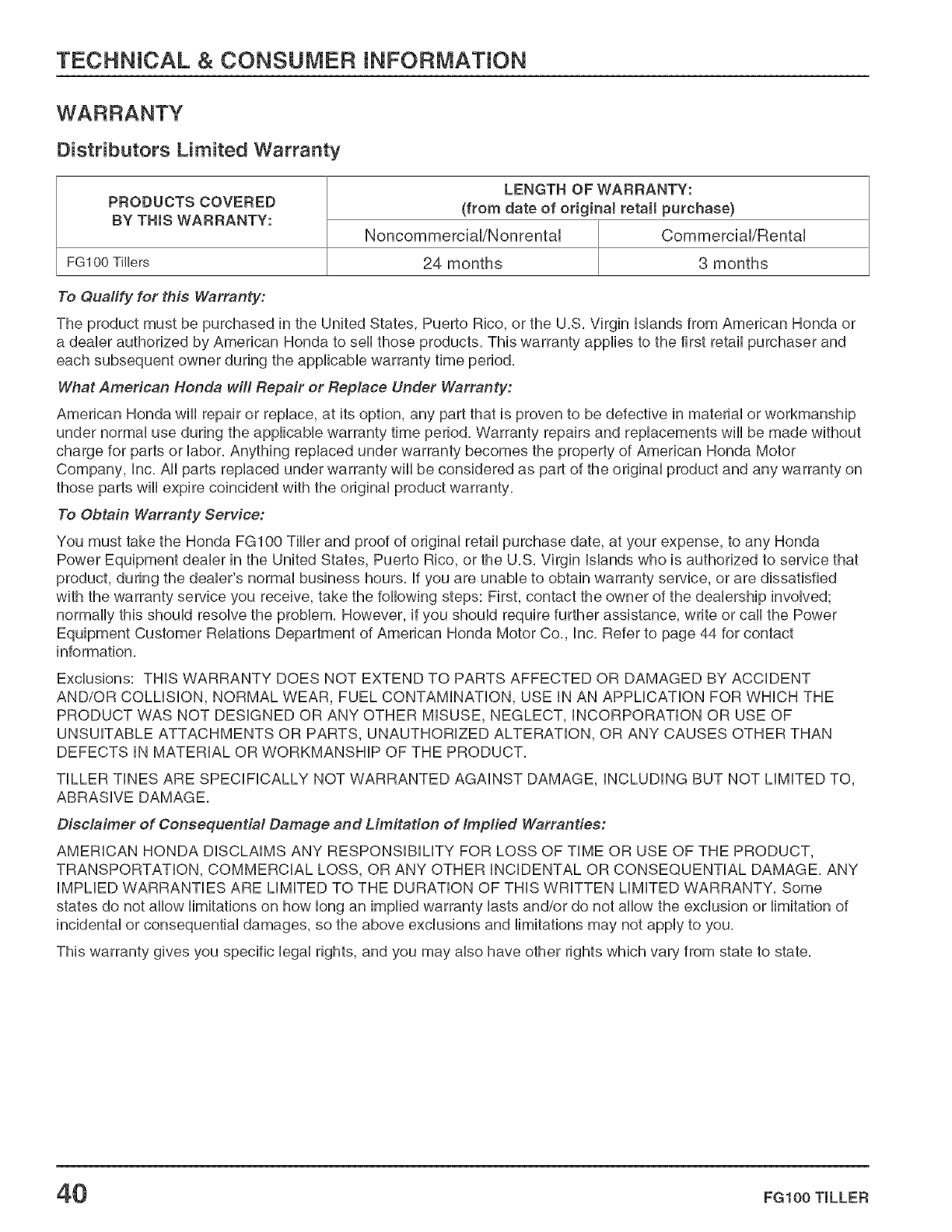
TECHNICAL & CONSUMER iNFORMATiON
Distributors Limited Warranty
PRODUCTS COVERED
BY THINSWARRANTY:
FG100 Tillers
LENGTH OF WARRANTY:
(from date of original retait purchase)
NoncommerciaJ!Nonrental CommerciaJ/Rental
24 months 3 months
To Qualify for this Warranty:
The product must be purchased in the United States, Puerto Rico, or the U,S, Virgin Islands from Amerban Honda or
a dealer authorized by American Honda to sell those products, This warranty applies to the first retail purchaser and
each subsequent owner during the applicable warranty time period,
What American Honda will Repair or Replace Under Warranty:
Amerban Honda will repair or replace, at its option, any part that is proven to be defective in material or workmanship
under normal use during the applicable warranty time period, Warranty repairs and replacements wiii be made without
charge for parts or labor, Anything replaced under warranty becomes the property of American Honda Motor
Company, inc, Aii parts replaced under warranty wiii be considered as part of the original product and any warranty on
those parts wiii expire coincident with the originai product warranty,
To Obtain Warranty Service:
You must take the Honda FG100 Tiller and proof of original retail purchase date, at your expense, to any Honda
Power Equipment dealer in the United States, Puerto Rico, or the U,S, Virgin Islands who is authorized to service that
product, during the dealer's normal business hours, if you are unable to obtain warranty service, or are dissatisfied
with the warranty service you receive, take the following steps: First, contact the owner of the dealership involved;
normally this should resolve the problem, However, if you should require further assistance, write or call the Power
Equipment Customer Relations Department of American Honda Motor Co,, Inc, Refer to page 44 for contact
information,
Exclusions: THiS WARRANTY DOES NOT EXTEND TO PARTS AFFECTED OR DAMAGED BY ACCIDENT
AND/OR COLLiSiON, NORMAL WEAR, FUEL CONTAMiNATiON, USE iN AN APPLiCATiON FOR WHICH THE
PRODUCT WAS NOT DESIGNED OR ANY OTHER MISUSE, NEGLECT, iNCORPORATiON OR USE OF
UNSUITABLE ATTACHMENTS OR PARTS, UNAUTHORIZED ALTERATION, OR ANY CAUSES OTHER THAN
DEFECTS iN MATERIAL OR WORKMANSHIP OF THE PRODUCT,
TILLER TINES ARE SPECiFiCALLY NOT WARRANTED AGAINST DAMAGE, iNCLUDiNG BUT NOT LiMiTED TO,
ABRASIVE DAMAGE,
Disclaimer of Consequential Damage and Limitation of implied Warranties:
AMERICAN HONDA DISCLAIMS ANY RESPONSIBILITY FOR LOSS OF TIME OR USE OF THE PRODUCT,
TRANSPORTATION, COMMERCIAL LOSS, OR ANY OTHER iNCiDENTAL OR CONSEQUENTIAL DAMAGE, ANY
iMPLiED WARRANTIES ARE LiMiTED TO THE DURATION OF THiS WRITTEN LiMiTED WARRANTY, Some
states do not allow limitations on how long an implied warranty lasts and/or do not allow the exclusion or limitation of
incidental or consequential damages, so the above exclusions and limitations may not apply to you,
This warranty gives you specific legal rights, and you may also have other rights which vary from state to state,
40 FGIO0 TILLER
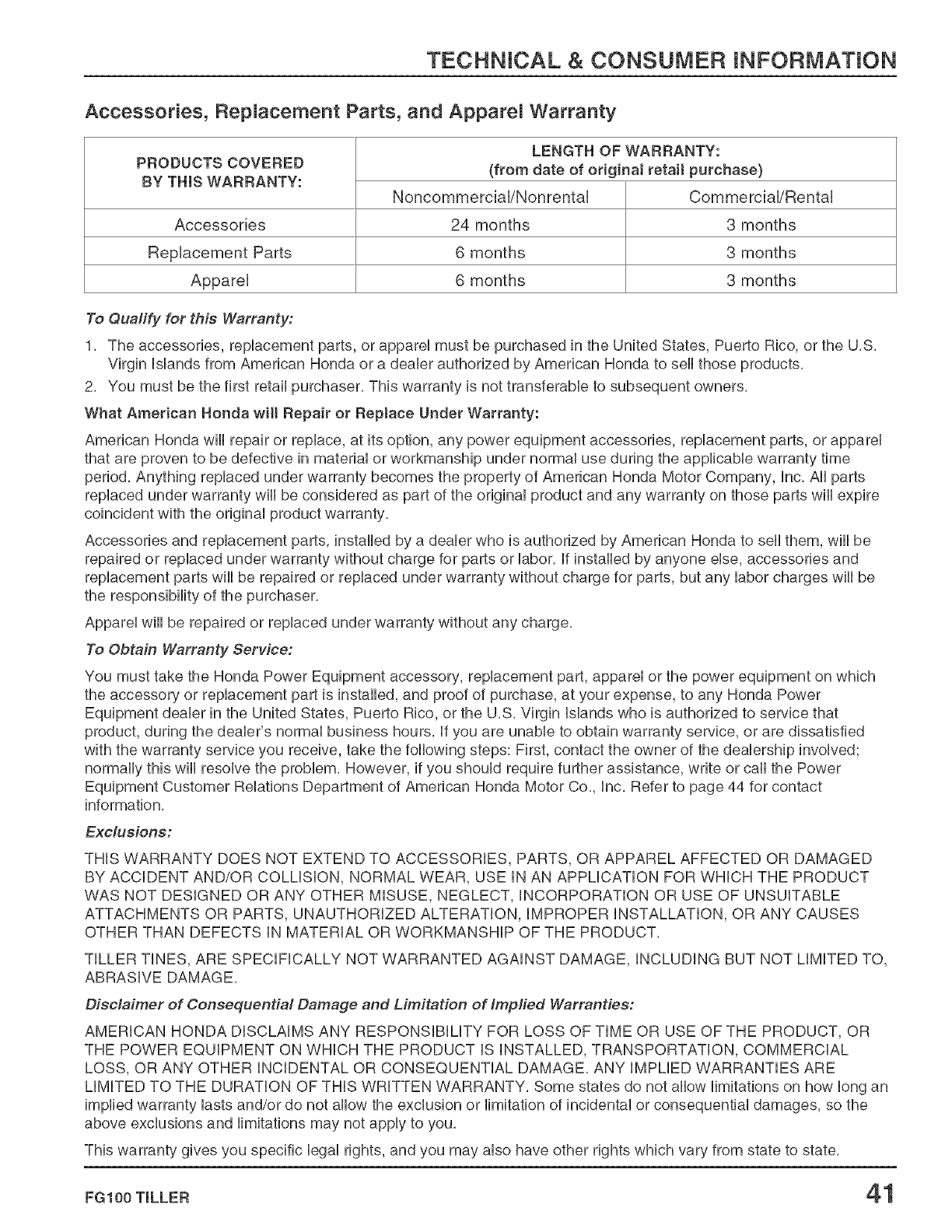
TECHNICAL & CONSUMER iNFORMATiON
Accessories, Repmacement Parts, and Apparem Warranty
LENGTH OF WARRANTY:
(from date of origJnaJ retait purchase)
PRODUCTS COVERED
BY THIS WARRANTY: NoncommerciaVNonrental CommerciaVRental
Accessories 24 months 3 months
RepUacement Parts 6 months 3 months
AppareU 6 months 3 months
To Qualify for this Warranty:
1, The accessories, replacement parts, or apparel must be purchased in the United States, Puerto Rico, or the U,S,
Virgin Islands from American Honda or a deabr authorized by American Honda to sell those products,
2, You must be the first retail purchaser, This warranty is not transferabb to subsequent owners,
What American Honda wit1 Repair or Reptace Under Warranty:
American Honda will repair or replace, at its option, any power equipment accessories, replacement parts, or apparel
that are proven to be defective in material or workmanship under normal use during the applicable warranty time
period, Anything replaced under warranty becomes the property of American Honda Motor Company, Inc, All parts
replaced under warranty will be considered as part of the original product and any warranty on those parts will expire
coincident with the original product warranty,
Accessories and replacement parts, installed by a dealer who is authorized by American Honda to sell them, will be
repaired or replaced under warranty without charge for parts or labor, If installed by anyone else, accessories and
replacement parts will be repaired or replaced under warranty without charge for parts, but any labor charges will be
the responsibility of the purchaser,
Apparel will be repaired or replaced under warranty without any charge,
To Obtain Warranty Service:
You must take the Honda Power Equipment accessory, replacement part, apparel or the power equipment on which
the accessory or replacement part is instalbd, and proof of purchase, at your expense, to any Honda Power
Equipment dealer in the United States, Puerto Rico, or the U,S, Virgin Hands who is authorized to service that
product, during the dealer's normal business hours, If you are unabb to obtain warranty service, or are dissatisfied
with the warranty service you receive, take the following steps: First, contact the owner of the dealership involved;
normally this will resolve the problem, However, if you should require further assistance, write or call the Power
Equipment Customer Relations Department of American Honda Motor Co,, Inc, Refer to page 44 for contact
information,
Exclusions:
THIS WARRANTY DOES NOT EXTEND TO ACCESSORIES, PARTS, OR APPAREL AFFECTED OR DAMAGED
BY ACCIDENT AND/OR COLLISION, NORMAL WEAR, USE IN AN APPLICATION FOR WHICH THE PRODUCT
WAS NOT DESIGNED OR ANY OTHER MISUSE, NEGLECT, INCORPORATION OR USE OF UNSUITABLE
ATTACHMENTS OR PARTS, UNAUTHORIZED ALTERATION, IMPROPER INSTALLATION, OR ANY CAUSES
OTHER THAN DEFECTS IN MATERIAL OR WORKMANSHIP OF THE PRODUCT,
TILLER TINES, ARE SPECiFiCALLY NOT WARRANTED AGAINST DAMAGE, iNCLUDiNG BUT NOT LiMiTED TO,
ABRASIVE DAMAGE,
Disclaimer of Consequential Damage and Limitation of Implied Warranties:
AMERICAN HONDA DiSCLAiMS ANY RESPONSiBiLiTY FOR LOSS OF TiME OR USE OF THE PRODUCT, OR
THE POWER EQUIPMENT ON WHICH THE PRODUCT iS iNSTALLED, TRANSPORTATION, COMMERCIAL
LOSS, OR ANY OTHER iNCiDENTAL OR CONSEQUENTIAL DAMAGE, ANY iMPLiED WARRANTIES ARE
LiMiTED TO THE DURATION OF THiS WRITTEN WARRANTY, Some states do not allow limitations on how long an
implied warranty lasts and/or do not allow the exclusion or limitation of incidental or consequential damages, so the
above exclusions and limitations may not apply to you,
This warranty gives you specific legal rights, and you may also have other rights which vary from state to state,
FGIO0 TroLLER 41
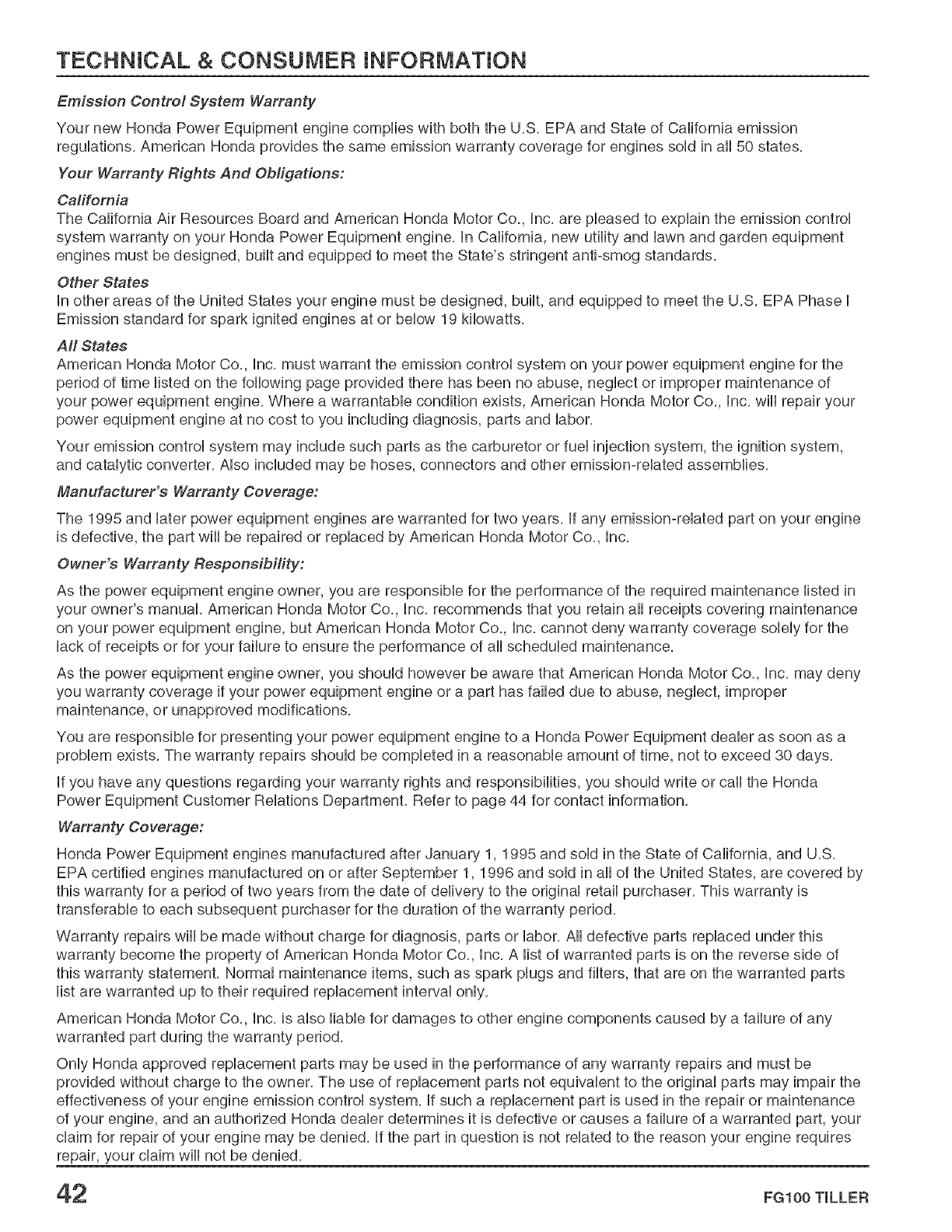
TECHNICAL & CONSUMER iNFORMATiON
Emission Control System Warranty
Your new Honda Power Equipment engine complies with both the U.S. EPA and State of California emission
regulations. American Honda provides the same emission warranty coverage for engines sold in all 50 states.
Your Warranty Rights And Obligations:
California
The California Air Resources Board and American Honda Motor Co., Inc. are pleased to explain the emission contrel
system warranty on your Honda Power Equipment engine, in California, new utility and lawn and garden equipment
engines must be designed, built and equipped to meet the State's stringent anti-smog standards.
Other States
in other areas of the United States your engine must be designed, built, and equipped to meet the U.S. EPA Phase I
Emission standard for spark ignited engines at or below 19 kilowatts.
All States
American Honda Motor Co., inc. must warrant the emission control system on your power equipment engine for the
period of time listed on the following page provided there has been no abuse, neglect or improper maintenance of
your power equipment engine. Where a warrantable condition exists, American Honda Motor Co., inc. wiii repair your
power equipment engine at no cost to you including diagnosis, parts and labor.
Your emission control system may include such parts as the carburetor or fuel injection system, the ignition system,
and catalytic converter. Also included may be hoses, connectors and other emission-related assemblies.
Manufacturer's Warranty Coverage:
The 1995 and later power equipment engines are warranted for two years, if any emission-related part on your engine
is defective, the part wiii be repaired or replaced by American Honda Motor Co., inc.
Owner's Warranty Responsibility:
As the power equipment engine owner, you are responsible for the performance of the required maintenance listed in
your owner's manual. American Honda Motor Co., inc. recommends that you retain aii receipts covering maintenance
on your power equipment engine, but American Honda Motor Co., inc. cannot deny warranty coverage solely for the
lack of receipts or for your failure to ensure the performance of all scheduled maintenance.
As the power equipment engine owner, you should however be aware that American Honda Motor Co., inc. may deny
you warranty coverage if your power equipment engine or a part has failed due to abuse, neglect, improper
maintenance, or unappreved modifications.
You are responsible for presenting your power equipment engine to a Honda Power Equipment dealer as soon as a
problem exists. The warranty repairs should be completed in a reasonable amount of time, not to exceed 30 days.
if you have any questions regarding your warranty rights and responsibilities, you should write or caii the Honda
Power Equipment Customer Relations Department. Refer to page 44 for contact information,
Warranty Coverage:
Honda Power Equipment engines manufactured after January 1, 1995 and sold in the State of California, and U.S.
EPA certified engines manufactured on or after September 1, 1996 and sold in all of the United States, are covered by
this warranty for a period of two years from the date of delivery to the original retail purchaser. This warranty is
transferable to each subsequent purchaser for the duration of the warranty period.
Warranty repairs wiii be made without charge for diagnosis, parts or labor. Aii defective parts replaced under this
warranty become the property of American Honda Motor Co., Inc. A list of warranted parts is on the reverse side of
this warranty statement. Normal maintenance items, such as spark plugs and filters, that are on the warranted parts
list are warranted up to their required replacement interval only.
American Honda Motor Co., inc. is also liable for damages to other engine components caused by a failure of any
warranted part during the warranty period.
Only Honda approved replacement parts may be used in the performance of any warranty repairs and must be
provided without charge to the owner. The use of replacement parts not equivalent to the original parts may impair the
effectiveness of your engine emission control system, if such a replacement part is used in the repair or maintenance
of your engine, and an authorized Honda dealer determines it is defective or causes a failure of a warranted part, your
claim for repair of your engine may be denied, if the part in question is not related to the reason your engine requires
repair, your claim wiii not be denied.
42 FG100 TILLER
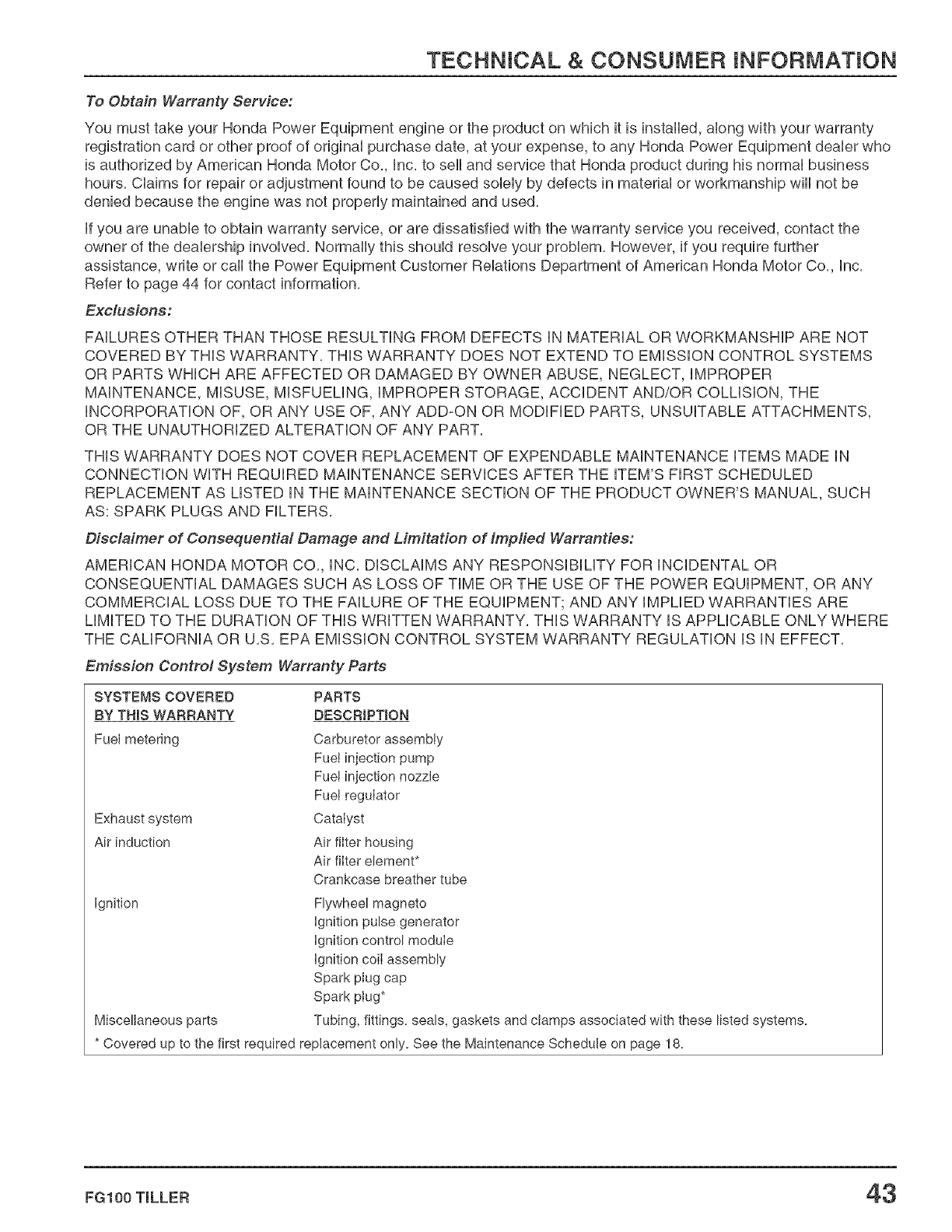
TECHNICAL & CONSUMER iNFORMATiON
To Obtain Warranty Service:
You must take your Honda Power Equipment engine or the product on whbh it is instalbd, along with your warranty
registration card or other proof of original purchase date, at your expense, to any Honda Power Equipment dealer who
is authorized by American Honda Motor Co,, Inc, to sell and service that Honda product during his normal business
hours, Claims for repair or adjustment found to be caused solely by defects in material or workmanship wiii not be
denied because the engine was not preperiy maintained and used,
if you are unable to obtain warranty service, or are dissatisfied with the warranty service you received, contact the
owner of the dealership involved, Normally this should resolve your problem, However, if you require further
assistance, write or call the Power Equipment Customer Relations Department of American Honda Motor Co,, Inc,
Refer to page 44 for contact information,
Exclusions:
FAILURES OTHER THAN THOSE RESULTING FROM DEFECTS iN MATERIAL OR WORKMANSHIP ARE NOT
COVERED BY THiS WARRANTY, THiS WARRANTY DOES NOT EXTEND TO EMiSSiON CONTROL SYSTEMS
OR PARTS WHICH ARE AFFECTED OR DAMAGED BY OWNER ABUSE, NEGLECT, iMPROPER
MAINTENANCE, MISUSE, MiSFUELiNG, iMPROPER STORAGE, ACCIDENT AND/OR COLLiSiON, THE
iNCORPORATiON OF, OR ANY USE OF, ANY ADD-ON OR MODiFiED PARTS, UNSUITABLE ATTACHMENTS,
OR THE UNAUTHORIZED ALTERATION OF ANY PART,
THiS WARRANTY DOES NOT COVER REPLACEMENT OF EXPENDABLE MAINTENANCE iTEMS MADE iN
CONNECTION WiTH REQUIRED MAINTENANCE SERVICES AFTER THE iTEM'S FIRST SCHEDULED
REPLACEMENT AS LISTED iN THE MAINTENANCE SECTION OF THE PRODUCT OWNER'S MANUAL, SUCH
AS: SPARK PLUGS AND FILTERS,
Disclaimer of Consequential Damage and Limitation of kmpfied Warranties:
AMERICAN HONDA MOTOR CO,, iNC, DiSCLAiMS ANY RESPONSiBiLiTY FOR iNCiDENTAL OR
CONSEQUENTIAL DAMAGES SUCH AS LOSS OF TiME OR THE USE OF THE POWER EQUIPMENT, OR ANY
COMMERCIAL LOSS DUE TO THE FAILURE OF THE EQUIPMENT; AND ANY iMPLiED WARRANTIES ARE
LiMiTED TO THE DURATION OF THiS WRITTEN WARRANTY, THiS WARRANTY iS APPLICABLE ONLY WHERE
THE CALiFORNiA OR U,S, EPA EMiSSiON CONTROL SYSTEM WARRANTY REGULATION iS iN EFFECT,
Emission Control System Warranty Parts
SYSTEMS COVERED PARTS
BY THIS WARRANTY DESCRIPTION
Fuel metering Carburetor assembly
Fuel injection pump
Fue! injection nozzle
Fue! reguIator
Exhaust system Catalyst
Air induction Air filter housing
Air filter element*
Crankcase breather tube
ignition Flywheel magneto
ignition pulse generator
ignition control module
ignition coiI assembly
Spark plug cap
Spark piug*
Miscellaneous parts Tubing, fittings, seals, gaskets and clamps associated with these listed systems.
* Covered up to the first required replacement only. See the Maintenance Schedule on page 18.
FGIO0 TILLER 43
TECHNICAL & CONSUMER iNFORMATiON
IVlanual en EspaSol
Una versi6n de este manual en EspaSol esta disponible. Favor de ponerse en contacto con el
departamento de relaci6nes ai ciiente a la direcci6n o tel6fono listado abajo.
WARRANTY SERVICE iNFORMATiON
Honda Power Equipment dealership personnel are trained professionals. They should be able to answer
any question you may have. If you encounter a problem that your dealer does not solve to your
satisfaction, please discuss it with the dealership's management. The Service Manager or General
Manager can help. Almost all problems are solved in this way.
if you are dissatisfied with the decision made by the dealership's management, contact the Honda Power
Equipment Customer Relations Office.
You can write to:
American Honda Motor Co., inc.
Power Equipment Division
Customer Relations Office
4900 Marconi Drive
Alpharetta, GA 30005°8847
Or telephone: (770) 497°6400 weekdays, 8:30 a.m. - 5:00 p.m. EST
When you call or write, please provide us the following information:
Model and serial numbers (tiller and engine)
Name of the dealer who sold you the tiller
Name and address of the dealer who services your tiller
Date of purchase
Your name, address, and telephone number
A detailed description of the problem
44 FG100 TILLER
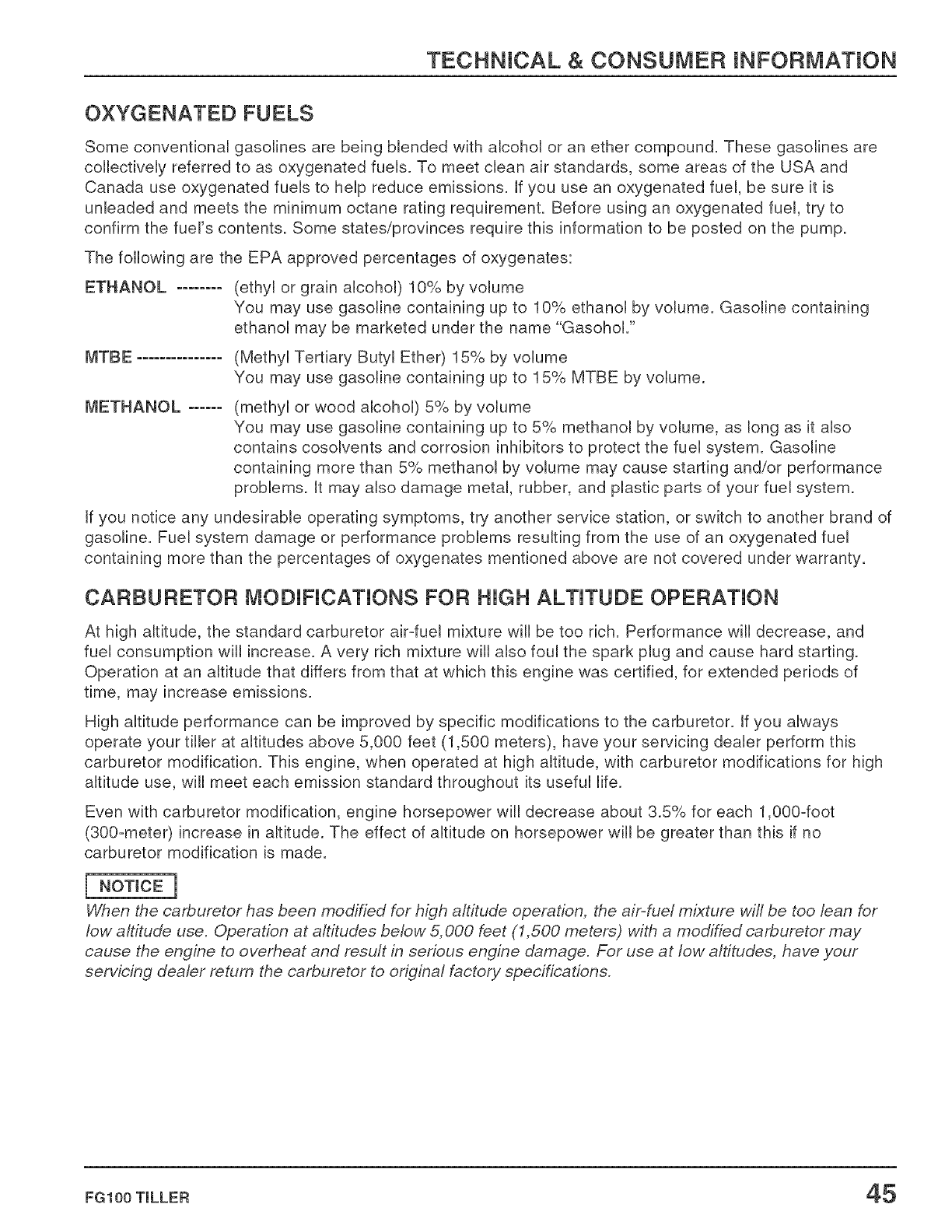
TECHNICAL & CONSUMER iNFORMATiON
OXYGENATED FUELS
Some conventional gasolines are being blended with alcohol or an ether compound. These gasolines are
collectively referred to as oxygenated fuels. To meet clean air standards, some areas of the USA and
Canada use oxygenated fuels to help reduce emissions. If you use an oxygenated fuel, be sure it is
unleaded and meets the minimum octane rating requirement. Before using an oxygenated fuel, try to
confirm the fuel's contents. Some states!provinces require this information to be posted on the pump.
The following are the EPA approved percentages of oxygenates:
ETHANOL ........ (ethyl or grain alcohol) 10% by volume
You may use gasoline containing up to 10% ethanol by volume. Gasoline containing
ethanol may be marketed under the name "GasohoU'
MTBE (Methyl Tertiary Butyl Ether) 15% by volume
You may use gasoline containing up to 15% MTBE by volume.
METHANOL ...... (methyl or wood alcohol) 5% by volume
You may use gasoline containing up to 5% methanol by volume, as long as it also
contains cosoJvents and corrosion inhibkors to protect the fuel system. Gasoline
containing more than 5% methanol by volume may cause starting and/or performance
problems. Jt may also damage metal, rubber, and plastic parts of your fuel system.
If you notice any undesirable operating symptoms, try another service station, or switch to another brand of
gasoline. Fuel system damage or performance problems resulting from the use of an oxygenated fuel
containing more than the percentages of oxygenates mentioned above are not covered under warranty.
CARBURETOR MODiFiCATiONS FOR HiGH ALTITUDE OPERATION
At high altitude, the standard carburetor air-fuel mixture will be too rich. Performance will decrease, and
fuel consumption will increase. A very rich mixture will also foul the spark plug and cause hard starting.
Operation at an altitude that differs from that at which this engine was certified, for extended periods of
time, may increase emissions.
High altitude performance can be improved by specific modifications to the carburetor. If you always
operate your tiller at altitudes above 5,000 feet (1,500 meters), have your servicing dealer perform this
carburetor modification. This engine, when operated at high altitude, with carburetor modifications for high
altitude use, will meet each emission standard throughout its useful life.
Even with carburetor modification, engine horsepower will decrease about 3.5% for each 1,000-foot
(300-meter) increase in altitude. The effect of altitude on horsepower will be greater than this if no
carburetor modification is made.
i NOTICE j
When the carburetor has been modified for high altitude operation, the air-fuel mixture will be too lean for
low altitude use. Operation at altitudes below 5,000 feet (1,500 meters) with a modified carburetor may
cause the engine to overheat and result in serious engine damage. For use at low altitudes, have },our
servicing dealer retum the carburetor to original factor}, specifications.
FG100 TILLER 45
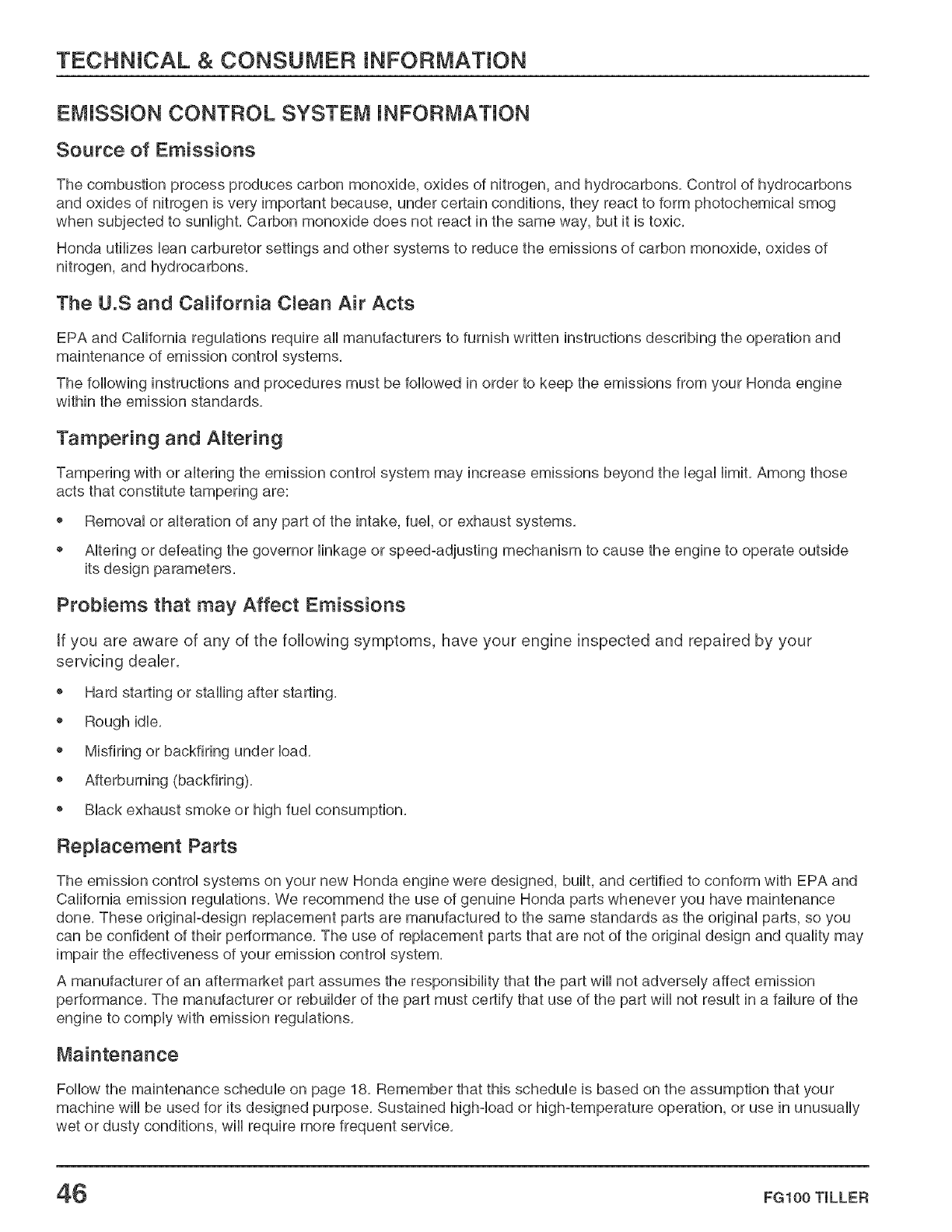
TECHNICAL & CONSUMER iNFORMATiON
EMiSSiON CONTROL SYSTEM iNFORMATiON
Source of Emissions
The combustion process produces carbon monoxide, oxides of nitrogen, and hydrocarbons, Control of hydrocarbons
and oxides of nitrogen is very important because, under certain conditions, they react to form photochemical smog
when subjected to sunlight, Carbon monoxide does not react in the same way, but it is toxic,
Honda utilizes ban carburetor settings and other systems to reduce the emissions of carbon monoxide, oxides of
nitrogen, and hydrocarbons,
The UoS and California Cmean Air Acts
EPA and California regulations require all manufacturers to furnish written instructions describing the operation and
maintenance of emission control systems,
The following instructions and procedures must be followed in order to keep the emissions from your Honda engine
within the emission standards,
Tampering and Amtering
Tampering with or altering the emission control system may increase emissions beyond the legal limit, Among those
acts that constitute tampering are:
o Removal or alteration of any part of the intake, fuel, or exhaust systems,
o Altering or defeating the governor linkage or speed-adjusting mechanism to cause the engine to operate outside
its design parameters,
Probmems that may Affect Emissions
if you are aware of any of the foUlowing symptoms, have your engine inspected and repaired by your
servicing deabr.
o Hard starting or stalling after starting,
o Rough idle,
o Misfiring or backfiring under load,
o Afterbuming (backfiring),
o Black exhaust smoke or high fuel consumption,
Repmacement Parts
The emission control systems on your new Honda engine were designed, built, and certified to conform with EPA and
California emission regulations, We recommend the use of genuine Honda parts whenever you have maintenance
done, These original-design replacement parts are manufactured to the same standards as the original parts, so you
can be confident of their performance, The use of replacement parts that are not of the original design and quality may
impair the effectiveness of your emission control system,
A manufacturer of an aftermarket part assumes the responsibility that the part wiii not adversely affect emission
performance, The manufacturer or rebuilder of the part must certify that use of the part wiii not result in a failure of the
engine to comply with emission regulations,
Maintenance
Follow the maintenance schedule on page 18, Remember that this schedule is based on the assumption that your
machine wiii be used for its designed purpose, Sustained high-load or high-temperature operation, or use in unusually
wet or dusty conditions, will require more frequent service,
46 FG100 TILLER
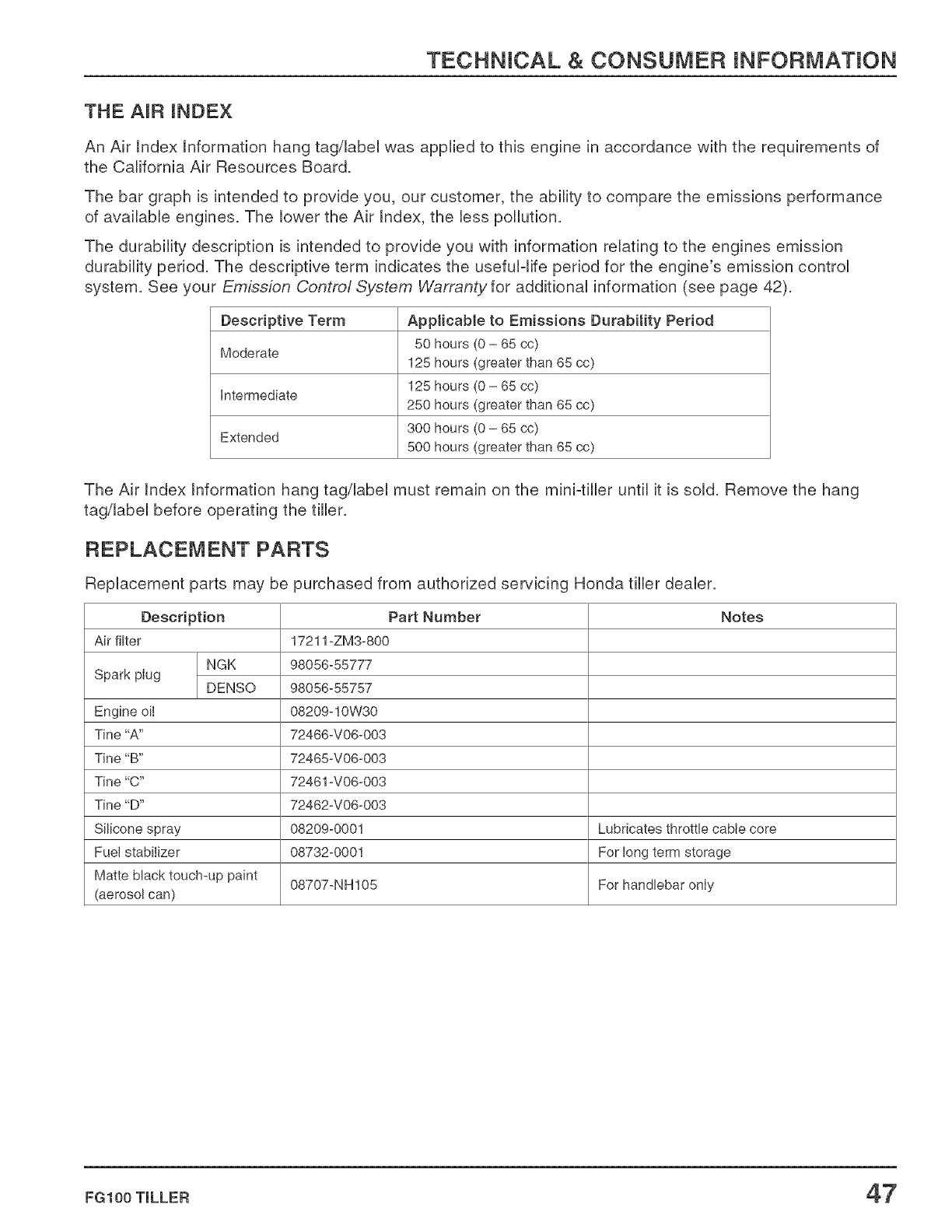
TECHNICAL & CONSUMER iNFORMATiON
THE ARFIRNDE×
An Air Index Information hang tag/labeU was applied to this engine in accordance with the requirements of
the California Air Resources Board.
The bar graph is intended to provide you, our customer, the abilky to compare the emissions performance
of avaiRable engines. The Rower the Air Index, the Ress poUlution.
The durabilky description is intended to provide you with information reUafing to the engines emission
durability period. The descriptive term indicates the usefuU-life period for the engine's emission control
system. See your Emission Contro/System Warranty for additional information (see page 42).
Descriptive Term Applicable to Emissions Durability Period
50 hours (0 - 65 cc)
Moderate 125 hours (greater than 65 cc)
125 hours (0 - 65 cc)
Intermediate 250 hours (greater than 65 cc)
300 hours (0 - 65 cc)
Extended 500 hours (greater than 65 cc)
The Air Index Information hang tag/label must remain on the mini-tiller until it is sold. Remove the hang
tag!label before operating the tiller.
REPLACEMENT PARTS
Replacement parts may be purchased from authorized servicing Honda tiller dealer.
Description Pa_t Number Notes
Air filter 17211 -ZM3-800
NGK 98056-55777
Spark plug DENSO 98056-55757
Engine oil 08209-10W30
Tine "A" 72466-V06-003
Tine "B" 72465-V06-003
Tine "C" 72461 -V06-003
Tine "D" 72462-V06-003
Silicone spray 08209-0001 Lubricates throttle cable core
Fuel stabilizer 08732-0001 For long term storage
Matte black touch-up paint 08707-NH105 For handlebar only
(aerosol can)
FGIO0 TILLER 47
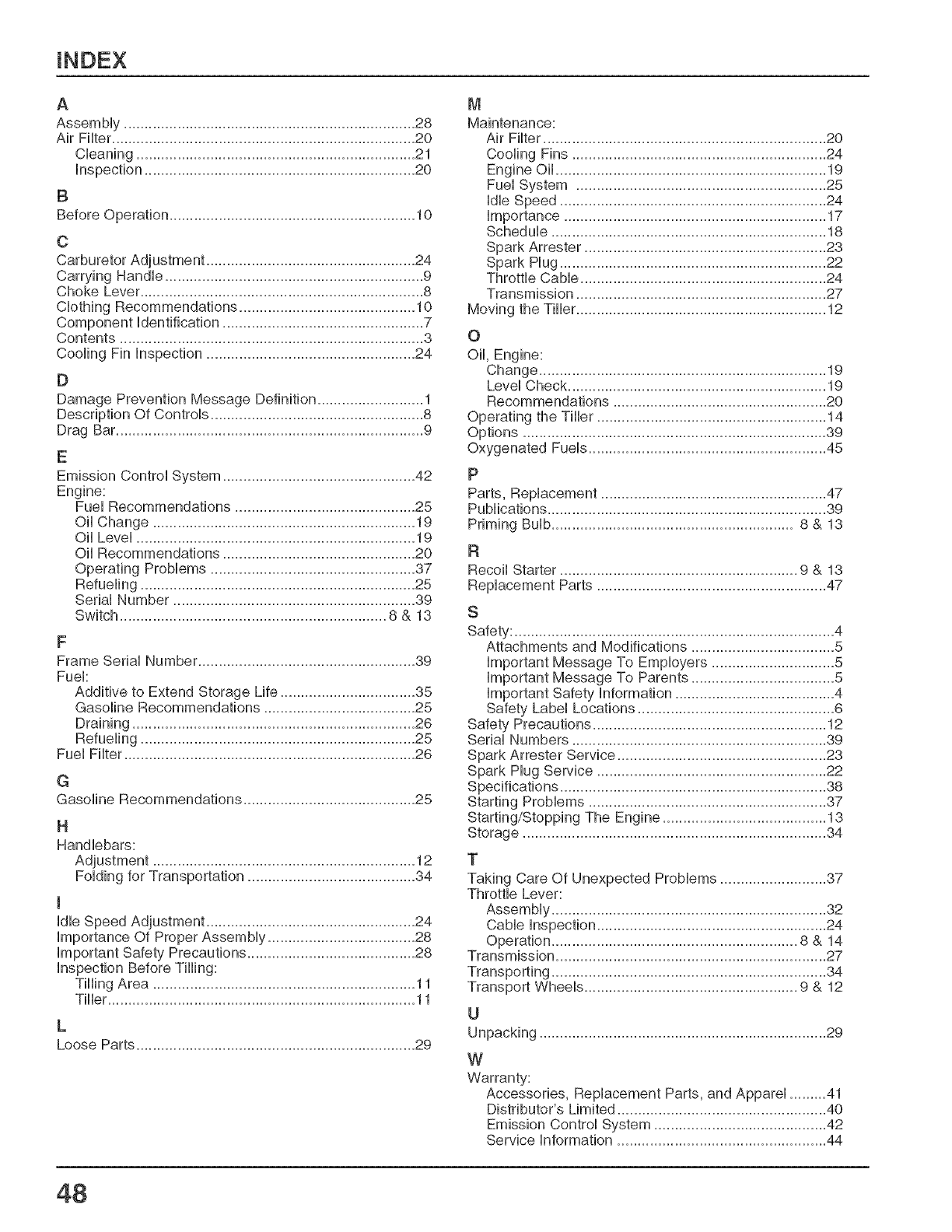
A
Assembly ....................................................................... 28
Air Filter .......................................................................... 20
Gleaning .................................................................... 21
inspection .................................................................. 20
B
Before Operation ............................................................ 10
¢
Carburetor Adjustment ................................................... 24
Carrying Handle ............................................................... 9
Choke Lever .................................................................... 8
Clothing Recommendations ........................................... 10
Component identification ................................................. 7
Contents .......................................................................... 3
Cooling Fin inspection ................................................... 24
D
Damage Prevention Message Definition .......................... 1
Description Of Controls .................................................... 8
Drag Bar ........................................................................... 9
E
Emission Control System ............................................... 42
Engine:
Fuel Recommendations ............................................ 25
Oil Change ................................................................ 19
Oil Level .................................................................... 19
Oil Recommendations ............................................... 20
Operating Problems .................................................. 37
Refueling ................................................................... 25
Serial Number ........................................................... 39
Switch ................................................................. 8 & 13
F
Frame Serial Number ..................................................... 39
Fuel:
Additive to Extend Storage Life ................................. 35
Gasoline Recommendations ..................................... 25
Draining ..................................................................... 26
Refueling ................................................................... 25
Fuel Filter ....................................................................... 26
G
Gasoline Recommendations .......................................... 25
H
Handlebars:
Adjustment ................................................................ 12
Folding for Transportation ......................................... 34
l
Idle Speed Adjustment ................................................... 24
importance Of Proper Assembly .................................... 28
important Safety Precautions ......................................... 28
Tilling Area ................................................................ 11
Tiller ........................................................................... 11
L
Loose Parts .................................................................... 29
M
Maintenance:
Air Filter ..................................................................... 20
Cooling Fins .............................................................. 24
Engine Oil .................................................................. 19
Fuel System ............................................................. 25
Idle Speed ................................................................. 24
importance ................................................................ 17
Schedule ................................................................... 18
Spark Arrester ........................................................... 23
Spark Plug ................................................................. 22
Throttle Cable ............................................................ 24
Transmission ............................................................. 27
Moving the Tiller ............................................................. 12
O
Oil, Engine:
Change ...................................................................... 19
Level Check ............................................................... 19
Recommendations .................................................... 20
Operating the Tiller ........................................................ 14
Options .......................................................................... 39
Oxygenated Fuels .......................................................... 45
P
Parts, Replacement ....................................................... 47
Publications .................................................................... 39
Priming BuD ........................................................... 8 & 13
R
Recoil Starter .......................................................... 9 & 13
Replacement Parts ........................................................ 47
S
Safety: .............................................................................. 4
Attachments and Modifications ................................... 5
important Message To Employers .............................. 5
important Message To Parents ................................... 5
important Safety information ....................................... 4
Safety Label Locations ................................................ 6
Safety Precautions ......................................................... 12
Serial Numbers .............................................................. 39
Spark Attester Service ................................................... 23
Spark Plug Service ........................................................ 22
Specifications ................................................................. 38
Starting Problems .......................................................... 37
Starting/Stopping The Engine ........................................ 13
Storage .......................................................................... 34
T
Taking Care Of Unexpected Problems .......................... 37
Throttle Lever:
Assembly ................................................................... 32
Cable inspection ........................................................ 24
Operation ............................................................ 8 & 14
Transmission .................................................................. 27
Transporting ................................................................... 34
Transport Wheels .................................................... 9 & 12
U
Unpackin 9 ...................................................................... 29
W
Warranty:
Accessories, Replacement Parts, and Apparel ......... 41
Distributor's Limited ................................................... 40
Emission Control System .......................................... 42
Service information ................................................... 44
48
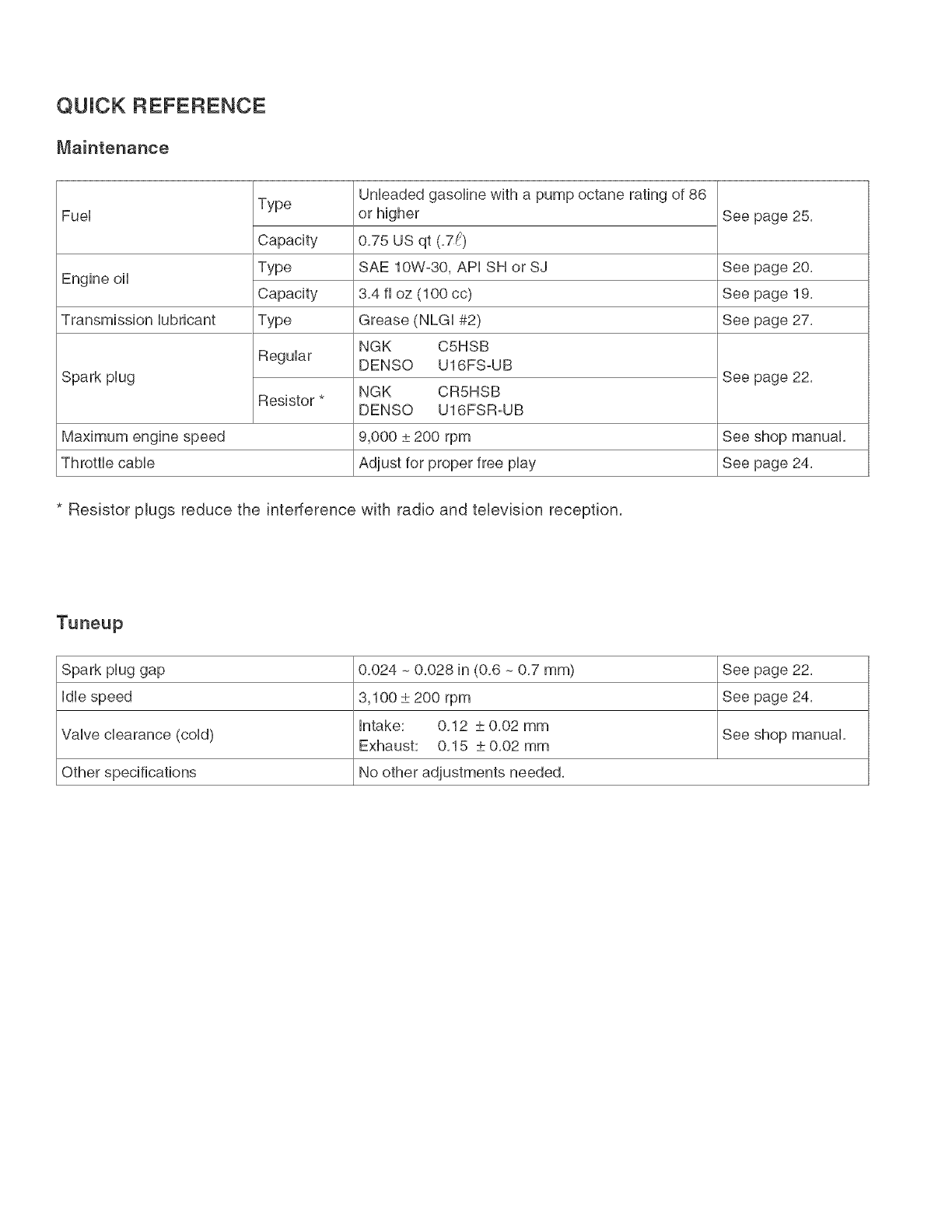
QUICK REFERENCE
Maintenance
Fuel Type Unleaded gasoline with a pump octane rating of 86
or higher See page 25.
Capacity 0.75 US qt (.7{')
Type SAE 10W-30, APISH or SJ See page 20.
Capacity 3.4 fi oz (100 cc) See page 19.
Transmission lubricant Type Grease (NLGi #2) See page 27.
NGK C5HSB
Regular DENSO U16FS°UB
Spark plug See page 22.
NGK CR5HSB
Resistor * DENSO U16FSR-UB
Maximum engine speed 9,000 ± 200 rpm See shop manual.
Throttle cable Adjust for proper free play See page 24.
* Resistor plugs reduce the interference with radio and teUevision reception.
Tuneup
Spark plug gap 0.024 _ 0.028 in (0.6 _-0.7 mm) See page 22.
Idle speed 3,100 ± 200 rpm See page 24.
intake: 0.12 ± 0.02 mm
Valve clearance (cold) See shop manual.
Exhaust: 0.15 ±0.02 mm
Other specifications No other adjustments needed.

The power
31V06622
Printed on
Recycled Paper
POM52753G
45000.2003.10
PRINTED iN U.S.A.
