HONGJIA YUAN COMMUNICATION TECHNOLOGY W003 GSM/GPRS MOBILE PHONE-USB PORTION User Manual W003
SHENZHEN HONGJIA YUAN COMMUNICATION TECHNOLOGY CO.,LTD GSM/GPRS MOBILE PHONE-USB PORTION W003
Users Manual

1
Contents
1 BASIC INFORMATION ..................................................................... 5
1.1 Brief Introduction........................................................................ 4
1.2 Safety Instruction......................................................................... 5
1.3 Safety Alerts and Precaution ...................................................... 5
1.3.1 General Precaution................................................................ 5
1.3.2 Precaution for the use of phone ............................................ 6
1.3.3 Precaution for the use of battery ........................................... 7
1.3.4 Precaution for the use of charger .......................................... 7
1.3.5 Cleaning and maintenance .................................................... 8
1.3.6 Common Precaution.............................................................. 8
2 BEFORE USE....................................................................................... 9
2.1 Name and Description of Individual Part ................................. 9
2.1.1 Technical Parameter .............................................................. 9
2.1.2 Icon........................................................................................ 9
2.2 Keypad Description:.................................................................. 10
2.3 Touch Screen Function Description......................................... 10
2.4 Battery......................................................................................... 10
The disassembly and installation of battery.................................. 10
2.5 Charge for Battery.....................................................................10
2.6 Connecting to network .............................................................. 11
2.6.1 SIM card...............................................................................11
2.6.2 Insertion and Removal of SIM card.................................... 12
2.6.3 Power On and Power Off.................................................... 12
2.6.4 Unlock of SIM card............................................................. 12
2.6.5 Unlock of the phone............................................................ 13
2.6.6 Connecting to Network ....................................................... 13
2.6.7 Dial calls.............................................................................. 13
2.6.8 Dial domestic calls.............................................................. 13
2.6.9 Dial extensions of fixed phones.......................................... 13
2.6.10 Dial international calls ...................................................... 14
2.6.11 Dial Call in the List ........................................................... 14
2.6.12 Emergency Calls ............................................................... 15
2.6.13 Answer Calls ..................................................................... 15
2.6.14 Call Register...................................................................... 15
2.6.15 Call Menu.......................................................................... 15
3 FUNCTION MENU ........................................................................... 17
3.1 Use of Function Menu ...............................................................17
Scroll to select functions.............................................................. 17
Exit from menu ............................................................................ 17
3.2 Structure of Function Menu ..................................................... 17
2
3.3 Phone book ................................................................................. 19
3.4 Message.......................................................................................20
3.4.1 New Message ...................................................................... 20
3.4.2 Create Message ................................................................... 21
3.4.3 View Received Messages and Saved Messages ................. 22
3.4.4 Operations of Common Phrase ........................................... 23
3.4.5 Message Settings................................................................. 23
3.5 MMS............................................................................................ 24
3.6 Chat............................................................................................. 25
3.7 Voice Mailbox............................................................................. 25
3.8 Cell Broadcast ............................................................................ 25
3.9 Call Register............................................................................... 25
3.10 Settings...................................................................................... 27
3.10.1 Touch Screen Calibration:................................................. 27
3.10.2 Phone Settings................................................................... 27
3.10.3 Call Settings ...................................................................... 29
3.10.4 Dual-Card Settings....................................................... 30
3.10.5 Network Settings............................................................... 30
3.10.6 Security Settings ............................................................... 31
3.10.7 Restore Factory Settings ................................................... 32
3.10.8 Sound Effect...................................................................... 32
3.11 Multimedia................................................................................ 32
3.11.1 TV...................................................................................... 32
3.11.2 Functions of TV
3.11.3 Camera .............................................................................. 32
3.11.4 Album................................................................................ 33
3.11.5 Video Camera.................................................................... 33
3.11.6 Video Player ...................................................................... 33
3.11.7 Music Player...................................................................... 34
3.11.8 Audio Recording ............................................................... 35
3.11.9 FM Radio........................................................................... 35
3.11.10 Custom Ring.................................................................... 36
3.11.11 E-book ............................................................................. 37
3.12 File Management .....................................................................37
3.13 Entertainment and Game ....................................................... 37
3.14 Profiles ......................................................................................39
General ......................................................................................... 39
Meeting......................................................................................... 39
Outdoor......................................................................................... 39
Indoor Mode................................................................................. 39
Earphone....................................................................................... 39
Bluetooth ...................................................................................... 39

3
3.15 Toolbox...................................................................................... 39
3.15.1 Calendar ............................................................................ 39
3.15.2 Memo ................................................................................ 40
3.15.3 Alarm Clock ...................................................................... 40
3.15.4 World Time........................................................................ 40
3.15.5 Incoming Call Show.......................................................... 40
3.15.6 Stopwatch.......................................................................... 40
3.16 Network Service....................................................................... 41
3.16.1 STK Service ................................................................... 41
3.16.2 WAP ............................................................................... 41
3.16.3 Account Information ......................................................... 42
3.17 Additional function.................................................................. 42
3.17.1 Calculator ....................................................................... 42
3.17.2 Unit Conversion ............................................................. 43
3.17.3 Exchange Rate Conversion............................................... 43
3.17.4 Bluetooth........................................................................ 43
3.18 Shortcut Function.................................................................... 44
4 INPUT METHOD INSTRUCTION............................................ 44
4.1 Keypad Definitions .................................................................... 45
4.2 Input Method Instruction ......................................................... 45
4.2.1 Smart Pinyin Input Method..............
错误!未定义书签。
4.2.2 Handwriting Input............................................................... 45
5. T-FLASH CARD INTRODUCTION ........................................... 45
5.1 Takedown and installation of T-flash card.............................. 45
5.2 T-flash Card Use ........................................................................ 45
6 COMMON FAULTS AND TROUBLESHOOTING ...................... 46
4
1 Basic Information
1.1 Brief Introduction
Thank you for selecting our GSM/GPRS digital mobile phone. You can
fully understand the usage of this phone and enjoy the sound functions
and simple operation way after reading this manual.
This color screen mobile phone is designed for GSM/GPRS network
environment. Besides basic call functions, it also provides you with
numerous functions, including dual-card mode, Chinese & English input
method, handwriting input, name card holder phone book, personalized
incoming call rings and images, 64 chord music ringtone, SMS and
MMS, chatting, shooting, video camera function, MP3, video player,
audio recording, A8 music box, FM radio, alarm clock, calculator, auto
power On/Off, calendar, stock manager, memo, world time, incoming
call show, T-Flash, GPRS network, STK, keypad lock, etc. Additionally,
it offers personalized human-phone interface and satisfy your different
requirement with sound function design.
This color screen mobile phone conforms to GMS/GPRS technical code
and has passed attestation from authorities at home and abroad.
Some services and functions described in this User Manual depend on
the network and subscribed services. So, not all menus in the phone are
available, and shortcut numbers of menus and functions may be different
due to different phones.
Our company reserves the right to make changes to the manual without
any further notification.
■Radio Frequency (RF) Energy
■The exposure standard for wireless mobile phones employs a unit of
measurement known as the Specific Absorption Rate,or SAR. The SAR
limit setby the FCC is 1.6W/kg.The highest SAR value for the model
phone as reported to the FCC when tested for use at the ear is 0.181
W/kg(1g) and when worn on the body, as described in this user guide, is
1.460W/kg (1g).
■Caution: Changes or modifications not expressly approved by the
manufacturer could void the user’s authority to operate the equipment.
■This device complies with part 15 of the FCC Rules. Operation is
subject to the following two conditions: (1) This device may not cause
harmful interference, and (2) this device must accept any interference
received, including interference that may cause undesired operation.
■NOTE: This equipment has been tested and found to comply with the
limits for a Class B digital device, pursuant to part 15 of the FCC Rules.
These limits are designed to provide reasonable protection against
harmful interference in a residential installation. This equipment
5
generates, uses and can radiate radio frequency energy and, if not
installed and used in accordance with the instructions, may cause
harmful interference to radio communications. However, there is no
guarantee that interference will not occur in a particular installation. If
this equipment does cause harmful interference to radio or television
reception, which can be determined by turning the equipment off and on,
the user is encouraged to try to correct the interference by one or more of
the following measures:
—Reorient or relocate the receiving antenna.
—Increase the separation between the equipment and receiver.
—Connect the equipment into an outlet on a circuit different from that to
which the receiver is connected.
—Consult the dealer or an experienced radio/ TV technician for help.
1.2 Safety Instruction
Please contact Telecom Sector or distribution agency to disable your
phone and SIM card once your phone is lost or stolen, this way, it can
avoid economic loss resulted from that others use your phone.
You’re required to tell IMEI code of the phone (It’s a label at the back
of the phone. You can see it by disassembling battery) when you
contact Telecom Sector or distribution agency. Please write down the
code and keep it in safe for future requirement.
In order to protect your phone against nuisance use, please take some
precautions, for example:
- Set PIN code of the phone and SIM card, and change the
code quickly before others know it.
- Do not put the phone in visible places when you get out of
the car. You’d better carry it with yourself or put it in travel
bag.
- Set call barring.
1.3 Safety Alerts and Precaution
In order to ensure to use the phone safely and correctly, please read the
precautions below carefully before your use.
1.3.1 General Precaution
Your phone is only allowed to use battery and charger approved by
our company, or else it can cause battery leakage, overheat, explosion
and fire.
Do not knock, vibrate or throw the phone heavily to avoid
malfunction and fire.
Do not put the battery, phone and charger to microwave oven or
high-pressure equipment, or else, it can cause such accidents as circuit
damage and fire.
6
Do not use the phone in where combustible and explosive gas exists,
or else it can cause phone malfunction and fire.
Do not put the phone to places with high temperature, high humidity
or heavy dust, or else, it can cause malfunction.
Please keep the phone out of the reach of children to avoid personal
injury as children may consider it as toy.
Do not put the phone on uneven or unsteady platform, or it may drop
and cause failure or damage.
1.3.2 Precaution for the use of phone
Please switch off the phone in hospitals, on the plane or in places
where mobile phone is forbidden, to avoid any interference to the
normal operation of electronic equipment or medical instruments.
Please follow relative regulations in this place when you use the
phone. Please check the Alarm clock Settings and confirm if the
phone will switch on automatically when you are on the plane as the
plane has automatic power on function.
Do not use the phone in places with weak signal or near electronic
equipment with high precision. The interface of radio wave may cause
the fault operation of equipment and other problems. Please be
caution when using the phone near the following equipment: hearing
aids, heart pacemaker, other medical electronic equipment, fire
detector, automatic gate and other automatic control devices. As to the
influence on the heart pacemaker and other medical electronic
equipment, please consult equipment manufacturer or local sales
agent.
Do not knock the liquid crystal display in force or strike something
with the display heavily, or else it can cause the damage of liquid
crystal panel and liquid leakage. There may be in danger of losing the
sight once it contacts with eyes. If in case contact with eyes, flush
with plenty of clean water (do not rub the eyes) immediately and go to
hospital.
Do not disassemble or tamper the phone, or else it can cause damage,
electric leakage and circuit malfunction.
Under too few conditions, the phone may have a bad effect on the
electronic equipment in some model cars. Then, do not use the phone
to avoid the void of warranty.
Do not press the key with sharp things, like needle, pen head, or it
may cause damage or fault operation.
Do not use the phone once the antenna is damaged as it may cause
personal injury.
Keep the phone far away from magnetic objects, the radiation wave
emitted by the phone may clear the information saved in floppy disks,
7
stored-value cards, and credit cards.
Keep some metal pieces, like pin, far away from the handset, the
loudspeaker can emit magnetism and absorb small metal pieces when
working, so it may cause personal injury or damage the phone.
Keep the phone away from exposure to moisture, water or other liquid
can go to the phone and cause it overheat, electric leakage and
malfunction.
1.3.3 Precaution for the use of battery
Do not throw the battery into fire, or it may cause the battery to catch
fire and explosion.
Do not press the battery in force when installing it, or it may cause
battery leakage, overheat, explosion and fire.
Do not cause short circuit to the battery with metal material, like wire,
needle, etc, and do not put the battery with metal pieces, like necklace,
together, as it may cause battery leakage, overheat, explosion and fire.
Do not weld the ends of battery, or else, it may cause leakage,
overheat, explosion and fire.
There may be in danger of losing the sight once the liquid of battery
contacts with eyes. If in case contact with eyes, flush with plenty of
clean water (do not rub the eyes) immediately and go to hospital.
Do not disassemble or tamper the battery, or else it may cause leakage,
overheat, explosion and fire.
Do no use or put the battery near or in places with high temperature,
like fire or heater, or else, it may cause battery leakage, overheat,
explosion and fire.
Once there’re abnormal phenomena, like temperature increasing,
color change, distortion during the usage, charging or save of the
battery, please stop using and replace with new battery.
It may burn the skin once the liquid from battery touches skin or
clothes, please flush with plenty of clean water immediately and go to
hospital at once if necessary.
Please take the battery away from the fire to avoid fire and explosion
once the battery leaks or emits strange smell.
Do not place the battery exposure to moisture, or else it may cause
overheat, fume and corrosion.
Do not use or place the battery direct under sunlight, or in high
temperature places, like near the car, or else, it may cause leakage and
overheat, reduce the performance and shorten the lifetime.
Do not charge the battery for over 24 hours continuously.
1.3.4 Precaution for the use of charger
Please use 220AC. It may cause leakage, fire and damage to the
phone and charger once other voltage is adopted.
8
Do not cause short circuit to the charger, or else it may cause electric
shock, fume and damage to the charger.
Do not use the charger if the power wire is broken, or it may cause
fire and electric shock.
Please remove accumulated dust on the power plug.
Do not put water container next to the charger, as the spilled water
can cause overheat, leakage and malfunction of charger.
Please disconnect the charger with the power to avoid overheat, fire,
electric shock and malfunction in case the charger contacts with water
or other liquid.
Do not disassemble or tamper the charger, or else it may cause
personal injury, electric shock, fire and the damage of charger.
Do not use the charger in places with high humidity, like bathroom, or
else it may cause electric shock, fire and damage of charger.
Do not touch charger, power cord and power plug with wet hand, or it
can cause electric shock.
Do not put heavy objects on power cord or change the power cord, or
it may cause electric shock and fire.
Please unplug the power socket before cleaning and maintenance.
Please hold the charger to unplug the socket, it may damage power
wire and cause electric shock and fire once pulling the power cord.
1.3.5 Cleaning and maintenance
As phone, battery and charger don’t have waterproof function, so do
not use them in places with high humidity, as well as avoid them
being wetted by rain.
Please clean the phone, battery and charger with soft dry cloth.
Never use alcohol, thinner or solutions, like benzene, to wipe the
phone.
Dirty socket can cause poor contact and power down, and even
recharging isn’t available. So, please clean it periodically.
1.3.6 Common Precaution
Mobile Phone:
Please use the phone under the environment with temperature of 5
℃~40℃ and humidity of 35%~85%.
Please use the phone far away from regular telephones, TV sets, radio
sets and office automation equipment, to avoid affecting the normal
use of these equipment and mobile phone.
Battery:
Place the battery in cool and ventilated place without direct sunlight.
The battery has a limited lifetime. The use time of battery will be
shortened progressively due to frequent charging. Once the battery is
out of use after several charging, it means that the lifetime of the
9
battery is over, and you shall replace it with approved model new
battery.
Do not dispose old battery as household waste. Throw it to specified
old battery disposal place and follow stipulated instructions for
disposal.
Charger:
Do not charge under following conditions: places with direct sunlight,
places with ambient temperature less than 5℃ or over 40℃, wet or
dusty place or place with strong vibration (it may cause malfunction);
near electrical appliance (it may affect the effect of image and sound)
like TV set, radio, etc.
2 Before Use
2.1 Name and Description of Individual Part
2.1.1 Technical Parameter
Phone
Model
Size (Length x Wide x Thickness) 116mm×63mm×13mm
Weight: around140g (with one battery)
Lithium battery
Model
Nominal voltage .7V
Limited charge voltage 4.2V
Rated capacity 880mAh
Duration of standby time Around 50 hr – 150hr
Duration of talk time Around 3hr – 5hr
Travel charger
Model
Input 100~240V 50/60Hz 450mA
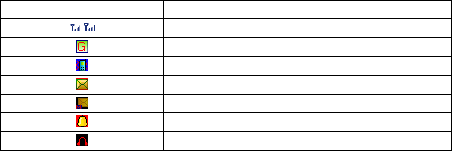
2.1.2 Icon
There may be some icons appearing under standby interface. Please refer
to the following for detailed description:
Icon Description
Represents the strength of network signal.
Represents that you can use GPRS service.
Enable vibration function.
Receive new SMS.
Receive new MMS.
Alarm clock is set to On.
It appears when headset is inserted.

10
Enable call transfer function.
Keypad isn’t unlocked.
Keypad locked.
Indicates battery level.
Indicates missed calls.
Enable chat function.
Enable multi-stopwatch function.
Receive new service message.
Turn on bluetooth handset.
Bluetooth handset pairs successfully.
2.2 Keypad Description:
1.Switch Key: On the top of mobilephone, press this key for a moment
to turn on or turn off the mobilephone.
2. End Key: It’s used to end calls or reject incoming calls. Press this key
to return to standby status under other conditions.
The description of every key and certain functions above depend on
specific models.
2.3 Battery
Battery under original status can be used afar charging by 50% power.
The full performance of a new battery is achieved only after the first
three complete charge and discharge cycles.
The disassembly and installation of battery
Please follow steps below to disassemble the battery: ①Open the
back cover of the phone; ②Remove the battery from left;
Please follow steps below to install the battery: ①Push down the
right end of the battery gently; ②Close the back cover of the phone.
2.4 Charge for Battery
Connect the charger with power.
Insert the end of the charger into the right side of the phone (Note: the
arrowhead shall be upward).
Then, power indication icon on the screen flashes repeatedly. If the
phone is switched off during charging, there is power indication
image on the screen, which means that the battery is under charging.
If the phone is overused under low battery, then charging indication
icon will be displayed after the charging has been done for some time.
If the power indication icon in the upper right corner is fully
displayed without flashing, it means the charging is complete. If the
phone is switched off during charging, there is image to indicate that
the charging is over. This process needs 3 –4 hours. It’s normal that
11
the battery, phone and charger will be heated slightly during charging.
Disconnect the mobile phone and charger with AC electrical plug
once the battery is fully charged.
Note:
Always keep the battery in ventilated place with the temperature from
+5℃ to +40℃ during charging, and make sure to use the charger
provided by manufacturer. It may cause danger once unapproved
charger is used and it may invalidate any approval or warranty.
If the phone switches off automatically or there’s “Low Battery”
displayed on the phone, please charge to the battery as quick as
possible. The phone will reduce charging time automatically if the
battery power isn’t used up before charging.
The duration of standby time and duration of talk time offered by
manufacturer are based on ideal working environment. In actual use,
however, the working time of battery changes based on network
condition, working environment and using way.
g Make sure that the battery is installed properly before charging and
it’s forbidden to remove the battery during charging.
g Please disconnect the charger and phone with power once charging
is over.
g If you don’t disconnect the charger with power and phone, the
phone begins charging again when the power loss reaches certain
extent after overcharging lasts for quite a long time (about 5 – 8
hours). We suggest you don’t do this, as it will influence the
performance and lifetime of the battery
2.5 Connecting to network
2.6.1 SIM card
Make sure that you’ve inserted available SIM card to the phone before
your use. SIM card is the key to enter digital GSM network.
All information related with establishing network connection and calling
record initiate are saved in metal area in SIM card. Meanwhile, there’re
other information saved in the SIM card, including name and phone
number saved in phone book and SMS. The SIM card can be removed
from your phone and inserted to any GSM phone (the new phone will
read SIM card automatically).
Never touch metal area the SIM card to avoid information loss or
damaging the card. Keep SIM card far away from electricity and magnet.
You can’t enter GSM network once the SIM is broken.
Warning: Do switch off the phone before removing SIM card. It’s
forbidden to insert or remove SIM card if the phone is connected to
external power, or else, the SIM card will be damaged.
12
2.6.2 Insertion and Removal of SIM card
SIM card is placed in a card generally, so please take it out carefully
before installing in the phone.
Switch off the phone and remove the battery and other external power.
This phone uses dual-card mode, the place of card A and card B is
decided by options in menu (please refer to “Settings” for “Dual-card
Settings”). Please follow the photo to insert the SIM card to SIM card
holder.
Once you need to remove the SIM card, please switch off the phone
first, disassemble the battery and remove the SIM card from SIM card
holder.
2.6.3 Power On and Power Off
Long press End Key to switch on the phone, and long press End Key to
switch off the phone.
If you switch on the phone and there’s no SIM card, the phone will
prompt you to insert SIM card. The phone will check if the SIM card is
available after SIM card is inserted.
Then, prompts below will appear on the screen on by one:
Enter PIN1——It appears if you’ve set the password of SIM card.
Enter phone password ——It appears if you’ve set password to
lock the phone.
Search for network——The phone will search for network till it
finds proper network.
2.6.4 Unlock of SIM card
SIM card uses PIN1 (personal identity number) code for protection against
unauthorized use. You are required to key in PIN1 code to unlock the SIM
card every time the phone is switched on once your phone enables this
function, then you can make calls or answer incoming calls. Users can also
choose to remove SIM card protection (please refer to Section 3.10.6
Security Settings); in this case, the SIM card can’t be protected against
unauthorized use.
Press End Key to switch on the phone.
Key in PIN1 code, press Right Soft Key to clear incorrect input and
press OK to enter. For example, if PIN1 code is set as 1234, then you
shall key in:
1 2 3 4
If incorrect code is keyed in for three times in succession, SIM card will
be locked. The phone will require you to key in PUK1 code for
unlocking. Please do not key in at random if you don’ know PUK1 code.
You shall send SIM card to network operator for assistance. Please refer
to Section 3.10.6 Security Settings.
Note: Your network supplier will set a standard PIN1 code (4 to 8 digits)
13
for your SIM card. You shall change the code to your personal password
as soon as possible. Please refer to Section 3.10.6 Security Settings for
details.
2.6.5 Unlock of the phone
You can set password protection for your phone against unauthorized use.
You are required to key in PIN1 code (if you’ve set password protection)
to unlock the phone every time the phone is switched on once your pone
enables this function, then you can make calls or answer incoming calls.
Users can also choose to remove password protection (please refer to
Section 3.10.6 Security Settings); in this case, the phone can’t be
protected against unauthorized use.
Key in phone password, press Right Soft Key to clear incorrect input
and press OK to enter. For example, if the phone password is set as
1122, then you shall key in:
1 1 2 2
Please contact your retailer or local authorized maintenance service
center to unlock the phone password once you forget it.
2.6.6 Connecting to Network
The phone will search for available network automatically (Searching
for network is displayed on the screen) once the SIM card is unlocked
successfully. Name of network supplier will appear on the screen once
the phone searches for available network.
Note: If EMERGENCY is displayed on the screen, it means that your
phone is out of the normal network coverage, but you can also make
emergency calls according to the signal strength.
2.6.7 Dial calls
You’re allowed to make calls or answer incoming calls once name of
network supplier appears on the screen. The signal bar in upper left
corner represents the strength of network signal. Moving in a small range
can improve your calling quality as the calling can be interfered by
barriers greatly.
2.6.8 Dial domestic calls
Press number keys to input phone number and press Dial Key to make
calls. Please press Right Soft Key to delete characters once the phone
number needs to be changed. Dialing animation will be displayed on the
screen when dialing. The call status information will be displayed after
the recipient answers the phone. There’s an alert tone when the phone
gets through (it needs network support) if this function is enabled.
Please press End Key to end the call once it’s over.
Zip code Phone number Dial key
2.6.9 Dial extensions of fixed phones
Some extensions of fixed phones can’t be got through, and you shall only
14
dial the telephone exchange, and then dial the extension. The phone can
finish all dialing and dial the extension automatically when you insert
pause character “P” between telephone exchange and extension number.
The way of inputting “P” is to long press * key, then symbol “P” appears
on screen.
Zipcode Telephone exchange P Extension Dial key
Example of the use of pause character:
For example, if there’s a voice mailbox system, which is used through
dialing way in 8880000 number, the number of mailbox is 6666 and the
password is 8888, then you can follow the way below to dial:
8880000 P 6666 P 8888
The first part of this number is used to dial voice mailbox system.
It will send 6666 to select mailbox once the phone is answered.
The second pause character will delay for 5 seconds before
password 8888 is sent out (the former “P” represents to get through, the
latter “P” represents to delay for 5 seconds).
2.6.10 Dial international calls
Long press *key under standby status till prefix symbol “+” appears on
the screen when dialing international calls. It allows you to dial a number
in any country once you don’t know the international prefix symbol (e.g.:
it’s 00 for China).
Key in the country code and complete phone number after prefix symbol
appears. The country codes follow general practices, the country code of
Germany is 49, Britain is 44, Swiss is 46, etc.
“0” before the area code shall be removed before dialing, just as
dialing international calls.
For example, you shall dial like this if you need to dial service
hotline from other countries:
+86 21 114
+ Country code Complete phone number Dial key
2.6.11 Dial Call in the List
Every phone number you dialed and received are saved in a list in the
phone, recent dialed and received phone numbers are placed on the top
of the list (Please refer to Section 3.9 Call Register). Every phone
number is classified based on Dialed Calls, Received Calls and Missed
Calls. The phone also provides you with All Phone Items for you to view
all calling record. Old phone numbers will be deleted automatically once
the phone number list is full Please follow steps below to view the list:
Press Dial Key to view dialed calls records;
All phone numbers in the list can be dialed through Dial Key.
Press Enter to view details after phone number list appears. You can
press Save to store this number to the phone book after entering.
15
2.6.12 Emergency Calls
You can call emergency services if you are within the network coverage
(you can check it by viewing the network signal strength bar in the upper
left corner). If the network supplier doesn’t provide roaming service,
then “EMERGENCY” appears on the screen, which means you can only
call these calls. You can dial emergency calls within the network
coverage even if there’s no SIM card.
2.6.13 Answer Calls
You can press any key to answer the phone once Anykey Answer is set to
on, or you shall press Dial Key or Left Soft Key to enter answer, and
then press Left Soft Key again to speak on the phone. You can also press
the key on the headset to answer calls once the headset is inserted. Hence,
you can set Auto Answer to On once it’s inconvenient for you to press
keys, and the phone answers automatically after vibration & ring or
vibration lasts for 5 seconds once the headset is inserted.
2.6.14 Call Register
The phone saves the record of your last call and call duration since the
phone is used (Please refer to Section 3.9 Call Register).
2.6.15 Call Menu
Press Handsfree to enter handsfree function under call status. You can
press Options to enter call options. The operation way of call options is
the same as the operation way of function menus.
You can see Call Menu only during calling; besides, functions like call
waiting, call transfer and multiparty conversation, need network support.
So, please contact your network supplier.
You can perform following operations under call option menu:
(Note: As to multiparty conference, Card B doesn’t support this
function.)
Pause
Keep current call or restore saved call.
End
End current call.
New Call
Make a call to a new participant.
Phone book
Enter phone book to view.
SMS
Write message and send out the message.
Audio Recording
Record call voice.
Quiet / Restore
Do not send (or send) local voice.
16
Dual Tone Multi Frequency
Press Left Soft Key to open or close dual tone multi frequency.
Handsfree
Enable loudspeaker to amplify call voice.
(Note: For the operations above, card B doesn’t support Pause / New
Call / Audio Recording functions.)
¾ You can perform following operations if there’s incoming
call in card B at the same time:
Answer Card A and Reject Card B
End card B and only answer card A.
Answer Card B and Reject Card A
End card A and only answer card B.
Answer All
Answer current calls in two cards at the same time.
¾ You can perform following operations if there’s incoming
call in card B at the same time:
End Single Line
End current call you choose.
End Call
End current two calls.
Dual Tone Multi Frequency
Press Left Soft Key to turn on or turn off dual tone multi frequency.
17
3 Function Menu
(※ Some part functions below depends on the function support status of
specific phones)
3.1 Use of Function Menu
Scroll to select functions
Select to enter main function menu under standby status;
Press keys or click touch screen to follow prompts to enter
or exit from menu under main menu or submenu.
Exit from menu
Generally, you can exit from some menu items by pressing Right Soft
Key. (If this phone supports touch function, you can use touch pen to
click small icon in the lower right corner to exit from some menu items.)
Press End Key to return o standby interface.
3.2 Structure of Function Menu
The default structure of function menu is as follows after SIM card is
inserted and the phone is power on:
1. Phone Book
1-1 Quick Search 1-2 Search Entry
1-3 Add New Entry 1-4 Copy All
1-5 Delete 1-6 Caller Group
1-6-1 Friends
1-6-2 Family
1-6-3 VIP
1-6-4 Business
1-6-5.Others
1-7 Extra Number
1-8 Settings
1-9 Caller Picture
1-10.Caller Ring Tone
1-11.Caller Video
2.Message
2-1 SMS 2-2 MMS*
2-3 Chat 2-4 Voice Mail Server *
2-5 Broadcast Message*
3. Call Center
3-1 Call History 3-2 General Call Setting
3-1-1 Missed Calls 3-2-1 Call Setup
3-1-2 Dialed Calls 3-2-2 Black List
3-1-3 Received Calls 3-2-3 Auto Redial
3-1-4 Delete Call Register 3-2-4 Speed Dial
3-1-5 Call Time 3-2-5 Call Time Display
3-1-6 Call Costs 3-2-6 Call Time Reminder
18
3-1-7 SMS Counter
3-1-8 GPRS Counter
4. Service
4-1*STK Service (It has something to do with network operator)
4-2 WAP
4-3 Data account
5. Bluetooth
5-1 Power
5-2 Inquiry Audio Device
5-3 My Device
5-4 Active Device
5-5 Setting
5-6 About
6.Fun and Game
6-1 Games
6-2 Motion Game
7. Audio Player
8. Video Player
9. Camera
10. Video Recorder
11. Image Viewer
12. Multimedia
12-1 TV
12-2 Schedule TV Record
12-3 Sound Recorder
12-4 FM Radio
12-5 Schedule FM Record
12-6 E-Book Reader
13. To Do List
14. Stopwatch
14-1.Typical Stopwatch
14-2.nWay Stopwatch
15. Extra
15-1.Unit Ccnverter
15-1.Currency Ccnverter
15-1.Call Secretary
16. World Clock
17. Calendar
18. Shortcuts
19. Settings
19-1. Pen Calibration
19-2. Accelerometer Calibration
19
19-3. Accelerometer Settings
19-4. Rotate Screan Setting
19-5. Phone setup
19-5-1 Time and Date
19-5-2 Schedule Power On /Off
19-5-3 Language
19-5-4 Input Method Choose
19-5-5 Preferred Input Methods
19-5-6 Display Characteristic
19-5-7 Greeting Text
19-5-8 Dedicated Key
19-5-9 Handwriting
19-5-10 Misc Setting
19-6. Network Setup 19-7. Security Setup
19-8. Restore Factory Settings
20. User Profiles
20-1. General 20-2. Meeting
20-3. Out door 20-4. Indoor
20-5. Headset 20-6. Bluetooth
21. Calculator
22. File Manager
23. Dual-Card Settings
24. Alarm
Note: Menu with “*” appears only under certain conditions.
3.3 Phone book
You can use the phone book function to store the name card information
for some important persons, such as name, phone, home phone and
company phone etc. Select the phone book from the main menu, and
enter it.
Note: This phone can store 500 phone numbers.
You can see the following options in the phonebook: quick search, name
search, add number, copy all, delete, caller group, other number, settings,
full screen caller, caller ring and caller film etc.
■ Quick Search: Select this option to enter the phone book browse
interface, it will provide a search input box below the
window, and you can input the relative information here
to take the screening of the phone records. The searching
ways available for selection: 1. Pinyin; 2. Stroke; 3.
English 4. Number.
■ Search Eetry: Find record by name in the phonebook.
■Add New Entry: Add a new phone record in the phonebook, and you
can select the storage way to SIM card or the phone.
20
There is little differentiation in the storage format for
SIM card and the phone.
■ Copy All: Copy all the records in the phone or SIM card, and it can
select copy from the phone to SIM card, or from SIM card
to the phone.
■ Delete: Select this option to delete the phone record; select From SIM
Card to delete all the phone records in SIM card; select
From Phone to delete all the phone records in the phone;
select Delete One by One to delete the phone records one
by one;
■ Caller Group: This phone provides 5 caller groups, you can take the
personalized settings of name changing, ring tone, caller
picture, caller animation and group member for every
group.
■Extra Number: Other numbers stored in SIM card (this phone
number/service number/emergency number). You can
view and change them.
■ Settings: The setting function of the phone book. Which is classified
into three menus: Capacity Inquiry, Storage Location and
Name Card Settings.
Capacity Inquiry: The storage sate of the phone records in SIM card
and the phone.
Storage Position: Select the preferential storage position: phone, card
A and card B.
Name Card Settings: Set the contents including the phone book (10
settings of the home phone, company name and E-mail etc.).
■ Full Screen Caller: Set the image that will display when having
incoming call.
■Caller Ring: Select the ring prompt when having incoming call.
■ Caller Film: Select the film that will display when having incoming
call.
3.4 Message
Select “Message” menu to enter the sub-menu.
If your network supports SMS, you have applied for this service to the
network supplier, then you can receive and send Chinese, English SMS
and MMS by the Short Messaging Service Center.
3.4.1 New Message
When you receive a SMS, the phone will sound the vibration (if it has
been turned on) or the prompt tone (if the prompt tone function has been
turned on), and the screen will display the animation. If you don’t want
to read it immediately, it will display the prompt that have new message
in the standby interface, and will store this message into SIM card
21
automatically.
The number of SMS (including the received and locally stored SMS) that
can be saved in SIM card depends on the capacity of SIM card.
To read the new message, you can take the following operations: enter
the inbox sub-menu, and press OK to read the new SMS.
3.4.2 Create Message
SMS network service allows you to send the text message to the other
phones that can receive message.
Please confirm that you have set the Short Messaging Service Center
Number before creating message (please see “Message Settings”).
Enter Create Message sub-menu to input SMS (please see chapter 4.2
“Instructions on Input Method”).
- Finish: Selecting this option indicates that this message has been
inputted completely, and it can enter the operation of the next
step.
- Common Phrase: Insert the preset common phrases in this
SMS.
- Insert Object: Insert the picture, ring and animation etc. in this
SMS.
- Word Format: Define the word format of this SMS.
- Insert Phone Number: Insert the phone number of the selected
entry in the phone book.
- Insert Name of Phone Book: Insert the name of the selected
entry in the phone book.
- Input Method: Change the input method when editing SMS.
Select Finish after writing, you can use the touch pen to select Card
A Send, Card B Send, Save and Send, Store, Send to Many or
Send by Group by scrolling to send this message to other phone
number.
Card A Send: To send this message, select this option to enter the
inbox edit box, you can touch the number small icon on the lower of
the interface to input number, or press Search to provide the phone book,
select the number of the receiver from the phone book, and press OK to
send.
Card B Send: The same as card A send, and it will send the edited
SMS as the card number of card B here.
Save and Send: Store this SMS into the outbox at the same time of
sending.
Store: Don’t send this SMS and store it into the outbox.
Send to Many: Send this SMS to the multiple phone numbers.
Send by Group: Send a group, and send this SMS to all the
members of this group.
22
Note: The Short Messaging Service Center doesn’t support the
long and short message with over 70 Chinese characters (or 160 English
characters) in some cities and areas.
3.4.3 View Received Messages and Saved Messages
Enter the inbox sub-menu to view the received SMS; enter the outbox
to view the SMS that have been stored in the SIM card.
It will display the message receiving date and time and the number or
name of the receiver when viewing the message list of the inbox
(when the number exists in the phone book).
It can select the previous message or the next message when viewing
the message list.
It can press OK to read the details of the message when appearing the
message list of the inbox. It can take the following operations by
option at this time:
- Reply: Send SMS to the sender of the current SMS.
- Delete: Delete the current SMS.
- Edit: Extract the content of the SMS, and enter the edit box.
- Forward: Forward this SMS.
- Copy to Phone (Copy to SIM Card): Copy the current
SMS on SIM card (or the phone) to the phone (or SIM card)
to store.
- Move to Phone (Move to SIM Card): Move the current
SMS on SIM card (or the phone) to the phone (or SIM card)
to store.
- Chat: Enter the chat room to chat by SMS.
- Delete All: Delete all the SMS in the inbox.
- Copy All: There are two available copy ways of From SIM
Card and From Phone.
- Move All: There are two available copy ways of From SIM
Card and From Phone.
- Use Number: Extract the phone number of the sender of the
SMS, and you can dial it or save it into the phone book.
- Store Items: Extract the object in the SMS to take storage
(only effective for EMS).
It can press OK to read the details of the message when appearing the
message list of the outbox. It can take the following operations by
option at this time:
- Send: Send this SMS. You can select Card A Send, Card B
Send, Send to Many and Send by Group to send this SMS to
many persons.
- Edit: Extract the content of the current SMS to take edit.
- Delete: Delete this SMS.
23
- Copy to Phone (Copy to SIM Card): Copy the current
SMS on SIM card (or the phone) to the phone (or SIM card)
to store.
- Move to Phone (Move to SIM Card): Move the current
SMS on SIM card (or the phone) to the phone (or SIM card)
to store.
- Delete All: Delete all the SMS in the outbox.
- Copy All: There are two available copy ways of From SIM
Card and From Phone.
- Move All: There are two available copy ways of From SIM
Card and From Phone.
- Use Number: Extract the phone number of the receiver of
the SMS, and you can dial it or save it into the phone book.
3.4.4 Operations of Common Phrase
It can write some common sentences in the common phrases, to avoid
inputting repeatedly when sending SMS. You can select to edit or
delete after finishing writing.
3.4.5 Message Settings
You need to take the necessary settings before using the function of
SMS.
Enter the Message Settings sub-menu:
- Mode Setting: Select an appropriate mode for the SMS of
the phone. Enter to the individual mode to take the settings
for the corresponding name, Short Messaging Service Center
Number, effective term and sending format.
- Status Setting: Set whether to turn on the message report or
reply path.
- Capacity Inquiry: View the space occupying state of the
mailbox in SIM card or the phone.
- Storage Location: Select the phone or SIM card.
- Message Transmission Setting: The selections for the SMS
transmission ways: GPRS Priority, GSM Priority and Only
Use GSM.
Set Short Messaging Service Center Number: Please contact your
network supplier to get the number of Short Messaging Service
Center. For example, the one Short Messaging Service Center
Number of China Mobile in Shanghai is +8613800210500. The
detailed operations are: select any mode setting in the Message
Settings sub-menu, input your Short Messaging Service Center
Number in the second item, and press OK to save the settings.
Status Report: If you have set the message report to On, the Short
Messaging Service Center will send the status report back when the
24
receiver has received your SMS or has not received it due to some
reason. You can know whether the receiver has received your SMS
conveniently.
Note: The realization of this function needs to be supported by the
operator.
3.5 MMS
Note: This function is not supported by card B.
■ Create Message: Create a MMS message. You need to fill in
receiver, copy, BCC, subject and content.
■ Inbox: View the received multimedia messages. (The detailed
operations are the same as the ones for the inbox of SMS)
- View: View the current MMS.
- Message Details: View the details of the current MMS.
- Extract Number: Extract the number of the sender (store or dial
it).
- MMS Reply: Send a MMS to the sender of the MMS.
- SMS Reply: Reply the sender in SMS.
- Forward: Forward the current MMS to others.
- Delete: Delete the current MMS.
- Delete All: Delete all the contents in the inbox.
g Outbox: Store the MMS that have not been sent successfully. (The
detailed operations are the same as the ones for the outbox of SMS)
- View: View the current MMS.
- Message Details: View the details of the current MMS.
- Forward: Forward the current MMS to others.
- Send: Continue to send the current MMS.
- Disconnect: Disconnect the MMS that is being sent.
- Delete: Delete the current MMS.
- Delete All: Delete all the contents in the outbox.
g Draft Box: It can save the edited but not sent MMS here.
- View: View the content of the current MMS.
- Message Details: View the details of the current MMS.
- Edit: Edit the current MMS.
- Send: Send the current MMS.
- Delete: Delete the current MMS.
- Delete All: Delete all the contents in the draft box.
g Sent items: Save the messages that have been sent successfully.
- View: View the sent MMS.
- Message Details: View the details of the current MMS.
- Forward: Forward the current MMS to others.
- Delete: Delete the current MMS.
- Delete All: Delete all the contents in the sent items.
25
g Settings: Set the relative parameters of MMS sending and
receiving.
- Sending Setting: Some relative parameter settings on MMS
sending. For example, Within Use Term, Send Report, Read
Report, Priority, Interval and Sending Time etc.
- Receiving Setting: Some relative parameter settings during
MMS receiving. For example, Main Network, Roaming Network,
Send Read Report and Allowed to Send Report etc.
- Filter Setting: Filter some MMS.
- Network Setting: Select the appropriate server.
- Storage Space: View the capacity information of the MMS.
- Storage Setting: The MMS can be stored in the phone or SIM
card.
3.6 Chat
Note: This function is not supported by card B.
■ Chatting Room Setting: Select a chatting room, and set the
nickname and the concerned phone number who will chat with you.
■ Start Chatting: Input the message, and start to chat with the preset
phone number.
3.7 Voice Mailbox
Note: This function is not supported by card B.
Your received voice messages will be stored in the network, and you
must dial the voice mailbox number in order to listen the message.
■ Edit: You can add/edit the voice mailbox number, so that it will
be more convenient when using the function of the voice
mailbox.
Connect to Voice: Call the set voice mailbox number, and listen the
message.
3.8 Cell Broadcast
Note: This function is not supported by card B.
■ Receiving Way: Select to turn on the receiving mode, and turn off
rejecting receiving the messages of the cell broadcast.
■ Read Message: Enter this menu to read your tailored cell broadcast
message.
■ Language: Set the language in receiving cell broadcast.
■ Channel Setting: Set the channel of the cell broadcast.
Note: The services for the cell broadcast and the voice mailbox are
provided by the operator, please contact your operator.
3.9 Call Register
■ Missed Calls, press OK to view the list on the missed calls.
■ Dialed Calls, press OK to view the list on the dialed calls.
■ Received Calls, press OK to view the list on the received calls.
26
In the interfaces of the lists on the missed calls, dialed calls and received
calls, you can press OK to view the details of this record, including date,
dialing time, number and dialing number.
In the details interface, you can take the following operations for the
currently selected phone record by option:
Delete Delete this record.
Save Save this number into SIM card or the phone.
Dial Dial this phone number.
Card B Dial Dial this number by using card B.
Send Message Send message to this number.
Send Message by Card B Use the number of card B to
send message to this number.
IP Dial by Card A Use the IP number of card A
to dial this number.
IP Dial by Card B Use the IP number of card B
to dial this number.
Edit Edit this phone number and save it into the phone
book.
Send MMS: Send MMS to this number.
Note: Press OK to realize the functions of IP dial by card
A and card B directly in the lists on the received
calls, dialed calls and missed calls.
■ Delete Call Register
There are 4 sub-menus in Delete Call Register: Missed Calls, Dialed
Calls, Received Calls and Delete All.
The user can select to clear a certain call list, and select Delete All to
delete all the record lists in the call register.
■ Call Duration
There are 4 sub-menus in Call Duration: Last Call Duration, Dialed
Calls’ Duration and Received Calls’ Duration and Clear Timers.
Last Call Duration View the duration value of the last call.
Dialed Calls’ Duration View the total duration value of the dialed
calls.
Received Calls’ Duration View the total duration value of the
received calls.
Clear Timers Clear the data in the timing statistics, and
start to time again.
■ Call Costs
It can store the accumulated cost of the calls by Call Costs.
Last Call Cost
Enter the Last Call Cost sub-menu, and view the last call cost.
27
Cost Summary
Enter the Cost Summary sub-menu, and view the accumulated call costs.
Clear Cost
Input PIN2 code to clear the cost calculator, and start to cost again.
Charge Restriction
Enter the Charge Restriction sub-menu to view, change or cancel this
function. It needs to input PIN2 code for changing and canceling
functions.
Price and Cost Rate
Enter the Price and Cost Rate sub-menu to view, change or cancel this
function. It needs to input PIN2 code for changing and canceling
functions.
Note: You need to input PIN2 code for some operations, please
contact your network supplier to get this password.
■ Message Counter
Sent: Record the number of the sent messages.
Received: Record the number of the received messages.
You can select to reset by the left soft key to clear the two items
respectively.
■ GPRS Counter
Note: This function is not supported by card B.
Last Transmit: Record the byte number of the last transmission. 。
Last Receive: Record the byte number of the last receiving.
Transmit All: Record the total transmitted byte number.
Receive All: Record the total received byte number.
Clear Counter: Start to count again.
3.10 Settings
3.10.1 Touch Screen Calibration:
It will be more accurate when using the touch pen by calibrating the
touch screen.
3.10.2 Phone Settings
g Time and Date: Set time and date.
- Set City: Select a city for the time setting of this phone.
- Time/Date Settings: Set the current time and date.
- Format Settings: Set the display format of the time and date,
12-hour or 24-hour.
g Auto Power On/Off: Set the time, and the phone will switch on
or off automatically when reaching to the set time.
g Language: Set the language in displaying the phone menus.
g Preset Input Method: Select a default input method.
g Standby Menu Display:
- Wallpaper: Select the wallpaper of the standby interface.
28
- Screen Protection: Select a screen protection picture for the
standby interface of the main screen, and set the waiting time.
- On Animation: It can select the picture of On animation.
- Off Animation: It can select the picture of Off animation.
- Display Date and Time: Select to turn on or off Display the
current time in the standby interface.
- Display My Phone Number:
Note: This function is not supported by card B.
- Select to turn on or off Display my phone number in the standby
interface.
- Clock Type: It can select the clock type displaying in the
standby interface.
g Welcome Note: Display the welcome note during the On
animation. Select Off to not display it.
g Speed Dial:
Note: This function is not supported by card B.
Set the speed dial. In the standby interface, long press the
corresponding number keys to call the set phone number.
g Specify Function Key: Specify the functions of the upper, lower,
left and right arrow keys in the standby interface.
g Auto-Update of Time: Select to turn on or off Auto-Update of
Time of the phone.
g Flight Mode: Include Normal Mode, Flight Mode and Ask
when Switching on.
About Flight Mode: Flight mode is used to close the phone
communication function, that it cannot receive, dial call and send
message, has no signal connection with the base station, and doesn’t
attempt to contact the base station.
The phone will turn off all the relative functions on the signal in the
mode, but it can still continue to use the other functions when switching
on the phone, for example, view the phone book, enjoy the articles and
films on the phone etc.
Note: Because now the civil aviation authority has not issued the
regulations on “Flight Mode”, the passenger shall still switch off the
phone before going on broad according to the related regulations on the
airplane; in the normal states (such night), it can switch to this mode,
and save power – because the signal consumes most power of the phone,
and it can save power greatly for switching off signal in the flight mode.
g Handwriting Settings: Set the handwriting speed and the color
of the handwriting pen.
g Other Settings: Take settings for LCD brightness and delay
time.
29
g Power Saving Mode: Turn on or off it.
3.10.3 Call Settings
g Phone Number
Note: This function is not supported by card B.
- System Preset: Whether the number sending uses the system
default value.
- Hide Number: The other party will not see the number when
you calling. (Needed to be supported by the operator)
- Send Number: The other party can see the number when you
calling.
g Call Waiting:
Note: This function is not supported by card B.
Turn on or off the call waiting function. Select View to view the
current call waiting status.
g Call Transfer:
Note: This function is not by card B.
- Unconditional Transfer: After turning on Unconditional
Transfer, and the incoming calls in any state will be transferred
to your set number.
- Transfer if unreachable: After turning on Transfer if not
unreachable, and the phone will transfer the incoming call to
your set number when the other party cannot contact you.
- Transfer on no answer: After turning on Transfer on no answer,
and the phone will transfer the incoming call to your set number
when no answer.
- Transfer on busy: After turning on Transfer on busy, and the
phone will transfer the incoming all to your set number when
busy.
- Transfer all data calls: When the incoming call is a data call,
and the phone will transfer it automatically.
- Cancel Transfer: Cancel all the call transfer.
g Call Barring:
Note: This function is not supported by card B.
Take restriction for dialing calls.
- Outgoing Calls Barring: Restrict the outgoing calls.
- Incoming Calls Barring: Restrict the incoming calls.
- Cancel Barring: Cancel the set barring (required to input
the password).
- Change Password: Change the password.
g Line Switch:
Note: Card B is only available for line 1.
Select line 1 or line 2.
30
g Call Duration Prompt:
Note: This function is not supported by card B.
The phone will sound the prompt tone when reaching to the time
after setting the frequency.
g Call Duration Display: Display the call duration, select “Off’
will not display the call duration.
g Auto Redial
Note: This function is not supported by card B.
The phone will redial automatically for every unsuccessful calling
after turning on Auto Redial.
g Turn off Group: Turn off the group function.
g IP Dial: Set and turn on this item, and it can realize the IP dial
function by the number records in the phone book.
g Blacklist: The numbers listed in the blacklist will be shielded.
Note: Some functions need to be supported by the network operator.
3.10.4 Dual-Card Settings
g Auto Turning on Card B: Select to turn on or off the
functions of card B.
(For example “On”, when the phone is on, which will turn on
card B if you have inserted it in the location of card B).
g Turn on/off Card B: Select to turn on or off the functions of
card B.
(For example “Off”, when the phone is on, which will not display
card B even if you have inserted it in the location of card A, and the
realized functions are the same as the ones of one card (card A)).
Note: If you only use one SIM card, please insert the holder of card
A preferentially, to ensure you can enjoy the individual functions of
this phone completely; if you set the SIM card into the holder of card
B (in the state of not inserting the card in the holder of card A), the
phone will be unable to identify SIM card, so that you shall consider
using the holder of card A first. If you need to exchange the main
card and card B, please exchange the locations of the dual cards
when the phone is off and there is no external power supply.
3.10.5 Network Settings
Note: This function is not supported by card B.
g Network Selection:
- Re-search: Register the network again after pressing OK.
- Select Network: Select the network to register in the
network list.
- Searching Way:
Auto: Search the network that SIM card belongs to
automatically.
31
Manual: Search all the available networks to register
manually.
g Preferential Network: Pre-store several favorite networks.
g GPRS Connection: Connecting ways of GPRS: Connection
As Require and Permanent Connection
3.10.6 Security Settings
g SIM Lock:
Note: This function is not supported by card B.
You can set the security options of the phone under this menu, to avoid
the phone or SIM card from being used illegally.
- PIN Code
PIN code can prevent your SIM card from being used illegally.
- If PIN code is off currently, select On to turn on the PIN code
protection, and the phone will ask you PIN code when switching
on next time; if PIN code is on currently, select Off to turn off
the PIN code protection, select Change PIN Code to set the new
PIN code, please input the old PIN code, new PIN code and
repeatedly input the new PIN code in turn according to the
prompt.
Note: If the PIN code has been consecutively inputted for three times,
SIM card will be locked. At this point, you must unlock SIM card using
PUK code. The PIN code and PUK code may be supplied with SIM card
to you. If not, please contact the network operator. The default PIN code
is 1234. Please change it to your own password as soon as possible.
g Phone Lock
The phone lock can prevent your mobile phone used by the other without
your permission.
Select Phone Lock to turn on the phone password protection, and the
phone will ask you the phone password when switching on next time;
press it again to turn off the phone password protection.
Note: The default phone lock password is 1122, and you shall change it
to your own password as soon as possible.
g Keypad Lock: Set the waiting time of the keypad lock. The
keypad will be locked automatically if the phone has not been used
within the specified time in the standby status after being set.
g Fixed Dialing:
Note: This function is not supported by card B.
If your SIM card supports the fixed supporting, it can limit the phone to
only dial the selected phone numbers. When this function is on, it can
only dial the phone numbers in the fixed dialing list or the ones starting
with some numbers in the list.
Enter the “Fixed Dialing” sub-menu:
32
- Mode: Turn on or off the fixed dialing function (required
to input the PIN code).
- Fixed Dialing List: Input the phone numbers for fixed
dialing,
Note: Turning the Fixed Dialing function on or off requires you to input
PIN2 code. Please contact the network operator to obtain PIN2 code.
After the Fixed Dialing is on, the numbers in the Fixed Dialing will be
displayed after entering the name card holder phonebook.
g Prohibit Dialing:
Note: This function is not supported by card B.
Opposite with the fixed dialing, and you can set Prohibit Dialing
for some phone numbers here.
g Change Password: Change the password. Including the
changes on PIN, PIN2 and the phone password.
Note: Some functions need to be supported by your network operator.
3.10.7 Restore Factory Settings
The default password of restore factory settings is 1122.
3.10.8 Sound Effect
Adjust the effect of the sound play. The audio equalizers available for
selection: Normal, Bass, Dance, Classical, High, Banquet, Pop and
Rock.
3.11 Multimedia
The functions including in this item are: A8 Music Box, Camera,
Album, Video Camera, Animation Player, Music Player, Recording,
Custom Ring and E-book.
3.11.1 TV
3.11.2 Functions of TV
3.11.3 Camera
Your phone has been equipped with the function of camera, and you can
press the small shooting icon in the central on the lower of the screen to
shoot. Press the individual small icons in the view finding interface of
shooting to set the following, such as shooting size, photo quality,
shooting mode, continuous shooting setting, delay shoot and special
effect setting etc. You can also enter the settings of the relative items by
option.
Enter the following by option:
- To Album: Enter the album.
- Camera Settings: Settings for some relative parameters on
shooting
- Scence Switch: Switch between scene 1 and scene 2.
- Photo Settings: Settings of photo size and photo quality.
- White Balance: It can set the color of the illumination for
33
the photo.
- Profile Mode: It can set the shooting mode.
- Special Effect Settings: Set the style of view finding.
- Frame: Select a picture box for the photo.
- Storage Path: Select to store the photo into the phone or the
memory card.
- Restore Default Settings: Set it to Restore to Default
Settings.
Note: In the view finding interface of shooting, press the corresponding
number keys to take the settings for the appropriate image effect, and can
also touch the certain position on the touch screen to take settings.
3.11.4 Album
Enter the album to take the settings for the photo, such as browse, send,
delete and rename etc.
3.11.5 Video Camera
Your phone provides the function of the video recording, select the Video
Camera menu to enter it, and press Rocker key to enter the recording.
Note: For the models supporting the touch screen function, pressing the
red round button on the lower of the screen to realize recording. Press
keys to adjust the brightness of the recording, and press keys to
adjust the focus of the recording.
Enter the following by option:
- To Player: Select this menu to enter the video player, and it
can play the just recorded video.
- Video Camera Settings: Select this menu to enter the
settings of some relative parameters of the video camera.
- Film Settings: The settings of the relative parameters of film
size, format and recording time etc.
- Scene Switch: Switch scene 1 or scene 2.
- Special Effect Settings: You can select a special effect for
this recording.
- Storage Path: Select to store into the phone or the memory
card.
- Restore Default Settings: Restore all the settings to the
default values.
Note: In the recording interface, press the corresponding number keys to
take the settings for the appropriate image effect.
3.11.6 Video Player
Enter the video play.
Enter the following by option.
Noun Explanation:
Play: Play the currently selected file.
34
Transmit: Transmit the currently selected file (can be transmitted to
the phone book, E-book).
Rename: Change the name of the currently selected file.
Delete: Delete the currently selected file.
Delete All Files: Delete all the current archives.
Sorting: Sort the archives (by name, type, time, size or no).
Storage Path: View the storage location of the file (can be stored into
the phone or the memory card).
Note: The default file name of the video player is Video (the phone or
the memory card).
3.11.7 Music Player
Select Music Player to enter the mp3 play interface. The functions of the
individual keys are as following:
Upper Key: Play/pause the current music.
Lower Key: Stop playing.
Left Key: Select the previous song.
Right Key: Select the next song.
The words displaying on the lower side of the music player screen: List
and Back. It can also select “Option” under the list to enter the functions
of Play, View Details, Add into Ring Library and Settings etc.
Noun Explanation:
Play: Play the currently selected song.
Details: View the details of the song.
Add into Ring Library: Set the current song into the ring store.
Update Play List: Update the music in the ring library.
Note: It can realize the following functions for the models
supporting the touch screen function:
- Instructions on Touch Keys: “+” and “-”symbols
indicate the volume up and volume down.
- ► and Pressing the two symbols indicates that turn
on/off the music player and pause.
- ■ Pressing this symbol indicates that replay the
music.
- and Press the two symbols to switch to the previous
song and the next song respectively.
- Settings: Take the settings for the multimedia play.
- 1. List: The phone space or the memory card space.
2. Auto Generating List: Select to turn on or off.
3. Replay: Turn on this option to replay song.
4. Random: Turn on this option, and the songs will
play at random.
5. Background Play: Turn on this option, and the
35
music will not stop with the menu exit.
6. Equalizer: Turn on this option, and it can switch
among the music effects.
7. Energy Display Style: Turn on this option, and it can
display the energy style in mp3 play.
8.Lyric Display: It will display lyric when playing
mp3 after turning on this option, and it will not display the lyric if
turning off it.
Note: The default file name of the music player is My music (the
phone or the memory card).
3.11.8 Audio Recording
Select this option to take audio recording. Select the following options to
enter:
- Audio Recording: Record a new voice.
- Play: Play the currently selected audio recording.
- Annex: Annex a new audio recording on the base of the
original not audio recording.
- Rename: Change the name of the current audio recording
file.
- Delete: Delete the current audio recording file.
- Delete All: Delete all the audio recording files.
- Settings: Set the audio recording format.
- Send: Send the current audio recording to the profile mode
or MMS or bluetooth.
3.11.9 FM Radio
It can use the FM radio only after inserting the handset.
Enter the FM Radio play interface, and it will display the following
words on the lower side of the FM radio screen: Option and Back.
Select “Option” to enter the functions of Channel List, Manual Input,
Auto Search and Set and Settings.
Noun Explanation:
Channel List: Channel list of the FM radio, press “Option” key
to Edit and Play the current channel. (It can save up to 30 channels at
most).
Manual Input: You can input any favorite channel of the FM
radio.
Auto Search and Set: Select this option to search channel
automatically and generate the list.
- Instructions on Icon Function:
- Instructions on the five icons from the left to right:
- Search:Search channel (press Upper Negation key to switch
start or stop searching)
36
- The second icon: Enter the Setting Menu List.
- and Press the two icons to automatically search to the
previous channel and the next channel (it can also use the left
and right navigation keys to switch among channels).
- The fifth small icon: Press this icon to play or pause the FM
radio (Note: pressing the navigation keys can also realize this
function).
- “+” and “-” Symbols: It can volume up and down by using
them.
Settings: Take settings for the FM radio.
- 1. Background Play: Select to turn it on or off,
and the music will not stop with the menu exit after
turning on this option.
2. Appearance: Select the appearance
background when playing FM radio.
3. Phone Loudspeaker: The FM radio can play
outwards by the loudspeaker after turning on this
option.
Note: Press the appropriate number keys in the FM radio interface to
enter the corresponding channel.
3.11.10 Custom Ring
Select Add to enter the ring edit interface, press the number keys to edit
ring, and it can also click Insert on the soft keypad to insert the music
notation, click Edit to edit the ring, and click Play to listen the edited
ring.
Click Option in the custom ring edit interface to enter the settings of
Play, Play Speed, Select Instrument and Storage.
Noun Explanation:
- Play: Play the currently edited bass.
- Play Speed: Select the speed when playing (Fast, General
and Slow).
- Select Instrument: Select an instrument to edit ring.
Press “Option” to enter the following after saving the custom ring:
- Play: Play the currently selected ring.
- Edit: Edit the current ring.
- Add: Add a customed ring again.
- Rename: Change the name of the current ring file.
- Delete: Delete the currently customed ring.
- Delete All Files: Delete all the customed rings.
- Send: Send the ring to Profile Mode, MMS, SMS and
Bluetooth.
37
3.11.11 E-book
The storage location of E-book file is the memory card, and you need to
download by USB data line. You can store E-book into the folder name
“eBook”, and it needs to create a file folder named as “eBook” if there is
no folder in the memory card.
Enter the E-book cabinet list to select “Option”:
- On: It can read the content of E-book.
- Update: Update the E-book list.
- Settings: It can take the settings for the page display of
E-book (including: font, font style, volume page, speed, full
speed, encoding way and storage settings etc.).
- Details: View the details of the current E-book. 。
- Delete: Delete the current E-book.
- Delete All: Delete all the contents in the E-book cabinet list.
- Sorting: Sort the E-book list (by name, type, time and size,
or not sort).
- Restore Default Settings: Restore the previous settings to
the default values.
- Help: Prompt the help information!
Note: Enter the E-book list, and press the corresponding number keys
to set (it can also use the touch pen to click the soft keypad to set).
3.12 File Management
Store the files stored by user (the phone or the memory card). Enter the
options of the folder:
- On: Display the content of this folder.
- Create Material Folder: Create the new material folder in
the folder.
- Formatting: Format this folder.
3.13 Entertainment and Game
Entertainment Bible: This item provides the relative value-added
services. For the detailed information of this function, please contact the
network operator.
Mobile Phone QQ: The operations are the same as those for Tencent
QQ.
Game Player Simulator: This phone supports the simulating game, and
this function can be operated by the handle.
Instructions on Game Menu:
- Game List:
Display all the files with the extension name is *.nes stored onto T-flash
card.
- More Games:
It can download *.nes applications and other games by wap web page
38
etc.
- Game Settings:
Display Settings: Display the angle of the screen when playing
game (0°, 90°and 270°)
Sound Settings: It can simulate the game volume by this setting.
Key Settings: The users can custom the keys in operating the
simulating games by this setting.
Network Settings: Whether to download. CMWAP gateway
proxy or use CMNET dialing under the more game menus, the
fees for the two ways are not identical. The supports in the
different areas are not same. It needs to consult the local Mobile
operator.
About Game: Here provides the operating instructions on the
simulating game.
Notes on Using this Game:
1. Game Placement Path:
The game running requires the external storage card
(such as T-flash card etc.). If there is no T-flash card, it
cannot enter the simulating game.
It shall place the game file *.nes under Game of
T-flash card, otherwise, it will prompt that not find game.
2. Supporting Type of Game:
It supports the files with the extension name is *.nes,
that FC simulator, or called as NES simulator.
The size of the game file shall not exceed 500K due
to the small memory, and it cannot load the running.
Some games with less than 300K may not be loaded
due to the game compatibility.
3. Game Source:
The user can download his own favorite NES games
from Internet, and copy them under game directory
of the phone to play.
Game: This phone provides two games: Bejeweled and Linklink.
Game Settings:
- Game Sound Effect: Turn it on or off.
- Game Vibration: Turn it on or off.
Subject: Three background colors available for selection: Amber
Orange, Sapphire and Techno-gray. When moving the selection bar to
the appropriate menu, and you can preview it. Enter the following
options:
39
- On: Apply the selected background color.
- Update Frequency: It will use the several background
colors in turn within the corresponding time after being set
frequency.
- Set Sequence: Set the sequence when changing the
background color in turn.
3.14 Profiles
The user can select the different profiles, meanwhile, and can custom
them. This phone provides 6 profiles: General, Meeting, Outdoor,
Indoor, Earphone and Bluetooth.
General
Here you can select to turn on or off your personal settings.
g On Select Activate to enter the general environment.
g Personalize Select Personalize to custom the general mode. The
operating contents include: ring tone settings, volume, ringing way, ring
type, prompt tone and answering mode.
Meeting
The operations are the same as those for General.
Outdoor
The operations are the same as those for General.
Indoor Mode
The operations are the same as those for General.
Earphone
The phone will turn on this mode automatically when inserting the
earphone. The operations for Personalize are the same as those for
General.
Bluetooth
Open the bluetooth earphone and activate the bluetooth of the phone at
the same time, and it will turn on this mode automatically. The
operations for Personalize are the same as those for General.
3.15 Toolbox
This phone provides Calendar, Memo, Alarm Clock, World Time,
Incoming Call Show and Stopwatch,
3.15.1 Calendar
Enter the Schedule Management sub-menu, and press OK to display
date.
Touch the left and right arrow keys on the upper side of the touch screen
to select date and month. Pressing the arrow keys directly can also
realize this function.
Enter the following sub-menus by option:
■ Schedule: Create a schedule. Add an alarm remind for it.
40
You can select any one from the five options of Once,
Everyday, Custom, Every week and Every month.
- Once: Indicate that this schedule will be reminded once.
- Everyday: Indicate that this schedule will be reminded at the
set moment every day.
- Custom: Set the ringing time of the alarm clock within one
week.
- Every week: Indicate that this schedule will be reminded at
the set moment every week.
- Every month: Indicate that this schedule will be reminded at
the set moment every month.
■ Skip to the Specified Date: Skip from the current date of
the schedule to the specified date.
■ Lunar Calendar: Turn on or off the lunar calendar
display.
3.15.2 Memo
This phone can store up to 50 memo messages. Select the memo in the
sub-menu, and you can take the following operations for the memo:
Browse, Add, Edit, Delete Record, Delete All and Send Schedule.
3.15.3 Alarm Clock
This phone can set 5 alarm clocks. Select one alarm clock, and you can
edit and set it.
3.15.4 World Time
Touch the screen to select the corresponding times of the individual
countries in the world, and press Option to turn on or off Start Daylight
Saving Time in other cities.
3.15.5 Incoming Call Show
Input the number to be inquired, and the phone will display where the
number belongs to; it will also display the belonging place of the number
in the incoming call interface.
3.15.6 Stopwatch
Realize the functions of the stopwatch:
- General Stopwatch:
General stopwatch is classified into Split Timing and Lap
Timing, press the left soft key to start/stop timing, and press
the right soft key to take split timing.
Ì Split Timing: It will not clear the time after recording
the next record for the split recording, which is
applicable for recording the test performance with not
over 20 persons (for example, 1000m test for one class).
Ì Lap Timing: It will clear the time after recording the
next record for the lap timing, which is applicable for
41
recording the performance per lap for one person (such
as professional athlete) who is running by lap with long
distance, and cannot be over 20 laps at most.
Ì View Record: View the saved records in splitting timing
and lap timing.
- Multi-stopwatch: The multi-stopwatch has 4 directions,
which is controlled by pressing the up, down, left and right
arrow keys respectively.
Note: Method for clearing stopwatch: First pause the running
stopwatch, long press the left key, and it can clear it to zero;
3.16 Network Service
3.16.1 STK Service
Note: Card B doesn’t support this function.
This function including brand value-added service of Monternet, M-zone
and global surf is supplied by network supplier. This function can’t be
used if the SIM card and the network supplier don’t support this service.
Please contact your network supplier for more information.
port of network operator. Please contact your network supplier for more
information.
3.16.2 WAP
Note: Card B doesn’t support this function.
Your phone supports the service on the base of WAP. You can access the
service your network operator supports. You can get the information of
news, weather forecast, scheduled flight and so on through this service
function list.
Note: GPRS service needs network support, it can only be
used after being activated and when it is at the cover area of GPRS
network.
- Home: log in home. The Home is WAP station you set in the
enabled connection settings. The station preset by the
manufacturer will be used if you haven’t set.
- Bookmark: display each existing bookmark. You can
directly link to its corresponding website after selecting one.
- Link: selecting this option you can input any WAP or other
websites.
- Website history: the websites you have accessed before this
record.
- Settings: set loading internet view.
Network settings: select setting groups of service.
Color settings: set the color of character and
background color when viewing
42
websites.
Senior settings: there are three detailed options
of Cache settings, Cookie settings
and display settings.
- Service inbox: used to store the messages that service
supplier sends.
3.16.3 Account Information
Note: Card B doesn’t support this function.
- GSM data:
Select one account to enter:
1. Name: the name of this account. You can select edit
to change it.
2. Number: the number of this account.
3. User account: the account of dial dial-up server not
WAP ga t ew a y.
4. Password: the password of dial-up server not WAP
gateway.
5. Line: select line type by analog or figure.
6. Speed: select proper transmission speed.
7. Network domain: IP address.
- GPRS data:
Select one account to enter:
1. Name: the name of the account. You can select
edit to change it.
2. GPRS connection point: input APN.
3. User account: the account of dial dial-up server not
WAP ga t ew a y.
4. Password: the password of dial-up server not WAP
gateway.
5. Authorization mode: select the cipher mode of the
authorization.
3.17 Additional function
3.17.1 Calculator
Your phone supplies you a calculator with four basic functions
with which you can do simple calculation.
Select one the options of calculator and press OK to enter.
- Input the figures to be calculated in the interface at the
touchable screen.
- Or input figures by 0-9 numeric keys.
- Press the right soft key to clear latest input or result one by
one and press the right soft key to exit the calculator and
press the left soft key to confirm the calculation result.
43
Note: please understand us for the rounding error for a limited
precision of the calculator.
3.17.2 Unit Conversion
Your phone offers you unit conversion function with which you
can converse the units including weight units and length units
conveniently
- Weight: there are two kinds of weight unit
conversions including kilogram <-> pound
and kilogram <-> ounce. Input the figures to
be conversed in the corresponding edit box
and press left soft key to confirm, then the
value you want will be displayed in another
edit box.
- Length: there are four kinds of length unit
conversion including kilometer< ->mile,
meter < ->yard, meter < ->feet and
centimeter <->inch. Input the figures to be
conversed in the corresponding edit box and
press left soft key to confirm, then the value
you want will be displayed in another edit
box.
3.17.3 Exchange Rate Conversion
To carry put exchange rate conversion, you should input exchange
rate first and then input native or foreign monetary value and press left
soft key to confirm, then the value you want will be displayed in another
edit box.
3.17.4 Bluetooth
- Activate blue tooth:
You can activate or close blue tooth function through this
switch.
- Search handsfree device: the phone can automatically search
handsfree devices with this function. (Generally, the default
password of bluetooth is 0000, please see instruction of bluetooth
headset)
- My Device: Bluetooth device can be searched out automatically
through new device, and its name can be displayed on the screen of the
phone, then you can do suited settings as the prompt.
- Online settings: menu settings after bluetooth is successfully
connected.
- Settings:
This phone can be searched: other bluetooth devices can search out
44
this phone after this function is on which it can’t be
searched by other bluetooth devices when this function
is off.
Name of this device: the name of this phone can be defined.
Authorization requirements: it will prompt to input bluetooth
password when this phone is searched if this option is
on, while it prompt nothing when this phone is searched
if this option is off.
(1) Hold in the phone: the communication can only be carried out by
phone not bluetooth if this option is selected.
(2) Transfer to handsfree device: the communication can only be
carried out by the bluetooth not the phone if this option
is selected.
File transmission settings:
(1) Share contents: select the path to share the files.
(2) Contents authority: set the transmission authority.
- My bluetooth: the information about bluetooth will be displayed
after bluetooth is activated.
3.18 Shortcut Function
You can set the shortcut function you like in this function.
This phone offers shortcut functions. Select Shortcut to enter the
settings of shortcut function after opening main menu. The settings
method is as follows: select one piece of shortcut function in the main
interface of shortcut function, and press the left soft key to enter edit
(create, edit, delete, delete all and so on), then press the left soft key to
confirm, then the settings of this piece of shortcut function is finished.
Use shortcut function:
Select settings, phone settings and specified function key in turn, set
the function of one arrow key (up key) as shortcut function, and select
OK.
At standby state, press the up key (the arrow key that have been set with
shortcut function) to enter Shortcut. Select corresponding shortcut
function to enter it directly.
4 Input Method Instruction
This phone supports Chinese simplified input method. The input
methods supplied to you include English input method (capital case and
lower case letter), number input method, Pinyin input method, smart
Pinyin, stroke input and punctuation mark (common punctuation marks)
input method.
The functions permit to input characters in the phone are:
- inputting and editing SMS;
- inputting and editing names in phone book.
45
- looking for the name of telephone number.
- self defining welcome notes and name of phone
owner.
- recording names in tool box.
4.1 Keypad Definitions
Common keypad definitions are as follows. Please refer to section
4.2 input method instruction for detailed keypad definitions at input
method status.
Left soft key usually indicates confirmation while right soft key
usually denotes deleting one character.
# key: you can switch among different input method through this
key.
* key: symbol input can be called out by this key.
Numeric keys (1-9) represent the pinyin letter on them at Pinyin
input state, while they represent the letters on them at English input
method.
4.2 Input Method Instruction
4.2.1 Handwriting Input
Please use the attached touch pen to write characters at the place the
phone prompts you to input at character input function. Click the middle
at the bottom of the screen by touch pen to switch input methods. ABC
represents capital input method, abc represents lower case input method,
123 represents number input method and Pinyin represents pinyin input
method. Error characters can be cleared by right soft key or the touch
pen. This phone supports continuous stroke input.
5. T-flash card Introduction
This phone supports the storage function of T-Flash card and its
expanded storage function space. The detailed operations are as follows:
5.1 Takedown and installation of T-flash card
T-flash card in this phone is under the battery. Insert it as the mark on
it. Please open the card buckle first before pulling out the cared then take
T-flash card out.
Note: this phone supports plug & play function. While it is
recommended to restart the phone after inserting or taking out T-flash
card at power on state to play the information normally.
It is recommended not to take out or insert T-flash in general condition.
5.2 T-flash Card Use
As one of the memorizers in the phone, T-flash card is set as the default
memorizer. You can use it without doing any settings.
T-flash card is used as the memorizer of the phone: You should set the
default memorizers of music player, video player, video recorder, camera
46
and recorder as memory card for the first time to insert T-flash card, then
you can use the memory and the content of T-flash card. (the
corresponding settings methods have been mentioned in the aforesaid
functions.)
T-flash card is used as U disk: the data in the computer can be directly
copied after USB data line is connected. Please refer to the use of U disk
for detailed used methods.
6 Common Faults and Troubleshooting
Please remove the faults the phone happens as the following table
47
Common
fault
Reason Troubleshooting
Using phone in poor
reception area such as the
vicinity of high-rise buildings
or basement where the radio
wave can’t reach.
To avoid it as possible as
you can.
Using phone in the time of
dense communication such as
work began time and closing
time when the line is in
congestion and results in
failure of communication.
To avoid it as possible as
you can.
Poor
reception
It may be resulted by the
distance with network
emission base station.
To require your network
service suppler to supply
service area map
It is resulted by poor network
trunk line, which is a
territorial problem.
Echo or
noise
The communication line in
some area is poor.
Redial after ending up, the
trunk line may change a
better line.
The standby time is related
with network system settings.
The phone is at poor
reception area, please power
off it for a while.
It is necessary to change
battery.
Change new battery.
Short
standby
time
The phone will continue to
emit to search base station if
it can’t receive signal, and
then large number of
electricity will be consumed,
which short the standby time.
Please move to the area with
strong signal or power off
the phone for a while.
The phone
can’t be
powered on
The electricity in the battery
is run out.
View the electricity or
charge it.
The SIM card is damaged. Please contact your network
supplier.
The SIM card is not installed
in normal state.
Please make sure the SIM
card has been installed
normally.
SIM card is
wrong
There is dirty on the metal Clean the metal contact
48
surface of the SIM card. point of the SIM card with
clean cloth.
The SIM card is invalid. Please contact your network
supplier.
Your phone is beyond GSM
service area.
Please inquiry your network
supplier for service area.
It can’t
connect the
network.
The signal is poor. Please retry in the area with
strong signal.
Call barring function is
enabled.
Disable call barring. Calls can’t
be dialed
out. Fixed dialing function is
enabled.
Disable fixed dialing
function.
PIN error PIN code is wrongly input for
three times continuously.
Please contact your network
supplier.
The battery or charger is
damaged.
Change new battery or
charger.
It is charged in the
environment with temperature
lower than -10℃ or higher
than 55℃.
Change charge
environment.
It can’t be
charged.
It is not contacted well. Check whether the plug is
connected correctly.
New name
can’t be
added in the
phone book.
The phone book is full. Delete some records in the
phone book.
Some
function
can’t be set
Your network supplier doesn’t
support this function or you
haven’t apply it.
Please contact your network
supplier.