Hiro H50296 300Mbps Wireless N PCI-E Adapter User Manual HIRO Wireless PCI E WLAN Adapter QIG

Hiro Inc. 300Mbps Wireless N PCI-E Adapter HIRO Wireless PCI E WLAN Adapter QIG

User Manual

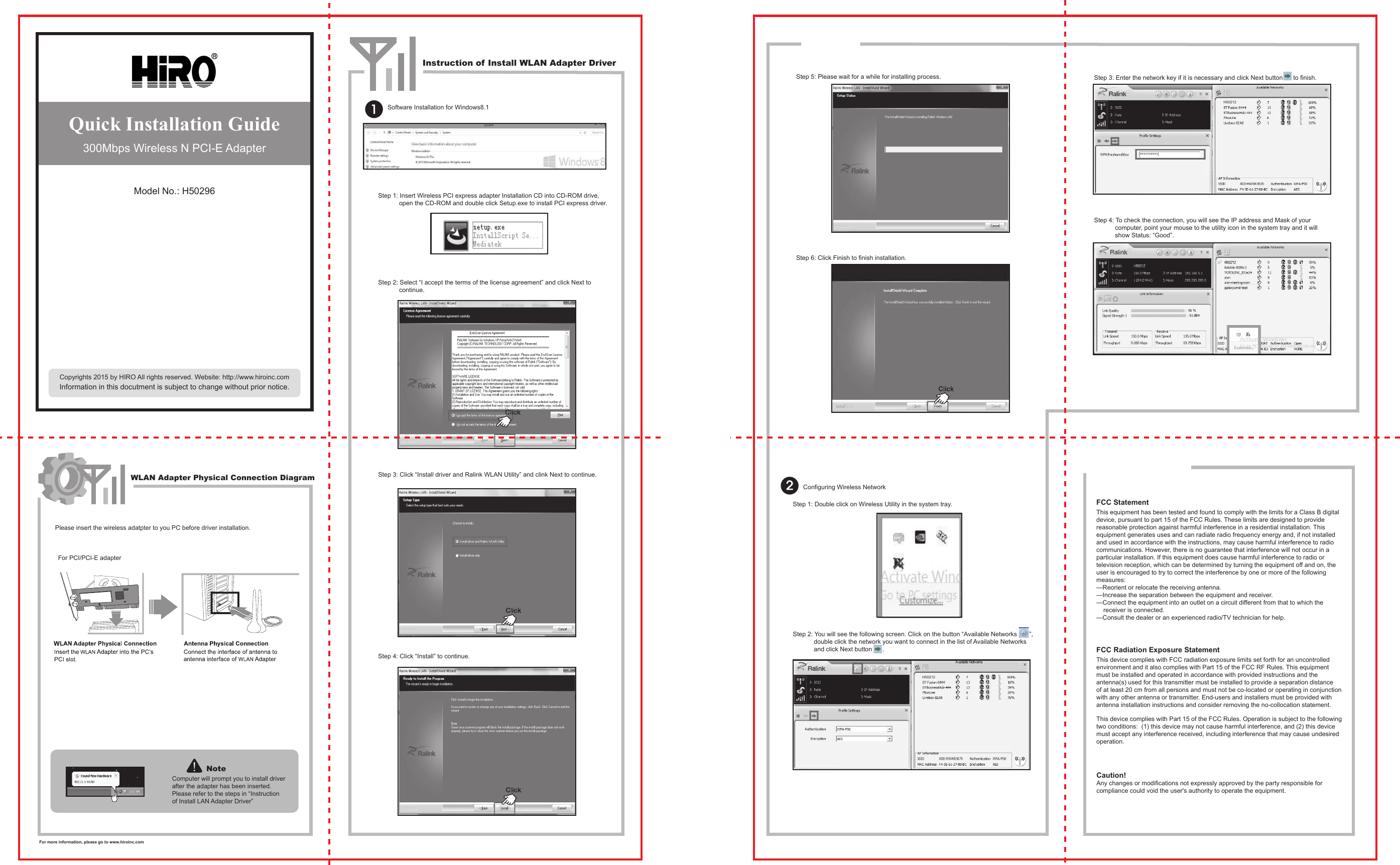
Software Installation for Windows8.1Step 1: Insert Wireless PCI express adapter Installation CD into CD-ROM drive,             open the CD-ROM and double click Setup.exe to install PCI express driver.Step 2: Select “I accept the terms of the license agreement” and click Next to             continue.Step 3: Click “Install driver and Ralink WLAN Utility” and clink Next to continue.Step 4: Click “Install” to continue.Step 5: Please wait for a while for installing process.Step 1: Double click on Wireless Utility in the system tray.Configuring Wireless NetworkStep 6: Click Finish to finish installation.Instruction of Install WLAN Adapter DriverPlease insert the wireless adatpter to you PC before driver installation.For PCI/PCI-E adapterWLAN Adapter Physical Connection DiagramNoteComputer will prompt you to install driver after the adapter has been inserted. Please refer to the steps in “Instruction of Install LAN Adapter Driver”Quick Installation Guide300Mbps Wireless N PCI-E AdapterInformation in this docutment is subject to change without prior notice.For more information, please go to www.hiroinc.comCopyrights 2015 by HIRO All rights reserved. Website: http://www.hiroinc.comStep 2: You will see the following screen. Click on the button “Available Networks       ”,             double click the network you want to connect in the list of Available Networks             and click Next button      .  Step 3: Enter the network key if it is necessary and click Next button      to finish. Step 4: To check the connection, you will see the IP address and Mask of your             computer, point your mouse to the utility icon in the system tray and it will             show Status: “Good”.       H50212H50212This equipment has been tested and found to comply with the limits for a Class B digitaldevice, pursuant to part 15 of the FCC Rules. These limits are designed to provide reasonable protection against harmful interference in a residential installation. This equipment generates uses and can radiate radio frequency energy and, if not installed and used in accordance with the instructions, may cause harmful interference to radio communications. However, there is no guarantee that interference will not occur in a particular installation. If this equipment does cause harmful interference to radio or television reception, which can be determined by turning the equipment off and on, the user is encouraged to try to correct the interference by one or more of the following measures: —Reorient or relocate the receiving antenna. —Increase the separation between the equipment and receiver. —Connect the equipment into an outlet on a circuit different from that to which the     receiver is connected. —Consult the dealer or an experienced radio/TV technician for help. This device complies with FCC radiation exposure limits set forth for an uncontrolled environment and it also complies with Part 15 of the FCC RF Rules. This equipment must be installed and operated in accordance with provided instructions and the antenna(s) used for this transmitter must be installed to provide a separation distance of at least 20 cm from all persons and must not be co-located or operating in conjunction with any other antenna or transmitter. End-users and installers must be provided with antenna installation instructions and consider removing the no-collocation statement.This device complies with Part 15 of the FCC Rules. Operation is subject to the following two conditions:  (1) this device may not cause harmful interference, and (2) this device must accept any interference received, including interference that may cause undesired operation. Caution! Any changes or modifications not expressly approved by the party responsible for compliance could void the user's authority to operate the equipment.FCC StatementFCC Radiation Exposure Statement Model No.: H50296

Navigation menu