Home Automation 65A261 Zigbee Module User Manual 09 0411 Exhibit Cover

Home Automation Inc Zigbee Module 09 0411 Exhibit Cover

Manual

    5015 B.U. Bowman Drive  Buford, GA 30518 USA Voice: 770-831-8048 Fax: 770-831-8598   Certification Exhibit     FCC ID:  HHC-65A261 IC: 1516A-65A261  FCC Rule Part: 15.247 IC Radio Standards Specification: RSS-210  ACS Report Number:  09-0411-15C   Manufacturer: Home Automation Inc. Model: 65A26-1     Manual
        Home Automation, Inc.   Zigbee Module         User (Operational) Manual         This document contains the intellectual property of Home Automation, Inc. (HAI).  HAI authorizes the use of this information for the sole purpose of developing software and systems to work with the Zigbee Module.  The specifications in this document are subject to change without notice.     Document Number 65R26-1 June, 2009
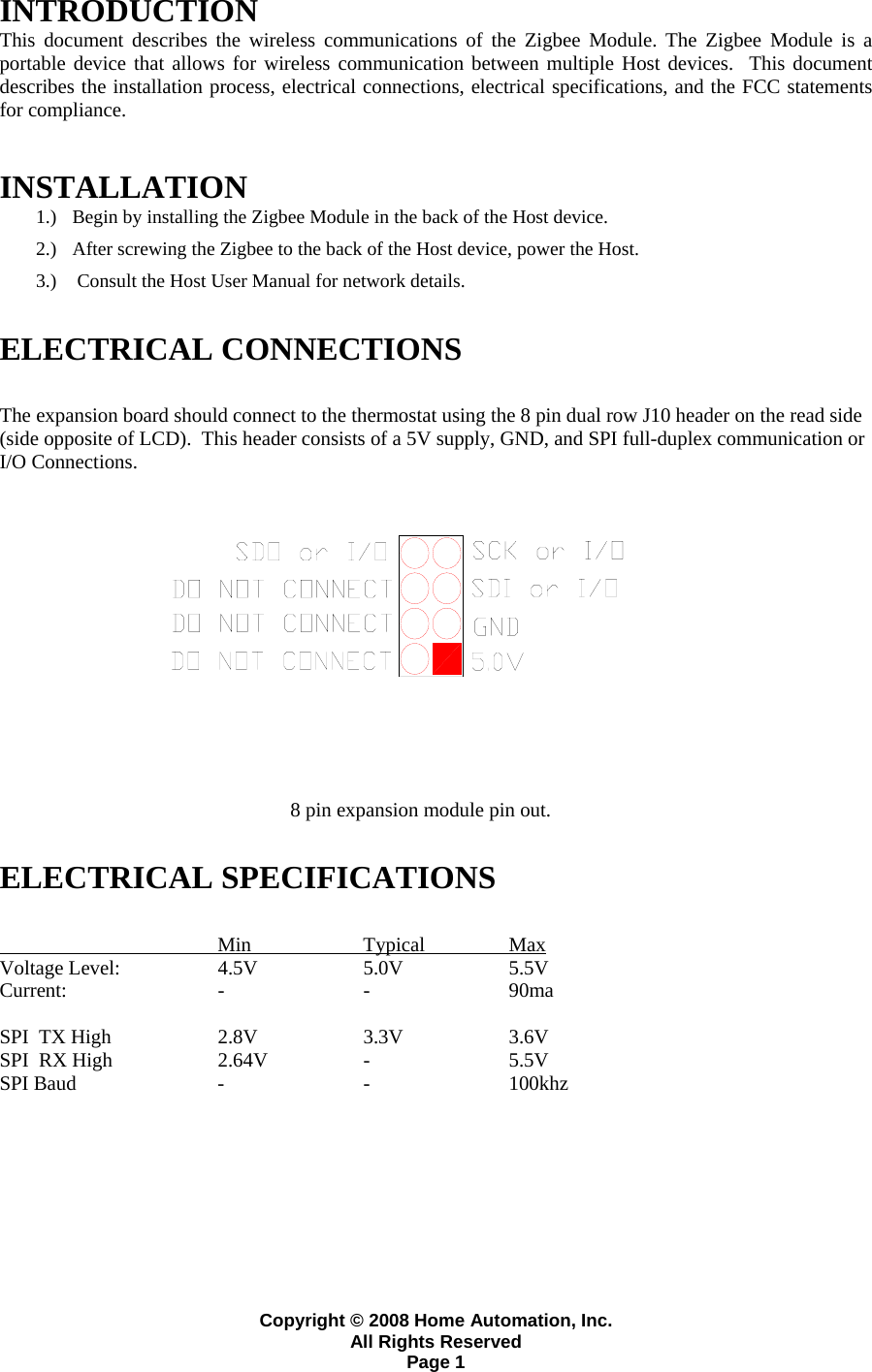
Copyright © 2008 Home Automation, Inc. All Rights Reserved Page 1 INTRODUCTION  This document describes the wireless communications of the Zigbee Module. The Zigbee Module is a portable device that allows for wireless communication between multiple Host devices.  This document describes the installation process, electrical connections, electrical specifications, and the FCC statements for compliance. INSTALLATION  1.) Begin by installing the Zigbee Module in the back of the Host device.   2.) After screwing the Zigbee to the back of the Host device, power the Host.  3.)  Consult the Host User Manual for network details.    ELECTRICAL CONNECTIONS  The expansion board should connect to the thermostat using the 8 pin dual row J10 header on the read side (side opposite of LCD).  This header consists of a 5V supply, GND, and SPI full-duplex communication or I/O Connections.       8 pin expansion module pin out.  ELECTRICAL SPECIFICATIONS     Min  Typical  Max Voltage Level:       4.5V    5.0V    5.5V Current:   -  -  90ma   SPI  TX High  2.8V  3.3V  3.6V SPI  RX High  2.64V  -  5.5V  SPI Baud  -  -  100khz
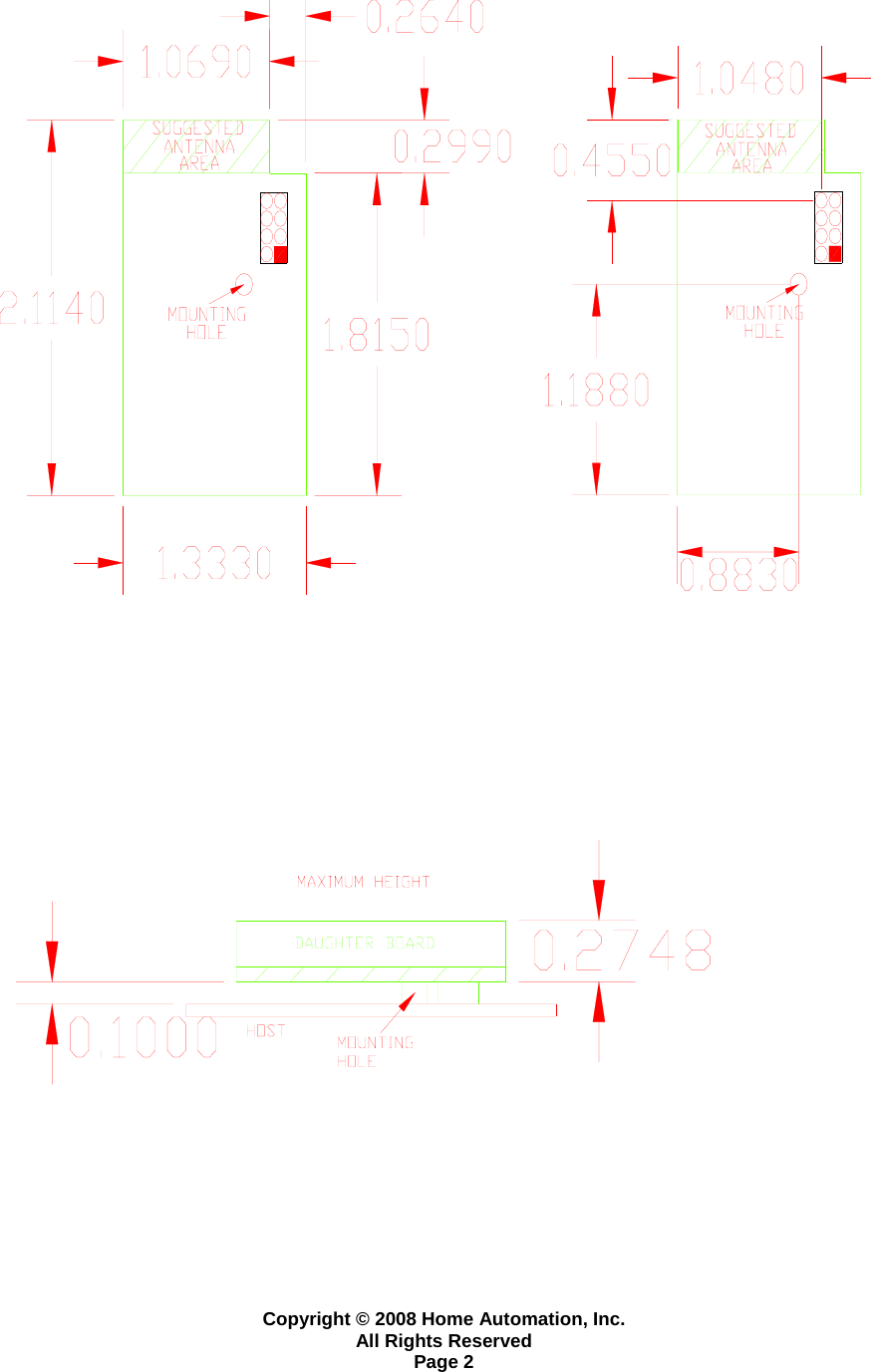
Copyright © 2008 Home Automation, Inc. All Rights Reserved Page 2
Copyright © 2008 Home Automation, Inc. All Rights Reserved Page 3 FCC STATEMENTS OF COMPLIANCE  Compliance Statement (Part 15.19) This device complies with Part 15 of the FCC Rules.  Operation is subject to the following two conditions:  1.   This device may not cause harmful interference, and  2.   This device must accept any interference received,         including interference that may cause undesired operation.  Warning (Part 15.21) Changes or modifications not expressly approved by the party  responsible for compliance could void the user’s authority to  operate the equipment.  FCC Interference Statement (Part 15.105 (b)) This equipment has been tested and found to comply with the limits for a Class B digital device, pursuant to Part 15 of the FCC Rules. These limits are designed to provide reasonable protection against harmful interference in a residential installation. This equipment generates uses and can radiate radio frequency energy and, if not installed and used in accordance with the instructions, may cause harmful interference to radio communications. However, there is no guarantee that interference will not occur in a particular installation. If this equipment does cause harmful interference to radio or television reception, which can be determined by turning the equipment off and on, the user is encouraged to try to correct the interference by one of the following measures:   - Reorient or relocate the receiving antenna.   - Increase the separation between the equipment and receiver.   - Connect the equipment into an outlet on a circuit different       from that to which the receiver is connected.   - Consult the dealer or an experienced radio/TV technician for       help.   FCC/IC RF Exposure To comply with FCC/IC RF exposure limits for general population / uncontrolled exposure, the antenna(s) used for this transmitter must not be co-located or operating in conjunction with any other antenna or transmitter.   RF Exposure (OET Bulletin 65) To comply with FCC/IC RF exposure requirements for mobile transmitting devices, this transmitter should only used or installed at locations where there is at least 20cm separation distance between the antenna and all persons.       
Copyright © 2008 Home Automation, Inc. All Rights Reserved Page 4 OEM Responsibility   OEM Responsibility to the FCC Rules and Regulations The Zigbee Module has been certified per FCC Part 15 rules for integration into products without further testing or certification. To fulfill the FCC certification requirements the OEM of the Zigbee Module must ensure that the information provided on the Zigbee Label is placed on the outside of the final product.   The Zigbee Module is labeled with its own FCC ID Number. If the FCC ID is not visible when the module is installed inside another device, then the outside of the device into which the module is installed must also display a label referring to the enclosed module.  This exterior label can use wording such as the following:   “Contains Transmitter Module FCC: HHC-65A261” or  “Contains FCC: HHC-65A261”   The OEM of the Zigbee Module must only use the approved antenna, which has been certified with this module.  The OEM of the Zigbee Module must test their final product configuration to comply with Unintentional Radiator Limits before declaring FCC compliance per Part 15 of the FCC rules.  OEM Responsibility to the IC Rules and Regulations The Zigbee Module has been certified per IC regulations for integration into products without further testing or certification. To fulfill the IC certification requirements the OEM of the Zigbee Module must ensure that the information provided on the Zigbee Label is placed on the outside of the final product.   The Zigbee Module is labeled with its own IC ID Number. If the IC ID is not visible when the module is installed inside another device, then the outside of the device into which the module is installed must also display a label referring to the enclosed module.  This exterior label can use wording such as the following:   “Contains Transmitter Module IC: 1516A-65A261” or  “Contains IC: 1516A-65A261”   The OEM of the Zigbee Module must only use the approved antenna, which has been certified with this module.  Section 7.1.5 of RSS-GEN Operation is subject to the following two conditions:  1) this device may not cause interference, and 2) this device must accept any interference,   including interference that may cause undesired operation of the device.

Navigation menu