Homewatch PR1211WPSD RF Smoke Detector User Manual manual

Homewatch Limited RF Smoke Detector manual

Users Manual

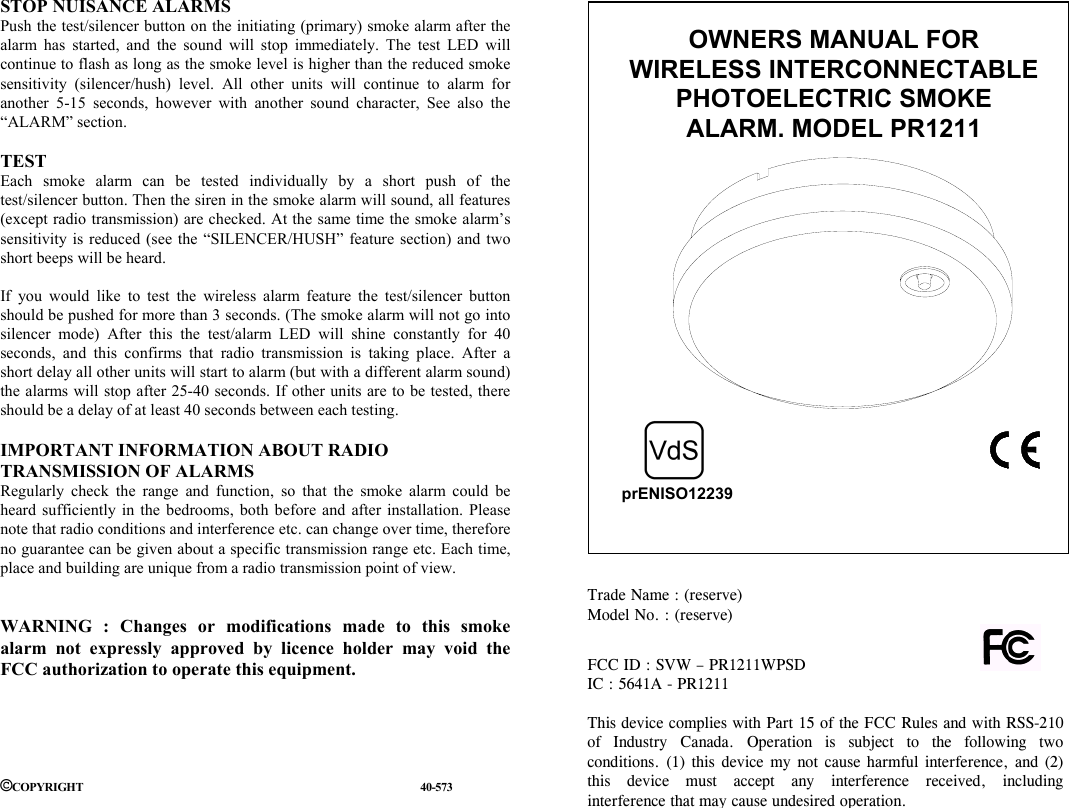
STOP NUISANCE ALARMS Push the test/silencer button on the initiating (primary) smoke alarm after the alarm has started, and the sound will stop immediately. The test LED will continue to flash as long as the smoke level is higher than the reduced smoke sensitivity (silencer/hush) level. All other units will continue to alarm for another 5-15 seconds, however with another sound character, See also the “ALARM” section.  TEST Each smoke alarm can be tested individually by a short push of the test/silencer button. Then the siren in the smoke alarm will sound, all features (except radio transmission) are checked. At the same time the smoke alarm’s sensitivity is reduced (see the “SILENCER/HUSH” feature section) and two short beeps will be heard.  If you would like to test the wireless alarm feature the test/silencer button should be pushed for more than 3 seconds. (The smoke alarm will not go into silencer mode) After this the test/alarm LED will shine constantly for 40 seconds, and this confirms that radio transmission is taking place. After a short delay all other units will start to alarm (but with a different alarm sound) the alarms will stop after 25-40 seconds. If other units are to be tested, there should be a delay of at least 40 seconds between each testing.  IMPORTANT INFORMATION ABOUT RADIO TRANSMISSION OF ALARMS Regularly check the range and function, so that the smoke alarm could be heard sufficiently in the bedrooms, both before and after installation. Please note that radio conditions and interference etc. can change over time, therefore no guarantee can be given about a specific transmission range etc. Each time, place and building are unique from a radio transmission point of view.   WARNING : Changes or modifications made to this smoke alarm not expressly approved by licence holder may void the FCC authorization to operate this equipment.      ©COPYRIGHT                                                                                                                              40-573                                                                                                                                                                                                                                         OWNERS MANUAL FOR  WIRELESS INTERCONNECTABLE PHOTOELECTRIC SMOKE ALARM. MODEL PR1211  prENISO12239Trade Name : (reserve)                                                     Model No. : (reserve) FCC ID : SVW – PR1211WPSD                                      IC : 5641A - PR1211  This device complies with Part 15 of the FCC Rules and with RSS-210of Industry Canada. Operation is subject to the following twoconditions. (1) this device my not cause harmful interference, and (2)this device must accept any interference received, includinginterference that may cause undesired operation.
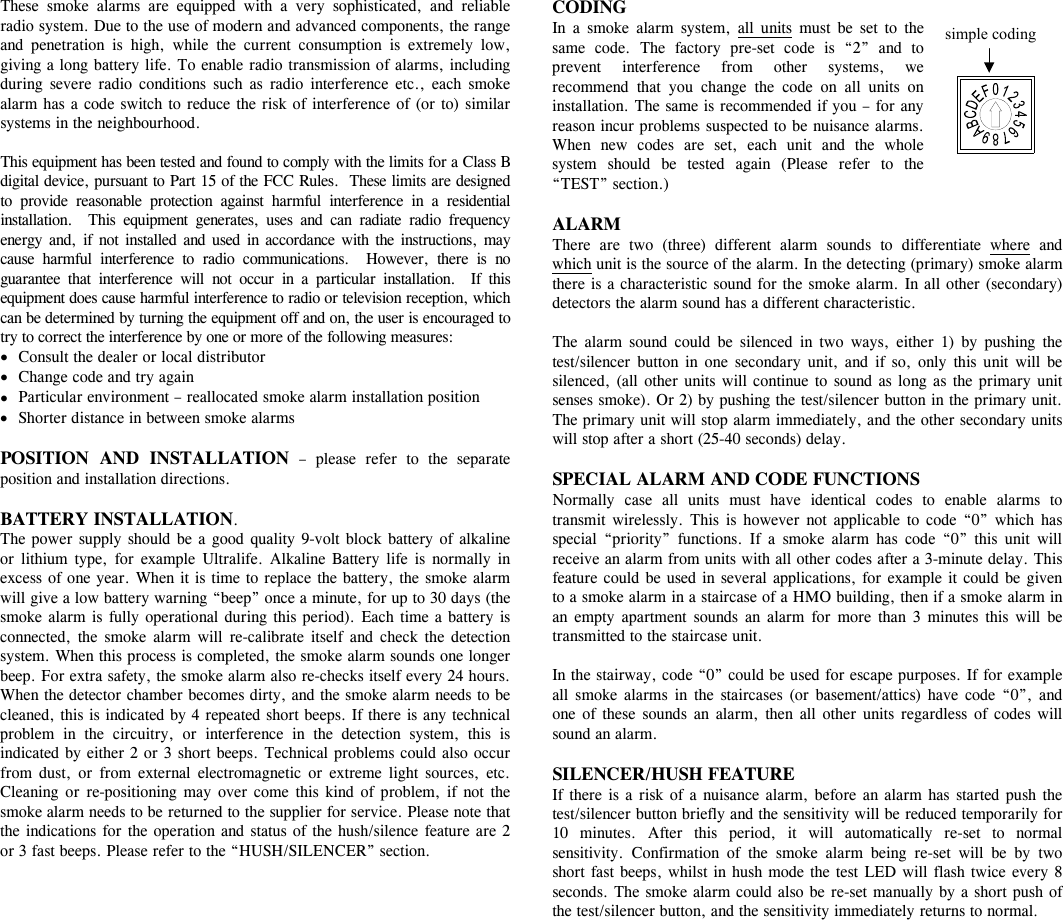
These smoke alarms are equipped with a very sophisticated, and reliable radio system. Due to the use of modern and advanced components, the range and penetration is high, while the current consumption is extremely low, giving a long battery life. To enable radio transmission of alarms, including during severe radio conditions such as radio interference etc., each smoke alarm has a code switch to reduce the risk of interference of (or to) similar systems in the neighbourhood.  This equipment has been tested and found to comply with the limits for a Class B digital device, pursuant to Part 15 of the FCC Rules.  These limits are designed to provide reasonable protection against harmful interference in a residential installation.  This equipment generates, uses and can radiate radio frequency energy and, if not installed and used in accordance with the instructions, may cause harmful interference to radio communications.  However, there is no guarantee that interference will not occur in a particular installation.  If this equipment does cause harmful interference to radio or television reception, which can be determined by turning the equipment off and on, the user is encouraged to try to correct the interference by one or more of the following measures: •  Consult the dealer or local distributor •  Change code and try again •  Particular environment – reallocated smoke alarm installation position •  Shorter distance in between smoke alarms  POSITION AND INSTALLATION – please refer to the separate position and installation directions.  BATTERY INSTALLATION. The power supply should be a good quality 9-volt block battery of alkaline or lithium type, for example Ultralife. Alkaline Battery life is normally in excess of one year. When it is time to replace the battery, the smoke alarm will give a low battery warning “beep” once a minute, for up to 30 days (the smoke alarm is fully operational during this period). Each time a battery is connected, the smoke alarm will re-calibrate itself and check the detection system. When this process is completed, the smoke alarm sounds one longer beep. For extra safety, the smoke alarm also re-checks itself every 24 hours. When the detector chamber becomes dirty, and the smoke alarm needs to be cleaned, this is indicated by 4 repeated short beeps. If there is any technical problem in the circuitry, or interference in the detection system, this is indicated by either 2 or 3 short beeps. Technical problems could also occur from dust, or from external electromagnetic or extreme light sources, etc. Cleaning or re-positioning may over come this kind of problem, if not the smoke alarm needs to be returned to the supplier for service. Please note that the indications for the operation and status of the hush/silence feature are 2 or 3 fast beeps. Please refer to the “HUSH/SILENCER” section.    CODING In a smoke alarm system, all units must be set to the same code. The factory pre-set code is “2” and to prevent interference from other systems, we recommend that you change the code on all units on installation. The same is recommended if you – for any reason incur problems suspected to be nuisance alarms. When new codes are set, each unit and the whole system should be tested again (Please refer to the “TEST” section.)  ALARM There are two (three) different alarm sounds to differentiate where and which unit is the source of the alarm. In the detecting (primary) smoke alarm there is a characteristic sound for the smoke alarm. In all other (secondary) detectors the alarm sound has a different characteristic.  The alarm sound could be silenced in two ways, either 1) by pushing the test/silencer button in one secondary unit, and if so, only this unit will be silenced, (all other units will continue to sound as long as the primary unit senses smoke). Or 2) by pushing the test/silencer button in the primary unit. The primary unit will stop alarm immediately, and the other secondary units will stop after a short (25-40 seconds) delay.  SPECIAL ALARM AND CODE FUNCTIONS Normally case all units must have identical codes to enable alarms to transmit wirelessly. This is however not applicable to code “0” which has special “priority” functions. If a smoke alarm has code “0” this unit will receive an alarm from units with all other codes after a 3-minute delay. This feature could be used in several applications, for example it could be given to a smoke alarm in a staircase of a HMO building, then if a smoke alarm in an empty apartment sounds an alarm for more than 3 minutes this will be transmitted to the staircase unit.  In the stairway, code “0” could be used for escape purposes. If for example all smoke alarms in the staircases (or basement/attics) have code “0”, and one of these sounds an alarm, then all other units regardless of codes will sound an alarm.  SILENCER/HUSH FEATURE If there is a risk of a nuisance alarm, before an alarm has started push the test/silencer button briefly and the sensitivity will be reduced temporarily for 10 minutes. After this period, it will automatically re-set to normal sensitivity. Confirmation of the smoke alarm being re-set will be by two short fast beeps, whilst in hush mode the test LED will flash twice every 8 seconds. The smoke alarm could also be re-set manually by a short push of the test/silencer button, and the sensitivity immediately returns to normal.  simple coding

Navigation menu