Honda Gxh50 Users Manual
2015-03-12
: Honda Honda-Gxh50-Users-Manual-657240 honda-gxh50-users-manual-657240 honda pdf
Open the PDF directly: View PDF  .
.
Page Count: 57

Click SAVE to save this manual to your computer. Thank you for choosing Honda.
HONDA
ENGINES
Owner’s
Manual
GXH50
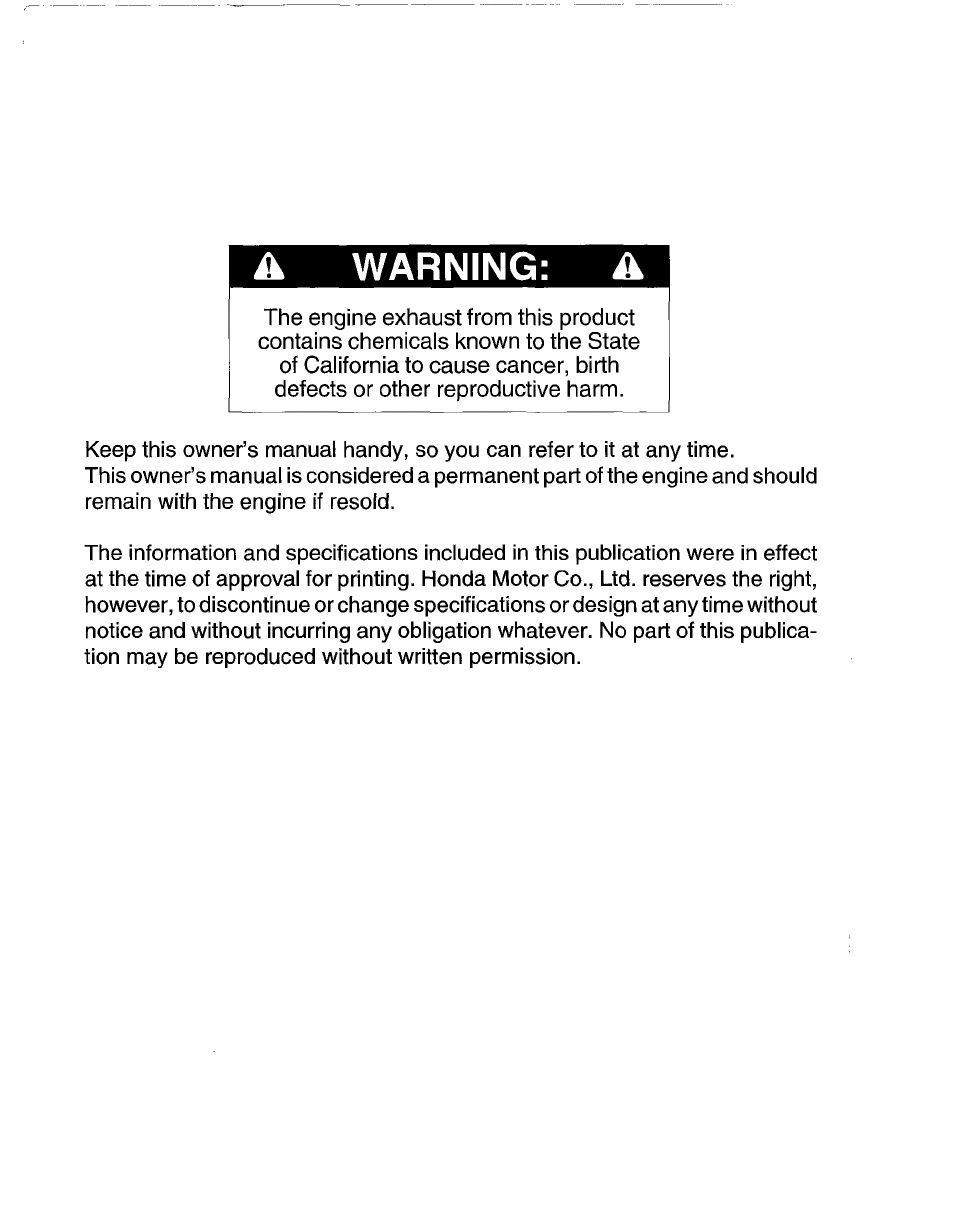
The engine exhaust from this product
contains chemicals known to the State
of California to cause cancer, birth
defects or other reproductive harm.
Keep this owner’s manual handy,
so
you can refer to it at any time.
This owner’s manual is considered a permanent part
of
the engine and should
remain with the engine
if
resold.
The information and specifications included in this publication were in effect
at the time of approval for printing. Honda Motor
Co.,
Ltd. reserves the right,
however, to discontinue or change specifications or design at any time without
notice and without incurring any obligation whatever.
No
part of this publica-
tion may be reproduced without written permission.
INTRODUCTION
Congratulations on your selection of a Honda engine. We are certain you will
be pleased with your purchase of one
of
the finest engines on the market.
We want to help you get the best results from your new engine and to operate
it safely. This manual contains the information on how to do that; please read
it carefully.
As
you read this manual, you will find information preceded by a
symbol. That information is intended to help you avoid damage to your engine,
other property, or the environment.
We suggest you read the warranty policy to fully understand its coverage and
your responsibilities of ownership. The warranty policy is a separate document
that should have been given
to
you by your dealer.
When your engine needs scheduled maintenance, keep in mind that your
Honda servicing dealer is specially trained in servicing Honda engines. Your
Honda servicing dealer is dedicated to your satisfaction and will be pleased to
answer your questions and concerns.
Best Wishes,
Honda Motor Co., Ltd.
1
~~ ~~
__~
~
~-~~_~___.
.
~~~~~ ~ ~~~
INTRODUCTION
A FEW WORDS ABOUT SAFETY
Your safety and the safety of others are very important. And using this engine
safely
is
an important responsibility.
To help you make informed decisions about safety, we have provided
operating procedures and other information
on
labels and in this manual. This
information alerts you to potential hazards that could hurt you or others.
Of course, it is not practical or possible to warn you about all the hazards
associated with operating or maintaining an engine. You must use your own
good judgment.
You will find important safety information in a variety of forms, including:
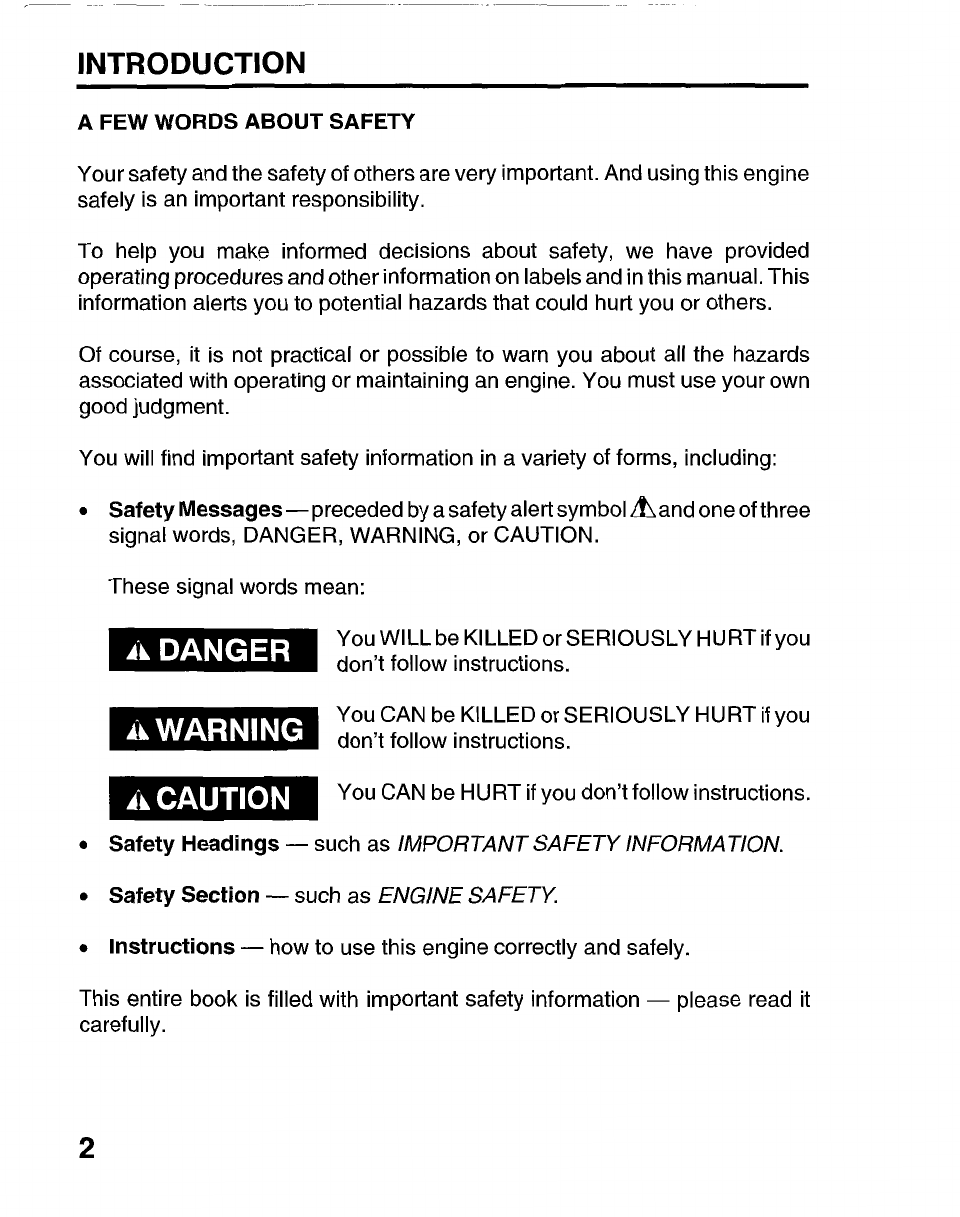
Safety Messages-preceded by a safety alert symbol Aand one of three
signal words, DANGER, WARNING, or CAUTION.
These signal words mean:
You WILL be KILLED or SERIOUSLY HURT
if
you
don’t follow instructions.
You CAN be KILLED or SERIOUSLY HURT
if
you
don’t follow instructions.
You CAN be HURT
if
you don’t follow instructions.
Safety Headings
-
such as
IMPORTANT
SAFETY INFORMATION.
Safety Section
-
such
as
ENGINE
SAFETY.
Instructions
-
how to use this engine correctly and safely.
This entire book is filled with important safety information
-
please read it
carefully.
2
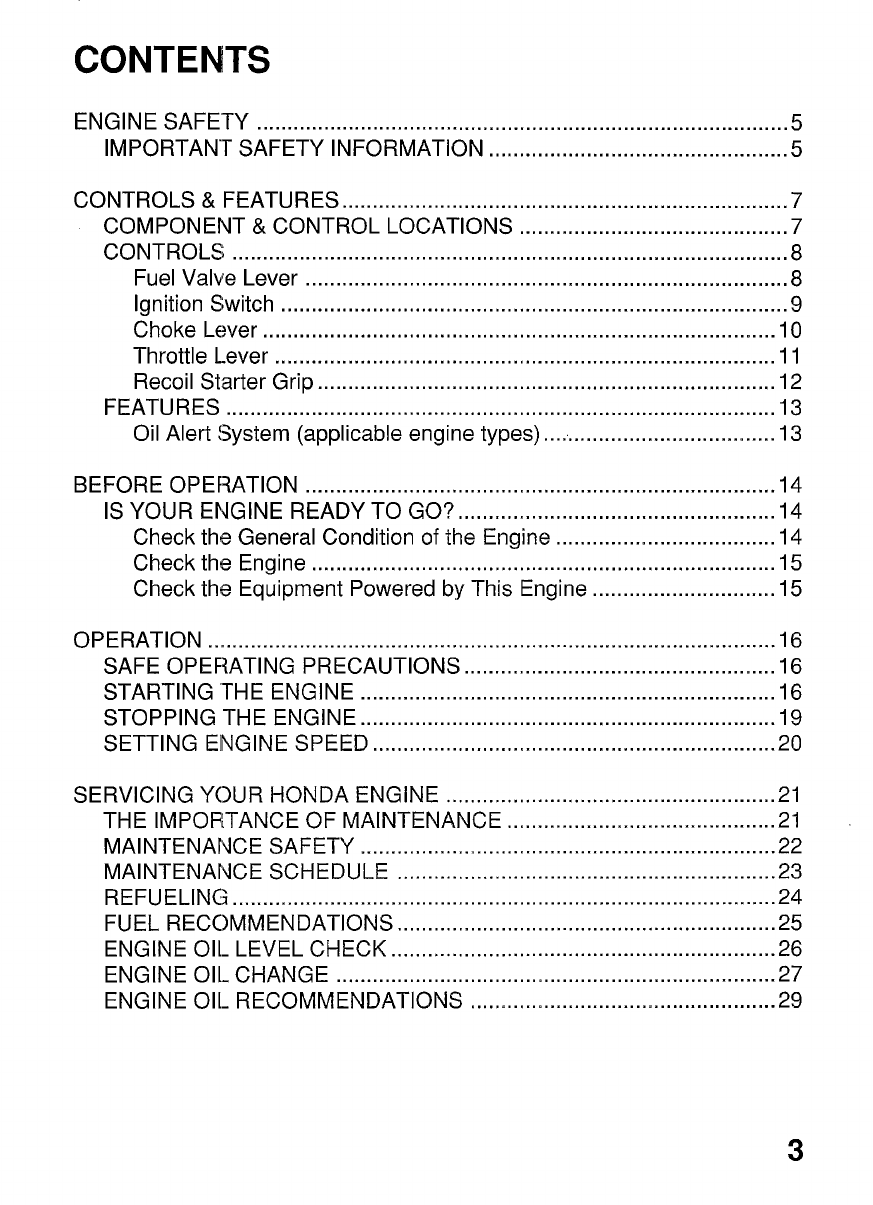
ENGINE SAFETY
.......................................................................................
5
IMPORTANT SAFETY INFORMATION
.................................................
5
CONTROLS
&
FEATURES
.........................................................................
7
COMPONENT
&
CONTROL LOCATIONS
............................................
7
CONTROLS
...........................................................................................
8
Fuel Valve Lever
...............................................................................
8
Ignition Switch
...................................................................................
9
Choke Lever
....................................................................................
10
Throttle Lever
..................................................................................
11
Recoil Starter Grip
...........................................................................
12
FEATURES
..........................................................................................
13
Oil Alert !System (applicable engine types)
.......................................
13
BEFORE OPERATION
.............................................................................
14
IS
YOUR ENGINE READY TO GO?
....................................................
14
Check the General Condition
of
the Engine
....................................
14
Check the Engine
............................................................................
15
Check the Equipment Powered by This Engine
..............................
15
OPERATION
.............................................................................................
16
SAFE OPERATING PRECAUTIONS
...................................................
16
STARTING THE ENGINE
....................................................................
16
STOPPING THE ENGINE
....................................................................
19
SETTING ENGINE SPEED
..................................................................
20
SERVICING YOUR HONDA ENGINE
......................................................
21
THE IMPORTANCE OF MAINTENANCE
............................................
21
MAINTENANCE SAFETY
....................................................................
22
MAINTENANCE SCHEDULE
..............................................................
23
REFUELING
.........................................................................................
24
FUEL RECOMMENDATIONS
..............................................................
25
ENGINE
OIL
LEVEL CHECK
...............................................................
26
ENGINE
OIL
CHANGE
........................................................................
27
ENGINE
OIL
RECOMMENDATIONS
..................................................
29
3
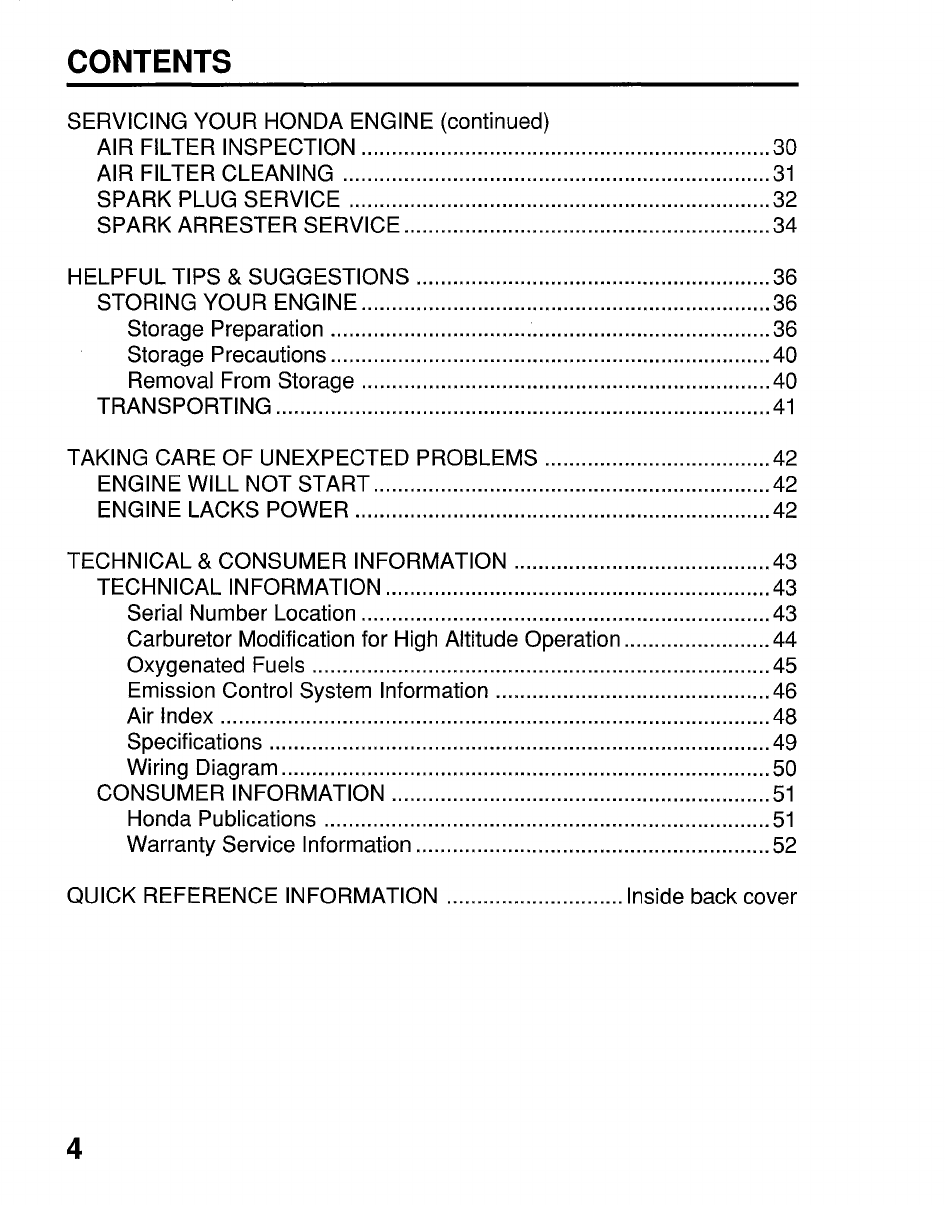
CONTENTS
SERVICING YOUR HONDA ENGINE (continued)
AIR FILTER INSPECTION
...................................................................
30
AIR FILTER CLEANING
......................................................................
31
SPARK PLUG SERVICE
.....................................................................
32
SPARK ARRESTER SERVICE
............................................................
34
HELPFUL TIPS
&
SUGGESTIONS
..........................................................
36
STORING YOUR ENGINE
...................................................................
36
Storage Preparation
........................................................................
36
Storage Precautions
........................................................................
40
Removal From Storage
...................................................................
40
TRANSPORTING
.................................................................................
41
TAKING CARE OF UNEXPECTED PROBLEMS
.....................................
42
ENGINE WILL NOT START
.................................................................
42
ENGINE LACKS POWER
....................................................................
42
TECHNICAL
&
CONSUMER INFORMATION
..........................................
43
TECHNICAL INFORMATION
...............................................................
43
Serial Number Location
...................................................................
43
Oxygenated Fuels
...........................................................................
45
Emission Control System Information
.............................................
46
Air index
..........................................................................................
48
Specifications
..................................................................................
49
Wiring Diagram
................................................................................
50
CONSUMER INFORMATION
..............................................................
51
Honda Publications
.........................................................................
51
Warranty Service Information
..........................................................
52
Carburetor Modification for High Altitude Operation
........................
44
QUICK REFERENCE INFORMATION
.............................
Inside back cover
4
ENGINE
SAFETY
IMPORTANT SIAFETY INFORMATION
Most accidents with engines can be prevented
if
you follow all instructions in
this manual and on the engine. Some of the most common hazards are
discussed below, along with the best way to protect yourself and others.
Owner Responsibilities
Honda engilnes are designed to give safe and dependable service
if
operated according to instructions. Read and understand this owner’s
manual before operating the engine. Failure to do
so
could result in
personal injury or equipment damage.
Know how to stop the engine quickly, and understand the operation of all
controls. Never permit anyone to operate the engine without proper
instructions.
Do
not allow children to operate the engine. Keep children and pets away
from the area of operation.
Refuet With Care
Gasoline is extremely flammable, and gasoline vapor can explode. Refuel
outdoors, in a well-ventilated area, with the engine stopped. Never smoke
near gasoline, and keep other flames and sparks away. Always store gasoline
in an approved container.
If
any fuel is spilled, make sure the area is dry before
starting the engine.
Hot Exhaust
0
The muffler becomes very hot during operation and remains hot for a while
after stopping the engine. Be careful not to touch the muffler while it is hot.
Let the engine cool before storing it indoors.
0
To prevent fire hazards and to provide adequate ventilation for stationary
equipment applications, keep the engine at least 3feet
(1
meter) awayfrom
building walls and other equipment during operation.
Do
not place flam-
mable objects close to the engine.
5
ENGINE SAFETY
Carbon Monoxide Hazard
Exhaust gas contains poisonous carbon monoxide. Avoid inhalation of ex-
haust gas. Never run the engine in a closed garage or confined area.
Other Equipment
Review the instructions provided with the equipment powered by this engine
for any additional safety precautions that should be observed in conjunction
with engine startup, shutdown, or operation, or protective apparel that may be
needed to operate the equipment.
6
CONTROLS
&
FEATURES
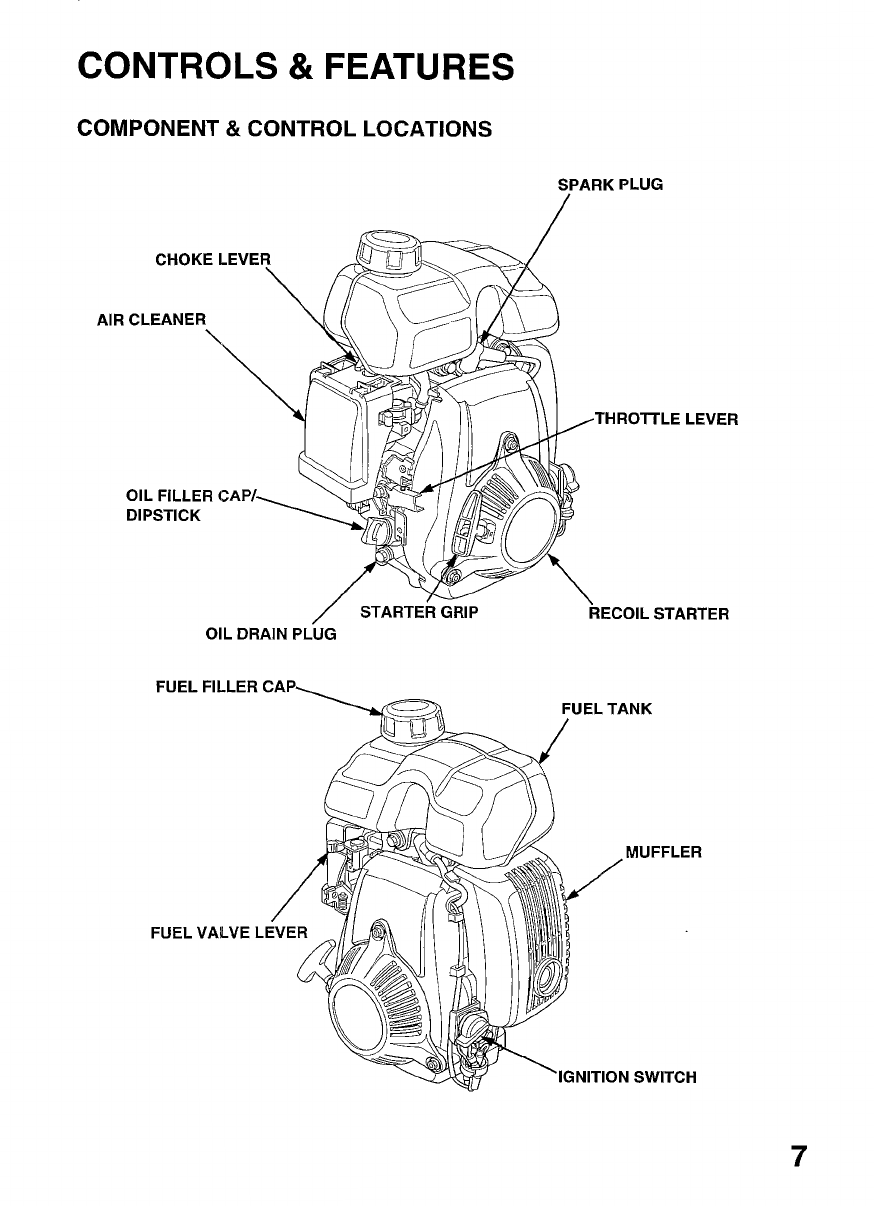
COMPONENT
&
CONTROL LOCATIONS
SPAR1
K
PLUG
\
&PROITLE
LEVER
OIL FILLER CAP
DIPSTICK
/
STARTER GRIP RECOIL
STARTER
OIL DRAIN PLUG
FUEL FILLER CAP,
x
jUELTANK
‘IGNITION
SWITCH
Y
7
CONTROLS
&
FEATURES
CONTROLS
Fuel
Valve Lever
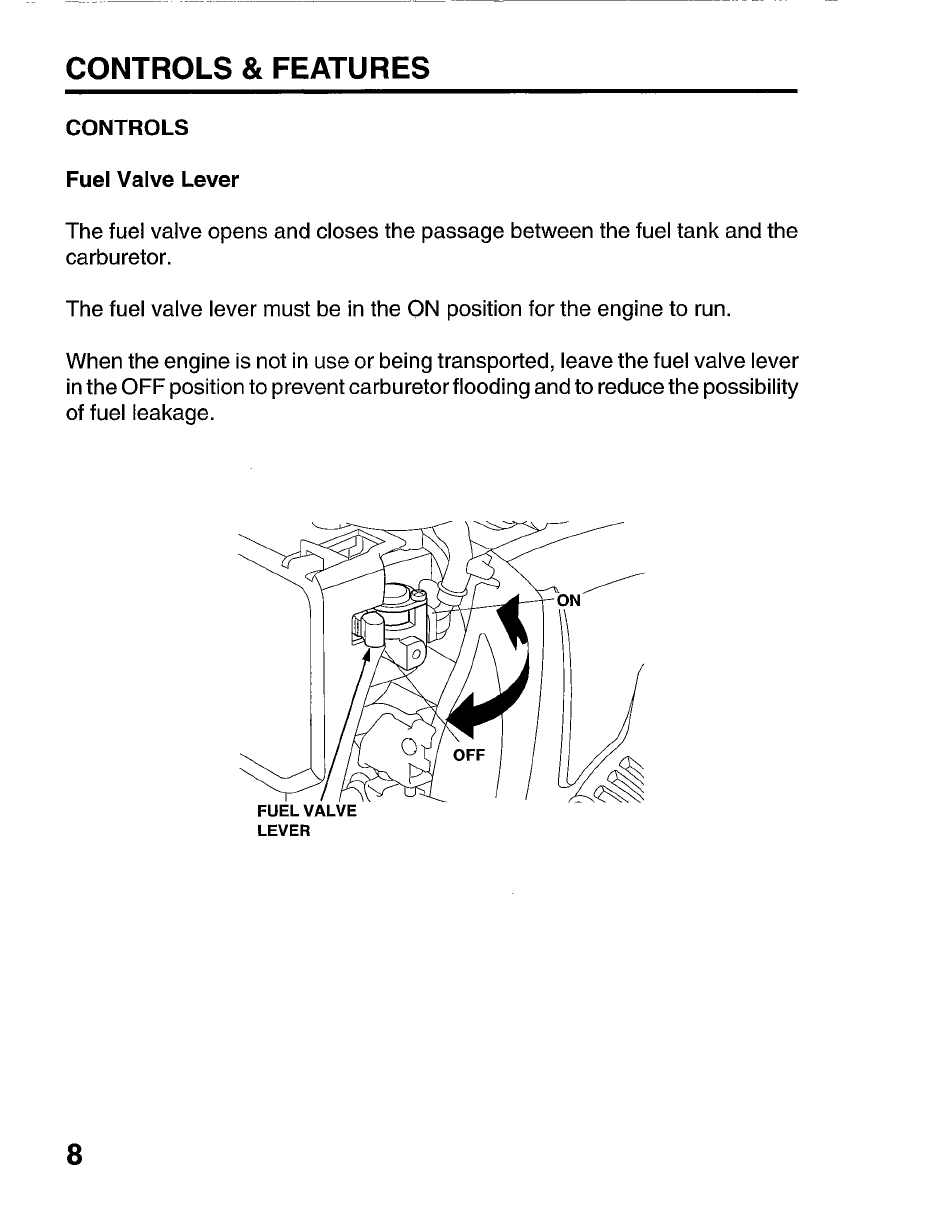
The fuel valve opens and closes the passage between the fuel tank and the
carburetor.
The fuel valve lever must be in the
ON
position for the engine to run.
When the engine is not in use or being transported, leave the fuel valve lever
in the
OFF
position to prevent carburetor flooding and to reduce the possibility
of fuel leakage.
LEVER
8
CONTROLS
&
FEATURES
Ignition
Switch
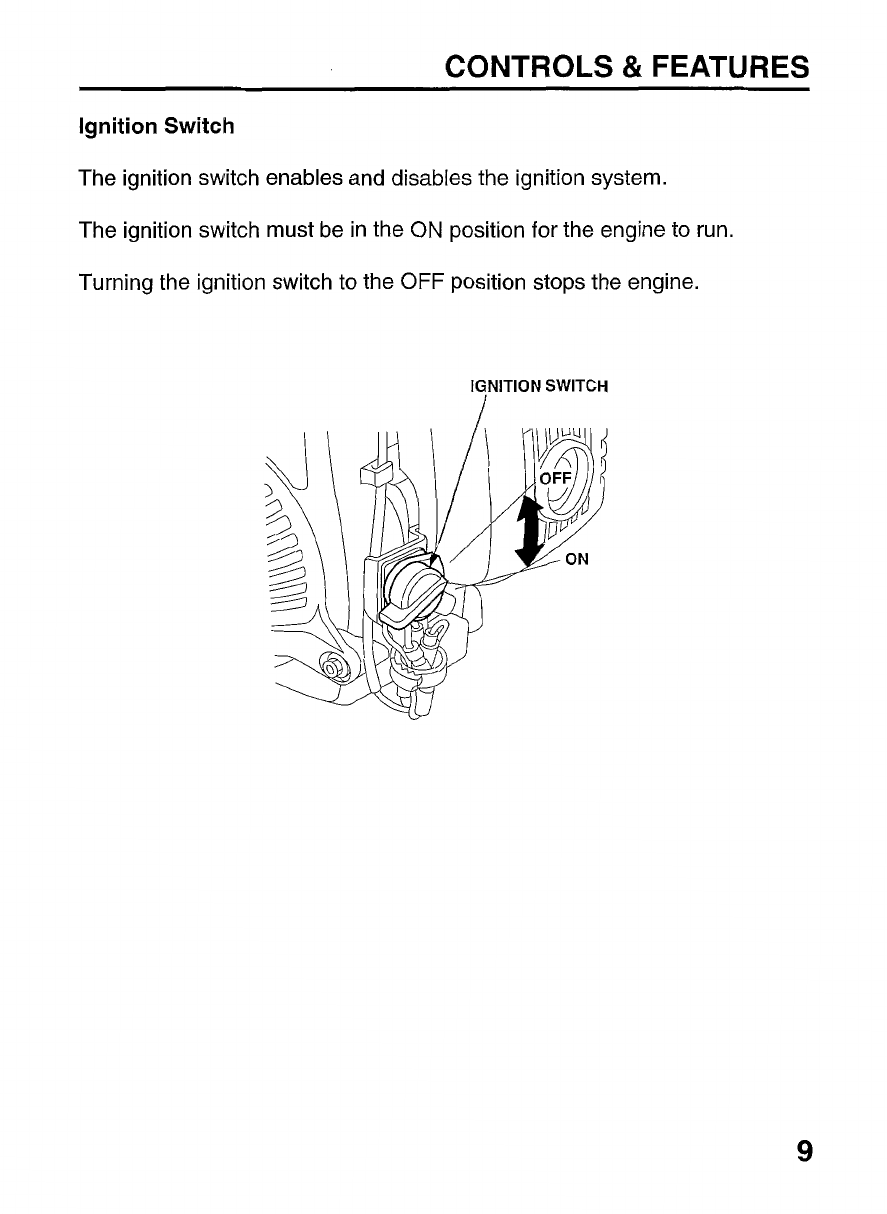
The ignition switch enables and disables the ignition system.
The ignition switch must be in the
ON
position for the engine to run.
Turning the ignlition switch to the
OFF
position stops the engine.
IGNITION
SWITCH
9
CONTROLS
&
FEATURES
Choke
Lever
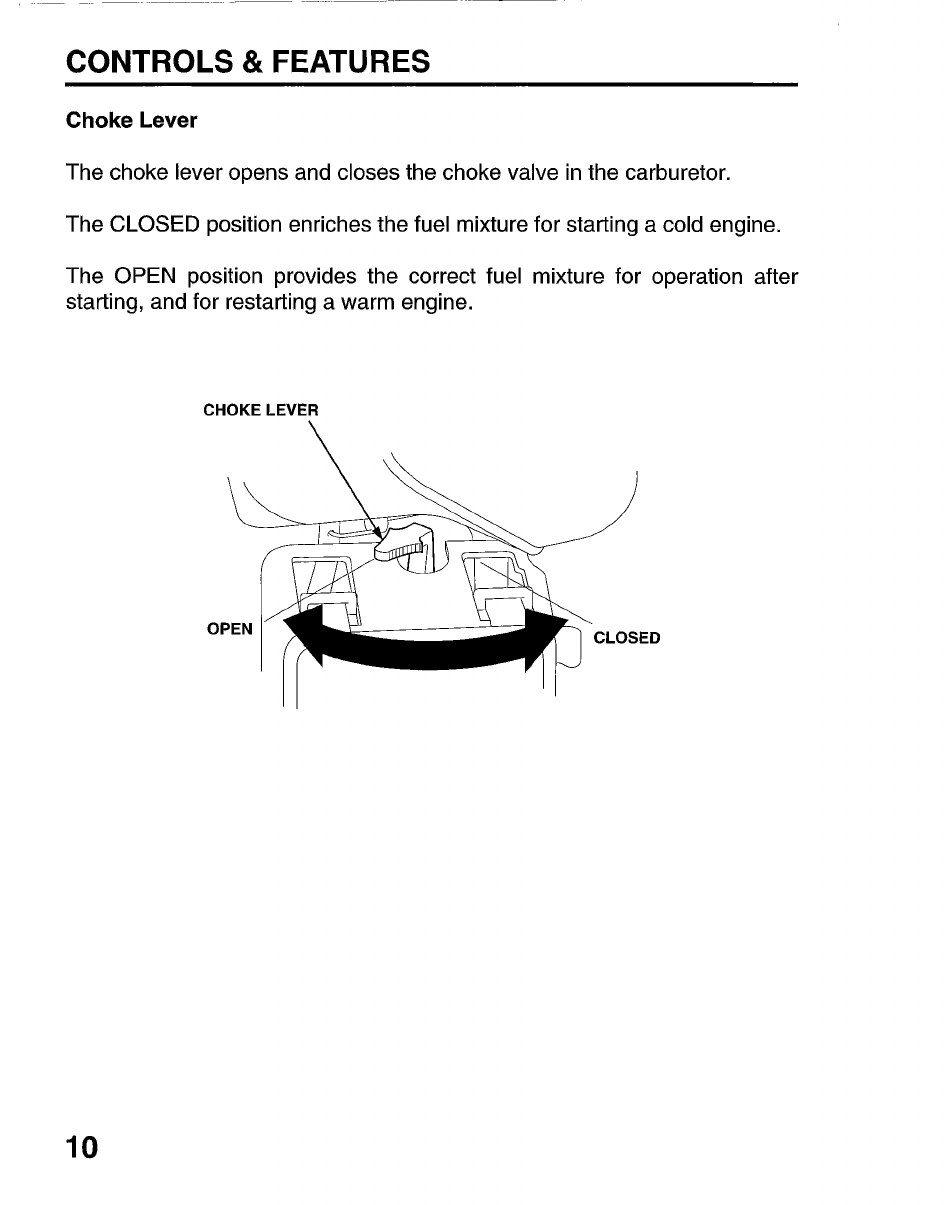
The choke lever opens and closes the choke valve in the carburetor.
The
CLOSED
position enriches the fuel mixture for starting a cold engine.
The
OPEN
position provides the correct fuel mixture
for
operation after
starting, and for restarting a warm engine.
CHOKE
LEVER
10
CONTROLS
&
FEATURES
Throttle
Lever
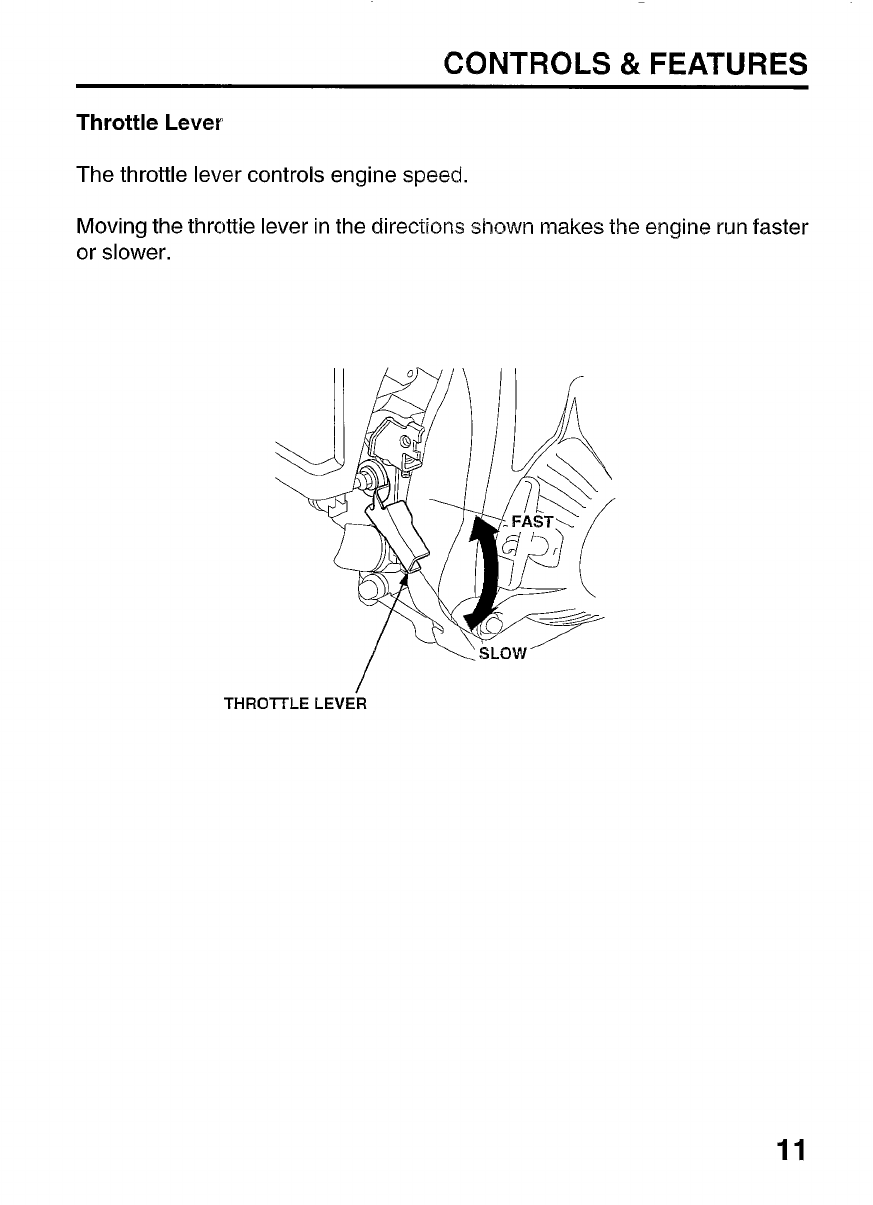
The throttle lever controls engine speed.
Moving the thrsttie lever in the directions
shown
makes the engine run faster
or slower.
THROITLE
LEVER
11
CONTROLS
&
FEATURES
Recoil
Starter
Grip
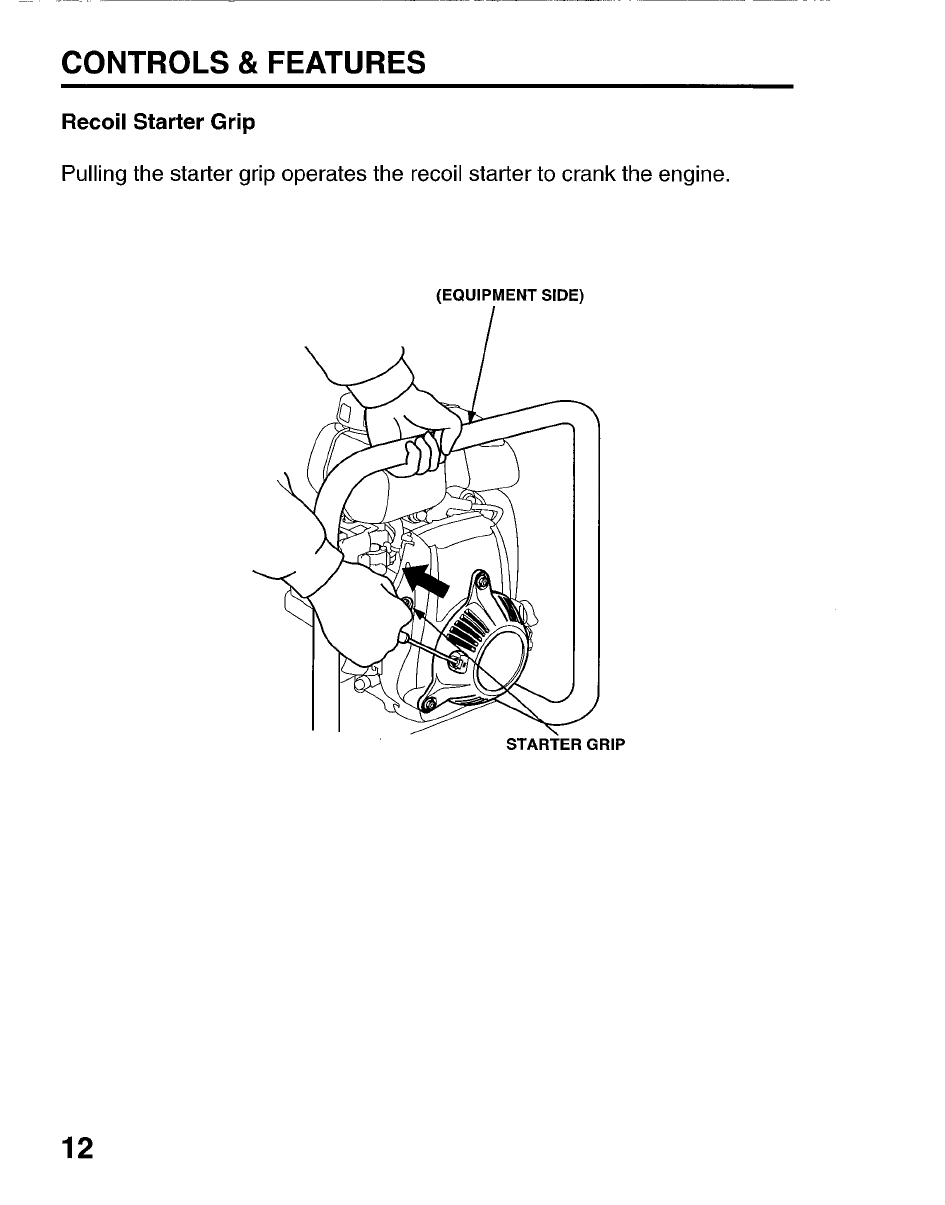
Pulling the starter grip operates the recoil starter to crank the engine.
(EQUIPMENT SIDE)
STARTER GRIP
12
CONTROLS
&
FEATURES
FEATURES
Oil
Alert@ System (applicable engine types)
The Oil Alert@ system is designed to prevent engine damage caused by an
insufficient amount of oil in the crankcase. Before the
oil
level in the crankcase
can fall below
a
safe limit, the Oil Alert@ system will automatically stop the
engine (the ignition switch will remain
in
the
ON
position).
If
the engine stops
and
will not restart, check the engine oil level (page
26)
before troubleshooting in other areas.
13
BEFORE
OPERATION
IS
YOUR
ENGINE READY TO GO?
For your safety, and to maximize the service life of your equipment, it is very
important to take a few moments before you operate the engine to check its
condition. Be sure to take care of any problem you find, or have your servicing
dealer correct it, before you operate the engine.
Improperly maintaining this engine,
or failing to correct a problem
before operation, could cause a
malfunction in which you could be
seriously injured.
Always perform a preoperation
inspection before each operation,
and correct any problem.
Before beginning your preoperation checks, be sure the engine
is
level and
the ignition switch is in the
OFF
position.
Check the General Condition of the Engine
Look around and underneath the engine for signs of oil or gasoline leaks.
Remove any accumulated dirt or debris, especially around the muffler and
recoil starter.
Look for signs of damage.
Check that all shields and covers are in place, and all nuts, bolts, and
screws are tightened.
14
BEFORE
OPERATION
Check the En!gine
Check the engine oil level (see page
26),
Running the engine with a low oil
level can cause engine damage.
The Oil
Alert
system (applicable engine types)
will
automatically
stop
the
engine befcre the oil level falls
below
safe limits. However, to avoid the
inconvenience of an unexpected shutdown, always check the engine
oil
level before startup.
Check the air filter (see page
30).
A
dirty
air filter will restrict air flow
to
the
carburetor, lreducing engine performance.
Check the
fuel
level. Starting with
a
full
tank
will help to eliminate or reduce
operating interruptions for refueling.
Check the Equipment Powered by This Engine
Review the ins1:ructions provided with the equipment powered by this engine
for any precauiiions and procedures that should be followed before engine
startup.
15
OPERATION
SAFE OPERATING PRECAUTIONS
Before operating the engine for the first time, please review the
IMPORTANT
SAFETY INFORMATIONon
page
5
and the chapter titled BEFORE
OPERA-
TION.
Carbon monoxide gas is toxic.
Breathing it can cause
unconsciousness and even kill
you.
Avoid any areas or actions that
expose you to carbon monoxide.
Review the instructions provided with the equipment powered by this engine
for any safety precautions that should be observed in conjunction with engine
startup, shutdown, or operation.
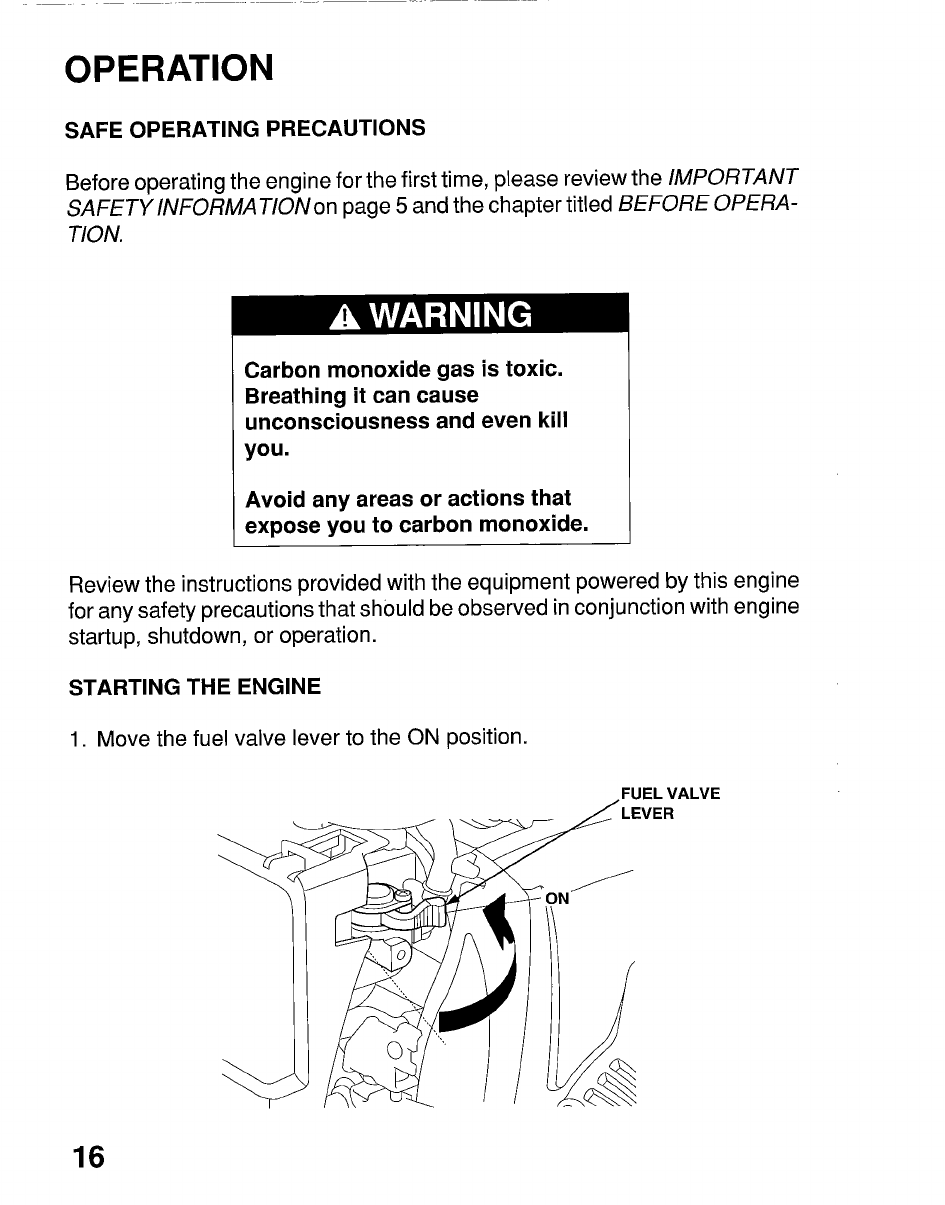
STARTING THE ENGINE
1.
Move the fuel valve lever to the
ON
position.
,FUEL VALVE
16
OPERATION
~ ~~
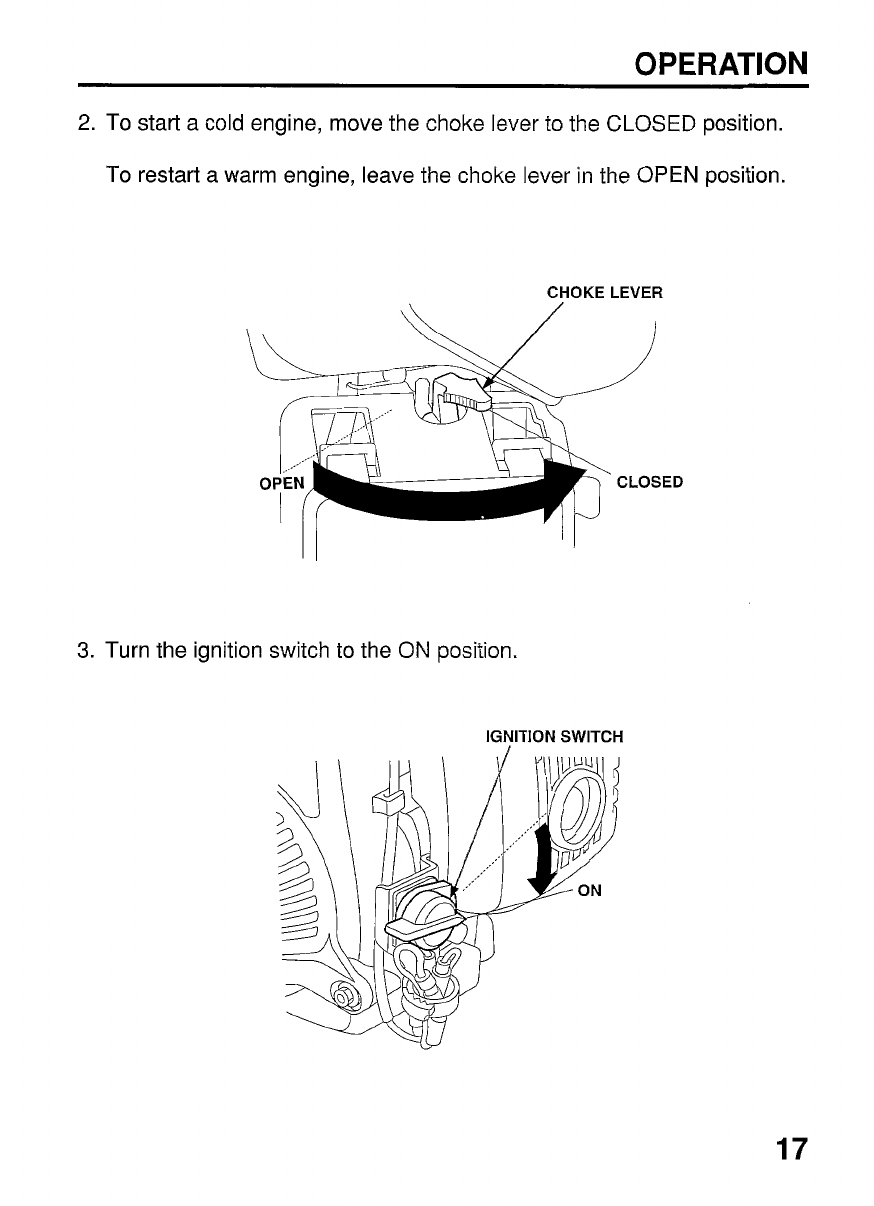
2.
To start a
cold
engine, move the choke lever
to
the
CLOSED
position.
To restart
a
warm engine, leave the choke lever in the
OPEN
position.
CHOKE LEVER
3.
Turn the ignition switch
to
the
ON
position.
IGNITION SWITCH
17
OPERATION
4.
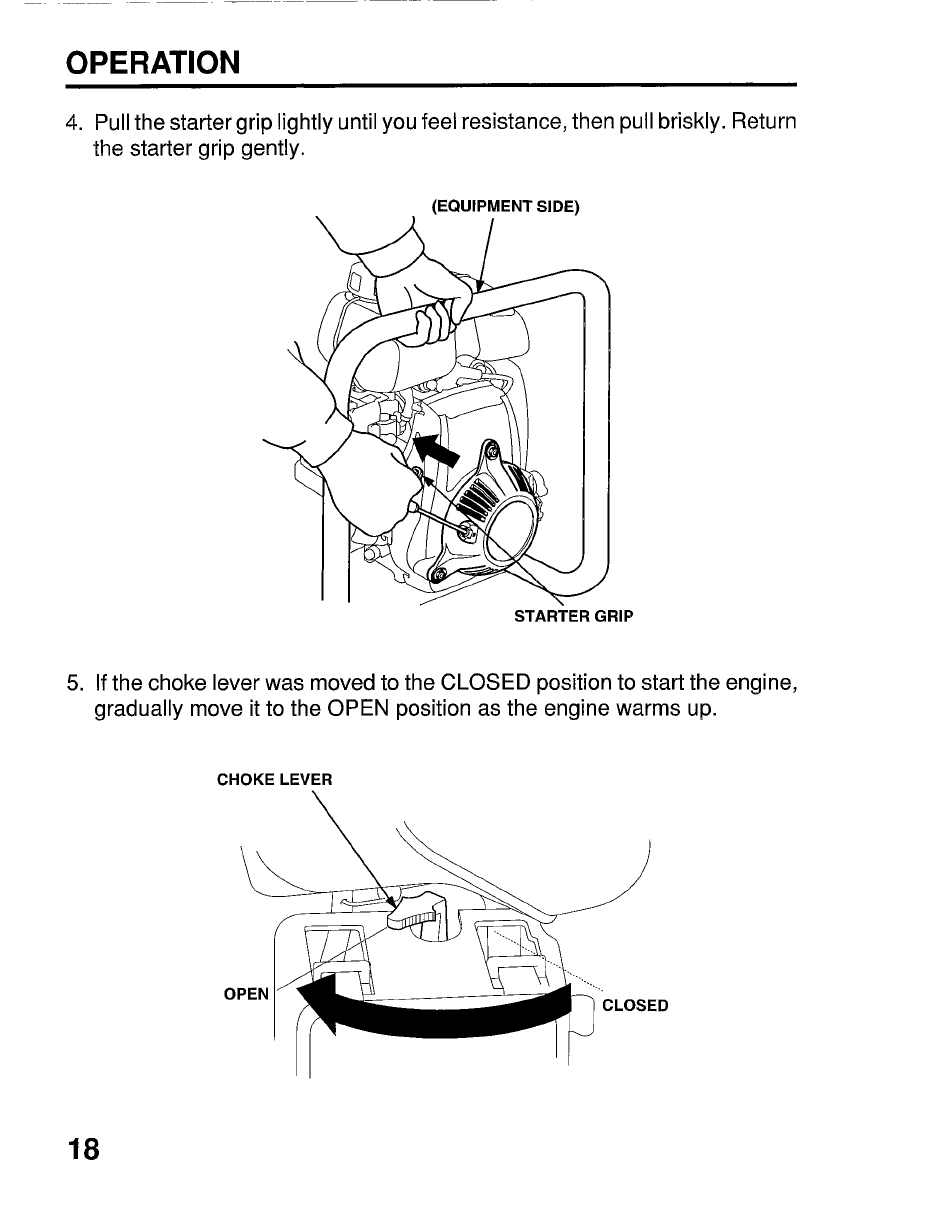
Pull the starter grip lightly until you feel resistance, then pull briskly. Return
the starter grip gently.
(EQUIPMENT
SIDE)
STARTER GRIP
5.
If
the choke lever was moved to the
CLOSED
position to start the engine,
gradually move it to the OPEN position as the engine warms up.
CHOKE LEVER
18
OPERATION
STOPPING THE ENGINE
To
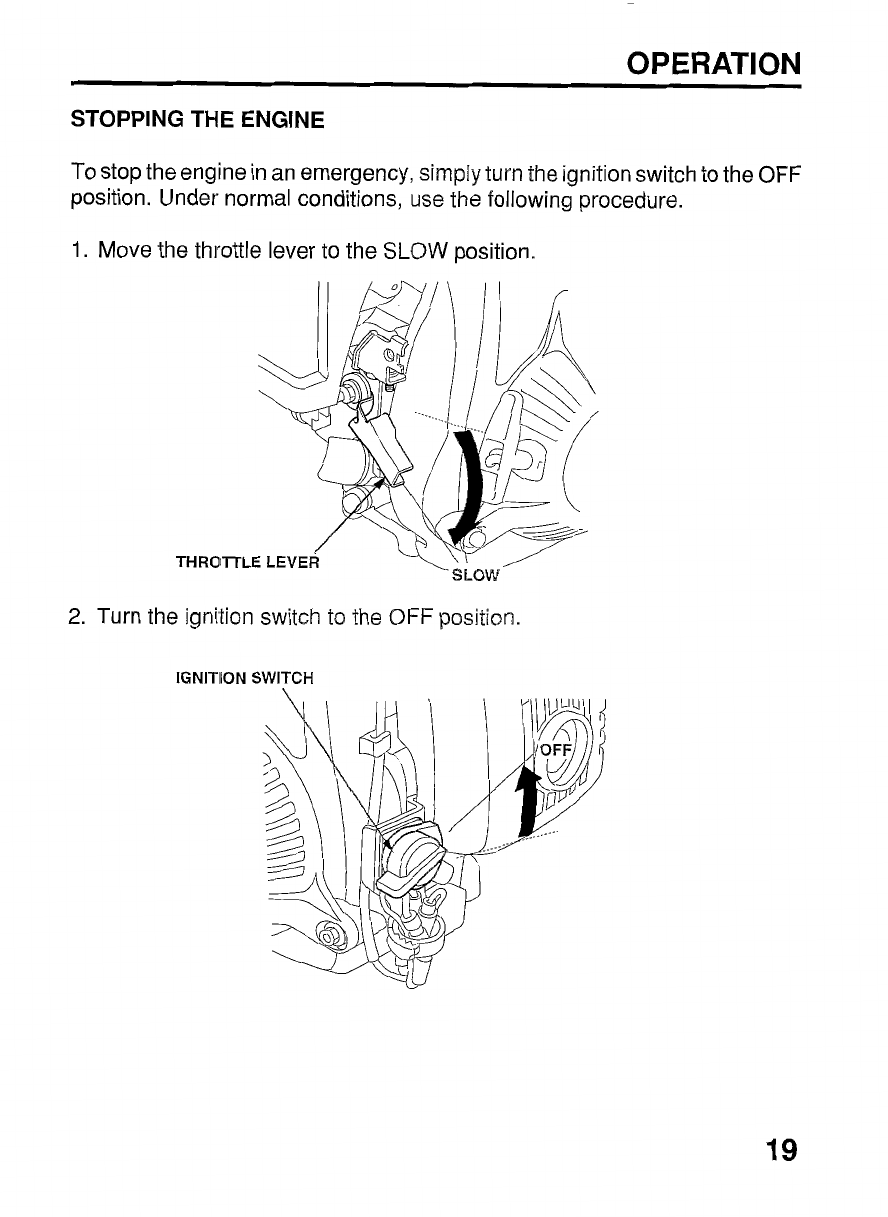
stop the engine in an emergency, simply turn the ignition switch to the
OFF
position. Under normal conditions,
use
the following procedure.
,.
1.
Move the throttle lever
+x
to
the
SLOW
position.
2.
Turn the igni,tion switch to the
OFF
positisn.
IGNITIION
SWITCH
19
OPERATION
3.
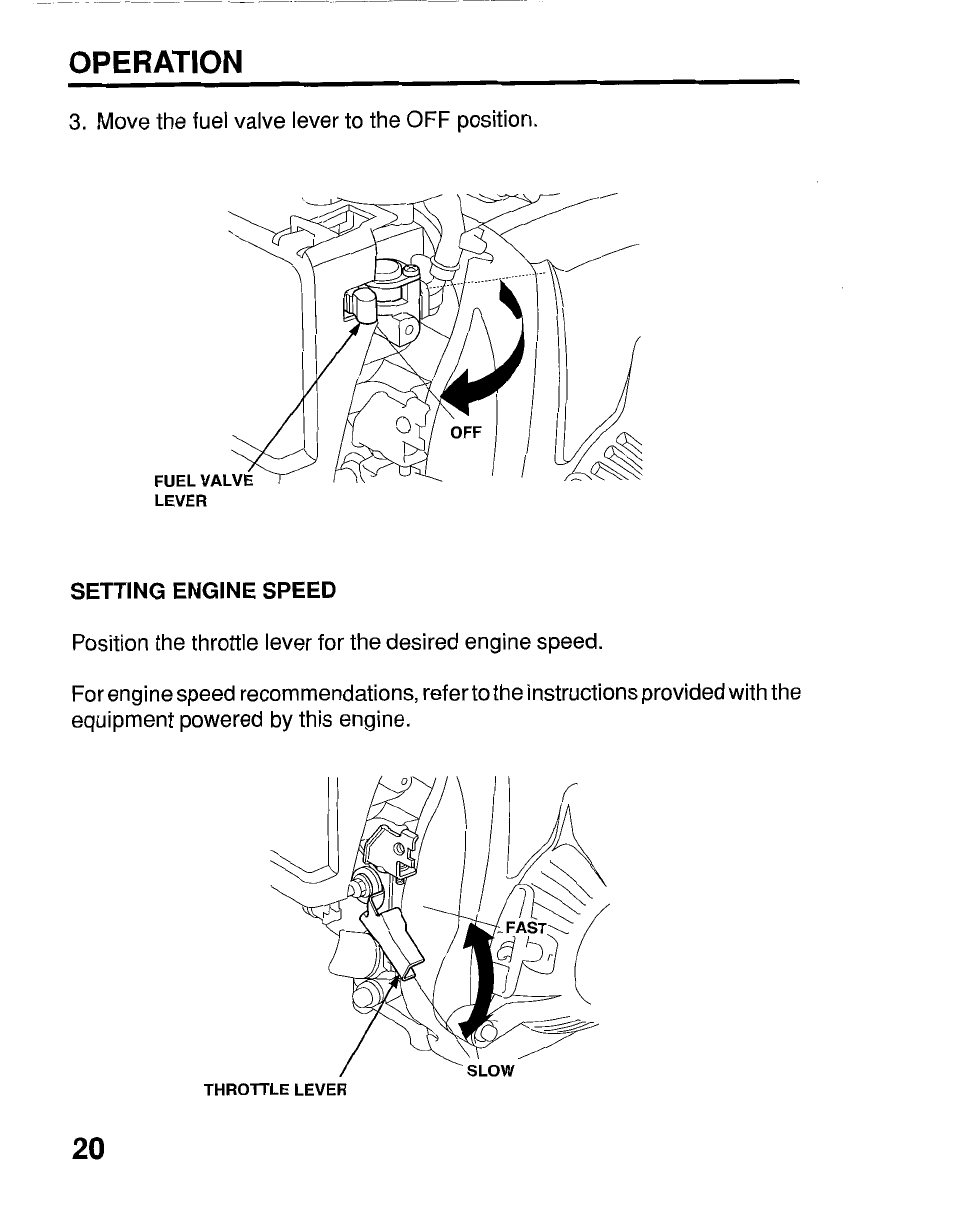
Move the fuel valve lever to the
OFF
position.
FUEL
LEVER
SETTING ENGINE SPEED
Position the throttle lever for the desired engine speed.
For
engine speed recommendations, refer to the instructions provided with the
equipment powered
by
this engine.
THROlTLE LEVER
20
SERVICING
YOUR
HONDA
ENGINE
THE IMPORTANCE
OF
MAINTENANCE
Good maintenance is essential for safe, economical, and trouble-free opera-
tion. It will also help reduce air pollution,
Improperly maintaining this engine,
or failure to correct
a
problem
before operation, can cause a
malfunction in which
you
can be
seriously hurt or killed.
Always follow the inspection and
maintenance recommendations
and schedules in this owner’s
manual.
To
help you properly care for your engine, the following pages include a
maintenance schedule, routine inspection procedures, and simple mainte-
nance procedures using basic hand tools. Other service tasks that are more
difficult, or require special tools, are best handled by professionals and are
normally performed by a Honda technician
or
other qualified mechanic.
The maintenance schedule applies
to
normal operating conditions.
If
you
operate your engine under unusual conditions, such as sustained high-load or
high-ternperaturls operation,
or
use in unusually wet or dusty conditions,
consult your servicing dealer
for
recommendations applicable
to
your indi-
vidual needs and use.
Maintenance, replacement, or repair
of
emission control devices and
systems may
be
done by any engine repair establishment
or
individual,
using parts that are “certified”
to
EPA
standards.
21
SERVICING
YOUR
HONDA
ENGINE
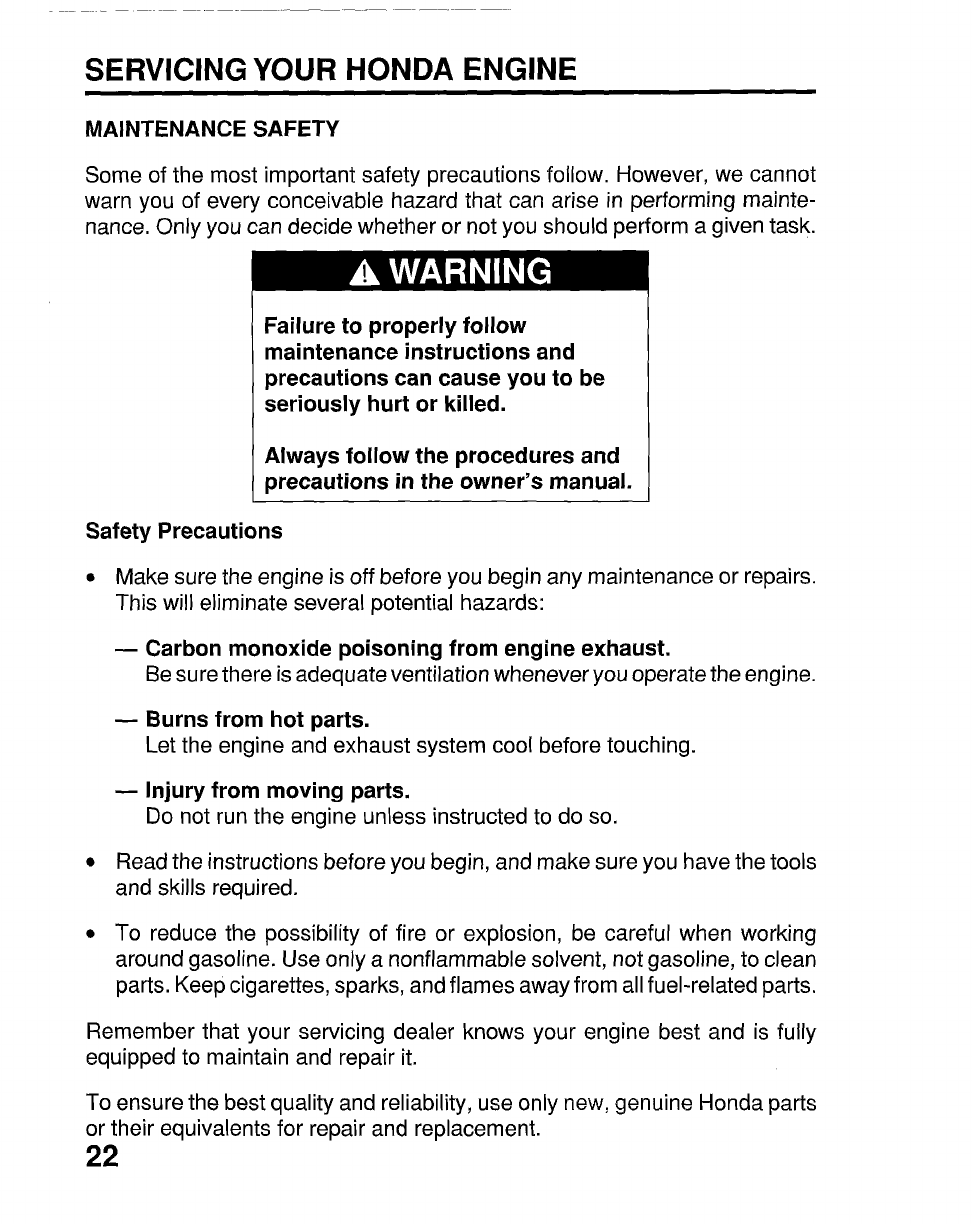
MAINTENANCE SAFETY
Some of the most important safety precautions follow. However, we cannot
warn you of every conceivable hazard that can arise in performing mainte-
nance. Only you can decide whether or not you should perform a given task.
Failure to properly follow
maintenance instructions and
precautions can cause you to be
seriously hurt or killed.
Always follow the procedures and
precautions in the owner’s manual.
Safety Precautions
Make sure the engine is off before you begin any maintenance or repairs.
This will eliminate several potential hazards:
-
Carbon monoxide poisoning from engine exhaust.
Be sure there is adequate ventilation whenever you operate the engine.
-
Burns from hot parts.
Let the engine and exhaust system cool before touching.
-
Injury from moving parts.
Do
not run the engine unless instructed to do
so.
Read the instructions before you begin, and make sure you have the tools
and skills required.
To
reduce the possibility of fire or explosion, be careful when working
around gasoline. Use only a nonflammable solvent, not gasoline, to clean
parts. Keep cigarettes, sparks, and flames awayfrom
all
fuel-related parts.
Remember that your servicing dealer knows your engine best and is fully
equipped to maintain and repair
it.
To ensure the best quality and reliability, use only new, genuine Honda parts
or their equivalents for repair and replacement.
22
SERVICING
YOUR
HONDA ENGINE
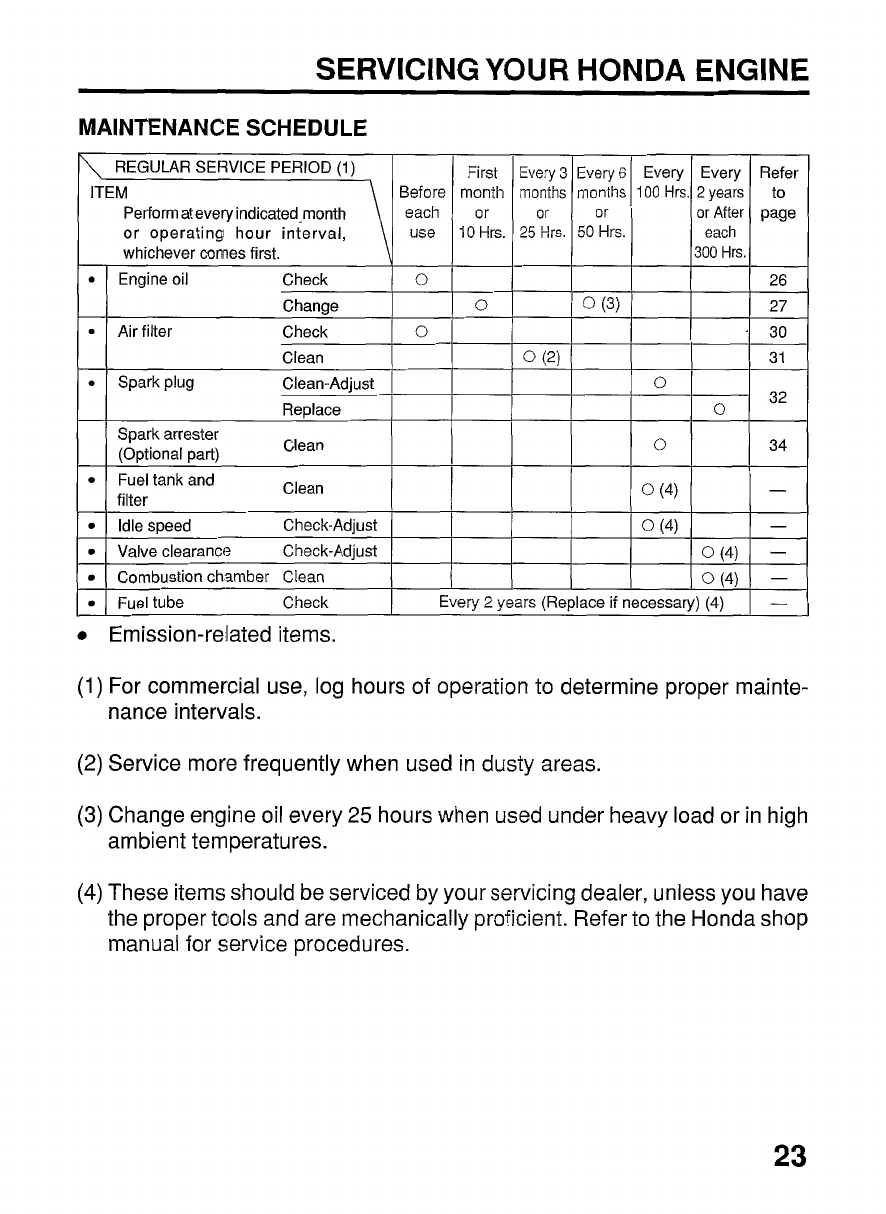
MAINTENANCE SCHEDULE
REGULAR SERVICE PERIOD
(1)
First
Perform atevery indicated-month
or operating hour interval,
whichever comes first.
Engine oil Check
Chanae
1
:
I
Air filter Check
Clean
Spark plug Clean-Adjust
Reolace
II
Spark arrester
(Optional part) Clean
I
1
1
I
tank and Clean
ll
1
Idle speed Check-Adjust
1
I
Valve clearance Check-Adiust
I
I
I
Combustion chamber Clean
I
I
i
each
I
I
Fuel
tube Check Every
2
years (Replace if necessary)
(4)
I
-
I
Emission-related items.
(1)
For commercial use,
log
hours
of
operation to determine proper mainte-
nance intervals.
(2)
Service more frequently when used in dusty areas.
(3)
Change engine
oil
every
25
hours when used under heavy load or in high
ambient temperatures.
(4)
These items should be serviced by your servicing dealer, unless you have
the proper
tools
and are mechanically proficient. Refer to the Honda
shop
manual for service procedures.
23
SERVICING YOUR HONDA ENGINE
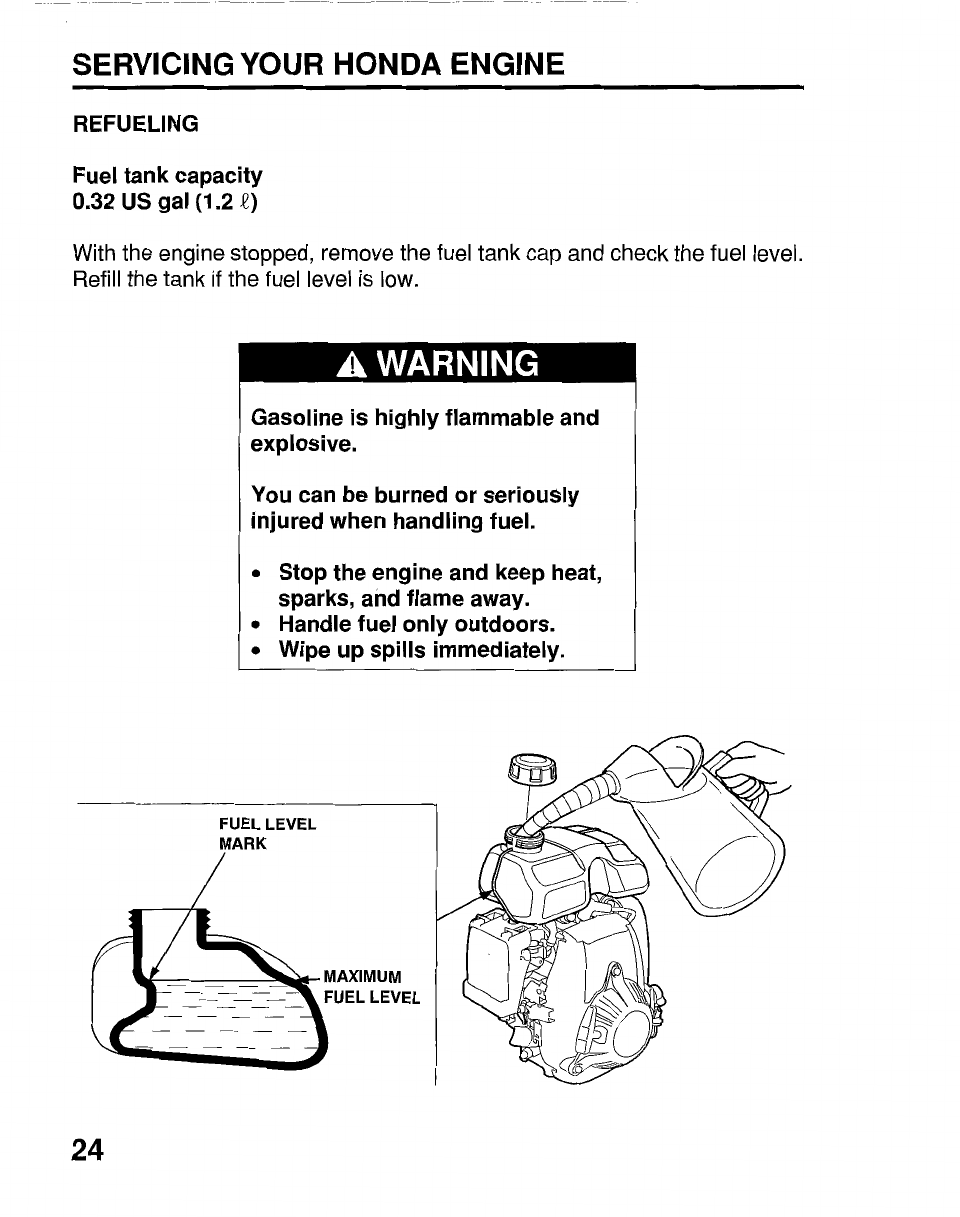
REFUELING
Fuel tank capacity
0.32
US gal (1.2
1)
With the engine stopped, remove the fuel tank cap and check the fuel level.
Refill the tank if the fuel level is
low.
Gasoline is highly flammable and
explosive.
You can be burned or seriously
injured when handling fuel.
0
Stop the engine and keep heat,
sparks, and flame away.
0
Handle fuel only outdoors.
0
Wipe up spills immediately.
24
SERVICING
YOUR
HONDA ENGINE
Refuel in a well-ventilated area before starting the engine.
If
the engine has
been running, allow it to cool. Refuel carefully to avoid spilling fuel.
Do
not fill
above the fuel level mark. After refueling, tighten the fuel tank cap securely.
Never refuel the engine inside a building where gasoline fumes may reach
flames or sparks. Keep gasoline away from appliance pilot lights, barbecue&
electric appliances, power tools, etc.
Spilled fuel is not only a fire hazard, it causes environmental damage. Wipe
up spills immediately.
I
NOTICE
I
Fuel can damage paint and plastic. Be careful not
to
spill fuel when filling your
fuel tank. Damage caused by spilled fuel
is
not covered under warranty.
FUEL RECOMMENDATIONS
Use unleaded gasoline with a
pump
octane rating
of
86
or higher.
These engines are certified to operate on unleaded gasoline. Unleaded
gasoline producesfewer engine and spark plug deposits and extends exhaust
system life.
Never use stale or contaminated gasoline or an oil/gasoline mixture. Avoid
getting dirt or water in the fuel tank.
Occasionally
you
may hear a light “spark knack” or “pinging” (metallic rapping
noise) while operating under heavy loads. This
is
no cause for concern.
If
spark knock lor pinging occurs at a steady engine speed, under normal load,
change brands of gasoline.
If
spark knock or pinging persists, see an
authorized Honda servicing dealer.
1
NOTICE
I
Running the engine with persistent spark knock or pinging can cause engine
damage.
Running the engine with persistent spark knock or pinging is misuse, and the
Distributor’s Limited Warranty
does not cover parts damaged by misuse.
25
SERVICING YOUR HONDA ENGINE
ENGINE
OIL
LEVEL
CHECK
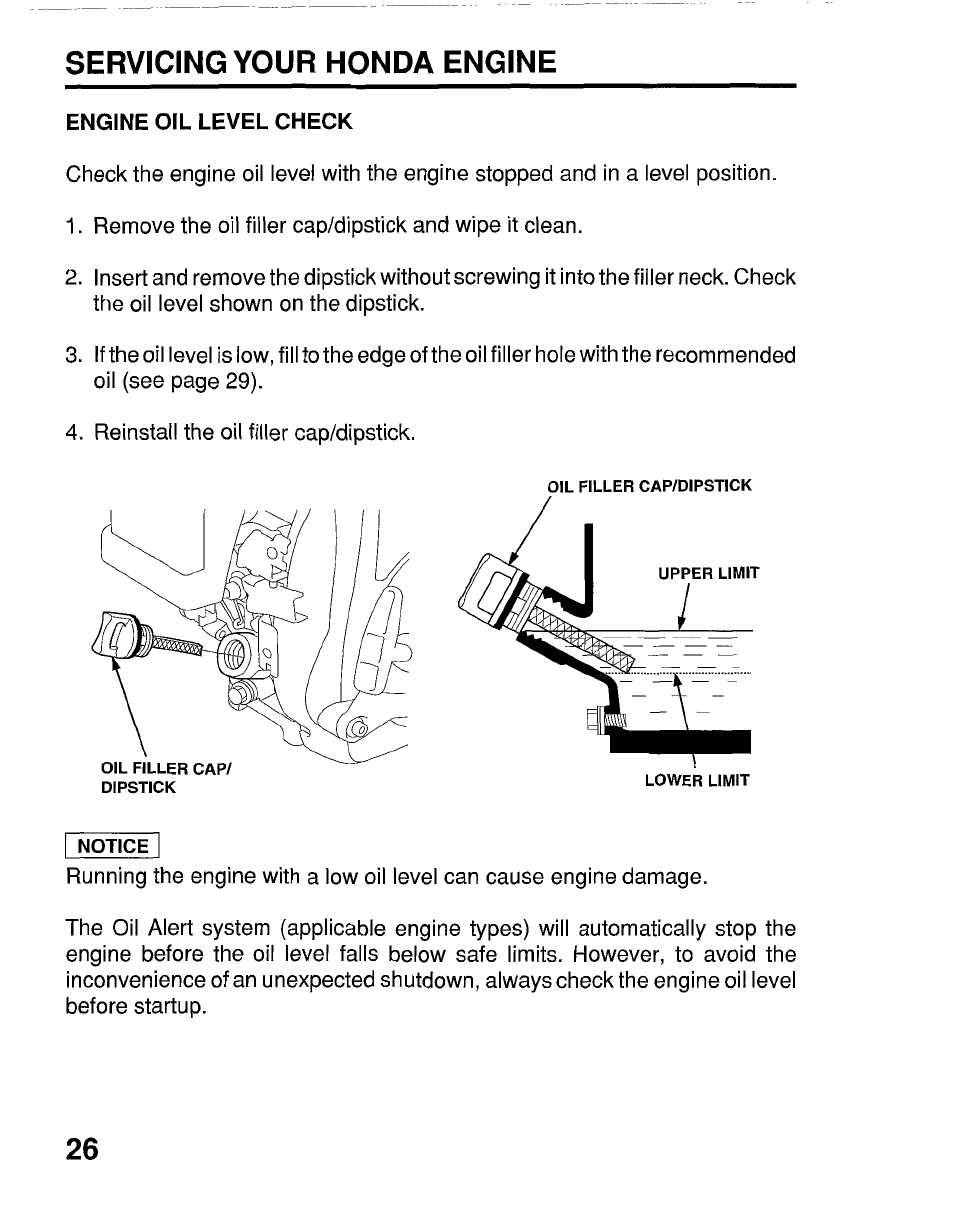
Check the engine oil level with the engine stopped and in a level position.
1.
Remove the
oil
filler cap/dipstick and wipe it clean.
2.
Insert and remove the dipstick without screwing it into the filler neck. Check
the oil level shown on the dipstick.
3.
If
the oil level
is
low, fill to the edge
of
the oil filler hole with the recommended
oil (see page
29).
4.
Reinstall the oil filler cap/dipstick.
OIL FILLER CAPlDlPSTlCK
DIPSTICK LOWER LIMIT
pEEq
Running the engine with a low oil level can cause engine damage.
The Oil Alert system (applicable engine types) will automatically stop the
engine before the oil level falls below safe limits. However, to avoid the
inconvenience
of
an unexpected shutdown, always check the engine oil level
before startup.
26
SERVICING
YOUR
HONDA
ENGINE
ENGINE
OIL
CHANGE
Drain the used oil while the engine is warm. Warm
oil
drains quickly and
completely.
1.
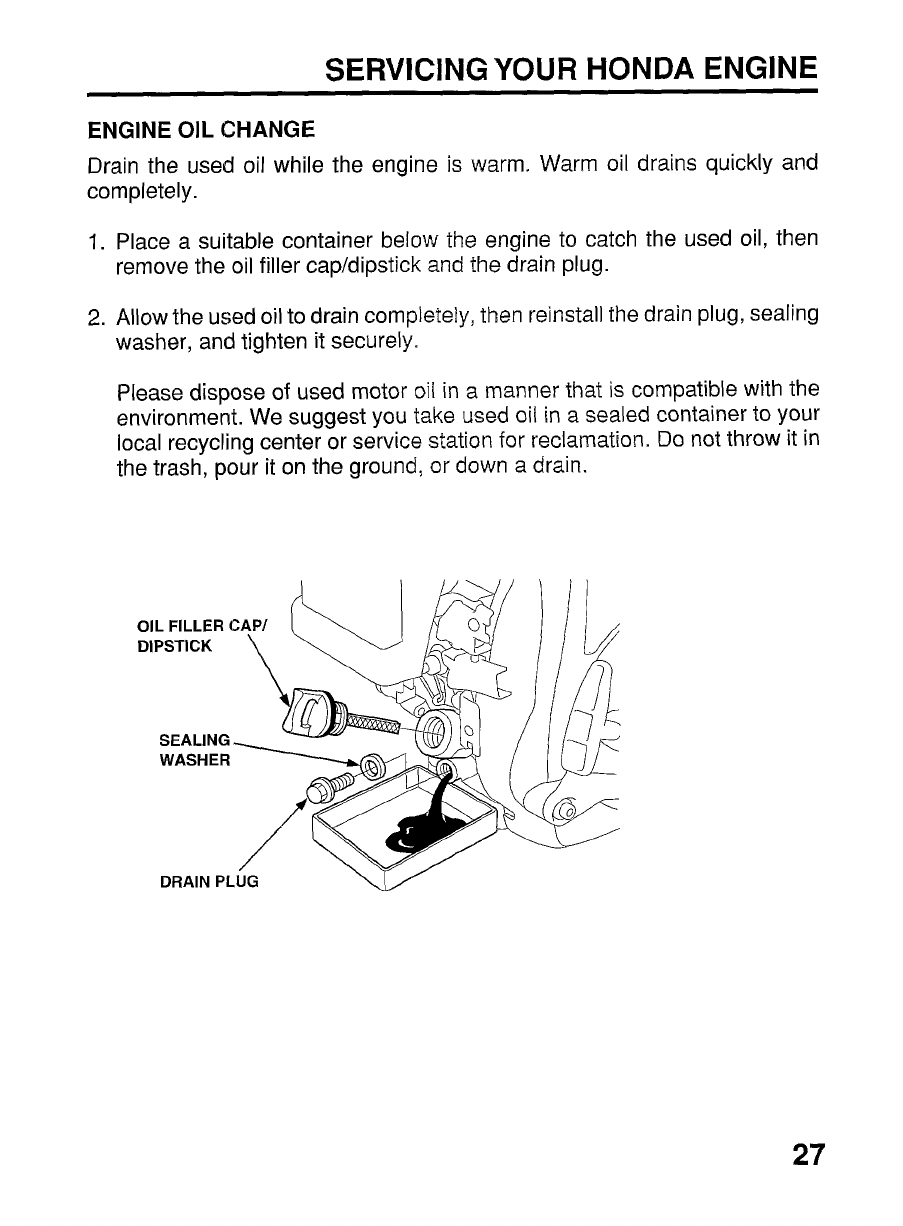
Place a suitable container below the engine to catch the used oil, then
remove the oil filler cap/dipstick and the drain plug.
2.
Allow the used oil to drain completely, then reinstall the drain plug, sealing
washer, and tighten it securely.
Please dispose
of
used motor
oil
in
a
manner that is compatible with the
environment. We suggest you take used oil
in
a sealed container to your
local recycling center or service station for reclamation.
Do
not throw it in
the trash, pour it on the ground,
or
down a drain.
27
SERVICING
YOUR
HONDA ENGINE
3.
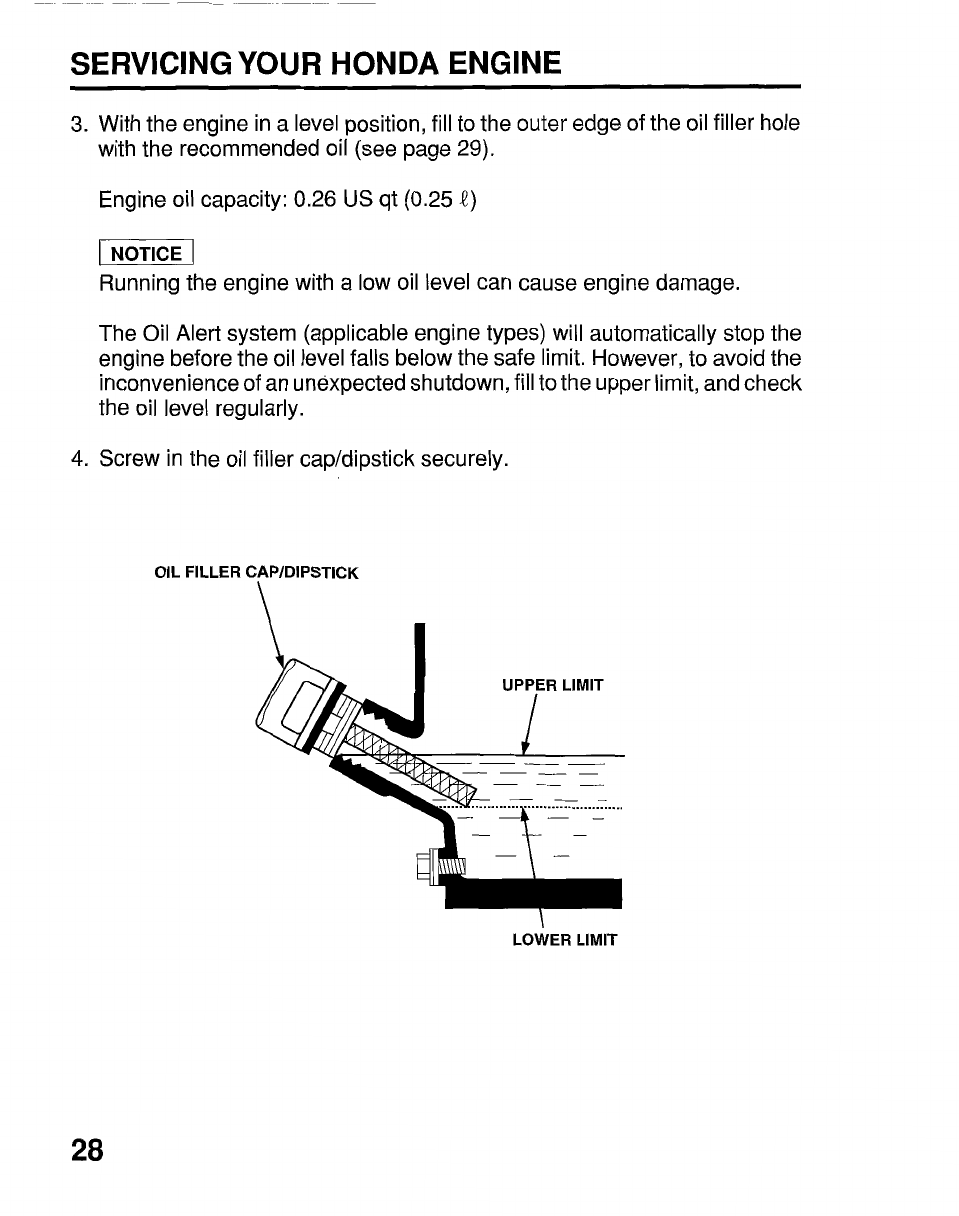
With the engine in a level position, fill to the outer edge of the oil filler hole
with the recommended
oil
(see page
29).
Engine oil capacity:
0.26
US
qt
(0.25
1)
I
NOTICE
I
Running the engine with a low oil level can cause engine damage.
The Oil Alert system (applicable engine types) will automatically stop the
engine before the oil level falls below the safe limit. However, to avoid the
inconvenience of an unexpected shutdown, fill to the upper limit, and check
the oil level regularly.
4.
Screw in the oil filler cap/dipstick securely.
OIL FILLER CAP/DIPSTICK
LOWER LIMIT
28
SERVICING
YOUR
HONDA ENGINE
ENGINE
OIL
RECOMMENDATIONS
Oil is a major factor affecting performance and service life. Use 4-stroke
automotive detergent oil.
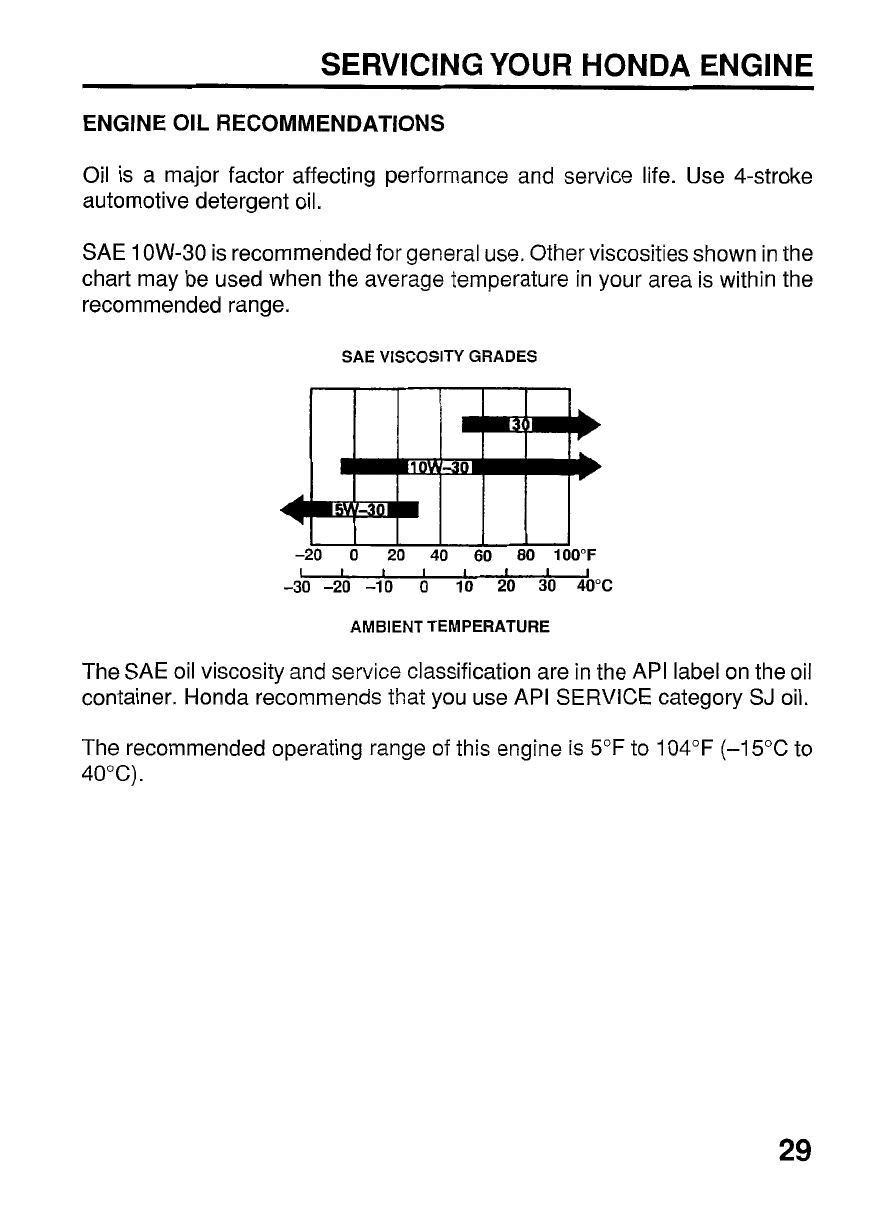
SAE
1
OW-30
is recommended for general use. Other viscosities shown in the
chart may be used when the average temperature in your area is within the
recommended range.
SAE
VISCOSITY
GRADES
-20
0
20 40
60
80
100°F
I
I
1
I
1
I
I
I
-30
-20
-1
0 0
10
20 30
40°C
AMBIENT
TEMPERATURE
The
SAE
oil viscosity and service classification are in the
API
label on the oil
container. Honda recommends that you use
API
SERVICE category
SJ
oil.
The recommended operating range of this engine is 5°F to
104°F
(-1
5°C to
40°C).
29
SERVICING YOUR HONDA ENGINE
AIR
FILTER INSPECTION
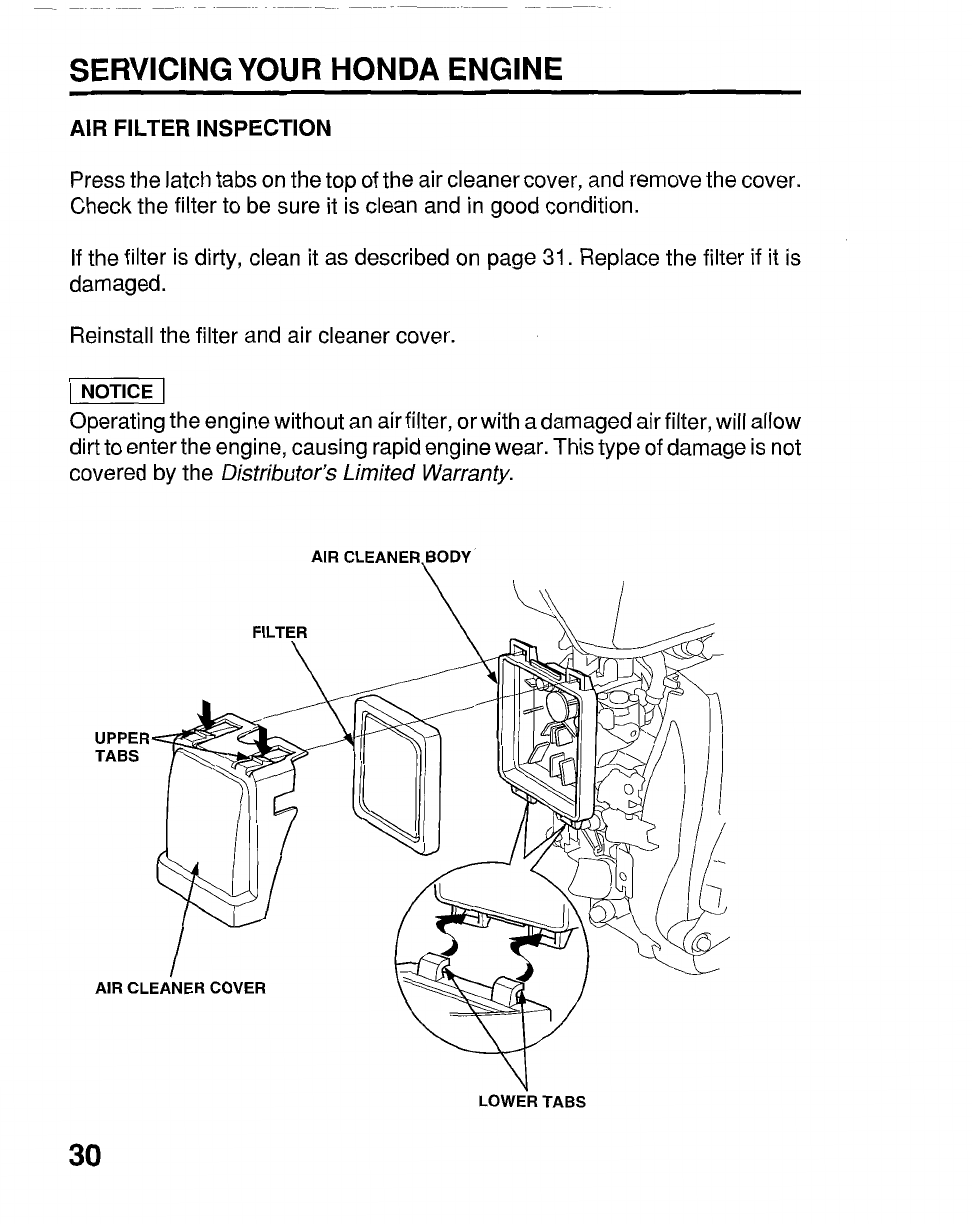
Press the latch tabs on the top of the air cleaner cover, and remove the cover.
Check the filter to be sure it is clean and in good condition.
If
the filter is dirty, clean it as described on page
31.
Replace the filter
if
it is
damaged.
Reinstall the filter and air cleaner cover.
-1
Operating the engine without an air filter, or with a damaged air filter, will allow
dirt to enter the engine, causing rapid engine wear. This type
of
damage is not
covered by the
Distributor’s Limited Warranty.
AIR CLEANER BODY
\
LOWER
TABS
30
SERVICING
YOUR
HONDA ENGINE
AIR FILTER CLEANING
A dirty air filter will restrict air flow to the carburetor, reducing engine
performance.
If
you operate the engine in very dusty areas, clean the air filter
more than specified in the MAINTENANCE SCHEDULE.
1.
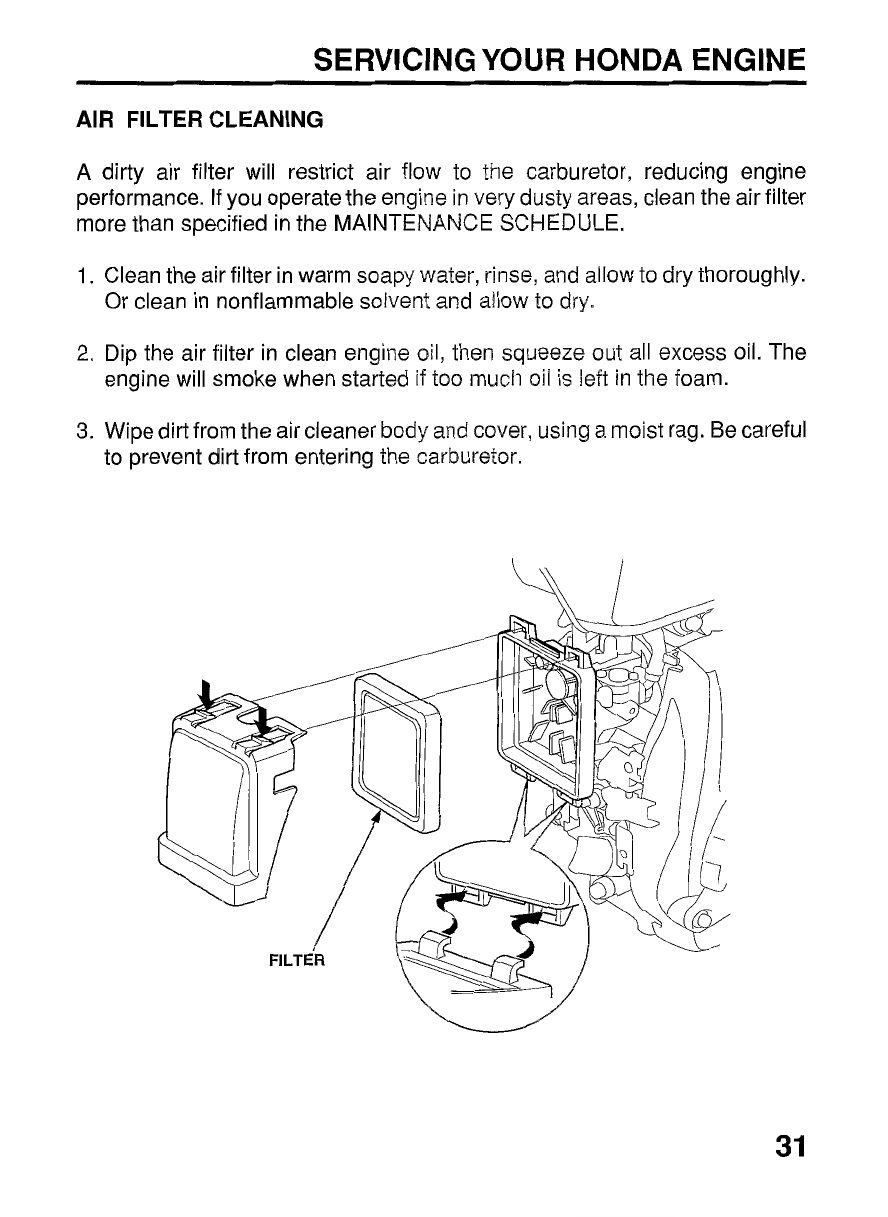
Clean the air filter in warm soapy water, rinse, and allow to dry thoroughly.
Or clean in nonflammable solvent and allow
to
dry.
2.
Dip the air filter in clean engine
oil,
then squeeze
out
all excess oil. The
engine will smoke when started
if
too
much
oil
is left in the foam.
3.
Wipe dirt from the air cleaner body
and
cover, using
a
moist rag. Be careful
to prevent dirt from entering the carburetor.
31
SERVICING YOUR HONDA ENGINE
SPARK
PLUG
SERVICE
Recommended spark plug: CR5HSB
(NGK)
U1
GFSR-UB
(DENSO)
1
NOTICE
I
An incorrect spark plug can cause engine damage.
I.
Disconnect the spark plug cap, and remove any dirt from around the spark
plug area.
2.
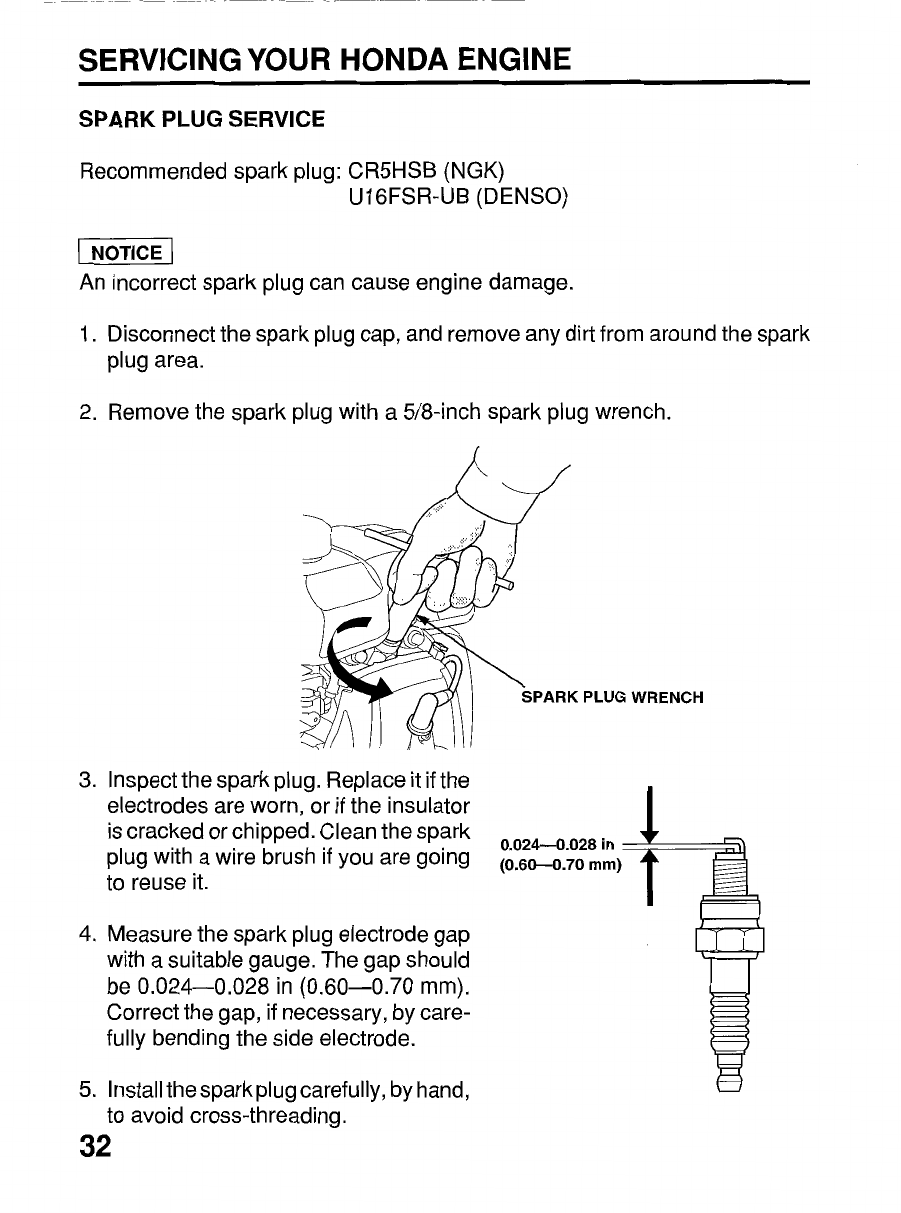
Remove the spark plug with a 5/8-inch spark plug wrench.
WRENCH
3.
Inspect the spark plug. Replace it
if
the
electrodes are worn, or if the insulator
is
cracked or chipped. Clean the spark
o.024--o.028
in
plug with a wire brush if you are going
(0.6&,-,70
,,,,,,)
to reuse it.
ta
4.
Measure the spark plug electrode gap
with a suitable gauge. The gap should
be
0.024-0.028
in
(0.60-0.70
mm).
Correct the gap,
if
necessary, by care-
fully bending the side electrode.
5.
Install thesparkplugcarefully, by hand,
32
to avoid cross-threading.
SERVICING YOUR
HONDA
ENGINE
6.
After the spark plug seats, tighten with a 5/8-inch spark plug wrench to
compress the washer.
If
reinstalling the used spark plug, tighten
1/8-1/4
turn after the spark plug
seats.
If
installing
a
new spark plug, tighten
1/2
turn after the spark plug seats.
piEiq
A loose spark plug can overheat and damage the engine.
Overtightening the sparkplug can damage the threads in the cylinder head.
7.
Attach the spark plug cap.
33
SERVICING YOUR HONDA ENGINE
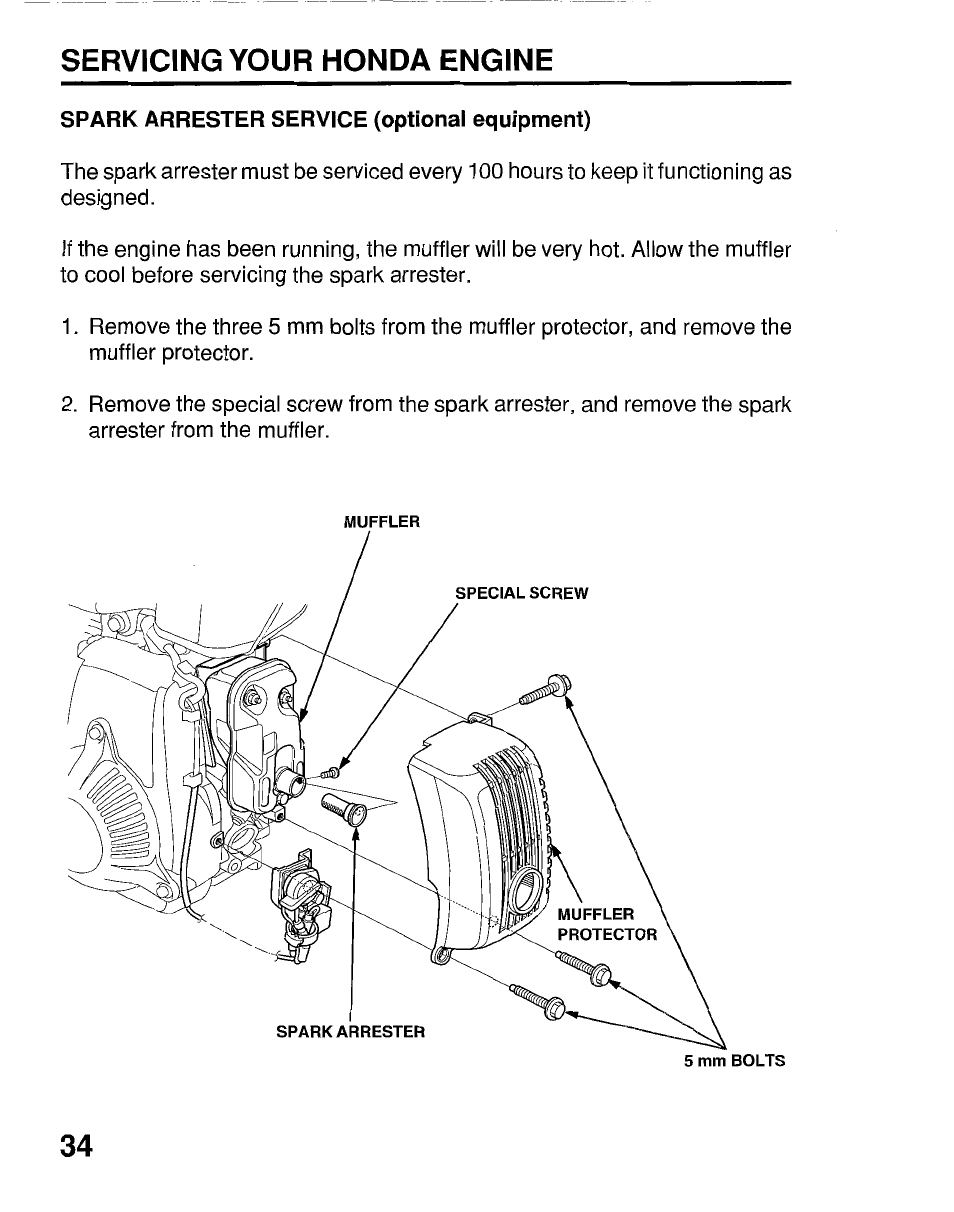
SPARK ARRESTER SERVICE (optional equipment)
The spark arrester must be serviced every
100
hours to keep i't functioning as
designed.
If
the engine has been running, the muffler will be very hot. Allow the muffler
to cool before servicing the spark arrester.
1.
Remove the three
5
mm bolts from the muffler protector, and remove the
muffler protector.
2.
Remove the special screw from the spark arrester, and remove the spark
arrester from the muffler.
MUFFLER
SPECIAL SCREW
5
mm
BOLTS
34
SERVICING
YOUR
HONDA ENGINE
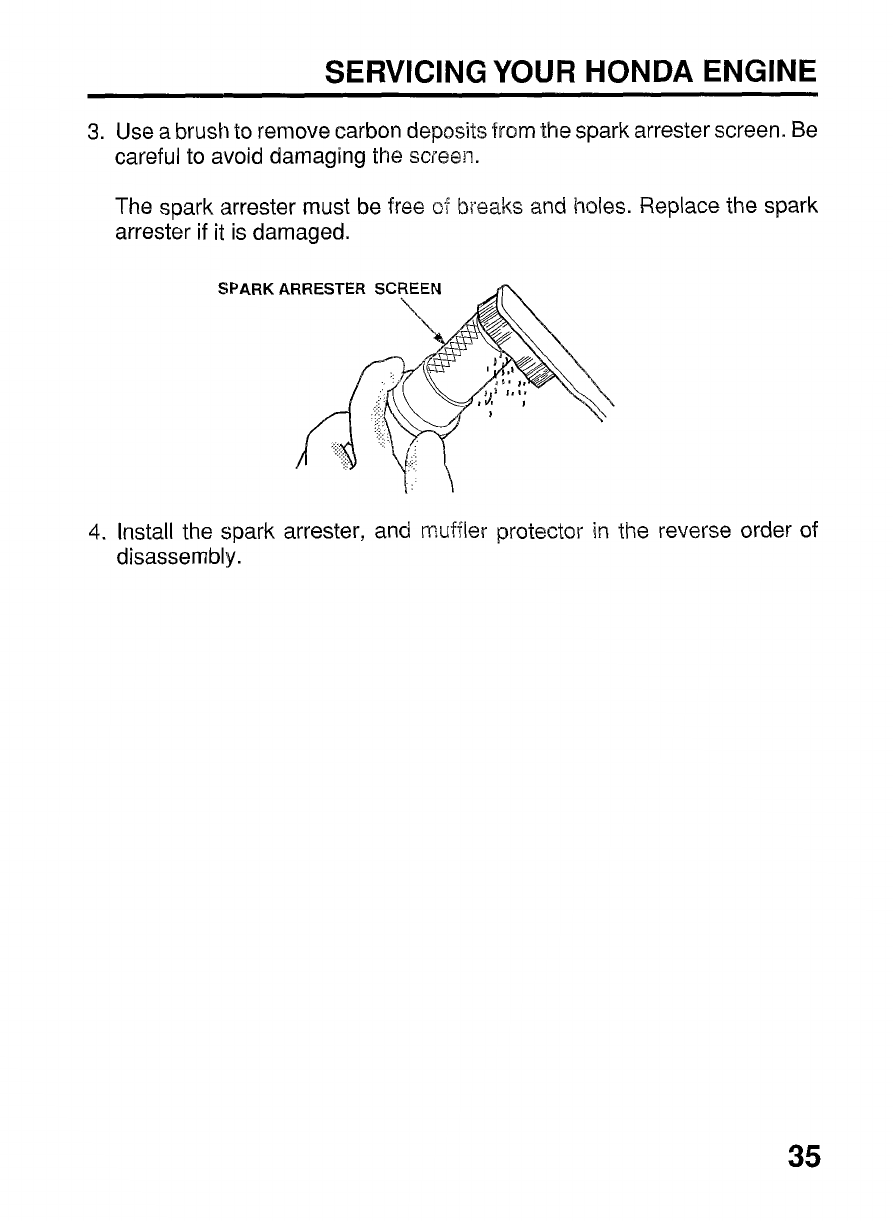
3.
Use a brush
to
remove carbon
deposits
from
the spark arrester screen. Be
careful
to
avoid damaging
the
screen.
The spark arrester must be free
sf
breaks
and
holes. Replace
the
spark
arrester if it
is
damaged.
4.
Install the spark arrester, and
muffler
protector
in
the
reverse order
of
disassembly.
35
HELPFULTIPS
&
SUGGESTIONS
STORING
YOUR
ENGINE
Storage Preparation
Proper storage preparation is essential for keeping your engine troublefree
and looking good. The following steps will help to keep rust and corrosion from
impairing your engine’s function and appearance, and will make the engine
easier to start when you use it again.
Cleaning
If
the engine has been running, allow it to cool for at least half an hour before
cleaning. Clean all exterior surfaces, touch up any damaged paint, and coat
other areas that may rust with a light film of oil.
rizis
0
Using a garden hose or pressure washing equipment can force water into
the air cleaner or muffler opening. Water in the air cleaner will soak the air
filter, and water that passes through the air filter or muffler can enter the
cylinder, causing damage.
Water contacting a hot engine can cause damage.
If
the engine has been
running, allow it to cool for at least half an hour before washing.
Fuel
Gasoline will oxidize and deteriorate in storage. Old gasoline will cause hard
starting, and it leaves gum deposits that clog the fuel system.
If
the gasoline
in your engine deteriorates during storage, you may need to have the
carburetor and other fuel system components serviced or replaced.
The length of time that gasoline can be left in your fuel tank and carburetor
without causing functional problems will vary with such factors as gasoline
blend, your storage temperatures, and whether the fuel tank is partially or
completely filled. The air in a partially filled fuel tank promotes fuel deteriora-
tion. Very warm storagehemperatures accelerate fuel deterioration. Fuel
deterioration problems may occur within a few months, or even less
if
the
gasoline was not fresh when you filled the fuel tank.
HELPFUL
TIPS
&
SUGGESTIONS
The Distributor’s Limited Warranty does not cover fuel system damage or
engine performance problems resulting from neglected storage preparation.
You
can extend fuel storage life by adding a fuel stabilizer that is formulated
for that purpose, or you can avoid fuel deterioration problems by draining the
fuel tank and carburetor.
ADDING
A
FUEL STABILIZER
TO
EXTEND FUEL STORAGE LIFE
When adding a fuel stabilizer, fill the fuel tank with fresh gasoline.
If
only
partially filled, air in the tank will promote fuel deterioration during storage.
If
you keep acontainerof gasolinefor refueling, be sure that it contains onlyfresh
gasoline.
1.
Add fuel stabilizer following the manufacturer’s instructions.
2.
After adding a fuel stabilizer, run the engine outdoors for
10
minutes to be
sure that tlreated gasoline has replaced the untreated gasoline in the
carburetor.
3.
Stop the engine, and move the fuel valve lever to the
OFF
position.
37
HELPFULTIPS
&
SUGGESTIONS
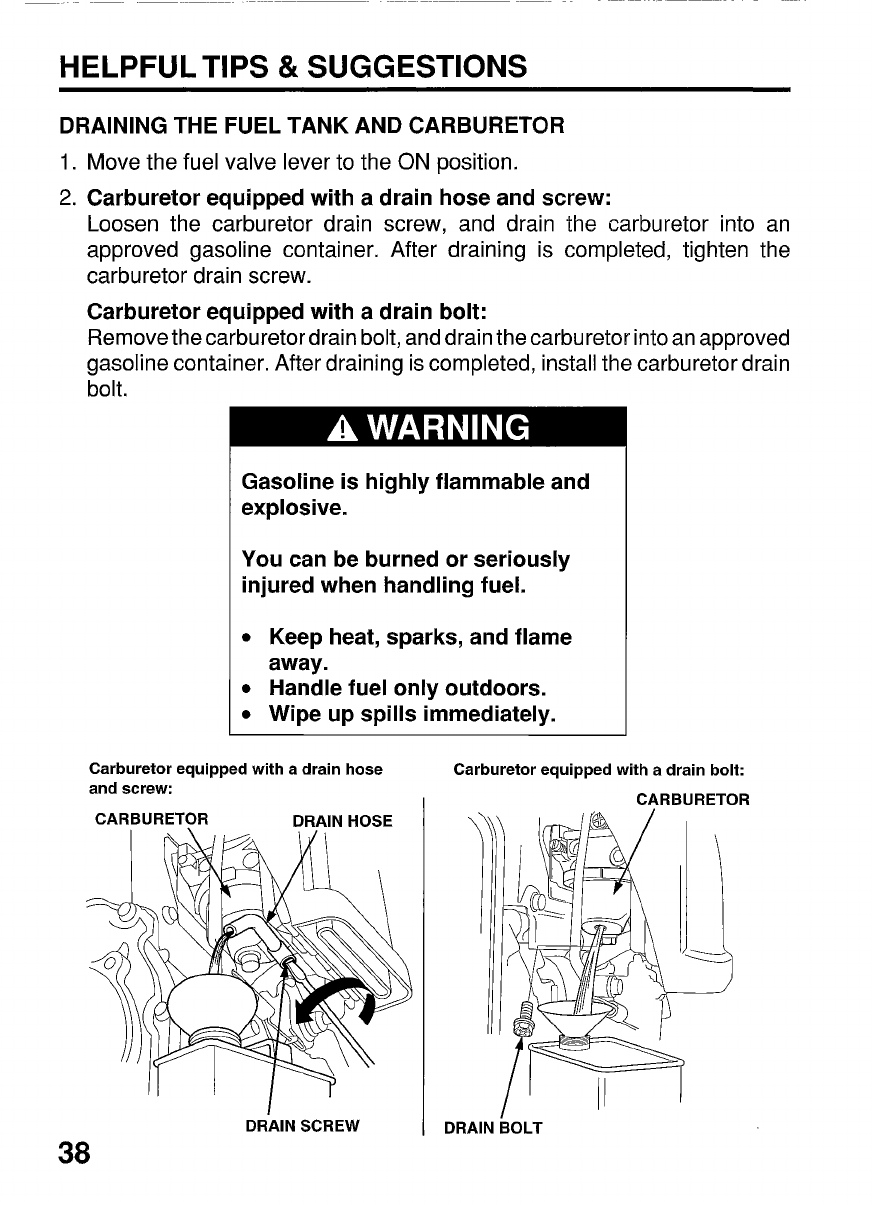
DRAINING THE FUEL TANK AND CARBURETOR
1.
Move the fuel valve lever to the
ON
position.
2.
Carburetor equipped with a drain hose and screw:
Loosen the carburetor drain screw, and drain the carburetor into an
approved gasoline container. After draining is completed, tighten the
carburetor drain screw.
Carburetor equipped with a drain bolt:
Remove the carburetor drain bolt, and drain the carburetor into an approved
gasoline container. After draining is completed, install the carburetor drain
bolt.
Gasoline is highly flammable and
explosive.
You
can be burned or seriously
injured when handling fuel.
Keep heat, sparks, and flame
Handle fuel only outdoors.
Wipe up spills immediately.
away.
Carburetor equipped with a drain hose Carburetor equipped with a drain bolt:
and screw:
I
CARBURETOR
DRAIN SCREW
1
DRAIN
BOLT
38
HELPFUL
TIPS
&
SUGGESTIONS
Engine Oil
Change the engine oil (see page
27).
Engine Cylinder
1.
Remove the spark plug (see
page
32),
2.
Pour
a
tablespoon
(5-1
0
cc)
of
clean
engine oil
into
the cylinder.
3.
Pull
the starter rope several times
to
distribute
.the
oil
in
The cylinder.
4.
Reinstall the spark plug.
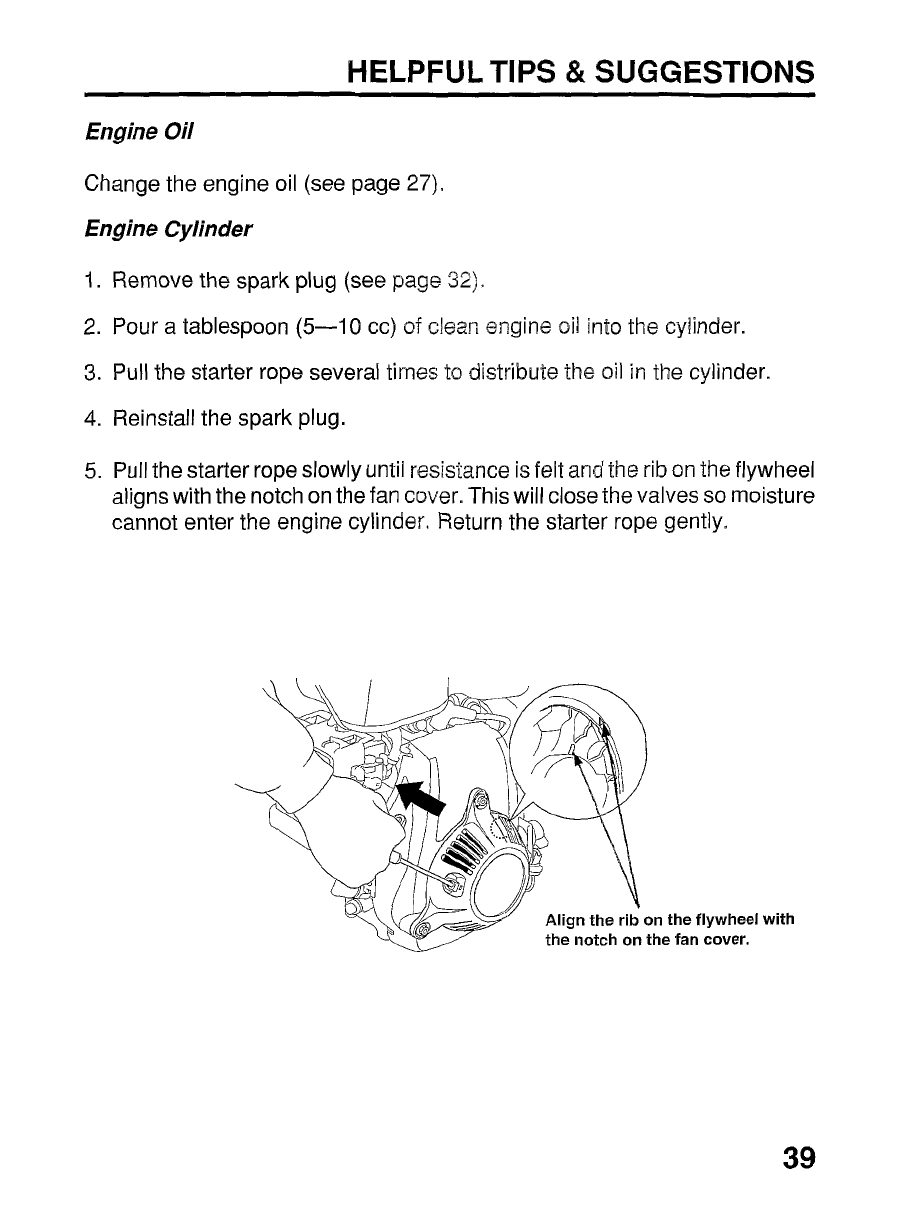
5.
Pull the starter rope slowly until resistance is felt
and
the
rib
on
the flywheel
aligns with the notch on the
fan
cover. This will close the valves
so
moisture
cannot enter the engine cylinder. Return the starter rope gently.
39
HELPFULTIPS
&
SUGGESTIONS
Storage Precautions
If
your engine will be stored with gasoline in the fuel tank and carburetor, it is
important to reduce the hazard of gasoline vapor ignition. Select a well-
ventilated storage area away from any appliance that operates with a flame,
such as a furnace, water heater, or clothes dryer.
Also
avoid any area with a
spark-producing electric motor, or where power tools are operated.
If
possible, avoid storage areas with high humidity, because that promotes rust
and corrosion.
Position the equipment
so
the engine is level. Tilting can cause fuel or
oil
leakage.
With the engine and exhaust system cool, cover the engine to keep out dust.
A
hot engine and exhaust system can ignite or melt some materials.
Do
not use
sheet plastic as a dust cover.
A
nonporous cover will trap moisture around the
engine, promoting rust and corrosion.
Removal From Storage
Check your engine as described in the BEFOREOP€RAT/ONchapter of this
manual.
If
the fuel was drained during storage preparation, fill the tank with fresh
gasoline.
If
you keep a container of gasoline for refueling, be sure that it
contains only fresh gasoline. Gasoline oxidizes and deteriorates over time,
causing hard starting.
If
the cylinder was coated with oil during storage preparation, the engine may
smoke briefly at startup. This is normal.
40
HELPFUL
TIPS
&
SUGGESTIONS
TRANSPORTllNG
If
the engine has been running, allow it
to
cool for at least
15
minutes before
loading the engine-powered equipment
on
the transport vehicle.
A
hot engine
and exhaust system can burn you and
can
ignite some materials.
Keep the engine level when transporting to reduce the possibility
of
fuel
leakage. Turn the fuel valve lever
to
the
OFF
position.
41
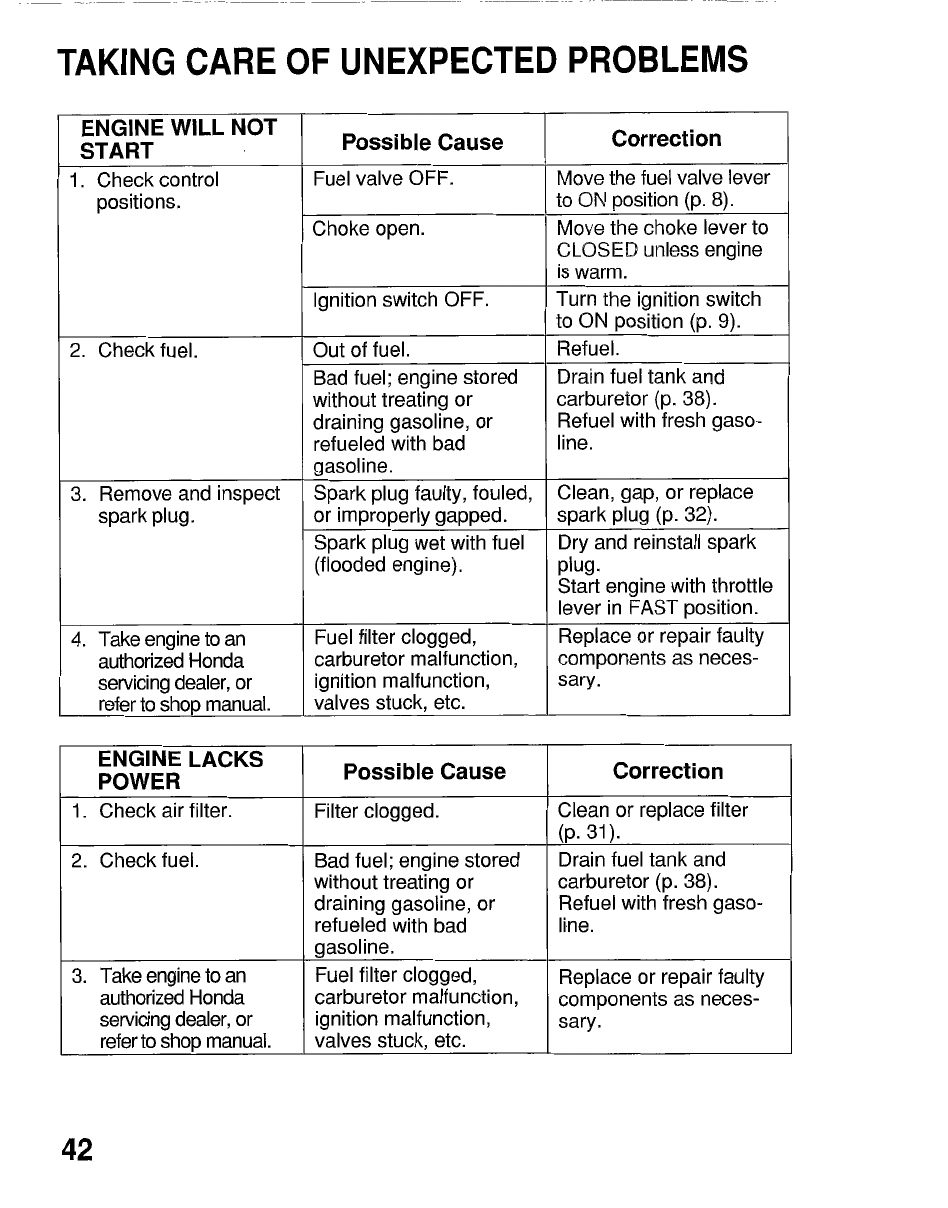
TAKING CARE
OF
UNEXPECTED PROBLEMS
ENGINE WILL NOT
START Possible Cause
1.
Check control Fuel valve OFF.
positions.
2.
Check fuel.
3.
Remove and inspect
spark plug.
Choke open.
I
Ignition switch OFF.
Out of fuel.
Bad fuel; engine stored
without treating or
draining gasoline, or
refueled with bad
gasoline.
Spark plug faulty, fouled,
or improperly gapped.
Spark plug wet with fuel
(flooded engine).
4.
Take engine to an Fuel filter clogged,
authorized Honda
servicing dealer, or carburetor malfunction,
valves stuck, etc.
refer to shop manual. ignition malfunction,
Correction
Move the fuel valve lever
to
ON
position (p. 8).
Move the choke lever to
CLOSED
unless engine
is warm.
Turn the ignition switch
to
ON
position
(p.
9).
Refuel.
Brain fuel tank and
carburetor (p. 38).
Refuel with fresh gaso-
line.
Clean, gap, or replace
spark plug (p. 32).
Dry and reinstall spark
Plug.
Start engine with throttle
lever in FAST position.
Replace or repair faulty
components
as
neces-
sary.
ENGINE LACKS
POWER Possible Cause Correction
1.
Check air filter
2. Check fuel.
3. Take engine to an
authorized Honda
servicing dealer, or
refer to shoD manual.
Filter clogged.
Bad fuel; engine stored
without treating or
draining gasoline, or
refueled with bad
gasoline.
Fuel filter clogged,
carburetor malfunction,
ignition malfunction,
valves stuck, etc.
Clean or replace filter
(P.
31
1.
Drain fuel tank and
carburetor (p.
38).
Refuel with fresh gaso-
line.
Replace or repair faulty
components
as
neces-
sary.
42
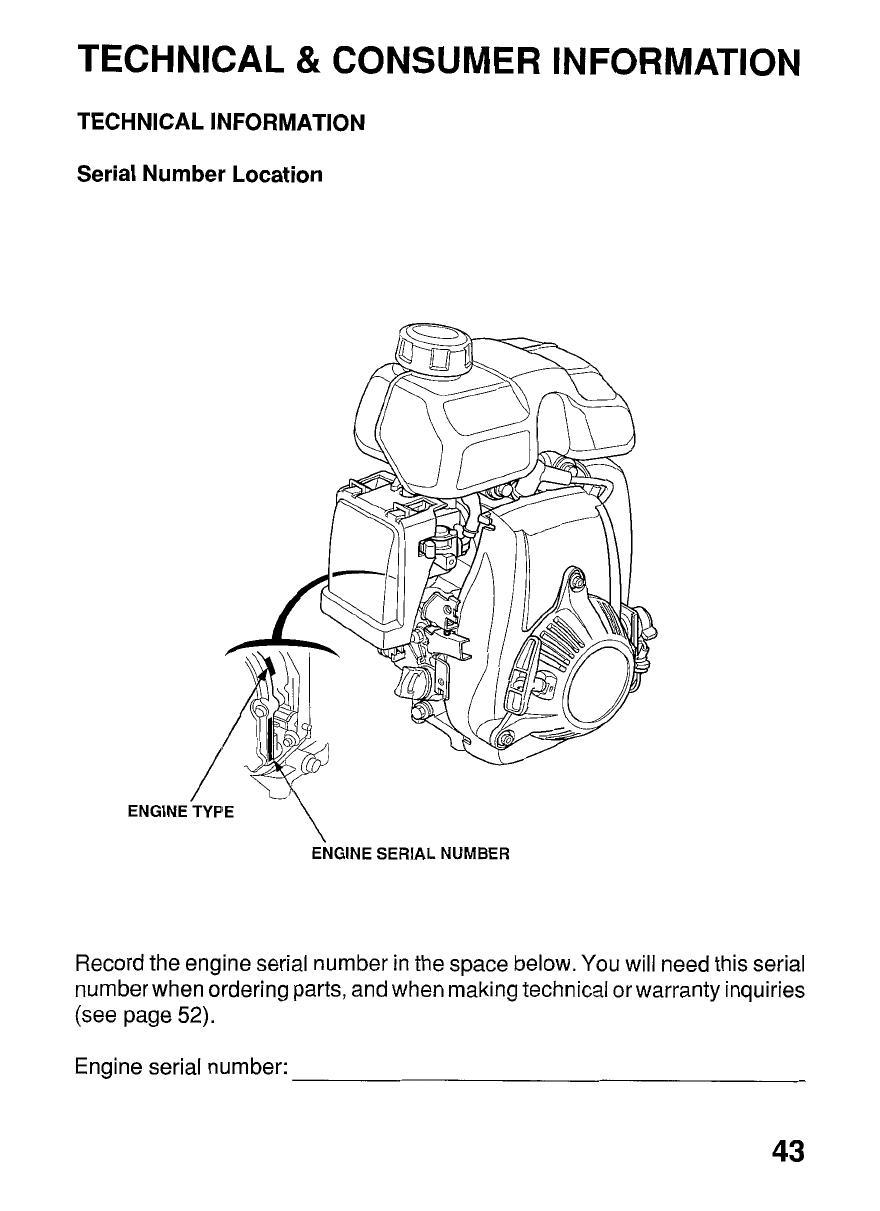
TECHNICAL
&
CONSUMER INFORMATION
TECHNICAL INFORMATION
Serial Number Location
ENGINE
/
TY
PIE
ENGINE
SERIAL NUMBER
Record the engine serial number in the space below.
You
will need this serial
number when ordering parts, and when making technical or warranty inquiries
(see page
52).
Engine serial number:
43
TECHNICAL
&
CONSUMER INFORMATION
Carburetor Modification for High Altitude Operation
At high altitude, the standard carburetor air-fuel mixture will be too rich.
Performance will decrease, and fuel consumption will increase. A very rich
mixture will also foul the spark plug and cause hard starting.
High altitude performance can be improved by specific modifications to the
carburetor.
If
you always operate your engine at altitudes above
5,000
feet
(1,500
meters), have your servicing dealer perform this carburetor modifica-
tion.
Even with carburetor modification, engine horsepower will decrease about
3.5%for each 1,000-foot (300-meter) increase in altitude. The effect of altitude
on horsepower will be greater than this
if
no carburetor modification is made.
When the carburetor has been modified for high altitude operation, the air-fuel
mixture will be too lean for low altitude use. Operation at altitudes below
5,000
feet (1,500 meters) with a modified carburetor may cause the engine to
overheat and result in serious engine damage. For use at low altitudes, have
your servicing dealer return the carburetor to original factory specifications.
44
TECHNICAL
&
CONSUMER INFORMATION
Oxygenated
Fuels
Some conventional gasolines are being blended with alcohol or an ether
compound. These gasolines are collectively referred to as oxygenated fuels.
To meet clean air standards, some areas of the United States and Canada use
oxygenated fuels to help reduce emissions.
If
you use an oxygenated fuel, be sure it is unleaded and meets the minimum
octane rating requirement.
Before using an oxygenated fuel, try to confirm the fuel’s contents. Some
states/provinces require this information to be posted on the pump.
The following are the
EPA
approved percentages of oxygenates:
ETHANOL
-
(ethyl or grain alcohol)
10%
by volume
You may use gasoline containing up to
10%
ethanol by
volume. Gasoline containing ethanol may be marketed
under the name “Gasohol”.
MTBE
-
(methyl tertiary butyl ether)
15%
by volume
You
may use gasoline containing up to
15%
MTBE
by
volume.
METHANOL
pi methyl
or wood alcohol)
5%
by volume
You
may use gasoline containing up to
5%
methanol by
volume, as long as it also contains cosolvents and corrosion
inhibitors to protect the fuel system. Gasoline containing
more than
5%
methanol by volume may cause starting and/
or performance problems. It may also damage metal, rub-
ber, and plastic parts of your fuel system.
If
you notice any undesirable operating symptoms, try another service station,
or switch to another brand of gasoline.
Fuel system damage or performance problems resulting from the use of an
oxygenated fuel containing more than the percentages of oxygenates men-
tioned above are not covered under warranty.
45
TECHNICAL
&
CONSUMER INFORMATION
Emission Control System Information
Source of Emissions
The combustion process produces carbon monoxide, oxides of nitrogen, and
hydrocarbons. Control of hydrocarbons and oxides of nitrogen is very impor-
tant because, under certain conditions, they react to form photochemical
smog when subjected to sunlight. Carbon monoxide does not react in the
same way, but it is toxic.
Honda utilizes lean carburetor settings and other systems to reduce the
emissions of carbon monoxide, oxides of nitrogen, and hydrocarbons.
The
US.
and California Clean Air Acts
EPA
and California regulations require all manufacturers to furnish written
instructions describing the operation and maintenance of emission Control
systems.
The following instructions and procedures must be followed in order to keep
the emissions from your Honda engine within the emission standards.
Tampering and Altering
Tampering with or altering the emission control system may increase emis-
sions beyond the legal limit. Among those acts that constitute tampering are:
0
Removal or alteration of any part of the intake, fuel, or exhaust systems.
Altering or defeating the governor linkage or speed-adjusting mechanism
to cause the engine to operate outside its design parameters.
46
TECHNICAL
&
CONSUMER INFORMATION
Problems That
May
Affect Emissions
If
you are aware of any of the following symptoms, have your engine inspected
and repaired by your servicing dealer.
0
Hard starting or stalling after starting.
0
Rough idle.
0
Misfiring or backfiring under load.
0
Afterburning (backfiring).
0
Black exhaust smoke or high fuel consumption.
Replacement Parts
The emission control systems on your Hondaengine were designed, built, and
certified to conform with
EPA
and California emission regulations. We recom-
mend the use
of
genuine Honda parts whenever
you
have maintenance done.
These original-design replacement parts are manufactured to the same
standards as the original parts,
so
you
can be confident of their performance.
The use of repla.cement parts that are not oithe original design and quality may
impair the effec:tiveness of your emission 'control system.
A
manufacturer of an aftermarket part assumes the responsibility that the part
will not adversely affect emission performance. The manufacturer
or
rebuilder
of the part must lcertify that use of the part
will
not result in a failure of the engine
to comply with emission regulations.
Maintenance
Follow the maintenance schedule on page
23.
Remember that this schedule
is based on the assumption that your machine will be used for its designed
purpose. Sustained high-load or high-temperature operation, or use in unusu-
ally wet or dusty conditions, will require more frequent service.
47
TECHNICAL
&
CONSUMER INFORMATION
Air
Index
An Air Index Information hang tag/label was applied to this engine in
accordance with the requirements of the California Air Resources Board.
The bar graph is intended to provide you, our customer, the ability to compare
the emissions performance of available engines. The lower the Air Index, the
less pollution.
The durability description is intended to provide you with information relating
to the engine’s emission durability period. The descriptive term indicates the
useful-life period for the engine’s emission control system. See your
Emission
Control Warranty
for additional information.
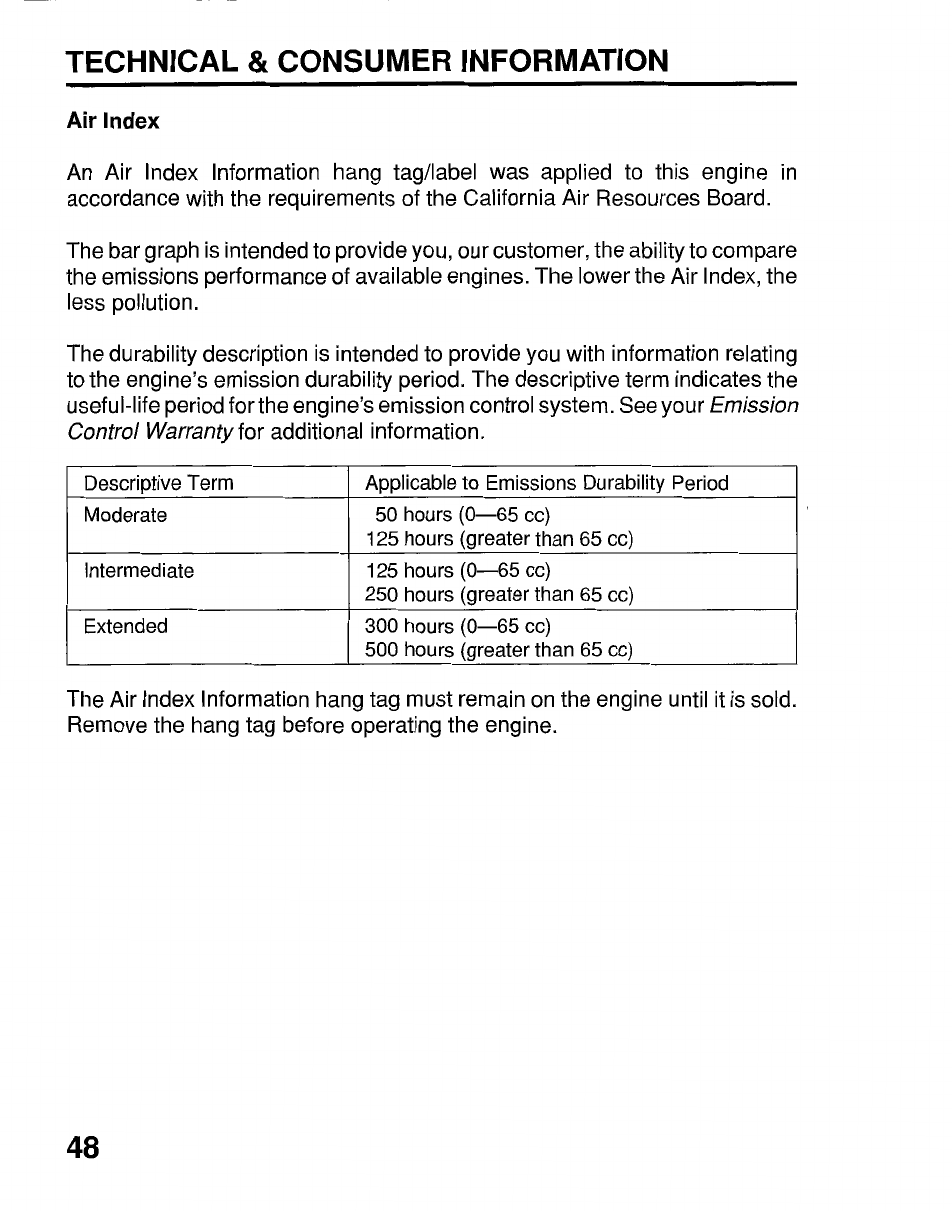
Descriptive
Term
Applicable to Emissions Durability Period
Moderate 50 hours (0-65 cc)
Intermediate
300
hours (0-65 cc) Extended
125 hours (0-65 cc)
125 hours (greater than 65 cc)
250 hours (greater than 65 cc)
500
hours (greater than 65 cc)
The Air Index Information hang tag must remain on the engine until it is sold.
Remove the hang tag before operating the engine.
48
TECHNICAL
&
CONSUMER INFORMATION
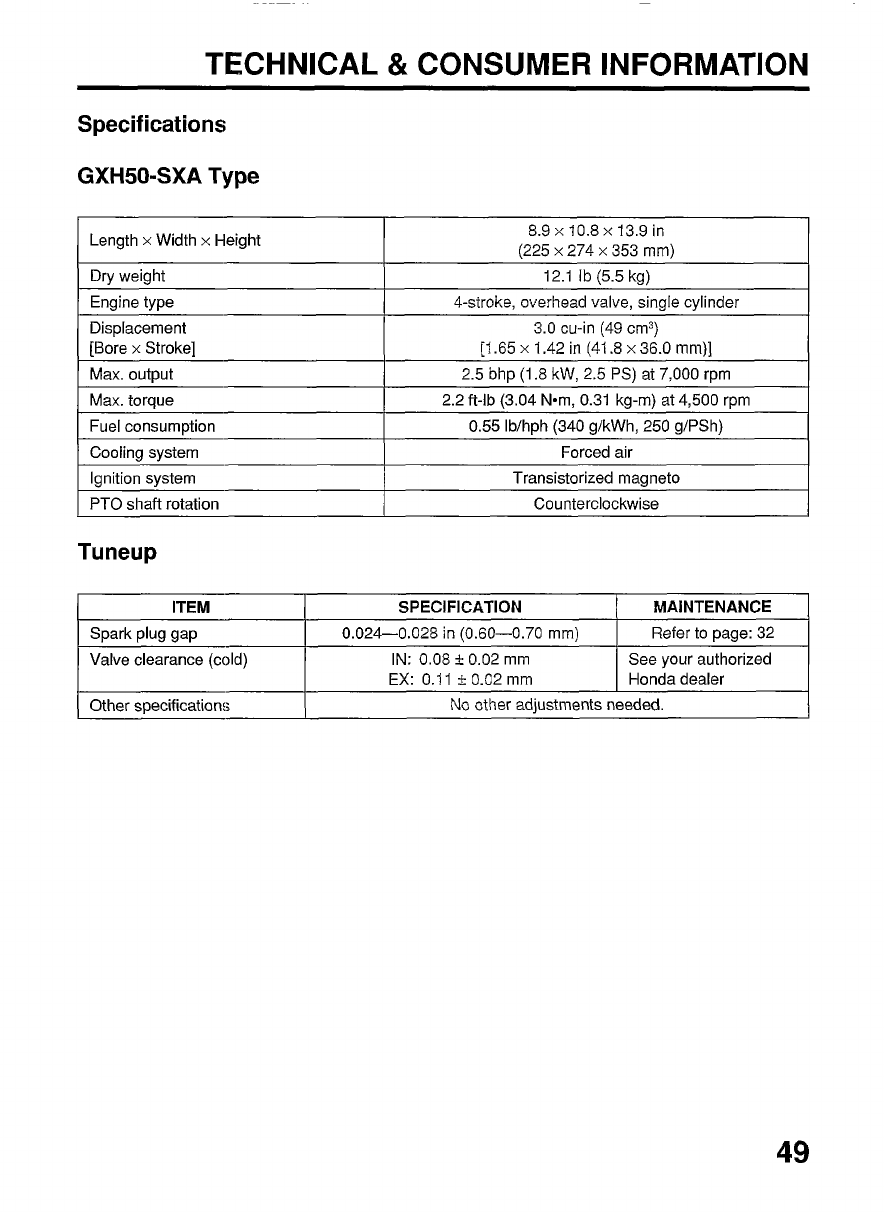
Specifications
GXH50-SXA
Type
Length
x
Width
x
Height 8.9
x
10.8
x
13.9 in
(225
x
274
x
353
mrn)
Dry weight
I
12.1 Ib
(5.5
kg)
I
Engine type 4-stroke, overhead valve, single cylinder
Displacement 3.0 cu-in (49 cm3)
[Bore
x
Stroke]
2.2
ft-lb
(3.04
N-m,
0.31 ka-rn) at 4.500 rDm
Max. toraue
2.5 bhp (1.8
kW,
2.5 PS) at 7,000 rpm
Max. output
[I
.65
x
1.42 in
(41.8
x
36.0
mm)]
Fuel consumption
I
0.55
Ib/hph (340 g/kWh,
250
g/PSh)
I
1
Cooling system
I
Forced air
I
Transistorized magneto
Counterclockwise
Tuneup
I
ITEM
I
SPECIFICATION
I
MAINTENANCE
I
0.024-0.028 in (0.60-0.70
mm)
Honda dealer
EX:
0.11
ri:
0.02
mrn
See your authorized
IN:
0.08
t.
0.02
mm
Refer to page: 32
No
other adjustments
needed.
49
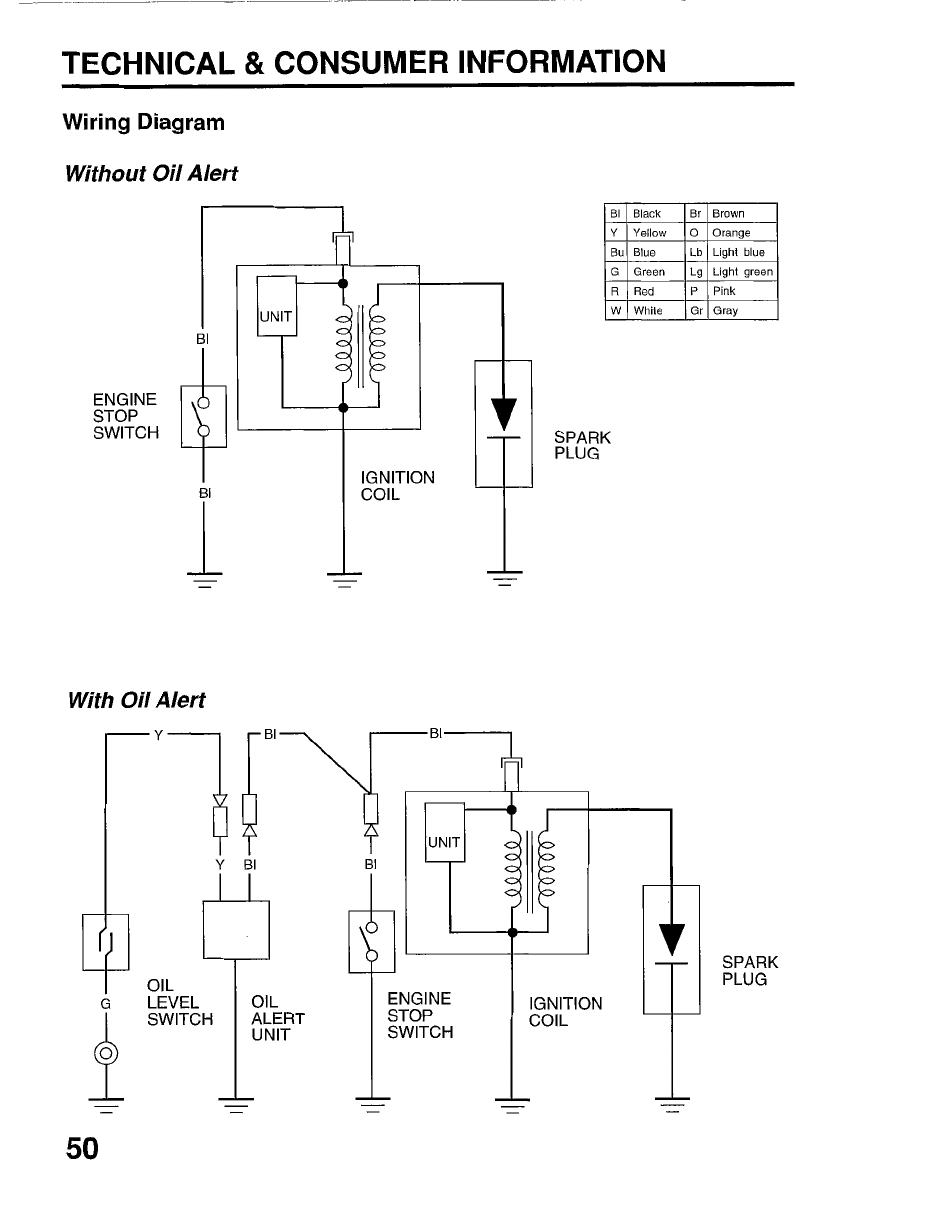
TECHNICAL
&
CONSUMER INFORMATION
Wiring Diagram
Without Oil Alert
ENGINE
STOP
SWITCH
1
With Oil Alert
1
r
Y
OIL
LEVEL OIL SWITCH ALERT UNIT
Bu
Gray
Gr
While W
Pink
P
Red
R
Light green
Lg
Green
G
Light blue
Lb
Blue
SPARK
PLUG
SPARK
PLUG
50
TECHNICAL
&
CONSUMER INFORMATION
CONSUMER
INFORMATION
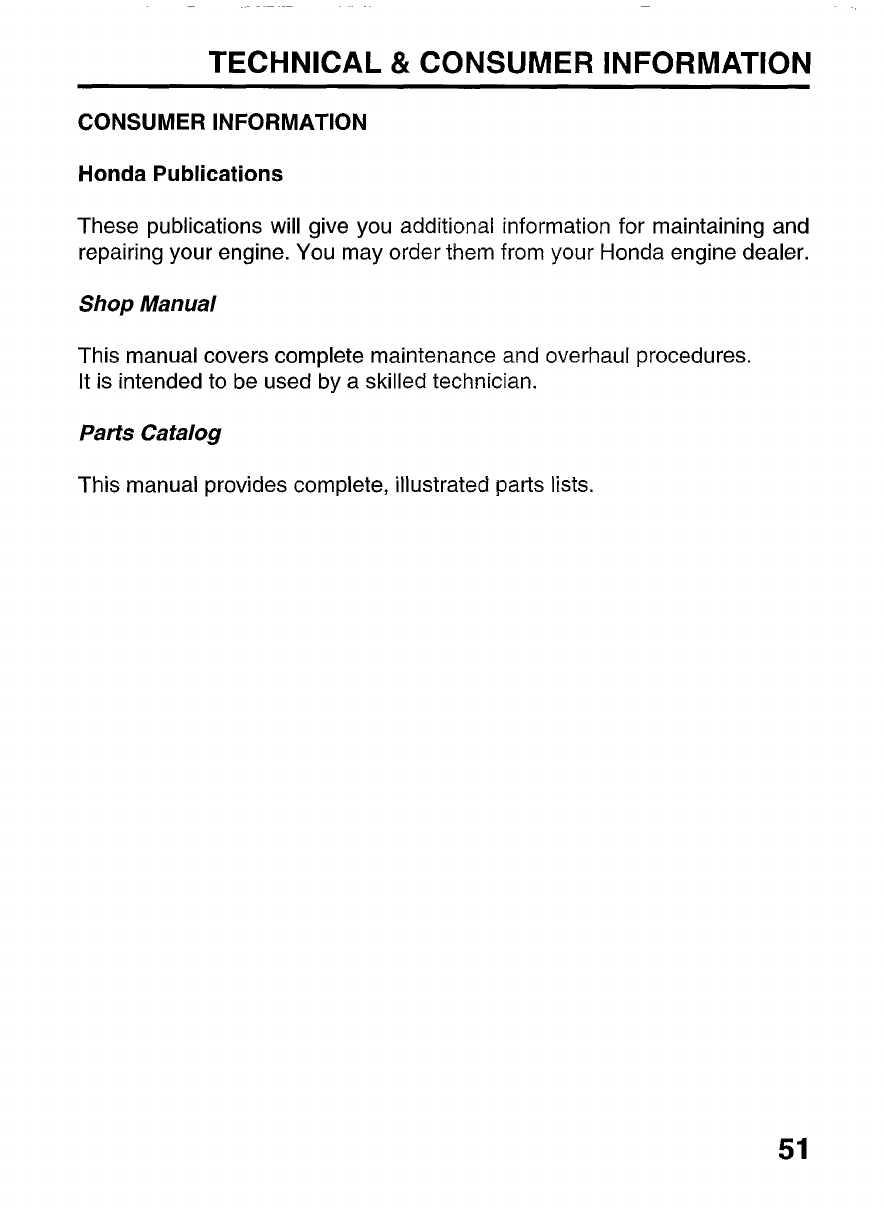
Honda Publications
These publications will give you additional information for maintaining and
repairing your engine. You may order them from your Honda engine dealer.
Shop
Manual
This manual covers complete maintenance and overhaul procedures.
It
is
intended to be used by a skilled technician.
Parts
Catalog
This manual provides complete, illustrated parts
lists.
51
TECHNICAL
&
CONSUMER INFORMATION
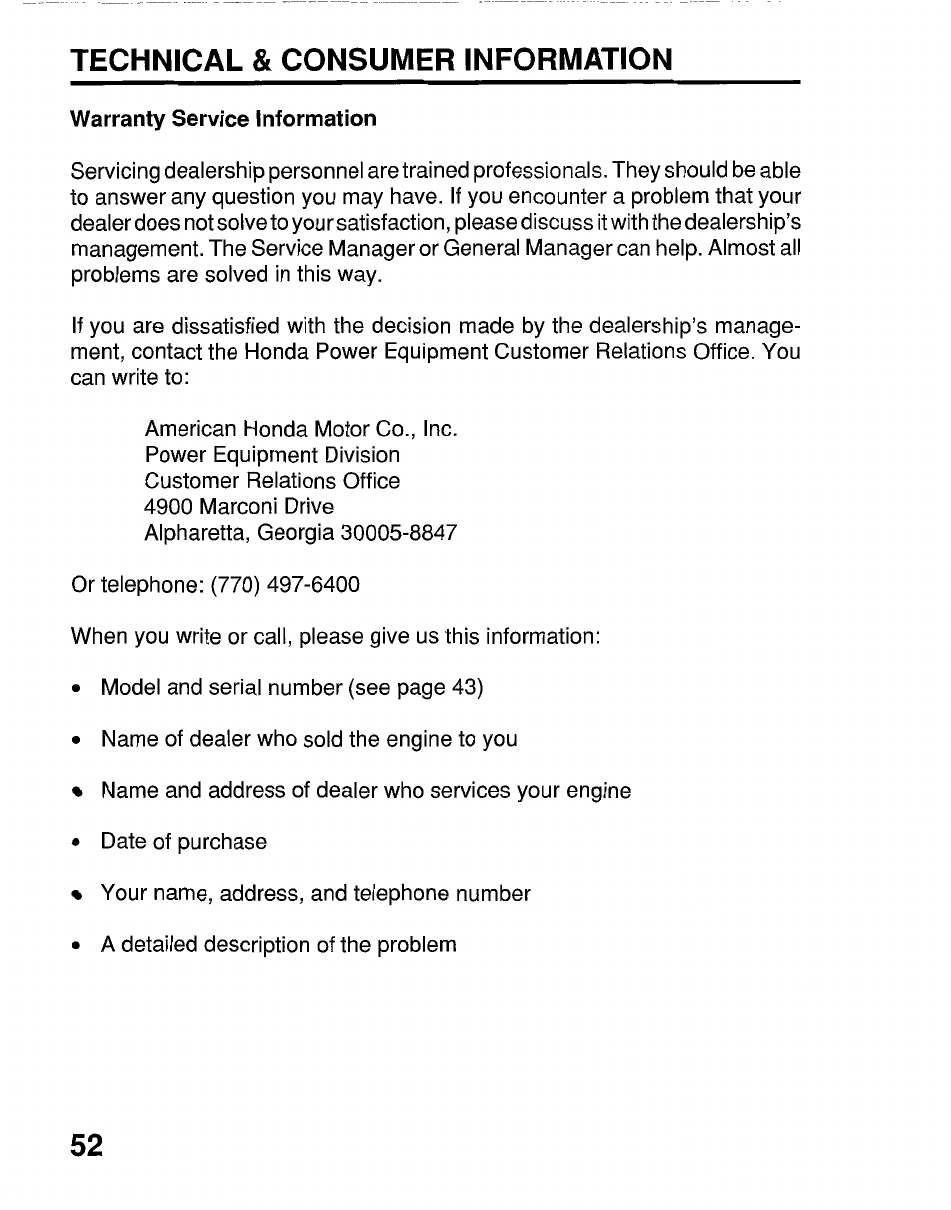
Warranty Service information
Servicing dealership personnel are trained professionals. They should be able
to answer any question you may have.
If
you encounter a problem that your
dealer does not solve to your satisfaction, please discuss it with the dealership’s
management. The Service Manager or General Manager can help. Almost all
problems are solved in this way.
If
you are dissatisfied with the decision made by the dealership’s manage-
ment, contact the Honda Power Equipment Customer Relations Office. You
can write to:
American Honda Motor Co., Inc.
Power Equipment Division
Customer Relations Office
4900 Marconi Drive
Alpharetta, Georgia 30005-8847
Or telephone: (770) 497-6400
When you write or call, please give us this information:
0
Model and serial number (see page 43)
0
Name of dealer who sold the engine to you
Name and address of dealer who services your engine
0
Date of purchase
Your name, address, and telephone number
0
A detailed description
of
the problem
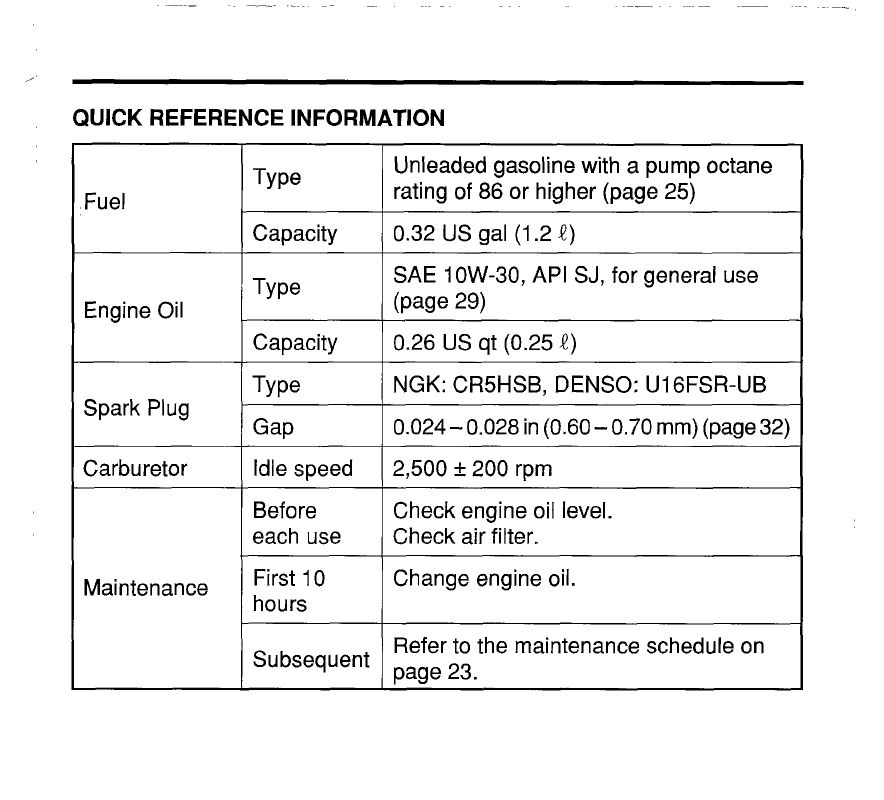
QUICK REFERENCE INFORMATION
Fuel
Unleaded gasoline with a pump octane
rating
of
86 or higher (page 25)
I
Capacity
I
0.32
US
gal (1.2
1)
TY Pe
Engine Oil (page 29)
SAE IOW-30, API
SJ,
for general use
I
Capacity
I
0.26
US qt (0.25
1)
Type
0.024- 0.028 in (0.60
-
0.70
mm) (page 32)
Gap
NGK:
CR5HSB,
DENSO:
U1
6FSR-UB
Spark Plug
Carburetor 2,500
f
200
rpm Idle speed
Before Check air filter.
each use Check engine oil level.
Maintenance First
10
hours Change engine oil.
Refer to the maintenance schedule on
Subsequent page 23.