Hoover 90cm Ceramic Range Cooker HVD9395IX Instruction Manual Product Code 33001255 HVD93951X
User Manual: Hoover Instruction Manual HVD9395IX - Range Cooker Help and Advice from Hoover
Open the PDF directly: View PDF  .
.
Page Count: 32
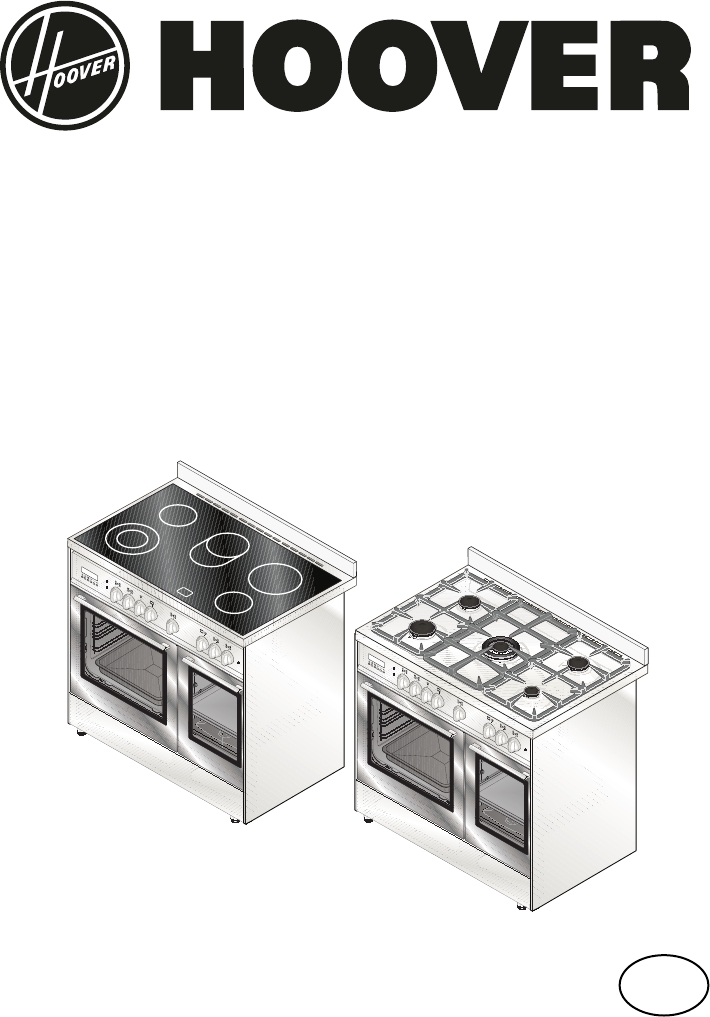
INSTRUCTIONS AND ADVICE
FOR INSTALLING, USING AND SERVICING
OF COOKERS
461308219_001 07/2013
GB

2
The appliance was designed and made in accordance with the European standards listed below:
=> EN 30-1-1, EN 30-2-1 and EN 437 plus subsequent amendments (gas)
=> EN 60 335-1 and EN 60 335-2-6 (electrical) plus relative amendments
The appliance complies with the prescriptions of the European Directives as below:
=> 2006/95 EC concerning electrical safety (BT).
=> 2004/108 EC concerning electromagnetic compatibility (EMC)
=> 2009/142 EC concerning gas safety.
Oven accessories that could come into contact with foodstuffs are made with materials that comply with
the provisions of the 89/109 EC directive dated 21/12/88.
This product complies with EU Directive 2002/96/EC.
The crossed-out dustbin symbol reported on the appliance indicates that the appliance must be disposed
of separately from other domestic refuse at the end of its useful life. It must therefore be delivered to a
waste recycling centre specically for electric and electronic equipment or returned to the retailer at the
moment of purchase of a new equivalent appliance.
The user is responsible for delivering the appliance to the appropriate collection centre at the end of its
useful life, Failure to do so may result in a ne, as provided for by laws governing waste disposal.
Differential collection of waste products for eventual recycling, treatment and environmentally friendly
disposal helps reduce possible negative effects on the environment and health, and also enables the
materials making up the product to be recycled.
For more detailed information on the available refuse collection systems, refer to the local Municipal
Solid Waste disposal centre or the shop where the product was purchased.
Producers and importers are responsible for fullling their obligations as regards recycling, treatment
and environmentally friendly disposal by directly or indirectly participating in the collection system.
3
Before this appliance left the factory it was tested and ne-tuned by specialised expert personnel in order to
guarantee its best functioning results.
Any subsequent repairs or adjustments that may be necessary must be done with the maximum of care
and attention by qualied personnel.
For this reason we recommend you always contact our Service Centre specifying the brand, the model, its serial
number and type of problem you are facing with it. All data related to your appliance are printed on the data label
afxed on the appliance as well as on its original packaging.
A duplicate data label is contained in this booklet also. Please attach this label on the handbook or to an
accessible surface near by the appliance for easy reference.
This information enables the technical assistant to come and visit you with the correct spares and guarantee a
prompt and suitable service.
You will only nd original spare parts at our Service Centre and authorised dealers
ASSISTANCE AND SPARE PARTS
CONTENTS
ASSISTANCE AND SPARE PART 3
IMPORTANT NOTES AND PRECAUTIONS FOR USE 4-6
DESCRIPTION OF THE APPLIANCE 7-10
INSTRUCTIONS FOR THE USER 11-21
TROUBLESHOOTING 21
TECHNICAL FEATURES 22-23
INSTRUCTIONS FOR THE INSTALLER 24-32

4
IMPORTANT NOTES AND PRECAUTIONS FOR USE
You have purchased one of our
products for which we thank you. We
are condent that this new appliance,
modern, functional and practical, made
with top quality materials, will meet all
your demands. This new appliance is
easy to use but before installing and
using it, it is important to read this
handbook through carefully. It provides
information for a safe installation, use
and maintenance. Keep this handbook
in a safe place for future reference.
The manufacturer reserves the right
to make all the modications to its
products that it deems necessary or
useful, also in your interests, without
prejudicing its essential functional
and safety characteristics. The
manufacturer cannot be held responsible
for any inaccuracies due to printing or
transcription errors that may be found in
this handbook.
N.B.: the pictures shown in the gures in
this handbook are purely indicative.
• The installation, adjustments,
conversions and maintenance
operations listed in section
«INSTRUCTIONS FOR THE
INSTALLER» must only be carried out
by authorised personnel .
• The installation of all-gas and combi
appliances must comply with the
standards in force.
• The appliance must only be used for
its original purpose, that is, cooking
for domestic use. Any other use is
considered improper and, as such,
dangerous.
• The manufacturer cannot be held
responsible for any damage to persons
or property resulting from an incorrect
installation, maintenance or use of the
appliance.
• Once the packaging has been removed
from the outer surfaces and the various
inner parts, thoroughly check that the
appliance is in perfect condition. If
you have any doubts do not use the
appliance and call in an authorised
person.
• The packaging materials used
(cardboard, plastic bags, polystyrene
foam, nails, etc.) must not be left within
easy reach of children because they are
a potential hazard source. All packaging
materials used are environmentally-
friendly and recyclable.
• The electrical safety of this appliance
is only guaranteed if it is correctly
connected to a suitable earth system,
as prescribed by the electrical safety
standards. The manufacturer disclaims
all responsibility if these instructions
are not followed. Should you have
any doubts, seek the assistance of an
authorised person.
• Prior to installation, ensure that the
local distribution conditions (nature
of the gas and gas pressure) and
the adjustment of the appliance are
compatible»;
• «the adjustment conditions for this
appliance are stated on the label (or
data plate)»;
• «this appliance is not connected to a
combustion products evacuation device.
It shall be installed and connected in
accordance with current installation
regulations. Particular attention shall
be given to the relevant requirements
regarding ventilation».. (see section
«TECHNICAL FEATURES»).
•
NOT FOR USE IN MARINE CRAFT,
CARAVANS OR MOBILE HOMES
UNLESS EACH BURNER IS FITTED
WITH A FLAME SAFEGUARD.
• DO NOT MODIFY THIS APPLIANCE
•
DOMESTIC USE ONLY

5
IMPORTANT NOTES AND PRECAUTIONS FOR USE
WARNING - The appliance and its
accessible parts become hot during use.
Care should be taken to avoid touching
heating element. Children less than 8
years of age shall be kept away unless
continuosly supervised.
• The oven door glass and the
accessible parts will become hot
when in use. To avoid burns and
scalds young children should be kept
away.
• Do not use this appliance as a space
heater.
• Do not touch any electrical appliance if
hands or feet are wet or damp.
• Do not use the appliance bare footed.
• Do not pull the power lead to take the
plug out of the socket.
• Do not leave the appliance outside
under the sun, rain, etc.
• Young children should be supervised
to ensure that they not play with the
appliance.
• This appliance can be used by
children aged from 8 years and above
and persons with reduced physical,
sensory or mental capabilities or lack of
esperience and knolegde if they have
been given supervision or instruction
concerning use of the appliance in a
safe way and understand the hazards
involved.Children shall not play with
the appliance. Cleaning and user
maintenance shall not be made by
children with out supervision.
• WARNING - ln order to prevent
accidental tipping of the appliance, for
example by a child climbing over the
open oven door, or too high weights are
leant on the open oven door, two chains
must be screwed on the back on the
cooker and xed to the wall with hooks
.Ensure the chains are taut .Please refer
to instructions for installation..
• Before cooking for the rst time, ensure
the oven is empty and its door closed,
heat the oven at maximum temperature
for two hours. This will allow the
protective coating on the interior of the
oven to be burnt off and dissipate the
associated smells. Ensure adequate
ventilation in the cooker whilst burning
off and don’t be alarmed by a little bit
of smoke during this process.
• The instructions for ovens that have
the shelves should indicate in detail
the correct installation of the shelves.
The rear stopper of the oven rack
must be positioned upwards.
• Unattended cooking on a hob with
fat or oil can be dangerous and may
result in re.
• Never try to extinguish a re with
water, but switch of the appliance and
then cover ame e.g. with a lide or a
re blanket .
• Danger of re: Do not store items on
the cooking surfaces
• Do not use harsh abrasive cleaners
or sharp metal scrapers to clean
the oven glass door since they can
scratch the surface, which may result
in shattering of the glass.
• NEVER use sponges or abrasive
products, and solvents to remove
stains or adhesives on the painted or
stainless steel surfaces.
• Switch off the oven before removing
the fan guard for cleaning. Replace
the guard after cleaning in accordance
with the instructions.
• The oven can be equipped with
temperature probe. Only use the
temperature probe recommended for
this oven by our Service Centre.
• Remove any spillage from the lid
before opening.
• WARNING: If the surface is cracked,
switch off the appliance to avoid the
possibility of electric shock.

6
IMPORTANT NOTES AND PRECAUTIONS FOR USE
•
CAUTION: In order to avoid a hazard
due to inadvertent resetting of the
thermal cutout, this appliance must
not be supplied through an external
switching device, such as a timer, or
connected to a circuit that is regularly
switched on and off by the utility.
• Ensure that the appliance is switched
off before replacing the lamp to avoid
the possibility of electric shock..
• The cookers can be equipped with a
small compartment under the oven
that can be used for storing things
Remember that the surfaces become
hot, it is strictly forbidden to place
inammable materials inside.
• Do not use a steam cleaner to clean
a hob, oven or range.
• If the range is placed on a base,
measures must to be taken to prevent
the appliance slipping off the base.
• If the appliance is tted with a glass
lid, this can shatter when heated.
Turn off all the burners or disconnect
all the plates, and allow them to cool
before closing the lid (g.3)
• Avoid using the oven as a larder or as a
saucepan cupboard when you are not
using it for cooking: if the oven is turned
on accidentally it could cause damage
and accidents.
• If you are using an electrical socket
near the appliance, make sure that the
cables are not touching the cooker and
are far enough away from all hot parts.
• The means for disconnection must
be incorporated in the xed wiring in
accordance with the wiring rules.
• The instructions state the type of cord
to be used, taking into account the
temperature of the rear surface of the
appliance.
• This appliance must be installed in
accordance with the regulations in force
and only used in a well ventilated space.
Read the instructions before installing
or using this appliance.• W h e n
you have nished using the appliance
check that all the controls are in the off
or closed position, checking that the
“0” of the knob corresponds to the “•”
symbol serigraphed on the front panel.
• Switch off the electrical supply before
you start cleaning or servicing the
appliance.
• In the case of a failure or malfunction,
turn the appliance off and switch off
the electrical supply and do not tamper
with it. All repairs or adjustments must
be carried out with maximum care and
the proper attention of an authorised
person.
• For this reason we recommend you call
our Service Centre.
• The use of a gas cooking appliance
results in the production of heat and
moisture in the room in which it is
installed. Ensure that the kitchen is
well ventilated: keep natural ventilation
holes open or install a mechanical
ventilation device (mechanical extractor
hood). Prolonged intensive use of
the appliance may call for additional
ventilation, for example opening of a
window, or more effective ventilation,
for example increasing the level of
mechanical ventilation where present.
• These instructions are only valid if
the country symbol appears on the
appliance. If the symbol does not
appear on the appliance, it is necessary
to refer to the technical instructions
which will provide the necessary
instructions concerning modication of
the appliance to the conditions of use
of the country».
7
12
PRESENTATION
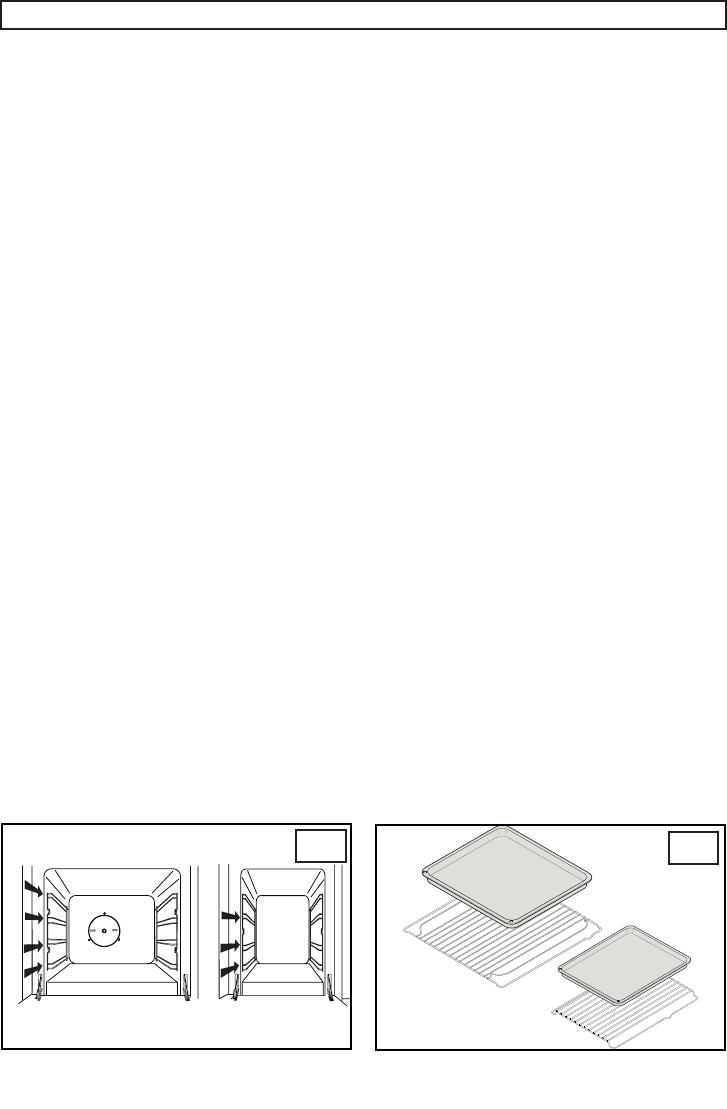
The cooker can be tted with a gas hob or the ceramic
glass hob
Each knob on the front panel has a diagram printed
above it showing to which burner it refers.
The combination of the different sized burners or
heating elements offers the possibility of various types
of cooking.
Our cookers have two ovens with different volumes.
The left oven cavity, which is the biggest, features of
oven natural or forced convection with electric grill and
makes all types of cooking possible. The right oven
cavity, which is the smallest, features of oven natural
convection with electric grill.
To guarantee the customer a good and safe use of the
appliance, the combined and alla electrical cookers,
have equipped with a safety temperature device, which
automatically turns on in case the main thermostat fails
to work. In such an event, the electricity is interrupted
temporarily: do not attempt to repair it yourself but
turn the appliance off and contact your nearest
Assistance Centre.
The oven walls are tted with various runners (g. 1)
on which the following accessories can be placed.
Supply and quantities vary from model to model:
• oven shelf
• drip tray or drip pan
DESCRIPTION OF THE APPLIANCE
8
A
B
C
DESCRIPTION OF THE CONTROLS
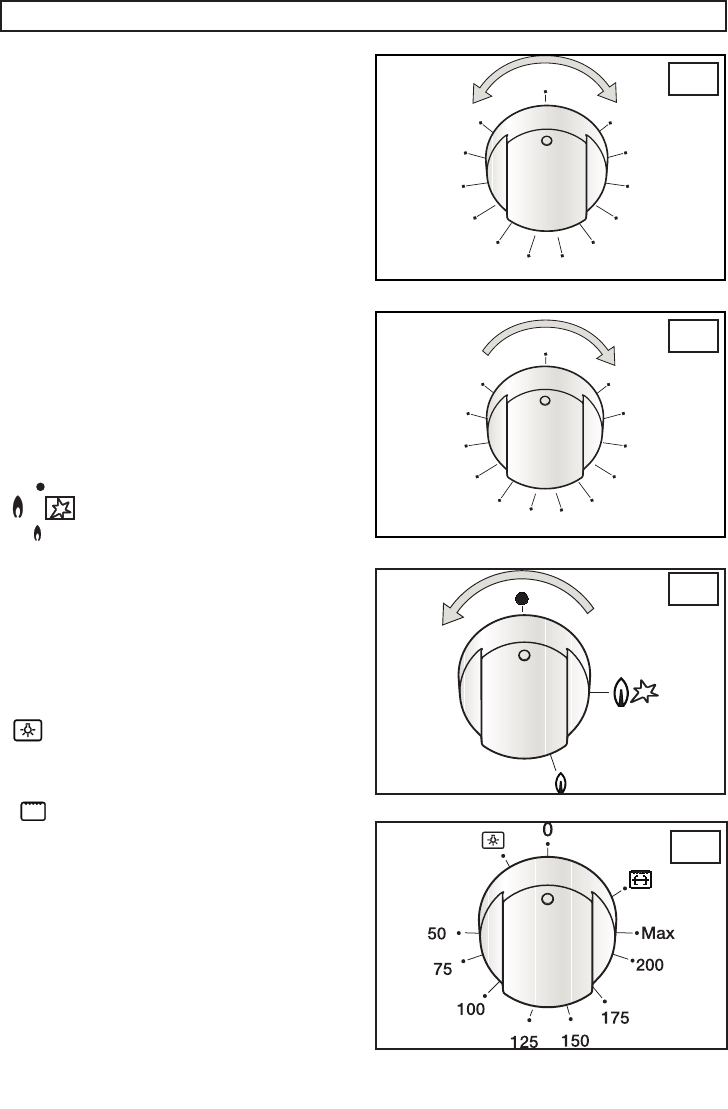
ENERGY REGULATOR KNOB (A) - single cooking
zone
By turning the knob to the right or to the left we nd the
following symbols:
0= heating elements off
from 1 to 12 = minimum and maximum power
ENERGY REGULATOR KNOB (B) - double
cooking zone
By turning the knob to the right we nd the following
symbols:
0= heating elements off
from 1 to 12 = minimum and maximum power for single
cooking zone
from 12 to 0 = maximum power for double cooking zone
HOB GAS BURNER KNOB (C)
By rotating the knob in an anticlockwise direction, the
following symbols appear:
= Closed position
= “Full on” position
= “Reduced rate” position
DESCRIPTION OF THE APPLIANCE
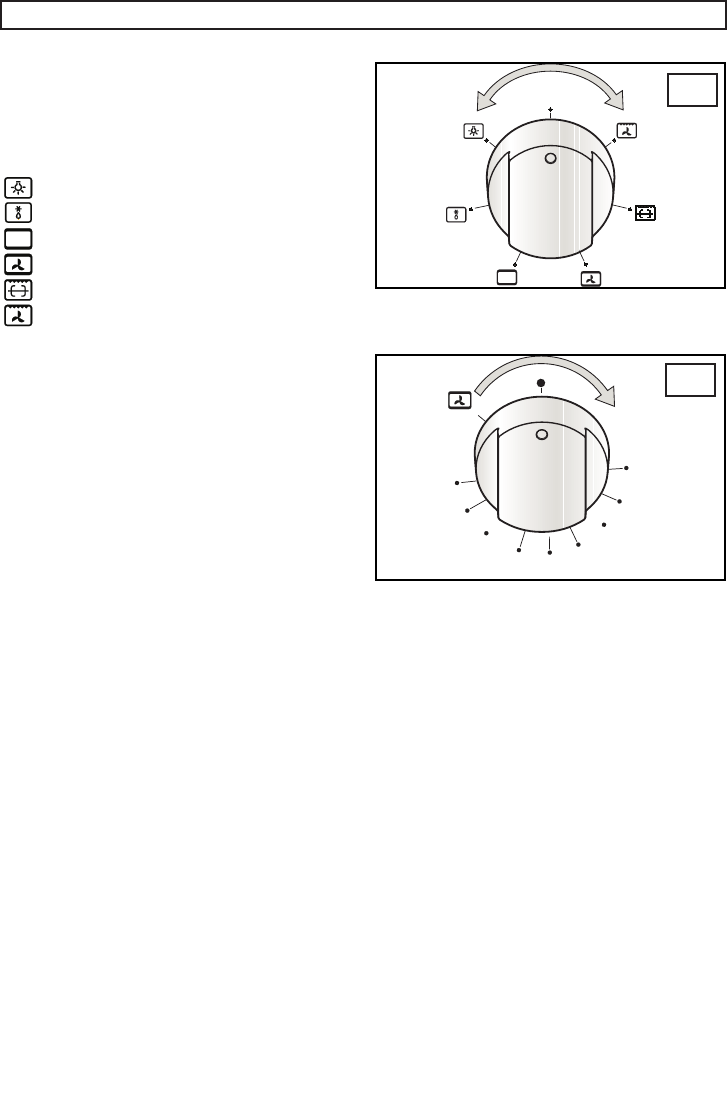
RIGHT OVEN COMMUTATOR/THERMOSTAT KNOB
(D)
By turning the knob clockwise we will nd the following
symbols:
0= Oven off
= Oven light on, which stays on for all functions
da 50°C a
Max = The different oven temperature values
= Grill heating element on
D
9
F
E
DESCRIPTION OF THE APPLIANCE
RED WARNING LIGHT
If present, when lit it indicates that one or more of the
hob electric plates is on, if the hob is mixed, or one of
the oven electric components.
YELLOW WARNING LIGHT
If present, when lit it indicates that either the electric
oven or electric grill is working. While the oven is being
used the light will switch off when the set temperature
is reached. During baking it is normal for the yellow
light to switch on and off several times as the oven
temperature is controlled.
THERMOSTAT KNOB FOR THE FAN OVEN (F)
By turning the oven knob clockwise we will nd the
different oven temperature values (from 50°C to Maxi).
LEFT OVEN - MULTIFUNCTION SELECTOR KNOB
(6) (E)
By turning the knob to the right or to the left we will nd
the following symbols:
0= Oven off
= Oven light on, which stays on for all functions
= Fan on
= Top and bottom heating elements on
= Top and bottom heating elements and fan on
= Grill + spit heating element on (*)
= Grill heating element and fan on
10
DESCRIPTION OF THE APPLIANCE
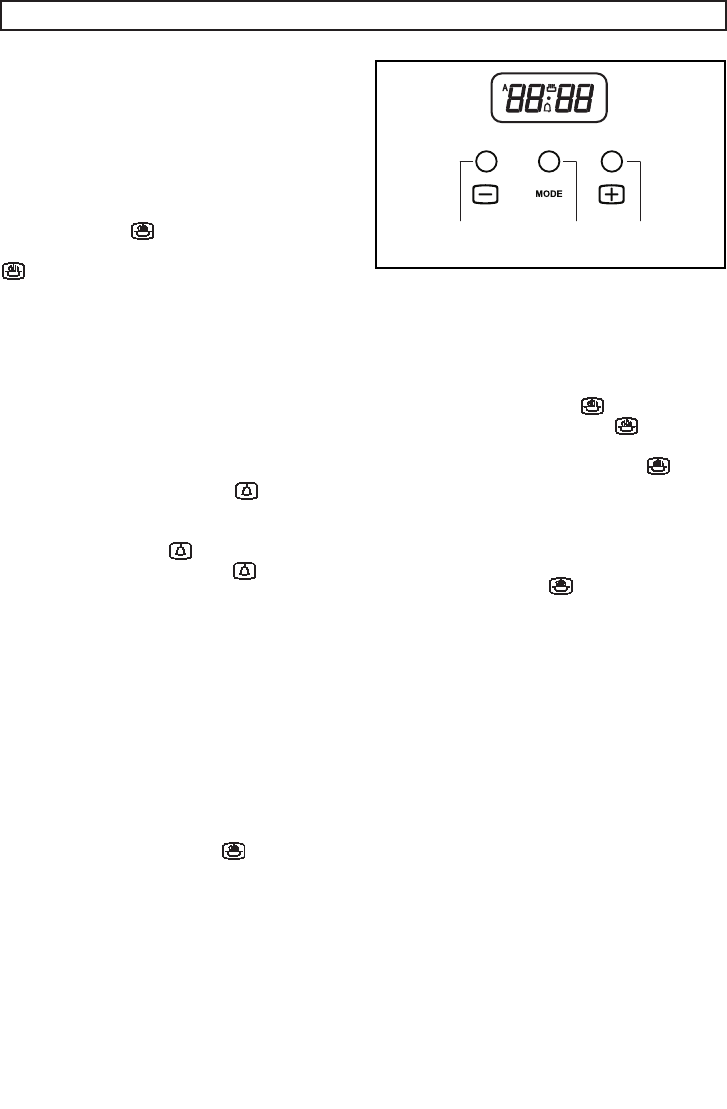
ELECTRONIC PROGRAMMER "TOUCH"
Setting the time.
After connecting to mains or after a power cut, symbol
“A” and “0,00” will both ash simultaneously on the
display.
Keep pressed for some seconds simultaneously + and
- buttons or just MODE button, till when symbol “A”
turn off and symbol turn on.
Time can be set just when the dot beneath the symbol
ashes.
Time cannot be adjusted during cooking program run.
If time is selected while a automatic cooking program
is running, this is deleted.
Program selection
Keep pressed for some seconds MODE button
and pressing it in turns, the following programs are
selected:
1. Minute Minder
The time turns off, the symbol turns on and
with + and - buttons is possible to select the time
alarm. At the end of the set time, the buzzer will
start and the symbol ashes. To turn off the
buzzer and turn off the symbol keep pressed
for some seconds MODE button.
The minute minder program runs independently of
other cooking programs.
2. Semiautomatic Program with Duration or End
Time
Select with + and - buttons the duration. The time
of the day turns off, symbol “A” and “dur” ash. At
the end of the set time, the buzzer will start and the
symbol “A” ashes. To turn off the buzzer press
MODE button.
Now the oven is off. Keep pressed for some
seconds simultaneously + and - buttons or just
MODE button and the symbol is illuminated.
3. Fully automatic program with Duration and End
time
Select with + and - buttons the duration and the
end time. The time of the day turns off, symbol “A”
and “End” ash. Symbol turns off and the
symbol “A” turns on. The symbol is illuminated
again when the cooking starts. At the end of the set
time, the buzzer will start, the symbol turns off
and the symbol “A” ashes. To turn off the buzzer
press MODE button.
Now the oven is off. To set the programmer on
manual operation keep pressed for some seconds
simultaneously + and - buttons or just MODE
button and the symbol is illuminated.
Changing/Clearing programs
Each program can be cleared keeping pressed for
some seconds simultaneously + and - buttons. Symbol
“A” turns off.
Each program can be changed keeping pressed for
some seconds MODE button and then pressing it in
turns to the function to be changed. The adjustment
can be done with + and - buttons.
Is it possible to check whenever the progress of
program keeping pressed for some seconds MODE
button and then pressing in turns to the function to be
checked.
11
4
3
HOB: GENERAL NOTES ON SAFETY
When a gas cooker is being used it produces heat
and humidity in the room where it is installed.
For this reason the room must be well ventilated,
keeping the natural ventilation openings free and
switching on the mechanical aeration system
(suction hood or electric fan, see «VENTILATION
and LOCATION AND AERATION» paragraph )
If the cooker is used for a long time additional
aeration may be necessary, for instance,
opening a window, or a more effective aeration
by increasing the power of the mechanical
system if there is one.
LIGHTING THE BURNERS
Automatic electric ignition of burners
Push lightly the knob corresponding to the burner you
wish to use and turn counterclockwise to the “Full on“
position, then depress the control knob. Automatically
the ignition spark shoots. Matches can be used to light
the burners in a blackout.
Optimum use of the burners
To get the maximum yield with the minimum
consumption of gas it is handy to keep the following
points in mind:
• Once the burner has been lit, adjust the ame
according to your needs.
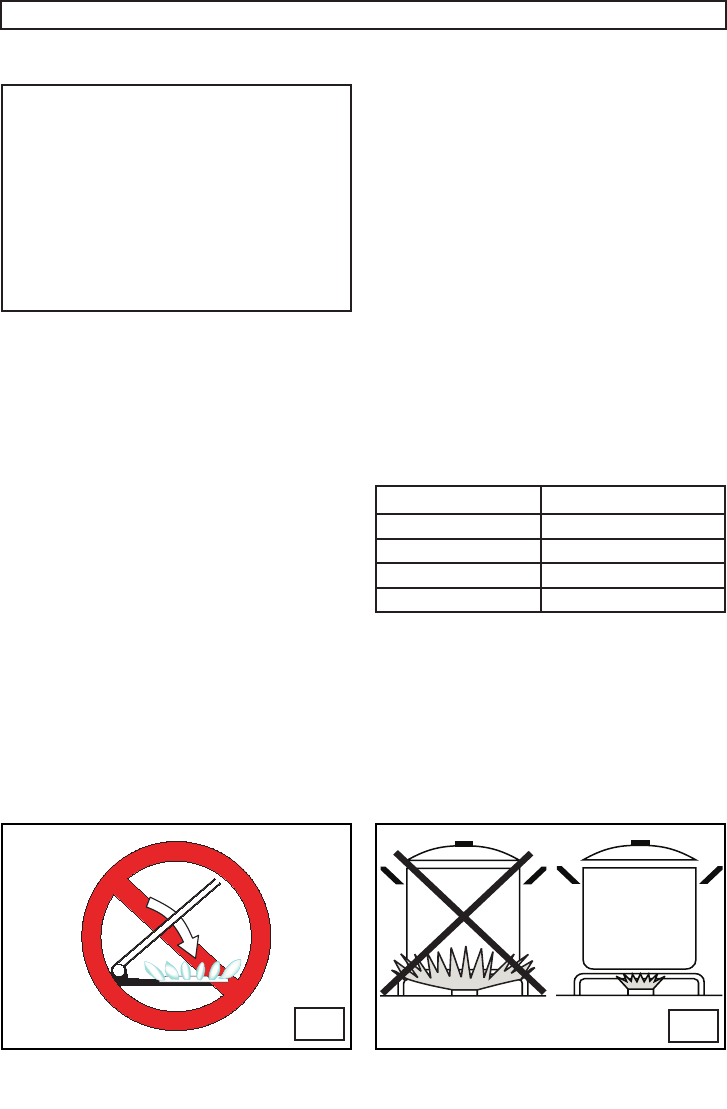
• Use an appropriately sized pan for each burner (see
the table below and g. 4).
• When the content of the pan start to boil, turn the
knob down to “Reduced rate position” (small ame).
• Always put a lid on the pan.
• After using the appliance, ensure that all the controls
are in the closed or off position.
Burners Ø pan cm
Ultrarapid 22÷24
Rapid 20÷22
Semi-rapid 16÷18
Auxiliary 12÷14
INSTRUCTIONS FOR THE USER
12
5
SWITCHING THE HEATING ELEMENTS
The cooking zones are clearly visible on the hob,
being circular. Only the inside of the circles traced on
the glass is heated.
The hob has a built-in warning light that switches on
when the temperature in the cooking zone exceeds
60°C. This warning light will only switch off when the
temperature in the cooking zone has gone below this
value and it is for this reason it is called the “residual
heat warning”.
The heating elements with a single ccoking zone,
are controlled by energy regulators with 12 positions
(A) that permit to obtain a big range of different
temperatures.
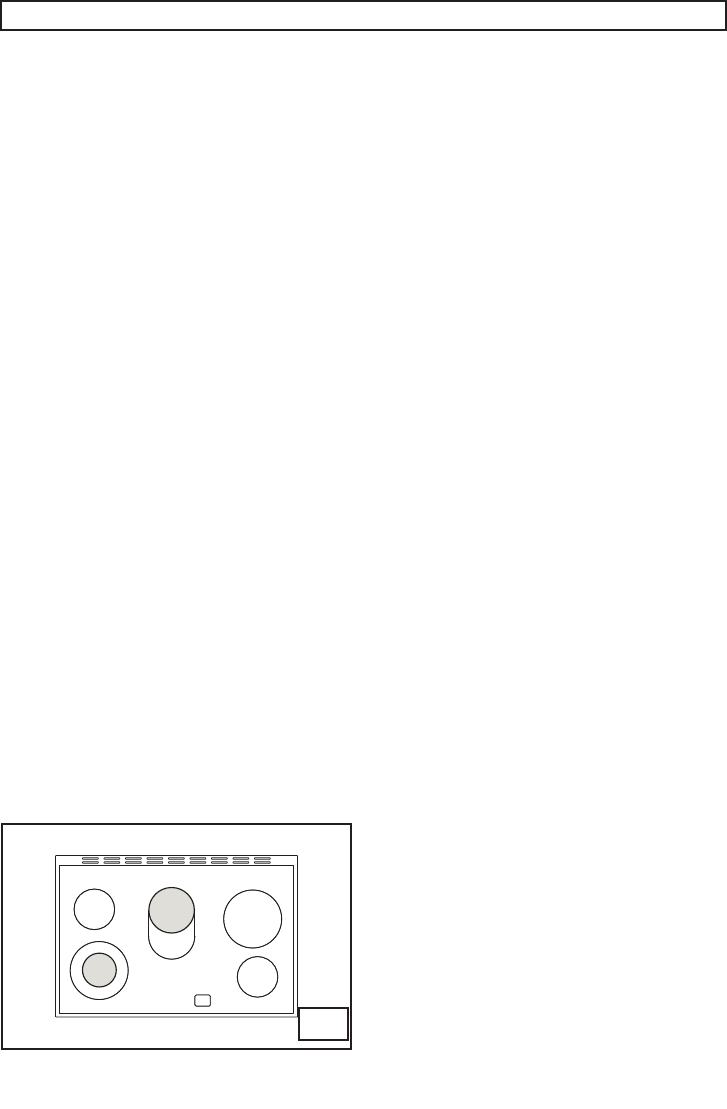
The heating element with a double cooking zone, are
controlled by 12-position energy regulators (B).
By turning the knob from 1 to 12, the powers of the rst
zone of cooking “1” are regulated. By turning besides
the number 12, a release it is warned that signals the
insertion of the second zone of cooking “2” (g. 5).
In this position, both work the zone of cooking to the
maximum power. By turning the knob counterclockwise
to regulate its power.
Only returning on the position “0” the second zone of
cooking is disconnected.
A red coloured warning light signals that the heating
elements are on.
GENERAL INFORMATION AND INSTRUCTIONS
FOR USING CERAMIC GLASS HOBS
• Ceramic glass is a natural product and, like any
other material in ceramic, can have an uneven
surface. You might even see some bubbles inside
the ceramic glass itself: these will not inuence
cooking or the lifetime of the hob.
• Illumination of the single cooking zones might differ.
This depends on the technical characteristics of the
heating elements. This has absolutely no effect on
quality or operation.
• According to how you look at it, the incandescent
heating might appear to go over the edge of the
cooking zone.
• Do not put very hot pans on the outer edge of the
hob.
• Do not use pans with aluminum bottom.
• Do not use the hob as a work top and take care not
to let hard or sharp objects fall on it. The top could
be damaged.
• Do not put empty enamelled pans on the heat. Both
the bottom of the pan and the ceramic glass could
be damaged.
• Do not drag pans or other objects over the glass top
which could get scratched.
• Clean and dry the bottom of the pan before putting
it on the hob. Salt, sugar or grains of sand, for
example, that could be in greens, can scratch.
• Clean off immediately any spilled liquid.
• Do not cook or reheat food wrapped in tin foil or
plastic containers. Both the tin foil and the plastic
containers would melt, sticking to the hob.
N.B.: Using the glass scraper, push immediately
away from the cooking zone, any pieces of tin foil
or plastic objects that could have melted or stuck;
likewise sugar or sugary food spilled over during
cooking.
INSTRUCTIONS FOR THE USER
13
6
INSTRUCTIONS FOR THE USER
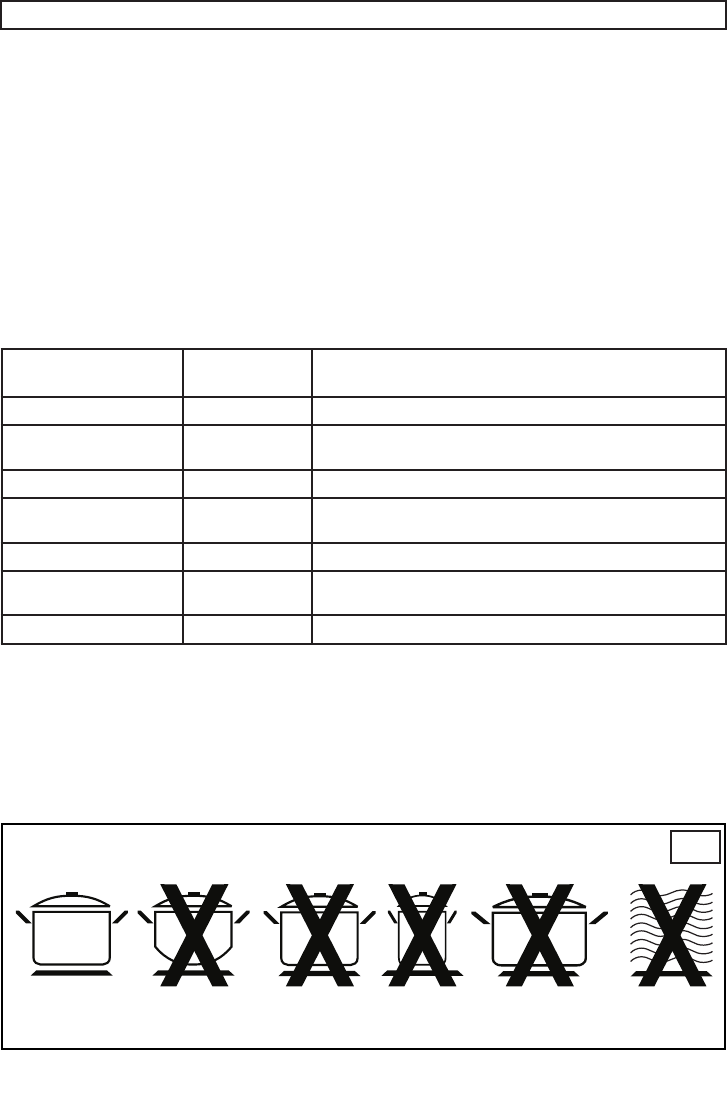
HOW TO SAVE ELECTRICITY (g.6)
To get the maximum yield with the minimum consumption of electricity it is recommended to keep the following
points in mind:
• Switch the hob heating element on only after you have put the pan on the cooking zone
• Thoroughly dry the bottom of the pan before putting it on the cooking zone .
• Do not use pans with a diameter that is less than that of the cooking zone or plate. When you are buying
saucepans keep in mind that the manufacturer usually gives the largest diameter of the pan which is normally
bigger than the base diameter.
• Use pans with at, thick bottoms. Bottoms that are not at will make cooking times longer.
• Always put a lid on the pan.
• If cooking time is longer than 40 minutes you can switch the plate off 5 to 10 minutes before the end of cooking
time and make use of the residual heat.
• For your information only, the table gives hints on how to use the cooking zones .
Position of knobs Heat
intensity Possible cooking processes
0Off
1-2 Low To dissolve butter, chocolate, etc. To heat small amounts of
liquid.
3-4 Moderate To heat greater quantities of liquid.
5-6 Slow Thawing frozen food and preparing stews, boiling or simme-
ring.
7-8 Medium Bringing foods to boiling point. For delicate roasts and sh.
9-10 Strong For roasts, chops and steaks. For large amounts of boiled
meat.
11-12 Hot Bringing large amounts of water to the boil. Frying.
GOOD QUALITY
FLAT BASE
CONVEX
BASE TOO
CONCAVE
BASE
TOO
SMALL
TOO
LARGE
NO PAN
ELEMENT

14
INSTRUCTIONS FOR THE USER
OVEN: GENERAL SAFETY INSTRUCTIONS
• Always grip the centre of the oven door when
opening. Do not practice excessive pressures on
the door when it is open.
• Do not worry if condensation forms on the door and
on the internal walls of the oven during cooking.
This does not compromise its efciency.
• When opening the oven door, be very careful of
scalding vapours.
• Use oven gloves to insert or remove containers
from the oven.
• Use containers that will resist the temperatures
indicated on the thermostat knob.
• For good results during cooking, we strongly
recommend not to cover the base of the oven or the
grill with aluminium foil or other materials.
• When grilling always put a little water in the grill
pan. The water prevents the grease from burning
and from giving off bad smells and smoke. Add
more water during grilling to compensate for
evaporation.
• After using the appliance ensure that all the controls
are in the off position.
HOW TO USE THE CONVENTIONAL OVEN
RIGHT OVEN CAVITY
TRADITIONAL COOKING
Turn the commutator/thermostat knob on the
temperature required. If pre-heating is recommended
wait till the thermostat yellow warning light turns off
before placing foods inside the oven. Both the bottom
and top heating elements are turned on, distributing
heat to the food from the top and bottom. This type of
baking is ideal for all types of food (meat, sh, bread,
pizza, cakes..).
GRILL COOKING
Turn the commutator/thermostat knob on the symbol.
The top heating element is turned on and it distributes
heat directly onto the food. Besides grilling, it can be
used to obtain a golden nish onto cooked foods or to
toast your bread slices.
The grill function automatically activates the eventual
spit (if present). When you use the grill, do not forget
to place the drip pan beneath the spit to collect any
sauce dripping, as suggested in the “COOKING TIPS
“ section.
15
INSTRUCTIONS FOR THE USER
HOW TO USE THE MULTIFUNCTION OVEN
RIGHT OVEN CAVITY
DEFROSTING AT ROOM TEMPERATURE
Turn the selector knob to the symbol and place the
food you want to defrost inside the oven. The length
of time required depends on the quantity and type of
food.
Selecting this function will only activate the fan. Mild
air circulation around frozen food will slowly defrost it.
It is particularly suitable for fruit and cakes.
TRADITIONAL COOKING
Turn the selector knob to the symbol and adjust the
thermostat knob to suit the desired temperature.
If pre-heating is recommended wait till the thermostat
yellow led turns off before placing foods inside the
oven. This option turns on both bottom and top heating
units, evenly distributing heat on your foods.
This type of cooking is ideal for all kind of foods (meats,
sh, bread, pizzas, cakes..).
COMBINED TRADITIONAL + FAN COOKING
Turn the selector knob to the symbol and adjust the
thermostat knob to suit the desired temperature.
If pre-heating is recommended wait till the thermostat
yellow led turns off before placing foods inside the
oven. This option turns on both bottom and top heating
units, and heat is distributed by fan ventilation.
This combination is suitable for rapid cooking and
allows for the use of more plates positioned on the
different levels of the oven.
CONVETIONAL GRILL COOKING
Turn the selector knob to the symbol and set the
thermostat knob to the desired temperature.
Selecting this function the top central heating element
turns on and heat is distributed directly on food
surface.
Apart from grilling, this function is ideal to add a golden
roast to your recipes or to toast bread slices.
The grill function automatically activates the eventual
spit. When you use the grill, do not forget to place the
drip pan beneath it to collect any sauce dripping, as
suggested in the “USEFUL COOKING TIPS “ section.
FAN GRILL COOKING
Turn the selector knob to the symbol and set the
thermostat knob to the desired temperature.
Selecting this function the top central heating
element turns on and heat is distributed by the fan.
This procedure mitigates the direct heat on food
surface and uses milder temperatures. It is therefore
recommended for an even golden and crispy nish
touch, ideal for whole sh and poultry.
When you use the grill, do not forget to place the
drip pan beneath it to collect any sauce dripping, as
suggested in the “USEFUL COOKING TIPS “ section.
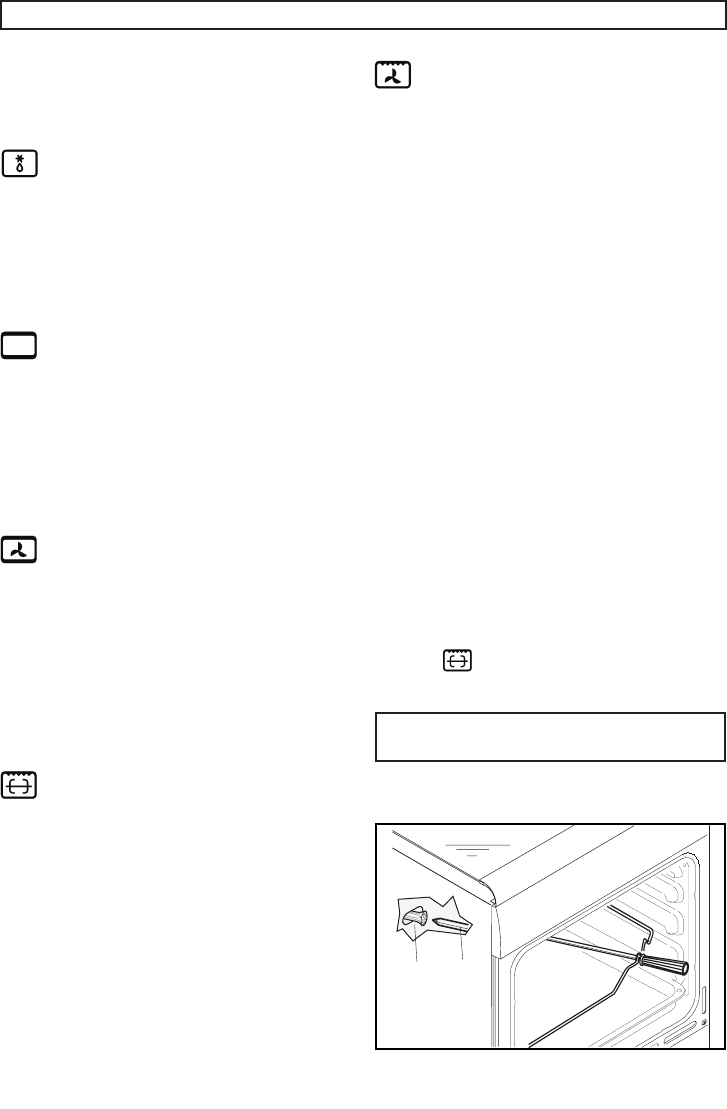
HOW TO USE THE SPIT (only certain versions)
• Place the chicken or piece of meat to roast rmly
between the two forks on the spit and make sure it
is evenly balanced to prevent straining the motor.
• Fix the spit holder into its hold on the appropriate
level, now place the spit onto its hold and push its
end (A) into place in the engine (E).
• Always use the drip pan to catch the gravy, as
indicated in the paragraph “USEFUL COOKING
TIPS”.
• Electric grill: positioning the selector knob on the
symbol and set the eventual thermostat knob
to the desired temperature.
When the grill turns on so will the spit motor.
Always keep the oven door closed during electric
grilling.

16
INSTRUCTIONS FOR THE USER
USEFUL COOKING TIPS
Cakes and bread:
• Heat the oven for at least 15 minutes before you
start cooking bread or cakes.
• Do not open the door during baking because the
cold air would stop the yeast from rising.
• When the cake is cooked turn the oven off and
leave it in for about 10 minutes.
• Do not use the enamelled oven tray or drip pan,
supplied with the oven, to cook cakes in.
• How do you know when the cake is cooked? About
5 minutes before the end of cooking time, put a
cake tester or skewer in the highest part of the
cake. If it comes out clean the cake is cooked.
• And if the cake sinks? The next time use less
liquids or lower the temperature 10°C.
• If the cake is too dry: Make some tiny holes
with a toothpick and pour some drops of fruit
juice or spirits on it. The next time, increase the
temperature 10°C and set a shorter cooking
time.
• If the cake is too dark on top: the next time put
the cake on a lower shelf, cook it at a lower
temperature and longer.
• If the top of the cake is burnt: cut off the burnt layer
and cover with sugar or decorate it with cream,
jam, confectioner’s cream, etc..
• If the cake is too dark underneath: the next time
place it on a higher shelf and cook it at a lower
temperature.
• If the cake or bread is cooked nicely outside but
is still uncooked inside: the next time use less
liquids, cook at a lower temperature and longer.
• If the cake will not come out of the tin: slide a
knife around the edges, place a damp cloth over
the cake and turn the tin upside down. The next
time grease the tin well and sprinkle it with our or
bread crumbs.
• If the biscuits will not come away from the baking
tray: put the tray back in the oven for a while and
lift the biscuits up before they cool. The next time
use a sheet of baking parchment to prevent this
happening again.
Meat:
• If, when cooking meat, the time needed is more
than 40 minutes, turn the oven off 10 minutes
before the end of cooking time to exploit the
residual heat (energy saving).
• Your roast will be juicier if cooked in a closed pan;
it will be crispier if cooked without a lid.
• Normally white meat, poultry and sh need
medium temperatures (less than 200°C).
• To cook “rare” red meats, high temperatures (over
200°C) and short cooking times are needed.
• For a tasty roast, lard and spice the meat.
• If your roast is tough: the next time leave the meat
to ripen longer.
• If your roast is too dark on top or underneath: the
next time put it on a higher or lower shelf, lower
the temperature and cook longer.
• Your roast is underdone? Cut it in slices, arrange
the slices on a baking tray with the gravy and
nish cooking it.
Grilling:
• Sparingly grease and avour the food before
grilling it.
• Always use the grill pan to catch the juices that drip
from the meat during grilling.
• Always put a little water in the drip pan. The water
prevents the grease from burning and from giving
off bad smells and smoke. Add more water during
cooking because it evaporates.
• Turn the food half way through cooking.
• If you are grilling fatty poultry (goose) pierce the
skin so the fat can drip away.
The aluminium can be easily corroded if it
comes into contact with organic acids present
in the foods or added during baking (vinegar,
lemon juice). Therefore it is advised not to put
directly the foods on aluminium or enamelled
trays, but ALWAYS use the proper oven paper.
17
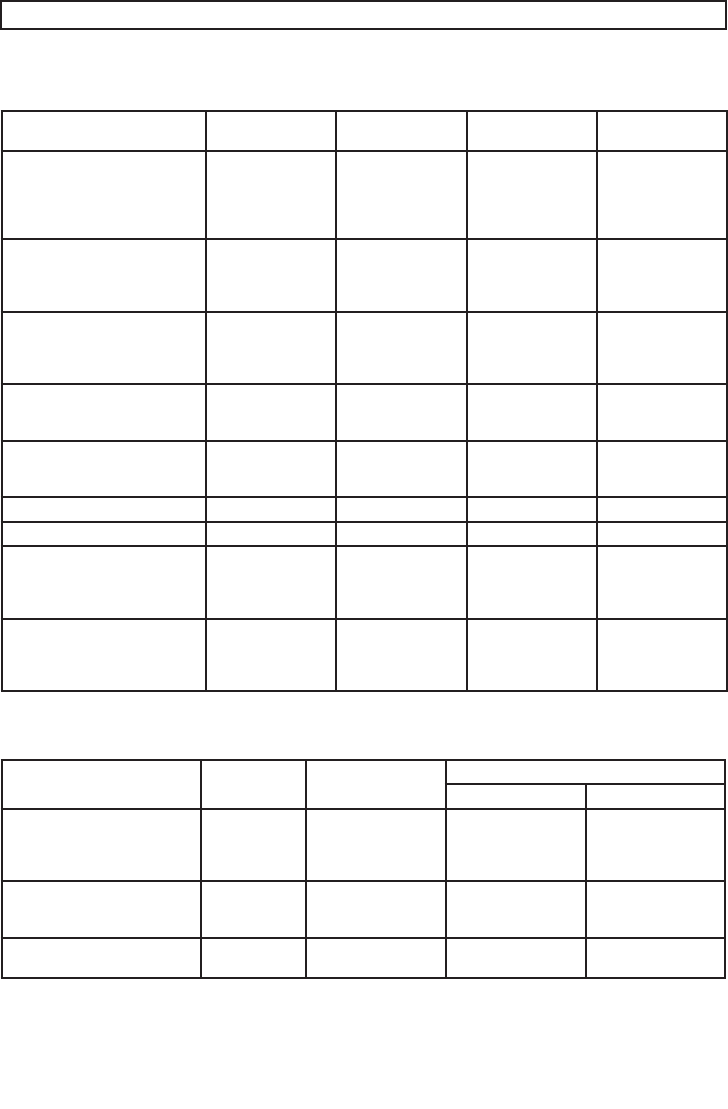
NATURAL CONVECTION AND ELECTRIC GRILL - RIGHT OVEN CAVITY
COOKING / BAKING TIMETABLE
FOODS Weight
kg Position of the oven
shelf from the bottom Temperature
in °C Cooking/Baking
Time in min.
MEAT LOAFS
Roasted Veal
Roastbeef
Roasted Pork
Roasted Lamb
1
1
1
1
1
1
1
1
220
200-225
220
200-225
80
40-50
80
100-120
GAME
Roast hare
Roast pheasant
Roast partridge
1
1
1
1-2
1-2
1-2
225-Max
225-Max
225-Max
50-60
60-70
50-60
POULTRY
Roasted Chicken
Roasted Turkey
Roasted Duckling
1
1
1
1-2
1-2
1-2
200-225
200-225
200-225
80-90
100-120
90-110
FISH
Roasted whole sh
Sea bass
1
1
1-2
1-2 200
175
30-35
20-25
BAKED PASTE
Lasagne
Cannelloni
2.5
2.5
1-2
1-2
210-225
210-225
60-75
60-75
PIZZA 12Max 20-22
BREAD 12Max 20-25
PATISSERY
Biscuits in general
Shortcrust pastry
Victoria sponge
2
2
2
190
200
200
20
20
40-45
CAKES/FLANS
Angel Cake/Sponge
Fruit Cake
Chocolate Cake
0.8
0.8
0.8
1
1-2
1-2
190
200
200
50
65
45
Values indicated in the tables (temperatures and cooking times) are approximate and may vary according to each person’s cooking habits.
GRILLING TIMETABLE
FOODS Weight
kg Position of the oven
shelf from the bottom Cooking/Baking Time in min.
1st side 2nd side
MEAT
T-bone steak
Steak
Chicken (cut in half )
0,50
0,15
1
3
3
2-3
12
5
25
12
5
25
FISH
Trout
Sole
0,42
0,20
3
3
10
10
10
10
BREAD
Toast 333
Values indicated in the tables (temperatures and cooking times) are approximate and may vary according to each person’s cooking habits. More
specically, when grilling meat cuts the values are subject to the thickness of the slice or loaf and to personal taste as well.
INSTRUCTIONS FOR THE USER
18
INSTRUCTIONS FOR THE USER
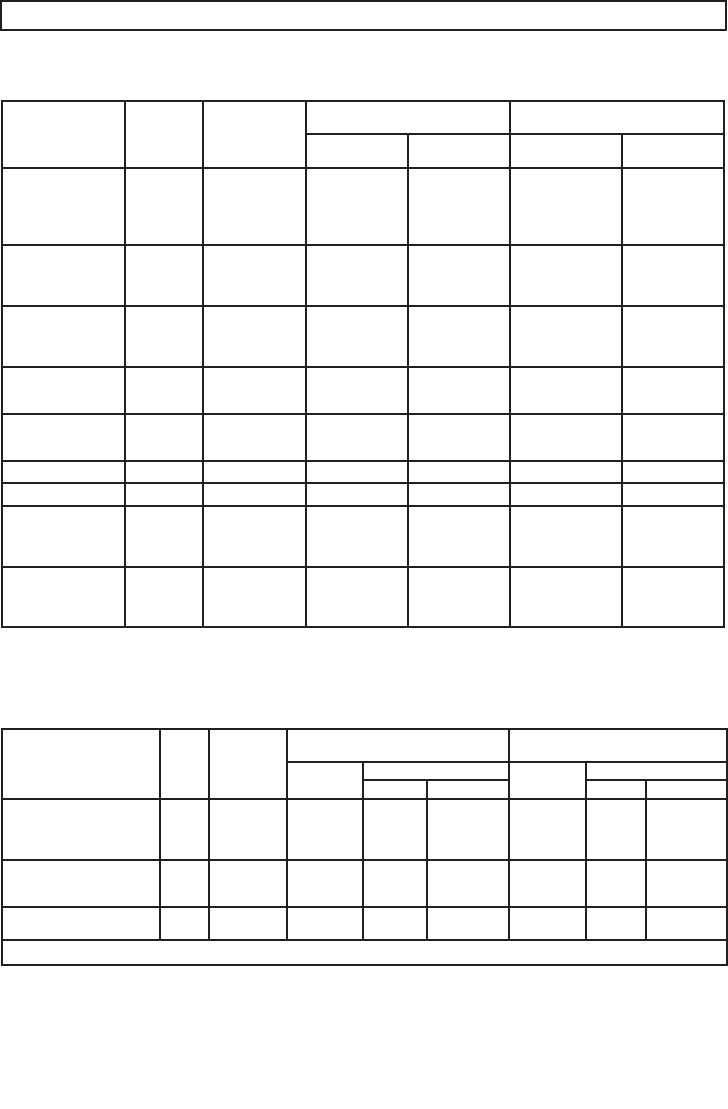
MULTIFUNCTION OVEN - RIGHT OVEN CAVITY
COOKING / BAKING TIMETABLE
FOODS Weight
kg
Position of the
oven shelf from the
bottom
COOKING BY
NATURAL CONVECTION COOKING BY
FORCED CONVECTION (WITH FAN)
Temperature
in °C Cooking Time
in min. Temperature
in °C Cooking Time
in min.
MEAT
Roast veal
Roast beef
Roast pork
Roast lamb
1
1
1
1
1-2
1-2
1-2
1-2
200-225
200-225
200-225
200-225
100-120
40-50
100-120
100-120
190
190
190
190
100-120
40-50
100-120
100-120
GAME
Roast hare
Roast pheasant
Roast partridge
1
1
1
1-2
1-2
1-2
200-Max
200-Max
200-Max
50-60
60-70
50-60
200-Max
200-Max
200-Max
50
60
50
POULTRY
Roast chicken
Roast turkey
Roast duck
1
1
1
1-2
1-2
1-2
200-225
200-225
200-225
80-90
100-120
90-110
190
190
190
70-80
90-110
80-100
FISH
Roast sh
Casseroled sh
1
1
2
2200
175
30-35
20-25
170-190
160-170
25-30
15-20
BAKED PASTA
Lasagne
Cannelloni
2,5
2,5
2
2210-225
210-225
60-75
60-75
225-Max
225-Max
30-40
30-40
PIZZA 12225-Max 25-30 225-Maxi 20-25
BREAD 12225-Max 20-25 220 20
PASTRIES
Biscuits in general
Shortcrust pastry
Victoria sponge 0,8
2
2
2
190
200
200
15
20
40-45
170-190
190-200
190-200
15
20
40-45
CAKES
Angel cake
Fruit cake
Chocolate cake
0,8
0,8
0,8
2
2
2
190
200
200
52
65
45
170-190
190-200
190-200
45
65
45
The values given in the tables (temperatures and cooking times) are approximate and may vary according to each person’s
cooking habits. This table gives cooking times on only one shelf. If you are cooking with a fan oven and you are using more
than one shelf (placing the shelves on the 2nd and 4th position or on the 1st and and 3rd position) cooking time will be about
5 to 10 minutes longer.
GRILLING TIMETABLE
FOODS Weight
kg
Position of
the oven
shelf from the
bottom
COOKING BY NATURAL
CONVECTION COOKING BY FORCED
CONVECTION (WITH FAN)
Temperature
in °C Cooking Time in min. Temperature
in °C Cooking Time in min.
1st side 2nd side 1st side 2nd side
MEAT
Chop
Beefsteaks
Half chicken
0,50
0,15
1
3
3
2-3
225-Max
200-225
225
12-15
5
20
12-15
5
20
200
=
=
15
=
=
10
=
=
FISH
Trout
Sole
0,42
0,20 3
3
225-Max
225-Max =
==
=200
200 10
7
10
7
BREAD
Toast 3-4 225-Max 2-3 2-3 200 2-3 2-3
The values given in the tables (temperatures and cooking times) are approximate and may vary according to each person’s
cooking habits. In particular, temperatures and times for grilling meat will greatly depend on the thickness of the meat and
on personal tastes.
19
7
89
CLEANING AND MAINTENANCE
To keep the surface of the hob and the various
components in pristine condition (grill, enamelled
covers, burner heads and ame diffusers, it is very
important to wash them in warm soapy water, rinse and
dry them well after each use.
Do not leave vinegar, coffee, milk, salty water or the
juice of lemon or tomato on enamelled surfaces for
any length of time.
WARNINGS
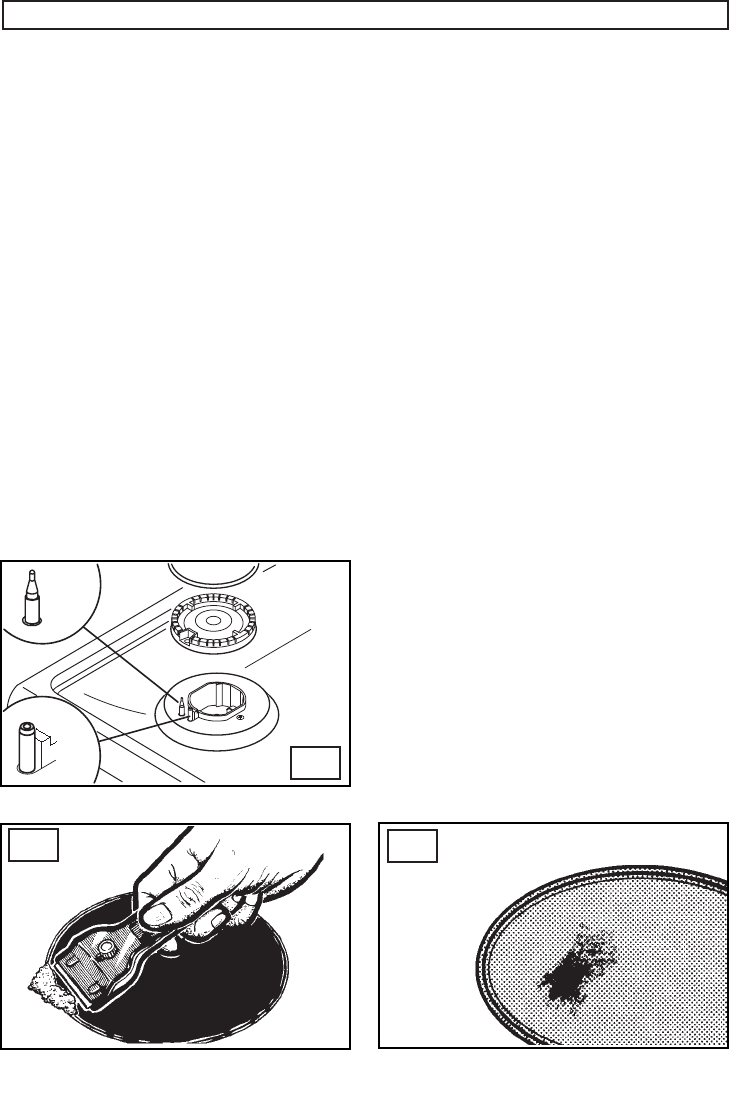
• Check that the heads burners and the relative burner
caps, are correctly positioned in their housings (g. 7).
• Take care not to disturb the ignition spark plugs or
ame failure devices.
• If you nd a tap is difcult to open or close do not force
it but call for technical assistance urgently.
STRUCTURE
All the cooker parts (in enamelled or painted metal, steel, or
glass) should be cleaned frequently with warm soapy water
and then rinsed and dried with a soft cloth.
CERAMIC GLASS HOB
It is very important to clean the top each time it is used
and while the glass is still warm, drying it with a soft
cloth. Do not use metal pads, abrasive powders or
corrosive spray products for cleaning.
Depending on the degree of dirt, we recommend:
• For slight stains a damp sponge is enough
• The scraper must be used for more stubborn dirt
(g. 8). Use it carefully because it is easy to cut
yourself. To avoid any such possibility, scrape
away immediately from the cooking zone any
tin foil sheets or plastic objects that could have
melted or stuck, likewise sugar or sugary food
spilled over during cooking.
• Remove any traces of spilled liquid with vinegar or
lemon. Immediately remove any vinegar or lemon
from the enamelled outer edge otherwise it will
become opaque.
• Over time it is possible that colourings, metal
reections or scratches appear (g. 9) caused by
inefcient cleaning or by the incorrect movement of
the pans. These scratches are difcult to eliminate
but they will not prejudice how your hob works.
INSTRUCTIONS FOR THE USER
20
10
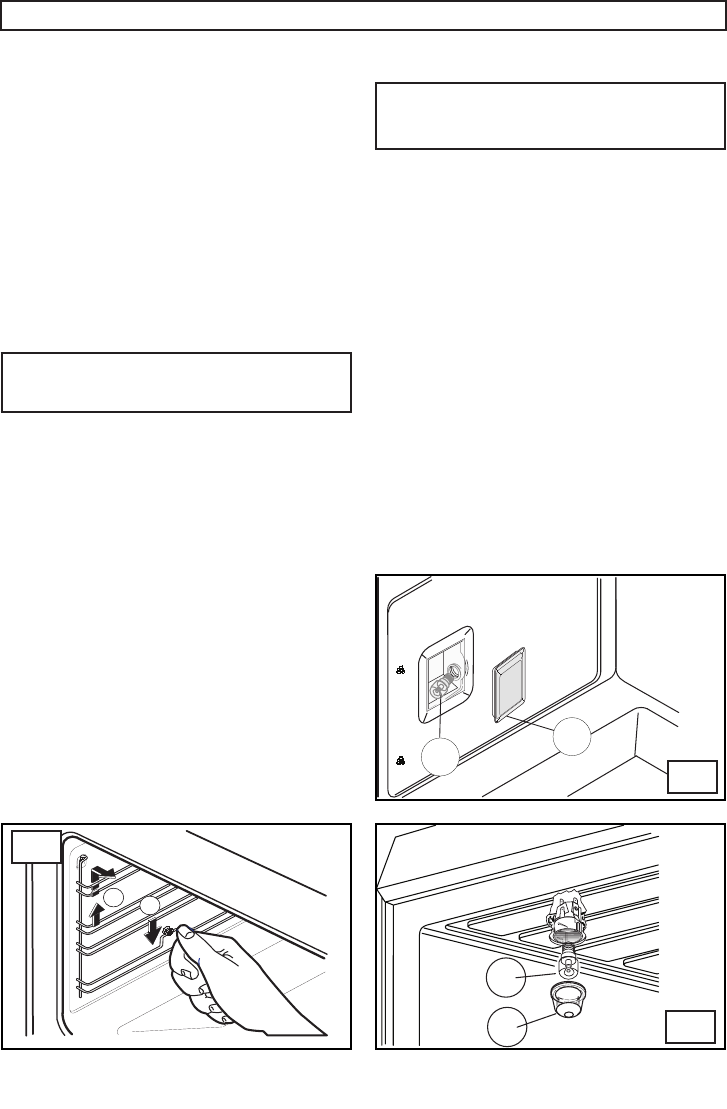
REPLACING THE OVEN LAMP (g. 11-12)
Ensure the appliance is switched off before
replacing the lamp to avoid the possibility of
electric shock..
IIn the event one or both oven lamps need replacing,
the new lamps must comply with the following
requisites:
15 W - 230 V~ - 50 Hz - E 14 - and must be resistant
to high temperature (300°C).
The appliance can have two different types of lamp
holder:
• Lamp holder type 1 (g. 11): Draw out the side
guide rails as described above.Then, remove the
glass protection cap (V) from the bulb socket, lifting
it with a screwdriver placed between the cap and
the oven wall and replace the lamp (L). Fit the
accessories back in reverse order.
• Lamp holder type 2 (g. 12): Turn glass protection
cap (C) counterclockwise and change the lamp.
Re-t the cap, screwing it back in a clockwise
direction.
12
11
OVEN CAVITY
The oven cavity should be cleaned after each use
to remove cooking residuals and or grease or sugar
which, if burnt on when the oven is used again, will
form deposits or unremovable stains as well as
unpleasant smells.
To maintain the shine of the enamelled parts, clean
them with warm soapy water, rinse and dry them
thoroughly. ALWAYS wash the accessories used.
OVEN SEAL
The oven seal guarantees the correct functioning of
the oven. We recommend you:
• clean it, avoiding abrasive tools or products.
• check its state now and then.
If the oven door seal has become hard or is damaged,
contact our Service Centre and avoid using the oven
until it has been repaired.
OVEN SIDEWALL GRIDS (g. 10)
To allow for a better cleaning of the side grids, you can
extract them this way:
1. Push with a nger on the last of the slots to release
the grid from its hold.
2. Lift it towards the top and extract the grid.
To put them back into place, reverse the order of this
operation.
INSTRUCTIONS FOR THE USER
21
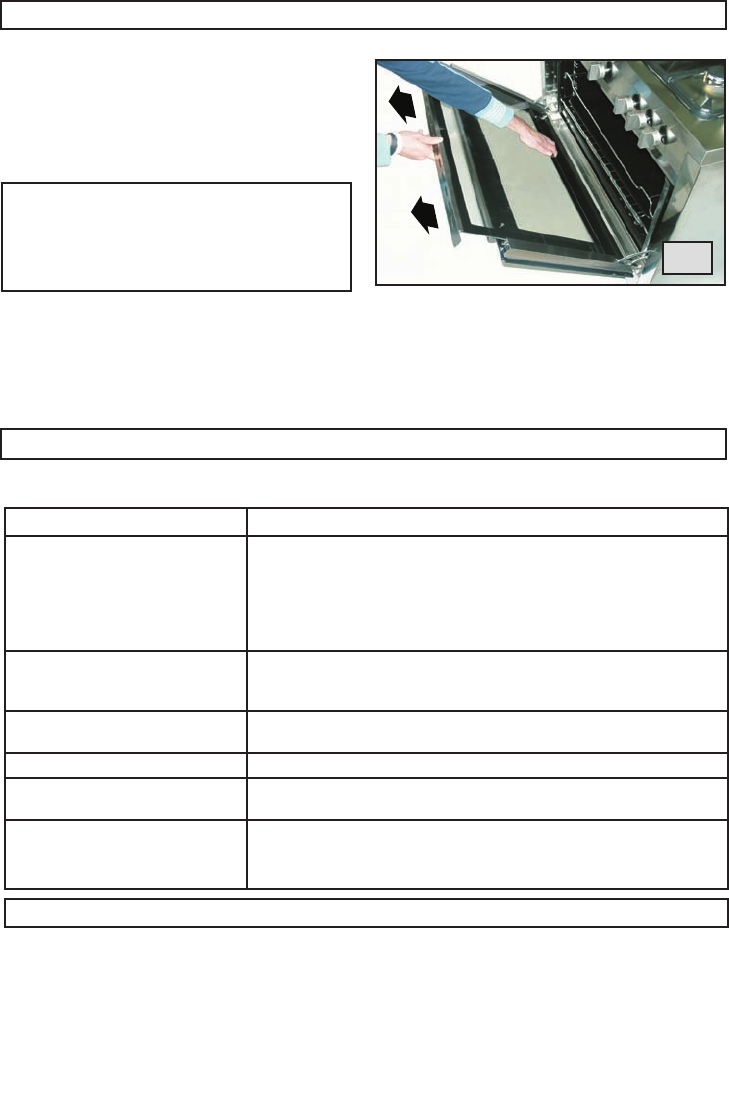
HOW TO CLEAN THE INNER OVEN DOOR GLASS
One of the features of our cookers is that the inner
oven door glass can be easily removed for cleaning
without the aid of specialized personnel. Just open the
oven door and remove the support securing the glass
(g. 13).
ATTENTION!! This operation can be done also
with the door tted on appliance, but in this
way, pay attention that when the glass is pull
upwards, the force of the hinges can close the
door roughly.
INSTRUCTIONS FOR THE USER
13
Some of the problems occur because of simple maintenance oversights or operation mistakes and can easily be
resolved without having to call for technical assistance.
PROBLEM REMEDY
The appliance is not working • Make sure the gas cock is open
• Check the plug is in
• Check that the knobs are set correctly for cooking and then repeat the
operations given in the handbook
• Check the electrical system safety switches (RCD). If there is failure in
the system call an electrician in.
During use of the ceramic glass
hob, the residual heat warning light
does not switch on
• Turn the knob round to a hotter temperature
• Turn the knob of another element
• Call our Assistance Centre
The electric oven is not working • Check that the programmer accessory, if there is one, is on the manual
position and then repeat the operations described in the manual
The thermostat is not working • Call our Service Centre
The electric thermostat warning
light does not switch on during use
• Turn the thermostat round to a hotter temperature
• Turn the selector round to a different function
The oven light does not switch on • Make sure the lamp is rmly screwed in place
• Buy a lamp for high temperatures at one of our Service Centre and t
it following the REPLACING THE OVEN LAMP paragraph.
Warning: Servicing should be carried out only by authorised personnel.
TROUBLESHOOTING
22
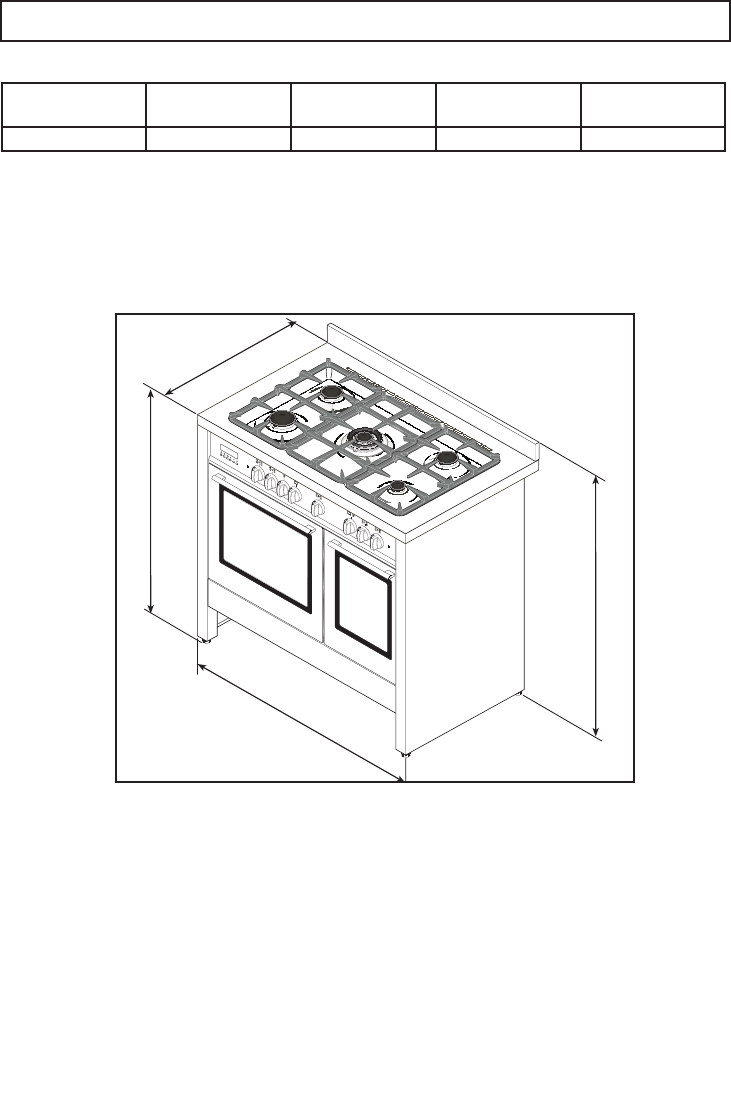
OUTSIDE COOKER DIMENSIONS
TYPE
COOKER height H
mm height h
mm width L
mm depth P
mm
90 x 60 917 ÷ 972 857 ÷ 912 900 600
TECHNICAL FEATURES
23
TECHNICAL FEATURES
ELECTRIC COMPONENTS
Ref. Description Ø in mm Nominal data
E (Rear left /front right )
F (Rear right )
C (Front left )
D(Centre)
Hi-light radiant heating element
Hi-light radiant heating element
Hi-light double radiant heating element
Hi-light double oval radiant heating element
140
210
120/210
170/265
1200 W
2100 W
750/2200 W
1400/2200 W
Lower heating element of the oven cooker
Top heating element of the oven-grill cooker
Oven lamp
Rear fan
Cooling fan
Turn spit motor
1400 W
1800+800 W
15 W - E 14 - T 300
25..29 W
12 W
4 W
Lower heating element of the oven cooker
Top heating element of the oven-grill cooker
Oven lamp
900 W
450+1100 W
15 W - E 14 - T 300
Cooker type Cable type Single-phase power
230 V ac
cross-section
Three-phase power
230 V ac 3
cross-section
Double-phase power
400 V ac 2N
cross-section
Three-phase power
400 V ac 3N
cross-section
Combi cooker H05 RR-F 3 x 1.5 mm2= = =
Electric cooker (*) H05 RR-F
13mm<Ø<14mm 3 x 6 mm24 x 4 mm24 x 4 mm25 x 2,5 mm2
(*) Taking into account the contemporaneity factor.
BURNERS Operating Pressure Gas Rate Diameter Injectors
Sabaf Heat Input - W By-Pass
N. DESIGNATION mbar g/h L/h 1/100 mm Min Max 1/100 mm
2Rapid G30 - Butano
G31 - Propano
G20 - Naturale
218
214
286
88
88
117-Y
800
800
800
3000
3000
3000
44
3Semi-rapid G30 - Butano
G31 - Propano
G20 - Naturale
131
129
171
68
68
98-Z
600
600
600
1800
1800
1800
34
4 Auxiliary G30 - Butano
G31 - Propano
G20 - Naturale
73
71
95
51
51
75-X
400
400
400
1000
1000
1000
28
6Ultra-rapid G30 - Butano
G31 - Propano
G20 - Naturale
276
272
362
98
98
135-K
1400
1400
1400
3800
3800
3800
65
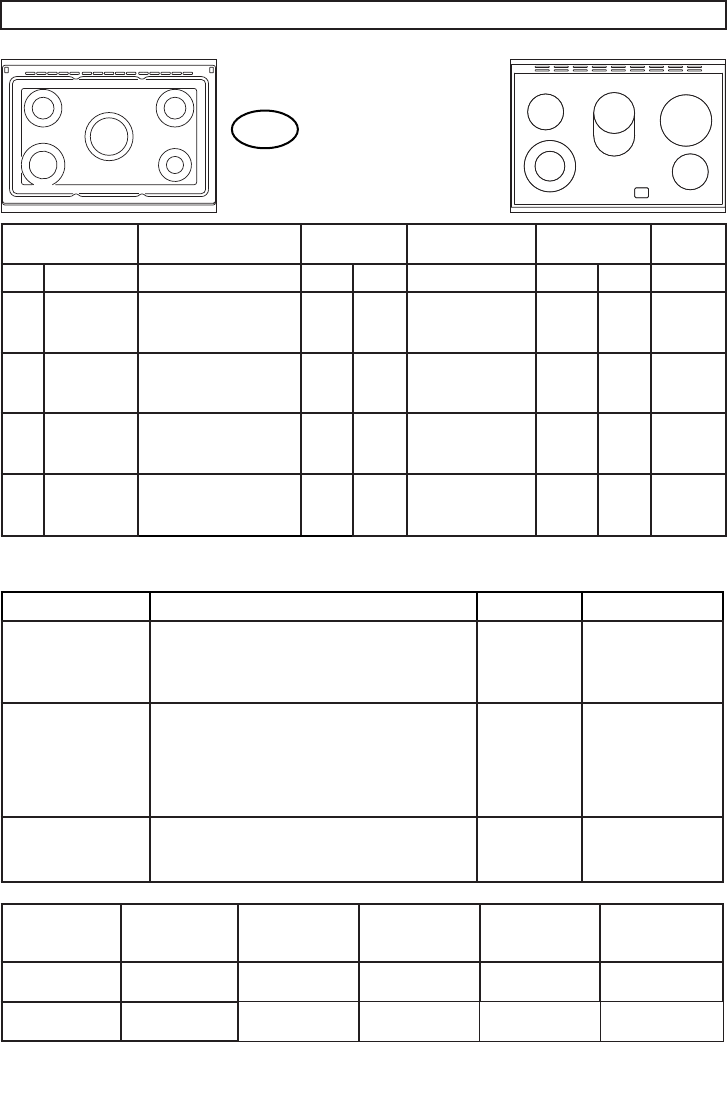
TECHNICAL DATA BURNERS
-SABAF - DISPOSITION
CAT. II 2H3+
HEATING ELEMENTS DISPOSITION
GB
24
TECHNICAL INFORMATION
• The installation, adjustments, conversions and
maintenance operations listed in this part must
only be carried out by qualied personnel. The
manufacturer cannot be held responsible for any
damage to persons or property resulting from an
incorrect installation of the appliance.
• The safety and automatic adjustment devices of the
appliances may, during its life, only be modied by
the manufacturer or duly authorised supplier.
• In accordance with the gas standard, the all-gas and
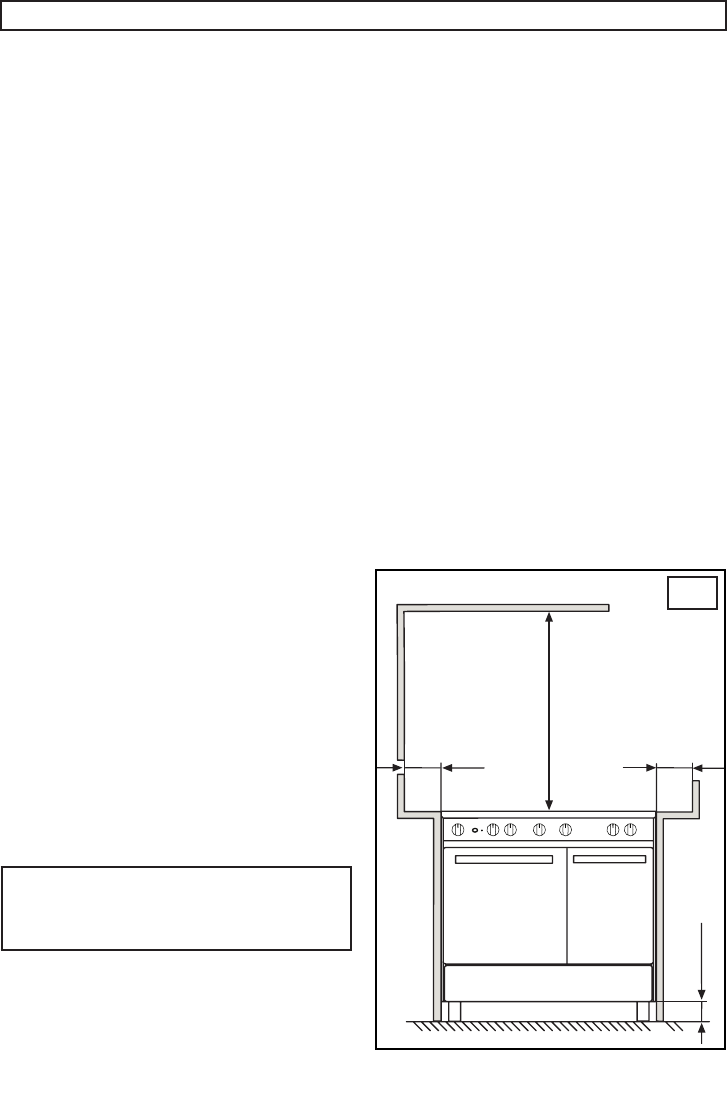
combi appliances are “class 2 subclass 1” (recessed)
and, as such, must comply with the clearances
specied in gure 14 and consequently any side
walls must be no higher than the work top.
• The walls adjacent to and surrounding the appliances
must be able to withstand an temperature of 95°C.
• The installation of all-gas and combi appliances
must comply with the standards in force.
• This appliance is not connected to a ue for
discharge of the combustion products; therefore, it
must be connected in compliance with the above
mentioned installation rules. Particular attention
must be paid to the instructions given below for
ventilation and aeration.
INSTALLATION
UNPACKING YOUR COOKER
• Once the wrapping has been removed from the outer
surfaces and the various inner parts, thoroughly
check that the appliance is in perfect condition.
If you have any doubts do not use the appliance and
call in a qualied person.
• Some parts mounted on the appliance are protected
by a plastic lm. This protection must be removed
before using the appliance. We recommend slitting
the plastic lm along the edges with a sharp knife or
pin.
• Do not move the appliance by the handle.
The packaging materials used (cardboard, bags,
polystyrene foam, nails etc.) must not be left anywhere
within easy reach of children as they are a potential
hazard source.
INSTRUCTIONS FOR THE INSTALLER
VENTILATION
The appliance should not be installed in a room of
volume less than 20 m³.
The quantity of air necessary is that required for a
regular combustion of the gas and for the ventilation of
the room. The natural ow of air must be direct through
permanent openings in the walls of the room that open
directly to the outside with a minimum cross section of
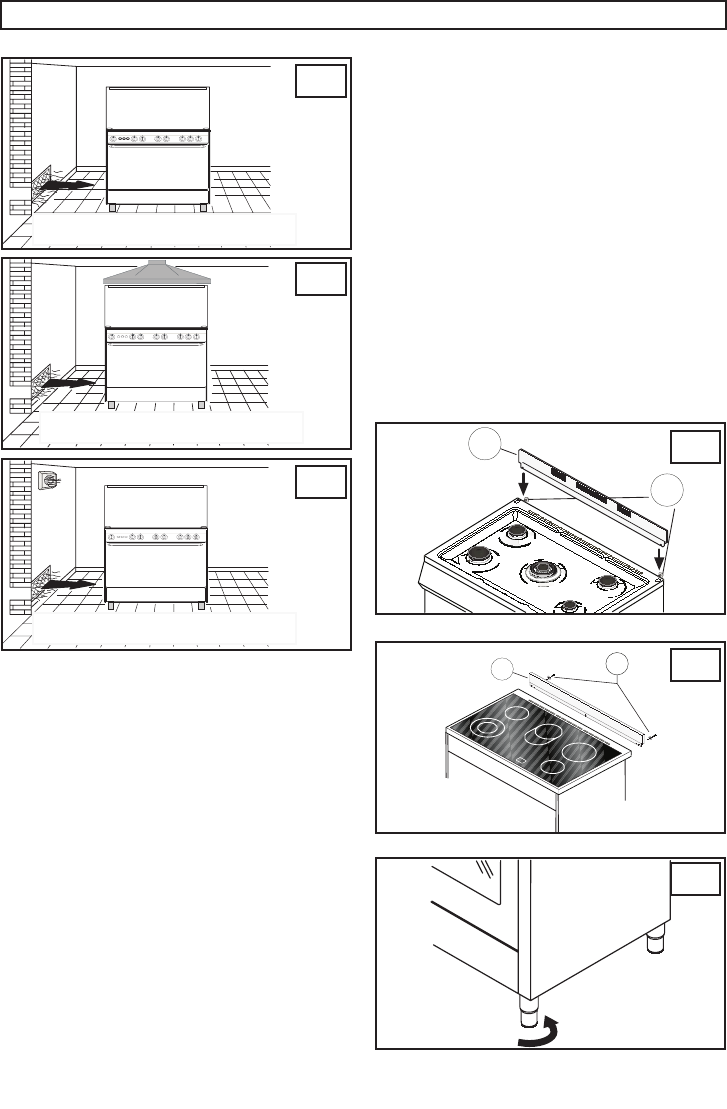
100 cm2 (g. 15). These openings must be positioned
so they cannot be obstructed.
Indirect ventilation is also allowed by taking air from
adjacent rooms to the one to be ventilated, strictly
complying with the prescriptions of the standards in
force.
LOCATION AND AERATION
Gas cookers must always discharge the products
of combustion and the moisture through hoods
connected to ues or directly to the outside (g. 16).
If it is impossible to use a hood, a fan installed on
the window or wall, facing the outside, is allowed and
should be switched on each time the appliance is used
(g. 17) provided the rules and regulations in force
relating to ventilation.
14
25
AIR INLET MIN. SECT. 100 cm2
AIR INLET MIN. SECT. 100 cm2
AIR INLET MIN. SECT. 100 cm2
INSTRUCTIONS FOR THE INSTALLER
POSITIONING THE COOKER
The appliances are tted with the following parts to
enable them to be correctly positioned:
• Backguard. The cookers which are equipped
with this accessory, leave of the factory with this
particular inserted inside the packing. In order to
install the backguard, it is necessary to loosen the
screws positioned on the back of the hob and then
to x the backgaurd as indicated in gure 18.
• Adjustable feet, to be tted to the appliance,
which allow the height of the cooker to be aligned
with other kitchen furniture
15
16
17 18
18
19
26
770 mm +/- 5
20 mm +/- 3
Wall
Position of threaded pin
chain tilt
Threaded pin
Masonary
wall
SECURING THE COOKER TO WALL
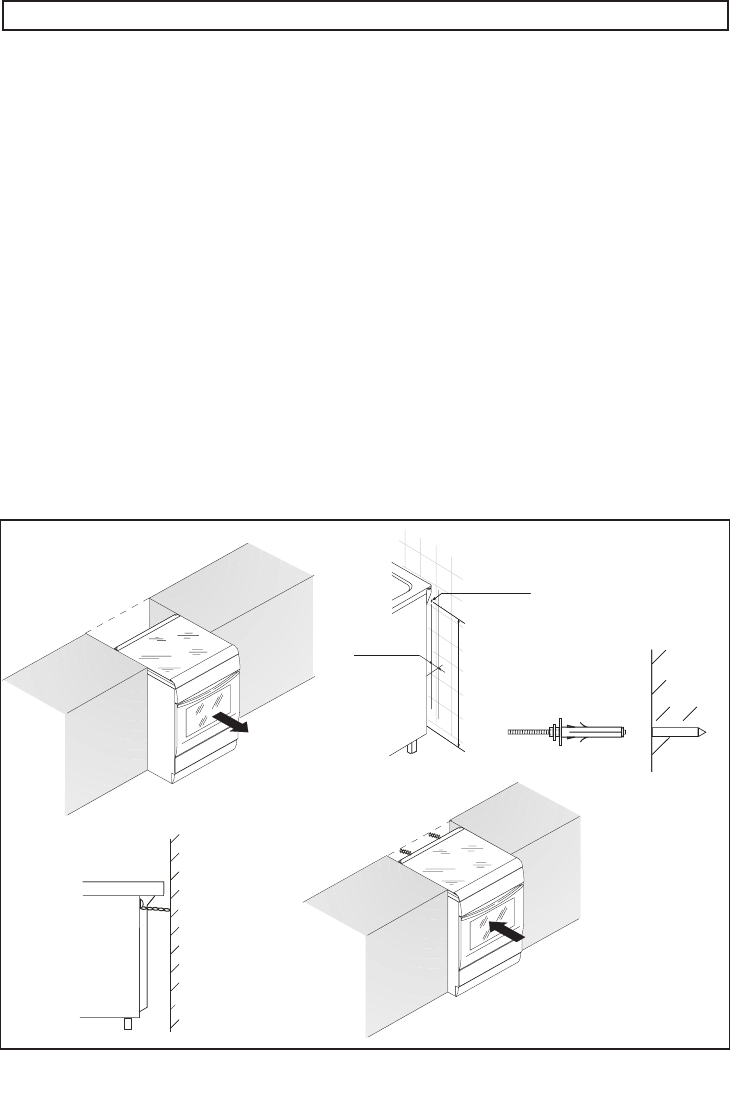
Note:- The installation of the chain provided is for
safety reasons, it must be installed as indicated
below.
.
To prevent the cooker tipping forwards in the event of
children standing on the oven door or where users put
extreme weight on the door when in open position, two
chains MUST BE xed to the back of the oven which
should at all times be secured to the threaded pins .
The threaded pins should be secured to the wall at the
back of the cooker.
Assembly instructions
• Secure threaded pins into wall immediately behind
and to the left-hand side about 770 mm from the oor.
Finished xing the chains must be stretched
INSTRUCTIONS FOR THE INSTALLER
27
GAS CONNECTION
Before connecting the appliance check that the
data on the rating plate afxed to the cooker,
correspond to those of the gas mains.
A label on the back of this handbook and at
the back of the cooker gives the appliance
adjustment conditions, that is, the type of gas
and operating pressure.
Once the cooker is installed, check there are no
leaks using a soapy solution (never a ame).
The appliance’s gas inlet tting is a threaded 1/2”
male cylindrical type, in compliance with the ISO
228-1 standards. If gas is distributed through ducts
the appliance must be connected to the gas mains with:
• a rigid steel pipe, in accordance with standards,
whose joints must be made using threaded ttings
in accordance with the UNI-ISO 7/1 standard. The
use of hemp with suitable adhesives or Teon tape
as a sealant is allowed.
• copper pipe, in accordance with the standard,
whose joints must be made using sealed ttings in
accordance with the standard.
• a flexible stainless steel, seamless pipe in
accordance with the standard, with a maximum
2 metre extension and seals in accordance with
the standard.
• a flexible rubber hose in accordance with the
standard, with an 8 mm diameter for LPG and
13 mm for natural gas or town gas, maximum
1500 mm in length, firmly secured to the hose
fitting with a safety clamp as per the standard.
If the gas is supplied directly from a gas cylinder,
the appliance, fed by a pressure regulator in
accordance with the standard, must be connected:
• with a copper pipe in accordance with the standard,
INSTRUCTIONS FOR THE INSTALLER
whose joints must be made using sealed ttings in
accordance with the standard.
• with a exible stainless steel, seamless pipe in
accordance with the standard, with a maximum
2 metre extension and seals in accordance with
the standard. We recommend applying the special
adapter to the exible pipe, easily found on the
market, to facilitate connection to the pressure
regulator’s hose tting on the cylinder.
• with a flexible rubber hose in accordance with
the standard, with an 8 mm diameter, minimum
400 mm in length, maximum 1500 mm in length,
firmly secured to the hose fitting with a safety
clamp as per the standard.
ATTENTION:
• If the appliance is going to be recessed (class 2
subclass 1), connect it to the gas supply source
using only exible stainless steel, seamless
pipes in accordance with the standard.
• If the appliance is going to be installed free-
standing (class 1) and if you use the exible
rubber hose, it is necessary to follow the
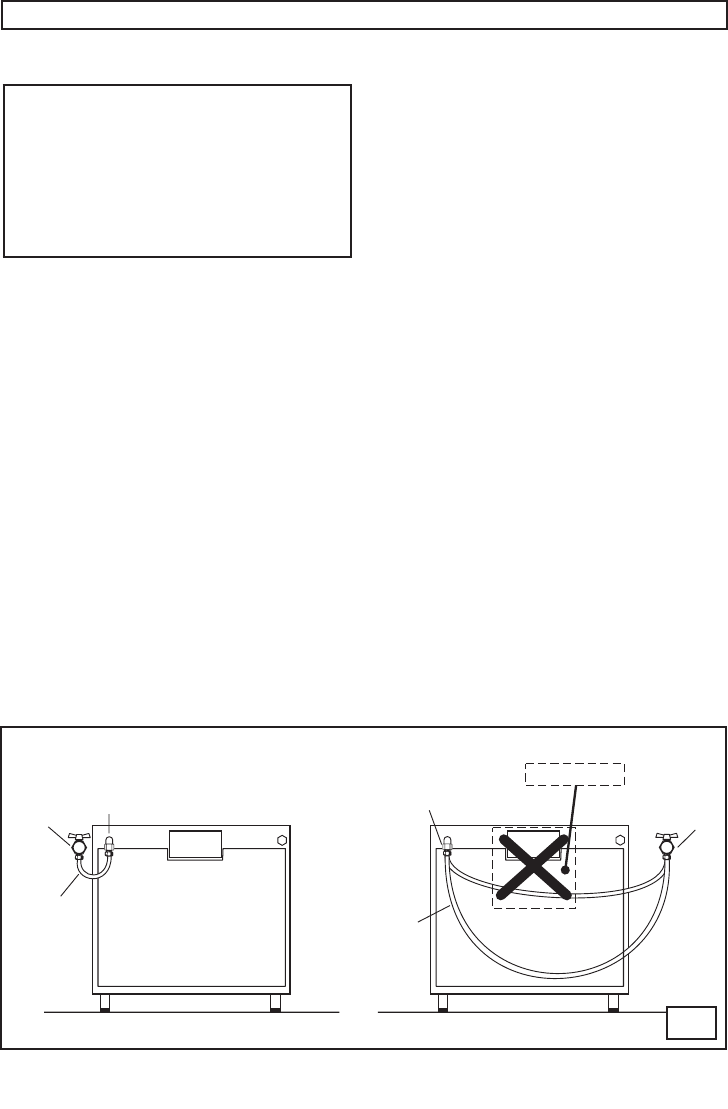
instructions and gure 20 given below:
• On its route, the hose must not touch any parts
where the over temperature is more than 95°C.
• The hose must not be subject to any kind of
torsional stress or tractive force, there must be
no pinched parts or really sharp bends.
• It must not touch anything that can cut, that has
sharp corners, etc.
• The whole length of the hose must be easy
to inspect in order to keep a check on its
condition.
• It must be replaced within the date printed on it.
20
28
ELECTRICAL CONNECTION
The electrical connection must be carried out in
accordance with the current standards and laws
in force.
Before connecting check that:
• The system and electrical sockets amperage is
adequate for the appliance maximum power (see
data label afxed on the back of the cooker).
• The socket or system has an effective earth
connection in accordance with current standards
and prescriptions of the law. All responsibility is
disclaimed if this is not complied with.
• The plug and socket or the multipolar switch must
be accessible after installation of the appliance.
• If the appliance has no power cable, connect one
with a suitable cross section to the terminal board
(see paragraph «CONNECTING THE POWER
CABLE»).
When connecting to the mains with a socket:
• Fit to the power cable (if without) a standardized
plug, suitable for the load which is indicated on the
data label. Connect the wires making sure they
correspond as shown below, and remember that
the earth wire must be longer than the phase
wires:
letter L (phase) = brown wire
letter N (neutral) = blue wire
symbol (earth) = green/yellow wire
• The power cable must be laid so that no parts of it
ever reach a temperature of 75 °C.
• For connecting do not use, adapters or shunts
as they could cause false contacts resulting in
hazardous overheating.
When connecting directly to the mains:
• Install a multipolar switch that can withstand the
appliance load, with a minimum opening between
the contacts of 3 mm.
• Remember that the earth wire must not be cut out
by the switch.
INSTRUCTIONS FOR THE INSTALLER
CONNECTING THE POWER CABLE
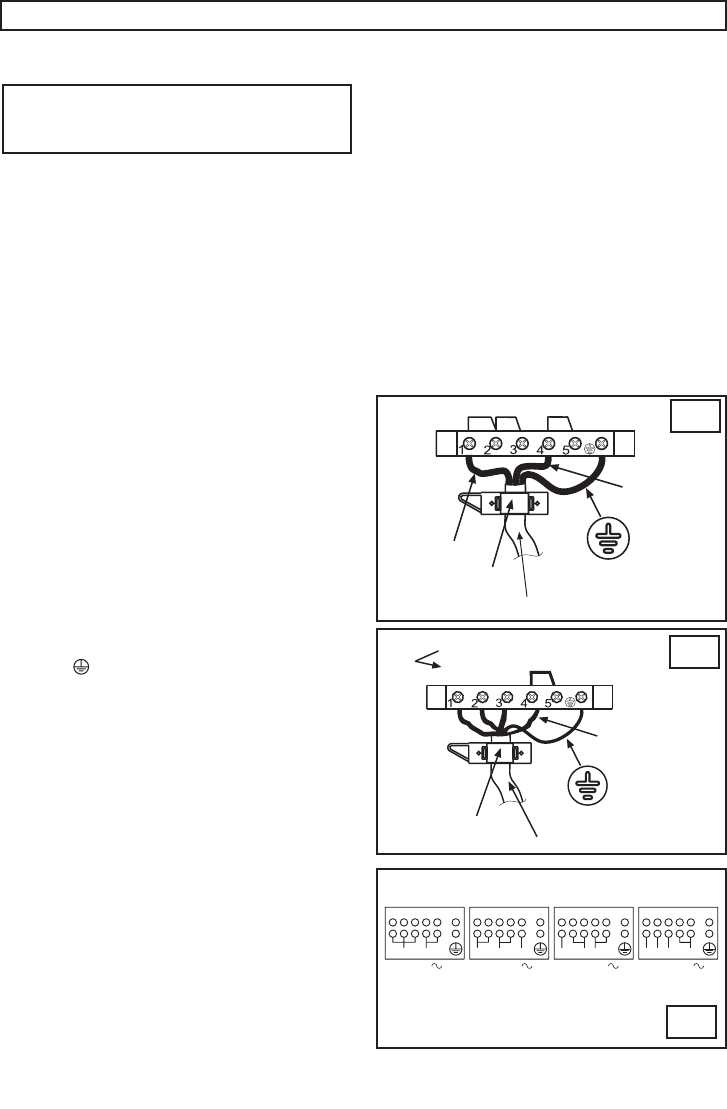
The all-electric cookers and some combi versions lea-
ve the factory ready for single-phase power, butt they
can, with due modications, be powered by three pha-
se systems by following these instructions:
• Remove the rear panel from the cooker.
• Move the connecting plates in the terminal board
g.A , following the diagram in g. B.
• You will nd the diagram afxed to the back of the
cooker (g.21) according to the type of connection
you want.
• Connect the power cable, whose cross section
must be suitable (see paragraph «TECHNICAL
FEATURES»), keeping the earth wire longer than
the phase wires.
• Secure the cable in the clamp and t the rear panel
in place.
21
A
B
29
CONVERSIONS
REPLACING THE INJECTORS
Our burners can be adapted to different types of
gas by simply installing the injectors suitable for the
gas you want to use. To help the installer, the table
(see paragraph «TECHNICAL FEATURES») gives
the burner nominal heat input, injector diameter and
operating pressure of the different gas types.
Comply with the following instructions:
Injector replacement - Hob burners.
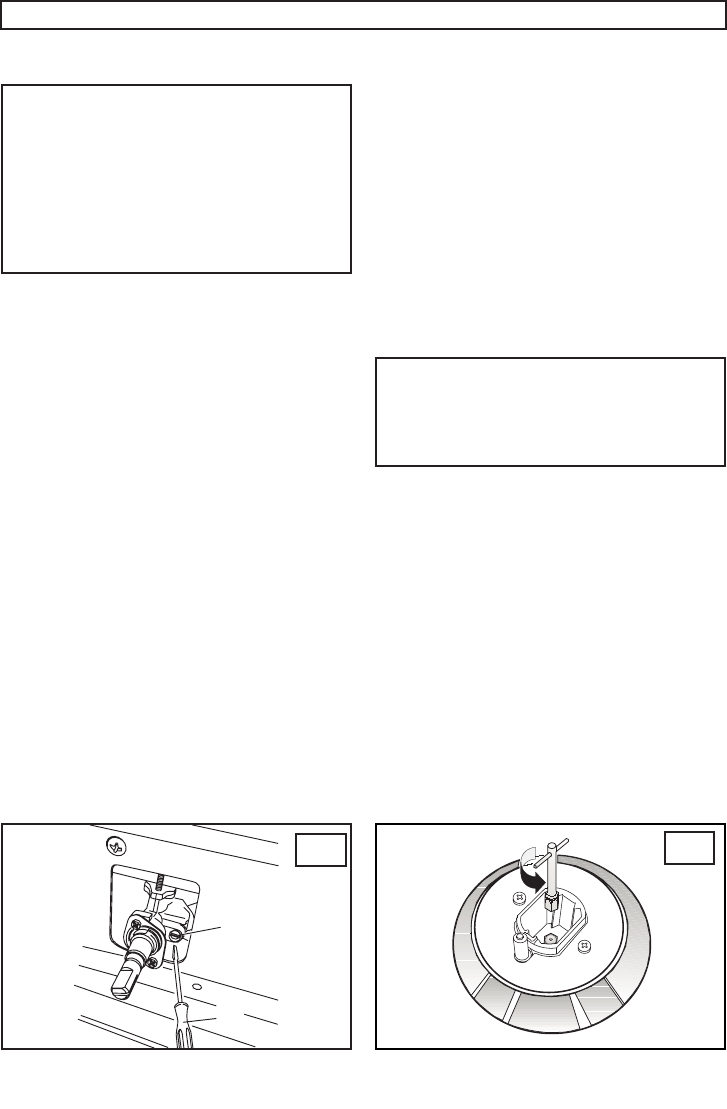
To change the injectors on the hob, remove the burner
cup and head and with a 7 mm Ø socket spanner
replace them (g. 23).
After having replaced the injectors, it will be
necessary to proceed with burner adjustment
as explained in the previous paragraphs. The
technician must replace any seals after the
adjustments have been made.
23
ADJUSTMENTS
• All seal must be replaced by the technician
following any adjustment or regulation.
• The adjustment of the reduce rate (simmer)
must be undertaken only with burners
functioning on natural gas while in the case of
burners functioning on L.P.G, the screw must
be locked down fully (in clockwise direction).
• “Primary air adjustment” on hob gas burners
is unnecessary.
TAPS
All gas taps are male cone type with only one way of
passage. Adjustment of the “Reduced rate” position
as follows:
• Turn the burner on and place the knob on the
“Reduced rate” position (small ame).
• Remove the knob (A) of the tap which is attached by
simply applying pressure to the rod.
• Insert a small screwdriver (C) into screw (V) side
of the stem (g. 22) and turn to the right or left
the throttling cone until the ame of the burner is
conveniently regulated to the Low position.
• Check that the ame does not go out when the knob
is sharply switched from the “Full on” to “Reduced
rate” positions.
• ATTENTION!! This operation can be carried out
also with the front panel tted, but if the technician
nds some difculties to reach the adjustment
screw, remove the front panel unscrewing the xing
screws (Vf) (g. 24), which are positioned in the
inferior part of the same.
INSTRUCTIONS FOR THE INSTALLER
22
30
CHANGING THE FLEXIBLE GAS HOSE
In order to guarantee that the gas hose is always in
excellent condition we strongly recommend changing
it on the date you will nd printed on it.
REPLACING THE ELECTRICAL COMPONENTS
• The rear protection will have to be removed in order
to change the electrical heating elements, spit
motor, terminal board and power cable.
• If you have to change the power cable (see the
cross section on table paragraph «TECHNICAL
FEATURES»), always keep the earth wire longer
than the phase wires and, in addition, follow
all the instructions given in the «ELECTRICAL
CONNECTION» paragraph.
• To change the oven lamp see the instructions on
the REPLACING THE OVEN LAMP paragraph.
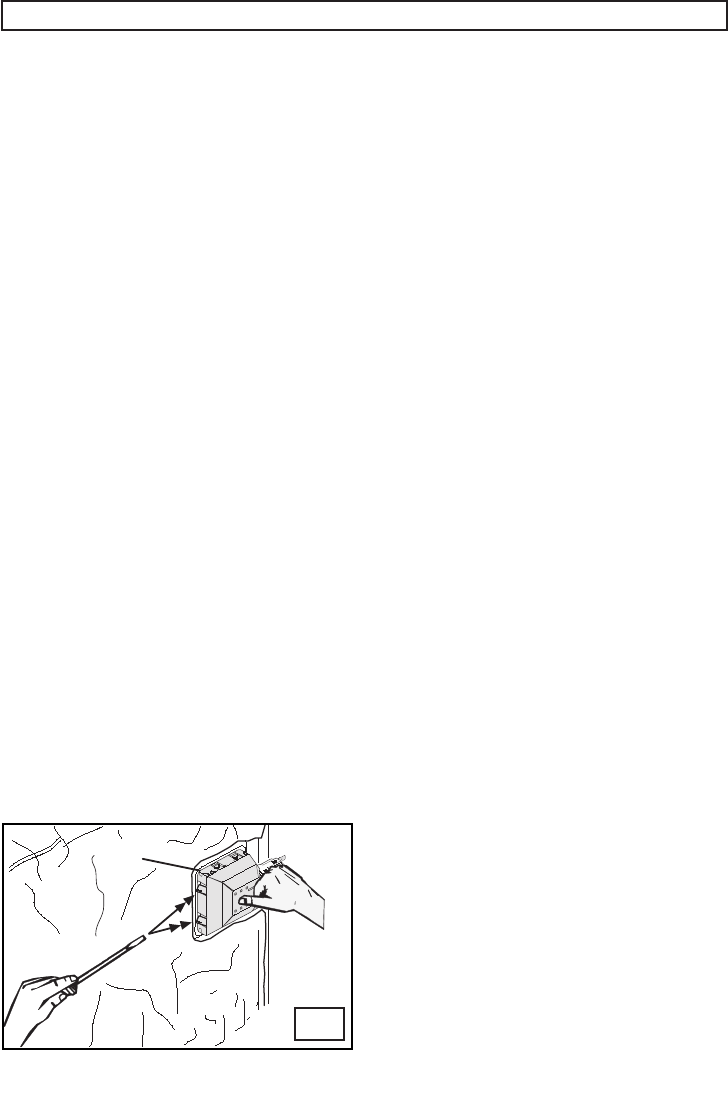
• To change the lamp holder, remove the side
panels and then use a screwdriver to push the two
locking tabs (g. 24) and remove the lamp holder
from the inside of the oven.
• To change the eventual programming accessory,
the thermostat, the commutator and the indicator
lights, remove the front panel as indicated in
paragraph «TAPS»
INSTRUCTIONS FOR THE INSTALLER
24

31

SPACE FOR DATA LABEL
461308219_001 07/2013
