Hopkins C6304NF LED WIRELESS TOW LIGHT User Manual C6304 Wireless Magnetic Tow Light
Tiger Accessory Group LLC LED WIRELESS TOW LIGHT C6304 Wireless Magnetic Tow Light
Hopkins >
Users Manual
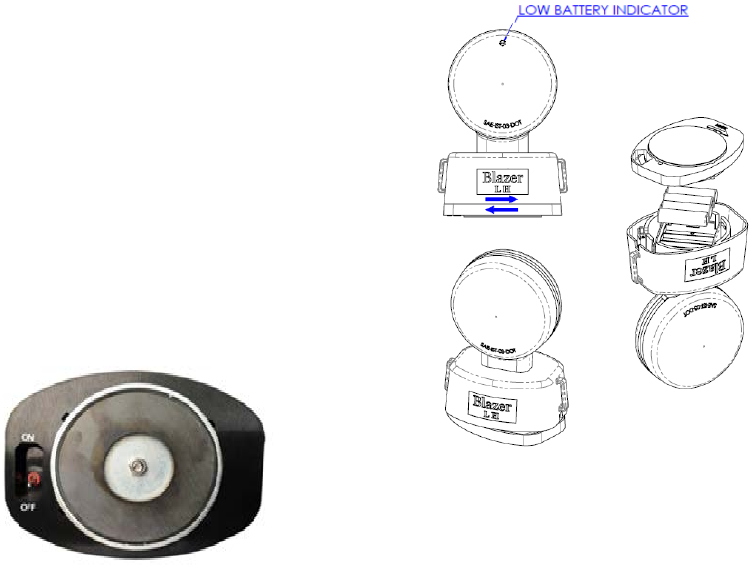
ON/OFF
SWITCH
Tiger Accessory Group, LLC
C6304NF LED WIRELESS TOW LIGHT
For Vehicles Under 80” in width
This product is intended for temporary use to provide tail lamp function as well as stop, turn and hazard indication
when towing a vehicle or trailer narrower than 80 inches wide. Check with Department of Transportation to
confirm all lights required for your particular tow. Please check with your dealer concerning additional lighting
requirements depending upon what you will be towing.
A special note about batteries:
It is recommended to use good quality, new AA alkaline batteries and have a spare set of them on hand.
While in use be sure to check every 2-3 hours that the battery indicator LED is NOT blinking. A blinking
LED indicates the batteries are getting low. If the battery indicator LED is blinking when the switch is on
you will need to replace all eight batteries immediately to comply with SAE/FMVSS 108 safety standards.
Four batteries are found in each of two magnetic bases.
Using the Wireless Tow Lights:
1. Install fresh AA batteries into each light base per indicated polarity.
The battery tray is accessed by twisting the entire base counter-
clockwise while holding the light’s housing. (See illustration).
Make sure to replace the batteries in BOTH “RH” and “LH” units!
2. Connect the transmitter to your “four-flat” trailer plug on the
vehicle.
3. Attach the transmitter to steel surface at the rear of the towing
vehicle above the bumper so that the magnet holds it firmly in
place after first cleaning the mounting surface and transmitter’s
magnetic base. For best results place at or above the level of the
rear bumper.
4. Turn the switch located on the bottom of the “LH” base to “On”.
5. Check that the magnetic light bases are clear of any debris that may scratch the mounting surface. Attach
the left “LH” and right “RH” lights on a flat surface as far apart as practical and at an equal distance from
the sides of the vehicle/trailer being towed. Lights should be placed at the same height. Do not mount
lights higher than 6 feet (381 mm) from the ground or lower than 1.25 feet (1829 mm) from the ground.
The entire magnet must be touching a steel surface for optimal holding performance. Place lights to allow
following vehicles optimal visibility at all times.
6. If the lights are not aligned properly detach them by tipping the light to disengage the magnetic base
before placing them again.
7. Use a tie wrap to collect any loose cable between the lights. Do not cover or obstruct the lights during
operation.
8. Verify the operation of tail lights, stop lights and both left and right turn signals. DO NOT drive your
vehicle unless all lights functioning
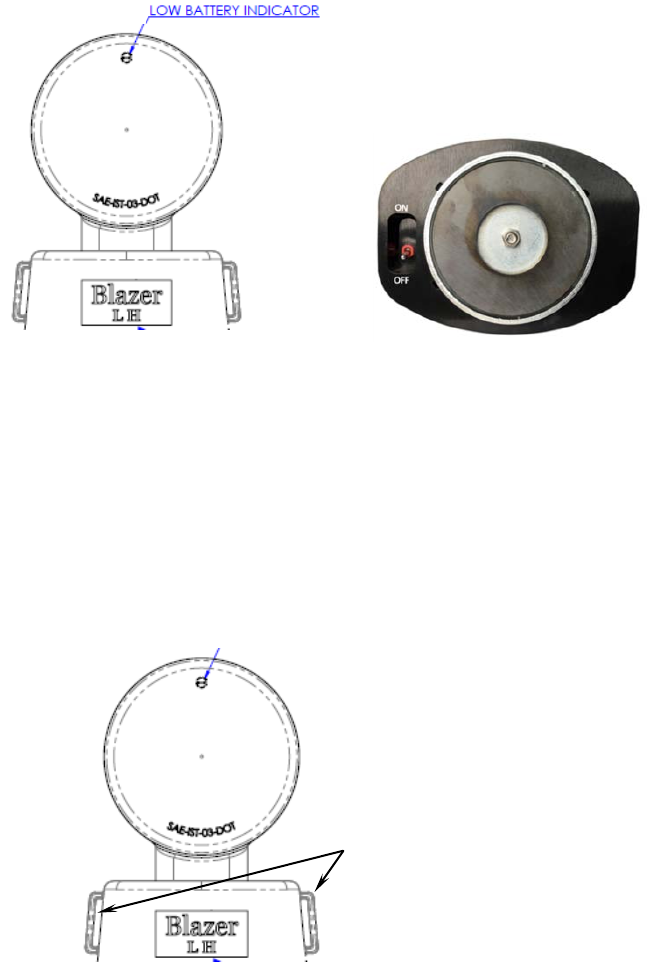
9. Every 2-3 hours check that the battery LED indicator near the top of the “LH” light is not flashing and that
tail, left turn, right turn and brake functions are operational. If the low battery LED indicator is flashing or
the trailer lights do not function then install eight new AA batteries immediately.
10. Switch off the lights after each use and return the lights and transmitter to the original package. If
packaging is unavailable, place lights inside bags when not in use to keep the magnets clear of debris. Do
not allow the magnetic bases to come in contact with each other. If lights are stored for longer than one
month, remove the batteries to avoid battery leakage. Store batteries at room temperature to avoid
leakage.
Important Considerations:
1. It is highly recommended to use tie-down straps/bungee cords through the loops on the base, to secure
the lights to the vehicle, when towing on rough and/or bumpy roads, or at high speeds.
2. The Wireless Magnetic Tow Light kit’s transmitter is designed to be used with standard 12-volt vehicle
systems.
3. Every 2-3 hours confirm that your brake, turn signal and running lights are operating correctly. Do not
operate your tow lights if the vehicle has faulty wiring or if some or all of the lights do not work correctly.
4. Battery Performance: For temperatures below 20°F batteries may need to be changed more often. The
LED near the top center of the “LH” light will blink if battery power is low. Immediately install all new
batteries in both tow lights to ensure safe operation and to meet SAE/FMVSS 108 safety standards.
LOOPS FOR TIE DOWN
STRAPS/BUNGEE CORDS

5. Do not submerge the lights or transmitter in water. Damage may occur.
6. Always have a spare set of eight AA batteries on hand, especially if travelling for an extended period of
time.
7. If you still have questions please call our Customer Service department at 800-241-3808.
Transmitter & Vehicular Plug Wiring Scheme:
White --- Ground
Brown --- Tail / Running Lights
Yellow --- Left Brake / Left Turn Signal
Green --- Right Brake / Right Turn Signal
Troubleshooting:
1. If one or both tow lights do not function check and/or replace ALL batteries. Load eight new batteries by
placing four into each base with polarity as indicated.
2. If left turn and right turn functions are reversed, then reverse the yellow and green wires to the
transmitter.
3. If only some lamp functions work while others do not, look over the wiring diagram and check that the
four-flat trailer connector is wired correctly.
4. Check the connection between the “four-flat” plugs for corrosion. Remove corrosion with baking soda
and a small disposable brush while wearing gloves.
Limitations:
Do not operate towing lights farther than 65 feet (19.8 meters) from the transmitter.
Changes or modifications not expressly approved by the party responsible for compliance could void the user’s
authority to operate the equipment.
This device complies with Part 15 of the FCC Rules. Operation is subject to the following two conditions:
(1) this device may not cause harmful interference, and
(2) this device must accept any interference received, including interference that may cause undesired operation.
Note: This equipment has been tested and found to comply with the limits for a Class B digital device, pursuant to
Part 15 of the FCC Rules. These limits are designed to provide reasonable protection against harmful interference
in a residential installation. This equipment generates, uses, and can radiate radio frequency energy, and if not
installed and used in accordance with the instructions, may cause harmful interference to radio communications.
However, there is no guarantee that interference will not occur in a particular installation. If this equipment does
cause harmful interference to radio or television reception, which can be determined by turning the equipment off
and on, the user is encouraged to try to correct the interference by one or more of the following measures:
– Reorient or relocate the receiving antenna.
– Increase the separation between the equipment and receiver.
– Connect the equipment into an outlet on a circuit different from that to which the receiver is connected.
– Consult the dealer or an experienced radio/TV technician for help.
This equipment complies with FCC radiation exposure limits set forth for an uncontrolled environment. This
equipment should be installed and operated with a minimum distance of 20cm between the radiator & your body.
This transmitter must not be co-located or operating in conjunction with any other antenna or transmitter.

This device complies with Industry Canada license-exempt RSS standard(s). Operation is subject to the following
two conditions: (1) this device may not cause interference, and (2) this device must accept any interference,
including interference that may cause undesired operation of the device.
Cet appareil est conforme aux CNR exempts de licence d'Industrie Canada. Le fonctionnement est soumis aux deux
conditions suivantes:
(1) Cet dispositif ne peut causer des interférences; et
(2) Cet appareil doit accepter toute interférence, y compris les interférences qui peuvent causer un mauvais
fonctionnement de l'appareil.
The device meets the exemption from the routine evaluation limits in section 2.5 of RSS 102 and compliance with
RSS-102 RF exposure, users can obtain Canadian information on RF exposure and compliance.
Le dispositif rencontre l'exemption des limites courantes d'évaluation dans la section 2.5 de RSS 102 etla
conformité à l'exposition de RSS-102 rf, utilisateurs peut obtenir l'information canadienne surl'exposition et la
conformité de rf.
This transmitter must not be co-located or operating in conjunction with any other antenna or transmitter. This
equipment should be installed and operated with a minimum distance of 20 centimeters between the radiator and
your body.
Cet émetteur ne doit pas être Co-placé ou ne fonctionnant en même temps qu'aucune autre antenne ouémetteur.
Cet équipement devrait être installé et actionné avec une distance minimum de 20 centimètres entre le radiateur
et votre corps.