Hosiden CFU0321 802.15.4 ZigBee RF Module User Manual CFU0321Product Datasheet

Hosiden Corporation 802.15.4 ZigBee RF Module CFU0321Product Datasheet

Manual

 4-33, Kitakyuhoji 1-chome, Yao-City, Osaka, 581-0071, Japan   User Guide for CFU0321 RF Module   Specification for the CFU0321 Smart Energy RF module based on the IEEE 802.15.4 and ZigBee specifications  Draft v.0.1 2011-4-24
 4-33, Kitakyuhoji 1-chome, Yao-City, Osaka, 581-0071, Japan Table of Contents  CFU0321 RF Module Description  The CFU0321 is a general purpose IEEE 802.15.4 RF module designed with Smart Energy applications in mind. It features the TI CC2520 RF transceiver, TI CC2591 2.4GHz Power Amplifier, I MSP 430F5437 microcontroller with 256K of flash RAM and 16K of RAM, 1MB external flash RAM, and pattern antenna. Depending on the SKU, the following options are available: • Board to Board connector • Side through hole for surface mounted The CFU0321 is designed to be surface mounted; however, board to board connector is standard feature and allows Board to Board connector to be attached for easy socketing. The unit requires 2.7V – 3.6V unregulated DC supply; internal voltage regulation supplies the radio. The nominal transmission and reception distance is 100 meters with the on-board pattern antenna. TI Z-Stack 2.4 port is available for the CFU0321, along with an implementation of the Smart Energy profile device(s). Also, the TIMAC only firmware is available. Standard development environment requires the MSP430 version of the IAR IDE toolset. Programming the CFU0321 requires the HVE0704, the development board specifically designed for the CFU0321. Additionally a JTAG programmer is required.  Applications The CFU0321 allows devices to join the ZigBee SE 1.x network currently being deployed by the utility companies. The following
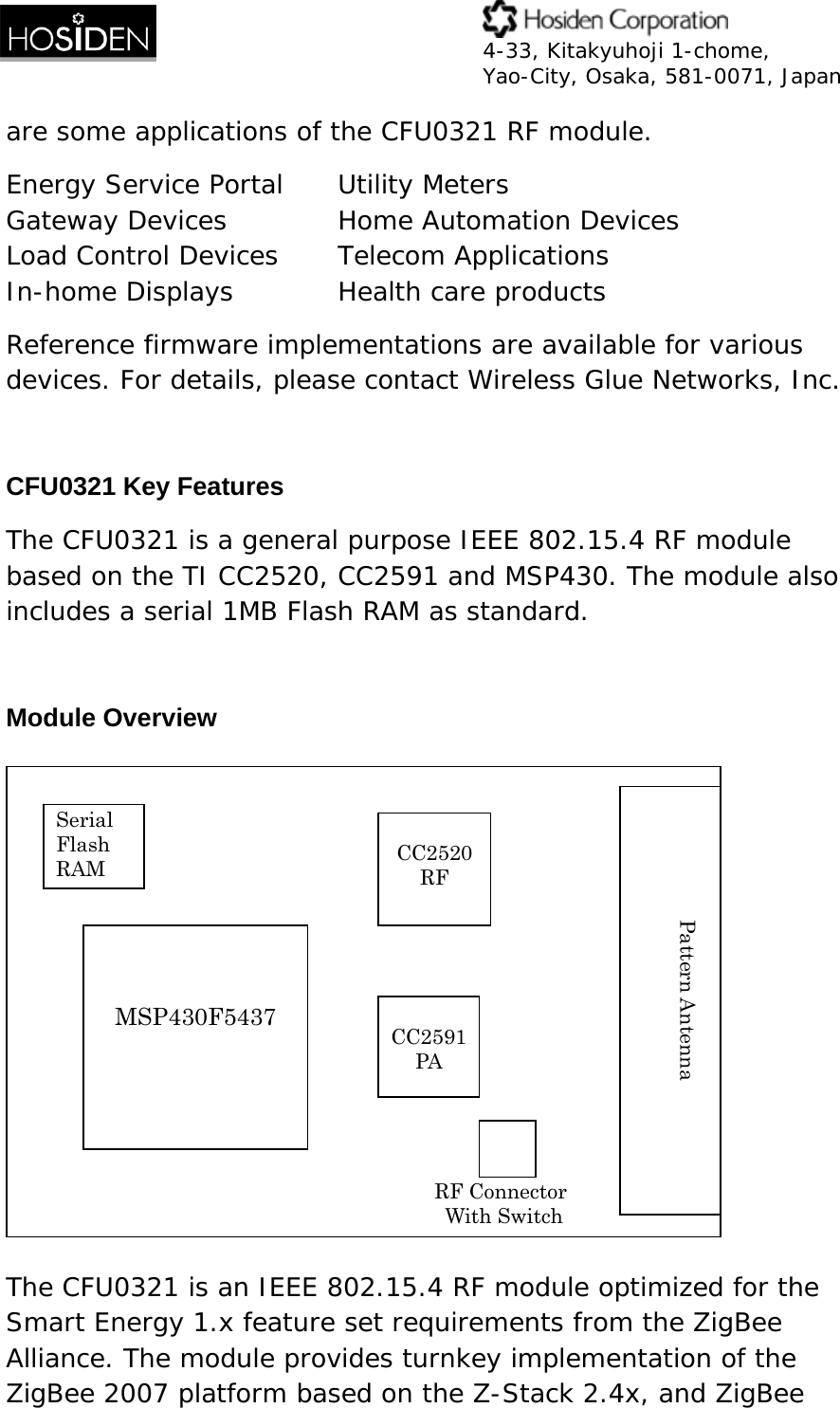
 4-33, Kitakyuhoji 1-chome, Yao-City, Osaka, 581-0071, Japan are some applications of the CFU0321 RF module. Energy Service Portal  Utility Meters  Gateway Devices     Home Automation Devices  Load Control Devices   Telecom Applications In-home Displays    Health care products  Reference firmware implementations are available for various devices. For details, please contact Wireless Glue Networks, Inc.  CFU0321 Key Features The CFU0321 is a general purpose IEEE 802.15.4 RF module based on the TI CC2520, CC2591 and MSP430. The module also includes a serial 1MB Flash RAM as standard.  Module Overview  The CFU0321 is an IEEE 802.15.4 RF module optimized for the Smart Energy 1.x feature set requirements from the ZigBee Alliance. The module provides turnkey implementation of the ZigBee 2007 platform based on the Z-Stack 2.4x, and ZigBee   MSP430F5437 Serial Flash RAM  CC2520RF CC2591PA  Pattern Antenna RF Connector With Switch
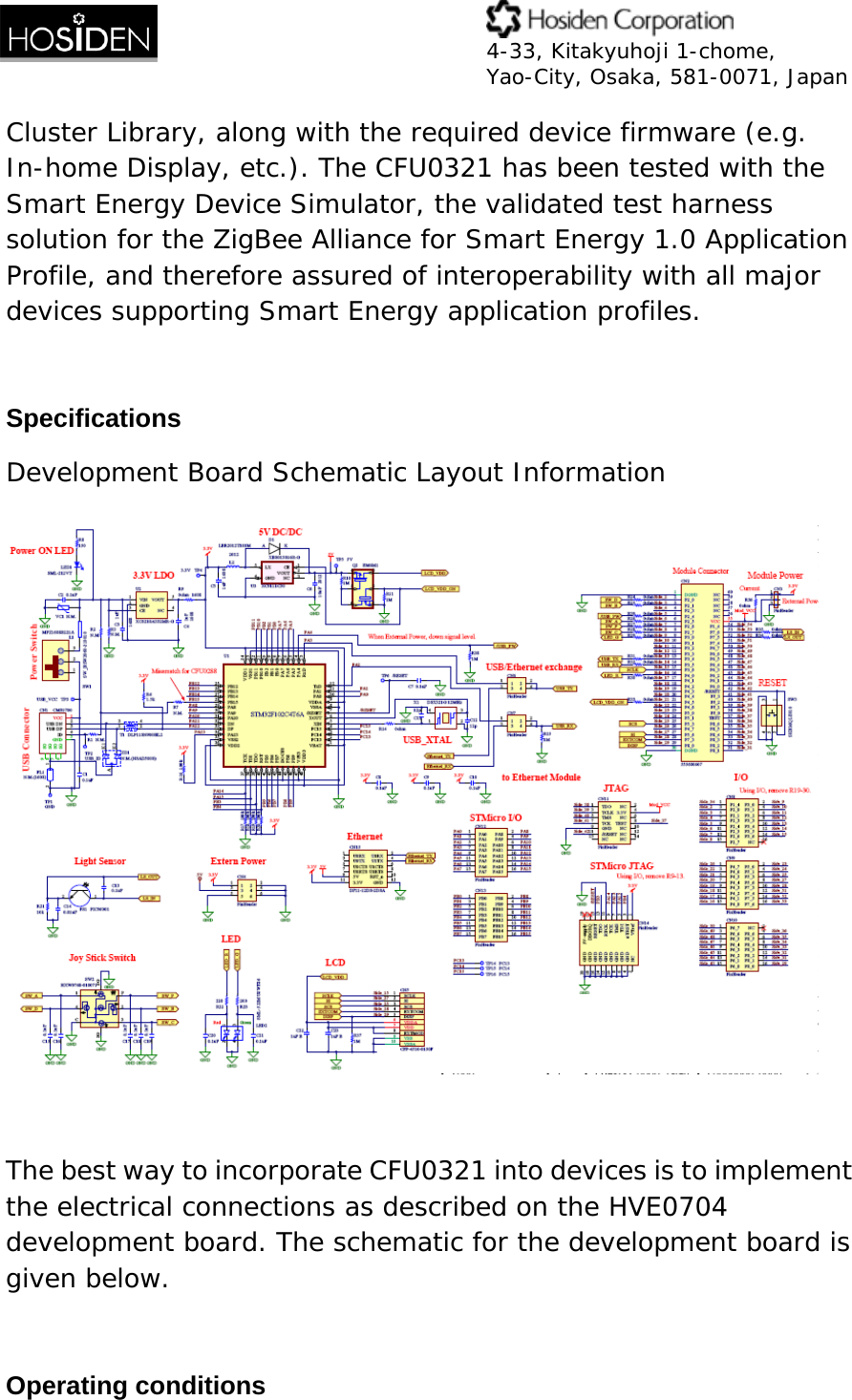
 4-33, Kitakyuhoji 1-chome, Yao-City, Osaka, 581-0071, Japan Cluster Library, along with the required device firmware (e.g. In-home Display, etc.). The CFU0321 has been tested with the Smart Energy Device Simulator, the validated test harness solution for the ZigBee Alliance for Smart Energy 1.0 Application Profile, and therefore assured of interoperability with all major devices supporting Smart Energy application profiles.  Specifications Development Board Schematic Layout Information    The best way to incorporate CFU0321 into devices is to implement the electrical connections as described on the HVE0704 development board. The schematic for the development board is given below.  Operating conditions
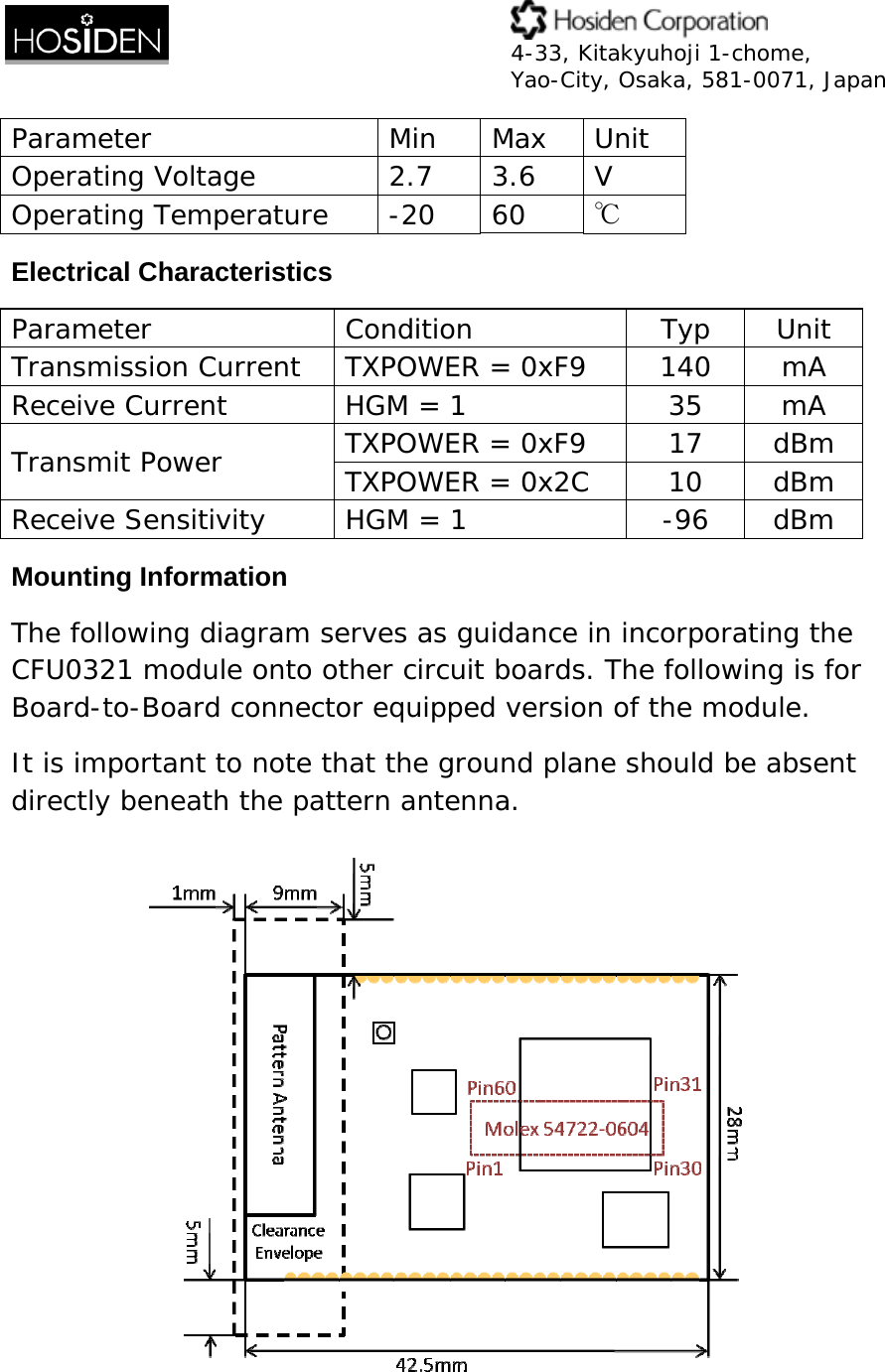
 4-33, Kitakyuhoji 1-chome, Yao-City, Osaka, 581-0071, Japan Parameter Min Max Unit Operating Voltage  2.7 3.6 V Operating Temperature  -20  60  ℃ Electrical Characteristics Parameter Condition Typ Unit Transmission Current  TXPOWER = 0xF9  140  mA Receive Current  HGM = 1  35  mA Transmit Power  TXPOWER = 0xF9  17  dBm TXPOWER = 0x2C  10  dBm Receive Sensitivity  HGM = 1  -96  dBm Mounting Information The following diagram serves as guidance in incorporating the CFU0321 module onto other circuit boards. The following is for Board-to-Board connector equipped version of the module.  It is important to note that the ground plane should be absent directly beneath the pattern antenna.
 4-33, Kitakyuhoji 1-chome, Yao-City, Osaka, 581-0071, Japan Pin Assignment and Layout CFU0321 Pin Assignments PIN ID Function I/O Description 1 GND1   2 P2.0/TA1CLK/MCLK I/O General-purpose digital I/O with port interrupt TA1 clock signal TA1CLK input MCLK output 3 P2.1/TA1.0 I/OGeneral-purpose digital I/O with port interrupt TA1 CCR0 capture: CCI0A input, compare: Out0 output 4 P2.3/TA1.2 I/OGeneral-purpose digital I/O with port interrupt TA1 CCR1 capture: CCI1A input, compare: Out1 output 5 P2.4/RTCCLK I/O General-purpose digital I/O with port interrupt RTCCLK output 6 P2.5/ROSC  I/O General-purpose digital I/O with port interrupt 7 P2.6/ACLK I/O General-purpose digital I/O with port interrupt ACLK output (divided by 1, 2, 4, 8, 16, or 32) 8 P2.7/ADC12CLK/DMAE0 I/OGeneral-purpose digital I/O with port interrupt Conversion clock input ADC DMA external trigger input 9 P3.0/UCB0STE/UCA0CLK I/OGeneral-purpose digital I/O Slave transmit enable – USCI_B0 SPI mode P3.0/UCB0STE/UCA0CLK 33 35 L5 I/O Clock signal input – USCI_A0 SPI slave mode Clock signal output – USCI_A0 SPI master mode 10 P3.1/UCB0SIMO/ UCB0SDA/[FLASH_SIMO]  I/OGeneral-purpose digital I/O Slave in, master out – USCI_B0 SPI mode I2C data – USCI_B0 I2C mode
 4-33, Kitakyuhoji 1-chome, Yao-City, Osaka, 581-0071, Japan PIN ID  Function  I/O Description 11 P3.2/UCB0SOMI/ UCB0SCL/[FLASH_SOMI]  I/OGeneral-purpose digital I/O P3.2/UCB0SOMI/UCB0SCL 35 37 J6 I/O Slave out, master in  –  USCI_B0 SPI mode I2C clock  – USCI_B0 I2C mode 12 P3.3/UCB0CLK/UCA0STE/ [FLASH_CLK]  I/OGeneral-purpose digital I/O Clock signal input  –  USCI_B0 SPI slave mode P3.3/UCB0CLK/UCA0STE 36 38 L6 I/O Clock signal output  –  USCI_B0 SPI master modeSlave transmit enable  –  USCI_A0 SPI mode 13 P3.4/UCA0TXD/ UCA0SIMO  I/OGeneral-purpose digital I/O P3.4/UCA0TXD/UCA0SIMO 39 39 L7 I/O Transmit data  –  USCI_A0 UART mode Slave in, master out  –  USCI_A0 SPI mode 14 P3.5/UCA0RXD/ UCA0SOMI  I/OGeneral-purpose digital I/O P3.5/UCA0RXD/UCA0SOMI 40 40 J7 I/O Receive data  –  USCI_A0 UART mode Slave out, master in  –  USCI_A0 SPI mode 15 P3.6/UCB1STE/UCA1CLK4120  I/OGeneral-purpose digital I/O Slave transmit enable  –  USCI_B1 SPI mode P3.6/UCB1STE/UCA1CLK 41 41 M8 I/O Clock signal input  –  USCI_A1 SPI slave mode Clock signal output  –  USCI_A1 SPI master mode 16 P4.0/TB0.0 I/OGeneral-purpose digital I/O TB0 capture CCR0: CCI0A/CCI0B input, compare:Out0 output 17 P4.1/TB0.1 I/OGeneral-purpose digital I/O TB0 capture CCR1: CCI1A/CCI1B input, compare:Out1 output 18 P4.2/TB0.2 I/OGeneral-purpose digital I/O TB0 capture CCR2: CCI2A/CCI2B input, compare:Out2 output 19 P4.3/TB0.3 I/OGeneral-purpose digital I/O TB0 capture CCR3: CCI3A/CCI3B input, compare:Out3 output 20 P4.4/TB0.4 I/OGeneral-purpose digital I/O TB0 capture CCR4: CCI4A/CCI4B input, compare:Out4 output
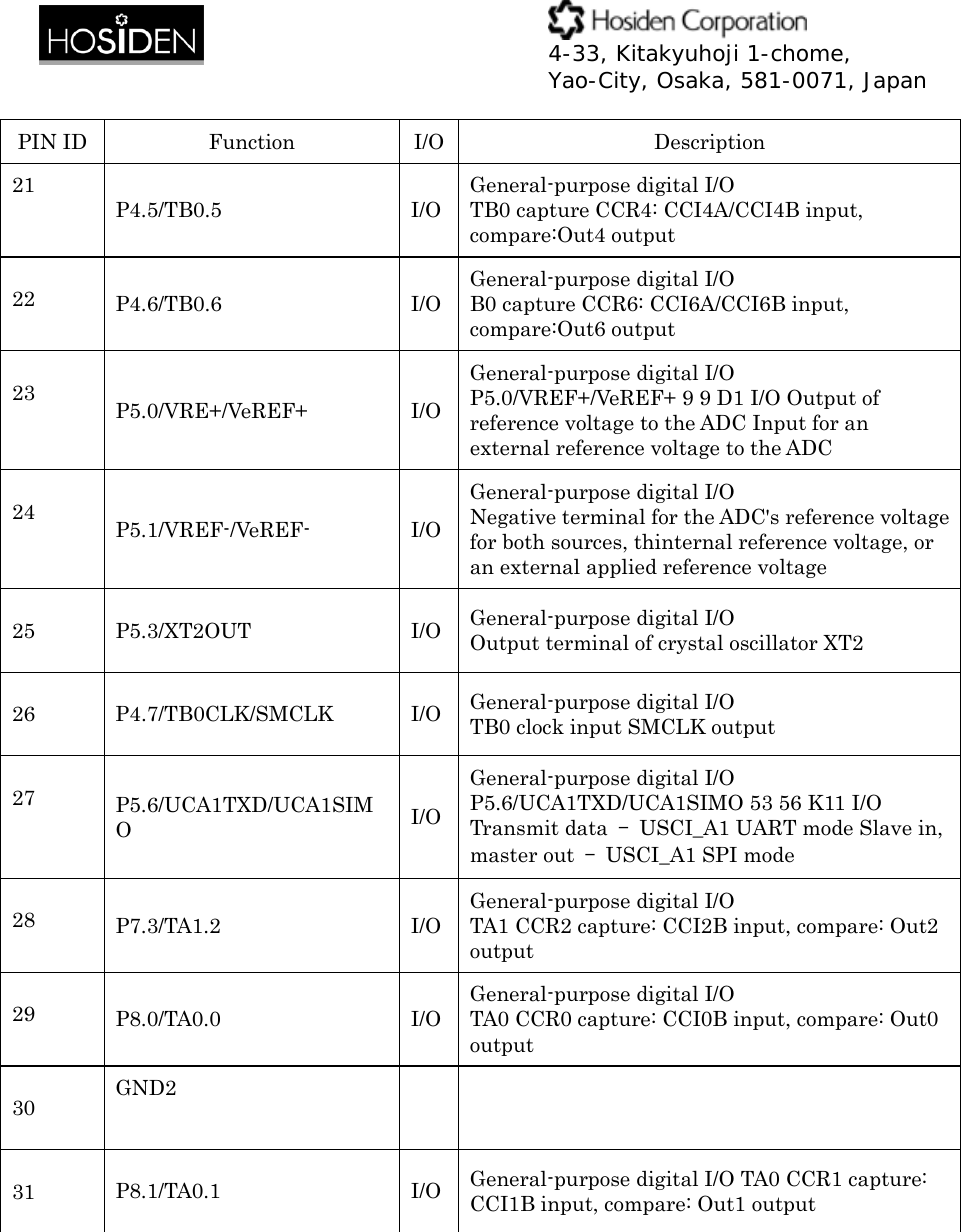
 4-33, Kitakyuhoji 1-chome, Yao-City, Osaka, 581-0071, Japan PIN ID  Function  I/O Description 21 P4.5/TB0.5 I/OGeneral-purpose digital I/O TB0 capture CCR4: CCI4A/CCI4B input, compare:Out4 output 22  P4.6/TB0.6 I/OGeneral-purpose digital I/O B0 capture CCR6: CCI6A/CCI6B input, compare:Out6 output 23  P5.0/VRE+/VeREF+ I/OGeneral-purpose digital I/O P5.0/VREF+/VeREF+ 9 9 D1 I/O Output of reference voltage to the ADC Input for an external reference voltage to the ADC 24  P5.1/VREF-/VeREF- I/OGeneral-purpose digital I/O Negative terminal for the ADC's reference voltage for both sources, thinternal reference voltage, or an external applied reference voltage 25  P5.3/XT2OUT I/O General-purpose digital I/O Output terminal of crystal oscillator XT2 26 P4.7/TB0CLK/SMCLK I/O General-purpose digital I/O TB0 clock input SMCLK output 27  P5.6/UCA1TXD/UCA1SIMO  I/OGeneral-purpose digital I/O P5.6/UCA1TXD/UCA1SIMO 53 56 K11 I/O Transmit data  –  USCI_A1 UART mode Slave in, master out  –  USCI_A1 SPI mode 28  P7.3/TA1.2 I/OGeneral-purpose digital I/O TA1 CCR2 capture: CCI2B input, compare: Out2 output 29  P8.0/TA0.0 I/OGeneral-purpose digital I/O TA0 CCR0 capture: CCI0B input, compare: Out0 output 30  GND2   31  P8.1/TA0.1 I/O General-purpose digital I/O TA0 CCR1 capture: CCI1B input, compare: Out1 output
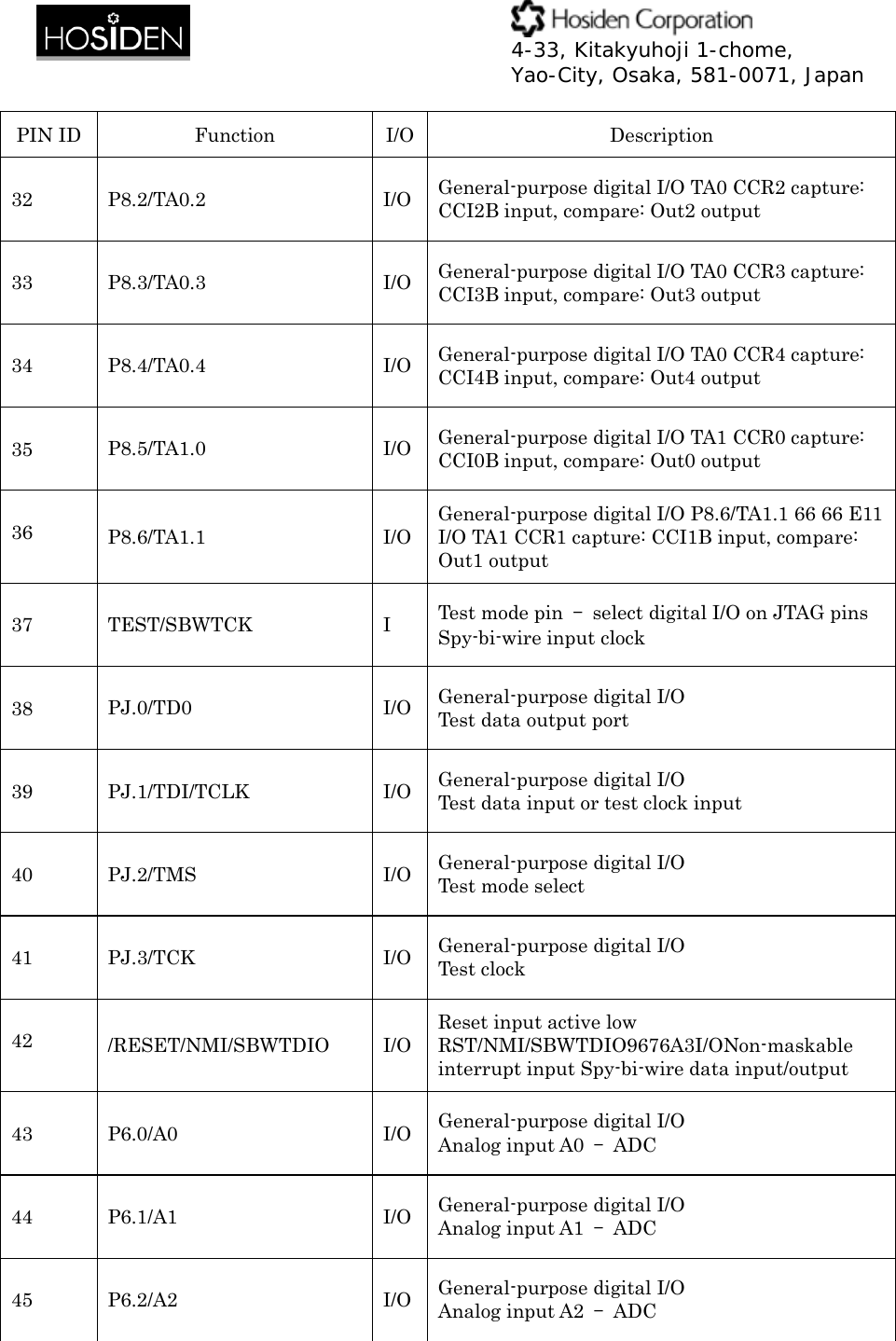
 4-33, Kitakyuhoji 1-chome, Yao-City, Osaka, 581-0071, Japan PIN ID  Function  I/O Description 32 P8.2/TA0.2 I/O General-purpose digital I/O TA0 CCR2 capture: CCI2B input, compare: Out2 output 33 P8.3/TA0.3 I/O General-purpose digital I/O TA0 CCR3 capture: CCI3B input, compare: Out3 output 34 P8.4/TA0.4 I/O General-purpose digital I/O TA0 CCR4 capture: CCI4B input, compare: Out4 output 35 P8.5/TA1.0 I/O General-purpose digital I/O TA1 CCR0 capture: CCI0B input, compare: Out0 output 36 P8.6/TA1.1 I/OGeneral-purpose digital I/O P8.6/TA1.1 66 66 E11 I/O TA1 CCR1 capture: CCI1B input, compare: Out1 output 37 TEST/SBWTCK I Test mode pin  –  select digital I/O on JTAG pins Spy-bi-wire input clock 38 PJ.0/TD0 I/O General-purpose digital I/O Test data output port 39 PJ.1/TDI/TCLK I/O General-purpose digital I/O   Test data input or test clock input 40 PJ.2/TMS I/O General-purpose digital I/O   Test mode select 41 PJ.3/TCK I/O General-purpose digital I/O   Test clock 42 /RESET/NMI/SBWTDIO I/OReset input active low RST/NMI/SBWTDIO9676A3I/ONon-maskable interrupt input Spy-bi-wire data input/output 43 P6.0/A0 I/O General-purpose digital I/O   Analog input A0  – ADC 44 P6.1/A1 I/O General-purpose digital I/O   Analog input A1  – ADC 45 P6.2/A2 I/O General-purpose digital I/O   Analog input A2  – ADC
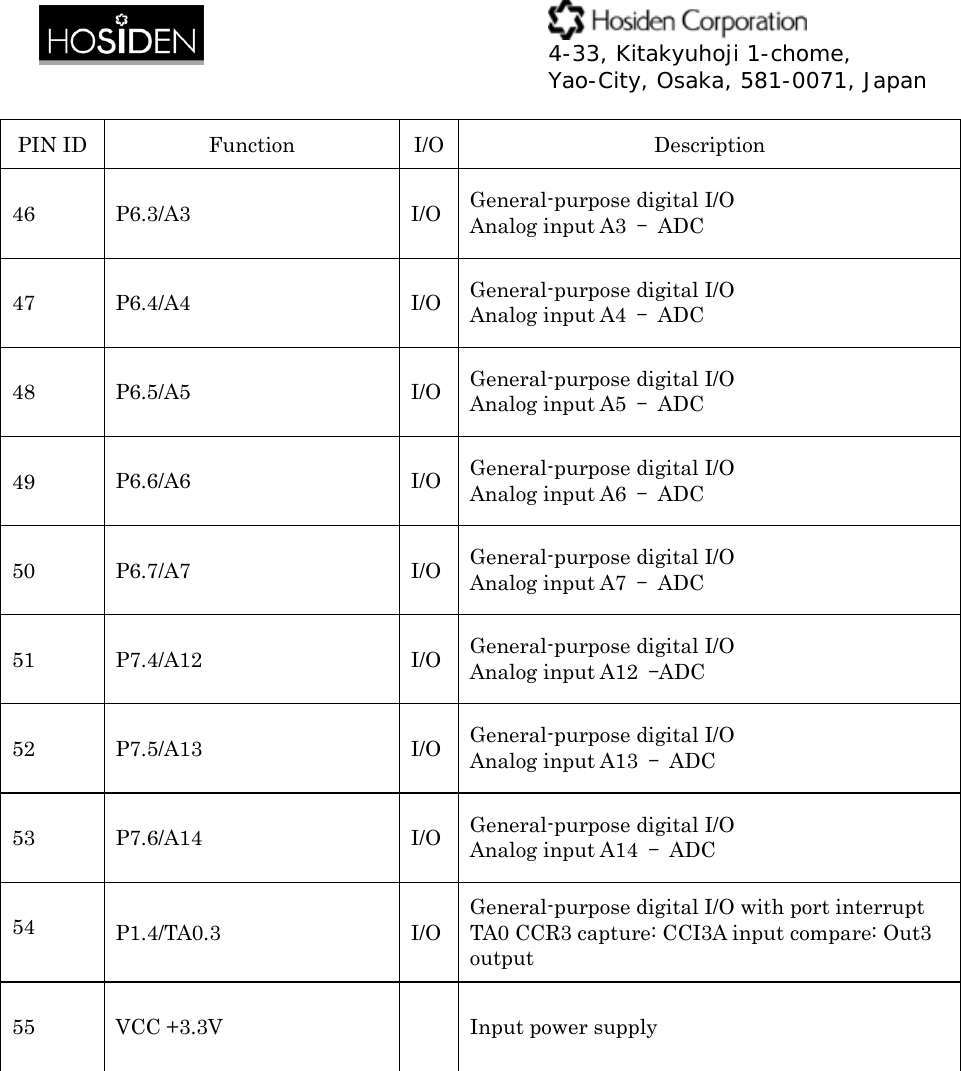
 4-33, Kitakyuhoji 1-chome, Yao-City, Osaka, 581-0071, Japan PIN ID  Function  I/O Description 46 P6.3/A3 I/O General-purpose digital I/O   Analog input A3  – ADC 47 P6.4/A4 I/O General-purpose digital I/O   Analog input A4  – ADC 48 P6.5/A5 I/O General-purpose digital I/O Analog input A5  – ADC 49 P6.6/A6 I/O General-purpose digital I/O Analog input A6  – ADC 50 P6.7/A7 I/O General-purpose digital I/O   Analog input A7  – ADC 51 P7.4/A12 I/O General-purpose digital I/O   Analog input A12  –ADC 52 P7.5/A13 I/O General-purpose digital I/O   Analog input A13  – ADC 53 P7.6/A14 I/O General-purpose digital I/O   Analog input A14  – ADC 54 P1.4/TA0.3 I/OGeneral-purpose digital I/O with port interrupt TA0 CCR3 capture: CCI3A input compare: Out3 output 55 VCC +3.3V    Input power supply
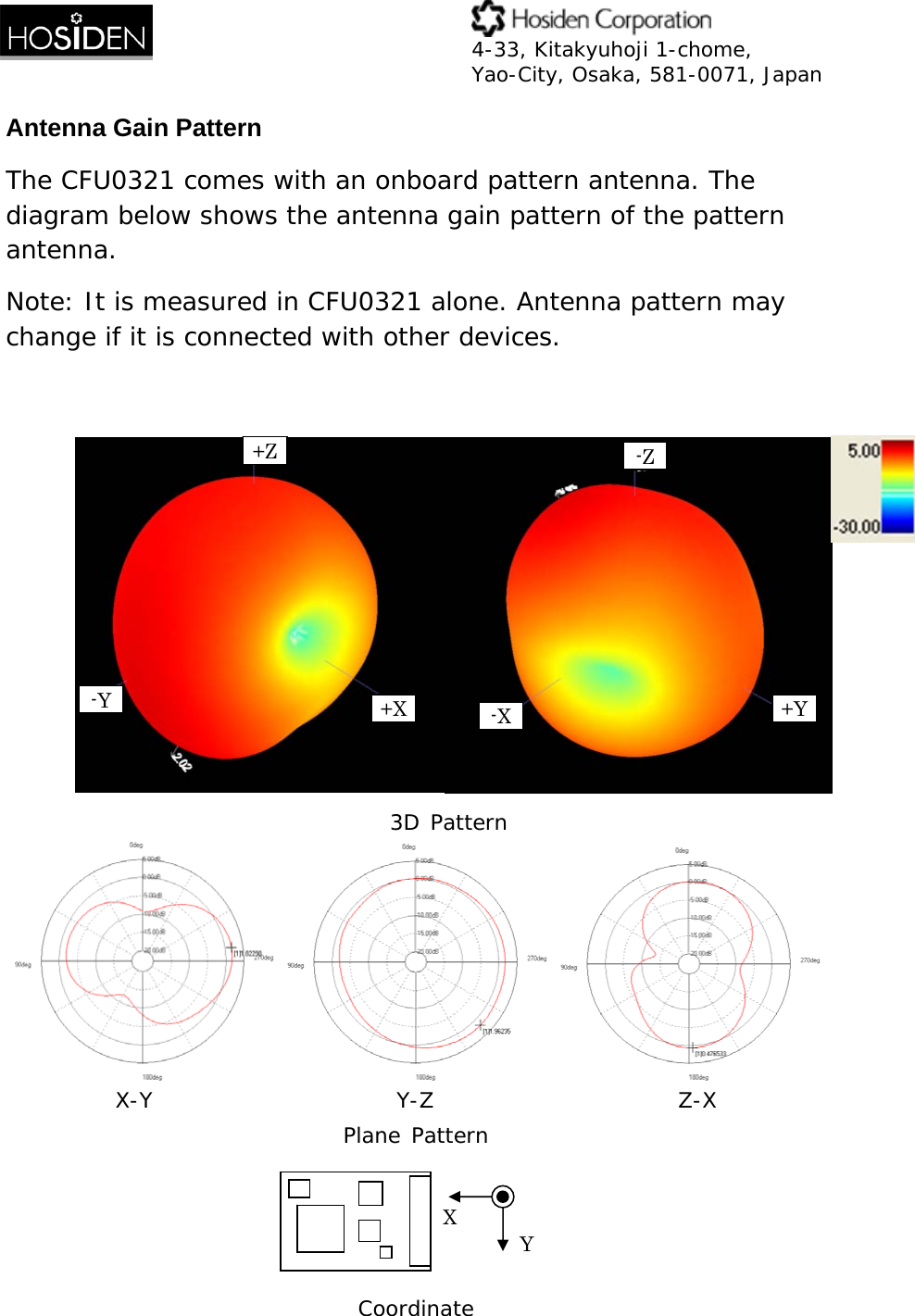
 4-33, Kitakyuhoji 1-chome, Yao-City, Osaka, 581-0071, Japan Antenna Gain Pattern The CFU0321 comes with an onboard pattern antenna. The diagram below shows the antenna gain pattern of the pattern antenna. Note: It is measured in CFU0321 alone. Antenna pattern may change if it is connected with other devices.   3D Pattern  X-Y                       Y-Z                       Z-X Plane Pattern  Coordinate  XY  +X+Z +Y-X-Y -Z
 4-33, Kitakyuhoji 1-chome, Yao-City, Osaka, 581-0071, Japan Certification notice FCC INTERFERENCE STATEMENT This device complies with Part 15 of the FCC Rules. Operation is subject to the following two conditions: (1) this device may not cause harmful interference, and (2) this device must accept any interference received, including interference that may cause undesired operation.  FCC WARNING Changes or modifications not expressly approved by the party responsible for compliance could void the user’s authority to operate the equipment.  Manufacture Responsibility to the FCC Rules and Regulations If the FCC ID is not visible when the module is installed inside another device, then the outside of the device into which the module is installed must also display a label referring to the enclosed module. This exterior label can use wording such as the following:  “Contains Transmitter Module FCC ID: VIYCUF0321” or “Contains FCC ID: VIYCUF0321”  Manufactures must only use onboard pattern antenna. Don’t use other antenna using RF connector.  This transmitter module is authorized to be used in other devices only by Manufactures under the following conditions: 1. The transmitter module must be shielded when this module is installed into application. 2. The antenna(s) must be installed such that a minimum separation distance of 20cm is maintained between the radiator (antenna) and all persons at all times.
 4-33, Kitakyuhoji 1-chome, Yao-City, Osaka, 581-0071, Japan 3. The transmitter module must not be co-located or operating in conjunction with any other antenna or transmitter.

Navigation menu