Husqvarna 175 Users Manual OM, Rider 175, AWD, 2007 01
!! Husqvarna-41 Husqvarna Lawn Mower Manuals - Lawn Mower Manuals – The Best Lawn Mower Manuals Collection
175 to the manual a63445fb-4b21-dad4-65f5-049c5edd6b23
2015-01-24
: Husqvarna Husqvarna-175-Users-Manual-317649 husqvarna-175-users-manual-317649 husqvarna pdf
Open the PDF directly: View PDF  .
.
Page Count: 36
- Contents
- Pre-delivery service
- After the first 8 hours
- Dear Customer,
- Driving and transport on public roads
- Towing
- Use
- Good service
- Serial Number
- Symbols
- Safety instructions
- Driving on slopes
- Children
- Maintenance
- Transport
- Presentation
- Throttle control/choke control
- Speed limiter
- Parking brake
- Cutting unit
- Lifting lever for the cutting unit
- Cutting height adjustment lever
- Seat
- Fuelling
- Before starting
- Start the engine
- Starting the engine with a weak battery
- Driving the Rider
- Cutting tips
- Stop the engine
- Release lever
- Maintenance schedule
- Cleaning
- Removing of the machine hoods
- Checking and adjusting the steering wires
- Adjusting the parking brake Rider 175
- Adjusting the parking brake Rider 175 AWD
- Checking and adjusting of throttle wire
- Replacement of fuel filter
- Replacing the air filter
- Checking the fuel pump’s air filter
- Check the level of the battery acid
- Ignition system
- Check the safety system
- Main fuse
- Checking the tyre pressure
- Checking the engine’s cooling air intake
- Fitting the cutting head
- Removing the cutting unit
- Checking and adjustment of the cutting unit’s ground pressure
- Checking the cutting unit’s parallelism
- Adjusting the parallelism of the cutting unit
- Replacing the cutting unit belts
- Service position for the cutting unit
- Checking the blades
- Removing the BioClip plug
- Checking the engine’s oil level.
- Changing the oil filter
- Checking the transmission oil level
- Lubricating the belt adjuster
- General lubrication
- Winter storage
- Guard
- Service
- EC-declaration of conformity (Applies to Europe only)
EE
EEnn
nngg
ggll
llii
iiss
sshh
hh
Rider 175
Rider 175 AWD
Oper
ator
′
s manual
Please r
ead the operator’s manual carefully and make sure you
understand the instructions before using the machine.

2
–
English
CONTENTS
Contents
CONTENTS
Contents
...................................................................... 2
Ser
vice journal
Pre-deliv
ery service ..................................................... 3
After the first 8 hours ................................................... 3
INTR
ODUCTION
Dear Customer
, ............................................................ 4
Driving and transport on public roads .......................... 4
Towing .......................................................................... 4
Use .............................................................................. 4
Good service ................................................................ 5
Serial Number .............................................................. 5
KEY
TO SYMBOLS
Symbols
....................................................................... 6
SAFETY INSTR
UCTIONS
Saf
ety instructions ........................................................ 8
Driving on slopes ......................................................... 9
Children ....................................................................... 10
Maintenance ................................................................ 10
Transport ...................................................................... 11
WHA
T IS WHAT?
Location of the controls
................................................ 12
PRESENT
ATION
Presentation
................................................................. 13
Throttle control/choke control ....................................... 13
Speed limiter ................................................................ 13
Parking brake ............................................................... 13
Cutting unit ................................................................... 13
Lifting lever for the cutting unit ..................................... 13
Cutting height adjustment lever ................................... 14
Seat ............................................................................. 14
Fuelling ........................................................................ 14
Driving
Bef
ore starting ............................................................. 15
Start the engine ........................................................... 15
Starting the engine with a weak battery ....................... 16
Driving the Rider .......................................................... 16
Cutting tips .................................................................. 17
Stop the engine ............................................................ 17
Release lever ............................................................... 18
Maintenance
Maintenance schedule
................................................. 19
Cleaning ....................................................................... 20
Removing of the machine hoods ................................. 20
Checking and adjusting the steering wires .................. 20
Adjusting the parking brake Rider 175 ......................... 21
Adjusting the parking brake Rider 175 AWD ................ 21
Checking and adjusting of throttle wire ........................ 21
Replacement of fuel filter ............................................. 22
Replacing the air filter .................................................. 22
Checking the fuel pump’s air filter ................................ 23
Check the level of the battery acid ............................... 23
Ignition system ............................................................. 23
Check the safety system .............................................. 24
Main fuse ..................................................................... 25
Checking the tyre pressure .......................................... 25
Checking the engine’s cooling air intake ...................... 25
Fitting the cutting head ................................................. 25
Removing the cutting unit ............................................. 26
Checking and adjustment of the cutting unit’s ground
pressure ....................................................................... 26
Checking the cutting unit’s parallelism ......................... 27
Adjusting the parallelism of the cutting unit .................. 27
Replacing the cutting unit belts .................................... 27
Service position for the cutting unit .............................. 28
Checking the blades ..................................................... 29
Removing the BioClip plug ........................................... 29
Lubrication
Chec
king the engine’s oil level. .................................... 30
Changing the oil filter ................................................... 30
Checking the transmission oil level .............................. 31
Lubricating the belt adjuster ......................................... 31
General lubrication ....................................................... 31
T
roubleshooting schedule
Storage
Winter stor
age .............................................................. 33
Guard ........................................................................... 33
Service ......................................................................... 33
T
echnical data
EC-declar
ation of conformity ........................................ 35

English
–
3
Ser
vice journal
Pre-deliver
y service
1
Top up battery with acid and charge for four hours.
2 Fit steering wheel, seat and any optional equipment.
3 Adjust cutting unit:
Adjust lift springs (effective weight of cutting unit should be 12-15kg / 26.5-33 lb).
Adjust cutting unit so that rear edge is about 2-4 mm / 1/8” higher than front edge.
Adjust cutting unit height setting so that cutting height limit is 5 mm / 3/16” above the frame of the unit at the lowest
cutting height.
4 Check that the right amount of oil is in the engine.
5 Check that there is oil in the transmission’s oil tank.
6 Check and adjust tyre pressure (60 Kpa, 0.6 bar).
7 Connect battery.
8 Fill with fuel and start engine.
9 Check that machine does not move in neutral.
10 Check:
Forward drive.
Reverse drive.
Operation of blades.
Seat safety switch.
Lif lever safety switch.
The safety switch for the hydrostat pedals.
11 Check engine speed, 2900
±
100 rpm.
12 Tell customer about:
Needs and benefits of following the service schedule.
Servicing and the influence of this journal on the second-hand value of the machine.
Range of applications for BioClip.
Complete proof of sale etc.
Pre-delivery service carried out. No outstanding problems. Certified:
Date, mileage, stamp, signature
After the fi
rst 8 hours
1
Change engine oil

4
–
English
INTR
ODUCTION
Dear Customer
,
Thank y
ou for choosing a Husqvarna Rider. Husqvarna Riders are built to a unique design with a front-mounted cutting unit and a
patented rear-wheel steering system. Riders are designed for maximum efficiency even in small or confined areas. The closely
grouped controls and pedal-operated hydrostatic transmission also contribute to the performance of this machine.
We hope you will find this operator’s manual very useful. By following its instructions (on operation, service, maintenance, etc.) you
will significantly extend the life of the machine and even its second-hand value.
When you sell your Rider, make sure you pass on the operator’s manual to the new owner.
The last chapter in the operator’s manual consists of a Service Journal. Make sure that all service work and repairs are recorded.
A well-documented service history reduces the costs of seasonal maintenance and influences the second-hand value of the
machine. Bring the operator’s manual with the Rider when bringing it to a workshop for service procedures.
Driving and transpor
t on public roads
Chec
k the relevant road traffic regulations before driving the machine on a public road. If transporting the machine on another
vehicle always use approved securing devices and make sure that the machine is securely held.
T
owing
When y
our machine is equipped with a hydrostatic transmission you should, if necessary, only tow the machine over short
distances and at a low speed, otherwise there is a risk of damaging the transmission.
The power transmission must be disengaged when towing, see the instructions under the heading Clutch control.
Use
This machine is designed solely f
or cutting grass on conventional lawns and other cleared and leveled ground without obstacles,
as rocks, stumps etc., and, in conjunction with accessories supplied by the manufacturer even for other special tasks for which
instructions are delivered with the accessory. Use in any other way is considered as contrary to the intended use. Compliance with
and strict adherence to the conditions of operation, service and repair as specified by the manufacturer also constitute essential
elements of the intended use.
This machine should be operated, serviced and repaired only by persons who are familiar with its particular characteristics and
who are acquainted with the relevant safety procedures.
Accident prevention regulations, all other generally recognised regulations on safety and occupational medicine, and all road traffic
regulations must be observed at all times.
Any arbitrary modifications carried out to this machine may relieve the manufacturer of liability for any resulting damage or injury.

English
–
5
INTR
ODUCTION
Good ser
vice
Husqv
arna products are sold all over the world and only through servicing dealers. This is to ensure that you, the customer, get
the best support and service. For example, before this machine was delivered it was inspected and adjusted by your dealer. See
the certificate in the Service Journal in this manual.
When you need spare parts or advice on service issues, warranty terms, etc., contact:
Serial Number
The ser
ial number can be found on the printed plate attached to the front, left-hand side under the seat. Stated on the plate, from
the top are:
• The machines type designation.
• The manufacturer’s type number.
• The machine’s serial number.
State the type designation and serial number when ordering spare parts.
The engine serial number is given on a bar code decal. This is located on the left side of the crankcase, in front of the starter motor.
The sign states:
• Model
• Type
• Code.
Please quote when ordering parts.
The transmission’s serial number on hydrostatic machines is stated on the barcode decal located on the front of the housing on
the left-hand drive axle:
• Type designation is stated above the barcode and starts with the letter ”K”.
• The serial number is stated above the barcode and has the prefix “s/n”.
• The manufacturer’s type number is stated under the barcode and has the prefix “p/n”.
State the type designation and serial number when ordering spare parts.
This Operator’s Manual belongs to machine with
serial number:
Engine Transmission
6
–
English
KEY
T
O SYMBOLS
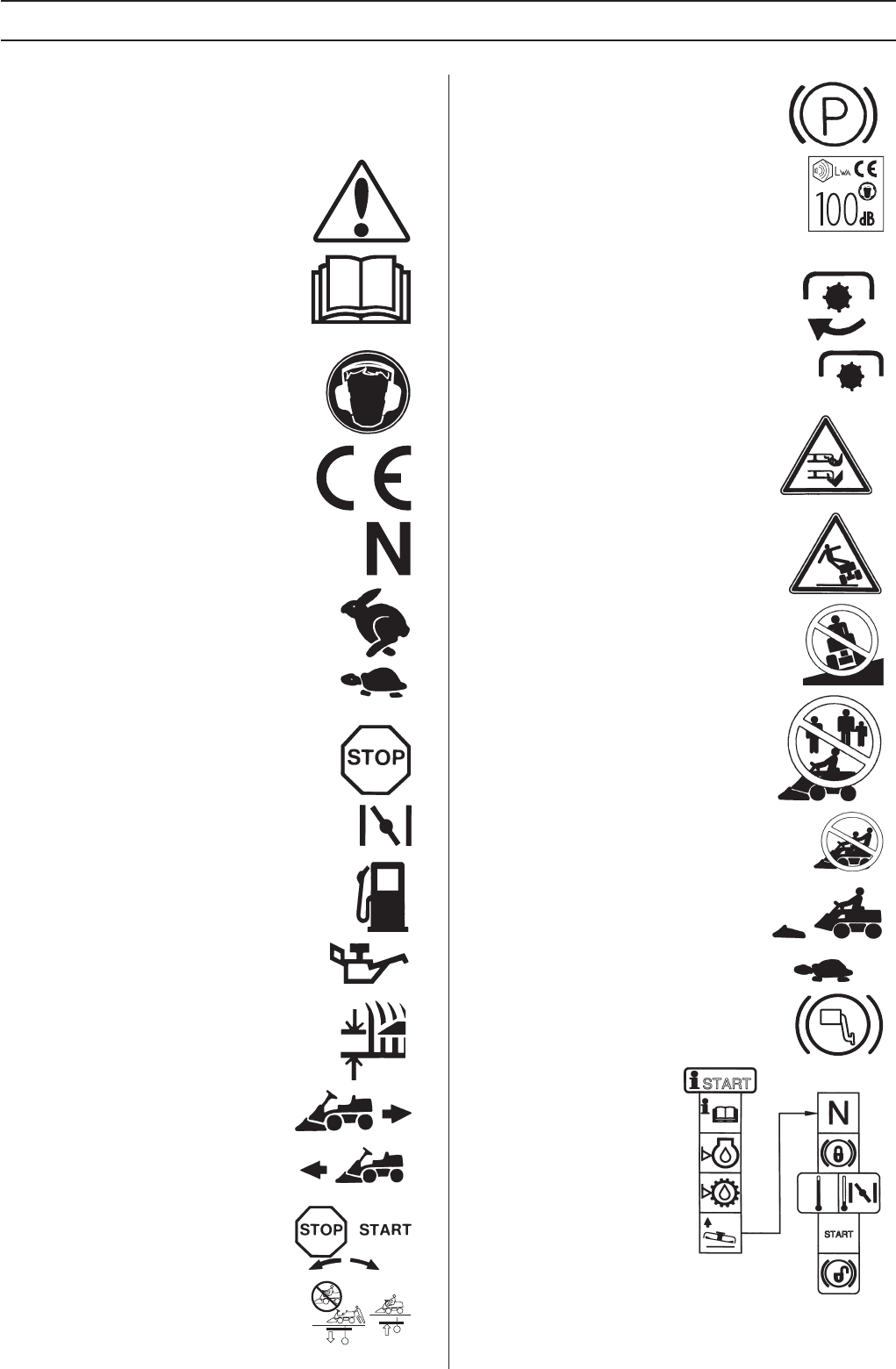
Symbols
These symbols are on the machine and in the instr
uctions.
WARNING! Careless or incorrect use can
result in serious or fatal injury to the
operator or others.
Please read the oper
ator’s manual
carefully and make sure you understand
the instructions before using the machine.
Alw
ays wear:
• Approved hearing protection
This product is in accordance with
applicable EC directives.
Neutr
al
F
ast
Slo
w
Stop the engine
.
Chok
e
Fuel
Oil le
vel
Cutting height
Bac
kwards
F
orwards
Ignition
Hydrostatic free
wheel
P
arking brake
Noise emission to the en
vironment according
to the European Community’s Directive. The
machine’s emission is specified in chapter
Technical data and on label.
Clutch in
Clutch out
Rotary blades Keep hands and feet
away from under the hood when the
engine is running
Risk that the machine will tip o
ver
Ne
ver drive across a slope
Ne
ver use the machine if persons,
especially children, or animals, are in the
vicinity
Ne
ver carry passengers on the machine or
equipment
Dr
ive very slowly if no cutting unit is fitted
Brake
Starting instructions
English
–
7
KEY
T
O SYMBOLS
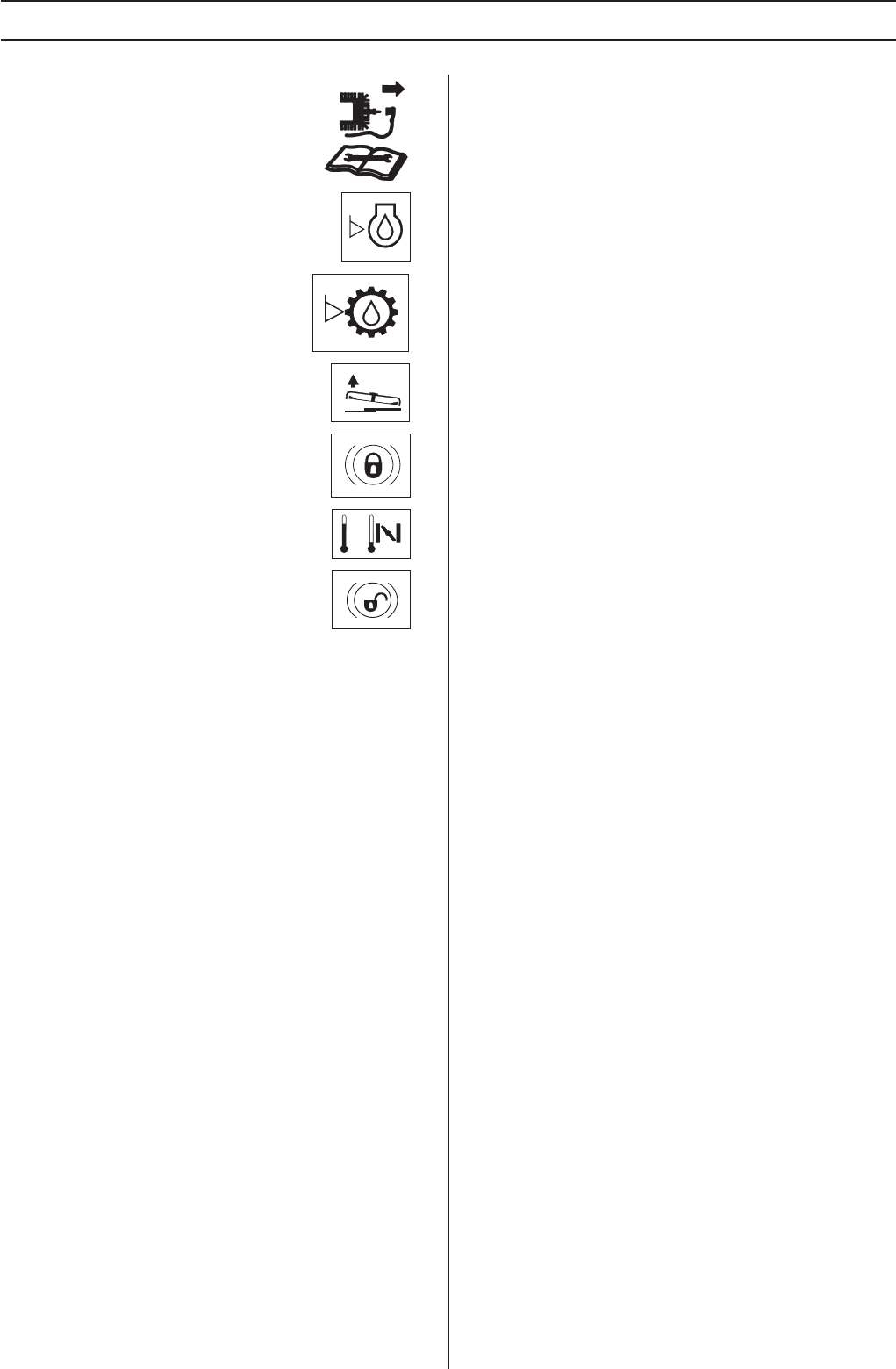
Switch off the engine and take off the ignition
cable before repairs or maintenance
Check the engine’s oil level
Check the hydrostat’s oil level
Lift up the cutting unit
Apply the parking brake.
If the engine is cold, use the choke
Release the par
king brake before driving
8
–
English
SAFETY INSTR
UCTIONS
Saf
ety instructions
These instructions are for your safety. Read them carefully.
Insure your Rider
• Check the insurance coverage for your new Rider.
• Contact your insurance company.
• You should have fully comprehensive insurance including:
third party, fire, damage, theft and liability
General use
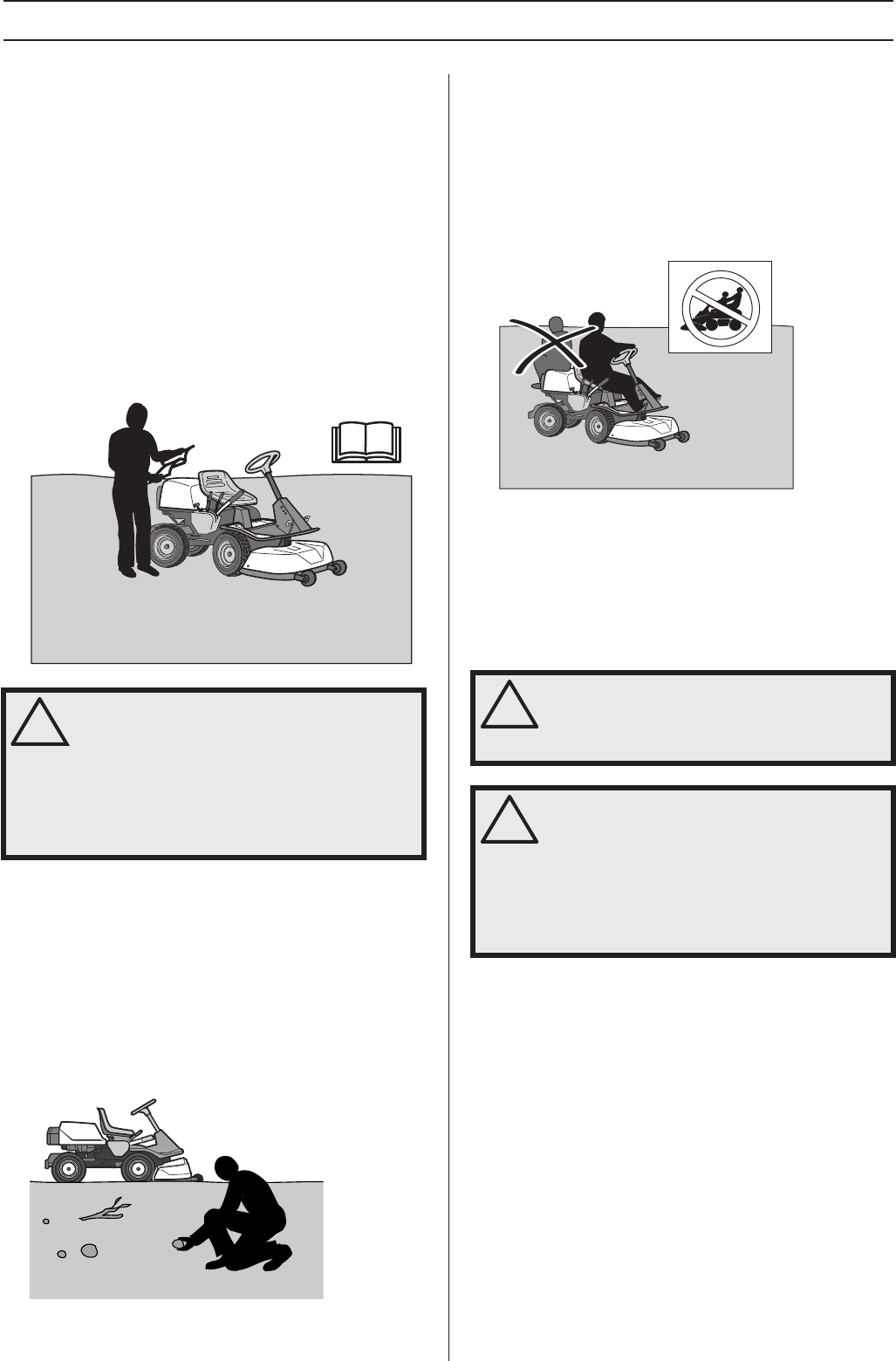
•Read all the instructions in this operator’s manual and on
the machine before you start it. Ensure you understand
them and then observe them.
• Learn how to use the machine and its controls safely and
learn to how to stop quickly. Also learn to recognize the
safety decals.
• Only allow the machine to be used by adults who are
familiar with its use.
• Make sure nobody else is in the vicinity of the machine
when you start the engine, engage the drive or drive off.
• Clear the area of objects such as stones, toys, wires, etc.
that may become caught in the blades and be thrown out.
• Stop the engine and prevent the engine from being
started until you have cleaned the outlet channel.
• Look out for the ejector and do not direct it towards
anyone.
• Stop the engine and prevent it from starting before you
clean the cutting unit.
• Remember that the driver is responsible for dangers or
accidents.
• Never carry passengers. The machine is only intended to
be used by one person.
• Always look downwards and backwards before and while
reversing. Keep watch for both large and small obstacles.
• Slow before cornering.
• Switch off the blades when you are not mowing.
• Take care when rounding a fixed object, so that the blades
do not hit it. Never run the machine over foreign objects.
• Only use the machine in daylight or in other well-lit
conditions. Keep the machine at a safe distance from
holes or other irregularities in the ground. Pay attention to
other possible risks.
• Never use the machine if you are tired, if you have
consumed alcohol, or if you are taking other drugs or
medication that can affect your vision, judgement or co-
ordination.
• Keep an eye on the traffic when working close to a road or
when crossing it.
• Never leave the machine unsupervised with the engine
running. Always stop the blades, apply the parking brake,
stop the engine and remove the keys before leaving the
machine.
!
WARNING! The ignition system of this
machine produces an electromagnetic field
during operation. This field may under some
circumstances interfere with pacemakers. To
reduce the risk of serious or fatal injury, we
recommend persons with pacemakers to
consult their physician and the pacemaker
manufacturer before operating this machine.
!
WARNING! This machine can sever hands
and feet as well as throw objects. Failure to
observe the safety instructions can result in
serious injuries.
!
WARNING! Engine exhaust, some of its
constituents and certain vehicle
components contain or emit chemicals
considered to cause cancer, birth defects or
other reproductive impairment. The engine
emits carbon monoxide, which is a
colourless, poisonous gas. Do not use the
machine in enclosed spaces.
English – 9
SAFETY INSTRUCTIONS
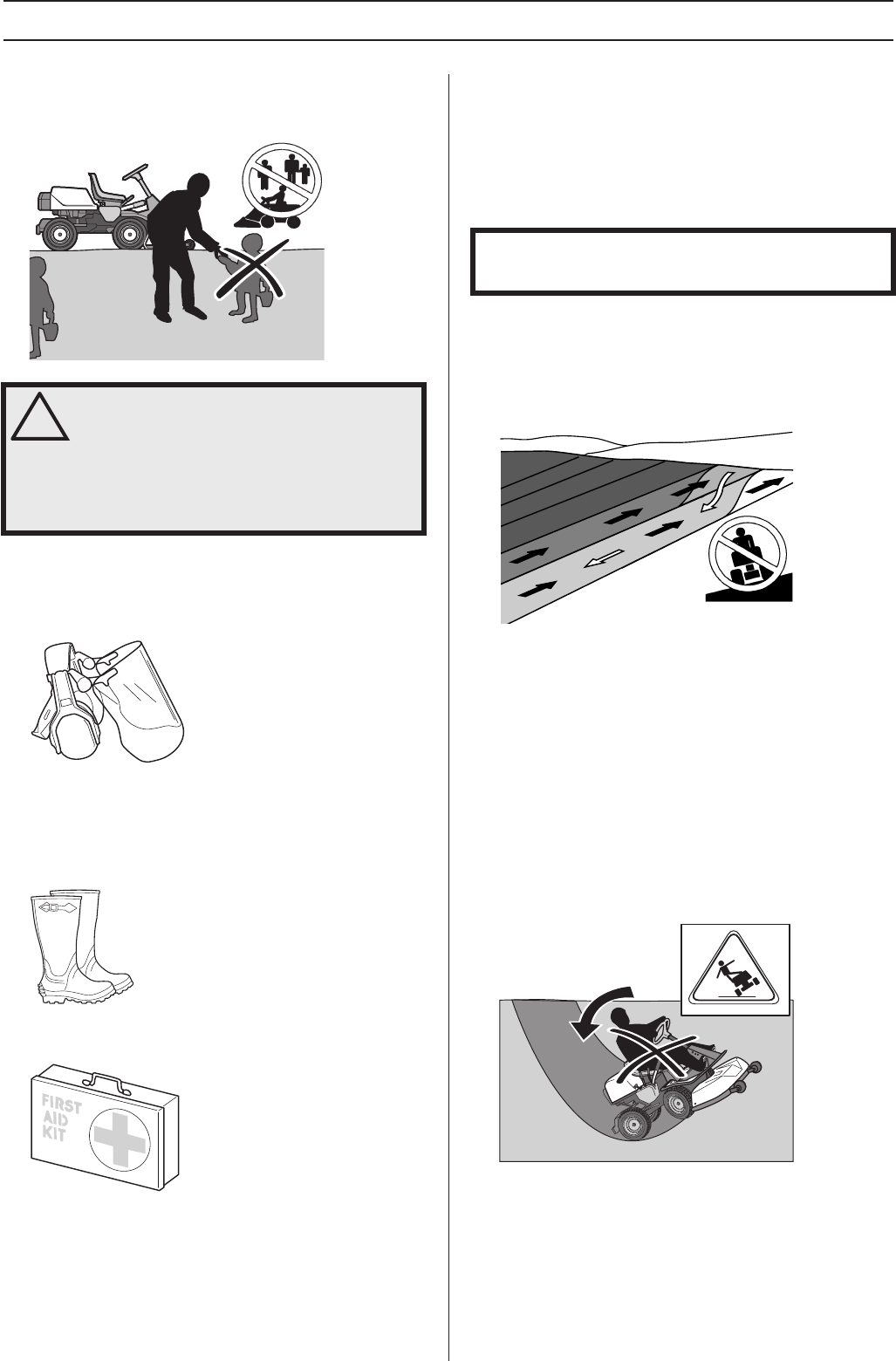
• Never allow children or other persons not trained in the
use of the machine to use or service it. Local laws may
regulate the age of the user.
• Use hearing protection to minimise the risk of hearing
impairment.
• Wear approved protective glasses or full-face visor during
assembly and when operating.
• Never wear loose fitting clothes that can catch in moving
parts.
• Never use the machine when barefoot. Always wear
protective shoes or protective boots, preferably with steel
toes.
• Make sure that you have first aid equipment close at hand
when using the machine.
Driving on slopes
Driving on slopes is one of the operations where the risk of
the driver losing control of the machine or of it overturning is
the greatest; this can result in serious injury or death. All
slopes demand extra care. If you cannot reverse up a slope or
if you feel unsure, do not mow it.
This is what you do
• Remove obstacles such as stones, branches, etc.
• Mow upwards and downwards, not sideways.
• Do not use the machine on ground that slopes more than
10°.
• Avoid starting or stopping on a slope. If the tyres start to
slip, stop the blades and drive slowly down the slope.
• Always drive smoothly and slowly on slopes.
• Do not make any sudden changes in speed or direction.
• Avoid unnecessary turns on slopes, if necessary, turn
slowly and gradually downwards if possible. Drive slowly.
Do not turn the wheel sharply.
• Watch out for and avoid driving over furrows, holes and
bumps. It is easier for the machine to overturn on uneven
ground. Tall grass can hide obstacles.
• Take extra care if any attachments are fitted that can
change the stability of the machine.
• Do not mow too close to edges, ditches or banks. The
machine can suddenly overturn if one wheel comes over
the edge of a steep slope or a ditch, or if an edge gives
way.
• Do not mow wet grass. It is slippery, and tyres can lose
their grip so that the machine skids.
!
WARNING! You must use approved personal
protective equipment whenever you use the
machine. Personal protective equipment
cannot eliminate the risk of injury but it will
reduce the degree of injury if an accident
does happen. Ask your dealer for help in
choosing the right equipment.
IMPORTANT INFORMATION
Do not drive down slopes with the unit raised.
10 – English
SAFETY INSTRUCTIONS
•Do not try to stabilize the machine by putting your foot on
the ground.
• When cleaning the chassis, the machine may never be
driven near verges or ditches.
• Follow the manufacturer’s recommendations regarding
wheel weights or counterbalance weights to increase
machine stability.
Children
•Serious accidents may occur if you fail to be on your guard
for children in the vicinity of the machine. Children are
often attracted to the machine and mowing. Never
assume that children will remain where you last saw them.
• Keep children away from the area to be mowed and under
close supervision by another adult.
• Keep an eye out and shut off the machine if children enter
the work area.
• Before and during reversing procedures, look behind you
and down for small children.
• Never allow children to ride along. They can fall off and
seriously injure themselves or be in the way for safe
manoeuvring of the machine.
• Never allow children to operate the machine.
• Be particularly careful near corners, bushes, trees or
other objects that block your view.
Maintenance
•Stop the engine. Prevent starting by removing the ignition
cable from the spark plug or remove the ignition key
before making any adjustments or carrying out
maintenance.
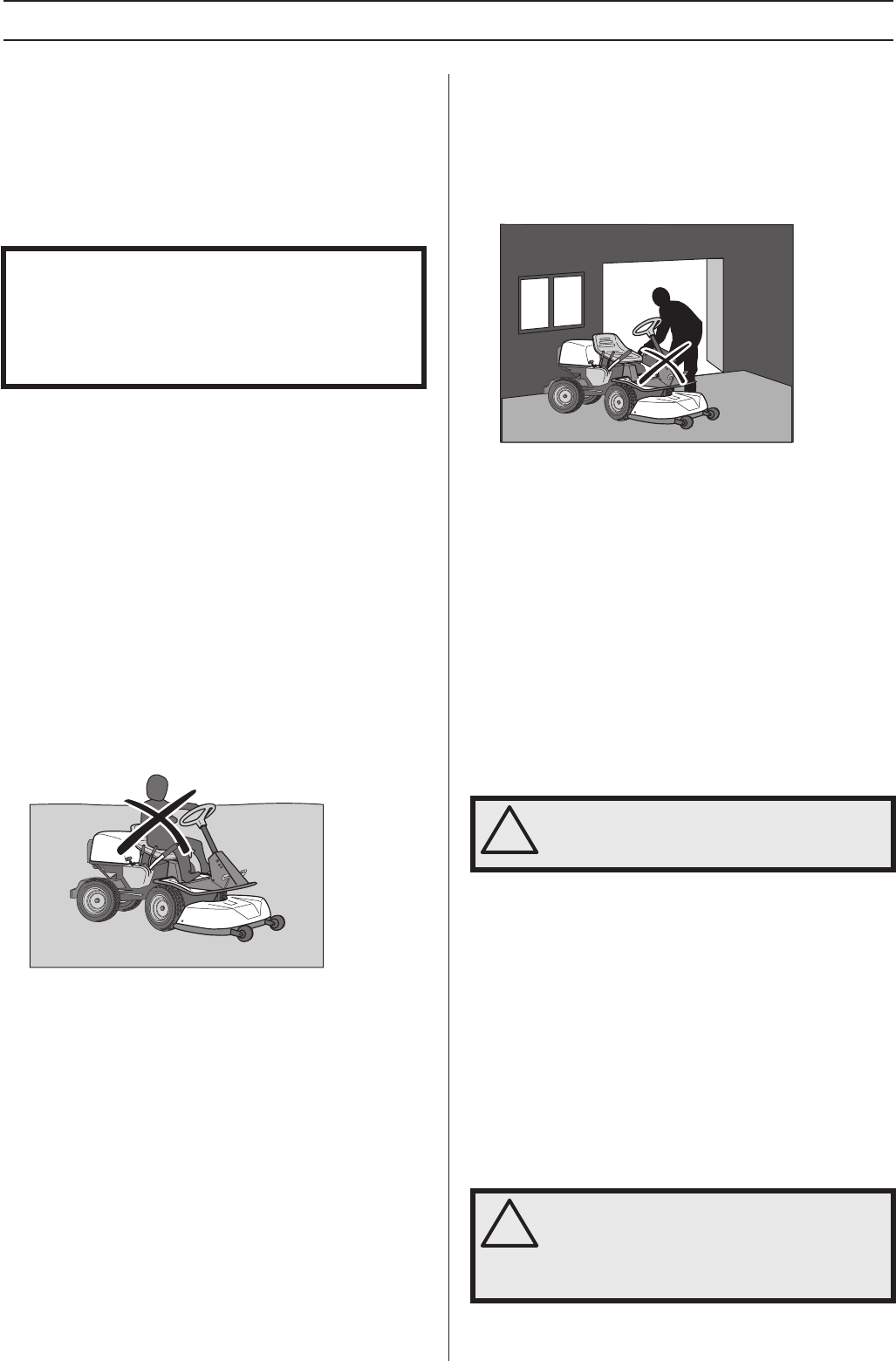
• Never fill the fuel tank indoors.
• Petrol and petrol fumes are poisonous and extremely
flammable. Be especially careful when handling petrol, as
carelessness can result in personal injury or fire.
• Only store fuel in containers approved for the purpose.
• Never remove the fuel cap and fill the petrol tank while the
engine is running.
• Allow the engine to cool before refuelling. Do not smoke.
Do not fill petrol in the vicinity of sparks or naked flames.
• Handle oil, oil filters, fuel and the battery carefully, of
environmental considerations. Follow the local recycling
requirements.
• Electrical shocks can cause injuries. Do not touch cables
when the engine is running. Do not test the ignition
system with your fingers.
• If leaks arise in the fuel system, the engine must not be
started until the problem has been resolved.
• Store the machine and fuel in such a way that there is no
risk that leaking fuel or fumes can cause any damage.
• Check the fuel level before each use and leave space for
the fuel to expand, because the heat from the engine and
the sun may otherwise cause the fuel to expand and
overflow.
• Avoid overfilling. If you spill petrol on the machine, wipe up
the spill and wait until it has evaporated before starting the
engine. If you spill on your clothing, change your clothing.
• Allow the machine to cool before performing any actions
in the engine compartment.
IMPORTANT INFORMATION
Wheel weights fitted on the rear wheels are recommended
when driving on slopes for safer steering and improved
manoeuvrability. Consult your dealer concerning the use of
wheel weights if you are unsure. Wheel weights can not be
used on AWD-machines. Use counterweights.
!
WARNING! The engine and the exhaust
system become very hot during operation.
Risk of burn injuries if touched.
!
WARNING! The battery contains lead and
lead pollutants, chemicals that are
considered to cause cancer, birth defects or
other reproductive impairment. Wash your
hands after touching the battery.
English – 11
SAFETY INSTRUCTIONS
•Be especially careful when handling battery acid. Acid on
the skin can cause serious corrosive injuries. In the event
of spillage on the skin wash immediately with water.
• Acid in the eyes can cause blindness, contact a doctor
immediately.
• Take care with battery maintenance. Explosive gases
form in the battery. Never perform maintenance on the
battery while smoking or in the vicinity of open flames or
sparks. This can cause the battery to explode and cause
serious injuries.
• Make sure all nuts and bolts are tightened correctly and
that the equipment is in good condition.
• Do not modify safety equipment. Check regularly to be
sure it works properly. The machine must not be driven if
protective plates, protective covers, safety switches or
other protective devices are not fitted or are defective.
• Observe the risk of injury caused by moving or hot parts if
the engine is started with the engine cover open or
protective cowlings removed.
• Do not change the setting of governors and avoid running
the engine at excessively high revs. If you run too fast, you
risk damaging the machine components.
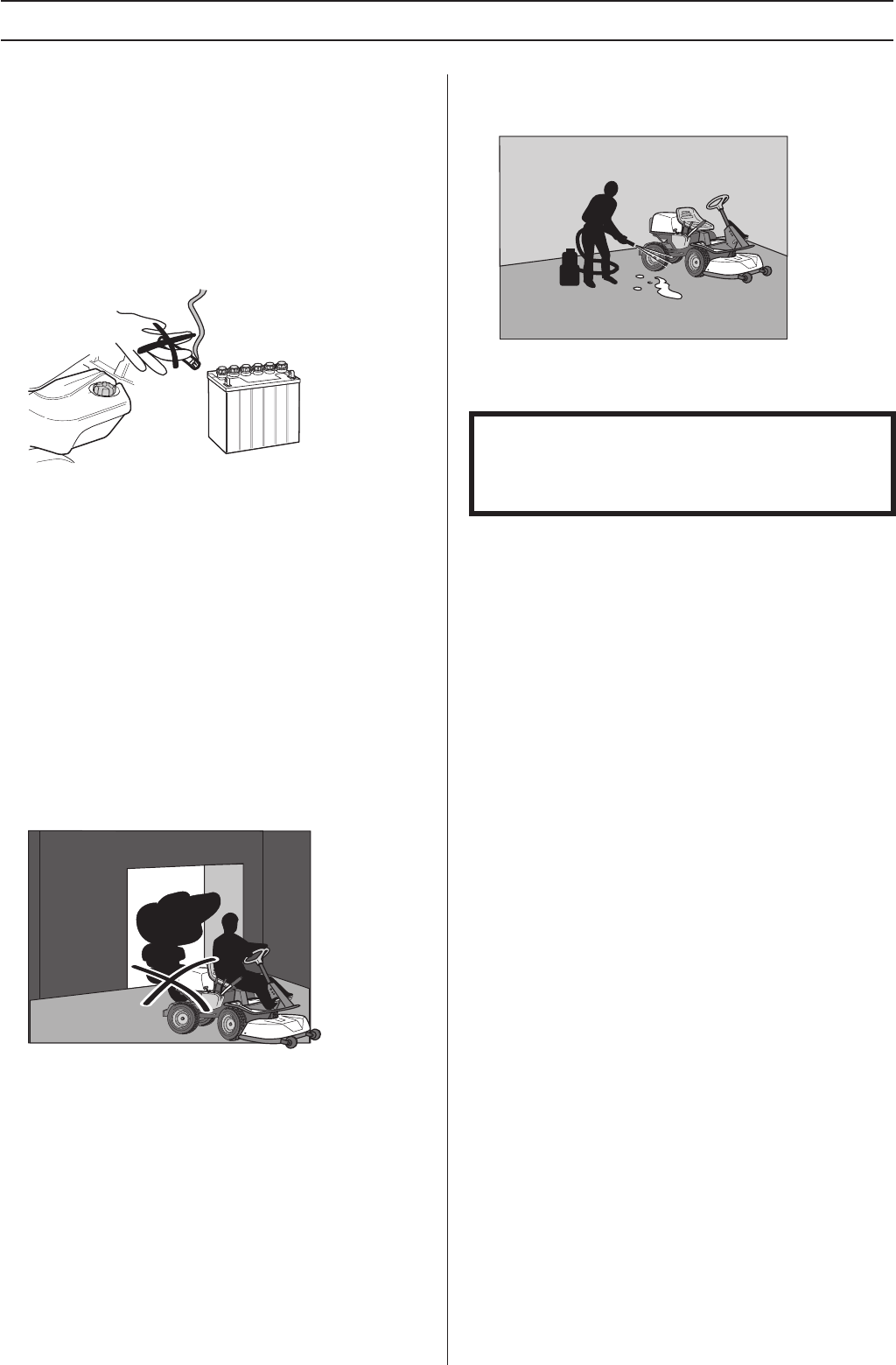
• Never use the machine indoors or in spaces lacking
proper ventilation. Exhaust fumes contain carbon
monoxide, an odourless, poisonous and highly dangerous
gas.
• Stop and inspect the equipment if you run over or into
anything. If necessary, make repairs before starting.
• Never make adjustments with the engine running.
• The machine is tested and approved only with the
equipment originally provided or recommended by the
manufacturer.
• The blades are sharp and can cause cuts. Wrap the
blades or wear protective gloves when handling them.
• Check regularly that the parking brake works. Adjust and
maintain as required.
• The mulching unit should only be used where better
quality mowing is required and in known areas.
• Reduce the risk of fire by removing grass, leaves and
other debris that may have fastened on the machine.
Allow the machine to cool before putting it in storage.
Transport
• The machine is heavy and can cause serious crush
injuries. Take extra care when loading it onto or off a
vehicle or trailer.
• Use an approved trailer to transport the machine. Activate
the parking brake, and secure the machine using
approved fasteners, such as tension belts, chains or ropes
when transporting.
• Check and observe local road traffic regulations before
transporting or driving the machine on roads.
IMPORTANT INFORMATION
The parking brake is not sufficient to lock the machine
during transport. Ensure you secure the machine firmly to
the transporting vehicle.
12 – English
WHAT IS WHAT?
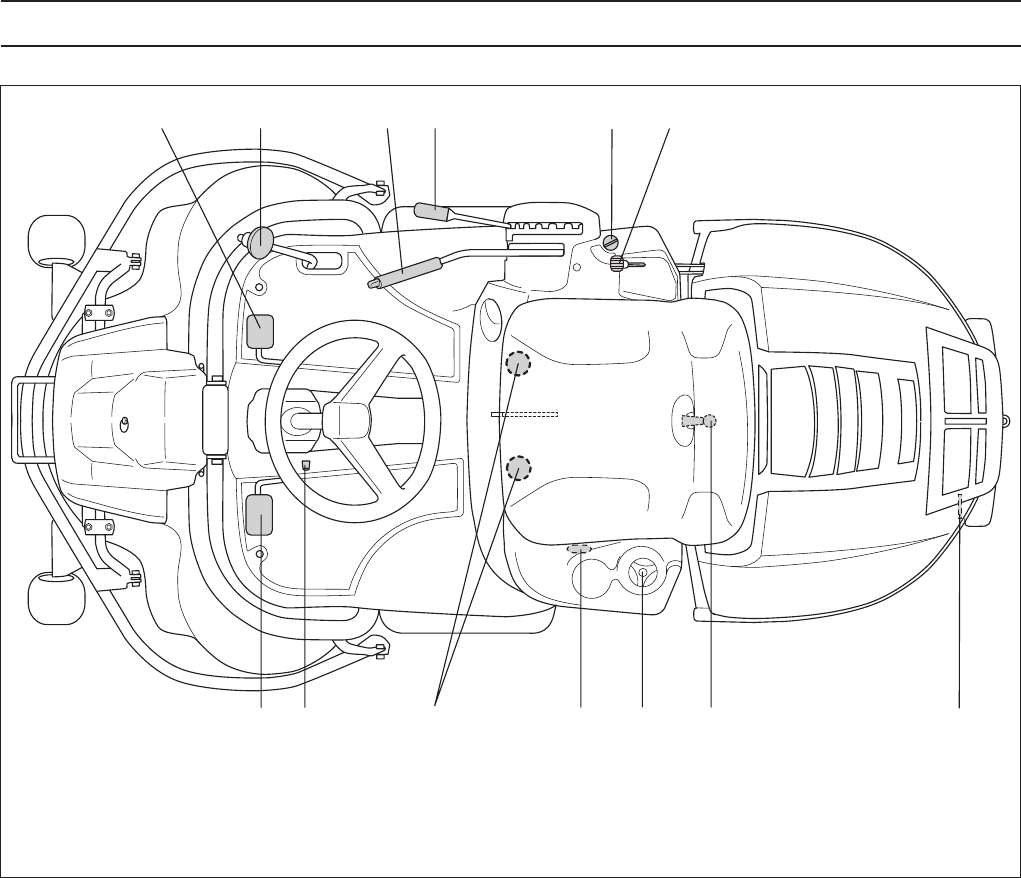
Location of the controls
3
4
5
91112
621
13
10
8
7
1 Throttle control/choke control
2 Ignition lock
3 Cutting height adjustment lever
4 Lifting lever for the cutting unit
5 Speed limiter for reversing
6 Speed limiter for driving forward
7 Parking brake
8 Lock button for parking brake
9 Seat adjustment.
10 Lever to disengage the driving front axle, 175 AWD
11 Fuel cap
12 Cover lock
13 Lever to disengage the drive Rider 175
Lever to disengage the driving rear axle, 175 AWD
English – 13
PRESENTATION
Presentation
Congratulations on your choice of an excellent quality product
that will give you great pleasure for many years. This
operator’s manual describes Rider 175 and Rider 175 AWD.
The machines are equipped with a 17,5 horse power engine
from Briggs & Stratton.
Rider 175 AWD is equipped with all wheel drive.
The power transmission from the engine is handled by a
hydrostatic gearbox, which allows variable variation of the
speed by using the pedals.
One pedal for driving forward and one for reverse.
Throttle control/choke control
The throttle control regulates the engine speed, and thereby
also the rotation speed of the blades.
The control is also used to activate the choke. When the
choke is engaged a richer fuel and air mixture is fed to the
engine, which facilitates starting in the cold.
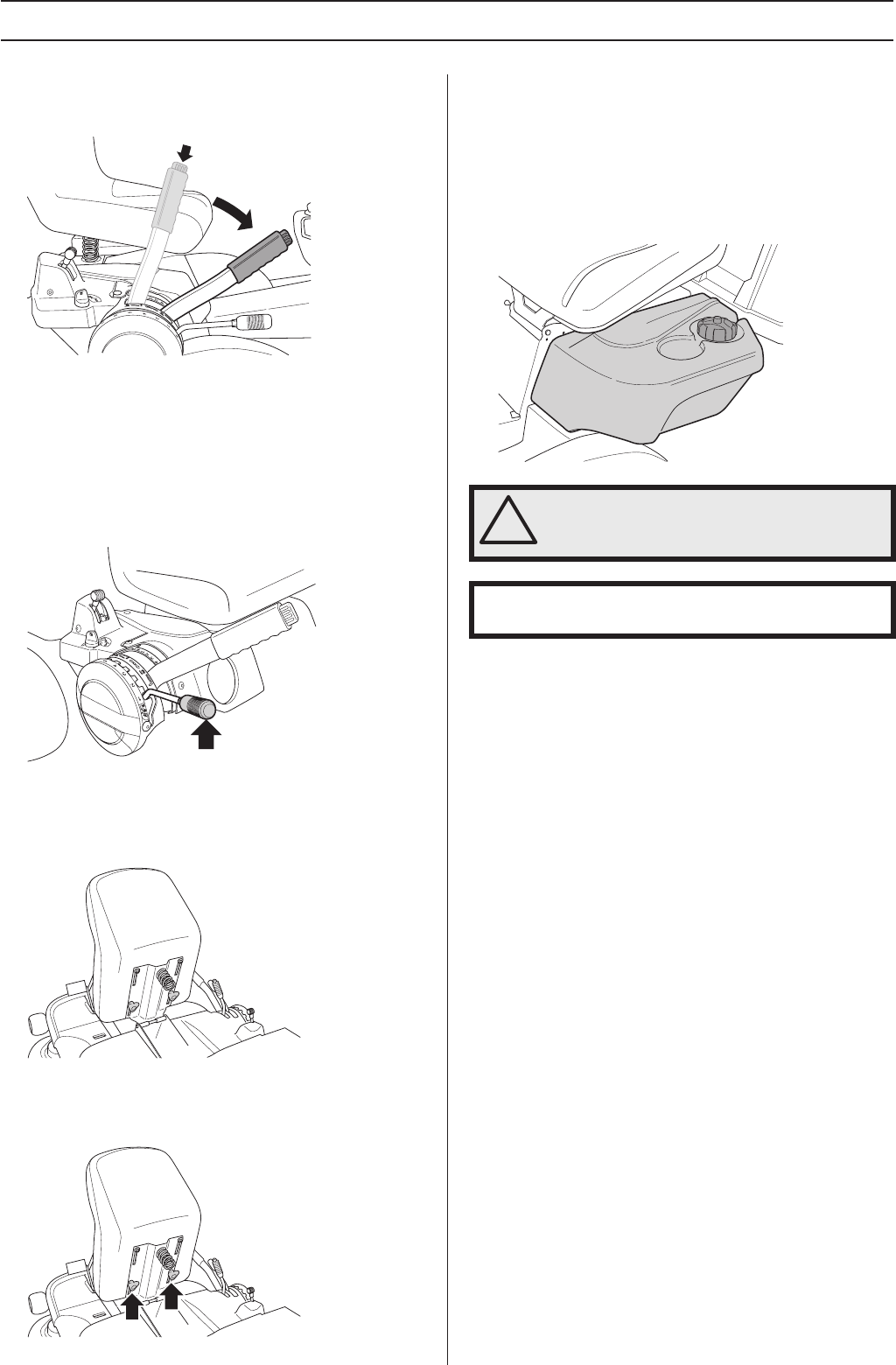
Speed limiter
The speed of the machine is steplessly regulated with two
pedals. Pedal (1) is used to drive forwards, and pedal (2) to
drive backwards.
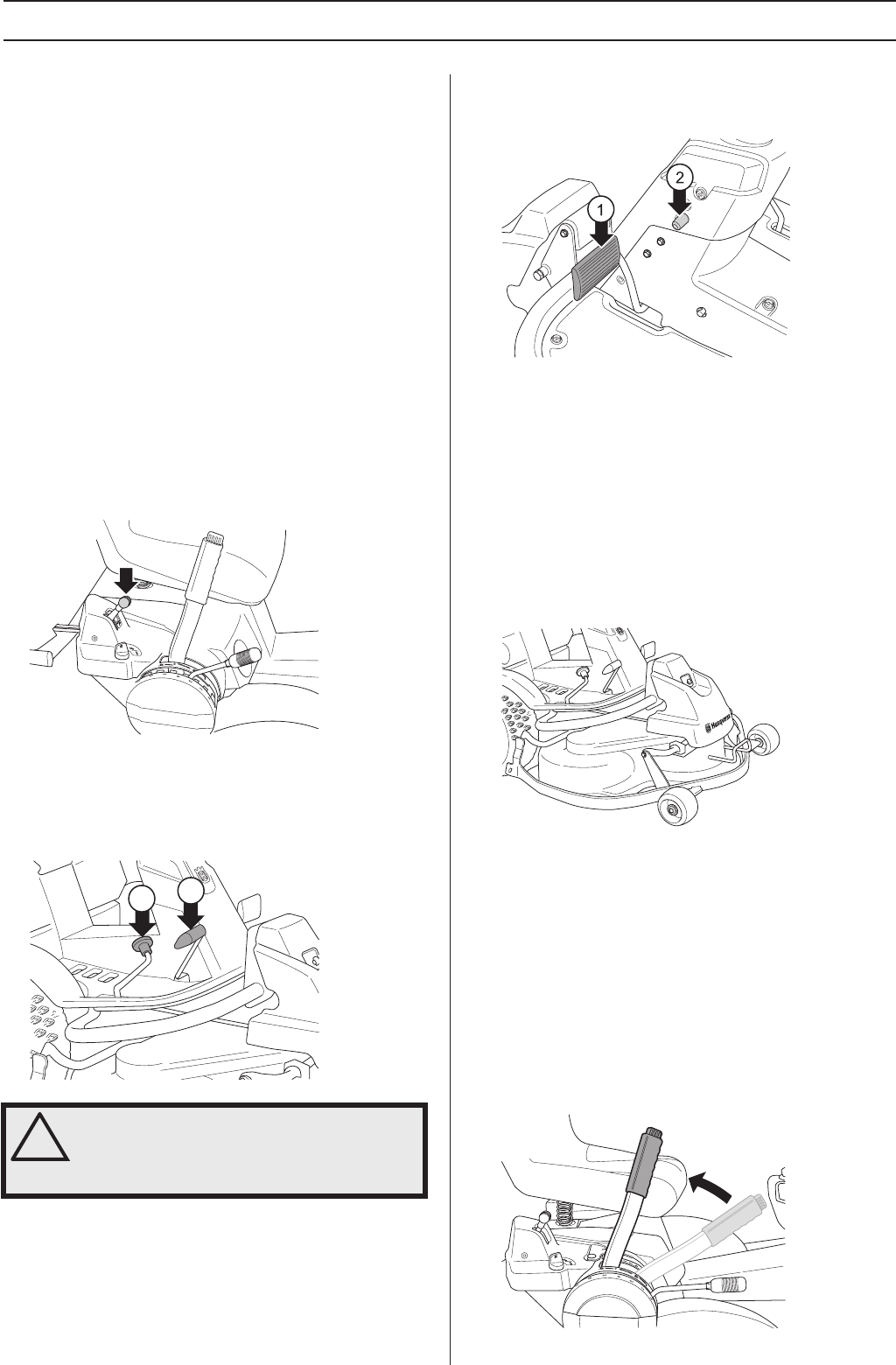
Parking brake
The parking brake is applied as follows:
1 Press down the parking brake pedal (1).
2 Press in the lock button (2) on the steering column.
3 Release the parking brake pedal while keeping the button
pressed in.
The parking brake lock disengages automatically when the
brake pedal is pressed.
Cutting unit
Rider 175 and 175 AWD can be equipped with two different
cutting units.
• Combi 1030mm/41”
• Combi 1120 mm/44”
The Combi-unit, equipped with a BioClip-plug, finely chops
the cuttings to fertiliser. Without the BioClip-plug the unit
works in the same way as a rear ejection unit.
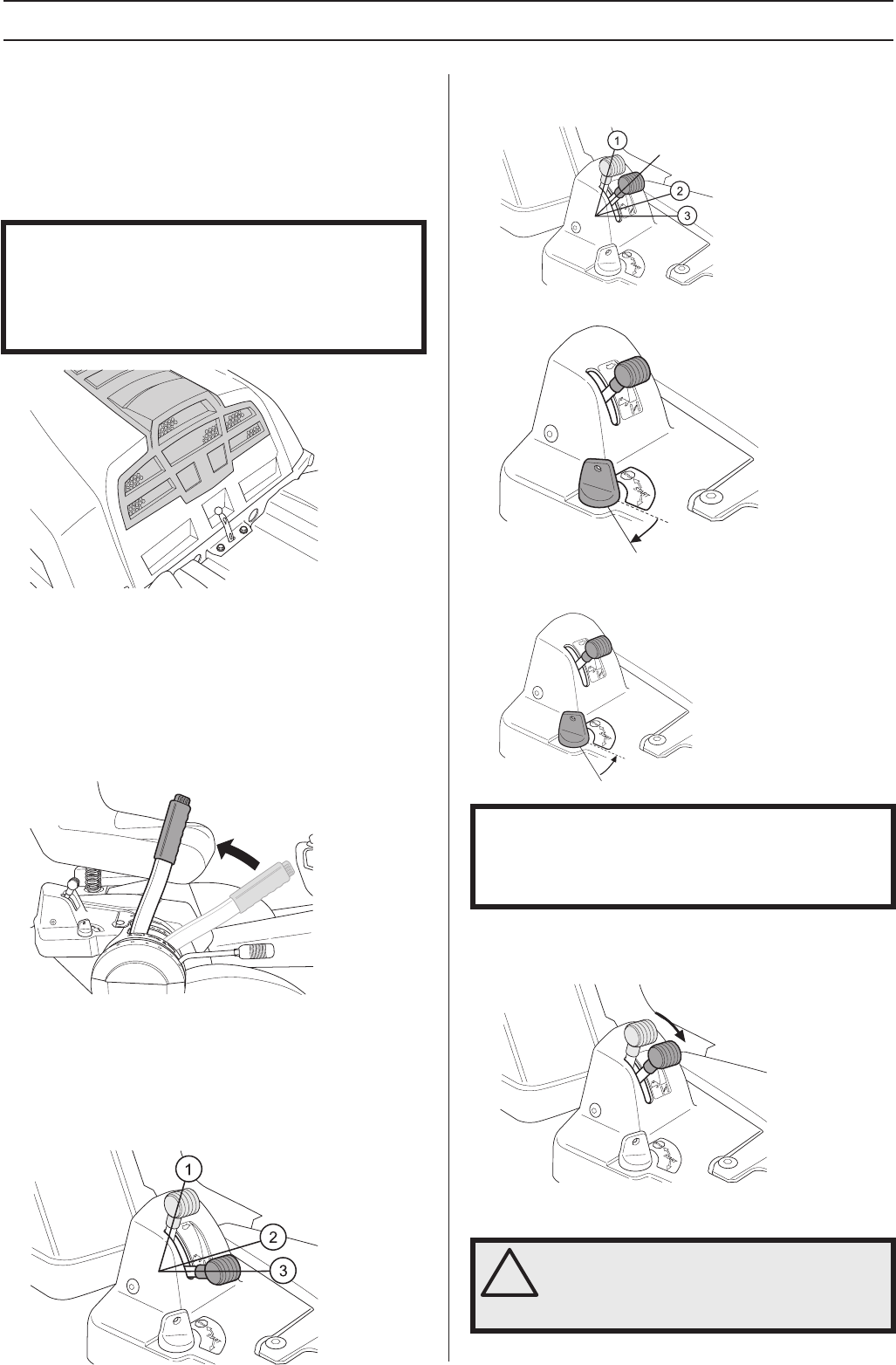
Lifting lever for the cutting unit
The lift lever is used to set the cutting unit in transport or
mowing position.
If the lever is pulled backwards the unit is raised and the
blades automatically stop rotating (transport position).
!
WARNING! Make sure that branches do not
obstruct the pedals when mowing under
bushes. Otherwise there is a risk you may
lose control.
1
2
14 – English
PRESENTATION
If the lock button is pressed in and the lever is moved forwards
the unit will be lowered and the blades will automatically start
to rotate (mowing position).
The lever can also be used to temporarily regulate the cutting
height, e.g. for a small mound in the lawn.
Cutting height adjustment lever
The cutting height can be adjusted to 7 different positions with
the cutting height lever.
Combi-unit 40-90 mm (1 9/16” - 3 9/16”)
Seat
The seat has a jointed attachment on the front edge and can
be tipped forward.
The seat can also be adjusted lengthways.
Loosen the handles under the seat and adjust it forwards or
backwards to the desired position.
Fuelling
The engine runs on unleaded petrol with a minimum octane
rating of 85 (not mixed with oil). We recommend the use of
biodegradable alkylate petrol. (max. methanol 5%, max.
ethanol 10%, max. MTBE 15%)
Do not fill the tank completely, leave an expansion area of at
least 2.5 cm (1“).
!
WARNING! Petrol is highly inflammable.
Exercise care and refuel outdoors (see
safety instructions).
IMPORTANT INFORMATION Do not use the fuel tank as a
support area.
English – 15
Driving
Before starting
• Read the safety instructions and information concerning
the placement of controls and functions before starting.
• Perform daily maintenance before starting as set out in
the Maintenance schedule.
Start the engine
1Make sure that the clutch control is depressed. Rider 175
AWD has one control for the front axle and one control for
the rear axle.
2 Lift up the cutting unit by pulling the lever backwards to
locked position (transport position) and apply the parking
brake.
Rider 175 AWD The engine can not be started if the
parking brake is not pressed down.
Starting a cold engine
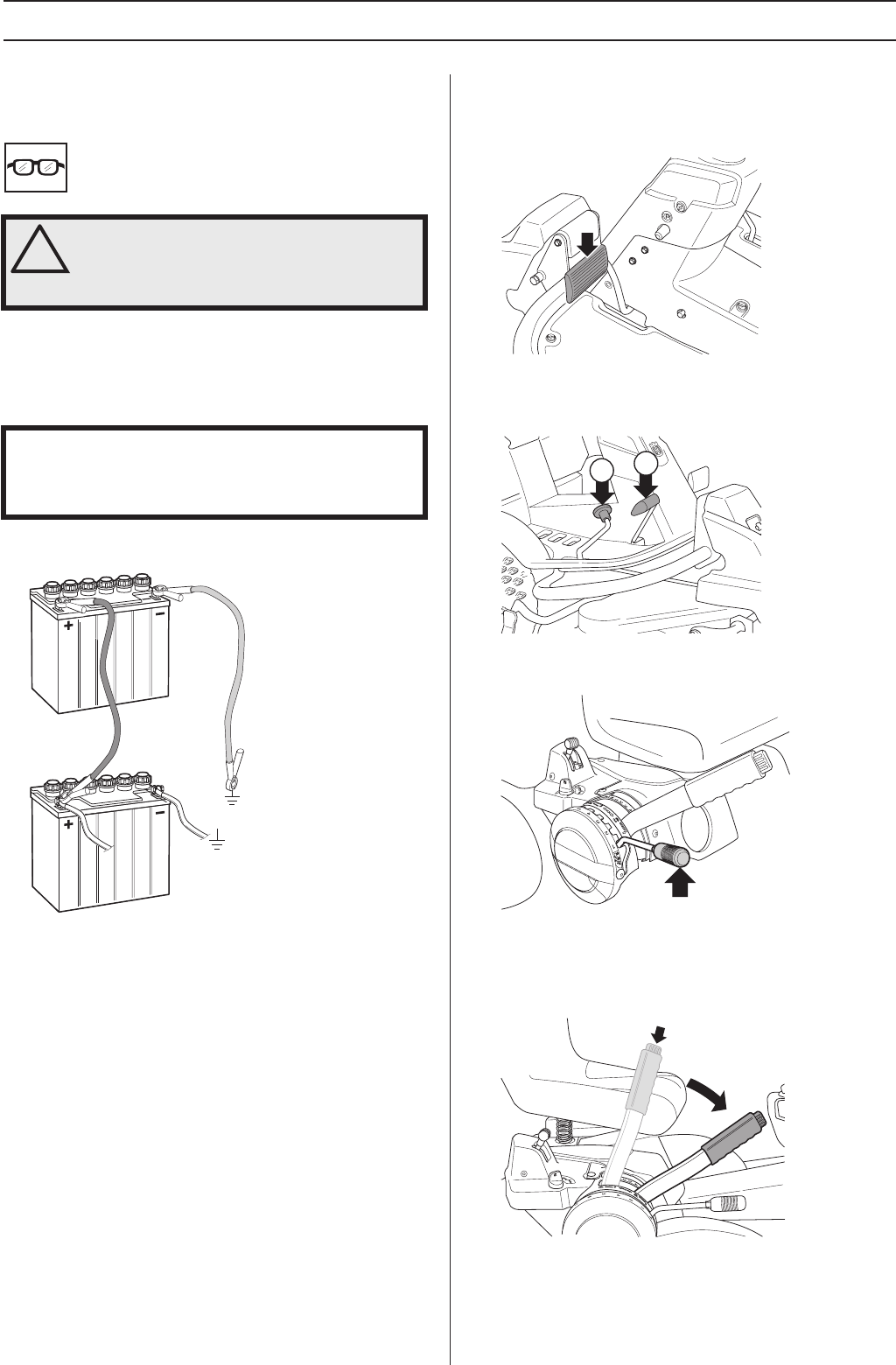
3 Move the throttle to position 3 (choke position). In this
position the engine is fed with a richer mixture, which
means the engine is easier to start.
Starting a warm engine
Move the throttle in between positions 1 and 2.
4 Turn the ignition key to the start position.
5 When the engine starts release the ignition key
immediately back to neutral position.
6 Push the throttle control to full throttle position. Let the
engine run at moderate speed or half throttle for 3-5
minutes before subjecting it to heavy load.
7 Set the required engine speed with the throttle control.
IMPORTANT INFORMATION
The air intake grille in the engine cover behind the driver’s
seat must not be blocked by, for example, clothing, leaves,
grass or dirt. Impaired cooling of the engine.
Risk of major engine damage.
IMPORTANT INFORMATION
Do not run the starter for more than about 5 seconds at a
time. If the engine does not start, wait about 15 seconds
before trying again.
!
WARNING! Never run the engine indoors, in
enclosed or poorly ventilated areas. The
exhaust fumes contain toxic carbon
monoxide.
16 – English
Driving
Starting the engine with a weak
battery
If the battery is too weak to start the engine, it should be
recharged.
When jump leads are used for emergency starting, follow the
procedure below:
Connecting the jump leads
•Connect each end of the red cable to the POSITIVE pole
(+) on each battery, exercise care not to short circuit any
of the ends against the chassis.
• Connect one end of the black cable to the NEGATIVE pole
(-) on the fully charged battery.
• Connect the other end of the black cable to a good
CHASSIS EARTH, away from the fuel tank and the
battery.
Remove the cables in the reverse order
• The BLACK cable is removed from the chassis and then
the fully charged battery.
• Finally the RED cable from both batteries.
Driving the Rider
1 Release the parking brake by first pressing down the
parking brake pedal and then releasing it.
2 Carefully press down one of the pedals until the required
speed is obtained. Pedal (1) is used to drive forwards, and
pedal (2) to drive backwards.
3 Select the required cutting height (1-7) with the cutting
height lever.
It is important that the air pressure in both front wheels is
equal, 60 kPa / 8.5 PSI, to produce an even cutting height.
4 Press in the lock button on the lifting lever and lower the
cutting unit.
!
WARNING! Lead-acid batteries produce
explosive gases. Avoid sparks, open flames
and smoking close to batteries. Always wear
protective glasses in the vicinity of batteries.
IMPORTANT INFORMATION Your Rider is equipped with a
12-volt system with negative earth. The other vehicle must
also have a 12-volt system with negative earth. Do not use
your Rider battery to start other vehicles.
1
2
English – 17
Driving
Cutting tips
•Localise and mark stones and other fixed objects to avoid
collision.
• Start with a high cutting height and reduce down until the
required mowing results are obtained.
• The mowing results are best with a high engine speed
(fast rotating blades) and low driving speed (slow moving
machine). If the grass is not too high and thick, the driving
speed can be increased without noticeably depreciating
the mowing result.
• The best lawns are achieved if the grass is cut often.
Mowing becomes more uniform and the grass cuttings
become more evenly distributed over the surface. The
total time consumption is not greater since it is possible to
select a higher driving speed without inferior mowing
results.
• Avoid mowing a wet lawn. The mowing results are inferior
since the wheels sink down into the soft lawn.
• Hose down the cutting unit with water underneath each
time it is used. The cutting unit should then be put in the
service position.
• When the BioClip function is used, it is very important that
the mowing interval is not too long.
Stop the engine
Preferably allow the engine to idle for a minute to obtain
normal working temperature before stopping it if it has been
working hard. Avoid idling the engine for long periods, as
there is a risk of carbon build-up on the spark plugs.
1 Lift up the cutting unit by pulling the lever backwards to its
locked position.
2 Move the throttle control to the MIN. position. Turn the
ignition key to the ”STOP”.
3 When the Rider is at a standstill, press down the parking
brake and push in the locking button.
IMPORTANT INFORMATION
The life span of the drive belts is increased significantly if
the engine runs at a low speed when the blades are
engaged. Therefore apply full throttle first when the cutting
unit has been moved to the mowing position.
!
WARNING! Clear the lawn from stones and
other objects which can be thrown out by
the blades.
!
WARNING! Do not use the machine on
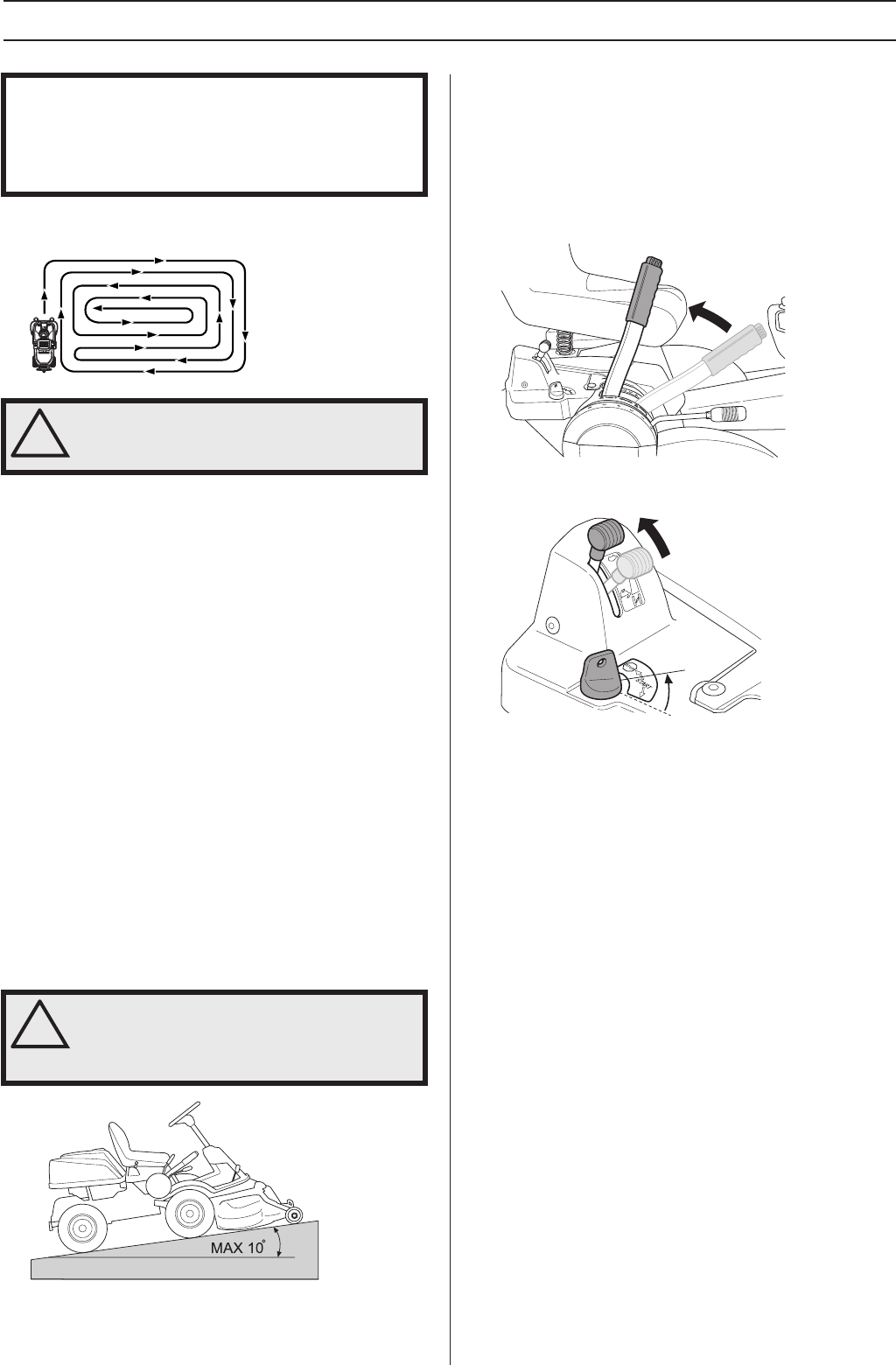
ground that slopes more than 10°°
°°.... Mow
slopes upwards and downwards, never
across. Avoid sudden changes in direction.
18 – English
Driving
Release lever
The release control must be pulled out in order for the
machine to be moved when the engine is shutoff.
Pull the controls to the end positions, do not use an
intermediate position.
Release lever Rider 175 AWD
Rider 175 AWD has one control for the front axle and one
control for the rear axle.
• Clutch control, rear axle
- Control drawn out, drive system disengaged.
- Control depressed, drive system engaged.
• Clutch control, front axle
The control is positioned on the inside of the left front
wheel.
- Rear control (pulled out), drive system disengaged.
- Front control (pushed in), drive system engaged.
Release lever Rider 175
• Pull out the control to disengage the drive system.
• Push in the control to engage to the drive system.

English – 19
Maintenance
Maintenance schedule
The following is a list of the maintenance which should be conducted on the machine. For those points not described in this manual,
visit an authorised service workshop.
1)First change after 5 hours. When operating with a heavy load or at high ambient temperatures, replace every 50 hours. 2) Maintenance and replacement are required
more often in dusty conditions. First change after 8 hours. 3)If the machine is used daily it should be lubricated twice a week. 4)Replace the oil filter every 200 hours.
5)Replace the paper filter annually or every 200 hours. 6)Conducted by authorised service workshop. 7)Only 175 AWD first change after 8 hours
X = Described in this operator's manual
O = Not described in this operator's manual
Maintenance Daily maintenance
before starting
At least
once a year
Maintenance
interval in hours
25 50 100 200
Cleaning X
Check the engine’s oil level X
Check the engine’s cooling air intake X
Check the fuel pump air filter X
Check the steering wires X
Check the battery X
Check the safety system X
Check nuts and screws O
Check for fuel and oil leakage O
Clean around the silencer O
Clean the prefilter in the air filter 2) X
Change engine oil 1) X3X3
Check the cutting deck X
Check the air pressure in the tyres, 60 kPa/8.5 PSI. X
Lubricate the belt adjuster 3) X
Lubricate joints and shafts 3) X
Adjust the brake X
Check the V-belts O
Check the cooling fins on the hydrostatic transmission O
Checking the transmission oil level X
Checking and adjusting the choke wire X
Tighten the nuts and screws O
Checking and adjusting of throttle wire X
Clean the cooling fins on the engine and hydrostatic transmission 2) O
Replace the air filter’s prefilter and paper filter 2, 5) X X
Replace the fuel filter X
Replace the spark plug. X
Check the engine valve clearance6)
Check the need to change the oil 6,7) in the gearbox/hydraulic system O O
Change the oil filter X
!
WARNING! No service procedures must be conducted on the
engine or cutting unit unless:
The engine is switched off.
The parking brake is applied.
The ignition key is removed.
The cutting unit is disengaged.
The ignition cables are removed from the plugs.
20 – English
Maintenance
Cleaning
Clean the machine directly after use. It is much easier to wash
off grass cuttings before they dry.
Oily dirt can be removed using a cold degreasing agent.
Spray on a thin layer.
Rinse at normal water pressure.
Do not direct the jet towards electrical components or
bearings.
Do not rinse hot surfaces such as the engine and exhaust
system.
It is recommended that you start the engine and run the
mower for a short period after cleaning, so that any remaining
water is blown off.
Lubricate the machine if necessary after cleaning. Carry out
extra lubrication when the bearings have been exposed to a
degreaser or a water jet.
There is a major risk of water penetrating into bearings and
electrical connections. Corrosion attack can result, which will
lead to running problems. Cleaning additives generally
aggravate the damage.
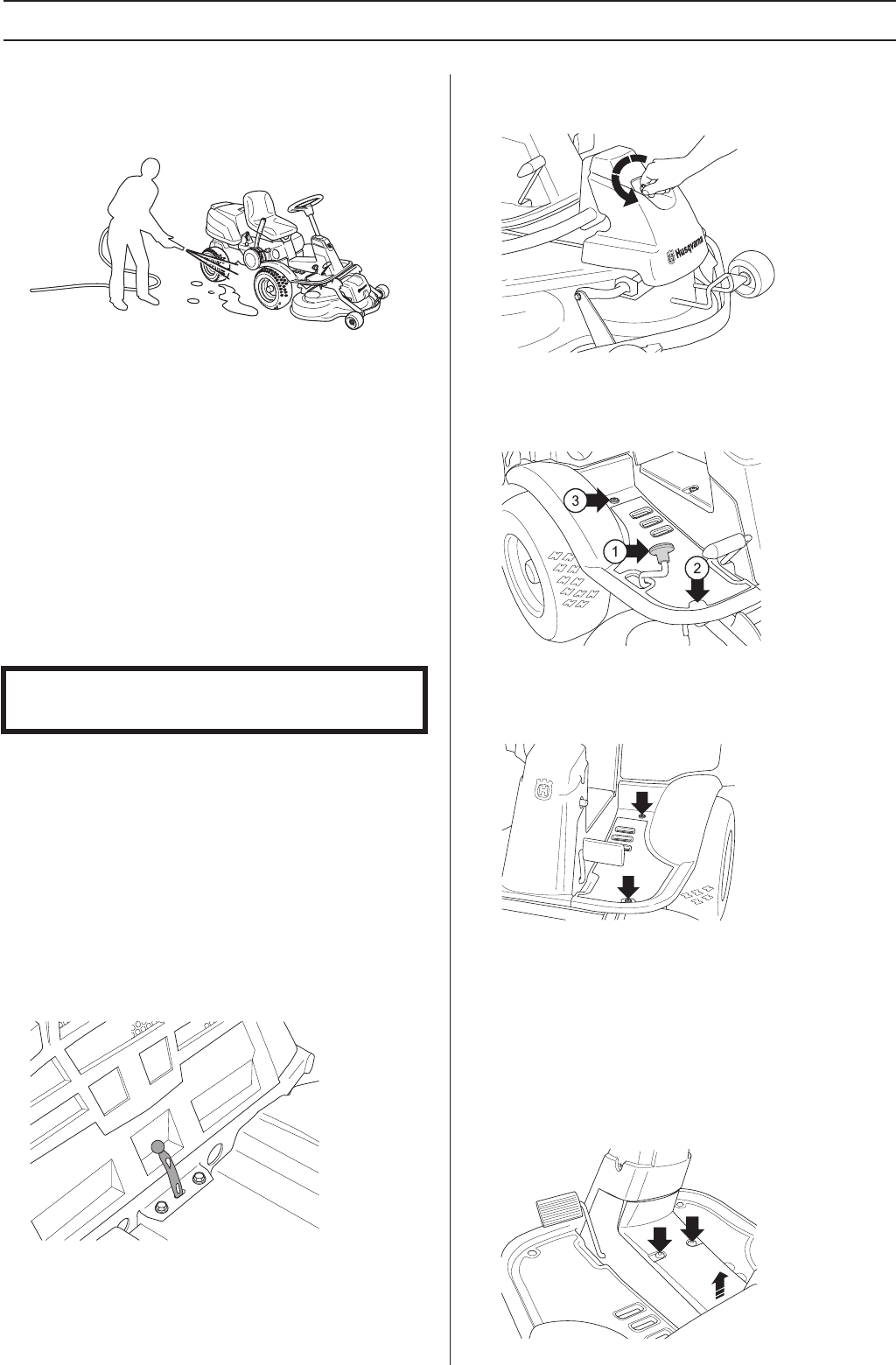
Removing of the machine hoods
Engine cover
The engine becomes accessible for service when the engine
cover is opened.
Fold the seat forward, loosen the rubber strap under seat and
fold the cover backwards.
Front cover
Release the clip on the front hood and lift off the fender.
Right-hand fender
Remove the accelerator knob (1), screws (2 and 3), and
remove the cover.
Left-hand fender
Remove the screws holding the wing cover (2) and lift off the
cover.
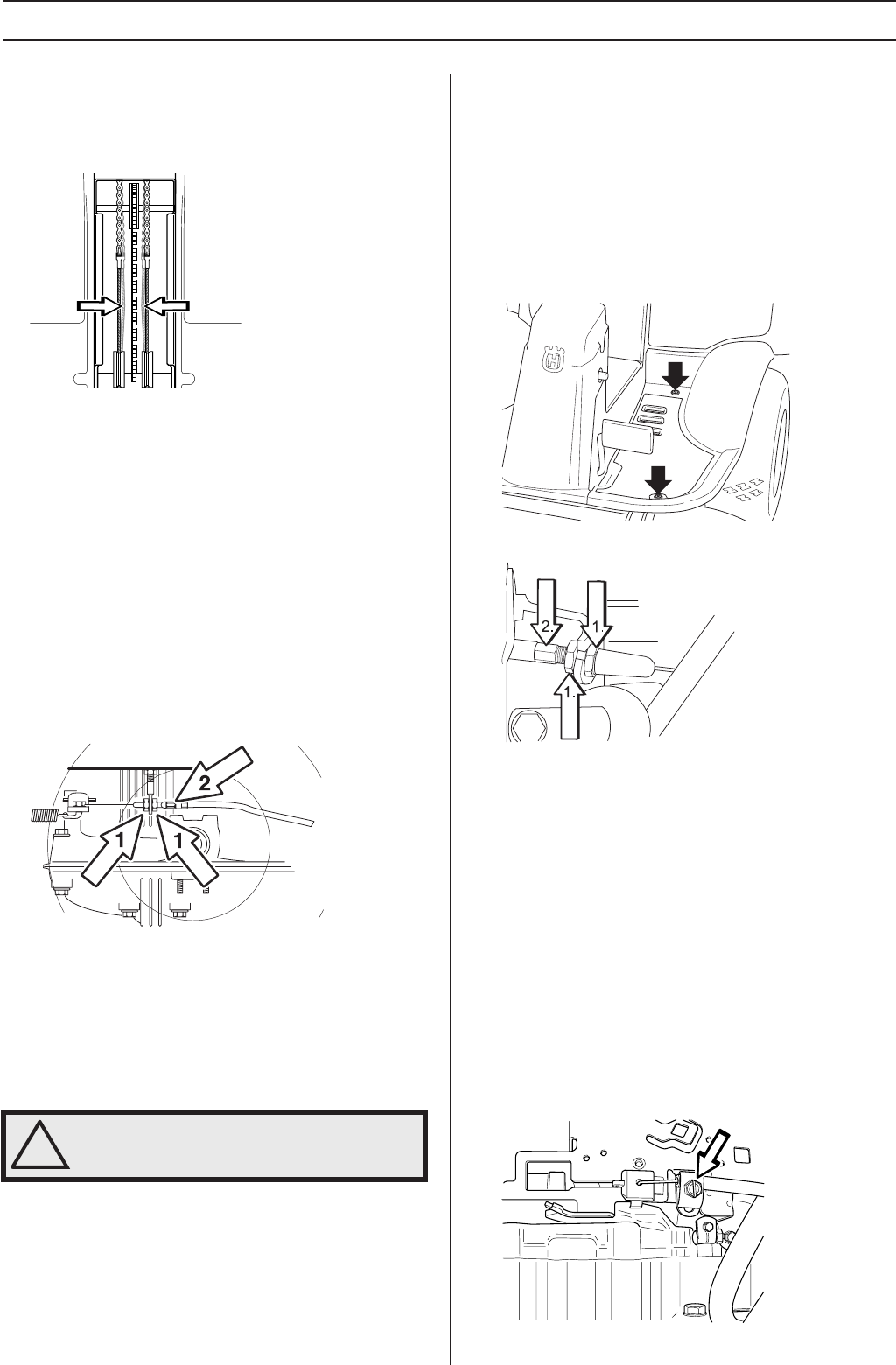
Checking and adjusting the steering
wires
The steering is controlled by means of wires.
These can in time become slack, which implies that the
adjustment of the steering becomes altered.
Check and adjust the steering as follows:
1 Remove the frame plate by loosening the two screws.
IMPORTANT INFORMATION
Avoid using a high pressure washer or a steam cleaner.
English – 21
Maintenance
2 Check the tension of the steering wires by squeezing
them together by the arrows as illustrated. It should be
possible to push them together so that the distance
between them is half as much, without using unnecessary
force.
3 If necessary, the wires can be adjusted by tightening the
adjuster nuts on each side of the steering collar. Do not
over tighten the cables; they should only be drawn in
towards the steering collar.
Hold the cable, for example using an adjustable wrench,
so that it does not twist.
If the adjustment is only made on one side, the middle
position of the steering will be affected.
Check the wire tension on completion of the adjustment
as per item 2.
Adjusting the parking brake Rider
175
The parking brake is adjusted as follows:
1 Loosen the locking nuts (1).
2 Tension the cable using the adjuster screw (2) until the
play in the cable is taken up.
3 Tighten the locking nuts (1) after adjustment.
4 The parking brake should be checked again after the
adjustment has been made.
Adjusting the parking brake Rider
175 AWD
Check that the parking brake is adjusted correctly by placing
the machine on a slope with the front and rear axles
disengaged.
Apply and lock the parking brake. When the machine does not
stand still, the parking brake should be adjusted according to
the following.
1 Remove the left-hand wing cover.
2 Loosen the locking nuts (1).
3 Tension the cable using the adjuster screw (2) until the
play in the cable is taken up.
4 Tighten the locking nuts (1).
5 The brake should be checked again after adjustment
6 Assemble the left-hand wing cover.
Checking and adjusting of throttle
wire
The throttle cable may need to be adjusted, if the engine does
not respond as it should when accelerating, if it produces
black smoke or maximum revs are not reached.
If doubts arise, contact your service representative.
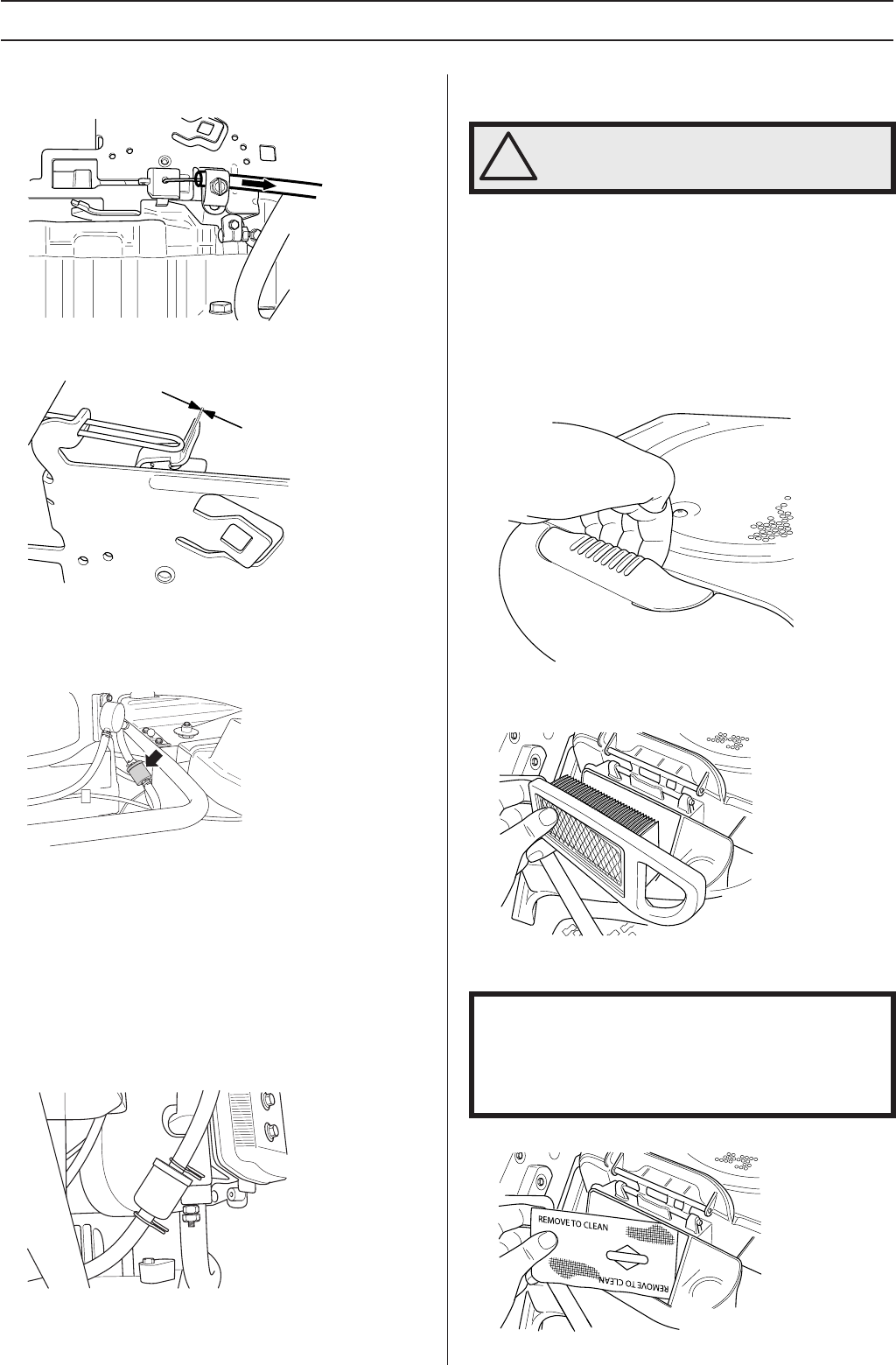
1 Loosen the clamping screw for the cable’s outer casing
and move the throttle to the full throttle position.
!
WARNING! A poorly adjusted parking brake
can result in reduced braking ability.
22 – English
Maintenance
2 Pull the choke wire casing to the far right and tighten the
clamping screw.
3 Pull back the throttle to the full throttle position and check
that the choke is no longer actuated.
Replacement of fuel filter
Replace the fuel filter every 100 running hours (once per
season) or more frequently if it is clogged.
Replace the filter as follows:
1 Open the engine cover.
2 Move the hose clips away from the filter. Use a pair of flat
pliers.
3 Pull off the filter from the hose ends.
4 Press the new filter into the ends of the hoses. If
necessary apply liquid detergent to the ends of the filter to
facilitate connection.
5 Push the hose clips back on the filter and tighten.
Replacing the air filter
If the engine seems to lack power or does not run smoothly
this may be because the air filter is clogged. It is therefore
important to replace the air filter at regular intervals (see
Maintenance/Maintenance Schedule for the correct service
interval).
Replace the air filter as follows:
1 Open the engine cover.
2 Pull up the handle on the air filter cover, unhook and turn
towards the engine.
3 Remove the air filter cover.
Lift out the air filter cartridge from the fan housing.
Replace the air filter cartridge, if clogged with dirt.
4 Carefully lift the precleaner out of the fan housing.
!
WARNING! The exhaust system is hot. Let it
cool before starting to replace the air filter.
IMPORTANT INFORMATION
Never run the engine without the air filter fitted.
Do not use compressed air to clean the paper filter.
The filters must not be oiled. They must be fitted dry.
English – 23
Maintenance
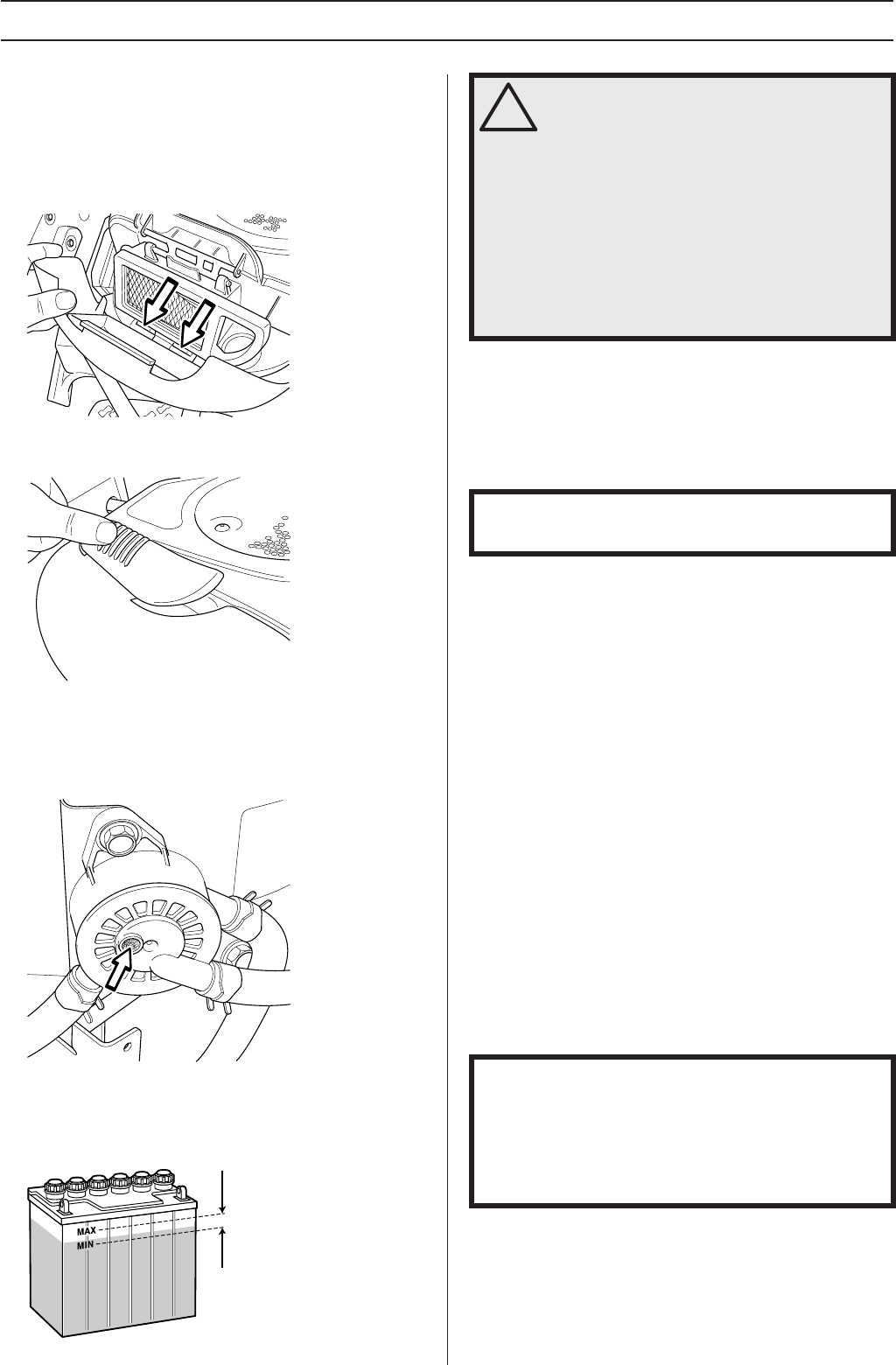
5 Carefully clean the fan housing so that dirt does not fall
down into the carburettor.
6 Insert a new precleaner and air filter cartridge in the fan
housing.
7 Align the tabs on the cover with the slits in the housing and
replace the air filter cover.
8 Pull the handle outwards. Secure the handle in the air
filter cover and close the cover by pressing it inwards.
Checking the fuel pump’s air filter
Check regularly that the fuel pump’s air filter is free from dirt.
The filter can when necessary be cleaned with a brush.
Check the level of the battery acid
Check that the level of the battery acid lies between the
markings. Top up the cells with distilled water only.
Ignition system
The engine is equipped with an electronic ignition system.
Only the spark plug requires maintenance.
For recommended spark plug, see Technical data.
Replacing the spark plug
1 Remove the ignition cable shoe and clean around the
spark plug.
2 Remove the spark plug with a 3/4” (19 mm) spark plug
socket wrench.
3 Check the spark plug. Replace the spark plug if the
electrodes are burned or if the insulation is cracked or
damaged. Clean the spark plug with a steel brush if it is to
be reused.
4 Measure the electrode gap with a gapping tool. The gap
should be 0.75 mm/0.030”. Adjust as necessary by
bending the side electrode.
5 Reinsert the spark plug, turning by hand to avoid
damaging the threads.
6 Tighten the spark plug, once it touches the seating, with
the spark plug spanner. Tighten the spark plug so that the
washer is compressed. A used spark plug should be
turned 1/8 of a turn from the seated position. A new spark
plug should be turned a 1/4 turn from the seated position.
7 Replace the ignition cable shoe.
!
WARNING!
Procedures on contact with acid
External: Rinse well with plenty of water.
Internal: Drink large quantities of water or
milk. Contact a doctor as soon as possible.
Eyes: Rinse well with plenty of water.
Contact a doctor as soon as possible.
Batteries emit explosive gas. Sparks, flames
and cigarettes must absolutely not be
brought into the vicinity of the battery.
IMPORTANT INFORMATION
Fitting the wrong spark plug type can damage the engine.
IMPORTANT INFORMATION
Inadequately tightened spark plugs can cause overheating
and damage the engine. Tightening the spark plug too
much can damage the threads in the cylinder head.
Do not turn over the engine if the spark plug or ignition cable
has been removed.
24 – English
Maintenance
Check the safety system
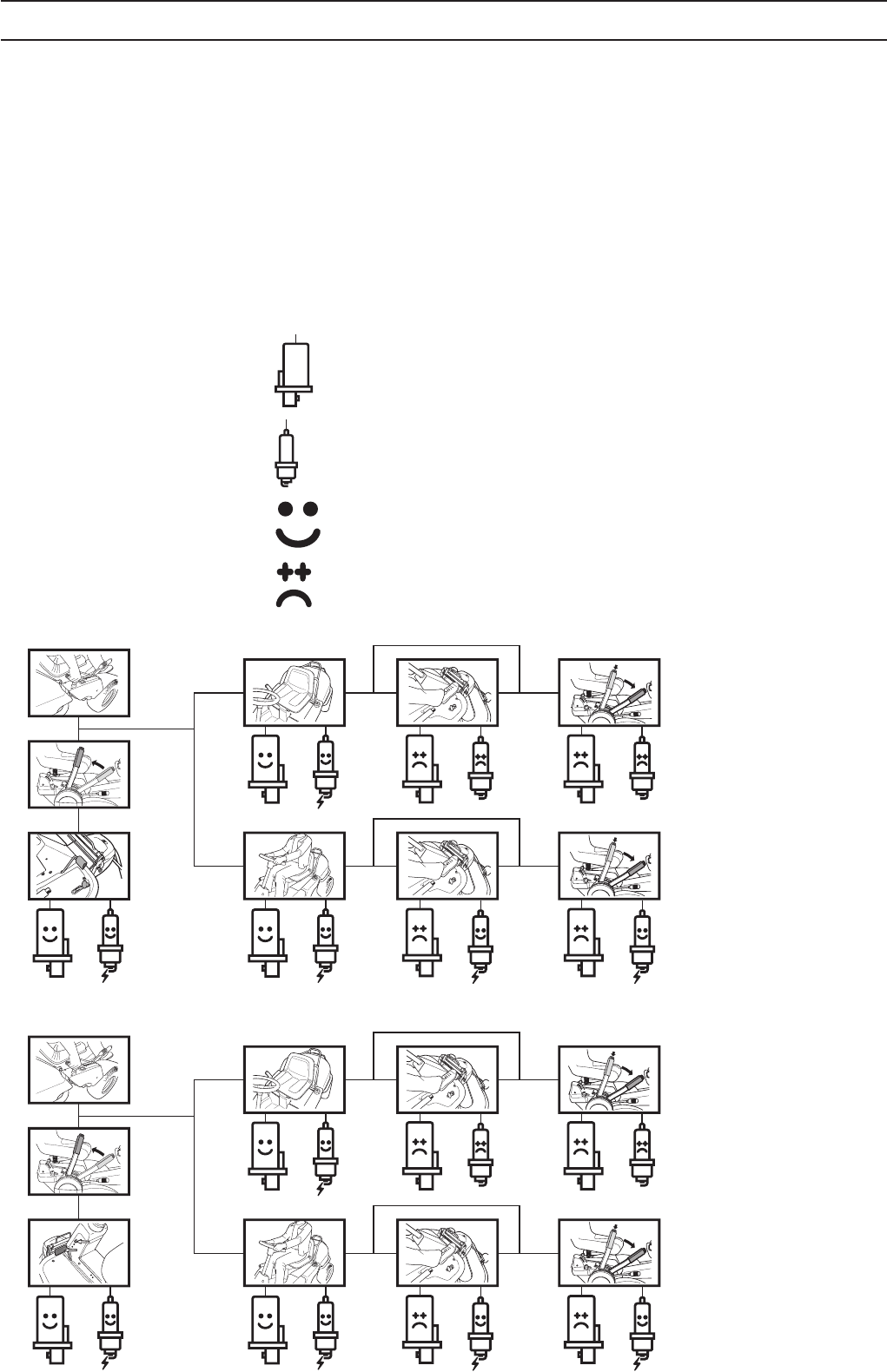
The machine is equipped with a safety system that prevents starting or driving under the following conditions.
The engine should only be possible to start when the cutting unit is in its raised position and the hydrostat pedals are in the neutral
position.
The driver does not need to be seated in the driver’s seat.
Rider 175 AWD, the engine can not be started if the parking brake is not pressed down.
Make daily inspections to ensure that the safety system works by attempting to start the engine when one of the conditions is not
met. Change the conditions and try again.
Check that the engine stops if you temporarily move out off the driver’s seat while the cutting unit is lowered or the hydrostat pedals
are not in the neutral position.
Start motor
Ignition system
Works
Does not work
Rider 175
Rider 175 AWD
English – 25
Maintenance
Main fuse
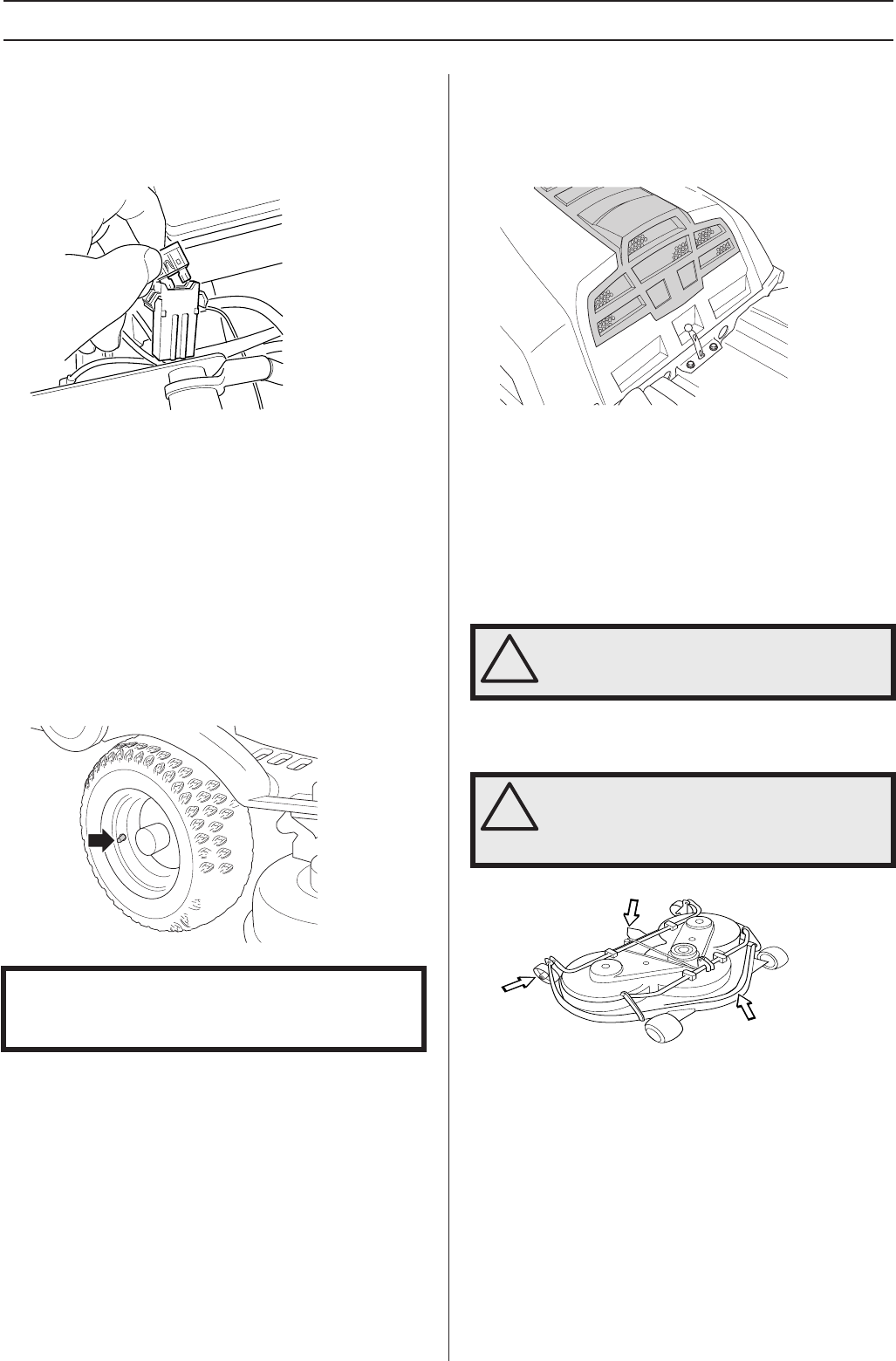
The main fuse is placed in a detachable holder under the
battery case’s cover, in front of the battery.
Type: Flat pin, 15 A.
Do not use any other type of fuse when replacing.
A blown fuse is indicated by a burnt connector. Pull the fuse
from the holder when replacing.
The fuse is there to protect the electrical system. If it blows
again shortly after replacement, it is due to a short circuit,
which must be fixed before the machine can be put into
operation again.
Checking the tyre pressure
The tyre pressure should be 60 kPa (0.6 kp/cm2/8.5 PSI) all
round. To improve driving the pressure on the rear tyres can
be reduced to 40 kPa (0.4 kp/cm2/5.6 PSI). The maximum
tyre pressure is 100 kPa (1,0 kp/cm2/14 PSI).
Checking the engine’s cooling air
intake
Clean the air intake grille in the engine cover behind the
driver’s seat.
Open the engine cover.
Check that the cooling intake is free from leaves, grass and
dirt.
Check the air duct, located on the inside of the engine cover,
ensure it is clean and does not rub against the cooling air
intake.
A blocked cooling intake will interfere with the cooling of the
engine, which can damage the engine.
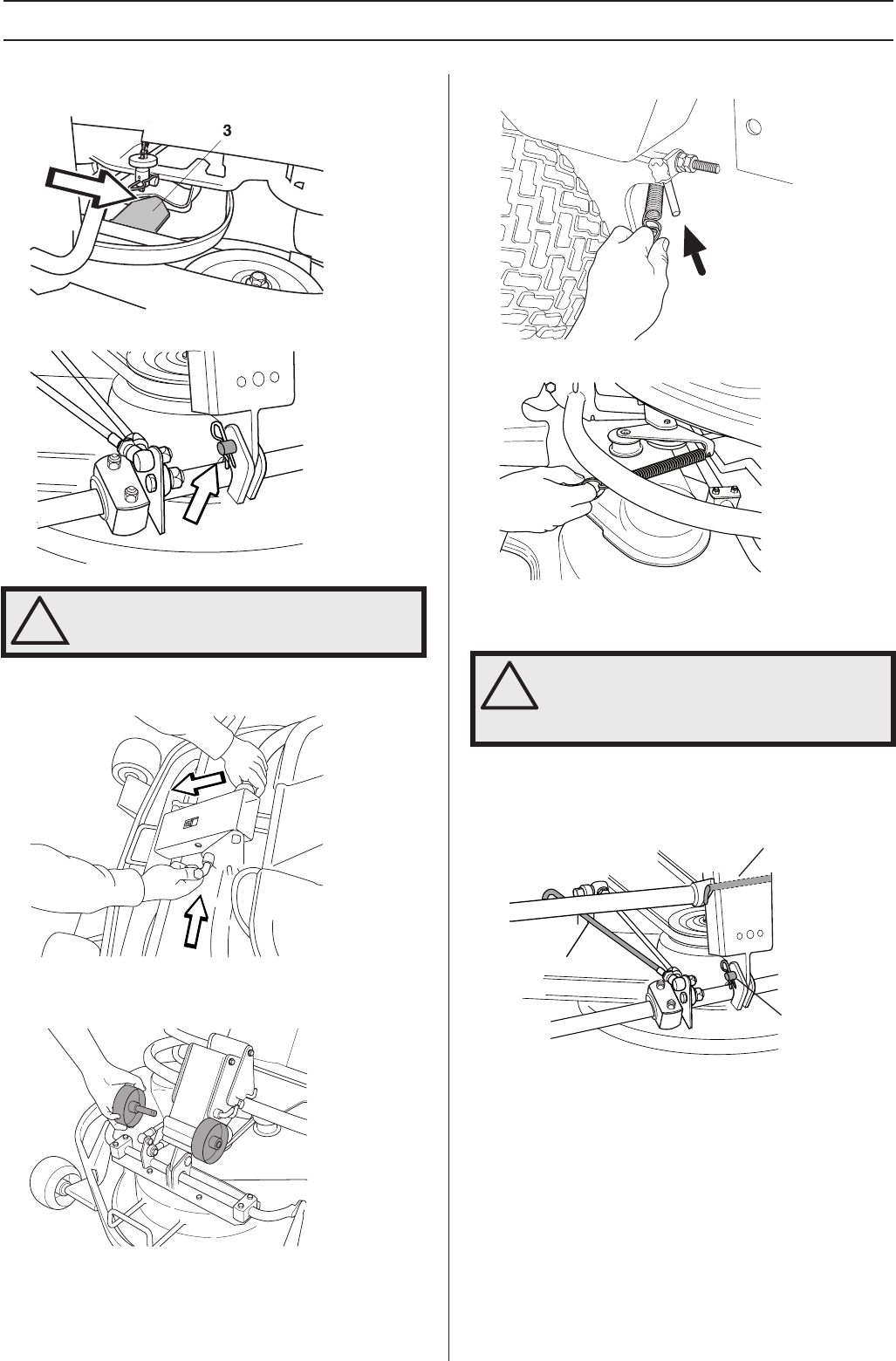
Fitting the cutting head
1 Place the Rider on a flat surface and apply the parking
brake. Check that the lever for setting the cutting height is
in the lowest position.
Make sure the support wheels are fitted to the cutting unit
(1).
2 Grasp the handle at the front or hold the frame of the
cutting unit (2) and slide the unit underneath the rider
mower.
IMPORTANT INFORMATION
Different tyre pressures on the front tyres will result in the
blades cutting the grass at different heights.
!
WARNING! The cooling air intake rotates
when the engine is running. Mind your
fingers.
!
WARNING! Wear protective glasses when
fitting the cutting unit. The spring which
tensions up the belt may break and cause
personal injury.
1
2
3
26 – English
Maintenance
Make sure that the tongue (3) on the cutting unit engages
correctly.
3 Insert the bolt and secure it with a locking pin.
4 Press down the frame and insert the pin. Fit the drive belt
around the drive wheels of the cutting unit.
5 Hook up the height adjustment strut.
6 Move the support wheels to their parking position.
7 Fit the front cover.
8 Secure the collet spring.
Rider 175
Rider 175 AWD
Removing the cutting unit
1 Carry out points 1-9 to put the cutting unit in the service
position, see Service position for the cutting unit.
2 Remove the bolt (3) and lift off the cutting unit.
Checking and adjustment of the
cutting unit’s ground pressure
To achieve the best cutting results the cutting unit should
follow the underlying surface without pressing too hard
against it.
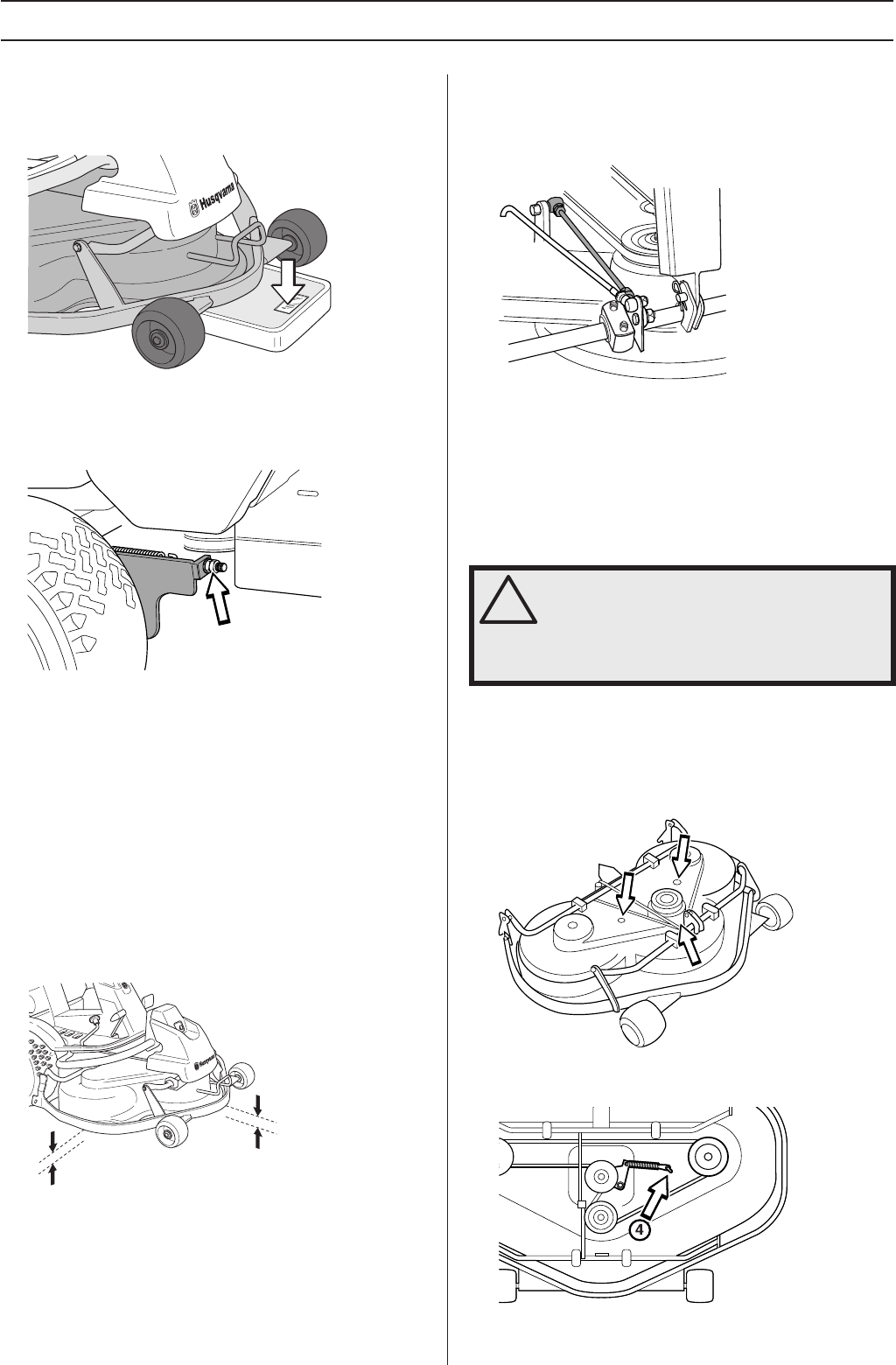
Pressure is adjusted using a screw and spring on each side
of the Rider.
1 Check the air pressure in the tyres 60 kPa/0.6 kp/cm2/8.5
PSI.
2 Place the machine on a flat surface.
3 Put the lifting lever in the mowing position.
!
WARNING! Observe caution to avoid
trapping your hand.
!
WARNING! Wear protective glasses when
dismantling the cutting unit. The spring
which tensions up the belt may break and
cause personal injury.
2
3
1
English – 27
Maintenance
4 Place a set of bathroom scales under the cutting unit’s
frame (front edge) so that it rests on the scales. If
necessary a block can be placed between the frame and
scales so that the support wheels do not bear any weight.
5 Adjust the unit’s ground pressure by screwing in or out the
adjusting screws located behind the front wheels on both
sides. The ground pressure should be between 12 and 15
kg (26.5-33 lb).
Checking the cutting unit’s
parallelism
Check the cutting unit’s parallelism as follows:
1 Check the air pressure in the tyres 60 kPa/0.6 kp/cm2/8.5
PSI.
2 Place the machine on a flat surface.
3 Put the lifting lever in the mowing position.
4 Measure the distance between the ground and the front
and rear edges of the cutting unit hood. The cutting unit
should have a slight slant, with the rear edge 2-4 mm (1/
8”) higher than the front edge.
Adjusting the parallelism of the
cutting unit
1 Remove the front hood and right-hand fender.
2 Undo the nuts on the lift strut.
3 Screw out (extend) the stay to raise the rear edge of the
cover.
Screw in (shorten) the stay to lower the rear edge of the
cover.
4 Tighten the nuts after adjustment.
5 On completion of the adjustment the unit’s parallelism
should be re-checked.
6 Fit the right-hand fender and the front hood.
Replacing the cutting unit belts
On these cutting units with collision-proof blades, the blades
are driven by one V-belt. Do as follows to change the V-belt:
1 Remove the cutting unit.
2 Undo the bolt on the lift strut and the two screws on the
cover. Lift the cover off the cutting unit.
3 Loosen the spring (4) that tensions the V-belt and pry off
the belt.
Simply reverse the procedure to fit the new belt.
!
WARNING! Wear gloves to protect your
hands when working with the blades.
There is a risk of crush injuries when
working with the belt.
28 – English
Maintenance
Service position for the cutting unit
The cutting head can be placed in the service position to
provide easy access for cleaning, repairs and servicing. In the
service position the cutting unit is raised and locked in the
vertical position.
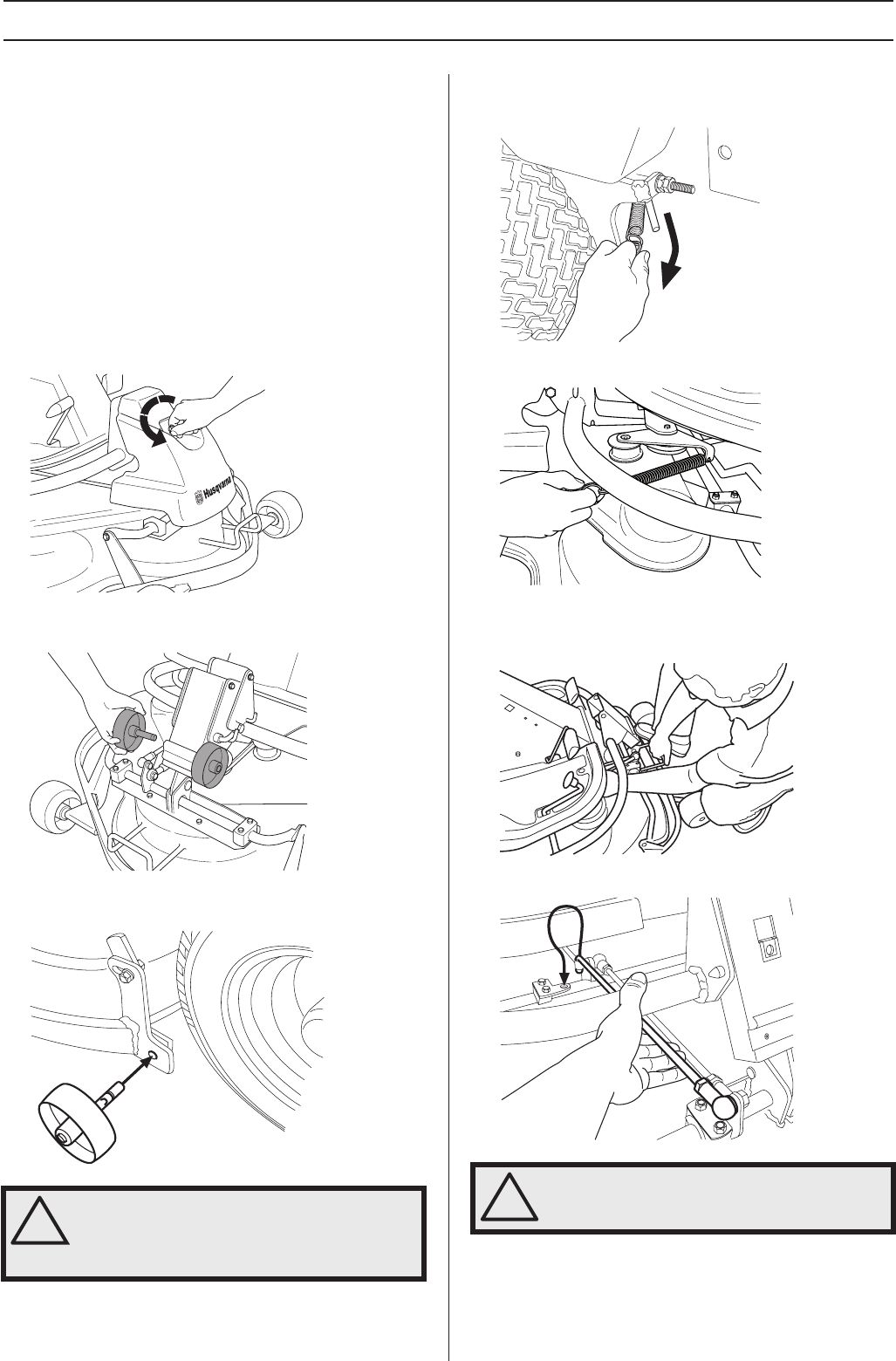
Placing in the service position
1 Position the machine on flat ground. Apply the parking
brake. Adjust the cutting unit to the lowest cutting height
and lower the cutting unit.
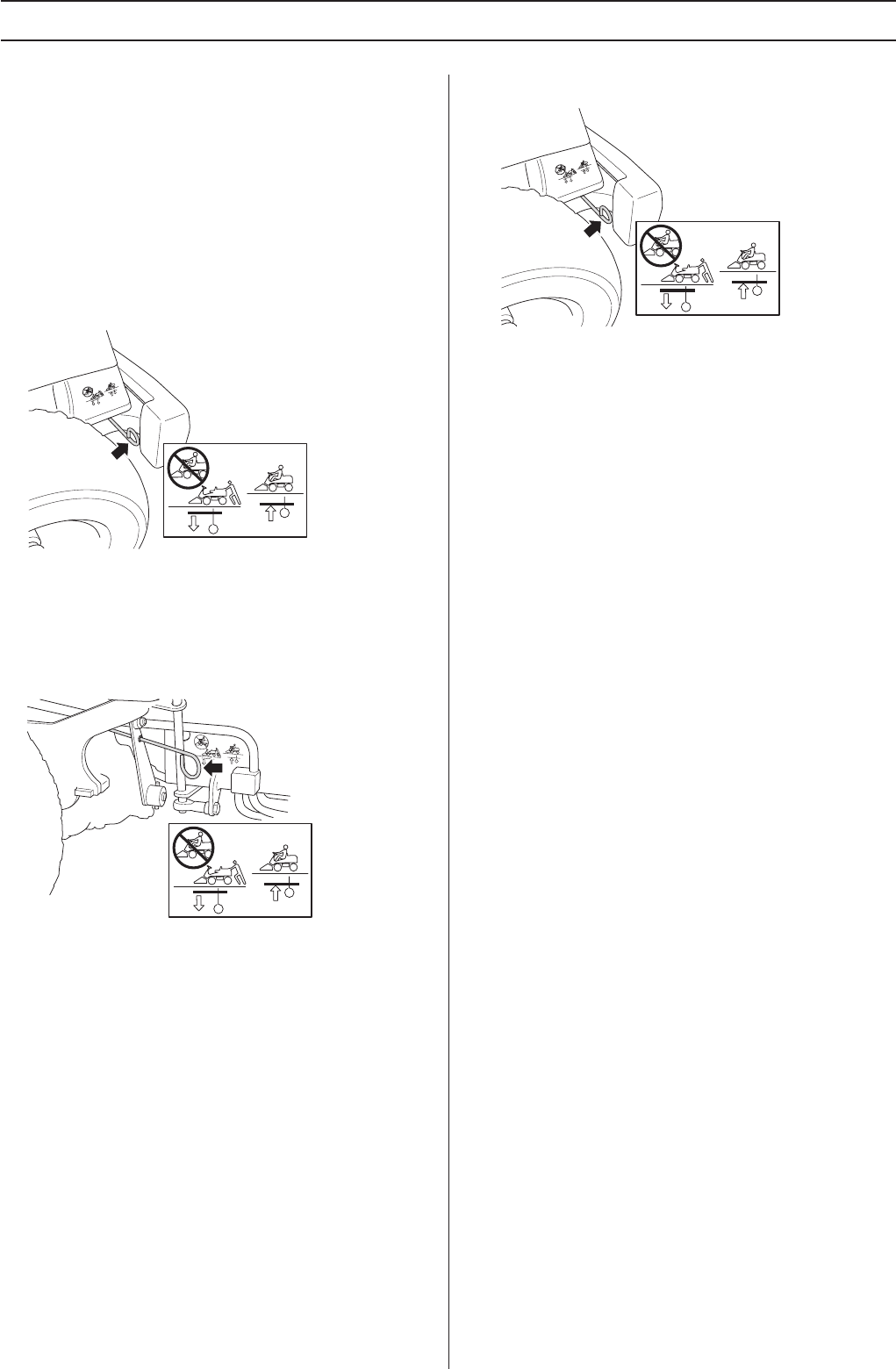
2 Remove the front hood by removing the pin. (There are
complete instructions on using the service position inside
the front hood).
3 Remove the two support wheels from under the front
hood.
4 Fit the support wheels on either side of the rear of the
cutting unit.
5 Disengage the spring for the drive belt tensioning wheel.
Rider 175
Rider 175 AWD
6 Place a foot on the front edge of the cutting unit near the
wheel and raise the front edge of the unit to make it easier
to remove the lift strut.
7 Engage the strut in the holder.
!
WARNING! Wear protective glasses when
dismantling the cutting unit. The spring
which tensions up the belt may break and
cause personal injury.
!
WARNING! Observe caution to avoid
trapping your hand.
English – 29
Maintenance
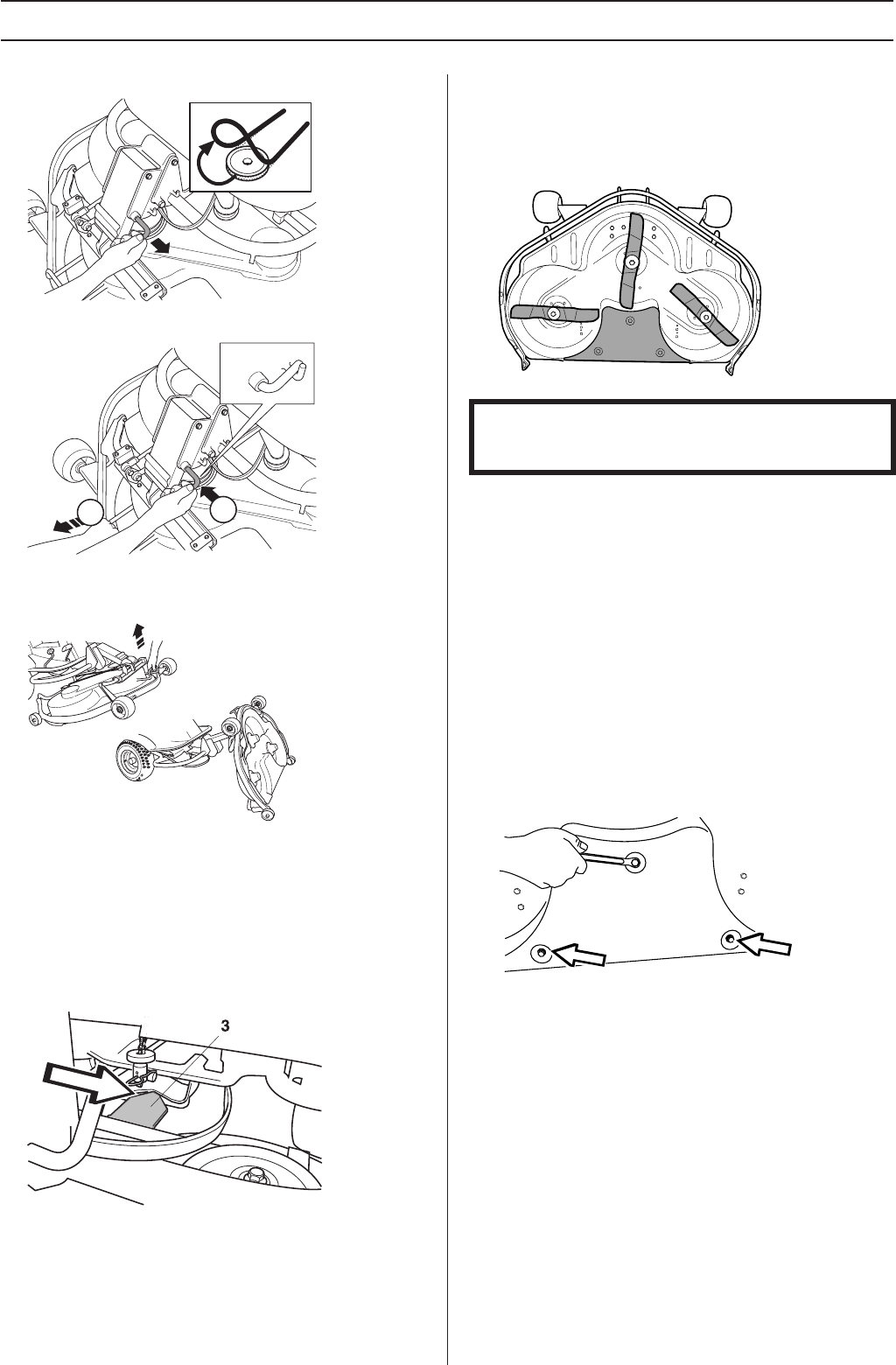
8 Lift of the drive belt. Then pull out the pin.
9 Pull the frame forwards and refit the pin.
10 Grasp the front edge of the cutting unit, pull out and raise
into the service position.
If the cylindrical bolt, which is now holding the cutting unit is
removed, the cutting unit can be lifted off.
Restoring from service position
To leave the service position, reverse the procedures set out
in Placing in the service position. Make sure that the cutting
unit’s ”lug” (3) enters the loop correctly on the underside of the
machine, see diagram.
Checking the blades
To achieve the best mowing results it is important that the
blades are undamaged and well-sharpened.
Check that the blades’ attachment screws are tight.
The blades should be balanced after sharpening.
Damaged blades should be replaced when hitting obstacles
that result in a breakdown. Let the servicing dealer judge
whether the blade can be repaired/ground or must be
discarded.
Removing the BioClip plug
To change a Combi unit from BioClip function to cutting unit
with rear ejection, remove the BioClip plug located under the
unit with three screws.
1 Put the unit in the service position, see Placing in the
service position.
2 Remove the three screws holding the BioClip plug, and
remove the plug.
3 Tip: Fit three full-thread screws M8x15 mm in the screw
holes to protect the threads.
4 Replace the unit in normal position.
Fit the BioClip plug in the reverse order.
12
IMPORTANT INFORMATION Replacing or sharpening the
blades should be conducted by an authorised service
workshop.
30 – English
Lubrication
Checking the engine’s oil level.
Check the oil level in the engine when the Rider stands
horizontal with the engine switched off.
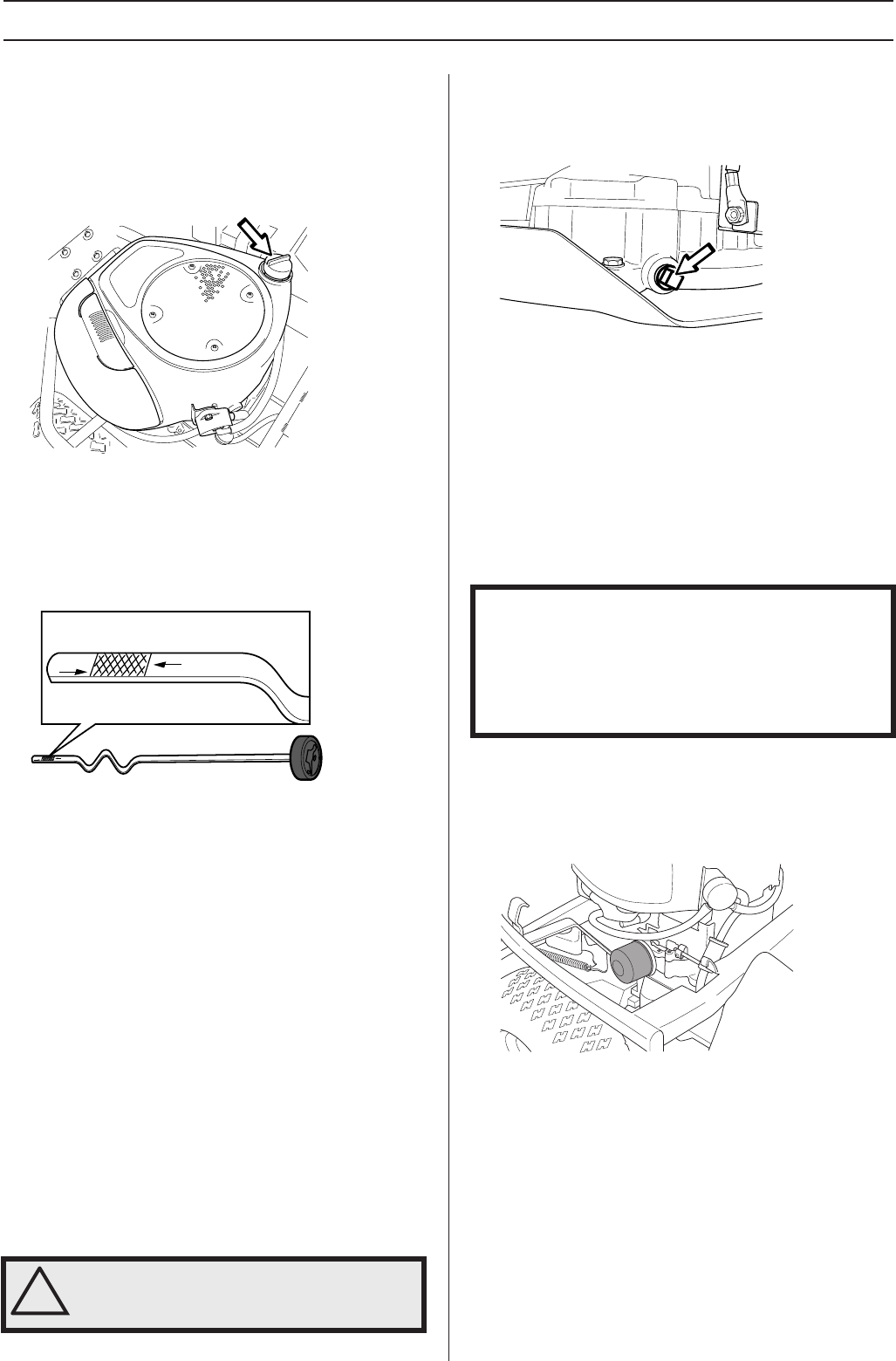
Open the engine cover.
Loosen the dipstick, pull it up and wipe it off.
Now insert the dipstick again. The dipstick should be
completely screwed down
Pull the dipstick out again and read the oil level.
The oil level should be between the markings on the dipstick.
If the level is approaching the ADD mark, top up the oil to the
FULL mark on the dipstick.
The oil is topped up through the hole the dipstick sits in. Fill
the oil slowly.
Tighten the dipstick correctly before starting the engine. Start
and run the engine at idling speed for approx. 30 seconds.
Turn off the engine. Wait 30 seconds and check the oil level.
If necessary fill so that the oil comes up to the FULL mark on
the dipstick.
First and foremost use synthetic engine oil class SJ-CF 5W/
30 or 10W/30 for all temperature ranges. Mineral oil SAE30,
class SF–CC can be used at temperatures > +5 °C (40 °F)
Do not mix different types of oil.
Caution when using oils such as 5W-20, 10W-30 and 10W-40
the engine’s oil consumption increases. If these oils must be
used, check the oil level frequently.
Replacing the engine oil
The engine oil should be changed the first time after 5 hours
running time. It should then be changed after every 50 hours
of running time. When operating with a heavy load or at high
ambient temperatures, replace every 25 hours.
1 Place a container underneath the engine’s left oil drain
plug.
2 Remove the dipstick. Remove the drain plug from the
engine’s left side.
3 Let the oil run out into the container.
4 Fit the drain plug and tighten it.
5 If necessary fill so that the oil comes up to the FULL mark
on the dipstick. The oil is topped up through the hole the
dipstick sits in. See Checking the engine’s oil level for
filling instructions. The engine holds 1.4 litres (1.5 USqt)
when the oil filter is not replaced and 1.6 litres (1.7 USqt)
of oil when the oil filter is replaced.
6 Run the engine warm, then check that there is no leakage
from the oil plug.
Changing the oil filter
The oil filter must be replaced after every 200 hours running
time. Turn the old oil filter anti-clockwise to remove. If
necessary, use a filter remover.
Lightly lubricate the rubber seal on the new oil filter using new
oil. Fit the oil filter by turning clockwise. Turn by hand until the
rubber seal is seated. Now tighten a further half turn.
Fill with new oil according to Checking the engine’s oil level.
Start the engine and let it idle for about 3 minutes. Now stop
it and check for signs of leakage. Fill with oil to compensate
for the oil held in the new oil filter.
!
WARNING! Engine oil can be very hot if it is
drained directly after stopping the engine.
Allow the engine to cool somewhat first.
ADD FULL
ADD FULL
IMPORTANT INFORMATION
Used engine oil is a health hazard and must not be
disposed of on the ground or in nature; it should always be
disposed of at a workshop or appropriate disposal location.
Avoid skin contact; wash with soap and water in case of
spills.
English – 31
Lubrication
Checking the transmission oil level
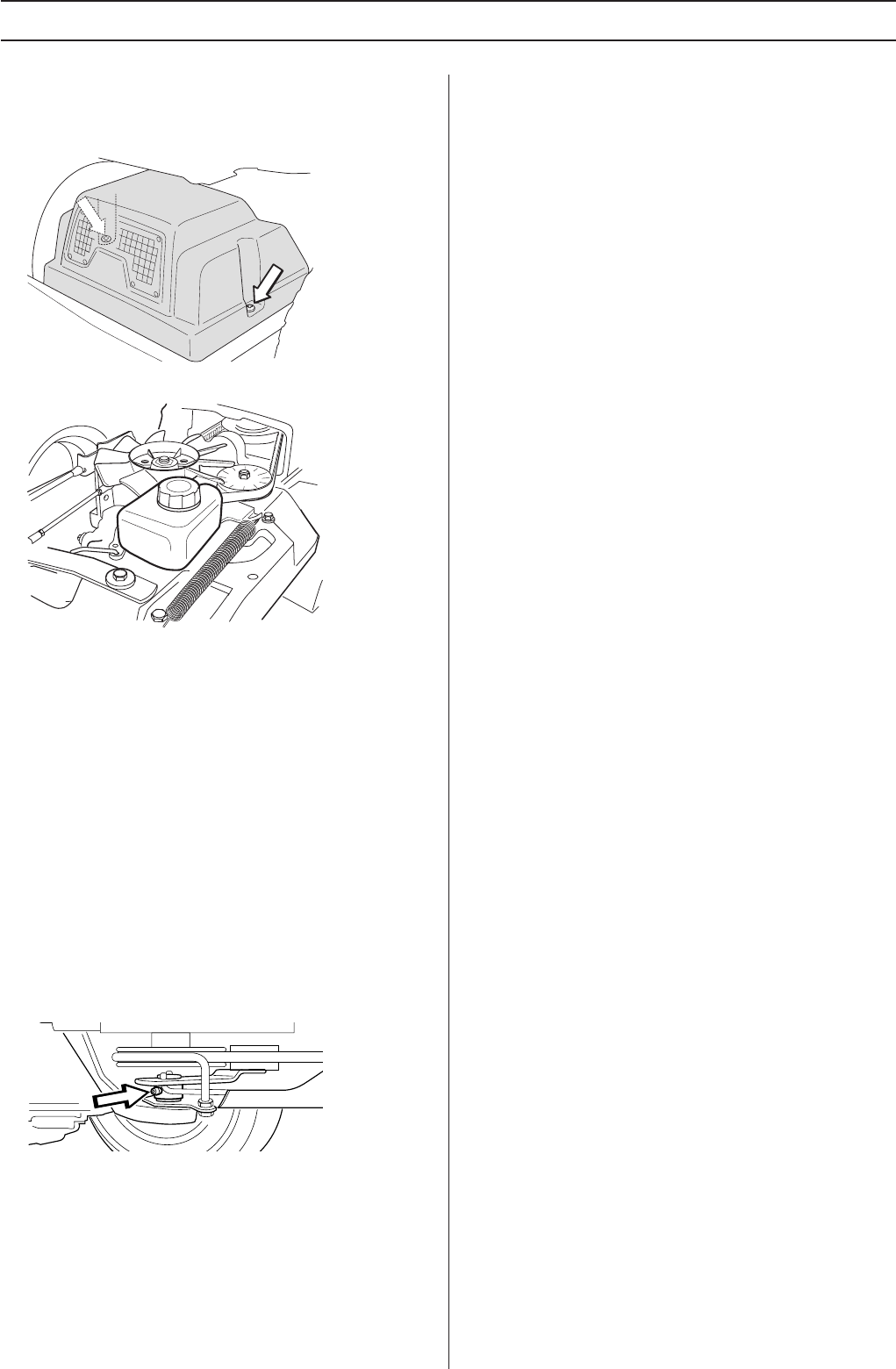
1 Remove the transmission cover. Undo the two screws
(one on each side) and lift off the transmission cover.
2 Check that there is oil in the transmission’s oil tank.
Rider 175 Fill if necessary with engine oil SAE 10W/30
(class SF–CC).
Rider 175 AWD Fill if necessary with engine oil SAE 10W/
40 (class SF–CC).
The oil and filter should be changed by an authorised service
representative, as described in the Workshop Manual.
Work on the system entails particular demands on
cleanliness and the system must be vented before the
machine is used.
Lubricating the belt adjuster
The belt adjuster should be lubricated regularly using good
quality molybdenum disulphide grease*.
Lubricate using a grease gun, 1 nipple from the right-hand
side under the engine’s lower belt pulley, until grease is forced
out.
With daily use, lubrication should be carried out twice weekly.
General lubrication
All joints and bearings are lubricated using molybdenum
disulphide grease during manufacture. Continue to lubricate
using the same type of grease *. Lubricate the steering and
control wires using engine oil.
Carry out this lubrication regularly; with daily use, the
machine should be lubricated twice weekly.
*Grease from well-known brand names (petrochemical
companies, etc.) usually maintains a good quality. The most
important property is that the grease provides good
protection against corrosion.

32 – English
Troubleshooting schedule
Problem Procedure
Engine does not start There is no fuel in the fuel tank
Spark plug defective
Faulty spark plug connections or interchanged cables
Dirt in the carburettor or fuel line
Starter motor does not turn over the engine
Starter motor does not turn over the engine Battery flat
Bad contact between the cable and battery
Lift lever for cutting unit in wrong position
Main fuse blown.
This fuse is in front of the battery, under the battery cover.
Ignition lock faulty
Hydrostat pedals not in the neutral position
Engine does not run smoothly Faulty spark plug.
Carburettor incorrectly set
Air filter clogged
Fuel tank vent blocked
Ignition key defective
Dirt in the carburettor or fuel line
Choking or incorrectly adjusted throttle cable
Engine seems to have no power Air filter clogged
Faulty spark plug.
Dirt in the carburettor or fuel line
Carburettor incorrectly set
Choking or incorrectly adjusted throttle cable
Engine overheats Engine overloaded
Air intake or cooling flanges blocked
Fan damaged
Too little or no oil in engine
Ignition defective
Faulty spark plug.
Battery does not charge One or more battery cells faulty
Poor contact on the battery terminal cable connectors
Machine vibrates Blades are loose
Engine is loose
One or more blades unbalanced, caused by damage or poor
balancing after sharpening
Uneven mowing Blades blunt
Cutting unit skew
Long or wet grass
Grass blockage under hood
Different tyre pressures on right and left sides
Over-speeding
Drive belt slipping
English – 33
Storage
Winter storage
At the end of the season, or if the machine is going to stand
idle for more than 30 days, it should immediately be made
ready for storage. Fuel which is left to stand for long periods
(30 days or more) can leave tacky deposits which can block
the carburettor and interfere with the engine.
Fuel stabiliser is an acceptable alternative to avoid tacky
deposits during storage. If alkylate petrol (Aspen) is used
stabiliser is not necessary since this fuel is stable. However,
one should avoid changing from standard to alkylate petrol
since sensitive rubber parts can harden. Add stabiliser to the
fuel in the tank or the storage container. Always use the
mixing ratios indicated by the manufacturer. Run the engine
for at least 10 minutes after adding the stabiliser so that it will
reach the carburettor. Do not empty the fuel tank and
carburettor if stabiliser has been added.
To prepare the machine for storage follow these instructions:
1 Carefully clean the machine, especially under the cutting
unit. Touch-up paint damage to avoid rust.
2 Inspect the machine for worn or damaged parts and
tighten loose screws and nuts.
3 Change the engine oil, and take care of the waste oil.
4 Empty the fuel tank. Start the engine and run it until the
carburettor is emptied of fuel.
5 Remove the plugs and pour about a tablespoon of engine
oil into each cylinder. Pull round the engine to distribute
the oil and screw the plugs back on.
6 Grease all grease nipples, joints and axles.
7 Remove the battery. Clean it, charge it, and store it in a
cool place.
8 Store the machine in a clean and dry place and cover it
over for extra protection.
Guard
There is a cover to protect your machine during storage or
transport. Contact your dealer for a demonstration
Service
Low season is the most suitable time to perform a service or
overhaul of the machine in order to ensure high function
safety during high season.
When ordering spare parts state your machine’s purchase
year, model, type, and serial number.
Always use genuine parts.
Annual inspection or tuning by an authorised service
workshop is a good way of getting the best out of your
machine the next season.
!
WARNING! Never place an engine with fuel
in the tank indoors or in poorly ventilated
areas where petrol fumes can come into
contact with naked flames, sparks or pilot
flames in boilers, hot water heaters, drying
cabinets, etc. Exercise caution when
handling fuel. It is highly inflammable, and
careless use can cause serious injury and
damage to property. Drain off the fuel in an
approved container outdoors and well clear
of naked flames. Never use petrol for
cleaning purposes. Use degreasing agents
and hot water instead.

34 – English
Technical data
´®z+R?T¶6&¨
´®z+R?T¶6&¨
Rider 175 Rider 175 AWD
Dimensions
Length without cutting unit, mm/ft 2020/6,61 2020/6,61
Width without cutting unit, mm/ft 880/2,89 880/2,89
Height, mm/ft 1070/3,52 1070/3,52
Operating weight with cutting deck, kg/lb 268-274/591-604 302-308/666-679
Wheel base, mm/ft 855/2,8 855/2,8
Track width, front, mm/ft 715/2,37 715/2,37
Track width, rear, mm/ft 625/2,05 625/2,05
Tyre dimensions 16 x 6,50 x 8 16 x 6,50 x 8
Air pressure, rear - front, kPa / kp/cm3 / PSI 60 (0,6/8,5) 60 (0,6/8,5)
Max. gradient 10°10°
Engine
Brand / Model Briggs & stratton/31G777 Briggs & stratton/31G777
Power, kW/hp 13,1/17,5 13,1/17,5
Displacement, cm3/cu.in 502 502
Fuel, minimum octane grade lead-free 85 85
Tank volume, litres/USqt 7/7,4 7/7,4
Oil Class SF, SG, SH or SJ SAE40, SAE30,
SAE10W-30, SAE10W-40 or SAE5W-20
Class SF, SG, SH or SJ SAE40, SAE30,
SAE10W-30, SAE10W-40 or SAE5W-20
Oil volume incl. filter 1,6/1,7 1,6/1,7
Oil volume excl. filter, litres/USqt 1,4/1,5 1,4/1,5
Starting Electric start 12V Electric start 12V
Electrical system
Type 12 V, negative earthed 12 V, negative earthed
Battery 12 V, 24 Ah 12 V, 24 Ah
Spark plug EMS PLATINUM EMS PLATINUM
Electrode gap, mm/inch 0,75/0,030 0,75/0,030
Noise emissions and cutting width
Sound power level, measured dB(A) 100 100
Sound power level, guaranteed dB(A) 100 100
Cutting width, mm 1030-1120/41-44 1030-1120/41-44
Vibration levels
Vibration level on the steering wheel, measured
according to EN 836:1997 / A2:2001 2,5 2,5
Transmission
Brand Tuff Torq K46 Tuff Torq
Oil, class SF-CC SAE 10W/30 SAE 10W/30
Cutting unit
Type 3-blade cover Combi 940 mm 3-blade cover Combi 940 mm
Cutting width, mm 1030mm/41” 1030mm/41”
Combi 103 Combi 103
1120 mm/44” 1120 mm/44”
Combi 112 Combi 112
Cutting heights, 7 positions, mm/inch 40-90/1 9/16-3 9/16 40-90/1 9/16-3 9/16
Blade length, mm/inch 390/15 3/8 (Combi 103) 390/15 3/8 (Combi 103)
(Combi 103) (Combi 103)
420/16 1/2 (Combi 112) 420/16 1/2 (Combi 112)
(Combi 112) (Combi 112)
IMPORTANT INFORMATION When the service life of this product has been served and it is no longer used it should be returned
to the dealer or to an applicable station for recycling.
IMPORTANT INFORMATION We reserve the right to change specifications and designs without prior notice so as to implement
improvements.
Note that no legal claims are valid on the basis of information in this manual.
Use only genuine parts for repairs. The warranty is not valid if non genuine parts are used.

English – 35
Technical data
EC-declaration of conformity (Applies to Europe only)
Husqvarna AB, SE-561 82 Huskvarna, Sweden, tel.: +46-36-146500, hereby declares that Husqvarna Rider 175 and Rider 175
AWD from 2005’s serial numbers and onwards (the year is clearly stated in plain text on the rating plate with subsequent serial
number), complies with the requirements of the COUNCIL’S DIRECTIVE:
of June 22, 1998 ”relating to machinery” 98/37/EC, annex IIA.
of May 3, 1989 ”relating to electromagnetic compatibility” 89/336/EEC, and applicable supplements.
of May 8, 2000 ”relating to the noise emissions in the environment” 2000/14/EC.
Information regarding noise emissions and the mowing width, see Technical data
The following harmonised standards have been applied: EN292-2, EN-836.
Registered body 0404, SMP Svensk Maskinprovning AB, Fyrisborgsgatan 3, SE-754 50 Uppsala, Sweden has issued reports
numbered as follows: regarding the assessment of conformity according to annex VI to the COUNCIL’S DIRECTIVE of May 8, 2000
relating to the emission of noise to surroundings, 2000/14/EC.
Huskvarna 9 June 2006
Roger Andersson, Development Manager/Garden Products
´®z+R?T¶6&¨
2006-10-30
´®z+R?T¶6&¨
1150315-26
