IceRobotics ICE3DTR1 IceReader User Manual TABLE OF CONTENTS

IceRobotics Limited IceReader TABLE OF CONTENTS

Users Manual Revised

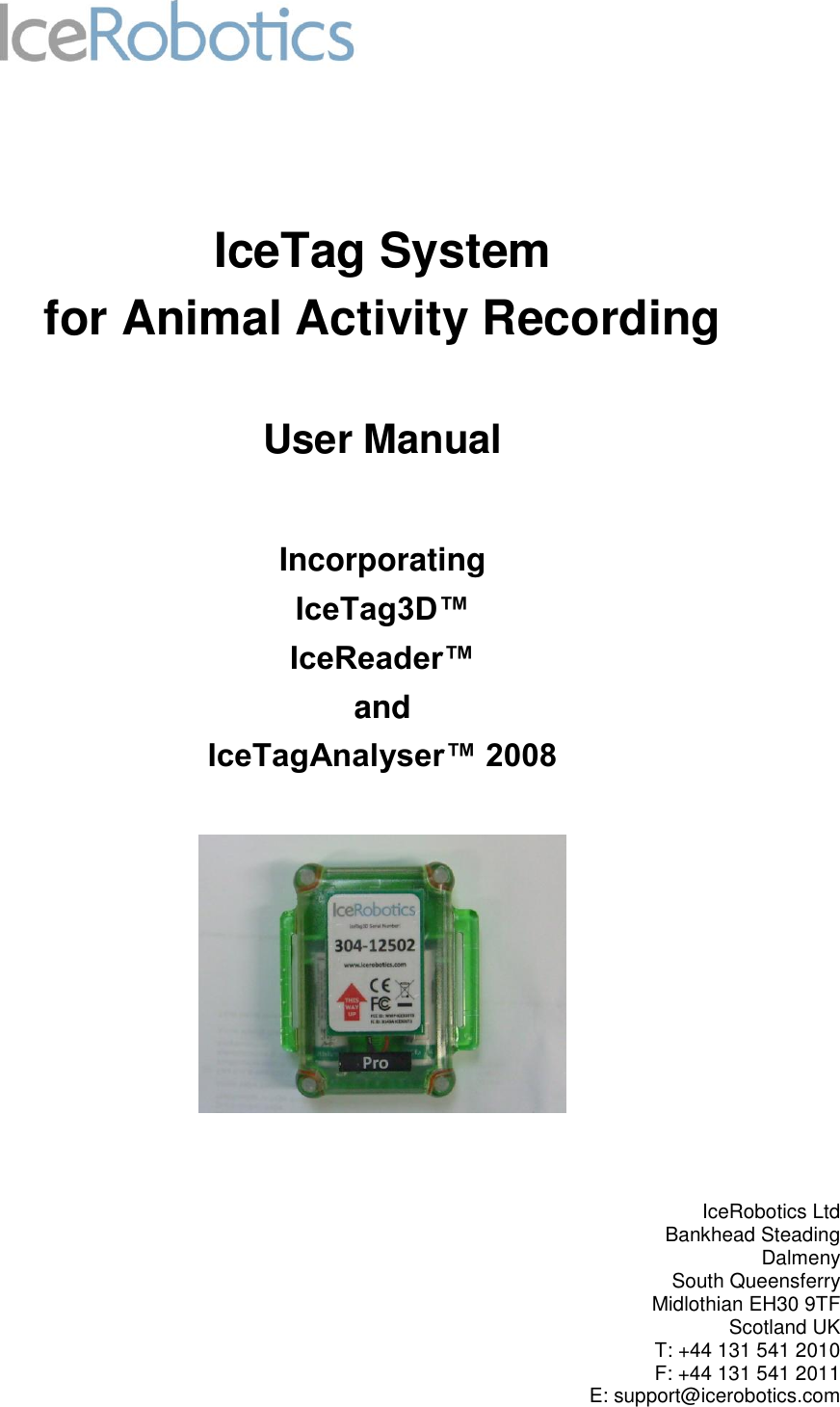
       IceTag System for Animal Activity Recording  User Manual  Incorporating  IceTag3D™  IceReader™  and  IceTagAnalyser™ 2008        IceRobotics Ltd Bankhead Steading Dalmeny South Queensferry Midlothian EH30 9TF Scotland UK T: +44 131 541 2010 F: +44 131 541 2011 E: support@icerobotics.com
IceTagAnalyser™ 2008    © IceRobotics Ltd 2008 User Manual Ref: UM3D-001-005    Page 2/23 TABLE OF CONTENTS  Table of figures ........................................................................................................................ 3 Foreword .................................................................................................................................. 4 1. Introduction .......................................................................................................................... 5 1.1 IceTag3D, IceReader & IceTagAnalyser 2008 Key Features ..........................................5 1.2 Recommended Minimum System Requirements .............................................................5 2. IceTag3D System Contents ................................................................................................ 6 2.1 Hardware ..........................................................................................................................6 2.2 Software and Documentation ...........................................................................................6 3. Installation ............................................................................................................................ 7 3.1 Installing the IceTagAnalyser 2008 Software ...................................................................7 3.2 Connecting the IceReader ...............................................................................................7 3.3 Communicating with an IceTag3D Motion Sensor Device ...............................................7 3.4 Attaching an IceTag3D Device to an Animal ...................................................................7 3.5 Removing an IceTag3D from an Animal ..........................................................................8 4. IceTagAnalyser 2008 ........................................................................................................... 9 4.1 Introducing the IceTagAnalyser 2008 ..............................................................................9 4.2 Getting IceTag3D Device Information ..............................................................................9 4.3 Activating an IceTag3D ................................................................................................. 10 4.4 Downloading Data from an IceTag3D Device ............................................................... 11 4.5 Viewing Recorded Data ................................................................................................ 13 4.5.1 Changing Session Header Information .................................................................. 13 4.5.2 Changing Session Start Time/Date ....................................................................... 14 4.5.3 Graphical View ....................................................................................................... 15 4.6 Creating Reports ........................................................................................................... 15 4.7 Exporting Data ............................................................................................................... 16 4.7.1 Exporting Open Session Files ............................................................................... 16 4.7.2 Exporting multiple files with Explorer ..................................................................... 17 4.7.3 Exporting from a Command Prompt or a Batch File .............................................. 17 4.8 Options .......................................................................................................................... 17 5. Interpreting the recorded data ......................................................................................... 19 6. Using IceTagAnalyser 2008 with IceTag 1.x and 2.x devices ....................................... 20  Appendix A : Troubleshooting A.1 Connecting the IceReader to your computer ................................................................ 21 A.2 Swiping an IceTag3D .................................................................................................... 21 A.3 Downloading Data ......................................................................................................... 21 A.4 Attaching Devices ......................................................................................................... 21  Appendix B: Example command line exports B.1 Exporting a single file to CSV ....................................................................................... 22 B.2 Exporting all files in a directory to CSV ......................................................................... 22
    TABLE  OF  FIGURESFigure 1. Attaching an IceTag3D to an animal ....................................................................... 8 Figure 2. IceTagAnalyser Interface Window .......................................................................... 9 Figure 3. The pull-down menu for displaying IceTag3D device info. .................................. 9 Figure 4. IceTag3D Device Info dialogue box ...................................................................... 10 Figure 5. IceTag3D device activation dialogue box. ........................................................... 11 Figure 6. The Download IceTag3D Session Data dialogue box ......................................... 11 Figure 7. The Open file dialogue box.................................................................................... 12 Figure 8. Viewing recorded session data ............................................................................. 13 Figure 9. The View menu options ......................................................................................... 13 Figure 10. Changing session header information ............................................................... 14 Figure 11. Changing the session start time and date. ........................................................ 14 Figure 12. Graphical data view .............................................................................................. 15 Figure 13. Create Report dialogue box................................................................................. 15 Figure 14. Add Session dialogue box................................................................................... 16 Figure 15. Default directory settings .................................................................................... 17 Figure 16. Export options ...................................................................................................... 18 Figure 17. Device Probing with only IceTag3D enabled ..................................................... 18 Figure 18. Extract from example recording ......................................................................... 19 Figure 19. Device Probing with IceTag3D disabled ............................................................ 20 Figure 20.Tools pull-down menu showing only IceTag2 (cable device) ........................... 20
    FOREWORD This  manual  provides  user  information on the IceTag3D™  motion sensor for  animal  activity recording, including IceTagAnalyser 2008 software and IceReader™ desktop reader unit. The system is designed by IceRobotics Ltd, Logan Building, Roslin BioCentre, Roslin, Midlothian, Scotland, UK, EH25 9TT. The content includes detailed installation and operating instructions.   SOFTWARE LICENCE AGREEMENT This  is  a  legal  agreement  between  you,  the  end  user,  and  IceRobotics  Ltd.  Read  this agreement very carefully. If you do not wish to accept this agreement, do not install or use the software product. 1. Grant  of  Licence:  Each  grant  of  licence  permits  you  to  install  and  use  the  associated version of the IceTagAnalyser™ 2008 software on multiple computers, with no more than one copy in use at any time. 2. Copyright: The software is owned by IceRobotics Ltd and is protected by United Kingdom copyright laws, international treaty provisions, and all other applicable national laws. Title, ownership rights, and intellectual property rights in  and to the software shall remain with IceRobotics  Ltd.  You  may  not  modify,  adapt,  translate,  reverse  engineer,  decompile, disassemble or otherwise attempt to discover the code and algorithms of the software. 3. Other restrictions : Except as expressly permitted in this licence agreement or with written permission  from  IceRobotics  Ltd,  the  software  may  not  be  used,  copied,  redistributed, retransmitted,  published,  sold,  rented,  leased,  marketed,  sublicenced,  assigned, transferred, altered or modified. 4. No Warranty: The software is delivered as is and IceRobotics Ltd makes no warranty as to its use or performance. IceRobotics Ltd does not, and cannot warrant the performance or results you may obtain by using the Software or its documentation. IceRobotics Ltd makes no  warranties,  expressed  or  implied,  as  to  non-infringement  of  third  party  rights, merchantability, or fitness for any particular purpose. In no event will IceRobotics Ltd be liable to you for any consequential, incidental or special damages, or for any claim by any third party. FCC STATEMENT  “This device complies with part 15 of the FCC Rules. Operation is subject to the condition that this device does not cause harmful interference”  USER STATEMENTS  The  user  is  cautioned  that  changes  /  modifications  not  approved  by  the  responsible  party could void the user‟s authority to operate the equipment.  NOTE:  This  equipment  has  been tested  and  found  to comply  with  the  limits for  a  Class  A digital  device,  pursuant  to  part  15  of  the  FCC  Rules.  These  limits  are  designed  to  provide reasonable  protection  against  harmful  interference  when  the  equipment  is  operated  in  a commercial environment. This equipment generates, uses, and can radiate radio frequency energy and, if not installed and used in accordance with the instruction manual, may cause harmful  interference  to  radio  communications.  Operation  of  this  equipment  in  a  residential area is likely to cause harmful interference in which case the user will be required to correct the interference at his own expense. The device carrier frequency is 127KHz and has a peak output power of -36.1dBmicroV/m at 300m.  The Category II Radio communication device (127 kHz TX) complies with Industry Canada Standard RSS-310. Ce dispositif de radio communication de catégorie II (127 kHz) respecte la norme CNR-310 d‟Industrie Canada.
    1. INTRODUCTION The IceTag3D motion sensor, IceReader download unit and IceTagAnalyser 2008 software together  provide  a  powerful  tool  enabling  animal  researchers  and  institutions  to  closely monitor, record and report animal activity. Mounted  on  the  hind  leg  of  an  animal,  the  IceTag3D  motion  sensor  incorporates accelerometer technology to monitor lying and standing/stepping behaviour. The device has a tough  plastic  housing  designed  to  withstand  the  farm  environment,  and  a  simple  strap mechanism for easy attachment and removal. The package comes complete with an IceReader for the purposes of wireless activation, data download  and  IceTag3D  status  reporting  on  your  PC  using  the  IceTagAnalyser  2008 software.  This user manual describes the installation and use of the IceTag3D device, IceReader and IceTagAnalyser 2008.   1.1 IceTag3D, IceReader & IceTagAnalyser 2008 Key Features   MS Windows application for downloading data from IceTag3D devices   Wireless activation and desk top download using portable IceReader unit attached to PC or Laptop   Stores up to 60 days of activity between downloads   Tough IceTag3D housing, designed to withstand the farm environment   Replaceable strap    12 month international replacement guarantee*    1.2 Recommended Minimum System Requirements   IBM compatible PC with Windows   Windows  98 Operating System or later version  CD-ROM drive for CD installation   USB port   Adobe Acrobat Reader software  The IceTag3D motion sensor system has been specifically calibrated with dairy cows.  Use of the system with other animals is easily applicable but will require validation and may require revised calibration, which on request will normally be provided free-of-charge by IceRobotics. For  details  of  the  animal  calibration  process,  please  contact  IceRobotics  at support@icerobotics.com.  *Note:  The  IceReader  wireless  download  unit  is  designed  for  desktop  use  only.    It  is  not designed to withstand the farm environment.  Outdoor use of the IceReader, or its use within the farm environment, may invalidate your product warranty.
    2. ICETAG3D SYSTEM CONTENTS The IceTag3D system comprises the following components:   2.1 Hardware   IceTag3D motion sensor   IceReader wireless download unit   USB interface cable   Velcro leg straps for one-time use   Velcro strap cutter    2.2 Software and Documentation This  system  is  provided  with  a  CDROM  disk  containing the  following  software  and  off-line documentation:   IceTagAnalyser 2008 software program    User manual in pdf format   USB drivers
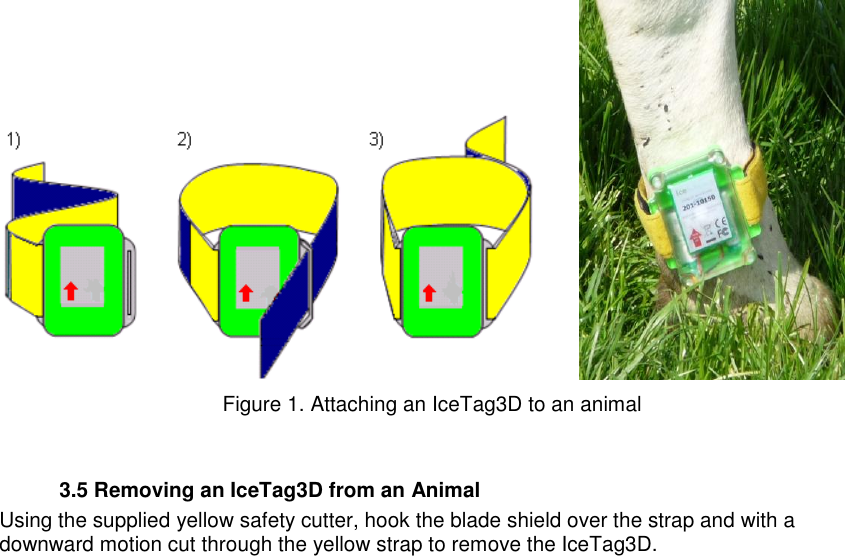
    3. INSTALLATION This  section  contains  step-by-step  instructions  on  how  to  install  the  IceTagAnalyser  2008 software  onto  your  PC,  how  to  activate  and  communicate  with  IceTag3D  motion  sensors using IceReader and how to attach and remove an IceTag3D device to an animal.     3.1 Installing the IceTagAnalyser 2008 Software Insert the IceTagAnalyser 2008 CD into the CD-ROM drive on your PC and follow the step-by-step guide to run the setup program on the IceTagAnalyser 2008 CD.  3.2 Connecting the IceReader  Using the USB cable provided connect the IceReader to any USB port on your PC.  The first time the IceReader is connected, the operating system may prompt for a driver installation.  On  most  versions  of  Microsoft  Windows  the  drivers  for  the  IceReader  are  included  in  the Microsoft Windows operating system.  Therefore no driver installation should be necessary.  The green LED on the IceReader will be illuminated if the IceReader is being powered.  The amber  LED  will  illuminate  on  the  IceReader  when  the  IceTagAnalyser  2008  software  has recognised the IceReader and is ready for use.   If  the  amber  LED  on  the  IceReader  does  not  illuminate,  then  driver  installation  may  be required. These can be installed from the IceTagAnalyser 2008 software CD. Simply re-run the setup application for IceTagAnalyser 2008 and select the „Full‟ installation option instead of  „Typical‟  installation.  A  „Typical‟  installation  will not  install  the  drivers  as  most versions  of Windows XP already have the required drivers pre-installed. The setup program will install the drivers  in  a  sub-directory  alongside  IceTagAnalyser;  this  is  typically  C:\Program Files\IceRobotics\IceTagAnalyser\USB  Drivers.  A  document  called  „DriverInstallation  DI3D-001-001.pdf‟,  found  in  the  „USB  Drivers‟  folder,  details  how  to  register  the  installed drivers with your system.    3.3 Communicating with an IceTag3D Motion Sensor Device To  activate  or  communicate  with  an  IceTag3D  device  swipe  the  IceTag3D  over  the IceReader.    The  amber LED on  the  IceTag3D  will  flash  to  indicate  that the  IceTag3D  has been  read.    To  verify  that  the  system  is  functioning  correctly  check  that  the  IceTag3D information is displayed on the screen.  This section describes IceTagAnalyser and its use.   3.4 Attaching an IceTag3D Device to an Animal The  IceTag3D  is  attached  to  an  animal‟s  hind  leg  using  the  Velcro  strap  provided.  The IceTag3D  should  be  mounted  with  the  red  arrow  pointing  upwards.  Figure  1  shows  a correctly attached IceTag3D and illustrates the attachment in three steps: 1.  Thread one end of the Velcro strap through the smaller, left hand side lug.  The smooth, yellow side of the Velcro should face inwards  against the animal‟s leg. Press the Velcro back onto itself to fasten. 2. Loop the strap around the animal‟s leg and through the bigger, right hand side lug. 3.  Press  the  Velcro  back  onto itself  to  fasten.    Check  the attachment  is  loose  enough  to allow two to three of your fingers to be inserted between the strap and the animal‟s leg.
                 Figure 1. Attaching an IceTag3D to an animal    3.5 Removing an IceTag3D from an Animal Using the supplied yellow safety cutter, hook the blade shield over the strap and with a downward motion cut through the yellow strap to remove the IceTag3D.
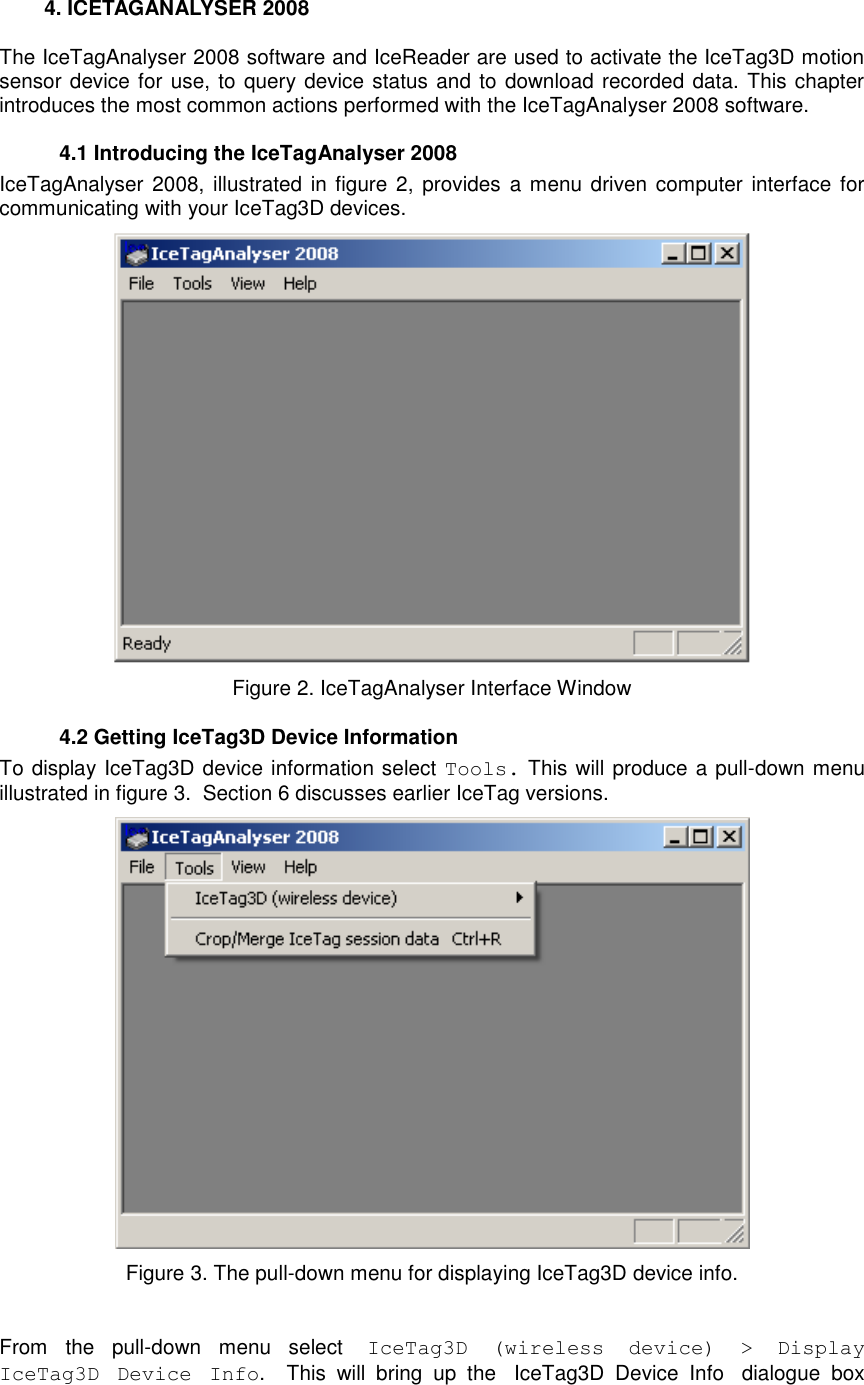
    4. ICETAGANALYSER 2008 The IceTagAnalyser 2008 software and IceReader are used to activate the IceTag3D motion sensor device for use, to query device status and to download recorded data. This chapter introduces the most common actions performed with the IceTagAnalyser 2008 software.   4.1 Introducing the IceTagAnalyser 2008 IceTagAnalyser 2008, illustrated in  figure 2, provides a menu driven  computer interface  for communicating with your IceTag3D devices.   Figure 2. IceTagAnalyser Interface Window   4.2 Getting IceTag3D Device Information To display IceTag3D device information select Tools. This will produce a pull-down menu illustrated in figure 3.  Section 6 discusses earlier IceTag versions.  Figure 3. The pull-down menu for displaying IceTag3D device info.  From  the  pull-down  menu  select  IceTag3D  (wireless  device)  >  Display IceTag3D  Device  Info.    This  will  bring  up  the IceTag3D  Device  Info dialogue  box
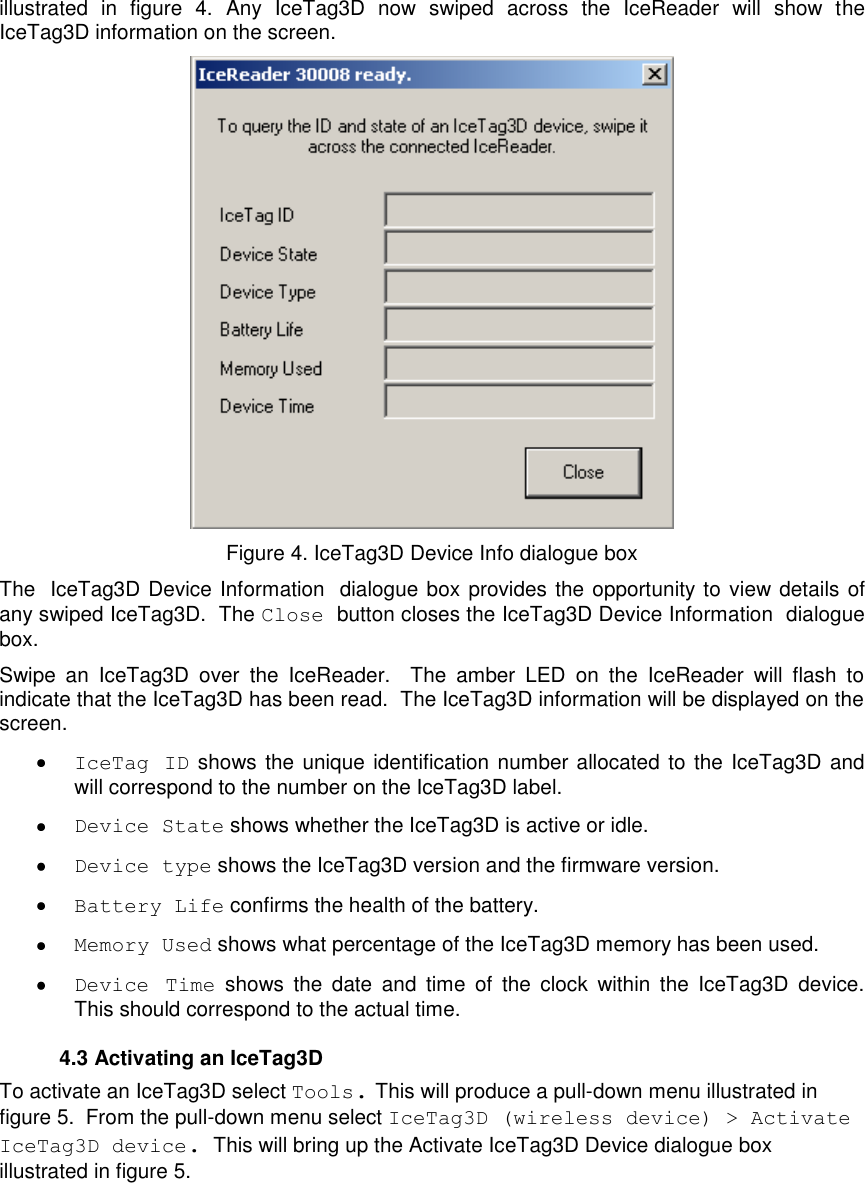
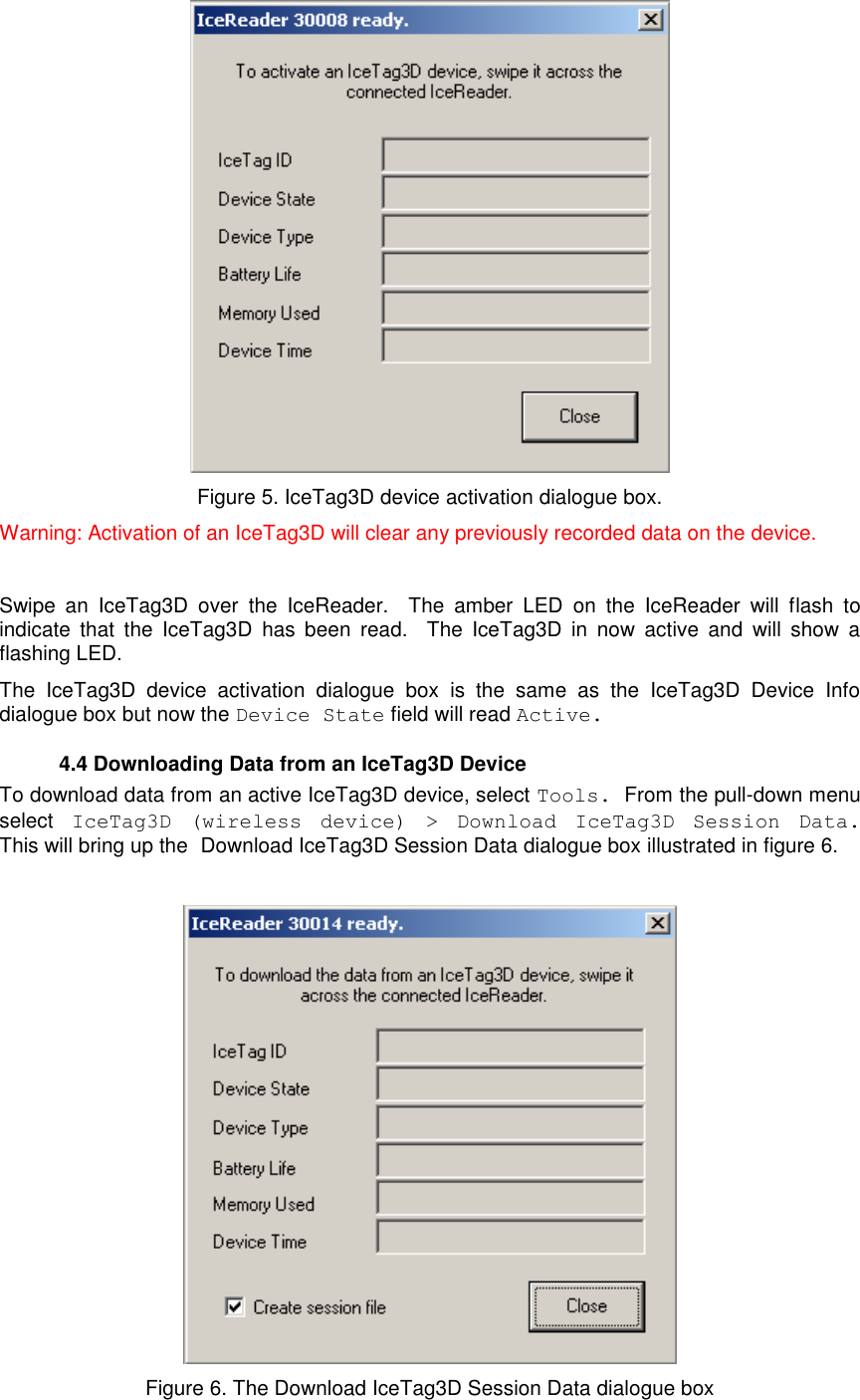
  illustrated  in  figure  4.  Any  IceTag3D  now  swiped  across  the  IceReader  will  show  the IceTag3D information on the screen.   Figure 4. IceTag3D Device Info dialogue box The IceTag3D Device Information dialogue box provides the opportunity to view details of any swiped IceTag3D.  The Close button closes the IceTag3D Device Information dialogue box. Swipe  an  IceTag3D  over  the  IceReader.    The  amber  LED  on  the  IceReader  will  flash  to indicate that the IceTag3D has been read.  The IceTag3D information will be displayed on the screen.    IceTag  ID shows the unique identification number allocated to the IceTag3D and will correspond to the number on the IceTag3D label.    Device State shows whether the IceTag3D is active or idle.   Device type shows the IceTag3D version and the firmware version.   Battery Life confirms the health of the battery.  Memory Used shows what percentage of the IceTag3D memory has been used.  Device  Time  shows  the  date  and  time  of  the  clock  within  the  IceTag3D  device.  This should correspond to the actual time.   4.3 Activating an IceTag3D To activate an IceTag3D select Tools. This will produce a pull-down menu illustrated in figure 5.  From the pull-down menu select IceTag3D (wireless device) > Activate IceTag3D device.  This will bring up the Activate IceTag3D Device dialogue box illustrated in figure 5.
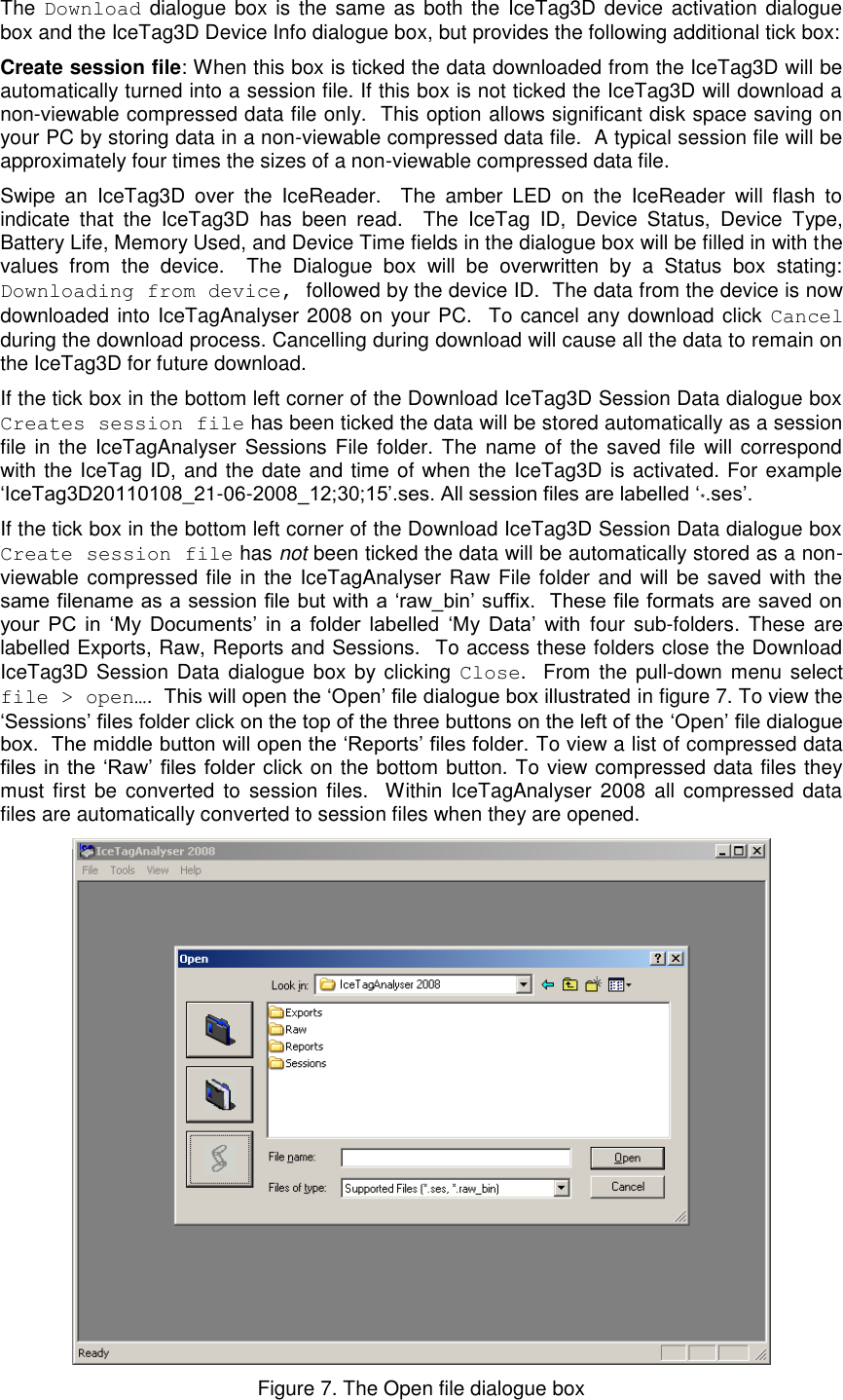
         Figure 5. IceTag3D device activation dialogue box. Warning: Activation of an IceTag3D will clear any previously recorded data on the device.  Swipe  an  IceTag3D  over  the  IceReader.    The  amber  LED  on  the  IceReader  will  flash  to indicate  that  the  IceTag3D  has  been  read.    The  IceTag3D  in  now  active  and  will  show  a flashing LED.   The  IceTag3D  device  activation  dialogue  box  is  the  same  as  the  IceTag3D  Device  Info dialogue box but now the Device State field will read Active.    4.4 Downloading Data from an IceTag3D Device To download data from an active IceTag3D device, select Tools. From the pull-down menu select IceTag3D  (wireless  device)  >  Download  IceTag3D  Session  Data.  This will bring up the Download IceTag3D Session Data dialogue box illustrated in figure 6.   Figure 6. The Download IceTag3D Session Data dialogue box
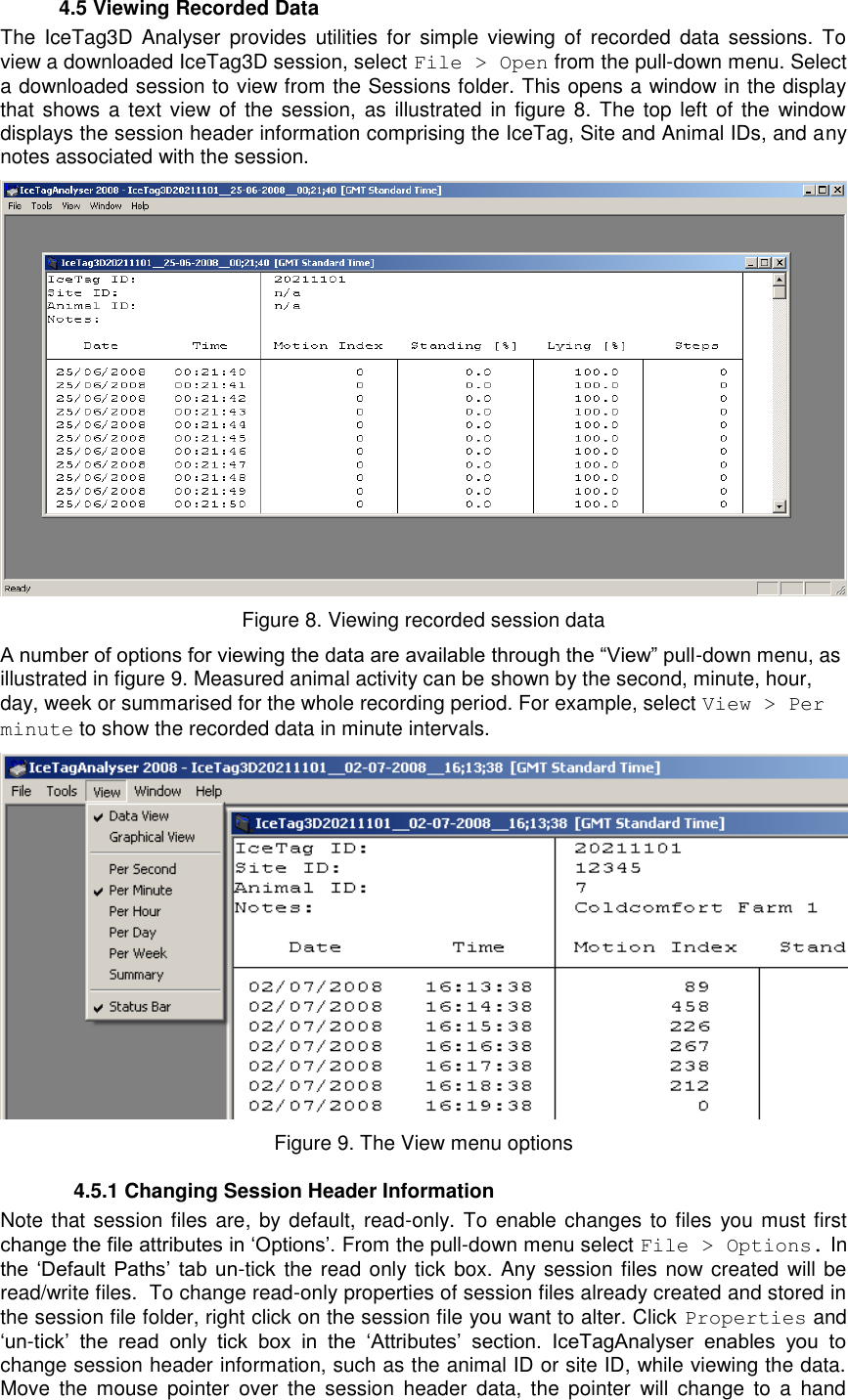
  The  Download dialogue box is  the same  as both the  IceTag3D device activation dialogue box and the IceTag3D Device Info dialogue box, but provides the following additional tick box: Create session file: When this box is ticked the data downloaded from the IceTag3D will be automatically turned into a session file. If this box is not ticked the IceTag3D will download a non-viewable compressed data file only.  This option allows significant disk space saving on your PC by storing data in a non-viewable compressed data file.  A typical session file will be approximately four times the sizes of a non-viewable compressed data file.  Swipe  an  IceTag3D  over  the  IceReader.    The  amber  LED  on  the  IceReader  will  flash  to indicate  that  the  IceTag3D  has  been  read.    The  IceTag  ID,  Device  Status,  Device  Type, Battery Life, Memory Used, and Device Time fields in the dialogue box will be filled in with the values  from  the  device.    The  Dialogue  box  will  be  overwritten  by  a  Status  box  stating: Downloading from device, followed by the device ID.  The data from the device is now downloaded into IceTagAnalyser 2008 on your PC.  To cancel any download click Cancel during the download process. Cancelling during download will cause all the data to remain on the IceTag3D for future download.   If the tick box in the bottom left corner of the Download IceTag3D Session Data dialogue box Creates session file has been ticked the data will be stored automatically as a session file in the IceTagAnalyser  Sessions File  folder.  The  name of the  saved  file  will  correspond with the IceTag ID, and the date and time of when the IceTag3D is activated. For example „IceTag3D20110108_21-06-2008_12;30;15‟.ses. All session files are labelled „*.ses‟.  If the tick box in the bottom left corner of the Download IceTag3D Session Data dialogue box Create session file has not been ticked the data will be automatically stored as a non-viewable compressed file in the IceTagAnalyser Raw File folder and  will be saved with the same filename as a session file but with a „raw_bin‟ suffix.  These file formats are saved on your  PC  in  „My  Documents‟  in  a  folder  labelled  „My  Data‟  with  four  sub-folders.  These are labelled Exports, Raw, Reports and Sessions.  To access these folders close the Download IceTag3D  Session Data dialogue box by clicking  Close.  From the pull-down menu select file > open….  This will open the „Open‟ file dialogue box illustrated in figure 7. To view the „Sessions‟ files folder click on the top of the three buttons on the left of the „Open‟ file dialogue box.  The middle button will open the „Reports‟ files folder. To view a list of compressed data files in the  „Raw‟  files  folder click on the bottom button. To view compressed data files they must  first  be  converted  to  session files.   Within IceTagAnalyser 2008  all  compressed  data files are automatically converted to session files when they are opened.    Figure 7. The Open file dialogue box
    4.5 Viewing Recorded Data The  IceTag3D  Analyser  provides  utilities  for  simple  viewing  of  recorded  data  sessions.  To view a downloaded IceTag3D session, select File > Open from the pull-down menu. Select a downloaded session to view from the Sessions folder. This opens a window in the display that shows a  text  view of the  session,  as  illustrated  in figure 8. The top  left  of the window displays the session header information comprising the IceTag, Site and Animal IDs, and any notes associated with the session.  Figure 8. Viewing recorded session data A number of options for viewing the data are available through the “View” pull-down menu, as illustrated in figure 9. Measured animal activity can be shown by the second, minute, hour, day, week or summarised for the whole recording period. For example, select View > Per minute to show the recorded data in minute intervals.  Figure 9. The View menu options   4.5.1 Changing Session Header Information  Note that session files are, by default, read-only. To enable changes  to files  you must first change the file attributes in „Options‟. From the pull-down menu select File > Options. In the  „Default  Paths‟  tab  un-tick the read only tick  box. Any session files now created will be read/write files.  To change read-only properties of session files already created and stored in the session file folder, right click on the session file you want to alter. Click Properties and „un-tick‟  the  read  only  tick  box  in  the  „Attributes‟  section.  IceTagAnalyser  enables  you  to change session header information, such as the animal ID or site ID, while viewing the data. Move  the  mouse  pointer  over  the  session  header  data,  the  pointer  will  change  to  a  hand
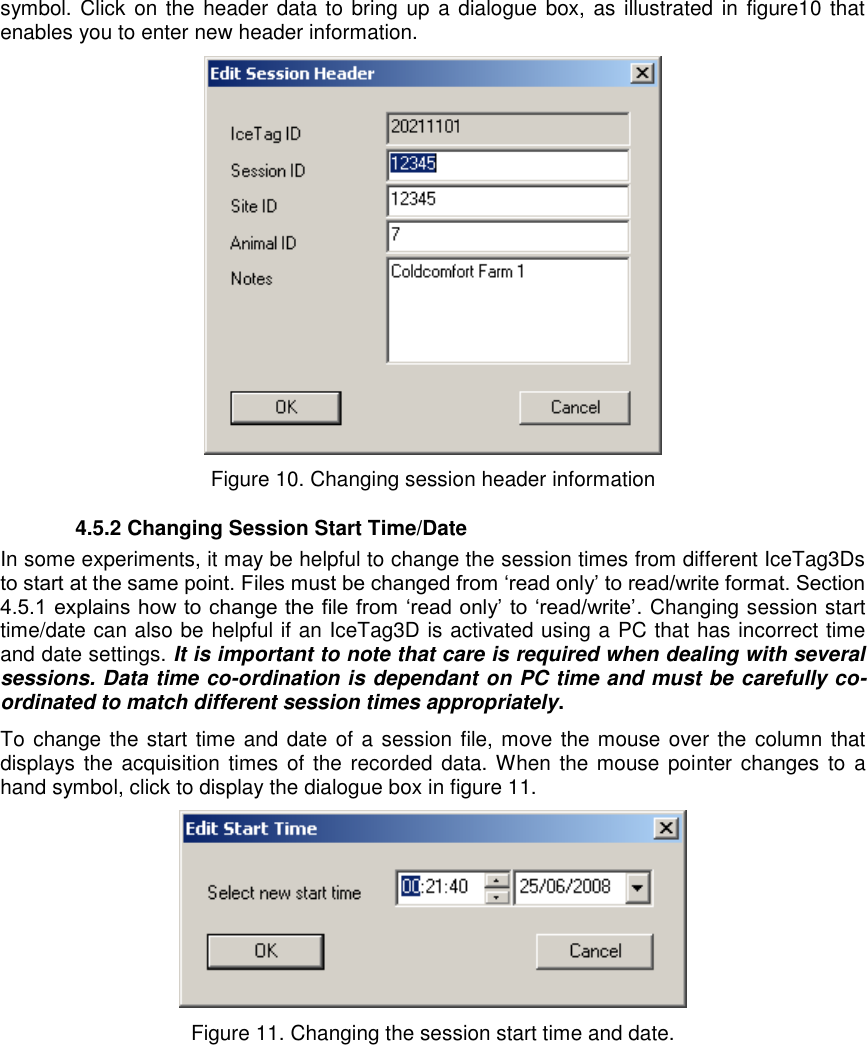
  symbol. Click on the header data to bring  up a dialogue  box, as illustrated in figure10 that enables you to enter new header information.   Figure 10. Changing session header information   4.5.2 Changing Session Start Time/Date In some experiments, it may be helpful to change the session times from different IceTag3Ds to start at the same point. Files must be changed from „read only‟ to read/write format. Section 4.5.1 explains how to change the file from  „read only‟ to „read/write‟. Changing session start time/date can also be helpful if an IceTag3D is activated using a PC that has incorrect time and date settings. It is important to note that care is required when dealing with several sessions. Data time co-ordination is dependant on PC time and must be carefully co-ordinated to match different session times appropriately.   To change the start time and date of a session file, move the mouse over the  column that displays the acquisition times of the  recorded data. When the mouse  pointer changes to  a hand symbol, click to display the dialogue box in figure 11.   Figure 11. Changing the session start time and date.
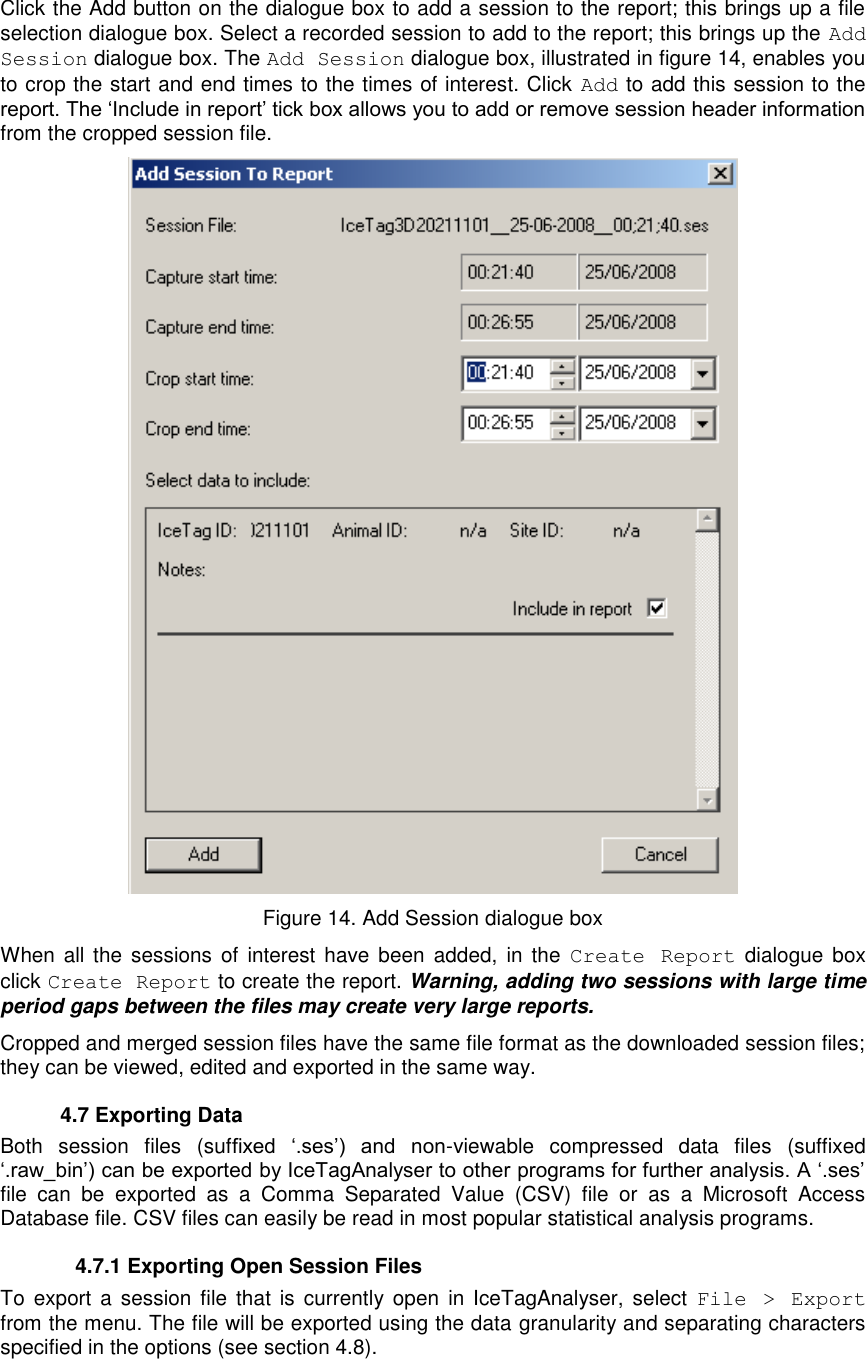
    4.5.3 Graphical View  Select View > Graphical View from the pull-down menu to view the recorded data in a graphical format. As  with the Data View, the activity can be shown  by the second, minute, hour, day, week or as a total. Figure 12 shows a screen shot of data in graphical view.   Figure 12. Graphical data view Move the mouse pointer over the “Standing [%]” in the left section of the window. The mouse pointer changes to a hand to show that this area of the screen is clickable. Click on “Standing [%]” to  hide  the standing  information in the graphical  view.  Active and lying information can also be hidden in this way. This is a useful tool for finding times of interest in the recorded session.    The  motion  index  is  represented  on  a  logarithmic  scale  to  improve  visibility  of motion.  All other values are on a linear scale.    4.6 Creating Reports When an experiment requires that data be collected from multiple animals at the same time, it can be useful to collate the multiple session data into a single session. It may also be useful to truncate the recorded data to remove recordings before the IceTag3D was attached and after  it  was  removed.  The  Create  Report  tool  enables  you  to  do  this.  Select  Tools  > Crop/Merge  IceTag  session  data  to  open  the  Create  Report  dialogue  box, illustrated in figure 13.  Figure 13. Create Report dialogue box
  Click the Add button on the dialogue box to add a session to the report; this brings up a file selection dialogue box. Select a recorded session to add to the report; this brings up the Add Session dialogue box. The Add Session dialogue box, illustrated in figure 14, enables you to crop the start and end times to the times of interest. Click  Add to add this session to the report. The „Include in report‟ tick box allows you to add or remove session header information from the cropped session file.  Figure 14. Add Session dialogue box When all  the  sessions of  interest  have  been  added,  in the  Create  Report  dialogue  box click Create Report to create the report. Warning, adding two sessions with large time period gaps between the files may create very large reports. Cropped and merged session files have the same file format as the downloaded session files; they can be viewed, edited and exported in the same way.    4.7 Exporting Data Both  session  files  (suffixed  „.ses‟)  and  non-viewable  compressed  data  files  (suffixed „.raw_bin‟) can be exported by IceTagAnalyser to other programs for further analysis. A „.ses‟ file  can  be  exported  as  a  Comma  Separated  Value  (CSV)  file  or  as  a  Microsoft  Access Database file. CSV files can easily be read in most popular statistical analysis programs.   4.7.1 Exporting Open Session Files To  export  a  session file  that  is  currently open  in IceTagAnalyser, select  File  >  Export from the menu. The file will be exported using the data granularity and separating characters specified in the options (see section 4.8).
    4.7.2 Exporting multiple files with Explorer Both „.ses‟ files and „.raw_bin‟ files can be exported using Windows Explorer. In the Session file folder right click on the session file you want to export and select Export. The file will be exported using the data  granularity and  separating characters  specified  in the options  (see section 4.8). NB: More than one session file can be selected at once.  Exporting multiple files with Explorer also applies to „.raw_bin‟ files in the Raw file folder.   4.7.3 Exporting from a Command Prompt or a Batch File IceTagAnalyser 2008 supports a number of command line options that can be used to open or export session files. This can be useful, should scripted/batch file exporting be required. IceTagAnalyser 2008 supports the following command line options: IceTagAnalyser.exe [/exp [/format:csv/mdb] [/force]] <filename> where <filename> Full path and name of a .ses file /exp Option will export file to csv or mdb. If omitted, file will be opened in IceTagAnalyser. /format:csv Exports file as csv (output file name will not be prompted) /format:mdb Exports file as mdb (output file name will not be prompted) /force Export will overwrite existing files without prompting      For command-line exports, the output path and output format (time granularity and delimiters) are taken from the current IceTagAnalyser settings. Appendix B contains some command-line examples.   4.8 Options Select  File  >  Options  from  the  pull-down  menu  to  set  the  application  options  for  the IceTagAnalyser 2008 software. The options that are configurable include the default path for Raw, Session, Report and Export file storage settings; export settings for the CSV files and Device Probing COM settings. Figure 15 shows the „default paths‟ tab. Downloaded session files are, by default, set as read-only.  The  „read  only‟  tick  boxes  on  the  „default  Paths‟  tab allow this safety feature to be overridden.    Figure 15. Default directory settings
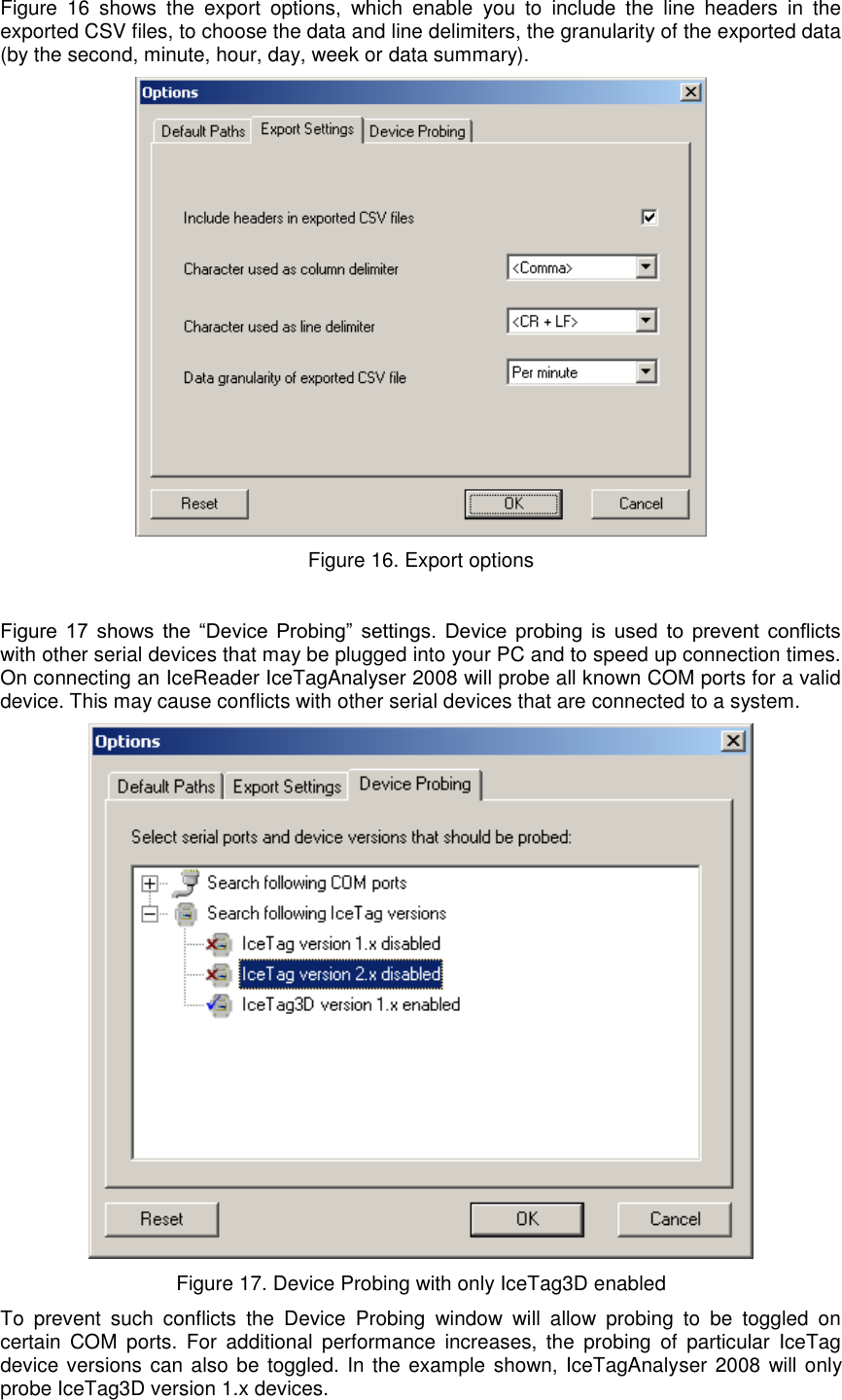
  Figure  16  shows  the  export  options,  which  enable  you  to  include  the  line  headers  in  the exported CSV files, to choose the data and line delimiters, the granularity of the exported data (by the second, minute, hour, day, week or data summary).    Figure 16. Export options  Figure  17  shows  the  “Device  Probing”  settings.  Device  probing  is  used  to  prevent  conflicts with other serial devices that may be plugged into your PC and to speed up connection times. On connecting an IceReader IceTagAnalyser 2008 will probe all known COM ports for a valid device. This may cause conflicts with other serial devices that are connected to a system.   Figure 17. Device Probing with only IceTag3D enabled To  prevent  such  conflicts  the  Device  Probing  window  will  allow  probing  to  be  toggled  on certain  COM  ports.  For  additional  performance  increases,  the  probing  of  particular  IceTag device versions can also be toggled. In the example shown, IceTagAnalyser 2008 will only probe IceTag3D version 1.x devices.
    5. INTERPRETING THE RECORDED DATA The IceTag3D analyses the movement of an animal‟s leg and defines standing, lying and step with a Motion Index. The Motion Index provides detail on how active the animal has been. For each  second  the  Motion  Index  is  typically  a  value  between  0  and 30,  with 0  indicating  no movement and 30 indicating vigorous motion of the leg that second. Viewing the data  per-minute, per-hour or per-day, the program sums the Motion Index for each second of the given time period. Where the animal is active, a step count indicates the number of steps taken by the animal during that time. The reported step count is the number of steps taken by the leg on which the IceTag3D is located.  Figure 18 shows an extract of an exported CSV file from an IceTag3D which was recording the activity of an animal. The Export Options were set to report the activity minute by minute. The  data  shows  the  date  and  time  interval  and  the  percentage  of  time  spent  during  that interval standing or lying, a step count and an indication of activity from the Motion Index. Tag ID:  155891    Site ID:  Coldcomfort    Animal ID:  #218          Date Time Motion Index        Standing [%] Lying [%] Steps 20/09/2008 16:41:24 20.4 79.6 0 9 20/09/2008 16:42:24 58.3 41.7 0 25 20/09/2008 16:43:24 61.3 38.7 0 26 20/09/2008 16:44:24 30.4 69.6 0 13 20/09/2008 16:45:24 33.5 66.5 0 13 20/09/2008 16:46:24 80.8 19.2 0 37 20/09/2008 16:47:24 45.2 54.8 0 19 20/09/2008 16:48:24 4.8 95.2 0 2 20/09/2008 16:49:24 5 95 0 2 20/09/2008 16:50:24 8.3 91.7 0 4 20/09/2008 16:51:24 9.2 90.8 0 3 20/09/2008 16:52:24 0 100 0 0 20/09/2008 16:53:24 0 100 0 0 20/09/2008 16:54:24 0 100 0 0 20/09/2008 16:55:24 2.7 97.3 0 1 20/09/2008 16:56:24 0 100 0 0 20/09/2008 16:57:24 0 100 0 0 20/09/2008 16:58:24 2.9 97.1 0 1 20/09/2008 16:59:24 0 100 0 0 20/09/2008 17:00:24 2.7 97.3 0 1 20/09/2008 17:01:24 0 100 0 0 20/09/2008 17:02:24 0 100 0 0 20/09/2008 17:03:24 2.3 97.7 0 1 20/09/2008 17:04:24 0 100 0 0 20/09/2008 17:05:24 3 97 0 0 20/09/2008 17:06:24 2.9 97.1 0 1 20/09/2008 17:07:24 13.1 86.9 0 6 20/09/2008 17:08:24 13.5 86.5 0 5 20/09/2008 17:09:24 1.7 98.3 0 1 20/09/2008 17:10:24 44.2 55.8 0 16 20/09/2008 17:11:24 21 79 0 8 Figure 18. Extract from example recording Note  that  an  animal may  be  recorded  as  being  active,  but  have  taken  no  steps.  This  can occur,  for  example,  when  an  animal  is  standing  and  shuffling  its  feet,  but  is  not  actually stepping; this can be a useful measure of restlessness. In figure 18, at 17:05 the animal is measured to be slightly active (3) but no steps have been measured, a manual observation taken at this time showed that the animal was standing at a food trough and shuffling its feet. A „Step‟ requires that the animal lift the tagged leg and move it forwards.
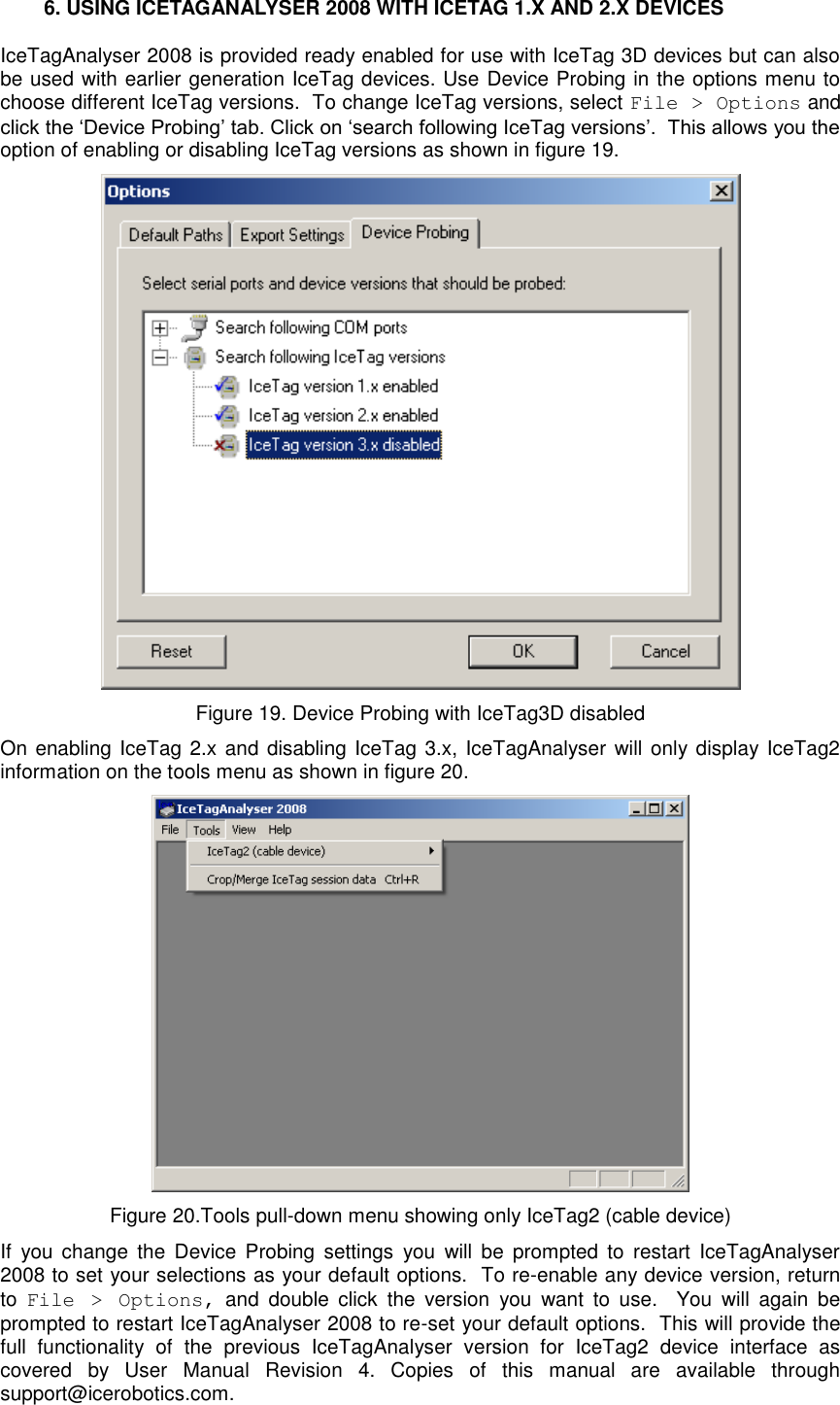
   6. USING ICETAGANALYSER 2008 WITH ICETAG 1.X AND 2.X DEVICES IceTagAnalyser 2008 is provided ready enabled for use with IceTag 3D devices but can also be used with earlier generation IceTag devices. Use Device Probing in the options menu to choose different IceTag versions.  To change IceTag versions, select File > Options and click the „Device Probing‟ tab. Click on „search following IceTag versions‟.  This allows you the option of enabling or disabling IceTag versions as shown in figure 19.   Figure 19. Device Probing with IceTag3D disabled On enabling IceTag 2.x and disabling IceTag 3.x, IceTagAnalyser will only display IceTag2 information on the tools menu as shown in figure 20.   Figure 20.Tools pull-down menu showing only IceTag2 (cable device) If  you change  the  Device  Probing  settings  you  will  be  prompted  to  restart  IceTagAnalyser 2008 to set your selections as your default options.  To re-enable any device version, return to  File  >  Options,  and  double  click  the  version  you  want  to  use.    You  will  again  be prompted to restart IceTagAnalyser 2008 to re-set your default options.  This will provide the full  functionality  of  the  previous  IceTagAnalyser  version  for  IceTag2  device  interface  as covered  by  User  Manual  Revision  4.  Copies  of  this  manual  are  available  through support@icerobotics.com.
   Appendix A: Troubleshooting This  section  describes  how  to  investigate  any  problems  with  the  IceTag3D  system.  If  you cannot find the solution to your problem here, contact support@icerobotics.com.    A.1 Connecting the IceReader to your computer A.1.1 My PC cannot find any drivers for the IceReader The  first  time  the  IceReader  is  connected,  the  operating  system  may  prompt  for  a  driver installation.    On  most  versions  of  Microsoft  Windows,  the  drivers  for  the  IceReader  are included  in  the Microsoft  Windows operating  system.    For  versions  of  Windows  where  the drivers are not included as standard, contact support@icerobotics.com.  A.1.2 IceTagAnalyser 2008 cannot find the IceReader Check that the IceReader is plugged into a USB port on your PC and that all the connections are secure.  Try closing IceTagAnalyser 2008 and restarting it.  If IceTagAnalyser 2008 still cannot find the IceReader, contact support@icerobotics.com.   A.2 Swiping an IceTag3D A.2.1 The IceReader cannot read the IceTag3D Try connecting the IceReader again; some PCs take a little time to recognise that a device has  been  plugged  in.    Check  the  IceReader  status  by  unplugging  and  re-plugging  the IceReader into the USB port on the PC.  The green LED on the IceReader should illuminate. When IceTagAnalyser 2008 recognises the IceReader, the amber LED on the IceReader will be illuminated.  If IceTagAnalyser  2008 still cannot read the IceTag3D, try connecting to a different  USB  port  on  your  PC.  If  IceTagAnalyser  2008  still  does  not  read  the  IceTag3D, contact s support@icerobotics.com.   A.3 Downloading Data A.3.1 Errors when downloading data from an IceTag3D device. If  an  error  occurs  while  downloading  data,  the  data  is  left  on  the  device.  Select  Tools  > IceTag3D (wireless device) > Download IceTag3D session data, swipe the IceTag3D and try again.    Operating  two  IceReaders  in  close  proximity  should  present  no  problem  as  the IceReaders are programmed to operate on different frequencies.  In the unlikely event of two readers causing interference and download problems, contact support@icerobotics.com.   A.4 Attaching Devices A.4.1 Lesions on animal leg following IceTag removal This  is  caused  by  over-tightening  of  the  straps  during  device  attachment.  The  IceTag3D should  be  attached  so  that  it  can  loosely  move  around  the  leg.  Using  the  Velcro  strap supplied, ensure that the IceTag3D is fastened to the animal‟s leg with sufficient room for two to three of your fingers to be inserted between the strap and the animal‟s leg.
  Appendix B: Example command line exports Using  the  IceTagAnalyser  2008  command  line  options  can  be  a  quick  way  of  exporting  a whole directory of session files to CSV or MDP format, without having to manually open each file individually. This appendix contains some simple examples.   B.1 Exporting a single file to CSV Open a command line window by clicking the windows Start button and selection Run… from the menu. Type cmd.exe into the edit-box and click OK. This should open a command line window. Change to the directory that contains the session file using the cd command. For example: cd \Program Files\IceRobotics\IceTagAnalyser\Sessions The  following  example  shows  how  to  export  a  file  called  test.ses  to  csv  format,  where <path>  would  be  replaced  with  the  full  path  to  IceTagAnalyser  (typically  \Program Files\IceRobotics\IceTagAnalyser):  “C:\<path>\IceTagAnalyser.exe” /exp /format:csv test.ses The  above  example  will  prompt  for  an  output  name.  To  force  the  file  to  be  exported  as test.csv or test.mdb, simply add in the /force option: “C:\<path>\IceTagAnalyser.exe” /exp /format:csv /force test.ses   B.2 Exporting all files in a directory to CSV The following example can be used to export all files in the current directory to CSV, where again <path> should be replaced with the actual path of IceTagAnalyser.exe: for %f in (*.ses) do “C:\<path>\IceTagAnalyser.exe” /exp /format:csv /force %f NB: If this line is used in a batch file, the two % characters need to be doubled; change %f  to %%f.
   Regulatory Compliance Information   FCC Compliance Statement  This device complies with Part 15 of the FCC Rules. Operation is subject to the following two conditions: (1) this device may not cause harmful interference, and (2) this device must accept any interference received, including interference that may cause undesired operation.  NOTE: This equipment has been tested and found to comply with the limits for a Class A digital device, pursuant to Part 15 of the FCC Rules. These limits are designed to provide reasonable protection against harmful interference when  the equipment is operated in a commercial environment. This equipment generates, uses, and can radiate radio frequency energy and, if not installed and used in accordance with the instruction manual, may cause harmful interference to radio communications. Operation of this equipment in a residential area is likely to cause harmful interference in which case the user will be required to correct the interference at his own expense.  Important: Changes or modifications to this product not authorized by IceRobotics Ltd. could void the EMC compliance and negate your authority to operate the equipment.  Disposal and Recycling Information  Your IceTag3D and associated equipment must be disposed of properly according to local laws and regulations. Because the IceTag3D contains a battery, IceTag3D must be disposed of separately from general waste. When an IceTag3D reaches its end of life, contact IceRobotics Ltd. or your local authorities to learn about recycling options.

Navigation menu