Infobionic 01854 Wireless Ambulatory ECG Monitoring and Detection System User Manual user guide

Infobionic, Inc. Wireless Ambulatory ECG Monitoring and Detection System user guide

user guide

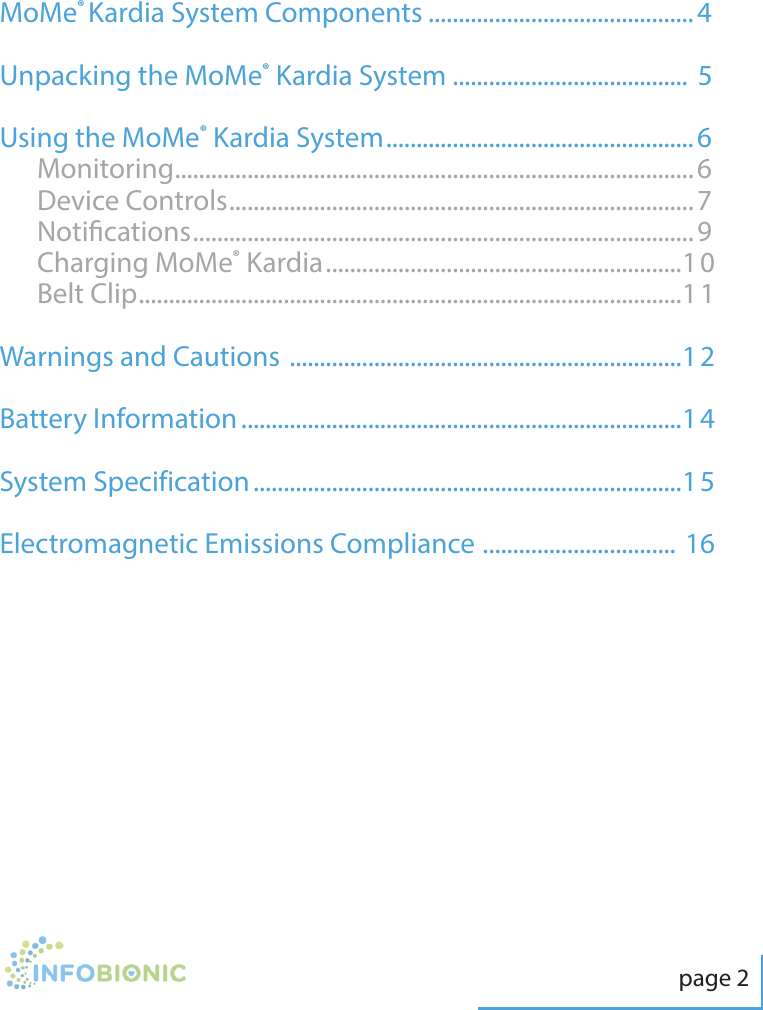
MoMe®  Kardia System Patient Guide
page 2Table of ContentsMoMe® Kardia System Components ............................................4Unpacking the MoMe® Kardia System .......................................  5Using the MoMe® Kardia System ...................................................6Monitoring ......................................................................................6Device Controls .............................................................................7Notications ...................................................................................9Charging MoMe® Kardia ...........................................................10Belt Clip ..........................................................................................11Warnings and Cautions  .................................................................12Battery Information .........................................................................14System Specification .......................................................................15Electromagnetic Emissions Compliance  ................................ 16
page 3
page 4MoMe® Kardia System ComponentsMoMe® Kardia Kit ComponentsNo. Component Description1MoMe® Kardia DeviceSmall, lightweight battery operated device that collects, stores, and transmits physiological data to the remote server via built in cellular module13 wire color coded lead setAttaches to the MoMe®  Kardia device and to each electrode1 Belt Clip Used to carry the MoMe®  Kardia on your belt or waistband during the day2Rechargeable Battery PacksBattery packs to power the MoMe®  Kardia Device. A fully charged batttery will last for 24 hours and must be replaced with a charged battery each day to ensure uninterrupted monitoring1 Charger Dock Used to charge the MoMe® Kardia battery pack1Charger Dock Power Supply Used to connect the charger dock to AC wall socket1  ElectrodesThe MoMe® Kardia leadset snaps to the electrodes. Electrodes will be provided by your physicianInspect all parts before use to ensure nothing is damaged and/or missing
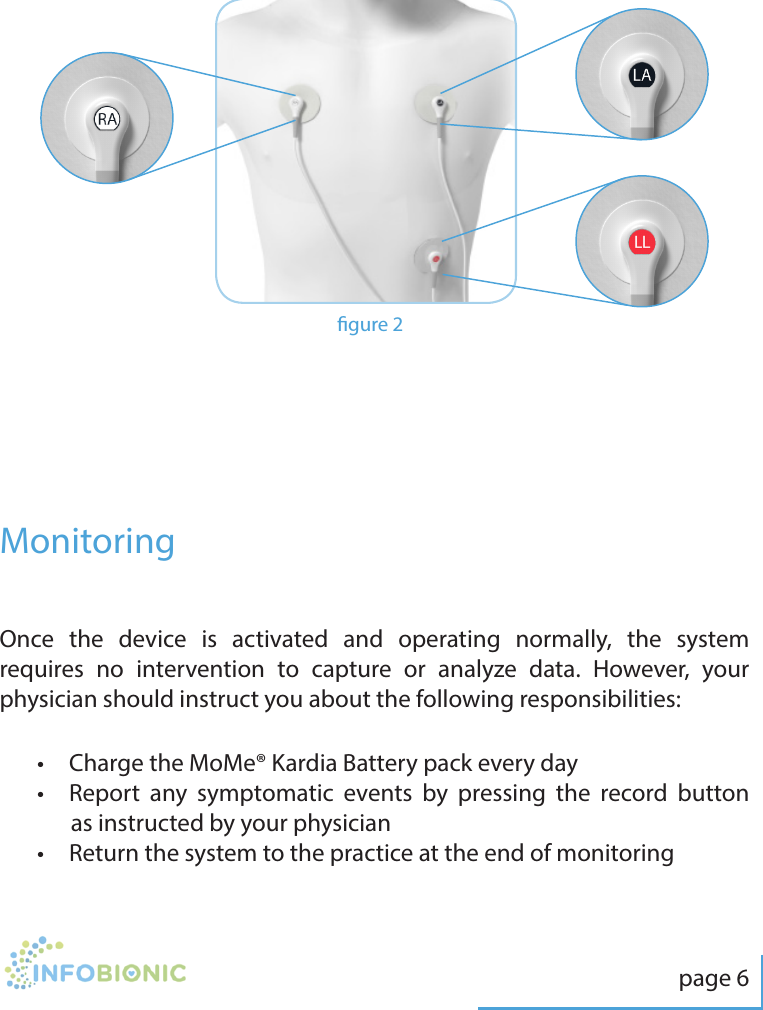
page 5Unpacking the MoMe Kardia DeviceUpack the MoMe® Kardia Kit and locate components listed in the Kit Components chart on the previous page.Plug in the charger dock and place one of the two included battery packs in the charger. Insert the second battery pack into the back of the MoMe® Kardia Device (for more detailed instructions, see diagram on page 10). The device should turn on.Attach the color-coded leadset to the device.Place electrodes as indicated on page 6. You are now monitoring
page 6gure 2MonitoringOnce the device is activated and operating normally, the system requires no intervention to capture or analyze data. However, your physician should instruct you about the following responsibilities:•  Charge the MoMe® Kardia Battery pack every day•   Report any symptomatic events by pressing the record button as instructed by your physician•  Return the system to the practice at the end of monitoring
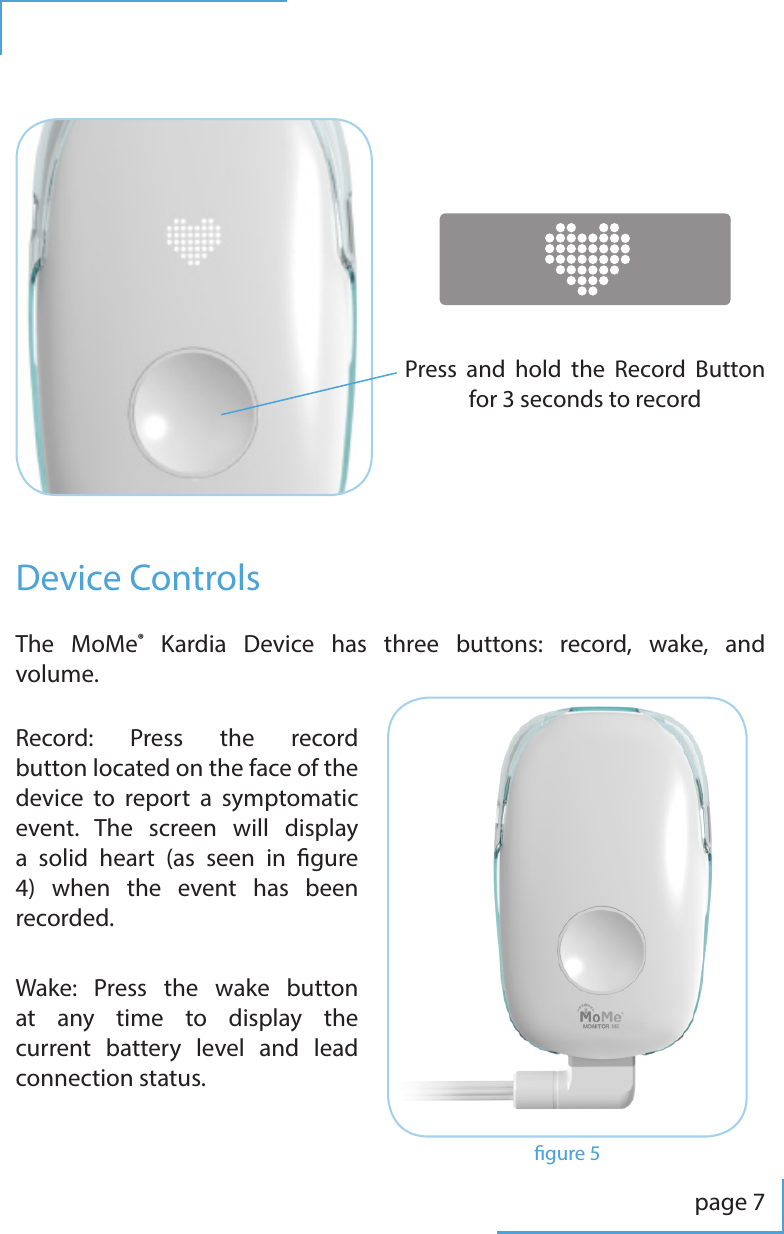
page 7Device ControlsRecord: Press the record button located on the face of the device to report a symptomatic event. The screen will display a solid heart (as seen in gure 4) when the event has been recorded.Wake: Press the wake button at any time to display the current battery level and lead connection status.The MoMe® Kardia Device has three buttons: record, wake, and volume.gure 5Press and hold the Record Button for 3 seconds to record
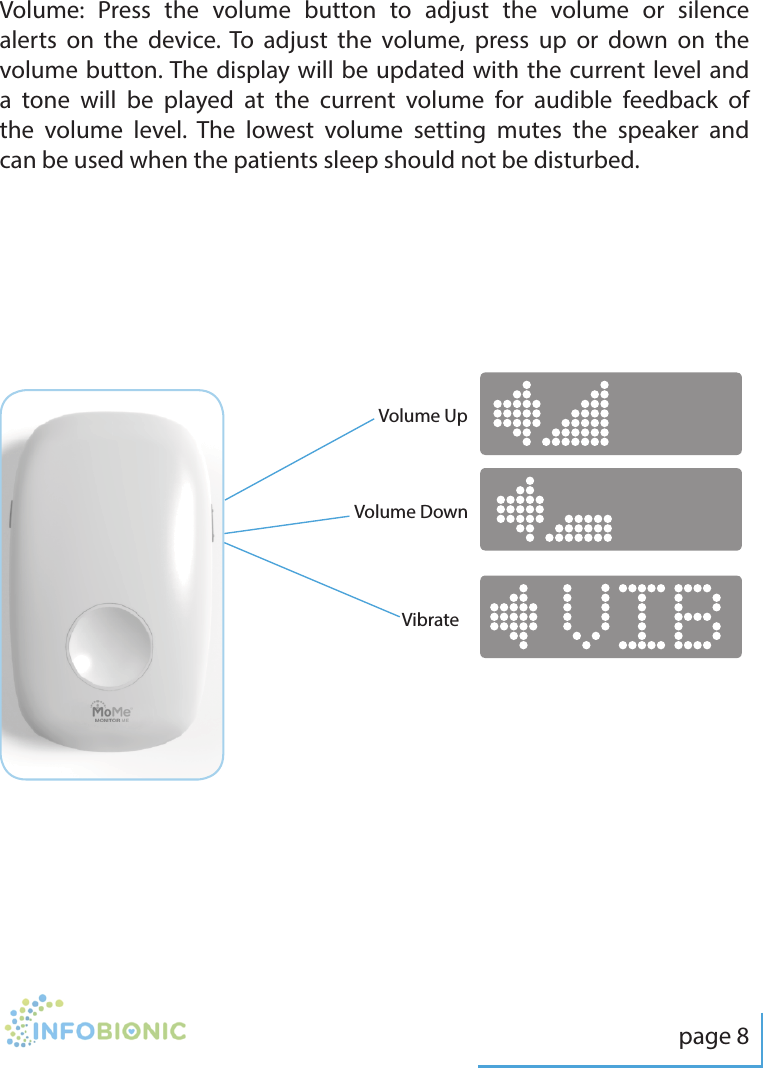
page 8Volume:  Press the volume button to adjust the volume or silence alerts on the device. To adjust the volume, press up or down on the volume button. The display will be updated with the current level and a tone will be played at the current volume for audible feedback of the volume level. The lowest volume setting mutes the speaker and can be used when the patients sleep should not be disturbed.Volume DownVolume UpVibrate
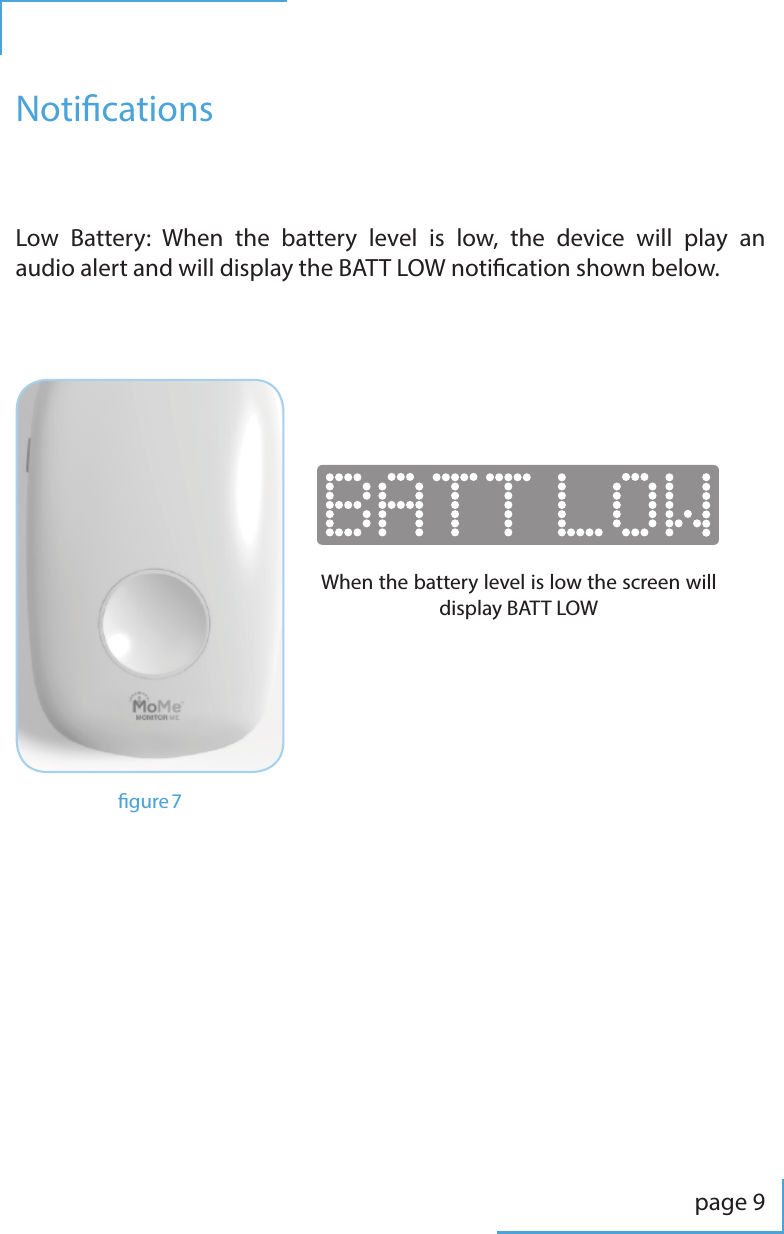
page 9NoticationsLow Battery: When the battery level is low, the device will play an audio alert and will display the BATT LOW notication shown below.gure 7When the battery level is low the screen will display BATT LOW
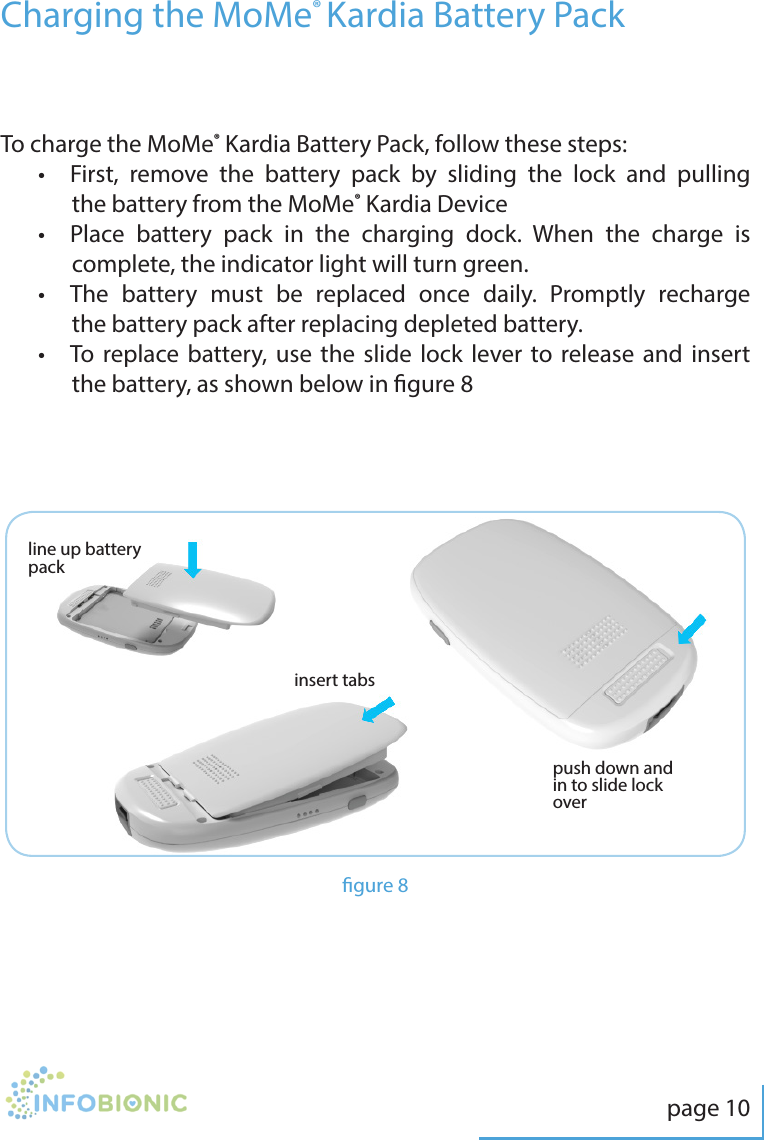
page 10Charging the MoMe® Kardia Battery PackTo charge the MoMe® Kardia Battery Pack, follow these steps:•   First, remove the battery pack by sliding the lock and pulling the battery from the MoMe® Kardia Device•   Place battery pack in the charging dock. When the charge is complete, the indicator light will turn green.•   The battery must be replaced once daily. Promptly recharge the battery pack after replacing depleted battery.•   To replace battery, use the slide lock lever to release and insert the battery, as shown below in gure 8gure 8line up battery packinsert tabspush down and in to slide lock over
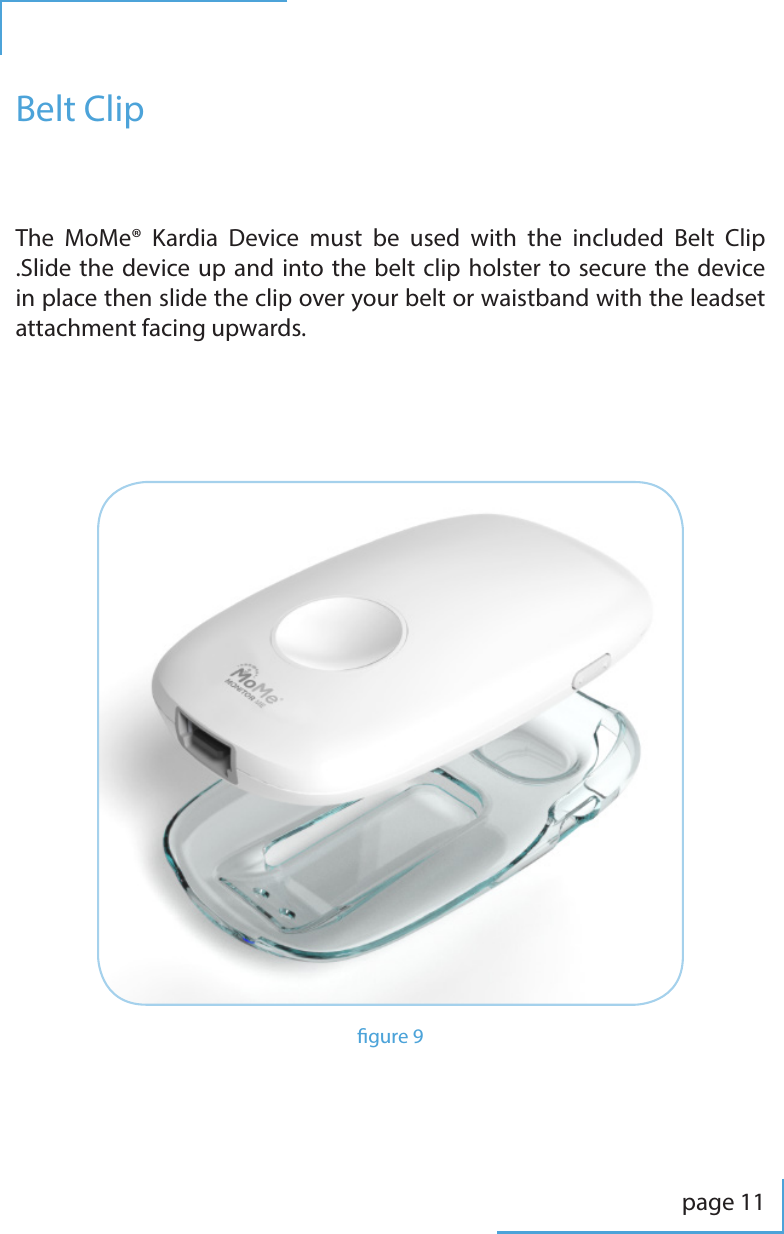
page 11Belt ClipThe MoMe® Kardia Device must be used with the included Belt Clip .Slide the device up and into the belt clip holster to secure the device in place then slide the clip over your belt or waistband with the leadset attachment facing upwards. gure 9
page 12Warnings•   Warning: MoMe® Kardia is not intended for use on infants weighing less than 10 kg (22 lb).•   Warning: Use only specied MoMe® Kardia cables and accessories. Use of any other cables and accessories may negatively aect EMC performance resulting in increased emissions and decreased immunity. •   Warning: Use only specied MoMe® Kardia accessories. Use of any other accessories may result in non-compliance.•   Warning: MoMe® Kardia is not intended for use as an emergency medical response system.   Patients should be instructed that if they experience symptoms of concern they need to seek immediate medical attention. •   Warning:  The MoMe® Kardia Device is not debrillation-proof.  Remove MoMe® Kardia Device and disconnect patient leads before external debrillation.  •   Warning: Do not service or repair any components of the MoMe® Kardia system.  Removal or tampering of the lead wires or any other component may alter device performance and cause device malfunction or failure. Contact MoMe® Kardia Technical Support at 1.844.401.9725 for product repair or replacement.•   Warning:  The MoMe® Kardia system may be aected by equipment even if the equipment is CISPR compliant.•   Warning: The MoMe® Kardia system should not be used in the presence of ammable anesthetics.•   Warning: The MoMe® Kardia contains a cellphone. If the patient has an implantable device, they should be instructed to follow their implantable device manufacturer’s recommendations for use with a cellphone.•   Warning : Never attempt to repair or service any MoMe® Kardia equipment. Repairs by untrained, unauthorized individuals may damage the equipment or cause system malfunction.•   Warning : The MoMe® Kardia is not intended to be used in an Oxygen rich environment. •   Warning : Electrodes may cause skin irritation or breakdown. We recommend that standard FDA approved Ag/AgCL ambulatory monitoring electrode patches be used and that the patient be instructed on what to do if skin irritation occurs.Cautions1.   MoMe® Kardia uses cellular phone technology, so the system operation and data transmission may be aected or interrupted by poor cellular
page 13coverage or electromagnetic interference. If data transmission is interrupted, MoMe® Kardia will automatically cache the data until cellular coverage or communication between the two devices is restored and then send the stored data.2.   Use only MoMe® Kardia parts and accessories with the MoMe® Kardia system. Using non-MoMe® Kardia equipment may result in system malfunction or failure.3.   Use only with the supplied battery packs, charging dock, and wall adapter.4.   Prior to setting up a new patient with MoMe® Kardia, carefully inspect all system components for defects or damage. Check lead wires for cracks or fraying in the wiring, and cracks around the connector and snap leads. Do not use the MoMe® Kardia system if any component appears defective, damaged, or worn (e.g. cracks, dents, chips, cuts, kinks, or crushed or elongated sections), as this may result in system malfunction or failure. Contact MoMe® Kardia Technical Support at 1.844.401.9725 for a replacement, if needed.5.   MoMe® Kardia is not waterproof.:—   Protect all MoMe® Kardia parts from water, liquids or moisture which will damage equipment and aect system operation;—   Do not immerse any part of the MoMe® Kardia system in water or uids. Do not spray device with cleaners or other liquids;—   Never bathe, shower, or swim while wearing the MoMe® Kardia Device (while bathing or swimming, store MoMe® Kardia equipment in a safe, dry location) 6.   Do not drop or subject MoMe® Kardia parts to extreme physical shock.7.   The MoMe® Kardia system uses and generates radio frequency energy, so it may cause harmful interference to radio communication if not used according to instructions.8.   The user should take precautions regarding electromagnetic compatibility, the MoMe® Kardia system needs to be used according to the EMC information provided in this IFU. 9.   The MoMe® Kardia provided for use in the U.S. will not transmit recorded data if the patient travels outside of the U.S.10.   Do not use the MoMe® Kardia system in conditions that are:—  Below 32°F (0°C) or above 104°F (40°C);—   Less than 15% or greater than 93% non-condensing atmospheric humidity.11.   Do not store or transport MoMe® Kardia in conditions that are:—  Below -25°C or above 70°C;—   Less than 15% or greater than 93% non-condensing atmospheric humidity.12.  Keep the system out of reach of children and pets.
page 14•  Do not dismantle, open or shred secondary cells or batteries.•   Do not expose cells or batteries to heat or re. Avoid storage in direct sunlight.•   Do not short-circuit a cell or a battery. Do not store cells or batteries haphazardly in a box or drawer where they may short-circuit each other or be short-circuited by other metal objects.•   Do not remove a cell or battery from its original packaging until required for use.•  Do not subject cells or batteries to mechanical shock.•   In the event of a cell leaking, do not allow the liquid to come in contact with the skin or eyes. If contact has been made, wash the aected area with copious amounts of water and seek medical advice.•   Do not use any charger other than that specically provided for use with the equipment.•   Observe the plus (+) and minus (–) marks on the cell, battery and equipment and ensure correct use.•   Do not use any cell or battery which is not designed for use with the equipment.•  Battery usage by children should be supervised.•  Keep cells and batteries clean and dry.•   Wipe the cell or battery terminals with a clean dry cloth if they become dirty.•   Secondary cells and batteries need to be charged before use. Always use the correct charger and refer to the manufacturer’s instructions or equipment manual for proper charging instructions.•  Do not leave a battery on prolonged charge when not in use.•   After extended periods of storage, it may be necessary to charge and discharge the cells or batteries several times to obtain maximum performance.•  Retain the original product literature for future reference.•   Use only the cell or battery in the application for which it was intended.•  Dispose of properly.Battery Information
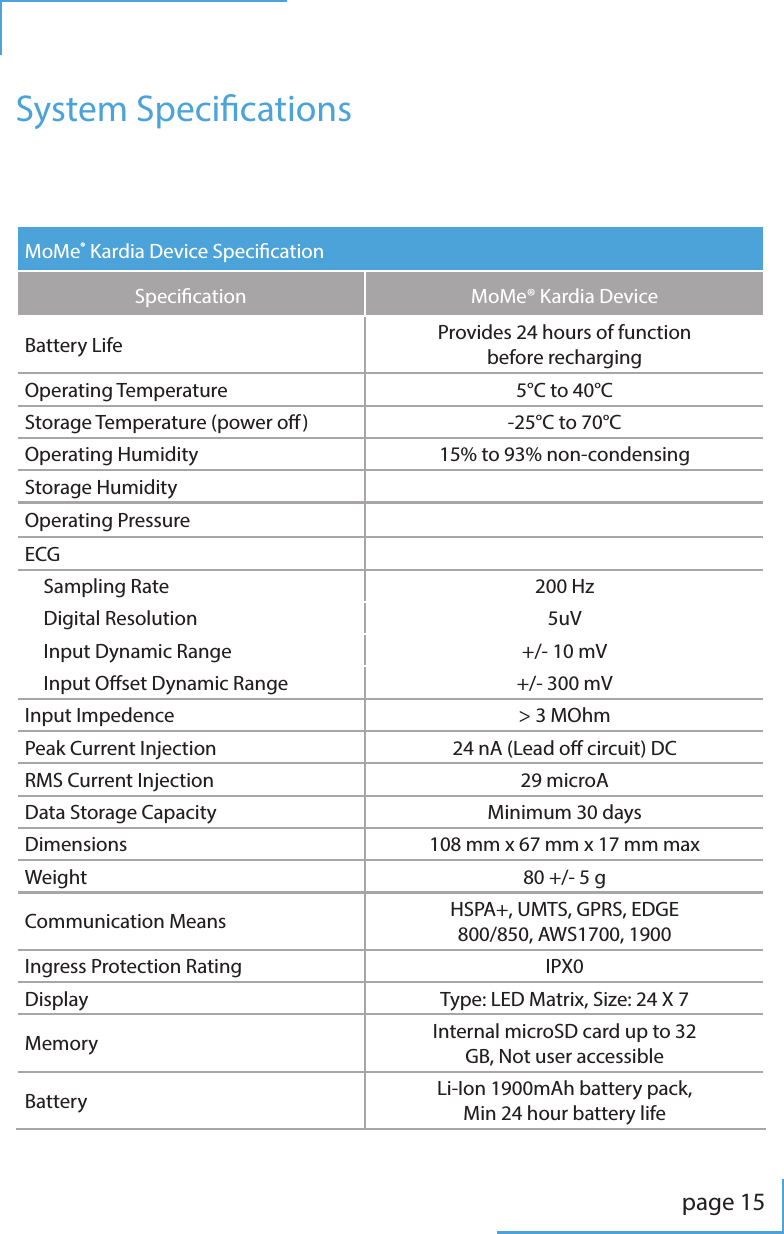
page 15System SpecicationsMoMe® Kardia Device SpecicationSpecication MoMe® Kardia DeviceBattery Life Provides 24 hours of function before rechargingOperating Temperature 5°C to 40°CStorage Temperature (power o) -25°C to 70°COperating Humidity 15% to 93% non-condensingStorage HumidityOperating PressureECGSampling Rate 200 HzDigital Resolution 5uVInput Dynamic Range +/- 10 mVInput Oset Dynamic Range +/- 300 mVInput Impedence > 3 MOhmPeak Current Injection 24 nA (Lead o circuit) DCRMS Current Injection 29 microAData Storage Capacity Minimum 30 daysDimensions 108 mm x 67 mm x 17 mm maxWeight 80 +/- 5 gCommunication Means HSPA+, UMTS, GPRS, EDGE 800/850, AWS1700, 1900Ingress Protection Rating IPX0Display Type: LED Matrix, Size: 24 X 7Memory Internal microSD card up to 32 GB, Not user accessibleBattery Li-Ion 1900mAh battery pack, Min 24 hour battery life
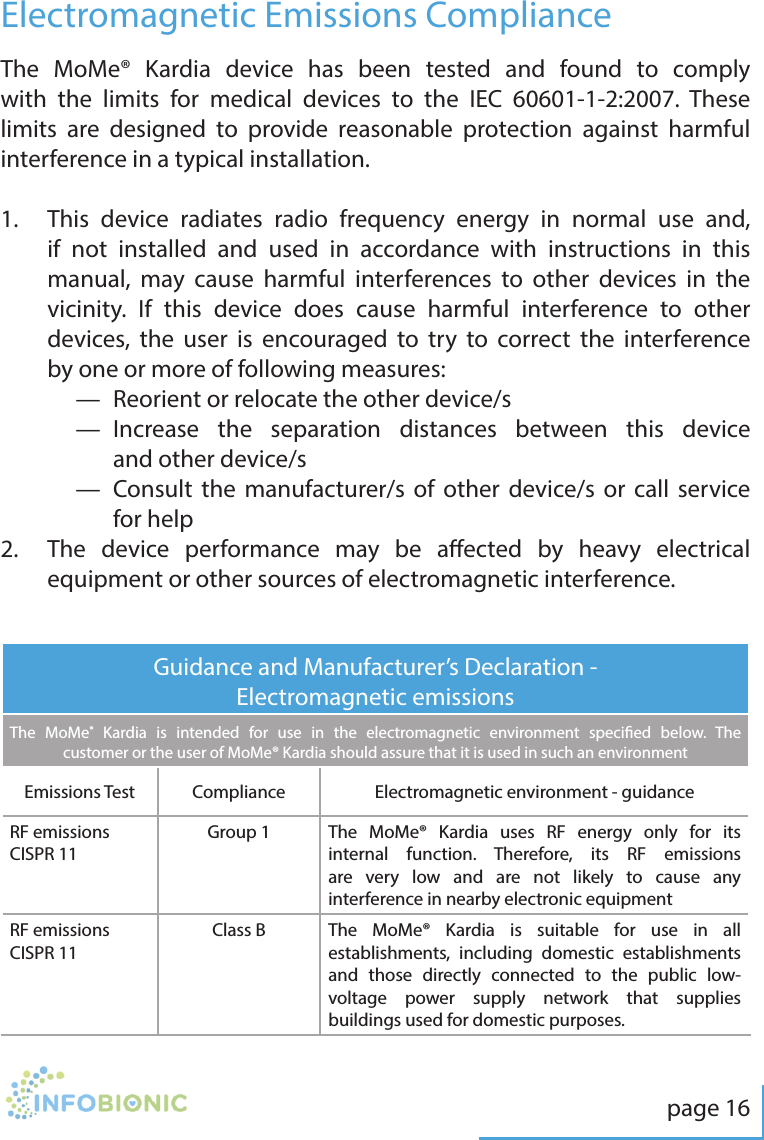
page 16Electromagnetic Emissions ComplianceThe MoMe® Kardia device has been tested and found to comply with the limits for medical devices to the IEC 60601-1-2:2007. These limits are designed to provide reasonable protection against harmful interference in a typical installation.1.   This device radiates radio frequency energy in normal use and, if not installed and used in accordance with instructions in this manual, may cause harmful interferences to other devices in the vicinity. If this device does cause harmful interference to other devices, the user is encouraged to try to correct the interference by one or more of following measures:—  Reorient or relocate the other device/s—   Increase the separation distances between this device and other device/s—   Consult the manufacturer/s of other device/s or call service for help2.   The device performance may be aected by heavy electrical equipment or other sources of electromagnetic interference.Guidance and Manufacturer’s Declaration - Electromagnetic emissionsThe MoMe® Kardia is intended for use in the electromagnetic environment specied below. The customer or the user of MoMe® Kardia should assure that it is used in such an environmentEmissions Test Compliance Electromagnetic environment - guidanceRF emissionsCISPR 11Group 1 The MoMe® Kardia uses RF energy only for its internal function. Therefore, its RF emissions are very low and are not likely to cause any interference in nearby electronic equipmentRF emissionsCISPR 11Class B The MoMe® Kardia is suitable for use in all establishments, including domestic establishments and those directly connected to the public low-voltage power supply network that supplies buildings used for domestic purposes.
page 17Guidance and Manufacturer’s Declaration – Electromagnetic ImmunityThe MoMe® Kardia is intended for use in the electromagnetic environment specied below. The customer or the user of MoMe® Kardia should assure that it is used in such an environmentImmunity TestIEC 60601 Test LevelCompliance LevelElectromagnetic Envioronment - GuidanceElectrostatic discharge (ESD) IEC 61000-4-2±6 kV contact±8 kV air±6 kV contact±8 kV airFloors should be wood, concrete or ceramic tile. If oors are covered with synthetic material, the relative humidity should be at least 30%.Electrical fast transient/burst+/- 2 kV for power supply lines+/- 1 kV for input/output linesNot applicableSurge IEC 61000-4-5+/- 1 kV line(s) to line(s)+/- 2 kV lines(s) to earthNot applicableVoltage dips, short interruptions and voltage variations on power supply input linesIEC 61000-4-11<5% UT(>95% dip in UT) for 0.5 cycle40% UT(60% dip in UT) for 5 cycles70% UT(30% dip in UT) for 25 cycles<5% UT(>95% dip in UT) for 5sNot applicable
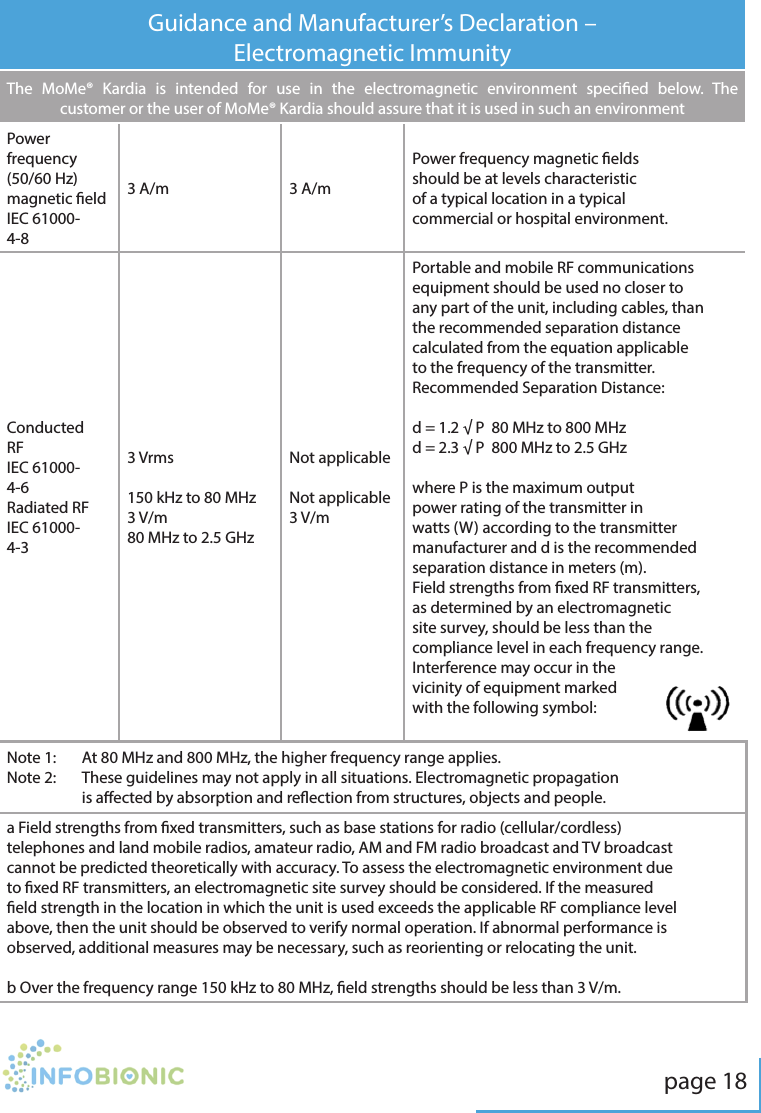
page 18Guidance and Manufacturer’s Declaration – Electromagnetic ImmunityThe MoMe® Kardia is intended for use in the electromagnetic environment specied below. The customer or the user of MoMe® Kardia should assure that it is used in such an environmentPower frequency (50/60 Hz) magnetic eldIEC 61000-4-83 A/m 3 A/mPower frequency magnetic elds should be at levels characteristic of a typical location in a typical commercial or hospital environment.Conducted RFIEC 61000-4-6Radiated RFIEC 61000-4-33 Vrms 150 kHz to 80 MHz3 V/m80 MHz to 2.5 GHzNot applicable Not applicable3 V/mPortable and mobile RF communications equipment should be used no closer to any part of the unit, including cables, than the recommended separation distance calculated from the equation applicable to the frequency of the transmitter.Recommended Separation Distance:d = 1.2 √ P  80 MHz to 800 MHzd = 2.3 √ P  800 MHz to 2.5 GHzwhere P is the maximum output power rating of the transmitter in watts (W) according to the transmitter manufacturer and d is the recommended separation distance in meters (m).Field strengths from xed RF transmitters, as determined by an electromagnetic site survey, should be less than the compliance level in each frequency range.Interference may occur in the vicinity of equipment marked with the following symbol:Note 1:  At 80 MHz and 800 MHz, the higher frequency range applies.Note 2:   These guidelines may not apply in all situations. Electromagnetic propagation is aected by absorption and reection from structures, objects and people.a Field strengths from xed transmitters, such as base stations for radio (cellular/cordless) telephones and land mobile radios, amateur radio, AM and FM radio broadcast and TV broadcast cannot be predicted theoretically with accuracy. To assess the electromagnetic environment due to xed RF transmitters, an electromagnetic site survey should be considered. If the measured eld strength in the location in which the unit is used exceeds the applicable RF compliance level above, then the unit should be observed to verify normal operation. If abnormal performance is observed, additional measures may be necessary, such as reorienting or relocating the unit.b Over the frequency range 150 kHz to 80 MHz, eld strengths should be less than 3 V/m.
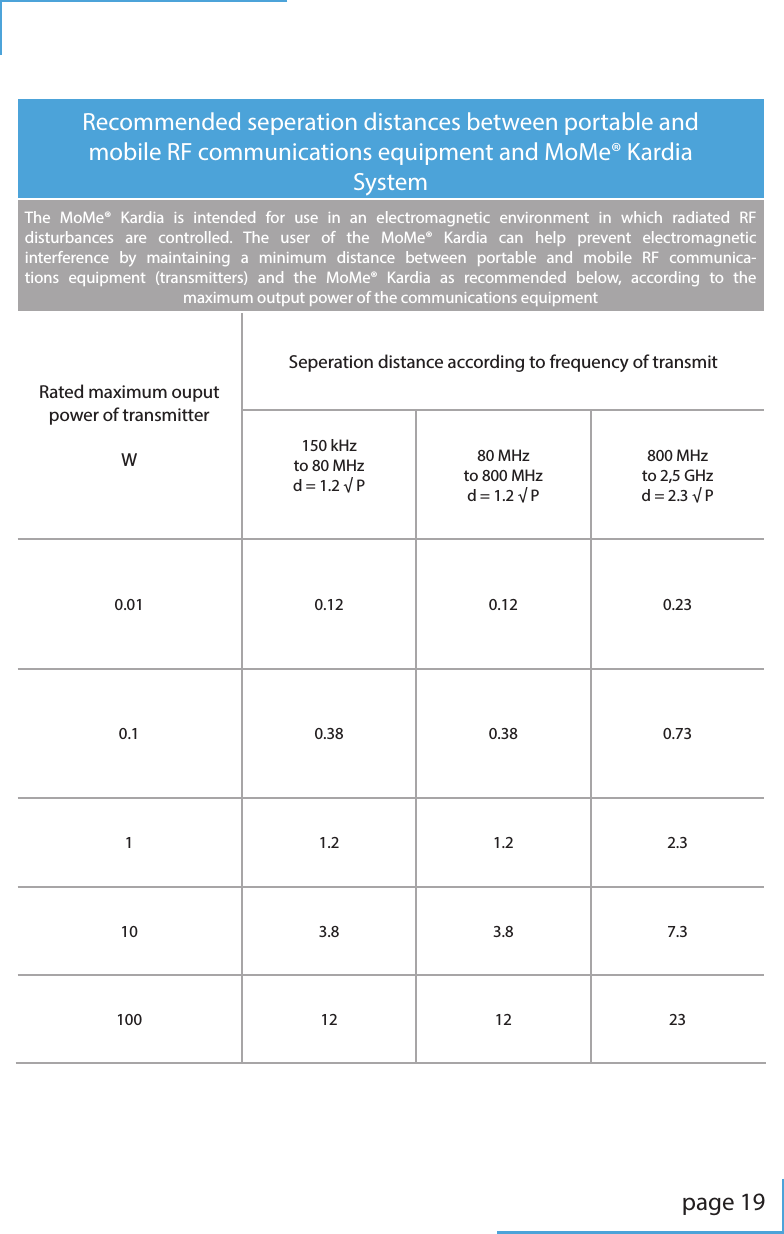
page 19Recommended seperation distances between portable and mobile RF communications equipment and MoMe® Kardia SystemThe MoMe® Kardia is intended for use in an electromagnetic environment in which radiated RF disturbances are controlled. The user of the MoMe® Kardia can help prevent electromagnetic interference by maintaining a minimum distance between portable and mobile RF communica-tions equipment (transmitters) and the MoMe® Kardia as recommended below, according to the maximum output power of the communications equipmentRated maximum ouput power of transmitterWSeperation distance according to frequency of transmit150 kHz to 80 MHzd = 1.2 √ P80 MHz to 800 MHzd = 1.2 √ P800 MHz to 2,5 GHzd = 2.3 √ P0.01 0.12 0.12 0.230.1 0.38 0.38 0.731 1.2 1.2 2.310 3.8 3.8 7.3100 12 12 23
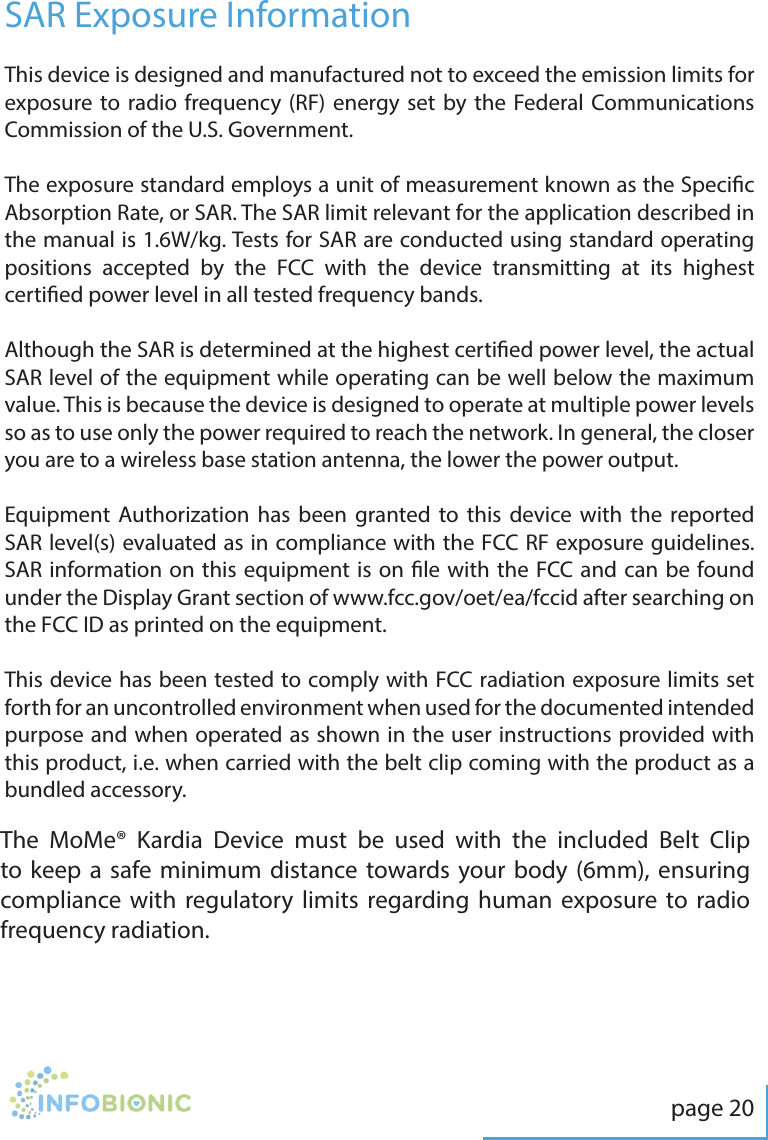
page 20This device is designed and manufactured not to exceed the emission limits for exposure to radio frequency (RF) energy set by the Federal Communications Commission of the U.S. Government.The exposure standard employs a unit of measurement known as the Specic Absorption Rate, or SAR. The SAR limit relevant for the application described in the manual is 1.6W/kg. Tests for SAR are conducted using standard operating positions accepted by the FCC with the device transmitting at its highest certied power level in all tested frequency bands.Although the SAR is determined at the highest certied power level, the actual SAR level of the equipment while operating can be well below the maximum value. This is because the device is designed to operate at multiple power levels so as to use only the power required to reach the network. In general, the closer you are to a wireless base station antenna, the lower the power output. Equipment Authorization has been granted to this device with the reported SAR level(s) evaluated as in compliance with the FCC RF exposure guidelines. SAR information on this equipment is on le with the FCC and can be found under the Display Grant section of www.fcc.gov/oet/ea/fccid after searching on the FCC ID as printed on the equipment. This device has been tested to comply with FCC radiation exposure limits set forth for an uncontrolled environment when used for the documented intended purpose and when operated as shown in the user instructions provided with this product, i.e. when carried with the belt clip coming with the product as a bundled accessory.SAR Exposure InformationThe MoMe® Kardia Device must be used with the included Belt Clip to keep a safe minimum distance towards your body (6mm), ensuring compliance with regulatory limits regarding human exposure to radio frequency radiation.

Navigation menu