Infocus In3128Hd Users Manual RG_INF_IN3128HD
IN3128HD to the manual 8f1752ca-68cf-42e2-b2e1-88b211dc39da
2015-02-05
: Infocus Infocus-In3128Hd-Users-Manual-393586 infocus-in3128hd-users-manual-393586 infocus pdf
Open the PDF directly: View PDF  .
.
Page Count: 45
- Introduction
- Positioning the projector
- Connecting a computer source
- Displaying an image
- Adjusting the image
- Connecting a video device
- Shutting down the projector
- Troubleshooting your setup
- Using the remote control
- Using the audio
- Using the keypad buttons
- Optimizing computer images
- Presentation features
- Optimizing video images
- Customizing the projector
- Using the menus
- Controlling the projector through a LAN environment
- Controlling the projector remotely through a web browser
- Displaying images through ifPresenter
- Displaying pictures with a USB storage device
- Maintenance
- Blank Page

1
Declaration of Conformity
Manufacturer: InFocus Corporation, 13190 SW 68th Parkway, Suite 200, Portland, Oregon
97223-8368 USA
We declare under our sole responsibility that this projector conforms to the following
directives and norms:
ErP Directive 2009/125/EC
EMC Directive 2004/108/EC
EMC: EN 55024:2010, EN 55022:2010, EN 61000-3-2:2006+A1:2009+A2:2009,
EN 61000-3-3:2008
Low Voltage Directive 2006/95/EC
Safety: IEC 60950-1: 2005;EN 60950-1:2006 +A11:2009
Trademarks
Apple, Macintosh, and PowerBook are trademarks or registered trademarks of Apple
Computer, Inc. IBM is a trademark or registered trademark of International Business
Machines, Inc. Microsoft, PowerPoint, and Windows are trademarks or registered trademarks
of Microsoft Corporation. Adobe and Acrobat are trademarks or registered trademarks of
Adobe Systems Incorporated. DLP®, DLP Link and the DLP logo are registered trademarks
of Texas Instruments and BrilliantColor™ is a trademark of Texas Instruments. InFocus, In
Focus, and INFOCUS (stylized) are either registered trademarks or trademarks of InFocus
Corporation in the United States and other countries.
NOTE: This product is covered electrical and electronic equipment under the
European Union's Waste from Electrical and Electronic Equipment ("WEEE")
Directive (2002/96/EC). The WEEE Directive requires that covered
equipment be collected and managed separately from typical household waste
in all EU member states. Please follow the guidance of your local
environmental authority or ask the shop where you purchased the product for
collection or recycling options.
FCC Warning
This device complies with part 15 of the FCC Rules. Operation is subject to the following two
conditions: (1) This device may not cause harmful interference, and (2) this device must
accept any interference received, including interference that may cause undesired operation.
Note: This equipment has been tested and found to comply with the limits for a Class B digital
device, pursuant to part 15 of the FCC Rules. These limits are designed to provide reasonable
protection against harmful interference in a residential installation. This equipment generates,
uses and can radiate radio frequency energy and, if not installed and used in accordance with
the instructions, may cause harmful interference to radio communications. However, there is
no guarantee that interference will not occur in a particular installation. If this equipment does
cause harmful interference to radio or television reception, which can be determined by
turning the equipment off and on, the user is encouraged to try to correct the interference by
one or more of the following measures:
--Reorient or relocate the receiving antenna.
--Increase the separation between the equipment and receiver.
--Connect the equipment into an outlet on a circuit different from that to which the receiver is
connected.
--Consult the dealer or an experienced radio/TV technician for help.
Changes or modifications not expressly approved by InFocus Corporation may void authority
to operate the equipment.
CE Warning
This product is considered Class A for EU market.
Canada
This Class B digital apparatus complies with Canadian ICES-003. Cet appareil numérique de
la classe B est conforme à la norme NMB-003 du Canada.
Agency Approvals
cULus
Other specific Country Approvals may apply. Please see product certification label.
This document applies to regulatory model IN3128HD.
Input ratings: 100-240Vac, 3.8A, 50-60Hz
InFocus reserves the right to alter product offerings and specifications at any time without
notice.
2
Table of Contents
Introduction 4
Positioning the projector 6
Connecting a computer source 7
VGA connection 7
HDMI connection 7
Connecting power 7
Optional computer connections 7
Displaying an image 8
Adjusting the image 9
Connecting a video device 10
Video device connections 10
Composite video connection 10
VGA connection 10
Component video connection 10
S-video connection 10
Shutting down the projector 11
Troubleshooting your setup 11
Using the remote control 19
Using the audio 20
Using the keypad buttons 21
Optimizing computer images 22
Presentation features 22
Optimizing video images 23
Customizing the projector 23
Using the menus 24
Basic Menu 25
Advanced Menu 26
Controlling the projector through a LAN environment 30
Controlling the projector remotely through a web browser 31
Displaying images through ifPresenter 35
Displaying pictures with a USB storage device 38
Maintenance 40
Cleaning the lens 40
Using the security lock 40
Replacing the projection lamp 41
3
Important Operating Considerations for Safety
• Refer to this guide for proper startup and shutdown procedures.
• Follow all warnings and cautions in this manual and on the projector.
• Place the projector in a horizontal position no greater than 15 degrees off axis.
• Locate the projector at least 4' (1.2m) away from any heating or cooling vents.
• Do not block ventilation openings. Locate the projector in a well-ventilated
area without obstructions to intake or exhaust vents. Do not place the projector
on a tablecloth or other soft covering that may block the vents.
• Do not place the projector in direct sunlight, humid, greasy or dusty places or
in places where the projector may come into contact with smoke or steam.
• Do not touch or block the projector lens with any objects as this can damage
the projector lens. Scratches, gouges and other lens damage are not covered by
the product warranty.
• Do not look directly into the lens while the projector is being used.
• Do not drop the projector.
• Do not spill liquid on the projector. Spilled liquid may damage the projector.
• Use the power cord provided. Connect the power cord to a receptacle with a
protective safety (earth) ground terminal. A surge-protected power strip is
recommended.
• Do not overload wall outlets.
• When disconnecting the power cord, hold the plug, not the cord.
• Wash hands after handling the cables supplied with this product.
• The projector remote control uses batteries. Make sure the batteries’ polarity
(+/-) is aligned correctly. Dispose of used batteries in accordance with local
disposal laws.
• Use an InFocus approved ceiling mount kit for proper fitting, ventilation and
installation. The warranty does not cover any damage caused by use of non-
approved ceiling mount kits or by installing in an improper location.
• When the projector is ceiling mounted, wear protective eyewear to prevent eye
injury before opening lamp door.
• Refer all service to qualified service personnel. Servicing your own projector
can be dangerous to you and will void the warranty.
• Only use replacement parts specified by InFocus. Unauthorized substitutions
may result in fire, electrical shock, or injury, and may void the warranty
• Only genuine InFocus lamps are tested for use in this projector. Use of non
InFocus lamps may cause electrical shock and fire, and may void the projector
warranty.
• Hg – Lamp contains mercury. Manage in accordance with local
disposal laws. See www.lamprecycle.org.
• The projector uses a high-pressure mercury glass lamp. The lamp may fail
prematurely, or it may rupture with a popping sound if jolted, scratched, or
handled while hot. The risk of lamp failure or rupture also increases as the
lamp age increases; please replace the lamp when you see the “Replace Lamp”
message.
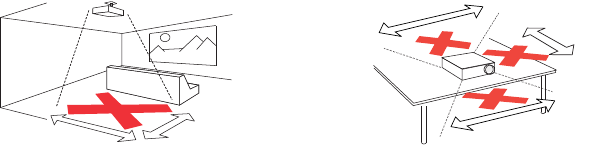
• In the unlikely event of a lamp rupture, particles may exit through the projector
vents. Keep people, food, and drinks out of the "keep out" area under and
around the projector, as indicated by the "X" areas below.
• Follow these instructions to help ensure image quality and lamp life over the
life of the projector. Failure to follow these instructions may affect the
warranty. For complete details of the warranty, see the Warranty/Safety
booklet.
5’/1.5m
8’/2.4m
3’ / 1 m
3’ / 1 m
2’ / 0.6 m
4
Introduction
Your new digital projector is simple to connect, easy to use, and straightforward to
maintain. It is a versatile projector that is flexible enough for business presentations
and home video viewing too. IN3128HD has native 1920 x 1080 resolution. It is
compatible with a wide variety of computers and video devices.
Product specifications
To read the latest specifications on your multimedia projector, be sure to visit our
website at www.infocus.com, as specifications are subject to change.
Accessories
The standard accessories that came with your projector are listed in the included
Quick Start documentation. Optional accessories can be found on our website at
www.infocus.com/support or at your retailer or dealer.
Online registration
Register your projector on our website at www.infocus.com/register to activate
your warranty and receive product updates, announcements, and registration
incentives.
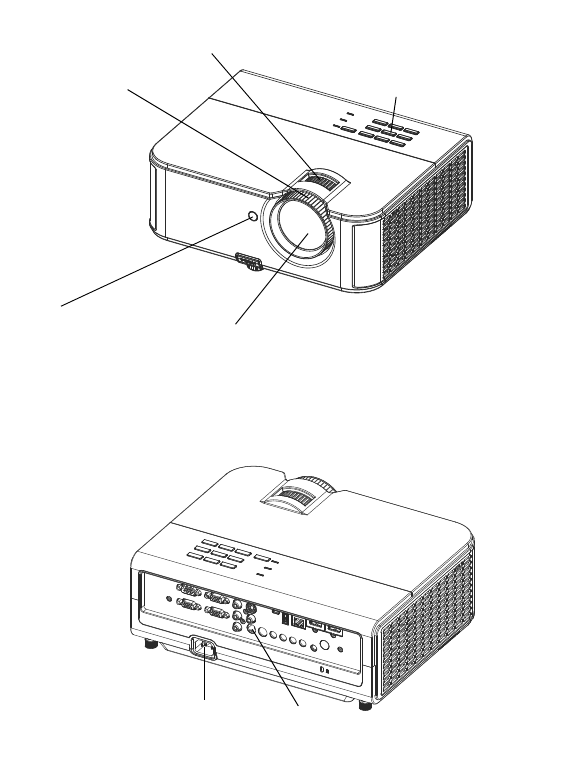
lens
remote control
receiver (IR)
keypad
zoom
focus
connector
panel
power cord
connector
5
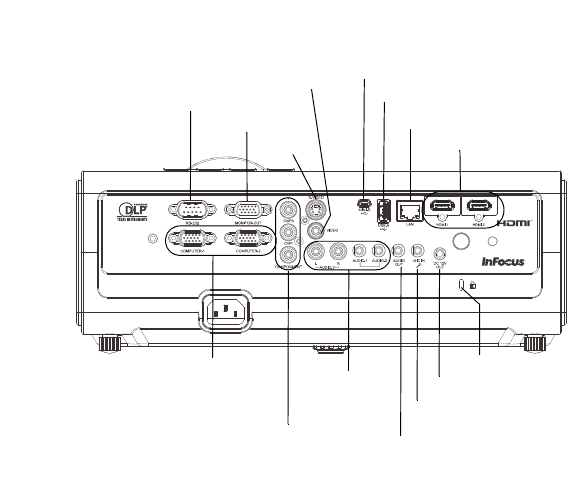
Connector panel
The projector provides both computer and video connection options, including:
• HDMI (2)
• VGA computer (2)
• Component video
•S-video
• Composite video
• Monitor out (for external monitors)
• Audio inputs (1 RCA; 2 3.5mm)
• Audio output
• Microphone input
• USB A (for JPEG presentations from a USB flash drive, for connecting a
mouse, keyboard or wireless adapter, and for firmware upgrades)
• USB mini B (for presentation slide control and displaying over USB)
• LAN (RJ45 for network control and video over LAN)
• 12 volt DC output (max. 0.75A; for screen trigger)
• RS232 (Serial command codes available at www.infocus.com/support)
RS 232
computer
composite video
S-video
security lock
HDMI
USB type A
LAN
monitor out
USB mini
microphone in
audio in
audio out
12V DC output
component video
6
Positioning the projector
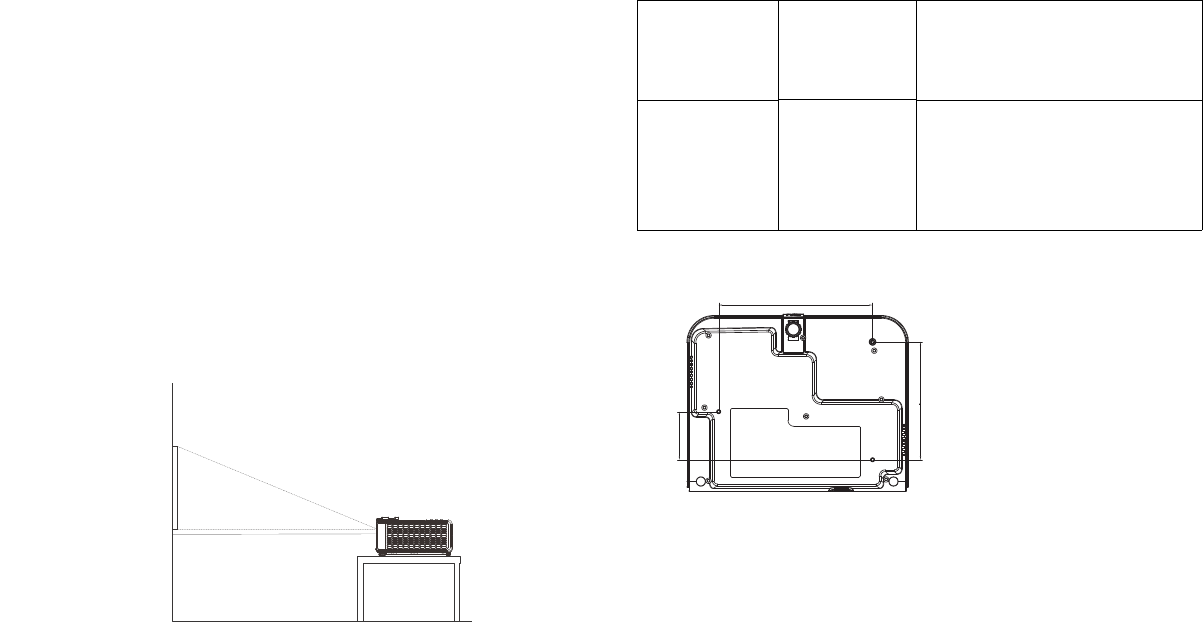
To determine where to position the projector, consider the size and shape of your
screen, the location of your power outlets, and the distance between the projector
and the rest of your equipment. Here are some general guidelines:
• Position the projector on a flat surface at a right angle to the screen. It must be
at least 48” (1.2m) from the projection screen.
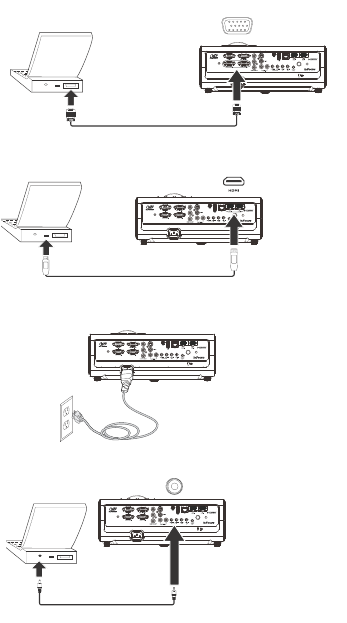
• If you are installing the projector on the ceiling, we strongly recommend using
InFocus approved ceiling mounts for proper fitting, ventilation and
installation. Refer to the installation guide that comes with the InFocus Ceiling
Mount Kit (p/n PRJ-MNT-UNIV) for more information. The warranty does
not cover any damage caused by use of non-approved ceiling mount kits or by
installing in an improper location. To turn the image upside down, see “Ceiling
mount” on page 26. We recommend using an InFocus authorized ceiling
mount.
• Position the projector the desired distance from the screen. The distance from
the lens of the projector to the screen and the video format determine the size
of the projected image.
• The image offset is 134% +/-5%. This means that if you have an image 60
inches (1.5 meters) tall from a table-mounted projector, the bottom of the
image will be 20.4 inches (51.8 cm) above the centerline of the lens.
60” image
(height)
bottom of image
20.4” above center
of lens
Projection angle
lens center
Table 1: IN3128HD (1080P) Screen size
Diagonal
Screen Size
(inches/m)
Size of the
Projected
Image Width
(inches/m)
Distance to screen
Minimum
distance
(inches/m)
Maximum
distance
(inches/m)
40”/1.0m 35”/0.9m 48”/1.2m 72”/1.8m
60”/1.5m 52”/1.3m 72”/1.8m 108”/2.7m
80”/2.0m 70”/1.8m 96”/2.4m 144”/3.7m
100”/2.5m 87”/2.2m 120”/3.1m 180”/4.6m
150”/3.8m 131”/3.3m 180”/4.6m 270”/6.9m
174
227
71 Ceiling mount screws:
M4x8 (Max. L= 8mm)
Unit: mm
7
Connecting a computer source
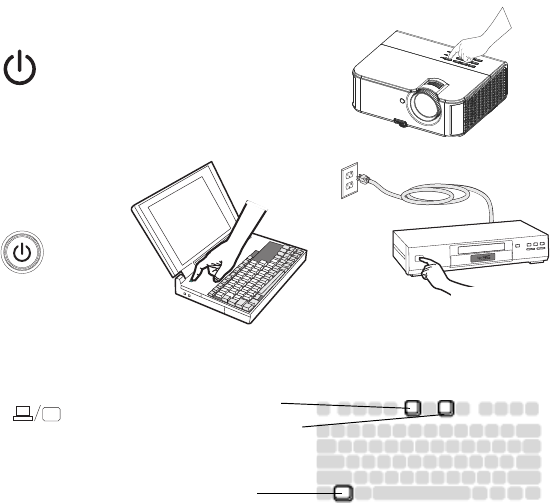
VGA connection
Connect one end of the provided computer cable to the Computer 1/Computer 2
connector on the projector and the other to the VGA connector on your computer. If
you are using a desktop computer, you will need to disconnect the monitor cable
from the computer’s video port first.
HDMI connection
HDMI is a standard, uncompressed, all-digital audio/video interface. HDMI
provides an interface between sources, such as set-top boxes, DVD players, and
receivers and your projector. Plug an HDMI cable into the video-out connector on
the video device and into either the HDMI 1 or HDMI 2 connector on the projector.
Display Over USB
Using a USB-A to USB Mini B cable connect the source computer to the projector.
In the Source Menu select the Mini-B input. The application will automatically run
from the projector is AutoRun is enabled on the computer. If it is not, open the drive
called “ifPresenter” and run autorun.exe. The program will automatically select the
native resolution of the projector
Connecting power
Connect the black power cord to the Power connector on the rear of the projector
and to your electrical outlet. If the Power Saving Mode feature is off, the Power
LED on the Status Indicator Panel (page 11) blinks blue. If the Power Saving Mode
feature is on, the Power LED is steady blue. By default, this feature is off. You can
change the setting, see page 27. NOTE: Always use the power cord that shipped
with the projector.
Optional computer connections
To get sound from the projector, connect an audio cable (optional cable, not
included) to your computer and to the Audio 1 or Audio 2 connector on the
projector. You may also need an adapter.
If you are using a desktop computer and want to see the image on your computer
screen as well as on the projection screen, connect to the desktop’s computer cable
to Computer 1 and the desktop’s monitor cable to the Monitor out connector on the
projector.
connect VGA cable
connect HDMI
connect power
connect audio cable
8
Displaying an image
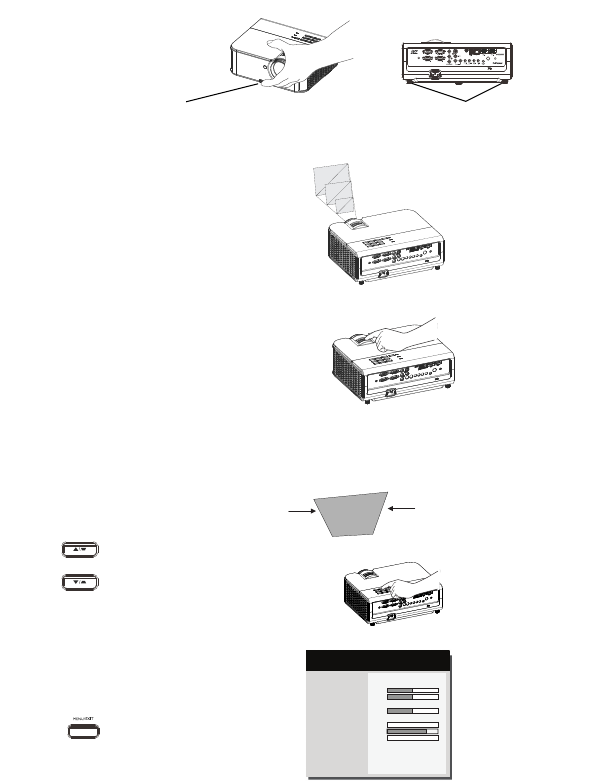
Press the Power button.
The Power LED lights blue, and the fans start to run. When the lamp comes on, the
start up screen displays. It can take up to a minute for the image to achieve full
brightness.
No start up screen? Get help on page 12.
Turn on your computer or video device.
The image should appear on the projection screen. If it doesn’t, press the Source
button on the projector’s keypad or remote.
If you are using a VGA cable to connect your computer to the projector:
If using a laptop, make sure its external video port is active.
Many laptops do not automatically turn on their external video port when a
projector is connected. Usually a key combination like FN + F8 or CRT/LCD key
turns the external display on and off. Locate a function key labeled CRT/LCD or a
function key with a monitor symbol. Press FN and the labeled function key
simultaneously.
Refer to your laptop's documentation for more information about your
laptop's key combination.
No laptop image? Try pressing the Auto button on the projector’s keypad or
Auto Image button on the remote. Get help on page 12.
turn on computer or
video device
activate laptop’s external port
monitor key or
LCD/CRT key
FN key
press Power button
9
Adjusting the image
If necessary, adjust the height of the projector by pressing the elevator foot release
button to extend the foot.
If necessary, rotate the leveling feet located at the rear of the projector.
Position the projector the desired distance from the screen at a 90 degree angle to
the screen.
See page 6 for a table listing screen sizes and distances.
Adjust the zoom or focus.
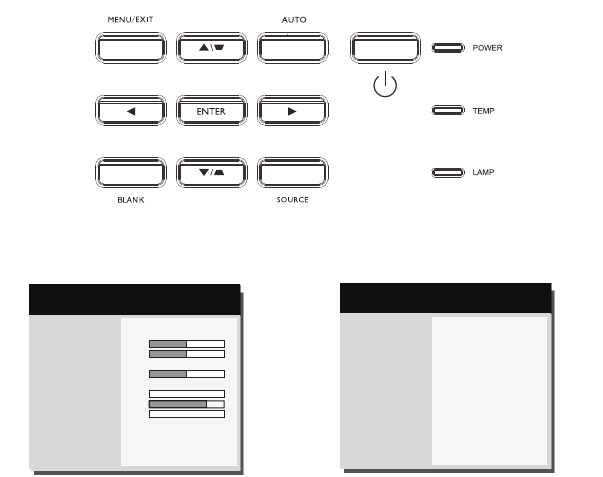
If the image is not square, first make sure that the projector is perpendicular to the
screen. If the image is larger or smaller on the top or bottom edge of the screen,
press the top Keystone button to reduce the upper part of the image, and press the
bottom Keystone button to reduce the lower part.
If the left or right side of the screen is larger or smaller the other, you can turn the
projector to the left or to the right a few degrees to square the image.
Adjust the Contrast or Brightness in the Basic Menu. See page 25 for help with
these menu adjustments.
adjust distance
adjust zoom and focus
adjust keystone
adjust Basic Menu
Aspect Ratio
Auto Image
Brightness
Contrast
Auto Keystone
Keystone
Presets
Sharpness
Volume
Microphone Volume
Ceiling Mount
Advanced Menu
( Basic Menu ) MDL: IN3128HD
FW: 0.10
◄ 16:9 ►
Execute
50
50
On
+ 0
Presentation
0
16
0
Off
adjust height
elevator foot release button leveling feet
10
Connecting a video device
You can connect video devices such as VCRs, DVD players, camcorders, digital
cameras, video game consoles, HDTV receivers, and TV tuners to the projector.
You can connect the audio directly to the projector to get sound from the built-in
speaker, or you can bypass the projector’s audio system and connect the audio
directly from your source to a stereo or home theater system.
You can connect the projector to most video devices that can output video. You
cannot directly connect the coaxial cable that enters your house from a cable or
satellite company, the signal must pass through a tuner first. Examples of tuners are
digital cable boxes, VCRs, digital video recorders, and satellite TV boxes.
Basically, any device that can change channels is considered a tuner.
Before connecting your projector, you should decide which aspect ratio you want to
use. The projector’s Aspect Ratio setting is accessed through the Resize button on
the remote or through the projector’s Basic Menu. See page 25 for more
information.
Video device connections
No video cables are provided with the projector. You can order cables from InFocus
or provide your own.
HDMI connection
HDMI is a standard, uncompressed, all-digital audio/video interface. HDMI
provides an interface between sources, such as set-top boxes, DVD players, and
receivers and your projector. Plug an HDMI cable into the video-out connector on
the video device and into one of the HDMI connectors (HDMI 1 or HDMI 2) on the
projector.
Composite video connection
Plug the composite video cable’s yellow connector into the video-out connector on
the video device. Plug the other yellow connector into the yellow Video connector
on the projector.
VGA connection
If your video device has a 15-pin VGA output, plug one end of the included
computer cable into the VGA connector on your video source. This connector may
be labeled “To Monitor” on the video source. Plug the computer cable into either
the Computer 1 or Computer 2 connector on the projector.
Component video connection
If your HD video device has component connectors, connect one end of an RCA
Component cable to the component video output connectors of the Video source
device. Plug the other end of the RCA Component cable to the Y Cb/Pb Cr/Pr
connectors on the projector.
You may use an optional Component to VGA adapter. Plug the component cable
into the video device. Plug the other end of the component cable into the adapter
and plug the adapter into the Computer 1 or Computer 2 connector.
S-video connection
Plug the S-video cable’s connector into the video-out connector on the video device.
Plug the other connector into the S-Video connector on the projector.
Audio
For PC audio jack, connect a 3.5mm stereo cable to the Audio 1 or Audio 2
connector on the projector and to your source. If your source uses RCA audio
connectors, a Y-cable or adapter may be used. For RCA audio jack, connect a RCA
stereo cable to the Audio/L and Audio/R connectors on the projector and to your
source. (Note: A separate audio connection is not required for HDMI source
inputs.)

11
Shutting down the projector
Auto Off Time
The projector also has an Auto Off Time feature that automatically turns the
projector off after no active sources are detected and no user interaction with the
projector is performed for 30 minutes. By default, this feature is off. You can
change the length of time, see page 27.
Turning off the projector
To turn the projector off, press the Power button on the remote or keypad. The lamp
turns off and the Power LED blinks blue for 1 minute while the fans continue to run
to cool the lamp. If the Power Saving Mode feature is on and when the lamp has
cooled, the LED lights blue and the fans stop. If the Power Saving Mode feature is
off and when the lamp has cooled, the LED blinks blue and the fans stop. Unplug
the power cable to completely power off the projector.
Troubleshooting your setup
If your image appears correctly on the screen, skip to the next section. If it does not,
troubleshoot the setup.
The Status Indicator Panel on top of the projector indicates the state of the projector
and can help you troubleshoot.
Table 2: Status indicator light behavior and meaning
Status Indicator Light Meaning
POWER: Solid blue
POWER: Blinking blue
1. If the Power Saving Mode feature is on,
the projector is plugged in.
2. The projector is on and initialized.
3. The projector is in normal operation.
1. If the Power Saving Mode is off, the
projector is plugged in.
2. The projector is powering down and the
fans are cooling the projector.
POWER: Blinking blue
TEMP: Blinking red
LAMP: Blinking red
POWER: Solid blue
TEMP: Blinking red
LAMP: Blinking red
The projector fan(s) are not operating
correctly and the projector has been shut
down.
The lamp failed to ignite.
Contact Technical Support if the problem
persists. Visit www.infocus.com/support to
contact service.
POWER: Solid blue
TEMP: Off
LAMP: Blinking red
The lamp has reached its end of life and
must be replaced. The lamp will continue
to operate until it fails.
Contact Technical Support. Repair may be
needed.
POWER: Solid blue
TEMP: Blinking red
LAMP: Off
1. The projector is overheating and the
lamp will be shut off. The fans will
continue to run.
2. The projector will not turn back on until
the cooling process is complete.
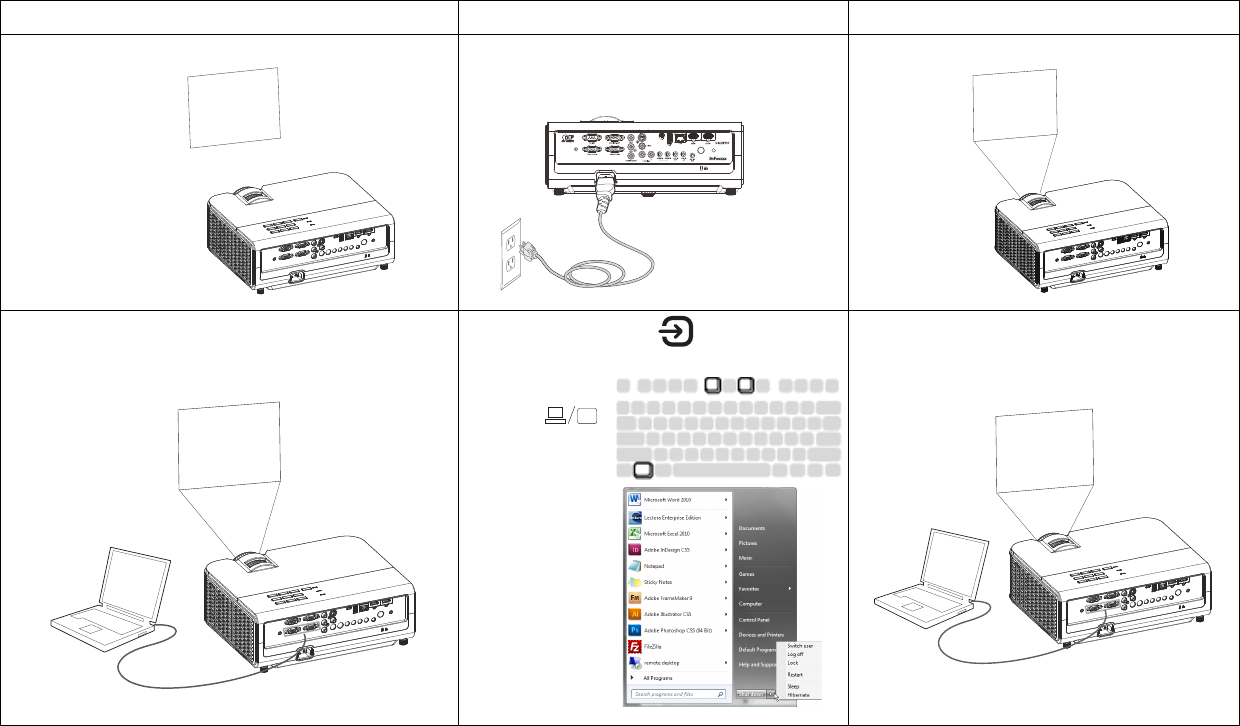
Problem Solution Result
No start up screen Plug power cord into the projector
press power button
Startup
Screen
Correct image
A
Startup
Screen
Only start up screen appears
Restart laptop
Press the Source button
activate laptop’s external port
A
A
Computer image projected
12
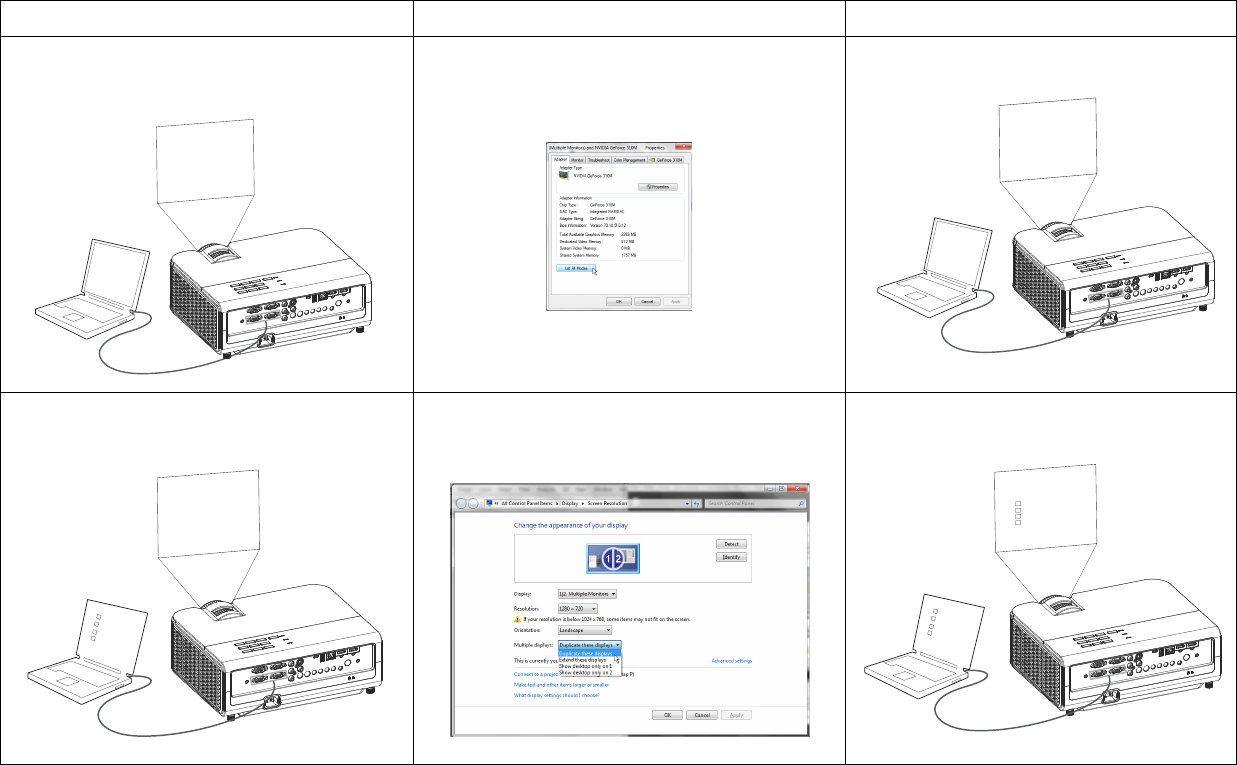
13
Problem Solution Result
No computer image, just the words “Signal out of
range”
A
Signal out of
the range
Press the Auto Image button on remote
Adjust computer refresh rate (Windows 7: Control
Panel > Display > Screen Resolution > Advanced
Settings > Adapter tab). Varies per operating system.
You may also need to set a different resolution on
your computer, as shown in the following problem,
“image fuzzy or cropped”
Computer image projected
A
A
Only my laptop’s background appears, not the
Desktop icons
A
A
Change the Multiple Display setting to "Duplicate
these displays" (Windows 7: Control Panel > Display
> Screen Resolution). Varies per operating system.
Background and Desktop projected
A
A
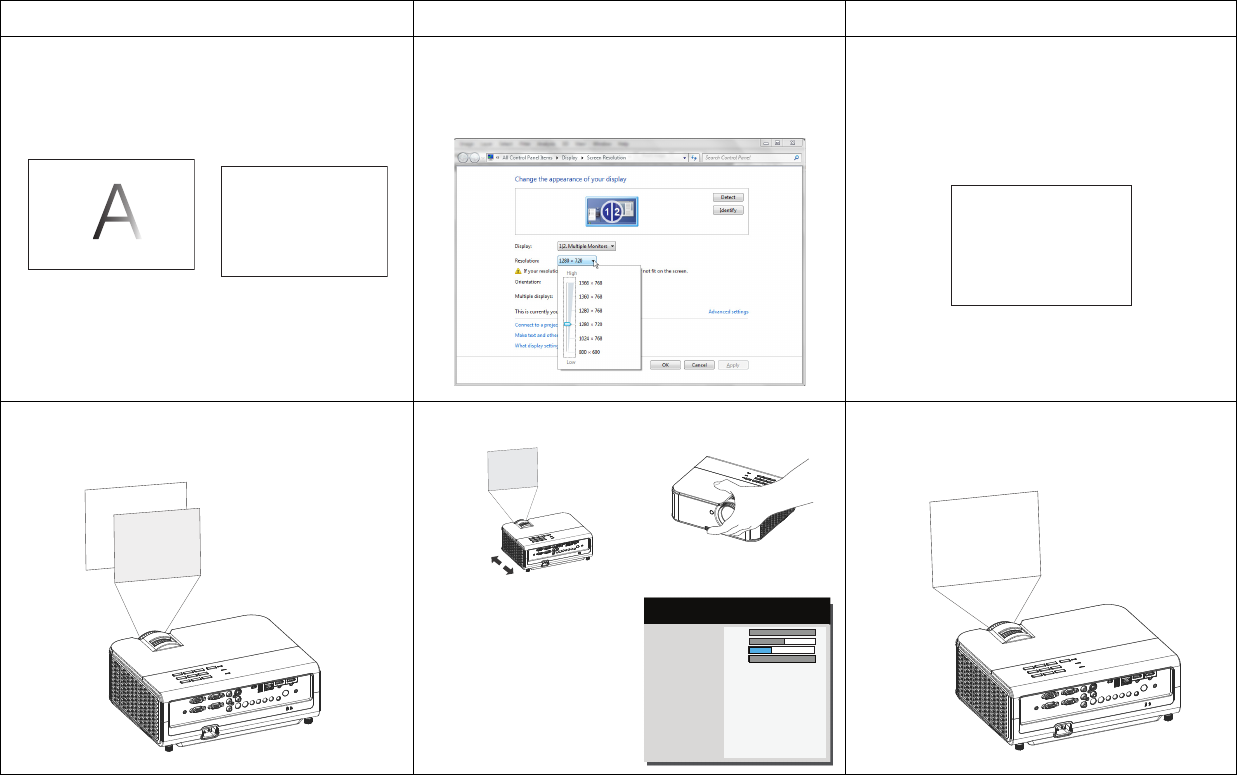
14
Image fuzzy or cropped
A
A
Change the computer's "Resolution" setting to match
the projector's resolution (Windows 7: Control Panel
> Display > Screen Resolution). Varies per operating
system.
A
Image clear and not cropped
Image not centered on screen
Phase
Tracking
Horz Position
Vert Position
Previous
100
69
30
100
( PC ) MDL: IN3128HD
FW: 0.10
Adjust horizontal or
vertical position in
Advanced Menu >
Image > PC menu
Move projector, adjust height Correct image
Problem Solution Result
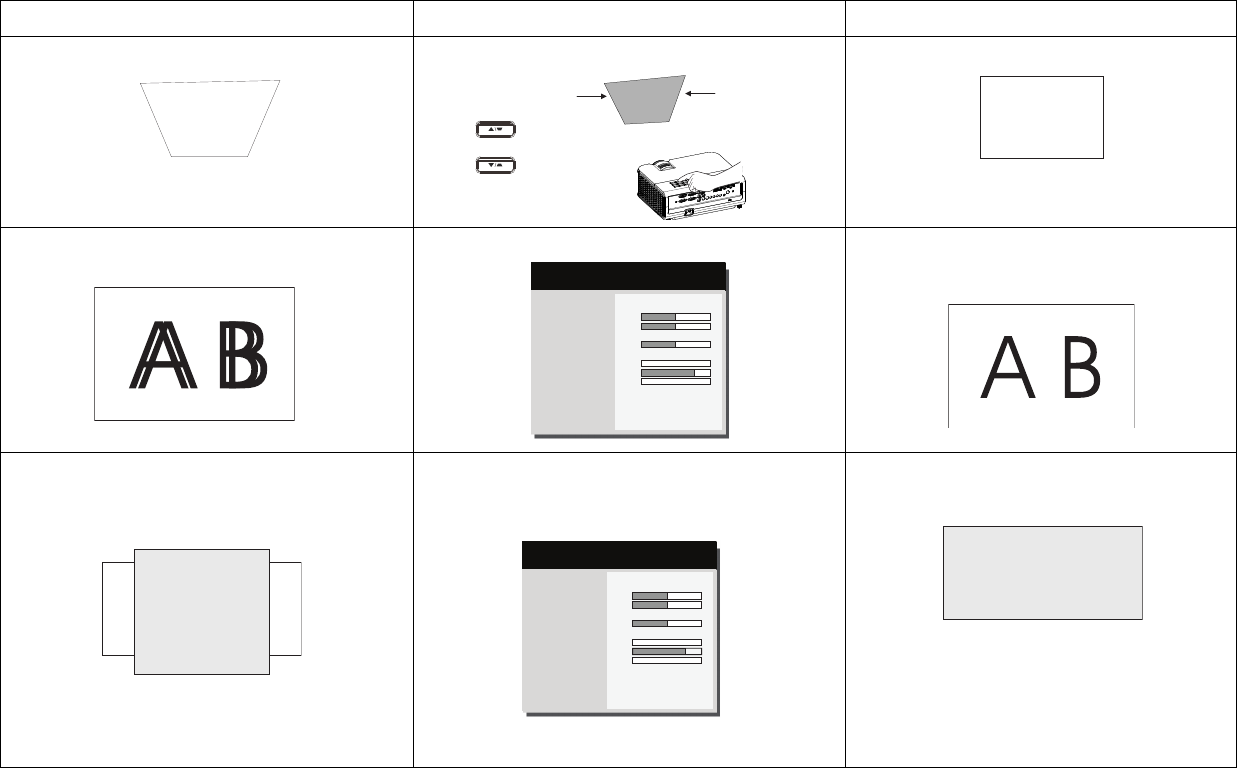
15
Image not square Adjust Keystone on keypad Square image
Image not sharp
Aspect Ratio
Auto Image
Brightness
Contrast
Auto Keystone
Keystone
Presets
Sharpness
Volume
Microphone Volume
Ceiling Mount
Advanced Menu
16:9
Execute
50
50
On
+ 0
Presentation
0
16
0
Off
( Basic Menu ) MDL: IN3128HD
FW: 0.10
Adjust Sharpness in the Basic Menu Correct image
Image does not fit 4:3 or 16:9 screen
Aspect Ratio
Auto Image
Brightness
Contrast
Auto Keystone
Keystone
Presets
Sharpness
Volume
Microphone Volume
Ceiling Mount
Advanced Menu
( Basic Menu ) MDL: IN3128HD
FW: 0.10
◄ 16:9 ►
Execute
50
50
On
+ 0
Presentation
0
16
0
Off
Change aspect ratio to 4:3 or 16:9 in Basic Menu >
Aspect Ratio menu
Correct image
Problem Solution Result
A
16
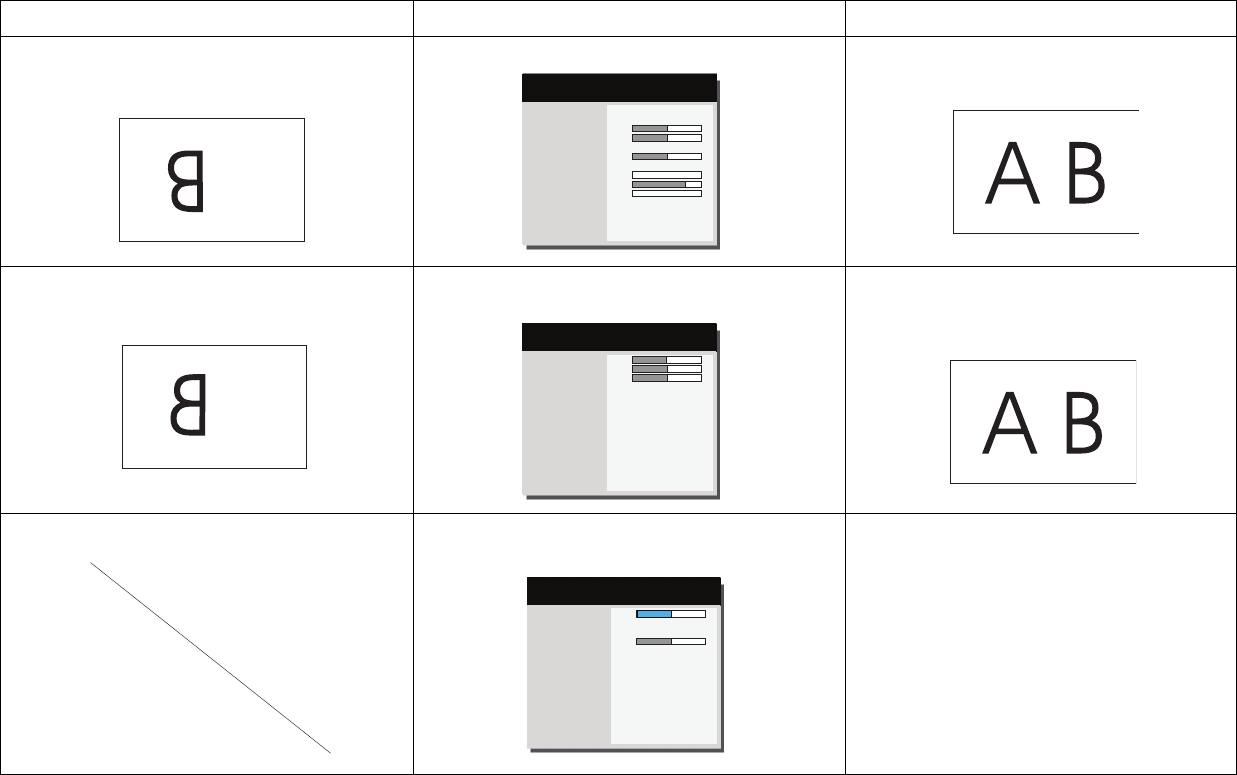
Image upside down
Aspect Ratio
Auto Image
Brightness
Contrast
Auto Keystone
Keystone
Presets
Sharpness
Volume
Microphone Volume
Ceiling Mount
Advanced Menu
16:9
Execute
50
50
On
+ 0
Presentation
0
16
0
◄ Off ►
( Basic Menu ) MDL: IN3128HD
FW: 0.10
Turn off Ceiling Mount in Basic menu Correct image
Image reversed left to right
A
Magnify Level
Horz Shift
Vert Shift
Ceiling Mount
Rear Project
Previous
0
50
50
Off
◄ Off ►
( Image Setup ) MDL: IN3128HD
FW: 0.10
Turn off Rear Project in Advanced Menu > Setup >
Image Setup menu Correct image
COLOR
Projected colors don’t match source
Color
Color Temp
Gamma
Tint
Previous
50
Cool
Video
50
( Color ) MDL: IN3128HD
FW: 0.10
Adjust the items in the Advanced Menu > Image >
Color menu
COLOR
Correct image
Problem Solution Result
17
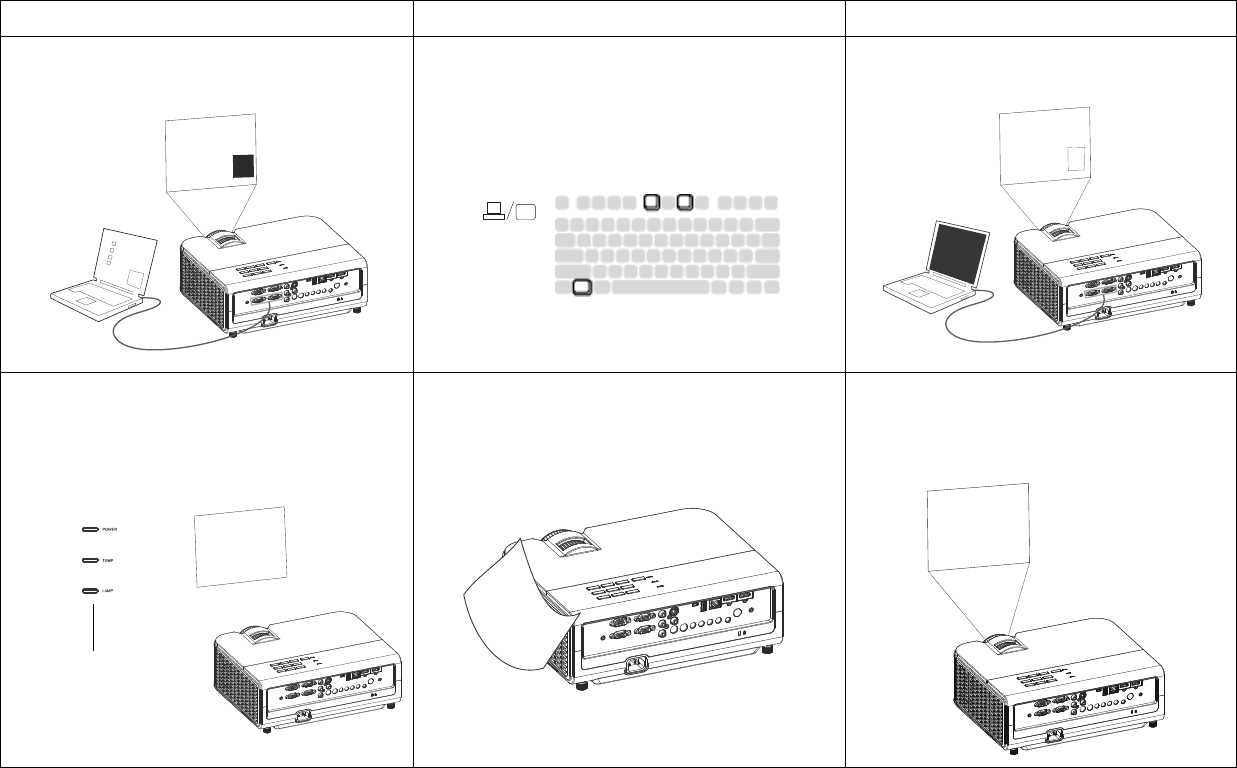
The video embedded in my PowerPoint
presentation does not play on the screen
A
A
B
B
Turn off the internal LCD display on your laptop Embedded video plays correctly
A
B
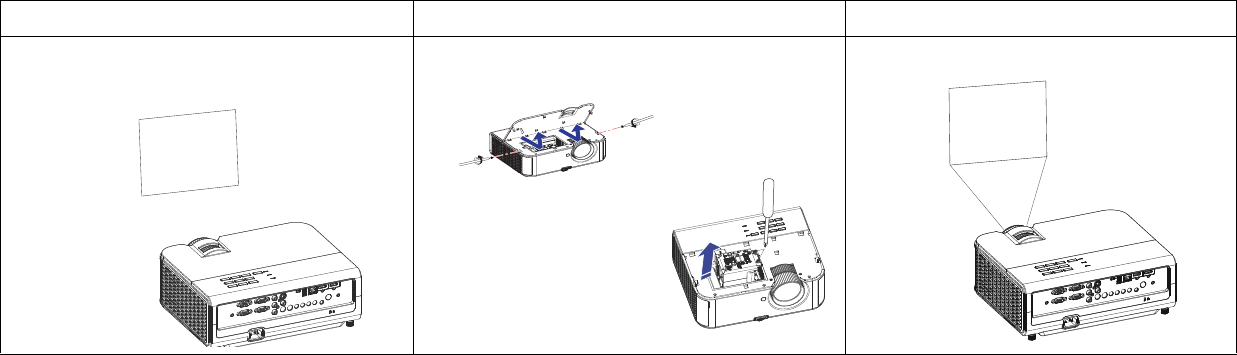
Overheating
indicator
Lamp won’t turn on, the projector is overheating Make sure vents aren’t blocked, turn off the projector
and allow it to cool for one minute
Startup
Screen
Lamp turns on
Problem Solution Result
18
Still need assistance?
If you need assistance, visit our website at www.infocus.com/support or call us.
See the Warranty/Safety booklet for support contact information.
This product is backed by a limited warranty. An extended warranty plan may be
purchased from your dealer. When sending the projector in for repair, we
recommend shipping the unit in its original packing material, or having a
professional packaging company pack the unit. Please insure your shipment for its
full value.
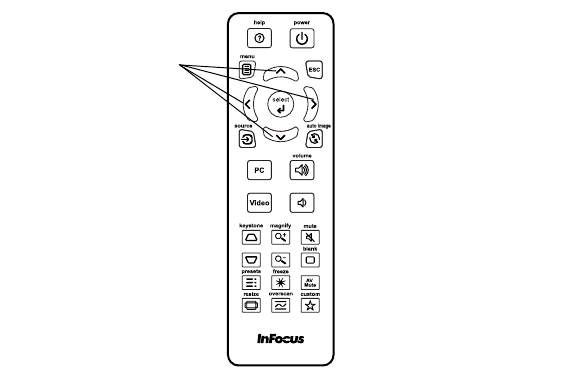
“Replace lamp” message appears at startup, lamp
won’t turn on
lamp door
replace lamp
Lamp must be replaced (see page 40)
Startup
Screen
Lamp turns on
Problem Solution Result
19
Using the remote control
The remote uses two (2) AAA batteries (not provided). They are easily installed by
removing the cover from the remote’s back, aligning the + and - ends of the
batteries, sliding them into place, and then replacing the cover.
Caution:
• When replacing the remote batteries, be aware that using batteries other than
AAA batteries may risk severe damage to the remote. When disposing of the
batteries, be sure to do so in an enviromentally proper manner.
• If the remote control gets wet, wipe it dry immediately.
•Avoid excessive heat and humidity.
• Ensure the batteries' polarity (+/-) is aligned correctly.
• Do not mix new and old batteries together, or mix different types of batteries
together.
• Replace the batteries as soon as they run out.
• Remove batteries from the remote control when storing or not in use for a pro-
longed period.
To operate, point the remote at the front of the projector (not at the computer). The
range of optimum operation is about 15 feet (4.5m).
Press the remote’s Power button to turn the projector on and off (see page 11 for
shutdown info).
Press the remote’s Menu button to open the projector’s menu system. Use the arrow
buttons to navigate, and the Select button to select features and adjust values in the
menus. See page 24 for more info on the menus.
The remote also has:
•Volume buttons adjust the sound.
•Custom button that can be assigned to a special function, like Blank Screen or
Freeze (see page 26).
•Source button brings up a menu of all possible sources allowing the user to
switch the active source.
•Blank button to blank the screen.
•Presets button to select stored settings (see page 25).
•Mute button to silence the audio.
•Auto Image button to resynch the projector to the source.
•Resize button to switch among aspect ratios (see page 25).
•Help button to get help with connecting sources and improving the picture.
•ESC button to go back to previous OSD menu.
•PC button to cycle through the Computer sources.
•Video button to cycle through Composite/S-Video/HDMI input sources.
•Keystone buttons adjust the squareness of the image
•Magnify buttons magnify and reduce the projected picture size.
•Freeze button to pause the projected image.
•Overscan button remove noise around the video image.
•AV M u t e button blanks the projected image and mutes audio.
Troubleshooting the remote
• Make sure the batteries are installed in the proper orientation and are not dead.
• Make sure you’re pointing the remote at the projector or the screen, not the
computer, and are within the remote range of 15 feet (4.5m). For best results,
point the remote at the projector.
navigation
buttons
20
Using the audio
Using the projector’s speakers
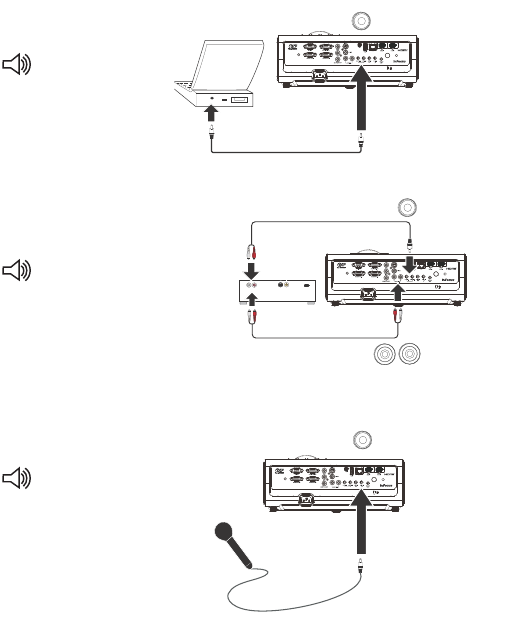
Connect the audio source to the Audio 1, Audio 2 or Audio L/R connectors to hear
audio through the projector speakers. You may use the projector’s speakers by
connecting a microphone to the Microphone input connector.
Amplified speakers may also be connected to the projector using the Audio Out
connector.
To adjust the volume, press the Vol ume buttons on the remote.
Troubleshooting Audio
If you aren’t hearing the audio, check the following:
• Make sure the audio cable is connected to the Audio In or Audio L/R
connectors on the projector, and that the other end of the cable is connected to
an Audio Out connector on the source (not a “line-in” or “microphone”
connector).
• Make sure the volume is turned up enough. Press the Volume button on the
remote.
• Make sure the correct source is active.
• Adjust the audio source.
• If playing a video, make sure the playback has not been paused.
connect PC audio cable
Video Out HDMI Out
Audio Out
L R
connect video source audio
cable
connect microphone
21
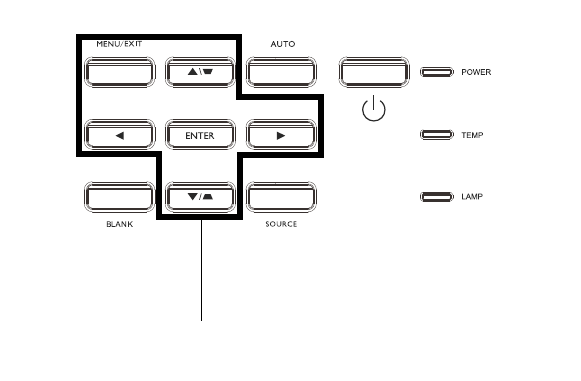
Using the keypad buttons
Most buttons are described in detail in other sections, but here is an overview of
their functions:
Power–turns the projector on and off (page 8).
Auto–resynchronize the projector to the source.
Menu–opens the onscreen menus (page 24).
Enter–acts as a Select button in the OSD menu and is used for USB storage device
operation (page 37).
Up/Down/Left/Right arrows–When the menu is displayed, the up and down
buttons navigate through the menu; the left and right buttons are used for
adjustment. The left button also allows you to go back to the previous menu.
Keystone–adjusts the squareness of the image (page 9).
Source–brings up a menu of all possible sources allowing the user to switch the
active source (page 8).
Blank–blanks the screen.
menu navigation
buttons
22
Optimizing computer images
After the projector is running and the image is on the screen, you can optimize the
image using the onscreen menus. For general information on using the menus, see
page 24.
• Select default image settings using a preset appropriate to your environment.
• Adjust the Keystone, Contrast, or Brightness (page 25).
• Change the Aspect Ratio. Choose the option that best fits your input source
(page 25).
• Adjust the Color Temperature (page 26).
• Adjust the Phase, Tracking, or Horizontal or Vertical position (page 26).
• Once you have optimized the image for a particular source, you can save the
settings using User Presets. This allows you to quickly recall these settings
later (page 25).
Presentation features
Several features are provided to make giving presentations easier. Here is an
overview, details are found in the menu section.
• The Custom key allows you to assign various features to the button. The
default effect is Source Info, which displays information about the projector
and current source. See page 26 for details.
• The Search Screen option lets you change the appearance of the blank screen
and start up screen (page 27).
• Auto Off Time is provided to automatically shut down the projector after
several minutes. This helps preserve lamp life (page 27).
23
Optimizing video images
After your video device is connected properly and the image is on the screen, you
can optimize the image using the onscreen menus. For general information on using
the menus, see page 24.
• Adjust the Keystone, Contrast, Brightness, Color, or Tint (page 25).
• Change the Aspect Ratio. Choose the option that best fits your input source
(page 25).
• Select a Sharpness setting (page 25).
• Adjust the Color Temperature. Select a listed warmth value (page 26).
• Turn on Overscan to remove noise on the edges of the image (page 26).
Customizing the projector
You can customize the projector for your specific setup and needs. See page 26 for
details on these features.
• For rear projection, turn Rear Project on in the Advanced Menu > Setup >
Image Setup menu.
• For ceiling mounted projection, turn Ceiling Mount on in the Basic menu.
• Specify which source the projector checks first for active video during power-
up in the Advanced Menu > Setup > Sources menu.
• Specify the function of the Custom key on the remote.
• Turn the projector’s display messages on and off.
• Turn on power saving features.
• Specify appearance of blank screen and startup screen.
• Specify the language viewed on the menus.
• Save settings for the active source as a User Preset.
24
Using the menus
1To open the menus, press the Menu button on the keypad or remote. (The
menus automatically close after 60 seconds if no buttons are pressed.) Use the
arrow buttons to move up and down to review the menu options.
2To enter a submenu, highlight the desired submenu and press Enter on the
keypad or remote.
3To adjust a menu setting, highlight the desired menu option and press < or > to
scroll through the available adjustments.
4Press the Menu button to exit the menu system.
The menus are grouped by usage:
• The Basic Menu provides common adjustments.
• The Advanced Menu provides more complex adjustments.
keypad navigation
buttons
Image
Setup
Status/Service
Basic Menu
Color
PC
Video
( Advanced Menu ) MDL: IN3128HD
FW: 0.10
Basic Menu Advanced Menu
Aspect Ratio
Auto Image
Brightness
Contrast
Auto Keystone
Keystone
Presets
Sharpness
Volume
Microphone Volume
Ceiling Mount
Advanced Menu
(
Basic Menu
)
MDL: IN3128HD
FW: 0.10
◄ 16:9 ►
Execute
50
50
On
+ 0
Presentation
0
16
0
Off
25
Basic Menu
To adjust the following settings, highlight the setting, use the right and left arrows
to adjust the values.
Aspect Ratio: Aspect ratio is the ratio of the image width to image height. TV
screens are usually 4:3. HDTV and most DVDs are 16:9.
Select Auto to have the projector choose the ratio. Choose Native to see the
unmodified input with no resizing by the projector. Select 16:9 to watch enhanced
widescreen DVDs.
Auto Image: resets the projector to the source.
Brightness: changes the intensity of the image.
Contrast: controls the degree of difference between the lightest and darkest parts of
the picture and changes the amount of black and white in the image.
Auto Keystone: enables and disables the projector’s automatic vertical keystone
adjustment.
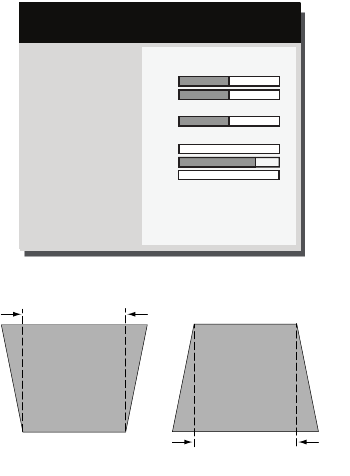
Keystone: adjusts the image vertically and makes a squarer image. You can also
adjust keystone from the keypad.
Presets: Presets are provided that optimize the projector for displaying computer
presentations and video images under certain conditions. Note: Choosing User
allows users to save their settings current settings as a User Preset. User Presets can
be retrieved by pressing the Presets button on the remote and toggling to User.
Sharpness: Changes the clarity of the edges of a video image. Select a sharpness
setting.
Volume: increases or decreases the audio volume.
Microphone Volume: adjusts the microphone sound level.
Ceiling Mount: turns the image upside down for ceiling-mounted projection.
Basic Menu
Aspect Ratio
Auto Image
Brightness
Contrast
Auto Keystone
Keystone
Presets
Sharpness
Volume
Microphone Volume
Ceiling Mount
Advanced Menu
( Basic Menu )
MDL: IN3128HD
FW: 0.10
◄ 16:9 ►
Execute
50
50
On
+ 0
Presentation
0
16
0
Off
increasing keystone decreasing keystone

26
Advanced Menu
Image
Setup
Status/Service
Basic Menu
Color
PC
Video
( Advanced Menu ) MDL: IN3128HD
FW: 0.10
Advanced Menu
Image:
Color...
Color: adjusts a video image from black and white to fully saturated color. The
color setting applies to video sources only.
Color Temp: changes the intensity of the colors. Select a listed relative
warmth value.
Gamma: select the appropriate gamma from among Video, Film, Bright, and
CRT.
Tint: adjusts the red-green color balance in the image of NTSC video images.
The tint setting applies to NTSC video sources only.
PC:
Phase: adjusts the horizontal phase of a computer source.
Tracking: adjusts the vertical scan of a computer source.
Horz/Vert Position: adjusts the position of a computer source.
Video:
Overscan: removes noise around the video image.
Setup:
Audio Setup...
Computer 1: selects the audio input for Computer in 1 signal.
Computer 2: selects the audio input for Computer in 2 signal.
Video Source: selects the audio input for video source.
HDMI 1: select the audio input for HDMI 1signal.
HDMI 2: select the audio input for HDMI 2 signal.
Closed Captioning...
Closed Captions: controls closed captioning. If the source is NTSC and
contains captions on the selected channel, then the projector will display
caption text overlaid on the image. When Closed Captions is off and volume is
muted, closed captioning will appear. Options are: Off, CC1 and CC2.
Image Setup...
Magnify Level: magnifies the image. If the image has been magnified by this
setting, it can be moved by changing the Horz Shift and Vert Shift settings.
Ceiling Mount: turns the image upside down for ceiling-mounted projection.
Rear Project: reverses the image so you can project from behind a translucent
screen.
Keypad/Remote Settings...
Blank Key: select either a solid blue, black or white screen to display when
the blank key on the keypad or remote is pressed.
Custom Key: allows you to assign a different function to the Custom button,
allowing you to quickly and easily use the effect. Press < or > on the keypad or
remote to choose a different one.
•Blank Screen: displays a solid color screen.
•Mute: turns off all sound.
•Source: brings up a menu of available sources.
•Auto Image: resets the projector to the source.
•Freeze Screen: pauses the projected image.
27
•Source Info: the default action. Shows the Source Info menu.
•Projector Info: shows the Projector Info menu.
•Overscan: removes noise around the image.
•AV M u t e : enables or disables AV Mute function.
•Closed Captions: enables or disables Closed Captions.
Keypad: enables or locks the projector keypad.
Lamp...
Lamp Low Power: toggles between on and off. Turn it on to lower the light
output of the lamp. This also lowers the fan speed, making the projector qui-
eter.
OSD Setup...
Language: allows you to select a language for the onscreen display.
Menu Position: allows you to change the position of the On Screen Display
items.
Menu Transparency: allows you to change how much of the projected image
behind the menu you can see. As the value increases, more of the image behind
the menu is visible.
Show Messages: displays status messages (such as “Searching”) in the lower-
left corner of the screen.
PIN Settings
PIN Protect: The PIN (personal identification number) feature allows you to
password protect your projector. Once you enable the PIN feature, you must
enter the PIN before you can project an image. Use the Up/Down/Left/Right
arrows buttons on the remote or keypad to set a 4-button press sequence. If you
enter an incorrect PIN 3 times in succession, the projector will automatically
shut down. If you lose or forget your custom PIN, contact InFocus Technical
Support.
To enter the PIN at projector startup:
Power up the projector. The “Enter PIN” dialog box displays after the startup
screen. Enter the PIN. Use the Up/Down/Left/Right arrows buttons on the
remote or keypad to enter the correct 4-button press sequence. The default
code is Left/Right/Up/Down.
To change the PIN:
Select “Change PIN...” in the Advanced Menu > Setup > PIN settings menu.
Enter the existing PIN. Enter the new PIN.
Power
Power Saving Mode: When the Power Saving Mode is On and the projector is
in standby (powered off but connected to AC power), the monitor out function
will not work. When the Power Saving Mode is On and the projector is Off,
the LAN control will not work. NOTE: The Power LED does not blink when
Power Saving Mode is enabled.
Source
Auto Source: When this feature is On, the projector automatically finds the
active source, checking the selected Power-up Source first. When this feature
is Off, the projector defaults to the source selected in Power-up Source. To dis-
play another source, you must manually select one by pressing the Source but-
ton on the remote or keypad and selecting one from the displayed Source
menu.
Power-up Source: determines which source the projector checks first for
active video during power-up.
Search Screen: allows you to display a solid color screen (blue, black or
white), or the factory logo screen at startup, and when no source is detected.
Timer
Auto Off Time: automatically turns the projector off after no signals are
detected for a preset number of minutes. If an active signal is received before
the projector powers down, the image will be displayed.
High Altitude Setting
High Altitude Setting: We recommend you turn on the High Altitude Mode
when your environment is between 5000' (1500m) and 10,000' (3000m) above
sea level.

Wired LAN
Wireless LAN
Network Restart
MAC Address
Previous
Execute
00:08:0C:04:10:48
( Network ) MDL: IN3128HD
FW: 0.10
Network Menu
28
Network
Allow you to configure the network settings.
Wired LAN
Status: Display the projector’s status.
DHCP: Abbreviation for Dynamic Host Configuration Protocol. This
protocol automatically assigns IP Addresses to networked devices.
•When the “DHCP” is set to “On”, the DHCP server will assign an IP
address to the projector automatically. This may take up to a minute.
•When the "DHCP" is set to "Off", the user will need to set the IP
address manually.
IP Address: The numerical address used to identify devices on the net-
work. This is only accessible when DHCP is set to Off.
• The IP Address is the number that identifies this projector on the
network. You cannot have two devices with the same IP Address on the
same network.
• The IP Address “0.0.0.0” is prohibited.
Subnet Mask: A numeric value defining the number of bits used in an IP
Address when the network is divided into subnets. This function can only
be used when DHCP is set to Off.
• The Subnet Mask “0.0.0.0” is prohibited.
Default Gateway: A server (or router) to communicate across networks
(subnets) that are divided by a Subnet Mask. This function can only be
used when DHCP is set to Off.
DNS: Setup DNS server address when DHCP is disabled.
Apply: Save and execute the wired network settings.
Wireless LAN
Status: Display the projector’s status.
SSID: Display the projector’s SSID information.
Connection Mode: Methods for connecting to wireless networks with
Wi-Fi enabled devices.
IP Address: a read-only display of IP Address.
Network Restart: Restart network settings.
MAC address:Abbreviation for Media Access Control Address. Mac Address
is a unique ID number assigned to each network adapter.
DC 12V Trigger
DC 12V Trigger: If this feature is enabled and you connect your projection
screen to this output using the cable that came with your screen, the screen will
move down when the lamp is turned on and the screen will return to its storage
position, when the lamp is turned off.
Status/Service:
Source Info: a read-only display of current source settings.
Projector Info: a read-only display of current projector settings.
Reset Lamp Hours...: resets the lamp hours used counter in the Projector Info
menu to zero. Do this only after changing the lamp.
Factory Reset...: restores all settings to their factory default settings.
Service Code...: only used by authorized service personnel.
29
Controlling the projector through a LAN
environment
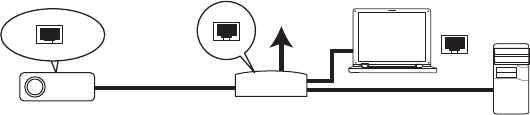
The projector supports Crestron® software. With correct settings for the Network
menu, you can manage the projector from a computer using a web browser when
the computer and the projector are properly connected to the same local area
network.
Wired connection
Internet
IP Router
Configuring the LAN control setting
If you are in a DHCP environment:
1Take a RJ45 cable and connect one end to the RJ45 LAN input jack of the
projector and the other end to the RJ45 port.
2Press Menu on the keypad or remote and then go to Advanced Menu > Setup
> Network > Wired LAN menu.
3Press v to highlight DHCP and press < or > to select On.
4Press v to highlight Apply and press >.
5Please wait for around 15 - 20 seconds, and then re-enter the Wired LAN page.
The IP address, Subnet Mask, Default Gateway and DNS settings will be
displayed. Write down the IP address displayed in the IP address row.
• If the Projector IP Address still does not display, contact your network
administrator.
• If the RJ45 cables are not properly connected, the IP Address, Subnet Mask,
Default Gateway and DNS settings will display 0.0.0.0. Make sure the cables
are properly connected and perform the procedures above again.
• If you need to connect to the projector in its standby mode, set the Power
Saving Mode feature to Off.
If you are in a non-DHCP environment:
1Repeat steps 1-2 above.
2Press v to highlight DHCP and press < or > to select Off.
3Contact your network administrator for information on the IP address, Subnet
Mask, Default Gateway and DNS settings.
4Press ^ or v to select the item you want to modify.
5Press < or > to move the cursor and then press ^ or v to select the value.
6Press v to highlight Apply and press > to save the settings.
• If the RJ45 cables are not properly connected, the IP Address, Subnet Mask,
Default Gateway and DNS settings will display 0.0.0.0. Make sure the cables
are properly connected and perform the procedures above again.
• If you wish to connect to the projector in its standby mode, be sure to select
RJ45 and obtain the IP Address, Subnet Mask, Default Gateway and DNS
information when the projector is on.
30
Wireless connection
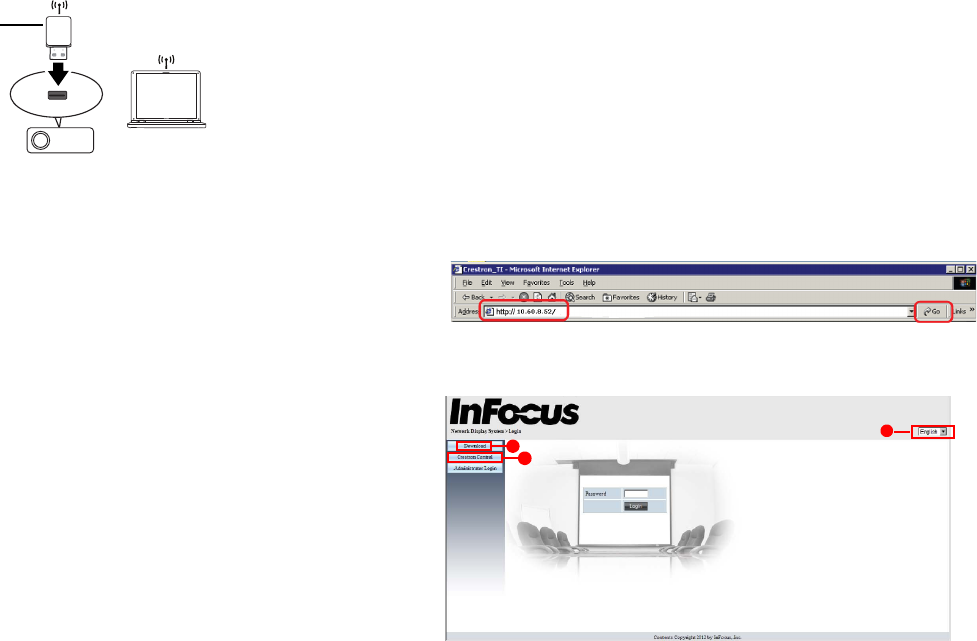
To connect to the projector wirelessly, you have to plug an InFocus wireless dongle
(optional) to the USB Type A connector on the projector, and then only a few OSD
configuration steps are required.
1Make sure the projector is turned on.
2Press Menu on the keypad or remote and then go to Advanced Menu > Setup
> Network > Wireless LAN menu.
3Make sure the Status is Connect.
4Make sure the SSID information is displayed.
5In AP mode, you need to use your computer’s wireless connection utility to
search the projector’s SSID and connect to it. Then you can search the projector
with ifPresenter. To use Infrastructure mode, you should connect both your
computer and projector to the same AP router and make connections with the IP
address.
Controlling the projector remotely through a web
browser
Once you have the correct IP address for the projector and the projector is on or in
standby mode, you can use any computer that is on the same local area network to
control the projector.
• If you are using Microsoft Internet Explorer, make sure it is version 7.0 or
higher.
• The screenshots in this manual are for reference only, and may differ
depending on your browser.
1Enter the address of the projector in the address bar of your browser and press
Enter.
2The main page of the Network Control displays.
ii
i
iii
i. To change the language for the web pages, click the down arrow to reveal a
drop down list and select a desired language.
ii. To download ifPresenter, click Download. See page 34 for details.
InFocus wireless dongle
(p/n SP-WIFIUSB)
31
iii. The Crestron (eControl) page displays the Crestron eControl user interface.
See page 31 for details.
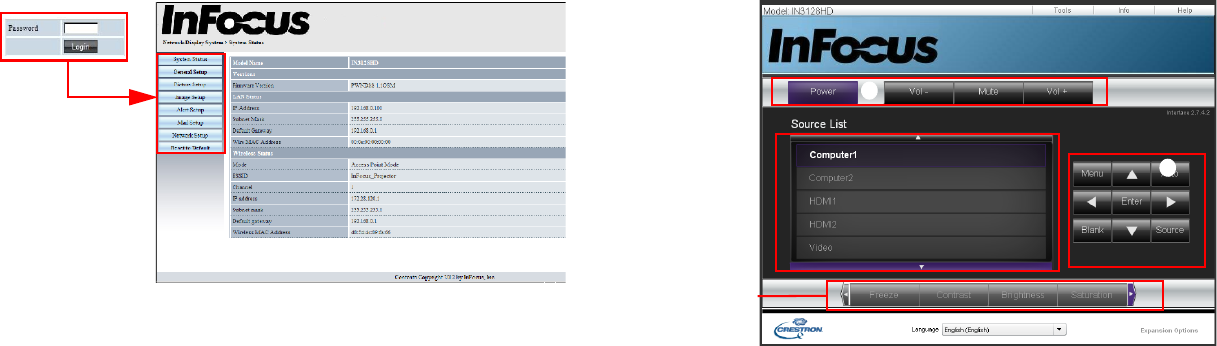
3To access the Admin page, enter the password. The default password is
“admin”. If you forget the password, please go to Advanced Menu > Setup >
Network > Network Restart to restore the password to the default code.
•System Status: Displays the system information.
•General Setup: Allows you to turn on/off the projector, switch the input
signal for the projector, and change the password for the Administrator page.
•Picture Setup/Image Setup: Provides some OSD menu items for adjusting
the projected pictures. See page 24 for details.
•Alert Setup/Mail Setup: Allows you to setup the mail server and send
system error messages to your network administrator.
•Network Setup: Provides wired and wireless network settings.
•Reset to Default: Allows you to restore the device to the factory default
settings.
About Crestron e-Control®
1The Crestron e-Control® page provides a variety of virtual keys to control the
projector or adjust the projector’s image.
i
i
You can press </>
to reveal more
buttons.
i. These buttons function the same as the OSD menus and remote control func-
tions.
•Source List: To switch the source, click on the desired source.
•Menu: Use to go back to the previous OSD menu, exit and save menu
settings.
• When you use the projector control panel or remote control to change the
OSD menu settings, it may take a while for the web browser to synchronize
these changes with the projector.
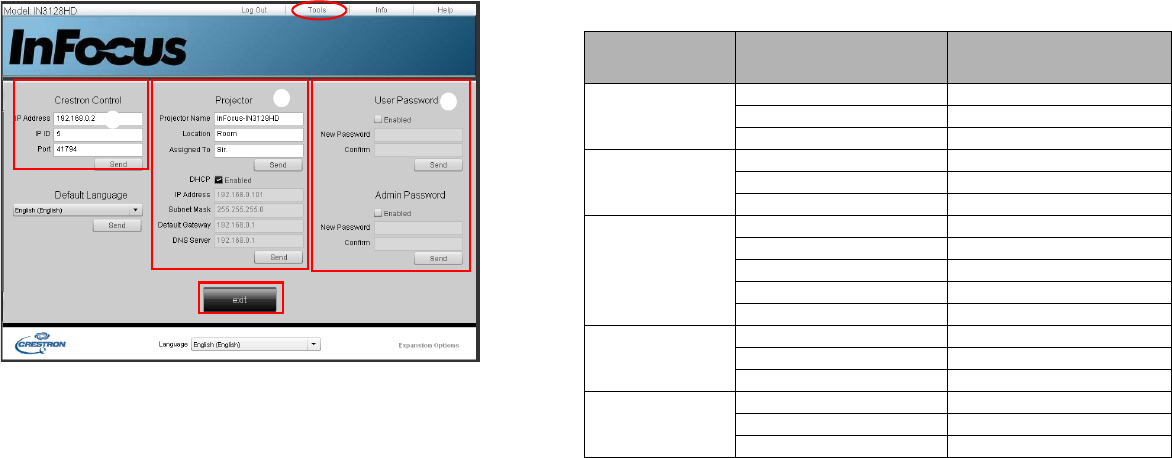
2The Tools page allows you to manage the projector, configure the LAN control
settings and remotely access the network operations of this projector.
iii
ii
i
32
i. This area is only used with a Crestron Control System. Please contact Creston
or refer to the Crestron user manual for setup information.
ii. This area is used for naming the projector, associating it with a particular loca-
tion, assigning a responsible party to it, and adjusting network settings.
iii. This area is used to set User and Admin passwords. When password protec-
tion is enabled, unauthorized changes to the projector configuration will be
avoided.
• To prevent errors, only enter alphanumeric characters on the Tools page.
• After configuring the settings, press the Send button and the data will be
saved in the projector.
•Press exit to go back to the Crestron remote network operation page.
Please pay attention to the input length and character limitations (including
character and punctuation restrictions) listed below:
Category Item Input-Length Maximum Number of
Characters
Crestron Control
• / > < $ % + \ ' " are prohibited.
IP Address 15
IP ID 2
Port 5
Projector
Projector Name 10
Location 9
Assigned To 9
Network
Configuration
DHCP (Enabled) (N/A)
IP Address 15
Subnet Mask 15
Default Gateway 15
DNS Server 15
User Password
Enabled (N/A)
New Password 20
Confirm 2
Admin Password
Enabled (N/A)
New Password 20
Confirm 20
33
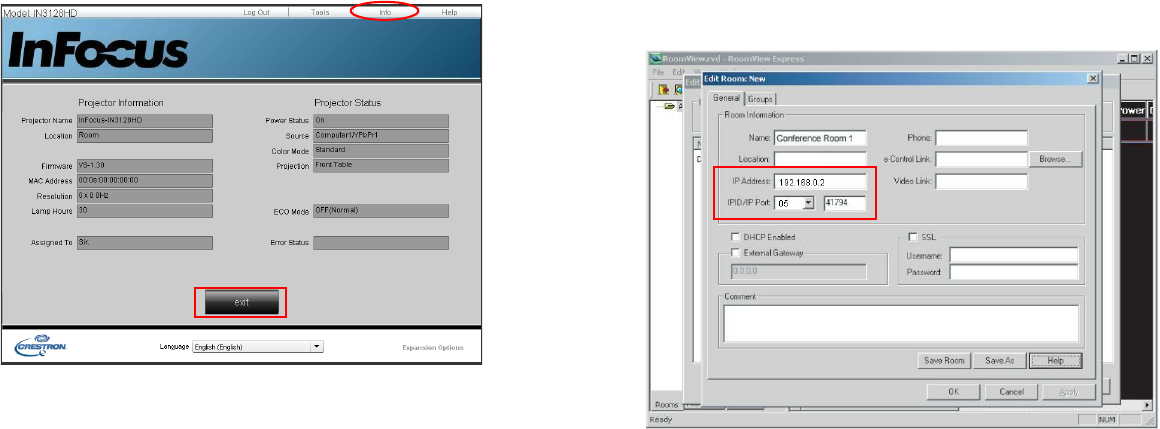
3The Info page displays the information and status of this projector.
Press exit to go back to the Crestron remote network operation page.
4After pressing the Help button, the Help Desk window will display in the upper
right corner of the screen. You will be able to send messages to RoomView™
software administrators/users who are connected to the same local area
network.
• For more information, visit http://www.crestron.com and www.crestron.com/
getroomview.
Crestron RoomView
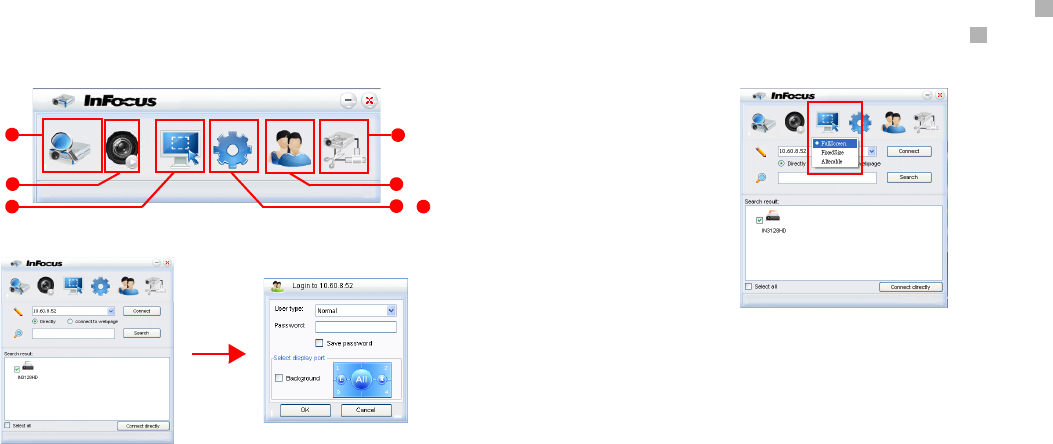
From the Crestron RoomView software in the Edit Room page, enter the IP
Address (or hostname) as shown on the projector’s on-screen display (OSD) menu,
“05” for IPID, and “41794” for the reserved Crestron control port.
For the Crestron RoomView user guide and information about RoomView settings
and commands, go to: http://www.crestron.com/products/
roomview_connected_embedded_projectors_devices/resources.asp
34
Displaying images through ifPresenter
Downloading and installing ifPresenter
The ifPresenter is an application which can run on the host PC. It helps connect
your computer to an available network projector and transfer the desktop content to
the network projector via local network connection.
1Enter the main page of Network Control. See steps 1-2 on page 30 for details.
2Download ifPresenter.
3When the download is complete, install the software to your computer by
clicking the exe file. Follow the on-screen instructions to complete the
installation.
4Launch ifPresenter.
Using ifPresenter
7
1
2
345&
6
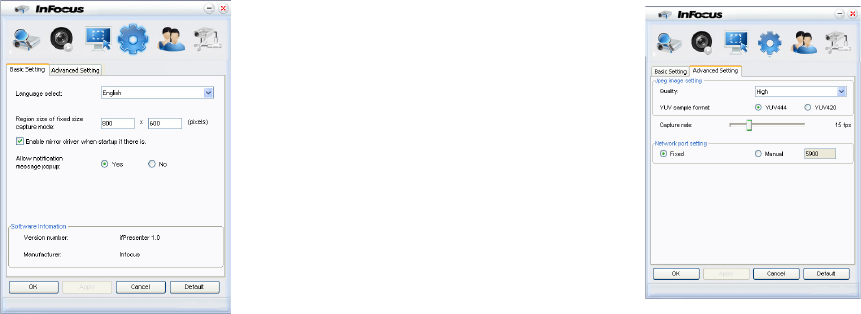
1The Search page allows you to search and connect to a projector.
i. To connect to a projector, select Connect Directly then type the projector’s IP
Address and click Connect.
ii. To search for projectors, simply click Search to list all the projectors on the
same local area network. Click the desired projector in the Search result list,
and click Connect directly. You can also type a desired projector name and
click Search.
iii. You can link to the InFocus webpage control system on page 30.
• If you are a first time user, choose your identity as a Normal user or
Administrator. Neither requires a password. However if you choose to be
an Administrator, you have the authority to set a password for connecting to
the projector. That password should be written down and used to connect to
the same projector.
• If there are multiple computers connected to the projector, you can decide a
display zone by clicking 1, 2, 3, 4, L, R, All, or Background.
2If you want to freeze the projected image on the screen, press . Any further
movements will be not been seen on the screen until is pressed.
3You can choose a capture mode from here.
i. To display a full screen, click FullScreen.
ii. To display a partial screen, click FixedSize. A square appears on your screen.
You can place it where you want to project.
iii. If you wish to change the square, click Alterable.
35
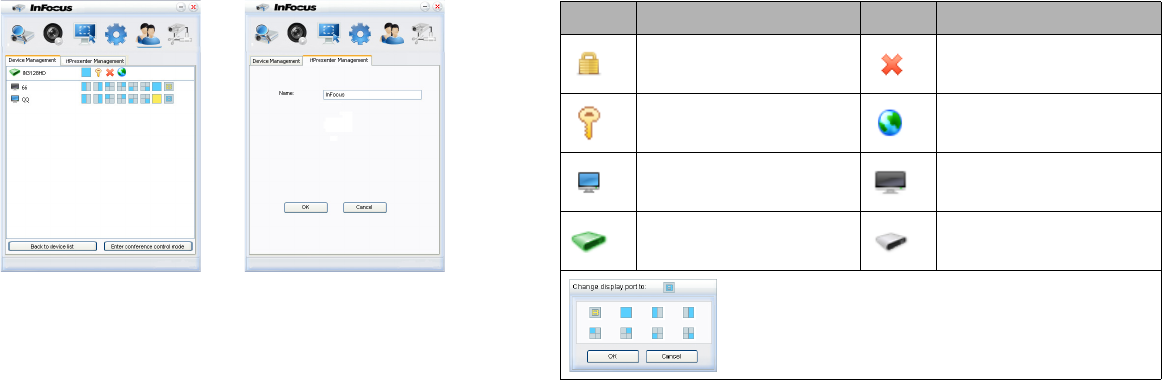
4The Basic Setting page allows you to configure ifPresenter.
i. To change the ifPresenter interface language, click the down arrow to reveal a
drop-down list and select a desired language. Click Apply.
ii. Users can change the size parameters of the frame in FixedSize capture mode
by modifying width and height on this page and click Apply to make changes
take effect.
iii. User can use the mirror driver for presenter capture image, if the system has
installed the mirror driver.
iv. To allow notification messages to appear, click Yes. Click Apply.
v. The Software Information is available on this page.
5The Advanced Setting page allows you to configure ifPresenter.
i. To adjust the image quality, click the down arrow to reveal a drop-down list
and select a desired quality level. The higher image quality you select, the
higher network transfer speed is required. Select a YUV sample format
between YUV444 and YUV420. Compared to format YUV420, format YUV
444 provides better image quality but may slow the loading and playing
speed. Click Apply after your selections.
ii. To adjust the capture rate, move the slide bar. The network bandwidth may
also affect the performance.
iii. Network port setting for fixed or manual type.
36
6You can manage the connected projectors listed under Device Management.
• Under a conference mode:
1 Only the administrator can take control.
2 A projector can display up to 4 computer screens.
• You can set the name of your computer under ifPresenter Management.
• For details about the icons, please see the following:
7Disconnect
To disconnect from the projector(s), click the Disconnect icon.
• Be sure to turn off other virtual network control programs before using
ifPresenter.
Icon Description Icon Description
You are a standard user and can-
not change the password.
Disconnects from the projector.
You are an administrator and can
change the password.
Opens the web page of the Net-
work Control.
You are in control of the projec-
tor.
Someone else is controlling the
projector.
You are an administrator. You are a standard user.
Sets a display zone for the projector.
37
Displaying pictures with a USB storage device
The projector has a built-in application which can display images from a USB
storage device. It can eliminate the need for a computer source.
The projector supports the following image formats:
File format Maximum pixel size
JPEG 8000 x 8000
GIF/TIFF/PNG/BMP 1280 x 800
• Progressive JPEG files are not supported.
• Some JPEG files may not display clearly.
To display images from a USB storage device:
1Plug the USB storage device into the USB Type A connector.
2Press the Source button and choose the USB A (Type-A) input. Note: If no
other sources are connected and Auto Source is on, the projector will
automatically select the USB A source.
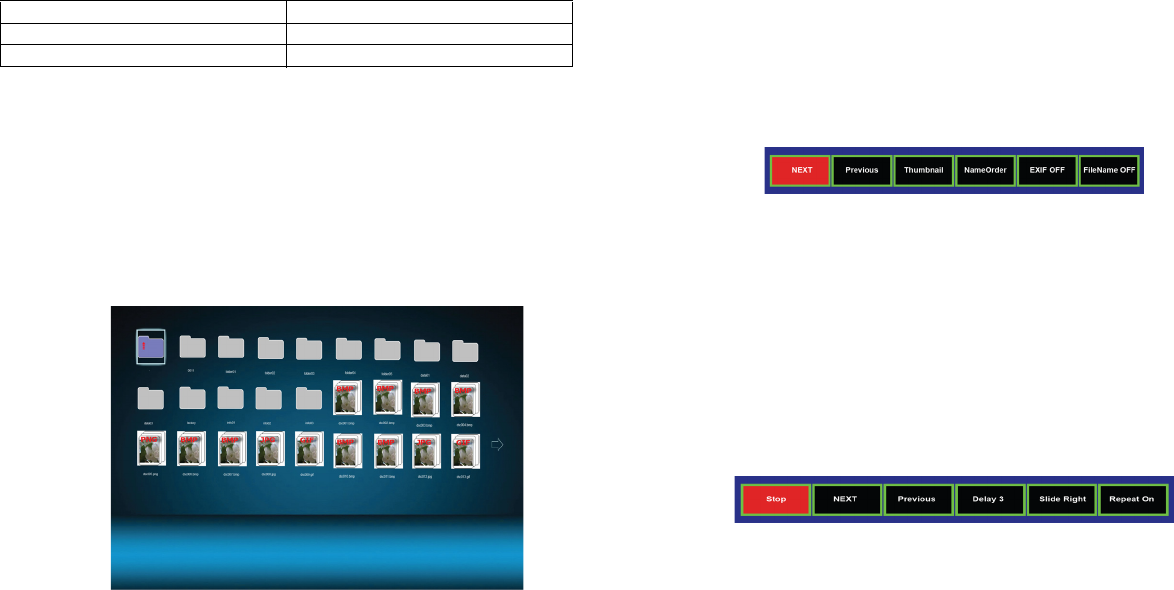
3Folders and supported files are displayed in thumbnail view.
• To scroll through the thumbnails, use the arrow keys on your remote or the
projector keypad.
• To open a file, highlight the file and press Enter. Press Enter again to close
the file.
• To go back to the previous screen, select the thumbnail with an up arrow in
the top left corner of the screen, and press Enter. To exit when you are
displaying an image, press Enter or Menu > Thumbnail.
• To access additional USB display options, press the Menu button. To close
the USB Display menu, press the Menu button again.
• To choose or cancel a menu option, use the left and right arrow buttons to
highlight the option. Use the up and down arrow buttons to make a selection
and press the Enter button.
When viewing thumbnails
•Next: Selects the next folder/image.
•Previous: Selects the previous folder/image.
•Thumbnail/Display/SlideShow: Displays the selected image(s) in
Thumbnail, Full Screen or SlideShow mode.
•NameOrder/ExtendOrder/SizeOrder/TimeOrder: Sets the images to be
displayed in the order of filenames, filename extension, file sizes, or time the
photos were taken.
•EXIF OFF/EXIF ON: When On, displays the EXIF image information.
•FileName ON/FileName OFF: When On, displays the file's path and file
name.
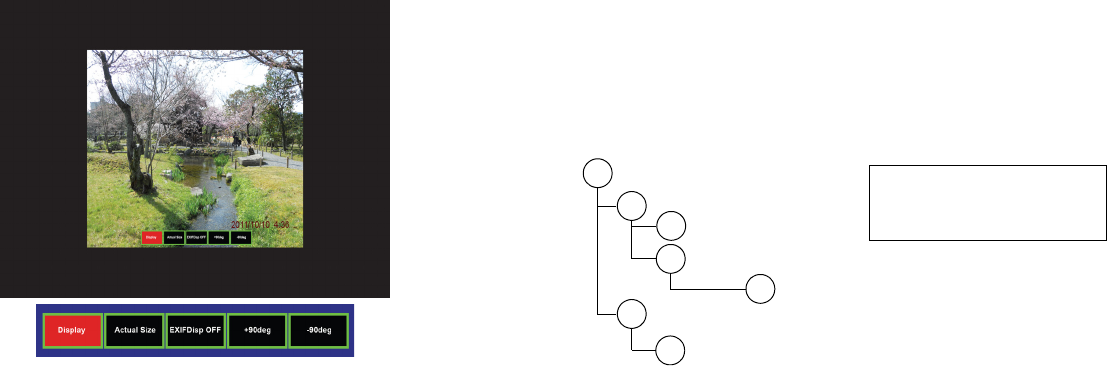
When viewing slide shows
•Stop: Stops the slide show.
•NEXT: Selects the next image.
•Previous: Selects the previous image.
•Delay 3/Delay 4/Delay 5: Sets the amount of time each image displays.
Delay 3 displays each image for 3 seconds. Delay 4 displays each image for
38
approximately 8 seconds. Delay 5 displays each image for approximately 13
seconds. NOTE: The actual display time varies based on the file size.
•Slide Right/Slide Up/Right Down/XLines/YLines/Blocks: Sets the way
the slide show is displayed.
•Repeat On/Off: Sets whether to repeat the slide shows.
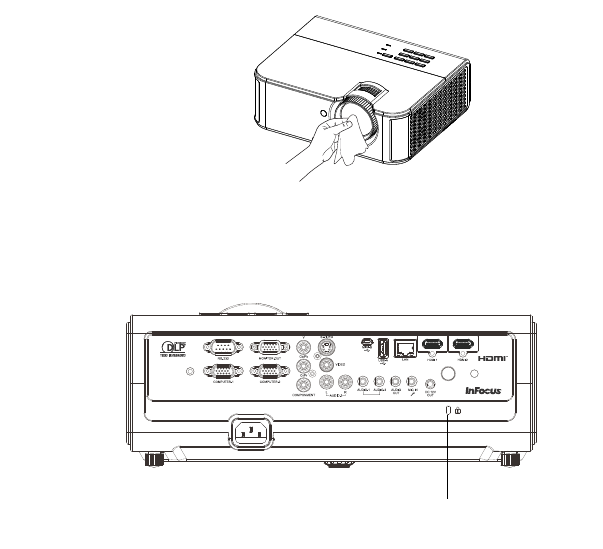
When viewing full screen images
•Thumbnail/Display/SlideShow: Displays the selected image(s) in
Thumbnail, Full Screen or SlideShow mode.
•Best Fit/Actual Size: Sets the display size of the image.
•EXIFDisp OFF/EXIFDisp ON: When On, displays the EXIF image
information.
•+ 90deg: Rotates the image 90 degrees clockwise.
•- 90deg: Rotates the image 90 degrees counterclockwise.
• USB 2.0 compliant USB storage media (Mass Storage Class) is supported.
• We strongly recommend using an AC power adaptor with any USB hard
drives.
• The following formats are recommended for any USB hard drives. FAT12/
FAT16/FAT32 (NTFS format is not supported).
• Some USB flash drives may not work correctly with the projector.
• A security-enabled USB flash drive is not supported.
• Do not connect any apparatus other than USB storage devices. Do not charge
other equipment through the USB connector. It may cause a malfunction.
• The projector plays up to 200 files in a folder.
• The filenames are displayed in the following order: symbols, digits, letters.
• The projector can display the filenames up to 16 characters including the file
extension.
• The application displays English filenames the best. If the files are named in
other languages, the filenames may not show properly, however the content
will still display properly.
• Folders in the USB storage device can be recognized up to 3 layers. The
priority of thumbnail display for image files is as follows:
A
B
C
D
E
F
G
: Currect directory:
: Folder B
: Folder D
: Folder E
: Folder G
: Folder C
: Folder F
File display priority in folder: A
> B > C > D > E > F.
Folder G: Cannot be displayed
• Response times may vary depending on the image contents when switching
pages, loading and playing files.
39
Maintenance
Cleaning the lens
1Apply a non-abrasive camera lens cleaner to a soft, dry cloth.
• Projector must be off and the lens must be at room temperature.
• Avoid using an excessive amount of cleaner, and don’t apply the cleaner
directly to the lens. Abrasive cleaners, solvents or other harsh chemicals
might scratch the lens.
2Lightly wipe the cleaning cloth over the lens in a circular motion.
WARNINGS:
•Turn the projector off and unplug power cord before cleaning any part of the
projector.
• Do not touch or block the projector lens with any objects as this can damage
the projector lens. Scratches, gouges and other lens damage are not covered
by the product warranty.
• Do not open any cover on the projector, except the lamp cover.
• Do not attempt to service this product yourself as opening and removing
covers may expose you to dangerous voltage and other hazards. Refer all
servicing to qualified service personnel.
Using the security lock
The projector has a security lock for use with a Cable Lock System. Refer to the
information that came with the lock for instructions on how to use it.
security
lock
40
Replacing the projection lamp
The Lamp Hours timer in the Projector Info menu counts the number of hours the
lamp has been in use. Twenty hours before the lamp life expires, the message
“Replace lamp” displays on the screen at startup.
•NOTE: Be sure to use the InFocus lamp module designed for this projector.
You can order new lamps from www.infocus.com (in select areas), your
retailer or your dealer. Only genuine InFocus lamps are tested for use in this
projector. Use of non InFocus lamps may cause electrical shock and fire, and
may void the projector warranty. InFocus is not liable for the performance,
safety or certification of any other lamps.
WARNINGS:
• The projector uses a high-pressure mercury glass lamp. The lamp may fail
prematurely, or it may rupture with a popping sound if jolted, scratched, or
handled while hot. The risk of lamp failure or rupture also increases as the
lamp age increases; please replace the lamp when you see the “Replace Lamp”
message.
• To avoid burns, allow the projector to cool for at least 60 minutes before you
replace the lamp.
• Do not touch or block the projector lens with any objects as this can damage
the projector lens. Scratches, gouges and other lens damage are not covered by
the product warranty.
• Unplug the power cord before replacing the lamp.
• Do not drop the lamp module. The glass may shatter and cause injury.
• Do not touch the glass surface of the lamp module. Fingerprints can obscure
projection sharpness and may cause the glass to shatter.
• Be extremely careful when removing the lamp housing. In the unlikely event
that the lamp ruptures, small glass fragments may be generated. The lamp
module is designed to contain most of these fragments, but use caution when
removing it.
• Before replacing a ruptured lamp, clean the lamp compartment and dispose of
cleaning materials. Wash hands after lamp replacement.
• When replacing the lamp while the projector is ceiling-mounted, wear
protective eyewear to prevent eye injury.
Hg – Lamp contains mercury. Manage in accordance with local disposal
laws. See www.lamprecycle.org.
41
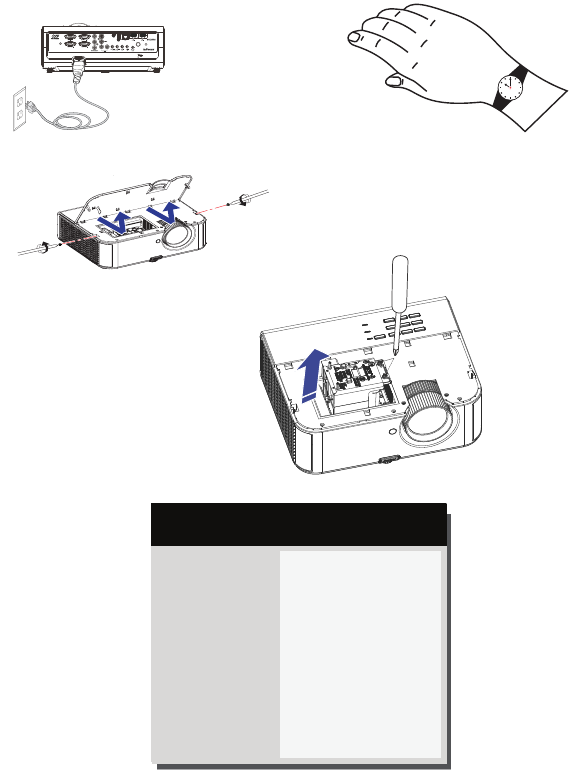
1Turn off the projector and unplug the power cord.
2Wait 60 minutes to allow the projector to cool thoroughly.
3Remove the lamp door, located on top of the projector, by removing the screws
on either side of the lamp door, sliding the door forward, and lifting the lamp
door off.
4Loosen the captive screws that attach the lamp housing to the projector.
NOTE: If the projector is installed on a ceiling mount, be careful not to drop the
lamp module once the captive screws are loosened.
5Carefully lift the lamp straight up, off of the alignment pins; being careful not to
pinch the lamp connector. Dispose of the lamp in an environmentally proper
manner.
6Install the new lamp module, aligning the pins properly. Be careful not to pinch
the lamp connector.
7Tighten the screws. (NOTE: If the pins have not been aligned properly, the
screws will not tighten securely.)
8Replace the lamp door by (a) aligning the door (b) sliding it towards the back
and (c) locking it back into place.
9Replace the lamp door screws and tighten securely.
10 Plug in the power cord and press the Power button to turn the projector back on.
11 To reset the lamp hour timer, navigate to the Advanced Menu > Status/Service
menu and select Reset Lamp Hours....
turn off and unplug
projector
wait 60 minutes
loosen screws
loosen lamp door screws
Image
Setup
Status/Service
Basic Menu
Source Info
Projector Info
Reset Lamp Hours
Factory Reset
Service Code
( Advanced Menu ) MDL: IN3128HD
FW: 0.10
42
INDEX
A
Apply 28
Aspect Ratio 25
Audio In Computer connector 7
Auto Image 25
Auto Keystone 25
Auto Off Time 27
Auto Source 27
AV Mute 27
B
Blank Key 26
Blank Screen 26
Brightness 25
C
Cable box 10
Ceiling Mount 26
Closed Captions 26, 27
Computer In connector 7
Connecting
Video device 10
Connection Mode 28
Contrast 25
Crestron e-Control® 31
Crestron RoomView 33
D
DC 12V Trigger 28
Default Gateway 28
Detect Film 26
DHCP 28
Digital Zoom 26
DNS 28
F
Factory Reset 28
Focus 9
Freeze Screen 26
G
Gamma 26
H
HDTV 25
High Altitude Setting 27
Horz/Vert Position 26
I
ifPresenter 30
IP Address 28
K
Keypad 27
Keypad buttons 21
Keystone 25
L
Lamp Low Power 27
LAN 29
M
Magnify Level 26
Menu Transparency 27
Menu usage 24
Microphone Volume 25
Mute 26
N
Network 28
O
Overscan 26, 27
P
Phase 26
PIN Protect 27
Power connector 7
Power cord 7
Power Saving Mode 27
Projector
Keypad buttons 21
Menus 24
43
Positioning 6
Setting up 6
Troubleshooting problems 11
Projector Info 27, 28
R
Rear Project 26
Remote control 19
Resetting the projector 28
S
Screen Aspect 10
Search Screen 27
Service 28
Set Black Level... 26
Sharpness 25
Show Messages 27
Source 26
Source Info 27, 28
SSID 28
Status 28
Subnet Mask 28
T
Tint 26
Tracking 26
Troubleshooting 11
U
USB 5
V
Volume 25
Volume button 20
W
Warranty 18
Web browser 30
Wired LAN 28
Wireless connection 30
Wireless LAN 28
Z
Zoom 9
