Innovative Concepts and Design UHF-6000BP-R2 Body-worn Wireless Microphone User Manual
Innovative Concepts and Design LLC Body-worn Wireless Microphone
User manual
Frequency Range: 512~537.5MHz
Frequency Stability: 10ppm
Transmitting power: 10mW
Spurious emission: <-40dB
Modulation: FM
Max modulation: 75K
Power supply: 3V (2 AA batteries)
Current consumption: 120mA
UHF-6000BP BODY-WORN WIRELESS MICROPHONE
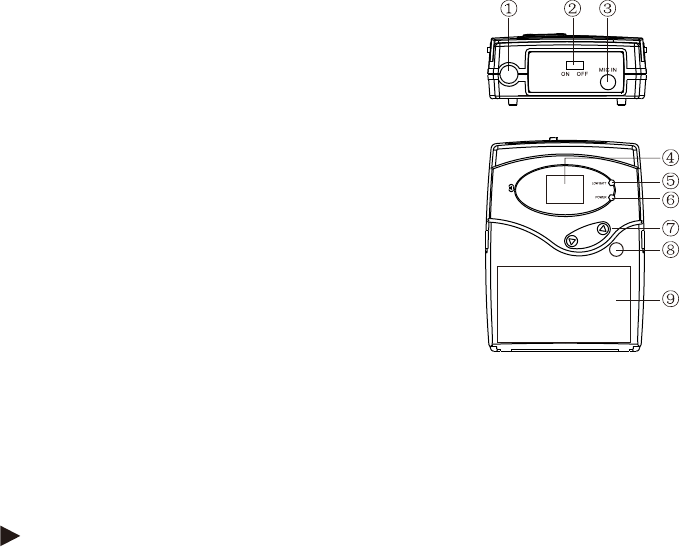
Parts Description
Specifications
1. Turn on the microphone.
2. Open battery cover to display the infrared (IR) port.
3. Point microphone IR port to receiver IR sensor.
4. Press “SYNC” button on receiver. Antenna signal will display in receiver screen.
5. Close the battery cover.
1. Antenna
2. Power switch
3. MIC Input Jack
4. LCD screen: display channel number and
battery power.
5. Low Battery/IR indicator
Red: low battery;
Flashing red-IR transmission in process
6. Power indicator: light green
7. Select switch: to set up transmitter channel
manually.
8. IR port: Receives infrared beam from
receiver to synchronize frequencies.
9. Battery compartment
Be sure that only one microphone IR port is exposed when synchronizing a
system.
Automatic Setup
Manual Setup
You can set up microphone group and channel manually also.
1. Press and hold the “SELECT” button until GROUP and CHANNEL displays
begin to alternate.
2. To change the group setting, release the “SELECT” button while GROUP is
displayed. While GROUP is flashing, press “SELECT” button to increase the
group number by one.
3. To change the channel setting, release the “SELECT” button while CHANNEL
is displayed. While CHANNEL is flashing, press “SELECT” button to increase
the channel number by one.
NOTE: This equipment has been tested and found to comply with the limits for a
Class B digital device, pursuant to part 15 of the FCC Rules. These limits are
designed to provide reasonable protection against harmful interference in a
residential installation. This equipment generates uses and can radiate radio
frequency energy and, if not installed and used in accordance with the
instructions, may cause harmful interference to radio communications. However,
there is no guarantee that interference will not occur in a particular installation. If
this equipment does cause harmful interference to radio or television reception,
which can be determined by turning the equipment off and on, the user is
encouraged to try to correct the interference by one or more of the following
measures:
- Reorient or relocate the receiving antenna.
- Increase the separation between the equipment and receiver.
-Connect the equipment into an outlet on a circuit different from that to which the
receiver is connected.
-Consult the dealer or an experienced radio/TV technician for help
Changes or modifications not expressly approved by the party responsible for
compliance could void the user's authority to operate the equipment.
This device complies with Part 15 of the FCC Rules. Operation is subject to the
following two conditions:
(1) this device may not cause harmful interference, and (2) this device must
accept any interference received, including interference that may cause
undesired operation.