Intelleflex MMR6500 RFID Reader Module User Manual MMR6500 Integration ManualR1
Intelleflex Corporation RFID Reader Module MMR6500 Integration ManualR1
Module Manual

Intelleflex User Manual
MMR6500 RFID Reader Module
Integration Manual
Authors:
DK
Version 0.0
June 28, 2010

Table of Contents
1. INTRODUCTION..............................................................................................................3
1.1. REFERENCE DOCUMENTS................................................................................................3
2. LABELING REQUIREMENTS........................................................................................3
2.1. HOST DEVICE LABELING.................................................................................................3
2.2. MODULE LABELING........................................................................................................3
3. ANTENNA REQUIREMENTS .........................................................................................4
3.1. CONFIGURATION / ASSEMBLY INSPECTION ................ERROR! BOOKMARK NOT DEFINED.
4. FCC AND GOVERNMENT GUIDELINES .....................................................................4
4.1. FCC GUIDELINES FOR DEVICES CONTAINING A TRANSMITTER ........................................5
1. Introduction
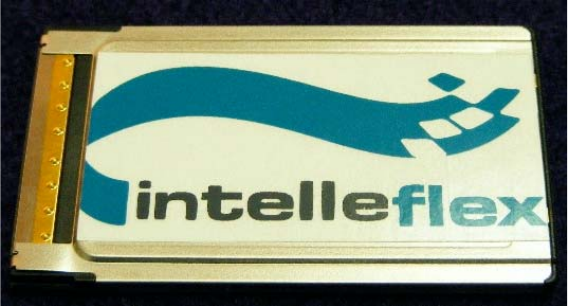
The MMR6500 RFID Reader Module is an FCC Part 15.247 compliant embedded device that
enables host devices to read from and write to EPC Global C1G2 passive tags, and ISO 18000-6
revision 1, Type C, Manchester mode, Class 3 battery assisted passive tags. The Module
operates in the UHF 902-928 MHz ISM band.
The MMR6500 reader is designed in a PCMCIA/PC card mechanical format for integration into
handheld and mobile RFID readers. The reader uses standard PC card connectors, but the
electrical interface is a non-standard, proprietary serial interface that cannot be used in standard
PC card slots in laptops or general computing devices.
1.1. Reference Documents
EPC Global Class 1 Gen 2 Protocol v1.2.0
ISO/IEC 18000 Radio Frequency Identification for Item Management Part 6: Parameters for air
interface communications at 860 to 960 MHz
2. Labeling Requirements
2.1. Host Device Labeling
If the module is placed inside a host product and the label on the module is not visible, a label
with the following information shall be placed on the exterior surface of the host product
Contains FCC ID: VBLMMR6500
IC: 7151A-MMR6500
Model No. MMR6500
2.2. Module Labeling
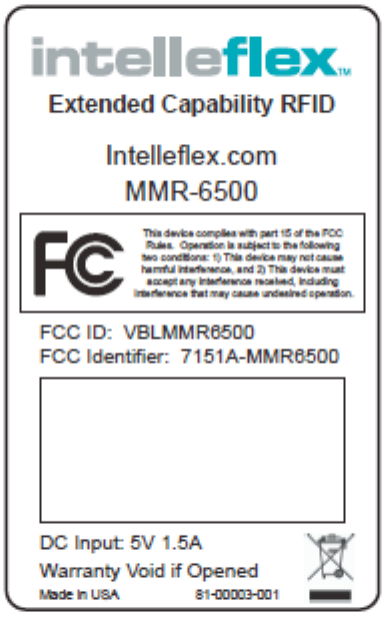
The MMR6500 module has one label which contains Intelleflex company name, model and
serial number, and the FCC/IC ID.
3. Antenna Requirements
The host device shall connect one or two antennas to the MMR6500 MMCX antenna connectors.
The antennas shall be one of the approved antenna types in the MMR6500 RF certification.
4. FCC and Government Guidelines
Intelleflex MMR6500 Reader Module
FCC ID: VBLMMR6500
IC ID:
The MMR6500 module is REQUIRED to be professionally installed by a properly trained
technician. Improper installation could void the user’s authority to operate the equipment. The
device complies with Part 15 of the FCC rules. Operation is subject to the following two
conditions:
1. The device may not cause harmful interference.
2. The device must accept any interference received, including interference that may cause
undesired operation.
NOTE: For FCC compliance, the following text MUST be included in module host devices’
manuals and user’s guides.
The antenna of this transmitter must not be co-located or operating in conjunction with any
other antenna or transmitter. The device should be installed so that people will not come within
22 cm (9 in.) of the antenna.
This equipment has been tested and found to comply with Part 15 of the FCC Rules. This
equipment generates, uses and can radiate radio frequency energy, and if not installed and
used in accordance with the instructions, may cause harmful interference to radio
communications. However, there is no guarantee that interference will not occur in a
particular installation. If this equipment does cause harmful interference to radio or television
reception, which can be determined by turning the equipment off and on, the user is
encouraged to try to correct the interference by one or more of the following measures:
• Reorient or relocate the receiving antenna.
• Increase the separation between the equipment and receiver.
• Connect the equipment into an outlet on a circuit different from that to which the receiver
disconnected.
• Consult the dealer or an experienced Radio/TV technician for help.
4.1. FCC Guidelines for Devices Containing a Transmitter Module
The following is an extract from Section 15.212(a)1(vi)A of the FCC Rules:
(A) If using a permanently affixed label, the modular transmitter must be labeled with its own
FCC identification number, and, if the FCC identification number is not visible when the module
is installed inside another device, then the outside of the device into which the module is
installed must also display a label referring to the enclosed module. This exterior label can use
wording such as the following: “Contains Transmitter Module FCC ID: XYZMODEL1” or
“Contains FCC ID: XYZMODEL1.” Any similar wording that expresses the same meaning may
be used. The Grantee may either provide such a label, an example of which must be included in
the application for equipment authorization, or, must provide adequate instructions along with
the module which explain this requirement. In the latter case, a copy of these instructions must
be included in the application for equipment authorization.
4.2. Safety Information
Observe the following safety guidelines.
1. Use only in module slots designed to support RFID readers.
2. Ensure proper heat sinking from the module.
3. Provide appropriate power, ground, and power controls to the module.
4. Not for use in potentially explosive or heat sensitive environments.