Intelyt orporated ICHIME33 Wireless sensor for temperature monitoring User Manual iTAG Module

iControl Incorporated Wireless sensor for temperature monitoring iTAG Module

Contents

Operating Manual

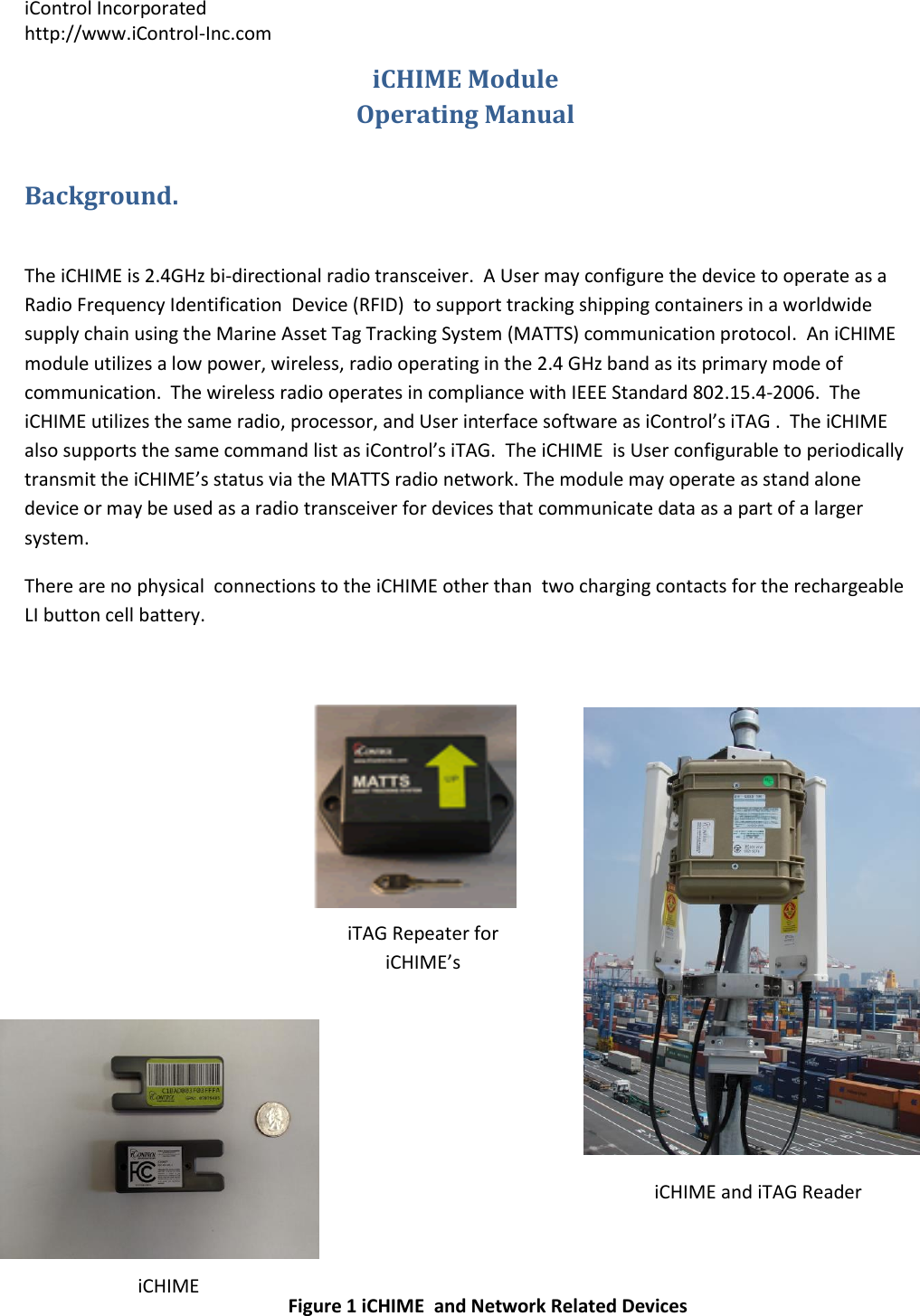
iControl Incorporated http://www.iControl-Inc.com iCHIME Module iTAG Repeater for iCHIME’s  iCHIME and iTAG Reader  iCHIME iCHIME Module  Operating Manual Background.  The iCHIME is 2.4GHz bi-directional radio transceiver.  A User may configure the device to operate as a Radio Frequency Identification  Device (RFID)  to support tracking shipping containers in a worldwide supply chain using the Marine Asset Tag Tracking System (MATTS) communication protocol.  An iCHIME module utilizes a low power, wireless, radio operating in the 2.4 GHz band as its primary mode of communication.  The wireless radio operates in compliance with IEEE Standard 802.15.4-2006.  The iCHIME utilizes the same radio, processor, and User interface software as iControl’s iTAG .  The iCHIME also supports the same command list as iControl’s iTAG.  The iCHIME  is User configurable to periodically transmit the iCHIME’s status via the MATTS radio network. The module may operate as stand alone device or may be used as a radio transceiver for devices that communicate data as a part of a larger system. There are no physical  connections to the iCHIME other than  two charging contacts for the rechargeable LI button cell battery.         Figure 1 iCHIME  and Network Related Devices
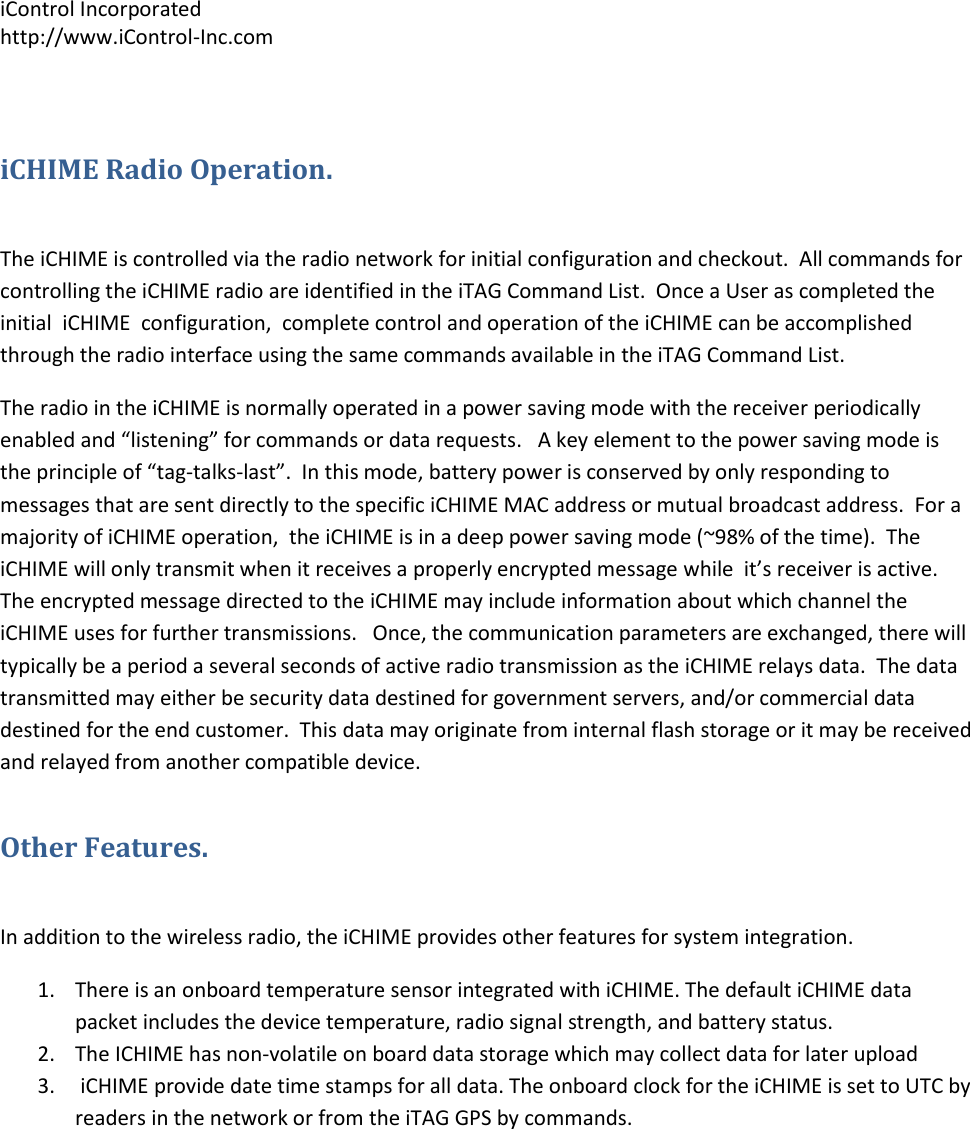
iControl Incorporated http://www.iControl-Inc.com  iCHIME Radio Operation.  The iCHIME is controlled via the radio network for initial configuration and checkout.  All commands for controlling the iCHIME radio are identified in the iTAG Command List.  Once a User as completed the initial  iCHIME  configuration,  complete control and operation of the iCHIME can be accomplished through the radio interface using the same commands available in the iTAG Command List. The radio in the iCHIME is normally operated in a power saving mode with the receiver periodically enabled and “listening” for commands or data requests.   A key element to the power saving mode is the principle of “tag-talks-last”.  In this mode, battery power is conserved by only responding to messages that are sent directly to the specific iCHIME MAC address or mutual broadcast address.  For a majority of iCHIME operation,  the iCHIME is in a deep power saving mode (~98% of the time).  The iCHIME will only transmit when it receives a properly encrypted message while  it’s receiver is active.  The encrypted message directed to the iCHIME may include information about which channel the  iCHIME uses for further transmissions.   Once, the communication parameters are exchanged, there will typically be a period a several seconds of active radio transmission as the iCHIME relays data.  The data transmitted may either be security data destined for government servers, and/or commercial data destined for the end customer.  This data may originate from internal flash storage or it may be received and relayed from another compatible device.   Other Features.  In addition to the wireless radio, the iCHIME provides other features for system integration.   1. There is an onboard temperature sensor integrated with iCHIME. The default iCHIME data packet includes the device temperature, radio signal strength, and battery status. 2. The ICHIME has non-volatile on board data storage which may collect data for later upload 3.  iCHIME provide date time stamps for all data. The onboard clock for the iCHIME is set to UTC by readers in the network or from the iTAG GPS by commands.
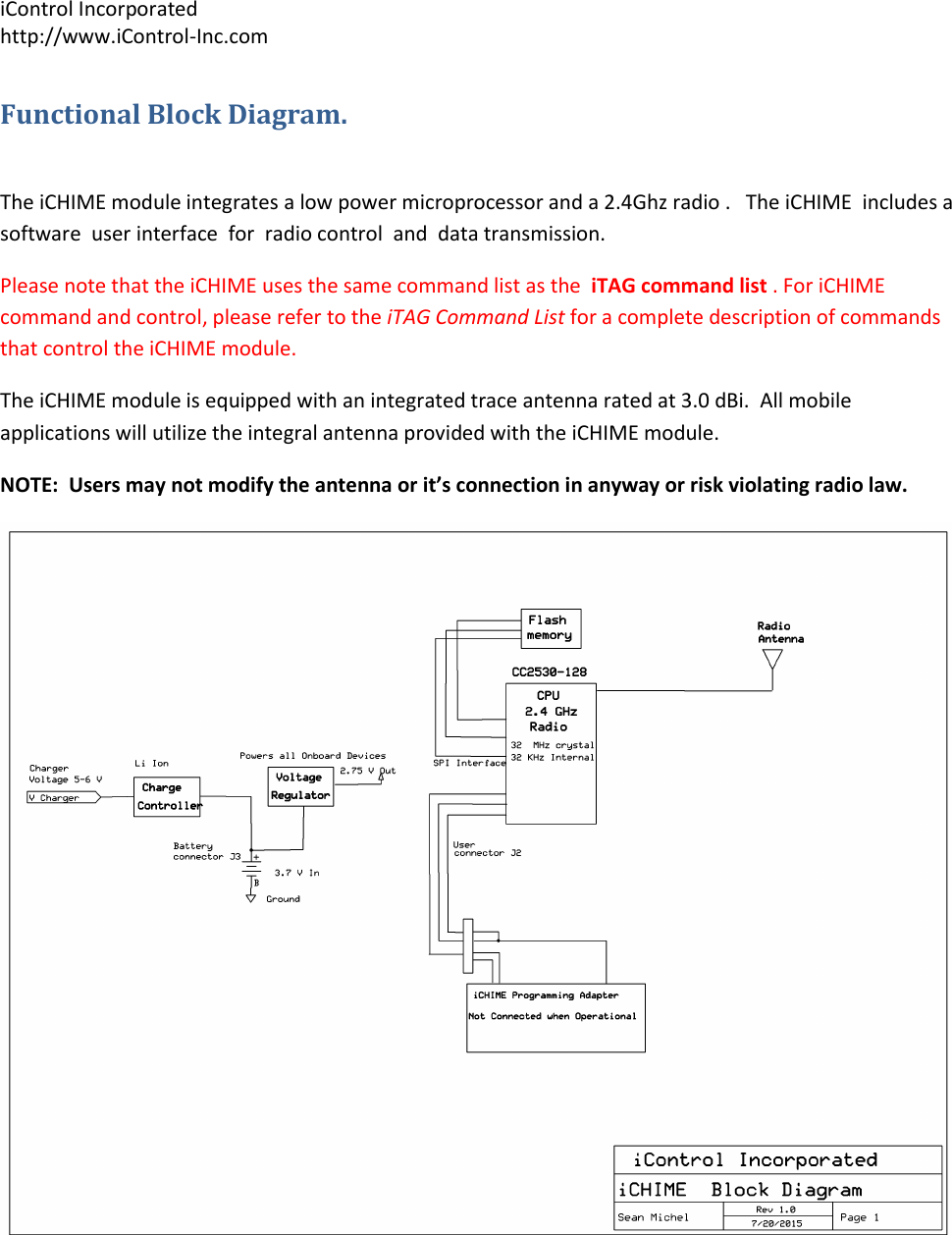
iControl Incorporated http://www.iControl-Inc.com Functional Block Diagram.  The iCHIME module integrates a low power microprocessor and a 2.4Ghz radio .   The iCHIME  includes a software  user interface  for  radio control  and  data transmission.  Please note that the iCHIME uses the same command list as the  iTAG command list . For iCHIME command and control, please refer to the iTAG Command List for a complete description of commands that control the iCHIME module. The iCHIME module is equipped with an integrated trace antenna rated at 3.0 dBi.  All mobile applications will utilize the integral antenna provided with the iCHIME module. NOTE:  Users may not modify the antenna or it’s connection in anyway or risk violating radio law.
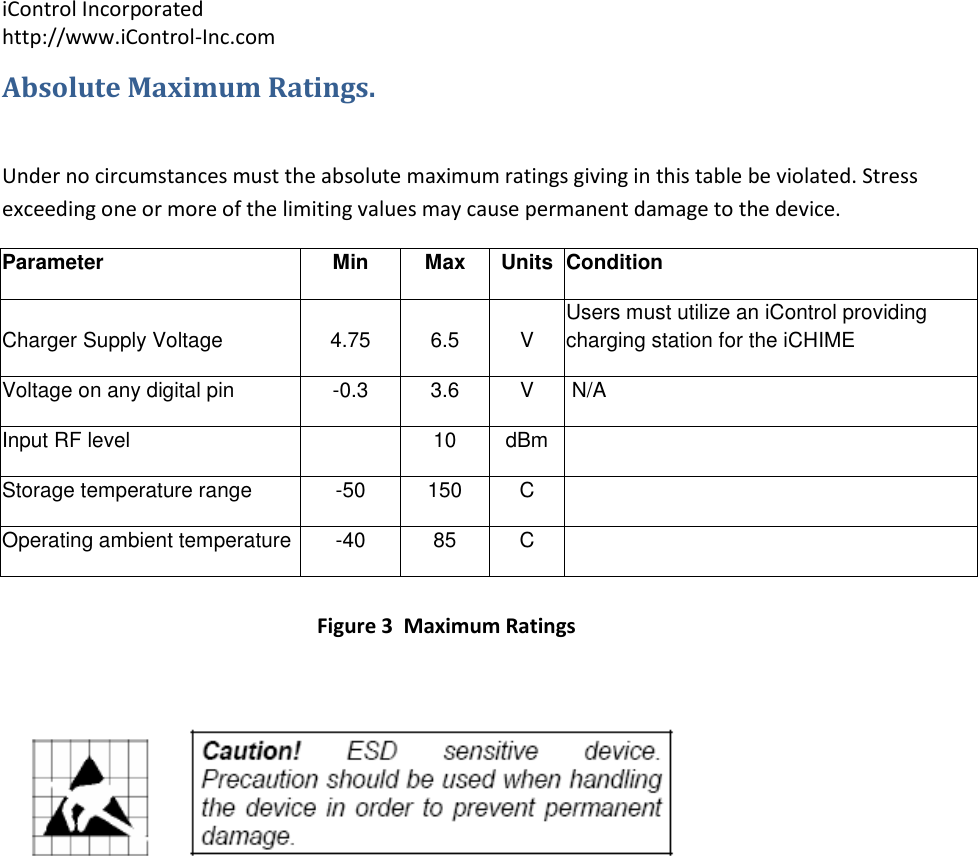
iControl Incorporated http://www.iControl-Inc.com Absolute Maximum Ratings.  Under no circumstances must the absolute maximum ratings giving in this table be violated. Stress exceeding one or more of the limiting values may cause permanent damage to the device. Parameter Min  Max Units Condition Charger Supply Voltage 4.75 6.5 V Users must utilize an iControl providing charging station for the iCHIME Voltage on any digital pin -0.3 3.6 V  N/A Input RF level   10 dBm   Storage temperature range -50 150 C   Operating ambient temperature -40 85 C       Figure 3  Maximum Ratings
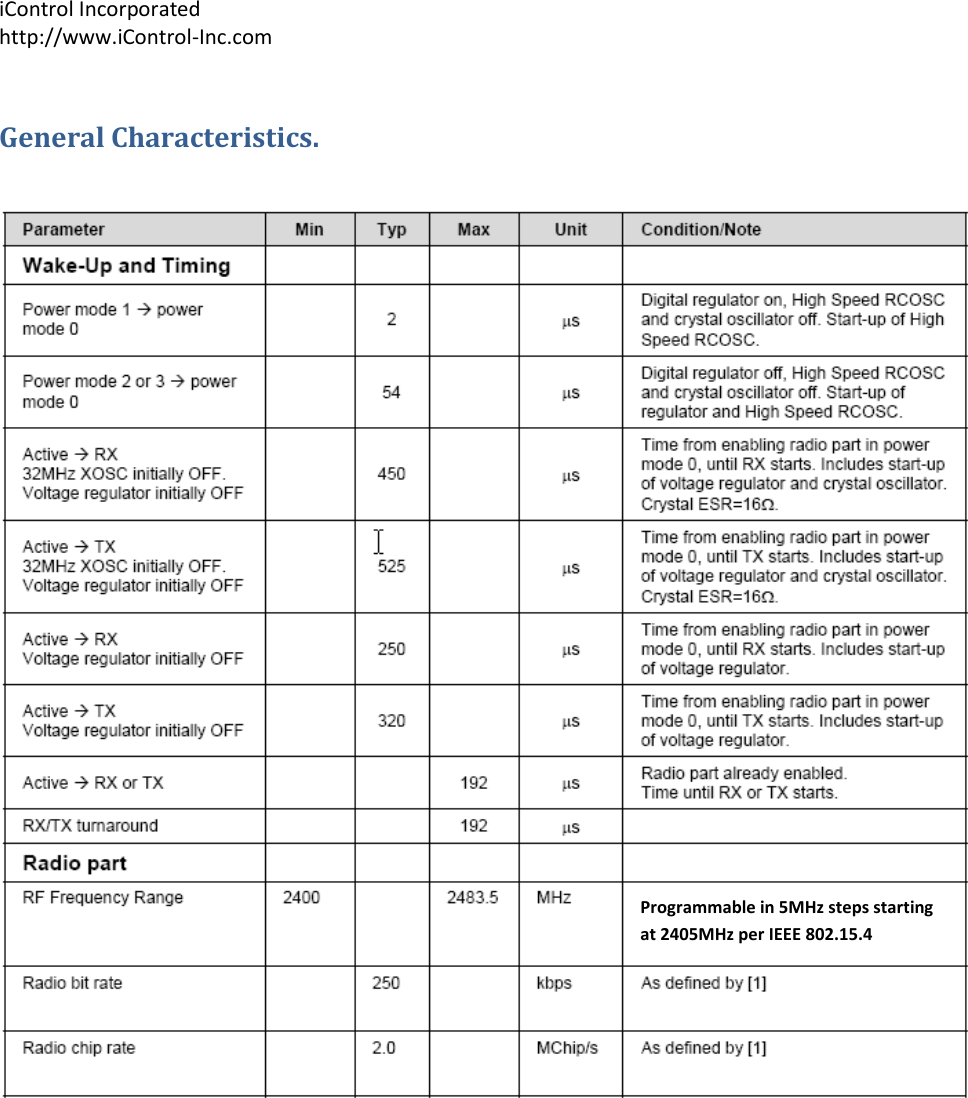
iControl Incorporated http://www.iControl-Inc.com General Characteristics. Programmable in 5MHz steps starting at 2405MHz per IEEE 802.15.4
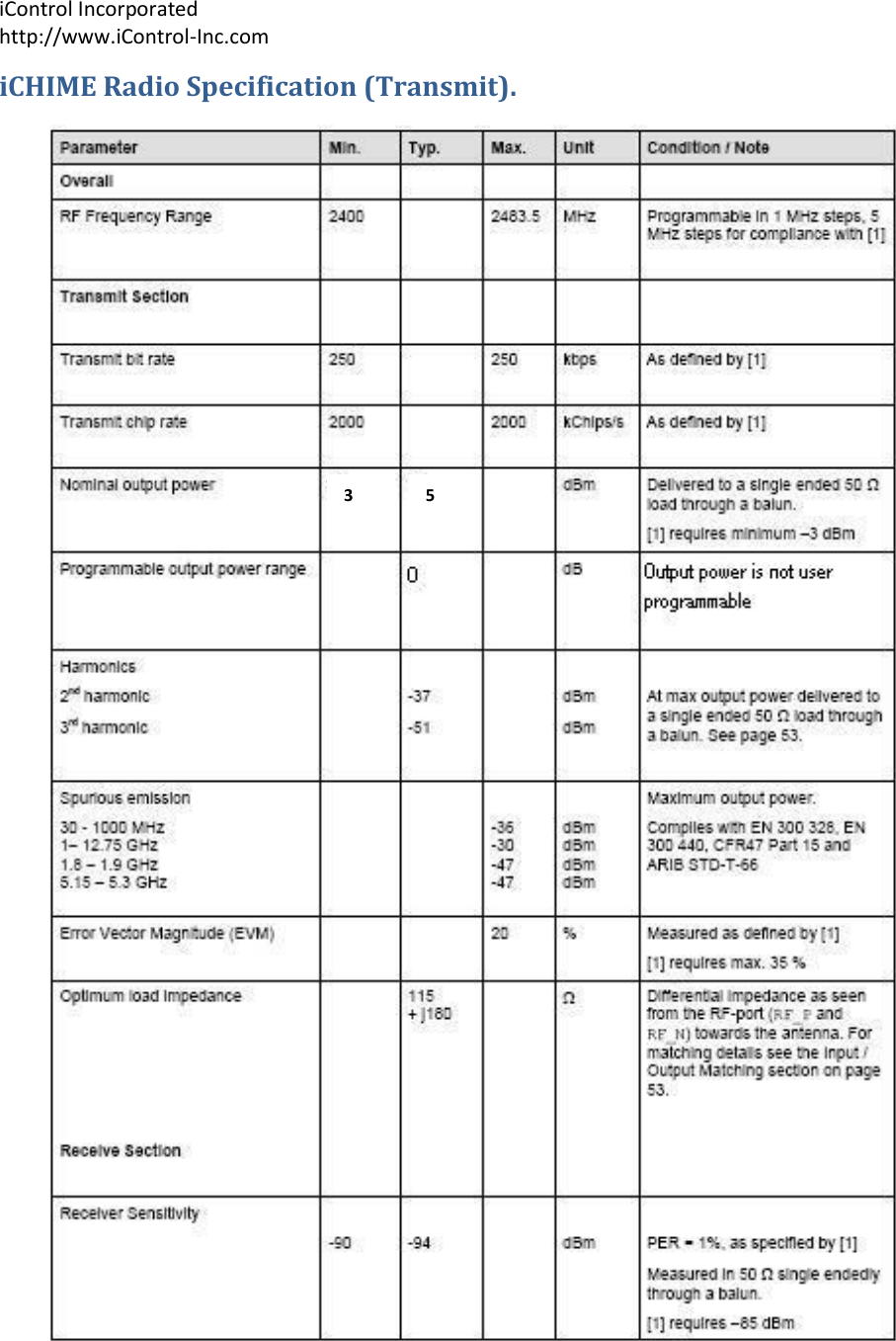
iControl Incorporated http://www.iControl-Inc.com iCHIME Radio Specification (Transmit).                   3 5
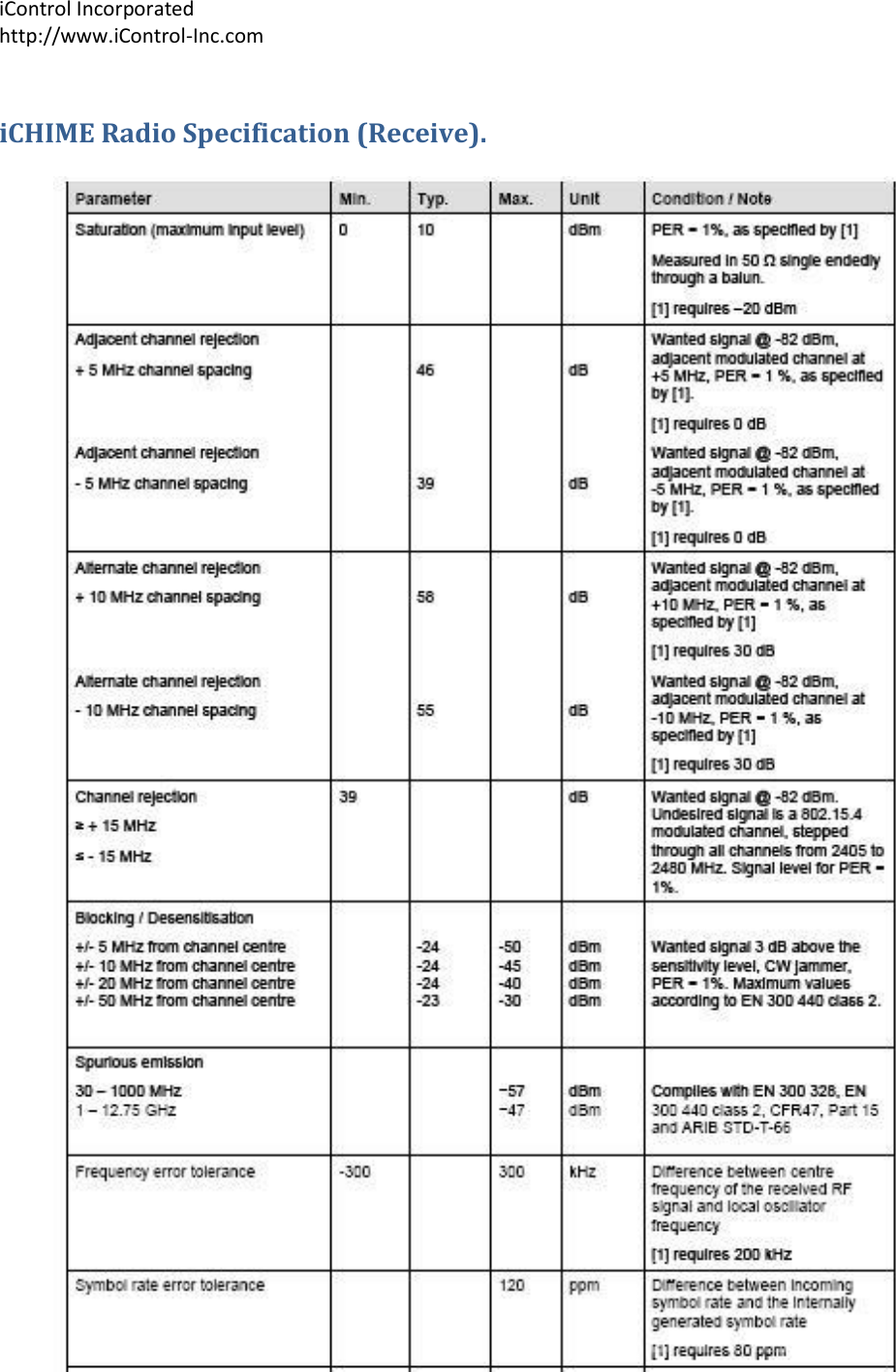
iControl Incorporated http://www.iControl-Inc.com iCHIME Radio Specification (Receive).
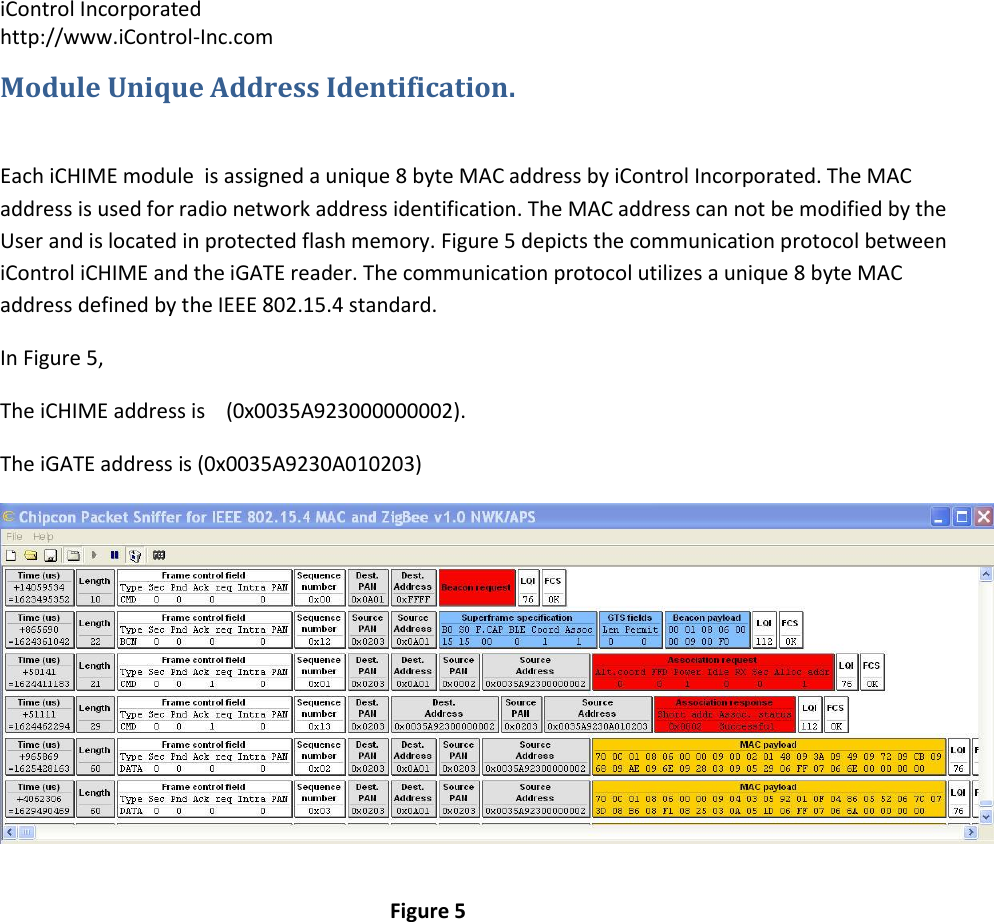
iControl Incorporated http://www.iControl-Inc.com Module Unique Address Identification.  Each iCHIME module  is assigned a unique 8 byte MAC address by iControl Incorporated. The MAC address is used for radio network address identification. The MAC address can not be modified by the User and is located in protected flash memory. Figure 5 depicts the communication protocol between iControl iCHIME and the iGATE reader. The communication protocol utilizes a unique 8 byte MAC address defined by the IEEE 802.15.4 standard.  In Figure 5,  The iCHIME address is    (0x0035A923000000002).  The iGATE address is (0x0035A9230A010203)    Figure 5
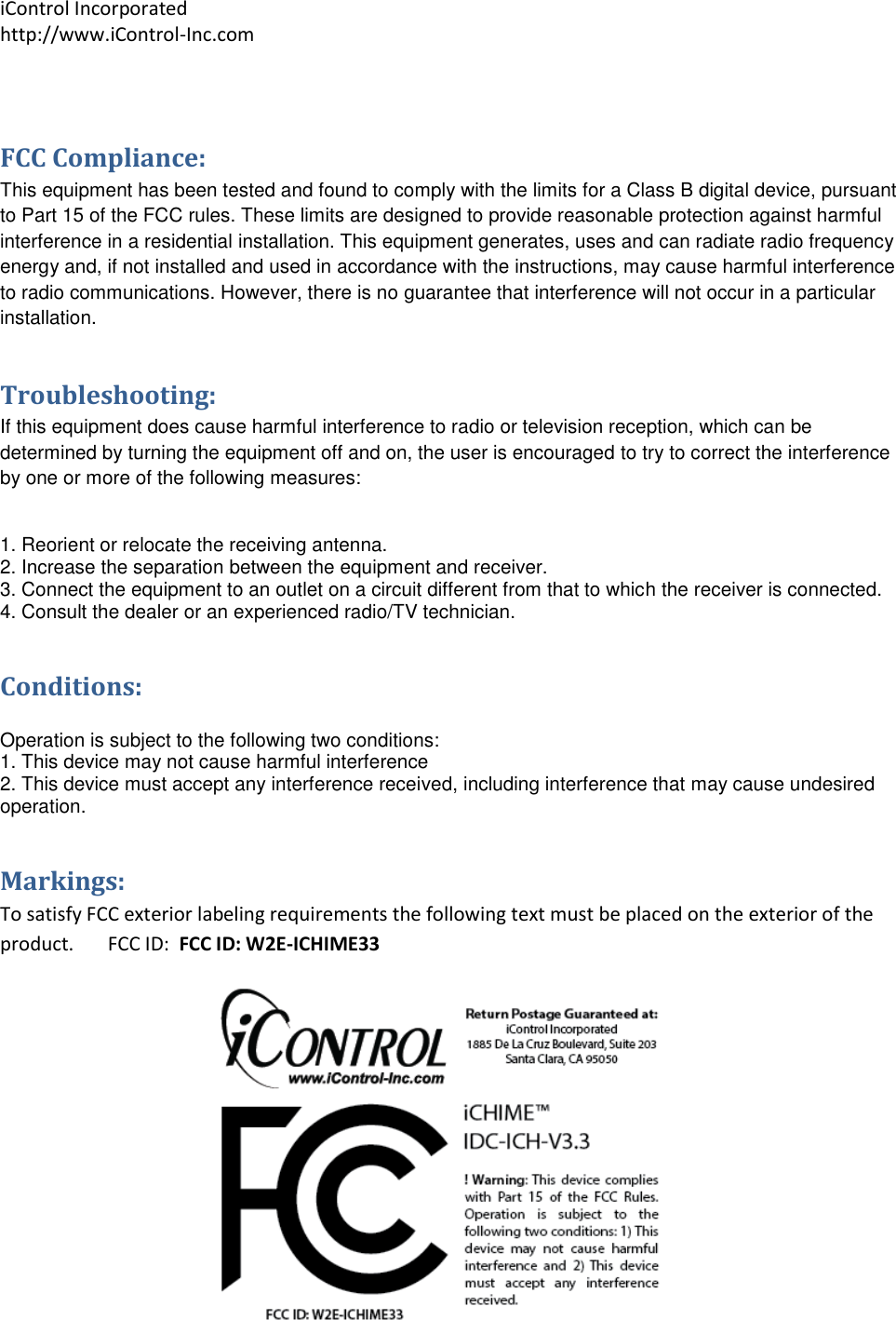
iControl Incorporated http://www.iControl-Inc.com  FCC Compliance: This equipment has been tested and found to comply with the limits for a Class B digital device, pursuant to Part 15 of the FCC rules. These limits are designed to provide reasonable protection against harmful interference in a residential installation. This equipment generates, uses and can radiate radio frequency energy and, if not installed and used in accordance with the instructions, may cause harmful interference to radio communications. However, there is no guarantee that interference will not occur in a particular installation.  Troubleshooting: If this equipment does cause harmful interference to radio or television reception, which can be determined by turning the equipment off and on, the user is encouraged to try to correct the interference by one or more of the following measures:  1. Reorient or relocate the receiving antenna. 2. Increase the separation between the equipment and receiver. 3. Connect the equipment to an outlet on a circuit different from that to which the receiver is connected. 4. Consult the dealer or an experienced radio/TV technician. Conditions:  Operation is subject to the following two conditions: 1. This device may not cause harmful interference 2. This device must accept any interference received, including interference that may cause undesired operation. Markings: To satisfy FCC exterior labeling requirements the following text must be placed on the exterior of the product.       FCC ID:  FCC ID: W2E-ICHIME33
iControl Incorporated http://www.iControl-Inc.com FCC Warnings:  Modifications: Modifications not expressly approved by the manufacturer could void the user’s authority to operate the equipment under FCC Rules. Radio Frequency Exposure:  Notes:   1) For mobile or fixed location transmitters the minimum separation distance is 20cm, even if calculators indicate the MPE distance is less. 2) This equipment has been evaluated in accordance with the FCC bulletin 56 “Hazards of radio frequency and electromagnetic fields” and bulletin 65 “ Human exposure to radio frequency and electromagnetic fields.  3) Safe operation in an uncontrolled environment will result if the following distances from the device are maintained as a minimum.

Navigation menu