JVC EX AK1UA AK1_US_UB_UA User Manual AK1UA, AK1UB, AK1US LVT1763 009B
EX-AK1US EX-AK1US LVT1763-009B nglish,
EX-AK1UB EX-AK1UB LVT1763-009B nglish,
User Manual: JVC EX-AK1UA EX-AK1UA, EX-AK1UB, EX-AK1US nglish,
Open the PDF directly: View PDF  .
.
Page Count: 48
- Introduction
- Getting started
- Basic operations
- Playing discs/files
- Playback
- To switch the display
- Select what you want to play by using the number buttons
- To stop playback
- To pause playback
- To advance picture frame-by-frame
- Fast reverse/Fast forward search
- Playing back from a position 10 seconds before (One Touch Replay)
- Slow Motion Playback
- Skip to the beginning of the selection
- Skipping at approximately 5 minute intervals
- To change the brightness of the display window (DIMMER)
- Adjusting the volume
- Adjusting sound quality
- Turning off the sound temporarily (FADE MUTING)
- Enhancing the playback sound (K2)
- Playing discs/files
- Advanced operations
- Listening to radio
- Convenient functions
- Reference
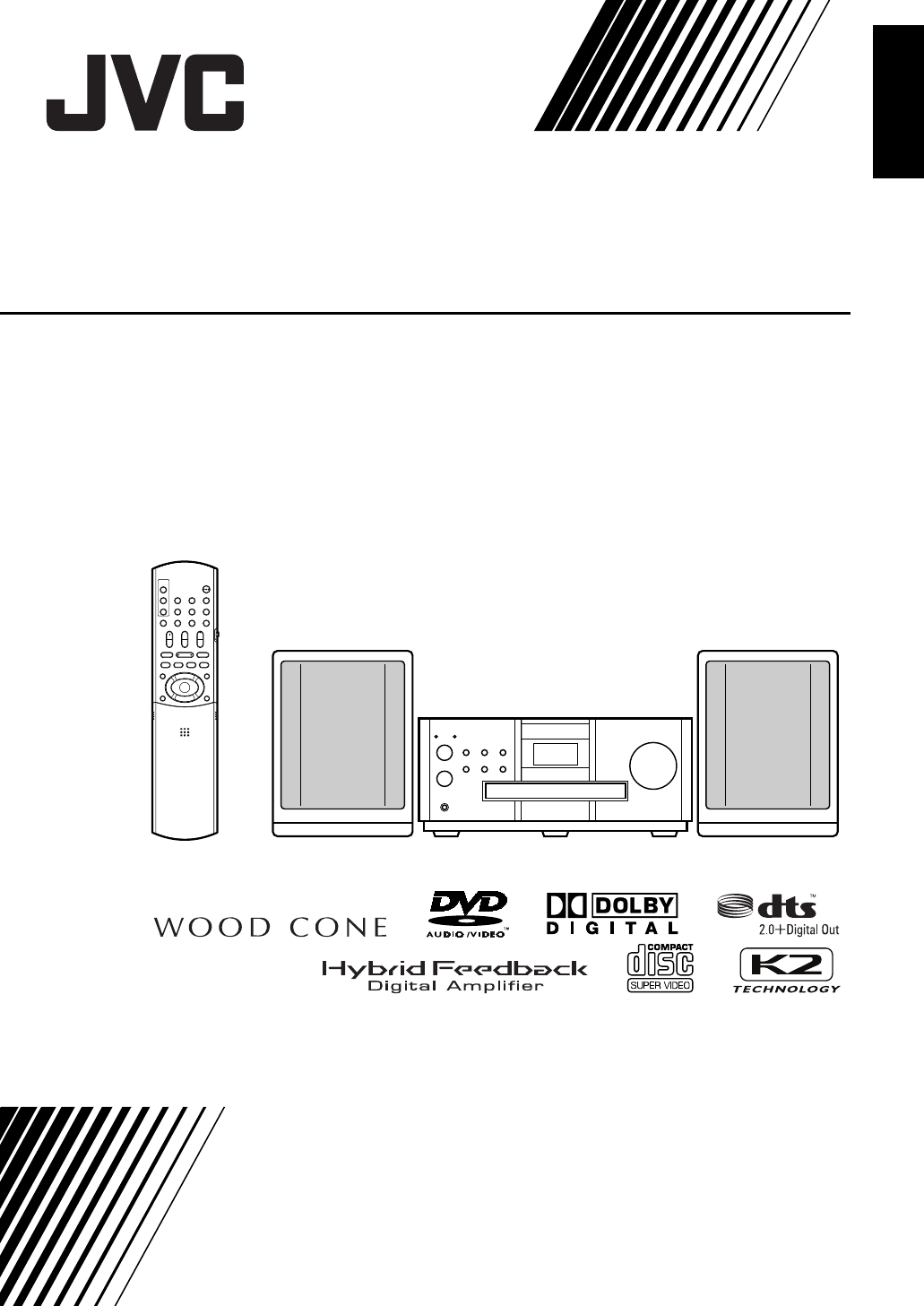
COMPACT COMPONENT SYSTEM
EX-AK1
Consists of CA-EXAK1 and SP-EXAK1
LVT1763-009B
[US, UB, UA]
INSTRUCTIONS
English
EXAK1[US_UB_UA]-00Cov1.fm Page 1 Thursday, September 6, 2012 6:00 PM
G-1
IMPORTANT FOR LASER PRODUCTS
CAUTION
To reduce the risk of electrical shocks, fire, etc.:
1. Do not remove screws, covers or cabinet.
2. Do not expose this appliance to rain or moisture.
CAUTION — F button!
Disconnect the mains plug to shut the power off completely (the
STANDBY lamp goes off). When installing the apparatus,
ensure that the plug is easily accessible.
The F button in any position does not disconnect the mains
line.
• When the system is on standby, the STANDBY lamp lights
red.
• When the system is turned on, the STANDBY lamp goes off.
The power can be remote controlled.
CAUTION
• Do not block the ventilation openings or holes.
(If the ventilation openings or holes are blocked by a
newspaper or cloth, etc., the heat may not be able to get out.)
• Do not place any naked flame sources, such as lighted
candles, on the apparatus.
• When discarding batteries, environmental problems must be
considered and local rules or laws governing the disposal of
these batteries must be followed strictly.
• Do not expose this apparatus to rain, moisture, dripping or
splashing and that no objects filled with liquids, such as
vases, shall be placed on the apparatus.
CAUTION
• Excessive sound pressure from earphones or headphones can
cause hearing loss.
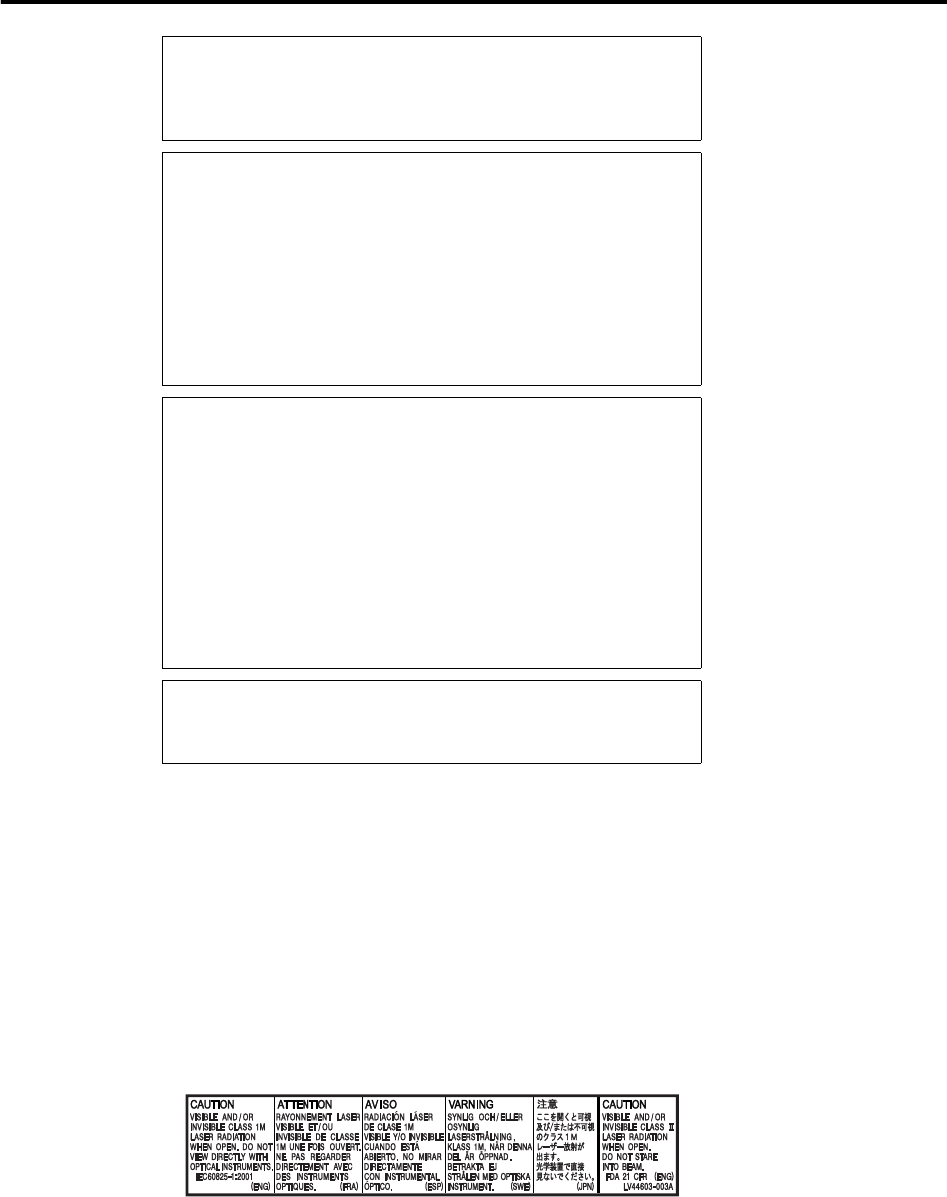
1. CLASS 1 LASER PRODUCT
2. CAUTION: Do not open the top cover or cabinet. There are
no user serviceable parts inside the unit; leave all servicing
to qualified service personnel.
3. CAUTION: Visible and/or invisible class 1M laser radiation
when open. Do not view directly with optical instruments.
4. REPRODUCTION OF LABEL: CAUTION LABEL, PLACED
INSIDE THE UNIT.
Warnings, cautions and others
EX-AK1[US_UB_UA].book Page 1 Monday, August 6, 2007 11:32 AM
G-2
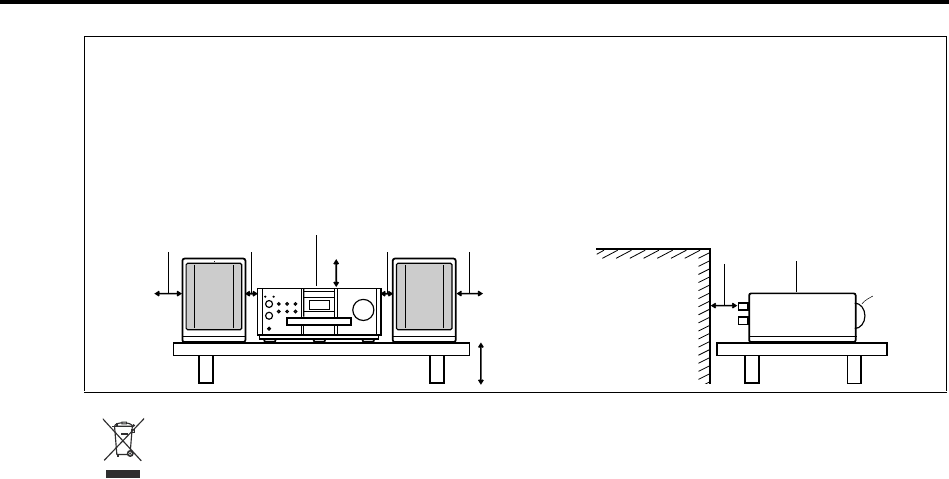
CAUTION — Proper Ventilation
To avoid risk of electric shock and fire and to protect from damage, locate the apparatus as follows:
Top/Front/Back/Sides: No obstructions should be placed in the areas shown by the dimensions below.
Bottom: Place on the level surface. Maintain adequate air path for ventilation by placing on
a stand with a height of 10 cm more.
In addition, maintain the best possible air circulation.
[European Union only]
1cm 1cm
15cm 15cm
15cm
10cm
15cm
Main unit
Wall or
obstructions
Front view Side view
Main unit
Front
Introduction
EX-AK1[US_UB_UA].book Page 2 Monday, August 6, 2007 11:32 AM
1
Introduction
Warnings, cautions and others....................G-1
Special cautions ..............................................2
About discs/files ..............................................3
Getting started
Description of parts .........................................5
Using the remote control .................................7
Putting the batteries in the remote control .......... 7
Operating the TV using the remote control......... 8
Connecting up .................................................9
Basic operations
Playing discs/files ..........................................14
Playback ........................................................... 14
To switch the display ........................................ 16
Select what you want to play by using
the number buttons ...................................... 17
To stop playback............................................... 17
To pause playback............................................ 17
To advance picture frame-by-frame.................. 17
Fast reverse/Fast forward search ..................... 17
Playing back from a position 10 seconds
before (One Touch Replay) ......................... 18
Slow Motion Playback....................................... 18
Skip to the beginning of the selection ............... 18
Skipping at approximately 5 minute intervals ... 18
To change the brightness of the
display window (DIMMER)........................... 19
Adjusting the volume ........................................ 19
Adjusting sound quality..................................... 19
Turning off the sound temporarily
(FADE MUTING).......................................... 19
Enhancing the playback sound (K2)................. 19
Advanced operations
Playing MP3/WMA/WAV/JPEG/MPEG1/
MPEG2 file................................................20
Playback ........................................................... 20
Repeat playback............................................... 21
Resume Playback .........................................22
Select the scene to be played .......................23
Select from the menu........................................ 23
Designate the time (Time search)..................... 24
Program Playback/Random Playback...........25
Play the disc/file in the desired order
(Program Playback) ..................................... 25
Playing the disc/file in a random order
(Random Playback) ..................................... 26
Repeat Playback ...........................................27
Playing the title/chapter/group/track/all tracks
repeatedly (REPEAT) .................................. 27
Playing the designated part repeatedly
(A-B Repeat Playback) ................................ 28
Other convenient functions............................29
Selecting the subtitles....................................... 29
Selecting the audio language ............................29
Selecting a view angle.......................................29
Enlarging the picture (ZOOM) ...........................30
Adjusting the picture quality (VFP) ....................30
Creating realistic sound
(SURROUND MODE)...................................31
Selecting the headphone surround mode..........31
Adjusting playback level (DVD LEVEL) .............31
Functions specific to DVD AUDIO.................32
Playing the Bonus Group...................................32
Browsable Still Pictures (B.S.P.) .......................32
Using the status bar and the menu bar .........33
Preferences ...................................................35
Basic operations ................................................35
Listening to radio
Listening to a radio broadcast .......................37
Tuning in to a preset station ..........................38
Convenient functions
Listening to the sound of
other audio devices...................................39
Auto Standby.................................................39
Sleep Timer ..................................................40
Tray Lock.......................................................40
Using the AV COMPU LINK function ............41
Reference
Troubleshooting.............................................42
Language codes............................................44
Specifications ................................................44
How to read this manual
• Operations are described by mainly using the
remote control buttons. If there are the same
marks on the main unit, the buttons on the main
unit can also be used.
• The following marks tell you for which type of the
discs the operation can be made.
• The illustrations and TV screens may be different
between the actual case and the description.
• “VCD” is an abbreviation of “Video CD”.
• “SVCD” is an abbreviation of “Super Video CD”.
Table of contents
EX-AK1[US_UB_UA].book Page 1 Monday, August 6, 2007 11:32 AM
2
7Important cautions
Installation of the system
• Select a place which is level, dry and neither too hot
nor too cold; between 5°C and 35°C.
• Leave sufficient distance between the system and the
TV.
• Do not use the system in a place subject to vibration.
Power cord
• Do not handle the power cord with wet hands!
• A small amount of power is always consumed while
the power cord is connected to the wall outlet.
• When unplugging the power cord from the wall outlet,
always pull on the plug, not the power cord.
To prevent malfunctions of the system
• There are no user-serviceable parts inside. If anything
goes wrong, unplug the power cord and consult your
dealer.
• Do not insert any metallic object into the system.
• Do not use any non-standard shape disc (like a heart,
flower or credit card, etc.) available on the market,
because it may damage the system.
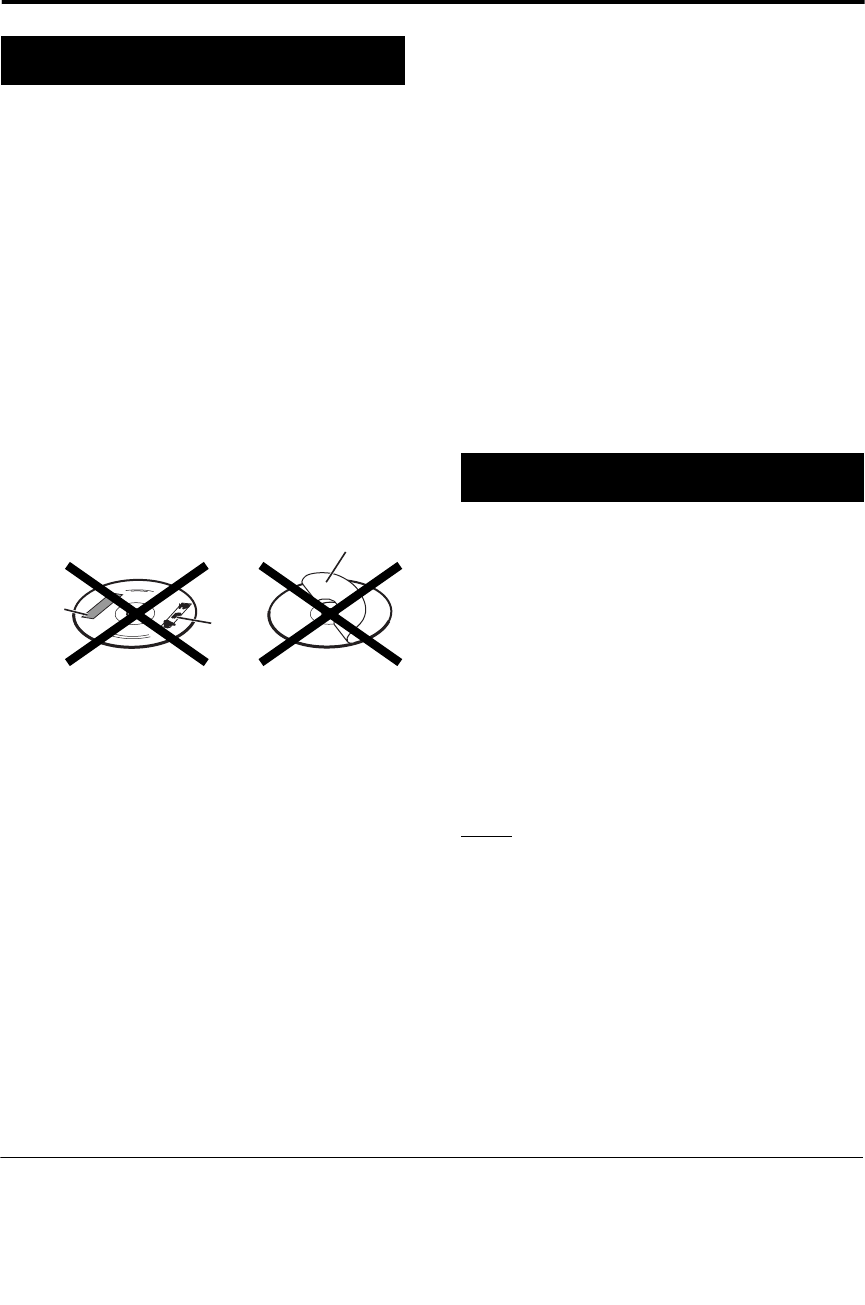
• Do not use a disc with tape, stickers, or paste on it,
because it may damage the system.
Note about copyright laws
Check the copyright laws in your country before
recording from DVDs, Super Video CDs (SVCDs), VCDs
and CDs. Recording of copyrighted material may infringe
copyright laws.
Note about copy guard system
DVDs are protected by copy guard system. When you
connect the system to your VCR directly, the copy guard
system activates and the picture may not be played back
correctly.
7Safety precautions
Avoid moisture, water and dust
Do not place the system in moist or dusty places.
Avoid high temperatures
Do not expose the system to direct sunlight and do not
place it near a heating device.
When you are away
When away on travel or for other reasons for an extended
period of time, disconnect the power cord plug from the
wall outlet.
Do not block the vents
Blocking the vents may damage the system.
Care of the cabinet
When cleaning the system, use a soft cloth and follow the
relevant instructions on the use of chemically-coated
cloths. Do not use benzene, thinner or other organic
solvents including disinfectants. These may cause
deformation or discoloring.
If water gets inside the system
Turn the system off and disconnect the power cord plug
from the wall outlet, then call the store where you made
your purchase. Using the system in this condition may
cause fire or electrical shock.
7
When condensation or water drops adhere to the lens
In any of the following cases, condensation or water
drops may adhere to the lens to prevent the system from
working properly:
• Immediately after roomheating starts
• When the system is installed in a steamy or damp
space
• When the system is suddenly moved from a cold place
to a warm space
In any of these cases, leave the system turned on for 1 or
2 hours before use.
Check to be sure you have all of the supplied
accessories.
The number in parentheses is the quantity of the pieces
supplied. If anything is missing, contact your dealer
immediately.
• Remote control (1)
• Batteries (2)
• FM antenna (1)
• AM loop antenna (1)
• Power cord (1)
• Composite video cord (1)
• Speaker cords 3 m (2)
• AC plug adaptor* (1)
NOTE
* The AC plug adaptor is not supplied for Hong Kong
and Thailand.
Notes on handling
Paste
Sticker
Label sticker
Supplied accessories
Special cautions
• Manufactured under license from Dolby Laboratories. “Dolby” and the double-D symbol are trademarks of Dolby
Laboratories.
• “DTS” is a registered trademark of DTS, Inc. and “DTS 2.0 + Digital Out” is a trademark of DTS, Inc.
• This product incorporates copyright protection technology that is protected by method claims of certain U.S. patents
and other intellectual property rights owned by Macrovision Corporation and other rights owners. Use of this
copyright protection technology must be authorized by Macrovision Corporation, and is intended for home and other
limited viewing uses only unless otherwise authorized by Macrovision Corporation. Reverse engineering or
disassembly is prohibited.
Introduction
EX-AK1[US_UB_UA].book Page 2 Monday, August 6, 2007 11:32 AM
3
About discs/files
• Even though listed above, some types may be
unplayable.
*1 Discs should be finalized before being played back.
*2 DVD VR means a DVD-R/DVD-RW recorded in Video
Recording (VR) format.
*3 A CD-R/CD-RW recorded in multi-session format (up
to 20 sessions) is playable.
*4 A DVD-R recorded in multi-border format is also
playable (except for dual layer discs).
*5 For files recorded on a DVD-R/DVD-RW, the disc
should be formatted with UDF Bridge.
It is possible to play back finalized +R/+RW (DVD Video
Format only) discs.
Some discs may not be played back because of their disc
characteristics, recording conditions, or damage or stains
on them.
Only sounds can be played back from the following discs:
MIX-MODE CD CD-G
CD-EXTRA CD TEXT
This system accommodates the NTSC and PAL systems.
When you play back an NTSC disc with the video signal
type set to “PAL” (refer to page 13), the NTSC video
signal is converted to the PAL60 signal and output.
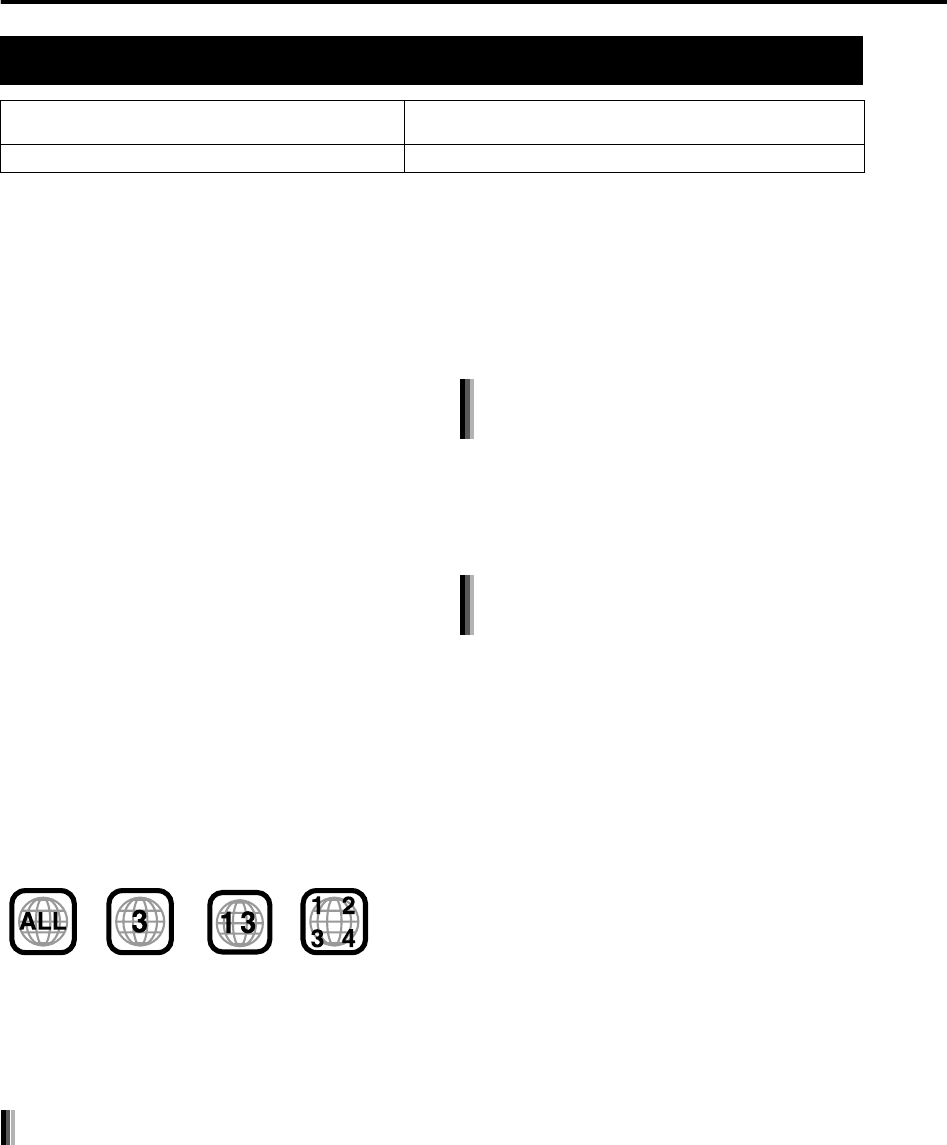
Region code of DVD VIDEO
DVD VIDEO players and DVD VIDEO discs have their
own region code numbers. This system can play back a
DVD VIDEO whose region code number includes the
system’s region code, which is indicated on the rear
panel.
If a DVD VIDEO with an improper region code number is
loaded, playback cannot start.
• On some DVD VIDEOs, DVD AUDIOs, VCDs or
SVCDs, their actual operation may be different
from what is explained in this manual. This is due
to the disc/file programming and disc/file
structure, not a malfunction of this system.
• The following discs cannot be played back:
• DVD-ROM (except for MP3/WMA/JPEG/MPEG1/
MPEG2 format), DVD-RAM, CD-ROM, CD-I (CD-I
Ready), Photo CD, SACD, etc.
• Playing back these discs generates noise and may
damage the speakers.
• Damaged discs and discs with an unusual shape
(other than a disc of 12 cm or 8 cm in diameter) cannot
be played back.
• JVC does not guarantee the operation and sound
quality of discs not authorized by CD-DA, which is a
CD specification.
Before playback, confirm that the disc complies with
this CD specification by checking the marks and
reading notes printed on the package.
• CDs recorded in the ISO 9660 format are playable
(except CDs recorded in the “packet write” format
(UDF format)).
• Files with an extension of “.mp3”, “.wma”, “.wav”, “.jpg”,
“.jpeg”, “.mpg” or “.mpeg” (extensions with mixed
cases are also acceptable) are playable.
• A disc may not be played back, or reading it may take a
long time depending on its recording conditions or
properties.
• The time needed for reading varies with the number of
groups or tracks (files) recorded on the disc.
• If characters other than single-byte alphanumeric
characters are used in the file name of an MP3/WMA/
WAV/JPEG file, the track/file name is not displayed
correctly.
• The order of tracks/groups displayed on the MP3/
WMA/WAV menu screen, and the order of files/groups
displayed on the JPEG menu screen may be different
from that of files/folders displayed on a computer
monitor screen.
• Playing back an MP3/WMA file that contains a still
image may take a long time. The elapsed time is not
displayed until playback starts. This elapsed time may
not be displayed correctly.
• For an MP3/WMA file, a disc with a sampling
frequency of 44.1 kHz and transmission rate of 128
kbps is recommended.
• This system is not compatible with an MP3i or
MP3PRO file.
• This system can play back a baseline JPEG file,
excluding monochromatic JPEG files.
• This system can play back JPEG data taken with a
digital camera conforming to the DCF (Design Rule for
Camera File System) standard (when a function such
as the automatic rotation function of a digital camera is
applied, the data may no longer conform to the DCF
standard, and the image may not be displayed).
Playable disc/file types
Playable discs *1 DVD VIDEO, DVD AUDIO, DVD VR *2, VCD, SVCD, CD,
CD-R *3, CD-RW *3, DVD-R *4, *5, DVD-RW *5, +R, +RW
Playable files recorded on a disc *1 MP3, WMA, WAV, JPEG, MPEG1, MPEG2
Examples:
Unplayable discs
Playable MP3/WMA/WAV/JPEG/
MPEG1/MPEG2 discs/files
Notes on MP3/WMA/WAV/JPEG/
discs/files
EX-AK1[US_UB_UA]-01.fm Page 3 Tuesday, August 28, 2007 2:52 PM
4
• If data has been processed, edited or restored with
computer image editing software, the data may not be
displayed.
• This system cannot play back animations such as
MOTION JPEG files, still pictures (TIFF etc.) other
than JPEG files, or image data with sound.
• The resolution of 640 x 480 pixels is recommended for
JPEG files. If a file has been recorded at a resolution
of more than 640 x 480 pixels, it may take a long time
to display the file. An image with a resolution of more
than 8 192 x 7 680 pixels cannot be displayed.
• A WAV file with a sampling frequency of 44.1 kHz and
a quantization bit rate of 16 bits is recommended.
Notes on MPEG1/MPEG2 discs/files
• The stream structure of MPEG1/MPEG2 discs and
files should conform to MPEG system/program stream.
• 720 x 576 pixels (25 fps)/720 x 480 pixels (30 fps) is
recommended for the highest resolution.
• This system also supports the resolutions of 352 x
576/480 x 576/352 x 288 pixels (25 fps) and 352 x 480/
480 x 480/352 x 240 pixels (30 fps).
• The profile and level should be MP@ML (Main Profile
at Main Level)/SP@ML (Simple Profile at Main Level)/
MP@LL (Main Profile at Low Level).
• Audio streams should conform to MPEG1 Audio Layer-
2, MPEG2 Audio Layer-2 or Dolby Digital (MPEG2 files
only).
Caution for DualDisc playback:
The Non-DVD side of a “DualDisc” does not comply with
the “Compact Disc Digital Audio” standard. Therefore,
the use of Non-DVD side of a DualDisc on this product is
not recommended.
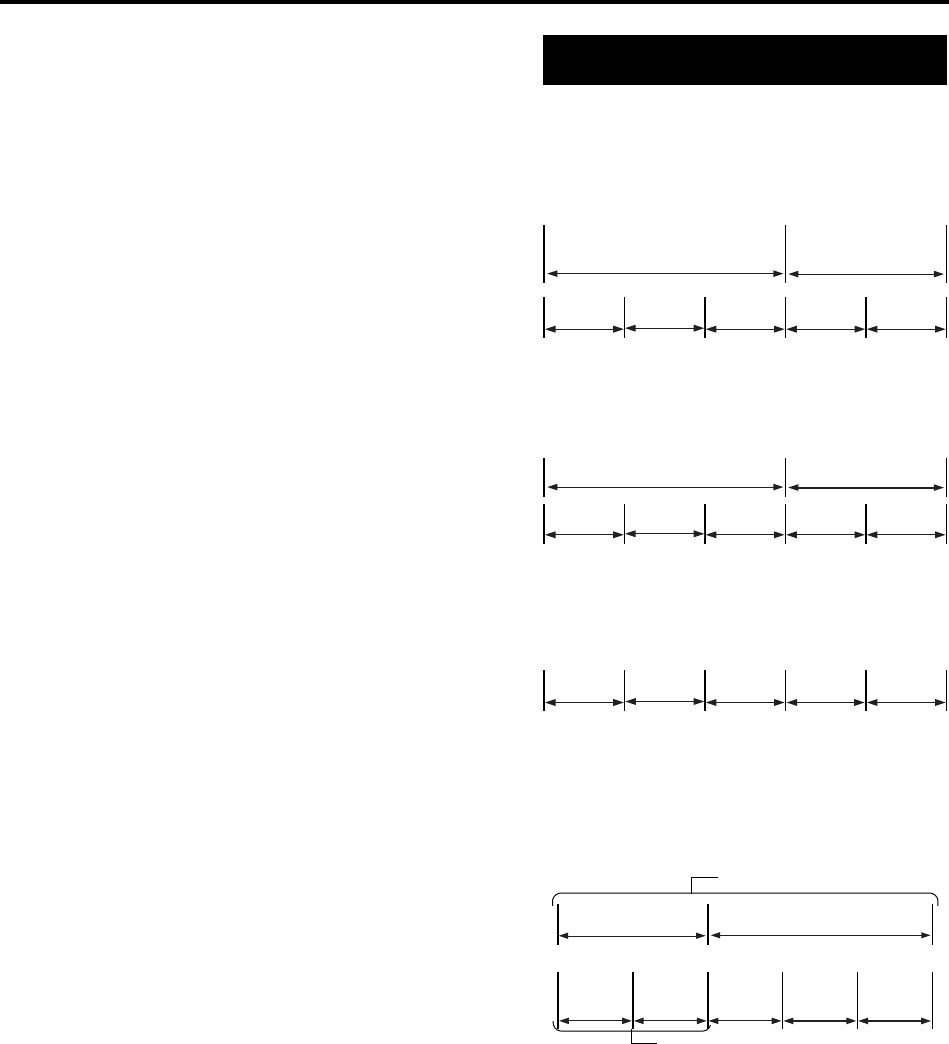
DVD VIDEO/DVD VR
A DVD VIDEO consists of “titles” and each title
may be divided into “chapters”.
A DVD VR consists of “original programs” or “play
lists” and each original program/play list may be
divided into “chapters”.
DVD AUDIO
A DVD AUDIO consists of “groups” and each group
may be divided into “tracks”.
Some discs include a “bonus group” that requires a
password for playback. (Refer to page 32.)
VCD/SVCD/CD
A VCD/SVCD/CD consists of “tracks”.
In general, each track has its own track number.
(On some discs, each track may also be further
divided by indexes.)
MP3/WMA/WAV/JPEG/MPEG1/MPEG2 files
Audio, still pictures and video are recorded as
tracks/files on a disc. Tracks/files are usually
grouped into a folder. Folders can also include
other folders, creating hierarchical folder layers.
This system simplifies the hierarchical construction
of files and manages folders by “groups”.
.
This system can recognize up to 4 000 tracks/files
on a disc. Also, the system can recognize up to
150 tracks/files per group and up to 99 groups on a
disc. Since the system ignores the tracks/files with
numbers exceeding 150 and the groups with
numbers exceeding 99, these cannot be played
back.
If there are any type of files other than MP3/WMA/
WAV/JPEG/MPEG1/MPEG2 files on a disc, those
files are also counted in the total number of files.
Data hierarchy
Title 1/Original program 1/
Play list 1
Title 2/Original
program 2/Play list 2
Chapter 1 Chapter 2 Chapter 3 Chapter 1 Chapter 2
Group 1 Group 2
Track 1 Track 2 Track 3 Track 1 Track 2
Track 1 Track 2 Track 3 Track 4 Track 5
Up to 99 groups
Up to 150 files
Group 1 Group 2
Track 1 /
File 1
Track 2 /
File 2
Group 3 Group 4 Group 5
Introduction
EX-AK1[US_UB_UA]-01.fm Page 4 Tuesday, August 28, 2007 2:52 PM
5
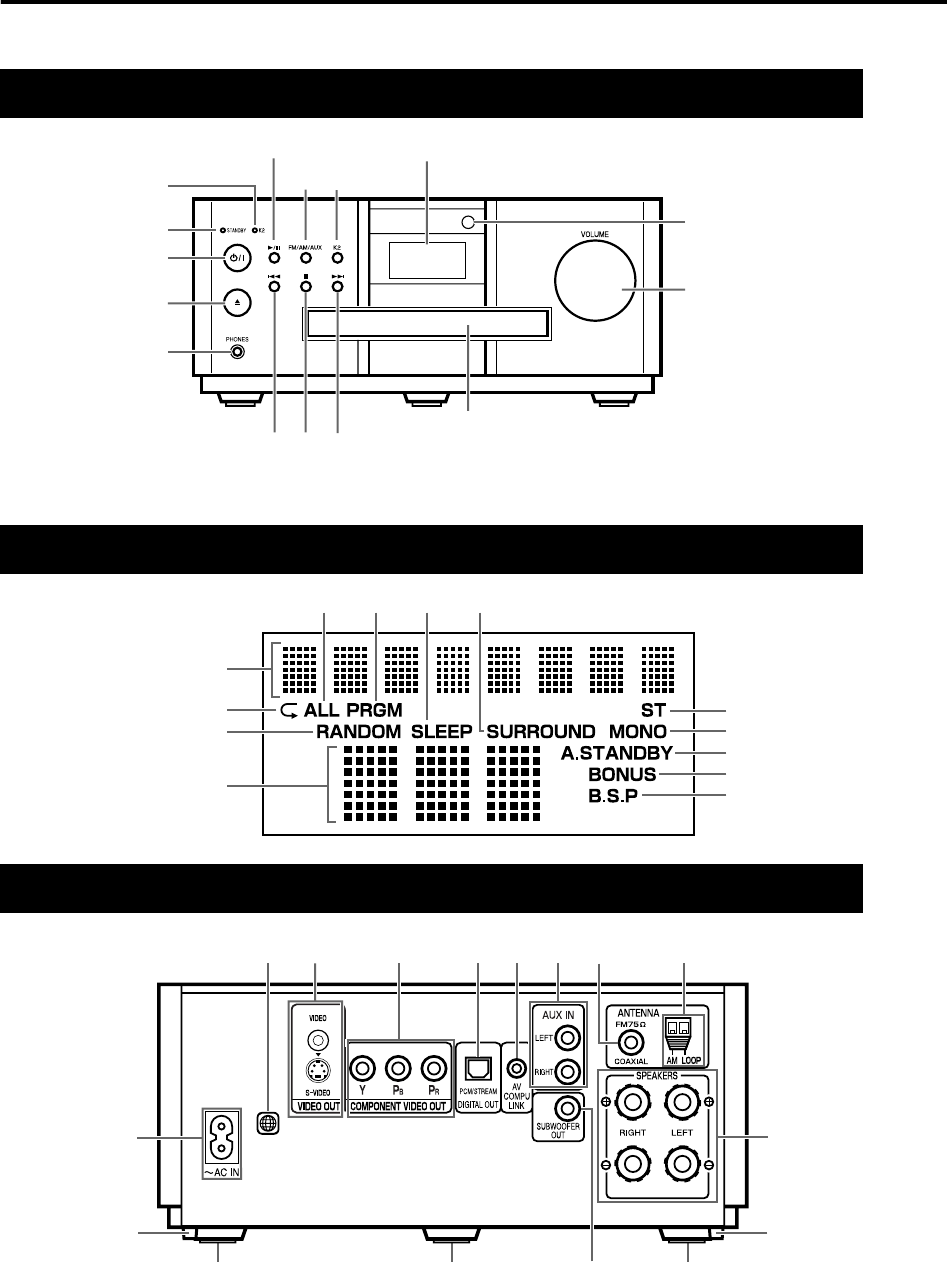
The numbers represent the page numbers.
* Connect a pair of headphones (commercially available) with a stereo mini plug. If the headphones are
connected, the speakers and subwoofer will not produce any sound.
Front panel
Play/Pause: 14, 17 Look at “Display window” below.
37, 39
19
12, 14
STANDBY/ON
: 14
Open/Close
: 14, 40
Headphones
jack*
Disc tray: 14
Remote control
sensor: 7
VOLUME
control: 19
19
17
17, 40
17
Display window
Upper display
section: 16
21, 27
26
Lower display
section: 15, 16
37
37
39
32
32
21, 27 25 40 31
Rear panel
3
10
9111112
12
11
6
6
6
6
6
94112
Description of parts
EX-AK1[US_UB_UA]-01.fm Page 5 Tuesday, August 28, 2007 2:52 PM
6
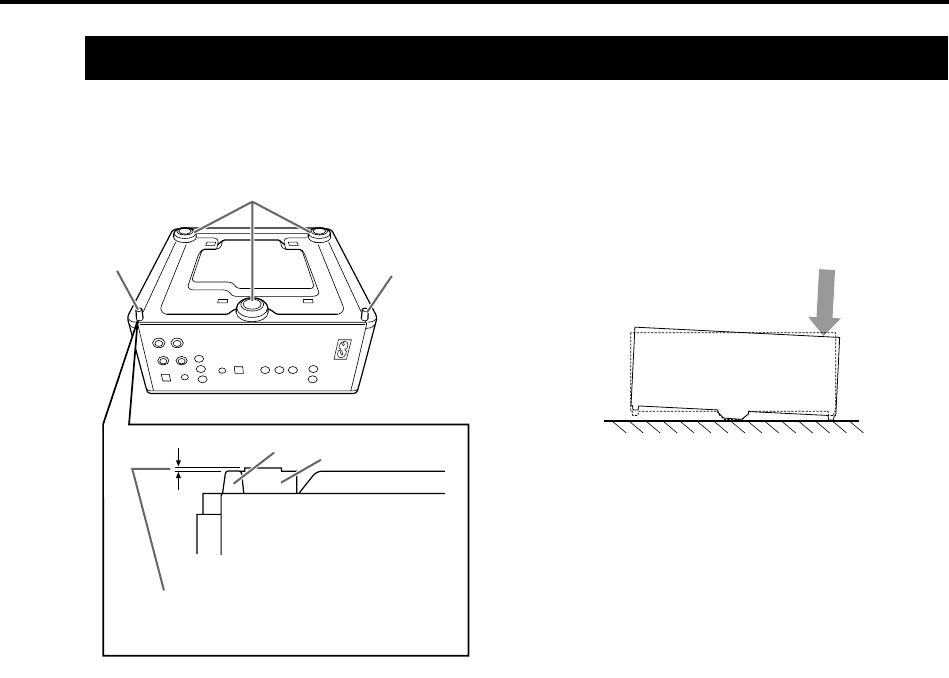
The use of three main feet on the bottom of the
main unit enables higher sound quality while
maintaining the stability of the main unit.
In addition, the two studs on the bottom help
stabilize the main unit and prevent it from wobbling
or tipping when nudged from above. Because the
studs are slightly shorter than the main feet, the
studs do not come in contact with the mounted
surface, leaving the main feet to support the main
unit.
Features of the main feet and studs
Main feet (3)
Stud (1)
Stud
Main feet
Stud (1)
The height of the studs are slightly
shorter than the main feet.
Main unit (rear view)
Main unit
(bottom view)
Getting started
EX-AK1[US_UB_UA]-01.fm Page 6 Tuesday, August 28, 2007 2:52 PM
7
The numbers represent the page numbers.
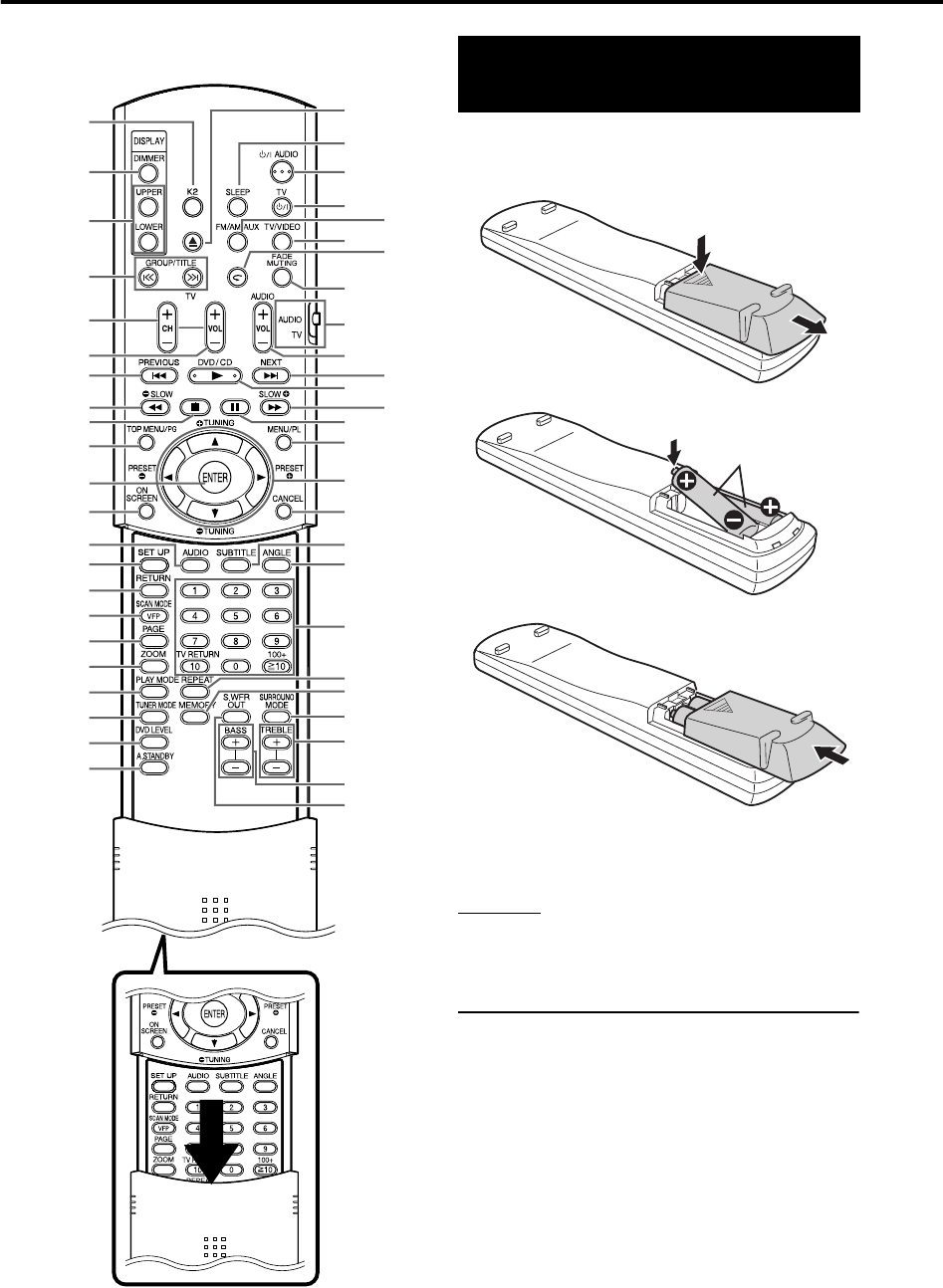
Insert the batteries into the remote control by
matching the polarity (+ and −) correctly.
If the range or effectiveness of the remote control
decreases, replace both batteries.
CAUTION
Battery shall not be exposed to excessive heat
such as sunshine, fire or the like.
Remote control operation
When operating the remote control, point it
towards the front panel of the main unit. If the
remote control is operated from a direction that is
extremely oblique or when there is an obstacle in
the way, signals may not be transmitted.
If the remote control sensor is exposed to a strong
light such as direct sunlight, correct operation may
not be carried out.
40
14
837
8
19
19
14 18
17
23
23, 33
26
29
29
11
39
31
37
25
30
32
13, 30
15
35
29
33
23, 33
23
17
18
17, 21, 26
8
8
18, 21
16
19
19
21, 27
31
19
19
17, 21
14
38, 39
18
Number
Buttons: 8, 18
Remote control
mode selector: 8
Putting the batteries in
the remote control
R6P(SUM-3)/
AA(15F)
Using the remote control
EX-AK1[US_UB_UA]-01.fm Page 7 Tuesday, August 28, 2007 2:52 PM
8
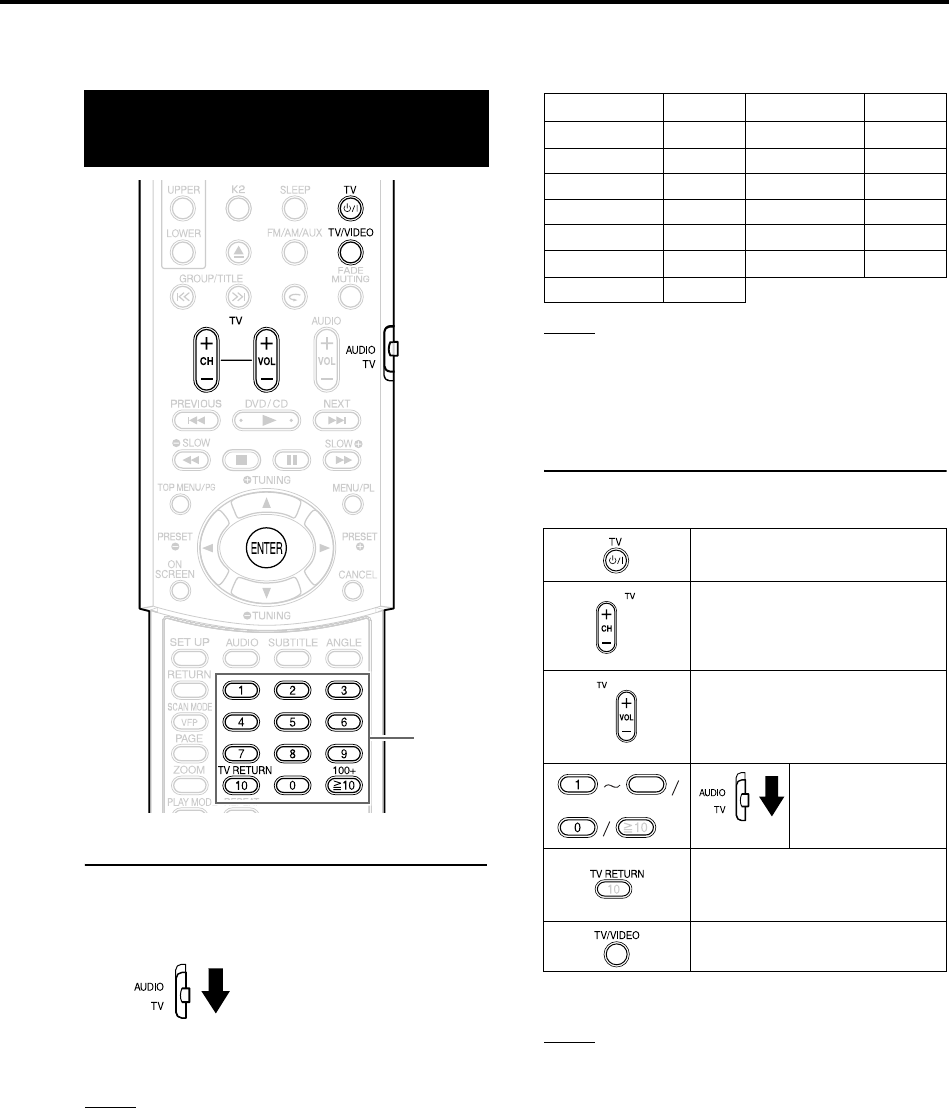
This page is for when operating your TV using the
remote control of this product.
Setting the manufacturer's code
1Slide the remote control mode
selector to the TV side.
2Keep pressing down FTV.
NOTE
Keep pressing down FTV until Step 4 is complete.
3Press ENTER and release.
4Press number buttons (1-9, 0).
Examples:
For a Hitachi TV: Press 1, then 0.
For a Toshiba TV: Press 0, then 8.
If there are more than one manufacturer’s codes,
try them in turn and select the one that causes the
product to work properly.
NOTE
Manufacturer’s codes may be changed without notice.
You may not be able to operate a TV produced by the
manufacturer shown above.
5Release FTV.
For TV operation
Operate the remote control by pointing it towards
the TV.
*1 Make sure to slide the remote control mode
selector to the TV side in advance.
NOTE
When the batteries are replaced, perform the
manufacturer's code setting again.
Operating the TV using
the remote control
Number
buttons
Manufacturer Code Manufacturer Code
JVC 01 Samsung 12
Hitachi 10 Sanyo 13
Magnavox 02 Sharp 06
Mitsubishi 03 Sony 07
Panasonic 04, 11 Toshiba 08
Philips 14 Zenith 09
RCA 05
Turn ON/OFF the power.
Change channels.
Adjust volume.
Select channels.
Alternates between the
previously selected channel
and the current channel.
Switch TV and video input.
100+
9
*1
Getting started
EX-AK1[US_UB_UA]-01.fm Page 8 Tuesday, August 28, 2007 2:52 PM
9
Connecting antennas
C
onnecting AM loop antenna
(
supplied
)
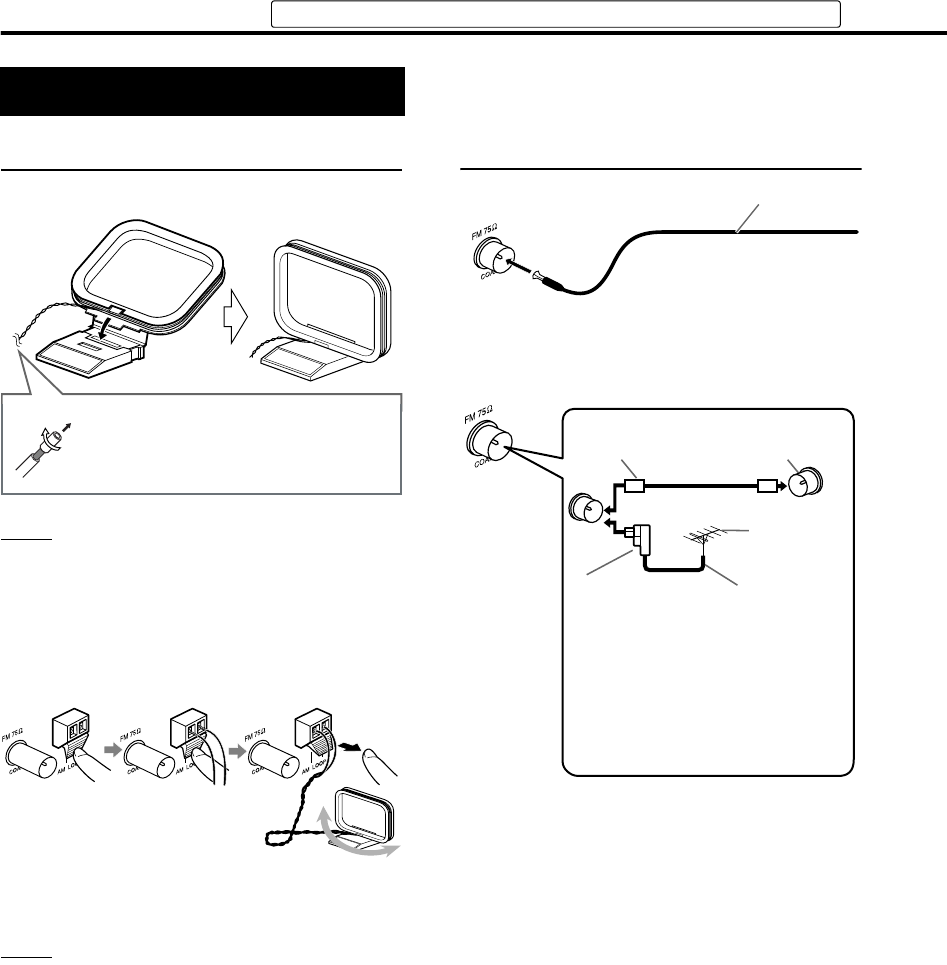
Setting up the AM loop antenna
NOTE
• Keep the AM loop antenna cable wrapped around
the AM loop antenna frame, otherwise the
effectiveness and sensitivity of the AM loop antenna
may be reduced.
Connecting the AM loop antenna
Turn the AM loop antenna to find the best position
for radio reception.
NOTE
• Make sure that the antenna conductors do not touch
any other terminals. This could cause poor
reception.
If insulation covers the tips of the
antenna cable, twist and pull off the
insulation.
Main unit (rear view)
Connecting FM antenna (supplied)
When radio reception with the supplied FM
antenna is poor, or when using a communal
antenna
When using an antenna other than those supplied
with this system, refer to the operation manuals for
the antenna and converter for details of
connection.
When positioning the antennas, find the best
position for reception while listening to an actual
radio program (refer to “Listening to a radio
broadcast” on page 37).
Main unit (rear view) FM antenna
Stretch out the FM antenna
to the best position for radio
reception.
Main unit (rear view)
Antenna cable
(not supplied)
Outdoor FM
antenna
(not supplied)
Converter (not
supplied:
compatible with
300 C/75 C)
Coaxial cable
(not supplied)
Depending on the radio reception
conditions, an FM feeder antenna
(not supplied: compatible with
300 C) can be used. In this case, a
converter (not supplied) is required.
or
Communal
antenna terminal
Connecting up Do not connect the power cord until all other connections have been made.
EX-AK1[US_UB_UA]-02.fm Page 9 Thursday, August 23, 2007 9:09 AM
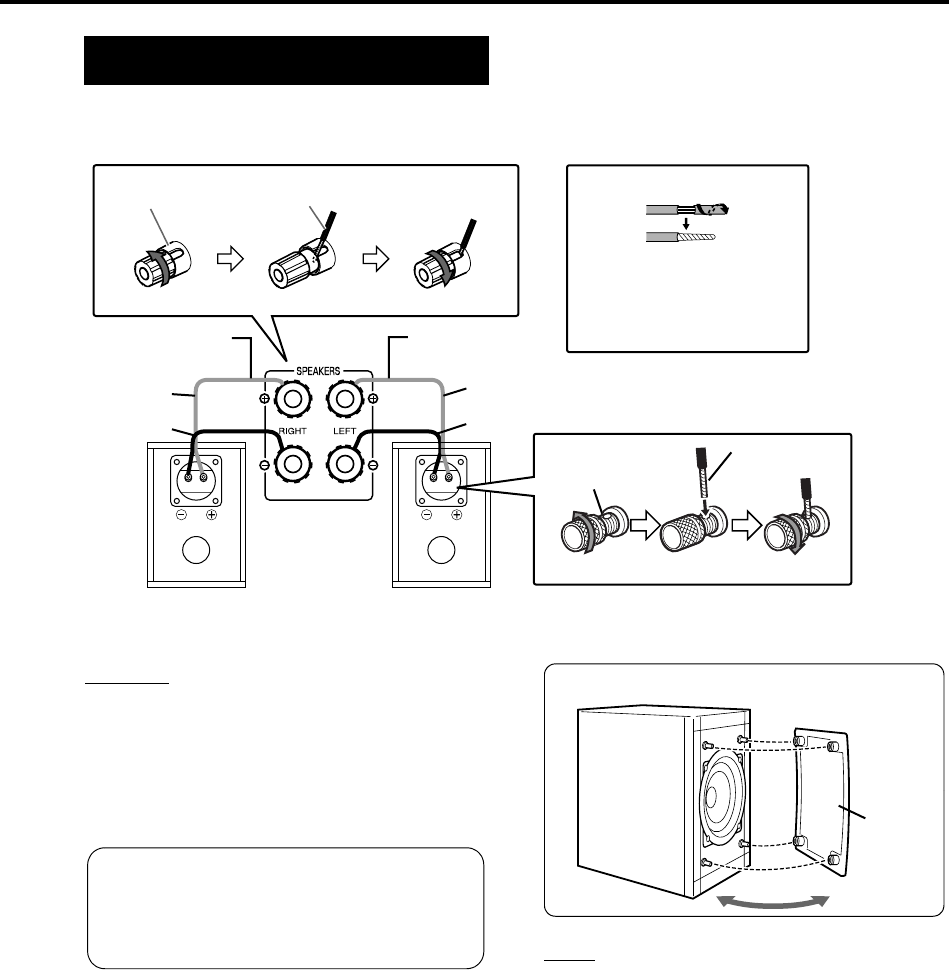
10
There is no difference between the left and right
speakers.
CAUTION
• DO NOT connect more than one speaker to one
speaker terminal.
• The supplied speakers are not magnetically
shielded. If placing the speakers near a TV, leave
sufficient distance between the speaker and the
TV so that color irregularity does not occur on
the TV.
NOTE
• Impedance of speaker that can be connected to the
main unit is within a range of 4
C
to
16
C
.
• In order to have a sufficient cooling effect, leave a
space of more than 1cm between the main unit and
the speakers or other objects.
Connecting speakers
Speaker terminal
Speaker terminal
Speaker
cord
Speaker
cord
Speaker cord
(supplied)
Speaker cord
(supplied)
Without black line
Without
black line
With black line
With black
line
Right speaker
(rear panel) Left speaker
(rear panel)
Main unit
(rear panel)
If the tips of the speaker cord
are covered with insulation,
twist and pull off the insulation.
The speakers employ natural wood for the
diaphragm and the cabinet in order to repro-
duce the original sound faithfully.
The appearance therefore differs for each
system.
Speaker
cover
Speaker cover can be detached.
Getting started
EX-AK1[US_UB_UA]-02.fm Page 10 Thursday, September 6, 2012 6:02 PM
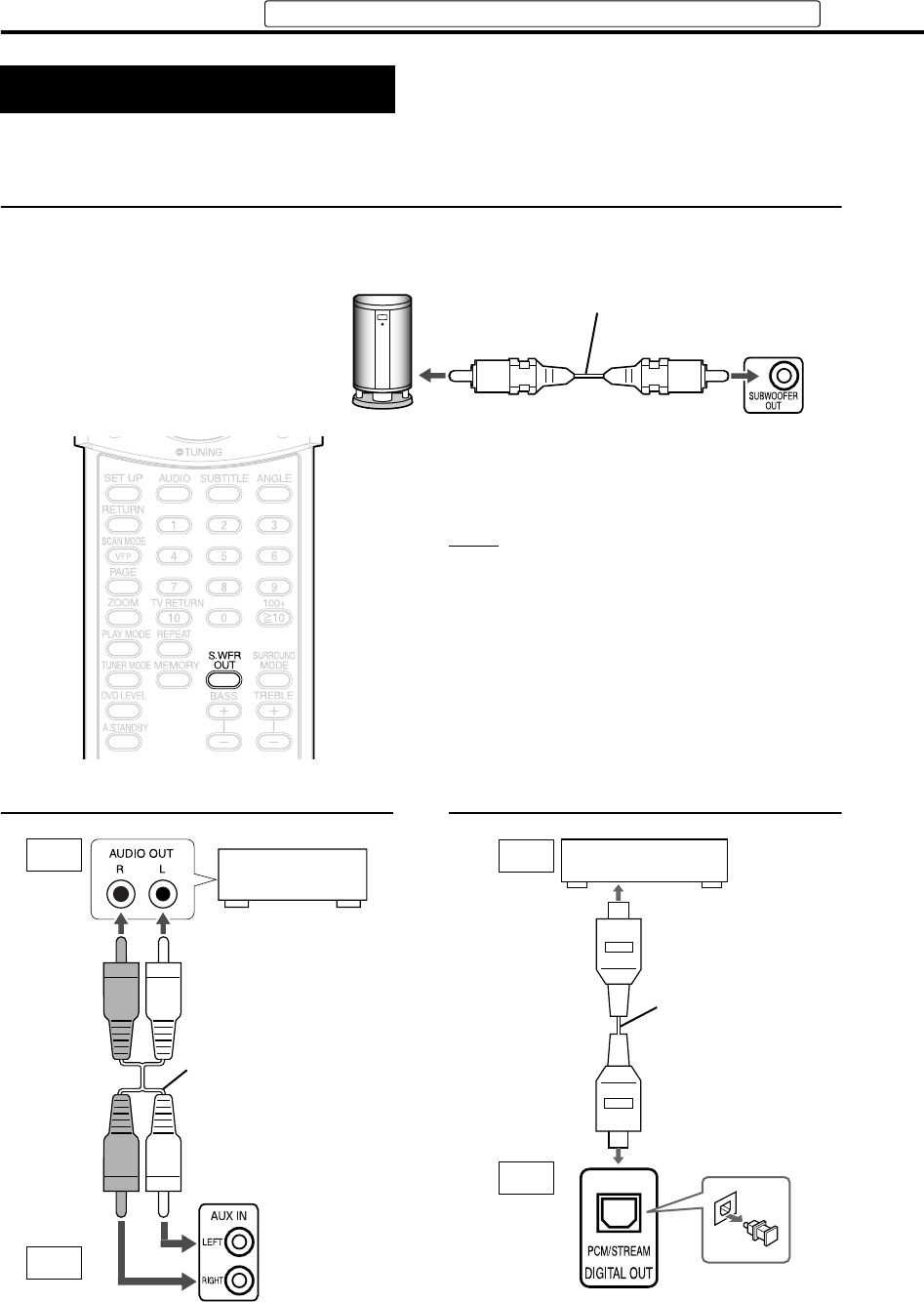
11
This page is for when connecting the main unit with
other devices.
Connecting subwoofer
Connecting with other audio device
When you want to hear sound from the subwoofer,
press
S.WFR OUT
on the remote control to display
“SUB WFR ON” (Sub Woofer ON) on the display
window on the main unit. Each time you press the
button, the display toggles between “ON” and “OFF”.
NOTE
When "SUB WFR ON" is selected, bass sound from
the left and right speakers will be automatically
lowered and the bass sound will be emitted mainly
from the subwoofer.
Connecting with a digital device
Connecting other devices
With an amplifier-built in subwoofer (sold separately), you can enjoy a more dynamic bass sound.
Refer to the manual of the subwoofer for details.
Audio cord (sold separately)
(If an audio cord comes with the amplifier-built-in subwoofer,
you can use the cord.)
Amplifier-built-in subwoofer
(sold separately)
Main unit
Main unit
Output
Input
Other audio
device
Audio cord (sold
separately)
Output
Optical digital cord
(sold separately)
Digital device
(MD recorder etc.)
To digital input terminal
Input
Main unit
Connecting up (continued) Do not connect the power cord until all other connections have been made.
EX-AK1[US_UB_UA]-02.fm Page 11 Thursday, August 23, 2007 9:09 AM
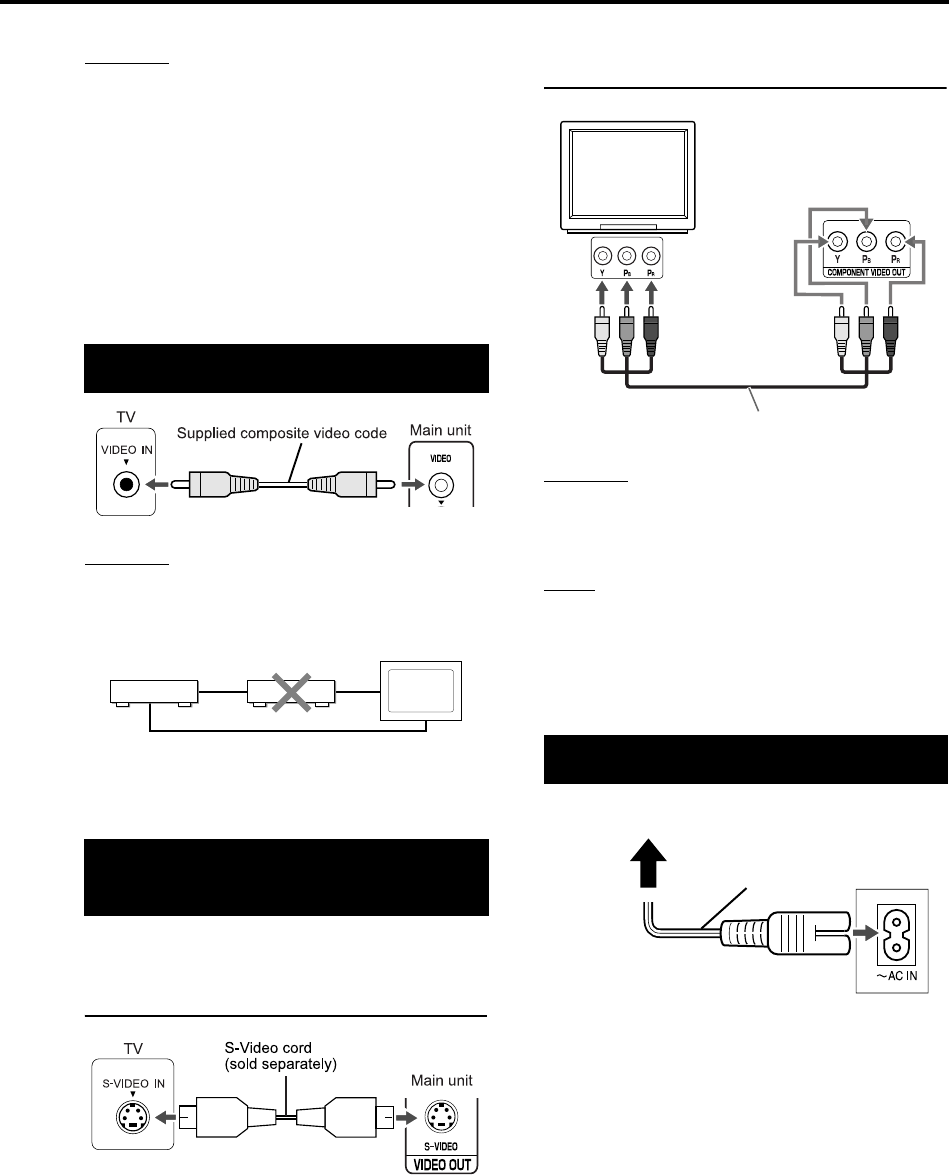
12
CAUTION
• For details of signals to be output, refer to page
36.
• If the main unit is connected to equipment with
a Dolby Digital decoder, the “D. RANGE
COMPRESSION” setting of “AUDIO”
(Apage 36) is disabled for sound from the
digital audio output of the main unit.
• You can output the audio signal from the
DIGITAL OUT terminal when a loaded disc is
selected as the source.
• Pressing SURROUND MODE while the audio
signal is being output from the DIGITAL OUT
terminal may cause intermittent sound output.
CAUTION
Connect the main unit directly with a TV (or a
monitor) without routing through a VCR.
Otherwise it may cause picture distortion while
playing.
Also, when connecting the main unit to a TV with
a VCR built in, there may be picture distortion
while playing.
You can enjoy pictures of better quality using the
following cord instead of the supplied video cord.
Connecting by using the S-Video cord
Connecting a TV with the COMPONENT
VIDEO OUT terminals
CAUTION
Use one of either the S-Video cord or the
component video cord. If both cords are used,
pictures may not be played properly.
NOTE
• In order to enjoy pictures with Progressive mode
(
A
page 13), the TV is required to have Progressive
video input.
• If the component video input jacks of your TV are
BNC type, use a plug adapter (not supplied) to
convert the plugs.
• Connect the power cord after all other
connections are complete.
• The STANDBY lamp (on the front panel) will be
lit.
Connecting with TV
When a clearer picture is
desired
Main unit
Connecting directly
TV (or
monitor)
Connecting the power cord
Component video cable (not supplied)
TV
Main Unit
(rear view)
To component
terminals
AC outlet
Supplied power cord Main unit
Getting started
EX-AK1[US_UB_UA].book Page 12 Monday, August 6, 2007 11:32 AM
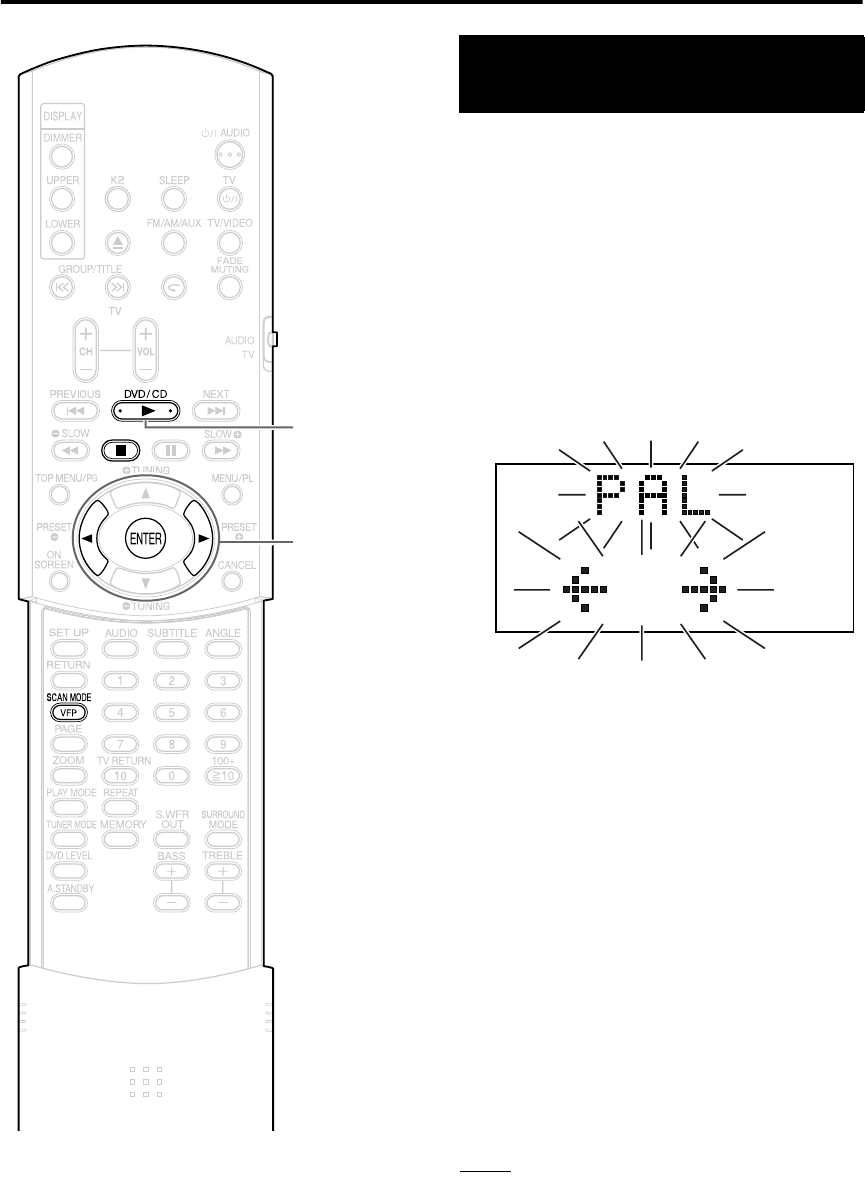
13
To view an image on the TV screen, select the
video signal type correctly according to the TV
after connecting the main unit to the TV.
1Turn on the main unit.
• Refer to “Connecting the power cord.” on
page 12 and “Playback” on page 14.
2Press DVD/CD 3.
• When a disc is loaded, press 7 to stop
playback.
3Hold down SCAN MODE.
• The current video signal type flashes.
4Press 2 or 3 to select the video
signal type suitable for the TV.
• You can select “PAL”, “PAL PRO”, “NTSC” or
“NTSC PRO”. You can obtain better picture
quality in “PAL PRO” or “NTSC PRO” mode
than in “PAL” or “NTSC” mode.
• Select “PAL” when connecting to a TV that is only
compatible with PAL interlaced video signals.
• Select “PAL PRO” when connecting to a TV that
is equipped with a component terminal and is
compatible with PAL progressive video signals.
• Select “NTSC” when connecting to a TV
that is only compatible with NTSC
interlaced video signals.
• Select “NTSC PRO” when connecting to a
TV that is equipped with a component
terminal and is compatible with NTSC
progressive video signals.
5Press ENTER.
NOTE
• To check the compatibility of your TV, contact your
local JVC customer service center.
• All JVC-manufactured progressive TVs and high-
definition TVs are fully compatible with this system.
• Even if the power cable of the main unit is
disconnected from the AC outlet or the power is
interrupted, the video signal type setting is stored.
2/3
/ENTER
DVD/CD 3
Selecting the video
signal type
Connecting up (continued)
EX-AK1[US_UB_UA]-02.fm Page 13 Thursday, August 23, 2007 9:03 AM
14
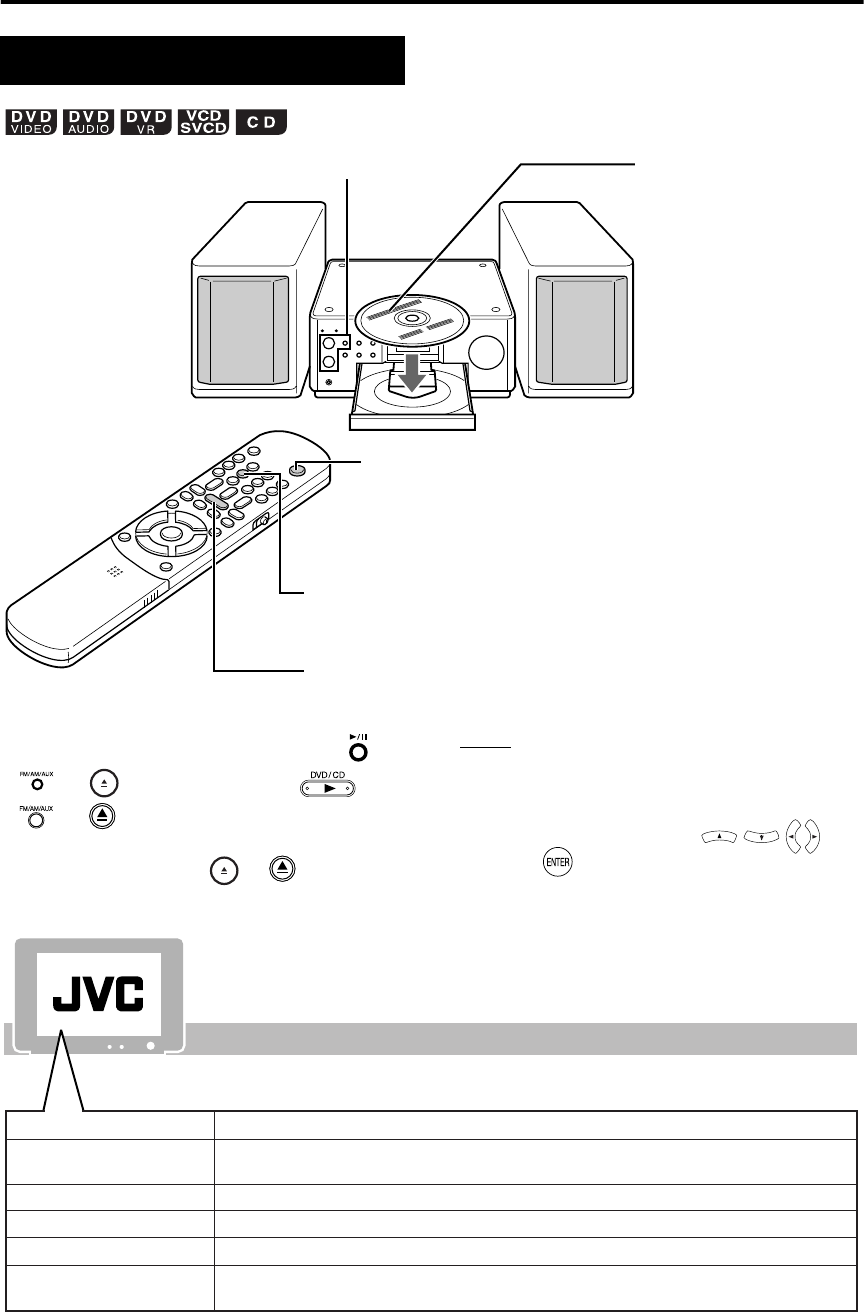
(Refer to page 20 for playing MP3/WMA/WAV/JPEG/MPEG1/MPEG2 file.)
• The power will be turned on when any of ,
, or on the main unit and ,
, or on the remote control is pressed
while the power is off.
If any button other than or is pressed,
the source will also be changed (if there is a disc
loaded, playback will start).
NOTE
• A menu screen may be displayed after starting
playback of a DVD. In this case, select a desired
item to playback by using the following buttons on
the remote control.
• Select a desired item using and
press .
• Select a desired item using the number buttons.
• Depending on the disc/file, actual operation may be
different from the description.
Playback
1
3
2
A page 5 Place a disc with the label side
facing up.
•Place an 8 cm disc in to the
hollow part in the center.
Press FAUDIO.
• The power will be turned on and the STANDBY
lamp will go off.
• Press FAUDIO again to turn off the power.
Press 0 to open the disc tray to load a
disc.
Press DVD/CD 3.
The disc tray will close and playback will start.
Screens displayed on the TV when the power is turned ON.
The following messages appear depending on the status of the system.
(These messages only appear when a loaded disc is selected as the source.)
Appears when the system is reading the disc/file information. Wait for a while.
Appears when the Region Code of the DVD does not match the code the
system supports. (Apage 3)
Appears when no disc is loaded.
Appears when opening the disc tray.
Appears when closing the disc tray.
Appears when trying to play back an unplayable disc.
NOW READING
REGION CODE
ERROR!
NO DISC
OPEN
CLOSE
CANNOT PLAY THIS
DISC
Playing discs/files Basic operations
EX-AK1[US_UB_UA].book Page 14 Monday, August 6, 2007 11:32 AM
15
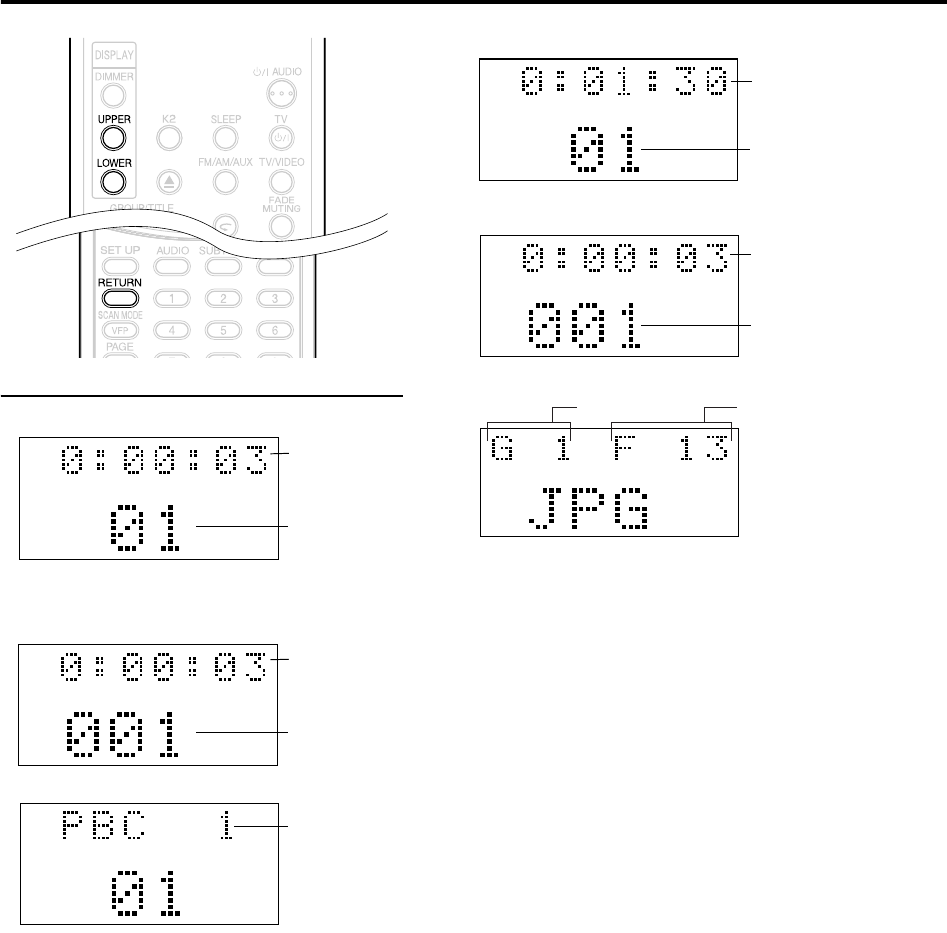
Display window during disc/file playback
Example:
When a DVD VIDEO or DVD AUDIO is played
If “BONUS” or “B.S.P.” is displayed during a DVD
AUDIO playback, refer to page 32.
Example:
When a DVD VR is played
Example:
When a SVCD or VCD is played
• PBC (Play Back Control): A signal recorded in a
VCD (version 2.0) for controlling playback. It is
possible to enjoy interactive software or software
with a search function using a menu screen
recorded in a PBC compatible VCD. To play a
disc with the PBC function OFF, carry out the
following operations.
• Designate the track number using the number
buttons while the disc is stopped.
• Designate the track number using 4 or ¢
while the disc is stopped, and then press
DVD/CD 3.
• Press RETURN to go back to the upper layer
during the PBC playback of a VCD or SVCD.
Example: When a CD is played
Example: When an MP3/WMA/WAV/MPEG1/
MPEG2 file is played
Example: When a JPEG file is played
Elapsed
playing time
Chapter/Track
number
Elapsed
playing time
Chapter
number
Track number
Elapsed
playing time
Track number
Elapsed
playing time
Track number
File number
Group number
Playing discs/files (continued)
EX-AK1[US_UB_UA].book Page 15 Monday, August 6, 2007 11:32 AM
16
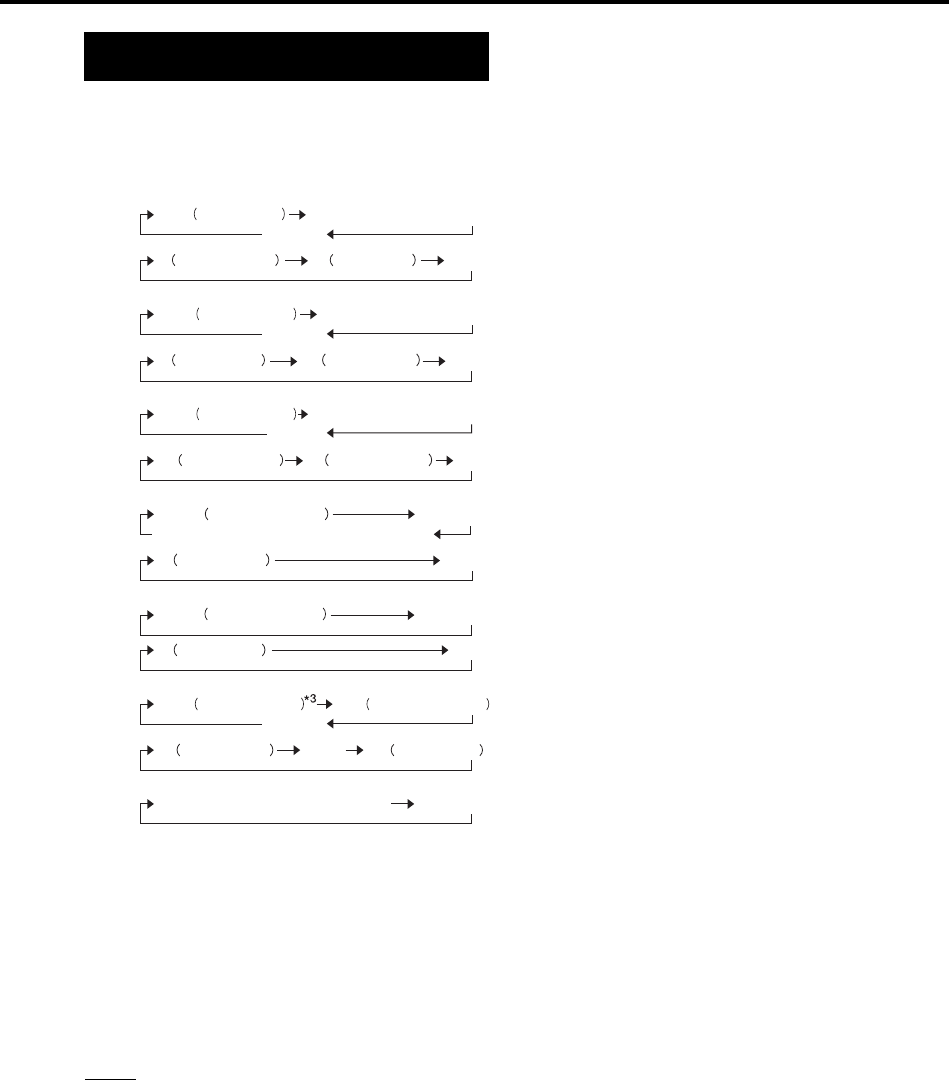
Press UPPER or LOWER. Each time you press
the button, the display will be alternated.
*1 When a DVD VR is played, “PG” and “G”
(Original program) or “PL” and “L” (Play list) are
displayed.
*2 “MP3”, “WMA”, “WAV”, or “MPG” appears when
an MP3, WMA, WAV, MPEG1, or MPEG2 is
played.
*3 The file name and text are displayed temporarily
before the elapsed playing time is displayed.
NOTE
Abbreviations
G: Group
Original Program (DVD VR)
T: Title (DVD VIDEO)
Track
C: Chapter
F: File
PG: Original Program
PL, L: Play list
To switch the display
Display examples
DVD VIDEO
UPPER:
0:00:03
Elapsed playing time
T1 C3 (Title and Chapter number)
No display
LOWER:
03 Chapter number
T1 Title number
DVD
DVD AUDIO
UPPER:
0:00:03
Elapsed playing time
G1 T3 (Group and Track number)
No display
LOWER:
03
Track number G1 Group number
DVD
DVD VR*
UPPER:
0:00:03
Elapsed playing time
PG1
C3
(Program
and
Chapter
number)
No display
LOWER:
001
Chapter number G1 Program number
VR
VCD/SVCD
UPPER:
0:00:03
Elapsed playing time
No display
PBC 2
LOWER:
02 Track number VCD
CD
UPPER:
0:00:03
Elapsed playing time
No display
LOWER:
02 Track number CD
MP3/WMA/WAV/MPEG1/MPEG2 file
UPPER:
0:00:03 Elapsed playing time
G1 T3 Group and Track number
No display
LOWER:
G1 Group number MP3
*
003 Track number
JPEG disc
UPPER:
G1 F3 (Group number and File number)
No display
LOWER:
JPG
(PBC and Track number appear only
when PBC function is played)
1
2
Basic operations
EX-AK1[US_UB_UA].book Page 16 Monday, August 6, 2007 11:32 AM
17
NOTE
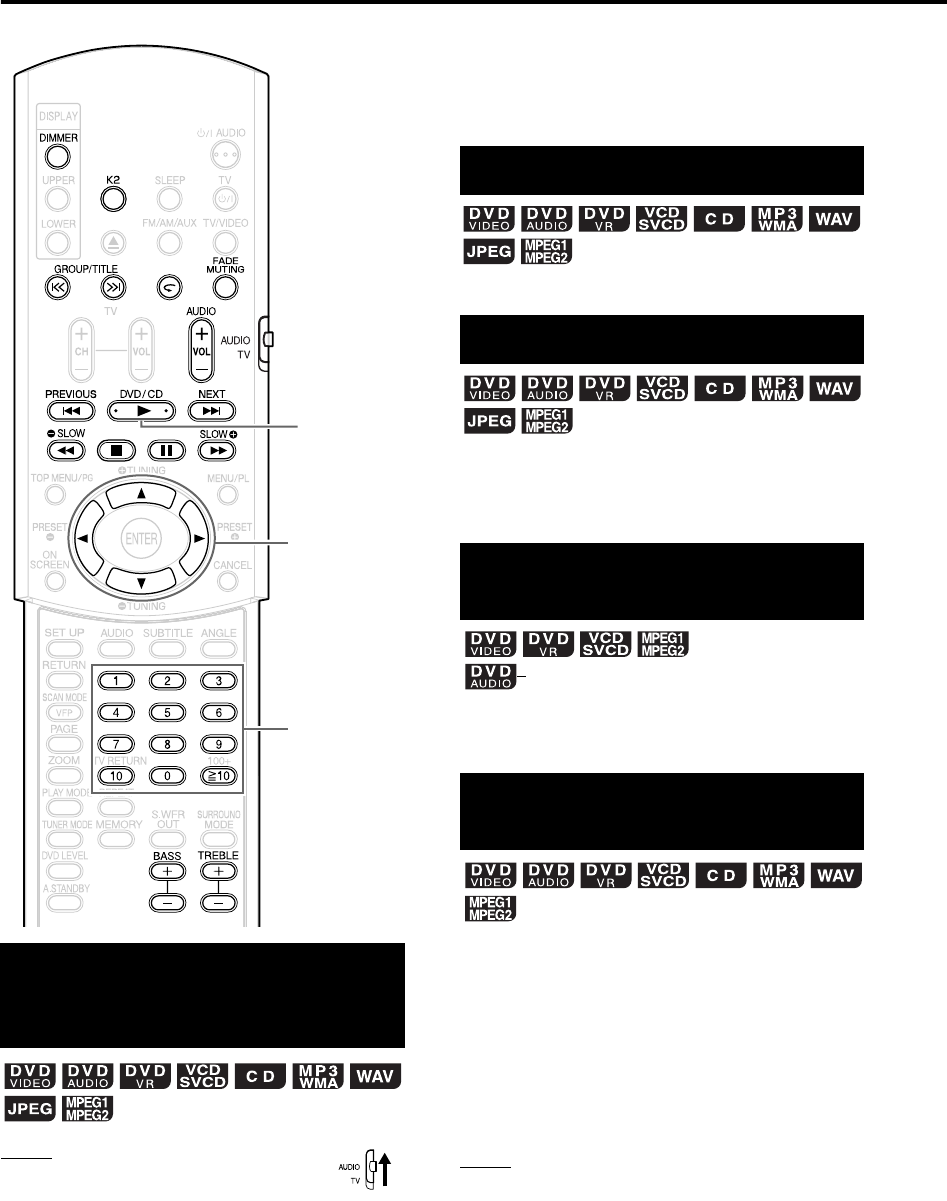
• Set the remote control mode selector to
AUDIO before using the number buttons.
• For a VCD or SVCD, this operation can be carried
out when the disc is stopped, or during playback
without the PBC function.
• For a DVD AUDIO, CD, MP3 or JPEG, this operation
can also be carried out when the disc/file is stopped.
• This operation may not be carried out for some discs.
Designate the chapter number or
track number to play during
playback.
Refer to “How to use the number buttons” on page 18.
Press 7 during playback.
Press 8 during playback.
To resume normal playback, press DVD/CD 3.
• Press
8
to pause during JPEG file slide-show.
Press
DVD/CD
3
to start playback from the next file.
Press 8 during pause.
Each time you press the button, picture will be
advanced frame-by-frame.
There are two methods.
• Press 1 or ¡ during
playback.
Each time you press the button, the speed
increases. To restore the normal speed, press
DVD/CD 3.
• Hold down 4 or ¢.
Fast reverse/Fast forward search can be carried
out only while the button is pressed.
NOTE
• For some discs/files, sound is intermittent or no
sound is produced during fast reverse/fast forward
search.
• The selectable speeds and displays vary by the
disc/file type.
Select what you want to
play by using the number
buttons
Number
buttons
5///2/3
DVD/CD 3
To stop playback
To pause playback
To advance picture
frame-by-frame
Fast reverse/Fast forward
search
(only for moving images)
Playing discs/files (continued)
EX-AK1[US_UB_UA].book Page 17 Monday, August 6, 2007 11:32 AM
18
Press during playback.
NOTE
• You cannot go back to the previous title and original
program (play list).
Press SLOW or SLOW during
pause.
• Each time you press the button, the speed
increases.
• Press 8 to pause playback, and press
DVD/CD
3
to resume normal playback.
NOTE
• No sound will be produced.
• The picture motion in the reverse direction may not
be smooth.
• For a VCD, SVCD or DVD VR, Slow Motion
Playback can be carried out in the forward direction
only.
Press PREVIOUS 4 or NEXT ¢
during playback.
• Press GROUP/TITLE / to select the title or
group.
NOTE
• You cannot skip to the previous track even by
pressing PREVIOUS 4 during random playback.
(Refer to page 26.)
You can skip within a file at approximately 5 minute
intervals. This is useful especially when you want
to skip within a long file.
Press 2 or 3 during playback.
• Each time you press 2 or 3, the playback
position skips to the beginning of the previous or
next interval. Each interval is approximately 5
minutes.
NOTE
• Intervals are automatically assigned from the
beginning of a file.
• You can use this function only within the same file.
Playing back from a position
10 seconds before
(One Touch Replay)
Slow Motion Playback
(only for moving images)
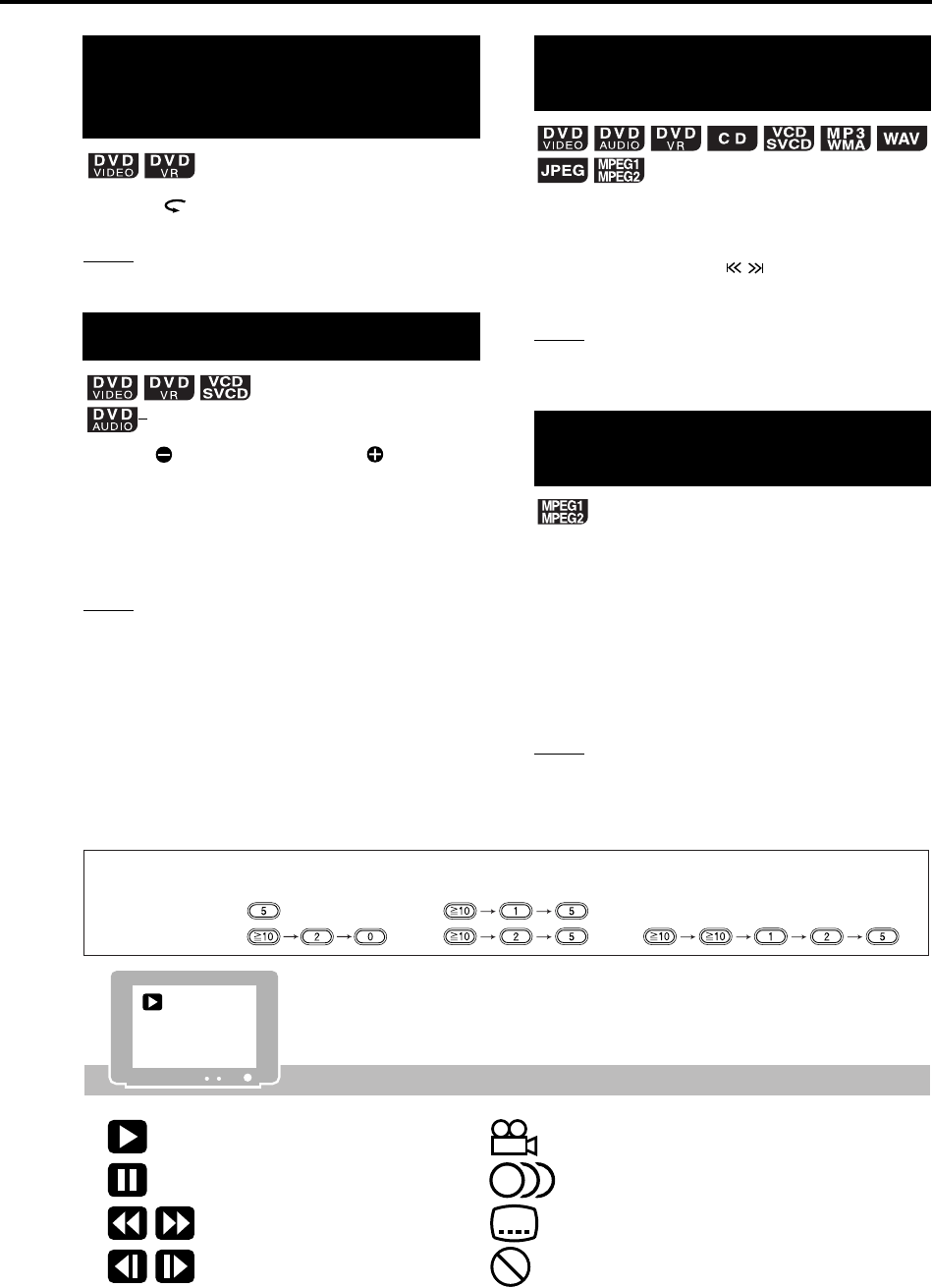
5:
20:
15:
25: 125:
: Containing multi-angle views
(Apage 29)
: Containing multi-audio languages
(Apage 29)
: Containing multi-subtitle languages
(Apage 29)
: The disc/file cannot accept the operation you
have attempted.
How to use the number buttons
Examples:
Guide icons displayed on the TV screen (On-screen guide)
: Play
: Pause
: Fast reverse/Fast forward search
: Slow Motion Playback (reverse/
forward directions)
Skip to the beginning of
the selection
Skipping at approximately
5 minute intervals
Basic operations
EX-AK1[US_UB_UA].book Page 18 Monday, August 6, 2007 11:32 AM
19
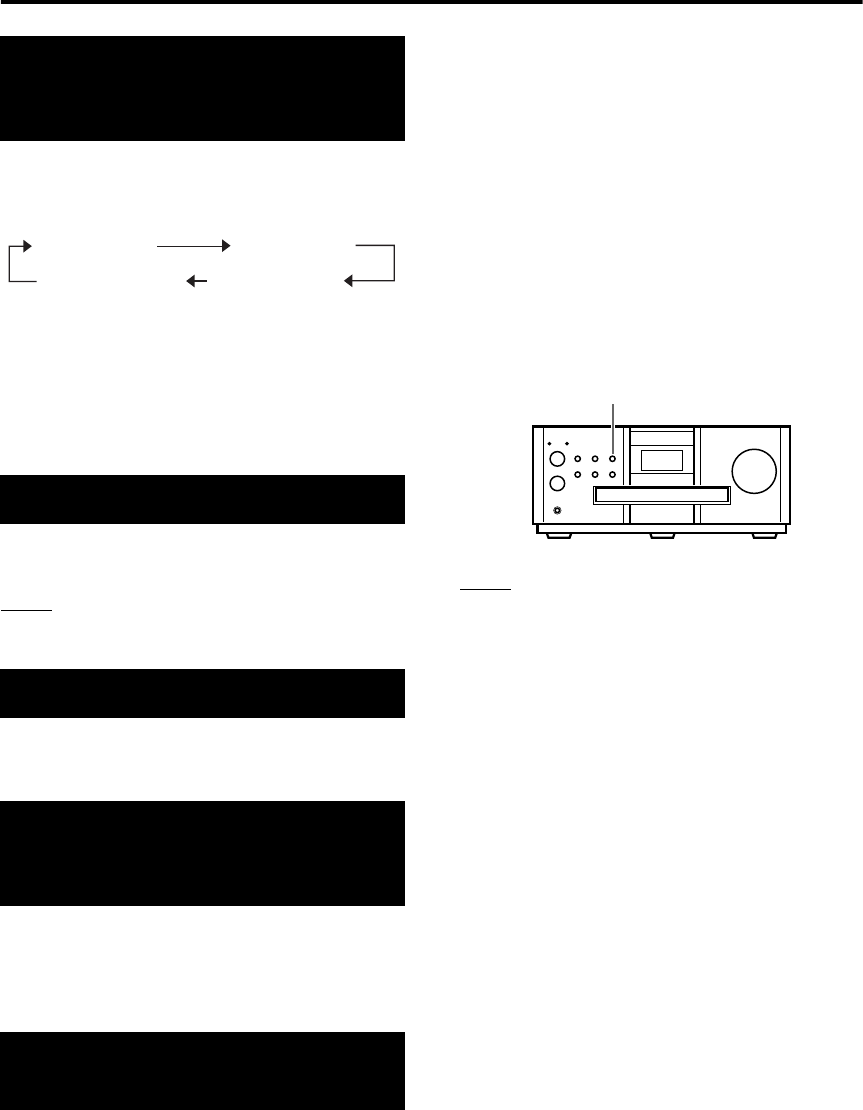
Press DIMMER repeatedly.
• Each time you press DIMMER, the setting in the
display window changes as follows.
*1 The display window becomes darker than the
normal display brightness.
*2 The display window becomes darker than
“DIMMER 1”.
*3 When a video disc/file is played back, the dis-
play window becomes darker automatically.
*4 The normal display brightness is restored.
Press AUDIO VOL +/–.
NOTE
The volume can be adjusted by turning the VOLUME
control on the main unit.
Bass: Press BASS +/–.
Treble: Press TREBLE +/–.
Press FADE MUTING.
•Press
FADE MUTING
again or
AUDIO VOL +
to
restore the sound. The sound is also restored when
the main unit is turned off once and turned on.
The K2 function is designed to provide natural
sound by improving the playback sound from low-
bit-rate digital sources.
The function compensates for sound waves dissi-
pated during digital recording compression to
approximate the original analog sound. Sound is
reproduced with more bits (24 bit) and a wider
range of frequency (128 kHz, 176.4 kHz or
192 kHz).
Press K2 on the remote control or
on the main unit.
• When the K2 function is activated, the K2 lamp
on the main unit lights up.
• Each time you press K2, the display changes as
follows.
- “K2 Mode 1”:
Plays back a digital source with non-
compressed sound signals (linear PCM).
- “K2 Mode 2”:
Plays back a digital source with compressed
sound signals (Dolby digital, DTS, MP3 or
WMA).
-“K2 OFF”:
Cancels the K2 function.
NOTE
• The initial setting is “K2 Mode 1”.
•If K2 is pressed when the headphone surround
mode function or SURROUND MODE is activated,
these functions are turned off and the K2 function is
activated.
•If K2 is pressed when an AM/FM broadcast, an
analog audio device connected to the AUX IN
terminal or TV SOUND is selected as the source,
“NO OPE K2” is displayed in the display window,
and the K2 function is not activated. The K2 function
is activated when a loaded disc is selected as the
source.
• The original range of frequency is automatically
detected and extended to a specific range. When
the original range is 32 kHz, 44.1 kHz or 48 kHz, the
range is extended to 128 kHz, 176.4 kHz or
192 kHz respectively.
• This function is available when “PCM ONLY” is
selected for “DIGITAL AUDIO OUTPUT” (refer to
page 36). “NO OPE K2” appears in the display
window and the K2 function cannot be used when
“DOLBY DIGITAL/PCM” or “STREAM/PCM” is
selected.
To change the
brightness of the display
window (DIMMER)
Adjusting the volume
Adjusting sound quality
Turning off the sound
temporarily (FADE
MUTING)
Enhancing the playback
sound (K2)
“DIMMER 1” *
1
“DIMMER 2” *
2
“DIMMER AT” *
3
“DIMMER OFF” *
4
K2
Playing discs/files (continued)
EX-AK1[US_UB_UA].book Page 19 Monday, August 6, 2007 11:32 AM
20
NOTE
Set the remote control mode selector to
AUDIO before using the number buttons.
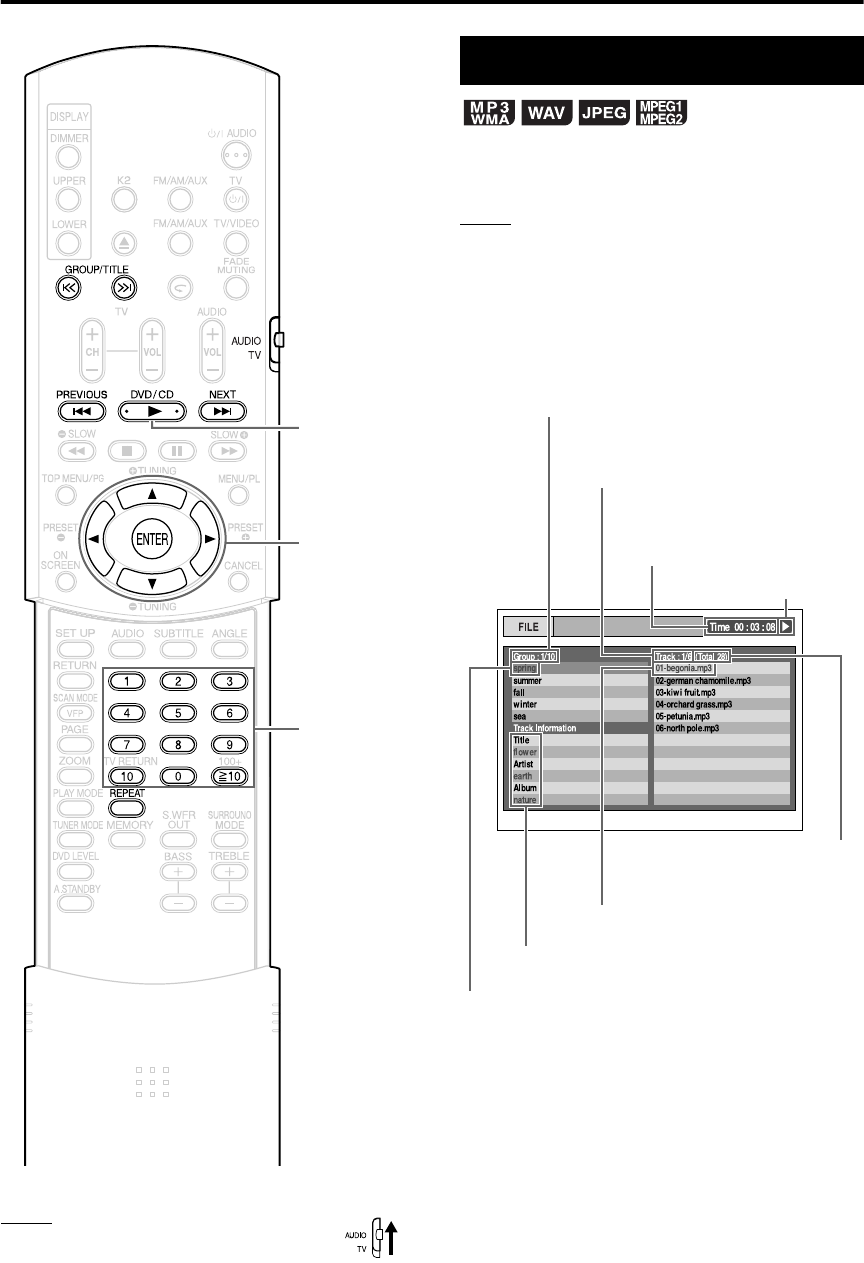
Display of an MP3 file is described here as an
example.
NOTE
When files of different types (audio/still picture/video)
are recorded on a loaded disc, select the file type
before playback.
(Refer to “FILE TYPE” on page 36.)
1Load a disc.
2Press 5 or / to select a group.
3Press 3 to move to the track
list.
• Press 2 to go back to the group list.
4Press 5 or / to select a track.
Number
buttons
5///2/3
/ENTER
DVD/CD 3
Playback
Numbers of the current track (file) and
total tracks (files) included in the current
group
Elapsed playback time of the
current track (MP3/WMA/WAV
file only)
Playback status
Tag information (MP3/WMA file only)
Current track (file)
Number of the total tracks (files)
recorded on the loaded disc
Numbers of the current group and total groups
recorded on the loaded disc
Current group
(Continued on the next page)
Playing MP3/WMA/WAV/JPEG/MPEG1/MPEG2 file
Advanced operations
EX-AK1[US_UB_UA]-04.fm Page 20 Thursday, August 23, 2007 9:03 AM
21
5Press DVD/CD 3 or ENTER.
NOTE
•GROUP/TITLE can also be used in Step 2.
• The number buttons can also be used in Step 4. In
this case, Steps 3 and 5 are not needed. (For how
to use the number buttons, refer to page 18).
•PREVIOUS 4 or NEXT ¢ can also be used in
Step 4. In this case, Step 3 is not needed.
Slide-show playback
• JPEG files are continuously played back
beginning with the selected file.
• Display time for a file in slide-show playback is
approximately 3 seconds.
• Press ENTER to view only the selected file.
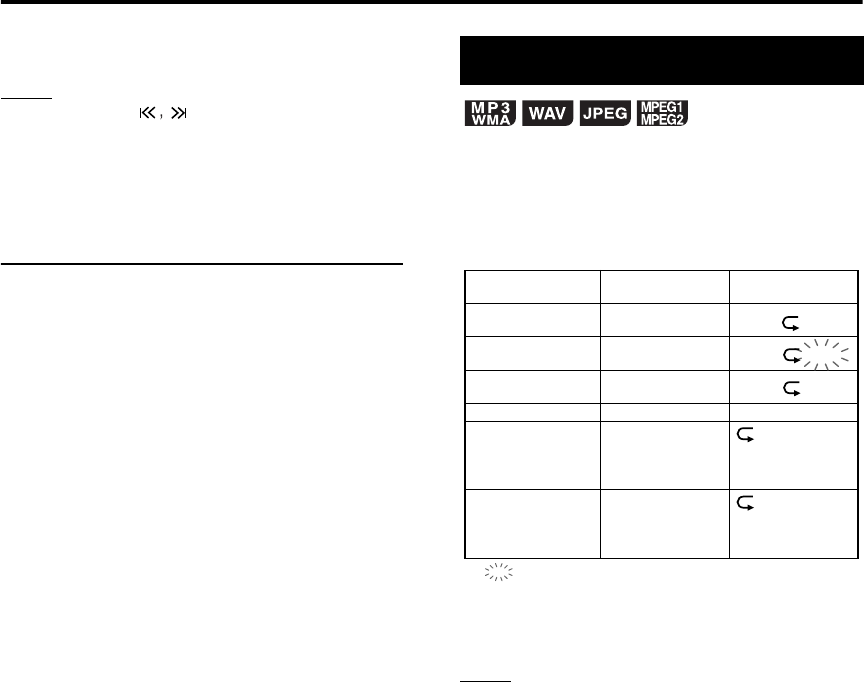
1Press REPEAT while the disc/
file is stopped.
Each time you press the button, the Repeat
type will be alternated.
2Press DVD/CD 3.
NOTE
• The Repeat types can be changed during playback.
• The Repeat mode will be automatically cancelled if
there is a file that cannot be played (
A
page 3).
Repeat playback
REPEAT TRACK
REPEAT GROUP
REPEAT ALL
No display
REPEAT STEP
REPEAT ALL
ALL
ALL
ALL
*
*
Repeats the current
track (except JPEG).
Repeats the current
group.
Repeats the entire
disc.
Cancels repeat.
Repeats the current track
during Program or
Random Playback (except
JPEG and MPEG1/2).
Repeats all programmed
tracks or the all tracks for
Random play (except
JPEG and MPEG1/2).
Repeat types
Display on the TV screen
Indicator on the display
window on the main unit
No display
represents blinking.
PRGM or
RANDOM
PRGM or
RANDOM
REPEAT TRACK
REPEAT GROUP
REPEAT ALL
No display
REPEAT STEP
REPEAT ALL
ALL
ALL
ALL
*
*
Repeats the current
track (except JPEG).
Repeats the current
group.
Repeats the entire
disc.
Cancels repeat.
Repeats the current track
during Program or
Random Playback (except
JPEG and MPEG1/2).
Repeats all programmed
tracks or the all tracks for
Random play (except
JPEG and MPEG1/2).
Repeat types
Display on the TV screen
Indicator on the display
window on the main unit
No display
represents blinking.
PRGM or
RANDOM
PRGM or
RANDOM
Playing MP3/WMA/WAV/JPEG/MPEG1/MPEG2 file
(continued)
EX-AK1[US_UB_UA].book Page 21 Monday, August 6, 2007 11:32 AM
22
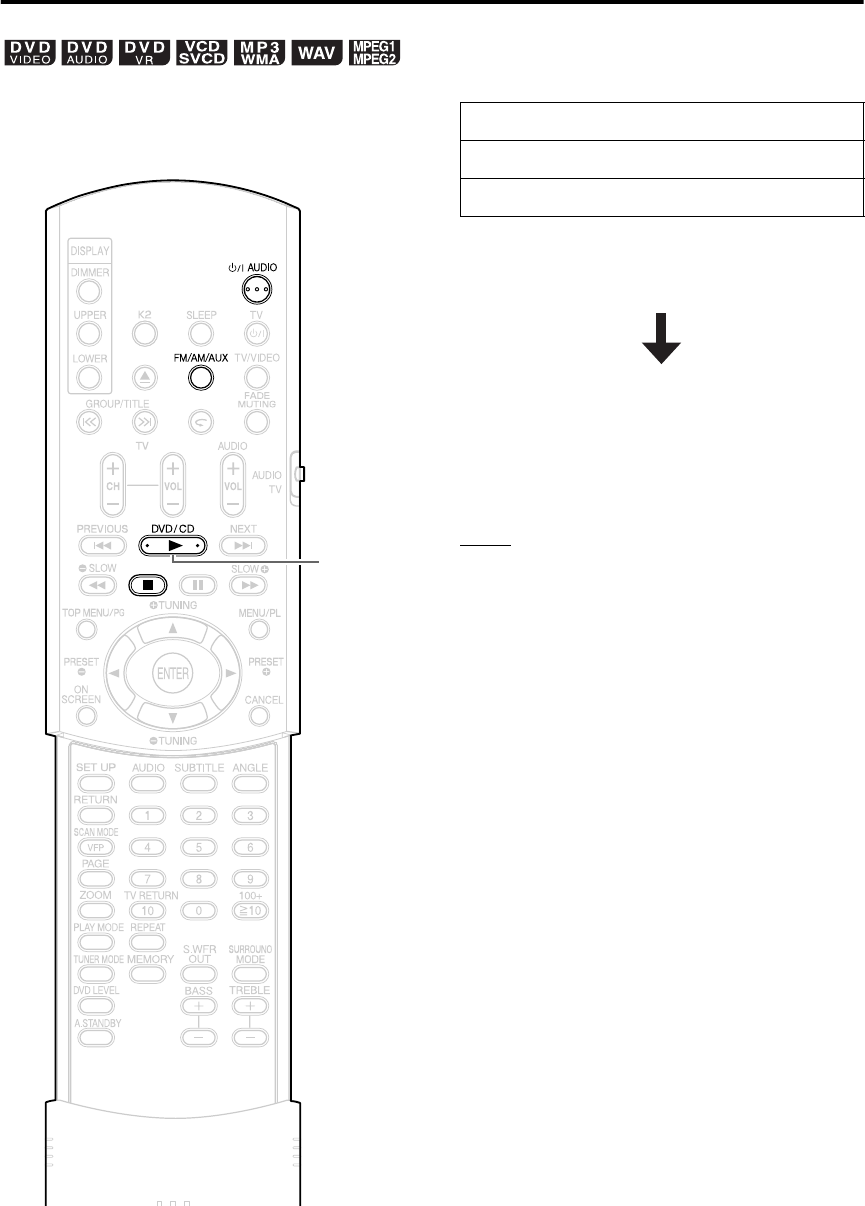
When playback is stopped in the middle, playback
can be started from the stopped scene.
This is called Resume function.
How to suspend playback
Perform any of the following operations during
playback.
* Even if the power is turned off by pressing
FAUDIO after this, the position where
playback has been stopped will be stored.
To start playback from the stored
position
NOTE
• This function does not work in Program Playback or
Random Playback.
• The position where playback starts again may be a
little different from the stopped position.
• When a disc menu is displayed, the Resume
function may not work.
• The audio language, the subtitle language and the
angle at that time are stored as well as the stopped
position.
• The stored position will be cleared if the disc tray is
opened. Further, if 7 is pressed during playback,
“RESUME” will be displayed. If 7 is pressed at this
time, “RESUME OFF” will be displayed and the
stored information will be cleared.
• At the time of purchase, Resume is set to ON.
Resume can be set to OFF (
A
page 36).
Press 7 once.*
Press FAUDIO to turn off the power.
Change the source to FM, AM or AUX.*
Press DVD/CD 3.
Resume Playback
DVD/CD 3
Advanced operations
EX-AK1[US_UB_UA]-04.fm Page 22 Monday, August 6, 2007 11:43 AM
23
NOTE
Set the remote control mode selector to
AUDIO before using the number buttons.
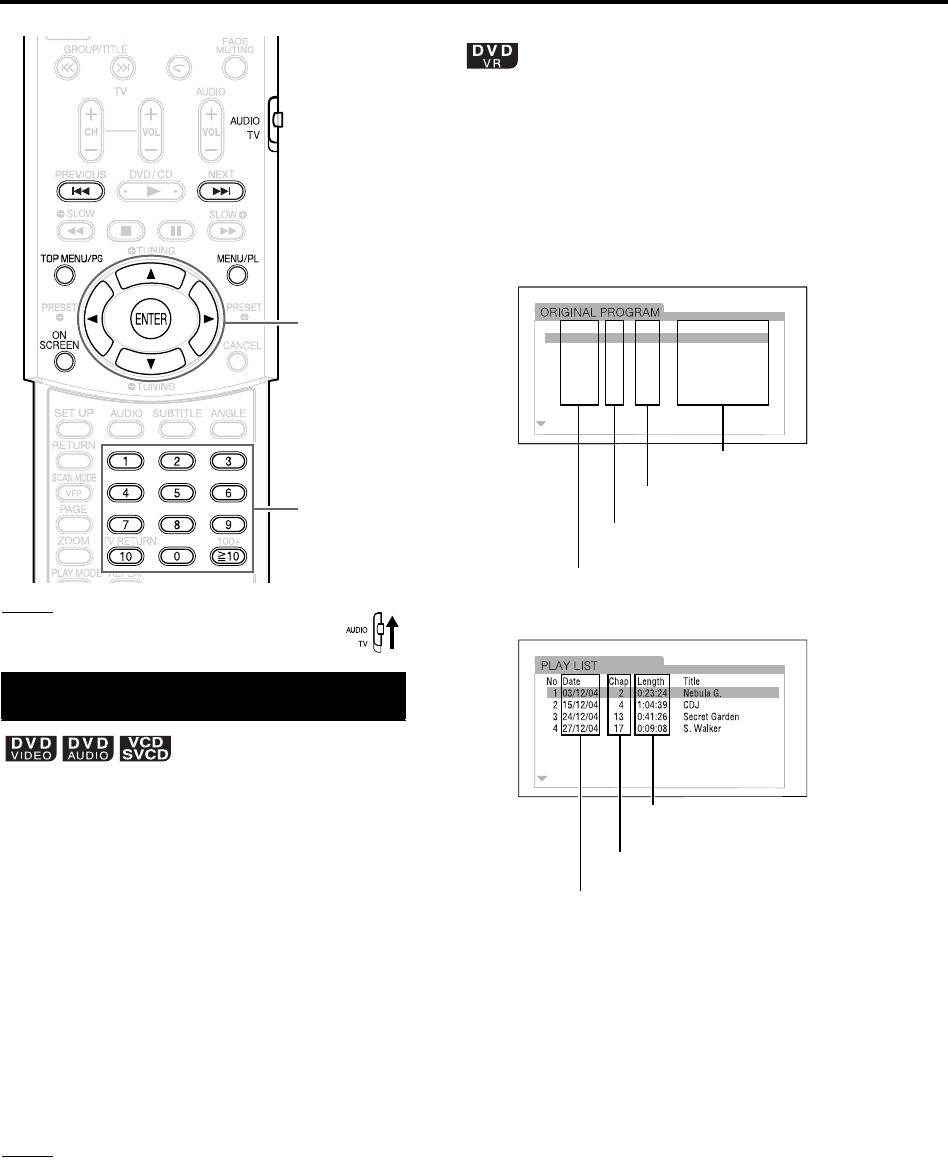
1Press MENU/PL or TOP MENU/
PG while the disc is stopped or
during playback*1.
• The disc menu screen will be displayed.
2Press 5, /, 2 or 3 (only for a
DVD VIDEO or DVD AUDIO) or
the number buttons to select
the scene to be played.
• Refer to “How to use the number buttons”
(Apage 18).
• When the menu screen has a couple of
pages, press 4or ¢ to change the
page (only for a VCD and SVCD).
3Press ENTER.
NOTE
*1For a VCD and SVCD, this operation can be carried
out only when the PBC function is off.
• This operation cannot be carried out for a disc
without a menu screen.
• Playback may start for some discs without pressing
ENTER.
1Press TOP MENU/PG to display
the original program or press
MENU/PL to display the play list
while the disc is stopped or
during playback.
Original program
Play list
• The play list does not appear when a play
list has not been recorded to the disc.
2Press 5 or / to select the
desired title.
3Press ENTER.
• When you have selected the original
program by pressing TOP MENU/PG in
step 1, playback starts from the selected
title to the following titles.
• When you have selected the play list by
pressing MENU/PL in step 1, only the
selected title is played back.
Select from the menu
Number
buttons
5///2/3
/ENTER No Date Ch Time Title
1 03/12/04 12:15L 1
L 1
L 1
L 1
L 1
L 1
2 09/12/04 23:05
3 18/12/04 08:17
4 20/12/04 07:47
5 25/12/04 19:38 Mr. Lawrence
Satisfy U
La fleur
The last struggle
free flyer
BOOM!
6 28/12/04 14:20
Recording date
Channel information
Starting time for the title
recording
Title name
Recording date
Number of chapters
included in the title
Total playback time for the
title
Select the scene to be played
EX-AK1[US_UB_UA]-04.fm Page 23 Tuesday, August 28, 2007 2:53 PM
24
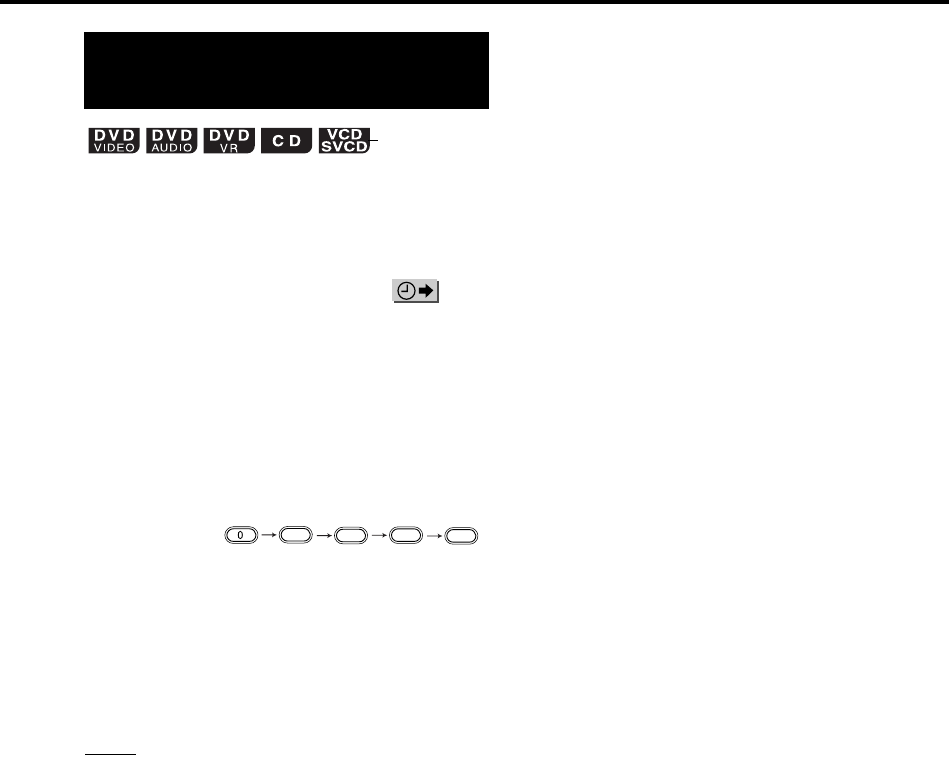
1Press ON SCREEN twice during
playback*1.
The menu bar will be displayed (Apage 33).
2Press 2 or 3 to select .
3Press ENTER.
4Input the time*2 using the
number buttons (1-9, 0).
Example: When you want to play a DVD
VIDEO from the position of (0
hour) 23 minutes 45 seconds,
press the buttons in the order:
“minutes” and “seconds” can be
omitted.
• If you input wrong numbers, press 2 to
delete the numbers and re-input.
5Press ENTER.
To delete the menu bar, press ON SCREEN.
NOTE
• This function does not work during program
playback or random playback.
• Time search for a DVD VIDEO is from the beginning
of the title.
• Time search for a DVD AUDIO is from the beginning
of the track being played back.
*1For a CD, you can use this function any time.
*2Time search for a VCD, an SVCD and a CD is as
follows:
- When the disc is stopped, time search is from the
beginning of the disc.
- When the disc is played back, time search is
within the track currently being played back.
Designate the time
(Time search)
(PBC off)
2345
.
Advanced operations
EX-AK1[US_UB_UA].book Page 24 Monday, August 6, 2007 11:32 AM
25
NOTE
Set the remote control mode selector to
AUDIO before using the number buttons.
It is possible to program a maximum of 99 tracks or
chapters. The same track or chapter can be
programmed more than once.
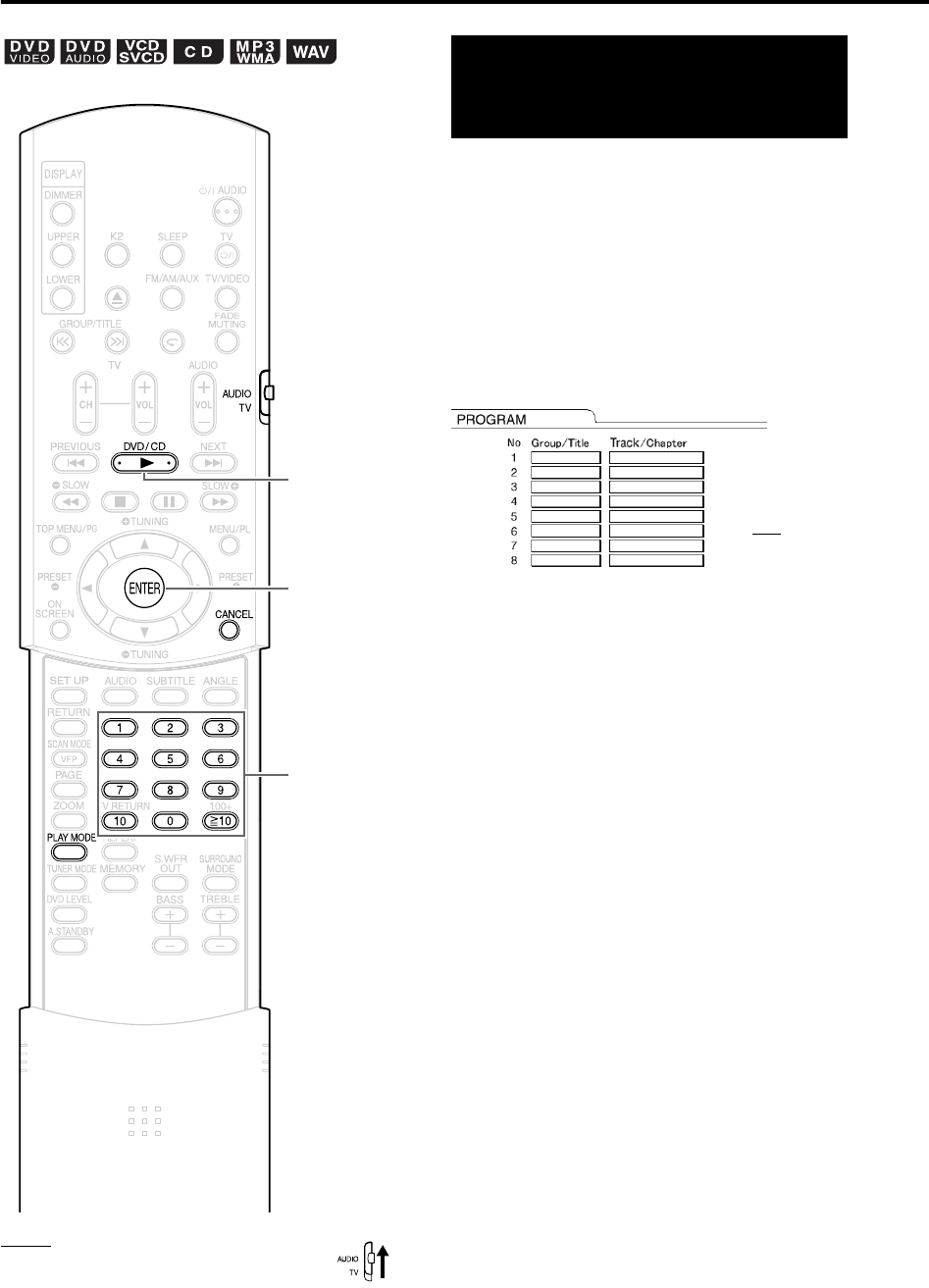
1While the disc/file is stopped,
press PLAY MODE repeatedly to
display “PROGRAM” on the
display window on the main
unit.
Example: For DVD VIDEO
2Create a program following the
description on the TV screen.
Refer to “How to use the number buttons”
(Apage 18).
• The input content varies depending on the
disc/file type.
• DVD VIDEO: Titles and chapters
• VCD, SVCD, CD: Tracks
• DVD AUDIO, MP3/WMA/WAV:
Groups and tracks
• To select a DVD AUDIO bonus group, carry
out the operations of “Playing the Bonus
Group” on page 32 in advance to erase the
display “BONUS”.
• If the number of tracks or chapters input is
greater than 99, “FULL” will be displayed.
• In the case of a CD, SVCD or VCD, when
the total playback time reaches 9 hours 59
minutes 59 seconds, “-:--:--” will be
displayed on the display window (It is
possible to continue programming).
Number
buttons
ENTER
DVD/CD 3
Play the disc/file in
the desired order
(Program Playback)
TV screen
Program
screen
Program Playback/Random Playback
EX-AK1[US_UB_UA].book Page 25 Monday, August 6, 2007 11:32 AM

26
To program on the display window on the main
unit, operate as follows.
(1) Select a group/title using the number
buttons.
Display example of the upper display
window: T2 C--
(2) Designate a track/chapter number using the
number buttons.
Display example of the upper display
window: T2 C3
• Refer to “How to use the number buttons”
(Apage 18).
• The program number will be displayed on
the lower display window (Example: “P2”).
(3) Repeat the above operations (1) and (2) to
complete the program. Then, advance to
Step 3.
NOTE
(Only for a DVD VIDEO, a DVD AUDIO or an MP3/
WMA/WAV)
If you press ENTER instead of designating a track/
chapter number, “ALL” is displayed and all of the
tracks/chapters included in the selected group/title are
programmed.
3Press DVD/CD 3.
• To resume normal playback, press PLAY
MODE repeatedly to display “NORMAL” on
the display window on the main unit while
the disc/file is stopped. The program
content will not be erased.
• The following operations erase the program
content.
• Hold down CANCEL until “CLEAR!”
appears on the display window with the
program preference screen displayed (if
CANCEL is pressed and released
quickly, programs will be erased one by
one).
• Open the disc tray
• Turn off the power
1Press PLAY MODE repeatedly
to display “RANDOM” on the
display window on the main unit
while the disc/file is stopped.
• “RANDOM” will also be displayed on the TV
screen.
2Press DVD/CD 3.
• The same chapter or track will not be
played twice.
• To resume normal playback, press PLAY
MODE repeatedly to display “NORMAL” on
the display window on the main unit while
the disc/file is stopped.
• Random Playback will also be cancelled by
carrying out the following operations.
• Open the disc tray
• Turn off the power
• The previous track will not be returned to
even if PREVIOUS 4 is pressed
repeatedly during Random Playback (the
beginning of the current chapter or track will
be returned to).
Playing the disc/file
in a random order
(Random Playback)
Advanced operations
EX-AK1[US_UB_UA].book Page 26 Monday, August 6, 2007 11:32 AM
27
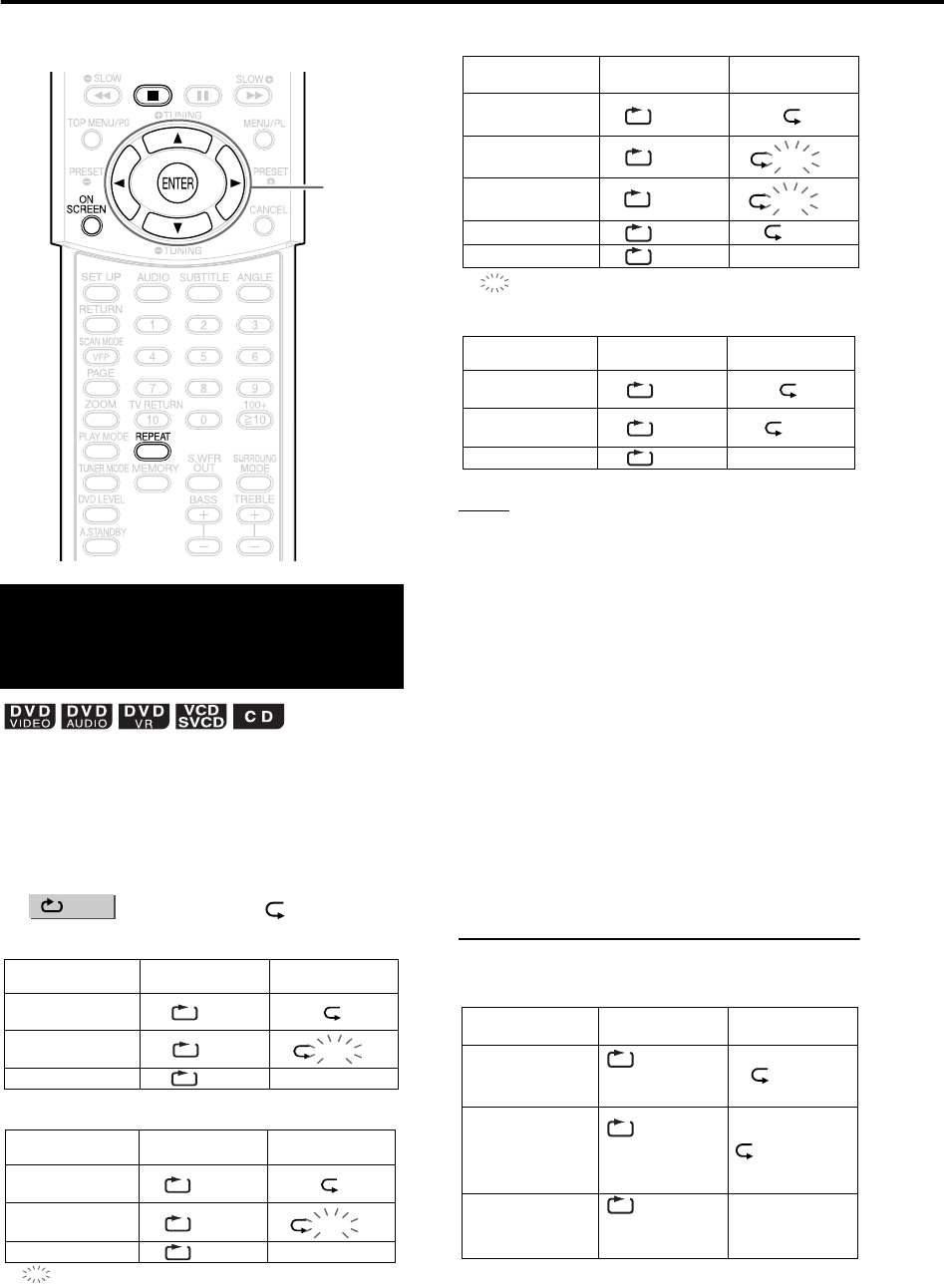
Refer to page 21 for Repeat Playback of MP3/
WMA/WAV/JPEG/MPEG1/MPEG2 file.
1Press REPEAT during playback.
Each time you press the button, the Repeat
type will be alternated.
Example:
For DVD VIDEO
For DVD AUDIO
For DVD VR
For CD/VCD/SVCD
NOTE
• For a DVD AUDIO and CD, this operation can
always be carried out, while, for a VCD and SVCD,
the operation can be carried out when the disc is
stopped or during playback without the PBC
function.
• It is possible to set Repeat on the menu bar. For
how to operate, refer to “Playing the designated part
repeatedly (A-B Repeat Playback)”(
A
page 28).
• The abbreviations displayed on the main unit are as
follows.
TRK : Track PG : Original Program
CHP : Chapter PL : Play list
TI. : Title
GR. : Group
• For a DVD VIDEO and DVD VR, if the loaded disc is
not selected as the source, the Repeat mode will be
cancelled.
Repeat Playback during Program or
Random Playback
Repeat playback cannot be performed for a DVD
VR.
Playing the title/chapter/
group/track/all tracks
repeatedly (REPEAT)
5///2/3
/ENTER
CHAP
Indicator on the display window
on the main unit
TV screen
ALL
*
CHAP
TITLE
OFF
Repeat types
Repeats the current
chapter
Repeats the current
title
Cancels repeat
Indicator on the display
window on the main unit
Display on the TV
screen
No display
Repeat types
Repeats the current
track
Repeats the current
group
Cancels repeat
Indicator on the display
window on the main unit
Display on the TV
screen
represents blinking.
No display
TRACK
GROUP
OFF
*
ALL
*
Repeat types
Repeats the current
chapter
Repeats the current
program
Repeats the current
play list
Repeats all chapters
Cancels repeat
Indicator on the display
window on the main unit
Display on the TV
screen
represents blinking.
CHAP
PG
PL
ALL
OFF
*
No display
ALL
*
ALL
ALL
*
Repeat types
Repeats the current
track
Repeats all tracks
Cancels repeat
Indicator on the display
window on the main unit
Display on the TV
screen
No display
TRACK
ALL
OFF
ALL
Indicator on the display
window on the main unit
Repeat types
Repeats the current
chapter or track
Repeats all
programmed tracks
or all the tracks in
Random Playback
Cancels repeat
Display on the TV
screen
PRGM or
RANDOM
PRGM or
RANDOM
PRGM or
RANDOM
STEP
or
REPEAT STEP
ALL
or
REPEAT ALL
OFF
or
No display
ALL
Repeat Playback
EX-AK1[US_UB_UA].book Page 27 Monday, August 6, 2007 11:32 AM
28
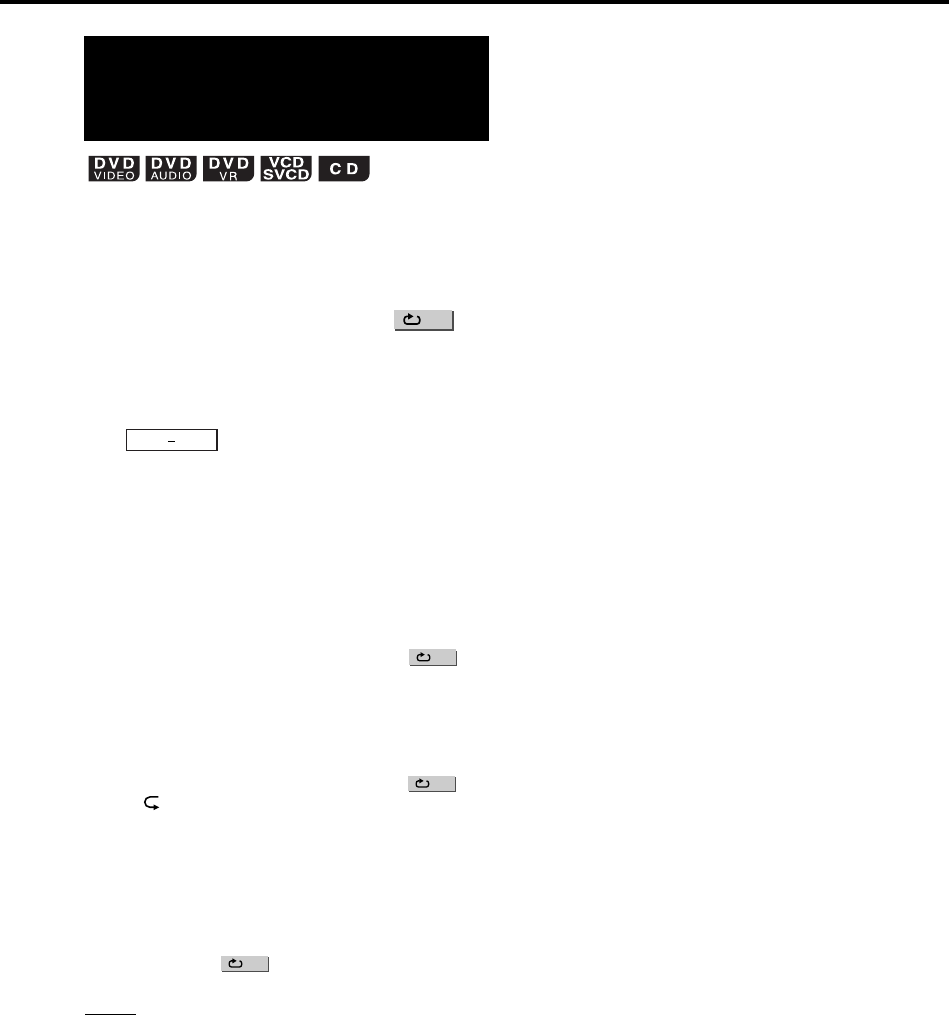
1Press ON SCREEN twice during
playback.
The menu bar (Apage 33) will be displayed.
2Press 2 or 3 to select .
3Press ENTER.
4Press 5 or / to display
.
Other Repeat modes can be selected here.
For other Repeat modes, refer to “Playing the
title/chapter/group/track/all tracks repeatedly
(REPEAT)” (Apage 27).
5Press ENTER at the start point
of the part to be repeated
(designating A point).
• The icon on the menu bar will be .
6Press ENTER at the end point of
the part to be repeated
(designating B point).
• The icon on the menu bar will be .
will appear blinking on the display
window on the main unit and the part
between A and B points will be played
repeatedly.
• A-B Repeat Playback will be cancelled by
carrying out the following operations.
• Press 7.
• Select and press ENTER twice.
NOTE
A-B Repeat Playback is possible only within the same
title or track. A-B Repeat Playback cannot be carried
out during PBC playback, Program Playback, Random
Playback and Repeat Playback.
Playing the designated
part repeatedly
(A-B Repeat Playback)
OFF
OFF
A B
A-
A-B
A-B
Advanced operations
EX-AK1[US_UB_UA].book Page 28 Monday, August 6, 2007 11:32 AM
29
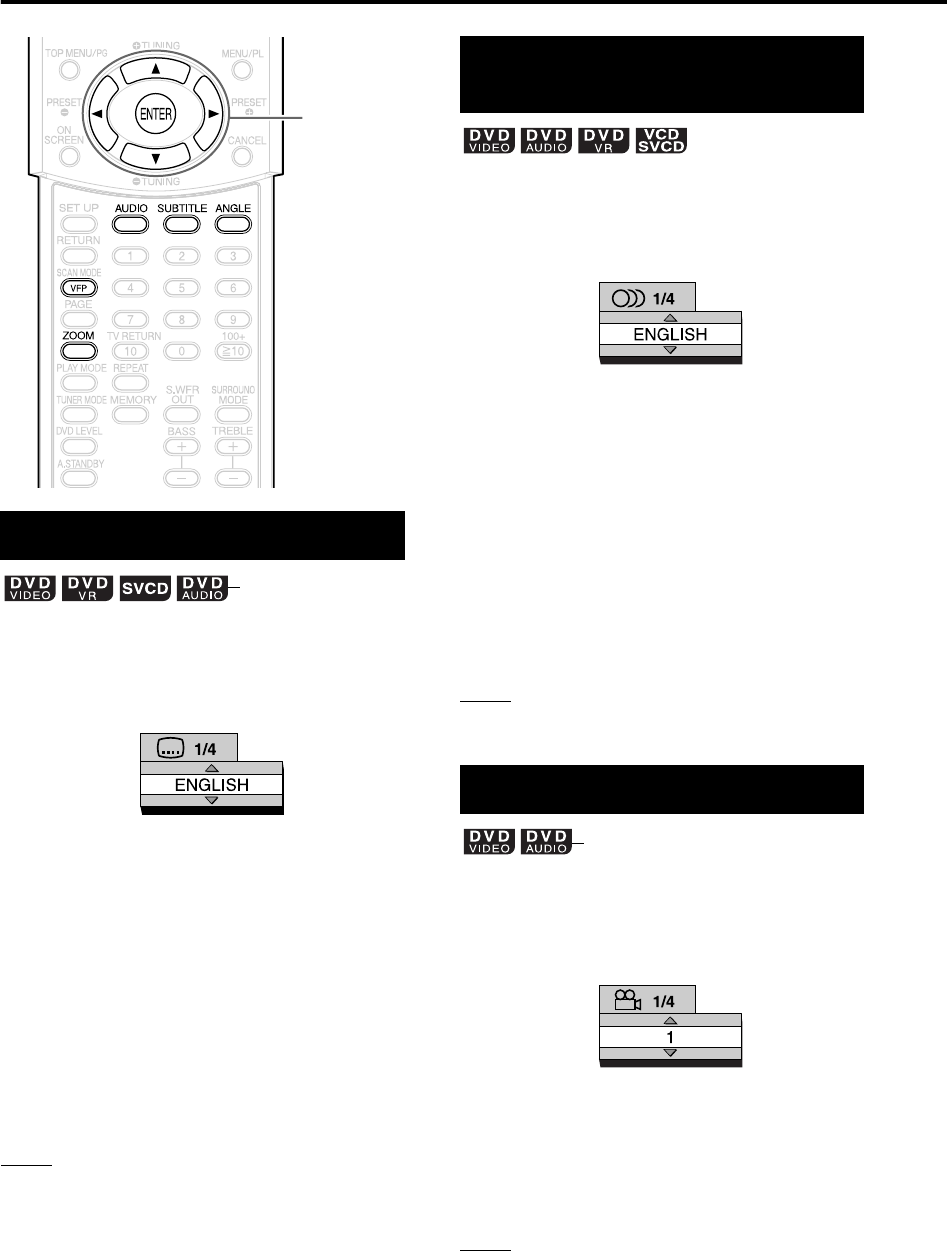
1Press SUBTITLE during
playback of a disc containing
subtitles in several languages.
• Each time you press the button, the subtitle
will be alternated between ON/OFF.
2Press 5 or / to select a subtitle
language.
• For a language code such as “AA”, refer to
“Language codes” (Apage 44).
• The manner of displaying subtitle
languages may be different depending on
the disc.
3Wait for a few seconds or press
ENTER.
NOTE
• It is possible to operate by using the menu bar
(
A
page 33).
• For a SVCD, each time you press SUBTITLE in
Step 1, the subtitle type and ON/OFF will be
alternated.
1Press AUDIO during playback of
a disc containing several audio
languages.
• Each time you press the button, the audio
language will be alternated. Also, the audio
language can be changed by pressing 5 or
/.
• For a language code such as “AA”, refer to
“Language codes” (Apage 44).
• “ST”, “L” and “R” displayed when playing a
VCD, SVCD or DVD VR respectively
represent “Stereo”, “left sound” and “right
sound”.
2Wait for a few seconds or press
ENTER.
NOTE
It is possible to operate by using the menu bar
(
A
page 33).
1Press ANGLE during playback
of a scene containing multi-view
angles.
• Each time you press the button, the angle
will be alternated. Also, the angle can be
changed by pressing 5 or /.
2Wait for a few seconds or press
ENTER.
NOTE
It is possible to operate by using the menu bar
(
A
page 33).
Selecting the subtitles
5///2/3
/ENTER
(only for moving image)
TV screen
Example:
Selecting the audio
language
Selecting a view angle
TV screen
Example:
(only for moving image)
TV screen
Example:
Other convenient functions
EX-AK1[US_UB_UA].book Page 29 Monday, August 6, 2007 11:32 AM
30
1Press ZOOM during playback or
while paused.
• Each time you press the button, the picture
magnification will be changed.
• (For a JPEG file) You cannot change the
picture magnification during slide-show
playback.
2Select the portion you want to
see by using 5, /, 2 or 3.
• To resume normal playback, select “OFF” in
Step 1.
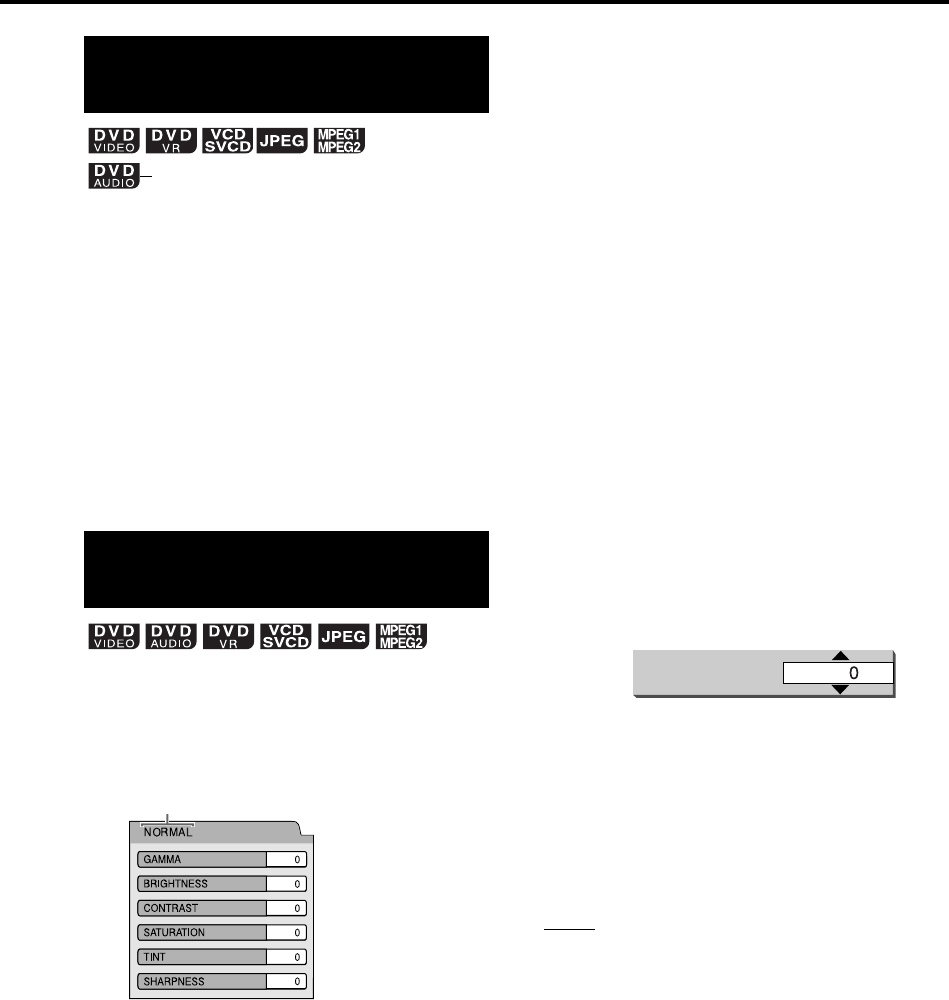
1Press VFP during playback or
while paused.
The current setting will be displayed on the
TV screen.
2Press 2 or 3 to select VFP
mode.
• It is recommended to select “NORMAL”
usually, or “CINEMA” in a dark room. When
either “NORMAL” or “CINEMA” is selected,
go to Step 7.
• When either “USER 1” or “USER 2” is
selected, the adjustment can be carried out
in detail in the operations after Step 3.
3Press 5 or / to select an item
to be adjusted.
- “GAMMA”
Controls the brightness of neutral tints
while maintaining the brightness of dark
and light portions.
(Setting range: –3 to +3)
- “BRIGHTNESS”
Controls the brightness of the display. (Set-
ting range: –8 to +8)
- “CONTRAST”
Controls the contrast of the display.
(Setting range: –7 to +7)
- “SATURATION”
Controls the saturation of the display.
(Setting range: –7 to +7)
-“TINT”
Controls the tint of the display.
(Setting range: –7 to +7)
- “SHARPNESS”
Controls the sharpness of the display. (Set-
ting range: –8 to +8)
4Press ENTER.
5Press 5 or / to change the
value.
6Press ENTER.
To adjust other items, go back to Step 3.
7Press VFP.
NOTE
• If no operation is made for several seconds during
the procedure, the settings made so far will be
automatically stored.
• “VFP” is an abbreviation of “Video Fine Processor”.
Enlarging the picture
(ZOOM)
Adjusting the picture
quality (VFP)
(only for moving image)
Selected VFP mode
GAMMA
TV screen
Example:
Advanced operations
EX-AK1[US_UB_UA].book Page 30 Monday, August 6, 2007 11:32 AM
31
The two speakers produce an effect resembling
surround-sound.
• This function is activated when a loaded disc is
selected as the source.
1Press SURROUND MODE
during playback.
• Each time you press the button, the display
toggles as follows.
• While SURROUND MODE is activated,
“SURROUND” appears on the display
window.
NOTE
• SURROUND MODE is effective for the speakers.
• When noise is produced or sound is distorted, set
SURROUND MODE to “OFF”.
• If the SURROUND MODE is activated when the K2
function has already been activated, the K2 function
turns off automatically and the SURROUND MODE
turns on.
You can listen to surround sound via headphones
connected to the PHONES terminal.
• This function is activated when a loaded disc is
selected as the source.
■When headphones are connected to the
PHONES terminal
1Press SURROUND MODE.
• Each time you press SURROUND MODE,
the setting toggles between “SURROUND
ON” and “SURROUND OFF” in the display
window.
• If the headphone surround mode function is
activated when the K2 function has already
been activated, the K2 function turns off
automatically and the headphone surround
mode function turns on.
NOTE
•The PHONES terminal is for connecting a pair of
headphones equipped with a stereo mini plug (not
supplied). When headphones are connected, no
sound is output from the speakers.
• “SURROUND ON” is displayed in the display
window for a short time when headphones are
disconnected from the PHONES terminal and then
connected to the PHONES terminal while the
headphone surround mode function is on.
The audio of a DVD VIDEO and DVD AUDIO may
be recorded at a lower level (volume) than for other
types of disc. If the difference is not to your liking,
adjust the DVD Level.
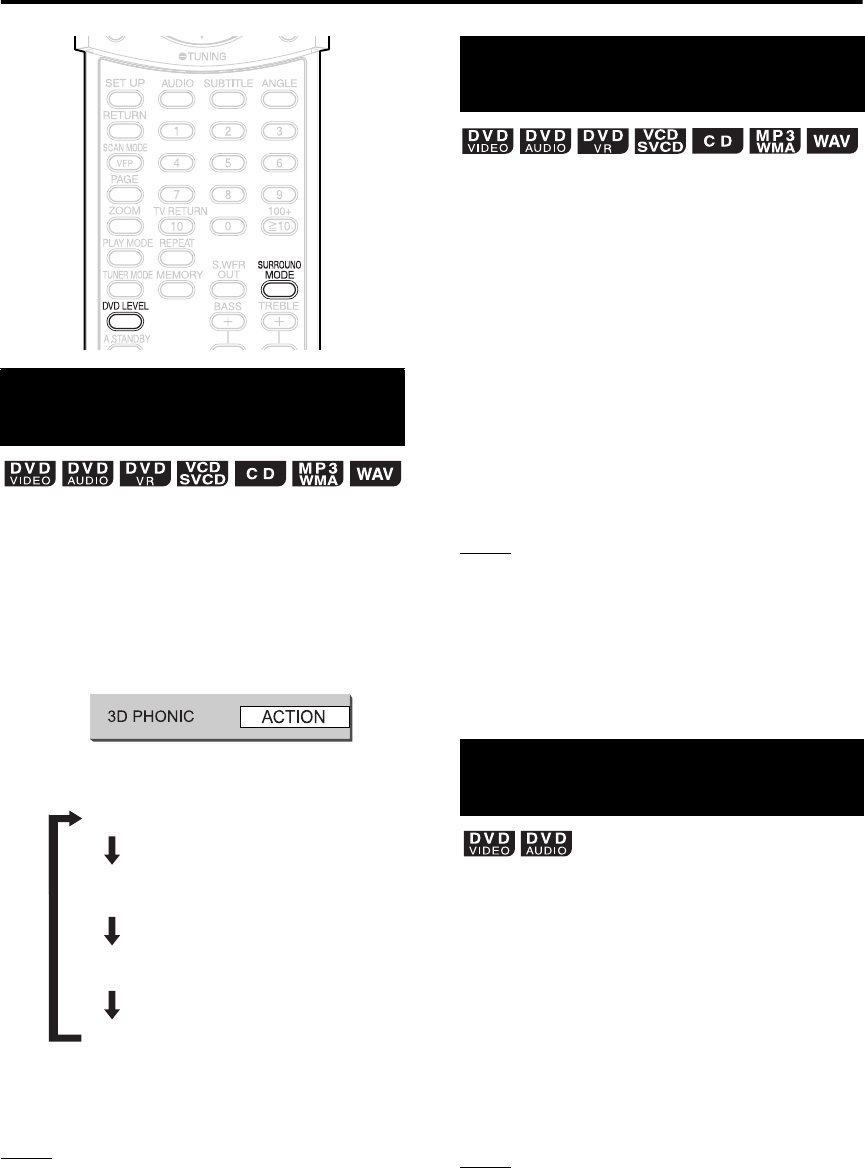
1Press DVD LEVEL during
playback.
• Each time you press the button, the level
will be alternated among “NOR” (Normal),
“MID” (Middle) and “HIG” (High).
• Select the level while listening to the sound
played.
NOTE
• DVD Level is effective only for playback of a DVD.
• Even if the DVD Level is changed, the output level
from the digital audio output terminal will not be
changed.
• This operation can be carried out while the disc is
stopped or paused.
Creating realistic sound
(SURROUND MODE)
TV screen
Example:
: Suitable for action movies,
sport programs or other
lively programs.
: You can relax with a natural
atmosphere.
: You can enjoy the sound
effect as if you were
watching the movie in a
theater.
: Cancels SURROUND MODE
(factory setting).
ACTION
DRAMA
THEATER
OFF
Selecting the headphone
surround mode
Adjusting playback level
(DVD LEVEL)
Other convenient functions (continued)
EX-AK1[US_UB_UA].book Page 31 Monday, August 6, 2007 11:32 AM
32
NOTE
Set the remote control mode selector to
AUDIO before using the number buttons.
There are some DVD AUDIO discs with a special
group, called “Bonus Group”, recorded.
NOTE
This operation can be carried out when “BONUS” is lit
on the display window on the main unit.
1Press GROUP/TITLE
repeatedly during playback to
select a bonus group.
“KEY_ _ _ _” appears on the TV screen, and
on the display window on the main unit.
2Press the number buttons to
enter a pin code (4 digits).
The method of getting a pin code may be
different depending on the disc.
3Press ENTER.
• When a correct pin code is entered,
“BONUS” disappears and the playback of
the bonus group starts.
• If an incorrect pin code is entered, try
entering a correct pin code again.
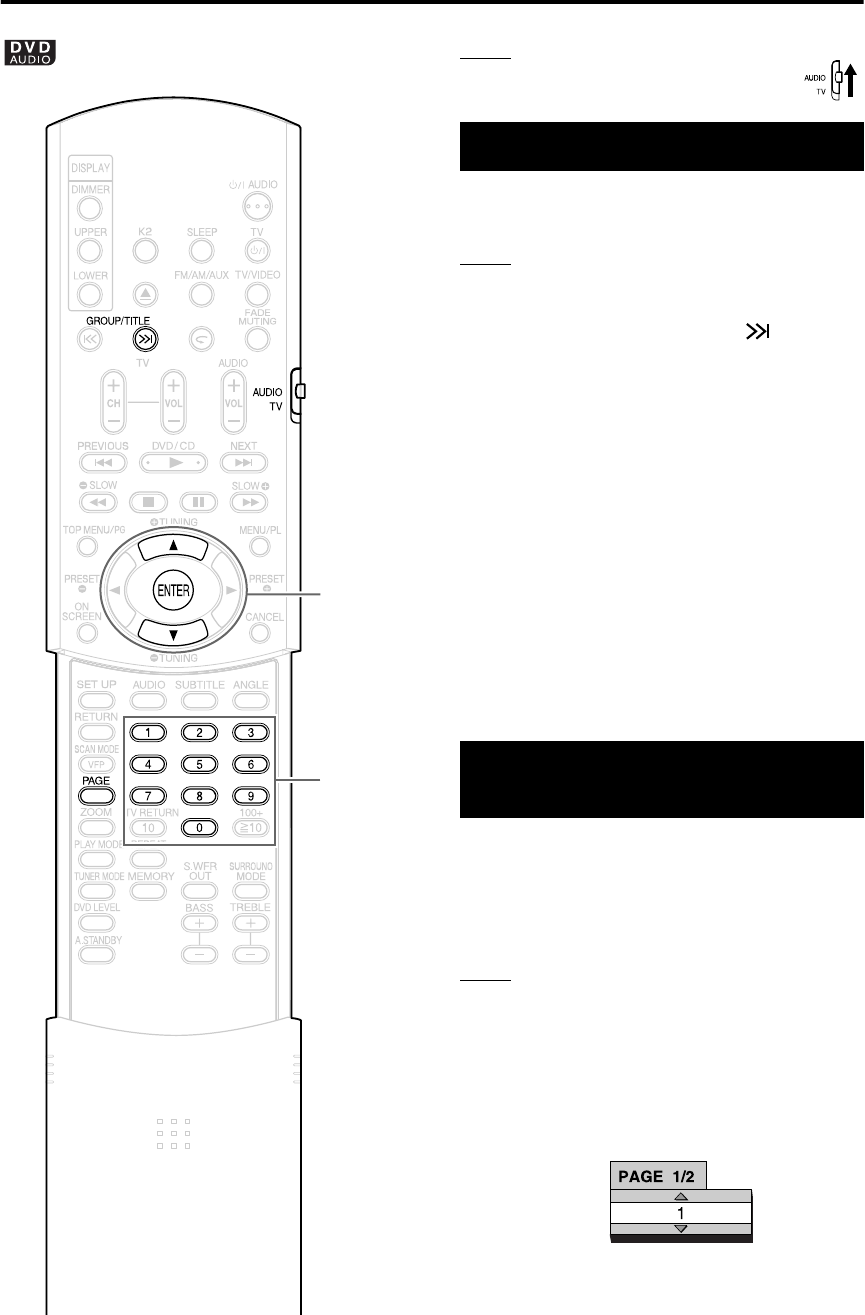
There are some DVD AUDIO discs with still
pictures recorded. Among the still pictures, there
are pictures called B.S.P. (Browsable Still
Pictures). With these pictures, it is possible to
switch a picture as if turning over pages.
NOTE
This operation can be carried out when “B.S.P.” is lit
on the display window on the main unit.
1Press PAGE during playback.
Each time you press the button, the still picture
will be switched over. It is also possible to
switch the picture using cursor
5
/
/
.
2Wait for a few seconds or press
ENTER.
Number
buttons
5//
/ENTER
Playing the Bonus Group
Browsable Still Pictures
(B.S.P.)
TV screen
Example:
Functions specific to DVD AUDIO Advanced operations
EX-AK1[US_UB_UA].book Page 32 Monday, August 6, 2007 11:32 AM
33
NOTE
• Set the remote control mode selector to
AUDIO before using the number buttons.
• This operation can be carried out when there is a
disc loaded. There are some functions that may not
work while the disc is stopped.
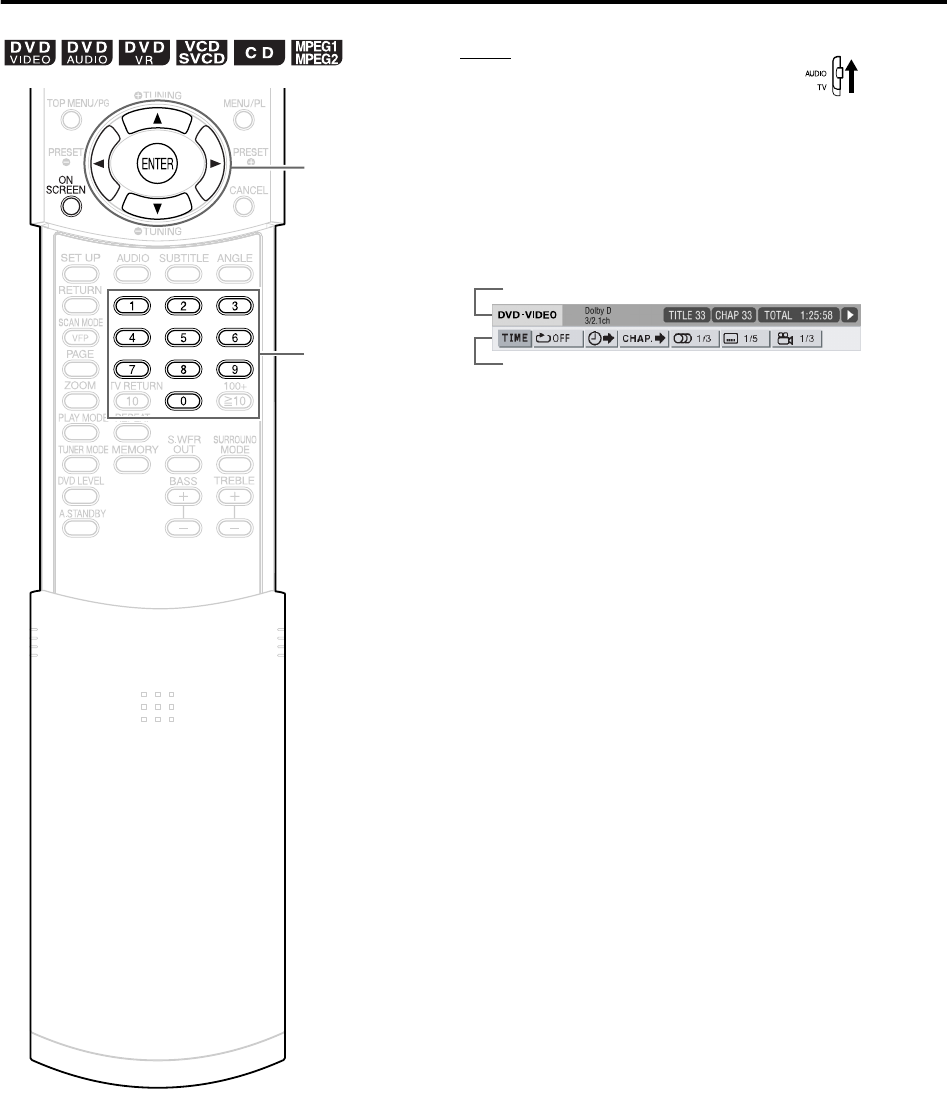
1Press ON SCREEN twice.
The status bar and the menu bar will appear
on the TV screen.
2Press 2 or 3 to select an item
to be operated.
3Press ENTER.
• The selected function can be set. For the
setting content, refer to the following
“Functions list”.
• The indicator for the currently active
function lights up.
• To delete the menu bar, press ON
SCREEN.
Number
buttons
5///2/3
/ENTER
The above is an example for a DVD VIDEO.
Status bar
Menu bar
Using the status bar and the menu bar
EX-AK1[US_UB_UA]-04.fm Page 33 Tuesday, August 28, 2007 2:55 PM
34
Functions list
For the functions with no special description for the
operations, press 5 or / to select, and press
ENTER to determine.
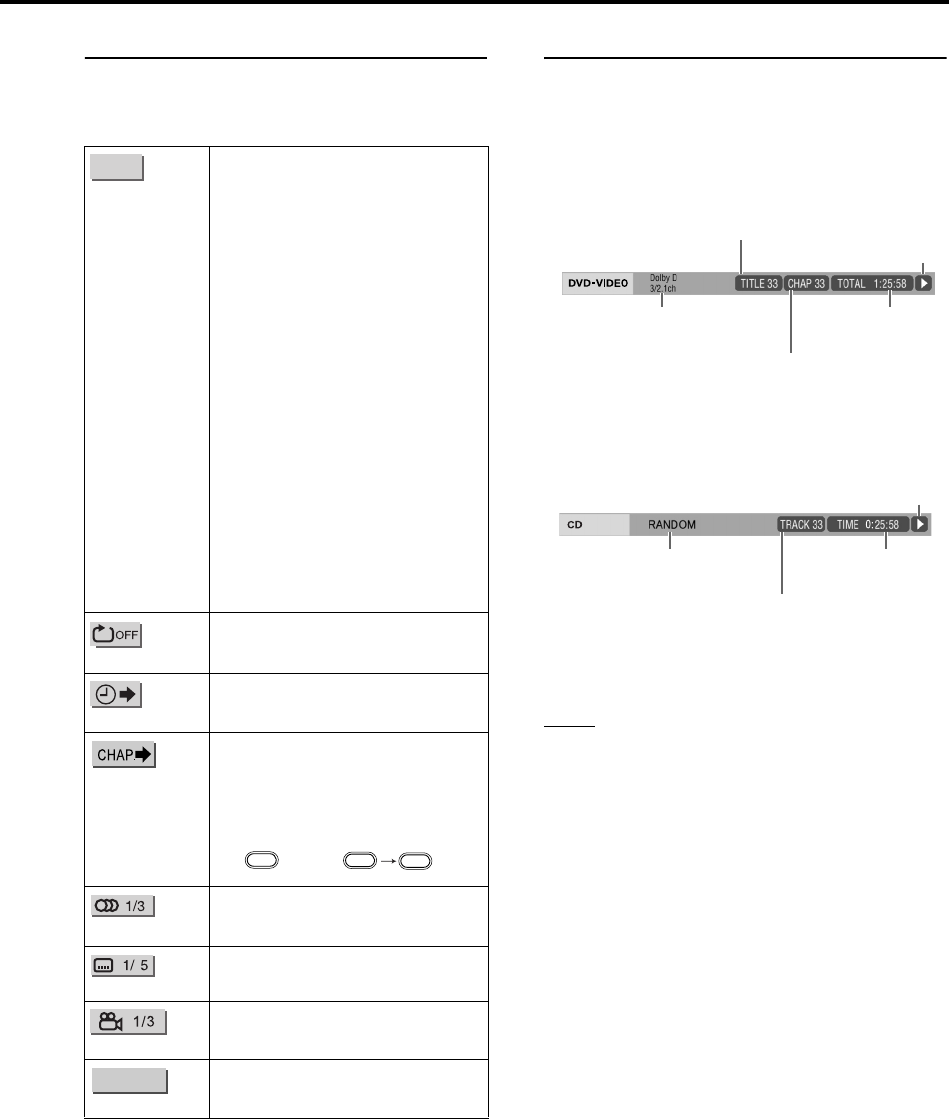
Information displayed on the status bar
DVD VIDEO/DVD AUDIO/DVD VR (the example
below is for a DVD VIDEO)
VCD/SVCD/CD/MPEG1/MPEG2 (the example
below is for a CD)
NOTE
* The playback status mark has the same meaning of
the mark on the On-screen guide (
A
page 18).
Time display
selection
Changes the time information in the display
window and the status bar. Each time
ENTER is pressed, the display changes on
the menu bar.
DVD VIDEO/DVD AUDIO (operating
during playback)
TOTAL:
Elapsed playback time of the
current title/group.
T.REM : Remaining time of the current title
/
group
.
TIME : Elapsed playback time of the
current chapter/track.
REM : Remaining time of the current
chapter/track.
DVD VR (operating during playback)
TOTAL: Elapsed playback time of the
current original program/play list.
T.REM : Remaining time of the current
original program/play list.
CD (operating during playback)/VCD/
SVCD
TIME : Elapsed playback time of the
current track.
REM : Remaining time of the current
track.
TOTAL: Elapsed playback time of the disc.
T.REM : Remaining time of the disc.
Repeat mode
Refer to page 27.
(For A-B repeat playback, refer to page 28.)
Time search
Refer to page 24.
Chapter search/
track search
DVD VIDEO/DVD VR (chapter search)/
DVD AUDIO (track search)
Selects a chapter/track. Press the number
buttons to enter the chapter/track number
and press ENTER.
Examples:
Audio language
DVD VIDEO/DVD AUDIO/DVD VR/VCD/
SVCD
Refer to page 29.
Subtitle language
DVD VIDEO/DVD AUDIO/DVD VR/SVCD
Refer to page 29.
View angle
DVD VIDEO/DVD AUDIO
Refer to page 29.
Page selection
DVD AUDIO
Refer to page 32.
TIME
524
5: 24:
PAGE -/-
(DVD VIDEO/DVD AUDIO)
Current title/group number
(DVD VR)
Current original program number (PG)/
current play list number (PL)
Current chapter/track number
Time
Playback status*
(DVD VIDEO/DVD AUDIO/DVD VR)
Audio encoding mode
Playback mode status
(VCD/SVCD/CD)
Current track number
(MPEG1/MPEG2 file)
Repeat mode status
Time
Playback status*
Advanced operations
EX-AK1[US_UB_UA]-04.fm Page 34 Tuesday, August 28, 2007 2:55 PM
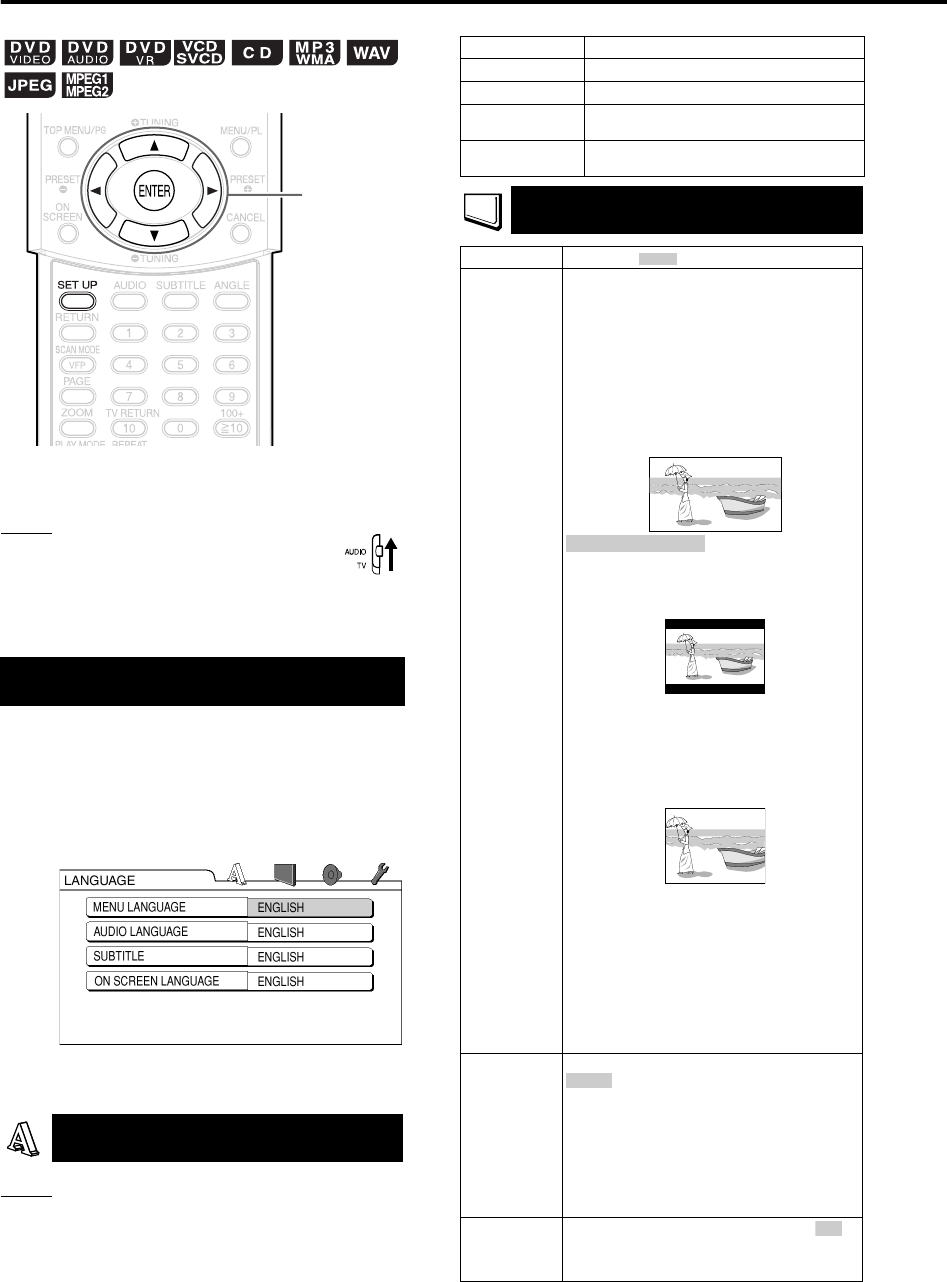
35
The initial settings of the system can be changed
according to the environment the system is used in.
NOTE
• Set the remote control mode selector to
AUDIO before using the number buttons.
• The top and bottom of the preference
screen may not be displayed on a widescreen TV.
Adjust the picture size on the TV.
1Press SET UP while the disc/file
is stopped or no disc is loaded
(“NO DISC” is displayed).
• The following screen will be displayed on
the TV.
• Proceed with operations by following the
description on the TV screen.
NOTE
• If the selected language is not recorded on the disc/
file, the optimum language set for the disc/file will be
displayed.
• For a language code such as “AA”, refer to the
“Language codes” (
A
page 44).
Basic operations
LANGUAGE
5///2/3
/ENTER
Items Contents
MENU LANGUAGE
Select the language for the DVD VIDEO menu.
AUDIO LANGUAGE
Select the audio language for the DVD VIDEO.
SUBTITLE
Select the subtitle language for the DVD
VIDEO.
ON SCREEN
LANGUAGE
Select the language displayed on the preference
screens.
PICTURE
Items Contents ( : initial setting)
MONITOR
TYPE
Select a display method suitable for your TV.
16 : 9 NORMAL:
Select this when the aspect ratio of your
widescreen TV is fixed to 16:9 (when playing a
DVD VIDEO recorded at 4:3, the system
automatically adjusts the screen width of the
output signal).
16 : 9 AUTO:
Select this when using a conventional
widescreen TV that automatically detects the
aspect ratio of the input screen picture.
:
Select this when the aspect ratio of your TV is
conventional 4:3. While viewing a wide screen
picture, the black bars appear on the top and
bottom of the screen.
4 : 3 PS (Pan Scan):
Select this when the aspect ratio of your TV is
conventional 4:3. While viewing a wide screen
picture, the left and right edges of the picture
will not be shown on the screen. (If the disc/file
is not compatible with Pan Scan, the picture will
be displayed at the Letter Box ratio.)
4 : 3 MULTI PS (Pan Scan) :
4 : 3 MULTI LB (Letterbox) :
16 : 9 MULTI NORMAL :
16 : 9 MULTI AUTO :
These “MULTI” options should be selected
when you connect the system to a TV
compatible with multiple video signal types. If
you select one of these options, the system
outputs a PAL or NTSC video signal according
to the disc, regardless of the video signal type
setting. (Refer to page 13.)
PICTURE
SOURCE
Select an item suitable to the video source.
The video source type (a video or film) is
automatically selected.
FILM:
Select this item when you want to view a film or
video recorded with the progressive scan
method.
VIDEO:
Select this item when you want to view a
normal video.
SCREEN
SAVER
Select the Screen Saver mode between /
OFF (Screen Saver activates when there is no
operation made for about 5 minutes since a still
picture was last displayed).
4 : 3 LB (Letter Box)
AUTO:
ON
Preferences
EX-AK1[US_UB_UA]-04.fm Page 35 Tuesday, August 28, 2007 2:55 PM
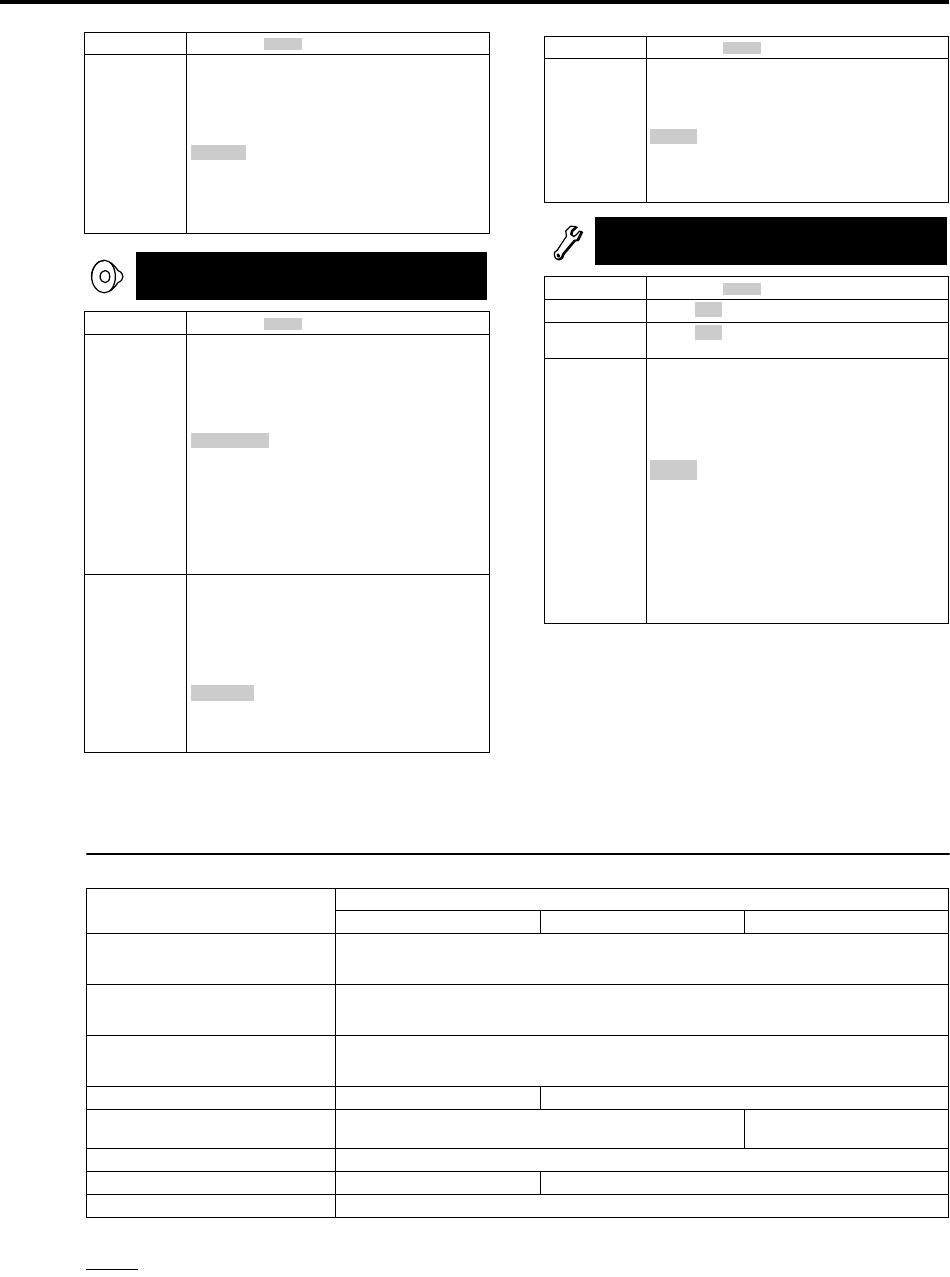
36
Items Contents ( : initial setting)
FILE TYPE When files of different types are recorded on a
loaded disc, you can select which files to play.
When the preference has been changed, open/
close the tray and turn on the power again. (A
disc with files of the same type can be played
regardless of this setting.)
For MP3/WMA/WAV files.
STILL PICTURE :
For JPEG files.
VIDEO :
For MPEG1/MPEG2 files.
AUDIO
Items Contents ( : initial setting)
DIGITAL
AUDIO
OUTPUT
Select an output signal type from the
following in accordance with the device
connected to the digital audio output
terminal (AV amplifier, etc.). (See the list
below for the preference items and output
signal.)
:
Device corresponding only to linear PCM.
DOLBY DIGITAL/PCM:
Dolby digital decoder or a device having the
same function.
STREAM/PCM:
DTS/Dolby digital decoder or a device having
the same function.
DOWN MIX Switch signal from the digital output
terminal of the DVD VIDEO according to the
connected device. Select this when Digital
Audio Output is set to “PCM ONLY”.
DOLBY SURROUND:
A Dolby Pro Logic decoder-built-in device.
:
An ordinary device.
• When SURROUND MODE is ON, Down Mix
does not work.
AUDIO:
PCM ONLY
STEREO
Items Contents ( : initial setting)
D (Dynamic).
RANGE
COMPRESSION
To make adjustments for the difference
between a high volume and a low volume
when playing back with low volume (only for
a DVD recorded with Dolby digital).
:
D. Range Compression automatically works.
ON:
D. Range Compression always works.
OTHERS
Items Contents ( : initial setting)
RESUME Select /OFF. (Apage 22)
ON SCREEN
GUIDE
Select /OFF. (Apage 18)
AV COMPU
LINK MODE
When you want to control the main unit and
the connected TV or other devices at the
same time, select a setting according to the
type of terminal on the device connected to
the main unit. (Refer to “Using the AV
COMPU LINK function” on page 41.)
:
When connecting to the video 3 or DVD input
terminal on the TV.
DVD2 :
When connecting to the video 1 input terminal
on the TV.
DVD3 :
When connecting to the video 2 input terminal
on the TV.
AUTO
ON
ON
DVD1
List of relationships of DIGITAL AUDIO OUTPUT preference items and output signal
NOTE
• For a DVD VIDEO without content protection set, there is a 20 bit or 24 bit output at the digital audio output
terminal.
Playback disc/file DIGITAL AUDIO OUTPUT preference
STREAM/PCM DOLBY DIGITAL/PCM PCM ONLY
48 kHz, 16/20/24 bits
linear PCM DVD VIDEO
96 kHz linear PCM DVD VIDEO
48 kHz, 16 bits stereo linear PCM
48/96/192 kHz,
16/20/24 bits linear PCM DVD AUDIO 48 kHz, 16 bits stereo linear PCM
44.1/88.2/176.4 kHz,
16/20/24 bits linear PCM DVD AUDIO 44.1 kHz, 16 bits stereo linear PCM
DTS DVD VIDEO/DVD AUDIO DTS bit stream 48 kHz, 16 bits stereo linear PCM
DOLBY DIGITAL DVD VIDEO/
DVD AUDIO DOLBY DIGITAL bit stream 48 kHz, 16 bits stereo linear
PCM
CD/VCD/SVCD 44.1 kHz, 16 bits stereo linear PCM/48kHz, 16 bits linear PCM
DTS CD DTS bit stream 44.1 kHz, 16 bits linear PCM
MP3/WMA/WAV file 32/44.1/48 kHz, 16 bits linear PCM
Advanced operations
EX-AK1[US_UB_UA]-04.fm Page 36 Tuesday, August 28, 2007 2:55 PM
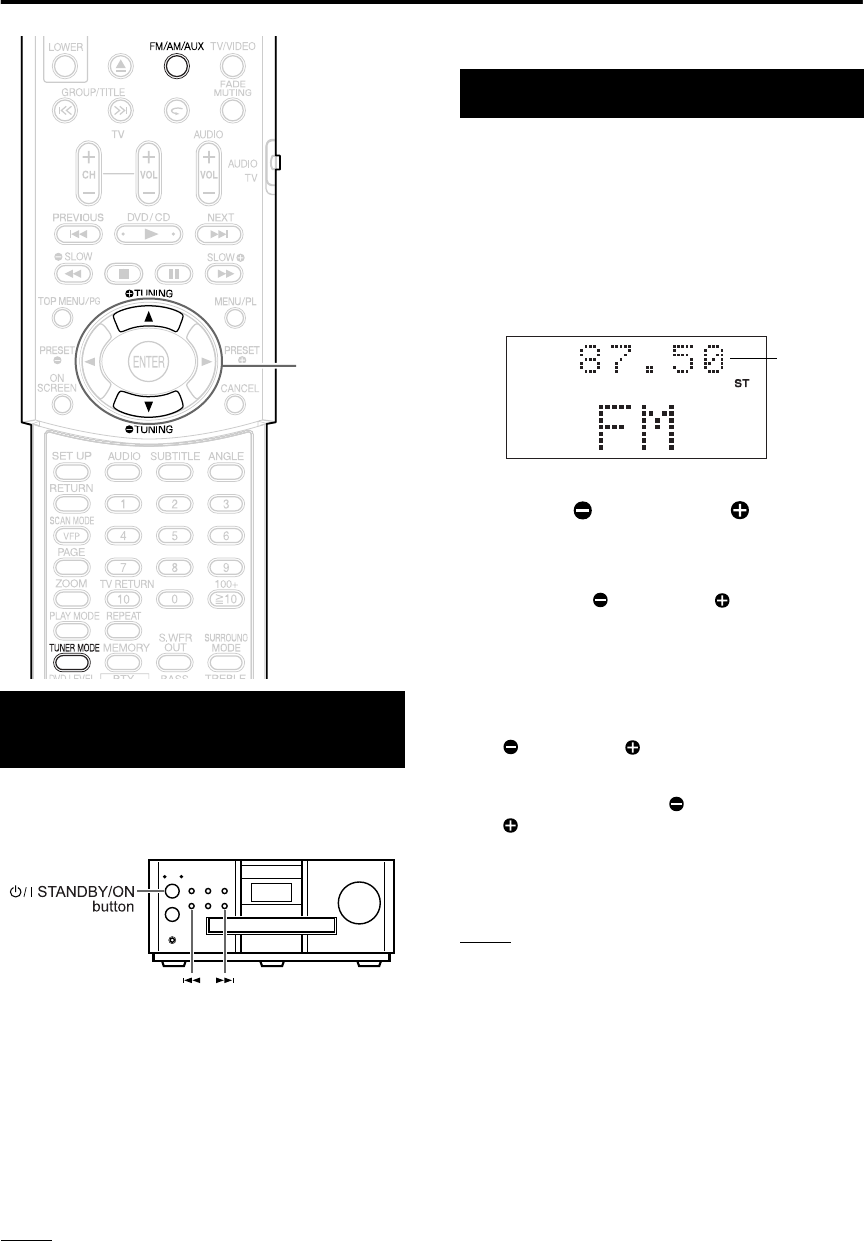
37
Some countries space AM stations 9 kHz apart,
and other countries use 10 kHz spacing.
On the main unit ONLY:
■When the main unit is turned off
To select 10 kHz intervals, while holing down ¢
on the main unit, press F STANDBY/ON on the
main unit to turn on the power. “10 kHz SP”
appears on the display window.
To select 9 kHz intervals, while holing down 4
on the main unit, press F STANDBY/ON on the
main unit to turn on the power. “9 kHz SP” appears
on the display window.
NOTE
If the interval spacing is switched, the memory in
which the radio stations were stored will be erased.
You can tune in to FM or AM.
1Press FM/AM/AUX to select
“FM” or “AM” on the display
window on the main unit.
Each time you press the button, the source
will be alternated among “FM”, “AM” and
“AUX”.
Example:
2Press TUNING or TUNING
to select the station (frequency).
Automatic tuning:
Hold down TUNING or TUNING until
the system starts searching, and then release
the button.
When a station of sufficient signal strength is
tuned in to, the system stops searching
automatically.
To stop searching manually, press
TUNING or TUNING.
Manual tuning:
Each time you press
TUNING
or
TUNING
, the frequency changes.
• When an FM stereo program is received,
the “ST” (Stereo) indicator lights.
NOTE
• If the stereo FM program currently tuned in to is
noisy, you can improve the reception by pressing
TUNER MODE to switch to the monaural mode
(“MONO” lights). If you press TUNER MODE again,
or tune in to another station, the receiving mode
returns automatically to the stereo mode.
• If a beeping sound disturbs your AM broadcast, you
can reduce the noise. Pressing TUNER MODE
displays “BEAT CUT AM” on the display window for
a short time and reduces the noise.
Setting the AM tuner
interval spacing
9/( TUNING
Selecting a station
Frequency
Listening to a radio broadcast
EX-AK1[US_UB_UA].book Page 37 Monday, August 6, 2007 11:32 AM
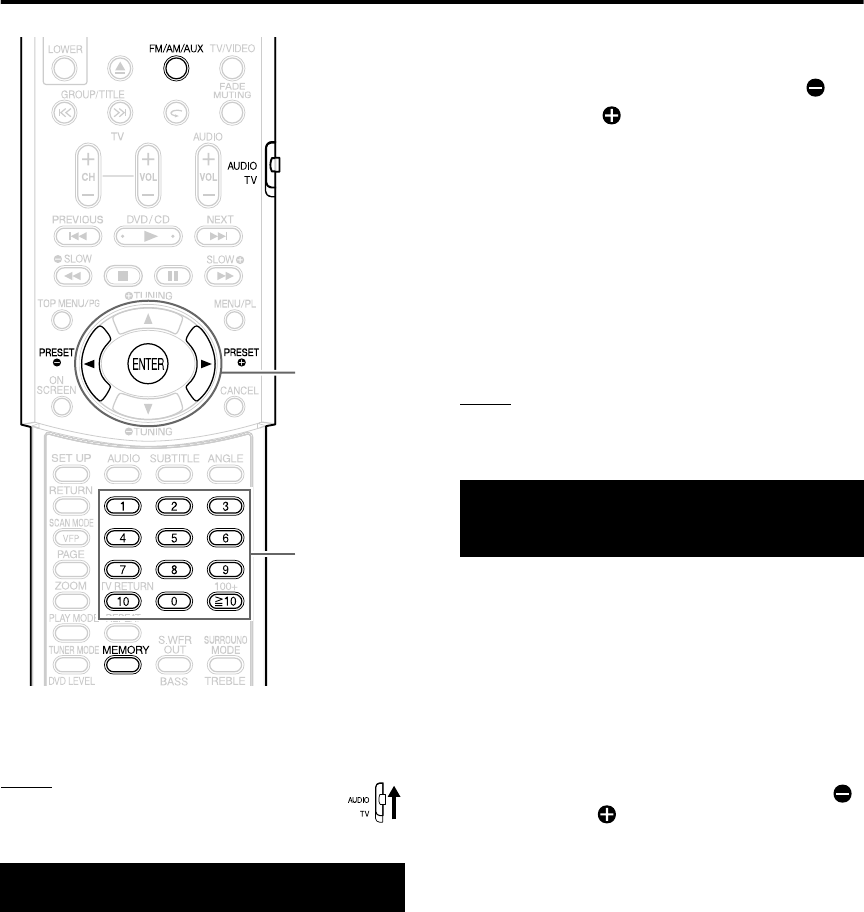
38
Presetting stations in the system allows you to
easily tune in to a station.
NOTE
Set the remote control mode selector to
AUDIO before using the number buttons.
The system stores up to 30 FM stations and up to
15 AM stations.
1Select a station you want to
store (Apage 37 for how to
select a station).
2Press MEMORY.
Figures (memory number) blink on the display
window for about 5 seconds.
3Select the number you want to
store by pressing PRESET or
PRESET while the memory
number is blinking.
• You can also select the number by using the
number buttons.
• Refer to “How to use the number buttons”
(Apage 18).
4Press MEMORY or ENTER while
the selected number is blinking.
“STORED” will be displayed and the selected
station will be stored.
NOTE
Storing a new station to a used number erases the
previously stored station.
1Press FM/AM/AUX repeatedly to
select either FM or AM.
2Press the number buttons to
select the memory number of a
station you want to tune in to.
Refer to “How to use the number buttons”
(Apage 18).
You can also select by pressing PRESET
or PRESET .
Presetting stations
PRESET 9/(
/ENTER
Number
buttons
Tuning in to a preset
station
Tuning in to a preset station Listening to radio
EX-AK1[US_UB_UA].book Page 38 Monday, August 6, 2007 11:32 AM
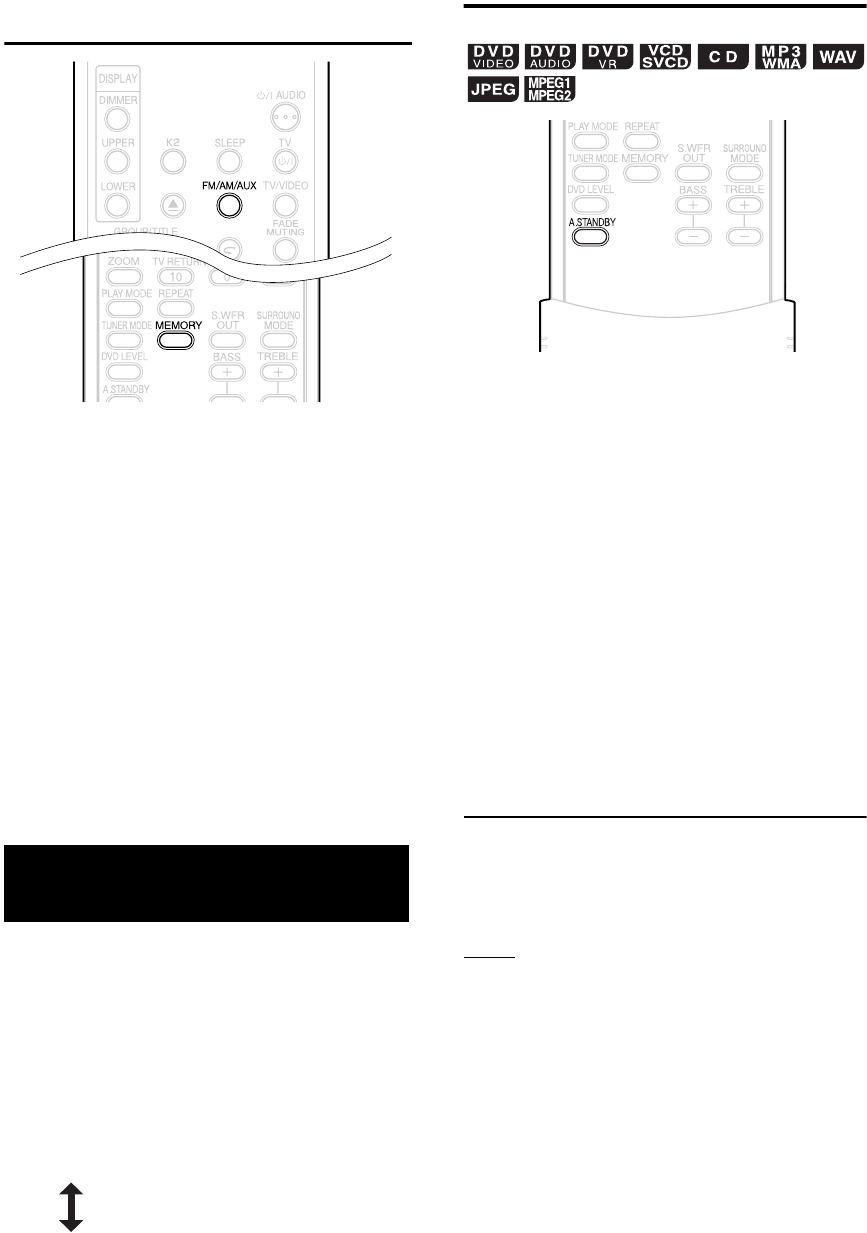
39
Connect other audio devices to this system in
advance (Apage 11).
1Press FM/AM/AUX to select
“AUX” on the display window
on the main unit.
• Each time you press FM/AM/AUX, the
display changes in the display window as
follows.
- “AUX” when selecting the device
connected to the AUX IN terminals
- “AM” or “FM” when selecting AM or FM as
the source.
2Play other audio devices.
For details, refer to the manual of the device
connected.
3Adjust the volume and the
sound quality of the system
(Apage 19).
You can adjust the sound input level of another
audio device connected to the AUX IN jacks.
1Press FM/AM/AUX to select
“AUX” on the display window
on the main unit.
2Hold down MEMORY until an
input level is displayed.
Each time you hold down the button, it switches
as follows:
LEVEL 1: Select this normally.
LEVEL 2: Select this when the input level
from the other device is too high
and the sound is distorted.
The initial setting is “LEVEL1”.
If there is no operation for 3 minutes while the disc
is stopped, the power will be automatically turned
off.
You cannot use this function when a radio
broadcast or a device connected to the AUX IN
terminals is selected as the source.
1Press A.STANDBY.
“A.S.ON” (Auto Standby On) and “A.STANDBY”
will be lit on the display window on the main unit.
When a stopped state is entered (after playback is
finished, for example), “A.STANDBY” starts
blinking.
This means that the power will be turned off
automatically if there is no operation for 3 minutes.
And, 20 seconds before the power is turned off,
“A.S.” will appear blinking.
Releasing Auto Standby
Press A.STANDBY.
“A.S.OFF” (Auto Standby Off) will appear and
“A.STANDBY” will be turned off on the display
window on the main unit.
NOTE
When the source is other than the disc, Auto Standby
does not work.
Adjust the sound input
level of the audio device
Auto Standby
Listening to the sound of
other audio devices
EX-AK1[US_UB_UA].book Page 39 Monday, August 6, 2007 11:32 AM
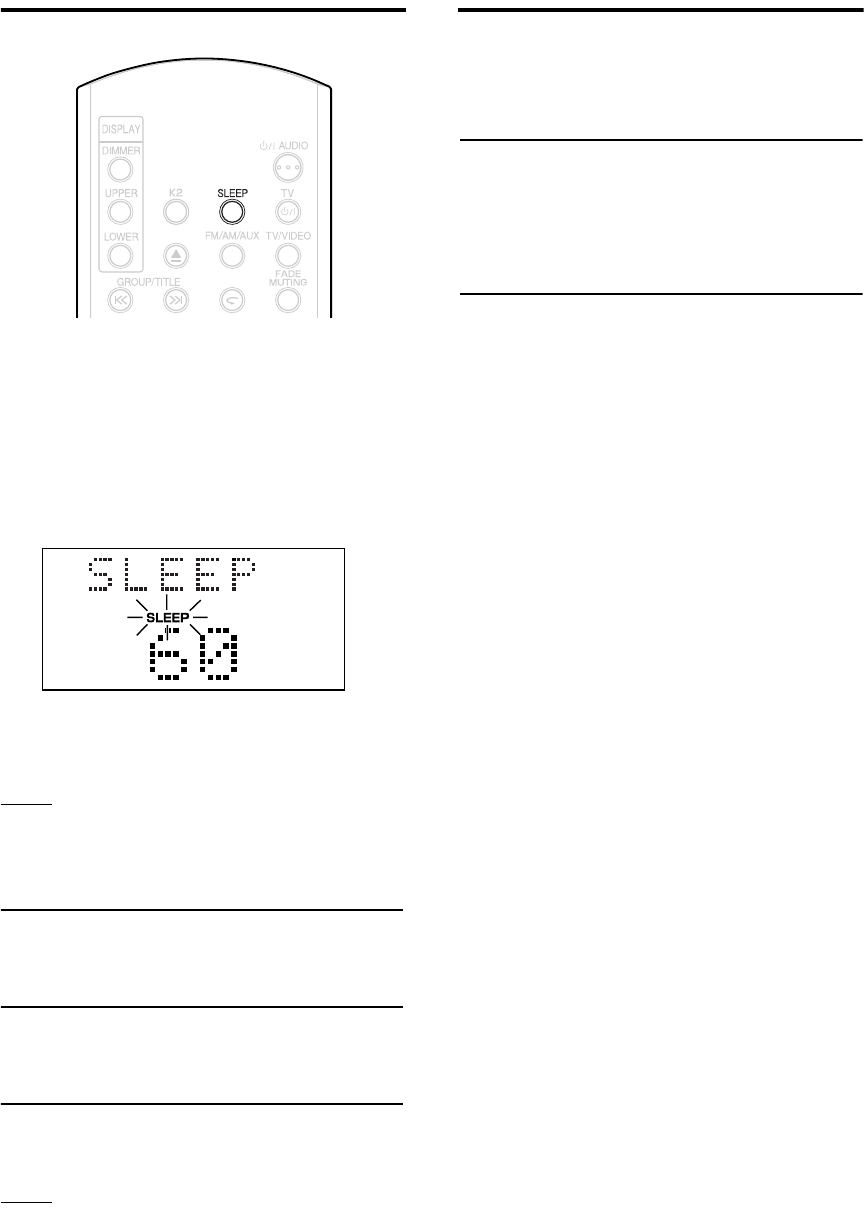
40
When the time you specify elapses, the system will
be turned off by itself.
Press SLEEP.
Each time you press the button, the time indicated
on the display window on the main unit changes (in
minutes).
Example: When Sleep Timer is set to 60
minutes
Sleep Timer will be automatically set in a few
seconds, and the display will disappear. The
“SLEEP” indicator remains on.
NOTE
When Sleep Timer is set, the display window darkens
automatically.
Changing the time
Reselect the time by pressing SLEEP repeatedly.
Confirming the time
Press SLEEP once while Sleep Timer is set.
Releasing
Press SLEEP repeatedly until “SLEEP OFF”
appears.
NOTE
Sleep Timer will also be released when the power is
turned off.
You can lock the disc tray to prevent the disc from
being ejected.
Setting
Turn off the power. And while holding down
7
on
the main unit, press
0
.
“LOCKED” appears on the display window on the
main unit.
Releasing
Carry out the same operations as those for setting.
“UNLOCKED” appears on the display window on
the main unit.
Sleep Timer Tray Lock
EX-AK1[US_UB_UA].book Page 40 Monday, August 6, 2007 11:32 AM
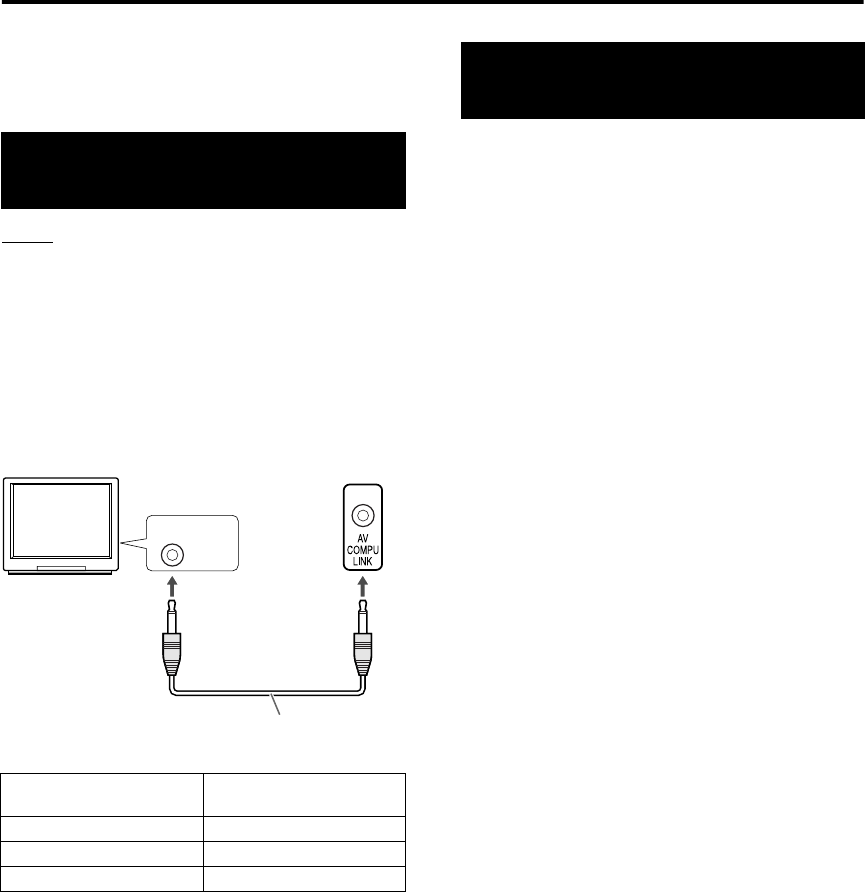
41
When a JVC-manufactured TV with AV COMPU
LINK II or III terminals is connected to the main
unit using these terminals, operating either the TV
or the main unit controls the other device at the
same time.
NOTE
• Some JVC-manufactured TVs have terminals
labeled “AV COMPU LINK”. These terminals are the
same as the AV COMPU LINK terminal on the main
unit of this system or, the “AV COMPU LINK I/II” or
“AV COMPU LINK” terminal on other JVC-
manufactured systems.
• Refer to “OTHERS” on page 36 for determining the
“AV COMPULINK MODE” setting.
• Also refer to the manual of the TV to be connected
to the main unit.
• The AV COMPU LINK function may not work for
some TVs when the main unit is connected to
the TV via the video 2 or video 3 terminal on the
TV.
1Turn on the main power of the
TV.
2Play back a disc/file.
• Refer to pages 14 and 20.
• The power of the TV is turned on.
• The input mode on the TV changes to either
the video 1, video 2 or video 3 (DVD) input.
Preparation for the AV
COMPU LINK function
Input terminal on the
TV
“AV COMPULINK
MODE” setting
Video 1 DVD2
Video 2 DVD3
Video 3 DVD1
JVC-
manufactured
TV
Connection cable
(not supplied)
Main unit (rear view)
AV COMPU
LINK
II or III
Operating the AV
COMPU LINK function
Using the AV COMPU LINK function
EX-AK1[US_UB_UA]-05.fm Page 41 Tuesday, August 28, 2007 2:56 PM

42
■General
Problem Possible cause Possible solution Reference
page
Power does not come
on.
The power cable is not con-
nected to an AC outlet.
Connect the power cable correctly. 12
You cannot operate any
button.
Some specific operations are
restricted.
This is not a malfunction. –
The remote control does
not work.
The batteries are running low. Replace the batteries. 7
You cannot operate the
main unit using the
remote control.
The remote control mode selec-
tor on the remote control is slid
to TV.
Slide the remote control mode
selector to AUDIO.8
A whirring noise can be
heard.
The main unit is located close
to a TV, computer, or other elec-
tric appliance.
Place the main unit away from a
TV, computer, or other electric
appliance.
–
No picture is produced. Improper connection. Connect all cables properly. 12
The picture is distorted. A video cassette recorder is
connected between the main
unit and the TV.
Connect the main unit directly to
the TV. 12
The video signal type setting is
not appropriate.
Select the video signal type suit-
able for your TV. 13
The screen size is
abnormal.
The screen size setting is not
appropriate.
Select the display method suitable
for your TV. 35
The TV screen darkens. The screen saver setting is acti-
vated.
Press any button. 35
No sound is produced. The speakers are not con-
nected correctly.
Connect the speakers correctly. 10
Headphones are connected. Disconnect the headphone plug. 31
The sound is muted. Restore the sound. 19
If “NO AUDIO” is displayed in
the display window, the disc
may have been produced
through illegal copying.
Check the disc at the store where
it was purchased. –
The sound is weak and
can hardly be heard.
The audio level of the disc is
low. (only for a DVD VIDEO/
DVD AUDIO)
Select the audio level.
31
The sound is distorted. The volume is too high. Turn down the volume. 19
No sound comes out of
the subwoofer.
The subwoofer setting is not
appropriate.
Select “SUB WFR ON”. 11
A radio broadcast has
interference from noise.
The antennas are not con-
nected correctly.
Connect the antennas correctly.
9
A radio broadcast can-
not be received.
Troubleshooting
EX-AK1[US_UB_UA].book Page 42 Monday, August 6, 2007 11:32 AM

43
■For a loaded disc
If this system does not work properly despite the above “Possible solution”
Many functions of this system are controlled by microprocessors that can be reset by recycling the power
supply. If pressing any button does not result in the normal action, disconnect the power cable from the outlet,
wait for a while, and connect the power cable again.
Problem Possible cause Possible solution Reference
page
A disc cannot be played
back.
If “REGION CODE ERROR!”
appears on the TV screen, the
region code number of a disc is
not compatible with this system.
(only for a DVD VIDEO)
Confirm the region code number
compatible with this system.
3
If “CANNOT PLAY THIS DISC”
appears on the TV screen, the
disc cannot be played back with
this system.
Confirm the disc type playable with
this system. 3
The disc is upside down. Place the disc on the disc tray with
the printed surface facing up. 14
Moisture has condensed on the
lens.
Leave the main unit turned on,
wait for approximately 1 or 2
hours, and then operate the main
unit.
2
You cannot change the
audio language/subtitle
language/view angle.
The disc/file does not contain
multiple audio languages/subti-
tle languages/view angles.
If only one audio language/subtitle
language/view angle is recorded
on the disc, you cannot change the
setting.
29
No subtitles are dis-
played.
The disc/file contains no subti-
tles.
If no subtitles are recorded on the
disc/file, you cannot display subti-
tles.
29
You have not selected the subti-
tle language.
Select the subtitle language. 29
“LR ONLY” is displayed
in the display window.
(only for a DVD AUDIO)
When you play back a track for
which down-mixing is prohibited
and with multi-channel sound,
the left and right sounds are
output directly as they are.
This is not a malfunction.
–
A certain point on the
disc cannot be played
back properly.
The disc is scratched or dirty. Clean or replace the disc.
–
MP3, WMA, WAV,
JPEG, MPEG1 or
MPEG2 file cannot be
played back.
The loaded disc may include
files of different types (MP3,
WMA, WAV, JPEG, MPEG1 or
MPEG2).
Select “FILE TYPE”. You can play
back only the files of the types
selected with “FILE TYPE”.
If the main unit has read the file
before you make the “FILE TYPE”
setting, reset “FILE TYPE” to the
desired file type, and then reload
the disc.
36
The disc cannot be
ejected.
Disc ejection is locked. Unlock the disc ejection. 40
EX-AK1[US_UB_UA].book Page 43 Monday, August 6, 2007 11:32 AM

44
General
Power source
(Hong Kong and Thailand):
AC 220 V , 50 Hz
Power source
(other countries/areas): AC 110 V – 240 V ,
50 Hz/60 Hz
Power consumption: 24 W (in operation)
0.9 W (on standby)
Weight: 3.1 kg
External dimensions
(W
M
H
M
D):
232 mm M 100 mm M
269 mm
DVD player
Playable discs/files: DVD VIDEO, DVD AUDIO, DVD
VR, VCD, SVCD, CD, CD-R/RW
(CD, VCD, MP3, WMA, WAV,
JPEG, MPEG1, MPEG2 format),
DVD-R/RW (video format)
Video output
Color system: PAL/NTSC selectable
Horizontal resolution: 500 lines
Composite M 1: 1.0 V (p-p)/75 C,
synchronization negative
S-video M 1: Y output: 1.0 V (p-p)/75 C,
synchronization negative
C output: 0.286 V (p-p)/75 C
Component M 1: Y output: 1.0 V (p-p)/75 C
PB/PR output: 0.7 V (p-p)/75 C
Audio output
Analog sound output:
Speakers M 2
Output power
(IEC 268-3): 60 W (30 W + 30 W)
at 4 C (1 kHz/10% THD)
Fitting impedance: 4 C to 16 C
Headphones M 1: 11 mW/32 C
Fitting impedance: 16 C to 1 kC
Subwoofer M 1: 500 mVrms/10 kC
Digital sound output:
Optical M 1: –21 dBm to –15 dBm
Other output
AV COMPU LINK M 1 (ø3.5)
Audio input
Sound input: AUX M 1
Level 1: 250 mV/50 kC
Level 2: 500 mV/50 kC
Tuner
FM tuner:
Receiving frequency: 87.50 MHz to 108.00 MHz
Antenna: 75 C- unbalanced type
AM tuner:
Receiving frequency: 531 kHz to 1710 kHz
(at 9 kHz interval space)
530 kHz to 1710 kHz
(at 10 kHz interval space)
Antenna: External antenna jack (loop
antenna)
Speaker
Type: 1-way bass-reflex type
Speaker: 8 cm cone M 1
Power handling capacity: 30 W
Impedance: 4 C
Sound pressure level: 81 dB/W m
Dimension (W
M
H
M
D): 120 mm
M
161 mm
M
239 mm
Weight (1 unit): 1.7 kg
Designs and Specifications are subject to change
without notice.
Code
Language
Code
Language
AA Afar MI Maori
AB Abkhazian MK Macedonian
AF Afrikaans ML Malayalam
AM Ameharic MN Mongolian
AR Arabic MO Moldavian
AS Assamese MR Marathi
AY Aymara MS Malay (MAY)
AZ Azerbaijani MT Maltese
BA Bashkir MY Burmese
BE Byelorussian NA Nauru
BG Bulgarian NE Nepali
BH Bihari NL Dutch
BI Bislama NO Norwegian
BN Bengali, Bangla OC Occitan
BO Tibetan OM (Afan) Oromo
BR Breton OR Oriya
CA Catalan PA Panjabi
CO Corsican PS Pashto, Pushto
CY Welsh PT Portuguese
DA Danish QU Quechua
DZ Bhutani RM Rhaeto-Romance
EL Greek RN Kirundi
EO Esperanto RO Rumanian
ET Estonian RW Kinyarwanda
EU Basque SA Sanskrit
FA Persian SD Sindhi
FI Finnish SG Sangho
FJ Fiji SH Serbo-Croatian
FO Faroese SI Singhalese
FY Frisian SL Slovenian
GA Irish SM Samoan
GD Scots Gaelic SN Shona
GL Galician SO Somali
GN Guarani SQ Albanian
GU Gujarati SR Serbian
HA Hausa SS Siswati
HI Hindi ST Sesotho
HR Croatian SU Sundanese
HY Armenian SV Swedish
IA Interlingua SW Swahili
IE Interlingue TA Tamil
IK Inupiak TE Telugu
IN Indonesian TG Tajik
IS Icelandic TH Thai
IW Hebrew TI Tigrinya
JI Yiddish TK Turkmen
JW Javanese TL Tagalog
KA Georgian TN Setswana
KK Kazakh TO Tonga
KL Greenlandic TR Turkish
KM Cambodian TS Tsonga
KN Kannada TT Tatar
KO Korean (KOR) TW Twi
KS Kashmiri UK Ukrainian
KU Kurdish UR Urdu
KY Kirghiz UZ Uzbek
LA Latin VI Vietnamese
LN Lingala VO Volapuk
LO Laothian WO Wolof
LT Lithuanian XH Xhosa
LV Latvian, Lettish YO Yoruba
MG Malagasy ZU Zulu
•
Language codes Specifications
EX-AK1[US_UB_UA]-06.fm Page 44 Thursday, September 6, 2012 6:03 PM

2012 JVC KENWOOD Corporation
EN
0907SKMMODJMM
EX-AK1 COMPACTT COMPONENT SYSTEM
c
EXAK1[US_UB_UA]-BackCov.fm Page 49 Thursday, September 6, 2012 6:05 PM
