JVC KD X250BTU X250BT User Manual GET0881 001A
KD-X250BTU KD-X250BTU (Asia) GET0881-001A
User Manual: JVC KD-X250BTU KD-X250BTU English,
Open the PDF directly: View PDF  .
.
Page Count: 30

DIGITAL MEDIA RECEIVER
INSTRUCTION MANUAL
Please read all instructions carefully before operation to obtain the best
possible performance from the unit.
ʷʿʿʸƖʷʷʸ
ƾƿ
KD-X250BT
Warning
Do not operate any function that takes your
attention away from safe driving.
Caution
Volume setting:
Adjust the volume so that you can hear sounds
outside the car to prevent accident.
Lower the volume before playing digital sources
to avoid damaging the speakers by the sudden
increase of the output level.
General:
Avoid using the USB device or iPod/iPhone if it
might hinder driving safety.
Make sure all important data has been backed
up. We shall bear no responsibility for any loss of
recorded data.
Never put or leave any metallic objects (such as
coins or metal tools) inside the unit, to prevent a
short circuit.
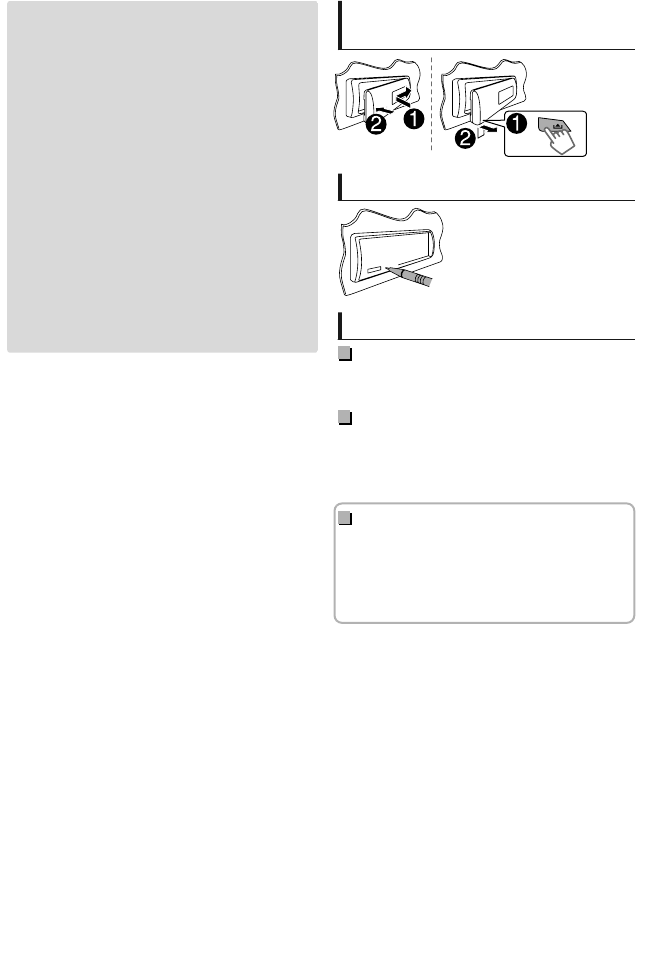
How to attach/detach the
faceplate
How to reset your unit
Your preset adjustments will
also be erased.
Maintenance
Cleaning the unit
Wipe off dirt on the faceplate with a dry silicon or
soft cloth.
Cleaning the connector
Detach the faceplate and clean the connector
with a cotton swab gently, taking care not to
damage the connector.
How to read this manual:
This manual mainly explains operations using
the buttons on the faceplate.
< > indicates the displays on the faceplate.
[XX] indicates the initial setting of a menu
item.
2|ޓENGLISH
2012/11/29ޓ16:42:23KD-X250BT_U_EN
Contents
Preparation ............................................................ 3
Canceling the display demonstration
Setting the clock
Basic operations ................................................... 4
Remote control .................................................... 5
Radio ........................................................................ 6
USB ............................................................................ 8
iPod/iPhone ........................................................... 9
External components ...................................... 10
Bluetooth姞 connection ................................... 10
Bluetooth mobile phone ................................ 13
Bluetooth audio player ................................... 17
Sound adjustments .......................................... 18
Menu operations ............................................... 19
Additional information ................................... 22
Troubleshooting ................................................ 24
Specifications ..................................................... 26
Installation/Connection .................................. 27
Preparation
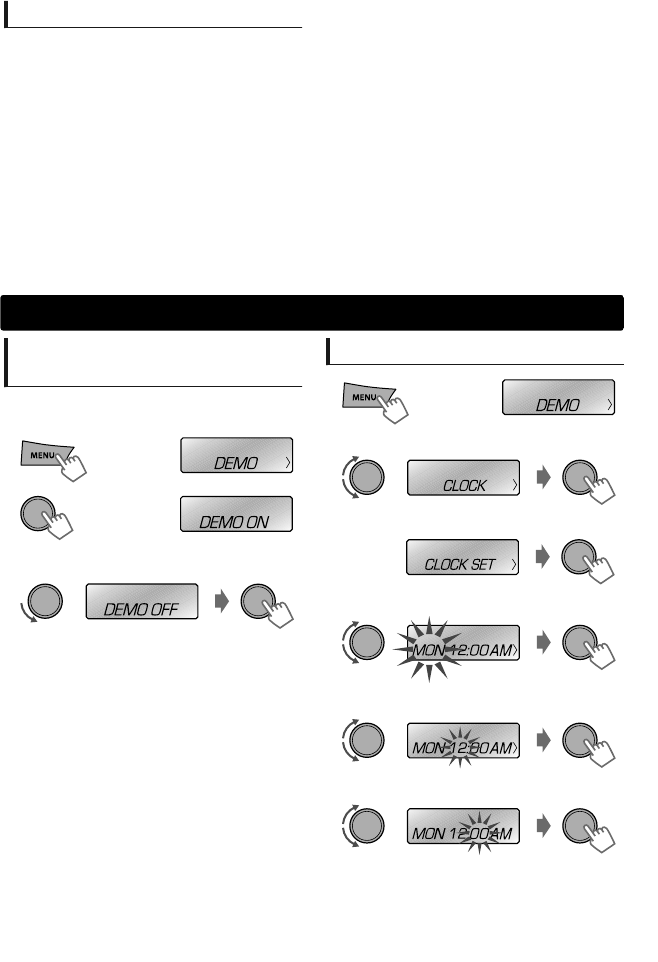
Canceling the display
demonstration
The display demonstration is always turned on
unless you cancel it.
(Hold)
1
(Initial setting)
2
3Select <DEMO OFF>.
4Press MENU to exit.
Setting the clock
(Hold)
1
2Select <CLOCK>.
3Select <CLOCK SET>.
4Select the day of week.
5Adjust the hour.
6Adjust the minute.
7Press MENU to exit.
ENGLISHޓ|3
2012/11/29ޓ16:42:23KD-X250BT_U_EN
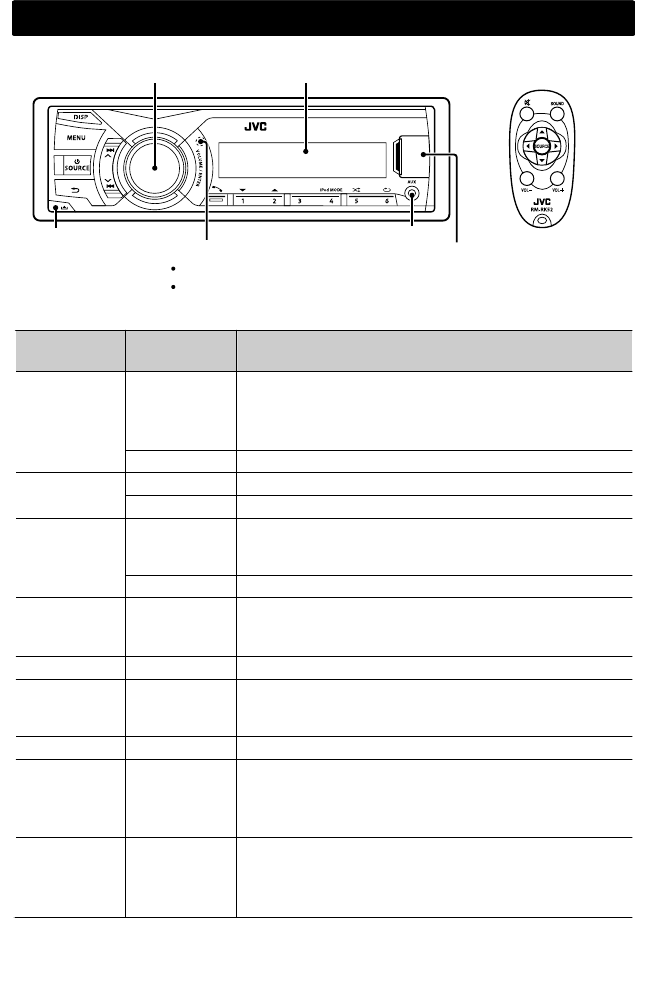
USB input terminal
DO NOT expose to bright sunlight.
Remote sensor
Display window
AUX input jack
Remote control
Aim the remote control directly at the sensor.
Detaches the faceplate
Volume knob
Faceplate
When you press or hold the following button(s)...
Faceplate Remote
control General function
SOURCE
—
Turns on.
Turns off. (Hold)
Press the SOURCE button on the faceplate and turn the
volume knob within 2 seconds to select the source.
SOURCE Press repeatedly to select the source.
Volume knob
(turn)
VOL - / + Adjusts the volume level.
— Selects items.
Volume knob
(press)
)
Mutes the sound or pauses playback.
Press the button again to cancel muting or resume
playback.
— Confirms selection.
Number
buttons
(1 - 6)
—
Selects the preset stations.
Stores the current station into the selected number button.
(Hold) (' page 6)
—SOUND Selects the preset sound mode.
—
Enters the hands-free menu (' page 14), or answers
incoming call when the unit rings.
Ends a call. (Hold)
— Returns to the previous menu.
/ /
Selects a preset station. (Only when using the remote
control.)
Selects MP3/WMA folder. (' page 8)
Selects group/folder. (' page 17)
/ /
Searches for a station automatically. (' page 6)
Searches for a station manually. (Hold)
Selects track. (' page 8, 9, 17)
Fast-forwards or reverses track. (Hold)
Basic operations
Basic operations
4|ޓENGLISH
2012/11/29ޓ16:42:23KD-X250BT_U_EN
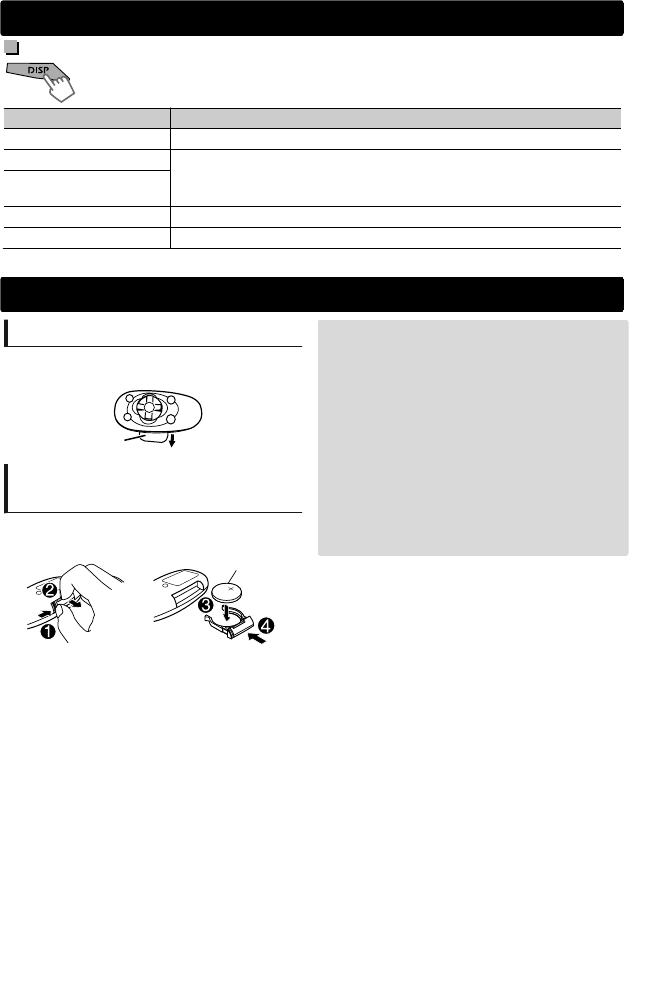
Display information
Changes the display information. (Press)
Scrolls the current display information. (Hold)
Source Display
FM/AM/SW1/SW2 Frequency ) Day/Clock
USB/BT AUDIO Album title/Artist - Track title - Track no./Playing time - Day/Clock -
(back to the beginning)
USB-IPOD (HEAD
MODE/IPOD MODE)
USB-IPOD (EXT MODE) EXT MODE) Day/Clock
AUX AUX) Day/Clock
Remote control
Preparing
When you use the remote control for the first
time, pull out the insulation sheet.
Insulation sheet
Replacing the lithium coin
battery
If the effectiveness of the remote control
decreases, replace the battery.
CR2025
Caution
Do not leave the remote control in hot places
such as on the dashboard.
The lithium battery is in danger of explosion if
replaced incorrectly. Replace it only with the
same or equivalent type.
The battery pack or batteries shall not be
exposed to excessive heat such as sunshine, fire
or the like.
Keep battery out of reach of children and in
original package until ready to use. Dispose of
used batteries promptly. If swallowed, contact a
physician immediately.
Basic operations
ENGLISHޓ|5
2012/11/29ޓ16:42:23KD-X250BT_U_EN
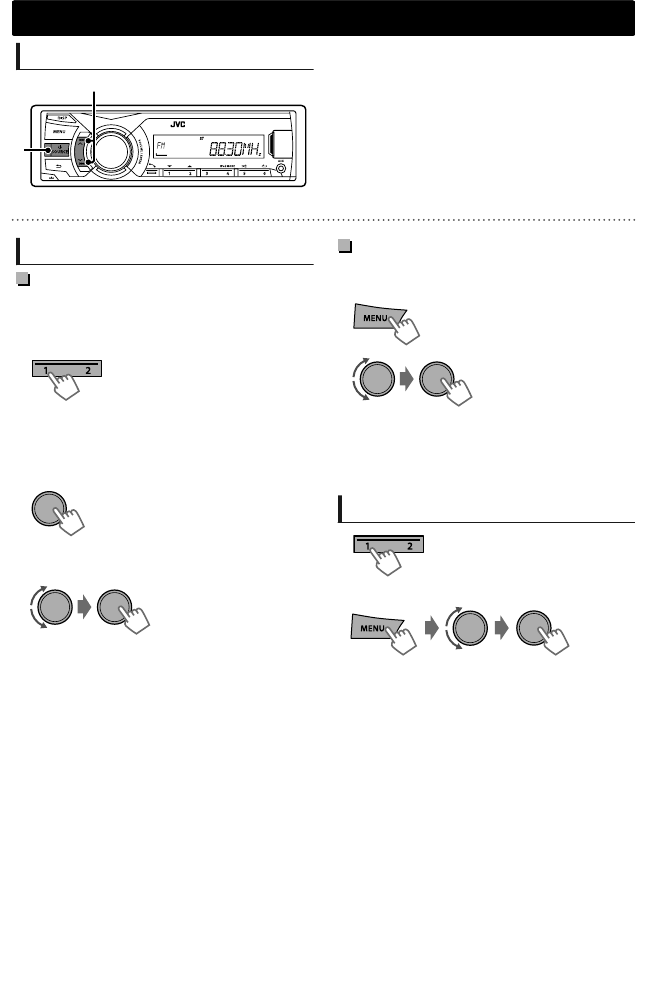
Searching for a station
A
B
Select <FM>, <AM>, <SW1> or <SW2>.
Auto search. (Press)
Manual search. (Hold)
“M” flashes, then press the button repeatedly.
“ST” lights up when receiving an FM stereo broadcast with sufficient signal strength.
Storing stations in memory
Manual presetting
You can preset up to 18 stations for FM, 6 stations
for AM, SW1 and SW2.
While listening to a station...
(Hold)
The preset number flashes and “MEMORY”
appears. The current station is stored to the
selected number button (1 - 6).
- - - - - - - - or - - - - - - - -
(Hold)
“PRESET MODE” flashes.
1
The preset number flashes and “MEMORY”
appears.
2Select preset number.
Auto presetting (FM only)
SSM (Strong-station Sequential Memory)
You can preset up to 18 stations for FM.
(Hold)
1
-<TUNER>
-<SSM>
-<SSM 01 – 06>
“SSM” flashes. When all the stations are stored,
“SSM” stops flashing.
2
To preset <SSM 07 – 12>/<SSM 13 – 18>,
repeat steps 1 and 2.
Selecting a preset station
- - - - - - - - or - - - - - - - -
Radio
Radio
6|ޓENGLISH
2012/11/29ޓ16:42:23KD-X250BT_U_EN
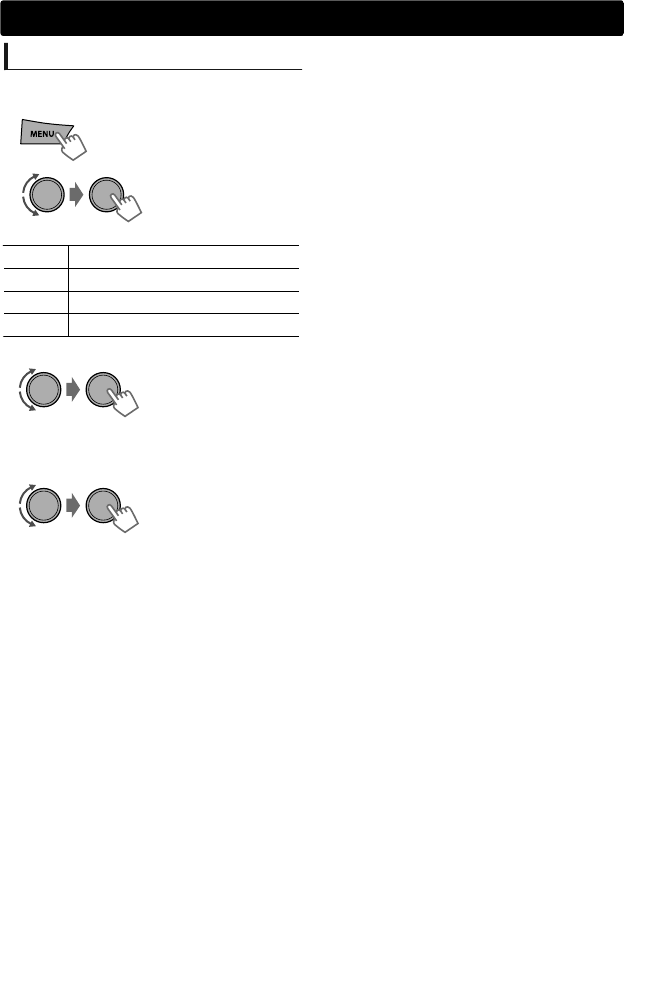
Setting the Radio Timer
You can tune in to a preset station at a specific
time regardless of the current source.
(Hold)
1
-<TUNER>
-<RADIO TIMER>
-<OFF>/<ONCE>/
<DAILY>/<WEEKLY>
[OFF] Cancels Radio Timer.
ONCE Activates once.
DAILY Activates daily.
WEEKLY Activates weekly.
2
-<FM>/<AM>/<SW1>/
<SW2>
-<01> ... <18> for FM/
<01> ... <06> for AM/
SW1/SW2
3Select the preset station.
4Set the activation day and time.
5Press MENU to exit.
lights up after the Radio Timer has been set.
Only one timer can be set. Setting a new timer
will override the previous setting.
The Radio Timer will not activate if the unit is
turned off or if <AM>/<SW1>/<SW2> is set to
<OFF> in <SRC SELECT> after selecting an AM/
SW1/SW2 station for the timer.
Radio
ENGLISHޓ|7
2012/11/29ޓ16:42:23KD-X250BT_U_EN
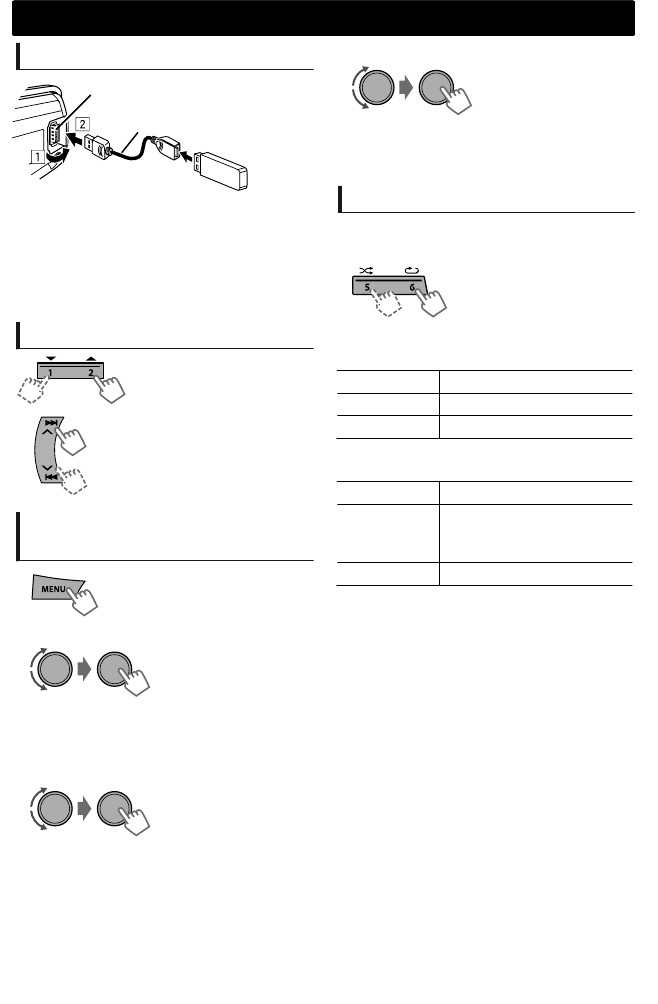
Playing a USB device
USB 2.0 cable*
(not supplied)
USB input terminal
The source changes to “USB” and playback starts.
* Do not leave the cable in the car when not in
use.
This unit can play MP3/WMA files stored in USB
mass storage device (such as a USB memory
and Digital Audio Player).
Selecting a folder/track
Selects folder.
Selects track. (Press)
Fast-forwards or reverses the
track. (Hold)
Selecting a track/folder from
the list
1
- - - - - - - - or - - - - - - - -
PLAYLISTS, ARTISTS, ALBUMS, SONGS, GENRES
Select the desired list. (For JVC Playlist
Creator (JPC) and JVC Music Control (JMC)
file) (' page 23)
2Select a folder. (For MP3/WMA)
If the USB device contains many folders or tracks,
you can fast search for the desired folder or track
by turning the volume knob quickly.
3Select a track.
Selecting the playback modes
You can select one of the following playback
modes at a time.
1
Press 6 for REPEAT.
Press 5 for RANDOM.
2Press the button repeatedly.
REPEAT
RPT OFF Cancels repeat playback.
TRACK RPT Repeats current track.
FOLDER RPT Repeats current folder.
“FOLDER RPT” is not applicable for JPC/JMC file.
RANDOM
RND OFF Cancels random playback.
FOLDER RND
Randomly plays all tracks of
current folder, then tracks of
next folders.
ALL RND Randomly plays all tracks.
USB
USB
8|ޓENGLISH
2012/11/29ޓ16:42:23KD-X250BT_U_EN
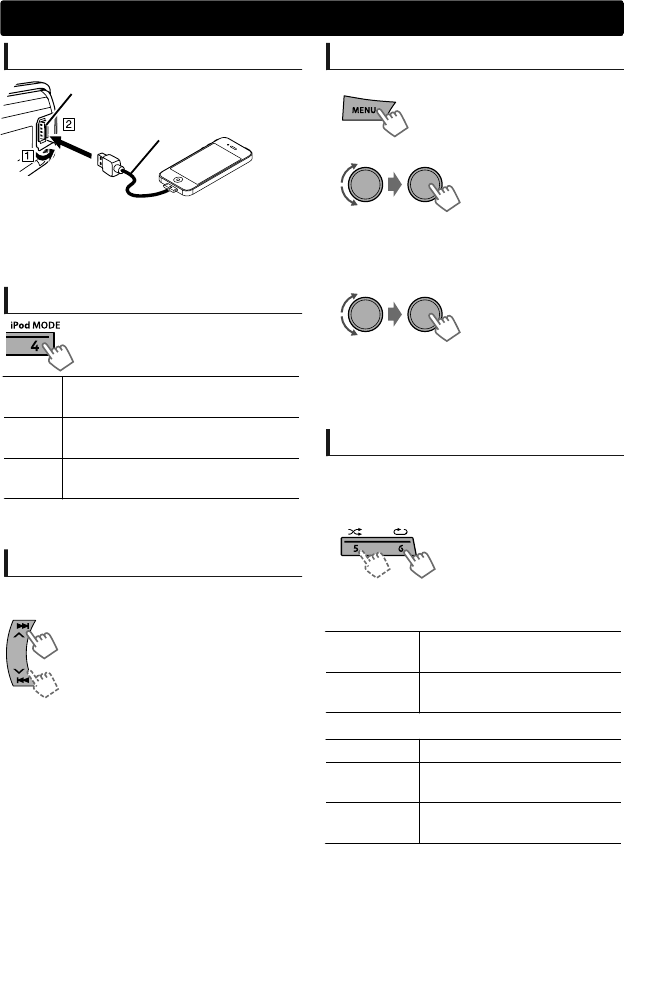
iPod/iPhone
Playing an iPod/iPhone
USB 2.0 cable* (accessory
of the iPod/iPhone)
USB input terminal
The source changes to “USB”-“USB-IPOD” and
playback starts.
* Do not leave the cable in the car when not in
use.
Selecting the control mode
-<HEAD MODE>/<IPOD MODE>/
<EXT MODE>
HEAD
MODE
Controls music playback only from
this unit.
IPOD
MODE
Controls music playback from both
the unit and iPod/iPhone.
EXT
MODE
Controls music playback only from
the iPod/iPhone.
You can also change the setting using <IPOD
SWITCH> in the menu. (' page 20)
Selecting a track
Applicable under <HEAD MODE>/<IPOD MODE>
only.
Selects track/chapter. (Press)
Fast-forwards or reverses the track.
(Hold)
Selecting a track from the list
Applicable under <HEAD MODE> only.
1
PLAYLISTS)ARTISTS)ALBUMS)SONGS)
PODCASTS)GENRES)COMPOSERS) (back to
the beginning)
2Select the desired list.
Repeat this step until the desired track is selected.
If the selected menu contains many tracks, you
can fast search for the desired track by turning
the volume knob quickly.
3Select the desired track.
Selecting the playback modes
Applicable under <HEAD MODE> only.
You can select one of the following playback
modes at a time.
1
Press 6 for REPEAT.
Press 5 for RANDOM.
.
2Press the button repeatedly.
REPEAT
ONE RPT Functions the same as “Repeat
One” of the iPod.
ALL RPT Functions the same as “Repeat
All” of the iPod.
RANDOM
RND OFF Cancels random playback.
SONG RND Functions the same as “Shuffle
Songs” of the iPod.
ALBUM RND Functions the same as “Shuffle
Albums” of the iPod.
“ALBUM RND” is not applicable for some iPod/
iPhone.
ENGLISHޓ|9
2012/11/29ޓ16:42:23KD-X250BT_U_EN
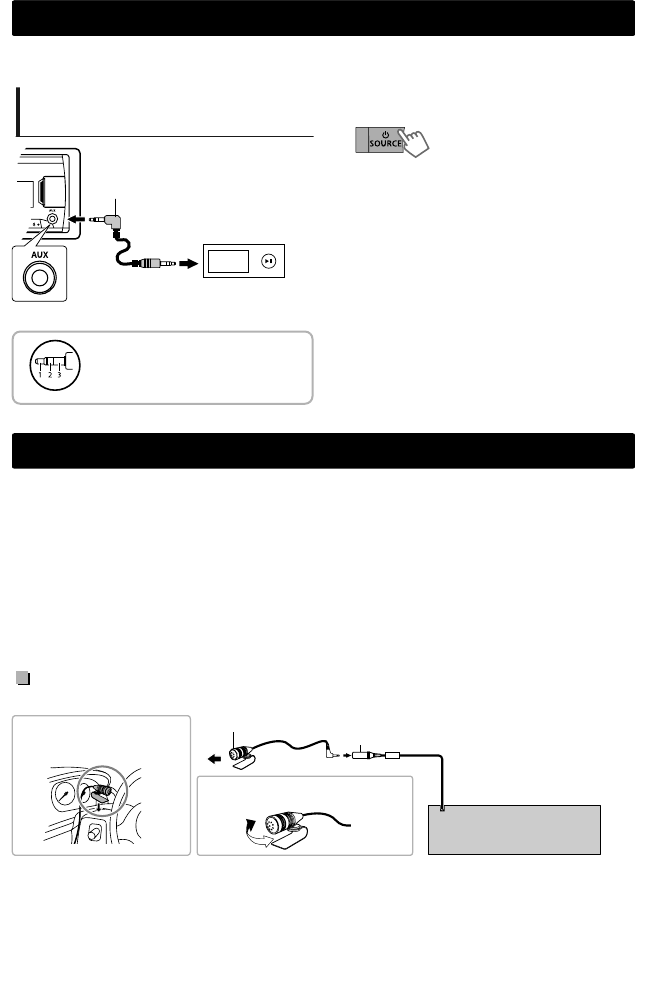
You can connect an external component to the AUX (auxiliary) input jack on the faceplate.
For details, refer also to the instructions supplied with the external components.
Playing an external component
from AUX
Portable audio
player, etc.
3.5 mm stereo mini plug
with “L” shaped connector
(not supplied)
Use a 3-terminal plug head
stereo mini plug for optimum
audio output.
.
1Connect to AUX terminal on the faceplate.
2Select <AUX>.
3Turn on the connected component and
start playing the source.
Bluetooth姞 connection
You can operate Bluetooth devices using this unit.
If you turn off the unit or detach the faceplate during a phone call conversation, the Bluetooth
connection is disconnected. Continue the conversation using your mobile phone.
This unit supports the following Bluetooth profiles
Hands-Free Profile (HFP 1.5)
Object Push Profile (OPP 1.1)
Phonebook Access Profile (PBAP 1.0)
Advanced Audio Distribution Profile (A2DP 1.2)
Audio/Video Remote Control Profile (AVRCP 1.3)
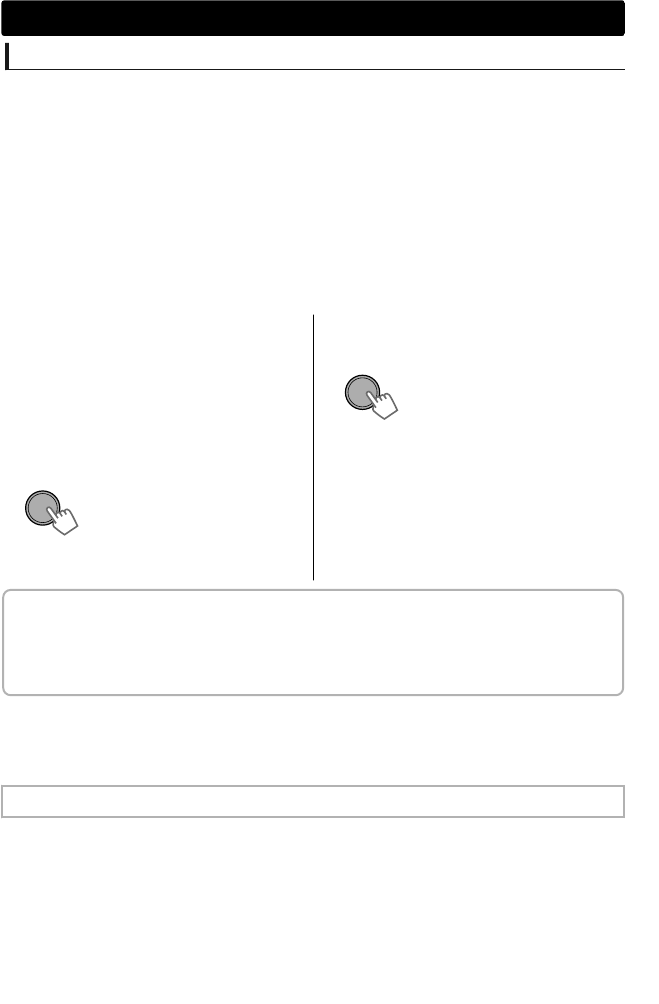
Connecting the microphone
MIC
Rear panel
Adjust the microphone angle.
MIC (Microphone input terminal)
Microphone (supplied)
Secure using cord clamps
(not supplied) if necessary.
External components
External components
10 |ޓENGLISH
2012/11/29ޓ16:42:23KD-X250BT_U_EN
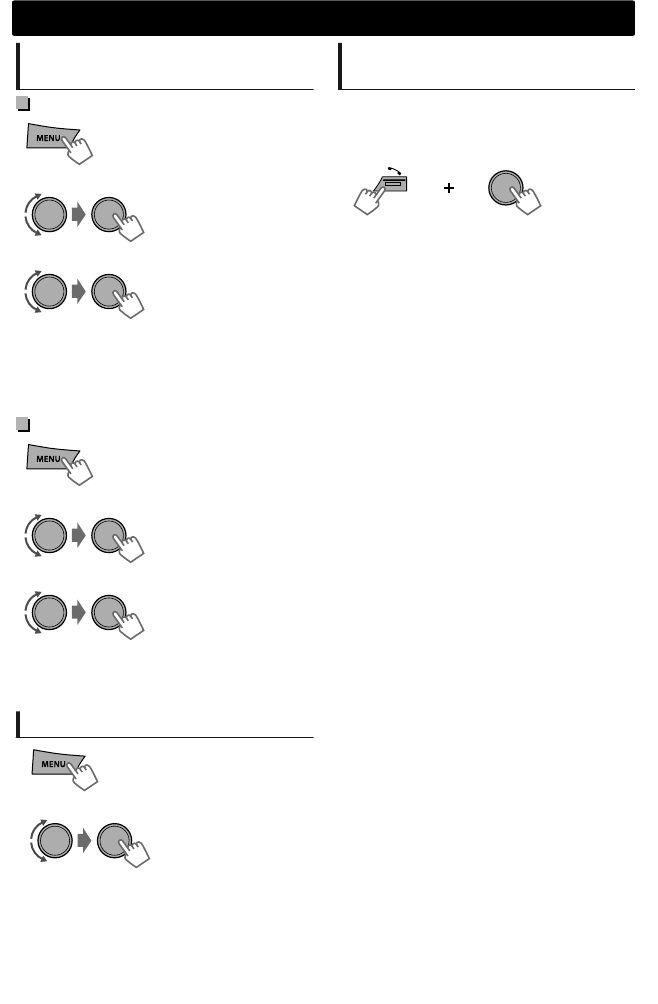
Pairing a Bluetooth device
When connecting a Bluetooth device to the unit for the first time, perform pairing between the unit and
the device.
Up to five Bluetooth devices can be registered in this unit.
A maximum of two Bluetooth phones and one Bluetooth audio device can be connected at any
time.
This unit supports Secure Simple Pairing (SSP).
1Search and select “JVC UNIT” on the Bluetooth device.
“BT PAIRING” flashes on the display.
For some Bluetooth devices, you may need to enter the Personal Identification Number (PIN) code
immediately after searching.
2Perform (A) or (B) depending on what scrolls on the display.
For some Bluetooth devices, pairing sequence may vary from the steps described below
(A) If “[Device Name]”#“XXXXXX”#
“VOL – YES”#“BACK – NO” scrolls on the
display,
“XXXXXX” is a 6-digit passkey randomly
generated during each pairing.
Operate the Bluetooth device to confirm
the passkey.
Ensure that the passkey which appears
on the unit and Bluetooth device is the
same.
Select “YES” to confirm the passkey.
(B) If “[Device Name]”#“VOL – YES”#
“BACK – NO” scrolls on the display,
(1) If “PAIRING”#“PIN 0000” scrolls on the
display, enter the PIN code “0000” into the
Bluetooth device.
You can change to a desired PIN code before
pairing. (' page 21)
Select “YES” to start the pairing.
(2) If only “PAIRING” appears, operate the
Bluetooth device to confirm pairing.
After pairing is successful, “PAIRING COMPLETED” appears on the display.
The unit will establish a connection with the newly paired Bluetooth device, “” lights up on the
display and you can now control the Bluetooth device through the unit.
“” will light up when a phone is connected.
“” will light up when an audio device is connected.
Once the connection is established, the device is registered to the unit and there is no need to
perform the pairing again unless you delete the registered device.
Some Bluetooth devices may not be able to connect to the unit after pairing. Connect the device to
the unit manually. Refer to the instruction manual of the Bluetooth device for more information.
See page 12 for Bluetooth compatibility check mode operation.
Bluetooth姞 connection
ENGLISHޓ|11
2012/11/29ޓ16:42:23KD-X250BT_U_EN
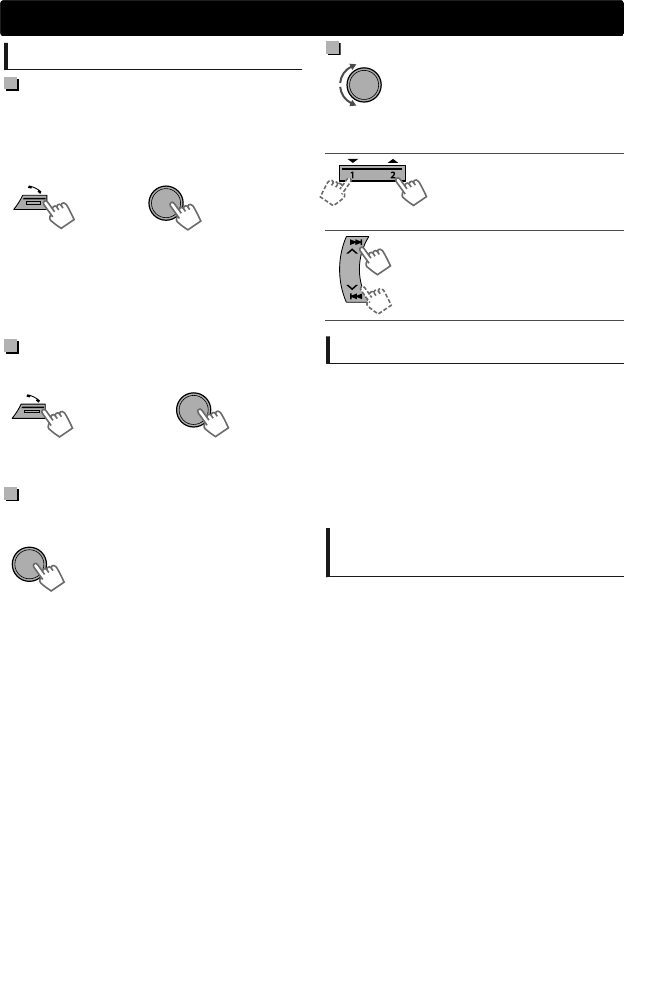
Connecting/Disconnecting a
registered device manually
To connect
1
(Hold)
-<BLUETOOTH>
-<PHONE>/<AUDIO>
-<CONNECT>
2Select <CONNECT>.
“CONNECTING”#“[Device Name]” scrolls on the
display when the unit is connecting to the device.
“CONNECTED”#“[Device Name]” scrolls on the
display when the device is connected.
3Select the desired device.
4Press MENU to exit.
To disconnect
1
(Hold)
-<BLUETOOTH>
-<PHONE>/<AUDIO>
-<DISCONNECT>
2Select <DISCONNECT>.
“DISCONNECT”#“[Device Name]” scrolls on the
display when the device is disconnected.
3Select the desired device.
4Press MENU to exit.
Deleting a registered device
(Hold)
1
-<BLUETOOTH>
-<DELETE PAIR>
- [Device name]
-<DELETE YES>
“DELETED” appears when the device is deleted.
2Select <DELETE YES>.
3Press MENU to exit.
Bluetooth compatibility check
mode
You can check the connectivity of the supported
profile between the Bluetooth device and the
unit.
(Hold) (Hold about
3 seconds)
“BLUETOOTH”)“CHECK MODE” appears.
“SEARCH NOW USING PHONE”#“PIN IS 0000”
scrolls on the display.
1Enter check mode.
2Search and select “JVC UNIT” on the
Bluetooth device within 3 minutes.
3Perform pairing (A), (B) or (C) depending
on what appears on the display.
(A) “PAIRING”#“XXXXXX” (6-digit passkey):
Ensure that the same passkey appears on the unit
and Bluetooth device, then operate the Bluetooth
device to confirm the passkey.
(B) “PAIRING”#“PIN IS 0000”:
Enter “0000” on the Bluetooth device.
(C) “PAIRING”:
Operate the Bluetooth device to confirm pairing.
After pairing is successful, “PAIRING OK”#
“[Device Name]” appears and Bluetooth
compatibility check starts.
If “CONNECT NOW USING PHONE” appears,
operate the Bluetooth device to allow
phonebook access to continue.
The connectivity result flashes on the display.
“H.FREE OK” *1 and/or “A. STREAM OK” *2 #
“[Device Name]”: Compatible
“CONNCT FAIL”)“TRY CONNECT”: Not
compatible
*1 : Compatible with Hands-Free Profile (HFP)
*2 : Compatible with Advanced Audio
Distribution Profile (A2DP)
After 30 seconds, “PAIRING DELETED” appears to
indicate that pairing has been deleted, and the
unit exits check mode.
To cancel check mode, turn off the unit by
pressing and holding SOURCE.
Delete the pairing on the Bluetooth device
before pairing with this unit. (' page 11)
Bluetooth姞 connection
12 |ޓENGLISH
2012/11/29ޓ16:42:23KD-X250BT_U_EN
Receiving a call
To receive a call
When there is an incoming call, the source
automatically changes to Bluetooth Phone mode.
“RECEIVING” appears on the display, followed
by the phone number or name.
or
You can also press ////SOURCE on the
remote control to answer a call.
When <AUTO ANSWER> is set to a selected
time, the unit answers incoming call
automatically. (' page 16)
To reject an incoming call or end a
call
(Hold)
or
(Hold)
You can also press and hold ////SOURCE
on the remote control to end a call.
To deactivate/activate hands-free
mode
During a phone conversation...
Operations may vary according to the
connected Bluetooth device.
Adjustments during a call
Phone volume(00 — 50)
[VOLUME 15]: Volume
adjustments made during a call
will not affect the other
sources.
Microphone level
(01— 03)[02]: As the number
increases, the microphone
becomes more sensitive.
Echo cancellation
(01 — 10)[04]: Set the echo
cancellation delay time for
clearer sound.
Text message notification
When a text message is received, the unit rings
and “RCV MESSAGE”#“[Device name]” appears.
<MSG NOTICE> must be set to <ON>.
(' page 16)
You cannot read, edit, or send a message
through the unit.
To clear the message, press any button.
This feature is only available on certain phones.
Switching between two
connected mobile phones
When two mobile phones are connected to the
unit, you can access to both hands-free menus.
Press to enter 1st phone’s hands-free menu.
Press twice to enter 2nd phone’s hands-free
menu.
Press to return to 1st phone’s hands-free
menu.
Bluetooth mobile phone
Bluetooth mobile phone
ENGLISHޓ|13
2012/11/29ޓ16:42:23KD-X250BT_U_EN
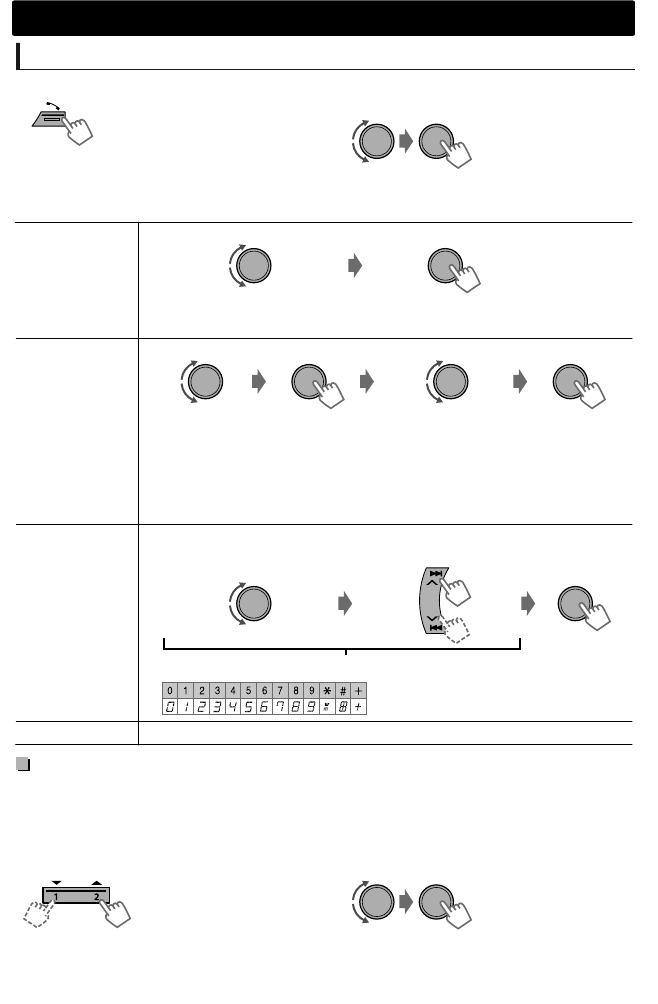
Making a call from the hands-free menu
1Enter the hands-free menu.
Repeat this step until the
desired item is selected.
2Select a calling method (see following
table).
To return to the previous hierarchy, press .
To cancel, press .
RECENT CALL
Call
Select the name/phone number
“>” indicates call received, “<” indicates call made, “M” indicates missed call.
“NO HISTORY” appears if there is no recorded call history.
PHONEBOOK
CallSelect phone numberSelect name Confirm
If the phonebook contains many numbers, you can fast search for the desired
number by turning the volume knob quickly, or use Quick Search (see below).
“NO DATA” appears if no entries are found in the Bluetooth device’s
phonebook.
“SEND P.BOOK MANUALLY” appears if <P.BOOK SEL> is set to
<PB IN UNIT> or the phone does not support PBAP. (' page 16)
DIAL NUMBER Enter the phone number to dial.
CallMove the entry positionSelect number/character
Repeat these steps until you finish entering the phone number.
VOICE Activates Voice Recognition of the phone. (' page 15)
Quick Search
If you have many contacts, you can search through them quickly according to the first character (A to Z,
0 to 9 and OTHERS).
“OTHERS” appears if the first character is not A to Z or 0 to 9.
While in the <PHONEBOOK> setting...
1Select the desired character. 2Select your desired contact.
Bluetooth mobile phone
14 |ޓENGLISH
2012/11/29ޓ16:42:23KD-X250BT_U_EN
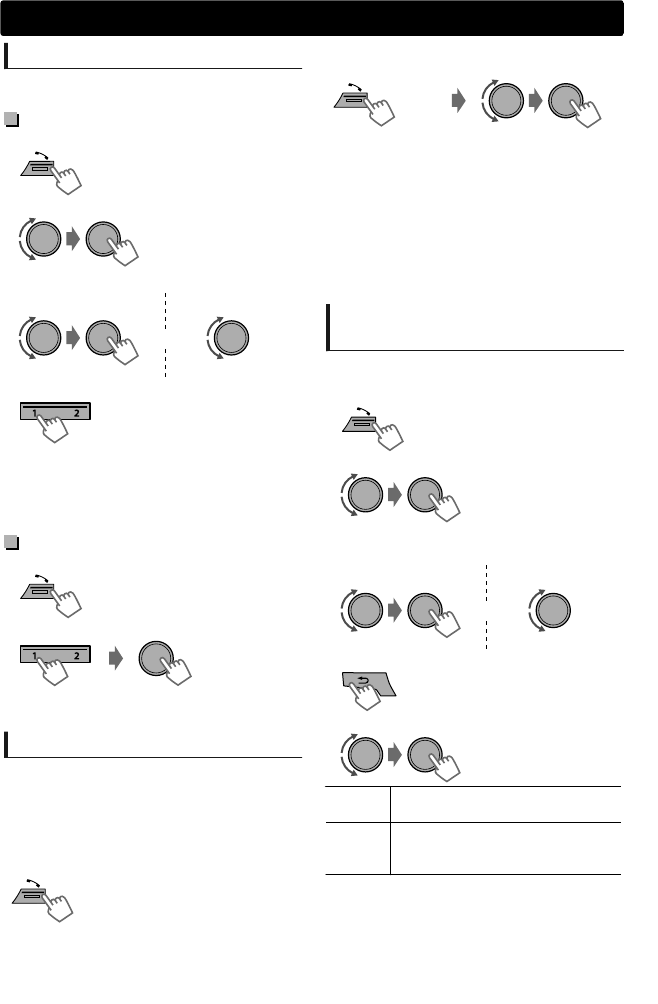
Making a call from memory
You can store up to 6 contacts in the memory of
this unit for speed dialing.
To store contacts in memory
1Enter the hands-free menu.
-<RECENT CALL>/
<PHONEBOOK>/
<DIAL NUMBER>
2Select a call method.
3Select a contact (name/phone number).
Phone Number
or
Name
(Hold)
“MEMORY PX” flashes. The contact is stored to the
selected number button (1 - 6).
To erase a contact from preset memory, select
<DIAL NUMBER> in step 2 and store a blank
number.
4Store in memory.
To make a call from memory
1Enter the hands-free menu.
“NO PRESET” appears if there are no contacts
stored in memory.
2Select and call the contact.
Using voice recognition
You can use the voice recognition features of the
connected phone through this unit.
“NOT SUPPORT” appears if the connected
phone does not support this feature.
If only one phone is connected,
(Hold)
1Enter voice recognition mode.
If two phones are connected,
(Hold)
Select the desired phone
Enter “phone list”
2When “VOICE CTRL”#“[Device Name]”
scrolls on the display, speak the name of
the contact you want to call or the voice
command to control the phone functions.
Supported voice recognition features vary for
each phone. Please refer to the instruction
manual of the connected phone for details.
This unit also supports the intelligent personal
assistant function of iPhone.
Deleting a contact (name/
phone number)
Only when <P.BOOK SEL> is set to <PB IN UNIT>.
(' page 16)
1Enter the hands-free menu.
-<RECENT CALL>/
<PHONEBOOK>
2Select a call method.
3Select the contact (name/phone number)
to be deleted.
Phone Number
or
Name
(Hold)
4Enter “Delete Entries” menu.
DELETE Selected name/phone number
from step 3 is deleted.
DELETE
ALL
All names/phone numbers from
selected menu in step 2 are
deleted.
5Select <DELETE> or <DELETE ALL>.
Bluetooth mobile phone
ENGLISHޓ|15
2012/11/29ޓ16:42:23KD-X250BT_U_EN
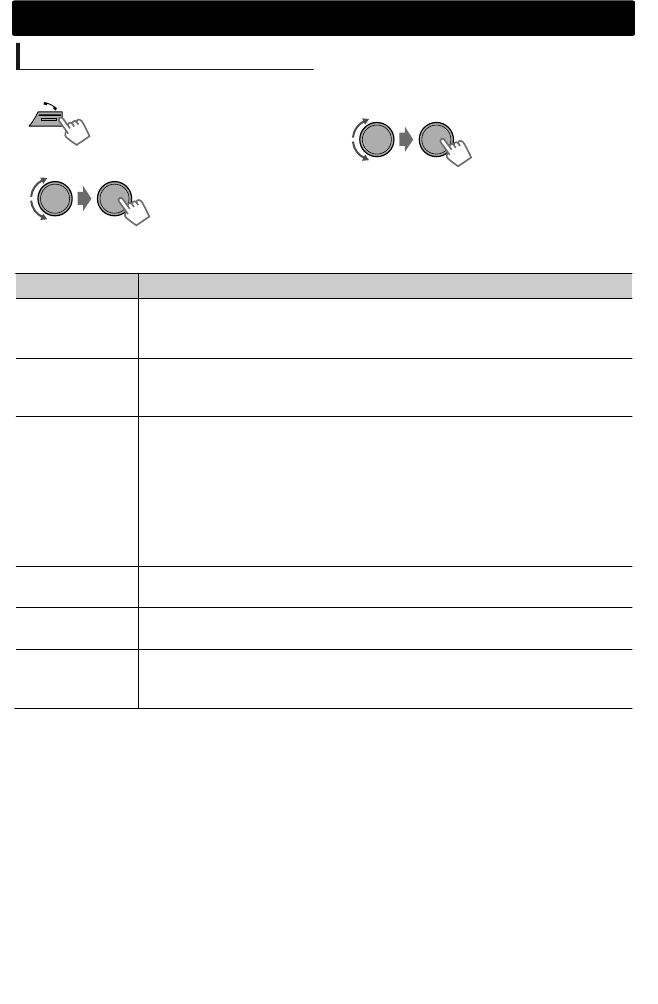
Using the SETTINGS menu
1Enter the hands-free menu.
2Select <SETTINGS>.
To return to the previous menu, press .
To exit from the menu, press .
3Repeat this step to perform the necessary
settings.
The following settings are applicable to the paired device. If another device is paired, perform the
settings again.
Menu item Selectable setting (Initial: [XX])
P.BOOK SEL * [PB IN PHONE]: The unit browses the phonebook of the connected phone.
PB IN UNIT: The unit browses the phonebook registered in the unit. (You can
copy the phonebook memory using <P.BOOK WAIT> (' page 21).)
AUTO ANSWER 03 SEC/05 SEC/10 SEC: The unit answers incoming calls automatically in
3/5/10 seconds.
[OFF]: Cancels.
RING TONE [IN UNIT]: The unit rings to notify you when a call/text message comes in.
–CALL: Select your preferred ring tone (TONE 1 — 5) for incoming calls.
–MESSAGE: Select your preferred ring tone (TONE 1 — 5) for incoming text
messages.
Default ring tone is different according to the paired device.
IN PHONE: The unit uses the connected phones’ ring tone to notify you when a
call/text message comes in. (The connected phone will ring if it does not
support this feature.)
ECHO CANCEL (01 — 10)[04]: Adjust the echo cancellation delay time until the least echo is
being heard during a phone conversation.
MIC LEVEL (01 — 03)[02]: The sensitivity of the microphone increases as the number is
increased.
MSG NOTICE [ON]: The unit rings and “RCV MESSAGE”#“[Device Name]” appears to notify
you of an incoming text message.
OFF: Cancels.
* Selectable only when the connected phone supports PBAP.
Bluetooth mobile phone
16 |ޓENGLISH
2012/11/29ޓ16:42:23KD-X250BT_U_EN
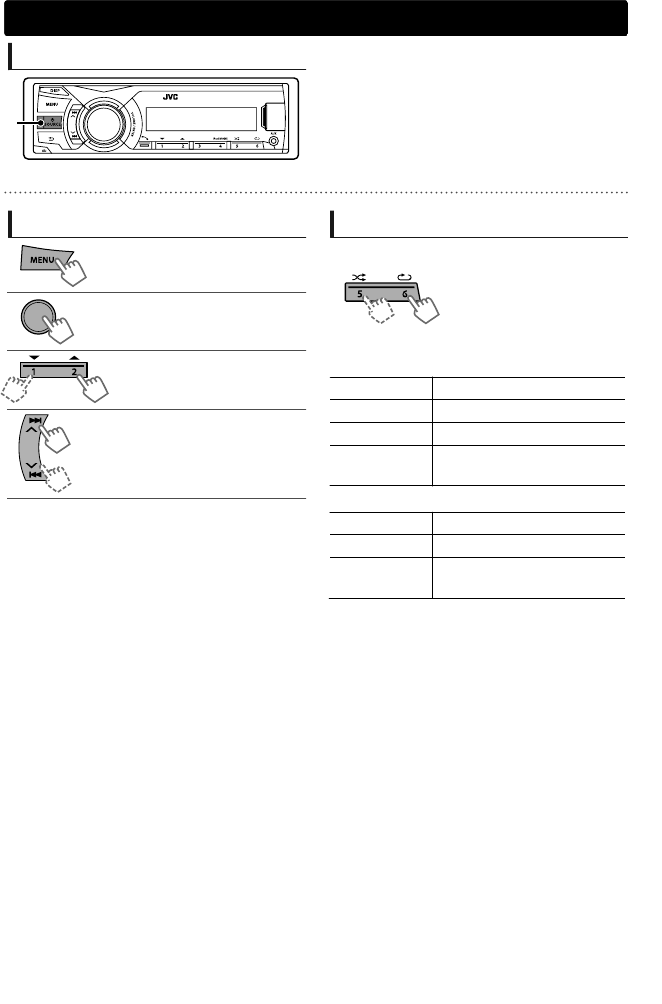
Playing a Bluetooth audio player
A
Select <BT AUDIO>.
Operate the Bluetooth audio player to start
playback.
Operations and display indications may differ according to their availability on the connected device.
Basic operations
Pauses or resumes playback.
Mutes the sound.
Selects group/folder.
Reverse skips or forward skips.
(Press)
Fast-forwards or reverses the
track. (Hold)
Selecting the playback modes
For Bluetooth devices that support AVRCP 1.3.
1
Press 6 for REPEAT.
Press 5 for RANDOM.
2Press the button repeatedly.
REPEAT
RPT OFF Cancels repeat playback.
TRACK RPT Repeats current track.
ALL RPT Repeats all tracks.
GROUP RPT Repeats all tracks of the
current group.
RANDOM
RND OFF Cancels random playback.
ALL RND
Randomly plays all tracks.
GROUP RND Randomly plays all tracks of
the current group.
Bluetooth audio player
Bluetooth audio player
ENGLISHޓ|17
2012/11/29ޓ16:42:23KD-X250BT_U_EN
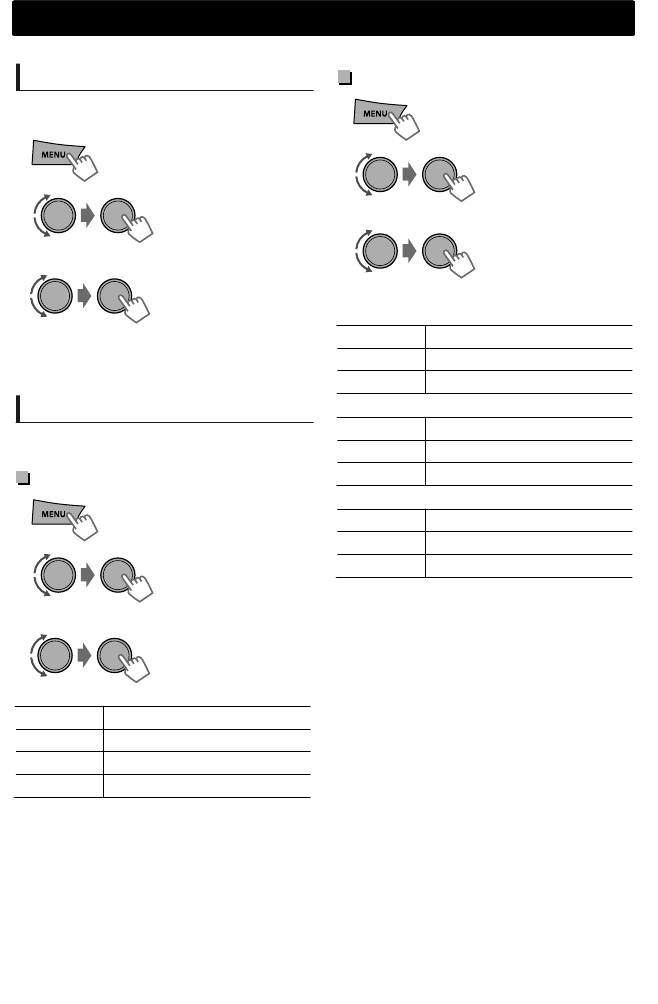
This unit memorizes sound settings adjusted for each individual source.
Selecting the preset sound
You can select a preset sound mode, for each
individual source, suitable for the music genre.
(Hold)
1
-<EQ SETTING>
-<EQ PRESET>
2
3Select the desired sound mode.
FLAT-NATURAL-DYNAMIC-
VOCAL BOOST-BASS BOOST-USER- (back to
the beginning)
Storing your own adjustments
While listening, you can adjust and store the tone
level for each individual source.
Easy Equalizer
(Hold)
1
-<EQ SETTING>
-<EASY EQ>
2
(Initial: [XX])
SUB.W * -08 to +08 [00]
BASS LVL -06 to +06 [00]
MID LVL -06 to +06 [00]
TRE LVL -06 to +06 [00]
The adjustments are stored and <USER> is
activated.
3Adjust the level.
* Available only when <L/O MODE> is set to
<SUB.W> and <SUB.W> is set to <ON>.
(' page 19)
Pro Equalizer
(Hold)
1
-<EQ SETTING>
-<PRO EQ>
-<BASS>/<MIDDLE>/
<TREBLE>
2
Adjust the sound elements of the selected tone.
BASS (Initial: [XX])
Frequency 60/[80]/100/200 Hz
Level LVL -06 to +06 [00]
Q[Q1.0]/Q1.25/Q1.5/Q2.0
MIDDLE
Frequency 0.5/[1.0]/1.5/2.5 kHz
Level LVL -06 to +06 [00]
Q Q0.75/Q1.0/[Q1.25]
TREBLE
Frequency [10.0]/12.5/15.0/17.5 kHz
Level LVL -06 to +06 [00]
Q[Q FIX]
3
4Repeat steps 2 and 3 to adjust other tones.
The adjustments are stored and <USER> is
activated.
5Press MENU to exit.
Sound adjustments
Sound adjustments
18 |ޓENGLISH
2012/11/29ޓ16:42:23KD-X250BT_U_EN
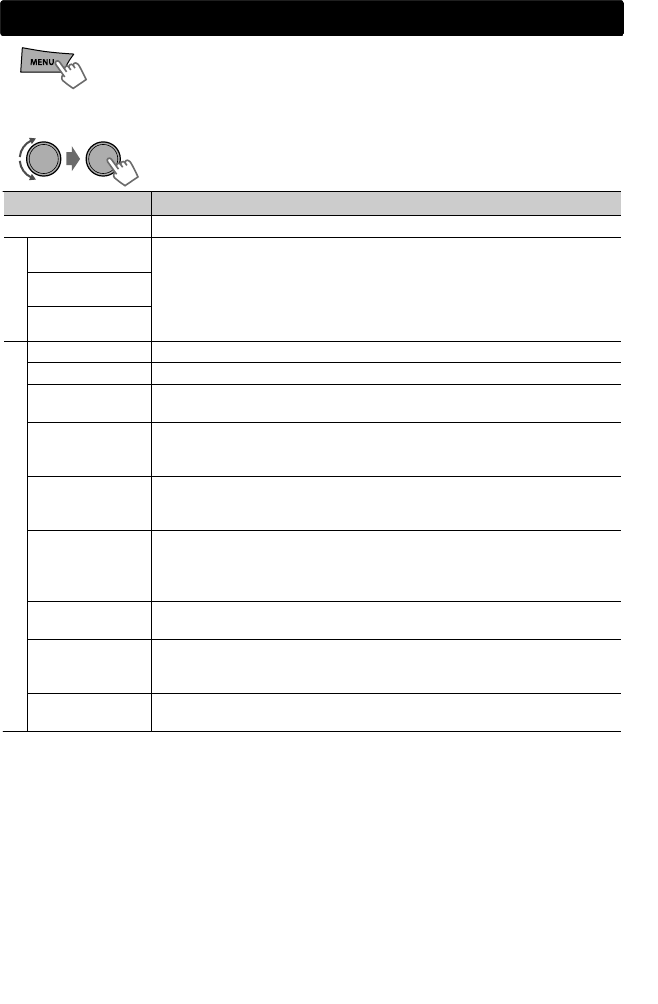
(Hold)
If no operation is done for about 60 seconds, the
operation will be canceled.
1
2
3Repeat step 2 if necessary.
To return to the previous menu, press .
To exit from the menu, press DISP or MENU.
Menu item Selectable setting (Initial: [XX])
DEMO For settings, ' page 3.
EQ SETTING
EQ PRESET For settings, ' page 18.
EASY EQ
PRO EQ
AUDIO
FADER *1*2 R06 — F06[00]: Adjusts the front and rear speaker output balance.
BALANCE *2 L06 — R06[00]: Adjusts the left and right speaker output balance.
BASS BOOST +01/+02: Select your preferred bass boost level.
[OFF]: Cancels.
LOUD
(Loudness)
[LOW]/HIGH: Boosts low or high frequencies to produce a well-balanced
sound at a low volume level.
OFF: Cancels.
VOL ADJUST
(Volume adjust)
-05 — +05[00]: Presets the volume adjustment level of each source,
compared to the FM volume level. Before adjustment, select the source you
want to adjust. (“VOL ADJ FIX” appears if “FM” is selected.)
L/O MODE
(Line output
mode)
Select if the REAR/SW terminals are used for connecting the speakers or
subwoofer (through an external amplifier).
SUB.W: Subwoofer
[REAR]: Rear speakers
SUB. W *3
(Subwoofer)
OFF: Cancels.
[ON]: Turns on the subwoofer output.
SUB.W LPF *4
(Subwoofer low-
pass filter)
[THROUGH]: All signals are sent to the subwoofer.
LOW 55Hz/MID 85Hz/HIGH 120Hz: Audio signals with frequencies lower
than 55 Hz/85 Hz/120 Hz are sent to the subwoofer.
SUB.W LEVEL *4
(Subwoofer level)
-08 — +08[00]: Adjusts the subwoofer output level.
*1 If you are using a two-speaker system, set the fader level to “00”.
*2 This adjustment will not affect the subwoofer output.
*3 Displayed only when <L/O MODE> is set to <SUB.W>.
*4 Displayed only when <SUB.W> is set to <ON>.
Menu operations
Menu operations
ENGLISHޓ|19
2012/11/29ޓ16:42:23KD-X250BT_U_EN
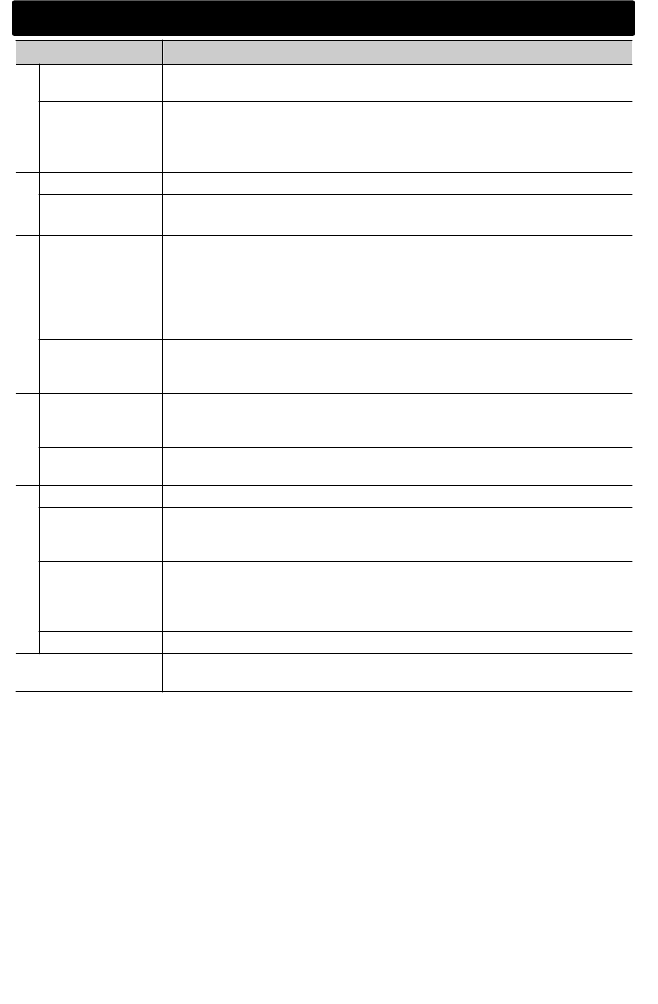
Menu item Selectable setting (Initial: [XX])
AUDIO
BEEP
(Keytouch tone)
[ON]/OFF: Activates or deactivates the keypress tone.
AMP GAIN
(Amplifier gain)
LOW POWER: Limits the maximum volume level to 30. (Select if the
maximum input power of each speaker is less than 50 W to prevent
damaging the speakers.)
[HIGH POWER]: The maximum volume level is 50.
CLOCK
CLOCK SET For settings, ' page 3.
CLOCK DISP
(Clock display)
ON/[OFF]: Activates or deactivates clock display when the unit is turned
off.
DIMMER
DIMMER SET Selects the display and button illumination adjusted in the <BRIGHTNESS>
setting.
[AUTO]: Changes between the Day and Night adjustments when you turn
off/on the car headlights. *5
ON: Selects the Night adjustments.
OFF: Selects the Day adjustments.
BRIGHTNESS DAY[31]/NIGHT[15]: Brightness settings for the display and button
illumination for day and night.
BUTTON ZONE/DISP ZONE: Sets the brightness levels 00 — 31.
DISPLAY
SCROLL *6 [ONCE]: Scrolls the display information once.
AUTO: Repeats scrolling (at 5-second intervals).
OFF: Cancels.
TAG DISPLAY [ON]: Shows the TAG information while playing MP3/WMA tracks.
OFF: Cancels.
TUNER
SSM For settings, ' page 6. (Displayed only when the source is “FM”.)
MONO
(Monaural mode)
Displayed only when the source is “FM”.
[OFF]: Enables stereo FM reception.
ON: Improves the FM reception but stereo effect will be lost.
IF BAND
(Intermediate
frequency band)
[AUTO]: Increases the tuner selectivity to reduce interference noises
between adjacent stations. (Stereo effect may be lost.)
WIDE: Subject to interference noises from adjacent stations, but sound
quality will not be degraded and the stereo effect will remain.
RADIO TIMER For settings, ' page 7.
IPOD SWITCH
(iPod/iPhone control)
[HEAD MODE]/IPOD MODE/EXT MODE:
For settings, ' page 9. (Displayed only when the source is “USB-IPOD”.)
*5 The illumination control wire connection is required. (' page 29)
*6 Some characters or symbols will not be shown correctly (or will be blanked) on the display.
Menu operations
20 |ޓENGLISH
2012/11/29ޓ16:42:23KD-X250BT_U_EN
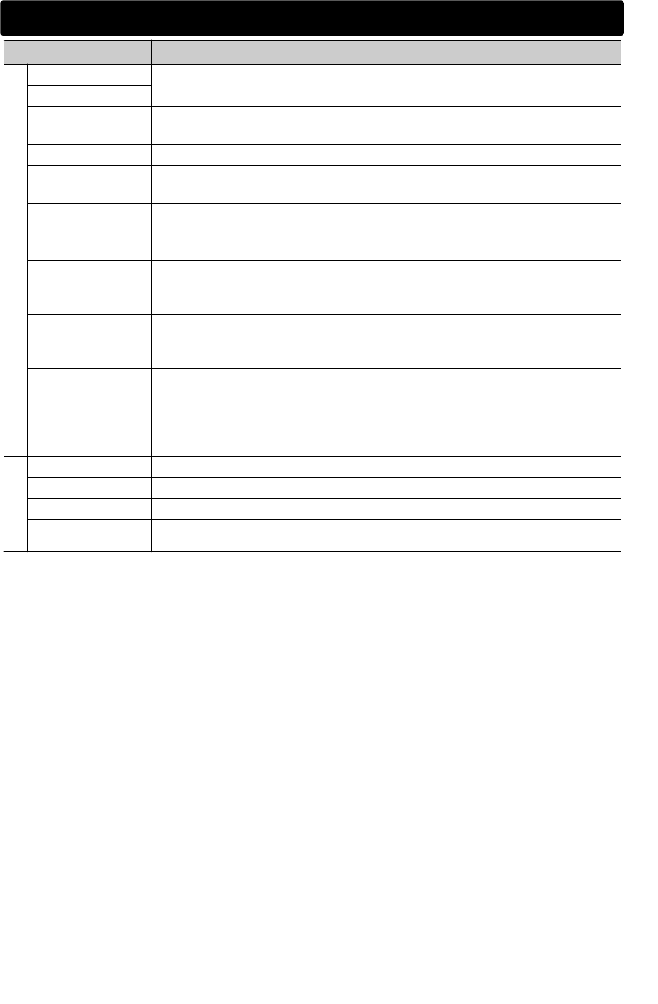
Menu item Selectable setting (Initial: [XX])
BLUETOOTH
PHONE *7 CONNECT/DISCONNECT: Connects or disconnects the Bluetooth phone/
audio device. (' page 12)
AUDIO
APPLICATION CONNECT/DISCONNECT: Connects or disconnects the JVC Smart Music
Control *8 in the smart phone.
DELETE PAIR For settings, ' page 12.
P. BOOK WAIT Copies up to 400 numbers from the phonebook memory of a connected
phone to the unit via OPP.
SET PINCODE Changes the PIN code (1 to 6-digits). (Default PIN code: 0000)
Turn the volume knob to select a number, press / to move to the entry
position. After entering the PIN code, press the volume knob to confirm.
AUTO CNNCT [ON]: Establishes connection automatically with the Bluetooth device when
the unit is turned on.
OFF: Cancels.
INITIALIZE YES: Initializes all the Bluetooth settings (including stored pairing,
phonebook, and etc.).
[NO]: Cancels.
INFORMATION PH CNNT DEV/AU CNNT DEV/APP CNT DEV *9: Displays connected
phone/audio/application device name.
MY BT NAME: Displays the unit name (JVC UNIT).
MY ADDRESS: Displays the address of this unit.
BT VERSION: Displays the Bluetooth version of this unit.
SRC SELECT
AM *10 [ON]/OFF: Enables or disables “AM” in source selection.
SW1 *10 [ON]/OFF: Enables or disables “SW1” in source selection.
SW2 *10 [ON]/OFF: Enables or disables “SW2” in source selection.
AUX *10 [ON]/OFF: Enables or disables “AUX” in source selection.
*7 <CONNECT> will not be displayed if two Bluetooth phones are connected at the same time.
*8 JVC Smart Music Control is designed to view JVC car receiver status and perform simple
control operations on Android smart phones.
For JVC Smart Music Control operations, visit JVC website:
<http://www3.jvckenwood.com/english/car/index.html> (English website only).
*9 Displayed only when a Bluetooth phone/audio player/application is connected.
*10 Displayed only when the unit is in any source other than the corresponding source “AM/SW1/
SW2/AUX”.
Menu operations
ENGLISHޓ|21
2012/11/29ޓ16:42:23KD-X250BT_U_EN

About audio files
Playable files
File extensions: MP3(.mp3), WMA(.wma)
Bit rate:
MP3: 8 kbps - 320 kbps
WMA: 32 kbps - 192 kbps
Sampling frequency:
MP3: 48 kHz, 44.1 kHz, 32 kHz, 24 kHz,
22.05kHz, 16 kHz, 12 kHz, 11.025 kHz, 8 kHz
WMA: 48 kHz, 44.1 kHz, 32 kHz
Variable bit rate (VBR) files. (The elapsed time
for VBR files will not be displayed correctly.)
Others
This unit can show WMA Tag and ID3 Tag
Version 1.0/1.1/2.3/2.4 (for MP3).
The search function works but search speed is
not constant.
About USB device
When connecting a USB cable, use the USB 2.0
cable.
You cannot connect a computer or portable
HDD to the USB input terminal of the unit.
Connect only one USB device to the unit at a
time. Do not use a USB hub.
USB devices equipped with special functions
such as data security functions cannot be used
with the unit.
Do not use a USB device with 2 or more
partitions.
This unit cannot recognize a USB device whose
rating is other than 5 V and exceeds 1 A.
This unit may not recognize a memory card
inserted into the USB card reader.
This unit may not play back files in a USB
device properly when using a USB extension
cord.
Depending on the shape of the USB devices
and connection ports, some USB devices may
not be attached properly or the connection
might be loose.
Operation and power supply may not work as
intended for some USB devices.
The maximum number of characters for:
– Folder names: 63 characters
– File names: 63 characters
– MP3 Tag: 60 characters
– WMA Tag: 60 characters
This unit can recognize a total of 65 025 files,
255 folders (255 files per folder including folder
without unsupported files), and of 8
hierarchies.
Cautions
Do not pull out and attach the USB device
repeatedly while “READING” is shown on the
display.
Electrostatic shock at connecting a USB device
may cause abnormal playback of the device. In
this case, disconnect the USB device then reset
this unit and the USB device.
Do not leave a USB device in the car, expose to
direct sunlight, or high temperature. Failure to
do so may result in deformation or cause
damages to the device.
Additional information
Additional information
22 |ޓENGLISH
2012/11/29ޓ16:42:23KD-X250BT_U_EN

About iPod/iPhone
iPod/iPhone that can be connected to this unit:
- iPod touch (4th generation)
- iPod touch (3rd generation)
- iPod touch (2nd generation)
- iPod touch (1st generation)
- iPod classic
- iPod with video (5th generation)*
- iPod nano (6th generation)
- iPod nano (5th generation)
- iPod nano (4th generation)
- iPod nano (3rd generation)
- iPod nano (2nd generation)
- iPod nano (1st generation)*
- iPhone 4S
- iPhone 4
- iPhone 3GS
- iPhone 3G
- iPhone
*<IPOD MODE>/<EXT MODE> are not
applicable.
It is not possible to browse video files on the
“Videos” menu in <HEAD MODE>.
The song order displayed on the selection
menu of this unit may differ from that of the
iPod.
When operating an iPod/iPhone, some
operations may not be performed correctly or
as intended. In this case, visit the following JVC
website:
<http://www3.jvckenwood.com/english/car/
index.html> (English website only).
About JVC Playlist Creator and
JVC Music Control
This unit supports the PC application JVC
Playlist Creator and Android™ application JVC
Music Control.
When you play audio file with song data added
using the JVC Playlist Creator or JVC Music
Control, you can search for audio file by
Genres, Artists, Albums, Playlists, and Songs.
JVC Playlist Creator and JVC Music Control are
available from the following website:
<http://www3.jvckenwood.com/english/car/
index.html> (English website only).
About Bluetooth
Depending on the Bluetooth version of the
device, some Bluetooth devices may not be
able to connect to this unit.
This unit may not work with some Bluetooth
devices.
Signal conditions vary, depending on the
surroundings.
For more information about Bluetooth, visit the
following JVC website:
<http://www3.jvckenwood.com/english/car/
index.html> (English website only)
Additional information
ENGLISHޓ|23
2012/11/29ޓ16:42:23KD-X250BT_U_EN
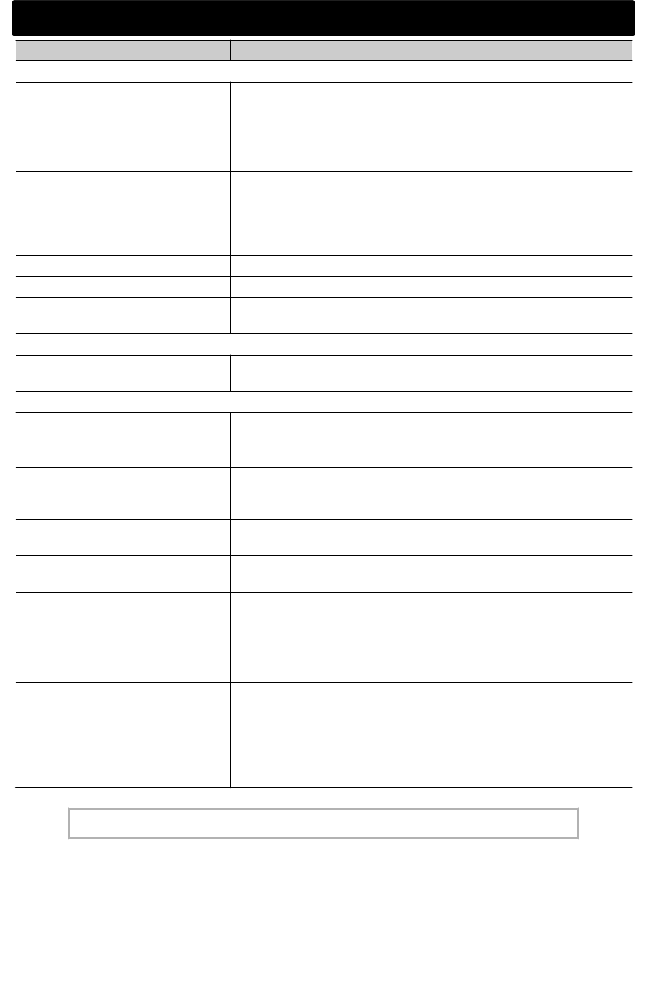
Symptom Remedy/Cause
4General
No sound, sound interrupted or
static noise.
Check the cords, antenna and cable connections.
Check the condition of the connected device and recorded
tracks.
Ensure to use the recommended stereo mini plug when
connecting to an external component. (' page 10)
“MISWIRING CHK WIRING THEN
RESET UNIT”/“WARNING CHK
WIRING THEN RESET UNIT”
appears on the display and no
operations can be done.
Ensure the terminals of the speaker wires are properly insulated
with tape before resetting the unit. (' page 2)
If the message does not disappear, consult your JVC car audio
dealer or kits supplying company.
The unit does not work at all. Reset the unit. (' page 2)
Source cannot be selected. Check the <SRC SELECT> setting. (' page 21)
The correct characters are not
displayed (e.g. album name).
This unit can only display letters (upper case), numbers, and a
limited number of symbols.
4FM/AM
SSM automatic presetting does
not work.
Store stations manually.
4USB/iPod/iPhone
“READING” keeps flashing on the
display.
A longer readout time is required. Do not use too many
hierarchical levels and folders.
Reattach the USB device.
Tracks/folders are not played
back in the order you have
intended.
The playback order is determined by the file name.
“NO FILE” appears on the display. Check whether the selected folder, the connected USB device,
or the iPod/iPhone contains a playable file.
“NOT SUPPORT” appears on the
display and track skips.
Check whether the track is a playable file format.
“CANNOT PLAY” flashes on
the display.
The unit cannot detect the
connected device.
Check whether the connected device is compatible with this
unit. (USB: ' page 26) (iPod/iPhone: ' page 23)
Ensure that the device contains files in the supported
formats. (' page 22)
Reattach the device.
The iPod/iPhone does not turn
on or does not work.
Check the connection between this unit and iPod/iPhone.
Detach and reset the iPod/iPhone using hard reset. For
details on resetting the iPod/iPhone, refer to the instruction
manual supplied with the iPod/iPhone.
Check whether <IPOD SWITCH> setting is appropriate.
(' page 9)
If you still have troubles, reset the unit. (' page 2)
Troubleshooting
Troubleshooting
24 |ޓENGLISH
2012/11/29ޓ16:42:23KD-X250BT_U_EN
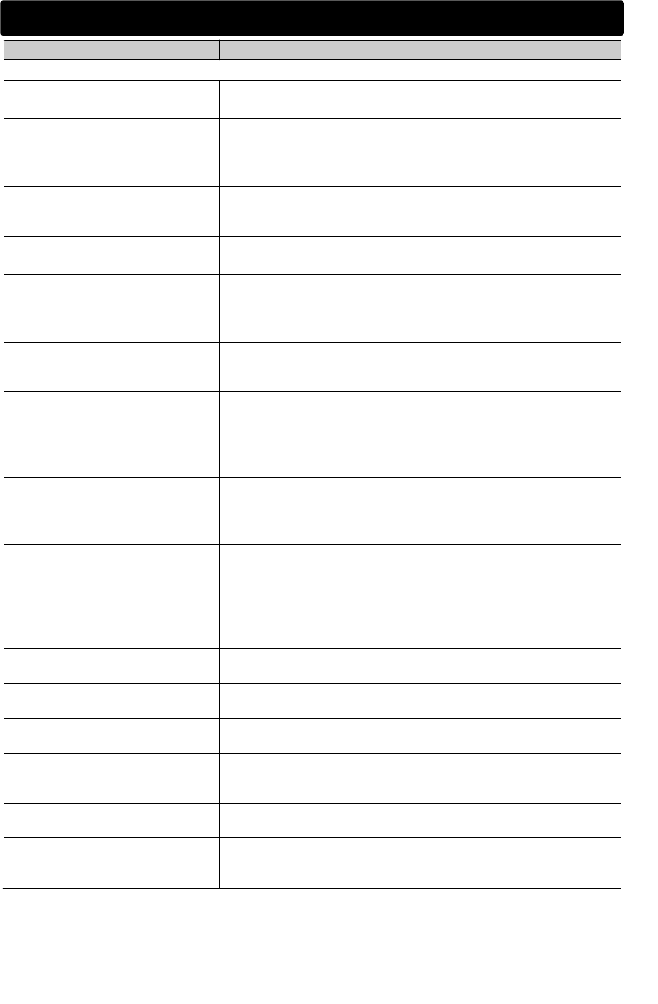
Symptom Remedy/Cause
4Bluetooth
No Bluetooth device is detected. Search from the Bluetooth device again.
Reset the unit. (' page 2)
Pairing cannot be made. Make sure you have entered the same PIN code to both the
unit and Bluetooth device.
Delete pairing information from both the unit and the
Bluetooth device, then perform pairing again.
“PAIRING FULL” scrolls on the
display when trying to perform
pairing.
You have already registered the maximum of five Bluetooth
devices in the unit. To pair another device, delete an existing
paired device from the unit first. (' page 12)
Echo or noise occurs. Adjust the microphone unit’s position.
Check the <ECHO CANCEL> setting. (' page 16)
Phone sound quality is poor. Reduce the distance between the unit and the Bluetooth
device.
Move the car to a place where you can get a better signal
reception.
The unit does not respond when
you try to copy the phonebook
to the unit.
You may have tried to copy the same entries (as stored) to the
unit. Press DISP or to exit.
Sound is being interrupted or
skipped during playback of a
Bluetooth audio player.
Reduce the distance between the unit and the Bluetooth
audio player.
Turn off, then turn on the unit and try to connect again.
Other Bluetooth devices might be trying to connect to the
unit.
The connected Bluetooth audio
player cannot be controlled.
Check whether the connected Bluetooth audio player
supports Audio/Video Remote Control Profile (AVRCP). (Refer
to the instructions of your audio player.)
Disconnect and connect the Bluetooth player again.
“VOICE” calling method is not
successful.
Use “VOICE” calling method in a more quiet environment.
Reduce the distance from the microphone when you speak
the name.
Change the <ECHO CANCEL> setting (' page 16), then try
again.
Make sure the same voice as the registered voice tag is used.
“NOT SUPPORT” appears when
trying to perform voice dial.
The connected phone does not support this feature.
“ERROR CNNCT” appears on the
display.
The device is registered but the connection has failed. Connect
the device manually. (' page 12)
“ERROR” appears on the display. Try the operation again. If “ERROR” appears again, check if the
device supports the function you have tried.
“PLEASE WAIT” appears on the
display.
The unit is preparing to use the Bluetooth function. If the
message does not disappear, turn off and turn on the unit, then
connect the device again (or reset the unit). (' page 2)
“HW ERROR” appears on the
display.
Reset the unit and try the operation again. If “HW ERROR”
appears again, consult your nearest JVC car audio dealer.
“BT DEVICE NOT FOUND”
appears on the display.
The unit failed to search for the registered Bluetooth devices
during Auto Connect. Turn on Bluetooth from your device and
connect manually. (' page 12)
Troubleshooting
ENGLISHޓ|25
2012/11/29ޓ16:42:23KD-X250BT_U_EN
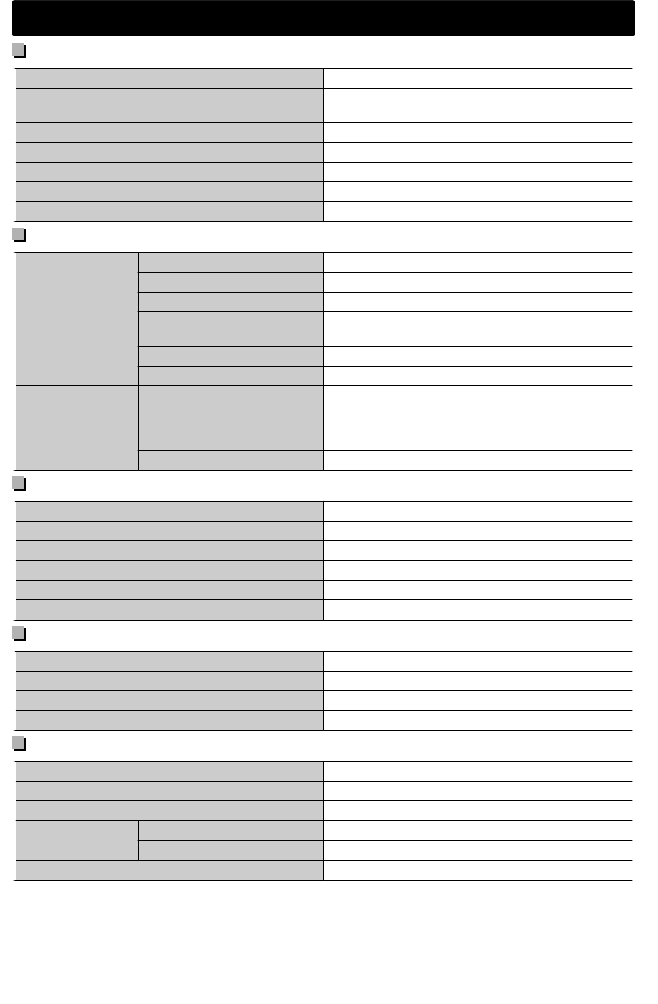
AUDIO AMPLIFIER SECTION
Maximum Power Output 50 W per channel
Continuous Power Output (RMS) 20 W per channel into 4Ω, 40 Hz to 20 000 Hz at
less than 1% total harmonic distortion.
Load Impedance 4Ω (4Ω to 8Ω allowance)
Frequency Response 40 Hz to 20 000 Hz
Signal-to-Noise Ratio 80 dB
Line-Out, Subwoofer-Out Level/Impedance 2.5 V/20 kΩ load (full scale)
Output Impedance ≤ 600Ω
TUNER SECTION
FM Frequency Range 87.5 MHz to 108.0 MHz (50 kHz step)
Usable Sensitivity 9.3 dBf (0.8 μV/75Ω)
50 dB Quieting Sensitivity 16.3 dBf (1.8 μV/75Ω)
Alternate Channel
Selectivity (400 kHz) 65 dB
Frequency Response 40 Hz to 15 000 Hz
Stereo Separation 40 dB
AM Frequency Range MW : 531 kHz to 1 611 kHz (9 kHz step)
SW1 : 2 940 kHz to 7 735 kHz (5 kHz step)
SW2 : 9 500 kHz to 10 135 kHz/
11 580 kHz to 18 135 kHz (5 kHz step)
Sensitivity/Selectivity 20 μV/40 dB
USB SECTION
USB Standard USB 1.1, USB 2.0
Data Transfer Rate (Full Speed) Max. 12 Mbps
Compatible Device Mass storage class
Compatible File System FAT 32/16/12
Playable Audio Format MP3/WMA
Maximum Supply Current DC 5 V " 1 A
BLUETOOTH SECTION
Version Bluetooth 2.1 certified (+EDR)
Power Class Class 2 Radio
Service Area 10 m
Profile HFP 1.5, OPP 1.1, A2DP 1.2, AVRCP 1.3, PBAP 1.0
GENERAL
Power Requirement (Operating Voltage) DC 14.4 V (11 V to 16 V allowance)
Grounding System Negative ground
Allowable Operating Temperature 0°C to +40°C
Dimensions
(W × H × D)
Installation Size approx. 182 mm × 53 mm × 159 mm
Panel Size approx. 188 mm × 59 mm × 13 mm
Weight 0.87 kJ (excluding accessories)
Subject to changes without notice.
Specifications
Specifications
26 |ޓENGLISH
2012/11/29ޓ16:42:23KD-X250BT_U_EN
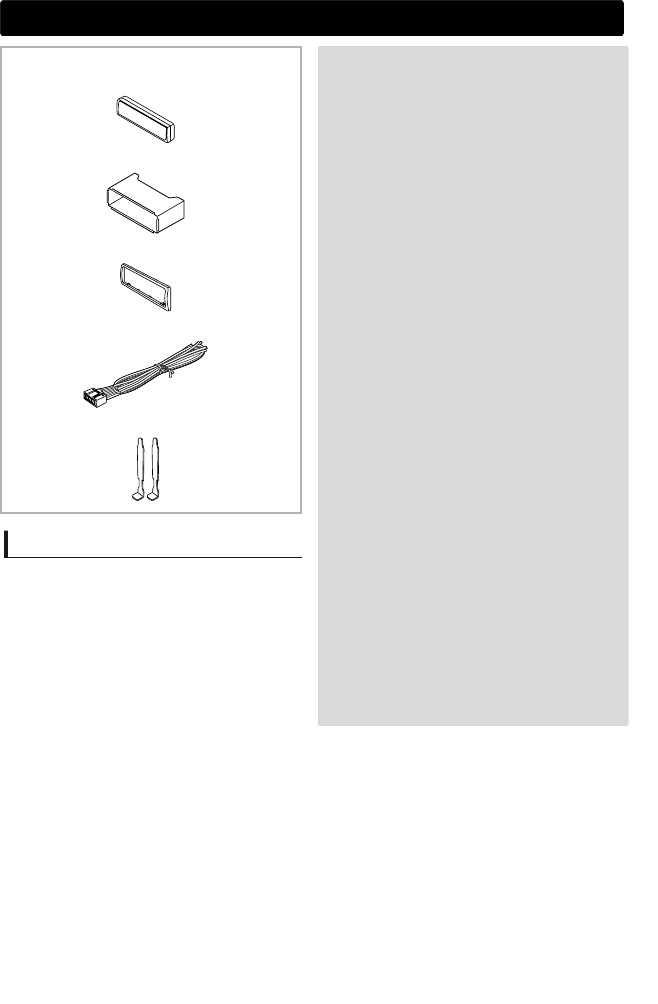
Part list for installation
Faceplate (x1)
! Mounting sleeve (x1)
" Trim plate (x1)
# Wiring harness (x1)
$ Extraction keys (x2)
Basic procedure
1Remove the key from the ignition switch,
then disconnect the terminal of the car
battery.
2Connect the wires properly. (' page 29)
3Install the unit to your car. (' page 28)
4Reconnect the terminal of the car
battery.
5Reset the unit. (' page 2)
Warning
The unit can only be used with a 12V DC power
supply, negative ground.
Disconnect the battery’s negative terminal
before wiring and mounting.
Do not connect the Battery wire (yellow) and
Ignition wire (red) to the car chassis or Ground
wire (black) to prevent short circuit.
Insulate unconnected wires with vinyl tape to
prevent short circuit.
Be sure to ground this unit to the car’s chassis
again after installation.
Caution
For safety’s sake, leave wiring and mounting to
professionals. Consult the car audio dealer.
Install this unit in the console of your vehicle. Do
not touch the metal parts of this unit during and
shortly after the use of the unit. Metal parts such
as the heat sink and enclosure become hot.
Do not connect the wires of speaker to the
car chassis, Ground wire (black), or in parallel.
Connect speakers with a maximum power of
more than 50 W. If the maximum power of the
speakers is lower than 50 W, change the <AMP
GAIN> setting to avoid damaging the speakers.
(' page 20)
Mount the unit at an angle of 30˚ or less.
If your vehicle wiring harness does not have the
ignition terminal, connect Ignition wire (red) to
the terminal on the vehicle’s fuse box which
provides 12V DC power supply and is turned on
and off by the ignition key.
After the unit is installed, check whether the
brake lamps, blinkers, wipers, etc. of the car are
working properly.
If the fuse blows, first make sure the wires are
not touching car’s chassis, then replace the old
fuse with one that has the same rating.
Installation/Connection
Installation/Connection
ENGLISHޓ|27
2012/11/29ޓ16:42:23KD-X250BT_U_EN
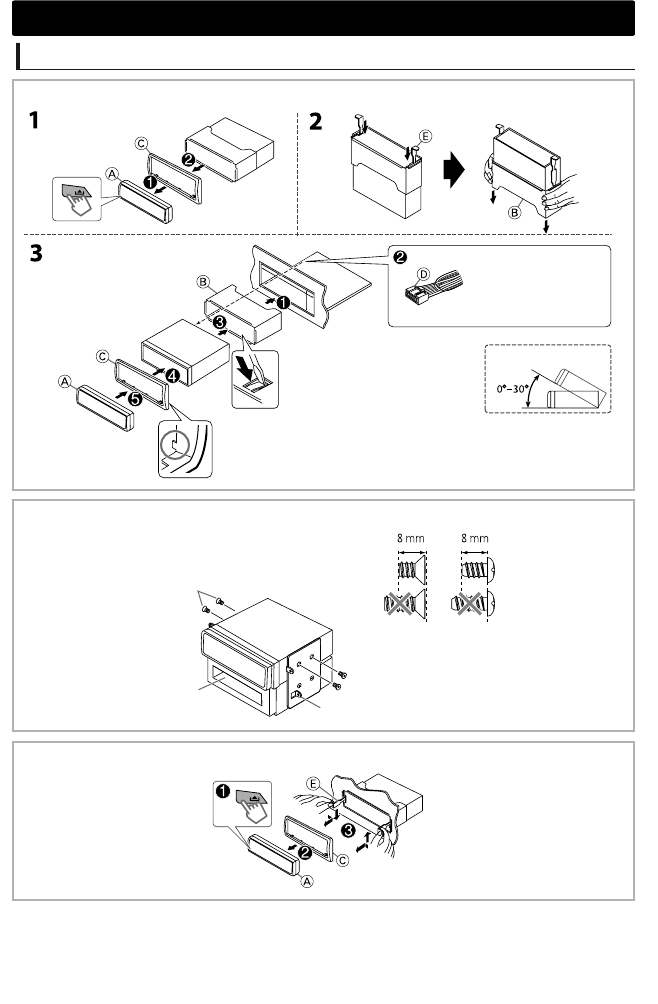
Installing the unit
In-dash mounting
Make sure the direction
of the trim plate.
Bend the appropriate tabs
to hold the sleeve firmly in
place.
Do the required
wiring.
(A page 29)
When installing without the mounting sleeve
Bracket (not supplied)
Pocket
Flat or round head screws
(not supplied)
M5 × 8 mm
How to remove the unit
Installation/Connection
28 |ޓENGLISH
2012/11/29ޓ16:42:23KD-X250BT_U_EN
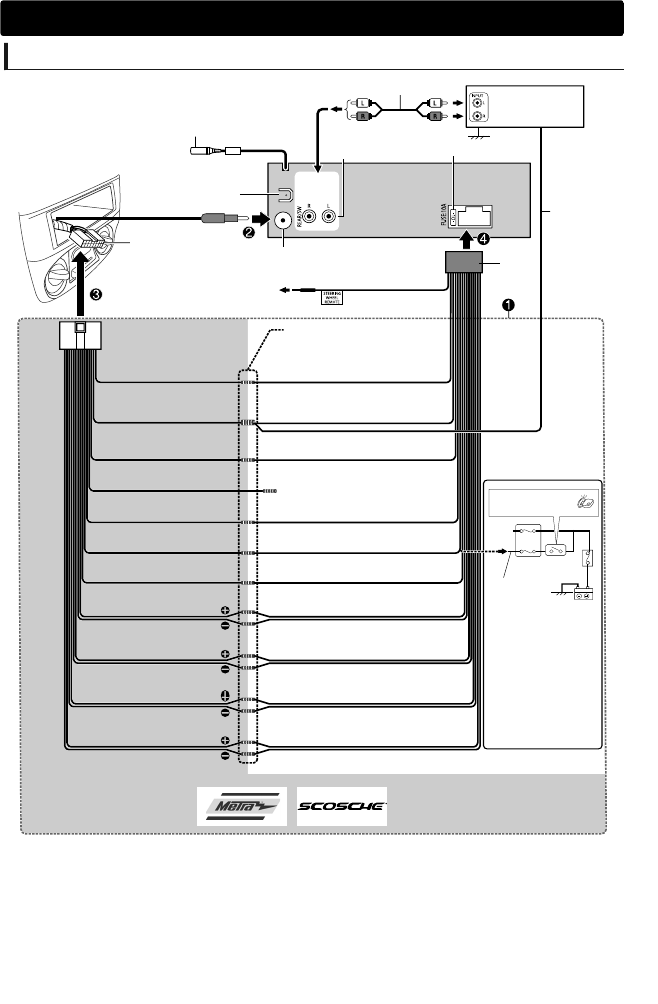
Wiring connection
MIC
D
Join the same color wires
together.
Scosche Industries: www.scosche.com
Metra Electronics: www.metraonline.com
For more information:
(separately purchased)
Vehicle-specific Wiring Harness
Make this connection
if your vehicle factory
wiring harness does
not have “12 V
ignition switch” wire.
Separate
red wire
Fuse block
Ignition switch
(not used) *2
Purple/black
Purple: Rear speaker (right)
Green/black
Green: Rear speaker (left)
Gray/black
Gray: Front speaker (right)
White/black
White: Front speaker (left)
Black: Ground
Red: 12 V Ignition switch
Yellow: 12 V Battery
Orange/white: Illumination
Blue/white: To amplifier Blue/white:
Remote (200 mA max.)
Blue: To power antenna
Recommended
connection
Light blue/yellow
Antenna terminal
To the steering wheel
remote control adapter
Factory wiring
harness (vehicle)
Rear ground terminal Remote
wire*1
10 A fuse
JVC Amplifier
Signal cord*1
MIC (Microphone input terminal) (A page 10)
Telephone muting
Rear/subwoofer
output
Blue: Automatic antenna
(250 mA max.)
*1 Not supplied for this unit.
*2 Insulate to prevent short circuit.
Installation/Connection
ENGLISHޓ|29
2012/11/29ޓ16:42:23KD-X250BT_U_EN

Microsoft and Windows Media are either registered trademarks or trademarks of Microsoft Corporation
in the United States and/or other countries.
The Bluetooth姞 word mark and logos are registered trademarks owned by Bluetooth SIG, Inc. and any
use of such marks by JVCKENWOOD Corporation is under license. Other trademarks and trade names
are those of their respective owners.
“Made for iPod” and “Made for iPhone” mean that an electronic accessory has been designed to
connect specifically to iPod, or iPhone, respectively, and has been certified by the developer to meet
Apple performance standards. Apple is not responsible for the operation of this device or its
compliance with safety and regulatory standards. Please note that the use of this accessory with iPod,
or iPhone may affect wireless performance.
iPhone, iPod, iPod classic, iPod nano, and iPod touch are trademarks of Apple Inc., registered in the U.S.
and other countries.
Android is trademark of Google Inc.
.
ʛʹʷʸʹÅÈÆÅÈ·Ê¿ÅÄ ʸʹʸʹ
