JVC TH S55B S66/TH S55[B] User Manual S55B, S66B GVT0152 001B
TH-S66B TH-S66B GVT0152-001B English,
SP-THS55F 3b0c223c-38b9-4ca9-8e34-f34eeb7a1efc
User Manual: JVC TH-S55B TH-S55B, TH-S66B English,
Open the PDF directly: View PDF  .
.
Page Count: 49
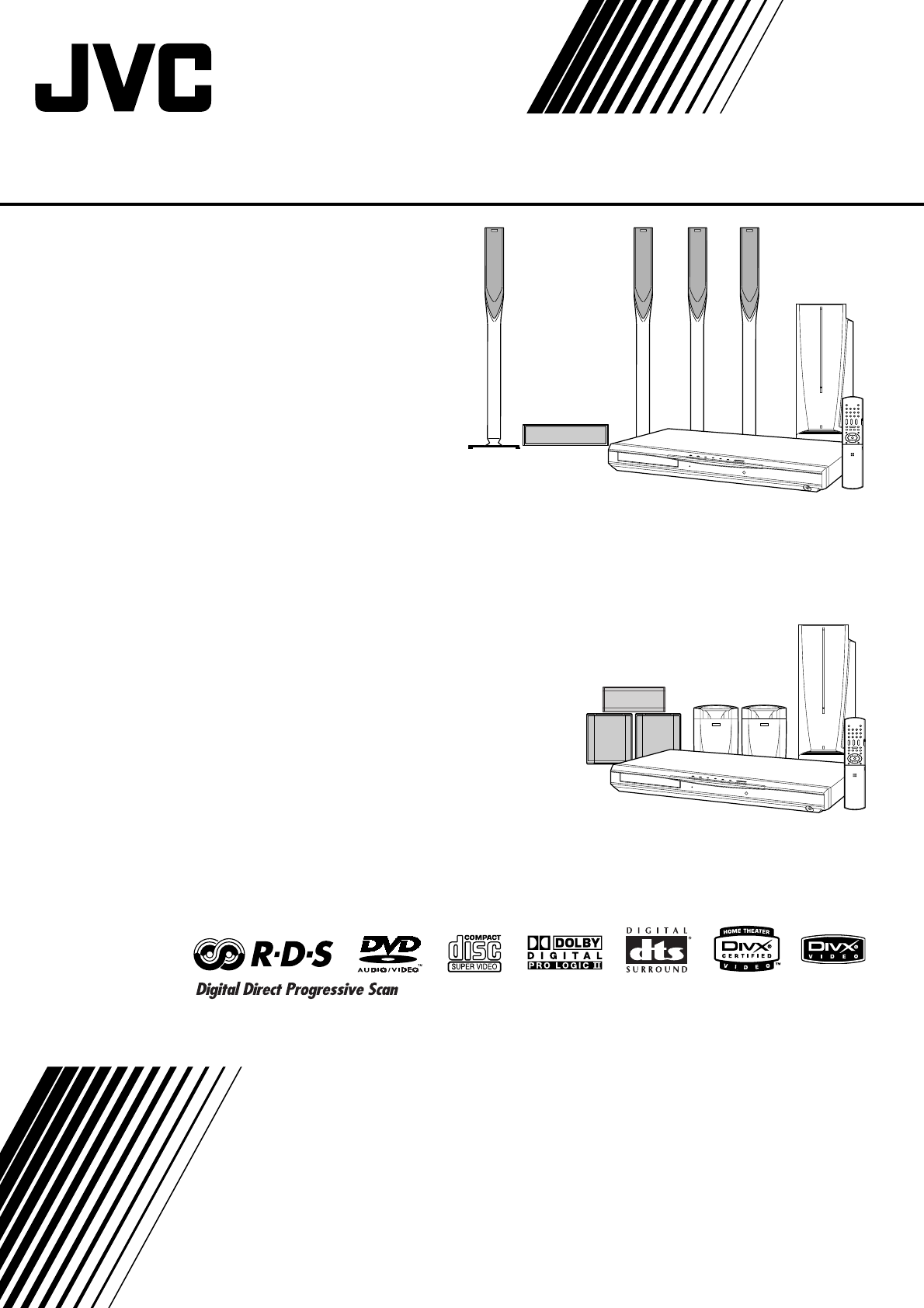
TH-S66
GVT0152-001B
[B]
TH-S55
DVD DIGITAL CINEMA SYSTEM
INSTRUCTIONS
Consists of XV-THS66, SP-PWS66,
SP-THS66F, SP-THS66C and
SP-THS66S
Consists of XV-THS55, SP-PWS55,
SP-THS55F, SP-THS55C and SP-THS55S
TH-S66-S55[B].book Page 1 Wednesday, May 25, 2005 12:08 PM
G-1
Warnings, Cautions and Others
IMPORTANT for the U.K.
DO NOT cut off the mains plug from this equipment. If the
plug fitted is not suitable for the power points in your home or
the cable is too short to reach a power point, then obtain an
appropriate safety approved extension lead or consult your
dealer.
BE SURE to replace the fuse only with an identical approved
type, as originally fitted.
If nonetheless the mains plug is cut off ensure to remove the
fuse and dispose of the plug immediately, to avoid a possible
shock hazard by inadvertent connection to the mains supply.
If this product is not supplied fitted with a mains plug then
follow the instructions given below:
IMPORTANT.
DO NOT make any connection to the terminal which is
marked with the letter E or by the safety earth symbol or
coloured green or green-and-yellow.
The wires in the mains lead on this product are coloured in
accordance with the following code:
Blue: Neutral
Brown: Live
As these colours may not correspond with the coloured
markings identifying the terminals in your plug proceed as
follows:
The wire which is coloured blue must be connected to the
terminal which is marked with the letter N or coloured black.
The wire which is coloured brown must be connected to the
terminal which is marked with the letter L or coloured red.
IF IN DOUBT - CONSULT A COMPETENT ELECTRICIAN.
CAUTION
To reduce the risk of electrical shocks, fire, etc.:
1. Do not remove screws, covers or cabinet.
2. Do not expose this appliance to rain or moisture.
CAUTION — button!
(XV-THS66/XV-THS55)
Disconnect the mains plug to shut the power off completely
(the STANDBY lamp goes off).
The button in any position does not disconnect the mains
line.
• When the system is on standby, the STANDBY lamp lights
red.
• When the system is turned on, the STANDBY lamp goes off.
The power can be remote controlled.
CAUTION (SP-PWS66/SP-PWS55)
The power supply to the subwoofer is linked to the center unit.
The POWER ON lamp on the subwoofer lights green when the
power is turned on.
CAUTION
• Do not block the ventilation openings or holes.
(If the ventilation openings or holes are blocked by a
newspaper or cloth, etc., the heat may not be able to get out.)
• Do not place any naked flame sources, such as lighted
candles, on the apparatus.
• When discarding batteries, environmental problems must be
considered and local rules or laws governing the disposal of
these batteries must be followed strictly.
• Do not expose this apparatus to rain, moisture, dripping or
splashing and that no objects filled with liquids, such as
vases, shall be placed on the apparatus.
IMPORTANT FOR LASER PRODUCTS
1. CLASS 1 LASER PRODUCT
2. CAUTION: Do not open the top cover. There are no user
serviceable parts inside the unit; leave all servicing to qualified
service personnel.
3. CAUTION: Visible and invisible laser radiation when open and
interlock failed or defeated. Avoid direct exposure to beam.
4. REPRODUCTION OF LABEL: CAUTION LABEL,
PLACED INSIDE THE UNIT.
CAUTION!
To avoid personal injury or
accidentally dropping the
unit, have two persons
unpack, carry, and install
the unit.
SP-THS66: 29.0 kg
TH-S66-S55[B].book Page 1 Wednesday, May 25, 2005 12:08 PM
Warnings, Cautions and Others
G-2
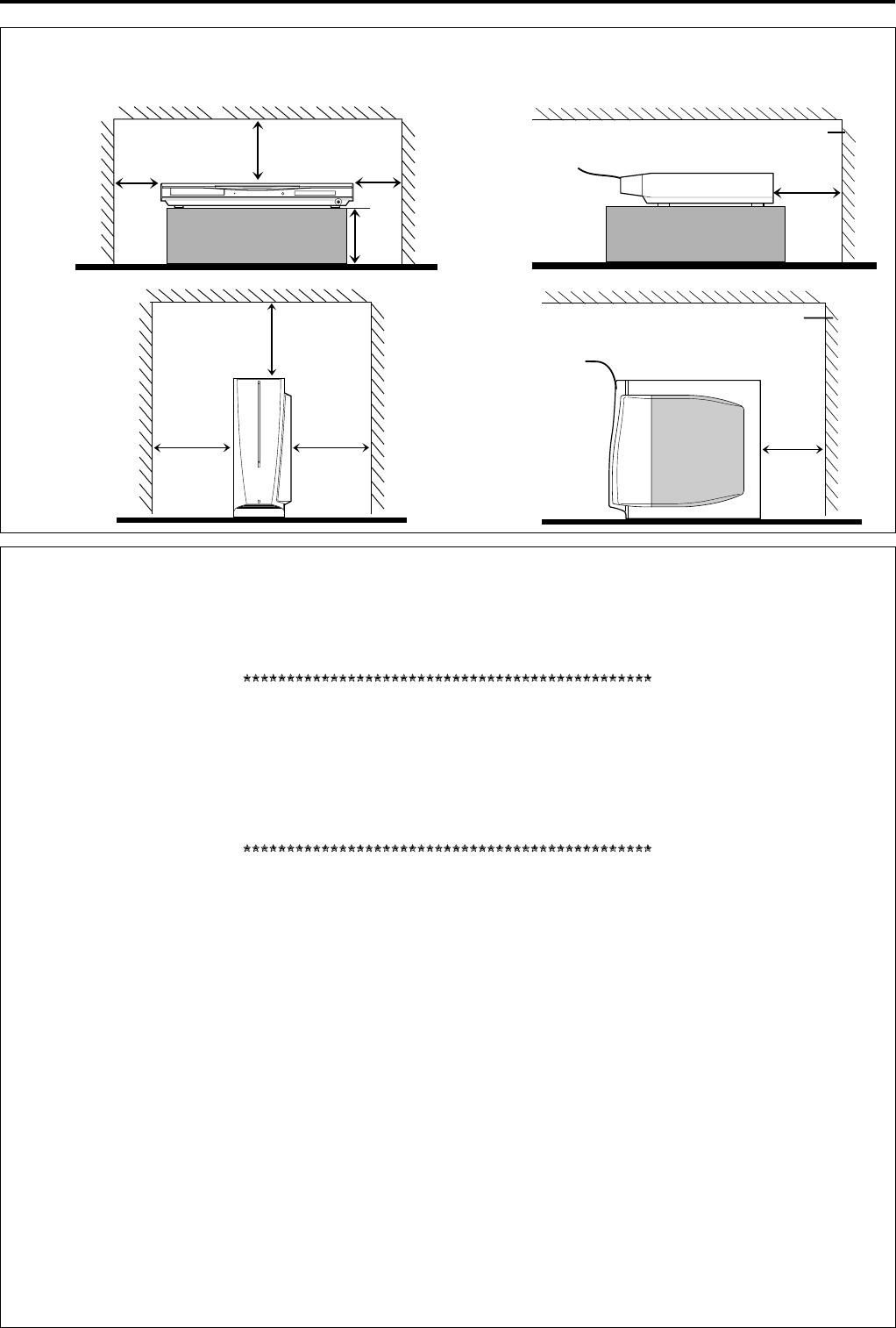
Caution: Proper Ventilation
To avoid risk of electric shock and fire and to protect from damage, place the apparatus on a level surface. The minimal clearances are
shown below:
SAFETY INSTRUCTIONS
“SOME DOS AND DON’TS ON THE SAFE USE OF EQUIPMENT”
This equipment has been designed and manufactured to meet international safety standards but, like any electrical equipment, care must be
taken if you are to obtain the best results and safety is to be assured.
Do read the operating instructions before you attempt to use the equipment.
Do ensure that all electrical connections (including the mains plug, extension leads and interconnections between pieces of equipment) are
properly made and in accordance with the manufacturer’s instructions. Switch off and withdraw the mains plug when making or changing
connections.
Do consult your dealer if you are ever in doubt about the installation, operation or safety of your equipment.
Do be careful with glass panels or doors on equipment.
DON’T continue to operate the equipment if you are in any doubt about it working normally, or if it is damaged in any way — switch off,
withdraw the mains plug and consult your dealer.
DON’T remove any fixed cover as this may expose dangerous voltages.
DON’T leave equipment switched on when it is unattended unless it is specifically stated that it is designed for unattended operation or has
a standby mode.
Switch off using the switch on the equipment and make sure that your family know how to do this.
Special arrangements may need to be made for infirm or handicapped people.
DON’T use equipment such as personal stereos or radios so that you are distracted from the requirements of traffic safety. It is illegal to
watch television whilst driving.
DON’T listen to headphones at high volume as such use can permanently damage your hearing.
DON’T obstruct the ventilation of the equipment, for example with curtains or soft furnishings.
Overheating will cause damage and shorten the life of the equipment.
DON’T use makeshift stands and NEVER fix legs with wood screws — to ensure complete safety always fit the manufacturer’s approved
stand or legs with the fixings provided according to the instructions.
DON’T allow electrical equipment to be exposed to rain or moisture.
ABOVE ALL
— NEVER let anyone, especially children, push anything into holes, slots or any other opening in the case — this could result in a fatal
electrical shock.;
— NEVER guess or take chances with electrical equipment of any kind — it is better to be safe than sorry!
E43486-340B
PHONES
8 cm
Wall or
obstructions
XV-THS66/
XV-THS55
3 cm 3 cm
15 cm
XV-THS66/XV-THS55
10 cm
Front
No
obstructions
Wall or obstructions
SP-PWS66/
SP-PWS55
20 cm
15 cm 15 cm
Wall or
obstructions SP-PWS66/SP-PWS55
15 cm
Front
No
obstructions
Wall or obstructions
TH-S66-S55[B].book Page 2 Wednesday, May 25, 2005 12:08 PM

1
Table of contents
Introduction ..................................... 2
Notes on handling .................................................................2
Supplied accessories ............................................................2
About discs ..................................... 3
Playable disc types ...............................................................3
Notes on file types ................................................................4
Description of parts and controls ...5
Connections .................................... 8
Connecting the FM and AM (MW) antennas .........................8
Assembling the front and surround speakers .......................9
Connecting the satellite (front, center, surround) speakers ... 10
Speaker layout ....................................................................12
Connecting a TV ..................................................................12
Connecting the powered subwoofer ....................................13
Connecting to an analog component ...................................13
Connecting to a digital component .....................................13
Connecting the power cord .................................................13
Operating external components with
the remote control ........................ 14
Operating the TV .................................................................14
Operating the VCR ..............................................................15
Basic operations ........................... 16
Turning the system on/off ...................................................16
Selecting the source to play ................................................17
Adjusting the volume [VOLUME] ........................................17
Listening with headphones (not supplied) ..........................17
Turning off the sound temporarily [MUTING] .....................17
Adjusting the brightness of the indications [DIMMER] .......17
Sleep Timer [SLEEP] ...........................................................18
Adjusting the output level of the subwoofer and speakers ..18
Adjusting the treble sound [TREBLE] ..................................18
Adjusting the bass sound [BASS] .......................................18
Changing the scan mode ....................................................18
Optimizing the speaker settings [Smart Surround Setup] ...19
Playback ........................................ 20
Basic playback ....................................................................20
One Touch Replay ...............................................................22
Fast-forward/fast-reverse search ........................................22
Skip to the beginning of a desired selection .......................22
Locating a desired title/group using number buttons .........23
Playing back a bonus group ................................................23
Selecting the desired title/playlist from the control display .23
Advanced operations .................... 24
Using the surround mode ...................................................24
Using the on-screen bar .....................................................25
Playing from a specified position on a disc .........................27
Using the file control display ..............................................28
Resume Playback ...............................................................29
Selecting a view angle .........................................................29
Selecting the subtitle ..........................................................29
Selecting the audio .............................................................30
Special picture playback .....................................................30
Program Playback ...............................................................32
Random Playback ...............................................................33
Repeat Playback .................................................................33
Tray lock .............................................................................34
Sound and other settings ....................................................35
Setting DVD preferences .............. 36
Using the setup menus .......................................................36
Menu description ................................................................36
Tuner operations ........................... 39
Manual tuning .....................................................................39
Preset tuning ......................................................................39
Selecting the FM reception mode ........................................40
Reducing the noise of AM (MW) broadcast ........................40
Using the RDS (Radio Data System) when receiving FM
stations ...............................................................................40
References .................................... 43
Maintenance .......................................................................43
Troubleshooting ..................................................................43
Specifications .....................................................................44
TH-S66-S55[B].book Page 1 Wednesday, May 25, 2005 12:08 PM
2
Introduction
7Important cautions
Installation of the system
• Select a place which is level, dry and neither too hot nor too cold;
between 5°C and 35°C.
• Leave sufficient distance between the system and the TV.
• Do not use the system in a place subject to vibration.
Power cord
• Do not handle the power cord with wet hands!
• A small amount of power is always consumed while the power
cord is connected to the wall outlet (center unit only).
• When unplugging the power cord from the wall outlet, always
pull on the plug, not the power cord.
To prevent malfunctions of the system
• There are no user-serviceable parts inside. If anything goes
wrong, unplug the power cord and consult your dealer.
• Do not insert any metallic object into the system.
• Do not use any non-standard shape disc (like a heart, flower or
credit card, etc.) available on the market, because it may damage
the system.
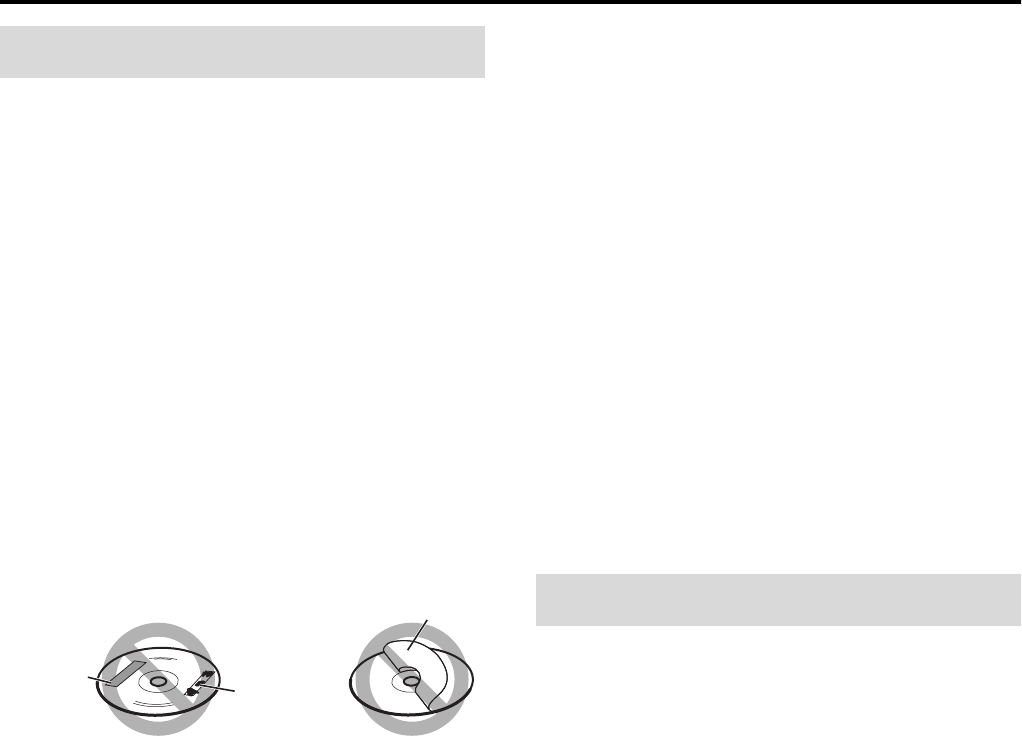
• Do not use a disc with tape, stickers, or paste on it, because it
may damage the system.
Note about copyright laws
Check the copyright laws in your country before recording from the
discs. Recording of copyrighted material may infringe copyright
laws.
Note about copyguard system
The discs are protected by copyguard system. When you connect
the system to your VCR directly, the copyguard system activates
and the picture may not be played back correctly.
7Safety precautions
Avoid moisture, water and dust
Do not place the system in moist or dusty places.
Avoid high temperatures
Do not expose the system to direct sunlight and do not place it near
a heating device.
When you are away
When away on travel or for other reasons for an extended period of
time, disconnect the power cord plugs from the wall outlet.
Do not block the vents
Blocking the vents may damage the system.
Care of the cabinet
When cleaning the system, use a soft cloth and follow the relevant
instructions on the use of chemically-coated cloths. Do not use
benzene, thinner or other organic solvents including disinfectants.
These may cause deformation or discoloring.
If water gets inside the system
Turn the system off and disconnect the power cord plug from the
wall outlet, then call the store where you made your purchase.
Using the system in this condition may cause fire or electrical
shock.
Check to be sure you have all of the supplied accessories.
The number in parentheses is the quantity of the pieces supplied.
If anything is missing, contact your dealer immediately.
• Remote control (1)
• Batteries (2)
• FM antenna (1)
• AM (MW) loop antenna (1)
• Power cord (1)
• System cord (1)
• Speaker cords (TH-S66 only)
For satellite (front left/right) and center speakers (3)
For satellite speakers (surround left/right) (2)
• Screws (TH-S66 only)
M5 x 25 mm:
For satellite speakers (4)
• Bottom covers
For satellite speakers (front and surround) (4)
Notes on handling
Paste
Sticker
Label sticker Supplied accessories
TH-S66-S55[B].book Page 2 Wednesday, May 25, 2005 12:08 PM
3
About discs
This system has been designed to play back the following discs:
• DVD Logo is a trademark of DVD Format/Logo Licensing
Corporation.
• The Non-DVD side of a “DualDisc” does not comply with the
“Compact Disc Digital Audio” standard. Therefore, the use of
Non-DVD side of a DualDisc on this product may not be
recommended.
• This system accommodates the PAL system, and also can play
discs recorded with NTSC system. Note that an NTSC video
signal on a disc is converted to the PAL60 signal and output.
• On some DVD VIDEOs, DVD AUDIOs, VCDs or SVCDs, their
actual operation may be different from what is explained in this
manual. This is due to the disc programming and disc structure,
not a malfunction of this system.
• Before playing back discs, read their instructions or cautions
carefully.
Region code of DVD VIDEO
This system can play back DVD VIDEO discs whose Region Code
numbers include the system’s Region Code, which is indicated on
the rear panel.
If a DVD with an improper Region Code number is loaded,
“REGION CODE ERROR!” appears on the TV screen and
playback cannot start.
Notes on DVD-R, DVD-RW and DVD-RAM
• This system can also play finalized DVD-Rs or DVD-RWs
recorded in DVD VIDEO format and DVD-RWs or DVD-RAMs
recorded in DVD VR format.
• This system can also play DVD-Rs or DVD-RWs if MP3, WMA,
JPEG, MPEG-4 and DivX files are recorded on them with UDF
Bridge format.
This system does not support “multi-border” discs.
Notes on CD-R and CD-RW
• This system can also play CD-Rs or CD-RWs if MP3, WMA,
JPEG, MPEG-4 and DivX files are recorded on them with ISO
9660 format.
• This system supports “multi-session” discs (up to 20 sessions).
• This system cannot play “packet write” discs.
Some discs may not be played back because of their disc
characteristics, recording conditions, or damage or stain on them.
Unplayable discs:
SACD, CD-I (CD-I Ready), Photo CD, etc.
Playing back these discs will generate noise and damage the
speakers.
Playable disc types
DVD VIDEO DVD AUDIO
VCD/SVCD Audio CD
ALL 252 5
3
4
2
Example of playable DVD:
TH-S66-S55[B].book Page 3 Wednesday, May 25, 2005 12:08 PM
About discs
4
For all playable files
• The system can only recognize and play files with one of the
following extensions, which can be in any combination of upper
and lower case;
MP3: “.MP3”, “.mp3”
WMA: “.WMA” , “.wma”
JPEG: “.JPG”, “.JPEG”, “.jpg”, “.jpeg”
MPEG-4: “.ASF”, “.asf”
DivX: “.DIVX”, “.DIV”, “.divx”, “.div”, and “.AVI”, “.avi”
• The system recognizes up to 150 tracks (files) per group, 99
groups per disc, and the total number of the tracks (files) that the
system can play is 4000.
• Some files may not be played back normally because of their disc
characteristics or recording conditions.
For MP3/WMA files
• The system supports MP3/WMA files recorded with a bit rate of
32 – 320 kbps and a sampling frequency of 16 kHz, 22.05 kHz,
24 kHz*, 32 kHz, 44.1 kHz, or 48 kHz.
• If the tag information (album name, artist, and track title, etc.) is
recorded on a disc, it appears in the file control display on the TV
screen. (Apg. 28)
• We recommend to record each piece of material (song) at a
sample rate of 44.1 kHz and at a data transfer rate of
128 (96*) kbps.
* For WMA only
For JPEG files
• We recommend to record a file at 640 x 480 resolution.
• This system can only play baseline JPEG files.
For MPEG-4 files
• The system supports the types of the advanced simple profile as
MPEG-4 files (MPEG-4 ASF).
• The system supports MPEG-4 files followed the condition
below:
File format: ASF
Visual profile: MPEG-4 SP (Simple Profile)
Audio CODEC: G.726
Max. picture size: 352 x 288 (CIF)
Max. bit rate: 384 kbps
For DivX files
• The system supports DivX 5.x, 4.x and 3.11.
• The system supports the DivX files whose resolution is 720 x
480 pixels or less (30 fps), and 720 x 576 pixels or less (25 fps).
• Audio stream should conform to MPEG 1 Audio Layer-2 or
MPEG 1 Audio Layer-3 (MP3).
• The system does not support GMC (Global Motion
Compression).
• The file encoded in the interlaced scanning mode may not be
played back correctly.
• The system has its own Registration Code for DivX playback.
If necessary, you can confirm the Registration Code of your
system using the OTHERS menu. (Apg. 38)
• “Official DivX CertifiedTM product”
“Plays DivX® 5, DivX® 4, DivX® 3, and DivX® VOD video content
(in compliance with DivX CertifiedTM technical requirements)”
“DivX, DivX Certified, and associated logos are trademarks of
DivXNetworks, Inc. and are used under license.”
Notes on file types
This product incorporates copyright protection technology
that is protected by U.S. patents and other intellectual
property rights. Use of this copyright protection technology
must be authorized by Macrovision, and is intended for
home and other limited viewing uses only unless otherwise
authorized by Macrovision. Reverse engineering or
disassembly is prohibited.
“CONSUMERS SHOULD NOTE THAT NOT ALL HIGH
DEFINITION TELEVISION SETS ARE FULLY COMPATIBLE
WITH THIS PRODUCT AND MAY CAUSE ARTIFACTS TO BE
DISPLAYED IN THE PICTURE. IN CASE OF 525 OR 625
PROGRESSIVE SCAN PICTURE PROBLEMS, IT IS
RECOMMENDED THAT THE USER SWITCH THE
CONNECTION TO THE ‘STANDARD DEFINITION’ OUTPUT.
IF THERE ARE QUESTIONS REGARDING OUR TV SET
COMPATIBILITY WITH THIS MODEL 525p AND 625p DVD
PLAYER, PLEASE CONTACT OUR CUSTOMER SERVICE
CENTER.”
USE OF THIS PRODUCT IN ANY MANNER THAT COMPLIES
WITH THE MPEG-4 VISUAL STANDARD IS PROHIBITED,
EXCEPT FOR USE BY A CONSUMER ENGAGING IN
PERSONAL AND NON-COMMERCIAL ACTIVITIES.
TH-S66-S55[B].book Page 4 Wednesday, May 25, 2005 12:08 PM
5
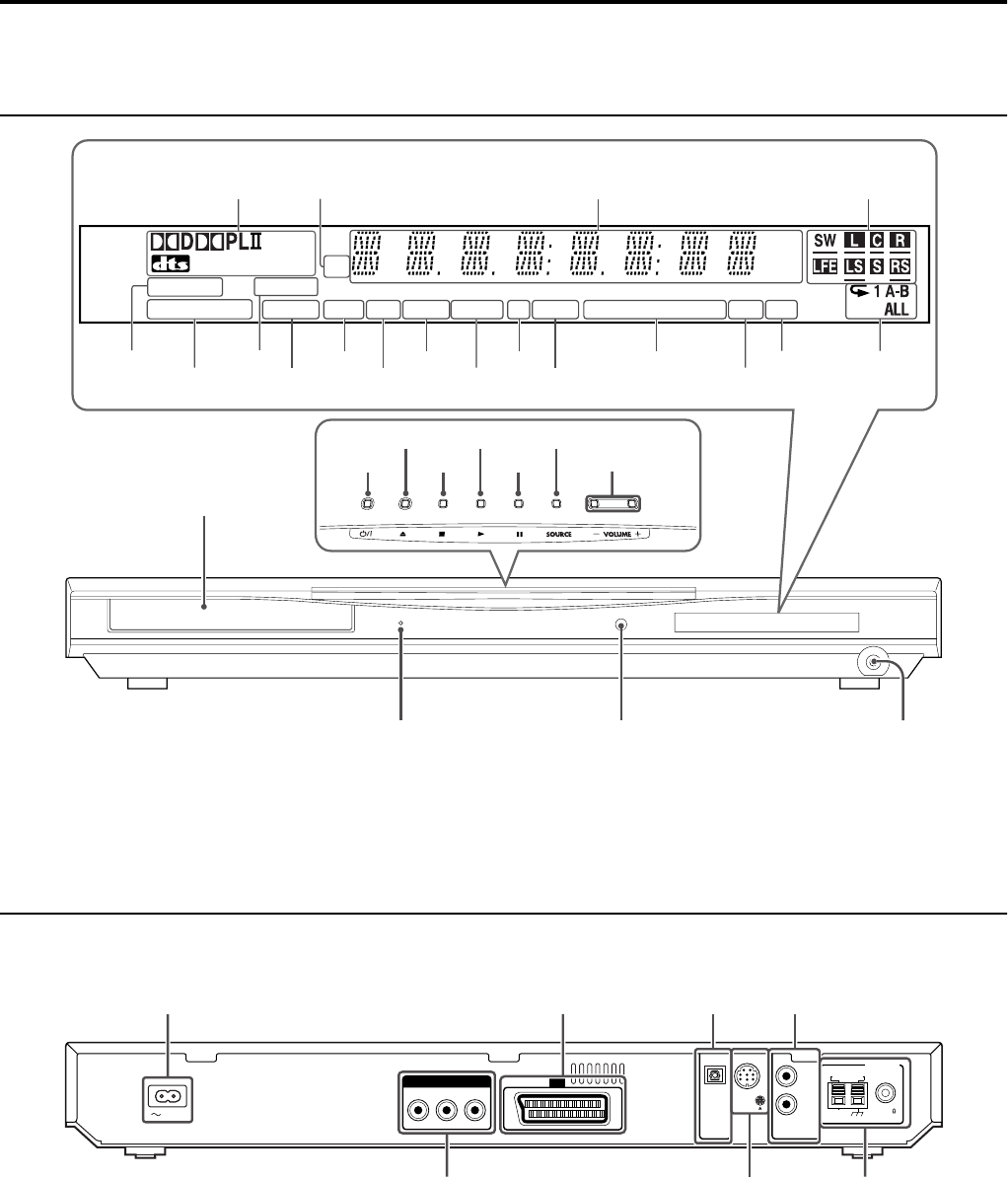
Description of parts and controls
The illustrations of the center unit, the subwoofer and satellite speakers used in this manual are of TH-S66 unless otherwise noted.
Front panel (center unit)
Rear panel (center unit)
PHONES
WMA
P L PCM SURR CH
FM AM
PROGRESSIVE B.S.P. CHAP. TRK PG PL BONUS ST RDS TA NEWS INFO PRG RND
MHz
kHz
MONO
MP3 RESUME
Display window
pg. 25 pg. 39 pg. 21 pg. 25
pg. 18
pg. 21
pg. 23
pg. 31
pg. 39
pg. 40
pg. 42 pg. 33
pg. 20 pg. 20
pg. 20
pg. 17
Disc tray (inside): pg. 20
pg. 16 Remote sensor: pg. 7
pg. 20
pg. 17
pg. 16
pg. 29
pg. 21 pg. 32
pg. 21 pg. 22
pg. 17
pg. 33
FM 75
AM LOOP
COAXIAL
AM EXT
PRPBY
AV
AC IN
COMPONENT VIDEO OUT
ANTENNA
DIGITAL
IN
OPTICAL
AUX IN
RIGHT
LEFT
pg. 13
pg. 13
pg. 13
pg. 8
pg. 13 pg. 12
pg. 12
TH-S66-S55[B].book Page 5 Wednesday, May 25, 2005 12:08 PM
Description of parts and controls
6
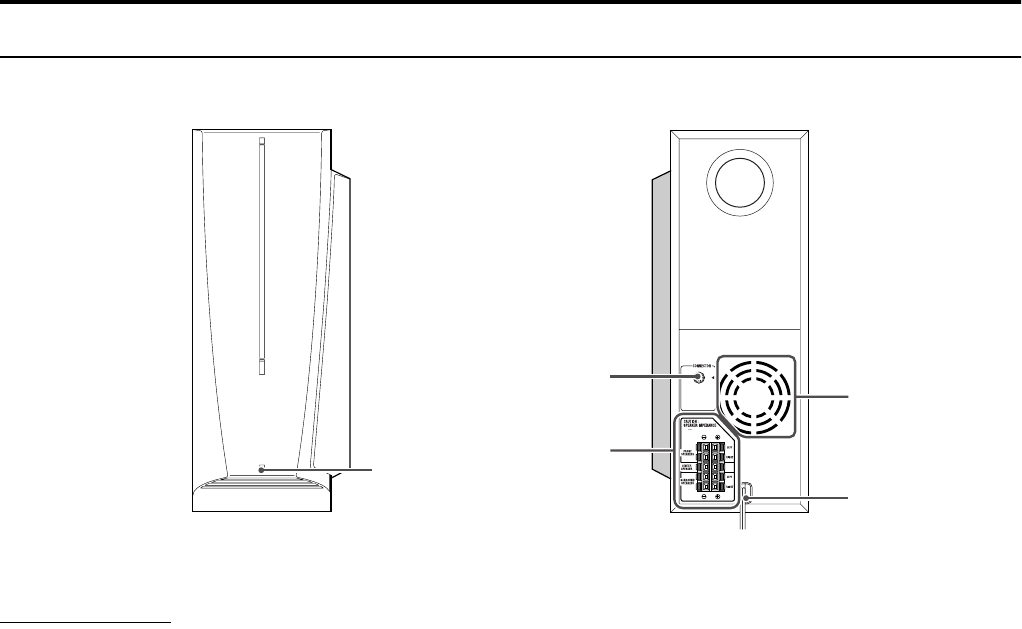
Powered subwoofer
SP-PWS66/SP-PWS55
NOTE
• For safety reasons, always ensure that there is sufficient space behind
the powered subwoofer.
4
Ω
16
Ω
FROM
XV-THC3
XV-THS55
XV-THS58
XV-THS66
Front Rear
POWER ON lamp:
pg. 16
pg. 10
Power cord:
pg. 13
pg. 13
Do not block the
ventilation openings.
TH-S66-S55[B].book Page 6 Wednesday, May 25, 2005 12:08 PM
Description of parts and controls
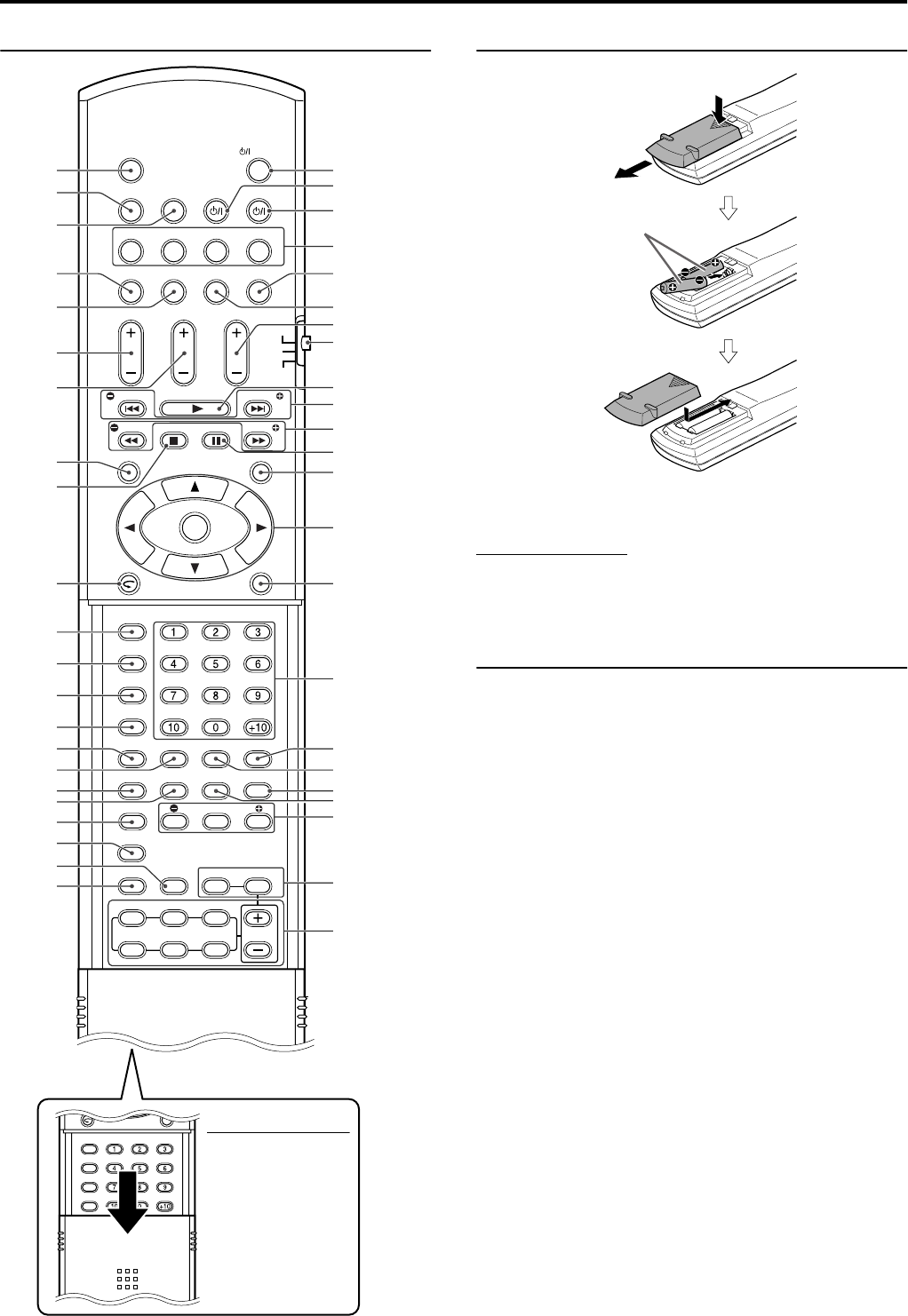
7
Remote control Putting batteries in the remote control
If the range or effectiveness of the remote control decreases,
replace both batteries.
CAUTION
• Do not expose batteries to heat or flame.
Operating the system from the remote
control
Aim the remote control directly to the front panel of the center unit.
• Do not hide the remote sensor.
OPEN/CLOSE
TV/VIDEO
DVD
TOP MENU/PG
REC
MENU/PL
PTY SEARCH
ON
SCREEN
AUDIO
MUTING
FM/AM
SUBTITLE
TV
AUX
SURROUND
TV VOL CHANNEL AUDIO VOL
TUNING
TA/NEWS/INFO
AUDIO
VCR
TV SOUND
FL DISP.
AUDIO
VCR
TV
TUNING
FM MODEMEMORY
ENTER
TITLE/GROUP
ANGLE
VFP
ZOOM
PA G E
REPEAT
SET UP
SLEEP
FRONT L FRONT R
LEVEL
S.WFR
TV RETURN
A-B RPT
SETTING
SMART
S.SETUP
CENTER
PLAY MODE
RETURN
DIMMER
100+
CANCEL
SCAN MODE
TREBLE
BASS
SURR. RSURR. L
SLOW SLOW
TITLE/GROUP
ANGLE
VFP
ZOOM
PA G E
REPEAT
SETUP
SLEEP
TV RETURN
A-B RPT
SETTING
SMART
S.SETUP
PLAY MODE
RETURN
DIMMER
100+
CANCEL
SCAN MODE
TREBLE
NOTE
• To use the buttons
under the cover, slide
down the cover.
pg. 14
pg. 14
pg. 14
p
g. 20,
39
pg. 27
pg. 18, 36
p
g. 15,
22
pg. 23
pg. 29
pg. 29
pg. 31
pg. 36
pg. 33
pg. 35
pg. 17
pg. 17
pg. 25
Number
buttons:
pg. 22
pg. 32, 33
pg. 18, 31
pg. 31
pg. 18 pg. 18
pg. 27
pg. 18
pg. 32
pg. 30
pg. 20
pg. 34
pg. 42
pg. 19
pg. 41
R6P (SUM-3)/AA (15F)
type dry-cell batteries
(supplied)
pg. 14
pg. 17
pg. 20
pg. 20, 40
pg. 21, 40
pg. 25
pg. 16
pg. 15
pg. 17
pg. 14 – 42
pg. 22, 39
pg. 22, 30
pg. 27
TH-S66-S55[B].book Page 7 Wednesday, May 25, 2005 12:08 PM
8
Connections
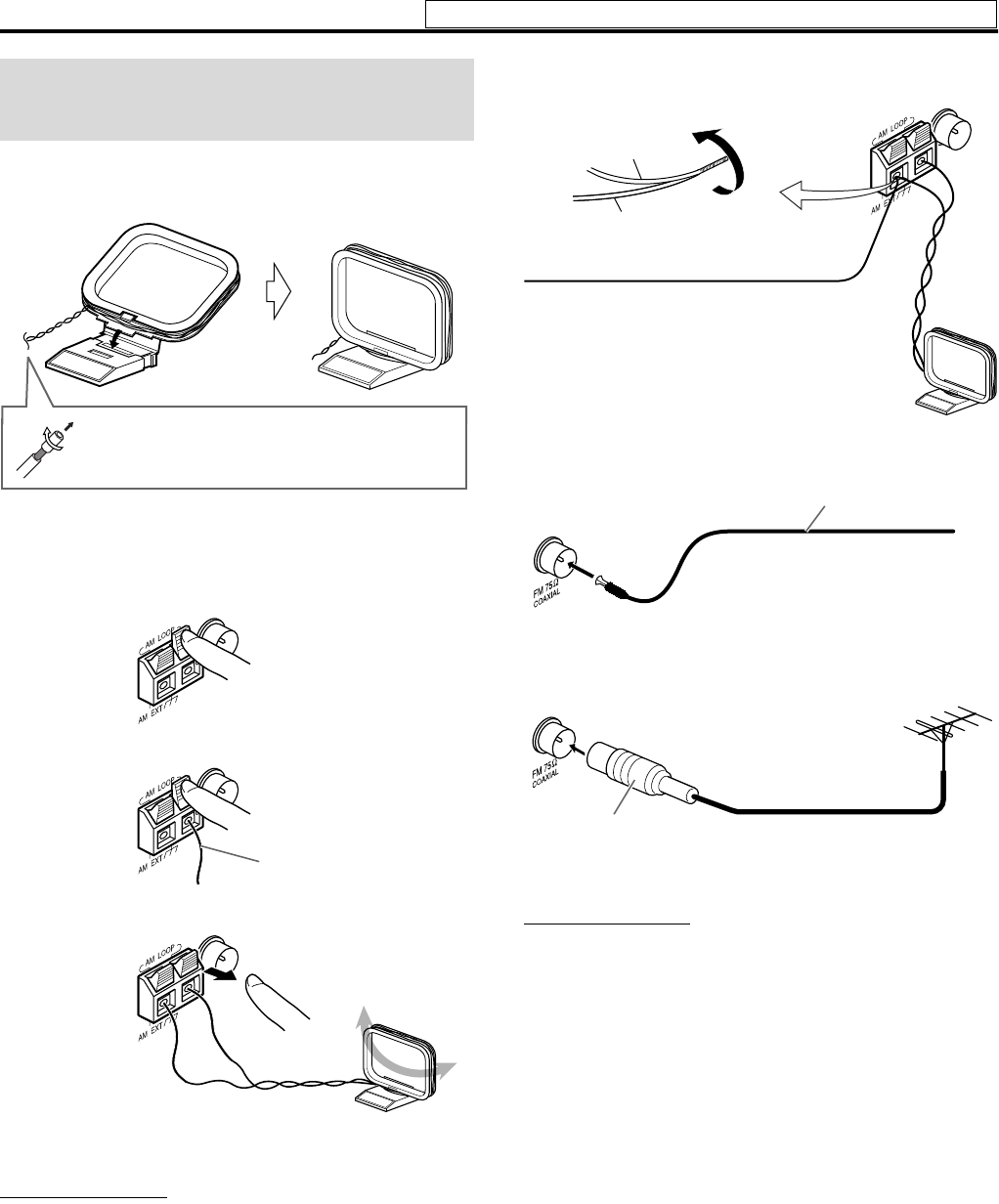
7AM (MW) loop antenna
Setting up supplied AM (MW) loop antenna
Connecting AM (MW) loop antenna
• Turn the loop antenna until you have the best reception during
AM (MW) broadcast program reception.
NOTE
• Make sure the antenna conductors do not touch any other terminals,
connecting cords and power cords. This could cause poor reception.
If reception is poor
7FM antenna
If reception is poor
NOTE
• We recommend that you use coaxial cable for the FM antenna as it is
well-shielded against interference.
Connecting the FM and
AM (MW) antennas
If the antenna cord is covered with the insulation
coat, twist and pull the insulation coat off and
remove.
1Center unit
2
3
Antenna cord
Outdoor single vinyl-covered wire antenna
(not supplied)
AM (MW) loop
antenna
Center unit
Extend the supplied FM antenna
horizontally.
Center unit FM antenna (supplied)
Outdoor FM antenna
(not supplied)
Outdoor FM antenna cord
(not supplied)
Center unit
Standard type (75 C
coaxial) connector
Do not connect the power cord until all other connections have been made.
TH-S66-S55[B].book Page 8 Wednesday, May 25, 2005 12:08 PM
Connections
9
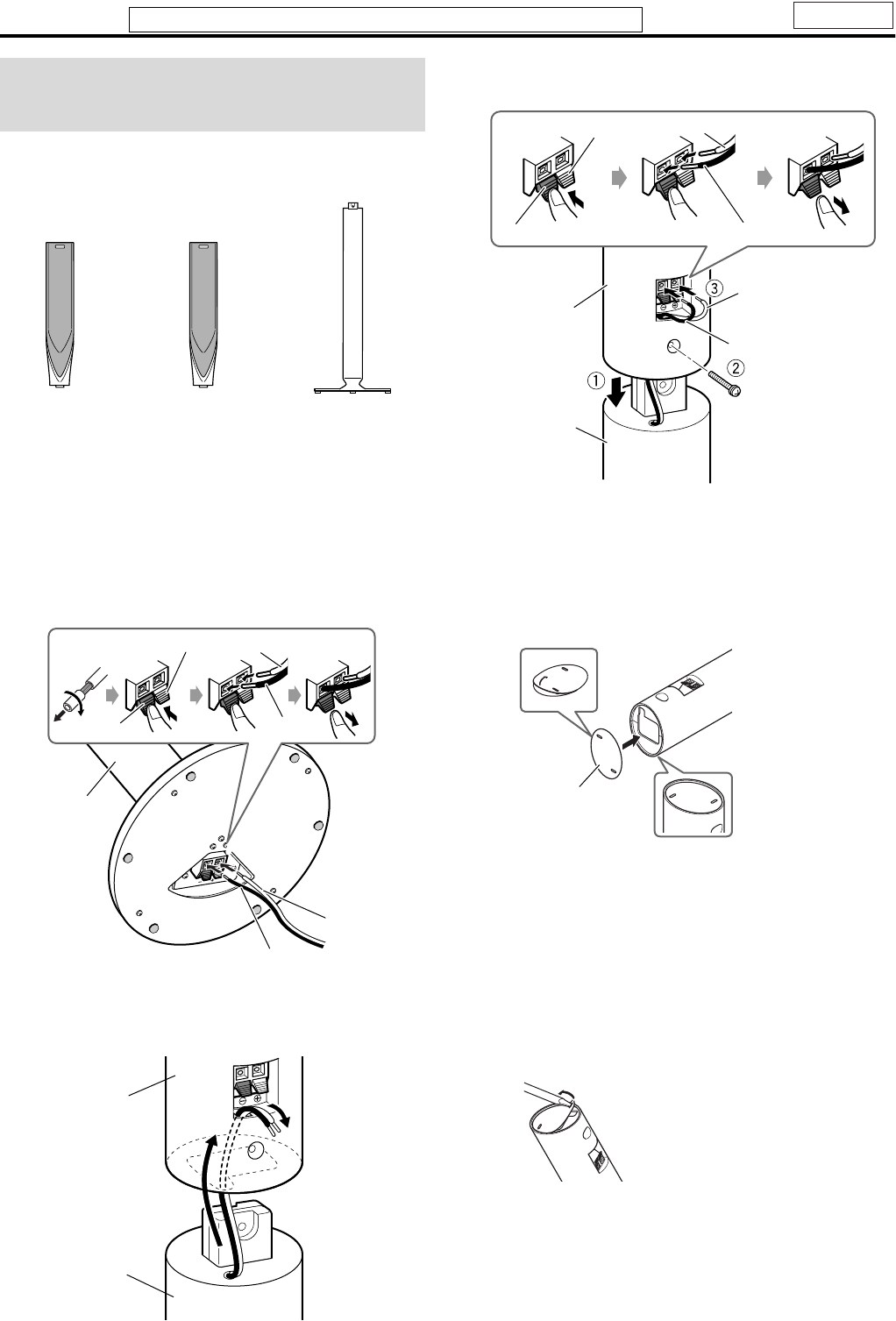
The following procedure explains the front speaker assembly. The
assembly of both the front and surround speakers are done in the
same manner.
Before assembling —
• Prepare a Phillips screwdriver (not supplied).
• Take care not to drop any component part while assembling;
otherwise, it may cause damage to the floor or injury.
1
2
3
When installing the front and surround speakers on the
wall;
• Attach the supplied bottom cover on the bottom of each speakers
as illustrated.
• Be sure to have them installed on the wall by a qualified
personnel.
• DO NOT install the satellite speakers on the wall by yourself to
avoid unexpected damage from their falling off the wall due to
incorrect installation or weakness in wall structure.
• Care must be taken in selecting a location for speaker installation
on a wall. Injury to personnel or damage to equipment may result
if the speakers installed interfere with daily activities.
• If attaching the stand to the speaker, remove the bottom cover by
inserting a flat-pointed tool into the hole of the bottom cover.
Assembling the front and
surround speakers
Stand (×4)
Front speaker
(×2)
Surround speaker
(×2)
Stand
Black
White
Black
Black
White
Red
Speaker
Stand
Stand Screw (supplied)
Black
Red White
Black
Speaker
White
Black
Bottom
cover
This page is for TH-S66
Do not connect the power cord until all other connections have been made.
TH-S66-S55[B].book Page 9 Wednesday, May 25, 2005 12:08 PM
Connections
10
CAUTION
• When you connect speakers other than the supplied ones, use
speakers of the same speaker impedance (SPEAKER IMPEDANCE)
indicated near the speaker terminals on the rear of the powered
subwoofer.
• DO NOT connect more than one speaker to one speaker terminal.
Precautions for daily use
• When moving the speakers, do not pull the speaker cords;
otherwise, the speakers may fall over, causing damage or injury.
• When holding a speaker, always grasp the lower portion.
• Do not lean against the speakers, as the speakers could fall down
or break, possibly causing an injury. Especially be careful that
children do not lean against them.
• Do not reproduce sounds at so high a volume that they are
distorted; otherwise, the speakers may be damaged by internal
heat buildup.
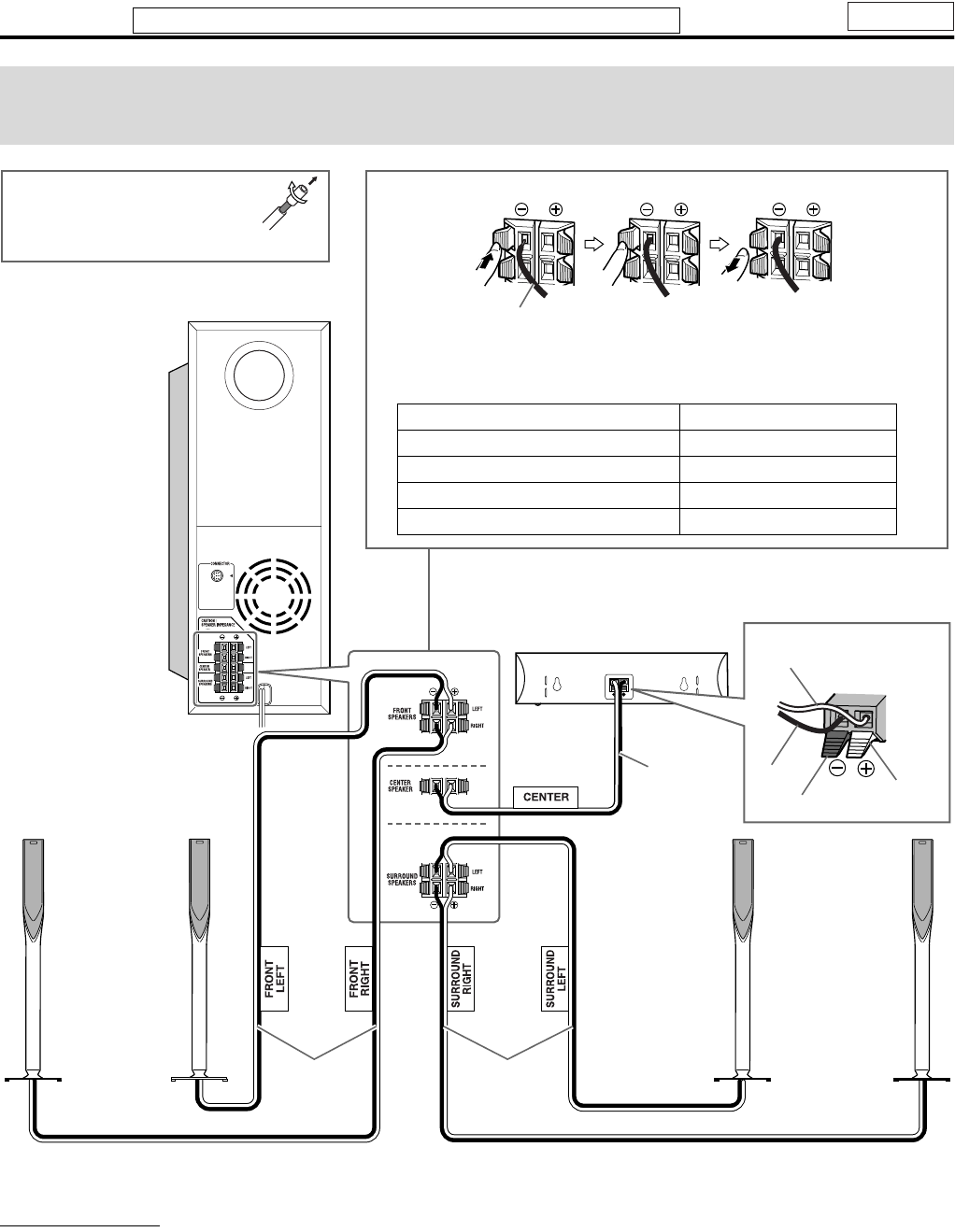
Connecting the satellite (front, center, surround)
speakers
4
Ω
16
Ω
FROM
XV-THC3
XV-THS55
XV-THS58
XV-THS66
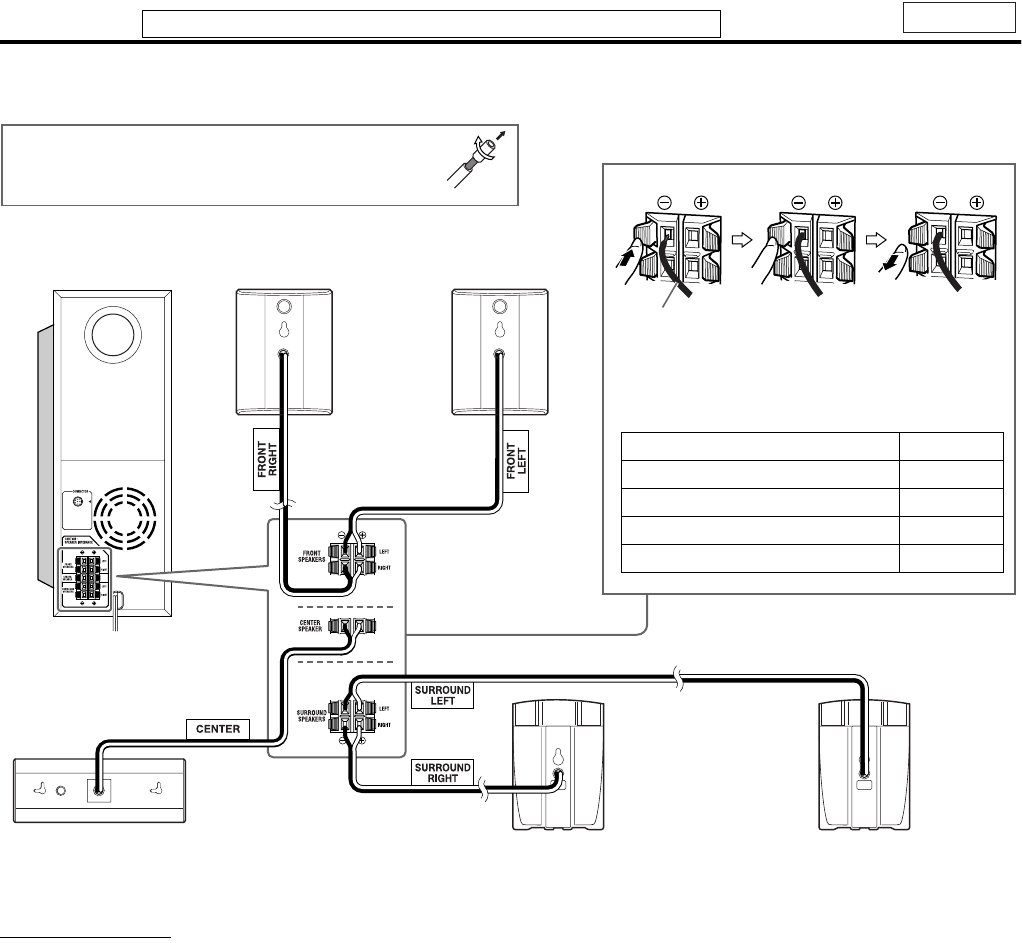
• Connect the black cords to the black (r) terminals.
• Connect the white cords to the (q) terminals referring to the table below:
Speaker cord (supplied)
FRONT SPEAKERS (LEFT) White
FRONT SPEAKERS (RIGHT) Red
CENTER SPEAKER Green
SURROUND SPEAKERS (LEFT) Blue
SURROUND SPEAKERS (RIGHT) Gray
Before connecting the
speaker cords;
Twist and pull the insulation coat
off and remove.
Powered subwoofer
SP-PWS66
Surround speakers
SP-THS66S
Center speaker
SP-THS66C
White
Black
Black Red
Front speakers
SP-THS66F
4m 10m
4m
This page is for TH-S66
Do not connect the power cord until all other connections have been made.
TH-S66-S55[B].book Page 10 Wednesday, May 25, 2005 12:08 PM
Connections
11
The satellite speakers are equipped with their speaker cords attached directly to their speaker unit instead of having speaker terminals on their
cabinet.
CAUTION
• When you connect speakers other than the supplied ones, use
speakers of the same speaker impedance (SPEAKER IMPEDANCE)
indicated near the speaker terminals on the rear of the powered
subwoofer.
• DO NOT connect more than one speaker to one speaker terminal.
Precautions for daily use
• When moving the speakers, do not pull the speaker cords;
otherwise, the speakers may fall over, causing damage or injury.
• Do not reproduce sounds at so high a volume that they are
distorted; otherwise, the speakers may be damaged by internal
heat buildup.
4
Ω
16
Ω
FROM
XV-THC3
XV-THS55
XV-THS58
XV-THS66
• Connect the black cords to the black (r) terminals.
• Connect the white cords to the (q) terminals
referring to the table below:
Speaker cord
FRONT SPEAKERS (LEFT) White
FRONT SPEAKERS (RIGHT) Red
CENTER SPEAKER Green
SURROUND SPEAKERS (LEFT) Blue
SURROUND SPEAKERS (RIGHT) Gray
Before connecting the speaker cords;
Twist and pull the insulation coat off and remove.
Powered subwoofer
SP-PWS55
Front speakers
SP-THS55F
Surround speakers
SP-THS55S
Center speaker
SP-THS55C
This page is for TH-S55
Do not connect the power cord until all other connections have been made.
TH-S66-S55[B].book Page 11 Wednesday, May 25, 2005 12:08 PM
Connections
12
• Place the satellite speakers on a flat and level surface.
• The front and center speakers are magnetically shielded to avoid color
distortions on TVs. However, if not installed properly, they may
cause color distortions. So, pay attention to the following when
installing the speakers.
– When placing the speakers near a TV set, turn off the TV’s main
power switch or unplug it before installing the speakers. Then wait
at least 30 minutes before turning on the TV’s main power switch
again.
Some TVs may still be affected even though you have followed the
above. If this happens, move the speakers away from the TV.
• The surround speakers are not magnetically shielded.
If it is located nearby the TV or monitor, it will probably cause
color distortion on the screen. To avoid this, do not place the
speaker nearby the TV or monitor.
• Be sure to place the powered subwoofer to the TV’s right. If you place
the powered subwoofer to the TV’s left, keep sufficient distance
between them to prevent the TV screen from appearing mottled.
• Distortion of picture may occur when connecting to the TV via a
VCR, or to a TV with a built-in VCR.
• You need to set “MONITOR TYPE” in the PICTURE menu
correctly according to the aspect ratio of your TV. (Apg. 37)
7To connect a TV equipped with the component video
input jacks
NOTE
• If your TV supports progressive video input, you can enjoy a high
quality picture by setting the progressive scan mode to active.
(Apg. 18)
• If the component video input jacks of your TV are of the BNC type,
use a plug adapter (not supplied) to convert the pin plugs to BNC
plugs.
• The component video signals can be output only when you select
“DVD” as the source to play. (Apg. 17)
7To connect a TV with the SCART connector
* Some TV’s SCART connectors output audio signal. In such a
case, you can enjoy the TV sound through this system.
NOTE
• No sound signal comes out from “AV” (SCART) connector.
• Select the appropriate scan mode according to your TV. See
“Changing the scan mode” (Apg. 18).
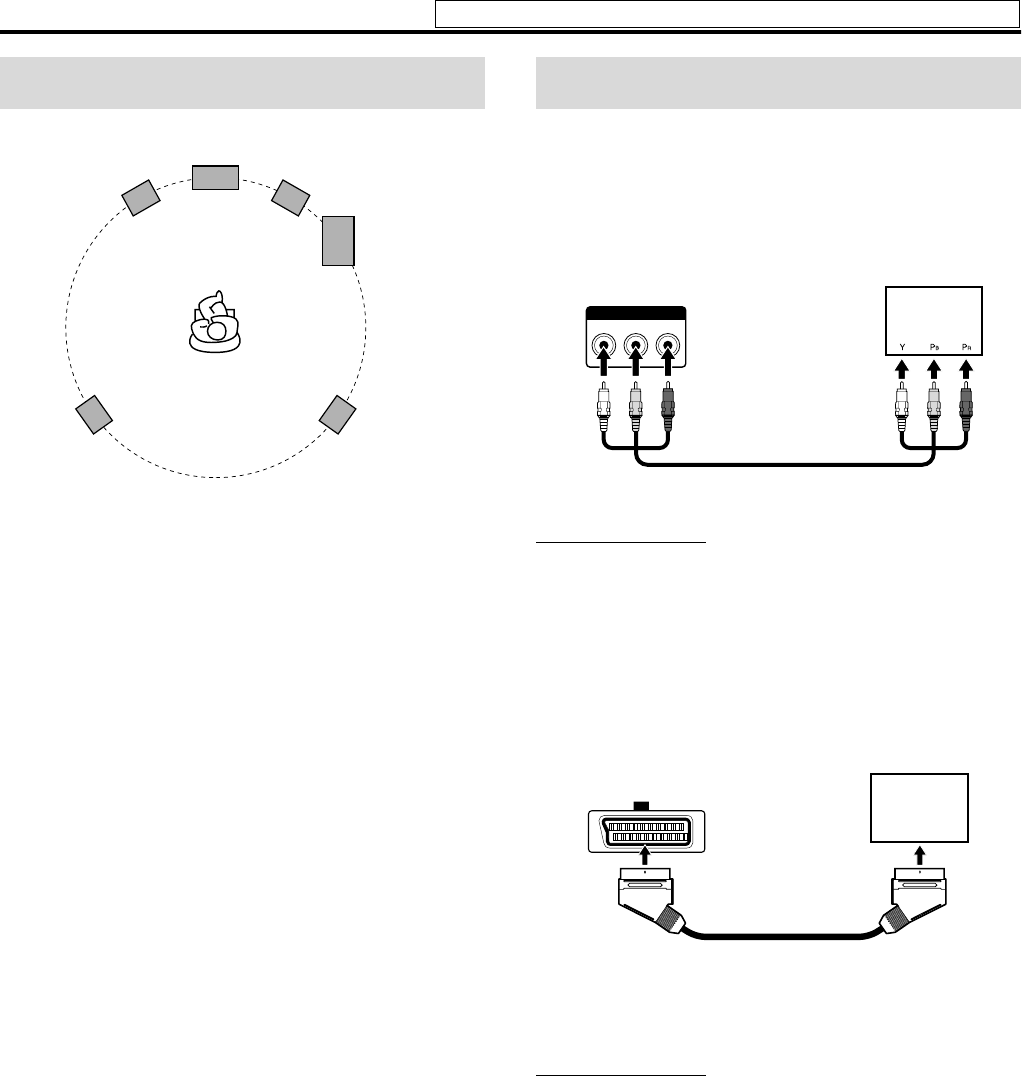
Speaker layout
Front right
speaker
Center speaker
Powered
subwoofer
Surround left
speaker
Surround right
speaker
Front left
speaker
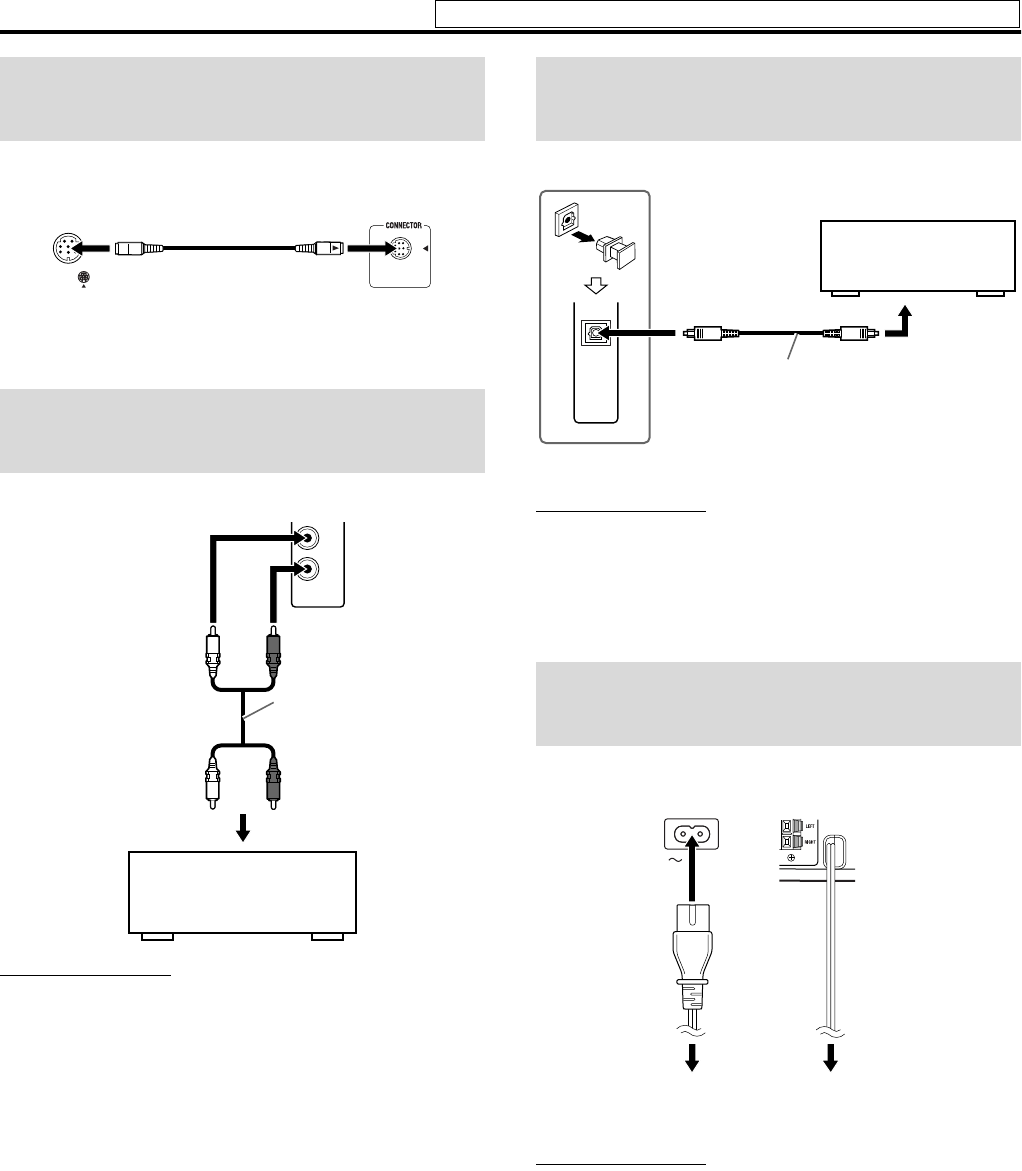
Connecting a TV
P
R
P
B
Y
COMPONENT VIDEO OUT
Center unit
To component
video input
TV
Component video cord (not supplied)
AV
Center unit
TV
SCART cable (not supplied)
To SCART
connector*
Do not connect the power cord until all other connections have been made.
TH-S66-S55[B].book Page 12 Wednesday, May 25, 2005 12:08 PM
Connections
13
You can enjoy the sound of an analog component.
NOTE
• If you connect a sound-enhancing device such as a graphic equalizer
between the source components and this system, the sound output
through this system may be distorted.
• When playing a video component such as a VCR;
•To listen to the sound, select “AUX” as the source to play.
(Apg. 17)
•To see the picture, connect the video output jack of the component
to the video input jack of the TV directly, and select the correct
input mode on the TV.
You can enjoy the sound of a digital component.
* DBS = Direct Broadcasting Satellite
NOTE
When playing a video component such as a DBS tuner;
• To listen to the sound, select “AUX D” as the source to play.
(Apg. 17)
• To see the picture, connect the video output jack of the component to
the video input jack of the TV directly, and select the correct input
mode on the TV.
Make sure that all other connections have been completed.
CAUTION
• Disconnect the power cord before cleaning or moving the system.
• Do not pull on the power cord to unplug the cord. When unplugging
the cord, always grasp and pull the plug so as not to damage the cord.
Connecting the powered
subwoofer
Connecting to an analog
component
FROM
XV-THC3
XV-THS55
XV-THS58
XV-THS66
Powered
subwoofer
System cord
(supplied)
Center unit
Align the 5 marks. Align the 5 marks.
AUX IN
RIGHT
LEFT
RCA pin plug cord
(not supplied)
Center unit
VCR
TV
Cassette recorder
To audio output
Connecting to a digital
component
Connecting the power
cord
DIGITAL
IN
OPTICAL
Digital optical cord
(not supplied)
To digital optical
output
DBS* tuner
MD player
Center unit
AC IN
Center unit Powered
subwoofer
Power cord
(Supplied)
Power cord
Plug into AC outlets.
Do not connect the power cord until all other connections have been made.
TH-S66-S55[B].book Page 13 Wednesday, May 25, 2005 12:08 PM
14
Operating external components with the remote control
NOTE
• Manufacturers’ codes are subject to change without notice.
• Set the codes again after replacing the batteries of the remote control.
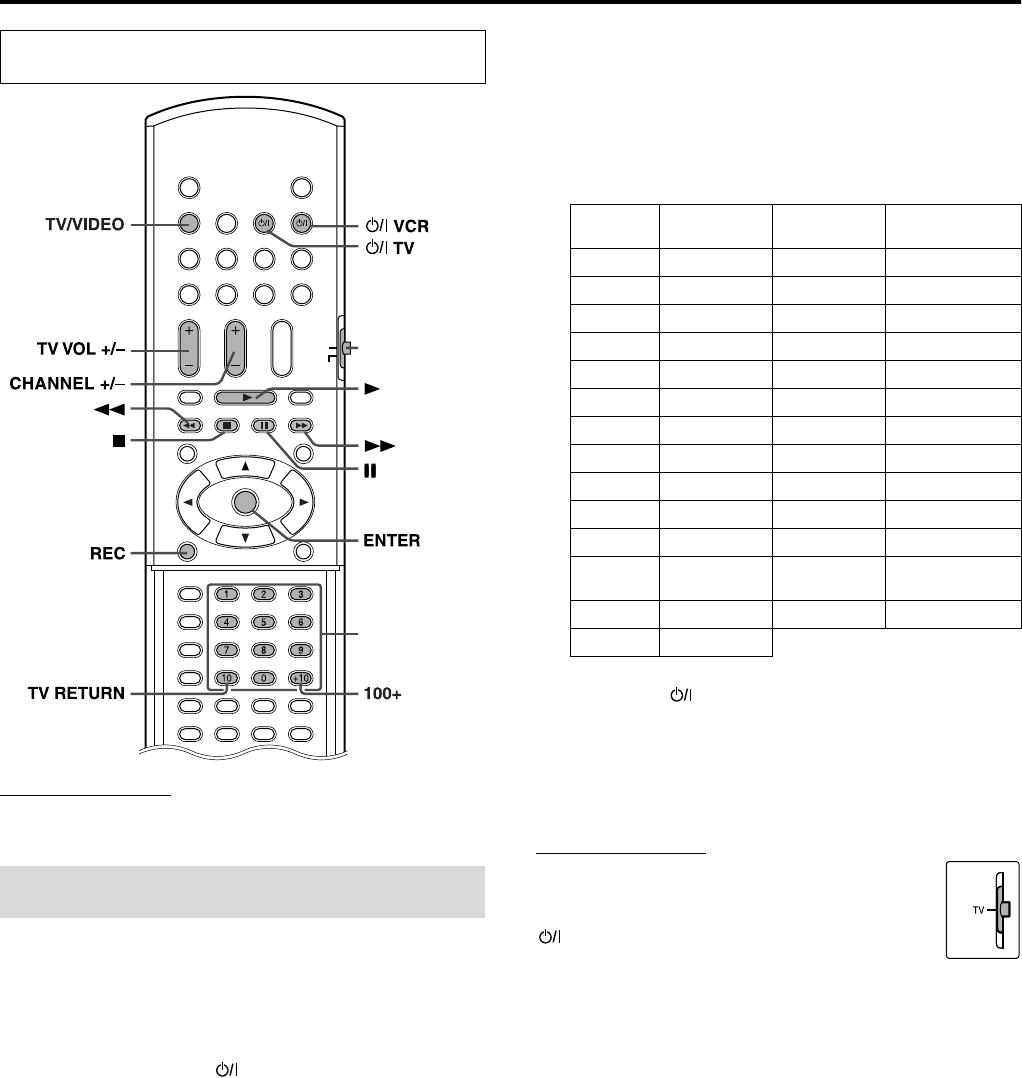
7To set the manufacturer’s code
You can operate a JVC TV without setting the manufacturer’s code.
1Slide the remote control mode selector
to TV.
2Press and hold TV.
Keep the button pressed until step 4 is finished.
3Press ENTER.
4Press number buttons (1-9, 0) to enter
the manufacturer’s code (2 digits).
Examples:
For a Hitachi TV:
Press 0, then 7.
For a Toshiba TV:
Press 2, then 9.
5Release TV.
If there is more than one code listed for corresponding brand,
try each one until you enter the correct one.
7Operation
Aim the remote control at the TV.
IMPORTANT
Before using the remote control to operate a TV;
• Set the remote control mode selector to TV.
The following buttons are available:
TV: Turns TV on and off.
TV VOL +/–: Adjusts the volume.
TV/VIDEO: Selects the input mode (either TV or
VIDEO).
CHANNEL +/–: Changes the channels.
1-10, 0, +10 (100+): Selects the channel.
TV RETURN: Alternates between the previously selected
channel and the current channel.
The buttons described below are used on pages 14 and
15.
Operating the TV
TV/VIDEO
REC
TV VCR
VCR
TV
ENTER
TV RETURN
100+
Remote control
mode selector
Number
buttons
(play button)
Manufac-
turer Code Manufactur-
er Code
JVC 01 Nordmende 13, 14, 18, 26 – 28
Akai 02, 05 Okano 09
Blaupunkt 03 Orion 15
Daewoo 10, 31, 32 Panasonic 16, 17
Fenner 04, 31, 32 Philips 10
Fisher 05 Saba 13, 14, 18, 26 – 28
Grundig 06 Sanyo 05
Hitachi 07, 08 Schneider 02, 05
Inno-Hit 09 Sharp 20
Irradio 02, 05 Sony 21 – 25
Magnavox 10 Telefunken 13, 14, 18, 26 – 28
Mitsubishi 11, 33 Thomson 13, 14, 18,
26–28, 30
Miver 03 Toshiba 29
Nokia 12, 34
TH-S66-S55[B].book Page 14 Wednesday, May 25, 2005 12:08 PM
Operating external components with the remote control
15
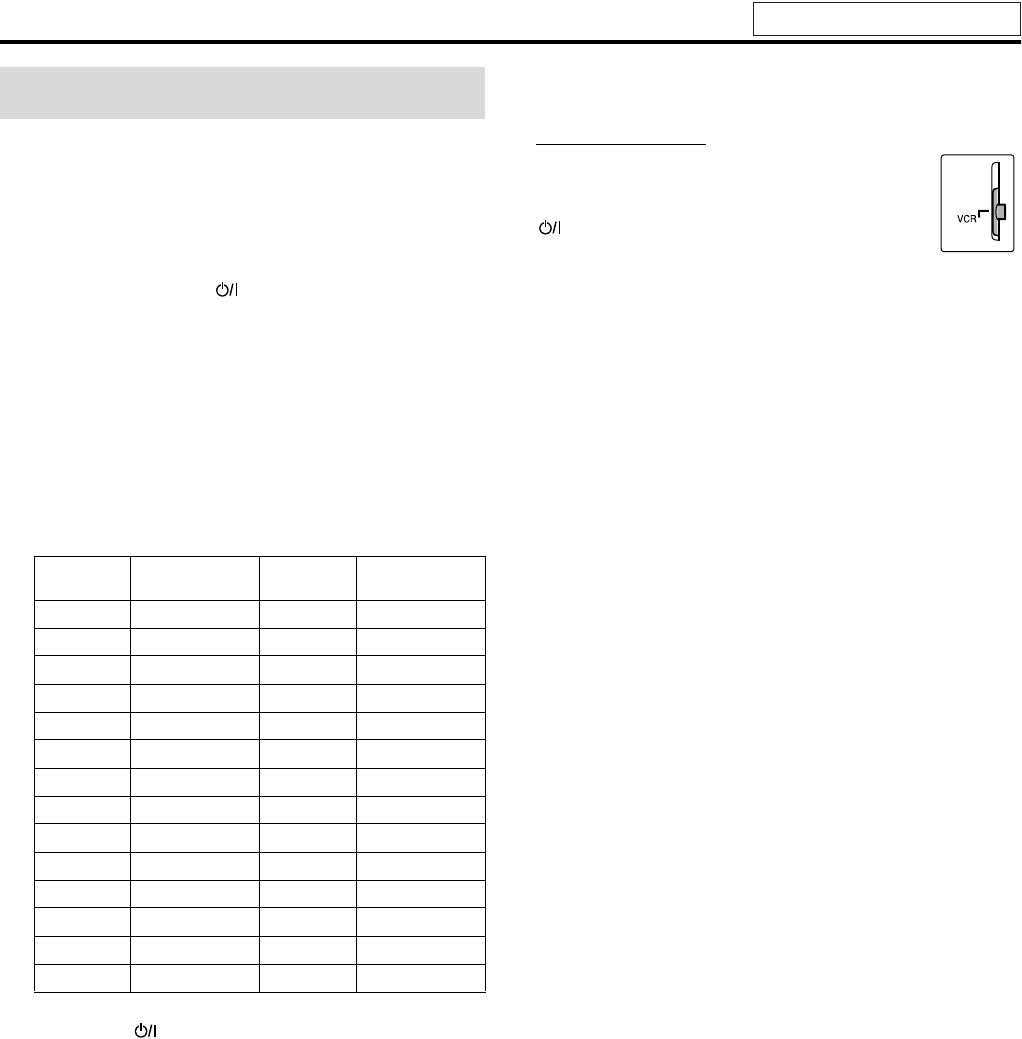
7To set the manufacturer’s code
You can operate a JVC VCR without setting the manufacturer’s
code.
1Slide the remote control mode selector
to VCR.
2Press and hold VCR.
Keep the button pressed until step 4 is finished.
3Press ENTER.
4Press number buttons (1-9, 0) to enter
the manufacturer’s code (2 digits).
Examples:
For a Panasonic VCR:
Press 2, then 1.
For a Philips VCR:
Press 0, then 5.
5Release VCR.
If there is more than one code listed for your brand, try each
one until you enter the correct one.
7Operation
Aim the remote control at the VCR.
IMPORTANT
Before using the remote control to operate a VCR;
Set the remote control mode selector to VCR.
The following buttons are available:
VCR: Turns VCR on and off.
3 (play button): Starts playback.
7: Stops operation.
8: Pauses playback.
y: Fast forwards video tape.
1: Rewinds video tape.
REC: Press this button together with 3 (play button) to
start recording or together with 8 to pause
recording.
CHANNEL +/–: Changes the TV channels on the VCR.
Operating the VCR
Manufac-
turer Code Manufac-
turer Code
JVC 01 Nokia 16
Aiwa 02, 20 Nordmende 17 – 19, 31
Bell+Howell 03, 16 Orion 20
Blaupunkt 04 Panasonic 21
CGM 03, 05, 16 Philips 05, 22
Daewoo 34 Phonola 05
Digtal 05 Saba 17 – 19, 23, 31
Fisher 03, 16 Samsung 24, 25
G.E. 06 Sanyo 03, 16
Grundig 07 Sharp 26, 27
Hitachi 08, 09 Siemens 07
Loewe 05, 10, 11 Sony 28 – 30, 35
Magnavox 04, 05 Telefunken 17 – 19, 31, 32
Mitsubishi 12 – 15 Toshiba 33
See page 14 for button locations.
TH-S66-S55[B].book Page 15 Wednesday, May 25, 2005 12:08 PM
16
Basic operations
IMPORTANT
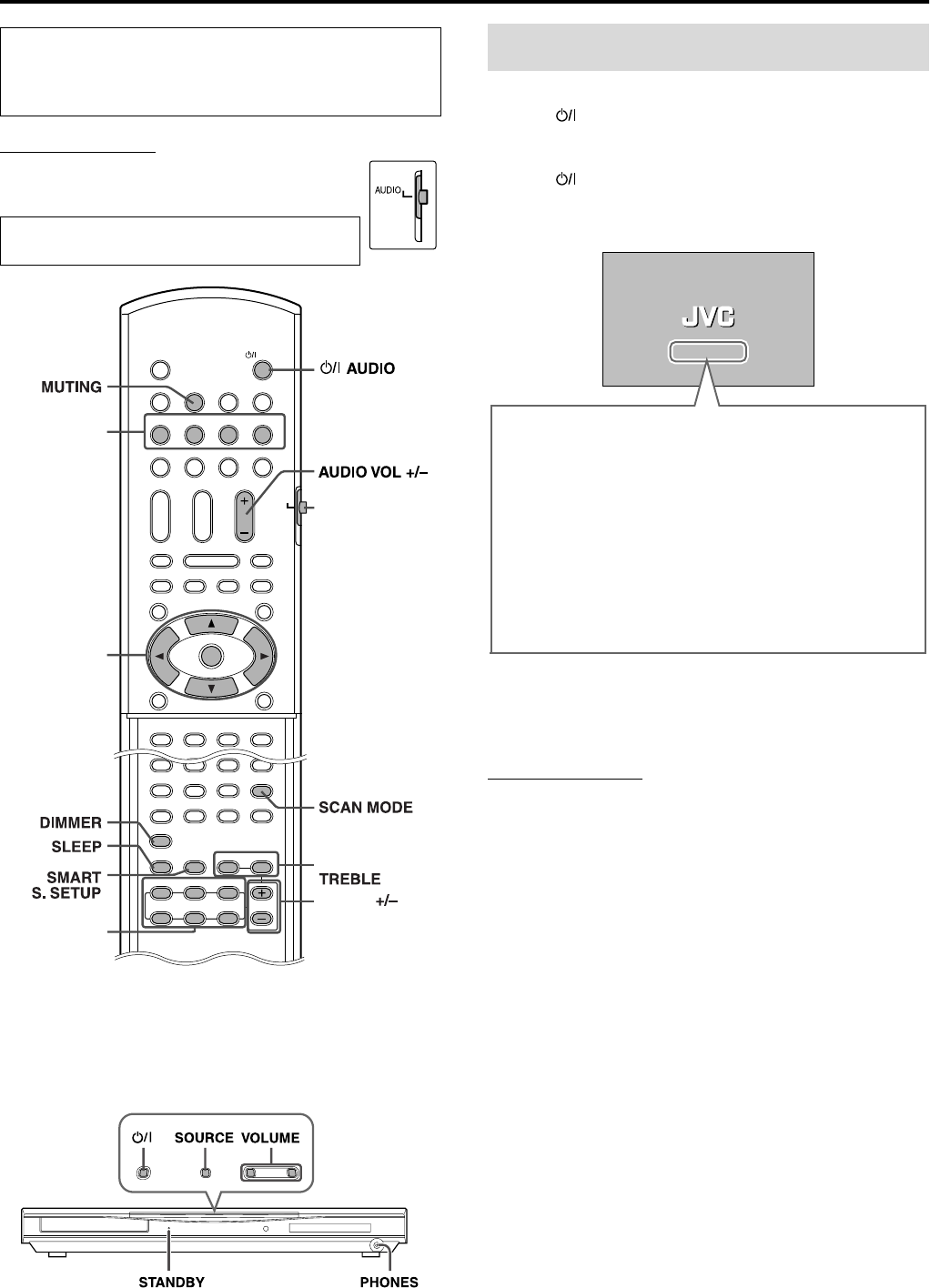
Before using the remote control for the following
operation;
• Set the remote control mode selector to AUDIO.
On the remote control:
Press AUDIO.
On the center unit:
Press .
When DVD is selected as the source (Apg. 17), the following
messages will appear on the TV screen.
NOTE
• The STANDBY lamp turns on when the power is turned off and turns
off when the power is turned on.
• The power supply to the subwoofer is linked to the center unit. The
POWER ON lamp on the subwoofer lights green when the power is
turned on.
• A small amount of the power is consumed even when the power is
turned off (center unit only). This is called standby mode and the
STANDBY lamp lights in this mode. Unplug the power cord from the
AC outlet to turn the power off completely.
• You can also turn on the system by pressing the following buttons;
•OPEN/CLOSE on the remote control or 0 on the center unit
•One of the source selecting buttons on the remote control
•3 on the center unit. You can use the same buttons on the remote
control.
The buttons on the remote control are used to explain most of the
operations in this manual. You can use the buttons on the center
unit same as on the remote control for operations unless
otherwise noted.
The buttons described below are used on
pages 16 to 19.
DVD
MUTING
FM/AM AUX
AUDIO VOL
AUDIO
TV SOUND
AUDIO
ENTER
SLEEP
FRONT L FRONT R
LEVEL
S.WFR
SMART
S. SETUP
CENTER
SCAN MODE
TREBLE
BASS
SURR. RSURR. L
BASS/
LEVEL
Source
selecting
buttons
Remote control
mode selector
Cursor
(3/2/Y/5)/
ENTER
Speaker
buttons
PHONES
STANDBY
Turning the system on/off
• “OPEN”/“CLOSE”:
Appears when opening or closing the disc tray.
• “NOW READING”:
Appears when the system is reading the disc information.
• “REGION CODE ERROR!”:
Appears when the Region Code of the DVD VIDEO does not
match the code the system supports. The disc cannot be
played back.
• “NO DISC”:
Appears when no disc is loaded.
• “CANNOT PLAY THIS DISC”:
Appears when unplayable disc is loaded.
TH-S66-S55[B].book Page 16 Wednesday, May 25, 2005 12:08 PM
Basic operations
17
On the remote control:
Press one of the source selecting buttons
(DVD, FM/AM, AUX or TV SOUND).
DVD: To play back a disc (DVD VIDEO, VCD etc.).
(Apg. 20)
FM/AM: To tune in an FM or AM (MW) station. (Apg. 39)
Each time you press the button, the band alternates
between FM and AM (MW).
AUX: To select the source from a component connected to
the AUX IN jacks or DIGITAL IN jack. (Apg. 13)
Each time you press the button, the source alternates
between “AUX” and “AUX D”.
TV SOUND: To select the TV (that outputs sound signals)
connected to the AV (SCART) connector. (Apg. 12)
On the center unit:
Press SOURCE repeatedly until the source
name you want appears on the display
window.
NOTE
• When a source except DVD is selected, this system does not output
video signals.
• It may take time to change the source.
CAUTION
• Always set the volume to minimum level before starting any source.
If the volume is set at its high level, the sudden blast of sound could
permanently damage your hearing and/or blow out the speakers.
On the remote control:
Press AUDIO VOL +/–.
On the center unit:
Press VOLUME +/–.
CAUTION
Be sure to turn down the volume;
• Before connecting or putting on headphones as high volume may
damage both the headphones and your hearing.
• Before disconnecting headphones as high volume may be suddenly
output from the speakers.
While connecting a pair of headphones to the PHONES jack on the
center unit, the system automatically cancels the surround mode
(Apg. 24) currently selected, deactivates the speakers, turns the
subwoofer’s power off, and activates the headphone mode. “H.
PHONE” appears on the display window.
Headphone mode
When using the headphones, the following signals are output
regardless of your speaker setting;
• For 2 channel sources, the front left and right channel signals are
output from the headphones.
• Multi-channel signals are down-mixed and output from the
headphones.
• (For DVD AUDIO) When the disc prohibits down-mixing, only
the front left and right channels are output from the headphones.
In this case, “LR ONLY” appears on the display window for a
few seconds.
Press MUTING.
To restore the sound
Perform one on the following:
• Press MUTING again.
• Press AUDIO VOL +/– (or press VOLUME +/– on the center
unit).
Press DIMMER.
Each time you press the button, the brightness level changes.
Selecting the source to
play
Adjusting the volume
[VOLUME]
Listening with headphones
(not supplied)
Turning off the sound
temporarily [MUTING]
Adjusting the brightness
of the indications
[DIMMER]
See page 16 for button locations.
TH-S66-S55[B].book Page 17 Wednesday, May 25, 2005 12:08 PM
Basic operations
18
The system turns off automatically when the specified period of
time has passed.
Press SLEEP.
Each time you press the button, the shut-off time changes.
Example:
To check the remaining time
Press SLEEP once.
To change the remaining time
Press SLEEP repeatedly.
To cancel
Press SLEEP repeatedly until “SLEEP – –” appears.
• Turning off the power also cancels the Sleep Timer.
Press each speaker button you want to
adjust the output level and then LEVEL +/–.
•FRONT L: Front Left speaker
•FRONT R: Front Right speaker
•SURR. L: Surround Left speaker
•SURR. R: Surround Right speaker
•CENTER: Center speaker
•S.WFR: Subwoofer
NOTE
• You can also make adjustments by using the setup menu shown on the
TV screen. (Apg. 37)
• The adjustments take effect for all sources.
• You cannot make this adjustment when FM or AM is selected as the
source and “SURR OFF” is selected as the surround mode.
Press TREBLE and then LEVEL +/–.
NOTE
• The adjustments take effect for all sources.
Press BASS and then LEVEL +/–.
NOTE
• The adjustments take effect for all sources.
The system can be accommodated to your TV’s scan mode.
NOTE
• To use the system in PROGRESSIVE mode, it is required that the
center unit is connected to the TV by using a component video cord
(not supplied). (Apg. 12)
7While DVD is selected as the source and stopped
1Press and hold SCAN MODE for
2 seconds.
“RGB”, “Y/C”, or “PROGRESS” appears on the display
window.
2Press Cursor 3/2 to select the desired
mode.
• RGB: Select this when your TV accommodates
the interlaced RGB/composite video
signal.
• Y/C: Select this when your TV accommodates
the interlaced S-video signal.
• PROGRESS: Select this when your TV equipped with
component jacks supports the progressive
video input.
You can get better picture quality in the order —
“PROGRESSIVE” > “RGB” > “Y/C” > Composite.
3Press ENTER while the selected mode
is displayed.
When “PROGRESS” is selected, the PROGRESSIVE
indicator lights on the display window.
NOTE
• Although the picture may be distorted when you press ENTER, this
is not a malfunction of the system.
• “RGB” is selected at your purchase.
Sleep Timer [SLEEP]
Adjusting the output level
of the subwoofer and
speakers
Adjusting the treble
sound [TREBLE]
SLEEP60
minutes
Adjusting the bass sound
[BASS]
Changing the scan mode
• There are some progressive TVs and High-Definition TVs that are
not fully compatible with this system, resulting in an unnatural
picture when playing back a DVD VIDEO in the progressive scan
mode. In such a case, change the scan mode to “RGB” or “Y/C”.
To check the compatibility of your TV, contact your local JVC
customer service center.
• All JVC progressive TVs and High-Definition TVs are fully
compatible with this system.
See page 16 for button locations.
TH-S66-S55[B].book Page 18 Wednesday, May 25, 2005 12:08 PM
Basic operations
19
NOTE
• When you change the positioning of the speakers or listener, or
replace the supplied speakers with other ones, perform Smart
Surround Setup again.
7While DVD is selected as the source and stopped
1Take your position where you listen to
the sound.
2Press and hold SMART S. SETUP.
“SETTING” appears on the display window.
3Clap your hands over your head once.
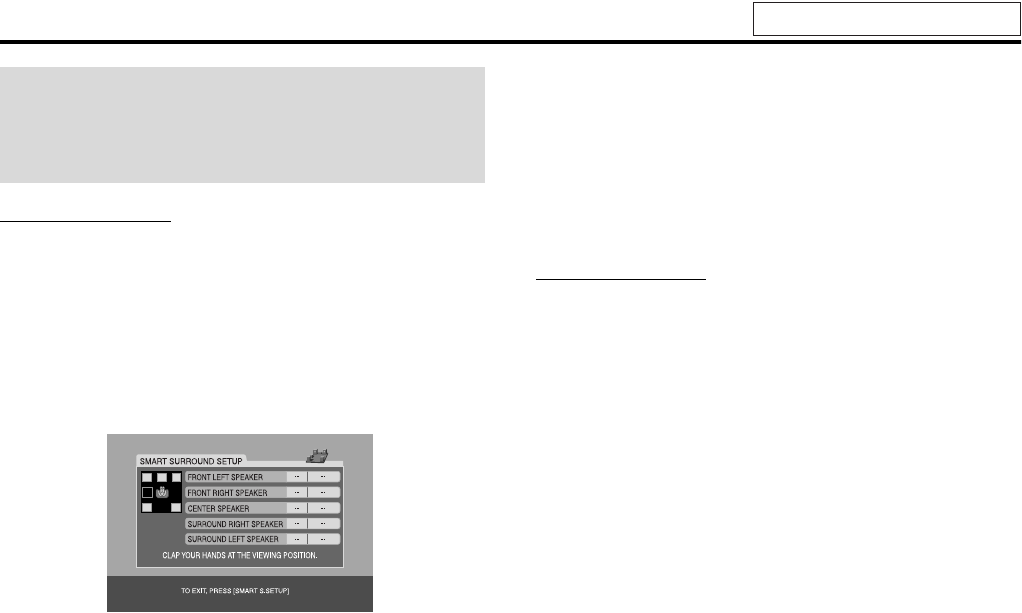
4Make sure that “COMPLETED !”
appears on the TV screen, then press
SMART S. SETUP.
The system detects your clapping sound through the satellite
speakers, then automatically makes the best settings for each
speaker. “COMPLETED !” appears on the TV screen when
Smart Surround Setup completes.
When “FAILED !” appears on the TV screen
The system could not detect the clapping sound correctly. In such a
case, follow the instructions that appear on the TV screen.
• When the system detects the clapping sound as “FAILED !” three
times, set the delay time (DELAY) and the output level (LEVEL)
manually. (Apg. 37)
To cancel
Press SMART S. SETUP.
NOTE
• You need to set the subwoofer’s output level (LEVEL) manually.
(Apg. 18)
• In step 2, “SW ERROR” appears on the display window if the center
unit and the powered subwoofer are not connected correctly by using
the supplied system cord.
Optimizing the speaker
settings [Smart Surround
Setup]
See page 16 for button locations.
TH-S66-S55[B].book Page 19 Wednesday, May 25, 2005 12:08 PM
20
Playback
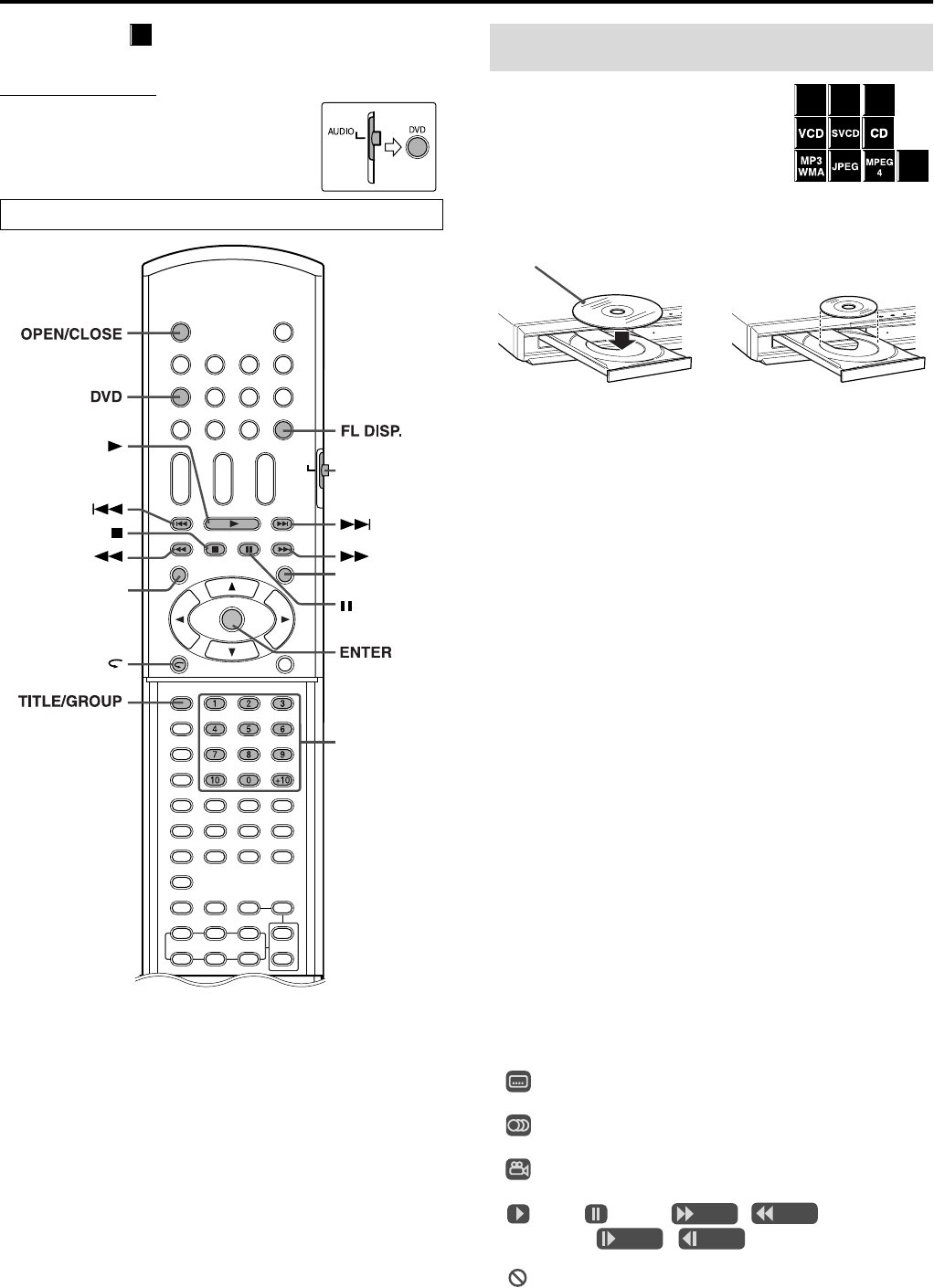
• The icon such as shows the disc formats or file types the
operation is available for.
IMPORTANT
Before using the remote control for the
following operation;
1 Set the remote control mode selector to
AUDIO.
2Press DVD.
1Press OPEN/CLOSE.
• The system turns on and the disc tray
comes out.
•0 on the center unit can also be used.
2Place a disc.
3Press 3 (play button).
For MP3/WMA files
The file control display (Apg. 28) appears on the TV screen.
For JPEG files
Each file (still pictures) is shown on the TV screen for about 3
seconds (slide-show). When stopping playback, the file control
display (Apg. 28) appears on the TV screen.
For MPEG-4 files
Pressing TOP MENU/PG or MENU/PL shows the file control
display (Apg. 28) on the TV screen during playback.
For DivX files
During a readout time, “READING INDEX” may appear on the
TV screen.
Pressing TOP MENU/PG or MENU/PL shows the file control
display (Apg. 28) on the TV screen during playback.
For DVD VR disc
Pressing TOP MENU/PG or MENU/PL shows the control display
on the TV screen. (Apg. 23)
7To pause playback
Press 8.
To return to playback, press 3 (play button).
7To stop
Press 7.
7On-screen guide icons
During DVD VIDEO playback, the following guide icons may
appear for a while on the TV screen;
• : appears at the beginning of a scene containing multi-
subtitle languages.
• : appears at the beginning of a scene containing multi-audio
languages.
• : appears at the beginning of a scene containing multi-angle
views.
• (Play), (Pause), / (Fast forward/
fast-reverse), / (Slow-motion forward/
reverse): appears when you perform each operation.
• : the disc cannot accept an operation you have tried to do.
The buttons described below are used on pages 20 to 23.
DVD
VIDEO
OPEN/CLOSE
DVD
TOP MENU/PG MENU/PL
FL DISP.
AUDIO
ENTER
TITLE/GROUP
100+
TOP MENU/PG
MENU/PL
Remote
control mode
selector
(play button)
Number
buttons
Basic playback
DVD
VR
DVD
AUDIO
DVD
VIDEO
DivX
Label side up When placing an 8 cm
disc
Continued on next page
TH-S66-S55[B].book Page 20 Wednesday, May 25, 2005 12:08 PM
Playback
21
NOTE
• (For JPEG) The system cannot accept operations even though you
press any buttons before the entire picture appears on the TV screen.
• If you do not want the on-screen guide icons to appear, see page 38.
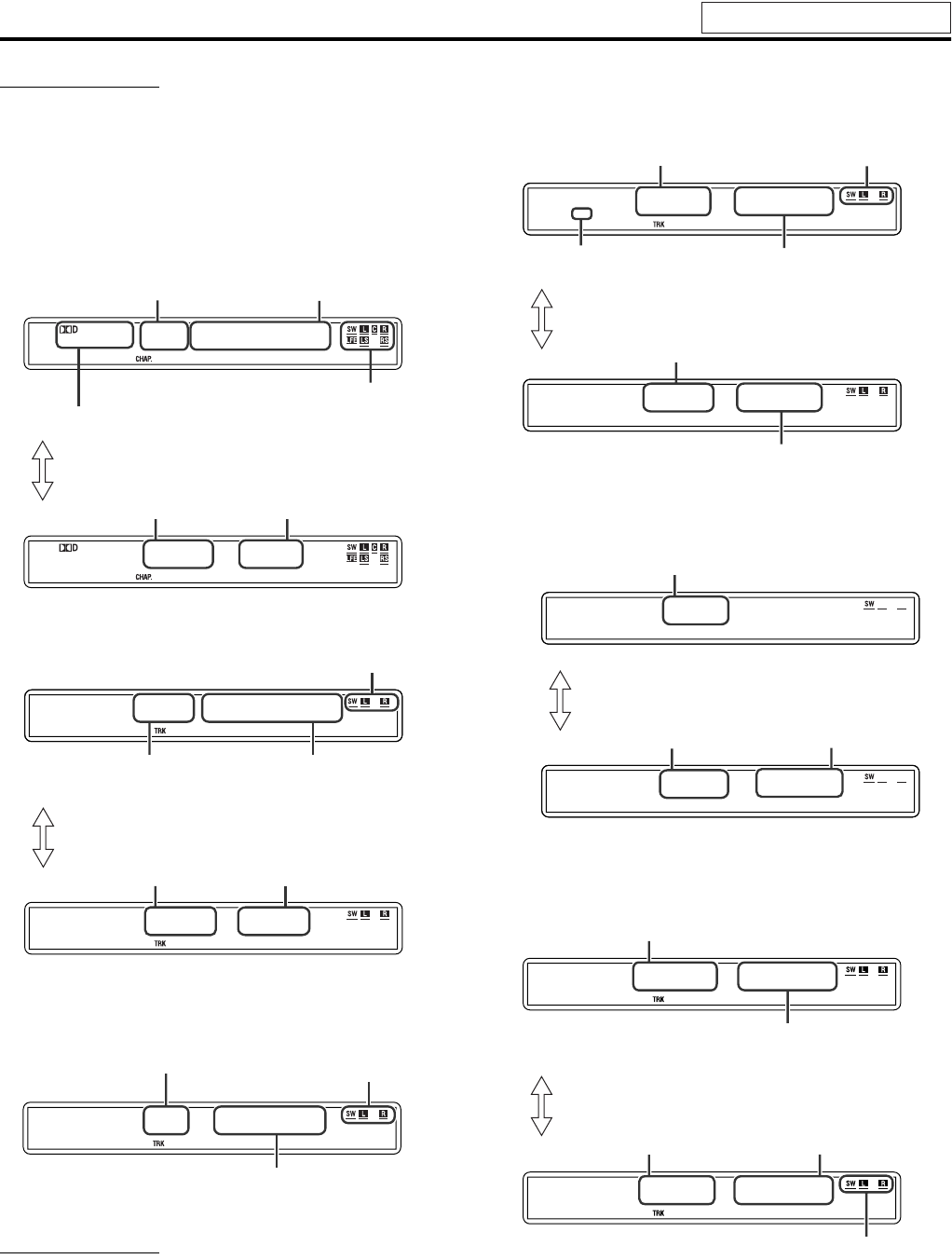
7Playback information on the display window
DVD VIDEO
Example:
When a DVD VIDEO encoded with Dolby Digital 5.1ch is played
DVD AUDIO
VCD/SVCD/CD
Example:
When a CD is played back
NOTE
• When a VCD or SVCD with PBC function is played, the elapsed
playing time does not appear, but “PBC” appears.
MP3/WMA file
Example:
When an MP3 is played back
JPEG file
MPEG-4/DivX file
Example:
When an MPEG-4 is played.
1
11
SURR
C
2
2
3
3
::
SURR
T
24
4
5
.
.
Signal and speaker indicators (Apg. 25)
Chapter number
Elapsed playing time
(hour:minute:second)
Surround mode and digital signal format (Apg. 25)
Title number
Pressing FL DISP.
Chapter number
P LPCM SURR
112
2
2345
::
P LPCM SURR
T1
G3
.
.
Track number Elapsed playing time
(hour:minute:second)
Group number
Signal and speaker indicators
Pressing FL DISP.
Track number
L PCM 12
.
1
3
3:
Track number
Elapsed playing time (minute:second)
Signal and speaker
indicators
11
MP3
2
23
34
1
1
MP3
2
23
GT
.
.
:
Track number
Elapsed playing time (minute:second)
(during playback only)
Group number
Track number
Pressing FL DISP.
Signal and speaker
indicators
MP3 indicator*1
*1 WMA indicator lights for WMA disc.
123JPEG
1212
GF3
.
.
Group number File number
File number
Pressing FL DISP. twice
111
233
0:
13
G122
T
.
.
Signal and speaker indicators
Group number Track number
Elapsed playing time (minute:second)
(during playback only)
Track number
Pressing FL DISP.
See page 20 for button locations.
TH-S66-S55[B].book Page 21 Wednesday, May 25, 2005 12:08 PM
Playback
22
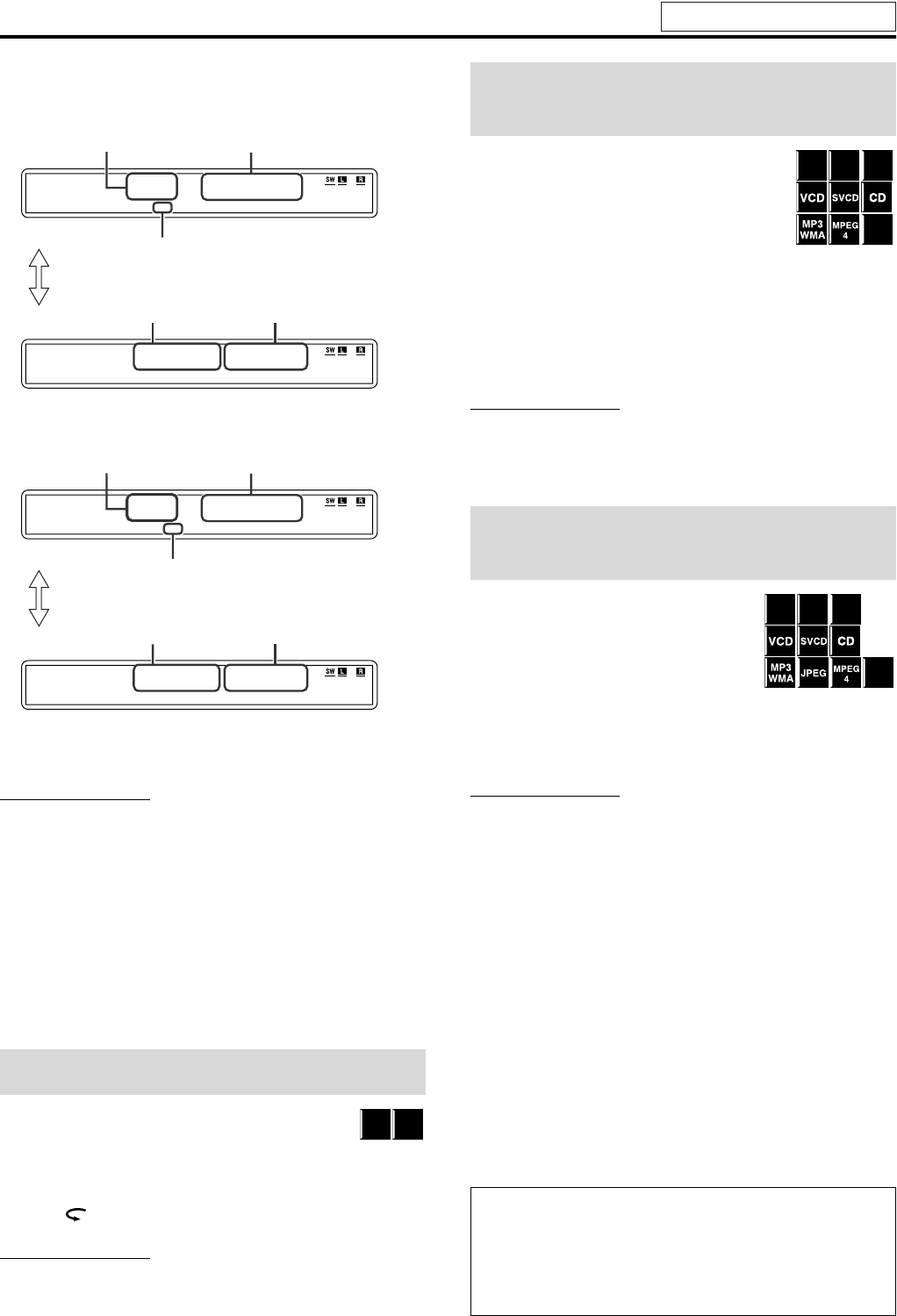
DVD VR disc
Example:
During playback on the Original program*
Example:
During playback on the Playlist*
* Pressing TOP MENU/PG or MENU/PL, you can change the
play mode. (Apg. 23)
NOTE
• You can change the time information mode (except for MP3/WMA/
JPEG/MPEG-4/DivX). (Apg. 26)
• You can also check the playback information on the TV screen.
(Apg. 25)
7Screen saver
A TV screen may burn out if a static picture is displayed for a long
time. To prevent this, the system automatically dims the screen if a
static picture is displayed for over 5 minutes (the screen saver
function).
• Pressing any button will cancel the screen saver function.
• If you do not want to use the screen saver function, see page 37.
You can move back the playback position by 10 seconds
from the current position.
7During playback
On the remote control:
Press .
NOTE
• This function works in the same title.
• This function is not available during the repeat playback.
• This feature may not work for some discs.
7During playback
On the remote control:
Press y or 1.
Each time you press the button, the search speed
changes.
To return to normal speed playback
Press 3 (play button).
Press and hold x or 4.
Continuously pressing x or 4 increases the fast-forward/
reverse search speed.
NOTE
•When a DVD VIDEO, DVD VR, VCD, SVCD or MPEG-4/DivX is
played back, no sound comes out during fast-forward/reverse search.
•When a DVD AUDIO or CD is played back, sound is intermittent and
low during fast-forward/reverse search.
•This feature may not work for some discs.
7Using x/4 buttons
7For DVD VIDEO/DVD VR (chapter):
During playback
For VCD/SVCD (track):
During playback without PBC function
For DVD AUDIO/CD/MP3/WMA/JPEG/MPEG-4/DivX (track/
file): During playback or while stopped
Press x or 4 repeatedly.
NOTE
•When playing back an MP3/JPEG file, you can make operations
using the file control display. (Apg. 28)
•When playing back a DivX file, pressing Cursor 3/2 may skip the
scene a few minutes forward/backward.
•This feature may not work for some discs.
7Using number buttons on the remote control
7For DVD VIDEO/DVD VR (title, chapter):
While stopped, the title number is selected.
During playback, the chapter number is selected.
For DVD AUDIO (track):
During playback or while stopped
For VCD/SVCD (track):
During playback without PBC function
For CD/MP3/WMA/JPEG/MPEG-4/DivX(track/file):
During playback or while stopped
Press number buttons (0-10, +10) to select
the desired number.
•For details on using the number buttons, see “How to use the
number buttons” below.
One Touch Replay
PG
22
PG
PG
00::263
1.C3
Title number
PG (Original program) indicator
Pressing FL DISP.
Title number Elapsed playing time
(hour:minute:second)
Chapter number
PL
PL1. C 1
PL
3000::503
Playlist number
PG (Original program) indicator
Pressing FL DISP.
Title number Elapsed playing time
(hour:minute:second)
Chapter number
DVD
VR
DVD
VIDEO
Fast-forward/fast-reverse
search
Skip to the beginning of a
desired selection
How to use the number buttons
To select 3: Press 3.
To select 14: Press +10, then 4.
To select 24: Press +10 twice, then 4.
To select 40: Press +10 three times, then 10.
Or press +10 four times, then 0.
DivX
DVD
VR
DVD
AUDIO
DVD
VIDEO
DVD
VR
DVD
AUDIO
DVD
VIDEO
DivX
See page 20 for button locations.
TH-S66-S55[B].book Page 22 Wednesday, May 25, 2005 12:08 PM
Playback
23
7During playback or while stopped
1Press TITLE/GROUP.
“_ _” or “_” is shown in the title/group
display area in the display window.
Example:
During DVD VIDEO playback
2While the display window shows “_ _”
or “_”, use number buttons (0-10, +10)
to enter the desired title or group
number.
The system starts playback from the first chapter/track/file of
the selected title/group.
•For details on using the number buttons, see “How to use the
number buttons” (Apg. 22).
NOTE
• This feature may not work for some discs.
Some DVD AUDIOs have a special group called “bonus
group” whose contents are not open to the public. The
bonus group is always assigned to the last group of a disc.
To play back a bonus group, you have to enter the specific “key
number” (a password). The way of getting the key number depends
on the disc. After getting the key number, you can play back the
bonus group by following the procedure below.
7While the BONUS indicator lights up on the display window
1Select the bonus group.
For selecting the group, see “Locating a desired title/group
using number buttons” described above.
The key number entry indication appears.
On the TV
On the display window
2Press number buttons (0-9) to enter the
key number, then press ENTER.
When you enter the correct key number, playback starts and
the BONUS indicator goes off.
•If you enter the wrong number, reenter the correct number.
To clear the key number entry
Perform whichever one of the following:
•Open the disc tray.
•Turn off the system.
7During playback or while stopped.
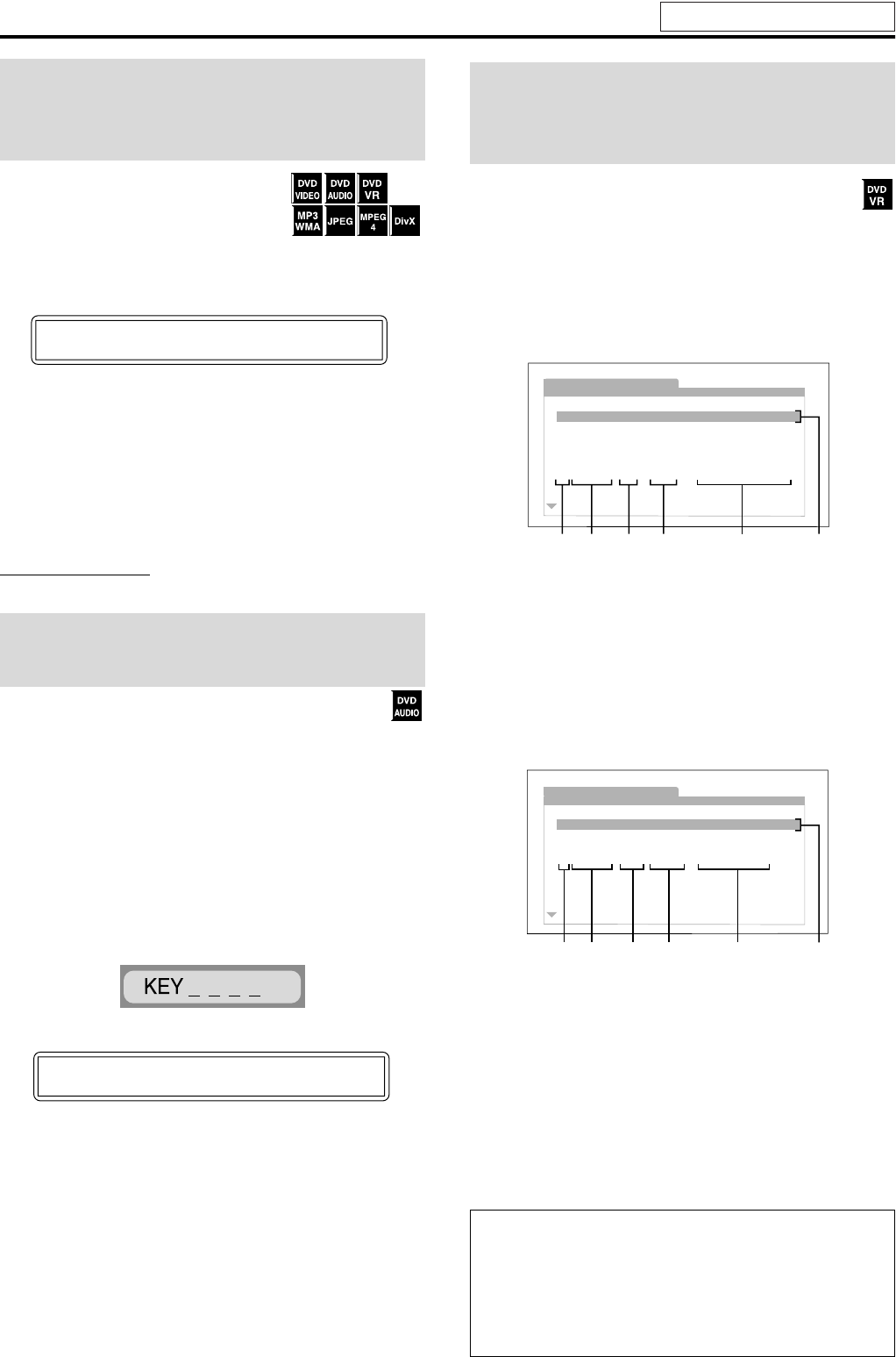
1Press TOP MENU/PG or MENU/PL.
The control display is shown on the TV screen, and the system
starts playback of the first title/playlist.
•The PLAY LIST is shown only when the playlist is on the
DVD VR disc.
TOP MENU/PG: shows the ORIGINAL PROGRAM.
Example:
*1: Title number
*2: Recording date
*3: Recording source (TV station, the input terminal of the
recording equipment etc.)
*4: Start time of recording
*5: Title of the original program/playlist (The title may not be
displayed depending on the recording equipment.)
*6: Current title
MENU/PL: shows the PLAY LIST.
Example:
*7: Playlist number
*8: Creating date of playlists
*9: Number of chapters
*10: Total playing time
*11: Current playlist
2Press Y/5 to select the desired title/
playlist.
The system starts playback of the selected title/playlist.
To clear the control display
•Press ENTER.
Locating a desired title/
group using number
buttons
Playing back a bonus
group
__ 12345
::
.
KEY ____
BONUS
.::
Selecting the desired
title/playlist from the
control display
About the play mode on a DVD VR disc
•Original program (ORIGINAL PROGRAM):
The system can play back the original picture in the recorded
order.
•Playlist (PLAY LIST):
The system can play back the playlist edited by the recording
equipment.
ORIGINAL PROGRAM
No Date Ch Time Title
1 25/04/04 4ch 19:00 JVC DVD World 2004
2 17/05/04 8ch 10:30
3 22/05/04 8ch 17:00 Music Festival
4 26/05/04 L-1 13:19 children 001
5 20/06/04 4ch 22:00
6 25/06/04 L-1 8:23 children 002
*1 *2 *3 *4 *5 *6
PLAY LIST
No Date Chap Length Title
1 25/05/04 001 1:03:16 My JVC World
2 17/06/04 005 1:35:25
3 20/06/04 003 0:10:23 Favorite music
4 25/06/04 001 0:07:19 children001-002
*8
*7 *9 *10 *5 *11
See page 20 for button locations.
TH-S66-S55[B].book Page 23 Wednesday, May 25, 2005 12:08 PM
24
Advanced operations
•The icon such as shows the disc formats or file types the
operation is available for.
IMPORTANT
Before using the remote control for the following
operation;
•Set the remote control mode selector to AUDIO.
•There are exceptions in the operation mentioned
above. In such a case, follow each instruction.
7Auto Surround (AUTO SUR)
Used to reproduce the sound as it is recorded without any
conversion (downmixing or simulation, etc.). For example, a
multichannel source is automatically reproduced in multichannel
audio.
7Dolby Surround
Dolby Pro Logic II*1
Dolby Pro Logic II has a newly developed multichannel playback
format to decode all 2 channel sources — stereo source and Dolby
Surround encoded source — into a 5.1 channel.
Dolby Pro Logic II has two modes —Movie mode and Music
mode:
• Pro Logic II Movie (MOVIE)
Suitable for reproduction of Dolby Surround encoded sources
bearing the mark .
• Pro Logic II Music (MUSIC)
Suitable for reproduction of any 2 channel stereo music sources.
Dolby Digital*1
Used to reproduce multichannel soundtracks of the software
encoded with Dolby Digital ( ).
7DTS Digital Surround*2
Used to reproduce multichannel soundtracks of the software
encoded with DTS Digital Surround ( ).
DTS Digital Surround (DTS) is another discrete multichannel
digital audio format available on CD and DVD software.
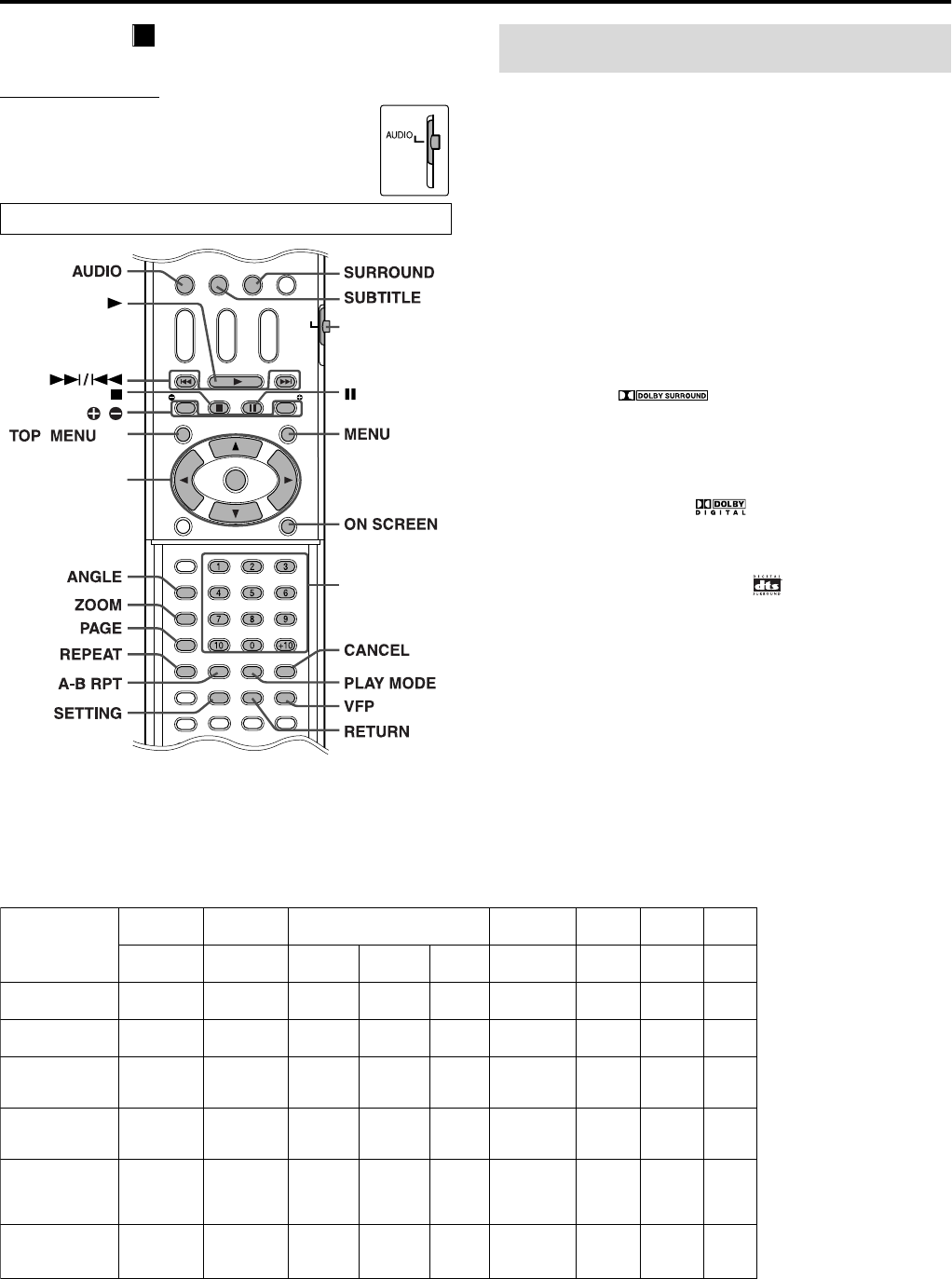
The buttons described below are used on pages 24 to 35.
DVD
VIDEO
TOP MENU/PG MENU/PL
ON
SCREEN
AUDIO SUBTITLE
SURROUND
AUDIO
ENTER
ANGLE
VFP
ZOOM
PA G E
REPEAT
A-B RPT
SETTING
PLAY MODE
RETURN
100+
CANCEL
SLOW SLOW
/PL
/PG
SLOW /
Cursor
(3/2/Y/5)/
ENTER
Number
buttons
(play button) Remote control
mode selector
Using the surround mode
Available Surround modes for each input signal
The B marks show available surround modes.
Mode Surround
off
Auto
Surround Dolby Surround DTS Digital
Surround
Linear
PCM
Packed
PCM DSP
SURR OFF AUTO SUR MOVIE*3MUSIC*3DOLBY
DDTS LPCM PPCM
Signal ALL
ST*3
DOLBY D
(Multichannel) BB——B————
DOLBY D
(2 channel) BBBB————B
DTS Digital
Surround
(Multichannel)
BB——— B———
DTS Digital
Surround
(2 channel)
BB
BB—— ——B
Analog (VCR) or
Linear/Packed
PCM
(2 channel)
BBBB————B
Linear/Packed
PCM
(Multichannel)
BB——— — BB—
*1 Manufactured under
license from Dolby
Laboratories. “Dolby”,
“Pro Logic”, “MLP
Lossless”, and the
double-D symbol are
trademarks of Dolby
Laboratories.
*2 “DTS” and “DTS
Digital Surround” are
registered trademarks
of Digital Theater
Systems, Inc.
*3 You can select these
modes by pressing
SURROUND.
(Apg. 25)
Continued on next pag
e
TH-S66-S55[B].book Page 24 Wednesday, May 25, 2005 12:08 PM
Advanced operations
25
7All Channel Stereo (DSP)
All Channel Stereo (ALL ST) mode can reproduce a larger stereo
sound field using all the connected (and activated) speakers.
All Channel Stereo can be used while reproducing 2 channel stereo
source.
7Indicators on the display window
Digital signal format indicators
PPCM, SURR: Lights when DVD AUDIO packed PCM signals
comes in.
LPCM, SURR: Lights when Linear PCM signal comes in.
GD, SURR: Lights when DOLBY D signals come in.
C, SURR: Lights when DTS Digital (Surround) signals
come in.
No indication: No digital signal indicator lights when analog
signals come in.
Dolby Surround/DSP mode indicators
GPLII, SURR: Lights when Dolby Pro Logic II mode is
activated.
SURR: Lights when All Channel Stereo mode is
activated.
Source signal indicators, etc.
Light to indicate the incoming signals.
a: Lights when the left channel signal comes
in.
b: Lights when the center channel signal comes in.
c: Lights when the right channel signal comes in.
d: Lights when the LFE channel signal comes in.
g: Lights when the surround left channel signal comes in.
i: Lights when the surround right channel signal comes in.
h: Lights when the monaural surround channel signal or 2
channel Dolby Surround signal comes in.
SW : Always lights.
The channel with “” shows that the corresponding speakers are
reproducing the channels’ sound.
If the channels’ sound decoded into 5.1 channel is reproduced, only
“” lights.
Selecting the surround mode
The system is set up to automatically select the optimal surround
mode for input signal from digital multichannel software.
When playing back 2 channel source, you can select the desired
surround mode manually.
IMPORTANT
Before using the remote control for the following
operation;
•Set the remote control mode selector to AUDIO.
7When playing back digital multichannel software
(except during SURR OFF mode)
The appropriate multichannel surround mode (DOLBY D, DTS
Digital Surround or Linear/Packed PCM) is automatically selected.
7When playing back 2 channel source
You can select either mode of Dolby Pro Logic II (MOVIE/
MUSIC) or the DSP (ALL ST) mode.
Press SURROUND repeatedly to select the
desired mode.
The surround mode is turned on and the current surround mode
appears on the display window.
Each time you press the button, the surround mode changes.
For details on each mode, see page 24.
To turn off the surround mode
Press SURROUND repeatedly until SURR
OFF appears on the display window.
Storing adjustments — auto memory
When you turn the power off, the system memorizes the current
surround mode. The memorized mode is automatically recalled
when you turn the power on.
NOTE
• When FM or AM is selected as the source, you can select All Channel
Stereo (ALL ST) and SURR OFF mode.
• Note that the surround mode takes no effect on MPEG-4/DivX
playback.
• For a down-mixing prohibited DVD AUDIO disc, the system
continues to output multi-channel signals with “MULTI CH” shown
on the display window even if the surround mode is turned off during
playback. On the other hand, the system outputs only the front left and
right channel signals with “LR ONLY” shown on the display window
when you start playback with the surround mode having been set to
“STEREO” or “H. PHONE”.
You can check disc information and you can use some functions
using the on-screen bar.
Showing the on-screen bar
7Whenever a disc is loaded
Press ON SCREEN.
Each time you press the button, the on-screen bar
changes as follows on the TV screen.
Example:
During DVD VIDEO playback
•The currently selected item shows green.
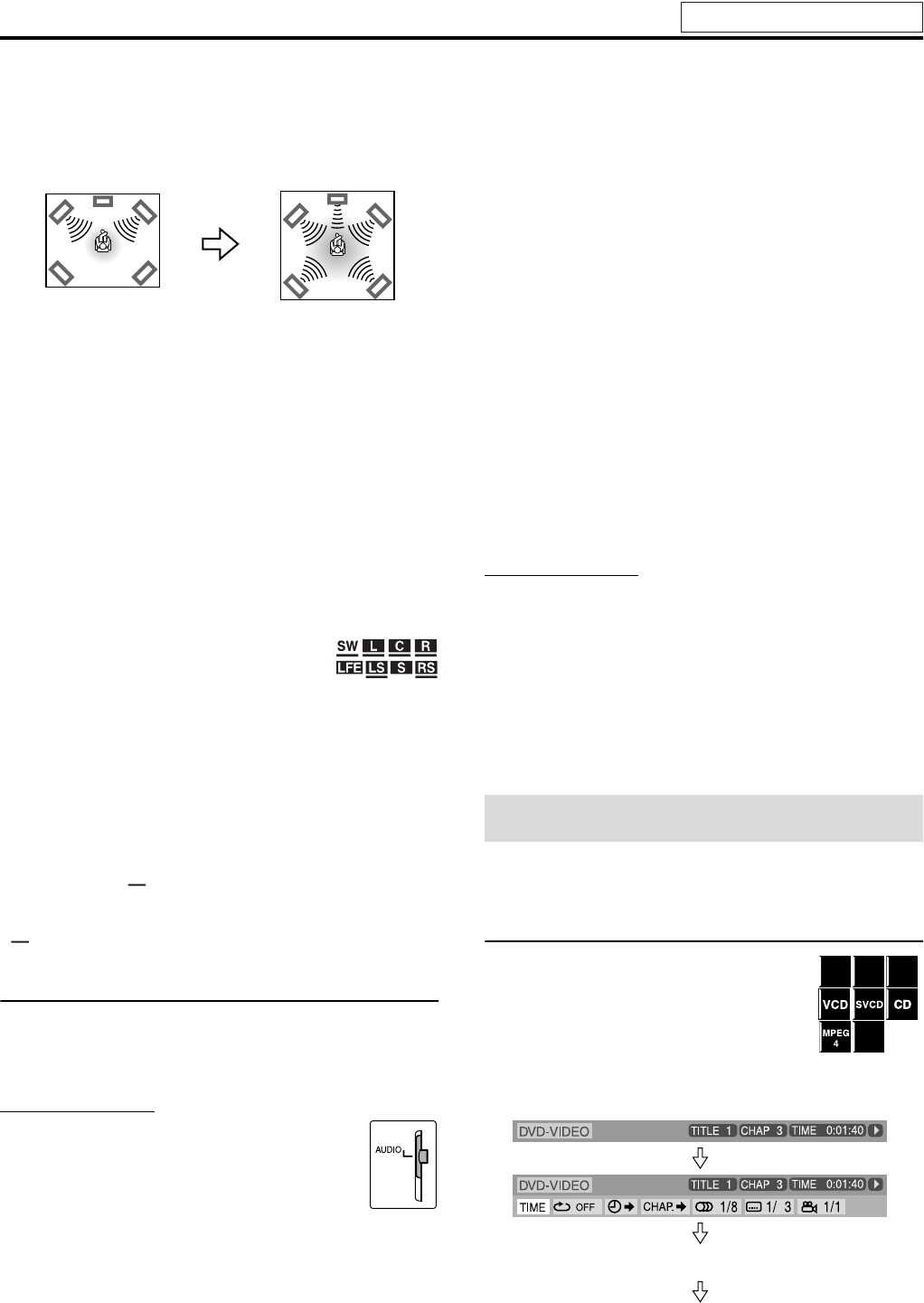
Normal stereo sound All Channel Stereo
Using the on-screen bar
DVD
VR
DVD
AUDIO
DVD
VIDEO
DivX
Dolby D
2/0 . 0ch
Dolby D
2/0 . 0ch
OFF
(The on-screen bar disappears)
(back to the beginning)
See page 24 for button locations.
TH-S66-S55[B].book Page 25 Wednesday, May 25, 2005 12:08 PM
Advanced operations
26
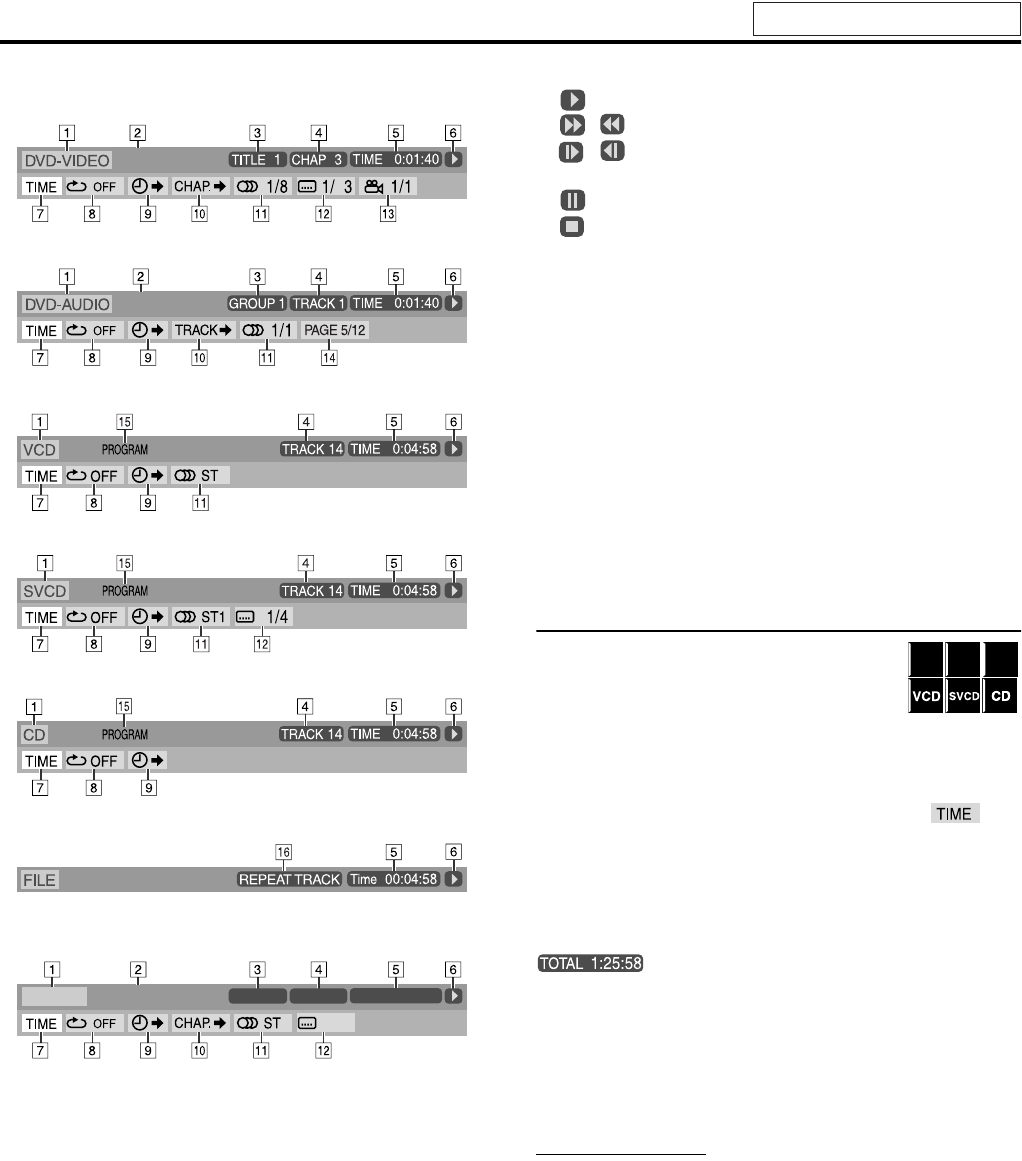
7Contents of the on-screen bar during playback
DVD VIDEO
DVD AUDIO
VCD
SVCD
CD
MPEG-4/DivX*
*7–N are not available.
DVD VR disc*
AShows disc type.
BShows audio information.
CShows current title (for DVD VIDEO), group (for DVD
AUDIO) number or play mode (for DVD VR).
DShows current chapter number (for DVD VIDEO and DVD VR)
or track number (for other type of discs).
EShows time information. See “Changing the time information”.
FShows playback status.
: appears during playback.
/ : appears during fast forward/reverse.
/ : appears during playback in forward slow-motion/
reverse slow-motion.
: appears when paused.
: appears when stopped.
GSelect this to change time information (E). See “Changing the
time information” below.
HSelect this for Repeat Playback. (Apg. 33)
ISelect this for time search function. (Apg. 28)
JSelect this for chapter (for DVD VIDEO and DVD VR) or track
(for DVD AUDIO) search function. (Apg. 27)
KSelect this to change audio language, channel, or stream.
(Apg. 30)
LSelect this to change subtitle language and subpicture.
(Apg. 29)
MSelect this to change view angle. (Apg. 29)
NSelect this to change the page. (Apg. 31)
OShows Playback Mode status.
PROGRAM: appears during Program Playback. (Apg. 32)
RANDOM: appears during Random Playback. (Apg. 33)
PShows Repeat Mode status. (Apg. 33)
Changing the time information
You can change the time information in the on-
screen bar on the TV screen and the display
window of the center unit.
7During playback
1Press ON SCREEN twice.
The on-screen bar appears on the TV screen.
2Press Cursor 3/2 to highlight .
3Press ENTER repeatedly to select the
desired information.
Example:
When elapsed playing time of disc is selected.
•TIME: Elapsed playing time of current chapter/track
•REM: Remaining time of current chapter/track
•TOTAL: Elapsed time of disc
•T. REM: Remaining time of disc
4Press ON SCREEN.
The on-screen bar disappears.
NOTE
• When playing back DVD VR, “TIME” and “REM” cannot be shown.
Dolby D
2/0 . 0ch
Dolby D
2/0 . 0ch
DVD-VR PG 1
Dolby D
2/0 . 0ch CHAP 3
TOTAL 0
:
00
:
34
ON
DVD
VR
DVD
AUDIO
DVD
VIDEO
See page 24 for button locations.
TH-S66-S55[B].book Page 26 Wednesday, May 25, 2005 12:08 PM
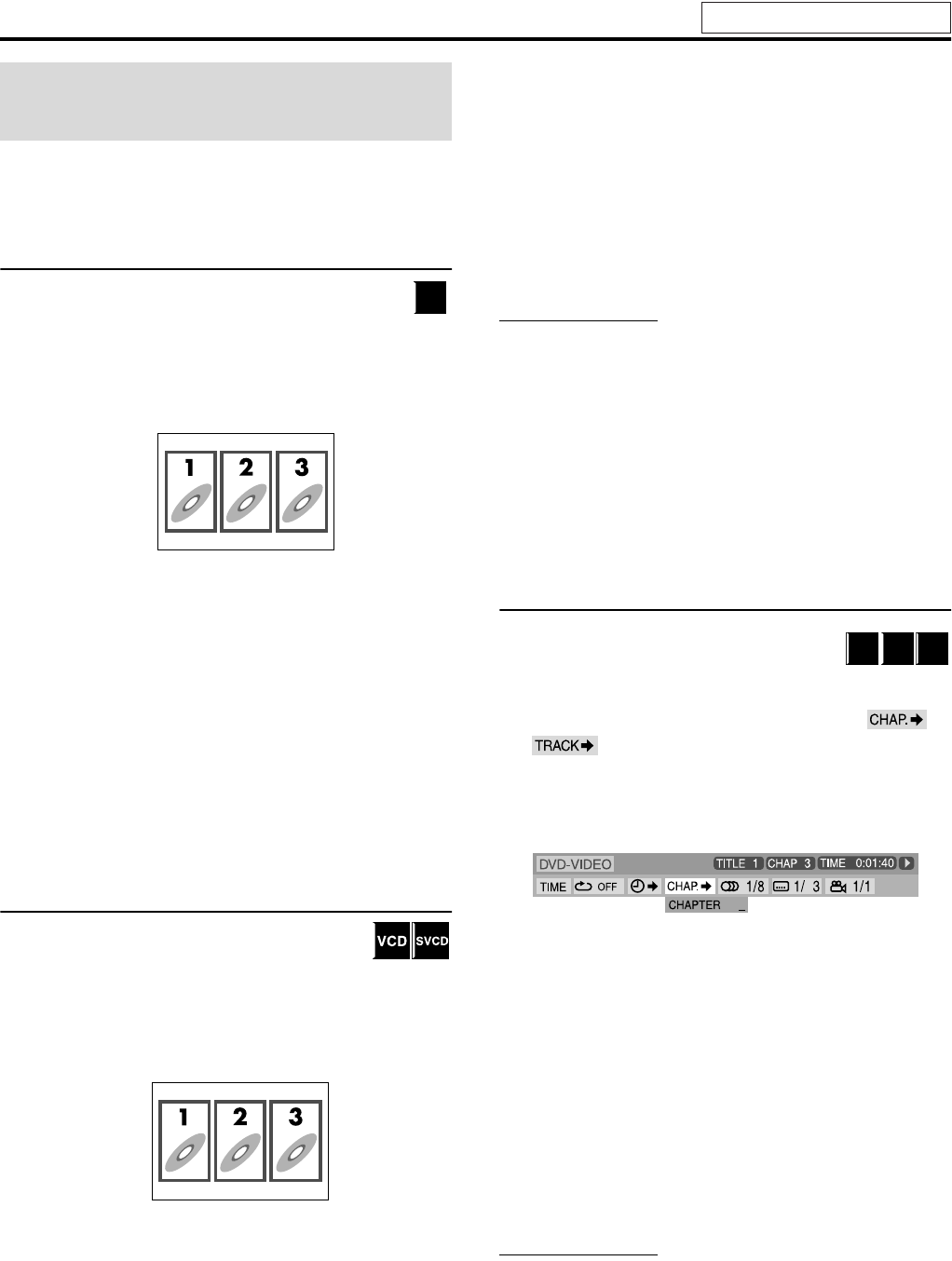
Advanced operations
27
You can start playing a title, chapter or track you specify. You can
also play a disc from specified time.
Locating a desired scene from the DVD
menu
DVD VIDEOs generally have their own menus which show
disc contents and you can display them on the TV screen.
You can locate a desired scene by using these menus.
7Whenever a DVD VIDEO is loaded
1Press TOP MENU/PG or MENU/PL.
The menu appears on the TV screen.
Normally, a DVD VIDEO which contains more than one title
will have a “top” menu which lists the titles. Press
TOP MENU/PG to show the title menu.
Some DVD VIDEO may also have a different menu which is
shown by pressing MENU/PL.
See the instructions for each DVD VIDEO regarding its
particular menu.
2Use Cursor 3/2/Y/5 to select a
desired item.
3Press ENTER.
•With some discs, you can also select items by entering the
corresponding number using number buttons.
Locating a desired scene using a VCD/
SVCD menu with PBC
A VCD or SVCD recorded with PBC has its own
menus such as a list of contained songs. You can locate
a specific scene by using these menus.
7During playback with PBC function
1Press RETURN repeatedly until the
menu appears on the TV screen.
2Press number buttons (1-10, +10) to
select the number of the desired item.
•For details on using the number buttons, see “How to use the
number buttons” (Apg. 22).
To return to the menu
Press RETURN.
When “NEXT” or “PREVIOUS” is shown on the TV
screen:
•To go to the next page, press x.
•To return to the previous page, press 4.
NOTE
• If you want to play a PBC-compatible VCD/SVCD without using the
PBC function, perform any of the following:
•Start playback by pressing number buttons while stopped.
•Press x repeatedly until the desired track number is displayed,
then start playback by pressing 3 (play button).
The track number appears on the display window instead of
“PBC”.
• To activate the PBC function when playing a PBC-compatible VCD/
SVCD without using the PBC function, perform any of the following:
•Press TOP MENU/PG or MENU/PL.
•Press 7 twice to stop playback, then press 3 (play button).
Locating a desired chapter/track using the
on-screen bar
7During playback
1Press ON SCREEN twice.
The on-screen bar appears on the TV screen.
2Press Cursor 3/2 to highlight /
.
3Press ENTER.
Example:
During DVD VIDEO playback
4Press number buttons (0-9) to enter the
desired chapter number.
Example:
To select 8: Press 8.
To select 10: Press 1, then 0.
To select 20: Press 2, then 0.
To select 37: Press 3, then 7.
To correct a misentry
Repeat step 4.
5Press ENTER.
6Press ON SCREEN.
The on-screen bar disappears.
NOTE
• You can select up to the 99th chapter/track.
Playing from a specified
position on a disc
DVD
VIDEO
Example:
Example:
DVD
VR
DVD
AUDIO
DVD
VIDEO
Dolby D
2/0 . 0ch
See page 24 for button locations.
TH-S66-S55[B].book Page 27 Wednesday, May 25, 2005 12:08 PM
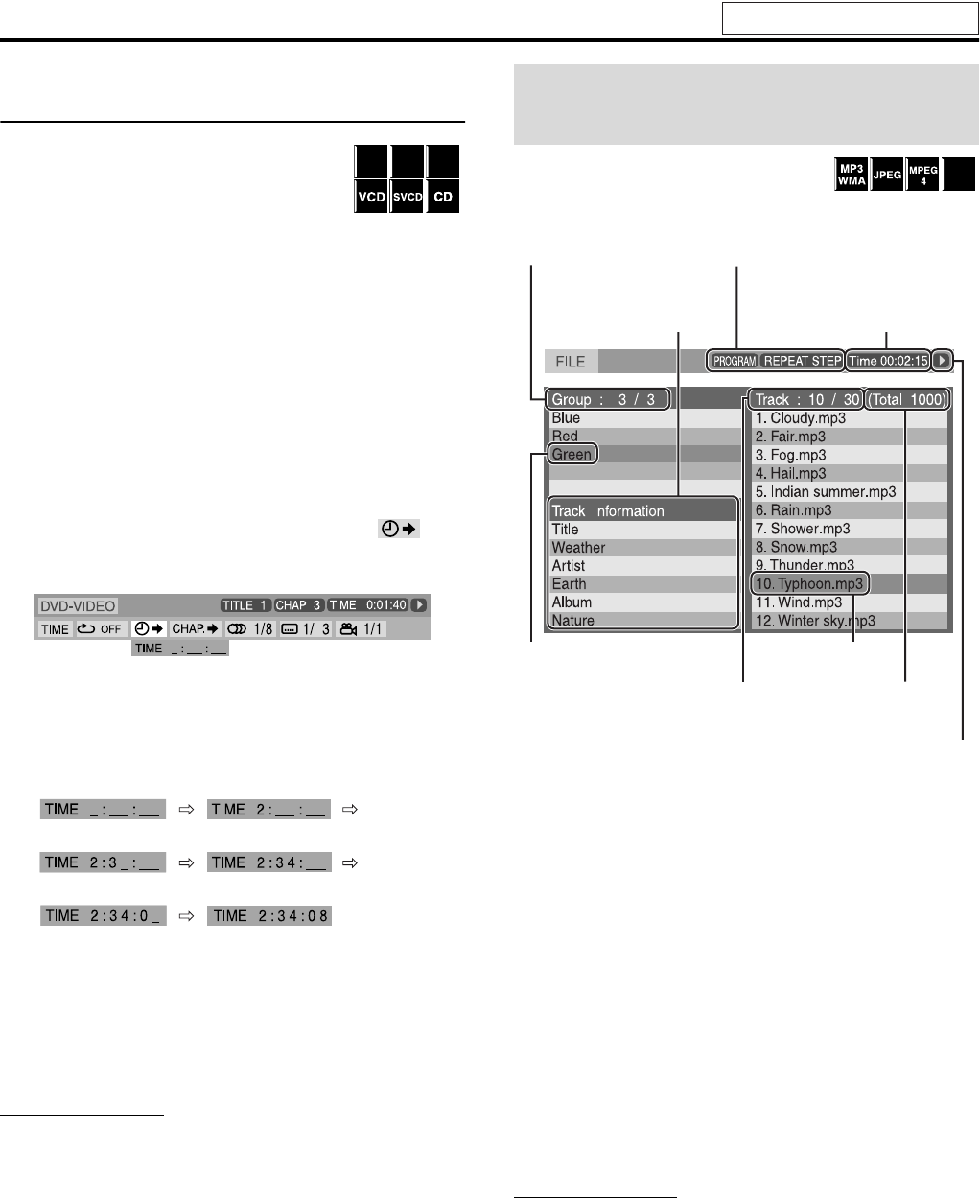
Advanced operations
28
Locating a desired position by specifying
the time
7For DVD VIDEO/DVD AUDIO/DVD VR:
During playback
For VCD/SVCD:
While stopped or during playback without PBC
function
For CD:
During playback or while stopped
7When specifying the elapsed playing time from the
beginning of the disc
Perform the following procedure while stopped.
7When specifying the elapsed playing time from the
beginning of the current title/track
Perform the following procedure during playback.
1Press ON SCREEN twice.
The on-screen bar appears on the TV screen.
2Press Cursor 3/2 to highlight .
3Press ENTER.
4Use number buttons (0-9) to enter the
time.
Example:
To play back from a point 2 (hours): 34 (minutes): 08 (seconds)
elapsed
To cancel a misentry
Press Cursor 2 repeatedly.
5Press ENTER.
6Press ON SCREEN.
The on-screen bar disappears.
NOTE
• You can specify time in hours/minutes/seconds for DVD VIDEO/
DVD AUDIO/DVD VR and in minutes/seconds for VCD/SVCD/CD.
You can search and play desired groups and
tracks/files using the file control display on
the TV screen.
*(For MPEG 4/DivX) The Program and Random mode are not
available.
The file control display appears automatically during playback
(MP3/WMA) or while stopped.
7For MP3/WMA:
During playback or while stopped
For JPEG/MPEG-4/DivX:
While stopped
1Press Cursor 3/2/Y/5 to select the
desired group/track/file.
•For MP3/WMA, playback starts from the selected track.
2Press 3 (play button) or ENTER.
•Track playback/slide-show starts from the selected track/
file.
•When you press ENTER for JPEG, only the selected file is
played back.
NOTE
• (For MP3/WMA) During playback, you can locate the desired track/
file by pressing x/4 or Cursor 5/Y.
• You can also check playback information on the display window.
(Apg. 21)
• Some group, track and file names may not be displayed correctly
depending on recording conditions.
• The order of groups, tracks and files may be displayed differently
from the order displayed on your personal computer.
DVD
VR
DVD
AUDIO
DVD
VIDEO
Dolby D
2/0 . 0ch
Press 2 Press 3
Press 4
Press 8
Press 0
Using the file control
display
DivX
Current group/total group
number
Current track (file)
Tag information (for MP3/
WMA only)
Playback mode* (PROGRAM,
RANDOM, REPEAT)
Elapsed playing time of current
track (for MP3/WMA/MPEG-4/
DivX only)
Playback status
Current track (file) / total track
(file) number on current group
Current group
Total track (file)
number on disc
See page 24 for button locations.
TH-S66-S55[B].book Page 28 Wednesday, May 25, 2005 12:08 PM
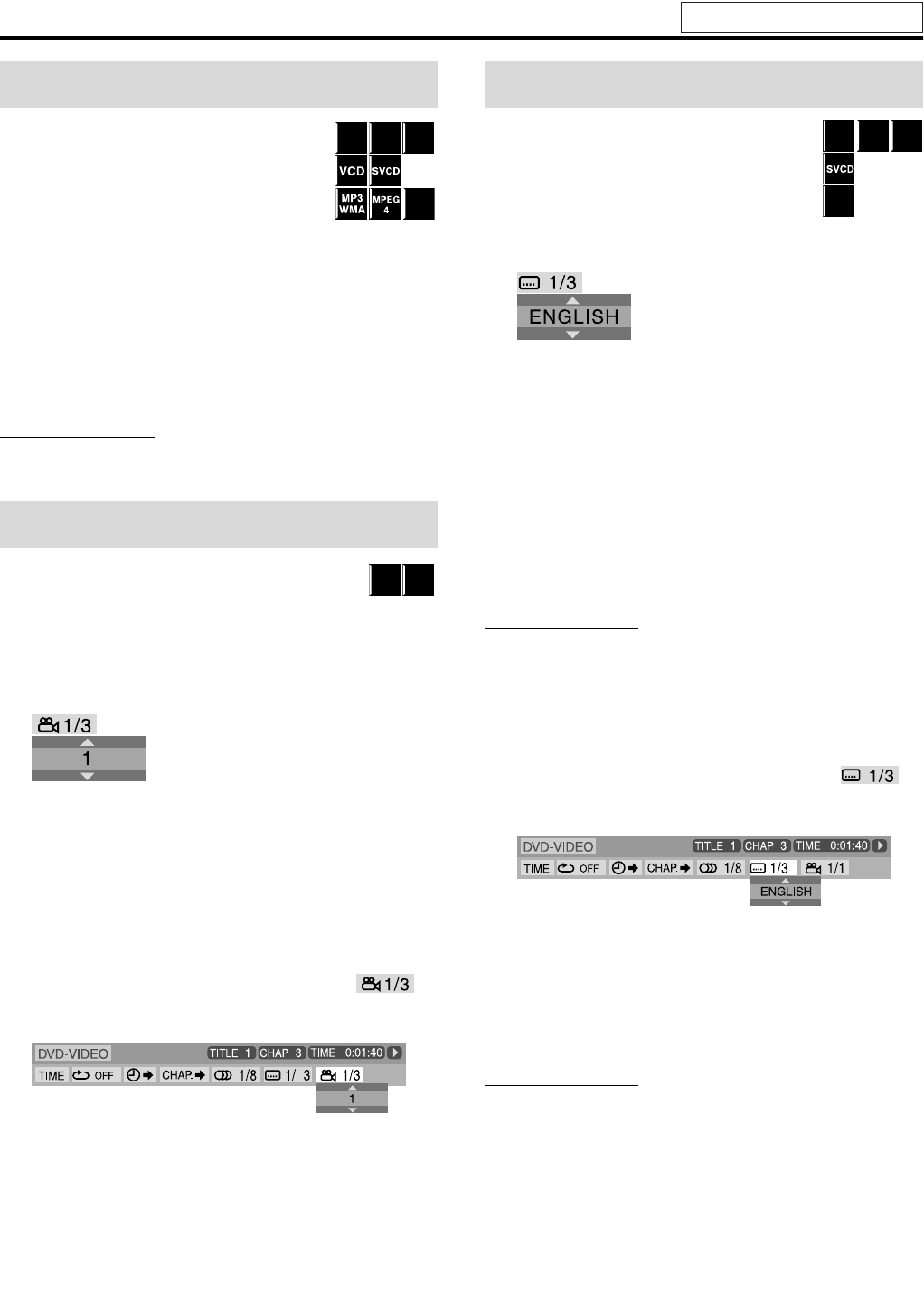
Advanced operations
29
When Resume Playback is set to “ON” (Apg. 38)
and you stop playback by the following operations,
the position where playback has been stopped is
stored. (“RESUME” appears on the display
window.)
•Turning off the power (Apg. 16)
•Pressing 7 once
•Changing the source (Apg. 17)
To start playback from the stored position
Press 3 (play button) or DVD.
•There may be a case where 3 (play button) does not work after
changing the source.
To clear the stored position
Press 7 again or open the disc tray.
NOTE
• (For DivX) The beginning of a scene where playback has been
stopped may be stored.
7During playback of a disc containing multi-view
angles
When using the ANGLE button:
1Press ANGLE.
Example:
The first view angle is selected out of 3 view angles recorded.
2Press ANGLE repeatedly or press
Cursor Y/5 to select the desired view
angle.
When using the on-screen bar:
1Press ON SCREEN twice.
The on-screen bar appears on the TV screen.
2Press Cursor 3/2 to highlight .
3Press ENTER.
4Press Cursor Y/5 to select the desired
view angle.
5Press ENTER.
6Press ON SCREEN.
The on-screen bar disappears.
NOTE
• During DVD AUDIO playback, this feature is available only for the
video part.
7During playback of a disc containing subtitles in
several languages
When using the SUBTITLE button:
1Press SUBTITLE.
Example (DVD VIDEO):
“ENGLISH” is selected out of 3 subtitle languages recorded.
2Press Cursor Y/5 to select the desired
subtitle.
For DVD VR
•Pressing SUBTITLE activates the subtitles (subpictures)
regardless of whether the subtitles are recorded or not.
(subpictures will not change if no subpictures is recorded.)
For SVCD
•An SVCD can contain up to four subtitles. Pressing
SUBTITLE changes the subtitles regardless of whether the
subtitles are recorded or not. (Subtitles will not change if no
subtitle is recorded.)
NOTE
• To clear the subtitle, press SUBTITLE. Each time you press
SUBTITLE, subtitle appears and disappears alternately.
When using the on-screen bar:
1Press ON SCREEN twice.
The on-screen bar appears on the TV screen.
2Press Cursor 3/2 to highlight .
3Press ENTER.
4Press Cursor Y/5 repeatedly to select
the desired subtitle.
5Press ENTER.
6Press ON SCREEN.
The on-screen bar disappears.
NOTE
• To clear the subtitle, press SUBTITLE. Each time you press
SUBTITLE, subtitle appears and disappears alternately.
• Some subtitle or audio languages are abbreviated in the pop-up
window. See “The language codes list” (Apg. 36).
• During DVD AUDIO playback, this feature is available only for the
video part.
Resume Playback
Selecting a view angle
DivX
DVD
VR
DVD
AUDIO
DVD
VIDEO
DVD
AUDIO
DVD
VIDEO
Dolby D
2/0 . 0ch
Selecting the subtitle
DVD
VR
DVD
AUDIO
DVD
VIDEO
DivX
Dolby D
2/0 . 0ch
See page 24 for button locations.
TH-S66-S55[B].book Page 29 Wednesday, May 25, 2005 12:08 PM
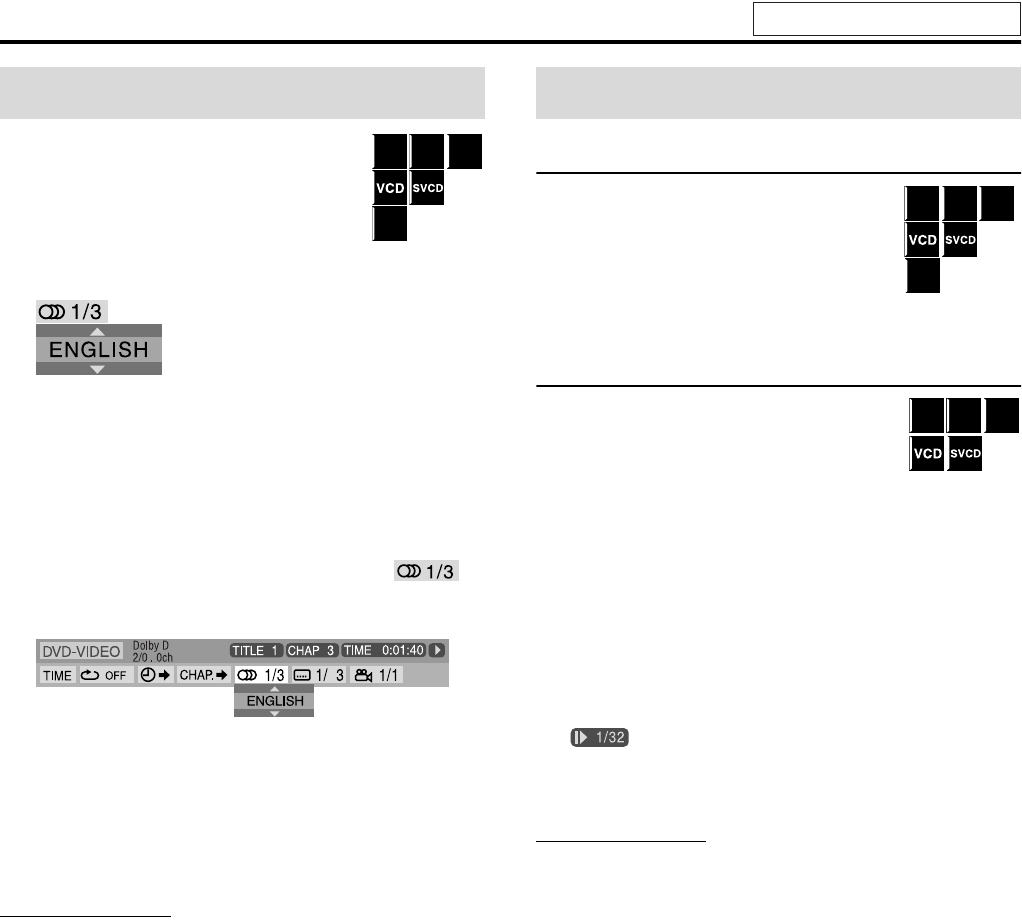
Advanced operations
30
7During playback of a disc containing audio in
several languages
When using the AUDIO button:
1Press AUDIO.
Example (DVD VIDEO):
“ENGLISH” is selected out of 3 audio languages recorded.
2Press AUDIO repeatedly or press
Cursor Y/5 to select the desired audio.
When using the on-screen bar:
1Press ON SCREEN twice.
The on-screen bar appears on the TV screen.
2Press Cursor 3/2 to highlight .
3Press ENTER.
4Press Cursor Y/5 to select the desired
audio.
5Press ENTER.
6Press ON SCREEN.
The on-screen bar disappears.
NOTE
• Some subtitle or audio languages are abbreviated in the pop-up
window. See “The language codes list” (Apg. 36).
• “ST”, “L” or “R” is displayed when playing a VCD, SVCD or DVD
VR respectively representing “stereo”, “left sound” and “right
sound”.
Frame-by-frame playback
7During playback
Press 8 repeatedly.
Each time you press the button, the still picture
advances by one frame.
To return to normal playback
Press 3 (play button).
Playing back in slow-motion
7During playback
1Press 8 at the point where
you want to start playback in
slow-motion from.
The system pauses playback.
2Press SLOW 9.
•Playback in forward slow-motion starts.
For DVD VIDEO/DVD AUDIO only:
•To play back in reverse slow-motion, press SLOW (.
Each time you press the button, the playback speed become
faster.
Example: On the TV
To return to normal playback
Press 3 (play button).
NOTE
• Sound cannot be heard during slow-motion playback.
• During DVD AUDIO playback, this feature is available only for the
video part.
Selecting the audio
DVD
VR
DVD
AUDIO
DVD
VIDEO
DivX
Special picture playback
DivX
DVD
VR
DVD
VIDEO
DVD
AUDIO
DVD
AUDIO
DVD
VIDEO
DVD
VR
See page 24 for button locations.
TH-S66-S55[B].book Page 30 Wednesday, May 25, 2005 12:08 PM
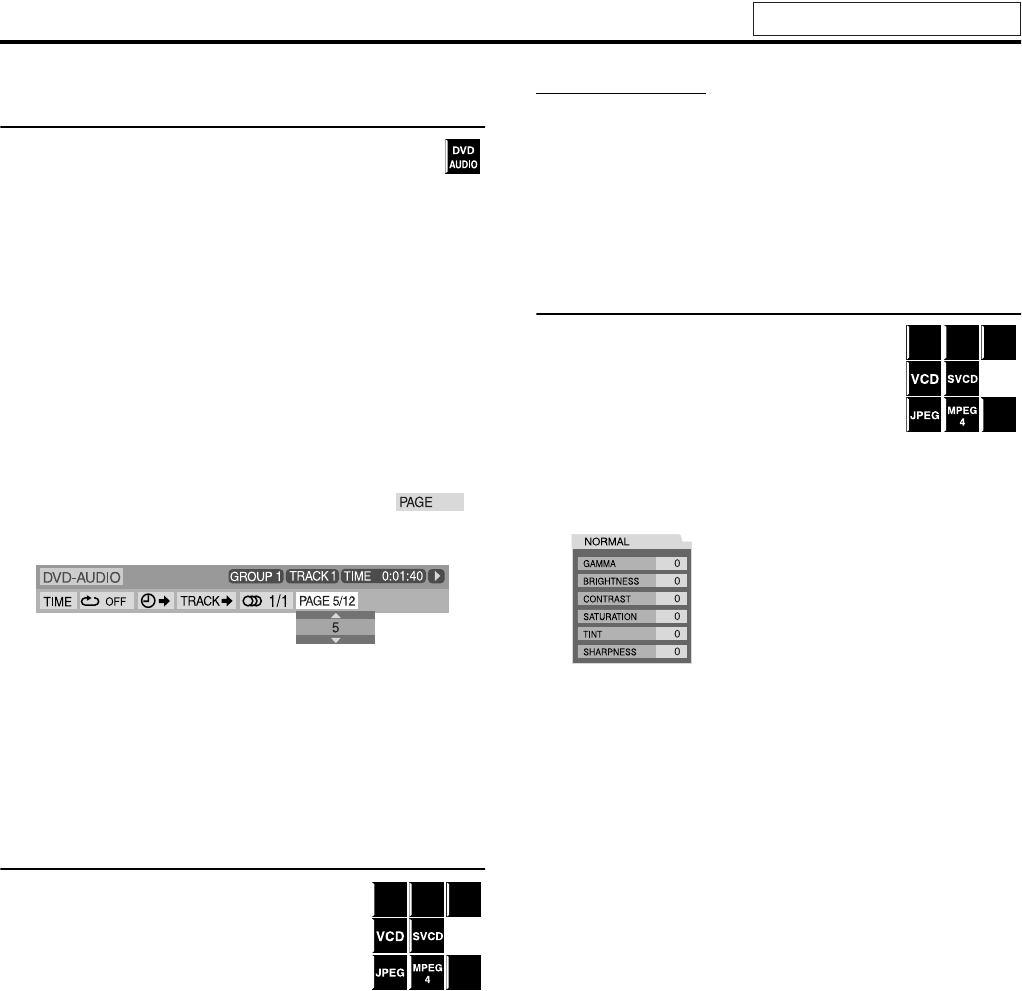
Advanced operations
31
Selecting browsable still picture recorded
on DVD AUDIO
Most DVD AUDIOs include browsable still pictures
(B.S.P.), which usually appear by turns automatically
during playback according to the playback sequence. You
can change the picture (turn the page) manually when the current
group/track has selectable pictures (pages).
7During playback and while the B.S.P. indicator lights up on the
display window
When using the PAGE button:
Press PAGE repeatedly to select a desired
still picture.
When using the on-screen bar:
1Press ON SCREEN twice.
The on-screen bar appears on the TV screen.
2Press Cursor 3/2 to highlight .
3Press ENTER.
4Press Cursor 5/Y to select the desired
still picture.
5Press ENTER.
6Press ON SCREEN.
The on-screen bar disappears.
Zooming in
7During playback or while paused
1Press ZOOM.
Each time you press ZOOM, scene
magnification changes.
2While zoomed in, press Cursor 3/2/Y/
5 to move zoom-in area.
To return to normal playback
Press ZOOM repeatedly to select ZOOM OFF.
NOTE
• The number of the magnification steps varies depending on the disc
type.
• During slide-show playback of JPEG, zooming in is not available. In
such a case, press 8 to pause slide-show playback, then zoom in.
• During DVD AUDIO playback, this feature is available only for the
video part.
• During MPEG-4/DivX playback, there may be a case where Cursor
(3/2/Y/5) does not work in step 2 above.
Changing the VFP setting
The VFP (Video Fine Processor) function enables
you to adjust the picture character according to the
type of programming, picture tone or personal
preference.
7During playback
1Press VFP.
The current VFP settings appear on the TV screen.
Example:
2Press Cursor 3/2 repeatedly to select
the VFP mode.
•NORMAL: Normally select this.
•CINEMA: Suitable for movies.
When you select “NORMAL” or “CINEMA”, press VFP to
complete the setting.
•USER 1 and USER 2:
You can adjust parameters that affect picture
appearance.
Only when selecting “USER 1” or “USER 2” in step
2, proceed to perform the following operation;
3Press Cursor Y/5 repeatedly to select
a parameter you want to adjust.
Adjust gradually and confirm picture appearance results are as
preferred.
•GAMMA:
Controls brightness of neutral tints while maintaining
brightness of dark and bright portions.
•BRIGHTNESS:
Controls screen brightness.
•CONTRAST:
Controls screen contrast.
•SATURATION:
Controls screen color depth.
•TINT:
Controls screen tint.
•SHARPNESS:
Controls screen sharpness.
Dolby D
2/0 . 0ch
DivX
DVD
VR
DVD
AUDIO
DVD
VIDEO
DivX
DVD
VR
DVD
AUDIO
DVD
VIDEO
See page 24 for button locations.
TH-S66-S55[B].book Page 31 Wednesday, May 25, 2005 12:08 PM
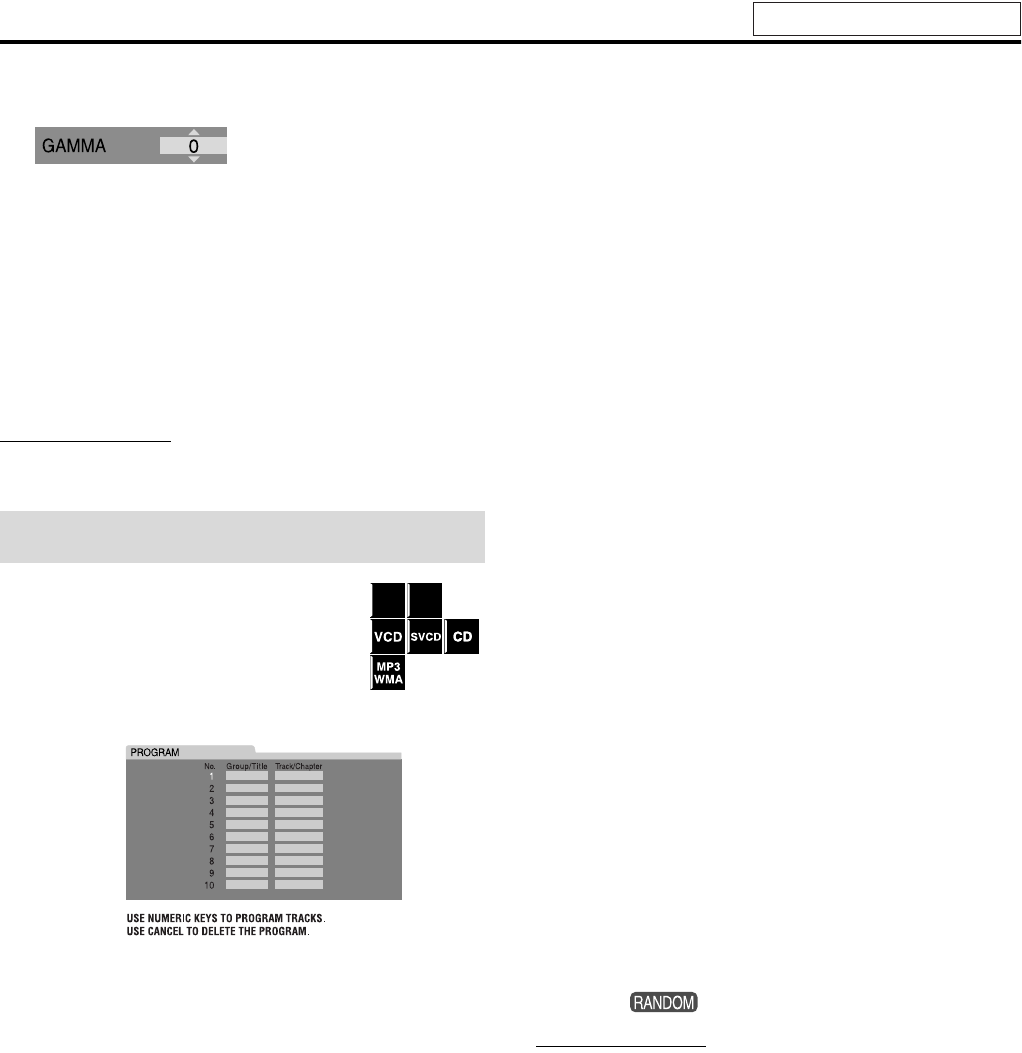
Advanced operations
32
4Press ENTER.
Example:
5Press Cursor Y/5 to change the
setting.
6Press ENTER.
The current VFP settings appear again.
7Repeat steps 3 to 6 to adjust other
parameters.
8Press VFP.
NOTE
• Although the setting display disappears in the middle of the
procedure, the setting at that time will be stored.
7While stopped
1Press PLAY MODE
repeatedly until program
window appears on the TV screen.
2Follow the instructions that appear on
the TV screen to program the desired
chapters/tracks.
•For details on using the number buttons, see “How to use the
number buttons” (Apg. 22).
•The content’s numbers that you have to specify for
programming varies depending on the disc type:
•DVD VIDEO: Titles and chapters
•VCD, SVCD, CD: Tracks
•DVD AUDIO, MP3, WMA:
Groups and tracks
•Before you program the tracks in bonus group on a DVD
AUDIO, perform the procedure of “Playing back a bonus
group” (Apg. 23) to turn off the BONUS indicator on the
display window.
•You can specify the chapters/tracks whose number is up to
99.
•(For CD, SVCD or VCD) When the total playback time
exceeds 99 minutes 59 seconds, “–:–” will appear on the
display window. But, it is possible to continue
programming.
•(For DVD VIDEO, DVD AUDIO, MP3 or WMA) When
you press ENTER instead of the number buttons in the
Track/Chapter column, “ALL” appears and all the tracks or
chapters on the selected group or title are programmed as a
step.
To clear the programs one by one from the last
entered number
Press CANCEL repeatedly.
To clear all programs
Press 7.
You can also clear the program by turning off the system.
3Press 3 (play button).
If all of the programmed tracks/files have been played back,
playback stops and the program window appears again. Note
that program setting remains.
To check the program contents
During playback, press 7. Playback stops and the program window
appears.
To quit the Program mode
While stopped, press PLAY MODE repeatedly until both program
window and disappear from the TV screen.
NOTE
• The Resume function cannot be used with Program Playback.
• Program Playback may not work for some discs.
Program Playback
DVD
AUDIO
DVD
VIDEO
See page 24 for button locations.
TH-S66-S55[B].book Page 32 Wednesday, May 25, 2005 12:08 PM
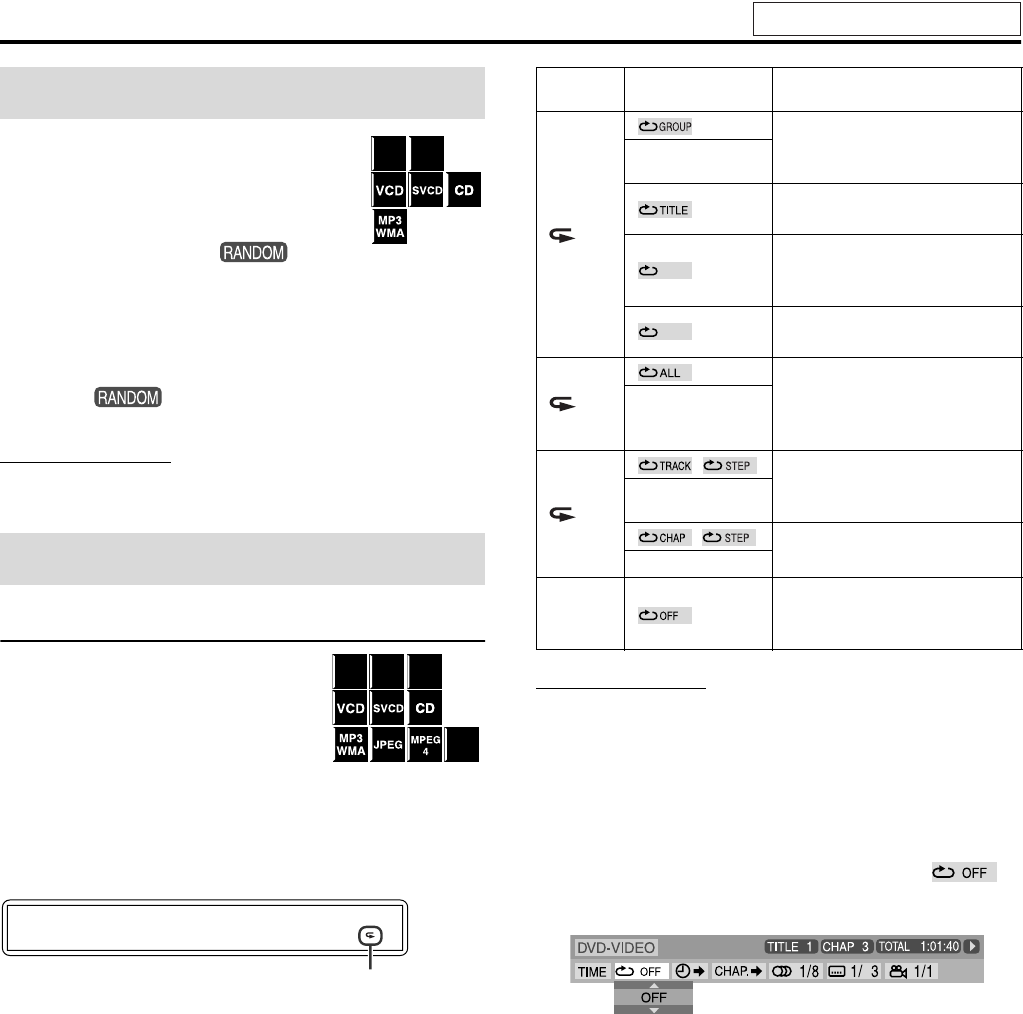
Advanced operations
33
You can play titles or tracks on a disc in random
order.
7While stopped
1Press PLAY MODE
repeatedly until
appears on the TV screen.
2Press 3 (play button).
To quit Random mode
While stopped, press PLAY MODE repeatedly until both program
window and disappear from the TV screen.
You can also clear the Random mode by turning off the system.
NOTE
• The same title/track will not be played back more than once during
Random Playback.
Repeating the current selection
7For DVD VIDEO/DVD VR:
During playback
For VCD/SVCD:
During playback without PBC function or
stopped
For DVD AUDIO/CD/MP3/JPEG/
MPEG-4/DivX:
During playback or stopped
When using the REPEAT button:
Press REPEAT.
Each time you press REPEAT, the Repeat mode changes.
NOTE
• For DVD VIDEO and DVD AUDIO, REPEAT ALL may not be
available depending on the disc.
When using the on-screen bar (except for MP3/
WMA/JPEG/MPEG-4/DivX):
1Press ON SCREEN twice.
The on-screen bar appears on the TV screen.
2Press Cursor 3/2 to highlight .
3Press ENTER.
4Press Cursor Y/5 repeatedly to select
the Repeat mode.
5Press ENTER.
6Press ON SCREEN.
The on-screen bar disappears.
To cancel Repeat Playback
Select “OFF” in step 4.
Random Playback
Repeat Playback
DVD
AUDIO
DVD
VIDEO
DVD
VR
DVD
AUDIO
DVD
VIDEO
DivX
11
:31:01
2
.
Repeat mode indicator
Display
window TV screen Meanings
Repeats the current group for
DVD AUDIO/MP3/WMA/
JPEG/MPEG-4/DivX.
REPEAT GROUP
Repeats the current title for
DVD VIDEO.
(For DVD VR) Repeats the
current title for Original
program.
(For DVD VR) Repeats the
current playlist for Playlist.
ALL
Repeats all title/tracks/files for
DVD VR/VCD/SVCD/CD/
MP3/WMA/JPEG/MPEG-4/
DivX.
REPEAT ALL
1
,Repeats the current track for
DVD AUDIO/VCD/SVCD/CD/
MP3/WMA/MPEG-4/DivX.
REPEAT TRACK,
REPEAT STEP
,Repeats the current chapter for
DVD VIDEO/DVD VR.
REPEAT STEP
No
indication
Repeat mode is off.
The system plays back the disc
normally.
PG
PL
Dolby D
2/0 . 0ch
See page 24 for button locations.
TH-S66-S55[B].book Page 33 Wednesday, May 25, 2005 12:08 PM
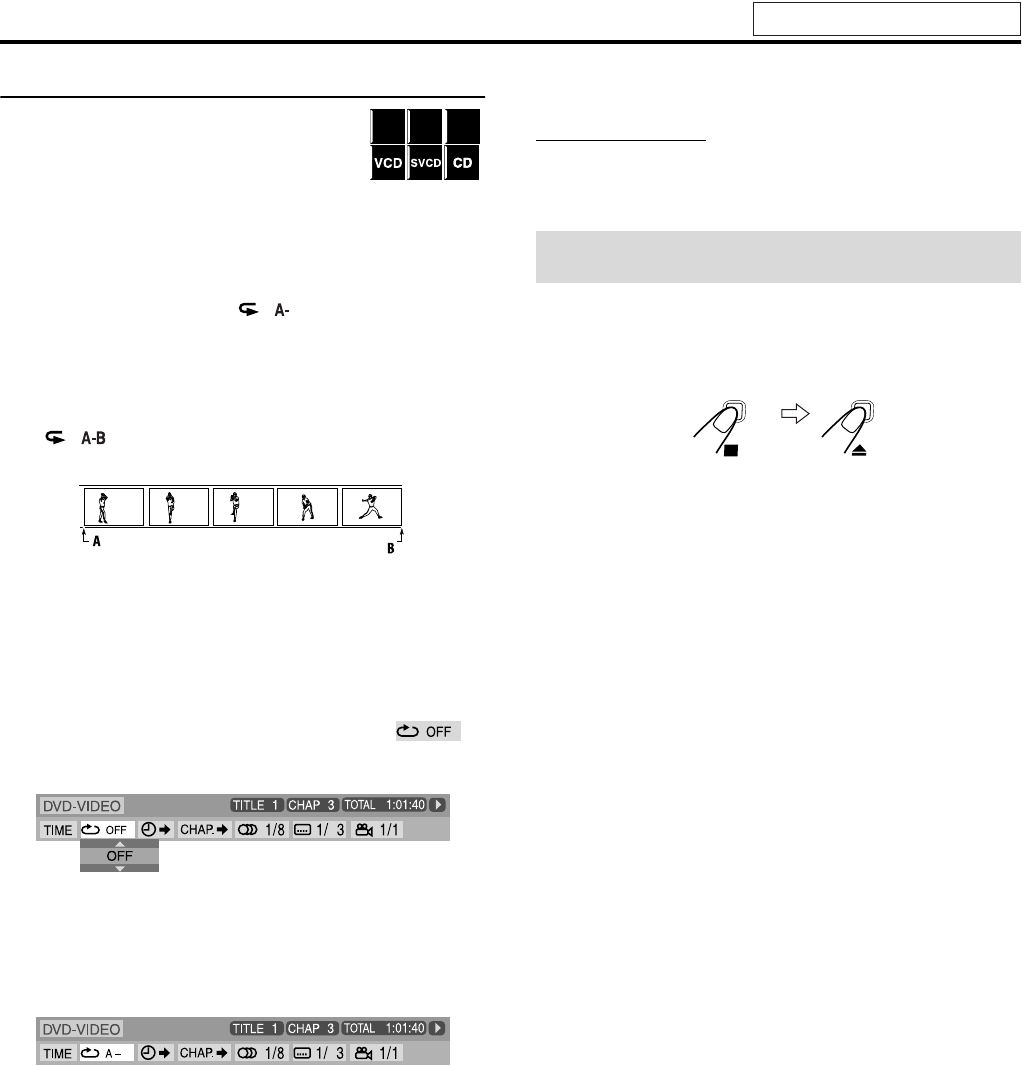
Advanced operations
34
Repeating a desired part [A-B Repeat]
You can repeat playback of a desired part by
specifying the beginning (point A) and ending
(point B).
7During playback
When using the A-B RPT button:
1Press A-B RPT at the beginning of the
part you want to repeat (point A).
The repeat mode indicator “” appears on the display
window.
2Press A-B RPT again at the end of the
part you want to repeat (point B).
The repeat mode indicator on the display window changes to
“” and A-B Repeat Playback starts. The selected part
of the disc (between point A and B) is played repeatedly.
To cancel
Press A-B RPT during A-B Repeat Playback.
When using the on-screen bar:
1Press ON SCREEN twice.
The on-screen bar appears on the TV screen.
2Press Cursor 3/2 to highlight .
3Press ENTER.
4Press Cursor Y/5 repeatedly to select
“A-B”.
5Press ENTER at the beginning of the
part you want to repeat (point A).
6Press ENTER at the end of the part you
want to repeat (point B).
A-B Repeat Playback starts.
7Press ON SCREEN.
The on-screen bar disappears.
To cancel
Select “OFF” in step 4, then press ENTER.
NOTE
• When playing back a DVD VIDEO, A-B Repeat Playback is possible
only within the same title.
• “A-B” cannot be selected during Program and Random Playback.
You can lock the tray and prohibit the unwanted disc ejection.
On the center unit ONLY:
While the system is turned off
•The system turns on and “LOCKED” appears on the display
window.
•If you try to eject the disc, “LOCKED” appears to indicate that
the tray is locked.
To cancel
Carry out the same operation again.
•The system turns on and “UNLOCKED” appears on the display
window.
DVD
VR
DVD
AUDIO
DVD
VIDEO
Dolby D
2/0 . 0ch
Dolby D
2/0 . 0ch
Tray lock
Press and hold
See page 24 for button locations.
TH-S66-S55[B].book Page 34 Wednesday, May 25, 2005 12:08 PM
Advanced operations
35
IMPORTANT
Before using the remote control for the following
operation;
•Set the remote control mode selector to AUDIO.
NOTE
Before you start operation;
• There is a time limit when doing the following steps. If the setting is
cancelled before you finish, start from step 1 again.
1Press SETTING.
Example:
2Press Cursor Y/5 to select the item
you want to set.
•DEC (Decode):
When you play an external source (AUX DIGITAL is
selected as a source) that was encoded with DOLBY D or
DTS Digital Surround, the following symptoms may occur;
•No sound comes out at the beginning of playback.
•Noise comes out while searching for or skipping chapters
or tracks.
A/PCM (Auto/PCM):
Normally select this. The system
automatically detects the incoming signals.
DD: Select this if the symptoms above occur
when playing a disc (or software) encoded
with DOLBY D.
DTS: Select this if the symptoms above occur
when playing a disc (or software) encoded
with DTS Digital Surround.
•BAL (Balance):
You can adjust the balance between the front left and front
right speakers.
3Press Cursor 3/2 to make an
adjustment or selection.
Example:
The adjustment is set and the display automatically disappears
a few seconds later.
NOTE
• When “DD” or “DTS” is selected, if a signal encoded with another
digital format comes in, you cannot listen to the sound. (The
GDIGITAL or C indicator flashes.)
Sound and other settings
A
E
D/M
C. C
P
E
DDD
C.
See page 24 for button locations.
TH-S66-S55[B].book Page 35 Wednesday, May 25, 2005 12:08 PM
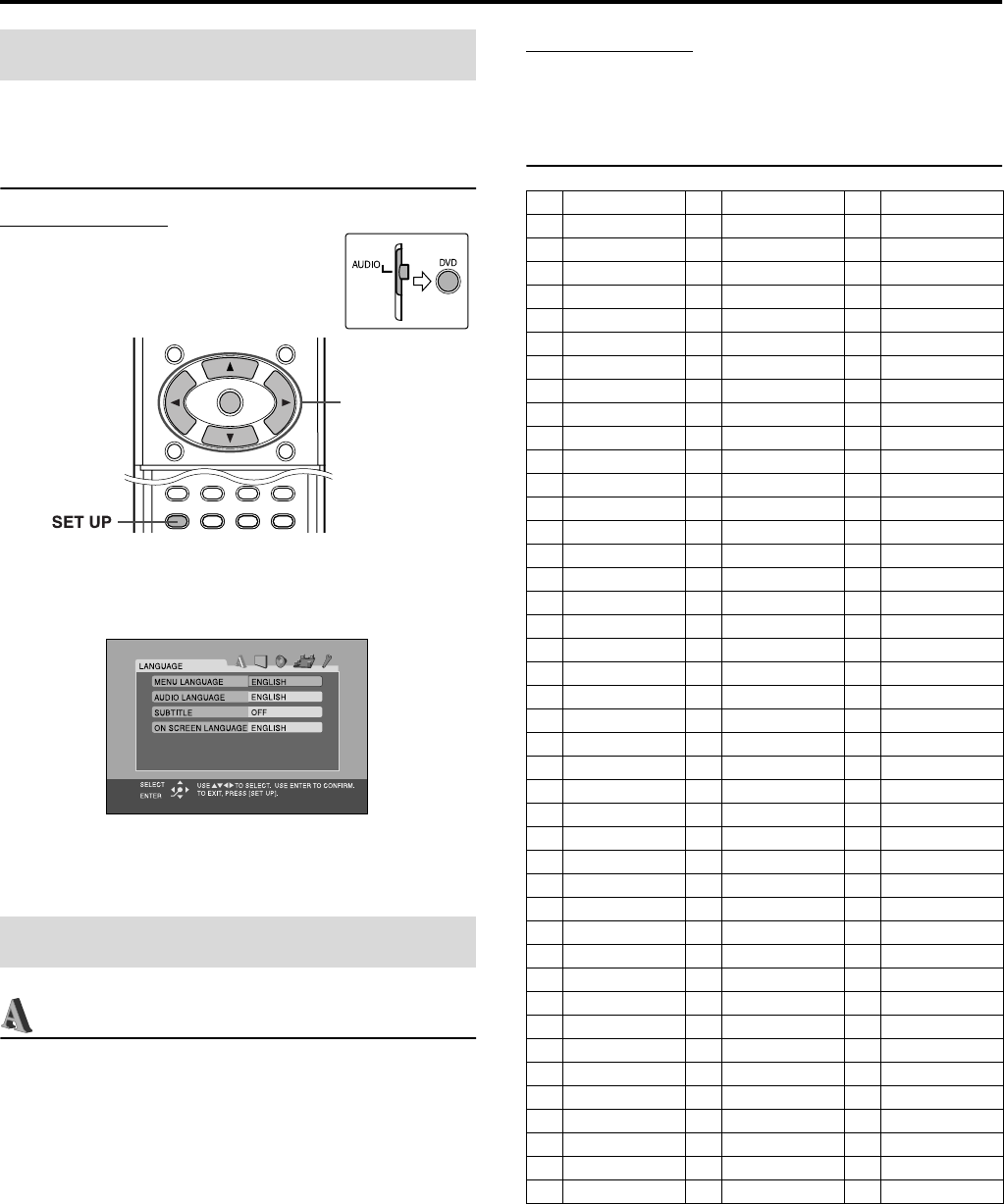
36
Setting DVD preferences
•You can change the language used in the setup menus. See
“Menu description” below.
Basic operation on the setup menus
IMPORTANT
Before using the remote control for the
following operation;
1 Set the remote control mode selector to
AUDIO.
2Press DVD.
7While stopped
1Press SET UP.
2Follow the instructions that appear on
the TV screen.
:Language menu (LANGUAGE)
7MENU LANGUAGE
Some DVDs have their own menus in multiple languages.
•Select the initial language*.
7AUDIO LANGUAGE
Some DVDs have multiple audio languages.
•Select the initial audio language*.
7SUBTITLE
Some DVDs have multiple subtitle languages.
•Select the initial subtitle language*.
7ON SCREEN LANGUAGE
•Select the language shown on the TV screen when operating this
system.
* When the language you have selected is not recorded to a disc,
the original language is automatically used as the initial
language.
NOTE
• See the following “The language codes list” for the code of each
language, such as “AA”, etc.
The language codes list
Using the setup menus
Menu description
ENTER
SET UP
Cursor
(3/2/Y/5)/
ENTER
AA Afar IK Inupiak RN Kirundi
AB Abkhazian IN Indonesian RO Rumanian
AF Afrikaans IS Icelandic RU Russian
AM Ameharic IW Hebrew RW Kinyarwanda
AR Arabic JI Yiddish SA Sanskrit
AS Assamese JW Javanese SD Sindhi
AY Aymara KA Georgian SG Sangho
AZ Azerbaijani KK Kazakh SH Serbo-Croatian
BA Bashkir KL Greenlandic SI Singhalese
BE Byelorussian KM Cambodian SK Slovak
BG Bulgarian KN Kannada SL Slovenian
BH Bihari KO Korean (KOR) SM Samoan
BI Bislama KS Kashmiri SN Shona
BN Bengali, Bangla KU Kurdish SO Somali
BO Tibetan KY Kirghiz SQ Albanian
BR Breton LA Latin SR Serbian
CA Catalan LN Lingala SS Siswati
CO Corsican LO Laothian ST Sesotho
CS Czech LT Lithuanian SU Sundanese
CY Welsh LV Latvian, Lettish SV Swedish
DA Danish MG Malagasy SW Swahili
DZ Bhutani MI Maori TA Tamil
EL Greek MK Macedonian TE Telugu
EO Esperanto ML Malayalam TG Tajik
ET Estonian MN Mongolian TH Thai
EU Basque MO Moldavian TI Tigrinya
FA Persian MR Marathi TK Turkmen
FI Finnish MS Malay (MAY) TL Tagalog
FJ Fiji MT Maltese TN Setswana
FO Faroese MY Burmese TO Tonga
FY Frisian NA Nauru TR Turkish
GA Irish NE Nepali TS Tsonga
GD Scots Gaelic NL Dutch TT Tatar
GL Galician NO Norwegian TW Twi
GN Guarani OC Occitan UK Ukrainian
GU Gujarati OM (Afan) Oromo UR Urdu
HA Hausa OR Oriya UZ Uzbek
HI Hindi PA Panjabi VI Vietnamese
HR Croatian PL Polish WO Wolof
HU Hungarian PS Pashto, Pushto VO Volapuk
HY Armenian PT Portuguese XH Xhosa
IA Interlingua QU Quechua YO Yoruba
IE Interlingue RM Rhaeto-Romance ZU Zulu
TH-S66-S55[B].book Page 36 Wednesday, May 25, 2005 12:08 PM
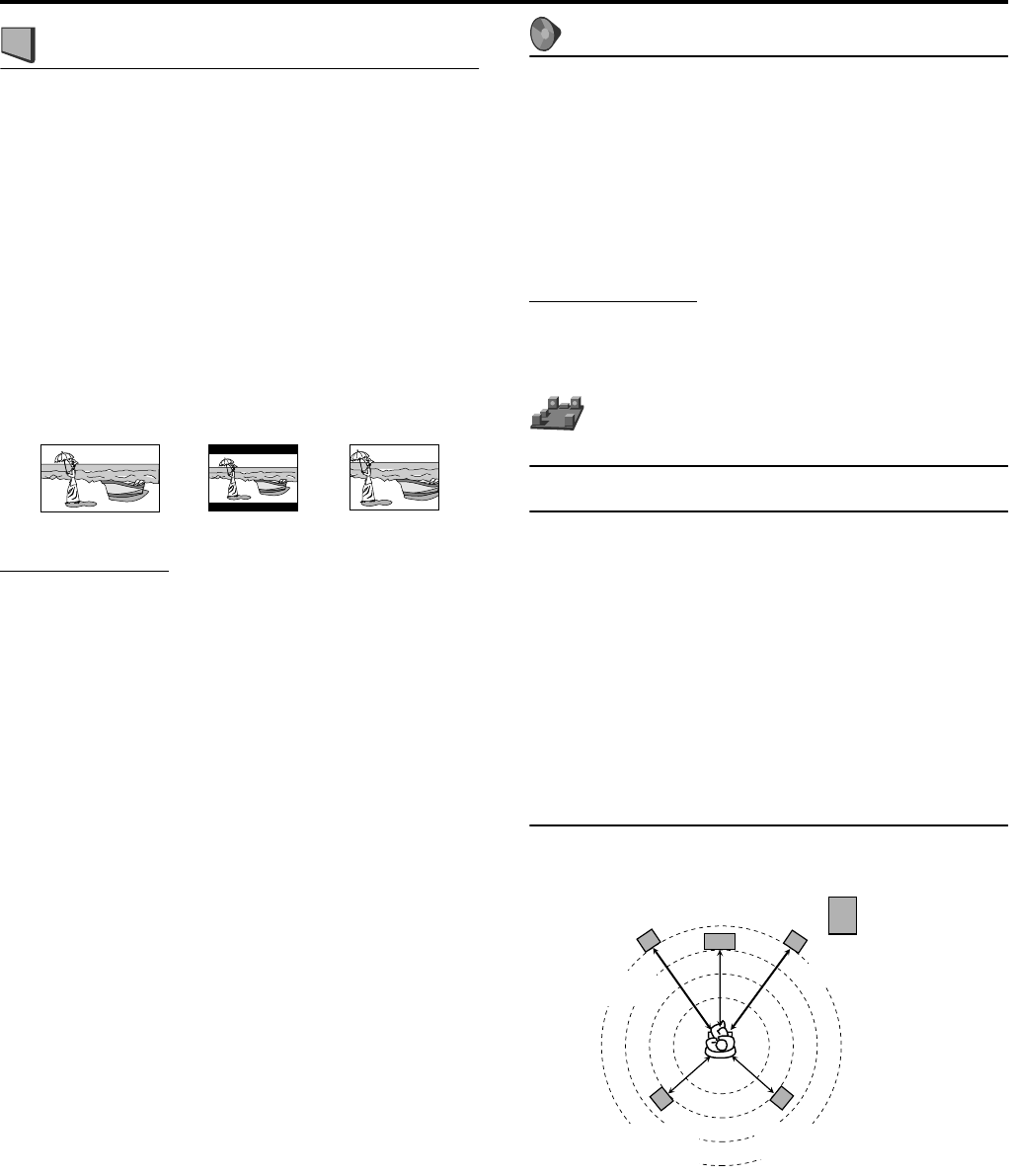
Setting DVD preferences
37
:Picture menu (PICTURE)
7MONITOR TYPE
You can select the monitor type to match your TV when you play
DVDs recorded in the picture’s height/width ratio of 16:9.
• 16:9 (Wide television conversion)
Select this when the aspect ratio of your TV is fixed on 16:9
(wide TV).
When you play DVDs recorded in the picture’s height/width
ratio of 4:3, the system adjust the ratio of output signal
automatically.
• 4:3 LB (Letter Box conversion)
Select this when the aspect ratio of your TV is 4:3
(conventional TV). While viewing a wide screen picture, the
black bars appear on the top and the bottom of the screen.
• 4:3 PS (Pan Scan conversion)
Select this when the aspect ratio of your TV is 4:3
(conventional TV). While viewing a wide screen picture, the
black bars do not appear, however, the left and right edges of
the pictures will not be shown on the screen.
NOTE
• Even if “4:3 PS” is selected, the screen size may become “4:3 LB”
with some DVDs. This depends on how DVDs are recorded.
7PICTURE SOURCE
When you set the scan mode to “PROGRESS” (Apg. 18), you can
obtain optimal picture quality by selecting whether the content on
the disc is processed by frame (film source) or by field (video
source) .
Normally set to “AUTO”.
•AUTO
Used to play a disc containing both video and film source
materials.
This system recognizes the source type (video or film) of the
current disc according to the disc information.
•If the playback picture is unclear or noisy, or the oblique
lines of the picture are rough, try to change to other modes.
•FILM
Suitable for playing back a film source disc.
• VIDEO
Suitable for playing back a video source disc.
7SCREEN SAVER (Apg. 22)
You can activate or deactivate Screen Saver function.
7FILE TYPE
When several types of files are recorded on a disc, you can select
which files to play.
• AUDIO
Select this to play MP3/WMA files.
• STILL PICTURE
Select this to play JPEG files.
• VIDEO
Select this to play MPEG-4/DivX files.
: Audio menu (AUDIO)
7D. RANGE COMPRESSION
(Dynamic range compression)
You can enjoy low level recorded sound clearly at night even at a
low volume when listening to the sound with Dolby Digital.
•AUTO
Select this when you want to enjoy surround sound with its
full dynamic range (no effect applied).
•ON
Select this when you want to fully apply the compression
effect (useful at midnight).
NOTE
• When you play a multichannel Dolby Digital source with the
surround mode is off, the setting of D. RANGE COMPRESSION is
set to ON automatically.
: Speaker setting menu
(SPK. SETTING)
7Level menu (LEVEL)
FRONT LEFT SPEAKER/FRONT RIGHT SPEAKER/
CENTER SPEAKER/SURROUND RIGHT SPEAKER/
SURROUND LEFT SPEAKER
While monitoring the test tone, adjust the center and surround
speakers volume as much as that of the front speakers.
TEST TONE*
Outputs the test tone.
* The test tone comes out of all of the activated speakers in the
following sequence:
s Front left speaker s Center speaker s Front right
speaker s Surround right speaker s Surround left
speaker s (back to the beginning)
7Delay menu (DELAY)
Example:
In this case, set the delay time of each speaker as follows;
•Delay time of front speakers: 0 ms
•Delay time of center speaker: 1 ms
•Delay time of surround speakers: 2 ms
FRONT LEFT SPEAKER/FRONT RIGHT SPEAKER/
CENTER SPEAKER/SURROUND RIGHT SPEAKER/
SURROUND LEFT SPEAKER
Adjust the distance from the listening position to the speakers.
Within the range from 0 ms to 15 ms. (by 1 ms)
Ex.: 16:9 Ex.: 4:3 LB Ex.: 4:3 PS
Subwoofer
Front left
0 ms
Center
speaker
1 ms
Front right
0 ms
Surround left
2 ms
Surround right
2 ms
TH-S66-S55[B].book Page 37 Wednesday, May 25, 2005 12:08 PM
Setting DVD preferences
38
7Subwoofer menu (SUBWOOFER)
LEVEL
You can set the output level of the subwoofer in the -6 dB to +6 dB
range.
CROSS OVER
The signals below the preset frequency level will be sent to and be
reproduced by the subwoofer.
Select one of the cross over frequency levels according to the bass
sound quality from the front/center/surround speakers.
:Other setting menu (OTHERS)
7RESUME
You can activate or deactivate Resume Playback function.
(Apg. 29)
7ON SCREEN GUIDE
You can activate or deactivate the on-screen guide icons.
(Apg. 20)
7DivX registration menu (DivX REGISTRATION)
The system has its own Registration Code for DivX playback.
You can confirm the code of your system.
•Once you played back a disc created by using the Registration
Code, the system’s code is overwritten by a totally different new
one for copyright protection purpose.
TH-S66-S55[B].book Page 38 Wednesday, May 25, 2005 12:08 PM
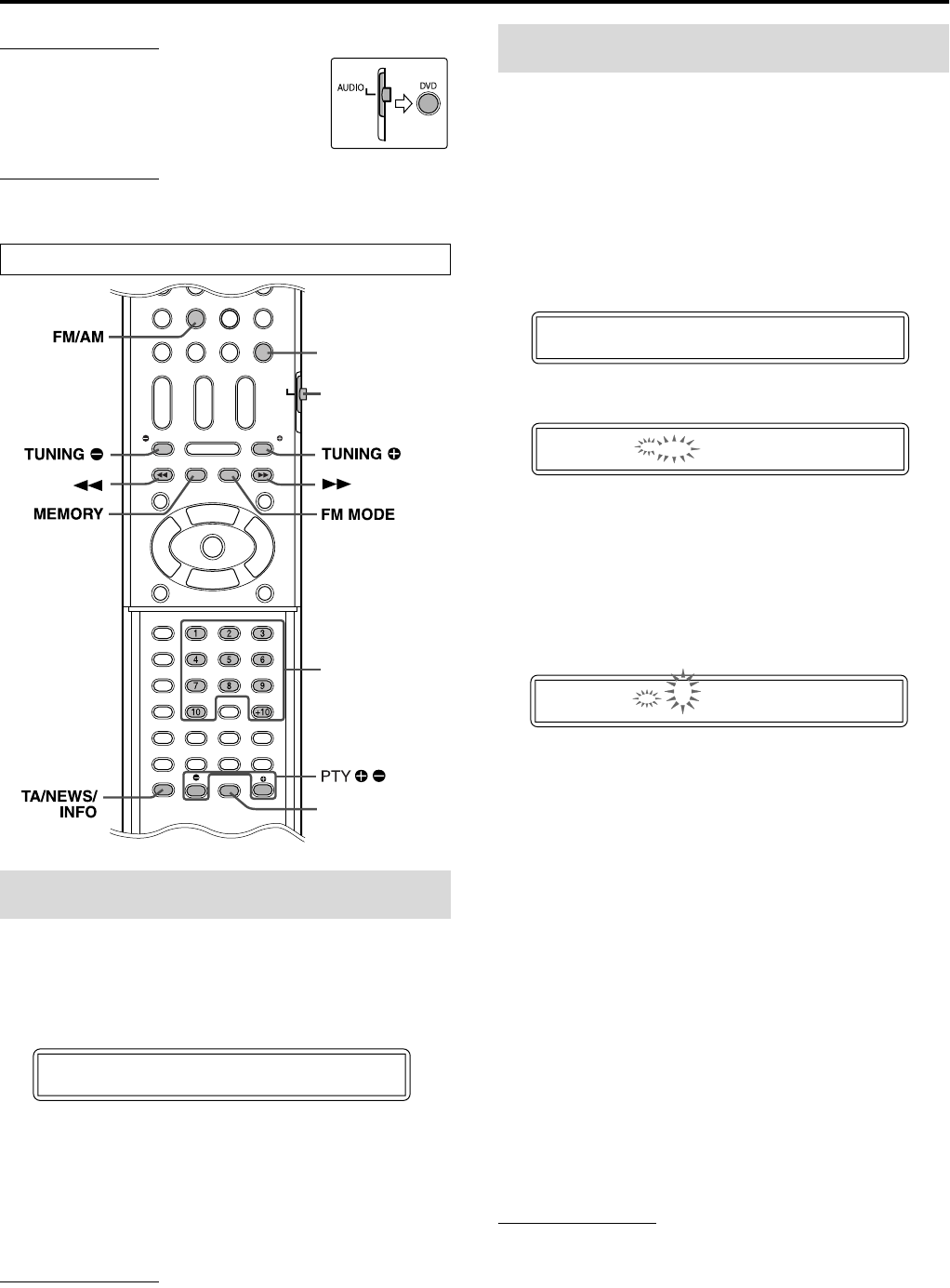
39
Tuner operations
IMPORTANT
Before using the remote control for the
following operation;
1 Set the remote control mode selector to
AUDIO.
2Press FM/AM.
NOTE
• When FM or AM is selected as the source, you can select All Channel
Stereo (ALL ST) and SURR OFF mode.
1Press FM/AM repeatedly to select the
band.
Example:
When the system is tuned in to 810 kHz.
2Press TUNING 9/( repeatedly until
you find the frequency you want.
When you hold down the button until the system starts
searching for stations and then release it, the system stops
searching automatically when a station of sufficient signal
strength is tuned in to.
NOTE
• When an FM stereo program is received, the ST indicator lights on the
display window.
Once a station is assigned to a channel number, the station can be
quickly tuned in. You can preset 30 FM and 15 AM (MW) stations.
7To preset the stations
1Tune in the station you want to preset.
•If you want to store the FM reception mode for an FM
station, select the reception mode you want. See “Selecting
the FM reception mode” (Apg. 40).
Example:
When the system is tuned in to 103.5 MHz.
2Press MEMORY.
7While “CH” and “– –” are flashing
3Press number button(s) (1-10, +10) to
select a preset number you want.
•For details on using the number buttons, see “How to use the
number buttons” (Apg. 22).
Example:
When the preset channel 1 is selected.
If the setting is cancelled before you finish, start from step 2
again.
7While the selected number is flashing
4Press MEMORY.
The selected number stops flashing.
The station is assigned to the selected preset number.
If the setting is cancelled before you finish, start from step 2
again.
5Repeat steps 1 to 4.
•Storing a new station to a used number erases the previously
stored one.
7To tune in to a preset station
1Press FM/AM repeatedly to select FM or
AM.
2Press number button(s) (1-10, +10) to
select a preset number.
•For details on using the number buttons, see “How to use the
number buttons” (Apg. 22).
NOTE
• You can also select a preset number by pressing y/1.
The buttons described below are used on pages 39 to 42.
Manual tuning
PTY SEARCH
FM/AM
TUNING
TA/NEWS/INFO
FL DISP.
AUDIO
TUNING
FM MODEMEMORY
TREBLE
FL DISP.
PTY SEARCH
Number buttons
Remote control
mode selector
810
AM
kHz
Preset tuning
103
.50
FM MHz
__103.50
CH
FM MHz
11
03.50
CH
FM MHz
TH-S66-S55[B].book Page 39 Wednesday, May 25, 2005 12:08 PM
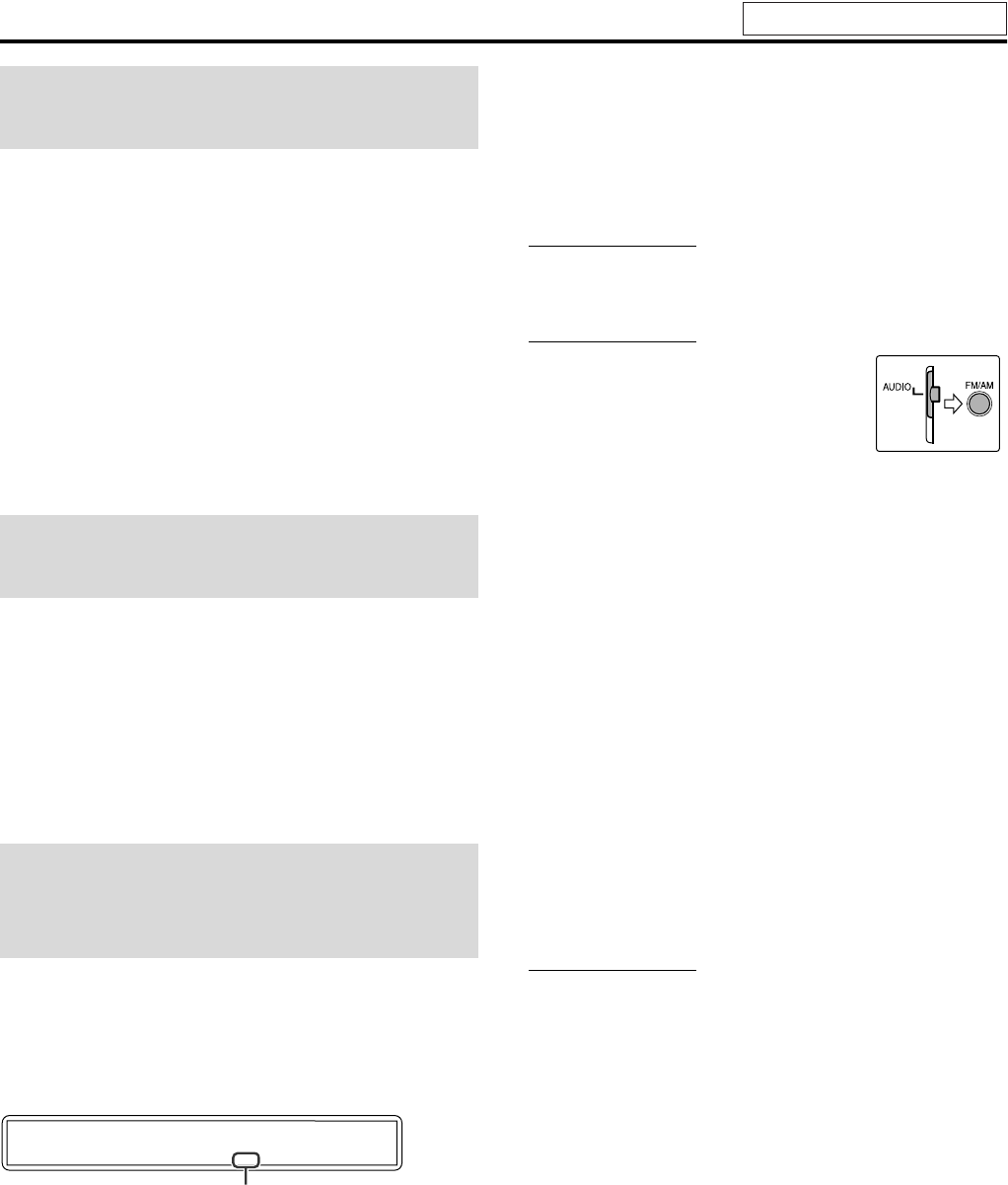
Tuner operations
40
When the stereo FM program currently tuned in is noisy, you can
change the FM reception mode to improve the reception.
7While listening to an FM station
Press FM MODE.
The FM reception mode appears on the display window.
Each time you press the button, the FM reception mode changes.
•AUTO:
When a program is broadcast in stereo, you will hear stereo
sound. (The ST indicator lights on the display window.) When in
monaural, you will hear monaural sound. This mode is also
useful to suppress static noise between stations.
• MONO:
Reception will be improved although you will lose the stereo
effect. (The MONO indicator lights on the display window.) In
this mode, you will hear noise until you are tuned in to a station.
When listening to an AM (MW) broadcast with a lot of noise
interference, you can change the Beat Cut mode to reduce the
noise.
7While listening to an AM (MW) station
Press FM MODE.
The current Beat Cut mode appears on the display window.
Each time you press the button, the Beat Cut mode changes.
•Choose “BEATCUT1” or “BEATCUT2” according to which
gives clearer sound.
RDS allows FM stations to send an additional signal along with
their regular program signals. For example, the stations send their
station names, as well as information about what type of program
they broadcast, such as sports or music, etc.
When tuned in to an FM station which provides the RDS service,
the RDS indicator lights up on the display window.
With the system, you can receive the following types of RDS
signals:
PS (Program Service): Shows commonly known station names.
PTY (Program Type): Shows types of broadcast programs.
RT (Radio Text): Shows text messages the station sends.
Enhanced Other Network: See page 42.
NOTE
• RDS is not available for AM (MW) broadcasts.
• RDS may not operate correctly if the station tuned is not transmitting
RDS signal properly or if the signal strength is weak.
IMPORTANT
Before using the remote control for the
following operation;
1 Set the remote control mode selector to
AUDIO.
2 Press FM/AM.
7To show the RDS signals
information
Press FL DISP. while listening to an FM
station.
Each time you press the button, the indication on the display
window changes.
PS (Program Service):
While searching, “PS” appears and then the station names will be
displayed. “NO PS” appears if no signal is sent.
PTY (Program Type):
While searching, “PTY” appears and then the type of the broadcast
program will be displayed. “NO PTY” appears if no signal is sent.
RT (Radio Text):
While searching, “RT” appears and then text messages the station
sends will be displayed. “NO RT” appears if no signal is sent.
Frequency:
Station frequency (non-RDS service).
About characters shown on the display window
When PS, PTY, or RT signals appear on the display window, some
special characters and marks may not be displayed correctly.
NOTE
• If searching finishes at once, “PS”, “PTY”, and “RT” will not appear
on the display window.
Selecting the FM
reception mode
Reducing the noise of AM
(MW) broadcast
Using the RDS (Radio
Data System) when
receiving FM stations
103.50
FM
RDS
MHz
RDS indicator
See page 39 for button locations.
TH-S66-S55[B].book Page 40 Wednesday, May 25, 2005 12:08 PM
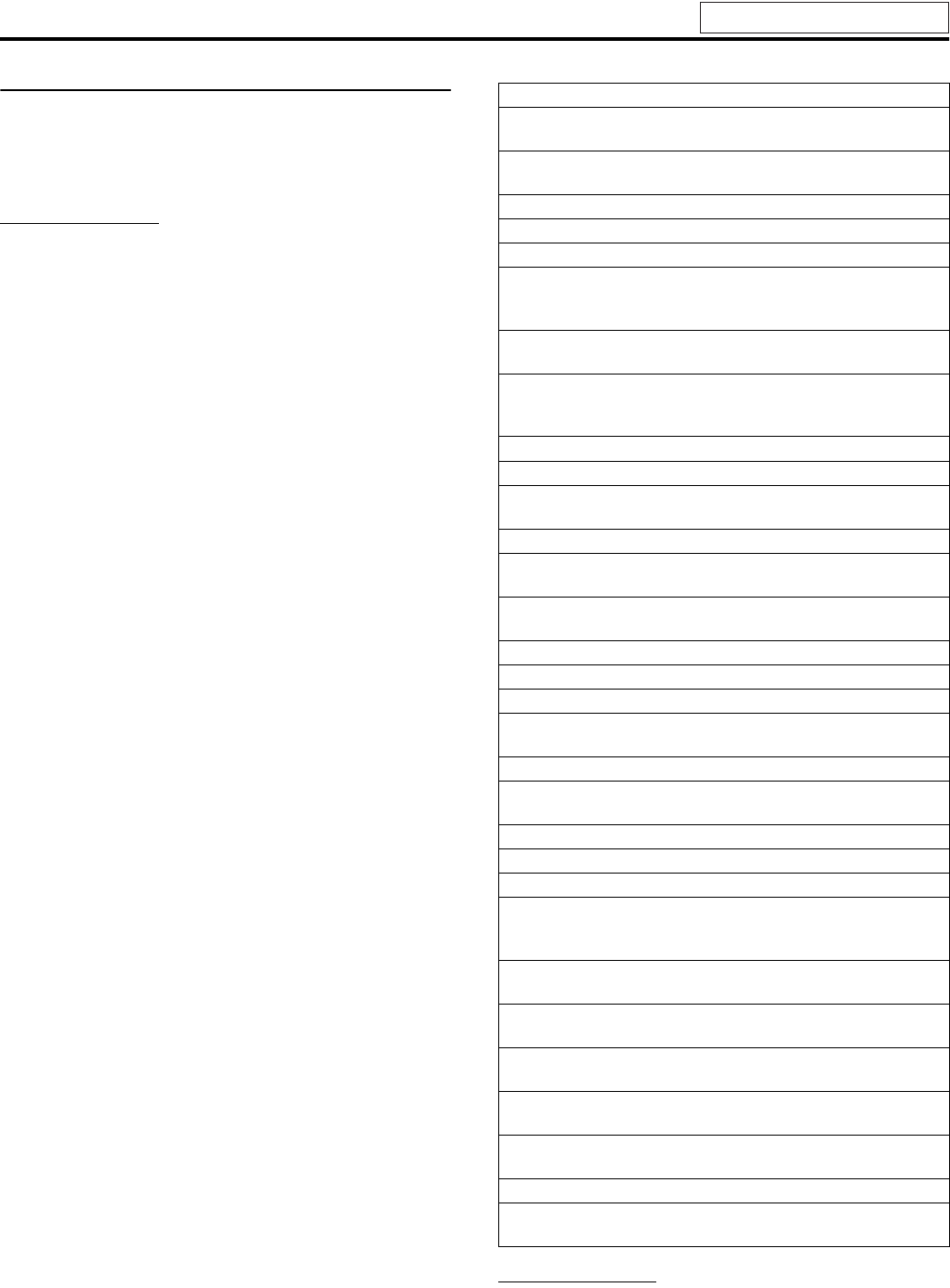
Tuner operations
41
Searching for a program by PTY codes
One of the advantages of the RDS service is that you can locate a
particular kind of program from the preset channels (Apg. 39) by
specifying the PTY codes.
7To search for a program using the PTY codes
NOTE
Before you start operation;
• The PTY Search is only applicable to preset stations.
• To stop searching any time during the process, press PTY SEARCH
while searching.
• There is a time limit in doing the following steps. If the setting is
canceled before you finish, start from step 1 again.
1Press PTY SEARCH while listening to
an FM station.
“PTY” and “SELECT” flashes alternately on the display
window.
7While “PTY” and “SELECT” is flashing alternately:
2Press PTY 9 or PTY ( until the PTY
code you want appears on the display
window.
•For details, see “Description of the PTY codes”.
While the PTY code selected in step 2 is still on the display
window:
3Press PTY SEARCH again.
While searching, “SEARCH” and the selected PTY code
alternate on the display window.
The system searches 30 preset FM stations, stops when it finds
the one you have selected, and tunes in that station.
To continue searching after the first stop
Press PTY SEARCH again while the indications on the display
window are flashing.
If no program is found, “NO FOUND” appears on the display
window.
Description of the PTY codes
NOTE
• Classification of the PTY codes for some FM stations may be
different from the above list.
NEWS: News.
AFFAIRS: Topical program expanding or enlarging upon
the news — debate, or analysis.
INFO: Programs the purpose of which is to impart
advice in the widest sense.
SPORT: Programs concerned with any aspect of sports.
EDUCATE: Educational programs.
DRAMA: All radio plays and serials.
CULTURE: Programs concerning any aspect of national or
regional culture, including language, theater,
etc.
SCIENCE: Programs about natural sciences and
technology.
VARIED: Used for mainly speech-based programs such as
quizzes, panel games and personality
interviews.
POP M: Commercial music of current popular appeal.
ROCK M: Rock music.
EASY M: Current contemporary music considered to be
“easy-listening”.
LIGHT M: Instrumental music, and vocal or choral works.
CLASSICS: Performances of major orchestral works,
symphonies, chamber music, etc.
OTHER M: Music not fitting into any of the other
categories.
WEATHER: Weather reports and forecasts.
FINANCE: Stock Market reports, commerce, trading etc.
CHILDREN: Programs targeted at a young audience.
SOCIAL: Programs about sociology, history, geography,
psychology and society.
RELIGION: Religious programs.
PHONE IN: Involving members of the public expressing
their views either by phone or at a public forum.
TRAVEL: Travel information.
LEISURE: Programs about recreational activities.
JAZZ: Jazz music.
COUNTRY: Songs which originate from, or continue the
musical tradition of the American Southern
States.
NATION M: Current popular music of the nation or region in
that country’s language.
OLDIES: Music from the so-called “golden age” of
popular music.
FOLK M: Music which has its roots in the musical culture
of a particular nation.
DOCUMENT: Programs concerning factual matters, presented
in an investigative style.
TEST: Broadcasts for testing emergency broadcast
equipment or unit.
ALARM: Emergency announcement.
NONE: No program type, undefined program, or
difficult to categorize into particular types.
See page 39 for button locations.
TH-S66-S55[B].book Page 41 Wednesday, May 25, 2005 12:08 PM
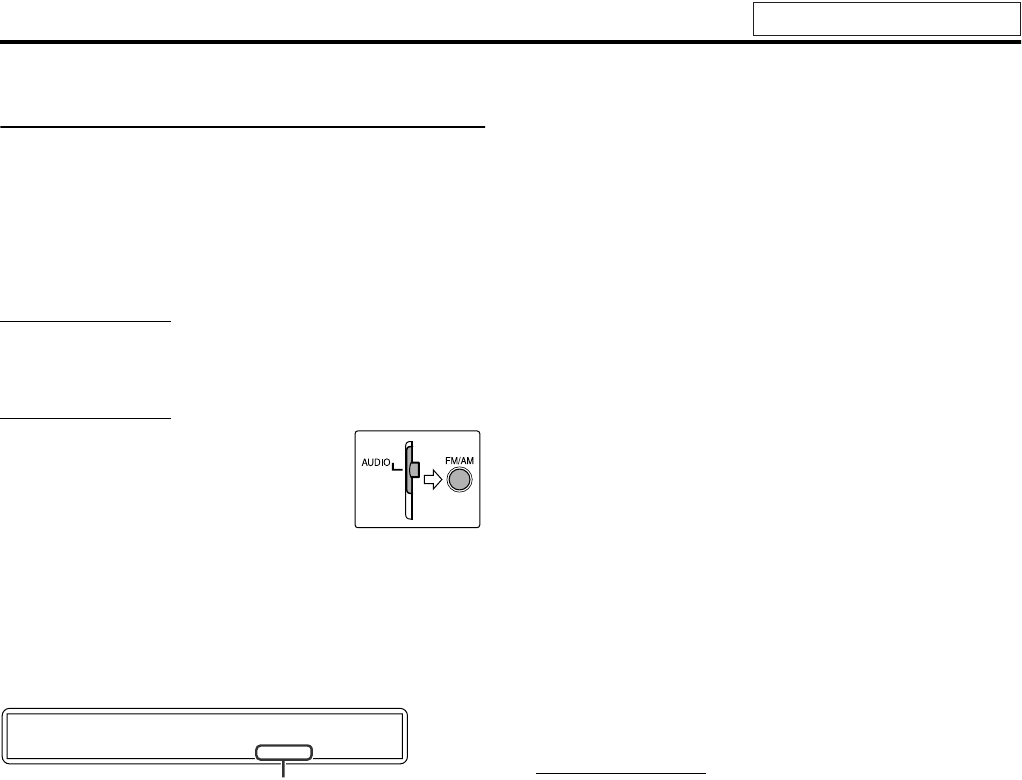
Tuner operations
42
Switching to broadcast program of your
choice temporarily
Another convenient RDS service is called “Enhanced Other
Network”.
This allows the system to switch temporarily to a broadcast
program of your choice (TA, NEWS, and/or INFO) from a different
station except in the following cases;
•When you are listening to non-RDS stations (all AM – MW
stations, some FM stations and other sources).
•When the system is in standby mode.
NOTE
Before you start operations;
• The Enhanced Other Network function is only applicable to preset
stations.
IMPORTANT
Before using the remote control for the
following operation;
1 Set the remote control mode selector to
AUDIO.
2Press FM/AM.
Press TA/NEWS/INFO
repeatedly until the program type indicator
(TA/NEWS/INFO) you want appears on the
display window.
Each time you press the button, the indicator on the display window
changes.
TA: Traffic Announcement in your area.
NEWS: News.
INFO: Program the purpose of which is to impart advice in the
widest sense.
To stop listening to the program selected by Enhanced
Other Network
Press TA/NEWS/INFO repeatedly again so that the program type
indicator (TA/NEWS/INFO) goes off from the display window. The
system exits from Enhanced Other Network standby mode and goes
back to the previously selected station.
When an emergency broadcast (ALARM signal) is sent
from an FM station
The system automatically tunes in to the station and “ALARM”
appears on the display window while the system receiving the
emergency broadcast.
Note that an emergency broadcast cannot be received in the
following cases;
•When you are listening to non-RDS stations (all AM – MW
stations, some FM stations and other sources).
•When the system is in standby mode.
The TEST signal is used for equipment test — whether it
can receive the Alarm signal correctly
The TEST signal makes the system work in the same way as the
Alarm signal does. If the TEST signal is received, the system
automatically switches to the station broadcasting the TEST signal.
While receiving the TEST signal, “TEST” appears on the display
window.
7How the Enhanced Other Network function actually
works
Case 1
If there is no station broadcasting the program you have
selected
The system continues tuning in to the current station.
‘
When a station starts broadcasting the program you have selected,
the system automatically switches to the station. The indicator of
received PTY code starts flashing.
‘
When the program is over, the system goes back to the previously
tuned station, but the Enhanced Other Network function still
remains activated.
Case 2
If the FM station you are listening to is broadcasting the
program you have selected
The system continues to receive the station but the indicator of
received PTY code starts flashing.
‘
When the program is over, the indicator of received PTY code stops
flashing and remains lit, but the Enhanced Other Network function
still remains activated.
NOTE
• In Enhanced Other Network standby mode, if you change the source
to play, Enhanced Other Network standby mode is canceled
temporarily.
If you change the source to FM again, the system returns to
Enhanced Other Network standby mode.
• Enhanced Other Network data sent from some stations may not be
compatible with this system.
• Enhanced Other Network does not function for some FM stations
with RDS service.
• While listening to a program tuned in by the Enhanced Other Network
function, the station does not change even if another network station
starts broadcasting a program of the same Enhanced Other Network
data.
• While listening to a program tuned in by the Enhanced Other Network
function, you can only use TA/NEWS/INFO and FL DISP. as the
tuner operation buttons.
1103
.50
CH
FM
TA NEWS INFO
MHz
The program type indicator
See page 39 for button locations.
TH-S66-S55[B].book Page 42 Wednesday, May 25, 2005 12:08 PM
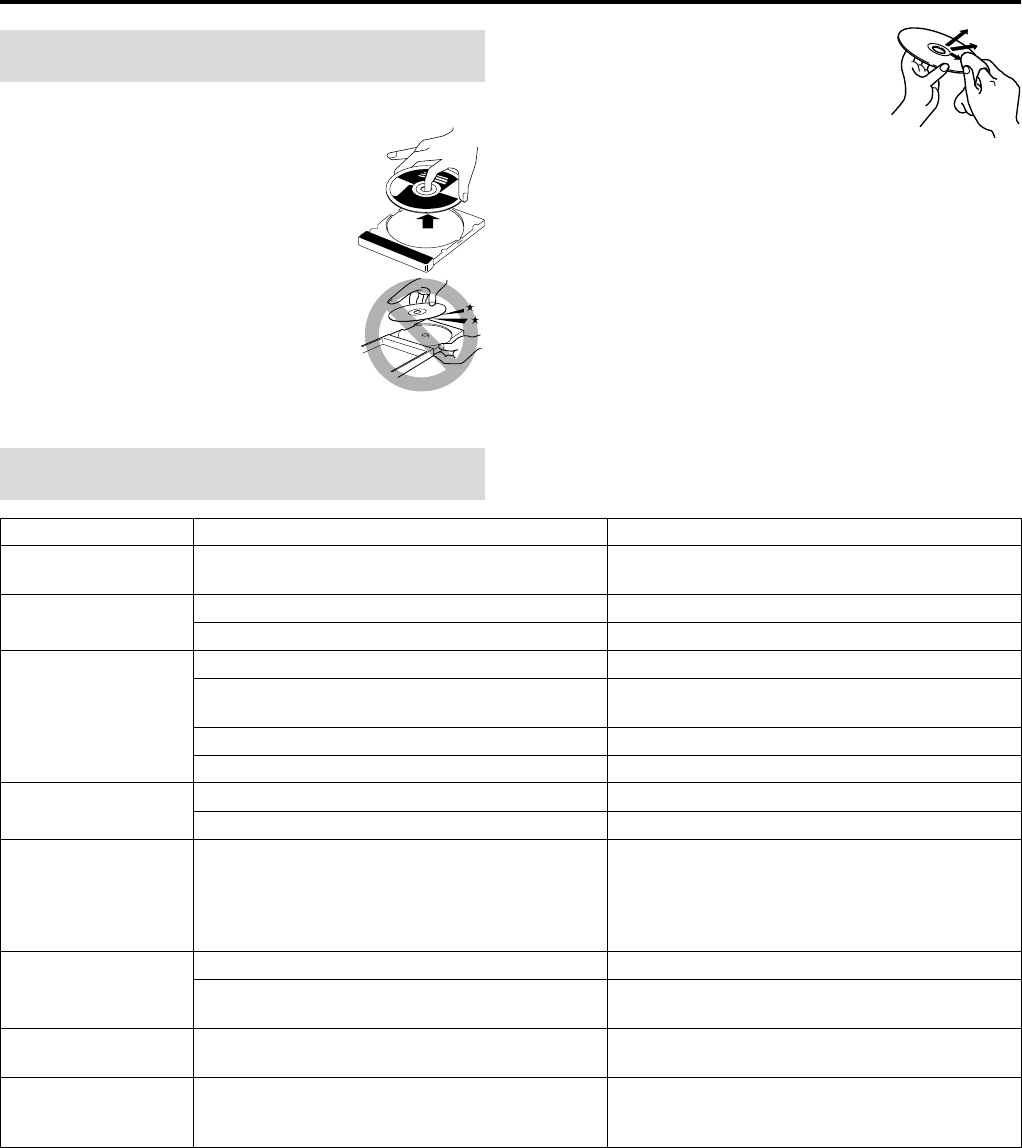
43
References
7Handling Discs
•Remove the disc from its case by holding it at
the edge while pressing the center hole lightly.
•Do not touch the shiny surface of the disc or
bend the disc.
•Put the disc back in its case after use to
prevent warping.
•Be careful not to scratch the surface of the
disc when placing it back in its case.
•Avoid exposure to direct sunlight, temperature
extremes and moisture.
To clean the disc
Wipe the disc with a soft cloth in a straight line
from center to edge.
• DO NOT use any solvent — such as
conventional record cleaner, spray,
thinner or benzine — to clean the disc.
7Cleaning the system
•Stains on the system should be wiped off with a soft cloth. If the
system is heavily stained, wipe it with a cloth soaked in water-
diluted neutral detergent and wrung well, then wipe clean with a
dry cloth.
•Since the system may deteriorate in quality, become damaged or
get its paint peeled off, be careful about the following.
•DO NOT wipe it with a hard cloth.
•DO NOT wipe it strong.
•DO NOT wipe it with thinner or benzine.
•DO NOT apply any volatile substance such as insecticides to it.
•DO NOT allow any rubber or plastic to remain in contact with
it for a long time.
Maintenance
Troubleshooting
PROBLEM POSSIBLE CAUSE SOLUTION
Power does not come
on.
The power cord and/or system cord is not connected. Connect the power cord and system cord correctly.
(Apg. 13)
The remote control does
not work.
The batteries are exhausted. Replace the batteries. (Apg. 7)
Sunlight is falling directly on the remote sensor. Hide the remote sensor from direct sunlight.
No sound. The system cord and/or speaker cord is not connected. Check the connection. (Apg. 13)
The audio cord is not connected to AUX IN and/or
DIGITAL IN correctly.
Connect the cord correctly. (Apg. 13)
An incorrect source has been selected. Select the correct source. (Apg. 17)
The decode mode is not set correctly. Select the proper decode mode. (Apg. 35)
No picture is displayed
on the TV screen.
The video cord is not connected correctly. Connect the cord correctly. (Apg. 12)
The disc is not playable. Use a playable disc. (Apg. 3)
No picture is displayed
on the TV screen, the
picture is blurred, or the
picture is divided into
two parts.
The scan mode is set to “PROGRESS” though the
center unit is connected to the TV which does not
support the progressive video input such as a
conventional TV.
Change the scan mode to “RGB” or “Y/C”. (Apg. 18)
Video and audio are
distorted.
The disc is scratched or dirty. Replace or clean the disc.
A VCR is connected between the center unit and the
TV.
Connect the center unit and TV directly. (Apg. 12)
The picture does not fit
the TV screen.
The monitor type is not set correctly. Set “MONITOR TYPE” properly. (Apg. 37)
Hard to listen to
broadcast because of
noise.
Antennas are disconnected. Reconnect the antennas correctly and securely.
(Apg. 8)
TH-S66-S55[B].book Page 43 Wednesday, May 25, 2005 12:08 PM
References
44
7
Center unit (XV-THS66/XV-THS55)
Audio section
Total Harmonic Distortion 0.02 %
NOTE: This value is measured at System cord CONNECTOR for
reference.
Digital input*1:
DIGITAL IN: –21 dBm to –15 dBm
(OPTICAL) (660 nm E30 nm)
*1Corresponding to Linear PCM, Dolby Digital, and DTS Digital
Surround (with sampling frequency — 32 kHz, 44.1 kHz, 48 kHz)
Video section
Video System: PAL
Horizontal Resolution: 500 lines
Signal-to-Noise Ratio: 64 dB
(Composite signal when “RGB” is selected)
Video output level
Composite: 1.0 V(p-p)/75 C
S-video-Y: 1.0 V(p-p)/75 C
S-video-C: 0.3 V(p-p)/75 C
Component-Y: 1.0 V(p-p)/75 C
Component-PB/PR: 0.7 V(p-p)/75 C
RGB: 0.7 V(p-p)/75 C
Tuner section
Tuning Range
FM: 87.50 MHz to 108.00 MHz
AM (MW): 522 kHz to 1 629 kHz
General
Power Requirements: AC 230 V , 50 Hz
Power Consumption: 17 W (at operation)
1.3 W (in standby mode)
Dimensions (W M H M D):
435 mm M 55 mm M 304 mm
Mass: 2.5 kg
7Subwoofer (SP-PWS66/SP-PWS55)
Amplifier section
Front: 140 W per channel, RMS at 4 C at
1 kHz, with 10 % total harmonic
distortion.
Center/Surround: 130 W per channel, RMS at 4 C at
1 kHz, with 10 % total harmonic
distortion.
Subwoofer: 140 W, RMS at 4 C at 100 Hz, with
10 % total harmonic distortion.
Speaker section
Speaker unit: 16 cm Bass-reflex
Power Handling Capacity: 140 W
Impedance: 4 C
Frequency Range: 30 Hz to 200 Hz
General
Power Requirements: AC 230 V , 50 Hz
Power Consumption: 135 W (at operation)
0 W (in standby mode)
Dimensions (W M H M D):
170 mm M 411 mm M 451 mm
Mass: 11.5 kg
7Satellite Speakers
Front speakers (SP-THS66F)
Speaker unit: 5.5 cm M 2
Bass-reflex, Magnetically Shielded
Power Handling Capacity: 140 W
Impedance: 4 C
Frequency Range: 90 Hz to 20 kHz
Dimensions (W M H M D):
250 mm M 1 104 mm M 250 mm
Mass: 2.6 kg
Center speaker (SP-THS66C)
Speaker unit: 5.5 cm M 2
Bass-reflex, Magnetically Shielded
Power Handling Capacity: 140 W
Impedance: 4 C
Frequency Range: 90 Hz to 20 kHz
Dimensions (W M H M D):
320 mm M 75 mm M 92 mm
Mass: 0.9 kg
Surround speakers (SP-THS66S)
Speaker unit: 5.5 cm M 2
Bass-reflex
Power Handling Capacity: 140 W
Impedance: 4 C
Frequency Range: 90 Hz to 20 kHz
Dimensions (W M H M D):
250 mm M 1 104 mm M 250 mm
Mass: 2.5 kg
Specifications
TH-S66-S55[B].book Page 44 Wednesday, May 25, 2005 12:08 PM

References
45
7Satellite Speakers
Front speakers (SP-THS55F)
Speaker unit: 8.0 cm
Bass-reflex, Magnetically Shielded
Power Handling Capacity: 140 W
Impedance: 4 C
Frequency Range: 80 Hz to 20 kHz
Dimensions (W M H M D):
106 mm M 119.5 mm M 102 mm
Mass: 0.51 kg
Center speaker (SP-THS55C)
Speaker unit: 5.5 cm M 2
Bass-reflex, Magnetically Shielded
Power Handling Capacity: 140 W
Impedance: 4 C
Frequency Range: 80 Hz to 20 kHz
Dimensions (W M H M D):
209 mm M 85 mm M 92 mm
Mass: 0.85 kg
Surround speakers (SP-THS55S)
Speaker unit: 8.0 cm
Bass-reflex
Power Handling Capacity: 140 W
Impedance: 4 C
Frequency Range: 80 Hz to 20 kHz
Dimensions (W M H M D):
111.5 mm M 148 mm M 106.5 mm
Mass: 0.56 kg
Designs & specifications are subject to change without notice.
TH-S66-S55[B].book Page 45 Wednesday, May 25, 2005 12:08 PM

EN
0105TMMMDWJEM© 2005 Victor Company of Japan, Limited
TH-S66/TH-S55 DVD DIGITAL CINEMA SYSTEM
TH-S66-S55[B].book Page 46 Wednesday, May 25, 2005 12:08 PM
