Jablotron JA85B Wireless Glass Break detector-Part of Alarm System User Manual Exhibit 7 Instruction manual JA85B

Jablotron Ltd Wireless Glass Break detector-Part of Alarm System Exhibit 7 Instruction manual JA85B

User Manual

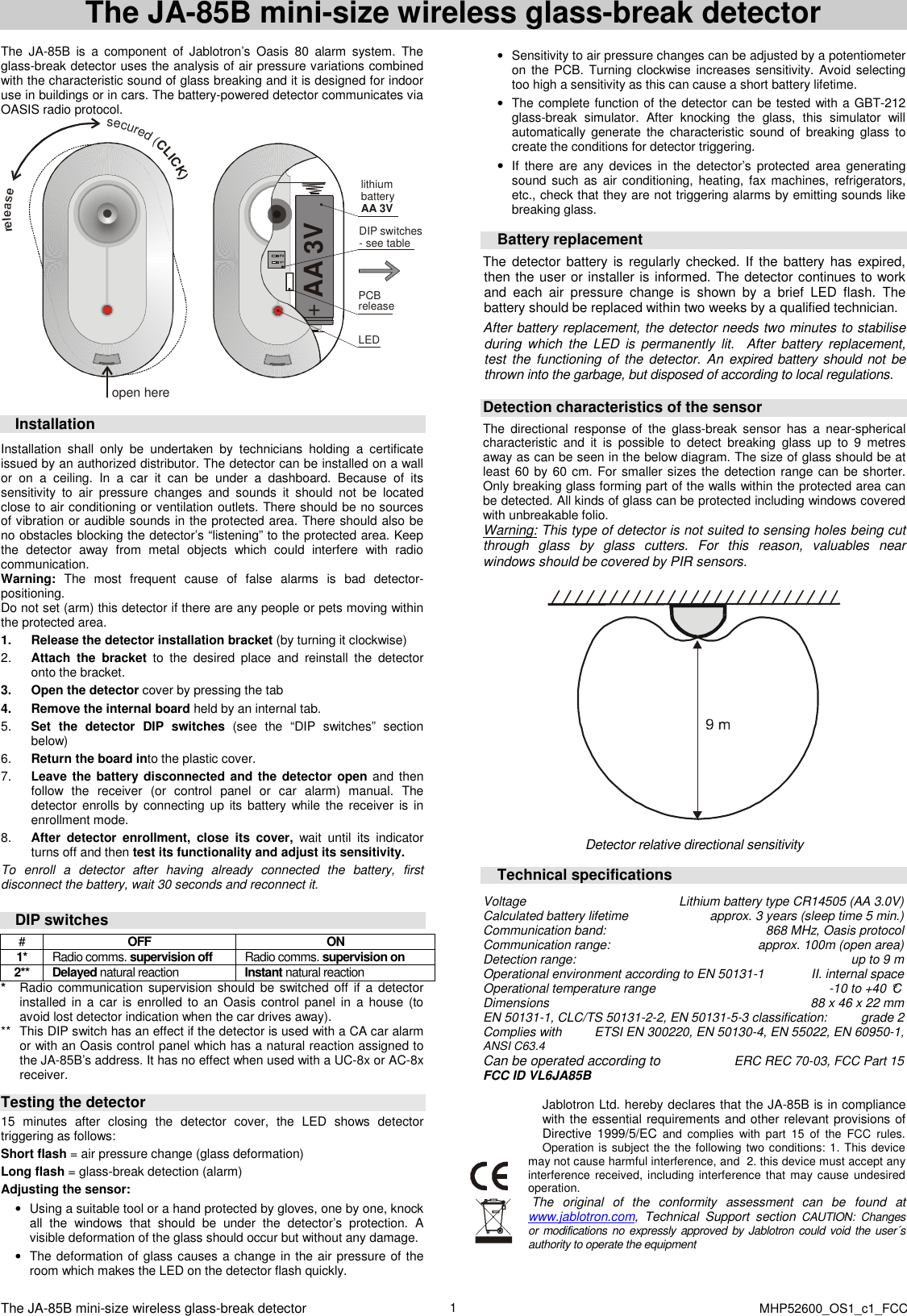
 The JA-85B mini-size wireless glass-break detector    MHP52600_OS1_c1_FCC 1 The JA-85B mini-size wireless glass-break detector  The  JA-85B  is  a  component  of  Jablotron’s  Oasis  80  alarm  system.  The glass-break detector uses the analysis of air pressure variations combined with the characteristic sound of glass breaking and it is designed for indoor use in buildings or in cars. The battery-powered detector communicates via OASIS radio protocol. open here+lithium batteryAA 3V AA 3VPCBreleaseLED12DIP switches- see tablesecured (CLICK)  Installation  Installation  shall  only  be  undertaken  by  technicians  holding  a  certificate issued by an authorized distributor. The detector can be installed on a wall or  on  a  ceiling.  In  a  car  it  can  be  under  a  dashboard.  Because  of  its sensitivity  to  air  pressure  changes  and  sounds  it  should  not  be  located close to air conditioning or ventilation outlets. There should be no sources of vibration or audible sounds in the protected area. There should also be no obstacles blocking the detector’s “listening” to the protected area. Keep the  detector  away  from  metal  objects  which  could  interfere  with  radio communication. Warning:  The  most  frequent  cause  of  false  alarms  is  bad  detector-positioning. Do not set (arm) this detector if there are any people or pets moving within the protected area. 1.  Release the detector installation bracket (by turning it clockwise)   2.  Attach  the  bracket  to  the  desired  place  and  reinstall  the  detector onto the bracket. 3.  Open the detector cover by pressing the tab  4.  Remove the internal board held by an internal tab. 5.  Set  the  detector  DIP  switches  (see  the  “DIP  switches”  section below) 6.  Return the board into the plastic cover. 7.  Leave the battery disconnected and the detector open and then follow  the  receiver  (or  control  panel  or  car  alarm)  manual.  The detector enrolls  by  connecting up  its battery  while the  receiver  is  in enrollment mode. 8.  After  detector  enrollment,  close  its  cover,  wait  until  its  indicator turns off and then test its functionality and adjust its sensitivity. To  enroll  a  detector  after  having  already  connected  the  battery,  first disconnect the battery, wait 30 seconds and reconnect it.   DIP switches #  OFF  ON 1*  Radio comms. supervision off  Radio comms. supervision on 2**  Delayed natural reaction    Instant natural reaction   *  Radio communication supervision should be  switched  off  if  a detector installed in  a  car  is enrolled to an  Oasis  control  panel  in  a house (to avoid lost detector indication when the car drives away). **  This DIP switch has an effect if the detector is used with a CA car alarm or with an Oasis control panel which has a natural reaction assigned to the JA-85B’s address. It has no effect when used with a UC-8x or AC-8x receiver.         Testing the detector  15  minutes  after  closing  the  detector  cover,  the  LED  shows  detector triggering as follows: Short flash = air pressure change (glass deformation) Long flash = glass-break detection (alarm)   Adjusting the sensor: •  Using a suitable tool or a hand protected by gloves, one by one, knock all  the  windows  that  should  be  under  the  detector’s  protection.  A visible deformation of the glass should occur but without any damage. •  The deformation of glass causes a change in the air pressure of the room which makes the LED on the detector flash quickly.  •  Sensitivity to air pressure changes can be adjusted by a potentiometer on the PCB.  Turning clockwise increases sensitivity. Avoid selecting too high a sensitivity as this can cause a short battery lifetime. •  The complete function of the detector can be tested with a GBT-212 glass-break  simulator.  After  knocking  the  glass,  this  simulator  will automatically generate the  characteristic  sound  of  breaking  glass  to create the conditions for detector triggering. • If  there are  any  devices  in  the  detector’s  protected  area  generating sound such as  air conditioning, heating,  fax machines,  refrigerators, etc., check that they are not triggering alarms by emitting sounds like breaking glass.   Battery replacement The detector  battery  is  regularly checked. If  the battery has  expired, then the user or installer is informed. The detector continues to work and  each  air  pressure  change  is  shown  by  a  brief  LED  flash.  The battery should be replaced within two weeks by a qualified technician.   After battery replacement, the detector needs two minutes to stabilise during which  the  LED  is  permanently  lit.    After  battery  replacement, test the  functioning of  the detector. An expired battery should not be thrown into the garbage, but disposed of according to local regulations.   Detection characteristics of the sensor  The  directional  response  of  the  glass-break  sensor  has  a  near-spherical characteristic  and  it  is  possible  to  detect  breaking  glass  up  to  9  metres away as can be seen in the below diagram. The size of glass should be at least 60 by  60 cm.  For smaller sizes the detection range can be shorter. Only breaking glass forming part of the walls within the protected area can be detected. All kinds of glass can be protected including windows covered with unbreakable folio. Warning: This type of detector is not suited to sensing holes being cut through  glass  by  glass  cutters.  For  this  reason,  valuables  near windows should be covered by PIR sensors.     Detector relative directional sensitivity  Technical specifications  Voltage  Lithium battery type CR14505 (AA 3.0V) Calculated battery lifetime  approx. 3 years (sleep time 5 min.) Communication band: 868 MHz, Oasis protocol Communication range:  approx. 100m (open area) Detection range:  up to 9 m Operational environment according to EN 50131-1   II. internal space Operational temperature range  -10 to +40 °C Dimensions  88 x 46 x 22 mm EN 50131-1, CLC/TS 50131-2-2, EN 50131-5-3 classification:  grade 2  Complies with   ETSI EN 300220, EN 50130-4, EN 55022, EN 60950-1,   ANSI C63.4 Can be operated according to   ERC REC 70-03, FCC Part 15 FCC ID VL6JA85B  Jablotron Ltd. hereby declares that the JA-85B is in compliance with the essential requirements and other relevant provisions of Directive 1999/5/EC and  complies  with  part  15  of  the  FCC  rules. Operation is subject the the following two conditions: 1. This  device may not cause harmful interference, and  2. this device must accept any interference  received,  including interference that may cause  undesired operation.  The  original  of  the  conformity  assessment  can  be  found  at www.jablotron.com,  Technical  Support  section  CAUTION:  Changes  or  modifications no expressly approved by Jablotron could void the  user´s authority to operate the equipment
 The JA-80PB wireless motion/glass-break detector    MHP52000_OS1 2  Note: Although this product does not contain any harmful materials we suggest you return the product to the dealer or directly to the producer after use.

Navigation menu