Janome Horizon Memory Craft 8200 Qc Instruction Booklet 858G Cover(EN)
2015-04-28
: Janome Janome-Horizon-Memory-Craft-8200-Qc-Instruction-Booklet-715809 janome-horizon-memory-craft-8200-qc-instruction-booklet-715809 janome pdf
Open the PDF directly: View PDF  .
.
Page Count: 92
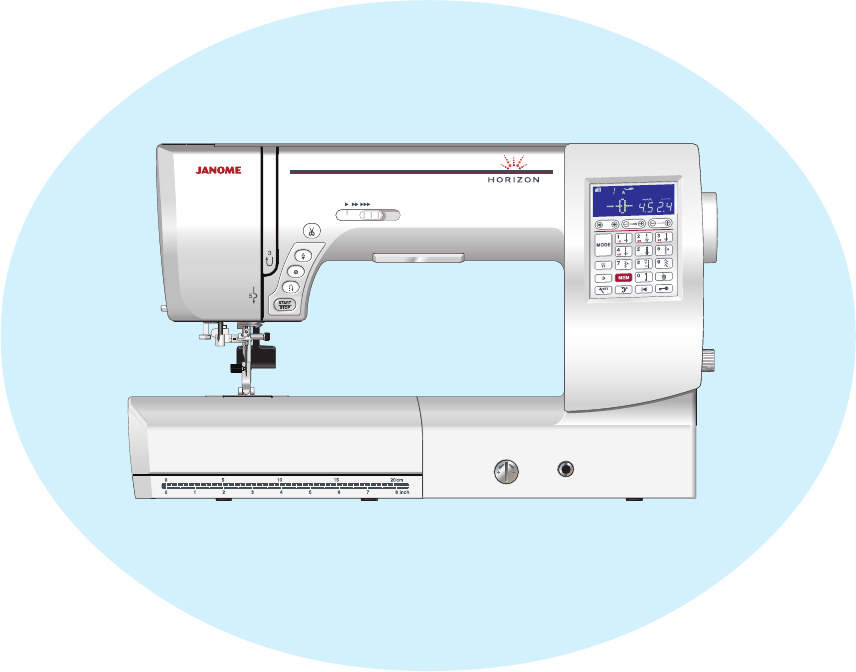
Instruction Book

1
IMPORTANT SAFETY INSTRUCTIONS
This appliance is not intended for use by persons (including children) with reduced physical, sensory or mental
capabilities, or lack of experience and knowledge, unless they have been given supervision or instruction concerning
use of the appliance by a person responsible for their safety.
Children should be supervised to ensure that they do not play with the appliance.
When using an electrical appliance, basic safety precautions should always be followed, including the following:
This sewing machine is designed and manufactured for household use only.
Read all instructions before using this sewing machine.
Please note that on disposal, this product must be safely recycled in accordance with relevant National legislation relating to
electrical/electronic products. If in doubt please contact your retailer for guidance. (European Union only)
DANGER— To reduce the risk of electric shock:
An appliance should never be left unattended when plugged in. Always unplug this sewing machine from the
electric outlet immediately after using and before cleaning.
WARNING— To reduce the risk of burns, fire, electric shock, or injury to persons:
1. Do not allow to be used as a toy. Close attention is necessary when this sewing machine is used by or near
children.
2. Use this appliance only for its intended use as described in this owner’s manual.
Use only attachments recommended by the manufacturer as contained in this owner’s manual.
3. Never operate this sewing machine if it has a damaged cord or plug, if it is not working properly, if it has been
dropped or damaged, or dropped into water.
Return this sewing machine to the nearest authorized dealer or service center for examination, repair, electrical or
mechanical adjustment.
4. Never operate the appliance with any air opening blocked. Keep ventilation openings of this sewing machine and
foot controller free from accumulation of lint, dust and loose cloth.
5. Never drop or insert any object into any opening.
6. Do not use outdoors.
7. Do not operate where aerosol (spray) products are being used or where oxygen is being administered.
8. To disconnect, turn all controls to the off (“O”) position, then remove plug from outlet.
9. Do not unplug by pulling on cord. To unplug, grasp the plug, not the cord.
10. Keep fingers away from all moving parts. Special care is required around the sewing machine needle.
11. Always use the proper needle plate. The wrong plate can cause the needle to break.
12. Do not use bent needles.
13. Do not pull or push fabric while stitching. It may deflect the needle causing it to break.
14. Switch this sewing machine off (“O”) when making any adjustment in the needle area, such as threading the
needle, changing the needle, threading the bobbin or changing the presser foot, and the like.
15. Always unplug this sewing machine from the electrical outlet when removing covers, lubricating, or
when making any other adjustments mentioned in this owner’s manual.
SAVE THESE INSTRUCTIONS
2
TABLE OF CONTENTS
NAMES OF PARTS
Names of Parts ............................................................... 3
Standard Accessories .................................................... 4
Accessories Storage ...................................................... 5
Extension Table .............................................................. 5
GETTING READY TO SEW
Connecting the Power Supply ........................................ 6
Operating Instructions .................................................... 6
Machine Operating Buttons ............................................ 7
Controlling Sewing Speed .............................................. 8
Foot control .................................................................... 8
Function Keys ................................................................. 9
Raising and Lowering the Presser Foot ....................... 10
Knee Lifter .................................................................... 10
Adjusting the Foot Pressure ..........................................11
Dropping the Feed Dog .................................................11
Balancing Thread Tension ............................................ 12
Lockout Key .................................................................. 13
Changing the Presser Foot .......................................... 13
Removing and Attaching the Foot Holder .................... 14
Dual Feed Foot ......................................................... 14-15
Replacing the Needle Plate .......................................... 16
Changing Needles ........................................................ 17
Fabric and Needle Chart .............................................. 17
Winding the Bobbin ...................................................... 18
Winding the Bobbin ...................................................... 19
Inserting the Bobbin ..................................................... 20
Threading the Machine ................................................. 21
Built-in Needle Threader .............................................. 22
Drawing up the Bobbin Thread..................................... 23
Selecting the Patterns .................................................. 24
Customizing Machine Settings ................................ 25-27
TRADITIONAL SEWING
Straight Stitch .......................................................... 28-30
Sewing with the Dual Feed Device............................... 31
Dual Feed Balancing Dial ............................................. 31
Needle Plate for Straight Stitch .................................... 32
Lock-a-Matic Stitch ....................................................... 32
Locking Stitch ............................................................... 32
Straight Stitch with Left Needle Position ...................... 33
Triple Stretch Stitch ...................................................... 33
Knit Stitch ..................................................................... 33
Zipper Sewing .........................................................34-36
Rolled Hem ................................................................... 37
Gathering ...................................................................... 38
Pintucking ..................................................................... 38
Zigzag Stitch ................................................................. 39
Multiple Zigzag Stitch (Tricot stitch) ............................. 40
Overcasting Stitch ........................................................ 40
Knit Stitch ..................................................................... 41
Double Overcasting Stitch ............................................ 41
Blind Hemming ........................................................ 42-43
Shell Tuck ..................................................................... 44
Buttonholes .................................................................. 44
Square Buttonhole...................................................45-48
Using the Stabilizer Plate ............................................. 49
Round End and Fine Fabric Buttonholes ..................... 50
Keyhole Buttonhole ...................................................... 50
Stretch Buttonholes ...................................................... 50
Corded Buttonhole ....................................................... 51
Welted Buttonhole ................................................... 52-53
Button Sewing .............................................................. 54
Darning .................................................................... 55-56
Tacking ......................................................................... 57
Eyelet ............................................................................ 58
Applique ....................................................................... 59
Fringing ......................................................................... 60
Drawn Work .............................................................60-61
Smocking ...................................................................... 61
Fagoting ........................................................................ 62
Scallop .......................................................................... 62
Patchwork Piecing ........................................................ 63
Patchwork ..................................................................... 63
Quilting ......................................................................... 64
Stippling ........................................................................ 65
Clasp Stitches .............................................................. 65
Free Motion Quilting (1) ...........................................65-66
Free Motion Quilting (2) ................................................ 66
Satin Stitches ............................................................... 67
Twin Needle Sewing ................................................ 68-69
PROGRAMMING A PATTERN COMBINATION
Pattern Combination ..................................................... 70
Programming Auto-lock Stitch ...................................... 71
Programming Automatic Thread Cutting ...................... 72
Pattern Combination with a Mirror Image ..................... 73
Resuming a Pattern from the Beginning ...................... 74
Resuming a Pattern Combination from the Beginning . 74
Bridge Stitches ........................................................ 75-76
Monogramming ........................................................77-78
Editing a Pattern Combination ...................................... 79
Deleting and Inserting a Pattern ................................... 80
Duplicating a Pattern .................................................... 80
Uniform Stitch Adjustment ............................................ 81
Unified Needle Drop Position ....................................... 81
Individual Stitch Adjustment ......................................... 82
Correcting Distorted Stitch Patterns ............................. 83
CARE AND MAINTENANCE
Cleaning the Hook Area ............................................... 84
Cleaning the Inside of the Thread Guide ...................... 85
Problems and Warning Signals ...............................86-87
Troubleshooting ............................................................ 88
3
NAMES OF PARTS
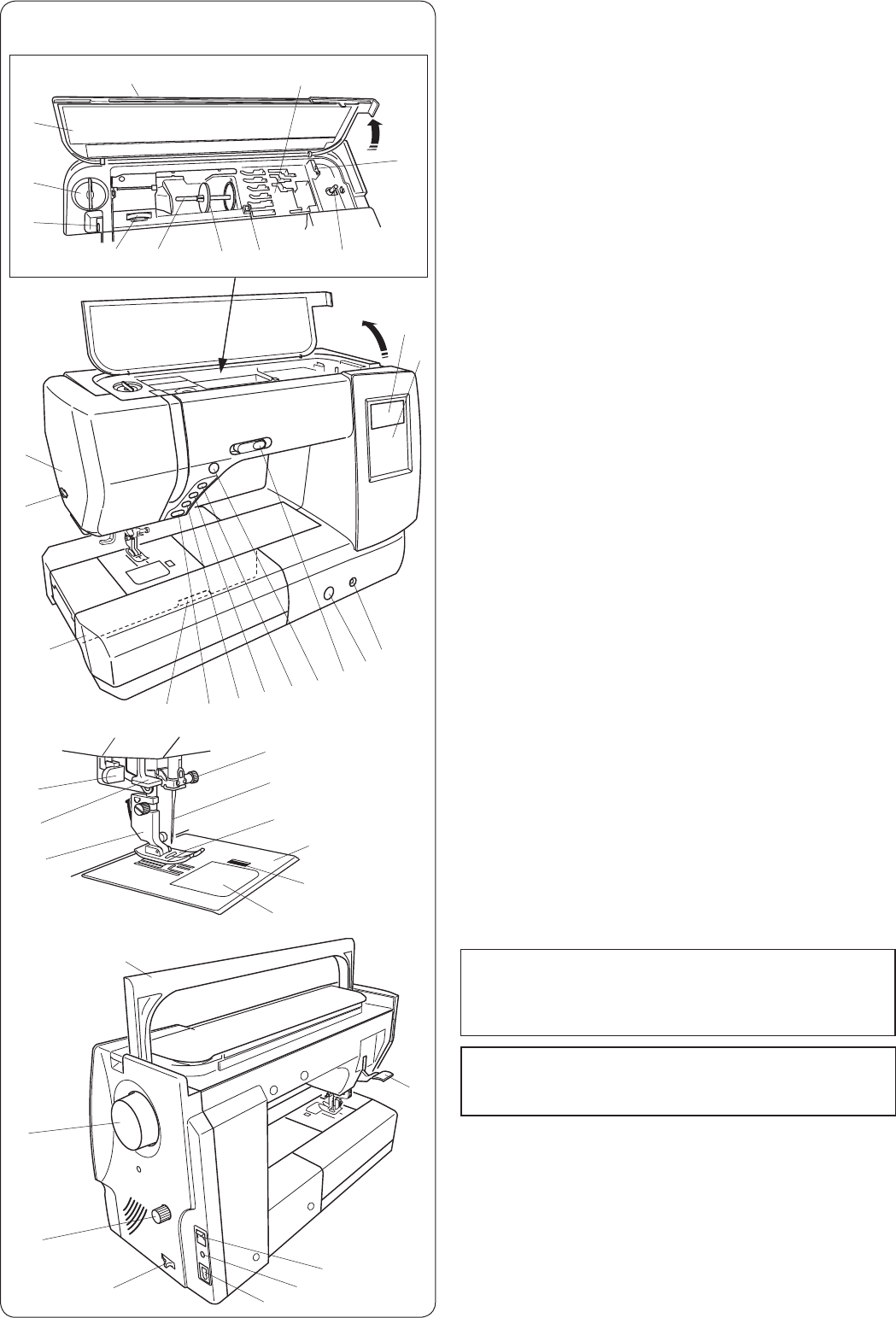
Names of Parts
q
w
e
rt
y
u
i
o
!0!1
!2
!3
!4
!5 !6 !7 !8 !9 @0
@3
@2
@1
@6
@7
@8
#4
#3
#2
@9
#0
#1
#5
#6
#7
#8
#9
$0
$1
$2
q
w
e
r
t
y
u
i
o
!0
!1
!2
!3
!4
!5
!6
!7
!8
!9
@0
@1
@2
@3
@4
@5
@6
@7
@8
@9
#0
#1
#2
#3
#4
#5
#6
#7
#8
#9
$0
$1
$2
@4
@5
Thread take-up lever
Foot pressure dial
Reference chart
Top cover
Foot storage compartment
Bobbin thread cutter
Bobbin winder spindle
Hole for extra spool pin
Spool holder (large)
Spool pin
Thread tension dial
Face cover
Thread cutter
Extension table (accessory storage)
Needle plate release lever
Start/stop button
Reverse button
Auto-lock button
Needle up/down button
Thread cutter button
Speed control slider
Feed balancing dial
Knee lifter socket
Function keys
LCD screen
Needle clamp screw
Needle
Zigzag foot A
Needle plate
Hook cover release button
Hook cover plate
Buttonhole lever
Needle threader
Foot holder
Carrying handle
Presser foot lifter
Handwheel
Dual feed balancing dial
Drop feed lever
Power switch
Foot control jack
Machine socket
NOTE:
To carry the sewing machine, hold the carrying handle
with your hand, and support the sewing machine with
the other hand.
NOTE:
Sewing machine design and specifications are subject
to change without prior notice.
4
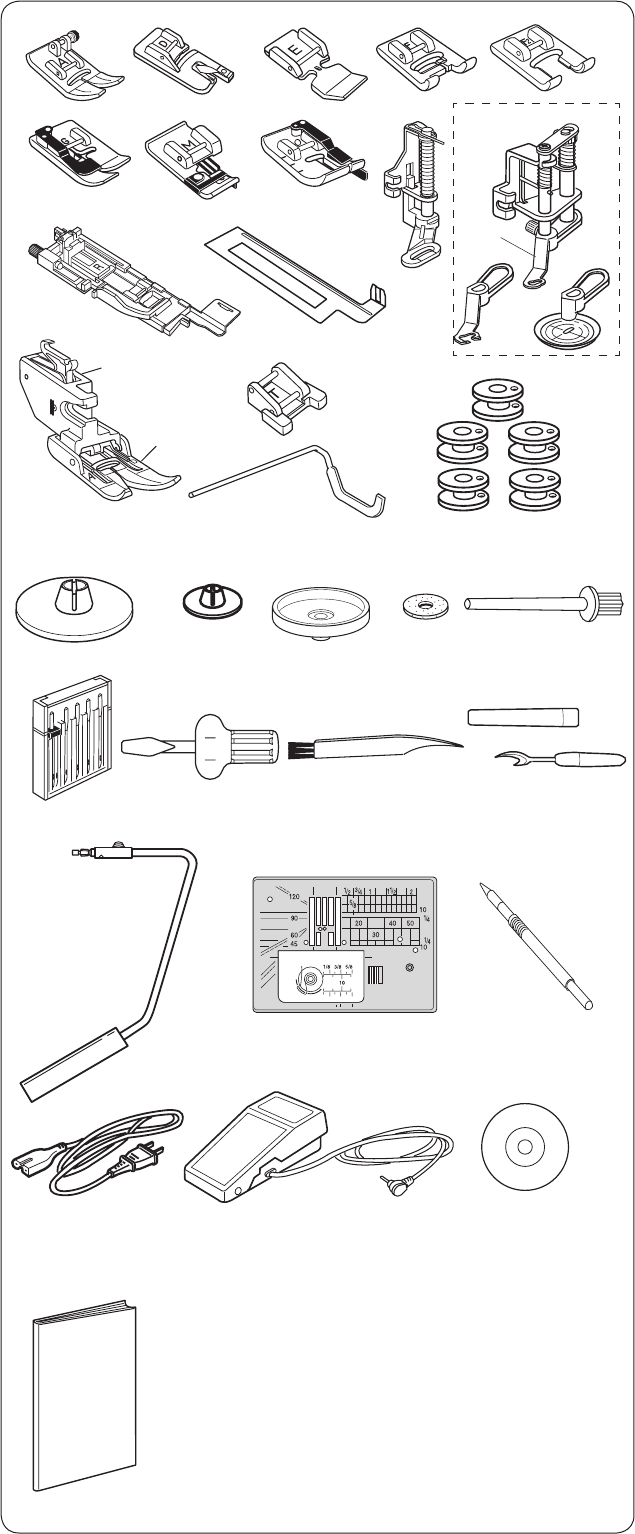
Zigzag foot A (set on the machine)
Rolled hem foot D
Zipper foot E
Satin stitch foot F
Open-toe satin stitch foot F2
Blind hemming foot G
Overcast foot M
1/4˝ seam foot O
Darning foot PD-H
Convertible free motion quilting foot QB-S
Close-toe foot
Open-toe foot
Clear view foot
Automatic buttonhole foot R
Buttonhole stabilizer plate
Dual feed foot holder
Dual feed foot AD
Button sewing foot T
Quilting guide bar
Bobbin (5 pcs.) (1 set on the machine)
Spool holder (large, set on the machine)
Spool holder (small)
Spool supporter
Felt cusion
Extra spool pin
Needle set
Screwdriver
Lint brush
Seam ripper (Buttonhole opener)
Knee lifter
Needle plate for straight stitch
Touch panel stylus
Power cable
Foot control
Instructional video DVD
Instruction book
Standard Accessories
q
w
e
r
t
y
u
i
o
!0
!1
!2
!3
!4
!5
!6
!7
!8
!9
@0
@1
@2
@3
@4
@5
@6
@7
@8
@9
#0
#1
#2
#3
#4
#5
#6
q w e r t
y u i o !0
!1
!2 !3
!4 !5
!6
!7
!8
!9
@0
@1 @2 @3 @4 @5
@6 @7 @8 @9
#0 #1 #2
#3
#4 #5
#6
5
Extension Table
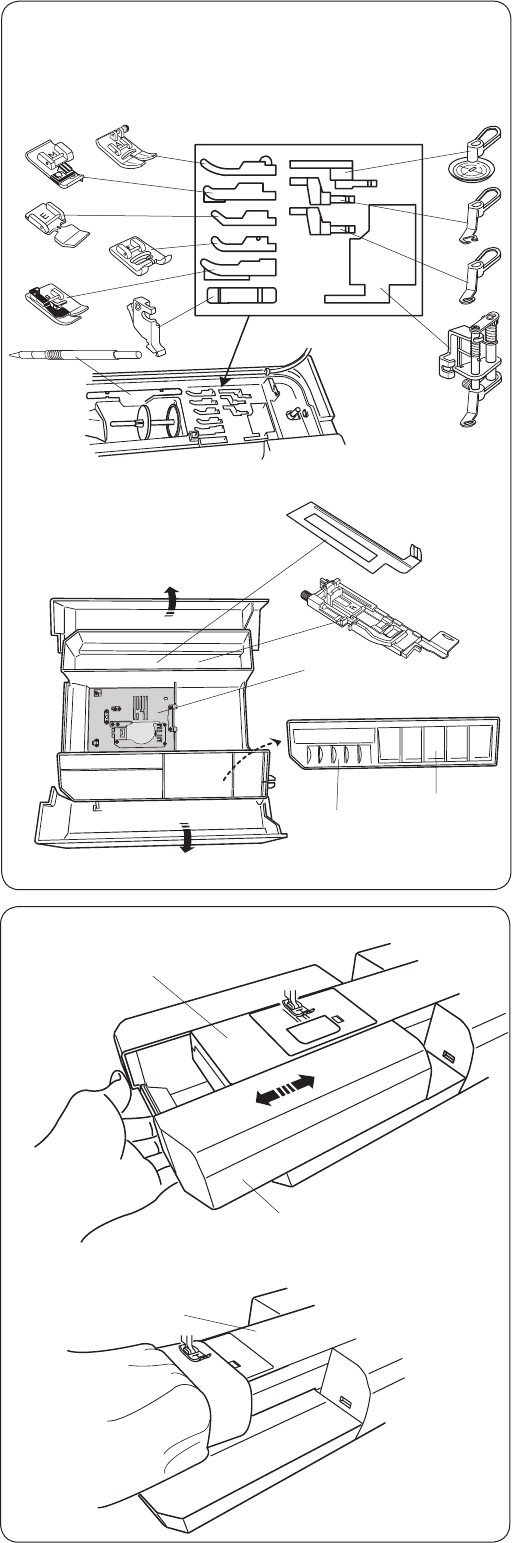
The extension table provides an extended sewing area
and can be removed for free-arm sewing.
q Extension table
w Free-arm
To detach:
Draw the table out to the left.
To attach:
Slide the table on the base and push the table to the
right.
Free-arm sewing
Free-arm sewing is used for stitching sleeves,
waistbands, pant legs or any other tubular garments.
It is also useful for darning socks or mending knees or
elbows.
w Free-arm
Accessories Storage
The accessories can be conveniently stored in the foot
storage compartment under the top cover and in the
extension table.
Under top cover:
q Zigzag foot A
w Overcast foot M
e Zipper foot E
r Satin stitch foot F
t Blind hemming foot G
y Foot holder
u Touch panel stylus
i Clear view foot
o Open-toe foot
!0 Close-toe foot
!1 Convertible free motion quilting foot QB-S
In extension table:
q Buttonhole stabilizer plate
w Automatic buttonhole foot R
e Needle plate
r Bobbin
t Presser foot
Other accessories can be also stored in the
compartment.
q
w
e
r
t
y
u
i
o
!0
!1
e
rt
w
q
w
q
w
6
Connecting the Power Supply
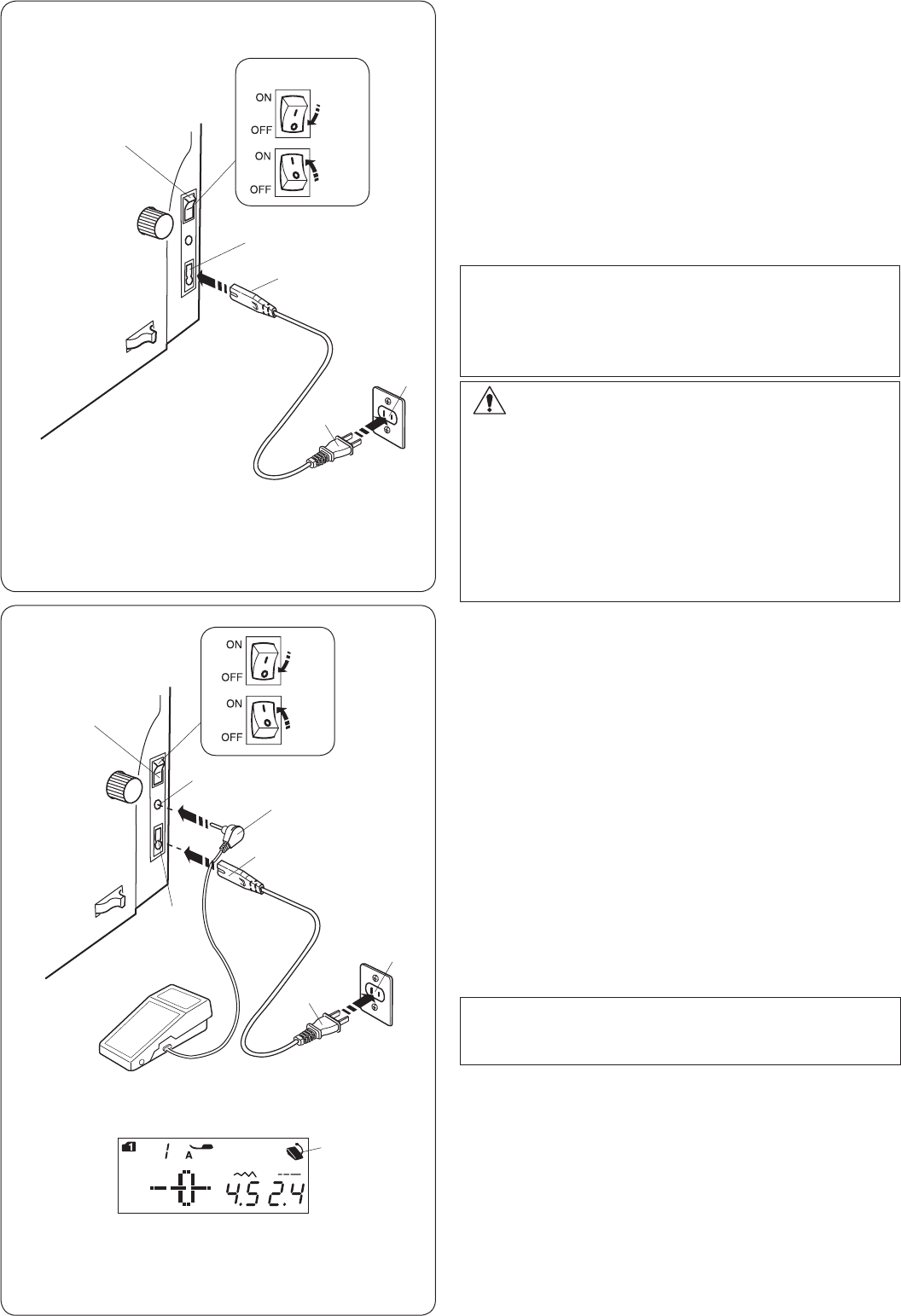
z First make sure the power switch q is off.
x Insert the machine plug w of the power supply cord
into the machine socket e.
c Insert the power supply plug r into the wall outlet t,
and turn the power switch q on.
q Power switch
w Machine plug
e Machine socket
r Power supply plug
t Wall outlet
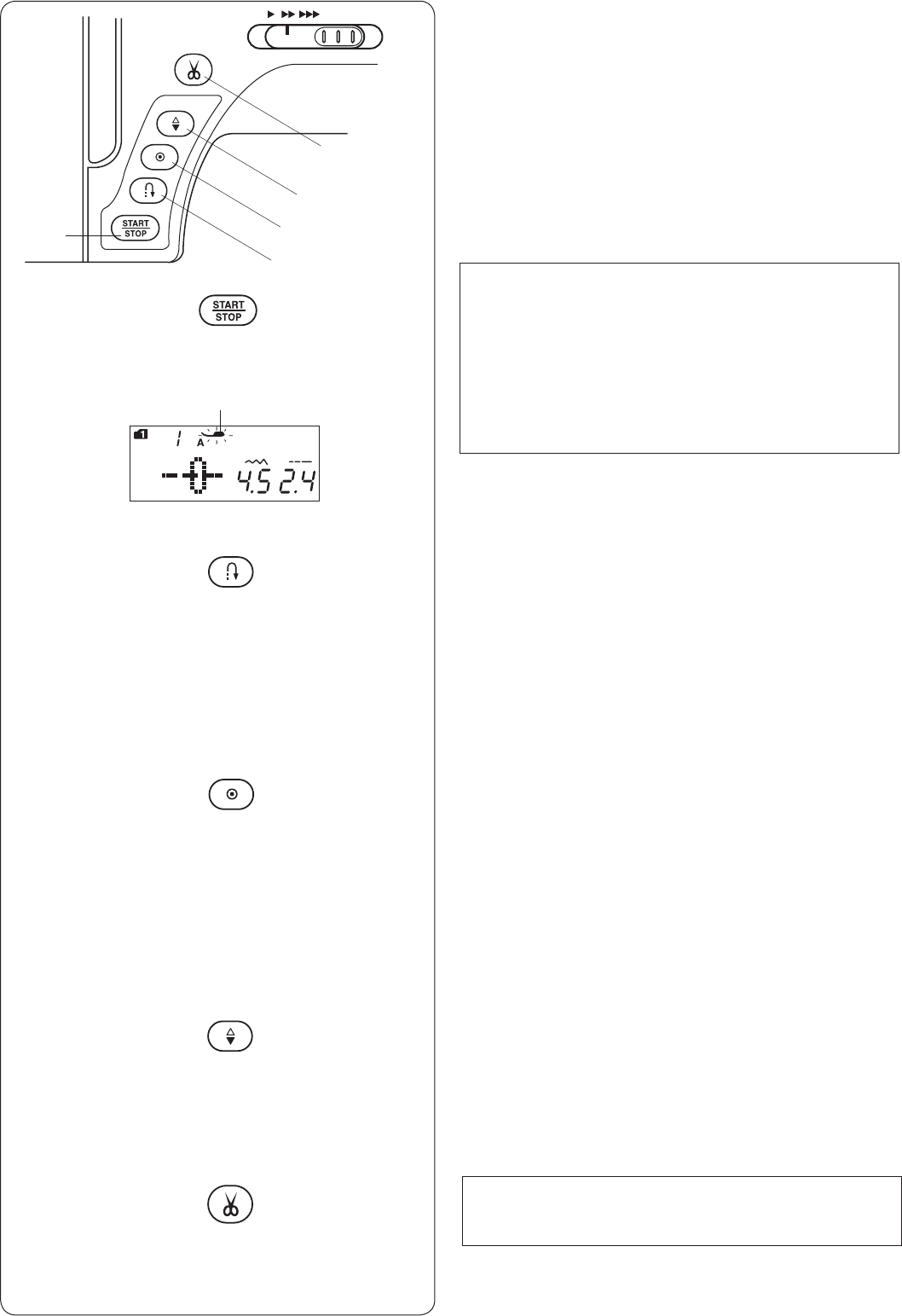
If you wish to use the foot control, insert the pin connector
into the jack on the machine.
z First make sure the power switch q is off.
x Insert the pin connector w into the jack e on the
machine.
c Insert the machine plug r of the power supply cord
into the machine socket t.
v Insert the power supply plug y into the wall outlet u,
and turn the power switch on.
The foot control sign i will be displayed when the foot
control is connected to the machine.
q Power switch
w Pin connector
e Jack
r Machine plug
t Machine socket
y Power supply plug
u Wall outlet
i Foot control sign
NOTE:
The start/stop button does not work when the foot
control is connected.
e
w
q
z
c
r
t
GETTING READY TO SEW
z
v
q
e
w
r
y
u
NOTES:
Make sure to use the power supply cable that came
with the machine.
If you turn off the power switch, wait for 5 seconds
before turning it on again.
WARNING:
While in operation, always keep your eyes on the
sewing area, and do not touch any moving parts such
as the thread take-up lever, handwheel or needle.
Always turn off the power switch and unplug the
machine from the power supply:
- when leaving the machine unattended.
- when attaching or removing parts.
- when cleaning the machine.
Do not place anything on the foot control.
i
t
Operating Instructions:
The symbol “O” on a switch indicates the “off” position of
the switch.
For the U.S.A. and Canada only
Polarized plug (one blade wider than the other):
To reduce the risk of electric shock, this plug is intended
to fit in a polarized outlet only one way. If it does not fit
fully in the outlet, reverse the plug. If it still does not fit,
contact a qualified electrician to install the proper outlet.
Do not modify the plug in any way.
7
Machine Operating Buttons
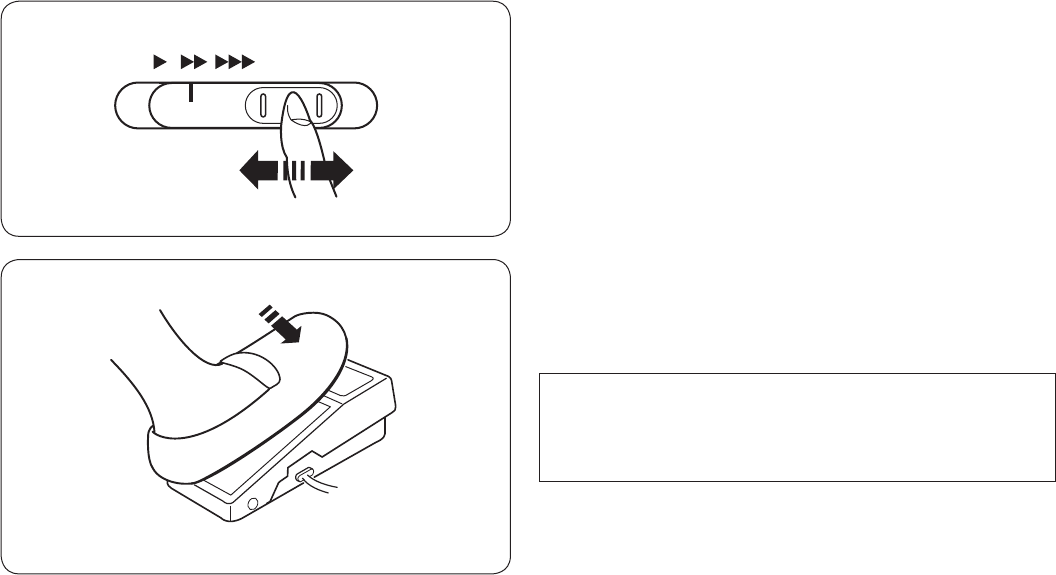
q Start/stop button
Press this button to start or stop the machine.
The machine starts running slowly for the first few
stitches, it then runs at the speed set by the speed control
slider. The machine runs slowly as long as this button is
pressed.
The button will turn red when the machine is running, and
green when it has been stopped.
Pressing and holding this button while sewing will slow
down the sewing speed and the machine will stop when
the button is released.
NOTES:
•Thestart/stopbuttoncannotbeusedwhenthefoot
control is connected to the machine.
•Themachinewillnotrunandthepresserfootmark
y will blink if you start the presser foot in the up
position. Lower the presser foot and press the start/
stop button.
•Youcanselectthedesiredstart-upspeedfrom
slow, medium or high (refer to page 26).
w Reverse button
When sewing stitch pattern 1, 4, 6, 7, 8, 1S, 4S (mode 1),
01, 04, 08, 09, 10 (mode 2) or 01, 02, 03, 46, 47 (mode
3), the machine will sew in reverse as long as the reverse
button is pressed.
If stitch pattern 1, 4, 6, 7, 8, 1S, 4S (mode 1), 01, 04,
08, 09, 10 (mode 2) or 01, 02, 03, 46, 47 (mode 3), has
been selected and the foot control is not connected,
the machine will start sewing in reverse as long as the
reverse button is pressed.
If you press the reverse button when sewing any other
patterns, the machine will immediately sew locking
stitches and automatically stop.
e Auto-lock button
When sewing stitch pattern 1, 4, 6, 7, 8, 1S, 4S (mode 1),
01, 04, 08, 09, 10 (mode 2) or 01, 02, 03, 46, 47 (mode
3), the machine will immediately sew locking stitches and
automatically stop when the auto-lock button is pressed.
When sewing all other patterns, the machine will sew to
the end of the current pattern, sew locking stitches and
stop automatically.
The machine will trim the threads automatically after
locking the stitch when the auto thread cutting option is
turned on.
r Needle up/down button
Press this button to bring the needle bar up or down.
The machine will stop with the needle in down position.
However, you can change the needle stop position in the
setting mode (refer to page 26).
t Thread cutter button
Press this button when you finish sewing to trim the
threads. The needle bar automatically rises after trimming
the threads (refer to page 29).
q
w
e
r
t
q
w
e
r
tNOTE:
Use the thread cutter on the face cover if the thread is
#30 or thicker (refer to page 29).
y
8
Controlling Sewing Speed
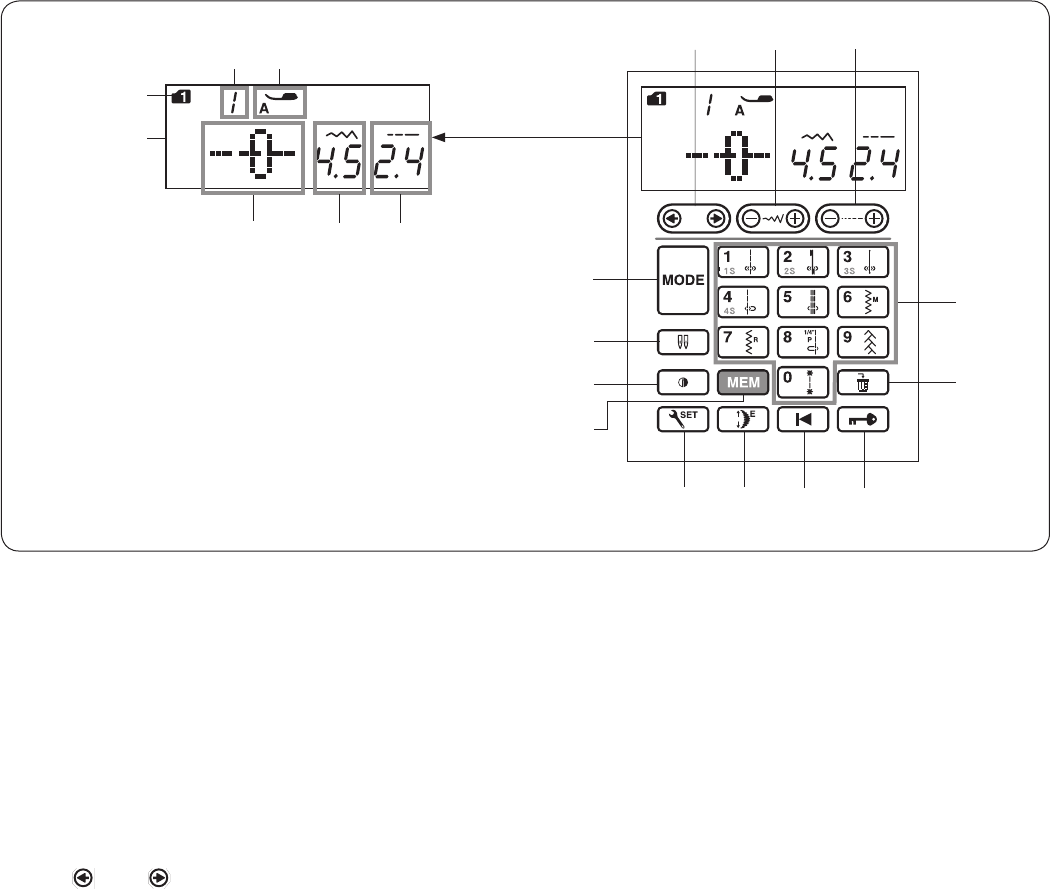
Speed control slider
Youcanlimitthemaximumsewingspeedwiththespeed
control slider according to your sewing needs.
To increase the sewing speed, move the slider to the
right.
To decrease the sewing speed, move the slider to the left.
Foot control
Pressing on the foot control can vary sewing speed.
The harder you press the foot control, the faster the
machine runs.
NOTE:
The machine runs at the maximum speed set by the
speed control slider when the foot control is fully
depressed.
Operating Instructions:
FootcontrolmodelYC-485EC-1isforusewiththis
sewing machine.
9
w
Function Keys
q LCD screen
The LCD screen shows the following information when the
machine is turned on:
w Stitch pattern
e Mode
r Stitch pattern number
t Recommended type of presser foot
y Stitch width
u Stitch length
i Cursor key (refer to pages 79, 80)
Press “ ” or “ ” to move the cursor to check or edit
the pattern combination.
o Stitch width adjusting key (refer to pages 30, 39, 49)
Press this key to alter the stitch width.
!0 Stitch length adjusting key (refer to pages 30, 39, 49)
Press this key to alter the stitch length.
!1 Mode key (refer to page 25)
Press the mode key to select the mode.
When the power is turned on, the direct pattern selection
(mode 1) is set automatically.
!2 Number keys (refer to page 24)
•Directpatternselection
Youcanselectthestitchpatternsfrom0to9directlyin
mode 1 (direct pattern selection mode).
•Numericpatternselection
Enter a 2-digit pattern number to select the desired stitch
pattern in modes 2 to 6.
!3 Twin needle key (refer to page 69)
Press this key when sewing with a twin needle.
!4 Mirror image key (refer to pages 73)
Press this key to sew a mirror image of the selected
pattern.
!5 Memory key (refer to pages 70)
Press this key to register programmed pattern
combinations.
Stitch patterns in mode 2 to 6 can be
Up to 50 stitch patterns combination can be memorized.
!6 Clear key (refer to pages 26, 80)
Press the clear key to clear the memorized stitch pattern.
Press and hold this key until the buzzer sounds to delete
the whole pattern combination.
!7 Set key (refer to page 25)
Press this key to enter the setting mode for customizing
the machine settings.
!8 Elongation key (refer to page 67)
Press this key to elongate satin stitch patterns.
!9 Startover key (refer to page 74)
Press this key to sew a pattern combination from the
beginning.
@0 Lockout key (refer to page 13)
Press this key to lockout the machine when threading the
machine, replacing the accessories etc.
To reduce the risk of injury, all the buttons and keys are
deactivated.
To unlock the machine, press this key again.
io!0
!1
!3
!4
!5
!7 !8 !9 @0
!2
!6
yu
e
r t
q
10
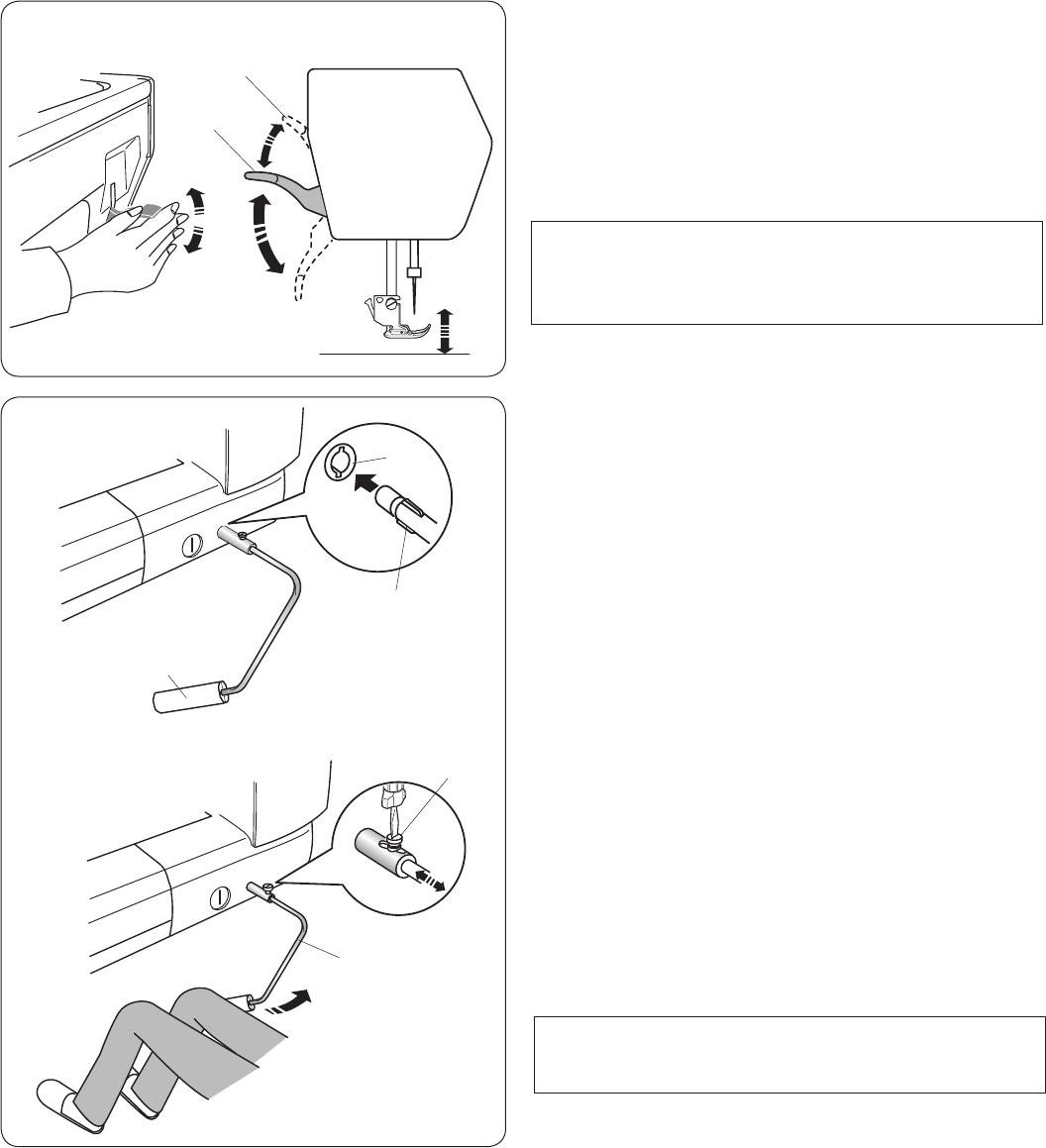
Raising and Lowering the Presser Foot
The presser foot lifter raises and lowers the presser foot.
q Presser foot lifter
You can raise the presser foot higher than the normal up
position. This allows for changing the needle plate, and
also helps you to place thick layers of fabrics under the
foot.
w Extra lifted position
NOTE:
Do not turn the hand wheel of press the up/down
needle button when the presser foot is in the extra
lifted position.
Knee Lifter
The knee lifter is extremely helpful when sewing
patchwork, quilting etc, since it allows you to handle the
fabric while your knee controls the presser foot.
Attaching the knee lifter
Match the ribs on the knee lifter with the notches in the
knee lifter socket and insert the knee lifter.
q Knee lifter
w Rib
e Knee lifter socket
Adjusting the knee lifter
The angle of the knee lifter can be adjusted to fit you.
Loosen the setscrew and slide the angle bar in or out to
adjust the angle of the knee lifter.
Tighten the setscrew to secure the angle bar.
r Setscrew
t Angle bar
Using the knee lifter
Push the knee lifter with your knee to easily move the
presser foot up and down.
You can control how high the foot rises by the amount of
knee pressure you exert.
NOTE:
Do not touch the knee lifter while stitching, otherwise
the fabric will not be fed smoothly.
q
w
q
e
r
t
w
11
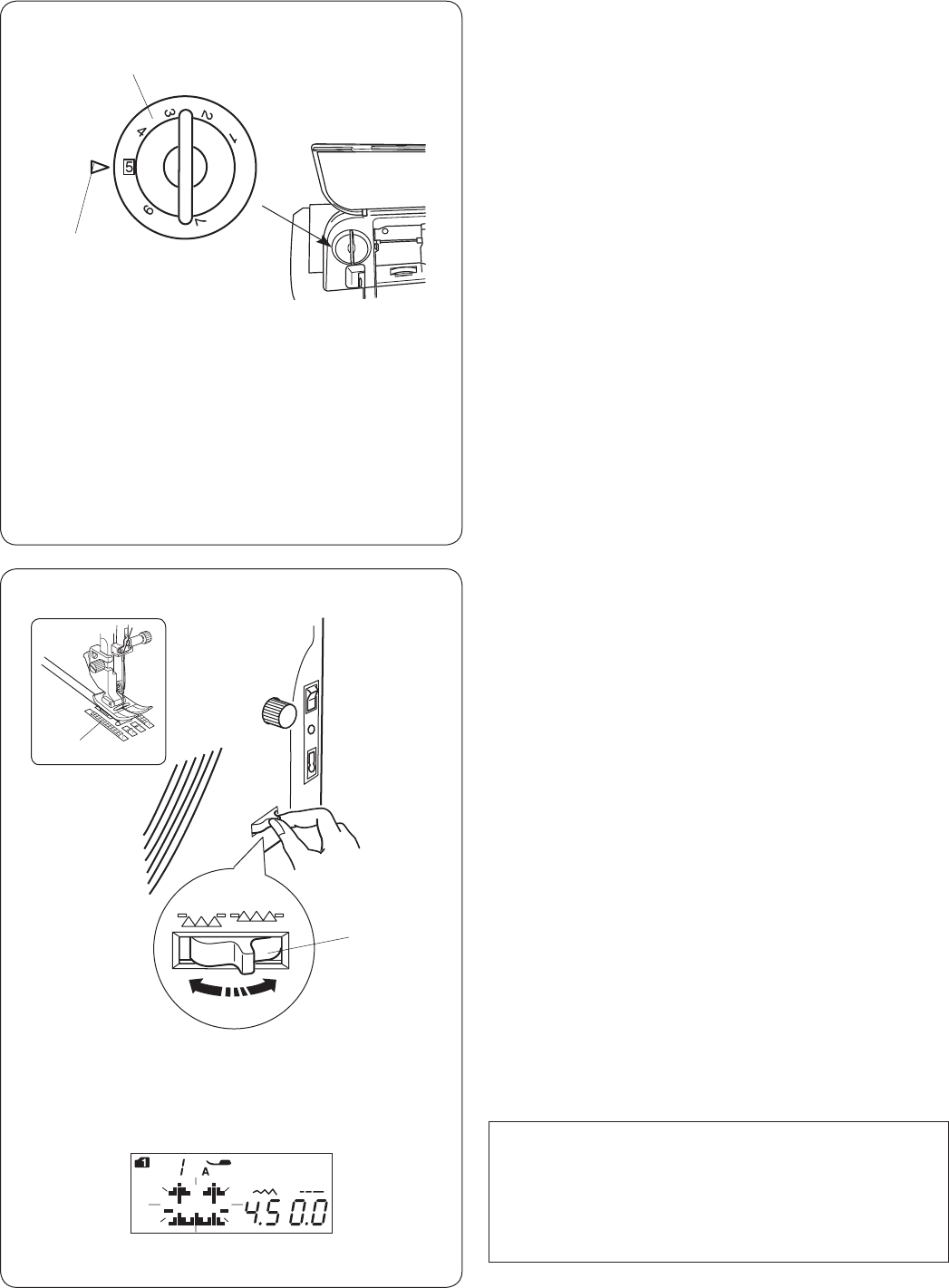
Adjusting the Foot Pressure
The foot pressure can be adjusted with the foot pressure
dial located under the top cover.
The dial has 7 setting positions from 1 to 7.
For ordinary sewing, set 5 at the setting mark.
q Foot pressure dial
w Setting mark
Reduce the pressure when sewing fine synthetics and
stretch fabrics.
To reduce the pressure, set the dial at a lower number.
Increase the pressure when sewing heavy weight fabrics.
To increase the pressure, set the dial at a higher number.
Dropping the Feed Dog
The feed dog can be lowered for basting, sewing on
buttons, free motion quilting etc.
Shift the drop feed lever toward you to lower the feed
dog.
q Drop feed lever
w Feed dog
Shift the drop feed lever away from you to raise the feed
dog, it will return to the up position when you start the
machine.
w
q
q
w
NOTE:
If you start the machine with the feed dog lowered, a
message will appear on the LCD screen.
The machine will not run with the feed dog lowered
when pattern number 19 to 25, and 27 to 29 in mode
2 or stitch patterns in modes 4, 5 and 6 is selected.
12
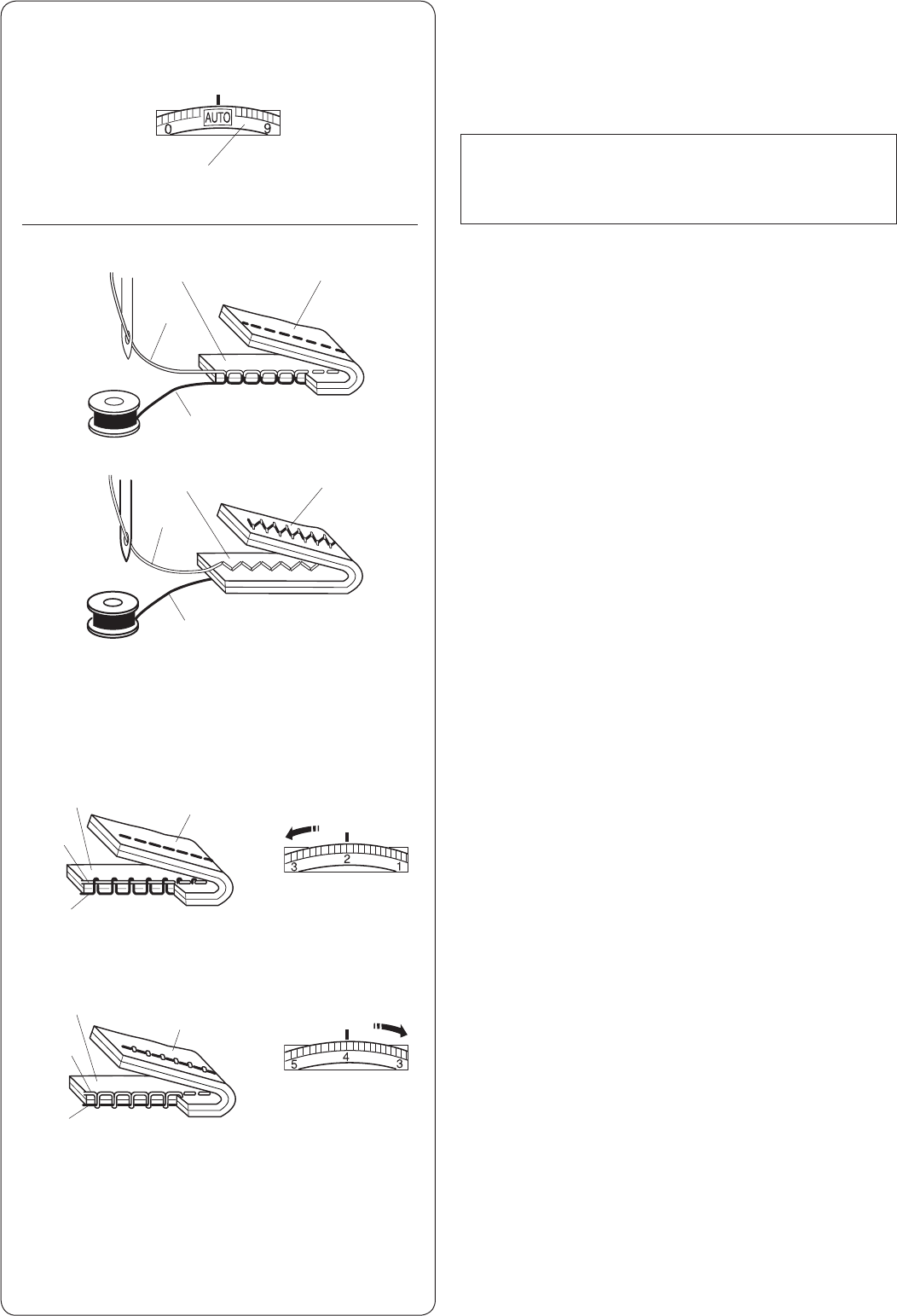
For general sewing, set the thread tension dial at AUTO,
which covers a wide range of sewing conditions.
q Thread tension dial
Balancing Thread Tension
Auto-thread tension
Manual thread tension adjustment
YoushouldadjustthetensionmanuallyiftheLCDscreen
shows a tension setting other than AUTO.
Youmayalsoneedtoadjusttensionmanuallydepending
on the sewing conditions such as the type of fabric and
number of layers.
If the needle thread is too tight, the bobbin thread
appears on the right side of the fabric.
q Wrong side of fabric
w Right side of fabric
e Needle thread
r Bobbin thread
Turn the thread tension dial to a lower number to
decrease the thread tension.
q
q
w
e
r
q
w
e
r
q
w
e
r
q
w
e
r
Balanced thread tension
For straight stitch sewing, both needle and bobbin
threads will join at the middle of the fabrics.
For zigzag stitch sewing, the needle thread will appear
slightly on the wrong side of the fabric.
q Wrong side of fabric
w Right side of fabric
e Needle thread
r Bobbin thread
NOTE:
Manual thread tension adjustment may be required
when the stitch width is set more than “7.0” (see
below).
If the needle thread is too loose, the needle thread loops
on the underside of the fabric.
q Wrong side of fabric
w Right side of fabric
e Needle thread
r Bobbin thread
Turn the thread tension dial to a higher number to
increase the thread tension.
13
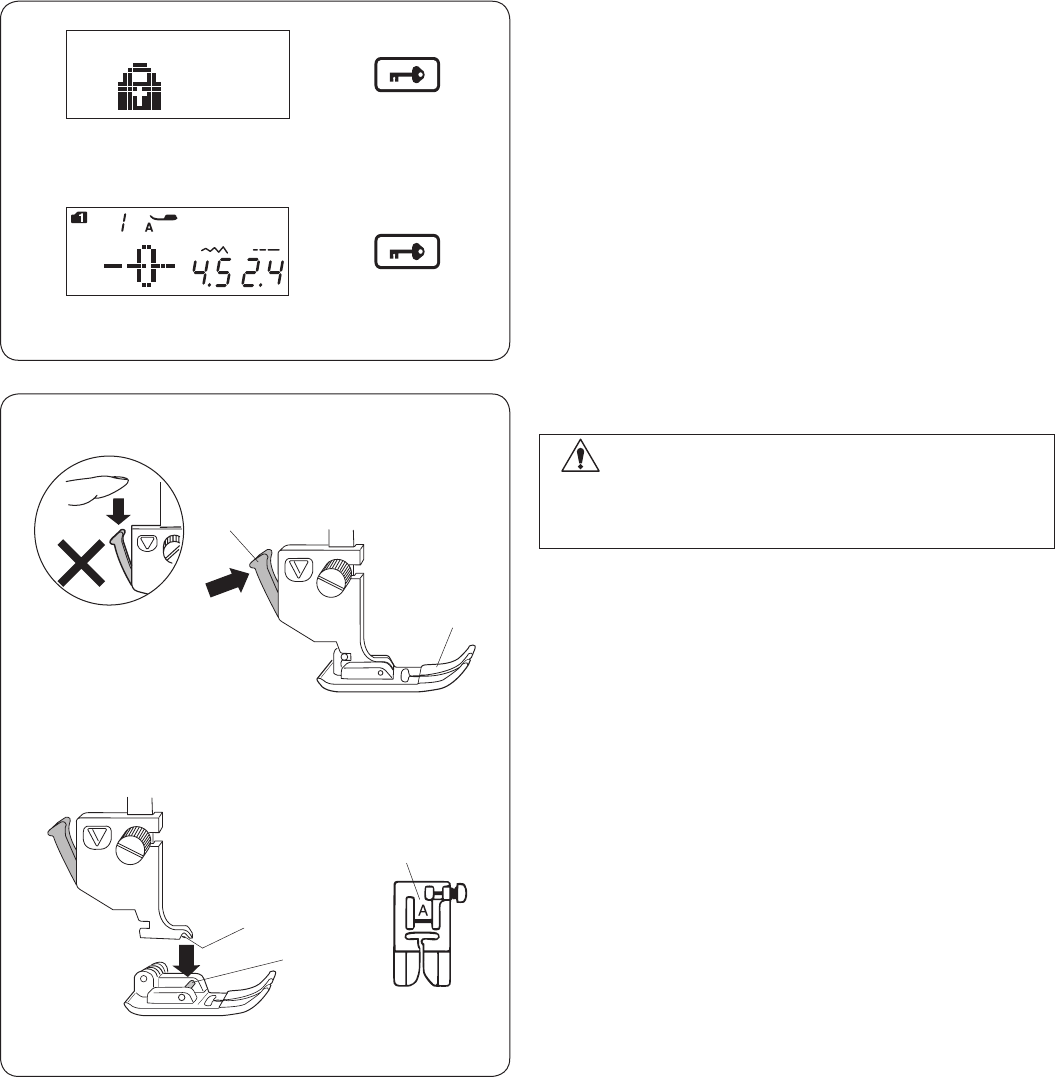
Changing the Presser Foot
CAUTION:
Always make sure to press the lockout key to lockout
the machine or turn the power switch off before
replacing the presser foot.
Raise the needle to its highest position and raise the
presser foot lifter.
Press the black lever on the back of the foot holder.
The presser foot will drop off.
q Lever
w Presser foot
Lockout Key
Press this key to lockout the machine when threading the
machine, replacing the accessories etc.
To reduce the risk of injury, all the buttons and keys are
deactivated.
q
t
w
Attaching the presser foot
Place the presser foot so that the pin on the foot lies just
under the groove of the foot holder.
Lower the presser bar to lock the foot in place.
Each foot is marked with an identification letter.
e Groove
r Pin
t Identification letter
e
r
To unlock the machine, press this key again.
14
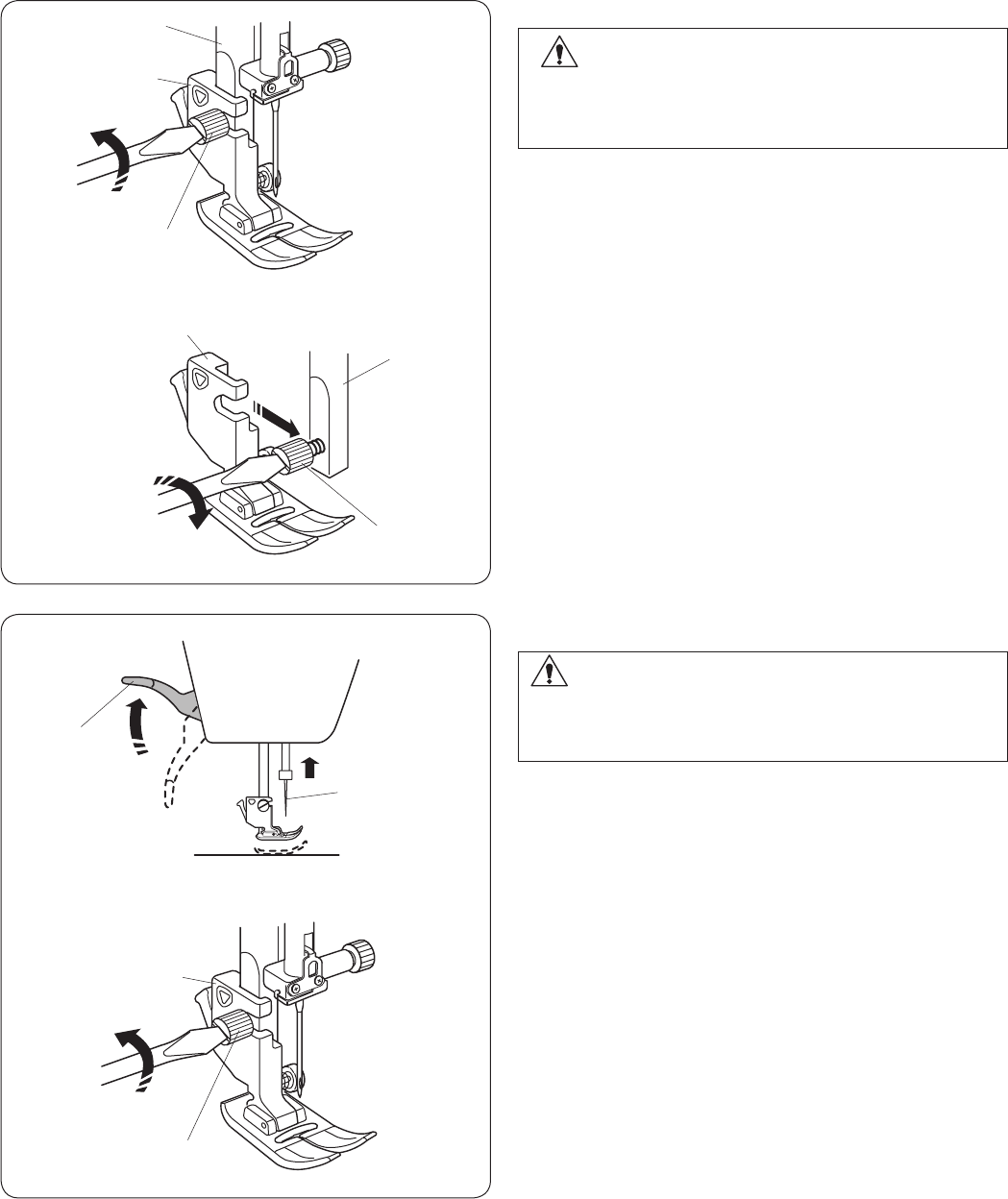
Attaching the foot holder
Attach the foot holder to the presser bar from the rear.
Tighten the thumbscrew securely with the screwdriver.
q Presser bar
w Foot holder
e Setscrew
Removing and Attaching the Foot Holder
CAUTION:
Always make sure to press the lockout key to lockout
the machine or turn the power switch off before
replacing the presser foot.
Removing the foot holder
Raise the presser foot and loosen the setscrew.
Remove the foot holder.
q
w
w
e
q
e
e
r
q
w
Dual Feed Foot
CAUTION:
Always make sure to press the lockout key to lockout
the machine or turn the power switch off before
replacing the presser foot.
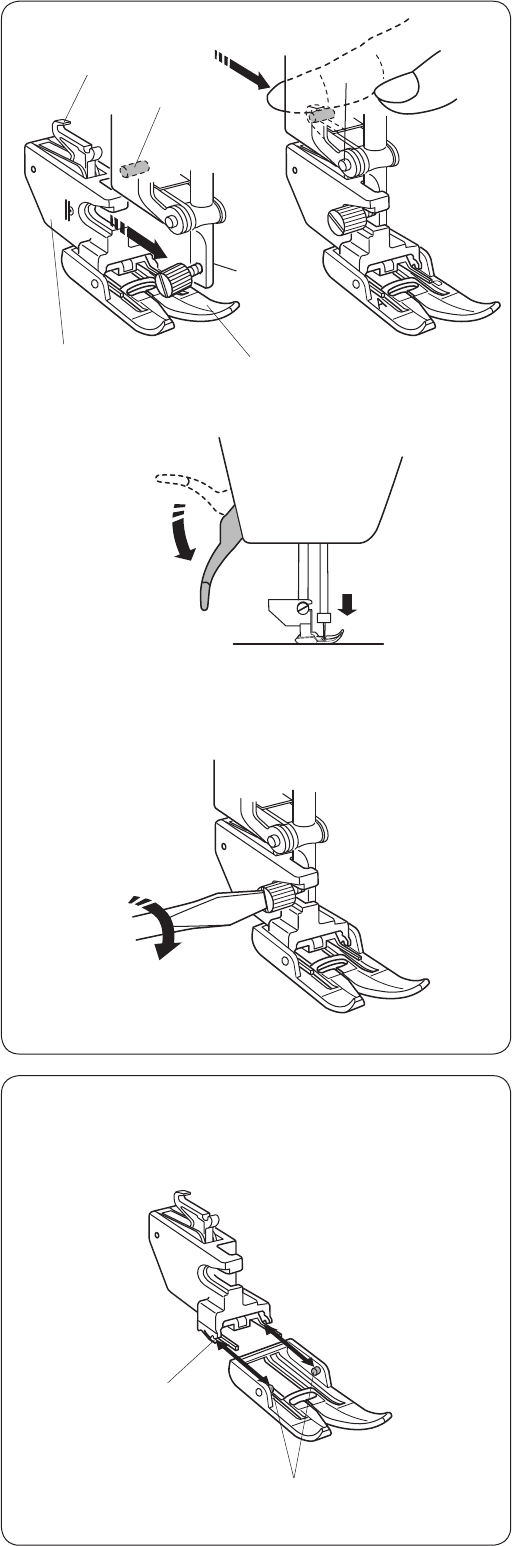
z Raise the needle to its highest position.
Raise the presser foot lifter.
q Presser foot lifter
w Needle
x Loosen the setscrew.
Remove the foot holder.
e Foot holder
r Setscrew
z
x
15
t
y
u
i
c Attach the dual feed foot holder to the presser bar.
Tighten the setscrew lightly with your finger.
t Dual feed link
y Dual feed foot holder
u Upper feed drive
i Dual feed foot
v Push the dual feed link to engage it with upper feed
drive.
b Lower the presser foot lifter. Lower the needle to the
lowest position by turning the handwheel.
n Tighten the setscrew securely with the screwdriver.
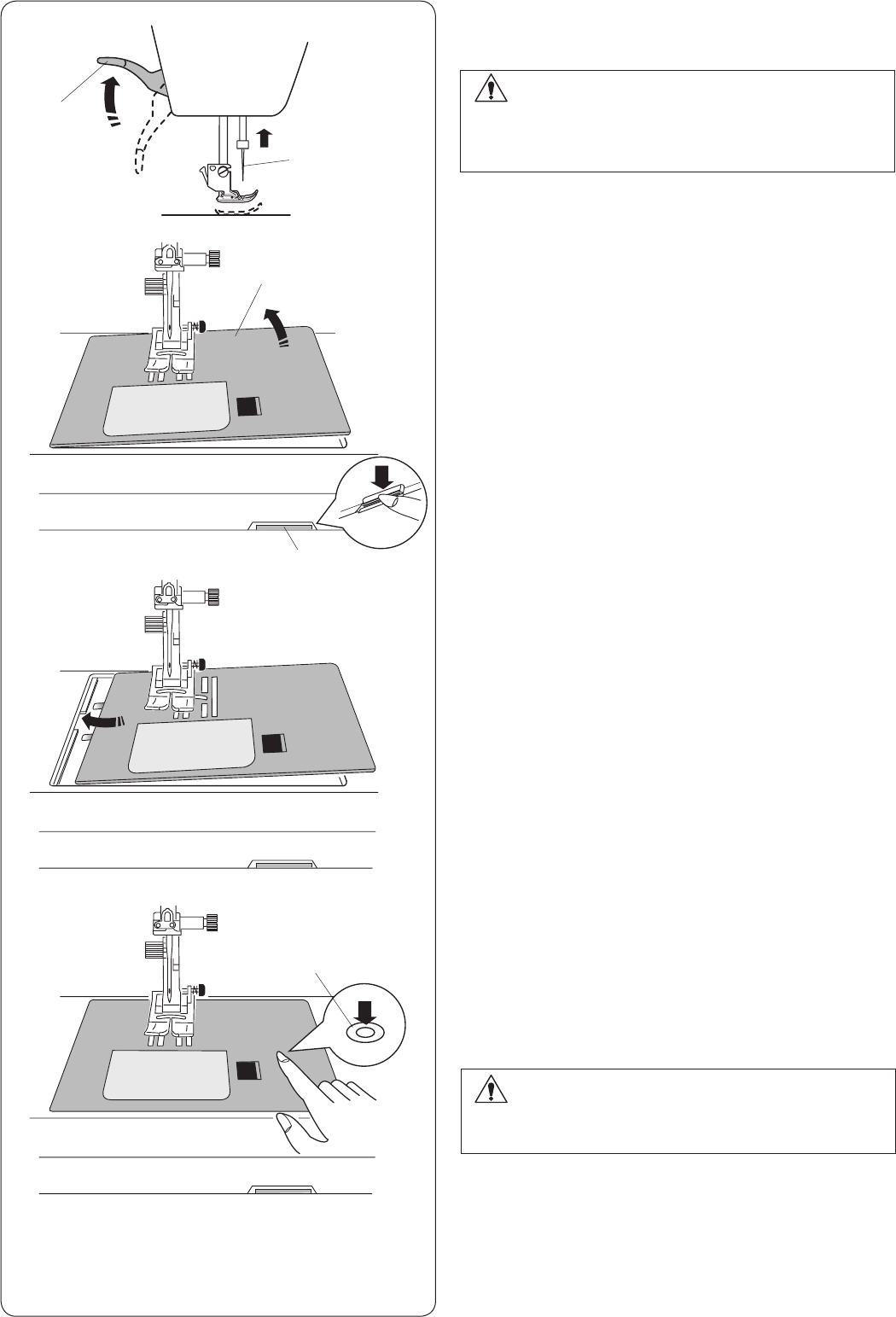
Replacing the dual feed foot
Pull the foot toward you to remove it.
Insert the pins of the foot into the slits of the foot holder
and gently push the foot until it snaps into place.
q Pin
w Slit
w
q
c
b
n
v
16
Replacing the Needle Plate
Use the straight stitch needle plate when sewing fine
fabrics or sewing with the dual feed foot.
CAUTION:
Always make sure to press the lockout key to lockout
the machine or turn the power switch off before
replacing the needle plate.
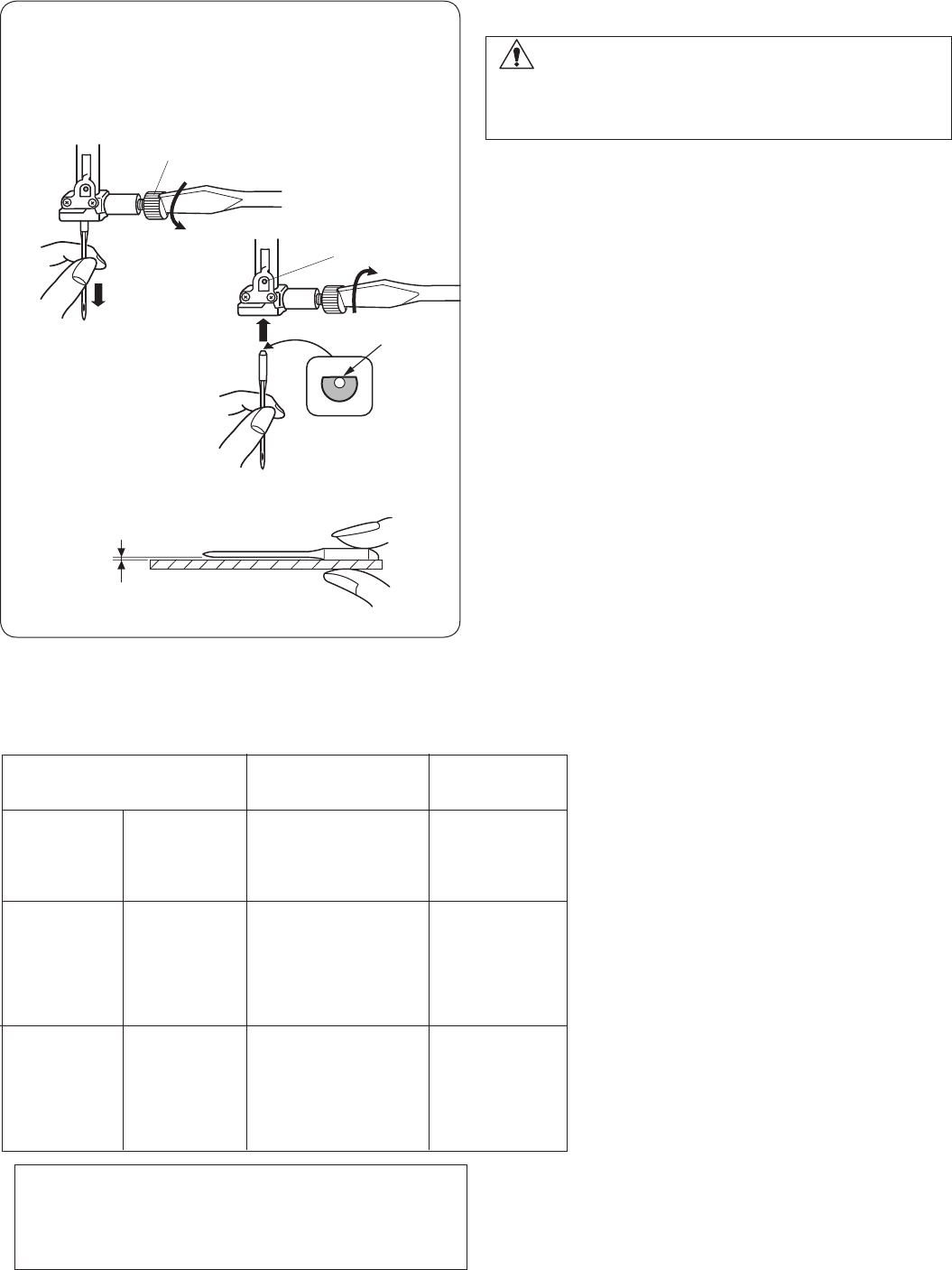
z Turn the handwheel and raise the needle to the
highest position.
Raise the presser foot lifter to the extra lifted position.
q Presser foot lifter
w Needle
x Slide the extension table to the left to remove it.
Push down the needle plate release lever and the
needle plate will snap off.
e Needle plate release lever
r Needle plate
q
w
e
r
c Place the straight stitch needle plate on the machine.
Set the left edge of the needle plate into the opening.
v Push down on the needle plate mark until the needle
plate locks in place.
Turn the power switch on or press the lockout key to
unlock.
Turn the hand wheel slowly and make sure that the
needle does not hit the needle plate.
t Needle plate mark
CAUTION:
Never press the needle plate release lever while
running the machine.
t
z
x
c
v
17
Changing Needles
CAUTION:
Always make sure to press the lockout key to lockout
the machine or turn the power switch off before
changing the needle.
Raise the needle by pressing the needle up/down button
and lower the presser foot.
Turn the power switch off.
Loosen the needle clamp screw and remove the needle
from the clamp.
q Needle clamp screw
Insert a new needle into the needle clamp with the flat
side of the needle to the rear.
When inserting the needle into the needle clamp, push it
up against the stopper pin and tighten the needle clamp
screw firmly with a screwdriver.
w Flat side
e Stopper pin
To check needle straightness, place the flat side of the
needle onto something flat (a needle plate, glass etc.)
The gap between the needle and the flat surface should
be consistent.
Never use a blunt needle.
r Gap
q
w
e
r
Fine
Medium
Silk #80-100
Cotton #80-100
Synthetic #80-100
Heavy weight
Denim
Tweed
Coating
Quilting
Lawn
Georgette
Tricot
Sheeting
Jersey
Wool
Knit
#9/65-11/75
Blue tip needle
Thread Needle
Silk #50
Cotton #50-80
Synthetic #50-80
#11/75-14/90
Red tip needle
Silk #30-50
Cotton #40-50
Synthetic #40-50
#14/90-16/100
Purple tip needle
Fabric and Needle Chart
•Forgeneralsewing,useneedlesize
#11/75 or #14/90.
•Finethreadsandneedlesshouldbeused
for sewing fine fabrics.
•Ingeneral,usethesamethreadforboth
needle and bobbin.
•Useabluetipneedleforsewingnefabrics,
stretch fabrics and buttonholes to prevent
skipped stitches.
•Useapurpletipneedleforsewingthick
fabrics,
denims, quilt layers and across the hem to
prevent skipped stitches.
•Useastabilizerorinterfacetostretchorne
fabrics to prevent seam puckering.
•Alwaystestthethreadandneedlesizeona
small piece of the same fabric you will use
for actual sewing.
Fabric
NOTE:
1 x twin needle, 2 x blue tip needle (#11/75), 1 x red tip
needle (#14/90) and 1 x purple tip needle (#14/90) are
included in the needle case.
18
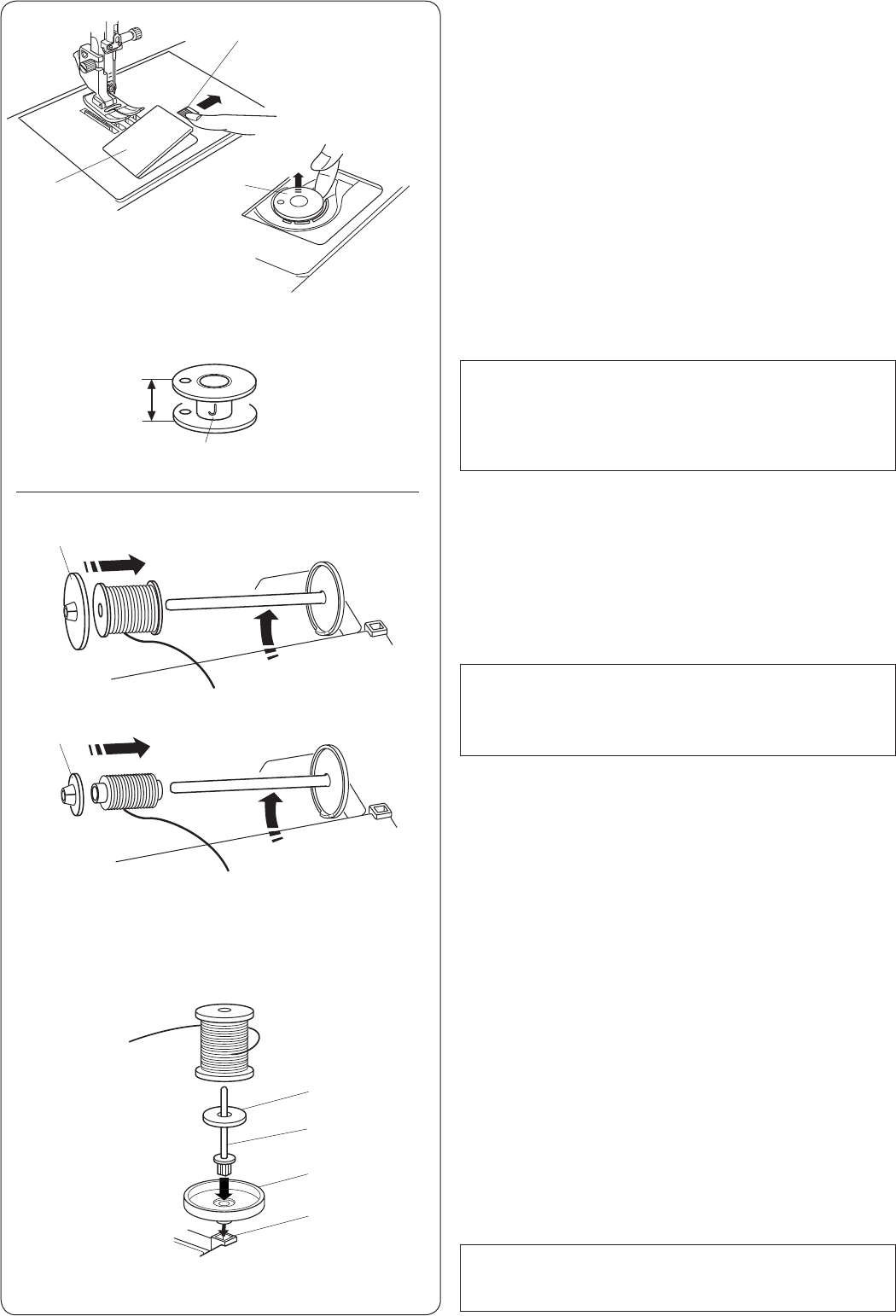
Setting the spool of thread
Lift up the spool pin. Place the spool of thread on the
spool pin.
Attach the large spool holder, and press it firmly against
the spool of thread.
q Large spool holder
NOTE:
Use the small spool holder to hold narrow or small
spools of thread.
w Small spool holder
Winding the Bobbin
Removing the Bobbin
Slide the hook cover release button to the right, and
remove the hook cover plate.
q Hook cover release button
w Hook cover plate
Lift out the bobbin from the bobbin holder.
e Bobbin
q
we
NOTE:
Use the Janome plastic bobbins for horizontal hook
(marked with “J” r). Using other bobbins, such as
pre-wound paper bobbins, may cause stitching
problems and/ or damage to the bobbin holder.
Extra spool pin
Use the extra spool pin when you need to wind a bobbin
without unthreading the machine while working on a
sewing project.
Insert the extra spool pin into the spool supporter and
then into the hole beside the horizontal spool pin.
Place the felt cushion on the spool pin and place a spool
of thread on it as shown.
e Extra spool pin
r Spool supporter
t Hole for extra spool pin
y Felt cushion
NOTE:
The extra spool pin is also used for twin needle
sewing.
r
q
w
e
r
y
t
19
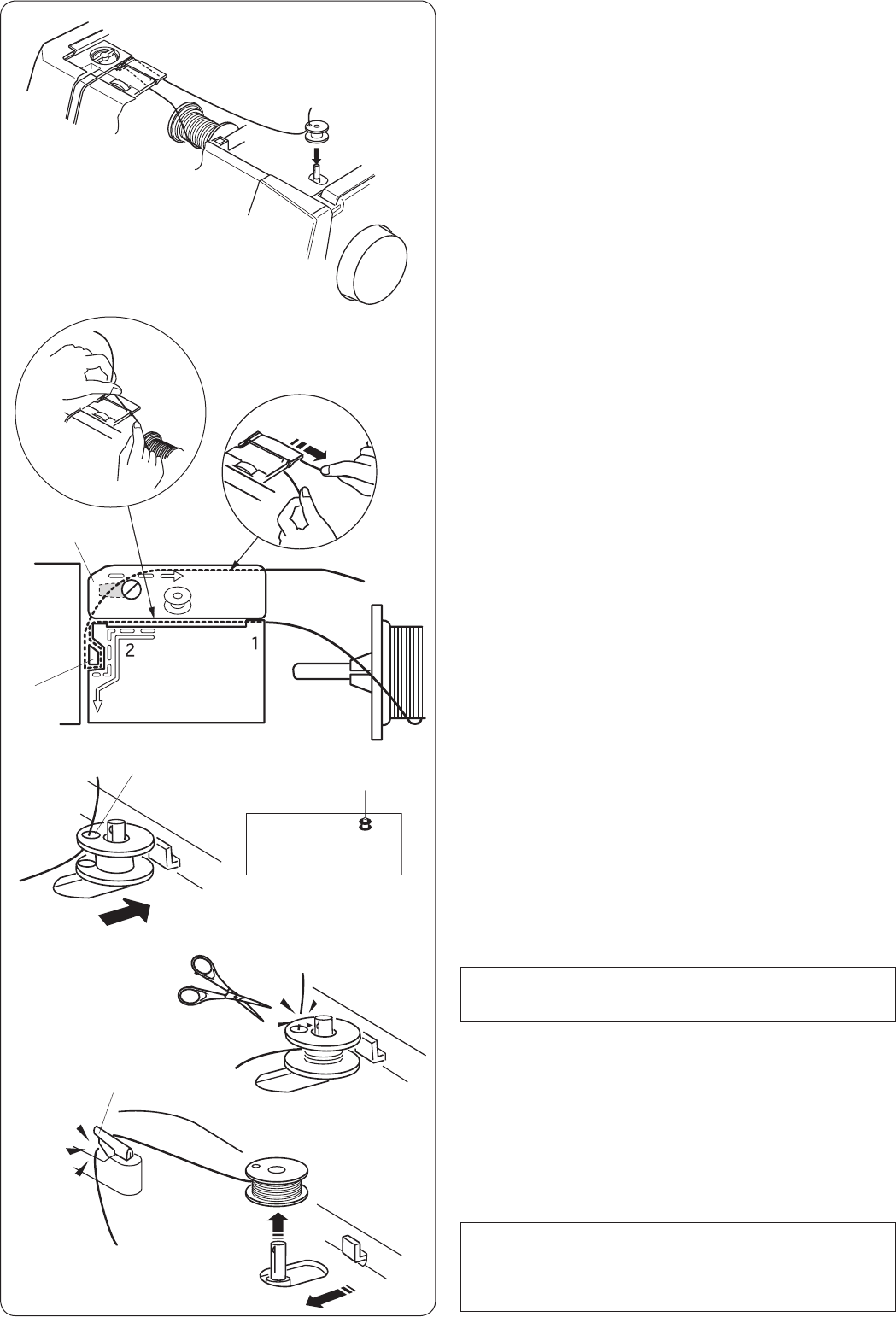
c Pass the thread through the hole in the bobbin from
the inside to the outside.
Put the bobbin on the bobbin winder spindle.
Push the bobbin to the right. The bobbin mark appears
on the LCD screen.
r Hole
t Bobbin mark
v Hold the free end of the thread in your hand and start
the machine.
Stop the machine when the bobbin has wound several
layers, and cut the thread close to the hole in the
bobbin.
NOTE:
Set the speed control slider at the fastest position.
b Start the machine again.
Stop the machine when the bobbin is fully wound and
stops spinning.
Return the bobbin winder spindle to its original
position.
Remove the bobbin and cut the thread with the thread
cutter.
y Thread cutter
NOTE:
For safety purposes, the machine will automatically
stop approximately 90 seconds after starting bobbin
winding.
Winding the Bobbin
q
w
e
r
y
zz Pull the thread from the spool.
Hold the thread with both hands and pass the thread
into the guide slot.
q Guide slot
x Draw the thread to the left and forward around the
thread guide.
Draw the thread to the rear and to the right around
under the guide plate.
Firmly pull the thread to the right while holding it with
both hands.
w Thread guide
e Guide plate
x
c v
b
t
20
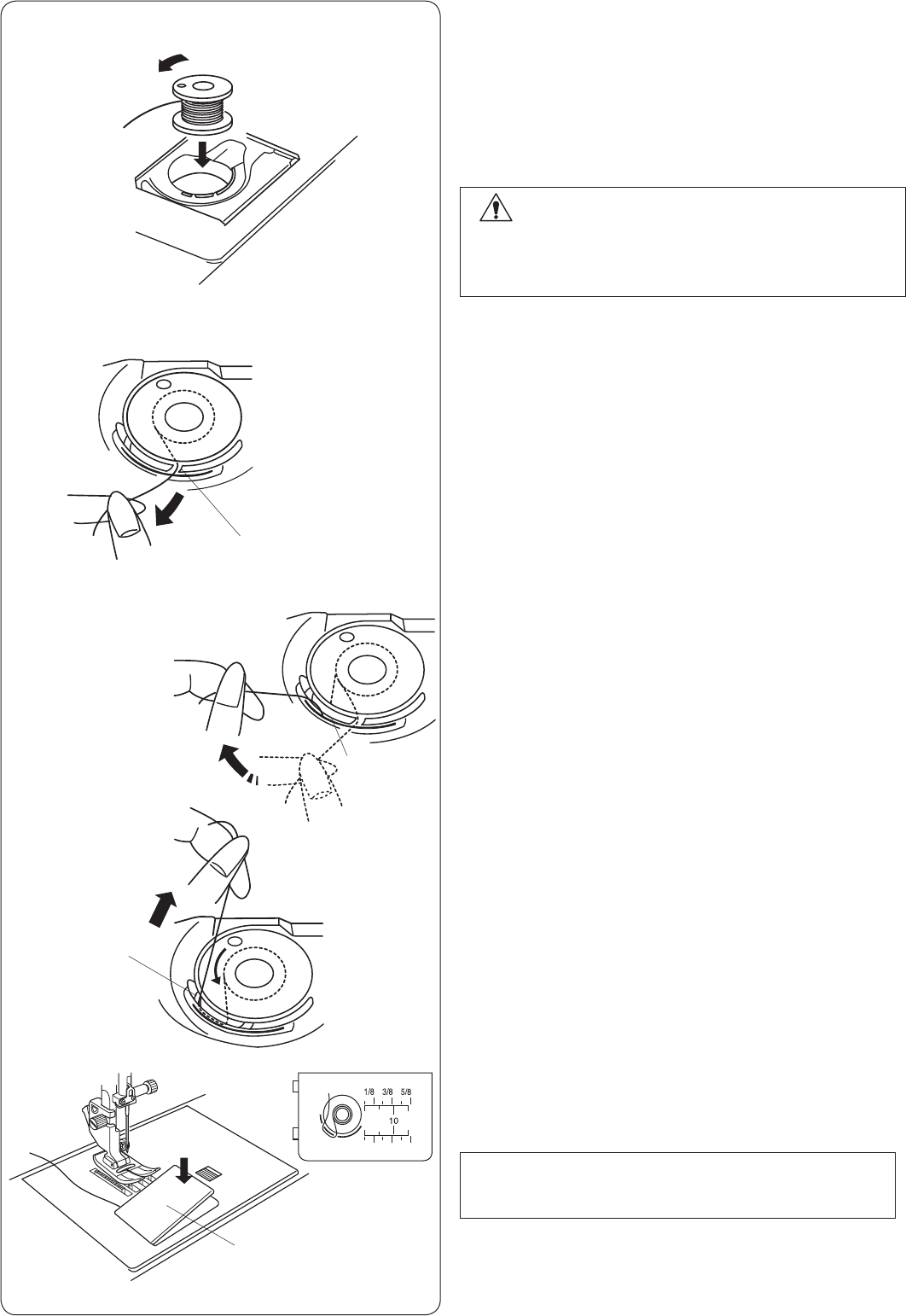
Inserting the Bobbin
q
w
e
r
z Place the bobbin in the bobbin holder with the thread
running off counterclockwise.
x Guide the thread into the front notch on the bobbin
holder.
q Front notch
c Draw the thread to the left, sliding it between the
tension spring blades.
w Tension spring blades
v Continue to draw the thread lightly until the thread
slips into the side notch.
e Side notch
z
x
c
v
b b Pull out about 10 cm (4˝) of thread to the rear.
Reattach the hook cover plate.
r Hook cover plate
NOTE:
The threading chart is shown on the hook cover plate
for your reference.
CAUTION:
Always make sure to press the lockout key to lockout
the machine or turn the power switch off before
threading the machine.
21
c
z
x
v
b
n
m
x
q
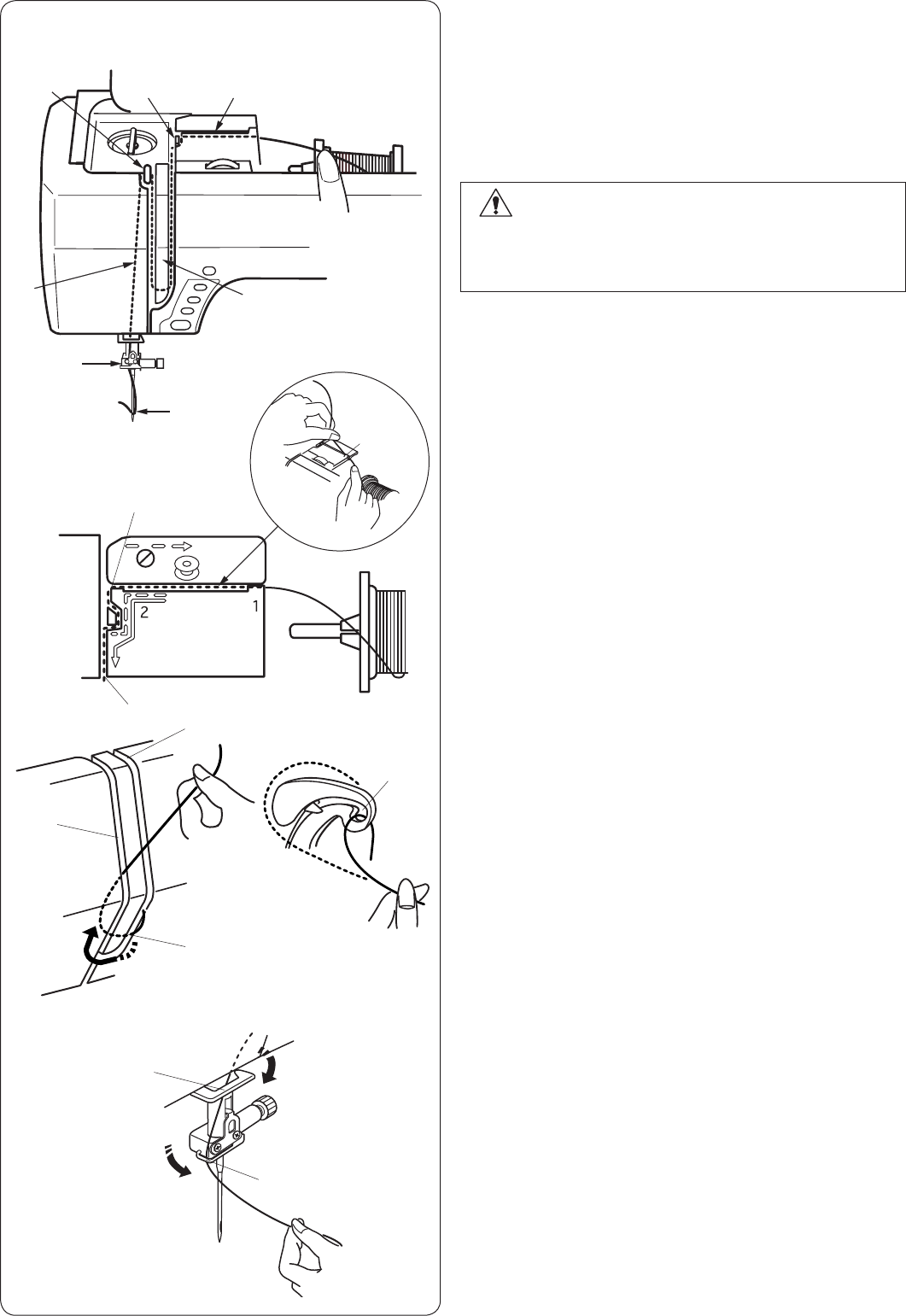
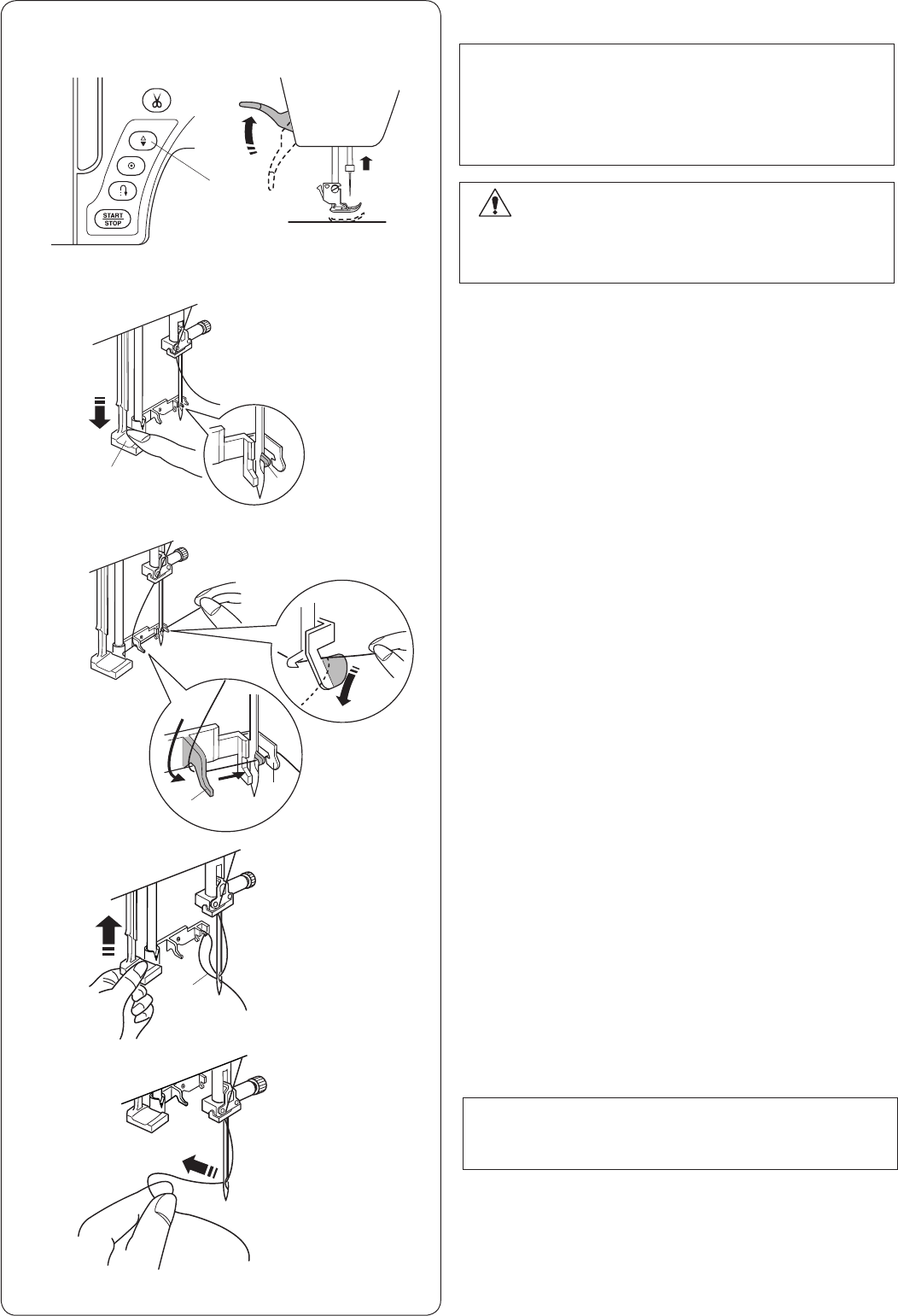
Threading the Machine
Raise the presser foot lifter to raise the presser foot.
Turn the power switch on.
Press the needle up/down button to raise the take-up lever
to the highest position.
Press the lockout key or turn the power switch off.
Pass the thread in the order from z to m.
CAUTION:
Always make sure to press the lockout key to lockout
the machine or turn the power switch off before
threading the machine.
w
ee
t
r
y
u
i
z
cv
b n m
z Hold the thread with both hands and pass the thread
into the guide slot.
q Guide slot
x Hold the thread with both hands and draw the thread
around the corner of the guide.
Firmly pull the thread toward you along the right
channel until the thread snaps.
w Corner of the guide
e Right channel
c Draw the thread down along the right channel and
around the bottom of the thread guide plate. Pull the
thread up along the left channel.
e Right channel
r Thread guide plate
t Left channel
v While holding the thread at the spool, firmly draw the
thread up and to the back of the take-up lever. Draw
the thread forward to slip it into the eye of the take-up
lever.
y Eye of the take-up lever
b Then pull the thread down along the left channel and
through the lower thread guide.
u Lower thread guide
n Slide the thread behind the needle bar thread guide
on the left.
i Needle bar thread guide
m Thread the needle with the needle threader (refer to
the next page).
22
z
q
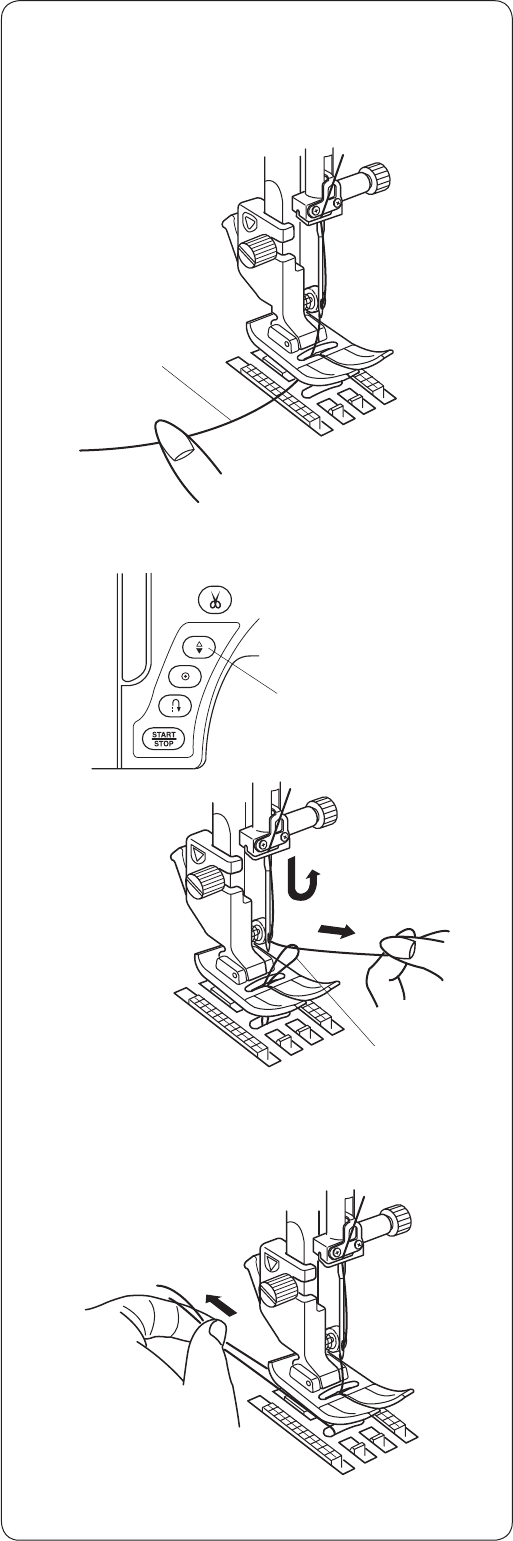
Built-in Needle Threader
NOTES:
•Theneedlethreadercanbeusedwitha#11to#16
needle.
Thread size 50 to 90 is recommended.
•Theneedlethreadercannotbeusedwiththetwin
needle.
z Turn the power switch ON.
Press the needle up/down button to raise the needle.
Press the lockout key to lock the machine.
Pull down the needle threader knob as far as it will go.
The threader hook comes out through the needle eye
from behind.
q Needle up/down button
w Threader knob
e Threader hook
x Draw the thread from left to right, under the left guide,
threader hook and right guide.
Draw the thread around the right guide toward you.
r Left guide
t Right guide
c Raise the threader slowly so a loop of the thread is
pulled up through the needle eye.
y Threader loop
v Remove the thread end through the needle eye to the
rear.
NOTE:
The needle threader cannot be used with the twin
needle.
CAUTION:
Always make sure to press the lockout key to lockout
the machine or turn the power switch off before using
the built-in needle threader.
x
v
c
e
w
rt
y
23
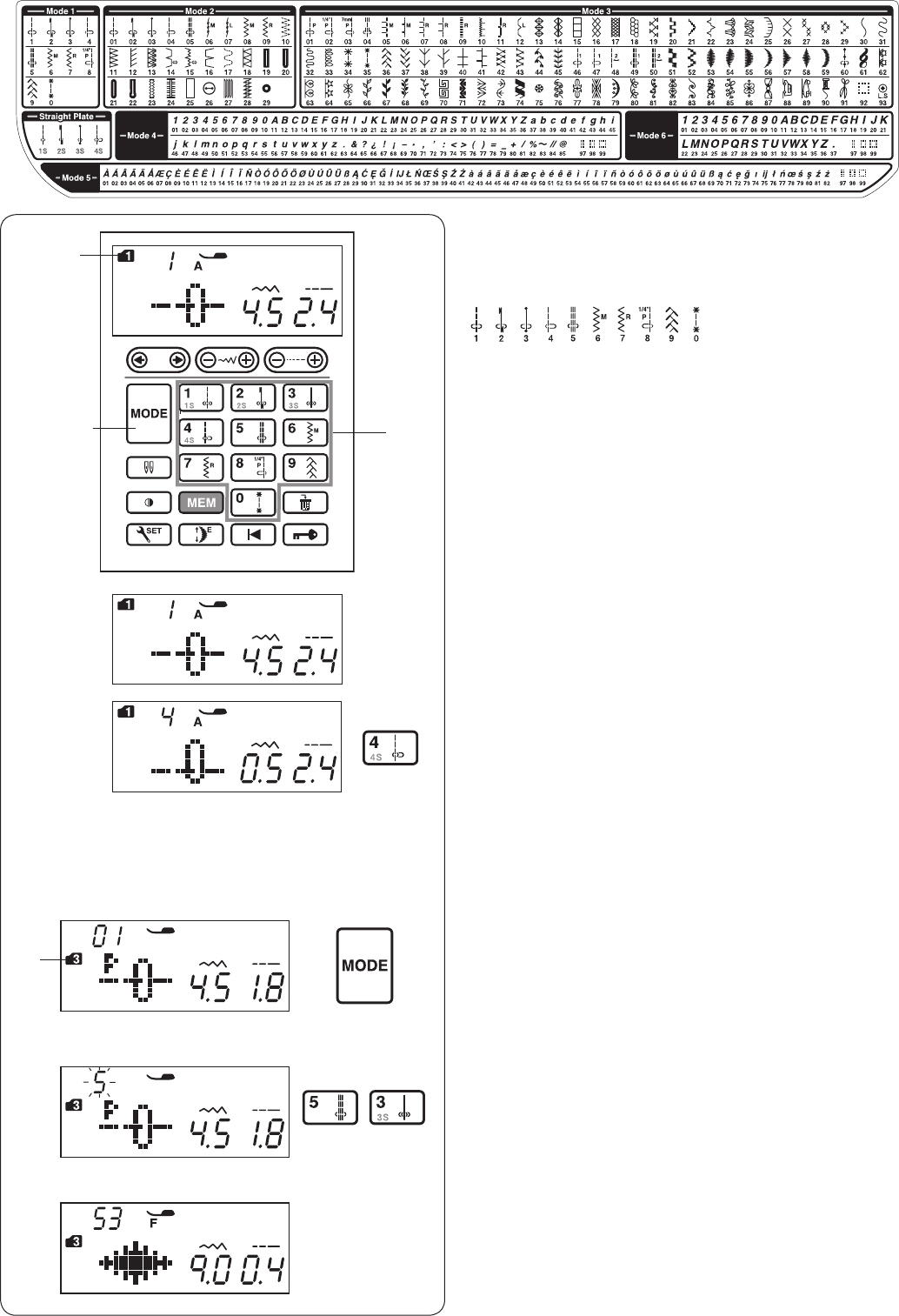
Drawing up the Bobbin Thread
z Raise the presser foot lifter.
Hold the needle thread with your finger.
q Needle thread
x Press the needle up/down button twice to draw up the
bobbin thread.
w Needle up/down button
c Pull the needle thread to bring up the loop of bobbin
thread.
e Loop of bobbin thread
v Pull both threads 10 cm (4˝) and draw them to the rear
under the presser foot.
q
e
z
x
c
v
w
24
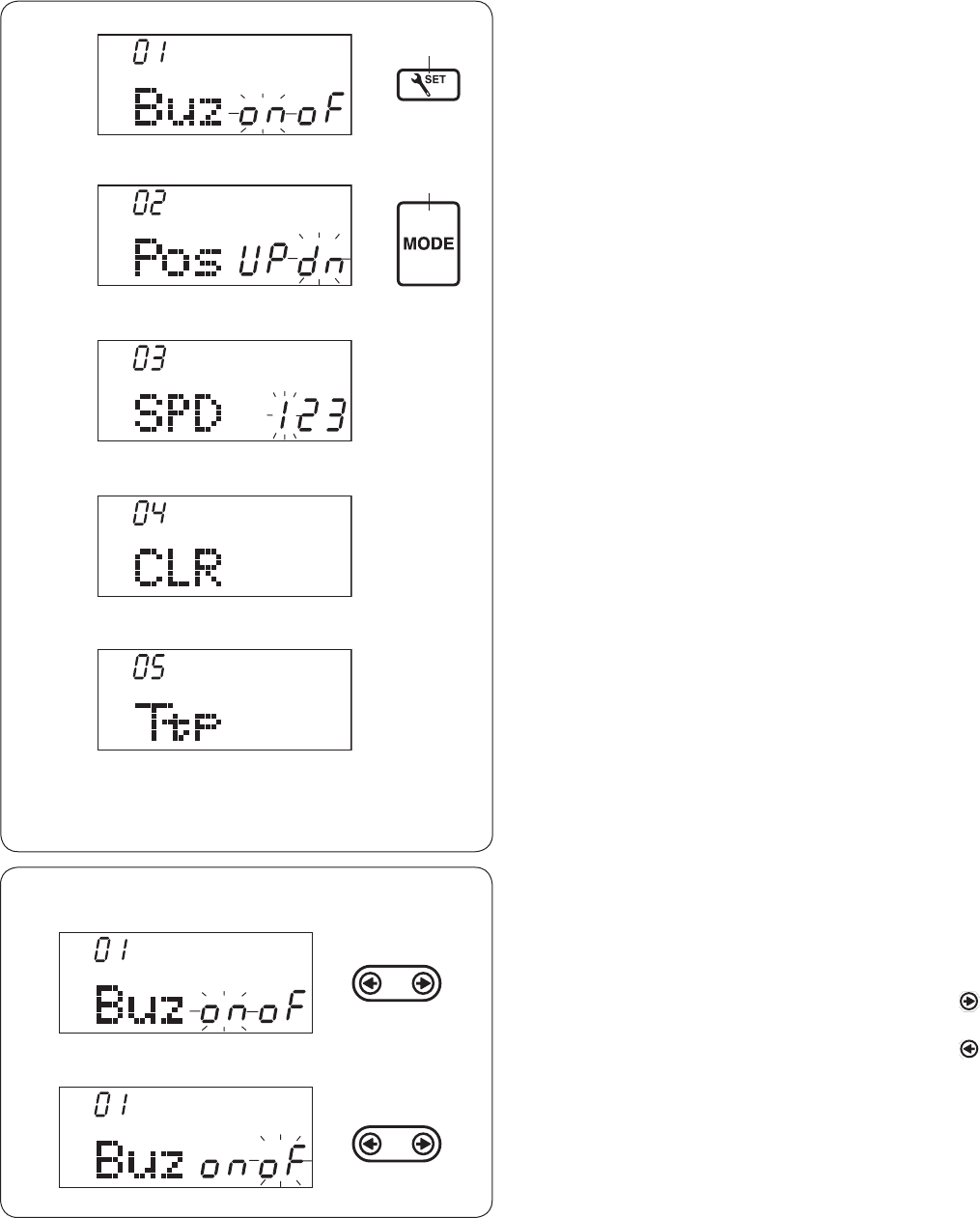
Selecting the Patterns
Mode 1
Youcanselectthefollowingstitchpatternsdirectlyby
pressing the pattern keys.
q Pattern keys (Number keys)
q
Example: To select stitch pattern 4 in mode 1
When the power switch is turned on, the direct stitch
pattern selection (mode 1) is set automatically.
Press the pattern key 4 to select the stitch pattern 4.
Now pattern 4 (mode 1) is selected.
Mode 2 – 6
To select stitch patterns in modes 2–6, first press the
mode key w to select your desired mode. Each time
you press the mode key, the mode number e indicated
on the left side of the screen will change, and the mode
changes as follows,
Mode 1: Direct pattern selection
Mode 2: Utility stitch pattern selection
Mode 3: Decorative stitch pattern selection
Mode 4: Number and letter selection
Mode 5: European accented letter selection
Mode 6: 9 mm monogram selection
Example: To select stitch pattern 53 in mode 3
z Turn the power switch on. Press the mode key twice
to select mode 3.
x Press the number keys on the touch panel. First press
key 5 and then press key 3.
c Now pattern 53 in mode 3 is selected.
z
x
c
w
e
e
25
Buzzer sound setting
The buzzer sound can be turned on or off using the
buzzer sound setting. The default buzzer sound setting is
“ON”.
Enter the setting mode.
To turn off the buzzer sound, press the cursor key “ ”
and the “oF” mark will blink.
To turn on the buzzer sound, press the cursor key “ ”
and the “on” mark will blink.
Customizing Machine Settings
Youcancustomizethemachinesettingstoyour
preference.
Press the set key q and LCD screen will show the setting
mode.
Press the mode key w to select the desired setting.
In this mode, you can set the following machine functions.
e Buzzer sound setting
r Needle stop position setting
t Start up speed setting
y Resetting all to default
u Key position calibration
To exit the setting mode, press the set key q.
q
w
e
r
t
y
u
26
Needle stop position setting
The machine always stops with the needle in the down
position except when sewing buttonholes, specialty
stitches, monograms, etc. However you can select the
needle stop position to up or down.
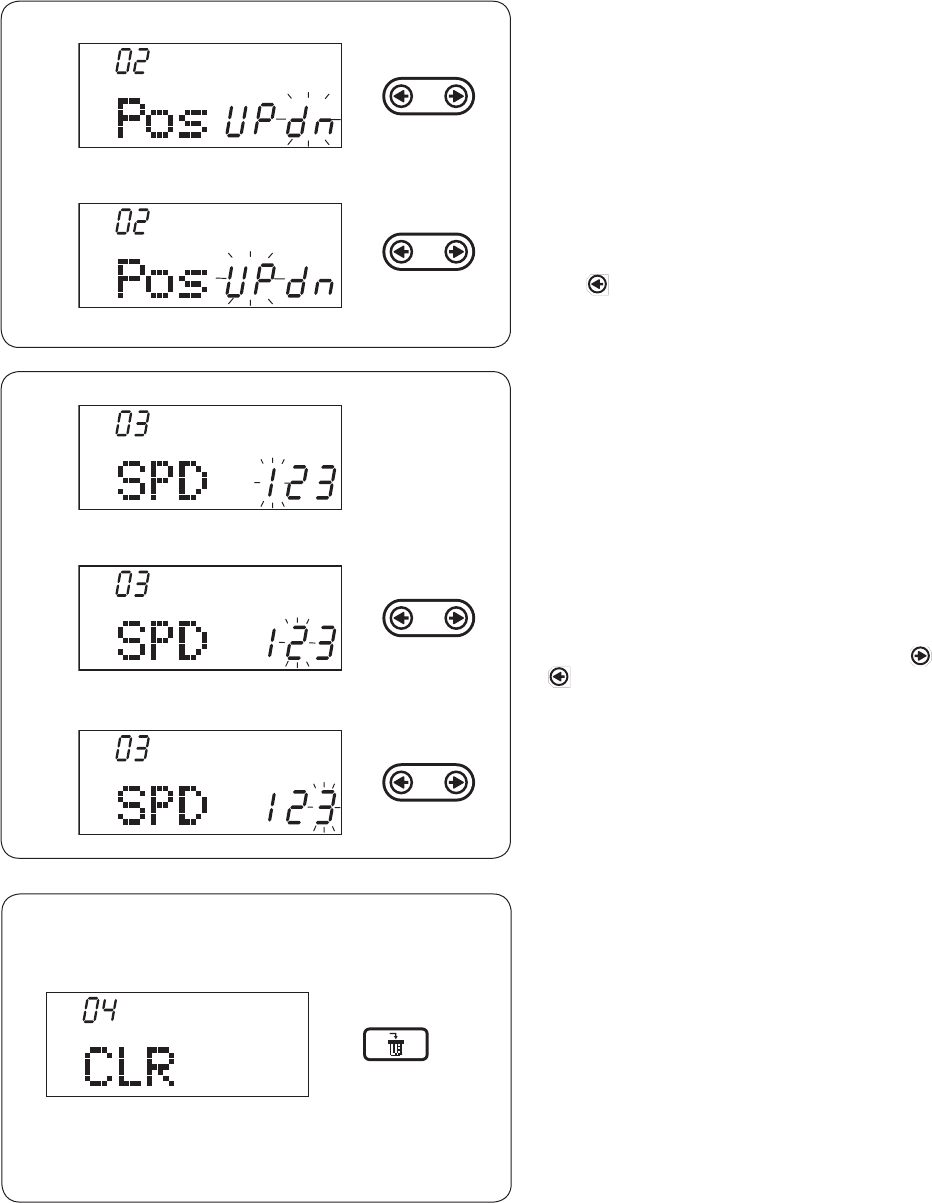
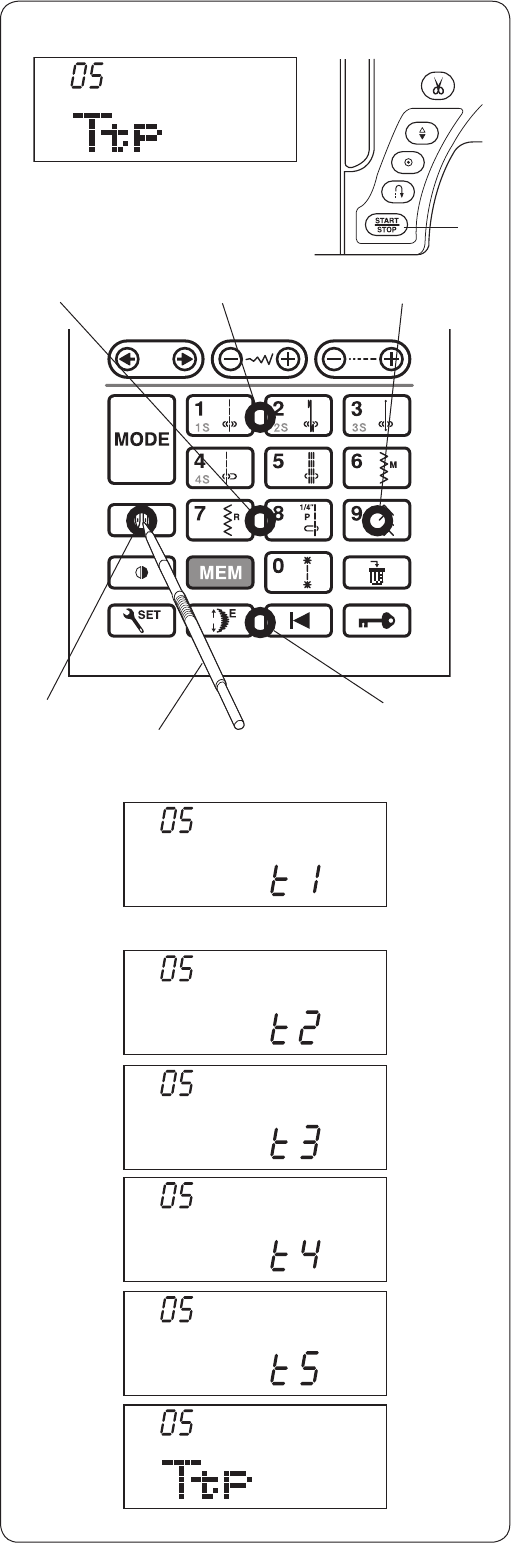
Enter the setting mode. Press the mode key to enter the
needle stop position setting.
The default needle stop position setting is down position
“dn”.
To change the needle stop position, press the cursor
key “ ” and the “UP” mark will blink.
Start-up speed setting
The machine will start running slowly and the sewing
speed will gradually increase to maximum when pressing
the start/stop button.
Youcanselectthedesiredstart-upspeedfrom1(slow)q,
2 (medium) w or 3 (high) e.
Enter the setting mode. Press the mode key twice to
enter the start-up speed setting.
The default start-up speed setting is “1” (slow). To change
the start-up speed, press the cursor key “ ” or
“ ”, and the selected speed number will blink.
q
w
e
Resetting all to default
The following customized settings can be reset to the
original settings (factory settings).
•Buzzersound
•Needlestopposition
•Startupspeedsetting
Enter the setting mode. Press the mode key 3 times to
enter the Resetting all to default mode.
Press and hold the clear key until the machine beeps to
reset the machine to the factory default setting.
27
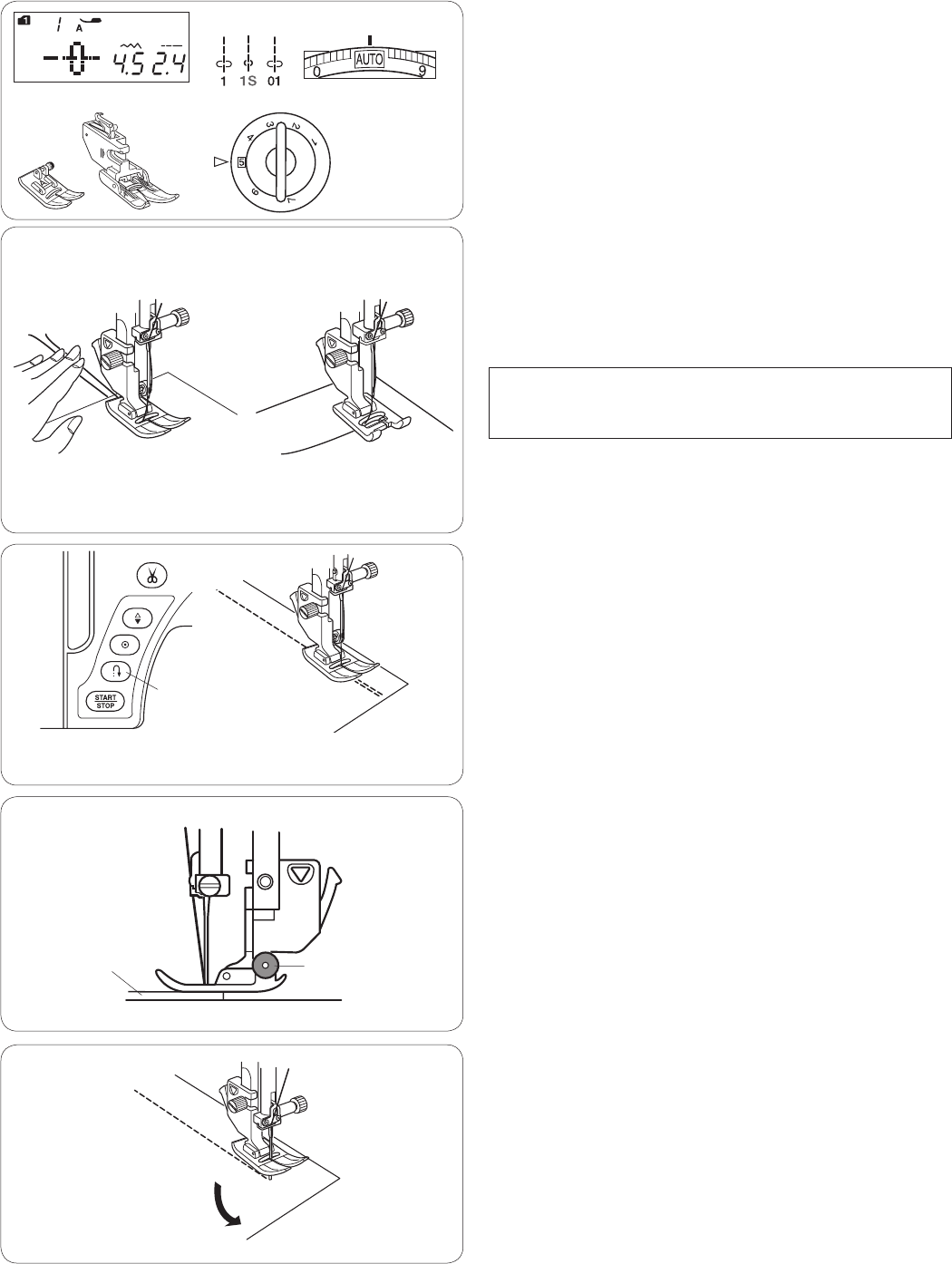
m “t5” will be shown on the LCD screen. Press u on the
touch panel.
Key position calibration
If the function keys seem out of alignment, calibrate the
key position as follows.
z Enter the setting mode. Press the mode key 4 times to
enter the key position calibration.
x Press the start/stop button q.
c The key position adjustment screen appears and
“t1” is shown on the right side of the screen. With the
touch panel stylus w, press e on the touch panel of
your machine.
v “t2” will be shown on the LCD screen. Press r on the
touch panel.
b “t3” will be shown on the LCD screen. Press t on the
touch panel.
n “t4” will be shown on the LCD screen. Press y on the
touch panel.
q
z x
c
, The screen will be back to the key position adjustment
screen. Press the set key to apply the adjustment.
v
b
n
m
,
e
r ty
u
w
(t1)
(t2) (t3)(t4)
(t5)
28
TRADITIONAL SEWING
Straight Stitch
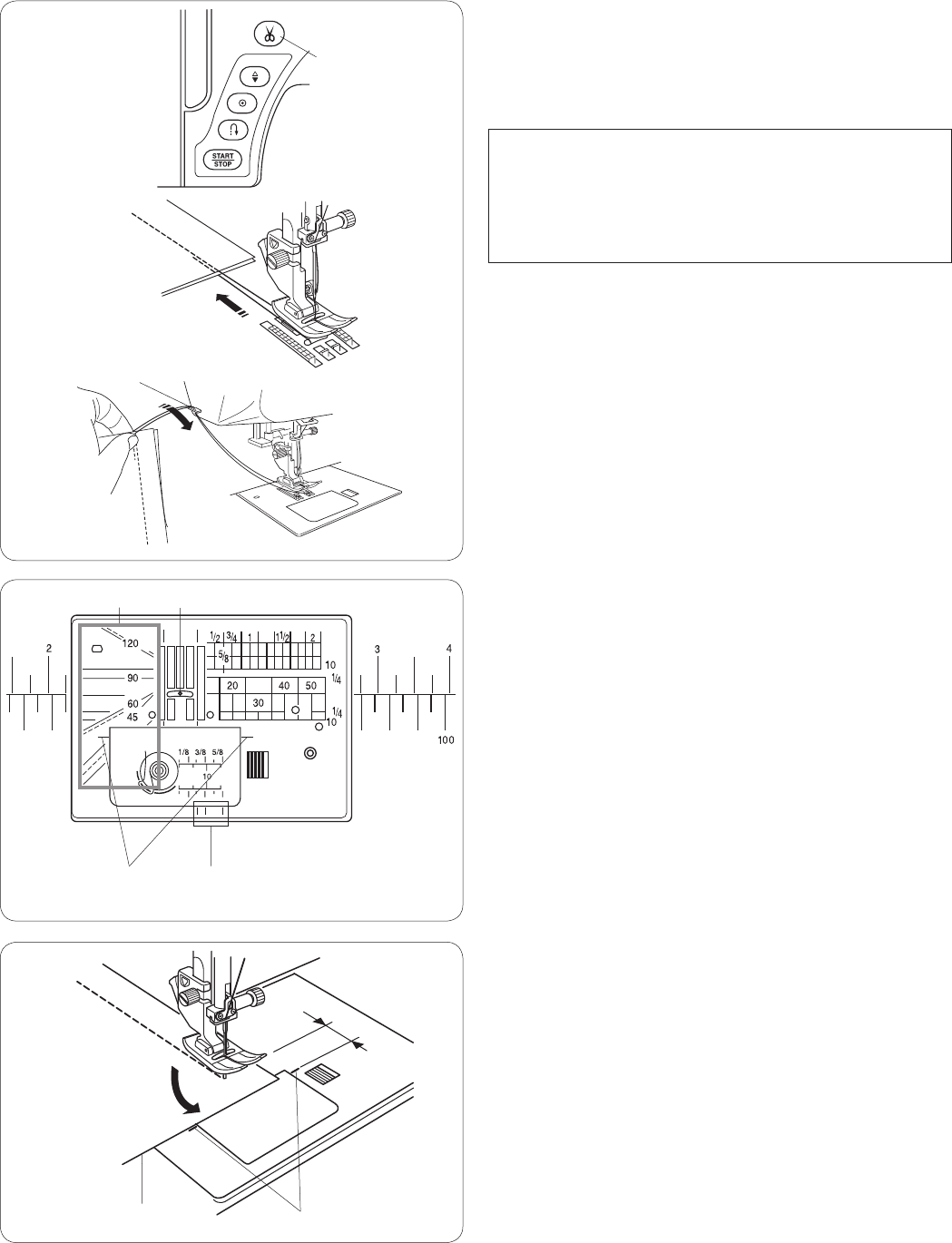
Machine settings
q Pattern: MODE 1: 1, 1S
MODE 2: 01
w Thread tension: AUTO
e Presser foot: Zigzag foot A or
Dual feed foot AD
r Foot pressure: 5
Starting to sew
Raise the presser foot and position the fabric edge next
to a seam guide on the needle plate. Lower the needle at
the point where you wish to start.
Pull the needle and bobbin threads toward the rear.
Lower the presser foot.
NOTE:
Pull the needle and bobbin threads to the left when
using satin stitch foot F or automatic buttonhole foot R.
Depress the foot control or press the start/stop button to
start sewing.
Gently guide the fabric along the seam guide letting the
fabric feed naturally.
q
e
w
r
Securing seams
For fastening the ends of seams, press the reverse
button and sew several reverse stitches.
The machine sews in reverse as long as you press and
hold the reverse button.
q Reverse button
Press the reverse button once when sewing the
lock-a-matic stitch (pattern 2) or locking stitch (pattern
3) and the machine will lock the stitches off and stop
automatically.
q
qw
Sewing from the edge of thick fabric
The black button on the zigzag foot locks the foot in the
horizontal position.
This is helpful when you start sewing from extreme edge
of thick fabrics or sewing across a hem.
Lower the needle into the fabric at the point where you
wish to start sewing.
Lower the foot while pushing the black button in. The foot
is locked in the horizontal position to avoid slipping.
q Thick fabrics
w Black button
Changing sewing direction
Stop the machine.
Raise the presser foot.
Pivot the fabric around the needle to change the sewing
direction as desired.
Lower the presser foot and start sewing in a new
direction.
29
Needle plate guides
The seam guides are marked on the needle plate, free
arm and hook cover.
The seam guides for 1/4˝, 3/8˝ and 5/8˝ are also marked
on the front of the needle plate.
q Seam guides on the front of the needle plate
The numbers on the needle plate indicate the distance
from the center needle position in millimeters and inches.
w Center Needle Position
The cornering guides are very useful when turning a
square corner.
e Cornering guide
The angle scales on the needle plate are useful for
patchwork piecing.
r Angle scales
w
eq
r
Cornering guide
To maintain a 5/8˝ seam allowance after turning a square
corner, use the cornering guide on the needle plate.
Stop sewing when the front edge of fabric reaches the
cornering guide lines.
Raise the presser foot and turn the fabric 90 degrees.
Lower the presser foot, and begin stitching in the new
direction.
q Cornering guide
w Fabric edge
Cutting threads
To cut the threads after finishing sewing, press the thread
cutter button. The needle bar will automatically go up
after trimming the threads.
q Thread cutter button
NOTES:
The thread cutter button does not function when the
presser foot is up.
Use the thread cutter on the face cover to cut
specialized or thick threads if the auto thread cutter
does not work well.
q
To use the thread cutter on the face cover, remove the
fabric and draw it to the back.
Pull the threads up and slip them between the thread
cutter and face cover from behind.
Pull the threads toward you to cut.
w Thread cutter
w
q
w
5/8˝
30
Adjusting the stitch length
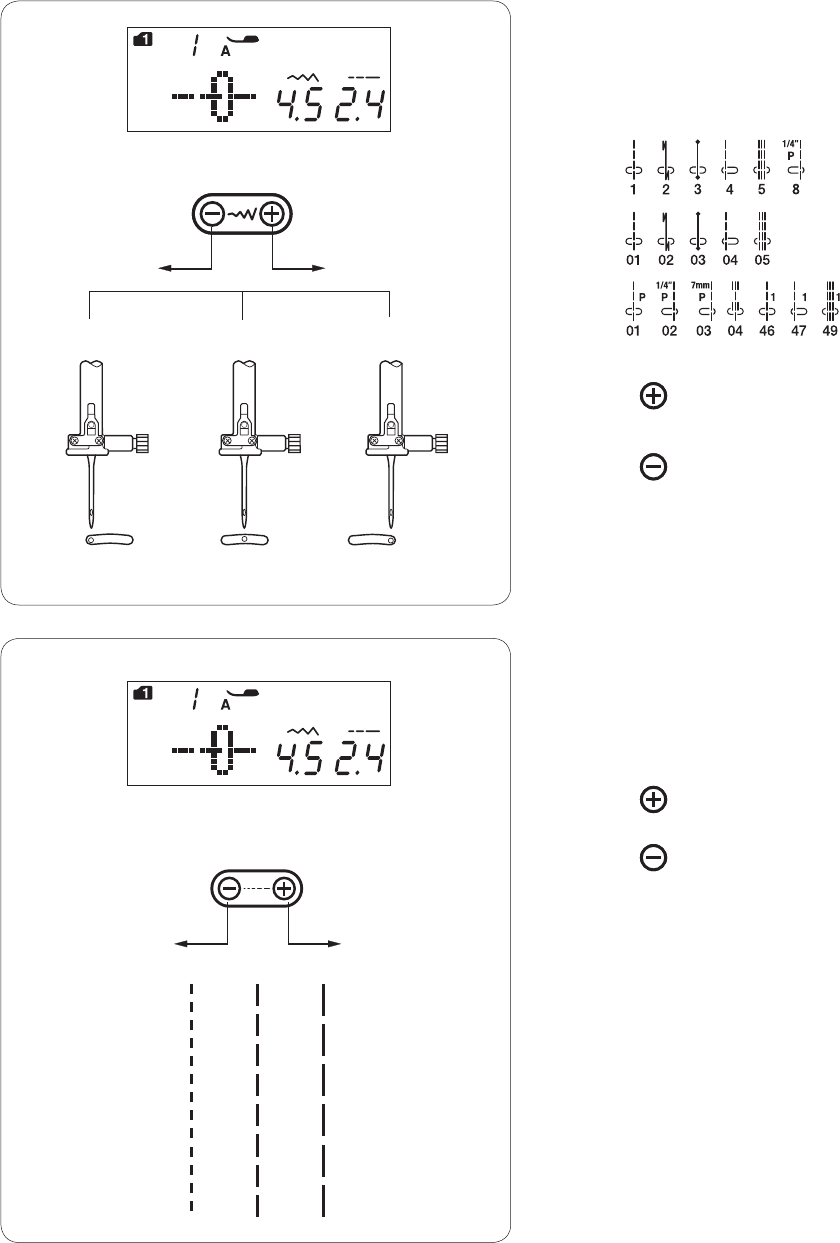
The stitch length can be altered by pressing the stitch
length adjusting key.
The stitch length indication will change as the key is
pressed.
Press the “ ” sign on the key to increase the stitch
length.
Press the “ ” sign on the key to decrease the stitch
length.
Press the “ ” sign on the stitch width adjusting key to
move the needle bar to the right.
Press the “ ” sign on the stitch width adjusting key to
move the needle bar to the left.
Adjusting the needle drop position
The needle drop position of the straight stitches can be
altered by pressing the stitch width adjusting key.
4.5 9.00.0
The needle drop position can be adjusted for following
straight stitch patterns:
5.001.00 2.40
Mode 1:
Mode 2:
Mode 3:
31
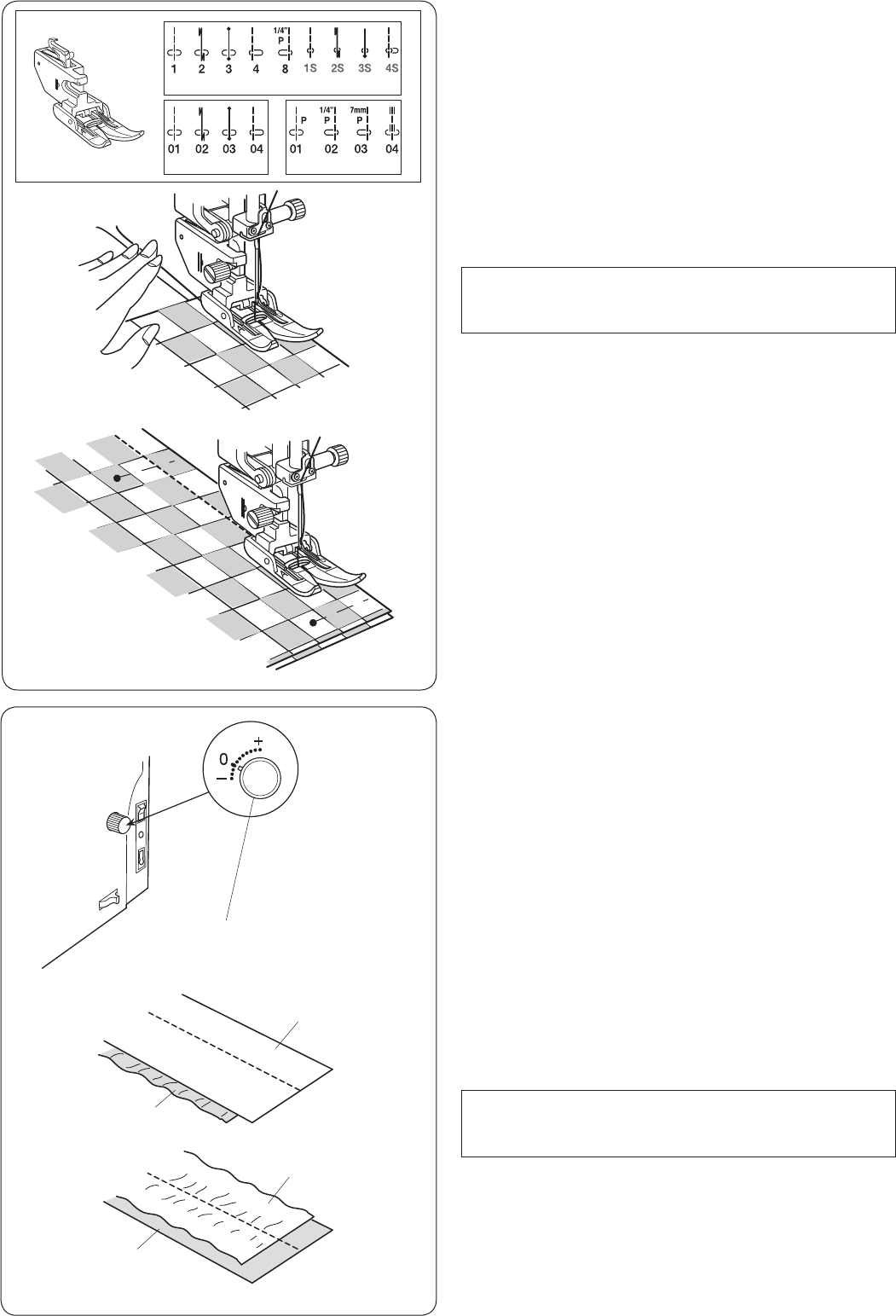
Dual Feed Balancing Dial
The dual feed balancing dial should be set at “0”.
However, you may need to adjust the dual feed balance
with this dial since the effect of the dual feed varies
depending on the type of fabric.
Test sew on scrap piece of the fabric you intended to sew
to check the feed balance.
(A): If the lower layer puckers, turn the dual feed
balancing dial toward “+”.
(B): If the upper layer puckers, turn the dual feed
balancing dial toward “–”.
q Dual feed balancing dial
w Upper layer
e Lower layer
Set the feed balancing dial to “0” after the dual feed
sewing.
NOTE:
Reducing the foot pressure will also improve the feed
balance.
Sewing with the Dual Feed Device
The following stitch patterns can be sewn with the dual
feed device.
Mode 1: 1, 2, 3, 4, 8, 1S, 2S, 3S, 4S
Mode 2: 01, 02, 03, 04
Mode 3: 01, 02, 03, 04
The dual feed device is extremely effective for sewing
with hard to feed material such as vinyl or leather. It also
eliminates layer slippage.
NOTE:
See page 14–15 for how to attach the dual feed foot
and to engage the dual feed device.
Sewing
Raise the presser foot and position the fabric edge next
to a seam guide on the needle plate. Lower the needle at
the point where you wish to start.
Pull the needle and bobbin thread toward the rear.
Lower the presser foot.
Start sewing at medium speed. Gently guide the fabric
along the seam guide letting the fabric feed naturally.
When seaming plaid fabrics, match the plaids of the upper
and lower layers and pin them together.
q
w
e
w
e
(A)
(B)
Mode 1
Mode 2 Mode 3
32
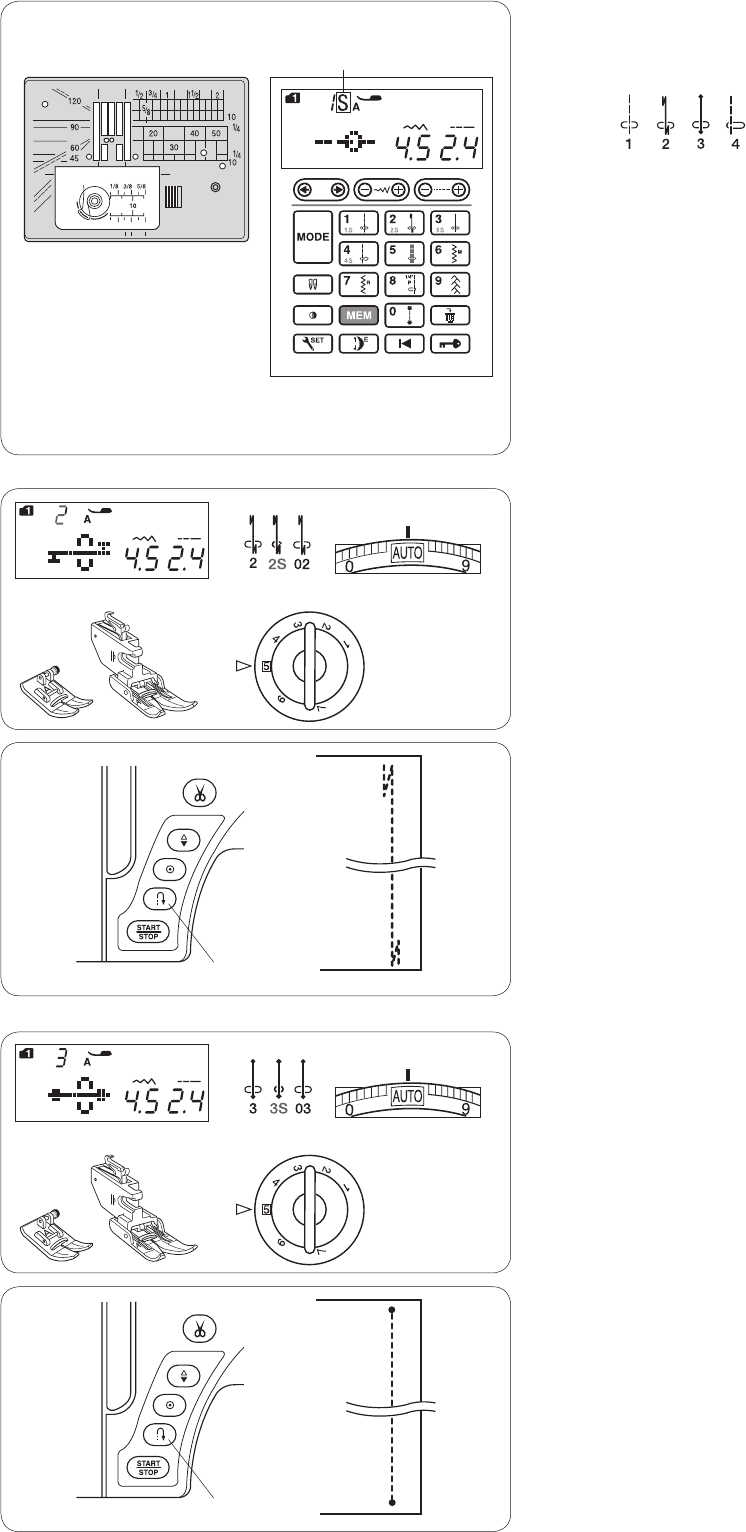
Lock-a-Matic Stitch
Machine settings
q Pattern: MODE 1: 2, 2S
MODE 2: 02
w Thread tension: AUTO
e Presser foot: Zigzag foot A or
Dual feed foot AD
r Foot pressure: 5
q
e
w
r
Use this stitch to secure the beginning and the end of a
seam with backstitching. When you reach the end of the
seam, press the reverse button q once. The machine
will sew four reverse stitches, four forward stitches, and
then stop sewing automatically.
q Reverse button
q
This unique stitch is used where an invisible locking stitch
is needed. Lower the needle close to the front edge of the
fabric.
The machine will sew several locking stitches in place
and continue sewing forward. When you press the
reverse button q at the end of the seam, the machine will
sew several locking stitches in place, then stop sewing
automatically.
q Reverse button
Locking Stitch
Machine settings
q Pattern: MODE 1: 3, 3S
MODE 2: 03
w Thread tension: AUTO
e Presser foot: Zigzag foot A or
Dual feed foot AD
r Foot pressure: 5
q
e
w
r
q
Needle Plate for Straight Stitch
The stitch patterns 1, 2, 3, 4 (mode 1) can be sewn with
the needle plate for straight stitch.
Replace the needle plate with the needle plate for straight
stitch (refer to page 16).
“S” mark will appear at the end of the pattern number
when the needle plate for straight stitch is attached.
q Needle plate for straight stitch
w S mark
Mode 1:
q
w
33
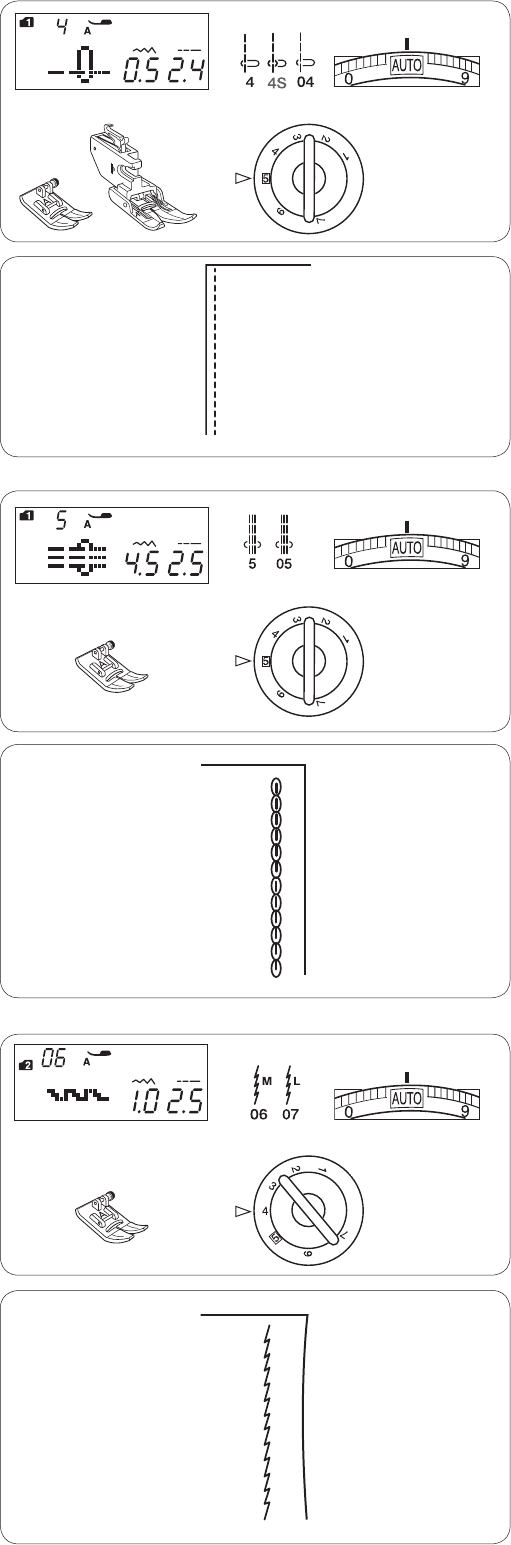
Use this stitch to seam the edge of fabrics.
Straight Stitch with Left Needle Position
Machine settings
q Pattern: MODE 1: 4, 4S
MODE 2: 04
w Thread tension: AUTO
e Presser foot: Zigzag foot A or
Dual feed foot AD
r Foot pressure: 5
q
e
w
r
Triple Stretch Stitch
Machine settings
q Pattern: MODE 1: 5
MODE 2: 05
w Thread tension: AUTO
e Presser foot: Zigzag foot A
r Foot pressure: 5
q
e
w
r
This strong, durable stitch is recommended for areas
where both elasticity and strength are needed to ensure
comfort and durability. Use it to reinforce areas such as
crotch and armhole seams. Also use it when constructing
items such as backpacks for extra strength.
Knit Stitch
Machine settings
q Pattern: MODE 2: 06 or 07
w Thread tension: AUTO
e Presser foot: Zigzag foot A
r Foot pressure: 4
q
e
w
r
This is a narrow stretch stitch designed to eliminate
puckering on knit fabrics and bias seams, while
permitting the seam to be pressed completely open flat.
Use this stitch when seaming thin fabrics such as tricot
and fine jersey.
Stitch pattern 07 (mode 2) is a stretch stitch in the left
needle position.
34
Fabric preparation
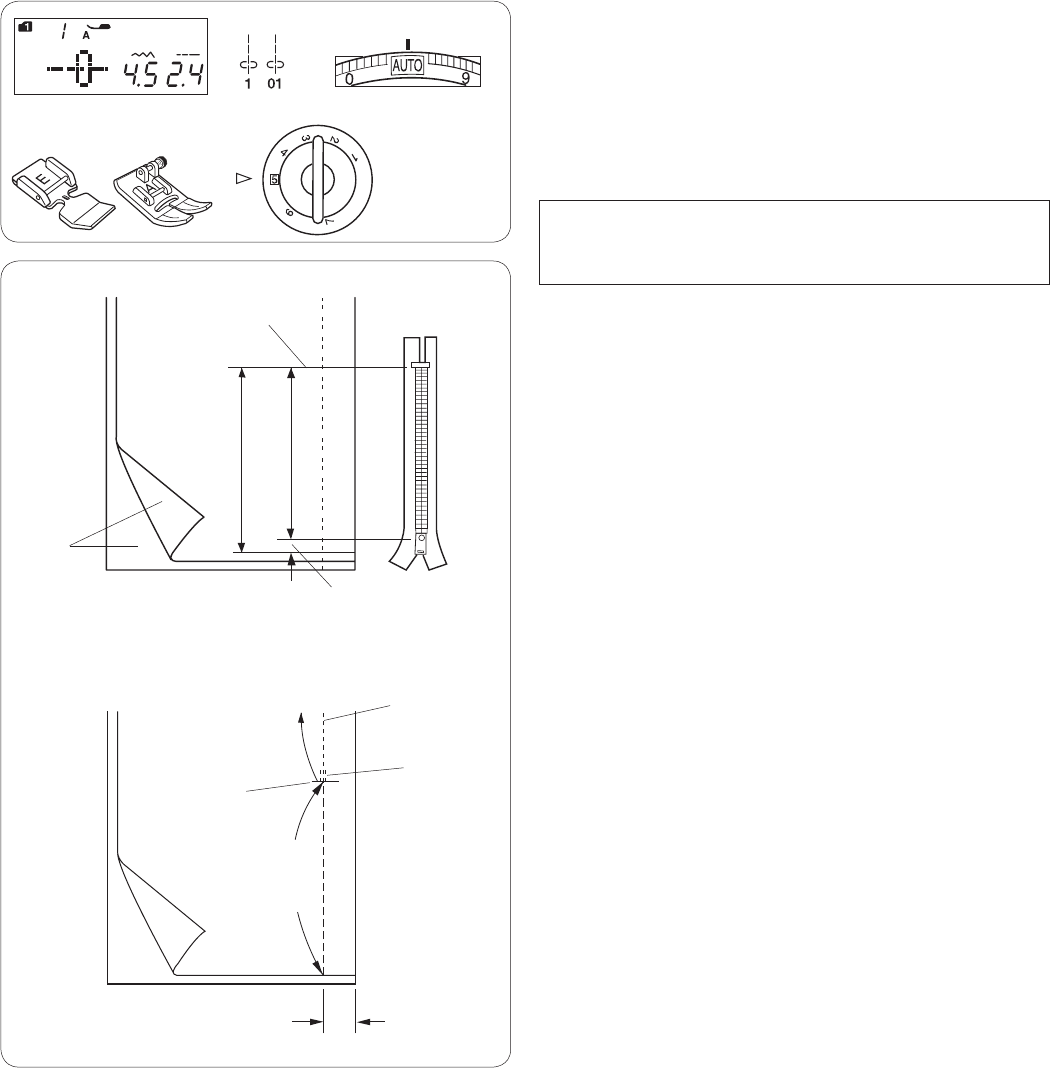
Add 1 cm (3/8“) to the zipper size. This is the overall
opening size.
q Right sides of the fabric
w 1 cm (3/8“)
e Opening size
r Zipper size
t End of the zipper opening
Zipper Sewing
Machine settings
q Pattern: MODE 1: 1
MODE 2: 01
w Thread tension: AUTO
e Presser foot: Zipper foot E
Zigzag foot A
r Foot pressure: 5
q
e
w
r
q
w
e r
t
o
i
t
u
y
Place the right sides of the fabric together and sew to the
end of the opening with a 2 cm (5/8˝) seam allowance.
Reverse stitch to lock the seams.
Manually increase the stitch length to 5.0 and baste the
zipper opening with the thread tension loosened to 1-3.
t End of the zipper opening
y 2 cm (5/8“) seam allowance
u Basting
i Reverse stitches
o Seam stitches
NOTE:
The needle drop position should be adjusted when
sewing with the zipper foot E.
35
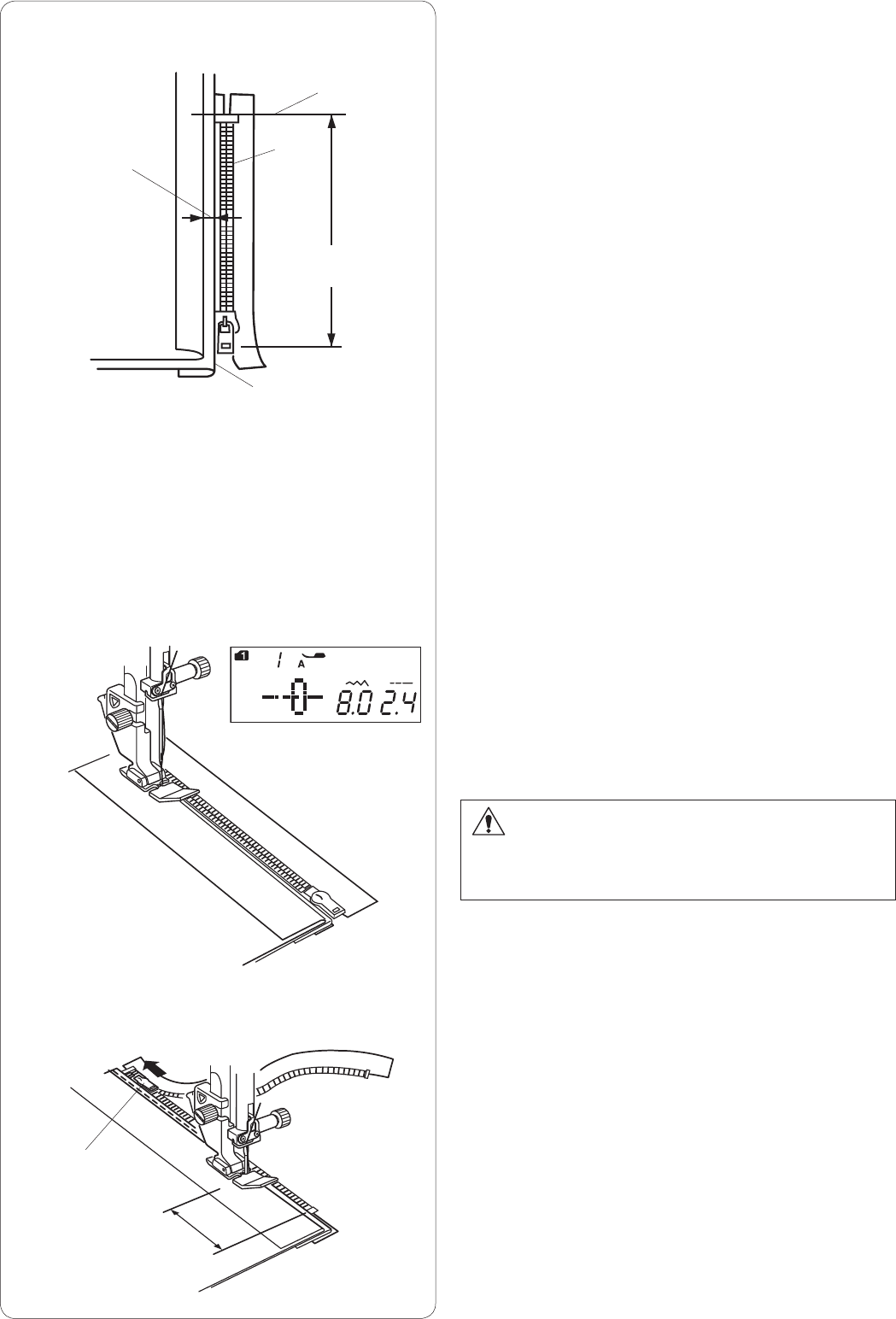
x Attach the zipper foot.
Adjust the stitch width to 7.5–8.5.
Lower the foot onto the topside at the end of the zipper
opening so that the needle pierces the fabric next to
the fold and the zipper tape.
Sew along the zipper guiding the zipper teeth along
the side edge of the foot.
Sewing
z Fold back the left seam allowance. Turn the right
seam allowance under to form a 0.2 to 0.3 cm (1/8˝)
margin. Place the zipper teeth next to the fold and pin
in place.
Set the stitch length and thread tension back to the
original setting.
q 0.2 to 0.3 cm (1/8˝) margin
w Zipper teeth
e Fold
r End of the zipper opening
t Opening size
c Sew through all layers next to the fold.
Stop 5 cm (2˝) before zipper foot E reaches the slider
on the zipper tape.
Lower the needle slightly into the fabric.
Raise the foot and open the zipper to clear the slider.
Lower the foot and stitch the remainder of the seam.
y Slider
u 5 cm (2˝)
q
w
r
e
y
u
CAUTION:
Be sure that the needle do not strike the presser foot
or zipper teeth when the zipper foot is attached and
stitch width is adjusted.
c
x
z
t
36
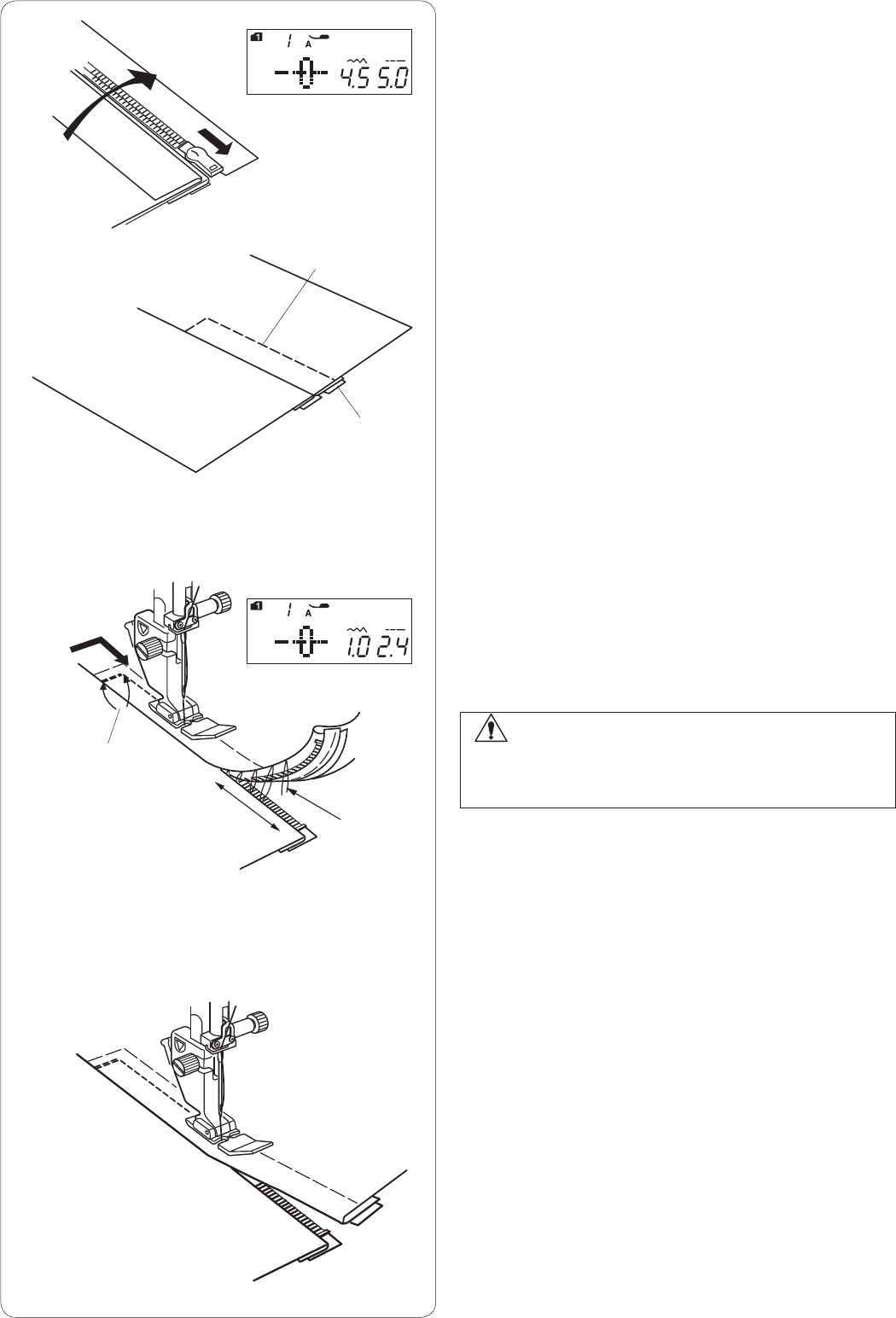
v Close the zipper and spread the fabric open flat with
the right side facing up.
Attach the Zigzag foot A.
Adjust the stitch length to 5.0, stitch width to 4.5 (default
value) and thread tension dial to 1.
Baste the opened fabric and zipper tape together.
i Basting
o Zipper tape
b Attach the zipper foot E.
Adjust the stitch length to default value, stitch width to
0.5–1.5, thread tension dial to “AUTO”.
Backstitch across the end of the opening 0.7-1 cm
(3/8˝) and turn the fabric 90 degrees.
!0 0.7-1 cm (3/8˝)
n Stitch through the garment and zipper tape, guiding
the zipper teeth along the side edge of the foot.
Stop about 5 cm (2˝) from the top of the zipper.
Unfasten the basting stitches.
Lower the needle into the fabric, raise the foot, and
open the zipper.
!1 5 cm (2˝)
!2 Basting stitches
m Lower the foot and stitch the remainder of the seam,
making sure the fold is even.
Remove the basting threads after seaming.
i
o
!0
!1 !2
v
b n
m
CAUTION:
Be sure that the needle do not strike the presser foot
or zipper teeth when the zipper foot is attached and
stitch width is adjusted.
37
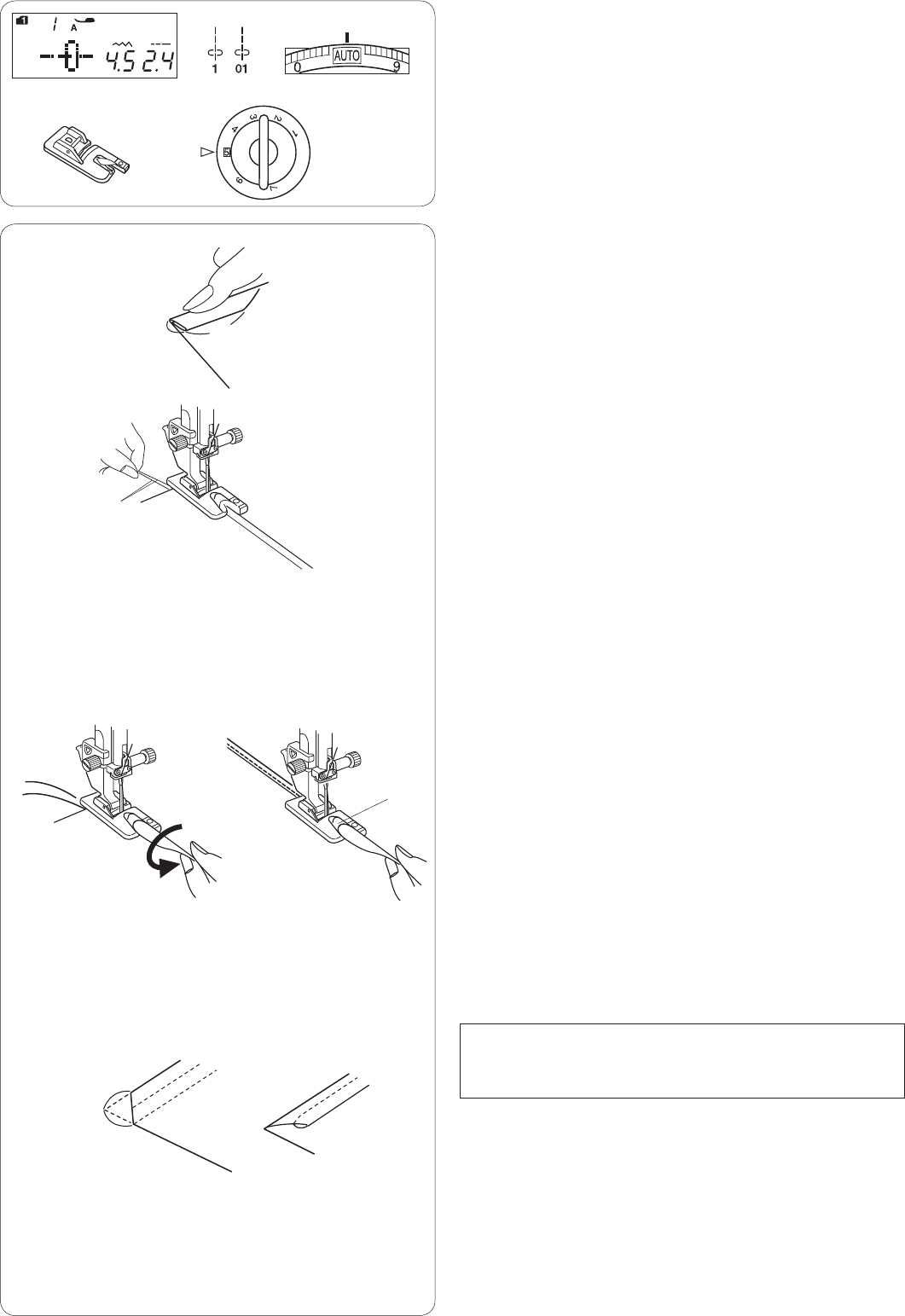
Rolled Hem
Machine settings
q Pattern: MODE 1: 1
MODE 2: 01
w Thread tension: AUTO
e Presser foot: Rolled hem foot D
r Foot pressure: 5
Sewing
z
Fold the edge of the fabric twice, 6 cm (2 - 3/8˝) in
length and 0.3 cm (1/8˝) in width.
q 6 cm (2 - 3/8˝)
w 0.3 cm (1/8˝)
x
Place the fabric aligning the edge of the hem with the
guide on the foot.
Lower the foot and sew 1-2 cm (1/2˝-1˝) while pulling
both thread to the back.
e Threads
c
Stop the machine and lower the needle into the fabric.
Raise the foot and insert the folded portion of the
fabric into the curl of the foot.
Lower the foot, and then sew by lifting up the edge of
the fabric to keep it feeding smoothly and evenly.
r Curl of the foot
NOTE:
Trim the corner 0.6 cm (1/4˝) to reduce bulk.
t 0.6 cm (1/4˝)
q
w
r
0.6 cm
0.6 cm
q
e
w
r
z
x
c
e
t
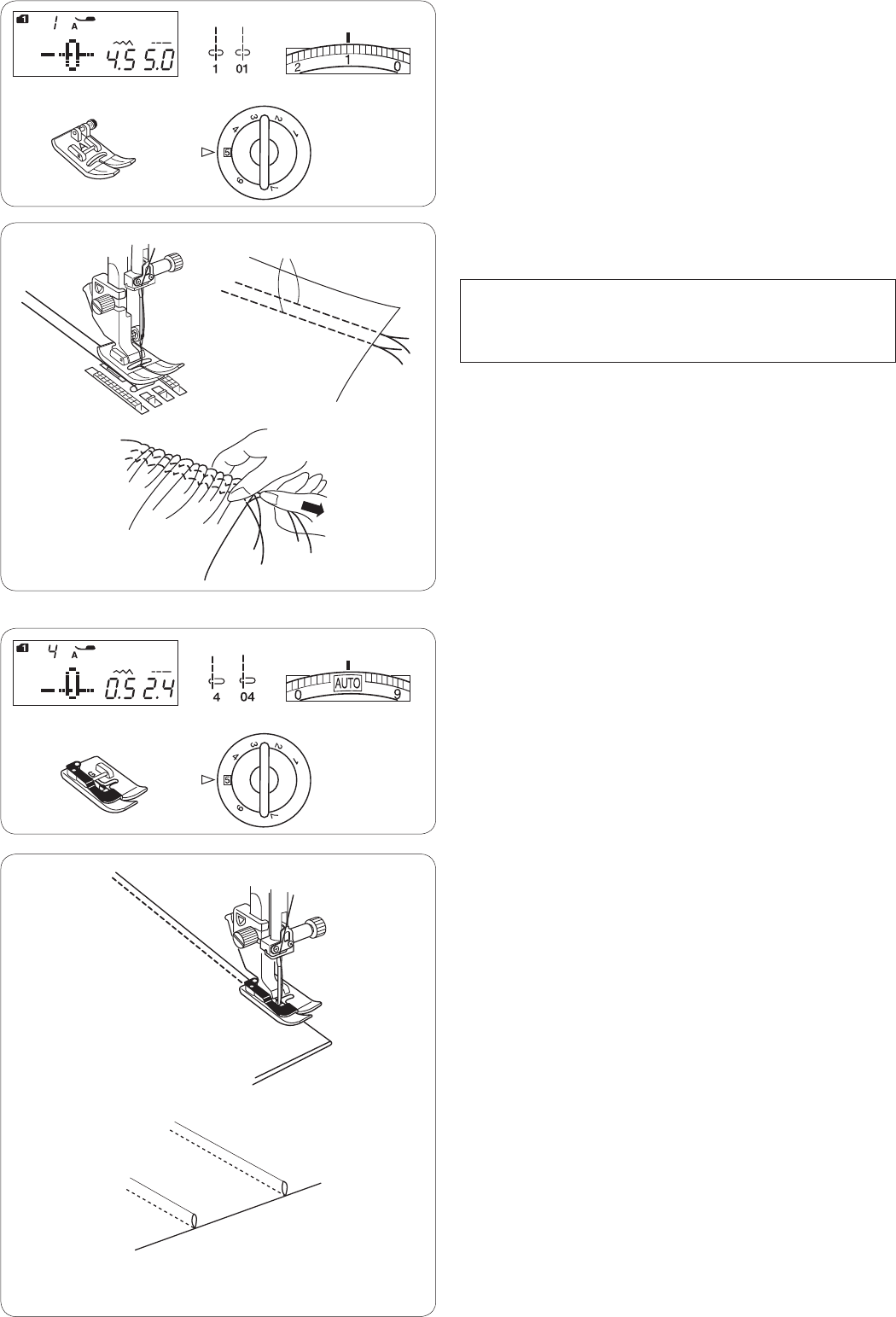
38
Gathering
Machine settings
q Pattern: MODE 1: 1
MODE 2: 01
w Thread tension: 1
e Presser foot: Zigzag foot A
r Foot pressure: 5
q
e
w
r
Pintucking
Machine settings
q Pattern: MODE 1: 4
MODE 2: 04
w Thread tension: AUTO
e Presser foot: Blind hem foot G
r Foot pressure: 5
q
e
w
r
Fold the fabric with the wrong sides together.
Place the folded fabric under the blind hem foot.
Align the edge of the fold with the guide on the foot, and
lower the foot.
Sew while guiding the edge of the fold along the guide.
Open the fabric and press the tuck to one side.
Loosen the thread tension to “1” and increase the stitch
length to 5.0.
Sew two rows of straight stitches 0.6 cm (1/4˝) apart.
Knot the threads at the beginning.
Pull the bobbin threads at the end to gather the fabric.
Knot the threads at the end and distribute the gathers
evenly.
0.6 cm
NOTE:
Pull up the bobbin thread and draw a 10 cm (4˝) thread
tail to the back before starting to sew.
Use the thread cutter on the face plate.
39
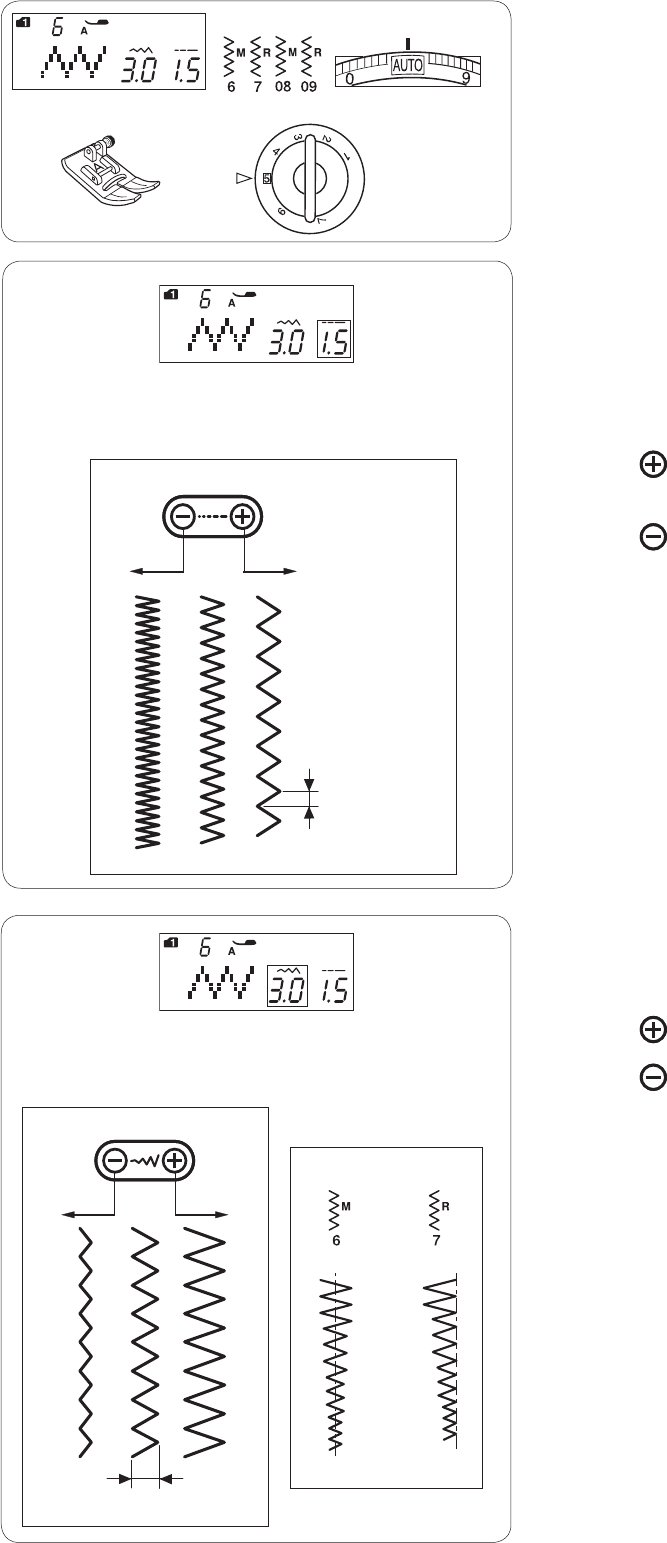
Zigzag stitch is used for various sewing needs including
overcasting. It can be used on most woven fabrics.
A dense zigzag stitch can also be used for applique.
Adjusting the stitch length
The stitch length of the zigzag stitches can be altered by
pressing the stitch length adjusting key.
Press the “ ” sign on the stitch length adjusting key to
increase the stitch length.
Press the “ ” sign on the stitch length adjusting key to
decrease the stitch length.
q Stitch length
Zigzag Stitch
Machine settings
q Pattern: MODE 1: 6, 7
MODE 2: 08, 09
w Thread tension: AUTO
e Presser foot: Zigzag foot A
r Foot pressure: 5
q
e
w
r
Adjusting the stitch width
The stitch width of the zigzag stitches can be altered by
pressing the stitch width adjusting key.
Press the “ ” sign on the stitch width adjusting key to
increase the stitch width.
Press the “ ” sign on the stitch width adjusting key to
decrease the stitch width.
q Stitch width
(A): The pattern number 6 (mode 1) or 08 (mode 2) has
a fixed center needle drop position. The stitch width
changes symmetrically.
(B): The pattern number 7 (mode 1) or 09 (mode 2) has a
fixed right needle drop position. When you change
the stitch width, the left needle drop position will
change.
w Fixed right needle position
q
q
w
(A) (B)
40
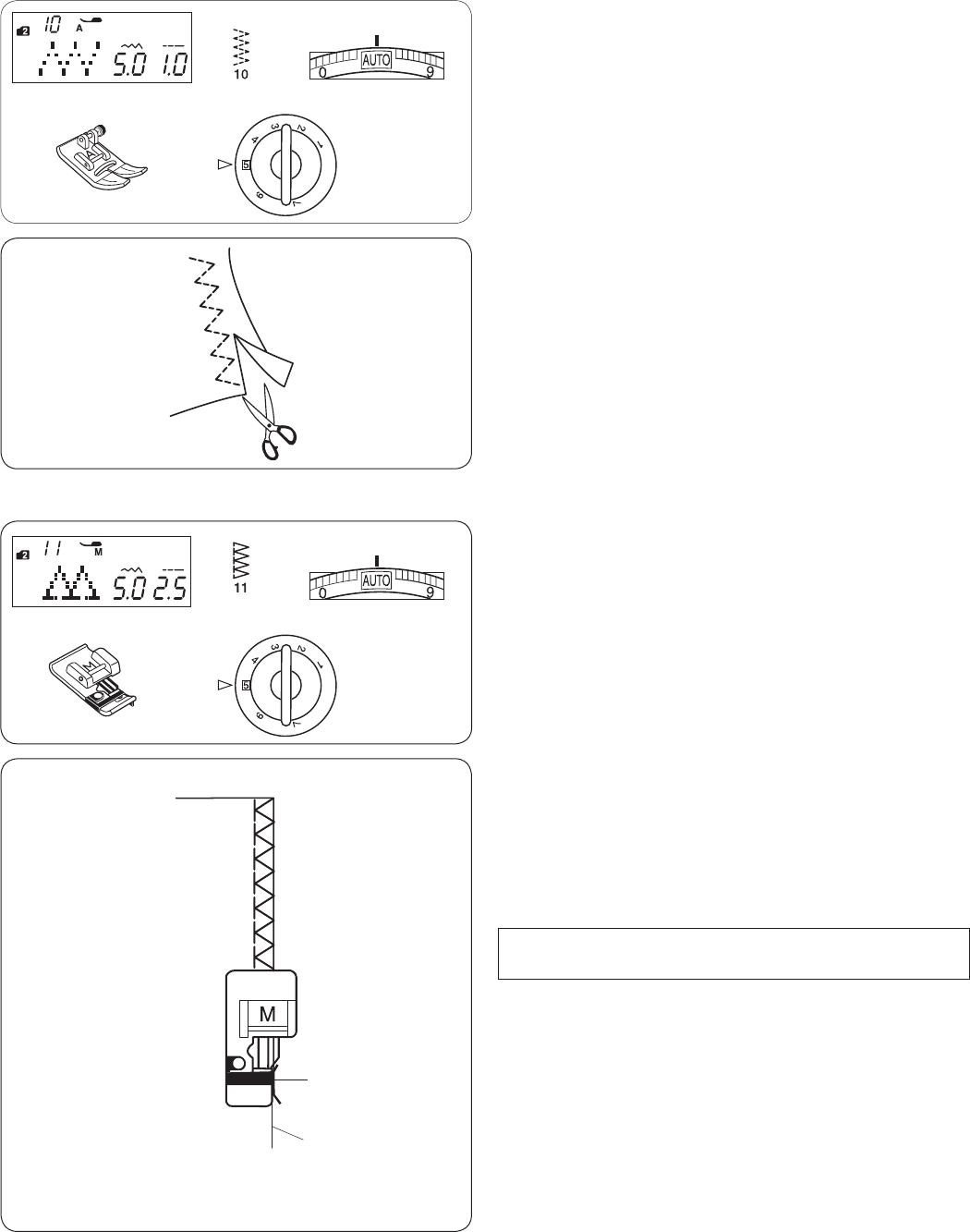
Multiple Zigzag Stitch (Tricot stitch)
Machine settings
q Pattern: MODE 2: 10
w Thread tension: AUTO
e Presser foot: Zigzag foot A
r Foot pressure: 5
q
e
w
r
This stitch is used to finish a raw edge of synthetics and
other stretch fabrics that tend to pucker.
Sew along the fabric edge leaving an adequate seam
allowance.
After sewing, trim the seam allowance close to the
stitches.
Overcasting Stitch
Machine settings
q Pattern: MODE 2: 11
w Thread tension: AUTO
e Presser foot: Overcast foot M
r Foot pressure: 5
q
e
w
r
This stitch can be used to simultaneously seam and
overcast edges of fabrics.
Use this stitch when you do not need to open seams flat.
Place the fabric edge next to the guide of the foot and
then sew.
q Edge of fabric
w Guide
NOTE:
The stitch width cannot be changed.
w
q
41
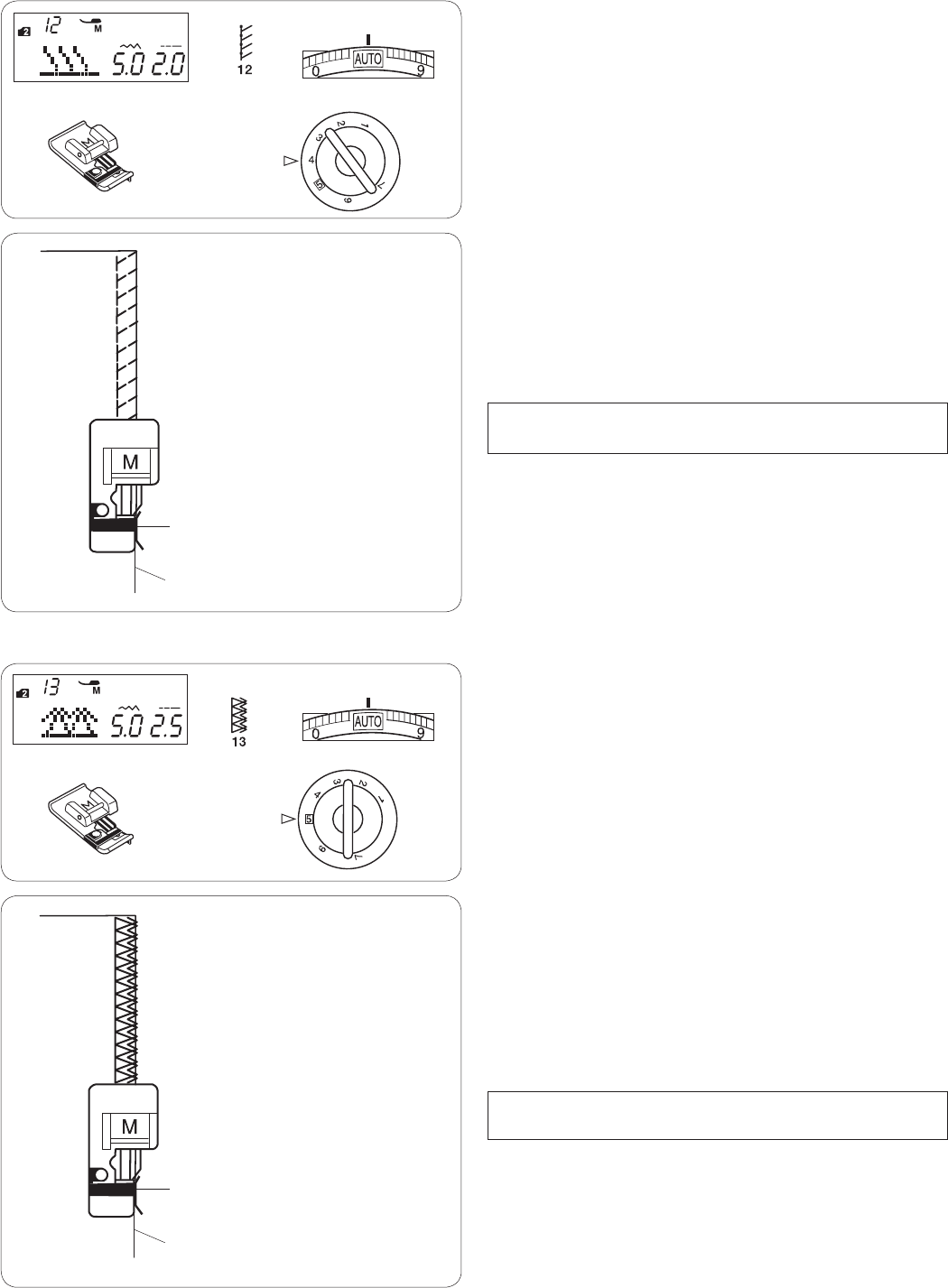
Knit Stitch
Machine settings
q Pattern: MODE 2: 12
w Thread tension: AUTO
e Presser foot: Overcast foot M
r Foot pressure: 4
q
e
w
r
w
q
This stitch is recommended for sewing such fabrics
as synthetic knits and stretch velour as it provides the
greatest amount of elasticity and strength.
Place the fabric edge next to the guide of the foot and
then sew.
q Edge of fabric
w Guide
NOTE:
The stitch width cannot be changed.
q
e
w
r
w
q
Double Overcasting Stitch
Machine settings
q Pattern: MODE 2: 13
w Thread tension: AUTO
e Presser foot: Overcast foot M
r Foot pressure: 5
This is an excellent stitch for fabrics that tend to fray
extensively such as linens and gabardines.
Two rows of zigzag stitches are simultaneously sewn
over the edge to insure that fabric will not ravel.
Place the fabric edge next to the guide of the foot and
then sew.
q Edge of fabric
w Guide
NOTE:
The stitch width cannot be changed.
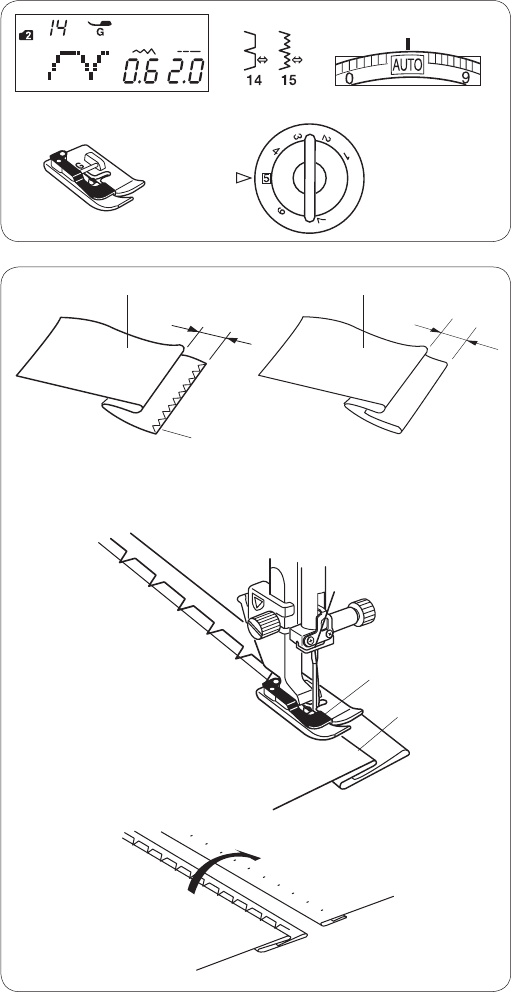
42
Select pattern 14 for woven fabrics or pattern 15 for
elastic fabrics.
Folding the fabric
Fold the fabric to make a hem as shown.
q Heavy fabric
w Fine to medium fabric
e 0.4 – 0.7 cm (3/16˝–1/4˝)
r Overcasting
t Wrong side of fabric
Sewing
Position the fabric so that the fold comes to the left side of
the guide on the foot.
Lower the presser foot.
Adjust the position of the needle swing with the stitch
width adjusting key so that the needle just pierces the
folded edge of the fabric when the needle comes over to
the left side.
Sew guiding the fold along the guide.
y Guide on the foot
u Fold
Open the fabric with the right side up.
The stitches on the right side of the fabric will be almost
invisible.
i Right side of fabric
Blind Hemming
Machine settings
q Pattern: MODE 2: 14, 15
w Thread tension: AUTO
e Presser foot: Blind hemming foot G
r Foot pressure: 5
q
e
w
r
q w
e e
tt
r
y
u
i
43
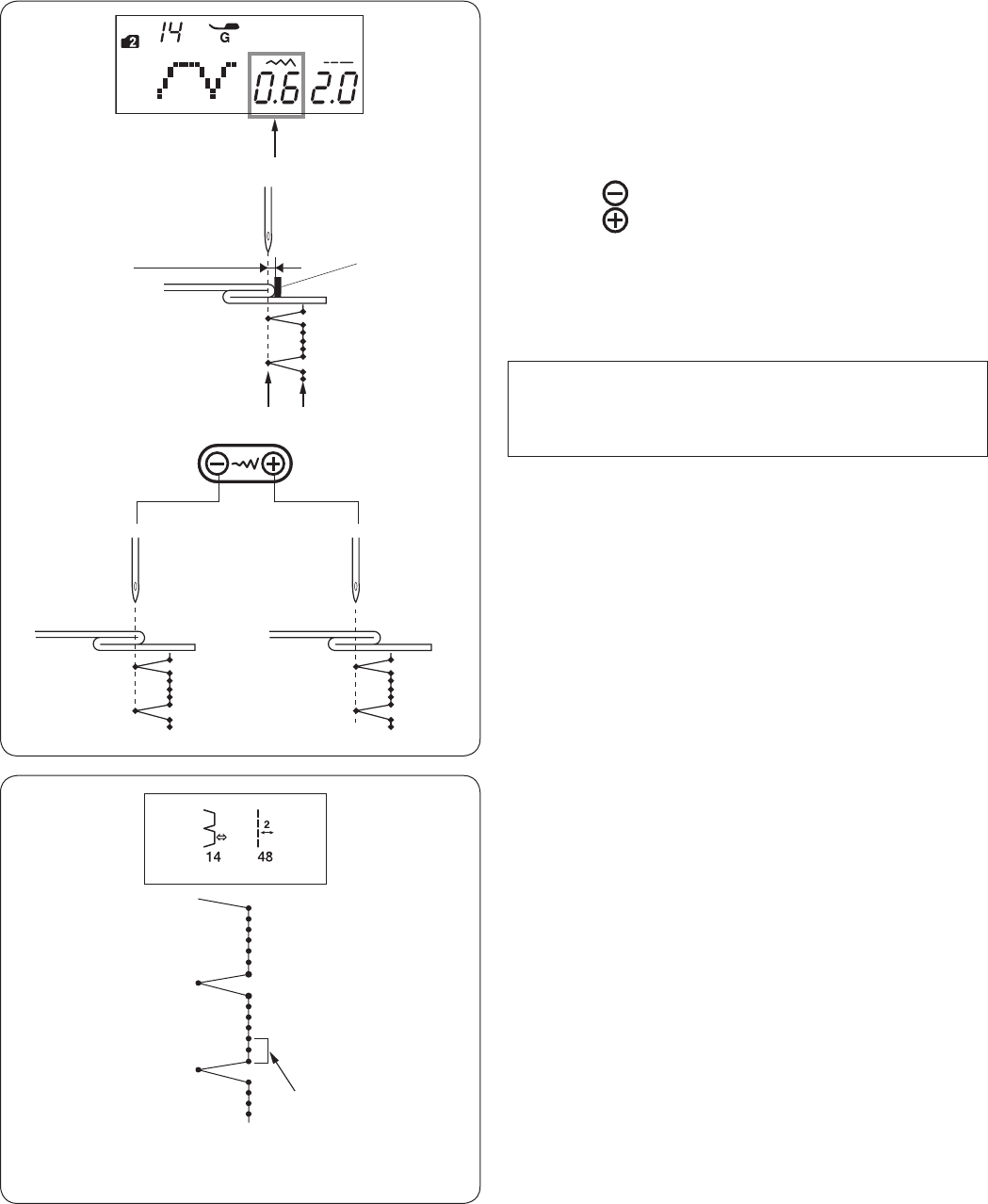
Changing the needle drop position
Press the stitch width adjusting key.
The LCD screen shows the distance between the left
needle position and the guide in millimeters r.
→ ←
r
e
r
qw
Press the “ ” sign to move the needle to the right.
Press the “ ” sign to move the needle to the left.
q Left needle drop position
w Right needle drop position
e Guide on foot
r Distance between the left needle position and the
guide
NOTE:
The stitch width of patterns 14 (mode 2) and 15 (mode
2) cannot be changed, but the needle drop position
will move.
Making the straight stitches in pattern number 14
longer
Program a combination of patterns 14 (mode 2) and
pattern 48 (mode 3).
Two straight stitches will be added to the blind hem stitch
when combining with pattern 48 (mode 3) q (Refer to
page 75).
q
44
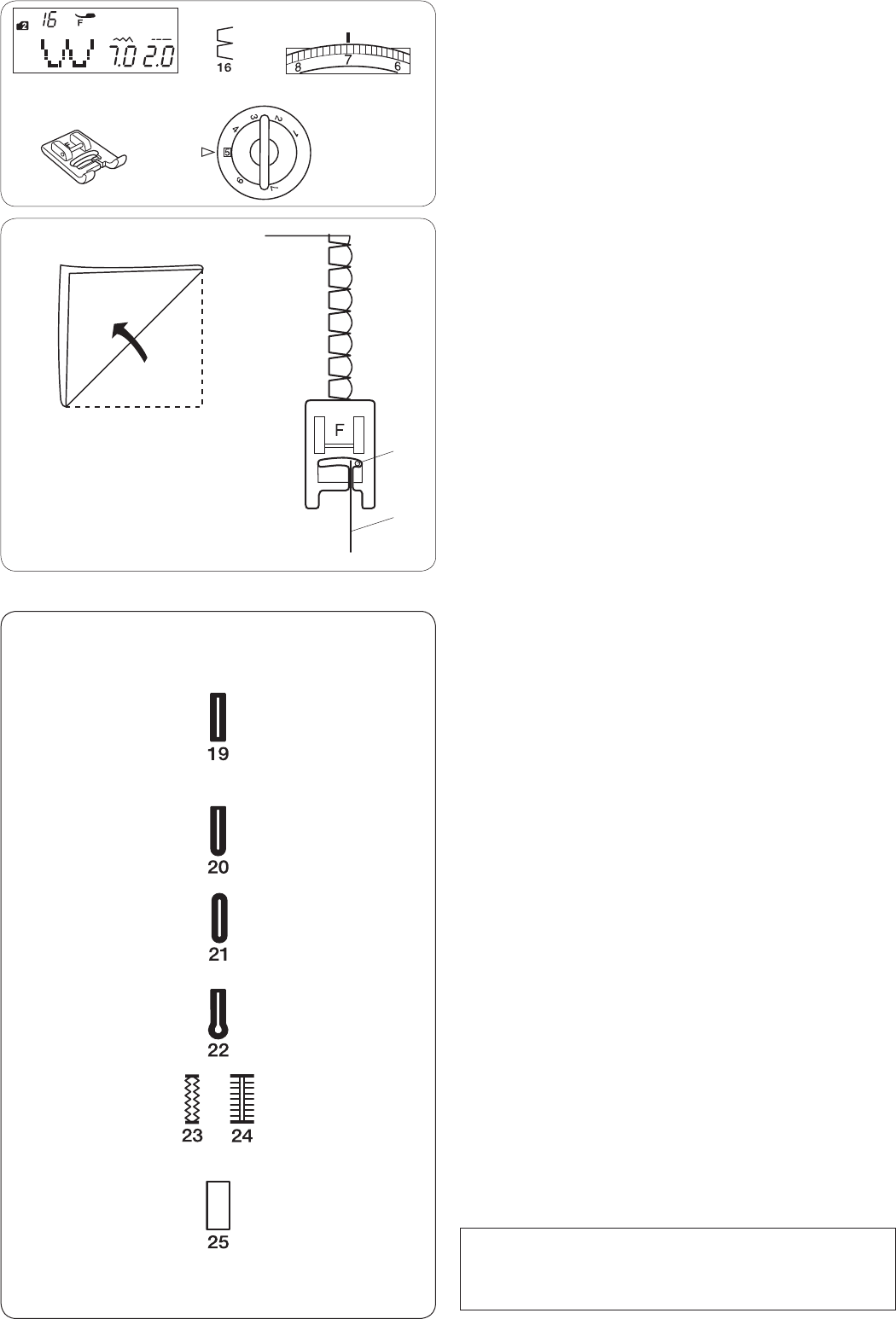
Use a light weight fabric (tricot, for example). Fold the
fabric as shown and stitch on the fold.
Allow the needle to just clear the folded edge to create
ashellededge.Youmayneedtoincreasetheneedle
thread tension.
q Folded edge
w Right needle drop position
If you sew rows of shell stitches, space the rows at least
1.5 cm (5/8˝) apart.
Youcanalsosewshellstitchesonknitsorsoftsilky
woven fabrics in any direction.
q
e
w
r
Shell Tuck
Machine settings
q Pattern: MODE 2: 16
w Thread tension: 6−8
e Presser foot: Satin stitch foot F
r Foot pressure: 5
q
w
Buttonholes
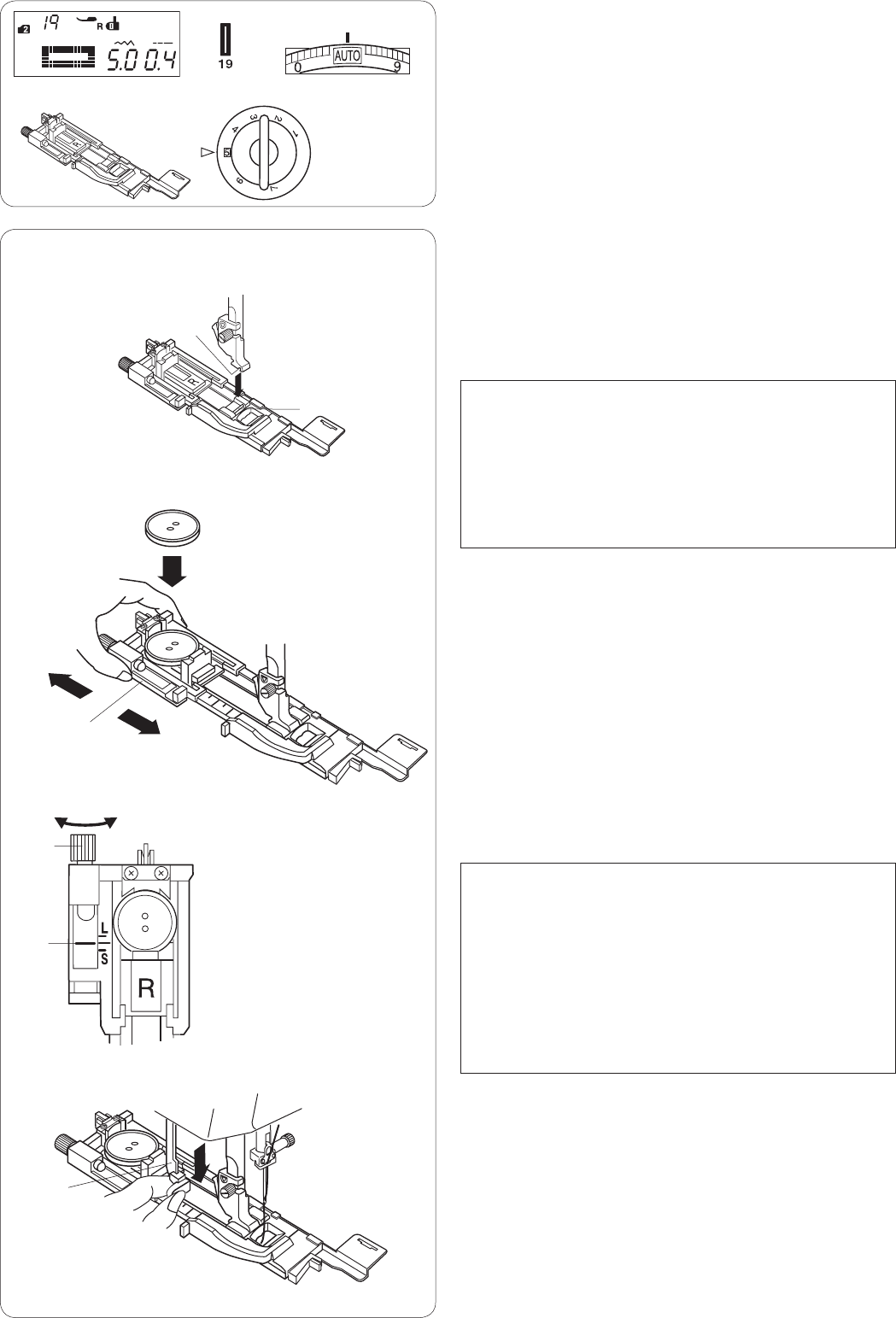
Variety of buttonholes
19 Square buttonhole
This square buttonhole is widely used on medium to
heavy weight fabrics.
The buttonhole size is automatically determined by
placing a button in the foot.
20 Round end buttonhole
This buttonhole is used on fine to medium weight fabrics
especially for blouses and children’s clothes.
21 Fine fabric buttonhole
This buttonhole is rounded at both ends and is used on
fine, delicate fabrics such as fine silk.
22 Keyhole buttonholes
The Keyhole Buttonhole is widely used on medium to
heavy weight fabrics. It is also suitable for larger and
thicker buttons.
23-24 Stretch buttonholes
This buttonhole can be used on stretch fabrics. It can
also be used as a decorative buttonhole.
25 Welted buttonhole
This is a template pattern for the hand sewn welted
(bound) buttonhole.
NOTE:
Sewing procedure of patterns 20-25 is the same as
pattern number 19.
45
q
e
w
r
Square Buttonhole
Machine settings
q Pattern: MODE 2: 19
w Thread tension: AUTO
e Presser foot: Automatic buttonhole foot R
r Foot pressure: 5
The size of a buttonhole is automatically set by placing a
button in the rear of automatic buttonhole foot R.
The button holder of the foot takes a button size of 1 cm
(3/8˝) to 2.5 cm (1˝) in diameter.
When selecting the buttonholes, the LCD screen advise
you to lower the buttonhole lever.
NOTES:
It is sometimes necessary to change buttonhole size
to match certain heavy or specific fabrics and threads.
Make a test buttonhole on an extra piece of the fabric
to check your settings.
The preset width of the buttonhole is suited for
ordinary buttons.
Apply an interfacing to stretch or fine fabrics.
Sewing
z Press the needle up/down button to raise the needle.
Attach the automatic buttonhole foot R snapping the
pin into the groove of the foot holder.
Youmayliftthepresserfootliftertotheextralifted
position when placing the automatic buttonhole foot
under the foot holder.
q Groove
w Pin
x Pull the button holder to the back, and place the
button in it. Push it together tightly on the button.
e Button holder
c Pull the buttonhole lever down as far as it will go.
q
w
e
y Buttonhole lever
r
t
NOTES:
Check the length of the test buttonhole, and adjust the
buttonhole length if necessary by turning the adjusting
screw on the buttonhole foot.
To increase the buttonhole length, turn the adjusting
screw to move the marker toward “L”.
To decrease the buttonhole length, turn the adjusting
screw to move the marker toward “S”.
r Adjusting screw
t Marker
x
z
c
y
46
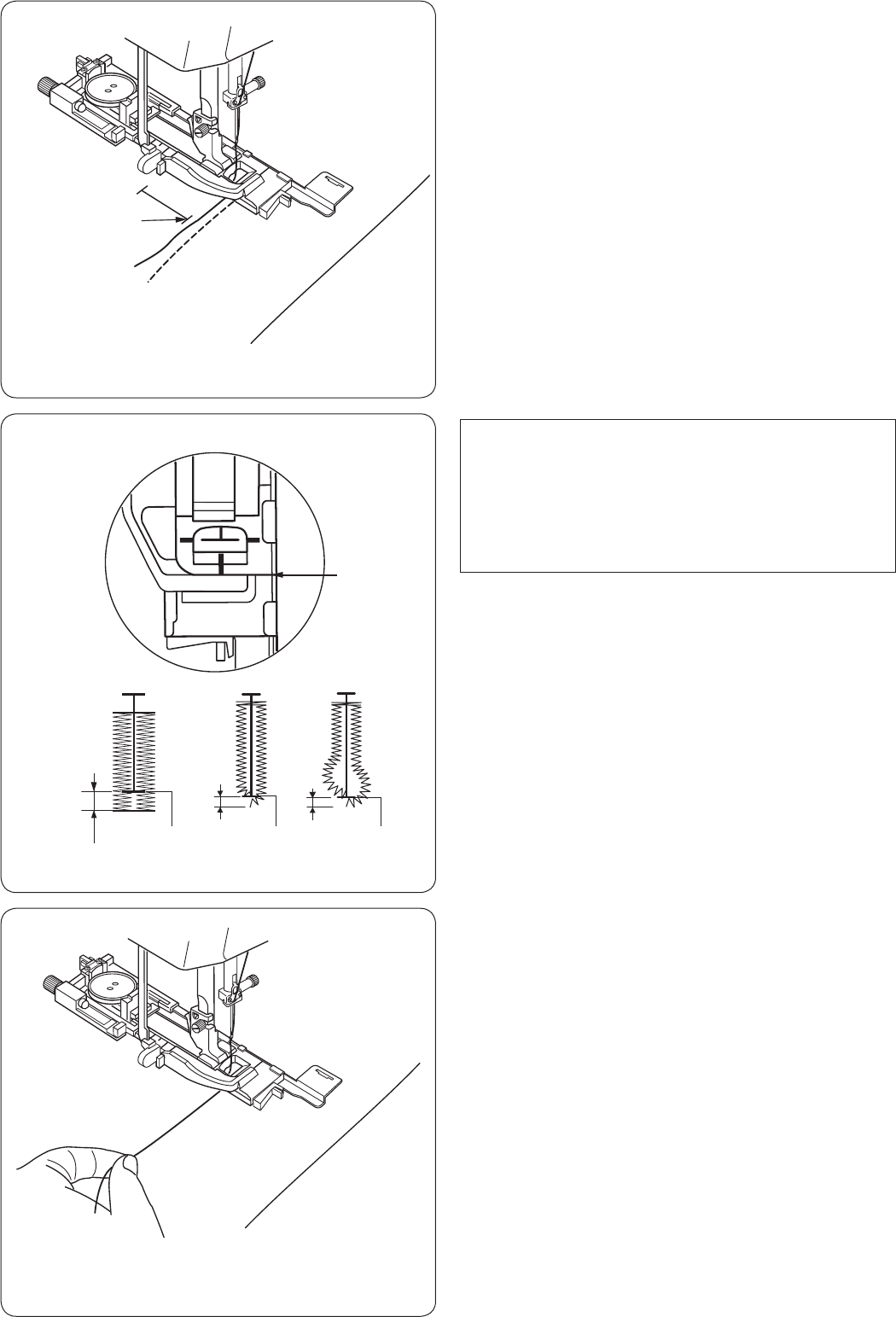
v Mark the buttonhole position on the fabric and place
it under the buttonhole foot. Lower the needle at the
starting point by turning the hand wheel.
u Starting point
u
NOTE:
Make sure there is no gap between the slider and
front stopper, otherwise the buttonhole will be out of
position or there will be a sewing gap.
i No gap
o Starting point
!0 Sewing gap
i
o o o
!0
!0!0
b Start sewing while pulling the needle thread lightly to
the left. After sewing a few stitches, free the thread
and continue sewing.
v
b
47
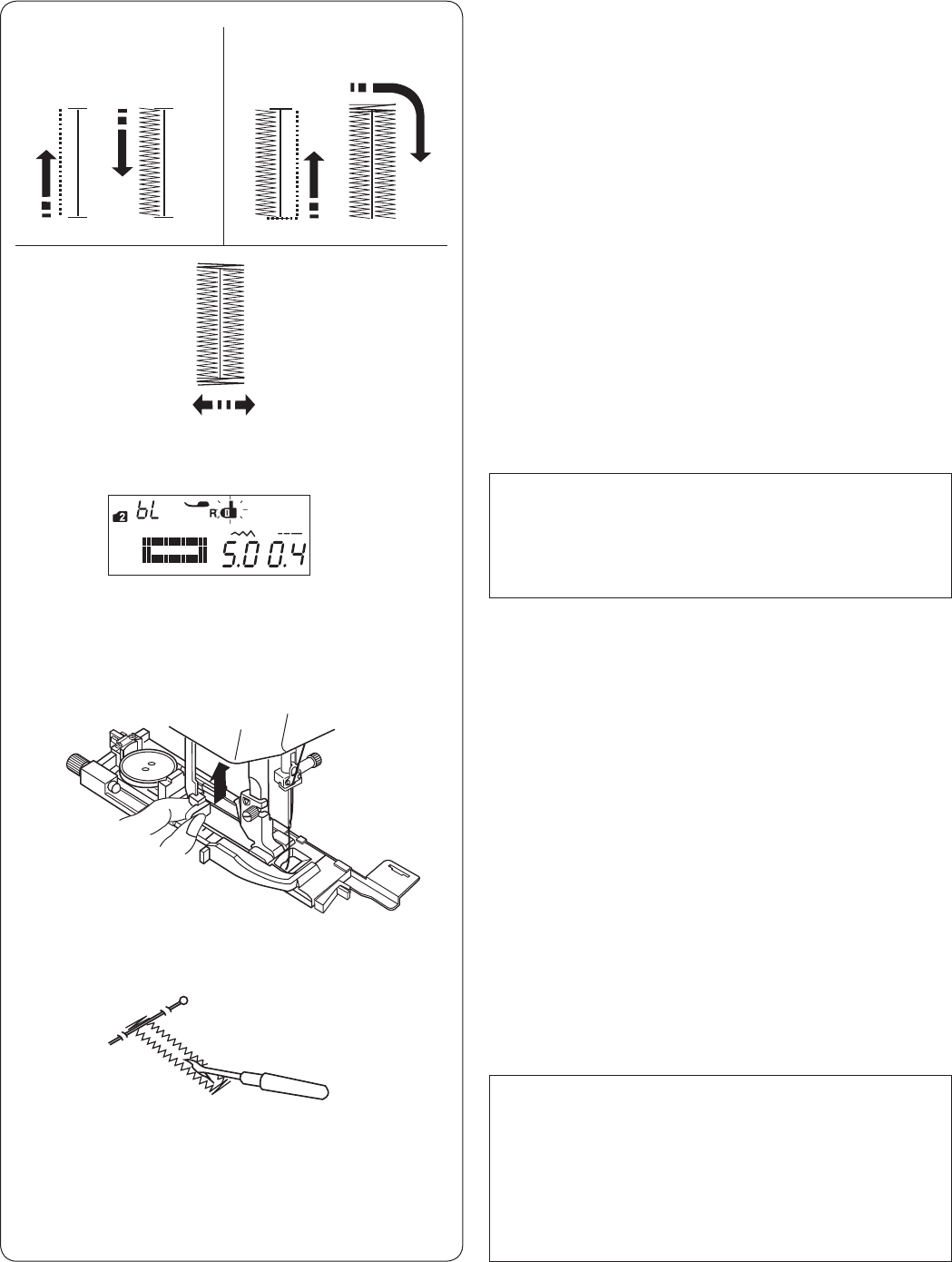
n The buttonhole is sewn automatically in the sequence
shown. When the buttonhole is finished, the machine
will stop automatically with the needle in the up
position.
Press the thread cutter button and remove the fabric.
NOTE:
If you start sewing without pulling down the buttonhole
lever, the LCD screen will show a warning and
the machine will stop after a few stitches. Pull the
buttonhole lever down and start sewing.
m After you finish buttonhole sewing, push the
buttonhole lever up as far as it will go.
, Place a pin just below the bartack at each end to
prevent accidentally cutting the threads. Cut the
opening with the seam ripper. Use an eyelet puncher
to open a keyhole buttonhole.
n
m
,
NOTE:
To make a solid and sturdy buttonhole, sew another
layer of buttonhole over the previous one.
After the buttonhole is finished, simply press the start/
stop button again.
Do not raise the foot or reselect the pattern.
The machine will sew another buttonhole over the
previous one.
48
Adjusting the buttonhole stitch density
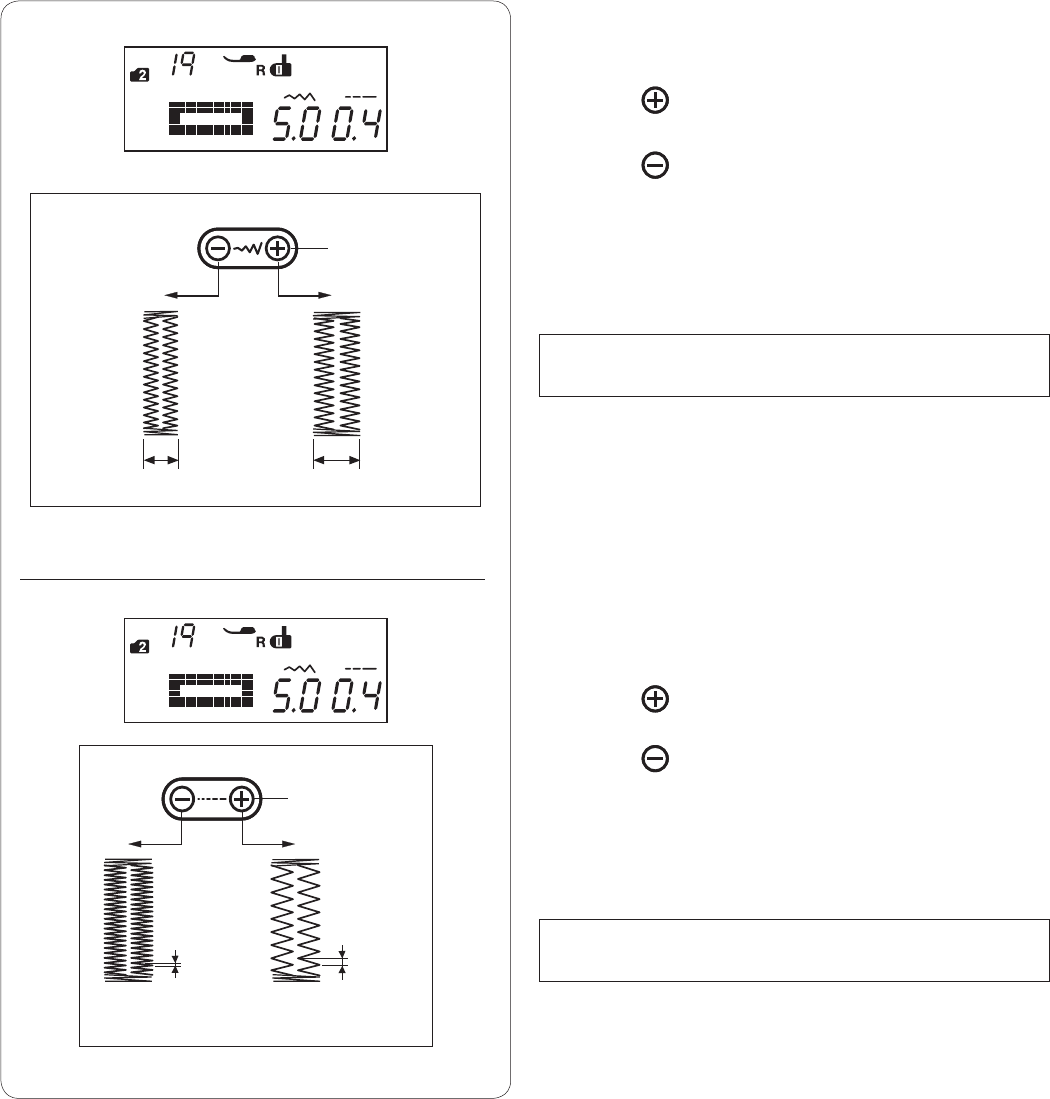
The buttonhole stitch density can be adjusted by pressing
the stitch length adjusting key.
Press the “ ” sign on the stitch length adjusting key to
make the buttonhole stitch less dense.
Press the “ ” sign on the stitch length adjusting key to
make the buttonhole stitch denser.
q Stitch length adjusting key
w Denser buttonhole
e Less dense buttonhole
Manual settings
The buttonhole width can be adjusted by pressing the
stitch width adjusting key.
Press the “ ” sign on the stitch width adjusting key to
increase the buttonhole width.
Press the “ ” sign on the stitch width adjusting key to
decrease the buttonhole width.
q Stitch width adjusting key
w Narrower buttonhole
e Wider buttonhole
q
w e
w e
NOTE:
The buttonhole width can be adjusted from 2.5 to 7.0.
NOTE:
The stitch density can be adjusted from 0.3 to 1.0.
q
49
Using the Stabilizer Plate
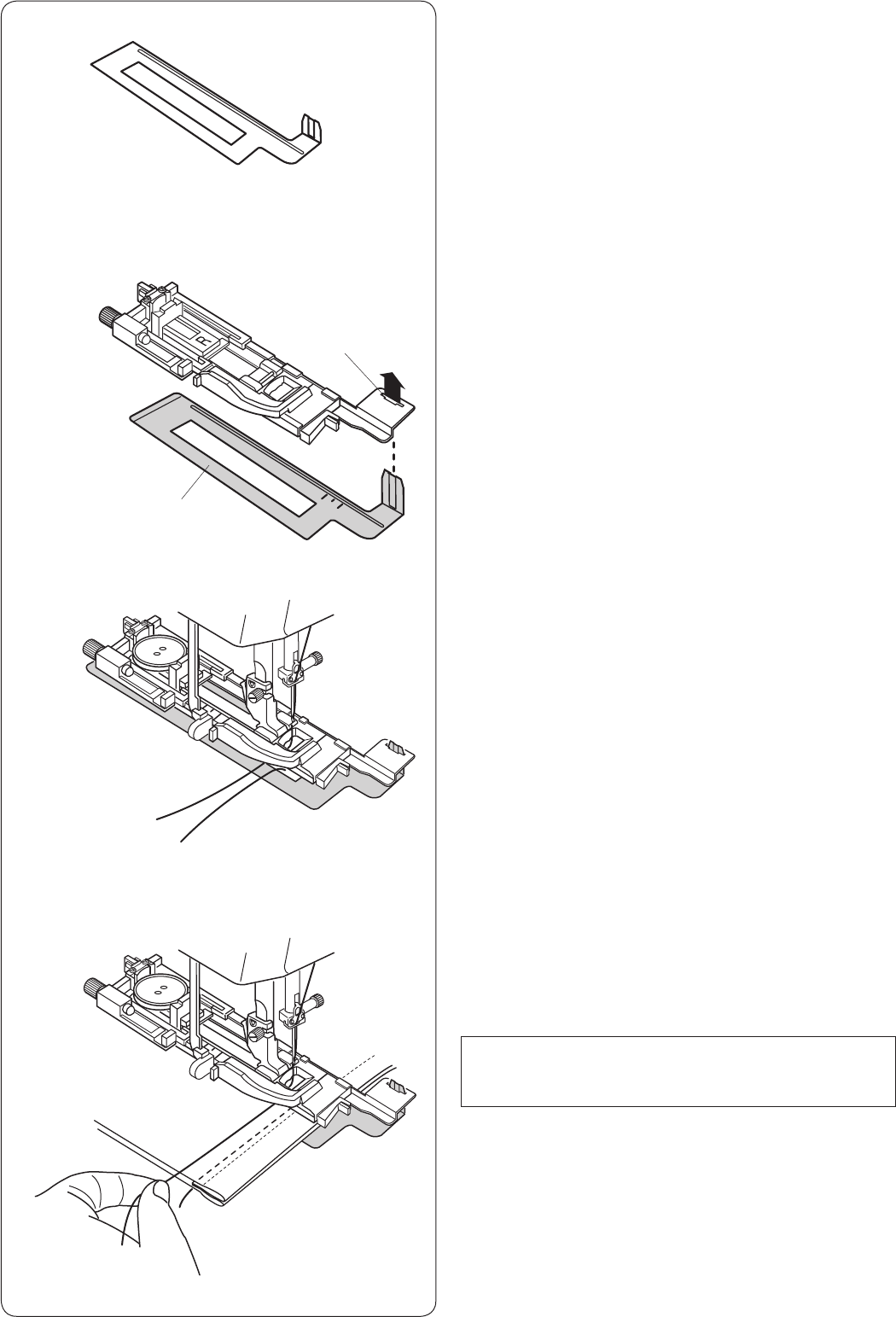
The stabilizer plate holds and supports the fabric so it is
helpful when sewing buttonholes over the hem of thick
fabrics.
z Insert the tab of the stabilizer plate q into the slot w
of the buttonhole foot.
q Stabilizer plate
w Slot
q
w
x Place the button on the button holder of the foot.
Attach the buttonhole foot to the machine.
Insert the fabric between buttonhole foot and stabilizer
plate. Press the needle up/down button twice and
remove the fabric to the left to draw both needle and
bobbin threads between the foot and stabilizer plate.
c Lower the needle into the starting point by turning the
hand wheel.
Lower the foot and buttonhole lever.
Start the machine.
NOTE:
The sewing procedure is exactly the same as that for
square buttonholes.
z
x
c
50
q
e
w
r
Round End and Fine Fabric Buttonholes
Machine settings
q Pattern: MODE 2: 20, 21
w Thread tension: AUTO
e Presser foot: Automatic buttonhole foot R
r Foot pressure: 5
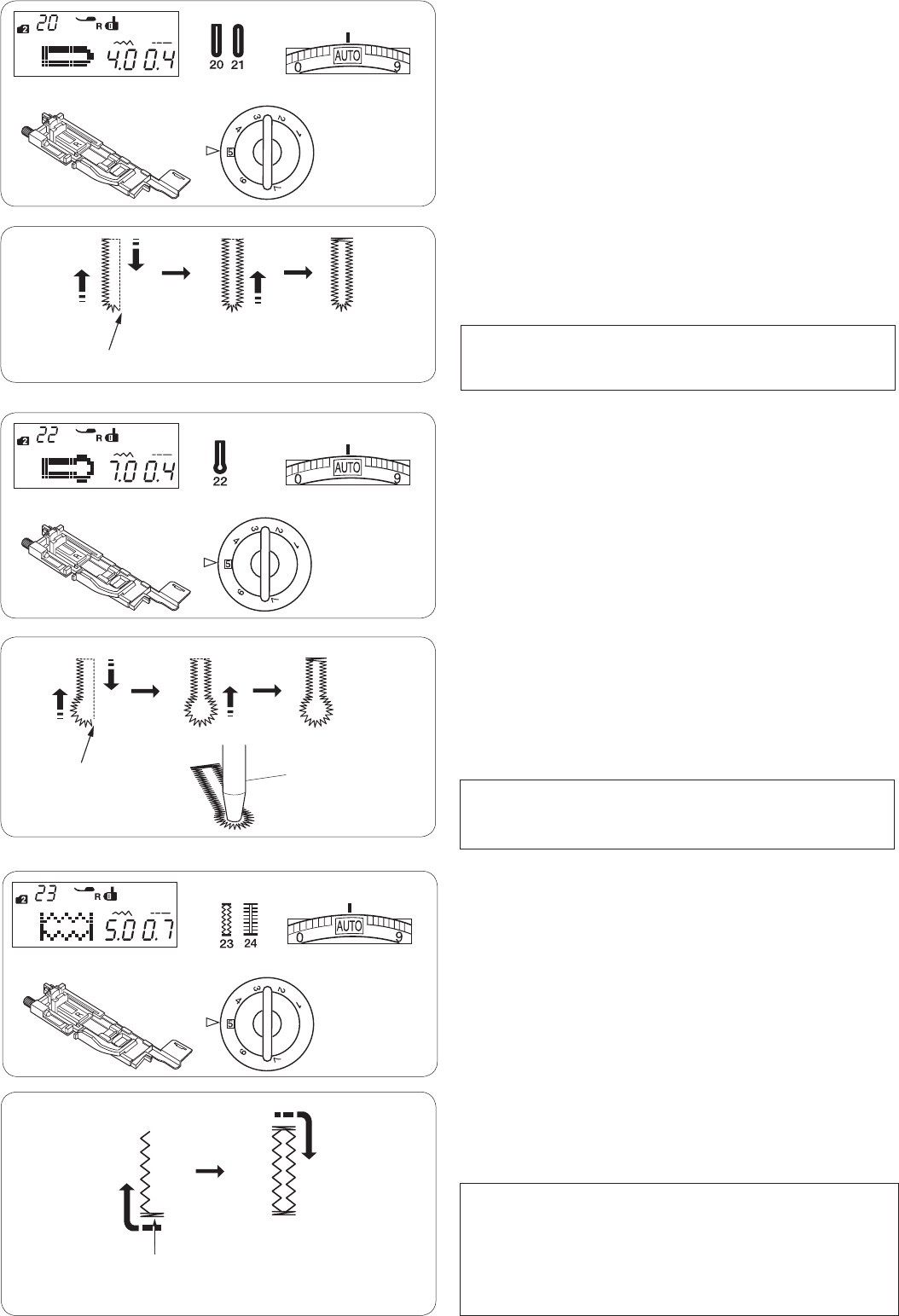
The sewing procedure is the same as the square
buttonhole (refer to pages 45-47).
The machine will sew a buttonhole in the order shown.
q Starting point
NOTE:
The buttonhole width can be adjusted from 2.5 to 5.5.
The stitch density can be adjusted from 0.3 to 1.0.
q
e
w
r
Keyhole Buttonhole
Machine settings
q Pattern: MODE 2: 22
w Thread tension: AUTO
e Presser foot: Automatic buttonhole foot R
r Foot pressure: 5
The sewing procedure is the same as the square
buttonhole (refer to pages 45-57).
The machine will sew a buttonhole in the order shown.
Use an eyelet puncher to open a keyhole buttonhole.
q Starting point
w Eyelet puncher
NOTE:
The buttonhole width can be adjusted from 5.5 to 7.0.
The stitch density can be adjusted from 0.3 to 1.0.
q
qw
q
e
w
r
Stretch Buttonholes
Machine settings
q Pattern: MODE 2: 23, 24
w Thread tension: AUTO
e Presser foot: Automatic buttonhole foot R
r Foot pressure: 5
The sewing procedure is the same as the square
buttonhole (refer to pages 45-57).
The machine will sew a buttonhole in the order shown.
q Starting point
NOTE:
The buttonhole width can be adjusted from 2.5 to 7.0.
The stitch density can be adjusted from 0.5 to 1.0 for
pattern 23 (mode 2) and 0.5 to 2.5 for pattern 24.
If the stitch balance of the left and right row is not
even, correct it by turning the feed balancing dial.
q
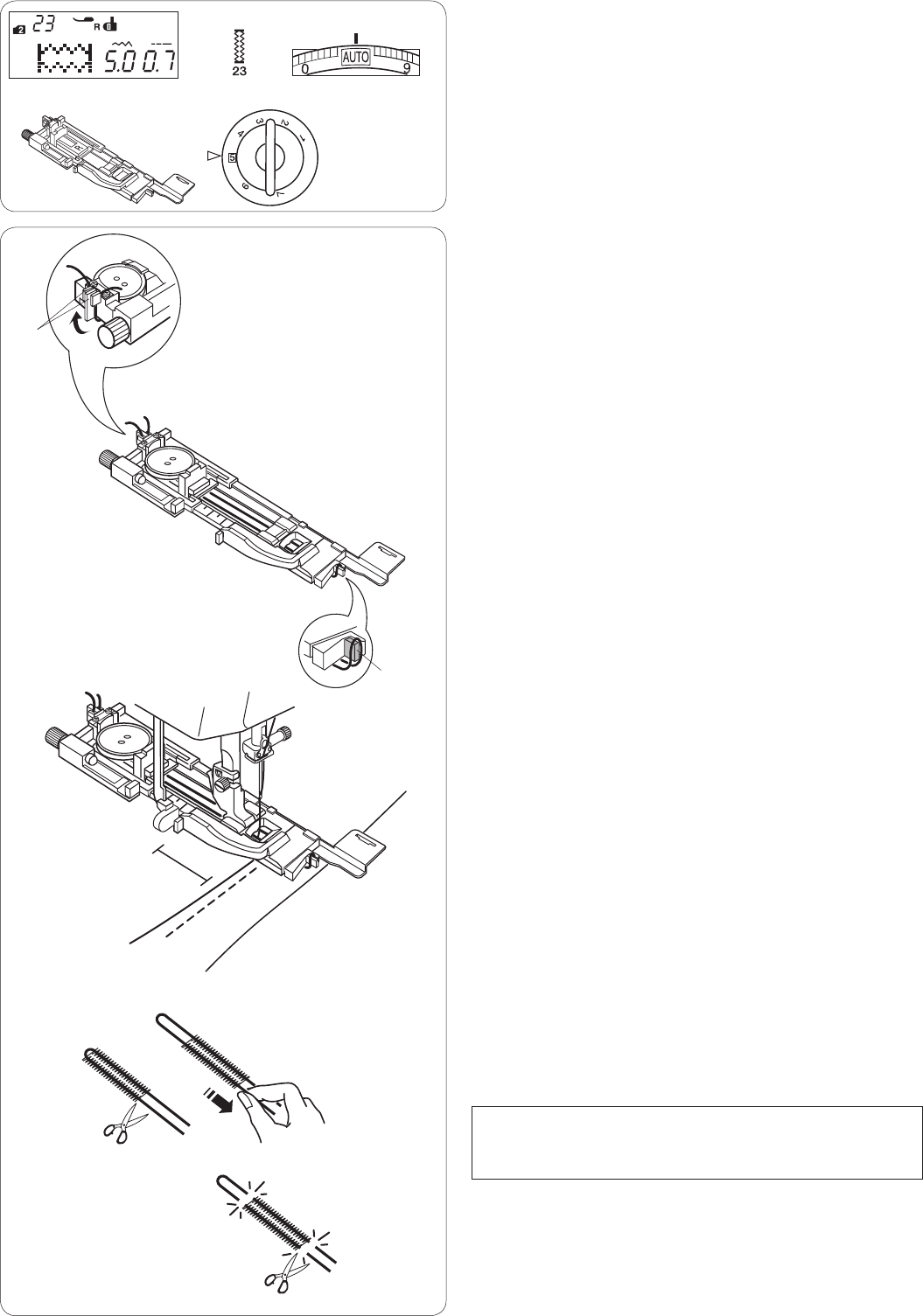
51
q
e
w
r
Corded Buttonhole
Machine settings
q Pattern: MODE 2: 23
w Thread tension: AUTO
e Presser foot: Automatic buttonhole foot R
r Foot pressure: 5
With the automatic buttonhole foot R raised, hook the filler
cord on the spur at the front of the buttonhole foot.
q
Spur
Bring the ends of the cord to the rear under the buttonhole
foot clearing the front end.
Bring up the ends of the cord and insert both ends
between the ribs and metal plate.
w
Metal plate
To sew a corded buttonhole, follow the same procedure
as a square buttonhole.
Lower the needle into the fabric where the buttonhole will
start and start sewing.
Remove the fabric from the machine.
Cut the filler cord at both ends.
To cut the buttonhole opening, refer to page 47.
NOTE:
Set the stitch width in accordance with the thickness
of filler cord used.
q
w
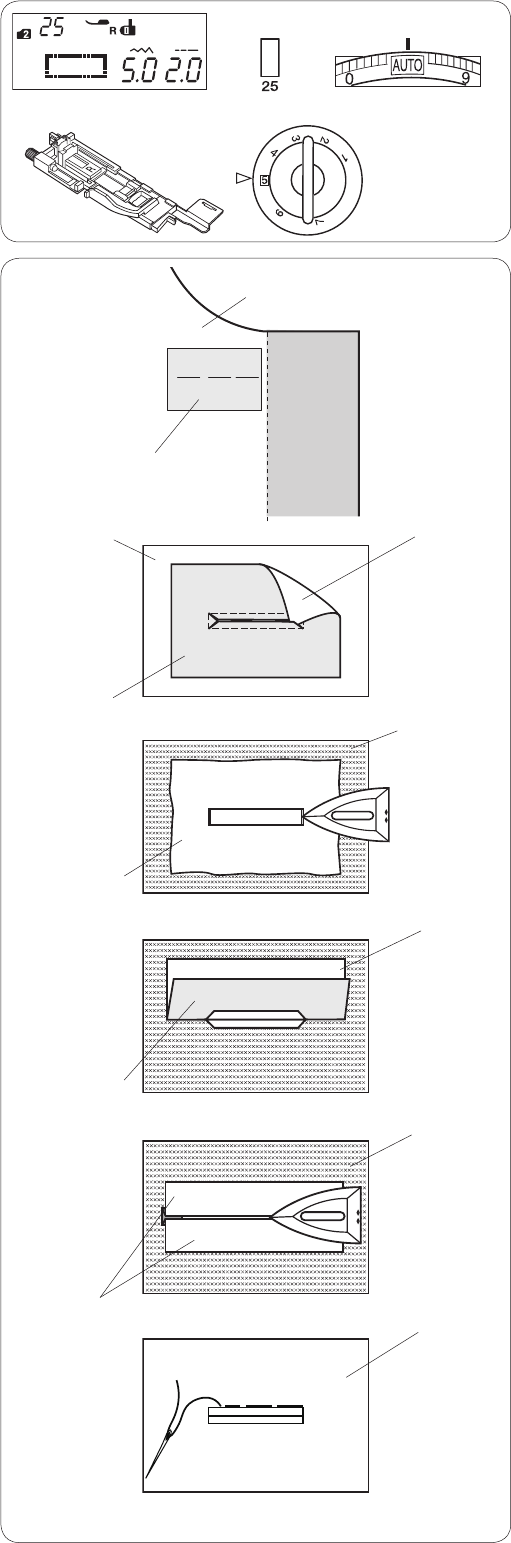
52
A welted buttonhole is made by stitching a strip or patch
of fabric to the buttonhole.
Welted buttonholes are particularly suitable for tailored
garments, but are not recommended for sheer or delicate
fabrics where the patch might show through or add bulk.
z Baste a patch to the garment fabric with the right
sides together.
q Wrong side of patch
w Right side of garment fabric
x Select pattern 25 (mode 2).
Sew the welted buttonhole on both fabrics together.
Cut the buttonhole opening as illustrated then pull the
patch out through the slit to the other side.
q Wrong side of patch
w Right side of garment fabric
e Right side of patch
c Pull out the patch until the right side of the patch is
showing. Use an iron to press both corner ends until
they are squared off.
e Right side of patch
r Wrong side of garment fabric
v Fold back each side of the patch to form buttonhole
lips.
q Wrong side of patch
e Right side of patch
q
e
w
r
Welted Buttonhole
Machine settings
q Pattern: MODE 2: 25
w Thread tension: AUTO
e Presser foot: Automatic buttonhole foot R
r Foot pressure: 5
q
w
w
q
e
e
r
q
e
r
e
w
b Press both folds with an iron.
e Right side of patch
r Wrong side of garment fabric
n Baste both edges of the seam with a needle and
thread by hand.
w Right side of garment fabric
z
x
c
v
b
n
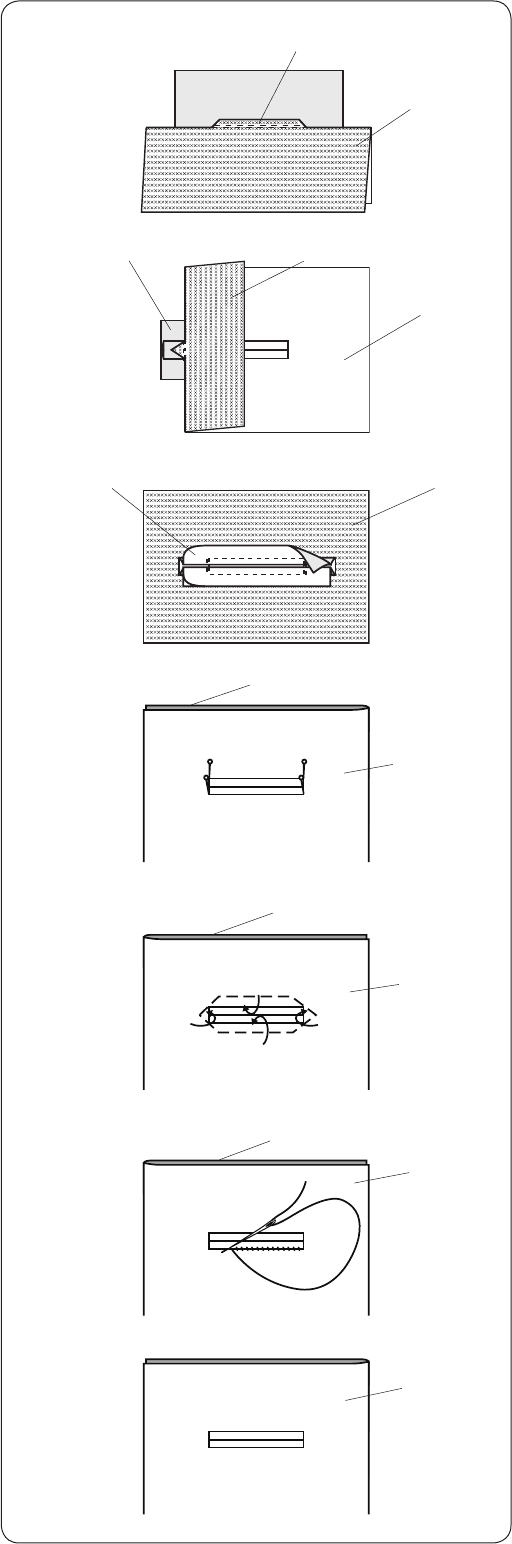
53
m Fold over the length of the garment fabric, sew back
and forth beside the original seam to secure flaps of
the patch.
r Wrong side of garment fabric
t Sew back and forth
r
t
qr
w
er
u
y
u
y
u
y
u
m
,
.
⁄0
⁄1
⁄2
⁄3
, Fold over the end of fabric and sew back and forth
three times over the triangular end.
q Wrong side of patch
w Right side of garment fabric
r Wrong side of garment fabric
. The patch should be cut 1 to 1.5 cm (7/16˝ – 5/8˝)
away from the hole. The corners should be cut
rounded off as shown.
e Right side of patch
r Wrong side of garment fabric
⁄0 Place the facing on the wrong side of the garment
fabric. Mark the 4 corners with pins as shown.
y Facing
u Garment fabric
⁄1 Turn all the layers over and cut the buttonhole opening
on the facing in the same way as step x.
Four marker pins show you the corner points on the
facing. Fold back each flap between the facing and
patch.
y Facing
u Garment fabric
⁄2 Stitch around the opening with a needle and thread as
shown.
y Facing
u Garment fabric
⁄3 The welted buttonhole is complete.
u Garment fabric
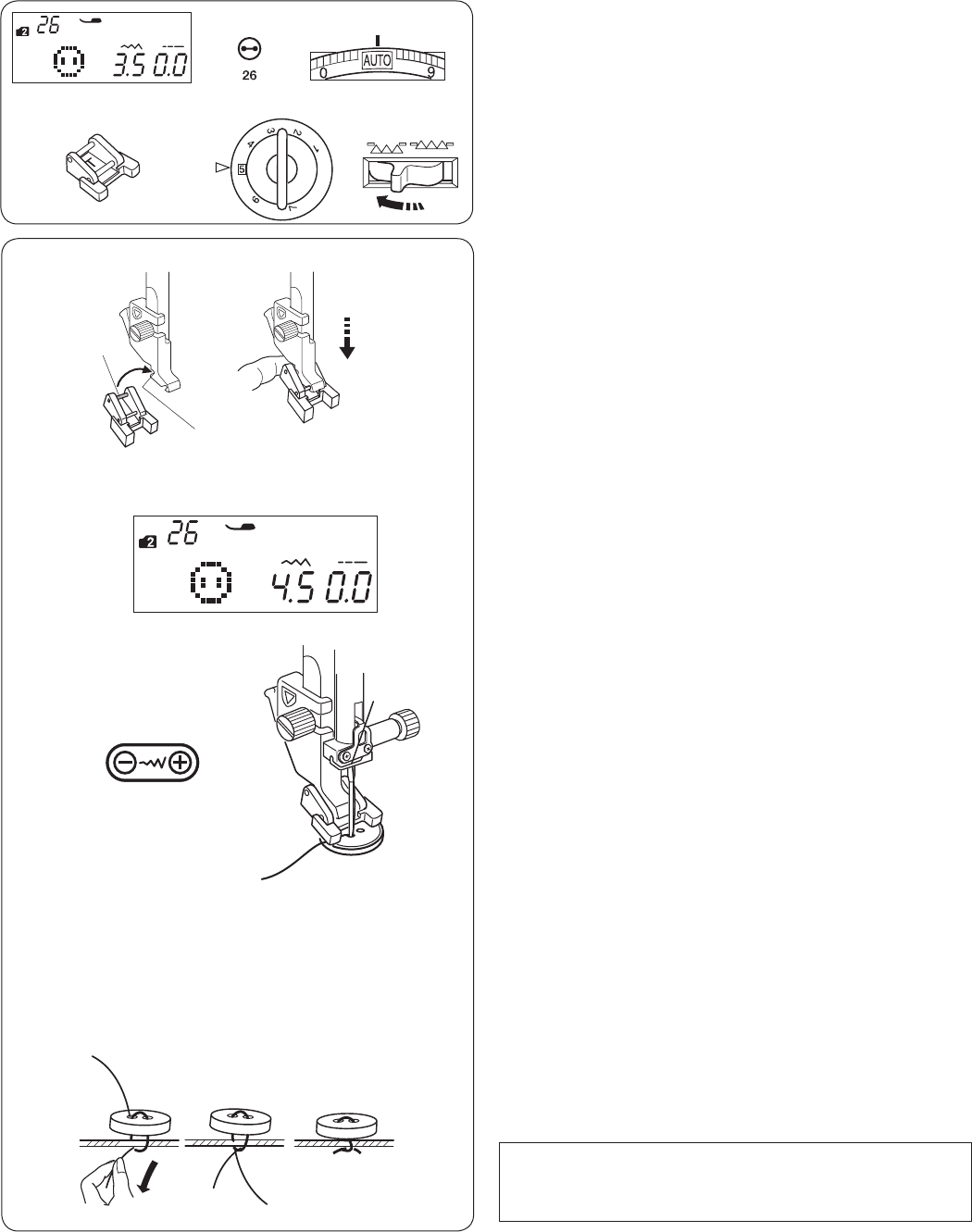
54
Button Sewing
Machine settings
q Pattern: MODE 2: 26
w Thread tension: AUTO
e Presser foot: Button sewing foot T
r Foot pressure: 5
t Feed dog: Lowered
q
w
q
e
w
r
Attaching the button sewing foot T
Insert the rear pin on the foot into the rear groove of the
foot holder.
q Rear pin
w Rear groove
Gently lower the presser bar while holding the foot with
your fingers.
Sewing
Lower the feed dog.
Place a button on the fabric and lower the needle into the
left hole of the button by turning the handwheel with your
hand.
Lower the foot to hold the button in place, aligning the
direction of the button.
Raise the needle by turning the handwheel until the
needle bar swings to the right.
Press the stitch width adjusting key so the needle enters
into the right hole of the button.
Start sewing and continue until the machine stops
automatically.
Remove the fabric from the machine.
t
NOTE:
Do not use the thread cutter button to cut the threads.
Otherwise, you cannot tie the threads.
Pull the bobbin threads to bring the needle threads down
to the wrong side of the fabric.
Tie the threads together.
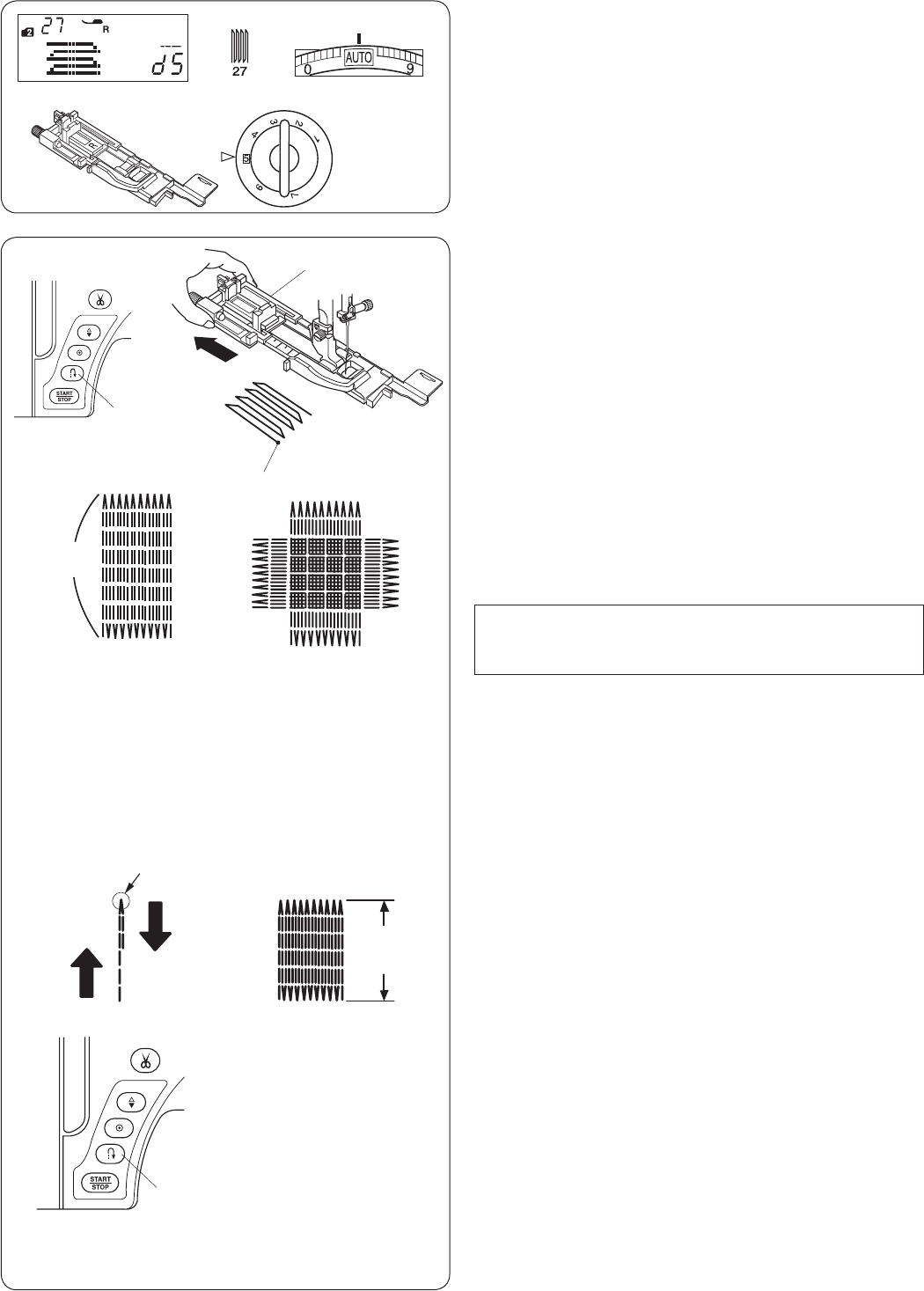
55
q
e
w
r
Darning
Machine settings
q Pattern: MODE 2: 27
w Thread tension: AUTO
e Presser foot: Automatic buttonhole foot R
r Foot pressure: 5
z Attach the automatic buttonhole foot R and pull the
button holder all the way out.
Place the fabric under the foot, and lower the needle
at the starting point. Then lower the foot.
q Button holder
w Starting point
x Start the machine and sew to the required length, then
press the reverse button. This sets the darning length.
Continue sewing until the machine stops automatically.
e Reverse button
r Required length
c Sew another layer of darning over the first layer, at a
right angle to it.
NOTE:
The maximum darning length is 2 cm (3/4˝) and the
maximum width is 0.9 cm (3/8˝).
w
q
r
z x c
To sew the same size darning
Simply start the machine to sew another darning in the
same size.
To sew the next darning in a different size, press the
memory key.
To sew a shorter darning
Sew the first line to the desired length and stop the
machine.
Press the reverse button and start the machine again.
The machine will sew the rest of the darning and stop
automatically.
e
r
e
r
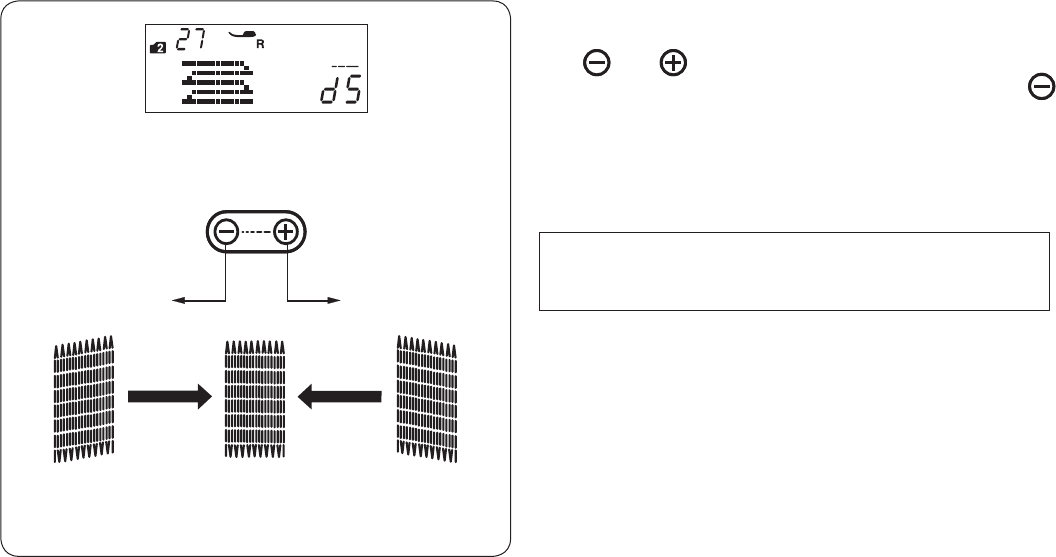
56
To adjust the evenness of darning stitches
Youcancorrectunevennessofdarningstitchesbypressing
the “ ” or “ ” key of the stitch length adjusting key.
If the left corner is lower than the right side, press the “ ”
key to correct it, and vice versa.
NOTE:
The evenness can be adjusted within d1 to d9
(default setting is d5).
d1–d4 d6–d9
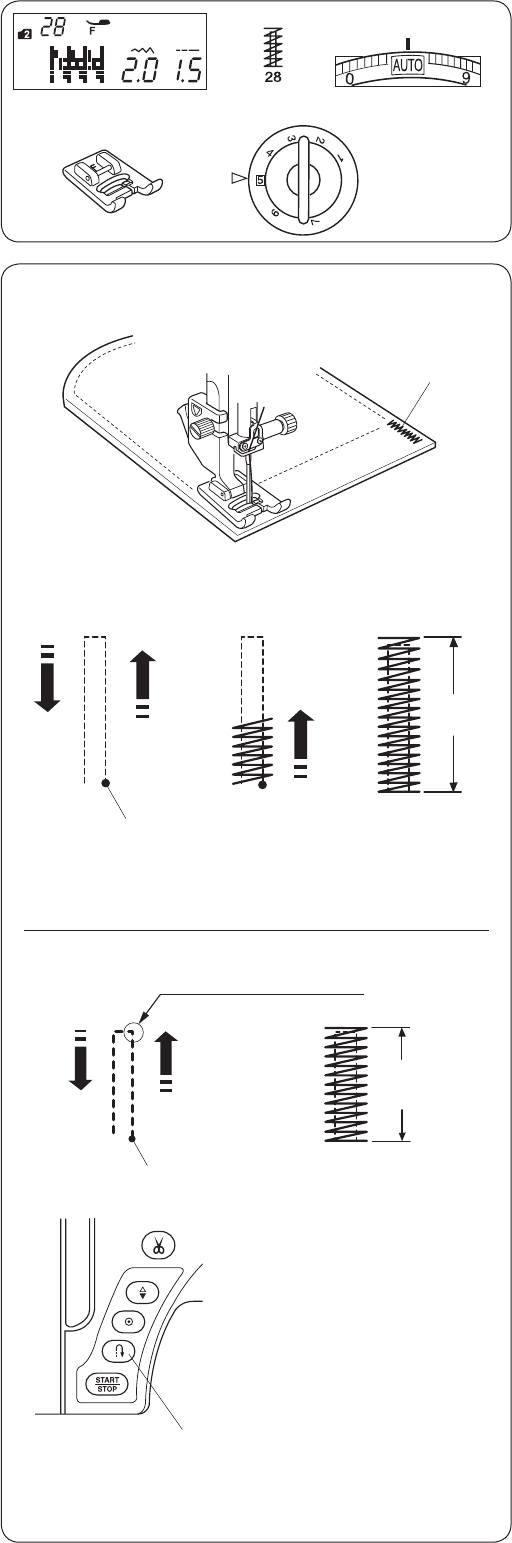
57
→ →
→
Tacking is used to reinforce pockets, crotch seams and
belt carriers where extra strength is needed.
Sewing
Lower the needle at the starting point.
Lower the foot and sew until the machine stops
automatically.
The machine will sew a tacking 1.5 cm (9/16˝) long
automatically.
q Tacking
w Starting point
e 1.5 cm (9/16˝)
q
e
w
r
Tacking
Machine settings
q Pattern: MODE 2: 28
w Thread tension: AUTO
e Presser foot: Satin stitch foot F
r Foot pressure: 5
w
e
q
w
e
r
Sewing a shorter tack
To sew a tack shorter than 1.5 cm (9/16˝), first stop the
machine after sewing the required length, and then press
the reverse button.
The required length has been determined.
Start the machine and continue sewing until the machine
stops automatically.
q Starting point
w Required length
e Tack length
r Reverse button
Sewing the same size tack
To sew another tack at the same size, simply start the
machine and it will stop automatically when finishing
sewing.
Sewing the tack at a different size
To sew the next tack at a different size, press the memory
key to memorize a new size and start sewing from the
beginning.
q
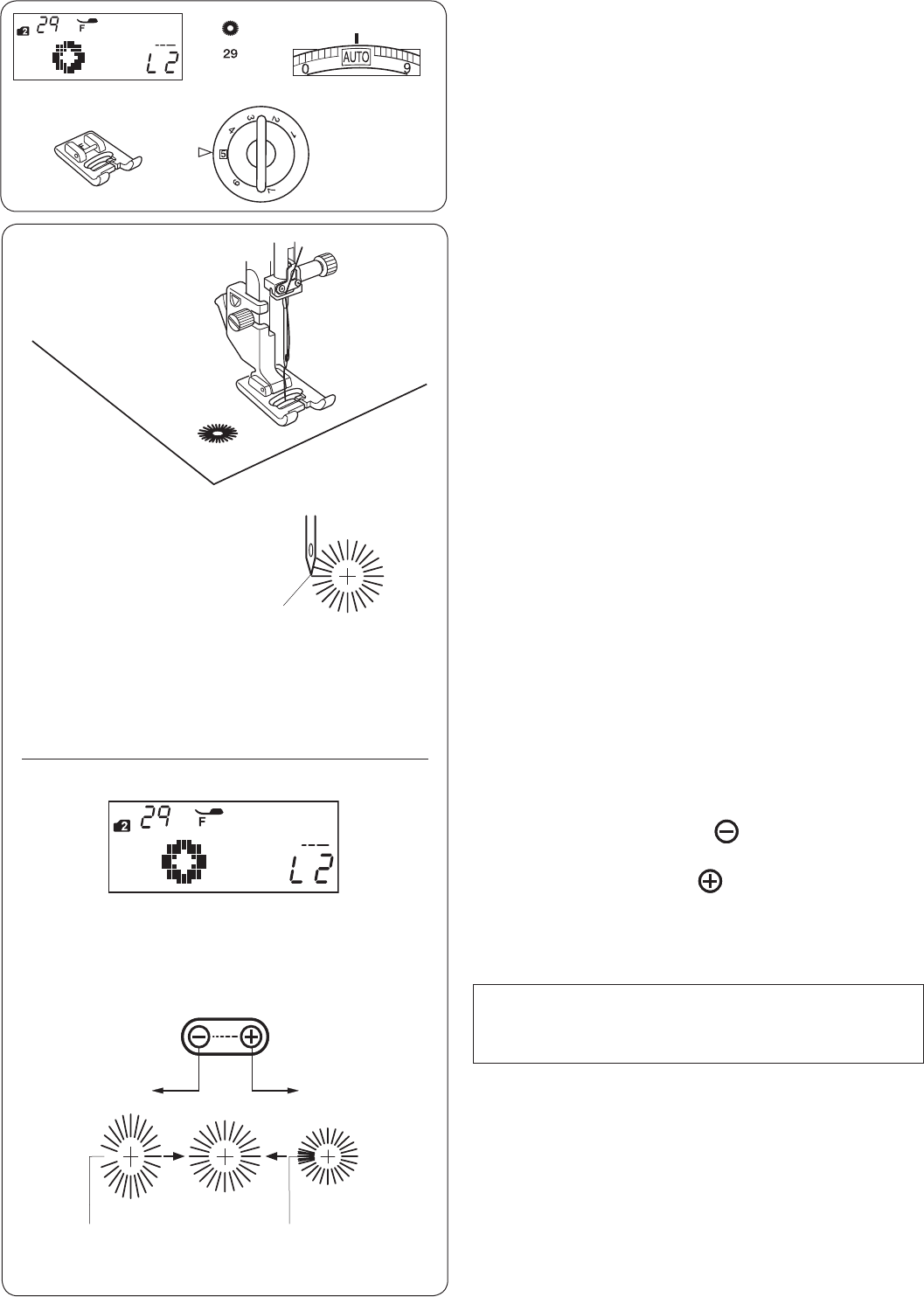
58
Adjusting the shape of an eyelet
Correct the shape of the eyelet as follows:
If the eyelet gap opens, press “ ” on the stitch length
adjusting key.
If the eyelet overlaps, press “ ” on the stitch length
adjusting key.
q Eyelet gap opens
w Eyelet overlaps
NOTE:
The shape can be adjusted within L1 to L3 (default
setting is L2).
The eyelet is used for belt holes etc.
Sewing
Sew until the machine stops automatically.
Open the eyelet with an eyelet puncher or pointed
scissors.
q Starting point
q
e
w
r
Eyelet
Machine settings
q Pattern: MODE 2: 29
w Thread tension: AUTO
e Presser foot: Satin stitch foot F
r Foot pressure: 5
qw
q
L1 L3
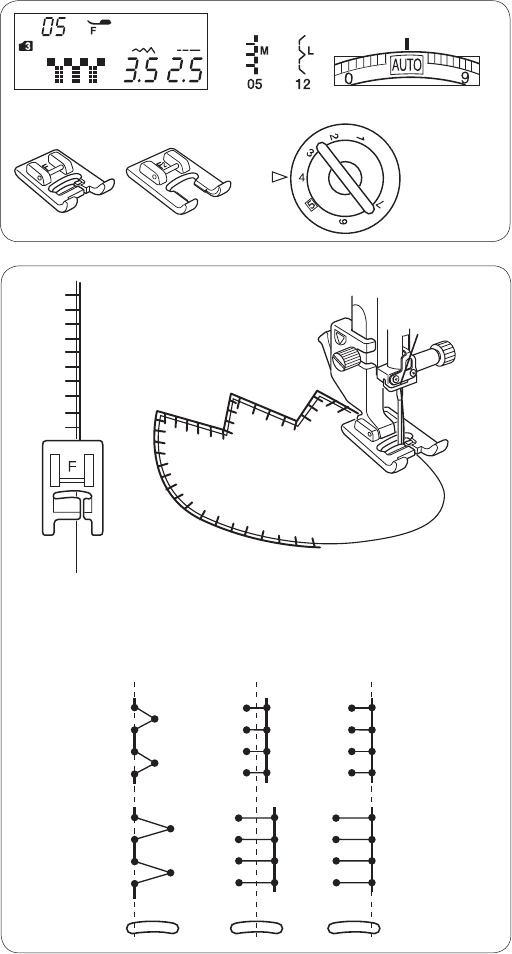
59
q
e
w
r
Applique
Machine settings
q Pattern: MODE 3: 05-12
w Thread tension: AUTO
e Presser foot: Satin stitch foot F or
Open-toe satin stitch foot F2
r Foot pressure: 4
–
Place an applique on the fabric and baste it in place or
use a fusible web to secure the applique in place.
Guide the applique fabric, so that the needle falls off the
edge of the applique when the needle swings to the right.
(A): The pattern number 12 (mode 3) has a fixed left
needle drop position. When you change the stitch
width, the right needle drop position will change.
(B): The patterns number 05, 06 and 10 (mode 3) have a
fixed center needle drop position.
The stitch width changes symmetrically.
(C): The patterns number 07, 08, 09 and 11 (mode 3)
have a fixed right needle drop position. When you
change the stitch width, the left needle drop position
will change.
(B) (C)
(A)
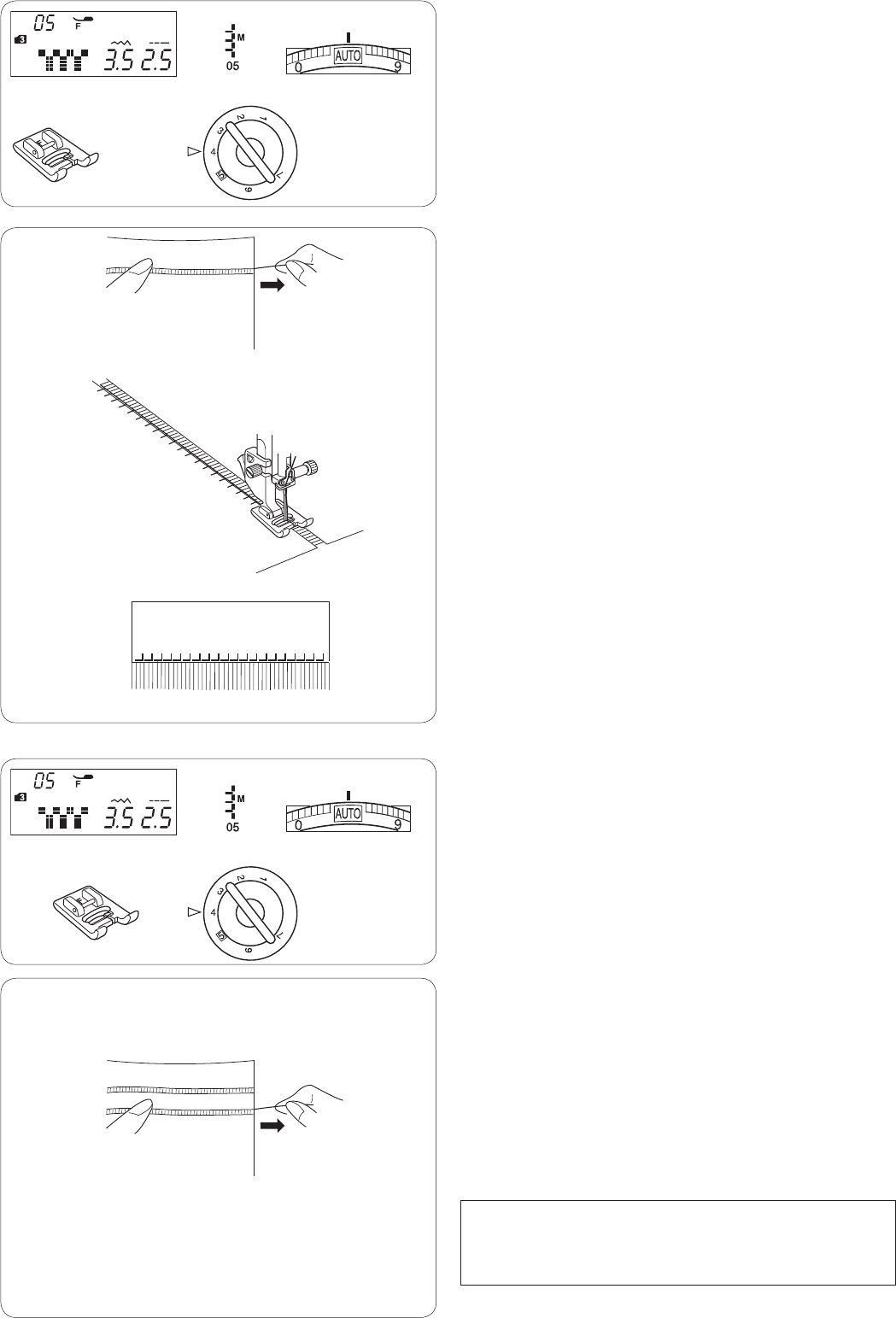
60
q
e
w
r
Fringing
Machine settings
q Pattern: MODE 3: 05
w Thread tension: AUTO
e Presser foot: Satin stitch foot F
r Foot pressure: 4
Fringing adds a special touch on table linens and shawls.
Choose a firm, woven fabric like linen where threads can
be removed easily.
Carefully cut the fabric on the grain. Remove a single
strand of yarn or thread where the fringing is to begin.
Sew down the left side so the right hand stitches fall in
the open space.
q
e
wDrawn Work
Machine settings
q Pattern: MODE 3: 05
w Thread tension: AUTO
e Presser foot: Satin stitch foot F
r Foot pressure: 4
Drawn work uses the same method as fringing. Choose
a firm, woven fabric like linen where threads can be
removed easily.
z Carefully cut the fabric on the grain. Determine the
width of the drawn work and remove one strand of
yarn or fabric thread at each end.
Remove all excess yarn located to the right of the
stitching and create a fringe.
z
r
NOTE:
Pull up the bobbin thread and draw a 10 cm (4˝)
thread tail to the back before starting to sew.
Use the thread cutter on the face plate.
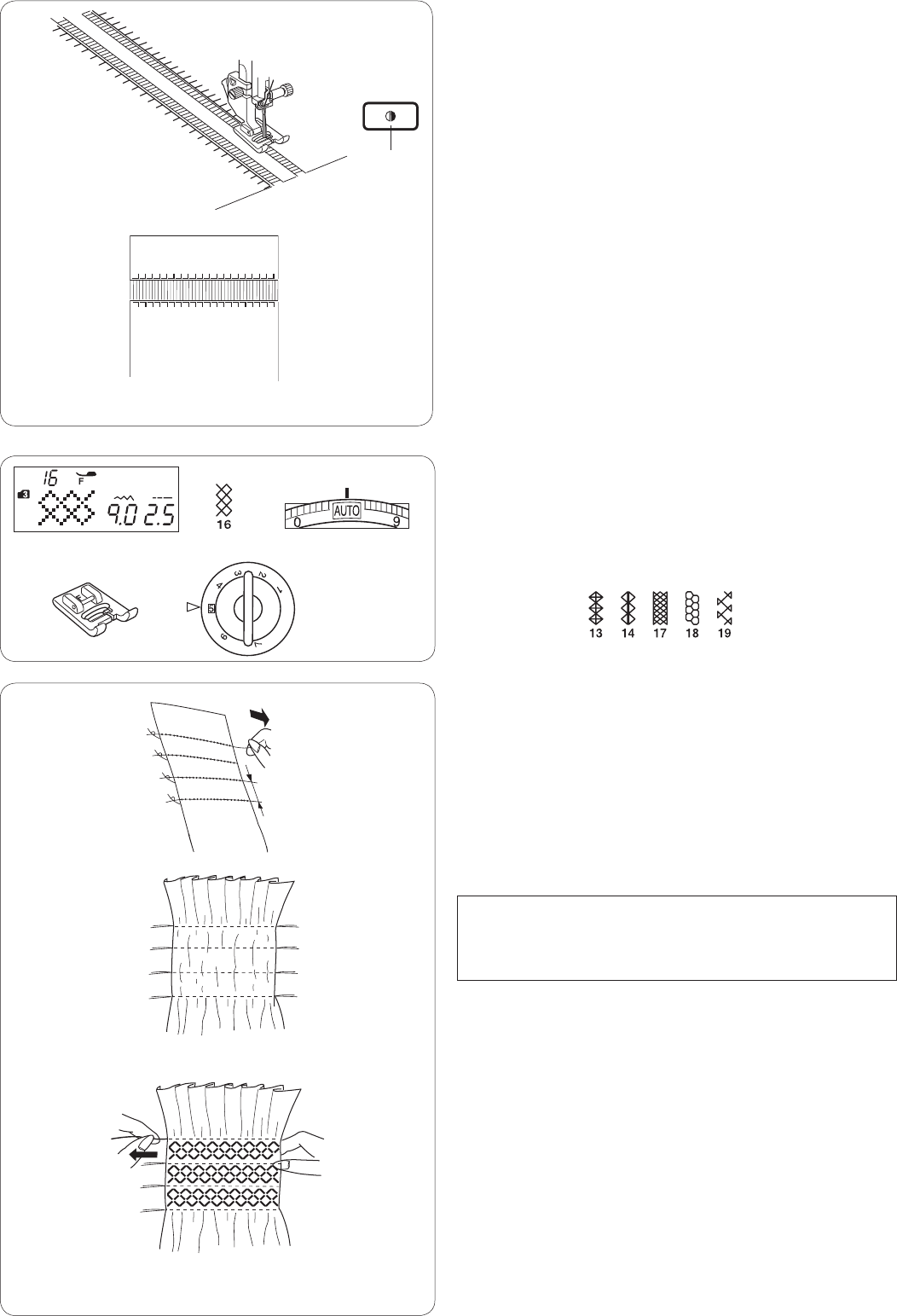
61
Choose a soft, lightweight fabric such as batiste, gingham
or challis. Cut the fabric three times wider than the
projected width.
Sew rows of straight stitches, 1 cm (3/8˝) apart with the
stitch length “5.0” and thread tension dial at “1” to across
the area to be smocked.
q 1 cm (3/8˝)
Tie the threads along one edge. From the other edge, pull
the bobbin threads to distribute the gathers evenly.
NOTE:
Pull up the bobbin thread and draw a 10 cm (4˝) thread
tail to the back before starting to sew.
Use the thread cutter on the face plate.
Smocking
Machine settings
q Pattern: MODE 3: 16
w Thread tension: AUTO
e Presser foot: Satin stitch foot F
r Foot pressure: 5
* Stitch patterns (mode 3) can also be
used.
q
e
w
r
x Sew down the left side, guiding the fabric so the right
hand stitches fall in open space. After finishing the left
side, press the mirror image key. Sew down the other
side (refer to page 73 for mirror image sewing).
q Mirror image key
c Remove the yarn or fabric threads between the
stitching.
x
c
q
q
Select a smocking stitch and return the thread tension
dial to “AUTO”.
Sew the smocking stitches between the gathered rows.
Remove the straight stitches between the gathered rows.
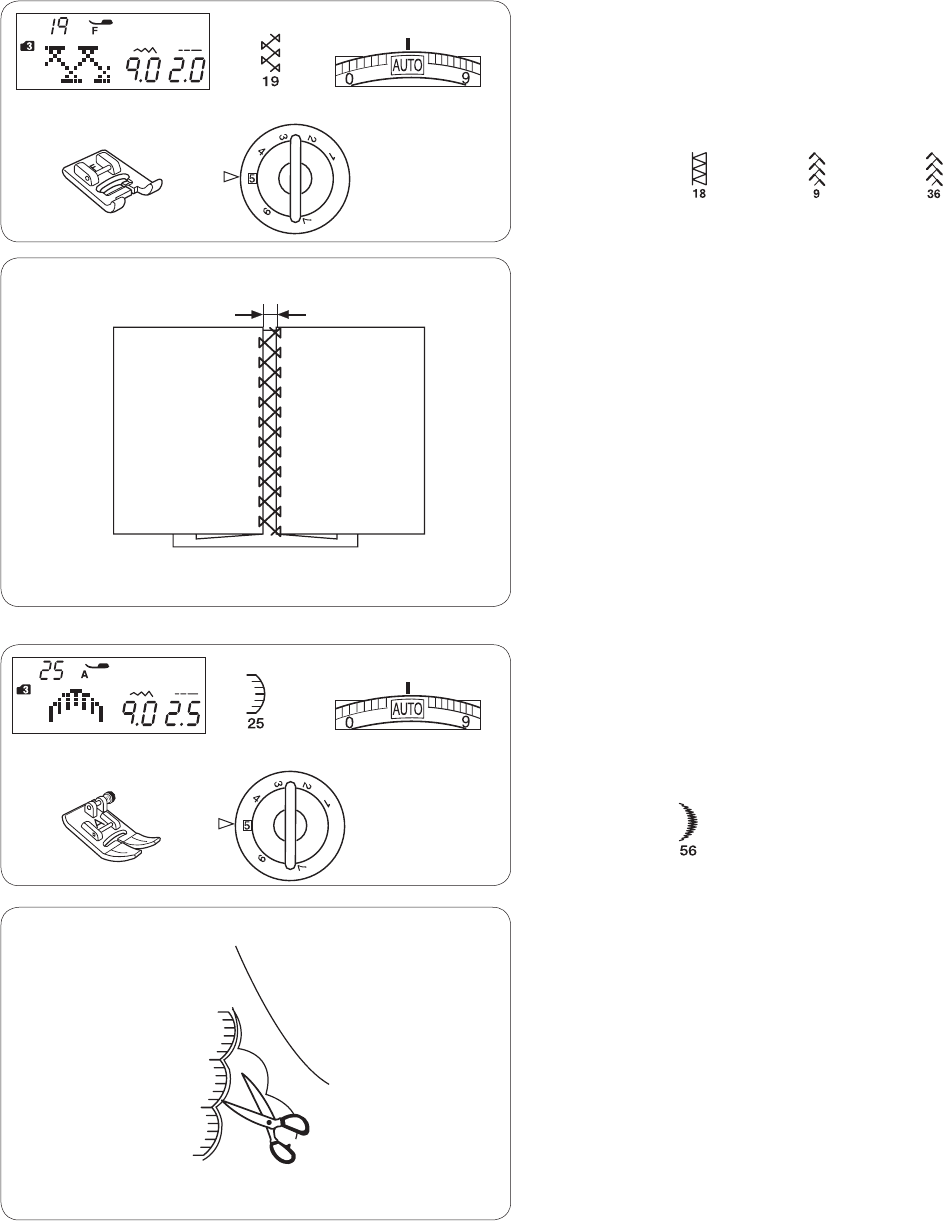
62
Fagoting
Machine settings
q Pattern: MODE 3: 19
w Thread tension: AUTO
e Presser foot: Satin stitch foot F
r Foot pressure: 5
* Stitch patterns (mode 2), (mode 1) (mode 3)
can also be used.
q
e
w
r
Use this stitch to join two pieces of fabric to create an
open work appearance and add design interest.
Fold under each fabric edge 1.5 cm (5/8˝) and press.
Pin the two edges to paper or tear away backing 0.5 cm
(3/16˝) apart.
q 0.5 cm (3/16˝)
Sew slowly, guiding the fabric so the needle catches the
folded edge on each side.
After finishing sewing, tear away the paper.
Scallop
Machine settings
q Pattern: MODE 3: 25
w Thread tension: AUTO
e Presser foot: Zigzag foot A
r Foot pressure: 5
* Stitch pattern (mode 3) can also be used.
q
e
w
r
Sew scallops 1 cm (3/8˝) from the fabric edge.
Trim the allowance close to the stitches.
Make sure not to cut the stitches.
q
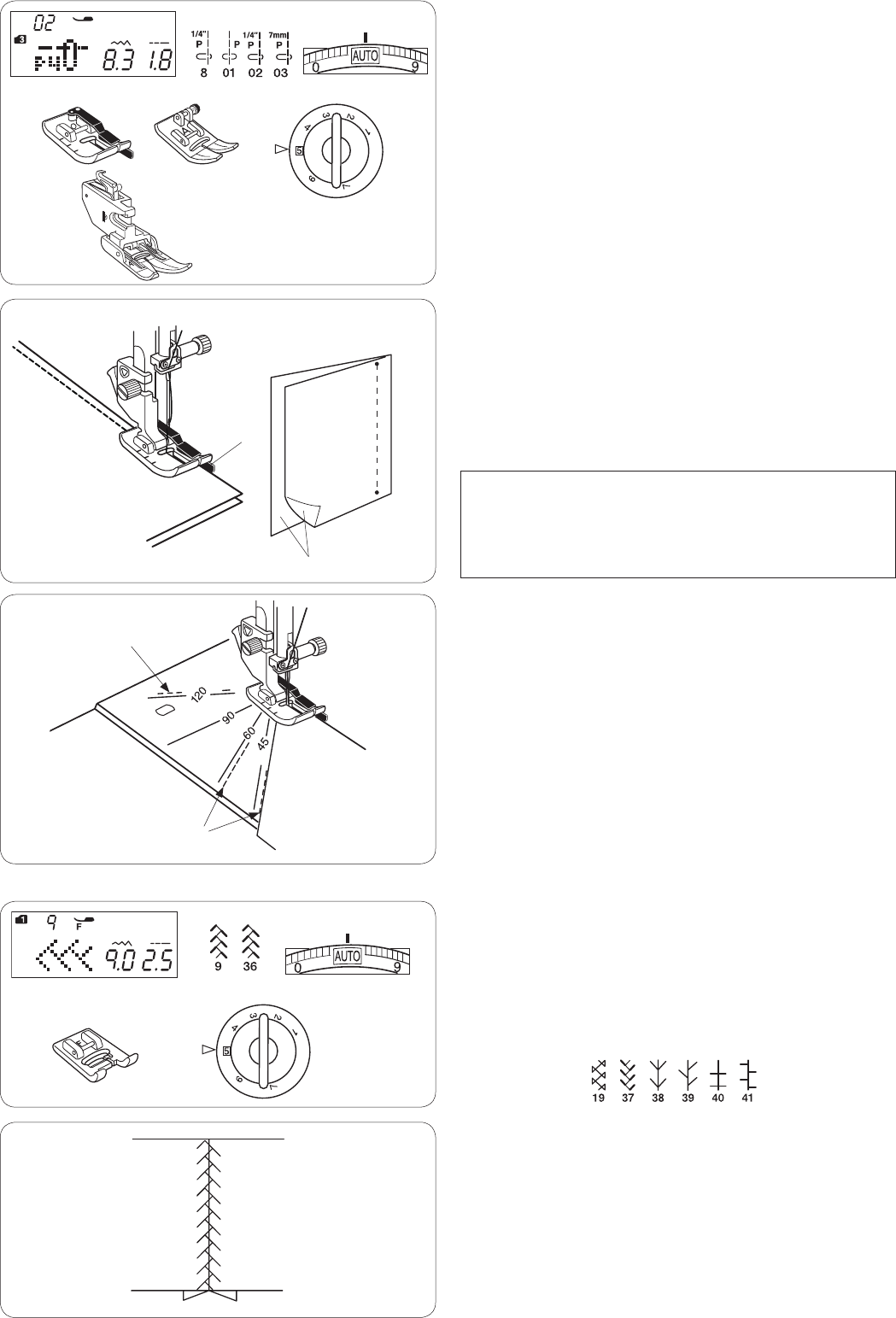
63
Patchwork
Machine settings
q Pattern: MODE 1: 9
MODE 3: 36
w Thread tension: AUTO
e Presser foot: Satin stitch foot F
r Foot pressure: 5
* Stitch patterns (mode 3) can also
be used.
Patchwork Piecing
Machine settings
q Pattern: MODE 1: 8
MODE 3: 01, 02, 03
w Thread tension: AUTO
e Presser foot: 1/4˝ seam foot O or
Zigzag foot A or
Dual feed foot AD
r Foot pressure: 5
q
e
w
r
•Patchworkpiecing
Select pattern 8 (mode 1).
Place the patchwork pieces right sides together. Sew
while guiding the edge of the fabric along the guide on
the foot to keep a precise 1/4˝ seam allowance.
q Guide
w Right sides of the fabric
w
•Angle scales on the needle plate
Youcaneasilyseampatchworkpiecesatthedesired
angle without marking, by using the angle scales on the
needle plate.
The angle scales are marked at 45, 60, 90 and 120
degrees.
Use the broken lines when piecing the patchwork pieces
with the 1/4˝ seam foot O as illustrated.
q Broken line
q
q
e
w
r
•Patchwork
Open the seam flat with the right side up and sew
patchwork stitch along the seam line.
q
q
NOTE:
Use 1/4˝ seam foot O for the stitch pattern 8 in mode
1 and 02, 03 in mode 2.
Use Zigzag foot or Dual feed foot AD for stitch pattern
01.
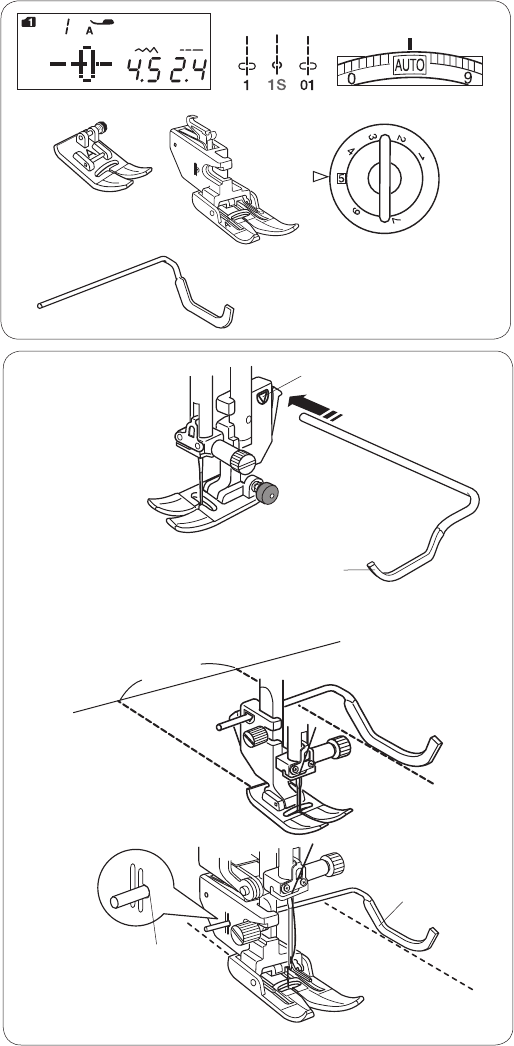
64
Attaching the quilting guide bar
The quilting guide bar is helpful when sewing parallel,
evenly spaced rows of stitching.
Insert the quilting guide bar into the opening and slide the
quilting guide bar to the position according to the desired
space between seams.
q Opening on the foot holder
w Quilting guide bar
e Space between seams
Quilting
Machine settings
q Pattern: MODE 1: 1, 1S
MODE 2: 01
w Thread tension: AUTO
e Presser foot: Zigzag foot A or
Dual feed foot AD
r Foot pressure: 5
t Quilter
q
e
w
r
t
q
w
eSewing
Sew while tracing the previous seam with the quilting
guide bar.
Quilting guide bar for dual feed foot
Insert the quilting guide bar into the hole in the rear of the
foot holder.
Shift the quilting guide bar to the desired spacing.
q Quilting guide bar
w Hole
w
q
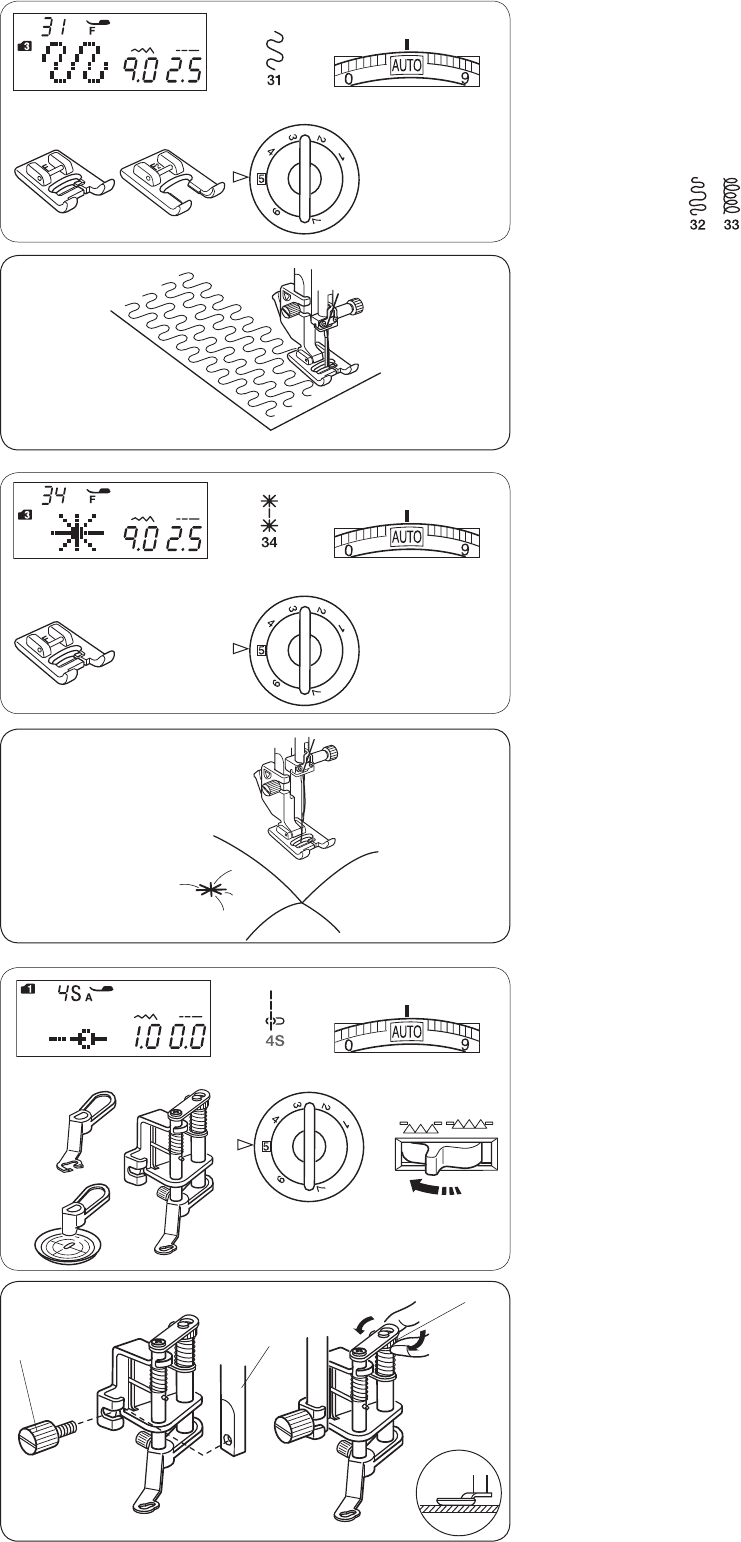
65
Stippling
Machine settings
q Pattern: MODE 3: 31
w Thread tension: AUTO
e Presser foot: Satin stitch foot F or
Open-toe satin stitch foot F2
r Foot pressure: 5
* Stitch patterns (mode 3) can also be used.
q
e
w
r
A pre-programmed stippling stitch is a fast and easy
method to quilt small areas.
Place a quilt layer and sew.
Free Motion Quilting (1)
Machine settings
q Pattern: MODE 1: 4S
w Thread tension: AUTO
e Presser foot: Convertible free motion quilting
foot QB-S
r Foot pressure: 5
t Feed dog: Lowered
q
e
w
r
Attaching the convertible free motion quilting foot
Attach the needle plate for straight stitch (refer to page 16).
Loosen the setscrew and remove the foot holder.
Attach the convertible free motion quilting foot to the
presser bar and tighten the setscrew firmly with the
screwdriver.
Place the fabric under the foot.
Adjust the height of the foot by turning the round nut until
bottom of the foot barely touches top of the fabric.
q Setscrew
w Presser bar
e Round nut
qw
e
t
q
e
w
r
Clasp Stitches
Machine settings
q Pattern: MODE 3: 34
w Thread tension: AUTO
e Presser foot: Satin stitch foot F
r Foot pressure: 5
Youcanclosequiltlayersandusingtheclaspstitch.
Select stitch pattern 34 (mode 3). Press the memory key.
Select locking stitch (pattern 93 (mode 3)).
Start sewing.
The machine sews clasp stitch and locking stitch then
stops automatically.
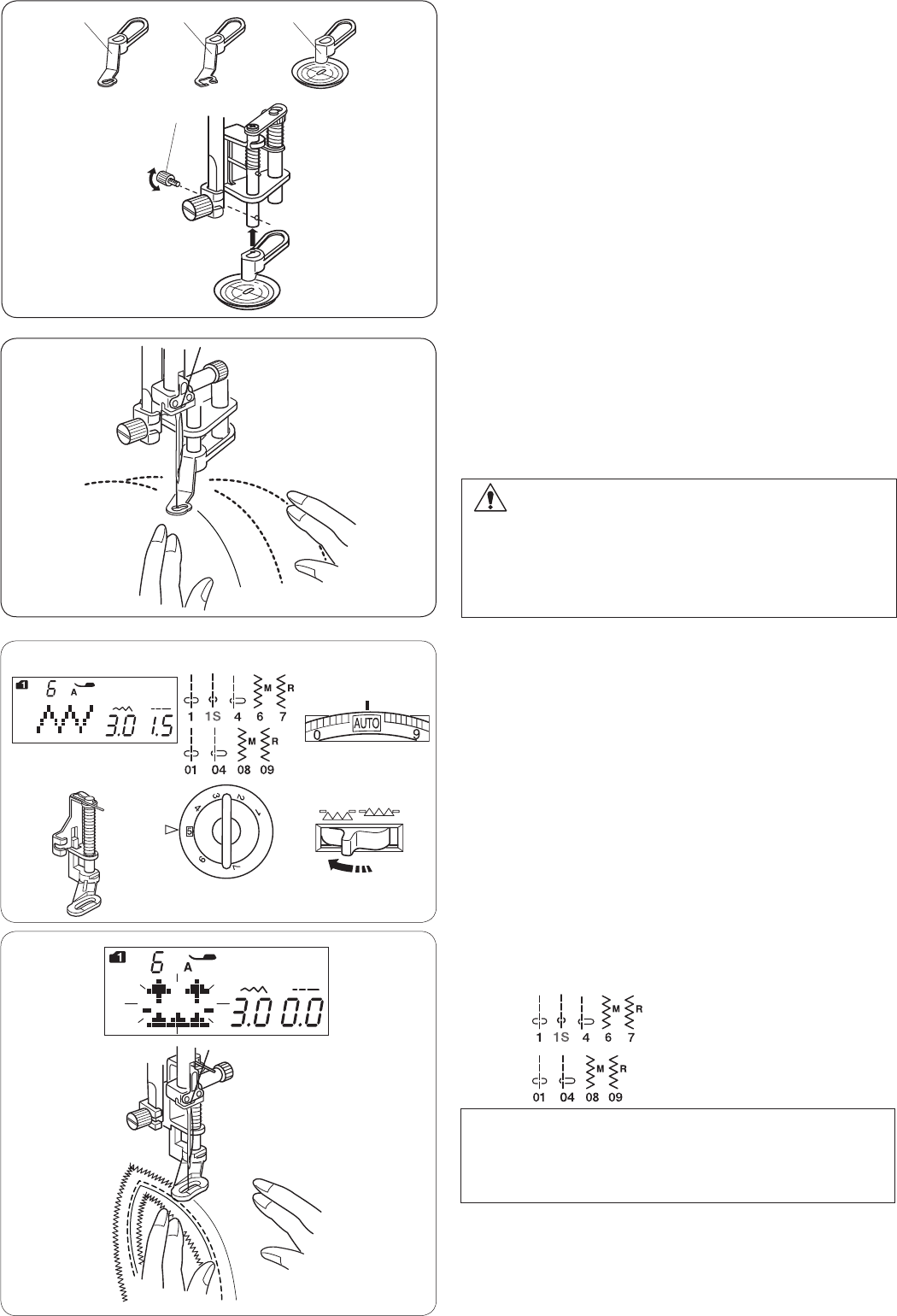
66
Changing the foot
This foot is comes with the closed-toe foot attached,
however, it is convertible to the open-toe foot and clear
view foot.
To change the foot, raise the foot and turn the round nut
to bring the foot to the lowest position.
Remove the setscrew and remove the closed-toe foot.
Attach the desired foot and secure it with the setscrew.
Adjust the height of the foot (refer to page 65).
q Setscrew
w Closed-toe foot
e Open-toe foot
r Clear view foot
Sewing
Baste or pin the quilt layers. Draw a quilt design on the
top fabric with a washable maker.
Sew at medium speed while guiding the quilt layers with
your hands.
Move the quilt layers 3 mm (1/8˝) or less per stitch.
q
w e r
Free-quilting with darning foot PD-H
Use the darning foot PD-H when sewing following stitch
patterns:
CAUTION:
Do not select any pattern other than the straight stitch
with left needle position when the closed-toe or open-
toe foot is attached.
Do not move the quilt layers toward you when the
open-toe foot is attached.
NOTE:
A message appears when starting the machine with
the feed dog lowered.
Start sewing again to proceed sewing.
Free Motion Quilting (2)
Machine settings
q Pattern: MODE 1: 1, 1S, 4, 6, 7
MODE 2: 01, 04, 08, 09
w Thread tension: AUTO
e Presser foot: Darning foot PD-H
r Foot pressure: 5
t Feed dog: Lowered
q
e
w
rt
The sewing procedure is the same as the free motion
quilting (1) (see above).
Mode 1:
Mode 2:
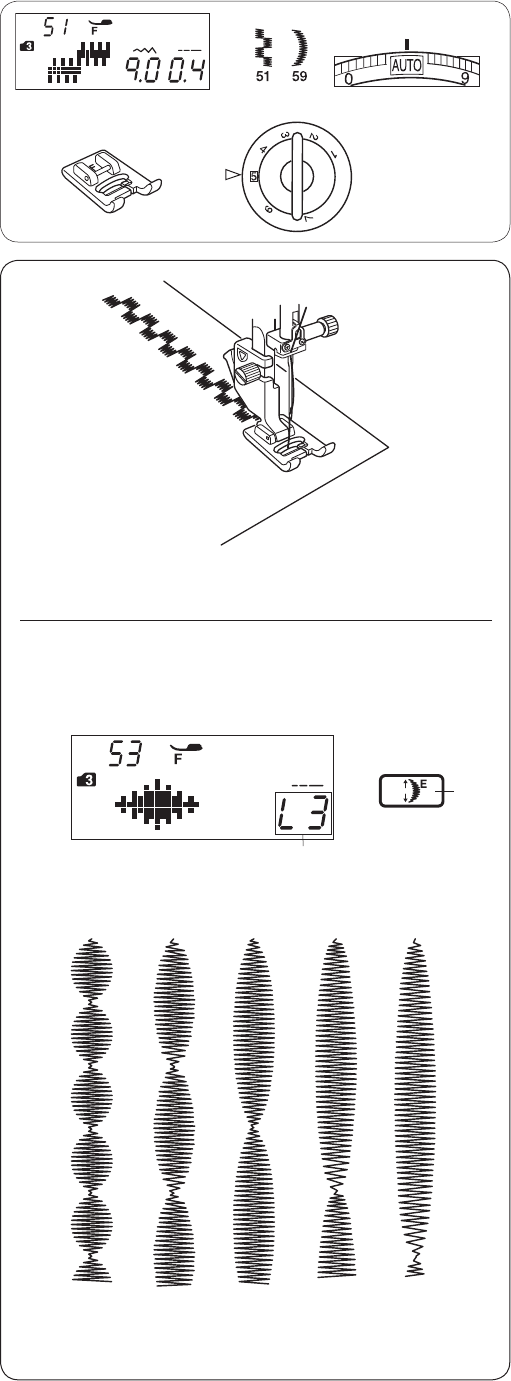
67
Satin Stitches
Machine settings
q Pattern: MODE 3: 51 – 59
w Thread tension: AUTO
e Presser foot: Satin stitch foot F
r Foot pressure: 5
q
e
w
r
−
Patterns 51–59 can be elongated up to 5 times their
original length while the stitch density remains the same.
Elongation ratio
Example: Pattern number 53 (mode 3)
Select pattern number 53 (mode 3).
Press the elongation key to select the desired elongation
ratio.
Elongation ratio is indicated in multiples of the original
pattern length; L1 (original length) to L5.
q Elongation key
w Elongation ratio
The stitch length and width can also be changed.
w
q
L1 L2 L3 L4 L5
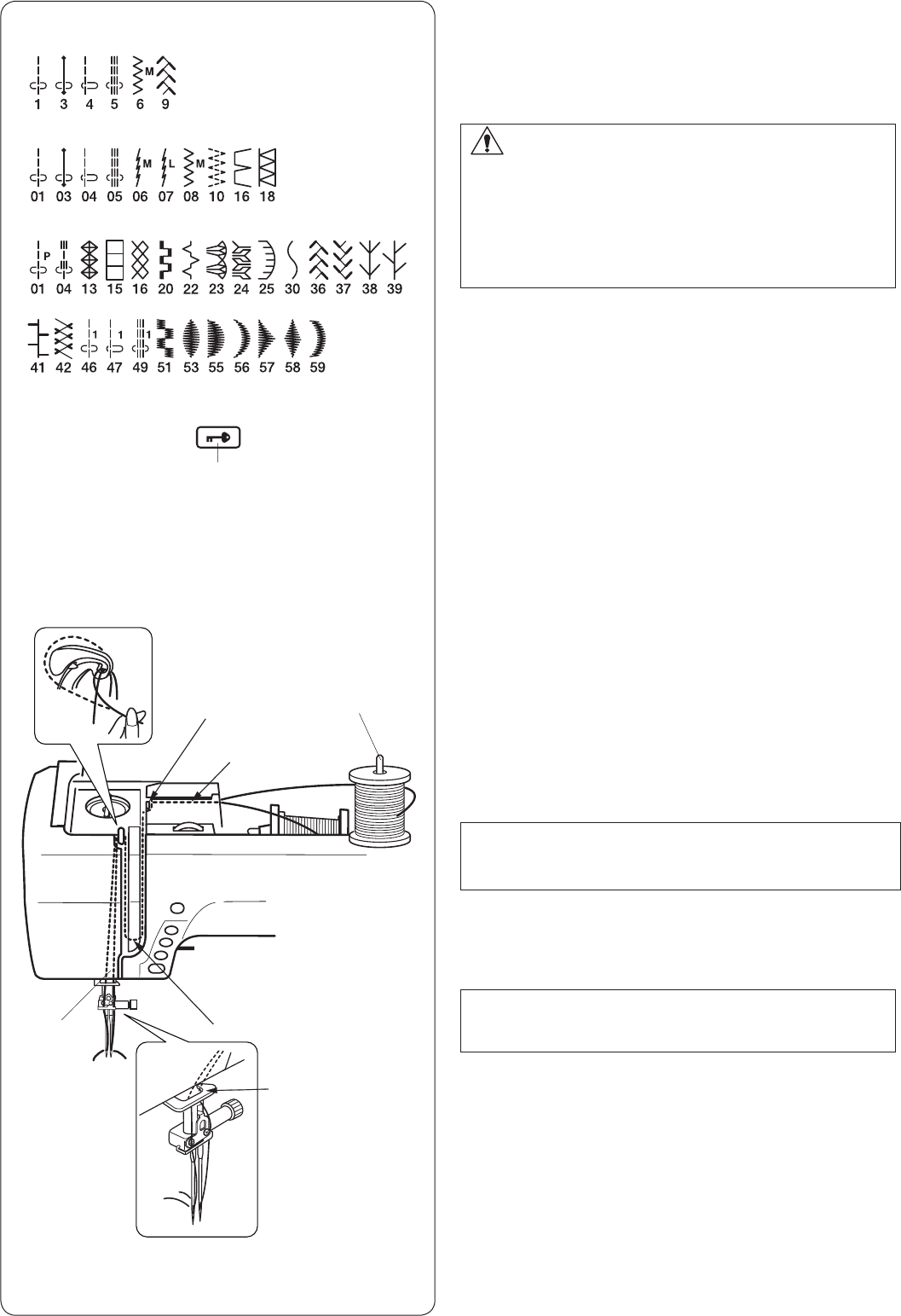
68
Twin Needle Sewing
The utility stitches and decorative stitches shown on the
left can be sewn with a twin needle.
Replace the needle with the twin needle supplied with
the standard accessories.
CAUTION:
Turn the power switch off or press the lockout key
before changing the needle.
Do not use twin needles other than one included in
the standard accessories, otherwise the needle may
hit the needle plate, foot or hook and break.
q Lockout key
w
z
x
v
c
b
b
q
Insert the extra spool pin into the hole beside the
horizontal spool pin.
Place a spool of thread on the extra spool pin and fix the
spool with the spool holder.
w Extra spool pin
Draw both threads from the spools and pass them
through the threading points from z to b.
Make sure that the two strands of thread from the spools
do not get tangled.
NOTE:
Threading from points z to b is the same as for a
single needle (refer to page 21).
Slip one of the threads through the needle bar thread
guide on the left, and the other one on the right.
Thread the needles from front to back.
NOTE:
The needle threader cannot be used with the twin
needle.
Mode 1
Mode 2
Mode 3
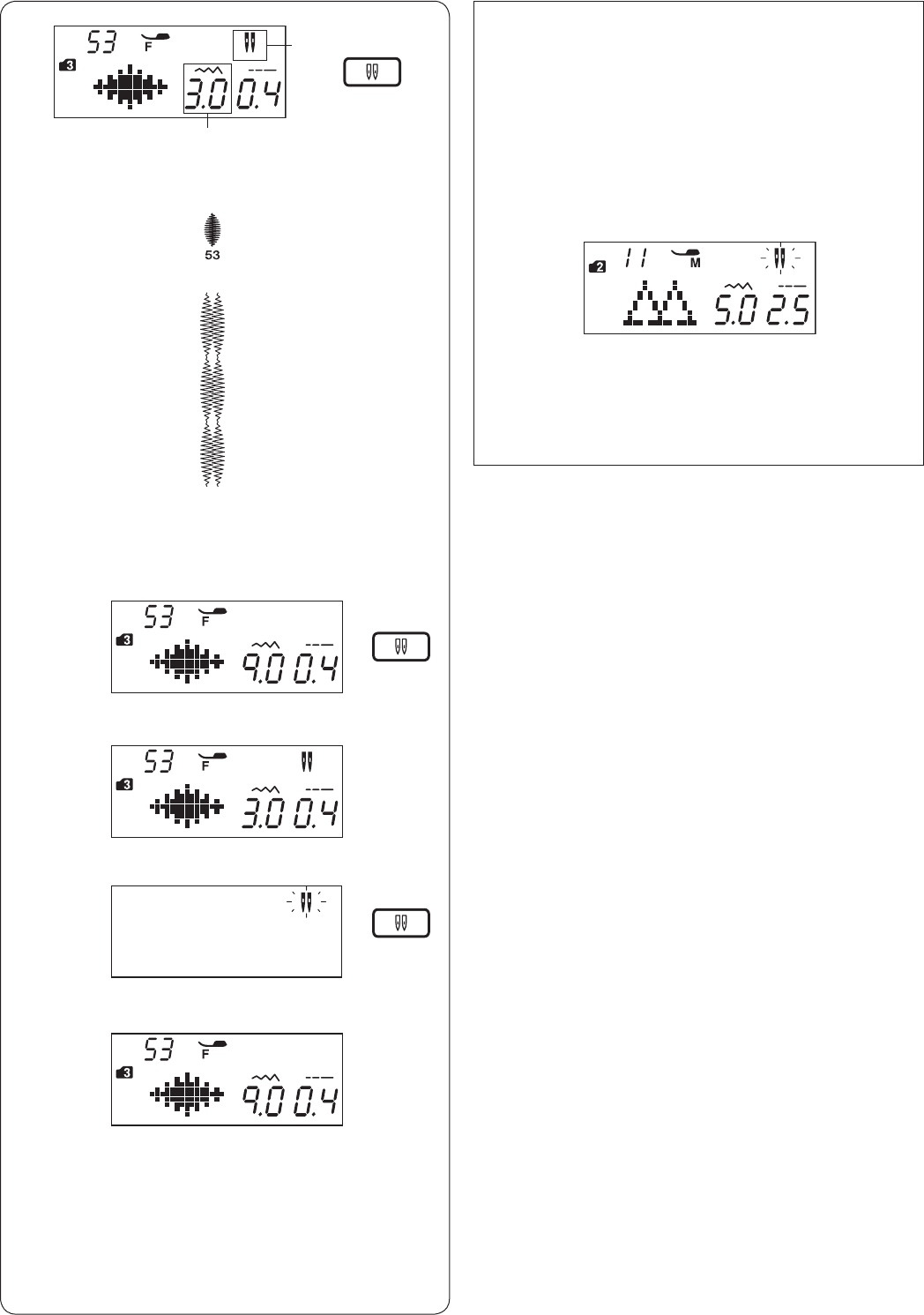
69
•Stitchpatternscannotbememorizedinthetwin
needle mode.
•Usethethreadcutteronthefacecoverwhen
trimming threads.
•Usenethreads#60orlargernumberforthetwin
needle sewing.
NOTES:
•Whenyousewpatternswiththetwinneedle,test
the stitches first before you sew on the garment.
•UsethezigzagfootAorsatinstitchfootFfortwin
needle sewing.
•Whenchangingthesewingdirection,raisethe
needle and presser foot then turn the fabric.
•Whenyouselectstitchpatternsnotfortwinneedle
sewing and press the twin needle key, the twin
needle mark will blink on the LCD screen and the
caution buzzer sound.
Buttonholes and specialty stitches such as darning or
eyelet, and monogram cannot be selected.
e Twin needle key
r Twin needle icon
t Maximum width (3.0)
Select the desired pattern suitable for twin needle
sewing.
Press the twin needle key.
e
r
t
The LCD screen shows a twin needle icon and the
maximum permissible stitch width is restricted to 3.0 mm.
The needle drop position of straight stitches is restricted
to between 3.0 and 6.0.
After twin needle sewing is finished, press the twin
needle key. The twin needle icon blinks.
Replace the twin needle with a single needle.
Turn off and on the power switch or press the twin needle
key to return to the single stitch mode.
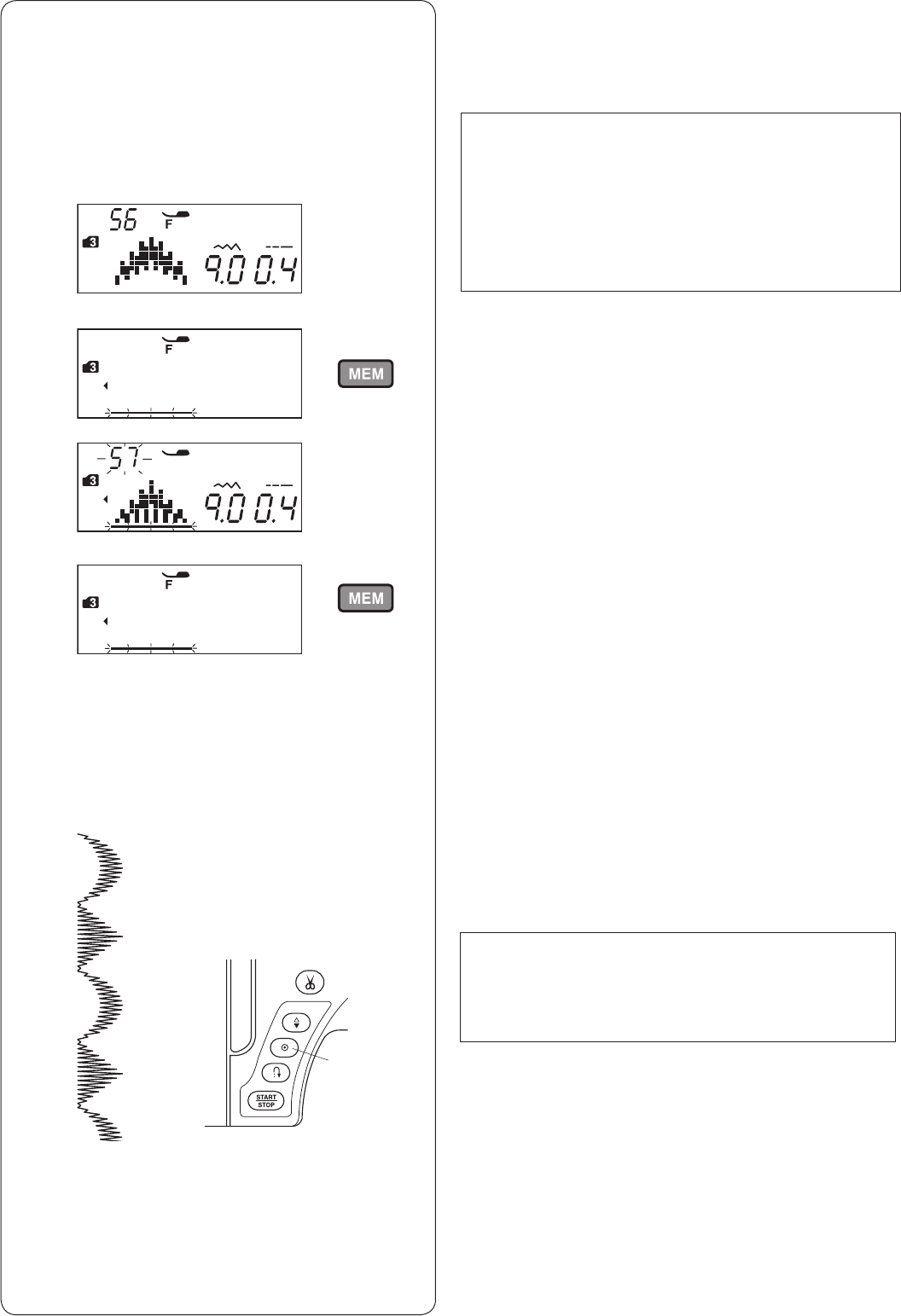
70
b Start sewing. Combination of patterns 56 and 57 will
be sewn continuously.
NOTE:
If you press the auto-lock button in the middle of
sewing, the machine will sew to the end of the current
pattern, sew locking stitches and stop automatically.
q Auto-lock button
PROGRAMMING A PATTERN
COMBINATION
Pattern Combination
Example: Programming patterns 56 and 57 (mode 3).
NOTES:
•Patternsinthedifferentgroups,lettersand
numbers can also be programmed.
•Check tension balance by test sewing.
Manual tension adjustment may be required when
sewing a pattern combination.
•Upto50stitchpatternscombinationcanbe
memorized.
q
z
x
c
v
z Select pattern 56 (mode 3).
x Press the memory key.
c Select pattern 57 (mode 3).
v Press the memory key.
b
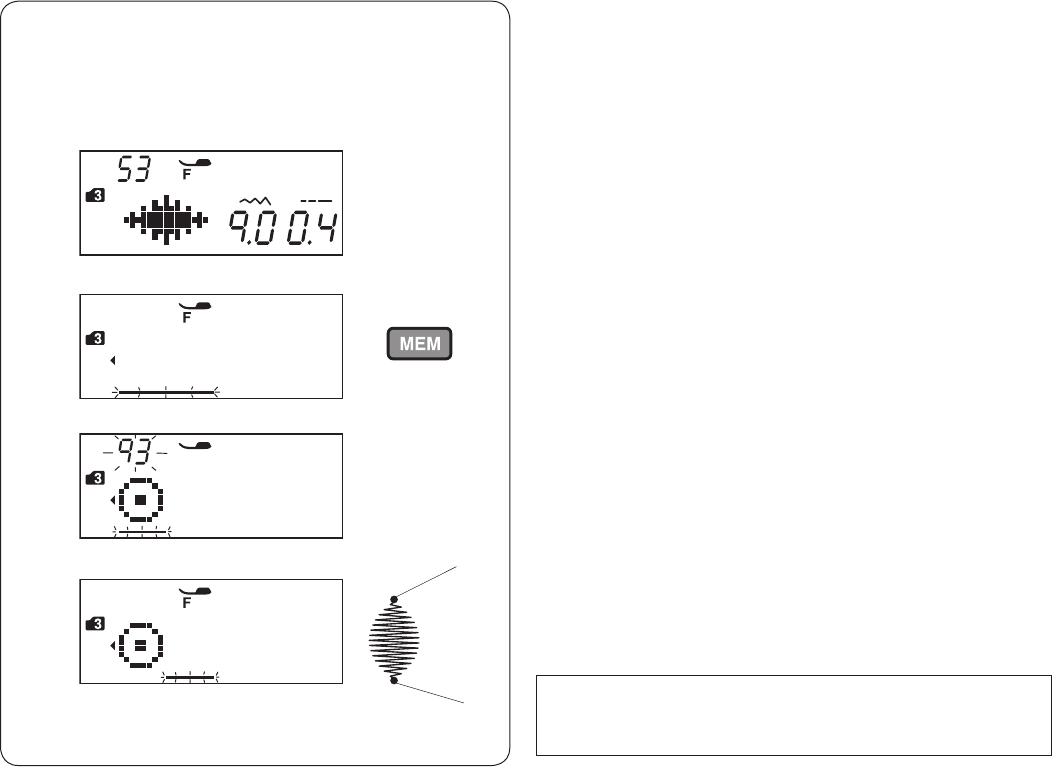
71
Programming Auto-lock Stitch
Example: Programming patterns 53 (mode 3) and auto-
lock stitch. The machine will sew the pattern, auto-lock
stitch, and stop automatically.
z Select pattern 53 (mode 3).
z
x
c
v
x Press the memory key.
c Select pattern 93 (mode 3).
Press the memory key.
q
w
v Start sewing. Pattern 53 and 93 (auto-lock stitch) will
be sewn automatically.
w Auto-lock stitch
NOTE:
The locking stitch at the beginning q is
pre-programmed.
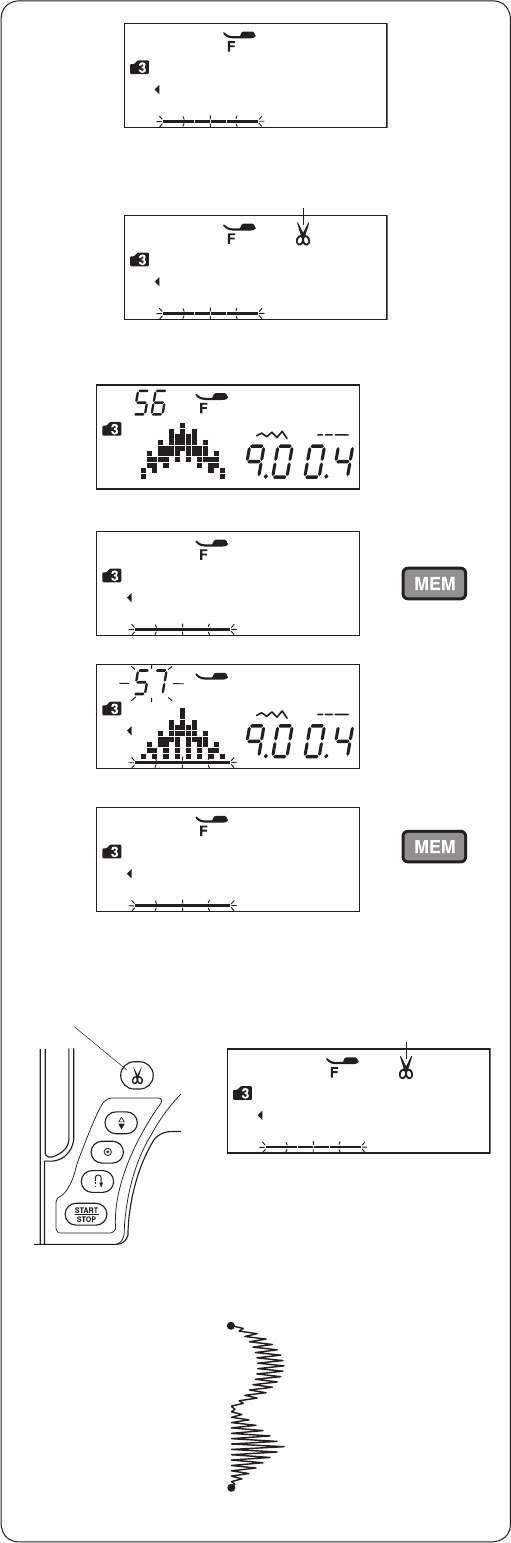
72
Programming Automatic Thread Cutting
To cut the threads automatically after sewing the pattern
combination, press and hold the thread cutter button after
programming the pattern combination.
The cutter sign will be indicated on the LCD screen and
blinks.
q Cutter sign
q
w
z Select pattern 56 (mode 3).
z
x
c
v
x Press the memory key.
c Select pattern 57 (mode 3).
v Press the memory key.
b Press and hold the thread cutter button until the cutter
sign appears.
q Cutter sign
w Thread cutter button
n Start sewing.
The machine will sew the pattern combination,
auto-lock stitch and cut the threads, then stop
automatically.
b n
q
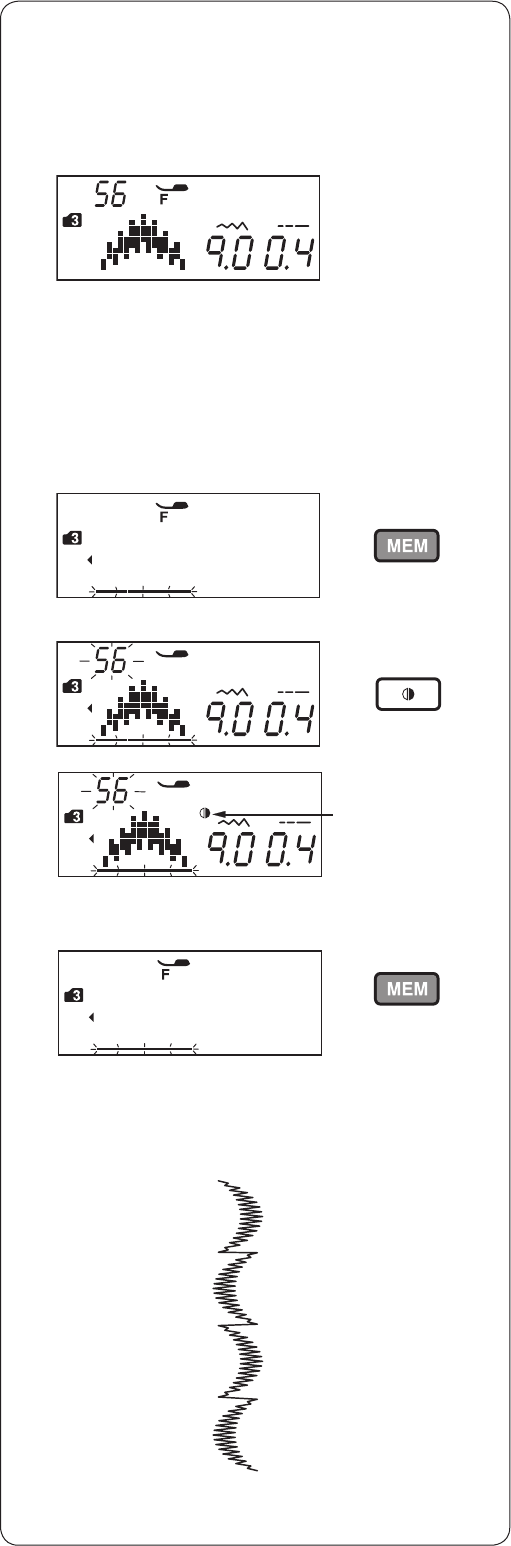
73
Pattern Combination with a Mirror Image
Example: Pattern 56 (mode 3) and its mirror image
z Select pattern 56 (mode 3).
x Press the memory key.
c Select pattern 56 (mode 3).
Press the mirror image key.
The mirror sign will appear on the LCD screen.
q Mirror sign
v Press the memory key.
b Start sewing.
The machine will sew the pattern combination
repeatedly.
z
q
x
c
v
b
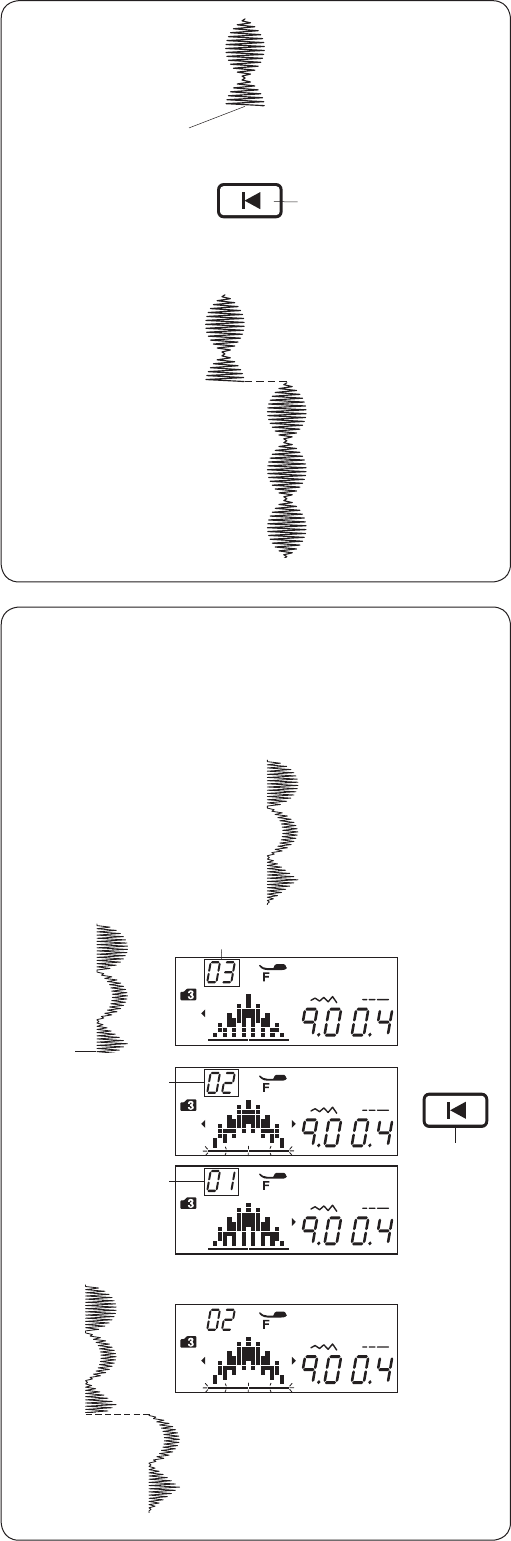
74
Resuming a Pattern from the Beginning
If you have to stop sewing in the middle of a pattern and
wish to sew it over again, press the startover key to sew
the pattern from the beginning.
Example: Pattern 53 (mode 3)
z Select pattern 53 (mode 3). Start sewing.
x Sewing stopped.
q Stopped position
Resuming a Pattern Combination from the
Beginning
If you have to stop sewing in the middle of a pattern
combination and wish to start sewing again from the
incomplete pattern, press the startover key to select the
pattern you wish to start over from.
Example: Pattern combination 55, 56 and 57 (mode 3)
z Program the pattern combination 55, 56 and 57 in
mode 3.
Start sewing.
z x
c
v
c Press the startover key.
w Startover key
v Sewing starts from the beginning of the pattern.
q
w
z
x
c
v
e
q
x Sewing stopped. The number of sewing order appears
on the LCD screen.
q Stopped position
w Sewing order
w
w
w
c Press the startover key. The number will count down
and the stitch image will be displayed each time you
press the startover key. Select the stitch pattern you
wish to start over from.
e Startover key
v Press the start/stop button.
Sewing starts from the number of the programmed
stitch pattern.
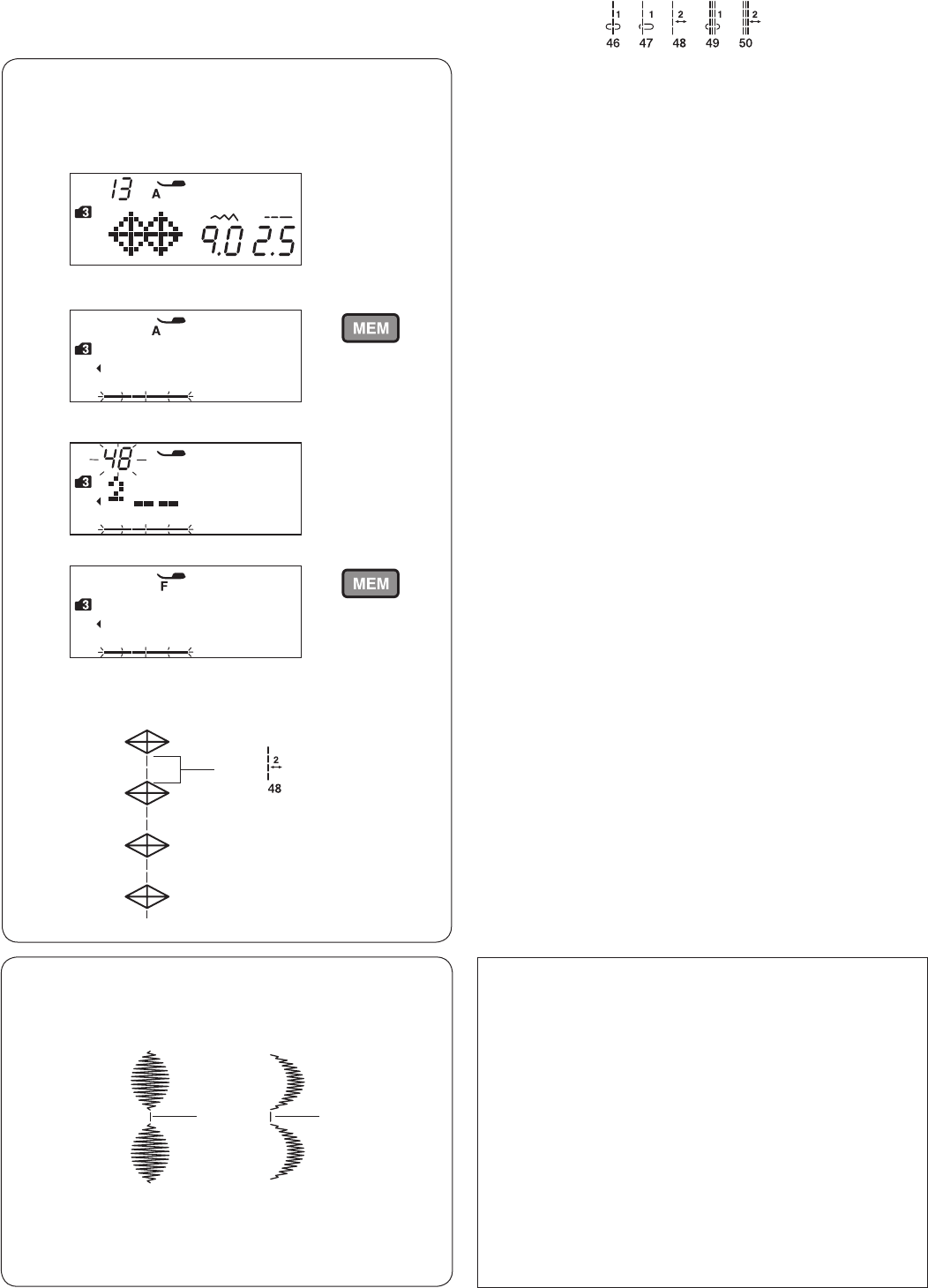
75
Bridge Stitches
Stitch patterns number 46 to 50 (mode 3) are bridge
stitches, which are used to insert straight stitches after a
stitch pattern.
Example: Combination of pattern 13 and pattern 48 in
mode 3
z Select pattern 13 (mode 3).
x Press the memory key.
c Select pattern 48 (mode 3).
v Press the memory key.
q
NOTES:
The number on the right of the stitch image indicates
stitch counts to be inserted.
The stitch length and needle drop position of patterns
46, 47 and 49 in mode 3 are independent from those
of the combined pattern.
Patterns 48 and 50 in mode 3 will inherit the stitch
length and needle drop position of a previous pattern
in the programmed pattern combination.
Use patterns 46 or 47 in mode 3 with satin stitches.
q Pattern 46
w Pattern 47
Use pattern 49 in mode 3 if you wish to add straight
stretch stitches.
z
x
c
b Start sewing.
Two counts of the straight stitch are added to pattern
13.
q Bridge stitch
v
b
wq
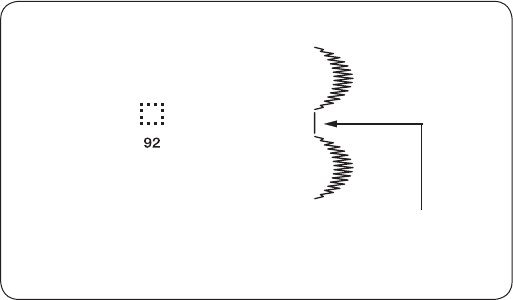
76
Use the stitch pattern 92 (blank space) in mode 3 if you
wish to insert a space between stitch patterns.
w Blank space
w
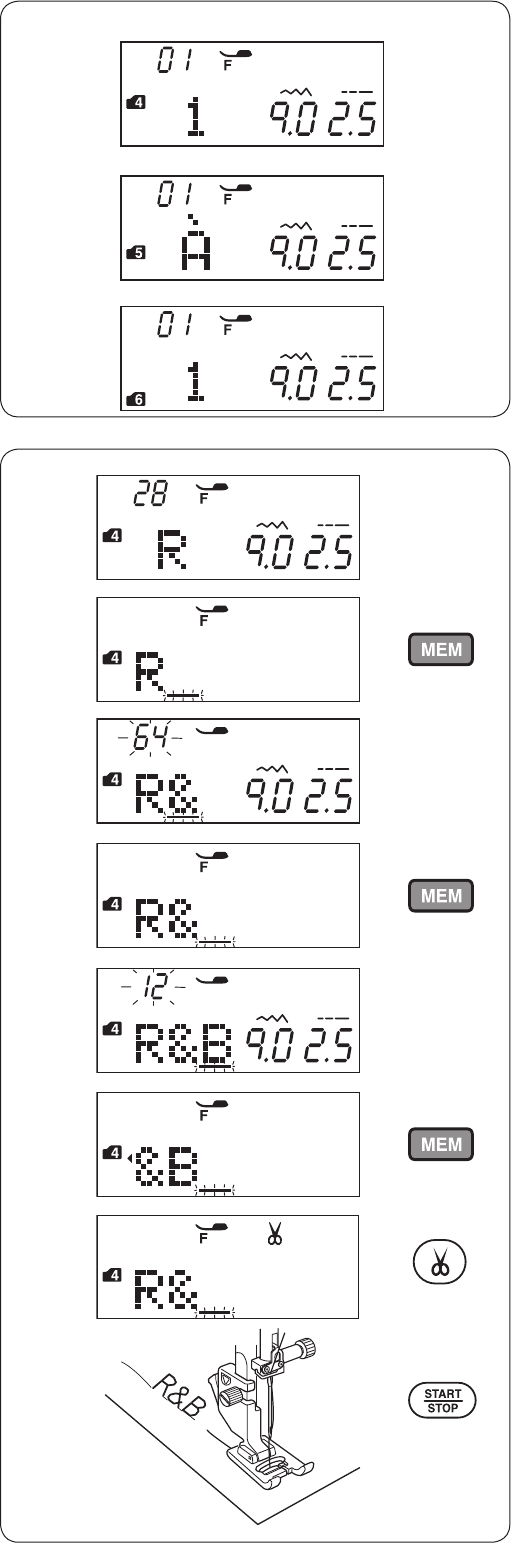
77
Monogramming
Selecting a character
In mode 4, 5 and 6, you can program text by entering the
number and alphabets.
Mode 4: Alphabets/number/symbol
Mode 5: European accented letters
Mode 6: 9 mm monogram (capital letter/number only)
Programming a monogram
Example: To program “R&B”
z Press the mode key 3 times to enter mode 4.
x Select pattern 28.
c Press the memory key.
v Select pattern 64.
b Press the memory key.
n Select pattern 12.
m Press the memory key.
, Press and hold the thread cutter button until the cutter
sign appears.
z x
c
v
b
n
m
. Press the start/stop button.
The machine will sew “R&B”, cut the threads and stop
automatically.
,
.
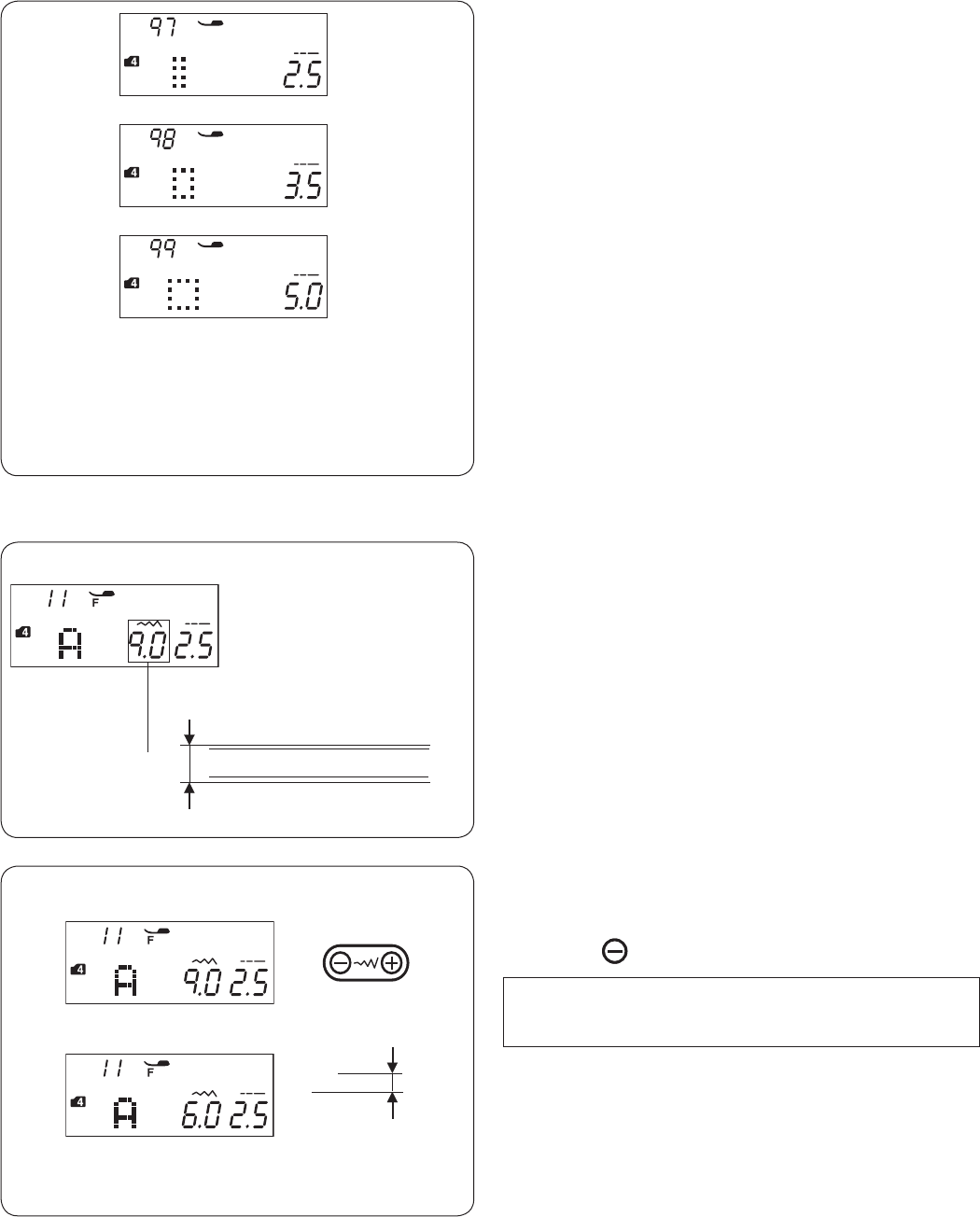
78
Reducing the size of letters
To reduce the height of character to approximately 2/3 of
its original size, select the character with the cursor key
and press “ ” of the stitch width adjusting key.
NOTE:
The size of 9 mm monogram (mode 6) cannot be
reduced.
A2/3
A
Spacing
To enter the space in monogramming, select the stitch
pattern 97, 98 or 99 in mode 4, 5 or 6.
q Pattern 97: Small-size space (2.5 mm)
w Pattern 98: Medium-size space (3.5 mm)
e Pattern 99: Large-size space (5.0 mm)
Monogram size
The stitch width of monogramming does not indicate the
actual size of character. That is an overall height including
before-edge and after-edge. To sew monogramming of
full 9 mm height (uppercase alphabet only), press mode
key 5 times to enter mode 6.
q Before-edge
w After-edge
A a j y Ё1 2
9.0 mm
q
w
q
w
e
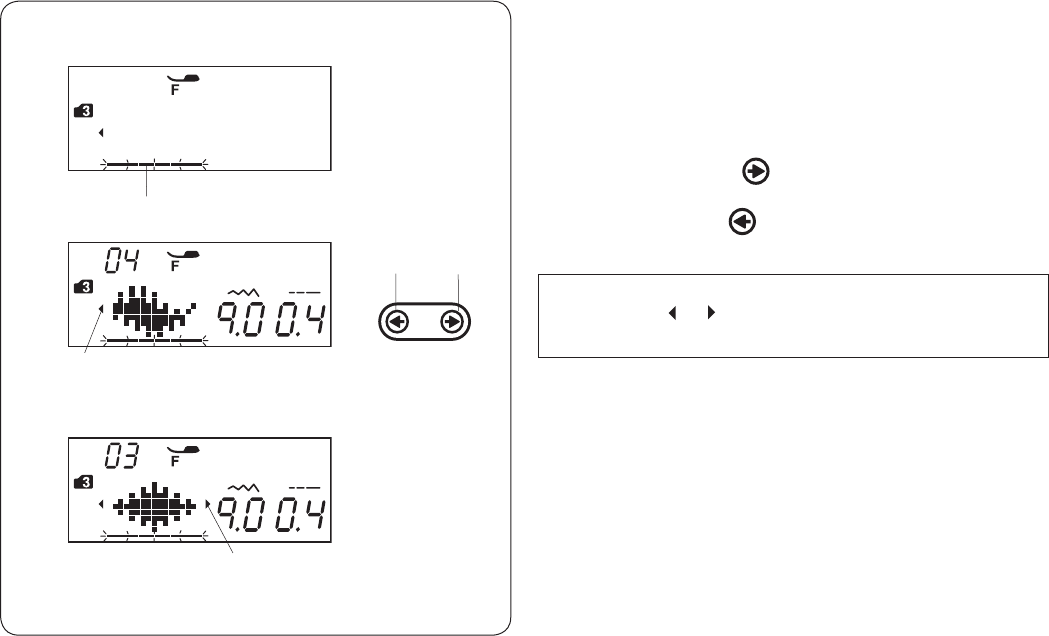
79
Editing a Pattern Combination
Viewing a long combination
The LCD screen only shows one pattern at a time.
If the entire combination is not displayed, press the cursor
key to view the rest of the combination.
Press the right arrow “ ” on the cursor key to shift the
cursor to the right.
Press the left arrow “ ” on the cursor key to shift the
cursor to the left.
NOTE:
Arrow signs ( , ) on the LCD screen indicate that
there is the rest of the combination in that direction.
Once sewing has started, the cursor appears under the
first pattern and will shift to the right as you sew.
Press the cursor key again to view the hidden patterns or
to edit the pattern combination.
The cursor will blink and can be moved to the desired
position.
q Right arrow
w Left arrow
e Cursor
r Arrow sign
qw
e
r
r
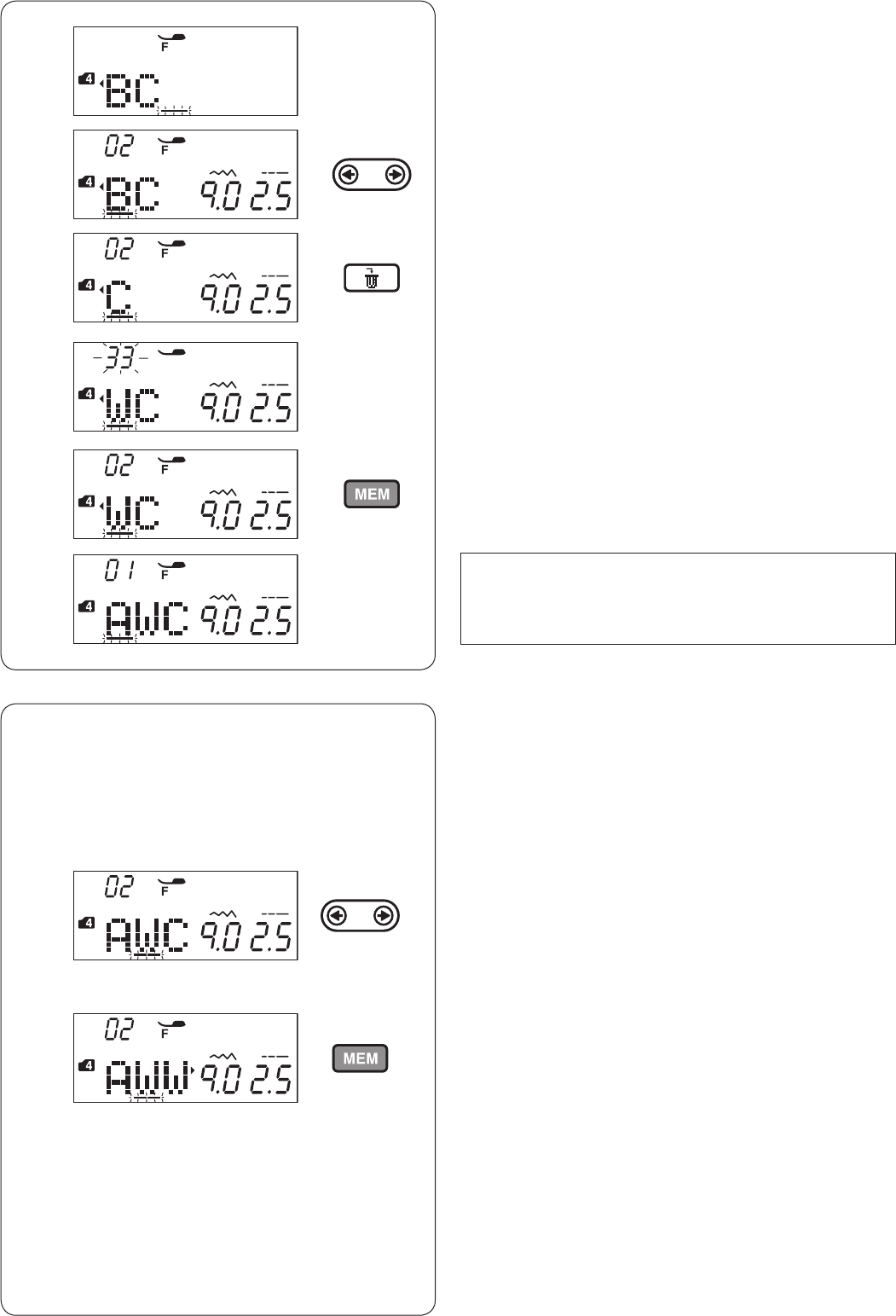
80
Deleting and Inserting a Pattern
Example: Deleting pattern “B” and inserting “W” from
“ABC”.
c Enter “W”.
Pattern “W” will be inserted between “A” and “C”.
Duplicating a Pattern
Example: Duplicating a “W”.
z Press the cursor key to shift the cursor under pattern
“B”.
x Press the clear key.
Pattern “B” will be deleted.
NOTE:
Pressing and holding the clear key will delete all the
programmed patterns and the LCD screen will return
to the display prior to programming.
z
Press the cursor key to shift the cursor under the
pattern to be duplicated.
x Press the memory key and a “W” will be duplicated
after the pattern “W”.
Press the memory key to memorize the new pattern
combination.
z
x
c
z
x
vv Press the memory key to memorize the new pattern
combination.
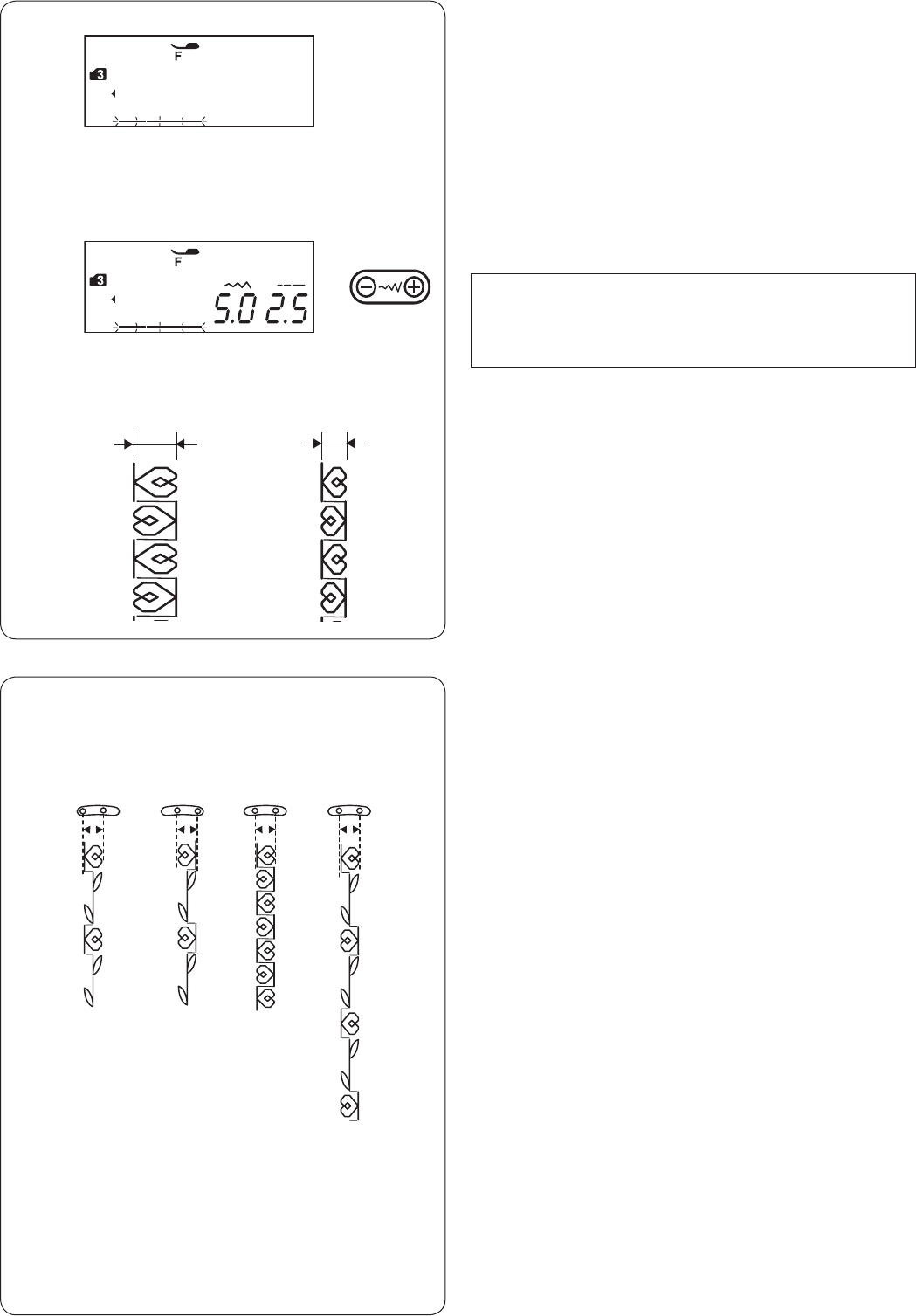
81
Uniform Stitch Adjustment
The stitch width and length of the programmed patterns
can be uniformly adjusted.
Example 1: Adjusting the stitch width of the programmed
pattern 63 (mode 3) and its mirror image
Shift the cursor to the right of the last programmed
pattern.
Press the stitch width adjusting key to adjust the stitch
width.
NOTE:
Stitch length can be uniformly adjusted if the
programmed patterns in the same category (satin
stitches or stretch stitches) have been programmed.
The stitch width of the programmed patterns will be
adjusted uniformly.
q Original width
w Uniformly adjusted width
Unified Needle Drop Position
The needle drop position of the programmed patterns will
vary depending on the pattern combination:
(A) Unified to the left when combining the patterns with
the left needle position and the center needle
position.
(B) Unified to the right when combining the patterns with
the center needle position and the right needle
position.
(C) Unified to the center when combining the patterns
with the left needle position and the right needle
position.
(D) Unified to the center when combining the patterns
with the left, center and right needle positions.
q w
(A) (B) (C) (D)
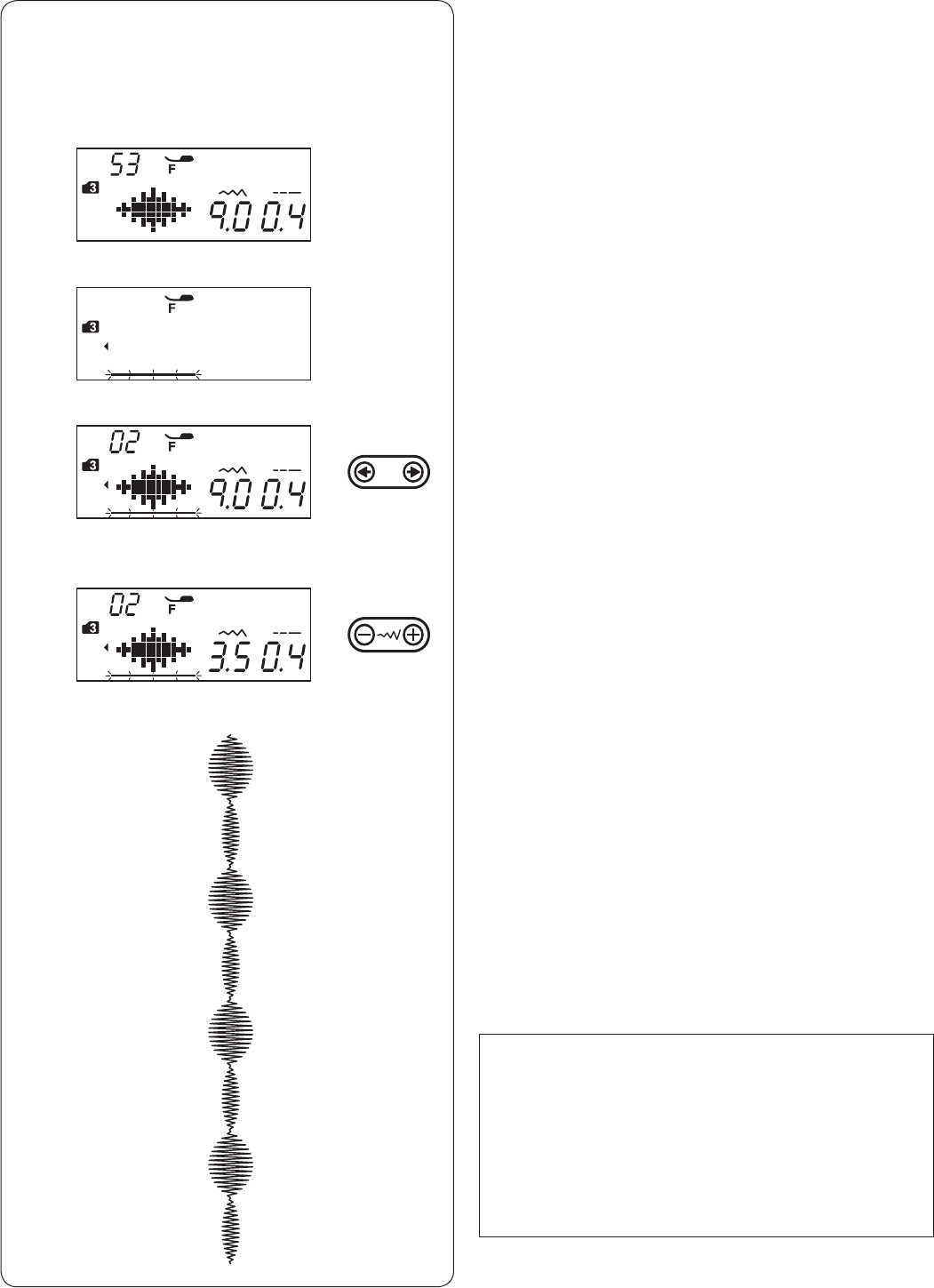
82
Individual Stitch Adjustment
The stitch width and length can be individually adjusted
for each pattern in a programmed combination.
Example: Changing the stitch width of the one pattern in
the combination
NOTES:
To view the stitch settings of each pattern, shift the
cursor under the desired pattern then press the stitch
width or length adjusting key. The settings will be
displayed at the bottom of the LCD screen.
If you press the stitch width or length adjusting key
when the cursor is to the right of the last programmed
pattern, individual adjustments will be cancelled and
uniform adjustment will be applied.
c
v
z Select pattern 53 (mode 3).
Press the memory key.
x Press the memory key again.
c Press the cursor key to shift the cursor under the
second pattern.
b
x
z
v Press the stitch width adjusting key to adjust the width
to “3.5”.
b Press the start/stop button.
The machine will sew the pattern combination.
The stitch width of the second pattern in the
combination is adjusted.
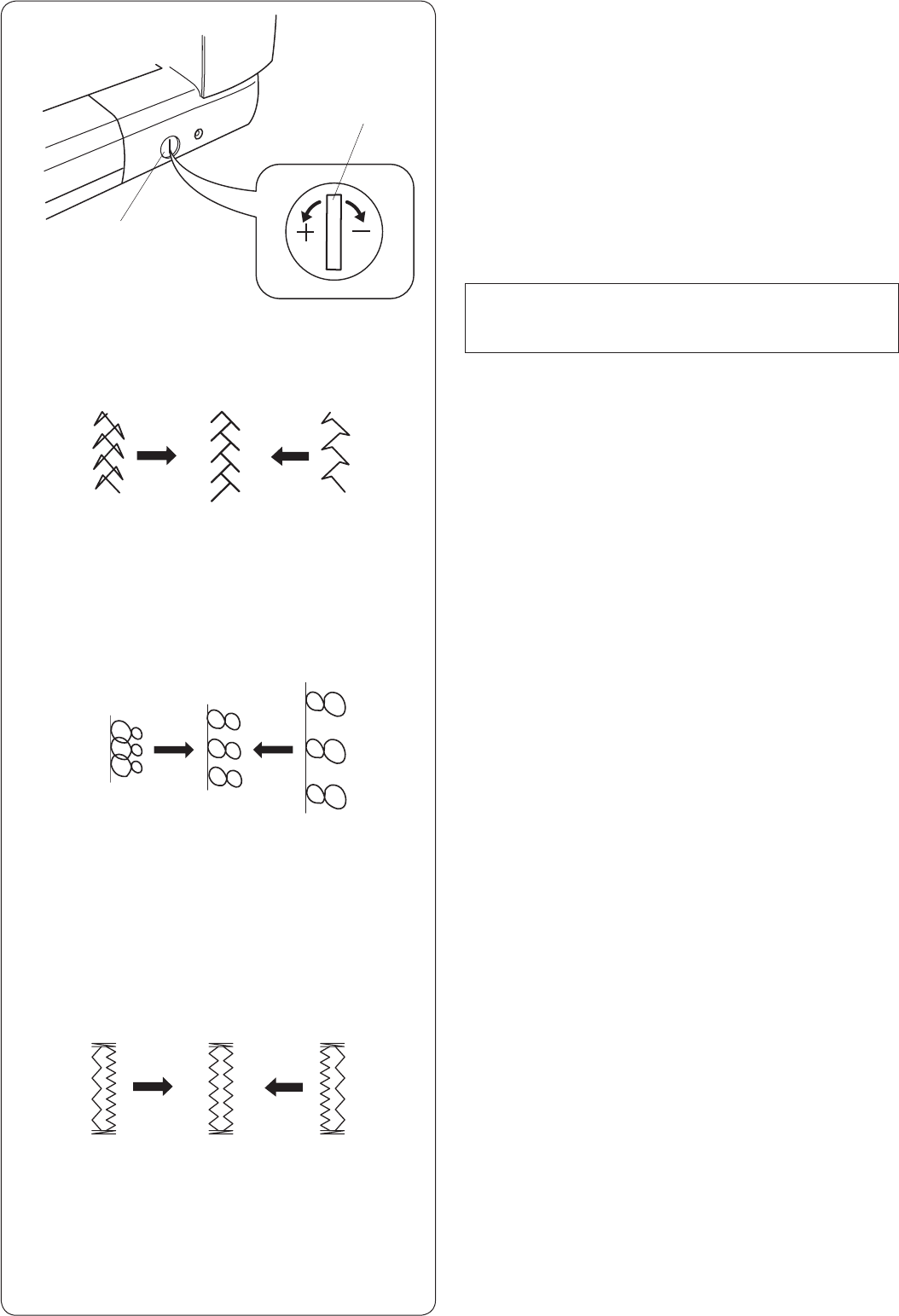
83
Correcting Distorted Stitch Patterns
The sewing results of the stitch patterns may vary
depending upon sewing conditions, such as sewing
speed, type of the fabric, number of layers etc.
Always test sew on a scrap piece of the fabric that you
wish to use.
If stretch stitch patterns, monogram or the stretch
buttonhole is distorted, correct it with the feed balancing
dial.
Set the feed balancing dial at the neutral position for
normal sewing.
q Feed balancing dial
w Neutral position
q
w
Stretch stitch pattern
Example: Pattern 9 (mode 1)
If the pattern is compressed, turn the feed balancing dial
in the direction of “+”.
If the pattern is drawn out, turn the feed balancing dial in
the direction of “–”.
Stitch balance of the stretch buttonholes
Example: Patterns 23 (mode 2)
If the right row is denser, turn the dial in the direction of “+”.
If the left row is denser, turn the dial in the direction of “–”.
Letters and numbers
Example: Pattern 08 (mode 4)
If the pattern is compressed, turn the feed balancing dial
in the direction of “+”.
If the pattern is drawn out, turn the feed balancing dial in
the direction of “–”.
NOTE:
Return the feed balancing dial to its neutral position
when the sewing is finished.
+ –
+ –
+ –
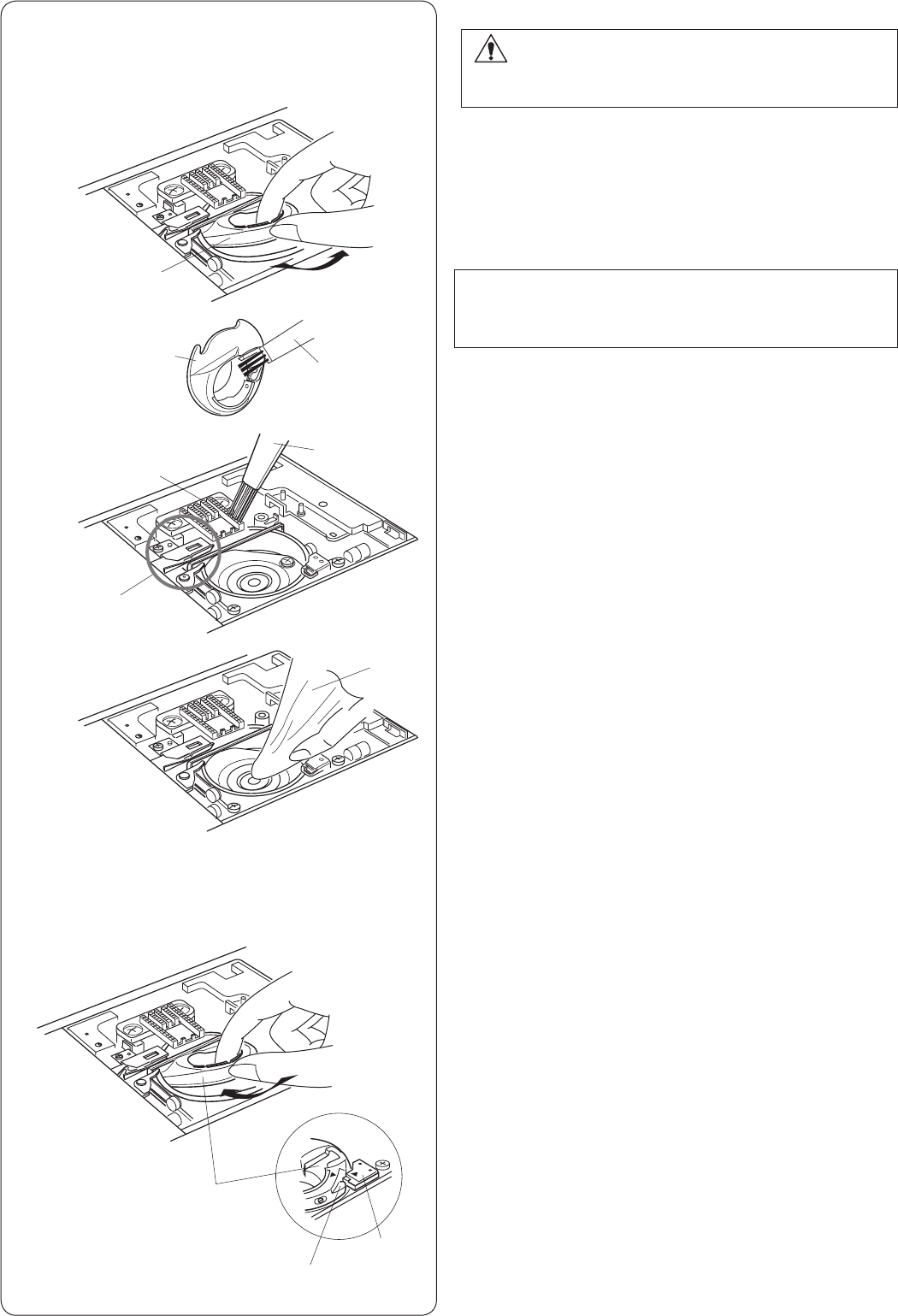
84
CARE AND MAINTENANCE
q
qw
t
e
r
w
Cleaning the Hook Area
Clean the hook area at least once a month.
Turn the power switch off and unplug the machine.
Remove the needle plate (refer to page 16).
Remove the needle and presser foot.
NOTE:
Do not dismantle the machine in any way other than as
explained in this section.
z Take out the bobbin and bobbin holder.
q Bobbin holder
x Clean the bobbin holder with a lint brush.
Clean the feed dog and auto thread cutter device with
the lint brush.
w Lint brush
e Feed dog
r Auto thread cutter device
u
y
q
z
x
c
v
c Clean the hook race with a soft cloth.
t Soft cloth
v Insert the bobbin holder so that the knob fits next to
the stopper in the hook race.
Insert the bobbin.
Attach the needle plate, presser foot and needle.
y Knob
u Stopper
WARNING:
Turn the power switch off and unplug the machine
before cleaning.
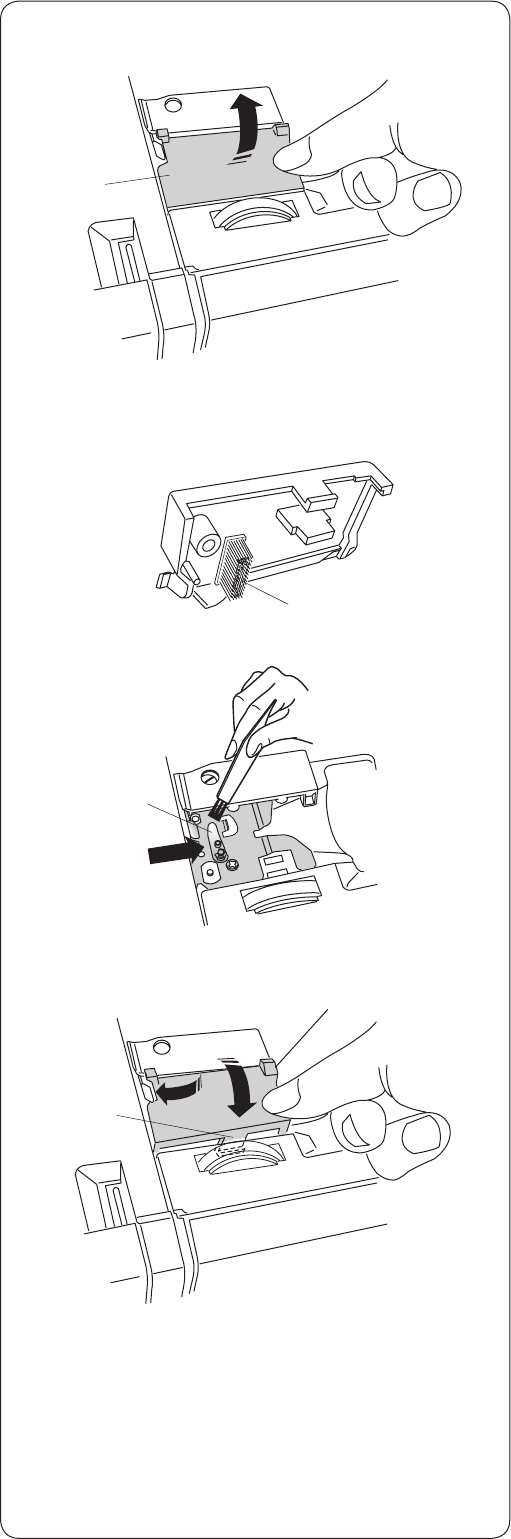
85
Cleaning the Inside of the Thread Guide
Clean the inside of the thread guide plate under the top
cover at least once a month.
z Remove the needle thread and remove the thread
guide plate by pulling it up.
q Thread guide plate
q
w
e
x Remove lint and dust from the brush on the underside
of the thread guide plate using a lint brush.
w Brush on the thread guide plate
c Clean the area around and under the pre-tension leaf
with the lint brush.
e Pre-tension leaf
v Set the thread guide plate on the machine, inserting
the tenons into the slots. Push the thread guide plate
down to snap it in place.
r Tenon
z
x
c
v
r
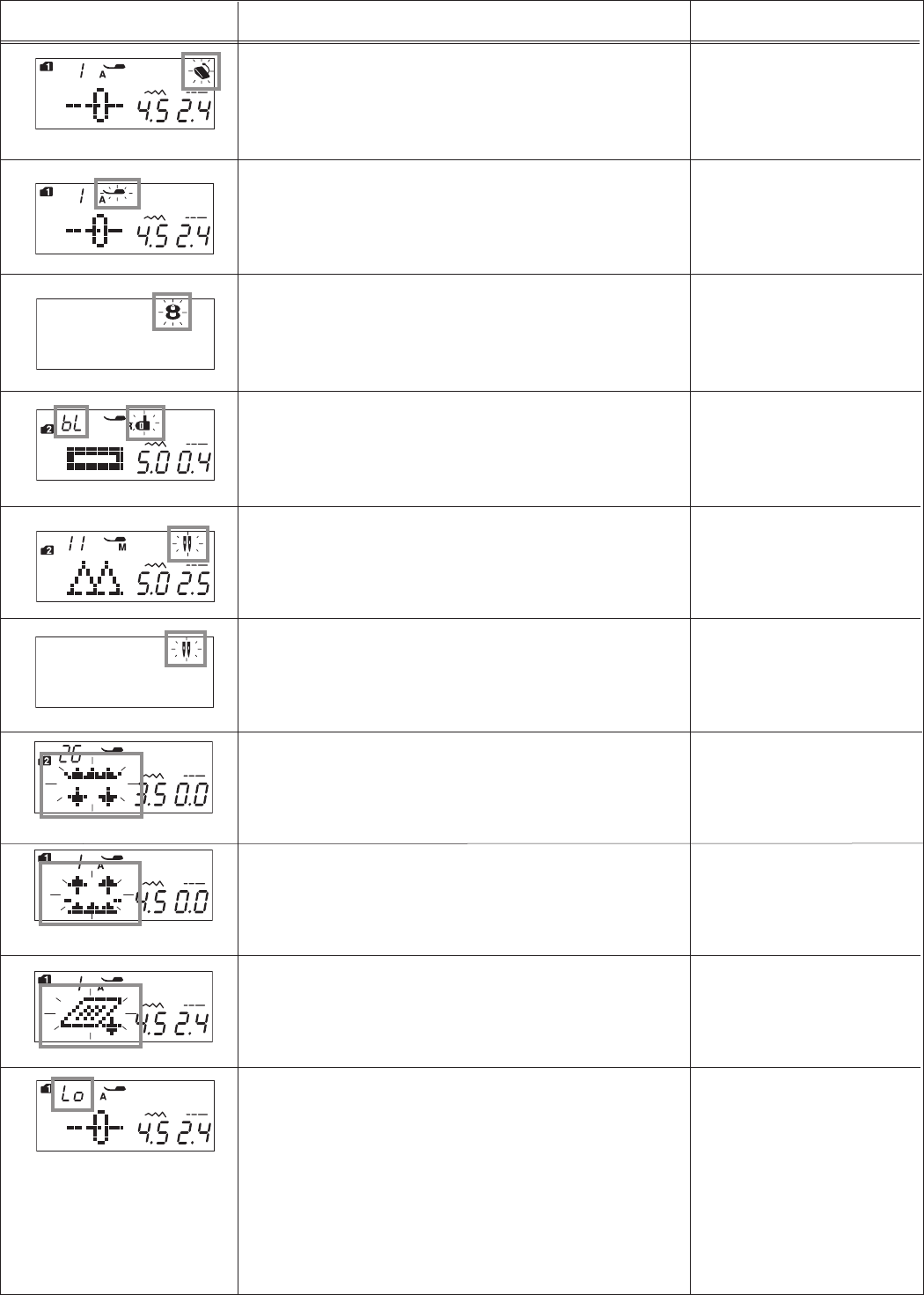
86
Problems and Warning Signals
If a buzzer sounds and the LCD screen shows a warning sign, follow the guidance below.
The machine will stop if the buttonhole is sewn without
lowering the buttonhole lever.
The machine is started without lowering the presser
foot.
The machine will stop if the presser foot is raised while
sewing.
The start/stop button is pressed with the foot control
connected.
Disconnect the foot control.
Lower the presser foot and
start the machine.
Lower the presser foot and
start the machine again.
Lower the buttonhole lever
and start the machine
again.
The bobbin winder spindle is shifted to the right. Shift the bobbin winder
spindle to the left for
stitching.
The twin needle key is pressed when a pattern
unsuitable for twin needle sewing has been selected.
Select the pattern suitable
for twin needle sewing.
Warning Sign Cause Try this
The machine is started after halting due to overload.
The machine is started without lowering the feed
dog with basting or button sewing selected.
Lower the feed dog.
Wait for at least 15 seconds
to restart. Remove tangled
threads around take-up lever,
hook race and automatic
thread cutting mechanism.
Do not lower the feed dog,
raise presser foot or shift
bobbin winder spindle while the
machine is running.
The machine is started with the feed dog
lowered.
Raise the feed dog.
The machine is started without the needle plate.
The machine is started when the needle plate
for straight stitch is attached and a pattern that
cannot be used for the needle plate has been
selected.
Attach the needle plate.
Replace the needle plate.
The twin needle key is pressed when the twin needle
sign is indicated on the LCD screen.
Replace the twin needle
with a single needle and
press the twin needle key.
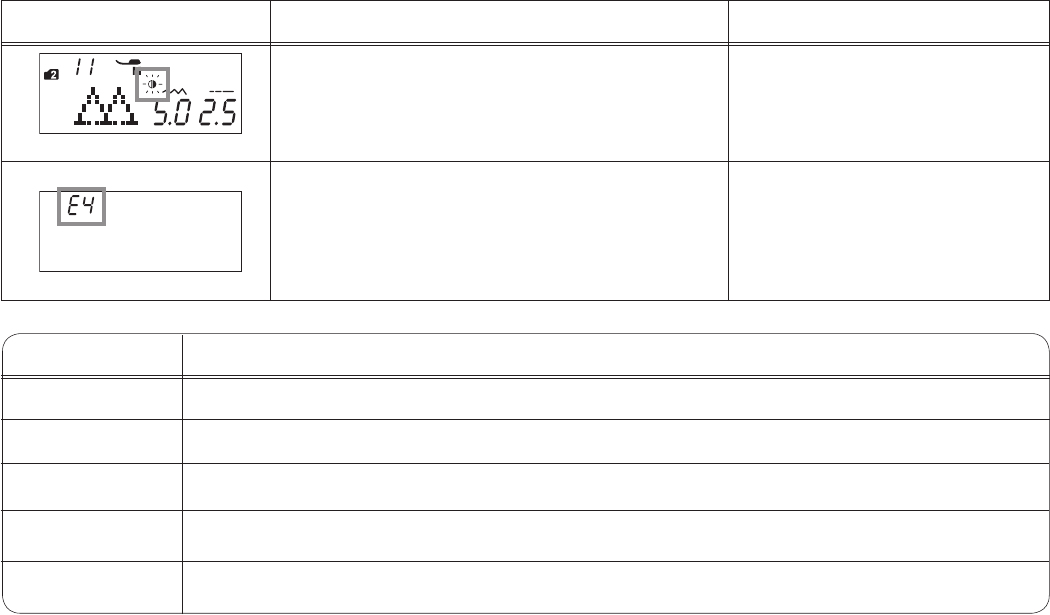
87
The machine does not work properly due to a
problem in the control circuit.
Contact the service center or the
store from whom the machine
was purchased.
Warning Sign Cause Try this
Audible Signal The Buzzer sounds when:
pip Normal operation.
pip-pip-pip Invalid operation or malfunction.
peep E1-E7 error occurred.
pip pi-pi-pi-peep Buttonhole is completed.
pip-pip Deleting a pattern combination with the clear key.
(E1-E7)
The selected stitch patter cannot be flipped. Select the other stitch pattern for
a mirror image.

88
Cause
1. The needle thread is not threaded properly.
2. The needle thread tension is too tight.
3. The needle is bent or blunt.
4. The needle is incorrectly inserted.
5. The needle thread and the bobbin thread are not set under the
presser foot when start sewing.
6. The threads were not drawn to the rear after sewing.
7. The fabric is moved too fast when stitching free motion quilting.
8. The thread is tangled around the spool.
1. The bobbin thread is not threaded properly in the bobbin holder.
2. Lint has collected in the bobbin holder.
3. The bobbin is damaged and does not turn smoothly.
1. The needle is incorrectly inserted.
2. The needle clamp screw is loose.
3. The fabric is pulled forward when using the open-toe foot.
4. The needle is too fine for the fabric being used.
5. An inappropriate presser foot is used.
1. The needle is incorrectly inserted, bent or blunt.
2. The needle and/or threads are not suitable for the work being sewn.
3. A blue tip needle is not being used for sewing stretch, very fine fabrics
and synthetics.
4. The needle thread is not threaded properly.
5. A poor quality needle is used.
1. The needle thread tension is too tight.
2. The needle thread is not threaded properly.
3. The needle is too heavy for the fabric being sewn.
4. The stitch length is too long for the fabric.
5. The foot pressure is not adjusted properly.
6. A stabilizer is not used when sewing very fine fabrics.
1. The feed dog is packed with lint.
2. The stitches are too fine.
3. The feed dog is not raised after ”drop feed” sewing.
1. The needle thread tension is too loose.
2. The needle is too thick or too fine for the fabric.
1. The machine is not plugged in or foot control is not connected.
2. Thread has been caught in the hook race.
3. The presser foot is not lowered.
1. The stitch density is not suitable for the fabric being sewn.
2. The interfacing has not been used for the stretch or synthetic fabric.
3. The buttonhole lever is not lowered.
1. Thread has been caught in the hook race.
2. Lint has built up in the hook race or bobbin holder.
1. The foot pressure is not suitable for fabrics being sewn.
1. Thread is too thick for the auto thread cutting.
2. Threads have been caught in the thread cutter mechanism.
1. Thread tension is not balanced.
Condition
The needle thread
breaks
The bobbin thread
breaks
The needle breaks
Skipped stitches
Seam puckering
The cloth is not
feeding smoothly
Loops on the
seams
The machine does
not work
Buttonhole sewing
is not sewn properly
The machine is
noisy
Layers shift
Auto thread cutting
failed
The needle thread
appears on the
wrong side of the
fabric when the
stitch width value
is larger than “7.0”.
Reference
Page 21
Page 12
Page 17
Page 17
Page 23
Page 29
Page 66
Use the spool holder.
Page 20
Page 84
Change the bobbin.
Page 17
Page 17
Page 66
Page 17
Use the correct foot.
Page 17
Page 17
Use the stretch stitch
needle.
Page 21
Change the needle.
Page 12
Page 21
Page 17
Make stitch shorter.
Page 11
Apply a stabilizer.
Page 84
Make stitch longer.
Page 11
Page 12
Page 17
Page 6
Page 84
Page 10
Pages 49
Apply an interfacing.
Page 45
Page 84
It is not abnormal for a faint humming sound to be heard from the internal motors.
The LCD screen and function key area may become warm after several hours of continuous use.
Page 84
Page 11
Page 7
Page 84
Page 12
Troubleshooting
858-800-609 (EN)
