Kenmore 91193501990 User Manual FREE STANDING RANGE Manuals And Guides L0804169
KENMORE Free Standing, Electric Manual L0804169 KENMORE Free Standing, Electric Owner's Manual, KENMORE Free Standing, Electric installation guides
User Manual: Kenmore 91193501990 91193501990 KENMORE FREE STANDING RANGE - Manuals and Guides View the owners manual for your KENMORE FREE STANDING RANGE #91193501990. Home:Kitchen Appliance Parts:Kenmore Parts:Kenmore FREE STANDING RANGE Manual
Open the PDF directly: View PDF  .
.
Page Count: 34
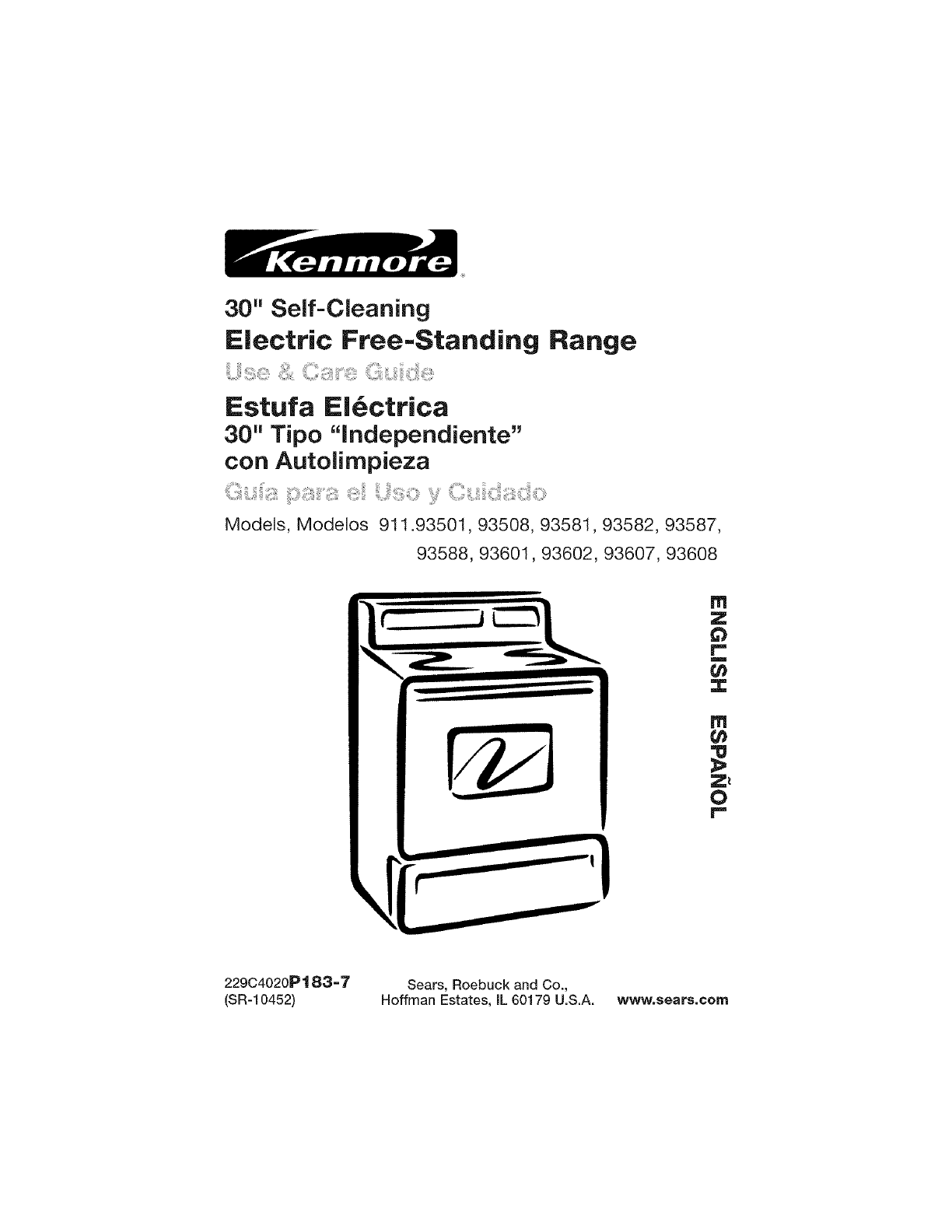
30" Self-Cleaning
Electric Free-Standing Range
Estufa El_ctrica
30" Tipo "lndependiente"
con Autolimpieza
Models, Modelos 911.93501,93508, 93581,93582, 93587,
93588, 93601,93602, 93607, 93608
m
Z
m
cn
z
m
(n
Z'
O
i=-
229C4020Pl 83-7 Sears, Roebuck and Co.,
(SR-10452) Hoffman Estates, IL 60179 U.S.A. www.searsocom
SELF-CLEANING
FREE-STANDINGRANGE
Table of Contents
Range Safety ........................ 3-7
Anti-Tip Bracket .................... 3-4
Oven Racks ............................ 17
Oven Control .......................... 17
Broiling ............................. 18-19
Features of Your Range ........... 8
Removal of Packaging Tape .... 8
Cooking Elements .................... 9
Control Settings ........................ 9
Home Canning Tips .................. 9
Hour/Minute Arrow Pad .......... 10
Temp Recall ........................... 10
Display .................................... 10
Oven Light Switch .................. 10
Indicator Lights ....................... 10
Black Out The Display ............ 10
F-Codes .................................. 11
PF Code .................................. 11
Automatic Oven Shutoff ......... 11
To Set The Clock .................... 12
To Set The Timer .................... 12
To Reset The Timer ................ 12
To Cancel The Timer .............. 12
Baking .............................. 13-14
Oven Cooking Tips ........... 15-17
Strong Smell or Odor .............. 15
Aluminum Foil ......................... 15
Oven Vent ............................... 15
Peeking ................................... 15
Preheating .............................. 15
Oven Light .............................. 15
Baking With Margarine ........... 15
Bakeware Placement .............. 16
Bakeware ................................ 16
Element Cycling ..................... 16
Self-Cleaning Cycle .......... 20-21
Preparing Your Oven .............. 20
Oven Door Gasket .................. 20
To Set A Clean Cycle ............. 21
To Set A Delayed Cycle ......... 21
To Stop A Cycle ...................... 21
After The Cycle ....................... 21
Control Panel .......................... 22
Broiler Pan and Grid ............... 22
Walls Of The Oven .................. 22
Cooktop and Area Under
Cooktop .................................. 22
Drawer and Sides of Range ... 22
Oven Door Glass .................... 22
Door Vent Trim ........................ 22
Removable Parts .............. 23-28
Lift-Up Cooktop ...................... 23
Control Knobs ......................... 24
Oven Light Bulb ...................... 24
Cooktop Units ......................... 25
Oven Racks ............................ 26
Oven Door ........................ 26-27
Storage Drawer ...................... 28
Before Calling for
Service .............................. 29-31
Temperature Adjustment.... 17, 32
Warranty ................................. 34
Consumer Service Numbers ... 68
For your convenience and future reference, please write down your model
and serial numbers in the space provided, They are located on the front
frame behind the storage drawer,
MODEL NUMBER: SERIAL NUMBER:
© Sears, Roebuck and Co. 2
iMPORTANTSAFETY
iNSTRUCTiONS
SAVE THESE iNSTRUCTiONS
Read aJ! instructions before using this appliance. When using gas
or electrical appliances, basic safety precautions should be followed,
including the following:
See Installation
Instructions
These ANTI-TIP bracket installation
instructions are for wood or concrete
floors and walls. Any other type of
construction may require special
installation techniques to provide
adequate fastening of the ANTI-TIP
bracket to the floor and wall.
The use of this bracket does not
prevent tipping of the range when
bracket is not properly installed.
NOTE: The installation of the
ANTI-TIP bracket must meet all
local codes for securing appliance.
Step 1
Locating the bracket
A. Locate the bracket against the rear
wall and either the right or left
cabinet. If the countertop
overhangs the cabinet, offset the
bracket from the cabinet by the
amount of overhang. If there is no
adjacent cabinet, position the edge
of the bracket at the desired
location of the range side panel.
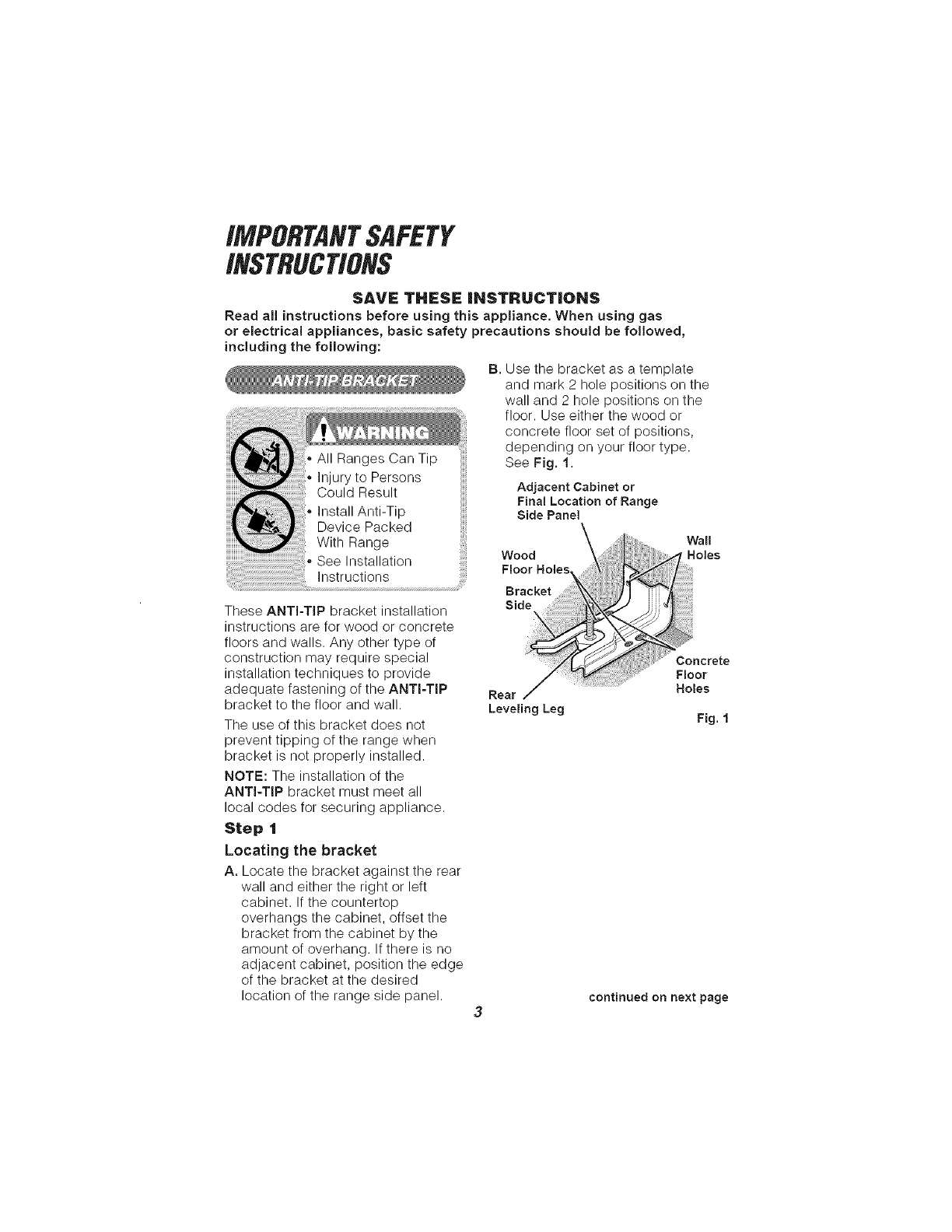
B. Use the bracket as a template
and mark 2 hole positions on the
wall and 2 hole positions on the
floor. Use either the wood or
concrete floor set of positions,
depending on your floor type.
See Fig. 1.
Adjacent Cabinet or
Final Location of Range
Side Panel
Wall
Wood
Floor Holes
Bracket
Side
Rear
Leveling Leg
Concrete
Floor
Holes
Fig. 1
continued on next page
iMPORTANTSAFETY
iNSTRUCTiONS
Anti-Tip Bracket (contd.)
Step 2
Anti-tip bracket installation
A. Wood Construction:
1. Floor: Drill a Vs"pilot hole in
the center of each pre-marked
wood floor hole position (a nail
or awl may be used if a drill is
not available),
AND
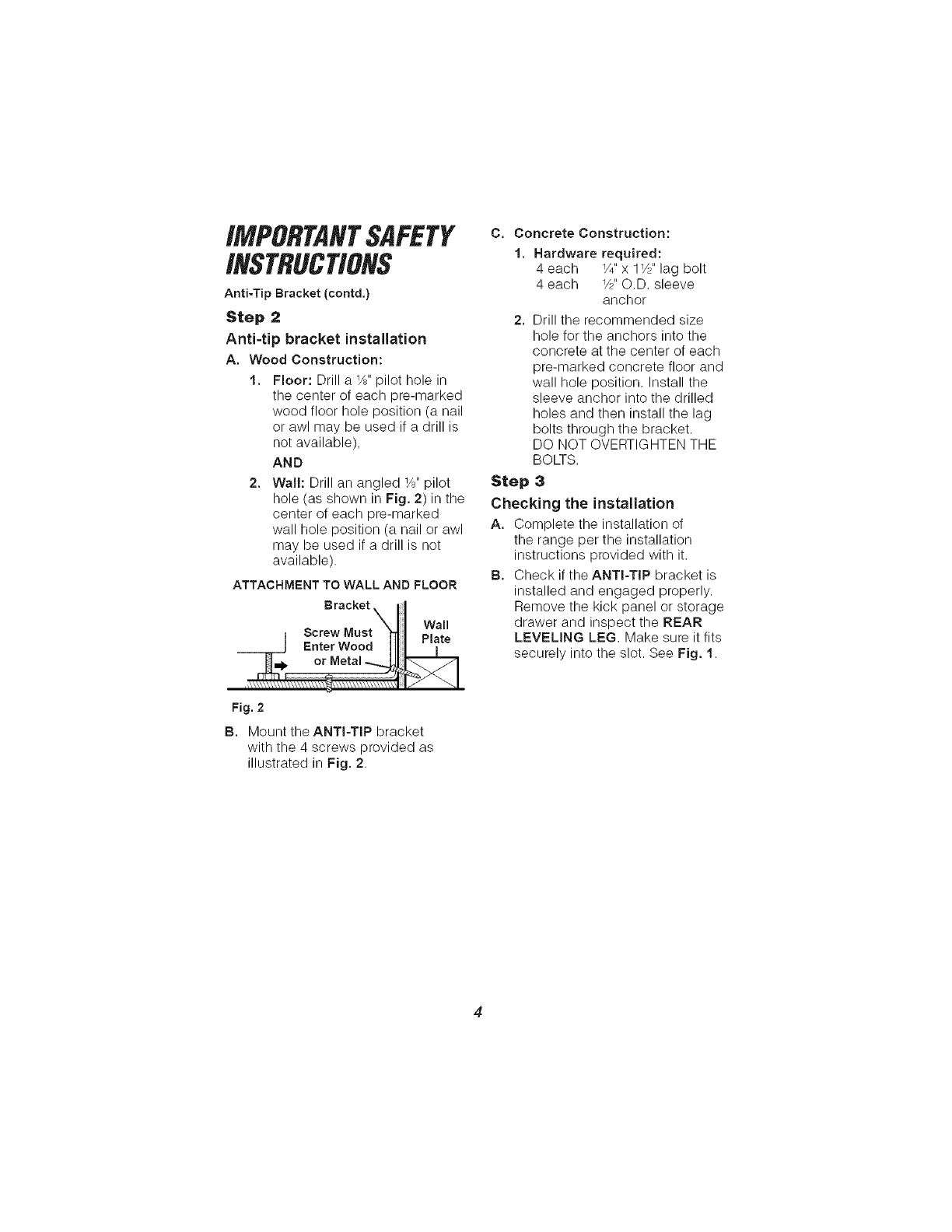
2. Wall: Drill an angled 1/8"pilot
hole (as shown in Fig. 2) in the
center of each pre-marked
wall hole position (a nail or awl
may be used if a drill is not
available).
ATTACHMENT TO WALL AND FLOOR
Bracket. _1
I Screw Must P ate
EnterWoodIIII -T-
,\\\\\\\\\\\\\\_\\\\\\\\\\\\\\\_1 Ij _'1
Fig. 2
B. Mount the ANTI=TIP bracket
with the 4 screws provided as
illustrated in Fig. 2.
C, Concrete Construction:
1. Hardware required:
4 each 1/2x 11/2"lag bolt
4 each 1/2"O.D. sleeve
anchor
2. Drill the recommended size
hole for the anchors into the
concrete at the center of each
pre-marked concrete floor and
wall hole position. Install the
sleeve anchor into the drilled
holes and then install the lag
bolts through the bracket.
DO NOT OVERTIGHTEN THE
BOLTS.
Step 3
Checking the installation
A. Complete the installation of
the range per the installation
instructions provided with it.
B. Check if the ANTI-TIP bracket is
installed and engaged properly.
Remove the kick panel or storage
drawer and inspect the REAR
LEVELING LEG. Make sure it fits
securely into the slot. See Fig. 1.
IMPORTA#TSAFETY
/#STRUCT/O#S
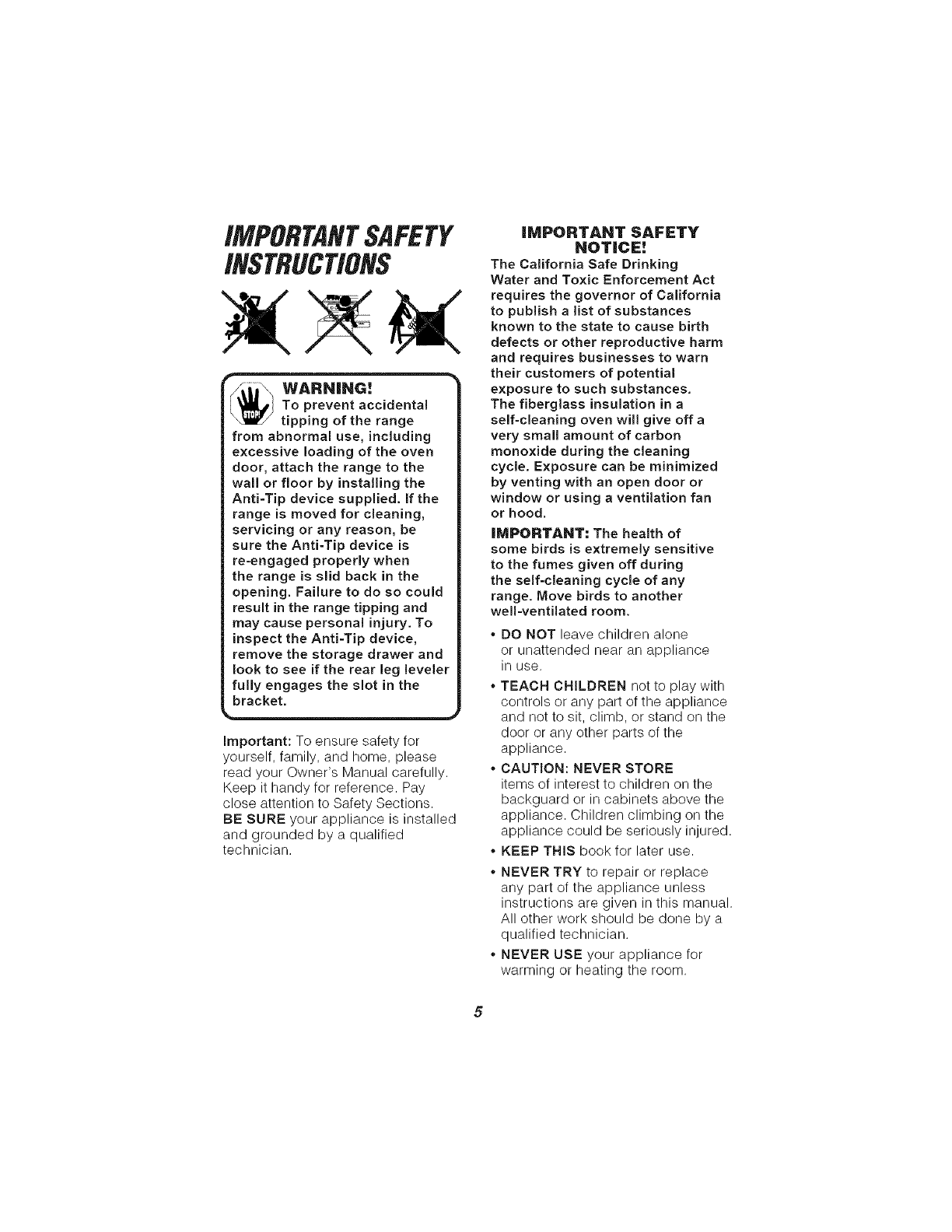
_WARNING!
To prevent accidental
tipping of the range
from abnormal use, including
excessive loading of the oven
door, attach the range to the
wall or floor by installing the
Anti-Tip device supplied. If the
range is moved for cleaning,
servicing or any reason, be
sure the Anti-Tip device is
re-engaged properly when
the range is slid back in the
opening. Failure to do so could
result in the range tipping and
may cause personal injury. To
inspect the Anti-Tip device,
remove the storage drawer and
look to see if the rear leg leveler
fully engages the slot in the
bracket.
Important: To ensure safety for
yourself, family, and home, please
read your Owner's Manual carefully.
Keep it handy for reference. Pay
close attention to Safety Sections.
BE SURE your appliance is installed
and grounded by a qualified
technician.
iMPORTANT SAFETY
NOTICE!
The California Safe Drinking
Water and Toxic Enforcement Act
requires the governor of California
to publish a list of substances
known to the state to cause birth
defects or other reproductive harm
and requires businesses to warn
their customers of potential
exposure to such substances.
The fiberglass insulation in a
self-cleaning oven will give off a
very small amount of carbon
monoxide during the cleaning
cycle. Exposure can be minimized
by venting with an open door or
window or using a ventilation fan
or hood.
IMPORTANT: The health of
some birds is extremely sensitive
to the fumes given off during
the self-cleaning cycle of any
range. Move birds to another
well-ventilated room.
•DO NOT leave children alone
or unattended near an appliance
in use.
•TEACH CHILDREN not to play with
controls or any part of the appliance
and not to sit, climb, or stand on the
door or any other parts of the
appliance.
•CAUTION: NEVER STORE
items of interest to children on the
backguard or in cabinets above the
appliance. Children climbing on the
appliance could be seriously injured.
•KEEP THIS book for later use.
•NEVER TRY to repair or replace
any part of the appliance unless
instructions are given in this manual.
All other work should be done by a
qualified technician.
•NEVER USE your appliance for
warming or heating the room.
iMPORTANTSAFETY
iNSTRUCTiONS
• ALWAYS KEEP combustible wall
coverings, curtains, dishcloths,
towels, potholders and other linens
a safe distance from the appliance.
•NEVER HEAT unopened food
containers. Pressure buildup can
cause the container to burst and
cause injury.
•NEVER LEAVE containers of fat or
drippings in your oven.
•ALWAYS KEEP the oven and
surface unit areas free from things
that will burn. Food, wooden
utensils, and grease buildup could
catch fire. Plastic utensils could
melt and canned foods could
explode. Your appliance should
never be used as a storage area.
•ALWAYS KEEP your appliance
clear of things that will burn
(gasoline and other flammable
vapors or liquids).
• NEVER TRY toclean hot
surfaces.Some cleanersproduce
noxiousfumes, and wet clothsor
sponges couldcause steam burns.
• NEVER WEAR loose-fittingclothing
when usingyourappliance.
• NEVER USE a towelorotherbulky
clothas a potholder.Make surethe
potholderisdry.Moistpotholders
and wet clothsor sponges could
cause steam burns.DO NOT let
potholderstouch hotheating
elements.
•DO NOT touch heating elements,
surfaces near them, or interior oven
surfaces. These may be hot enough
to cause burns even though they
are dark in color. During and after
use, do not touch or let clothing or
flammable material contact the
elements or hot surfaces until they
have had time to cool. Other
surfaces near the oven vent
openings, oven door and window
and cooktop surfaces may also be
hot enough to cause burns.
•ONLY CERTAIN kinds of glass or
ceramic cookware can be used for
cooktop cooking. Make sure the
cookware you choose to use is
designed for cooktop cooking
without breaking due to the sudden
temperature changes.
•ALWAYS USE care when touching
cooktop elements. They will retain
heat after the range has been
turned off.
•NEVER BLOCK the oven air vent
under the right Fearelement.
•COOKWARE USED for cooktop
cooking should be flat on the bottom
and large enough to cover the heating
area being used. Undersized utensils
expose the heating element and may
result in direct contact or ignition of
clothing. The proper size utensil will
also improve efficiency.
•ALWAYS USE drip bowls to prevent
wiring and component damage. DO
NOT use aluminum liners or foil in drip
bowls. Improper use may result in risk
of electric shock or fire.
•NEVER LEAVE surface units
unattended at high settings. Boilovers
result in smoking or greasy spills
which could catch fire.
•ALWAYS TURN utensil handles
inward and away from other surface
units to reduce the risk of burns,
ignition, unintended contact, and
spillage.
•NEVER put heating elements in water.
• WHEN PREPARING flaming foods
under the vent hood, turn the fan on.
iMPORTANTSAFETY
INSTRUCTIONS
*PLACE OVEN RACKS in the
desired position while the oven is
cook If racks must be moved while
oven is hot, do not let potholder
contact the hot oven element.
*AFTER BROILING, always take the
broiler pan and grid out of the oven
and clean them. Leftover grease in
the broiler pan could catch fire the
next time you use your oven.
*ALWAYS USE care when opening
the oven door. Let hot air and steam
escape before moving foods.
*NEVER USE aluminum foil to line
the oven bottom. Improper use of
foil could start a fire, or electrical
shock could result.
*CLEAN ONLY the parts listed
in this manual. Follow all cleaning
instructions. Be sure to remove
the broiler pan and grid before the
self-clean cycle.
*NEVER RUB, move, clean, or
damage the door gasket on self-
cleaning ranges. It is essential for a
good seal.
*NEVER TRY to clean utensils,
cookware, removable parts, or
broiler pan and grid in the self-
clean cycle.
*DO NOT USE oven cleaners -
No commercial oven cleaner or
protective coating of any kind
should be used in or around any
part of the oven.
• IF THE SELF-CLEANING mode
malfunctions, turn the oven off and
disconnect the power supply. Have
it serviced by a qualified technician.
_CAUTION:
Never line the drip bowls
with aluminum foil. Foil
can block the normal heat flow
and damage the range.
Always use cookware and woks
that are flat on the bottom and
the same size as the cooking
element being used.
Cookware should not extend
more than 1" beyond the edge
of the cooking element.
READ AND UNDERSTAND
THiS INFORMATION NOW!
Be sure everyone in your home
knows what to do in case of fire.
Never use water on a grease fire;
it will only spread the flames.
COOKTOP GREASE FIRE:
Never pick up a flaming pan...
1. Turn off the surface elements.
2. Smother the flame with a tightly
fitting lid, use baking soda, or use
a dry chemical, foam or halon-type
extinguisher.
Do not try to move the pan!
1. Close the oven door and turn
controls off.
2. If fire continues, carefully open
the door, throw baking soda on
the fire, or use a dry chemical,
foam, or halon-type extinguisher.
OPERATION
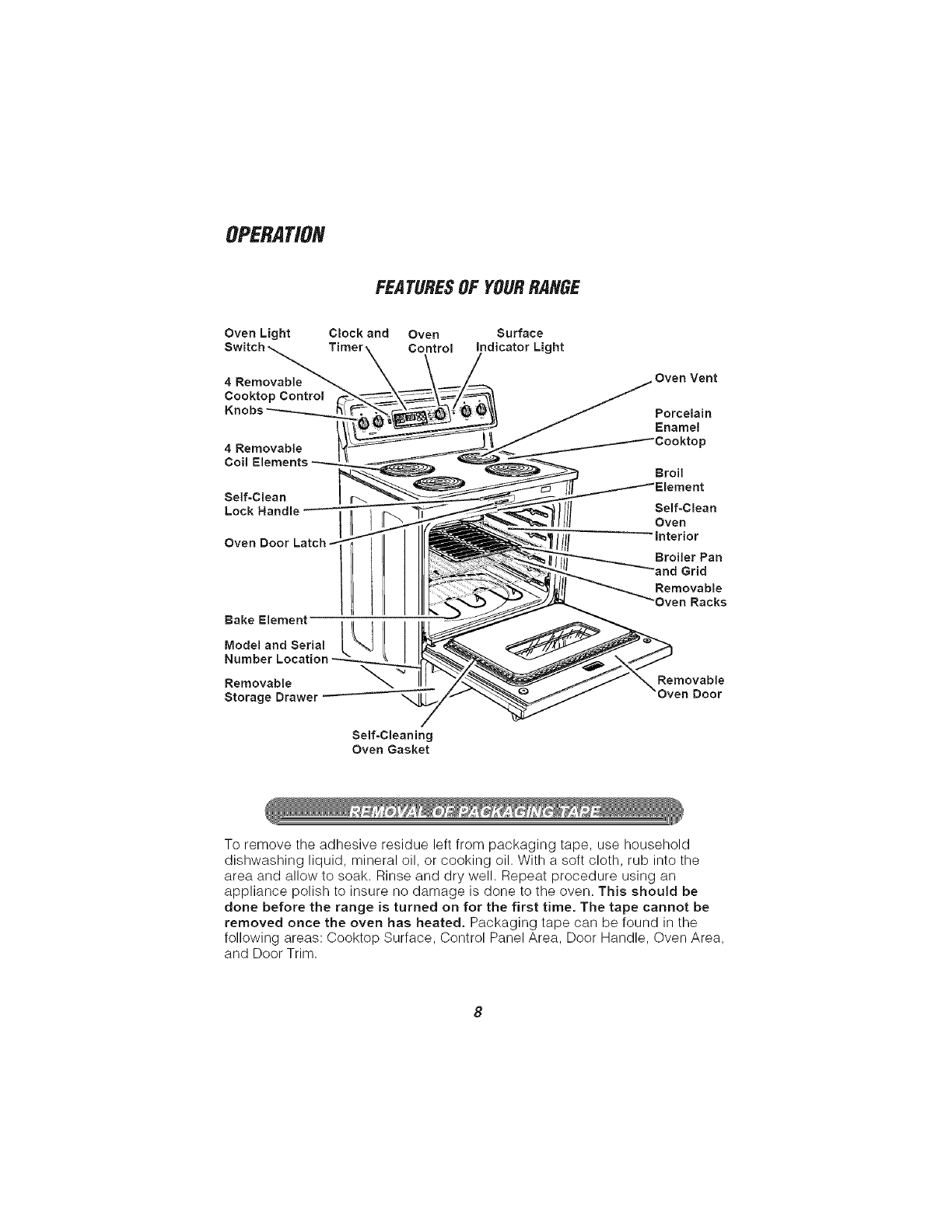
FEATURESOFYOURRANGE
Oven Light Clock and Oven
Timer Control
4 Removable
Cooktop Control
4 Removable
Coil
Self-Clean
Lock
Element
:::,oo0.°.,o,l.l
Number Location \
Removable
Storage Drawel
Self-Cleaning
Oven Gasket
Surface
indicator Light
Oven Vent
Porcelain
Enamel
// Self-Clean
Oven
interior
Broiler Pan
'and Grid
Removable
Removable
Door
To remove the adhesive residue left from packaging tape, use household
dishwashing liquid, mineral oil, or cooking oil. With a soft cloth, rub into the
area and allow to soak. Rinse and dry well. Repeat procedure using an
appliance polish to insure no damage is done to the oven. This should be
done before the range is turned on for the first time. The tape cannot be
removed once the oven has heated. Packaging tape can be found in the
following areas: Cooktop Surface, Control Panel Area, Door Handle, Oven Area,
and Door Trim.
OPERATION
CooktopCooking
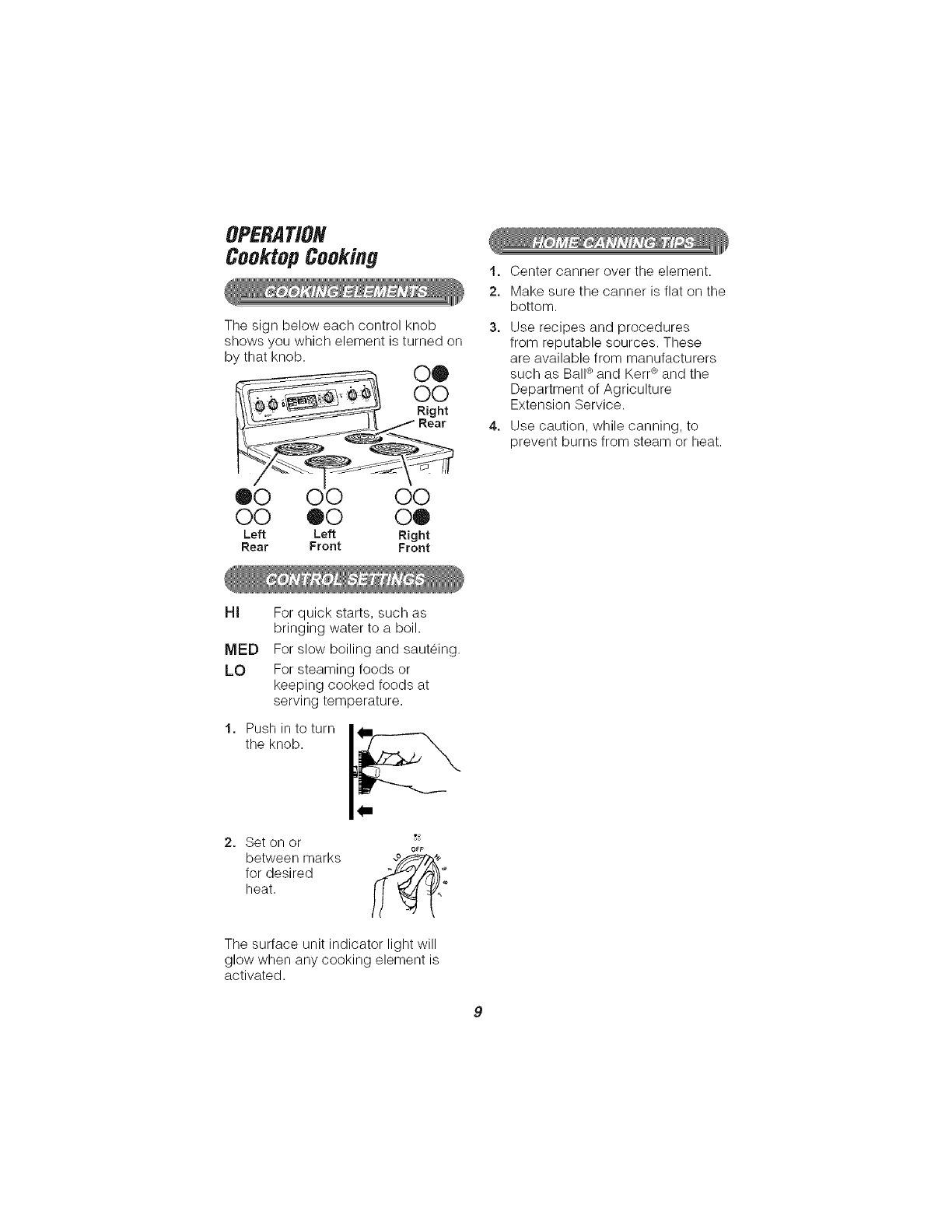
The sign below each control knob
shows you which element is turned on
by that knob. O®
CO
Right
__ ___._ Rear
___-/_]____
®0 O0 O0
O0 ®0 O®
Left Left Right
Rear Front Front
1. Center canner over the element.
2. Make sure the canner is flat on the
bottom.
3,
4,
Use recipes and procedures
from reputable sources. These
are available from manufacturers
such as Ball®and Kerr ®and the
Department of Agriculture
Extension Service.
Use caution, while canning, to
prevent burns from steam or heat.
HI For quick starts, such as
bringing water to a boil.
MED For slow boiling and sauteing.
LO For steaming foods or
keeping cooked foods at
serving temperature.
1. Push in to turn
the knob.
a
2. Set on or OFF
between marks _°__
for desired
heat.
The surface unit indicator light will
glow when any cooking element is
activated.
OPERATION
OvenControl, Clock, and Timer
r
0AUTOMATIC OVEN
OVEN CLEANING - O MOVE DOOR LATCH TO RIGHT. O TURN OVEN KNOB TO _CLEAN".
OFF
"__1 ovE.o, o_....'>fT'L-_
,= _*'f--_'l II_ _"
PR o00 450 _
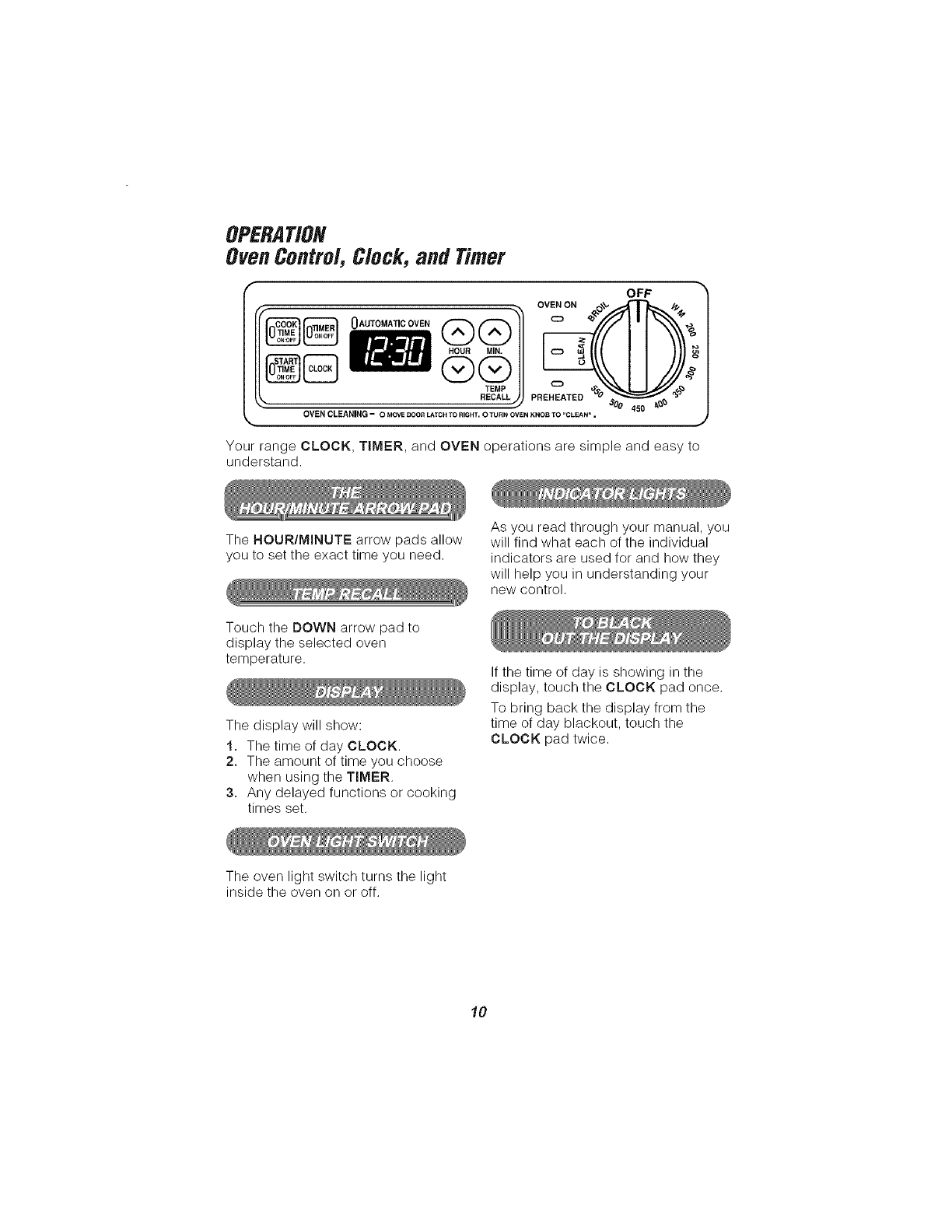
Your range CLOCK, TIMER, and OVEN operations are simple and easy to
understand.
The HOUR/MINUTE arrow pads allow
you to set the exact time you need.
Touch the DOWN arrow pad to
display the selected oven
temperature.
The display will show:
1. The time of day CLOCK.
2. The amount of time you choose
when using the TIMER.
3. Any delayed functions or cooking
times set.
As you read through your manual, you
will find what each of the individual
indicators are used for and how they
will help you in understanding your
new control.
If the time of day is showing in the
display, touch the CLOCK pad once.
To bring back the display from the
time of day blackout, touch the
CLOCK pad twice.
The oven light switch turns the light
inside the oven on or off.
10
OPERATION
OvenControl,Clock,and Timer(cont.)
If the display flashes an "F" followed
by a number and beeps continuously,
you have a function error code.
Note the number after the "F." Turn
the oven control knob to the OFF
position. Disconnect all power to the
range for at least 30 seconds and
retry the oven operation. If the "F"
displays during a self-clean cycle,
check the oven door latch. Make sure
the latch is moved to the right as
far as it will go. Turn the OVEN
CONTROL KNOB to the OFF
position. Allow the oven to cool 1 hour
and retry the oven operation. If the
problem repeats, call for service.
Advise the technician what the
flashing code was.
When the power to your range is
turned on for the first time, or if you
experience a power failure, the
display will flash "PF." By touching
the CLOCK pad, the display will flash
"12:00." Touch the CLOCK pad again
and follow the instructions to set the
clock. Any operation set before a
power failure will need to be reset.
The oven will automatically shut off
if it has been left on for more than
12 hours.
To deactivate or reactivate the
automatic shutoff, touch and hold the
MIN UP and DOWN arrow pads for
about 4 seconds.
11
OPERATION
Clock and Timer
@
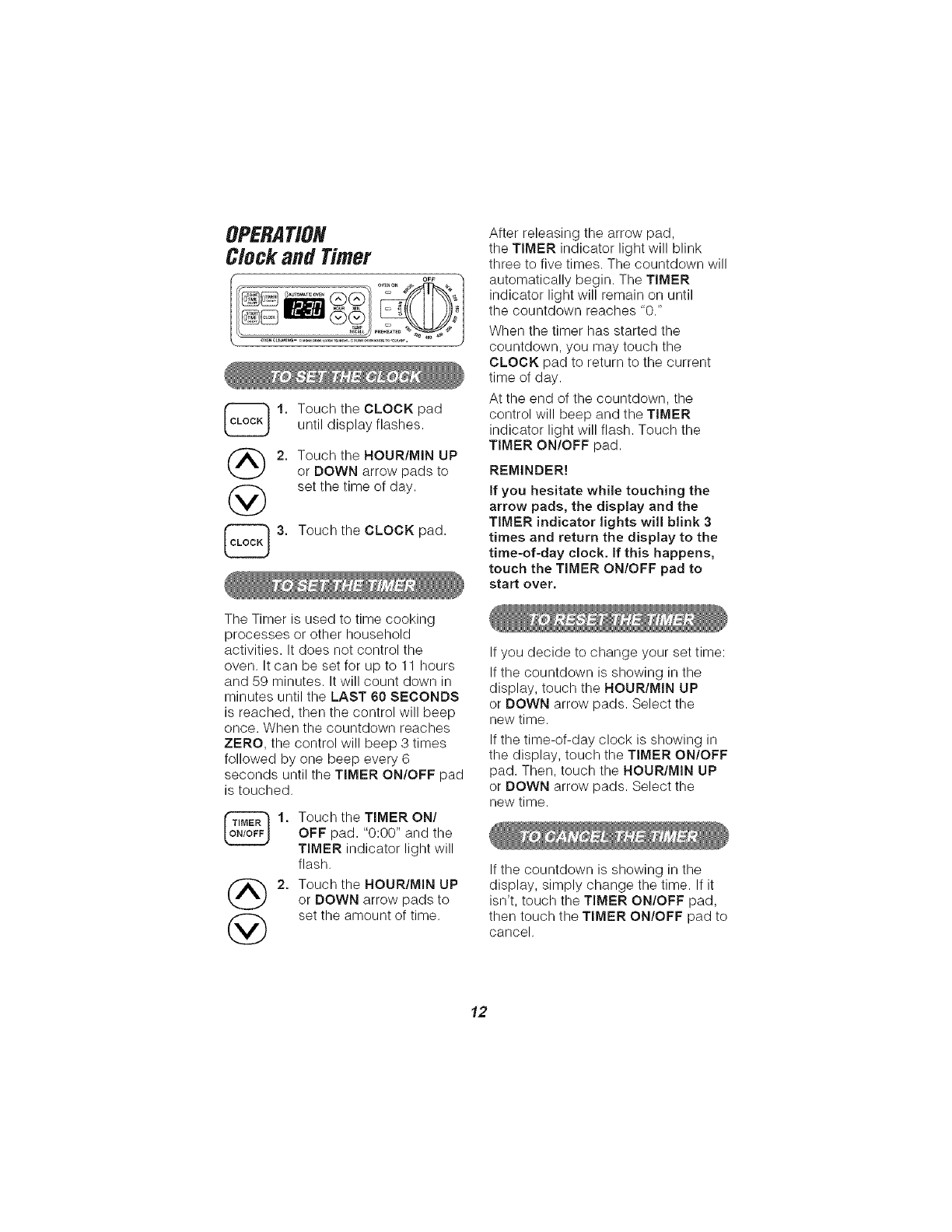
Touch the CLOCK pad
until display flashes.
Touch the HOUR/MIN UP
or DOWN arrow pads to
set the time of day.
Touch the CLOCK pad.
The Timer is used to time cooking
processes or other household
activities. It does not control the
oven. It can be set for up to 11 hours
and 59 minutes. It will count down in
minutes until the LAST 60 SECONDS
is reached, then the control will beep
once. When the countdown reaches
ZERO, the control will beep 3 times
followed by one beep every 6
seconds until the TIMER ON/OFF pad
is touched.
_ 1, Touch the TIMER ON/OFF pad. "0:00" and the
TIMER indicator light will
flash.
(_ 2. Touch the HOUR/MIN UP
or DOWN arrow pads to
(_ set the amount of time.
After releasing the arrow pad,
the TIMER indicator light will blink
three to five times. The countdown will
automatically begin. The TIMER
indicator light will remain on until
the countdown reaches "0."
When the timer has started the
countdown, you may touch the
CLOCK pad to return to the current
time of day.
At the end of the countdown, the
control will beep and the TIMER
indicator light will flash. Touch the
TIMER ON/OFF pad.
REMINDER!
If you hesitate while touching the
arrow pads, the display and the
TIMER indicator lights will blink 3
times and return the display to the
time-of-day clock. If this happens,
touch the TIMER ON/OFF pad to
start over.
If you decide to change your set time:
If the countdown is showing in the
display, touch the HOUR/MIN UP
or DOWN arrow pads. Select the
new time.
If the time-of-day clock is showing in
the display, touch the TIMER ON/OFF
pad. Then, touch the HOUR/MIN UP
or DOWN arrow pads. Select the
new time.
If the countdown is showing in the
display, simply change the time. If it
isn't, touch the TIMER ON/OFF pad,
then touch the TIMER ON/OFF pad to
cancel,
12
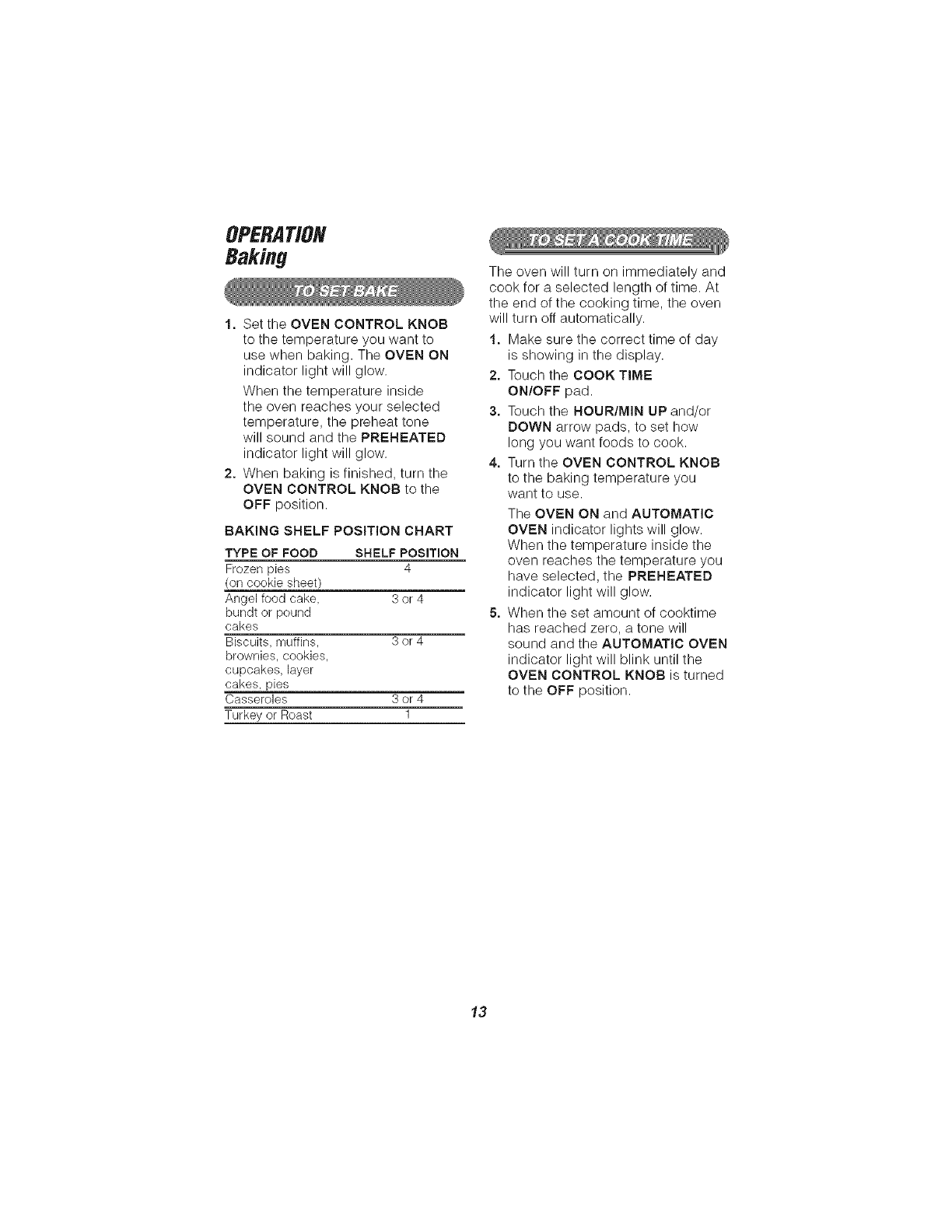
OPERATION
Baking
1, Set the OVEN CONTROL KNOB
to the temperature you want to
use when baking. The OVEN ON
indicator light will glow.
When the temperature inside
the oven reaches your selected
temperature, the preheat tone
will sound and the PREHEATED
indicator light will glow.
2. When baking is finished, turn the
OVEN CONTROL KNOB to the
OFF position.
BAKING SHELF POSITION CHART
TYPE OF FOOD SHELF POSiTiON
Frozen pies 4
(on cookie sheet)
Angel food cake, 3 or 4
bundt or pound
cakes
Biscuits, muffins, 3 or 4
brownies, cookies,
cupcakes, layer
cakes, pies
Casseroles 3 or 4
Turkey or Roast 1
The oven will turn on immediately and
cook for a selected length of time. At
the end of the cooking time, the oven
will turn off automatically.
1. Make sure the correct time of day
is showing in the display.
2. Touch the COOK TIME
ON/OFF pad.
3. Touch the HOUR/MIN UP and/or
DOWN arrow pads, to set how
long you want foods to cook.
4. Turn the OVEN CONTROL KNOB
to the baking temperature you
want to use.
The OVEN ON and AUTOMATIC
OVEN indicator lights will glow.
When the temperature inside the
oven reaches the temperature you
have selected, the PREHEATED
indicator light will glow.
5. When the set amount of cooktime
has reached zero, a tone will
sound and the AUTOMATIC OVEN
indicator light will blink until the
OVEN CONTROL KNOB is turned
to the OFF position.
13
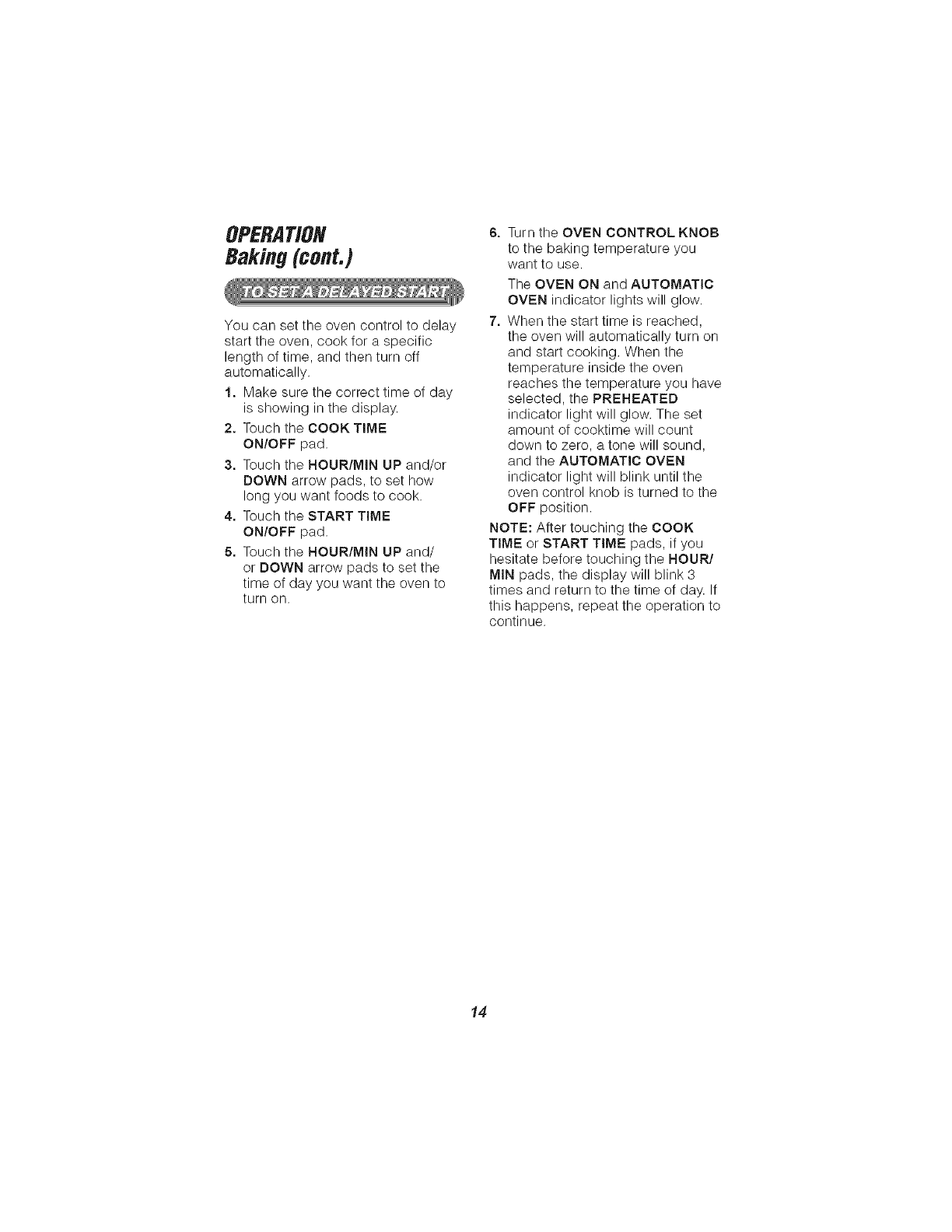
You can set the oven control to delay
start the oven, cook for a specific
length of time, and then turn off
automatically.
1, Make sure the correct time of day
is showing in the display.
2. Touch the COOK TIME
ON/OFF pad.
3. Touch the HOUR/MIN UP and/or
DOWN arrow pads, to set how
long you want foods to cook.
4. Touch the START TIME
ON/OFF pad.
5. Touch the HOUR/MIN UP and/
or DOWN arrow pads to set the
time of day you want the oven to
turn on.
6. Turn the OVEN CONTROL KNOB
to the baking temperature you
want to use.
The OVEN ON and AUTOMATIC
OVEN indicator lights will glow.
7. When the start time is reached,
the oven will automatically turn on
and start cooking. When the
temperature inside the oven
reaches the temperature you have
selected, the PREHEATED
indicator light will glow. The set
amount of cooktime will count
down to zero, a tone will sound,
and the AUTOMATIC OVEN
indicator light will blink until the
oven control knob is turned to the
OFF position.
NOTE: After touching the COOK
TIME or START TIME pads, if you
hesitate before touching the HOURI
MIN pads, the display will blink 3
times and return to the time of day. If
this happens, repeat the operation to
continue.
14
OPERATION
OvenCookingTips
It is normal to have some odor when
using your oven for the first time. To
help eliminate this odor, ventilate the
room by opening a window or using
a vent hood.
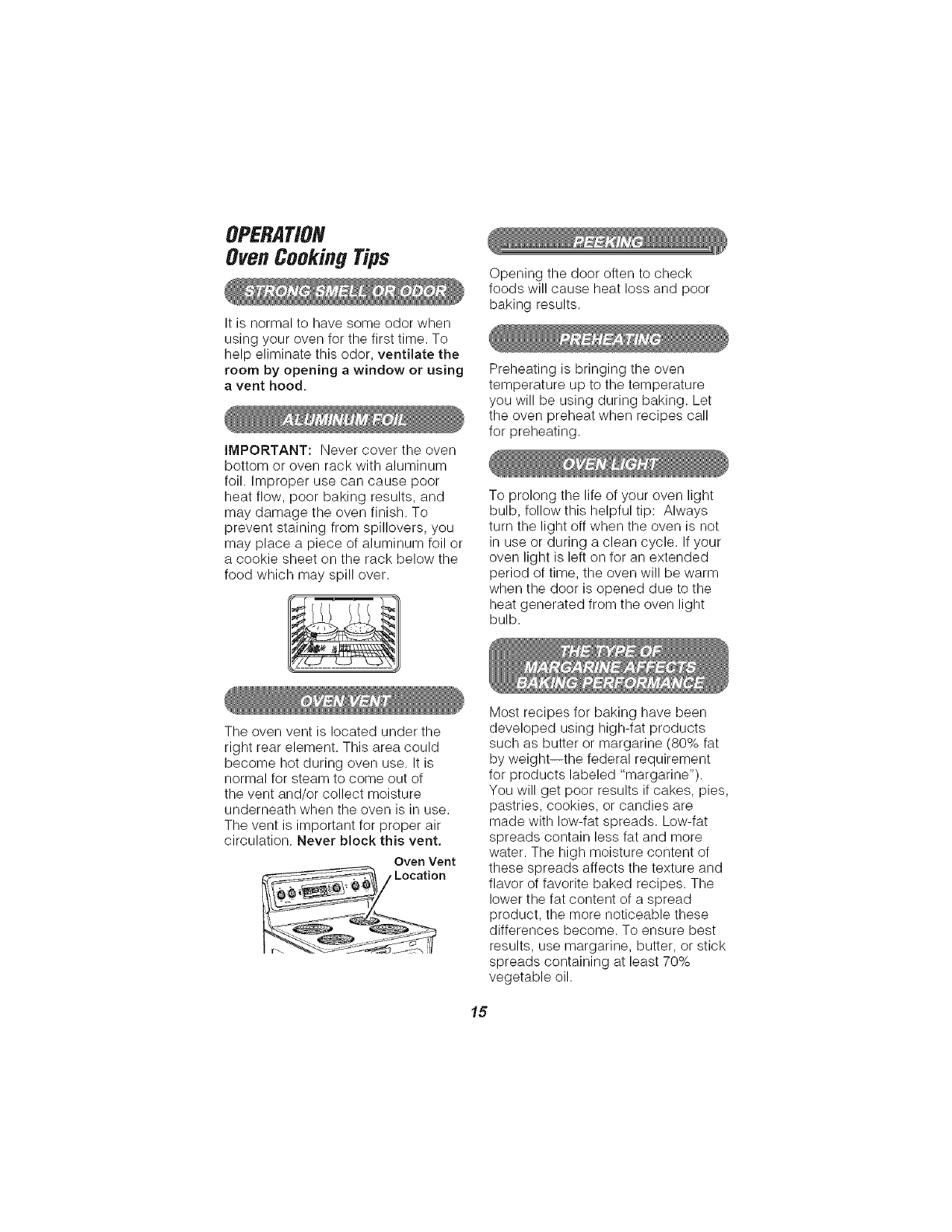
iMPORTANT: Never cover the oven
bottom or oven rack with aluminum
foil. Improper use can cause poor
heat flow, poor baking results, and
may damage the oven finish. To
prevent staining from spillovers, you
may place a piece of aluminum foil or
a cookie sheet on the rack below the
food which may spill over.
Opening the door often to check
foods will cause heat loss and poor
baking results.
Preheating is bringing the oven
temperature up to the temperature
you will be using during baking. Let
the oven preheat when recipes call
for preheating.
To prolong the life of your oven light
bulb, follow this helpful tip: Always
turn the light off when the oven is not
in use or during a clean cycle. If your
oven light is left on for an extended
period of time, the oven will be warm
when the door is opened due to the
heat generated from the oven light
bulb.
The oven vent is located under the
right rear element. This area could
become hot during oven use. It is
normal for steam to come out of
the vent and/or collect moisture
underneath when the oven is in use.
The vent is important for proper air
circulation. Never block this vent.
Oven Vent
_j_ Location
Most recipes for baking have been
developed using high-fat products
such as butter or margarine (80% fat
by weight--the federal requirement
for products labeled "margarine").
You will get poor results if cakes, pies,
pastries, cookies, or candies are
made with low-fat spreads. Low-fat
spreads contain less fat and more
water. The high moisture content of
these spreads affects the texture and
flavor of favorite baked recipes. The
lower the fat content of a spread
product, the more noticeable these
differences become. To ensure best
results, use margarine, butter, or stick
spreads containing at least 70%
vegetable oil.
/5
OPERATION
OvenCookingTips(cont.)
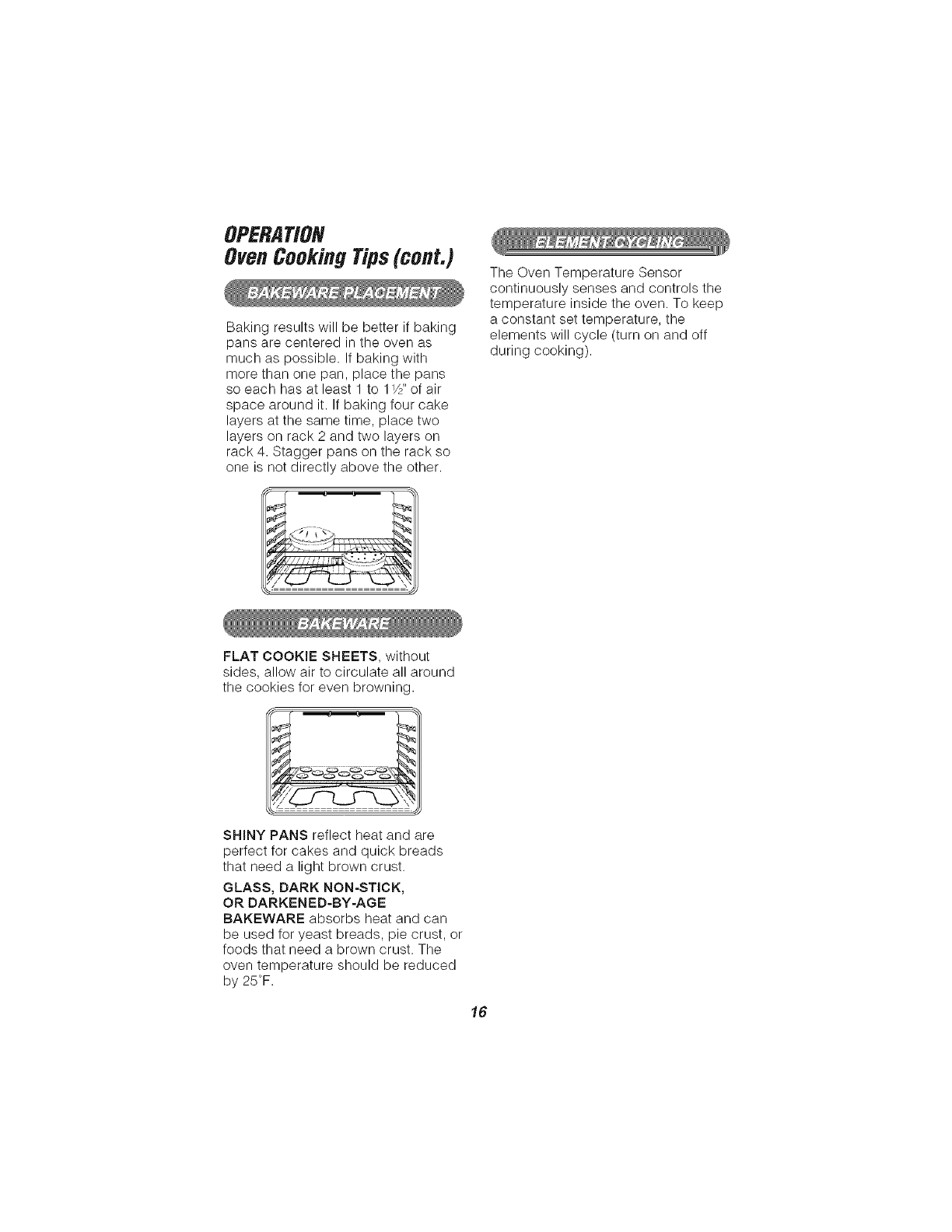
Baking results will be better if baking
pans are centered in the oven as
much as possible. If baking with
more than one pan, place the pans
so each has at least 1 to 1W' of air
space around it. If baking four cake
layers at the same time, place two
layers on rack 2 and two layers on
rack 4. Stagger pans on the rack so
one is not directly above the other.
The Oven Temperature Sensor
continuously senses and controls the
temperature inside the oven. To keep
a constant set temperature, the
elements will cycle (turn on and off
during cooking).
FLAT COOKIE SHEETS, without
sides, allow air to circulate all around
the cookies for even browning.
SHINY PANS reflect heat and are
perfect for cakes and quick breads
that need a light brown crust.
GLASS, DARK NON=STICK,
OR DARKENED=BY=AGE
BAKEWARE absorbs heat and can
be used for yeast breads, pie crust, or
foods that need a brown crust. The
oven temperature should be reduced
by 25°F.
16
OPERATION
OvenCookingTips(cont.)
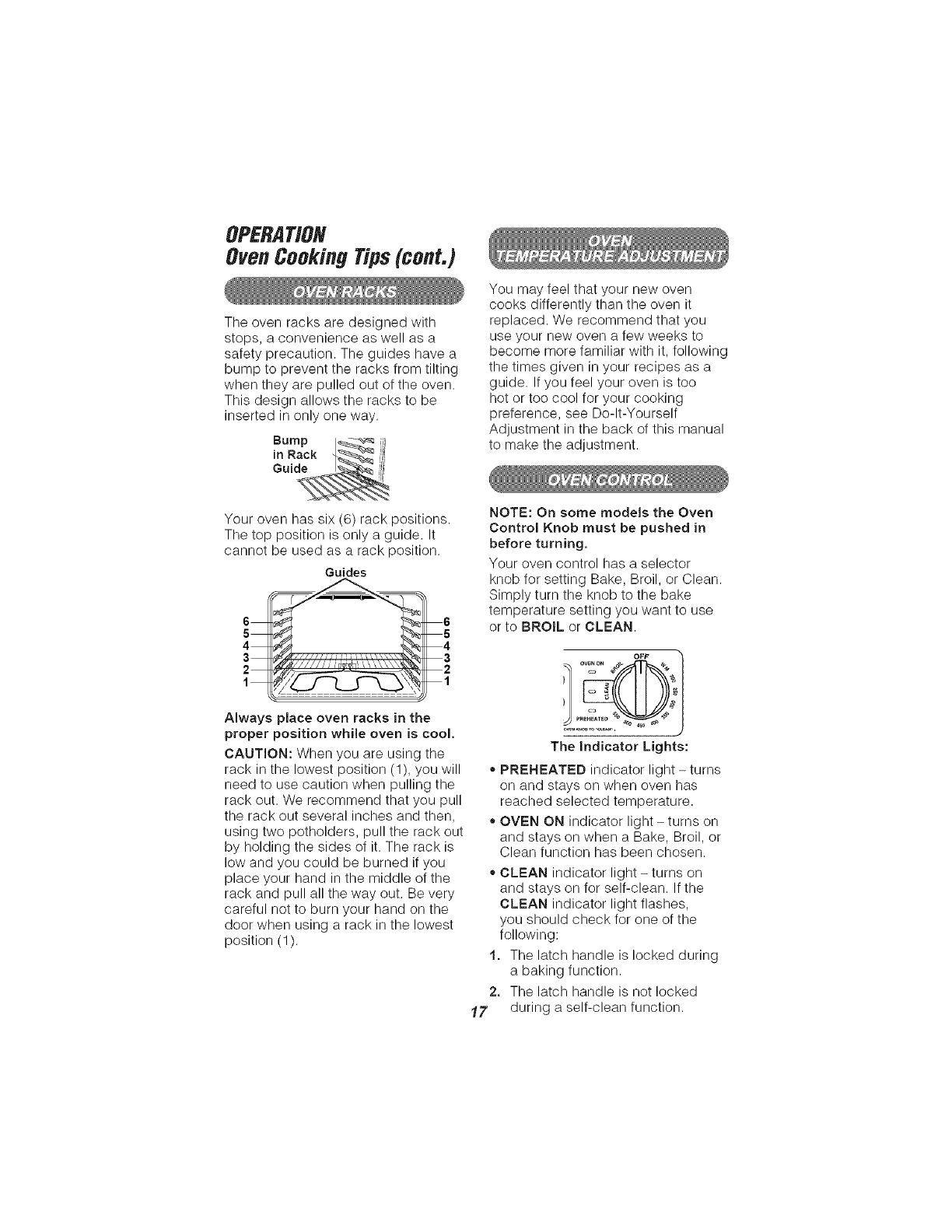
The oven racks are designed with
stops, a convenience as well as a
safety precaution. The guides have a
bump to prevent the racks from tilting
when they are pulled out of the oven.
This design allows the racks to be
inserted in only one way.
Bump I_
k
Your oven has six (6) rack positions.
The top position is only a guide. It
cannot be used as a rack position.
Guides
You may feel that your new oven
cooks differently than the oven it
replaced. We recommend that you
use your new oven a few weeks to
become more familiar with it, following
the times given in your recipes as a
guide. If you feel your oven is too
hot or too cool for your cooking
preference, see Do-k-Yourself
Adjustment in the back of this manual
to make the adjustment.
NOTE: On some models the Oven
Control Knob must be pushed in
before turning.
Your oven control has a selector
knob for setting Bake, Broil, or Clean.
Simply turn the knob to the bake
temperature setting you want to use
or to BROIL or CLEAN.
Always place oven racks in the
proper position while oven is cool.
CAUTION: When you are using the
rack in the lowest position (1), you will
need to use caution when pulling the
rack out. We recommend that you pull
the rack out several inches and then,
using two potholders, pull the rack out
by holding the sides of it. The rack is
low and you could be burned if you
place your hand in the middle of the
rack and pull all the way out. Be very
careful not to burn your hand on the
door when using a rack in the lowest
position (1).
OFF
The Indicator Lights:
• PREHEATED indicator light - turns
on and stays on when oven has
reached selected temperature.
• OVEN ON indicator light - turns on
and stays on when a Bake, Broil, or
Clean function has been chosen.
• CLEAN indicator light - turns on
and stays on for self-clean. If the
CLEAN indicator light flashes,
you should check for one of the
following:
1, The latch handle is locked during
a baking function.
2, The latch handle is not locked
12" during a self-clean function.
OPERATION
Broiling
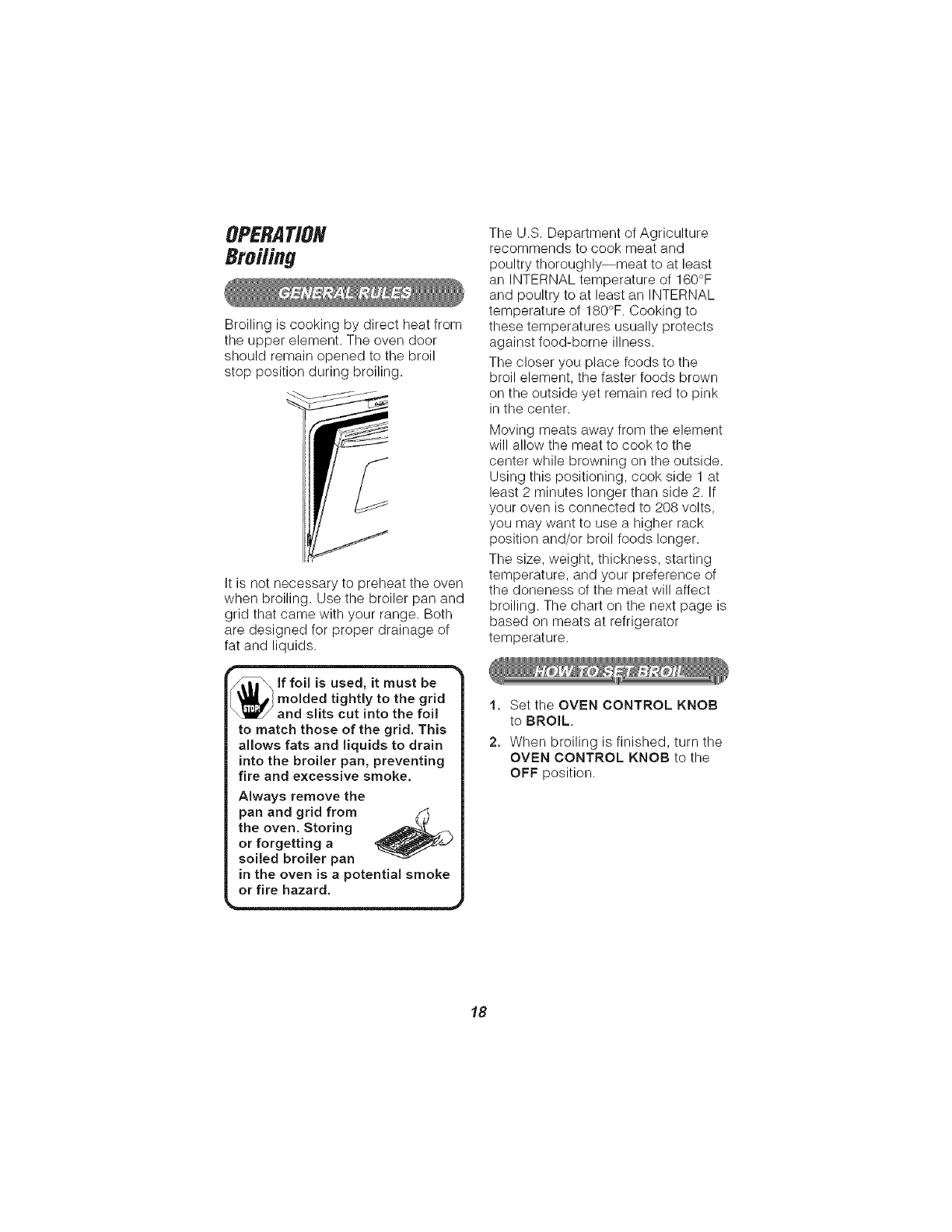
Broiling is cooking by direct heat from
the upper element. The oven door
should remain opened to the broil
stop position during broiling.
It is not necessary to preheat the oven
when broiling. Use the broiler pan and
grid that came with your range. Both
are designed for proper drainage of
fat and liquids.
.If foi! is used, it must be
molded tightly to the grid
and slits cut into the foi!
to match those of the grid. This
allows fats and liquids to drain
into the broiler pan, preventing
fire and excessive smoke.
Always remove the
pan and grid from S_
the oven. Storing
or forgetting a
soiled broiler pan
in the oven is a potential smoke
or fire hazard.
The U.S. Department of Agriculture
recommends to cook meat and
poultry thoroughly--meat to at least
an INTERNAL temperature of 160°F
and poultry to at least an INTERNAL
temperature of 180°F. Cooking to
these temperatures usually protects
against food-borne illness.
The closer you place foods to the
broil element, the faster foods brown
on the outside yet remain red to pink
in the center.
Moving meats away from the element
will allow the meat to cook to the
center while browning on the outside.
Using this positioning, cook side 1 at
least 2 minutes longer than side 2. If
your oven is connected to 208 volts,
you may want to use a higher rack
position and/or broil foods longer.
The size, weight, thickness, starting
temperature, and your preference of
the doneness of the meat will affect
broiling. The chart on the next page is
based on meats at refrigerator
temperature.
1. Set the OVEN CONTROL KNOB
to BROIL.
2. When broiling is finished, turn the
OVEN CONTROL KNOB to the
OFF position.
18
OPERATION
Broiling(cont.)
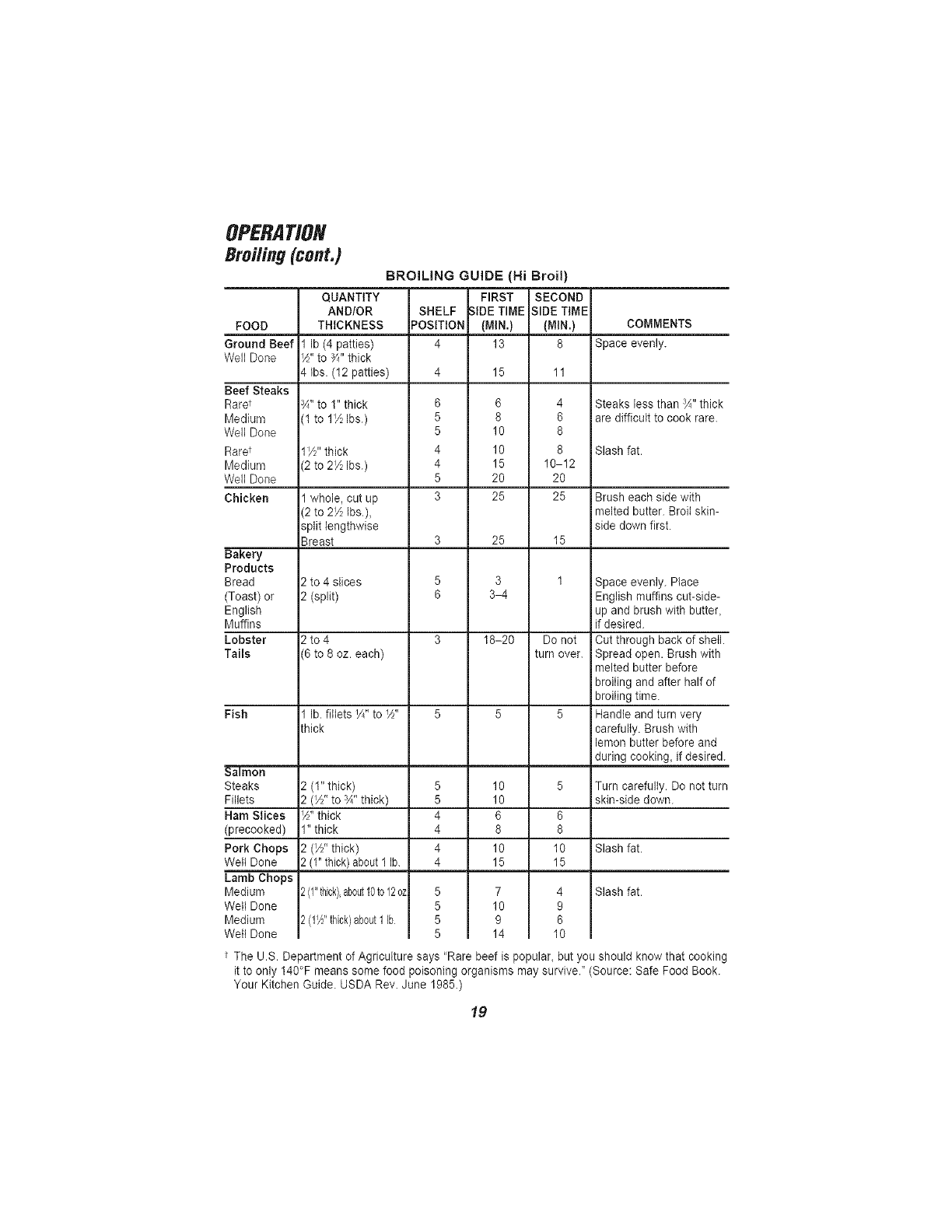
BROILING GUIDE (Hi Broil)
QUANTITY FIRST SECOND
AND/OR SHELF SIDE TIME SIDE TIME
FOOD THICKNESS )OSITION (MIN.) (MIN.)
3round Beef Ib (4 patties) 4 13 8
7VeilDone W' to 7_"thick
4 Ibs. (12 patties) 4 15 11
Beef Steaks
Rarer
Vledium
7VeilDone
Raret
Vledium
dell Done
Chicken
Bakery
Products
Bread
'Toast) or
English
Viuffins
Lobster
rails
Fish
Salmon
Steaks
--illets
Ham Slices
'precooked)
Pork Chops
71/eitDone
Lamb Chops
Medium
Well Done
Medium
Weit Done
COMMENTS
Space evenly.
4" to 1" thick
(I to 1½ Ibs.)
1½" thick
(2 to 2½ Ibs.)
whole, cut up
2 to 2½ Ibs.),
split lengthwise
Breast
6
5
5
4
4
5
3
6 4
8 6
10 8
10 8
15 10-12
28 20
25 25
25 15
Steaks less than ¾" thick
are difficult to cook rare.
Slash fat.
Brush each side with
melted butter. Broil skin-
side down first.
2 to 4 slices 5 3
2 (split) 8 3-4
2 to 4 3 18-20 Do not
6 to 8 oz. each) turn over.
lb. fillets _A"to _&"
thick
1 Space evenly. Place
English muffins cut-side-
up and brush with butter,
if desired.
Cut through back of shell.
Spread open. Brush with
melted butter before
broiling and after half of
broiling time.
5 Handle and turn very
carefully. Brush with
lemon butter before and
during cooking, if desired.
2 (1" thick) 5 10 5 Turn carefully. Do not turn
2 (½" to ¾" thick) 5 10 skin-side down.
/2'thick 466
1" thick 4 8 8
2 (½" thick) 4 10 10 Slash fat.
2 (1"thick) about 1 lb. 4 15 15
2(1"thick), Slash fat.
(1½"thick)about1 Ib
t The U.S. Department of Agriculture says "Rare beef is popular, but you should know that cooking
it to only 140°F means some food poisoning organisms may survive." (Source: Safe Food Book.
Your Kitchen Guide. USDA Rev. June 1985.)
19
CAREANDCLEANING
Self-CleaningCycle
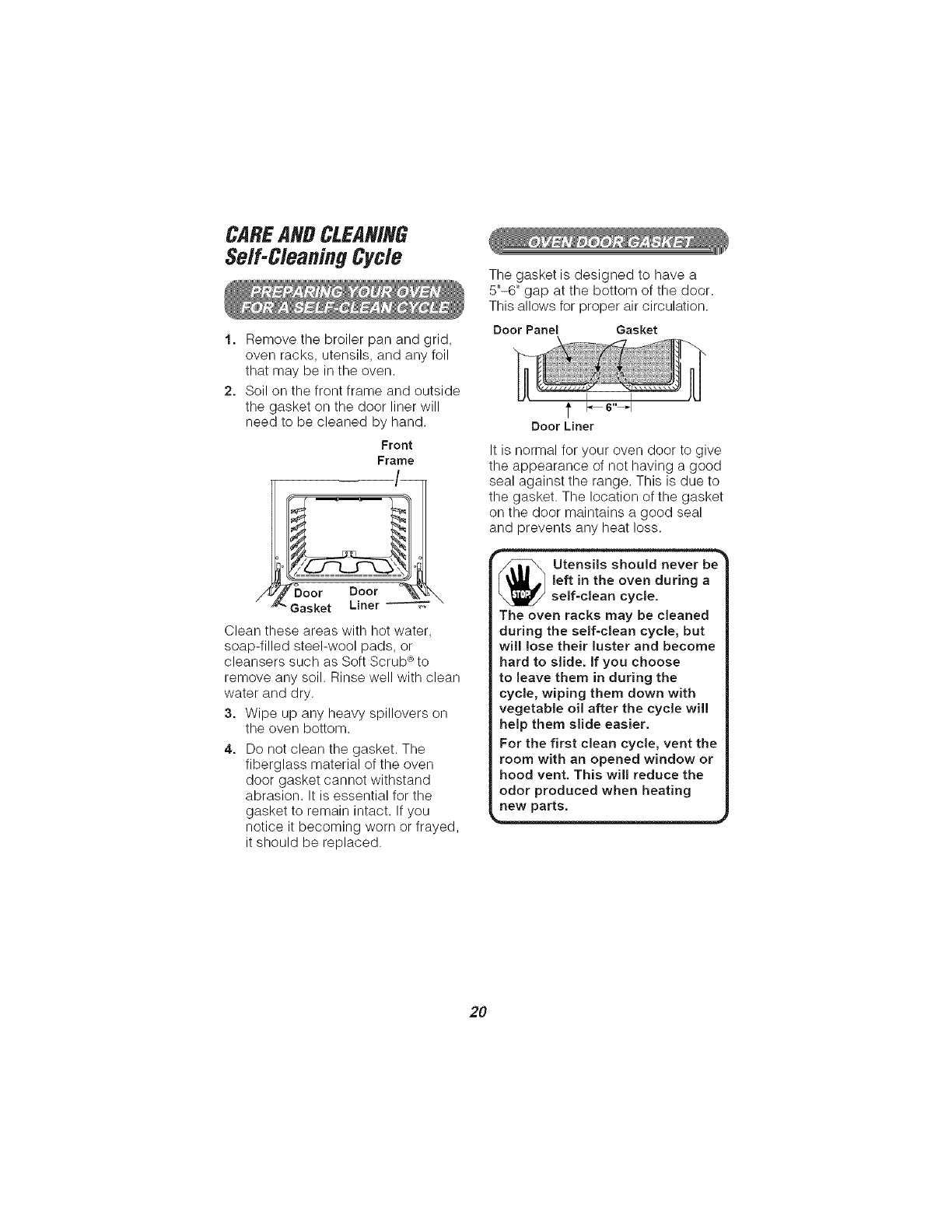
1. Remove the broiler pan and grid,
oven racks, utensils, and any foil
that may be in the oven.
2. Soil on the front frame and outside
the gasket on the door liner will
need to be cleaned by hand.
,/
Front
Frame
/--
7boor poor
Gasket Liner ÷
Clean these areas with hot water,
soap-filled steel-wool pads, or
cleansers such as Soft Scrub ®to
remove any soil. Rinse well with clean
water and dry.
3. Wipe up any heavy spillovers on
the oven bottom.
4. Do not clean the gasket. The
fiberglass material of the oven
door gasket cannot withstand
abrasion. It is essential for the
gasket to remain intact. If you
notice it becoming worn or frayed,
it should be replaced.
The gasket is designed to have a
5"-6" gap at the bottom of the door.
This allows for proper air circulation.
Door Panel Gasket
Door Liner
It is normal for your oven door to give
the appearance of not having a good
seal against the range. This is due to
the gasket. The location of the gasket
on the door maintains a good seal
and prevents any heat loss.
r .....................................
_ tensils should never be
left in the oven during a
self-clean cycle.
The oven racks may be cleaned
during the self-clean cycle, but
will lose their luster and become
hard to slide. If you choose
to leave them in during the
cycle, wiping them down with
vegetable oil after the cycle will
help them slide easier.
For the first clean cycle, vent the
room with an opened window or
hood vent. This will reduce the
odor produced when heating
new parts.
2O
CAREA#D CLEAffiNG
Self-CleaningCycle(cont.)
1. For best results, follow the steps
in PREPARING YOUR OVEN.
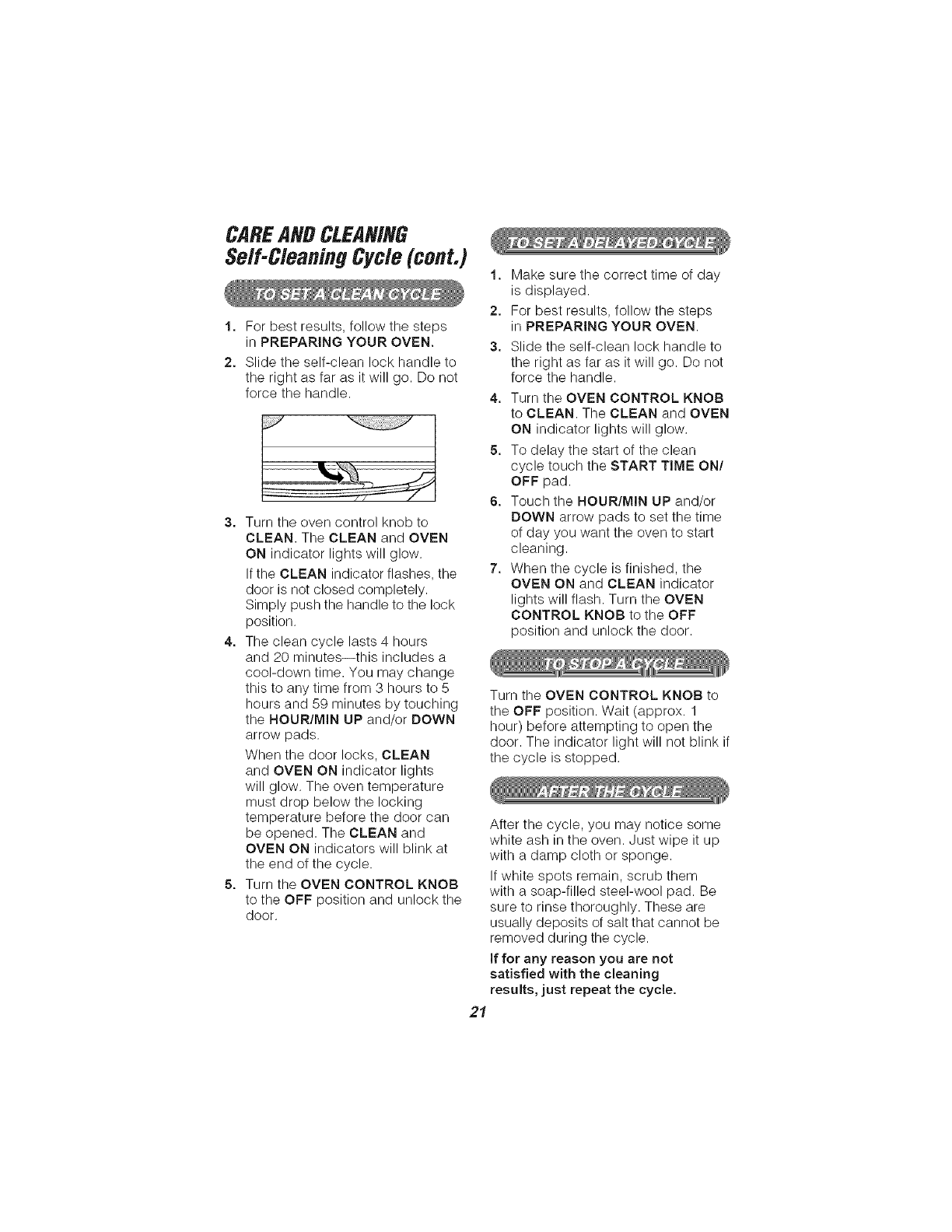
2. Slide the self-clean lock handle to
the right as far as it will go. Do not
force the handle.
3. Turn the oven control knob to
CLEAN. The CLEAN and OVEN
ON indicator lights will glow.
If the CLEAN indicator flashes, the
door is not closed completely.
Simply push the handle to the lock
position.
4. The clean cycle lasts 4 hours
and 20 minutes--this includes a
cool-down time. You may change
this to any time from 3 hours to 5
hours and 59 minutes by touching
the HOUR/MIN UP and/or DOWN
arrow pads.
When the door locks, CLEAN
and OVEN ON indicator lights
will glow. The oven temperature
must drop below the locking
temperature before the door can
be opened. The CLEAN and
OVEN ON indicators will blink at
the end of the cycle.
5. Turn the OVEN CONTROL KNOB
to the OFF position and unlock the
door.
1. Make sure the correct time of day
is displayed.
2. For best results, follow the steps
in PREPARING YOUR OVEN.
3. Slide the self-clean lock handle to
the right as far as it will go. Do not
force the handle.
4, Turn the OVEN CONTROL KNOB
to CLEAN. The CLEAN and OVEN
ON indicator lights will glow.
5. To delay the start of the clean
cycle touch the START TIME ON/
OFF pad.
6, Touch the HOUR/MIN UP and/or
DOWN arrow pads to set the time
of day you want the oven to start
cleaning
7. When the cycle is finished, the
OVEN ON and CLEAN indicator
lights will flash Turn the OVEN
CONTROL KNOB to the OFF
position and unlock the door
Turn the OVEN CONTROL KNOB to
the OFF position. Wait (approx. 1
hour) before attempting to open the
door. The indicator light will not blink if
the cycle is stopped.
After the cycle, you may notice some
white ash in the oven. Just wipe it up
with a damp cloth or sponge.
If white spots remain, scrub them
with a soap-filled steel-wool pad. Be
sure to rinse thoroughly. These are
usually deposits of salt that cannot be
removed during the cycle.
If for any reason you are not
satisfied with the cleaning
results, just repeat the cycle.
21
CAREANDCLEANING
Cleaning
CLEANING MATERIALS
®Dishwashing detergent
®Warm water
®Soft cloth
Do not use abrasive cleaners,
industrial cleaners, or bleach.
CLEANING MATERIALS
®Dishwashing detergent
®Warm water
®Soap-filled steel-wool pad
®Commercial oven cleaner
CLEANING MATERIALS
®Dishwashing detergent
®Warm water
®Paper towel
®Ammonia
®Abrasive cleaner
®Scouring pad
TO CLEAN
Clean after each use. If acidic foods
(hot fruit filling, tomatoes, sauerkraut,
or sauces with vinegar or lemon juice)
spill, use a dry paper towel to wipe up
as much as possible. When surface
has cooled, thoroughly clean cooktop.
TO CLEAN
Allow the pan to soak. Sprinkle the
grid with dishwashing detergent and
cover with a damp cloth or paper
towel and let stand. Scour as needed.
Wash, rinse, and dry well. You may
also place both the pan and grid in
the dishwasher.
Clean only as touch-up between
clean cycles. Use dishwashing
liquid, warm water, or soap-filled
steel-wool pad. Rinse well after
cleaning and dry.
NEVER USE OVEN CLEANERS IN
OR AROUND ANY PART OF THE
OVEN.
When cleaning, be sure not to bend
or displace the temperature sensor,
located on the back wall of the oven.
CLEANING MATERIALS
®Dishwashing detergent
®Warm water
= Paper towels
TO CLEAN
Do not use oven cleaners,
cleansing powder or harsh abrasives.
If marinades, tomato sauce, basting
materials, etc. should spill, wipe up
as much as possible. When surfaces
have cooled, thoroughly clean painted
areas.
TO CLEAN
For everyday cleaning, use glass
cleaner and a paper towel. For
stubborn soil, use paste of baking
soda and water. Rinse thoroughly.
CLEANING MATERIALS
®Soft abrasive cleaner
®Sponge scrubber
Do not use hard, abrasive cleaners,
industrial cleaners, or bleach.
22
CAREAND CLEANING
Removable Parts
(on some models)
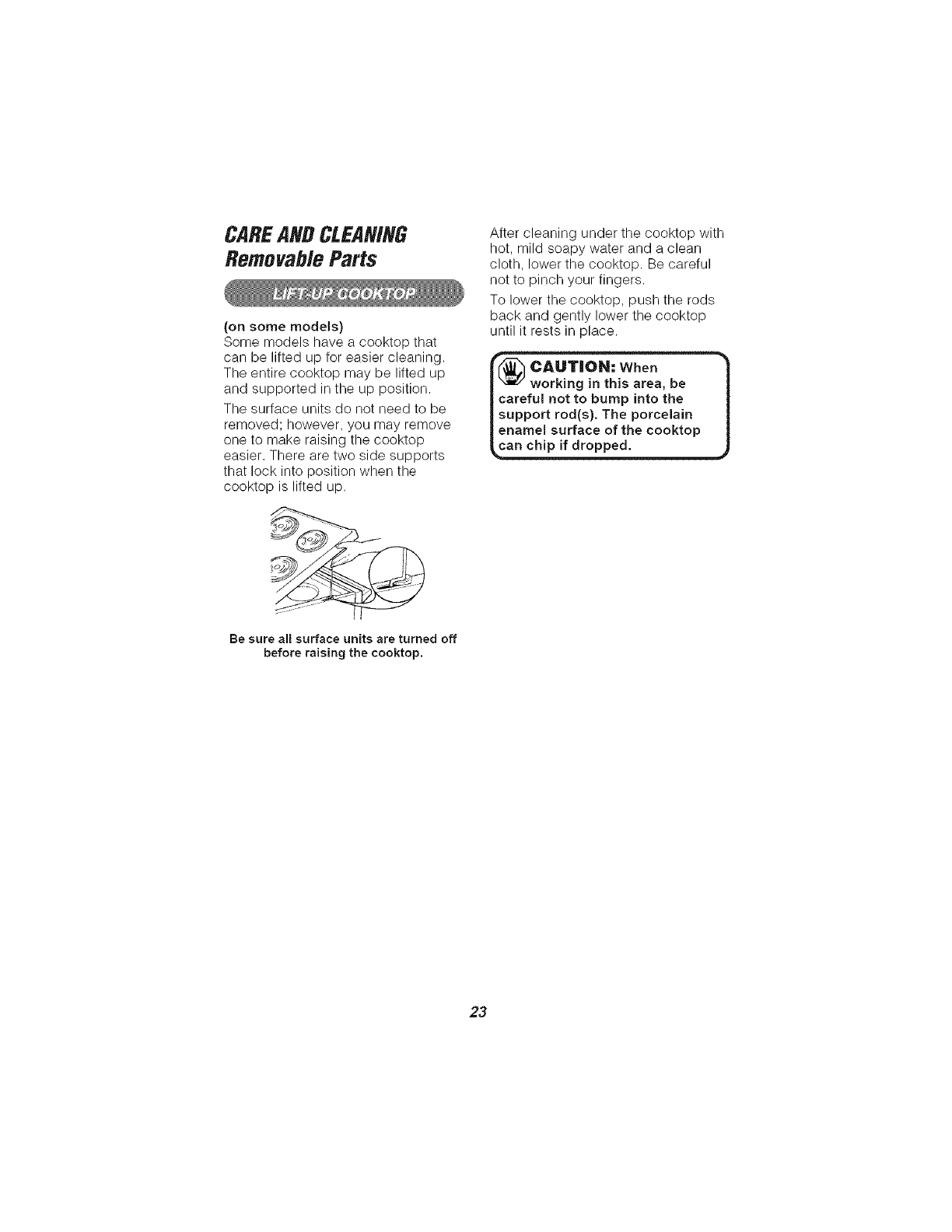
Some models have a cooktop that
can be lifted up for easier cleaning.
The entire cooktop may be lifted up
and supported in the up position.
The surface units do not need to be
removed; however, you may remove
one to make raising the cooktop
easier. There are two side supports
that lock into position when the
cooktop is lifted up.
Be sure all surface units are turned off
before raising the cooktop.
After cleaning under the cooktop with
hot, mild soapy water and a clean
cloth, lower the cooktop. Be careful
not to pinch your fingers.
To lower the cooktop, push the rods
back and gently lower the cooktop
until it rests in place.
CAUTIO.'When
working in this area, be |
careful not to bump into the |
support rod(s). The porcelain |
enamel surface of the cooktop |
_an ch!p ifdr°pPed: J
23
CAREAND CLEAMNG
Removable Parts (cont.)
CLEANING MATERIALS
®Dishwashing detergent
®Warm water
®Soft cloth
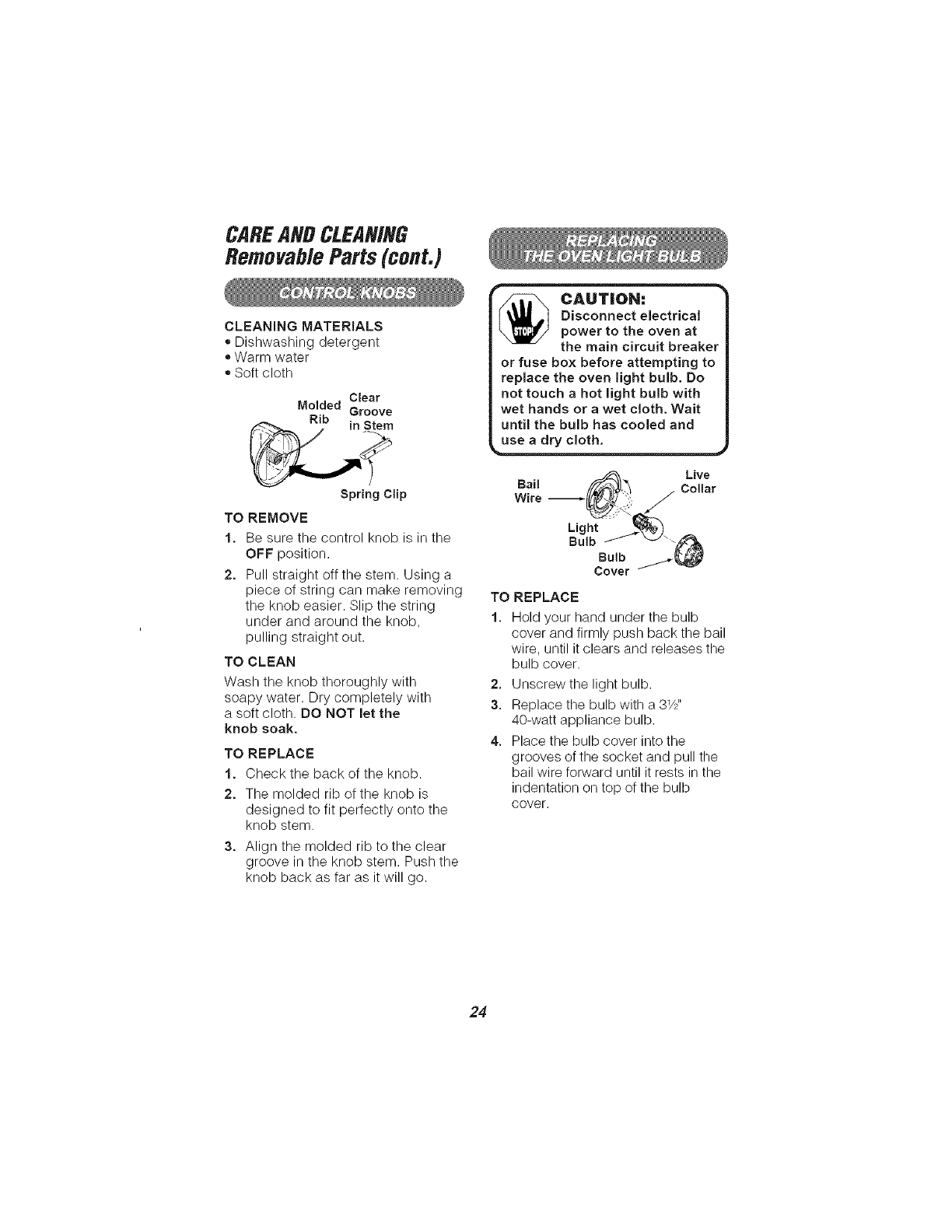
Clear
Molded Groove
Rib in Stem
Spring Clip
TO REMOVE
1. Be sure the control knob is in the
OFF position.
2. Pull straight off the stem. Using a
piece of string can make removing
the knob easier. Slip the string
under and around the knob,
pulling straight out.
TO CLEAN
Wash the knob thoroughly with
soapy water. Dry completely with
a soft cloth. DO NOT let the
knob soak.
TO REPLACE
1. Check the back of the knob.
2. The molded rib of the knob is
designed to fit perfectly onto the
knob stem.
3. Align the molded rib to the clear
groove in the knob stem. Push the
knob back as far as it will go.
CAUTION:
Disconnect electrical
power to the oven at
the main circuit breaker
or fuse box before attempting to
replace the oven light bulb. Do
not touch a hot light bulb with
wet hands or a wet cloth. Wait
until the bulb has cooled and
Live
Wire_ ._, _Collar
Light __' "_
Bulb _ '_J'_-_
Bulb
Cover "J"_
TO REPLACE
1. Hold your hand under the bulb
cover and firmly push back the bail
wire, until it clears and releases the
bulb cover.
2. Unscrew the light bulb.
3. Replace the bulb with a 31f2
40-watt appliance bulb.
4. Place the bulb cover into the
grooves of the socket and pull the
bail wire forward until it rests in the
indentation on top of the bulb
cover.
24
CAREANDCLEANING
RemovableParts(cont.)
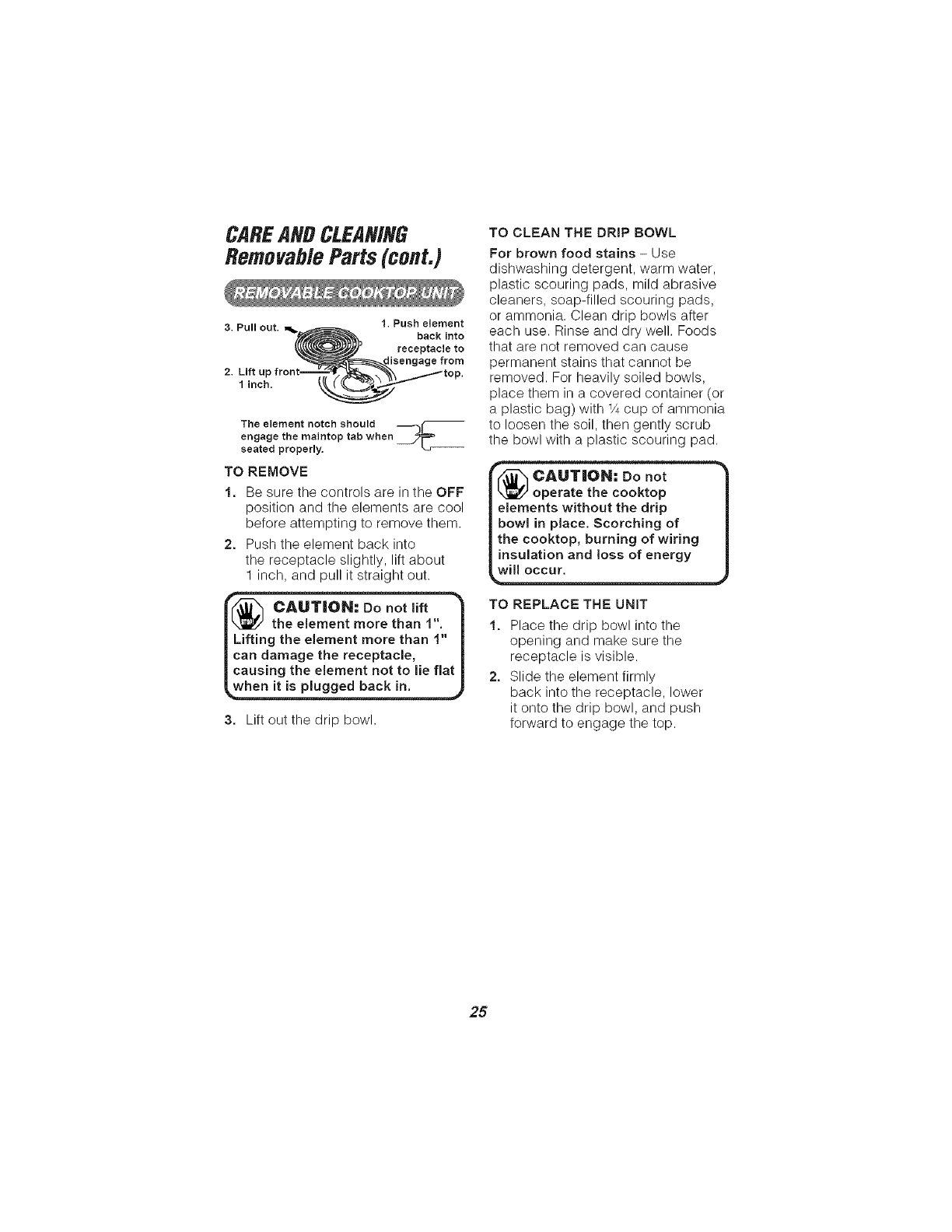
3. Pull out. 1. Push element
back into
receptacle to
2. Lift ul:
1 inch,
The element notch should --l['_
engage the maintop tab when _=_
seated properly,
TO REMOVE
1. Be sure the controls are in the OFF
position and the elements are cool
before attempting to remove them.
2. Push the element back into
the receptacle slightly, lift about
1 inch, and pull it straight out.
r[/_ CAUTION: Do not lift ,, "_
J_ the element more than 1 .|
_ Lifting the element more than 1" |
_can damage the receptacle, |
Jcausing the element not to lie flat_
it pluggedbacki : j
3. Lift out the drip bowl.
TO CLEAN THE DRIP BOWL
For brown food stains - Use
dishwashing detergent, warm water,
plastic scouring pads, mild abrasive
cleaners, soap-filled scouring pads,
or ammonia. Clean drip bowls after
each use. Rinse and dry well. Foods
that are not removed can cause
permanent stains that cannot be
removed. For heavily soiled bowls,
place them in a covered container (or
a plastic bag) with 1/4cup of ammonia
to loosen the soil, then gently scrub
the bowl with a plastic scouring pad.
operate the cooktop
elements without the drip J
bowl in place, Scorching of
the cooktop, burning of wiring
insulation and loss of energy
will occur.
TO REPLACE THE UNIT
1. Place the drip bowl into the
opening and make sure the
receptacle is visible.
2. Slide the element firmly
back into the receptacle, lower
it onto the drip bowl, and push
forward to engage the top.
25
CAREANDCLEANING
RemovableParts(cont.)
CLEANING MATERIALS
= Dishwashing detergent
®Warm water
®Scouring pad or soap-filled
steel-wool pad
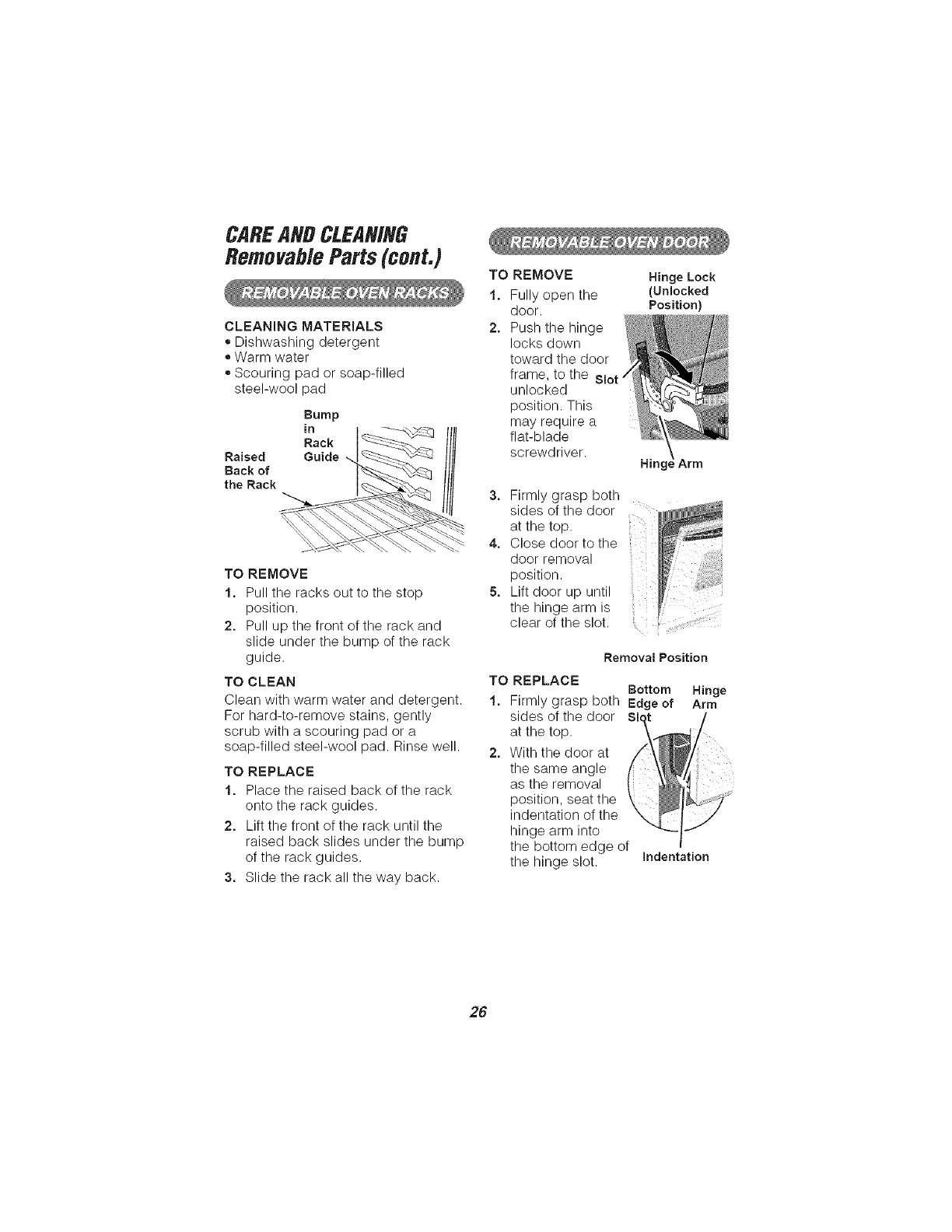
Bump
in
Rack
Raised Guide
Back of
the Rack
TO REMOVE
1. Pull the racks out to the stop
position.
2. Pull up the front of the rack and
slide under the bump of the rack
guide.
TO CLEAN
Clean with warm water and detergent.
For hard-to-remove stains, gently
scrub with a scouring pad or a
soap-filled steel-wool pad. Rinse well.
TO REPLACE
1. Place the raised back of the rack
onto the rack guides.
2. Lift the front of the rack until the
raised back slides under the bump
of the rack guides.
:3. Slide the rack all the way back.
TO REMOVE
1, Fully open the
door.
2, Push the hinge
locks down
toward the door
frame, to the
unlocked
position. This
may require a
flat-blade
screwdriver.
Hinge Lock
(Unlocked
Position)
Hin( Arm
3,
4,
5,
Firmly grasp both
sides of the door ,
at the top.
Close door to the
door removal
position.
Lift door up until
the hinge arm is
clear of the slot.
Removal Position
TO
1.
2,
REPLACE Bottom Hinge
Firmly grasp both Edge of Arm
sides of the door Sic
at the top.
With the door at
the same angle
as the removal
position, seat the
indentation of the
hinge arm into
the bottom edge of
the hinge slot. Indentation
26
CAREANDCLEANING
RemovableParts(cont.)
Removable Oven Door (cont.)
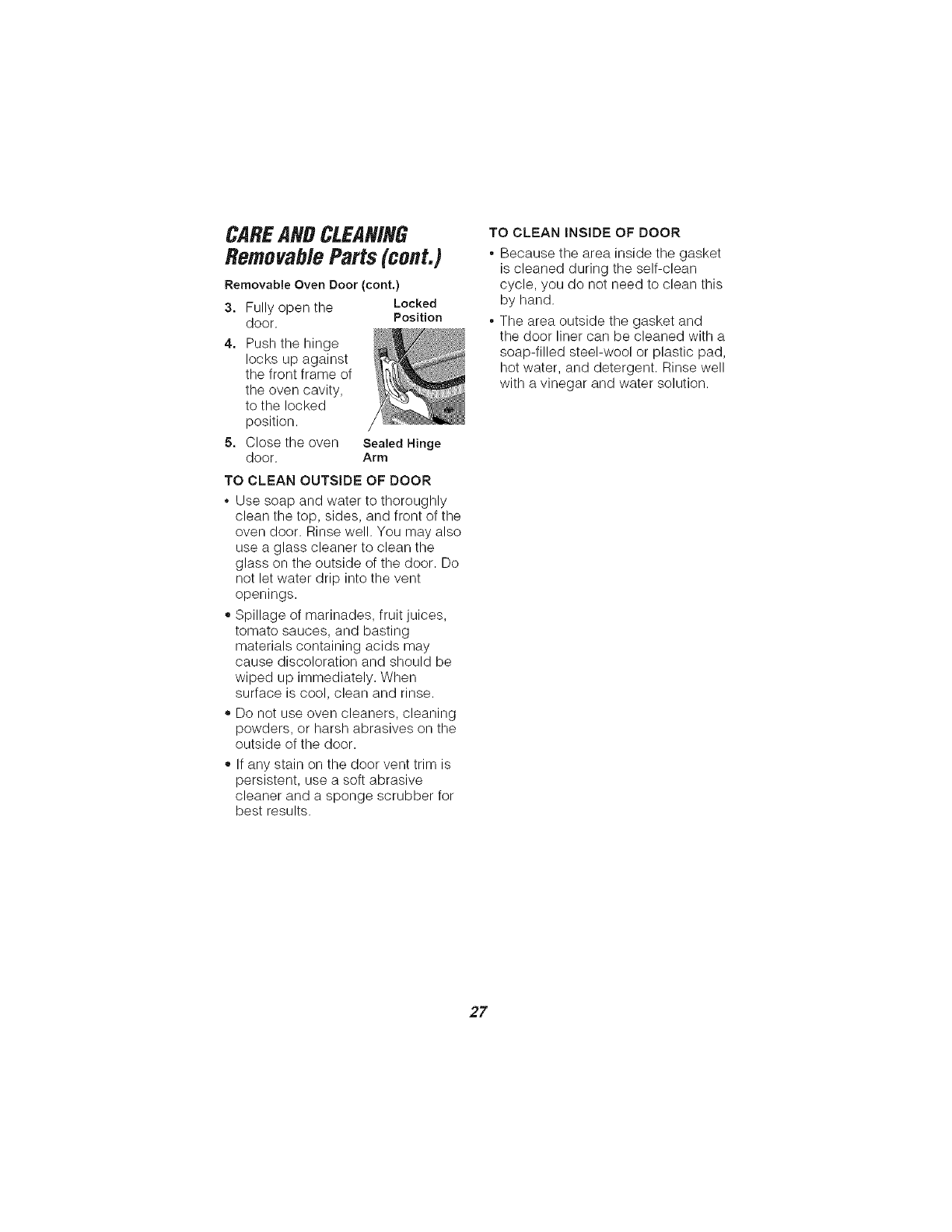
3. Fully open the Locked
door. Position
4. Push the hinge
locks up against
the front frame of
the oven cavity,
to the locked
position /
5. Close the oven Sealed Hinge
door, Arm
TO CLEAN OUTSIDE OF DOOR
• Use soap and water to thoroughly
clean the top, sides, and front of the
oven door. Rinse well. You may also
use a glass cleaner to clean the
glass on the outside of the door. Do
not let water drip into the vent
openings.
,, Spillage of marinades, fruit juices,
tomato sauces, and basting
materials containing acids may
cause discoloration and should be
wiped up immediately. When
surface is cool, clean and rinse.
®Do not use oven cleaners, cleaning
powders, or harsh abrasives on the
outside of the door.
® If any stain on the door vent trim is
persistent, use a soft abrasive
cleaner and a sponge scrubber for
best results.
TO CLEAN INSIDE OF DOOR
• Because the area inside the gasket
is cleaned during the self-clean
cycle, you do not need to clean this
by hand.
• The area outside the gasket and
the door liner can be cleaned with a
soap-filled steel-wool or plastic pad,
hot water, and detergent. Rinse well
with a vinegar and water solution.
27
CAREANDCLEANING
RemovableParts(cont.)
TO REMOVE
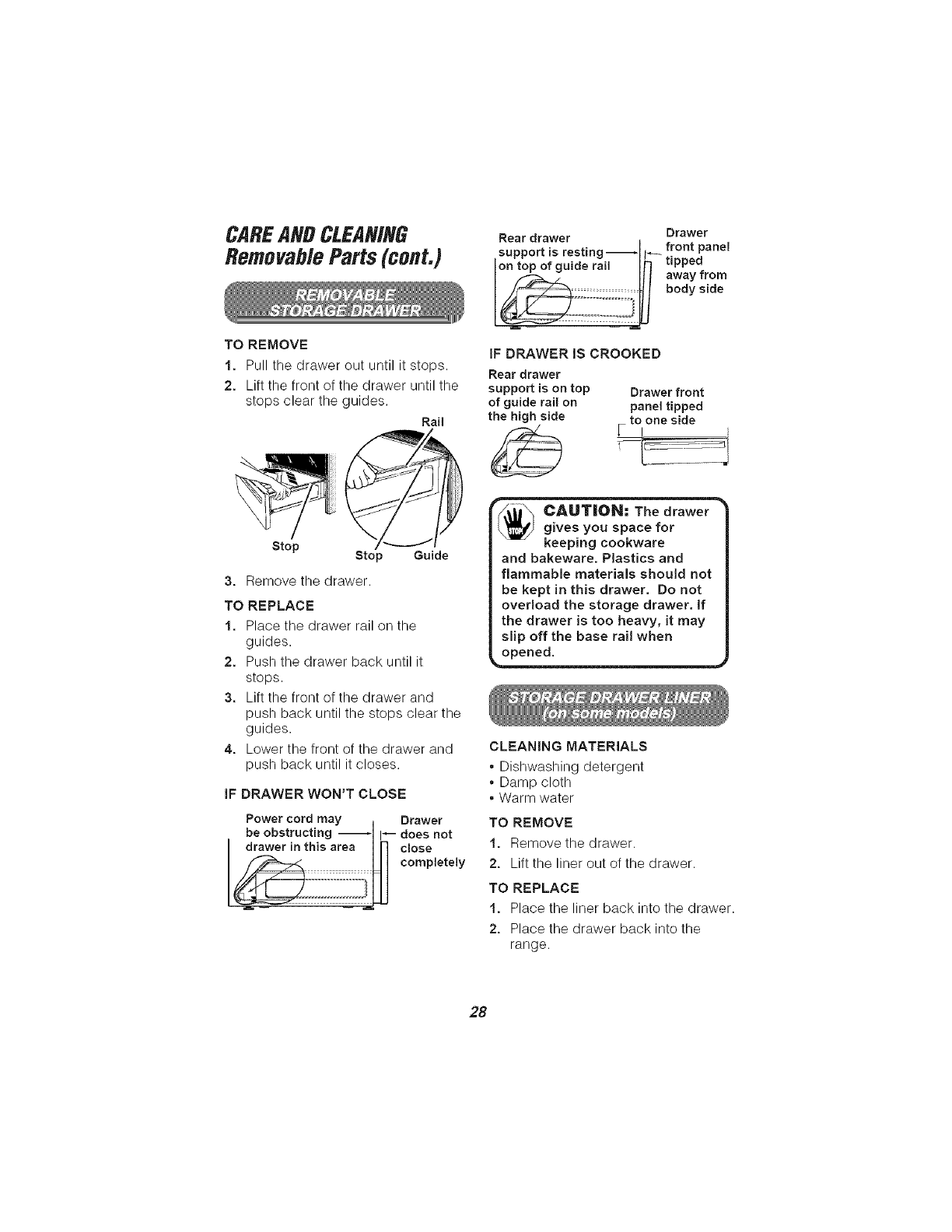
1. Pull the drawer out until it stops.
2. Lift the front of the drawer until the
stops clear the guides.
Rail
Stop Stop Guide
3. Remove the drawer.
TO REPLACE
1. Place the drawer rail on the
guides.
2. Push the drawer back until it
stops.
3. Lift the front of the drawer and
push back until the stops clear the
guides.
4. Lower the front of the drawer and
push back until it closes.
IF DRAWER WON'T CLOSE
Power cord may I Drawer
be obstructing _I_ does not
drawer in this area ][7 close
............ HI c°mpleteiy
Y
Rear drawer Drawer
support s rest ng _ I_ front pane!
on top of gu de ra 17 tipped
Ill away from
;;;:222-;;;_Li_] body side
IF DRAWER IS CROOKED
Reardrawer
support is on top Drawer front
of guide rail on panel tipped
the high side _ toIone side J
_AUT|ON: The drawer
gives you space for
keeping cookware
and bakeware. Plastics and
flammable materials should not |
be kept in this drawer. Do not |
overload the storage drawer. If |
the drawer is too heavy, it may |
slip off the base rail when |
CLEANING MATERIALS
*Dishwashing detergent
, Damp cloth
, Warm water
TO REMOVE
1. Remove the drawer.
2. Lift the liner out of the drawer.
TO REPLACE
1. Place the liner back into the drawer.
2. Place the drawer back into the
range.
28
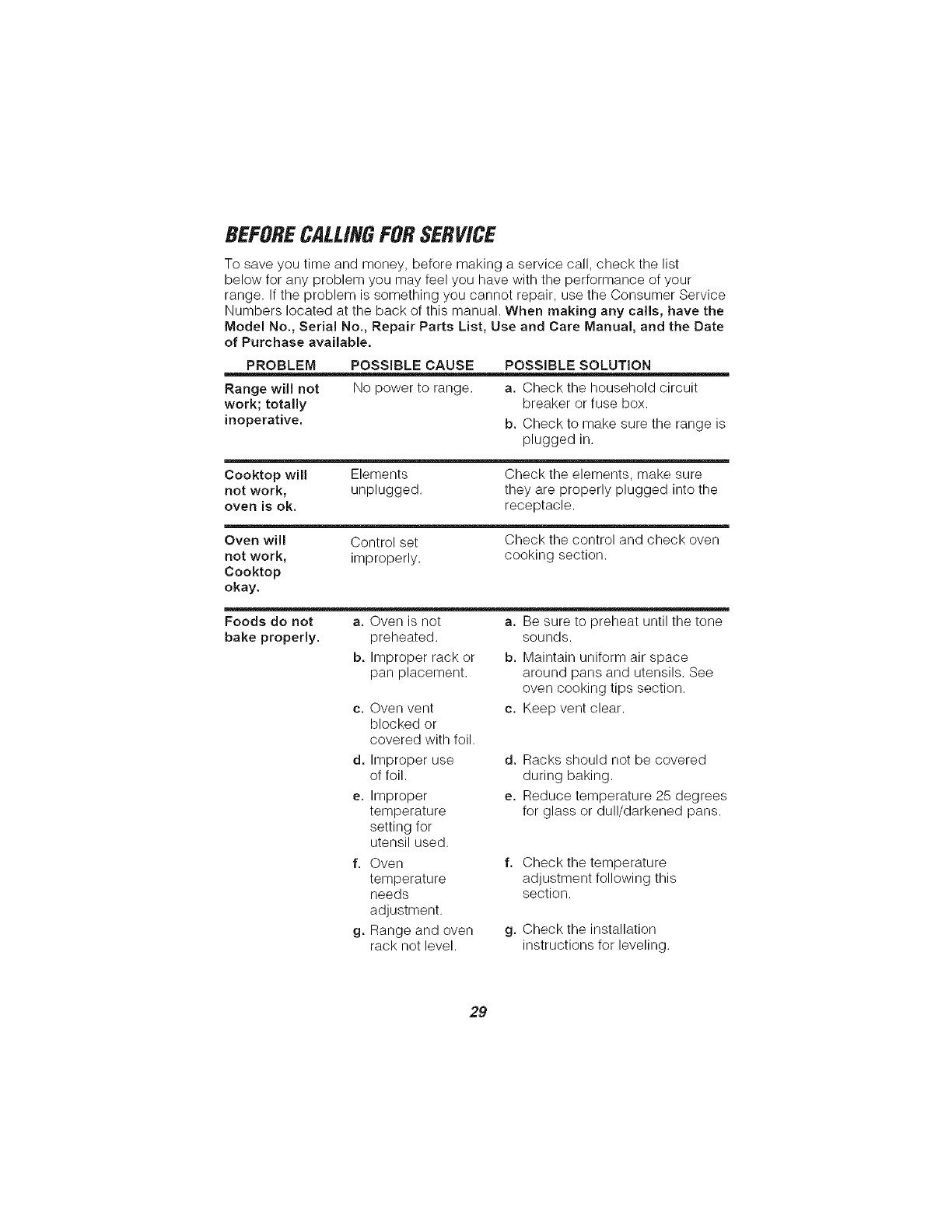
BEFORECALLINGFORSERVICE
To save you time and money, before making a service call, check the list
below for any problem you may feel you have with the performance of your
range. If the problem is something you cannot repair, use the Consumer Service
Numbers located at the back of this manual. When making any calls, have the
Model No., Serial No., Repair Parts List, Use and Care Manual, and the Date
of Purchase available.
PROBLEM POSSIBLE CAUSE POSSIBLE SOLUTION
Range wiJ] not No power to range, a. Check the household circuit
work; totally breaker or fuse box.
inoperative, b. Check to make sure the range is
plugged in.
Cooktop will Elements Check the elements, make sure
not work, unplugged, they are properly plugged into the
oven is ok. receptacle.
Oven will Control set Check the control and check oven
not work, improperly, cooking section.
Cooktop
okay.
Foods do not a. Oven is not a. Be sure to preheat until the tone
bake properly. preheated, sounds.
b. Improper rack or b. Maintain uniform air space
pan placement, around pans and utensils. See
oven cooking tips section.
c. Oven vent c. Keep vent clear.
blocked or
covered with foil.
d. Improper use d. Racks should not be covered
of foil. during baking.
e. Improper e. Reduce temperature 25 degrees
temperature for glass or dull/darkened pans.
setting for
utensil used.
f. Oven f. Check the temperature
temperature adjustment following this
needs section.
adjustment.
g. Range and oven g. Check the installation
rack not level, instructions for leveling.
29
BEFORECALLINGFORSERVICE
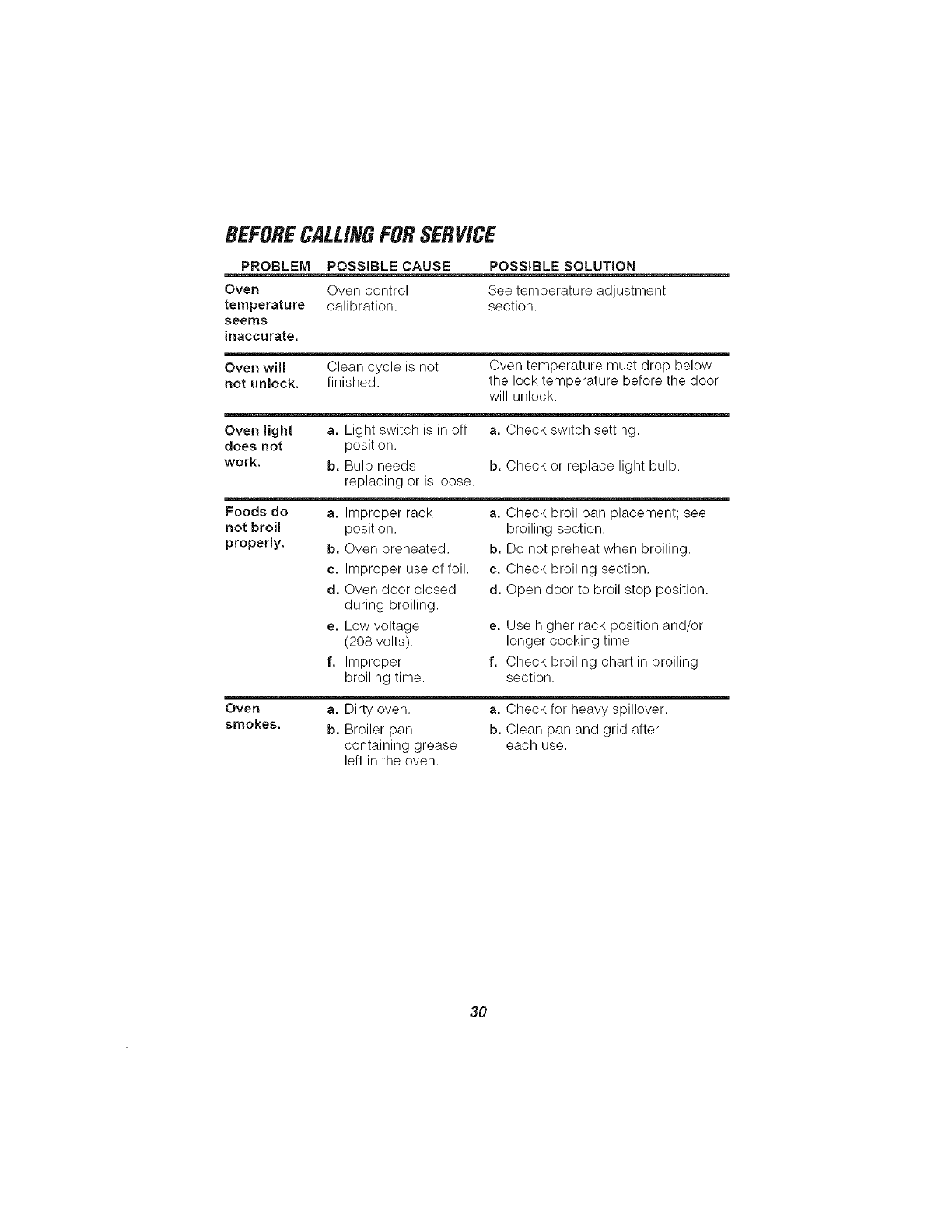
PROBLEM POSSIBLE CAUSE POSSIBLE SOLUTION
Oven Oven control See temperature adjustment
temperature calibration, section.
seems
inaccurate,
Oven will Clean cycle is not Oven temperature must drop below
not unlock, finished, the lock temperature before the door
will unlock.
Oven light a. Light switch is in off a. Check switch setting.
does not position.
work. b, Bulb needs b, Check or replace light bulb.
replacing or is loose.
Foods do a, Improper rack a. Check broil pan placement; see
not broil position, broiling section.
properly, b, Oven preheated, b, Do not preheat when broiling.
c, Improper use of foil. c, Check broiling section.
d, Oven door closed d, Open door to broil stop position.
during broiling.
e, Low voltage e, Use higher rack position and/or
(208 volts), longer cooking time.
f. Improper f, Check broiling chart in broiling
broiling time. section.
Oven a. Dirty oven. a. Check for heavy spillover.
smokes, b, Broiler pan b, Clean pan and grid after
containing grease each use.
left in the oven.
3O
BEFORECALLINGFORSERVICE
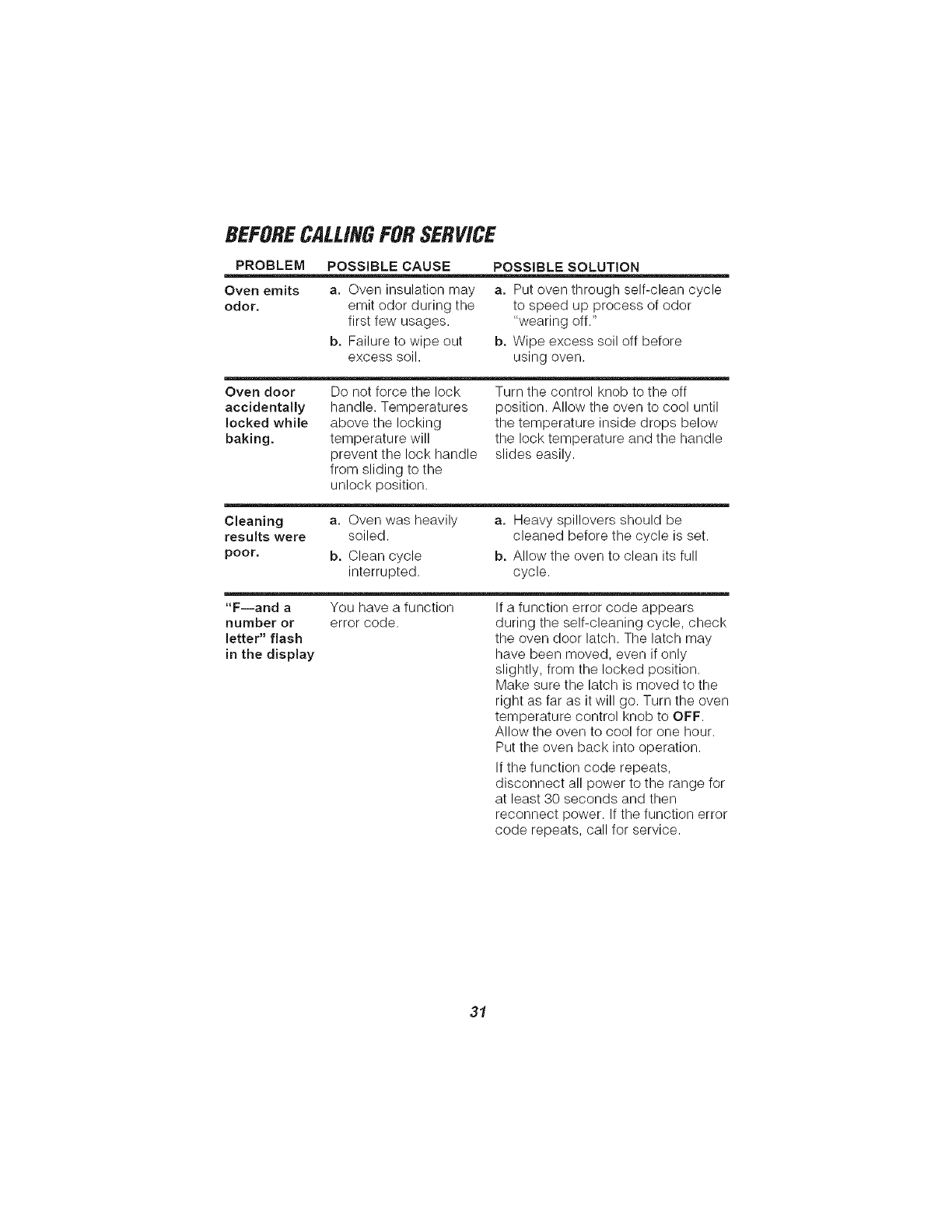
PROBLEM POSSIBLE CAUSE POSSIBLE SOLUTION
Oven emits a. Oven insulation may a. Put oven through self-clean cycle
odor. emit odor during the to speed up process of odor
first few usages. "wearing off."
b. Failure to wipe out b. Wipe excess soil off before
excess soil. using oven.
Oven door Do not force the lock Turn the control knob to the off
accidentally handle. Temperatures position. Allow the oven to cool until
locked while above the locking the temperature inside drops below
baking, temperature will the lock temperature and the handle
prevent the lock handle slides easily.
from sliding to the
unlock position.
Cleaning a. Oven was heavily a. Heavy spillovers should be
results were soiled, cleaned before the cycle is set.
poor. b. Clean cycle b. Allow the oven to clean its full
interrupted, cycle.
"F--and aYou have a function If a function error code appears
number or error code. during the self-cleaning cycle, check
letter" flash the oven door latch. The latch may
in the display have been moved, even if only
slightly, from the locked position.
Make sure the latch is moved to the
right as far as it will go. Turn the oven
temperature control knob to OFF.
Allow the oven to cool for one hour.
Put the oven back into operation.
If the function code repeats,
disconnect all power to the range for
at least 30 seconds and then
reconnect power. If the function error
code repeats, call for service.
31
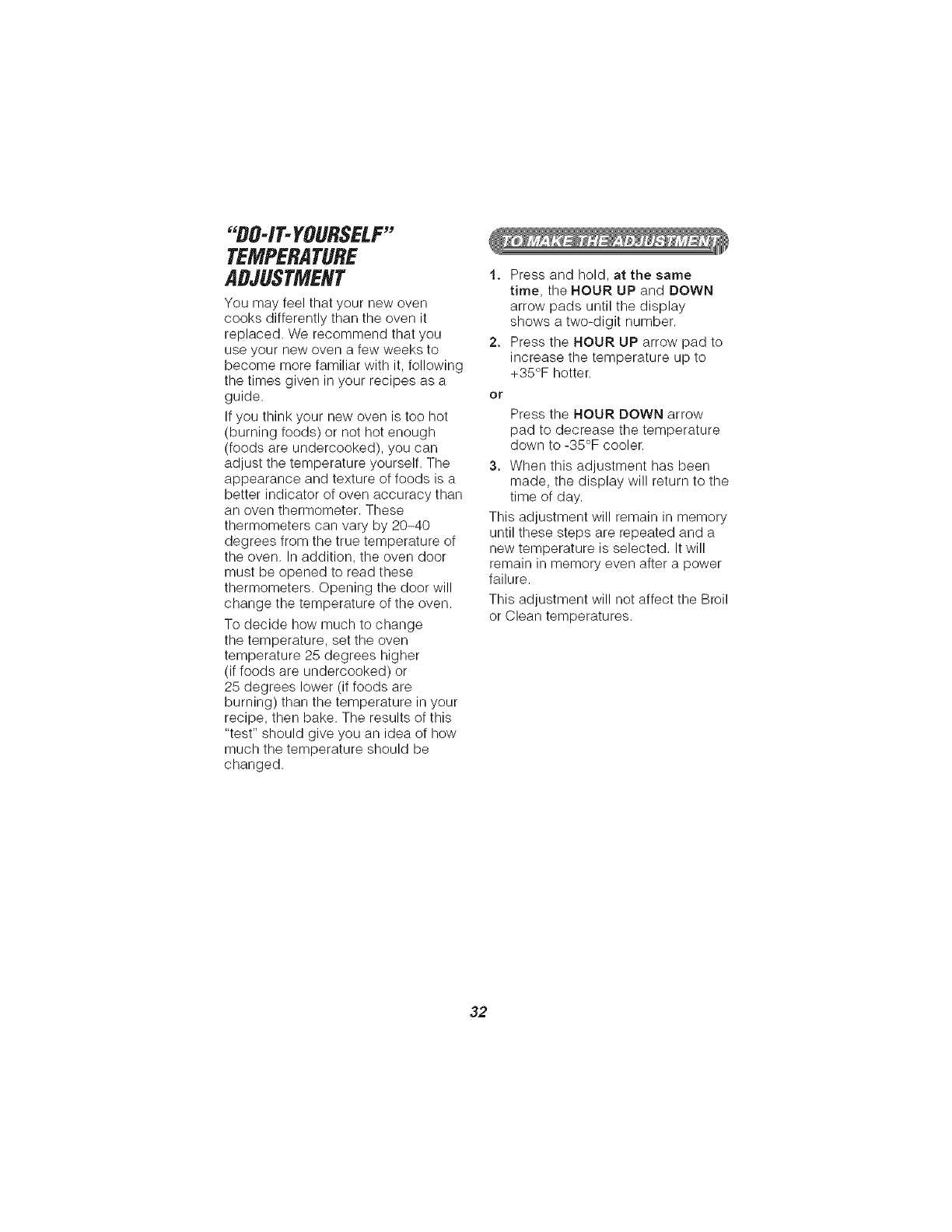
"DO-IT-YOURSELF"
TEMPERATURE
ADJUSTMENT
You may feel that your new oven
cooks differently than the oven it
replaced. We recommend that you
use your new oven a few weeks to
become more familiar with it, following
the times given in your recipes as a
guide.
If you think your new oven is too hot
(burning foods) or not hot enough
(foods are undercooked), you can
adjust the temperature yourself. The
appearance and texture of foods is a
better indicator of oven accuracy than
an oven thermometer. These
thermometers can vary by 20-40
degrees from the true temperature of
the oven. In addition, the oven door
must be opened to read these
thermometers. Opening the door will
change the temperature of the oven.
To decide how much to change
the temperature, set the oven
temperature 25 degrees higher
(if foods are undercooked) or
25 degrees lower (if foods are
burning) than the temperature in your
recipe, then bake. The results of this
"test" should give you an idea of how
much the temperature should be
changed.
1. Press and hold, at the same
time, the HOUR UP and DOWN
arrow pads until the display
shows a two-digit number.
2. Press the HOUR UP arrow pad to
increase the temperature up to
+35°F hotter.
or
Press the HOUR DOWN arrow
pad to decrease the temperature
down to -35°F cooler.
3. When this adjustment has been
made, the display will return to the
time of day.
This adjustment will remain in memory
until these steps are repeated and a
new temperature is selected. It will
remain in memory even after a power
failure.
This adjustment will not affect the Broil
or Clean temperatures.
32

NOTES
33
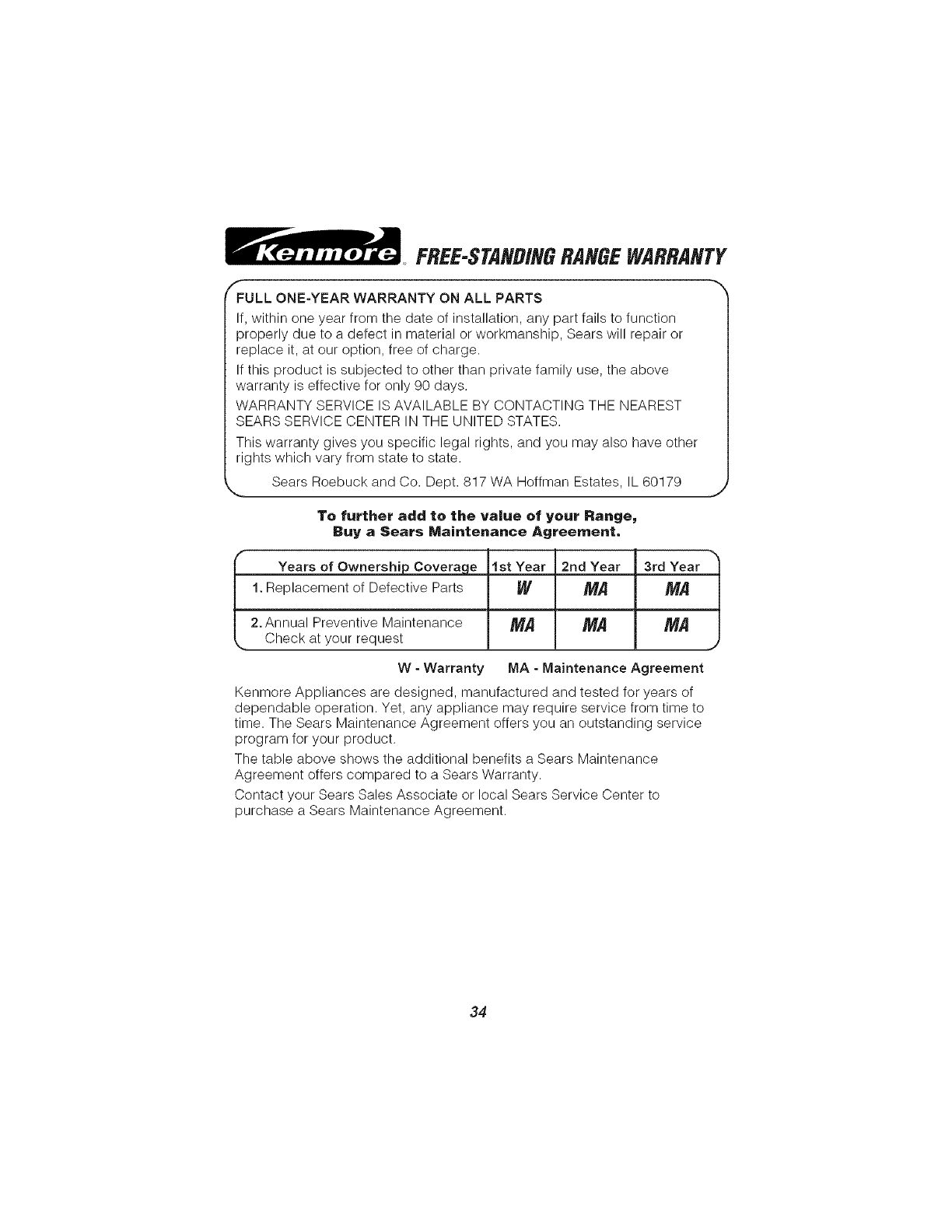
FREE-STANDINGRANGEWARRANTY
FULL ONE-YEAR WARRANTY ON ALL PARTS
If, within one year from the date of installation, any part fails to function
properly due to a defect in material or workmanship, Sears will repair or
replace it, at our option, free of charge,
If this product is subjected to other than private family use, the above
warranty is effective for only 90 days.
WARRANTY SERVICE IS AVAILABLE BY CONTACTING THE NEAREST
SEARS SERVICE CENTER IN THE UNITED STATES.
This warranty gives you specific legal rights, and you may also have other
rights which vary from state to state.
Sears Roebuck and Co. Dept. 817 WA Hoffman Estates, IL 60179
To further add to the va|ue of your Range,
Buy aSears Maintenance Agreement.
Years of Ownership Coverage
1. Replacement of Defective Parts
1st Year
W
2. Annual Preventive Maintenance _',_
Check at your request
%,
W - Warranty MA - Maintenance Agreement
2rid Year 3rd Year
MA MA
MA MA
J
Kenmore Appliances are designed, manufactured and tested for years of
dependable operation. Yet, any appliance may require service from time to
time. The Sears Maintenance Agreement offers you an outstanding service
program for your product.
The table above shows the additional benefits a Sears Maintenance
Agreement offers compared to a Sears Warranty.
Contact your Sears Sales Associate or local Sears Service Center to
purchase a Sears Maintenance Agreement.
34
