Kenmore 795 7854 Users Manual
79578542800 79578542800 KENMORE ELITE REFRIGERATOR - Manuals and Guides L0804385 View the owners manual for your KENMORE ELITE REFRIGERATOR #79578542800. Home:Kitchen Appliance Parts:Kenmore Elite Parts:Kenmore Elite REFRIGERATOR Manual
KENMORE ELITE Bottom Mount Refrigerator Manual L0804385 KENMORE ELITE Bottom Mount Refrigerator Owner's Manual, KENMORE ELITE Bottom Mount Refrigerator installation guides
795.7855 to the manual 138ea536-e784-4b83-8bab-7ba26d7e0fff
2015-01-24
: Kenmore Kenmore-795-7854-Users-Manual-327566 kenmore-795-7854-users-manual-327566 kenmore pdf
Open the PDF directly: View PDF  .
.
Page Count: 40
E L | T E %_
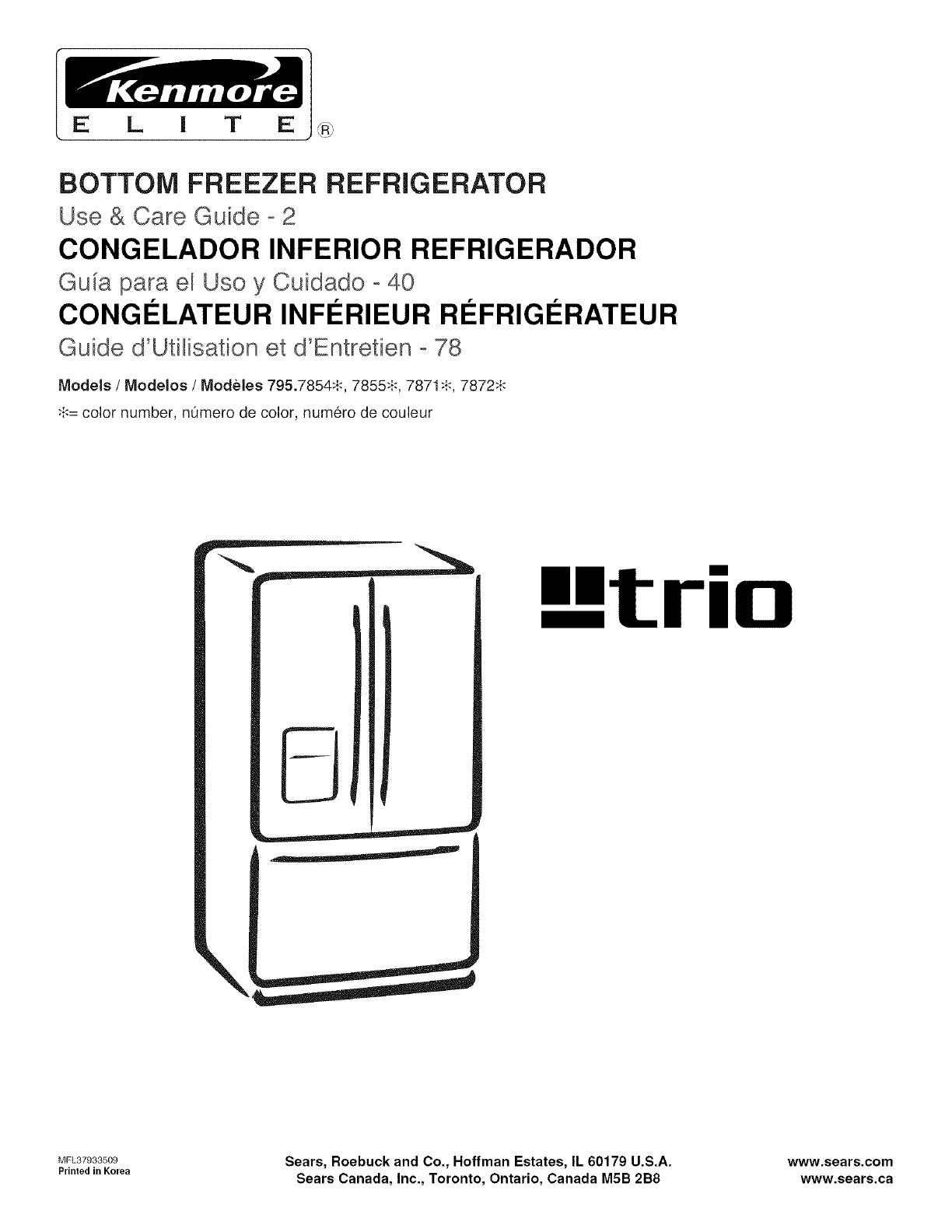
BOTTOM FREEZER REFRIGERATOR
Use & Care Guide o2
CONGELADOR INFERIOR REFRIGERADOR
Guia para el Uso y Cuidado ° 40
CONGI_LATEUR INFCRIEUR RCFRIGI_RATEUR
Guide d'Utifisation et d'Entretien o 78
Models /Modelos /Modeles 795.7854_{-_, 7855;!-_,7871 ;!-_,7872;!-_
;!-_=color number, nOmero de color, numero de couleur
==trio
MFL37933509 Sears, Roebuck and Co., Hoffman Estates, IL 60179 U.S.A. www.sears.com
Printed in Korea Sears Canada, Inc., Toronto, Ontario, Canada M5B 2B8 www.sears.ca
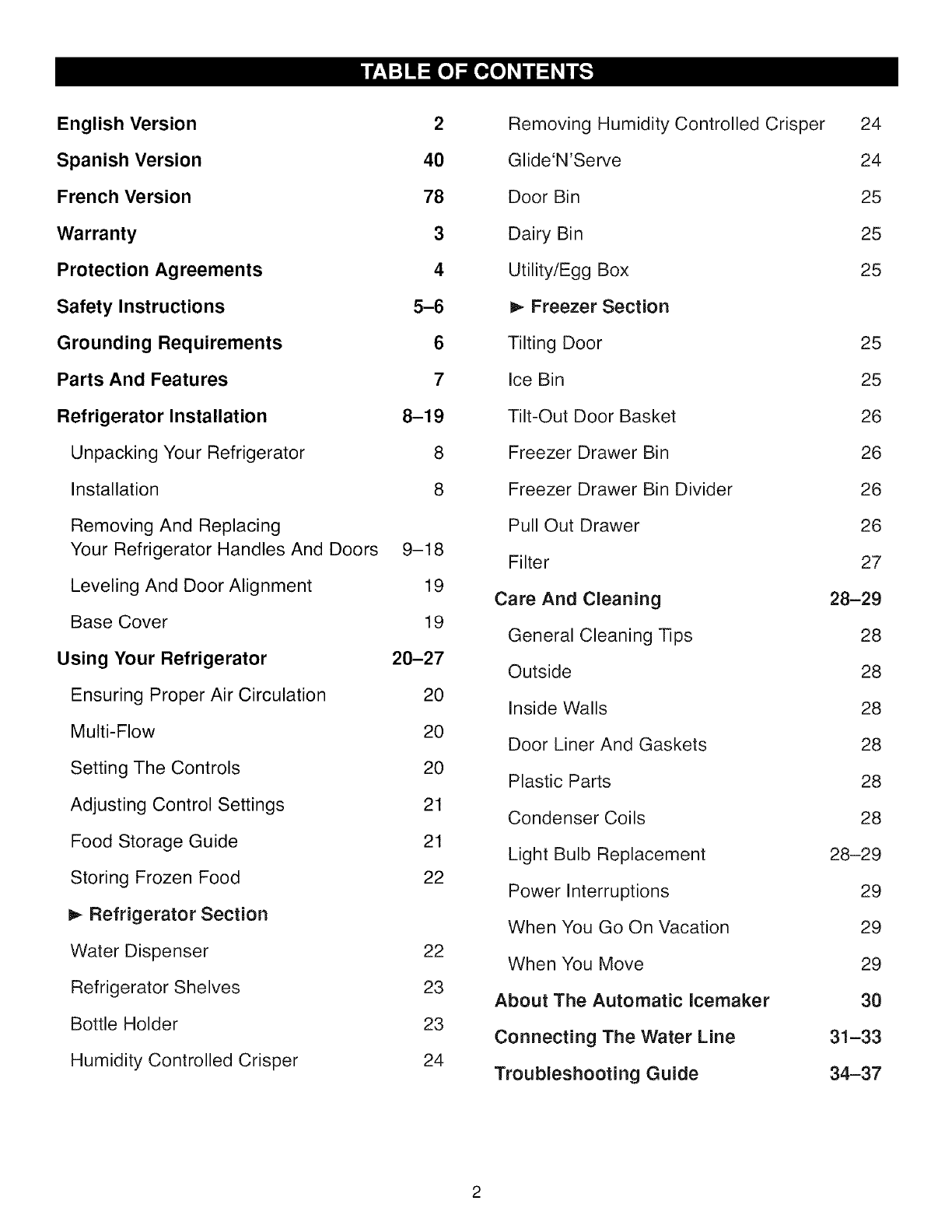
English Version 2
Spanish Version 40
French Version 78
Warranty 3
Protection Agreements 4
Safety Instructions 5-6
Grounding Requirements 6
Parts And Features 7
Refrigerator Installation 8-19
Unpacking Your Refrigerator 8
Installation 8
Removing And Replacing
Your Refrigerator Handles And Doors 9-18
Leveling And Door Alignment 19
Base Cover 19
Using Your Refrigerator 20-27
Ensuring Proper Air Circulation 20
Multi-Flow 20
Setting The Controls 20
Adjusting Control Settings 21
Food Storage Guide 21
Storing Frozen Food 22
Refrigerator Section
Water Dispenser 22
Refrigerator Shelves 23
Bottle Holder 23
Humidity Controlled Crisper 24
Removing Humidity Controlled Crisper 24
Glide'N'Serve 24
Door Bin 25
Dairy Bin 25
Utility/Egg Box 25
D,-Freezer Section
Tilting Door 25
ice Bin 25
Tilt-Out Door Basket 26
Freezer Drawer Bin 26
Freezer Drawer Bin Divider 26
Pull Out Drawer 26
Filter 27
Care And Cleaning 28-29
General Cleaning Tips 28
Outside 28
inside Walls 28
Door Liner And Gaskets 28
Plastic Parts 28
Condenser Coils 28
Light Bulb Replacement 28-29
Power interruptions 29
When You Go On Vacation 29
When You Move 29
About The Automatic Icemaker 30
Connecting The Water Line 31-33
Troubleshooting Guide 34-37
ELlTEJ®
BOTTOM FREEZER REFRIGERATOR WARRANTY
f
Kenmore Elite Appliance Warranty
One Year Limited Warranty
When installed, operated and maintained according to all instructions supplied with the product, if this appliance fails
due to a defect in material or workmanship within one year from the date of purchase, call 1-800-4-MY-HOME _ to
arrange for free repair.
If this appliance is used for other than private family purposes, this warranty applies for only 90 days from the date
of purchase.
Five Year Limited Warranty on Sealed Refrigeration System
For five years from the date of purchase, when this refrigerator is installed, operated, and maintained according to
the instructions supplied with it, Sears will repair the sealed system (consisting of refrigerant, connecting tubing, and
compressor), free of charge, if defective in material or workmanship.
This warranty covers only defects in material and workmanship. Sears will NOT pay for:
1. Expendable items that can wear out from normal use, including but not limited to filters, belts, light bulbs, and
bags.
2. A service technician to instruct the user in correct product installation, operation or maintenance.
3. A service technician to clean or maintain this product.
4. Damage to or failure of this product if it is not installed, operated or maintained according to all instructions
supplied with the product.
5. Damage to or failure of this product resulting from accident, abuse, misuse or use for other than its intended
purpose.
6. Damage to or failure of this product caused by the use of detergents, cleaners, chemicals or utensils other than
those recommended in all instructions supplied with the product.
7. Damage to or failure of parts or systems resulting from unauthorized modification made to this product.
Disclaimer of implied warranties; limitation of remedies
Customer's sole and exclusive remedy under this limited warranty shall be product repair as provided herein,
Implied warranties, including warranties of merchantability or fitness for a particular purpose, are limited to one year
or the shortest period allowed by law. Sears shall not be liable for incidental or consequential damages. Some states
and provinces do not allow the exclusion or limitation of incidental or consequential damages, or limitations on the
duration of implied warranties of merchantability or fitness, so these exclusions or limitations may not apply to you.
This warranty applies only while this appliance is used in the United States and Canada.
This warranty gives you specific legal rights, and you may also have other rights which vary from state to state.
Sears, Roebuck and Co., Dept. 817WA, Hoffman Estates, IL 60179
Sears Canada, Inc., Toronto, Ontario, Canada M5B 2B8
Master Protection Agreements
Congratulations on making a smart purchase. Your new
Kenmore ® product is designed and manufactured for
years of dependable opera-tion. But like all products, it
may require preventive maintenance or repair from time to
time. That's when having a Master Protection Agreement
can save you money and aggravation.
The Master Protection Agreement also helps extend the
life of your new product. Here's what the Agreement*
includes:
[d Parts and labor needed to help keep products operating
properly under normal use, not just defects.
Our coverage goes well beyond the product warranty.
No deductibles, no functional failure excluded from
coverage-- real protection.
[_ Expert service by a force of more than 10,000
authorized Sears service technicians, which means
someone you can trust will be working on your product.
Unlimited service calls and nationwide service, as
often as you want us, whenever you want us.
[d "No-lemon" guarantee - replacement of your covered
product if four or more product failures occur within
twelve months.
[_ Product replacement if your covered product can't be fixed.
[d Annual Preventive Maintenance Check at your
request - no extra charge.
[d Fast help by phone - we call it Rapid Resolution -
phone sup-port from a Sears representative on all
products. Think of us as a "talking owner's manual."
[_ Power surge protection against electrical damage due
to power fluctuations.
[d $250 Food Loss Protection annually for any food
spoilage that is the result of mechanical failure of any
covered refrigerator or freezer.
[_ Rental reimbursement if repair of your covered
product takes longer than promised.
[d 10% discount off the regular price of any non-covered
repair service and related installed parts.
Once you purchase the Agreement, a simple phone call is
all that it takes for you to schedule service. You can call
anytime day or night, or schedule a service appointment
online.
The Master Protection Agreement is a risk free purchase.
If you can-cel for any reason during the product warranty
period, we will provide a full refund. Or, a prorated refund
anytime after the product warranty period expires.
Purchase your Master Protection Agreement today!
Some limitations and exclusions apply.
For prices and additional information in the U.S.A. call
1-800-827-6655
* Coverage in Canada varies on some items. For full
details call Sears Canada at 1-800-361-6665.
Sears Installation Service
For Sears professional installation of home appliances,
garage door openers, water heaters, and other major
home items, in the U.S.A. or Canada call 1-800-4-MY-
HOME ®.
In the space below, record the date of purchase, model and serial number of your product. You will find the model and
serial number printed on an identification label located on the right-hand side of the refrigerator compartment. Have these
items of information available whenever you contact Sears concerning your product.
Model No. Date of Purchase
Serial No. Dealer
Save these instructions and attach your sales receipt for future reference.
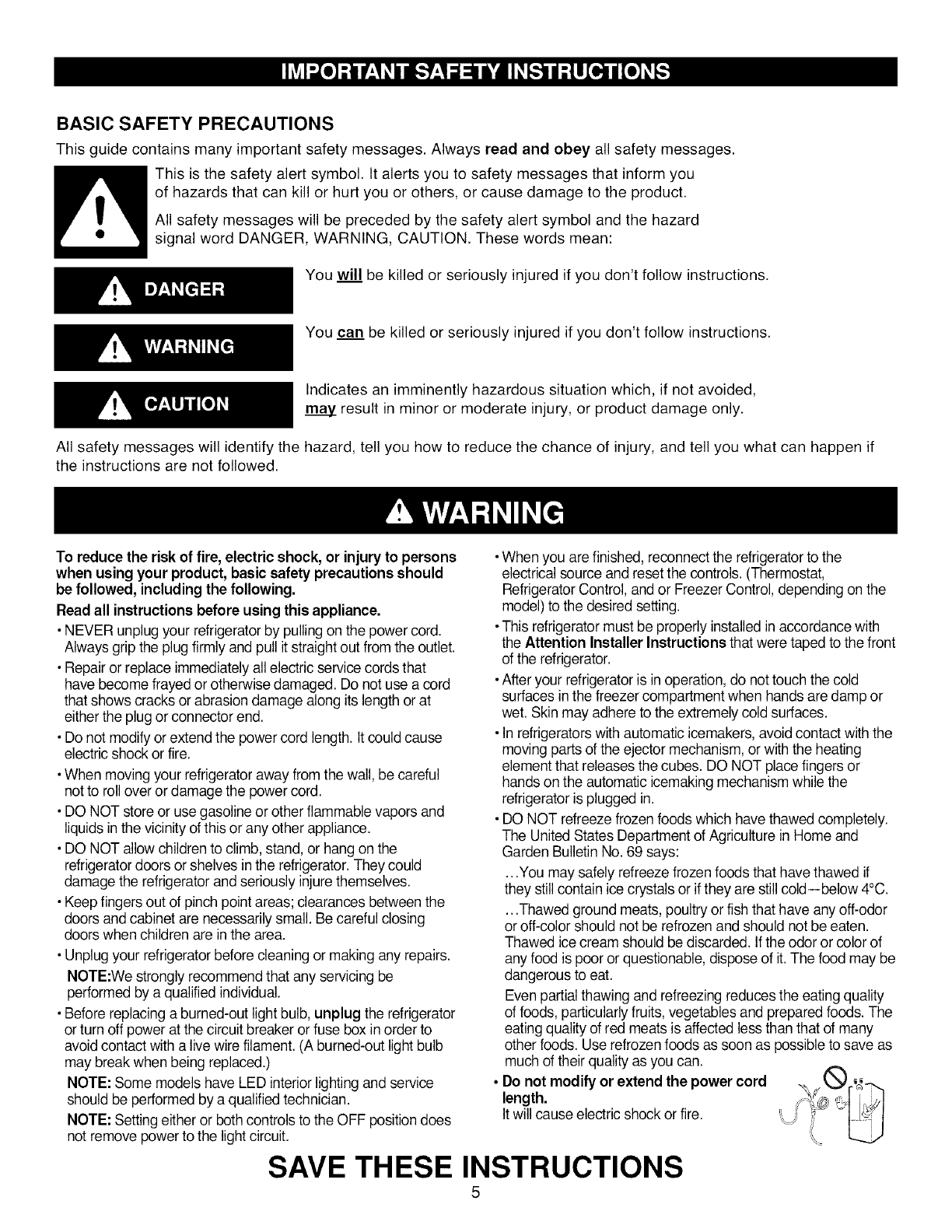
BASIC SAFETY PRECAUTIONS
This guide contains many important safety messages. Always read and obey all safety messages.
This is the safety alert symbol. It alerts you to safety messages that inform you
of hazards that can kill or hurt you or others, or cause damage to the product.
All safety messages will be preceded by the safety alert symbol and the hazard
signal word DANGER, WARNING, CAUTION. These words mean:
You wil__lbe killed or seriously injured if you don't follow instructions.
You can be killed or seriously injured if you don't follow instructions.
Indicates an imminently hazardous situation which, if not avoided,
m__ result in minor or moderate injury, or product damage only.
All safety messages will identify the hazard, tell you how to reduce the chance of injury, and tell you what can happen if
the instructions are not followed.
To reduce the risk of fire, electric shock, or injury to persons
when using your product, basic safety precautions should
be followed, including the following.
Read all instructions before using this appliance.
•NEVER unplug your refrigerator by pullingon the power cord.
Always grip the plug firmly and pull it straight out from the outlet.
• Repair or replace immediately all electric service cords that
have become frayed or otherwise damaged. Do not use a cord
that shows cracks or abrasion damage along its length or at
either the plug or connector end.
• Do not modify or extend the power cord length. It could cause
electric shock or fire.
•When moving your refrigerator away fromthe wall, be careful
not to roll over or damage the power cord.
• DO NOT store or use gasoline or other flammable vapors and
liquids inthe vicinityof this or any other appliance.
• DO NOT allow children to climb, stand, or hang on the
refrigeratordoors or shelves inthe refrigerator. They could
damage the refrigerator and seriously injurethemselves.
•Keep fingers out of pinch point areas; clearances between the
doors and cabinet are necessarily small. Be careful closing
doors when children are in the area.
• Unplug your refrigeratorbefore cleaning or making any repairs.
NOTE:We strongly recommend that any servicing be
performed by a qualified individual.
•Before replacing a burned-out light bulb, unplug the refrigerator
or turn off power at the circuit breaker or fuse box in order to
avoid contact with a live wire filament. (A burned-out light bulb
may break when being replaced.)
NOTE: Some models have LED interior lighting and service
should be performed by a qualified technician.
NOTE: Settingeither or both controls to the OFF position does
not remove power to the light circuit.
•When you are finished, reconnect the refrigeratorto the
electrical source and reset the controls. (Thermostat,
RefrigeratorControl, and or Freezer Control, depending on the
model) to the desired setting.
•This refrigeratormust be properly installed in accordance with
the Attention Installer Instructions that were taped to the front
of the refrigerator.
•After your refrigerator is in operation, do not touch the cold
surfaces in the freezer compartment when hands are damp or
wet. Skin may adhere to the extremely cold surfaces.
• In refrigerators with automatic icemakers, avoid contad with the
moving parts of the ejector mechanism, or withthe heating
element that releasesthe cubes. DO NOT place fingers or
hands on the automatic icemaking mechanism while the
refrigerator is plugged in.
• DO NOT refreeze frozen foods which have thawed completely.
The United States Department of Agriculture in Home and
Garden Bulletin No. 69 says:
...You may safely refreeze frozen foods that have thawed if
they still contain ice crystals or if they are stillcold--below 4°C.
...Thawed ground meats, poultry or fishthat have any off-odor
or off-color should not be refrozenand should not be eaten.
Thawed ice cream should be discarded. Ifthe odor or color of
any food is poor or questionable, dispose of it.The food may be
dangerous to eat.
Even partial thawing and refreezing reduces the eating quality
of foods, particularly fruits, vegetables and preparedfoods. The
eating quality of red meats is affected lessthan that of many
other foods. Use refrozenfoods as soon as possible to save as
much of their quality as you can.
• Do not modify or extend the power cord
length.
Itwill cause electric shock or fire.
SAVE THESE INSTRUCTIONS

Junked or abandoned refrigerators are dangerous...even
if they will sit for just a few days. tf you are getting rid of
your old refrigerator, please follow the instructions at right
to help prevent accidents (Child entrapment and
suffocation).
BEFORE YOU THROW AWAY
YOUR OLD REFRIGERATOR
OR FREEZER
•Take off the doors.
• Leave the shelves in place so that
children may not easily climb inside.
Your old refrigerator may have a cooling system that used
CFCs (chlorofluorocarbons). CFCs are believed to harm
stratospheric ozone.
If you are throwing away your old refrigerator, make sure
the CFC refrigerant is removed for proper disposal by a
qualified servicer, tf you intentionally release this CFC
refrigerant, you can be subject to fines and imprisonment
under provisions of environmental legislation.
IMPORTANT: Please read carefully.
TO CONNECT ELECTRICITY
Electrical Shock Hazard
FOR PERSONAL SAFETY, this appliance must be
properly grounded. Have the wall outlet and the circuit
checked by a qualified electrician to make sure the
outlet is properly grounded.
3-pronggroundingtype
wall receptacle _
3-prong _ __
grounding
plug -_-
Ensureproper
RECOMMENDED GROUNDING METHOD
The refrigerator should always be plugged into its own
individual properly grounded electrical outlet rated for
115 Volts, 60 Hz, AC only, and fused at 15 or 20 amperes.
This provides the best performance and also prevents
overloading house wiring circuits which could cause a fire
hazard from overheated wires. It is recommended that a
separate circuit serving only this appliance be provided.
Use a receptacle which cannot be turned off with a switch
or pull chain. Do not use an extension cord.
Where a standard two-prong wall outlet is encountered,
it is your personal responsibility and obligation to have it
replaced with a properly grounded three-prong wall outlet.
Do not, under any circumstances, cut or remove the
third (ground) prong from the power cord.
Do not use an adapter plug.
NOTE: Before performing any type of installation,
cleaning, or removing a light bulb, disconnect the
refrigerator from the electrical source.
NOTE: Some models have LED interior lighting and
service should be performed by a qualified technician.
When you are are finished, reconnect the refrigerator to
the electrical source and reset the control (Thermostat,
Refrigerator Control, or Freezer Control, depending on the
model) to the desired setting.
USE OF EXTENSION CORDS
Because of potential safety hazards under certain
conditions, we strongly recommend against the use
of an extension cord. However, if you still elect to use
an extension cord, it is absolutely necessary that it be a
UL-listed (USA), 3-wire grounding type appliance
extension cord having a grounding type plug and outlet,
and that the electrical rating of the cord be 15 amperes
(minimum) and 120 volts.
Use of an extension cord will increase the clearance
needed for the back of the refrigerator.
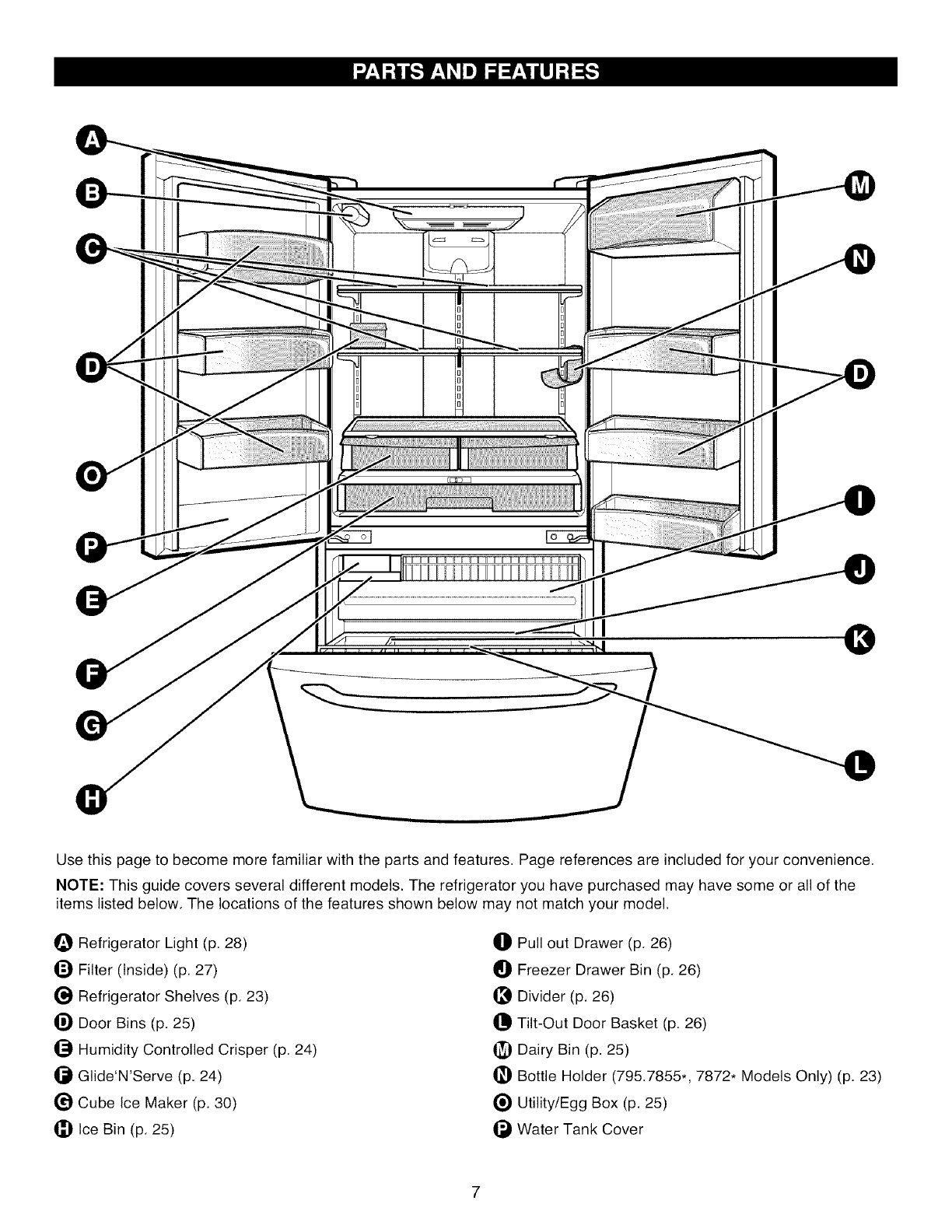
Usethispageto becomemorefamiliarwiththepartsandfeatures.Pagereferencesareincludedforyourconvenience.
NOTE:Thisguidecoversseveraldifferentmodels.Therefrigeratoryouhavepurchasedmayhavesomeorallofthe
itemslistedbelow.Thelocationsofthefeaturesshownbelowmaynotmatchyourmodel.
Q RefrigeratorLight(p.28)
0 Filter(Inside)(p.27)
(_ RefrigeratorShelves(p.23)
_) DoorBins(p.25)
HumidityControlledCrisper(p.24)
Glide'N'Serve(p.24)
(_ CubeIceMaker(p.30)
_) IceBin(p.25)
tO Pull out Drawer (p. 26)
Freezer Drawer Bin (p. 26)
Divider (p. 26)
Tilt-Out Door Basket (p. 26)
_) Dairy Bin (p. 25)
Bottle Holder (795.7855,, 7872* Models Only) (p. 23)
(_ Utility/Egg Box (p. 25)
Water Tank Cover
Excessive Weight Hazard
Use two or more people to move and install
refrigerator.
Failure to do so can result in back or other injury.
UNPACKING YOUR REFRIGERATOR
Remove tape and any temporary labels from your
refrigerator before using. Do not remove any warning-type
labels, the model and serial number label, or the
TechSheet that is attached to back wall of the refrigerator.
To remove any remaining tape or glue, rub the area
briskly with your thumb. Tape or glue residue can also be
easily removed by rubbing a small amount of liquid dish
soap over the adhesive with your fingers. Wipe with warm
water and dry.
Do not use sharp instruments, rubbing alcohol, flammable
fluids, or abrasive cleaners to remove tape or glue. These
products can damage the surface of your refrigerator. For
more information, see the Important Safety Instructions
section.
Refrigerator shelves are installed in the shipping position.
Please reinstall shelves according to your individual
storage needs.
When Moving Your Refrigerator:
Your refrigerator is heavy. When moving the
refrigerator for cleaning or service, be sure to protect
the floor. Always pull the refrigerator straight out
when moving it. Do not wiggle or walk the refrigerator
when trying to move it, as floor damage could occur.
INSTALLATION
• To minimize noise and vibration, the refrigerator MUST
be installed on a solidly constructed floor.
• Carpeting and soft tile surfaces are not recommended.
• Never install the refrigerator on a platform or weakly
supported structure.
1. To avoid vibration, the unit must be leveled. If required,
adjust the leveling legs to compensate for unevenness
of the floor. The front should be slightly higher than the
rear to aid in door closing. Leveling legs can be turned
easily by tipping the cabinet slightly. Turn the leveling
legs clockwise (_) to raise the unit,
counterclockwise ( _,"=") to lower it.
2. Install this appliance in an area where the temperature
is between 55°F (13°C) and 110°F (43°C.) If the
temperature around the appliance is too low or high,
cooling ability may be adversely affected.
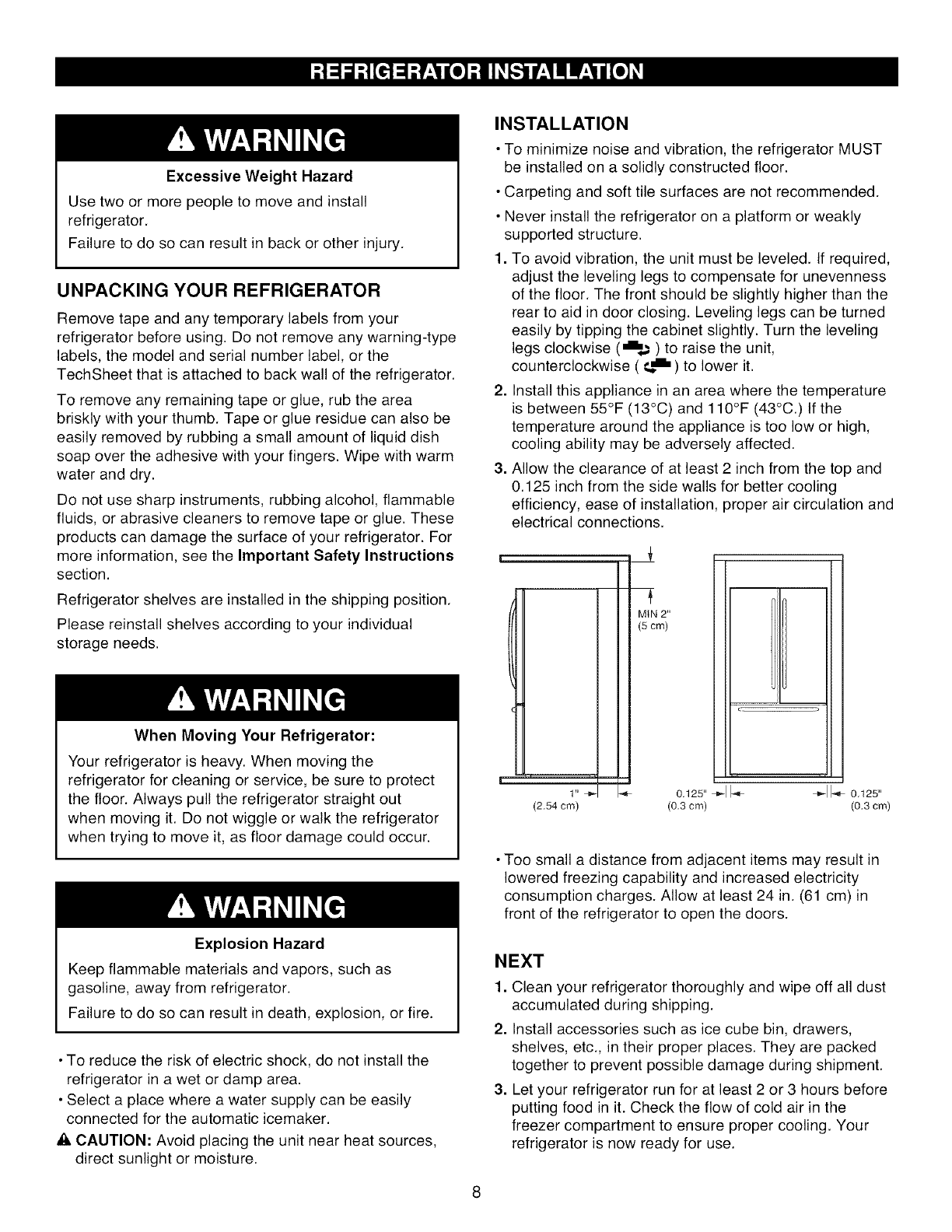
3. Allow the clearance of at least 2 inch from the top and
0.125 inch from the side walls for better cooling
efficiency, ease of installation, proper air circulation and
electrical connections.
E
1" 4_-
(2.54 cm)
mo.125"_-II-_ _-II_ o.125"
(0.3cm) (0.3 cm)
• Too small a distance from adjacent items may result in
lowered freezing capability and increased electricity
consumption charges. Allow at least 24 in. (61 cm) in
front of the refrigerator to open the doors.
Explosion Hazard
Keep flammable materials and vapors, such as
gasoline, away from refrigerator.
Failure to do so can result in death, explosion, or fire.
• To reduce the risk of electric shock, do not install the
refrigerator in a wet or damp area.
• Select a place where a water supply can be easily
connected for the automatic icemaker.
A CAUTION: Avoid placing the unit near heat sources,
direct sunlight or moisture.
NEXT
1. Clean your refrigerator thoroughly and wipe off all dust
accumulated during shipping.
2. Install accessories such as ice cube bin, drawers,
shelves, etc., in their proper places. They are packed
together to prevent possible damage during shipment.
3. Let your refrigerator run for at least 2 or 3 hours before
putting food in it. Check the flow of cold air in the
freezer compartment to ensure proper cooling. Your
refrigerator is now ready for use.
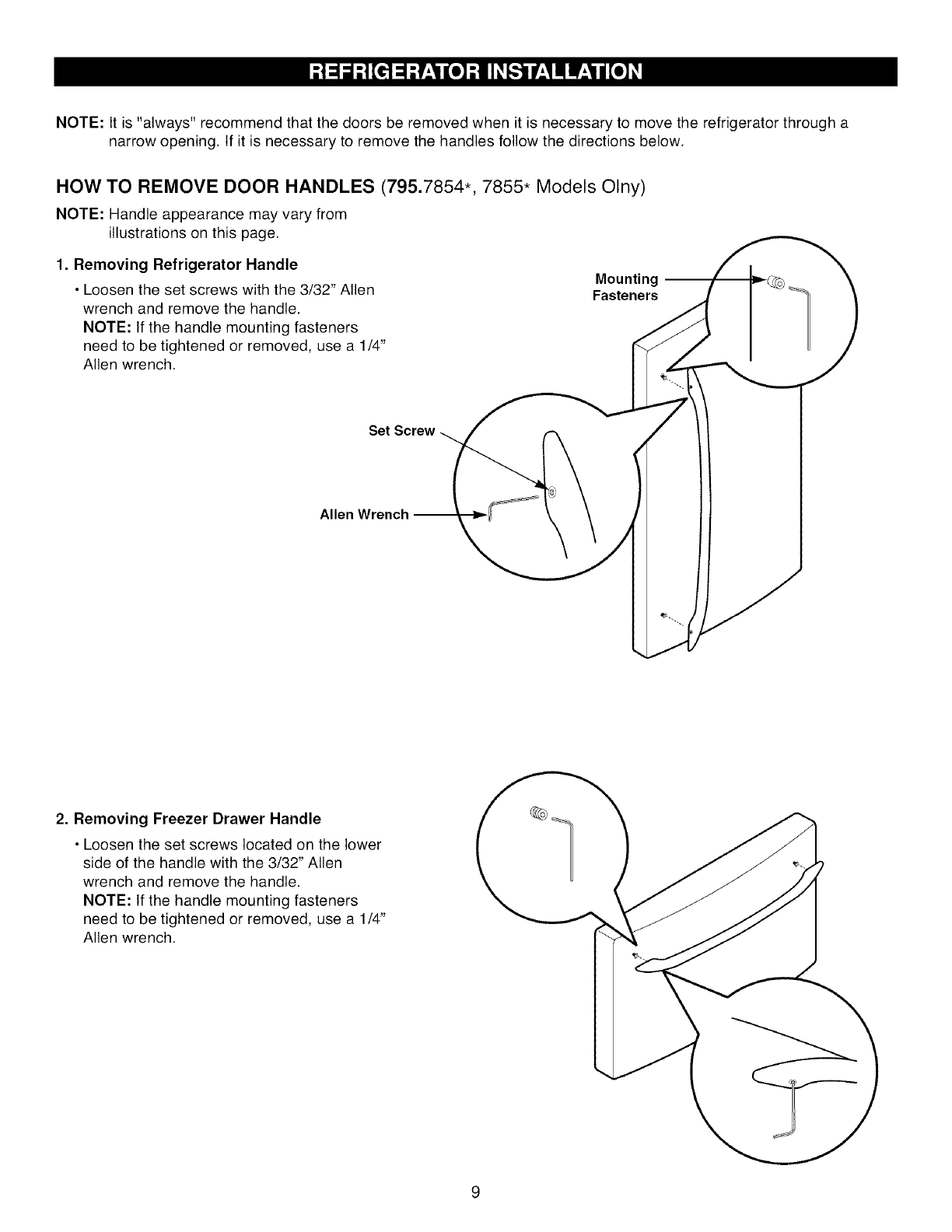
NOTE:Itis"always"recommendthatthedoorsberemovedwhenit isnecessarytomovetherefrigeratorthrougha
narrowopening.Ifit isnecessaryto removethehandlesfollowthedirectionsbelow.
HOW TO REMOVE DOOR HANDLES (795.7854*, 7855* Models Olny)
NOTE: Handle appearance may vary from
illustrations on this page.
1. Removing Refrigerator Handle
•Loosen the set screws with the 3/32" Allen
wrench and remove the handle.
NOTE: If the handle mounting fasteners
need to be tightened or removed, use a 1/4"
Allen wrench.
Set
Allen Wrench --
Mounting --
Fasteners
2. Removing Freezer Drawer Handle
• Loosen the set screws located on the lower
side of the handle with the 3/32" Allen
wrench and remove the handle.
NOTE: If the handle mounting fasteners
need to be tightened or removed, use a 1/4"
Allen wrench.
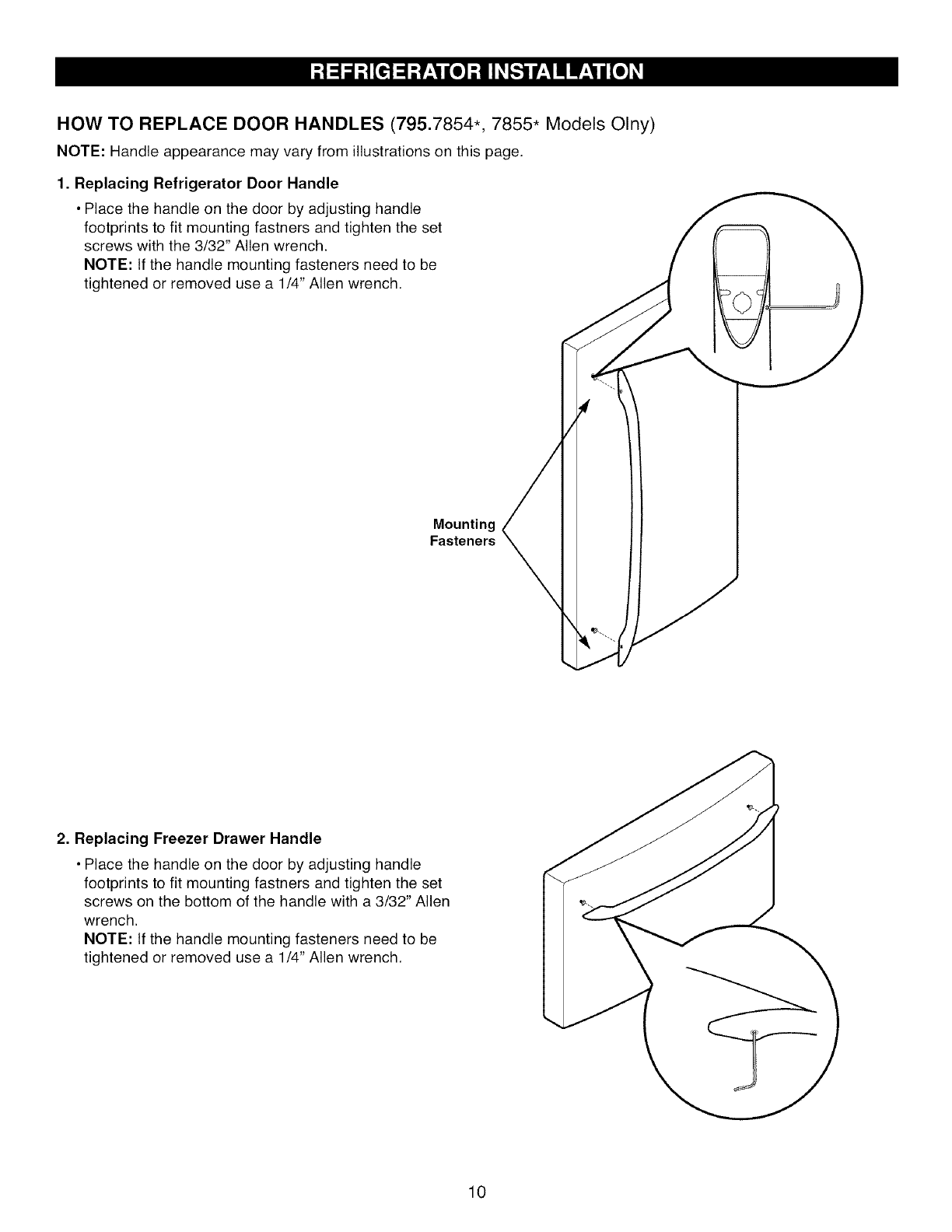
HOW TO REPLACE DOOR HANDLES (795.7854*, 7855* Models Olny)
NOTE: Handle appearance may vary from illustrations on this page.
1. Replacing Refrigerator Door Handle
•Place the handle on the door by adjusting handle
footprints to fit mounting fastners and tighten the set
screws with the 3/32" Allen wrench.
NOTE: If the handle mounting fasteners need to be
tightened or removed use a 1/4" Allen wrench.
Mounting
Fasteners
2. Replacing Freezer Drawer Handle
• Place the handle on the door by adjusting handle
footprints to fit mounting fastners and tighten the set
screws on the bottom of the handle with a 3/32" Allen
wrench.
NOTE: tf the handle mounting fasteners need to be
tightened or removed use a 1/4" Allen wrench.
10
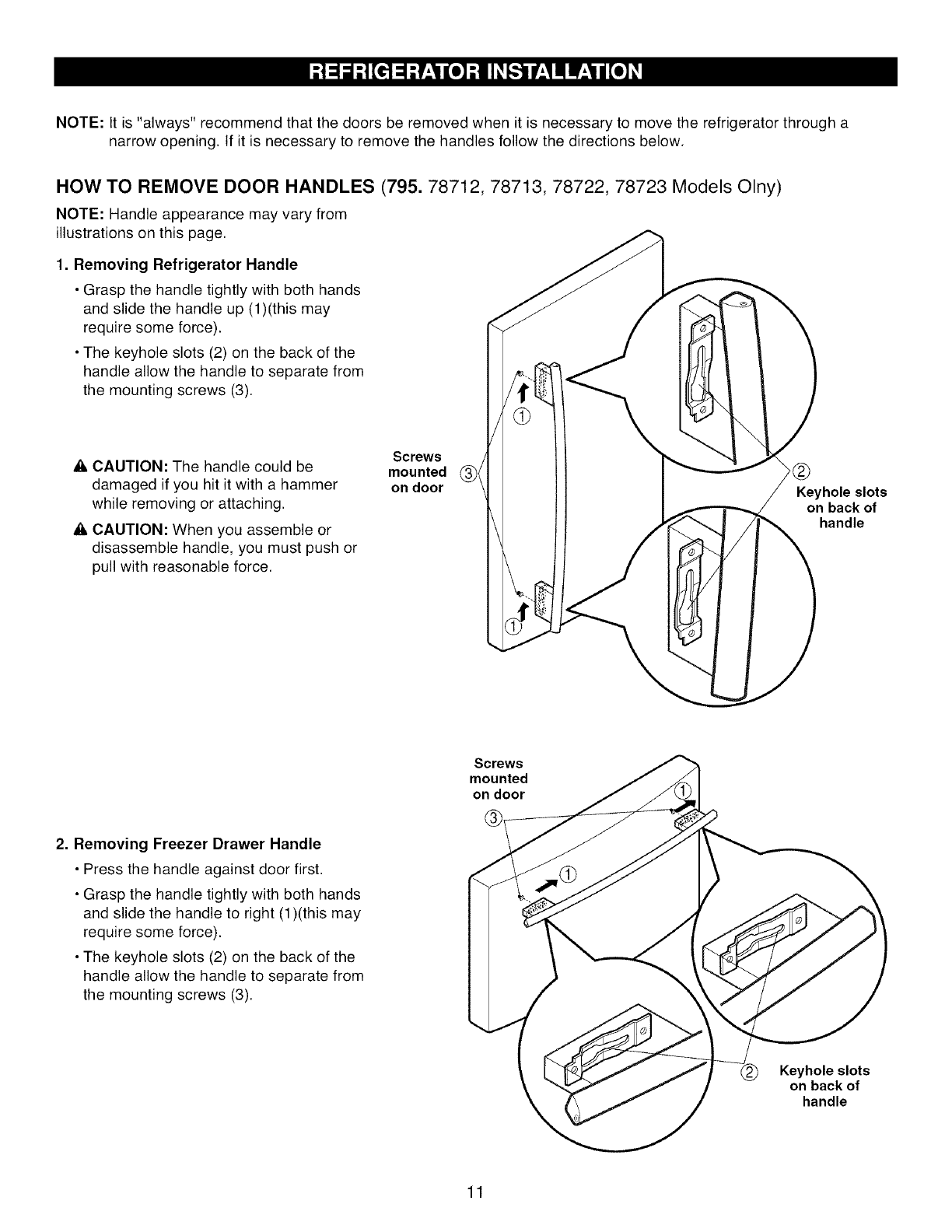
NOTE: It is "always" recommend that the doors be removed when it is necessary to move the refrigerator through a
narrow opening. If it is necessary to remove the handles follow the directions below.
HOW TO REMOVE DOOR HANDLES (795. 78712, 78713, 78722, 78723 Models Olny)
NOTE: Handle appearance may vary from
illustrations on this page.
1. Removing Refrigerator Handle
• Grasp the handle tightly with both hands
and slide the handle up (1)(this may
require some force).
• The keyhole slots (2) on the back of the
handle allow the handle to separate from
the mounting screws (3).
A CAUTION: The handle could be
damaged if you hit it with a hammer
while removing or attaching.
A CAUTION: When you assemble or
disassemble handle, you must push or
pull with reasonable force.
Screws
mounted
on door Keyhole slots
on back of
handle
2. Removing Freezer Drawer Handle
• Press the handle against door first.
• Grasp the handle tightly with both hands
and slide the handle to right (1)(this may
require some force).
• The keyhole slots (2) on the back of the
handle allow the handle to separate from
the mounting screws (3).
Screws
mounted
on door
®
Keyhole slots
on back of
handle
11
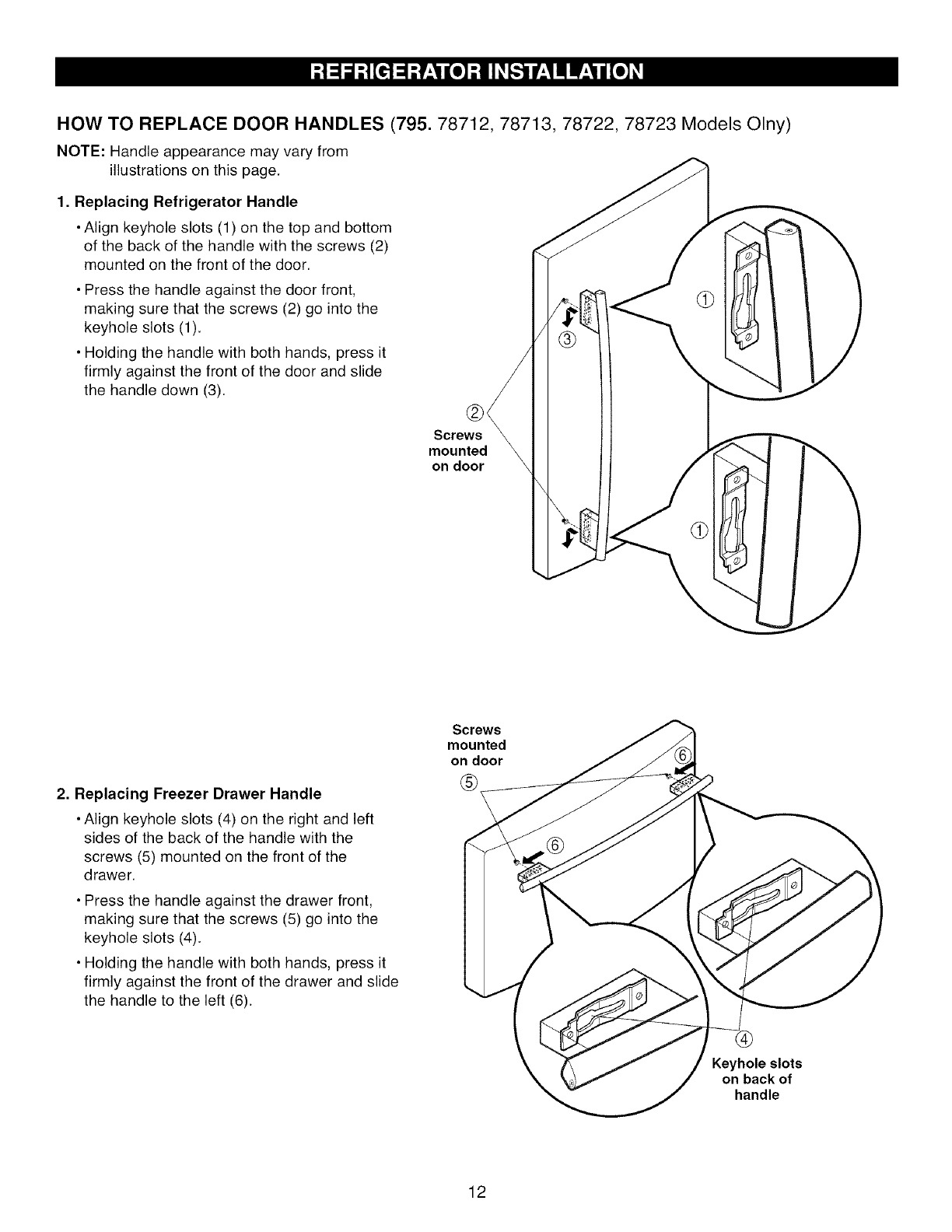
HOW TO REPLACE DOOR HANDLES (795. 78712, 78713, 78722, 78723 Models Olny)
NOTE: Handle appearance may vary from
illustrations on this page.
1. Replacing Refrigerator Handle
•Align keyhole slots (1) on the top and bottom
of the back of the handle with the screws (2)
mounted on the front of the door.
• Press the handle against the door front,
making sure that the screws (2) go into the
keyhole slots (1).
• Holding the handle with both hands, press it
firmly against the front of the door and slide
the handle down (3).
_<
Screws
mounted
on door
2. Replacing Freezer Drawer Handle
• Align keyhole slots (4) on the right and left
sides of the back of the handle with the
screws (5) mounted on the front of the
drawe r.
• Press the handle against the drawer front,
making sure that the screws (5) go into the
keyhole slots (4).
• Holding the handle with both hands, press it
firmly against the front of the drawer and slide
the handle to the left (6).
Screws
mounted
on door
®
Keyhole slots
on back of
handle
12
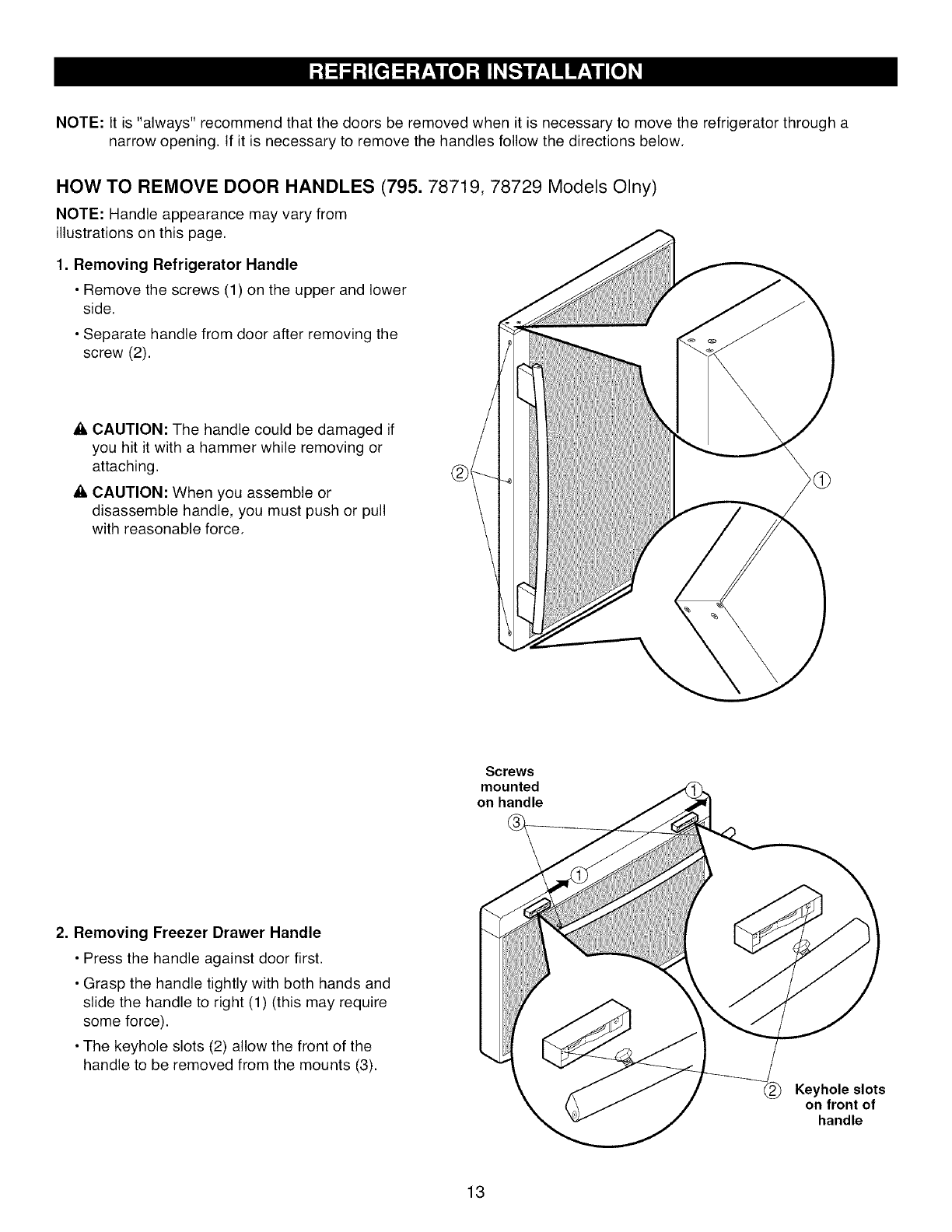
NOTE: It is "always" recommend that the doors be removed when it is necessary to move the refrigerator through a
narrow opening. If it is necessary to remove the handles follow the directions below.
HOW TO REMOVE DOOR HANDLES (795. 78719, 78729 Models Olny)
NOTE: Handle appearance may vary from
illustrations on this page.
1. Removing Refrigerator Handle
• Remove the screws (1) on the upper and lower
side.
• Separate handle from door after removing the
screw (2).
A CAUTION: The handle could be damaged if
you hit it with a hammer while removing or
attaching.
A CAUTION: When you assemble or
disassemble handle, you must push or pull
with reasonable force.
®
Screws
mounted
on handle
2. Removing Freezer Drawer Handle
• Press the handle against door first.
• Grasp the handle tightly with both hands and
slide the handle to right (1) (this may require
some force).
• The keyhole slots (2) allow the front of the
handle to be removed from the mounts (3).
Keyhole slots
on front of
handle
13
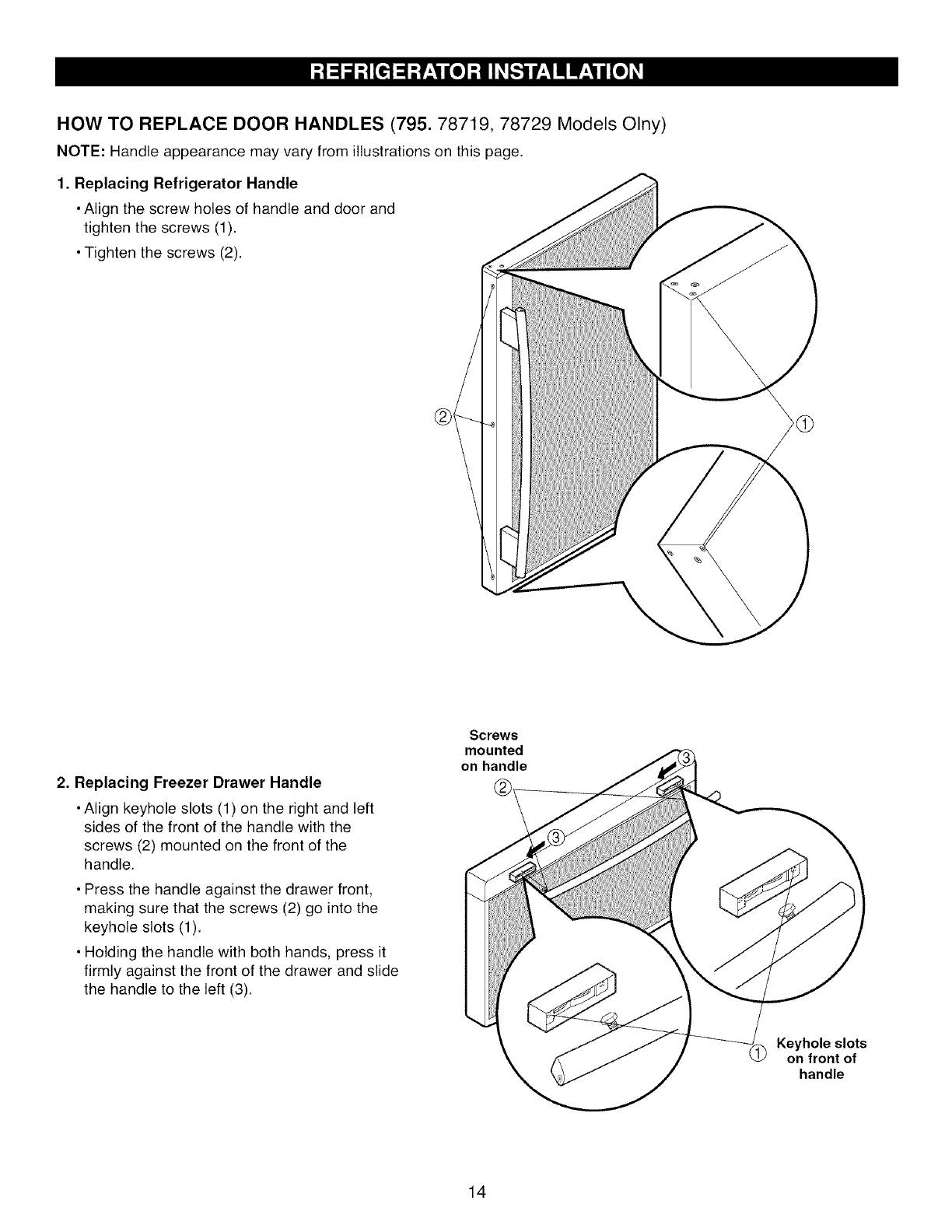
HOW TO REPLACE DOOR HANDLES (795. 78719, 78729 Models Olny)
NOTE: Handle appearance may vary from illustrations on this page.
1. Replacing Refrigerator Handle
• Align the screw holes of handle and door and
tighten the screws (1).
• Tighten the screws (2).
2. Replacing Freezer Drawer Handle
• Align keyhole slots (1) on the right and left
sides of the front of the handle with the
screws (2) mounted on the front of the
handle.
• Press the handle against the drawer front,
making sure that the screws (2) go into the
keyhole slots (1).
• Holding the handle with both hands, press it
firmly against the front of the drawer and slide
the handle to the left (3).
Screws
mounted
on handle
®
Keyhole slots
on front of
handle
14
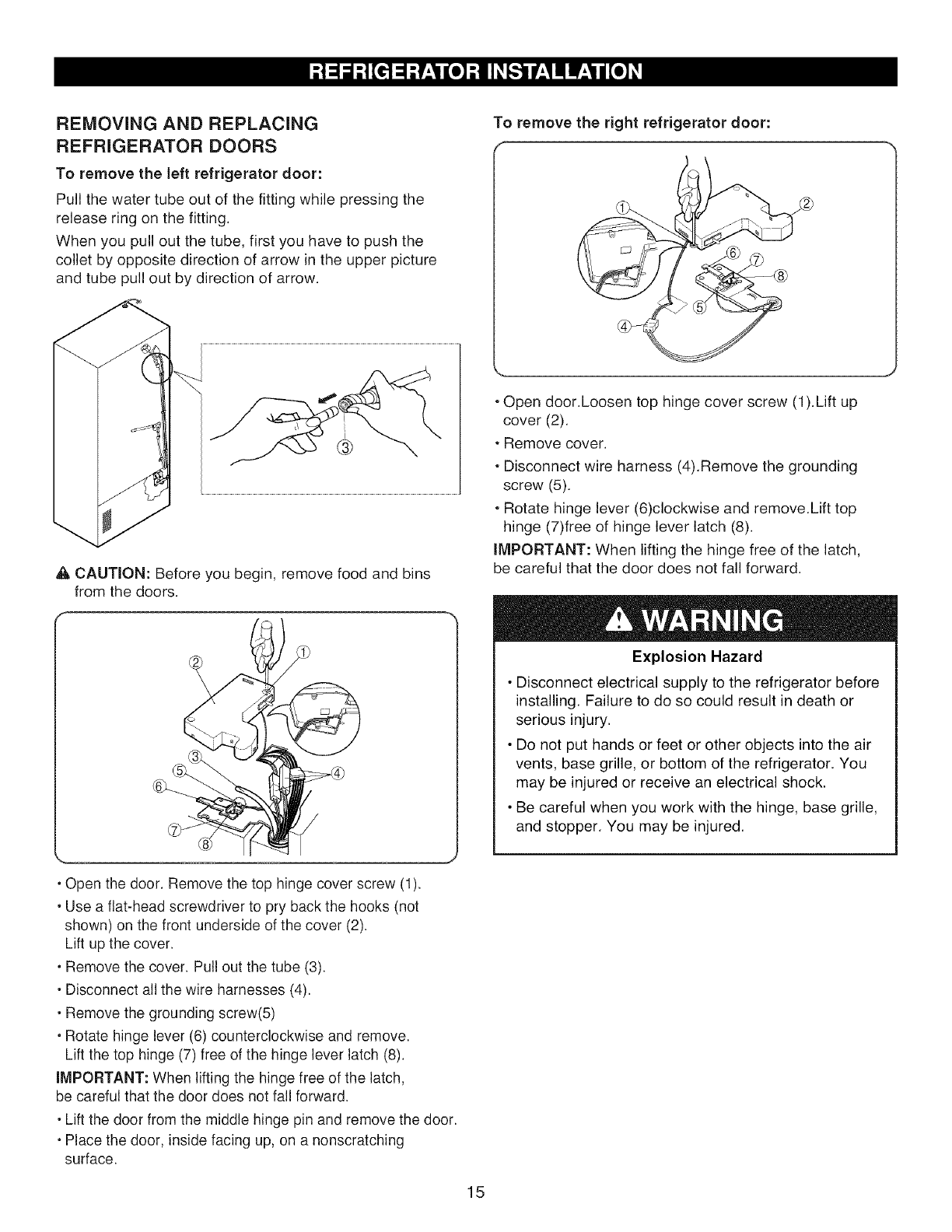
REMOVING AND REPLACING
REFRIGERATOR DOORS
To remove the left refrigerator door:
Pull the water tube out of the fitting while pressing the
release ring on the fitting.
When you pull out the tube, first you have to push the
collet by opposite direction of arrow in the upper picture
and tube pull out by direction of arrow.
To remove the right refrigerator door:
f
_b,CAUTION: Before you begin, remove food and bins
from the doors.
•Open the door. Remove the top hinge cover screw (1).
• Use a flat-head screwdriver to pry back the hooks (not
shown) on the front underside of the cover (2).
Lift up the cover.
•Remove the cover. Pull out the tube (3).
• Disconnect all the wire harnesses (4).
• Remove the grounding screw(5)
•Rotate hinge lever (6) counterclockwise and remove.
Lift the top hinge (7) free of the hinge lever latch (8).
iMPORTANT: When lifting the hinge free of the latch,
be careful that the door does not fall forward.
• Lift the door from the middle hinge pin and remove the door.
• Place the door, inside facing up, on a nonscratching
surface.
•Open door.Loosen top hinge cover screw (1).Lift up
cover (2).
• Remove cover.
•Disconnect wire harness (4).Remove the grounding
screw (5).
•Rotate hinge lever (6)clockwise and remove.Lift top
hinge (7)free of hinge lever latch (8).
iMPORTANT: When lifting the hinge free of the latch,
be careful that the door does not fall forward.
Explosion Hazard
• Disconnect electrical supply to the refrigerator before
installing. Failure to do so could result in death or
serious injury.
• Do not put hands or feet or other objects into the air
vents, base grille, or bottom of the refrigerator. You
may be injured or receive an electrical shock.
• Be careful when you work with the hinge, base grille,
and stopper. You may be injured.
15
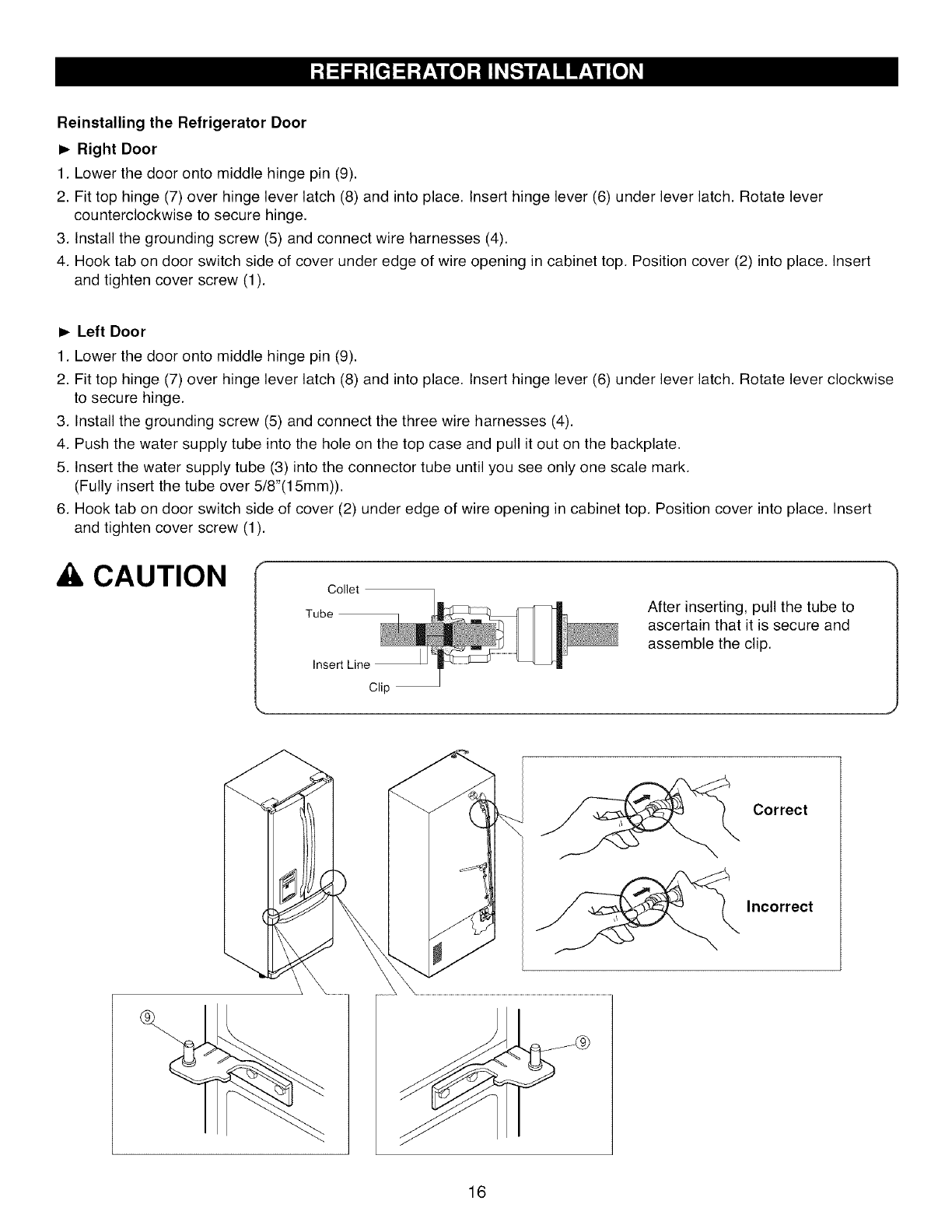
Reinstalling the Refrigerator Door
I_ Right Door
1. Lower the door onto middle hinge pin (9).
2. Fit top hinge (7) over hinge lever latch (8) and into place. Insert hinge lever (6) under lever latch. Rotate lever
counterclockwise to secure hinge.
3. Install the grounding screw (5) and connect wire harnesses (4).
4. Hook tab on door switch side of cover under edge of wire opening in cabinet top. Position cover (2) into place. Insert
and tighten cover screw (1).
I_ Left Door
1. Lower the door onto middle hinge pin (9).
2. Fit top hinge (7) over hinge lever latch (8) and into place. Insert hinge lever (6) under lever latch. Rotate lever clockwise
to secure hinge.
3. Install the grounding screw (5) and connect the three wire harnesses (4).
4. Push the water supply tube into the hole on the top case and pull it out on the backplate.
5. Insert the water supply tube (3) into the connector tube until you see only one scale mark.
(Fully insert the tube over 5/8"(15mm)).
6. Hook tab on door switch side of cover (2) under edge of wire opening in cabinet top. Position cover into place. Insert
and tighten cover screw (1).
CAUTION Collet
Tube
Insert Line
Clip
After inserting, pull the tube to
ascertain that it is secure and
assemble the clip.
Correct
Incorrect
16
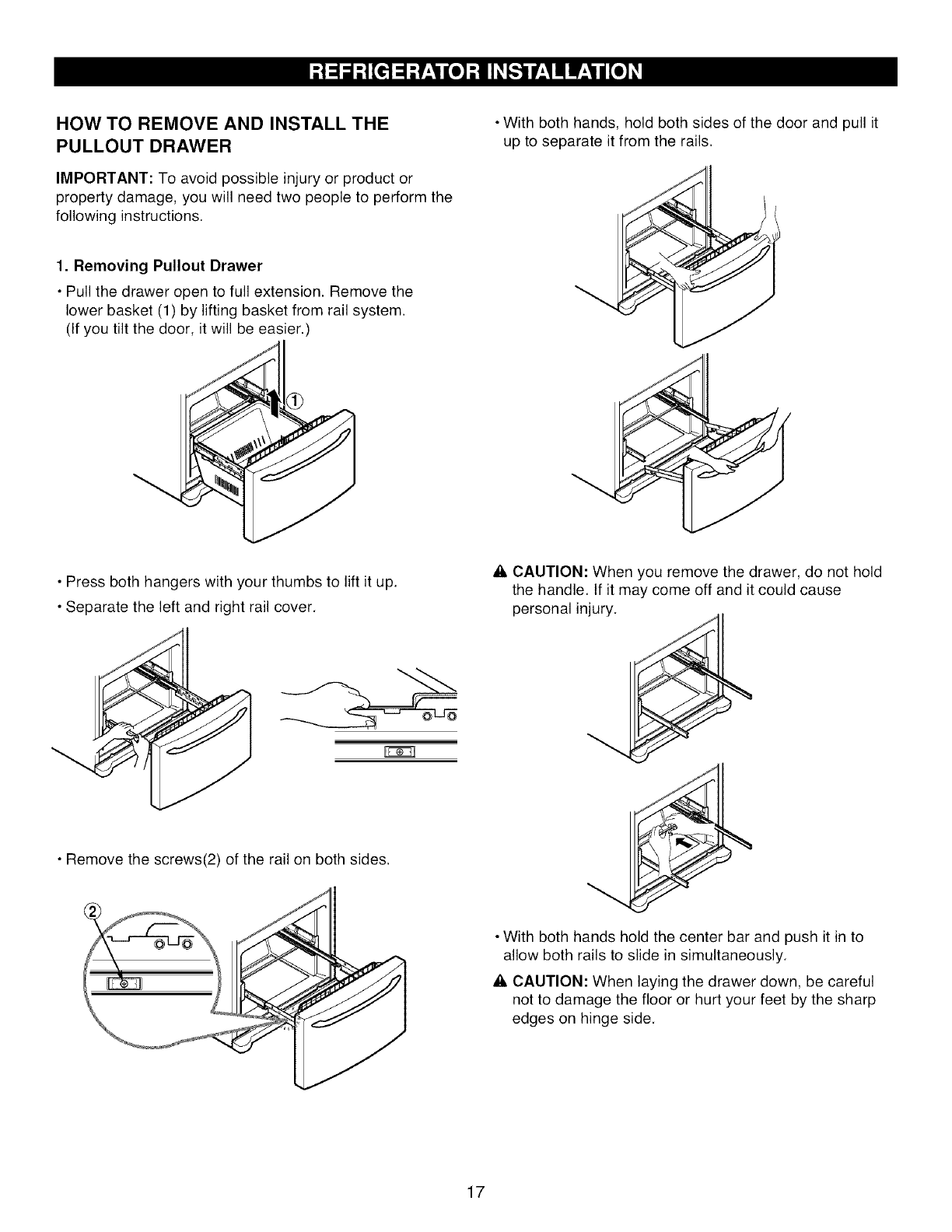
HOW TO REMOVE AND INSTALL THE
PULLOUT DRAWER
IMPORTANT: To avoid possible injury or product or
property damage, you will need two people to perform the
following instructions.
1. Removing Pullout Drawer
•Pull the drawer open to full extension. Remove the
lower basket (1) by lifting basket from rail system.
(If you tilt the door, it will be easier.)
• With both hands, hold both sides of the door and pull it
up to separate it from the rails.
J
• Press both hangers with your thumbs to lift it up.
• Separate the left and right rail cover.
/
• Remove the screws(2) of the rail on both sides.
A CAUTION: When you remove the drawer, do not hold
the handle. If it may come off and it could cause
personal injury.
• With both hands hold the center bar and push it in to
allow both rails to slide in simultaneously.
A CAUTION: When laying the drawer down, be careful
not to damage the floor or hurt your feet by the sharp
edges on hinge side.
17
HOW TO REMOVE AND INSTALL THE
PULLOUT DRAWER
IMPORTANT: To avoid possible injury or product or
property damage, you will need two people to perform the
following instructions.
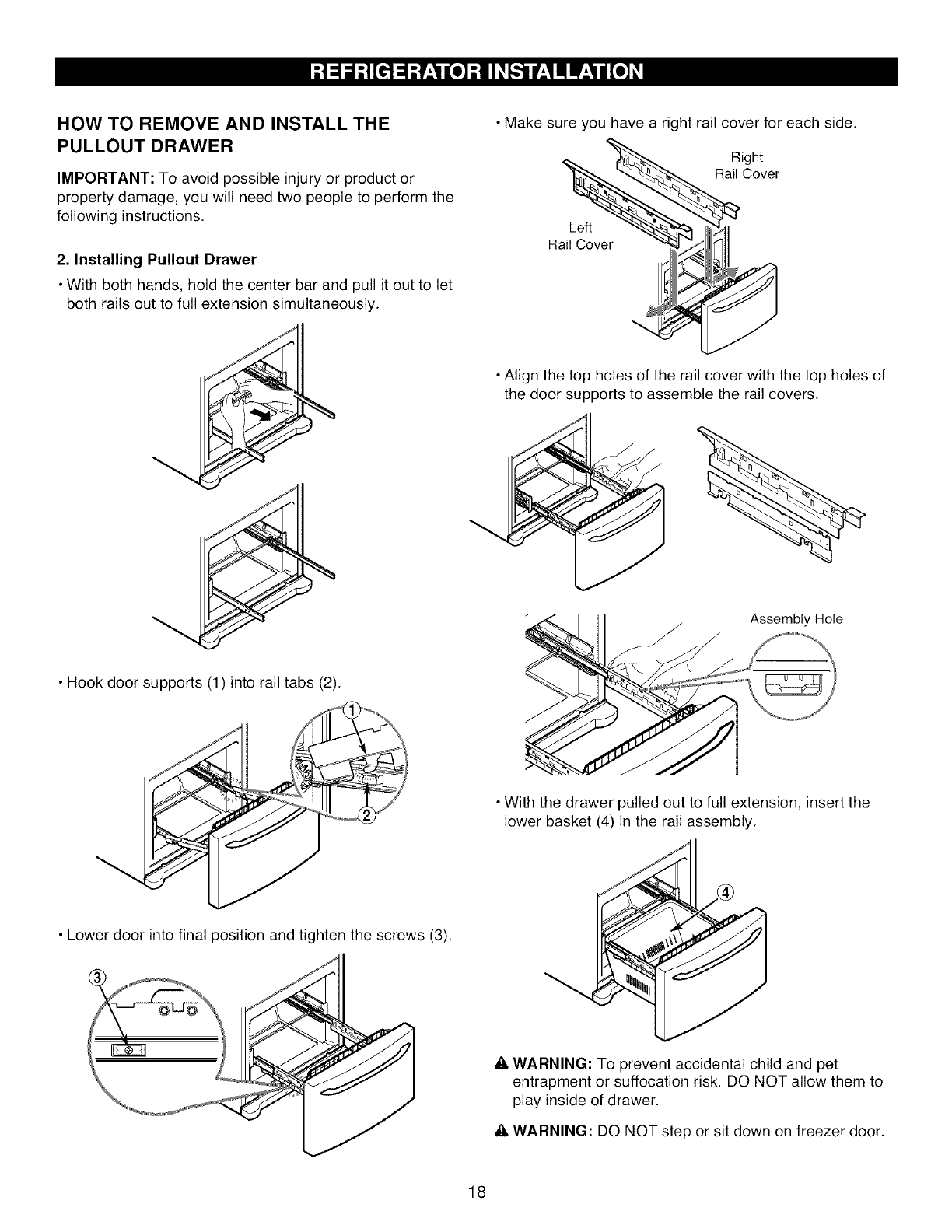
2. Installing Pullout Drawer
•With both hands, hold the center bar and pull it out to let
both rails out to full extension simultaneously.
• Hook door supports (1) into rail tabs (2).
• Lower door into final position and tighten the screws (3).
J
• Make sure you have a right rail cover for each side.
Right
Rail Cover
Left
Rail Cover
• Align the top holes of the rail cover with the top holes of
the door supports to assemble the rail covers.
Assembly Hole
• With the drawer pulled out to full extension, insert the
lower basket (4) in the rail assembly.
f
_ WARNING: To prevent accidental child and pet
entrapment or suffocation risk. DO NOT allow them to
play inside of drawer.
A WARNING: DO NOT step or sit clown on freezer door.
18
LEVELING AND DOOR ALIGNMENT
Leveling
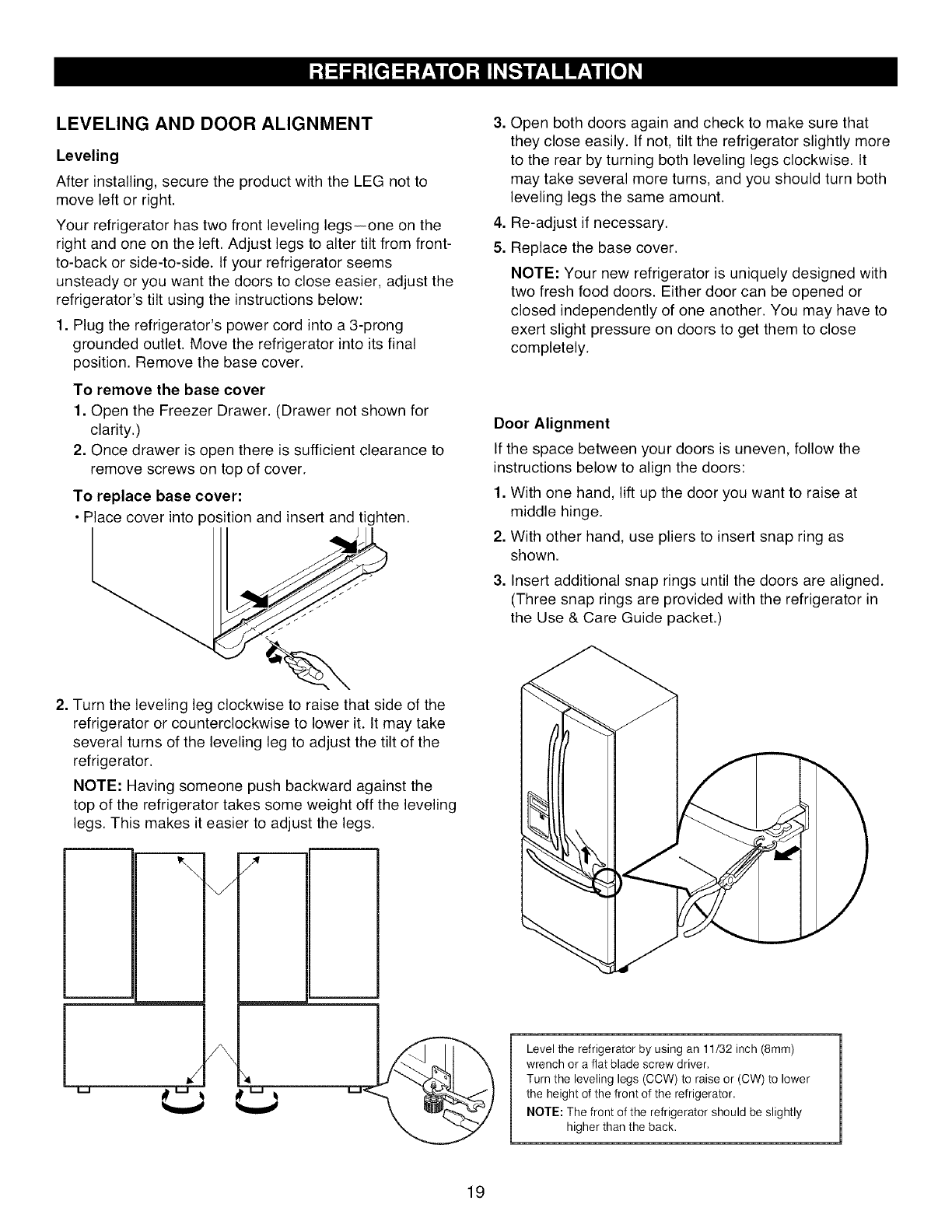
After installing, secure the product with the LEG not to
move left or right.
Your refrigerator has two front leveling legs--one on the
right and one on the left. Adjust legs to alter tilt from front-
to-back or side-to-side. If your refrigerator seems
unsteady or you want the doors to close easier, adjust the
refrigerator's tilt using the instructions below:
1. Plug the refrigerator's power cord into a 3-prong
grounded outlet. Move the refrigerator into its final
position. Remove the base cover.
To remove the base cover
1. Open the Freezer Drawer. (Drawer not shown for
clarity.)
2. Once drawer is open there is sufficient clearance to
remove screws on top of cover.
To replace base cover:
• Place cover into position and insert and tighten.
3. Open both doors again and check to make sure that
they close easily. If not, tilt the refrigerator slightly more
to the rear by turning both leveling legs clockwise. It
may take several more turns, and you should turn both
leveling legs the same amount.
4. Re-adjust if necessary.
5. Replace the base cover.
NOTE: Your new refrigerator is uniquely designed with
two fresh food doors. Either door can be opened or
closed independently of one another. You may have to
exert slight pressure on doors to get them to close
completely.
Door Alignment
If the space between your doors is uneven, follow the
instructions below to align the doors:
1. With one hand, lift up the door you want to raise at
middle hinge.
2. With other hand, use pliers to insert snap ring as
shown.
3. Insert additional snap rings until the doors are aligned.
(Three snap rings are provided with the refrigerator in
the Use & Care Guide packet.)
2. Turn the leveling leg clockwise to raise that side of the
refrigerator or counterclockwise to lower it. It may take
several turns of the leveling leg to adjust the tilt of the
refrigerator.
NOTE: Having someone push backward against the
top of the refrigerator takes some weight off the leveling
legs. This makes it easier to adjust the legs.
w
Level the refrigerator by using an 11/32 inch (8mm)
wrench or a flat blade screw driver,
Turn the leveling legs (CCW) to raise or (CW) to lower
the height of the front of the refrigerator,
NOTE: The front of the refrigerator should be slightly
higher than the back.
19
ENSURING PROPER AIR CIRCULATION
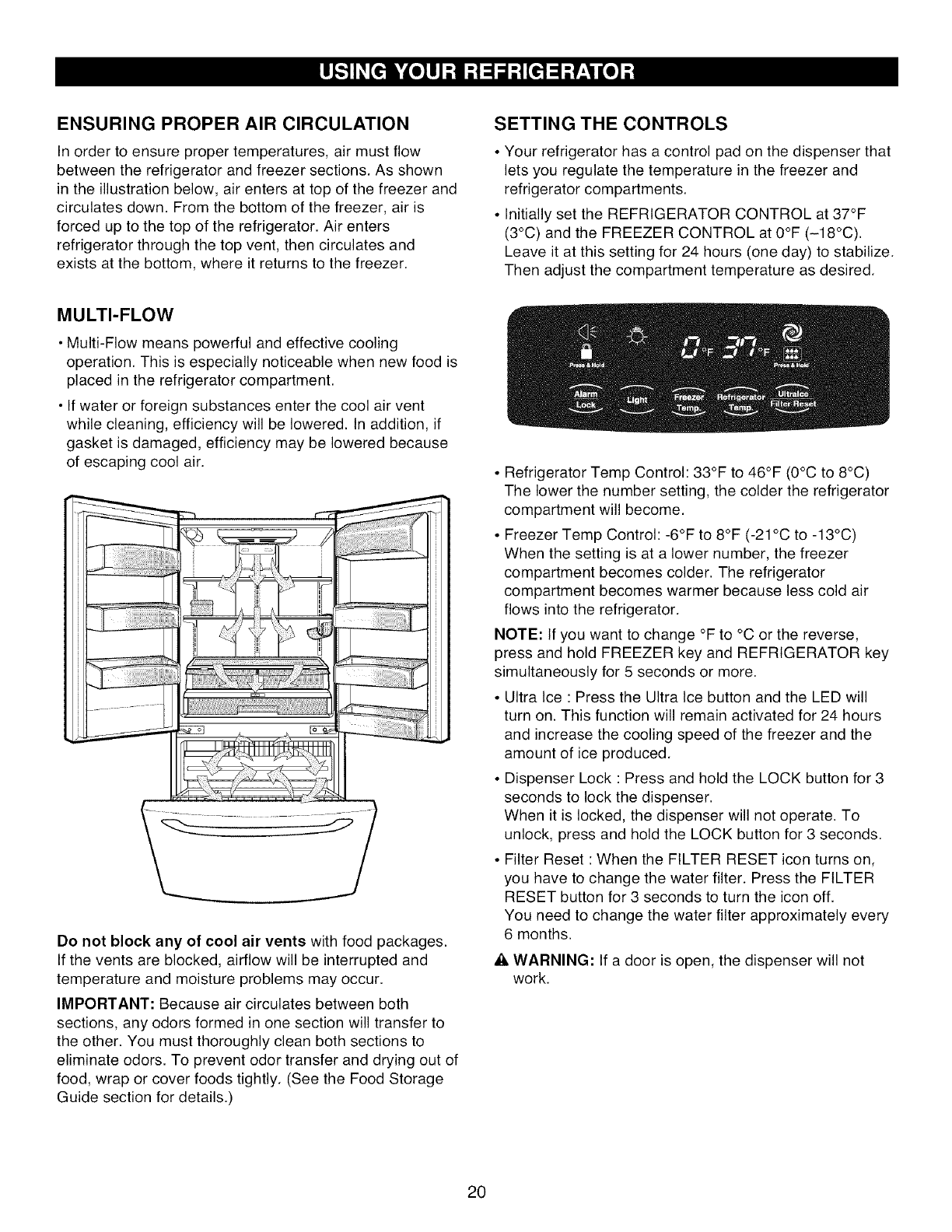
In order to ensure proper temperatures, air must flow
between the refrigerator and freezer sections. As shown
in the illustration below, air enters at top of the freezer and
circulates down. From the bottom of the freezer, air is
forced up to the top of the refrigerator. Air enters
refrigerator through the top vent, then circulates and
exists at the bottom, where it returns to the freezer.
MULTI-FLOW
• Multi-Flow means powerful and effective cooling
operation. This is especially noticeable when new food is
placed in the refrigerator compartment.
• If water or foreign substances enter the cool air vent
while cleaning, efficiency will be lowered. In addition, if
gasket is damaged, efficiency may be lowered because
of escaping cool air.
Do not block any of cool air vents with food packages.
If the vents are blocked, airflow will be interrupted and
temperature and moisture problems may occur.
IMPORTANT: Because air circulates between both
sections, any odors formed in one section will transfer to
the other. You must thoroughly clean both sections to
eliminate odors. To prevent odor transfer and drying out of
food, wrap or cover foods tightly. (See the Food Storage
Guide section for details.)
SETTING THE CONTROLS
• Your refrigerator has a control pad on the dispenser that
lets you regulate the temperature in the freezer and
refrigerator compartments.
• Initially set the REFRIGERATOR CONTROL at 37°F
(3°C) and the FREEZER CONTROL at 0°F (-18°C).
Leave it at this setting for 24 hours (one day) to stabilize.
Then adjust the compartment temperature as desired.
• Refrigerator Temp Control: 33°F to 46°F (0°C to 8°C)
The lower the number setting, the colder the refrigerator
compartment will become.
• Freezer Temp Control: -6°F to 8°F (-21 °C to -13°C)
When the setting is at a lower number, the freezer
compartment becomes colder. The refrigerator
compartment becomes warmer because less cold a_r
flows into the refrigerator.
NOTE: If you want to change °F to °C or the reverse,
press and hold FREEZER key and REFRIGERATOR key
simultaneously for 5 seconds or more.
• Ultra Ice : Press the Ultra Ice button and the LED will
turn on. This function will remain activated for 24 hours
and increase the cooling speed of the freezer and the
amount of ice produced.
• Dispenser Lock : Press and hold the LOCK button for 3
seconds to lock the dispenser.
When it is locked, the dispenser will not operate. To
unlock, press and hold the LOCK button for 3 seconds.
• Filter Reset : When the FILTER RESET icon turns on,
you have to change the water filter. Press the FILTER
RESET button for 3 seconds to turn the icon off.
You need to change the water filter approximately every
6 months.
WARNING: If a door is open, the dispenser will not
work.
2O
ADJUSTING CONTROL SETTINGS
Give the refrigerator time to cool down completely before
making final adjustments. It is best to wait 24 hours
before doing this. The mid-settings indicated in the
previous section should be correct for normal household
refrigerator usage. The controls are set correctly when
milk or juice is as cold as you like and when ice cream
is firm.
The refrigerator control functions as the thermostat for the
entire appliance (refrigerator and freezer sections). The
higher the number setting, the longer the compressor will
run to keep the temperature colder. The freezer control
adjusts the cold air flow from the freezer to the
refrigerator. Setting the freezer control to a lower
temperature keeps more cold air in the Freezer
compartment to make it colder.
If you need to adjust temperatures in the refrigerator or
freezer, start by adjusting the refrigerator. Then wait 24
hours before checking the freezer temperature, tf it is too
warm or too cold, then adjust the freezer control.
Use the settings listed in the chart below as a guide.
Always remember to wait at least 24 hours between
adjustments.
CONDITION/ RECOMMENDED
REASON: ADJUSTMENT:
II REFRIGERATOR section
too warm
- Door opened often
- Large amount of food added
- Room temperature very warm
Set REFRIGERATOR
control to next lower
number, wait 24 hours,
then re-check
m FREEZER section too
warm/ice not made fast
enough
- Door opened often
- Large amount of food added
- Very cold room temperature
(can't cycle often enough)
- Heavy ice usage
- Air vents blocked by items
Set FREEZER control
to next lower number,
wait 24 hours, then re-
check
Move items out of
airstream
II REFRIGERATOR section
too cold
- Controls not set correctly for
your conditions
Set REFRIGERATOR
control to next higher
number, wait 24
hours, then re-check
m FREEZER section too cold
- Controls not set correctly for
your conditions
Set FREEZER control
to next higher number,
wait 24 hours, then re-
check
FOOD STORAGE GUIDE
Wrap or store food in the refrigerator in airtight and
moisture-proof material unless otherwise noted. This
prevents food odor and taste transfer throughout the
refrigerator. For dated products, check date code to
ensure freshness.
Items How to
Butter or
margarine
Keep opened butter in a covered
dish or closed compartment.
When storing an extra supply,
wrap in freezer packaging and
freeze.
Cheese Store in the original wrapping until
you are ready to use it. Once
opened, rewrap tightly in plastic
wrap or aluminum foil.
MiJk _ Wipe milk cartons. For best
storage, place milk on interior
shelf, not on door shelf.
Eggs _ Store in original carton or Egg Box
on interior shelf, not on door shelf.
Fruit i_ Wash, let dry, and store in
refrigerator in plastic bags or in
the crisper. Do not wash or hull
berries until you are ready to use
them. Sort and keep berries in
their original container in a
crisper, or store in a sloosely
closed paper bag on a refrigerator
shelf.
Leafy vegetables Remove store wrapping and trim
or tear off bruised and discolored
areas. Wash in cold water and
drain. Place in plastic bag or
plastic container and store in
crisper.
Vegetables with _ Place in plastic bags or plastic
skins (carrots, container and store in crisper.
peppers)
Fish Use fresh fish and shellfish the
same day purchased.
Leftovers i_ Cover leftovers with plastic wrap
or aluminum foil. Plastic
containers with tight lids can
also be used.
21
STORING FROZEN FOOD
NOTE: For further information about preparing food for
freezing or food storage times, check a freezer guide or a
reliable cookbook.
Packaging
Successful freezing depends on correct packaging. When
you close and seal the package, it must not allow air or
moisture in or out. If it does, you could have food odor
and taste transfer throughout the refrigerator and also dry
out frozen food.
Packaging recommendations:
•Rigid plastic containers with tight-fitting lids
• Straight-sided canning/freezing jars
• Heavy-duty aluminum foil
• Plastic-coated paper
• Non-permeable plastic wraps
• Specified freezer-grade self-sealing plastic bags
Follow package or container instructions for proper
freezing methods.
Do not use
• Bread wrappers
• Non-polyethylene plastic containers
• Containers without tight lids
• Wax paper or wax-coated freezer wrap
• Thin, semi-permeable wrap
A CAUTION: Do not keep beverage cans or plastic food
containers in the freezer compartment. They may be
break if they freezer.
Freezing
Your freezer will not quick-freeze any large quantity of
food. Do not put more unfrozen food into the freezer than
will freeze within 24 hours (no more than 2 to 3 Ibs of food
per cubic foot of freezer space). Leave enough space in
the freezer for air to circulate around packages. Be careful
to leave enough room at the front so the door can close
tightly.
Storage times will vary according to the quality and type
of food, the type of packaging or wrap used (airtight and
moisture-proof) and the storage temperature. Ice crystals
inside a sealed package are normal. This simply means
that moisture in the food and air inside the package have
condensed, creating ice crystals.
NOTE: Allow hot foods to cool at room temperature for
30 minutes, then package and freeze. Cooling hot foods
before freezing saves energy.
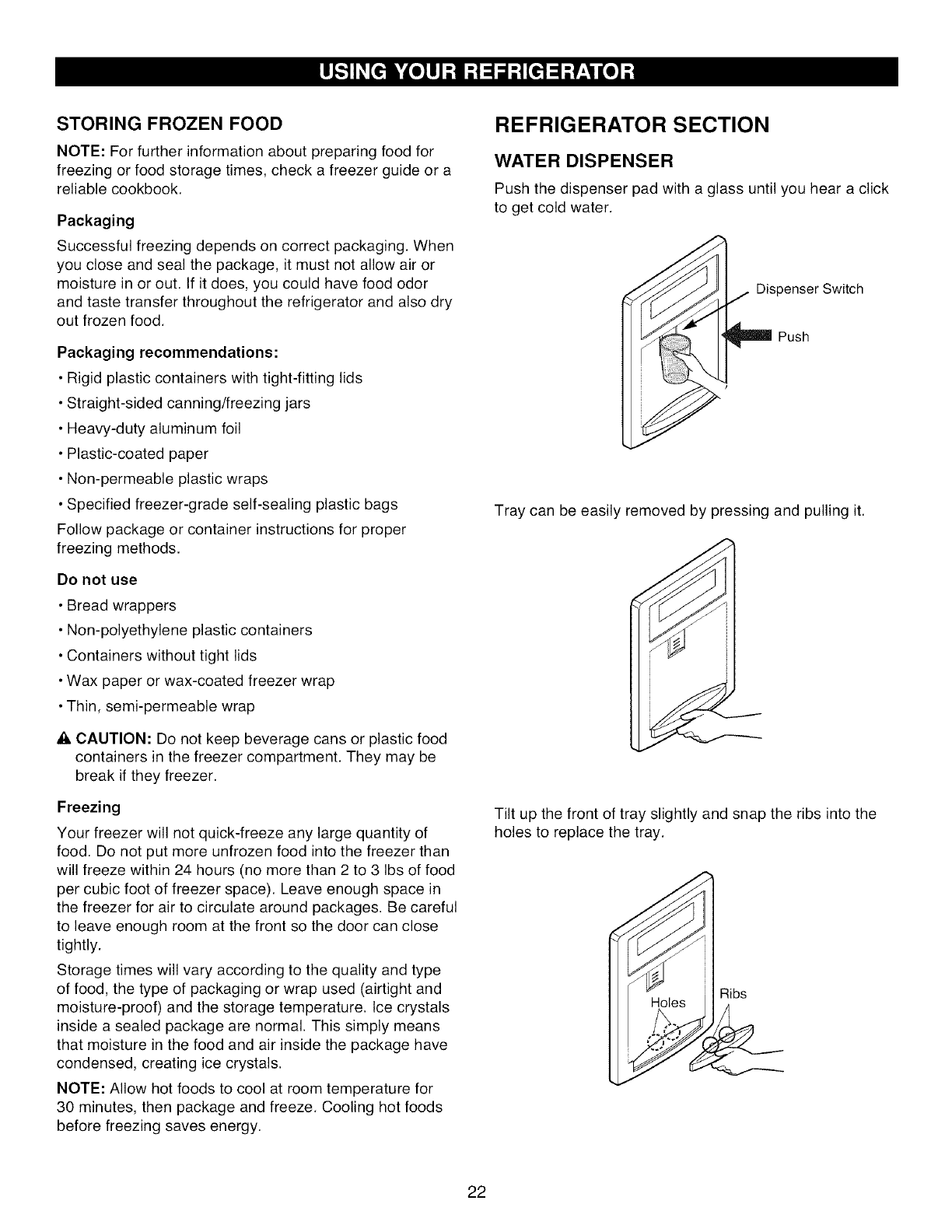
REFRIGERATOR SECTION
WATER DISPENSER
Push the dispenser pad with a glass until you hear a click
to get cold water.
Dispenser Switch
Push
Tray can be easily removed by pressing and pulling it.
Tilt up the front of tray slightly and snap the ribs into the
holes to replace the tray.
Ribs
Holes
22
REFRIGERATOR SHELVES
The shelves in your refrigerator are adjustable to meet
your individual storage needs. Your model may have
glass or wire shelves.
Storing similar food items together in your refrigerator and
adjusting the shelves to fit different heights of items will
make finding the exact item you want easier; it will also
reduce the amount of time the refrigerator door is open,
saving energy.
IMPORTANT: Do not clean glass shelves with warm
water when they are cold. Shelves may break if exposed
to sudden temperature changes or impact, such as
bumping. For your protection, glass shelves are made
with tempered glass, which will shatter into small pebble-
sized pieces.
NOTE: Glass shelves are heavy. Use special care when
removing them to avoid dropping them.
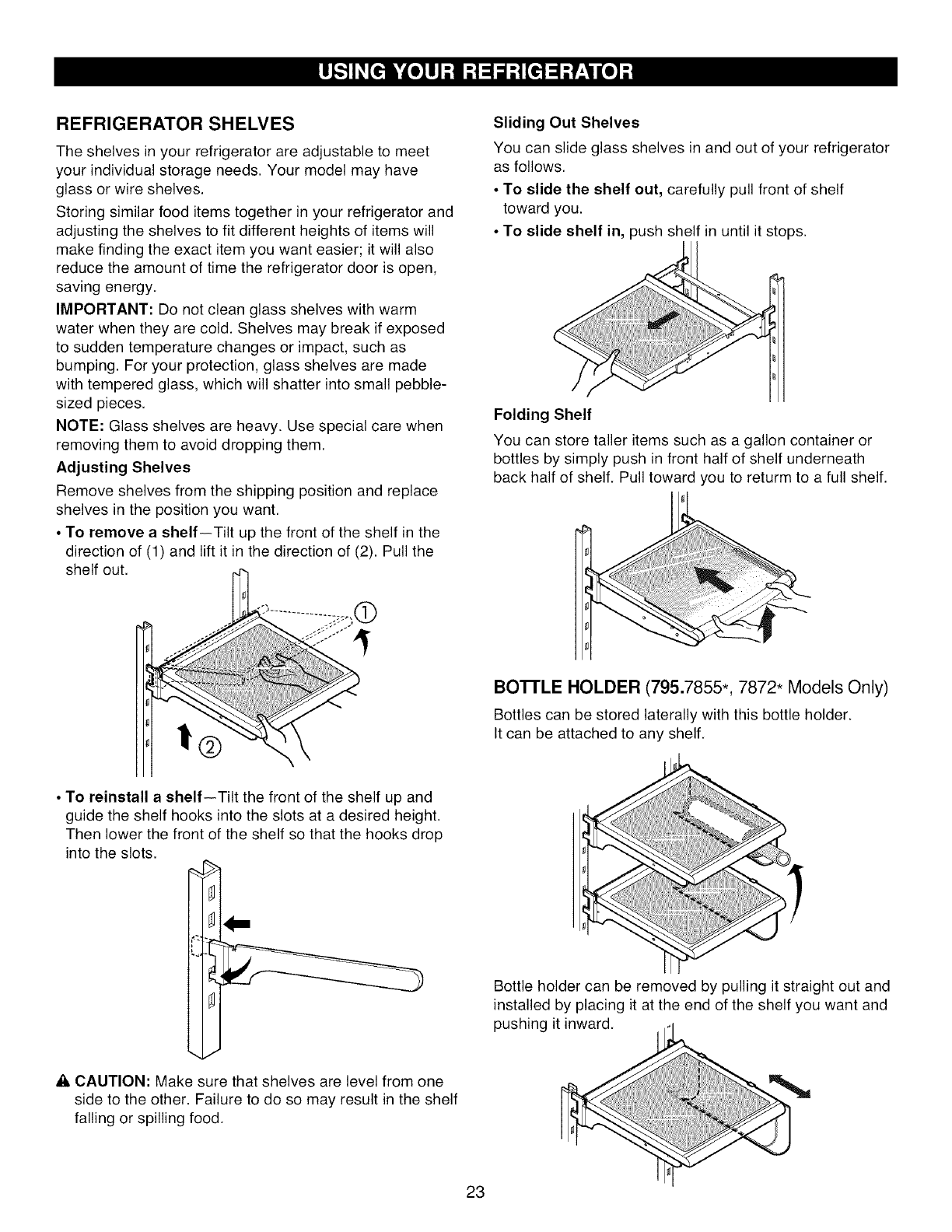
Adjusting Shelves
Remove shelves from the shipping position and replace
shelves in the position you want.
• To remove a shelf--Tilt up the front of the shelf in the
direction of (1) and lift it in the direction of (2). Pull the
shelf out.
Sliding Out Shelves
You can slide glass shelves in and out of your refrigerator
as follows.
• To slide the shelf out, carefully pull front of shelf
toward you.
• To slide shelf in, push shelf in until it stops.
Folding Shelf
You can store taller items such as a gallon container or
bottles by simply push in front half of shelf underneath
back half of shelf. Pull toward you to returm to a full shelf.
BO'B'LE HOLDER (795.7855*, 7872* Models Only)
Bottles can be stored laterally with this bottle holder.
It can be attached to any shelf.
• To reinstall ashelf--Tilt the front of the shelf up and
guide the shelf hooks into the slots at a desired height.
Then lower the front of the shelf so that the hooks drop
into the slots.
Bottle holder can be removed by pulling it straight out and
installed by placing it at the end of the shelf you want and
pushing it inward.
ACAUTION: Make sure that shelves are level from one
side to the other. Failure to do so may result in the shelf
falling or spilling food.
23
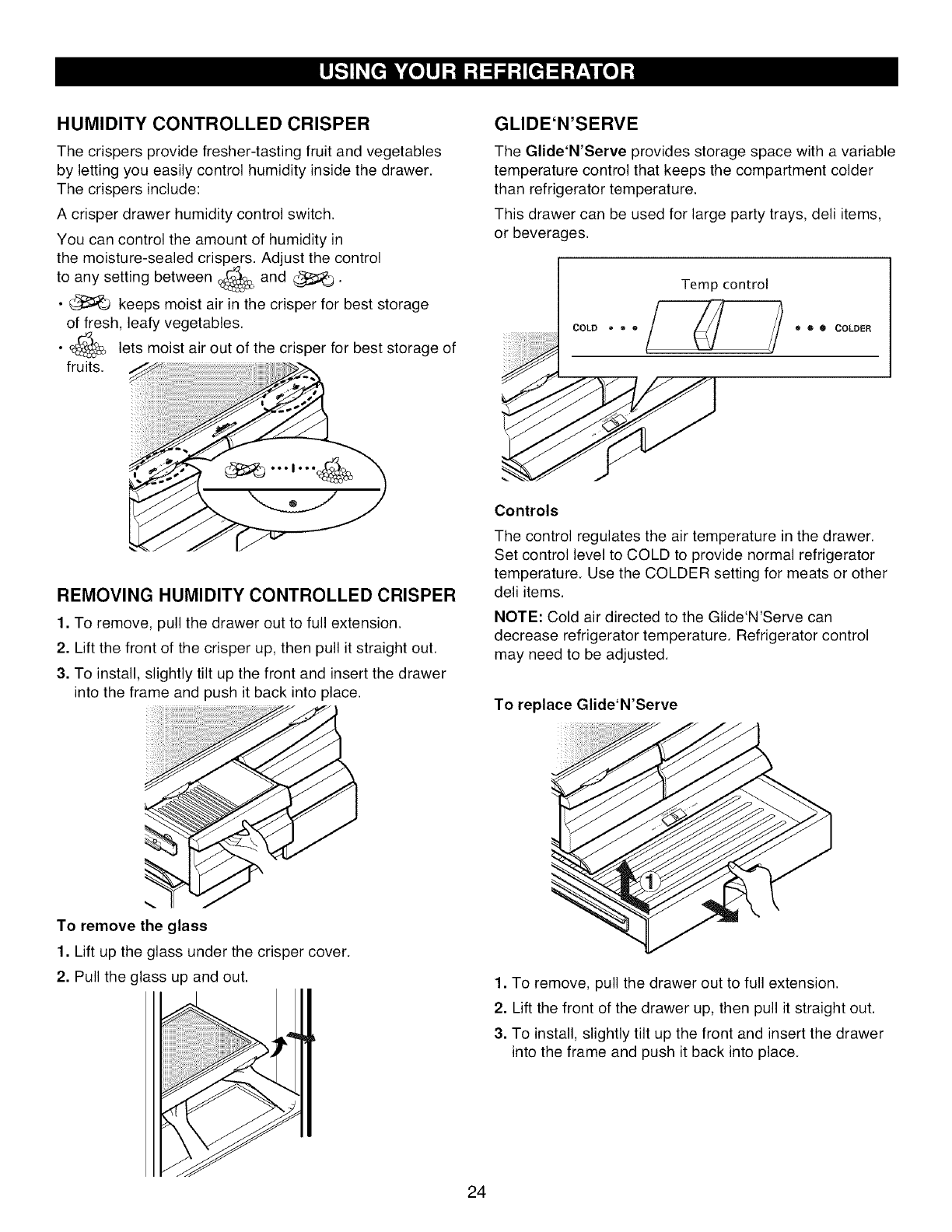
HUMIDITY CONTROLLED CRISPER
The crispers provide fresher-tasting fruit and vegetables
by letting you easily control humidity inside the drawer.
The crispers include:
A crisper drawer humidity control switch.
You can control the amount of humidity in
the moisture-sealed crispers. Adjust the control
to any setting between _ and
• _ keeps moist air in the crisper for best storage
of fresh, leafy vegetables.
• _ lets moist air out of the crisper for best storage of
fruits.
REMOVING HUMIDITY CONTROLLED CRISPER
1. To remove, pull the drawer out to full extension.
2. Lift the front of the crisper up, then pull it straight out.
3. To install, slightly tilt up the front and insert the drawer
into the frame and push it back into place.
GLIDE'N'SERVE
The Glide'N'Serve provides storage space with a variable
temperature control that keeps the compartment colder
than refrigerator temperature.
This drawer can be used for large party trays, dell items,
or beverages.
Temp control
COLD • ® •/ /// // •• • COLDER
/w//
Controls
The control regulates the air temperature in the drawer.
Set control level to COLD to provide normal refrigerator
temperature. Use the COLDER setting for meats or other
dell items.
NOTE: Cold air directed to the Glide'N'Serve can
decrease refrigerator temperature. Refrigerator control
may need to be adjusted.
To replace Glide'N'Serve
To remove the glass
1. Lift up the glass under the crisper cover.
2. Pull the glass up and out. 1. To remove, pull the drawer out to full extension.
2. Lift the front of the drawer up, then pull it straight out.
3. To install, slightly tilt up the front and insert the drawer
into the frame and push it back into place.
24
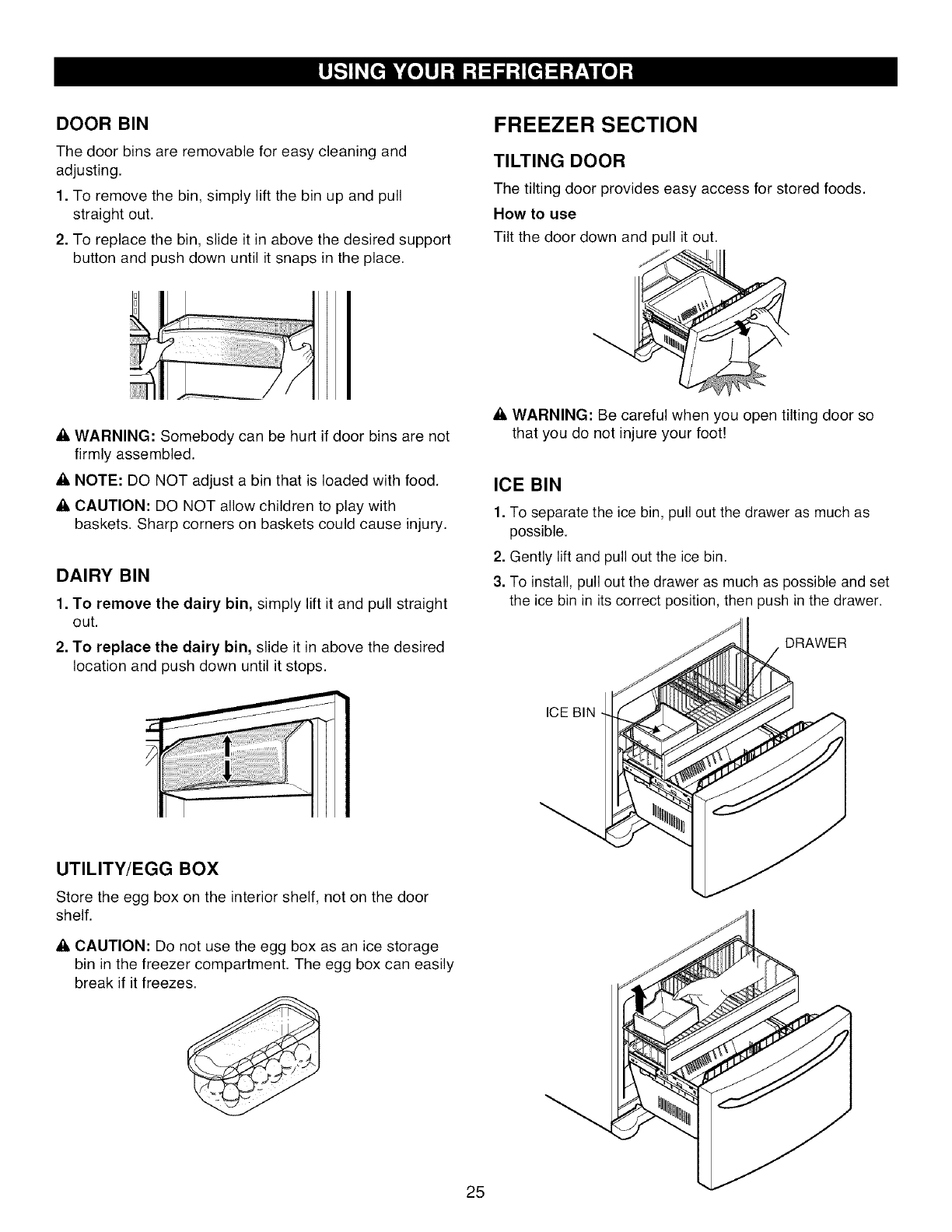
DOOR BIN
The door bins are removable for easy cleaning and
adjusting.
1. To remove the bin, simply lift the bin up and pull
straight out.
2. To replace the bin, slide it in above the desired support
button and push down until it snaps in the place.
A WARNING: Somebody can be hurt if door bins are not
firmly assembled.
A NOTE: DO NOT adjust a bin that is loaded with food.
A CAUTION: DO NOT allow children to play with
baskets. Sharp corners on baskets could cause injury.
DAIRY BIN
1. To remove the dairy bin, simply lift it and pull straight
out.
2. To replace the dairy bin, slide it in above the desired
location and push down until it stops.
UTILITY/EGG BOX
Store the egg box on the interior shelf, not on the door
shelf.
A CAUTION: Do not use the egg box as an ice storage
bin in the freezer compartment. The egg box can easily
break if it freezes.
FREEZER SECTION
TILTING DOOR
The tilting door provides easy access for stored foods.
How to use
Tilt the door down and pull it out.
A WARNING: Be careful when you open tilting door so
that you do not injure your foot!
ICE BIN
1. To separate the ice bin, pull out the drawer as much as
possible.
2. Gently lift and pull out the ice bin.
3. To install, pull out the drawer as much as possible and set
the ice bin in its correct position, then push in the drawer.
DRAWER
ICE BIN
25
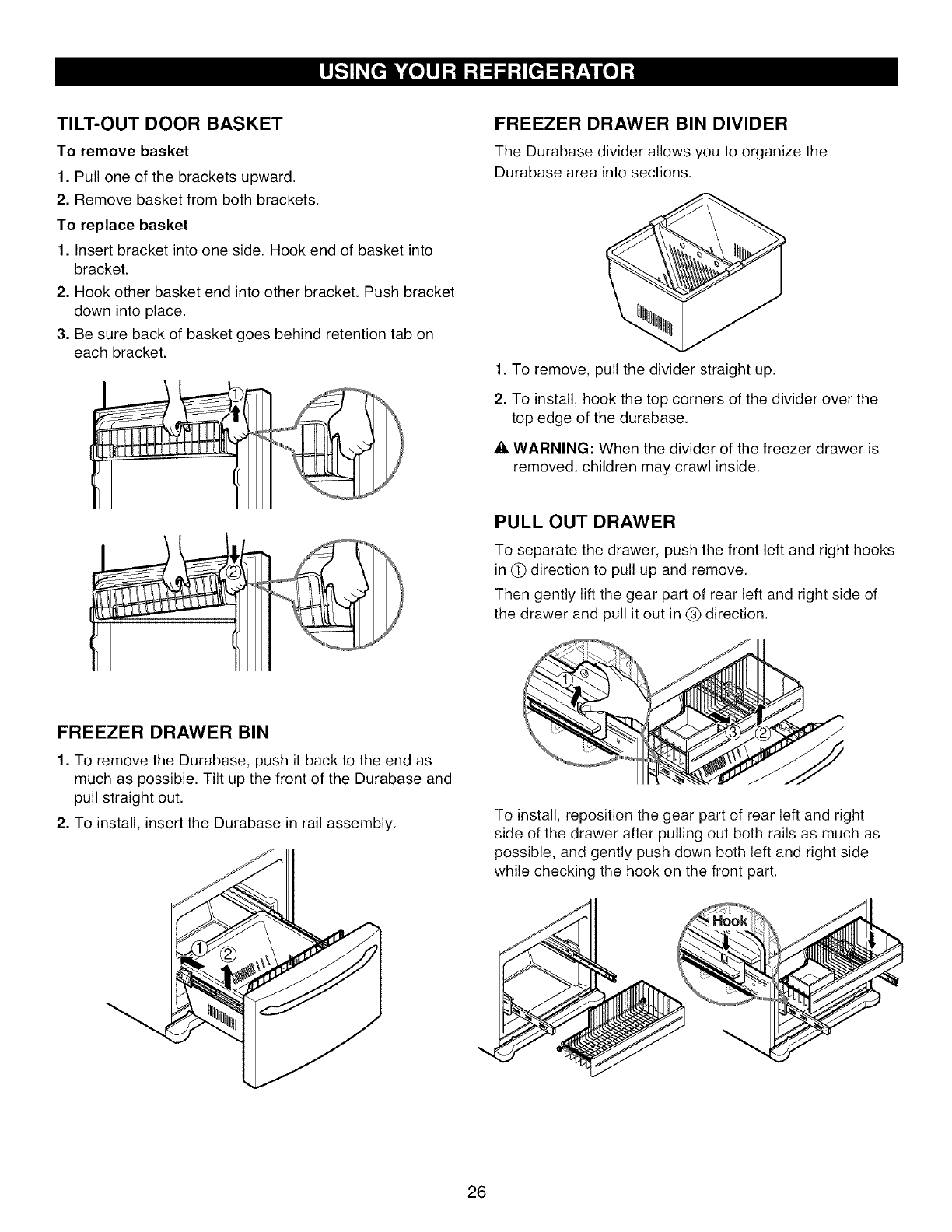
TILT-OUT DOOR BASKET
To remove basket
1. Pull one of the brackets upward.
2. Remove basket from both brackets.
To replace basket
1. Insert bracket into one side. Hook end of basket into
bracket.
2. Hook other basket end into other bracket. Push bracket
down into place.
3. Be sure back of basket goes behind retention tab on
each bracket.
FREEZER DRAWER BIN DIVIDER
The Durabase divider allows you to organize the
Durabase area into sections.
1. To remove, pull the divider straight up.
2. To install, hook the top corners of the divider over the
top edge of the durabase.
A WARNING: When the divider of the freezer drawer is
removed, children may crawl inside.
PULL OUT DRAWER
To separate the drawer, push the front left and right hooks
in C) direction to pull up and remove.
Then gently lift the gear part of rear left and right side of
the drawer and pull it out in (_ direction.
FREEZER DRAWER BIN
1. To remove the Durabase, push it back to the end as
much as possible. Tilt up the front of the Durabase and
pull straight out.
2. To install, insert the Durabase in rail assembly. To install, reposition the gear part of rear left and right
side of the drawer after pulling out both rails as much as
possible, and gently push down both left and right side
while checking the hook on the front part.
J
26

FILTER
It is recommended that you replace the filter when the
water filter indicator icon turns on or your water dispenser
or ice maker performance decreases noticeably.
After changing the water filter cartridge, reset the water
filter status display and indicator icon by pressing and
holding the Filter Reset button for 3 seconds.
1. Remove the old cartridge.
Place a container under f\ r----_
the hole of filter holder.
NOTE: When filter is being removed, the water drains
through the hole.
Rotate the knob of the
cartridge counter
clockwise.
2. Replace with a new cartridge.
Take the new cartridge out of its packaging and
remove protective cover from the o-rings.
With cartridge knob in the vertical position, push the
new filter cartridge into the cover until it stops.
If you can't turn the filter from side to side, it isn't fully
inserted. Push it in firmly and twist it into place. You will
hear the snap when it clicks into place.
Using its handle, twist the cartridge clockwise about 1/4
turn. You will hear the snap when it clicks into place.
3. Flushing the Water System After Replacing Filter
Dispense water through the water dispenser for 3
minutes to purge the system.
Pull out the filter cartridge. NOTE: To purchase replacement water filter cartridges,
call 1-800-4-MY-HOME ®.Ask for part number 9990.
27
Explosion Hazard
Use non-flammable cleaner.
Failure to do so can result in death, explosion, or fire.
Both the refrigerator and freezer sections defrost
automatically. However, clean both sections about once
a month to prevent odors. Wipe up spills immediately.
GENERAL CLEANING TIPS
•Unplug refrigerator or disconnect power.
• Remove all removable parts, such as shelves,
crispers, etc. Refer to sections in Using Your
Refrigerator for removal instructions.
• Use a clean sponge or soft cloth and a mild detergent in
warm water. Do not use abrasive or harsh cleaners.
• Hand wash, rinse and dry all surfaces thoroughly.
• Plug in refrigerator or reconnect power.
OUTSIDE
Waxing external painted metal surfaces helps provide rust
protection. Do not wax plastic parts. Wax painted metal
surfaces at least twice a year using appliance wax (or
auto paste wax). Apply wax with a clean, soft cloth.
For products with a stainless steel exterior, use a clean
sponge or soft cloth and a mild detergent in warm water.
Do not use abrasive or harsh cleaners. Dry thoroughly
with a soft cloth.
INSIDE WALLS (allow freezer to warm up so
cloth won't stick)
To help remove odors, you can wash the inside of the
refrigerator with a mixture of baking soda and warm water.
Mix 2 tablespoons baking soda to 1 quart of water (26 g
soda to 1 liter water.) Be sure the baking soda is
completely dissolved so it does not scratch the surfaces of
the refrigerator.
A CAUTION: While cleaning the inside, do not spray water.
DOOR LINERS AND GASKETS
Do not use cleaning waxes, concentrated detergents,
bleaches, or cleaners containing petroleum on plastic
refrigerator parts.
PLASTIC PARTS (covers and panels)
Do not use window sprays, abrasive cleansers, or flammable
fluids. These can scratch or damage the material. 28
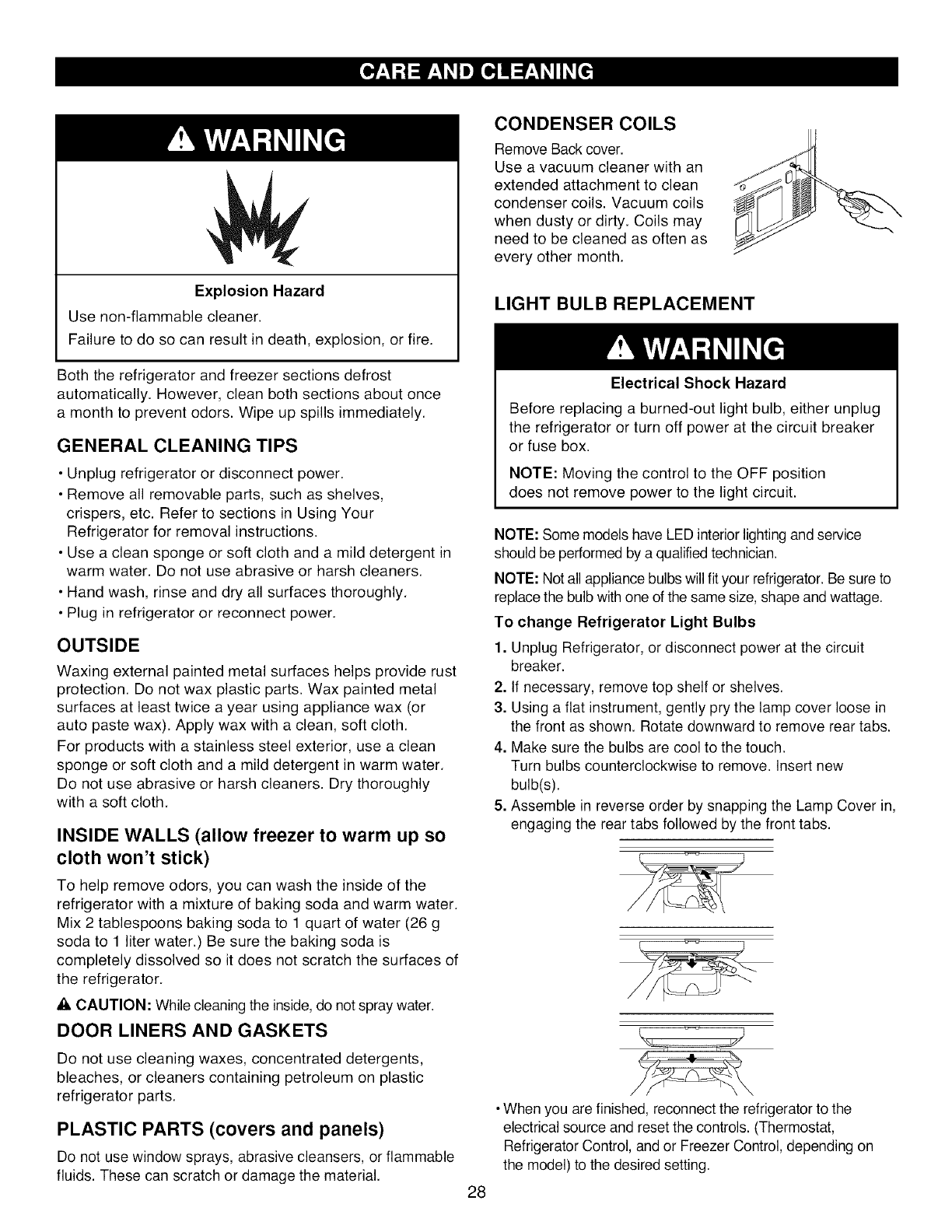
CONDENSER COILS
Remove Back cover.
Use a vacuum cleaner with an
extended attachment to clean
condenser coils. Vacuum coils
when dusty or dirty. Coils may
need to be cleaned as often as
every other month.
LIGHT BULB REPLACEMENT
Electrical Shock Hazard
Before replacing a burned-out light bulb, either unplug
the refrigerator or turn off power at the circuit breaker
or fuse box.
NOTE: Moving the control to the OFF position
does not remove power to the light circuit.
NOTE: Some models have LED interior lighting and service
should be performed by a qualified technician.
NOTE: Not all appliance bulbs will fit your refrigerator. Be sure to
replace the bulb with one of the same size, shape and wattage.
To change Refrigerator Light Bulbs
1. Unplug Refrigerator, or disconnect power at the circuit
breaker.
2. If necessary, remove top shelf or shelves.
3. Using a flat instrument, gently pry the lamp cover loose in
the front as shown. Rotate downward to remove rear tabs.
4. Make sure the bulbs are cool to the touch.
Turn bulbs counterclockwise to remove. Insert new
bulb(s).
5. Assemble in reverse order by snapping the Lamp Cover in,
engaging the rear tabs followed by the front tabs.
• When you are finished, reconnect the refrigerator to the
electrical source and reset the controls. (Thermostat,
Refrigerator Control, and or Freezer Control, depending on
the model) to the desired setting.

To change freezer light
NOTE: Some models have LED interior lighting and
service should be performed by a qualified technician.
1. Unplug refrigerator power cord form outlet.
2. Using a flat instrument, gently pry the lamp cover loose
in the front as shown. Rotate downward to remove the
rear tabs.
3. Make sure the bulb is cool to the touch. Turn the bulb
counterclockwise to remove.
4. Replace with a new 60-watt appliance bulb.
5. Insert tabs on back of cover into slots in freezer ceiling.
Push cover up to snap front into place.
I
WHEN YOU GO ON VACATION
if you choose to leave the refrigerator on while you
are away, follow these steps to prepare your refrigerator
before you leave.
1. Use up any perishables and freeze other items.
2. Empty the ice bin.
if you choose to turn the refrigerator off before you
leave, follow these steps.
1. Remove all food from the refrigerator.
2. Depending on your model, set the thermostat control
(refrigerator control) to OFF. See the Setting the
Controls section.
3. Clean refrigerator, wipe it and dry well.
4. Tape rubber or wood blocks to the tops of both doors to
prop them open far enough for air to get in. This stops
odor and mold from building up.
_. CAUTION: DO NOT place fingers inside of cover.
Lamp may be hot.
•When you are finished, reconnect the refrigerator to the
electrical source and reset the controls. (Thermostat,
Refrigerator Control, and or Freezer Control, depending
on the model) to the desired setting.
POWER iNTERRUPTiONS
1. If the power will be out for 24 hours or less, keep
all refrigerator doors closed to help foods stay
cold and frozen.
2. If the power will be out for more than 24 hours:
a) Remove all frozen food and store it in a frozen
food locker.
WHEN YOU MOVE
When you are moving your refrigerator to a new home,
follow these steps to prepare it for the move.
1. Remove all food from the refrigerator and pack all
frozen food in dry ice.
2. Depending on your model, turn the thermostat control
(refrigerator control) to OFF. See the Setting the
Controls section.
3. Unplug the refrigerator.
4. Clean, wipe and dry thoroughly.
5. Take out all removable parts, wrap them well and tape
them together so they don't shift and rattle during the
move. Refer to sections in Using your Refrigerator for
removable instructions.
6. Depending on the model, raise the front of the
refrigerator so it rolls more easily OR screw in the
leveling legs all the way so they don't scrape the floor.
See the Door Closing section.
7. Tape the doors shut and tape the power cord to the
refrigerator cabinet.
When you get to your new home, put everything back
and refer to the installing Your Refrigerator section for
preparation instructions.
29
Personal injury Hazard
Avoid contact with the moving parts of the ejector
mechanism, or with the heating element that releases
the cubes. DO NOT place fingers or hands on the
automatic icemaking mechanism while the refrigerator
is plugged in.
OPERATION INSTRUCTIONS
A newly-installed refrigerator may take
12 to 24 hours to begin making ice.
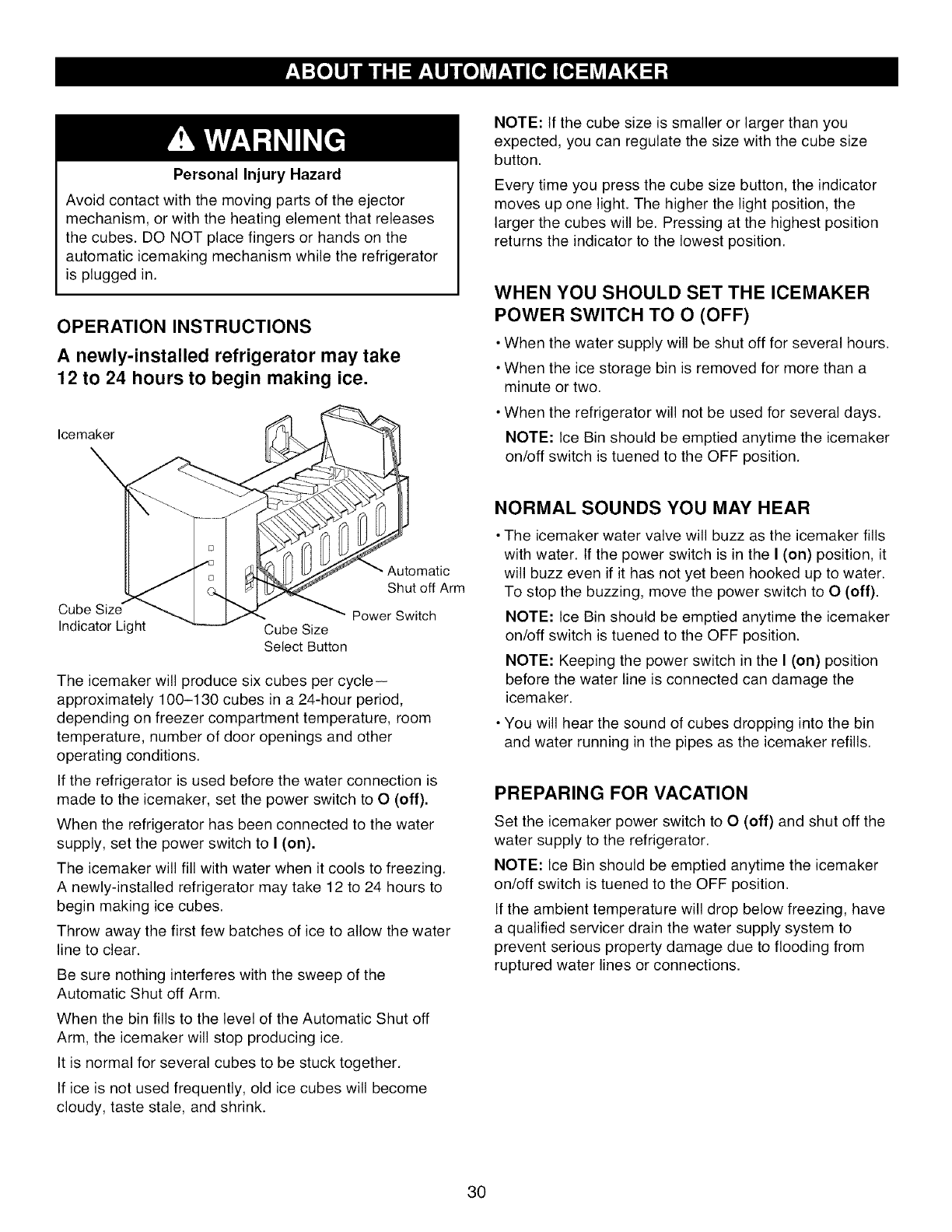
Icemaker
NOTE: If the cube size is smaller or larger than you
expected, you can regulate the size with the cube size
button.
Every time you press the cube size button, the indicator
moves up one light. The higher the light position, the
larger the cubes will be. Pressing at the highest position
returns the indicator to the lowest position.
WHEN YOU SHOULD SET THE ICEMAKER
POWER SWITCH TO O (OFF)
• When the water supply will be shut off for several hours.
• When the ice storage bin is removed for more than a
minute or two.
• When the refrigerator will not be used for several days.
NOTE: Ice Bin should be emptied anytime the icemaker
on/off switch is tuened to the OFF position.
Cube Size
Indicator Light Cube Size
Select Button
Automatic
Shut off Arm
Power Switch
The icemaker will produce six cubes per cycle--
approximately 100-130 cubes in a 24-hour period,
depending on freezer compartment temperature, room
temperature, number of door openings and other
operating conditions.
If the refrigerator is used before the water connection is
made to the icemaker, set the power switch to O (off).
When the refrigerator has been connected to the water
supply, set the power switch to I (on).
The icemaker will fill with water when it cools to freezing.
A newly-installed refrigerator may take 12 to 24 hours to
begin making ice cubes.
Throw away the first few batches of ice to allow the water
line to clear.
Be sure nothing interferes with the sweep of the
Automatic Shut off Arm.
When the bin fills to the level of the Automatic Shut off
Arm, the icemaker will stop producing ice.
It is normal for several cubes to be stuck together.
If ice is not used frequently, old ice cubes will become
cloudy, taste stale, and shrink.
NORMAL SOUNDS YOU MAY HEAR
• The icemaker water valve will buzz as the icemaker fills
with water. If the power switch is in the I (on) position, it
will buzz even if it has not yet been hooked up to water.
To stop the buzzing, move the power switch to O (off).
NOTE: Ice Bin should be emptied anytime the icemaker
on/off switch is tuened to the OFF position.
NOTE: Keeping the power switch in the I (on) position
before the water line is connected can damage the
icemaker.
• You will hear the sound of cubes dropping into the bin
and water running in the pipes as the icemaker refills.
PREPARING FOR VACATION
Set the icemaker power switch to O (off) and shut off the
water supply to the refrigerator.
NOTE: Ice Bin should be emptied anytime the icemaker
on/off switch is tuened to the OFF position.
If the ambient temperature will drop below freezing, have
a qualified servicer drain the water supply system to
prevent serious property damage due to flooding from
ruptured water lines or connections.
30
BEFORE YOU BEGIN
This water line installation is not warranted by the
refrigerator or icemaker manufacturer. Follow these
instructions carefully to minimize the risk of expensive
water damage.
Water hammer (water banging in the pipes) in house
plumbing can cause damage to refrigerator parts and lead
to water leakage or flooding. Call a qualified plumber to
correct water hammer before installing the water supply
line to the refrigerator.
To prevent burns and product damage, do not hook up
the water line to the hot water line.
If you use your refrigerator before connecting the water
line, make sure the icemaker power switch is in the O
(off) position.
Do not install the icemaker tubing in areas where
temperatures fall below freezing.
When using any electrical device (such as a power
drill) during installation, be sure the device is double-
insulated or grounded in a manner to prevent the hazard
of electric shock, or is battery-powered.
All installations must be in accordance with local plumbing
code requirements.
NOTE: Wear eye protection.
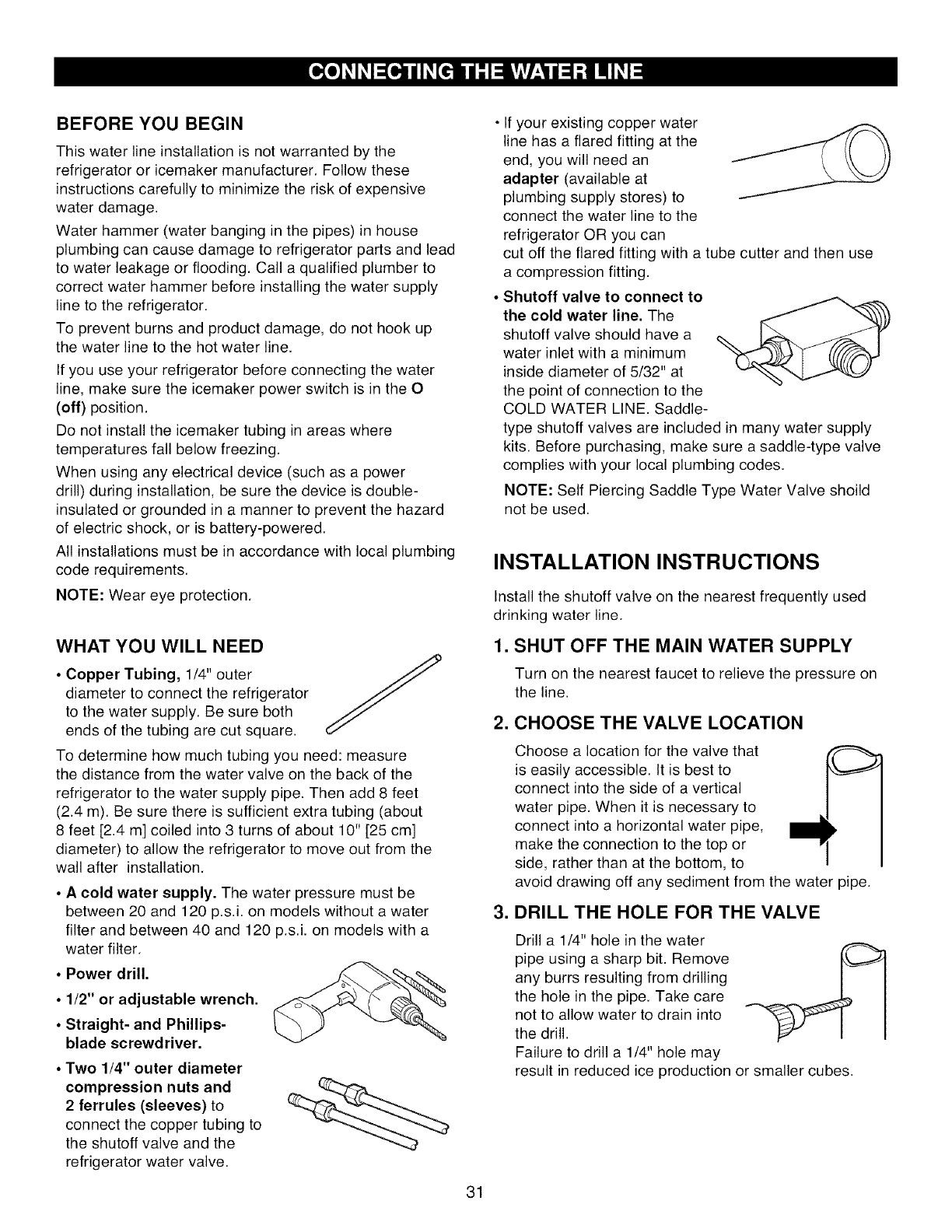
WHAT YOU WILL NEED
• Copper Tubing, 1/4" outer
diameter to connect the refrigerator
to the water supply. Be sure both
ends of the tubing are cut square.
To determine how much tubing you need: measure
the distance from the water valve on the back of the
refrigerator to the water supply pipe. Then add 8 feet
(2.4 m). Be sure there is sufficient extra tubing (about
8 feet [2.4 m] coiled into 3 turns of about 10" [25 cm]
diameter) to allow the refrigerator to move out from the
wall after installation.
•Acold water supply. The water pressure must be
between 20 and 120 p.s.i, on models without a water
filter and between 40 and 120 p.s.i, on models with a
water filter.
•Power drill.
• 1/2" or adjustable wrench.
•Straight- and Phillips-
blade screwdriver.
•Two 1/4" outer diameter
compression nuts and
2 ferrules (sleeves) to
connect the copper tubing to
the shutoff valve and the
refrigerator water valve.
•If your existing copper water
line has a flared fitting at the
end, you will need an
adapter (available at
plumbing supply stores) to
connect the water line to the
refrigerator OR you can
cut off the flared fitting with a tube cutter and then use
a compression fitting.
• Shutoff valve to connect to
the cold water line. The
shutoff valve should have a
water inlet with a minimum
inside diameter of 5/32" at
the point of connection to the
COLD WATER LINE. Saddle-
type shutoff valves are included in many water supply
kits. Before purchasing, make sure a saddle-type valve
complies with your local plumbing codes.
NOTE: Self Piercing Saddle Type Water Valve shoild
not be used.
INSTALLATION INSTRUCTIONS
Install the shutoff valve on the nearest frequently used
drinking water line.
1. SHUT OFF THE MAIN WATER SUPPLY
Turn on the nearest faucet to relieve the pressure on
the line.
2. CHOOSE THE VALVE LOCATION
Choose a location for the valve that
is easily accessible. It is best to
connect into the side of a vertical
water pipe. When it is necessary to
connect into a horizontal water pipe,
make the connection to the top or
side, rather than at the bottom, to
avoid drawing off any sediment from the water pipe.
3. DRILL THE HOLE FOR THE VALVE
Drill a 1/4" hole in the water
pipe using a sharp bit. Remove
any burrs resulting from drilling
the hole in the pipe. Take care
not to allow water to drain into
the drill.
Failure to drill a 1/4" hole may
result in reduced ice production or smaller cubes.
31
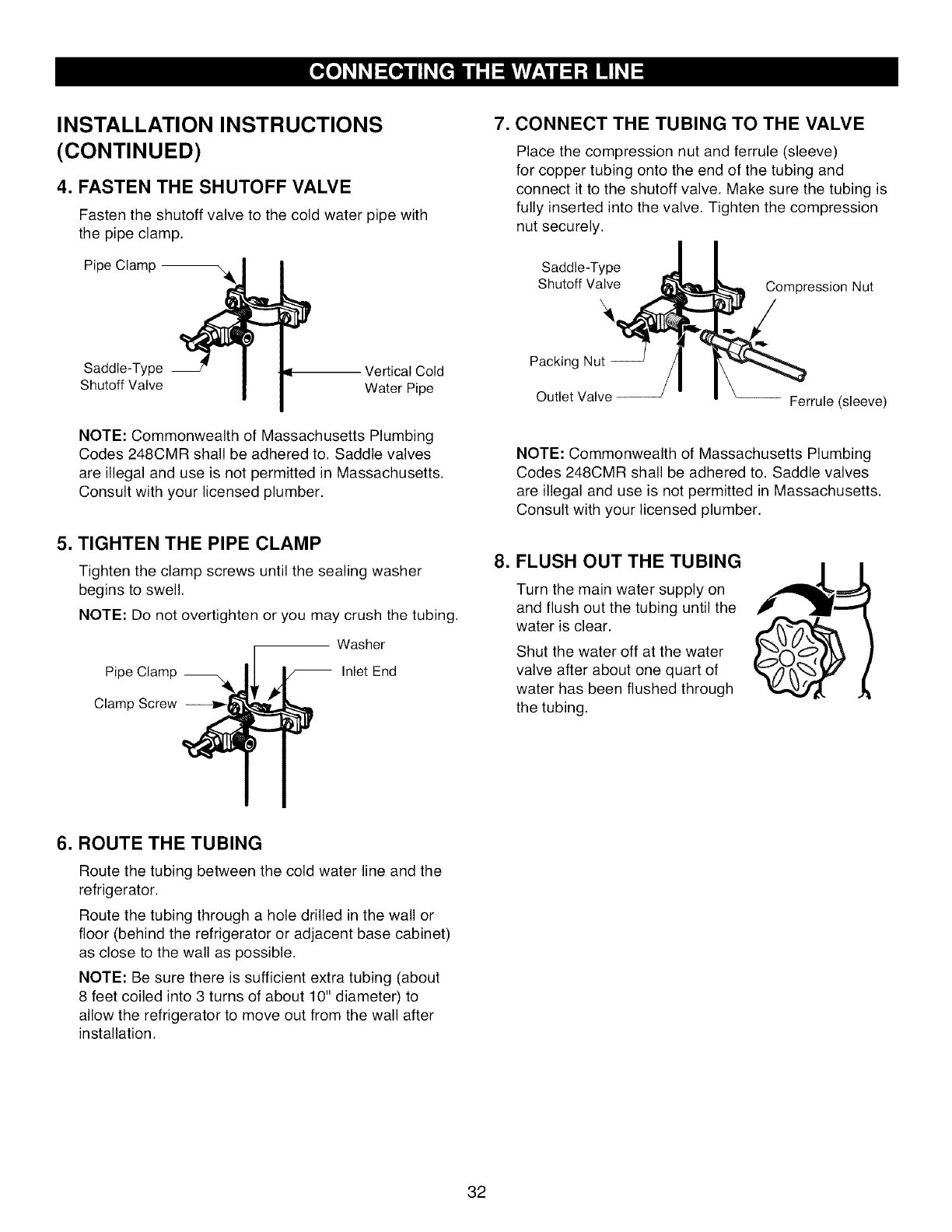
INSTALLATION INSTRUCTIONS
(CONTINUED)
4. FASTEN THE SHUTOFF VALVE
Fasten the shutoff valve to the cold water pipe with
the pipe clamp.
Pipe Clamp
Saddle-Type
Shutoff Valve Vertical Cold
Water Pipe
NOTE: Commonwealth of Massachusetts Plumbing
Codes 248CMR shall be adhered to. Saddle valves
are illegal and use is not permitted in Massachusetts.
Consult with your licensed plumber.
5. TIGHTEN THE PIPE CLAMP
Tighten the clamp screws until the sealing washer
begins to swell.
NOTE: Do not overtighten or you may crush the tubing.
Washer
Pipe Clamp __
Clamp Screw --
-- Inlet End
7. CONNECT THE TUBING TO THE VALVE
Place the compression nut and ferrule (sleeve)
for copper tubing onto the end of the tubing and
connect it to the shutoff valve. Make sure the tubing is
fully inserted into the valve. Tighten the compression
nut securely.
Saddle-Type
Shutoff Valve _
'÷
Packing Nut
Outlet Valve
Compression Nut
./
_ Ferrule (sleeve)
NOTE: Commonwealth of Massachusetts Plumbing
Codes 248CMR shall be adhered to. Saddle valves
are illegal and use is not permitted in Massachusetts.
Consult with your licensed plumber.
8. FLUSH OUT THE TUBING
Turn the main water supply on
and flush out the tubing until the
water is clear.
Shut the water off at the water
valve after about one quart of
water has been flushed through
the tubing.
6. ROUTE THE TUBING
Route the tubing between the cold water line and the
refrigerator.
Route the tubing through a hole drilled in the wall or
floor (behind the refrigerator or adjacent base cabinet)
as close to the wall as possible.
NOTE: Be sure there is sufficient extra tubing (about
8 feet coiled into 3 turns of about 10" diameter) to
allow the refrigerator to move out from the wall after
installation.
32
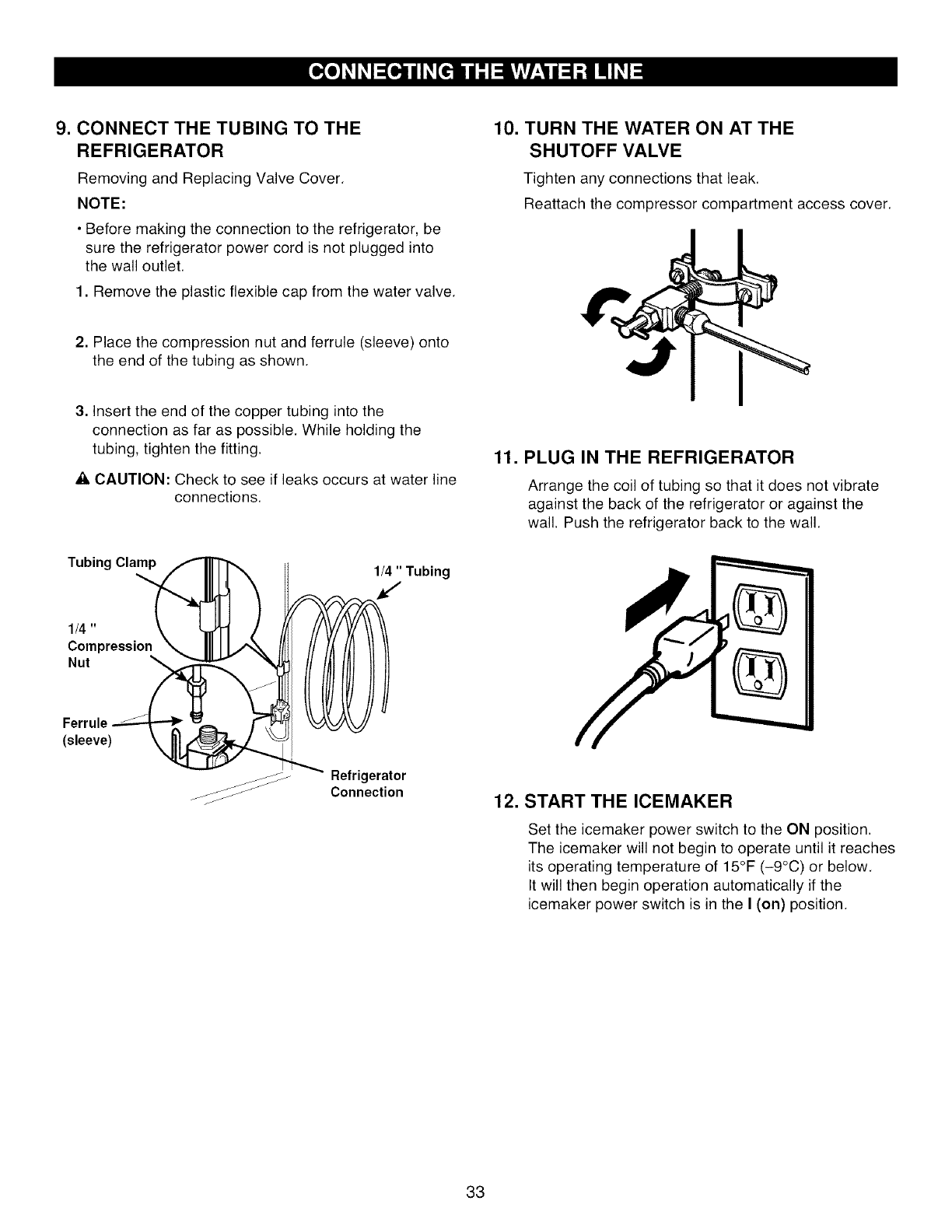
9. CONNECT THE TUBING TO THE
REFRIGERATOR
Removing and Replacing Valve Cover.
NOTE:
• Before making the connection to the refrigerator, be
sure the refrigerator power cord is not plugged into
the wall outlet.
1. Remove the plastic flexible cap from the water valve.
10. TURN THE WATER ON AT THE
SHUTOFF VALVE
Tighten any connections that leak.
Reattach the compressor compartment access cover.
2. Place the compression nut and ferrule (sleeve) onto
the end of the tubing as shown.
3. Insert the end of the copper tubing into the
connection as far as possible. While holding the
tubing, tighten the fitting.
A CAUTION: Check to see if leaks occurs at water line
connections.
Tubingcompressionl/4"Clamp____ _ 1/4_" Tubing
Nut
Ferrule
(sleeve)
RefrigeratorConnection
11. PLUG IN THE REFRIGERATOR
Arrange the coil of tubing so that it does not vibrate
against the back of the refrigerator or against the
wall. Push the refrigerator back to the wall.
12. START THE ICEMAKER
Set the icemaker power switch to the ON position.
The icemaker will not begin to operate until it reaches
its operating temperature of 15°F (-9°C) or below.
It will then begin operation automatically if the
icemaker power switch is in the I (on) position.
33
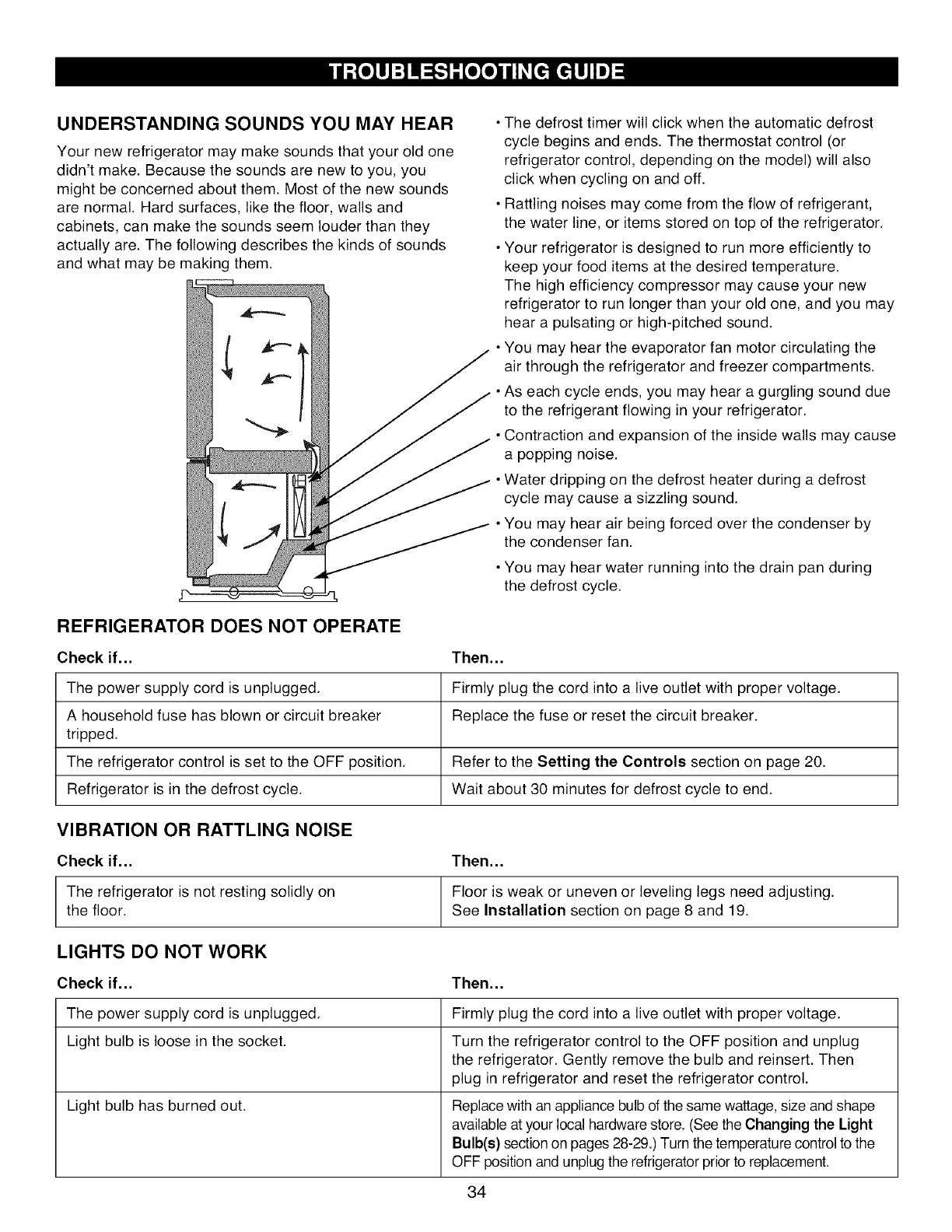
UNDERSTANDING SOUNDS YOU MAY HEAR
Your new refrigerator may make sounds that your old one
didn't make. Because the sounds are new to you, you
might be concerned about them. Most of the new sounds
are normal. Hard surfaces, like the floor, walls and
cabinets, can make the sounds seem louder than they
actually are. The following describes the kinds of sounds
and what may be making them.
• The defrost timer will click when the automatic defrost
cycle begins and ends. The thermostat control (or
refrigerator control, depending on the model) will also
click when cycling on and off.
• Rattling noises may come from the flow of refrigerant,
the water line, or items stored on top of the refrigerator.
• Your refrigerator is designed to run more efficiently to
keep your food items at the desired temperature.
The high efficiency compressor may cause your new
refrigerator to run longer than your old one, and you may
hear a pulsating or high-pitched sound.
• You may hear the evaporator fan motor circulating the
air through the refrigerator and freezer compartments.
• As each cycle ends, you may hear a gurgling sound due
to the refrigerant flowing in your refrigerator.
• Contraction and expansion of the inside walls may cause
a popping noise.
• Water dripping on the defrost heater during a defrost
cycle may cause a sizzling sound.
• You may hear air being forced over the condenser by
the condenser fan.
• You may hear water running into the drain pan during
the defrost cycle.
REFRIGERATOR DOES NOT OPERATE
Check if...
The power supply cord is unplugged.
A household fuse has blown or circuit breaker
tripped.
The refrigerator control is set to the OFF position.
Refrigerator is in the defrost cycle.
Then...
Firmly plug the cord into a live outlet with proper voltage.
Replace the fuse or reset the circuit breaker.
Refer to the Setting the Controls section on page 20.
Wait about 30 minutes for defrost cycle to end.
VIBRATION OR RATTLING NOISE
Check if... Then...
The refrigerator is not resting solidly on Floor is weak or uneven or leveling legs need adjusting.
the floor. See Installation section on page 8 and 19.
LIGHTS DO NOT WORK
Check if... Then...
The power supply cord is unplugged. Firmly plug the cord into a live outlet with proper voltage.
Light bulb is loose in the socket. Turn the refrigerator control to the OFF position and unplug
the refrigerator. Gently remove the bulb and reinsert. Then
plug in refrigerator and reset the refrigerator control.
Light bulb has burned out. Replace with an appliance bulb of the same wattage, size and shape
available at your local hardware store. (See the Changing the Light
Bulb(s) section on pages 28-29.) Turn the temperature control to the
OFF position and unplug the refrigerator prior to replacement.
34
COMPRESSOR MOTOR SEEMS TO RUN TOO MUCH
Check if... Then...
The refrigerator that was replaced was an older Modern refrigerators with more storage space require more
model, operating time.
The room temperature is hotter than normal. The motor will run longer under warm conditions. At normal
room temperatures, expect your motor to run about 40% to
80% of the time. Under warmer conditions, expect it to run
even more often.
The door is opened often or a large amount of food
has just been added. Adding food and opening the door warms the refrigerator.
It is normal for the refrigerator to run longer in order to cool the
refrigerator back down. Adding a large amount of food warms
the refrigerator. See the Food Storage Guide section on page
21. tn order to conserve energy, try to get everything you need
out of the refrigerator at once, keep food organized so it is
easy to find and close the door as soon as the food is
removed.
The refrigerator was recently plugged in and the The refrigerator will take up to 24 hours to cool completely.
refrigerator control was set correctly.
The refrigerator control is not set correctly for the See the Adjusting Control Settings section on page 21.
surrounding conditions.
The doors are not closed completely. Push the doors firmly shut. If they will not shut all the way, see
Doors will not close completely below.
The condenser coils are dirty. This prevents air transfer and makes the motor work harder.
Clean the condenser coils. Refer to the Care and Cleaning
section on pages 28-29.
DOORS WILL NOT CLOSE COMPLETELY
Check if... Then...
The refrigerator is not level. See Leveling and Door Alignment section on page 19.
Food packages are blocking the door open. Rearrange food containers to clear door and door shelves.
The ice bin, crisper cover, pans, shelves, door bins Push bins all the way in and put crisper cover, pans, shelves
or baskets are out of position, and baskets into their correct positions. See the Using Your
Refrigerator section on pages 20-27.
The gaskets are sticking. Clean gaskets and the surface that they touch. Rub a thin coat
of paraffin wax on the gaskets after cleaning.
The refrigerator wobbles or seems unstable. Level the refrigerator. Refer to the Leveling and Door
Alignment section on page 19.
The doors were removed during product Remove and replace the doors according to the Removing
installation and not properly replaced, and Replacing Refrigerator handles and doors section on
pages 9-18, or call a qualified service technician.
FROST OR ICE CRYSTALS ON FROZEN FOOD
Check if... Then...
The door is not closing properly. See Doors will not close completely above.
The door is opened often. When the door is opened, warm, humid air is allowed in the
freezer, resulting in frost.
35
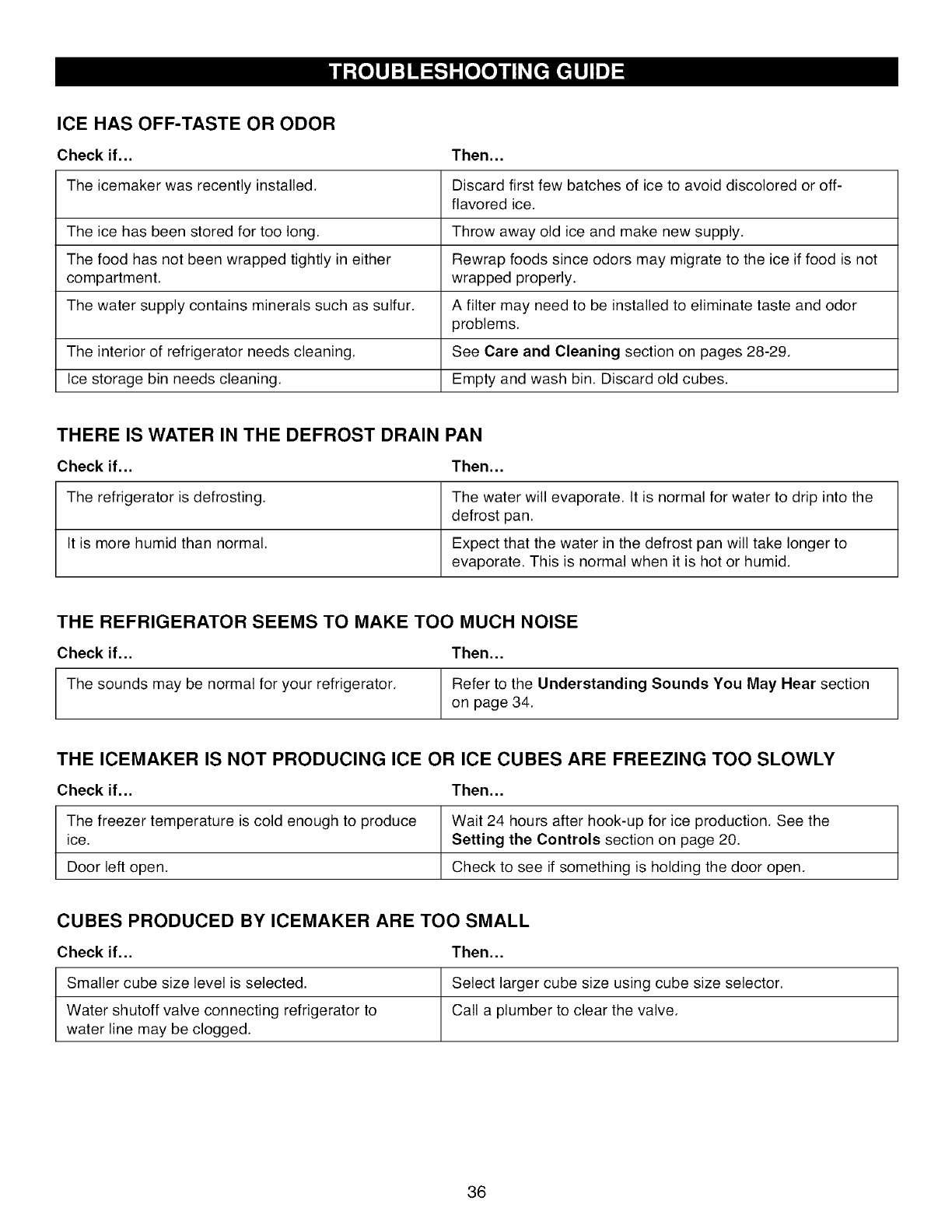
ICE HAS OFF-TASTE OR ODOR
Check if... Then...
The icemaker was recently installed. Discard first few batches of ice to avoid discolored or off-
flavored ice.
The ice has been stored for too long. Throw away old ice and make new supply.
The food has not been wrapped tightly in either Rewrap foods since odors may migrate to the ice if food is not
compartment, wrapped properly.
The water supply contains minerals such as sulfur. A filter may need to be installed to eliminate taste and odor
problems.
The interior of refrigerator needs cleaning. See Care and Cleaning section on pages 28-29.
Ice storage bin needs cleaning. Empty and wash bin. Discard old cubes.
THERE IS WATER IN THE DEFROST DRAIN PAN
Check if... Then...
The refrigerator is defrosting. The water will evaporate. It is normal for water to drip into the
defrost pan.
It is more humid than normal. Expect that the water in the defrost pan will take longer to
evaporate. This is normal when it is hot or humid.
THE REFRIGERATOR SEEMS TO MAKE TOO MUCH NOISE
Check if... Then...
The sounds may be normal for your refrigerator. Refer to the Understanding Sounds You May Hear section
on page 34.
THE ICEIMIAKER IS NOT PRODUCING ICE OR ICE CUBES ARE FREEZING TOO SLOWLY
Check if... Then...
The freezer temperature is cold enough to produce Wait 24 hours after hook-up for ice production. See the
ice. Setting the Controls section on page 20.
Door left open. Check to see if something is holding the door open.
CUBES PRODUCED BY ICEIMIAKER ARE TOO SMIALL
Check if... Then...
Smaller cube size level is selected. Select larger cube size using cube size selector.
Water shutoff valve connecting refrigerator to Call a plumber to clear the valve.
water line may be clogged.
36
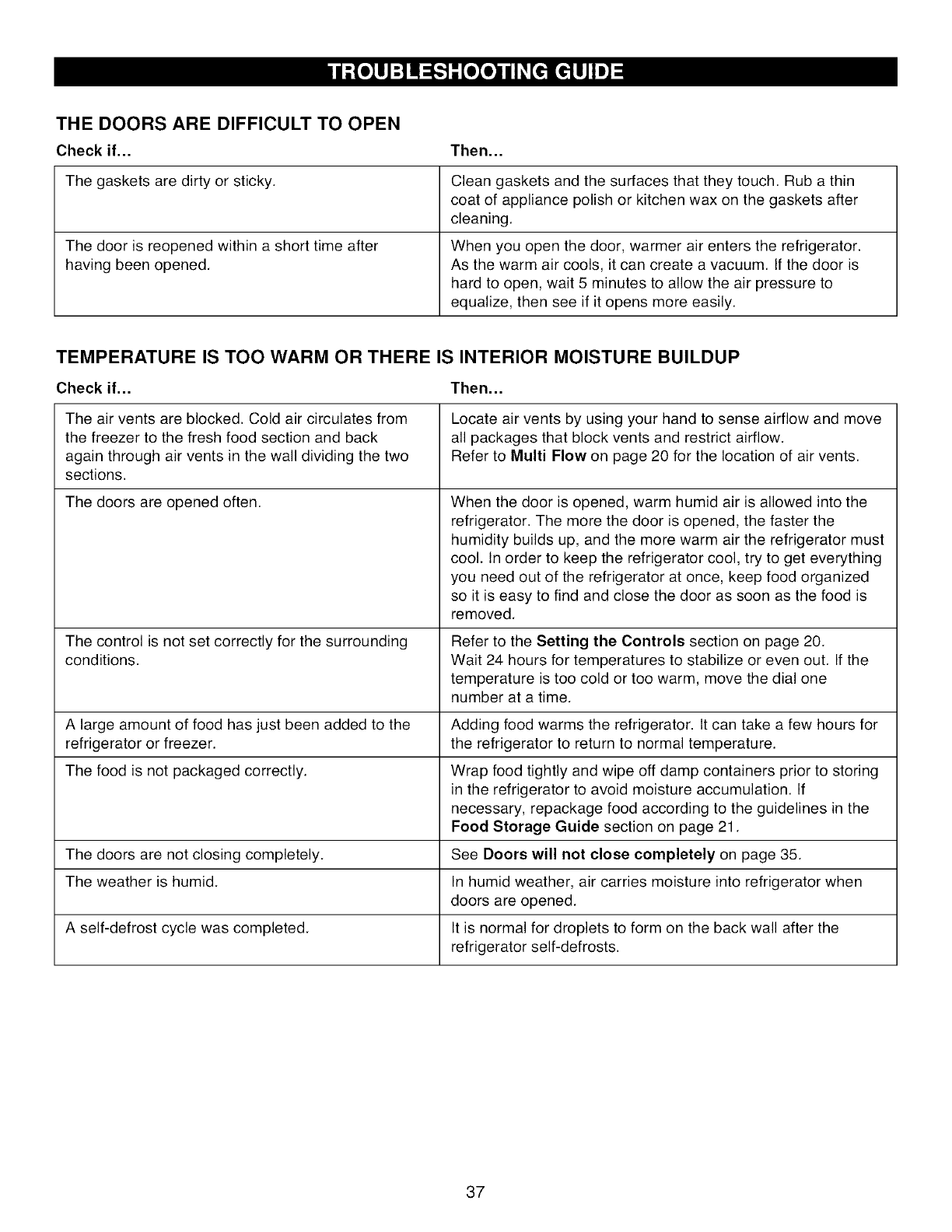
THE DOORS ARE DIFFICULT TO OPEN
Check if...
The gaskets are dirty or sticky.
The door is reopened within a short time after
having been opened.
Then...
Clean gaskets and the surfaces that they touch. Rub a thin
coat of appliance polish or kitchen wax on the gaskets after
cleaning.
When you open the door, warmer air enters the refrigerator.
As the warm air cools, it can create a vacuum. If the door is
hard to open, wait 5 minutes to allow the air pressure to
equalize, then see if it opens more easily.
TEMPERATURE IS TOO WARM OR THERE IS INTERIOR MOISTURE BUILDUP
Checkif... Then...
The air vents are blocked. Cold air circulates from
the freezer to the fresh food section and back
again through air vents in the wall dividing the two
sections.
The doors are opened often.
Locate air vents by using your hand to sense airflow and move
all packages that block vents and restrict airflow.
Refer to Multi Flow on page 20 for the location of air vents.
When the door is opened, warm humid air is allowed into the
refrigerator. The more the door is opened, the faster the
humidity builds up, and the more warm air the refrigerator must
cool. In order to keep the refrigerator cool, try to get everything
you need out of the refrigerator at once, keep food organized
so it is easy to find and close the door as soon as the food is
removed.
The control is not set correctly for the surrounding Refer to the Setting the Controls section on page 20.
conditions. Wait 24 hours for temperatures to stabilize or even out. If the
temperature is too cold or too warm, move the dial one
number at a time.
A large amount of food has just been added to the Adding food warms the refrigerator. It can take a few hours for
refrigerator or freezer, the refrigerator to return to normal temperature.
The food is not packaged correctly. Wrap food tightly and wipe off damp containers prior to storing
in the refrigerator to avoid moisture accumulation. If
necessary, repackage food according to the guidelines in the
Food Storage Guide section on page 21.
The doors are not closing completely. See Doors will not close completely on page 35.
The weather is humid. In humid weather, air carries moisture into refrigerator when
doors are opened.
A self-defrost cycle was completed. It is normal for droplets to form on the back wall after the
refrigerator self-defrosts.
37
38
39
.... You r Home
For expert troubleshooting and home solutions advice:
e
www.ma.agomyhome.com
For repair- in your home - of all major brand appliances,
lawn and garden equipment, or heating and cooling systems,
no matter who made it, no matter who sold it! ..................
Forthe replacement parts, accessories and
owner's manuals that you need to do-it-yourself. ..................
For Sears professional installation of home appliances
and items like garage door openers and water heaters.
1..800-4..MY..H0ME® 0-8oo-46e-4863)
Call anytime, day or night (U.S.A. and Canada)
Our Home
For repair of carry-in items like vacuums, lawn equipment,
and electronics, call anytime for the location of your nearest
Sears Parts & Repair Service Center
1-800-488-1222 (U.S.A.) 1-800..469-4663 Canada)
TO purch:se t protection agreement on tpro?ct s_rviced bY Sears:
1800 827 6655 (U.S.A.) 1 800 361 6665 (Canada)
Para pedir servicio de reparaci6n Au Canada pour service en fran_ais:
a domicilio, y para ordenar piezas: 1=800=LE.FOYERMC
1-888-SU-HOGAR® (%800=533-6937)
..... (1=888=784=6427 _ www.sears.ca ....
.... .....
TM
® Registered Trademark /Trademark /SM Service Mark of Sears Brands, LLC
® Marca Registrada /TM Marca de Fabrica /SM Marca de Servioio de Sears Brands, LLC
MCMarque de commerce /MDMarque deposde de Sears Brands, LLC © Sears Brands, LLC
