Kenwood Vr 6060 Owner S Manual 6060_KRF V8060D
Kenwood-Krf-V8060D-Owner-S-Manual kenwood-krf-v8060d-owner-s-manual
VR-6060 to the manual 52f3e07f-9261-4004-390a-6c90dab84483
2014-07-06
: Kenwood Kenwood-Vr-6060-Owner-S-Manual kenwood-vr-6060-owner-s-manual kenwood pdf
Open the PDF directly: View PDF  .
.
Page Count: 44
B60-5188-10 01 MA (K, P, M, X) 0109
AUDIO VIDEO SURROUND RECEIVER
VR-6060
KRF-V8060D
INSTRUCTION MANUAL
KENWOOD CORPORATION
About the supplied remote control
Compared to standard remote controls, the remote control supplied with this receiver has several
operation modes. These modes enable the remote control to control other audio/video components. In
order to effectively use the remote control it is important to read the operating instructions and obtain a
proper understanding of the remote control and how to switch its operation modes (etc.).
Using the remote control without completely understanding its design and how to switch the operation
modes may result in incorrect operations.
This instruction manual is for some models. Model availability and features
(functions) may differ depending on the country and sales area.
•VR6060/01-08/EN 3/11/02, 8:46 PM1
2 EN
Units are designed for operation as follows.
U.S.A. and Canada ........................................... AC 120 V only
Australia ........................................................... AC 240 V only
China and Russia ............................................. AC 220 V only
Other countries .......... AC 110-120 / 220-240 V switchable*
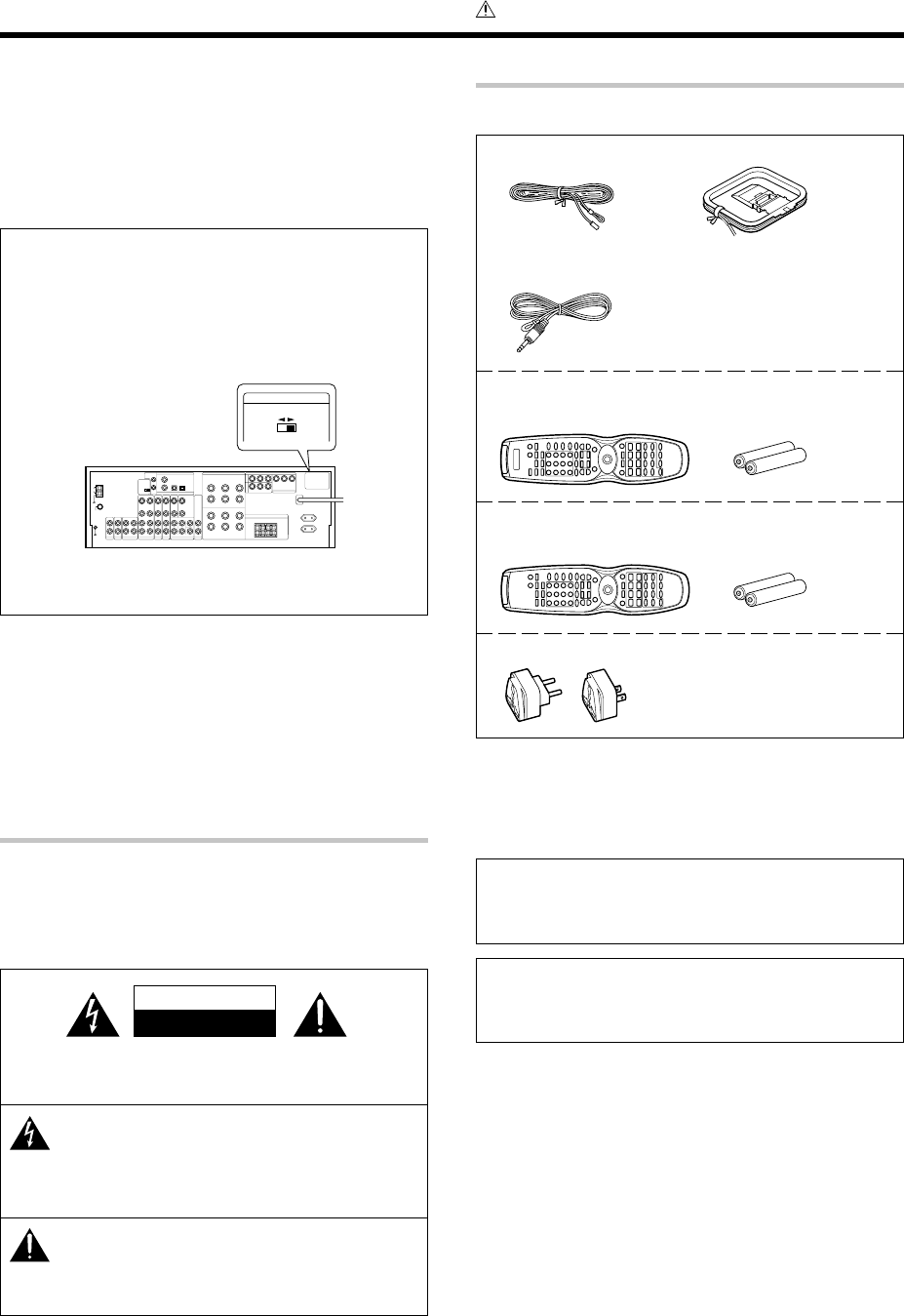
* AC voltage selection
The AC voltage selector switch on the rear panel is set to the voltage
that prevails in the area to which the unit is shipped. Before
connecting the power cord to your AC outlet, make sure that the
setting position of this switch matches your line voltage. If not, it
must be set to your voltage in accordance with the following direction.
VOLTAGE SELECTOR
AC 110-
120V~
AC 220-
240V~
Note:
Our warranty does not cover damage caused by excessive line
voltage due to improper setting of the AC voltage selector switch.
Before applying the power
Caution : Read this page carefully to ensure safe
operation.
Unpacking
Unpack the unit carefully and make sure that all accessories are present.
FM indoor antenna (1) AM loop antenna (1)
RF remote antenna (1)
(For VR-6060 only)
For VR-6060
Remote control unit (1) Batteries (R6/AA) (2)
RC-R0816
For KRF-V8060D
Remote control unit (1) Batteries (R6/AA) (2)
RC-R0725
*AC plug adaptor (2)
*Use to adapt the plug on the power
cord to the shape of the wall outlet.
(Accessory only for regions where use
is necessary.)
If any acccessories are missing, or if the unit is damaged or fails to
operate, notify your dealer immediately. If the unit was shipped to you
directly, notify your shipper immediately. Kenwood recommends that
you retain the original carton and packing materials in case you need to
move or ship the unit in the future.
Keep this manual handy for future reference.
AC voltage selector switch
Move switch lever to
match your line voltage
with a small screwdriver
or other pointed tool.
CAUTION
RISK OF ELECTRIC SHOCK
DO NOT OPEN
Safety precautions
WARNING :
TO PREVENT FIRE OR ELECTRIC SHOCK,
DO NOT EXPOSE THIS APPLIANCE TO
RAIN OR MOISTURE.
CAUTION: TO REDUCE THE RISK OF ELECTRIC SHOCK, DO NOT
REMOVE COVER (OR BACK). NO USER-SERVICEABLE PARTS
INSIDE. REFER SERVICING TO QUALIFIED SERVICE PERSONNEL.
THE LIGHTNING FLASH WITH ARROWHEAD SYMBOL,
WITHIN AN EQUILATERAL TRIANGLE, IS INTENDED TO
ALERT THE USER TO THE PRESENCE OF UNINSULATED
“DANGEROUS VOLTAGE” WITHIN THE PRODUCT’S EN-
CLOSURE THAT MAY BE OF SUFFICIENT MAGNITUDE TO
CONSTITUTE A RISK OF ELECTRIC SHOCK TO PERSONS.
THE EXCLAMATION POINT WITHIN AN EQUILATERAL TRI-
ANGLE IS INTENDED TO ALERT THE USER TO THE PRES-
ENCE OF IMPORTANT OPERATING AND MAINTENANCE
(SERVICING) INSTRUCTIONS IN THE LITERATURE ACCOM-
PANYING THE APPLIANCE.
Maintenance of the unit
When the front panel or case becomes dirty, wipe with a soft, dry
cloth. Do not use thinner, benzine, alcohol, etc. for these agents may
cause discoloration.
In regard to contact cleaner
Do not use contact cleaners because it could cause a malfunction. Be
specially careful not to use contact cleaners containing oil, for they
may deform the plastic component.
•VR6060/01-08/EN 3/11/02, 8:46 PM2
3 EN
Contents
Caution : Read the pages marked carefully to ensure
safe operation.
Before applying the power
Before applying the power .............................. 2
Safety precautions ............................................. 2
Unpacking .......................................................... 2
How to use this manual ..................................... 4
Special features ................................................. 4
Names and functions of parts ......................... 5
Main Unit ........................................................... 5
Remote control unit (RC-R0816) (VR-6060) ..........
6
Remote control unit (RC-R0725) (KRF-V8060D) ...
7
Setting up the system........................................ 8
Connecting audio components .......................... 9
Connecting video components ........................ 10
Digital connections .......................................... 11
Connecting video components
(COMPONENT VIDEO) .................................... 12
Connecting a DVD player (6-channel input) ..... 13
Connecting the speakers ................................. 14
Connecting the terminals ................................ 15
Connecting to the AV AUX jacks ..................... 16
Connecting the antennas ................................. 16
Connecting the system control ....................... 17
Connecting the RF antenna and external
IR Repeater (For VR-6060 only) ....................... 18
Preparing the remote control .......................... 19
RF remote control function (For VR-6060 only) ...
19
Preparing for surround sound ....................... 20
Speaker settings .............................................. 20
Normal playback.............................................. 22
Preparing for playback ..................................... 22
Listening to a source component .................... 23
Adjusting the sound ......................................... 23
Recording .......................................................... 25
Recording audio (analog sources) ................... 25
Recording video ............................................... 25
Recording audio (digital sources) .................... 25
Listening to radio broadcasts ....................... 26
Tuning radio stations ....................................... 26
Presetting radio stations manually .................. 26
Receiving preset stations ................................ 27
Receiving preset stations in order (P.CALL) ... 27
Ambience effects ............................................. 28
Surround modes .............................................. 28
Surround play ................................................... 30
DVD 6-channel playback .................................. 31
Convenient functions ....................................... 32
Basic remote control operations for other
components ....................................................... 34
Registering setup codes for other
components ..................................................... 34
Operating other components .......................... 35
Storing the remote control code of
the other components (For VR-6060 only) ...... 35
Setup code chart (RC-R0816) (VR-6060)
and (RC-R0725) (KRF-V8060D) ........................ 36
CASSETTE deck, CD player & MD recorder
operations ........................................................ 37
Other components’ operations ....................... 38
In case of difficulty .......................................... 40
Specifications .................................................. 42
Preparations
Operations
Remote Control
Additional
Information
For the U.S.A.
FCC WARNING
This equipment may generate or use radio frequency energy. Changes
or modifications to this equipment may cause harmful interference
unless the modifications are expressly approved in the instruction
manual. The user could lose the authority to operate this equipment
if an unauthorized change or modification is made.
NOTE:
This equipment has been tested and found to comply with the limits for
a Class B digital device, pursuant to Part 15 of the FCC Rules. These
limits are designed to provide reasonable protection against harmful
interference in a residential installation. This equipment may cause
harmful interference to radio communications, if it is not installed and
used in accordance with the instructions. However, there is no guaran-
tee that interference will not occur in a particular installation. If this
equipment does cause harmful interference to radio or television
reception, which can be determined by turning the equipment off and
on, the user is encouraged to try to correct the interference by one or
more of the following measures:
– –Reorient or relocate the receiving antenna.
– –Increase the separation between the equipment and receiver.
– –Connect the equipment into an outlet on a circuit different from
that to which the receiver is connected.
– –Consult the dealer or an experienced radio / TV technician for help.
For the U.S.A.
FCC Compliance Notice
Audio-video Receiver, VR-6060
These devices comply with Part 15 of FCC Rules. Operation is subject
to the following two conditions: (1) This device may not cause harmful
interference, and (2) this device must accept any interference received,
including interference that may cause undesired operation.
KENWOOD U.S.A. CORPORATION
2201 East Dominguez St., Long Beach, CA 90801-5745
Telephone: 310-639-9000
For Canada
IC (Industry Canada) Notice
Operation is subject to the following two conditions: (1) this device
may not cause interference, and (2) this device must accept any
interference, including interference that may cause undesired operation
of the device.
The term “IC:” before the certification/registration number only
signifies that the Industry Canada technical specifications were met.
For the U.S.A.
Note to CATV system installer
This reminder is provided to call the CATV system installer's attention
to Article 820-40 of the NEC that provides guidelines for proper
grounding and, in particular, specifies that the cable ground shall be
connected to the grounding system of the building, as close to the
point of cable entry as practical.
As an ENERGY STAR® Partner, Kenwood Corpora-
tion has determined that this product meets the
ENERGY STAR® guidelines for energy efficiency.
This product can save energy. Saving energy re-
duces air pollution and lowers utility bills.
•VR6060/01-08/EN 3/11/02, 8:46 PM3
4 EN
How to use this manual
This manual is divided into four sections, Preparations, Operations,
Remote Control, and Additional Information.
Preparations
Shows you how to connect your audio and video components to the
receiver and prepare the surround processor.
Since this receiver works with all your audio and video components, we
will guide you in setting up your system to be as easy as possible.
Operations
Shows you how to operate the various functions available on the
receiver.
Remote Control
Shows you how to operate other components using the remote control,
as well as a detailed explanation of all remote control operations. Once
you have registered your components with the proper setup codes, you’ll
be able to operate both this receiver and your other AV components (TV,
VCR, DVD player, CD player, etc.) using the remote control supplied with
this receiver.
Additional Information
Shows you additional information such as “In case of difficulty” (trouble-
shooting) and “Specifications”.
Before applying the power
Memory back up function
Please note that the following items will be deleted from the unit's
memory if the power cord is disconnected from the AC outlet for
approximately 1 day.
•Power mode.
•Input selector settings.
•Picture output.
•Speaker ON/OFF.
•Volume level.
•BASS, TREBLE, INPUT level.
• TONE ON/OFF.
• LOUDNESS ON/OFF.
•Dimmer level.
•MD/TAPE settings.
• RF-BAND. (VR-6060 only)
•Listen mode setting.
•Speaker settings.
• SW RE-MIX ON/OFF.
• Distance setting.
•Input mode setting.
•Midnight mode setting.
• PRO LOGIC II mode setting.
• CS II mode setting.
•Broadcast band.
•Frequency setting.
•Preset stations.
•Tuning mode.
•DSP mode.
•ACTIVE EQ mode.
•SPEAKER EQ mode.
Special features
True home theater sound
This receiver incorporates a wide variety of surround modes to bring you
maximum enjoyment from your video software. Select a surround mode accord-
ing to your equipment or the software you are going to play and enjoy!
•
Dolby Digital and Dolby Digital EX
The DOLBY DIGITAL mode lets you enjoy full digital surround from
software processed in the Dolby Digital format. Dolby Digital provides
up to 5.1 channels of independent digital audio for better sound quality
and more powerful presence than conventional Dolby Surround.
As for Dolby Digital EX, it creates six full-bandwidth output channels
from the 5.1 channel sources. This is done using a matrix decoder that
derives three surround channels from the two in the original recording.
For best results, Dolby Digital EX should be used with movie sound-
tracks recorded with Dolby Digital Surround EX.
Dolby PRO LOGIC
q
DOLBY PRO LOGIC
II , whilst totally compatible with its predecessor
PRO LOGIC, provides greater advantages in surround sound. It allows
the user to enjoy the conventional stereo or Dolby Surround with a
convincing “5.1 like” presentation. PRO LOGIC
II offers special fea-
tures for controlling the overall spatial, dimensionality and frontal sound
field imaging. PRO LOGIC
II produces an impressive surround sound
from video software marked and three-dimensional
space from music CD. When listening to music, you will be able to enjoy
the experience of sheer STEREO surround sound.
DTS-ES
The DTS-ES (Digital Theater System-Extended Surround) is a 6.1-channel
Discrete Surround format which is extended to DTS-ES Discrete 6.1,
DTS-Matrix 6.1 and DTS NEO:6. It is a 6.1 channel expanded from 5.1
surround which includes an additional surround center channel developed
within surround left and surround right. DTS-ES will be able to produce
the original sound recorded similar to the theatrical effects.
In the DTS-ES mode, the 5.1 or 6.1 channel digital input from a DTS CD,
LD or DVD disc (carrying the “DTS” or “DTS-ES” marking) can be
played in Digital Surround.
Important:
When a DTS disc is played on a CD, LD or DVD player, noise may be
output from the analog output. It is recommended that you connect the
digital output of the player to the digital input of this unit.
Multi channel surround sound
(SRS Circle Surround
q
)
SRS Circle Surround II ™ improves on its predecessor CS-5.1™ result-
ing in the CS-6.1™ system, enabling you to listen to realistic, multi-
channel, surround sound playback from a stereo source or conventional
surround-encoded video source. You already enjoy listening to Dolby
digital sound/DTS multi-channel sound with your multi-speakers. Now
you can listen to audio CDs, MDs, Broadcast and Home Theater using
your multi-speakers. You will discover a new type of sound through
SRS Circle Surround II .
DSP surround modes
The DSP (Digital Signal Processor) used for this receiver incorporates
a variety of high quality adjustable sound fields, like “ARENA”, “JAZZ
CLUB”, “THEATER”, “STADIUM” and “DISCO”. It is compatible with
almost any kind of program source.
DVD 6-channel input
If you own a DVD player equipped with 6-channel output, this receiver
allows you to obtain the full surround sound impact of DVD source material
featuring multi-channel encoding. Since the source signals are digital and
each channel is input independently, the resulting ambience is far superior
to what can be achieved with conventional surround sound systems.
ACTIVE EQ
ACTIVE EQ mode will produce a more dynamic sound quality in any
condition. You can enjoy a more impressive sound effect when ACTIVE
EQ is turned on during Dolby Digital and DTS playback.
SPEAKER EQ
The SPEAKER EQ function will automatically detect the various features
of each speaker and effectively creates a stereoscopic sound effect.
Remote control
This remote control has two kinds of signal.
Universal IR (InfraRed) remote control
In addition to the basic receiver, the remote control supplied with this
receiver can also operate almost all of your remote controllable audio
and video components. Just follow the simple setup procedure to
register the components you have connected.
RF remote signal (For VR-6060 only)
You can operate the receiver by sending RF remote signal from the
remote control. The controllable range of the remote control is not
influenced by surroundings such as distance or an obstruction.
•VR6060/01-08/EN 3/11/02, 8:46 PM4
5 EN
L
SL S SB SR
CR
SP MUTE
OPTICAL 6CH INPUT
COAXIAL ANALOG 96kHzfs DSP MODE
DTS
MATRIX
DISCRETE
DOLBY DIGITAL
PRO LOGIC
STEREO
LOUDNESS
NEO:6
CS II
AB CLIP
AUTO DETECT
AUTO
MEMORY
STEREO
TUNED
SW
LFE
LOUDNESS SPEAKER EQ
ACTIVE EQ
DSP
STEREO
INPUT MODE
DIMMER
SOUND
TONE
SETUP
BAND AUTO
MEMORY
MULTI CONTROL LISTEN MODE
TUNER
MD/TAPE
VIDEO 3VIDEO 2VIDEO 1
PHONOCD/DVD
DSP
DTS
CS II
DOLBY DIGITAL
SPEAKER EQ
ACTIVE EQ
STANDBY
ON/STANDBY
A SPEAKERS B
POWER
PHONES
DOWN
MUTE
AV AUX
S VIDEO
VIDEO
L-AUDIO-R
UP
VOLUME CONTROL
STANDBY
POWER
ON/STANDBY
DVD/6CH
-
ON
–
OFF
F
ULL DIGITA
L
D
ECODIN
G
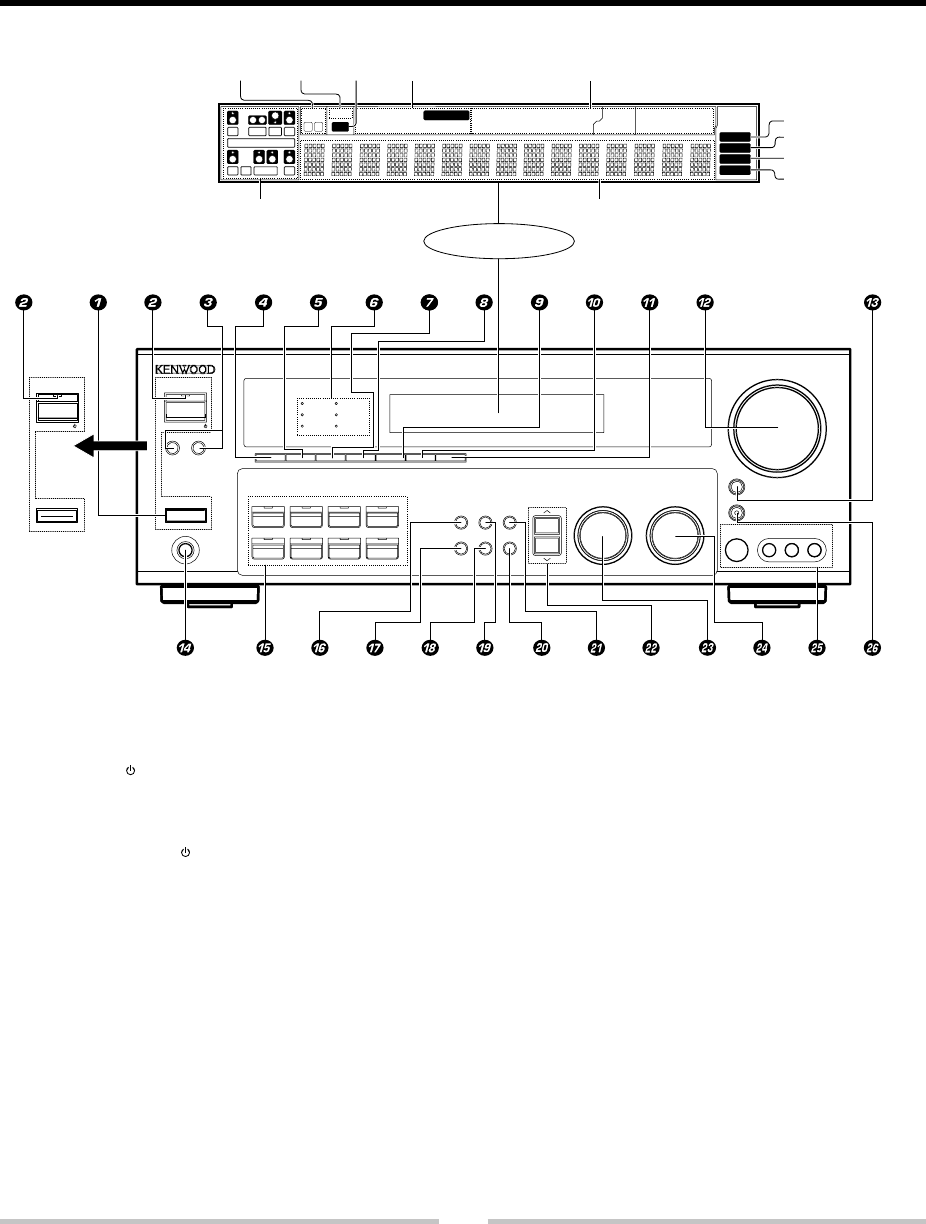
Display
Speaker selection indicators
Input channel indicators
Output channel indicators
AUTO indicator
MEMORY indicator
STEREO indicator
TUNED indicator
Names and functions of parts
Frequency display
Input display
Preset channel display
Surround mode display
Speaker
indicators
1POWER ON/OFF key
(For KRF-V8060D) )
Use to turn the main power ON/OFF.
2ON/STANDBY ( ) key
(For KRF-V8060D) )
Use to turn the power ON/STANDBY when
the POWER is turned ON.
STANDBY indicator
2POWER ON/STANDBY ( ) key
(For VR-6060) )
Use to turn the power ON/STANDBY.
STANDBY indicator
3A SPEAKERS B keys ™
Use to turn the A/B speakers ON/OFF.
4LOUDNESS key ¢
Use to switch the status of LOUDNESS.
5SPEAKER EQ key ¢
Use to select SPEAKER EQ’s setting.
6Surround indicators
DSP indicator º
Lights when the receiver is in the DSP mode.
SPEAKER EQ indicator ¢
Lights when the receiver is in the SPEAKER
EQ mode.
ACTIVE EQ indicator ¢
Lights when the receiver is in the ACTIVE EQ
mode.
DOLBY DIGITAL indicator º
Lights when the receiver is in the Dolby
Digital mode.
Main unit
&BAND key §
Use to select the broadcast band.
*AUTO key §
Use to select the auto or manual tuning
mode.
(TONE key £
Use to switch the status of TONE control.
)MEMORY key §
Use to store radio stations in the preset
memory.
¡SETUP key )
Use to select the speakers' settings etc.
™MM
MM
M/??
??
? keys )
Use for selection adjustments during SOUND,
SETUP and PRESET CHANNEL functions.
£MULTI CONTROL knob )
Use to control a variety of settings.
¢LISTEN MODE knob º
Use to select the listening mode.
∞AV AUX (S VIDEO, VIDEO, AUDIO L/R)
jacks ^
§AV AUX key ^
Use to switch the input to AV AUX.
DTS indicator º
Lights when the receiver is in the DTS mode.
CS
q indicator º
Lights when the receiver is in the CIRCLE
SURROUND II mode.
7ACTIVE EQ key ¢
Use to select ACTIVE EQ’s setting.
8DSP key º
Use to select any of the DSP mode.
9STEREO key ¤
Use to switch the listen mode to STEREO.
0INPUT MODE key 8
Use to switch between the full auto, digital
and analog inputs.
!DIMMER key
Use to select the REC MODE. ∞
Use to adjust the brightness of the display.
‹
@VOLUME CONTROL knob £
#MUTE key ¢
Use to temporarily mute the sound.
$PHONES jack ¢
Use for headphone listening.
%Input Selector keys £
(DVD/6CH, CD/DVD, PHONO, TUNER,
VIDEO 1, VIDEO 2, VIDEO 3, MD/TAPE)
Use to select input sources.
^SOUND key ¤
Use to adjust the sound quality and the ambi-
ence effects.
MUTE
indicator
CLIP
indicator
Input mode
indicators
Listen mode
indicators
For VR-6060
Standby mode
While the standby indicator is lit, a small amount of power is supplied
to the system to back up the memory. This is called standby mode.
Under the condition, the system can be turned ON by remote control
unit.
Connection at POWER ON/OFF key (for KRF-V8060D)
The power in this equipment will not be completely cut off from the AC
wall outlet when the main switch is turned OFF.
•VR6060/01-08/EN 3/11/02, 8:47 PM5
6 EN
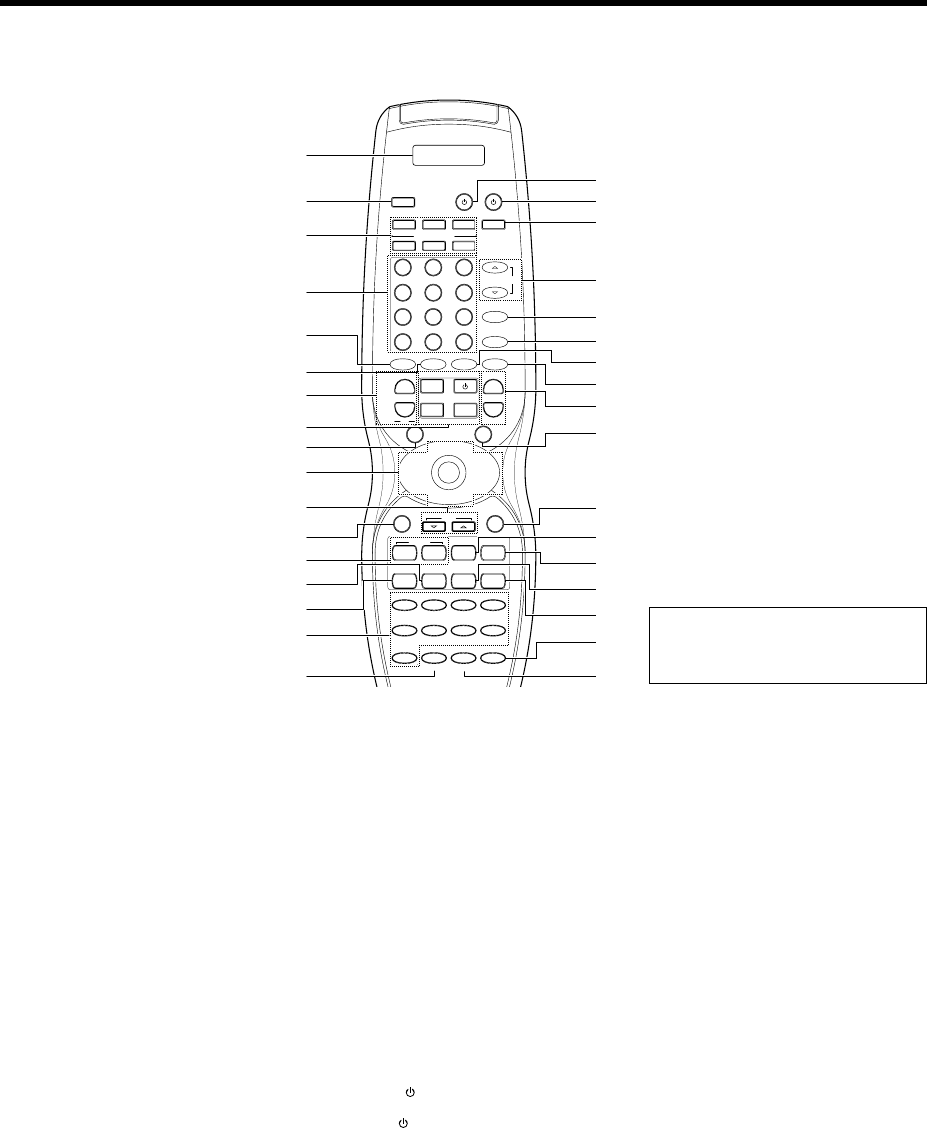
!PAGE %/fi key
Use to operate the DVD component.
@OSD key
Use to operate the DVD component.
#TUNING 1/¡ keys §
Use to operate the tuner mode.
If CD, MD or TAPE is selected as the input
source, these keys function as search keys.
$DISC SKIP key
If CD is selected as the input source, this key
functions as the multi-CD player disc skip key.
A/B key
If TAPE is selected as the input source, this is
A and B deck of a double cassette deck.
%DISC SEL key
Use to operate other components.
INPUT SEL key
Use to operate other components.
^INPUT SELECTOR keys (DVD/6CH, CD/DVD,
PHONO, TUNER, VIDEO 1, VIDEO 2, VIDEO 3,
MD/TAPE, AV AUX)
Use to select the input sources. £
&LOUDNESS key ¢
Use to switch the status of LOUDNESS.
*SOURCE ( ) key
Use to turn the other components ON/OFF.
(POWER ( ) key )
Use to turn the receiver ON/OFF.
)RECEIVER key
Use to return to the operation of the receiver.
¡LISTEN MODE %/fi keys º
Use to select the listening mode.
™ACTIVE EQ key ¢
Use to select ACTIVE EQ’s setting.
£SPEAKER EQ key ¢
Use to select SPEAKER EQ’s setting.
¢DSP MODE key º
Use to select any of the DSP mode.
∞MUTE key ¢
Use to temporarily mute the sound.
§VOLUME +/- keys £
Use to adjust the receiver volume.
¶MENU key
Use to operate other components.
SOUND key ¤
Use to adjust the sound quality and the ambi-
ence effects.
•RETURN key
Use to operate other components.
ª2 key
Use to operate other components.
FLIP key
Use to operate other components.
º3/8 key
If CD is selected as the input source, this key
functions as the play/pause key.
If MD or TAPE key is selected as input source,
this key functions as the play key.
BAND key §
Use to select the broadcast band.
⁄7 key
If CD, MD, or TAPE is selected as the input
source, this key functions as the stop key.
AUTO key §
Use to select the auto or manual tuning
mode.
¤DIMMER key ‹
Use to adjust the brightness of the display.
8 key
Use to operate other components.
‹BASS BOOST key £
Use to select the maximum adjustment set-
ting for the low frequency range.
›TONE key £
Use to switch the status of TONE control.
1LCD (Liquid Crystal Display)
2LEARN key fi
Use to memorize the operation of the other
remote controls.
3REMOTE MODE keys (DVD, CBL, DSS/
SAT, VCR, TV, OTHERS) ›
Use to select the components registered at
the respective input.
4Numeric keys ›
Provide functions identical to those of the
original remote control supplied with the com-
ponent you are controlling.
5INPUT MODE key 8
Use to switch between the full auto, digital
and analog inputs.
6STEREO key ¤
Use to switch the listen mode to STEREO.
7CH +/- keys
Use to select the channels.
¢ DVD 4 keys
When in DVD player operations, these keys
function as skip keys.
8TV CONTROL keys
Use when in TV operation.
9TOP MENU key
Use to operate the DVD component.
SET UP key )
Use to select the speakers’ settings etc.
0Joystick
ENTER
Use to operate other components.
MULTI CONTROL C/D)
Use to control a variety of settings.
Use to operate other components.
P.CALL 4 /DOWN 2 and P.CALL/UP ¢
3¶
Use for selection adjustments during SOUND,
SET UP and PRESET channel functions.
Names and functions of parts
Remote control unit (RC-R0816) (VR-6060)
This remote control unit can be use not only for Kenwood products but also for other non-Kenwood products by setting the appropriate manufacturer’s
setup codes. fl
If the name of a function is different on
the receiver and on the remote control,
the name of the remote control key in
this manual is indicated in parentheses.
3
2
1
(
)
¡
™
£
¢
∞
§
¶
•
ª
º
⁄
¤
‹
›
4
5
6
7
8
0
@
#
$
%
^
&
9
*
!
PA G E
P.CALL
4
/DOWN
P.CALL
/UP
¢
TUNING
+
TOP MENU
SET UP
MENU
SOUND
TV CONTROL
VOL.
VOLUME
+
-
-
INPUT
SEL
+
-
CH
DVD
VCR TV
OTHERS
RECEIVER
SOURCE POWER
ACTIVE EQ
OSD RETURN
DISC SEL
DISC SKIP
FLIP BAND
INPUT SEL
A/B AUTO
8
DVD/6CH CD/DVD
PHONO
TUNER
VIDEO 1 VIDEO 2
MD/TAPE
LOUDNESS
TONE
BASS BOOST
MUTE
DVD
ENTER
INPUT SELECTOR
MULTI
CONTROL
¢
4
1¡ 2 6
7
DIMMER
™£
™
1
4
7
+10
2
5
8
0
3
6
9
+100
REMOTE MODE
LISTEN MODE
DSP MODESTEREOINPUT MODE
SPEAKER EQ
™
VIDEO 3
AV AUX
LEARN
CBL
DSS/SAT
•VR6060/01-08/EN 3/11/02, 8:47 PM6
7 EN
1
&
*
(
)
¡
™
£
¢
∞
§
¶
•
ª
º
⁄
¤
2
3
4
5
6
8
0
!
@
#
$
%
7
^
9
P.CALL
4
/DOWN
P.CALL
/UP
¢
TUNING
+
TOP MENU
SET UP
MENU
SOUND
TV CONTROL
VOL.
VOLUME
+
-
-
INPUT
SEL
+
-
CH
DVD
VCR TV
OTHERS
RECEIVER
SOURCE
POWER
ACTIVE EQ
OSD RETURN
DISC SEL
DISC SKIP
FLIP BAND
INPUT SEL
A/B AUTO
8
DVD/6CH CD/DVD
PHONO
TUNER
VIDEO 1 VIDEO 2
MD/TAPE
LOUDNESS
TONE
BASS BOOST
MUTE
DVD
ENTER
INPUT SELECTOR
MULTI
CONTROL
¢
4
1¡ 2 6
7
DIMMER
™£
™
1
4
7
+10
2
5
8
0
3
6
9
+100
REMOTE MODE
LISTEN MODE
DSP MODESTEREOINPUT MODE
SPEAKER EQ
™
VIDEO 3
AV AUX
PA G E
CBL
DSS/SAT
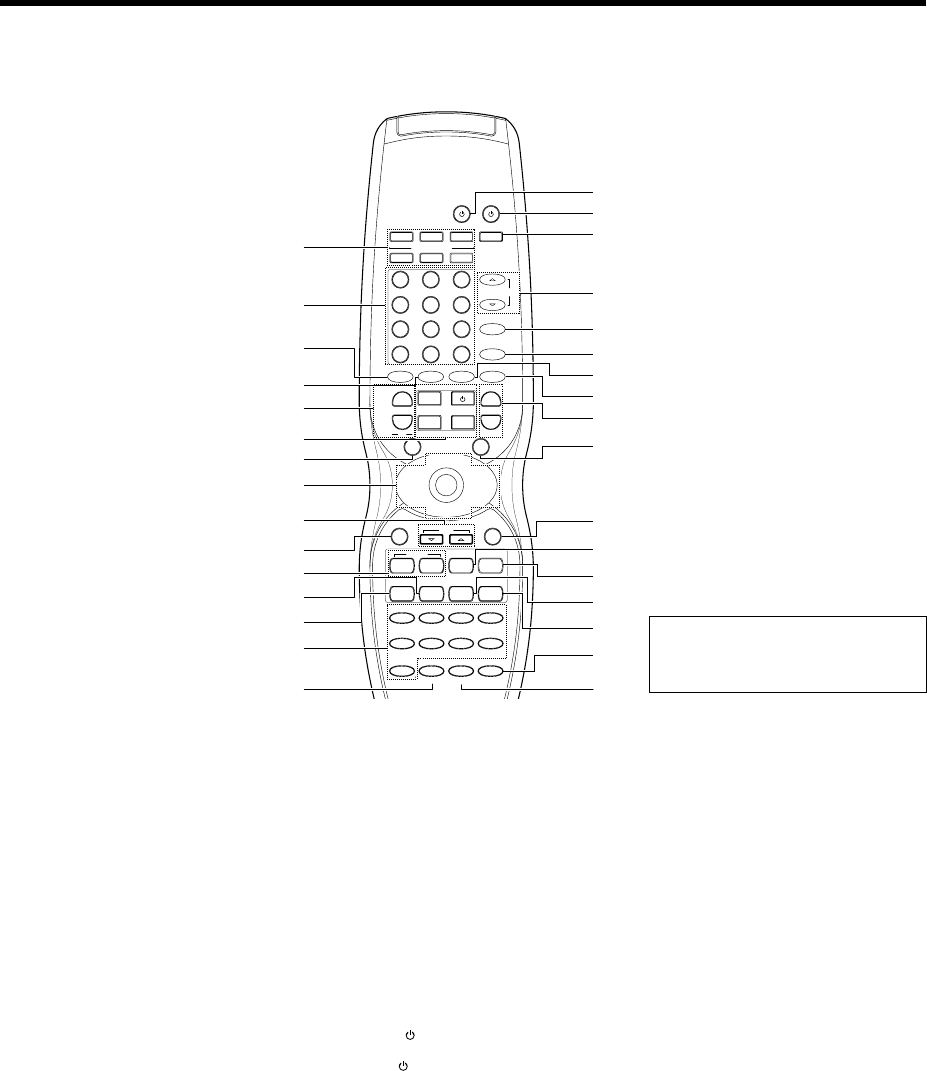
!TUNING 1/¡ keys §
Use to operate the tuner mode.
If CD, MD or TAPE is selected as the input
source, these keys function as search keys.
@DISC SKIP key
If CD is selected as the input source, this key
functions as the multi-CD player disc skip key.
A/B key
If TAPE is selected as the input source, this is
A and B deck of a double cassette deck.
#DISC SEL key
Use to operate other components.
INPUT SEL key
Use to operate other components.
$INPUT SELECTOR keys (DVD/6CH, CD/DVD,
PHONO, TUNER, VIDEO 1, VIDEO 2, VIDEO 3,
MD/TAPE, AV AUX)
Use to select the input sources. £
%LOUDNESS key ¢
Use to switch the status of LOUDNESS.
^SOURCE ( ) key
Use to turn the other components ON/OFF.
&POWER ( ) key )
Use to turn the receiver ON/OFF.
*RECEIVER key
Use to return to the operation of the receiver.
(LISTEN MODE %/fi keys º
Use to select the listening mode.
)ACTIVE EQ key ¢
Use to select ACTIVE EQ’s setting.
¡SPEAKER EQ key ¢
Use to select SPEAKER EQ’s setting.
™DSP MODE key º
Use to select any of the DSP MODE.
£MUTE key ¢
Use to temporarily mute the sound.
¢VOLUME +/- keys £
Use to adjust the receiver volume.
∞MENU key
Use to operate other components.
SOUND key ¤
Use to adjust the sound quality and the ambi-
ence effects.
§RETURN key
Use to operate other components.
¶2 key
Use to operate other components.
FLIP key
Use to operate other components.
•3/8 key
If CD is selected as the input source, this key
functions as the play/pause key.
If MD or TAPE key is selected as input source,
this key functions as the play key.
BAND key §
Use to select the broadcast band.
ª7 key
If CD, MD, or TAPE is selected as the input
source, this key functions as the stop key.
AUTO key §
Use to select the auto or manual tuning
mode.
ºDIMMER key ‹
Use to adjust the brightness of the display.
8 key
Use to operate other components.
⁄BASS BOOST key £
Use to select the maximum adjustment set-
ting for the low frequency range.
¤TONE key £
Use to switch the status of TONE control.
1REMOTE MODE keys (DVD, CBL, DSS/
SAT, VCR, TV, OTHERS) ›
Use to select the components registered at
the respective input.
2Numeric keys ›
Provide functions identical to those of the
original remote control supplied with the com-
ponent you are controlling.
3INPUT MODE key 8
Use to switch between the full auto, digital
and analog inputs.
4STEREO key ¤
Use to switch the listen mode to STEREO.
5CH +/- keys
Use to select the channels.
¢ DVD 4 keys
When in DVD player operations, these keys
function as skip keys.
6TV CONTROL keys
Use when in TV operation.
7TOP MENU key
Use to operate the DVD component.
SET UP key )
Use to select the speakers’ settings etc.
8Joystick
ENTER
Use to operate other components.
MULTI CONTROL C/D)
Use to control a variety of settings.
Use to operate other components.
P.CALL 4 /DOWN 2 and P.CALL/UP ¢
3¶
Use for selection adjustments during SOUND,
SET UP and PRESET channel functions.
9PAGE %/fi key
Use to operate the DVD component.
0OSD key
Use to operate the DVD component.
Names and functions of parts
Remote control unit (RC-R0725) (KRF-V8060D)
This remote control unit can be used not only for Kenwood products but also for other non-Kenwood products by setting the appropriate manufacturer’s
setup codes. fl
If the name of a function is different on
the receiver and on the remote control,
the name of the remote control key in
this manual is indicated in parentheses.
•VR6060/01-08/EN 3/11/02, 8:47 PM7
8 EN
Make connections as shown in the following pages.
When connecting the related system components, be sure
to refer to the instruction manuals supplied with the compo-
nents you are connecting.
Do not connect the power cord to a wall outlet until all
connections are completed.
Notes
1.
Be sure to insert all connection cords securely. If their connections are
imperfect, sound may not be produced or there will be noise inference.
2. Be sure to remove the power cord from the AC outlet before plugging
or unplugging any connection cords. Plugging/unplugging connection
cords without disconnecting the power cord can cause malfunctions
and may damage the unit.
3. Do not connect power cords from components whose power con-
sumption is larger than what is indicated on the AC outlet at the rear
of this unit.
Analog connections
Audio connections are made using RCA pin cords. These cables transfer
stereo audio signal in an “analog” form. This means the audio signal
corresponds to the actual audio of two channels. These cables usually
have 2 plugs on each end, one red for the right channel and one white for
the left channel. These cables are usually packed together with the
source unit, or are available at your local electronics retailer.
Microcomputer malfunction
If operation is not possible or an erroneous display appears, even
though all connections have been made properly, reset the micro-
computer referring to “In case of difficulty”.‚
CAUTION
Be sure to adhere to the following, or proper ventilation will be
blocked causing damage or fire hazard.
•Do not place any objects impairing heat radiation onto the top of the
unit.
•Leave some space around the unit (from the largest outside
dimension including projection) equal to or greater than, shown
below.
Top panel : 50 cm Side panel : 10 cm Back panel : 10 cm
Setting up the system
Input mode settings
CD/DVD, VIDEO 2, VIDEO 3 and DVD/6CH inputs each include jacks
for digital audio input and analog audio input.
You must select beforehand which type of input is to be used for each
connected component.
The initial factory settings for audio signal playback for CD/DVD,
DVD/6CH, VIDEO 2 and VIDEO 3 are full auto.
To use the analog audio input for playback instead (if, for example, you
have connected a VCR to the VIDEO 2 or VIDEO 3 input), you must set
the input mode for the corresponding input to the analog mode.
After completing connections and turning on the receiver, follow the
steps below.
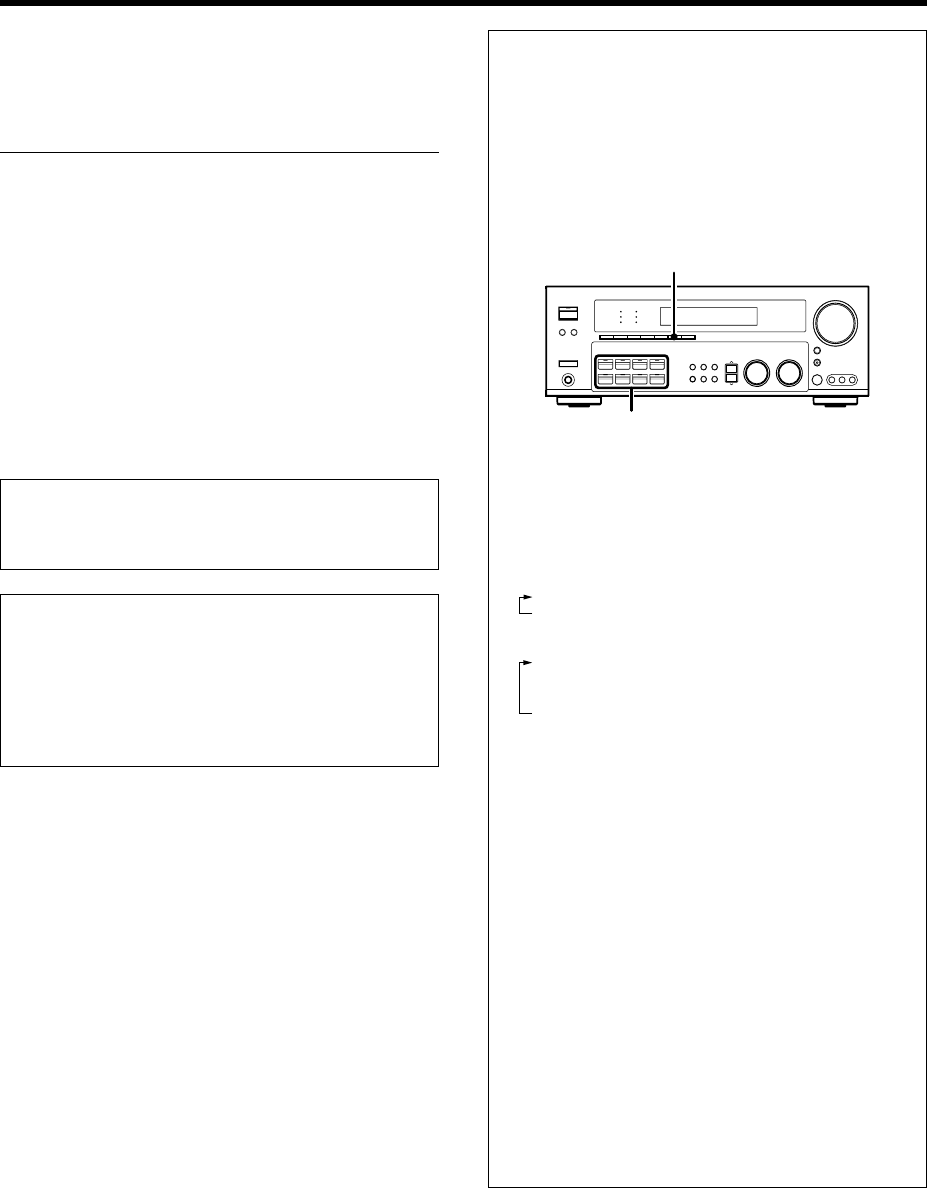
INPUT MODE
Input Selector
1Use the Input Selector keys to select CD/DVD, VIDEO 2, VIDEO 3
or DVD/6CH.
2Press the INPUT MODE key.
Each press switches the setting as follows:
In DTS play mode
1FULL AUTO (digital input, analog input)
2DIGITAL MANUAL (digital input)
In CD/DVD, VIDEO 2, VIDEO 3 or DVD/6CH play mode
1FULL AUTO (digital input, analog input)
2DIGITAL MANUAL (digital input)
36CH INPUT (DVD/6CH input)
4ANALOG (analog input)
Digital input:
Select this setting to play digital signals from a DVD, CD, or LD
player.
Analog input:
Select this setting to play analog signals from a cassette deck, VCR,
or record player.
Auto detect:
In “FULL AUTO” mode (AUTO DETECT indicator light up), the
receiver detects the digital or analog input signals automatically.
Priority is given to digital signal during input mode selection. The
receiver will select the input mode and listening mode automatically
during playback to match the type of input signal (Dolby Digital,
PCM, DTS) and the speaker setting. The OPTICAL and COAXIAL
indicator on the display will light up when digital signal is detected.
If the input signal is analog, the ANALOG indicator will light up.
To keep the receiver set to the currently selected listening mode,
use the INPUT MODE key to select “DIGITAL MANUAL” (manual
sound). However, even when this setting is selected, there may be
cases in which the listening mode is selected automatically to
match a Dolby Digital source signal depending on the combination
of listening mode and source signal.
If the INPUT MODE key is pressed quickly, sound may not be
produced. Press the INPUT MODE key again.
•VR6060/01-08/EN 3/11/02, 8:47 PM8
9 EN
IN IN
REC OUT PLAY IN
GND
CD/DVD
MD/TAPE
PHONO
R
L
R
L
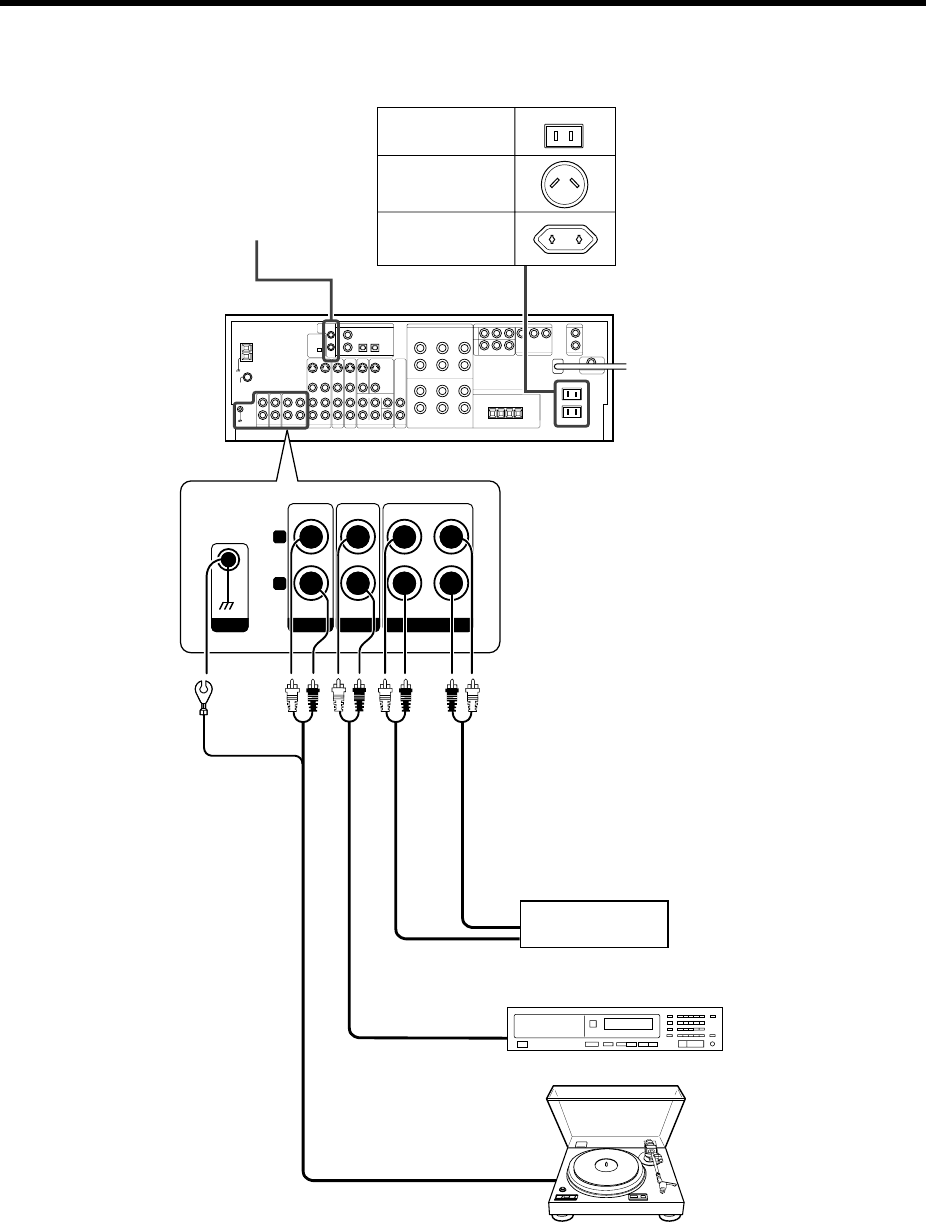
Connecting audio components
Record player
Setting up the system
To AC wall outlet
Cassette deck or
MD recorder
CD or DVD player
SYSTEM CONTROL
jacks
&
Shape of AC outlets
U.S.A. and Canada
Other countries
IN
OUT
OUT
OUT
Australia
Moving coil (MC) cartridge
record player cannot be used
directly from the receiver unit.
It can only be used when
another equalizer amplifier is
connected.
•VR6060/09-20/EN 3/11/02, 8:48 PM9
10 EN
VIDEO 1 VIDEO 2 VIDEO 3
PLAY INPLAY INPLAY INREC OUT
OUT
VIDEO
IN
VIDEO
IN
VIDEO
DVD
IN
IN
VIDEO
MONITOR
OUT
VIDEO
S VIDEO
OUT
VIDEO
S VIDEO
IN
VIDEO
S VIDEO
IN
VIDEO
S VIDEO
IN
VIDEO DVD
IN
MONITOR
OUT
S VIDEO
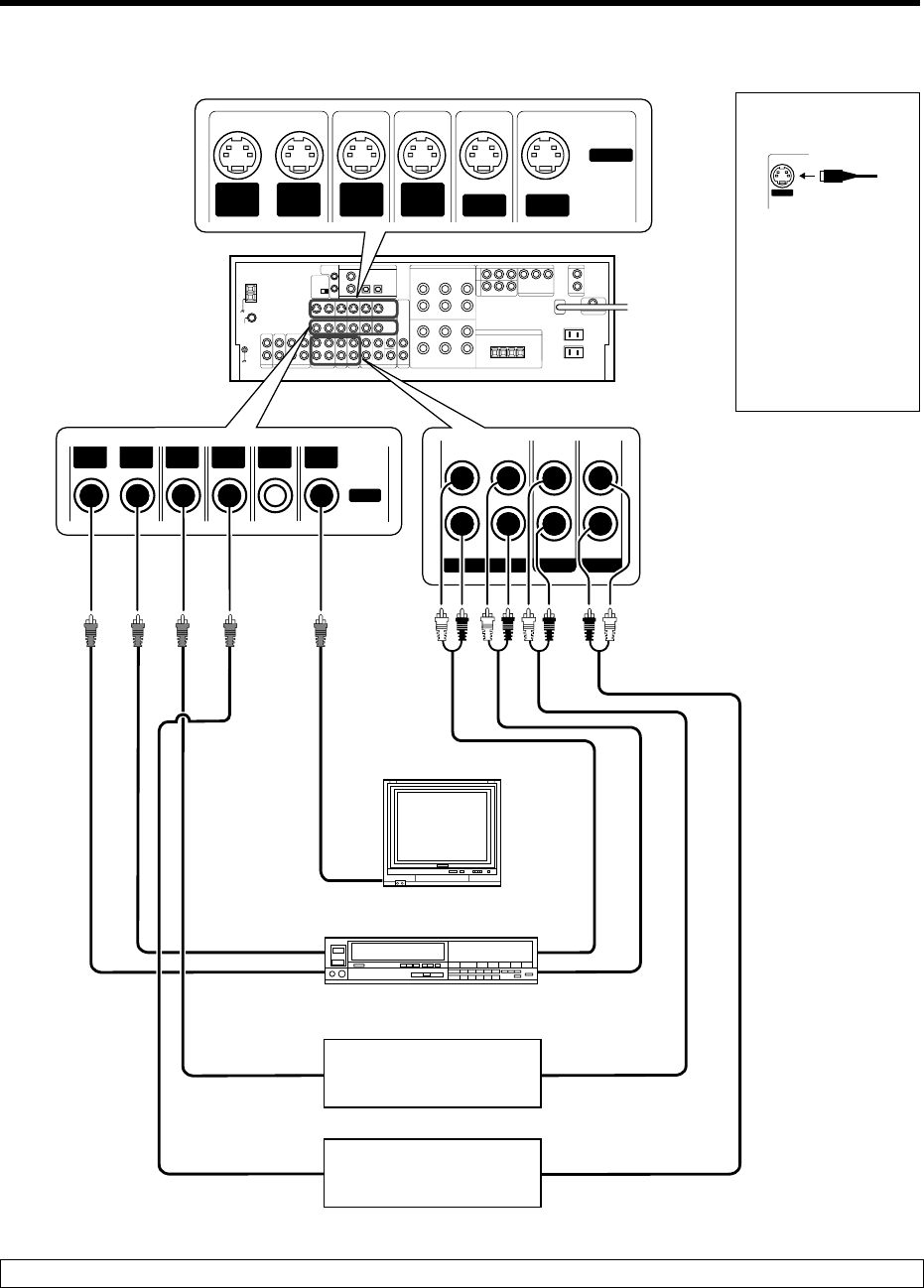
Connecting video components
IN
Video deck
Monitor TV
A video component with digital audio outputs should be connected to the VIDEO 2 or VIDEO 3 jacks.
Video
IN/OUT
IN
Video inputs and outputs
(Yellow RCA pin cords)
OUT
OUT
Audio inputs
and outputs
S Video jacks
Video inputs
(Yellow RCA pin cords)
About the S VIDEO
jacks
S VIDEO
Use the S VIDEO jacks to
make connections to
video components with
S VIDEO IN/OUT jacks.
•
If you use the S VIDEO
jacks to connect your video
playback components, be
sure to use the S VIDEO
jacks when connecting
your monitor and video
recording components.
VIDEO
IN
OUT OUT
Audio
IN/OUT
Setting up the system
OUT OUT
DVD player or LD player
DVD player or LD player
•VR6060/09-20/EN 3/11/02, 8:48 PM10
11 EN
COAXIAL OPTICAL OPTICAL
VIDEO 3CD/DVD
DIGITAL IN
DVD
/6CH
VIDEO
2
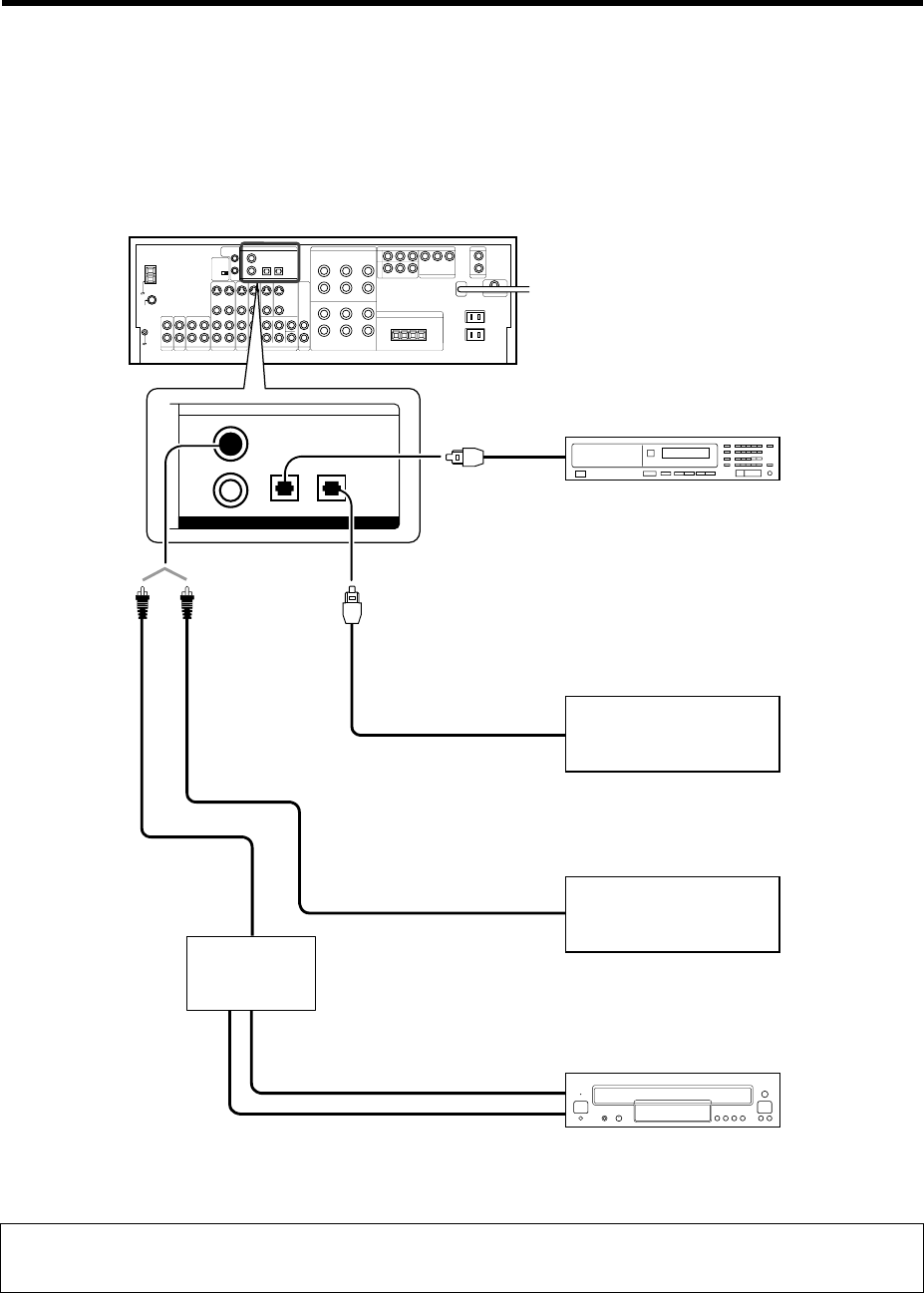
Digital connections
The digital in jacks can accept DTS, Dolby Digital, or PCM signals. Connect components capable of outputting DTS, Dolby Digital, or standard PCM (CD)
format digital signals.
If you have connected any digital components to the receiver, be sure to read the “Input mode settings” section carefully. 8
COAXIAL
DIGITAL
OUT
(AUDIO)
Connect the video signal and digital
audio signals to the VIDEO 3 jacks.
(See “Connecting video components”.)
0
DOLBY DIGITAL RF
OUT (AUDIO)
OPTICAL DIGITAL OUT (AUDIO)
LD player
PCM OUT
Component with DTS,
Dolby Digital, or PCM
OPTICAL DIGITAL OUT
Setting up the system
To connect an LD player with a DIGITAL RF OUT, connect the LD player to the KENWOOD RF digital demodulator (DEM-9991D).
Next, connect the DIGITAL OUT jacks of the demodulator to the DIGITAL IN jacks of the receiver.
Connect the video signal and analog audio signals to the VIDEO 2 or VIDEO 3 jacks. (See “Connecting video components”.)
RF digital
demodulator
(DEM-9991D)
(sold separately)
CD or DVD player
OPTICAL DIGITAL OUT (AUDIO)
Optical fiber cable
Component with DTS,
Dolby Digital, or PCM
COAXIAL DIGITAL OUT
Optical
fiber cable
COAXIAL DIGITAL OUT (AUDIO)
Connect the video signal and analog
audio signals to the VIDEO 2 jacks.
(See “Connecting video components”.)
0
•VR6060/09-20/EN 3/11/02, 8:48 PM11
12 EN
Setting up the system
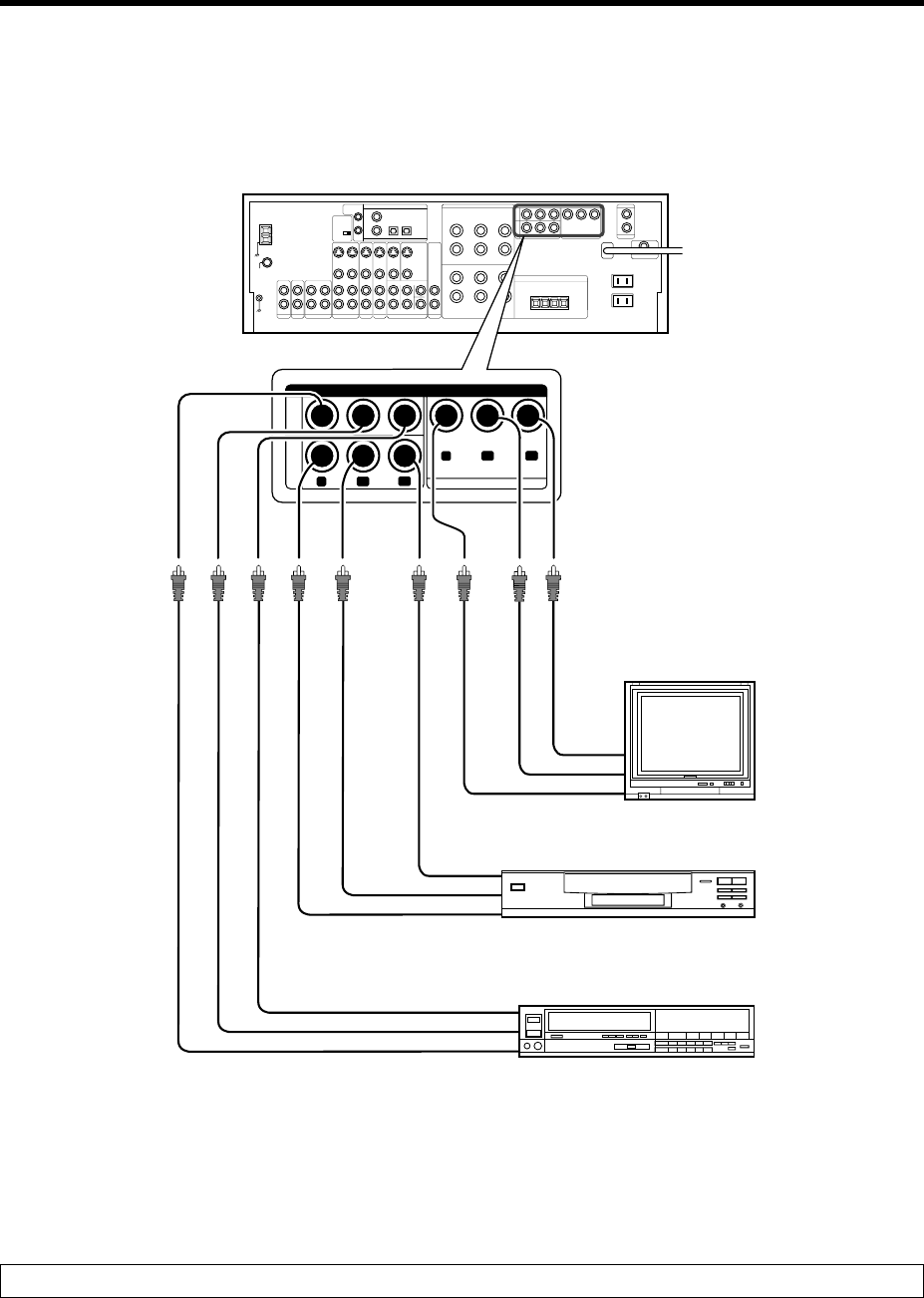
Connecting video components (COMPONENT VIDEO)
If you have connected the receiver to a video component with COMPONENT jacks, you can get a better picture quality than by connecting to the S-VIDEO
jacks.
When connecting the TV to the COMPONENT jacks, be sure to connect all the other components to the COMPONENT jacks.
Monitor TV
(with component jacks)
Video Recorder, DVD Recorder,
Satellite Cable Tuner & Game Player
(with component jacks)
DVD player (with component jacks)
• Connect to the VIDEO cord.
DVD
IN
VIDEO
3
IN
MONITOR OUT
CRCB
Y
CR
CB
Y
CR IN
CB IN
Y IN
CR OUT
CB OUT
Y OUT
CR OUT
CB OUT
Y OUT
COMPONENT VIDEO
•VR6060/09-20/EN 3/11/02, 8:48 PM12
13 EN
DVD/6CH INPUT
FRONT
SURROUND
COAXIAL OPTICAL OPTICAL
VIDEO 3CD/DVD
DVD
/6CH
VIDEO
2
SUB WOOFER
CENTER
PLAY INPLAY IN
DIGITAL IN
VIDEO 2 VIDEO 3
OUT
VIDEO
IN
VIDEO
IN
VIDEO
DVD
IN
IN
VIDEO
MONITOR
OUT
VIDEO
S VIDEO
IN
VIDEO
S VIDEO
IN
VIDEO
DVD
IN
MONITOR
OUT
S VIDEO
VIDEO
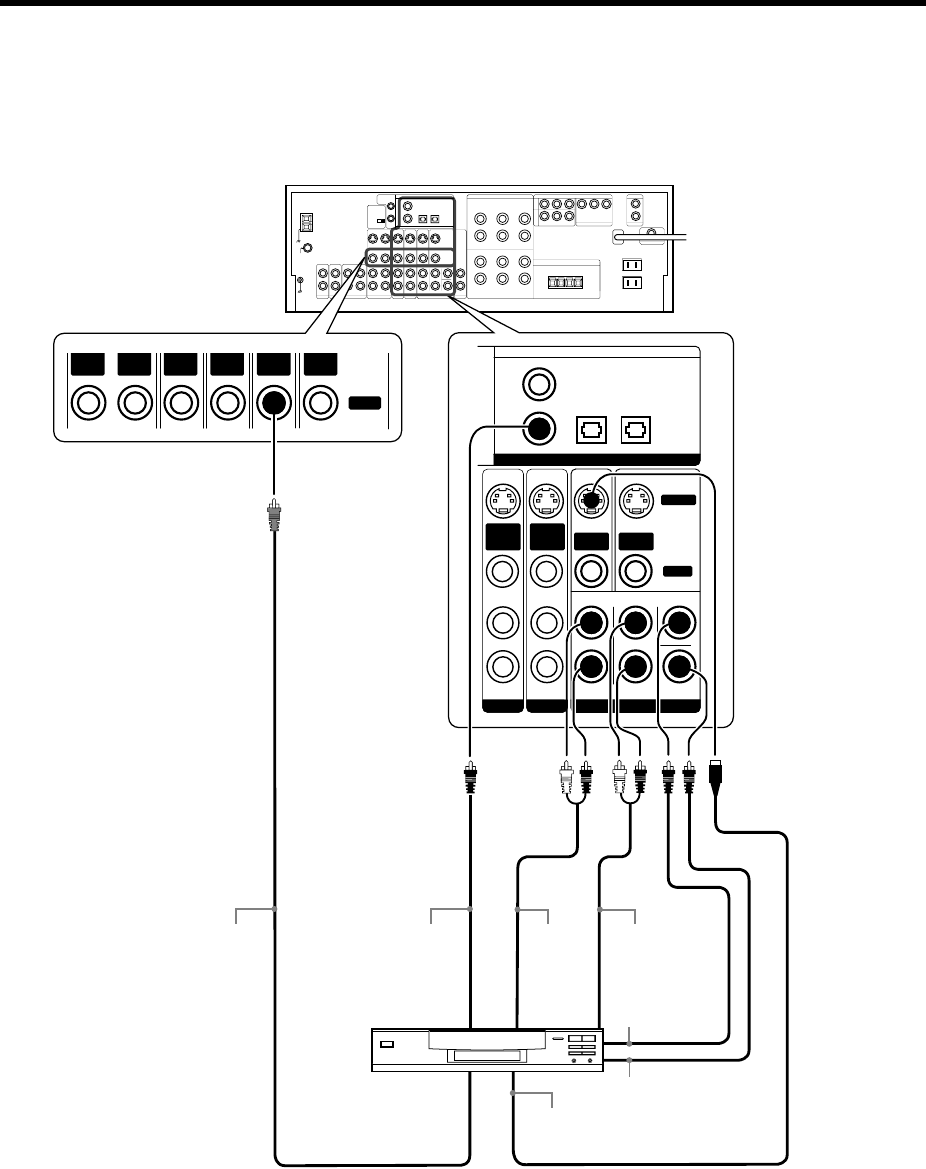
Connecting a DVD player (6-channel input)
If you have connected a DVD player to the receiver with digital connection, be sure to read the “Input mode settings” section carefully. 8
FRONT
OUT L/R
S VIDEO
OUT
COAXIAL
DIGITAL OUT
(AUDIO)
DVD player
S VIDEO cord
SURROUND
OUT L/R
VIDEO OUT
(Yellow RCA
pin cord)
CENTER
OUT
SUBWOOFER
OUT
Setting up the system
•VR6060/09-20/EN 3/11/02, 8:48 PM13
14 EN
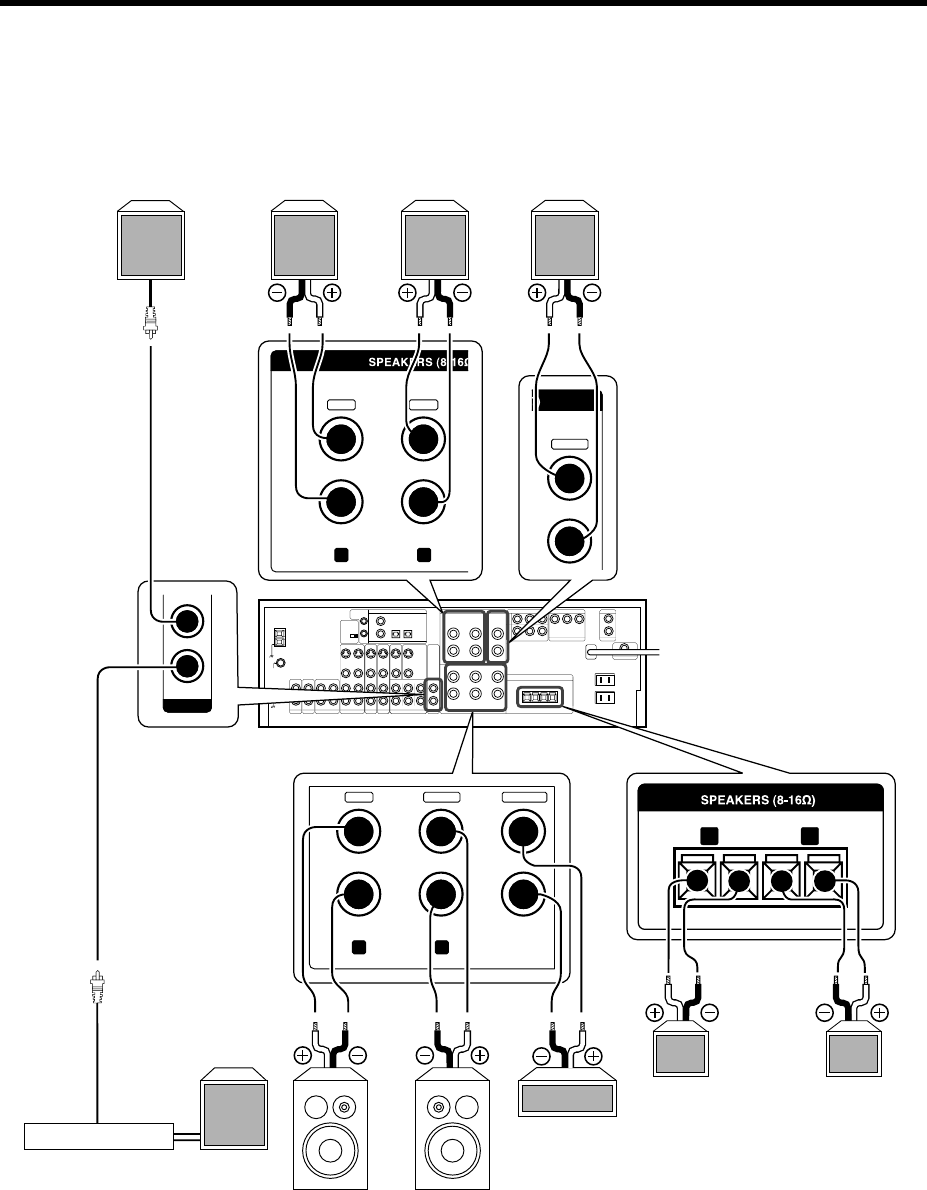
GREENWHITERED
RLCENTERFRONT A
-
+
++
--
FRONT B
RL
GRAY
SURROUND
RL
-
+
BLUE
PURPLE
SURROUND BACK/
SUBWOOFER
SURROUND BACK
SUBWOOFER
PRE OUT
Right
Front Speakers A
Right
Center
Speaker
Surround Speakers
(Be sure to connect both
surround speakers)
Power amplifier
Left
Surround Back/Subwoofer
Use this terminal if you wish to
connect to a Surround Back
speaker with the SETUP of
“6ch AMP SB” or to connect
to a subwoofer speaker with
the SETUP of “6ch AMP SW”.
Connecting the speakers
Setting up the system
Right
Front Speakers B
Surround
Back
Powered
subwoofer
Left
Left
•VR6060/09-20/EN 3/11/02, 8:48 PM14
15 EN
Setting up the system
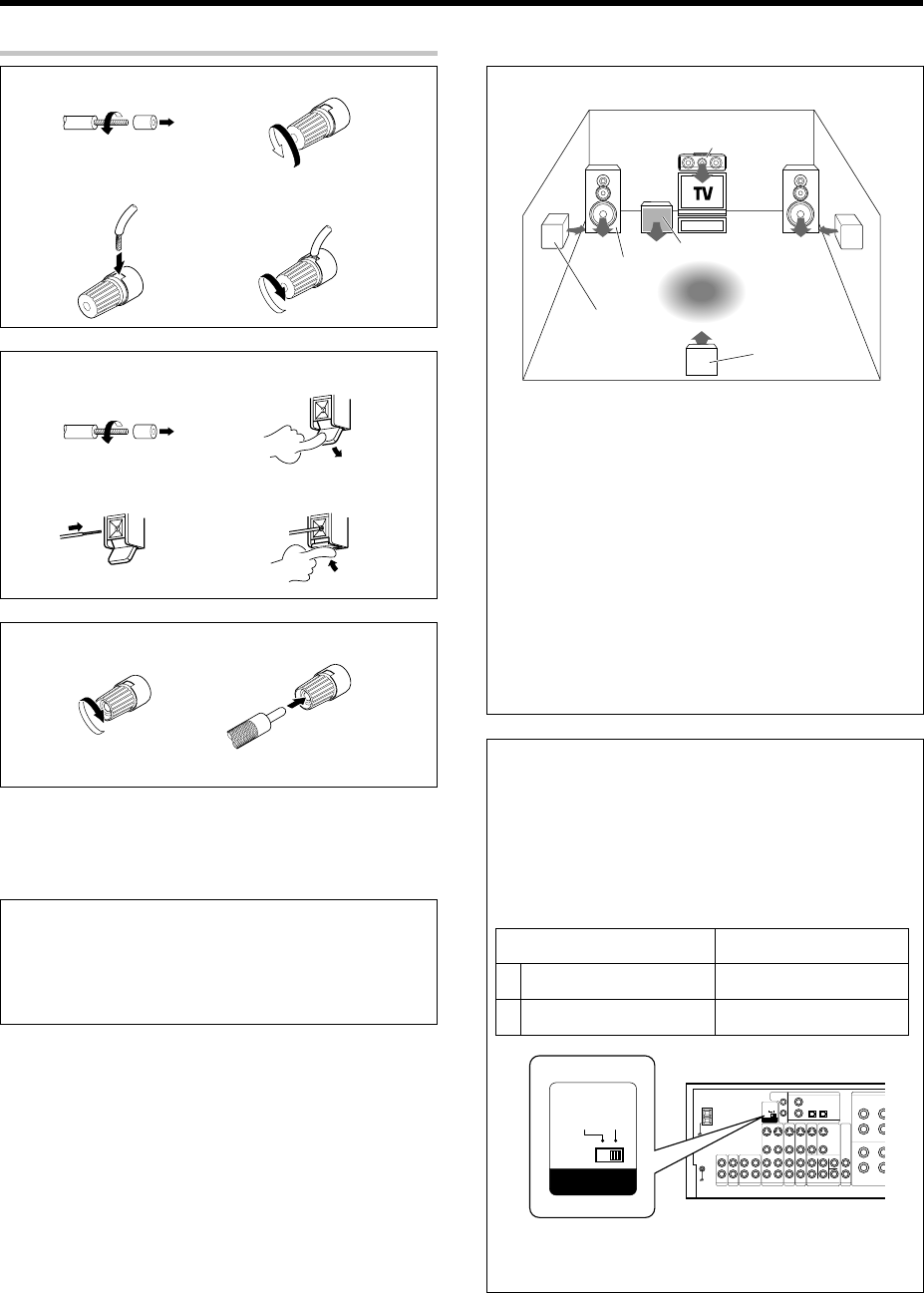
Connecting the terminals
1Strip coating. 2Loosen.
3Insert. 4Secure.
1Strip coating. 2Push the lever.
3Insert the cord. 4Return the lever.
Connection of banana plugs (For the U.S.A. and Canada)
1Secure. 2Insert.
•Sound will not be heard if the speaker terminal is not fully secured.
•Never short circuit the + and – speaker cords.
•If the left and right speakers are connected inversely or the speaker
cords are connected with reversed polarity, the sound will be
unnatural with ambiguous acoustic imaging. Be sure to connect the
speakers correctly.
Speaker impedance
After confirming the speaker impedance indications printed on the
rear panel of the receiver, connect speakers with matching imped-
ance ratings. Using speakers with a rated impedance other than that
indicated on the rear panel of the receiver could result in malfunctions
or damage to the speakers or receiver.
Speaker placement
Front speakers : Place at the front left and right of the listening
position. Front speakers are required for all surround modes.
Center speaker : Place front and center. This speaker stabilizes the
sound image and helps recreate sound motion. Required for surround
playback.
Surround speakers : Place at the direct left and right, or slightly
behind, the listening position at even heights, approximately 1 meter
above the ears of the listeners. These speakers recreate sound
motion and atmosphere. Required for surround playback.
Subwoofer : Reproduces powerful deep bass sounds.
Surround back speaker : Place the speaker directly at the rear of the
listening position. The optimum position depends mainly on the room
condition.
•Although the ideal surround system consists of all the speakers
listed above, if you don't have a center speaker or a subwoofer, you
can divide those signals between the available speakers in the
speaker settings steps to obtain the best possible surround repro-
duction from the speakers you have available. )
Channel space switching
(Except for the U.S.A., Canada, U.K., and Australia)
The space between radio channels has been set to the one that
prevails in the area to which the system is shipped. However, if the
current channel space setting does not match the setting in the area
where the system is to be used, for instance when you move from
area 1 or area 2 shown in the following table or vice versa, proper
reception of AM/FM broadcasts cannot be expected. In this case,
change the channel space setting in accordance with your area by
referring to the following table.
Area CHANNEL
Space Frequency
1U.S.A., Canada and South FM: 100 kHz
American countries AM: 10 kHz
2 Other countries FM: 50 kHz
AM: 9 kHz
75
50us
AM 9kHz
FM50kHz
75us
AM 10kHz
FM100kHz
DE-EMPHASIS
CHANNEL SPACE
DE-EMPHASIS
CHANNEL SPACE
50us
AM 9kHz
FM50kHz
75us
AM 10kHz
FM100kHz
Turn the power OFF by pressing the POWER key before moving the
switch level. Move switch lever to match your area with a small
screwdriver or other pointed tool, then turn the power on again.
Center speaker
Subwoofer
Front
speaker
Surround
speaker
Surround
back speaker
Listening
position
•VR6060/09-20/EN 3/11/02, 8:49 PM15
16 EN
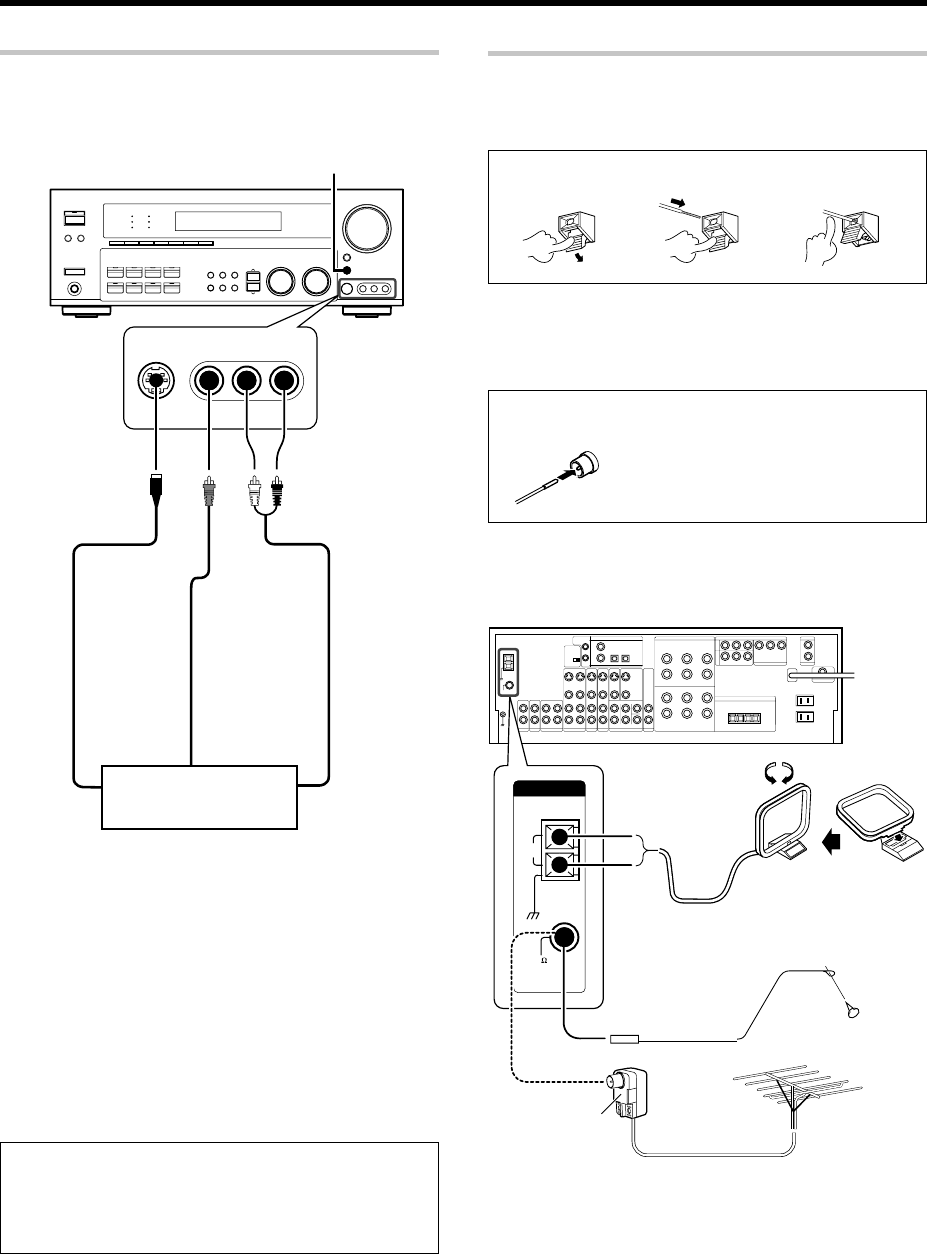
S VIDEO OUT
S VIDEO cord
VIDEO OUT
AUDIO OUT
Connecting the antennas
AM loop antenna
The supplied loop antenna is for use indoors. Place it as far as possible
from the receiver, TV set, speaker cords and power cord, and adjust the
direction for best reception.
AM antenna terminal connections
1Push lever. 2Insert cord. 3Release lever.
FM indoor antenna
The supplied indoor antenna is for temporary use only. For stable signal
reception we recommend using an outdoor antenna. Disconnect the
indoor antenna when you connect one outdoors.
FM antenna terminal connections
Insert cord.
FM outdoor antenna
Lead the 75Ω coaxial cable connected to the FM outdoor antenna into the
room and connect it to the FM 75Ω terminal.
FM
75
GND
AM
ANTENNA
AM loop antenna
FM indoor antenna
Use an antenna
adaptor
(Commercially
available)
Attach to the stand
Setting up the system
Connecting to the AV AUX jacks
The AV AUX jacks are convenient for connection of video components
such as a camcorder or a video game.
S VIDEO VIDEO L-AUDIO-R
AV AUX
•To select the source connected to the AV AUX jacks press AV
AUX key. £
•When you connect the audio source such as the MD player, you
do not need to connect the video cable.
•When you connect the unit and the component with the S
VIDEO cord, you can get better picture quality.
Camcorder, other VCR,
video game, digital camera,
or portable MD player
FM outdoor antenna
•VR6060/09-20/EN 3/11/02, 8:49 PM16
17 EN
Connecting the system control
Connecting system control cords after connecting a KENWOOD
audio component system lets you take advantage of convenient
system control operations.
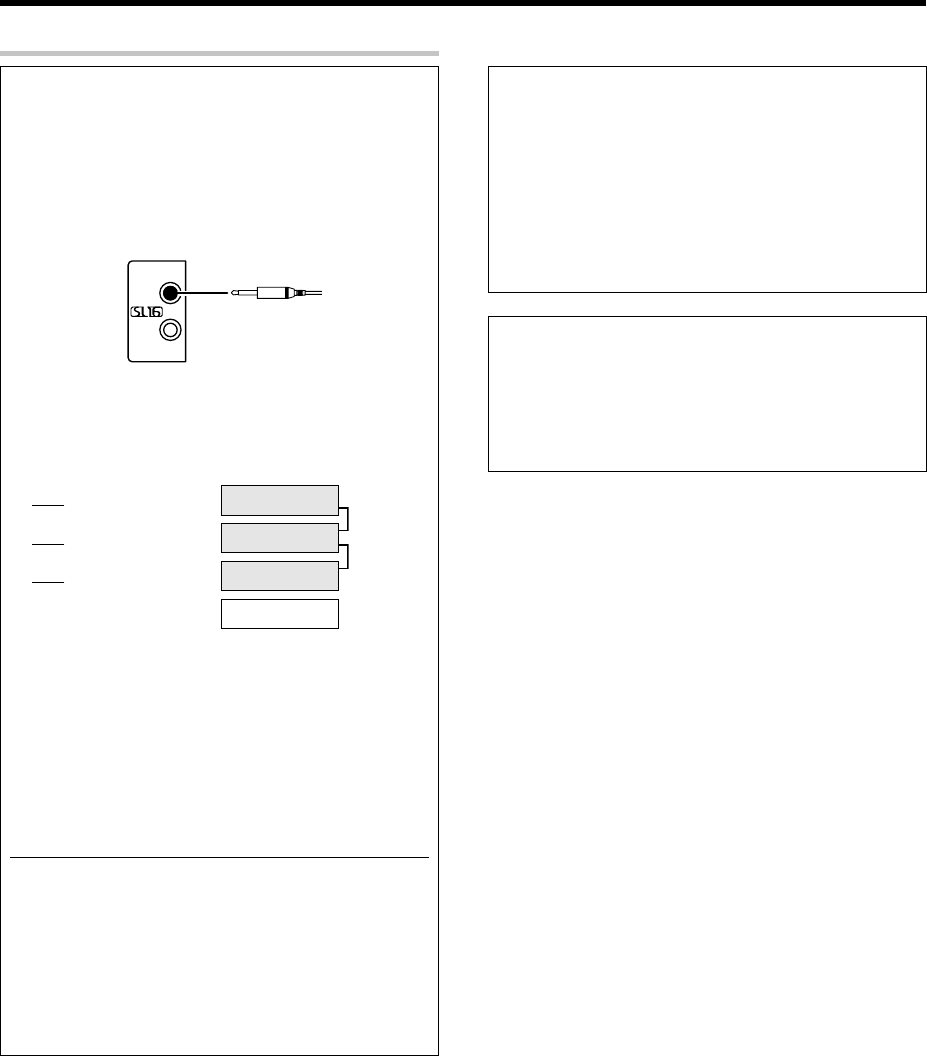
This unit is compatible only with the [SL-16] mode. The system
control operation is not available if the unit is connected in the
[XS8], [XS], or [XR] connection mode.
If your component has the mode select switch, set the connected
components to the [SL16] mode.
SYSTEM CONTROL
•You may connect the system control cord to either the up or down
jack.
EXAMPLE: [SL16] mode connections
The underlined portion represents the setting of the system control
mode.
[SL16] Receiver
[SL16] [XS] [XS8] [XR] Cassette deck
or MD recorder
[SL16] [XS] [XS8] CD player
[XS] Record player
•In order to take advantage of the system control operations, the
components must be connected to the correct jacks. To use a CD
player it must be connected to the CD jacks. To use a cassette deck
(or MD recorder) it must be connected to the MD/TAPE jacks. When
using more than one CD player (etc.) only the one connected to the
specified jacks may be connected for system control.
•Some CD players and cassette decks are not compatible with the
[SL16] system control mode. Do not make system connections with
equipment that is not [SL16] compatible.
•Some MD players are not system control compatible. You cannot
make system control connections to this kind of equipment.
Notes
1. [SL16] equipment cannot be combined with [XR], [XS], and [XS8]
equipment for system operations. If your equipment consists of
this kind of combination, please do not connect any system con-
trol cords. Even without system control cords, normal operations
can be carried out without effecting performance.
2. Do not connect system control cords to any components other
than those specified by KENWOOD. It may cause a malfunction
and damage your equipment.
3. Be sure the system control plugs are inserted all the way in to the
system control terminals.
SYSTEM
CONTROL
cord
SYSTEM CONTROL OPERATIONS
Remote Control
Lets you operate this unit with the system remote supplied with the
receiver.
Automatic Operation
When you start playback from a source component, the input selector
on this unit switches to that component automatically.
Synchronized Recording
Lets you synchronize recording with the start of playback when
recording from CD, MD or analog discs.
Registering setup codes for KENWOOD audio components
If you own remote controllable KENWOOD audio components that
are not compatible with system control, registering the setup code
enables you to control those components using the remote control
supplied with this unit (without connecting system control cords). To
register setup codes for your remote controllable KENWOOD audio
components, see “Registering setup codes for other components”.
fl
Setting up the system
SYSTEM CONTROL
cord
•VR6060/09-20/EN 3/11/02, 8:49 PM17
18 EN
Connecting the RF antenna and external IR Repeater (For VR-6060 only)
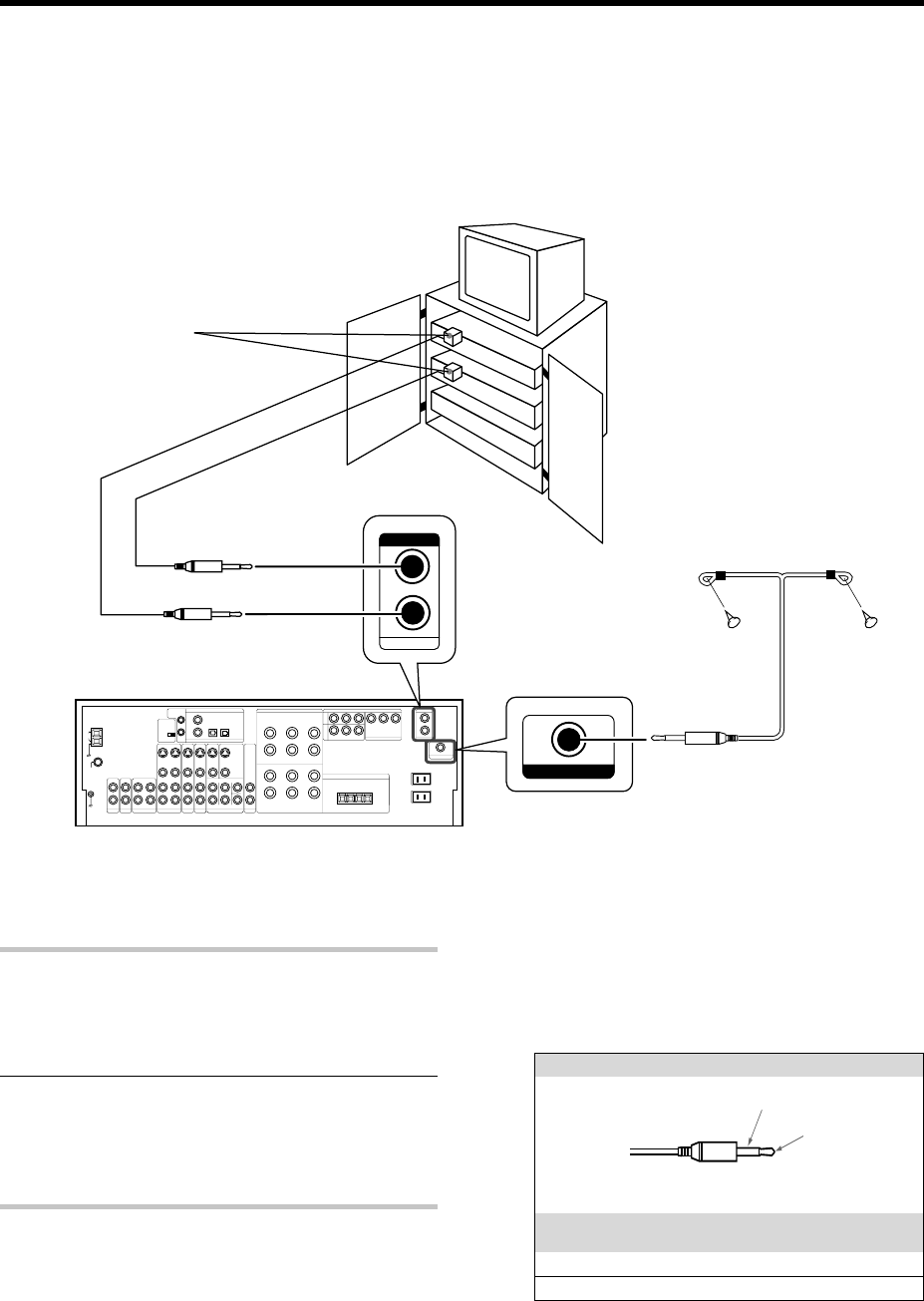
The remote control for this receiver has the RF (radio frequency) and IR (infrared rays) transmission function. IR repeaters enables you to control
components located in cabinets or behind glass doors. You can enjoy a wider remote control signal range by placing the RF antenna and IR repeater away
from the receiver.
KENWOOD components (except DVD player): System control &
Other components: (Registering setup codes) IR REPEATER fl
Setting up the system
RF REMOTE ANTENNA
OUT
IR REPEATER
RF antenna
Monitor TV
IR repeaters
Shape of plug to be connected.
IR REPEATER OUT
Mono Mini Plug
IR OUT SPECIFICATION:
Terminal IR REPEATER
OUT
To Tip Signal
To Sleeve Ground
Sleeve
Tip
(For RF Transmitter, select either
1. RF REMOTE Band 1, or
2. RF REMOTE Band 2)
Connecting IR repeater
1Connect the IR repeater to the device as described in the
repeater’s manual.
2Connect the IR repeater cable(s) to the IR REPEATER OUT
jack(s).
Notes
•IR repeaters send a signal similar to the device’s own remote control.
Xantech repeaters (models 282-00, 286-00, or 283-00) are compatible
with your new audio-video receiver.
Connecting the RF remote antenna
1Insert the jack of the provided RF remote antenna into the
RF REMOTE ANTENNA jack.
2Place the antenna wire vertically and fix it.
•Place the antenna away from the metallic panel.
•VR6060/09-20/EN 3/11/02, 8:49 PM18
19 EN
Preparing the remote control
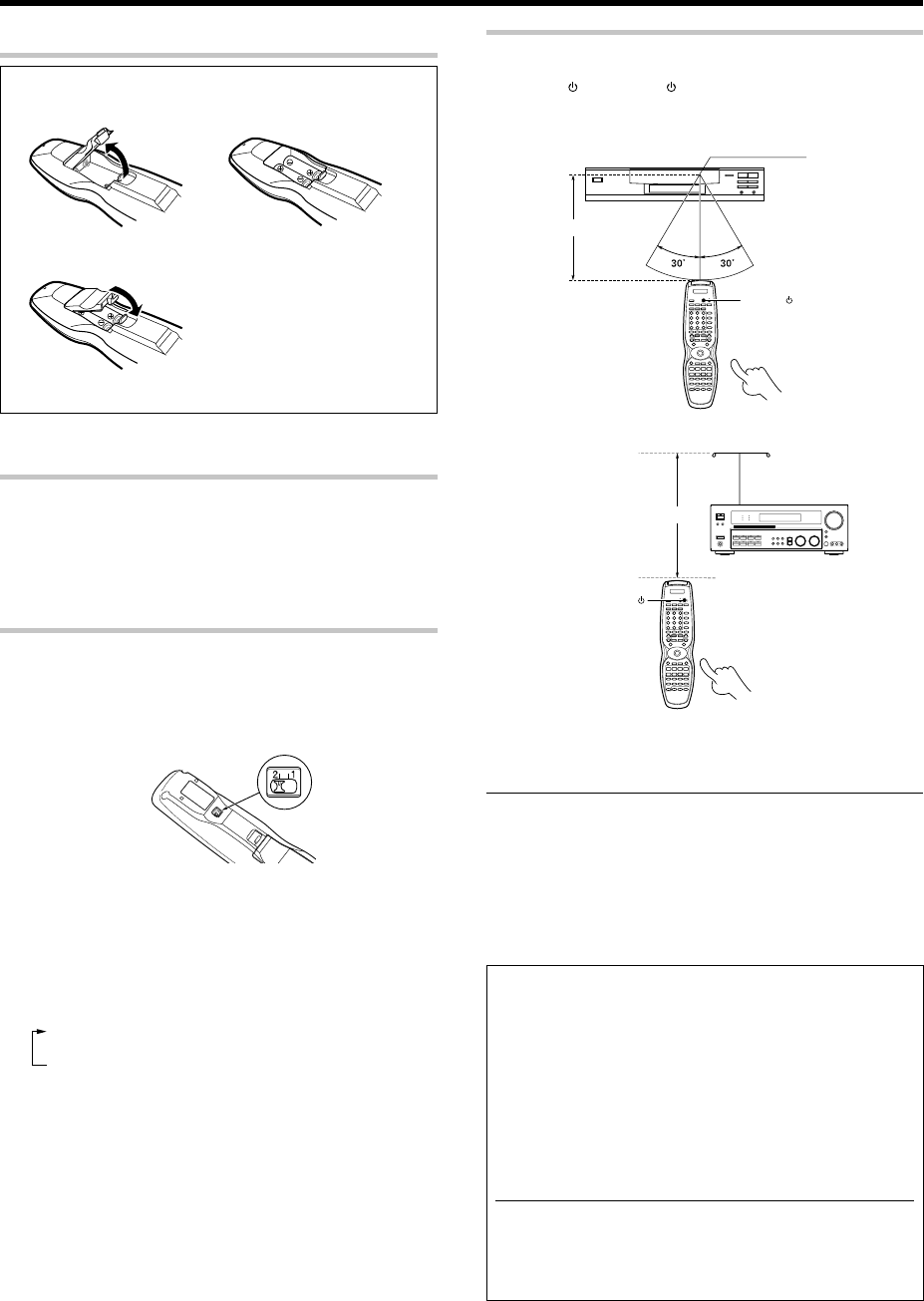
Loading the batteries
1Remove the cover. 2Insert the batteries.
3Close the cover.
•Insert two AA-size (R6) batteries as indicated by the polarity markings.
RF remote control function (For VR-6060 only)
The remote control has the RF remote function in addition to the IR
remote function. The VR-6060 can receive the remote control com-
mands even when they are installed in a position where the IR remote
signal can hardly access, for example inside a cabinet. The receiver is not
equipped with the RF remote bi-directional communication function. The
bi-directional communication is available only when using the IR remote
function with equipments other than the receiver.
Changing the RF transmission frequency
The RF remote function may be unavailable due to radio wave cross talk,
etc. In this case, the transmission frequency can be changed.
To change the RF remote transmission frequency:
1Change the RF switch setting.
After changing the RF frequency of remote control, be also sure to
change that of the receiver.
2Change the receiver’s RF reception frequency.
•Press and hold the SETUP key on the front panel of the receiver
for more than 2 seconds.
Each time you press the SETUP key, the RF reception frequency
changes as follows:
1“RF REMOTE BAND 1”
2“RF REMOTE BAND 2”
3“RF REMOTE OFF”
•Select the same number as the position number of the RF
switch of the remote control.
Setting up the system
Remote control operation
When the STANDBY indicator is lit, the power turns ON when you press
the POWER or SOURCE key on the remote control. When the
power comes ON, press the key you want to operate.
Operating other component range (IR Transmitter)
6 m
SOURCE
Operating receiver range (RF Transmitter)
POWER
•The remote control signal received by main unit IR and RF signals.
•When pressing more than one remote control key successively, press the
keys securely by leaving an interval of 1 second or more between keys.
Notes
1. The supplied batteries may have shorter lives than ordinary batteries
due to use during operation checks.
2. When the remote-controllable distance gets shorter than before, re-
place both batteries with new ones.
3. Placing the remote sensor in direct sunlight, or in direct light from a
high frequency fluorescent lamp may cause a malfunction.
In such a case, change the location of the system installation to pre-
vent malfunction.
Important notes
Here is list of adjustment which can maximize the operation of
your remote control. For optimal operation of the remote control:
1Aim the remote control toward the room where the receiver is
located.
2Do not position the receiver and remote control near metal (such
as heat ducts). Metal can absorb RF signals.
3Make sure the batteries in the remote control are fully charged.
Weak batteries will affect the range of the remote control.
4When there is an obstruction around other equipments that send
signal from the remote control, the control distance of the RF
remote signal will be short.
Note
•The tests for range limits of the remote control and the receiver are
conducted in open-air distance test. Actual distance of the signal will
be based on the construction of the building where the unit is being
used in as well as other factors such as outside interference.
IR Transmitter
RF Remote antenna
RF Transmitter
10 m
Remote sensor
•VR6060/09-20/EN 3/11/02, 8:49 PM19
20 EN
Preparing for surround sound
Speaker settings
To enable you to obtain optimum enjoyment from the receiver’s listening
modes, make sure to complete the speaker settings (subwoofer, front,
center, and surround speakers) as described below.
SETUP MULTI CONTROL
POWER ON/OFF
(KRF-V8060D)
POWER
SET UP
Joystick
(MULTI CONTROL 5/∞,
DOWN 2/UP3)
POWER
ON/STANDBY
(VR-6060)
ON/STANDBY
(KRF-V8060D)
1
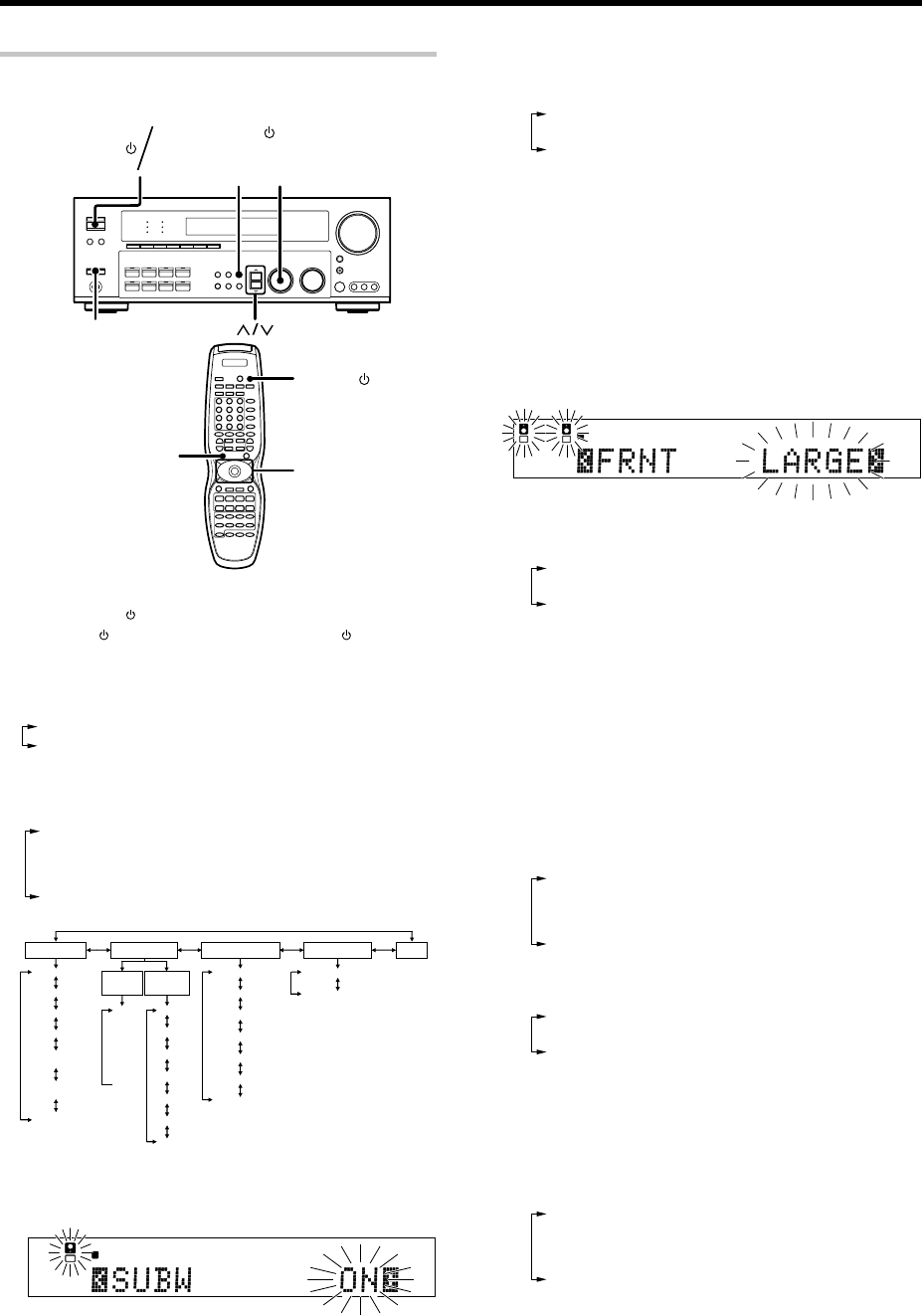
Turn on the power to this receiver by pressing the POWER
ON/STANDBY (for VR-6060) or POWER ON/OFF and ON/
STANDBY (for KRF-V8060D) key or POWER key.
2
Press the SETUP key to enter the SETUP mode.
The Surround Back and Subwoofer speaker output selections are
displayed as follows:
16ch AMP SB
26ch AMP SW
Use the MULTI CONTROL knob or Joystick (5/∞) to select the speakers.
Press the SETUP key to proceed to the next SET UP selection.
Use
MM
MM
M/??
??
?
keys or Joystick (
2
/
3
) for the following displays.
1SP SETUP
2TEST TONE
3SP DISTANCE
4DISP MODE
5EXIT
The flow of the SET UP is as follows:
SP SETUP TEST TONE SP DISTANCE EXITDISP MODE
Front Left
Center
Front Right
Surround Right
Surround Back
Surround Left
Subwoofer
Display Selector
Display Listen
Subwoofer
Front
Center
Surround
Surround
Back
Surround
Mix
Subwoofer
Re-mix
T. TONE
MANUAL
T. TONE
AUTO
L
C
R
SR
SL
SB
SW
L
C
R
SR
SL
SW
SB
3
Select a speaker system.
1Select the SP SETUP and press the SETUP key again so
that the subwoofer setting indication “SUBW ON” appears.
L
SL S SB SR
CR
SP MUTE
OPTICAL 6CH INPUT
COAXIAL ANALOG 96kHzfs
CINEMA EQ.
ACTIVE EQ.
DSP MODE
DTS.
MATRIX
DISCRETE
DOLBY DIGITAL
PRO LOGIC
STEREO
LOUDNESS
NEO:6
CSII
A B CLIP
AUTO DETECT THX
AUTO
RDS
RTY
MEMO
STEREO
TUNED
Surround EX
SW
LFE
2Use the MULTI CONTROL knob or Joystick (5/∞) to select
the appropriate subwoofer setting.
1SUBW ON : Subwoofer setting mode to the receiver is
ON.
2SUBW OFF : Subwoofer setting mode to the receiver is
OFF.
•The initial setting is “SUBW ON”.
•When the setting “SUBW OFF” is selected, the front speakers
are automatically set to “FRNT LARGE” and the procedure skips
to step 6.
Before step 6, press the SETUP key to accept the setting.
•When subwoofer output sound is required, select “FRNT
NORMAL”, or select both “FRNT LARGE” and “SW RE-MIX ON”.
•After setting SW (subwoofer) from OFF to ON, 6ch AMP setup
display will appear to enable you to re-select either SW or SB from
the surround back or subwoofer speaker terminal.
3Press the MM
MM
M key or Joystick (3) to accept the setting.
•The front speakers setting indication “FRNT” appears.
L
SL S SB SR
CR
SP MUTE
OPTICAL 6CH INPUT
COAXIAL ANALOG 96kHzfs
CINEMA EQ.
ACTIVE EQ.
DSP MODE
DTS.
MATRIX
DISCRETE
DOLBY DIGITAL
PRO LOGIC
STEREO
LOUDNESS
NEO:6
CSII
A B CLIP
AUTO DETECT THX
AUTO
RDS
RTY
MEMO
STEREO
TUNED
Surround EX
SW
LFE
4Use the MULTI CONTROL knob or Joystick (5/∞) to select
the appropriate front speakers setting.
1FRNT LARGE : Large front speakers are connected
to the receiver.
2FRNT NORMAL : Average size front speakers are con-
nected to the receiver.
•For “FRNT LARGE” selection, no sound will be heard from
subwoofer speaker even when it is set to ON. However, if you
select “SW RE-MIX ON” when subwoofer is selected, you will
be able to hear sound from the subwoofer.
When in STEREO mode, the sound goes directly to front
speaker.
5Press the MM
MM
M key or Joystick (3) to accept the setting.
•The center speaker setting indication “CNTR” appears.
6Use the MULTI CONTROL knob or Joystick (5/∞) to select
the appropriate center speaker setting.
If you selected “LARGE” as the front speakers setting,
1CNTR LARGE : A large center speaker is connected
to the receiver.
2CNTR NORMAL : An average size center speaker is
connected to the receiver.
3CNTR OFF : Center speaker setting mode to the
receiver is OFF.
If you selected “NORMAL” as the front speakers setting,
1CNTR ON : Center speaker setting mode to the re-
ceiver is ON.
2CNTR OFF : Center speaker setting mode to the re-
ceiver is OFF.
7Press the MM
MM
M key or Joystick (3) again to accept the setting.
•The surround speaker setting indication “SURR” appears.
8Use the MULTI CONTROL knob or Joystick (5/∞) to select
the appropriate surround speaker setting.
If you selected “LARGE” as the center speaker setting,
1SURR LARGE : Large surround speakers are con-
nected to the receiver.
2SURR NORMAL : Average size surround speakers are
connected to the receiver.
3SURR OFF : Surround speaker setting mode to
the receiver is OFF.
•VR6060/09-20/EN 3/11/02, 8:50 PM20
21 EN
Preparing for surround sound
If you selected other than “LARGE” as the center speaker setting,
1SURR ON : Surround speaker setting mode to the re-
ceiver is ON.
2SURR OFF : Surround speaker setting mode to the re-
ceiver is OFF.
• When the setting “SURR OFF” is selected, the procedure skips
to step #.
9Press the MM
MM
M key or Joystick (3) again to accept the setting.
• The surround speaker setting indication “SB” appears.
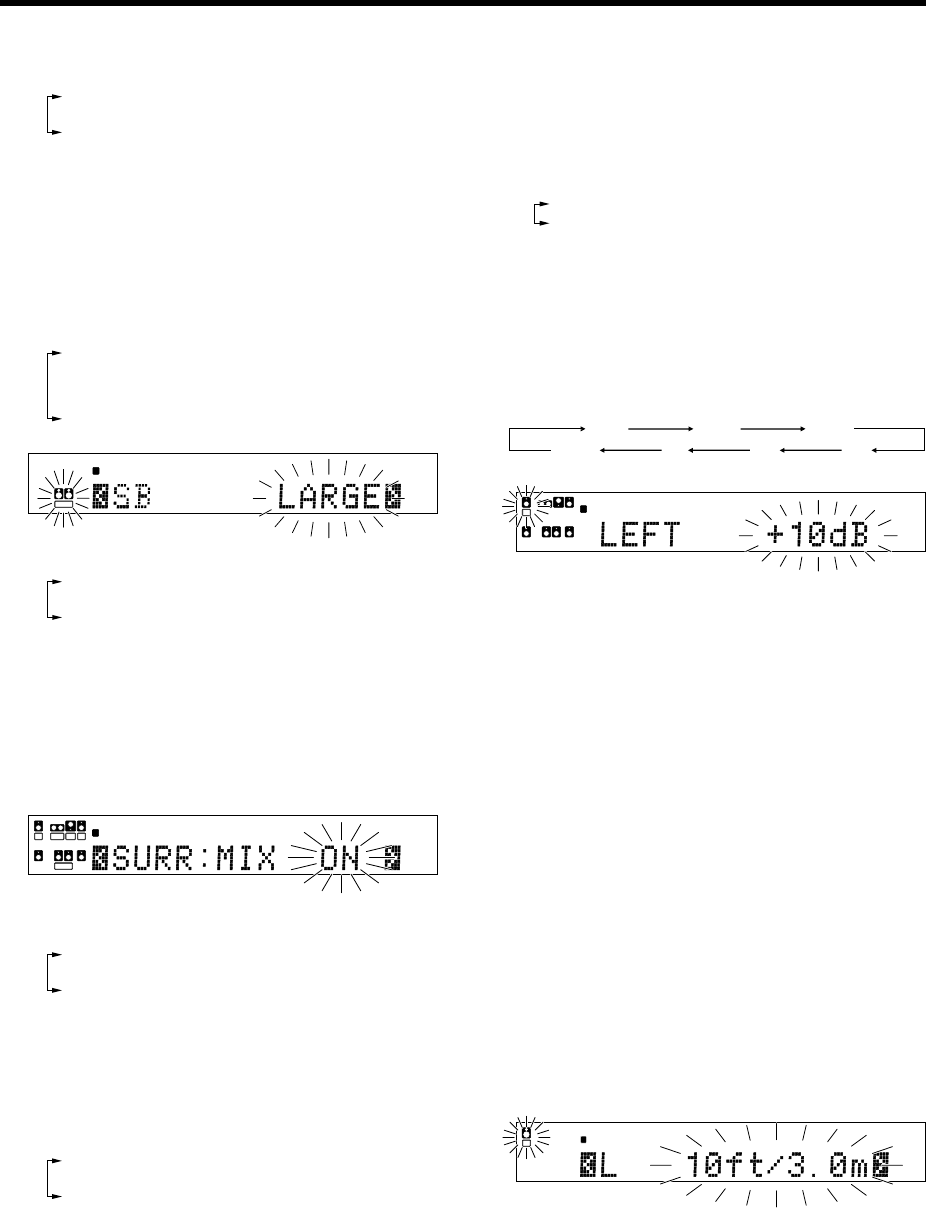
0Use the MULTI CONTROL knob or Joystick (5/∞) to select
appropriate surround back speaker setting.
If you selected “LARGE” as the surround speaker setting,
1SB NORMAL : Average size surround back speaker is
connected to the receiver.
2SB LARGE : Large surround back speaker is
connected to the receiver.
3SB OFF : Surround back speaker setting mode to
the receiver is OFF.
L
SL S SB SR
CR
SP MUTE
OPTICAL 6CH INPUT
COAXIAL ANALOG 96kHzfs
CINEMA EQ.
ACTIVE EQ.
DSP MODE
DTS.
MATRIX
DISCRETE
DOLBY DIGITAL
PRO LOGIC
STEREO
LOUDNESS
NEO:6
CSII
A B CLIP
AUTO DETECT THX
AUTO
RDS
RTY
MEMO
STEREO
TUNED
Surround EX
SW
LFE
If you selected “NORMAL” as the surround speaker setting,
1SB ON : Surround back speaker setting mode to the
receiver is ON.
2SB OFF : Surround back speaker setting mode to the
receiver is OFF.
• After setting SB (surround back) from OFF to ON, 6ch AMP setup
display will appear to enable you to re-select either SW or SB from
the surround back or subwoofer speaker terminal.
!Press the MM
MM
M key or Joystick (3) again to accept the setting
and “SURR:MIX” appears.
• Surr:mix is when the SL and SR speakers signals are mixed to
produce sound from the surround back speaker which would
enable the listener to enjoy sound coming from the back.
L
SL S SB SR
CR
SP MUTE
OPTICAL 6CH INPUT
COAXIAL ANALOG 96kHzfs
CINEMA EQ.
ACTIVE EQ.
DSP MODE
DTS.
MATRIX
DISCRETE
DOLBY DIGITAL
PRO LOGIC
STEREO
LOUDNESS
NEO:6
CSII
A B CLIP
AUTO DETECT THX
AUTO
RDS
RTY
MEMO
STEREO
TUNED
Surround EX
SW
LFE
@Use the MULTI CONTROL knob or Joystick (5/∞) to select
the following.
1SURR:MIX ON : Surround mix setting mode to the
receiver is ON.
2SURR:MIX OFF : Surround mix setting mode to the
receiver is OFF.
• If surround back speaker is turned OFF, SURR:MIX setting is not
visible and the procedure skips to step #.
#Press the MM
MM
M key or Joystick (3) again to accept the setting.
• The subwoofer remix setting indication “SW RE-MIX” appears.
$Use the MULTI CONTROL knob or Joystick (5/∞) to select
the appropriate subwoofer re-mix setting.
1SW RE-MIX ON : Subwoofer re-mix setting mode to
the receiver is ON.
2SW RE-MIX OFF : Subwoofer re-mix setting mode to
the receiver is OFF.
• If subwoofer is turned OFF, subwoofer re-mix setting is not visible.
%Press the SETUP key again to return to the main setup displays.
• The receiver enters the speaker volume level adjustment mode.
• In steps 4 and 5, indications appear only for the selected
channels of the speakers that require adjusting.
4
Adjust the speaker volume level.
From your usual listening position, adjust the volume levels. The
volume levels from each speaker should be the same.
1Press the MM
MM
M/??
??
? keys or Joystick (2/3) to select TEST TONE.
2Press the SETUP key for the following displays:
1T.TONE AUTO
2T.TONE MANUAL
3The selection of AUTO/MANUAL TEST TONE is done by the
MULTI CONTROL knob or Joystick (5/∞).
Press the SETUP key again to begin TEST TONE.
Use the MULTI CONTROL knob or Joystick (5/∞) to adjust
the volume level of the test tone output from the speaker
channel to be adjusted.
For AUTO selection, the first test tone is heard from the front left
speaker for 2.5 seconds. The next test tone is heard from the
speakers in the following sequence for 2 seconds each.
LEFT CNTR RIGHT
SRSBSLSUBW
The channel indication blinks while the test tone is being output.
L
SL S SB SR
CR
SP MUTE
OPTICAL 6CH INPUT
COAXIAL ANALOG 96kHzfs
CINEMA EQ.
ACTIVE EQ.
DSP MODE
DTS.
MATRIX
DISCRETE
DOLBY DIGITAL
PRO LOGIC
STEREO
LOUDNESS
NEO:6
CSII
A B CLIP
AUTO DETECT THX
AUTO
RDS
RTY
MEMO
STEREO
TUNED
Surround EX
SW
LFE
• If you change the volume level settings for the speakers while
listening to music, the settings referred to on this page are also
changed. ¤
• If the speaker setting selects are OFF, the speaker level settings
are reset.
For MANUAL selection, press the MM
MM
M/??
??
? keys or Joystick (2/3)
each time to select the speaker channel.
4Press the SETUP key again.
• The test tone is turned off and return to the main setup displays.
5
Input the distance to the speakers.
1Press the MM
MM
M/??
??
? keys or Joystick (2/3) to select the SP
DISTANCE on setup displays and press the SETUP key again.
2Measure the distance from the listening position to each of
the speakers.
Jot down the distance to each of the speakers.
Distance to Front left speaker (L) : ____ feet (meters)
Distance to Center speaker (C) : ____ feet (meters)
Distance to Front right speaker (R) : ____ feet (meters)
Distance to Surround right (SR) : ____ feet (meters)
Distance to Surround back (SB) : ____ feet (meters)
Distance to Surround left (SL) : ____ feet (meters)
Distance to Subwoofer (SW) : ____ feet (meters)
3Use the MM
MM
M/??
??
? keys or Joystick (2/3) to select the speakers
and the MULTI CONTROL knob or Joystick (5/∞) to adjust
the distance to the front speakers.
The speaker indicator to be adjusted blinks.
L
SL S SB SR
CR
SP MUTE
OPTICAL 6CH INPUT
COAXIAL ANALOG 96kHzfs
CINEMA EQ.
ACTIVE EQ.
DSP MODE
DTS.
MATRIX
DISCRETE
DOLBY DIGITAL
PRO LOGIC
STEREO
LOUDNESS
NEO:6
CSII
A B CLIP
AUTO DETECT THX
AUTO
RDS
RTY
MEMO
STEREO
TUNED
Surround EX
SW
LFE
• The allowable setting range is 1 to 30 feet (0.3 to 9.0 m),
adjustable in 1 foot (0.3 m) increments.
Indication in feet Indication in meters
Continued to next page.
•VR6060/21-28/EN 3/11/02, 8:50 PM21
22 EN
4Repeat steps 3 to input the distance for each of the speakers.
5Press the SETUP key again to return to main setup displays.
•The speakers you have selected should appear on the display.
Confirm that all the speakers have been correctly selected.
6
Select the display mode.
1Press the MM
MM
M/??
??
? key
or Joystick
( 2/3) to select the DISP MODE.
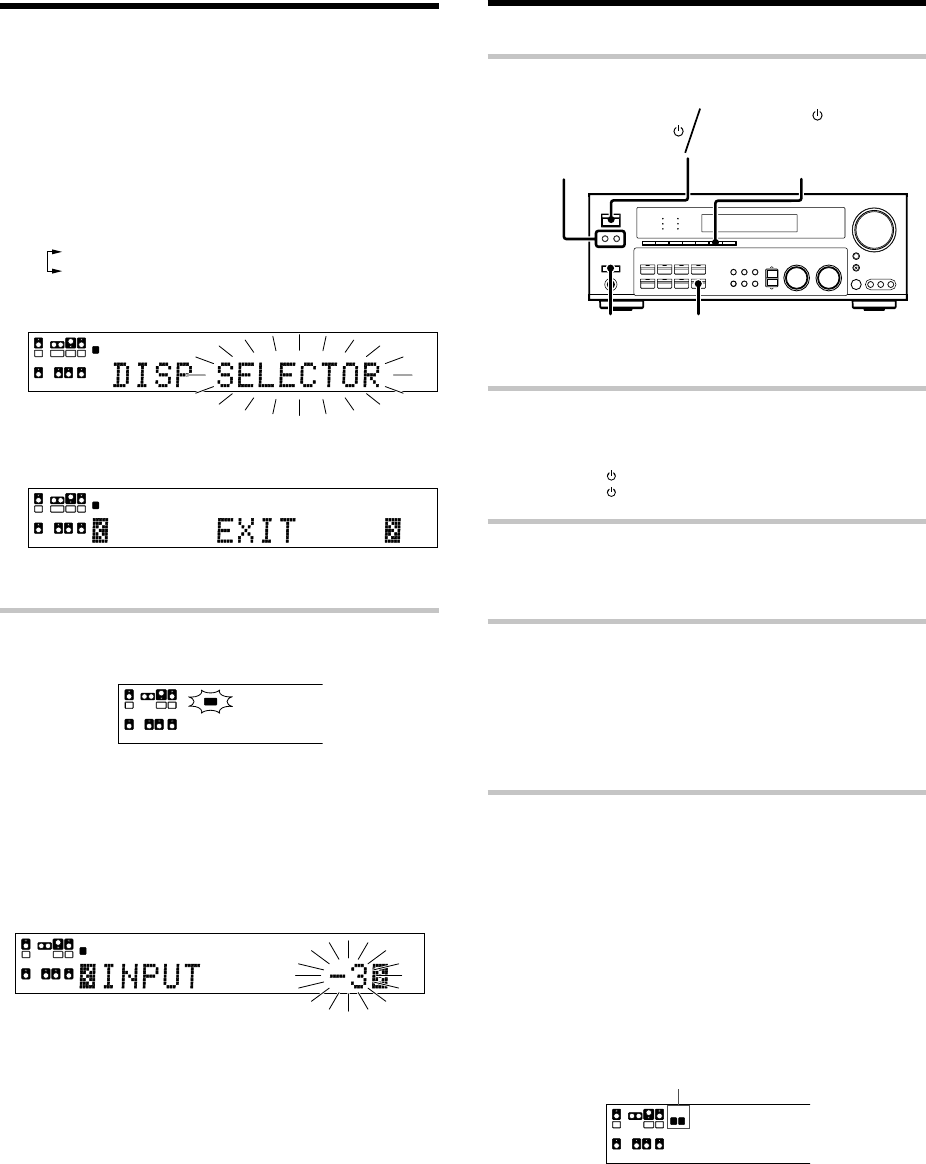
2Press the SETUP key for the following displays:
1DISP SELECTOR : Displays the current input selector.
2DISP LISTEN : Displays the current listen mode.
3Use the MULTI CONTROL knob or Joystick (5/∞) to select
the display mode.
SL S SB SR
SP MUTE
OPTICAL 6CH INPUT
COAXIAL ANALOG 96kHzfs
CINEMA EQ.
ACTIVE EQ.
DSP MODE
DTS.
MATRIX
DISCRETE
DOLBY DIGITAL
PRO LOGIC
STEREO
LOUDNESS
NEO:6
CSII
A B CLIP
AUTO DETECT THX
AUTO
RDS
RTY
MEMO
STEREO
TUNED
Surround EX
LFE
LC RSW
4Press the SETUP key again to accept the setting.
5Use the MM
MM
M key or Joystick (3) to select EXIT.
LC R
SP MUTE
OPTICAL 6CH INPUT
COAXIAL ANALOG 96kHzfs
CINEMA EQ.
ACTIVE EQ.
DSP MODE
DTS.
MATRIX
DISCRETE
DOLBY DIGITAL
PRO LOGIC
STEREO
LOUDNESS
NEO:6
CSII
A B CLIP
AUTO DETECT THX
AUTO
RDS
RTY
MEMO
STEREO
TUNED
Surround EX
SW
LFE
SL S SB SR
6Press the SETUP key to exit the SET UP mode.
Input level adjustment (analog sources only)
If the input level of an analog source signal is too high, the CLIP indicator
will blink to indicate the source signal. Adjust the input level.
L
SL S SB SR
CR
SP MUTE
OPTICAL 6CH INPUT
COAXIAL ANALOG 96kHzfs
CINE
M
ACTI
V
DSP
M
A B CLIP
AUTO DETECT
SW
LFE
CLIP
CLIP
1Use the Input Selector keys to select the source of which the
input level you want to adjust.
•You can store a separate input level for each input source.
2Press the SOUND and MM
MM
M/??
??
? keys
or Joystick
(2/3) repeatedly
until the “INPUT” indication appears.
3
Use the MULTI CONTROL knob or Joystick
(5/∞)
to adjust the
input level.
L
SL S SB SR
CR
SP MUTE
OPTICAL 6CH INPUT
COAXIAL ANALOG 96kHzfs
CINEMA EQ.
ACTIVE EQ.
DSP MODE
DTS.
MATRIX
DISCRETE
DOLBY DIGITAL
PRO LOGIC
STEREO
LOUDNESS
NEO:6
CSII
A B CLIP
AUTO DETECT THX
AUTO
RDS
RTY
MEMO
STEREO
TUNED
Surround EX
SW
LFE
•The adjustment mode is displayed for approximately 8 seconds.
•The input level may be adjusted to any one of three settings:
0dB, -3dB, and -6dB. (The initial setting is 0dB.)
4Press the SOUND key again to return to the input indication.
Preparing for surround sound
Preparing for playback
Some preparatory steps are needed before starting playback.
INPUT MODE
MD/TAPE
POWER ON/OFF
(KRF-V8060D)
A SPEAKERS B
POWER
ON/STANDBY
(VR-6060)
ON/STANDBY
(KRF-V8060D)
Turning on the receiver
1Turn on the power to the related components.
2Turn on the power to this receiver by pressing the POWER
ON/STANDBY key (for VR-6060) or POWER ON/OFF and
ON/STANDBY (for KRF-V8060D) key.
Selecting the input mode
If you have selected a component connected to the CD/DVD, VIDEO 2,
VIDEO 3 or DVD/6CH jacks, make sure that the input mode setting is
correct for the type of audio signal to be used. 8
Selecting MD/TAPE
Select the source name corresponding to the component connected
to the MD/TAPE jacks. The initial factory setting is “TAPE”. To
change the source to “MD”, follow the steps below:
Hold down the MD/TAPE key for more than 2 seconds.
•The source indication changes to “MD”.
•To return to the original indication, repeat the above procedure.
Selecting the speaker system
Press the A SPEAKERS B key to select the speaker system to be
used.
A ON :
Sound from the speakers connected to the SPEAKERS A
terminals on the rear panel.
B ON : Sound from the speakers connected to the SPEAKERS B
terminals on the rear panel. No sound will be heard from
the subwoofer.
A+B ON : Sound from both the speakers connected to the
SPEAKERS A and B terminals on the rear panel.
A+B OFF : No sound from the speakers. Use this setting when
listening with headphones for stereo sound in all playback
modes. The display segments are different depending on
the type of input signal.
The indicator for the speakers
you want to use should be lit.
L
SL S SB SR
CR
SP MUTE
OPTICAL 6CH INPUT
COAXIAL ANALOG 96kHzfs
CINEM
ACTIV
DSP M
A B CLIP
AUTO DETECT
SW
LFE
•Selecting “6CH INPUT” by pressing the INPUT MODE key, whereby
“DVD/6CH” is the input source will cause SPEAKERS A to be selected
automatically.
Normal playback
•VR6060/21-28/EN 3/11/02, 8:51 PM22
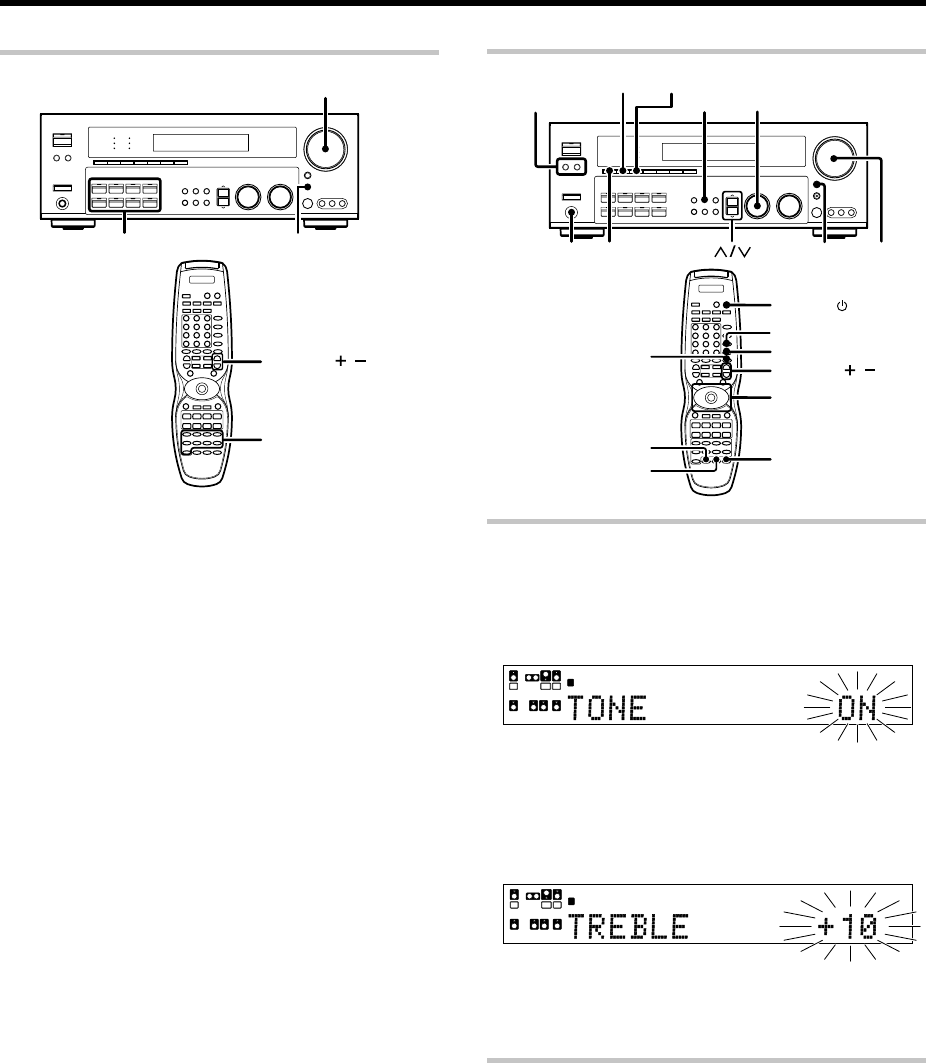
23 EN
Listening to a source component
VOLUME CONTROL
VOLUME /
INPUT SELECTOR
Input Selector AV AUX
1
Use the Input Selector and AV AUX keys to select the
source you want to listen to.
Selecting a source using each key.
1“DVD/6CH”
2“CD/DVD”
3“PHONO”
4“TUNER”
5“VIDEO 1”
6“VIDEO 2”
7“VIDEO 3”
8“MD/TAPE”
9“AV AUX”
2
Start playback from the selected source.
3
Use the VOLUME CONTROL knob or VOLUME +/
-
keys to
adjust the volume.
Normal playback
Adjusting the sound
LOUDNESS
TONE BASS BOOST
TONE
VOLUME
CONTROL
MUTE
A SPEAKERS B
SPEAKER EQ ACTIVE EQ
PHONES LOUDNESS
MULTI CONTROL
VOLUME /
POWER
SPEAKER EQ
ACTIVE EQ
MUTE
Joystick
(MULTI CONTROL5/∞,
DOWN 2/UP3)
Adjusting the TONE
You can adjust the sound quality when the receiver is in the PCM stereo
and analog stereo mode.
1Press the TONE key to select the TONE mode.
2Use the MULTI CONTROL knob or Joystick (5/∞) to select
TONE ON/OFF.
L
SL S SB SR
CR
SP MUTE
OPTICAL 6CH INPUT
COAXIAL ANALOG 96kHzfs
CINEMA EQ.
ACTIVE EQ.
DSP MODE
DTS.
MATRIX
DISCRETE
DOLBY DIGITAL
PRO LOGIC
STEREO
LOUDNESS
NEO:6
CSII
A B CLIP
AUTO DETECT THX
AUTO
RDS
RTY
MEMO
STEREO
TUNED
Surround EX
SW
LFE
3When in TONE ON selection, press the TONE key for the
following displays.
BASS : Select this to adjust the low frequency range.
TREBLE : Select this to adjust the high frequency range.
4Use the MULTI CONTROL knob or Joystick (5/∞) to adjust the
sound quality.
L
SL S SB SR
CR
SP MUTE
OPTICAL 6CH INPUT
COAXIAL ANALOG 96kHzfs
CINEMA EQ.
ACTIVE EQ.
DSP MODE
DTS.
MATRIX
DISCRETE
DOLBY DIGITAL
PRO LOGIC
STEREO
LOUDNESS
NEO:6
CSII
A B CLIP
AUTO DETECT THX
AUTO
RDS
RTY
MEMO
STEREO
TUNED
Surround EX
SW
LFE
•The bass and treble levels are adjustable from -10 to +10 in 2 step
increments.
•The adjustment item is displayed for approximately 8 seconds.
Once-touch low frequency emphasis (BASS BOOST)
(remote control only)
You can adjust the sound quality when the receiver is in the PCM stereo
and analog stereo modes.
Press the BASS BOOST key.
•Press the key once to select the maximum (+10) low frequency
emphasis setting.
•This key does not function when the receiver is in the sound quality
or ambience effects adjustment mode.
Switching back to the previous setting
Press the BASS BOOST key again.
•VR6060/21-28/EN 3/11/02, 8:51 PM23
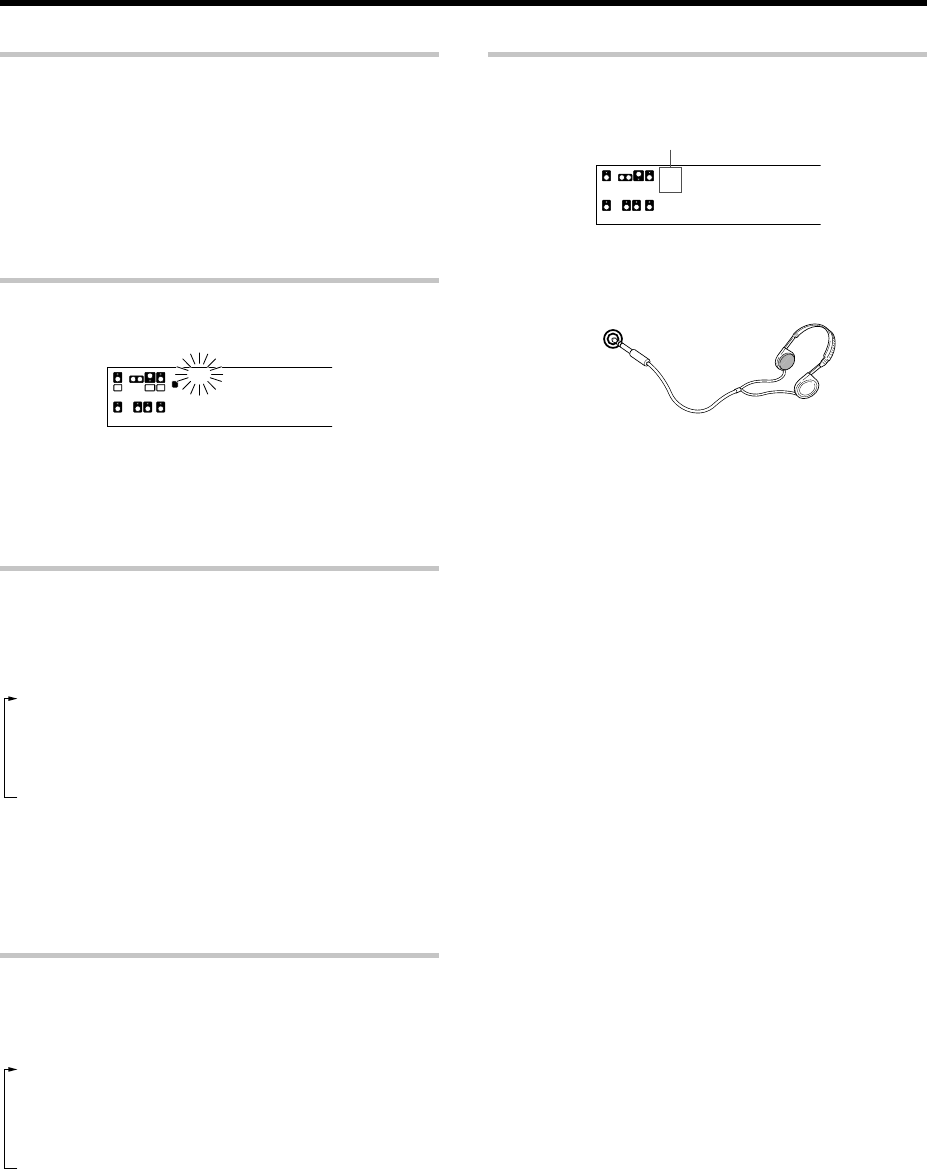
24 EN
Adjusting the LOUDNESS mode
You can adjust the Loudness function which controls the low volume
settings to maintain the music's richness. The adjustment can be made
when the receiver is in the PCM stereo and analog stereo mode.
Press the LOUDNESS key to turn the LOUDNESS setting ON.
To cancel
Press the LOUDNESS key again so that the “LOUDNESS”
indicator goes off.
Muting the sound
The MUTE key lets you mute the sound of the speakers.
Press the MUTE key.
L
SL S SB SR
CR
MUTE
OPTICAL 6CH INPUT
COAXIAL ANALOG 96kHzfs
CINEMA EQ.
ACTIVE EQ.
DSP MODE
D
A B CLIP
AUTO DETECT
SW
LFE
SP
Blinks
To cancel
Press the MUTE key again so that the “MUTE” indicator goes off.
•MUTE ON can also be deactivated by turning the VOLUME
CONTROL knob or pressing VOLUME +/– keys.
ACTIVE EQ mode
You can enjoy a more impressive sound effect when ACTIVE EQ is
turned ON during Dolby Digital and DTS playback and, when in PCM and
analog stereo mode.
Press the ACTIVE EQ key for the following selections;
1ACTIVE EQ MUSIC : Effective when listening to music.
(The ACTIVE EQ indicator lights up.)
2ACTIVE EQ CINEMA : Effective when watching a movie.
(The ACTIVE EQ indicator lights up.)
3ACTIVE EQ TV : Effective when watching TV.
(The ACTIVE EQ indicator lights up.)
4ACTIVE EQ OFF : The ACTIVE EQ function is turned OFF.
(The ACTIVE EQ indicator goes off.)
•
“ACTIVE EQ”
will scroll from right to left.
•When ACTIVE EQ and SPEAKER EQ are OFF and ACTIVE EQ
(MUSIC) is turned ON, SPEAKER EQ (SMALL) will turn ON
automatically.
•ACTIVE EQ function will not be available when REC MODE, AUTO
TUNING or PRESET MEMORY is ON, and during 96kHz LPCM playback.
SPEAKER EQ mode
SPEAKER EQ’s function will automatically detect the various features of
each speaker and effectively creates a stereoscopic sound effect.
Press the SPEAKER EQ key to switch the following setting;
1SPEAKER EQ SMALL : To select a small size speaker.
(The SPEAKER EQ indicator lights up.)
2SPEAKER EQ NORMAL : To select an average size speaker.
(The SPEAKER EQ indicator lights up.)
3SPEAKER EQ LARGE : To select a large size speaker.
(The SPEAKER EQ indicator lights up.)
4SPEAKER EQ OFF : The SPEAKER EQ function is turned
OFF.
(The SPEAKER EQ indicator goes off.)
•
“SPEAKER EQ”
will scroll from right to left.
•
SPEAKER
EQ cannot be turned OFF when ACTIVE EQ is turned ON.
•
SPEAKER EQ
function will not be available when REC MODE, AUTO
TUNING or PRESET MEMORY is ON, and during 96kHz LPCM
playback.
Normal playback
Listening with headphones
1
Press the A and B Speaker keys so that the speaker indicator
goes off.
Make sure the SPEAKERS
indicators are turned off.
SL S SB SR
SP MUTE
OPTICAL 6CH INPUT
COAXIAL ANALOG 96kHzfs
CINEMA EQ.
ACTIVE EQ.
DSP MODE D
A B CLIP
AUTO DETECT
LFE
•If you turn off all of the speakers when in surround mode, the surround
mode will be canceled as well, resulting in stereo playback.
2Connect headphones to the PHONES jack.
PHONES
3Use the VOLUME CONTROL knob or VOLUME +/
–
keys to
adjust the volume.
•VR6060/21-28/EN 3/11/02, 8:51 PM24
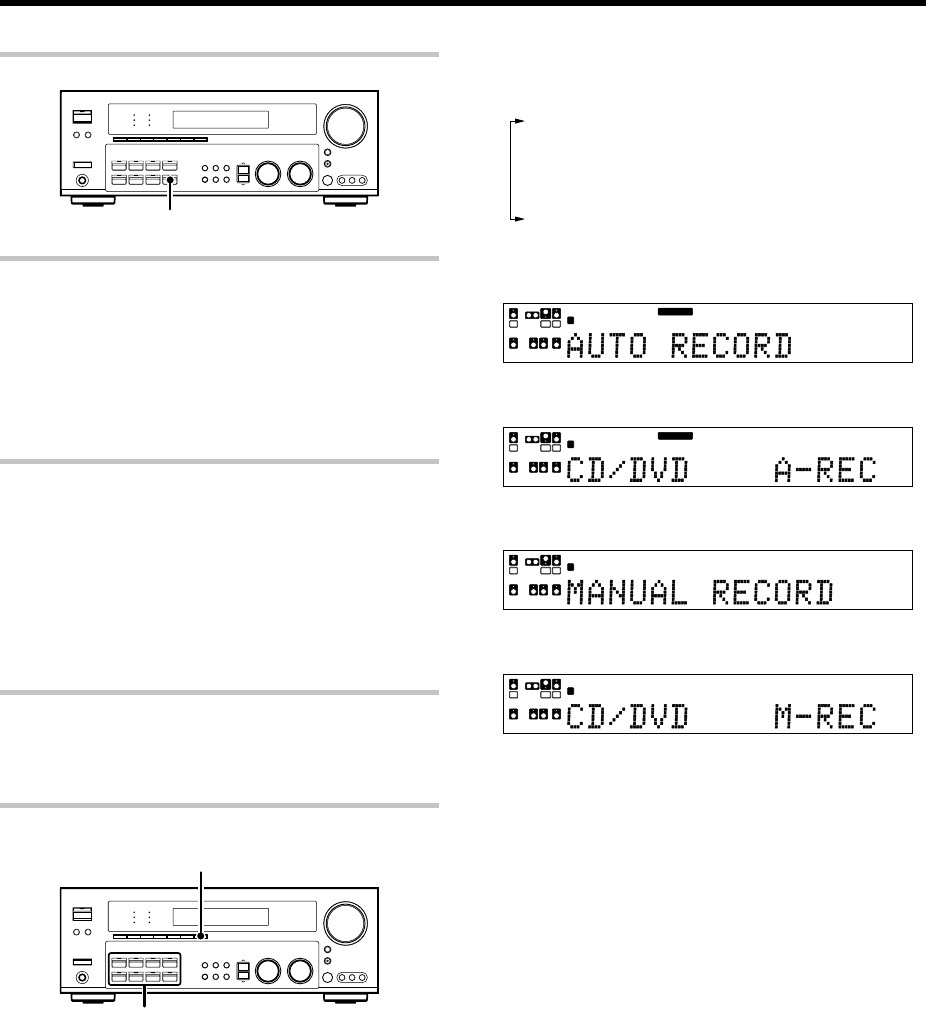
25 EN
Recording audio (analog sources)
MD/TAPE
Recording a music source
1Use the Input Selector keys to select the source (other than “MD/
TAPE”) you want to record.
2Set the MD or TAPE recorder to record.
3Start playback, then start recording.
Recording video
1Use the Input selector keys to select the video source (other than
“VIDEO 1”) you want to record.
2Set the video deck connected to VIDEO 1 to record.
•Select the REC MODE to record a digital input source.
3Start playback, then start recording.
•Recording may not be normal for some video software. This is due
to the copy guard condition. ‚
Recording audio (digital sources)
Switch on the REC MODE to record a digital input source.
Usually use the AUTO REC MODE to record audio input sources. When
the digital mode changes during recording in the AUTO REC MODE, the
audio input source may be interrupted momentarily.
Recording music in AUTO REC or MANUAL REC mode
Input Selector
DIMMER
1Use the Input Selector keys to select the source (CD/DVD,
DVD/6CH, VIDEO 2, VIDEO 3) you want to record.
2Set the MD or TAPE recorder to record.
Recording
3Press and hold the DIMMER key for more than 2 seconds to
select the AUTO REC or MANUAL REC mode.
1REC MODE off : The digital input record mode is
switched off.
2AUTO REC mode : The digital input signals (DTS, Dolby
Digital, or PCM) are identified auto-
matically and converted into stereo
signals that are ready for recording.
3MANUAL REC mode : The input signal type at the moment
this mode is selected is held through-
out this mode.
For AUTO REC mode :
L
SSB
SL SR
CR
SP MUTE
OPTICAL 6CH INPUT
COAXIAL ANALOG 96kHzfs
CINEMA EQ.
ACTIVE EQ.
DSP MODE
DTS.
MATRIX
DISCRETE
DOLBY DIGITAL
PRO LOGIC
STEREO
LOUDNESS
NEO:6
CSII
A B CLIP
AUTO DETECT THX
AUTO
RDS
RTY
MEMO
STEREO
TUNED
Surround EX
SW
LFE
↓
L
SSB
CR
SP MUTE
OPTICAL 6CH INPUT
COAXIAL ANALOG 96kHzfs
CINEMA EQ.
ACTIVE EQ.
DSP MODE
DTS.
MATRIX
DISCRETE
DOLBY DIGITAL
PRO LOGIC
STEREO
LOUDNESS
NEO:6
CSII
A B CLIP
AUTO DETECT THX
AUTO
RDS
RTY
MEMO
STEREO
TUNED
Surround EX
SW
LFE
SL SR
For MANUAL REC mode :
L
SL S SB SR
CRSW
LFE
SP MUTE
OPTICAL 6CH INPUT
COAXIAL ANALOG 96kHzfs
CINEMA EQ.
ACTIVE EQ.
DSP MODE
DTS.
MATRIX
DISCRETE
DOLBY DIGITAL
PRO LOGIC
STEREO
LOUDNESS
NEO:6
CSII
A B CLIP
AUTO DETECT THX
AUTO
RDS
RTY
MEMO
STEREO
TUNED
Surround EX
↓
L
SL S SB SR
CRSW
LFE
SP MUTE
OPTICAL 6CH INPUT
COAXIAL ANALOG 96kHzfs
CINEMA EQ.
ACTIVE EQ.
DSP MODE
DTS.
MATRIX
DISCRETE
DOLBY DIGITAL
PRO LOGIC
STEREO
LOUDNESS
NEO:6
CSII
A B CLIP
AUTO DETECT THX
AUTO
RDS
RTY
MEMO
STEREO
TUNED
Surround EX
4Start playback, then start recording.
•If the audio reproduction stops in the middle due to change in the
input signals, etc., press the DIMMER key.
•VR6060/21-28/EN 3/11/02, 8:51 PM25
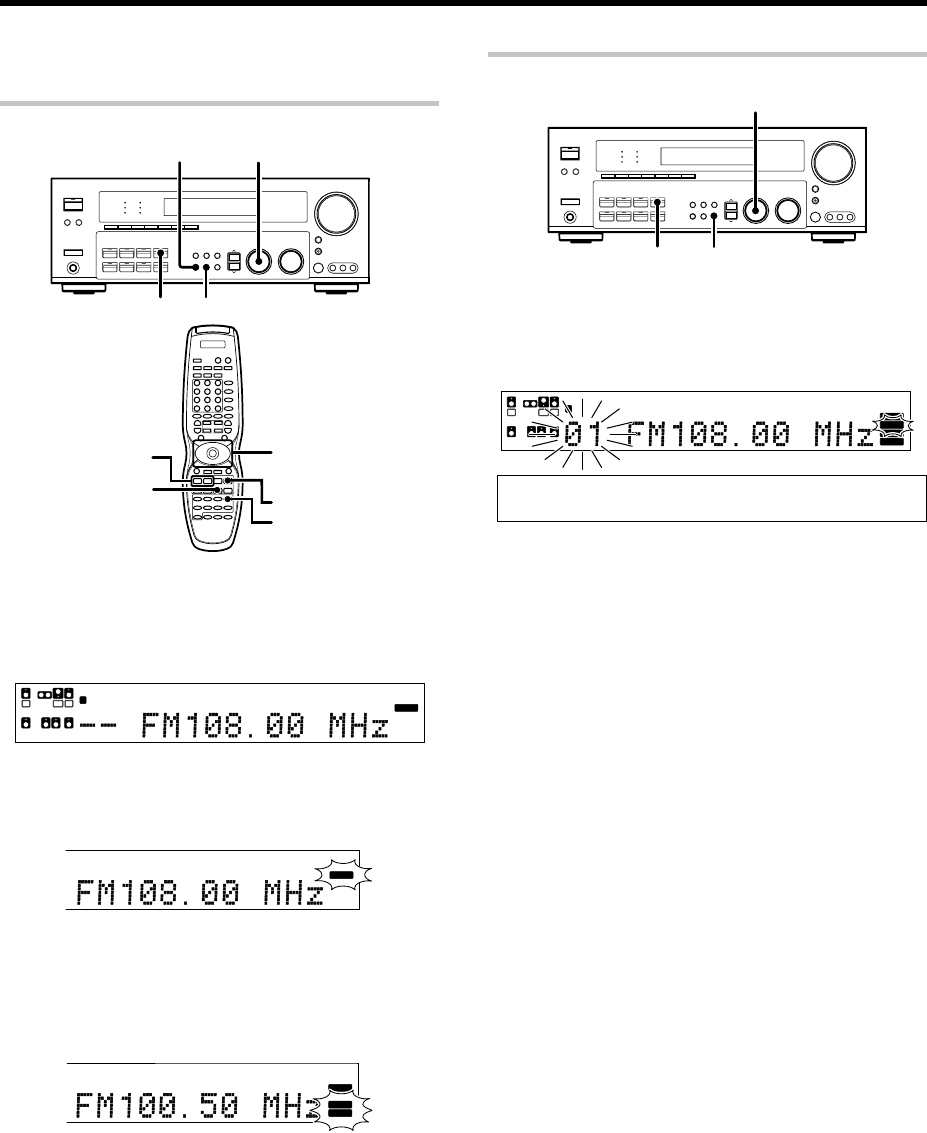
26 EN
Presetting radio stations manually
MULTI CONTROL
MEMORYTUNER
1
Tune to the station you want to store.
2
Press the MEMORY key while receiving the station.
Blinks for 5 seconds Lights for 5 seconds
L
SL S SB SR
CRSW
LFE
SP MUTE
OPTICAL 6CH INPUT
COAXIAL ANALOG 96kHzfs
CINEMA EQ.
ACTIVE EQ.
DSP MODE
DTS.
MATRIX
DISCRETE
DOLBY DIGITAL
PRO LOGIC
STEREO
LOUDNESS
NEO:6
CSII
A B CLIP
AUTO DETECT THX
AUTO
RDS
RTY
STEREO
TUNED
Surround EX
MEMORY
Proceed to step 3 within 5 seconds.
(If more than 5 seconds elapse, press the MEMORY key again).
3
Use the MULTI CONTROL knob or Joystick (
5
/
∞
) to select
one of the station presets (1 – 40).
4
Press the MEMORY key again to confirm the setting.
•Repeat steps 1, 2, 3, and 4 to store as many stations as
necessary.
•If you store a station at a previously used preset, the old station will
be replaced by the new one.
Listening to radio broadcasts
The receiver can store up to 40 stations in the memory and recall them
by one-touch operation.
Tuning radio stations
BAND MULTI CONTROL
TUNER AUTO
Joystick
(MULTI CONTROL 5/∞)
AUTO
TUNING 1/¡
TUNER
BAND
1
Use the TUNER key to select the tuner.
2
Use the BAND key to select the desired broadcast band.
Each press switches the band.
L
SL S SB SR
CRSW
LFE
SP MUTE
OPTICAL 6CH INPUT
COAXIAL ANALOG 96kHzfs
CINEMA EQ.
ACTIVE EQ.
DSP MODE
DTS.
MATRIX
DISCRETE
DOLBY DIGITAL
PRO LOGIC
STEREO
LOUDNESS
NEO:6
CSII
A B CLIP
AUTO DETECT THX
AUTO
RDS
RTY
MEMO
STEREO
TUNED
Surround EX
3
Use the AUTO key to select the desired tuning method.
Each press switches the tuning method to either auto or manual
tuning.
“AUTO” indicator lights up in the display.
I
CAL 6CH INPUT
XIAL ANALOG 96kHzfs
CINEMA EQ.
ACTIVE EQ.
DSP MODE
DTS.
MATRIX
DISCRETE
DOLBY DIGITAL
PRO LOGIC
STEREO
LOUDNESS
NEO:6
CSII
AUTO DETECT THX RDS
RTY
MEMO
STEREO
TUNED
Surround EX
AUTO
•Normally, set to “AUTO” (auto tuning). If the radio waves are weak
and there is a lot of interference, switch to manual tuning. (With
manual tuning, stereo broadcasts will be received in monaural.)
4
Use the MULTI CONTROL knob or Joystick (
5
/
∞
), or TUNING
1
/
¡
keys to select the station.
“STEREO” lights when a broadcast is being received in stereo.
C
AL 6CH INPUT
X
IAL ANALOG 96kHzfs
CINEMA EQ.
ACTIVE EQ.
DSP MODE
DTS.
MATRIX
DISCRETE
DOLBY DIGITAL
PRO LOGIC
STEREO
LOUDNESS
NEO:6
CSII
AUTO DETECT THX
AUTO
RDS
RTY
MEMO
Surround EX
STEREO
TUNED
“TUNED” is displayed when a station is received.
Auto tuning : The next station is tuned automatically.
Manual tuning : Turn the knob or use the Joystick (5/∞) to
select the desired station.
•VR6060/21-28/EN 3/11/02, 8:52 PM26
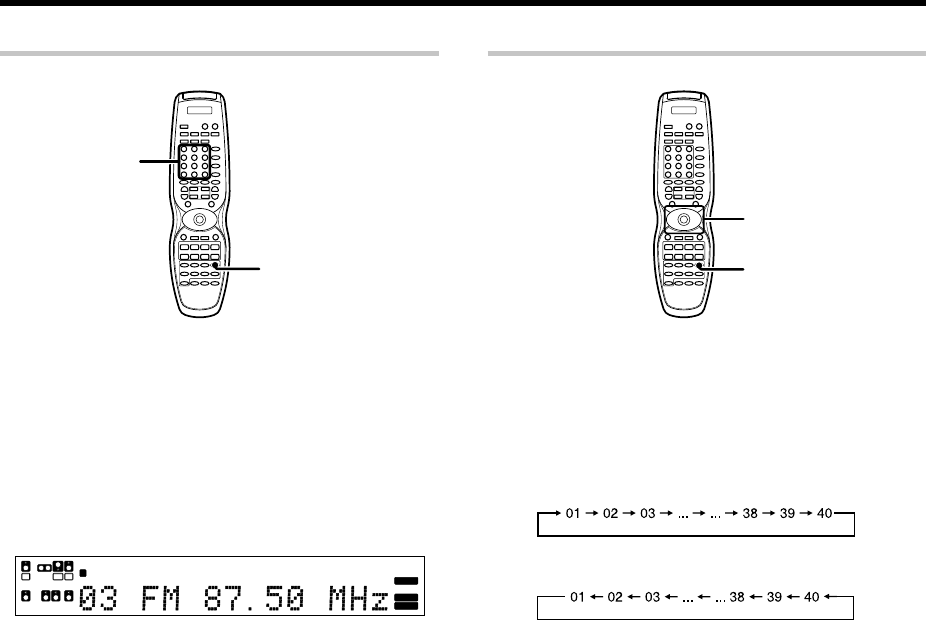
27 EN
Listening to radio broadcasts
Receiving preset stations
TUNER
Numeric keys
1
Press the TUNER key to select tuner as the source.
2
Enter the number of the preset station you want to receive
(up to “40”).
Press the numeric keys in the following order:
For “15”, press 0,5
For “20”, press 0,0,)
•If you make a mistake entering a two digit number, press the +10
key repeatedly to return to the original display and start again.
L
SL S SB SR
CRSW
LFE
SP MUTE
OPTICAL 6CH INPUT
COAXIAL ANALOG 96kHzfs
CINEMA EQ.
ACTIVE EQ.
DSP MODE
DTS.
MATRIX
DISCRETE
DOLBY DIGITAL
PRO LOGIC
STEREO
LOUDNESS
NEO:6
CSII
A B CLIP
AUTO DETECT THX
AUTO
RDS
RTY
MEMO
STEREO
TUNED
Surround EX
Receiving preset stations in order (P.CALL)
Joystick
(P.CALL 4/¢)
TUNER
1
Press the TUNER key to select the tuner as the source.
2
Use the Joystick to adjust the P.CALL
4
/
¢
direction to
select the desired station.
•Each time you push the Joystick, another preset station is received
in order.
Pushing the Joystick to P.CALL ¢ does the following:
Pushing the Joystick to P.CALL 4 does the following:
Holding the Joystick on ¢ or 4 direction, lets you skip
through the presets, receiving each preset station at 0.5 second
intervals.
•VR6060/21-28/EN 3/11/02, 8:52 PM27
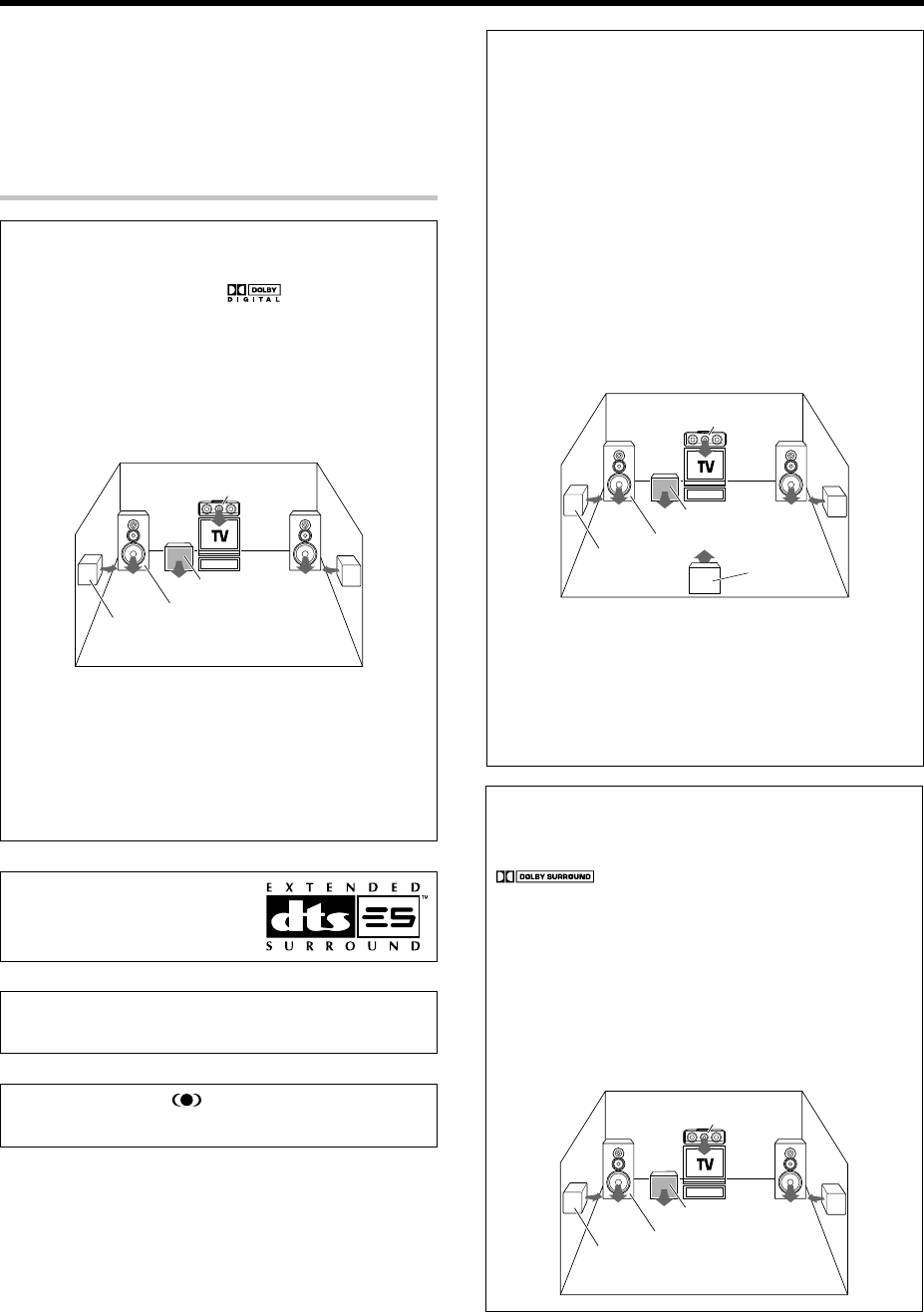
28 EN
Ambience effects
This receiver is equipped with listening modes that allow
you to enjoy an enhanced sonic ambience with a variety of
video sources.
In order to obtain the optimum effect from the surround
modes, make sure to input the proper speaker settings
beforehand. )
Surround modes
Dolby Digital
The Dolby Digital surround format lets you enjoy up to 5.1 channels
of digital surround sound from Dolby Digital program sources (such as
Laserdisc or DVD software marked ). Compared with previ-
ous Dolby surround, Dolby Digital provides even better sound quality,
greater spatial accuracy, and improved dynamic range.
Note
Although a full set of speakers (front left, right, and center, surround
left and right, and a subwoofer) is required for true 5.1 channel Dolby
Digital surround sound, this receiver lets you enjoy Dolby Digital (and
Dolby Surround) program sources, even if you connect only the front
speakers.
* LFE = Low Frequency Effects. This channel delivers separate
non-directional bass signals to the subwoofer for more dynamic
deep bass sound effects.
Although only Dolby Digital soundtracks incorporate a separate
low frequency channel, connecting a subwoofer will also improve
deep bass performance in the other surround modes.
The indication “LFE” appears in the display when a signal is
being input for this channel.
“DTS”, “DTS-ES Extended Surround”
and “Neo:6” are trademarks of Digital
Theater Systems, Inc.
Manufactured under license from Dolby Laboratories. “Dolby”, “Pro
Logic” and the double-D symbol are trademarks of Dolby
Laboratories.
“Circle Surround II and the
®
symbol are trademarks of SRS Labs,
Inc. Circle Surround II technology is incorporated under license from SRS
Labs, Inc”.
Dolby Digital EX
Dolby Digital EX is an extension of Dolby Digital technology, Dolby
Digital EX creates six full-bandwidth output channels from 6.1-channel
sources. This is done using a matrix decoder that derives three
surround channels from the two in the original recording.
This is achieved by using three different surround signals, surround left,
surround right and surround back, each driving its own array of
speakers. Think of it as adding a center channel for the rear speakers,
which give more diffuse and natural surround effect, even if you
wanted the ability to completely encircle the audience with sound,
positioning sound effects exactly where they wolud be heard in real life.
For best results, Dolby Digital EX should be used with movie soundtracks
recorded with Dolby Digital Surround EX which contain a digital flag that
will automatically activate this feature. However, for titles released
prior to late 2001, this feature has to be activated manually.
Note
Although a full set of speakers (front left, right, and center, surround
left and right, surround back and a subwoofer) is required for true 6.1
channel Dolby Digital Surround EX sound, this receiver lets you enjoy
Dolby Digital (and Dolby Surround) program sources, even if you
connect only the front speakers.
* LFE = Low Frequency Effects. This channel delivers separate
non-directional bass signals to the subwoofer for more dynamic
deep bass sound effects.
Although only Dolby Digital soundtracks incorporate a separate
low frequency channel, connecting a subwoofer will also improve
deep bass performance in the other surround modes.
The indication “LFE” appears in the display when a signal is
being input for this channel.
Dolby PRO LOGIC
II
Dolby Pro Logic II was designed specifically to provide a new sense of
spatiality, directionality and articulation of sounds from Dolby Surround
encoded sources (such as video and Laserdisc software marked
). This is achieved with an intelligent, built-in feedback
logic design, a matrix surround decoding and the decoding of stereo, full
bandwidth surround outputs. The PRO LOGIC
II modes programmed into
this receiver are “MOVIE”, “MUSIC” and “PRO LOGIC”. The “MOVIE”
mode of the PRO LOGIC
II has preset characteristics to produce a
calibrated, high-level surround sound playback while the “MUSIC” mode
has user-adjustable characteristics to offer the three optional controls, like
“Dimension”, “Center Width” and “Panorama” modes to allow optimiza-
tion of the soundfields as desired. The “Dimension” control allows the
user to gradually adjust the soundfield either towards the front or towards
the rear; the “Center Width” control allows various adjustment of the left-
center-right speakers’ balance; the “Panaroma” mode extends the front
stereo image to include the surround speakers for an exciting “wrap-
around” effect with side wall imaging.
* Optional in this mode.
Center speaker
Subwoofer (SW)*
Surround
speakers (L, R)
Front speakers (L, R)
Center speaker
Subwoofer (SW)
Surround
speakers (L, R)
Front speakers (L, R)
* Optional in this mode.
Center speaker
Subwoofer (SW)*
Surround
speakers (L, R) Surround
back speaker
Front speakers (L, R)
•VR6060/21-28/EN 3/11/02, 8:52 PM28
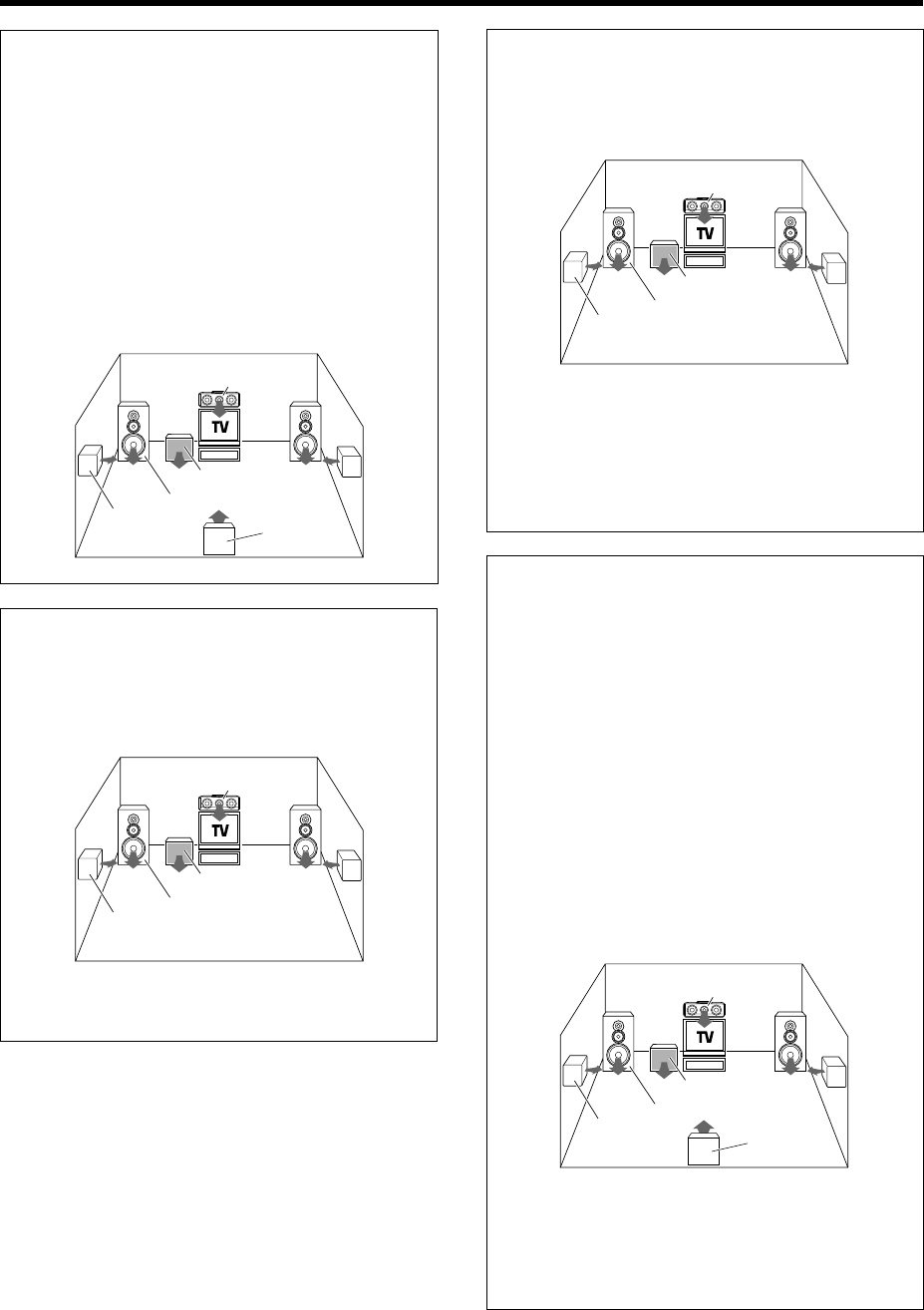
29 EN
Ambience effects
Multi channel surround sound (SRS Circle Surround
II
)
SRS Circle Surround II ™ improves on its predecessor CS-5.1™
resulting in the CS-6.1™ system, enabling you to listen to realistic,
multi-channel, surround sound playback from a stereo source or
conventional surround-encoded video source. You already enjoy
listening to Dolby Digital sound/DTS multi-channel sound with your
multi-speakers. Now you can listen to audio CDs, MDs, Broadcast and
Home Theater using your multi-speakers. You will discover a new
type of sound through SRS Circle Surround II .
The CS system dramatically reduces storage space requirements for
multi-channel content. It creates a listening environment that places
the listener “inside” music performances, and dramatically improves
both hi-fi audio and conventional surround-encoded video material.
The CS decoder also includes the SRS technologies Focus™ and
TruBass™. Focus electronically raises the sound stage from the
speaker location to an optimal position. TruBass creates deep, rich
bass in small speaker systems without the need for a subwoofer.
DVD 6-channel mode
Using a DVD player or the like equipped with six (5.1) output channels
and the receiver, you can enjoy multi-channel encoded DVD source
material in all its splendor. Since the source signals are digital and
each channel is input independently, the resulting sound quality,
sense of spaciousness, and dynamic range are superb.
* LFE = Low Frequency Effects. This channel delivers separate non-
directional bass singnals to the subwoofer for more dynamic deep
bass sound effects.
DSP mode
The DSP mode lets you add the atmosphere of a live concert or hall to
almost any type of program source. These modes are particularly effective
when used with stereo program sources, like CD, television, and FM radio.
You might enjoy trying the ARENA, JAZZ CLUB, THEATER, STADIUM or
DISCO mode the next time you watch a concert or sporting event!
What's DSP?
DSP stands for Digital Signal Processor.
The way a sound is heard in an actual environment depends on a
variety of different factors. One of the most important is reverberation
(the act of decaying elements of sound echoing in various places).
The DSP modes produce the feeling of presence by using the DSP to
create reverberation, without spoiling the sound quality of the original
signal.
DTS-ES
The DTS-ES (Digital Theater System-Extended Surround) represents
6.1-channel Discrete Surround format, expanding upon 5.1 surround.
DTS-ES format is a 6.1 channel sound system for movie theaters that
includes as additional surround-center channel matrixed within
surround-left and surround-right. It’s compatible on predecessor DTS
5.1 system. The extra channel allows more accurate placement and
steering of sound accross the rear soundstage.The DTS-ES receiver
will be required, to experience a discrete 6.1-channel mix.
The DTS-ES decoders used in home cinema systems have decoding
options for utilizing the extra channel, in addition to processing
existing 5.1 channel surround sound :
DTS-ES Discrete 6.1 and DTS-ES Matrix 6.1 add the surround back
channel audio to the DTS 5.1-channel format to improve the acoustic
positioning and makes acoustic image movement more natural with
the 6.1-channel reproduction. NEO:6 is a new technology which
decodes 2-channel signals into 6-channel signals using high-accuracy
digital matrix technology. For best results, DTS-ES should be used
with movie soundtracks recorded with DTS-ES which contain a digital
flag that will automatically activate this feature. However, for some
titles, this feature has to be activated manually.
According to the signals to be played back, DTS NEO:6 uses either the
NEO:CINEMA mode optimized for movie playback or the NEO:MUSIC
mode optimized for music playback.
* LFE = Low Frequency Effects. This channel delivers separate non-
directional bass signals to the subwoofer for more dynamic deep
bass sound effects.
DTS has a .1 or LFE channel.
The indication “LFE” appears in the display when a signal is being
input for this channel.
Center speaker
Subwoofer (SW)
Surround
speakers (L, R) Surround
back speaker
Front speakers (L, R)
Center speaker
Subwoofer (SW)
Surround
speakers (L, R)
Front speakers (L, R)
Center speaker
Subwoofer (SW)*
Surround
speakers (L, R)
Front speakers (L, R)
Center speaker
Subwoofer (SW)*
Surround
speakers (L, R) Surround
back speaker
Front speakers (L, R)
* Optional in this mode.
•VR6060/29-34/EN 3/11/02, 8:53 PM29
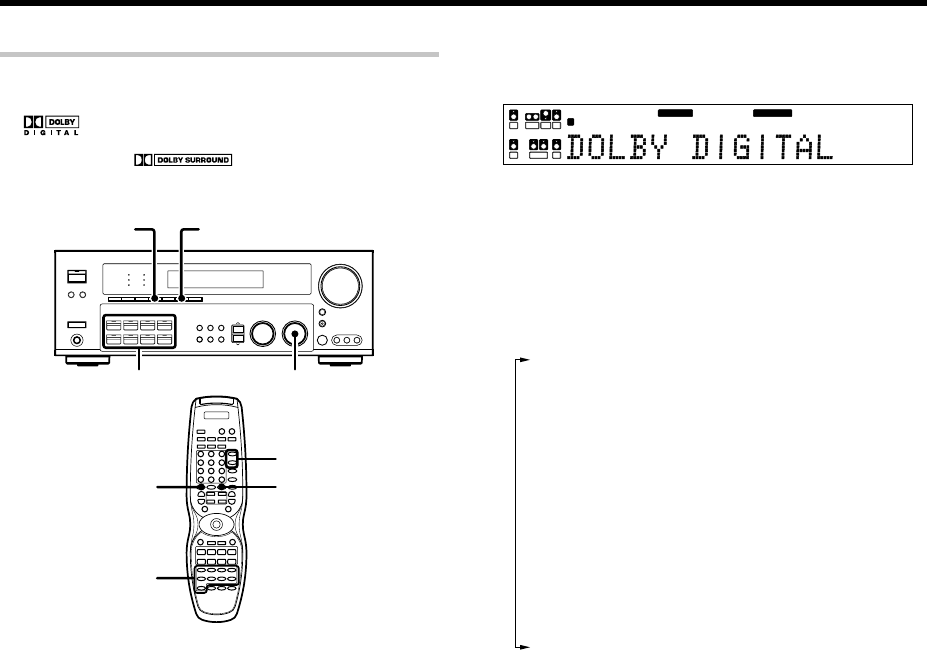
30 EN
Surround play
The DTS compatible models can reproduce a CD, DVD, or LD carrying the
DTS mark.
DOLBY DIGITAL can be used when playing DVD or LD software bearing
the mark and DOLBY DIGITAL format digital broadcasts (etc.).
DOLBY PRO LOGIC can be used when playing video, DVD, or LD
software bearing the mark.
SRS Circle Surround II
enables you to listen to multi channel sound from
the stereo source.
INPUT
SELECTOR
INPUT MODE
DSP INPUT MODE
LISTEN MODE
Input Selector
DSP MODE
LISTEN MODE %/fi
Preparations
•Turn ON related components.
•Complete “Preparing for surround sound” (speaker settings). )
•Use the Input Selector keys to select the component you wish to play
back with surround sound.
•Use the INPUT MODE key to select the input mode (analog or digital)
for the source you wish to play back. 8
•Noise will be produced when a DTS source is played by selecting the
analog input.
1
Start playing the video software.
2
Use the LISTEN MODE knob or LISTEN MODE
%
/
fi
keys to
select the listening mode.
The listening mode settings are stored separately for each input. If
the input mode is set to full auto (“AUTO DETECT” lights), the
receiver selects the optimal listening mode automatically based on
the type of input signal and the speaker settings.
Each turn of the LISTEN MODE knob or press of the LISTEN
MODE %/fi keys switches the setting as listed below.
The listening mode settings are different depending on the type
of input signal.
When the DOLBY DIGITAL signal is input :
(The DOLBY DIGITAL or PRO LOGIC, indicator lights up.)
1 DOLBY DIGITAL : DOLBY DIGITAL surround.
2 DOLBY D EX : DOLBY DIGITAL EX surround.
3 PLII MOVIE : PRO LOGIC II surround MOVIE mode.
(The PRO LOGIC indicator lights up.)
4 PLII MUSIC : PRO LOGIC II surround MUSIC mode.
(The PRO LOGIC indicator lights up.)
5 PRO LOGIC : PRO LOGIC II surround PRO LOGIC mode.
(The PRO LOGIC indicator lights up.)
6 STEREO : Normal stereo playback.
Ambience effects
When you select DOLBY DIGITAL
“DOLBY DIGITAL” will be displayed.
DOLBY DIGITAL
PRO LOGIC
L
SL SB SR
CRSW
LFE
SP MUTE
OPTICAL 6CH INPUT
COAXIAL ANALOG 96kHzfs
CINEMA EQ.
ACTIVE EQ.
DSP MODE
DTS.
MATRIX
DISCRETE
STEREO
LOUDNESS
NEO:6
CSII
A B CLIP
AUTO DETECT THX
AUTO
RDS
RTY
MEMO
STEREO
TUNED
Surround EX
When the DTS or DTS-ES (matrix or discrete) signal is input :
1DTS 5.1ch : (DTS indicator lights up.)
2DTS MATRIX : (DTS MATRIX indicator lights up.)
3DTS DISCRETE : (DISCRETE indicator lights up.)
4STEREO
When the analog signal or the digital signal (except for
DOLBY DIGITAL or DTS signal) is input :
1 PLII MOVIE : PRO LOGIC II surround MOVIE mode.
(The PRO LOGIC indicator lights up.)
2 PLII MUSIC : PRO LOGIC II surround MUSIC mode.
(The PRO LOGIC indicator lights up.)
3 PRO LOGIC : PRO LOGIC II surround PRO LOGIC mode.
(The PRO LOGIC indicator lights up.)
4 NEO:CINEMA : NEO:6 surround.
(The NEO:6 indicator lights up.)
5 NEO:MUSIC : NEO:6 surround.
(The NEO:6 indicator lights up.)
6 CSII CINEMA : CS 6.1 surround.
(The CS II indicator lights up.)
7 CSII MUSIC : CS 6.1 surround.
(The CS II indicator lights up.)
8 CSII MONO : CS 6.1 surround.
(The CS II indicator lights up.)
9 STEREO :
Normal stereo playback. Sound is produced
from the two front channels only.
(The STEREO indicator lights up.)
• Dolby Digital or DTS signal having more channels than the maxi-
mum number of playback channels available using the receiver’s
current settings is input, downmixing is performed to match the
number of available channels.
•VR6060/29-34/EN 3/11/02, 8:53 PM30
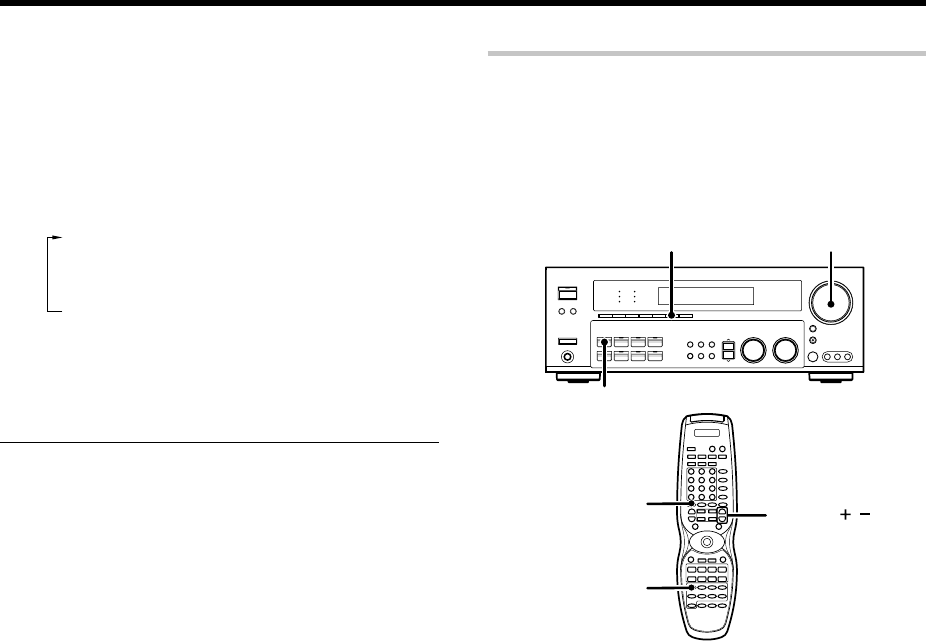
31 EN
Ambience effects
DVD 6-channel playback
Using a DVD player or the like equipped with six (5.1) output channels and
the receiver, you can enjoy surround sound playback.
When you try to play a disc other than Dolby Digital such as DTS CD, no
sound is produced or, noise may be heard. To avoid this situation, make
sure that you connect the component to the receiver’s DVD/6CH INPUT
jacks through a surround processor which can decode the surround
signal you want to listen to.
Connecting a DVD player which can decode the surround signal itself is
also acceptable.
INPUT MODE
DVD/6CH
INPUT MODE
VOLUME
DVD/6CH
VOLUME /
Preparations
•Connect your DVD player to the DVD/6CH jacks of the receiver.
•Turn on all other components that will be used.
•Complete “Preparing for surround sound”.)
1
Press “DVD/6CH” as the input source.
•If speaker system B is on when “DVD/6CH” is selected as the input
source, it switches off and speaker system A turns on automati-
cally.
2
Select "6CH INPUT" by pressing the INPUT MODE key.
3
Start playback of the DVD software.
4
Adjust the volume.
•It is not possible to adjust the volume level or sound quality (SET
UP, SOUND) of the channels separately when the receiver is in the
DVD/6CH mode. Adjust the volume with the controls of the DVD
player.
For the powered subwoofer, you can adjust the volume of the
subwoofer using the subwoofer’s own volume control.
3
DSP mode (Digital Signal Processor).
DSP can produce these effects without spoiling the sound quality of
the original music or video source.
1Pressing the DSP key or DSP MODE key will display the
current DSP MODE status.
2Each press of the key will switch to the next status as shown
bellow:
1 ARENA : DSP surround ARENA mode.
2 JAZZ CLUB : DSP surround JAZZ CLUB mode.
3 THEATER : DSP surround THEATER mode.
4 STADIUM : DSP surround STADIUM mode.
5 DISCO : DSP surround DISCO mode.
•The DSP mode selection is displayed for approximately 3 seconds.
•For fine adjustment of the DSP effects, please refer to “Adjusting
the sound”.¤
4
Adjust the volume.
Notes
•Depending on the type of the signal or speaker setting, some listening
modes cannot be selected.
•When playback is started, the sound may be cut or interrupted before
the input source is confirmed as Dolby Digital.
•To enjoy Dolby Digital surround (as well as all the other listening modes)
from a single component, be sure to use a Dolby Digital compatible
source component.
•VR6060/29-34/EN 3/11/02, 8:53 PM31
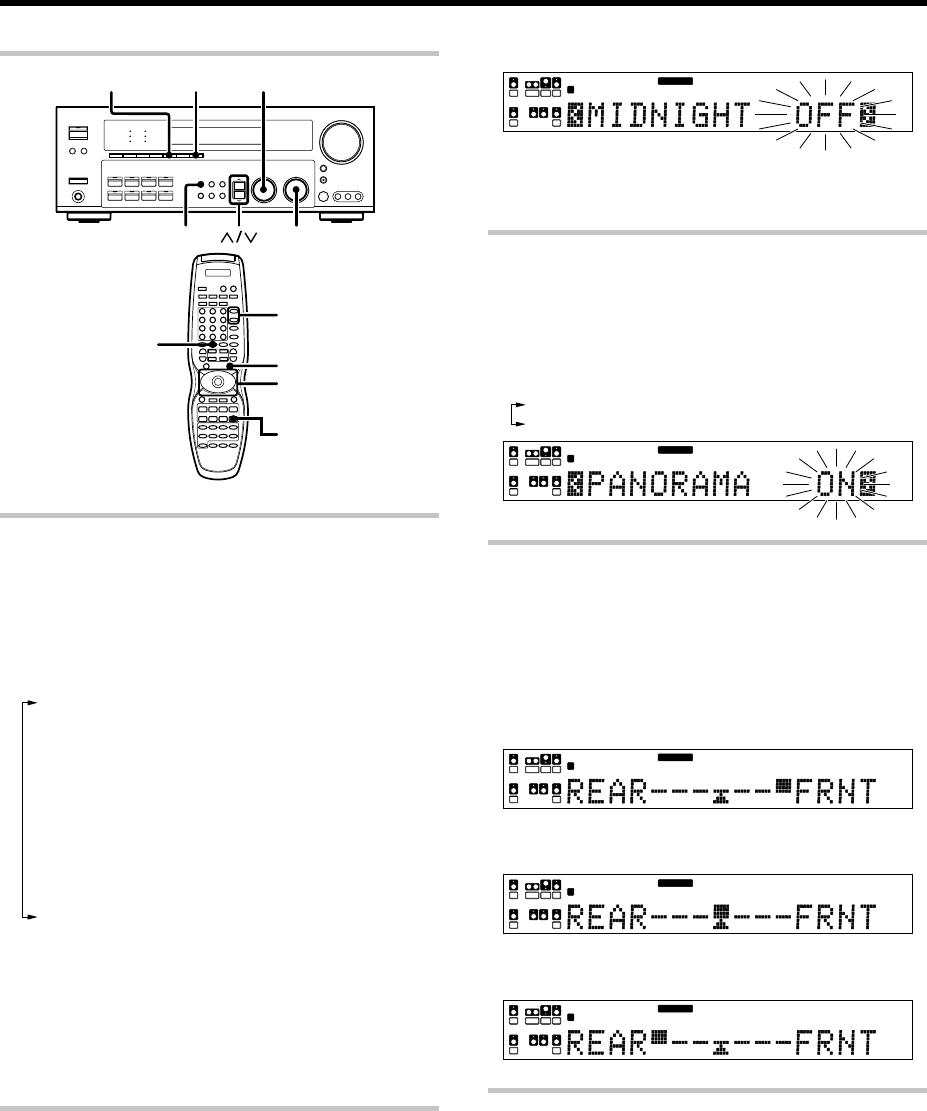
32 EN
Ambience effects
Convenient functions
MULTI CONTROL
DIMMERSTEREO
SOUND LISTEN MODE
SOUND
LISTEN MODE %/fi
STEREO
Joystick
(MULTI CONTROL 5/∞,
DOWN 2/UP3)
DIMMER
Adjusting the sound
You can make further adjustments to the sound while listening to
playback in the surround mode.
1Press the SOUND key and then use to the MM
MM
M/??
??
? keys or joystick
(2/3) until the desired item appears in the display.
Each time you press the MM
MM
M/??
??
? keys or Joystick (2/3), the menu
changes as follows:
Note that some items are not displayed in certain modes.
1CNTR (Center speaker level adjustment)*
2SR (Right surround speaker level adjustment)*
3SB (Surround back speaker level adjustment)*
4SL (Left surround speaker level adjustment)*
5SUBW (Subwoofer level adjustment)*
6INPUT (Input level adjustment - analog mode only) £
7MIDNIGHT
(Midnight mode ON/OFF - Dolby Digital mode only)
8PANORAMA (Panorama mode
ON/OFF
)**
9DIMENSION (Dimension adjustment)**
0CENTER WIDTH (Center width adjustment)**
-CENTER FOCUS (Center focus adjustment)***
=CSII DLY (Rear speaker delay adjustment)***
~CSII GAIN (Input gain adjustment)***
!TruBass (Trubass adjustment)***
* The adjustment is only temporary for the current input selection.
The value will return automatically to the original setup value when
the power is turned on/off or when the input selection is changed.
** Pro Logic II Music mode only.
*** CS II mode only.
2Use the MULTI CONTROL knob or Joystick (5/∞) to adjust the
setting as desired.
•The adjustment item is displayed for approximately 8 seconds.
Midnight mode (Dolby Digital mode only)
When watching movies at night , you might not be able to raise the
volume as loud as normal. Midnight mode compresses the dynamic
range of previously specified parts of the Dolby Digital sound track (like
scenes with sudden increases in volume) to minimize the difference in
volume between the specified and non-specified parts. This makes it
easy to hear all of the sound track, even when listening at low volumes.
1Press the SOUND key, then press the MM
MM
M/??
??
? keys or Joystick (2/3)
until “MIDNIGHT” appears on the display.
•This can be selected only if CD/DVD, DVD/6CH, VIDEO 2 or VIDEO 3 is
selected as the source and the listen mode is set to “DOLBY DIGITAL.”
2Use the MULTI CONTROL knob or Joystick (5/∞) to select the
ON or OFF setting.
PRO LOGIC
L
SL SSB SR
CRSW
LFE
SP MUTE
OPTICAL 6CH INPUT
COAXIAL ANALOG 96kHzfs
CINEMA EQ.
ACTIVE EQ.
DSP MODE
DTS.
MATRIX
DISCRETE
STEREO
LOUDNESS
NEO:6
CSII
A B CLIP
AUTO DETECT THX
AUTO
RDS
RTY
MEMO
STEREO
TUNED
Surround EX
DOLBY DIGITAL
•The adjustment item is displayed for approximately 8 seconds.
•Some Dolby Digital software may not be compatible with the
Midnight mode.
Panorama mode (Pro Logic
II
Music mode only)
When listening to music, you will be able to enjoy the “wraparound”
sound effect when you adjust the panorama mode.
1Press the SOUND key, then press the MM
MM
M/??
??
? keys or Joystick (2/3)
until “PANORAMA” appears on the display.
2Use the MULTI CONTROL knob or Joystick (5/∞) to select
PANORAMA ON or OFF.
1PANORAMA ON : PANORAMA mode is ON.
2PANORAMA OFF : PANORAMA mode is OFF.
L
SL SSB SR
CRSW
LFE
SP MUTE
OPTICAL 6CH INPUT
COAXIAL ANALOG 96kHzfs
CINEMA EQ.
ACTIVE EQ.
DSP MODE
DTS.
MATRIX
DISCRETE
STEREO
LOUDNESS
NEO:6
CSII
A B CLIP
AUTO DETECT THX
AUTO
RDS
RTY
MEMO
STEREO
TUNED
Surround EX
PRO LOGIC
DOLBY DIGITAL
Dimension mode (Pro Logic
II
Music mode only)
When listening to music with certain recordings, you will also be able to
achieve a suitable balance from all the speakers by adjusting the
dimension mode.
1Press the SOUND key, then press the MM
MM
M/??
??
? keys or Joystick (2/3)
until “DIMENSION” appears on the display.
2Use the MULTI CONTROL knob or Joystick (5/∞) to adjust
the soundfield towards the rear or the front.
Soundfield is adjusted towards the front.
L
SL SSB SR
CRSW
LFE
SP MUTE
OPTICAL 6CH INPUT
COAXIAL ANALOG 96kHzfs
CINEMA EQ.
ACTIVE EQ.
DSP MODE
DTS.
MATRIX
DISCRETE
STEREO
LOUDNESS
NEO:6
CSII
A B CLIP
AUTO DETECT THX
AUTO
RDS
RTY
MEMO
STEREO
TUNED
Surround EX
PRO LOGIC
DOLBY DIGITAL
↓
Soundfield is in neutral position.
L
SL SSB SR
CRSW
LFE
SP MUTE
OPTICAL 6CH INPUT
COAXIAL ANALOG 96kHzfs
CINEMA EQ.
ACTIVE EQ.
DSP MODE
DTS.
MATRIX
DISCRETE
STEREO
LOUDNESS
NEO:6
CSII
A B CLIP
AUTO DETECT THX
AUTO
RDS
RTY
MEMO
STEREO
TUNED
Surround EX
PRO LOGIC
DOLBY DIGITAL
↓
Soundfield is adjusted towards the rear.
L
SL SSB SR
CRSW
LFE
SP MUTE
OPTICAL 6CH INPUT
COAXIAL ANALOG 96kHzfs
CINEMA EQ.
ACTIVE EQ.
DSP MODE
DTS.
MATRIX
DISCRETE
STEREO
LOUDNESS
NEO:6
CSII
A B CLIP
AUTO DETECT THX
AUTO
RDS
RTY
MEMO
STEREO
TUNED
Surround EX
PRO LOGIC
DOLBY DIGITAL
Center Width mode (Pro Logic
II
Music mode only)
Center width adjustment allows you to enjoy an enchanced sound when
listening to music through center image from only center speaker, or left
and right speakers or various combinations adjustments.
1Press the SOUND key, then press the MM
MM
M/??
??
? keys or Joystick (2/3)
until “CENTER WIDTH” appears on the display.
•The CENTER WIDTH indication scrolls across the display.
•When the center speaker is switched OFF, this mode will not be
effective.
2Use the MULTI CONTROL knob or Joystick (5/∞) to adjust the
left-center-right output.
•VR6060/29-34/EN 3/11/02, 8:53 PM32
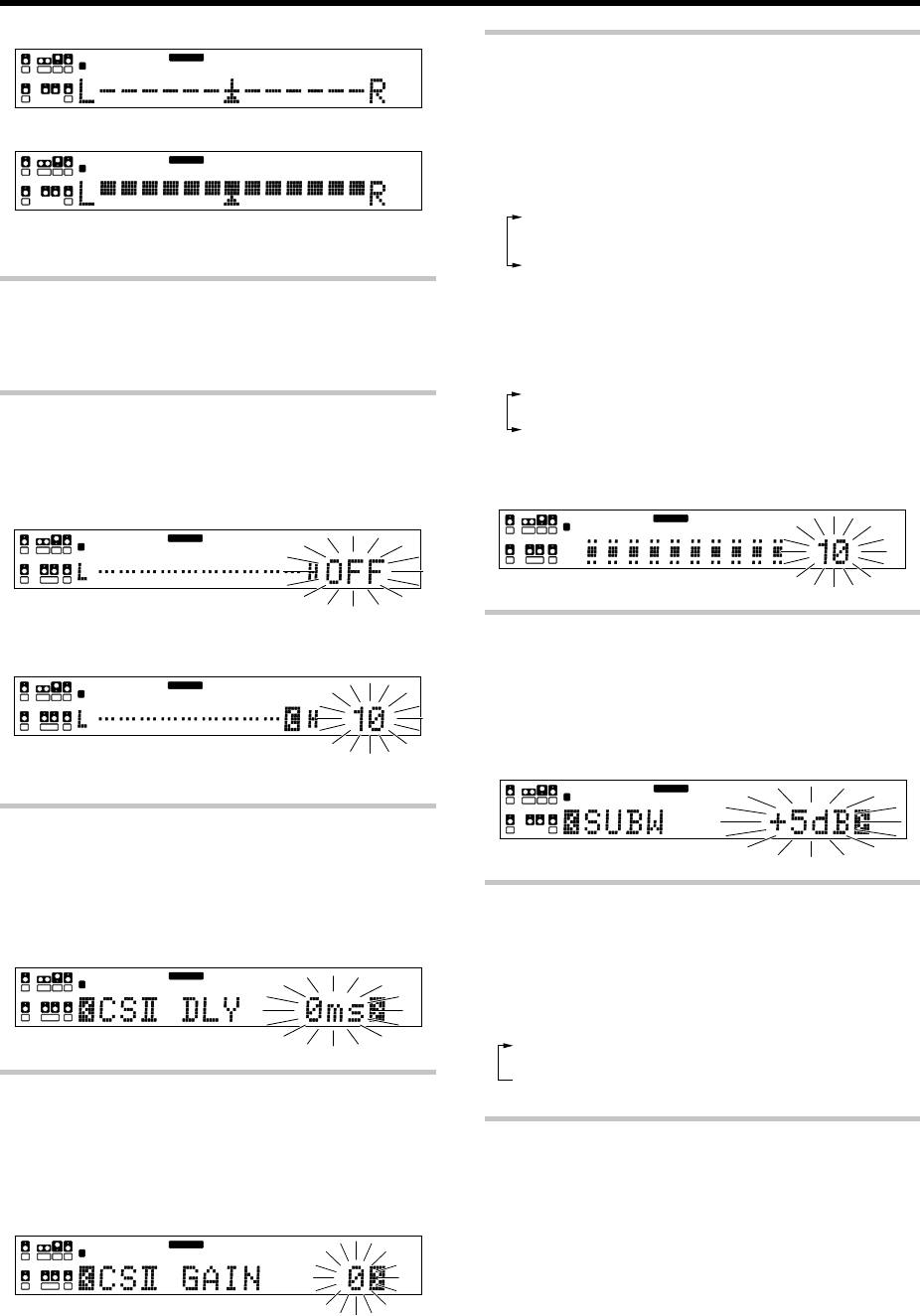
33 EN
Ambience effects
TruBass adjustment mode (CS
II
mode only)
TruBass adjustment provides deep, rich bass sound to small speakers
without the need of a subwoofer.
1Press the SOUND key, then press the MM
MM
M/??
??
? keys or Joystick (2/3)
until “TruBass” appears.
2Use the MULTI CONTROL knob or Joystick (5/∞) to select the
following;
1TruBass OFF
2TruBass SW
3TruBass LR
4TruBass SW + LR
•After selecting 2, 3 or 4, TruBass speaker size and level adjustment
selection will be available.
3For TruBass speaker selection, use the MULTI CONTROL knob
or Joystick (5/∞) to select any of the following display;
1TruBass LARGE
2TruBass MID
3TruBass SMALL
4Use the MULTI CONTROL knob or Joystick (5/∞) to adjust the
TruBass Level.
•The adjustment range is from 0 (TruBass OFF) to 10.
L
SL SB SR
CR
SP MUTE
OPTICAL 6CH INPUT
COAXIAL ANALOG 96kHzfs
CINEMA EQ.
ACTIVE EQ.
DSP MODE
DTS.
MATRIX
DISCRETE
DOLBY DIGITAL
PRO LOGIC
STEREO
LOUDNESS
NEO:6
CSII
A B CLIP
AUTO DETECT THX
AUTO
RDS
RTY
MEMO
STEREO
TUNED
Surround EX
SW
LFE
Subwoofer adjustment
It is easy to adjust the volume of the subwoofer using the remote control.
1Press the SOUND key, then press the MM
MM
M/??
??
? keys or Joystick (2/3)
until “SUBW” appears on the display.
2Use the MULTI CONTROL knob or Joystick (5/∞) to adjust the
volume.
•The adjustment range is from –10 dB to +10 dB.
L
SSB
CRSW
LFE
SP MUTE
OPTICAL 6CH INPUT
COAXIAL ANALOG 96kHzfs
CINEMA EQ.
ACTIVE EQ.
DSP MODE
DTS.
MATRIX
DISCRETE
DOLBY DIGITAL
PRO LOGIC
STEREO
LOUDNESS
NEO:6
CSII
A B CLIP
AUTO DETECT THX
AUTO
RDS
RTY
MEMO
STEREO
TUNED
Surround EX
SL SR
Display dimmer adjustment
The dimmer function lets you select the brightness of the receiver's
display. You might find this useful if you darken your room to watch
movies or listen to music.
Each time you press the DIMMER key, the display’s brightness
changes among the three available settings.
Select the brightness level you find most pleasing.
1Bright
2Medium
3Dark
96kHz LPCM playback
The receiver is compatible with the 96kHz LPCM playback. To play a
96kHz DVD, set the listen mode to “STEREO”.
•In FULL AUTO input mode the listen mode will automatically be STEREO.
•When in DIGITAL MANUAL input mode (listen mode is not STEREO),
“FS 96kHz” will appear in the display and no sound can be heard from
the speakers.
Press the LISTEN MODE or STEREO key (the listen mode changes to
the STEREO mode) to output sound from the speakers.
Center image will be heard from center speaker only.
L
SL SSB SR
CRSW
LFE
SP MUTE
OPTICAL 6CH INPUT
COAXIAL ANALOG 96kHzfs
CINEMA EQ.
ACTIVE EQ.
DSP MODE
DTS.
MATRIX
DISCRETE
STEREO
LOUDNESS
NEO:6
CSII
A B CLIP
AUTO DETECT THX
AUTO
RDS
RTY
MEMO
STEREO
TUNED
Surround EX
PRO LOGIC
DOLBY DIGITAL
Center image will be heard from left and right speakers only.
L
SL SSB SR
CRSW
LFE
SP MUTE
OPTICAL 6CH INPUT
COAXIAL ANALOG 96kHzfs
CINEMA EQ.
ACTIVE EQ.
DSP MODE
DTS.
MATRIX
DISCRETE
STEREO
LOUDNESS
NEO:6
CSII
A B CLIP
AUTO DETECT THX
AUTO
RDS
RTY
MEMO
STEREO
TUNED
Surround EX
PRO LOGIC
DOLBY DIGITAL
•When in other position, center image from center speaker, left and
right speakers can be heard simultaneously with various combinations.
Circle Surround
II
mode
When you select the circle surround II mode, you will be able to enjoy the
multi surround sound from the stereo source.
Use the LISTEN MODE knob or LISTEN MODE fi/% keys for CS II selection.
Center Focus mode (CS
II
mode only)
Center focus elevate level adjustment allows you to enjoy an enchanced
sound when you select CS II CINEMA/MUSIC/MONO. It repositions the
sound image to an optimal position more natural to the listener through
the center image.
1Press the SOUND key, then press the MM
MM
M/??
??
? keys or Joystick (2/3)
until “CENTER FOCUS” appears on the display.
L
SL SB SR
CR
SP MUTE
OPTICAL 6CH INPUT
COAXIAL ANALOG 96kHzfs
CINEMA EQ.
ACTIVE EQ.
DSP MODE
DTS.
MATRIX
DISCRETE
DOLBY DIGITAL
PRO LOGIC
STEREO
LOUDNESS
NEO:6
CSII
A B CLIP
AUTO DETECT THX
AUTO
RDS
RTY
MEMO
STEREO
TUNED
Surround EX
SW
LFE
2Use the MULTI CONTROL knob or Joystick (5/∞) to adjust the
center elevation level.
•The adjustment range is from 0 to 10.
L
SL SB SR
CR
SP MUTE
OPTICAL 6CH INPUT
COAXIAL ANALOG 96kHzfs
CINEMA EQ.
ACTIVE EQ.
DSP MODE
DTS.
MATRIX
DISCRETE
DOLBY DIGITAL
PRO LOGIC
STEREO
LOUDNESS
NEO:6
CSII
A B CLIP
AUTO DETECT THX
AUTO
RDS
RTY
MEMO
STEREO
TUNED
Surround EX
SW
LFE
•CENTER FOCUS will not be available when the center speaker is OFF.
CS
II
Rear Delay adjustment mode (CS
II
mode only)
CS II Rear Delay adjustment provides a better sound effect from the rear
speakers.
1Press the SOUND key, then press the MM
MM
M/??
??
? keys or Joystick (2/3)
until “CSII DLY” appears on the display.
2Use the MULTI CONTROL knob or Joystick (5/∞) to adjust the
rear speaker.
•The adjustment range is from 0 ms to 25 ms.
L
SL SB SR
CR
SP MUTE
OPTICAL 6CH INPUT
COAXIAL ANALOG 96kHzfs
CINEMA EQ.
ACTIVE EQ.
DSP MODE
DTS.
MATRIX
DISCRETE
DOLBY DIGITAL
PRO LOGIC
STEREO
LOUDNESS
NEO:6
CSII
A B CLIP
AUTO DETECT THX
AUTO
RDS
RTY
MEMO
STEREO
TUNED
Surround EX
SW
LFE
CS
II
Gain adjustment mode (CS
II
mode only)
CS II GAIN allows user to adjust the input gain for the Circle Surround II
processing.
1Press the SOUND key, then press the MM
MM
M/??
??
? keys or Joystick (2/3)
until “CSII GAIN” appears on the display.
2Use the MULTI CONTROL knob or Joystick (5/∞) to adjust the
input gain.
•The adjustment range is from 0 to 18.
L
SL SB SR
CR
SP MUTE
OPTICAL 6CH INPUT
COAXIAL ANALOG 96kHzfs
CINEMA EQ.
ACTIVE EQ.
DSP MODE
DTS.
MATRIX
DISCRETE
DOLBY DIGITAL
PRO LOGIC
STEREO
LOUDNESS
NEO:6
CSII
A B CLIP
AUTO DETECT THX
AUTO
RDS
RTY
MEMO
STEREO
TUNED
Surround EX
SW
LFE
•VR6060/29-34/EN 3/11/02, 8:54 PM33
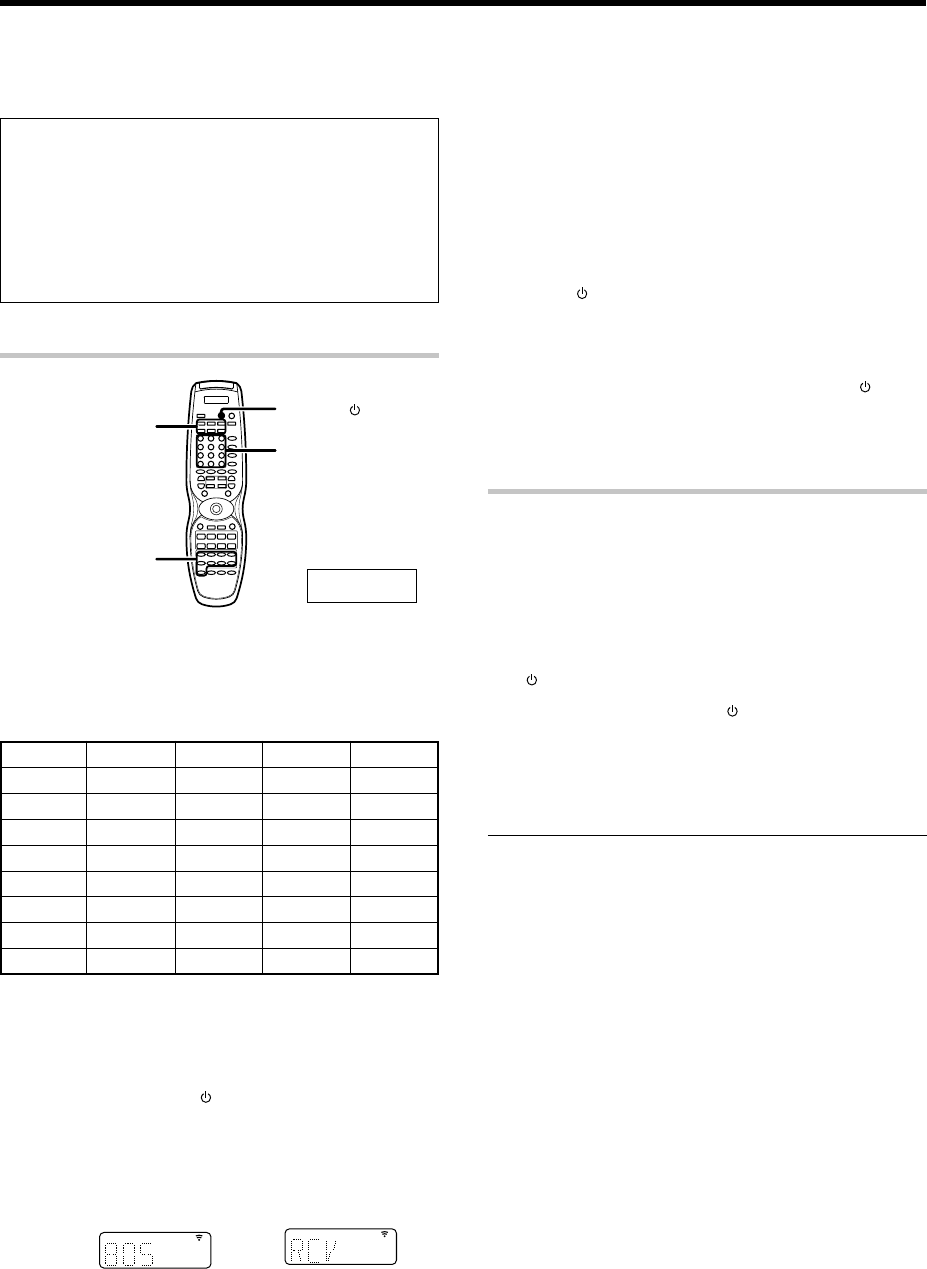
34 EN
The remote control supplied with this receiver is also capable
of controlling components from a variety of manufacturers
once you register the appropriate setup codes into the
remote control unit.
Low battery warning
Replace all two batteries with new ones when you notice a shortening
of the distance from which the remote control will operate.
For LCD remote control (RC-R0816)
The remote control is designed to retain setup codes in memory while
you change batteries.
For non-LCD remote control (RC-R0725)
After changing batteries, please re-enter the setup codes.
Registering setup codes for other components
SOURCE
Numeric keys
REMOTE MODE
INPUT
SELECTOR
1
Find the setup code of the component to be registered.
•Refer to the setup code lists to find the setup code for the
component to be registered. fl
Example: To register a DVD made by KENWOOD, you would enter
“805”.
Input Component Maker Code Key
(DVD) DVD player KENWOOD 805, 808 DVD
2
Registering components for REMOTE MODE (DVD, CBL,
DSS/SAT, VCR, TV, OTHERS) keys.
1For DVD, CBL, DSS/SAT, VCR or TV keys;
Hold down the SOURCE key and press the numeric keys to
enter the setup code.
•Example: Press “805” to register a DVD player manufactured by
KENWOOD.
•If you push an invalid key, the remote control will display
“ERROR” and exit the setup mode.
2The OTHERS key enables you to operate another DVD, CBL,
DSS/SAT, VCR or TV component.
For OTHERS key;
Hold down the OTHERS key and press the numeric keys to
enter the setup code.
•Example: After you have registered the KENWOOD DVD player,
press “804” to register another DVD player which is manufactured
by Panasonic.
•If you push an invalid key, the remote control will display
“ERROR” and exit the setup mode.
3
Press any of the REMOTE MODE key and then press the
SOURCE key to check that the component you want to
control turns on.
If the component does not react, and there is more than one
setup code, enter another setup code and try again.
•If the component is already on, pressing the SOURCE key will
turn it off.
4
Repeat steps
2
to
3
to register additional components until
all components have been registered.
Alternative REMOTE MODE key .
This operation is optional and is convenient when you link an INPUT
SELECTOR key to the REMOTE MODE key. While operating one
component, the INPUT SELECTOR key functions as an alternative
REMOTE MODE key to select another component.
•Example: REMOTE MODE (DVD) key can be linked to the INPUT
SELECTOR (VIDEO 1) key as described below;
1After registering the setup code, press and hold the SOURCE
key and then press the REMOTE MODE (DVD) key.
2While holding down SOURCE press the INPUT SELECTOR
(VIDEO 1) key.
•Now the VIDEO 1 key will function as a DVD key which can be
selected at the same time while operating a CD player.
•Repeat step 1 to 2 to link other INPUT SELECTOR keys.
Note
Although each setup code is designed to work with a number of
different models, certain codes may not work with some models.
(Also, certain codes may only operate some of the functions available
on a given model.)
Basic remote control operations for other components
LCD panel
for VR-6060 only.
•VR6060/29-34/EN 3/11/02, 8:54 PM34
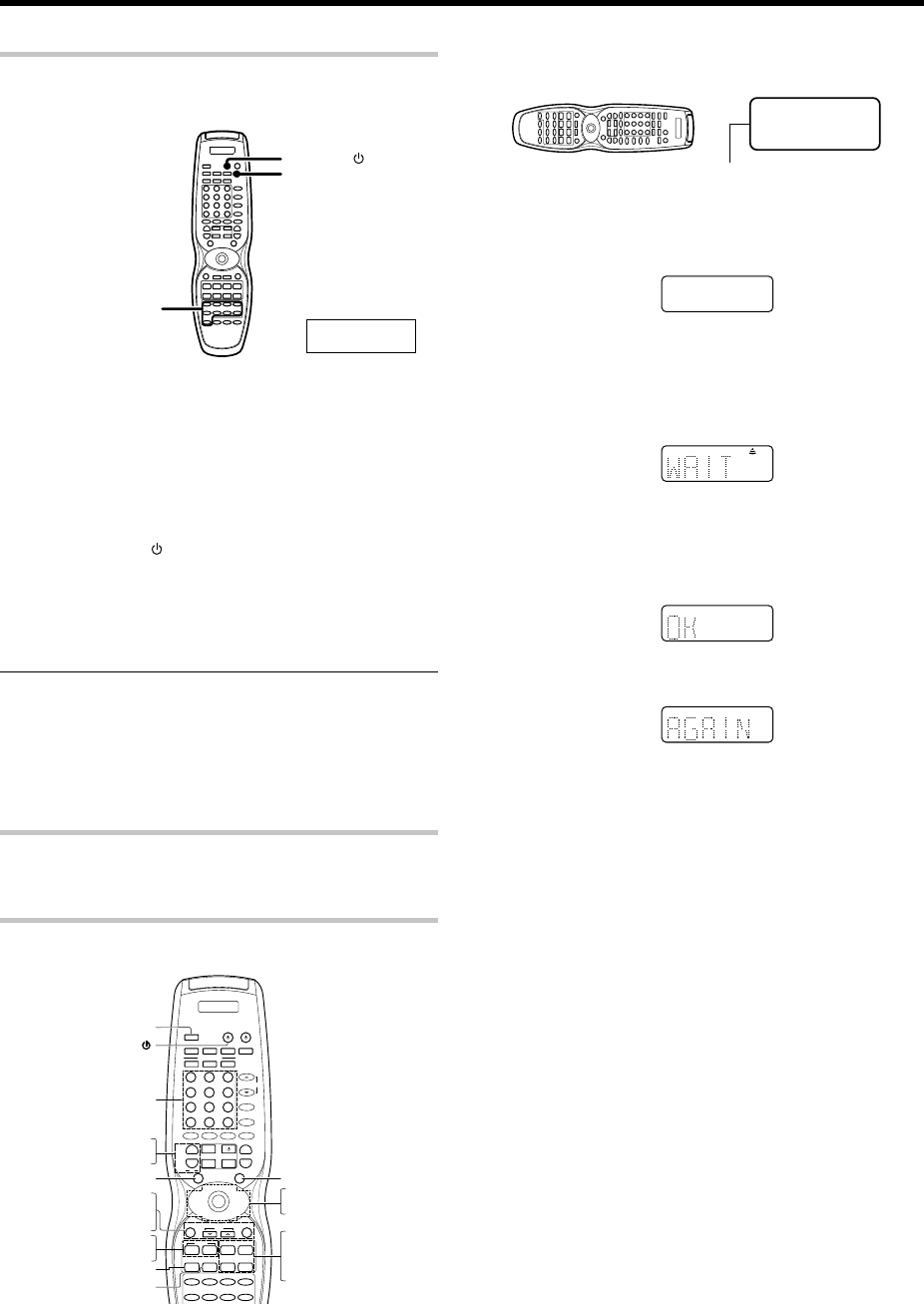
35 EN
Basic remote control operations for other components
Operating other components
This operation lets you operate the registered components.
KENWOOD audio components with system control turn on and off
automatically with the receiver via the system control connections.
SOURCE
RECEIVER
INPUT
SELECTOR
1
Use the INPUT SELECTOR keys to select the component you
desire.
• Pressing the INPUT SELECTOR keys also changes the input selector
on the receiver.
•When you operate your registered DVD player, Cable tuner,
DSS/SAT receiver, VCR or TV, go to step 2.
•When you operate the CD player, Cassette deck, MD player, or
Tuner with system control connection, go to step 3.
2
Press the SOURCE key.
• To return to the receiver operation mode, press the RECEIVER key.
3
Press the operation keys you desire.
°
The remote control mode remains at the selected input. If you
wish to operate another component, repeat step 2 or 3.
Note
Be sure to point the remote control at the remote sensor on the
receiver when you want to operate KENWOOD components connected
by system control cords. Otherwise, point the remote control at the
component you want to operate.
Storing the remote control code of the other
components (For VR-6060 only)
The remote control unit can store the remote control code of the other
components and you can operate the other components from the remote
control unit. The remote control code is stored on the key or memory of
the remote control unit.
Storing on the key
You can store the remote control code to the key as shown below:
P.CALL
4
/DOWN
P.CALL
/UP
¢
TUNING
+
TOP MENU
SET UP
MENU
SOUND
TV CONTROL
VOL.
VOLUME
+
-
-
INPUT
SEL
+
-
CH
DVD
VCR
CBL
TV
DSS/SAT
OTHERS
RECEIVER
SOURCE
POWER
ACTIVE EQ
OSD RETURN
DISC SEL
DISC SKIP
FLIP BAND
INPUT SEL
A/B AUTO
8
DVD/6CH CD/DVD
PHONO
TUNER
VIDEO 1 VIDEO 2
MD/TAPE
MUTE
DVD
ENTER
INPUT SELECTOR
MULTI
CONTROL
¢
4
1¡ 2 6
7
DIMMER
™£
™
1
4
7
+10
2
5
8
0
3
6
9
+100
REMOTE MODE
LISTEN MODE
DSP MODESTEREOINPUT MODE
SPEAKER EQ
™
VIDEO 3
PAGE
LEARN
DISC SKIP
DISC SEL
SOURCE
1 Rewind
¡ Fast forward
Numeric keys
LEARN
CH + / —
Skip ¢/4
OSD
PAGE fi/%
RETURN
TOP MENU
3
/
8
(Play/Pause)
2 Flip
8 Pause
7 Stop
Cursor 5/∞/
2
/
3
ENTER
MENU
1Point the infrared ray system part of another remote control unit
to the remote sensor of the remote control unit.
2Press the LEARN key.
• This remote control is ready to receive the remote control code from
the other source.
LEARN
3Press any of the REMOTE MODE (DVD, CBL, DSS/SAT, VCR, TV,
OTHERS) keys to select the input of the desired remote control
unit.
4Press the desired key of the remote control unit.
LEARN
5From the remote control unit of the other source, press the key
that you want to store.
• The remote control code is sent to the remote control unit.
• “OK” appears when finished.
LEARN
• When the appropriate code is not properly stored, “AGAIN” will be
displayed. Repeat from step 2 onwards.
LEARN
• If the code cannot be stored after a few attempts, “ERROR" will
appear. Repeat from step 2 onwards.
• If LEARN mode‘s storage is full, “FULL" appears on the display.
6The remote control code is stored on the key of this remote
control unit.
7Press the LEARN key again to exit the learning mode.
LCD panel
for VR-6060 only.
Remote control
unit of the other
source.
Infrared ray system part
•VR6060/35-44/EN 3/11/02, 8:54 PM35
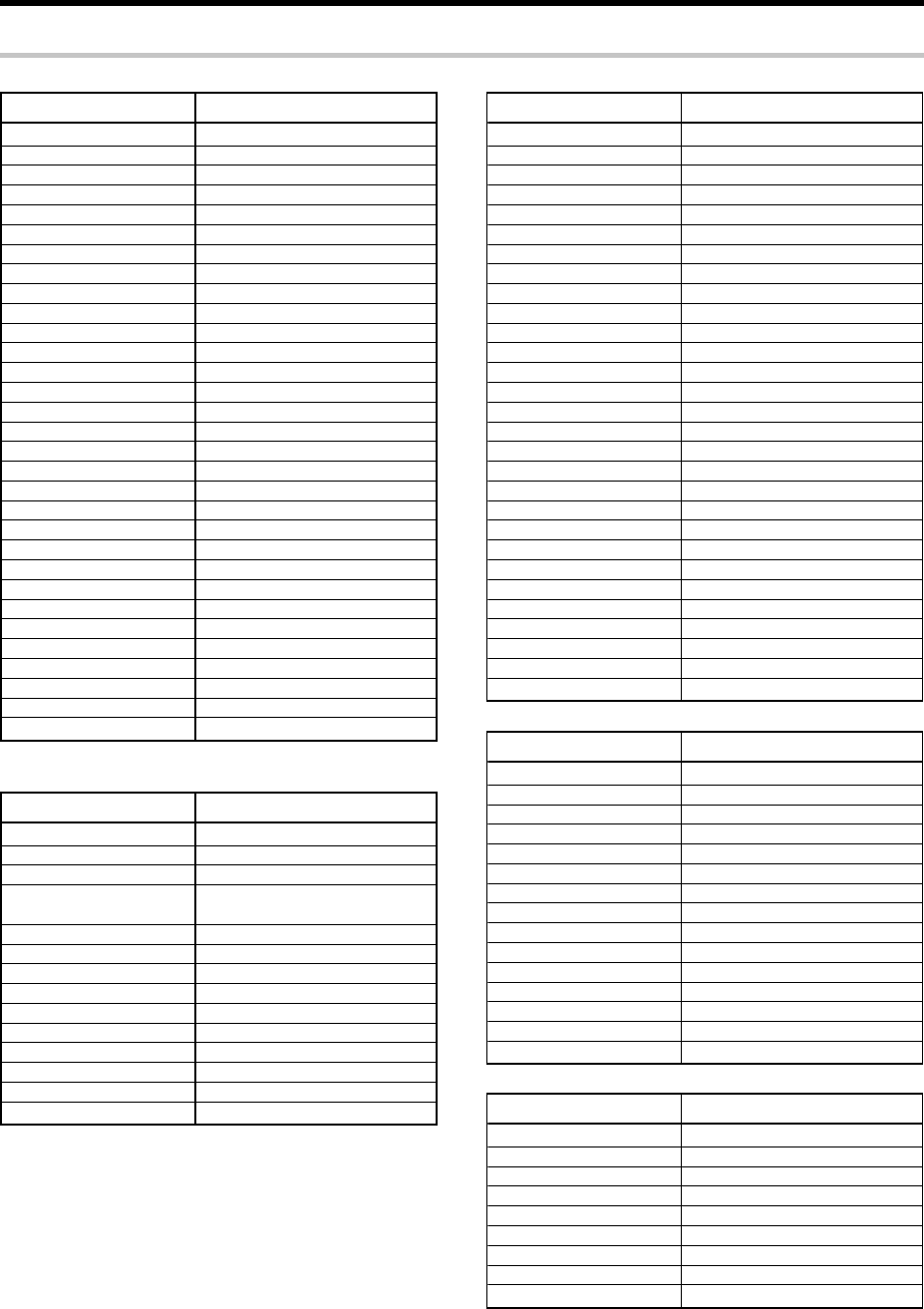
36 EN
Setup code chart (RC-R0816) (VR-6060) and (RC-R0725) (KRF-V8060D)
Basic remote control operations for other components
TV Setup codes
Maker Setup codes
AKAI 125
BELL+HOWELL 142
CENTURION 126
CORONAD 127
DAEWOO 136, 140, 141, 145
EMERSON 130, 131, 132, 133, 146
FISHER 119
G.E. 102, 122, 129
GOLD STAR 137, 148
HITACHI 114, 115
JVC 113
KTV 138, 139
LOEWE 123, 124
MAGNAVOX 109, 147
MARANTZ 121
MITSUBISHI 121
PANASONIC 111, 112, 122, 129
PHILIPS 109, 147
PIONEER 116
PROSCAN 117
RADIOSHACK 128
RCA 102, 103, 104, 105, 106, 126
SAMSUNG 134, 135
SANYO 119
SEARS 120
SHARP 110
SONY 101
SYMPHONIC 143, 144
TOSHIBA 120
QUASAR 111, 118
ZENITH 107, 108
Maker Setup codes
HITACHI 812
JVC 801
KENWOOD 805, 808
MITSUBISHI 810
ONKYO 815, 816
PANASONIC 804
PHILIPS 807
PIONEER 803
PROSCAN 811
RCA 811
SAMSUNG 814
SONY 802
TOSHIBA 806
YAMAHA 809
ZENITH 806, 813
DVD player Setup codes
Maker Setup codes
GEMINI 218
G.I. 209
HAMLIN 210, 211, 234, 235
JERROLD 201, 202, 224, 225, 226, 227,
228, 229, 233
MACOM 215, 216, 217
MAGNAVOX 236
OAK 212, 213, 214
PANASONIC 221, 222, 232
PHILIPS 219, 220, 237, 238, 239, 240
PIONEER 206, 207
SAMSUNG 223
S. ATLANTA 203, 230, 231
TOCOM 208
ZENITH 204, 205
CBL codes
DSS/SAT codes
Maker Setup codes
ECHOSTAR 903
G.I. 902
HITACHI 908
HUGHES 906
PANASONIC 905
PRIMESTAR 909
RCA 901
SONY 907
TOSHIBA 904
Maker Setup codes
AIWA 352
AKAI 354, 355, 356
BELL+HOWELL 351
DAEWOO 349
EMERSON 334, 335, 336, 337, 338
FISHER 330, 341, 342, 343
G.E. 307, 321
GOLD STAR 323
GO_VIDEO 347, 348, 353
HITACHI 307, 308, 328, 329
JVC 324, 325, 326, 327
MAGNAVOX 311, 312, 313
MITSUBISHI 315, 316, 317, 318, 357, 358
NEC 344, 345
ORION 335
PANASONIC 309, 310
PHILIPS 313
QUASAR 309, 310, 311, 312
RCA 308
SAMSUNG 332, 339, 340
SANYO 351
SCOTT 331
SHARP 319, 320
SHINTOM 333
SONY 301, 302, 303, 304, 305, 306
SYNPHO 346
TEKNICA 346, 350
TOSHIBA 314
ZENITH 322
VCR Setup codes
•VR6060/35-44/EN 3/11/02, 8:55 PM36
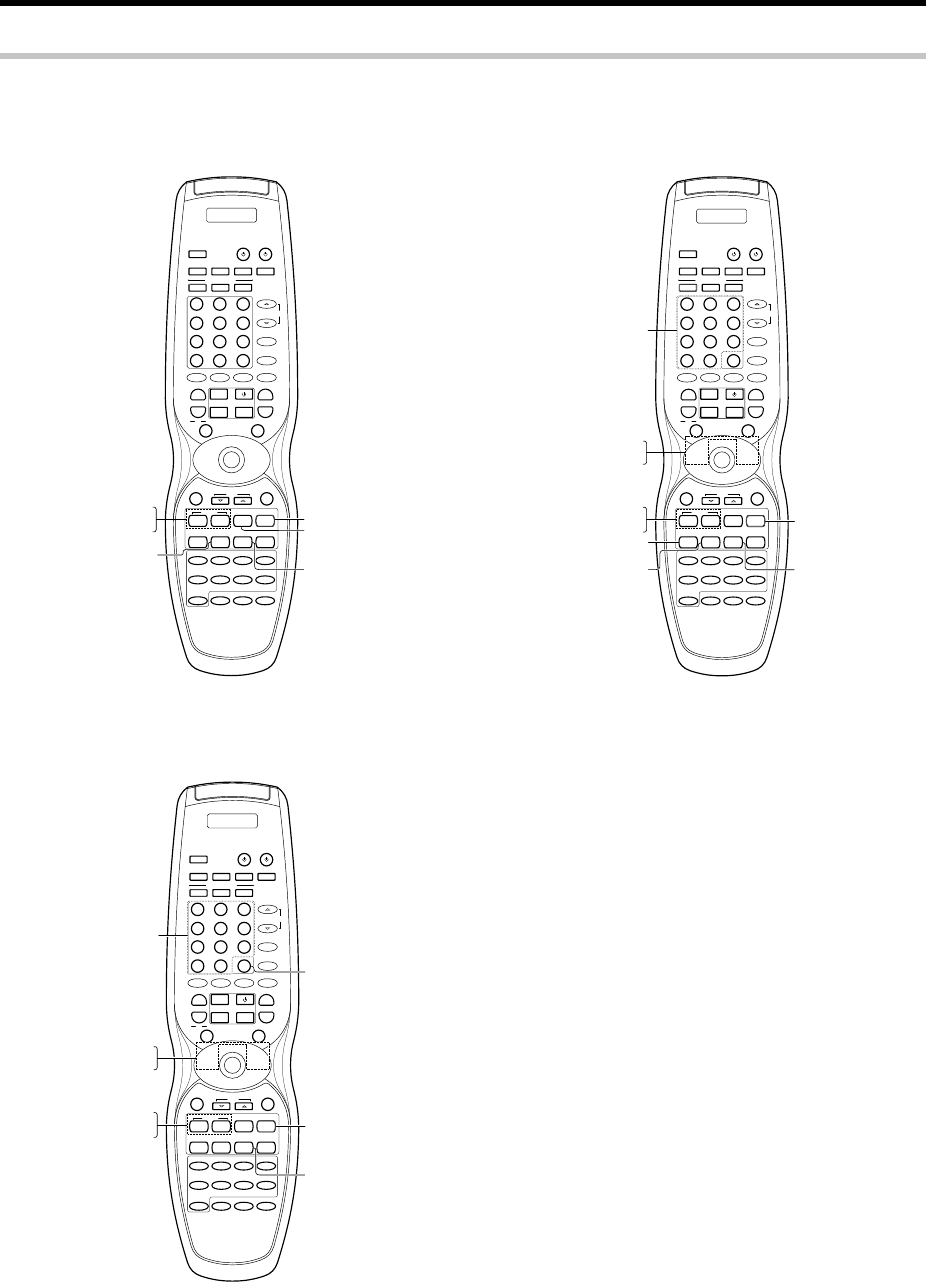
37 EN
CASSETTE deck, CD player & MD recorder operations
You can perform these basic operations using the keys described below when connected to KENWOOD cassette deck, CD player or MD recorder
equipped with system control operations. &
The LCD panel is only for remote control RC-R0816 (VR-6060 model).
Cassette deck operations keys CD player operation keys
P.CALL
4
/DOWN
P.CALL
/UP
¢
TUNING
+
TOP MENU
SET UP
MENU
SOUND
TV CONTROL
VOL.
VOLUME
+
-
-
INPUT
SEL
+
-
CH
DVD
VCR
CBL
TV
DSS/SAT
OTHERS
RECEIVER
SOURCE
POWER
ACTIVE EQ
OSD RETURN
DISC SEL
DISC SKIP
FLIP BAND
INPUT SEL
A/B AUTO
8
DVD/6CH CD/DVD
PHONO
TUNER
VIDEO 1 VIDEO 2
MD/TAPE
LOUDNESS
TONE
BASS BOOST
MUTE
DVD
ENTER
INPUT SELECTOR
MULTI
CONTROL
¢
4
1¡ 2 6
7
DIMMER
™£
™
1
4
7
+10
2
5
8
0
3
6
9
+100
REMOTE MODE
LISTEN MODE
DSP MODESTEREOINPUT MODE
SPEAKER EQ
™
VIDEO 3
AV AU X
PAG E
LEARN
A/B
(Cassette deck
selection)
3
/
8
(3 Play)
2 (Reverse play)
1 (Rewind)
¡ (Fast Forward)
7 (Stop)
P.CALL
4
/DOWN
P.CALL
/UP
¢
TUNING
+
TOP MENU
SET UP
MENU
SOUND
TV CONTROL
VOL.
VOLUME
+
-
-
INPUT
SEL
+
-
CH
DVD
VCR
CBL
TV
DSS/SAT
OTHERS
RECEIVER
SOURCE
POWER
ACTIVE EQ
OSD RETURN
DISC SEL
DISC SKIP
FLIP BAND
INPUT SEL
A/B AUTO
8
DVD/6CH CD/DVD
PHONO
TUNER
VIDEO 1 VIDEO 2
MD/TAPE
LOUDNESS
TONE
BASS BOOST
MUTE
DVD
ENTER
INPUT SELECTOR
MULTI
CONTROL
¢
4
1¡ 2 6
7
DIMMER
™£
™
1
4
7
+10
2
5
8
0
3
6
9
+100
REMOTE MODE
LISTEN MODE
DSP MODESTEREOINPUT MODE
SPEAKER EQ
™
VIDEO 3
AV AU X
PAG E
LEARN
3
/
8
(Play/Pause)
1 (Backward Search)
¡ (Forward Search)
3 (Skip up)
2 (Skip down)
7 (Stop)
Numeric keys
(Select tracks)
DISC SKIP
DISC SEL
(Disc selection)
RC-R0816/R0725 RC-R0816/R0725
MD recorder operation keys
P.CALL
4
/DOWN
P.CALL
/UP
¢
TUNING
+
TOP MENU
SET UP
MENU
SOUND
TV CONTROL
VOL.
VOLUME
+
-
-
INPUT
SEL
+
-
CH
DVD
VCR
CBL
TV
DSS/SAT
OTHERS
RECEIVER
SOURCE
POWER
ACTIVE EQ
OSD RETURN
DISC SEL
DISC SKIP
FLIP BAND
INPUT SEL
A/B AUTO
8
DVD/6CH CD/DVD
PHONO
TUNER
VIDEO 1 VIDEO 2
MD/TAPE
LOUDNESS
TONE
BASS BOOST
MUTE
DVD
ENTER
INPUT SELECTOR
MULTI
CONTROL
¢
4
1¡ 2 6
7
DIMMER
™£
™
1
4
7
+10
2
5
8
0
3
6
9
+100
REMOTE MODE
LISTEN MODE
DSP MODESTEREOINPUT MODE
SPEAKER EQ
™
VIDEO 3
AV AU X
PAG E
LEARN
3
/
8
(Play)
7 (Stop)
+100
(
Select tracks
)
1 (Backward Search)
¡ (Forward Search)
Numeric keys
(Select tracks)
3 (Skip up)
2 (Skip down)
RC-R0816/R0725
Basic remote control operations for other components
•VR6060/35-44/EN 3/11/02, 8:55 PM37
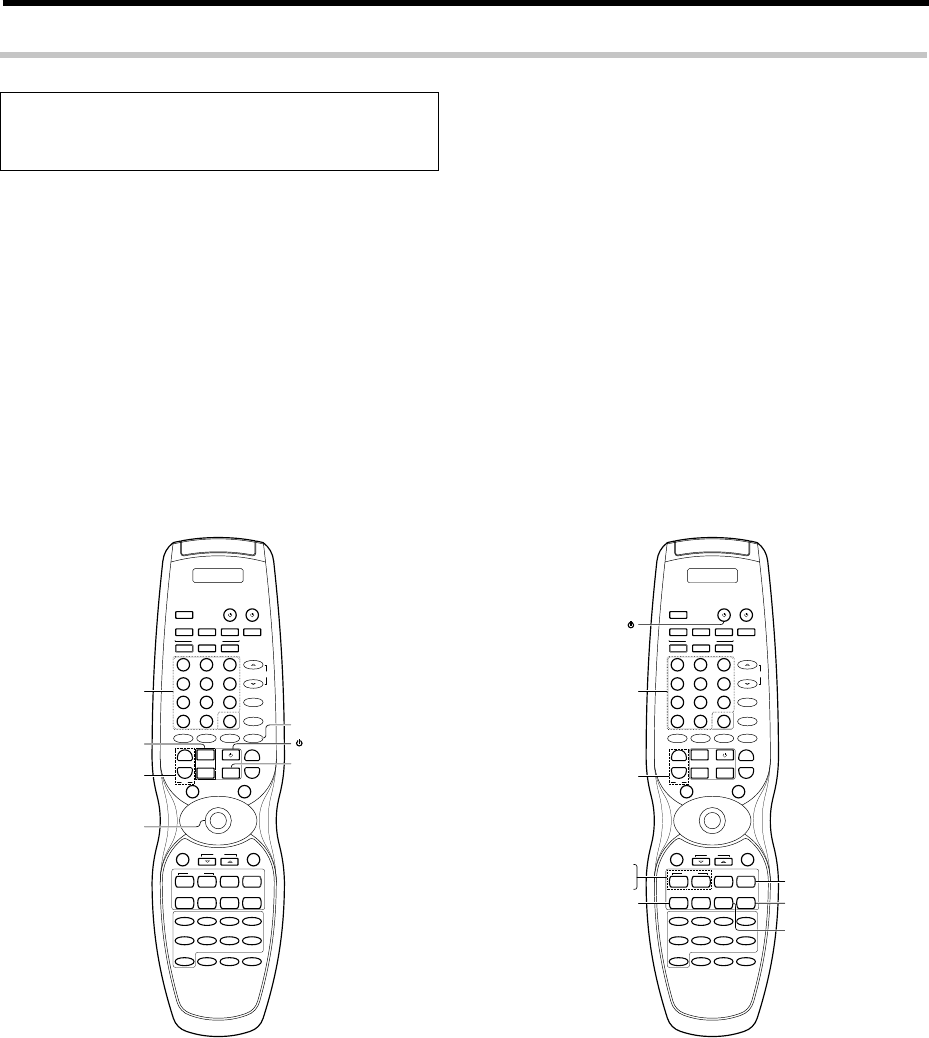
38 EN
Basic remote control operations for other components
Other components’ operations
Refer to the following for the type of remote control operations available for each component.
•When pressing keys in succession, press each key firmly and be sure
to wait at least 1 second before pressing the next key.
•Numeric keys function the same as the numeric keys on the original
remote.
These keys can be used to perform the basic operations of KENWOOD and other manufacturers’ components which the setup code for each
component had been entered beforehand. fl
The LCD panel is only for remote control RC-R0816 (VR-6060 model).
TV operation keys VCR operation keys
P.CALL
4
/DOWN
P.CALL
/UP
¢
TUNING
+
TOP MENU
SET UP
MENU
SOUND
TV CONTROL
VOL.
VOLUME
+
-
-
INPUT
SEL
+
-
CH
DVD
VCR
CBL
TV
DSS/SAT
OTHERS
RECEIVER
SOURCE
POWER
ACTIVE EQ
OSD RETURN
DISC SEL
DISC SKIP
FLIP BAND
INPUT SEL
A/B AUTO
8
DVD/6CH CD/DVD
PHONO
TUNER
VIDEO 1 VIDEO 2
MD/TAPE
LOUDNESS
TONE
BASS BOOST
MUTE
DVD
ENTER
INPUT SELECTOR
MULTI
CONTROL
¢
4
1¡ 2 6
7
DIMMER
™£
™
1
4
7
+10
2
5
8
0
3
6
9
+100
REMOTE MODE
LISTEN MODE
DSP MODESTEREOINPUT MODE
SPEAKER EQ
™
VIDEO 3
AV AU X
PAG E
LEARN
(Power on/off)
Numeric keys
VOL + / –
(Volume + / –)
CH + / –
(Channel + / –)
MUTE
INPUT SEL
(Input selection)
ENTER
P.CALL
4
/DOWN
P.CALL
/UP
¢
TUNING
+
TOP MENU
SET UP
MENU
SOUND
TV CONTROL
VOL.
VOLUME
+
--
INPUT
SEL
+
-
CH
DVD
VCR
CBL
TV
DSS/SAT
OTHERS
RECEIVER
SOURCE
POWER
ACTIVE EQ
OSD RETURN
DISC SEL
DISC SKIP
FLIP BAND
INPUT SEL
A/B AUTO
8
DVD/6CH CD/DVD
PHONO
TUNER
VIDEO 1 VIDEO 2
MD/TAPE
LOUDNESS
TONE
BASS BOOST
MUTE
DVD
ENTER
INPUT SELECTOR
MULTI
CONTROL
¢
4
1¡ 2 6
7
DIMMER
™£
™
1
4
7
+10
2
5
8
0
3
6
9
+100
REMOTE MODE
LISTEN MODE
DSP MODESTEREOINPUT MODE
SPEAKER EQ
™
VIDEO 3
AV AU X
PAG E
LEARN
INPUT SEL
(Input selection)
Numeric keys
CH + / –
(Channel + / –)
3
/
8
(3 Play)
8 (Pause)
1 (Rewind)
¡ (Fast Forward)
7 (Stop)
SOURCE
(Source power)
RC-R0816/R0725 RC-R0816/R0725
1Select the input source.
2Press the keys corresponding to the operations you desire.
Refer to the following sections for details.
•VR6060/35-44/EN 3/11/02, 8:55 PM38
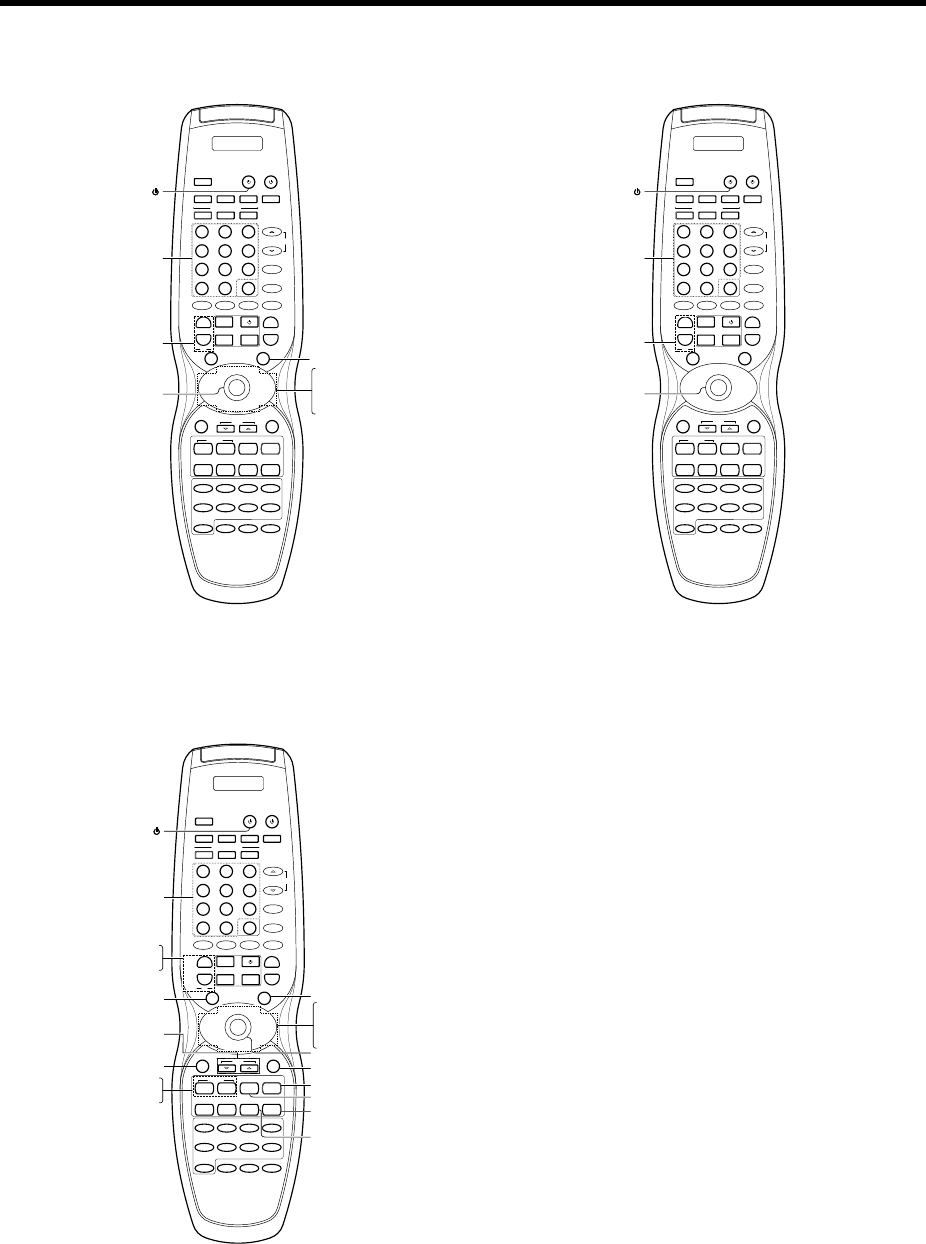
39 EN
Basic remote control operations for other components
DSS/SAT receiver operation keys Cable tuner operation keys
P.CALL
4
/DOWN
P.CALL
/UP
¢
TUNING
+
TOP MENU
SET UP
MENU
SOUND
TV CONTROL
VOL.
VOLUME
+
-
-
INPUT
SEL
+
-
CH
DVD
VCR
CBL
TV
DSS/SAT
OTHERS
RECEIVER
SOURCE
POWER
ACTIVE EQ
OSD RETURN
DISC SEL
DISC SKIP
FLIP BAND
INPUT SEL
A/B AUTO 8
DVD/6CH CD/DVD
PHONO
TUNER
VIDEO 1 VIDEO 2
MD/TAPE
LOUDNESS
TONE
BASS BOOST
MUTE
DVD
ENTER
INPUT SELECTOR
MULTI
CONTROL
¢
4
1¡ 2 6
7
DIMMER
™£
™
1
4
7
+10
2
5
8
0
3
6
9
+100
REMOTE MODE
LISTEN MODE
DSP MODESTEREOINPUT MODE
SPEAKER EQ
™
VIDEO 3
AV AU X
PAG E
LEARN
CH + / –
(Channel + / –)
ENTER
MENU
5 (Cursor up)
∞ (Cursor down)
2
(Cursor left)
3
(Cursor right)
Numeric keys
SOURCE
(Source power)
P.CALL
4
/DOWN
P.CALL
/UP
¢
TUNING
+
TOP MENU
SET UP
MENU
SOUND
TV CONTROL
VOL.
VOLUME
+
-
-
INPUT
SEL
+
-
CH
DVD
VCR
CBL
TV
DSS/SAT
OTHERS
RECEIVER
SOURCE
POWER
ACTIVE EQ
OSD RETURN
DISC SEL
DISC SKIP
FLIP BAND
INPUT SEL
A/B AUTO
8
DVD/6CH CD/DVD
PHONO
TUNER
VIDEO 1 VIDEO 2
MD/TAPE
LOUDNESS
TONE
BASS BOOST
MUTE
DVD
ENTER
INPUT SELECTOR
MULTI
CONTROL
¢
4
1¡ 2 6
7
DIMMER
™£
™
1
4
7
+10
2
5
8
0
3
6
9
+100
REMOTE MODE
LISTEN MODE
DSP MODESTEREOINPUT MODE
SPEAKER EQ
™
VIDEO 3
AV AU X
PAG E
LEARN
CH + / –
(Channel + / –)
ENTER
Numeric keys
SOURCE
(Source power)
RC-R0816/R0725 RC-R0816/R0725
DVD player operation keys
P.CALL
4
/DOWN
P.CALL
/UP
¢
TUNING
+
TOP MENU
SET UP
MENU
SOUND
TV CONTROL
VOL.
VOLUME
+
-
-
INPUT
SEL
+
-
CH
DVD
VCR
CBL
TV
DSS/SAT
OTHERS
RECEIVER
SOURCE
POWER
ACTIVE EQ
OSD RETURN
DISC SEL
DISC SKIP
FLIP BAND
INPUT SEL
A/B AUTO
8
DVD/6CH CD/DVD
PHONO
TUNER
VIDEO 1 VIDEO 2
MD/TAPE
LOUDNESS
TONE
BASS BOOST
MUTE
DVD
ENTER
INPUT SELECTOR
MULTI
CONTROL
¢
4
1¡ 2 6
7
DIMMER
™£
™
1
4
7
+10
2
5
8
0
3
6
9
+100
REMOTE MODE
LISTEN MODE
DSP MODESTEREOINPUT MODE
SPEAKER EQ
™
VIDEO 3
AV AUX
PAG E
LEARN
TOP MENU
(Title)
PAGE %/fi
(Page up or down)
MENU
RETURN
OSD
2 (Flip)
3
/
8
(3 Play)
8 (Pause)
7 (Stop)
1 (Backward Search)
¡ (Forward Search)
¢ (Skip up)
4 (Skip down)
Numeric keys
(Select tracks)
ENTER
5 (Cursor up)
∞ (Cursor down)
2
(Cursor left)
3
(Cursor right)
SOURCE
(Source power)
RC-R0816/R0725
•VR6060/35-44/EN 3/11/02, 8:55 PM39
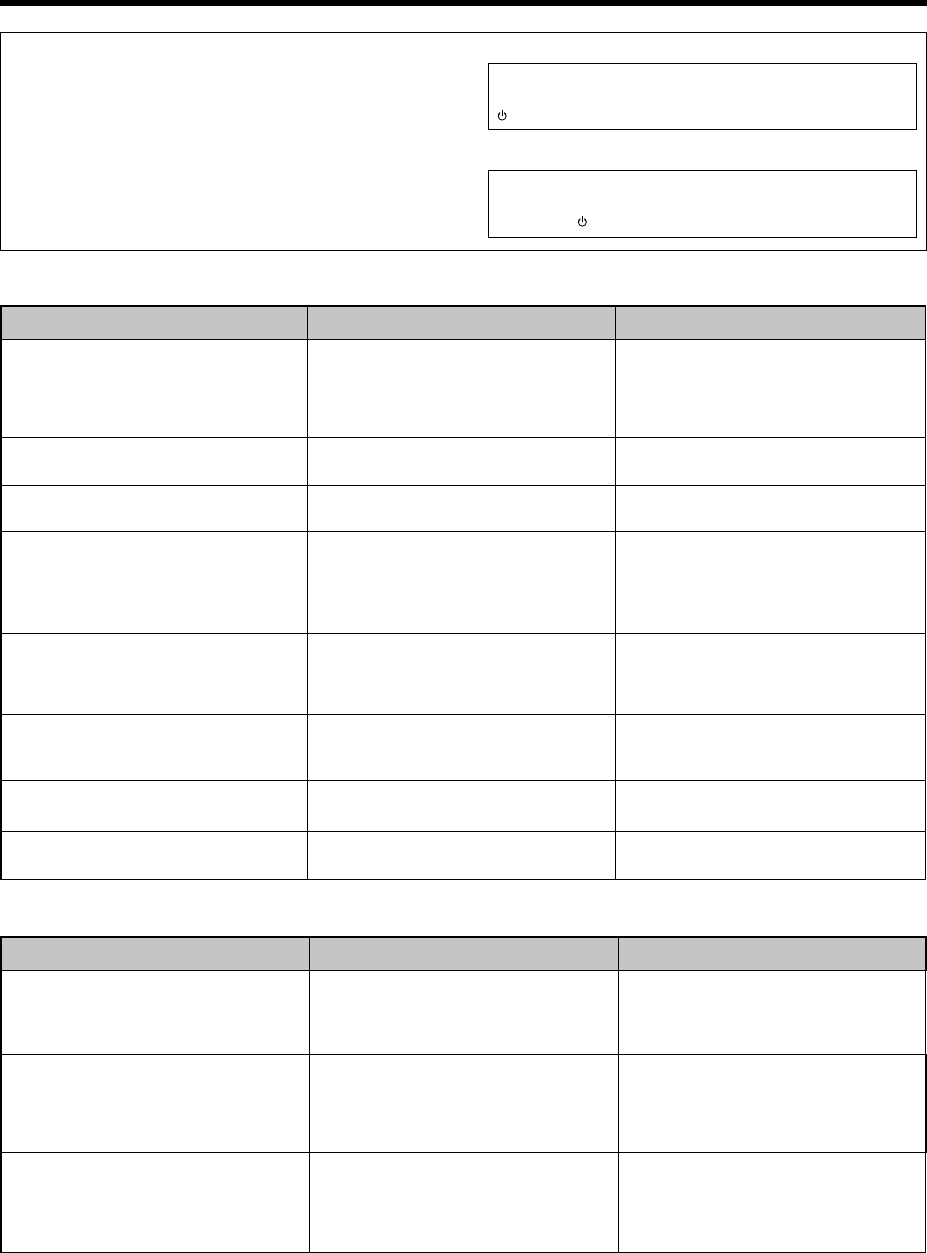
40 EN
In case of difficulty
Tuner
Cause
•No antenna is connected.
•The broadcast band is not set properly.
•The frequency of the desired station is not
tuned.
•Noise due to ignition noise from an automo-
bile.
•Noise due to interference from an electric
appliance.
•Noise due to a nearby TV set.
•The preset station belongs to a frequency that
cannot be received.
•The preset memory was cleared because the
power cord had been unplugged for a long
period of time.
Remedy
•Connect an antenna. ^
•Set the broadcast band properly.
•Tune the frequency of the desired station.
§
•Install the outdoor antenna away from the
road.
•Turn off the power to the appliance.
•Install the receiver farther away from the TV.
•Preset a station with a receivable frequency.
•Preset the station again.
Symptom
Radio stations cannot be received.
Interference.
A station which was preset cannot be re-
ceived by pressing the corresponding nu-
meric key.
Amplifier
Cause
•The speaker cords are disconnected.
•VOLUME is set to the minimum position.
•MUTE is ON.
•The SPEAKERS switches are set to OFF.
•Speaker cords are short-circuited.
•The speaker cord is disconnected.
•The surround speaker cords and/or the center
speaker cord is disconnected.
•A surround mode has not been engaged.
•The surround and/or center volume controls
are set to the minimum level.
•The audio cord from the record player is not
connected to the PHONO jacks.
•The record player is not grounded.
• There are many possible causes for this prob-
lem, depending on the type of DVD player
used.
• The input mode is set to digital manual.
• The software is copy-guarded.
Remedy
•Connect them properly referring to “Connect-
ing the speakers”$
•Adjust the volume to a proper level.
•Turn OFF the MUTE. ¢
•Set the SPEAKERS switches to ON. ™
•Turn the power off, eliminate the short-circuit-
ing, then turn on the power again.
•Connect it properly referring to “Connecting
the speakers”.$
•Connect it properly referring to “Connecting
the speakers”.$
•Select a surround mode.
•Adjust the speaker levels using the test tone.
¡
•Insert the audio cord plugs securely into the
PHONO jacks.
•Connect the grounding wire to the GND termi-
nal on the rear panel.
• Set the input mode to digital manual before
starting playback of the Dolby Digital source.
8
• Press the INPUT MODE key to select to full
auto mode. 8
•Copy-guarded video software cannot be re-
corded.
Symptom
No sound from the speakers.
The standby indicator blinks and sound is
not output.
Sound is not output from one of the speakers.
Sound is not output from the surround
speakers and / or the center speaker, or their
sound is very small.
A humming noise is generated when the
PHONO input selector is selected.
When playing a Dolby Digital source signal
using a DVD player, the sound is cut off soon
after it starts.
No sound is produced during playback from
a DVD player.
A video source cannot be recorded
normally.
Resetting the Microcomputer
The microcomputer may malfunction (unit cannot be operated, or
shows an erroneous display) if the power cord is unplugged while
the power is ON, or due to some other external factor. If this
happens, execute the following procedure to reset the microcom-
puter and return the unit to its normal operating condition.
•Please note that resetting the microcomputer will clear the contents
of the memory and returns the unit to the state it was in when it left
the factory.
For the U.S.A. and Canada
Unplug the power cord from the wall outlet, then plug it
back in while holding down the POWER ON/STANDBY
key.
For other countries
With the power cord plugged in, turn the POWER ON/
OFF key OFF. Then, while holding down the ON/
STANDBY key, press POWER ON/OFF.
•VR6060/35-44/EN 3/11/02, 8:55 PM40
41 EN
Remote control unit
Cause
•No setup codes registered for the respective
input(s).
•The remote control is set to a different opera-
tion mode.
•Batteries are exhausted.
•The remote control unit is too far away from
the main system, controlling angle is too large,
or there is an obstacle between the receiver
and the remote.
•The audio cords and system control cords are
not connected properly.
•No software is loaded in the source component.
•An attempt is made to play a tape which is
being recorded in the cassette deck.
•The remote control has not been set to the
operation mode for the component you wish
to control.
Remedy
•Register a setup code at the respective input(s).
fl
•Press the source select keys or SOURCE
keys to select the appropriate operation mode.
•Replace with new batteries.
•Operate the remote control unit within the
controllable range.
•Connect properly referring to “Setting up the
system”.
•Place software in the source component you
want to play.
•Wait until recording has completed.
•Press the source select keys or SOURCE
key to activate the operation mode for the
component you want to control before
operation. fi
Symptom
Certain inputs cannot be selected using the
remote control.
Remote control operation is not possible.
In case of difficulty
•VR6060/35-44/EN 3/11/02, 8:55 PM41
42 EN
Specifications
For the U.S.A and Canada
AUDIO section (VR-6060)
Rated power output during STEREO operation
Effective power output during SURROUND operation
FRONT (20 ~ 20 kHz, 0.09 % T.H.D. at 8 Ω one channel driven)
............................................................................... 100 W + 100 W
CENTER (20 ~ 20 kHz, 0.09 % T.H.D. at 8 Ω one channel
driven) .................................................................................. 100 W
SURROUND (20 ~ 20 kHz, 0.7 % T.H.D. at 8 Ω one channel
driven) ................................................................... 100 W + 100 W
SURROUND BACK/SUBWOOFER (20 ~ 20 kHz, 0.09 % T.H.D.
at 8 Ω one channel driven) ................................................. 100 W
Total harmonic distortion ....................... 0.009 % (1 kHz, 50 W, 8 Ω)
Frequency response
Line (CD/DVD, TAPE, VIDEO 1, VIDEO 2, VIDEO 3, DVD/6CH)
................................................. 10 Hz ~ 100 kHz, +0 dB ~ –3.0 dB
PHONO ‘RIAA’ response .............. 40 Hz ~ 20 kHz, +1.5 dB ~ –3.0 dB
Maximum input level
PHONO (MM) .................................... 45 mV, 1 % T.H.D. at 1 kHz
Signal to noise ratio (IHF’66)
PHONO (MM) ........................................................................ 75 dB
Line (CD/DVD, TAPE, VIDEO 1, VIDEO 2, VIDEO 3, DVD/6CH)
............................................................................................... 95 dB
Loudness control
VOLUME at –30 dB level ...................................... +6 dB (100 Hz)
Input sensitivity / impedance
PHONO (MM) ........................................................ 6.0 mV / 47 kΩ
Line (CD/DVD, TAPE, VIDEO 1, VIDEO 2, VIDEO 3, DVD/6CH)
.............................................................................. 500 mV / 47 kΩ
Output level / impedance
TAPE REC ............................................................... 500 mV / 1 kΩ
PRE OUT (SURROUND BACK CHANNEL) .............. 2.5 V / 1 kΩ
PRE OUT (SUBWOOFER) ......................................... 2.5 V / 1 kΩ
Tone control
BASS ................................................................ ±10 dB (at 100 Hz)
TREBLE ............................................................ ±10 dB (at 10 kHz)
For other countries
AUDIO section (KRF-V8060D)
Effective power output during STEREO operation
1 kHz, 10 %, 8 Ω ......................................................... 110 W + 110 W
Rated power output during STEREO operation
Effective power output during SURROUND operation
FRONT (1 kHz, 10% T.H.D. at 8 Ω one channel driven)
............................................................................... 110 W + 110 W
CENTER (1 kHz, 10% T.H.D. at 8 Ω one channel driven)
.............................................................................................. 110 W
SURROUND (1 kHz, 10% T.H.D. at 8 Ω one channel driven)
............................................................................... 110 W + 110 W
SURROUND BACK/SUBWOOFER (1 kHz, 10% T.H.D. at 8 Ω
one channel driven) ............................................................ 110 W
Total harmonic distortion ........................ 0.009% (1 kHz, 50 W, 8 Ω)
Frequency response
Line (CD/DVD, TAPE, VIDEO 1, VIDEO 2, VIDEO 3, DVD/6CH)
................................................. 10 Hz ~ 100 kHz, +0 dB ~ –3.0 dB
PHONO ‘RIAA’ response ................ 40 Hz ~ 20 kHz, 1.5 dB ~ –3.0 dB
Maximum input level
PHONO (MM) ....................................45 mV, 1 % T.H.D. at 1 kHz
Signal to noise ratio (IHF’66)
PHONO (MM) ........................................................................ 75 dB
Line (CD/DVD, TAPE, VIDEO 1, VIDEO 2, VIDEO 3, DVD/6CH)
............................................................................................... 95 dB
Loudness control
VOLUME at –30 dB level ...................................... +6 dB (100 Hz)
Input sensitivity / impedance
PHONO (MM) ........................................................ 6.0 mV / 47 kΩ
Line (CD/DVD, TAPE, VIDEO 1, VIDEO 2, VIDEO 3, DVD/6CH)
.............................................................................. 500 mV / 47 kΩ
Output level / impedance
TAPE REC ............................................................... 500 mV / 1 kΩ
PRE OUT (SURROUND BACK CHANNEL) .............. 2.5 V / 1 kΩ
PRE OUT (SUBWOOFER) ......................................... 2.5 V / 1 kΩ
Tone control
BASS................................................................ ±10 dB (at 100 Hz)
TREBLE ............................................................ ±10 dB (at 10 kHz)
Caution : Read this page carefully to ensure safe
operation.
100 watts per channel minimum RMS, both channels driven,
at 8 Ω from 20 Hz to 20 kHz with no more than 0.09% total
harmonic distortion. (FTC) 100 watts per channel minimum RMS, both channels driven,
at 8 Ω from 20 Hz to 20 kHz with no more than 0.09% total
harmonic distortion. (FTC)
•VR6060/35-44/EN 3/11/02, 8:55 PM42

43 EN
Notes
1. KENWOOD follows a policy of continuous advancements in development. For this reason specifications may be changed without notice.
2. The full performance may not be exhibited in an extremely cold location (under a water-freezing temperature).
Specifications
DIGITAL AUDIO section
Sampling frequency ...................... 32 kHz, 44.1 kHz, 48 kHz, 96 kHz
Input level / impedance / wave length
Optical ........................... (–15 dBm ~ –24 dBm), 660 nm ±30 nm
Coaxial ................................................................... 0.5 Vp-p / 75 Ω
VIDEO section
VIDEO inputs / outputs
VIDEO (composite) .................................................. 1 Vp-p / 75 Ω
S VIDEO inputs /outputs
S VIDEO (luminance signal) ................................... 1 Vp-p / 75 Ω
S VIDEO (chrominance signal) ....................... 0.286 Vp-p / 75 Ω
COMPONENT VIDEO inputs /outputs
COMPONENT VIDEO (luminance signal) .............. 1 Vp-p / 75 Ω
COMPONENT VIDEO (CB/CR-signal) ............ ±0.32 Vp-p / 75 Ω
FM tuner section
Tuning frequency range................................. 87.5 MHz ~ 108.0 MHz
Usable sensitivity (MONO)
VR-6060
................... 1.3 µV (75 Ω)/ 13.2 dBf (75 kHz dev, SINAD 30 dB)
KRF-V8060D ....................................................................................
................... 1.6 µV (75 Ω)/ 15.2 dBf (75 kHz dev, SINAD 30 dB)
50 dB quieting sensitivity
STEREO ..................................................... 28 µV (75 Ω)/ 40.2 dBf
Total harmonic distortion
MONO (1 kHz, 75 kHz dev) .......................... 0.5% (65 dBf input)
STEREO (1 kHz, 67.5 + 6.75 kHz dev) ......... 0.7% (65 dBf input)
Signal to noise ratio
MONO (1 kHz, 75 kHz dev) ........................ 75 dB (65 dBf input)
STEREO (1 kHz, 67.5 + 6.75 kHz dev) ....... 68 dB (65 dBf input)
Stereo separation (1 kHz) ........................................................... 40 dB
Selectivity (±400 kHz) (VR-6060) ............................................... 70 dB
(KRF-V8060D) ......................................... 50 dB
Frequency response (30 Hz ~ 15 kHz) .................... +0.5 dB, –3.0 dB
AM tuner section
Tuning frequency range
10 kHz step ................................ 530 kHz ~ 1,700 kHz (VR-6060)
10 kHz step ......................... 530 kHz ~ 1,610 kHz (KRF-V8060D)
9 kHz step ......................... 531 kHz ~ 1,602 kHz (KRF-V8060D)
Usable sensitivity (30% mod, S/N 20 dB)
........................................................................ 16 µV / (600 µV/m)
Signal to noise ratio (30% mod, 400 Hz)
.......................................................... 50 dB (60 dBµ VEMF input)
GENERAL
Power consumption VR-6060 ....................................................... 3 A
KRF-V8060D ........................................... 300 W
AC outlet
SWITCHED VR-6060 ..................... (total 150 W, 1.25 A max.)
KRF-V8060D ............................. (total 90 W max.)
Dimensions ..................................................... W : 440 mm (17-5/16")
H : 159 mm (6-1/4")
D : 392 mm (15-7/16")
Weight (Net)
VR-6060 ................................................................ 9.4 kg (20.7 lb)
KRF-V8060D ........................................................ 10.0 kg (22.0 lb)
•VR6060/35-44/EN 3/11/02, 8:55 PM43

44 EN
For your records
Record the serial number, found on the back of the unit, in the spaces
designated on the warranty card, and in the space provided below. Refer
to the model and serial numbers whenever you call upon your dealer for
information or service on this product.
Model__________________ Serial Number ________________________
•VR6060/35-44/EN 3/11/02, 8:55 PM44
