Kingwave Technology KWS7S3 2.4GHz RF Module User Manual KWS7S3 2 4GHz RF module 20120523

Kingwave Technology Co., Ltd. 2.4GHz RF Module KWS7S3 2 4GHz RF module 20120523

User Manual

- 1-  KWS7S3 2.4GHz RF Module User Manual  1. Introduction KWS7S3 is a 2.4GHz ISM band HDR (high data rate) FH (frequency hopping) transceiver. It provides three types of digital modulation 16QAM/QPSK/BPSK, and on-air data rate support 12Mbps. The proprietary low MAC feature coupled with high-speed multimedia processor enables a very high quality wireless multimedia application and a great interference immunity capability.  2. Pin Assignment                  Pin 1 2 3 4 5 6 7 8 9 10 5V GND CLK OUT IRQ CS SDO SDI SCK TN CLK IN  3. Installation           1: Soldering antenna on the KWS7S3 PCB. 1 5  10
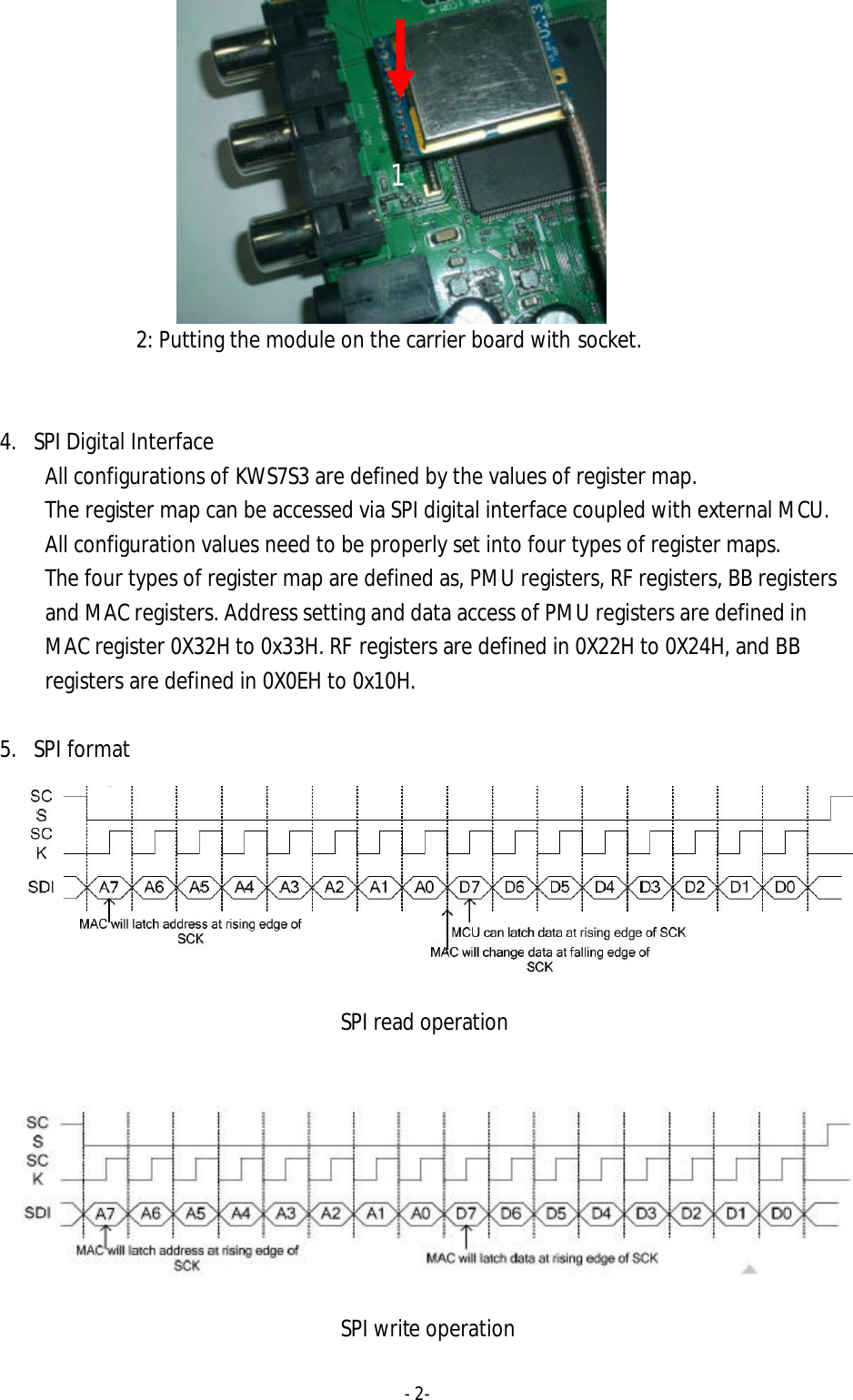
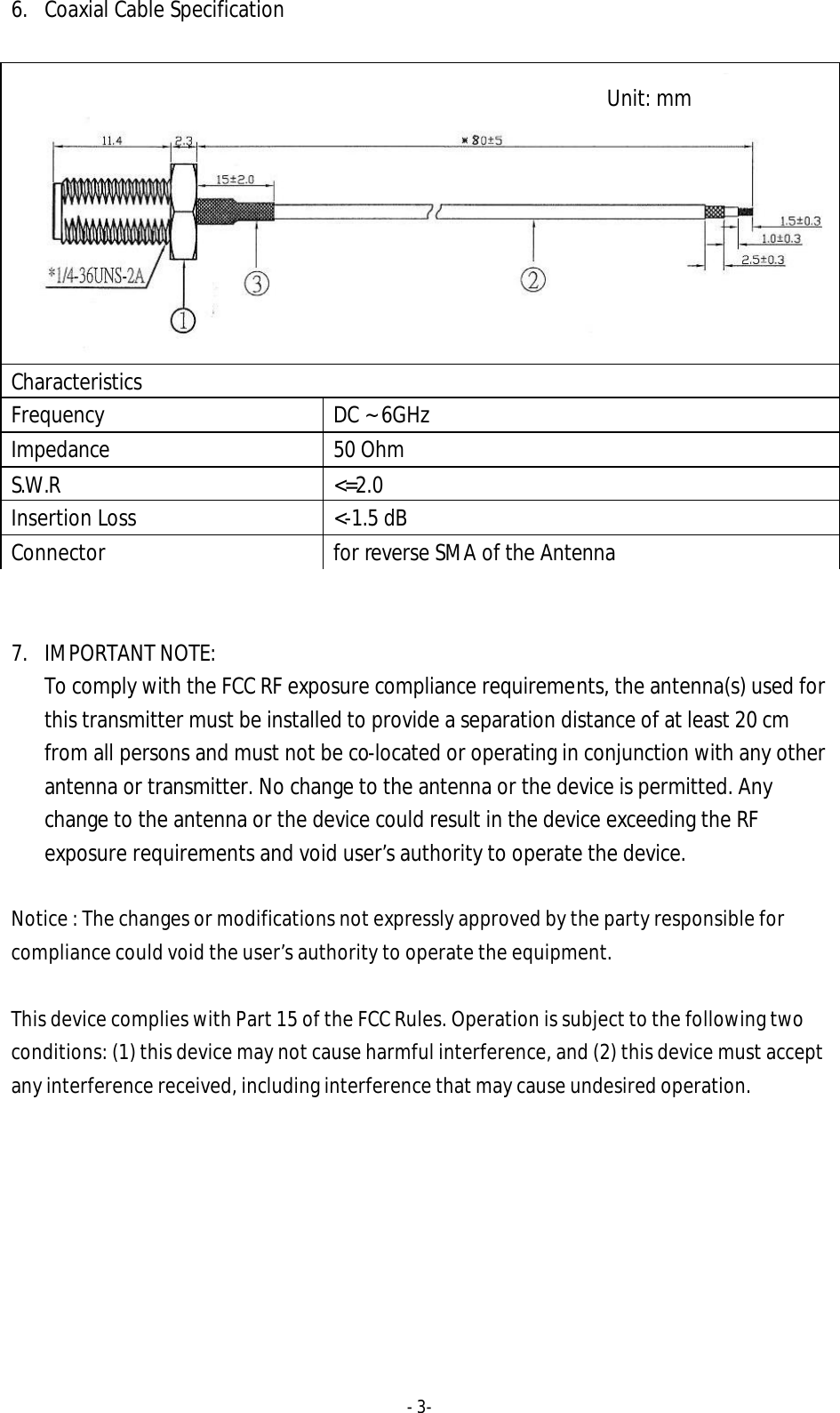
- 2-             2: Putting the module on the carrier board with socket.   4. SPI Digital Interface All configurations of KWS7S3 are defined by the values of register map.   The register map can be accessed via SPI digital interface coupled with external MCU.   All configuration values need to be properly set into four types of register maps.   The four types of register map are defined as, PMU registers, RF registers, BB registers and MAC registers. Address setting and data access of PMU registers are defined in MAC register 0X32H to 0x33H. RF registers are defined in 0X22H to 0X24H, and BB registers are defined in 0X0EH to 0x10H.  5. SPI format        SPI read operation         SPI write operation  1
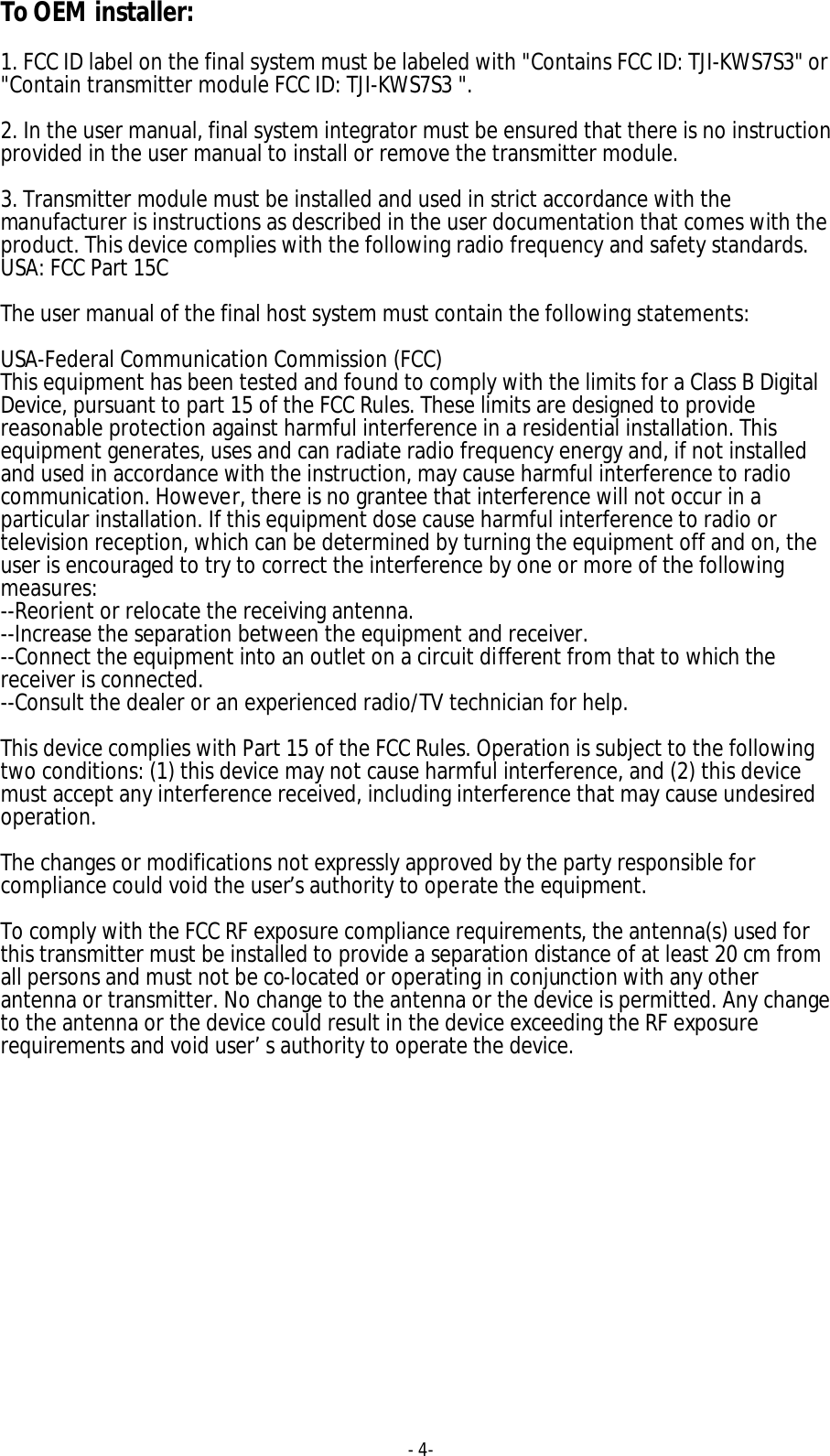
- 3-  6. Coaxial Cable Specification    7. IMPORTANT NOTE:   To comply with the FCC RF exposure compliance requirements, the antenna(s) used for this transmitter must be installed to provide a separation distance of at least 20 cm from all persons and must not be co-located or operating in conjunction with any other antenna or transmitter. No change to the antenna or the device is permitted. Any change to the antenna or the device could result in the device exceeding the RF exposure requirements and void user’s authority to operate the device.  Notice : The changes or modifications not expressly approved by the party responsible for compliance could void the user’s authority to operate the equipment.  This device complies with Part 15 of the FCC Rules. Operation is subject to the following two conditions: (1) this device may not cause harmful interference, and (2) this device must accept any interference received, including interference that may cause undesired operation.   Characteristics Frequency DC ~ 6GHz Impedance 50 Ohm S.W.R <=2.0 Insertion Loss <-1.5 dB Connector for reverse SMA of the Antenna Unit: mm
- 4-  To OEM installer:  1. FCC ID label on the final system must be labeled with "Contains FCC ID: TJI-KWS7S3" or "Contain transmitter module FCC ID: TJI-KWS7S3 ".  2. In the user manual, final system integrator must be ensured that there is no instruction provided in the user manual to install or remove the transmitter module.  3. Transmitter module must be installed and used in strict accordance with the manufacturer is instructions as described in the user documentation that comes with the product. This device complies with the following radio frequency and safety standards. USA: FCC Part 15C  The user manual of the final host system must contain the following statements:  USA-Federal Communication Commission (FCC) This equipment has been tested and found to comply with the limits for a Class B Digital Device, pursuant to part 15 of the FCC Rules. These limits are designed to provide reasonable protection against harmful interference in a residential installation. This equipment generates, uses and can radiate radio frequency energy and, if not installed and used in accordance with the instruction, may cause harmful interference to radio communication. However, there is no grantee that interference will not occur in a particular installation. If this equipment dose cause harmful interference to radio or television reception, which can be determined by turning the equipment off and on, the user is encouraged to try to correct the interference by one or more of the following measures: --Reorient or relocate the receiving antenna. --Increase the separation between the equipment and receiver. --Connect the equipment into an outlet on a circuit different from that to which the receiver is connected. --Consult the dealer or an experienced radio/TV technician for help.  This device complies with Part 15 of the FCC Rules. Operation is subject to the following two conditions: (1) this device may not cause harmful interference, and (2) this device must accept any interference received, including interference that may cause undesired operation.  The changes or modifications not expressly approved by the party responsible for compliance could void the user’s authority to operate the equipment.  To comply with the FCC RF exposure compliance requirements, the antenna(s) used for this transmitter must be installed to provide a separation distance of at least 20 cm from all persons and must not be co-located or operating in conjunction with any other antenna or transmitter. No change to the antenna or the device is permitted. Any change to the antenna or the device could result in the device exceeding the RF exposure requirements and void user’s authority to operate the device.

Navigation menu