Kodak Easyshare Z710 Users Guide Z710_en
EasyShare Z710 - Quick Start Guide Z710_GSG_GLB_en Free User Guide for Kodak Camera, Manual - page4
2015-08-19
: Kodak Kodak-Easyshare-Z710-Users-Guide-788014 kodak-easyshare-z710-users-guide-788014 kodak pdf
Open the PDF directly: View PDF  .
.
Page Count: 29
www.kodak.com/go/z710support 1
ENGLISH
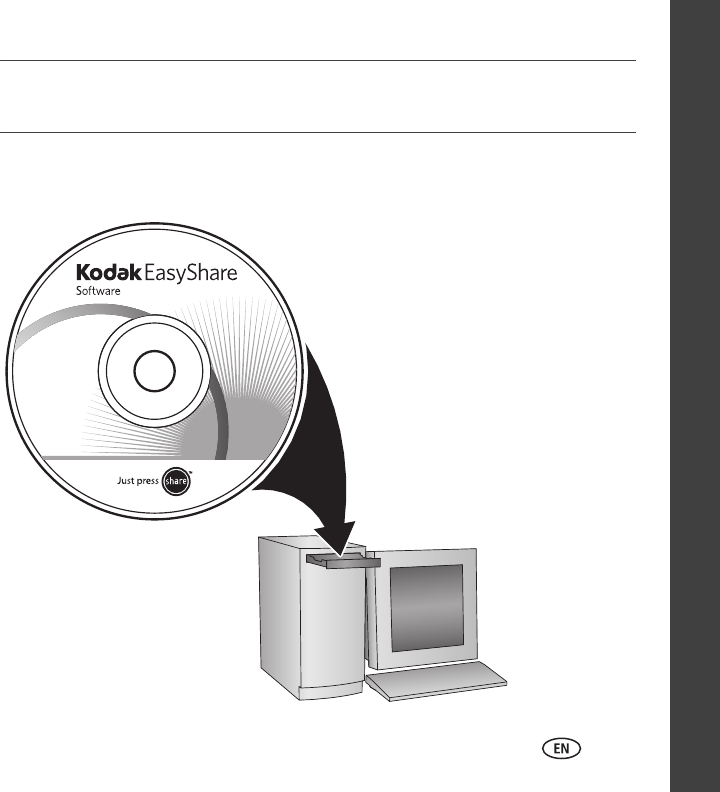
Installing the software
IMPORTANT:
Before connecting any cables, install the software that was included with
your camera. Follow the on-screen instructions.
After installing the software, return
to this Getting Started Guide.
2www.kodak.com/go/easysharecenter
ENGLISH
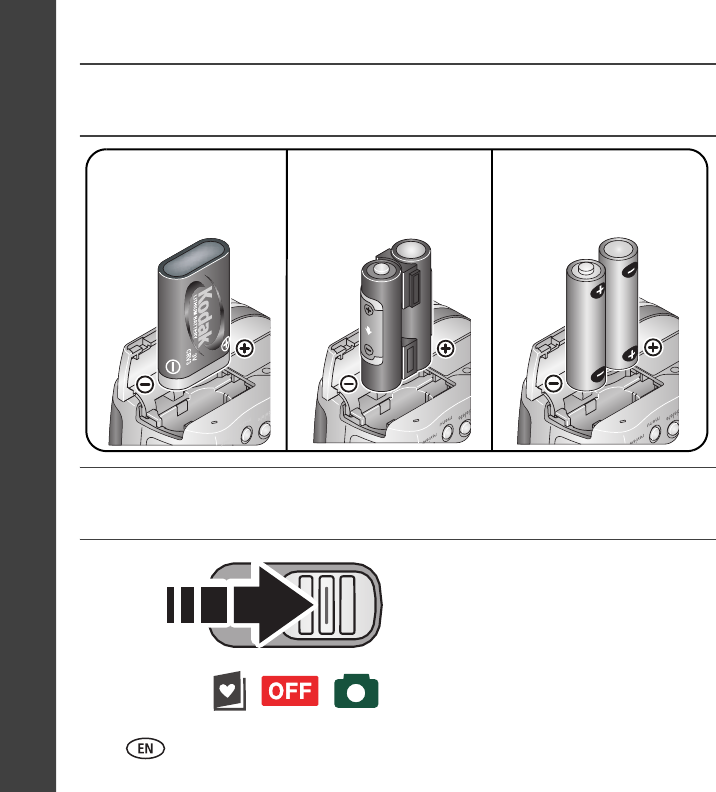
Loading the batteries
Turning on the camera
CRV3 lithium
(non-rechargeable)
2 AA lithium or Ni-MH
(may be rechargeable
or non-rechargeable)
Ni-MH
(rechargeable)

www.kodak.com/go/z710support 3
ENGLISH
Setting the language, date/time
2
1
to change.
for previous/next field.
OK to accept.
OK
At the prompt, press OK.
2
1to change.
OK to accept.
Language:
Date/Time:

4www.kodak.com/go/easysharecenter
ENGLISH
Taking a picture/video
3Press the Shutter button halfway
to focus and set exposure.
When the AF/AE indicator turns
green, press the Shutter button
completely down.
2
Pictures Videos
Press the Shutter button
completely down and release.
To stop recording, press the
Shutter button again.
AF/AE
indicator
1
3
1
EVF
LCD
Press the EVF/LCD button to turn
LCD or EVF (electronic viewfinder) on.
EVF
LCD
www.kodak.com/go/z710support 5
ENGLISH
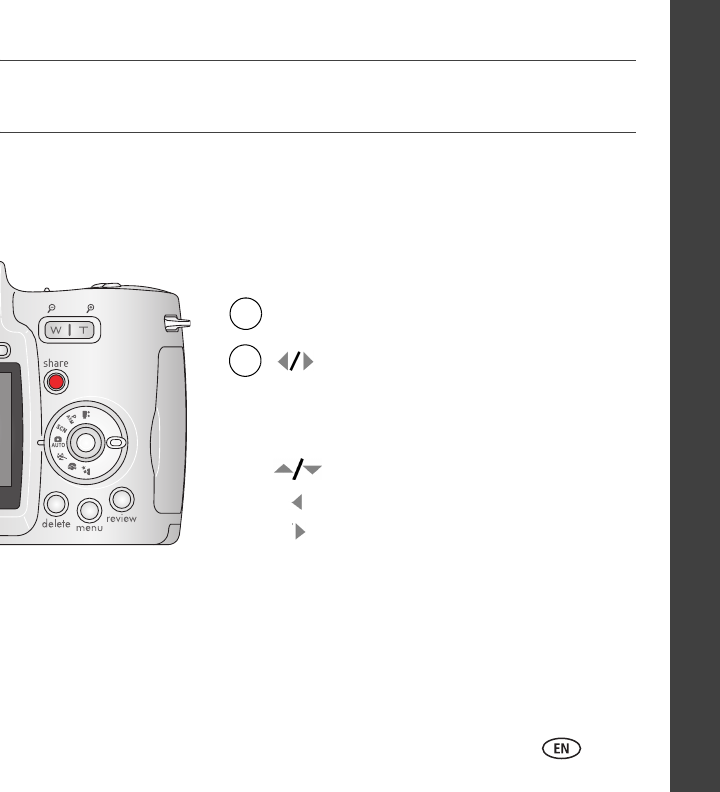
Reviewing pictures/videos
1
2for previous/next.
Press Review. (Press again to exit.)
Videos:
OK Play/pause.
Adjust the volume (during playback).
Rewind to beginning (during playback)
Next picture/video (during playback).
6www.kodak.com/go/easysharecenter
ENGLISH
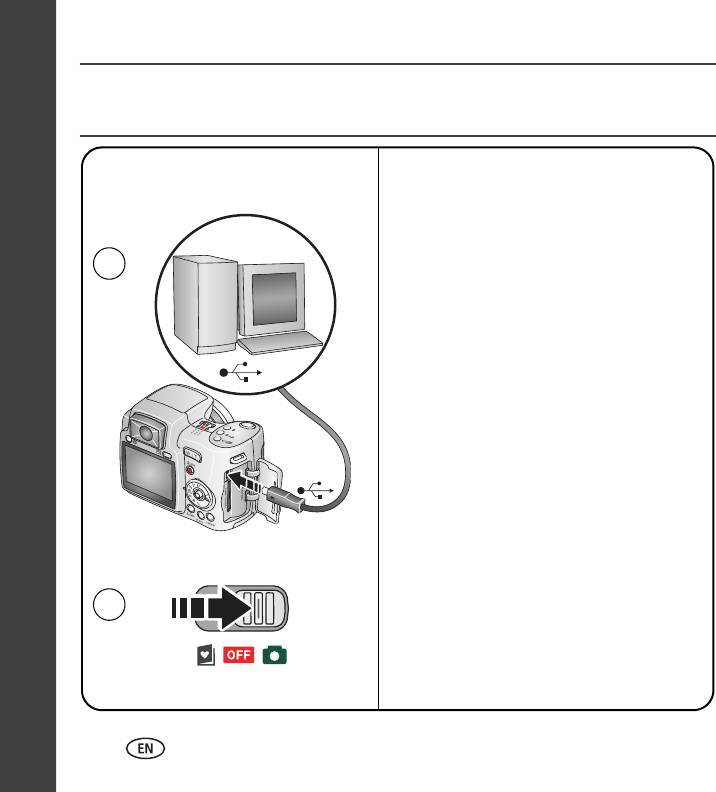
Transferring pictures/videos
1
2
USB cable Kodak EasyShare printer dock
or camera dock
(May be sold separately.)
For dock compatibility, visit
www.kodak.com/go/dockcompatibility.
To purchase accessories, visit
www.kodak.com/go/z710accessories.
To use an EasyShare dock, see its
Getting Started Guide.
www.kodak.com/go/z710support 7
ENGLISH
Keep learning about your camera!
Congratulations!
You have:
• set up your camera
• taken pictures
• transferred pictures to your computer
Visit www.kodak.com/go/z710support and
www.kodak.com/go/easysharecenter for:
• the extended user’s guide
• interactive troubleshooting and repairs
• interactive tutorials
• FAQs
• downloads
• accessories
• printing information
• product registration
Keep learning!
Finish reading this book, so you can take and share your best pictures!
8www.kodak.com/go/easysharecenter
ENGLISH
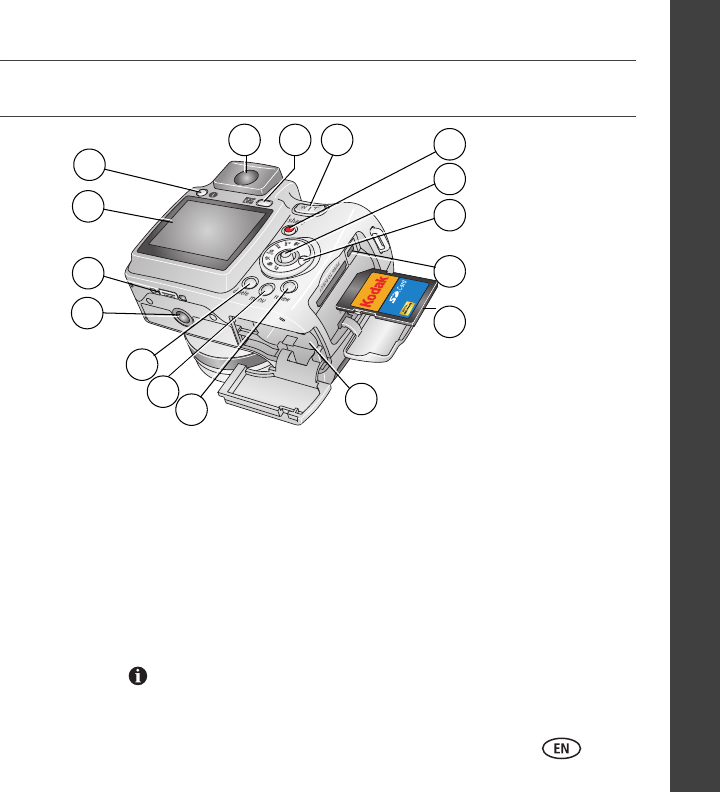
Front view
1 Grip 8 Speaker
2 Low-light assist, Self-timer light 9 Flash
3 Shutter button 10 Open Flash switch
4 Flash button 11 Neck strap post
5 Close-up/Landscape button 12 Microphone
6 Self-timer/Burst button 13 Lens
7 Power/Favorites switch 14 DC-In (3V) ,for optional AC adapter
4
3
8
1
1075 6
11
12
13
14
2
9
www.kodak.com/go/z710support 9
ENGLISH
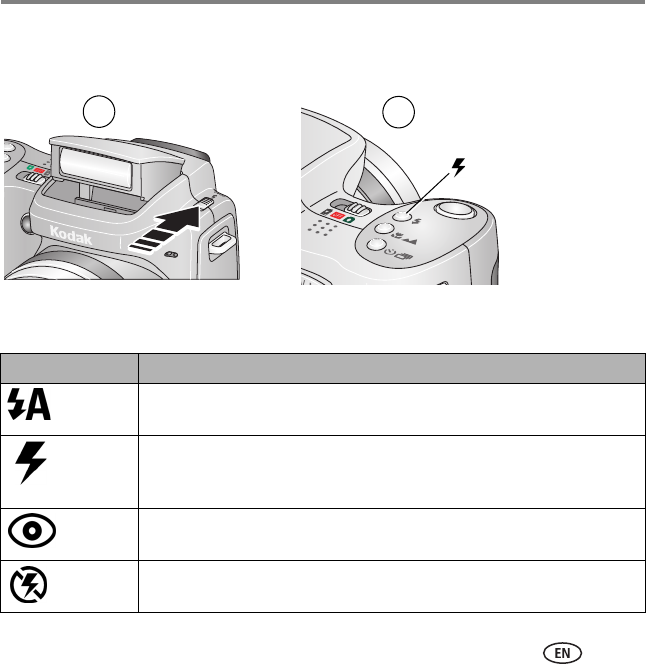
Back view
1 Review button 9 EVF/LCD button
2 Menu button 10 Zoom (Wide Angle/Telephoto)
3 Delete button 11 Share button
4 Tripod socket 12 Joystick/OK button
5 Dock connector 13 Mode dial
6 LCD 14 USB, A/V Out
7 Info button 15 Optional SD or MMC card
8 EVF (Electronic viewfinder) 16 Battery compartment
4
5
6
7
8 9
3
2
1
10 11
12
13
14
15
16

10 www.kodak.com/go/easysharecenter
1Doing more with your camera
Using optical zoom
Use optical zoom to get up to 10X closer to your subject. Optical zoom is effective
when the lens is no closer than 24 in. (60 cm) to the subject or 5 in. (13 cm) in Close-up
mode. You can change optical zoom before (but not during) video recording.
1Use the viewfinder or LCD to frame your subject.
2Press Telephoto (T) to zoom in. Press Wide Angle (W)
to zoom out.
The zoom indicator shows zoom status.
3Take the picture or video.
Use digital zoom in any Still mode to get up to 5X
magnification beyond optical zoom.
Press the Telephoto (T) button to the optical zoom
limit (10X). Release the button, then press it again.
NOTE: You cannot use digital zoom for video recording. You may
notice decreased image quality when using digital zoom. The
blue slider on the zoom indicator pauses and turns red when
the picture quality reaches the limit for an acceptable 4 x 6-in.
(10 x 15 cm) print.
Zoom indicator
WT
D
Digital
zoom
range
Optical
zoom
range
Doing more with your camera
www.kodak.com/go/z710support 11
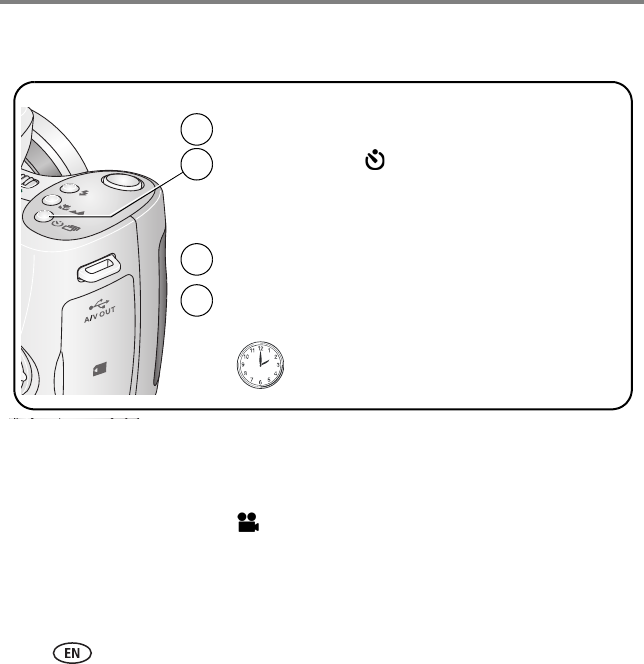
Using the flip-up flash
Use the flash when you take pictures at night, indoors, or outdoors in heavy shadows.
Flash modes Flash fires
Auto
Flash
When the lighting conditions require it.
Fill Every time you take a picture, regardless of the lighting conditions. Use
when the subject is in shadow or is “backlit” (when light is behind the
subject). In low light, hold the camera steady or use a tripod.
Red Eye The flash fires once so the eyes become accustomed to the flash, then fires
again when the picture is taken.
Off Never
2
1
Press the flash button repeatedly to scroll through flash modes.
The current flash mode is depicted in the LCD/EVF status area.
Doing more with your camera
12 www.kodak.com/go/easysharecenter
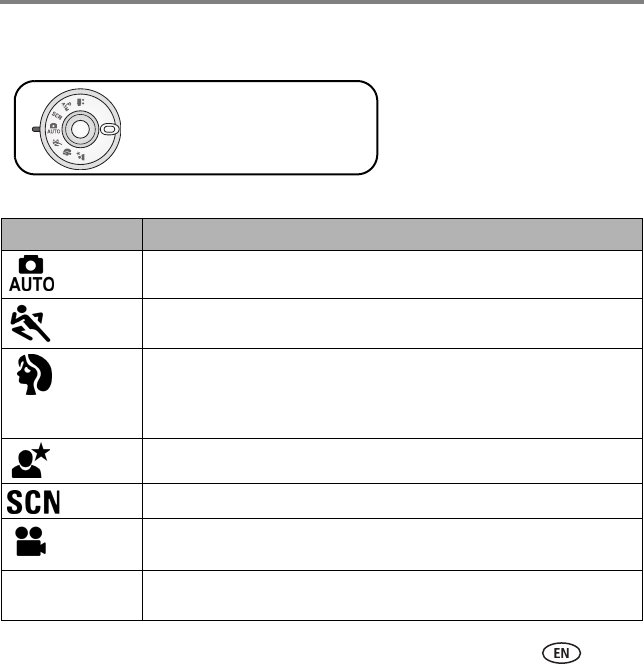
Using the self-timer
To cancel the Self-timer before the picture is taken, press the Self-timer button. (The
Self-timer setting remains active.)
Use the same procedure to take a video, but:
■Turn the Mode dial to Video .
■Press the Shutter button completely down.
NOTE: The video stops when no storage space remains. Only the 2- and 10-second options are available in
video mode.
1
2
3
4
Place camera on a tripod or flat surface.
Compose the scene.
Press the Shutter button halfway, then completely down.
The picture is taken after the delay.
• Once for a 10-sec. delay (so you have time to get into the scene)
• Again for a 2-sec. delay (for a steady, shutter release on a tripod)
• Again for 2 pictures (after a 10- and 18-second delay)
In any Still mode, press :
Doing more with your camera
www.kodak.com/go/z710support 13
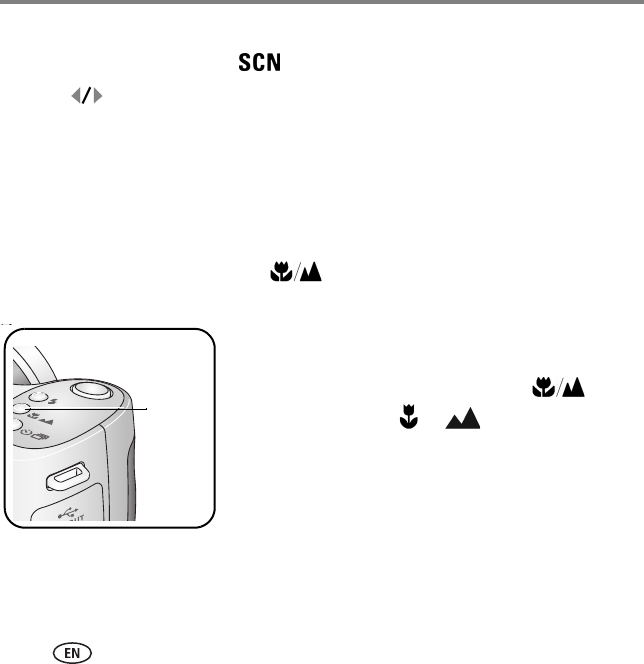
Capture modes
Use this mode For
Auto General picture-taking—offers an excellent balance of image quality and
ease of use.
Sport Subjects that are in motion. Shutter speed is fast. The camera pre-settings
are Multi-Pattern Exposure Metering, Multi-Zone Focus.
Portrait Full-frame portraits of people. Allows the subject to be sharp and the
background to be indistinct. For best results, position your subject at least
6 ft (2 m) away and fill the frame with a head-and-shoulder pose. Use
Telephoto to exaggerate background blur.
Night Use at night to capture subject and background.
Scene Point-and-shoot simplicity when taking pictures under special conditions.
Video Video with sound.
P
ASM
PASM More creative control. (See page 15.)
Choose the mode that best suits
your subjects and surroundings.
Doing more with your camera
14 www.kodak.com/go/easysharecenter
Scene modes
1Turn the Mode dial to Scene .
2Press to display Scene mode descriptions.
NOTE: If the Scene mode description turns off, press the OK button.
3Press the OK button to choose a Scene mode.
For information on PASM modes, see page 15.
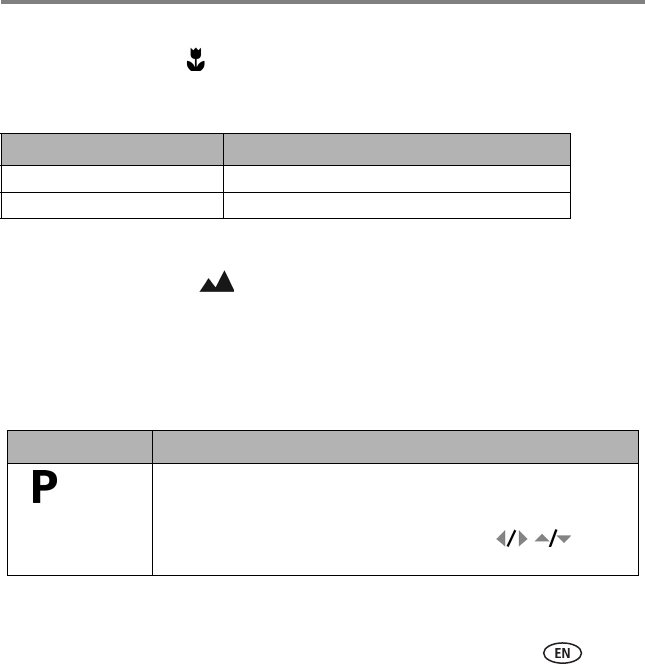
Taking close-up and landscape pictures
Use the Close-up/Landscape button to take pictures of scenes that are very
close or very far away.
1Set the Mode dial to Auto or a PASM mode. (For
PASM mode, see page 15.)
2Press the Close-up/Landscape button
repeatedly until the or icon appears in the
status bar.
3Take a picture.
NOTE: After you take the picture, the camera stays in the Close-up or
Landscape setting. To exit, press the Close-up/Landscape
button until the icon turns off (or turn off the camera).
Close-up/
Landscape
Doing more with your camera
www.kodak.com/go/z710support 15
Close-up pictures
Use the Close-up setting to gain sharpness and detail in pictures at close range. Use
available light instead of flash if possible. The camera automatically sets the focus
distance depending on the zoom position:
Landscape pictures
Use the Landscape setting to gain sharpness of far away scenes. With this setting,
the camera uses infinity auto-focus. Auto-focus framing marks are not available in
Landscape.
P, A, S, and M modes
Use these modes when you want more control over your camera and pictures.
Zoom position Close-up focus distance
Wide angle 4.7–27.6 in. (12–70 cm)
Telephoto 3.9–6.9 ft (1.2–2.1 m)
Use this mode For
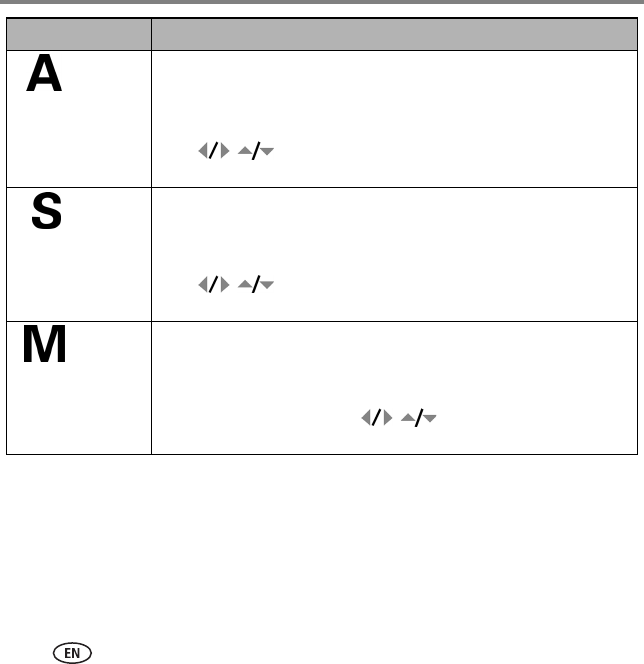
Program Controlling exposure compensation (how much light enters the camera).
The camera automatically sets the shutter speed and aperture (f-stop)
based on the scene lighting. Program mode offers the ease of auto
shooting with full access to all menu options. Press to select
settings. Press the Menu button to change other settings. (See page 17.)
Doing more with your camera
16 www.kodak.com/go/easysharecenter
NOTE: Settings you change in P, A, S, or M modes apply only to pictures taken in those modes. For example,
if you change the Color Mode to Sepia while in P, A, S, or M mode, you retain the default setting of
Color for Auto and Scene modes. The settings, including Flash, are maintained for P, A, S, and M
modes—even when you change modes or turn off the camera. Use Reset to Default to reset P, A, S, or
M mode to its default setting.
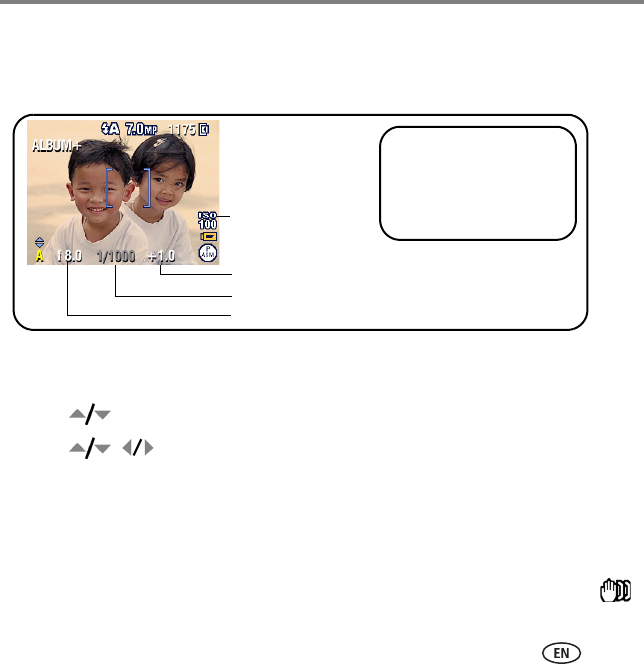
Aperture
Priority
Controlling aperture, exposure compensation, and ISO speed. Aperture
priority mode is primarily used to control depth of field (the range of
sharpness).
NOTE: The aperture setting may be affected when using optical zoom.
Press to select settings. Press the Menu button to change
other settings. (See page 17.)
Shutter
Priority
Controlling the shutter speed, exposure compensation, and ISO speed.
The camera automatically sets the aperture for proper exposure. Shutter
priority mode is primarily used to prevent blur when your subject is
moving. To prevent camera shake, use a tripod for slow shutter speeds.
Press to select settings. Press the Menu button to change
other settings. (See page 17.)
Manual The highest level of creative control. You set the aperture, shutter speed,
and ISO speed. Exposure compensation acts as an exposure meter,
recommending the proper combination of aperture and shutter speed to
produce an acceptable exposure. To prevent camera shake, use a tripod
for slow shutter speeds. Press to select settings. Press the
Menu button to change other settings. (See page 17.)
Use this mode For
Doing more with your camera
www.kodak.com/go/z710support 17
Changing P, A, S, or M mode settings
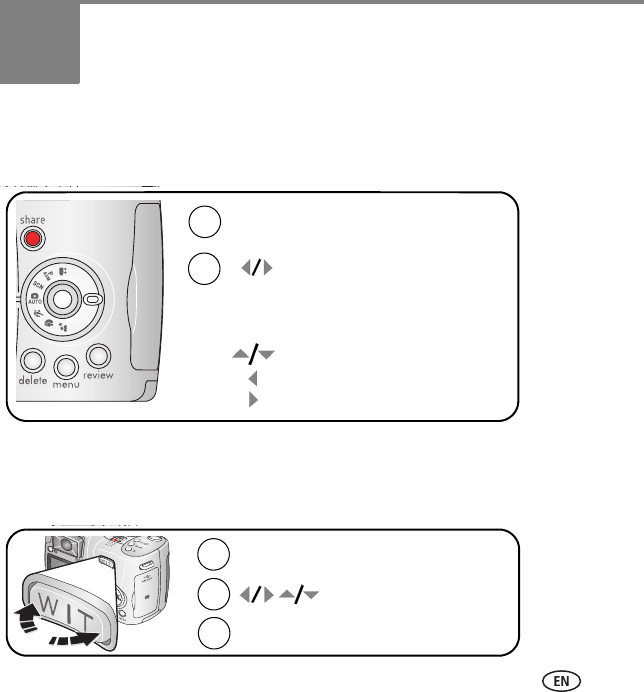
PASM modes control the aperture (f-number, also known as f-stop), shutter speed, and
exposure compensation. Use the Menu button to control all other settings.
1Turn the Mode dial to PASM.
The mode options are displayed.
2Press to choose P, A, S, or M.
3Press to move between settings, open a setting, or change a setting.
4Take a picture.
Exposure Compensation—adjust the exposure; good for controlling backlit or
non-standard scenes. If the picture is too light, decrease the setting; if it’s too dark,
increase the setting.
Shutter speed—control how long the shutter stays open. A shaking hand icon
warns of slow shutter speeds. (Use a tripod for slow shutter speeds.)
Aperture
Shutter speed
Exposure compensation
White—selectable
Grey—non-selectable
Yellow—changeable value
Red—out of range
ISO
PASM Options

Doing more with your camera
18 www.kodak.com/go/easysharecenter
Aperture—(also known as f-stop) control the size of the lens opening, which
determines the depth of field.
■Smaller f-stop numbers indicate a larger lens opening; good for portraits and
low-light conditions.
■Larger f-stop numbers indicate a smaller lens opening; keeps the main subject
sharp; good for landscapes and well-lit conditions.
www.kodak.com/go/z710support 19
2Working with pictures/videos
Reviewing pictures and videos
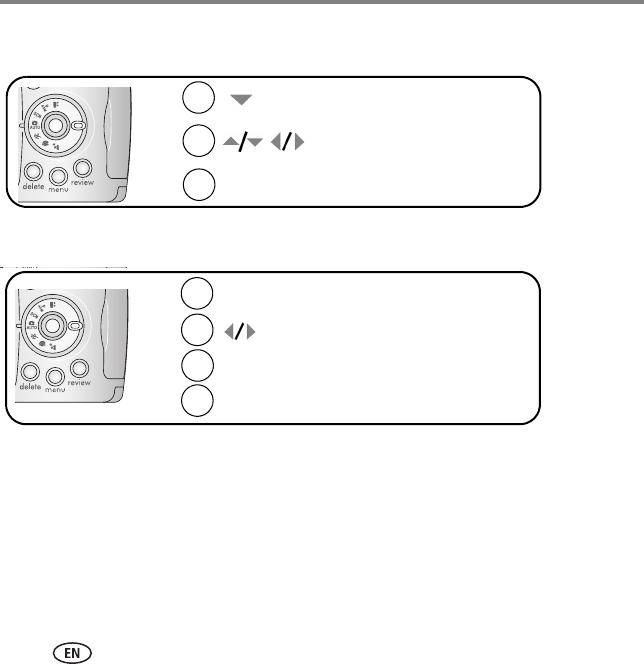
Press the Review button to view and work with your pictures and videos.
Magnifying a picture
1
2for previous/next.
Press Review.
(Press again to exit.)
Videos:
OK Play/pause.
Adjust the volume.
Rewind to beginning (during playback).
Next picture/video (during playback).
Magnify 1X - 8X.
W/T
View other parts of the picture.
Return to 1X.OK
1
2
3
Working with pictures/videos
20 www.kodak.com/go/easysharecenter
Viewing multi-up (thumbnails)
Deleting pictures and videos
OK
View multi-up thumbnails.
View previous/next row or thumbnail.
View single picture.
1
2
3
1
2
4
3
Follow the screen prompts.
Press Delete.
View previous/next.
Press Review.

Working with pictures/videos
www.kodak.com/go/z710support 21
What the review icons mean
Running a slide show
Use the Slide Show to display your pictures and videos on the camera. To save battery
power, use an optional Kodak 3-volt AC adapter. (Visit
www.kodak.com/go/z710accessories.)
Starting the slide show
1Press the Review button, then press the Menu button.
2Press to highlight Slide Show, then press the OK button.
3Press to highlight Begin Show, then press the OK button.
Each picture and video is displayed once.
To interrupt the Slide Show, press the OK button.
Scroll arrows
Email tag
Favorite tag
Print tag/number of prints Protected
Picture/video number
Image storage location
Review mode

Working with pictures/videos
22 www.kodak.com/go/easysharecenter
Cropping pictures
The picture is copied, then cropped. The original picture is saved. A cropped picture cannot
be cropped again on the camera.
Press the Menu button to exit the menu.
1
2
5
3
Press OK, then follow the screen prompts.
Press Menu, highlight Crop, then press OK.
for previous/next.
Press Review.
4Press Telephoto (T) to zoom in, or to move the crop box.
Working with pictures/videos
www.kodak.com/go/z710support 23
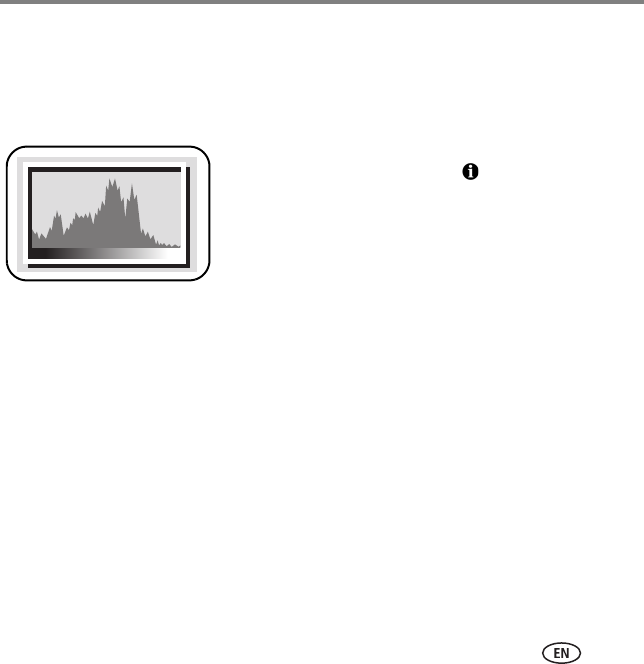
Using the histogram to view picture brightness
Use the histogram to evaluate the distribution of light before or after you take a picture.
If the peak is to the right of the graph, the subject is bright; if it’s to the left, the subject
is dark. Optimal exposure is achieved when the peak is in the middle of the histogram.
To turn on the histogram in any picture-taking mode
or in Review, press the Info button until the
histogram appears.
NOTE: If a scene is dark or light, you can adjust the exposure
compensation before taking the picture. The flash may affect a
picture’s light and shadow.
24 www.kodak.com/go/easysharecenter
3Troubleshooting
Camera problems
For step-by-step product support, visit www.kodak.com/go/z710support and select
Interactive Troubleshooting & Repairs.
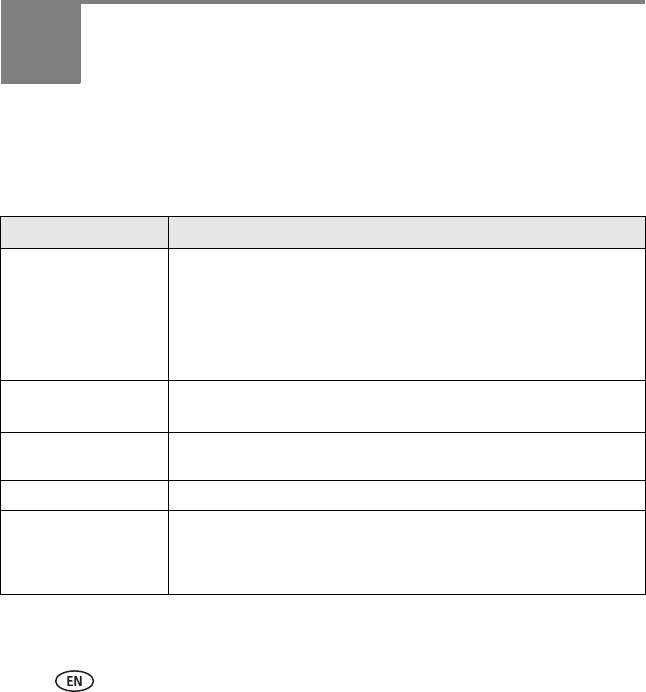
Problem Solution
Camera does not turn
on, or it turns on and
shuts off
1Turn off the camera.
2Remove the batteries; confirm that they are the correct batteries
for your camera.
3Insert a set of new or fully charged batteries.
4Turn on the camera.
Cannot transfer pictures
to the computer
■Install the EasyShare software that came with your camera.
Picture does not appear
on the LCD or EVF
■Press the EVF/LCD button on the camera back.
Cannot take pictures ■Transfer pictures to the computer.
LCD says “Memory is
full”
■Delete unwanted pictures.
■Insert a new memory card.
■Change the Image Storage location.

www.kodak.com/go/z710support 25
4Appendix
Important safety instructions
CAUTION:
Do not disassemble this product; there are no user-serviceable parts inside. Refer servicing to
qualified service personnel. Do not expose this product to liquid, moisture, or extreme
temperatures. Kodak AC adapters and battery chargers are intended for indoor use only. The use
of controls, adjustments, or procedures other than those specified herein may result in exposure
to shock and/or electrical or mechanical hazards. If the LCD breaks, do not touch the glass or
liquid. Contact Kodak customer support.
■The use of an accessory that is not recommended by Kodak may cause fire, electric shock, or injury.
■Use only a USB-certified computer. Contact your computer manufacturer if you have questions.
■If using this product in an airplane, observe all instructions of the airline.
■When removing the battery, allow it to cool; it may be hot.
■Read and follow all warnings and instructions supplied by the battery manufacturer.
■Use only batteries approved for this product to avoid risk of explosion.
■Keep batteries out of the reach of children.
■Do not allow batteries to touch metal objects, including coins. Otherwise, a battery may short circuit,
discharge energy, become hot, or leak.
■Do not disassemble, install backward, or expose batteries to liquid, moisture, fire, or extreme temperature.
■Remove the battery when the product is stored for an extended period of time. In the unlikely event that
battery fluid leaks inside the product, contact Kodak customer support.
■In the unlikely event that battery fluid leaks onto your skin, wash immediately with water and contact your
local health provider. For additional health-related information, contact your local Kodak customer support.
■Dispose of batteries according to local and national regulations.
■Do not charge non-rechargeable batteries.
For more information on batteries, see www.kodak.com/go/batterytypes

Appendix
26 www.kodak.com/go/easysharecenter
Upgrading your software and firmware
Download the latest versions of the software included on the Kodak EasyShare software CD and the camera
firmware (the software that runs on the camera). See www.kodak.com/go/z710downloads.
Additional care and maintenance
■If the camera has been subjected to inclement weather or you suspect water has gotten inside the camera,
turn off the camera and remove the batteries and card. Allow components to air-dry for at least 24 hours
before using the camera again.
■Blow gently on the lens or LCD to remove dust and dirt. Wipe gently with a soft, lint-free cloth or an
untreated lens-cleaning tissue. Do not use cleaning solutions unless designed specifically for camera lenses.
Do not allow chemicals, such as suntan lotion, to contact painted surfaces.
■Service agreements are available in some countries. Contact a dealer of Kodak products for more
information.
■For digital camera disposal or recycling information, contact your local authorities. In the US, visit the
Electronics Industry Alliance Web site at www.eiae.org or visit www.kodak.com/go/z710support.
Warranty
Kodak warrants Kodak EasyShare digital cameras and accessories (excluding batteries) to be free from
malfunctions and defects in both materials and workmanship for one year from the date of purchase. Retain the
original dated sales receipt. Proof of the date of purchase will be required with any request for warranty repair.
This limited warranty will be honored only within the geographical location that Kodak digital cameras and
accessories were purchased. Kodak will REPAIR or REPLACE Kodak EasyShare digital cameras and accessories if
they fail to function properly during the warranty period, subject to any conditions and/or limitations stated
herein. Such repair service will include all labor as well as any necessary adjustments and/or replacement parts.
Such repair or replacement is the sole remedy under this warranty.If replacement parts are used in making
repairs, these parts may be remanufactured, or may contain remanufactured materials. If it is necessary to
replace the entire product, it may be replaced with a remanufactured product. Request for Warranty service will
not be accepted without proof of date of purchase, such as a copy of the original dated Kodak EasyShare digital
camera or accessory sales receipt. (Always keep the original for your records.)
This warranty does not apply to the battery(s) used in digital cameras or accessories. This warranty does not
cover circumstances beyond Kodak’s control, nor problems caused by failure to follow the operating instructions
in the Kodak EasyShare digital cameras and accessories User’s Guides.
This warranty does not apply when failure is due to shipping damage, accident, alteration, modification,
unauthorized service, misuse, abuse, use with incompatible accessories or attachments, failure to follow
Kodak’s operation, maintenance or repacking instructions, failure to use items supplied by Kodak (such as
Appendix
www.kodak.com/go/z710support 27
adapters and cables), or claims made after the duration of this warranty. Kodak makes no other express or
implied warranty for this product. In the event that the exclusion of any implied warranty is ineffective under the
law, the duration of the implied warranty will be one year from the purchase date.
The option of replacement is Kodak’s only obligation. Kodak will not be responsible for any special,
consequential or incidental damages resulting from the sale, purchase, or use of this product, regardless of the
cause. Liability for any special, consequential or incidental damages (including but not limited to loss of revenue
or profit, downtime costs, loss of the use of the equipment, cost of substitute equipment, facilities or services, or
claims of your customers for such damages resulting from the purchase, use or failure of the product),
regardless of cause or for breach of any written or implied warranty is expressly disclaimed and excluded
herefrom.
Your rights
Some states or jurisdictions do not allow exclusion or limitation of incidental or consequential damages, so the
above limitation or exclusion may not apply to you. Some states or jurisdictions do not allow limitations on how
long an implied warranty lasts, so the above limitation may not apply to you. This warranty gives you specific
rights, and you may have other rights which vary from state to state or by jurisdiction.
Outside the United States and Canada
In countries other than the United States and Canada, the terms and conditions of this warranty may be
different. Unless specific Kodak warranty is communicated to the purchaser in writing by a Kodak company, no
warranty or liability exists beyond any minimum requirements imposed by law, even though defect, damage, or
loss may be by negligence or other act.
FCC compliance and advisory
This equipment has been tested and found to comply with the limits for a Class B digital device, pursuant to
Part 15 of the FCC Rules. These limits are designed to provide reasonable protection against harmful
interference in a residential installation.
This equipment generates, uses, and can radiate radio frequency energy and, if not installed or used in
accordance with the instructions, may cause harmful interference to radio communications. However, there is
no guarantee that interference will not occur in a particular installation.
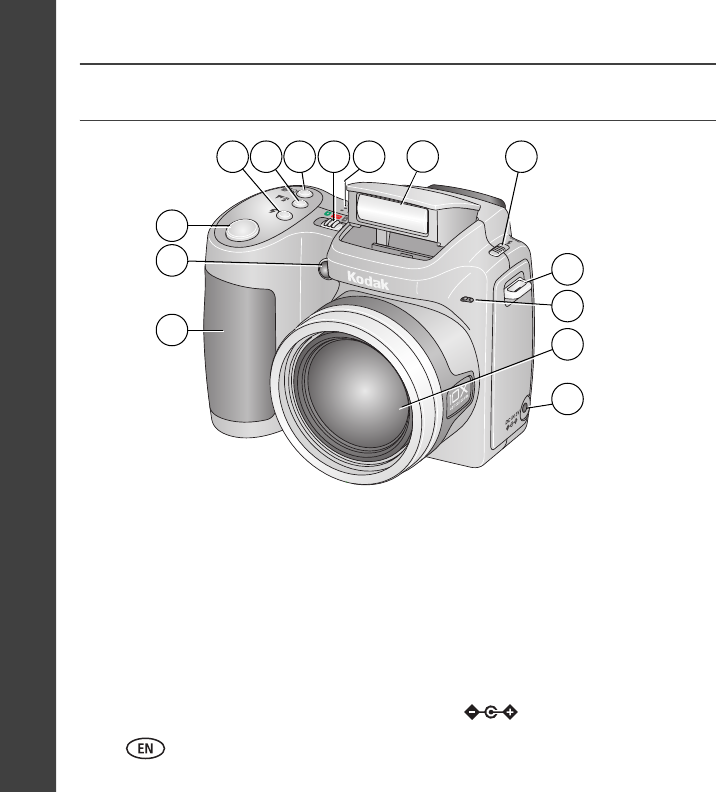
Kodak EasyShare Z710 zoom digital camera

Appendix
28 www.kodak.com/go/easysharecenter
If this equipment does cause harmful interference to radio or television reception, which can be determined by
turning the equipment off and on, the user is encouraged to try to correct the interference by one or more of the
following measures: 1) reorient or relocate the receiving antenna; 2) increase the separation between the
equipment and the receiver; 3) connect the equipment to an outlet on a circuit different from that to which the
receiver is connected; 4) consult the dealer or an experienced radio/TV technician for additional suggestions.
Any changes or modifications not expressly approved by the party responsible for compliance could void the
user’s authority to operate the equipment. Where shielded interface cables have been provided with the
product or specified additional components or accessories elsewhere defined to be used with the installation of
the product, they must be used in order to ensure compliance with FCC regulation.
Canadian DOC statement
DOC Class B Compliance—This Class B digital apparatus complies with Canadian ICES-003.
Observation des normes-Classe B—Cet appareil numérique de la classe B est conforme à la norme
NMB-003 du Canada.
Waste Electrical and Electronic Equipment labeling
VCCI Class B ITE
Australian C-Tick
In the European Union, do not discard this product as unsorted municipal waste. Contact
your local authorities or go to www.kodak.com/go/recycle for recycling program information.
N137

Appendix
www.kodak.com/go/z710support 29
Korean Class B ITE
MPEG-4
Use of this product in any manner that complies with the MPEG-4 visual standard is prohibited, except for use
by a consumer engaging in personal and non-commercial activities.
Eastman Kodak Company
Rochester, New York 14650
© Eastman Kodak Company, 2006
Kodak, EasyShare, and Perfect Touch are trademarks of Eastman Kodak Company. Schneider-Kreuznach and
C-Variogon are trademarks of Jos. Schneider Optische Werke GmbH used under license by Eastman Kodak
Company.
4J4891_en
