Kodak Easyshare Z740 Users Manual Z740_4J1865_en
Z740 to the manual f28c225c-7f35-4c8a-8275-6ebe43883617
2015-02-04
: Kodak Kodak-Easyshare-Z740-Users-Manual-370573 kodak-easyshare-z740-users-manual-370573 kodak pdf
Open the PDF directly: View PDF  .
.
Page Count: 70
- Kodak EasyShare Z740 zoom digital camera
- Product features
- Table of contents
- Setting up your camera
- Taking pictures and videos
- Transferring and printing pictures
- Doing more with your camera
- Using the self-timer
- Using burst
- Taking close-up and landscape pictures
- Running a slide show
- Changing the flash settings
- Picture-taking modes
- Changing picture-taking settings
- Customizing your camera
- Viewing picture/video information
- Copying pictures and videos
- Adjusting exposure compensation
- P, A, S, and M modes
- Pre-tagging for album names
- Sharing your pictures
- Troubleshooting
- Getting help
- Appendix
- Index

Eastman Kodak Company
Rochester, New York 14650
© Eastman Kodak Company, 2004
All screen images are simulated.
Kodak and EasyShare are trademarks of Eastman Kodak Company.
Schneider-Kreuznach and Xenar are trademarks of Jos. Schneider Optische
Werke GmbH used under license by Eastman Kodak Company.
P/N 4J1865
Product features
www.kodak.com/go/support i
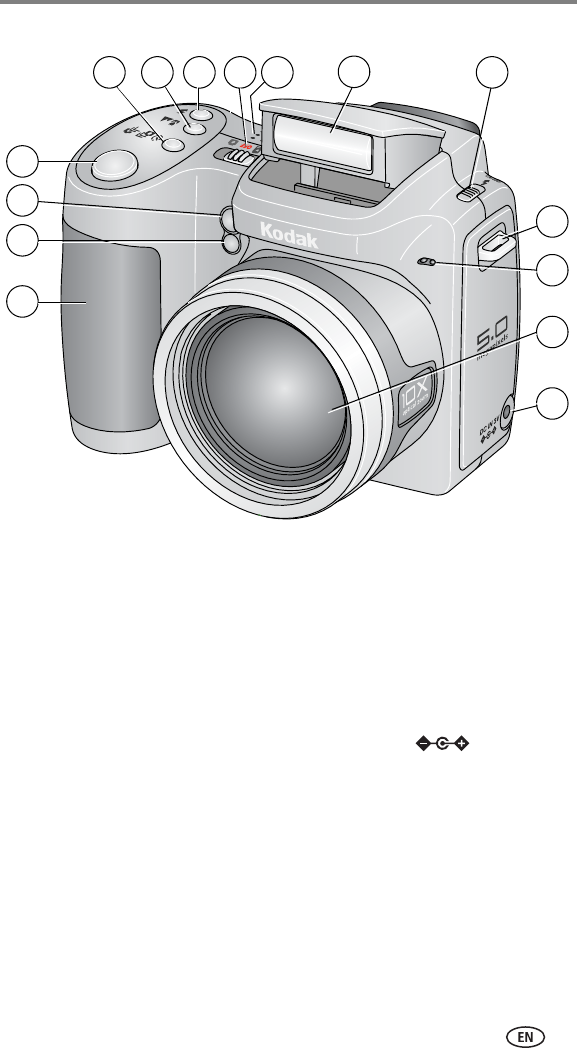
Front View
1 Grip 9 Speaker
2 Light sensor 10 Flash
3 Low-light assist, Self-timer light 11 Open Flash switch
4 Shutter button 12 Neck strap post
5 Self-timer/Burst button 13 Microphone
6 Close-up/Landscape button 14 Lens
7 Flash button 15 DC-In (3V) ,for
optional AC adapter
8 Power/Favorites switch
5
4
2
9
1
1186 7
12
13
14
15
3
10
Product features
ii www.kodak.com/go/support
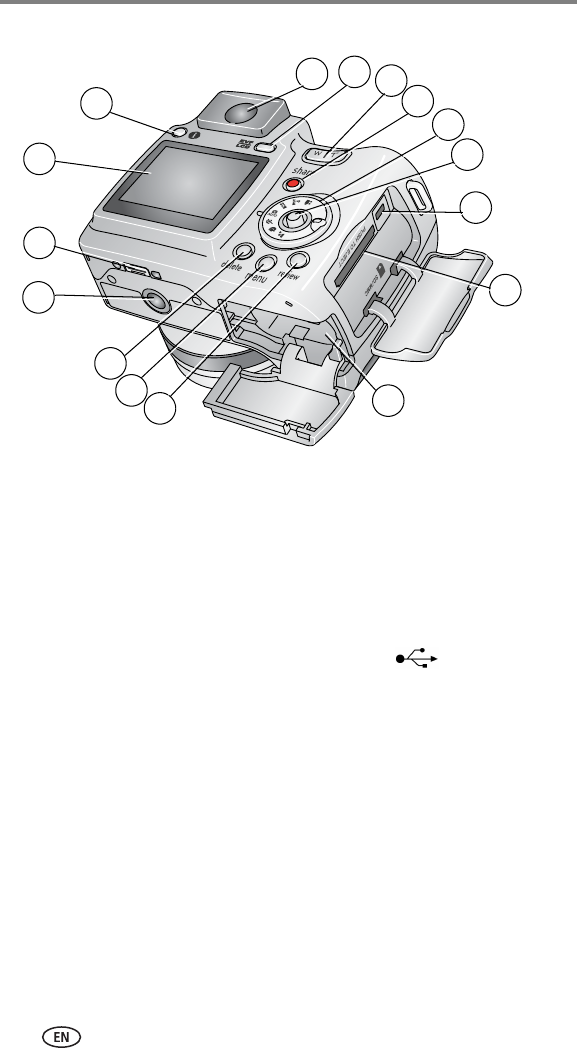
Side View
1 Review button 9 EVF/LCD button
2 Menu button 10 Zoom (Wide Angle/Telephoto)
3 Delete button 11 Share button
4 Tripod socket 12 Mode dial
5 Dock connector 13 Joystick/OK
6 LCD screen 14 USB, A/V Out
7 Info button 15 Slot for optional SD or MMC card
8 EVF (Electronic viewfinder) 16 Battery compartment
4
5
6
7
89
3
2
1
10
11
12
13
14
15
16

www.kodak.com/go/support iii
Table of contents 1
1 Setting up your camera .............................................................. 1
Attaching the lens cap....................................................................... 1
Attaching the neck strap ................................................................... 1
Loading the batteries ........................................................................ 2
Turning on the camera ...................................................................... 2
Setting the date/time, first time ......................................................... 3
Storing pictures on an SD or MMC card ............................................. 4
2 Taking pictures and videos ......................................................... 5
Taking a picture ................................................................................ 5
Using optical zoom ........................................................................... 8
Using the flip-up flash ....................................................................... 9
Reviewing pictures and videos........................................................... 9
Deleting pictures and videos............................................................ 11
3 Transferring and printing pictures ............................................ 12
Minimum system requirements ........................................................ 12
Install the software ......................................................................... 13
Transferring pictures with the USB cable.......................................... 14
Printing pictures.............................................................................. 14
Dock compatibility........................................................................... 17
4 Doing more with your camera .................................................. 18
Using the self-timer......................................................................... 18
Using burst ..................................................................................... 19
Taking close-up and landscape pictures ........................................... 19
Running a slide show ...................................................................... 20
Changing the flash settings ............................................................. 22
Picture-taking modes ...................................................................... 23
Changing picture-taking settings ..................................................... 27
Customizing your camera ................................................................ 30
Viewing picture/video information ................................................... 32
Copying pictures and videos............................................................ 32
Adjusting exposure compensation ................................................... 33
P, A, S, and M modes...................................................................... 33
Pre-tagging for album names .......................................................... 35
Sharing your pictures....................................................................... 37

Table of contents
iv www.kodak.com/go/support
5 Troubleshooting ....................................................................... 41
Camera problems............................................................................ 41
Computer/connectivity problems...................................................... 42
Picture quality problems .................................................................. 43
Direct printing (PictBridge) problems................................................ 44
6 Getting help ............................................................................. 45
Helpful links.................................................................................... 45
Telephone customer support ........................................................... 46
7 Appendix .................................................................................. 47
Camera specifications ..................................................................... 47
Power-saving features..................................................................... 51
Storage capacities ........................................................................... 51
Accessories ..................................................................................... 52
Important safety instructions ........................................................... 53
Battery life ...................................................................................... 54
Upgrading your software and firmware............................................ 55
Additional care and maintenance .................................................... 55
Warranty......................................................................................... 56
Regulatory compliance .................................................................... 58
www.kodak.com/go/support 1
1Setting up your camera
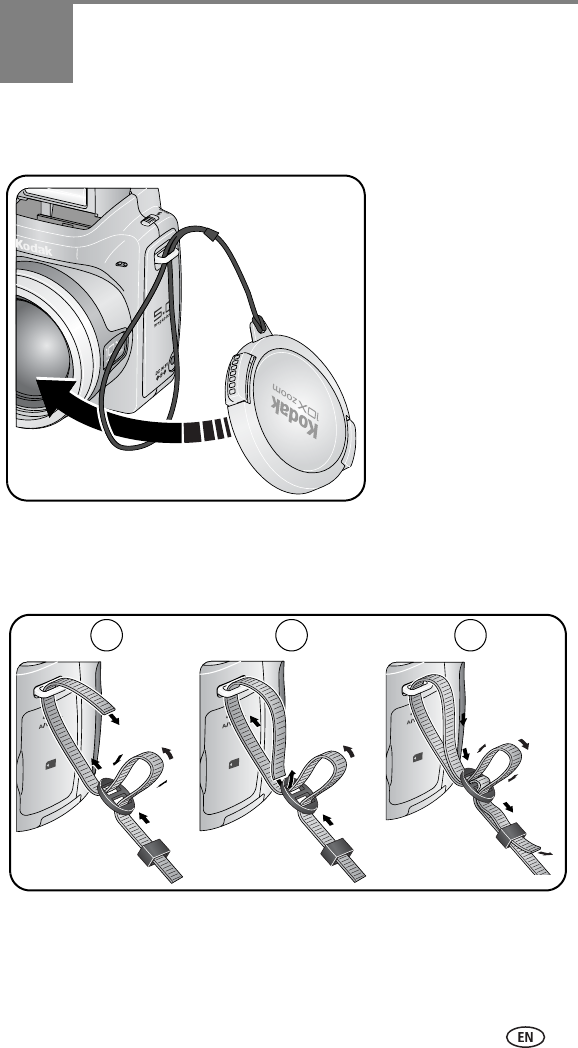
Attaching the lens cap
Attaching the neck strap
21 3
Setting up your camera
2 www.kodak.com/go/support
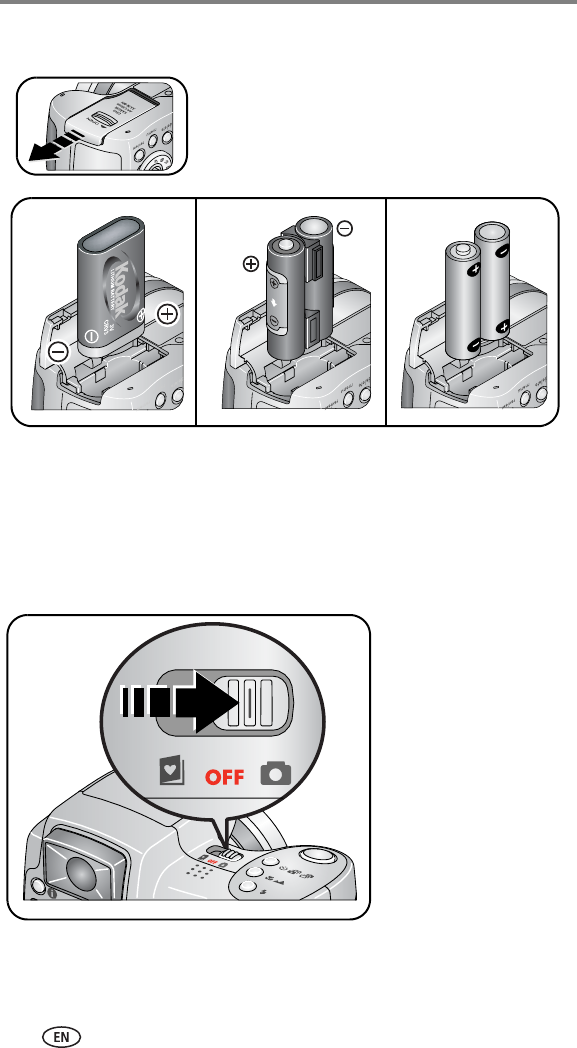
Loading the batteries
1Open the battery door.
2Load the battery, then close the battery door.
For information on replacing batteries and extending battery life, see page 54.
Turning on the camera
CRV3 lithium
(non-rechargeable)
Ni-MH
(rechargeable)
2 AA lithium
or Ni-MH
Setting up your camera
www.kodak.com/go/support 3
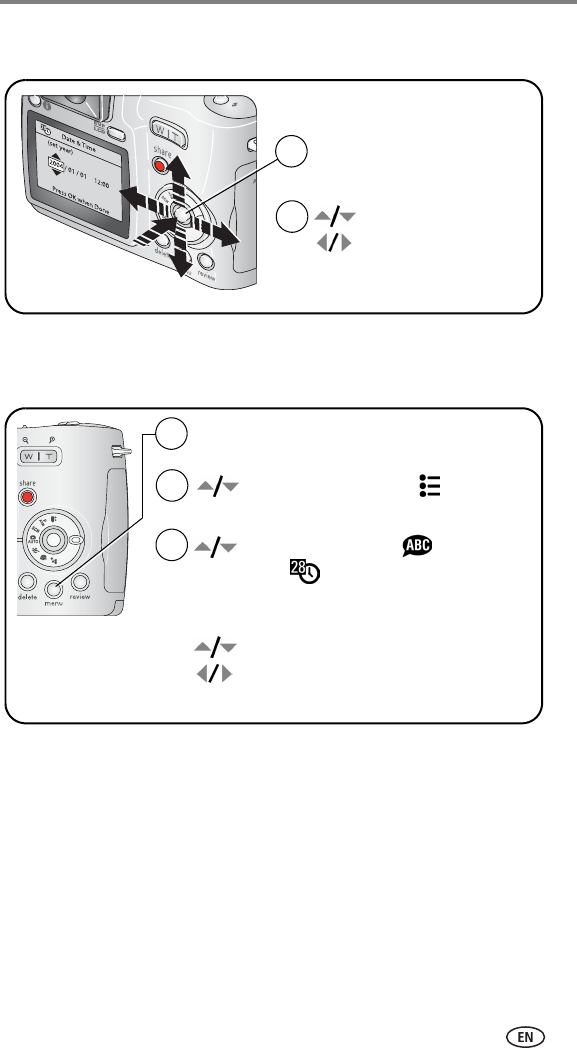
Setting the date/time, first time
Setting the date/time and language, other times
2
1At the prompt, press OK.
to change.
for previous/next field.
OK to accept.
2
1
3
Press Menu.
to highlight Setup Menu
then press OK.
to highlight Language
or Date/Time , then press OK.
If setting the date/time:
to change.
for previous/next field.
OK to accept.
Setting up your camera
4 www.kodak.com/go/support
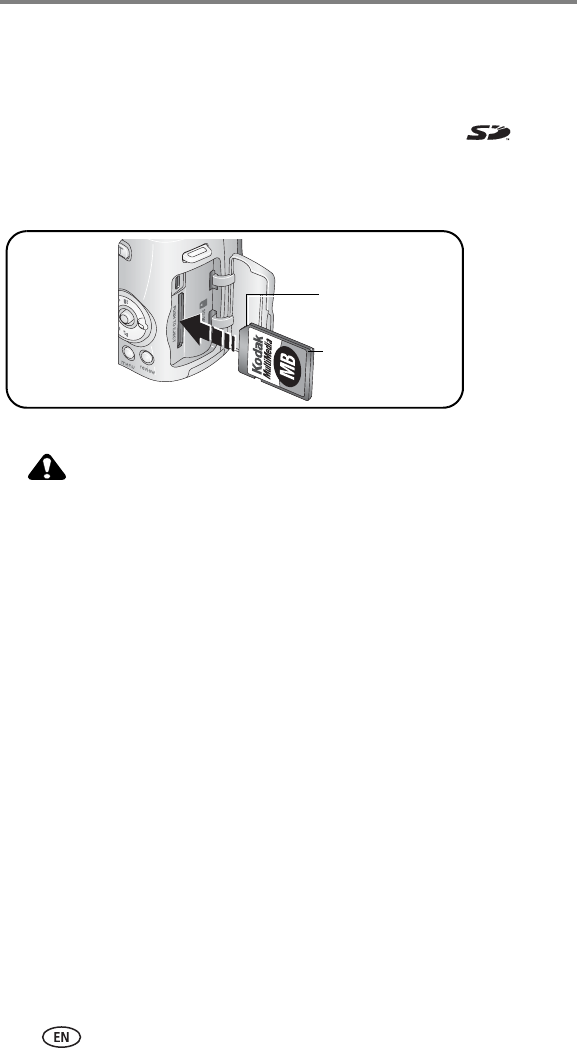
Storing pictures on an SD or MMC card
Your camera has 32 MB of internal memory. You can purchase an SD or MMC
card to conveniently store more pictures and videos.
NOTE: We recommend Kodak SD or MMC cards. SD cards must possess the SD logo. (The
SD logo is a trademark of the SD Card Association.) When using the card for the first time,
format it in this camera before taking pictures (see page 32).
CAUTION:
A card can only be inserted one way; forcing it may cause
damage. Inserting or removing a card when the ready light
is blinking may damage pictures, card, or camera.
See page 51 for storage capacities. Purchase SD or MMC cards at a dealer of
Kodak products or www.kodak.com/go/z740accessories.
Notched corner
SD or MMC
card (optional)
32 MB
internal
memory
(built-in)
www.kodak.com/go/support 5
2Taking pictures and videos
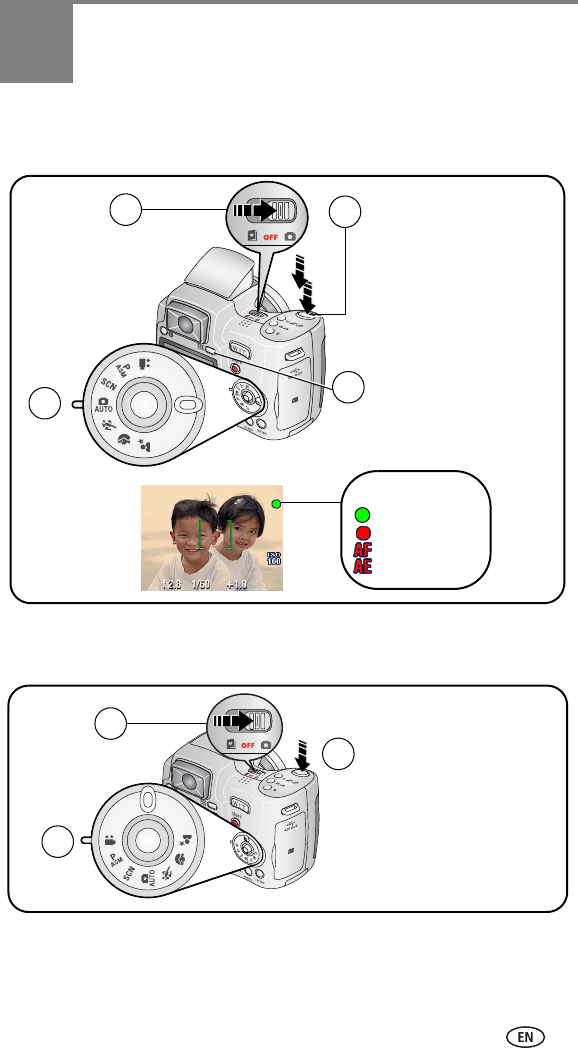
Taking a picture
Taking a video
4
1
23
Press Shutter button
halfway to focus and
set exposure.
When AF/AE Indicator
turns green, press Shutter
button completely down.
Choose LCD or EVF
(electronic viewfinder)
AF/AE Indicator:
Green—successful
Red—failed
Failed focus
Failed exposure
1
2
3
Press the Shutter button
completely down
and release.
To stop recording,
press and release the
Shutter button again.
Taking pictures and videos
6 www.kodak.com/go/support
Reviewing the picture or video just taken
After you take a picture or video, the camera screen or EVF displays a
Quickview for approximately 5 seconds.
To view pictures and videos anytime, see page 9.
Using the auto-focus framing marks (pictures)
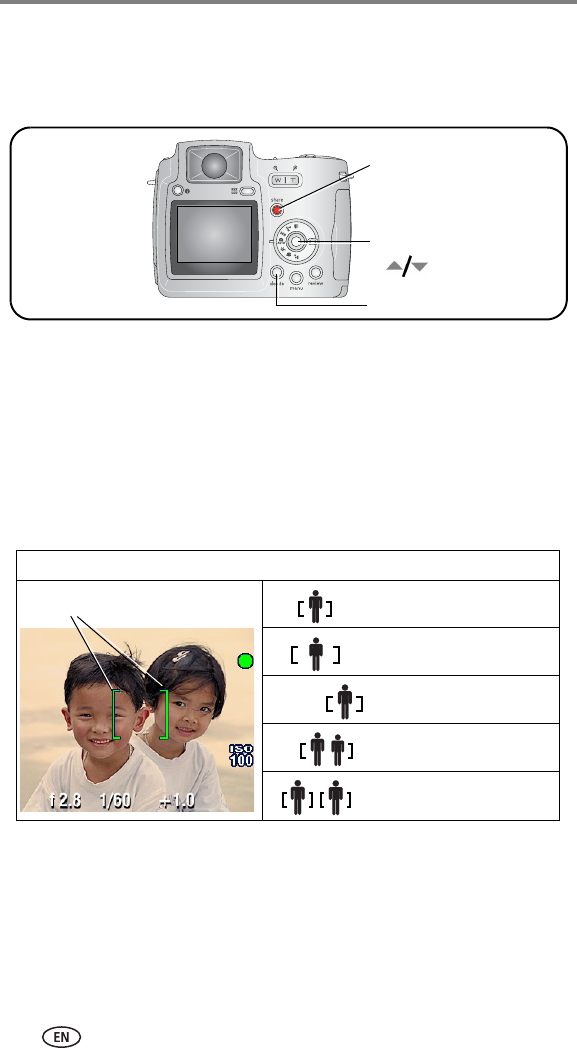
When using the camera screen or EVF as a viewfinder, framing marks indicate
the camera focus area. The camera attempts to focus on foreground subjects,
even if the subjects are not centered in the scene.
1Press the Shutter button halfway.
When the framing marks turn green, focus is accomplished.
2If the camera is not focusing on the desired subject (or if the framing marks
disappear), release the Shutter button and recompose the scene.
3Press the Shutter button completely down to take the picture.
NOTE: Framing marks do not appear in Landscape or Video mode. When you use Focus
Zone (page 28) and set Center Zone, the framing marks are fixed at Center Wide.
While the shutter button is pressed halfway:
Center focus
Center wide focus
Side focus
Center and side focus
Left and right focus
If you press
no buttons, the
picture/video is
saved.
Tag a picture/video for
email or as a favorite, or
to tag a picture for print.
Play a video.
( to adjust volume.)
Delete
Framing marks
Taking pictures and videos
www.kodak.com/go/support 7
Checking camera and picture status
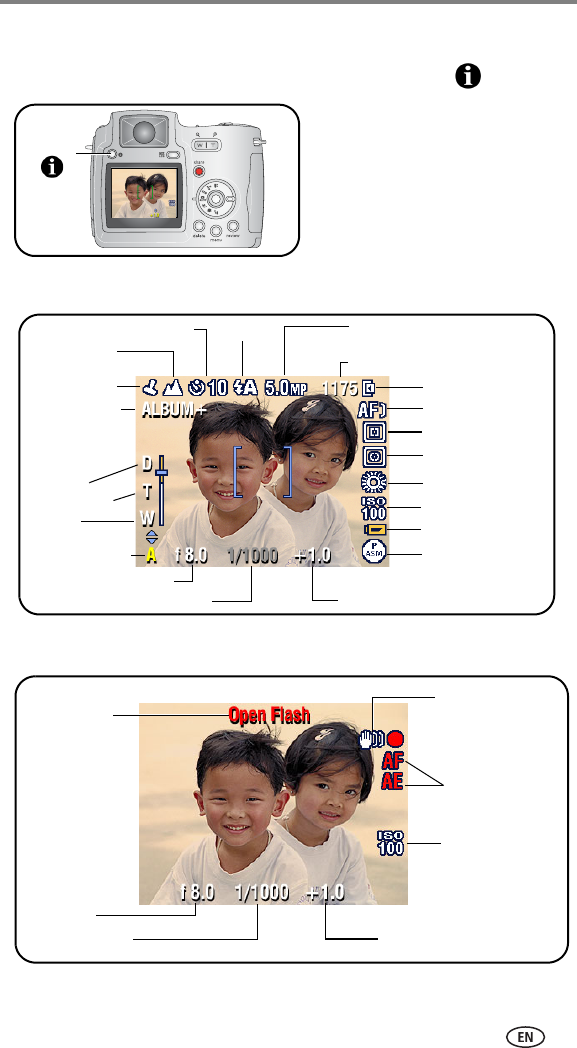
To turn on/off the camera and picture icons, press the Status button.
Capture modes
Capture modes—shutter pressed halfway
Status
Self-timer
Landscape/
Close-up
Date stamp
Album name
Zoom:
digital
telephoto
wide
PASM Setting
Aperture
Shutter speed
Flash Picture size
Pictures/time remaining
Low battery
White balance
Storage location
AF mode
Focus mode
Exposure
metering
ISO
Camera mode
Exposure compensation
Open flash
warning
Aperture
Shutter speed
ISO
Slow shutter
speed warning
Auto Focus/
Auto Exposure
(AF/AE indicator)
Exposure compensation
Taking pictures and videos
8 www.kodak.com/go/support
Using optical zoom
Use optical zoom to get up to 10X closer to your subject. Optical zoom is
effective when the lens is no closer than 24 in. (60 cm) to the subject or
5 in. (13 cm) in Close-up mode. You can change optical zoom before (but not
during) video recording.
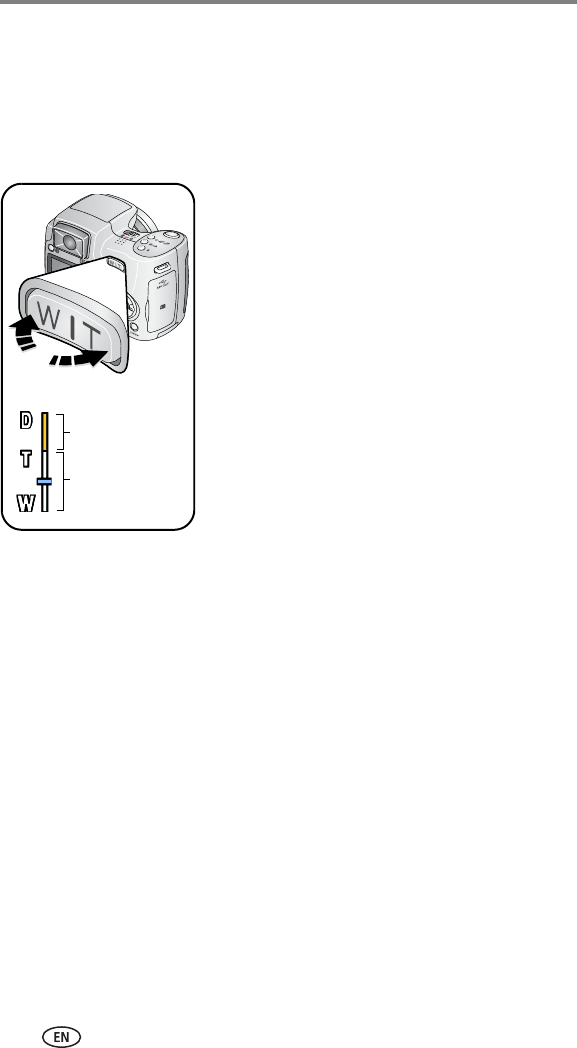
1Use the viewfinder or camera screen to frame
your subject.
2Press Telephoto (T) to zoom in. Press Wide
Angle (W) to zoom out.
The zoom indicator shows zoom status.
3Take the picture or video.
Using digital zoom
Use digital zoom in any Still mode to get up to 5X magnification beyond
optical zoom.
1Press the Telephoto (T) button to the optical zoom limit (10X). Release the
button, then press it again.
The zoom indicator shows zoom status.
2Take the picture or video.
NOTE: You cannot use digital zoom for video recording. You may notice decreased image quality
when using digital zoom. The blue slider on the zoom indicator pauses and turns red when
the picture quality reaches the limit for an acceptable 4 x 6-in. (10 x 15 cm) print.
Zoom indicator
Digital zoom range
Optical zoom range
Taking pictures and videos
www.kodak.com/go/support 9
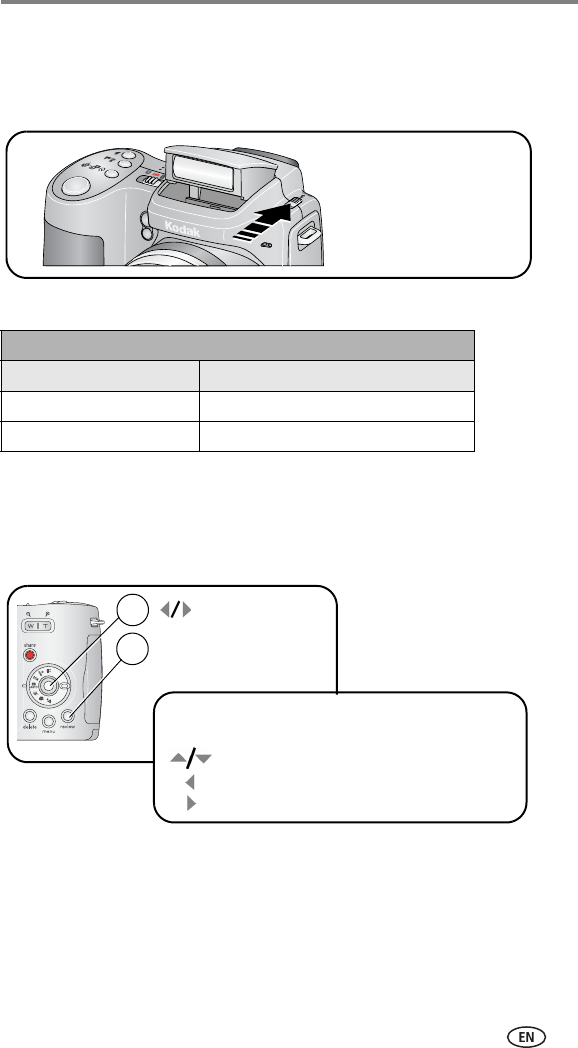
Using the flip-up flash
Use the flash when you take pictures at night, indoors, or outdoors in heavy
shadows. Make sure you are within flash range.
To change flash settings, see page 22. To turn off the flash, close it.
Reviewing pictures and videos
Press the Review button to view and work with your pictures and videos.
To save battery power, use an optional Kodak EasyShare dock or Kodak 3-volt
AC adapter. (See www.kodak.com/go/z740accessories.)
NOTE: Pictures taken at the Best (3:2) quality setting are displayed at a 3:2 aspect ratio with a
black bar at the top of the screen. A video’s duration is displayed at the top of the camera
screen.
Flash-to-subject distance
Zoom position Flash distance
Wide angle 2–16.1 ft (0.6–4.9 m) @ ISO 140
Telephoto 6.6–12.1 ft (2.0–3.7 m) @ ISO 140
The flash unit
must be open to
use the flash and
change flash modes.
1
2
Videos:
Review.
(press again to exit.)
for previous/next.
OK Play/pause.
Rewind to beginning (during playback).
Adjust the volume.
Next picture/video (during playback).
Taking pictures and videos
10 www.kodak.com/go/support
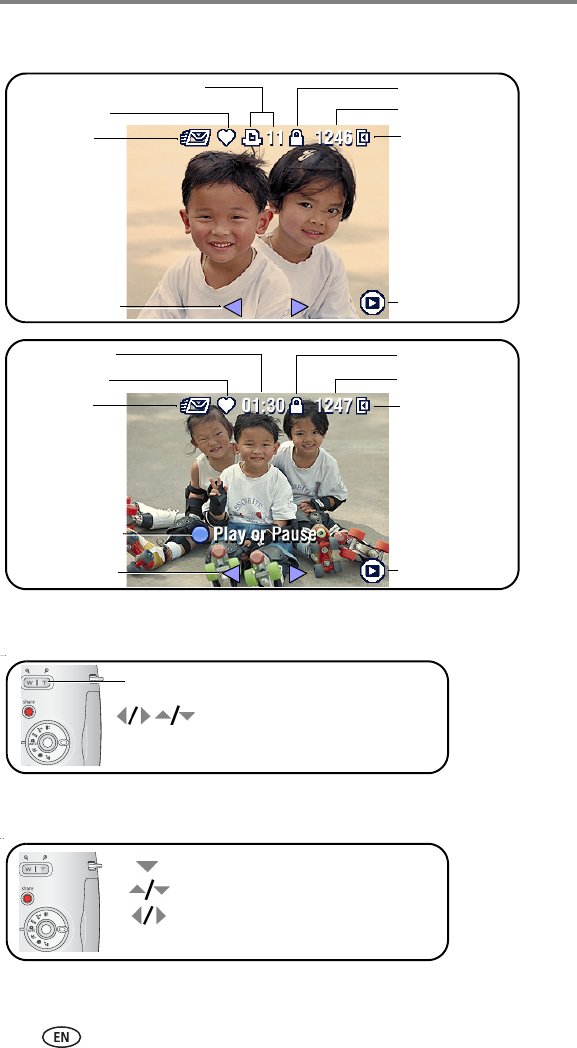
What the review icons mean
Magnifying a picture during review
Viewing multi-up (thumbnails) during review
Protected
Picture number
Image storage
location
Review mode
Print tag/number of prints
Favorite tag
Email tag
Scroll arrows
Protected
Video number
Image storage
location
Review mode
Favorite tag
Email tag
Scroll arrows
Play or Pause
Video length
W/T
view other parts of the picture.
OK return to 1X.
magnify 1X - 8X.
OK
view multi-up thumbnails.
view previous/next row of thumbnails.
view previous.next thumbnail.
view single picture.
Taking pictures and videos
www.kodak.com/go/support 11
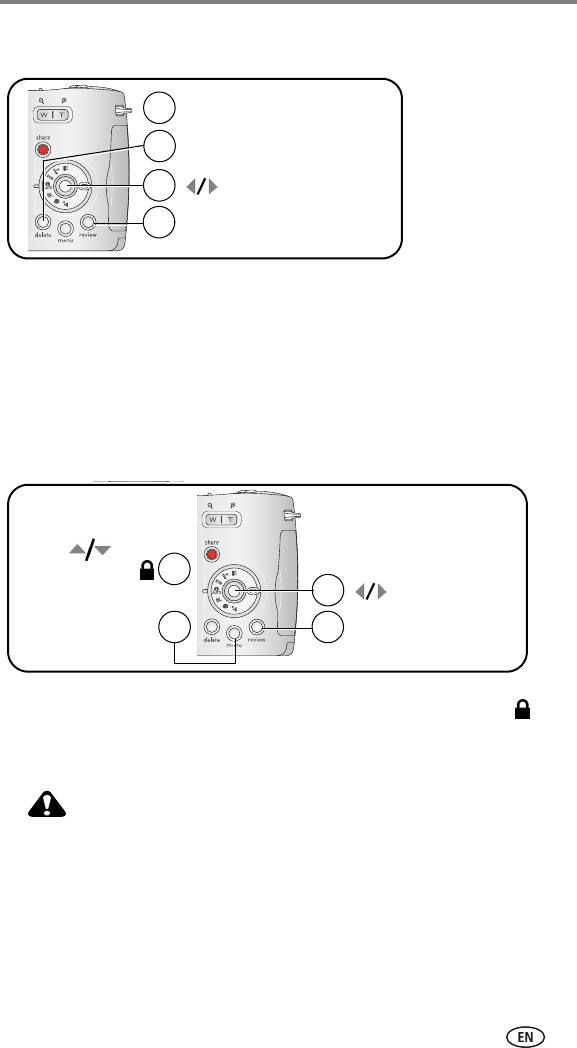
Deleting pictures and videos
PICTURE or VIDEO—deletes the displayed picture or video.
EXIT—exits the Delete screen.
ALL—deletes all pictures and videos from your current storage location.
NOTE: To delete protected pictures and videos, remove protection before deleting.
Protecting pictures and videos from deletion
The picture or video is protected and cannot be deleted. The Protect icon
appears with the protected picture or video.
Press the Menu button to exit the menu.
CAUTION:
Formatting internal memory or an SD or MMC card deletes
all (including protected) pictures and videos. (Formatting
internal memory also deletes email addresses, album
names, and favorites. To restore them, see EasyShare
software Help.)
1
2
4
3
Follow the screen prompts.
Press Delete.
for previous/next.
Press Review.
1
2
4
3
Press to
highlight Protect
then press OK. for previous/next.
Press Menu. Press Review.

12 www.kodak.com/go/support
3Transferring and printing
pictures
CAUTION:
Install Kodak EasyShare software
before
connecting the
camera or optional dock to the computer. Failure to do so
may cause the software to load incorrectly.
Minimum system requirements
NOTE: Mac OS 8.6 and 9.x do not support the Share button functions, including Favorites. Mac
OS X version 10.2.x or 10.3 is recommended for full functionality. To download EasyShare
software, visit
www.kodak.com/go/z740downloads.
Windows OS-based computers Macintosh computers
■Windows 98, 98SE, ME, 2000 SP1, or
XP OS
■Internet Explorer 5.01 or higher
■233 MHz processor or greater
■64 MB RAM (128 MB RAM for
Windows XP OS)
■200 MB hard disk space available
■CD-ROM drive
■Available USB port
■Color monitor, 800 x 600 pixels (16-bit
or 24-bit recommended)
■Power Mac G3, G4, G5, G4 Cube,
iMac; PowerBook G3, G4; or iBook
computers
■Mac OS X version 10.2.3, 10.3
■Safari 1.0 or higher
■128 MB RAM
■200 MB hard disk space available
■CD-ROM drive
■Available USB port
■Color monitor, 1024 x 768 pixels
(thousands or millions of colors
recommended)

Transferring and printing pictures
www.kodak.com/go/support 13
Install the software
CAUTION:
Install Kodak EasyShare software
before
connecting the
camera or optional dock to the computer. Failure to do so
may cause the software to load incorrectly.
1Close all software applications that are open on your computer (including
anti-virus software).
2Place the Kodak EasyShare software CD into the CD-ROM drive.
3Load the software:
Windows OS-based computer—if the install window does not appear,
choose Run from the Start menu and type d:\setup.exe where d is the
drive letter that contains the CD.
Mac OS X—double-click the CD icon on the desktop, then click the Install
icon.
4Follow the on-screen instructions to install the software.
Windows OS-based computer—select Complete to automatically install
the most commonly used applications. Select Custom to choose the
applications you wish to install.
Mac OS X—follow the on-screen instructions.
NOTE: When prompted, take a few minutes to electronically register your camera and software.
This lets you receive information regarding software updates and registers some of the
products included with the camera. You must be connected to your Internet service
provider to register electronically. To register later, see
www.kodak.com/go/register.
5If prompted, restart the computer. If you turned off anti-virus software, turn
it back on. See the anti-virus software manual for details.
For information on the software applications included on the Kodak EasyShare
software CD, click the Help button in the Kodak EasyShare software.
Transferring and printing pictures
14 www.kodak.com/go/support
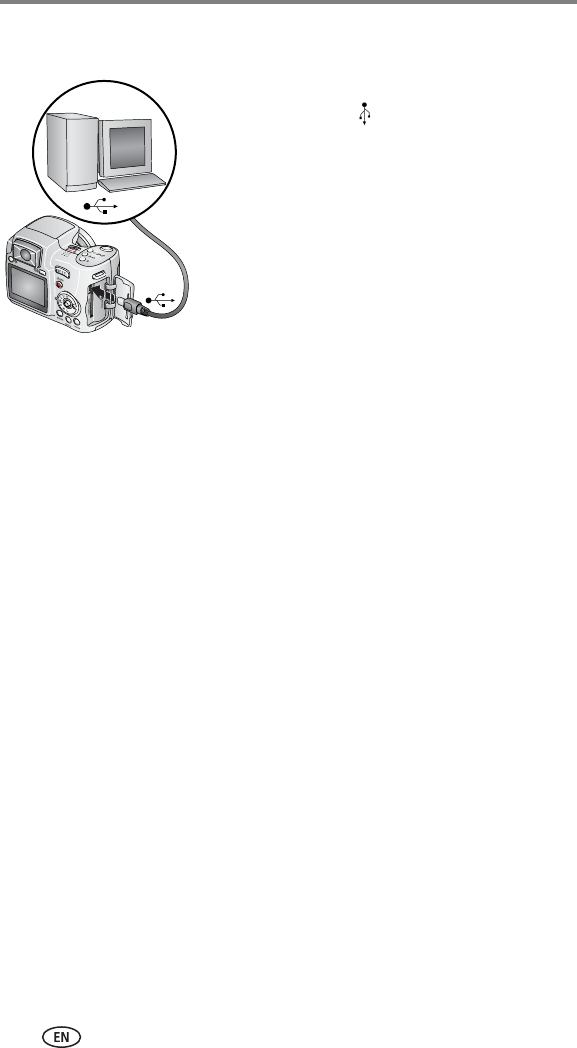
Transferring pictures with the USB cable
1Turn off the camera.
2Plug the labeled end of the USB cable into
the labeled USB port on your computer. See
your computer user’s guide for details.
3Plug the other end of the USB cable into the
USB port on the camera. The arrow icon on
the cable should face you.
4Turn on the camera.
Kodak EasyShare software opens on your
computer. The software prompts you through
the transfer process.
NOTE: Visit
www.kodak.com/go/howto
for an online tutorial on connecting.
Also available for transferring
You can also use these Kodak products to transfer your pictures and videos.
■Kodak EasyShare camera dock, Kodak EasyShare printer dock (see Dock
compatibility, page 17)
■Kodak multi-card reader, Kodak SD multimedia card reader-writer
Purchase these and other accessories at a dealer of Kodak products or
www.kodak.com/go/z740accessories.
Printing pictures
Printing with a Kodak EasyShare printer dock
Dock your camera to the Kodak EasyShare printer dock and print
directly—with or without a computer. Purchase this and other accessories at a
dealer of Kodak products or www.kodak.com/go/z740accessories.
Direct printing with a PictBridge printer
Your camera features PictBridge technology, so you can print directly to
PictBridge printers. You need:
■Camera with fully-charged batteries, or
with optional Kodak 3-volt AC adapter
■PictBridge printer
■USB cable included with your camera

Transferring and printing pictures
www.kodak.com/go/support 15
Connecting the camera to a PictBridge printer
1Turn off the camera and printer.
2Optional: If you have a Kodak 3-volt AC adapter (optional accessory), plug
it into the camera and into an electrical outlet.
IMPORTANT:
Do not use the AC adapter included with the Kodak EasyShare
camera dock or printer dock to power your camera.
3Connect the appropriate USB cable from the camera to the printer. (See
your printer user guide for details. See
www.kodak.com/go/z740accessories to order cables.)
Printing from a PictBridge printer
1Turn on the printer. Turn on the camera.
The PictBridge logo is displayed, followed by the current picture and menu. (If
no pictures are found, a message is displayed.) If the menu interface turns off,
press any button to redisplay it.
2Press to choose a printing option, then press the OK button.
Current Picture—Press to choose a picture. Choose the number of copies.
Tagged Pictures—If your printer is capable, print pictures that you tagged for
printing and choose a print size.
Index Print—Print thumbnails of all pictures. This requires one or more sheets of
paper. If the printer is capable, choose a print size.
All Pictures—Print all pictures in internal memory, on a card, or in Favorites.
Choose the number of copies.
Image Storage—Access internal memory, a card, or Favorites.
NOTE: During direct printing, pictures are not permanently transferred or saved to the computer
or printer. To transfer pictures to your computer, see page 12. In Favorites mode, the
current favorite picture is displayed
Disconnecting the camera from a PictBridge printer
1Turn off the camera and printer.
2Disconnect the USB cable from the camera and the printer.

Transferring and printing pictures
16 www.kodak.com/go/support
Ordering prints online
Kodak EasyShare print service (provided by Ofoto www.ofoto.com) is one of
the many online print services offered in the Kodak EasyShare software. You
can easily:
■Upload your pictures.
■Edit, enhance, and add borders to your pictures.
■Store pictures, and share them with family and friends.
■Order high-quality prints, photo greeting cards, frames, and albums—and
have them delivered to your door.
Printing pictures from your computer
For details on printing pictures from your computer, click the Help button in
the Kodak EasyShare software.
Printing from an optional SD or MMC card
■Automatically print tagged pictures when you insert your card into a printer
with an SD/MMC slot. See your printer user’s guide for details.
■Make prints at an SD/MMC-capable Kodak picture maker. (Contact a
location prior to visiting. See www.kodak.com/go/picturemaker.)
■Take the card to your local photo retailer for professional printing.
Transferring and printing pictures
www.kodak.com/go/support 17
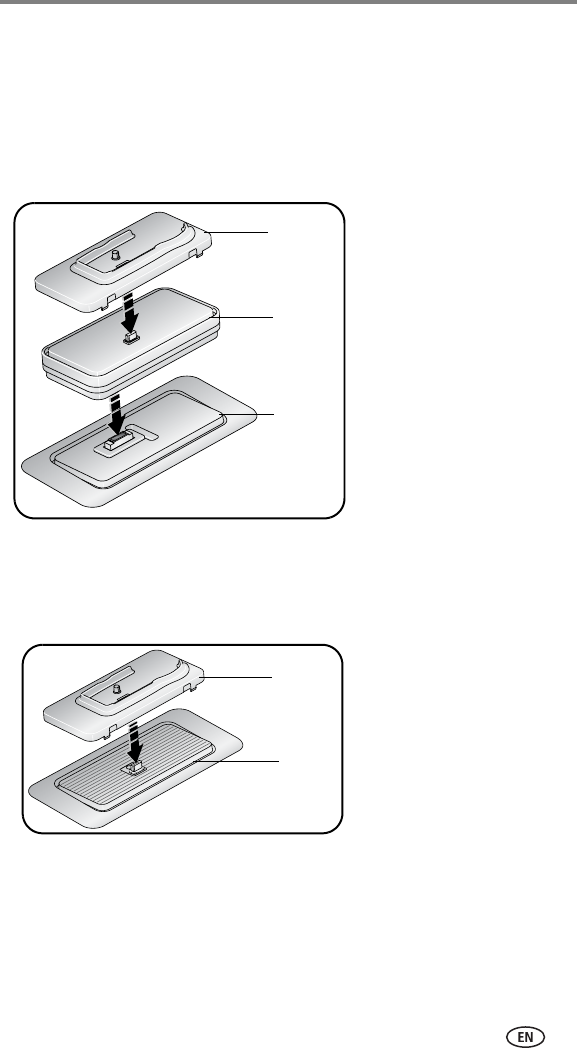
Dock compatibility
Use the adapter and the custom dock insert if you are docking your
Z740 camera on the EasyShare:
NOTE: The charging lights on the dock will not illuminate when using the adapter. However,
charging does take place.
Use the custom dock insert if you are docking your Z740 camera on
any other EasyShare dock. Do not use the adapter.
NOTE: The EasyShare Z740 camera is not compatible with these docks:
■EasyShare printer dock 4000
■EasyShare camera dock II
■EasyShare LS420, LS443 camera docks
■printer dock
■printer dock plus
■printer dock 6000
■camera dock 6000
Custom
dock
insert
Adapter
Dock
Custom
dock
insert
Dock
18 www.kodak.com/go/support
4Doing more with your
camera
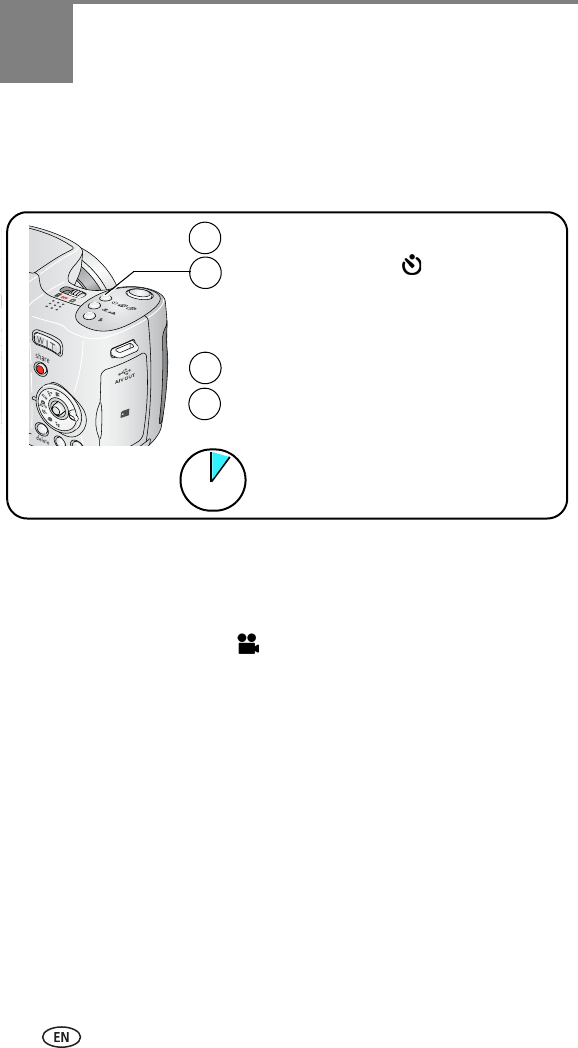
Using the self-timer
To cancel the Self-timer before the picture is taken, press the Self-timer
button. (The Self-timer setting remains active.)
Use the same procedure to take a video, but:
■Turn the Mode dial to Video .
■Press the Shutter button completely down.
NOTE: The video stops when no storage space remains.
1
2
3
4
:
Place camera on a tripod or flat surface.
In any still mode, press :
Once for a 10-second delay (so you have
time to get into the scene)
Once more for a 2-second delay (for a
steady, auto-shutter release on a tripod)
.
.
Compose the scene.
Press the Shutter button halfway, then
completely down.
The picture is taken in 2 or 10 seconds.
Doing more with your camera
www.kodak.com/go/support 19
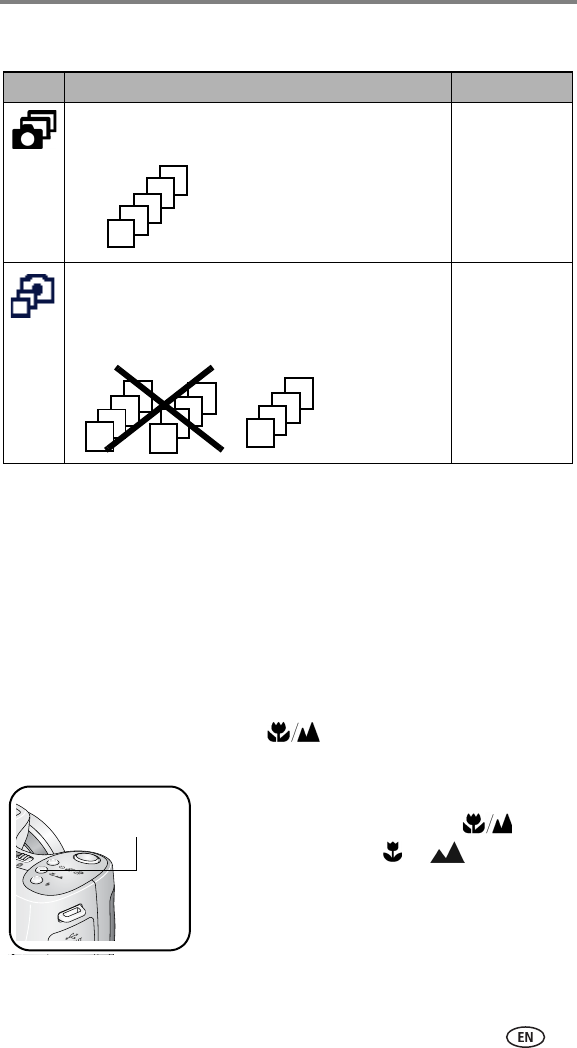
Using burst
1In most Still modes, press the Burst button repeatedly to choose an option.
2Press the Shutter button halfway to focus and set exposure.
3Press the Shutter button completely down and hold it to take pictures.
The camera stops taking pictures when you release the Shutter button, when
the pictures are taken, or when there is no more storage space.
NOTE: During Quickview, you can delete all pictures in the burst series. To delete selectively, do so
in Review (see page 11).
Taking close-up and landscape pictures
Use the Close-up/Landscape button to take pictures of scenes that are
very close or very far away.
1Set the Mode dial to any Capture mode.
2Press the Close-up/Landscape button
repeatedly until the or icon appears
in the status bar.
3Take a picture.
Option Description Purpose
First
Burst
Camera takes up to 5 pictures (2 per second) while the
Shutter button is pressed.
Capture an
expected event.
Example:
A person
swinging a
golf club.
Last
Burst
Camera takes up to 30 pictures (2 per second for up to
15 seconds) while the Shutter button is pressed. When
the Shutter button is released, only the last 4 pictures
are saved.
Capture an event
when the precise
timing is
uncertain.
Example:
A child blowing
out birthday
candles.
First 5 pictures
are saved.
Last 4 pictures
are saved.
Close-up/
Landscape
Doing more with your camera
20 www.kodak.com/go/support
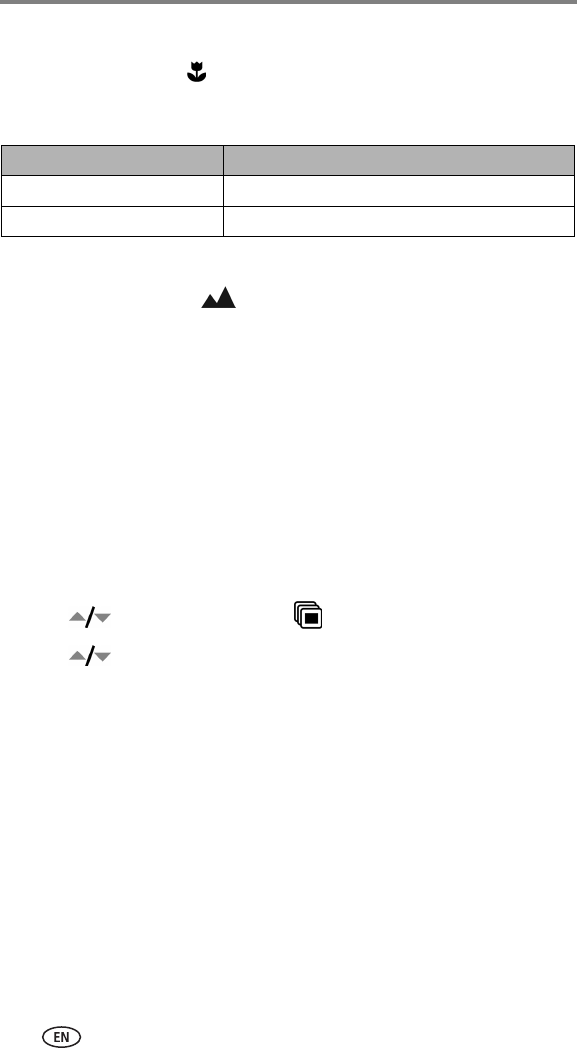
Close-up pictures
Use the Close-up setting to gain sharpness and detail in pictures at close
range. Use available light instead of flash if possible. The camera automatically
sets the focus distance depending on the zoom position:
Landscape pictures
Use the Landscape setting to gain sharpness of far away scenes. With
this setting, the camera uses infinity auto-focus. Auto-focus framing marks are
not available in Landscape.
Running a slide show
Use the Slide Show to display your pictures and videos on the camera screen.
To run a slide show on a television or on any external device, see page 21. To
save battery power, use an optional Kodak 3V AC adapter. (Visit
www.kodak.com/go/z740accessories.)
Starting the slide show
1Press the Review button, then press the Menu button.
2Press to highlight Slide Show , then press the OK button.
3Press to highlight Begin Show, then press the OK button.
Each picture and video is displayed once.
To interrupt the Slide Show, press the OK button.
Zoom position Close-up focus distance
Wide angle 4.7-27.6 in. (0.12-0.7 m)
Telephoto 3.9-6.9 ft (1.2-2.1 m)

Doing more with your camera
www.kodak.com/go/support 21
Changing the slide show display interval
The default interval setting displays each picture for 5 seconds. You can set the
display interval from 3 to 60 seconds.
1On the Slide Show menu, press to highlight Interval, then press the
OK button.
2Select a display interval.
To scroll through the seconds quickly, press and hold .
3Press the OK button.
The interval setting remains until you change it.
Running a continuous slide show loop
When you turn on Loop, the slide show is continuously repeated.
1On the Slide Show menu, press to highlight Loop, then press the OK
button.
2Press to highlight On, then press the OK button.
The slide show repeats until you press the OK button or until battery power is
exhausted. The Loop feature remains until you change it.
Displaying pictures and videos on a television
You can display pictures and videos on a television, computer monitor, or any
device equipped with a video input. (Image quality on a television screen may
not be as good as on a computer monitor or when printed.)
NOTE: Ensure that the Video Out setting (NTSC or PAL) is correct (see page 31). The slide show
stops if you connect or disconnect the cable while the slide show is running.
1Connect the audio/video cable (included) from the camera A/V Out/USB
port to the television video-in port (yellow) and audio-in port (white). See
your television user’s guide for details.
2Review pictures and videos on the television.
Doing more with your camera
22 www.kodak.com/go/support
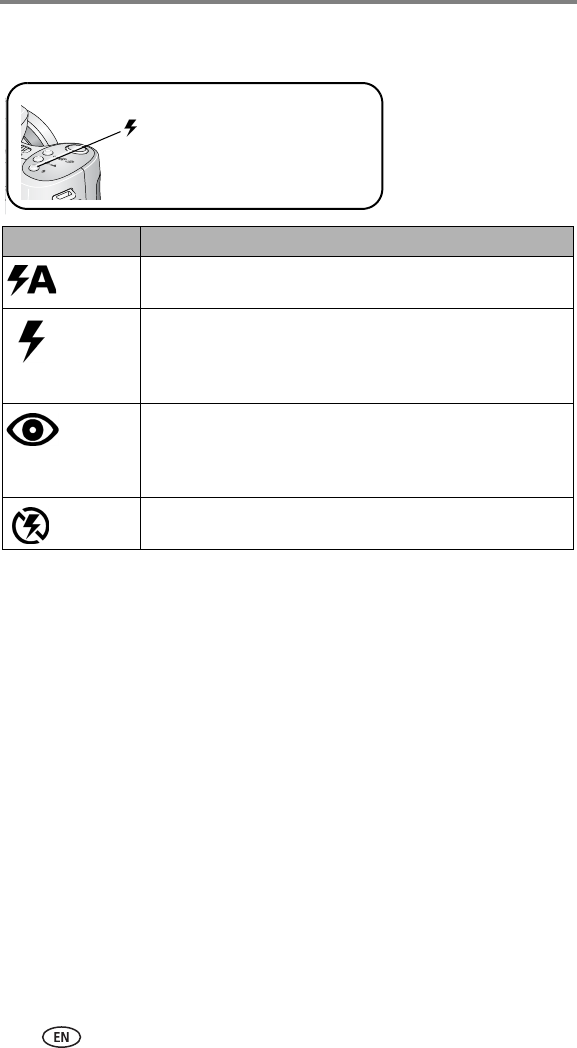
Changing the flash settings
For flash setting in each mode, see page 49.
NOTE: Rear-curtain-flash sync (a feature found only in S, M, and Night portrait modes) activates
automatically when the flash is fired and the shutter speed is set at 1/30 second or longer.
The flash fires just before the shutter closes to create a stream-of-light effect behind a
moving object for a more natural appearance.
Flash modes Flash fires
Auto
Flash
When the lighting conditions require it.
Fill Every time you take a picture, regardless of the lighting
conditions. Use when the subject is in shadow or is “backlit”
(when the sun is behind the subject). In low light, hold the
camera steady or use a tripod.
Red-eye Once, so the subject’s eyes become accustomed to the flash,
then fires again when the picture is taken. (If the lighting
conditions require flash but do not require Red-eye reduction,
the flash may fire only once.)
Off Never
Press the flash button repeatedly
to scroll through flash modes.
The current flash mode is depicted
in the LCD/EVF status area.
Make sure the flash is open.
Doing more with your camera
www.kodak.com/go/support 23
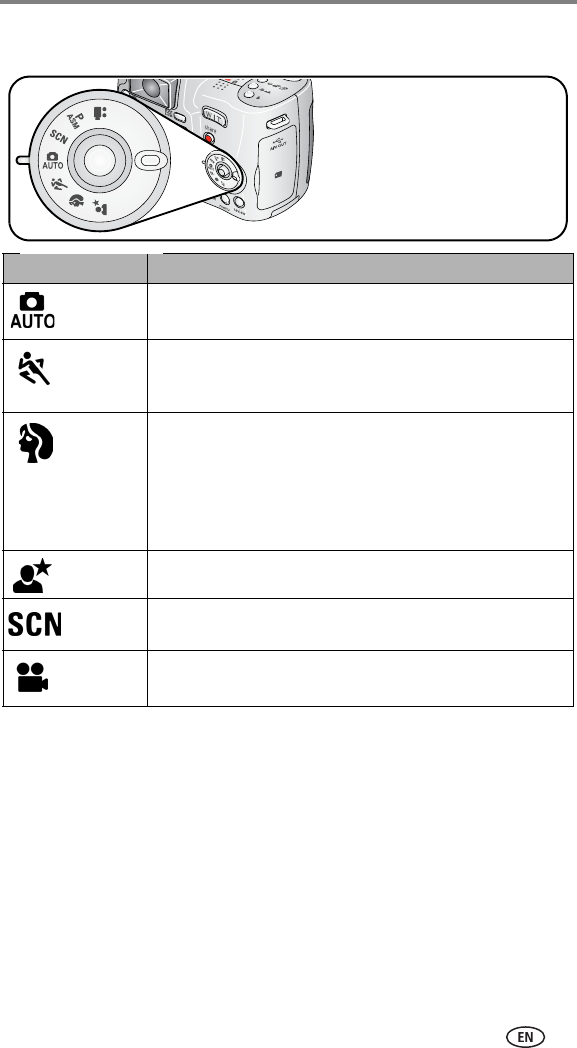
Picture-taking modes
Use this mode For
Auto General picture-taking—offers an excellent balance of image
quality and ease of use.
Sport Subjects that are in motion. Shutter speed is fast. The camera
pre-settings are f/2.8–f/3.7, Multi-Pattern Exposure Metering,
Multi-Zone Focus, ISO 100–ISO 200.
Portrait Full-frame portraits of people. Allows the subject to be sharp
and the background to be indistinct. For best results, position
your subject at least 6 ft (2 m) away and fill the frame with a
head and shoulder pose. Use Telephoto to exaggerate
background blur. The camera pre-settings are f/2.8–f/3.7,
Multi-Pattern Exposure Metering, Multi-Zone Focus, ISO 100.
Night Use at night to capture subject and background.
Scene Point-and-shoot simplicity when taking pictures under 14
special conditions. (See Scene modes, page 24.)
Video Capturing video with sound. (See page 5.)
Choose the mode
that best suits your
subjects and surroundings.
Doing more with your camera
24 www.kodak.com/go/support
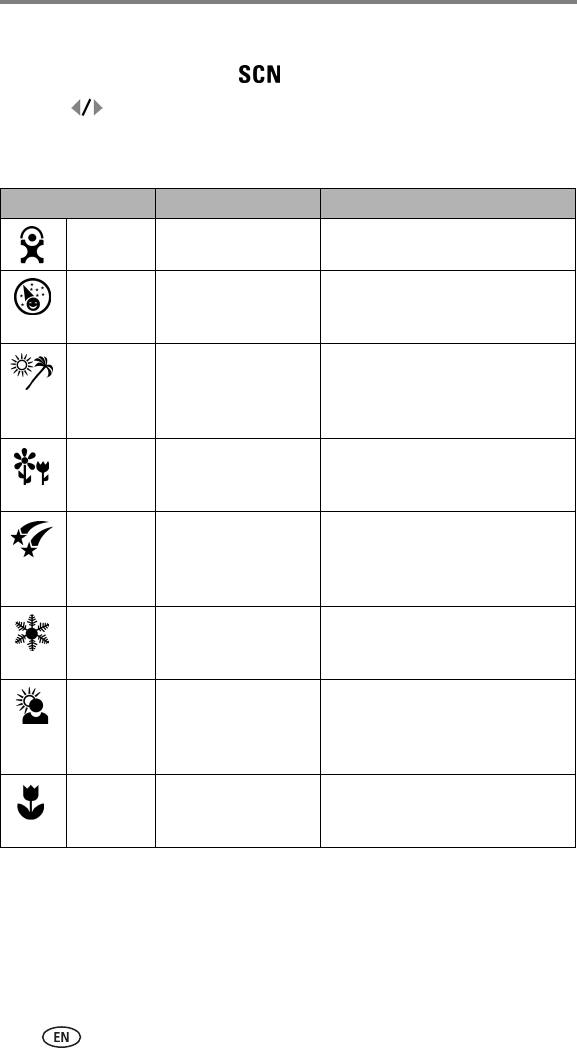
Scene modes
1Turn the Mode dial to Scene .
2Press to display Scene mode descriptions.
NOTE: If the Help text turns off, press the OK button.
3Press the OK button to choose a Scene mode.
Use this SCN mode For Camera pre-settings
Children Action pictures of
children in bright light.
f/2.8–f/3.7, Multi-Pattern Exposure
Metering, Multi-Zone Focus, ISO 140
Party People indoors.
Minimizes red eye.
f/2.8–f/3.7, Multi-Pattern Exposure
Metering, Multi-Zone Focus, Red-Eye
Flash, ISO 140
Beach Bright beach scenes. f/2.8–f/3.7, +1 Exposure
Compensation, Center-Weight
Metering, Daylight White balance,
ISO 100
Flower Close-ups of flowers or
other small subjects in
bright light.
f/2.8–f/3.7, Macro Focus, Daylight
White balance, Center-Zone Focus,
Center-Weight Metering, ISO 140
Fireworks Flash does not fire.
Place the camera on a
flat, steady surface or
use a tripod.
f/5.6, 2 second exposure, Infinity
Focus, Center-Weight Metering,
Daylight White Balance, ISO 100
Snow Bright snow scenes. f/2.8–f/3.7, +1 Exposure
Compensation, Center-Weight
Metering, Multi-Zone Focus, ISO 100
Backlight Subjects that are in
shadow or “backlit”
(when light is behind
the subject).
f/2.8–f/3.7, Multi-Pattern Exposure
Metering, Multi-Zone Focus,
Fill-Flash, ISO 100
Close-up Subjects closer than
28 in. (70 cm).
f/2.8–f/3.7, Macro Focus, Center-
Weight Metering, Center-Zone
Focus, ISO 100
Doing more with your camera
www.kodak.com/go/support 25
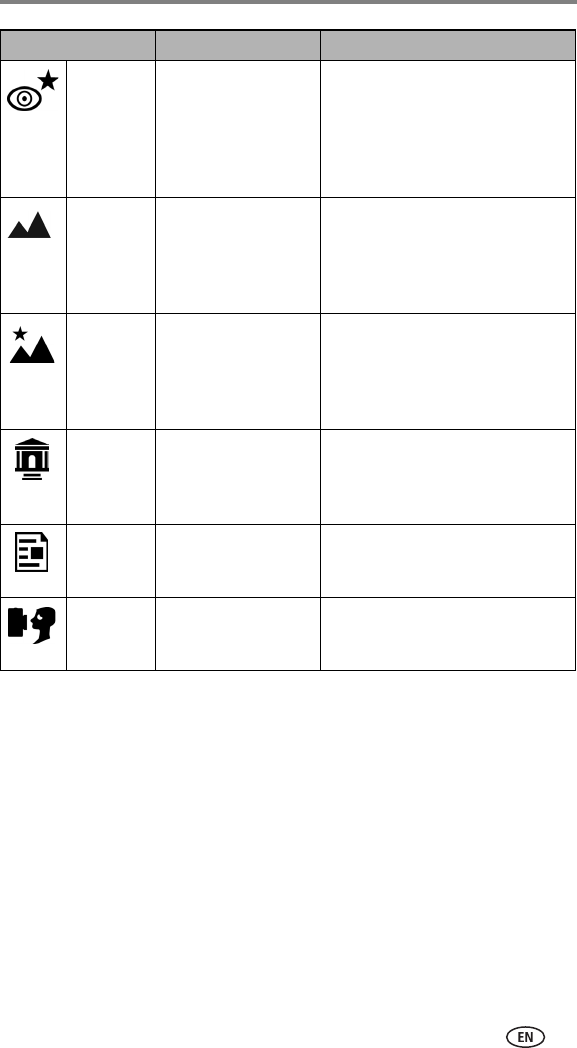
Night
Portrait
Reduces red eye of
people in night scenes
or low-light conditions.
Place the camera on a
flat, steady surface or
use a tripod.
f/2.8–f/3.7, Multi-Pattern Exposure
Metering, Multi-Zone Focus, ISO 140
Landscape Distant scenery. Flash
does not fire.
Auto-focus framing
marks (page 6) are not
available in Landscape.
f/2.8–f/3.7, Infinity Focus,
Multi-Pattern Exposure Metering,
Daylight White Balance, ISO 100
Night
Landscape
Distant scenery at
night. Flash does not
fire. Place the camera
on a flat, steady surface
or use a tripod.
f/2.8–f/3.7, Infinity Focus, Daylight
White Balance, Center-Weight
Metering, Daylight White balance,
ISO 100
Manner/
Museum
Quiet occasions, like a
wedding or lecture.
Flash and sound are
disabled.
f/2.8–f/3.7, no sounds, no flash,
Multi-Pattern Exposure Metering,
Multi-Zone Focus, ISO 100
Text Documents. f/2.8–f/3.7, Macro Focus, +1
Exposure Compensation,
Center-Weight Metering, ISO 140
Self-
Portrait
Close-ups of yourself.
Assures proper focus
and minimizes red eye.
f/2.8, Macro Focus, Multi-Pattern
Exposure Metering, Multi-Zone
Focus, Red-Eye Flash, ISO 100
Use this SCN mode For Camera pre-settings
Doing more with your camera
26 www.kodak.com/go/support
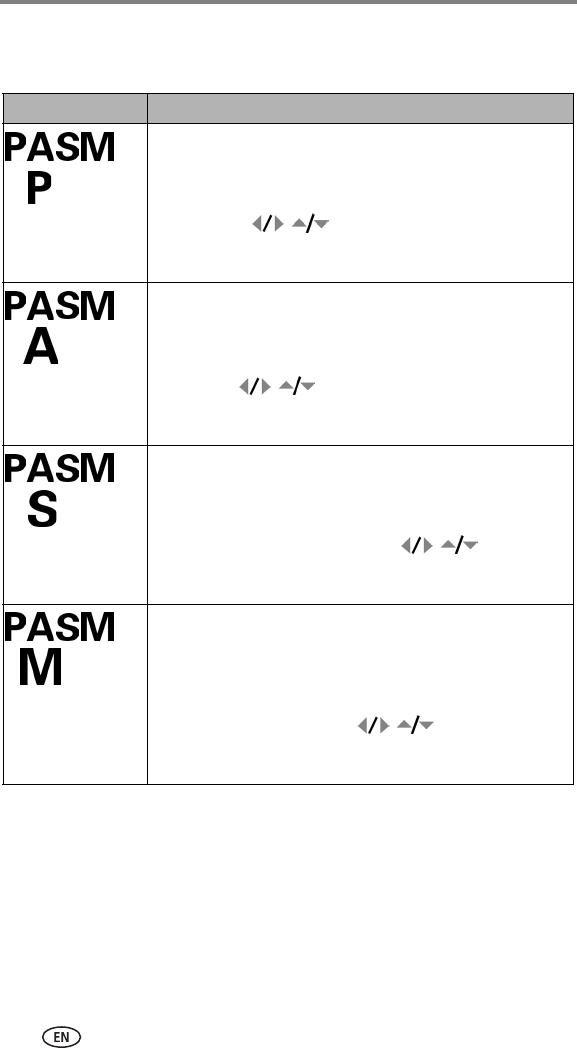
PASM modes
For more information on PASM modes, see page 26.
Use this mode For
Program
Controlling exposure compensation (how much light enters the
camera). The camera automatically sets the shutter speed and
aperture (f-stop) based on the scene lighting. Program mode
offers the ease of auto shooting with full access to all menu
options. Press to select settings. (See P, A , S, a n d
M modes, page 33.) Press the Menu button to change other
settings.
Aperture
Priority
Controlling aperture, exposure compensation, and ISO speed.
Aperture priority mode is primarily used to control depth of field
(the range of sharpness).
NOTE: The aperture setting may be affected when using optical
zoom. Press to select settings. (See P, A, S, and M
modes, page 33.) Press the Menu button to change other
settings.
Shutter
Priority
Controlling the shutter speed, exposure compensation, and ISO
speed. The camera automatically sets the aperture for proper
exposure. Shutter priority mode is primarily used to prevent blur
when your subject is moving. To prevent camera shake, use a
tripod for slow shutter speeds. Press to select
settings. (See P, A, S, and M modes, page 33.) Press the Menu
button to change other settings.
Manual
Enjoying the highest level of creative control. You set the
aperture, shutter speed, and ISO speed. Exposure
compensation acts as an exposure meter, recommending the
proper combination of aperture and shutter speed to produce
an acceptable exposure. To prevent camera shake, use a tripod
for slow shutter speeds. Press to select settings.
(See P, A, S, and M modes, page 33.) Press the Menu button to
change other settings.
Doing more with your camera
www.kodak.com/go/support 27
Changing picture-taking settings
You can change settings to get the best results from your camera:
1Press the Menu button. (Some settings are unavailable in some modes.)
2Press to highlight a setting, then press the OK button.
3Choose an option, then press the OK button.
4Press the Menu button to exit.
Setting Icon Options
Picture Size
Choose a picture resolution.
This setting remains until you
change it.
5.0 MP (default)—for printing up to
20 x 30 in. (50 x 75 cm); pictures are highest
resolution and largest file size.
4.4 MP (3:2)— ideal for printing 4 x 6 in.
(10 x 15 cm) prints without cropping. Also
for printing up to 20 x 30 in. (50 x 75 cm)
4.0 MP— for printing up to 20 x 30 in.
(50 x 75 cm); pictures are medium
resolution with smaller file size.
3.1 MP—for printing up to 11 x 14 in.
(28 x 36 cm); pictures are medium
resolution with smaller file size.
1.8 MP—for printing 4 x 6 in. (10 x 15 cm)
prints, emailing, Internet, screen display, or
for conserving space.
Video Size
Choose a video resolution.
This setting remains until you
change it.
640 x 480—higher resolution and file size.
Video plays in a 640 x 480 pixel window
(VGA).
320 x 240—lower resolution and file size.
Video plays in a 320 x 240 pixel window
(QVGA).
Doing more with your camera
28 www.kodak.com/go/support
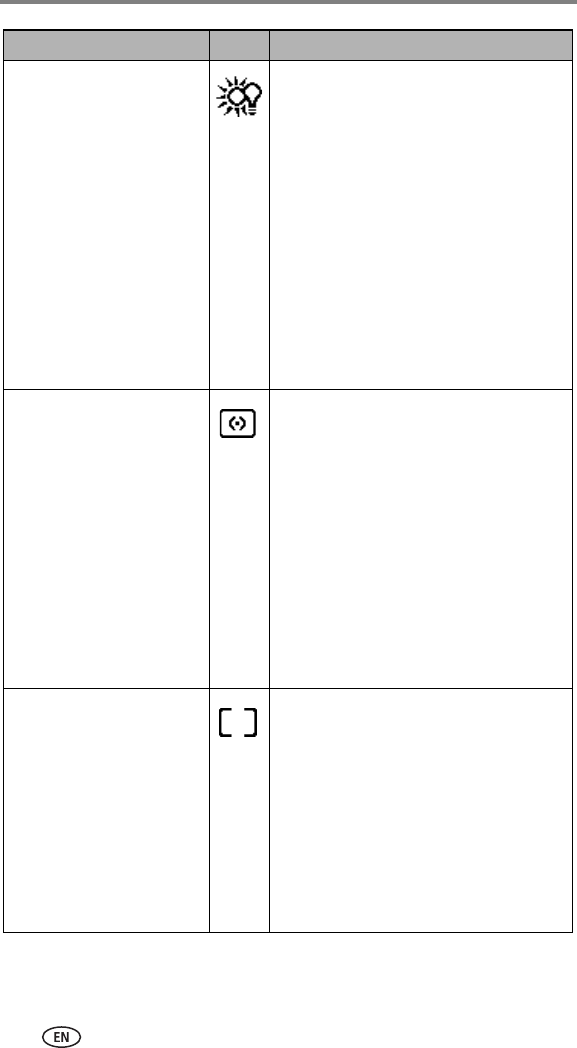
White Balance
Choose your lighting
condition.
This setting remains until you
turn the Mode dial or turn off
the camera.
Auto (default)—automatically corrects
white balance. Ideal for general picture
taking.
Daylight—for pictures in natural lighting.
Tungsten—corrects the orange cast of
household light bulbs. Ideal for indoor
pictures under tungsten or halogen lighting
without flash.
Fluorescent—corrects the green cast of
fluorescent lighting. Ideal for indoor pictures
under fluorescent lighting without flash.
Open Shade—for pictures in the shade in
natural lighting.
Available only in PASM mode.
Exposure Metering
Evaluate light levels at
specific areas of a scene.
This setting remains until you
turn the Mode dial or turn off
the camera.
Multi-pattern (default)—evaluates
lighting conditions throughout the image to
give an optimum picture exposure. Ideal for
general picture taking.
Center-weight—evaluates the lighting
conditions of the subject centered in the
viewfinder. Ideal for backlit subjects.
Center-spot—similar to Center-weight,
except the metering is concentrated on a
smaller area of the subject centered in the
viewfinder. Ideal when you need an exact
exposure of a specific area in the picture.
Available only in PASM mode.
Focus Zone
Select a large or concentrated
area of focus.
This setting remains until you
turn the Mode dial or turn off
the camera.
Multi-zone (default)—evaluates 3 zones
to give an even picture focus. Ideal for
general picture taking.
Center-zone—evaluates the small area
centered in the viewfinder. Ideal when
precise focus of a specific area in the picture
is needed.
NOTE: For the best pictures, the camera is set to
Multi-zone when in Landscape mode.
Available only in PASM mode.
Setting Icon Options
Doing more with your camera
www.kodak.com/go/support 29
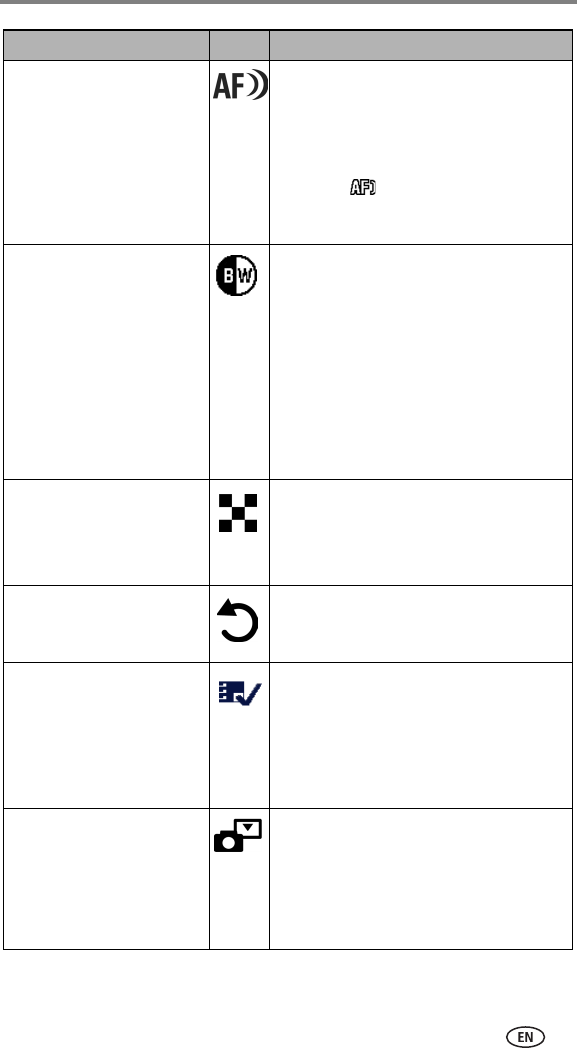
AF Control
Choose an auto-focus setting.
This setting remains until you
change it.
Continuous AF (default)—uses external
AF sensor and TTL-AF (Through-The-Lens).
Because the camera is always focusing,
there is no need to press the Shutter button
halfway down to focus.
Single AF —uses external AF sensor
and TTL-AF when the Shutter button is
pressed halfway down.
Color Mode
Choose color tones.
This setting remains until you
turn the Mode dial or turn off
the camera.
High Color
Natural Color (default)
Low Color
Black & White
Sepia—for pictures with a reddish-brown,
antique look.
NOTE: EasyShare software also lets you change a
color picture to black-and-white or sepia.
Unavailable in Video mode.
Sharpness
Control picture sharpness.
This setting remains until you
change it.
High
Normal (default)
Low
Available only in PASM mode.
Reset to Default
Reset all picture-taking
settings to the defaults.
Reset
P, A, S, or M
mode to its default setting.
Available only in PASM mode.
Set Album
Choose Album names.
This setting remains until you
change it. You can apply
different Set Album choices to
videos and to pictures.
On or Off.
Pre-select album names before you take
pictures or videos. Then, all the pictures or
videos you take are tagged with those album
names. See page 35.
Image Storage
Choose a storage location for
pictures and videos.
This setting remains until you
change it.
Auto (default)—the camera uses the card
if one is in the camera. If not, the camera
uses internal memory.
Internal Memory—the camera always
uses internal memory, even if a card is
installed.
Setting Icon Options
Doing more with your camera
30 www.kodak.com/go/support
Customizing your camera
Use Setup to customize your camera settings.
1In any mode, press the Menu button.
2Press to highlight Setup , then press the OK button.
3Press to highlight the setting you wish to change, then press the OK
button.
4Choose an option, then press the OK button.
5Press the Menu button to exit.
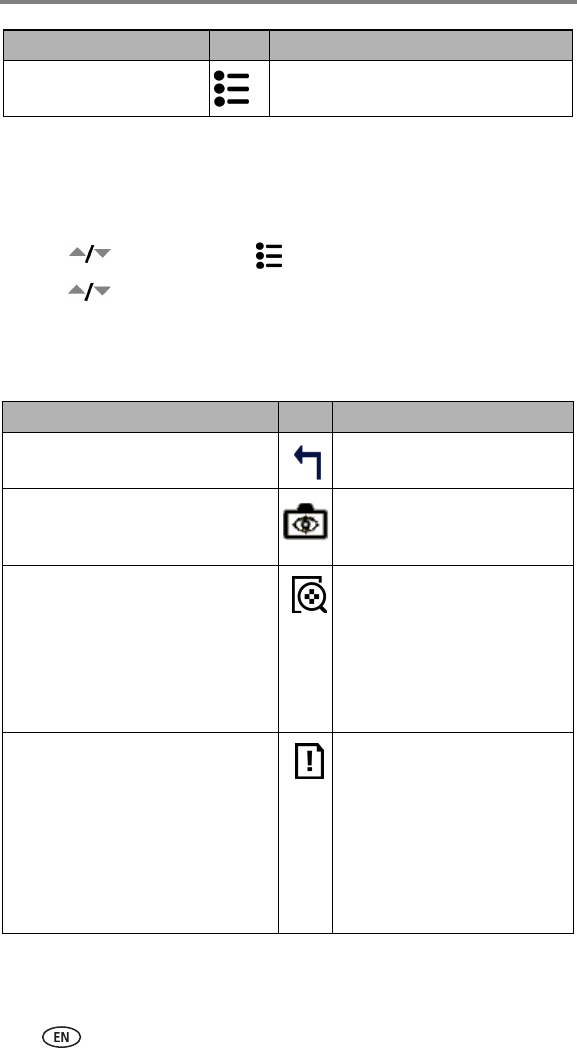
Setup Menu
Choose additional settings.
See Customizing your camera.
Setting Icon Options
Return to previous menu.
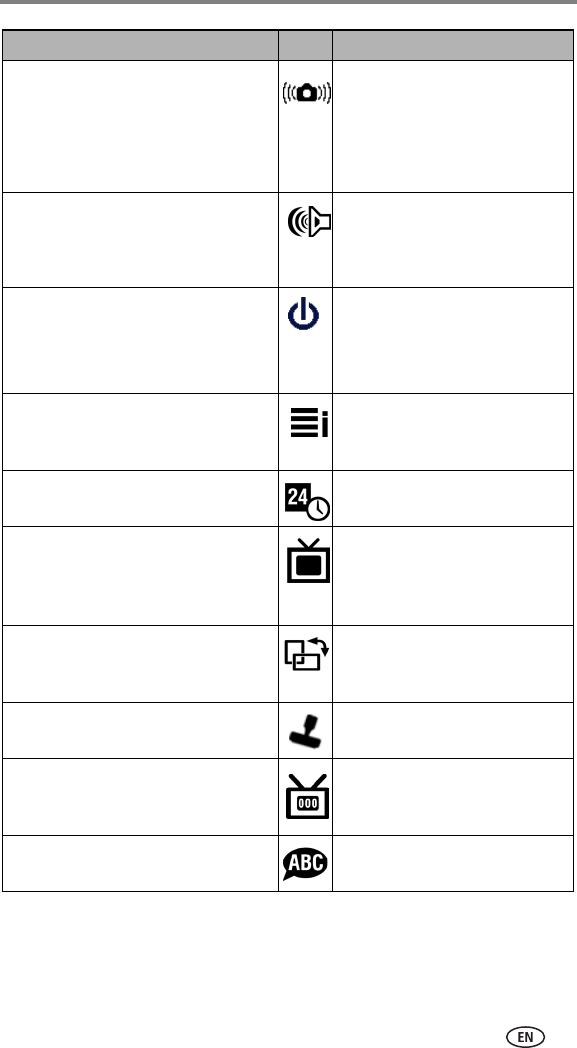
Quickview
Change Quickview default to on or off.
(For more information, see page 6.)
On
Off (default)
Digital Zoom
Choose how digital zoom is employed.
Continuous —no pause between
optical and digital zoom.
Pause (default)—after reaching
10X optical zoom, the zoom button
must be released, then activated
again to begin digital zoom.
None—digital zoom is disabled.
Print Warning Pause (default)—when the blue
slider on the zoom indicator pauses
during digital zoom, the zoom lever
must be released and reactivated.
The slider turns red when the
picture may no longer render an
acceptable 4 x 6 in. (10 x 15 cm)
print.
None—no pause.
Setting Icon Options
Doing more with your camera
www.kodak.com/go/support 31
Sound Themes Shutter only (default)
Default
Classical
Jazz
Sci-fi
Sound Volume Off
Low (default)
Medium
High
Auto Power Off
Choose amount of inactivity time until
camera turns off.
10 minutes (default)
5 minutes
3 minutes
1 minute
Mode Description
Display mode description when entering
a mode.
On (default)
Off
Date & Time See page 3.
Video Out
Choose the regional setting that lets you
connect the camera to a television or
other external device.
NTSC (default)—used in North
America and Japan; most common
format.
PAL—used in Europe and China.
Orientation Sensor
Orient pictures so that they are displayed
with the correct side up.
On (default)
Off
Date Stamp
Imprint the date on pictures.
Choose a date option, or turn off
the feature. (Default is off.)
Video Date Display
Display Date/Time at the start of video
playback.
On (default)— choose from date
formats.
Off
Language See page 3.
Setting Icon Options
Doing more with your camera
32 www.kodak.com/go/support
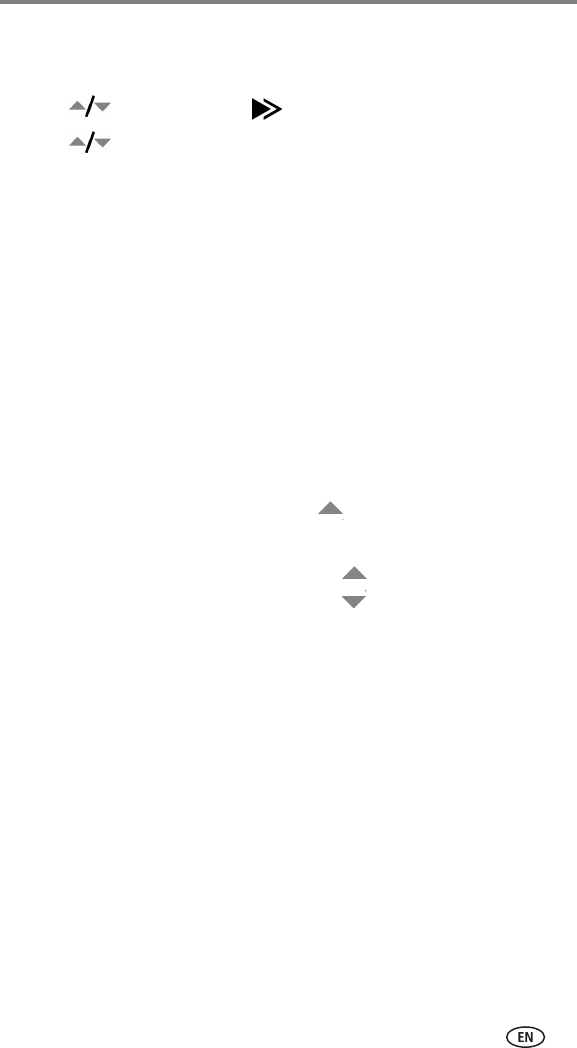
Viewing picture/video information
To exit Review, press the Review button.
Copying pictures and videos
You can copy pictures and videos from a card to internal memory or from
internal memory to a card.
Before you copy, make sure that:
■A card is inserted in the camera.
■The camera’s picture storage location is set to the location from which you
are copying. See Image Storage, page 29.
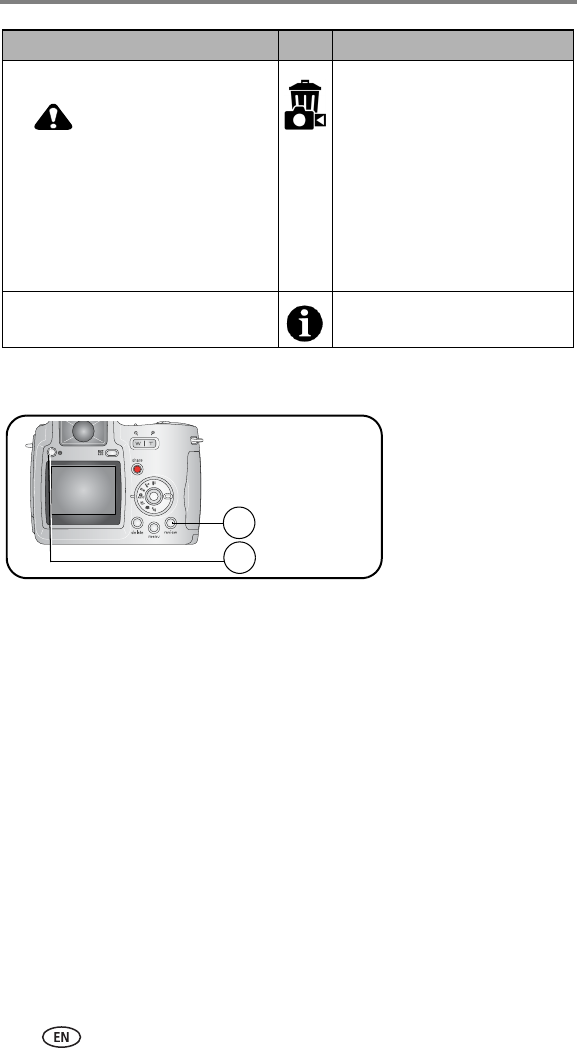
Format
CAUTION:
Formatting deletes all
pictures and videos, including
those that are protected.
Removing a card during
formatting may damage the
card.
Memory Card—deletes
everything on the card; formats the
card.
Cancel—exits without making a
change.
Internal Memory—deletes
everything in internal memory
including email addresses, album
names, and favorites; formats the
internal memory.
About
View camera information.
Setting Icon Options
1
2
Press Review.
Press Info.
Doing more with your camera
www.kodak.com/go/support 33
Copy pictures or videos:
1Press the Review button, then press the Menu button.
2Press to highlight Copy , then press the OK button.
3Press to highlight an option:
PICTURE or VIDEO—copies the current picture or video.
EXIT—returns to the Review menu.
ALL—copies all pictures and videos from your selected storage location to
the other location.
4Press the OK button.
NOTE: Pictures and videos are copied, not moved. To remove pictures and from the original
location after copying, delete them (see page 11).
Tags that you applied for print, email, and favorites are not copied. Protection settings are
not copied. To apply protection to a picture or video, see page 11.
Adjusting exposure compensation
Use exposure compensation to make pictures lighter or darker.
1In any capture mode, move the joystick .
Exposure compensation information appears on the camera screen or EVF.
2To make pictures lighter, move the joystick .
To make pictures darker, move the joystick .
The setting remains until you change it or turn off the camera.
P, A, S, and M modes
Settings you change in P, A, S, or M modes apply only to pictures taken in
those modes.
For example, if you change the Color Mode to Sepia while in P, A, S, or M
mode, you still retain the default setting of Color for Auto and Scene modes.
NOTE: The settings, including Flash, are maintained for P, A, S, and M modes—even when you
change modes or turn off the camera. Use Reset to Default (see page 29) to reset P, A, S,
or M, mode to its default setting.
Doing more with your camera
34 www.kodak.com/go/support
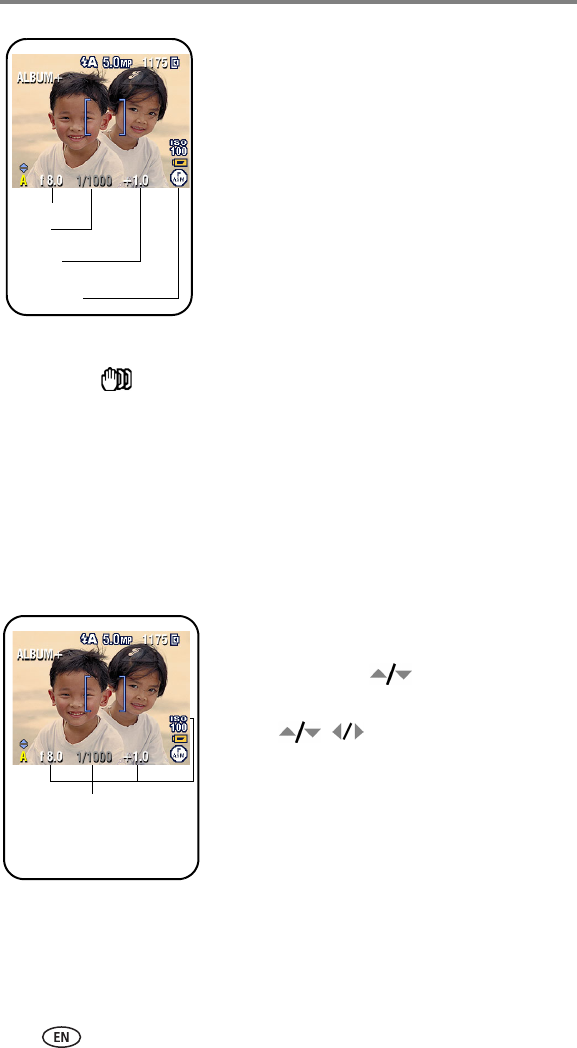
Aperture—also known as f-stop, controls
the size of the lens opening, which determines
the depth of field. Smaller f-numbers, for
example f/2.8, refers to a bigger lens opening.
Larger f-numbers, for example f/8, refers to a
smaller lens opening.
Larger f-numbers keep the main subject sharp;
good for landscapes and well-lit conditions.
Smaller f-numbers are good for portraits and
low-light conditions. The highest and lowest
aperture numbers may be affected by optical
zoom.
Shutter speed—controls how long the shutter stays open. A shaking
hand icon warns of slow shutter speeds. (Use a tripod for slow shutter
speeds.)
Exposure Compensation—use to manually adjust the exposure; good
for controlling backlit or non-standard scenes. If the picture is too light,
decrease the setting; if it’s too dark, increase the setting.
Changing P, A, S, or M mode settings
PASM modes control the f-number, shutter speed, and exposure
compensation. Use the Menu button to control all other settings.
1Turn the Mode dial to PASM.
The mode options are displayed.
2Move the joystick to choose
P, A, S, or M.
3Press to:
■Move between available settings.
■Open a setting.
■Change the setting.
4Press the Menu button to change other
settings (see page 27).
5Take a picture.
Aperture
Shutter
speed
Exposure
compensation
Modesetting
P, A, S, or M mode options
White—sekectable
Grey—non-selectable
Yellow—changeable value
Red—out of range

Doing more with your camera
www.kodak.com/go/support 35
Pre-tagging for album names
Use the Set Album (Still or Video) feature to pre-select album names before
you take pictures or videos. Then, all the pictures or videos you take are
tagged with those album names.
First—on your computer
Use Kodak EasyShare software (V 3.0 or higher, see page 12) to create album
names on your computer. Then copy up to 32 album names to the album
name list the next time you connect the camera to the computer. See Kodak
EasyShare software Help for details.
Second—on your camera
1In any mode, press the Menu button.
2Press to highlight Set Album , then press the OK button.
3Press to highlight an album name, then press the OK button. Repeat
to mark pictures or videos for albums.
Selected albums are noted with a check mark.
4To remove a selection, highlight an album name and press the OK button.
To remove all album selections, select Clear All.
5Highlight Exit, then press the OK button.
Your selections are saved. If you turn on the camera screen, your album
selection is displayed on the screen. A plus (+) after the album name means
more than one album is selected.
6Press the Menu button to exit the menu.
Third—transfer to your computer
When you transfer the tagged pictures or videos to your computer, Kodak
EasyShare software opens and categorizes your pictures in the appropriate
album. See the Kodak EasyShare software Help for details.

Doing more with your camera
36 www.kodak.com/go/support
Tagging pictures/videos for albums
Use the Album feature in Review mode to tag the pictures and videos in your
camera with album names.
First—on your computer
Use Kodak EasyShare software to create album names on your computer, then
copy up to 32 album names to the camera’s internal memory. See Kodak
EasyShare software Help for details.
Second—on your camera
1Press the Review button, then locate the picture or video.
2Press the Menu button.
3Press to highlight Album , then press the OK button.
4Press to highlight an album folder, then press the OK button.
To add other pictures to the same album, press to scroll through the
pictures. When the picture you want is displayed, press the OK button.
To add the pictures to more than one album, repeat step 4 for each album.
The album name appears with the picture. A plus (+) after the album name
means the picture was added to more than one album.
To remove a selection, highlight an album name and press the OK button. To
remove all album selections, select Clear All.
Third—transfer to your computer
When you transfer the tagged pictures and videos to your computer, the
Kodak EasyShare software opens and categorizes your pictures and videos in
the appropriate album folder. See Kodak EasyShare software Help for details.
Doing more with your camera
www.kodak.com/go/support 37
Sharing your pictures
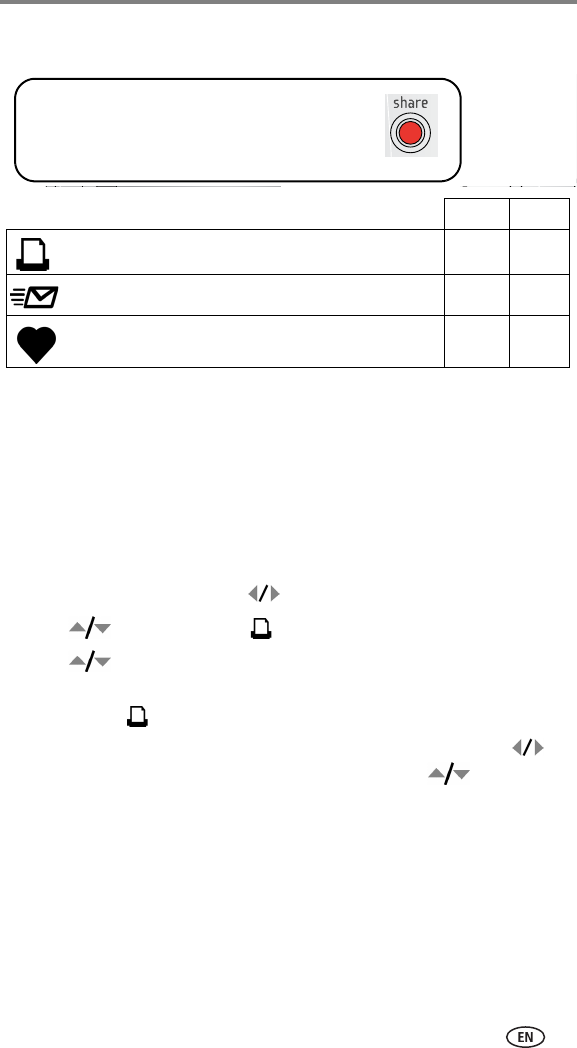
When can I tag my pictures and videos?
Press the Share button to tag pictures/videos:
■Any time. (The most recent picture/video taken is then displayed.)
■Just after you take a picture/video, during Quickview (see page 6).
■After pressing the Review button (see page 9).
Tagging pictures for printing
1Press the Share button. Press to locate a picture.
2Press to highlight Print , then press the OK button.*
3Press to select the number of copies (0-99). Zero removes the tag
for that picture.
The Print icon appears in the status area. The default quantity is one.
4 Optional: You can apply a print quantity to other pictures. Press to
locate a picture. Keep the print quantity as is, or press to change it.
Repeat this step until the desired print quantity is applied to the pictures.
5Press the OK button. Then press the Share button to exit the menu.
* To tag all pictures in the storage location, highlight Print All, press the OK
button, then indicate the number of copies. Print All is not available in
Quickview. To remove print tagging for all pictures in the storage location,
highlight Cancel Prints, then press the OK button. Cancel Prints is not
available in Quickview.
Pictures Videos
Print (page 37)✔
Email (page 38)✔✔
Favorites (page 39) for easy organization on your
computer and for sharing on your camera ✔✔
Press the Share button to
"tag" your pictures and videos.
When they are transferred to your
computer, you can share them.

Doing more with your camera
38 www.kodak.com/go/support
Printing tagged pictures
When you transfer the tagged pictures to your computer, the Kodak EasyShare
software print screen opens. For details on printing, click the Help button in
the Kodak EasyShare software.
For more information on printing from your computer, printer dock,
PictBridge-enabled printer, or card, see page 14.
NOTE: For the best 4 x 6 in. (10 x 15 cm) prints, set the camera to the Best (3:2) print quality
setting. See page 27.
Tagging pictures and videos for emailing
First—on your computer
Use Kodak EasyShare software to create an email address book on your
computer. Then, copy up to 32 email addresses to the camera’s internal
memory. For details, click the Help button in the Kodak EasyShare software.
Second—tag pictures/videos on your camera
1Press the Share button. Press to locate a picture/video.
2Press to highlight Email , then press the OK button.
The Email icon appears in the status area.
3Press to highlight an email address, then press the OK button.
To tag other pictures/videos with the same address, press to scroll
through them. When the picture you want is displayed, press OK.
To send the pictures/videos to more than one address, repeat step 3 for
each address.
Selected addresses are checked.
4To remove a selection, highlight a checked address and press the OK
button. To remove all email selections, highlight Clear All.
5Press to highlight Exit, then press the OK button.
The Email icon appears in the status area.
6Press the Share button to exit the menu.
Third—transfer and email
When you transfer the tagged pictures/videos to your computer, the Email
screen opens and lets you send them to the addresses you specified. For
details, click the Help button in the Kodak EasyShare software.
Doing more with your camera
www.kodak.com/go/support 39
Tagging pictures as favorites
You can preserve your favorite pictures in the Favorites section of your
camera’s internal memory, then share them with friends and family.
NOTE: When you transfer pictures from your camera to your computer, all pictures (including
favorites) are stored on your computer at full size. Favorite pictures - smaller copies of your
originals - are loaded back to your camera, so you can share and enjoy more.
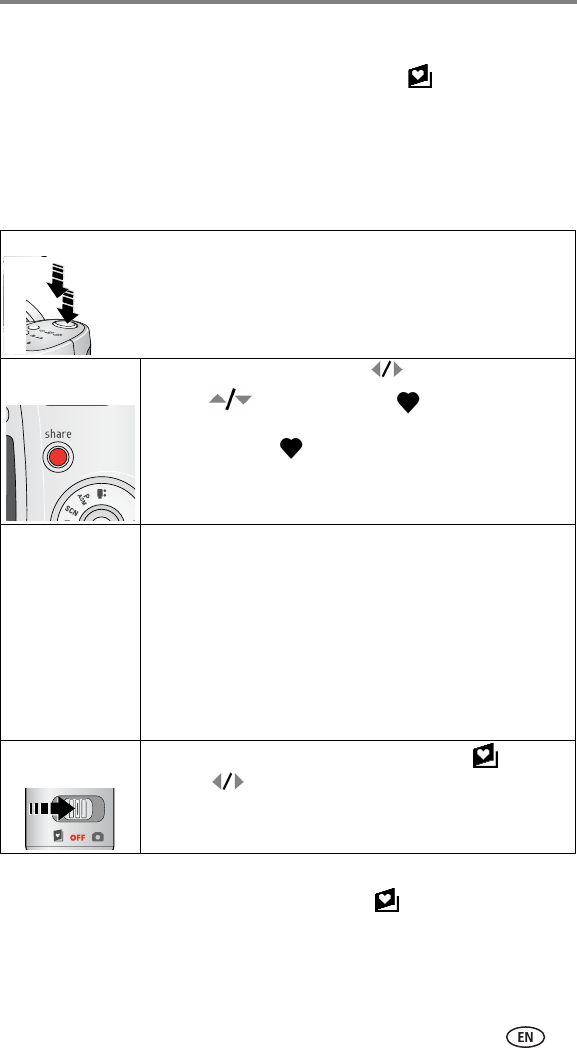
Share your favorite pictures in 4 easy steps:
NOTE: The camera holds a limited number of favorites. Use Camera Favorites in the EasyShare
software to customize the size of your camera Favorites section. Videos tagged as
favorites remain in the Favorites folder in the EasyShare software. For more information,
click the Help button in the Kodak EasyShare software.
1. Take pictures
2. Tag pictures as
favorites
1Press the Share button. Press to locate a picture.
2Press to highlight Favorite , then press the OK
button.
The Favorite icon appears in the status area. To remove the
tag, press the OK button again.
Press the Share button to exit the menu.
3. Transfer
pictures to your
computer
1To enjoy full functionality, load and use the EasyShare
software that was packaged with this camera. (See
page 12.)
2Connect the camera to the computer using the USB cable
(see page 14) or an EasyShare dock.
The first time you transfer pictures, a software wizard helps you
make choices about your favorite pictures. Then, your pictures
are transferred to the computer. Favorite pictures (smaller
versions of the originals) are loaded to the Favorites section of
your camera’s internal memory.
4. View favorites
on your camera
1Move the Power/Favorites switch to Favorites .
2Press to scroll through favorites.
Doing more with your camera
40 www.kodak.com/go/support
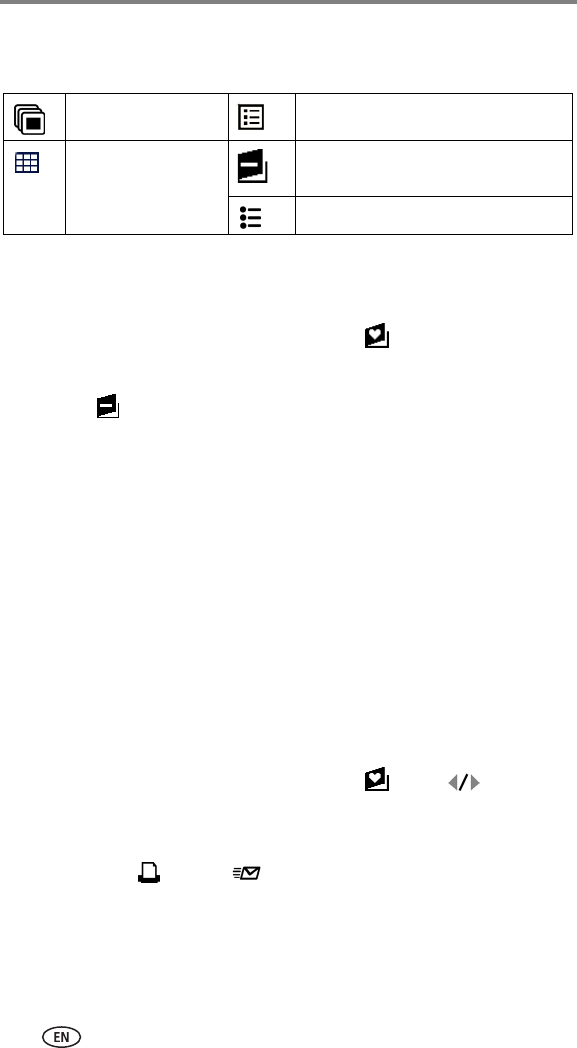
Optional settings
In Favorites mode, press the Menu button to access optional settings.
NOTE: Pictures taken at the Best (3:2) quality setting are displayed at a 3:2 aspect ratio with a
black bar at the top of the screen. (See Picture Size, page 27.)
Removing all favorites from your camera
1Move the Power/Favorites switch to Favorites .
2Press the Menu button.
3Highlight , then press the OK button.
All pictures stored in the Favorites section of internal memory are removed.
Favorites are restored the next time you transfer pictures to the computer.
4Press the Menu button to exit the menu.
Preventing favorites from transferring to the camera
1Open the Kodak EasyShare software. Click the My Collection tab.
2Go to the Albums view.
3Click the Camera Favorites Album for your camera.
4Click Remove Album.
The next time you transfer pictures from your camera to the computer, use the
Camera Favorites Wizard/Assistant to either recreate your Camera Favorites
Album or to turn off the Camera Favorites feature.
Printing and emailing favorites
1Move the Power/Favorites switch to Favorites . Press to locate a
picture.
2Press the Share button.
3Highlight Print or Email , then press the OK button.
NOTE: Favorites that were taken on this camera (not imported from another source) are good for
prints up to 4 x 6 in. (10 x 15 cm).
Slide Show (page 20) Picture Information (page 32)
Multi-up (page 10) Remove all favorites (Removing all
favorites from your camera, page 40)
Setup Menu (page 30)
www.kodak.com/go/support 41
5Troubleshooting
Camera problems
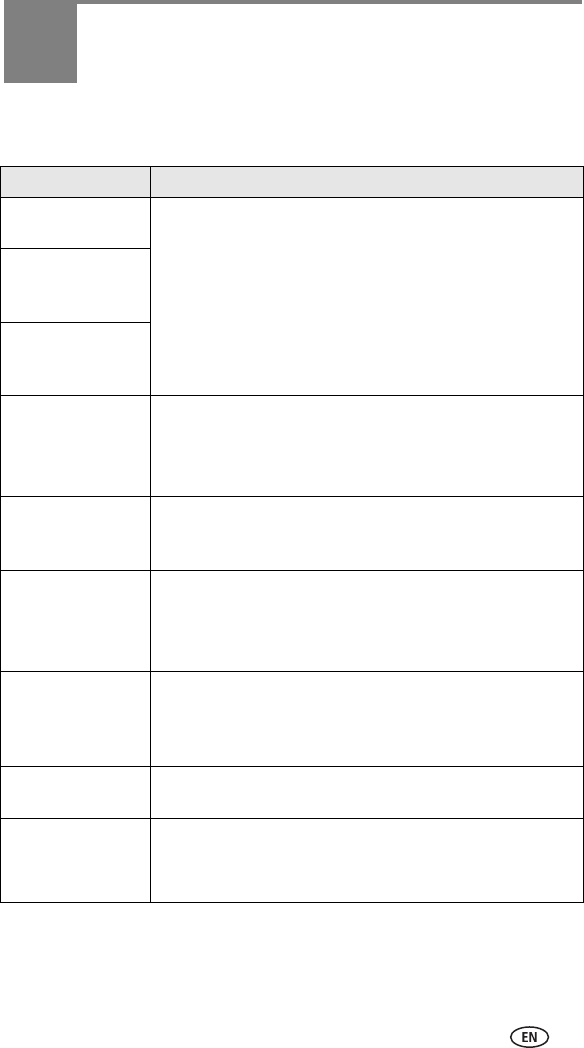
If... Try one or more of the following
Camera does not
turn on
■Remove battery and verify that it’s the correct type, then
reinsert it.
■Insert a new or charged battery.
■Connect the camera to a Kodak 3-volt AC adapter (sold
separately), then try again. See page 54 for more battery
information.
Camera does not
turn off and the lens
does not retract
Camera buttons and
controls do not
function
Lens does not extend
when camera turns
on or does not retract
■Confirm that the battery in camera is charged.
■Turn camera off, then on again. (Lens does not extend in
Favorites mode.)
■If problem still exists, get help (page 45).
EVF/LCD screen is
black or does not
turn on
■Remove the lens cap.
■Push the EVF/LCD button to change the display.
In Review, a blue or
black screen is
displayed instead of
a picture
■Transfer the picture to the computer.
■Transfer
all
pictures to the computer (page 12).
■Take another picture. If problem still continues try internal
memory and/or another memory card.
Pictures remaining
number does not
decrease after taking
a picture
■Continue taking pictures. The camera is operating normally.
(The camera estimates the number of pictures remaining after
each picture is taken, based on picture size and content.)
Picture orientation is
not accurate
■Set the Orientation Sensor to ON (page 31).
Flash does not fire ■Open the flash unit (page 9).
■Check the flash setting and change as needed (page 22).
NOTE: The flash does not fire in all mode (page 22).
Troubleshooting
42 www.kodak.com/go/support
Computer/connectivity problems
Storage location is
almost or entirely full
■Transfer pictures to the computer (page 12).
■Delete pictures from the card or insert a new one (page 11).
■Change image storage location to internal memory
(page 29).
Battery life is short ■Make sure the correct battery type is installed (page 54).
■Wipe the contacts with a clean, dry cloth before inserting a
battery in the camera. See page 54.
■Insert a new or charged battery (page 2).
You cannot take a
picture
■Turn camera off, then on again. Make sure the camera is not
in Favorites mode.
■Depress shutter button all the way (page 5).
■Insert a new or charged battery (page 2).
■Wait until the AF/AE indicator turns green before attempting
to take another picture.
■Memory full. Transfer pictures to the computer (page 12),
delete pictures (page 11), change image storage location, or
insert another card.
Error message
appears on EVF/LCD
screen
■Turn the camera off, then on again.
■Remove memory card from the camera.
■Remove the battery and wipe the contacts with a clean, dry
cloth (page 54).
■Insert a new or charged battery (page 2).
■If all else fails, get customer support help (page 45).
Memory card not
recognized or camera
freezes with card.
■Card may be corrupted. Format card in camera (page 32).
■Use another memory card.
If... Try one or more of the following
Computer does not
communicate with
the camera
■Insert a charged battery (page 2).
■Turn on the camera.
■Make sure proper USB cable is connected on camera and
computer port (page 14). (If using an EasyShare dock, check
all cable connections. Make sure the camera is seated on
the dock.
■Make sure the EasyShare software is installed (page 12).
If... Try one or more of the following
Troubleshooting
www.kodak.com/go/support 43
Picture quality problems
Pictures do not
transfer to computer
■Click the Help button in the EasyShare software.
Slide Show does not
run on an external
video device
■Adjust the camera Video Out setting (NTSC or PAL,
page 31).
■Make sure the external device settings are correct (see the
device’s user’s guide).
If... Try one or more of the following
Picture is too dark
or underexposed
■Reposition camera for more available light.
■Use Fill flash (page 22) or change your position so light is not
behind the subject.
■Move so that the distance between you and the subject is
within the effective flash range (page 9).
■To automatically set exposure and focus, press the Shutter
button halfway. When the AF/AE indicator turns green, press
the Shutter button completely down to take the picture.
■Adjust exposure compensation (page 33).
Picture is too light ■Reposition camera to reduce the amount of available light.
■Turn flash off (page 22).
■Move so that the distance between you and the subject is
within the effective flash range (page 9).
■To automatically set exposure and focus, press the Shutter
button halfway. When the AF/AE indicator turns green, press
the Shutter button completely down to take the picture.
■Use P mode to adjust the Exposure.
Picture is not clear ■To automatically set exposure and focus, press the Shutter
button halfway. When the AF/AE indicator turns green, press
the Shutter button completely down to take the picture.
■Clean the lens (page 55).
■Make sure camera is not in Close-up mode if you are more
than 21 in. (0.7 m) from your subject.
■Place the camera on a flat, steady surface or use a tripod,
especially in high-zoom settings or in low light.
If... Try one or more of the following

Troubleshooting
44 www.kodak.com/go/support
Direct printing (PictBridge) problems
Status Solution
Cannot locate desired picture. ■Turn on the camera. Make sure the camera is
not in Favorites mode.
■Use the Direct print menu to change the image
storage location.
The Direct print menu interface
turns off.
Press any button to redisplay the menu.
Cannot print pictures. ■Ensure that there is a connection between
camera and printer (page 12).
■Ensure the printer and camera have power
(page 14).
Camera or printer display an
error message.
Follow the prompts to resolve the issue.
www.kodak.com/go/support 45
6Getting help
Helpful links
Camera
Software
Other
Get support for your product (FAQs,
troubleshooting information, arrange for
repairs, etc.)
www.kodak.com/go/z740support
Purchase camera accessories (camera
docks, printer docks, lenses, cards, etc.)
www.kodak.com/go/z740accessories
Download the latest camera firmware and
software
www.kodak.com/go/z740downloads
See online demonstrations of your camera www.kodak.com/go/howto
Get information on EasyShare software www.kodak.com/go/easysharesw
(or click the Help button in the EasyShare
software)
Get help with the Windows operating
system and working with digital pictures
www.kodak.com/go/pcbasics
Get support for other cameras, software,
accessories, more
www.kodak.com/go/support
Get information on Kodak EasyShare
printer docks
www.kodak.com/go/printerdocks
Get information on Kodak inkjet products www.kodak.com/go/inkjet
Optimize your printer for truer, more
vibrant colors
www.kodak.com/go/onetouch
Register your camera www.kodak.com/go/register
Getting help
46 www.kodak.com/go/support
Telephone customer support
If you have questions concerning the operation of the software or camera, you
may speak with a customer support representative.
Before you call
Have the camera, camera dock, or printer dock connected to your computer.
Be at your computer, and have the following information available:
For the most up-to-date listings, visit:
www.kodak.com/US/en/digital/contacts/DAIInternationalContacts.shtml
■Computer model
■Operating system
■Processor type and speed (MHz)
■Amount of memory (MB)
■Amount of free hard disk space
■Camera serial number
■Version of Kodak EasyShare software
■Exact error message you received
Australia 1800 147 701 Netherlands 020 346 9372
Austria 0179 567 357 New Zealand 0800 440 786
Belgium 02 713 14 45 Norway 23 16 21 33
Brazil 0800 150000 Philippines 1 800 1 888 9600
Canada 1 800 465 6325 Portugal 021 415 4125
China 800 820 6027 Singapore 800 6363 036
Denmark 3 848 71 30 Spain 91 749 76 53
Ireland 01 407 3054 Sweden 08 587 704 21
Finland 0800 1 17056 Switzerland 01 838 53 51
France 01 55 1740 77 Taiwan 0800 096 868
Germany 069 5007 0035 Thailand 001 800 631 0017
Greece 00800 441 25605 United Kingdom 0870 243 0270
Hong Kong 800 901 514 United States 1 800 235 6325
India 91 22 617 5823 Outside the US 585 726 7260
Italy 02 696 33452 International Toll Line +44 131 458 6714
Japan 03 5540 9002 International Toll Fax +44 131 458 6962
Korea 00798 631 0024
www.kodak.com/go/support 47
7Appendix
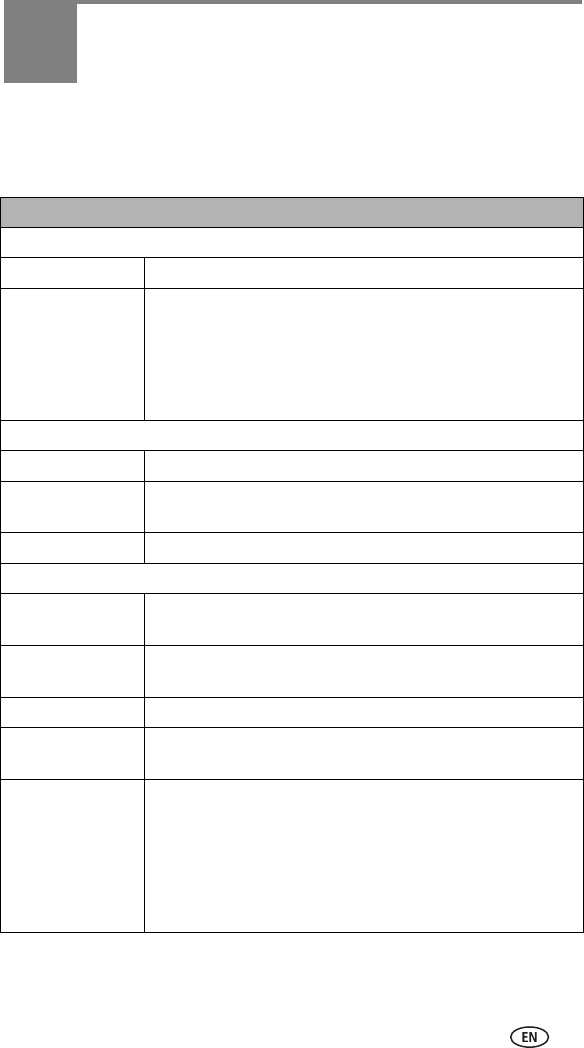
Camera specifications
For more specifications, visit www.kodak.com/go/z740support.
Kodak EasyShare Z740 zoom digital camera
CCD (charge-coupled device)
CCD 1/2.5 in. CCD, 4:3 aspect ratio
Output image size 5.0 MP: 2576 x 1932 pixels
4.4 MP (3:2): 2576 x 1716 pixels
4.0 MP: 2304 x 1728 pixels
3.1 MP: 2048 x 1536 pixels
1.8 MP: 1152 x 1164 pixels
Display
Color display 1.8 in. (4.6 cm) color hybrid LCD, 640 x 240 (134 K) pixels
Color electronic
viewfinder
LCD and EVF - not simultaneous; 0.2 in. (5.1 mm) 201 K pixels
Preview (LCD/EVF) Frame rate: 27 fps
Lens
Taking lens 10X optical zoom, aspheric all-glass Retinar lens, f/2.8-3.7
(35 mm equivalent: 38-380 mm)
Accessory lens
thread
Yes
Lens protection Lens cap
Digital zoom Combined zoom settings 10.6X to 50X in 0.6X increments. (Not
supported for movie capture.)
Focus system TTL-AF; auto, multi-zone, center-spot. (Center-weighted
available is PASM modes.) Working range:
24 in. (0.6 m)-infinity @ wide
6.6 ft (2 m)-infinity @ telephoto
4.7-27.6 in. (0.12-0.7 m) @ wide close-up
3.9-6.9 ft (1.2-2.1 m) @ telephoto close-up
Appendix
48 www.kodak.com/go/support
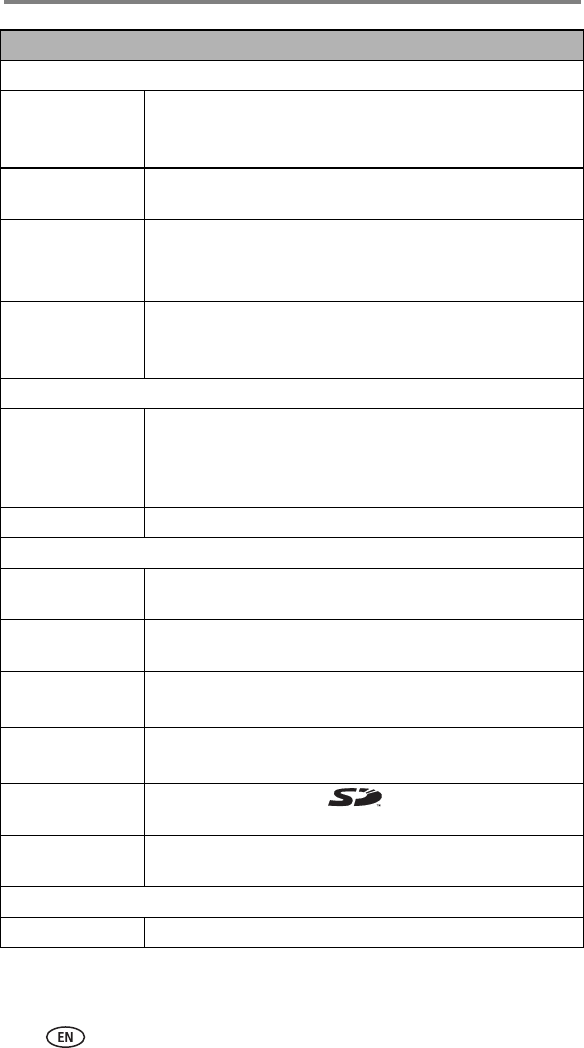
Exposure
Exposure metering TTL-AE
Multi-pattern, Center-spot, Center-weighted (available in PASM
modes only)
Exposure
compensation
+/-2.0 EV with 0.5 EV step
Shutter speed Auto: 1/8 to 1/1700 sec.
Shutter priority: 1/64-1/1700 sec.
Selectable: 0.5-8 sec.
ISO speed Auto: 80 to 160
Selectable: 80, 100, 200, 400, 800 (800 available only in Good
picture quality.)
Flash
Electronic flash Guide no. 10.6 (@ ISO 100)
Auto flash with photo sensor
Working range @ ISO 168: 2-16 ft (0.6-4.9 m) @ Wide; 6.6- 12
ft (2-3.7 m) @ Tele
Flash modes Auto, Fill, Red-eye, Off
Capture
Capture modes Auto, Portrait, Sport, Night, Landscape, Close-up, Video, (14)
Scene modes.
Burst mode First burst 5 pictures; Last burst 4 pictures; both @ 2 fps (AE, AF,
AWB executed for first shot only)
Video capture VGA (640 x 480) @ 13 FPS
QVGA (320 x 240) @ 20 FPS
Image file format Still: EXIF 2.2.1 (JPEG compression); file organization DCF
Video: QuickTime (CODEC MPEG4)
Image storage Optional MMC or SD Card (The SD logo is a trademark
of the SD Card Association.)
Internal storage
capacity
32 MB internal memory
Review
Quickview Yes
Kodak EasyShare Z740 zoom digital camera
Appendix
www.kodak.com/go/support 49
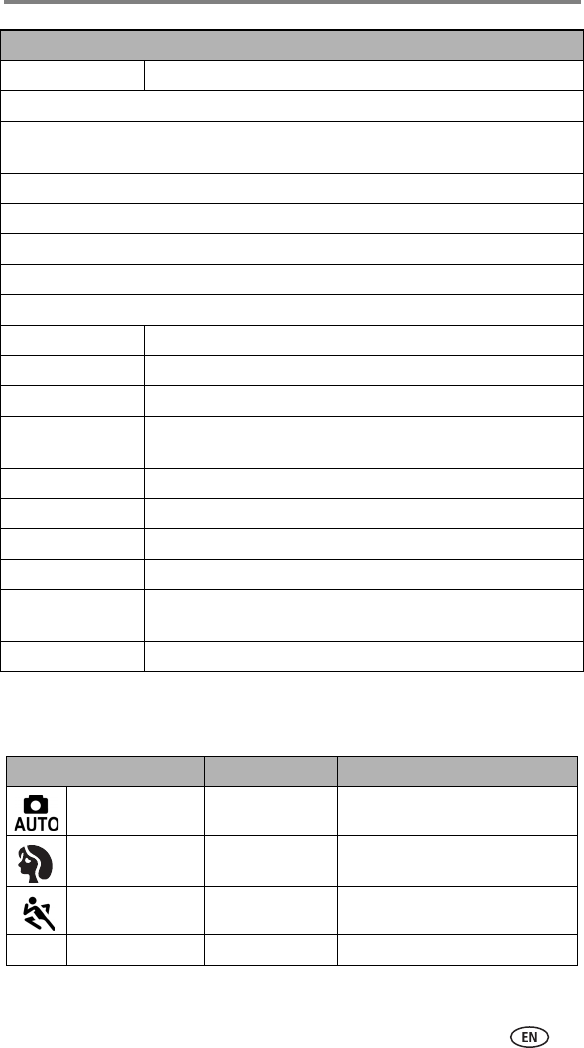
Flash settings in each mode
Flash settings are pre-set for each picture-taking mode.
Video output NTSC or PAL
Power
CRV3; 2-AA lithium; 2-AA Ni-MH; Kodak EasyShare Ni-MH rechargeable battery pack
(KAA2HR); 3V AC adapter
Communication with computer
USB 2.0 (PIMA 15740 protocol), via USB cable, EasyShare camera dock or printer dock
Languages
English/German/Spanish/French/Italian/Portuguese/Chinese/Korean/Japanese
Other features
PictBridge support Yes
Self-timer 2 or 10 seconds
Sound feedback All On, Shutter Only, All Off
White balance Auto, Daylight, Open Shade, Tungsten, Fluorescent (available
only in PASM)
Auto sleep mode Yes, 8 minutes
Color modes Color, Black & White, Sepia
Date stamp None, YYYYMMDD, MMDDYYYY, DDMMYYYY
Tripod mount 1/4 inch
Size 3.9 in. (97.8 mm) x 3.1 in. (77.5 mm) x 2.9 in. (72.6 mm) @
power off
Weight 10.1oz (286 g) without card or battery
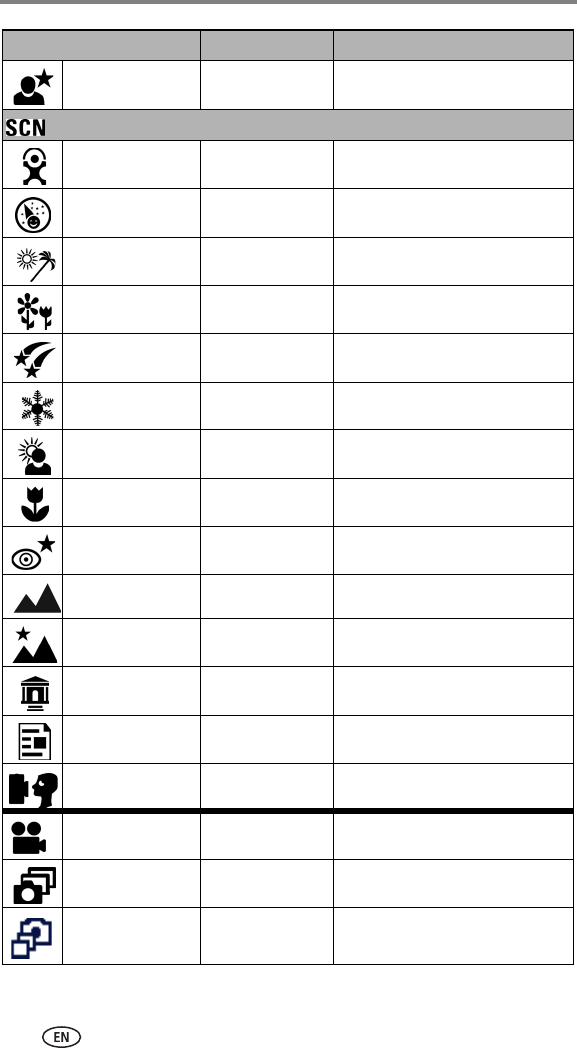
Capture modes Default setting Available settings
Auto Auto* Auto, Off, Fill Flash, Red-eye
Portrait Auto* Auto, Off, Fill Flash, Red-eye
Sports Auto* Auto, Off, Fill Flash, Red-eye
P, A, S, or M Auto* Auto, Off, Fill Flash, Red-eye
Kodak EasyShare Z740 zoom digital camera
PASM
Appendix
50 www.kodak.com/go/support
Night Auto* Auto, Off, Fill Flash, Red-eye
Scene modes
Children Auto* Auto, Off, Fill Flash, Red-eye
Party Red-eye* Auto, Off, Fill Flash, Red-eye
Beach Auto* Auto, Off, Fill Flash, Red-eye
Flower Off Auto, Off, Fill Flash
Fireworks Off Off
Snow Auto* Auto, Off, Fill Flash, Red-eye
Backlight Fill Fill
Close-up Off Auto, Off, Fill Flash
Night Portrait Red-eye* Auto, Off, Fill Flash, Red-eye
Landscape Off Off
Night Landscape Off Off
Manner/Museum Off Off
Text Off Auto, Off
Self-Portrait Red-eye* Auto, Off, Fill Flash, Red-eye
Video Off Off
First burst Off Off
Last burst Off Off
Capture modes Default setting Available settings
Appendix
www.kodak.com/go/support 51
* When you change to Auto or Red-eye in these modes, it becomes the
default until you change it.
Power-saving features
Storage capacities
Picture storage capacity
File sizes vary. You may be able to store more or fewer pictures and videos.
Favorites take up additional space in internal memory.
If no action for The camera To turn it back on
1 minute Screen turns off. Press the OK button.
10, 5, 3, 1 minutes (See Auto
Power Off, page 31.)
Enters auto
power off.
Press a button or insert/remove
card.
3 hours Turns off. Turn the camera off, then back on.
Number of pictures
5.0 MP 4.4 MP (3:2) 4.0 MP 3.1 MP 1.8 MP
16 MB SD/MMC 911121524
32 MB internal memory 17 19 21 27 43
32 MB SD/MMC 19 22 24 30 48
64 MB SD/MMC 39 44 49 60 97
128 MB SD/MMC 79 89 98 121 195
256 MB SD/MMC 159 178 196 242 391
512 MB SD/MMC 319 356 392 485 783
Appendix
52 www.kodak.com/go/support
Video storage capacity
Accessories
Minutes/seconds of video
VGA (640 x 480) QVGA (320 x 240)
16 MB SD/MMC 59 sec. 1 min. 53 sec.
32 MB internal memory 1 min. 47 sec. 3 min. 23 sec.
32 MB SD/MMC 1 min. 52sec. 3 min. 46 sec.
64 MB SD/MMC 3 min. 59 sec. 7 min. 32 sec.
128 MB SD/MMC 7 min. 59 sec. 15 min. 4 sec.
256 MB SD/MMC 15 min. 58 sec. 30 min. 8 sec.
512 MB SD/MMC 31 min. 57 sec. 60 min. 17 sec.
Item Description Where to buy
Kodak 0.7X
wide-angle lens
Expand your creative
and photographic
options with this
versatile lens.
www.kodak.com/go/z740accessories
Kodak EasyShare
Z740 lens adapter
Add 55 mm screw-on
lenses or filters.
Lens filter (black &
white)
Neutral density filter
102. Reduces light by 2
f-stops (log density
0.6); 55 mm threads.
Kodak 3-volt AC
adapter
Extend battery life.
Kodak performance
series digital camera
case
Stylish and rugged; for
Kodak EasyShare
digital cameras.
Kodak Ni-MH
rechargeable battery
pack
Rechargeable;
outstanding capacity.
Kodak Mi-MH rapid
battery charger
Includes worldwide
plugs. Batteries sold
separately.
Appendix
www.kodak.com/go/support 53
Important safety instructions
Using this product
■Read and follow these instructions before using Kodak products. Always
follow basic safety procedures.
■The use of an accessory attachment that is not recommended by Kodak,
such as an AC adapter, may cause fire, electric shock, or injury.
■If using this product in an airplane, observe all instructions of the airline.
WARNING:
Do not disassemble this product; there are no user-serviceable parts
inside. Refer servicing to qualified service personnel. Do not expose this
product to liquid, moisture, or extreme temperatures. Kodak AC
adapters and battery chargers are intended for indoor use only. The use
of controls, adjustments, or procedures other than those specified herein
may result in exposure to shock and/or electrical or mechanical hazards.
Battery safety and handling
WARNING:
When removing batteries, allow them to cool first; batteries may be hot.
■Read and follow all warnings and instructions supplied by the battery
manufacturer.
■Use only batteries that are approved for this product.
■Keep batteries out of the reach of children.
■Do not allow batteries to touch metal objects, including coins. Otherwise, a
battery may short circuit, discharge energy, become hot, or leak.
■Do not disassemble, install backward, or expose batteries to liquid,
moisture, fire, or extreme temperature.
■Replace all batteries of a set at the same time. Do not mix new batteries
with used ones. Do not mix rechargeable and non-rechargeable batteries.
Do not mix lithium, Ni-MH, and Ni-Cd batteries together. Do not mix
batteries of different chemistry types, grades, or brands. Failure to observe
this precaution may cause leakage.
Appendix
54 www.kodak.com/go/support
■Remove batteries when the product is stored for an extended period of
time. In the unlikely event that battery fluid leaks inside the product,
contact your local Kodak Customer Service representative.
■In the unlikely event that battery fluid leaks onto your skin, wash
immediately with water and contact your local health provider. For
additional health-related information, contact your local Kodak Customer
Service representative.
■Dispose of batteries according to local and national regulations.
■If the battery contacts touch metal objects, the battery may short-circuit,
discharge energy, become hot, or leak.
■Do not charge non-rechargeable batteries.
For more information on batteries, see
www.kodak.com/global/en/service/batteries/batteryUsage.jhtml
Battery life
Use these Kodak batteries. (Battery types are also molded into battery door.)
We do not recommend or support alkaline batteries. For acceptable
battery life, and to make sure your camera operates dependably, use the
replacement batteries listed above.
Extending battery life
■Limit the following activities that quickly deplete battery power:
– Reviewing your pictures on the camera screen (see page 9)
– Using the camera screen as a viewfinder (see page 9)
– Excessive use of the flash
Ni-MH rechargeable battery
pack (per charge)
AA (2) Ni-MH rechargeable
batteries (per charge)
CRV3 lithium battery
AA (2) lithium batteries
Battery life per CIPA testing method (Approx. number of pictures).
Actual life may vary based on usage.
350 - 500
250 - 350
200 - 300
200 - 300
5000

Appendix
www.kodak.com/go/support 55
■Dirt on the battery contacts can affect battery life. Wipe the contacts with a
clean, dry cloth before loading batteries in the camera.
■Battery performance is reduced at temperatures below 41° F (5° C).
When using your camera in cold weather, carry spare batteries and keep
them warm. Do not discard cold batteries that do not work; when they
return to room temperature, they may be usable.
Visit www.kodak.com/go/z740accessories for:
Kodak EasyShare camera dock—powers your camera, transfers pictures
to your computer, and charges the included Kodak EasyShare Ni-MH
rechargeable battery pack.
Kodak EasyShare printer dock—powers your camera, makes
4 x 6-in. (10 x 15 cm) prints with or without a computer, transfers pictures,
and charges the included Kodak EasyShare Ni-MH rechargeable battery pack.
Kodak 3-volt AC adapter—powers your camera.
IMPORTANT:
Do not use the AC adapter included with the Kodak EasyShare
camera dock or printer dock to power your camera.
Upgrading your software and firmware
Download the latest versions of the software included on the Kodak EasyShare
software CD and the camera firmware (the software that runs on the camera).
See www.kodak.com/go/z740downloads.
Additional care and maintenance
■If the camera has been subjected to inclement weather or you suspect
water has gotten inside the camera, turn off the camera and remove the
batteries and card. Allow all components to air-dry for at least 24 hours
before using the camera again.
■Blow gently on the lens or camera screen to remove dust and dirt. Wipe
gently with a soft, lint-free cloth or an untreated lens-cleaning tissue. Do
not use cleaning solutions unless designed specifically for camera lenses.
Do not allow chemicals, such as suntan lotion, to contact painted surfaces.
■Service agreements are available in some countries. Contact a dealer of
Kodak products for more information.

Appendix
56 www.kodak.com/go/support
■For digital camera disposal or recycling information, contact your local
authorities. In the US, visit the Electronics Industry Alliance Web site at
www.eiae.org or the Kodak Web site at www.kodak.com/go/z740support.
Warranty
Limited Warranty
Kodak warrants Kodak EasyShare digital cameras and accessories (excluding
batteries) to be free from malfunctions and defects in both materials and
workmanship for one year from the date of purchase.
Retain the original dated sales receipt. Proof of the date of purchase will be
required with any request for warranty repair.
Limited warranty coverage
THIS LIMITED WARRANTY WILL BE HONORED ONLY WITHIN THE
GEOGRAPHICAL LOCATION THAT KODAK DIGITAL CAMERAS AND
ACCESSORIES WERE PURCHASED.
Kodak will REPAIR or REPLACE Kodak EasyShare digital cameras and
accessories if they fail to function properly during the warranty period, subject
to any conditions and/or limitations stated herein. Such repair service will
include all labor as well as any necessary adjustments and/or replacement
parts. Such repair or replacement is the sole remedy under this warranty.
If replacement parts are used in making repairs, these parts may be
remanufactured, or may contain remanufactured materials. If it is necessary to
replace the entire product, it may be replaced with a remanufactured product.
Limitations
Request for Warranty service will not be accepted without proof of date of
purchase, such as a copy of the original dated Kodak EasyShare digital camera
or accessory sales receipt. (Always keep the original for your records.)
This warranty does not apply to the battery(s) used in digital cameras or
accessories. This warranty does not cover circumstances beyond Kodak’s
control, nor problems caused by failure to follow the operating instructions in
the Kodak EasyShare digital cameras and accessories User’s Guides.
THIS WARRANTY DOES NOT APPLY WHEN FAILURE IS DUE TO SHIPPING
DAMAGE, ACCIDENT, ALTERATION, MODIFICATION, UNAUTHORIZED
SERVICE, MISUSE, ABUSE, USE WITH INCOMPATIBLE ACCESSORIES OR

Appendix
www.kodak.com/go/support 57
ATTACHMENTS, FAILURE TO FOLLOW KODAK’S OPERATION, MAINTENANCE
OR REPACKING INSTRUCTIONS, FAILURE TO USE ITEMS SUPPLIED BY KODAK
(SUCH AS ADAPTERS AND CABLES), OR CLAIMS MADE AFTER THE
DURATION OF THIS WARRANTY.
Kodak makes no other express or implied warranty for this product. In the
event that the exclusion of any implied warranty is ineffective under the law,
the duration of the implied warranty will be one year from the purchase date.
The option of replacement is Kodak’s only obligation. Kodak will not be
responsible for any special, consequential or incidental damages resulting
from the sale, purchase, or use of this product, regardless of the cause.
Liability for any special, consequential or incidental damages (including but
not limited to loss of revenue or profit, downtime costs, loss of the use of the
equipment, cost of substitute equipment, facilities or services, or claims of
your customers for such damages resulting from the purchase, use or failure of
the product), regardless of cause or for breach of any written or implied
warranty is expressly disclaimed and excluded herefrom.
Your rights
Some states or jurisdictions do not allow exclusion or limitation of incidental
or consequential damages, so the above limitation or exclusion may not apply
to you. Some states or jurisdictions do not allow limitations on how long an
implied warranty lasts, so the above limitation may not apply to you.
This warranty gives you specific rights, and you may have other rights which
vary from state to state or by jurisdiction.
Outside the United States and Canada
In countries other than the United States and Canada, the terms and
conditions of this warranty may be different. Unless specific Kodak warranty is
communicated to the purchaser in writing by a Kodak company, no warranty
or liability exists beyond any minimum requirements imposed by law, even
though defect, damage, or loss may be by negligence or other act.
Appendix
58 www.kodak.com/go/support
Regulatory compliance
FCC compliance and advisory
This equipment has been tested and found to comply with the limits for a
Class B digital device, pursuant to Part 15 of the FCC Rules. These limits are
designed to provide reasonable protection against harmful interference in a
residential installation.
This equipment generates, uses, and can radiate radio frequency energy and, if
not installed or used in accordance with the instructions, may cause harmful
interference to radio communications. However, there is no guarantee that
interference will not occur in a particular installation.
If this equipment does cause harmful interference to radio or television
reception, which can be determined by turning the equipment off and on, the
user is encouraged to try to correct the interference by one or more of the
following measures: 1) reorient or relocate the receiving antenna; 2) increase
the separation between the equipment and the receiver; 3) connect the
equipment to an outlet on a circuit different from that to which the receiver is
connected; 4) consult the dealer or an experienced radio/TV technician for
additional suggestions.
Any changes or modifications not expressly approved by the party responsible
for compliance could void the user’s authority to operate the equipment.
Where shielded interface cables have been provided with the product or
specified additional components or accessories elsewhere defined to be used
with the installation of the product, they must be used in order to ensure
compliance with FCC regulation.
Canadian DOC statement
DOC Class B Compliance—This Class B digital apparatus complies with
Canadian ICES-003.
Observation des normes-Class B—Cet appareil numérique de la classe B
est conforme à la norme NMB-003 du Canada.
Kodak EasyShare Z740 zoom digital camera
Appendix
www.kodak.com/go/support 59
VCCI Class B ITE
English translation:
This is a Class B product based on the standard of the Voluntary Control
Council for Interference from Information Technology Equipment (VCCI). If this
is used near a radio or television receiver in a domestic environment, it may
cause radio interference. Install and use the equipment according to the
instruction manual.
MPEG-4
Use of this product in any manner that complies with the MPEG-4 visual
standard is prohibited, except for use by a consumer engaging in personal and
non-commercial activities.

60 www.kodak.com/go/support
Index 1
A
A/V out,21
AA battery, loading,2
about picture, video,32
about this camera,32
AC adapter,55
accessories,14
AC adapter,55
battery,54
buying,45
camera dock,55
printer dock,14,55
SD/MMC card,4
AF control,29
album
set,29
albums
tagging pictures for,35
alkaline batteries, warning,2
aperture priority,26
auto,23
flash,9
focus framing marks,6
power-down,51
B
backlight,24
batteries
expected life,54
extending life,54
loading,2
safety,53
types,54
beach,24
burst,using,19
button
burst,19
close-up/landscape,i,19
delete,ii,6
EVF/LCD,ii
flash,9
flash, flash button,i
info,ii
menu,ii
power/favorites,i
review,ii,9
self-timer/burst,i
share,ii
zoom,ii,8
C
cable
audio/video,21
USB,14
camera dock,55
camera screen
reviewing pictures,9
reviewing videos,9
camera sounds,31
Canadian compliance,58
caring for your camera,55
children,24
clock, setting,3
close-up
scenes,19
close-up/landscape button,i
color mode,29
computer
connecting camera,12
transfer to,12
copy pictures
card to memory,32
memory to card,32
to computer via USB cable,12
CRV3 battery
loading,2
customer support,46
customizing camera settings,30

Index
www.kodak.com/go/support 61
D
date & time,31
date setting,3
date stamp,31
DC-in,i
delete button,ii
deleting
during quickview,6
from internal memory,11
from SD/MMC card,11
protecting pictures, videos,11
digital zoom, using,8
displaying slide show,20
disposal, recycling,56
distant scenes,19
dock
camera,55
connector,ii
printer,14,55
downloading pictures,12
E
EasyShare software,12
emailing pictures, videos,38
EVF (electronic viewfinder),ii
EVF/LCD button,ii
expected battery life,54
exposure
compensation,33
metering,28
external video device
viewing pictures, videos,21
F
favorites
removing,40
settings,40
switch,i
tagging,39
FCC compliance,58
fireworks,24
firmware, upgrading,55
flash,i
settings,9
flower,24
focus
framing marks,6
zone,28
format,32
G
grip,i
guidelines, battery,54
H
help
web links,45
I
icons, mode dial,23
image storage,29
info button,ii
information
about pictures, videos,32
installing
batteries,2
SD/MMC card,4
software,13
internal memory
storage capacity,51
J
joystick,ii
K
Kodak EasyShare software
installing,13
upgrading,55
Kodak web sites,45
L
landscape,19,25
language,31
LCD,ii

Index
62 www.kodak.com/go/support
lens,i
cap,1
cleaning lens,55
light sensor,i
liveview,30
loading
batteries,2
SD/MMC card,4
software,13
low-light assist,i
M
Macintosh, installing software
on,13
maintenance, camera,55
manner,25
manual,26
memory
inserting card,4
storage capacities,51
menu button,ii
microphone,i
mode dial,ii,23
modes
aperture priority,26
auto,23
backlight,24
beach,24
children,24
fireworks,24
flower,24
landscape,25
manner,25
manual,26
night landscape,25
night portrait,25
party,24
portrait,24
program,26
SCN,23
self-portrait,25
shutter priority,26
snow,24
text,25
N
neck strap,1
neck strap post,i
night landscape,25
night portrait,25
O
online prints, ordering,16
open flash switch,i
optical zoom,8
orientation sensor,31
P
party,24
PASM mode
screen options,33
PictBridge printer,14
picture quality,27
pictures
checking settings,10
copying,32
deleting,11
emailing tagged,38
printing,16
printing tagged,37
protecting,11
reviewing,9
storage capacity,51
tagging,35
taking, modes,23
transfer via USB cable,12
portrait,24
power
auto off,51
camera,2
switch,i
printer dock,14,55

Index
www.kodak.com/go/support 63
printing
from a card,16
from computer,16
optimizing printer,45
order online,16
PictBridge,14
tagged pictures,16
with EasyShare printer dock,14
program,26
protecting pictures, videos,11
Q
quickview
using,6
R
recycling, disposal,56
red-eye, flash,9
regulatory information,58
removing favorites,40
repair,45
reset to default,29
review,ii
review button,9
reviewing pictures
as you take them,6
camera screen,9
deleting,11
protecting,11
slide show,20
reviewing videos
camera screen,9
deleting,11
protecting,11
slide show,20
running slide show,20
S
safety, batteries,53
SCN,23
SD/MMC card
inserting,4
printing from,16
slot,ii
storage capacities,51
self-portrait,25
self-timer
with pictures,18
self-timer/burst button,i
service and support
telephone numbers,46
setting
AF control,29
album,29
camera sounds,31
color mode,29
date & time,31
date and time,3
date stamp,31
exposure metering,28
flash,9
focus zone,28
image storage,29
language,31
liveview,30
orientation sensor,31
picture quality,27
picture taking mode,23
self-timer,18
sharpness,29
video date display,31
video out,31
white balance,28
setup mode, using,30
share button,ii
sharpness,29
shutoff, auto,51

Index
64 www.kodak.com/go/support
shutter
priority,26
problems,42
self-timer delay,18
speed,33
sleep mode,51
slide show
continuous loop,21
problems,43
running,20
snow,24
software
installing,13
upgrading,55
speaker,i
specifications, camera,47
storage capacity,51
support, technical,46
T
tagging
favorites,39
for albums,35
for email,38
for print,38
telephone support,46
television, slide show,21
text,25
time, setting,3
timer, shutter delay,18
tips
battery guidelines,54
care & maintenance,55
transfer, via USB cable,12
trash can, deleting,6
tripod socket,ii
turning camera on and off,2
U
upgrading software, firmware,55
URLs, Kodak web sites,45
USB (universal serial bus)
transferring pictures,12
USB, A/V out,ii
V
VCCI compliance,59
video
checking settings,10
copying,32
date display,31
deleting,11
emailing tagged,38
out,31
protecting,11
reviewing,9
size,27
storage capacities,51
transfer to computer,12
viewing,9
viewfinder,ii
viewing picture
after taking,6,9
viewing picture, video
information,32
W
warranty,56
white balance,28
Windows computers
installing software,13
Z
zoom
button,ii
digital,8
optical,8
