Korea Data Systems Co KDT-3863 Personal Computer User Manual G P 1 p65

Korea Data Systems Co Ltd Personal Computer G P 1 p65

User Manual

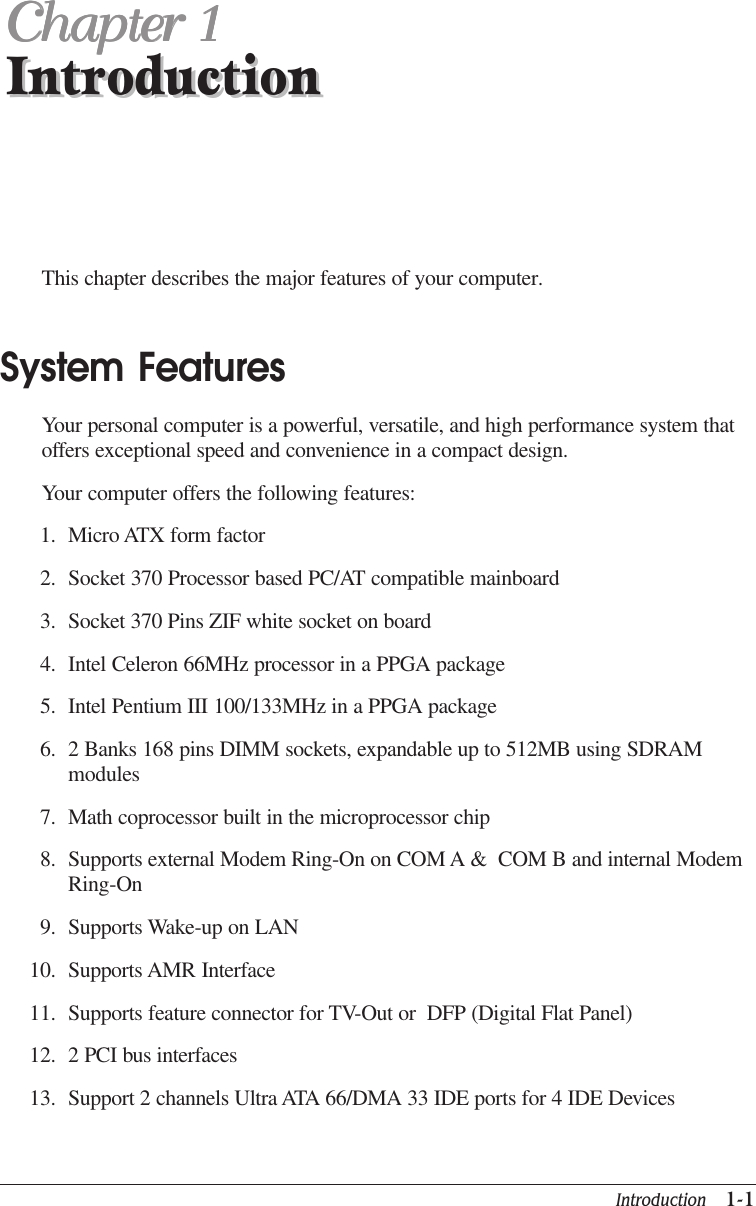
Introduction   1-1IntroductionChapter 1Chapter 1Chapter 1Chapter 1Chapter 1IntroductionThis chapter describes the major features of your computer.System FeaturesYour personal computer is a powerful, versatile, and high performance system thatoffers exceptional speed and convenience in a compact design.Your computer offers the following features:1. Micro ATX form factor2. Socket 370 Processor based PC/AT compatible mainboard3. Socket 370 Pins ZIF white socket on board4. Intel Celeron 66MHz processor in a PPGA package5. Intel Pentium III 100/133MHz in a PPGA package6. 2 Banks 168 pins DIMM sockets, expandable up to 512MB using SDRAMmodules7. Math coprocessor built in the microprocessor chip8. Supports external Modem Ring-On on COM A &  COM B and internal ModemRing-On9. Supports Wake-up on LAN10. Supports AMR Interface11. Supports feature connector for TV-Out or  DFP (Digital Flat Panel)12. 2 PCI bus interfaces13. Support 2 channels Ultra ATA 66/DMA 33 IDE ports for 4 IDE Devices
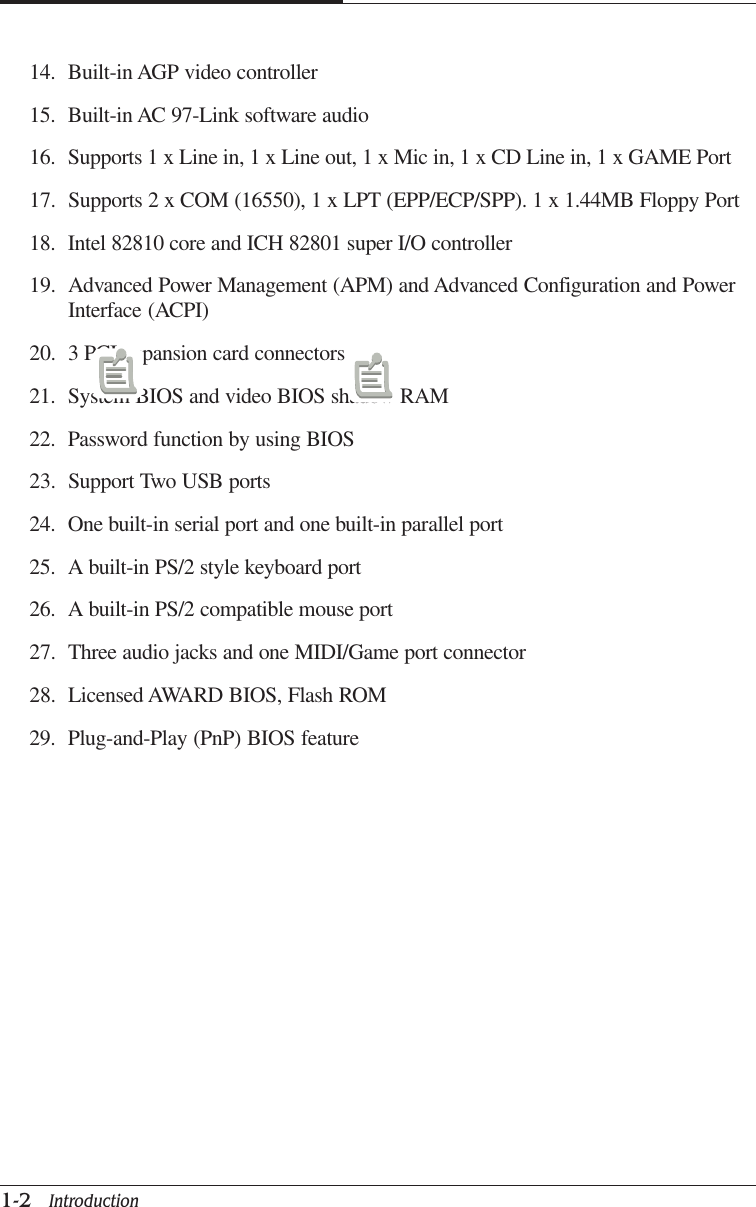
CAPTUER 11-2   Introduction14. Built-in AGP video controller15. Built-in AC 97-Link software audio16. Supports 1 x Line in, 1 x Line out, 1 x Mic in, 1 x CD Line in, 1 x GAME Port17. Supports 2 x COM (16550), 1 x LPT (EPP/ECP/SPP). 1 x 1.44MB Floppy Port18. Intel 82810 core and ICH 82801 super I/O controller19. Advanced Power Management (APM) and Advanced Configuration and PowerInterface (ACPI)20. 3 PCI expansion card connectors21. System BIOS and video BIOS shadow RAM22. Password function by using BIOS23. Support Two USB ports24. One built-in serial port and one built-in parallel port25. A built-in PS/2 style keyboard port26. A built-in PS/2 compatible mouse port27. Three audio jacks and one MIDI/Game port connector28. Licensed AWARD BIOS, Flash ROM29. Plug-and-Play (PnP) BIOS feature
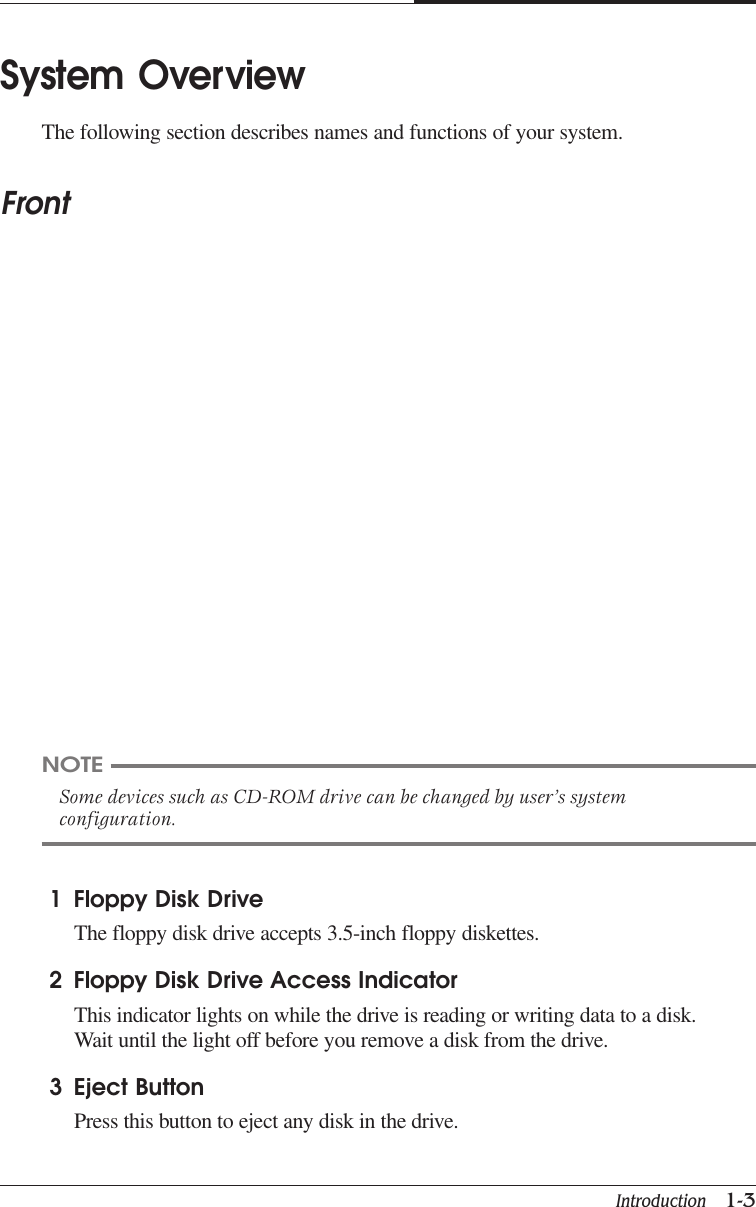
Introduction   1-3CAPTUER 1System OverviewThe following section describes names and functions of your system.FrontNOTESome devices such as CD-ROM drive can be changed by user’s systemconfiguration.1 Floppy Disk DriveThe floppy disk drive accepts 3.5-inch floppy diskettes.2 Floppy Disk Drive Access IndicatorThis indicator lights on while the drive is reading or writing data to a disk.Wait until the light off before you remove a disk from the drive.3 Eject ButtonPress this button to eject any disk in the drive.
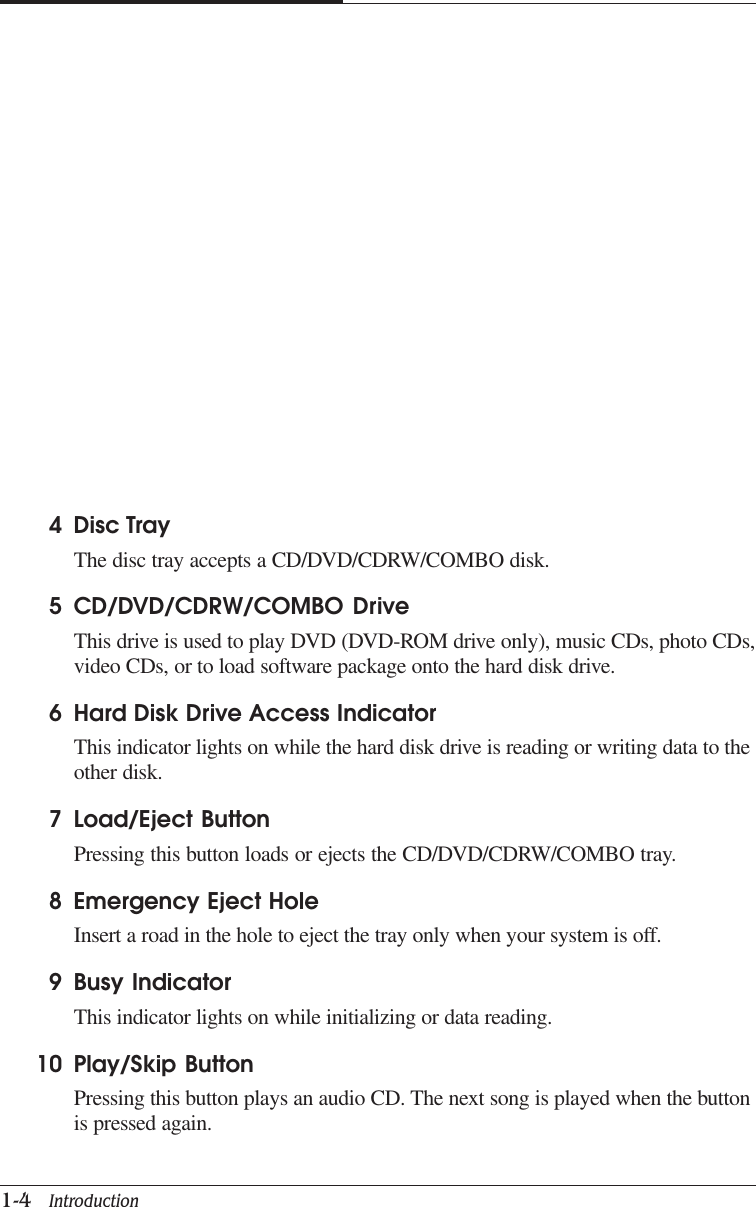
CAPTUER 11-4   Introduction4 Disc TrayThe disc tray accepts a CD/DVD/CDRW/COMBO disk.5 CD/DVD/CDRW/COMBO DriveThis drive is used to play DVD (DVD-ROM drive only), music CDs, photo CDs,video CDs, or to load software package onto the hard disk drive.6 Hard Disk Drive Access IndicatorThis indicator lights on while the hard disk drive is reading or writing data to theother disk.7 Load/Eject ButtonPressing this button loads or ejects the CD/DVD/CDRW/COMBO tray.8 Emergency Eject HoleInsert a road in the hole to eject the tray only when your system is off.9 Busy IndicatorThis indicator lights on while initializing or data reading.10 Play/Skip ButtonPressing this button plays an audio CD. The next song is played when the buttonis pressed again.
Introduction   1-5CAPTUER 111 HeadPhone Volum ControlAdjust the headphone volume. (Only Audio CD)12 HeadPhone JACKConnect a headphone plug to this port when you want to hear an Audio CD withheadphone.13 Power IndicatorThis Power indicator in the center of the power switch lights up when thecomputer is on. This indicator lights on while your system is on.14 Power ButtonThis button controls your system’s AC input power. When the system is off,pressing the button makes your system on. The power indicator lights on whilethe power of system is on. When your system is on, pressing the power buttonturns off the system.
CAPTUER 11-6   IntroductionRear1 Keyboard ConnectorThis connector is for the PS/2 type’s Keyboard.2 Serial Port (COM1) ConnectorThis connector is for serial devices such as an external modem, serial mouse,and etc.3 Video ConnectorThe signal cable from your monitor is connected with this connector.4 Mouse ConnectorThis connector is for the PS/2 type’s mouse.5 MIDI/Game Port ConnectorAny MIDI or game input device such as a joystick, game pad, steering wheel,and etc for playing computer game can be connected with this port.NOTEYour actual modem card may differ from the illustrations shown in this user’sguide.
Introduction   1-7CAPTUER 18 USB ConnectorYou can connect any USB compliant devices to the USB connector. USBdevices include low-speed peripherals such as microphone, digital joystick, andspeaker.9 Option Card Slot Covers10 Parallel Port (LPT1) ConnectorThis connector is for parallel devices such as a printer, and etc.10 Air Ventilation HolesThe hole for air ventilation.6 AC Power ReceptacleYour system power cable plugs into the AC power receptacle.7 Voltage Selection SwitchThe voltage selection switch must be set to match the AC power voltage you use.CAUTIONSetting the voltage selection switch incorrectly will give the serious damage in yoursystem. Verify that the switch is set correctly before you power on your system.
CAPTUER 11-8   Introduction11 Speaker JackThe Speaker jack can be used to attach most speakers with integrated amplifiers.12 Line-in JackThe jack is connected with the record/playback device such as a cassette player,CD player, and etc. .13 Microphone JackThe jack is connected with the personal computer microphone to integrate yourvoice or musical input into a sound application. .14 Padlock RingThe padlock ring allows you to secure the system cover to the chassis to preventunauthorized access to the inside of the computer. To use padlock ring, insert acommercially available padlock through the ring and then lock the padlock.
Introduction   1-9CAPTUER 115 Phone JackYou can connect the RJ11 phone jack cable from the telephone to this connector.The jack is connected with the RJ11 phone jack cable from the telephone.16 Wall JackYou can connect the RJ11 wall jack cable for using faxes, e-mail, and internetaccess. The jack is connected with the RJ11 wall jack cable to use faxes, e-mail,internet access, and etc.
Setting Up Your System   2-1Setting Up Your SystemChapter 2Chapter 2Chapter 2Chapter 2Chapter 2Setting Up Your SystemThis chapter describes how to set up and turn on/off your system. Just follow thesteps in this chapter.1. Selecting a LocationBefore you set up your computer, it is important to choose a safe and convenientlocation that provides the following:●A large, sturdy desk or table strong enough to support the weight of your systemand all of its components.●A flat and hard surface. Soft surfaces like beds and carpeted floors attract staticelectricity, which can erase data on your disks, damage the computer’s circuitry,and prevent proper ventilation.●Good air circulation. Leave several inches of space around the computer so aircan move freely.●Moderate environment conditions. Select a cool, dry area and protect yourcomputer from extremes in temperature, humidity, dust, and smoke. Avoid directsunlight or any other source of heat.●Appropriate power sources. To prevent static charges, connect all your equipmentto three-hole, grounded outlets. You need one outlet for the computer, one for themonitor, and an additional outlet for a printer and any other peripheral devices.●No electromagnetic interference. Do not place your system too close to anyelectrical device, such as a telephone, which generates an electromagnetic field.
CAPTUER 22-2   Setting Up Your SystemUsing a tool such as an opened paper clip, slide the voltage selection switch to thecorrect voltage position.WARNINGIf you set the voltage selection switch incorrectly, your system will have the seriousdamage. Verify that the switch is set correctly before you power on your system.2. Checking the Voltage SelectionA power supply is integrated into the system to provide power to the mainboard,option cards, and peripheral devices. The power selection switch on the system backpanel can be used to set the power supply to operate at 115V or 220V.To verify that your system has the correct setting for your environment, check thevoltage selection switch.
Setting Up Your System   2-3CAPTUER 23. Connecting Your Peripheral DevicesConnecting a MonitorConnect the monitor cable to the video connector on the rear panel of your system.If the connector has retaining screws, be sure to tighten them.Connecting a Keyboard and MousePlug the keyboard and mouse cable connectors into the keyboard and mouseconnectors on the rear panel of your system.NOTEDepending on the model, your keyboard may have no shortcut keys (Internet,Email, Search, Mute, Volume Up, and Volume Down).
CAPTUER 22-4   Setting Up Your SystemConnecting Modem Cables if you use an optional modem card, connect the phone and wall lines to the modemcard.NOTEDepending on you computer model, your modem card can be different with thepicture. For more information about using the modem, refer the modem manual.CAUTIONFor protection of your computer during a lightning storm, unplug the wall jackconnector from the wall outlet. This will prevent damage to the computer due tolightning.
Setting Up Your System   2-5CAPTUER 2Connecting Ethernet CablesIf you use LAN card, Cabel modem card, ADSL card, and etc, connect the card withEthernet card as the below.NOTEIf you use Windows ME, Ethernet card is already set up automatically.If you use the other operating system, you must install Ethernet card driver.CAUTIONTo use high speed communication you must install the hardware driver and thenset up the protocol in Network property.Refer the manual of high speed communication service provider.
CAPTUER 22-6   Setting Up Your SystemConnecting Audio DevicesYour computer has three integrated audio controller jacks (Speaker, Line-in, andMicrophone jack) and one MIDI/Game port connector.You can connect a microphone to the microphone jack, a speaker or headphone tothe speaker jack, and a audio playback device such as cassette player, CD player, oretc to the line-in jack.Any MIDI or game input device such as a joystick, game pad, steering wheel, andetc for playing computer game can be connected with this port.Before you connect audio devices to the three jacks and the MIDI/Game portconnector, your system must be off. And then connect the devices with the eachconnectors on the rear panel of your system.
Setting Up Your System   2-7CAPTUER 2Connecting a PrinterConnect the printer cable connector with the parallel connector of your system. Ifthe plug has retaining screws, tighten them.Connector the other side printer cable to the printer.Connector the power line to the printer and plug it into an appropriate groundedelectrical outlet.Connecting a Serial DeviceIf you have any serial device such as a printer, a modem, and etc, connect it to theserial port of your system.
CAPTUER 22-8   Setting Up Your SystemConnecting a Power CordBefore you plug the power cord into the wall socket, you should set the voltageselection switch to correct position. The voltage selection switch must be set toreflect the correct voltage the system operates on.If you set the voltage selection switch to correct position, plug the power cord intothe AC power receptacle on the back panel. Then plug the other end of the powercord into an appropriate grounded electrical outlet.Connecting the USB DevicesIf you use any USB devices, you can connect it to the USB connectors. ConnectUSB device cable into the USB port of your system.
Setting Up Your System   2-9CAPTUER 2CAUTIONFor protection of your computer and other devices during a lightning storm, orwhen it is left unattended and unused for long periods of time, unplug the computerand other devices from the wall outlet and disconnect the antenna or cable system.This will prevent damage to the computer and other devices due to lighting andpower line surges.WARNINGTo prevent an electronic shock, make sure to plug the cord into the system before youplug it into the wall socket.
CAPTUER 22-10   Setting Up Your System4. Turning the Computer On and OffFollow the instructions below to turn on the computer or to turn it off.Turning On the ComputerTo turn on your computer, follow the below steps.1. Turn on the monitor and other devices connected to your system.2. Press the power button on the front panel of your computer.3. The system will load Windows ME.Turning Off the ComputerTo turn on your computer, follow the below steps.1. Before you turn off computer, save all the data and then close all the applicationprograms you use.2. Click the Start button, and then click Shut Down.3. Select Shut down in the dialog box, and then click OK button.4. Turn off the monitor and any other peripheral devices.
Using Your Computer   3-1Using Your ComputerChapter 3Chapter 3Chapter 3Chapter 3Chapter 3Using Your ComputerTo use your computer, you must install the operating system on your computer.If you want to install Windows ME, follow the instructions in your Windows MEmanual. (Windows ME may be installed already on your system).To install another operating system such as OS/2 Warp or UNIX, refer the manualthat came with the system).The procedures in this manual assume that you are using Windows ME with yourcomputer.Using a Floppy Disk DriveIf you want to use 3.5 inch disk, insert the disk into 3.5 inch disk drive as the belowpicture until it is placed on the proper position.
CAPTUER 33-2   Using Your ComputerIf you want to remove the disk, press the eject button after you make sure the drivelight is off.NOTEIf you remove a disk or turn off the computer while the drive light is on, you can losedata in the disk.Also, remove all disks before you turn off the computer.You can write-protect a disk to prevent its data from being altered. When a disk iswrite-protected, you can read it and copy data from it, but you cannot store new dataon it or delete any files it contains.The write-protect is on the back of a 3.5 inch disk as the below picture. If you wantto use write-protect, slide the switch toward the edge of the disk.
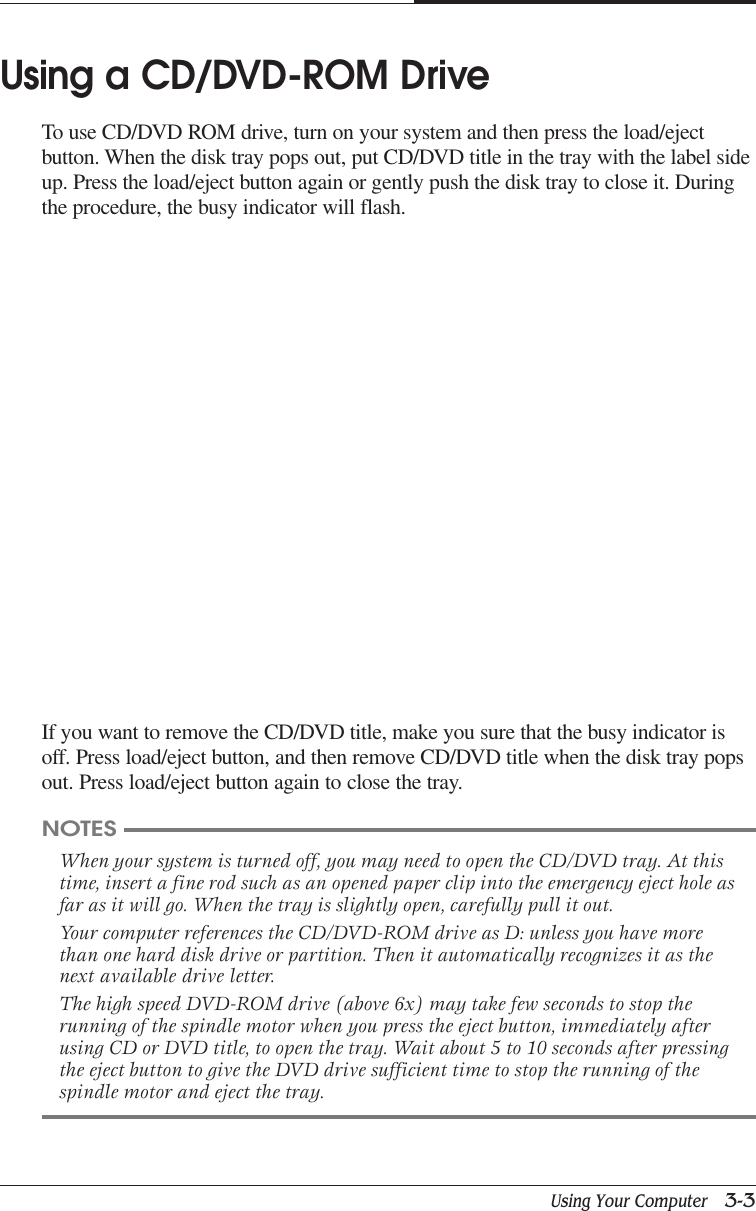
Using Your Computer   3-3CAPTUER 3Using a CD/DVD-ROM DriveTo use CD/DVD ROM drive, turn on your system and then press the load/ejectbutton. When the disk tray pops out, put CD/DVD title in the tray with the label sideup. Press the load/eject button again or gently push the disk tray to close it. Duringthe procedure, the busy indicator will flash.If you want to remove the CD/DVD title, make you sure that the busy indicator isoff. Press load/eject button, and then remove CD/DVD title when the disk tray popsout. Press load/eject button again to close the tray.NOTESWhen your system is turned off, you may need to open the CD/DVD tray. At thistime, insert a fine rod such as an opened paper clip into the emergency eject hole asfar as it will go. When the tray is slightly open, carefully pull it out.Your computer references the CD/DVD-ROM drive as D: unless you have morethan one hard disk drive or partition. Then it automatically recognizes it as thenext available drive letter.The high speed DVD-ROM drive (above 6x) may take few seconds to stop therunning of the spindle motor when you press the eject button, immediately afterusing CD or DVD title, to open the tray. Wait about 5 to 10 seconds after pressingthe eject button to give the DVD drive sufficient time to stop the running of thespindle motor and eject the tray.
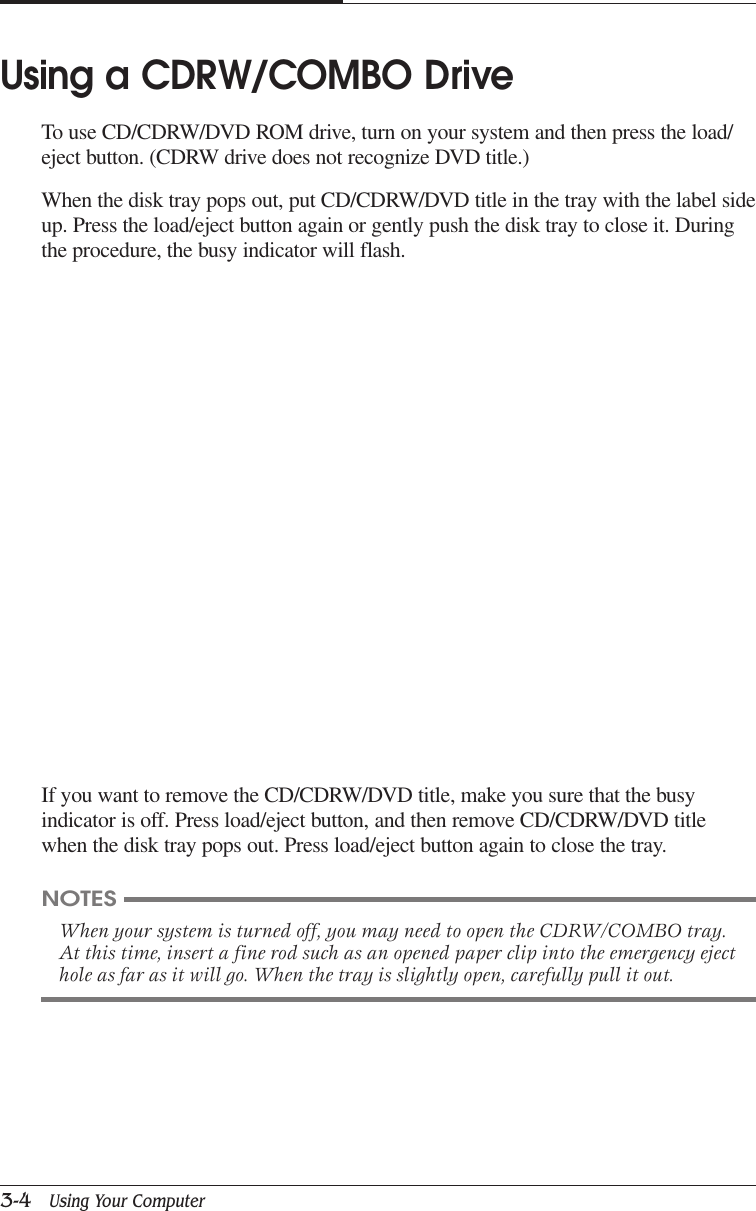
CAPTUER 33-4   Using Your ComputerIf you want to remove the CD/CDRW/DVD title, make you sure that the busyindicator is off. Press load/eject button, and then remove CD/CDRW/DVD titlewhen the disk tray pops out. Press load/eject button again to close the tray.Using a CDRW/COMBO DriveTo use CD/CDRW/DVD ROM drive, turn on your system and then press the load/eject button. (CDRW drive does not recognize DVD title.)When the disk tray pops out, put CD/CDRW/DVD title in the tray with the label sideup. Press the load/eject button again or gently push the disk tray to close it. Duringthe procedure, the busy indicator will flash.NOTESWhen your system is turned off, you may need to open the CDRW/COMBO tray.At this time, insert a fine rod such as an opened paper clip into the emergency ejecthole as far as it will go. When the tray is slightly open, carefully pull it out.
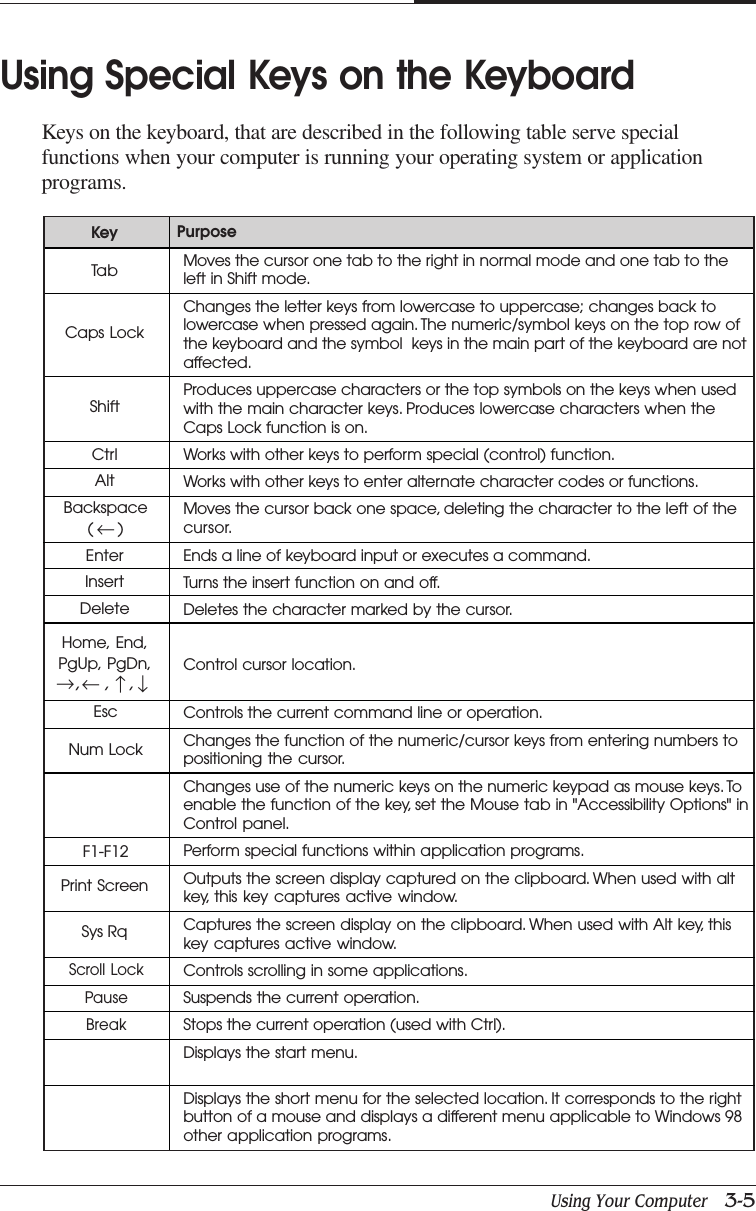
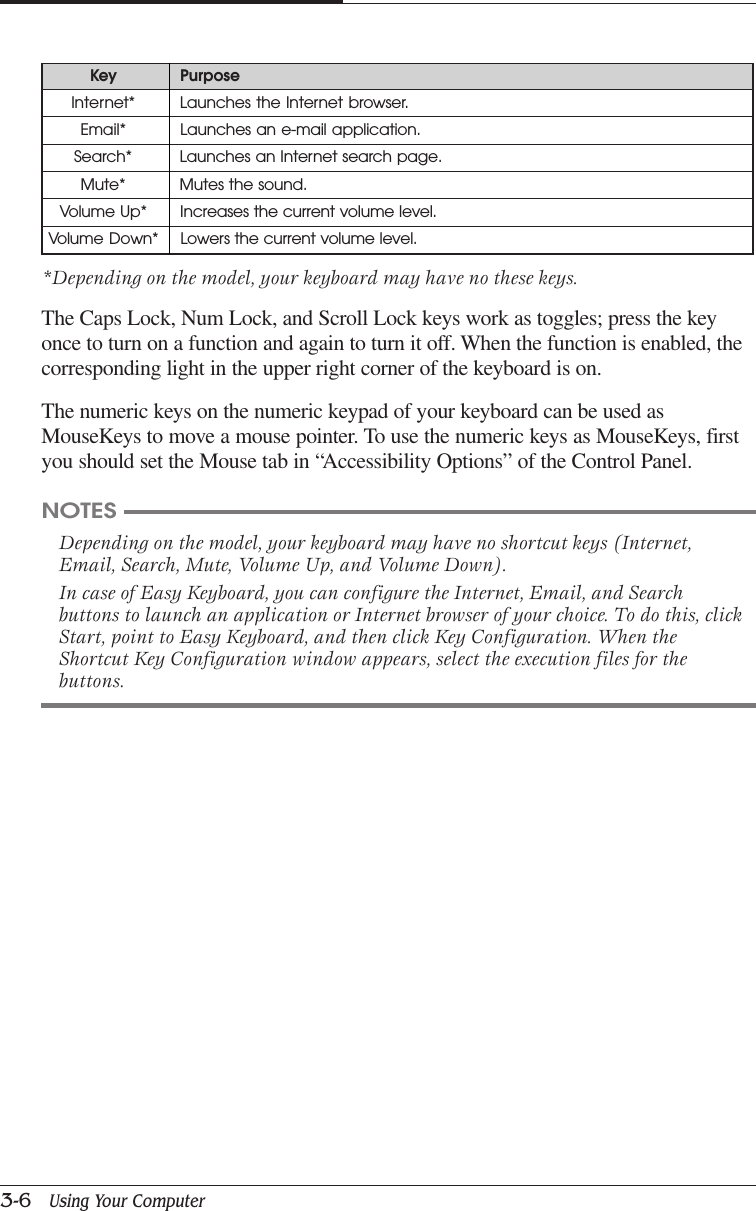
Using Your Computer   3-5CAPTUER 3Using Special Keys on the KeyboardKeys on the keyboard, that are described in the following table serve specialfunctions when your computer is running your operating system or applicationprograms.PurposeNum LockTa bCaps LockKeyShiftCtrlAltBackspace(      )EnterInsertDeleteEscF1-F12Print ScreenSys RqMoves the cursor one tab to the right in normal mode and one tab to theleft in Shift mode.Changes the letter keys from lowercase to uppercase; changes back tolowercase when pressed again. The numeric/symbol keys on the top row ofthe keyboard and the symbol  keys in the main part of the keyboard are notaffected.Produces uppercase characters or the top symbols on the keys when usedwith the main character keys. Produces lowercase characters when theCaps Lock function is on.Works with other keys to perform special (control) function.Works with other keys to enter alternate character codes or functions.Moves the cursor back one space, deleting the character to the left of thecursor.Ends a line of keyboard input or executes a command.Turns the insert function on and off.Deletes the character marked by the cursor.Control cursor location.Controls the current command line or operation.Changes the function of the numeric/cursor keys from entering numbers topositioning the cursor.Changes use of the numeric keys on the numeric keypad as mouse keys. Toenable the function of the key, set the Mouse tab in "Accessibility Options" inControl panel.Perform special functions within application programs.Outputs the screen display captured on the clipboard. When used with altkey, this key captures active window.Captures the screen display on the clipboard. When used with Alt key, thiskey captures active window.Controls scrolling in some applications.Suspends the current operation.Stops the current operation (used with Ctrl).Displays the start menu.Displays the short menu for the selected location. It corresponds to the rightbutton of a mouse and displays a different menu applicable to Windows 98other application programs.↓↓↓↓,     ,    ,Home, End,PgUp, PgDn,Scroll LockPause↓Break
CAPTUER 33-6   Using Your ComputerKey PurposeInternet* Launches the Internet browser.Email* Launches an e-mail application.Search* Launches an Internet search page.Mute* Mutes the sound.Volume Up* Increases the current volume level.Volume Down* Lowers the current volume level.*Depending on the model, your keyboard may have no these keys.The Caps Lock, Num Lock, and Scroll Lock keys work as toggles; press the keyonce to turn on a function and again to turn it off. When the function is enabled, thecorresponding light in the upper right corner of the keyboard is on.The numeric keys on the numeric keypad of your keyboard can be used asMouseKeys to move a mouse pointer. To use the numeric keys as MouseKeys, firstyou should set the Mouse tab in “Accessibility Options” of the Control Panel.NOTESDepending on the model, your keyboard may have no shortcut keys (Internet,Email, Search, Mute, Volume Up, and Volume Down).In case of Easy Keyboard, you can configure the Internet, Email, and Searchbuttons to launch an application or Internet browser of your choice. To do this, clickStart, point to Easy Keyboard, and then click Key Configuration. When theShortcut Key Configuration window appears, select the execution files for thebuttons.
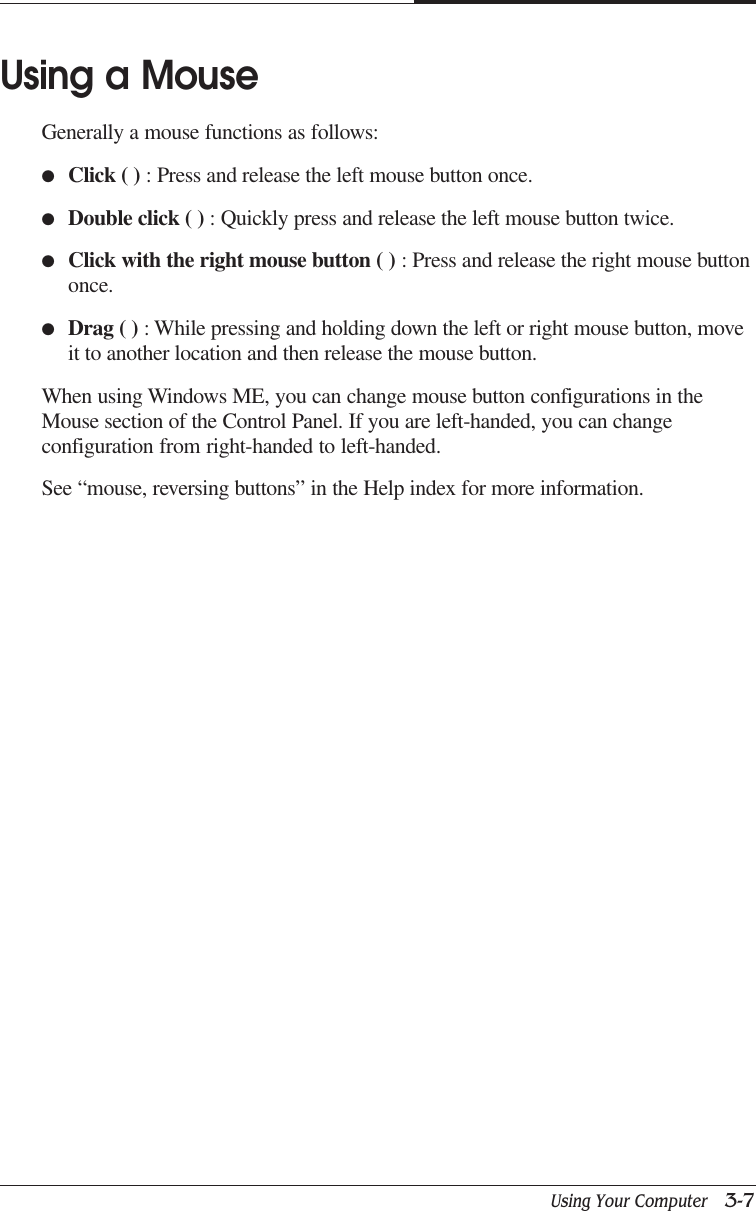
Using Your Computer   3-7CAPTUER 3Using a MouseGenerally a mouse functions as follows:●Click ( ) : Press and release the left mouse button once.●Double click ( ) : Quickly press and release the left mouse button twice.●Click with the right mouse button ( ) : Press and release the right mouse buttononce.●Drag ( ) : While pressing and holding down the left or right mouse button, moveit to another location and then release the mouse button.When using Windows ME, you can change mouse button configurations in theMouse section of the Control Panel. If you are left-handed, you can changeconfiguration from right-handed to left-handed.See “mouse, reversing buttons” in the Help index for more information.
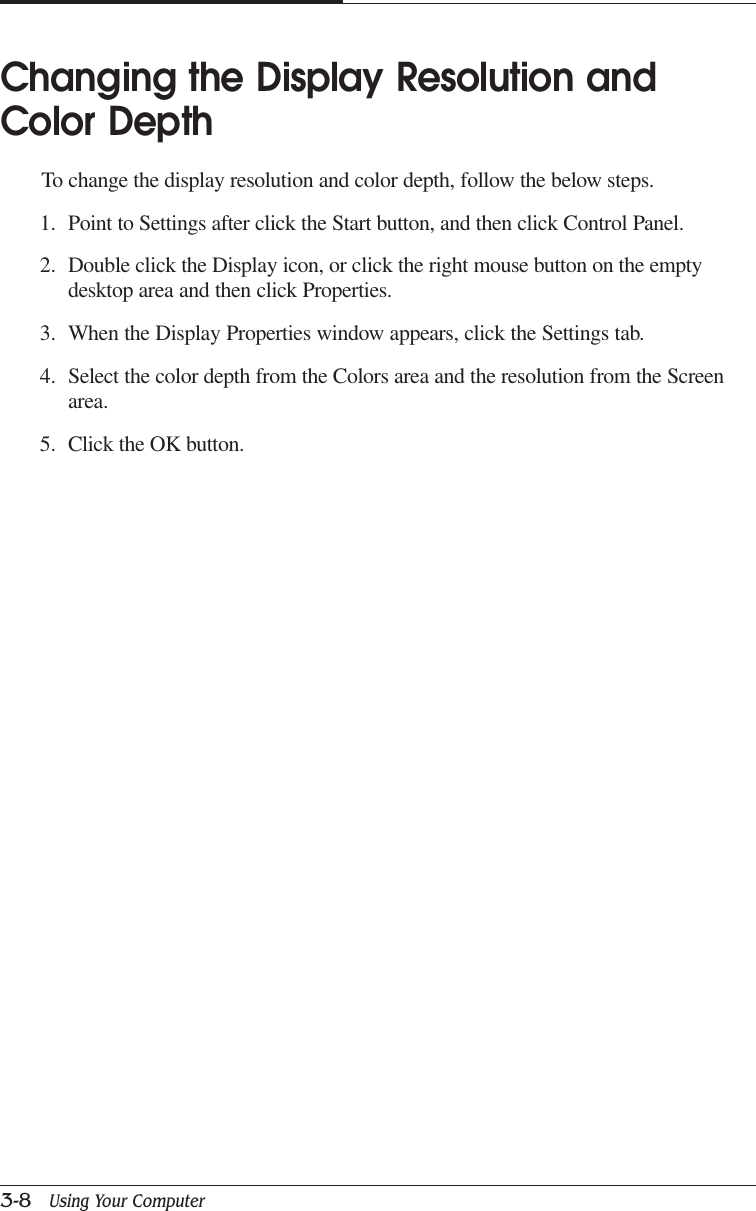
CAPTUER 33-8   Using Your ComputerChanging the Display Resolution andColor DepthTo change the display resolution and color depth, follow the below steps.1. Point to Settings after click the Start button, and then click Control Panel.2. Double click the Display icon, or click the right mouse button on the emptydesktop area and then click Properties.3. When the Display Properties window appears, click the Settings tab.4. Select the color depth from the Colors area and the resolution from the Screenarea.5. Click the OK button.
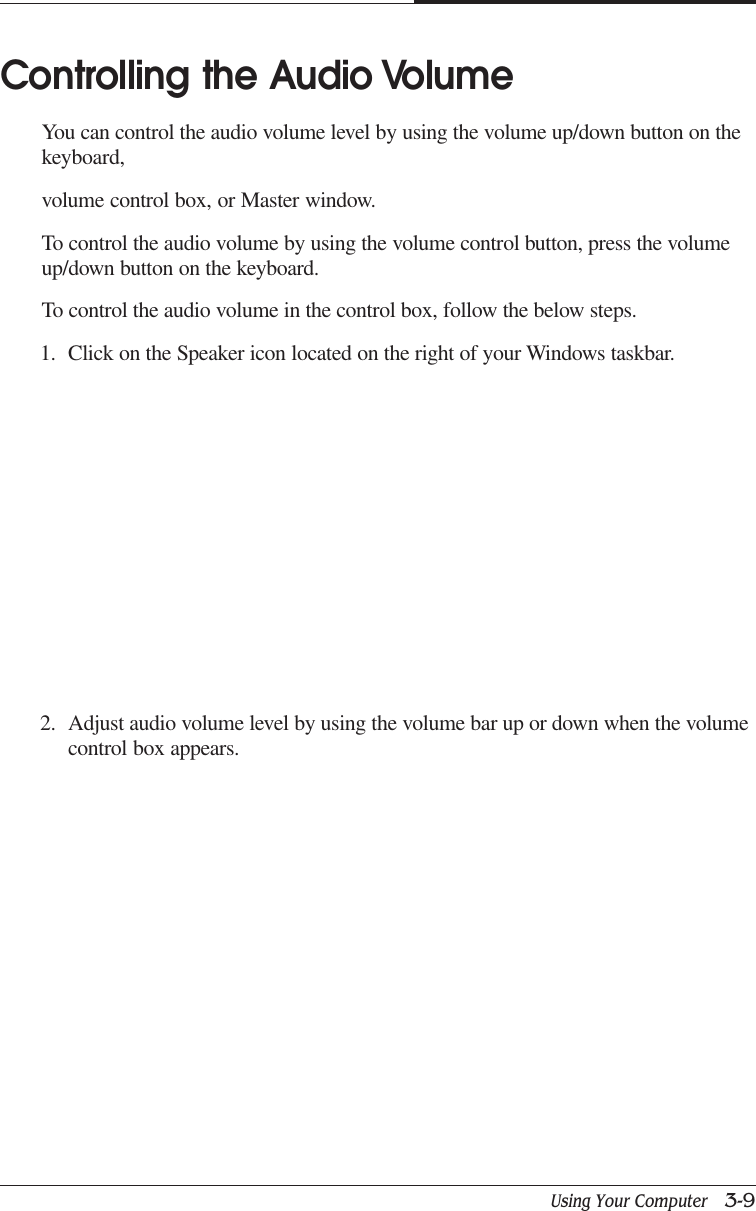
Using Your Computer   3-9CAPTUER 3Controlling the Audio VolumeYou can control the audio volume level by using the volume up/down button on thekeyboard,volume control box, or Master window.To control the audio volume by using the volume control button, press the volumeup/down button on the keyboard.To control the audio volume in the control box, follow the below steps.1. Click on the Speaker icon located on the right of your Windows taskbar.2. Adjust audio volume level by using the volume bar up or down when the volumecontrol box appears.
CAPTUER 33-10   Using Your ComputerTo control the audio volume level for each device by using the Master Out window,follow the belowsteps:1. Double click the Speaker icon located on the Windows 98 taskbar.2. Adjust audio volume level by using the volume bar up or down when the MasterOut window appears.3. Click the Close button.
Using Your Computer   3-11CAPTUER 3Your system provides a configuration program for mapping programs to the Shortcutkeys (Internet, Email, and Search) on the upper-right corner of the keyboard.To map a certain program for short-cut key on the keyboard, follow the below seeps1. Point to Programs after click Start, and then click Key Configuration.2. The Shortcut Key Configuration window will appear.Configuring Shortcut KeysNOTEThe configuration program is available only on the Easy Keyboard (has shortcutkeys) model.3. Click the Browse button.4. Select a program file for the shortcut key  when the Open window appears.5. Click the Open button.6. In the Shortcut Key Configuration window, click OK.Click OK in the Shortcut Key Configuration window.
BIOS Configuration   4-1BIOS ConfigurationChapter 4Chapter 4Chapter 4Chapter 4Chapter 4BIOS ConfigurationAward’s BIOS ROM has a built -in Setup Program that allows users to modify thebasic system configuration. This type of information is stored in battery-backedCMOS RAM so that it retains the Setup information when the power is turned off4.1 Entering SetupPower On the Computer, and then pressing <Del> key immediately will allow youto enter Setup.If the message disappears before you respond and you still wish to enter Setup,restart the system to try again by turning it OFF then ON or pressing the "RESET"bottom on the system case. You may also restart by simultaneously press <Ctrl>,<Alt>, and <Del> keys.
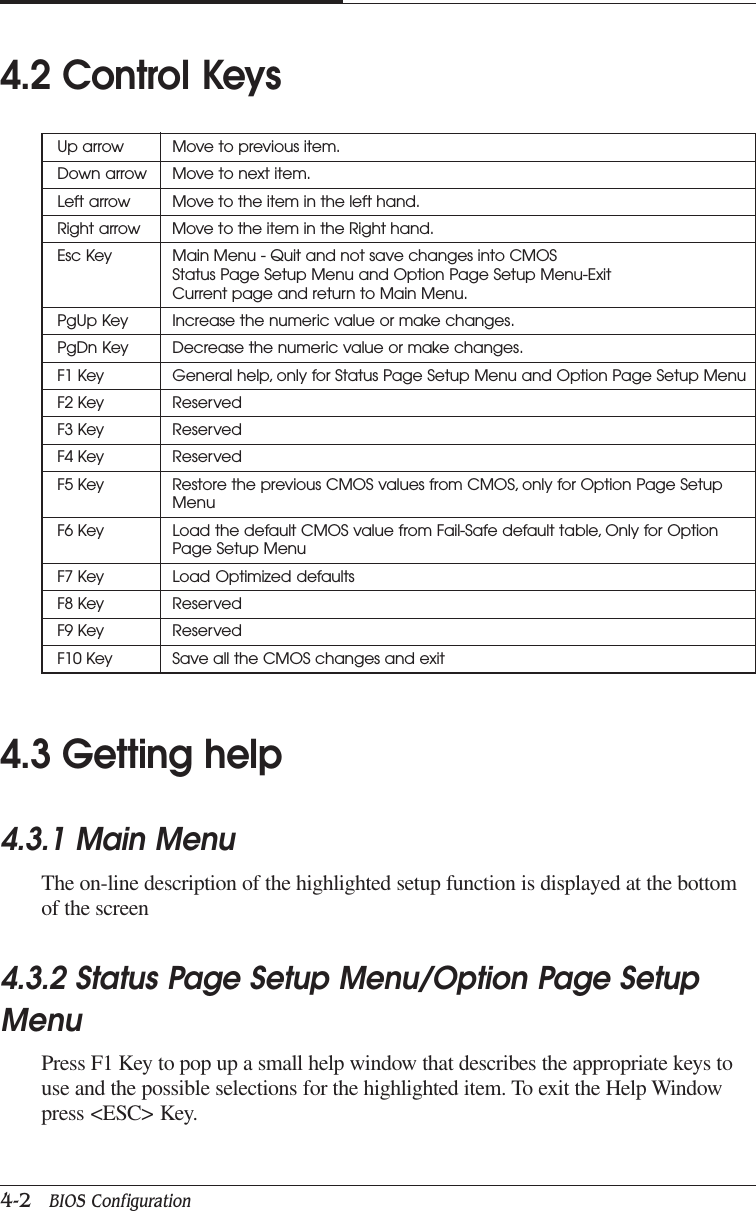
CAPTUER 44-2   BIOS Configuration4.2 Control KeysUp arrow Move to previous item.Down arrow Move to next item.Left arrow Move to the item in the left hand.Right arrow Move to the item in the Right hand.Esc Key Main Menu - Quit and not save changes into CMOSStatus Page Setup Menu and Option Page Setup Menu-ExitCurrent page and return to Main Menu.PgUp Key Increase the numeric value or make changes.PgDn Key Decrease the numeric value or make changes.F1 Key General help, only for Status Page Setup Menu and Option Page Setup MenuF2 Key ReservedF3 Key ReservedF4 Key ReservedF5 Key Restore the previous CMOS values from CMOS, only for Option Page SetupMenuF6 Key Load the default CMOS value from Fail-Safe default table, Only for OptionPage Setup MenuF7 Key Load Optimized defaultsF8 Key ReservedF9 Key ReservedF10 Key Save all the CMOS changes and exit4.3 Getting help4.3.1 Main MenuThe on-line description of the highlighted setup function is displayed at the bottomof the screen4.3.2 Status Page Setup Menu/Option Page SetupMenuPress F1 Key to pop up a small help window that describes the appropriate keys touse and the possible selections for the highlighted item. To exit the Help Windowpress <ESC> Key.
BIOS Configuration   4-3CAPTUER 44.4 The Main MenuOnce you enter Award BIOS CMOS Setup Utility, the Main Menu(Figure 4.1) willappear on the screen. The Main Menu allows you to select from nine setup functionsand two exit choice. Use arrow keys to select among the items and press <Enter>Key to accept or the sub-menu.Figure 4.1 : Main Menu●Standard CMOS FeaturesThis setup page includes all the items in standard compatible BIOS.●Advanced BIOS FeaturesThis setup page includes all the items of Award special enhanced features.●Advanced Chipset FeaturesThis setup page includes all the items of chipset special features.
CAPTUER 44-4   BIOS Configuration●Integrated PeripheralsThis setup page includes all onboard peripherals●Power Management SetupThis setup page includes all the items of Green function features.●PnP/PCI ConfigurationThis setup page includes all the configurations of PCI & PnP ISA resources.●PC Health StatusThis setup page includes the system auto detect temperature, voltage, fan, speed.●Frequency/Voltage ControlThis setup page includes control CPU’s clock and frequency ratio.●Load Fail Safe  DefaultsFail-Safe Defaults indicates the value of the system parameters which the systemwould be in safe configuration.●Load Optimized DefaultsOptimized Defaults indicates the value of the system parameters which thesystem would be in best performance configuration.●Set Supervisor passwordChange, set, or disable password. It allows out limit access to the system andSetup, or just to Setup.●Set User passwordChange set, or disable password. It allows you to limit access to the system.●Save & Exit SetupSave CMOS value setting to CMOS and exit setup.●Exit Without SavingAbandon CMOS Vale changes and exit setup.
BIOS Configuration   4-5CAPTUER 44.5  Standard CMOS Features MenuThe items in Standard CMOS Setup Menu (Figure 4.2) are divided into 9 categories.Each category includes no, one or more than one setup items.Use the arrows to highlight the item and then use the <PgUp> or <PgDn> keys toselect the value you want on each item.Figure 4.2 : Standard CMOS Features Menu●DateThe date formats is <week>, <month> <day> <year>Week The week, from Sun to Sat, determined by the BIOS and is Display-onlymonth The month, Jan. Though Decday The day, from 1 to 31 (or the maximum allowed in the monthyear The year, from 1994 through 2079●TimeThe times format in <hour>  <minute> <second>. The time is calculates base onthe 24-hour military-time clock. For example, 1 p.m. is 13:00:00.
CAPTUER 44-6   BIOS Configuration●IDE Primary Master, Slave / Secondary Master, SlaveThe category identifies the types of hand disk form drive C to F that has beeninstalled in the computer.There are three types: auto type, manual definable type and none type user type isuser-definable; Auto type which will automatically detect HDD type.Note that the specifications of your drive must be matched with the driver table.The hard disk will not work properly if you enter improper information for thiscategory.If you select Manual type, related information will be asked to enter to thefollowing items.Enter the information directly from the keyboard and press<ENTER> key.Such information should be provided in the documentation form our hard diskvendor or the system manufacturer.CYLS Number of cylindersHEADRnumber of headsPRECOMP write precompLANDZONE Landing ZoneSECTORS number of sectors# a hard disk has not been installed select NONE and press <Enter> Key●Drive A type / Drive B typeThe category identifies the types of floppy disk driver A or driver B that has beeninstalled in the ComputerName No floppy driver installed360K, 5.25 in 5.25 inch PC-type standard driver; 360K byte capacity1.22M, 5.25 in 5.25 inch AT-type high-density drive; 1.2M bytecapacity (3.5 inch when 3 Mode is Enable)720K, 3.5 in 3.5 inch double-side drive; 720K byte capacity1.44M, 3.5 in 3.5 inch double-side drive; 1.44M byte capacity2.88M, 3.5 inch3.5 inch double-side drive; 2.88M byte capacity
BIOS Configuration   4-7CAPTUER 4* Floppy 3 Mode Support (for Japan Area)DisabledNormal Floppy DriveDrive A Drive A is 3 mode Floppy DriveDrive B Drive B is 3 mode Floppy DriveBoth Drive A & B are mode Floppy Drive* VideoThe Category detects the type of adapter used for the primary system monitor thatmatch yourvideo display card and monitor. Although secondary monitors are supported, you donothave to select the type in setup.EGA\VGA Enhanced Graphics Adapter/Video Graphics Array.For EGA, VGA, SVGA, or PGA monitor adaptersCGA 40 Color Graphics Adapter, power up in 40 column modeCGA 80 Color Graphics Adapter, power up in 80 column modeMONO Monochrome adapter, includes high resolution monochromeadapters* Halt onThe category determines whether the computer will stop if an error is detectedduring power up.NO Errors The system boot will not stop for any error that may beDetected and you will be promptedAll Errors Whenever the BIOS detects a non-fatal error the system will bestoppedAll, But The system boot will not stop for a keyboard error,
CAPTUER 44-8   BIOS ConfigurationKeyboard stop for all other errors(Default)All, But The system boot will not stop for a disk error;Disk it will stop for all other errorsAll, But The system boot will not stop for a keyboard or disk error;Disk/keyit will stop for other error* MemoryThe category is display-only which is determined by POST (Power On Self Test) ofthe BIOS.Base MemoryThe POST of the BIOS will determine the amount of base(or conventional)memoryinstalled in the system.The value of the base memory is typically 512K for systems with 512K memoryinstalled in the motherboard, or 640K for systems with 640K or more memoryinstalled on the motherboard.Extended MemoryThe BIOS determines how much extended memory is present during the POST.This is the amount of memory located above 1MB in the CPU’s memory addressmap.
BIOS Configuration   4-9CAPTUER 44.6  Advanced BIOS FeaturesFigure 4.3 : Advanced BIOS Features Setup* Virus Warningif it is set to enable, the category will flash on the screen when there is anyattempt to write to the boot Sector or partition table of the hard disk driver.The system will halt and the following error message will appear in the mean time.You can run anti-virus program to locate the problem.Enable Activate automatically when the system boots up causing aWarning message to appear when anything attempts toAccess the boot sector or hard disk partition tableDisable No warning message to appear when anything attempts toAccess the boot sector or hard disk partition table* First / Second / Third Boot device
CAPTUER 44-10   BIOS ConfigurationThe default value is floppy / HDD-0 / LS120Floppy Select your boot device priority by FloppyLS120 Select your boot device priority by LS120HDD-0~3 Select your boot device priority by HDD-0~3SCSI Select your boot device priority by SCSICDROM Select your boot device priority by CDROMZIP100 Select your boot device priority by ZIP100DISABLE Disable this functionLAN Select your boot device priority by LAN* Boot Up Floppy SeekDuring POST, BIOS will determine the floppy disk drive installed is 40 or 80Tracks. 360K type is 40 tracks 720K, 1.2M and 1.44M are all 80 tracks.The default value is Enable.Enable BIOS searches for floppy disk drive to determine it is 40 or80 tracks. Note that BIOS can not tell from 720K, 1.2M or1.44M drive type as they are all 80 tracksDISABLE BIOS will not search for the type of floppy disk drive bytrackNumber. Note that there will not be any warning message ifThe drive installed is 360K* Boot Up NumLock StatusThe default value is OnON Keypad is number keys
BIOS Configuration   4-11CAPTUER 4Off Keypad is arrow keys* Typematic Rate SettingThe default value is DisabledEnabled Enable Keyboard Typematic rate setting.Disable Disable Keyboard Typematic rate setting.* Typematic Rate (Chars / Sec)The default value is 66-30 Set the maximum Typematic rate from 6 chars. Per secondto 30 characters. Per second* Typematic Delay (Msec)The default value is 250250-1000 Set the time delay from first key to repeat the same key in tocomputer* Security OptionThis category allows you to limit access to the system and Setup, or just toSetup. The default value is setup.System The can not boot and can not access to Setup pageWill be denied if the current password is not entered at
CAPTUER 44-12   BIOS ConfigurationThe promptSetup The system will boot, but access to setup will be denied ifthe correct password is not entered at the prompt* HDD S.M.A.R.T. CapabilityThe default value is DisableEnable Enable HDD S.M.A.R.T. CapabilityDisable Disable HDD S.M.A.R.T. Capability* Report No FDD For WIN95The default value us No.No Assign IRQ6 For FDDYes FDD Detect IRQ6 Automatically4.7  Advanced Chipset Features* Top Peformance
BIOS Configuration   4-13CAPTUER 4The default value is DisabledDisable Set Top Performance Disable.Enable Set Top Performance Enable.* SDRAM CAS latency Time3 For 67/83 MHz SDRAM DIMM module|2 For 100 MHz SDRAM DIMM module.Auto Set SDRAM CAS latency Time to Auto* SDRAM Cycle Time Tras/TrcThe default value is 5/76/8 Set DRAM Tras/Trc Cycle time is 6/8 SCLKs5/7 Set DRAM Tras/Trc Cycle time is 5/7 SCLKs* SDRAM RAS-to CAS delayThe default value is 23 Set SDRAM RAS-to-CAS delay 3 SCLKs2 Set SDRAM RAS-to-CAS delay 2 SCLKs* SDRAM RAS PrechargeThe default value is 23 Set SDRAM RAS Precharge is 3
CAPTUER 44-14   BIOS Configuration2 Set SDRAM RAS Precharge is 2* SDRAM Buffer StrenghThe default value is AutoAuto Set SDRAM Buffer Strengh AutoAuto-1 Set SDRAM Buffer Strengh Auto-1Auto+1 Set SDRAM Buffer Strengh Auto+1* Delayed TransactionThe default value is DisabledDisabledNormal operation.Enable For slow speed ISA device in system* Local Memory FrequencyThe default value is 100MHz100MHzSet Local Memory Frequency to 100MHz133MHz Set Local Memory Frequency to 133MHz
BIOS Configuration   4-15CAPTUER 4
CAPTUER 44-16   BIOS Configuration4.8  Integrated PeripheralsFigure 4.5 : Integrated Peripherals* On-Chip Primary PCI IDEThe default value is Enabled.Enabled Enable onboard 1st channel IDE portDisabledDisable onboard 1st channel IDE port.* On-Chip Secondary PCI IDEThe default value is Enabled.Enabled Enable onboard 2nd channel IDE portDisable Disable onboard 2nd channel IDE port
BIOS Configuration   4-17CAPTUER 4* IDE Primary Master PIO (for Onboard IDE 1st channel)The default value is AutoAuto BIOS will automatically detect the IDE HDD Accessing modeMode0~4 Manually set the DE Accessing mode.* IDE Primary Slave PIO (for Onboard IDE 1st channel)The default value is AutoAuto BIOS will automatically detect the IDE HDD Accessing modeMode0~4 Manually set the DE Accessing mode.* IDE Secondary Master PIO (for Onboard IDE 2nd channel)The default value is AutoAuto BIOS will automatically detect the IDE HDD Accessing modeMode0~4 Manually set the DE Accessing mode.* IDE Secondary Slave PIO (for Onboard IDE 2nd channel)The default value is AutoAuto BIOS will automatically detect the IDE HDD Accessing modeMode0~4 Manually set the DE Accessing mode.* IDE Primary Master UDMA
CAPTUER 44-18   BIOS ConfigurationThe default value is AutoAuto BIOS will automatically detect the IDE HDD Accessing modeDisable Disable UDMA function.* IDE Primary Slaver UDMAThe default value is AutoAuto BIOS will automatically detect the IDE HDD Accessing modeDisable Disable UDMA function.* IDE Secondary Master UDMAThe default value is AutoAuto BIOS will automatically detect the IDE HDD Accessing modeDisable Disable UDMA function.* IDE Secondary Slaver UDMAThe default value is AutoAuto BIOS will automatically detect the IDE HDD Accessing modeDisable Disable UDMA function.* USB ControllerThe default value is Enabled.
BIOS Configuration   4-19CAPTUER 4Enable Enable USB ControllerDisable Disable USB Controller* USB Keyboard SupportThe default value is Disable.Enable Enable USB Keyboard SupportDisable Disable USB Keyboard Support* Init Display FirstThe default value is PCI Slot.PCI Slot Set Init Display First PCI SlotOnboardSet Init Display First to onboard AGP* AC’97 AudioThe default value is AudioEnable Enable AC’97 AudioDisable Disable AC’97 audioAuto Set AC’97 Audio to Auto* AC’97 ModemThe default value is Auto
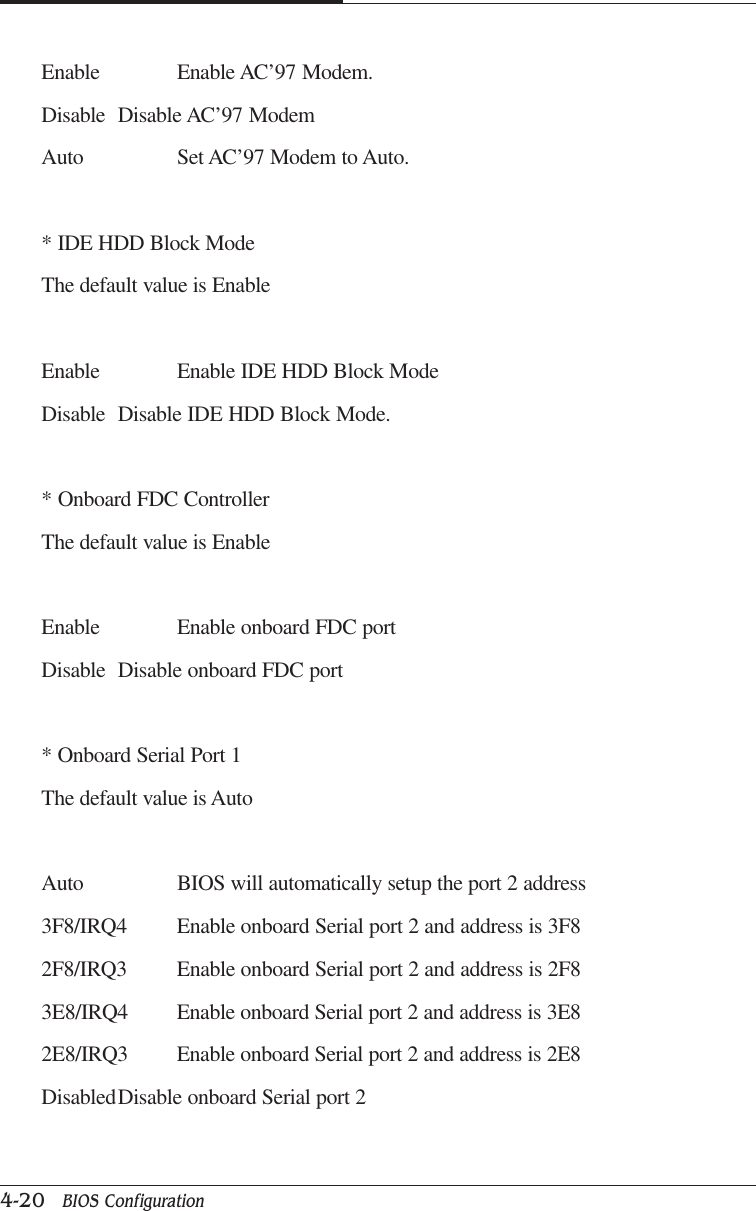
CAPTUER 44-20   BIOS ConfigurationEnable Enable AC’97 Modem.Disable Disable AC’97 ModemAuto Set AC’97 Modem to Auto.* IDE HDD Block ModeThe default value is EnableEnable Enable IDE HDD Block ModeDisable Disable IDE HDD Block Mode.* Onboard FDC ControllerThe default value is EnableEnable Enable onboard FDC portDisable Disable onboard FDC port* Onboard Serial Port 1The default value is AutoAuto BIOS will automatically setup the port 2 address3F8/IRQ4 Enable onboard Serial port 2 and address is 3F82F8/IRQ3 Enable onboard Serial port 2 and address is 2F83E8/IRQ4 Enable onboard Serial port 2 and address is 3E82E8/IRQ3 Enable onboard Serial port 2 and address is 2E8DisabledDisable onboard Serial port 2
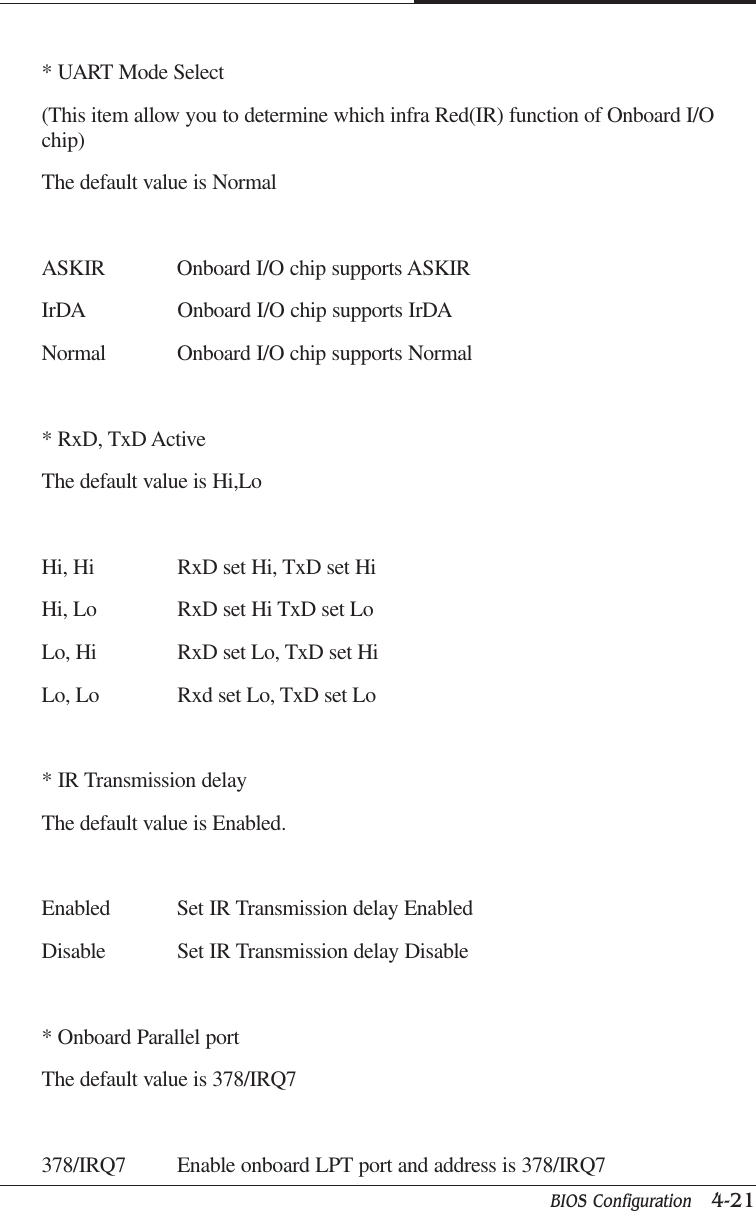
BIOS Configuration   4-21CAPTUER 4* UART Mode Select(This item allow you to determine which infra Red(IR) function of Onboard I/Ochip)The default value is NormalASKIR Onboard I/O chip supports ASKIRIrDA Onboard I/O chip supports IrDANormal Onboard I/O chip supports Normal* RxD, TxD ActiveThe default value is Hi,LoHi, Hi RxD set Hi, TxD set HiHi, Lo RxD set Hi TxD set LoLo, Hi RxD set Lo, TxD set HiLo, Lo Rxd set Lo, TxD set Lo* IR Transmission delayThe default value is Enabled.Enabled Set IR Transmission delay EnabledDisable Set IR Transmission delay Disable* Onboard Parallel portThe default value is 378/IRQ7378/IRQ7 Enable onboard LPT port and address is 378/IRQ7
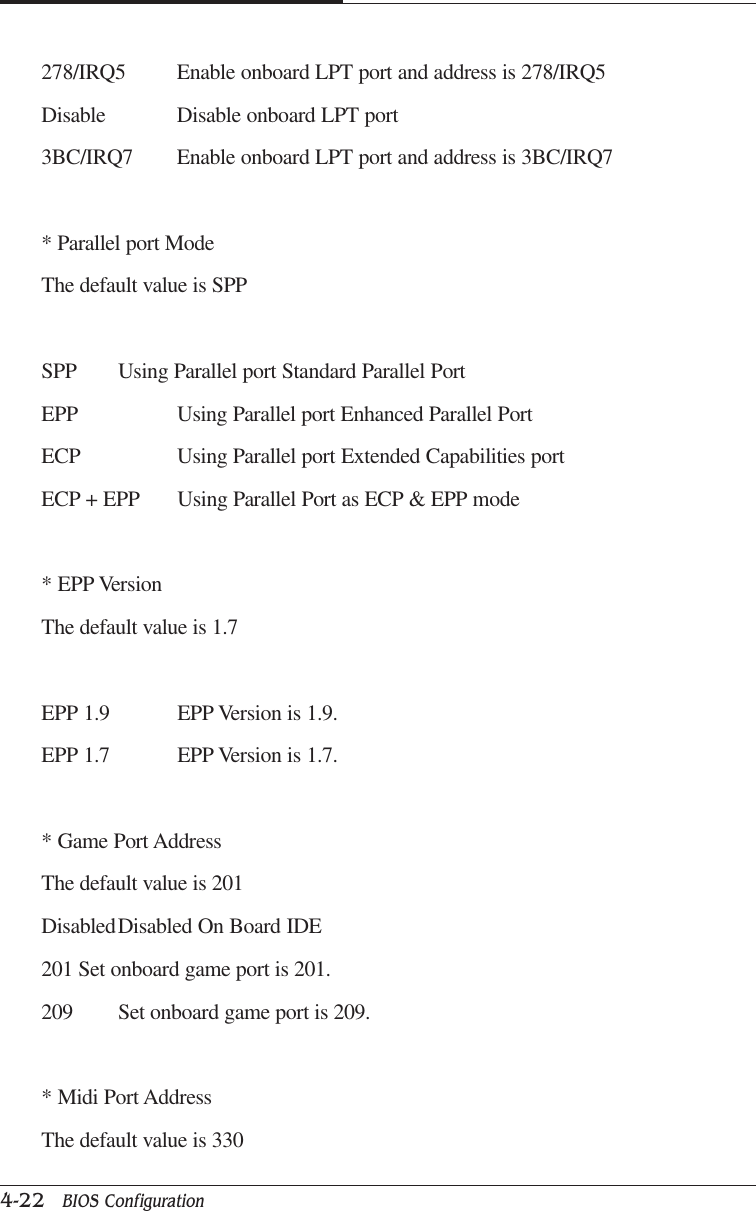
CAPTUER 44-22   BIOS Configuration278/IRQ5 Enable onboard LPT port and address is 278/IRQ5Disable Disable onboard LPT port3BC/IRQ7 Enable onboard LPT port and address is 3BC/IRQ7* Parallel port ModeThe default value is SPPSPP Using Parallel port Standard Parallel PortEPP Using Parallel port Enhanced Parallel PortECP Using Parallel port Extended Capabilities portECP + EPP Using Parallel Port as ECP & EPP mode* EPP VersionThe default value is 1.7EPP 1.9 EPP Version is 1.9.EPP 1.7 EPP Version is 1.7.* Game Port AddressThe default value is 201DisabledDisabled On Board IDE201 Set onboard game port is 201.209 Set onboard game port is 209.* Midi Port AddressThe default value is 330
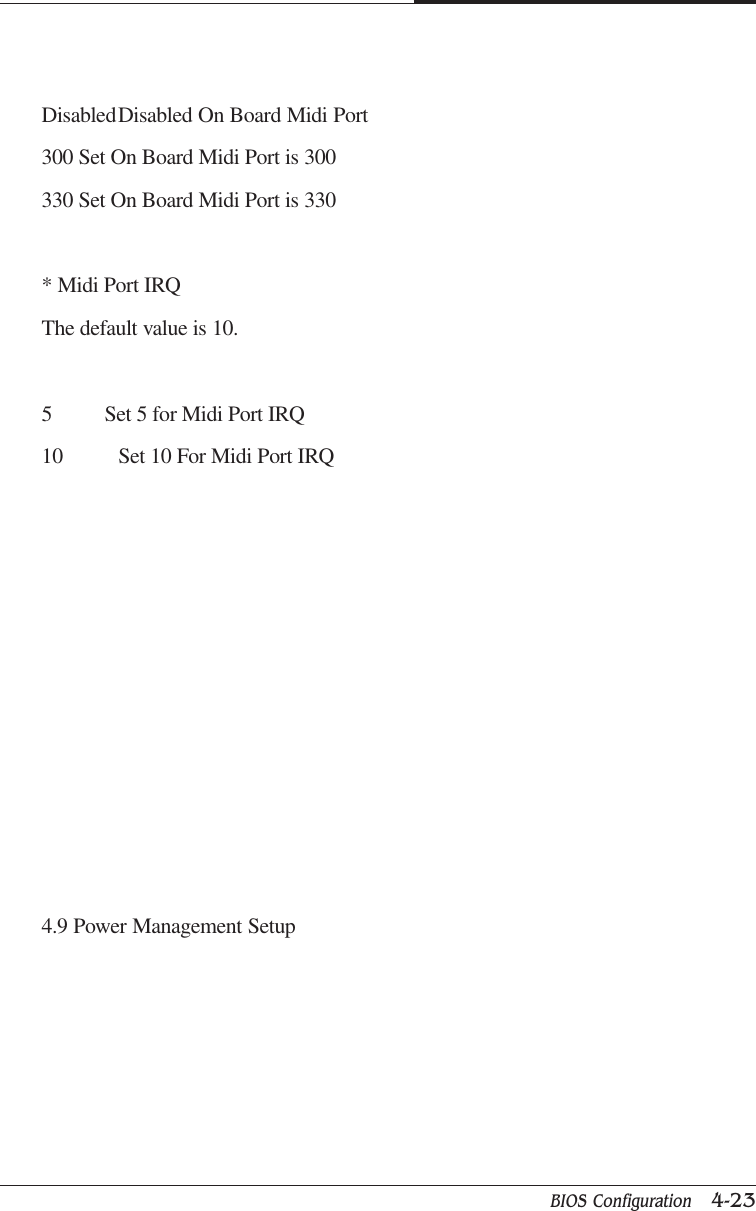
BIOS Configuration   4-23CAPTUER 4DisabledDisabled On Board Midi Port300 Set On Board Midi Port is 300330 Set On Board Midi Port is 330* Midi Port IRQThe default value is 10.5          Set 5 for Midi Port IRQ10 Set 10 For Midi Port IRQ4.9 Power Management Setup
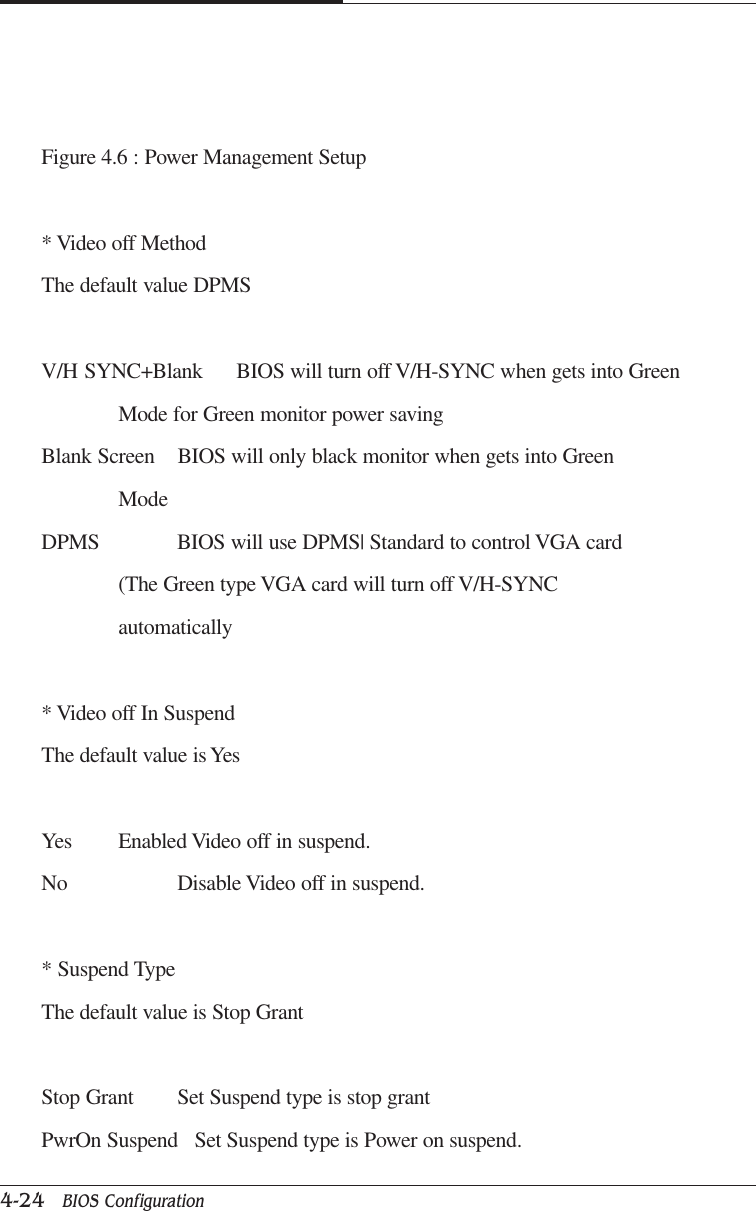
CAPTUER 44-24   BIOS ConfigurationFigure 4.6 : Power Management Setup* Video off MethodThe default value DPMSV/H SYNC+Blank BIOS will turn off V/H-SYNC when gets into GreenMode for Green monitor power savingBlank Screen BIOS will only black monitor when gets into GreenModeDPMS BIOS will use DPMS| Standard to control VGA card(The Green type VGA card will turn off V/H-SYNCautomatically* Video off In SuspendThe default value is YesYes Enabled Video off in suspend.No Disable Video off in suspend.* Suspend TypeThe default value is Stop GrantStop Grant Set Suspend type is stop grantPwrOn Suspend   Set Suspend type is Power on suspend.
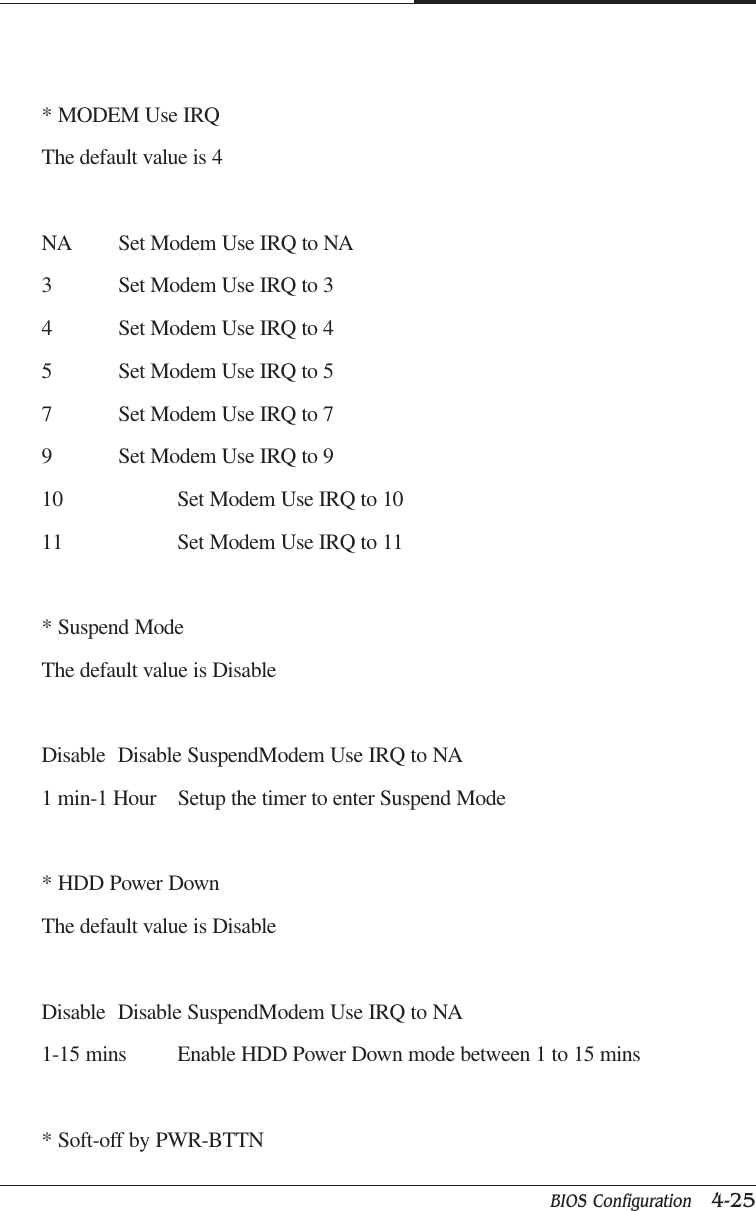
BIOS Configuration   4-25CAPTUER 4* MODEM Use IRQThe default value is 4NA Set Modem Use IRQ to NA3 Set Modem Use IRQ to 34 Set Modem Use IRQ to 45 Set Modem Use IRQ to 57 Set Modem Use IRQ to 79 Set Modem Use IRQ to 910 Set Modem Use IRQ to 1011 Set Modem Use IRQ to 11* Suspend ModeThe default value is DisableDisable Disable SuspendModem Use IRQ to NA1 min-1 Hour    Setup the timer to enter Suspend Mode* HDD Power DownThe default value is DisableDisable Disable SuspendModem Use IRQ to NA1-15 mins Enable HDD Power Down mode between 1 to 15 mins* Soft-off by PWR-BTTN
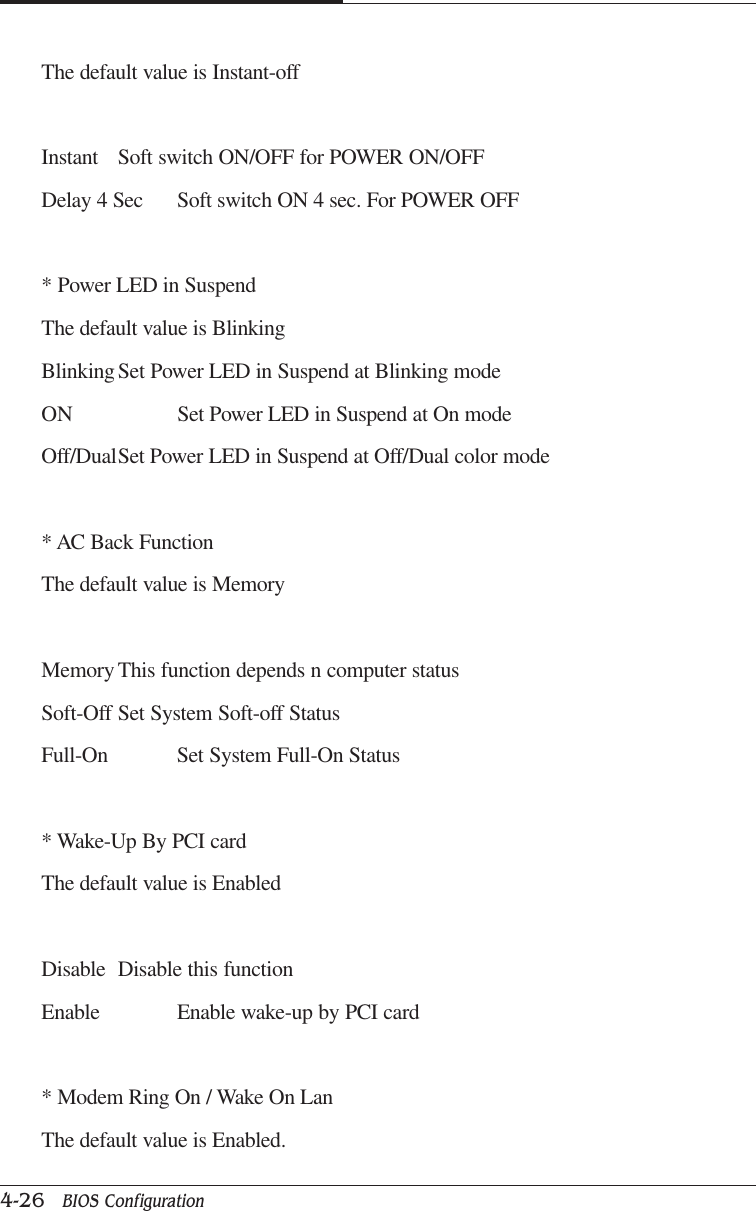
CAPTUER 44-26   BIOS ConfigurationThe default value is Instant-offInstant Soft switch ON/OFF for POWER ON/OFFDelay 4 Sec Soft switch ON 4 sec. For POWER OFF* Power LED in SuspendThe default value is BlinkingBlinkingSet Power LED in Suspend at Blinking modeON Set Power LED in Suspend at On modeOff/DualSet Power LED in Suspend at Off/Dual color mode* AC Back FunctionThe default value is MemoryMemory This function depends n computer statusSoft-Off Set System Soft-off StatusFull-On Set System Full-On Status* Wake-Up By PCI cardThe default value is EnabledDisable Disable this functionEnable Enable wake-up by PCI card* Modem Ring On / Wake On LanThe default value is Enabled.
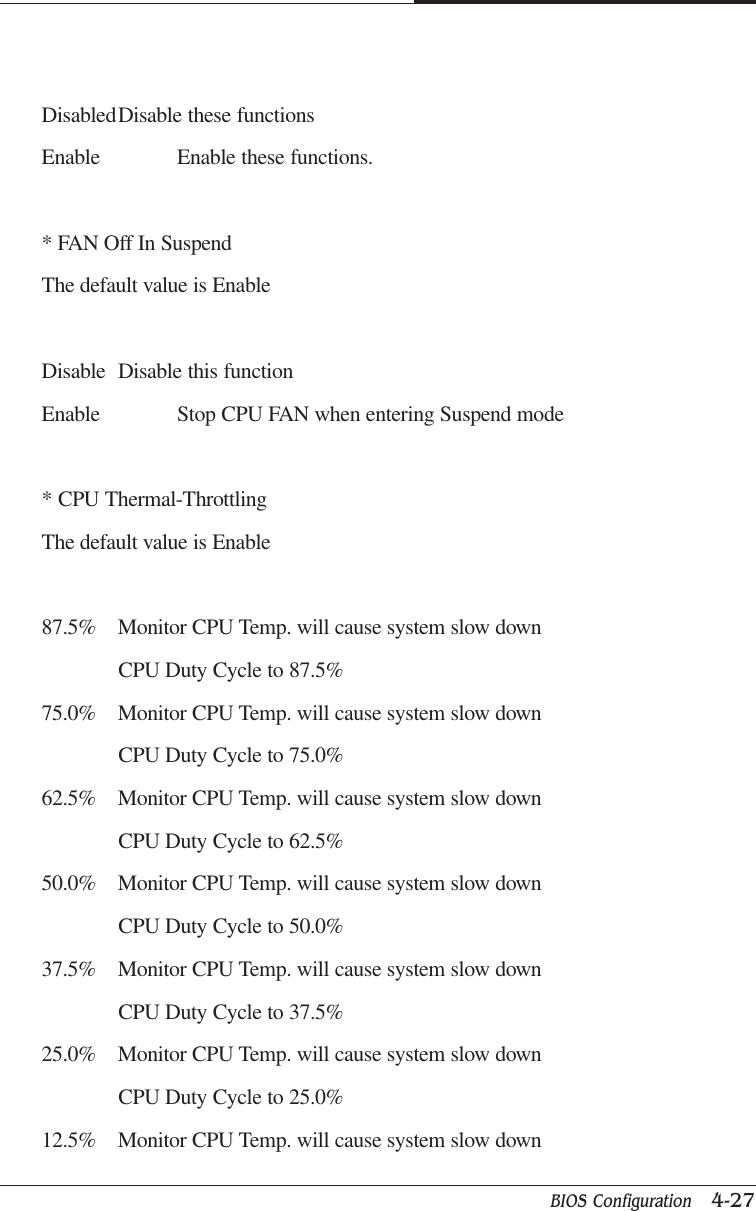
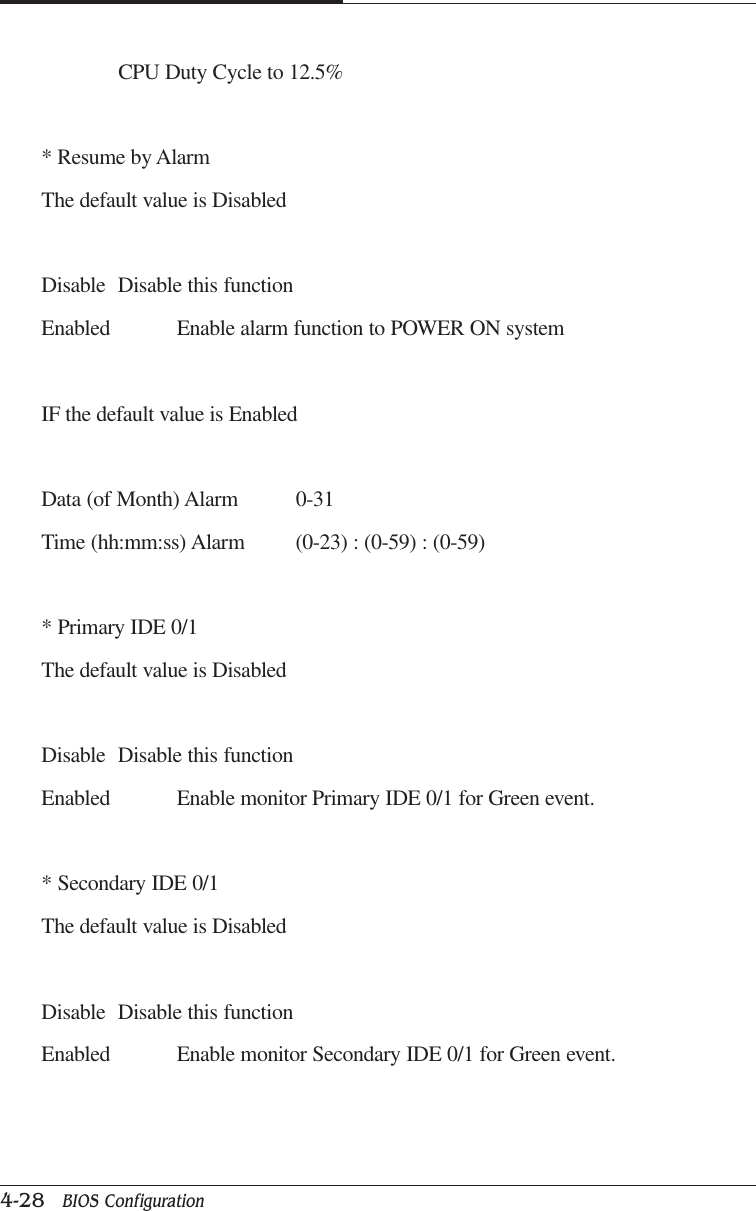
BIOS Configuration   4-27CAPTUER 4DisabledDisable these functionsEnable Enable these functions.* FAN Off In SuspendThe default value is EnableDisable Disable this functionEnable Stop CPU FAN when entering Suspend mode* CPU Thermal-ThrottlingThe default value is Enable87.5% Monitor CPU Temp. will cause system slow downCPU Duty Cycle to 87.5%75.0% Monitor CPU Temp. will cause system slow downCPU Duty Cycle to 75.0%62.5% Monitor CPU Temp. will cause system slow downCPU Duty Cycle to 62.5%50.0% Monitor CPU Temp. will cause system slow downCPU Duty Cycle to 50.0%37.5% Monitor CPU Temp. will cause system slow downCPU Duty Cycle to 37.5%25.0% Monitor CPU Temp. will cause system slow downCPU Duty Cycle to 25.0%12.5% Monitor CPU Temp. will cause system slow down
CAPTUER 44-28   BIOS ConfigurationCPU Duty Cycle to 12.5%* Resume by AlarmThe default value is DisabledDisable Disable this functionEnabled Enable alarm function to POWER ON systemIF the default value is EnabledData (of Month) Alarm 0-31Time (hh:mm:ss) Alarm (0-23) : (0-59) : (0-59)* Primary IDE 0/1The default value is DisabledDisable Disable this functionEnabled Enable monitor Primary IDE 0/1 for Green event.* Secondary IDE 0/1The default value is DisabledDisable Disable this functionEnabled Enable monitor Secondary IDE 0/1 for Green event.
BIOS Configuration   4-29CAPTUER 4* FDC/COM/LPT PortThe default value is EnabledDisable Disable this functionEnabled Enable monitor FDC/COM/LPT for Green event.* PCI RIRQ [A-D] #The default value is EnabledDisable Monitor PCI PIRQ [A-D] IRQ ActiveEnabled Ignore PCI PIRT [A-D] IRQ Active4.10 PnP/PCI Configurations* PNP OS InstalledThe default value is NoYes Enable PNP OS Installed functionNo Disable PNP OS Installed function
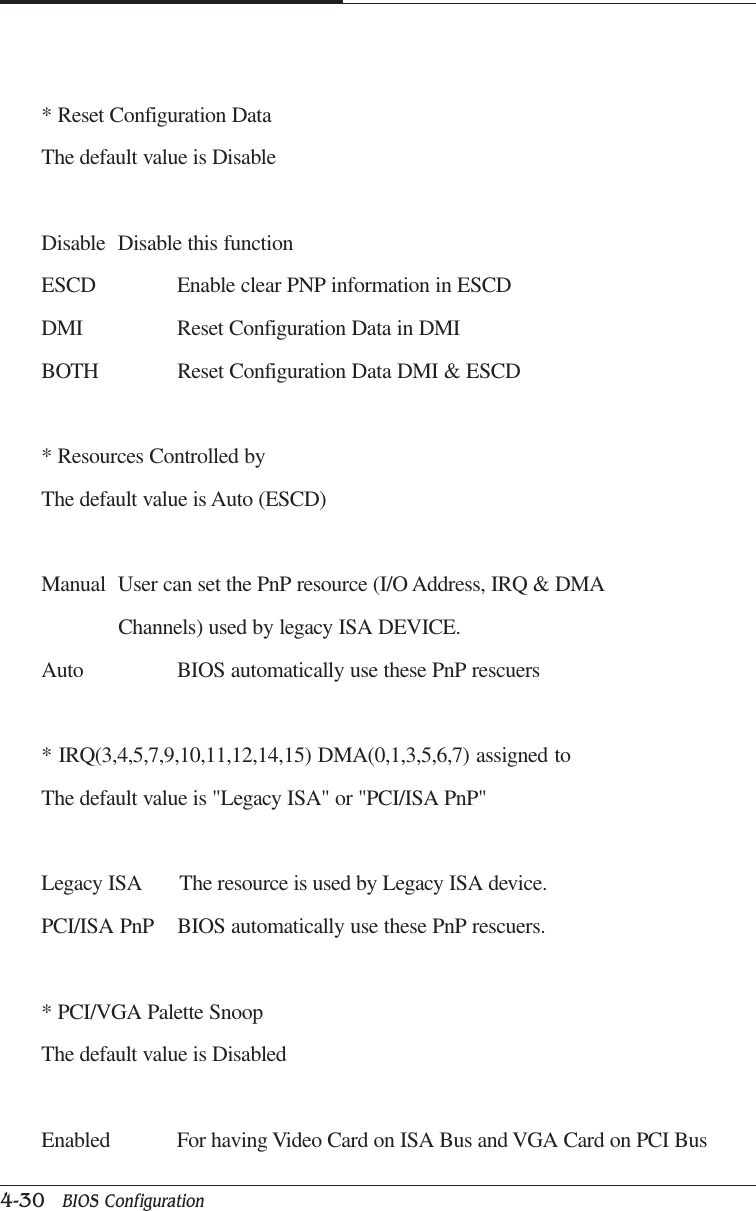
CAPTUER 44-30   BIOS Configuration* Reset Configuration DataThe default value is DisableDisable Disable this functionESCD Enable clear PNP information in ESCDDMI Reset Configuration Data in DMIBOTH Reset Configuration Data DMI & ESCD* Resources Controlled byThe default value is Auto (ESCD)Manual User can set the PnP resource (I/O Address, IRQ & DMAChannels) used by legacy ISA DEVICE.Auto BIOS automatically use these PnP rescuers* IRQ(3,4,5,7,9,10,11,12,14,15) DMA(0,1,3,5,6,7) assigned toThe default value is "Legacy ISA" or "PCI/ISA PnP"Legacy ISA       The resource is used by Legacy ISA device.PCI/ISA PnP BIOS automatically use these PnP rescuers.* PCI/VGA Palette SnoopThe default value is DisabledEnabled For having Video Card on ISA Bus and VGA Card on PCI Bus
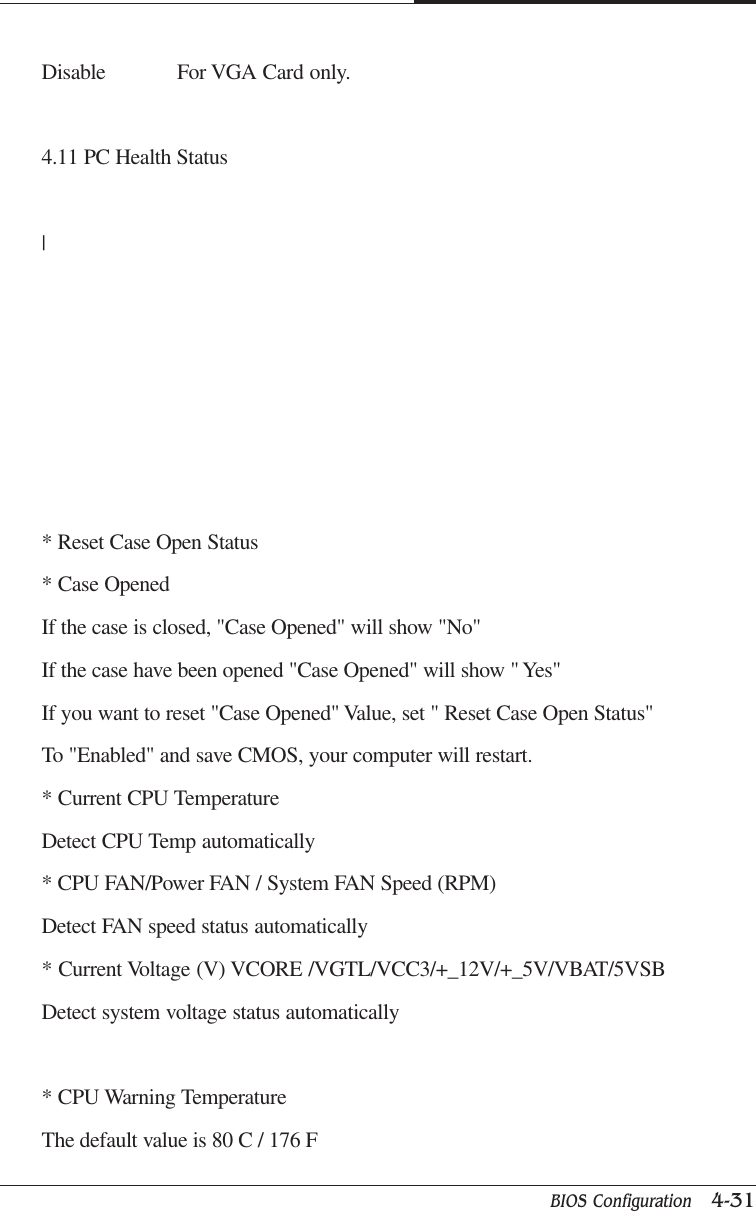
BIOS Configuration   4-31CAPTUER 4Disable For VGA Card only.4.11 PC Health Status|* Reset Case Open Status* Case OpenedIf the case is closed, "Case Opened" will show "No"If the case have been opened "Case Opened" will show " Yes"If you want to reset "Case Opened" Value, set " Reset Case Open Status"To "Enabled" and save CMOS, your computer will restart.* Current CPU TemperatureDetect CPU Temp automatically* CPU FAN/Power FAN / System FAN Speed (RPM)Detect FAN speed status automatically* Current Voltage (V) VCORE /VGTL/VCC3/+_12V/+_5V/VBAT/5VSBDetect system voltage status automatically* CPU Warning TemperatureThe default value is 80 C / 176 F
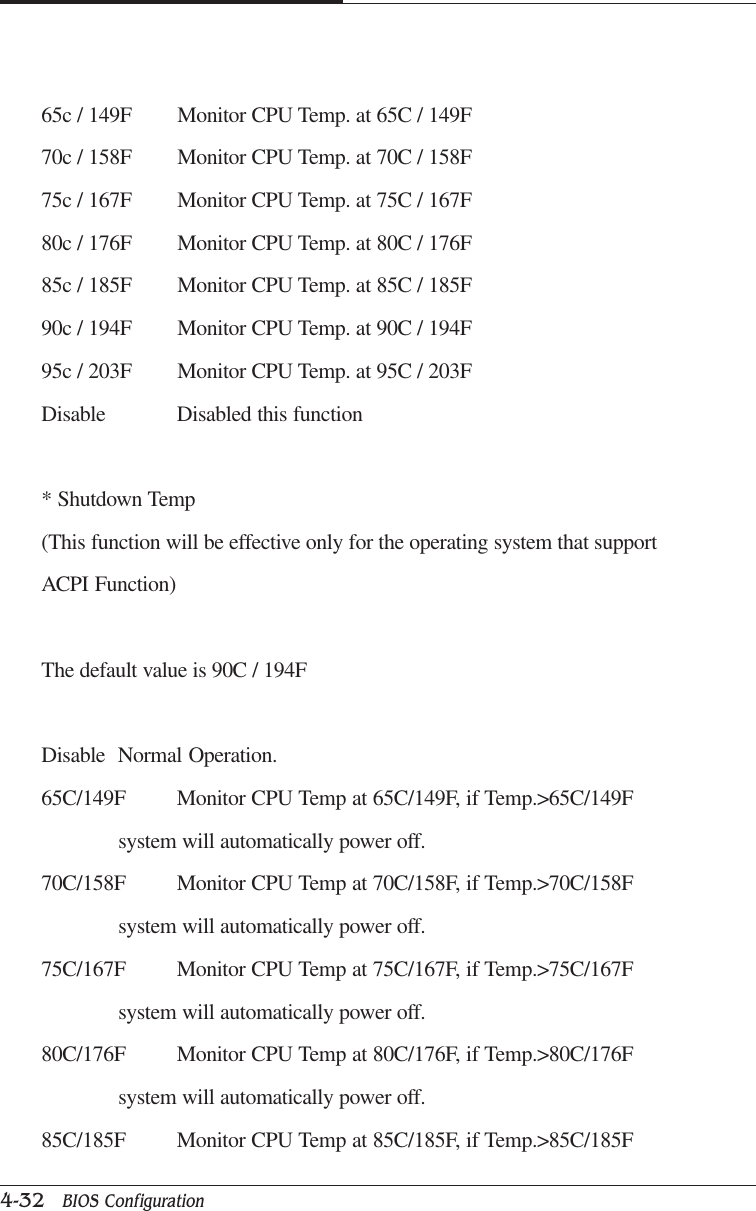
CAPTUER 44-32   BIOS Configuration65c / 149F Monitor CPU Temp. at 65C / 149F70c / 158F Monitor CPU Temp. at 70C / 158F75c / 167F Monitor CPU Temp. at 75C / 167F80c / 176F Monitor CPU Temp. at 80C / 176F85c / 185F Monitor CPU Temp. at 85C / 185F90c / 194F Monitor CPU Temp. at 90C / 194F95c / 203F Monitor CPU Temp. at 95C / 203FDisable Disabled this function* Shutdown Temp(This function will be effective only for the operating system that supportACPI Function)The default value is 90C / 194FDisable Normal Operation.65C/149F Monitor CPU Temp at 65C/149F, if Temp.>65C/149Fsystem will automatically power off.70C/158F Monitor CPU Temp at 70C/158F, if Temp.>70C/158Fsystem will automatically power off.75C/167F Monitor CPU Temp at 75C/167F, if Temp.>75C/167Fsystem will automatically power off.80C/176F Monitor CPU Temp at 80C/176F, if Temp.>80C/176Fsystem will automatically power off.85C/185F Monitor CPU Temp at 85C/185F, if Temp.>85C/185F
BIOS Configuration   4-33CAPTUER 4system will automatically power off.90C/194F Monitor CPU Temp at 90C/194F, if Temp.>90C/194Fsystem will automatically power off.* Fan fail Alarm (CPU/Power/System)The default value is DisableDisable Fan Fail Alarm Function DisableEnable fan Fail Alarm Function Enable4.12 Frequency/Voltage ControlFigure 4.9 : Frequency ? Voltage Control* Auto Detect DIMM/PCI Clk
CAPTUER 44-34   BIOS ConfigurationThe default value is EnableDisable Disable Auto Detect DIMM/PCI ClkEnable Enable Auto Detect DIMM/PCI Clk* CPU Type CELERON (Depends on Your CPU Type)1. System Bus Speed : 66MHz200/233/266/300/366/400/433/500/5332. System Bus Speed : 100MHz300/350/400/450/500/550/600/650/700/750/8003. System Bus Speed : 133MHz400/466/533/600/666/733/800/866/933/1000/10664.13 Load Fail-Safe Defaults|Figure 4.10 : Load Fail-Safe Defaults* Load Fail-Safe Defaults
BIOS Configuration   4-35CAPTUER 4Fail-Safe defaults contain the most appropriate values of the systemParameters that allow minimum system performance4.14 Load Optimized Defaults|Figure 4.11 :  Load Optimized Defaults* Load Optimized DefaultsSelecting this field loads the factory defaults for BIOS and Chipset features whichthe system automatically detects.4.15 Set Supervisor / User PasswordWhen you select this functions message will appear at the center of the screen toassist you in creating a password
CAPTUER 44-36   BIOS ConfigurationFigure 4.12: Password SettingType the password, up to eight characters, and press <Enter> key. The passwordtyped now will clear the previous entered password from CMOS memory. You willbe asked to confirm the password.Type the password again and press <Enter> key. You may also press <ESC> key toabort the selection and not enter a password.To disable password, just press < Enter> key when you are prompted to enterpassword.A Message " PASSWORD DISABLED" will appear to confirm the password beingdisabled.Once the password is disabled, the system will boot and you can enter Setup freely.If you select system at Security Option in Bios Feature Setup Menu, you will beprompted for the password every time the system is rebooted or any time you try toenter Setup Menu. If you select Setup at Security Option in BIOS Features SetupMenu, you will be prompted only when you try to enter Setup.4.16 Save & Exit SetupFigure 4.13: Save & Exit Setup
BIOS Configuration   4-37CAPTUER 4Type "Y" will quit the Setup utility and save the user setup value to RTC CMOSType  "N" will return to setup utility.4.17 Exit Without SavingFigure 4.14 : Exit Without SavingType "Y" will quit the Setup utility without saving to RTC CMOS.Type  "N" will return to setup utility.Chapter 5Inside Your ComputerThis chapter tells you how to remove and replace the system cover and connect theinternalcables, and familiarizes you with the internal components you might handle if you
CAPTUER 44-38   BIOS Configurationinstall hardware options.This chapter will be used every time you install a hardware option inside yourcomputer.Removing the CoverYou need to remove the cover of your system to access its internal components.To remove the cover, follow the below steps.1. Turn off the computer and other peripheral devices including the monitor.2. Disconnect all the cables include power cable from the computer.3. To open the system cover, remove the one screw on the back panel of yourcomputer.4. Slide the cover toward the rear to free it from the system and lift it off until can beremovedcompletely. Set the cover aside.
BIOS Configuration   4-39CAPTUER 4NOTEBe sure to ground yourself by touching your system every time you remove thecover. If you are not properly grounded, you could generate an electric shock whenyou touch a component.Replacing the CoverFollow the below steps to replace the cover.1. Hold the cover with your hands and gently put it down to the chassis on the rearposition(about 3cm) from the front bezel, then push it to the front.
CAPTUER 44-40   BIOS Configuration2. Tighten the cover to the chassis with the screws you removed.3. Reconnect the monitor, keyboard, mouse, and any other peripheral device’s cableconnectorsto your system.              Reconnect all the device’s cable connectors to your system.
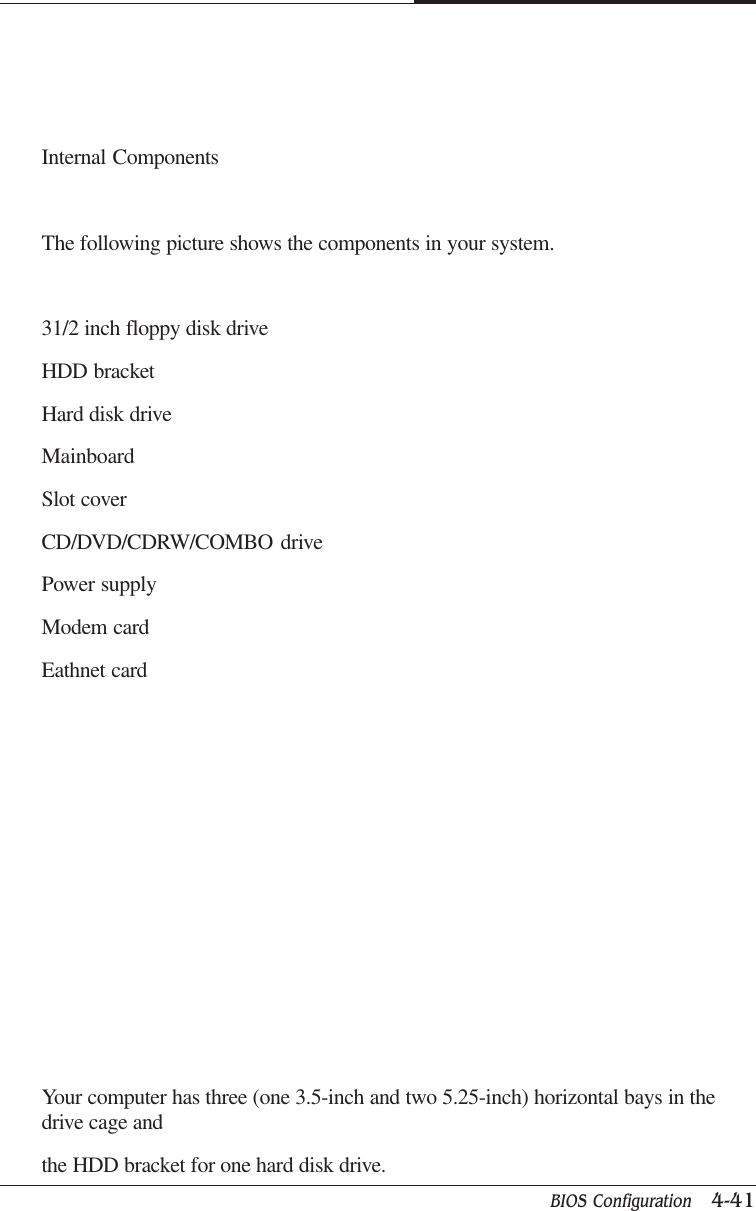
BIOS Configuration   4-41CAPTUER 4Internal ComponentsThe following picture shows the components in your system.31/2 inch floppy disk driveHDD bracketHard disk driveMainboardSlot coverCD/DVD/CDRW/COMBO drivePower supplyModem cardEathnet cardYour computer has three (one 3.5-inch and two 5.25-inch) horizontal bays in thedrive cage andthe HDD bracket for one hard disk drive.
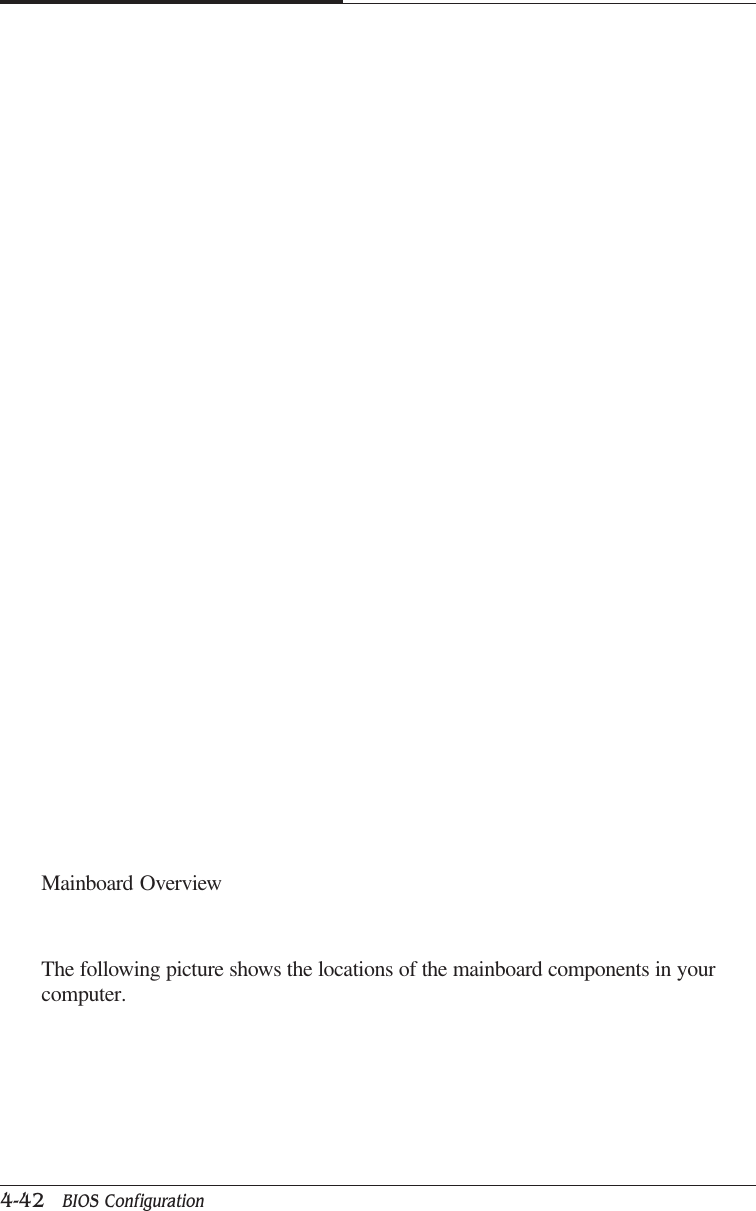
CAPTUER 44-42   BIOS ConfigurationMainboard OverviewThe following picture shows the locations of the mainboard components in yourcomputer.
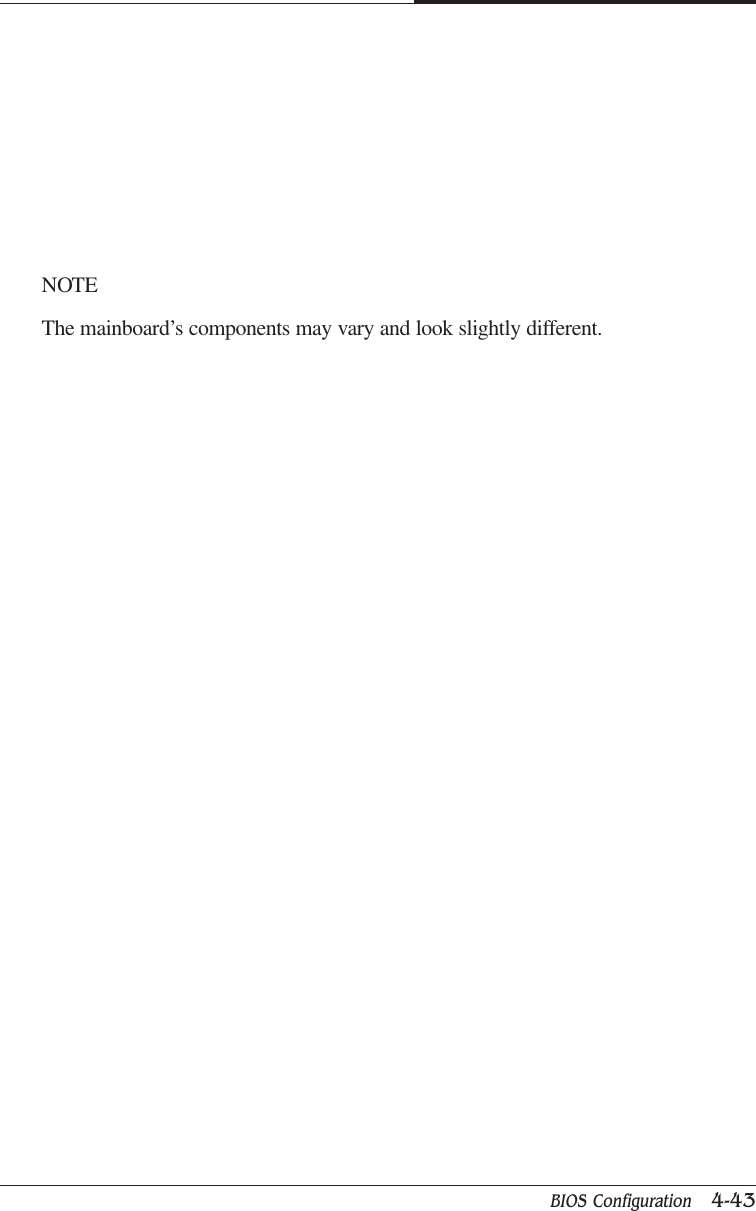
BIOS Configuration   4-43CAPTUER 4NOTEThe mainboard’s components may vary and look slightly different.
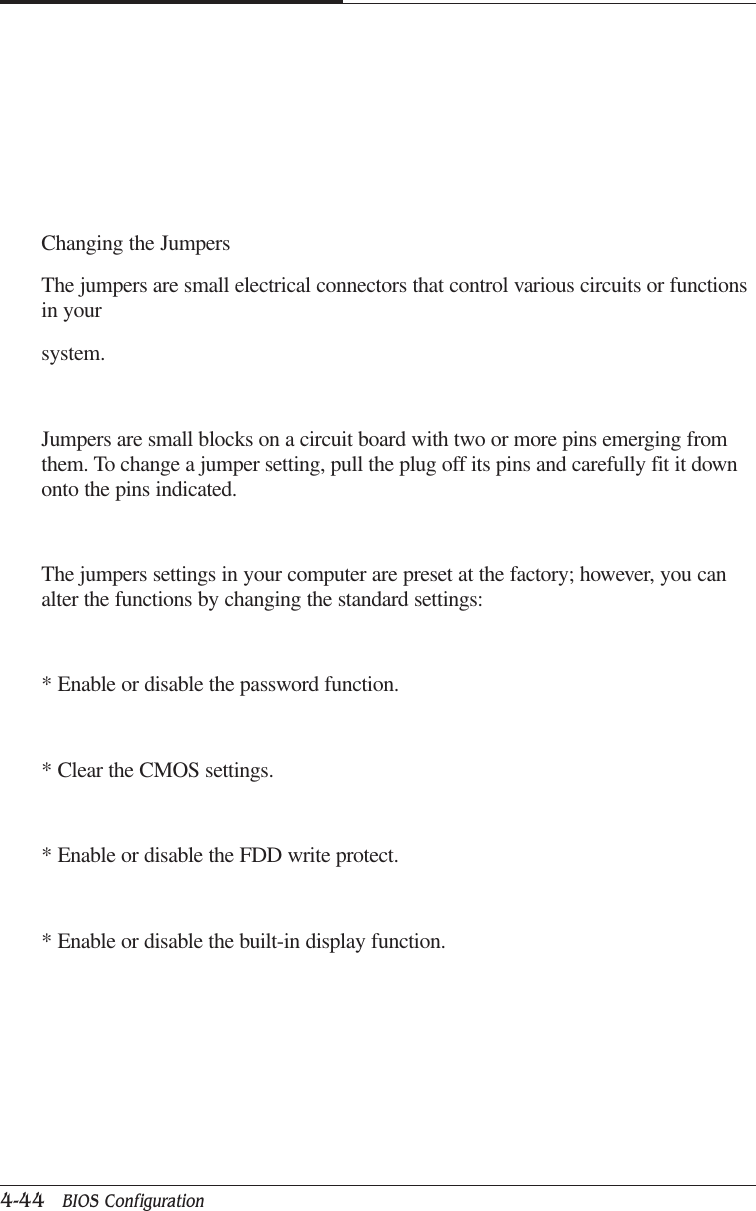
CAPTUER 44-44   BIOS ConfigurationChanging the JumpersThe jumpers are small electrical connectors that control various circuits or functionsin yoursystem.Jumpers are small blocks on a circuit board with two or more pins emerging fromthem. To change a jumper setting, pull the plug off its pins and carefully fit it downonto the pins indicated.The jumpers settings in your computer are preset at the factory; however, you canalter the functions by changing the standard settings:* Enable or disable the password function.* Clear the CMOS settings.* Enable or disable the FDD write protect.* Enable or disable the built-in display function.
BIOS Configuration   4-45CAPTUER 4NOTEThe jumpers settings and their functions are inscribed on the label attached in yoursystem chassis. If you want to see the label, you need to remove the cover of yoursystem.CAUTIONDo not change the jumpers with the power on. Always turn off the computer andunplug the power cord from the computer before changing the jumpers.Connecting a Power Supply ConnectorThe power supply converts AC power to the DC voltage your computer needs. Thepower supply has one big connector for mainboard and some other connectors fordevices such as hard disk, CD/DVD ROM, floppy disk drive, and etc in yourcomputer.
CAPTUER 44-46   BIOS ConfigurationThe cable of power supply having a big connector is connected to the power port onthe mainboard.
BIOS Configuration   4-47CAPTUER 4Connecting the Front Panel Connector CableThe front panel connector cable is connected to connectors on the mainboard andfront panel of your computer.
CAPTUER 44-48   BIOS ConfigurationChapter 6Installing and Removing Board Options and DrivesThis chapter describes how to install and remove optional drives and board optionsin your computer. You can use these instructions to install and remove a variety ofdevices and board options. Although your board options and drives may look a bitdifferent from the ones illustrated here, you can install and remove it the same way.See Chapter 5 for removing and replacing the cover.NOTETurn off the computer. Then disconnect the computer from its power source andfrom any telecommunications links, networks, or modems before performing any ofthe procedures described in this chapter.Installing an Expansion Card
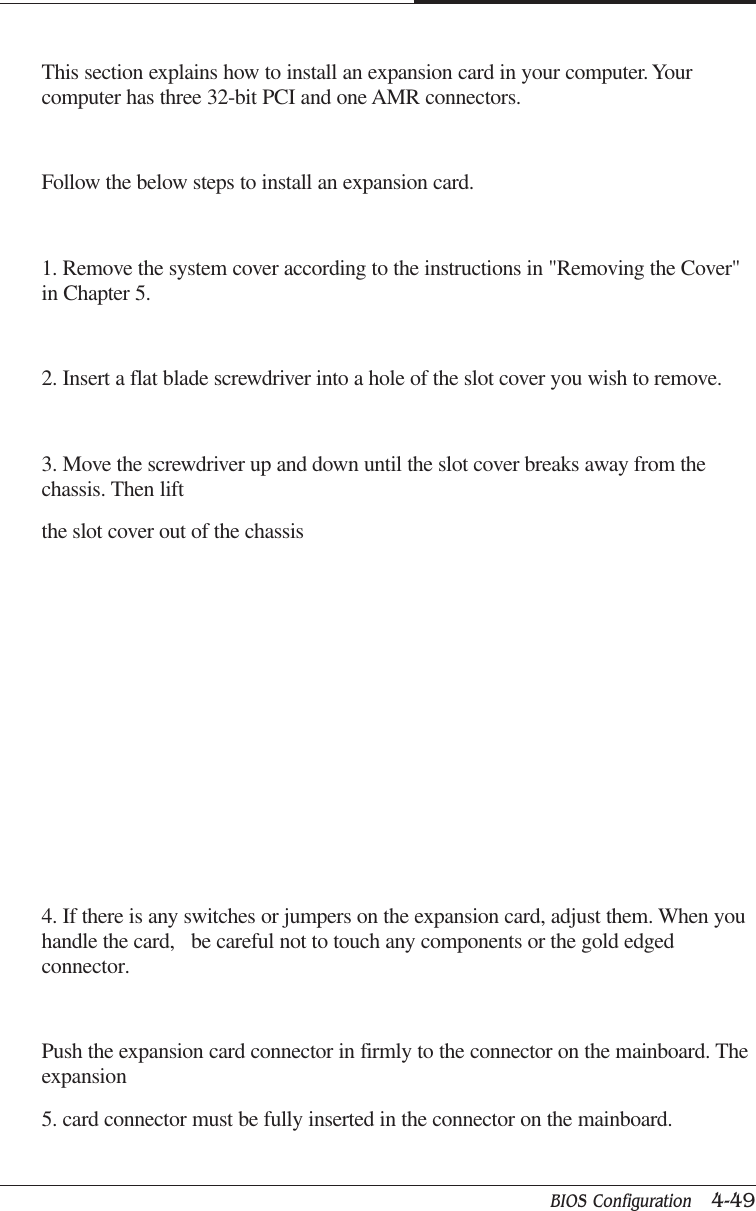
BIOS Configuration   4-49CAPTUER 4This section explains how to install an expansion card in your computer. Yourcomputer has three 32-bit PCI and one AMR connectors.Follow the below steps to install an expansion card.1. Remove the system cover according to the instructions in "Removing the Cover"in Chapter 5.2. Insert a flat blade screwdriver into a hole of the slot cover you wish to remove.3. Move the screwdriver up and down until the slot cover breaks away from thechassis. Then liftthe slot cover out of the chassis4. If there is any switches or jumpers on the expansion card, adjust them. When youhandle the card,   be careful not to touch any components or the gold edgedconnector.Push the expansion card connector in firmly to the connector on the mainboard. Theexpansion5. card connector must be fully inserted in the connector on the mainboard.
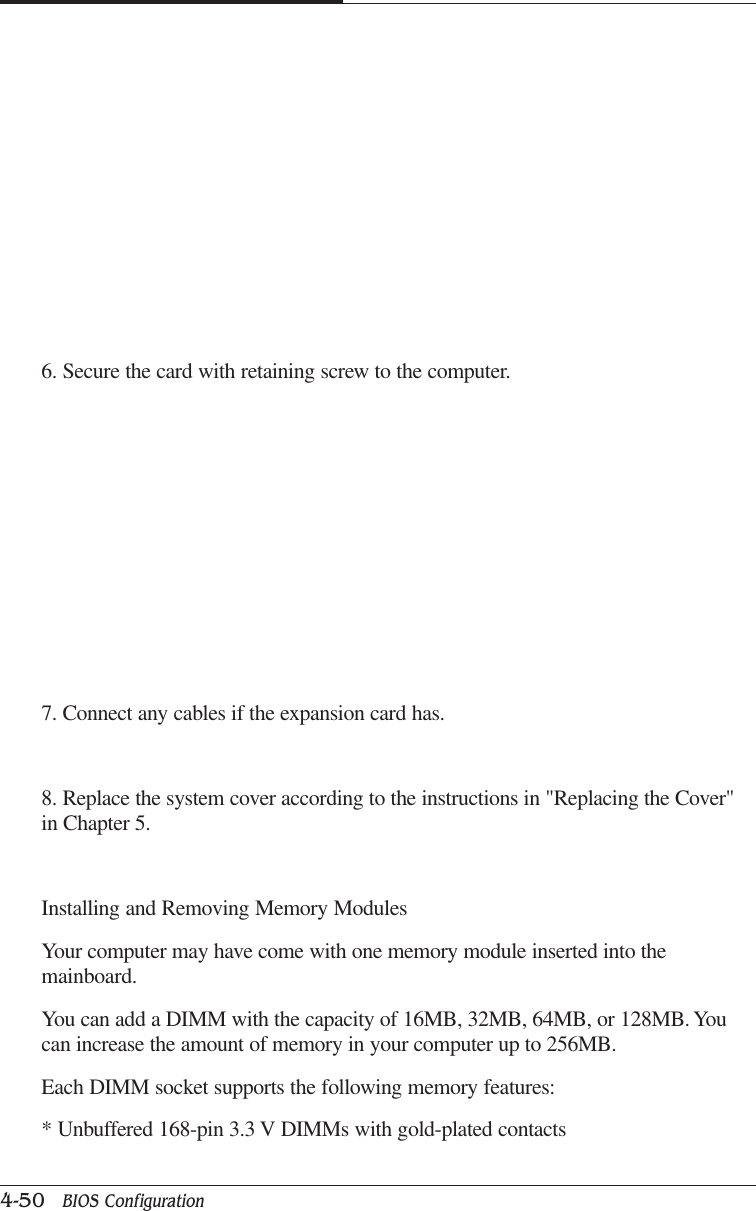
CAPTUER 44-50   BIOS Configuration6. Secure the card with retaining screw to the computer.7. Connect any cables if the expansion card has.8. Replace the system cover according to the instructions in "Replacing the Cover"in Chapter 5.Installing and Removing Memory ModulesYour computer may have come with one memory module inserted into themainboard.You can add a DIMM with the capacity of 16MB, 32MB, 64MB, or 128MB. Youcan increase the amount of memory in your computer up to 256MB.Each DIMM socket supports the following memory features:* Unbuffered 168-pin 3.3 V DIMMs with gold-plated contacts
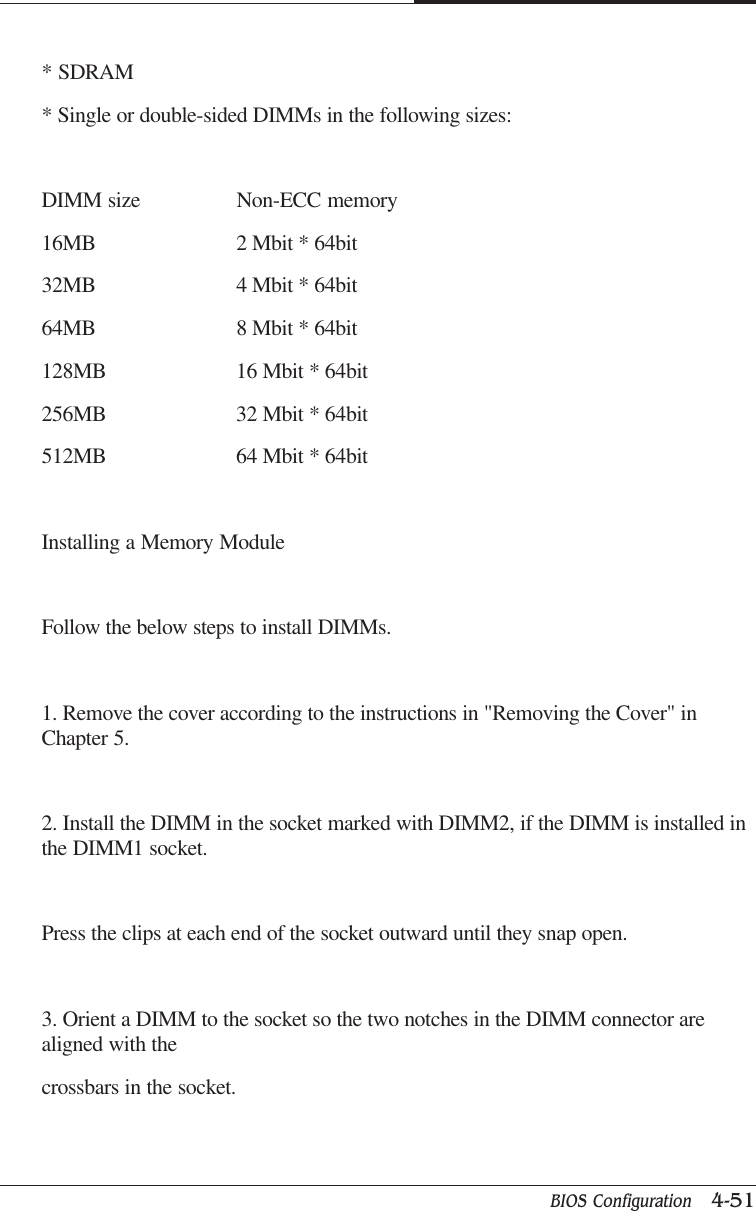
BIOS Configuration   4-51CAPTUER 4* SDRAM* Single or double-sided DIMMs in the following sizes:DIMM size Non-ECC memory16MB 2 Mbit * 64bit32MB 4 Mbit * 64bit64MB 8 Mbit * 64bit128MB 16 Mbit * 64bit256MB 32 Mbit * 64bit512MB 64 Mbit * 64bitInstalling a Memory ModuleFollow the below steps to install DIMMs.1. Remove the cover according to the instructions in "Removing the Cover" inChapter 5.2. Install the DIMM in the socket marked with DIMM2, if the DIMM is installed inthe DIMM1 socket.Press the clips at each end of the socket outward until they snap open.3. Orient a DIMM to the socket so the two notches in the DIMM connector arealigned with thecrossbars in the socket.
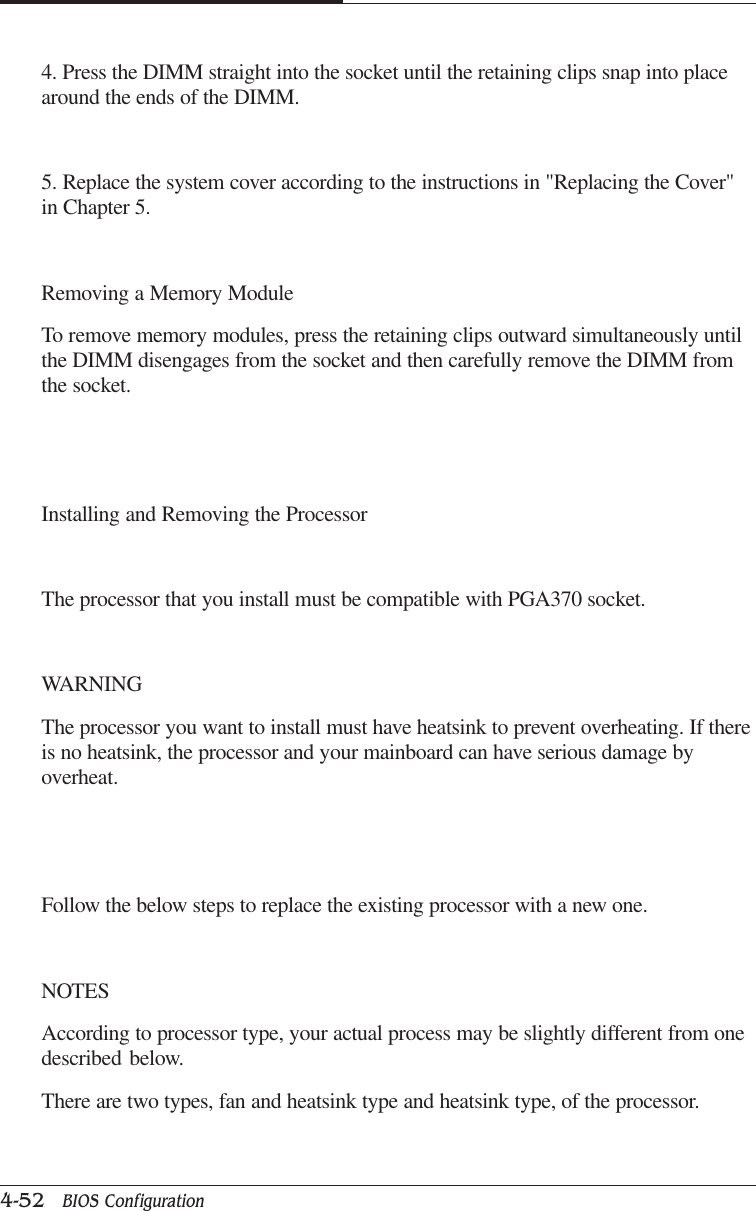
CAPTUER 44-52   BIOS Configuration4. Press the DIMM straight into the socket until the retaining clips snap into placearound the ends of the DIMM.5. Replace the system cover according to the instructions in "Replacing the Cover"in Chapter 5.Removing a Memory ModuleTo remove memory modules, press the retaining clips outward simultaneously untilthe DIMM disengages from the socket and then carefully remove the DIMM fromthe socket.Installing and Removing the ProcessorThe processor that you install must be compatible with PGA370 socket.WARNINGThe processor you want to install must have heatsink to prevent overheating. If thereis no heatsink, the processor and your mainboard can have serious damage byoverheat.Follow the below steps to replace the existing processor with a new one.NOTESAccording to processor type, your actual process may be slightly different from onedescribed below.There are two types, fan and heatsink type and heatsink type, of the processor.
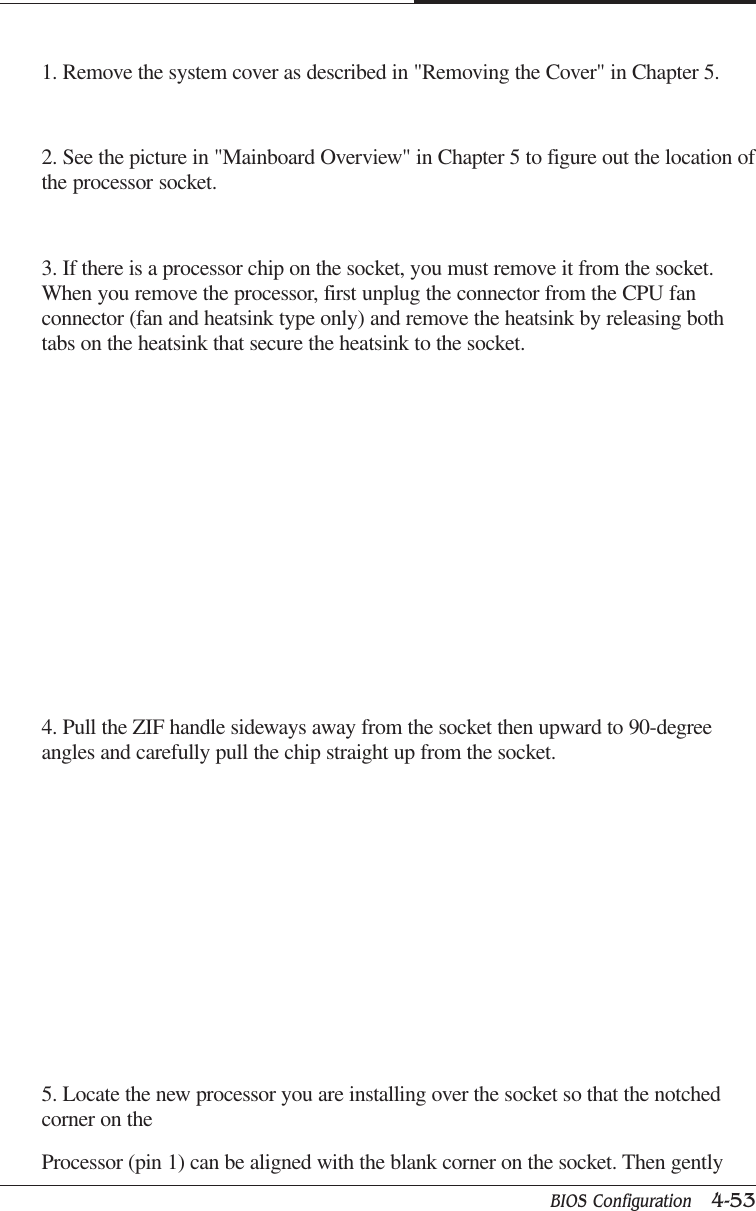
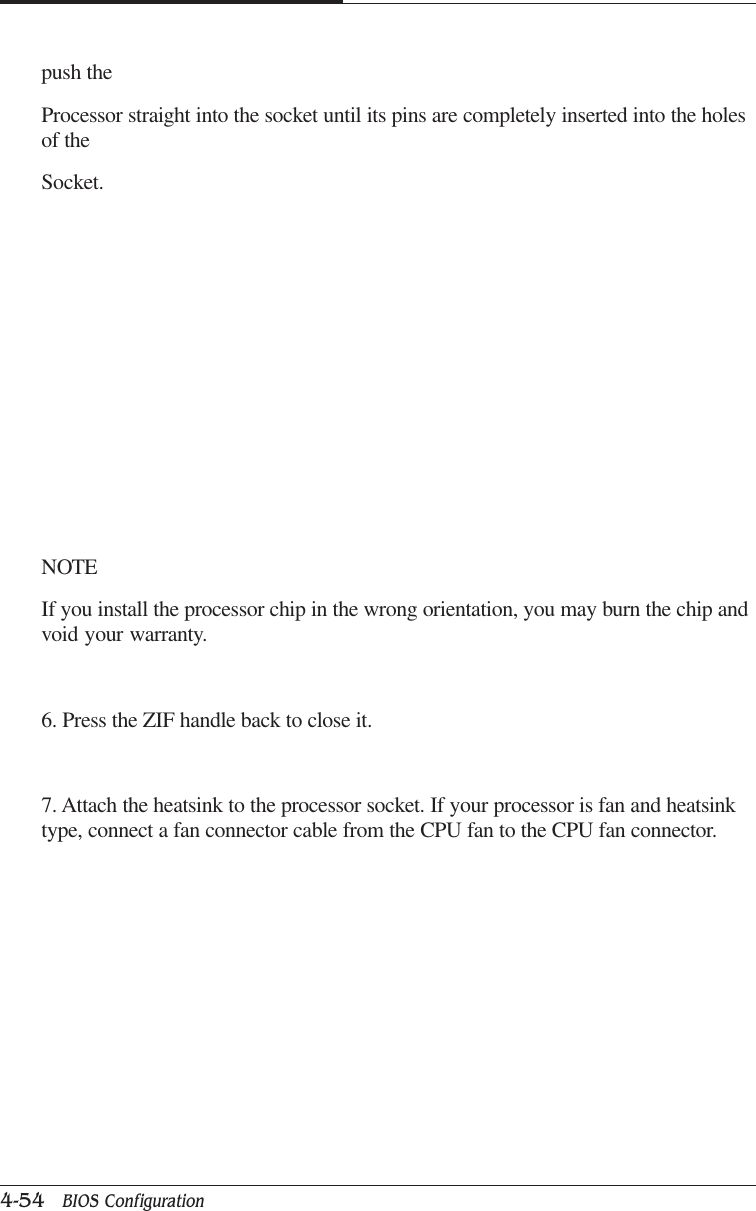
BIOS Configuration   4-53CAPTUER 41. Remove the system cover as described in "Removing the Cover" in Chapter 5.2. See the picture in "Mainboard Overview" in Chapter 5 to figure out the location ofthe processor socket.3. If there is a processor chip on the socket, you must remove it from the socket.When you remove the processor, first unplug the connector from the CPU fanconnector (fan and heatsink type only) and remove the heatsink by releasing bothtabs on the heatsink that secure the heatsink to the socket.4. Pull the ZIF handle sideways away from the socket then upward to 90-degreeangles and carefully pull the chip straight up from the socket.5. Locate the new processor you are installing over the socket so that the notchedcorner on theProcessor (pin 1) can be aligned with the blank corner on the socket. Then gently
CAPTUER 44-54   BIOS Configurationpush theProcessor straight into the socket until its pins are completely inserted into the holesof theSocket.NOTEIf you install the processor chip in the wrong orientation, you may burn the chip andvoid your warranty.6. Press the ZIF handle back to close it.7. Attach the heatsink to the processor socket. If your processor is fan and heatsinktype, connect a fan connector cable from the CPU fan to the CPU fan connector.
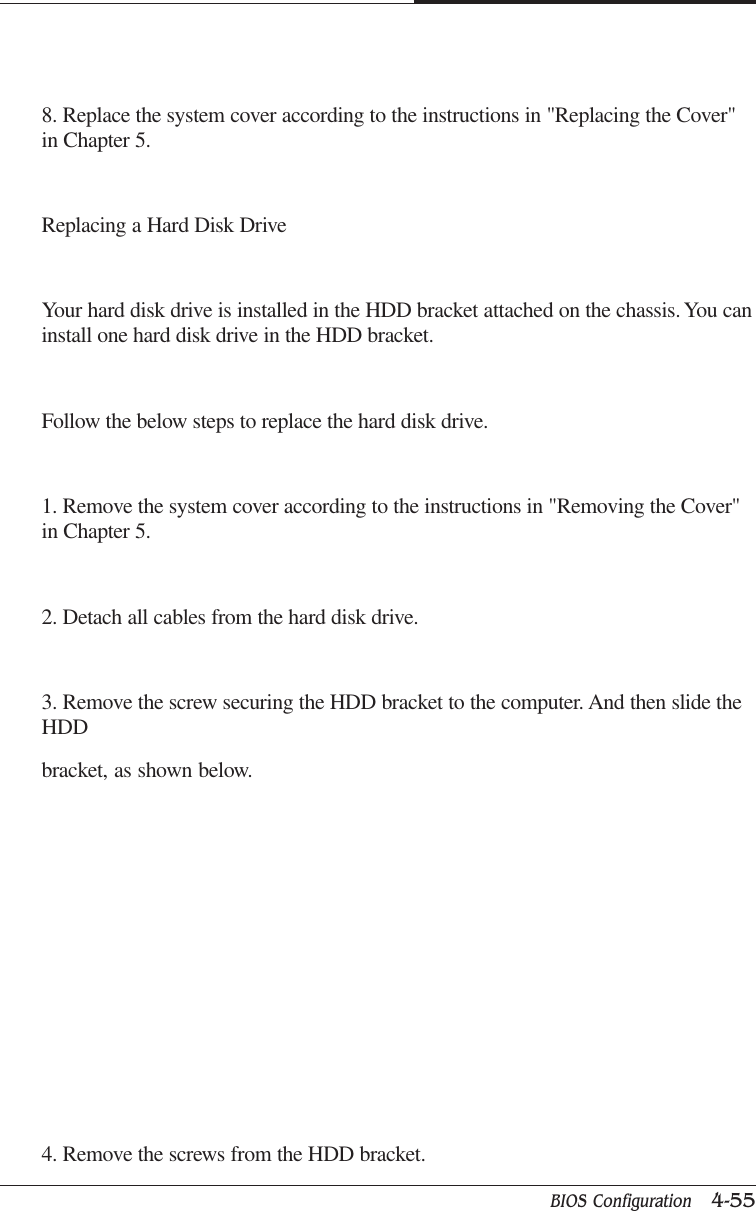
BIOS Configuration   4-55CAPTUER 48. Replace the system cover according to the instructions in "Replacing the Cover"in Chapter 5.Replacing a Hard Disk DriveYour hard disk drive is installed in the HDD bracket attached on the chassis. You caninstall one hard disk drive in the HDD bracket.Follow the below steps to replace the hard disk drive.1. Remove the system cover according to the instructions in "Removing the Cover"in Chapter 5.2. Detach all cables from the hard disk drive.3. Remove the screw securing the HDD bracket to the computer. And then slide theHDDbracket, as shown below.4. Remove the screws from the HDD bracket.
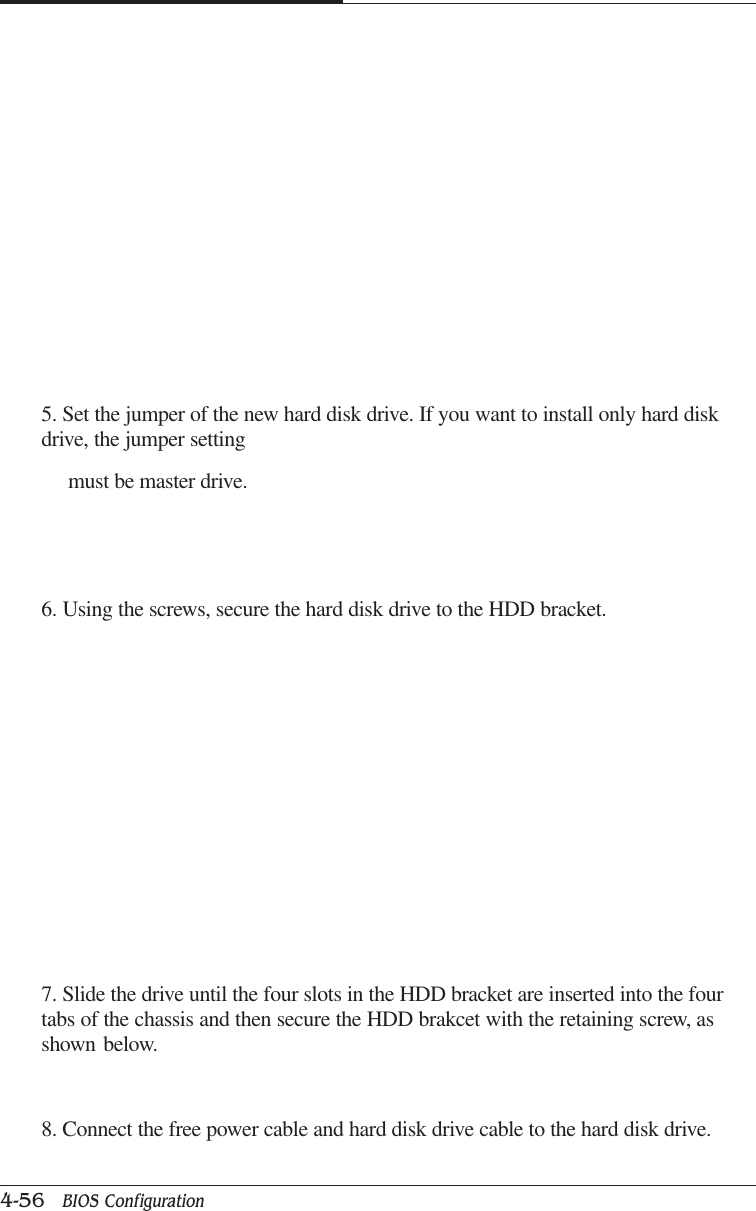
CAPTUER 44-56   BIOS Configuration5. Set the jumper of the new hard disk drive. If you want to install only hard diskdrive, the jumper setting     must be master drive.6. Using the screws, secure the hard disk drive to the HDD bracket.7. Slide the drive until the four slots in the HDD bracket are inserted into the fourtabs of the chassis and then secure the HDD brakcet with the retaining screw, asshown below.8. Connect the free power cable and hard disk drive cable to the hard disk drive.
BIOS Configuration   4-57CAPTUER 49. If you removed the hard disk drive cable from the mainboard, replace it.10. Replace the system cover according to the instructions in "Replacing the Cover"in Chapter 5.Installing the 5.25-inch Device in the Peripheral BayYour system has two 5.25-inch horizontal peripheral bays. If only one device (e.g.,CD/DVD-ROM drive) is installed in the system’s 5.25-inch peripheral bay, you canadd an optional device such as a CD/DVD/CDRW/COMBO drive, hard disk drive,LS-120 drive, or ZIP drive in the empty peripheral bay.To install an optional device in the bay, follow the below steps.1. Remove the cover according to the instructions in "Removing the Cover" inChapter 5.2. Remove the HDD bracket from the system chassis. For more information, see"Replacing aHard Disk Drive" in this chapter.NOTEIf you want to install a 3.5-inch hard disk drive, you must purchase the 5.25-inchdock or mounting bracket and attach it to your 3.5-inch hard disk drive to installyour hard disk drive for the 5.25-inch bay.3. Remove the front panel from the chassis by pressing the four tabs.
CAPTUER 44-58   BIOS Configuration4. Remove the faceplate cover from the front panel. Pull out the faceplate, pressingoutward each tab on both ends of the front panel using your finger.
BIOS Configuration   4-59CAPTUER 45. If there is an EMI shield that covers the 5.25-inch drive bay you want to use,remove it from the chassis using a tool such as a screwdriver.6. Make you sure that jumpers of optional drive must be set correctly.NOTESAs a hard disk drive, most optional devices’ jumpers must be set correctly to workproperly with your system. For example, if there are two drives to one E-IDEinterface cable, one drive must have master drive jumper setting, and the other drivemust have slave drive jumper setting.If you want to install an optional drive to the 5.25 inch bay, you must use secondary
CAPTUER 44-60   BIOS ConfigurationE-IDE drive connector. If your CD/DVD ROM is set to master, the optional drive’sjumper must be set to slave.7. Slide the device into the bay and secure it to the computer case with four screws.8.Connect the power and interface cables to the device installed.
BIOS Configuration   4-61CAPTUER 49. To reassemble the front panel to the system, press the front panel toward thesystem until the tabs on the front panel click into place.10. Hook the front panel connector cable and replace the HDD bracket to thechassis.11. Replace the system cover according to the instructions in "Replacing the Cover"in Chapter 5.Replacing the BatteryThe 3 V, coin-cell CR2032-type battery on the mainboard provides power to thereal-time clock and CMOS RAM.The battery approximately has three years lifetime when the system is off.To replace the battery, follow the below steps.1. Enter the Setup program and make a printed copy of the Setup screens.2. Turn off your system and devices connected to the system.3. Remove the system cover.4. Take the battery out from the socket.
CAPTUER 44-62   BIOS Configuration5. Insert the new battery with the "+" side facing up into the battery socket.6. Replace the system cover.7. Turn on your system, run the Setup program, and set the date and time again.Restore any system configuration information that was lost while replacing thebattery according to the copy made in step 1.After Installing OptionsAfter you install or remove drives, if necessary, be sure to run Setup program toupdate the configuration of your system. See Chapter 4 for detail information.If you installed a hard disk drive on which you want to install an operating system,install the operating system, drivers, and application programs on the hard disk driveusing the Restore CD after running FDISK. Follow the instructions in Chapter 8.
BIOS Configuration   4-63CAPTUER 4If you installed a hard disk drive on which you want to install an operating system,install the operating system on the hard disk drive. See "Using the Restore CD" inChapter 8.If you installed new optional equipment and Windows ME is already installed inyour system, you need to have Windows ME detect it. See Windows ME manual andthe manual that came with your optional equipment for detail information.Chapter 7Application ProgramsPlayerNOTEThe Player is available only on the CD-ROM drive model.
CAPTUER 44-64   BIOS ConfigurationThe Mpeg Player is the software application designed to work with your displayadapter.The Mpeg Player supports full motion and full screen software MPEG videoplayback with excellent video quality.AudioStationAudioStation is a component audio system that can play or record audio CDs, digitalaudio files(WAV or VOC), or MIDI files (MID, RMI or ORC). This consists of Audio Mixer,CD Player,Digital Audio Player, and MIDI Player.Audio Mixer lets you adjust the volumes of the various audio components and setrecording levels for digital audio. You can play audio CDs with the CD Player. Youcan play digital audio (WAV) files with the Digital Audio Player and edit digitalaudio files using WinDAT displayed by pressing the Edit button. With the MIDIPlayer, you can play MIDI files. You can audition CD, WAV and MIDI files andcreate custom playlists.
BIOS Configuration   4-65CAPTUER 4To run AudioStation program, point to program Voyetra after click the Start button,and then click AudioStation.NOTEFor more information, refer to on-line help. To see on-line help, click the icon on theAudioStation screen.PowerDVDNOTEThe PowerDvD is available only on the DVD,COMBO drive model.Digital Versatile Disc (DVD) is a high-density storage device.A standard DVD title can hold 4.7 gigabytes of data - a seven times the data capacityof a current CD title.Dual-layer DVD title can hold more than twelve times the information of a CD titleon a single side.So you can enjoy higher-resolution pictures, more channels of digital sound, richer
CAPTUER 44-66   BIOS Configurationgraphics, and far more multimedia.Playing the PowerDVDIf your DVD disc is auto-run, the PowerDVD will automatically start when youinsert the disc in the DVD-ROM drive.For the DVD disc does not automatically start when you insert the disc, play thePwerDVD as follows:Double-click the PowerDVD icon on the desktop and press the play button on thePowerDVD.The Display AreaDVD video is the current mediaDigital files are the current mediaVCD is the current mediaAudio CD is the current mediaStereo is the current audio mode
BIOS Configuration   4-67CAPTUER 4Dolby os the current audio mode4-speaker is the current audio mode6-speaker is the current audio modeSPDIF is the current audio modeDenotes current driveDenotes current subtitleDenotes current audio streamDenotes current regionDenotes current angleDenotes current parental controlThe Main ControlsCtel-N Minimizes user interfaceCtrl-X Exits PowerDVDZ Zooms to full screen and to windows modesO Denotes file mode, Press to switch modesCtrl-E Ejects discs from CD/DVD-ROM driveF1 Accesses online help+ Increases volume- Mutes volumeQ Decreases volume/ Menu pad used to navigate between DVD title menu selections/ Number pad for entering numerical file or audio CD selectionsN/A Click anywhere along the slider to navigate tithing a given chapter,VCD, CD or file
CAPTUER 44-68   BIOS ConfigurationThe Control Wheel1. 8X Reverse2. 4X Reverse3. 2X Reverse4. 1X Reverse5. Pause6. 1X Forward7. 2X Forward8. 4X Forward9. 8X ForwardNote: The green point roughly marks the shuttling above.Forward speeds of 1/2X, 1.5X, 3Xand 6X and 1/2X rewinding speed are notpicturedAbove but are sequentially located between their respective locations above.Enter play DVD, VCD, CD or filesSpace Bar Pauses playbackS Stops playbackN Jumps to next chapterP Returns to previous chapterCtrl-B Steps backward one frameT Steps forward one frameThe Control Panel
BIOS Configuration   4-69CAPTUER 4Hidden Control PanelDisc Mode
CAPTUER 44-70   BIOS ConfigurationFile ModeK Switches among karaoke modeC Captures video content as bitmap image fileA Switches among available anglesR Goes ip to previous section when navigationDVD title menu selectionsX Sets A and B Points to repeat specific user-definedScenes during playbackH Switches among available audio streamsCtrl+R Repeats titles, chapters or screensU Switches among available subtitle during playbackL Accesses all available menusCtrl+F2 Bookmarks specific scenes in DVDF2 Directly goes to bookmarked scenesF3 I-Power takes you to the Internet directlyCtrl-C Configuration setting is all located hereU shuffles playlist in File modeNOTESYour PowerDVD application is already set to Region 1, so you can play the DVDdisc that contains no region code or a Region 1 code.<Region Code for Area>
BIOS Configuration   4-71CAPTUER 4Region No. AreaRegion 1 The United States, U.S. Territories and Canada.Region 2 Europe, The Middle East, Japan and South Africa.Region 3 Asia Pacific.Region 4 South America and Australasia.Region 5 Russia, Eastern Europe, Central Asia and Africa.Region 6 China.Chapter 8Using the Restore CDUse the Restore CD for the following:
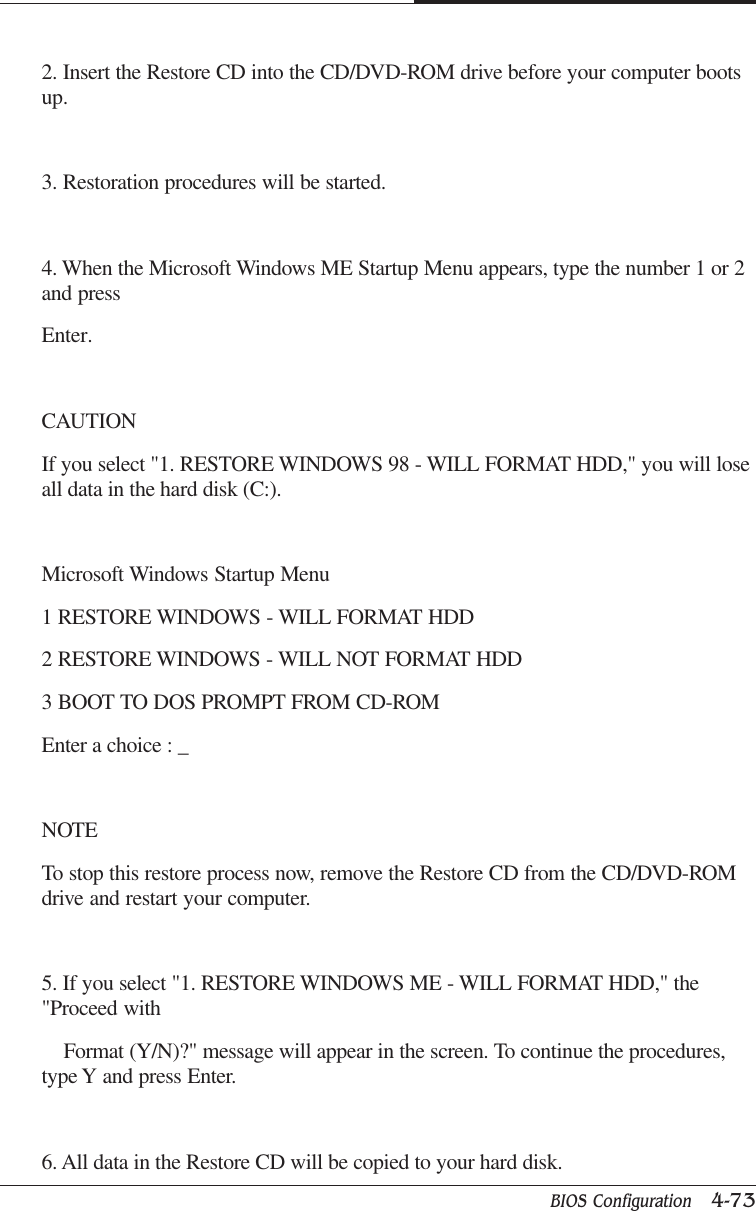
CAPTUER 44-72   BIOS Configuration. To restore all software including Windows ME.. To restore lost or destroyed drivers or application programs.Restoring Your Original SoftwareThe Restore CD contains a copy of all software (e.g., Windows ME, drivers, andapplication programs) originally preinstalled on your hard disk. (This process maytake about 20 minutes.)There are two ways to restore the software:. You can restore the software that came with your system without formatting thehard disk.WARNINGYou must reinstall any software not originally installed on your hard disk drive.. You can format the hard disk and then restore all original software.WARNINGIf you format your hard disk, you lose all data that added files, programs, or otherdata on your hard disk since you purchased your system. If you must reinstall anysoftware not originally installed on your hard disk and don’t want to lose yourpersonal data on your hard disk, copy it to diskettes before formatting.follow the below steps to restore your original preinstalled software.1. Turn on the computer.
BIOS Configuration   4-73CAPTUER 42. Insert the Restore CD into the CD/DVD-ROM drive before your computer bootsup.3. Restoration procedures will be started.4. When the Microsoft Windows ME Startup Menu appears, type the number 1 or 2and pressEnter.CAUTIONIf you select "1. RESTORE WINDOWS 98 - WILL FORMAT HDD," you will loseall data in the hard disk (C:).Microsoft Windows Startup Menu1 RESTORE WINDOWS - WILL FORMAT HDD2 RESTORE WINDOWS - WILL NOT FORMAT HDD3 BOOT TO DOS PROMPT FROM CD-ROMEnter a choice : _NOTETo stop this restore process now, remove the Restore CD from the CD/DVD-ROMdrive and restart your computer.5. If you select "1. RESTORE WINDOWS ME - WILL FORMAT HDD," the"Proceed with    Format (Y/N)?" message will appear in the screen. To continue the procedures,type Y and press Enter.6. All data in the Restore CD will be copied to your hard disk.
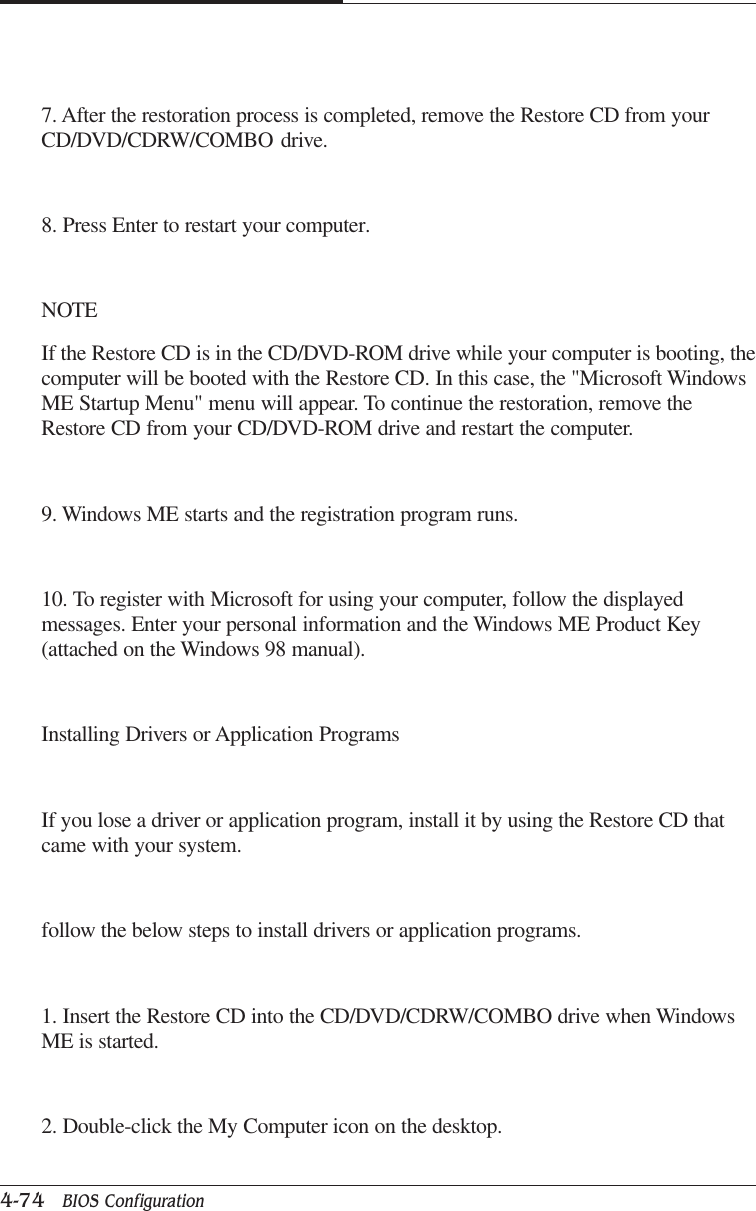
CAPTUER 44-74   BIOS Configuration7. After the restoration process is completed, remove the Restore CD from yourCD/DVD/CDRW/COMBO drive.8. Press Enter to restart your computer.NOTEIf the Restore CD is in the CD/DVD-ROM drive while your computer is booting, thecomputer will be booted with the Restore CD. In this case, the "Microsoft WindowsME Startup Menu" menu will appear. To continue the restoration, remove theRestore CD from your CD/DVD-ROM drive and restart the computer.9. Windows ME starts and the registration program runs.10. To register with Microsoft for using your computer, follow the displayedmessages. Enter your personal information and the Windows ME Product Key(attached on the Windows 98 manual).Installing Drivers or Application ProgramsIf you lose a driver or application program, install it by using the Restore CD thatcame with your system.follow the below steps to install drivers or application programs.1. Insert the Restore CD into the CD/DVD/CDRW/COMBO drive when WindowsME is started.2. Double-click the My Computer icon on the desktop.
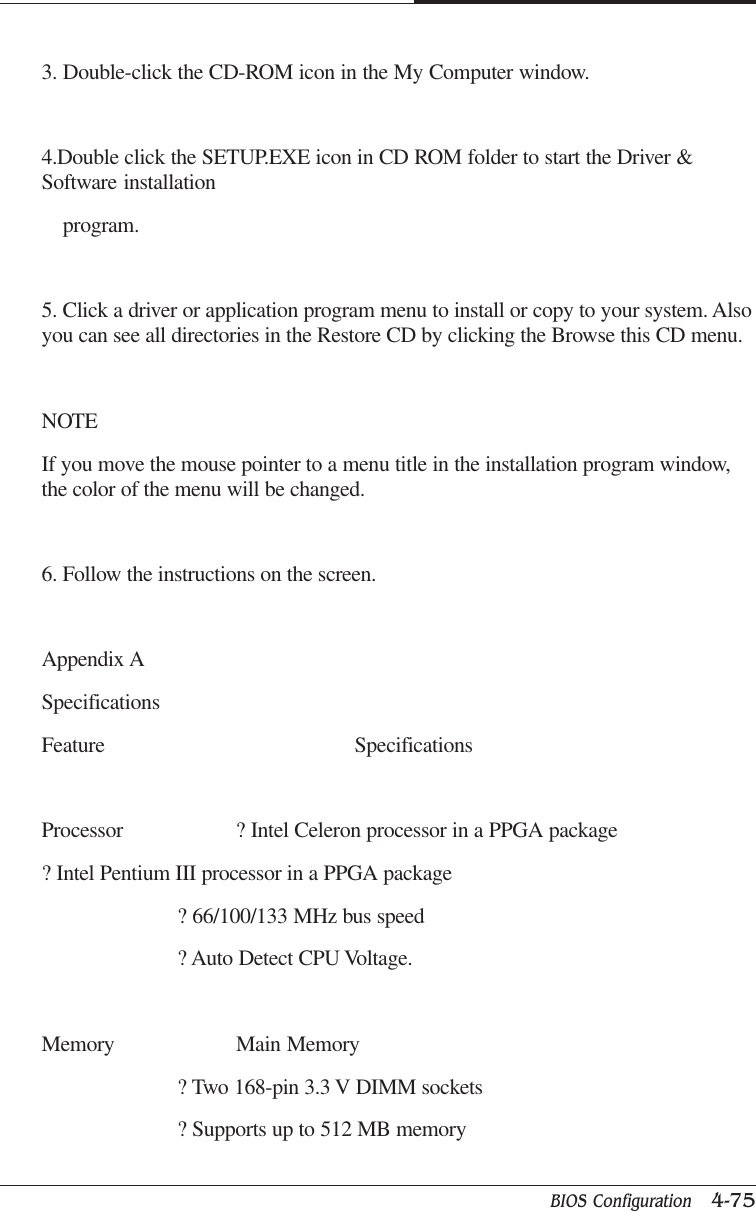
BIOS Configuration   4-75CAPTUER 43. Double-click the CD-ROM icon in the My Computer window.4.Double click the SETUP.EXE icon in CD ROM folder to start the Driver &Software installation    program.5. Click a driver or application program menu to install or copy to your system. Alsoyou can see all directories in the Restore CD by clicking the Browse this CD menu.NOTEIf you move the mouse pointer to a menu title in the installation program window,the color of the menu will be changed.6. Follow the instructions on the screen.Appendix ASpecificationsFeature SpecificationsProcessor ? Intel Celeron processor in a PPGA package? Intel Pentium III processor in a PPGA package? 66/100/133 MHz bus speed? Auto Detect CPU Voltage.Memory Main Memory? Two 168-pin 3.3 V DIMM sockets? Supports up to 512 MB memory
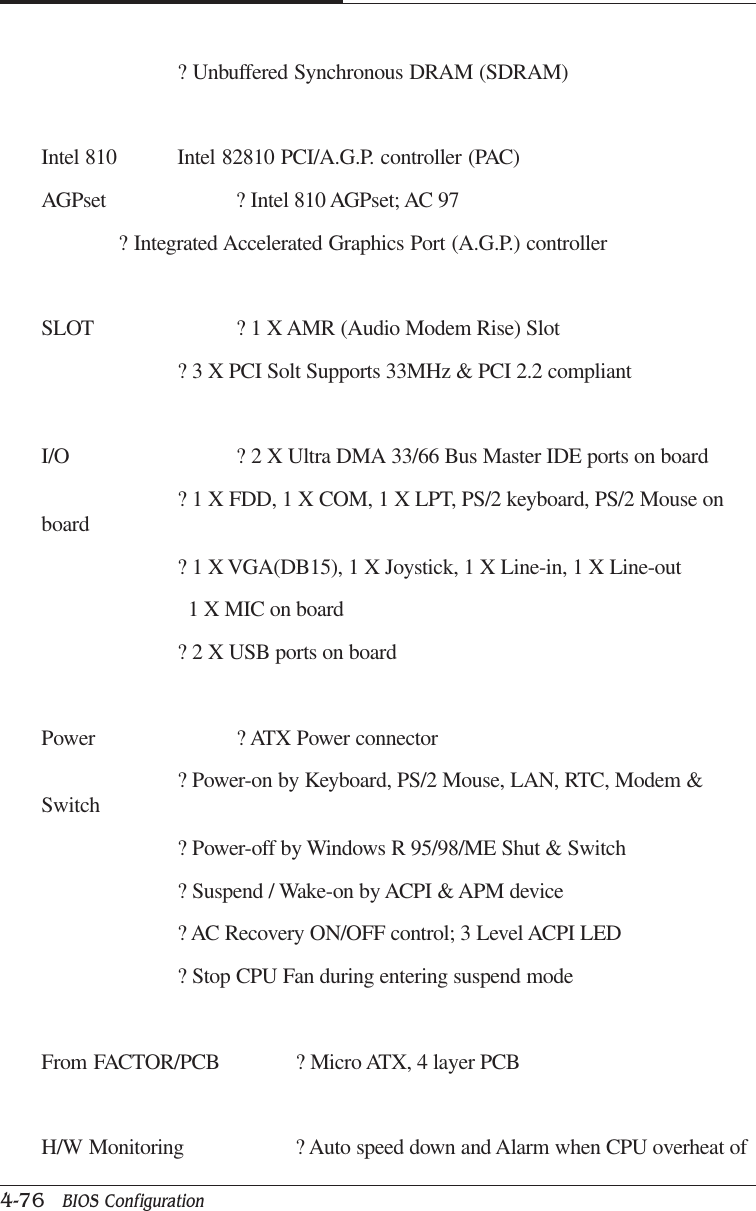
CAPTUER 44-76   BIOS Configuration? Unbuffered Synchronous DRAM (SDRAM)Intel 810 Intel 82810 PCI/A.G.P. controller (PAC)AGPset ? Intel 810 AGPset; AC 97? Integrated Accelerated Graphics Port (A.G.P.) controllerSLOT ? 1 X AMR (Audio Modem Rise) Slot? 3 X PCI Solt Supports 33MHz & PCI 2.2 compliantI/O ? 2 X Ultra DMA 33/66 Bus Master IDE ports on board? 1 X FDD, 1 X COM, 1 X LPT, PS/2 keyboard, PS/2 Mouse onboard? 1 X VGA(DB15), 1 X Joystick, 1 X Line-in, 1 X Line-out  1 X MIC on board? 2 X USB ports on boardPower ? ATX Power connector? Power-on by Keyboard, PS/2 Mouse, LAN, RTC, Modem &Switch? Power-off by Windows R 95/98/ME Shut & Switch? Suspend / Wake-on by ACPI & APM device? AC Recovery ON/OFF control; 3 Level ACPI LED? Stop CPU Fan during entering suspend modeFrom FACTOR/PCB ? Micro ATX, 4 layer PCBH/W Monitoring ? Auto speed down and Alarm when CPU overheat of
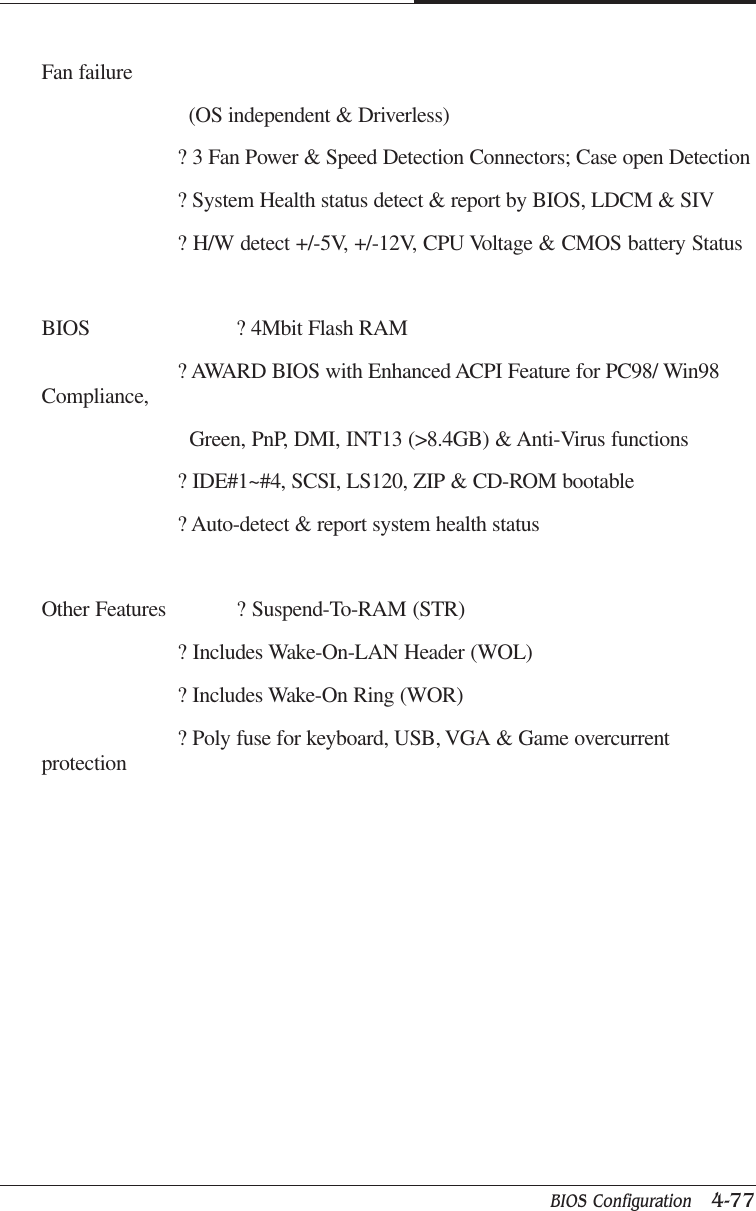
BIOS Configuration   4-77CAPTUER 4Fan failure  (OS independent & Driverless)? 3 Fan Power & Speed Detection Connectors; Case open Detection? System Health status detect & report by BIOS, LDCM & SIV? H/W detect +/-5V, +/-12V, CPU Voltage & CMOS battery StatusBIOS ? 4Mbit Flash RAM? AWARD BIOS with Enhanced ACPI Feature for PC98/ Win98Compliance,  Green, PnP, DMI, INT13 (>8.4GB) & Anti-Virus functions? IDE#1~#4, SCSI, LS120, ZIP & CD-ROM bootable? Auto-detect & report system health statusOther Features ? Suspend-To-RAM (STR)? Includes Wake-On-LAN Header (WOL)? Includes Wake-On Ring (WOR)? Poly fuse for keyboard, USB, VGA & Game overcurrentprotection
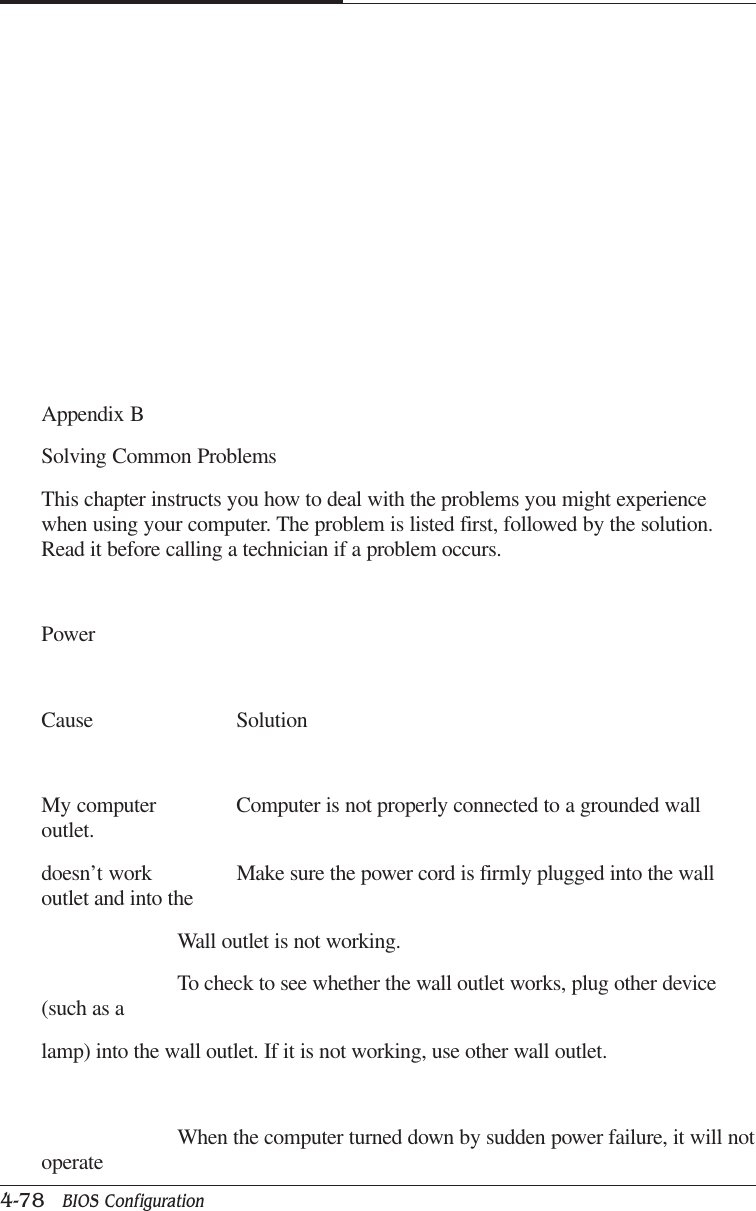
CAPTUER 44-78   BIOS ConfigurationAppendix BSolving Common ProblemsThis chapter instructs you how to deal with the problems you might experiencewhen using your computer. The problem is listed first, followed by the solution.Read it before calling a technician if a problem occurs.PowerCause SolutionMy computer Computer is not properly connected to a grounded walloutlet.doesn’t work Make sure the power cord is firmly plugged into the walloutlet and into theWall outlet is not working.To check to see whether the wall outlet works, plug other device(such as alamp) into the wall outlet. If it is not working, use other wall outlet.When the computer turned down by sudden power failure, it will notoperate
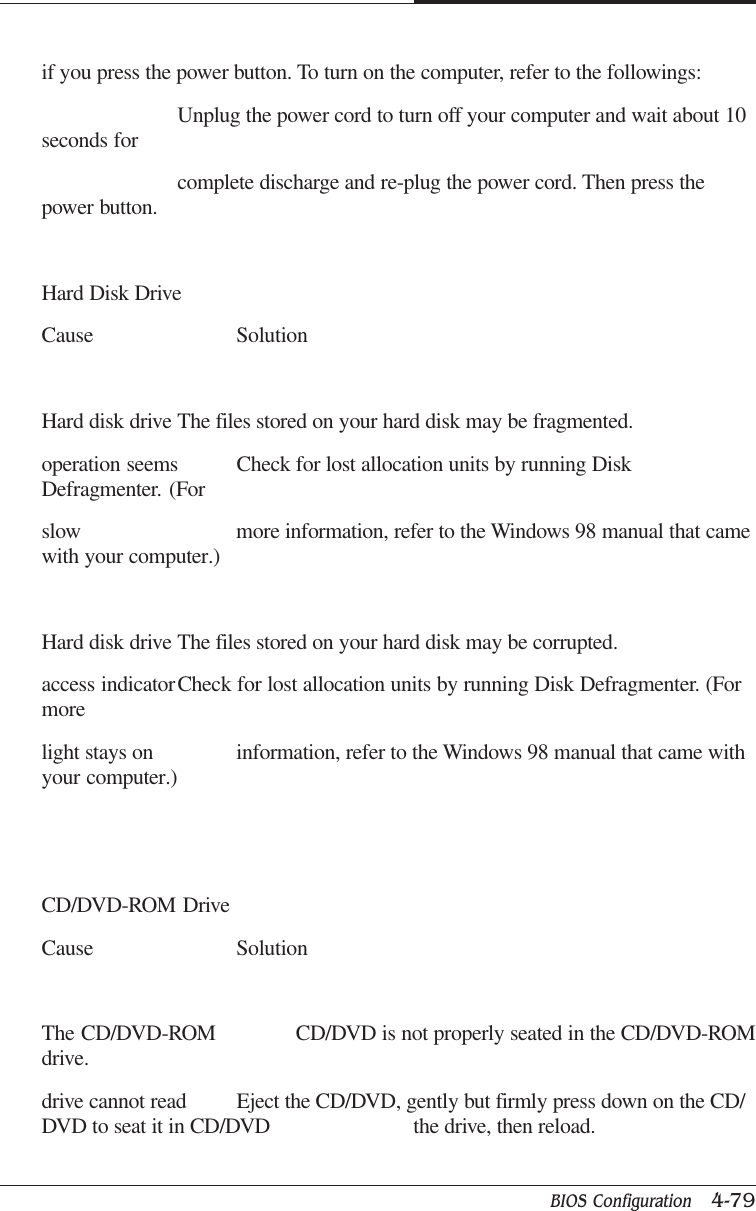
BIOS Configuration   4-79CAPTUER 4if you press the power button. To turn on the computer, refer to the followings:Unplug the power cord to turn off your computer and wait about 10seconds forcomplete discharge and re-plug the power cord. Then press thepower button.Hard Disk DriveCause SolutionHard disk drive The files stored on your hard disk may be fragmented.operation seems Check for lost allocation units by running DiskDefragmenter. (Forslow more information, refer to the Windows 98 manual that camewith your computer.)Hard disk drive The files stored on your hard disk may be corrupted.access indicatorCheck for lost allocation units by running Disk Defragmenter. (Formorelight stays on information, refer to the Windows 98 manual that came withyour computer.)CD/DVD-ROM DriveCause SolutionThe CD/DVD-ROM CD/DVD is not properly seated in the CD/DVD-ROMdrive.drive cannot read Eject the CD/DVD, gently but firmly press down on the CD/DVD to seat it in CD/DVD the drive, then reload.
CAPTUER 44-80   BIOS ConfigurationYour CD/DVD-ROM drive is not recognized.Turn off the computer, wait at least 30 seconds, and then turn on thecomputer.CD/DVD has been inserted upside down.Eject the CD/DVD, turn it over, then reload. (The label on the CD/DVD shouldbe facing up.)CD/DVD is dirty.Clean the CD/DVD with a CD/DVD cleaning kit (available incomputer stores).CD/DVD is defected.Try another CD/DVD. If it operates well, the CD/DVD is defected.How to use the CD/DVD-ROM drive in Real MS-DOS mode?If you reboot your computer by selecting "Restart in MS-DOSmode" option in"Shut Down Windows," you can use the CD/DVD-ROM drive.However, to use the CD/DVD-ROM drive in real MS-DOS mode,manually delete the"REM" of the line "REM Mscdex /d:gem001" in the AUTOEXEC.BAT file.<AUTOEXEC.BAT>...REM [CD-ROM DRIVE]Mscdex /d:gem001
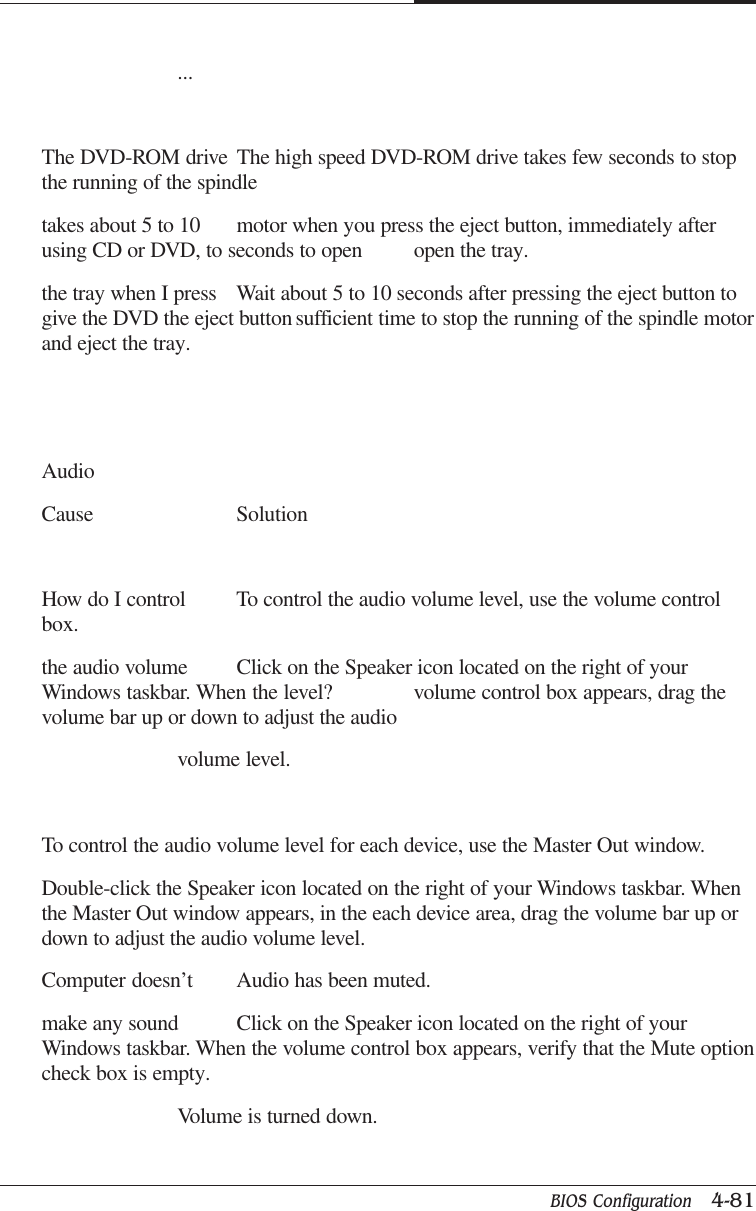
BIOS Configuration   4-81CAPTUER 4...The DVD-ROM drive The high speed DVD-ROM drive takes few seconds to stopthe running of the spindletakes about 5 to 10 motor when you press the eject button, immediately afterusing CD or DVD, to seconds to open open the tray.the tray when I press Wait about 5 to 10 seconds after pressing the eject button togive the DVD the eject button sufficient time to stop the running of the spindle motorand eject the tray.AudioCause SolutionHow do I control To control the audio volume level, use the volume controlbox.the audio volume Click on the Speaker icon located on the right of yourWindows taskbar. When the level? volume control box appears, drag thevolume bar up or down to adjust the audiovolume level.To control the audio volume level for each device, use the Master Out window.Double-click the Speaker icon located on the right of your Windows taskbar. Whenthe Master Out window appears, in the each device area, drag the volume bar up ordown to adjust the audio volume level.Computer doesn’t Audio has been muted.make any sound Click on the Speaker icon located on the right of yourWindows taskbar. When the volume control box appears, verify that the Mute optioncheck box is empty.Volume is turned down.
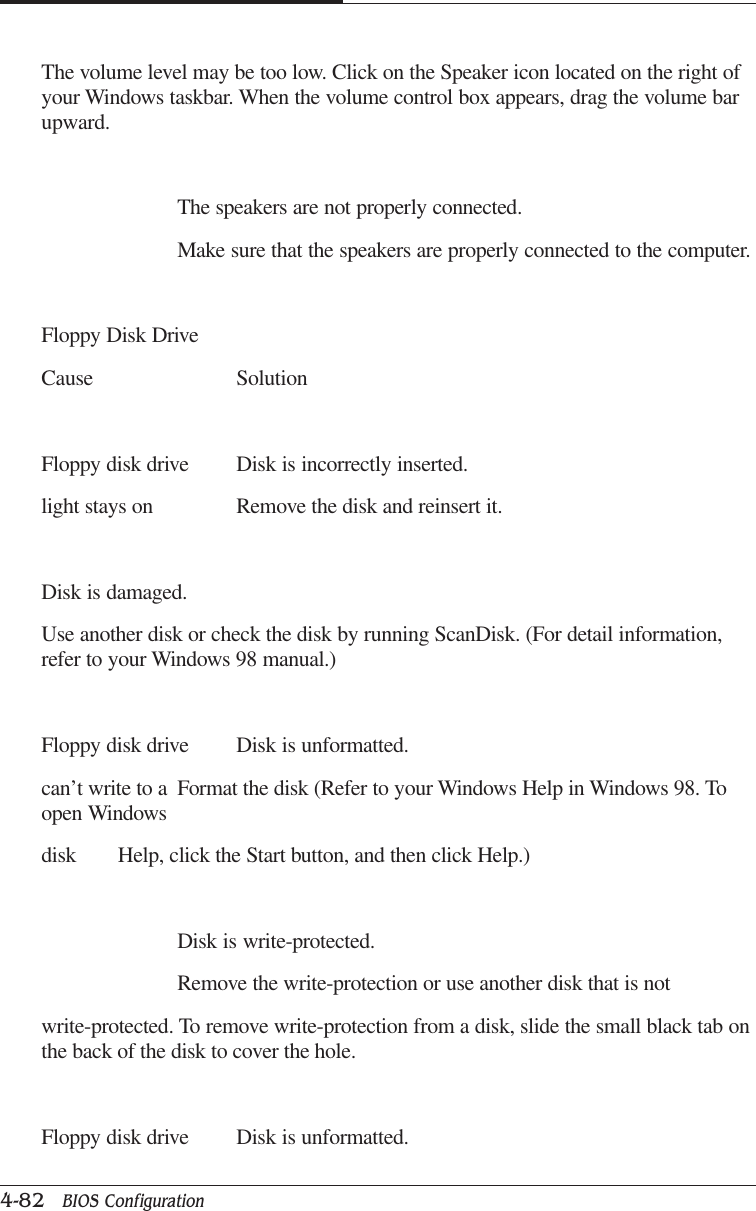
CAPTUER 44-82   BIOS ConfigurationThe volume level may be too low. Click on the Speaker icon located on the right ofyour Windows taskbar. When the volume control box appears, drag the volume barupward.The speakers are not properly connected.Make sure that the speakers are properly connected to the computer.Floppy Disk DriveCause SolutionFloppy disk drive Disk is incorrectly inserted.light stays on Remove the disk and reinsert it.Disk is damaged.Use another disk or check the disk by running ScanDisk. (For detail information,refer to your Windows 98 manual.)Floppy disk drive Disk is unformatted.can’t write to a Format the disk (Refer to your Windows Help in Windows 98. Toopen Windowsdisk Help, click the Start button, and then click Help.)Disk is write-protected.Remove the write-protection or use another disk that is notwrite-protected. To remove write-protection from a disk, slide the small black tab onthe back of the disk to cover the hole.Floppy disk drive Disk is unformatted.
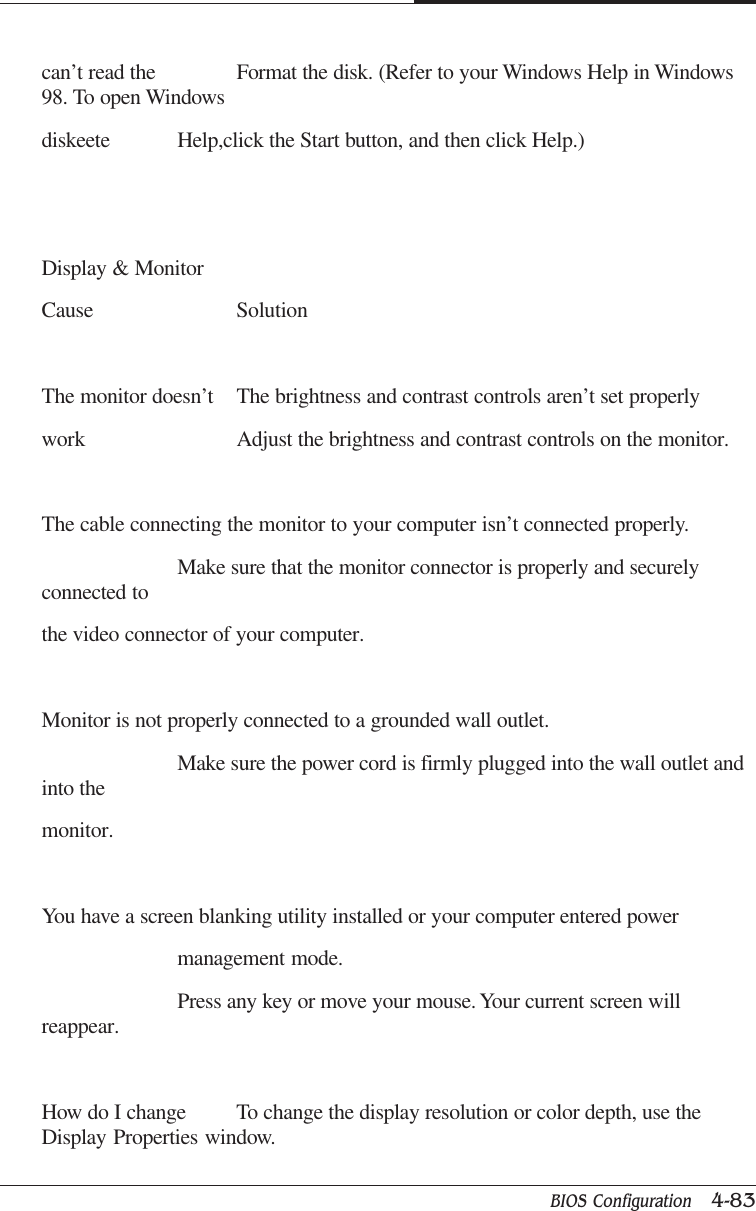
BIOS Configuration   4-83CAPTUER 4can’t read the Format the disk. (Refer to your Windows Help in Windows98. To open Windowsdiskeete Help,click the Start button, and then click Help.)Display & MonitorCause SolutionThe monitor doesn’t The brightness and contrast controls aren’t set properlywork Adjust the brightness and contrast controls on the monitor.The cable connecting the monitor to your computer isn’t connected properly.Make sure that the monitor connector is properly and securelyconnected tothe video connector of your computer.Monitor is not properly connected to a grounded wall outlet.Make sure the power cord is firmly plugged into the wall outlet andinto themonitor.You have a screen blanking utility installed or your computer entered powermanagement mode.Press any key or move your mouse. Your current screen willreappear.How do I change To change the display resolution or color depth, use theDisplay Properties window.
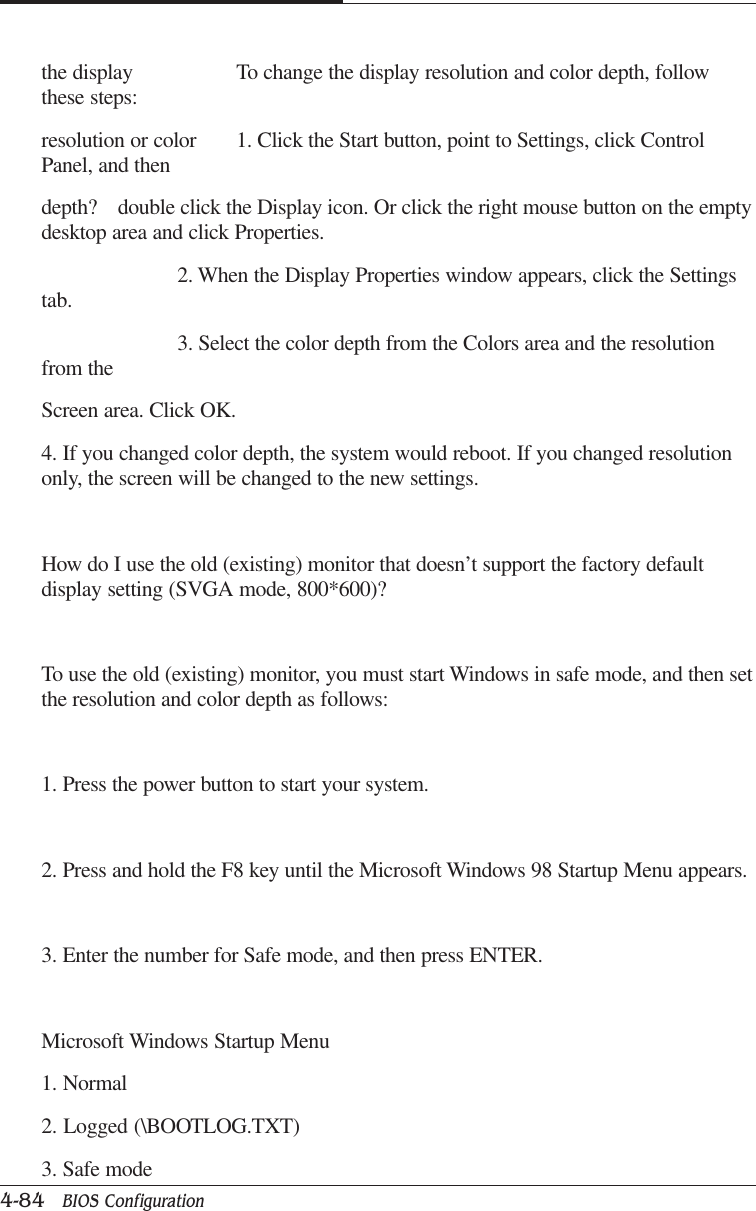
CAPTUER 44-84   BIOS Configurationthe display To change the display resolution and color depth, followthese steps:resolution or color 1. Click the Start button, point to Settings, click ControlPanel, and thendepth? double click the Display icon. Or click the right mouse button on the emptydesktop area and click Properties.2. When the Display Properties window appears, click the Settingstab.3. Select the color depth from the Colors area and the resolutionfrom theScreen area. Click OK.4. If you changed color depth, the system would reboot. If you changed resolutiononly, the screen will be changed to the new settings.How do I use the old (existing) monitor that doesn’t support the factory defaultdisplay setting (SVGA mode, 800*600)?To use the old (existing) monitor, you must start Windows in safe mode, and then setthe resolution and color depth as follows:1. Press the power button to start your system.2. Press and hold the F8 key until the Microsoft Windows 98 Startup Menu appears.3. Enter the number for Safe mode, and then press ENTER.Microsoft Windows Startup Menu1. Normal2. Logged (\BOOTLOG.TXT)3. Safe mode
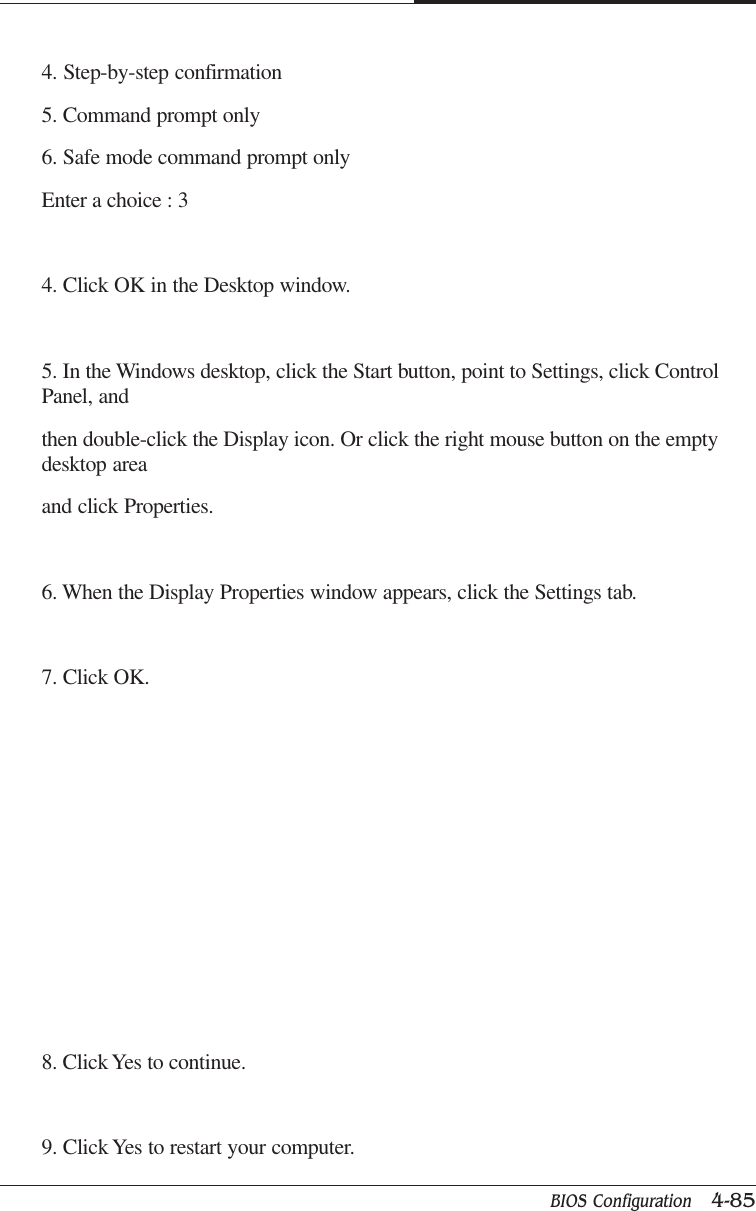
BIOS Configuration   4-85CAPTUER 44. Step-by-step confirmation5. Command prompt only6. Safe mode command prompt onlyEnter a choice : 34. Click OK in the Desktop window.5. In the Windows desktop, click the Start button, point to Settings, click ControlPanel, andthen double-click the Display icon. Or click the right mouse button on the emptydesktop areaand click Properties.6. When the Display Properties window appears, click the Settings tab.7. Click OK.8. Click Yes to continue.9. Click Yes to restart your computer.
CAPTUER 44-86   BIOS ConfigurationNOTEIn case your existing monitor supports higher resolutions or color depths than640*480 and 16 Colors, change the resolution and color depth after restarting.10. If the Windows screen doesn’t appear on the monitor after restarting, turn off thecomputer and follow these steps.11. Repeat the steps from 1 to 6.12. Click Advanced.13. Click the Adapter tab.14. Click Change.15. When the Update Device Driver Wizard window appears, click Next.16. Check the "Display a list of all the drivers in a specific location, so you can selectthe driver you want." option and click Next.17. Select the Display adapters item in the list box and click Next.18. Select the "Standard display types" menu in the Manufacturers list box andselect the model for your system in the Models list box. Then click Next.19. Click Yes.20. Click Next.
BIOS Configuration   4-87CAPTUER 421. Click Finish.22. Click Close.23. Click Close in the Display Properties window.24. Click Yes to continue.25. Click Yes to restart your computer.KeyboardCause SolutionKeyboard doesn’t Keyboard isn’t firmly or securely connected to the keyboardconnector.work Check that the keyboard is connected to the keyboardconnector on the backof your computer, not the mouse connector.MouseCause SolutionMouse doesn’t work Mouse isn’t firmly or securely connected to the mouseconnector.Check that the mouse is connected to the mouse connector on theback of your
CAPTUER 44-88   BIOS Configurationcomputer, not the keyboard connector.Mouse needs cleaning.To clean the mouse ball, remove the mouse ball by unscrewing the bottom of themouse. Then clean the mouse ball with a damp cloth and replace the mouse ball.Option CardCause SolutionAfter you add a PCI Your computer can’t recognize the option card.option card in the To recognize the option card, follow these steps:empty slot or 1. Click the Start button, and then point to Settings.change the slot 2. Click Control Panel.location of your PCI 3. Double-click the System icon.option card, your 4. Click the Device Manager tab in the System Propertieswindow.computer isn’t         5. Click the Refresh button. This option updates the hardwarelist. Thisworking properly        process may take a few minutes.
BIOS Configuration   4-89CAPTUER 4Appendix CApproval StatementsFCC Compliance StatementThis equipment has been tested and found to comply with the limits for a class Bdigital device, pursuant to Part 15 of the FCC Rules. These limits are designed toprovide reasonable protection against harmful interference in a residentialinstallation. This equipment generates, uses, and can radiate radio frequency energyand, if not installed and used in accordance with the instructions, may cause harmfulinterference to radio and television reception. However, there is no guarantee thatinterference will not occur in a particular installation. If this equipment does causeinterference to radio and television reception, which can be determined by turningthe equipment off and on, the user is encouraged to try to correct the interference byone or more of the following measures:* Reorient or relocate the receiving antenna.
CAPTUER 44-90   BIOS Configuration* Increase the separation between the equipment and receiver.* Connect the equipment into an outlet on a circuit different from that to which thereceiver is connected.* Consult the dealer or an experienced radio/TV technician for help.WarningThe connection of a non-shielded equipment interface cable to this equipment willinvalidate theFCC Certification of this device and may cause interference levels that exceed thelimits established by the FCC for this equipment. It is the responsibility of the userto obtain and use a shielded equipment interface cable with this device. If thisequipment has more than one interface connector, do not leave cables connected tounused interfaces.Changes or modifications not expressly approved by the manufacturer could void theuser’s authority to operate the equipment.For Canadian UsersThis digital apparatus does not exceed the Class B limits for radio noise emissionsfrom digital apparatus as set out in the radio interference regulations of the CanadianDepartment of Communications.Le present appareil numerique n’emet pas de bruits radio electriques depassant leslimitesapplicables aux appareils numeriques de Class B prescrites dans le reglement sur lebrouillageradio electrique edicte par le Ministere des Communications du Canada.
BIOS Configuration   4-91CAPTUER 4Battery Warning InstructionCautionIf battery is incorrectly replaced there poses a danger of explosion. Replace batteryonly with the same or equivalent type recommended by the manufacturer. Discardused batteries according to the manufacturer’s instructions.AttentionIl y a danger d’explosion s’il y a remplacement incorrect de la batterie. Remplaceruniquementavec une batterie du meme type ou d’un type recommande par le constructeur.Mettre au rebut lesbatteries usagees conformement aux instructions du fabricant.VorsichtExplosionsgefahr bei unsachgema©¬ em Austausch der Batterie. Ersatz nur durchdenselben odereinen vom Hersteller empfohlenen ahnlichen Typ. Entsorgung gebraushter BatteriennachAngaben des Herstellers.Fuse Warning InstructionCautionFor continued protection against risk of fire, replace only with same type and ratingof fuse.Disconnect input power before servicing. Only connect this equipment to an earthedsocket outlet.VorsichtVor jeder service-arbeit netzstecker ziehen! Apparatet ma kun tilkobles jordetstikkontakt.
CAPTUER 44-92   BIOS ConfigurationAttentionDebrancher avant d’ouvrir. Apparaten skall anslutas till jordat natuttag.AtencionDesconecte fuerza electrica antes del servicio. Laite on liitettavasuojakosketinistoraasian.Laser ProductClass 1 Laser ProductThis equipment complies with European Standard EN60825 [harmonized withInternationalElectrotechnical Commission (IEC) Publication 825].This equipment is classified as a Class 1 LASER product and there is no hazardousLASERradiation with the safety protection.CautionThe laser used in the CD-ROM drive can damage your eyes. Do not attempt to openthe cover.To reduce the risk of electric shock, do not remove cover (or back).No user-serviceable parts inside.Refer servicing to qualified service personnel.Use of controls or adjustments or performance of procedures other than thosespecified hereinmay result in hazardous radiation exposure.Do not open the top cover of the drive and never touch the internal parts in order toavoid EXPOSURE TO INVISIBLE LASER RADIATION.When the power switch is On, do not place your eyes close to the font panel opening
BIOS Configuration   4-93CAPTUER 4door and other openings to look into the inside of the drive.AchtungUm die Gefahr eines elektrischen Schlages zu Vermindem, Entfernen Sie nicht dasGehause.Keine durch den Anwender zu reparierende Teile im innern.Uberlassen Sie den Service qualifiziertem Service-Personal.Da der im CD-ROM Laufwerk benutzte Laser gefahrlich fur die Augen ist, solltenSie kenieswegsversuchen das Gehause zu Offnen.Lassen Sie den Service nur durch qualifizierte Servicestellen durchfuhern.AttentionPour reduire les risques de decharges, ne demontez pas le capot (ou le panneauarriere) du lecteur.Aucune des pieces internes ne doit etre manipulee par l’utilisateur.Toute interventien doit etre effectuee par un personnel qualifie.Le rayon laser utilise dans le lecteur CD-ROM est invisible a l’ceil nu. N’essayezdonc pas de demonter le boiter. Pour toute intervention, adressez-vous a unpersonnel qualifie.WarningTo reduce the risk of fire or electric shock, do not expose this appliance to rain ormoisture.AvertissementPour reduire les risques d’incendie ou de choc electrique, n’exposez pas cet appareila la pluie ou al’humidite.
CAPTUER 44-94   BIOS ConfigurationWanungUm die Gefahr eines Feuers oder eines elektrischen Schlages zu vermeiden, setzensie diesesGerat niemals Regen oder Feuchtigkeit aus.Use of controls or performance of procedures other than those specified herein mayresult inhazardous radiation exposure.

Navigation menu