Korea Data Systems Co KL1920BM 19" LCD MONITOR User Manual User s Manual H
Korea Data Systems Co Ltd 19" LCD MONITOR User s Manual H
USERS MANUAL

EUT Type: 19” LCD Monitor
FCC ID : EVOKL1920BM
Test Report No.: GETEC-E3-04-002
FCC Class B Certification
APPENDIX H
: USER’S MANUAL

LCD Monitor
User’s Guide
Models
KL1920BM

TABLE OF CONTENTS
INTRODUCTION
FCC Compliance Statement ………………………………… ⅰ
Safety Instructions ……………………………………………. ⅲ
General Information ………………………………………….. 1
Equipment Check list ………………………………………… 2
Monitor Features ……………………………………………… 3
GETTING STARTED
Installation ……………………………………………………… 4
Control Buttons ……………………………………………….. 6
On-Screen Display …………………………………………… 7
ON-SCREEN CONTROLS
Menu Descriptions …………………………………………… 8
REFERENCE
Power Management …………………………………………. 11
Timing Guide …………………………………………………. 12
Pin Assignment ………………………………………………. 13
Specifications ………………………………………………… 14
Troubleshooting ……………………………………………… 15

FCC COMPLIANCE STATEMENT
Note:
This equipment has been tested and found to comply with the limits for a
Class B digital device, pursuant to Part15 of FCC Rules. These llimits
Are designed to provide reasonable protection against radio frequency
Interference in a residential installation. This equipment generates, uses
And can radiate radio frequency energy. If not installed and used in
Accordance with the instructions, it may cause interference to radio
Communications. However,there is no guarantee that interference will
Not occur in a particular installation. If this equipment does cause
Interference to radio or television reception(this can be determined by
Turning this equipment off and on), the user is encouraged to try to
Correct the interference by one or more of the following measures:
•Reorient or relocate the receiving antenna.
•Increase the separation between the equipment and receiver.
•Connect the equipment to an outlet on a circuit different from that to
which the receiver is connected.
CAUTION TO THE USER:
The Federal Communications Commission warns that changes or
Modifications to the unit not expressly approved by the party responsible
For compliance could void the user’s authority to operate the equipment.
If necessary, the user should contact the dealer or an experienced
Radio/television technician for additional suggestions. The user may find
The Federal Communications Commission booklet, How to Identify and
Resolve Radio-TV Interference Problems, helpful. This booklet is
Available from the U.S.Government Printing Office, Washington, D.C.,
Stock No.004-000-00345-4.
NOTICE OF COMPLIANCE WITH CANADIAN
INTERFERENCE-CAUSING EQUIPMENT
REGULATIONS
INTRODUCTION
ⅰ

SAFETY INSTRUCTIONS
INTRODUCTION
■Handling
Due to its fragile glass panel, this monitor must be handled with
Caution and not be exposed to impact or shock.
Never touch the display area or rub it with a hard object or tool, as the
Panel is easily scratched.
■Cleaning
The display area is sensitive to scratching. Do not use ketone-type
Cleaners(i.e.acetone),ethyl alcohol, toluene, ethyl acid or methyl
Chloride to clean the panel. Doing so may result in permanent damage.
Water, IPA(Iso Prophyl Alcohol) and Hexane are safe cleaners.
Do not allow oil or water to penetrate the display, this will cause
Staining and discoloration.
Avoid getting food particles and fingerprints on the display area at all
Times.
■Storage
Store the monitor in a dark place away from sunlight and ultraviolet
(UV)radiation, this may cause air bubbles to develop within the
glass panel.
Do not store the display in temperatures higher than 40℃/104℉ or
Humidity greater than 90%. Avoid condensation.
ⅲ

SAFETY INSTRUCTIONS
INTRODUCTION
■Caution
1. Do not open any covers on the monitor. No user serviceable
parts are inside.
2. In an emergency, disconnect the AC power plug.
3. To avoid electrical shock, disconnect the power cord from the
monitor before connecting the signal cable to the computer.
4. Keep away from liquids and flame. Do not immerse this monitor
in water or any other liquid. Do not use this device in excessively
hot conditions.
5. Handle the power cord with care. Do not bend the power cord
excessively or place heavy objects on it. Do not use a damaged
power cord, doing so can result in fire or electrical shock hazards.
When disconnecting the power cord, always grasp the plug, not
the cord.
6. The liquid crystals in the display panel contain several irritants. If
the panel is damaged or broken, do not allow the liquid to come
in contact with skin, eyes, or mouth. If you come in contact with
the liquid, flush the affected area with running water for at least
15minutes, then consult a doctor.
7. Handle this monitor with care when moving it. When lifting the
monitor, support it with one hand holding the stand, and one
hand holding the LCD screen.
8. Always disconnect the power cord when moving this monitor.
9. Do not lay this monitor in a horizontal position when operating.
ⅳ

GENERAL INFORMATION
INTRODUCTION
Your new LCD monitor incorporates the latest state-of the art color Liquid
Crystal Display(LCD) technology providing a wider viewing angle with
Higher contrast ratio.
Your new LCD monitor has many advantages : safe from electromagnetic
Wave, llights, sharps and slims. This makes the monitor extremely
Suitable in the environment of administration, transportation system
Research, etc.
Your new LCD monitor is designed for Analog, Digital inputs.
Your new LCD monitor does not emit any X-ray radiation and the magnetic
Emission greatly reduces the eyestrain. Moreover, our On Screen
Controls on the side of the panel provide flexibility with simple controls.
You can use these controls to adjust the display as you desire.
Your new LCD monitor incorporates an active TFT module. It has a 1280
×1024 pixel resolution, high contrast, wide viewing angle and colors up
To 16.7M.
1
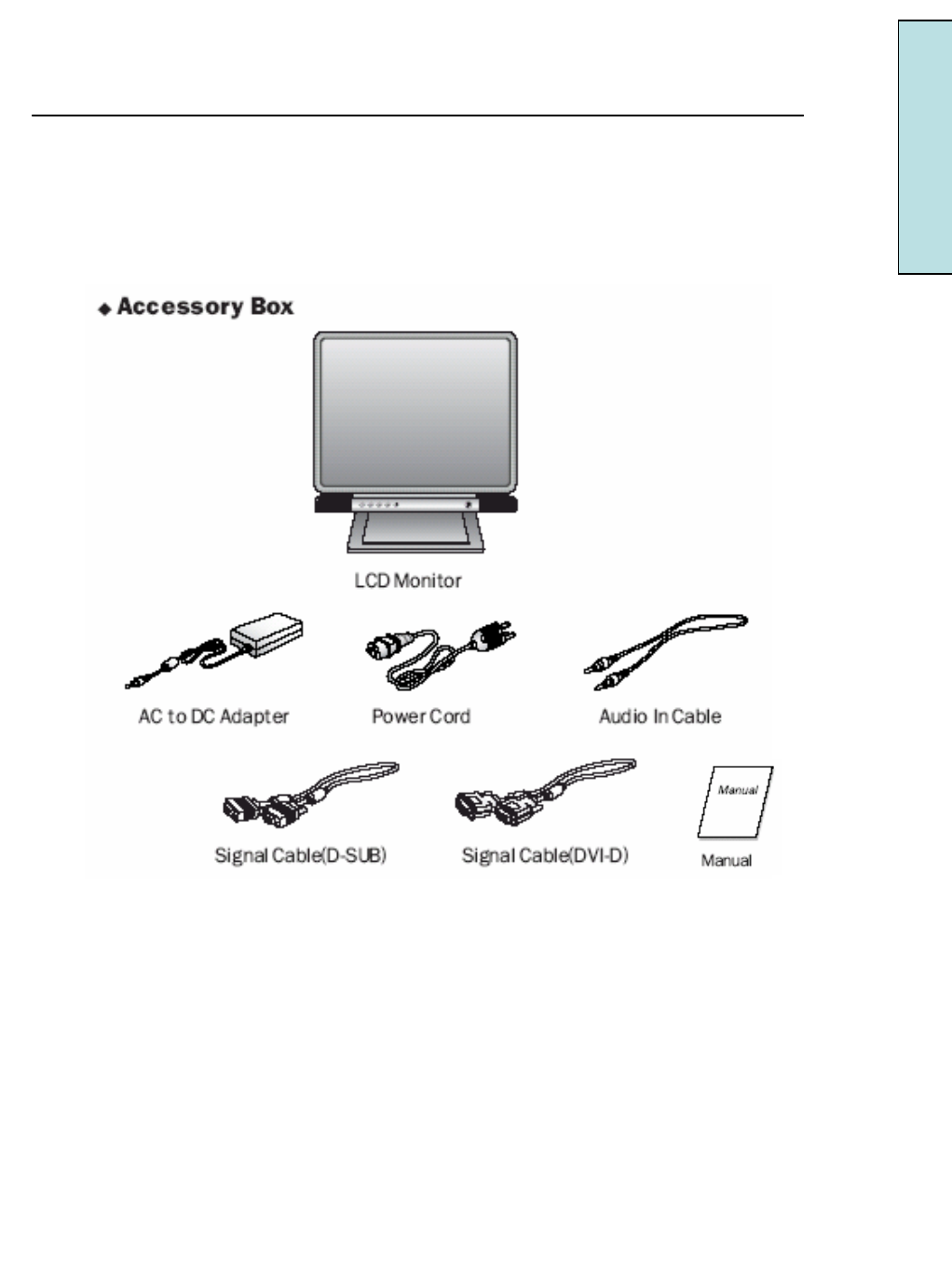
EQUIPMENT CHECK LIST
INTRODUCTION
◆ Power Requirements
The monitor is equipped with an auto-sensing power supply for voltage
Ranging from 100-120VAC/200-240VAC, 50/60Hz.
Confirm the power rating of the AC Source before you plug the AC
Cable to the wall outlet.
2
Before operating your display, please check to make sure that all of the
Items listed are present in your package :

MONITOR FEATURES
INTRODUCTION
•Supports Analog IBM compatible PC, Apple MacintoshTM(Adapter optional)
・ Supports DPMS for monitor power management
・ Support DDC2B
・ On Screen Control : Auto-Tuning, Contrast, Brightness, H/V Position, H-Size,
Phase, Auto-Level, Color Control, Sharpness, TEXT/MOVIE, OSD Position,
OSD Time-out, Power Save Delay, Language, Information.
・ Built-in color active matrix TFT(Thin Film Transistor) Liquid Crystal
Display(LCD) that uses amorphous silicon TFTs as a switching device.
・ Built-in Audio Amp. And internal Speaker : 2W+2W(at 1KHz)
・ Resolution : up to 1280 × 1024
・ Color : 16.7M Color support.
・ Pixel pitch : 0.294mm(H)×0.294mm(W).
•Scanning frequency : 30KHz ~ 80KHz(H), 55Hz ~ 75Hz(V).
•Universal power supply : AC100-240V allowed.
•Power consumption Normal : 50 Watt Max.
Off : 3 Watt Max.
・ Outside dimension : 438mm(W)×450.3mm(H)×211.9mm(D)
17.2”(W)×17.7”(H)×8.3”(D)
•Weight(net) : 7.0kg(15.4 lbs.)
3
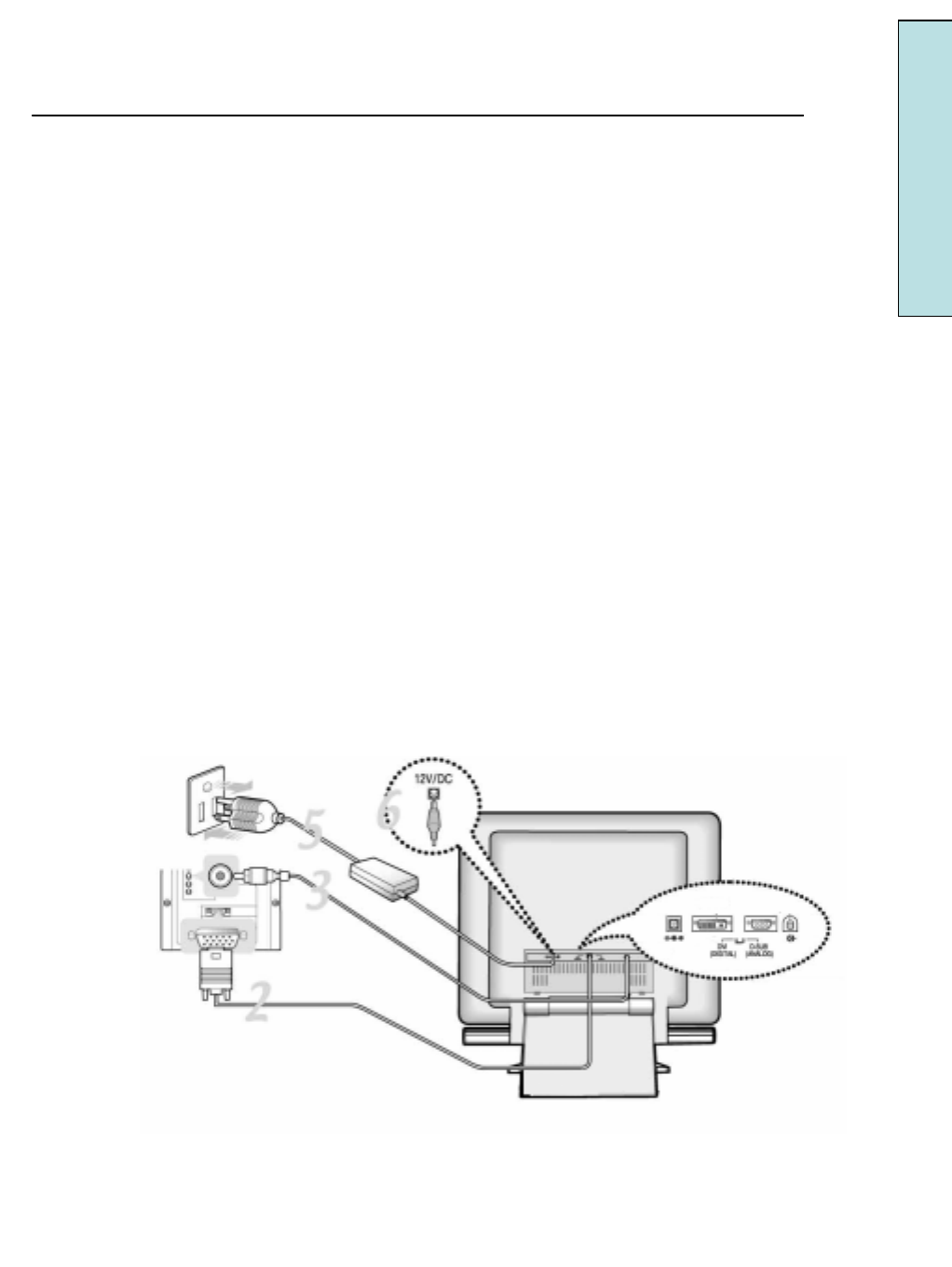
INSTALLATION
GETTING STARTED
◆ Follow these steps to install the monitor
1. Before you connect the cables, make sure the monitor and system
unit power switches turn off.
2. Plug the 15-pin D-SUB, 24-pin DVI signal cable between the rear of
your Monitor and system. The adapter may be required for certain
Apple Macintosh computers. Tighten the two screws on the cable
connector.
3. Plug the Audio Cable between Audio input Jack in the rear of your
monitor and audio output of your system.
4. Connect the power cord to the inlet socket which is located at the
AC Adapter. Connect the plug into an AC wall outlet.
5. Connect DC Plug of AC Adapter to the DC jack which is located at the
rear of your monitor
4

CONTROL BUTTONS
GETTING STARTED
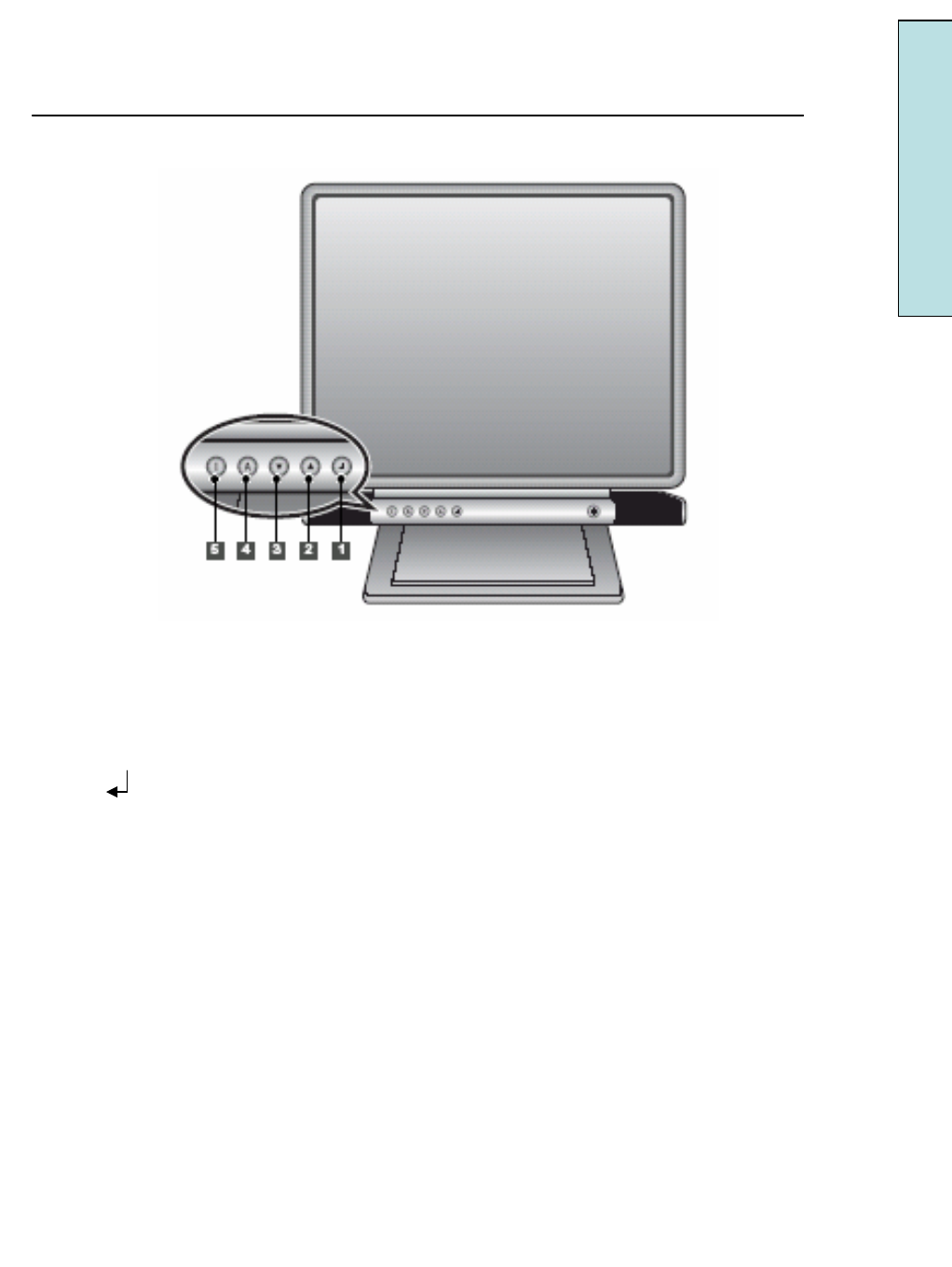
OSD Buttons : The OSD control keys are located on lower left of the
Monitor.
(Enter)
a. No OSD : This buttons will enable the main OSD menu.
b. Main OSD menu : Press this button to enter to the selected OSD
control menu.
c. Control OSD menu : Swap the control item.
▲ or ▼(Up/Down) : Use these buttons to increase or decrease each value.
a. No OSD :
- ▲ : Contrast & Brightness control menu will be shown. Press ‘‘
(Enter)to switch to another menu between Contrast and
Brightness.
- ▼ : Audio volume control menu will be shown.
b. Main OSD menu : Use these button to move up(or down)the OSD
selection menu and adjust the attribute of the monitor while in OSD
mode.
A (Auto)
a. No OSD : This button can be used to ‘Auto Adjustment’function.
(H,V-position, Size, Phase)
b. Main OSD menu : Press this button to exit from the main OSD menu.
c. Control OSD Menu : Return to the previous menu.
I (Select) : This button is not available when OSD menu is displayed.
a. No OSD :
- Pressing this button for 2 seconds out of OSD menu allows you to
select the text mode or movie mode.
- Pressing this button shortly out of OSD menu allows you to change
the video input signal either either D-SUB(Analog) or DVI(TMDS).
5
CONTROL BUTTONS
GETTING STARTED
Button Description :
1. :Display On Screen Control menu.
Access the control menu.
2. ▲:Move selected icon up to select one of the controls.
Increase the control value.
3. ▼:Move selected icon down to select one of the controls.
Decrease the control value.
4. A:Exit the On Screen Control.
Do Auto Tune function.
5. I :Select the Display mode.
Switch Text mode to Movie mode(Press this button for 2 seconds.)
Switch D-SUB(Analog) to DVI(Digital)(Press this button prompt.)
6

ON-SCREEN DISPLAY
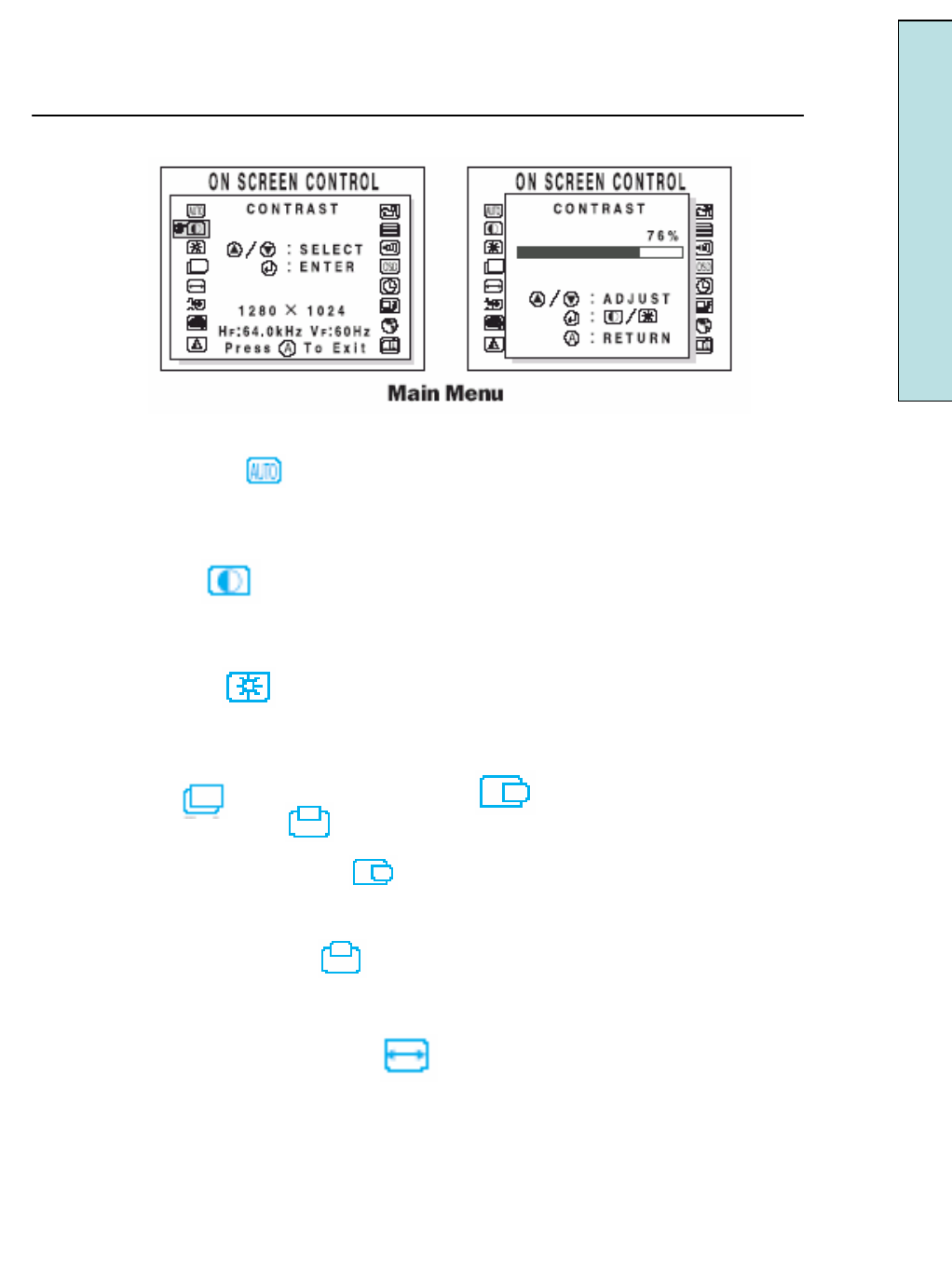
This LCD monitor features an On-Screen Display(OSD)menu. These
Icons are designed to make your monitor display settings easier. When
Highlighted, the icons illustrate the control function to assist you in
Identifying which control needs adjustment.
Before activating the OSD menu, the ‘A’button can be used to
Automatically adjust the display to the proper size and horizontal and
Vertical position.
The OSD menu activates automatically when you press the Enter button
on the lower left of the monitor. The OSD remains centered on the screen
while you make your adjustments. Use either the ‘▲’or ‘▼’button to move
the highlight to your selection. ‘A’submenu or control with a status bar
Will appear. The status bar indicates the direction which adjustments are
Being made. Use the ‘▲’or ‘▼’button to adjust the control.
The Audio Volume and contrast/brightness menu can also be adjusted by
simply pressing either the ‘▲’or ‘▼’buttons.
When you have finished making adjustments, press the ‘A’button to
Save setting and exit back to main menu.
7
GETTING STARTED
MENU DESCRIPTIONS
ON-SCREEN CONTROLS
8
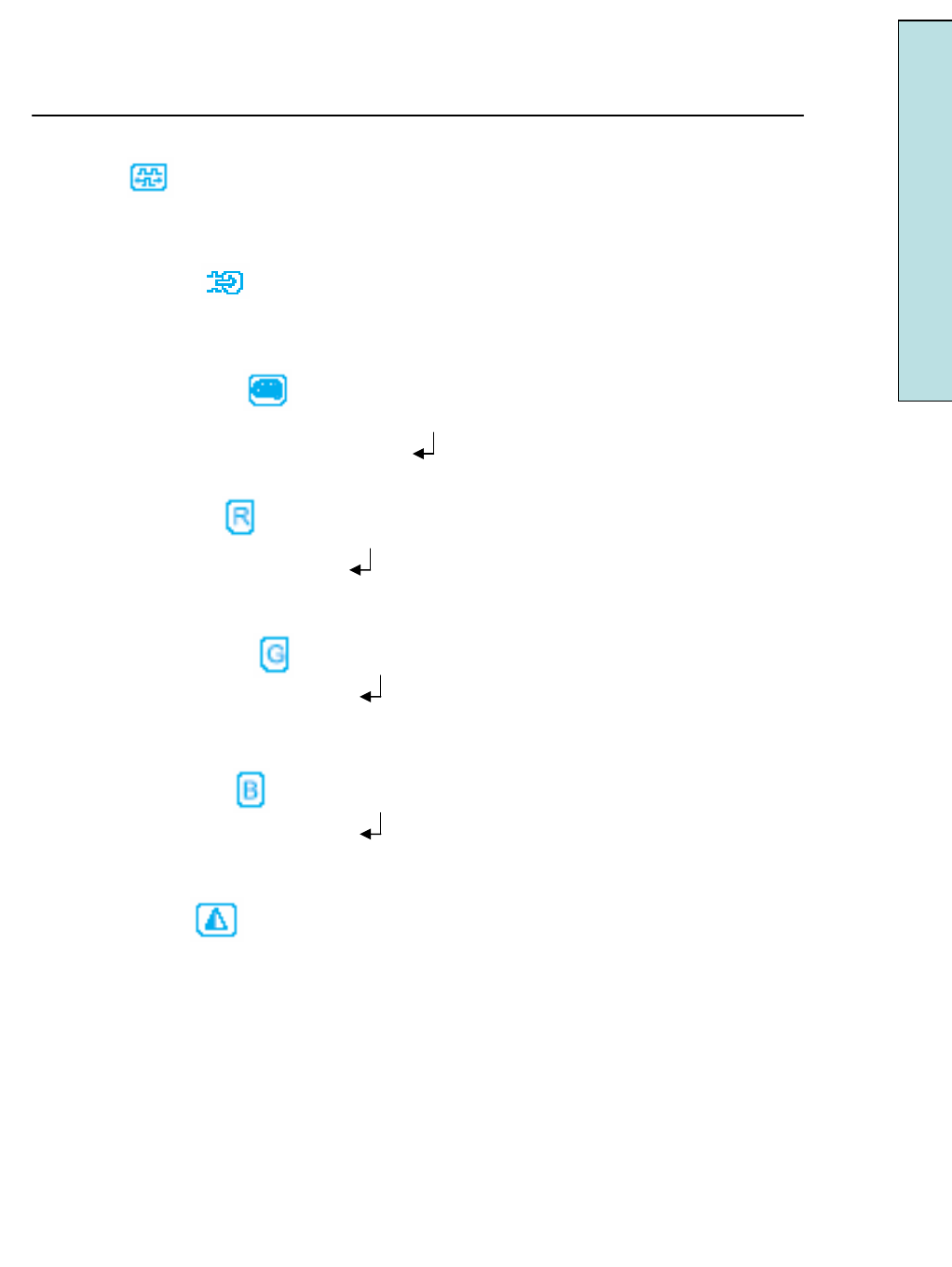
AUTO-TUNING
This control will automatically make adjustments to the horizontal and
vertical size, horizontal and vertical position,phase and color.
CONTRAST
This control allows you to make adjustments to the contrast of the display
screen.
BRIGHTNESS
Selecting this control menu allows you to make adjustments to the
luminosity level of the display screen.
POSITION (HORIZONTAL POSITION AND
VERTICAL POSITION )
HORIZONTAL POSITION
Select this control menu, and then use the ▲ and ▼ buttons to center
the image horizontally on the screen.
VERTICAL POSITION
Select this control menu, and then use the ▲ and ▼ buttons to center
the image vertically on the screen.
H-SIZE(HORIZONTAL SIZE)
Select this control menu, and then use the ▲ and ▼ buttons to expend or
decrease the image width to horizontally fill the display screen.
MENU DESCRIPTIONS
9
Phase
Select this control menu, and then use the ▲ and ▼ buttons to adjust the
screen image until it looks focused, crisp and sharp.
AUTO-LEVEL
This control will automatically make adjustment to the input levels of video
signal.
COLOR CONTROL
Select this control menu, then use the ▲ and ▼ buttons to scroll to the
desired color temperature. Use the button to select the 9300K, 6500K,
5500K, or USER for custom setting.
R-GAIN(RED)
Select “USER”then use the button to scroll up and down the RGB
menu to R(Red), Use the ▲ and ▼ buttons to adjust the red level of
the display.
G-GAIN(GREEN)
Select “USER”then use the button to scroll up and down the RGB
menu to G(Green), Use the ▲ and ▼ buttons to adjust the green level of
the display.
B-GAIN(BLUE)
Select “USER”then use the button to scroll up and down the RGB
menu to B(Blue), Use the ▲ and ▼ buttons to adjust the blue level of
the display.
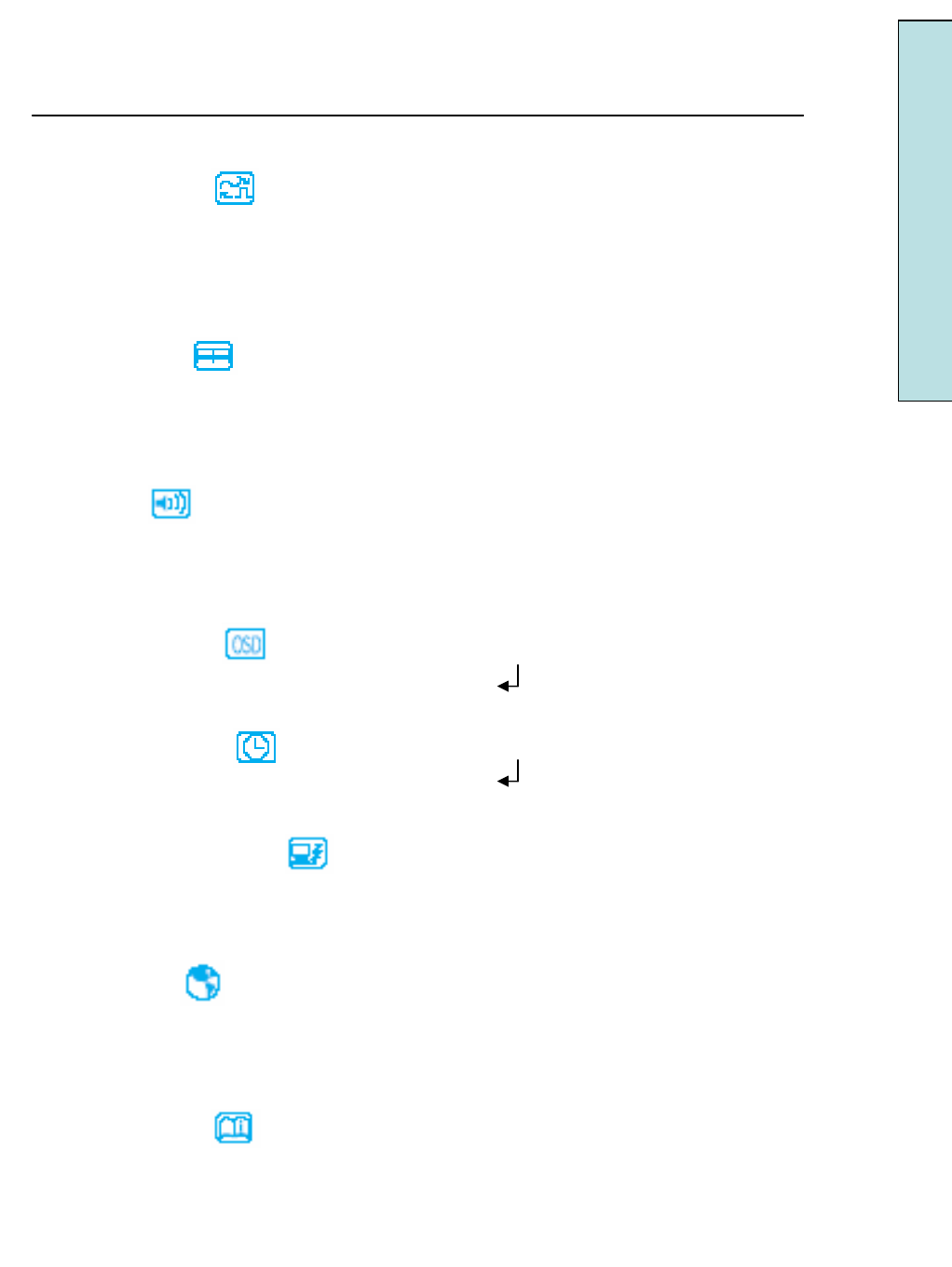
SHARPNESS
Select this control menu, and then use the ▲ and ▼ buttons to get distinct
picture in movie mode.
ON-SCREEN CONTROLS
MENU DESCRIPTIONS
10
INPUT SELECT
Select this control menu, and then use the ▲ and ▼ buttons to select proper
video input signal either D-SUB(Analog R,G,B)or DVI(TMDS).
Default setting is D-SUB.
This function can be used by hot key on the front of monitor
TEXT/MOVIE
Select this control menu, and then use the ▲ and ▼ buttons to select
proper image either text mode or movie mode.
Default setting is Text mode.
This function can be used by hot key on the front of monitor.
VOLUME
Select this control menu, and then use the ▲ and ▼ buttons to increase or
decrease audio sound level. This function can be used by hot key on the
front of monitor.
OSD POSITION
Select this control menu, and then use the button to select direction to
move the OSD menu. Use the ▲ and ▼ buttons to move the OSD menu.
OSD TIME-OUT
Select this control menu, and then use the button to select the duration
time for the OSD menu. Use the ▲ and ▼ buttons to select the time.
POWER SAVE DELAY
This feature directs the monitor to stay in the “ON”mode, even after the
computer goes into “sleep”mode. The user is able to select time of 5seconds,
1minute, 60minutes, or “OFF”for the display to appear on the monitor screen.
LANGUAGE
Select this control menu, and then use the ▲ and ▼ buttons to choose from
English(ENGLISH), German(DEUTSCH), Spanish(ESPANOL), Italian(ITALIANO)
or French(FRANCAIS).
INFORMATION
Select this menu allows you to confirm information of the display.
ON-SCREEN CONTROLS
POWER MANAGEMENT
REFERENCE
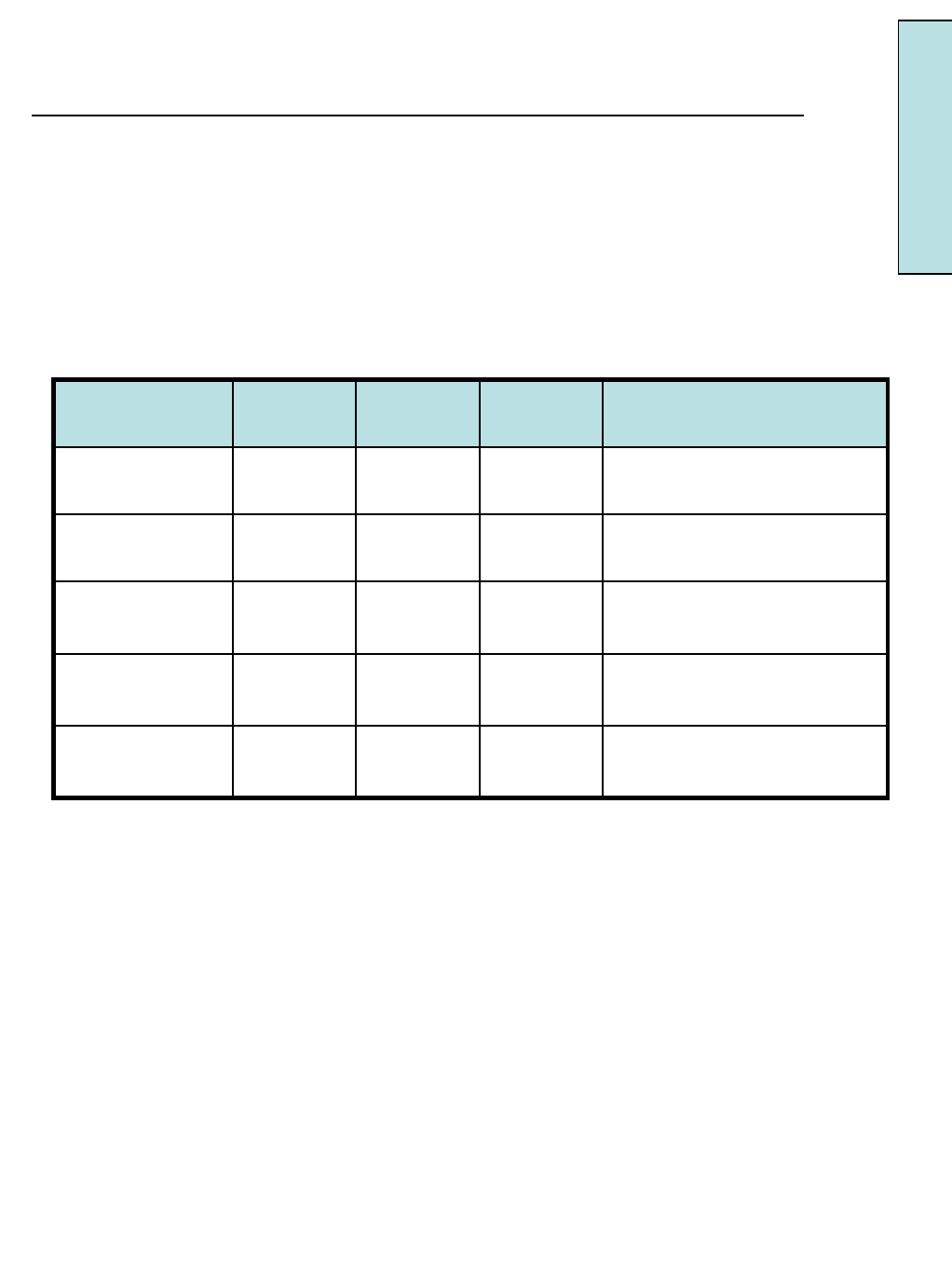
LED INDICATOR (POWER MANAGEMENT ACTIVE)
The power management feature is comprised of two stages : On or Out
Of Range(Blue), Off(Blue blinking).
In the off mode, all circuitry in the monitor is shut down, except for a low
power detection circuit. This circuit allows the monitor to wake up when
the mouse is moved or a key on the keyboard is pressed
Blue Light Blink
(ON 0.5sec/Off 1.0sec)
BlankedNo pulseNo pulseOff
Blue Light Blink
(ON 0.5sec/Off 1.0sec)
BlankedPulseNo PulseOff
Blue Light Blink
(ON 0.5sec/Off 1.0sec)
BlankedNo PulsePulseOff
BlueActivePulsePulseOut Of Range
BlueActivePulsePulseNormal
LED ColorVideoV-SyncH-SyncPower Mode
11
TIMING GUIDE
REFERENCE
12
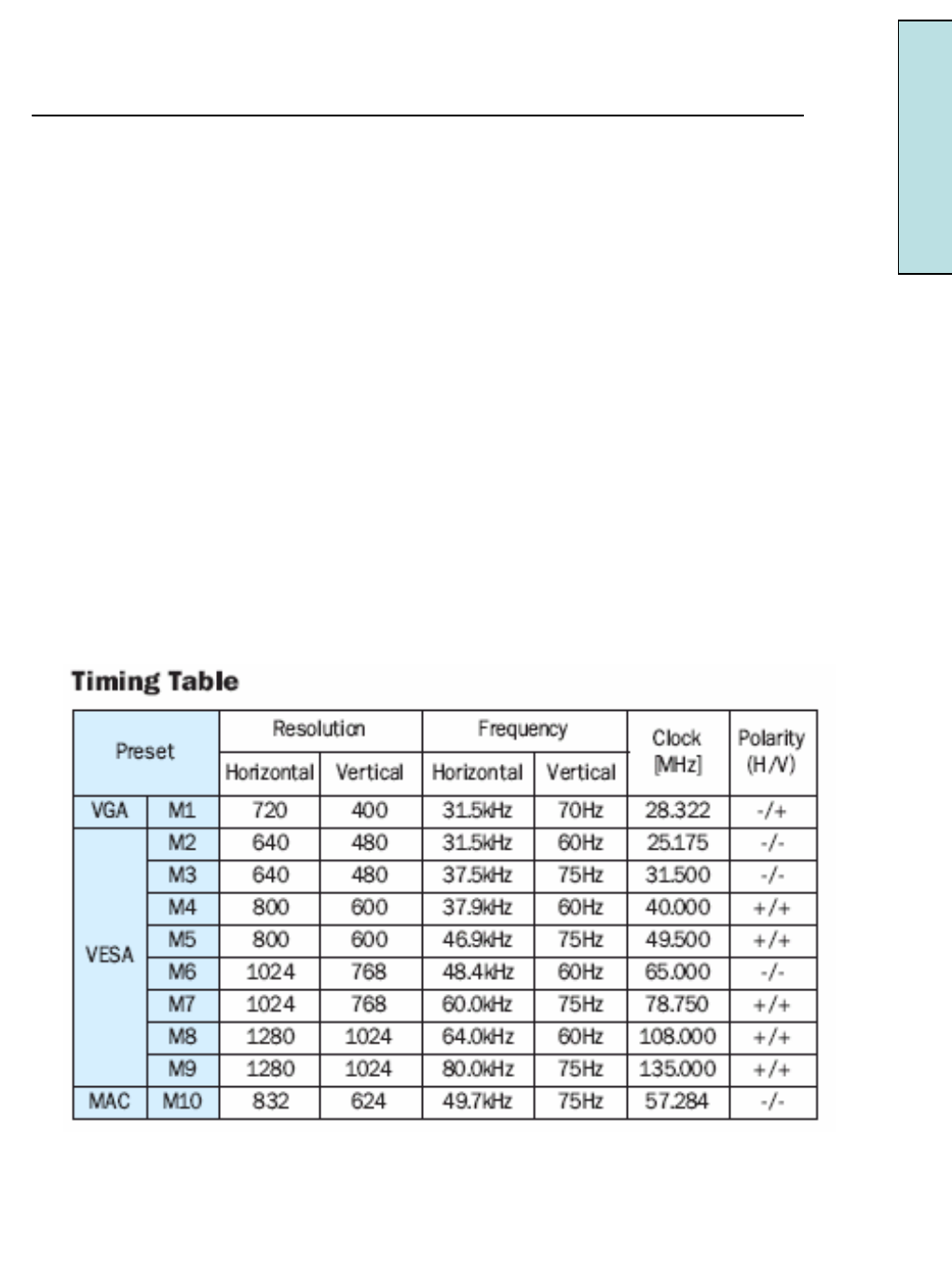
The LCD is a multi-frequency display. It operates at horizontal
frequencies between 30KHz-80KHz and vertical frequencies between
55Hz-75Hz. Because of its microprocessor-based design, it offers auto-
synchronization and auto-sizing capabilities. This monitor offers 10pre-
programmed settings that are listed in the following time table.
These preset modes cover most of the common video modes supported
by popular graphics adapters. However, each adapter’s implementation
of these video modes may vary slightly. If you find it necessary to make
minor display adjustments(for example, horizontal and vertical position),
please refer to the On Screen Display section of this manual for
instructions.
If you would like to use one of the preset timing modes, please refer to
your video card manufacturer’s installation guide for instructions on how
to make these changes. The video card controls the refresh rate. Most
Video cards provide a software utility or hardware DIP switches that
allows you to change the frequency used for each resolution.
Note;
* If you use a MacintoshTM, you may need a Mac adapter.
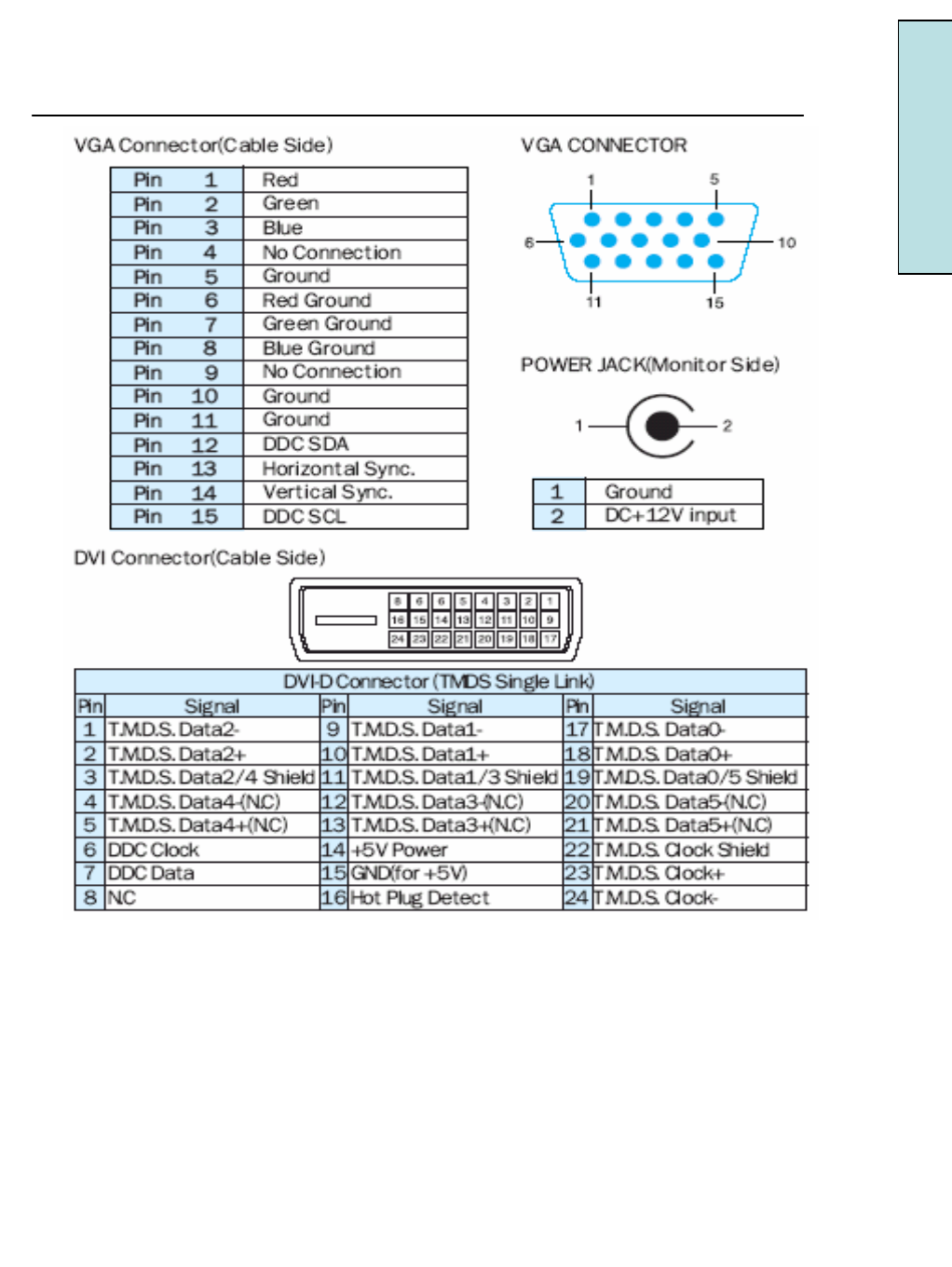
PIN ASSIGNMENT
Note:When resolutions are shown that are lower than the pixel count of the LCD panel,
text may appear choppy or bold. This is normal for all current flat panel technologies
when displaying non-native resolutions on a full screen(below than 1280×1024
resolution). In flat panel technologies, each dot on the screen is actually one pixel, so to
expand resolutions to full screen, an interpolation of the resolution must be down. When
the interpolated resolution is not an exact multiple of the native resolution, the
mathematical interpolation necessary may cause some lines to appear thicker than others.
13
REFERENCE
FCC COMPLIANCE STATEMENT
REFERENCE
14
7.0Kg(15.4lbs)NetWeight
438.0mm(W)×450.3mm(H)×211.9mm(D)
17.2”(W)×17.7”(H)×8.3”(D)
Dimension
-14℉ to 104℉(-20℃ to 40℃)
5%RH to 90%RH(no condensation)
Temperature
Humidity
Storage
Conditions
376.32mm(H)×301.056mm(V)Max.Display Area
AC 100-240V 50-60Hz
DC12V
50 watts(Maximum)
Input
Output
Consumption
Power
1280×1024@75Hz
(60Hz for optimal display)
Max.Refresh Rate
IBM XT,AT,386,486,Pentium or
PS/2 and compatibles(from VGA and DVI
Up to 1280×1024@75Hz)
PCCompatibility
500:1Typ.Contrast Ratio
85o/ 85o
85o/ 85o
Left/Right
Up/Down
Viewing
Angles
32℉ to 104℉(0℃ to 40℃)
20%RH to 80%RH(no condensation)
To 10,000feet
Temperature
Humidity
Altitude
Operating
15-pin D-SUB, 24-pin DVI
Jack Type DC+12V In
Stereo input
Input Signal
Power
Audio
Connectors
250cd/m2
Typ.
Luminance of
White
19”diagonal viewable screen
TFT(Thin Film Transistor), Active
Matrix Panel, 0.294×0.294mm pixel pitch
R,G,B vertical stripe
16.7M
Type
Color Filter
Colors
Glass
surface
LCD

TROUBLESHOOTING
◆ No power
•Flip the power switch ON. The Power LED turns on.
•Make sure AC power cord is securely connected to a power outlet.
◆ Power on but no screen image.
•Make sure the video cable attached with this monitor is tightly
secured to the video output port on the back of the computer.
•Adjust the brightness and contrast.
◆ Image is unstable, unfocused.
•Use “AUTO-TUNE”to adjust automatically.
•If the image is still unstable after “AUTO-TUNE”processing,
please adjust “PHASE”manually to get image focused.
•Check whether the resolution or refresh rate in windows display setting
is beyond supported range(please refer to the specification
of supported mode).
◆Flickering
•Not enough power is being supplied to the LCD Monitor.
Connect the LCD Monitor to a different outlet. If a surge
protector is being used, there may be too many devices plugged in.
•See Timing Guide in this manual with a list of refresh rates and
frequency settings showing the recommended setting for the LCD
Monitor
◆ Wrong or abnormal colors.
•If any colors(Red, Green, or Blue) are missing, check the video
cable to make sure it is securely connected. Loose pins in the
cable connector could cause a bad connection.
REFERENCE
15
TROUBLESHOOTING
INTRODUCTION
•Connect the LCD Monitor to another computer.
•Check the graphics card for proper sync scheme(or sync
polarities) to match the LCD Monitor’s specifications
◆Double (split) screen image.
•Make sure your graphics card is set to Non-Interlaced mode.
◆Entire screen image rolls (scrolls) vertically.
•Make sure the input signals are within the LCD monitor’s specified
frequency range.
(Maximum:VESA, MAC1280×102475Hz)
•Connect the video cable securely.
•Try the this Monitor with another power source.
◆Control buttons do not work.
•Press only one button at a time.
◆No Sound
•Make Sure the audio cable is properly connected between this monitor
and your system.
•Check the audio volume of this monitor and your system.
ABOUT THE LCD
The LCD contains over 2,359,296 thin-film transistors(TFTs).
A small number of missing, discolored, or lighted dots on the screen is an
Intrinsic characteristic of TFT LCD technology and is not an LCD defect.
If you display a fixed pattern for more than 10hours, its image may remain on
The screen in overlap mode when you display something else.
16