LIFI LABS LIFX03 LCM User Manual
LIFI LABS INC LCM
User manual

Lighting Connectivity Module
(LCM) Modular Certification -
User Manual / OEM Integrator
Instructions
Publication Number: LIFX03N12
Ver. 1.0
February 23, 2015
DRAFT
Confidential and Proprietary – LIFI LABS INC. (LIFX)
Not to be used, copied, reproduced in whole or in part, nor its contents revealed in any manner
to others without the express written permission of LIFI LABS INC.
LIFX is registered trademark of LIFI LABS INC.
Any other registered and unregistered trademarks are the property of LIFI LABS INC. or their
respective owners and used with permission.
Registered marks owned by LIFI LABS INC. are registered in the United States of America and
may be registered in other countries.
This technical data may be subject to U.S. and international export, re-export, or transfer
(“export”) laws. Diversion contrary to U.S. and international law is strictly prohibited.
LIFI LABS INC.
524 Union St #309
San Francisco, CA, 94133
United States of America
Copyright © 2015 LIFI LABS INC.
All rights reserved.
LIFX03N12 Ver. 1.0 1 Confidential and Proprietary – LIFI LABS INC.

Revision History
Revision
Date
Description
Ver. 1.0
Feb. 23, 2015
Initial release
NOTE: The Lighting Connectivity Module (LCM) (the “Module”) is designed for use only in
specific countries in which LIFI LABS INC. has obtained certificates of compliance with local
laws and regulations. Therefore, the Module may not be sold, operated or incorporated into
products for use in countries for which it has not been certified.
See Section 3 herein.
In addition, any deviation from the settings, methods, conditions and restrictions for integration
of the Module into a host system, as detailed in this document, could be a violation of
applicable national law and may be punishable as such, and in such event, the products into
which the Module is incorporated may not be lawfully distributed or sold in such countries. LIFI
LABS INC. assumes no responsibility for any liability or loss related to installation, integration
or operation of the Module.
LIFX03N12 Ver. 1.0 2 Confidential and Proprietary – LIFI LABS INC.

Contents
Revision History
Contents
1. Introduction
2. Applicable Module
3. Available Global Modular Approvals from LIFI LABS INC.
4. Additional Regulatory Conformance Testing and/or Submissions
Required by the Integrator
5. Compliant/Allowable Tx Power Settings Programmed into
EEPROM
6. Allowable Antennas to Use with the Radio Module
7. Antenna Placement inside the Host System and RF Safety
8. Mandatory Host Platform RF Exposure Review
9. Module May Not Be Installed by End Users
10. Required Labeling on the Outside of the Host
10.1 FCC
10.2. European Community R&TTE
10.3. Taiwan NCC
10.4. Korea KCC
10.5. Japan MIC
10.6. China SRRC
10.7. Australia RCM
11. Required Regulatory Wording for User Manual/Installation Manual
11.1. FCC compliance information
11.2. Industry Canada notice
11.3. European Community (R&TTE) user manual wording and
declaration
11.4. European Community (R&TTE) Declaration of Conformity for
System
11.5. Taiwan user manual wording
11.6. Korea user manual wording
11. OEM Configuration
12. OEM Integrator Checklist
LIFX03N12 Ver. 1.0 3 Confidential and Proprietary – LIFI LABS INC.

1. Introduction
This document describes the steps that the OEM integrator must follow when designing and
manufacturing a system utilizing a Lighting Connectivity Module (LCM) (the “Module”).
Failure to follow the instructions in this document may invalidate the FCC certification and
authorization of the Module for use in the U.S. and in other countries.
The LIFI LABS INC. modular certifications described in this document apply only to radio
conformance for the Module. The OEM integrator is responsible for all system-level EMI/EMC
and Product Safety testing and certification that apply to the host system in the U.S. and other
countries where the system will be marketed or sold.
2. Applicable Module
Part Number: LCM1V4T
FCC ID: 2AA53-LIFX03
IC ID: 11475A-LIFX03
3. Available Global Modular Approvals from LIFI LABS
INC.
Module certification is limited to those countries for which LIFI LABS INC. has obtained radio
modular approvals. Integrators can access the current list of certified countries at the following
link:
http://lifx.com/lcm/certification
OEM integrators must receive their own radio certification for any country in which the system
will be sold if a modular certification for that country is not available from LIFI LABS INC.
LIFX03N12 Ver. 1.0 4 Confidential and Proprietary – LIFI LABS INC.

4. Additional Regulatory Conformance Testing and/or
Submissions Required by the Integrator
The global modular certifications apply to radio conformance for the Module only.
The OEM integrator is responsible for additional system-level EMI/EMC and Product Safety
testing and certification that applies in the U.S. and other countries to the host system
containing the Module. This includes, but is not limited to, Federal Communications
Commission (“FCC”) Part 15 Class B Digital Emissions, China CCC, Taiwan BSMI, Korea KC,
ETSI EN 301 489-17 and others. These system-level EMC tests are to be done with the Module
installed and included in the scope of the submission.
Some of the countries for which modular certifications are provided require additional
submissions, authorizations or import permission by the system-vendor or importer. The
integrator is responsible for these additional actions.
For example, the OEM integrator must take additional action for radio certification in these
countries:
Country
Additional Action
Malaysia
Each importer/distributor needs to file for import permission
Singapore
Recommend use of importer’s own local radio dealer number
Israel
Additional approval certificate required for importer
Indonesia
Certificate B is required for each importer
China
Modular approval not accepted. Requires system approval
Brazil
Tablets require system level SAR evaluation and submission to
Anatel.
Philippines
Modular approval not accepted. Requires system approval
Vietnam
Modular approval not accepted. Requires system approval
Modular radio certification is not possible in some countries. For such countries, OEM
integrators must ensure radio certification for the end system is obtained, before placing the
product on the market.
A current list of applicable countries can be provided by LIFI LABS INC. at the following link:
http://lifx.com/lcm/certification
Please contact LIFI LABS INC. at hello@lifx.co if you have questions about the additional
regulatory conformance testing and/or related submissions.
LIFX03N12 Ver. 1.0 5 Confidential and Proprietary – LIFI LABS INC.

5. Compliant/Allowable Tx Power Settings
Programmed into EEPROM
The following link lists the allowable transmit power settings that are to be programmed into
the Module during original manufacturing:
http://lifx.com/lcm/certification
NOTE: Programming in higher values than provided for in this link will invalidate all radio
certifications for this Module.
6. Allowable Antennas to Use with the Radio Module
The declared max antenna gain for the Module is:
1 dBi
There is no restriction for antenna types for this product, when host platform is designed with
greater than 20 cm separation distance between antenna and user.
When antenna to user separation distance is from 1.3cm-20cm, only PIFA antenna may be
used in host platform design.
Note: Using transmit power settings in host products that have antennas with declared gain
exceeding 1 dBi. stated above will invalidate all radio certificates for this module.
Contact LIFI LABS INC. at hello@lifx.co for additional guidance if you decide to use higher gain
antennas in the end system.
In addition, regulatory agencies in Japan, Korea, and Taiwan require submission of antenna
specification sheets for all antenna models used with the LCM module. This notification
process must be followed by the integrator before the original product is launched and
whenever new host systems (with new antenna models) are launched.
Please submit antenna specifications to: hello@lifx.co
LIFX03N12 Ver. 1.0 6 Confidential and Proprietary – LIFI LABS INC.

7. Antenna Placement inside the Host System and RF
Safety
The FCC and other national regulatory bodies impose strict conditions and limitations on the
RF exposure levels of end products.
Acceptable RF exposure levels for this Module depend on transmit power, the location of the
transmitting antenna(s) inside the host system, the expected separation of the transmitting
antennas to the end user, as well as if there is/are collocated RF transmitter(s) in the same host
system.
OEM integrators must ensure each host system complies with the applicable RF exposure
requirements.
8. Mandatory Host Platform RF Exposure Review
The FCC imposes conditions and limitations when additional radio(s) are co-located in the
same host system as the Module with capability to transmit simultaneously.
The detailed rules from the FCC are described in various Knowledge Database publications
that may be found using the instructions below. Co-locating other radios such as an integrated
or plug in Wireless WAN/cellular radio with the Module requires additional evaluation and
possibly submission for authorization from the FCC.
Because the rules are highly dependent on the characteristics of the particular radios that are
co-located and simultaneously transmitting, the OEM integrator should seek guidance from a
knowledgeable test lab or consultant to determine if additional testing and FCC certification is
required.
In this case, failure to evaluate and follow the required FCC procedures will invalidate the FCC
certification of the Module and end system.
To download the FCC rules for collocated radios:
1. https://apps.fcc.gov/oetcf/kdb/index.cfm
2. Enter 996369 in the ‘publication number’ search box
3. Download latest applicable version of 996369 document.
For expert advice regarding collocation rules, we recommend you contact an FCC-approved
Telecommunication Certification Body (“TCB”)::
1. https://apps.fcc.gov/oetcf/kdb/index.cfm
2. Choose your country and or state from the pull-down list.
3. Scroll through the search results and choose a TCB contact from which to seek advice.
To ensure total compliance of RF exposure requirements, LIFI LABS INC. requires that all its
OEM customers submit their host platforms integrated with LCM for Host Platform RF
Exposure Assessment under a LIFI LABS INC. established program.
All host platform must be submitted to a LIFI LABS INC. designated third party lab for
professional assessment to determine if the host system is in compliance of RF exposure
requirements or if it will need to undergo further SAR test and class II permissive change
approvals before it can be placed onto the US and Canada market.
For training on the Host Platform RF Exposure Assessment Program, please contact:
hello@lifx.co
LIFX03N12 Ver. 1.0 7 Confidential and Proprietary – LIFI LABS INC.

For host platform assessment, make host platform submission to: hello@lifx.co
9. Module May Not Be Installed by End Users
FCC rules require this Module to be installed in host systems at the factory by the OEM
integrator. Thus, end users of the system may not install the Module. Therefore, the host
product user instructions must not advise the end user on how to access or remove the
Module. Additional FCC authorization/filing is needed to allow end user installation of radio
modules.
10. Required Labeling on the Outside of the Host
NOTE: Explanatory text in red font must not be included in the final label.
10.1 FCC
The FCC requires a label on the outside of the host system visible to the end user. Example
wording is:
Contains:
FCC ID: XXXXXXXXXX
IC: XXXXXXXXXXX
(Replace X’s with actual IDs found in Section 2).
The FCC requires a logo signifying emissions compliance on the outside of the host system.
Additional options are available for placement of the FCC label on the host. Please refer to the
FCC Knowledge Database KDB 784748 found at https://apps.fcc.gov/oetcf/kdb/index.cfm.
NOTE: The Integrator is responsible to perform FCC Part 15 Class B digital emissions testing
on the end system with the radio Module installed. The FCC logo below should not be affixed
unless the OEM integrator has obtained the necessary Part 15 approval, e.g., self-declaration
of conformity.
If the host system is approved to FCC Class B digital emissions limits under a grant of
certification issued by a TCB, the FCC ID number shown on the grant should be used on the
label instead of the FCC logo below.
LIFX03N12 Ver. 1.0 8 Confidential and Proprietary – LIFI LABS INC.
FCC ID:2AA53-LIFX03
The OEM manual must provide clear instructions explaining to the OEM the labelling requirements, options
and OEM user manual instructions that are required
For a host using a this FCC certified modular with a standard fixed label, if (1) the module's FCC ID is not
visible when installed in the host, or (2) if the host is marketed so that end users do not have straightforward
commonly used methods for access to remove the module so that the FCC ID of the module is visible; then an
additional permanent label referring to the enclosed module:
“Contains Transmitter Module FCC ID: 2AA53-LIFX03 or “Contains FCC ID: 2AA53-LIFX03 ” must be
used. The host OEM user manual must also contain clear instructions on how end users can find and/or access
the module and the FCC ID.
Host product is required to comply with all applicable FCC equipment authorizations regulations,
requirements and equipment functions not associated with the transmitter module portion. compliance must be
demonstrated to regulations for other transmitter components within the host product; to requirements for
unintentional radiators (Part 15B). To ensure compliance with all non-transmitter functions the host
manufacturer is responsible for ensuring compliance with the module(s) installed and fully operational. If a
host was previously authorized as an unintentional radiator under the Declaration of Conformity procedure
without a transmitter certified module and a module is added, the host manufacturer is responsible for
ensuring that the after the module is installed and operational the host continues to be compliant with the Part
15B unintentional radiator requirements. Since this may depend on the details of how the module is integrated
with
the host, we suggest the host device to recertify part 15B to ensure complete compliance with FCC requirement:
Part 2 Subpart J Equipment Authorization Procedures , KDB784748 D01 v07, and KDB 997198 about
importation of radio frequency devices into the United States.
10.2. European Community R&TTE
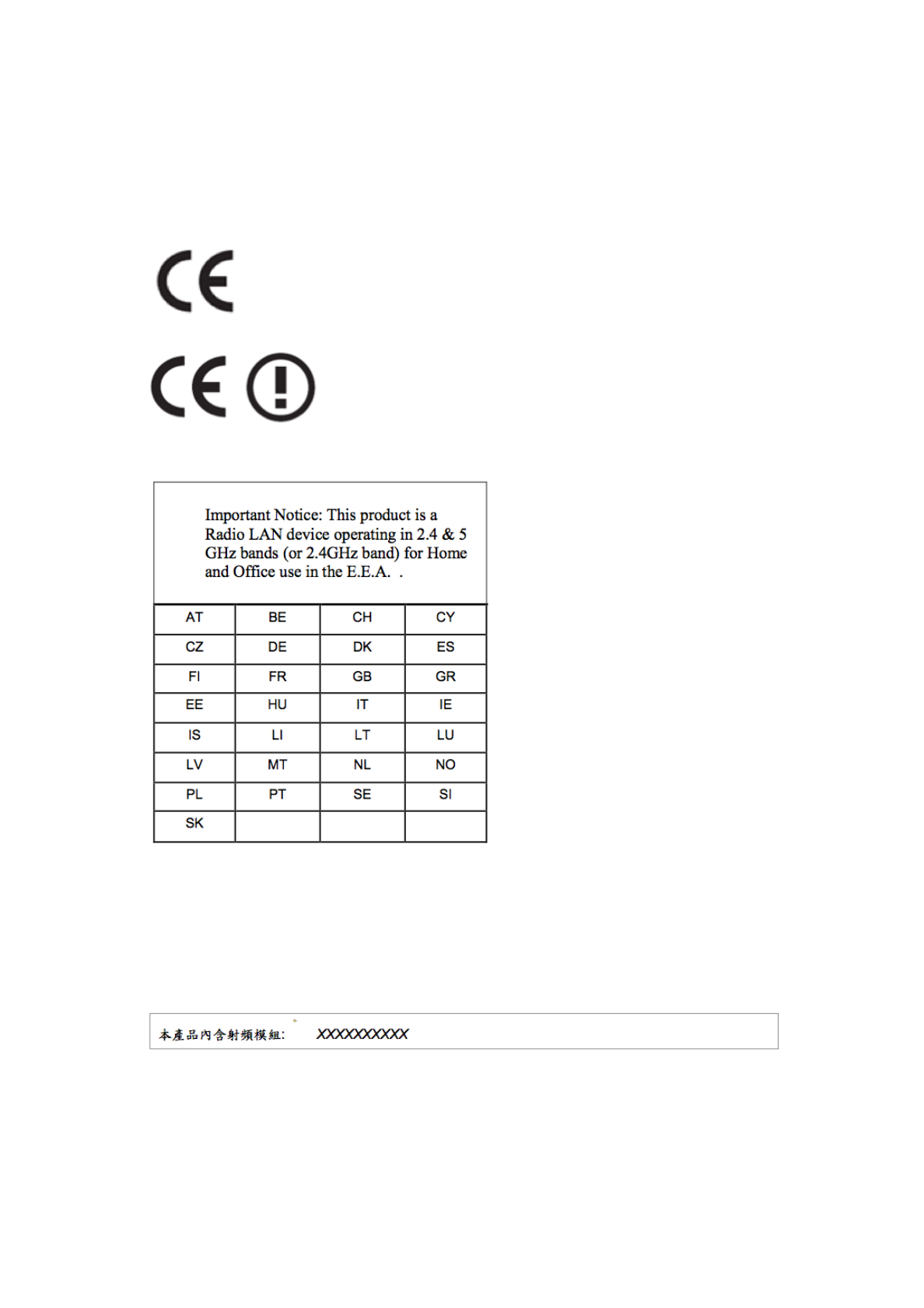
The European Community R&TTE Directive requires the CE Marking shown below on the
outside of the host AND on the outside of the shipping container/packaging:
For 2.4GHz
For 5 GHz or 2.4GHz = 5GHz dual bands
The European Community R&TTE Directive also requires the following note to consumers on
the outside of the shipping container/packaging:
NOTE: The Integrator is expected to translate the text in this Section into the appropriate local
languages for the European countries in which the product will be marketed or sold.
10.3. Taiwan NCC
Taiwan NCC requires a label on the outside of the host system visible to the end user. The
required wording is:
(Replace X’s with actual IDs found in section 2).
10.4. Korea KCC
10.5. Japan MIC
LIFX03N12 Ver. 1.0 9 Confidential and Proprietary – LIFI LABS INC.
10.6. China SRRC
10.7. Australia RCM
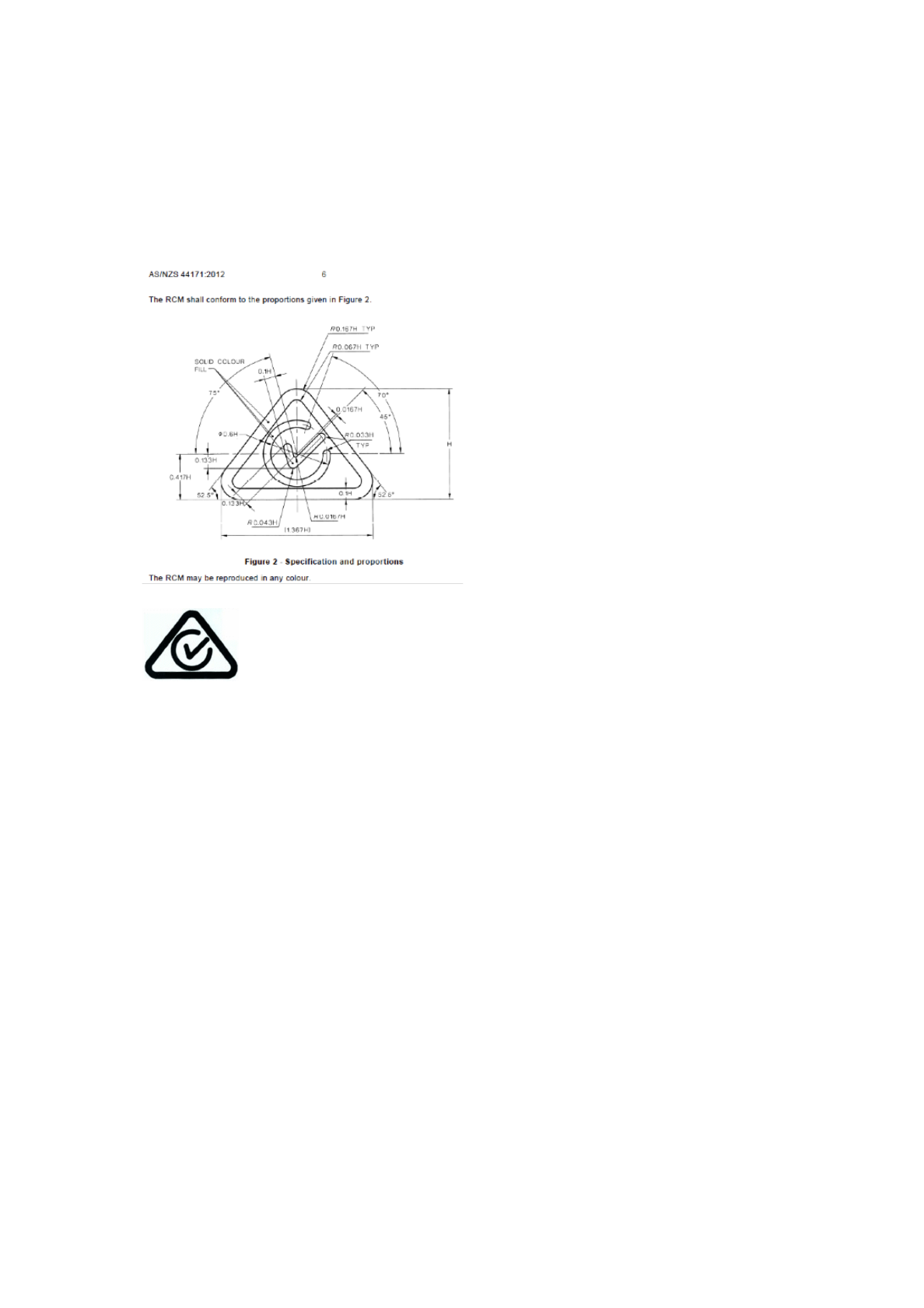
Australian approval of level 2 products defined by ACMA require an RCM mark on the host
system visible to the end user. The RCM mark should be at least 3 mm in height.
LIFX03N12 Ver. 1.0 10 Confidential and Proprietary – LIFI LABS INC.

11. Required Regulatory Wording for User
Manual/Installation Manual
The integrator must include text in the user manual meeting the regulators’ requirements. The
text below or similar wording should be used.
NOTE: Text in red font must be replaced.
11.1. FCC compliance information
This device complies with Part 15 of the FCC Rules. Operation is subject to the following two
conditions: (1) this device may not cause harmful interference, and (2) this device must accept
any interference received, including interference that may cause undesired operation.
This product does not contain any user serviceable components. Any unauthorized product
changes or modifications will invalidate warranty and all applicable regulatory certifications and
approvals, including authority to operate this device.
FCC Part 15 Digital Emissions Compliance
We [System Manufacturer Name, Address, Telephone], declare under our sole responsibility
that the product [System Name] complies with Part 15 of the FCC Rules. Operation is subject
to the following two conditions: (1) this device may not cause harmful interference, and (2) this
device must accept any interference received, including interference that may cause undesired
operation.
WARNING: This equipment has been tested and found to comply with the limits for a Class B
digital device, pursuant to Part 15 of the FCC Rules. These limits are designed to provide
reasonable protection against harmful interference in a residential installation. This equipment
generates and radiates radio frequency energy and, if not installed and used in accordance
with the instructions, may cause harmful interference to radio communications.
However, there is no guarantee that interference will not occur in a particular installation. If this
equipment does cause harmful interference to radio or television reception, which can be
determined by turning the equipment off and on, the user is encouraged to try to correct the
interference by one or more of the following measures:
●Reorient or relocate the receiving antenna.
●Increase the separation between the equipment and receiver.
●Connect the equipment into an outlet on a circuit different from the one the receiver is
connected to.
●Consult the dealer or an experienced radio/TV technician for help.
The user may find the following booklet prepared by the Federal Communications Commission
helpful:
The Interference Handbook
This booklet is available from the U.S. Government Printing Office, Washington, D.C.
20402. Stock No.004-000-00345-4.
(Notice for 5GHz and/or when co-locate with 5GHz transmitters, following statements
should be provided for user information)
Operations in the 5.15-5.25GHz band are restricted to indoor usage only. (For 5GHz only)
(RF exposure statement)
Radiation Exposure Statement:
The product comply with the FCC portable RF exposure limit set forth for an uncontrolled
environment and are safe for intended operation as described in this manual. The further RF
exposure reduction can be achieved if the product can be kept as far as possible from the user
body or set the device to lower output power if such function is available.
LIFX03N12 Ver. 1.0 11 Confidential and Proprietary – LIFI LABS INC.
When using the product, maintain a distance of 20cm from the body to ensure
compliance with RF exposure requirements.

11.2. Industry Canada notice
This device complies with Canadian RSS-210.
This device complies with Industry Canada license-exempt RSS standard(s). Operation is
subject to the following two conditions: (1) this device may not cause interference, and (2) this
device must accept any interference, including interference that may cause undesired
operation of the device.
Ce dispositif est conforme à la norme CNR-210 d'Industrie Canada applicable aux appareils
radio exempts de licence. Son fonctionnement est sujet aux deux conditions suivantes: (1) le
dispositif ne doit pas produire de brouillage préjudiciable, et (2) ce dispositif doit accepter tout
brouillage reçu, y compris un brouillage susceptible de provoquer un fonctionnement
indésirable.
(Notice for 5GHz and/or when co-locate with 5GHz transmitters, following statements
should be provided for user information)
Caution:
(i) the device for operation in the band 5150-5250 MHz is only for indoor use to reduce the
potential for harmful interference to co-channel mobile satellite systems;
(ii) the maximum antenna gain permitted for devices in the bands 5250-5350 MHz and
5470-5725 MHz shall comply with the e.i.r.p. limit; and
(iii) the maximum antenna gain permitted for devices in the band 5725-5825 MHz shall comply
with the e.i.r.p. limits specified for point-to-point and non point-to-point operation as
appropriate.
(iv) Users should also be advised that high-power radars are allocated as primary users (i.e.
priority users) of the bands 5250-5350 MHz and 5650-5850 MHz and that these radars could
cause interference and/or damage to LE-LAN devices.
Avertissement:
Le guide d’utilisation des dispositifs pour réseaux locaux doit inclure des instructions précises
sur les restrictions susmentionnées, notamment :
(i) les dispositifs fonctionnant dans la bande 5 150-5 250 MHz sont réservés uniquement pour
une utilisation à l’intérieur afin de réduire les risques de brouillage préjudiciable aux systèmes
de satellites mobiles utilisant les mêmes canaux;
(ii) le gain maximal d’antenne permis pour les dispositifs utilisant les bandes 5 250-5 350 MHz
et 5 470-5 725 MHz doit se conformer à la limite de p.i.r.e.;
(iii) le gain maximal d’antenne permis (pour les dispositifs utilisant la bande 5 725-5 825 MHz)
doit se conformer à la limite de p.i.r.e. spécifiée pour l’exploitation point à point et non point à
point, selon le cas.
(iv) De plus, les utilisateurs devraient aussi être avisés que les utilisateurs de radars de haute
puissance sont désignés utilisateurs principaux (c.-à-d., qu’ils ont la priorité) pour les bandes 5
250-5 350 MHz et 5 650-5 850 MHz et que ces radars pourraient causer du brouillage et/ou
des dommages aux dispositifs LAN-EL.
(RF exposure statement)
Radiation Exposure Statement:
The product complies with the Canada portable RF exposure limit set forth for an uncontrolled
environment and is safe for intended operation as described in this manual. Further RF
exposure reduction can be achieved if the product can be kept as far as possible from the user
body or set the device to lower output power if such function is available.
LIFX03N12 Ver. 1.0 12 Confidential and Proprietary – LIFI LABS INC.
11.3. European Community (R&TTE) user manual wording and
declaration
NOTE: Text in red font must be replaced with name of company responsible for placing the
system on the European Community Market.
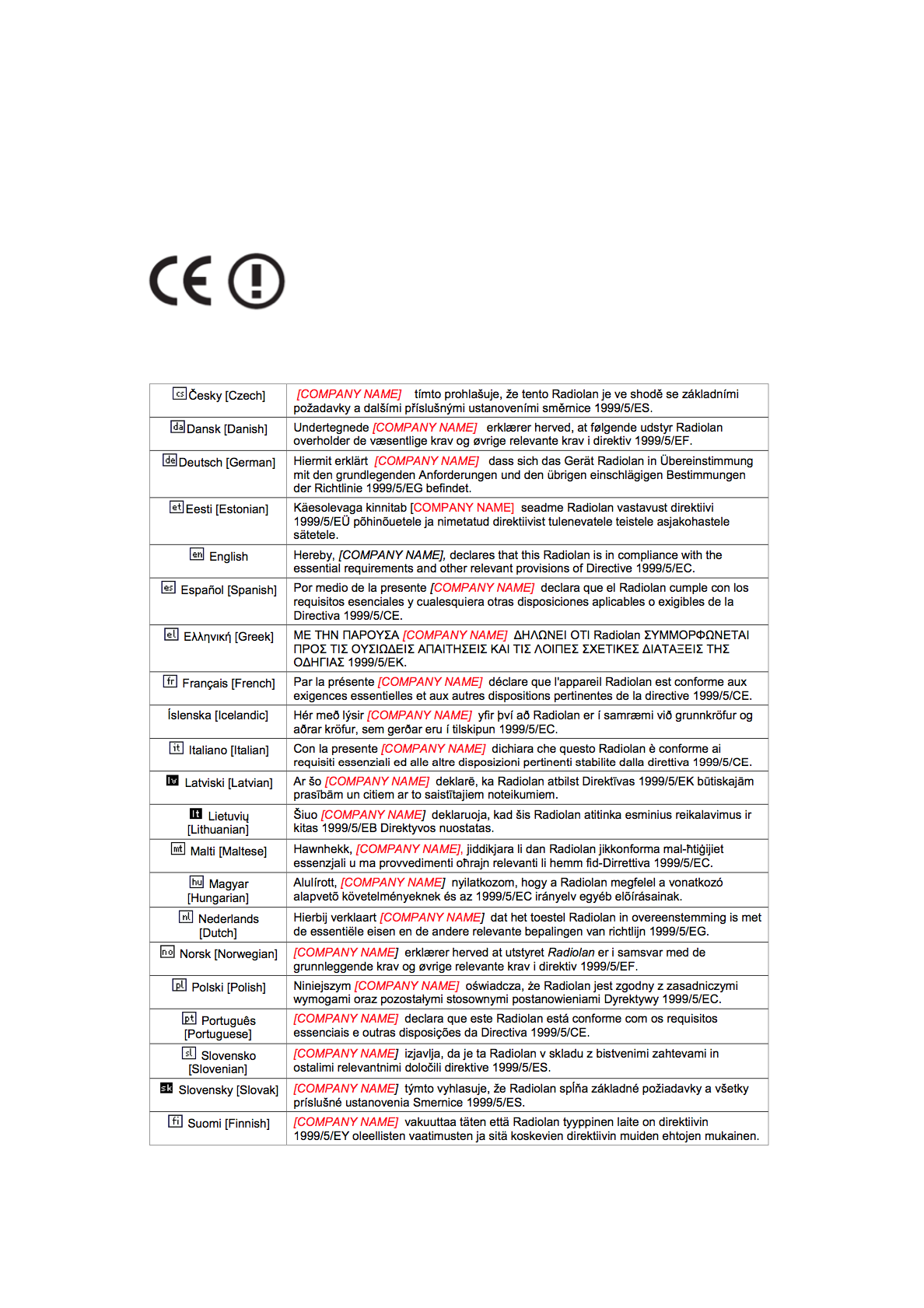
Europe – EU Declaration of Conformity
Marking by the above symbol indicates compliance with the Essential Requirements of the
R&TTE Directive of the European Union (1999/5/EC). This equipment meets the following
conformance standards: EN300 328, EN 301 893, EN 301 489-17, EN60950, EN 62311
LIFX03N12 Ver. 1.0 13 Confidential and Proprietary – LIFI LABS INC.
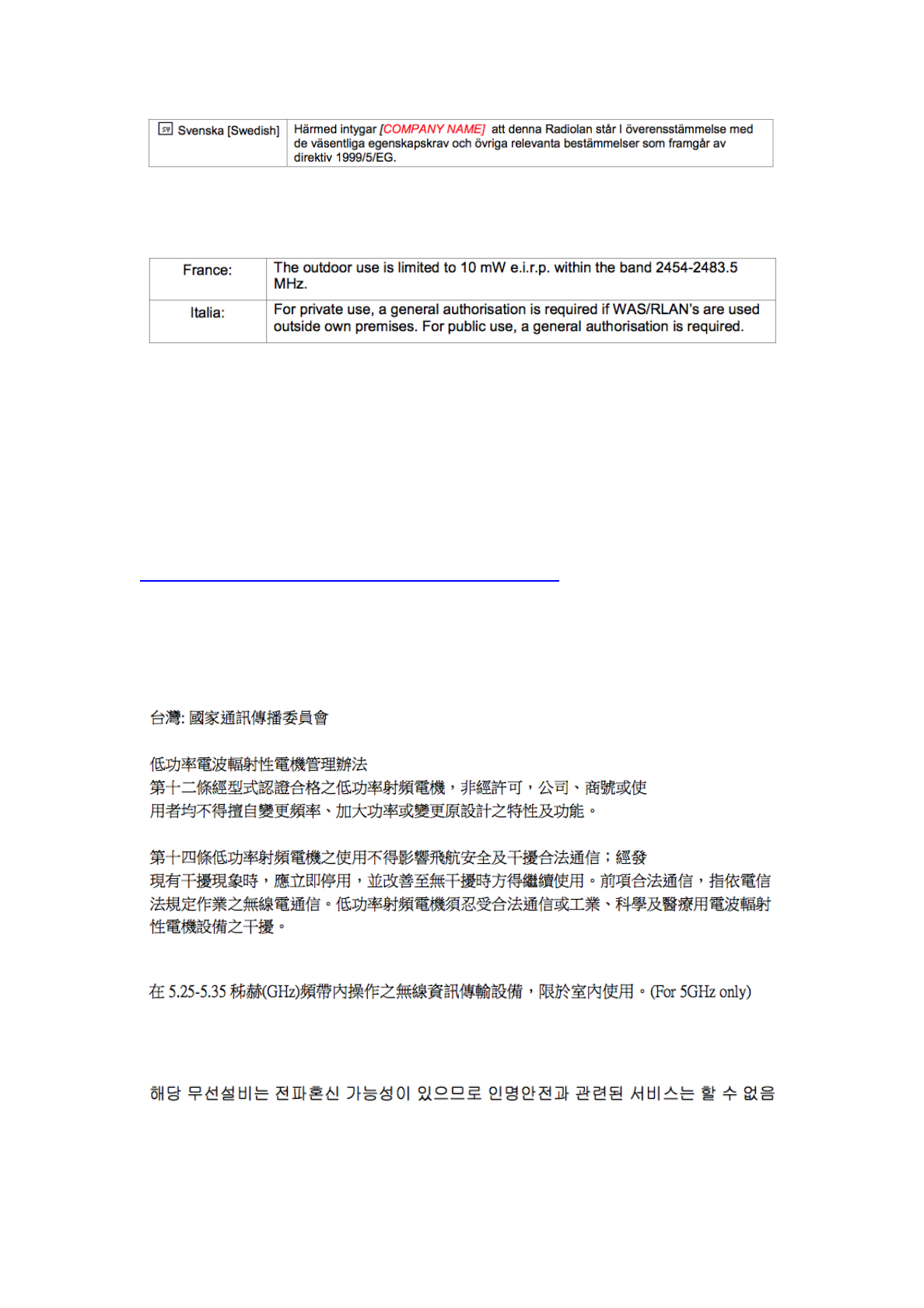
Table 1. Restrictions for use of 2.4 GHz frequencies in European Community countries.
The restriction described below follows ERC/REC 70-03 (Edition of September 2011). It is
recommended to check latest edition for updated restrictions.
11.4. European Community (R&TTE) Declaration of Conformity for
System
In addition to including the radio conformity wording described in the previous section in the
user manual, the end integrator must also create and sign a European Declaration of
Conformity (DoC) for all European Directives applicable to the end product. At a minimum, this
will be a DoC per the R&TTE Directive covering Radio, EMC, product Safety and RF Exposure
essential requirements. The DoC must reference harmonized standards used for all radios
present in the system.
Full details of R&TTE DoC requirements can be found at:
http://www.ec.europa.eu/enterprise/sectors/rtte/index_en.htm
NOTE: An image of the DoC signed by the OEM integrator may be included in the user manual
or a link to the DoC on the integrator’s company web site should be provided in the user
documentation.
11.5. Taiwan user manual wording
11.6. Korea user manual wording
Korea KCC
LIFX03N12 Ver. 1.0 14 Confidential and Proprietary – LIFI LABS INC.

11. OEM Configuration
The LCM supports customization by OEMs. The majority of these fields are exposed via the
AllJoyn API allowing applications to query the LCM and discover its features.
A subset of the fields available for customisation:
●Product manufacturer (such as“LIFX”)
●Product name (such as “LIFX White 800”)
●Product description (such as “Wi-Fi LED Smart Bulb”)
●Manufacture date (such as “2015-02-14”)
●Manufacturer logo (e.g. a PNG or JPG, maximum size of 16KB)
●Bulb input voltage range, socket type, color temperature.
There are also a number of internal parameters that can be configured, such as:
●PWM configuration, such as:
○Minimum frequency (in Hz)
○Maximum frequency (in Hz)
○Minimum on-time (in microseconds)
●Power configuration, such as:
○Minimum time delay between power on and boot (in milliseconds)
○Quiescent power draw (including LCM idle power)
○Maximum LED power draw
Please contact hello@lifx.co for instructions to program the OEM page, as well as all of the
fields available.
NOTE: If a single output frequency is required, set the minimum and maximum frequency to the
same value. To set a particular minimum duty cycle, use the minimum frequency and minimum
on-time as appropriate (eg, 1% duty cycle at 1 kHz = 10 us minimum on-time).
AllJoyn LSF allows clients to request the bulb instantaneous power consumption. The LCM
calculates this as:
Power
instantaneous
= Power
quiescent
+ (Power
LED
× duty-cycle)
LIFX03N12 Ver. 1.0 15 Confidential and Proprietary – LIFI LABS INC.

12. OEM Integrator Checklist
The party below will implement the Module in host systems in accordance with the instructions
specified in this document and the documents referenced herein.
●The OEM integrator will ensure the Module is integrated in a host systems using only
the approved antenna for the Module
●The OEM integrator will ensure the antenna placement inside the host system will
maintain the required spacing to end user for RF Exposure compliance, as specified in
this document.
●If other radios are integrated inside the host with the Module, the OEM integrator will
contact its test lab, LIFI LABS INC. to determine if additional FCC compliance
evaluation is required to meet FCC collocation rules.
●The OEM integrator will ensure end user documentation will contain the specified
regulatory wording and ensure the host system and the Module itself are labeled as
specified in this document.
●The OEM integrator will ensure the Module is programmed in the factory with
compliant transmit power not exceeding the levels specified in this document.
LIFI LABS INC. requests that the OEM integrator acknowledge its receipt of this document and
the above instructions. You may contact LIFI LABS INC. with any questions concerning this
document or the responsibilities of the OEM integrator.
Company Name ___________________________
Company Address ___________________________
Signature ___________________________
Name ___________________________ ___________________________
Title ___________________________
Email ___________________________
Phone ___________________________ Date ___________________________
NOTE: Please email a signed and completed copy of this acknowledgment to hello@lifx.co
LIFX03N12 Ver. 1.0 16 Confidential and Proprietary – LIFI LABS INC.