Lantronix Server Eds16Pr Users Manual EvoBPug_EDS4100_PR_PS
EDS8PS to the manual b865cf6b-6aea-4753-a6e9-85eefc0e3fda
2015-02-09
: Lantronix Lantronix-Lantronix-Server-Eds16Pr-Users-Manual-570314 lantronix-lantronix-server-eds16pr-users-manual-570314 lantronix pdf
Open the PDF directly: View PDF  .
.
Page Count: 163 [warning: Documents this large are best viewed by clicking the View PDF Link!]
- EDS Device Servers/Terminal Servers User Guide
- 1: About This Guide
- 2: Introduction
- 3: Installation of EDS8PS and EDS16PS
- 4: Installation of EDS4100
- 5: Installation of EDS8PR, EDS16PR and EDS32PR
- 6: Using DeviceInstaller
- 7: Configuration Using Web Manager
- 8: Network Settings
- 9: Line and Tunnel Settings
- 10: Terminal and Host Settings
- 11: Service Settings
- 12: Security Settings
- 13: Modbus
- 14: Maintenance and Diagnostics Settings
- 15: Advanced Settings
- 16: VIP Settings
- 17: Branding the EDS
- 18: Updating Firmware
- Appendix A - Technical Support
- Appendix B - Binary to Hexadecimal Conversions
- Appendix C - Compliance
- Appendix D - Lantronix Cables and Adapters
- Index
Part Number 900-433
Revision I April 2011
EDS Device Servers/Terminal Servers
User Guide
EDS4100
EDS8PS
EDS16PS
EDS8PR
EDS16PR
EDS32PR

EDS User Guide 2
Copyright & Trademark
© 2011 Lantronix. All rights reserved. No part of the contents of this book may be transmitted or
reproduced in any form or by any means without the written permission of Lantronix. Printed in the
United States of America.
Ethernet is a trademark of XEROX Corporation. UNIX is a registered trademark of The Open
Group. Windows is a trademark of Microsoft Corporation.
Warranty
For details on the Lantronix warranty replacement policy, please go to our web site at
www.lantronix.com/support/warranty.
Contacts
Lantronix Corporate Headquarters
167 Technology Drive
Irvine, CA 92618, USA
Phone:949-453-3990
Fax:949-450-7249
Technical Support
Online: www.lantronix.com/support
Sales Offices
For a current list of our domestic and international sales offices, go to the Lantronix web site at
www.lantronix.com/about/contact.
Disclaimer
Note: This product has been designed to comply with the limits for a Class B digital
device pursuant to Part 15 of FCC and EN55022:1998 Rules when properly enclosed and
grounded. These limits are designed to provide reasonable protection against radio
interference in a residential installation. This equipment generates, uses, and can radiate
radio frequency energy, and if not installed and used in accordance with this guide, may
cause interference to radio communications. See “Appendix C - Compliance” on
page 155 for additional information.
The information in this guide may change without notice. The manufacturer assumes no
responsibility for any errors that may appear in this guide.For the latest revision of this product
document, please check our online documentation at www.lantronix.com/support/documentation.

EDS User Guide 3
Revision History
Date Rev. Comments
March 2006 A Initial Document
October 2006 B EDS16PR and EDS32PR products added.
December 2006 D German and English TUV certification added.
January 2007 E EDS8PR product added.
November 2007 F Added LPD, Terminal Host, RSS, and RT pages; updated XML and
other pages.
November 2008 G EDS8PS and EDS16PS products added.
May 2009 H Updated for EDS8/16/32PR and EDS4100 v4.1.0.2.
April 2011 I Updated for firmware version 5.2.0.0R24. Added support for Modbus
protocol for EDS4100, configurable MTU, and additional VIP tunnel
connect protocols; as well as improvements to SNMP, logging, and SSL.

EDS User Guide 4
Table of Contents
List of Figures ____________________________________________________________10
List of Tables _____________________________________________________________12
1: About This Guide 14
Chapter and Appendix Summaries ____________________________________________14
Additional Documentation ___________________________________________________15
2: Introduction 16
EDS8PS and EDS16PS Overview ____________________________________________17
Features _ _________________________________________________________17
EDS4100 Overview ________________________________________________________18
Features _________________________________________________________18
EDS8PR, EDS16PR, and EDS32PR Overview __________________________________19
Features _ _________________________________________________________19
Applications ______________________________________________________________20
Protocol Support _________________________________________________________20
Evolution OS™ ___________________________________________________________20
Additional Features ________________________________________________________21
Modem Emulation ______________________________________________________21
Web-Based Configuration and Troubleshooting _______________________________21
Command-Line Interface (CLI) ____________________________________________21
VIP Access ___________________________________________________________21
SNMP Management ____________________________________________________21
XML-Based Architecture and Device Control _________________________________21
Really Simple Syndication (RSS) __________________________________________21
Enterprise-Grade Security _______________________________________________21
Terminal Server/Device Management ______________________________________22
Troubleshooting Capabilities ____________ _________________________________22
Configuration Methods _____________________________________________________22
Addresses and Port Numbers ________________________________________________23
Hardware Address _____________________________________________________23
IP Address ___________________________________________________________23
Port Numbers _________________________________________________________23
Product Information Label ___________________________________________________24
3: Installation of EDS8PS and EDS16PS 25
Package Contents _________________________________________________________25
User-Supplied Items _______________________________________________________25
Identifying Hardware Components ____________________________________________26
Serial Ports ___________________________________________________________26

EDS User Guide 5
Console Port __________________________________________________________26
Ethernet Port _________________________________________________________27
LEDs ________________________________________________________________27
Reset Button __________________________________________________________27
Reboot the device: __________________________________________________27
Restore factory defaults: _____________________________________________28
Installing the EDS8/16PS ____________ _______________________________________28
Finding a Suitable Location ______________________________________________28
Connecting the EDS8/16PS ______________________________________________28
Connect the EDS8/16PS to one or more serial devices. _____________________28
4: Installation of EDS4100 30
Package Contents _________________________________________________________30
User-Supplied Items _______________________________________________________30
Identifying Hardware Components ____________________________________________30
Serial Ports ___________________________________________________________31
Ethernet Port _________________________________________________________32
Terminal Block Connector _______________________________________________33
LEDs ________________________________________________________________33
Reset Button __________________________________________________________33
Physically Installing the EDS4100 _____________________________________________34
Finding a Suitable Location ______________________________________________34
Connecting the EDS4100 ________________________________________________34
Connect the EDS4100 to one or more serial devices. _______________________34
5: Installation of EDS8PR, EDS16PR and EDS32PR 36
Package Contents _________________________________________________________36
User-Supplied Items _______________________________________________________36
Identifying Hardware Components ____________________________________________37
Serial Ports ___________________________________________________________37
Console Port __________________________________________________________37
Ethernet Port _________________________________________________________38
LEDs ________________________________________________________________38
Reset Button __________________________________________________________39
Installing the EDS8/16/32PR _________________________________________________39
Finding a Suitable Location ______________________________________________39
Connecting the EDS8/16/32PR ___________________________________________39
6: Using DeviceInstaller 41
Accessing EDS Using DeviceInstaller __________________________________________41
Device Details Summary ____________________________________________________41

EDS User Guide 6
7: Configuration Using Web Manager 43
Accessing Web Manager ___________________________________________________43
Device Status Page ____________________________________________________44
Web Manager Page Components _____________________________________________45
Navigating the Web Manager ________________________________________________46
8: Network Settings 48
Network 1 (eth0) Interface Status _____________________________________________48
Network 1 (eth0) Interface Configuration _______________________________________49
Network 1 Ethernet Link ____________________________________________________51
9: Line and Tunnel Settings 52
Line Settings _____________________________________________________________52
Line Statistics _________________________________________________________52
Line Configuration _____________________________________________________53
Line Command Mode ___________________________________________________55
Tunnel Settings __________________________________________________________ 56
Tunnel – Statistics _____________________________________________________57
Tunnel – Serial Settings _________________________________________________59
Tunnel – Packing Mode _________________________________________________60
Tunnel – Accept Mode __________________________________________________63
Tunnel – Connect Mode _________________________________________________66
Connecting Multiple Hosts ____________________________________________70
Host List Promotion _________________________________________________70
Tunnel – Disconnect Mode _______________________________________________71
Tunnel – Modem Emulation ______________________________________________72
10: Terminal and Host Settings 75
Terminal Settings _________________________________________________________75
Line Terminal Configuration ______________________________________________75
Network Terminal Configuration ___________________________________________77
Host Configuration ________________________________________________________78
11: Service Settings 79
DNS Settings _____________________________________________________________79
SNMP Settings ___________________________________________________________80
FTP Settings ____________________________________________________________81
TFTP Settings ___________________________________________________________83
Syslog Settings ___________________________________________________________84
HTTP Settings ____________________________________________________________85
HTTP Statistics ________________________________________________________85
HTTP Configuration ____________________________________________________86

EDS User Guide 7
HTTP Authentication ___________________________________________________88
RSS Settings _____________________________________________________________89
LPD Settings _____________________________________________________________90
LPD Statistics _________________________________________________________90
LPD Configuration _____________________________________________________91
12: Security Settings 93
SSH Settings _____________________________________________________________93
SSH Server Host Keys _________________________________________________94
SSH Server Authorized Users ____________________________________________98
SSH Client Known Hosts _______________________________________________100
SSH Client Users _____________________________________________________101
SSL Settings ____________________________________________________________103
SSL Cipher Suites ____________________________________________________103
SSL Certificates ______________________________________________________104
SSL RSA or DSA _____________________________________________________104
SSL Certificates and Private Keys ________________________________________104
SSL Utilities _________________________________________________________105
OpenSSL ___ _____________________________________________________105
Steel Belted RADIUS _______________________________________________105
Free RADIUS _____________________________________________________105
SSL Configuration ____________________________________________________106
13: Modbus 109
Serial Transmission Mode __________________________________________________109
Modbus Statistics ________________________________________________________110
Modbus Configuration _____________________________________________________111
14: Maintenance and Diagnostics Settings 112
Filesystem Settings _______________________________________________________112
Filesystem Statistics ___________________________________________________112
Filesystem Browser ___________________________________________________113
Protocol Stack Settings ____________________________________________________115
TCP Settings ________________________________________________________115
IP Settings __________________________________________________________116
ICMP Settings ________________________________________________________116
ARP Settings ________________________________________________________118
SMTP Settings _______________________________________________________119
IP Address Filter _________________________________________________________120
Query Port _____________________________________________________________121
Diagnostics __ ___________________________________________________________122
Hardware ___ ________________________________________________________122

EDS User Guide 8
MIB-II Statistics _______________________________________________________123
IP Sockets __________________________________________________________124
Ping __ _____________________________________________________________124
Traceroute __ ________________________________________________________126
Log ___ _____________________________________________________________127
Memory _____________________________________________________________129
Buffer Pools _________________________________________________________129
Processes ___________________________________________________________130
Real Time Clock _________________________________________________________132
System Settings _________________________________________________________132
15: Advanced Settings 134
Email Settings ___________________________________________________________134
Email Statistics _______________________________________________________134
Email Configuration ___________________________________________________135
Command Line Interface Settings ____________________________________________137
CLI Statistics _________________________________________________________137
CLI Configuration _____________________________________________________137
XML Settings ____________________________________________________________139
XML: Export Configuration ______________________________________________140
XML: Export Status ____________________________________________________141
XML: Import Configuration ______________________________________________142
Import Configuration from External File _________________________________142
Import Configuration from the Filesystem _______________________________143
Import Line(s) from Single Line Settings on the Filesystem __________________145
16: VIP Settings 147
Obtaining a Bootstrap File __________________________________________________147
Importing the Bootstrap File ________________________________________________147
Enabling VIP ____________________________________________________________148
Configuring Tunnels to Use VIP _____________________________________________148
Virtual IP (VIP) Statistics ___________________________________________________148
Virtual IP (VIP) Counters ___________________________________________________149
Virtual IP (VIP) Configuration _______________________________________________149
17: Branding the EDS 150
Web Manager Customization _______________________________________________150
Short and Long Name Customization _________________________________________150
18: Updating Firmware 151
Obtaining Firmware _______________________________________________________151
Loading New Firmware ____________________________________________________151

EDS User Guide 9
Appendix A - Technical Support 152
Technical Support US ______________________________________________152
Technical Support Europe, Middle East, Africa ___________________________152
Appendix B - Binary to Hexadecimal Conversions 153
Converting Binary to Hexadecimal ________________________________________153
Conversion Table __________________________________________________153
Scientific Calculator ________________________________________________154
Appendix C - Compliance 155
Lithium Battery Notice _____________________________________________________156
Installationsanweisungen __ ________________________________________________156
Rackmontage ___ _____________________________________________________156
Energiezufuhr ___ _____________________________________________________157
Erdung __ ___________________________________________________________157
Installation Instructions ____________________________________________________157
Rack Mounting _______________________________________________________157
Input Supply _________________________________________________________157
Grounding ___________________________________________________________157
Appendix D - Lantronix Cables and Adapters 158
Index 159

EDS User Guide 10
List of Figures
Figure 2-1 EDS8PS Device Server___________________________________________________17
Figure 2-2 EDS4100 4 Port Device Server _____________________________________________18
Figure 2-3 EDS16PR Device Server__________________________________________________19
Figure 2-4 Sample Hardware Address ________________________________________________23
Figure 2-5 Product Label___________________________________________________________24
Figure 3-1 Front View of the EDS8PS ________________________________________________26
Figure 3-2 Back View of the EDS8PS_________________________________________________26
Figure 3-3 RJ45 Serial Port_________________________________________________________27
Figure 3-5 Example of EDS8/16PS Connections ________________________________________29
Figure 4-1 Front View of the EDS4100 _______________________________________________31
Figure 4-2 Back View of the EDS4100 ________________________________________________31
Figure 4-3 RS-232 Serial Port Pins (Serial Ports 1, 2, 3, 4) ________________________________32
Figure 4-4 RS-422/RS-485 Serial Port Pins ____________________________________________32
Figure 4-5 Terminal Block Connector Pin Assignments ___________________________________33
Figure 4-7 Example of EDS4100 Connections __________________________________________35
Figure 5-1 Front View of the EDS16PR _______________________________________________37
Figure 5-2 Back View of the EDS16PR _______________________________________________37
Figure 5-3 RJ45 Serial Port_________________________________________________________38
Figure 5-5 Example of EDS16PR Connections _________________________________________40
Figure 7-1 Web Manager Home Page ________________________________________________44
Figure 7-2 Components of the Web Manager Page ______________________________________45
Figure 8-1 Network 1 (eth0) Interface Status ___________________________________________48
Figure 8-2 Network 1 (eth0) Interface Configuration______________________________________49
Figure 8-4 Network 1 Ethernet Link __________________________________________________51
Figure 9-1 Line 1 Statistics _________________________________________________________52
Figure 9-2 Line 1 Configuration______________________________________________________53
Figure 9-4 Line 1 Command Mode ___________________________________________________55
Figure 9-6 Tunnel 1 Statistics _______________________________________________________58
Figure 9-7 Tunnel 1 Serial Settings___________________________________________________59
Figure 9-9 Tunnel 1 Packing Mode (Mode = Disable) ____________________________________60
Figure 9-10 Tunnel 1 Packing Mode (Mode = Timeout) ___________________________________61
Figure 9-11 Tunnel 1 Packing Mode (Mode = Send Character) _____________________________61
Figure 9-13 Tunnel 1 Accept Mode___________________________________________________64
Figure 9-15 Tunnel 1 Connect Mode _________________________________________________67
Figure 9-17 Host 1, Host 2, Host 3 Exchanged__________________________________________70
Figure 9-18 Tunnel 1 Disconnect Mode _______________________________________________71
Figure 9-21 Tunnel 1 Modem Emulation_______________________________________________74
Figure 10-1 Terminal on Line Configuration____________________________________________75
Figure 10-3 Terminal on Network Configuration _________________________________________77
Figure 10-5 Host Configuration______________________________________________________78
Figure 11-1 DNS Settings __________________________________________________________79
Figure 11-2 SNMP Configuration ____________________________________________________80
Figure 11-4 FTP Configuration ______________________________________________________82
Figure 11-6 TFTP Configuration _____________________________________________________83
Figure 11-8 Syslog _______________________________________________________________84
Figure 11-10 HTTP Statistics _______________________________________________________85
Figure 11-11 HTTP Configuration____________________________________________________86
Figure 11-13 HTTP Authentication ___________________________________________________88
Figure 11-15 RSS ________________________________________________________________89
Figure 11-17 LPD Statistics ________________________________________________________90

EDS User Guide 11
Figure 11-18 LPD Configuration _____________________________________________________91
Figure 12-1 SSH Server: Host Keys (Upload Keys) ______________________________________94
Figure 12-3 SSH Server: Host Keys (Upload Keys) ______________________________________96
Figure 12-5 SSH Server: Host Keys (Create New Keys) __________________________________97
Figure 12-7 SSH Server: Authorized Users ____________________________________________99
Figure 12-9 SSH Client: Known Hosts _______________________________________________100
Figure 12-11 SSH Client: Users ____________________________________________________101
Figure 12-14 SSL _______________________________________________________________106
Figure 13-3 Modbus Statistics______________________________________________________110
Figure 13-4 Modbus Configuration __________________________________________________111
Figure 14-1 Filesystem Statistics ___________________________________________________112
Figure 14-2 Filesystem Browser ____________________________________________________113
Figure 14-4 TCP Protocol _________________________________________________________115
Figure 14-6 IP Protocol __________________________________________________________116
Figure 14-8 ICMP Protocol ________________________________________________________117
Figure 14-10 ARP Protocol Page ___________________________________________________118
Figure 14-12 SMTP______________________________________________________________119
Figure 14-14 IP Address Filter Configuration __________________________________________120
Figure 14-16 Query Port Configuration_______________________________________________121
Figure 14-17 Diagnostics: Hardware_________________________________________________122
Figure 14-18 MIB-II Network Statistics _______________________________________________123
Figure 14-20 IP Sockets __________________________________________________________124
Figure 14-21 Diagnostics: Ping_____________________________________________________124
Figure 14-23 Diagnostics: Traceroute________________________________________________126
Figure 14-25 Diagnostics: Log _____________________________________________________127
Figure 14-26 Diagnostics: Log (Filesystem) ___________________________________________127
Figure 14-27 Diagnostics: Log (Line 1)_______________________________________________128
Figure 14-28 Diagnostics: Memory __________________________________________________129
Figure 14-29 Diagnostics: Buffer Pools_______________________________________________130
Figure 14-30 Diagnostics: Processes ________________________________________________131
Figure 14-31 Real Time Clock Page_________________________________________________132
Figure 14-33 System_____________________________________________________________133
Figure 15-1 Email Statistics _______________________________________________________134
Figure 15-2 Email Configuration ____________________________________________________135
Figure 15-4 CLI Statistics _________________________________________________________137
Figure 15-5 CLI Configuration______________________________________________________138
Figure 15-7 XML: Export Configuration_______________________________________________140
Figure 15-9 XML: Export Status ____________________________________________________141
Figure 15-11 XML: Import Configuration______________________________________________142
Figure 15-12 XML: Import Configuration from External File _______________________________142
Figure 15-13 XML: Import from Filesystem ___________________________________________143
Figure 15-14 XML: Import Configuration from Filesystem ________________________________144
Figure 15-15 XML: Import Line(s) from Single Line Settings on the Filesystem________________145
Figure 16-1 VIP Status ___________________________________________________________148
Figure 16-2 VIP Counters _________________________________________________________149
Figure 16-4 VIP Configuration Page _________________________________________________149
Figure 18-1 Update Firmware ______________________________________________________151

EDS User Guide 12
List of Tables
Table 3-4 Front Panel LEDs ________________________________________________________27
Table 4-6 Back Panel LEDs ________________________________________________________33
Table 5-4 Back Panel LEDs ________________________________________________________39
Table 6-1 Device Details Summary___________________________________________________41
Table 7-3 Summary of Web Manager Pages ___________________________________________46
Table 8-3 Network Interface Configuration _____________________________________________49
Table 8-5 Network 1 Ethernet Link ___________________________________________________51
Table 9-3 Line Configuration________________________________________________________54
Table 9-5 Line Command Mode _____________________________________________________55
Table 9-8 Tunnel - Serial Settings____________________________________________________59
Table 9-12 Tunnel Packing Mode ____________________________________________________62
Table 9-14 Tunnel Accept Mode_____________________________________________________64
Table 9-16 Tunnel Connect Mode____________________________________________________68
Table 9-19 Tunnel Disconnect Mode _________________________________________________71
Table 9-20 Modem Emulation Commands and Descriptions _______________________________72
Table 9-22 Tunnel Modem Emulation_________________________________________________74
Table 10-2 Terminal on Line 1 Configuration ___________________________________________76
Table 10-4 Terminal on Network Configuration _________________________________________77
Table 10-6 Host Configuration ______________________________________________________78
Table 11-3 SNMP ________________________________________________________________81
Table 11-5 FTP Settings ___________________________________________________________82
Table 11-7 TFTP Server ___________________________________________________________83
Table 11-9 Syslog ________________________________________________________________84
Table 11-12 HTTP Configuration ____________________________________________________86
Table 11-14 HTTP Authentication____________________________________________________88
Table 11-16 RSS_________________________________________________________________90
Table 11-19 LPD Configuration______________________________________________________91
Table 12-2 SSH Server Host Keys Settings - Upload Keys Method__________________________95
Table 12-4 SSH Server Host Keys Settings - Upload Keys Method__________________________96
Table 12-6 SSH Server Host Keys Settings - Create New Keys Method ______________________97
Table 12-8 SSH Server Authorized User Settings _______________________________________99
Table 12-10 SSH Client Known Hosts _______________________________________________100
Table 12-12 SSH Client Users _____________________________________________________102
Table 12-13 Supported Cipher Suites________________________________________________103
Table 12-15 SSL ________________________________________________________________107
Table 13-1 6 Byte Header of Modbus Application Protocol _______________________________109
Table 13-2 Modbus Transmission Modes_____________________________________________109
Table 13-5 Modbus Configuration___________________________________________________111
Table 14-3 Filesystem Browser_____________________________________________________114
Table 14-5 TCP Protocol Settings___________________________________________________115
Table 14-7 IP Protocol Settings ____________________________________________________116
Table 14-9 ICMP Settings_________________________________________________________117
Table 14-11 ARP Settings_________________________________________________________118
Table 14-13 SMTP Settings _______________________________________________________119
Table 14-15 IP Address Filter Settings _______________________________________________120
Table 14-19 Requests for Comments (RFCs)__________________________________________123
Table 14-22 Diagnostics: Ping _____________________________________________________125
Table 14-24 Diagnostics: Traceroute ________________________________________________126
Table 14-32 Real Time Clock Settings _______________________________________________132
Table 14-34 System _____________________________________________________________133

EDS User Guide 13
Table 15-3 Email Configuration_____________________________________________________135
Table 15-6 CLI Configuration ______________________________________________________138
Table 15-8 XML Export Configuration________________________________________________140
Table 15-10 XML Export Status ____________________________________________________141
Table 15-16 XML: Import Line(s) from Single Line Settings _______________________________146
Table 16-3 VIP Counters__________________________________________________________149
Table 20-1 Binary to Hexadecimal Conversion Table____________________________________153

EDS User Guide 14
1: About This Guide
This guide provides the information needed to configure, use, and update the EDS™ Device
Server. It is intended for software developers and system integrators who are installing the EDS in
their designs.
Chapter and Appendix Summaries
A summary of each chapter is provided below.
Chapter Description
Chapter 2: Introduction Main features of the product and the protocols it supports.
Includes technical specifications.
Chapter 3: Installation of EDS8PS and EDS16PS Instructions for installing the EDS8PS and the EDS16PS
device servers.
Chapter 4: Installation of EDS4100 Instructions for installing the EDS4100 device server.
Chapter 5: Installation of EDS8PR, EDS16PR and
EDS32PR
Instructions for installing the EDS8PR, the EDS16PR, and
the EDS16PR device server.
Chapter 6: Using DeviceInstaller Instructions for viewing the current configuration using
DeviceInstaller.
Chapter 7: Configuration Using Web Manager Instructions for accessing Web Manager and using it to
configure settings for the device.
Chapter 8: Network Settings Instructions for using the web interface to configure
Ethernet settings.
Chapter 9: Line and Tunnel Settings Instructions for using the web interface to configure line and
tunnel settings.
Chapter 10: Terminal and Host Settings Instructions for using the web interface to configure terminal
and host settings.
Chapter 11: Service Settings Instructions for using the web interface to configure settings
for DNS, SNMP, FTP, and other services.
Chapter 12: Security Settings Instructions for using the web interface to configure SSH
and SSL security settings.
Chapter 13: Modbus Instructions for using the web interface to configure
Modbus.
Note: Modbus is only available on the EDS4100 and
is not supported on the EDS8PR, EDS16PR,
EDS32PR, EDS8PS and EDS16PS.
Chapter 14: Maintenance and Diagnostics Settings Instructions for using the web interface to maintain the
device, view statistics, files, and logs, and diagnose
problems.
Chapter 15: Advanced Settings Instructions for using the web interface to configure email,
CLI, and XML settings.
Chapter 16: VIP Settings Information about Virtual IP (VIP) features available on the
device and instructions for using the web interface to
configure the VIP settings.
Chapter 17: Branding the EDS Instructions for customizing the device.

1: About This Guide
EDS User Guide 15
Additional Documentation
Visit the Lantronix web site at www.lantronix.com/support/documentation for the latest
documentation and the following additional documentation.
Chapter 18: Updating Firmware Instructions for obtaining the latest firmware and updating
the device.
Appendix A - Technical Support Instructions for contacting Lantronix Technical Support.
Appendix B - Binary to Hexadecimal Conversions Instructions for converting binary values to hexadecimals.
Appendix C - Compliance Lantronix compliance information.
Appendix D - Lantronix Cables and Adapters Lantronix cables and adapters for use with the EDS devices
are listed here according to part number and application.
Document Description
EDS4100 Quick Start,
EDS8/16PS Quick Start, or
EDS8/16/32PR Quick Start
Information about the EDS hardware installation and initial
configuration of your EDS device.
EDS Command Reference Instructions for accessing Command Mode (the command line
interface) using a Telnet connection or through the serial port.
Detailed information about the commands. Also provides details for
XML configuration and status.
DeviceInstaller Online Help Instructions for using the Lantronix Windows-based utility to locate
the device and to view its current settings.
Com Port Redirector
Quick Start and Online Help
Instructions for using the Lantronix Windows-based utility to create
virtual com ports.
Secure Com Port Redirector
User Guide
Instructions for using the Lantronix Windows-based utility to create
secure virtual com ports.

EDS User Guide 16
2: Introduction
This chapter introduces the Lantronix EDS family of device servers. It provides an overview of the
products, lists their key features, and describes the applications for which they are suited.
EDS is a unique, hybrid Ethernet terminal and multi-port device server product designed to
remotely access and manage virtually all of your IT/networking equipment and servers. It is also
designed to provide connectivity for edge devices such as medical equipment, kiosks, POS/retail
terminals, security equipment, and more.
EDS device servers contain all the components necessary to deliver full network connectivity to
virtually any kind of serial device. They boast a reliable TCP/IP protocol stack, a variety of remote
management capabilities, and an innovative design based on the leading-edge Lantronix
Evolution OS™.
Delivering a data center-grade, programmable device computing and networking platform for
integrating edge equipment into the enterprise network. Rack-mountable EDS models are
available in 8, 16, and 32 port configurations. Desk top EDS models are available in 4, 8, and 16
port configurations.
This chapter contains the following sections:
EDS8PS and EDS16PS Overview
EDS4100 Overview
EDS8PR, EDS16PR, and EDS32PR Overview
Applications
Protocol Support
Evolution OS™
Additional Features
Configuration Methods
Addresses and Port Numbers
Product Information Label
2: Introduction
EDS User Guide 17
EDS8PS and EDS16PS Overview
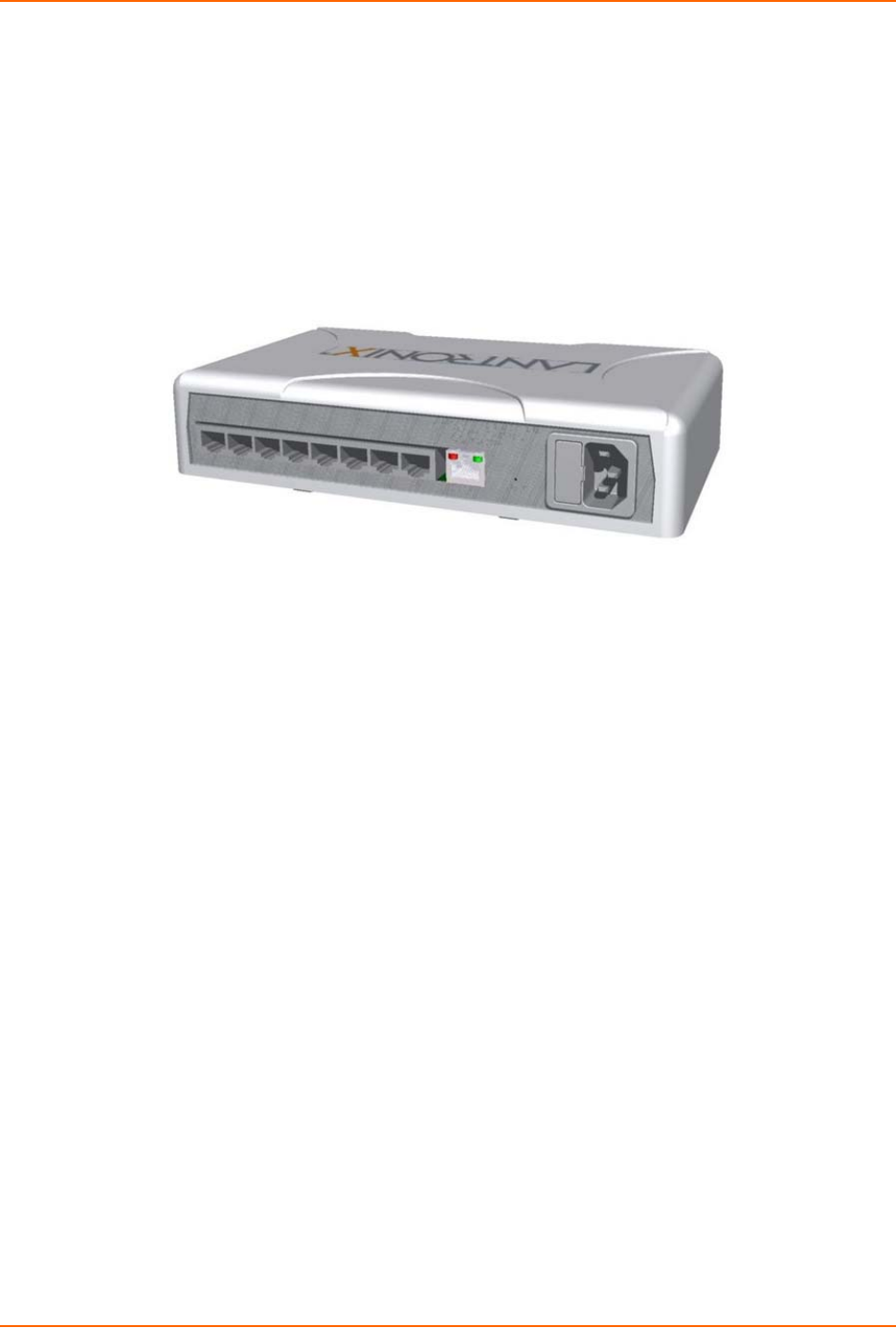
The EDS8PS (8 serial ports) and EDS16PS (16 serial ports) are compact desktop device servers
that give you the ability to network-enable asynchronous RS-232 serial devices. They provide fully
transparent RS-232 point-to-point connections without requiring modifications to existing software
or hardware in your application.
Figure 2-1 EDS8PS Device Server
Features
Key features of the EDS8PS and EDS16PS include:
Dual-purpose Ethernet terminal server and device server design.
8 (EDS8PS) or 16 (EDS16PS) serial ports with hardware handshaking signals.
RS-232 support.
An RJ45 Ethernet port.
8 MB Flash memory.
32 MB random access memory (RAM).
Lantronix Evolution OS™.
A dedicated console port.
AES, SSH, or SSL secure data encryption.
Three convenient configuration methods (Web, command line, and XML).
Print server functionality (LPR/LPD).
See Chapter 3: Installation of EDS8PS and EDS16PS for installation instructions.
2: Introduction
EDS User Guide 18
EDS4100 Overview
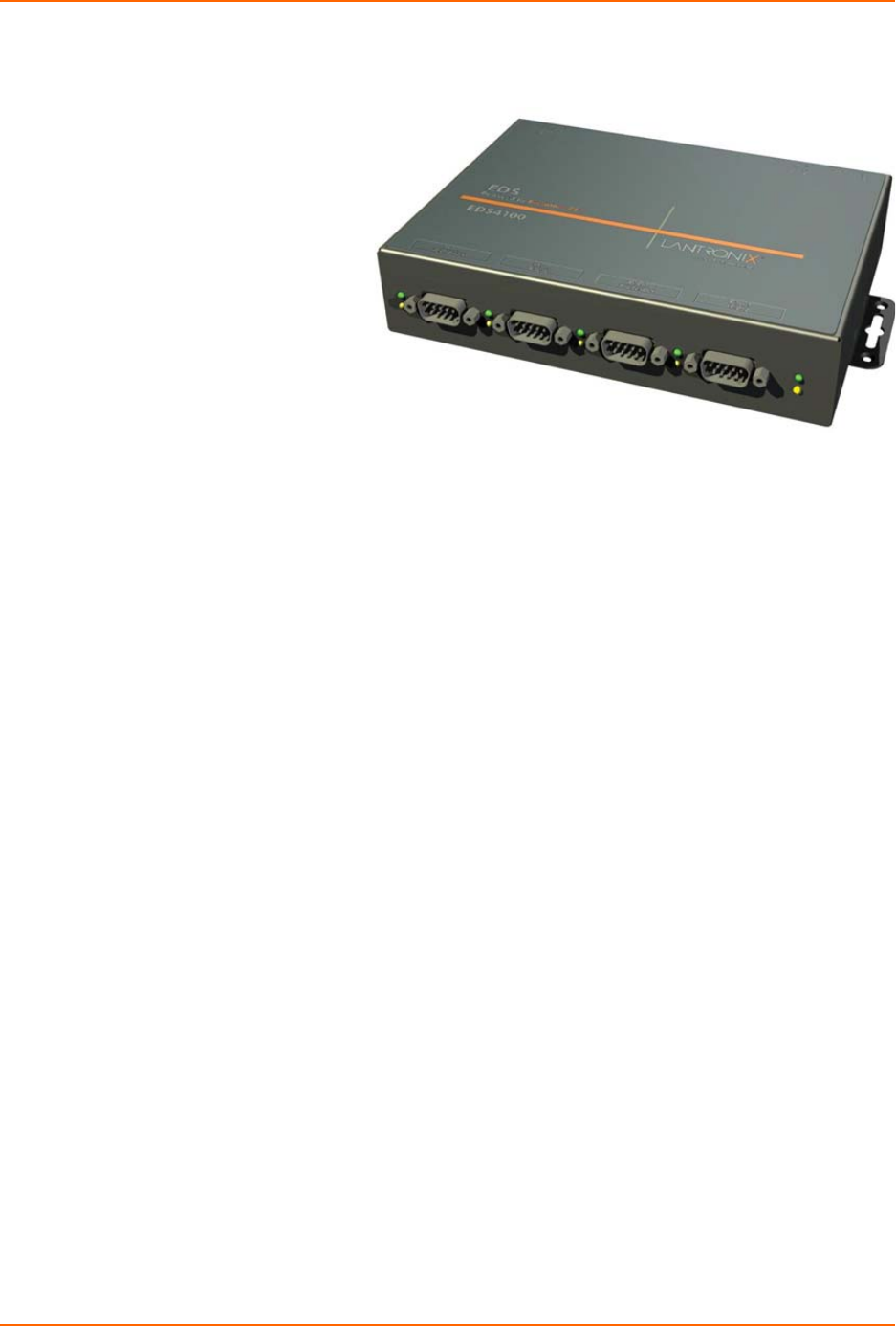
The EDS4100 is a compact device
server that allows you to network-
enable asynchronous RS-232 and
RS-422/485 serial devices. It can
deliver fully transparent RS-232/
422 point-to-point connections and
RS-485 multi-drop connections
without requiring modifications to
existing software or hardware in
your application.
Ports 1 through 4 support
RS-232 devices.
Ports 1 and 3 also support
RS-422/485.
Note: RS-485 circuits support 32 full-load devices or 128 quarter-load devices. Each
RS-485 port, however, counts as one device, leaving up to 31 full-load or 127 quarter-load
devices that can be connected to the RS-485 circuit.
The EDS4100 device server supports the Power-over-Ethernet (PoE) standard. With PoE, power
is supplied to the EDS over the Ethernet cable, by either an Ethernet switch or a midspan device.
Being able to draw power through the Ethernet cable eliminates power supply and cord clutter. It
also allows the EDS to be located in areas where power is not typically available.
Features
The key features of the EDS4100 include:
Dual-purpose Ethernet terminal server and device server design.
Four serial ports with hardware handshaking signals.
RS-232 and RS-422/485.
One RJ45 Ethernet port.
IEEE 802.3af standard for Power-over-Ethernet (PoE).
8 MB Flash memory.
32 MB Random Access Memory (RAM).
Lantronix Evolution OS™.
AES, SSH, or SSL secure data encryption.
Three configuration methods (Web, command line, and XML).
Print server functionality (LPR/LPD).
See Chapter 4: Installation of EDS4100 for installation instructions.
Figure 2-2 EDS4100 4 Port Device Server
2: Introduction
EDS User Guide 19
EDS8PR, EDS16PR, and EDS32PR Overview
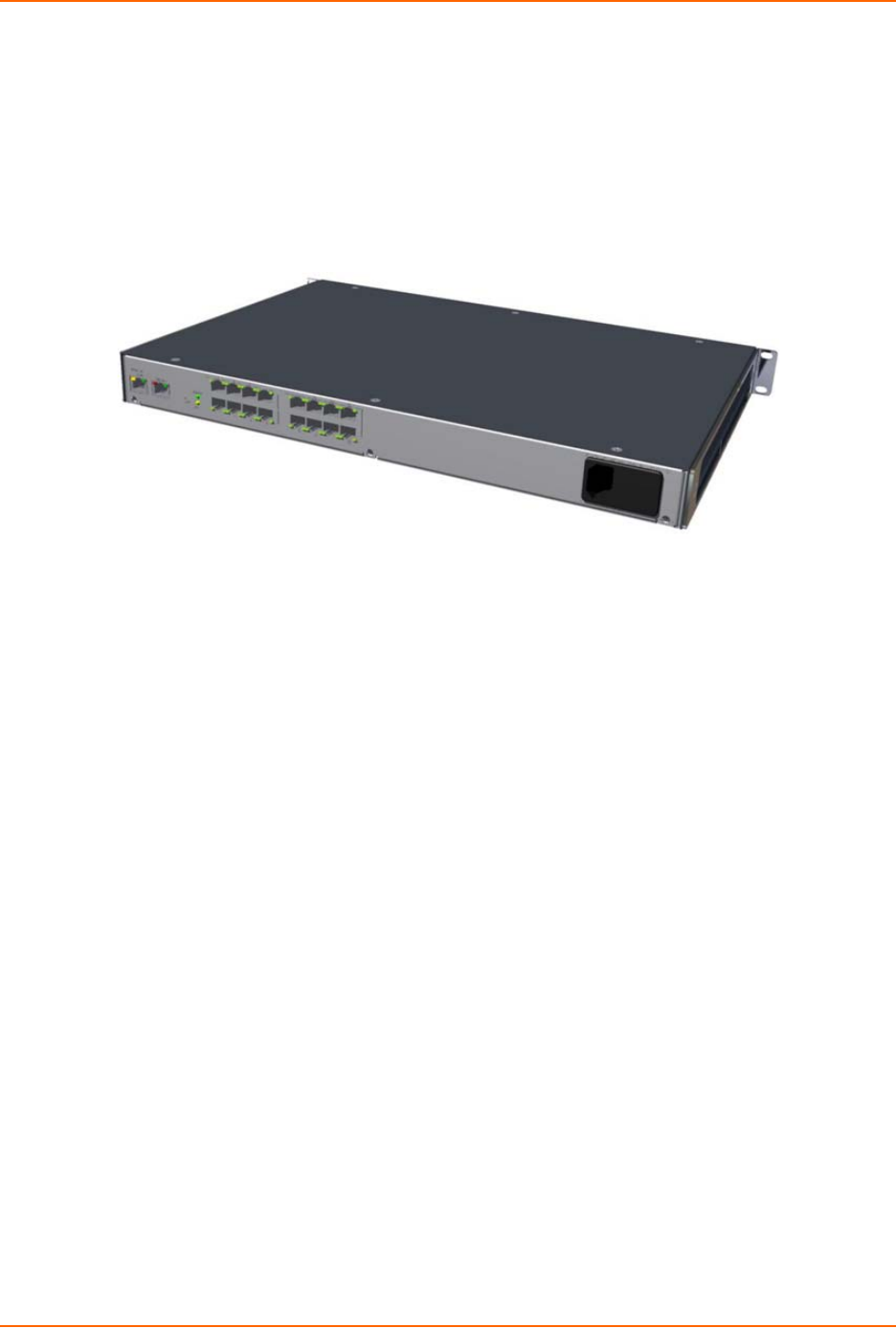
The EDS8PR (8 serial ports), EDS16PR (16 serial ports), and EDS32PR (32 serial ports) are
compact easy-to-use, rack-mountable device servers that give you the ability to network-enable
asynchronous RS-232 serial devices. They provide fully transparent RS-232 point-to-point
connections without requiring modifications to existing software or hardware components in your
application.
Figure 2-3 EDS16PR Device Server
Features
The key features of the EDS8PR, EDS16PR, and EDS32PR include:
Dual-purpose Ethernet terminal server and device server design.
8 (EDS8PR), 16 (EDS16PR) or 32 (EDS32PR) serial ports with hardware handshaking
signals.
RS-232 support.
One RJ45 Ethernet port.
8 MB Flash memory.
32 MB Random Access Memory (RAM).
Lantronix Evolution OS™.
A dedicated console port.
AES, SSH, or SSL secure data encryption.
Three configuration methods (Web, command line, and XML).
Print server functionality (LPR/LPD).
See Chapter 5: Installation of EDS8PR, EDS16PR and EDS32PR, for installation instructions.

2: Introduction
EDS User Guide 20
Applications
The EDS device server connects serial devices such as those listed below to Ethernet networks
using the IP protocol family.
ATM machines
Data display devices
Security alarms and access control devices
Modems
Time/attendance clocks and terminals
Patient monitoring equipment
Medical instrumentation
Industrial Manufacturing/Automation systems
Building Automation equipment
Point of Sale Systems
Protocol Support
The EDS device server contains a full-featured TCP/IP stack. Supported protocols include:
ARP, IP, UDP, TCP, ICMP, BOOTP, DHCP, AutoIP, Telnet, DNS, FTP, TFTP, HTTP/HTTPS,
SSH, SSL/TLS, SNMP, SMTP, RSS and Syslog for network communications and
management.
TCP, UDP, TCP/AES, UDP/AES, Telnet, SSH and SSL/TLS for tunneling to the serial port.
TFTP, FTP, and HTTP for firmware upgrades and uploading files.
Evolution OS™
The EDS incorporates the Lantronix Evolution OS™. Key features of the Evolution OS™ include:
Built-in Web server for configuration and troubleshooting from Web-based browsers
CLI configurability
SNMP management
XML data transport and configurability
Really Simple Syndication (RSS) information feeds
Enterprise-grade security with SSL and SSH
Comprehensive troubleshooting tools

2: Introduction
EDS User Guide 21
Additional Features
Modem Emulation
In modem emulation mode, the EDS can replace dial-up modems. The unit accepts modem AT
commands on the serial port, and then establishes a network connection to the end device,
leveraging network connections and bandwidth to eliminate dedicated modems and phone lines.
Web-Based Configuration and Troubleshooting
Built upon Internet-based standards, the EDS enables you to configure, manage, and troubleshoot
through a browser-based interface accessible anytime from anywhere. All configuration and
troubleshooting options are launched from a web interface. You can access all functions via a Web
browser, for remote access. As a result, you decrease downtime (using the troubleshooting tools)
and implement configuration changes (using the configuration tools).
Command-Line Interface (CLI)
Making the edge-to-enterprise vision a reality, the EDS with the Evolution OS™ uses industry-
standard tools for configuration, communication, and control. For example, the Evolution OS™
uses a Command Line Interface (CLI) whose syntax is very similar to that used by data center
equipment such as routers and hubs.
VIP Access
Virtual IP Access is the Lantronix technology that solves the access-through-firewall problem. With
VIP Access, the EDS can act as a ManageLinx DSC and provide direct access to your equipment
behind a firewall.
SNMP Management
The EDS supports full SNMP management, making it ideal for applications where device
management and monitoring are critical. These features allow networks with SNMP capabilities to
correctly diagnose and monitor EDS.
XML-Based Architecture and Device Control
XML is a fundamental building block for the future growth of M2M networks. The EDS supports
XML-based configuration setup records that make device configuration transparent to users and
administrators. The XML is easily editable with a standard text or XML editor.
Really Simple Syndication (RSS)
The EDS supports Really Simple Syndication (RSS) for streaming and managing on-line content.
RSS feeds all the configuration changes that occur on the device. An RSS aggregator then reads
(polls) the feed. More powerful than simple email alerts, RSS uses XML as an underlying Web
page transport and adds intelligence to the networked device, while not taxing already overloaded
email systems.
Enterprise-Grade Security
Evolution OS™ provides the EDS the highest level of networking security possible. This ‘data
center grade’ protection ensures that each device on the M2M network carries the same level of
security as traditional IT networking equipment in the corporate data center.

2: Introduction
EDS User Guide 22
By protecting the privacy of serial data transmitted across public networks, users can maintain
their existing investment in serial technology, while taking advantage of the highest data-protection
levels possible.
SSH and SSL are able to do the following:
Verify the data received came from the proper source
Validate that the data transferred from the source over the network has not changed when it
arrives at its destination (shared secret and hashing)
Encrypt data to protect it from prying eyes and nefarious individuals
Provide the ability to run popular M2M protocols over a secure SSH or SSL connection
In addition to keeping data safe and accessible, the EDS has robust defenses to hostile Internet
attacks such as denial of service (DoS), which can be used to take down the network. Moreover,
the EDS cannot be used to bring down other devices on the network.
You can use the EDS with the Lantronix Secure Com Port Redirector (SCPR) to encrypt COM
port-based communications between PCs and virtually any electronic device. SCPR is a Windows
application that creates a secure communications path over a network between the computer and
serial-based devices that are traditionally controlled via a COM port. With SCPR installed at each
computer, computers that were formerly “hard-wired” by serial cabling for security purposes or to
accommodate applications that only understood serial data can instead communicate over an
Ethernet network or the Internet.
Terminal Server/Device Management
Remote offices can have routers, PBXs, servers and other networking equipment that require
remote management from the corporate facility. The EDS easily attaches to the serial ports on a
server, Private Branch Exchange (PBX), or other networking equipment to deliver central, remote
monitoring and management capability.
Troubleshooting Capabilities
The EDS offers a comprehensive diagnostic toolset that lets you troubleshoot problems quickly
and easily. Available from the Web Manager, CLI, and XML interfaces, the diagnostic tools let you:
View critical hardware, memory, MIB-II, buffer pool, and IP socket information.
Perform ping and traceroute operations.
Conduct forward or backup DNS lookup operations.
View all processes currently running on the EDS, including CPU utilization and total stack
space available.
Configuration Methods
After installation, the EDS requires configuration. For the unit to operate correctly on a network, it
must have a unique IP address on the network. There are four basic methods for logging into the
EDS and assigning IP addresses and other configurable settings:
DeviceInstaller: Configure the IP address and related settings and view current settings on the
using a Graphical User Interface (GUI) on a PC attached to a network. See Using DeviceInstaller
(on page 41).

2: Introduction
EDS User Guide 23
Web Manager: Through a web browser, configure the EDS settings using the Lantronix Web
Manager. See Configuration Using Web Manager (on page 43).
Command Mode: There are two methods for accessing Command Mode (CLI): making a Telnet
connection or connecting a terminal (or a PC running a terminal emulation program) to the unit’s
serial port. (See the EDS Command Reference Guide for instructions and available commands.)
XML: The EDS supports XML-based configuration and setup records that make device
configuration transparent to users and administrators. XML is easily editable with a standard text
or XML editor. (See the EDS Command Reference Guide for instructions and commands.)
Addresses and Port Numbers
Hardware Address
The hardware address is also referred to as the Ethernet address or MAC address. The first three
bytes of the Ethernet address are fixed and read 00-20-4A, identifying the unit as a Lantronix
product. The fourth, fifth, and sixth bytes are unique numbers assigned to each unit.
Figure 2-4 Sample Hardware Address
00-20-4A-14-01-18 or 00:20:4A:14:01:18
IP Address
Every device connected to an IP network must have a unique IP address. This address references
the specific unit.
Port Numbers
Every TCP connection and every UDP datagram is defined by a destination and source IP
address, and a destination and source port number. For example, a Telnet server commonly uses
port number 23.
The following is a list of the default server port numbers running on the EDS:
TCP Port 22: SSH Server (Command Mode configuration)
TCP Port 23: Telnet Server (Command Mode configuration)
TCP Port 80: HTTP (Web Manager configuration)
TCP Port 443: HTTPS (Web Manager configuration)
UDP Port 161: SNMP
TCP Port 21: FTP
UDP Port 69: TFTP
UDP Port 514: Syslog
TCP Port 515: LPD
UDP Port 30718: LDP (Lantronix Discovery Protocol) port
TCP/UDP Port 10001: Tunnel 1
2: Introduction
EDS User Guide 24
Note: Multi-port products include one or more additional supported ports and tunnels
with default sequential numbering. For instance: TCP/UDP Port 10002: Tunnel 2, TCP/
UDP Port 10003: Tunnel 3, etc.
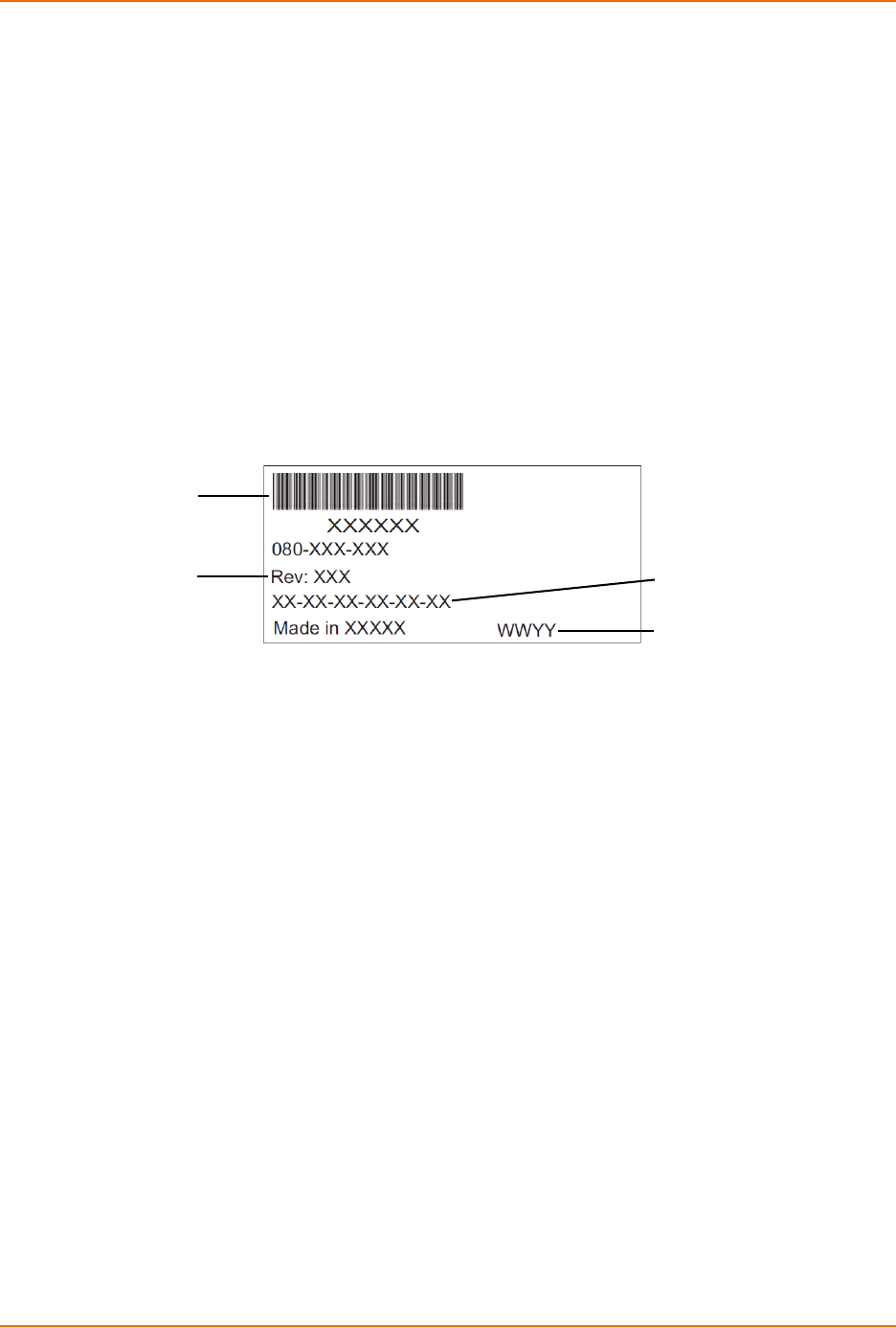
Product Information Label
The product information label on the unit contains the following information about the specific unit:
Bar Code
Product Revision
Hardware Address (MAC Address or Serial Number)
Manufacturing Date Code
Figure 2-5 Product Label
Bar Code
Product Revision Hardware/MAC Address
Manufacturing Date Code

EDS User Guide 25
3: Installation of EDS8PS and EDS16PS
This chapter describes how to install the EDS8PS and EDS16PS device servers.
Package Contents
Your EDS package includes the following items:
One EDS device server (EDS8PS or EDS16PS)
One RJ45-to-DB9F serial cable
One power cord
User-Supplied Items
To complete your EDS8/16PS installation, you need the following items:
RS-232 serial devices that require network connectivity. Each EDS8/16PS serial port supports
a directly connected RS-232 serial device.
A serial cable for each serial device to be connected to the EDS8/16PS. All devices attached
to the device ports support the RS-232C (EIA-232) standard. Category 5 cabling with RJ45
connections is used for the device port connections.
Note: To connect an EDS8/16PS serial port to a DTE device, you need a DTE cable,
such as the one supplied in your EDS8/16PS package, or an RJ45 patch cable and DTE
adapter. To connect the EDS8/16PS serial port to a DCE device, you need a DCE
(modem) cable, or an RJ45 patch cable and DTE adapter. For a list of the Lantronix
cables and adapters you can use with the EDS8/16PS, see the Appendix D - Lantronix
Cables and Adapters (on page 158).
An available connection to your Ethernet network and an Ethernet cable.
A working power outlet.
3: Installation of EDS8PS and EDS16PS
EDS User Guide 26
Identifying Hardware Components
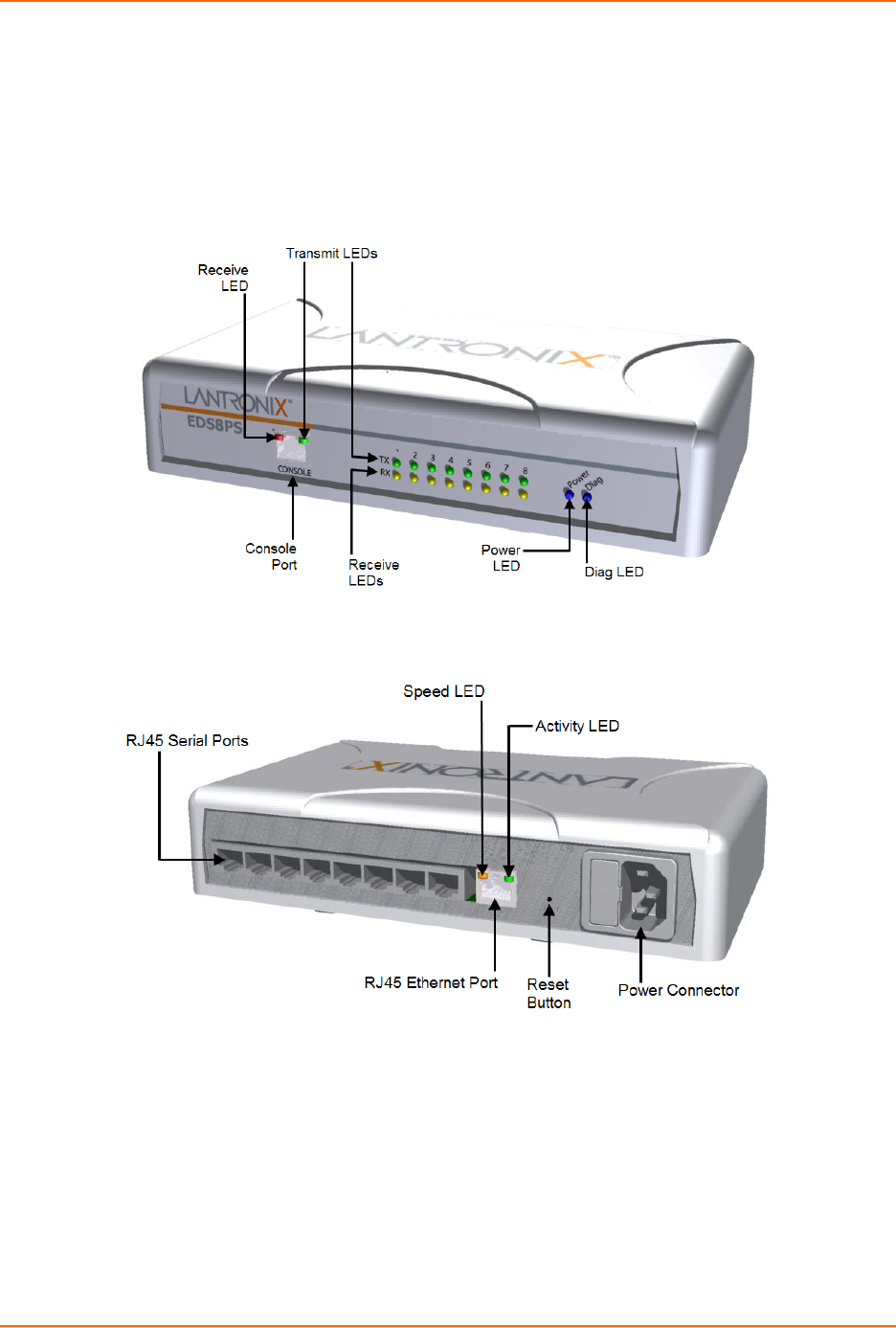
Figure 3-1 shows the front of the EDS8PS. Figure 3-2 shows the back of the EDS8PS.
Figure 3-1 Front View of the EDS8PS
Figure 3-2 Back View of the EDS8PS
Serial Ports
The EDS8PS has 8 serial ports and the EDS16PS has 16 serial ports on the back panel. All are
configured as DTE and support up to 230,400 baud.
Console Port
The front panel of the EDS8/16/32PR provides an RJ45 Console port, configured as DTE and
supports baud rates up to 230,400 baud.
Note: The console port cannnot be used as a serial port.

3: Installation of EDS8PS and EDS16PS
EDS User Guide 27
Figure 3-3 RJ45 Serial Port
Ethernet Port
The back panel of the EDS8/16PS provides a network interface via the right most RJ45 port. This
port can connect to an Ethernet (10 Mbps) or Fast Ethernet (100 Mbps) network. The Speed LED
on the back of the EDS8/16PS shows the connection of the attached Ethernet network. The EDS8/
16PS can be configured to operate at a fixed Ethernet speed and duplex mode (half- or full-
duplex). Otherwise by default, the EDS8/16PS auto-negotiates the connection to the Ethernet
network.
LEDs
Light-emitting diodes (LEDs) on the front panel show status information.
Each serial port plus the console port have a Transmit and a Receive LED. The Ethernet port
has Speed, Activity, Power, and Status LEDs.
The table below describes the LEDs on the front of the EDSPS.
Table 3-4 Front Panel LEDs
Reset Button
The reset button is on the rear of the device to the right of the Ethernet port, accessible through a
hole in the case. You can use it to reboot the unit or to reload factory defaults.
Reboot the device:
LED Description
Transmit (green) Blinking = EDS is transmitting data on the serial port.
Receive (yellow) Blinking = EDS is receiving data on the serial port.
Power (blue) On = EDS is receiving power.
Diag (green) Fast blink = initial startup (loading OS).
Slow blink (once per second) = operating system startup.
On = unit has finished booting.
Speed (yellow) On = EDS is connected to a 100 Mbps Fast Ethernet network.
Off = EDS is connected to a 10 Mbps Ethernet network.
Activity (green) Blink = EDS is sending data to or receiving data from the Ethernet network.

3: Installation of EDS8PS and EDS16PS
EDS User Guide 28
1. Press and hold the reset button for about 3 seconds. The status LED blinks quickly.
2. When the fast blinks stop, release the button. When the unit reboots, the status LED changes
from a fast blink to a solid ON.
Restore factory defaults:
1. Press and hold the reset button for about 11 seconds. The LED blinks quickly for about 3
seconds, then comes on for about 5 seconds, then blinks slowly for about 2 seconds.
2. When the slow blinks stop, release the button.
Installing the EDS8/16PS
Finding a Suitable Location
You can install the EDS8/16PS either in a shelf or as a desktop unit.
If using AC power, avoid outlets controlled by a wall switch.
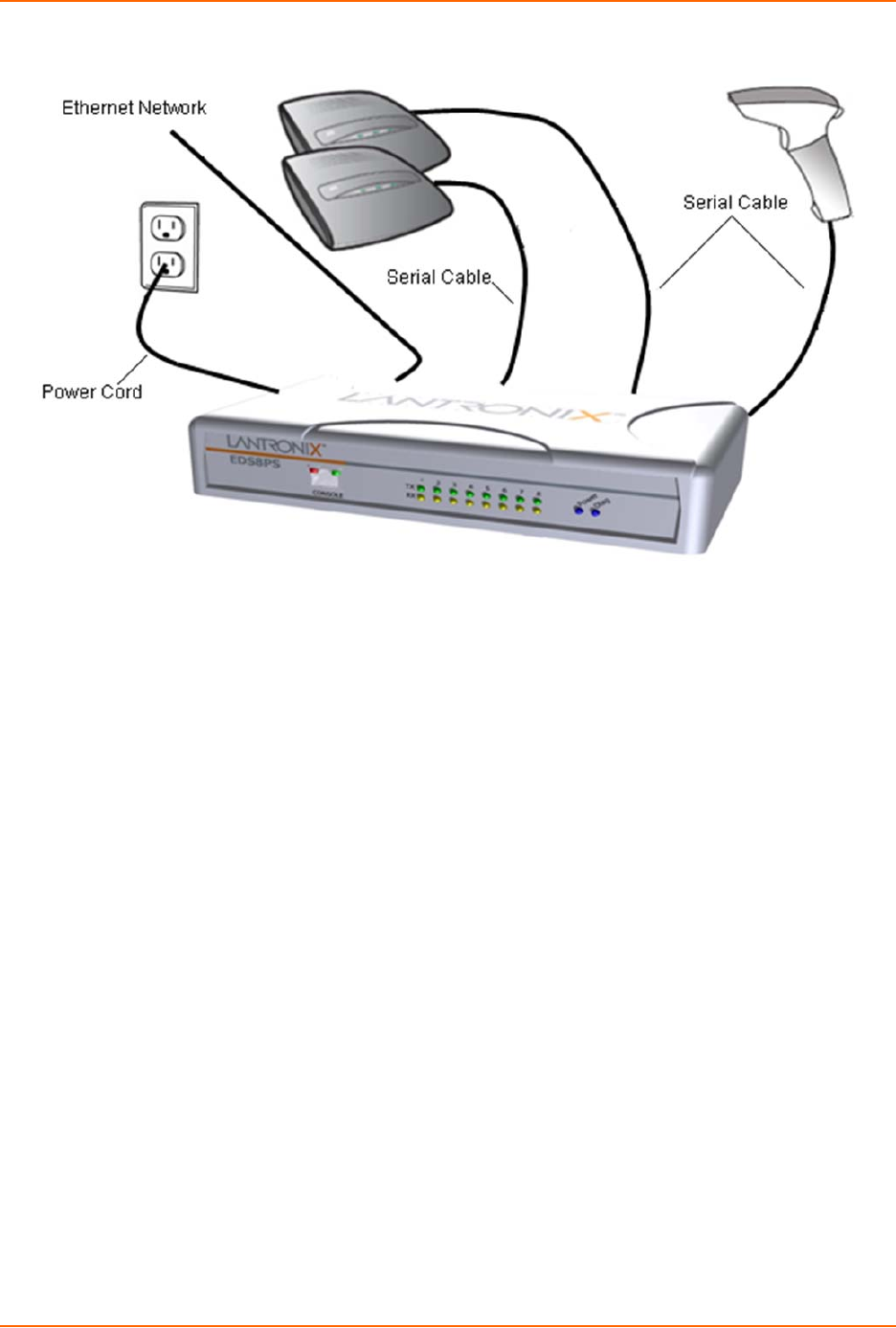
Connecting the EDS8/16PS
All EDS serial ports support RS-232 devices.
Connect the EDS8/16PS to one or more serial devices.
1. Power off the serial devices.
2. Attach a CAT 5 serial cable between the EDS8/16PS and your serial device. See the
Appendix D - Lantronix Cables and Adapters (on page 158), for a list of cables and adapters
you can use.
3. Connect an Ethernet cable between the EDS8/16PS Ethernet port and your Ethernet network.
4. Insert the power cord into the back of the EDS8/16PS. Plug the other end into an AC wall
outlet.
5. Power up the serial devices.
3: Installation of EDS8PS and EDS16PS
EDS User Guide 29
Figure 3-5 Example of EDS8/16PS Connections

EDS User Guide 30
4: Installation of EDS4100
This chapter describes how to install the EDS4100 device server.
Package Contents
Your EDS4100 package includes the following items:
One EDS4100 device server.
One DB9F-to-DB9F null modem cable.
A printed Quick Start Guide.
Your package may also include a power supply.
User-Supplied Items
To complete your EDS4100 installation, you need the following items:
RS-232 and/or RS-422/485 serial devices that require network connectivity:
A serial cable for each serial device. One end of the cable must have a female DB9 connector
for the EDS4100 serial port.
To connect an EDS4100 serial port to another DTE device, you will need a null modem cable,
such as the one supplied in your EDS4100 package.
To connect the EDS4100 serial port to a DCE device, you will need a straight-through
(modem) cable.
An available connection to your Ethernet network and an Ethernet cable.
A working power outlet if the unit will be powered from an AC outlet.
Identifying Hardware Components
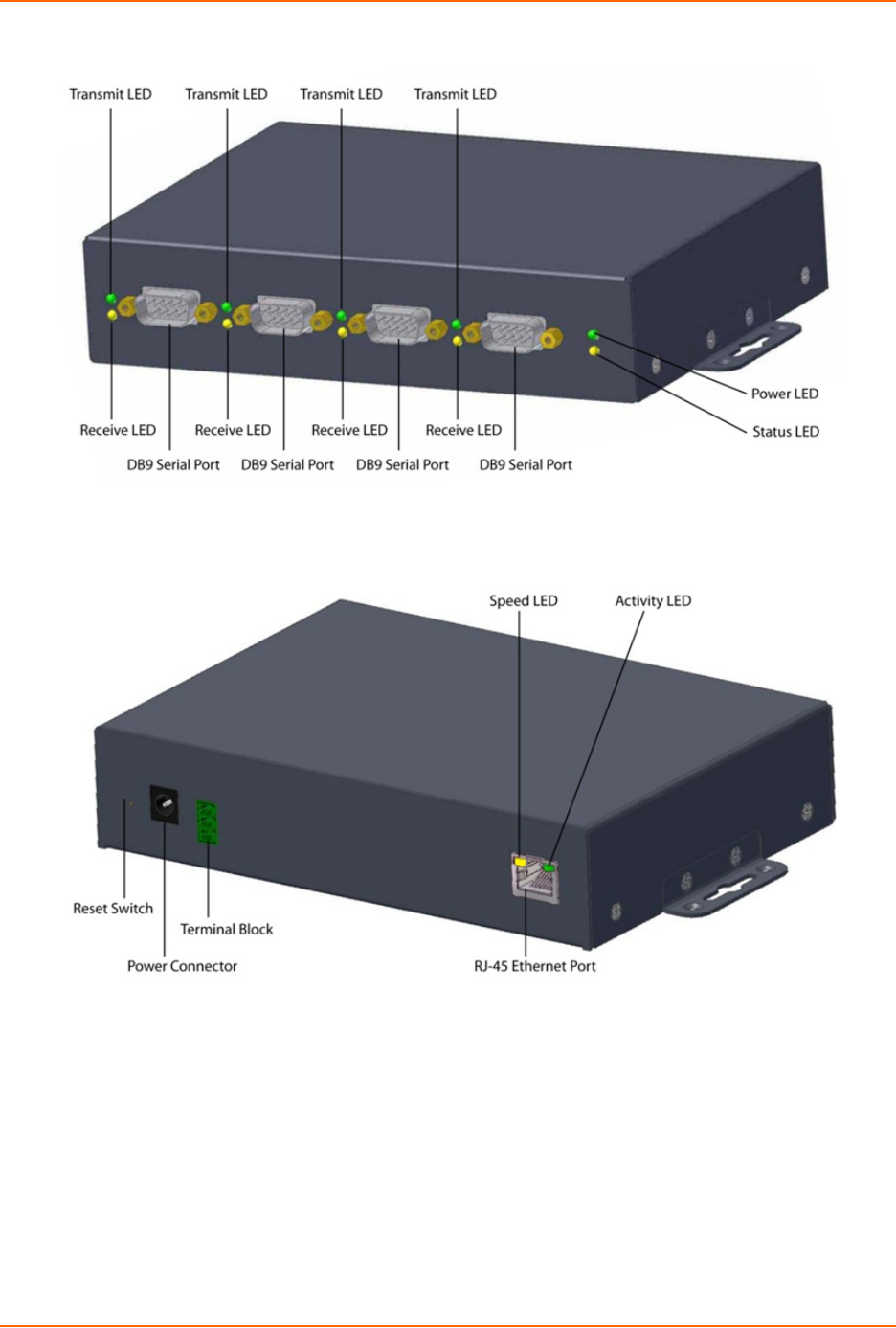
The following two figures show the front and back of the EDS4100.
4: Installation of EDS4100
EDS User Guide 31
Figure 4-1 Front View of the EDS4100
Figure 4-2 Back View of the EDS4100
Serial Ports
The front of the EDS4100 has four male DB9 serial ports. These ports allow you to connect up to
four standard serial devices:
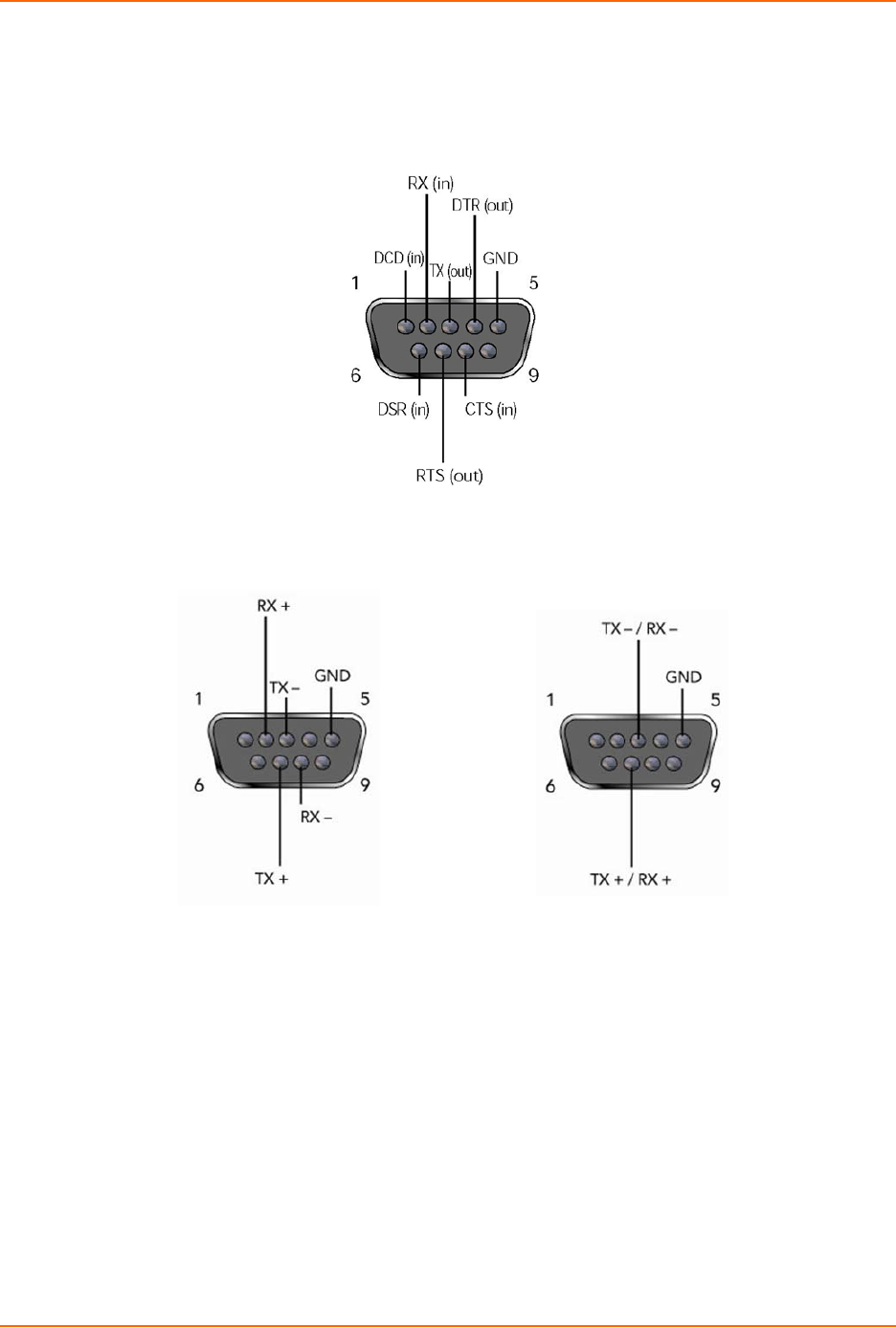
All four serial ports support RS-232 devices. See Figure 4-3 for pin assignments.
Serial ports 1 and 3 also support RS-422 and RS-485 serial devices. See Figure 4-4 for pin
assignments.
All four serial ports are configured as DTE.
4: Installation of EDS4100
EDS User Guide 32
Ports 1 & 3 support up to 921600
Ports 2 & 4 support up to 230400
Figure 4-3 RS-232 Serial Port Pins (Serial Ports 1, 2, 3, 4)
Figure 4-4 RS-422/RS-485 Serial Port Pins
Note: Multi-drop connections are supported in 2-wire mode only.
Ethernet Port
The back panel of the EDS4100 provides an RJ45 Ethernet port. This port can connect to an
Ethernet (10 Mbps) or Fast Ethernet (100 Mbps) network. The Speed LED on the back of the
EDS4100 shows the connection of the attached Ethernet network. The EDS4100 can be
configured to operate at a fixed Ethernet speed and duplex mode (half- or full-duplex) or otherwise
(by default) auto-negotiate the connection to the Ethernet network.
R-422/485 4-wire
pin assignments
(serial ports 1 and 3)
R-485 2-wire
pin assignments
(serial ports 1 and 3)

4: Installation of EDS4100
EDS User Guide 33
Terminal Block Connector
The back of the EDS4100 has a socket for a terminal block screw connector (not included) for
attaching to an appropriate power source, such as those used in automation and manufacturing
industries. The terminal block connector supports a power range from 42 VDC to 56 VDC. It can
be used with the EDS4100's barrel power connector and PoE capabilities as a redundant power
source to the unit. Vendors who do supply this connector can be found by doing a web search for
part 'Phoenix 1803581 MC 1,5/ 3-ST-3,81'.
Figure 4-5 Terminal Block Connector Pin Assignments
LEDs
Light-emitting diodes (LEDs) on the front and back panels show status information.
Back panel - Each serial port has a Transmit and a Receive LED. The Ethernet connector has
Speed and Activity LEDs. In addition, the back panel has a Power LED and a Status LED.
Front panel - The front panel has a green Power LED.
The table below describes the LEDs on the back of the EDS4100.
Table 4-6 Back Panel LEDs
Reset Button
The reset button is on the back of the EDS4100, to the left of the power connector. Pressing this
button reboots the EDS4100 and terminates all serial and Ethernet port data activity.
Pin Signal
Top V+
Middle V-
Bottom Ground
LED Description
Transmit (green) Blinking = EDS is transmitting data on the serial port.
Receive (yellow) Blinking = EDS is receiving data on the serial port.
Power (green) On = EDS receiving power.
Status (yellow) Fast blink = initial startup (loading OS).
Slow blink (once per second) = operating system startup.
On = unit has finished booting.
Speed (yellow) On = EDS is connected to a 100 Mbps Fast Ethernet network.
Off = EDS is connected to a 10 Mbps Ethernet network
Activity (green) Blink = EDS sending data to or receiving data from the Ethernet network.

4: Installation of EDS4100
EDS User Guide 34
Physically Installing the EDS4100
Finding a Suitable Location
Place the EDS4100 on a flat horizontal or vertical surface. The EDS4100 comes with
mounting brackets installed for vertically mounting the unit, for example, on a wall.
If using AC power, avoid outlets controlled by a wall switch.
Connecting the EDS4100
Observe the following guidelines when attaching serial devices:
All four EDS4100 serial ports support RS-232 devices.
Alternatively, ports 1 and 3 support RS-422/485 devices.
To connect an EDS4100 serial port to another DTE device, use a null modem cable.
To connect the EDS4100 serial port to a DCE device, use a straight-through (modem) cable.
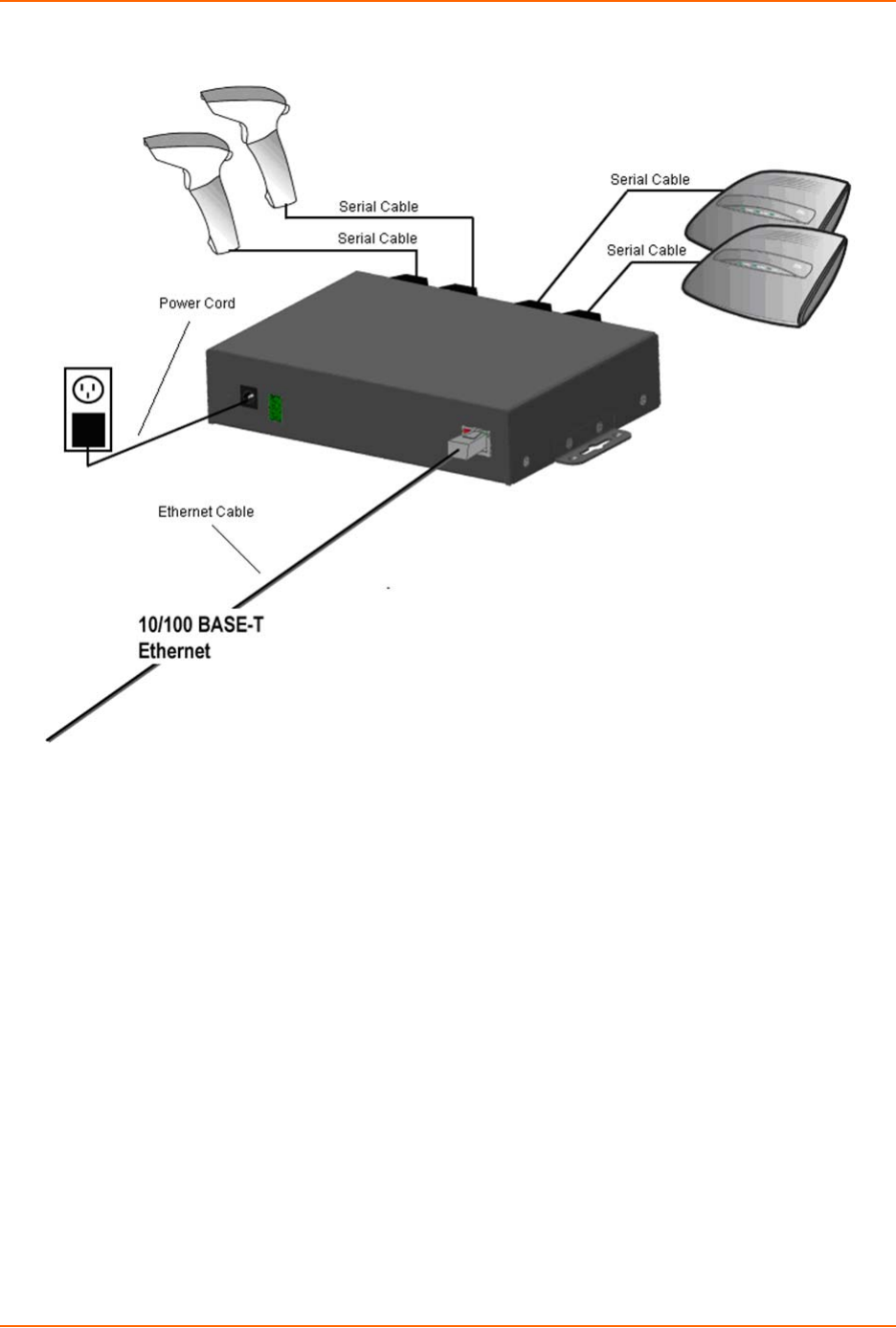
Connect the EDS4100 to one or more serial devices.
1. Power off the serial devices.
2. Attach a serial cable between the EDS4100 and each serial device.
3. Connect an Ethernet cable between the EDS4100 Ethernet port and your Ethernet network.
4. Power-up the EDS4100. Use one or more of the following methods.
These power-up methods can be used in combination to provide redundant backup power to
the unit.
PoE: Power is supplied over the Ethernet cable by an Ethernet switch or a mid-span
device.
Barrel power connector: The barrel power connector supports a power range of 9 to 30
VDC. Insert the round end of the supplied power cord into the barrel power connector on
the back of the EDS4100. Plug the other end into an AC wall outlet.
Terminal block connector: The terminal block connector supports a power range of 42
VDC to 56 VDC. Attach the power source to the terminal block connector on the back of
the EDS4100.
As soon as you plug it in, the EDS4100 powers up automatically, the self-test begins, and
Evolution OS™ starts.
5. Power up the serial devices.
4: Installation of EDS4100
EDS User Guide 35
Figure 4-7 Example of EDS4100 Connections

EDS User Guide 36
5: Installation of EDS8PR, EDS16PR and EDS32PR
This chapter describes installing the EDS8PR, EDS16PR and EDS32PR device servers.
Package Contents
Your EDS package includes the following items:
One EDS device server (EDS8PR, EDS16PR or EDS32PR).
One RJ45-to-DB9F serial cable.
A printed Quick Start guide.
Your package may also include a power supply.
User-Supplied Items
To complete your EDS8/16/32PR installation, you need the following items:
RS-232 serial devices that require network connectivity. Each EDS8/16/32PR serial port
supports a directly connected RS-232 serial device.
A serial cable for each serial device. All devices attached to the EDS device ports must
support the RS-232C (EIA-232) standard. Category 5 cabling with RJ45 connections is used
for the device port connections.
Note: To connect an EDS8/16/32PR serial port to a DTE device, you need a DTE cable,
such as the one supplied in your EDS8/16/32PR package, or an RJ45 patch cable and
DTE adapter. To connect the EDS8/16/32PR serial port to a DCE device, you need a DCE
(modem) cable, or an RJ45 patch cable and DTE adapter.
For a list of the Lantronix cables and adapters you can use with the EDS8/16/32PR, see Appendix
C: Lantronix Cables and Adapters.
An available connection to your Ethernet network and an Ethernet cable.
A working power outlet.
5: Installation of EDS8PR, EDS16PR and EDS32PR
EDS User Guide 37
Identifying Hardware Components
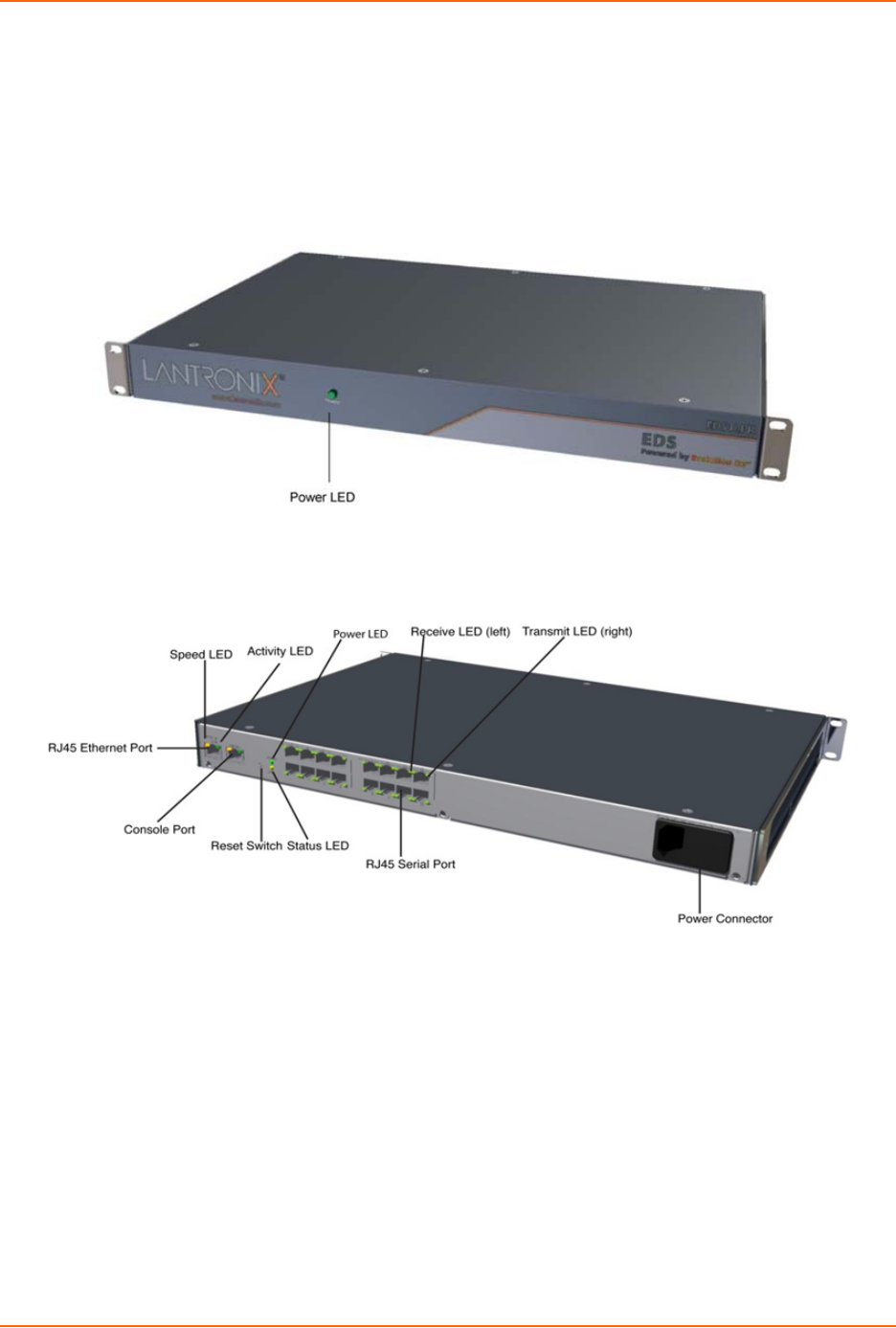
The following two figures show the components on the front and back of the EDS16PR.
Figure 5-1 Front View of the EDS16PR
Figure 5-2 Back View of the EDS16PR
Serial Ports
All EDS serial ports are configured as DTE and support up to 230,400 baud.
The EDS8PR has 8 serial ports.
The EDS16PR has 16 serial ports.
The EDS32PR has 32 serial ports.
Console Port
The front panel has an RJ45 Console port configured as DTE and supports up to 230,400 baud.

5: Installation of EDS8PR, EDS16PR and EDS32PR
EDS User Guide 38
Figure 5-3 RJ45 Serial Port
Ethernet Port
The back panel has an RJ45 Ethernet port. This port can connect to an Ethernet (10 Mbps) or Fast
Ethernet (100 Mbps) network.
The Speed LED on the back panel shows the connection speed of the connected Ethernet
network.
You can configure the EDS to operate at a fixed Ethernet speed and duplex mode (half- or full-
duplex) or auto-negotiate the connection to the Ethernet network.
LEDs
Light-emitting diodes (LEDs) on the front and back panels show status information.
Front panel. The front panel has a green Power LED.
Back panel. Each serial port has a Transmit and a Receive LED. The Ethernet connector has
Speed and Activity LEDs. There is also a Power LED and a Status LED.
5: Installation of EDS8PR, EDS16PR and EDS32PR
EDS User Guide 39
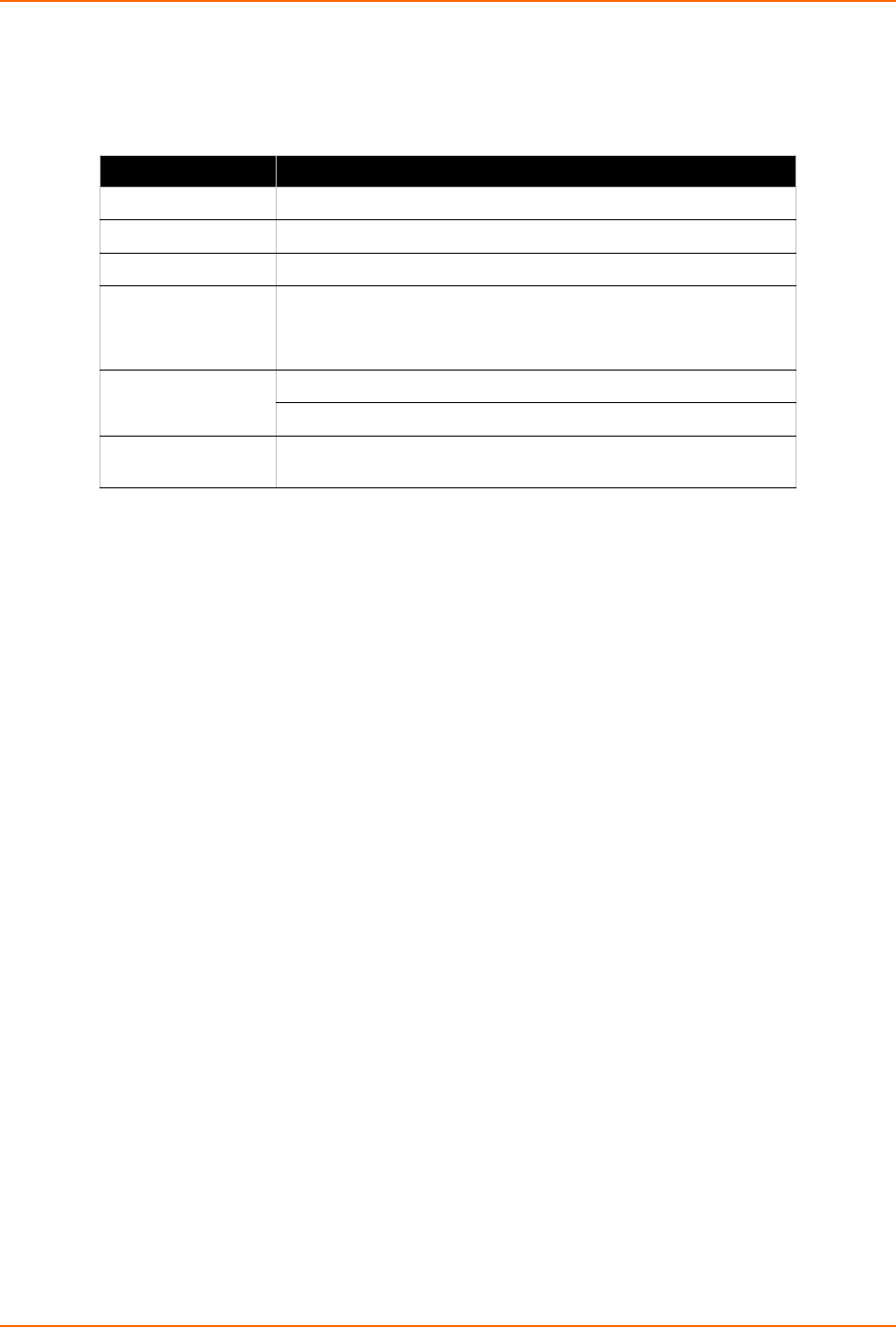
The table below describes the LEDs on the back of the EDS.
Table 5-4 Back Panel LEDs
Reset Button
The reset button is on the back of the EDS, to the left of the power connector.
Pressing this button for 2-to-3 seconds reboots the EDS8/16/32PR and terminates all data activity
occurring on the serial and Ethernet ports.
Installing the EDS8/16/32PR
Finding a Suitable Location
You can install the EDS8/16/32PR either in an EIA-standard 19-inch rack (1U tall) or as a desktop
unit. If using AC power, avoid outlets controlled by a wall switch.
Connecting the EDS8/16/32PR
1. Power off the serial devices that will be connected to the EDS8/16/32PR.
2. Attach a CAT 5 serial cable between the EDS8/16/32PR and your serial device. For a list of
cables and adapters you can use with the EDS8/16/32PR, see Appendix C: Lantronix Cables
and Adapters.
3. Connect an Ethernet cable between the EDS8/16/32PR Ethernet port and your Ethernet
network.
4. Insert the power cord into the back of the EDS8/16/32PR. Plug the other end into an AC wall
outlet. After power-up, the self-test begins.
5. Power up the serial devices.
LED Description
Transmit (green) Blinking = EDS is transmitting data on the serial port.
Receive (yellow) Blinking = EDS is receiving data on the serial port.
Power (green) On = EDS is receiving power.
Status (yellow) Fast blink = initial startup (loading OS).
Slow blink (once per second) = operating system startup.
On = unit has finished booting.
Speed (yellow) On = EDS is connected to a 100 Mbps Fast Ethernet network.
Off = EDS is connected to a 10 Mbps Ethernet network.
Activity (green) Blink = EDS is sending data to or receiving data from the Ethernet
network.
5: Installation of EDS8PR, EDS16PR and EDS32PR
EDS User Guide 40
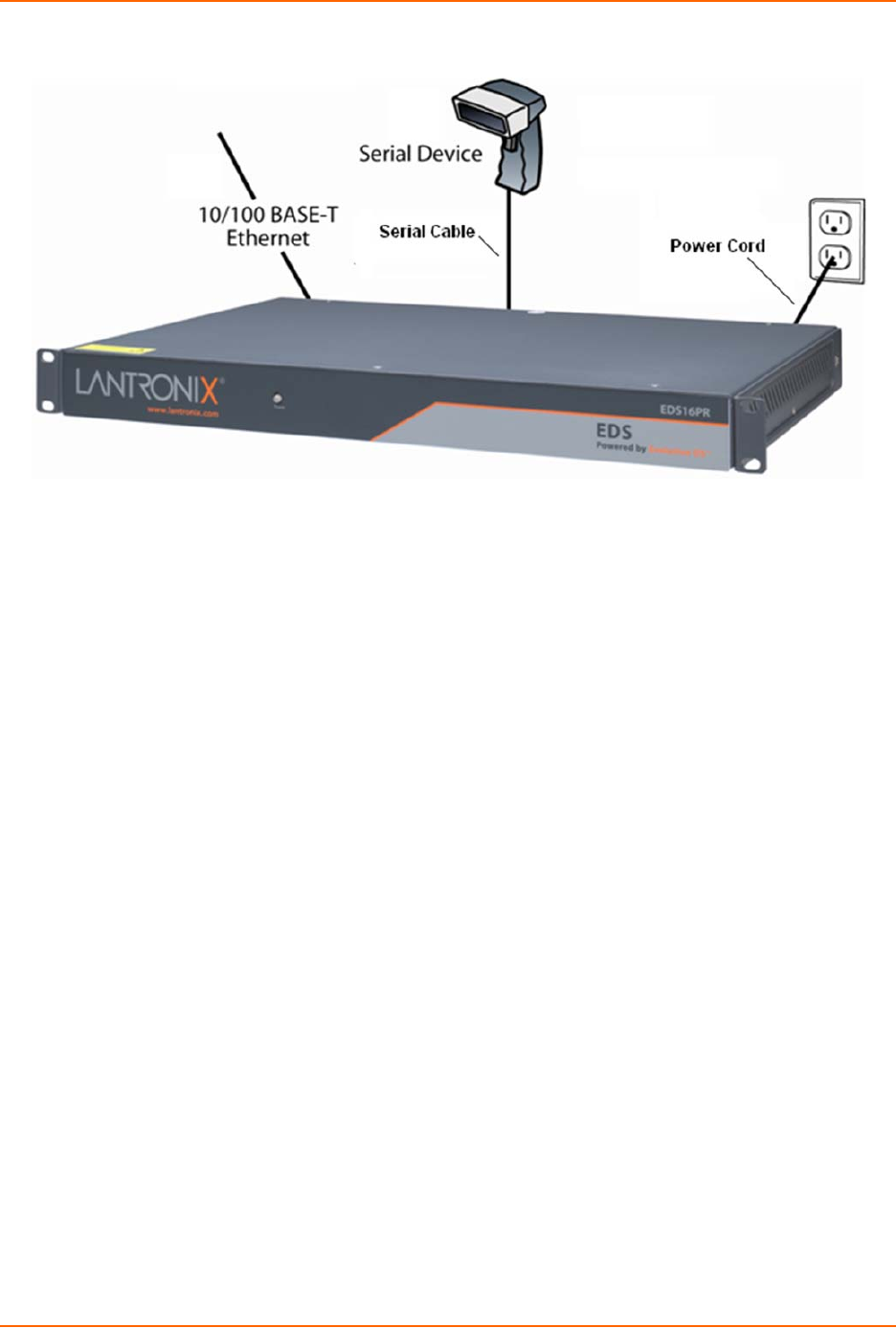
Figure 5-5 Example of EDS16PR Connections

EDS User Guide 41
6: Using DeviceInstaller
This chapter covers the steps for locating a device and viewing its properties and details.
DeviceInstaller is a free utility program provided by Lantronix that discovers, configures, upgrades
and manages Lantronix Device Servers. It can be downloaded from the Lantronix website at
www.lantronix.com/support/downloads.html. For instructions on using DeviceInstaller to configure
the IP address, related settings or for more advanced features, see the DeviceInstaller online help.
Note: AutoIP generates a random IP address in the range of 169.254.0.1 to
169.254.255.254 if no BOOTP or DHCP server is found.
Accessing EDS Using DeviceInstaller
Note: Make note of the MAC address. It is needed to locate the EDS using
DeviceInstaller.
1. Click Start > All Programs > Lantronix > DeviceInstaller > DeviceInstaller.
When DeviceInstaller starts, it will perform a network device search.
2. Click Search to perform additional searches, as desired.
3. Expand the EDS folder by clicking the + symbol next to the EDS folder icon. The list of
available Lantronix EDS devices appears.
4. Select the EDS unit by expanding its entry and clicking on its hardware (MAC) address to view
its configuration.
5. On the right page, click the Device Details tab. The current EDS configuration appears. This
is only a subset of the full configuration; the complete configuration may be accessed via Web
Manager, CLI, or XML.
Device Details Summary
Note: The settings are Display Only in this table unless otherwise noted.
Table 6-1 Device Details Summary
Current Settings Description
Name Name identifying the EDS.
DHCP Device Name Shows the name associated with the EDS’ current IP address, if
the IP address was obtained dynamically.
Group Configurable field. Enter a group to categorize the EDS. Double-
click the field, type in the value, and press Enter to complete. This
group name is local to this PC and is not visible on other PCs or
laptops using DeviceInstaller.
Comments Configurable field. Enter comments for the EDS. Double-click the
field, type in the value, and press Enter to complete. This
description or comment is local to this PC and is not visible on
other PCs or laptops using DeviceInstaller.

6: Using DeviceInstaller
EDS User Guide 42
Device Family Shows the EDS device family type as “EDS”.
Type Shows the specific device type, such as “EDS8PS”.
ID Shows the EDS ID embedded within the unit.
Hardware Address Shows the EDS hardware (MAC) address.
Firmware Version Shows the firmware currently installed on the EDS.
Extended Firmware Version Provides additional information on the firmware version.
Online Status Shows the EDS status as Online, Offline, Unreachable (the EDS is
on a different subnet), or Busy (the EDS is currently performing a
task).
IP Address Shows the EDS current IP address. To change the IP address,
click the Assign IP button on the DeviceInstaller menu bar.
IP Address was Obtained Displays “Dynamically” if the EDS automatically received an IP
address (e.g., from DHCP). Displays “Statically” if the IP address
was configured manually.
If the IP address was assigned dynamically, the following fields
appear:
Obtain via DHCP with value of True or False.
Obtain via BOOTP with value of True or False.
Subnet Mask Shows the subnet mask specifying the network segment on which
the EDS resides.
Gateway Shows the IP address of the router of this network. There is no
default.
Number of Ports Shows the number of serial ports on this EDS.
Supports Configurable Pins Shows False, indicating configurable pins are not available on the
EDS.
Supports Email Triggers Shows True, indicating email triggers are available on the EDS.
Telnet Enabled Indicates whether Telnet is enabled on this EDS.
Telnet Port Shows the EDS port for Telnet sessions.
Web Enabled Indicates whether Web Manager access is enabled on this EDS.
Web Port Shows the EDS port for Web Manager configuration.
Firmware Upgradable Shows True, indicating the EDS firmware is upgradable as newer
versions become available.

EDS User Guide 43
7: Configuration Using Web Manager
This chapter describes how to configure the EDS using Web Manager, the Lantronix browser-
based configuration tool. The unit’s configuration is stored in nonvolatile memory and is retained
without power. All changes take effect immediately, unless otherwise noted. It contains the
following sections:
Accessing Web Manager
Web Manager Page Components
Navigating the Web Manager
Table 7-3 Summary of Web Manager Pages
Accessing Web Manager
Note: You can also access the Web Manager by selecting the Web Configuration tab on
the DeviceInstaller window.
To access Web Manager, perform the following steps:
1. Open a standard web browser. Lantronix supports the latest version of Internet Explorer,
Mozilla Suite, Mozilla Firefox, Safari, Chrome or Opera.
2. Enter the IP address of the EDS in the address bar. The IP address may have been assigned
manually using DeviceInstaller (see the EDS Quick Start Guide) or automatically by DHCP.
3. Enter your username and password.The factory-default username is “admin” and the factory-
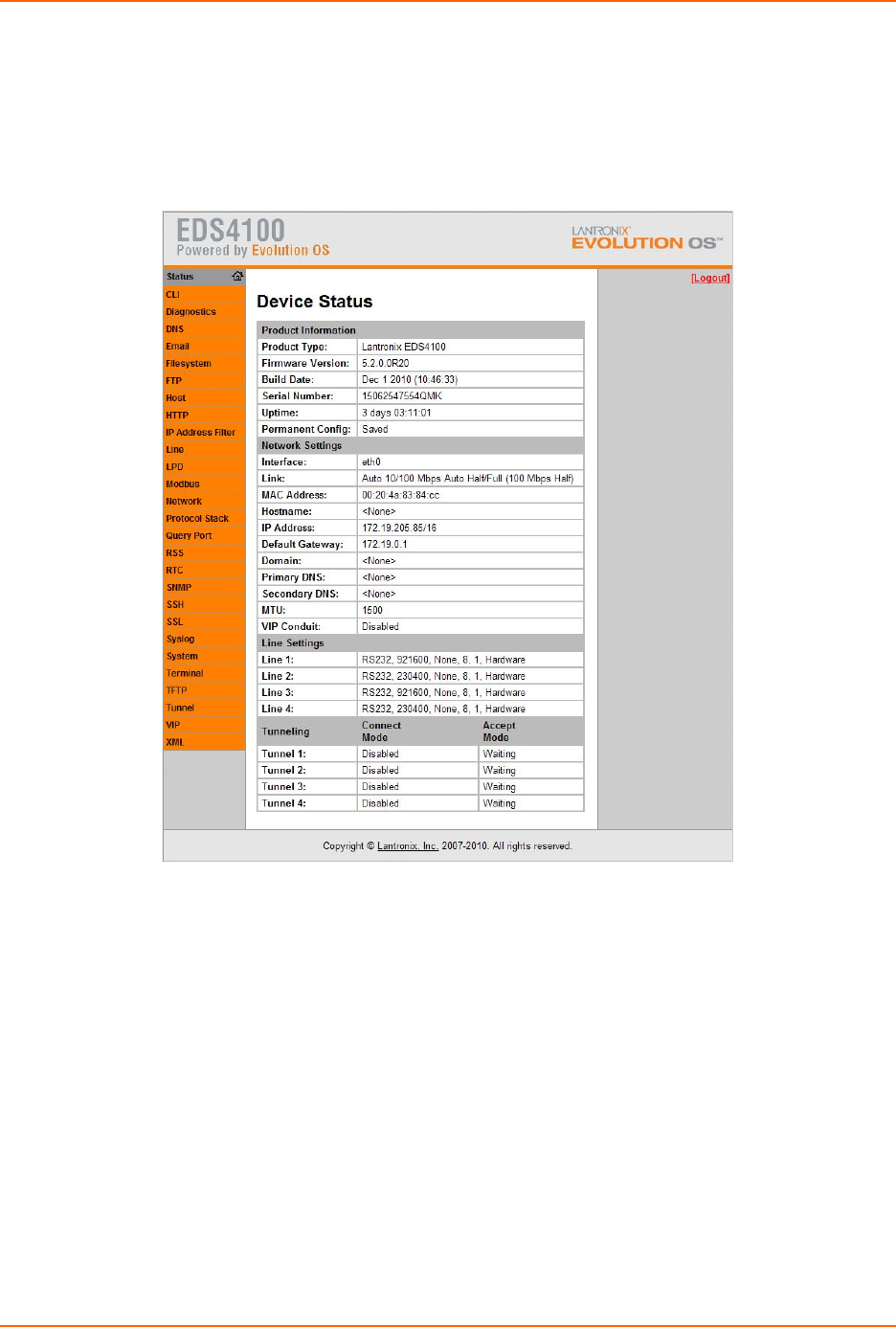
default password is “PASS.” The Device Status web page shown in Figure 7-1 displays
configuration, network settings, line settings, tunneling settings, and product information.
Note: The Logout button is available on any web page. Logging out of the web page
would force re-authentication to take place the next time the web page is accessed.
7: Configuration Using Web Manager
EDS User Guide 44
Device Status Page
The Device Status page is the first page that appears after you log into the Web Manager. It also
appears when you click Status in the Main Menu.
Figure 7-1 Web Manager Home Page
7: Configuration Using Web Manager
EDS User Guide 45
Web Manager Page Components
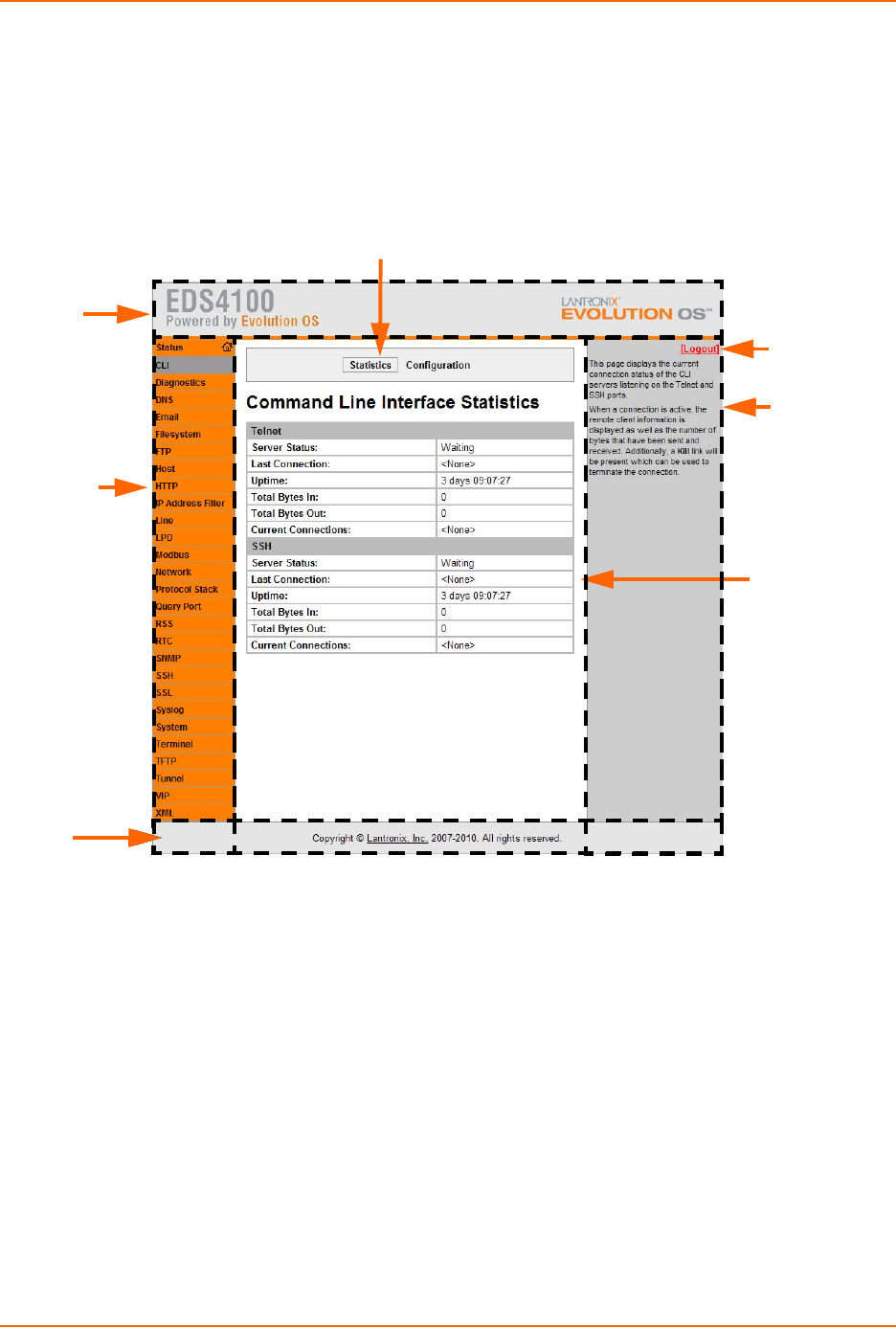
The layout of a typical Web Manager page is below.
Figure 7-2 Components of the Web Manager Page
The menu bar always appears at the left side of the page, regardless of the page shown. The
menu bar lists the names of the pages available in the Web Manager. To bring up a page, click it in
the menu bar.
The main area of the page has these additional sections:
At the very top, many pages, such as the one in the example above, enable you to link to
sub pages. On some pages, you must also select the item you are configuring, such as a
line or a tunnel.
In the middle of many pages, you can select or enter new configuration settings. Some
pages show status or statistics in this area rather than allow you to enter settings.
At the bottom of most pages, the current configuration is displayed. In some cases, you
can reset or clear a setting.
The information or help area shows information or instructions associated with the page.
A Logout link is available at the upper right corner of every web page. In Chrome or
Safari, it is necessary to close out of the browser to logout. If necessary, reopen the
browser to log back in.
Header
Links to Subpages
Menu Bar
Configuration
& Status Area
Footer
Information,
Instructions
& Help
Logout Link

7: Configuration Using Web Manager
EDS User Guide 46
The footer appears at the very bottom of the page. It contains copyright information and a
link to the Lantronix home page.
Navigating the Web Manager
The Web Manager provides an intuitive point-and-click interface. A menu bar on the left side of
each page provides links you can click to navigate from one page to another. Some pages are
read-only, while others let you change configuration settings.
Note: There may be times when you must reboot the EDS for the new configuration
settings to take effect. The chapters that follow indicate when a change requires a reboot.
Table 7-3 Summary of Web Manager Pages
Web Manager
Page Description See
Page
Status Shows product information and network, line, and tunneling
settings.
52
CLI Shows Command Line Interface (CLI) statistics and lets you
change the current CLI configuration settings.
137
Diagnostics Lets you perform various diagnostic procedures. 122
DNS Shows the current configuration of the DNS subsystem and the
DNS cache.
79
Email Shows email statistics and lets you clear the email log, configure
email settings, and send an email.
134
Filesystem Shows file system statistics and lets you browse the file system to
view a file, create a file or directory, upload files using HTTP, copy
a file, move a file, or perform TFTP actions.
112
FTP Shows statistics and lets you change the current configuration for
the File Transfer Protocol (FTP) server.
81
Host Lets you view and change settings for a host on the network. 78
HTTP Shows HyperText Transfer Protocol (HTTP) statistics and lets you
change the current configuration and authentication settings.
85
IP Address Filter Lets you specify all the IP addresses and subnets that are allowed
to send data to this device.
120
Line Shows statistics and lets you change the current configuration and
Command mode settings of a serial line.
52
LPD Shows LPD (Line Printer Daemon) Queue statistics and lets you
configure the LPD and print a test page.
90
Modbus Shows the current connection status of the Modbus servers
listening on the TCP ports and lets you configure the Modbus
settings for EDS4100.
109
Network Shows status and lets you configure the network interface. 48
Protocol Stack Lets you perform lower level network stack-specific activities. 115
Query Port Lets you change configuration settings for the query port. 121

7: Configuration Using Web Manager
EDS User Guide 47
RSS Lets you change current Really Simple Syndication (RSS)
settings.
89
SNMP Lets you change the current Simple Network Management
Protocol (SNMP) configuration settings.
80
SSH Lets you change the configuration settings for SSH server host
keys, SSH server authorized users, SSH client known hosts, and
SSH client users.
93
SSL Lets you upload an existing certificate or create a new self-signed
certificate.
103
Syslog Lets you specify the severity of events to log and the server and
ports to which the syslog should be sent.
84
System Lets you reboot device, restore factory defaults, upload new
firmware, and change the device long and short names.
132
Terminal Lets you change current settings for a terminal. 75
TFTP Shows statistics and lets you change the current configuration for
the Trivial File Transfer Protocol (TFTP) server.
83
Tunnel Lets you change the current configuration settings for a tunnel. 56
VIP Lets you configure Virtual IP addresses to be used in Tunnel
Accept Mode and Tunnel Connect Mode.
147
XML Lets you export XML configuration and status records, and import
XML configuration records.
139
Web Manager Page
(continued) Description See
Page
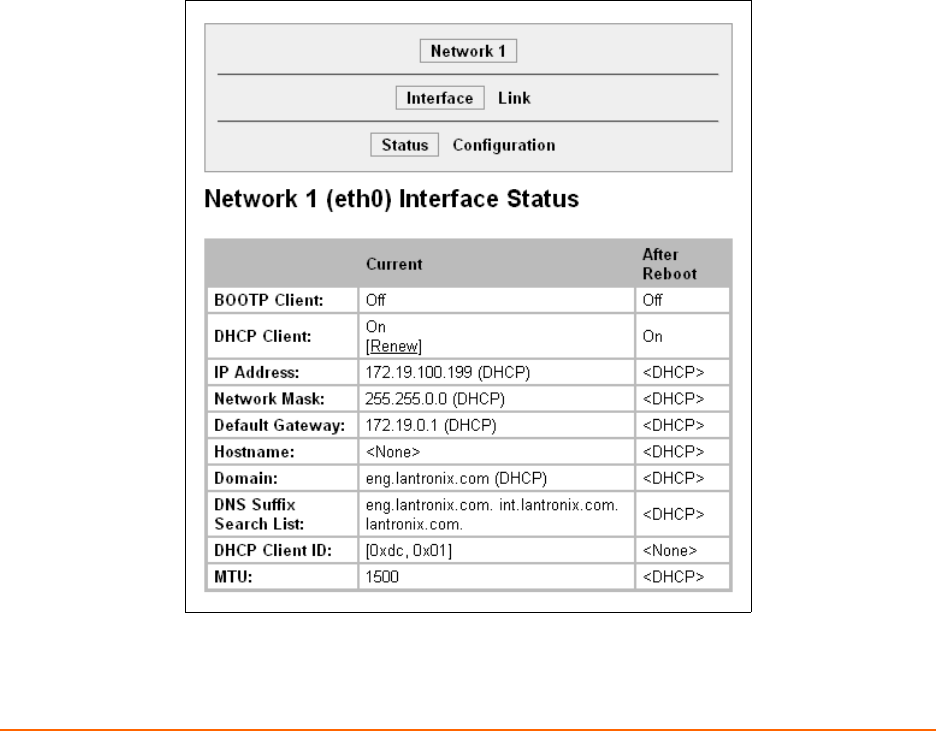
EDS User Guide 48
8: Network Settings
This chapter describes how to access, view, and configure network settings from the Network web
page. The Network web page contains sub-menus that enable you to view and configure the
Ethernet network interface and link.
This chapter contains the following sections:
Network 1 (eth0) Interface Status
Network 1 (eth0) Interface Configuration
Network 1 Ethernet Link
Network 1 (eth0) Interface Status
This page shows the status of the Ethernet network interface.
To view the network interface status:
1. Select Network on the menu bar. The Network web page appears.
2. Select Interface > Status submenus at the top of the page. The Network 1 (eth0) Interface
Status page appears.
Figure 8-1 Network 1 (eth0) Interface Status
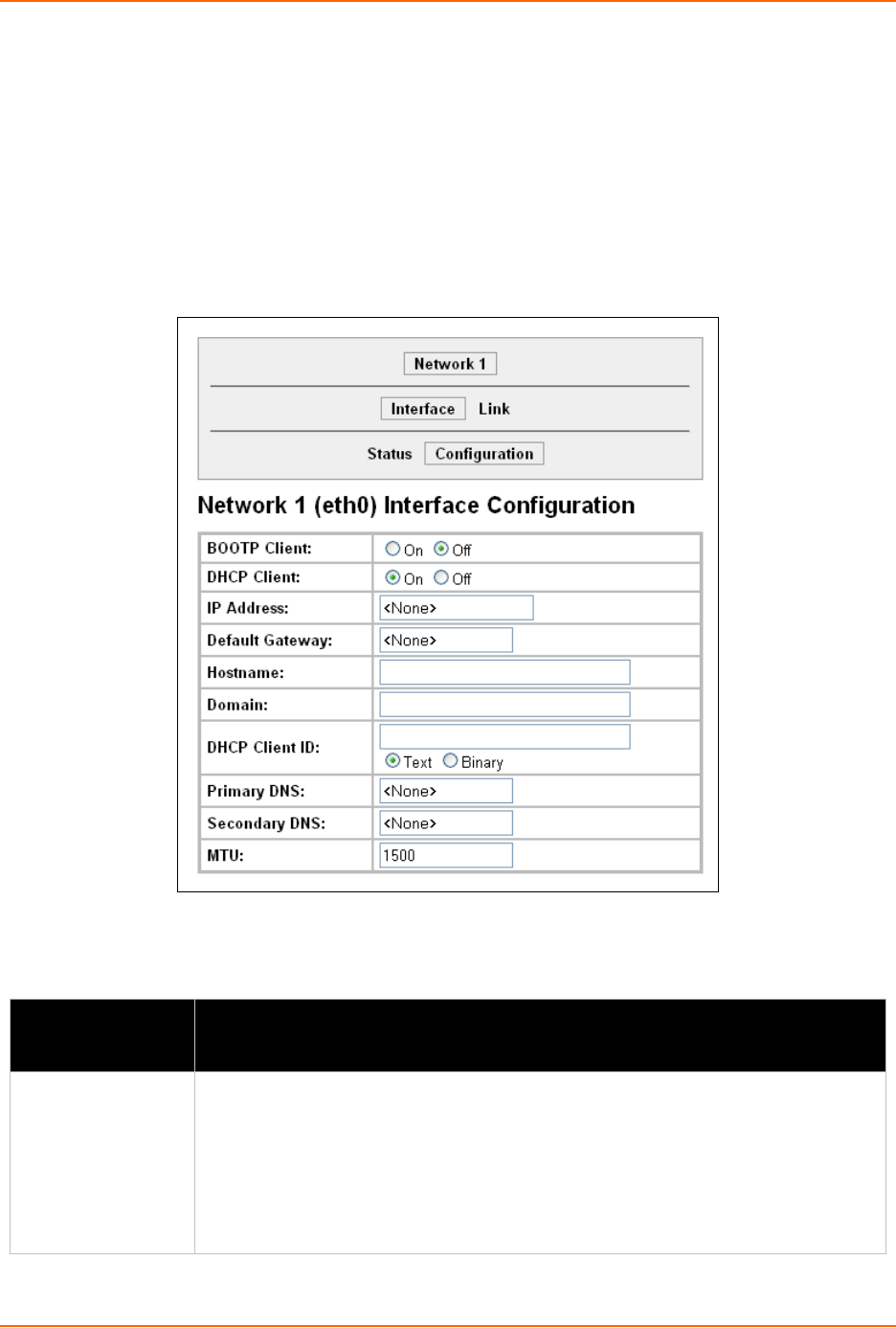
8: Network Settings
EDS User Guide 49
Network 1 (eth0) Interface Configuration
This page shows the configuration settings for the Ethernet connection and lets you change these
settings.
To view and configure network interface settings:
1. Select Network on the menu bar, if you are not already in the Network web page.
2. Select Interface > Configuration submenus at the top of the page. The Network 1 (eth0)
Interface Configuration page appears.
Figure 8-2 Network 1 (eth0) Interface Configuration
3. Enter or modify the following settings:
Table 8-3 Network Interface Configuration
Network 1 Interface
Configuration
Settings
Description
BOOTP Client Select On or Off. At boot up, the device will attempt to obtain an IP address from a
BOOTP server.
Notes:
Overrides the configured IP address, network mask, gateway, hostname, and
domain.
When DHCP is On, the system automatically uses DHCP, regardless of whether
BOOTP Client is On.

8: Network Settings
EDS User Guide 50
4. Click Submit to save changes. Some changes to the following settings require a reboot for the
changes to take effect:
BOOTP Client
DHCP Client
IP Address
DHCP Client ID
Note: If DHCP or BOOTP fails, AutoIP intervenes and assigns an address.A new DHCP
negotiation is attempted every 5 minutes to obtain a new IP address. When the DHCP is
enabled, any configured static IP address is ignored.
DHCP Client Select On or Off. At boot up, the device will attempt to lease an IP address from a DHCP
server and maintain the lease at regular intervals.
Note: Overrides BOOTP, the configured IP address, network mask, gateway,
hostname, and domain.
IP Address Enter the device static IP address.
You may enter it alone, in CIDR format, or with an explicit mask.
The IP address consists of four octets separated by a period and is used if BOOTP and
DHCP are both set to Off. Changing this value requires you to reboot the device.
Note: When DHCP is enabled, the device tries to obtain an IP address from DHCP. If it
cannot, the device uses an AutoIP address in the range of 169.254.xxx.xxx.
Default Gateway Enter the IP address of the router for this network. Or, clear the field (appears as
<None>). This address is only used for static IP address configuration.
Hostname Enter the device hostname. It must begin with a letter, continue with a sequence of
letters, numbers, and/or hyphens, and end with a letter or number.
Domain Enter the device domain name.
DHCP Client ID Enter the ID if the DHCP server uses a DHCP ID. The DHCP server’s lease table shows
IP addresses and MAC addresses for devices. The lease table shows the Client ID, in
hexadecimal notation, instead of the device MAC address.
Primary DNS IP address of the primary name server. This entry is required if you choose to configure
DNS (Domain Name Server) servers.
Secondary DNS IP address of the secondary name server.
MTU When DHCP is enabled, the MTU size is (usually) provided with the IP address. When
not provided by the DHCP server, or using a static configuration, this value is used. The
MTU size can be from 576 to 1500 bytes.
Network 1 Interface
Configuration
Settings
Description
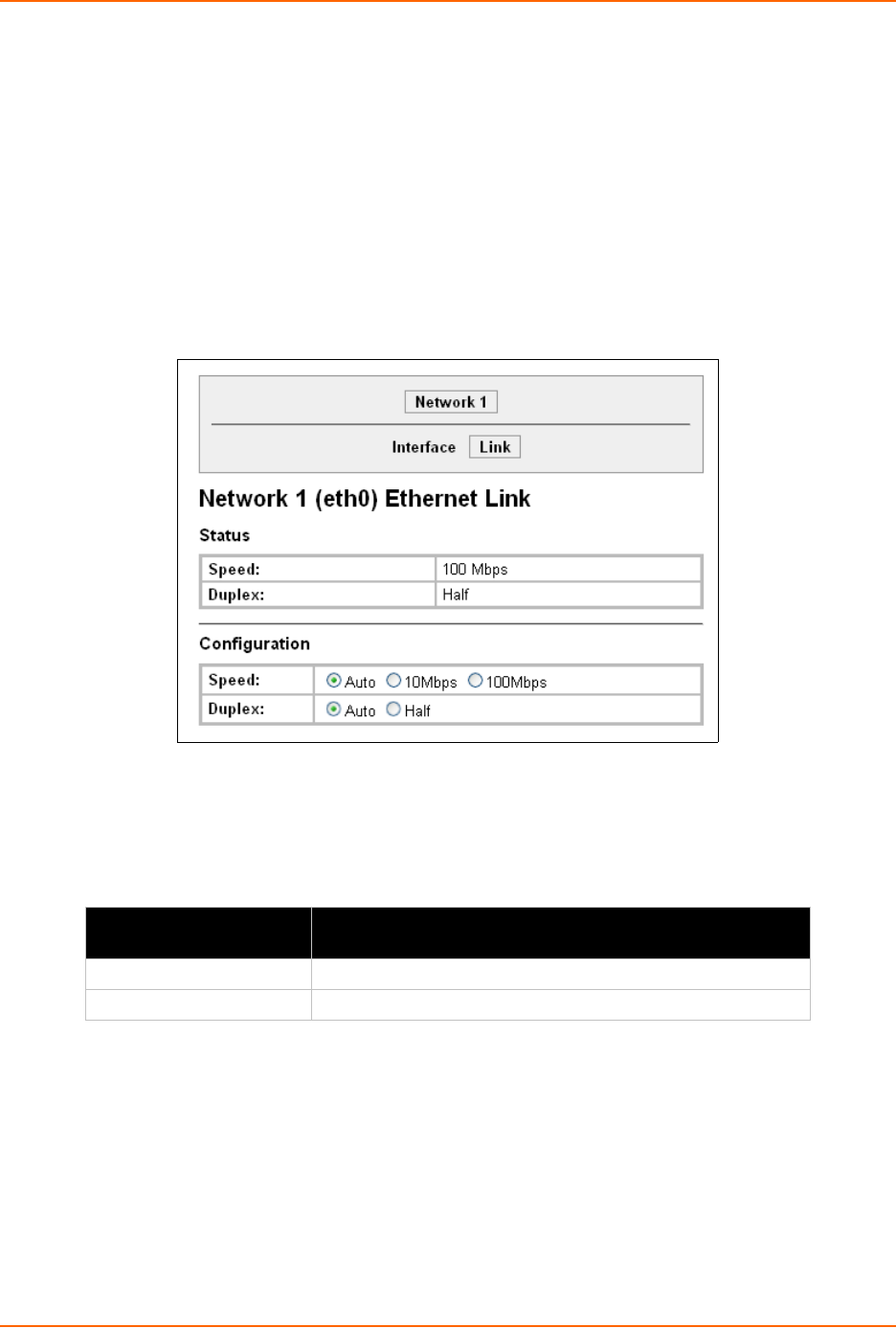
8: Network Settings
EDS User Guide 51
Network 1 Ethernet Link
This page shows the current negotiated Ethernet settings and lets you change the speed and
duplex settings.
To view and configure the Ethernet link:
1. Select Network on the menu bar, if you are not already in the Network web page.
2. Select the Link submenu.
Figure 8-4 Network 1 Ethernet Link
The Status table shows the current negotiated settings. The Configuration table shows the
current range of allowed settings.
3. Enter or modify the following settings:
Table 8-5 Network 1 Ethernet Link
4. Click Submit. The changes take effect immediately.
Network 1-Ethernet Link
Settings Description
Speed Select the Ethernet link speed. Default is Auto.
Duplex Select the Ethernet link duplex mode. Default is Auto.
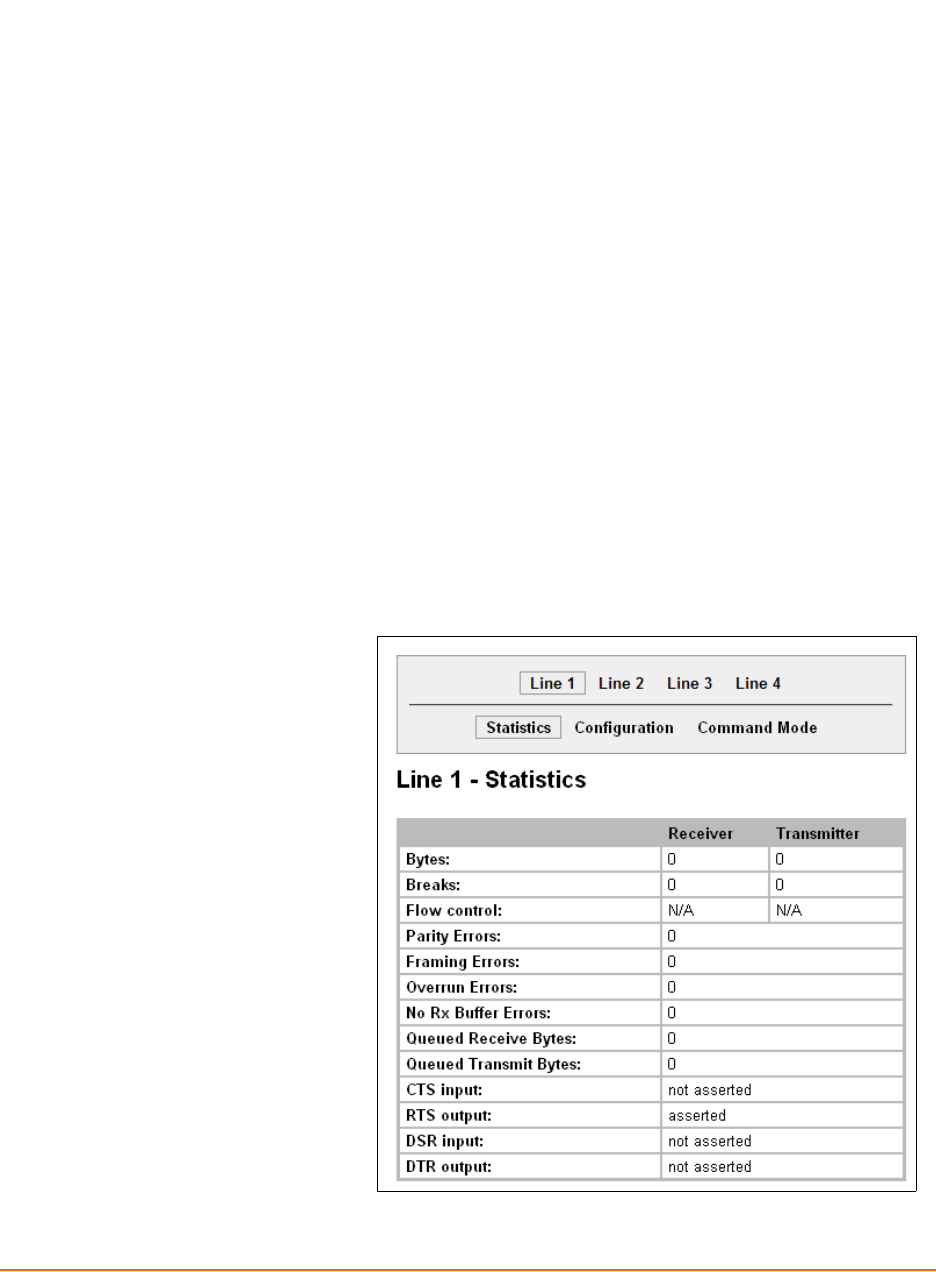
EDS User Guide 52
9: Line and Tunnel Settings
This chapter describes how to view and
configure lines and tunnels. It contains the
following sections:
Line Settings
Tunnel Settings
Line Settings
View statistics and configure serial interfaces by using the Line web page. Serial interfaces are
referred to as lines in this user guide, and a different number of lines, from 1 to 32, may be
available for selection depending on your product.
The following sub-menus may be used for a selected line number:
Line Statistics—Displays statistics for the selected line number. For example, the bytes
received and transmitted, breaks, flow control, parity errors, etc.
Line Configuration—Enables the change of the name, interface, protocol, baud rates, and
parity, etc.
Line Command Mode—Enables the types of modes, wait time, serial strings, signon
message, etc.
The following sections describe the steps to view and configure specific line number settings.
These instructions also apply to additional line instances of the device.
Line Statistics
This read-only web page
shows the status and
statistics for the serial line
selected at the top of this
page.
1. Select Line on the menu
bar. The Line web page
appears.
2. Select a line number at
the top of the page.
3. Select Statistics. The
Line Statistics page for
the selected line appears.
4. Repeat above steps as
desired, according to
additional line(s)
available on your
product.
Figure 9-1 Line 1 Statistics
Note: The number of lines and tunnels
available for viewing and configuration differ
between Lantronix DeviceLinx products. For
example, an XPort Pro and EDS1100 support
only one line while other device networking
products (such as EDS2100, EDS4100, XPort
AR, EDS8/16PS and EDS8/16/32PR) provide
additional lines and tunnels.
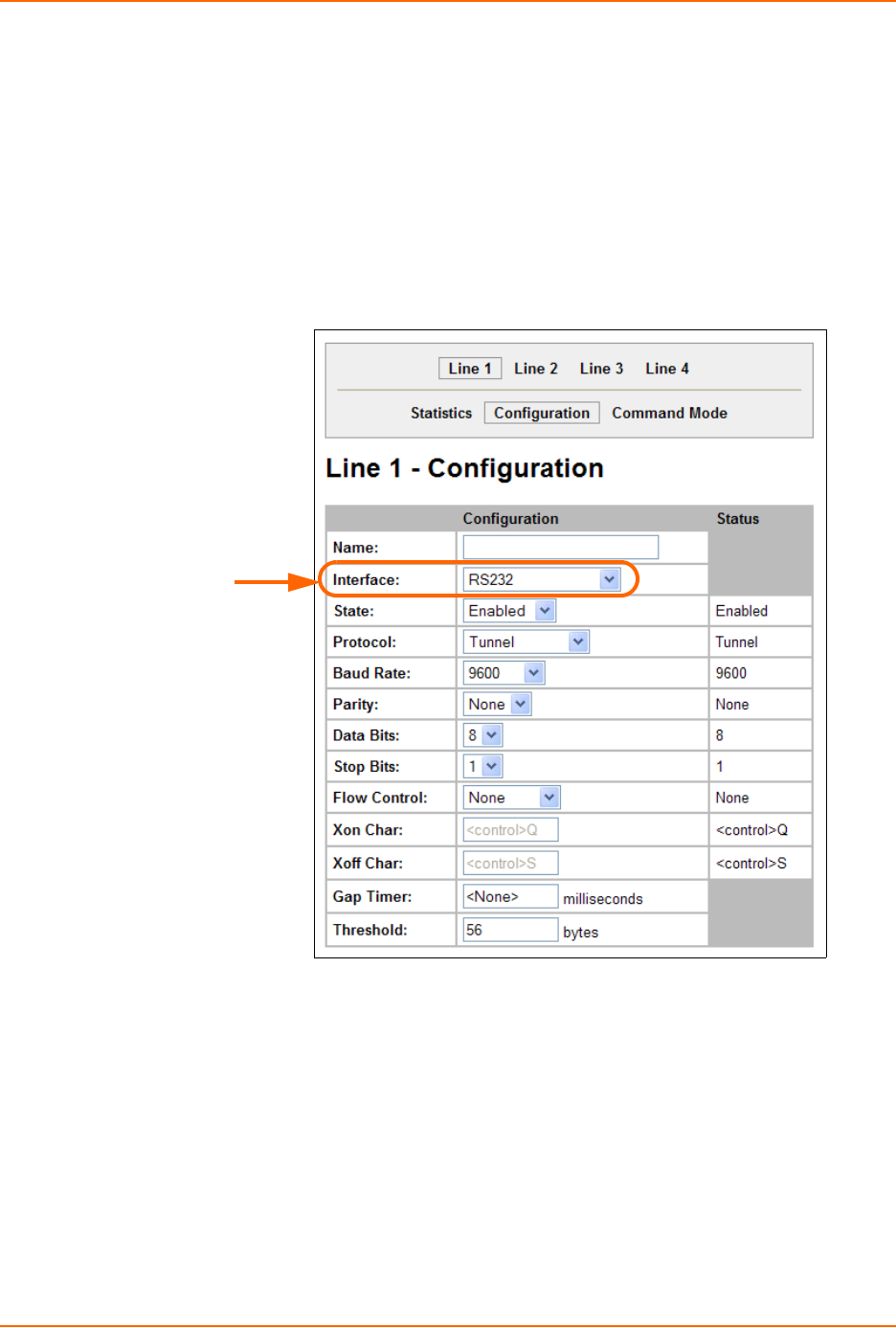
9: Line and Tunnel Settings
EDS User Guide 53
Line Configuration
This page shows the configuration settings for the serial line selected at the top of the page and
lets you change the settings for that serial line.
To configure a specific line:
1. Select Line on the menu bar, if you are not already in the Line web page.
2. Select a line number at the top of the page.
3. Select Configuration. The Configuration page for the selected line appears.
Figure 9-2 Line 1 Configuration
Note: The Interface
option is only supported
in XPort Pro, EDS4100,
EDS1100 and
EDS2100.

9: Line and Tunnel Settings
EDS User Guide 54
4. Enter or modify the following settings:
Table 9-3 Line Configuration
5. Click Submit.
6. Repeat above steps as desired, according to additional line(s) available on your product.
Line - Configuration
Settings Description
Name If the Terminal Login Menu feature is being used, enter the name for the
line. Leaving this field blank will disable this line from appearing in the
Terminal Login Menu. The default Name is blank. See Terminal and Host
Settings on page 75 for related configuration information.
Interface Select the interface type from the drop-down menu. The default is RS232.
Note: This option is only supported in XPort Pro, EDS4100, EDS1100 and
EDS2100.
State Indicates whether the current line is enabled. To change the status, select
Enabled or Disabled from the drop-down menu.
Protocol Select the protocol from the drop-down menu. The default is Tunnel.
Baud Rate Select the baud rate from the drop-down menu. The default is 9600.
Parity Select the parity from the drop-down menu. The default is None.
Data Bits Select the number of data bits from the drop-down menu. The default is 8.
Stop Bits Select the number of stop bits from the drop-down menu. The default is 1.
Flow Control Select the flow control from the drop-down menu. The default is None.
Xon Char Specify the character to use to start the flow of data when Flow Control is
set to Software. Prefix a decimal character with \ or a hexadecimal
character with 0x, or provide a single printable character. The default Xon
char is 0x11.
Xoff Char Specify the character to use to stop the flow of data when Flow Control is
set to Software. Prefix a decimal character with \ or a hexadecimal
character with 0x, or provide a single printable character. The default Xoff
char is 0x13.
Gap Timer The driver forwards received serial bytes after the Gap Timer delay from
the last character received. By default, the delay is four character periods at
the current baud rate (minimum 1 ms).
Threshold The driver will also forward received characters after Threshold bytes have
been received.
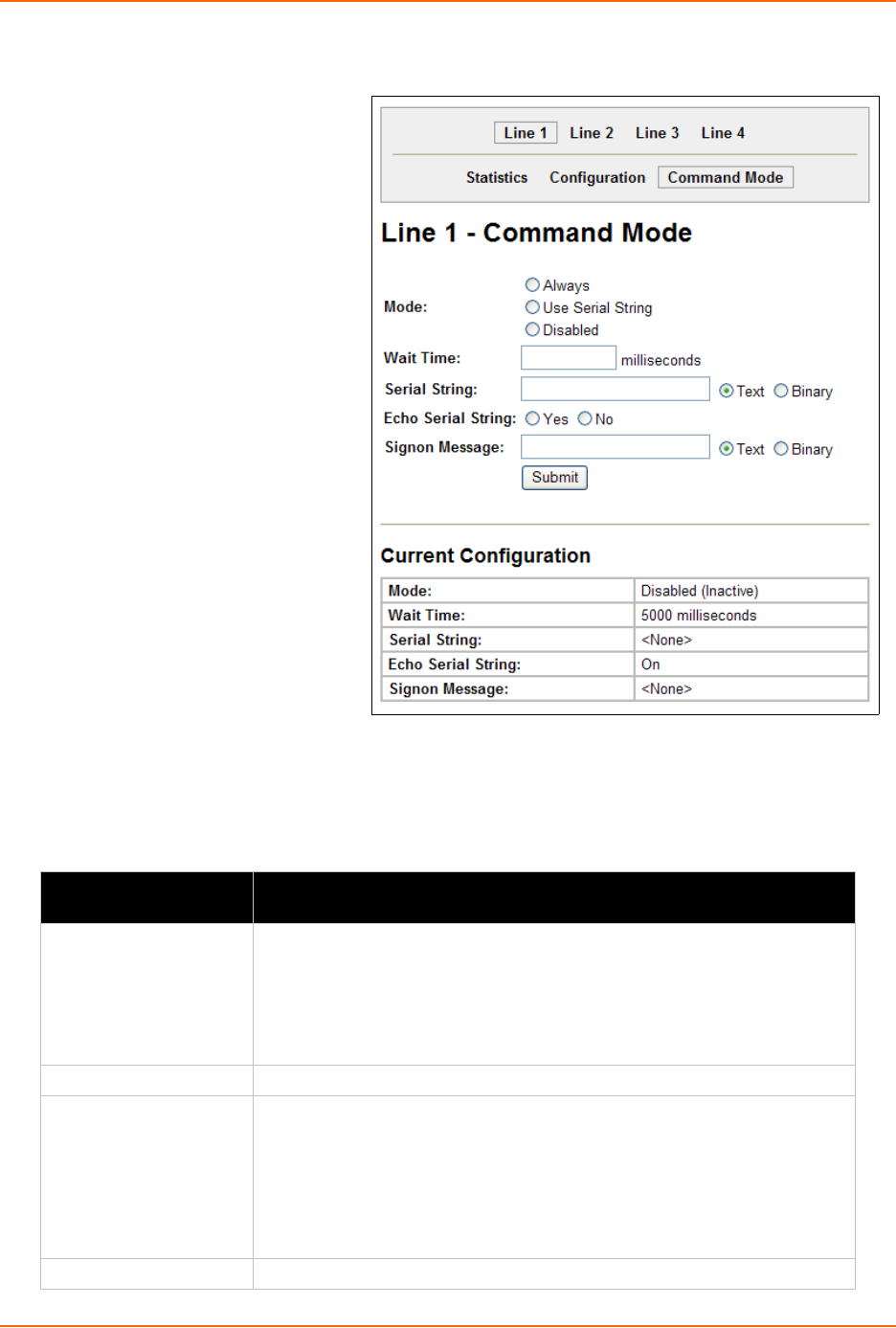
9: Line and Tunnel Settings
EDS User Guide 55
4. Enter or modify the following settings:
Table 9-5 Line Command Mode
Line Command Mode
Setting the Command Mode
enables the CLI on the serial
line.
To configure Command
Mode on a specific line:
1. Select Line on the menu
bar, if you are not already
in the Line web page.
2. Select a line number at the
top of the page.
3. Select Command Mode.
The Command Mode page
for the selected line
appears.
Figure 9-4 Line 1 Command Mode
Line – Command Mode
Settings Description
Mode Select the method of enabling Command Mode or choose to disable
Command Mode.
Always = immediately enables Command Mode for the serial line.
Use Serial String = enables Command Mode when the serial string is
read on the serial line during boot time.
Disabled = turns off Command Mode.
Wait Time Enter the wait time for the serial string during boot-up in milliseconds.
Serial String Enter the serial string characters. Select a string type.
Text = string of bytes that must be read on the Serial Line during boot
time to enable Command Mode. It may contain a time element in x
milliseconds, in the format {x}, to specify a required delay.
Binary = string of characters representing byte values where each
hexadecimal byte value starts with \0x and each decimal byte value starts
with \.
Echo Serial String Select Yes to enable echoing of the serial string at boot-up.

9: Line and Tunnel Settings
EDS User Guide 56
5. Click Submit.
6. Repeat above steps as desired, according to additional line(s) available on your product.
Tunnel Settings
Note: The number of lines and tunnels available for viewing and configuration differ
between Lantronix DeviceLinx products. For example, an XPort Pro and EDS1100
support only one line while other device networking products (such as EDS2100,
EDS4100, XPort AR, EDS8/16PS and EDS8/16/32PR) provide additional lines and
tunnels.
Tunneling allows serial devices to communicate over a network, without “being aware” of the
devices which establish the network connection between them. Tunneling parameters are
configured using the Web Manager or Command Mode Tunnel Menu. See Configuration Using
Web Manager (on page 43) or the EDS Command Reference for the full list of commands.
The EDS supports two tunneling connections simultaneously per serial port. One of these
connections is Connect Mode; the other connection is Accept Mode. The connections on one
serial port are separate from those on another serial port.
Connect Mode: the EDS actively makes a connection. The receiving node on the network
must listen for the Connect Mode’s connection. Connect Mode is disabled by default.
Accept Mode: the EDS listens for a connection. A node on the network initiates the
connection. Accept Mode is enabled by default.
Disconnect Mode: this mode defines how an open connection stops the forwarding of data.
The specific parameters to stop the connection are configurable. Once the EDS Disconnect
Mode observes the defined event occur, it will disconnect both Accept Mode and Connect
Mode connections on that port.
When any character comes in through the serial port, it gets copied to both the Connect Mode
connection and the Accept Mode connection (if both are active).
View statistics and configure a specific tunnel by using the Tunnel web page. When you select
Tunnel from the Main Menu, tunnels available for your product will display. Select a specific tunnel
to configure.
The following sub-menus listed may be used to configure a specific tunnel:
Tunnel – Statistics
Tunnel – Serial Settings
Tunnel – Packing Mode
Signon Message Enter the boot-up signon message. Select a string type.
Text = string of bytes sent on the serial line during boot time.
Binary = one or more byte values separated by commas. Each byte value
may be decimal or hexadecimal. Start hexadecimal values with 0x.
Note: This string will be output on the serial port at boot, regardless of
whether command mode is enabled or not.
Line – Command Mode
Settings (continued) Description

9: Line and Tunnel Settings
EDS User Guide 57
Tunnel – Accept Mode
Tunnel – Connect Mode
Tunnel – Disconnect Mode
Tunnel – Modem Emulation
The following sections describe the steps to view and configure specific tunnel number settings.
These instructions also apply to additional tunnel menu options.
Tunnel – Statistics
Displays statistics for the specific tunnel. For example, Completed Accepts, Completed Connects,
Disconnects, Dropped Accepts, Dropped Connects, etc. The EDS logs statistics for tunneling.
The Dropped statistic shows connections ended by the remote location. The Disconnects
statistic shows connections ended by the EDS.
To display statistics for a specific tunnel:
1. Select Tunnel on the menu bar. The Tunnel web page appears.
2. Select a tunnel number at the top of the page.
3. Select Statistics. The Tunnel Statistics page for the specific tunnel appears.
If a particular tunnel is connected, the following becomes available:
Identifying information about the tunnel connection (i.e., “Connect 1 Counters”)
Address of connection (i.e., “local:10001 -> 172.22.22.22.10001”)
Kill Connection(s) link: Click this link to terminate this active tunnel connection, as
desired.
Octets forwarded from Serial
Octets forwarded form Network
Uptime
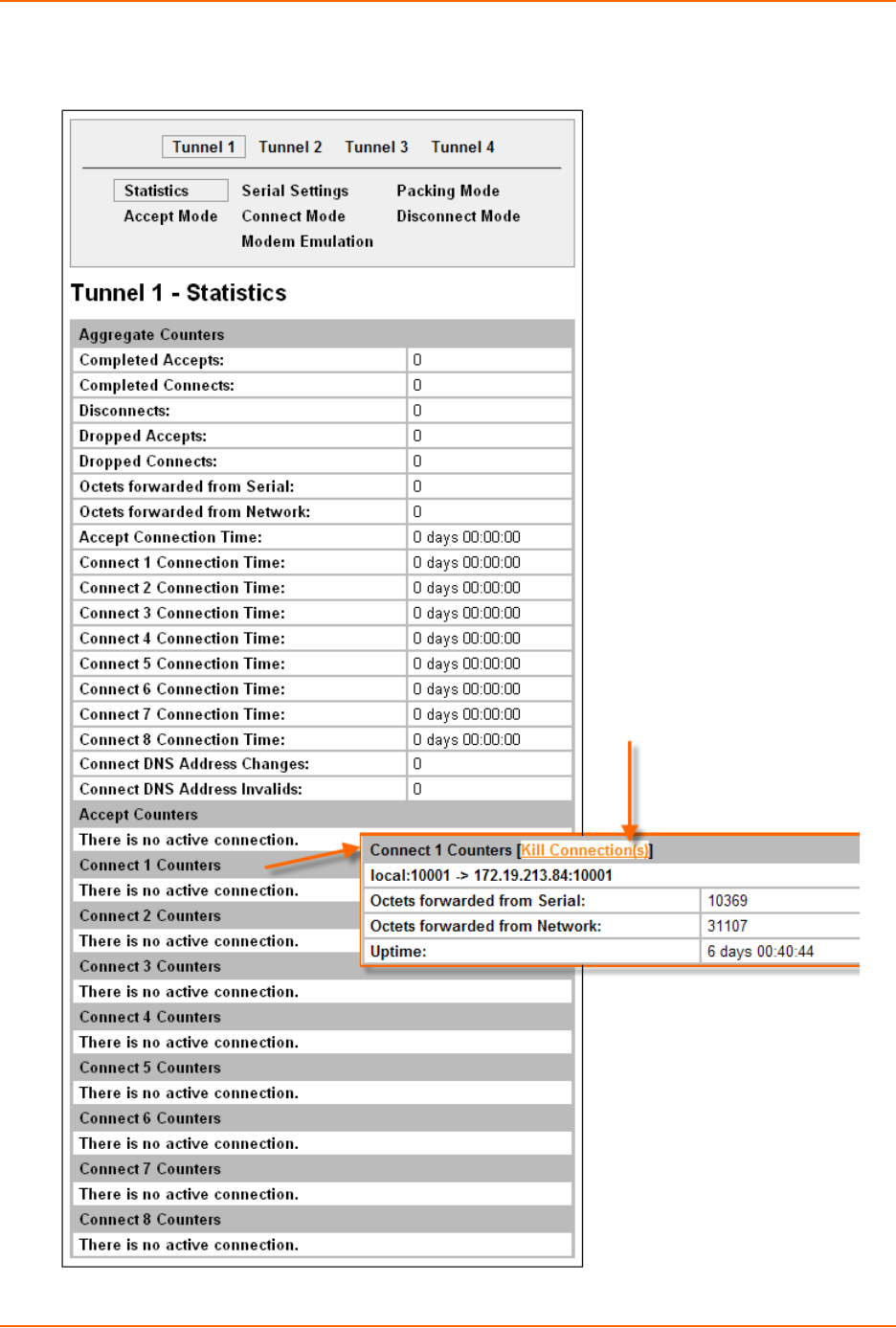
9: Line and Tunnel Settings
EDS User Guide 58
4. Repeat above steps as desired, according to additional tunnel(s) available on your product.
Additional information
appears for each active
tunnel connection including
a link allowing you to
terminate the connection.
Figure 9-6 Tunnel 1 Statistics
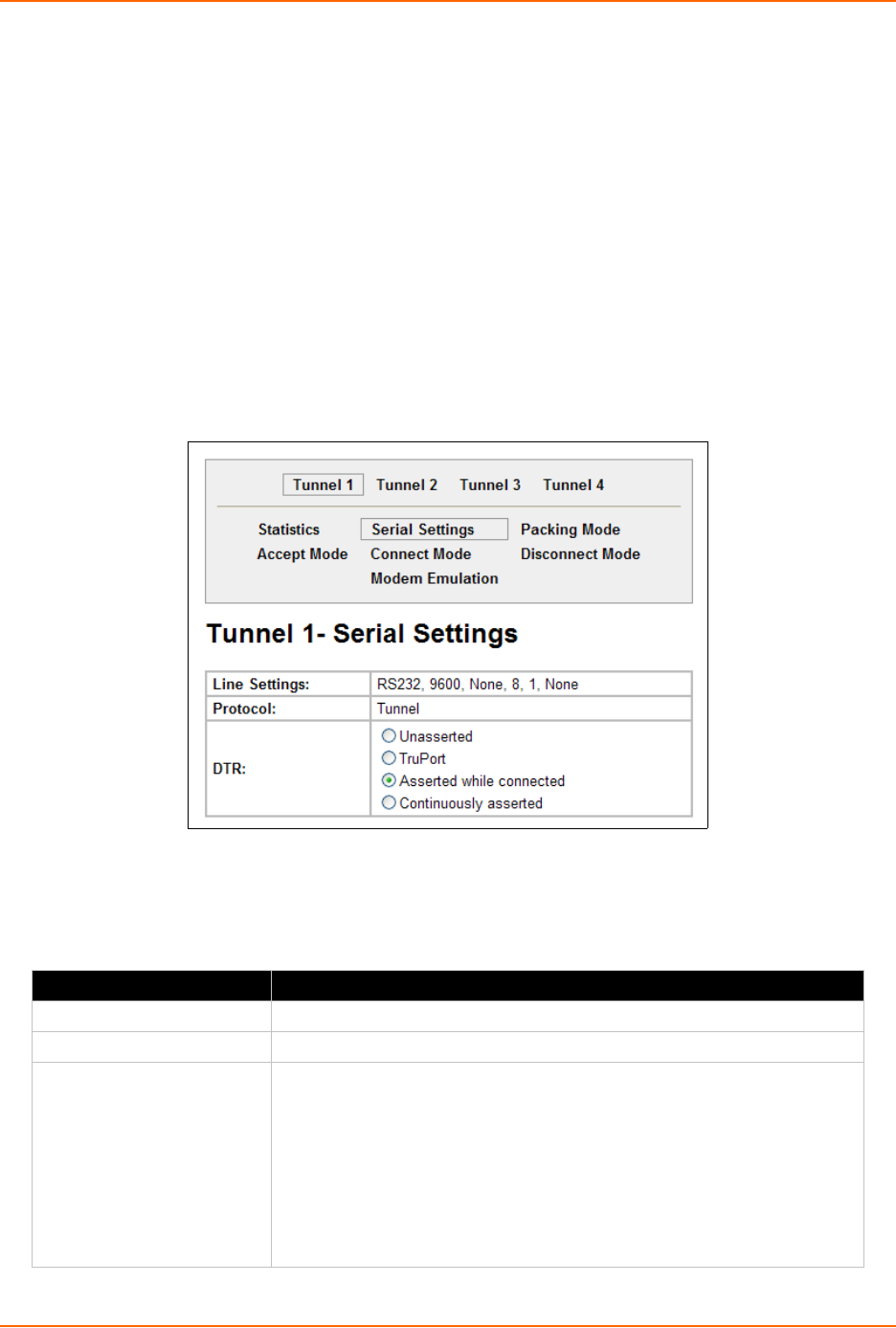
9: Line and Tunnel Settings
EDS User Guide 59
Tunnel – Serial Settings
Serial line settings are configurable for the corresponding serial line of the specific tunnel.
Configure the buffer size to change the maximum amount of data the serial port stores. For any
active connection, the device sends the data in the buffer.
The modem control signal DTR on the selected line may be continuously asserted or asserted only
while either an Accept Mode tunnel or a Connect Mode tunnel is connected.
To configure serial settings for a specific tunnel:
1. Select Tunnel on the menu bar, if you are not already in the Tunnel web page.
2. Select a tunnel number at the top of the page.
3. Select Serial Settings. The Serial Settings page for the specific tunnel appears.
Figure 9-7 Tunnel 1 Serial Settings
4. View or modify the following settings:
Table 9-8 Tunnel - Serial Settings
Tunnel - Serial Settings Description
Line Settings (display only) Current serial settings for the line.
Protocol (display only) The protocol being used on the line. In this case, Tunnel.
DTR Select when to assert DTR.
Unasserted = never asserted
TruPort = asserted whenever either a connect or an accept mode tunnel
connection is active with the Telnet Protocol RFC2217 saying that the
remote DSR is asserted.
Asserted while connected = asserted whenever either a connect or an
accept mode tunnel connection is active.
Continuously asserted = asserted regardless of the status of a tunnel
connection.
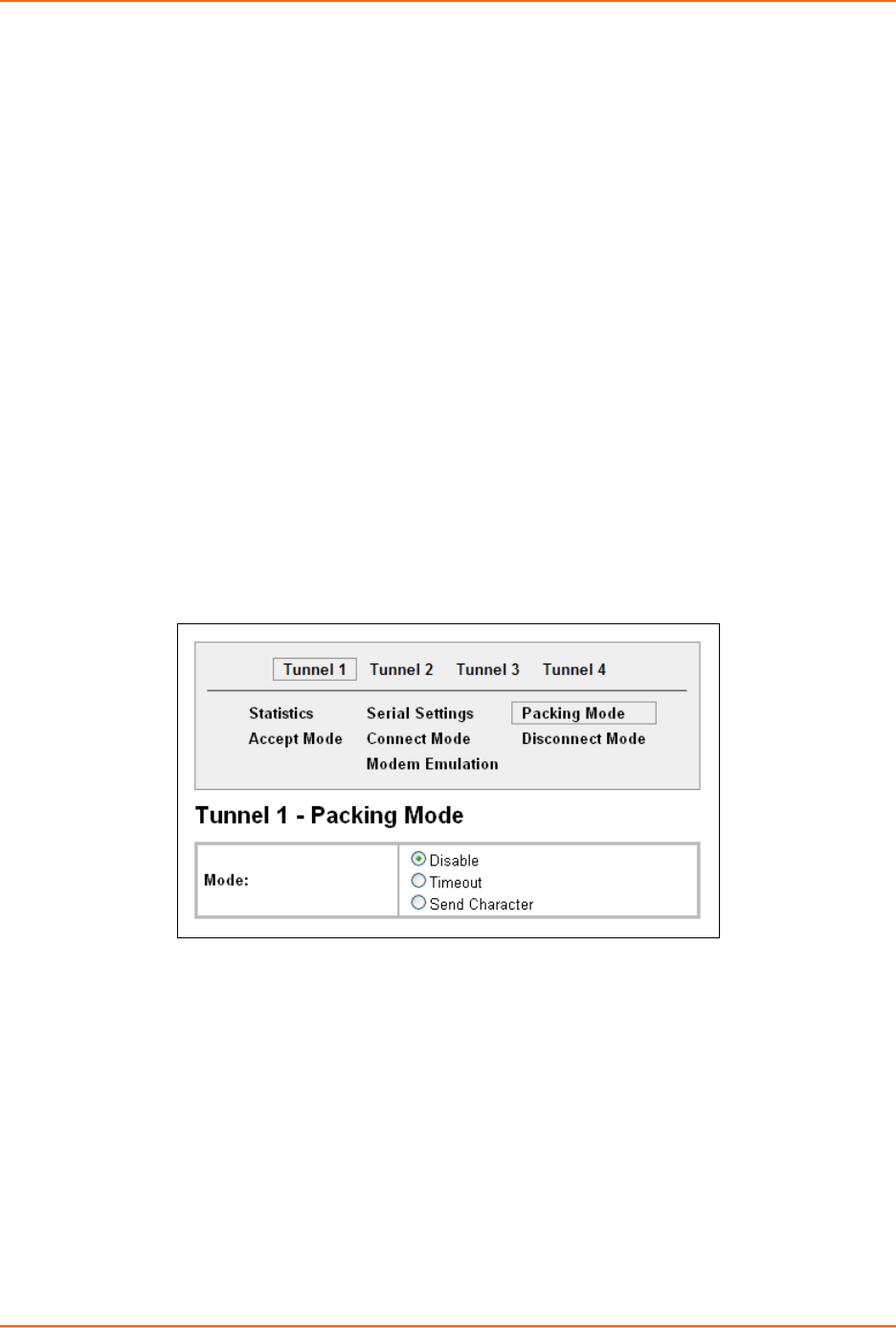
9: Line and Tunnel Settings
EDS User Guide 60
5. Click Submit.
6. Repeat above steps as desired, according to additional tunnel(s) available on your product.
Tunnel – Packing Mode
Packing Mode takes data from the serial port, packs it together, and sends it over the network.
Packing can be configured based on threshold (size in bytes, timeout (milliseconds), or a single
character.
Size is set by modifying the threshold field. When the number of bytes reaches the threshold, a
packet is sent immediately.
The timeout field is used to force a packet to be sent after a maximum time. The packet is sent
even if the threshold value is not reached.
When Send Character is configured, a single printable character or control character read on the
Serial Line forces the packet to be sent immediately. There is an optional trailing character
parameter which can be specified. It can be a single printable character or a control character.
To configure the Packing Mode for a specific tunnel:
1. Select Tunnel on the menu bar, if you are not already in the Tunnel web page.
2. Select a tunnel number at the top of the page.
3. Select Packing Mode. The Packing Mode page for the specific tunnel appears.
Figure 9-9 Tunnel 1 Packing Mode (Mode = Disable)
Depending on the Mode selection, different configurable parameters for the specific tunnel
number are presented to the user. The following figures show the display for each of the three
packing modes.
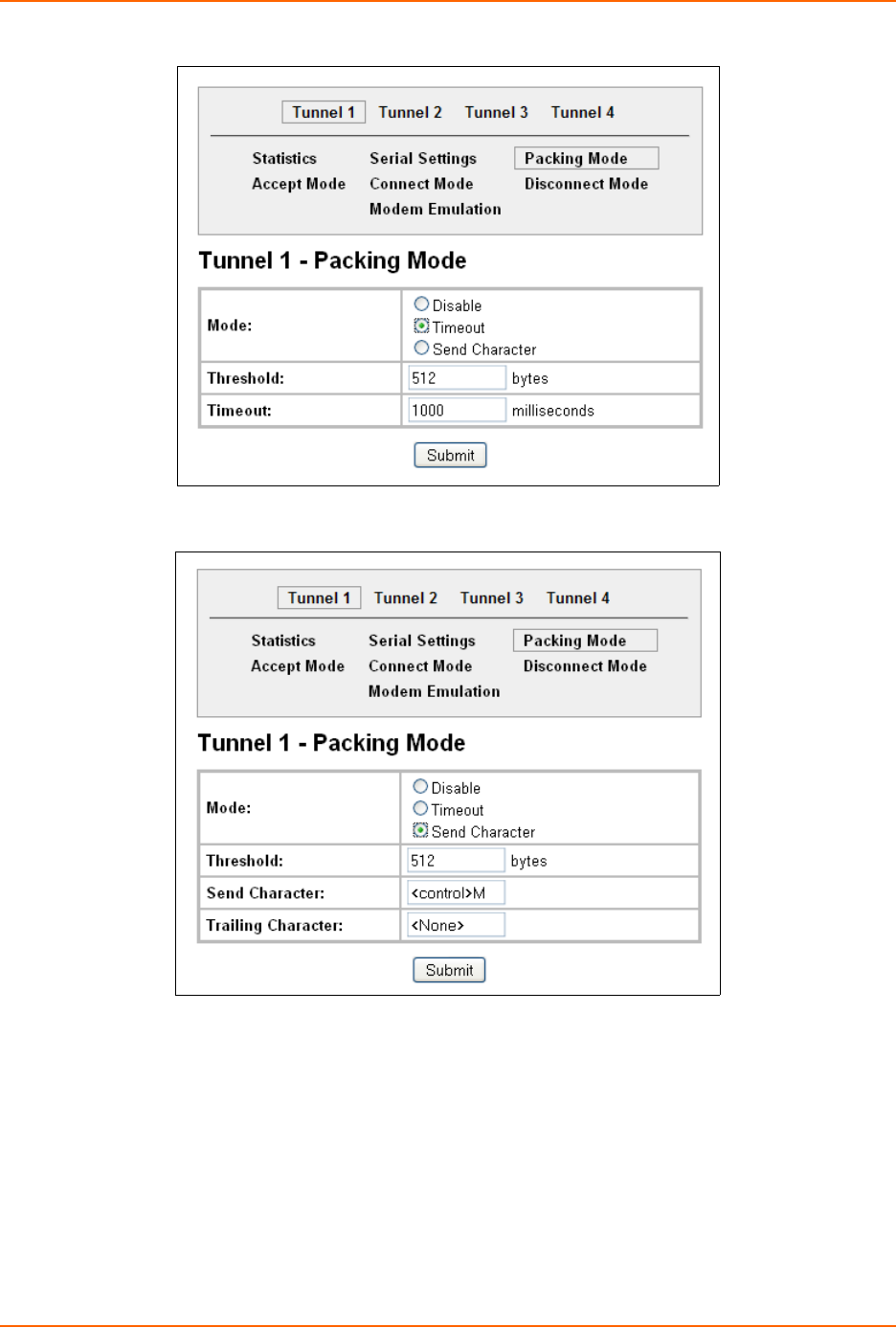
9: Line and Tunnel Settings
EDS User Guide 61
Figure 9-10 Tunnel 1 Packing Mode (Mode = Timeout)
Figure 9-11 Tunnel 1 Packing Mode (Mode = Send Character)
4. Enter or modify the following settings:

9: Line and Tunnel Settings
EDS User Guide 62
Table 9-12 Tunnel Packing Mode
5. Click Submit.
6. Repeat above steps as desired, according to additional tunnel(s) available on your product.
Tunnel - Packing Mode
Settings Description
Mode Select Disable to disable Packing Mode completely.
Select Timeout to send data after the specified time has
elapsed.
Select Send Character to send the queued data when the send
character is received.
Threshold
(Appears for both Timeout
and Send Character
Modes)
Send the queued data when the number of queued bytes reaches
the threshold. When the buffer fills to this specified amount of data
in bytes (and the timeout has not elapsed), the device packs the
data and sends it out; applies only if the Packing Mode is not
Disabled.
Timeout
(Appears for Timeout
Mode)
Enter a time, in milliseconds, for the device to send the queued
data after the first character was received. Specifies the time
duration in milliseconds; applies only if the Packing Mode is
Timeout.
Send Character
(Appears for Send
Character Mode)
Enter the send character (single printable or control). Upon
receiving this character, the device sends out the queued data.
The data is packed until the specified send character is
encountered. Similar to a start or stop character, the device packs
the data until it sees the send character. The device then sends the
packed data and the send character in the packet. Applies only if
the Packing Mode is Send Character.
Trailing Character
(Appears for Send
Character Mode)
Enter the trailing character (single printable or control). This
character is sent immediately following the send character. This is
an optional setting. If a trailing character is defined, this character is
appended to data put on the network immediately following the
send character.

9: Line and Tunnel Settings
EDS User Guide 63
Tunnel – Accept Mode
Controls how a specific tunnel number behaves when a connection attempt originates from the
network. In Accept Mode, the EDS waits for a connection from the network. The configurable local
port is the port the remote device connects to for this connection. There is no remote port or
address. The default local port is 10001 for serial port 1 and increases sequentially for each
additional serial port, if supported.
Accept Mode supports the following protocols:
SSH (the EDS is the server in Accept Mode). When using this protocol, the SSH server
host keys and at least one SSH authorized user must be configured.
SSL
TCP
AES encryption over TCP
Telnet (The EDS supports IAC codes. It drops the IAC codes when Telnetting and does
not forward them to the serial port).
Accept Mode has the following states:
Disabled (never a connection)
Enabled (always listening for a connection)
Active if it receives any character from the serial port
Active if it receives a specific (configurable) character from the serial port (same start
character as Connect Mode’s start character)
Modem control signal
Modem emulation
To configure the Accept Mode of a specific tunnel:
1. Select Tunnel on the menu bar, if you are not already in the Tunnel web page.
2. Select a tunnel number at the top of the page.
3. Select Accept Mode. The Accept Mode page for the specific tunnel appears.
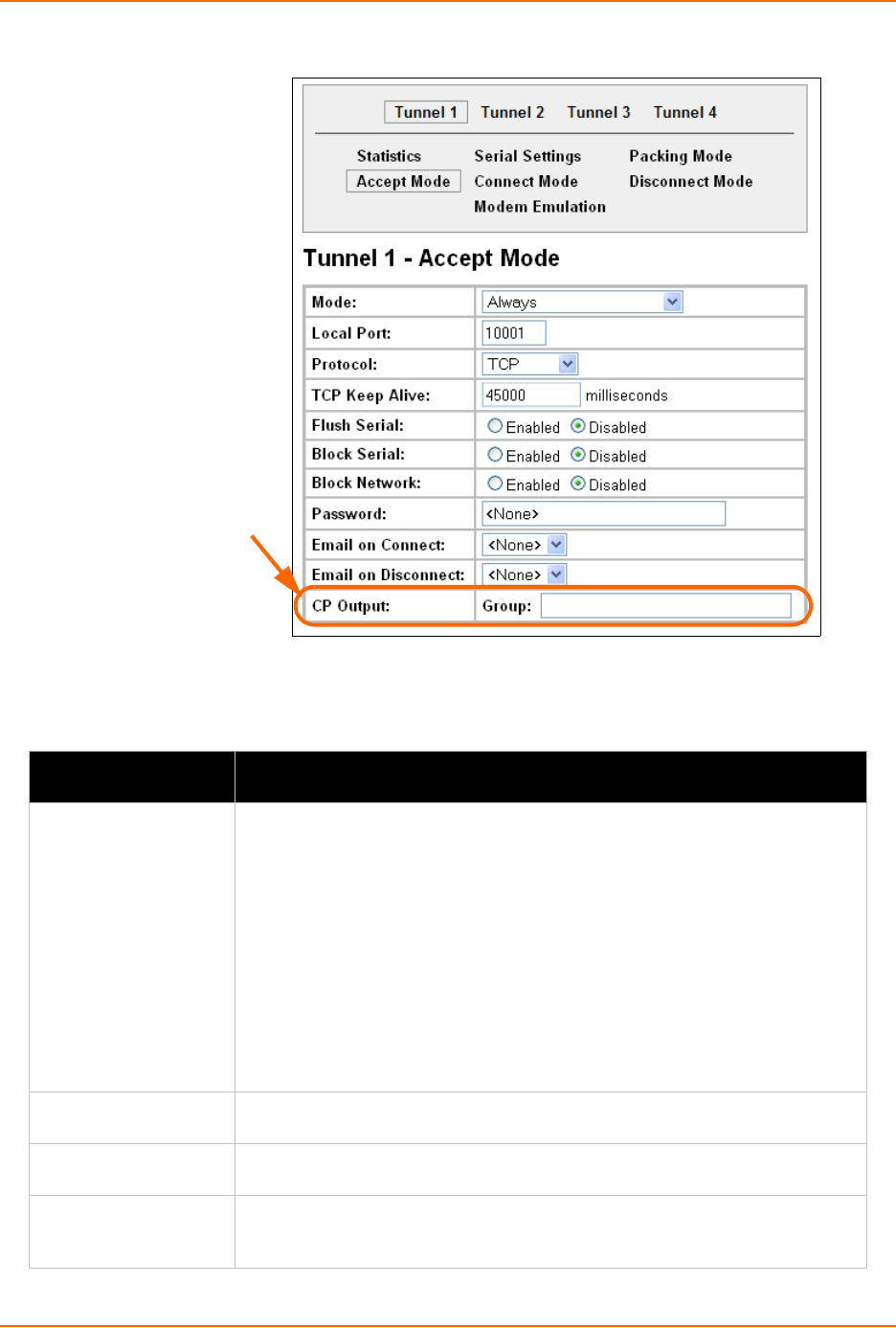
9: Line and Tunnel Settings
EDS User Guide 64
Figure 9-13 Tunnel 1 Accept Mode
4. Enter or modify the following settings:
Table 9-14 Tunnel Accept Mode
Tunnel - Accept Mode
Settings Description
Mode Select the method used to start a tunnel in Accept mode. Choices are:
Disabled = do not accept an incoming connection.
Always = accept an incoming connection (default)
Any Character = start waiting for an incoming connection when any
character is read on the serial line.
Start Character = start waiting for an incoming connection when the start
character for the specific tunnel is read on the serial line.
Modem Control Asserted = start waiting for an incoming connection as long
as the Modem Control pin (DSR) is asserted on the serial line until a
connection is made.
Modem Emulation = start waiting for an incoming connection when triggered
by modem emulation AT commands. Connect mode must also be set to
Modem Emulation.
Local Port Enter the port number for use as the local port. The defaults are port 10001 for
Tunnel 1. Additional tunnels, if supported, increase sequentially.
Protocol Select the protocol type for use with Accept Mode. The default protocol is TCP. If
you select TCP AES you will need to configure the AES keys.
TCP Keep Alive Enter the time, in seconds, the device waits during a silent connection before
checking if the currently connected network device is still on the network. If the
unit then gets no response after 8 attempts, it drops that connection.
Note: The CP Output
option is only supported in
XPort Pro and XPort AR.

9: Line and Tunnel Settings
EDS User Guide 65
5. Click Submit.
6. Repeat above steps as desired, according to additional tunnel(s) available on your product.
Flush Serial Data Select Enabled to flush the serial data buffer on a new connection.
Block Serial Data Select On to block, or not tunnel, serial data transmitted to the device.
Block Network Select On to block, or not tunnel, network data transmitted to the device.
Password Enter a password that clients must send to the device within 30 seconds from
opening a network connection to enable data transmission.
The password can have up to 31 characters and must contain only alphanumeric
characters and punctuation. When set, the password sent to the device must be
terminated with one of the following: (a) 0x0A (LF), (b) 0x00, (c) 0x0D 0x0A (CR
LF), or (d) 0x0D 0x00.
Email on Connect Select whether the device sends an email when a connection is made. Select
None if you do not want to send an email. Otherwise, select the Email profile to
use for sending.
Email on Disconnect Select whether the device sends an email when a connection is closed. Select
None if you do not want to send an email. Otherwise, select the Email profile to
use for sending.
Tunnel - Accept Mode
Settings (continued) Description

9: Line and Tunnel Settings
EDS User Guide 66
Tunnel – Connect Mode
Connect Mode defines how the device makes an outgoing connection through a specific tunnel.
When enabled, Connect Mode is always on and attempting a network connection if the connection
mode condition warrants it. For Connect Mode to function, it must:
Be enabled
Have a remote host configured
Have a remote port configured
Enter the remote host address as an IP address or DNS name. The EDS device will make a
connection only if it can resolve the address. For DNS names, the EDS will re-evaluate the
address after being established for 4 hours. If re-evaluation results in a different address, it will
close the connection.
Connect Mode supports the following protocols:
TCP
AES encryption over TCP and UDP
When setting AES encryption, both the encrypt key and the decrypt key must be specified.
The encrypt key is used for data sent out. The decrypt key is used for receiving data. Both of
the keys may be set to the same value.
SSH
To configure SSH, the SSH client username must be configured. In Connect Mode, the EDS is
the SSH client. Ensure the EDS SSH client username is configured on the remote SSH server
before using it with the EDS.
SSL
UDP
Is only available in Connect Mode because it is a connectionless protocol. For Connect Mode
using UDP, the EDS accepts packets from any device on the network. It will send packets to
the last device that sent it packets.
Telnet
Note: The Local Port in Connect Mode is independent of the port configured in Accept
Mode.
There are six different connect modes:
Disable
No connection is attempted.
Always
A connection is always attempted.
Any Character
A connection is attempted if it detects any
character from the serial port.
Start Character
A connection is attempted if it detects a specific and configurable character from the serial
port.
Note: While in the “Any Character” or “Start
Character” connection modes, the EDS
waits and retries the connection if the
connection cannot be made. Once it makes
a connection and then disconnects, it will
not reconnect until it sees another character
or the start character again (depending on
the configured setting).
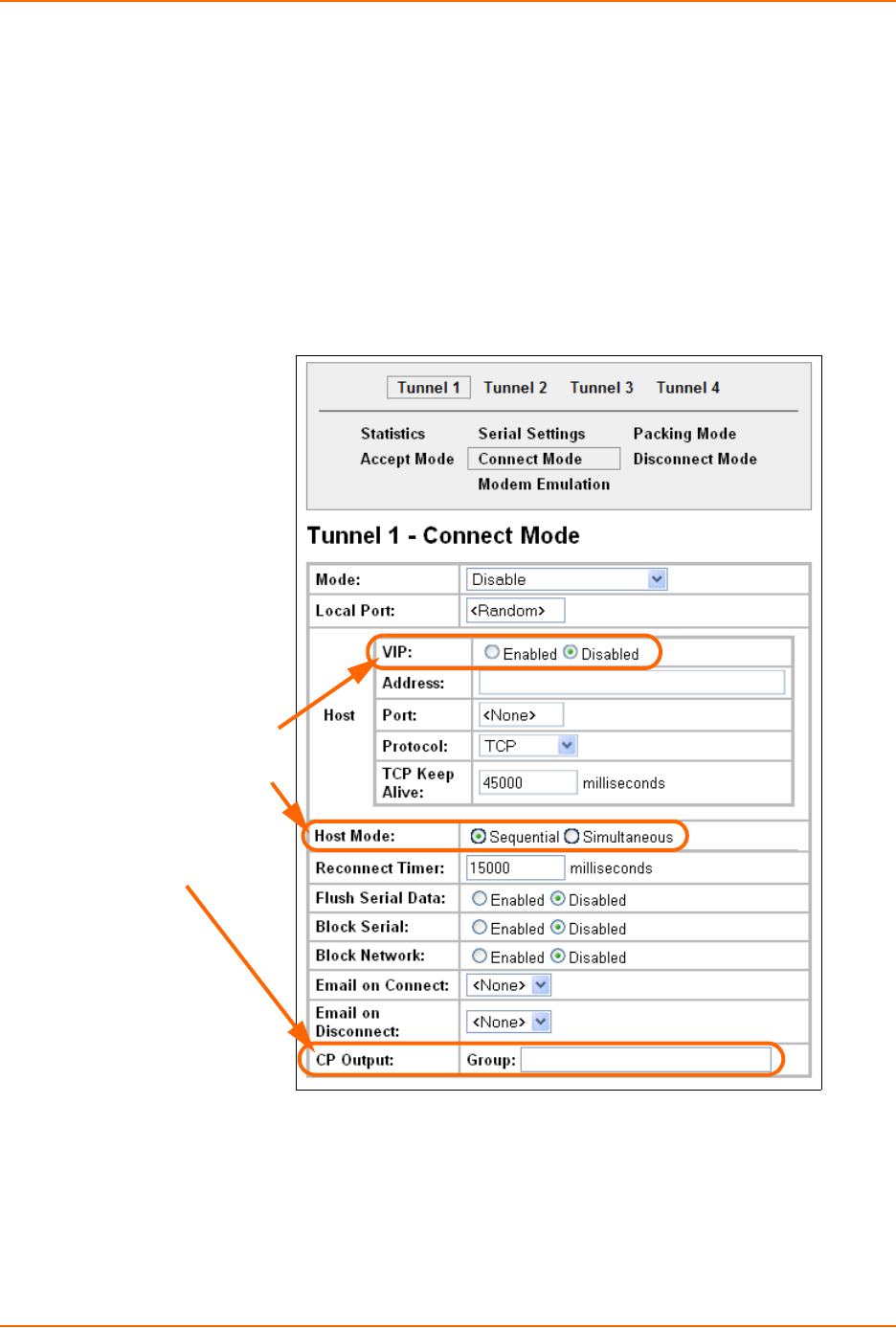
9: Line and Tunnel Settings
EDS User Guide 67
Modem Control Asserted
A connection is attempted when the modem control pin is asserted in the serial line.
Modem Emulation
A connection is attempted by an ATD command.
To configure Connect Mode for a specific tunnel:
1. Select Tunnel on the menu bar, if you are not already in the Tunnel web page.
2. Select a tunnel number at the top of the page.
3. Select Connect Mode. The Connect Mode page for the specific tunnel appears.
Note: The VIP and Host
Mode options are supported
in all products except XPort
AR.
The CP Output option is
only supported in XPort Pro
and XPort AR.
Figure 9-15 Tunnel 1 Connect Mode

9: Line and Tunnel Settings
EDS User Guide 68
4. Enter or modify the following settings:
Table 9-16 Tunnel Connect Mode
Tunnel – Connect Mode
Settings Description
Mode Select the method to be used to attempt a connection to a remote host or
device. Choices are:
Always = a connection is attempted until one is made. If the connection gets
disconnected, the EDS retries until it makes a connection. (default)
Disable = an outgoing connection is never attempted.
Any Character = a connection is attempted when any character is read on
the serial line.
Start Character = a connection is attempted when the start character for the
specific tunnel is read on the serial line.
Modem Control Asserted = a connection is attempted as long as the
Modem Control pin (DSR) is asserted, until a connection is made.
Modem Emulation = a connection is attempted when triggered by modem
emulation AT commands.
Local Port Enter the port for use as the local port. A random port is selected by default.
Once you have configured a number, click the Random link in the Current
Configuration to switch back to random.
Host
Note: If security is a
concern, it is highly
recommended that SSH
be used. When using SSH,
both the SSH Server Host
Keys and SSH Server
Authorized Users must be
configured.
Click <None> in the Host field to configure the Host parameters.
VIP = Enabling the VIP directs the tunnel to connect to a remote Lantronix
Virtual IP identified by the VIP Name. When VIP is enabled, the Host 2 field
displays. Default is Disabled.
VIP Name = Displays configured VIP name. Used only if VIP is enabled.
Address = Enter the remote Host Address as an IP address or DNS name. It
designates the address of the remote host to connect to. Displays configured
IP address or DNS address, used only if VIP is disabled.
Port = Enter the port for use as the Host Port. It designates the port on the
remote host to connect to. Displays configured Port.
Protocol = Select the protocol type for use with Connect Mode. The default
protocol is TCP. Additional fields may need to be completed depending on
protocol chosen for the host.:
For SSH, also enter an SSH Username.
For SSL, also select Enabled or Disabled for Validate Certificate.
For SSL, TCP, TCP AES and Telnet, use the TCP Keep Alive field to
adjust the value.
For TCP AES, enter the AES Encrypt and AES Decrypt Keys. Both of
keys may be set to the same value.
For UDP, there are no additional fields to complete. In this mode, the
device accepts packets from any device on the network and sends
packets to the last device that sent it packets.
For UDP AES, enter the AES Encrypt and AES Decrypt Keys.
SSH Username = Displays configured username, used only if SSH protocol
is selected.
TCP Keep Alive = Default is 45000 milliseconds. Enter zero to disable and
blank the value to restore the default.
AES Encrypt/Decrypt Key = Displays presence of key, used only if protocol
with AES is selected.

9: Line and Tunnel Settings
EDS User Guide 69
5. Click Submit. The host is configured. A second host appears underneath the newly
configured host.Repeat these steps to configure additional hosts as necessary. EDS supports
configuration of up to sixteen hosts.
Host Mode Select the host mode if you have more than one host configured:
Sequential
Simultaneous
Note: See Connecting Multiple Hosts on page 70 for more information.
Reconnect Timer Enter the reconnect time in milliseconds. The device attempts to reconnect after
this amount of time after failing a connection or exiting an existing connection.
This behavior depends upon the Disconnect Mode.
Note:
When you configure Tunnel - Connect Mode, you can specify a number
of milliseconds to attempt to reconnect after a dropped connection has
occurred. The default is 1500 milliseconds.
The Reconnect Timer only applies if a Disconnect Mode is configured.
With a Disconnect Mode set, the device server maintains a connection
until the disconnect mode condition is met (at which time the device server
closes the connection). If the tunnel is dropped due to conditions beyond
the device server, the device server attempts to re-establish a failed
connection when the specified reconnect interval reaches its limit.
Any network-side disconnect is considered an error and a reconnect is
attempted without regard to the Connect Mode settings. Simultaneous
Connect Mode connections require some Disconnect Mode
configurations or the connections will never terminate. See Tunnel –
Disconnect Mode on page 71 for more information about the parameters.
If Disconnect Mode is disabled and the network connection is dropped,
then the re-establishment of a tunnel connection is governed by the
configured Connect Mode settings.
Flush Serial Data Select whether to flush the serial line when a connection is made. Choices are:
Enabled = flush the serial line when a connection is made.
Disabled = do not flush the serial line. (default)
Block Serial Select Enabled to block (not tunnel) serial data transmitted to the device. This
is a debugging tool that causes serial data sent to the device to be ignored.
Block Network Select Enabled to block (not tunnel) network data transmitted to the device.
This is a debugging tool that causes network data sent to the device to be
ignored.
Email on Connect Select whether the device sends an email when a connection is made. Select
None if you do not want to send an email. Otherwise, select the Email profile to
use.
Email on Disconnect Select whether the device sends an email when a connection is closed. Select
None if you do not want to send an email. Otherwise, select the Email profile to
use.
Tunnel – Connect Mode
Settings (continued) Description
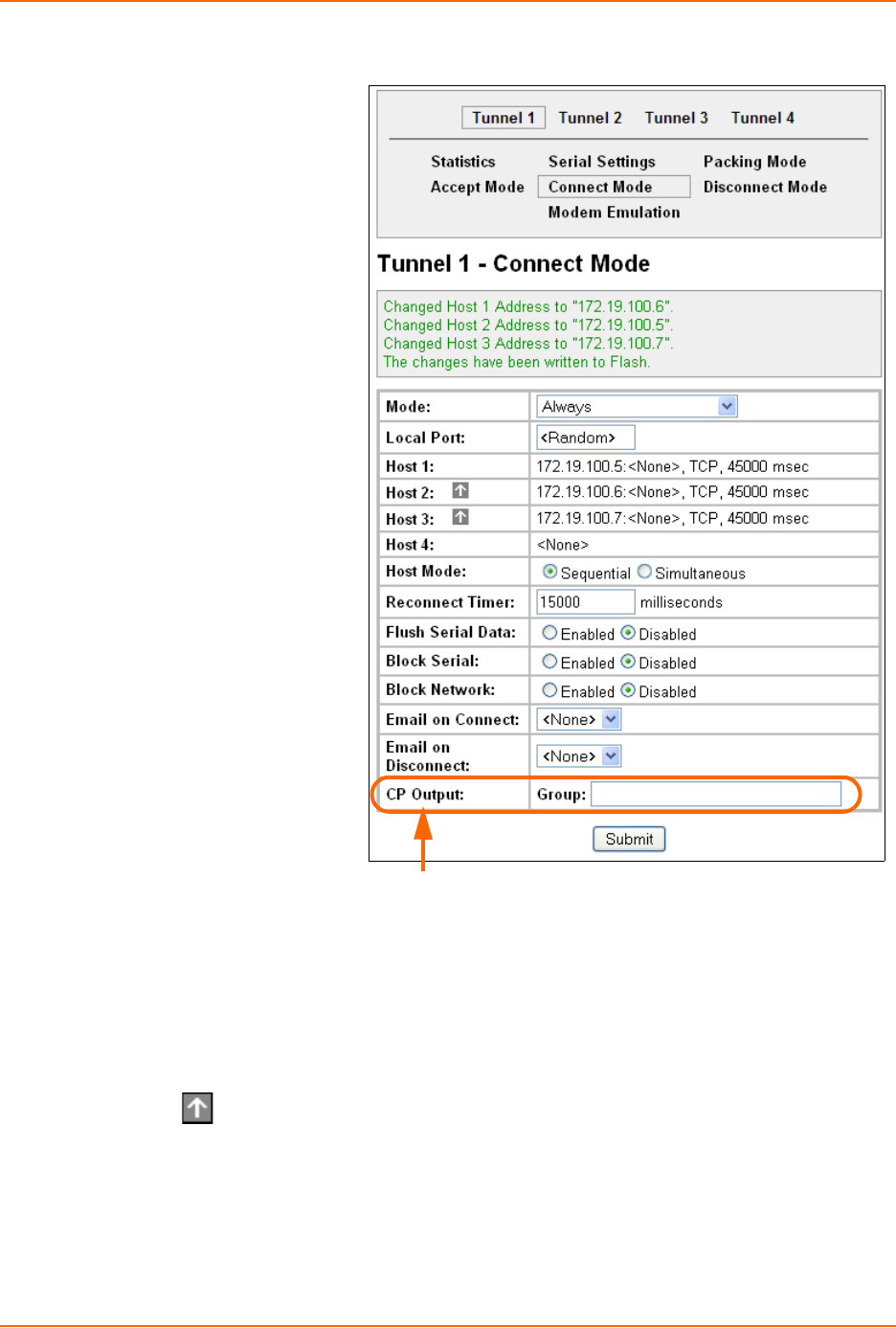
9: Line and Tunnel Settings
EDS User Guide 70
Connecting Multiple Hosts
If more than one host is
configured, a Host Mode option
appears. Host Mode controls
how multiple hosts will be
accessed. For EDS, the
Connect Mode supports up to
sixteen Hosts. Hosts may be
accessed sequentially or
simultaneously:
Sequential – Sequential
host lists establish a
prioritized list of tunnels.
The host specified as Host
1 will be attempted first. If
that fails, it will proceed to
Host 2, 3, etc, in the order
they are specified. When a
connection drops, the cycle
starts again with Host 1 and
proceeds in order.
Establishing the host order
is accomplished with host
list promotion (see Host List
Promotion on page 70).
Sequential is the default
Host Mode.
Simultaneous – A tunnel
will connect to all hosts
accepting a connection.
Connections occur at the
same time to all listed
hosts. The device can
support a maximum of 64
total aggregate
connections.
Host List Promotion
This feature allows Host IP promotion of individual hosts in the overall sequence.
To promote a specific Host:
1. Click the icon in the desired Host field, for example Host 2 and Host 3.
2. The selected Host(s) exchanges its place with the Host above it.
3. Click Submit. The hosts change sequence.
Note: The CP Output option is only supported in
XPort Pro and XPort AR.
Figure 9-17 Host 1, Host 2, Host 3 Exchanged
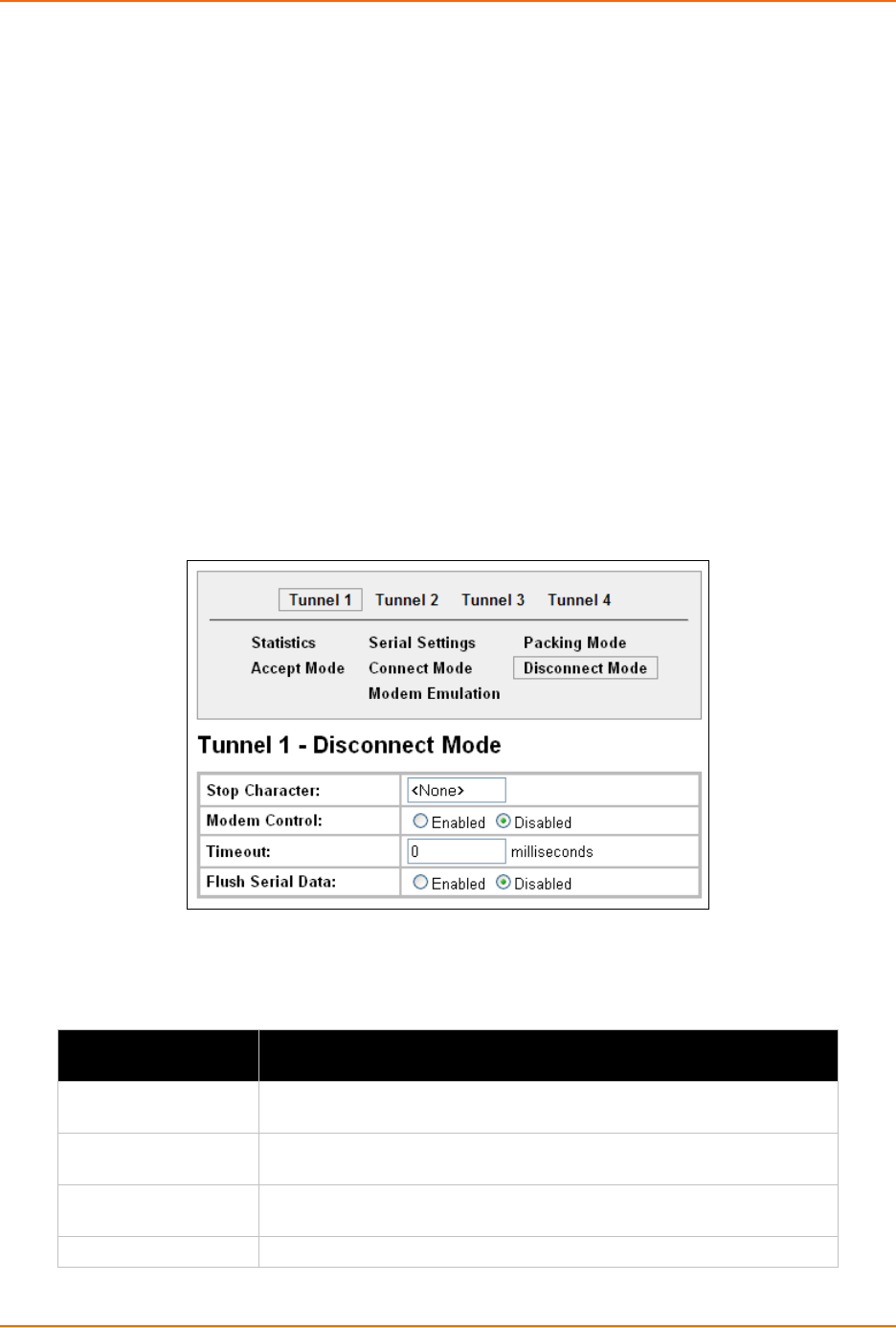
9: Line and Tunnel Settings
EDS User Guide 71
Tunnel – Disconnect Mode
Relates to the disconnection of a specific tunnel. Disconnect Mode ends Accept Mode and
Connect Mode connections. When disconnecting, the EDS shuts down the specific tunnel
connection gracefully.
The following settings end a specific tunnel connection:
The EDS receives the stop character.
The timeout period has elapsed and no activity is going in or out of the EDS. Both Accept
Mode and Connect Mode must be idle for the time frame.
The EDS observes the modem control inactive setting.
Note: To clear data out of the serial buffers upon a disconnect, enable “Flush Serial Data”.
To configure the Disconnect Mode for a specific tunnel:
1. Select Tunnel on the menu bar, if you are not already in the Tunnel web page.
2. Select a tunnel number at the top of the page.
3. Select Disconnect Mode. The specific tunnel Disconnect Mode page appears.
Figure 9-18 Tunnel 1 Disconnect Mode
4. Enter or modify the following settings:
Table 9-19 Tunnel Disconnect Mode
Tunnel – Disconnect
Mode Settings Description
Stop Character Enter the stop character in ASCII, hexadecimal, or decimal notation.
Select <None> to disable.
Modem Control Select Enabled to disconnect when the modem control pin is not
asserted on the serial line.
Timeout Enter a time, in milliseconds, for the device to disconnect on a Timeout.
The value 0 (zero) disables the idle timeout.
Flush Serial Data Select Enabled to flush the serial data buffer on a disconnection.

9: Line and Tunnel Settings
EDS User Guide 72
5. Click Submit.
6. Repeat above steps as desired, according to additional tunnel(s) available on your product.
Tunnel – Modem Emulation
A tunnel in Connect Mode can be initiated using modem commands incoming from the Serial Line.
This page enables you to configure the modem emulation settings when you select Modem
Emulation as the Tunnel Connect Mode type.
The Modem Emulation Command Mode supports the standard AT command set. For a list of
available commands from the serial or Telnet login, enter AT?. Use ATDT, ATD, and ATDP to
establish a connection. All of these commands behave like a modem. For commands that are valid
but not applicable to the EDS, an “OK” message is sent (but the command is silently ignored).
The EDS attempts to make a Command Mode connection as per the IP/DNS/port numbers
defined in Connect Mode. It is possible to override the remote address, as well as the remote port
number.
The following table lists and describes the available commands.
Table 9-20 Modem Emulation Commands and Descriptions
Command Description
+++ Switches to Command Mode if entered from serial port during connection.
AT? Help.
ATDT<Address Info> Establishes the TCP connection to socket (<ipaddress>:<port>).
ATDP<Address Info> See ATDT.
ATD Like ATDT. Dials default Connect Mode remote address and port.
ATD<Address Info> Sets up a TCP connection. A value of 0 begins a command line interface
session.
ATO Switches to data mode if connection still exists. Vice versa to '+++'.
ATEn Switches echo in Command Mode (off - 0, on - 1).
ATH Disconnects the network session.
ATI Shows modem information.
ATQn Quiet mode (0 - enable results code, 1 - disable results code.)
ATVn Verbose mode (0 - numeric result codes, 1 - text result codes.)
ATXn Command does nothing and returns OK status.
ATUn Accept unknown commands. (n value of 0 = off. n value of 1 = on.)
AT&V Display current and saved settings.
AT&F Reset settings in NVR to factory defaults.
AT&W Save active settings to NVR.
ATZ Restores the current state from the setup settings.

9: Line and Tunnel Settings
EDS User Guide 73
For commands that can take address information (ATD, ATDT, ATDP), the destination address
can be specified by entering the IP Address, or entering the IP Address and port number. For
example, <ipaddress>:<port>. The port number cannot be entered on its own.
For ATDT and ATDP commands less than 255 characters, the EDS replaces the last segment of
the IP address with the configured Connect Mode remote station address. It is possible to use the
last two segments also, if they are under 255 characters. For example, if the address is
100.255.15.5, entering “ATDT 16.6” results in 100.255.16.6.
When using ATDT and ATDP, enter 0.0.0.0 to switch to the Command Line Interface (CLI). Once
the CLI is exited by using the CLI exit command, the EDS reverts to modem emulation mode. By
default, the +++ characters are not passed through the connection. Turn on this capability using
the modem echo pluses command.
To configure modem emulation for a specific tunnel:
1. Select Tunnel on the menu bar, if you are not already in the Tunnel web page.
2. Select a tunnel number at the top of the page.
3. Select Modem Emulation. The Modem Emulation page for the specific tunnel appears.
ATS0=n Accept incoming connection.
N value of 0—Disable
N value of 1—Connect automatically
N value of 2+—Connect with ATA command.
ATA Answer incoming connection (if ATS0 is 2 or greater).
A/ Repeat last valid command.
Table 9-20 Modem Emulation Commands and Descriptions (continued)
Command (continued) Description
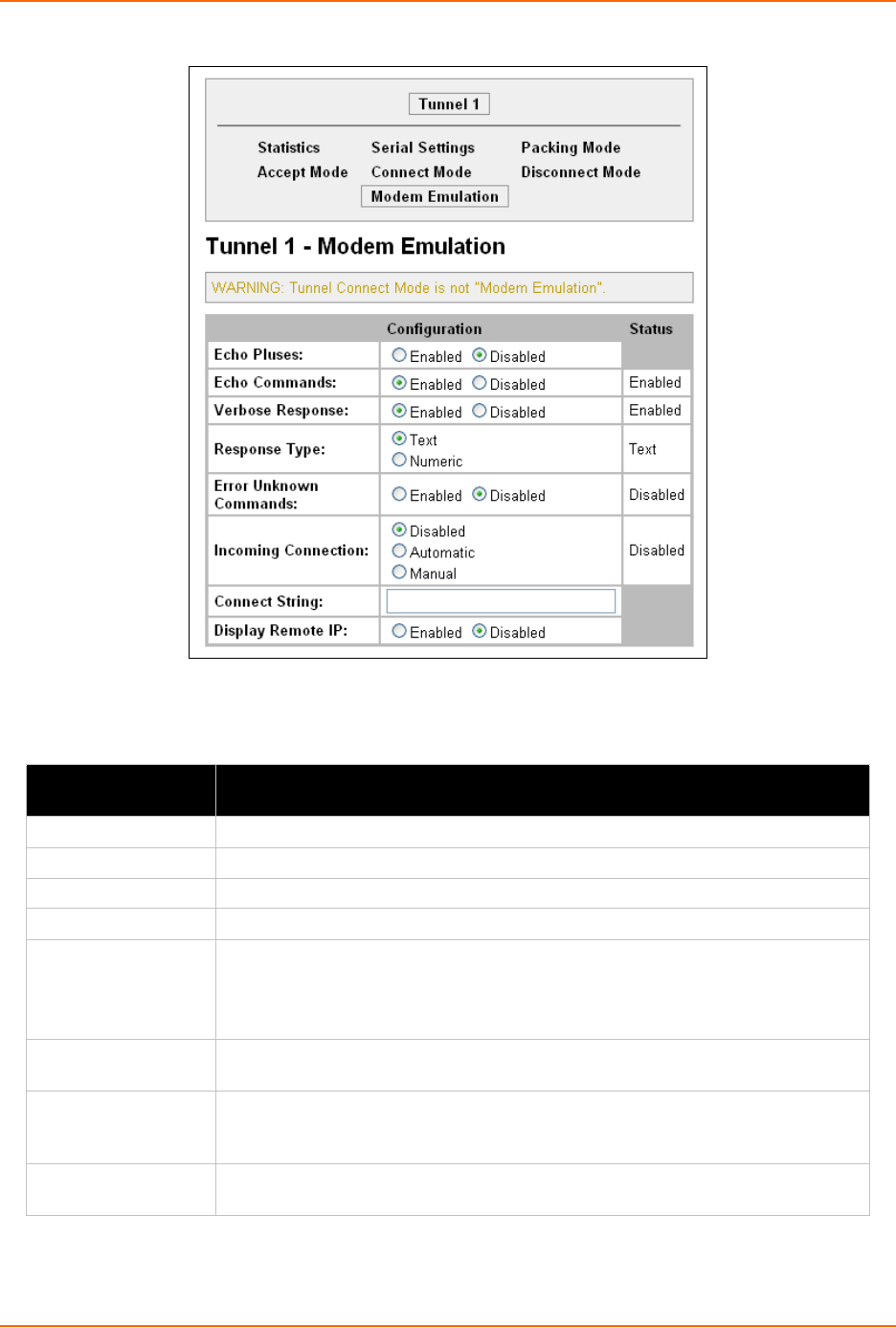
9: Line and Tunnel Settings
EDS User Guide 74
Figure 9-21 Tunnel 1 Modem Emulation
4. Enter or modify the following settings:
Table 9-22 Tunnel Modem Emulation
5. Click Submit.
6. Repeat above steps as desired, according to additional tunnel(s) available on your product.
Tunnel- Modem
Emulation Settings Description
Echo Pluses Select Enabled to echo +++ when entering modem Command Mode.
Echo Commands Select Enabled to echo the modem commands to the console.
Verbose Response Select Enabled to send modem response codes out on the serial line.
Response Type Select the type of response code: Text or Numeric.
Error Unknown
Commands
Select whether an ERROR or OK response is sent in reply to unrecognized AT
commands. Choices are:
Enabled = ERROR is returned for unrecognized AT commands.
Disabled = OK is returned for unrecognized AT commands. Default is Disabled.
Incoming
Connection
Select whether Incoming Connection requests will be disabled, answered
automatically, or answered manually. Default is Disabled.
Connect String Enter the connect string. This modem initialization string prepares the modem for
communications. It is a customized string sent with the “CONNECT” modem
response code.
Display Remote IP Selects whether the incoming RING sent on the Serial Line is followed by the IP
address of the caller. Default is Disabled.
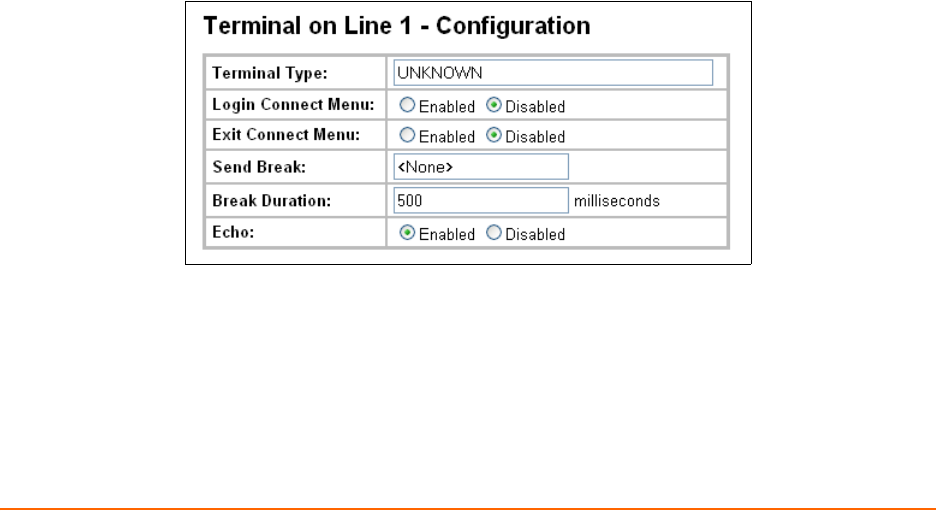
EDS User Guide 75
10: Terminal and Host Settings
This chapter describes how to view and configure the Terminal Login Connect Menu and
associated Host configuration. It contains the following sections:
Terminal Settings
Host Configuration
The Terminal Login Connect Menu feature allows the EDS device to present a menu of predefined
connections when the device is accessed via telnet, ssh, or a serial port. From the menu, a user
can choose one of the presented options and the device automatically makes the predefined
connection.
The Terminal page controls whether a Telnet, SSH, or serial port connection presents the CLI or
the Login Connect Menu. By default, the CLI is presented when the device is accessed. When
configured to present the Login Connect Menu, the hosts configured via the Hosts page, and
named serial lines are presented.
Terminal Settings
This page shows configuration settings for each terminal connection method. You can configure
whether each serial line or the telnet/SSH server presents a CLI or a Login Connect menu when a
connection is made.
Line Terminal Configuration
To configure a specific line to support an attached terminal:
1. Select Terminal on the menu bar. The Terminal web page appears.
2. Select the line number at the top of the page connected to the terminal you want to configure.
The default is Line 1.
Figure 10-1 Terminal on Line Configuration
3. Enter or modify the following settings:
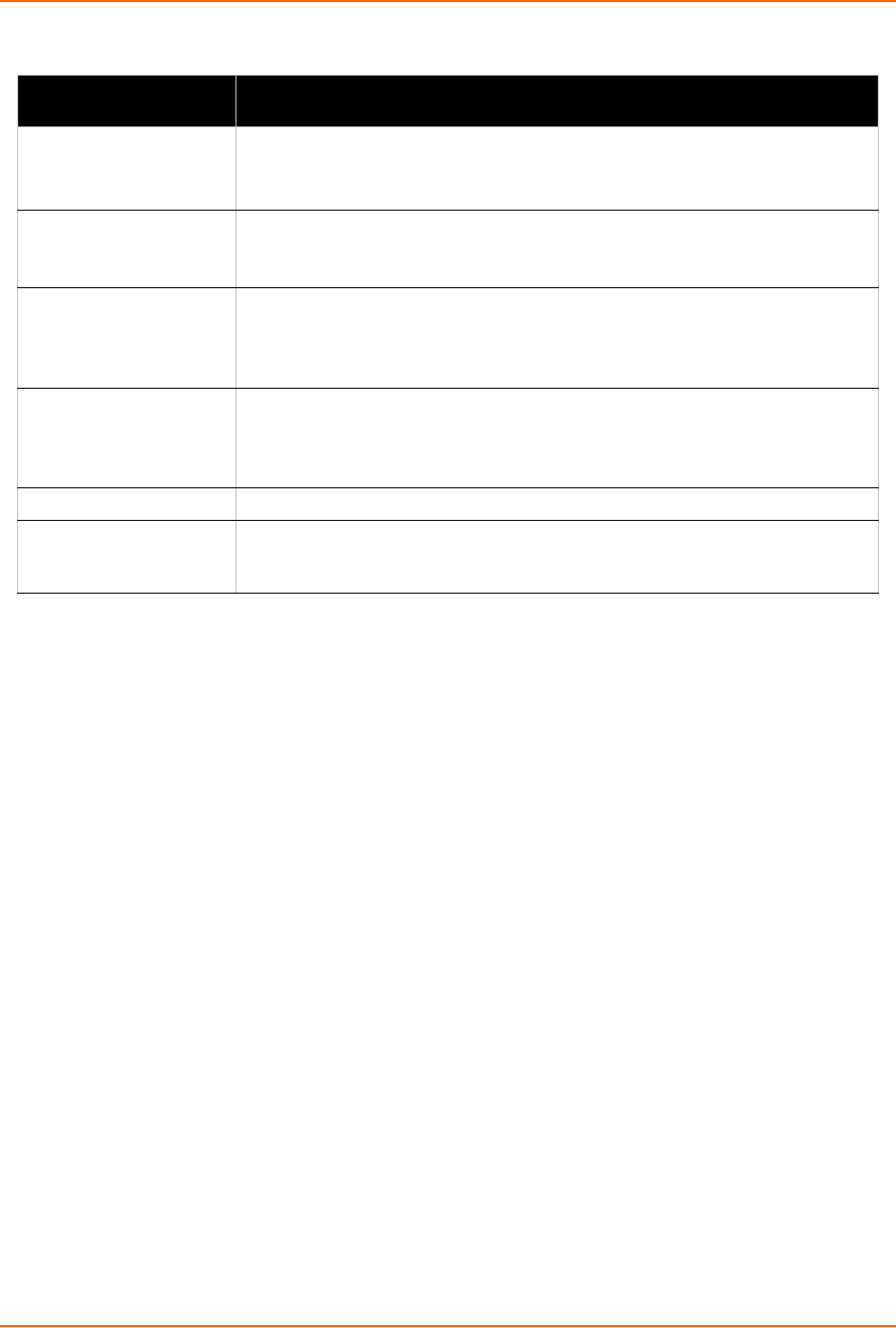
10: Terminal and Host Settings
EDS User Guide 76
Table 10-2 Terminal on Line 1 Configuration
4. Click Submit to save changes.
5. Repeat above steps as desired, according to the additional line(s) available on your product.
Terminal on Line
Configuration Settings Description
Terminal Type Enter text to describe the type of terminal. The text will be sent to a host via IAC.
Note: IAC means, “interpret as command.” It is a way to send commands over
the network such as send break or start echoing.
Login Connect Menu Select the interface to display when the user logs in. Choices are:
Enabled = shows the Login Connect Menu.
Disabled = shows the CLI
Exit Connect Menu Select whether to display a choice for the user to exit the Login Connect Menu
and reach the CLI. Choices are:
Enabled = a choice allows the user to exit to the CLI.
Disabled = there is no exit to the CLI.
Send Break Enter a Send Break control character, e.g., <control> Y, or blank to disable.
When the Send Break control character is received from the network on its way to
the serial line, it is not sent to the line; instead, the line output is forced to be
inactive (the break condition).
Break Duration Enter how long the break should last in milliseconds.
Echo Applies only to Connect Mode Telnet connections, not to Accept Mode. Only
disable Echo if your terminal echoes, in which case you will see double of each
character typed.
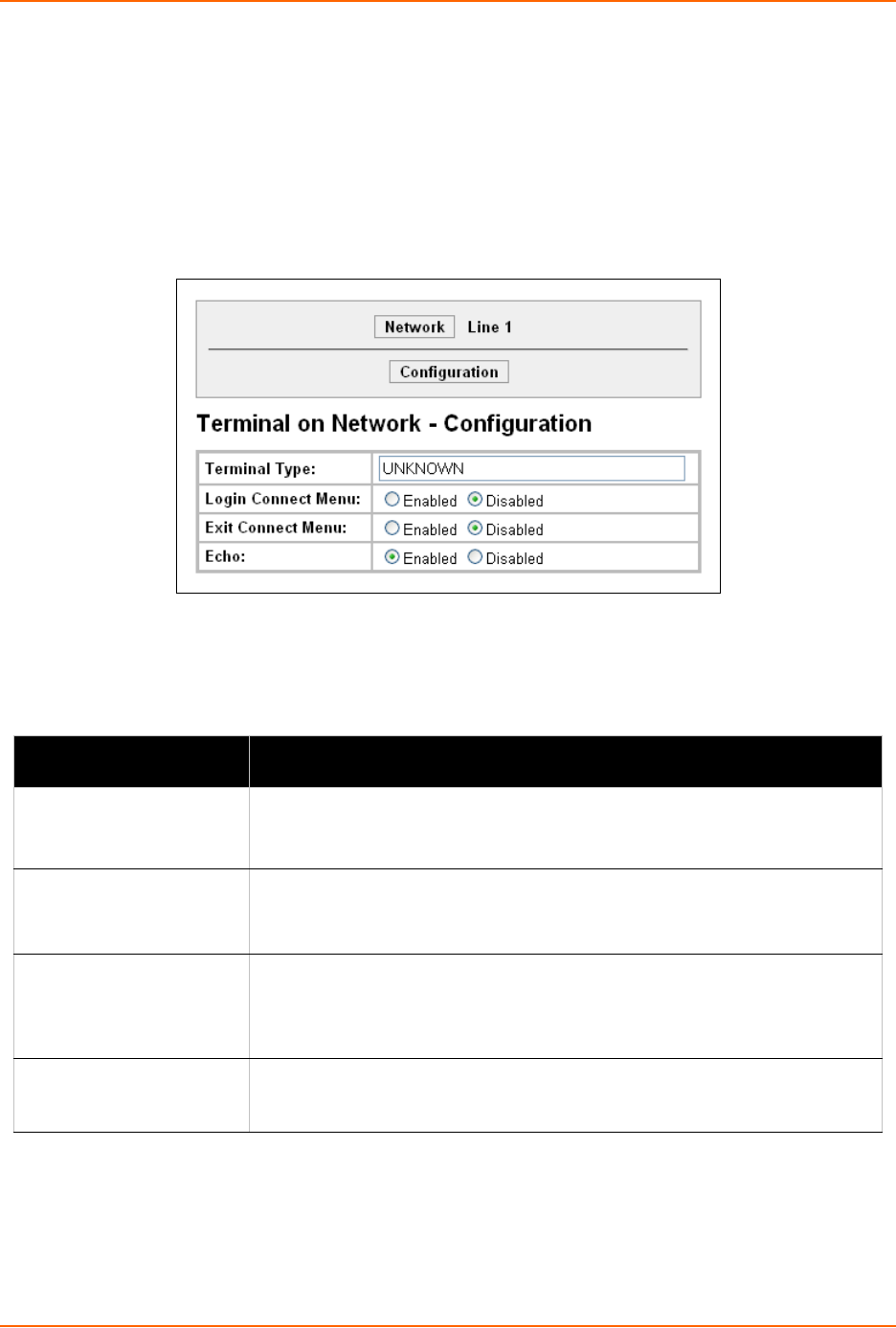
10: Terminal and Host Settings
EDS User Guide 77
Network Terminal Configuration
To configure menu features applicable to CLI access via the network:
1. Select Terminal on the menu bar, if you are not already in the Terminal web page.
2. Select Network at the top of the page. The Configuration submenu is automatically selected.
The Terminal Configuration page appears for the network.
Figure 10-3 Terminal on Network Configuration
3. Enter or modify the following settings:
Table 10-4 Terminal on Network Configuration
4. Click Submit to save changes.
Terminal on Network
Configuration Settings Description
Terminal Type Enter text to describe the type of terminal. The text will be sent to a host via IAC.
Note: IAC means, “interpret as command.” It is a way to send commands over
the network such as send break or start echoing.
Login Connect Menu Select the interface to display when the user logs in. Choices are:
Enabled = shows the Login Connect Menu.
Disabled = shows the CLI
Exit Connect Menu Select whether to display a choice for the user to exit the Login Connect Menu
and reach the CLI. Choices are:
Enabled = a choice allows the user to exit to the CLI.
Disabled = there is no exit to the CLI.
Echo Applies only to Connect Mode Telnet connections, not to Accept Mode. Only
disable Echo if your terminal echoes, in which case you will see double of each
character typed.
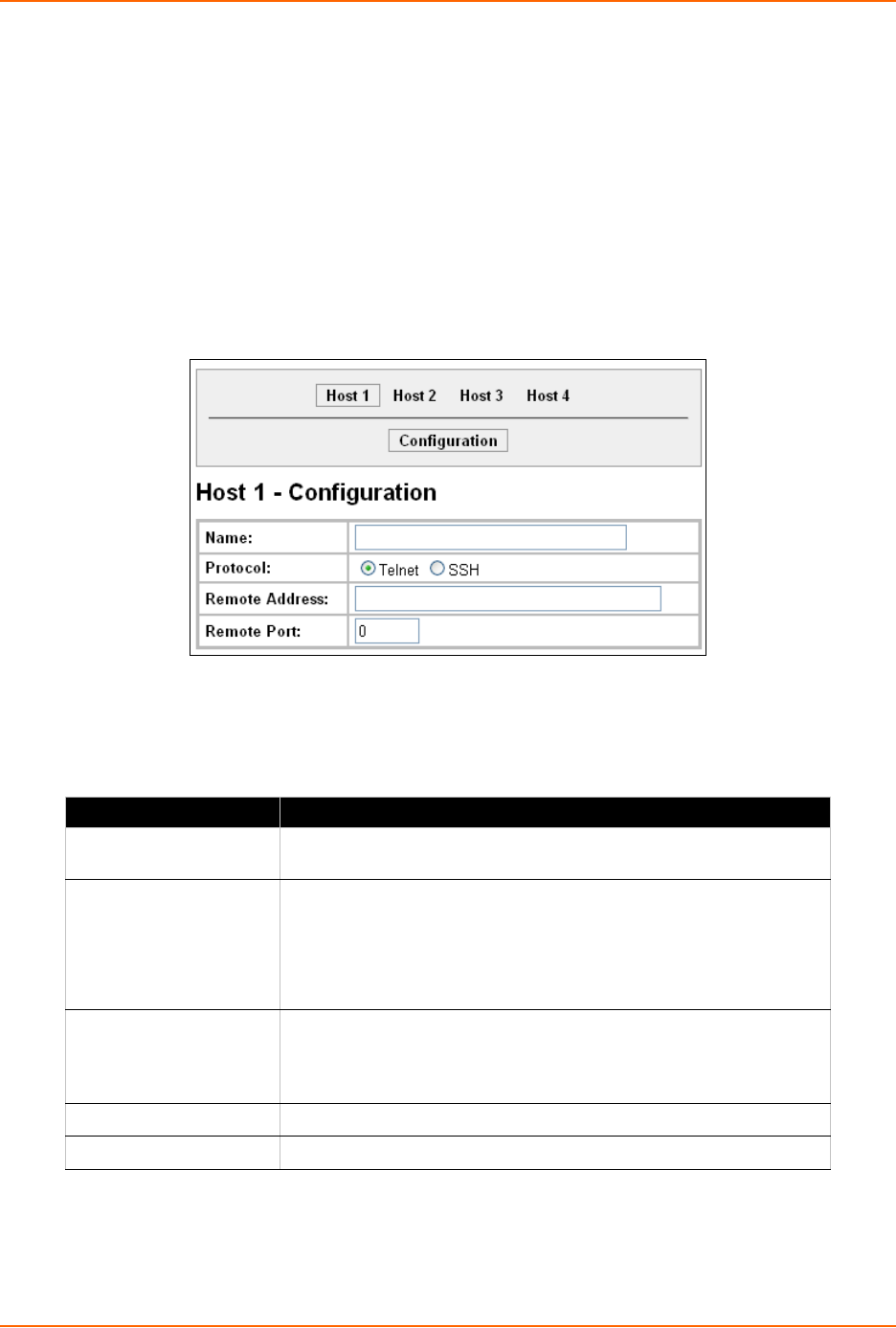
10: Terminal and Host Settings
EDS User Guide 78
Host Configuration
This Host web page is where you may view and modify current settings for a selected remote host.
To configure a selected remote host:
1. Select Host on the menu bar. The Host web page appears.
2. Select a specific host number at the top of the page. The Host Configuration page for the
selected host appears.
Figure 10-5 Host Configuration
3. Enter or modify the following settings:
Table 10-6 Host Configuration
4. Click Submit to save changes.
5. Repeat above steps as desired, according to additional host(s) available on your product.
Host Settings Description
Name Enter a name for the host. This name appears on the Login Connect
Menu. To leave a host out of the menu, leave this field blank.
Protocol Select the protocol to use to connect to the host. Choices are:
Telnet
SSH
Note: SSH keys must be loaded or created on the SSH page for the
SSH protocol to work.
SSH Username Appears if you selected SSH as the protocol. Enter a username to
select a pre-configured Username/Password/Key (configured on the
SSH: Client Users page), or leave it blank to be prompted for a
username and password at connect time.
Remote Address Enter an IP address for the host to which the device will connect.
Remote Port Enter the port on the host to which the device will connect.
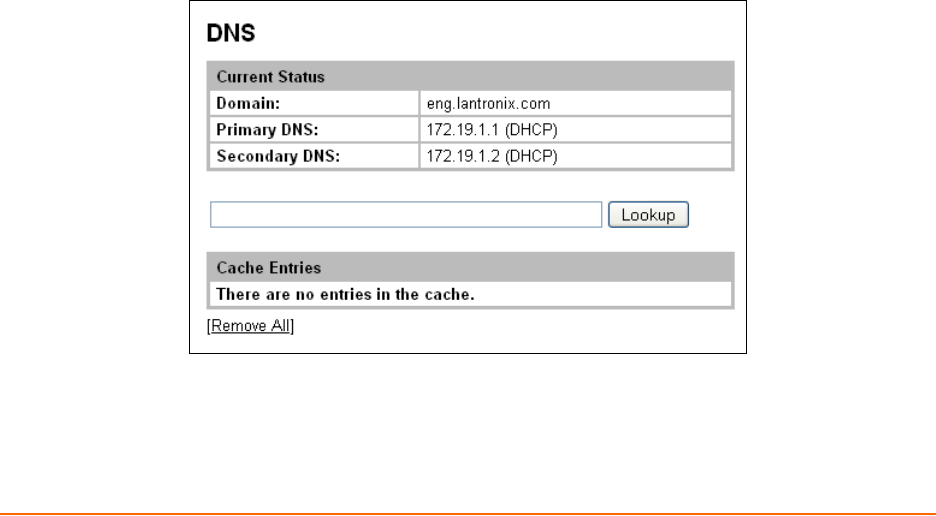
EDS User Guide 79
11: Service Settings
This chapter describes the available services and how to configure each. It contains the following
sections:
DNS Settings
SNMP Settings
FTP Settings
TFTP Settings
Syslog Settings
HTTP Settings
RSS Settings
LPD Settings
DNS Settings
The primary and secondary domain name system (DNS) addresses come from the active
interface. The static addresses from the Network Interface Configuration page may be overridden
by DHCP or BOOTP. The DNS web page enables you to view the status and cache.
When a DNS name is resolved using a forward lookup, the results are stored in the DNS cache
temporarily. The EDS checks this cache when performing forward lookups. Each item in the cache
eventually times out and is removed automatically after a certain period, or you can delete it
manually.
To view the DNS status:
1. Select DNS on the menu bar. The DNS page appears.
Figure 11-1 DNS Settings
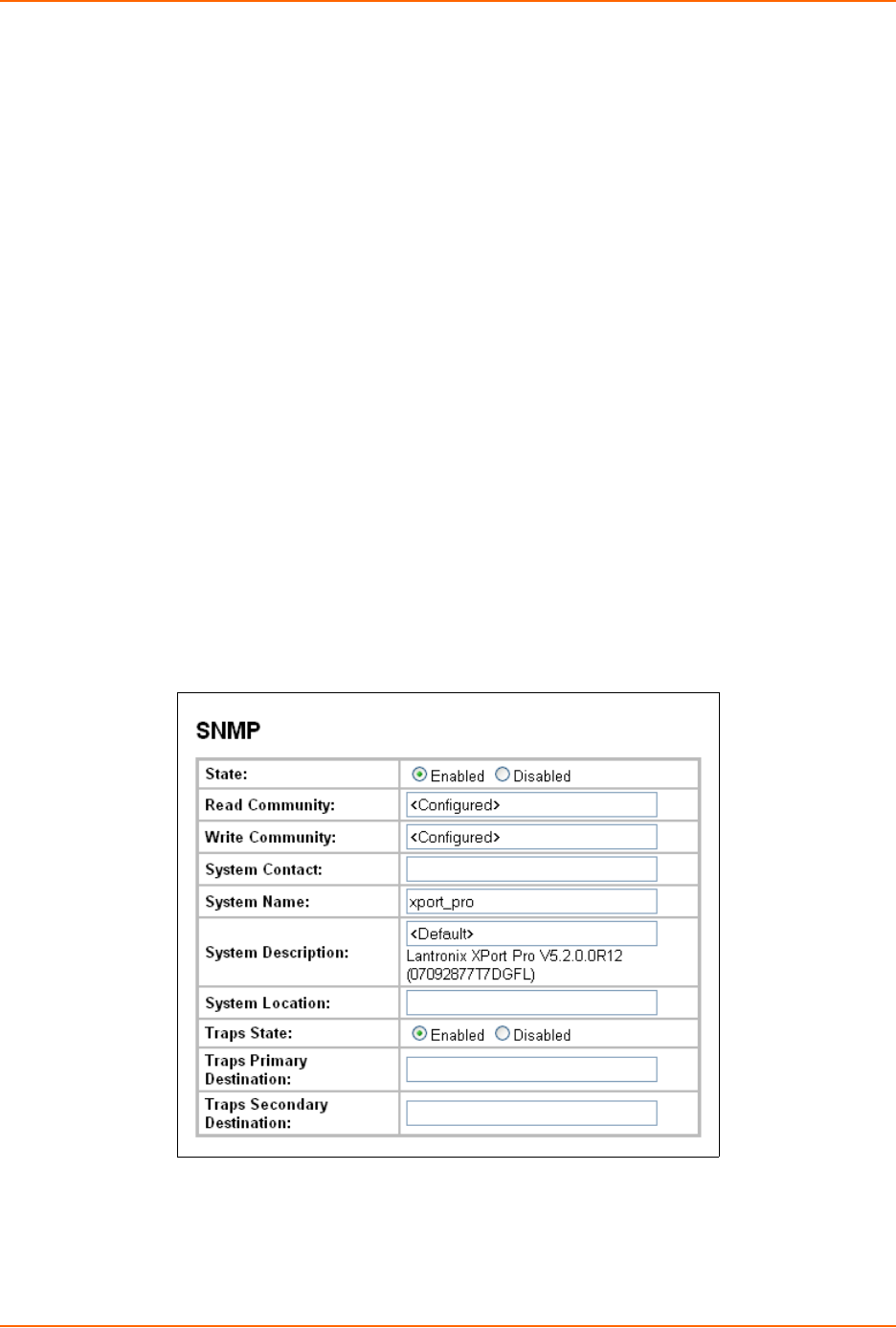
11: Service Settings
EDS User Guide 80
To find a DNS Name or IP Address:
1. Enter either a DNS name or an IP address.
2. Click Lookup.
When a DNS name is resolved, the results appear in the DNS cache.
When an IP address is resolved, the results appear in a text below the Lookup field.
To clear cache entries:
1. Click Remove All to remove all listed cache entries.
2. Click Delete next to a specirfic cache entry to remove only that one.
SNMP Settings
Simple Network Management Protocol (SNMP) is a network management tool that monitors
network devices for conditions that need attention. The SNMP service responds to SNMP
requests and generates SNMP Traps.
This page is used to configure the SNMP agent.
To configure SNMP:
1. Select SNMP on the menu bar. The SNMP page opens and shows the current SNMP
configuration.
Figure 11-2 SNMP Configuration
2. Enter or modify the following settings:

11: Service Settings
EDS User Guide 81
Table 11-3 SNMP
3. Click Submit.
FTP Settings
The FTP web page shows the current File Transfer Protocol (FTP) configuration and various
statistics about the FTP server.
To configure FTP:
1. Select FTP on the menu bar. The FTP page opens to display the current configuration.
SNMP Settings Description
State Select Enabled to enable SNMP.
Read Community Enter the SNMP read-only community string.
Write Community Enter the SNMP read/write community string.
System Contact Enter the name of the system contact.
System Name Enter the system name.
System Description Enter the system description.
System Location Enter the system location.
Traps State Select Enabled to enable the transmission of SNMP Traps.
The Cold Start trap is sent on device boot up, and the
Linkdown trap is sent when the device is rebooted from
software control.
Traps Primary Destination Enter the primary SNMP trap host.
Traps Secondary
Destination
Enter the secondary SNMP trap host.
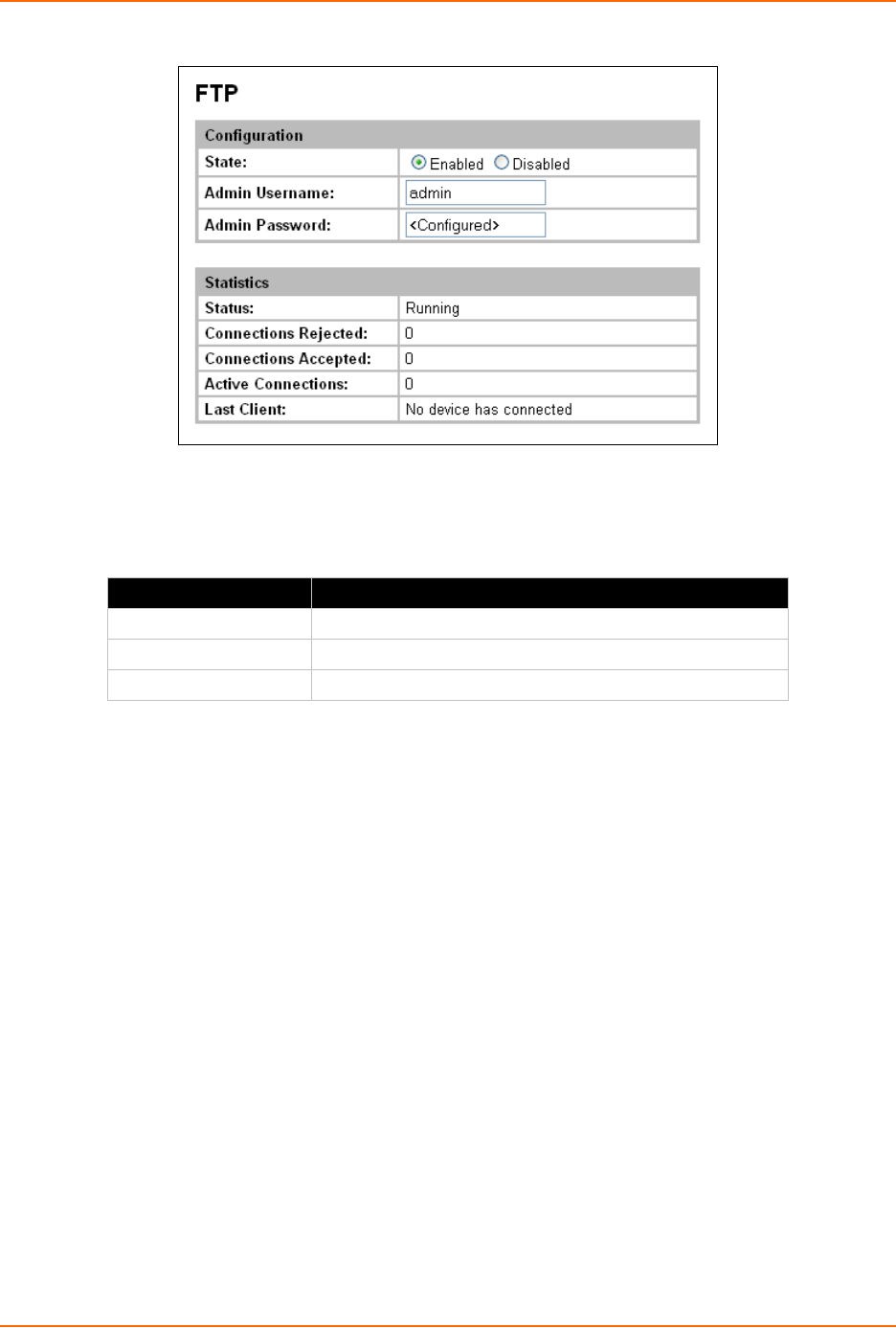
11: Service Settings
EDS User Guide 82
Figure 11-4 FTP Configuration
2. Enter or modify the following settings:
Table 11-5 FTP Settings
3. Click Submit.
FTP Settings Description
State Select Enabled to enable the FTP server.
Admin Username Enter the username to use when logging in via FTP.
Admin Password Enter the password to use when logging in via FTP.
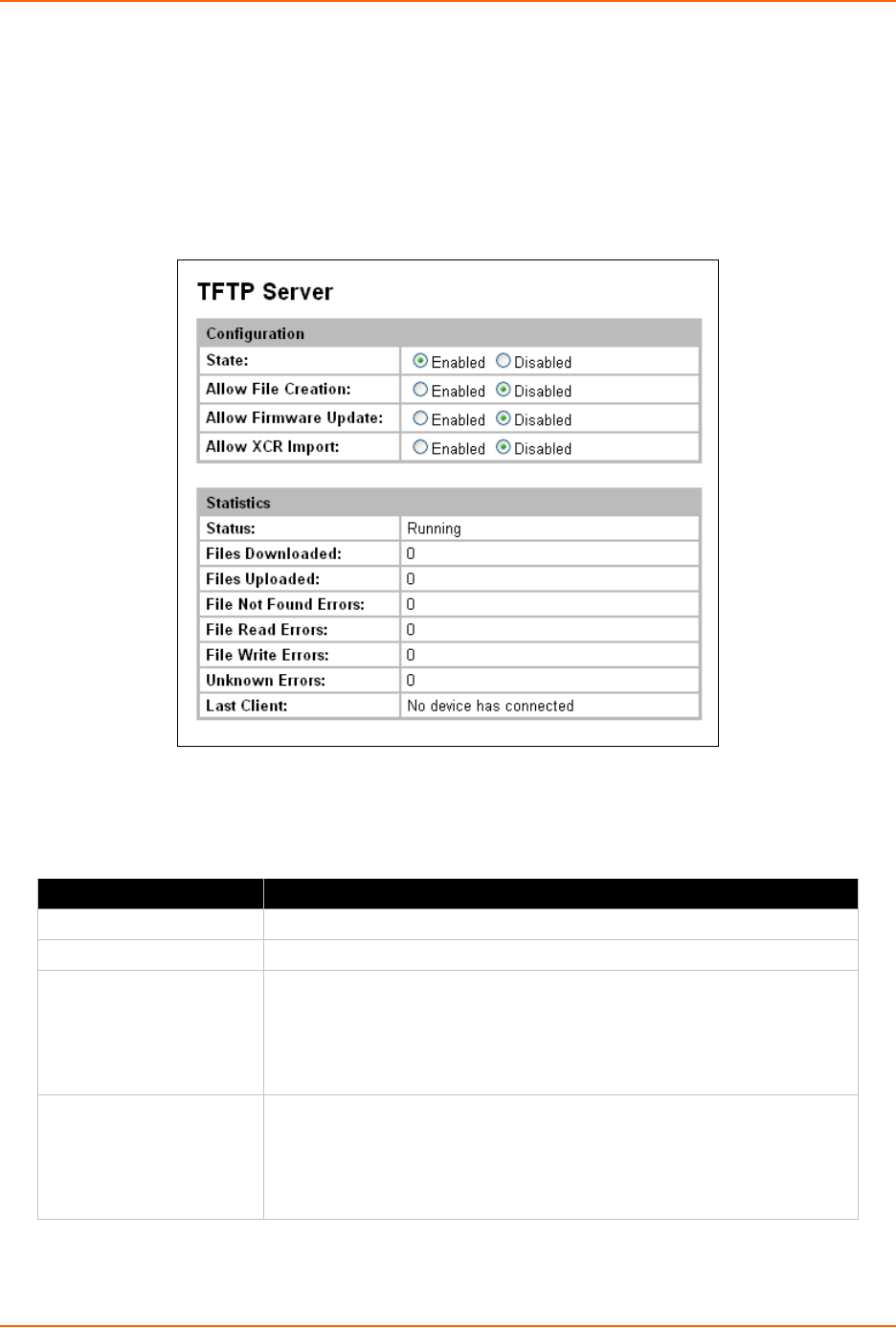
11: Service Settings
EDS User Guide 83
TFTP Settings
In the TFTP web page, you can configure the server and view the statistics about the Trivial File
Transfer Protocol (TFTP) server.
To configure TFTP:
1. Select TFTP on the menu bar. The TFTP page opens to display the current configuration.
Figure 11-6 TFTP Configuration
2. Enter or modify the following settings:
Table 11-7 TFTP Server
3. Click Submit.
TFTP Settings Description
State Select Enabled to enable the TFTP server.
Allow TFTP File Creation Select whether to allow the creation of new files stored on the TFTP server.
Allow Firmware Update Specifies whether or not the TFTP Server is allowed to accept a firmware
update for the device. An attempt to update firmware is recognized based
on the name of the file.
Note: TFTP cannot authenticate the client, so the device is open to
malicious update.
Allow XCR Import Specifies whether the TFTP server is allowed to accept an XML
configuration file for update. An attempt to import configuration is
recognized based on the name of the file.
Note: TFTP cannot authenticate the client, so the device is open to
malicious update.
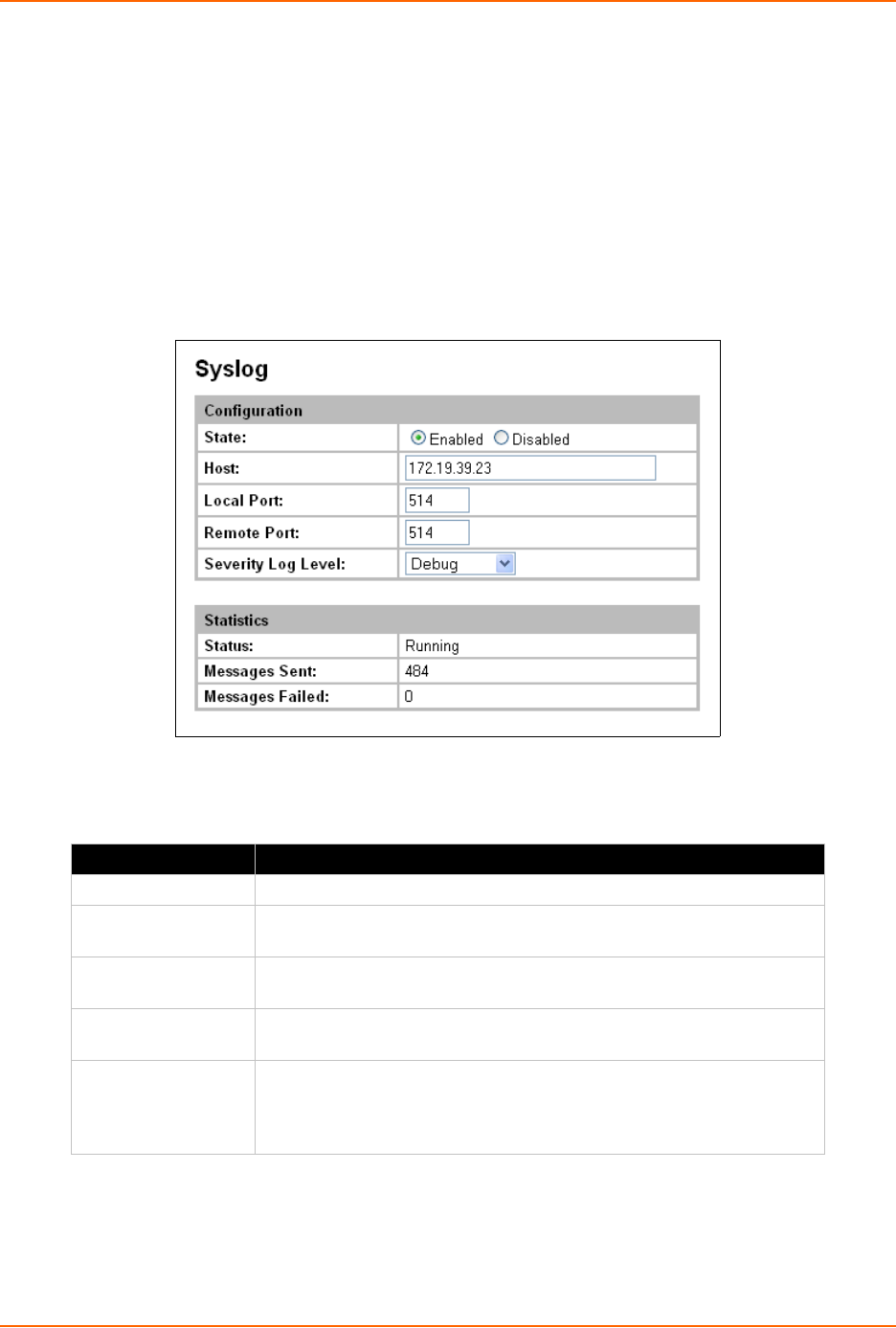
11: Service Settings
EDS User Guide 84
Syslog Settings
The Syslog web page shows the current configuration and statistics of the system log.
To configure the Syslog:
Note: The syslog file is always saved to local storage, but it is not retained through
reboots. Saving the syslog file to a server that supports remote logging services (see RFC
3164) allows the administrator to save the complete syslog history. The default port is 514.
1. Select Syslog on the menu bar. The Syslog page opens to display the current configuration.
Figure 11-8 Syslog
2. Enter or modify the following settings:
Table 11-9 Syslog
3. Click Submit.
Syslog Settings Description
State Select to enable or disable the syslog.
Host Enter the IP address of the remote server to which system logs are sent
for storage.
Local Port Enter the number of the local port on the device from which system logs
are sent.
Remote Port Enter the number of the port on the remote server that supports logging
services. The default is 514.
Severity Log Level From the drop-down box, select the minimum level of system message
the device should log. This setting applies to all syslog facilities. The
drop-down list is in descending order of severity (e.g., Emergency is
more severe than Alert.)
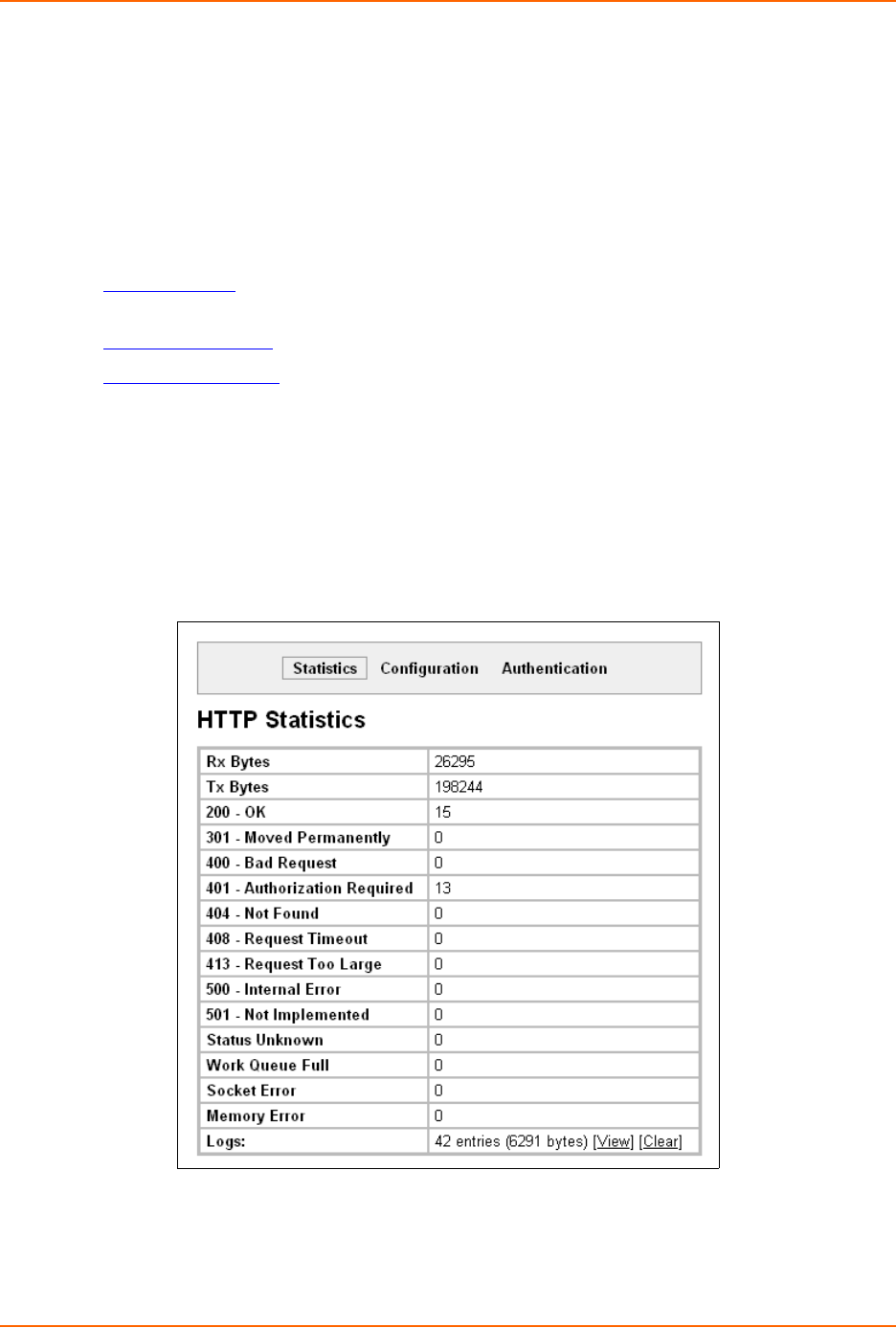
11: Service Settings
EDS User Guide 85
HTTP Settings
Hypertext Transfer Protocol (HTTP) is the transport protocol for communicating hypertext
documents on the Internet. HTTP defines how messages are formatted and transmitted. It also
defines the actions web servers and browsers should take in response to different commands.
HTTP Authentication enables the requirement of usernames and passwords for access to the EDS
device.
This page has three links at the top for viewing statistics and for viewing and changing
configuration and authentication settings.
HTTP Statistics—Viewing statistics such as bytes received and transmitted, bad requests,
authorizations required, etc.
HTTP Configuration—Configuring and viewing the current configuration.
HTTP Authentication—Configuring and viewing the authentication.
HTTP Statistics
To view HTTP statistics:
This page shows various statistics about the HTTP server.
1. Select HTTP on the menu bar and then Statistics at the top of the page. The HTTP Statistics
page appears.
Figure 11-10 HTTP Statistics
Note: The HTTP log is a scrolling log, with the last Max Log Entries cached and
viewable. You can change the maximum number of entries that can be viewed on the
HTTP Configuration Page.
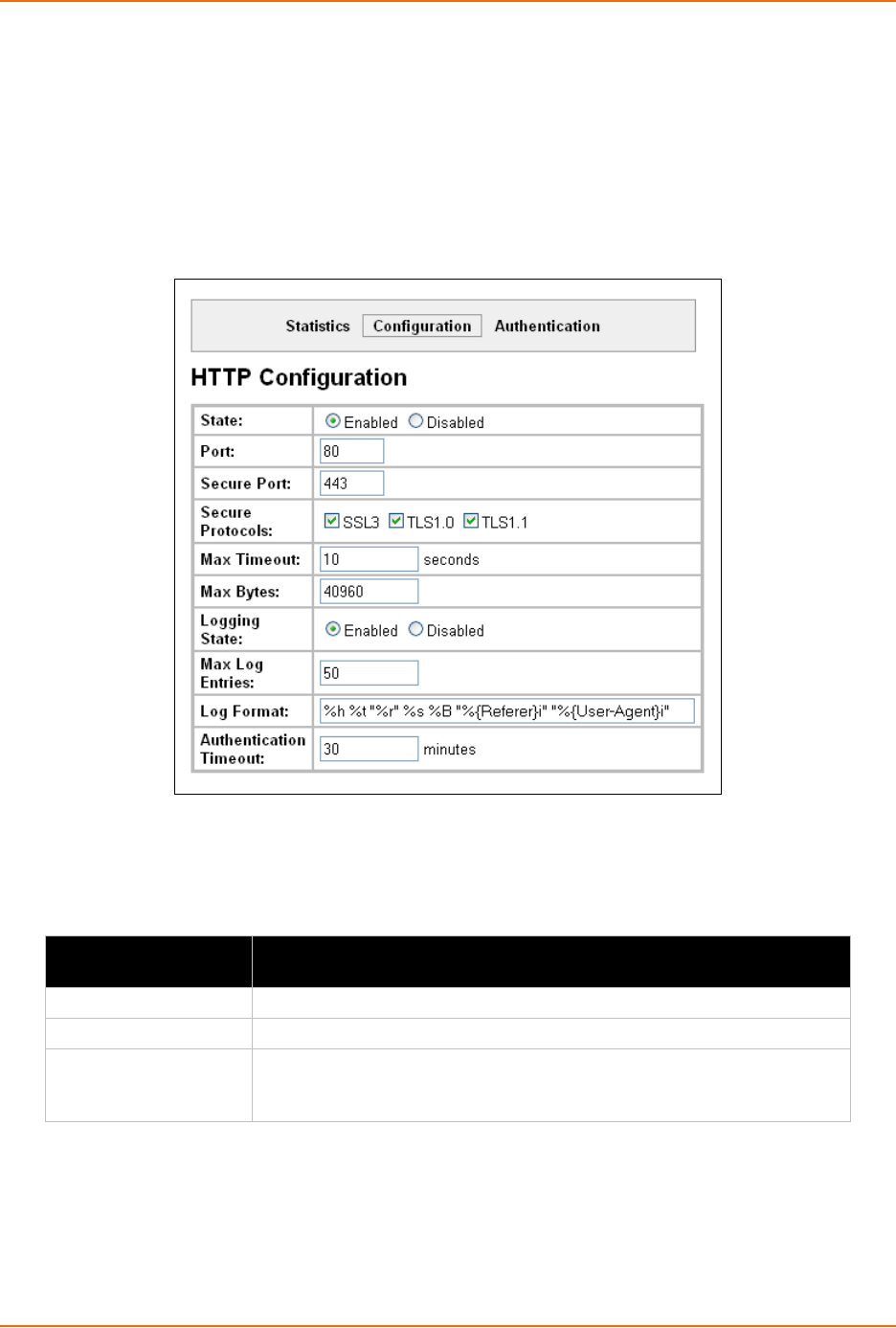
11: Service Settings
EDS User Guide 86
HTTP Configuration
On this page you may change HTTP configuration settings.
To configure HTTP:
1. Select HTTP on the menu bar and then Configuration at the top of the page. The HTTP
Configuration page opens.
Figure 11-11 HTTP Configuration
2. Enter or modify the following settings:
Table 11-12 HTTP Configuration
HTTP Configuration
Settings Description
State Select Enabled to enable the HTTP server.
Port Enter the port for the HTTP server to use. The default is 80.
Secure Port Enter the port for the HTTPS server to use. The default is 443. The HTTP
server only listens on the HTTPS Port when an SSL certificate is
configured.

11: Service Settings
EDS User Guide 87
3. Click Submit.
Secure Protocols Select to enable or disable the following protocols:
SSL3 = Secure Sockets Layer version 3
TLS1.0 = Transport Layer Security version 1.0. TLS 1.0 is the successor
of SSL3 as defined by the IETF.
TLS1.1 = Transport Layer Security version 1.1
The protocols are enabled by default.
Note: A server certificate and associated private key need to be installed in
the SSL configuration section to use HTTPS.
Max Timeout Enter the maximum time for the HTTP server to wait when receiving a
request. This prevents Denial-of-Service (DoS) attacks. The default is 10
seconds.
Max Bytes Enter the maximum number of bytes the HTTP server accepts when
receiving a request. The default is 40 kB (this prevents DoS attacks).
Logging State Select Enabled to enable HTTP server logging.
Max Log Entries Sets the maximum number of HTTP server log entries. Only the last Max
Log Entries are cached and viewable.
Log Format Set the log format string for the HTTP server. Follow these Log Format
rules:
%a - remote IP address (could be a proxy)
%b - bytes sent excluding headers
%B - bytes sent excluding headers (0 = '-')
%h - remote host (same as '%a')
%{h}i - header contents from request (h = header string)
%m - request method
%p - ephemeral local port value used for request
%q - query string (prepend with '?' or empty '-')
%t - timestamp HH:MM:SS (same as Apache '%(%H:%M:%S)t' or
'%(%T)t')
%u - remote user (could be bogus for 401 status)
%U - URL path info
%r - first line of request (same as '%m %U%q <version>')
%s - return status
Authentication
Timeout
The timeout period applies if the selected authentication type is either
Digest or SSL/Digest. After this period of inactivity, the client must
authenticate again.
HTTP Configuration
Settings (continued) Description
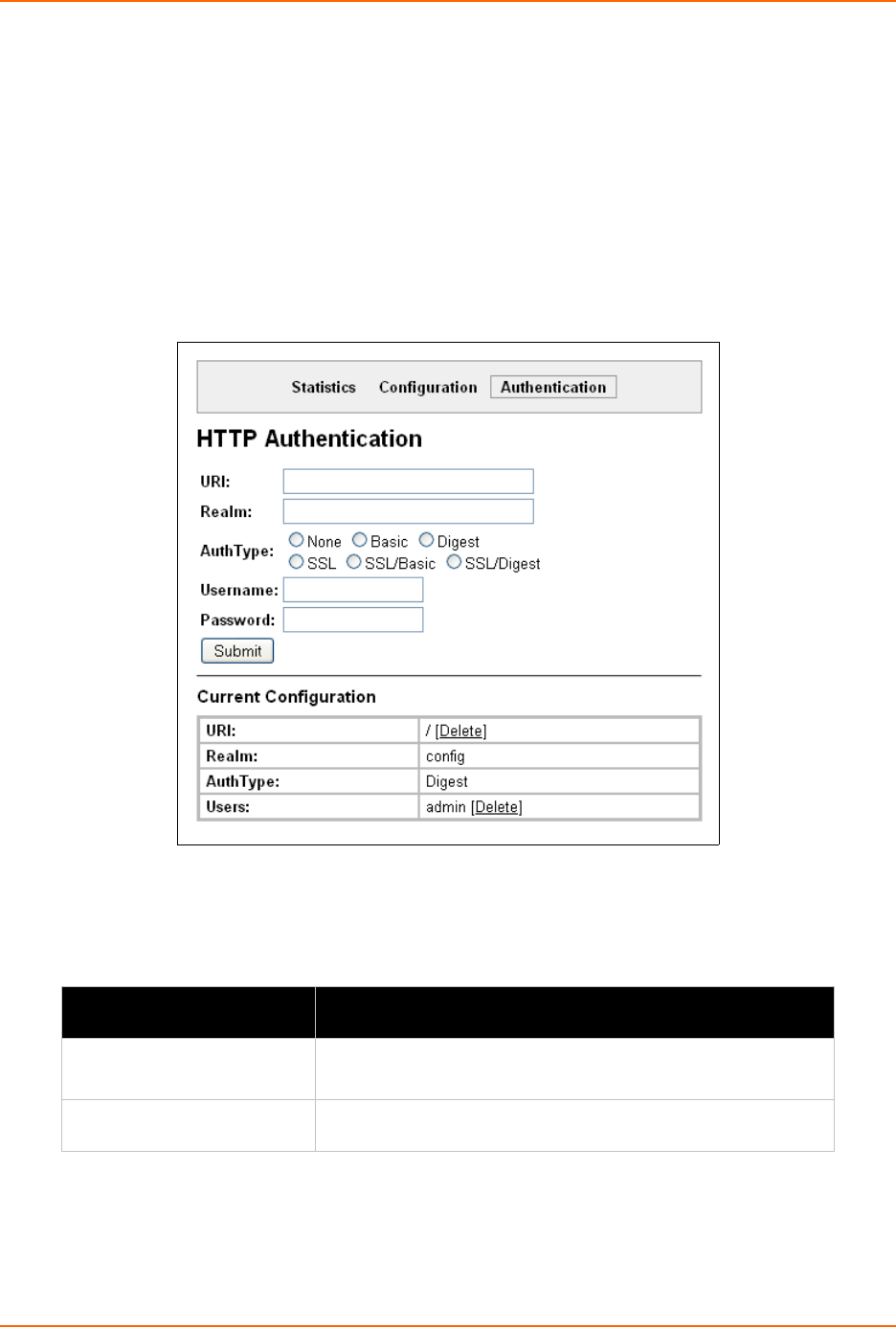
11: Service Settings
EDS User Guide 88
HTTP Authentication
HTTP Authentication enables you to require usernames and passwords to access specific web
pages or directories on the EDS' built-in web server.
To configure HTTP authentication settings:
1. Select HTTP on the menu bar and then Authentication at the top of the page. The HTTP
Authentication page opens.
Figure 11-13 HTTP Authentication
2. Enter or modify the following settings:
Table 11-14 HTTP Authentication
HTTP Authentication
Settings Description
URI Enter the Uniform Resource Identifier (URI).
Note: The URI must begin with ‘/’ to refer to the filesystem.
Realm Enter the domain, or realm, used for HTTP. Required with the
URI field.
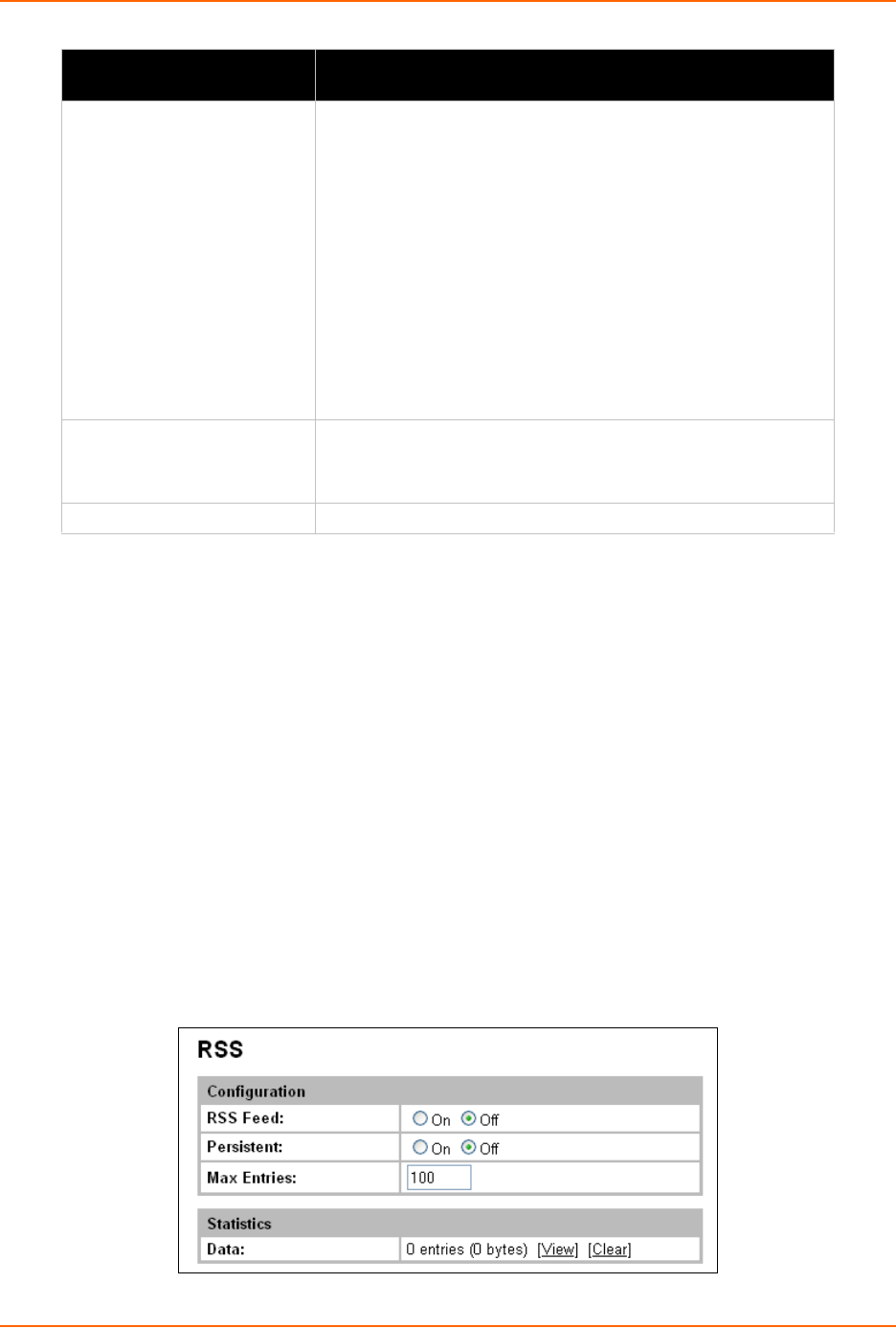
11: Service Settings
EDS User Guide 89
3. Click Submit.
4. To delete the URI and users, click Delete in the current configuration table.
Note: The URI, realm, username, and password are user-specified, free-form fields. The
URI must match the directory created on the EDS file system.
RSS Settings
Really Simple Syndication (RSS) (sometimes referred to as Rich Site Summary) is a method of
feeding online content to Web users. Instead of actively searching for EDS configuration changes,
RSS feeds permit viewing only relevant and new information regarding changes made to the EDS
via an RSS publisher. The RSS feeds may also be stored to the file system cfg_log.txt file.
To configure RSS settings:
1. Select RSS on the menu bar. The RSS page opens and shows the current RSS configuration.
Figure 11-15 RSS
Auth Type Select the authentication type:
None = no authentication is necessary.
Basic = encodes passwords using Base64.
Digest = encodes passwords using MD5.
SSL = the page can only be accessed over SSL (no password
is required).
SSL/Basic = the page is accessible only over SSL and
encodes passwords using Base64.
SSL/Digest = the page is accessible only over SSL and
encodes passwords using MD5.
Note: When changing the parameters of Digest or SSL Digest
authentication, it is often best to close and reopen the browser to
ensure it does not attempt to use cached authentication
information.
Username Enter the Username used to access the URI. More than one
Username per URI is permitted.
Click Submit and enter the next Username as necessary.
Password Enter the Password for the Username.
HTTP Authentication
Settings (continued) Description
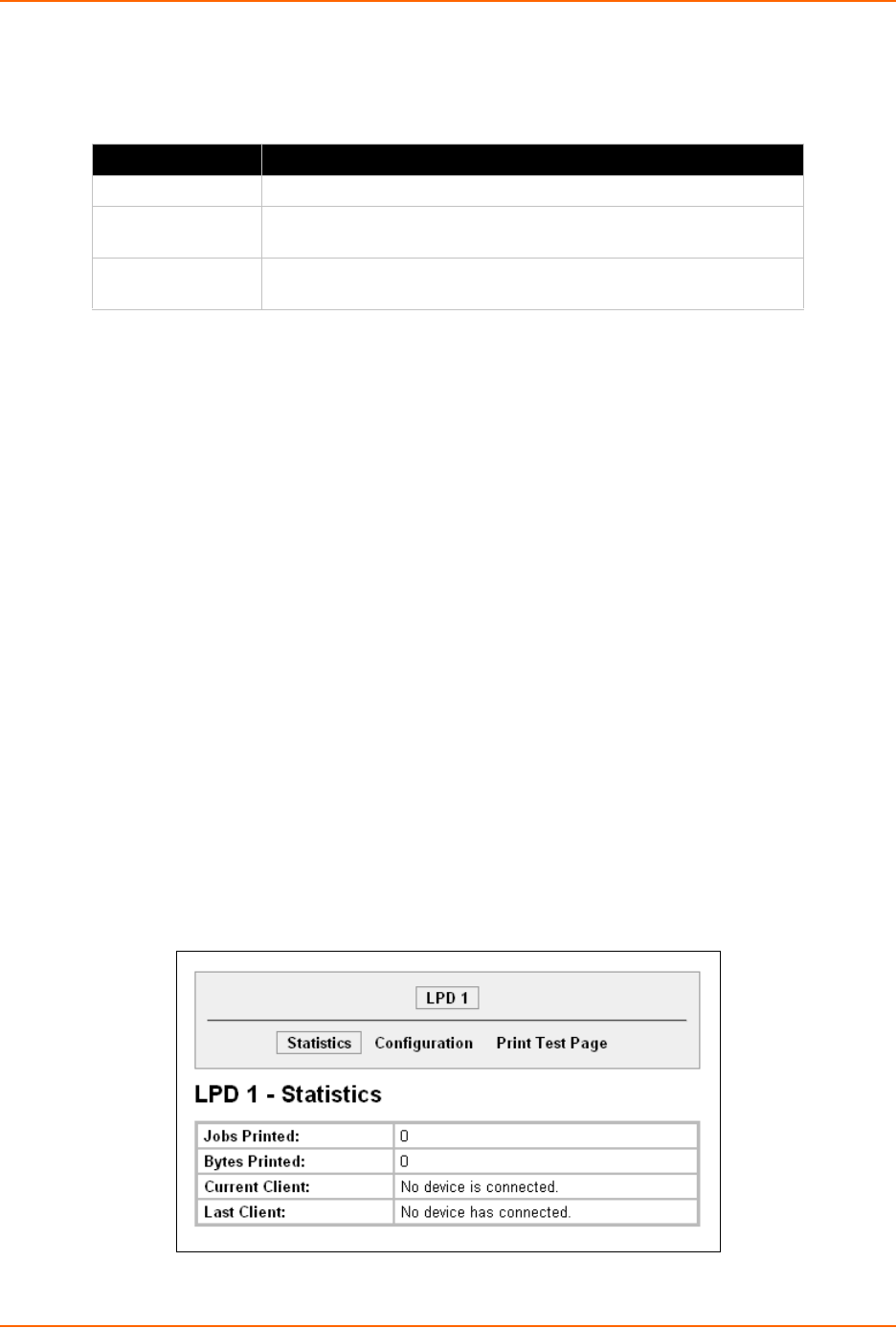
11: Service Settings
EDS User Guide 90
2. Enter or modify the following settings:
Table 11-16 RSS
3. Select Submit.
4. In the Current Status table, view and clear stored RSS Feed entries, as necessary.
LPD Settings
The EDS device acts as a print server if a printer gets connected to one of its serial ports.
Selecting the Line Printer Daemon (LPD) link in the Main Menu displays the LPD web page. The
LPD web page has three sub-menus for viewing print queue statistics, changing print queue
configuration, and printing a test page. Because the LPD lines operate independently, you can
specify different configuration settings for each.
LPD Statistics
This read-only page shows various statistics about the LPD server.
To view LPD statistics for a specific LPD line:
1. Select LPD on the menu bar. The LPD web page appears.
2. Select an LPD line at the top of the page.
3. Select Statistics. The LPD Statistics page for the selected LPD line appears.
4. Repeat above steps as desired, according to additional LPD(s) available on your product.
Figure 11-17 LPD Statistics
RSS Settings Description
RSS Feed Select On to enable RSS feeds to an RSS publisher.
Persistent Select On to enable the RSS feed to be written to a file (cfg_log.txt)
and to be available across reboots.
Max Entries Sets the maximum number of log entries. Only the last Max Entries
are cached and viewable.
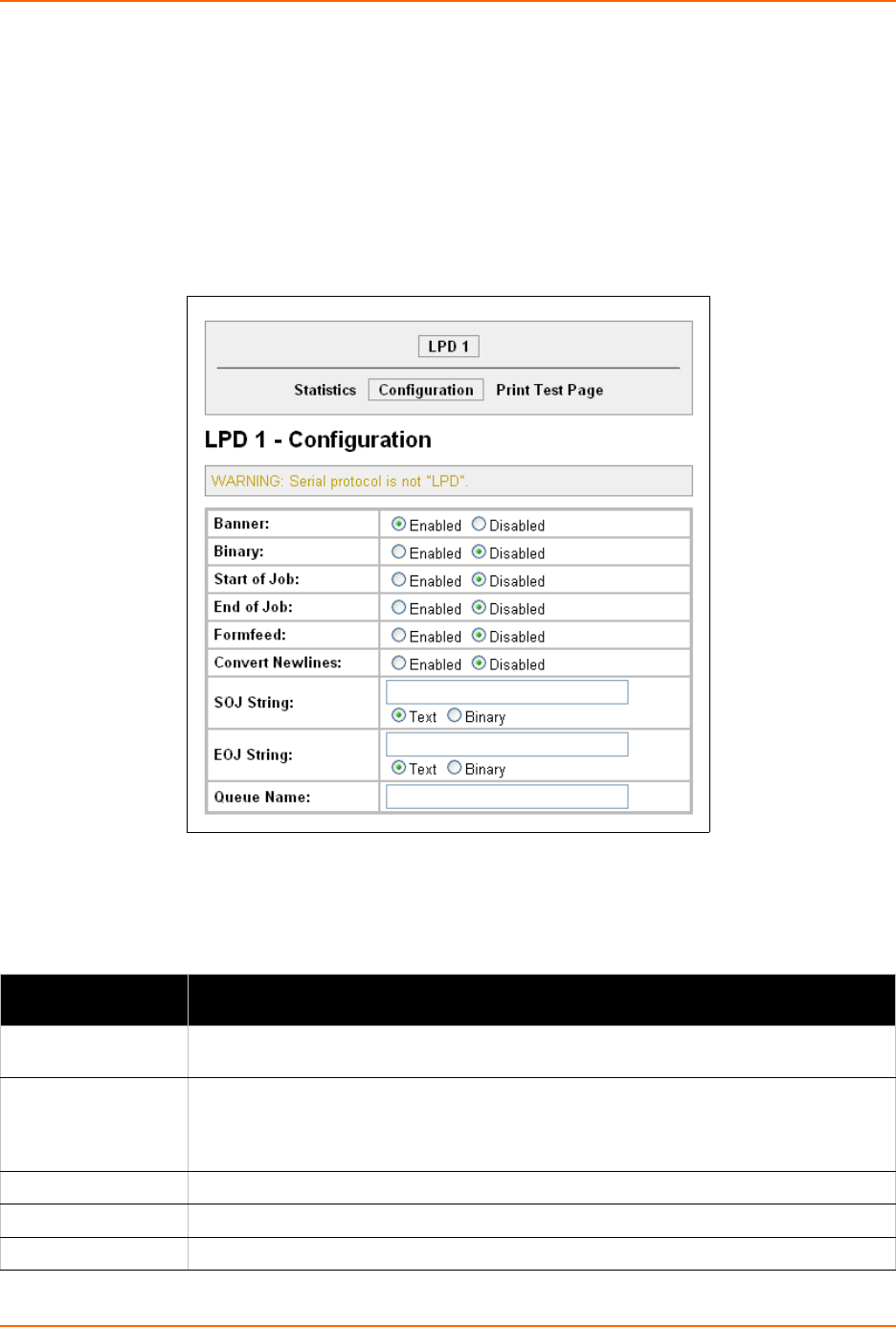
11: Service Settings
EDS User Guide 91
LPD Configuration
Here you can change LPD configuration settings.
To configure LPD settings for a specific LPD line:
1. Select LPD on the menu bar, if you are not already at the LPD web page.
2. Select a LPD line at the top of the page.
3. Select Configuration. The LPD Configuration for the selected LPD line appears.
Figure 11-18 LPD Configuration
4. Enter or modify the following settings:
Table 11-19 LPD Configuration
LPD Configuration
Settings Description
Banner Select Enabled to print the banner even if the print job does not specify to do so. Selected
by default.
Binary Select Enabled for the device to pass the entire file to the printer unchanged. Otherwise,
the device passes only valid ASCII and valid control characters to the printer. Valid control
characters include the tab, linefeed, formfeed, backspace, and newline characters. All
others are stripped. Disabled by default.
Start of Job Select Enabled to print a "start of job" string before sending the print data.
End of Job Select Enabled to send an "end of job" string.
Formfeed Select Enabled to force the printer to advance to the next page at the end of each print job.

11: Service Settings
EDS User Guide 92
5. Click Submit
6. Repeat above steps as desired, according to additional LPD lines available on your product.
Convert Newlines Select Enabled to convert single newlines and carriage returns to DOS-style line endings.
SOJ String If Start of Job (above) is enabled, enter the string to be sent to the printer at the beginning
of a print job. The limit is 100 characters.
Indicate whether the string is in text or binary format.
EOJ String If End of Job (above) is enabled, enter the string to send at the end of a print job. The limit
is 100 characters. Indicate whether the string is in text or binary format.
Queue Name To change the name of the print queue, enter a new name. The name cannot have white
space in it and is limited to 31 characters. The default is LPDQueueX (for line number X)
LPD Configuration
Settings (continued) Description

EDS User Guide 93
12: Security Settings
The EDS device supports Secure Shell (SSH) and Secure Sockets Layer (SSL). SSH is a network
protocol for securely accessing a remote device. SSH provides a secure, encrypted
communication channel between two hosts over a network. It provides authentication and
message integrity services.
Secure Sockets Layer (SSL) is a protocol that manages data transmission security over the
Internet. It uses digital certificates for authentication and cryptography against eavesdropping and
tampering. It provides encryption and message integrity services. SSL is widely used for secure
communication to a web server. SSL uses certificates and private keys.
Note: The EDS supports SSLv3 and its successors, TLS1.0 and TLS1.1. An incoming
SSlv2 connection attempt is answered with an SSlv3 response. If the initiator also
supports SSLv3, SSLv3 handles the rest of the connection.
This chapter contains the following sections:
SSH Server Host Keys
SSH Server Authorized Users
SSH Client Known Hosts
SSH Client Users
SSL Cipher Suites
SSL Certificates
SSL RSA or DSA
SSL Certificates and Private Keys
SSL Utilities
SSL Configuration
SSH Settings
SSH is a network protocol for securely accessing a remote device over an encrypted channel. This
protocol manages the security of internet data transmission between two hosts over a network by
providing encryption, authentication, and message integrity services.
Two instances require configuration: when the EDS is the SSH server and when it is an SSH
client. The SSH server is used by the CLI (Command Mode) and for tunneling in Accept Mode.
The SSH client is for tunneling in Connect Mode.
To configure the EDS as an SSH server, there are two requirements:
Defined Host Keys: both private and public keys are required. These keys are used for the
Diffie-Hellman key exchange (used for the underlying encryption protocol).
Defined Users: these users are permitted to connect to the EDS SSH server.
This page has four links at the top for viewing and changing SSH server host keys, SSH server
authorized keys, SSH client known hosts, and SSH client users.
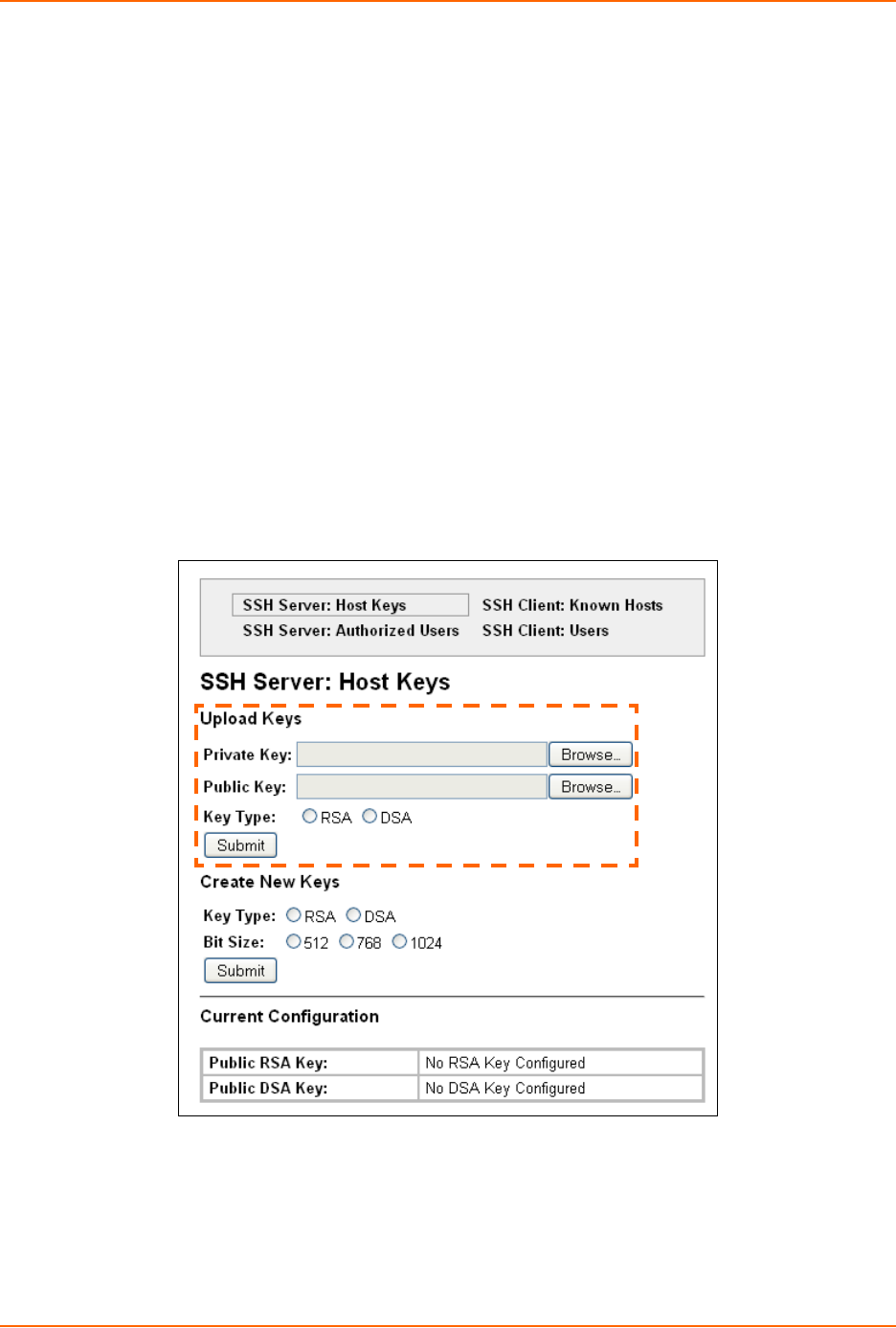
12: Security Settings
EDS User Guide 94
SSH Server Host Keys
SSH Host Keys can be obtained in a few different ways:
Uploading keys via PUTTY or other tools which generate RFC4716 format keys.
Creating keys through the EDS.
The steps for creating or uploading keys is described below.
To upload SSH server host keys generated from PuTTY:
1. Create the keys with puttygen.exe. The keys are in PuTTY format.
2. Use puttygen.exe again to convert the private key to Open SSH format as follows:
a. Import the private key using "Conversions…Import key."
b. Create a new file using "Conversions…Export OpenSSH key."
3. Use ssh-keygen to convert the public key to OpenSSH format.
ssh-keygen -i -f putty_file > openssh_file
4. Select SSH on the menu bar and SSH Server: Host Keys at the top of the page. The SSH
Server Host Keys page appears.
Figure 12-1 SSH Server: Host Keys (Upload Keys)
5. Enter or modify the following settings in the part of the screen related to uploading keys:

12: Security Settings
EDS User Guide 95
Table 12-2 SSH Server Host Keys Settings - Upload Keys Method
6. Click Submit.
To upload SSH server host RFC4716 format keys:
1. Use any program that can produce keys in the RFC4716 format.
2. Use ssh-keygen to convert the format to OpenSSH.
ssh-keygen -i -f RFC4716_file > output_file
Note: If the keys do not exist, follow directions under To create new SSH server host
keys (on page 97).
3. Select SSH on the menu bar and SSH Server: Host Keys at the top of the page. The SSH
Server Host Keys page appears.
SSH Server: Host Keys
Settings (continued) Description
Private Key Enter the path and name of the existing private key you
want to upload or use the Browse button to select the key.
Be sure the private key will not be compromised in transit.
This implies the data is uploaded over some kind of secure
private network.
Public Key Enter the path and name of the existing public key you want
to upload or use the Browse button to select the key.
Key Type Select a key type to use for the new key:
RSA = use this key with the SSH1 and SSH2 protocols.
DSA = use this key with the SSH2 protocol.
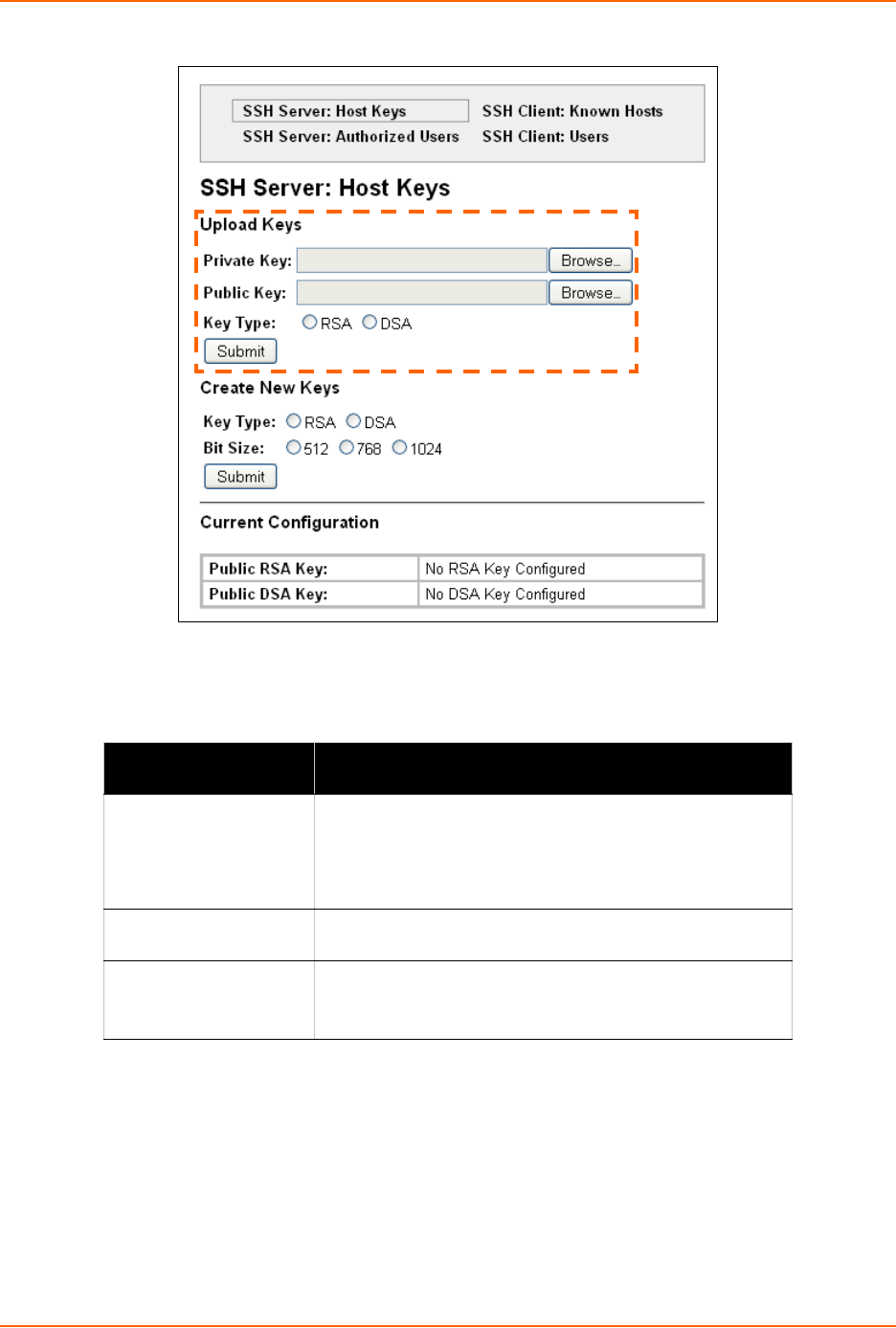
12: Security Settings
EDS User Guide 96
Figure 12-3 SSH Server: Host Keys (Upload Keys)
4. Enter or modify the following settings in the part of the screen related to uploading keys:
Table 12-4 SSH Server Host Keys Settings - Upload Keys Method
5. Click Submit.
Note: SSH keys may be created on another computer and uploaded to the EDS. For
example, use the following command using Open SSH to create a 1024-bit DSA key pair:
ssh-keygen –b 1024 –t dsa
SSH Server: Host Keys
Settings (continued) Description
Private Key Enter the path and name of the existing private key you
want to upload or use the Browse button to select the key.
Be sure the private key will not be compromised in transit.
This implies the data is uploaded over some kind of secure
private network.
Public Key Enter the path and name of the existing public key you want
to upload or use the Browse button to select the key.
Key Type Select a key type to use for the new key:
RSA = use this key with the SSH1 and SSH2 protocols.
DSA = use this key with the SSH2 protocol.
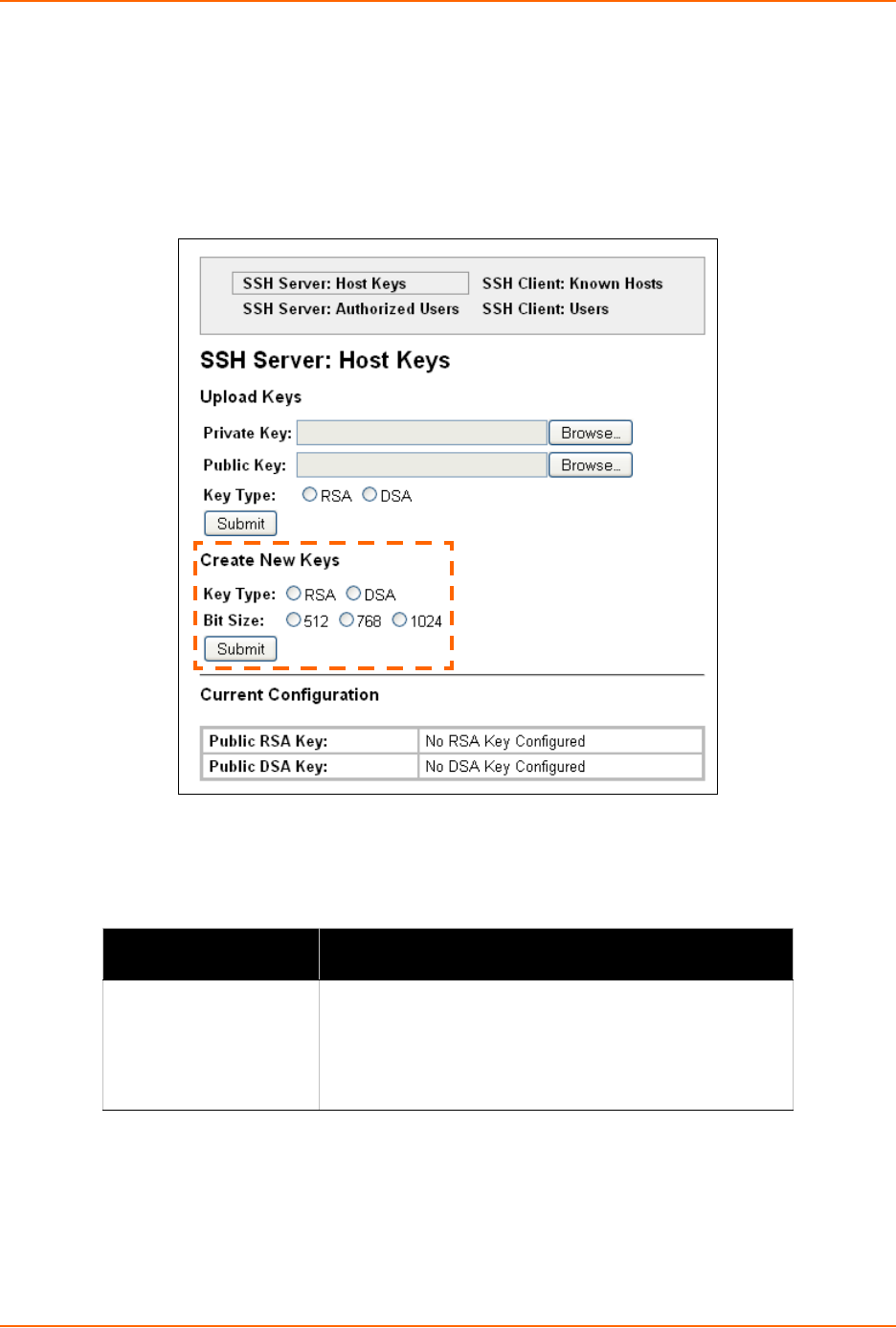
12: Security Settings
EDS User Guide 97
To create new SSH server host keys
Note: Generating new keys with large bit size results in longer key generation times.
1. Select SSH on the menu bar and SSH Server: Host Keys at the top of the page. The SSH
Server Host Keys page appears.
Figure 12-5 SSH Server: Host Keys (Create New Keys)
2. Enter or modify the following settings in the part of the screen related to creating new keys:
Table 12-6 SSH Server Host Keys Settings - Create New Keys Method
SSH Server: Host Keys
Settings Description
Key Type Select a key type to use:
RSA = use this key with SSH1 and SSH2 protocols.
DSA = use this key with the SSH2 protocol.
Note: RSA is more secure.

12: Security Settings
EDS User Guide 98
3. Click Submit.
Note: SSH Keys from other programs may be converted to the required EDS format.
Use Open SSH to perform the conversion.
SSH Server Authorized Users
On this page you can change SSH server settings for Authorized Users. SSH Server Authorized
Users are accounts on the EDS that can be used to log into the EDS using SSH. For instance,
these accounts can be used to SSH into the CLI or open an SSH connection to a device port.
Every account must have a password.
The user's public keys are optional and only necessary if public key authentication is required.
Using public key authentication allows a connection to be made without the password being
asked.
Under Current Configuration, User has a Delete User link, and Public RSA Key and Public
DSA Key have View Key and Delete Key links. If you click a Delete link, a message asks whether
you are sure you want to delete this information. Click OK to proceed or Cancel to cancel the
operation.
To configure the SSH server for authorized users:
1. Select SSH on the menu bar and then Server Authorized Users at the top of the page. The
SSH Server: Authorized Users page appears.
Bit Size Select a bit length for the new key:
512
768
1024
Using a larger bit size takes more time to generate the key.
Approximate times are:
10 seconds for a 512 bit RSA Key
15 seconds for a 768 bit RSA Key
1 minute for a 1024 bit RSA Key
30 seconds for a 512 bit DSA Key
1 minute for a 768 bit DSA Key
2 minutes for a 1024 bit DSA Key
Note: Some SSH clients require RSA host keys to be at
least 1024 bits long. This device generates keys up to 1024
bits long. It can work with larger keys (up to 2048 bit) if they
are imported or otherwise created.
SSH Server: Host Keys
Settings (continued) Description
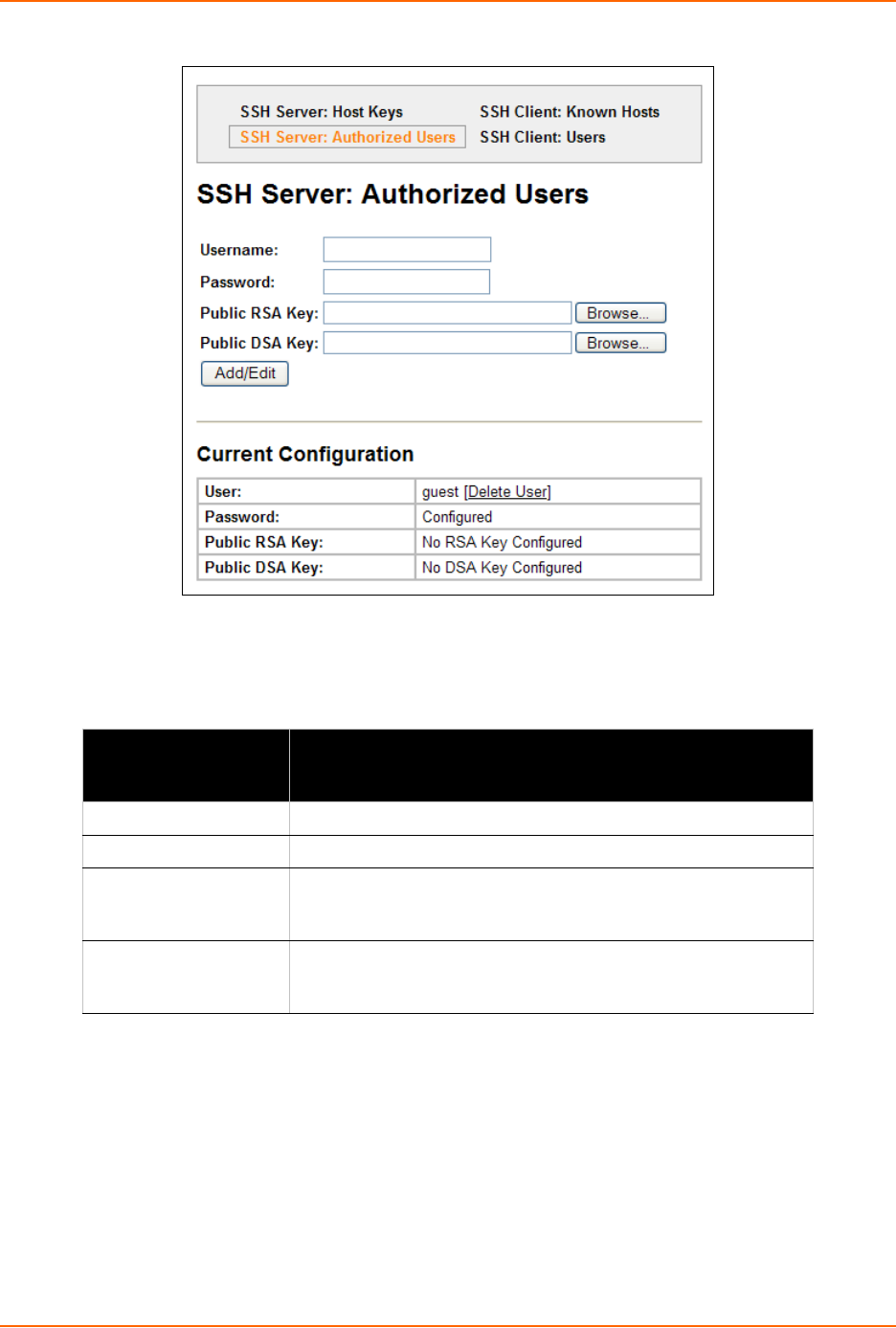
12: Security Settings
EDS User Guide 99
Figure 12-7 SSH Server: Authorized Users
2. Enter or modify the following settings:
Table 12-8 SSH Server Authorized User Settings
3. Click Submit.
Note: When uploading the security keys, ensure the keys are not compromised in
transit.
SSH Server:
Authorized Users
Settings
Description
Username Enter the name of the user authorized to access the SSH server.
Password Enter the password associated with the username.
Public RSA Key Enter the path and name of the existing public RSA key you want
to use with this user or use the Browse button to select the key. If
authentication is successful with the key, no password is required.
Public DSA Key Enter the path and name of the existing public DSA key you want
to use with this user or use the Browse button to select the key. If
authentication is successful with the key, no password is required.
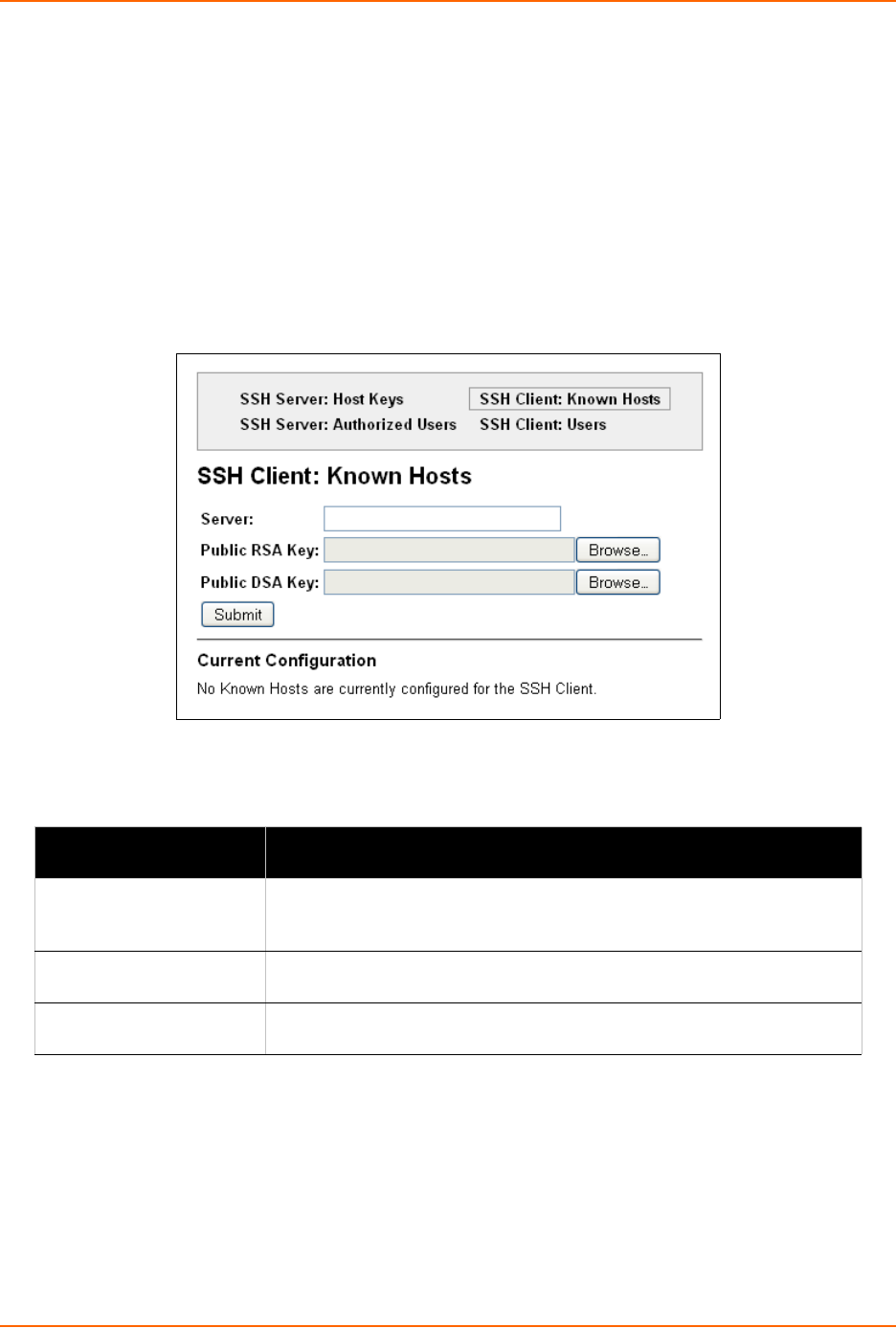
12: Security Settings
EDS User Guide 100
SSH Client Known Hosts
On this page you can change SSH client settings for known hosts.
Note: You do not have to complete the fields on this page for communication to occur.
However, completing them adds another layer of security that protects against Man-In-
The-Middle (MITM) attacks.
To configure the SSH client for known hosts:
1. Select SSH on the menu bar and then Client Known Hosts at the top of the page. The SSH
Client: Known Hosts page appears.
Figure 12-9 SSH Client: Known Hosts
2. Enter or modify the following settings:
Table 12-10 SSH Client Known Hosts
Note: These settings are not required for communication. They protect against Man-In-
The-Middle (MITM) attacks.
3. Click Submit.
4. In the Current Configuration table, delete currently stored settings as necessary.
SSH Client:
Known Hosts Settings Description
Server Enter the name or IP address of a known host. If you enter a server name,
the name should match the name of the server used as the Remote
Address in Connect mode tunneling.
Public RSA Key Enter the path and name of the existing public RSA key you want to use
with this known host or use the Browse button to select the key.
Public DSA Key Enter the path and name of the existing public DSA key you want to use
with this known host or use the Browse button to select the key.
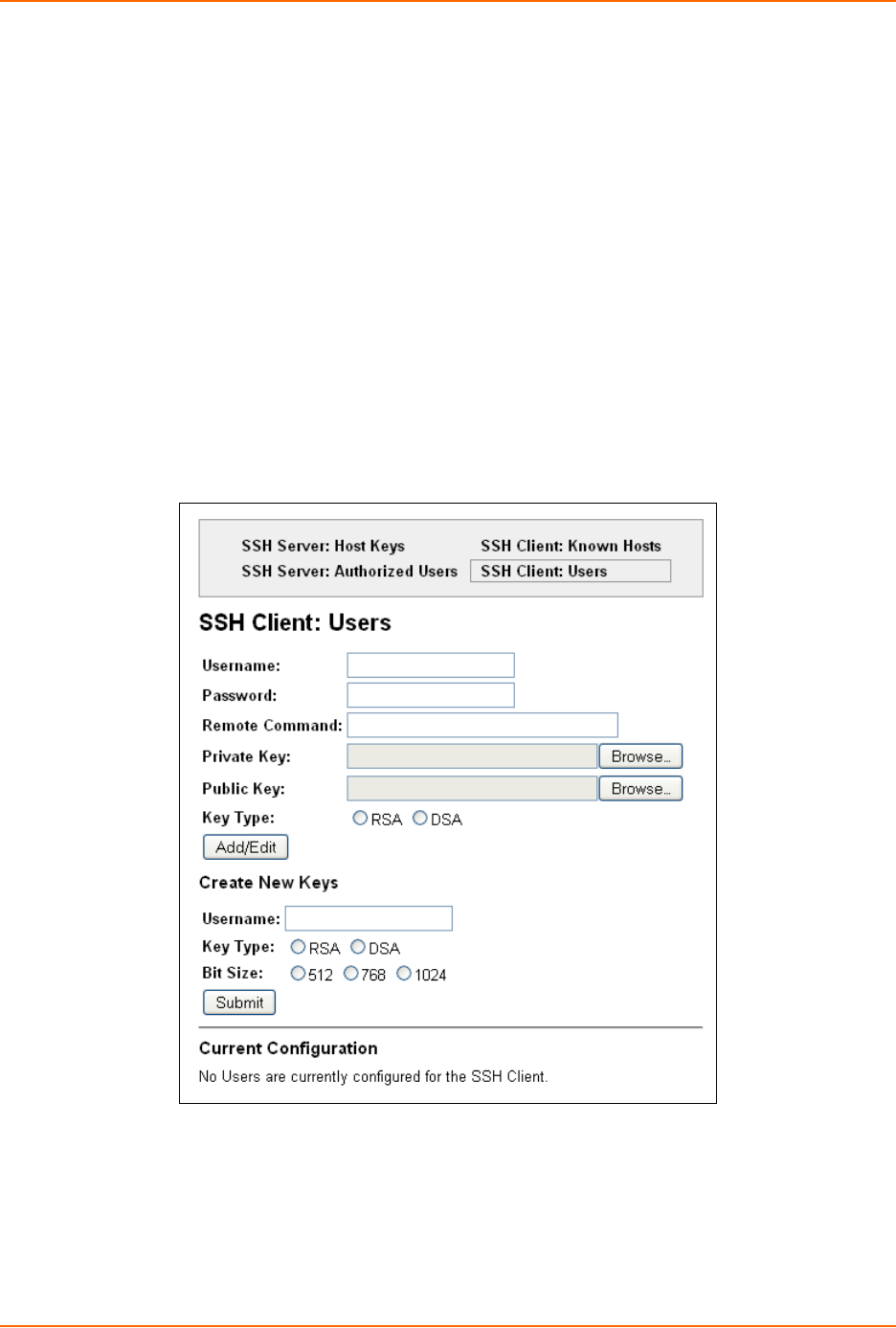
12: Security Settings
EDS User Guide 101
SSH Client Users
On this page you can change SSH client settings for users. To configure the EDS as an SSH
client, an SSH client user must be both configured and also exist on the remote SSH server.
SSH client known users are used by all applications that play the role of an SSH client, specifically
tunneling in Connect Mode. At the very least, a password or key pair must be configured for a
user. The keys for public key authentication can be created elsewhere and uploaded to the device
or automatically generated on the device. If uploading existing keys, be sure the private key will
not be compromised in transit. This implies the data is uploaded over some kind of secure private
network.
Note: If you are providing a key by uploading a file, make sure that the key is not
password protected.
To configure the SSH client users:
1. Select SSH on the menu bar and then SSH Client Users at the top of the page. The SSH
Client: Users page appears.
Figure 12-11 SSH Client: Users

12: Security Settings
EDS User Guide 102
2. Enter or modify the following settings:
Table 12-12 SSH Client Users
3. Click Submit.
4. In the Current Configuration table, delete currently stored settings as necessary.
SSH Client: Users
Settings Description
Username Enter the name that the device uses to connect to a SSH server.
Password Enter the password associated with the username.
Remote Command Enter the command that can be executed remotely. Default is shell, which tells the
SSH server to execute a remote shell upon connection. This command can be
changed to anything the remote host can perform.
Private Key Enter the name of the existing private key you want to use with this SSH client user.
You can either enter the path and name of the key, or use the Browse button to
select the key.
Public Key Enter the path and name of the existing public key you want to use with this SSH
client user or use the Browse button to select the key.
Note: If the user public key is known on the remote SSH server, the SSH server
does not require a password. The Remote Command is provided to the SSH server
upon connection. It specifies the application to execute upon connection. The default
is a command shell.
Note: Configuring the SSH client’s known hosts is optional. It prevents Man-In-The-
Middle (MITM) attacks
Key Type Select the key type to be used. Choices are:
RSA = use this key with the SSH1 and SSH2 protocols.
DSA = use this key with the SSH2 protocol.
Create New Keys
Username Enter the name of the user associated with the new key.
Key Type Select the key type to be used for the new key. Choices are:
RSA = use this key with the SSH1 and SSH2 protocols.
DSA = use this key with the SSH2 protocol.
Bit Size Select the bit length of the new key:
512
768
1024
Using a larger Bit Size takes more time to generate the key. Approximate times are:
10 seconds for a 512 bit RSA Key
15 seconds for a 768 bit RSA Key
1 minute for a 1024 bit RSA key
30 seconds for a 512 bit DSA key
1 minute for a 768 bit DSA key
2 minutes for a 1024 bit DSA key
Note: Some SSH clients require RSA host keys to be at least 1024 bits long. This
device generates keys up to 1024 bits long. It can work with larger keys (up to 2048
bit) if they are imported or otherwise created.

12: Security Settings
EDS User Guide 103
SSL Settings
Secure Sockets Layer (SSL) is a protocol for managing the security of data transmission over the
Internet. It provides encryption, authentication, and message integrity services. SSL is widely used
for secure communication to a web server.
Certificate/Private key combinations can be obtained from an external Certificate Authority (CA)
and downloaded into the unit. Self-signed certificates with associated private key can be
generated by the device server itself.
For more information regarding Certificates and how to obtain them, see SSL Certificates and
Private Keys (on page 104).
SSL uses digital certificates for authentication and cryptography against eavesdropping and
tampering. Sometimes only the server is authenticated, sometimes both server and client. The
EDS can be server and/or client, depending on the application. Public key encryption systems
exchange information and keys and set up the encrypted tunnel.
Efficient symmetric encryption methods encrypt the data going through the tunnel after it is
established. Hashing provides tamper detection.
Applications that can make use of SSL are Tunneling, Secure Web Server, and WLAN interface.
The EDS supports SSlv3 and its successors, TLS1.0 and TLS1.1.
Note: An incoming SSlv2 connection attempt is answered with an SSlv3 response. If the
initiator also supports SSLv3, SSLv3 handles the rest of the connection.
SSL Cipher Suites
The SSL standard defines only certain combinations of certificate type, key exchange method,
symmetric encryption, and hash method. Such a combination is called a cipher suite. Supported
cipher suites include the following:
Whichever side is acting as server decides which cipher suite to use for a connection. It is usually
the strongest common denominator of the cipher suite lists supported by both sides.
Table 12-13 Supported Cipher Suites
Certificate Key Exchange Encryption Hash
DSA DHE 3DES SHA1
RSA RSA 128 bits AES SHA1
RSA RSA Triple DES SHA1
RSA RSA 128 bits RC4 MD5
RSA RSA 128 bits RC4 SHA1
RSA 1024 bits RSA 56 bits RC4 MD5
RSA 1024 bits RSA 56 bits RC4 SHA1
RSA 1024 bits RSA 40 bits RC4 MD5

12: Security Settings
EDS User Guide 104
SSL Certificates
The goal of a certificate is to authenticate its sender. It is analogous to a paper document that
contains personal identification information and is signed by an authority, for example a notary or
government agency.
The principles of Security Certificate required that in order to sign other certificates, the authority
uses a private key. The published authority certificate contains the matching public key that allows
another to verify the signature but not recreate it.
The authority’s certificate can be signed by itself, resulting in a self-signed or trusted-root
certificate, or by another (higher) authority, resulting in an intermediate authority certificate. You
can build up a chain of intermediate authority certificates, and the last certification will always be a
trusted-root certificate.
An authority that signs another certificates is also called a Certificate Authority (CA). The last in
line is then the root-CA. VeriSign is a famous example of such a root-CA. Its certificate is often
built into web browsers to allow verifying the identity of website servers, which need to have
certificates signed by VeriSign or another public CA. Since obtaining a certificate signed by a CA
that is managed by another company can be expensive, it is possible to have your own CA. Tools
exist to generate self-signed CA certificates or to sign other certificates.
A certificate request is a certificate that has not been signed and only contains the identifying
information. Signing it makes it a certificate. A certificate is also used to sign any message
transmitted to the peer to identify the originator and prevent tampering while transported.
When using HTTPS, SSL Tunneling in Accept mode, and/or EAP-TLS, the EDS needs a personal
certificate with a matching private key to identify itself and sign its messages. When using SSL
Tunneling in Connect mode and/or EAP-TLS, EAP-TTLS or PEAP, the EDS needs the authority
certificate that can authenticate users with which it wishes to communicate.
SSL RSA or DSA
As mentioned above, the certificates contain a public key. Different key exchange methods require
different public keys and thus different styles of certificate. The EDS supports key exchange
methods that require a RSA-style certificate and key exchange methods that require a DSA-style
certificate. If only one of these certificates is stored in the EDS, only those key exchange methods
that can work with that style certificate are enabled. RSA is sufficient in most cases.
SSL Certificates and Private Keys
You can obtain a certificate by completing a certificate request and sending it to a certificate
authority that will create a certificate/key combo, usually for a fee. Or generate your own. A few
utilities exist to generate self-signed certificates or sign certificate requests. The EDS also has the
ability to generate its own self-signed certificate/key combo.
You can use XML to export the certificate in PEM format, but you cannot export the key. Hence the
internal certificate generator can only be used for certificates that are to identify that particular
EDS.
Certificates and private keys can be stored in several file formats. Best known are PKCS12, DER
and PEM. Certificate and key can be in the same file or in separate files. The key can be encrypted
with a password or not. The EDS currently only accepts separate PEM files. The key needs to be
unencrypted.

12: Security Settings
EDS User Guide 105
SSL Utilities
Several utilities exist to convert between the formats.
OpenSSL
Open source set of SSL related command line utilities. It can act as server or client. It can
generate or sign certificate requests. It can convert all kinds of formats. Executables are available
for Linux and Windows. To generate a self-signed RSA certificate/key combo use the following
commands in the order shown:
openssl req –x509 –nodes –days 365 –newkey rsa:1024 –keyout
mp_key.pem –out mp_cert.pem
Note: Signing other certificate requests is also possible with OpenSSL. See
www.openssl.org or www.madboa.com/geek/openssl for more information.
Steel Belted RADIUS
Commercial RADIUS server by Juniper Networks that provides a GUI administration interface. It
also provides a certificate request and self-signed certificate generator. The self-signed certificate
has extension .sbrpvk and is in the PKCS12 format. OpenSSL can convert this into a PEM format
certificate and key by using the following commands in the order shown:
openssl pkcs12 -in sbr_certkey.sbrpvk -nodes -out sbr_certkey.pem
The sbr_certkey.pem file contains both certificate and key. If loading the SBR certificate into EDS
as an authority, you will need to edit it.
1. Open the file in any plain text editor.
2. Delete all info before the following: “----- BEGIN CERTIFICATE-----“
3. Delete all info after the following: “----- END CERTIFICATE-----“
4. Save as sbr_cert.pem. SBR accepts trusted-root certificates in the DER format.
5. Again, OpenSSL can convert any format into DER by using the following commands in the
order shown:
openssl x509 -inform pem -in mp_cert.pem -outform der -out
mp_cert.der
Note: With SBR, when the identity information includes special characters such as
dashes and periods, SBR changes the format it uses to store these strings and becomes
incompatible with the current EDS release. We will add support for this and other formats
in future releases. Free RADIUS—Linux open-source RADIUS server. It is versatile, but
complicated to configure.
Free RADIUS
Free RADIUS is a Linux open-source RADIUS server. It is versatile, but complicated to configure.
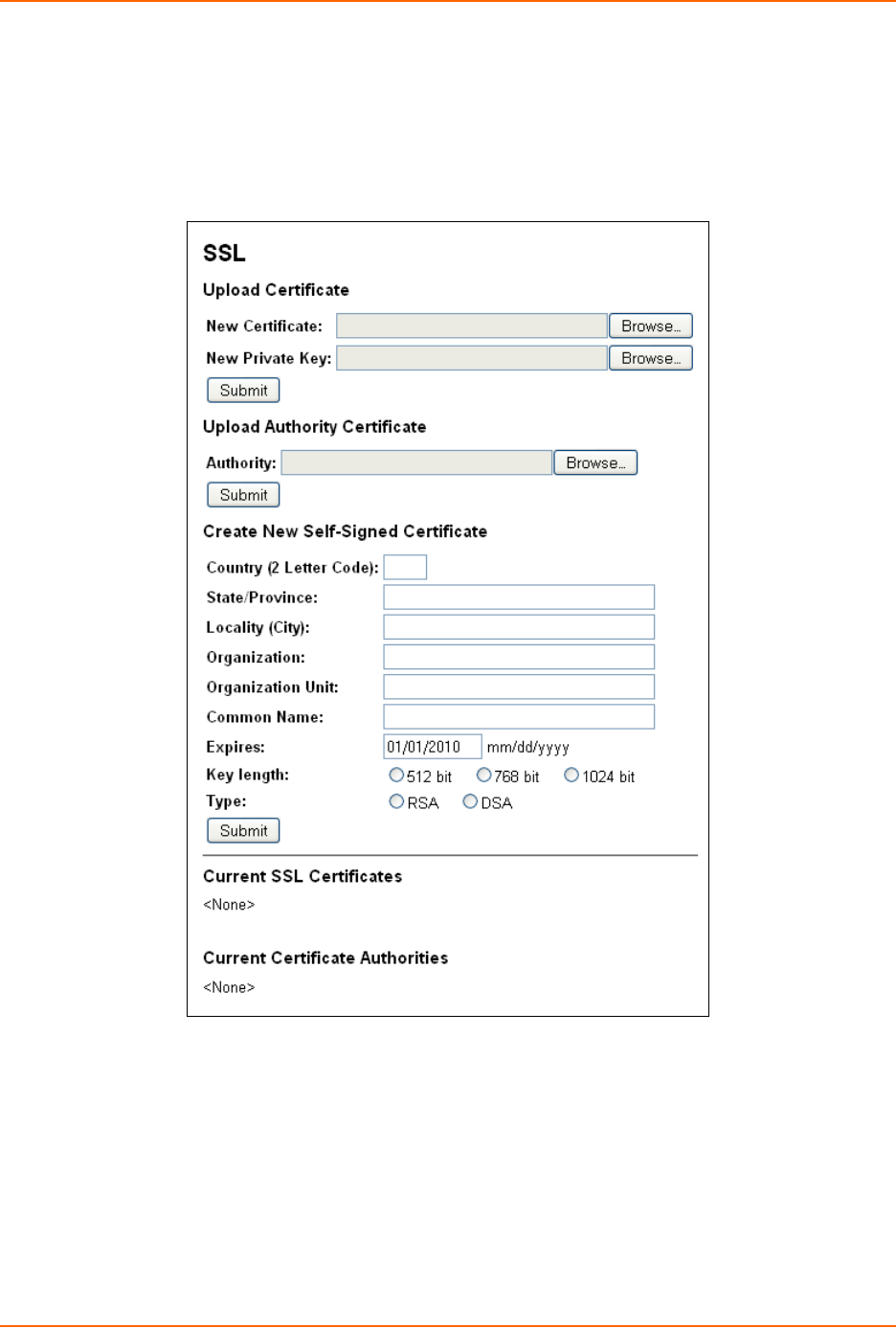
12: Security Settings
EDS User Guide 106
SSL Configuration
To configure SSL settings:
1. Select SSL from the main menu. The SSL page appears.
Figure 12-14 SSL

12: Security Settings
EDS User Guide 107
2. Enter or modify the following settings:
Table 12-15 SSL
SSL Settings Description
Upload Certificate
New Certificate This certificate identifies the device to peers. It is used for HTTPS and SSL
Tunneling.
Enter the path and name of the certificate you want to upload, or use the
Browse button to select the certificate.
RSA or DSA certificates with 512 to 1024 bit public keys are allowed.
The format of the file must be PEM. The file must start with “-----BEGIN
CERTIFICATE-----“ and end with “-----END CERTIFICATE-----“. Some
Certificate Authorities add comments before and/or after these lines. Those
need to be deleted before upload.
New Private Key Enter the path and name of the private key you want to upload, or use the
Browse button to select the private key. The key needs to belong to the
certificate entered above.
The format of the file must be PEM. The file must start with “-----BEGIN
RSA PRIVATE KEY-----” and end with “-----END RSA PRIVATE KEY-----”.
Read DSA instead of RSA in case of a DSA key. Some Certificate
Authorities add comments before and/or after these lines. Those need to be
deleted before upload.
Upload Authority Certificate
Authority One or more authority certificates are needed to verify a peer's identity. It is
used for SSL Tunneling. These certificates do not require a private key.
Enter the path and name of the certificate you want to upload, or use the
Browse button to select the certificate.
RSA or DSA certificates with 512 to 1024 bit public keys are allowed.
The format of the file must be PEM. The file must start with “-----BEGIN
CERTIFICATE-----” and end with “-----END CERTIFICATE-----”. Some
Certificate Authorities add comments before and/or after these lines. Those
need to be deleted before upload.
Create New Self-Signed Certificate
Country (2 Letter Code) Enter the 2-letter country code to be assigned to the new self-signed
certificate.
Examples: US for United States and CA for Canada
State/Province Enter the state or province to be assigned to the new self-signed certificate.
Locality (City) Enter the city or locality to be assigned to the new self-signed certificate.
Organization Enter the organization to be associated with the new self-signed certificate.
Example: If your company is called Widgets, and you are setting up a web
server for the Sales department, enter Widgets for the organization.
Organization Unit Enter the organizational unit to be associated with the new self-signed
certificate.
Example: If your company is setting up a web server for the Sales
department, enter Sales for your organizational unit.

12: Security Settings
EDS User Guide 108
3. Click Submit.
Common Name Enter the same name that the user will enter when requesting your web
site.
Example: If a user enters http://www.widgets.abccompany.com to
access your web site, the Common Name would be
www.widgets.abccompany.com.
Expires Enter the expiration date, in mm/dd/yyyy format, for the new self-signed
certificate.
Example: An expiration date of May 9, 2010 is entered as 05/09/2010.
Key length Select the bit size of the new self-signed certificate. Choices are:
512 bits
768 bits
1024 bits
The larger the bit size, the longer it takes to generate the key. Approximate
times are:
10 seconds for a 512-bit RSA key
30 seconds for a 768-bit RSA key
1 minute for a 1024-bit RSA key
30 seconds for a 512-bit DSA key
2 minutes for a 768-bit DSA key
6 minute for a 1024-bit DSA key
Type Select the type of key:
RSA = Public-Key Cryptography algorithm based on large prime
numbers, invented by Rivest Shamir and Adleman. Used for encryption
and signing.
DSA = Digital Signature Algorithm also based on large prime numbers,
but can only be used for signing. Developed by the US government to
avoid the patents on RSA.
SSL Settings (continued) Description

EDS User Guide 109
13: Modbus
Note: Modbus applies only to EDS4100, as this feature is not supported on EDS8/16/
32PR and EDS8/16PS.
Modbus ASCII/RTU based serial slave devices can be connected via the ethernet through an
existing Modbus TCP/IP network. Any device having access to a given Modbus implementation
will be able to perform full range of operations that the implementation supports. Modbus/TCP
use a reserved TCP port of 502 and include a single byte function code (1=255) preceded by a 6
byte header:
Table 13-1 6 Byte Header of Modbus Application Protocol
Serial Transmission Mode
Evolution products can be set up to communicate on standard Modbus networks using either RTU
or ASCII. Users select the desired mode and serial port communication parameters (baud rate,
parity mode, etc) during the line configuration.
Table 13-2 Modbus Transmission Modes
The Modbus web pages allow you to check Modbus status and make configuration changes. This
chapter contains the following sections:
Modbus Statistics
Modbus Configuration
Transaction ID (2 bytes) Identification of request/response transaction - copied by slave
Protocol ID (2 bytes) 0 - Modbus protocol
Length (2 bytes) Number of following bytes includes the unit identifier
Address (1 byte) Identification of remove slave
RTU ASCII
Address: 8 bits (0 to 247 decimal, 0 is used
for broadcast)
Function: 8 bits (1 to 255, 0 is not valid)
Data: N X 8 bits (N=0 to 252 bytes)
CRC Check: 16 bits
Address: 2 CHARS
Function: 2 CHARS
Data: N CHARS (N=0 to 252 CHARS)
LRC Check: 2 CHARS
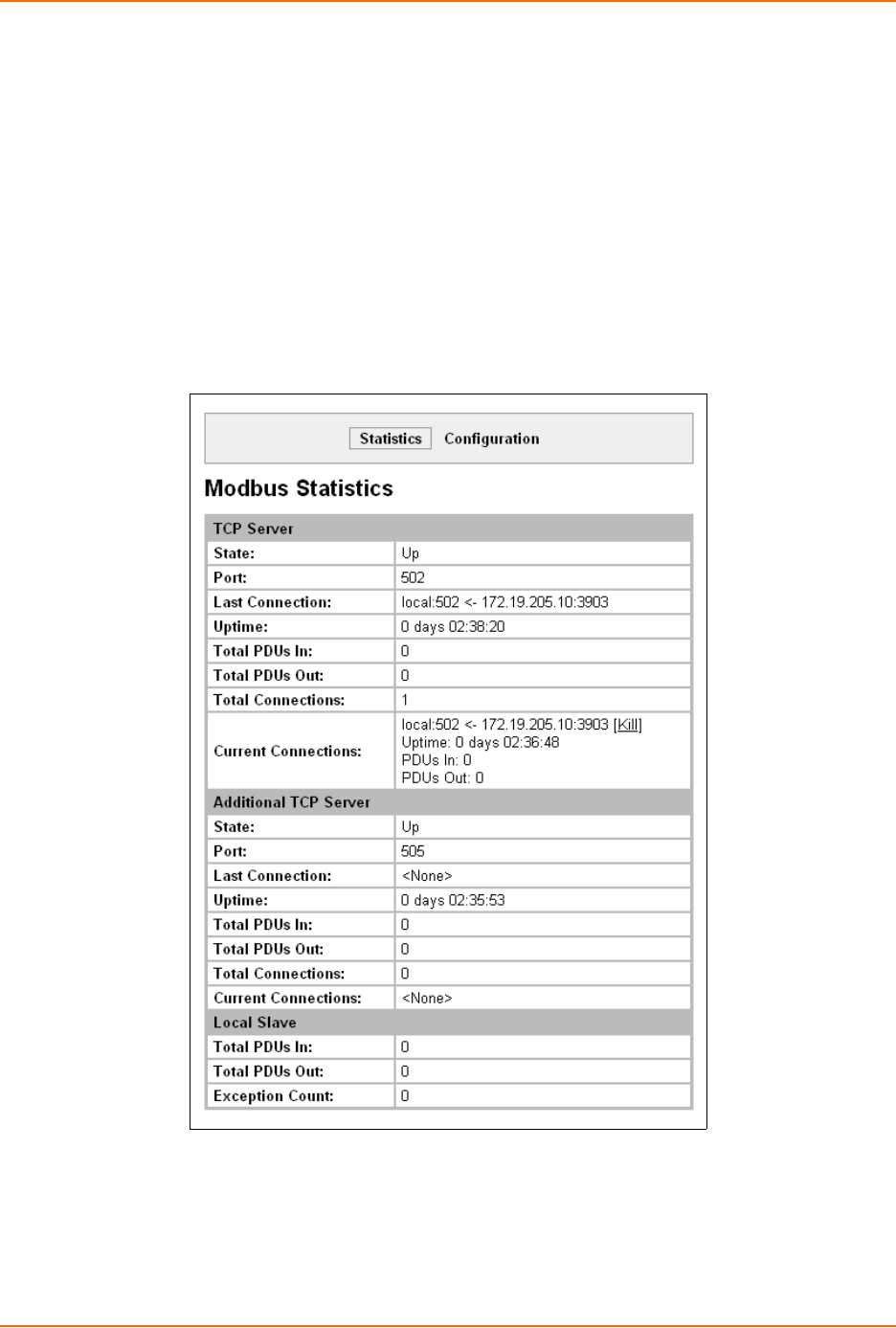
13: Modbus
EDS User Guide 110
Modbus Statistics
This read-only web page displays the current connection status of the Modbus servers listening on
the TCP ports. When a connection is active, the remote client information is displayed as well as
the number of PDUs that have been sent and received. Additionally, a Kill link will be present
which can be used to kill the connection.
To view modbus statistics:
1. Click Modbus on the menu bar and click Statistics at the top of the page. The Modbus
Statistics page appears.
Figure 13-3 Modbus Statistics
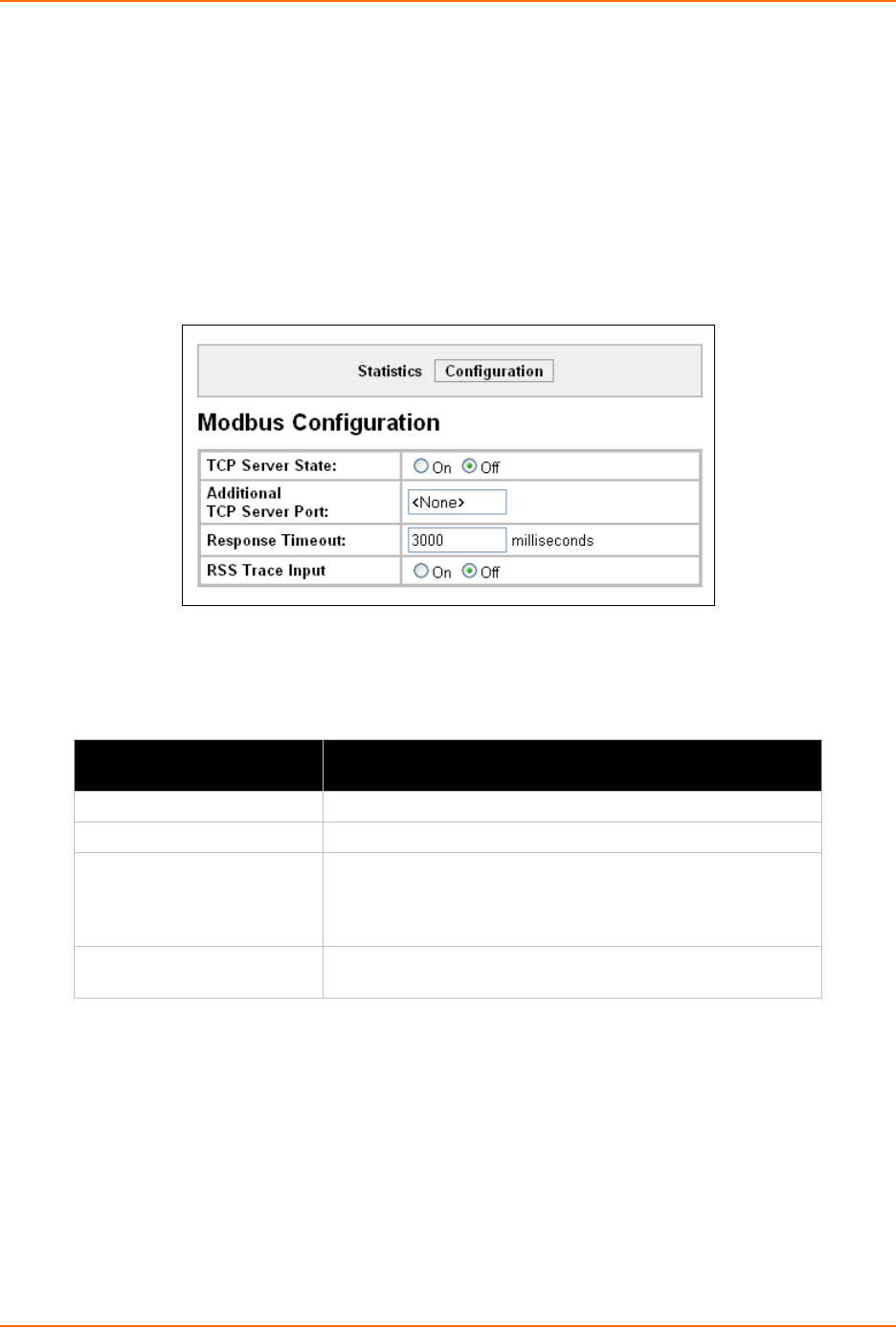
13: Modbus
EDS User Guide 111
Modbus Configuration
This web page shows the current negotiated Modbus settings and allows configuration changes.
To view and configure the Modbus Server:
1. Click Modbus on the menu bar and then click Configuration at the top of the page. The
Modbus Configuration page appears.
Figure 13-4 Modbus Configuration
2. Enter or modify the following settings:
Table 13-5 Modbus Configuration
3. Click Submit. The changes take effect immediately.
Note: The serial line protocol must also be configured for Modbus, in addition to
configuring the Modbus server. See Chapter 9: Line and Tunnel Settings on page 52 for
details.
Modbus Configuration
Settings Description
TCP Server State If On, the Modbus server is active on TCP 502.
Additional TCP Server Port If present, is used in addition to TCP port 502.
Response Timeout The number of milliseconds to wait for a response on the serial
side. The device returns exception code 11 to the network
master controller if the slave serial device fails to reply within
this time out.
RSS Trace Input If On, each PDU received on the Modbus serial line creates a
non-persistent descriptive item in the RSS feed.
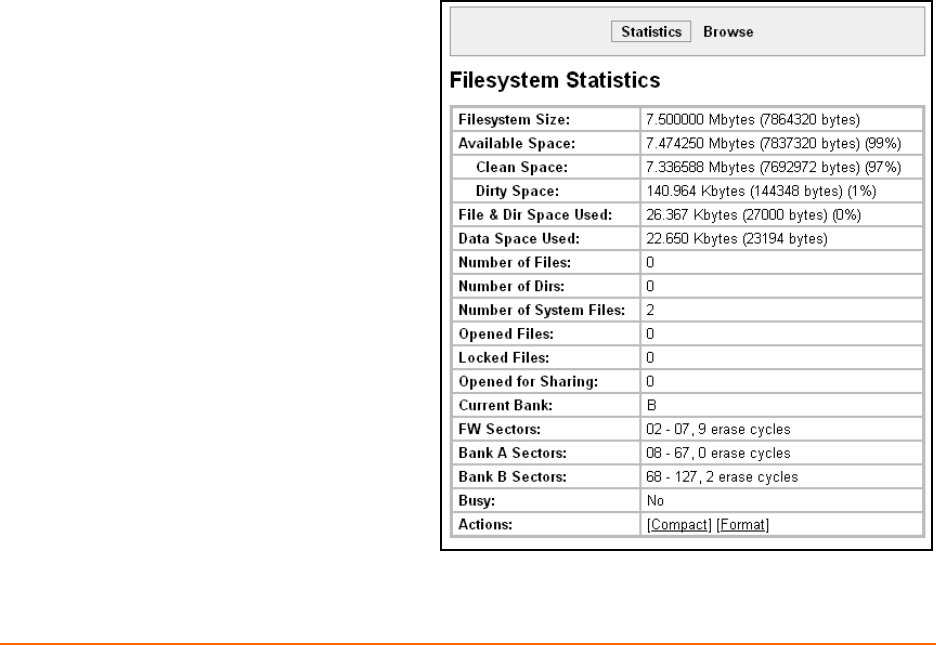
EDS User Guide 112
14: Maintenance and Diagnostics Settings
This chapter describes maintenance and diagnostic methods and contains the following sections:
Filesystem Settings
Protocol Stack Settings
IP Address Filter
Query Port
Diagnostics
System Settings
Filesystem Settings
The EDS uses a flash filesystem to store files. Use the Filesystem option to view current file
statistics or modify files. There are two subsections: Statistics and Browse.
The Statistics section of the Filesystem web page shows current statistics and usage information
of the flash filesystem. In the Browser section of the Filesystem web page, you can create files
and folders, upload files, copy and move files, and use TFTP.
Filesystem Statistics
This page shows various statistics and current usage information of the flash filesystem.
To view filesystem statistics:
1. Select Filesystem on the menu
bar. The Filesystem page opens
and shows the current filesystem
statistics and usage.
To compact or format the
filesystem:
1. Back up all files as necessary.
2. Select Filesystem on the
menubar, if you are not already in
the Filesystem page.
3. Click Compact in the Actions row.
Note: The compact should not be
needed under normal circumstances
as the system manages this
automatically.
4. Back up all files before you perform
the next (Format) step, because all
user files get erased in that step.
5. Click Format in the Actions row. The configuration gets retained.
Figure 14-1 Filesystem Statistics
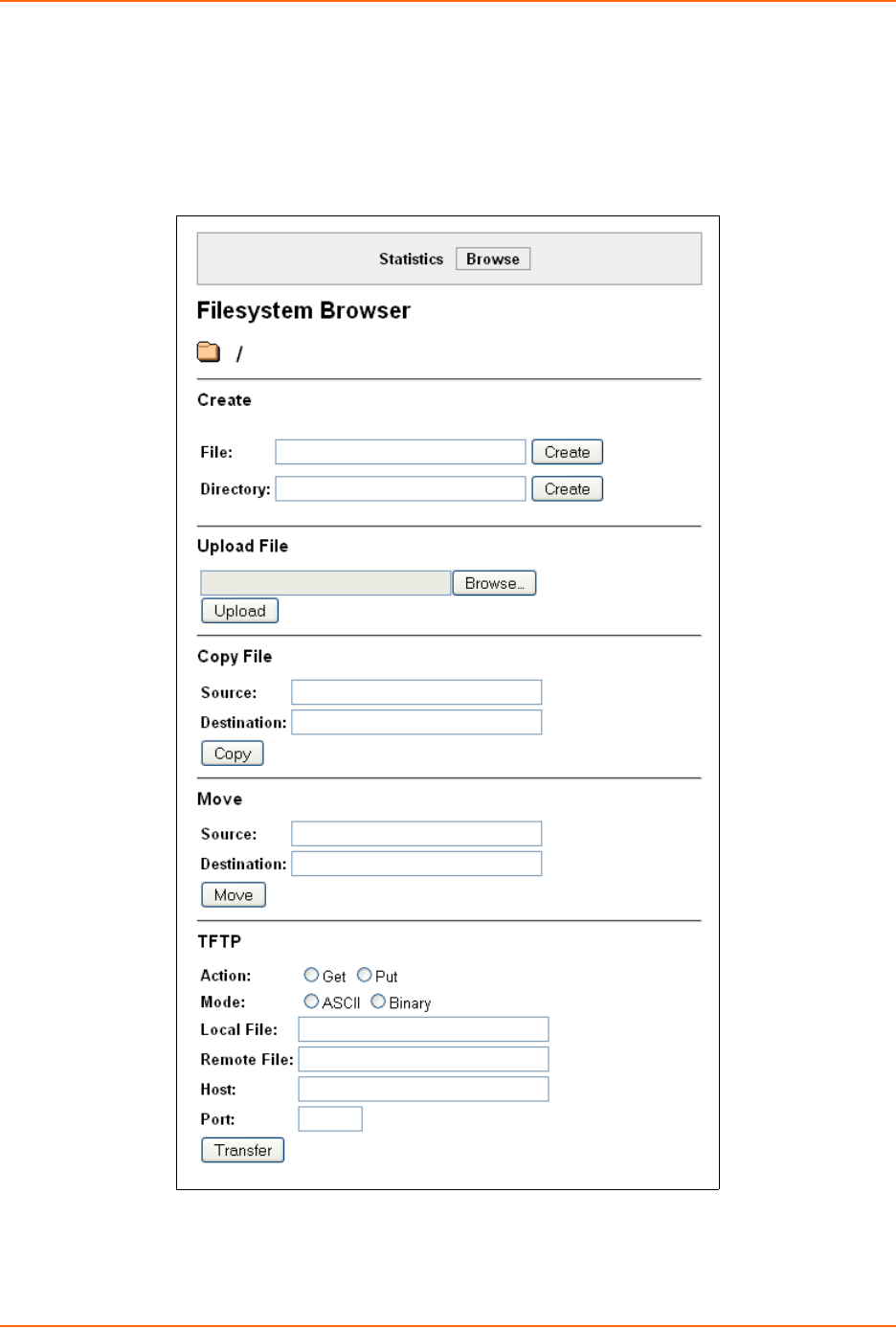
14: Maintenance and Diagnostics Settings
EDS User Guide 113
Filesystem Browser
To browse the filesystem:
1. Select Filesystem on the menu bar and then Browse at the top of the page. The Filesystem
Browser page opens.
Figure 14-2 Filesystem Browser
2. Select a filename to view the contents.

14: Maintenance and Diagnostics Settings
EDS User Guide 114
3. Click the X next to a filename to delete the file or directory. You can only delete a directory if it
is empty.
4. Enter or modify the following settings:
Note: Changes apply to the current directory view. To make changes within other
folders, select the folder or directory and then enter the parameters in the settings listed
below.
Table 14-3 Filesystem Browser
Filesystem Browser
Settings Description
Create
File Enter the name of the file you want to create, and then click Create.
Directory Enter the name of the directory you want to create, and then click
Create.
Upload File Enter the path and name of the file you want to upload by means of
HTTP/HTTPS or use the Browse button to select the file, and then
click Upload.
Copy File
Source Enter the location where the file you want to copy resides.
Destination Enter the location where you want the file copied.
After you specify a source and destination, click Copy to copy the file.
Move
Source Enter the location where the file you want to move resides.
Destination Enter the location where you want the file moved.
After you specify a source and destination, click Move to move the file.
TFTP
Action Select the action that is to be performed via TFTP:
Get = a “get” command will be executed to store a file locally.
Put = a “put” command will be executed to send a file to a remote
location.
Mode Select a TFTP mode to use. Choices are:
ASCII
Binary
Local File Enter the name of the local file on which the specified “get” or “put”
action is to be performed.
Remote File Enter the name of the file at the remote location that is to be stored
locally (“get’) or externally (“put”).
Host Enter the IP address or name of the host involved in this operation.
Port Enter the number of the port involved in TFTP operations on which the
specified TFTP get or put command will be performed.
Click Transfer to perform the TFTP transfer.
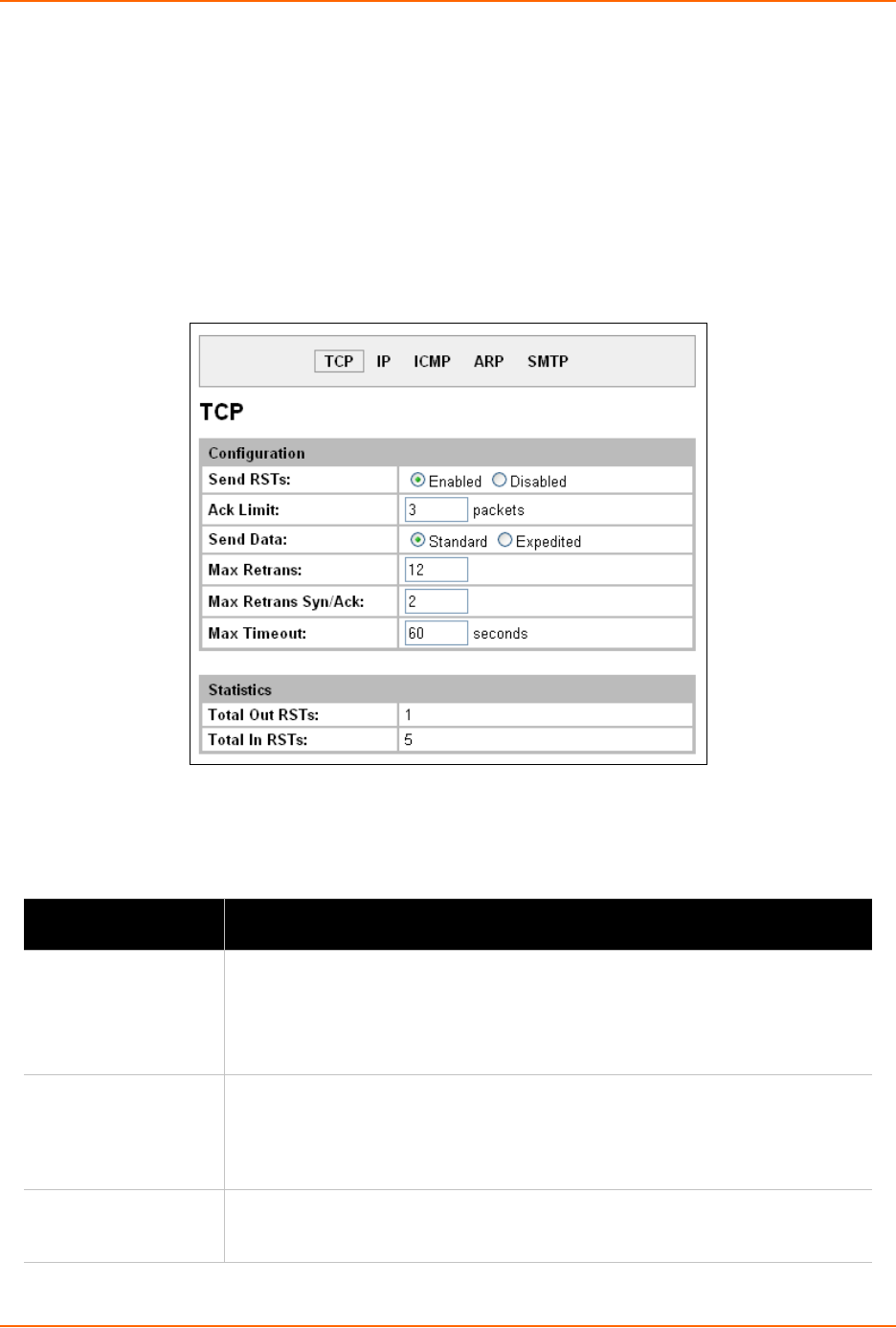
14: Maintenance and Diagnostics Settings
EDS User Guide 115
Protocol Stack Settings
In the Protocol Stack web page, you can configure TCP, IP, ICMP, SMTP and ARP.
TCP Settings
To configure the TCP network protocol:
1. Select Protocol Stack on the menu bar.
2. Select TCP.
Figure 14-4 TCP Protocol
3. Modify the following settings:
Table 14-5 TCP Protocol Settings
Protocol Stack
TCP Settings Description
Send RSTs Click Enabled to send RSTs or Disabled to stop sending RSTs. TCP contains six
control bits, with one or more defined in each packet. RST is one of the control
bits. The RST bit is responsible for telling the receiving TCP stack to end a
connection immediately.
Note: Setting the RSTs may pose a security risk.
Ack Limit Enter a number to limit how many packets get received before an ACK gets forced.
If there is a large amount of data to acknowledge, an ACK gets forced. If the
sender TCP implementation waits for an ACK before sending more data even
though the window is open, setting the Ack Limit to 1 packet improves
performance by forcing immediate acknowledgements.
Send Data The Send Data selection governs when data may be sent into the network. The
Standard implementation waits for an ACK before sending a packet less than the
maximum length. Select Expedited to send data whenever the window allows it.
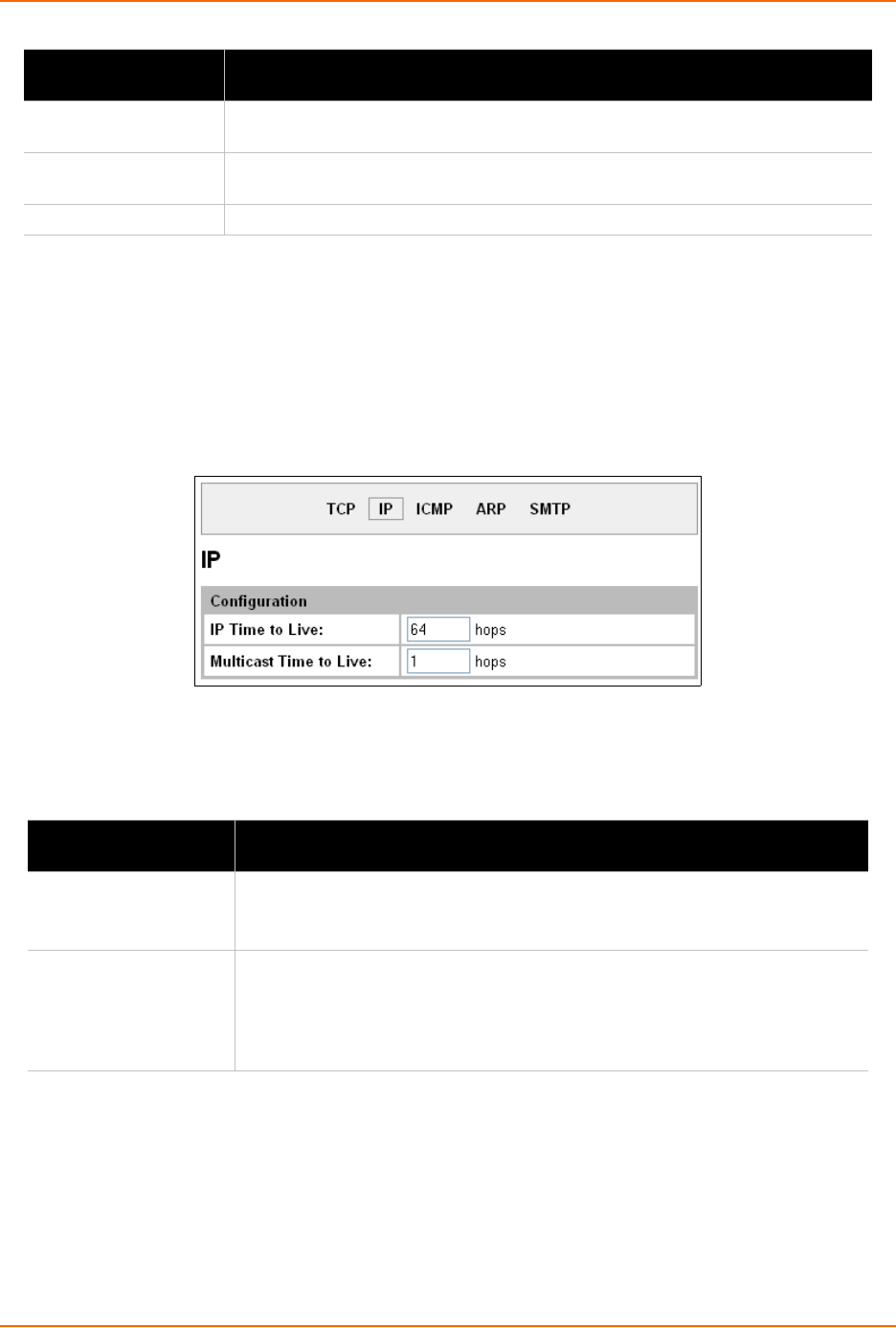
14: Maintenance and Diagnostics Settings
EDS User Guide 116
4. Click Submit.
IP Settings
To configure the network protocol settings for IP:
1. Select Protocol Stack on the menu bar.
2. Select IP.
Figure 14-6 IP Protocol
3. Modify the following settings:
Table 14-7 IP Protocol Settings
4. Click Submit.
ICMP Settings
To configure the ICMP network protocol:
1. Select Protocol Stack on the menu bar.
2. Select ICMP.
Max Retrans Enter the maximum number of retransmissions of a packet that will be attempted
before failing.
Max Retrans Syn/Ack Enter the maximum number of retransmissions of a SYN that will be attempted
before failing. It is lower than “Max Retrans” to thwart denial-of-service attacks.
Max Timeout Enter the maximum time between retransmissions.
Protocol Stack
IP Settings Description
IP Time to Live This value typically fills the Time To Live in the IP header. SNMP refers to this
value as "ipDefaultTTL".
Enter the number of hops to be transmitted before the packet is discarded.
Multicast Time to Live This value fills the Time To Live in any multicast IP header. Normally this value
will be one so the packet will be blocked at the first router. It is the number of
hops allowed before a Multicast packet is discarded.
Enter the value to be greater than one to intentionally propagate multicast
packets to additional routers.
Protocol Stack
TCP Settings Description
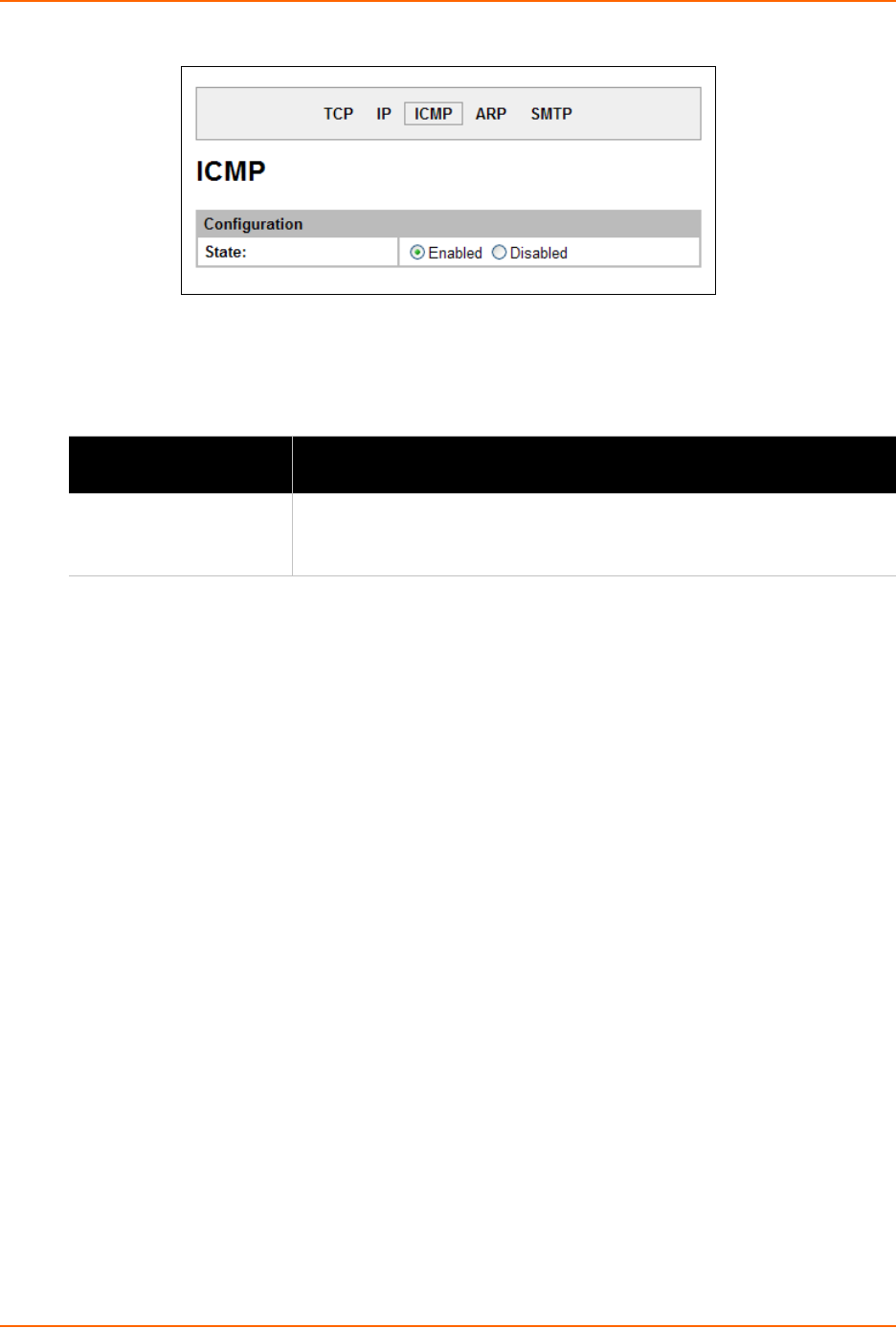
14: Maintenance and Diagnostics Settings
EDS User Guide 117
Figure 14-8 ICMP Protocol
3. Select the appropriate state.
4. Click Submit.
Table 14-9 ICMP Settings
Protocol Stack
ICMP Settings Description
State The State selection is used to turn on/off processing of ICMP messages.
This includes both incoming and outgoing messages. Choose Enabled or
Disabled.
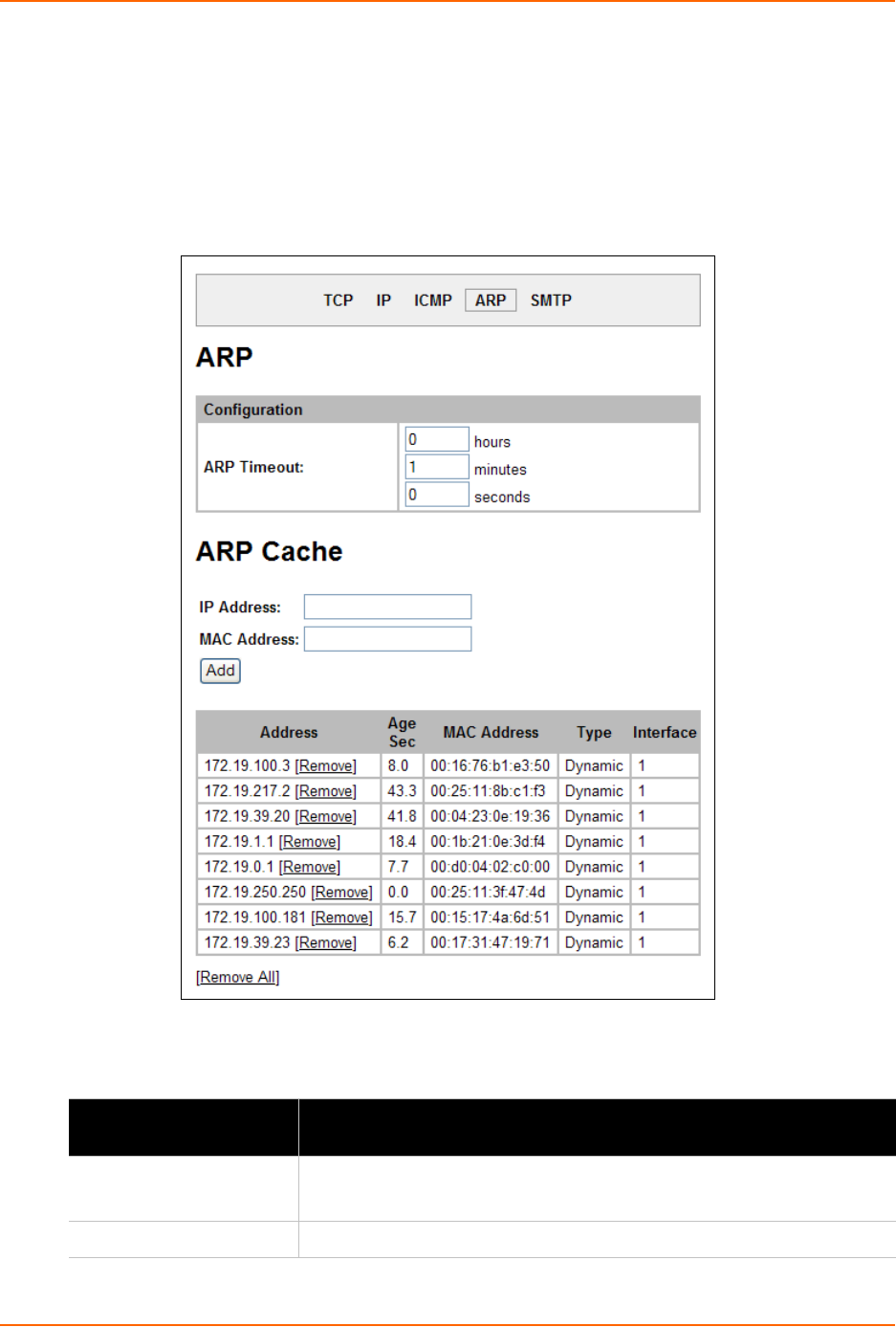
14: Maintenance and Diagnostics Settings
EDS User Guide 118
ARP Settings
To configure the ARP network protocol:
1. Select Protocol Stack on the menu bar.
2. Select ARP.
Figure 14-10 ARP Protocol Page
3. Modify the following settings:
Table 14-11 ARP Settings
Protocol Stack
ARP Settings Description
ARP Timeout This is the maximum duration an address remains in the cache.
Enter the time, in hours, minutes and seconds.
IP Address Enter the IP address to add to the ARP cache.
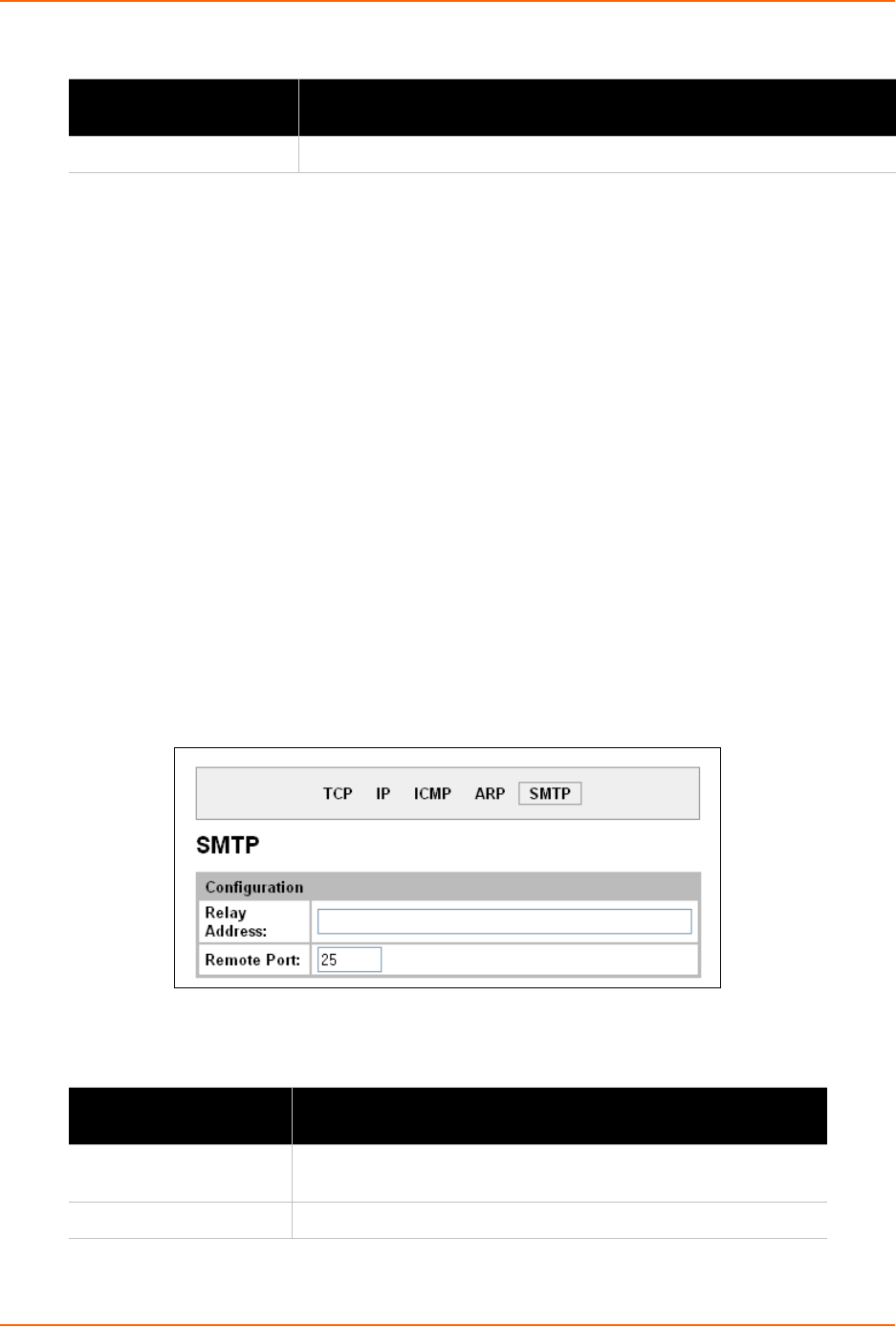
14: Maintenance and Diagnostics Settings
EDS User Guide 119
Note: Both the IP and MAC addresses are required for the ARP cache.
4. Click Submit for ARP or Add after supplying both address fields for ARP cache.
5. Remove entries from the ARP cache, as desired:
Click Remove All to remove all entries in the ARP cache.
OR
Click Remove beside a specific entry to remove it from the ARP cache.
SMTP Settings
SMTP is configuration for a basic SMTP proxy. An SMTP proxy in this sense is a simple
forwarding agent.
Note: Lantronix does not support SMTP AUTH or any other authentication or encryption
schemes for email. Please see Email Settings on page 134 for additional information.
To configure the SMTP network protocol:
1. Select Protocol Stack on the menu bar.
2. Select SMTP.
Figure 14-12 SMTP
3. Modify the following settings:
4. Click Submit.
MAC Address Enter the MAC address to add to the ARP cache.
Table 14-13 SMTP Settings
Protocol Stack SMTP
Settings Description
Relay Address Address of all outbound email messages through a mail server.
Can contain either a hostname or an IP address.
Remote Port Port utilized for the delivery of outbound email messages.
Table 14-11 ARP Settings
Protocol Stack
ARP Settings (continued) Description
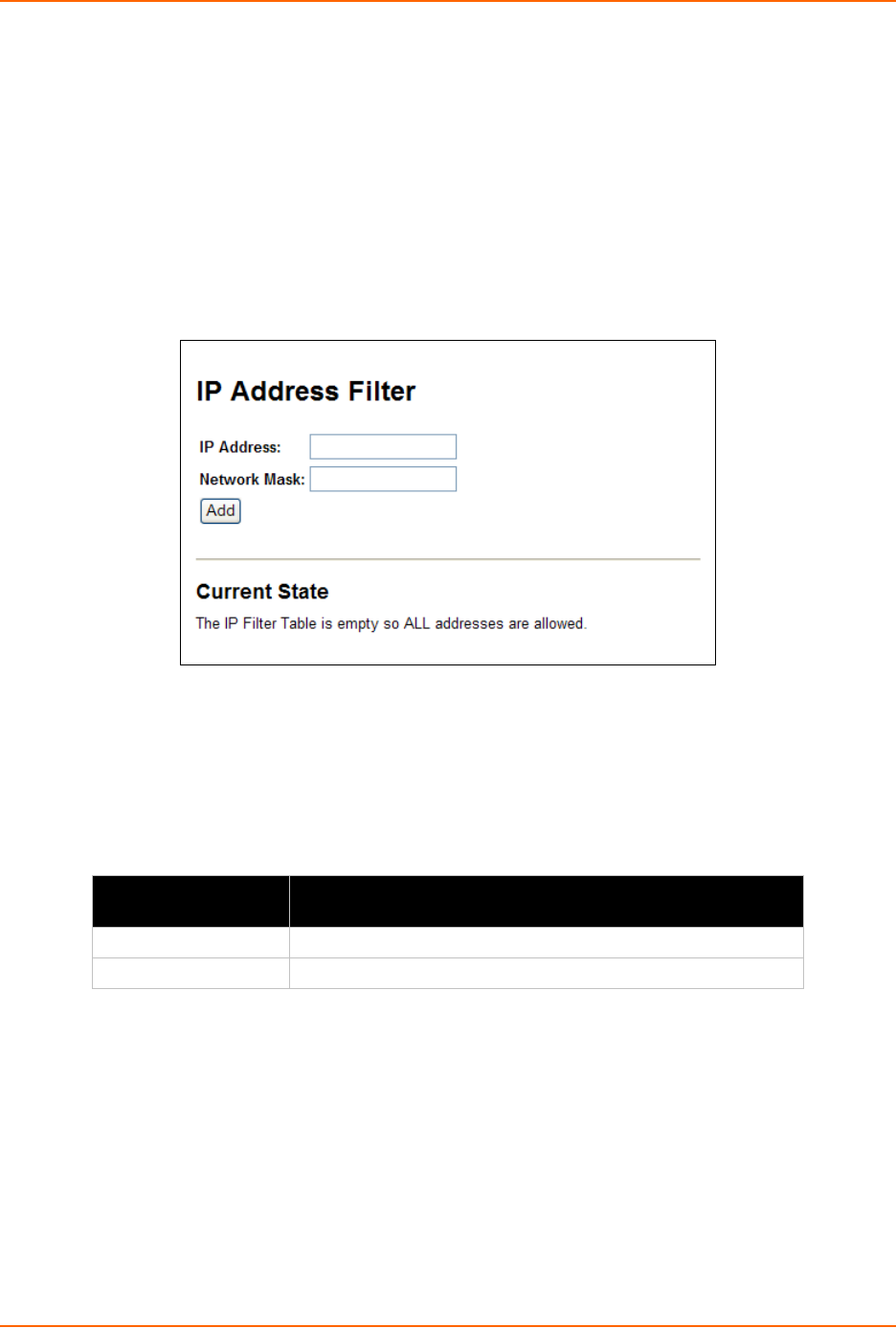
14: Maintenance and Diagnostics Settings
EDS User Guide 120
IP Address Filter
The IP address filter specifies the hosts and subnets permitted to communicate with the EDS
device. When the filter list is empty, then all IP addresses are allowed.
Note: If using DHCP/BOOTP, ensure the DHCP/BOOTP server is in this list.
To configure the IP address filter:
1. Select IP Address Filter on the menu bar. The IP Address Filter page opens to display the
current configuration.
Figure 14-14 IP Address Filter Configuration
Note: If you enter any filter, be careful to make sure that your network IP address is
covered. Otherwise you will loose access to the EDS. You will have to then access the
EDS from a different computer to reset the configuration.
2. Enter or modify the following settings:
Table 14-15 IP Address Filter Settings
3. Click Add.
Note: In the Current State table, click Remove to delete any existing settings, as
necessary.
IP Address Filter
Settings Description
IP Address Enter the IP address to add to the IP filter table.
Network Mask Enter the IP address’ network mask in dotted notation.
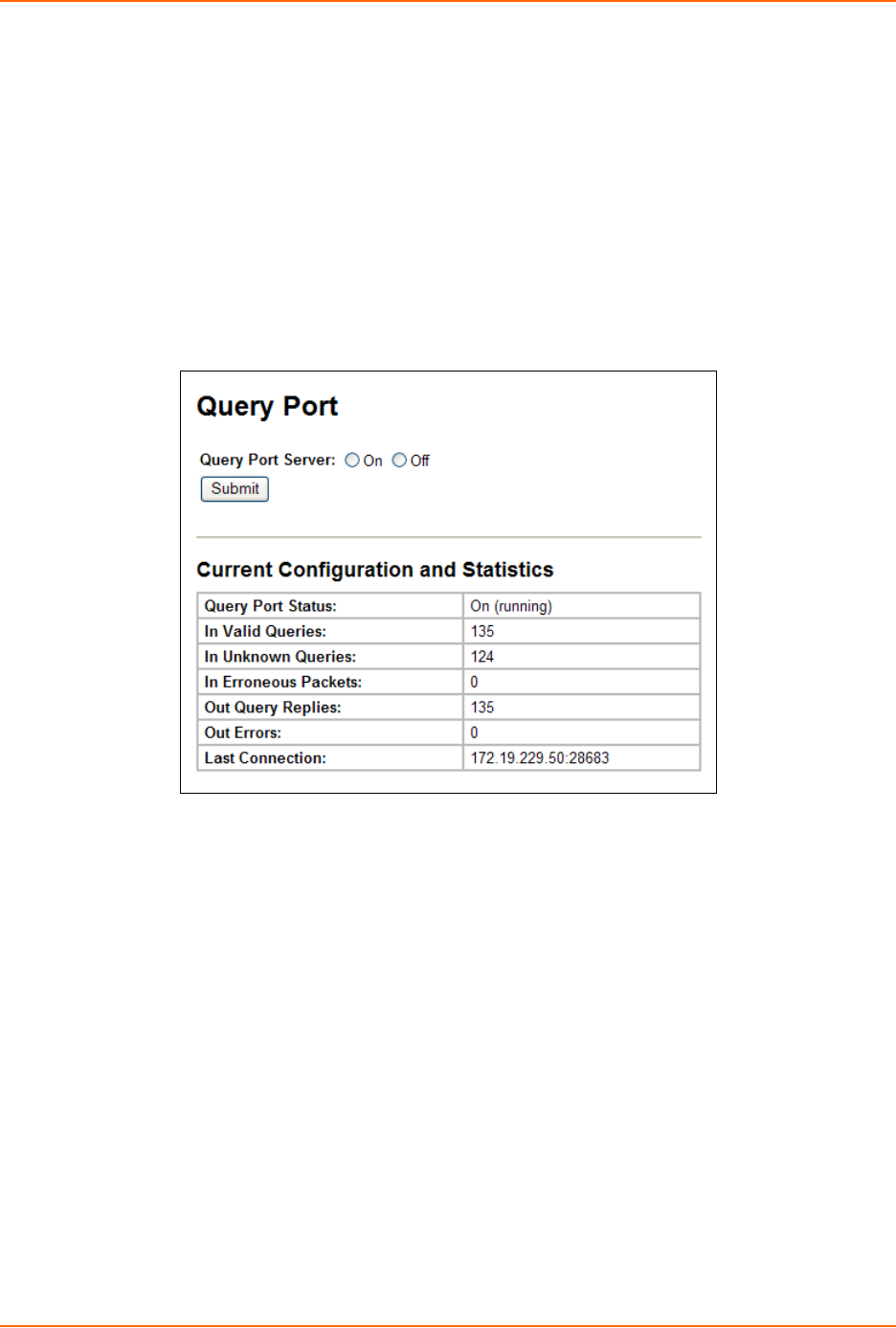
14: Maintenance and Diagnostics Settings
EDS User Guide 121
Query Port
The query port (0x77FE) is used for the automatic discovery of the device by the DeviceInstaller
utility. Only 0x77FE discover messages from DeviceInstaller are supported. For more information
on DeviceInstaller, see Using DeviceInstaller (on page 41).
To configure the query port server:
1. Select Query Port on the menu bar. The Query Port page opens to display the current
configuration.
Figure 14-16 Query Port Configuration
2. Select On to enable the query port server.
3. Click Submit.
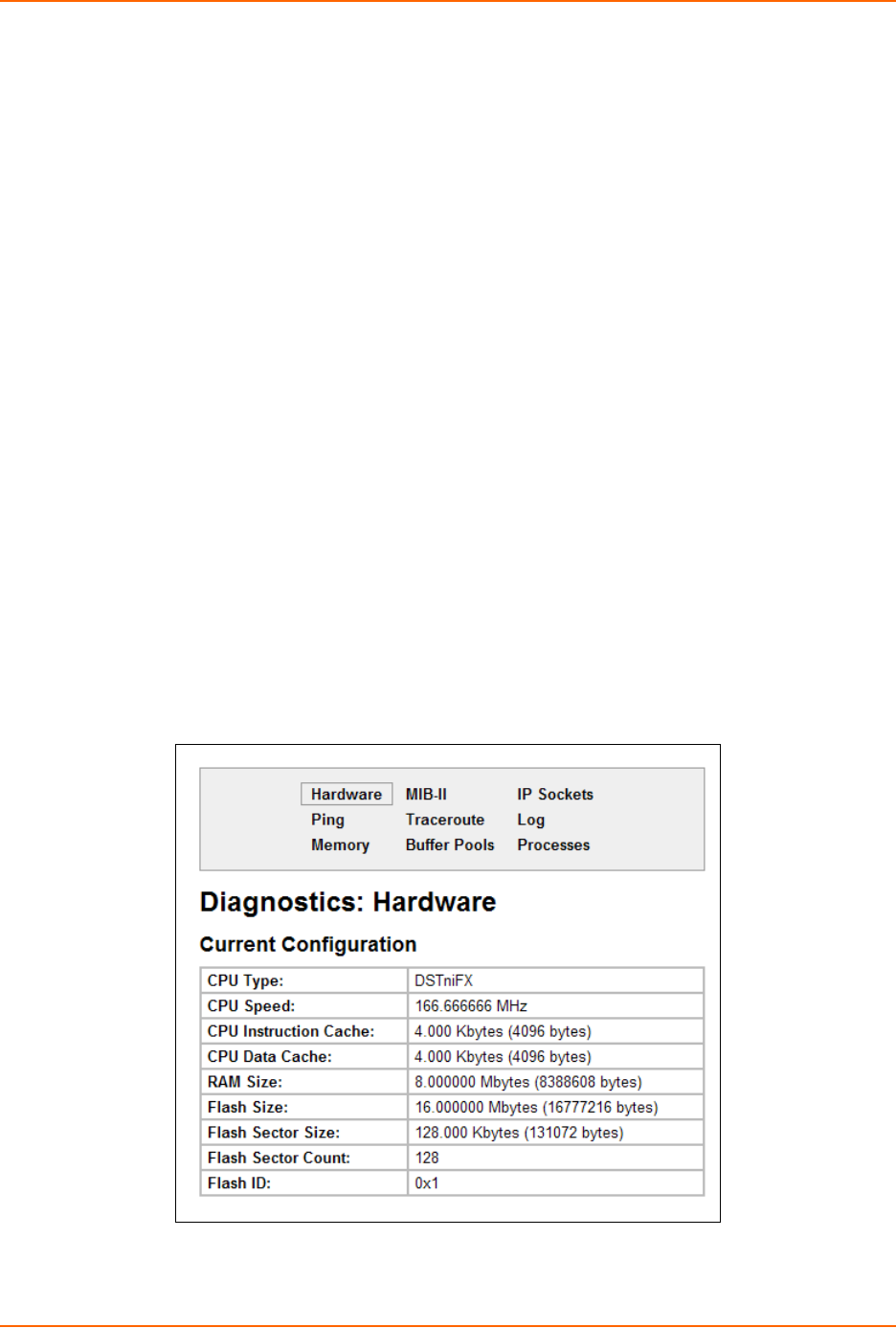
14: Maintenance and Diagnostics Settings
EDS User Guide 122
Diagnostics
The EDS has several tools to perform diagnostics and view device statistics. These include
information on:
Hardware
MIB-II
IP Sockets
Ping
Traceroute
Log
Memory
Buffer Pools
Processes
Hardware
This read-only page shows the current device’s hardware configuration.
To display hardware diagnostics:
1. Select Diagnostics on the menu bar. The Diagnostics: Hardware page opens and shows the
current hardware configuration.
Figure 14-17 Diagnostics: Hardware
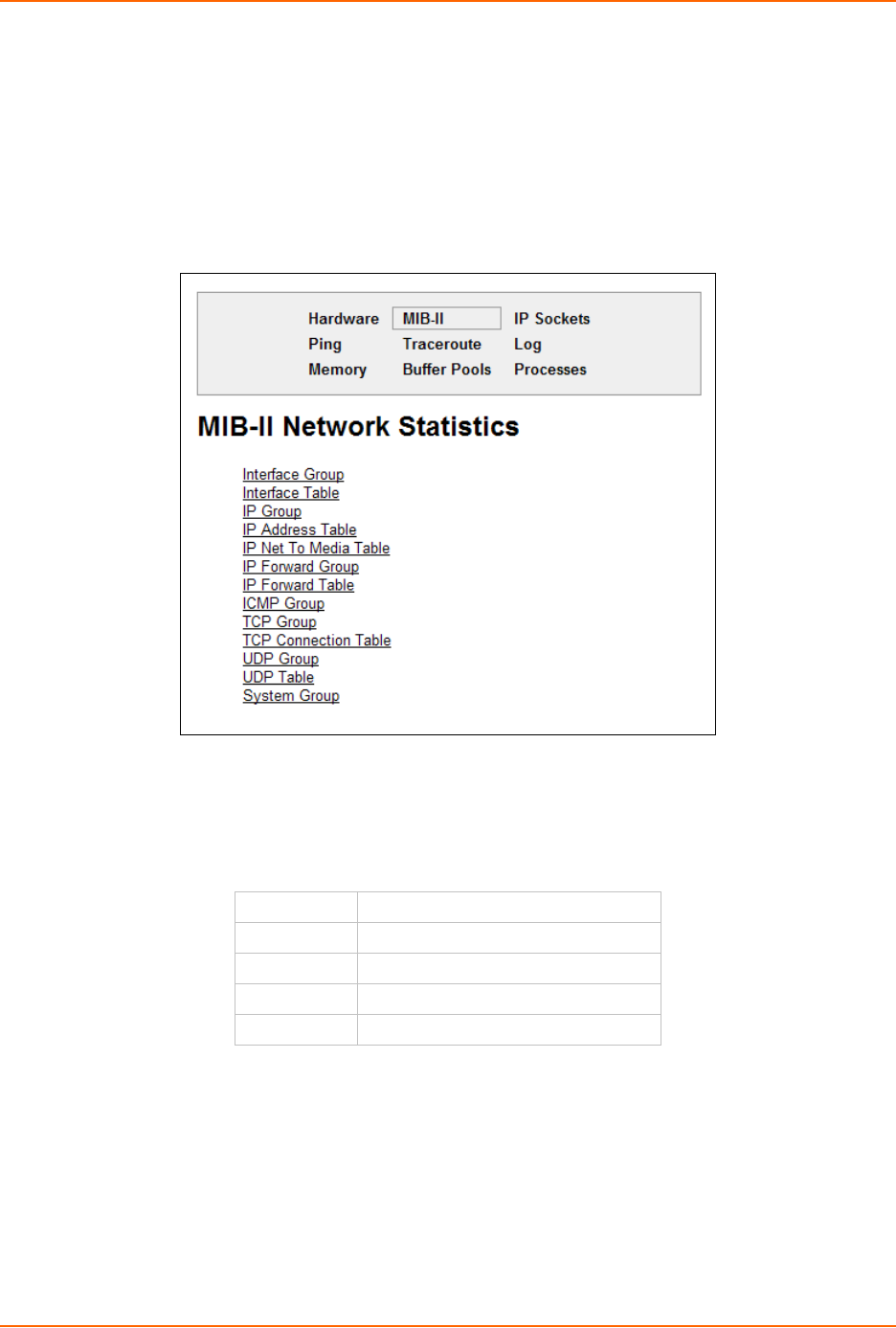
14: Maintenance and Diagnostics Settings
EDS User Guide 123
MIB-II Statistics
The MIB-II Network Statistics page shows the various SNMP-served Management Information
Bases (MIBs) available on the EDS.
To view MIB-II statistics:
1. Select Diagnostics on the menu bar and then MIB-II at the top of the page menu. The MIB-II
Network Statistics page opens.
Figure 14-18 MIB-II Network Statistics
2. Click any of the available links to open the corresponding table and statistics. For more
information, refer to the table below:
Table 14-19 Requests for Comments (RFCs)
RFC 1213 Original MIB-II definitions.
RFC 2011 Updated definitions for IP and ICMP.
RFC 2012 Updated definitions for TCP.
RFC 2013 Updated definitions for UDP.
RFC 2096 Definitions for IP forwarding.
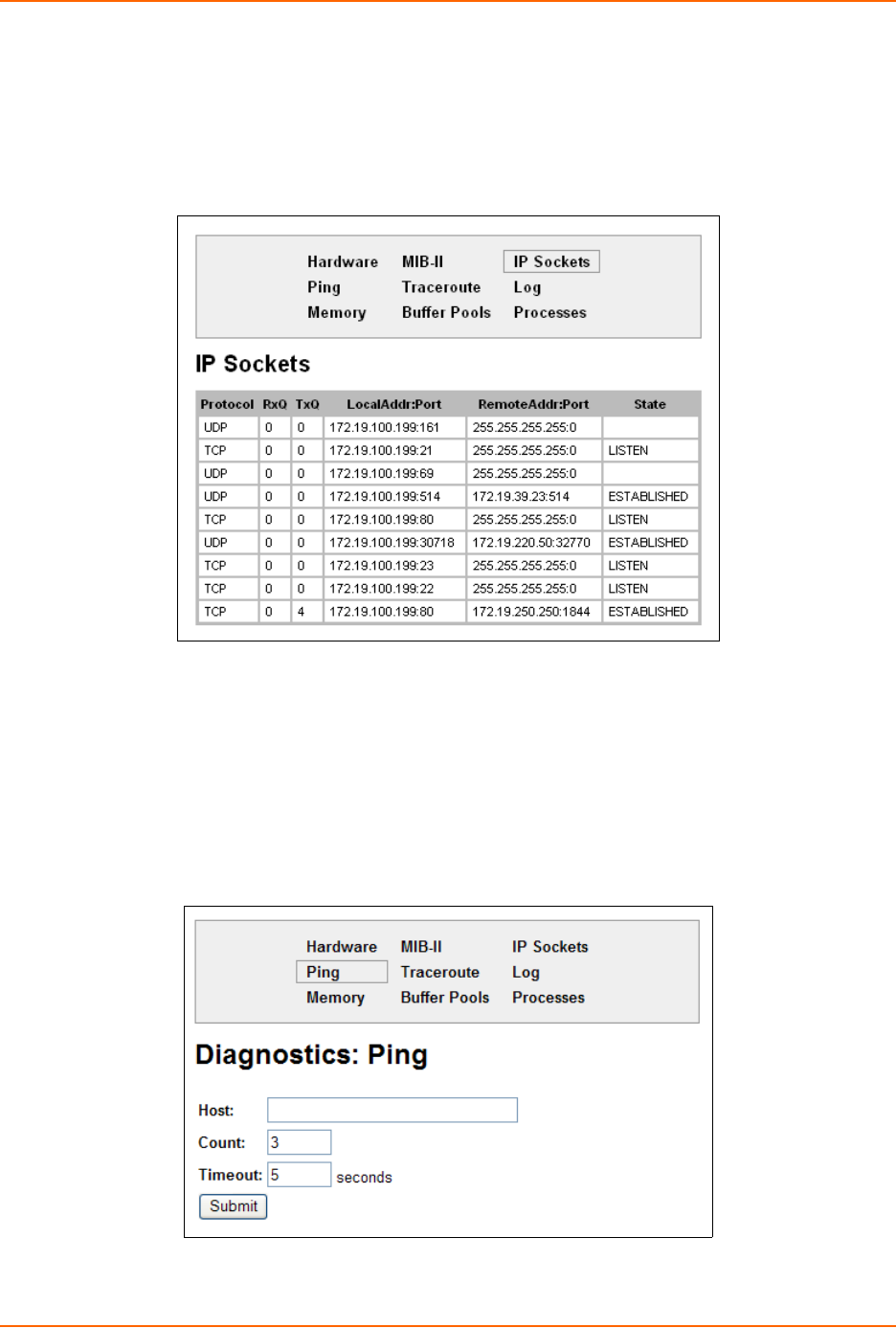
14: Maintenance and Diagnostics Settings
EDS User Guide 124
IP Sockets
To display open IP sockets:
1. Select Diagnostics on the menu bar and then IP Sockets at the top of the page. The IP
Sockets page opens and shows all of the open IP sockets on the device.
Figure 14-20 IP Sockets
Ping
EDS uses 56 bytes of data in a ping packet. Ping size is not configurable.
To ping a remote device or computer:
1. Select Diagnostics on the menu bar and then Ping at the top of the page. The Diagnostics:
Ping page opens.
Figure 14-21 Diagnostics: Ping

14: Maintenance and Diagnostics Settings
EDS User Guide 125
2. Enter or modify the following settings:
Table 14-22 Diagnostics: Ping
3. Click Submit. The results of the ping display in the page.
Diagnostics:
Ping Settings Description
Host Enter the IP address or host name for the device to ping.
Count Enter the number of ping packets the device should attempt to
send to the Host. The default is 3.
Timeout Enter the time, in seconds, for the device to wait for a
response from the host before timing out. The default is 5
seconds.
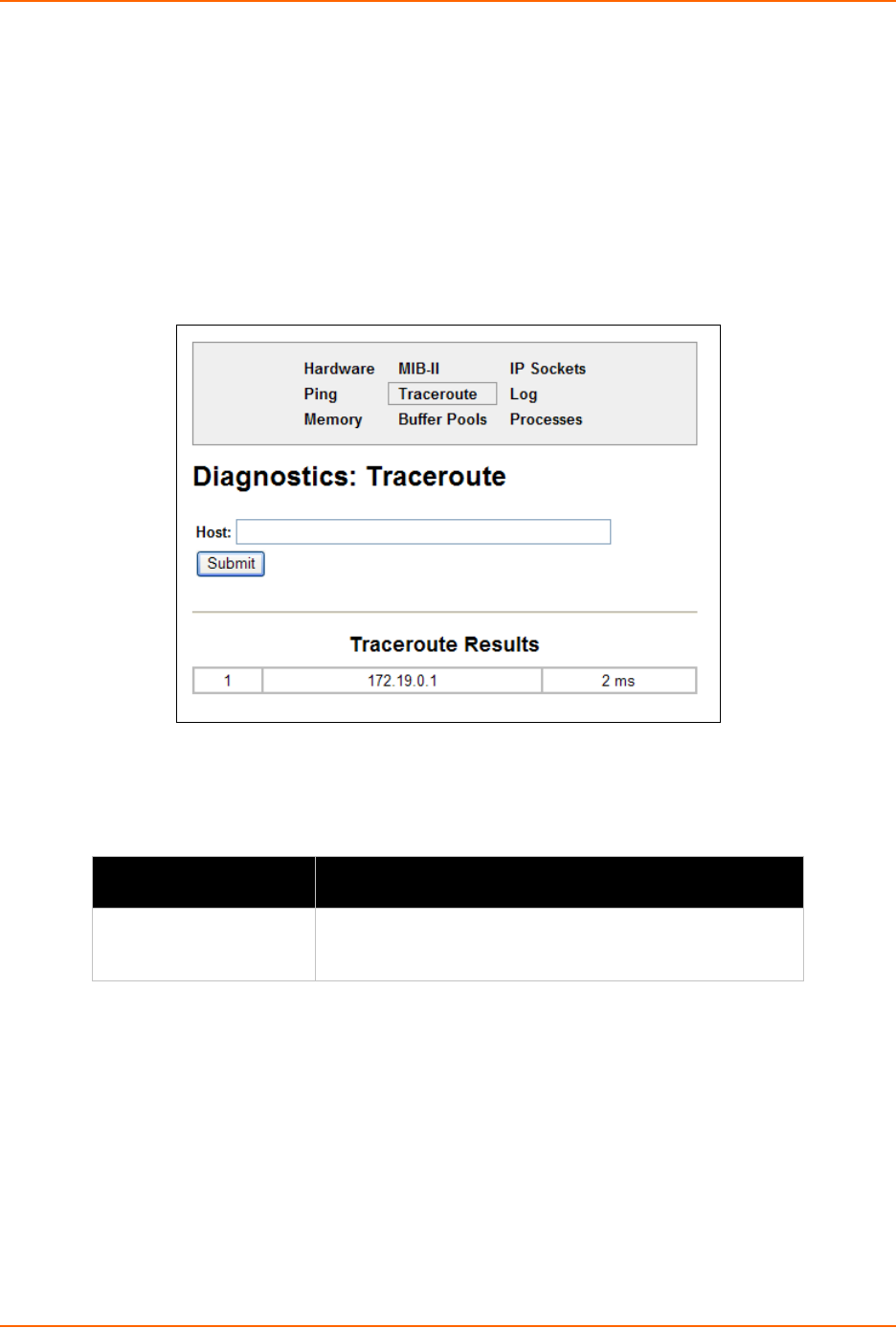
14: Maintenance and Diagnostics Settings
EDS User Guide 126
Traceroute
Here you can trace a packet from the EDS to an Internet host, showing how many hops the packet
requires to reach the host and how long each hop takes. If you visit a web site whose pages
appear slowly, you can use traceroute to determine where the longest delays are occurring.
To use Traceroute:
1. Select Diagnostics on the menu bar and then Traceroute at the top of the page. The
Diagnostics: Traceroute page opens.
Figure 14-23 Diagnostics: Traceroute
2. Enter or modify the following setting:
Table 14-24 Diagnostics: Traceroute
3. Click Submit. The results of the traceroute display in the page.
Diagnostics: Traceroute
Settings Description
Host Enter the IP address or DNS hostname. This address is used
to show the path between it and the device when issuing the
traceroute command.
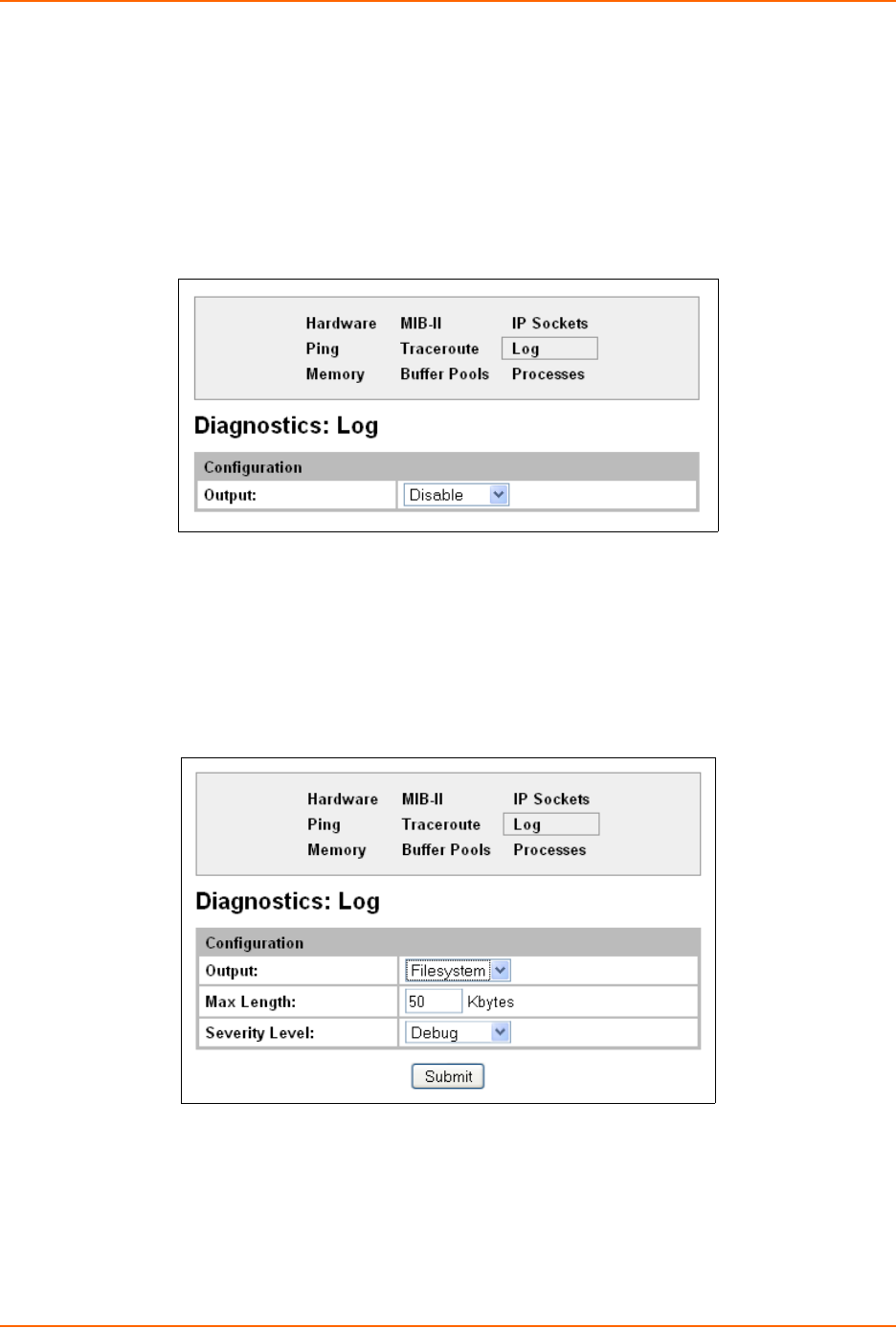
14: Maintenance and Diagnostics Settings
EDS User Guide 127
Log
Here you can enable a diagnostics log of configuration items:
To use diagnostics logging:
1. Select Diagnostics on the menu bar and then Log at the top of the page. The Diagnostics:
Log page opens.
Figure 14-25 Diagnostics: Log
2. Select the Output type and select one of the following:
Disable (default)
Filesystem
Line1
Figure 14-26 Diagnostics: Log (Filesystem)
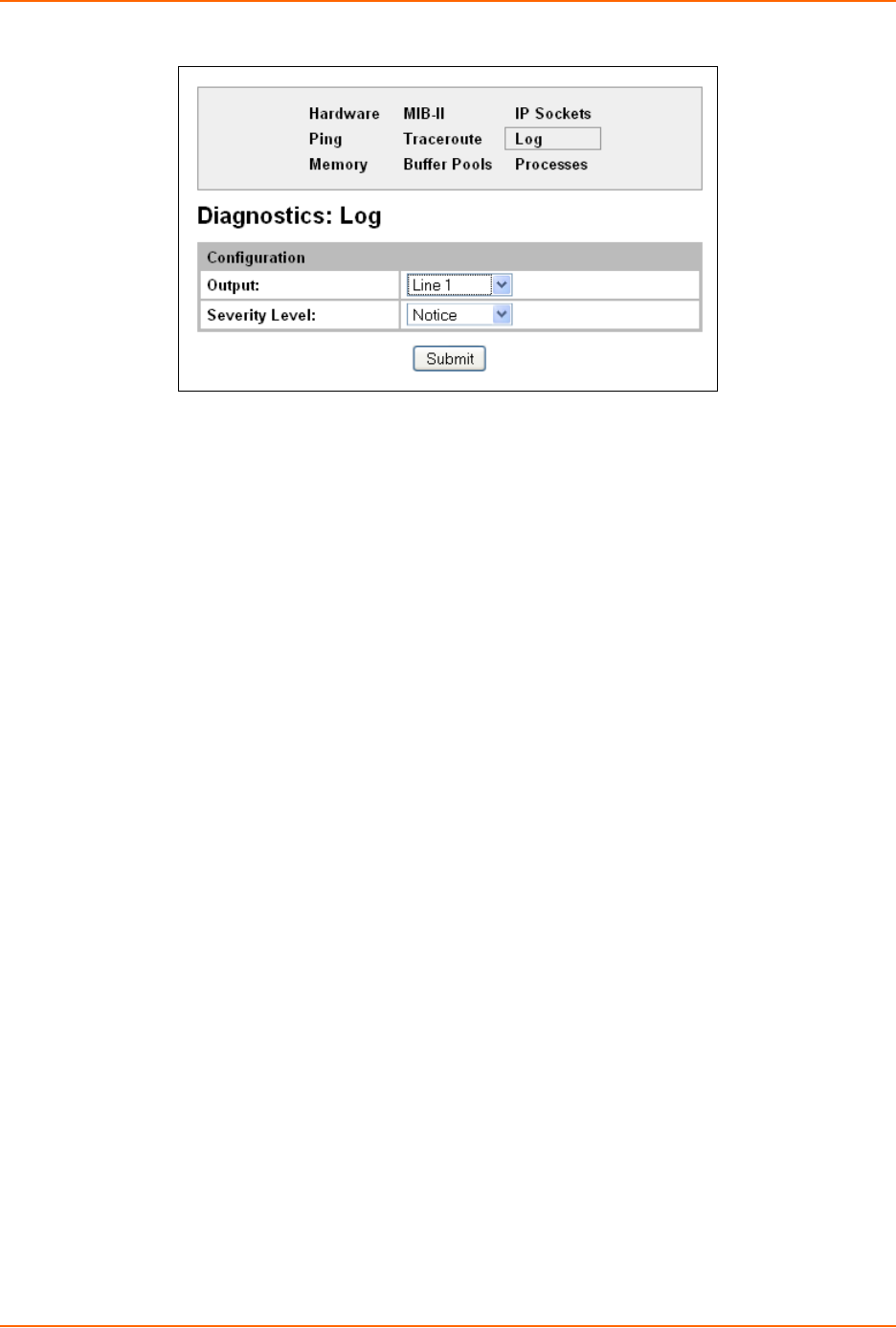
14: Maintenance and Diagnostics Settings
EDS User Guide 128
Figure 14-27 Diagnostics: Log (Line 1)
3. If you selected Filesystem or Line1 Output types also complete additional selections:
Max Length (for Filesystem only) limits the size in Kbytes of the log (/log.txt).
Severity Level specifies the level of system message to be logged.
4. Click Submit.
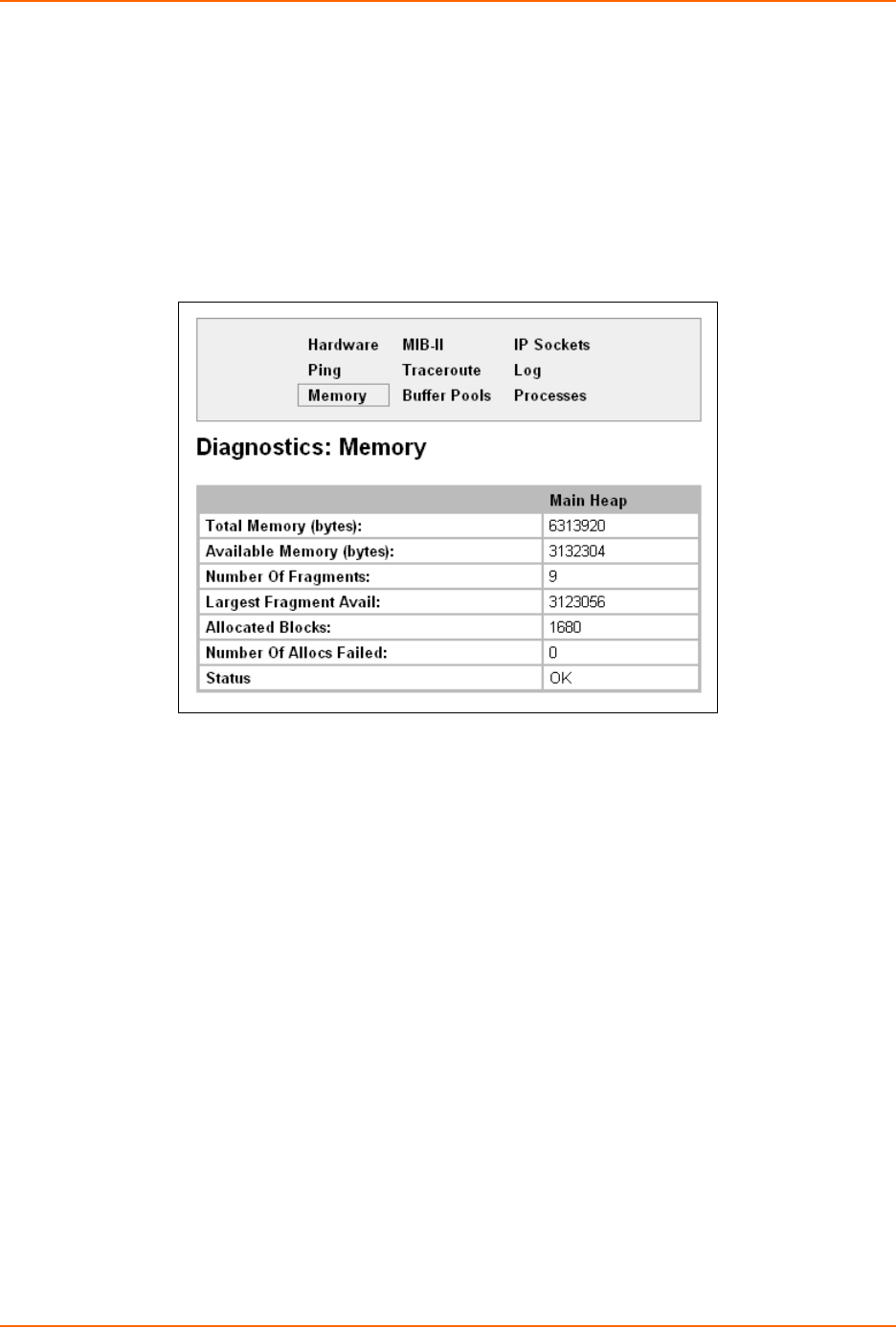
14: Maintenance and Diagnostics Settings
EDS User Guide 129
Memory
This read-only web page shows the total memory and available memory (in bytes), along with the
number of fragments, allocated blocks, and memory status.
To display memory statistics:
1. Select Diagnostics on the menu bar and then Memory at the top of the page. The
Diagnostics: Memory page appears.
Figure 14-28 Diagnostics: Memory
Buffer Pools
Several parts of the EDS system use private buffer pools to ensure deterministic memory
management.
To display the buffer pools:
1. Select Diagnostics on the menu bar and then Buffer Pools at the top of the page. The
Diagnostics: Buffer Pools page opens.
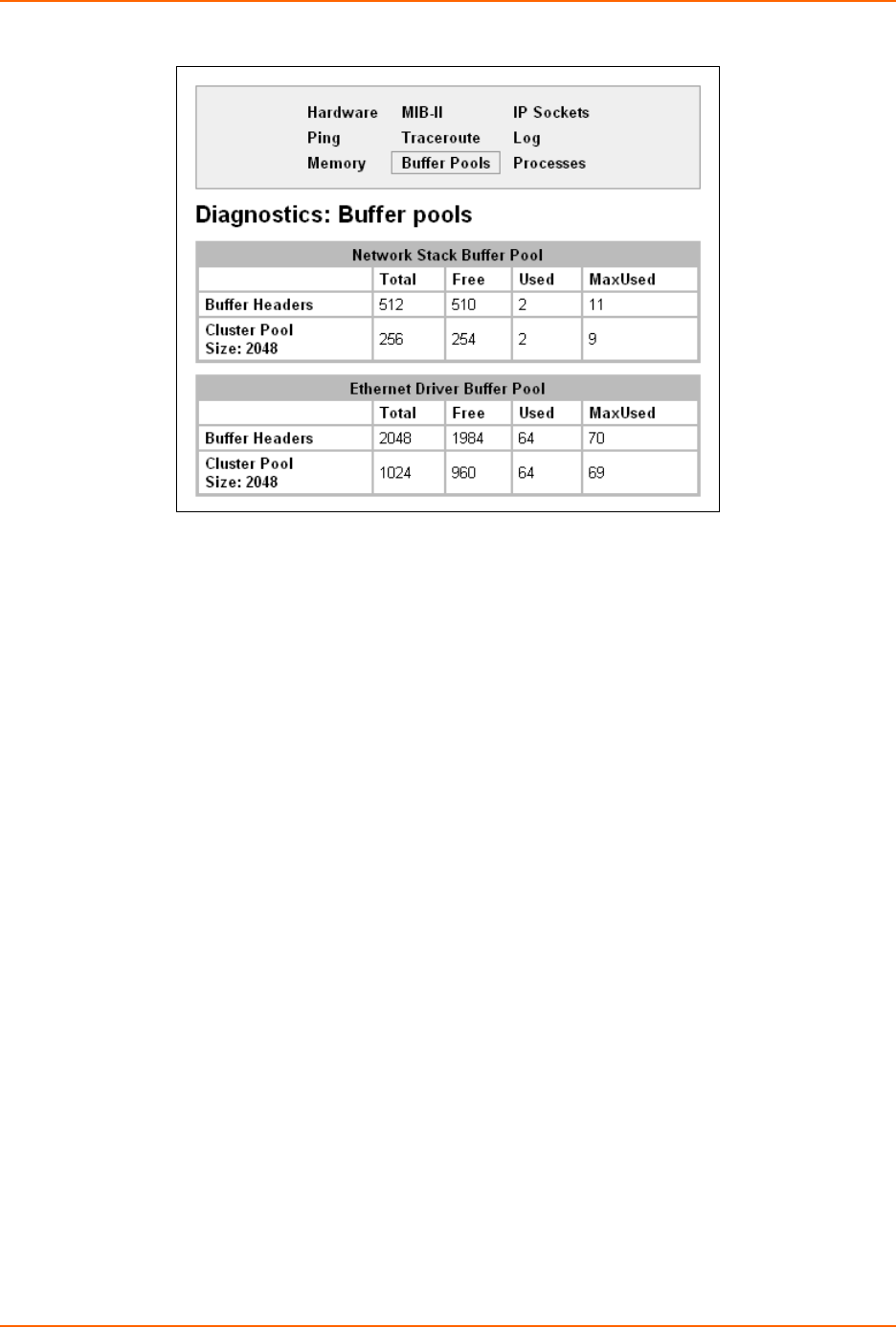
14: Maintenance and Diagnostics Settings
EDS User Guide 130
Figure 14-29 Diagnostics: Buffer Pools
Processes
The Processes web page shows all the processes currently running on the system. It shows the
Process ID (PID), the percentage of total CPU cycles a process used within the last three
seconds, the total stack space available, the maximum amount of stack space used by the
process since it started, and the process name.
To display the processes running and their associated statistics:
1. Select Diagnostics on the menu bar and then Processes at the top of the page.
Note: The Adobe SVG plug-in is required to view the CPU Load Graph.
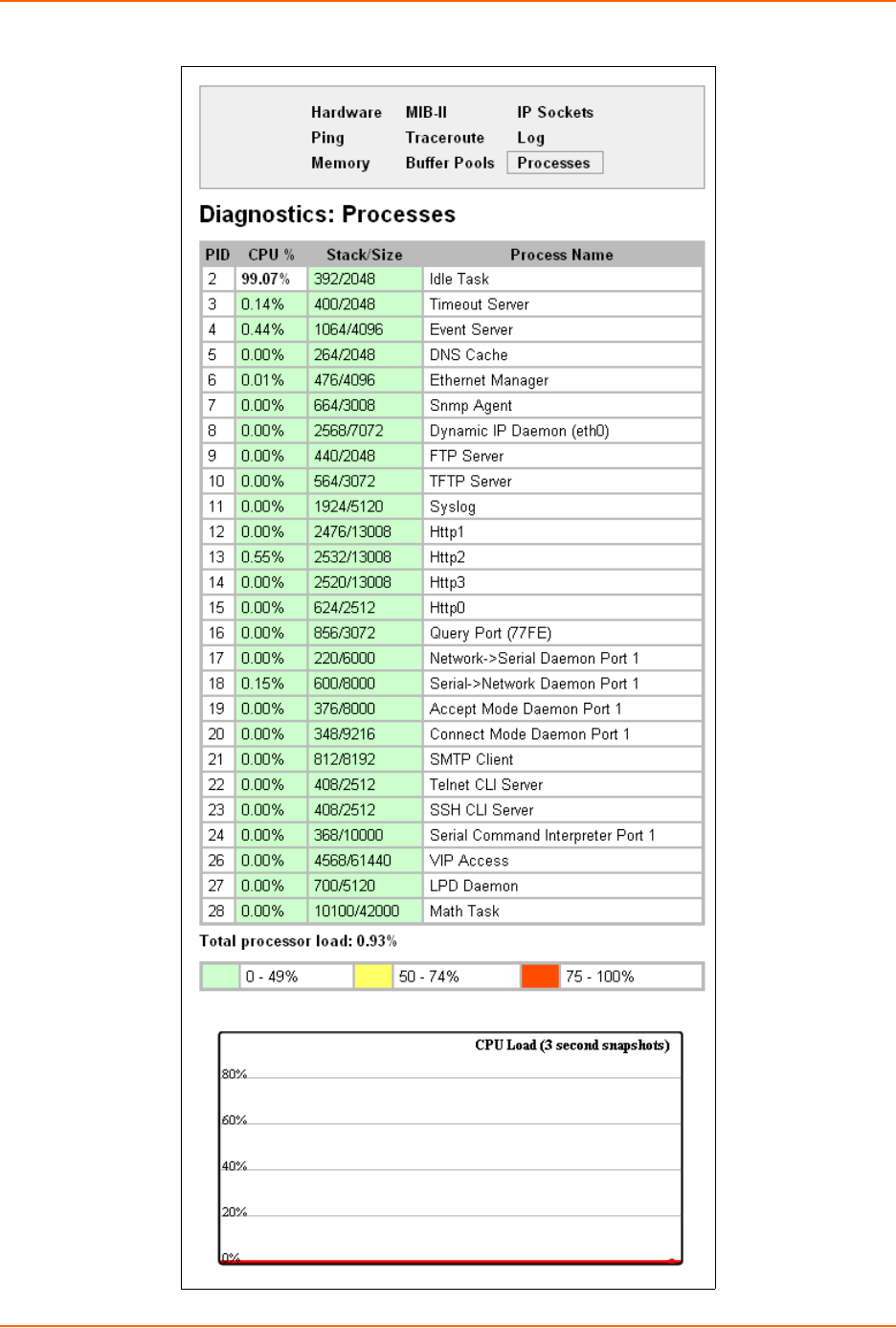
14: Maintenance and Diagnostics Settings
EDS User Guide 131
Figure 14-30 Diagnostics: Processes
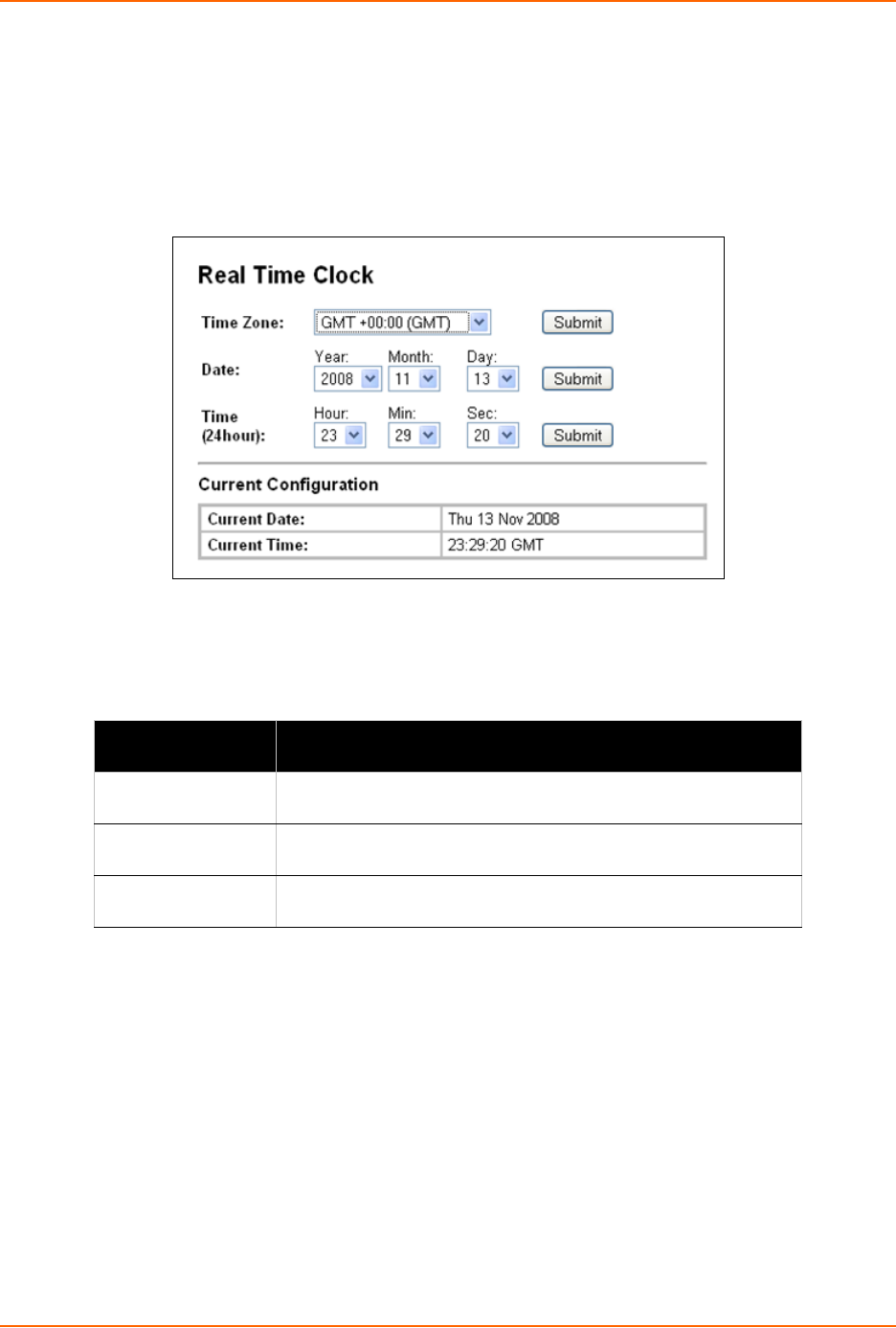
14: Maintenance and Diagnostics Settings
EDS User Guide 132
Real Time Clock
The current date or time configured on the EDS can be viewed and modified.
To configure Real Time Clock settings:
1. Select RTC on the menu bar. The Real Time Clock page opens.
Figure 14-31 Real Time Clock Page
2. Modify the following settings to set change the current date and time:
Table 14-32 Real Time Clock Settings
3. Click Submit.
System Settings
The EDS System web page allows for rebooting the device, restoring factory defaults, uploading
new firmware, configuring the short and long name, and viewing the current system configuration.
To configure system settings:
1. Select System on the menu bar. The System page opens.
Real Time Clock
Page Settings Description
Time Zone From the drop-down list, select the time zone corresponding to the
location of the EDS.
Date From the drop-down lists, select the year, month, and day
corresponding to the current date at the location of the EDS.
Time (24 hour) From the drop-down list, select the hour, minutes, and seconds
corresponding to the current time at the location of the EDS.
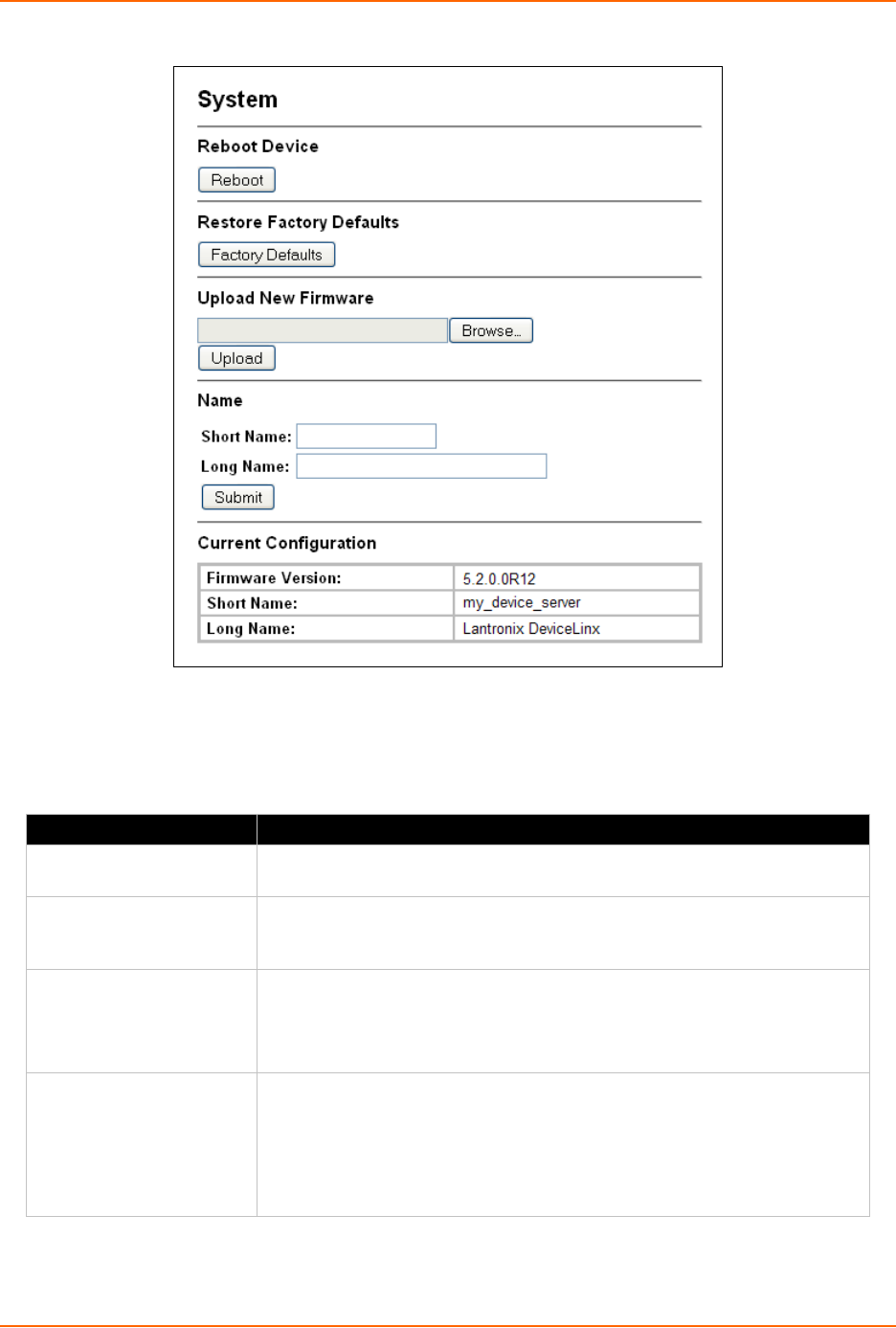
14: Maintenance and Diagnostics Settings
EDS User Guide 133
Figure 14-33 System
2. Configure the following settings:
Table 14-34 System
3. Click Submit.
System Settings Description
Reboot Device Click Reboot to reboot the device. The system refreshes and redirects the
browser to the device home page.
Restore Factory Defaults Click Factory Defaults to restore the device to the original factory settings. All
configurations will be lost. The device automatically reboots upon setting back
to the defaults.
Upload New Firmware Click Browse to locate the firmware file location. Click Upload to install the
firmware on the device. The device automatically reboots upon the installation
of new firmware.
Note: Close and reopen the web manager browser upon a firmware update.
Name Enter a new Short Name and a Long Name (if necessary). The Short Name
maximum is 32 characters. The Long Name maximum is 64 characters.
Changes take place upon the next reboot.
Note: Additional information about long and short name customization is
available in Short and Long Name Customization on page 150 of Chapter 17:
Branding the EDS .
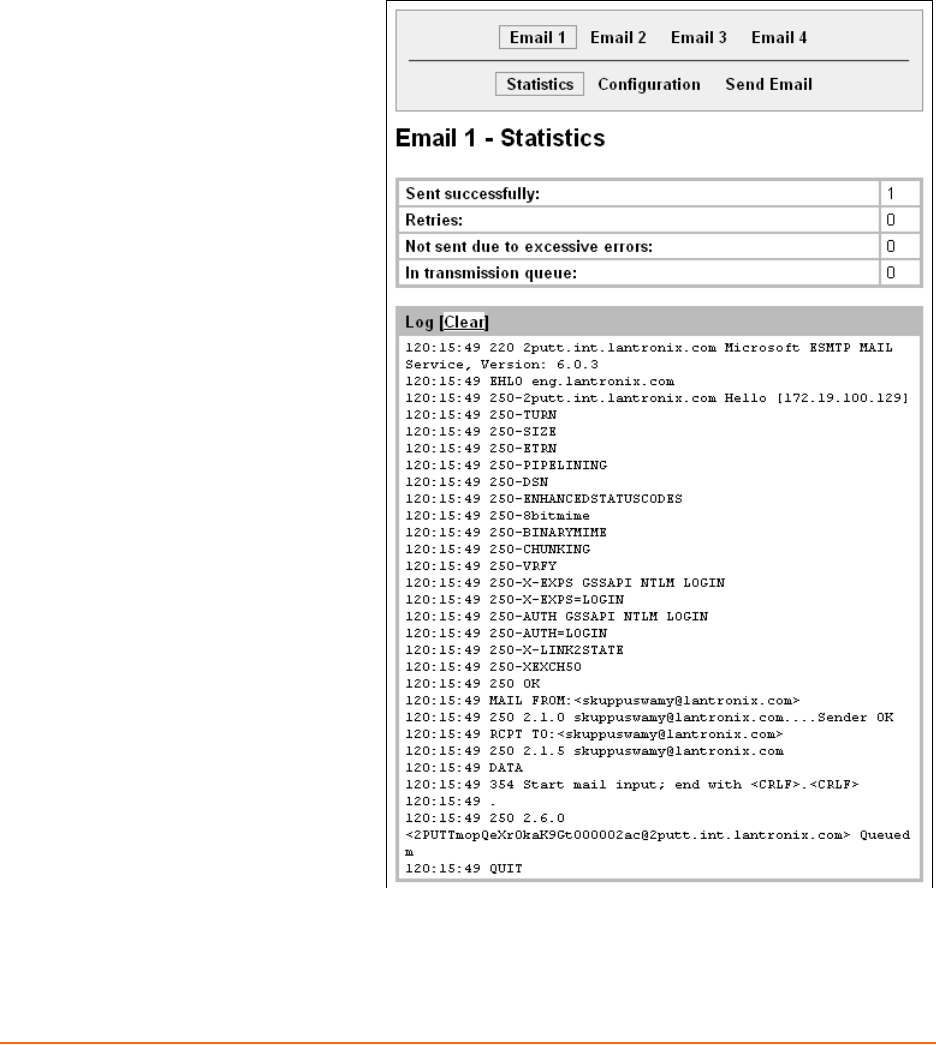
EDS User Guide 134
15: Advanced Settings
This chapter describes the configuration of Email, CLI, and XML. It contains the following sections:
Email Settings
Command Line Interface Settings
XML Settings
Email Settings
The EDS allows you to view and
configure email alerts relating to
the events occurring within the
system. Please see SMTP
Settings on page 119 for
additional information.
Note: The following section
describes the steps to configure
Email 1; these steps also apply to
the other Email instances.
Email Statistics
This read-only page shows
various statistics and current
usage information about the
email subsystem. When you
transmit an email, the
transmission to the SMTP server
gets logged and displayed in the
bottom portion of the page.
1. Select Email on the menu
bar. The Email web page
appears.
2. Select an email number at
the top of the page.
3. Select Statistics. The Email
Statistics page for the
selected email appears.
4. Repeat above steps as
desired, according to
additional email(s) available.
Figure 15-1 Email Statistics
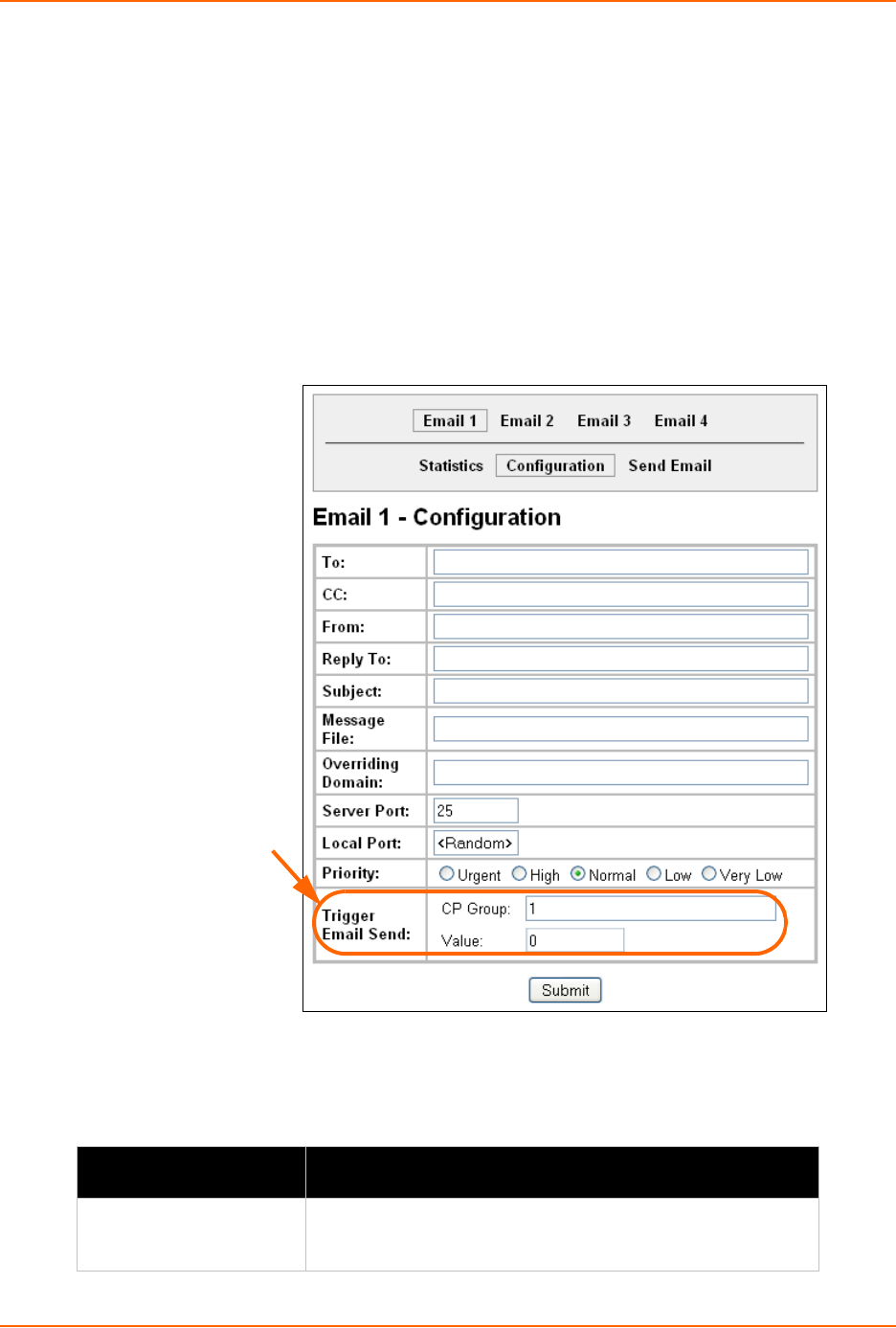
15: Advanced Settings
EDS User Guide 135
Email Configuration
The EDS allows you to view and configure email alerts relating to the events occurring within the
system.
To configure email settings:
1. Select Email on the menu bar, if you are not already at the Email web page.
2. Select an email at the top of the page.
3. Select the Configuration submenu. The Email Configuration page opens to display the
current email configuration.
Figure 15-2 Email Configuration
4. Enter or modify the following settings:
Table 15-3 Email Configuration
Email – Configuration
Settings Description
To Enter the email address to which the email alerts will be sent.
Multiple addresses are separated by semicolon (;). Required
field if an email is to be sent.
Note: The Trigger Email
Send option is only supported
in XPort Pro and XPort AR.

15: Advanced Settings
EDS User Guide 136
5. Click Submit.
To test your configuration:
a. Send an email immediately by clicking Send Email at the top of the page.
b. Refer back to the Statistics page for a log of the transaction.
6. Repeat above steps as desired, according to additional email(s) available.
CC Enter the email address to which the email alerts will be copied.
Multiple addresses are separated by semicolon (;).
From Enter the email address to list in the From field of the email alert.
Required field if an email is to be sent.
Reply-To Enter the email address to list in the Reply-To field of the email
alert.
Subject Enter the subject for the email alert.
Message File Enter the path of the file to send with the email alert. This file
appears within the message body of the email.
Overriding Domain Enter the domain name to override the current domain name in
EHLO (Extended Hello).
Server Port Enter the SMTP server port number. The default is port 25.
Local Port Enter the local port to use for email alerts. The default is a
random port number.
Priority Select the priority level for the email alert.
Email – Configuration
Settings (continued) Description
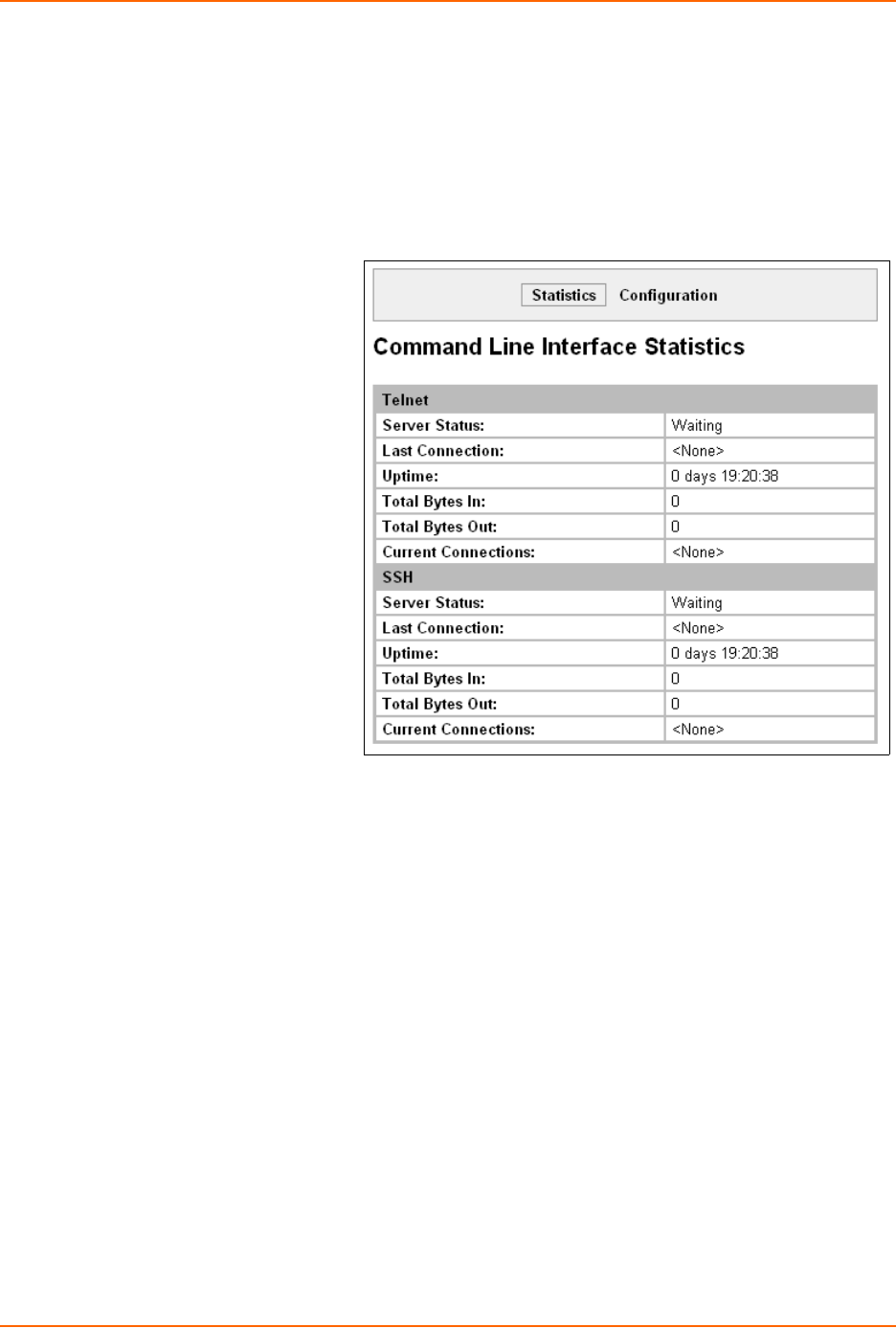
15: Advanced Settings
EDS User Guide 137
Command Line Interface Settings
The Command Line Interface (CLI) web page enables you to view statistics about the CLI servers
listening on the Telnet and SSH ports and to configure CLI settings.
CLI Statistics
This read-only page shows the
current connection status of the
CLI servers listening on the
Telnet and SSH ports. When a
connection is active, the
following display:
Remote client information
Number of bytes that have
been sent and received
A Kill link to terminate the
connection
To view the CLI Statistics:
1. Select CLI on the menu bar.
The Command Line
Interface Statistics page
appears.
CLI Configuration
On this page you can change CLI settings.
To configure the CLI:
1. Select CLI on the menu and then Configuration at the top of the page. The Command Line
Interface Configuration page appears.
Figure 15-4 CLI Statistics
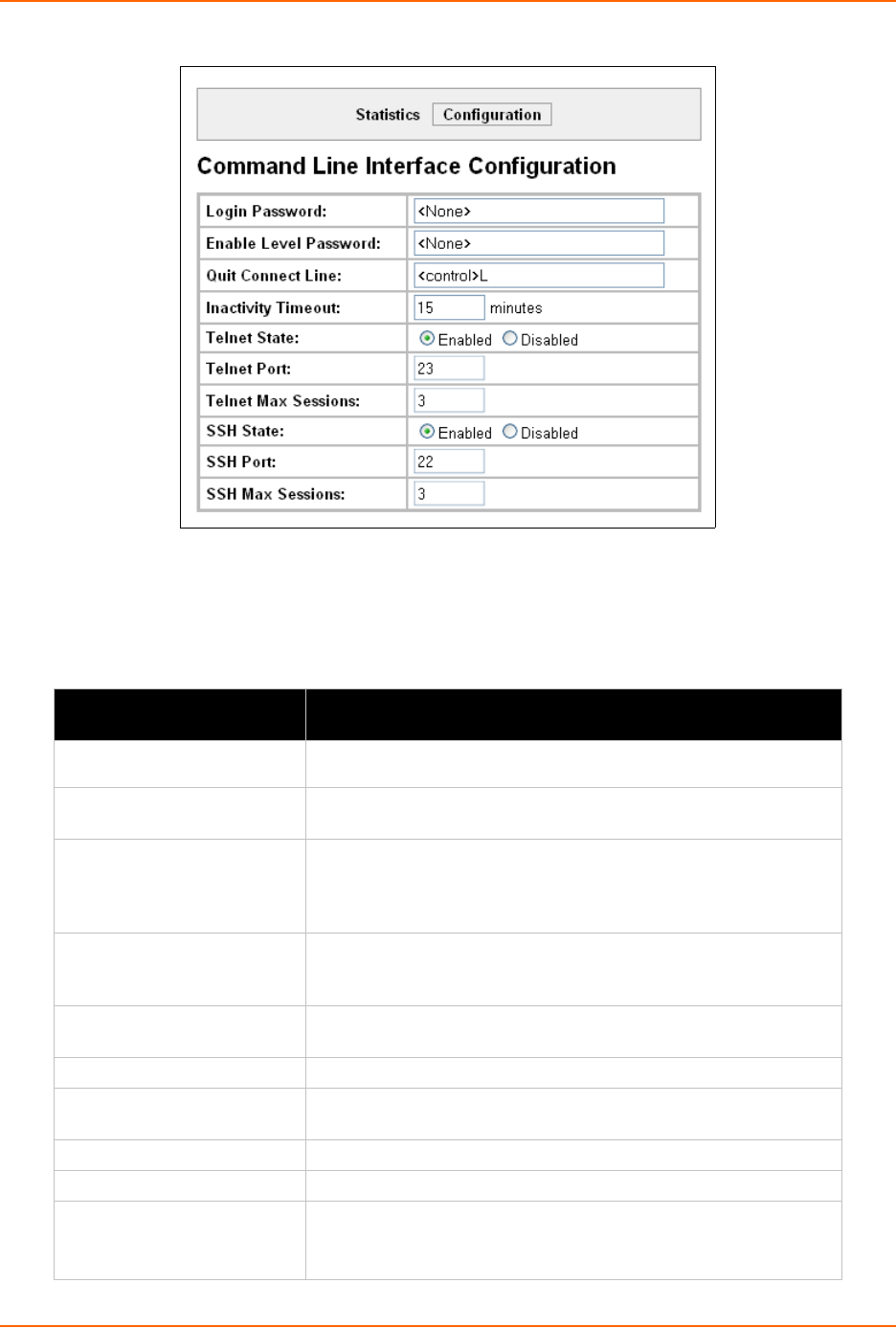
15: Advanced Settings
EDS User Guide 138
Figure 15-5 CLI Configuration
2. Enter or modify the following settings:
Table 15-6 CLI Configuration
Command Line Interface
Configuration Settings Description
Login Password Enter the password for Telnet access.
Enable Level Password Enter the password for access to the Command Mode Enable level.
There is no password by default.
Quit Connect Line Enter a string to terminate a connect line session and resume the
CLI. Type <control> before any key the user must press when
holding down the Ctrl key. An example of such a string is
<control>L.
Inactivity Timeout Set an Inactivity Timeout value so the CLI session will disconnect if
no data is received after the designated time period. Default is 15
minutes. Enter a value of 0 to disable.
Telnet State Select Disabled to disable Telnet access. Telnet is enabled by
default.
Telnet Port Enter the Telnet port to use for Telnet access. The default is 23.
Telnet Max Sessions Maximum number of simultaneous Telnet sessions. The default is
3 and the maximum is 10.
SSH State Select Disabled to disable SSH access. SSH is enabled by default.
SSH Port Enter the SSH port to use for SSH access. The default is 22.
SSH Max Sessions Maximum number of simultaneous SSH sessions. The default is 3
and the maximum is 10.

15: Advanced Settings
EDS User Guide 139
3. Click Submit.
XML Settings
EDS allows for the configuration of devices by using XML configuration records (XCRs). You can
export an existing configuration for use on other EDS devices or import a saved configuration file.
On the XML: Export Configuration web page, you can export the current system configuration in
XML format. The generated XML file can be imported later to restore a configuration. It can also be
modified and imported to update the configuration on this EDS unit or another. The XML data can
be exported to the browser window or to a file on the file system.
By default, all groups are selected except those pertaining to the network configuration. This is so
that if you later import the entire XML configuration, it will not break your network connectivity. You
may select or clear the checkbox for any group.
In the XML: Import System Configuration Page you can import a system configuration from an
XML file. The XML data can be imported from a file on the file system or uploaded using HTTP.
The groups to import can be specified by toggling the respective group item or entering a filter
string. When toggling a group item, all instances of that group will be imported. The filter string can
be used to import specific instances of a group. The text format of this string is:
<g>:<i>;<g>:<i>;...
For example, if you only wanted to import the line 1 setting from an XCR, use a filter string of
line:1.
Each group name <g> is followed by a colon and the instance value <i>. Each <g> :<i> value is
separated with a semicolon. If a group has no instance, specify the group name <g> only.
The number of lines available for importing and exporting differ between Lantronix DeviceLinx
products. The screenshots in this chapter represent one line, as available, for example, on an
XPort Pro and EDS1100. However, other device networking products (such as EDS2100,
EDS4100, XPort AR, EDS8/16PS and EDS8/16/32PR) support additional lines.
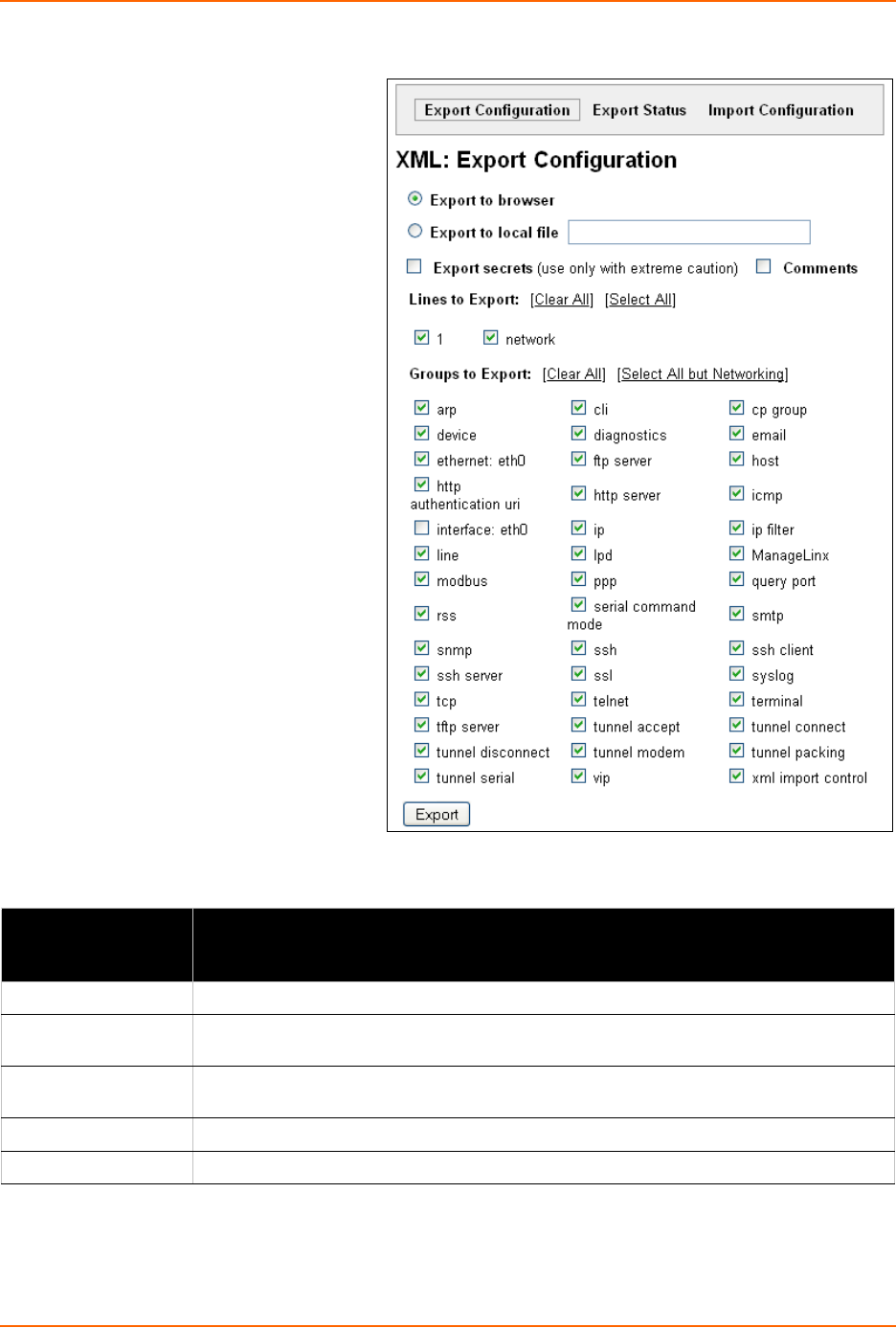
15: Advanced Settings
EDS User Guide 140
XML: Export Configuration
On this web page you can export the
current system configuration in XML
format.
To export the system
configuration:
1. Select XML on the menu bar.
The XML: Export Configuration
page appears.
The number of Lines to Export
and the specific Groups to
Export displayed on your
screen may vary according to
your particular product.
2. Enter or modify the following
settings:
Table 15-8 XML Export Configuration
3. Click Export. The groups display if exporting the data to the browser. If exporting the data to a
local file, the file is stored on the file system.
XML Export
Configuration
Settings
Description
Export to browser Select this option to export the XCR data in the selected fields to a web browser.
Export to local file Select this option to export the XCR data to a file on the device. If you select this option,
enter a file name for the XML configuration record.
Export secrets Only use this with extreme caution. If selected, secret password and key information will
be exported. Use only with a secure link, and save only in secure locations.
Lines to Export Select the instances you want to export in the line, LPD, tunnel, and terminal groups.
Groups to Export Check the configuration groups that are to be exported to the XML configuration record.
Figure 15-7 XML: Export Configuration
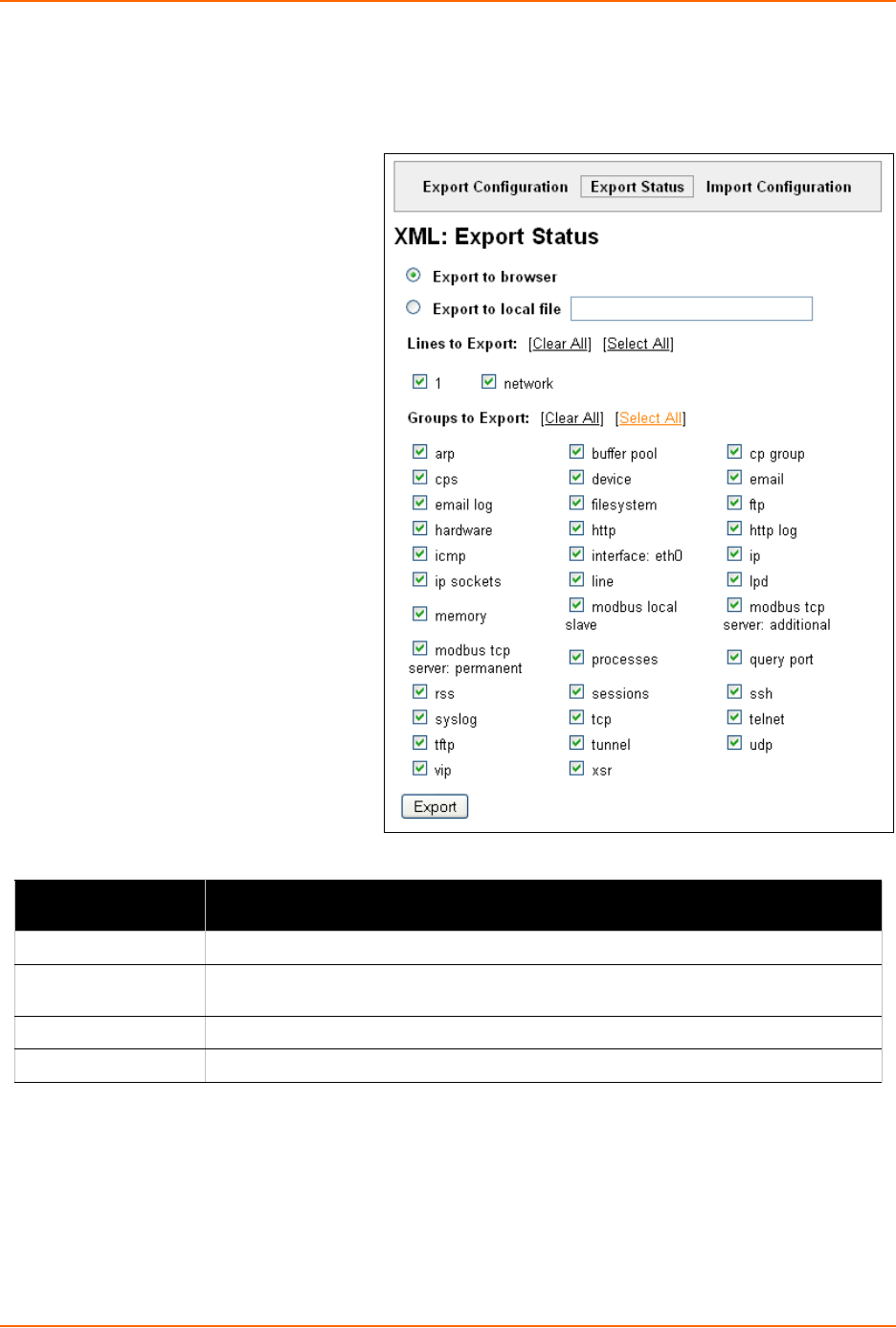
15: Advanced Settings
EDS User Guide 141
Note: Most browsers will interpret and display the XML data without the XML tags. To
view the raw XML, choose the view file source feature of your browser.
XML: Export Status
On this page you can export the
current system status in XML
format. The XML data can be
exported to the browser page or to
a file on the file system.
To export the system status:
1. Select XML on menu bar and
then Export Status at the top
of the page. The XML: Export
Status page appears.
The number of Lines to
Export and the specific
Groups to Export displayed
on your screen may vary
according to your particular
product.
2. Enter or modify the following
settings:
Table 15-10 XML Export Status
3. Click Export. The groups display if exporting the data to the browser. If exporting the data to a
local file system, the file is stored on the file system.
Note: Most browsers will interpret and display the XML data without the XML tags. To
view the raw XML, choose the view file source feature of your browser.
XML: Export System
Status Settings Description
Export to browser Select this option to export the XML status record to a web browser.
Export to local file Select this option to export the XML status record to a file on the device. If you select
this option, enter a file name for the XML status record.
Lines to Export Select the instances you want to export in the line, LPD, tunnel, and terminal groups.
Groups to Export Check the configuration groups that are to be exported into the XML status record.
Figure 15-9 XML: Export Status
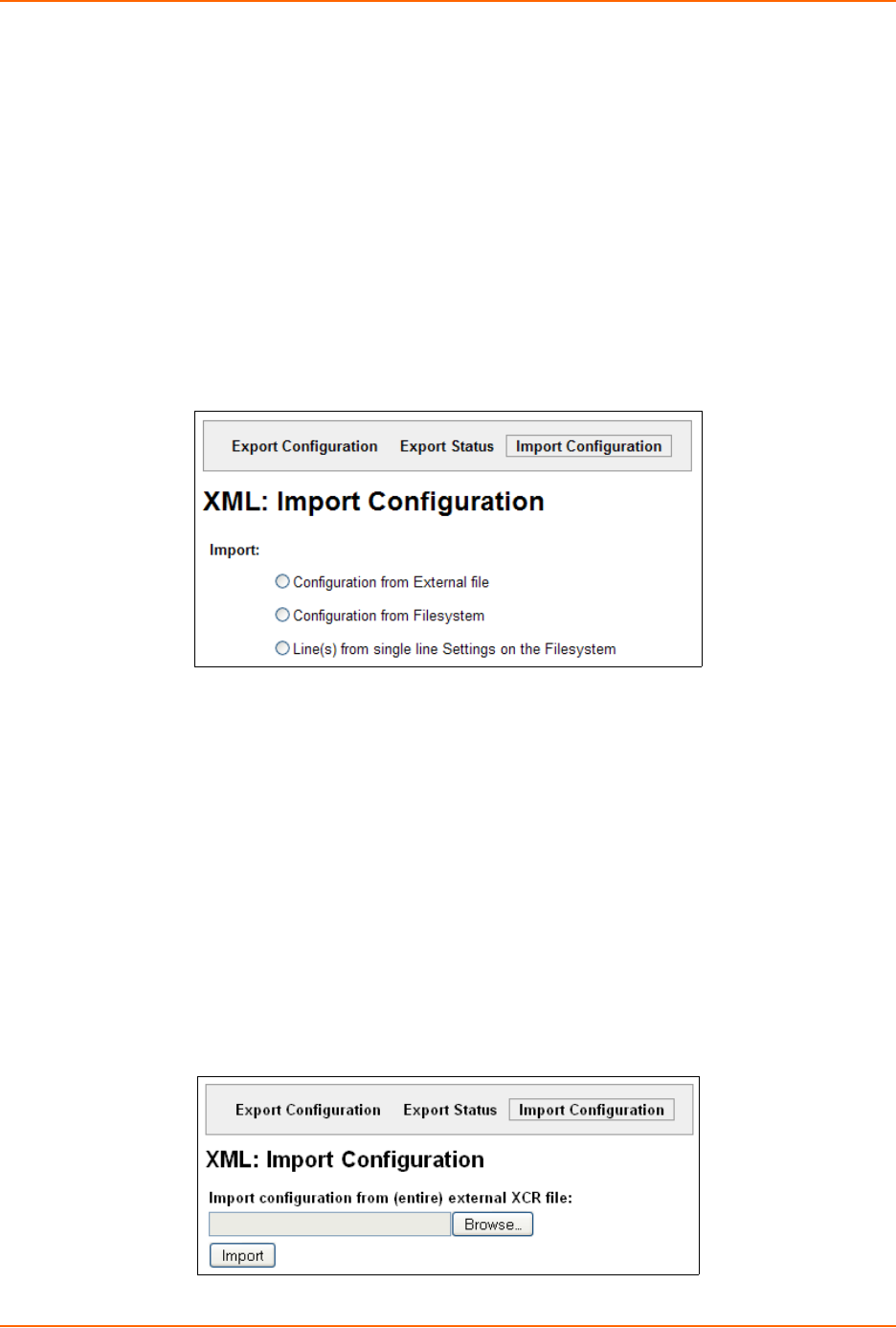
15: Advanced Settings
EDS User Guide 142
XML: Import Configuration
Here you can import a system configuration from an XML file.
The XML data can be imported from a file on the file system or uploaded using HTTP. The groups
to import can be specified by toggling the respective group item or entering a filter string. When
toggling a group item, all instances of that group will be imported. The filter string can be used to
import specific instances of a group. The text format of this string is: <g>:<i>;<g>:<i>;...
Each group name <g> is followed by a colon and the instance value <i>. Each <g> :<i> value is
separated with a semicolon. If a group has no instance, specify the group name <g> only.
To import a system configuration:
1. Select XML on the menu bar and then Import Configuration at the top of the page. The XML:
Import Configuration web page appears.
Figure 15-11 XML: Import Configuration
2. Click one of the following radio buttons:
Configuration from External file. See Import Configuration from External File on page 142.
Configuration from Filesystem. See Import Configuration from the Filesystem on
page 143.
Line(s) from single line Settings on the Filesystem. See Import Line(s) from Single Line
Settings on the Filesystem on page 145.
Import Configuration from External File
This selection shows a field for entering the path and file name of the entire external XCR file you
want to import. You can also browse to select the XCR file.
Figure 15-12 XML: Import Configuration from External File
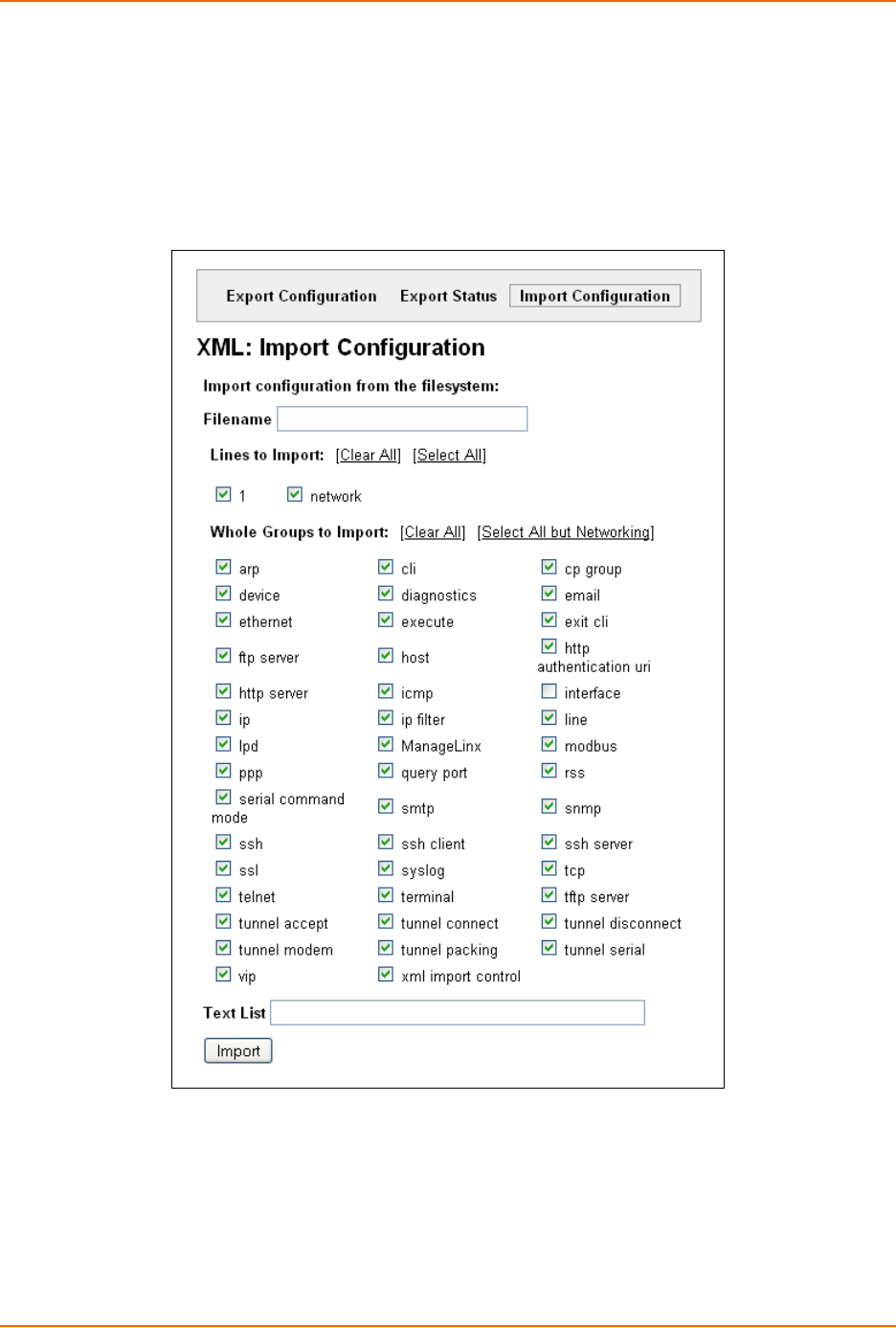
15: Advanced Settings
EDS User Guide 143
Import Configuration from the Filesystem
This selection shows a page for entering the filesystem and your import requirements – groups,
lines, and instances. The number of Lines to Import and the specific Whole Groups to Import
displayed on your screen may vary according to your particular product.
Figure 15-13 XML: Import from Filesystem

15: Advanced Settings
EDS User Guide 144
1. Enter or modify the following settings.
Figure 15-14 XML: Import Configuration from Filesystem
2. Click Import.
Import Configuration from
Filesystem Settings Description
Filename Enter the name of the file on the device (local to its filesystem) that
contains XCR data.
Lines to Import Select the lines or network whose settings you want to import.
Click the Select All link to select all the serial lines and the
network lines. Click the Clear All link to clear all of the
checkboxes. By default, all line instances are selected.
Only the selected line instances will be imported in the line, LPD,
tunnel, and terminal groups.
Whole Groups to Import Select the configuration groups to import from the XML
configuration record. This option imports all instances of each
selected group unless it is one of the Lines to Import.
Note: By default, all groups are checked except those pertaining
to the network configuration; this is so that import will not break
your network connectivity.
You may check or uncheck any group to include or omit that group
from import. To import all of the groups, click the Select All but
Networking link to import all groups. To clear all the checkboxes,
click the Clear All link.
Text List Enter a string to import specific instances of a group. The textual
format of this string is:
<g>:<i>;<g>:<i>;...
Each group name <g> is followed by a colon and the instance
value <i> and each <g>:<i> value is separated by a semi-colon. If
a group has no instance, then specify the group name <g> only.
Use this option for groups other than those affected by Lines to
Import.
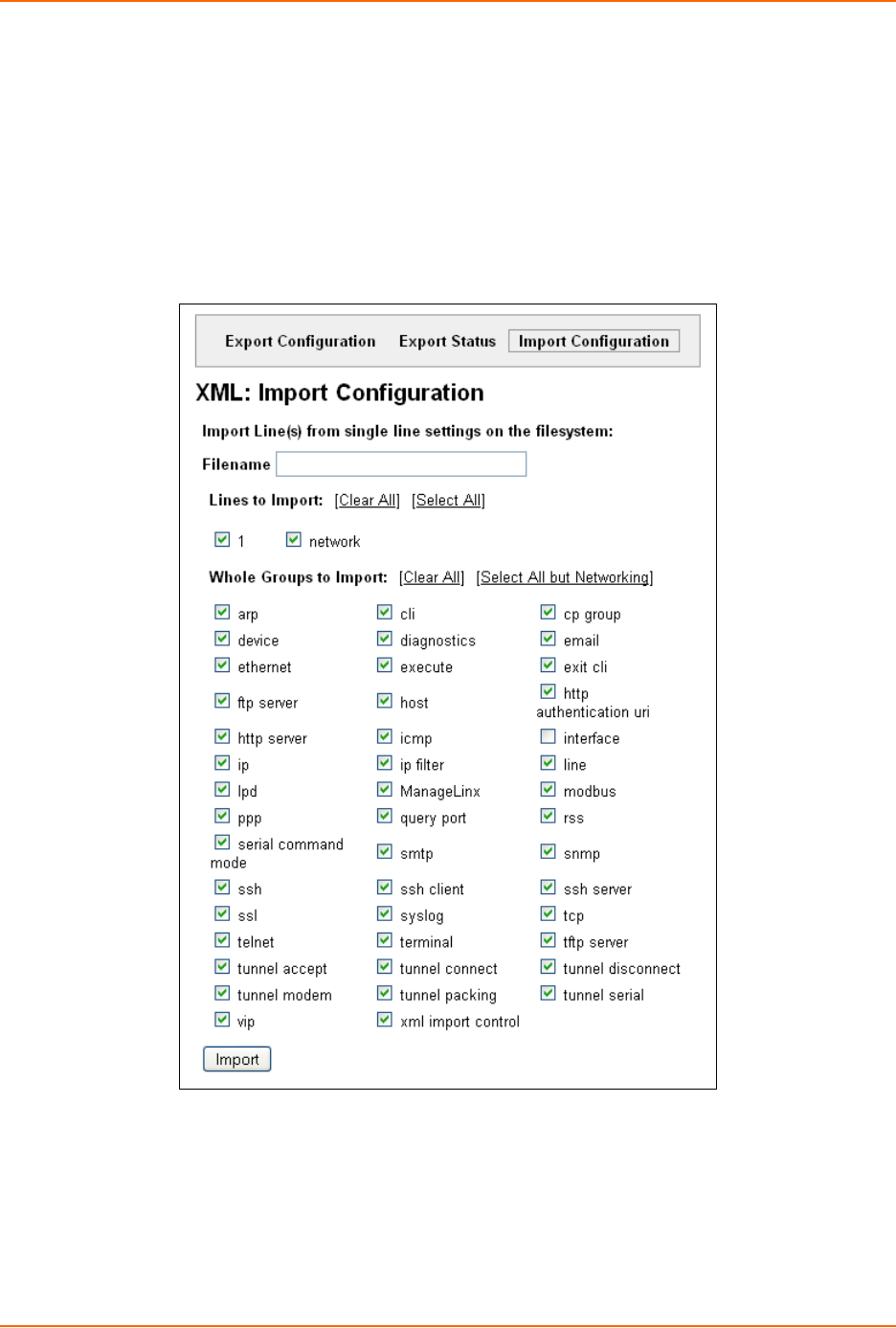
15: Advanced Settings
EDS User Guide 145
Import Line(s) from Single Line Settings on the Filesystem
This selection copies line settings from the single line instance in the input file to selected lines.
The import file may only contain records from a single line instance; this is done by selecting a
single Line to Export when exporting the file. The number of Lines to Import and the specific
Whole Groups to Import displayed on your screen may vary according to your particular product.
To modify Single Line Settings on the Filesystem:
Figure 15-15 XML: Import Line(s) from Single Line Settings on the Filesystem

15: Advanced Settings
EDS User Guide 146
1. Enter of modify the following settings:
Table 15-16 XML: Import Line(s) from Single Line Settings
2. Click Import.
Import Line(s) Settings Description
Filename Provide the name of the file on the device (local to its file system) that
contains XCR data.
Lines to Import Select the line(s) whose settings you want to import. Click the Select All
link to select all the serial lines and the network lines. Click the Clear All
link clear all of the checkboxes. By default, all serial line instances are
selected.
Whole Groups to Import Select the configuration groups to import from the XML configuration
record.
Note: By default, all groups are checked except those pertaining to the
network configuration; this is so that import will not break your network
connectivity.
You may check or uncheck any group to include or omit that group from
import. To import all of the groups, click the Select All but Networking
link to import all groups. To clear all the checkboxes, click the Clear All
link.

EDS User Guide 147
16: VIP Settings
VIP (Virtual IP) takes advantage of the Lantronix ManageLinx technology that solves the access-
through-firewall problem. ManageLinx utilizes existing network infrastructure to create a virtual
device network (VDN). The VDN provides direct access to only authorized equipment, behind
firewalls, from anywhere via the net.
ManageLinx is a secure and totally transparent remote access solution. The VDN technology
enables you to create dedicated TCP/IP connections between any two devices, using easily
deployed hardware appliances. There is no client software to install. No changes are required to
network software or applications at either end of the connection.
The VDN hardware consists of a publicly accessible Device Services Manager (DSM) and
individual Device Services Controller (DSC) appliances in multiple locations. Together, these two
components enable you to set up and manage individual Virtual IP (VIP) addresses and routes.
The EDS, with VIP enabled, takes the place of a DSC and provides direct access to your
equipment.
The EDS supports both Accept and Connect Mode tunneling through VIPs. Configuring an EDS to
use VIP Access involves:
Obtaining a Bootstrap File
Importing the Bootstrap File
Enabling VIP
Configuring Tunnels to Use VIP
Once the EDS is configured and enabled to use VIPs, it will immediately attempt to establish a
conduit with the ManageLinx DSM. Once the conduit is up, tunneling via VIP Access is ready to
go. This chapter also contains the following VIP sections:
Virtual IP (VIP) Statistics
Virtual IP (VIP) Counters
Virtual IP (VIP) Configuration
Obtaining a Bootstrap File
The ManageLinx XML bootstrap file is an XML file that contains the information required to contact
and authenticate to a DSM. This file must be generated and sent to you by the DSM administrator.
See the ManageLinx documentation for more details.
Importing the Bootstrap File
To configure an EDS to use VIP Access, import the bootstrap file as you would any XML
Configuration Record (XCR). For instructions on importing XCRs see Advanced Settings (on page
134).
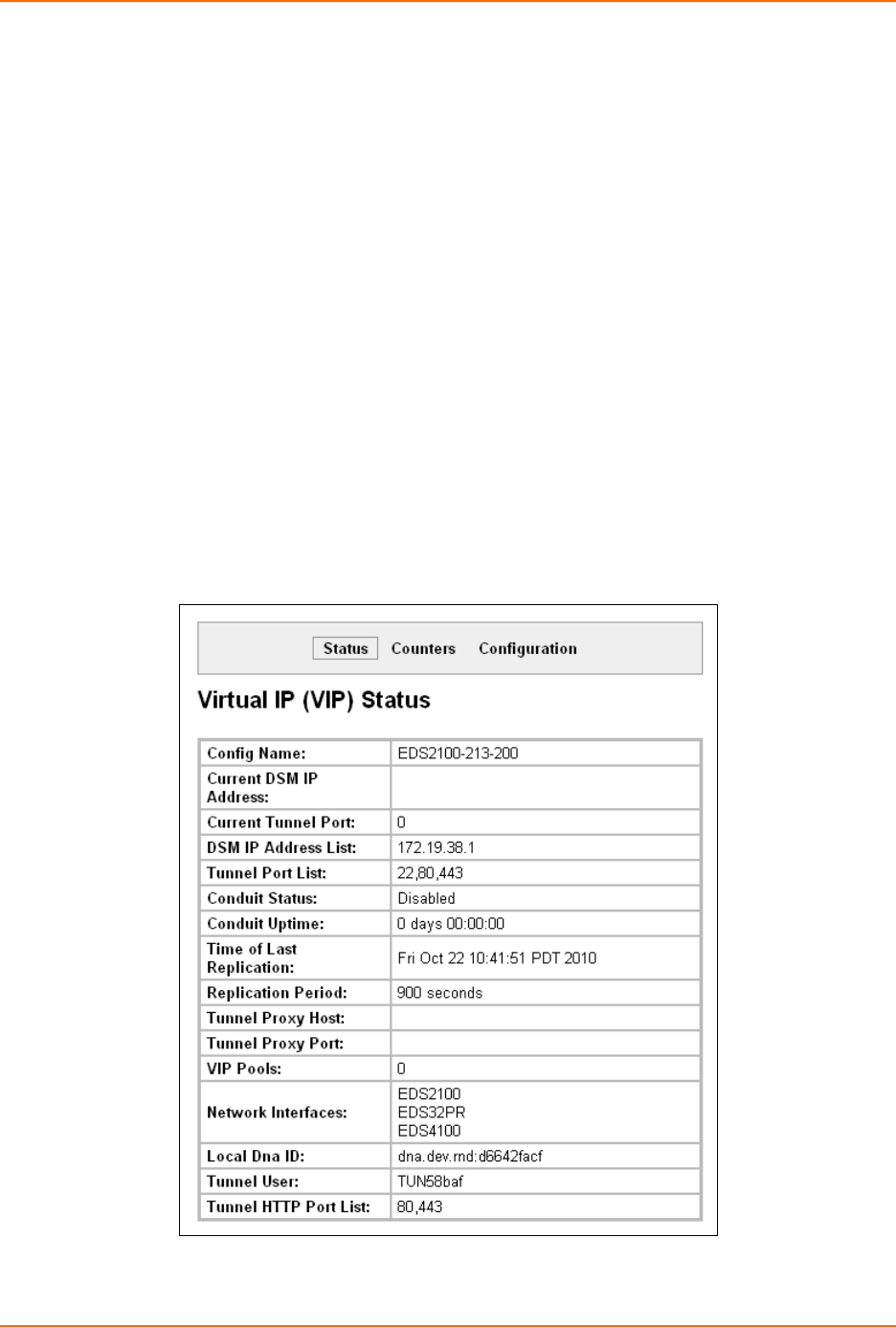
16: VIP Settings
EDS User Guide 148
Enabling VIP
Once the bootstrap file has been imported, VIP Access can be enabled and a conduit with the
DSM will be established. The VIP Statistics shows the current state of the conduit. When
configured correctly, a conduit with the DSM will be maintained at all times.
Configuring Tunnels to Use VIP
Configuring Connect Mode tunnels to use VIP is a simple matter of configuring a tunnel as is
normally done, but also enabling VIP in the Tunnel Host settings, and using a VIP Name for the
address.
VIP Accept Mode tunnels do not require special configuration. If VIP access is enabled (in the VIP
configuration page), then VIP Accept Mode requests from a ManageLinx device will be accepted.
Virtual IP (VIP) Statistics
To view the EDS VIP Statistics:
1. Select VIP from the main menu. The VIP Status page appears.
Figure 16-1 VIP Status
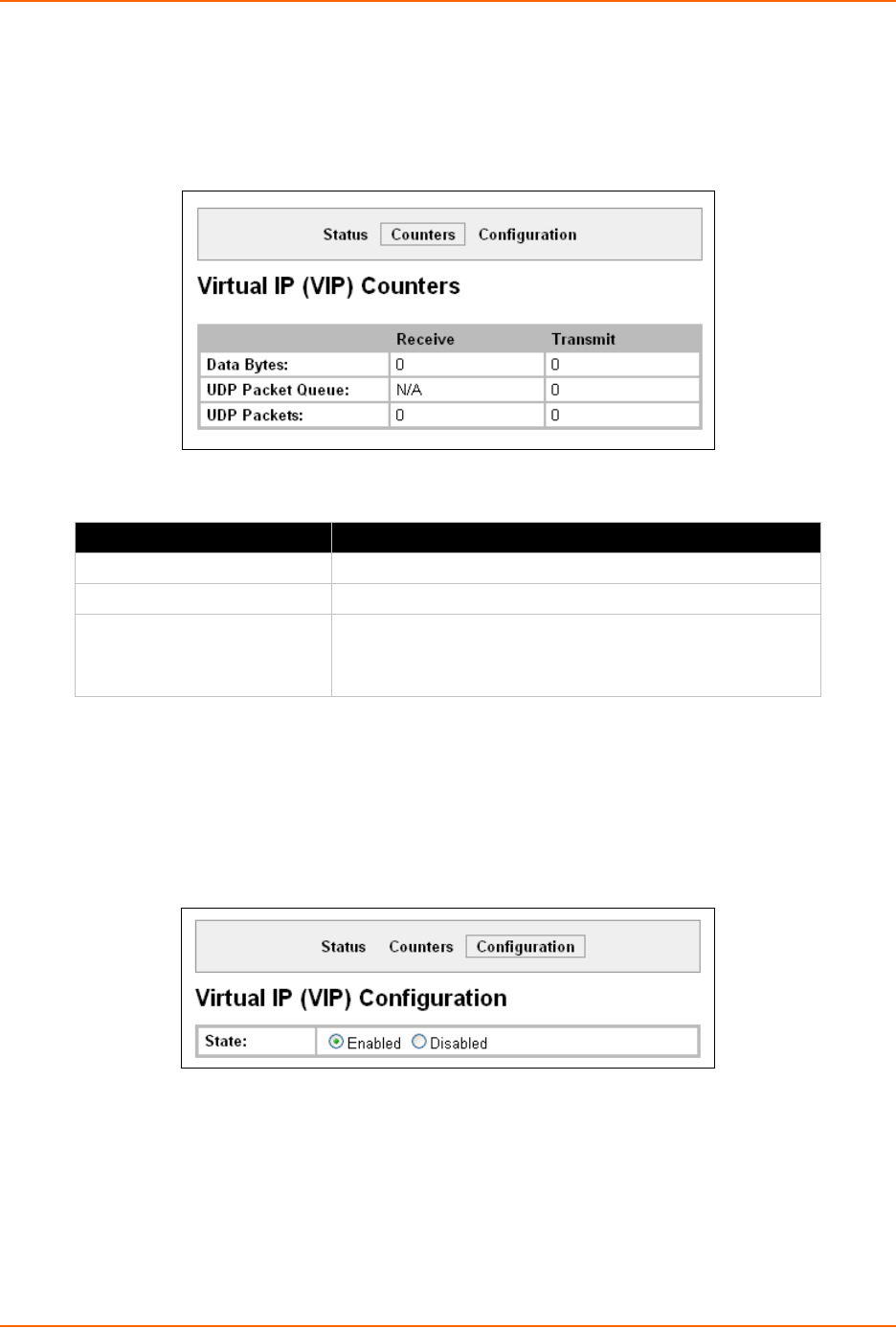
16: VIP Settings
EDS User Guide 149
Virtual IP (VIP) Counters
To view EDS VIP settings:
1. Select VIP > Counters from the main menu. The VIP Counters page displays.
Figure 16-2 VIP Counters
Table 16-3 VIP Counters
Virtual IP (VIP) Configuration
To configure the EDS VIP settings:
1. Select VIP >Configuration from the main menu. The VIP Configuration page displays.
Figure 16-4 VIP Configuration Page
2. Click Enabled/Disabled to use/turn off VIP addresses in Tunnel Accept Mode and Tunnel
Connect Mode. The default is disabled.
3. Click Submit save a changed state.
VIP Counters Description
Data Bytes Total bytes in the TCP packets (not the UDP packets)
UDP Packet Queue The number of packets queued for transmission.
UDP Packets The number of packets transmitted.
Note: UDP counts are packet based, and do not record the
number of data bytes.

EDS User Guide 150
17: Branding the EDS
This chapter describes how to brand your EDS by using Web Manager and Command Line
Interface (CLI). It contains the following sections on customization:
Web Manager Customization
Short and Long Name Customization
Web Manager Customization
Customize the Web Manager’s appearance by modifying index.html and style.css. The style
(fonts, colors, and spacing) of the Web Manager is controlled with style.css and the text and
graphics are controlled with index.html.
The Web Manager files are hidden and are incorporated directly into the firmware image but may
be overridden by placing the appropriate file in the appropriate directory on the EDS file system.
Web Manager files can be retrieved and overridden with the following procedure:
1. FTP to the EDS device.
2. Make a directory (mkdir) and name it http/config
3. Change to the directory (cd) that you created in step 2. (http/config)
4. Get the file by using get <filename>
5. Modify the file as required or create a new one with the same name
6. Put the file by using put <filename>
7. Type quit. The overriding files appear in the file system’s http/config directory.
8. Restart any open browser to view the changes.
9. If you wish to go back to the default files in the firmware image, simply delete the overriding
files from the file system.
Short and Long Name Customization
Short and long names may be customized in Web Manager according to the directions in System
Settings on page 132 of Chapter 14: Maintenance and Diagnostics Settings. The names display in
the CLI show command and in the System web page in the Current Configuration table. The short
name is used for the show command. Both names display in the CLI Product Type field in the
following example:
(enable)# show
The long and short names appear in the Product Type field in the following format:
Product Type: <long name> (<short name>)
For example:
(enable)# show EDS
Product Information:
Product Type: Lantronix EDS (EDS)
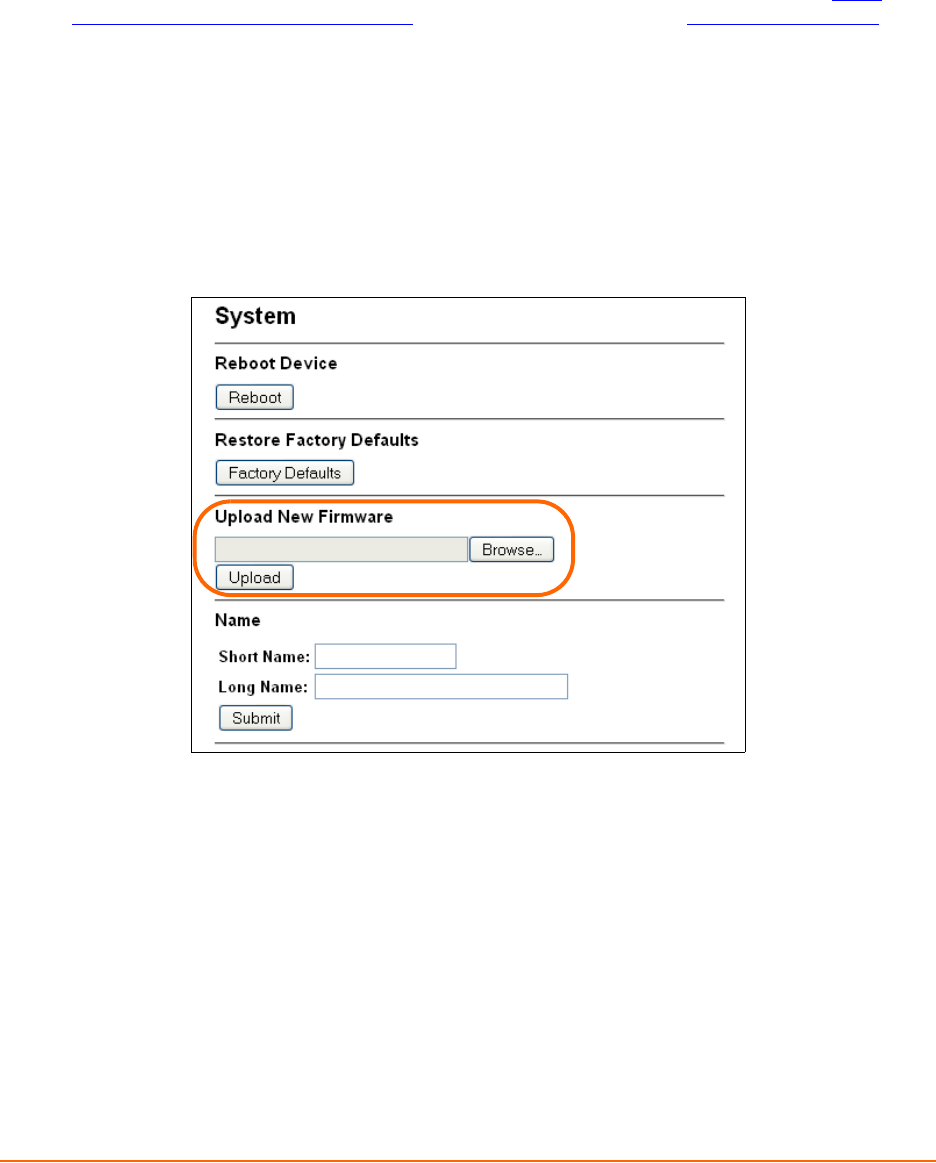
EDS User Guide 151
18: Updating Firmware
Obtaining Firmware
Obtain up-to-date firmware and release notes for the unit from the Lantronix web site (http://
www.lantronix.com/support/downloads) or by using anonymous FTP (ftp://ftp.lantronix.com/).
Loading New Firmware
Reload the firmware using the device web manager Filesystem page.
To upload new firmware:
1. Select System in the menu bar. The Filesystem page appears.
Figure 18-1 Update Firmware
2. Click Browse to browse to the firmware file.
3. Highlight the file and click Open.
4. Click Upload to install the firmware on the EDS. The device automatically reboots on the
installation of new firmware.
5. Close and reopen the web manager internet browser to view the device’s updated web pages.
Note: Alternatively, firmware may be updated by sending the file to the EDS over a FTP
or TFTP connection.

EDS User Guide 152
Appendix A - Technical Support
If you are unable to resolve an issue using the information in this documentation, please contact
Technical Support:
Technical Support US
Check our online knowledge base or send a question to Technical Support at
http://www.lantronix.com/support.
Technical Support Europe, Middle East, Africa
Phone: +33 13 930 4172
Email: eu_techsupp@lantronix.com or eu_support@lantronix.com
Firmware downloads, FAQs, and the most up-to-date documentation are available at
http://www.lantronix.com/support.
When you report a problem, please provide the following information:
Your name, and your company name, address, and phone number
Lantronix model number
Lantronix serial number
Firmware version (on the first screen shown when you Telnet to the device and type show)
Description of the problem
Status of the unit when the problem occurred (please try to include information on user and
network activity at the time of the problem)
Additionally, it may be useful to export and submit the XML Configuration and XML Status files

EDS User Guide 153
Appendix B - Binary to Hexadecimal Conversions
Many of the unit’s configuration procedures require you to assemble a series of options
(represented as bits) into a complete command (represented as a byte).
The resulting binary value must be converted to a hexadecimal representation.
Use this chapter to learn to convert binary values to hexadecimals or to look up hexadecimal
values in the tables of configuration options. The tables include:
Command Mode (serial string sign-on message)
AES Keys
Converting Binary to Hexadecimal
Conversion Table
Hexadecimal digits have values ranging from 0 to F, which are represented as 0-9, A (for 10), B
(for 11), etc. To convert a binary value (for example, 0100 1100) to a hexadecimal representation,
treat the upper and lower four bits separately to produce a two-digit hexadecimal number (in this
case, 4C). Use the following table to convert values from binary to hexadecimal.
Table 20-1 Binary to Hexadecimal Conversion Table
Decimal Binary Hex
0 0000 0
1 0001 1
2 0010 2
3 0011 3
4 0100 4
5 0101 5
6 0110 6
7 0111 7
8 1000 8
9 1001 9
10 1010 A
11 1011 B
12 1100 C
13 1101 D
14 1110 E
15 1111 F
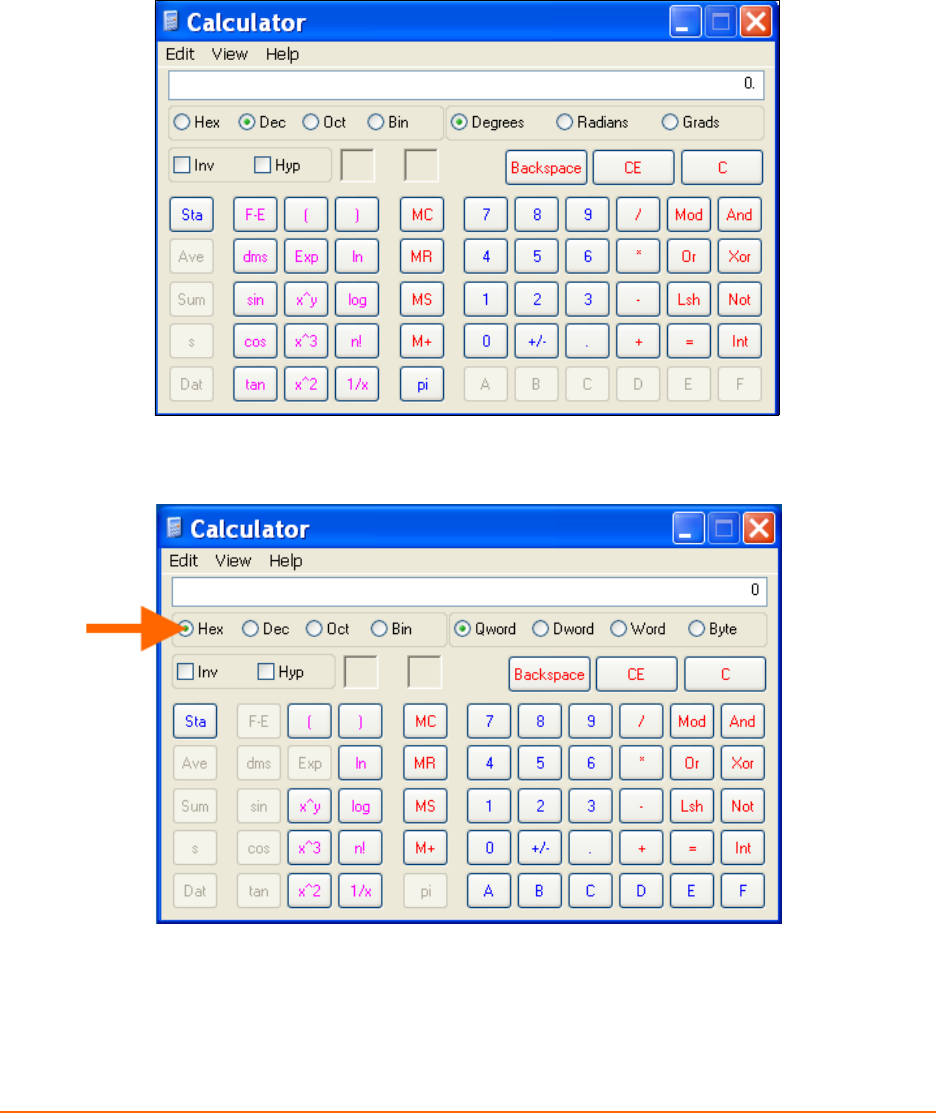
EDS User Guide 154
Scientific Calculator
Another simple way to convert binary to hexadecimal is to use a scientific calculator, such as the
one available on the Windows operating systems. For example:
1. On the Windows Start menu, click Programs > Accessories > Calculator.
2. On the View menu, select Scientific. The scientific calculator appears.
3. Click Bin (Binary), and type the number you want to convert.
4. Click Hex. The hexadecimal value appears.

EDS User Guide 155
Appendix C - Compliance
(According to ISO/IEC Guide 22 and EN 45014)
Manufacturer’s Name & Address:
Lantronix 167 Technology Drive, Irvine, CA 92618 USA
Product Name Model:
EDS4100 4 Port Device Server, EDS8PR 8 Port Device Server, EDS16PR 16 Port Device Server,
and EDS32PR 32 Port Device Server, EDS8PS 8 Port Device Server, and EDS16PS 16 Port
Device Server
Conform to the following standards or other normative documents:
Radiated and Conducted Emissions
Class B limits of EN55022: 1998
EN55024: 1998 + A1: 2001
Direct & Indirect ESD
EN61000-4-2: 1995
RF Electromagnetic Field Immunity
EN61000-4-3: 1996
Electrical Fast Transient/Burst Immunity
EN61000-4-4: 1995
Surge Immunity
EN61000-4-5: 1995
RF Common Mode Conducted Susceptibility
EN61000-4-6: 1996
Power Frequency Magnetic Field Immunity
EN61000-4-8: 1993
Voltage Dips and Interrupts
EN61000-4-11: 1994
Manufacturer’s Contact:
Lantronix
167 Technology Drive, Irvine, CA 92618 USA
Tel: 949-453-3990
Fax: 949-450-7249

EDS User Guide 156
RoHS Notice
All Lantronix products in the following families are China RoHS-compliant and free of the following hazardous substances and
elements:
O: toxic or hazardous substance contained in all of the homogeneous materials for this part is below the limit requirement
in SJ/T11363-2006.
X: toxic or hazardous substance contained in at least one of the homogeneous materials used for this part is above the
limit requirement in SJ/T11363-2006.
Lithium Battery Notice
ATTENTION:
DANGER OF EXPLOSION IF BATTERY IS INCORRECTLY REPLACED. REPLACE
ONLY WITH THE SAME OR EQUIVALENT TYPE RECOMMENDED BY THE MANUFACTURER.
DISCARD USED BATTERIES ACCORDING TO THE MANUFACTURER'S INSTRUCTIONS.
ACHTUNG:
WIRD BEIM BATTERIEWECHSEL EINE FALSCHE BATTERIE EINGESETZT,
BESTEHT EXPLOSIONSGEFAHR. SETZEN SIE NUR EINE BATTERIE DES GLEICHEN ODER EINES
ENTSPRECHENDEN, VOM HERSTELLER EMPFOHLENEN TYPS EIN. ENTSORGEN SIE
VERBRAUCHTE BATTERIEN GEMÄSS DEN ANWEISUNGEN DES HERSTELLERS.
Installationsanweisungen
Rackmontage
Bei Montage in ein geschlossenes Rack oder in ein Rack mit mehreren Einheiten ist unter
Umständen eine weitere Prüfung erforderlich. Folgende Punkte sind zu berücksichtigen.
Die Umgebungstemperatur innerhalb des Racks kann höher sein als die
Raumtemperatur. Die Installation muss so durchgeführt werden, dass der für den sicheren
Betrieb erforderliche Luftstrom nicht beeinträchtigt wird. In dieser Umgebung darf die
• Lead (Pb) • Mercury (Hg) • Polybrominated biphenyls (PBB)
• Cadmium (Cd) • Hexavalent Chromium (Cr (VI)) • Polybrominated diphenyl ethers
(PBDE)
Product Family Name Toxic or hazardous Substances and Elements
Lead (Pb) Mercury (Hg) Cadmium
(Cd)
Hexavalent
Chromium (Cr
(VI))
Polybrominat
ed biphenyls
(PBB)
Polybrominate
d diphenyl
ethers (PBDE)
UDS1100 and 2100 0 0 0 0 0 0
EDS 0 0 0 0 0 0
MSS100 0 0 0 0 0 0
IntelliBox 0 0 0 0 0 0
XPress DR & XPress-DR+ 0 0 0 0 0 0
SecureBox 1101 & 2101 0 0 0 0 0 0
WiBox 0 0 0 0 0 0
UBox 0 0 0 0 0 0
MatchPort 0 0 0 0 0 0
SLC 0 0 0 0 0 0
XPort 0 0 0 0 0 0
WiPort 0 0 0 0 0 0
SLB 0 0 0 0 0 0
SLP 0 0 0 0 0 0
SCS 0 0 0 0 0 0
SLS 0 0 0 0 0 0
DSC 0 0 0 0 0 0
PremierWave 0 0 0 0 0 0

EDS User Guide 157
maximale Temperatur von 50°C nicht überschritten werden. Dabei sind auch die
maximalen Auslegungstemperaturen zu berücksichtigen.
Die Installation ist so durchzuführen, dass auch bei ungleichmäßiger Lastverteilung die
Stabilität gewährleistet bleibt.
Energiezufuhr
Anhand der Angaben auf dem jeweiligen Typenschild ist sicherzustellen, dass keine Überlastung
an der Einspeisung erfolgt, die den Überstromschutz und die Versorgungsleitungen beeinträchtigt.
Erdung
Eine zuverlässige Schutzerdung dieser Ausrüstung muss gewährleistet sein. Dies gilt besonders
bei Anschluss an Mehrfachsteckdosen.
Installation Instructions
Rack Mounting
If rack mounted units are installed in a closed or multi-unit rack assembly, they may require further
evaluation by certification agencies. You must consider the following items:
The ambient conditions within the rack may be greater than the room conditions.
Installation should be so that the amount of air flow required for safe operation is not
compromised. The maximum temperature for the equipment in this environment is 50°C.
Consideration should be given to the maximum rated ambient conditions.
Installation should be so that a hazardous stability condition is not achieved due to uneven
loading.
Input Supply
Check nameplate ratings to assure there is no overloading of supply circuits that have an effect on
over current protection and supply wiring.
Grounding
Reliable earthing of this equipment must be maintained. Particular attention should be given to
supply connections when connecting to power strips, rather than direct connections to the branch
circuit strips.

EDS User Guide 158
Appendix D - Lantronix Cables and Adapters
Lantronix cables and adapters for use with the EDS devices are listed here according to part
number and application.
Lantronix P/N Description Applications
500-103 6’ RJ45-to DB9F Included with EDS8/16/32PR for setup or device connectivity.
Connects the RJ45 RS232 serial ports of EDS8/16/32PR to a DB9M
DTE interface of a PC or serial device.
200.2062 Cable Ethernet
CAT5; RJ45, 2 m
(6.6 ft)
Connects the EDS8/16/32PR Ethernet ports to an Ethernet switch/
hub or is used for cascading from one EDS8/16/32PR to another.
Connects the EDS8/16/32PR serial RJ45 RS232 ports to a device
using one of the adapters listed below.
200.2063 Cable Ethernet
CAT5; RJ45, 5 m
(16.4 ft)
Connects the EDS8/16/32PR Ethernet ports to an Ethernet switch/
hub or is used for cascading from one EDS8/16/32PR to another.
Connects the EDS8/16/32PR serial RJ45 RS232 ports to a device
using one of the below listed adapters.
200.2064 Cable Ethernet
CAT5; RJ45, 10 m
(32.8 ft)
Connects the EDS8/16/32PR Ethernet ports to an Ethernet switch/
hub or is used for cascading from one EDS8/16/32PR to another.
Connects the EDS8/16/32PR serial RJ45 RS232 ports to a device
using one of the adapters listed below.
200.2065 Cable Ethernet
CAT5; RJ45, 15 m
(49.2 ft)
Connects the EDS8/16/32PR Ethernet ports to an Ethernet switch/
hub or is used for cascading from one EDS8/16/32PR to another.
Connects the EDS8/16/32PR serial RJ45 RS232 ports to a device
using one of the adapters listed below.
200.2066A Adapter RJ45-to-
DB25M
Allows a standard straight-pinned CAT5 cable to connect the EDS8/
16/32PR RJ45 serial ports to the DB25F DTE interface of a serial
device.
200.2067A Adapter RJ45-to-
DB25F
Allows a standard straight-pinned CAT5 cable to connect the EDS8/
16/32PR RJ45 serial ports to the DB25M DTE interface of a serial
device.
200.2069A Adapter RJ45-to-
DB9M
Allows a standard straight-pinned CAT5 cable to connect the EDS8/
16/32PR RJ45 serial ports to the DB9F DCE interface of a serial
device.
200.2070A Adapter RJ45-to-
DB9F
Allows a standard straight-pinned CAT5 cable to connect the EDS8/
16/32PR to the DB9M DTE interface of a PC or serial device.
200.2073 Adapter RJ45-to-
DB25M
Allows a standard straight-pinned CAT5 cable to connect the EDS8/
16/32PR RJ45 serial ports to the DB25F DCE interface of a serial
device.
200.2074 Adapter RJ45-to-
DB25F
Allows a standard straight-pinned CAT5 cable to connect the EDS8/
16/32PR RJ45 serial ports to the DB25M DCE interface of a serial
device.
ADP010104-01 Adapter "Rolled"
RJ45-to-RJ45
Allows a standard straight-pinned CAT5 cable to connect the EDS8/
16/32 to an RJ45 console port on products from Cisco and other
manufacturers.

EDS User Guide 159
Index
A
Accept Mode 56
Accept Mode 63
Additional Documentation 15
Additional TCP Server Port 111
Address
Ethernet 23
Hardware 23, 24
IP 23
MAC 23, 24
Advanced Settings
Email Configuration 135
XML Configuration 139
Advanced Settings 134
AES 20
Allow Firmware Update 83
Allow TFTP File Creation 83
Allow XCR Import 83
Applications 20
ARP 20
ARP Settings 118, 119
ASCII 109
Auth Type 89
Authentication Type 89
Authority 107
AutoIP 20
B
Banner 91
Bar Code 24
Bin 154
Binary 91, 153
Binary to Hexadecimal Conversions 153
Block Network 65, 69
Block Serial 69
Block Serial Data 65
BOOTP 20, 49
Branding 150
Web Manager Customization 150
Break Duration 76
C
CLI 21
CLI Configuration 137
CLI Statistics 137
Command Line Interface Settings 137
Command Mode 23
Command-Line Interface 21
Common Name 108
Compliance 155
Configuration Methods 22
Configuration Settings 79
Configuring Tunnels to Use VIP 148
Connect Mode 56
Connect Mode 66
Console Port 26, 37
Convert Newlines 92
Count 125
Create New Keys 102
Create New Self-Signed Certificate 107
D
Date 132
Default Gateway 50
Default Server Port Numbers 23
Device Control 21
Device Details 41
Device Details Summary 41
Device Management 22
Device Status 44
DeviceInstaller 41
DeviceInstaller 41
DHCP 20, 50
Diagnostic Toolset 22
Diagnostics 122
Buffer Pools 129
Hardware 122
IP Sockets 124
Memory 129
MIB-II Statistics 123
Ping 124
Processes 130
Diagnostics Log 127
Diagnostics Settings 112
Direct & Indirect ESD 155
Disconnect Mode 56
Disconnect Mode 71
DNS 20, 50
DNS Settings 79
E
Echo 76, 77
Electrical 155
Electrical Fast Transient/Burst Immunity 155
Email on Connect 65, 69
Email on Disconnect 65, 69

EDS User Guide 160
Enable Level Password 138
Encryption 22
End of Job 91
Enterprise-Grade Security 21
EOJ String 92
Ethernet address 23
Ethernet Port 27, 32, 38
Evolution OS 20
Evolution OS™ 20
Exit Connect Menu 76, 77
Expires 108
Export Secrets 140
Export to Browser 140, 141
Export to Local File 140, 141
F
File System
Browser 113
Statistics 112
Filename 144, 146
Filesystem 46, 151
Firewall 147
Firmware 151
Flush Serial Data 65, 69
Formfeed 91
FreeRADIUS 105
FTP 20, 151
FTP Configuration 81
G
Groups to Export 140, 141
H
Hardware Address 23, 24
Hardware Address 23
Hex 154
Hexadecimal 153
Host 68, 114, 125, 126
Host Configuration 78
Host Configuration 78
Host IP Promotion 70
Hostname 50
HTTP 20
Authentication 88
Change Configuration 86
Configuration 85
Statistics 85
I
ICMP 20
ICMP Settings 116
Import Configuration from External File 142
Import Configuration from the Filesystem 143
Import Line(s) from Single Line Settings on the File-
system 145
Inactivity Timeout 138
IP 20
Address 23
Address Filter 120
Settings 116
ISO/IEC Guide 155
K
Key Length 108
Key Type 95, 96, 102
L
Label 24
Lantronix Discovery Protocol 23
LEDs 27, 33, 38
Line 1
Configuration 53
Statistics 52
Line Settings 52
Lines to Export 140, 141
Lines to Import 144, 146
Lithium Battery Notice 156
Loading New Firmware 151
Local Port 64, 68
Login Connect Menu 76, 77
Login Password 138
LPD
Configuration Page 91
Settings 90
LPD Statistics 90
M
MAC Address 23, 24
Maintenance and Diagnostics Settings
Protocol Stack 115
Maintenance Settings 112
ManageLinx 147
Manufacturer’s Contact 155
Manufacturer’s Name & Address 155
Manufacturing Date Code 24

EDS User Guide 161
Max Entries 90
Max Length 128
Modbus Configuration 111
Modbus Statistics 110
Modbus 109
Mode 68
Modem Emulation 21
Modem Emulation 72
MTU 50
Multiple Hosts 70
N
Name 133
Network 1 (eth0) Interface Configuration 49
Network 1 Ethernet Link 51
Network Settings
Network 1 Interface Configuration 49
Network 1 Interface Status 48
Network Settings 48
New Certificate 107
New Private Key 107
O
Obtaining a Bootstrap File 147
Obtaining Firmware 151
Organization Unit 107
P
Packing Mode 60
Password 65, 102
PBX 22
Persistent 90
Port 114
Port Numbers 23
Ports
Serial and Telnet 23
Power Frequency Magnetic Field Immunity 155
PPP Settings 80
Private Branch Exchange 22
Private Key 95, 96, 102
Product ID 24
Product Information Label 24
Product Name Model 155
Product Revision 24
Protocol 64, 78
Protocol Support 20
Public Key 95, 96, 102
Q
Query Port 121
Queue Name 92
Quit Connect Line 138
R
Radiated and Conducted Emissions 155
Read Community 81
Real Time Clock 132
Really Simple Syndication 21
Reboot Device 133
Reconnect Timer 69
Remote Address 78
Remote Command 102
Remote Port 78
Reset 27
Reset Button 27, 33, 39
Response Timeout 111
Restore Factory Defaults 28, 133
RF Common Mode Conducted Susceptibility 155
RF Electromagnetic Field Immunity 155
RJ45 Serial Port 27
RoHS Notice 156
RSS 20, 21
RSS Feed 90
RSS Settings 89
RSS Trace Input 111
RTC 132
RTU 109
S
Scientific 154
Scientific Calculator 154
SCPR 22
Secure Com Port Redirector 22
Secure Shell 93
Secure Sockets Layer 93, 103
Security
Enterprise-Grade 21
Settings 93
Security Settings 93
SSL Certificates and Private Keys 104
SSL Cipher Suites 103
SSL RSAor DSA 104
SSL Utilities 105
Send Break 76
Send Character 62
Serial Ports 26, 31, 37
Serial Settings 59

EDS User Guide 162
Serial Transmission Mode 109
Services Settings 79
LPD 90
Severity Level 128
Short and Long Name Customization 150
SMTP 20
SNMP 20
SNMP Configuration 80
SNMP Management 21
SOJ String 92
SSH 20, 93
Client Known Hosts 100
Server Authorized Users 98
Server Host Keys 94
Settings 93
SSH Client Known Hosts 100
SSH Client User Configuration 101
SSH Max Sessions 138
SSH Port 138
SSH Server Authorized Users 98
SSH Server Host Keys 94
SSH State 138
SSH Username 78
SSL 20, 93, 103
Settings 103
SSL Certificates 104
SSL Cipher Suites 103
SSL Configuration 106
SSL RSA or DSA 104
SSL Utilities 105
Start of Job 91
State 117
Steel Belted RADIUS 105
Surge Immunity 155
Syslog 20
Syslog Configuration 84
System Contact 81
System Description 81
System Location 81
System Name 81
System Settings 132
T
TCP 20
TCP Keep Alive 64
TCP Server State 111
TCP Settings 115
TCP/IP 109
Technical Support 152
Telnet 20
Telnet Max Sessions 138
Telnet Port 138
Telnet State 138
Terminal
Server 22
Settings 75
Terminal Block Connector 33
Terminal Type 76, 77
Text List 144
TFTP 20, 151
TFTP Configuration 83
Threshold 62
Time 132
Time Zone 132
Timeout 62, 125
TLS 20
Traceroute 126
Trailing Character 62
Traps Primary Destination 81
Traps Secondary Destination 81
Traps State 81
Troubleshooting 22
Troubleshooting Capabilities 22
Tunnel – Accept Mode 63
Tunnel – Connect Mode 66
Tunnel – Disconnect Mode 71
Tunnel – Packing Mode 60
Tunnel 1 – Statistics 57
Tunnel Settings
Connect Mode 66
Modem Emulation
Command Mode 72
Packing Mode 60
Tunnel Settings 56
Type 108
U
UDP 20
Uniform Resource Identifier 88
Updating Firmware 151
Upload Authority Certificate 107
Upload Certificate 107
Upload New Firmware 133
URI 88
Username 102
V
VIP Access 21
VIP Configuration 149
VIP Statistics 148
VIP Settings 147
Voltage Dips and Interrupts 155

EDS User Guide 163
W
Web Manager
Device Status Web Page 44
Navigating 46
Page Components 45
Page Summary 46
Web Manager Customization 150
Web Manager 43
Web-Based Configuration 21
Whole Groups to Import 144, 146
Write Community 81
X
XML 23
Export Configuration 140
Export Status 141
Import System Configuration 142
XML Settings 139
XML-Based Architecture 21
