Lenovo Safety Data Sheet Dowcal 200 Solution User Manual Legion Y920T 34IKZ Desktop (Lenovo)
2017-09-05
User Manual: Lenovo Safety Data Sheet Dowcal 200 Solution SAFETY DATA SHEET DOWCAL 200 SOLUTION Legion Y920T-34IKZ Desktop (Lenovo) Legion Y920T-34IKZ Desktop
Open the PDF directly: View PDF  .
.
Page Count: 10
- SECTION 1: Identification of the substance/mixture and of the company/undertaking
- SECTION 2: Hazards identification
- SECTION 3: Composition/information on ingredients
- SECTION 4: First aid measures
- SECTION 5: Firefighting measures
- SECTION 6: Accidental release measures
- SECTION 7: Handling and storage
- SECTION 8: Exposure Controls/personal protection
- SECTION 9: Physical and Chemical Properties
- SECTION 10: Stability and reactivity
- SECTION 11: Toxicological information
- SECTION 12: Ecological Information
- SECTION 13: Disposal considerations
- SECTION 14: Transport information
- SECTION 15: Regulatory information
- SECTION 16: Other information
Revision date: 07/12/2016 Revision: 03 Supersedes date: 12/08/2016
SAFETY DATA SHEET
DOWCAL 200 SOLUTION
SECTION 1: Identification of the substance/mixture and of the company/undertaking
1.1. Product identifier
Product name DOWCAL 200 SOLUTION
Product number 13412
Synonyms; trade names DOWCAL 200 25% SOL, DOWCAL 200 30% SOL, DOWCAL 200 35% SOL, DOWCAL 200
40% SOL, DOWCAL 200 55% SOL, DOWCAL 200 50% SOL, DOWCAL 200 45% SOL,
DOWCAL 200 25% GREEN, DOWCAL 200 35% SOL (RED)
1.2. Relevant identified uses of the substance or mixture and uses advised against
Identified uses Heat Carrier,
1.3. Details of the supplier of the safety data sheet
Supplier Univar
Aquarius House
6 Mid Point Business Park
Bradford
BD3 7AY
+44 1274 267300
sds@univar.com
+44 1274 267306
1.4. Emergency telephone number
Emergency telephone SGS - +32 (0)3 575 55 55 (24h)
Sds No. 13412
SECTION 2: Hazards identification
2.1. Classification of the substance or mixture
Classification (EC/1272/2008)
Physical hazards Not Classified
Health hazards Not Classified
Environmental hazards Not Classified
Environmental The product is not expected to be hazardous to the environment.
2.2. Label elements
Hazard statements NC Not Classified
2.3. Other hazards
This substance is not classified as PBT or vPvB according to current EU criteria.
SECTION 3: Composition/information on ingredients
3.2. Mixtures
1/
10
Revision date: 07/12/2016 Revision: 03 Supersedes date: 12/08/2016
DOWCAL 200 SOLUTION
MONOPROPYLENE GLYCOL 10-30%
CAS number: 57-55-6 EC number: 200-338-0 REACH registration number: 01-
2119456809-23-XXXX
Classification
Not Classified
Classification (67/548/EEC or 1999/45/EC)
-
The Full Text for all R-Phrases and Hazard Statements are Displayed in Section 16.
Composition comments This product is not classified as hazardous, the information in this datasheet is given for
guidance only.
SECTION 4: First aid measures
4.1. Description of first aid measures
Inhalation Move affected person to fresh air at once. Rinse nose and mouth with water. Get medical
attention if any discomfort continues.
Ingestion Never give anything by mouth to an unconscious person. Do not induce vomiting. Rinse
mouth thoroughly with water. Get medical attention if any discomfort continues.
Skin contact Remove affected person from source of contamination. Remove contaminated clothing. Wash
skin thoroughly with soap and water. Get medical attention if any discomfort continues.
Eye contact Rinse immediately with plenty of water. Remove any contact lenses and open eyelids wide
apart. Continue to rinse for at least 15 minutes. Get medical attention if any discomfort
continues.
4.2. Most important symptoms and effects, both acute and delayed
Skin contact Slightly irritating.
Eye contact May cause temporary eye irritation.
4.3. Indication of any immediate medical attention and special treatment needed
Notes for the doctor No specific recommendations. If in doubt, get medical attention promptly.
SECTION 5: Firefighting measures
5.1. Extinguishing media
Suitable extinguishing media Extinguish with alcohol-resistant foam, carbon dioxide, dry powder or water fog.
5.2. Special hazards arising from the substance or mixture
Specific hazards Oxides of the following substances: Carbon.
5.3. Advice for firefighters
Special protective equipment
for firefighters
Wear positive-pressure self-contained breathing apparatus (SCBA) and appropriate protective
clothing.
SECTION 6: Accidental release measures
6.1. Personal precautions, protective equipment and emergency procedures
Personal precautions Wear protective clothing as described in Section 8 of this safety data sheet.
6.2. Environmental precautions
Environmental precautions Spillages or uncontrolled discharges into watercourses must be reported immediately to the
Environmental Agency or other appropriate regulatory body.
6.3. Methods and material for containment and cleaning up
2/
10
Revision date: 07/12/2016 Revision: 03 Supersedes date: 12/08/2016
DOWCAL 200 SOLUTION
Methods for cleaning up Stop leak if possible without risk. Absorb in vermiculite, dry sand or earth and place into
containers. Flush contaminated area with plenty of water. Avoid the spillage or runoff entering
drains, sewers or watercourses.
6.4. Reference to other sections
Reference to other sections Wear protective clothing as described in Section 8 of this safety data sheet.
SECTION 7: Handling and storage
7.1. Precautions for safe handling
Usage precautions Avoid spilling. Avoid contact with skin and eyes.
7.2. Conditions for safe storage, including any incompatibilities
Storage precautions Store in tightly-closed, original container in a dry, cool and well-ventilated place.
7.3. Specific end use(s)
Specific end use(s) The identified uses for this product are detailed in Section 1.2.
SECTION 8: Exposure Controls/personal protection
8.1. Control parameters
Occupational exposure limits
MONOPROPYLENE GLYCOL
Long-term exposure limit (8-hour TWA): WEL 10 mg/m³ particulate
Long-term exposure limit (8-hour TWA): WEL 150 ppm 474 mg/m³ total vapour and particulates
WEL = Workplace Exposure Limit
Ingredient comments No exposure limits known for ingredient(s).
MONOPROPYLENE GLYCOL (CAS: 57-55-6)
DNEL General population - Inhalation; Long term systemic effects: 50 mg/m³
General population - Inhalation; Long term local effects: 10 mg/m³
Workers - Inhalation; Long term systemic effects: 168 mg/m³
Workers - Inhalation; Long term local effects: 10 mg/m³
PNEC - Fresh water; 260 mg/l
- Marine water; 26 mg/l
- STP; 20000 mg/l
- Sediment (Freshwater); 572 mg/kg
- Sediment (Marinewater); 57.2 mg/kg
- Soil; 50 mg/kg
SODIUM BENZOATE (CAS: 532-32-1)
Ingredient comments No exposure limits known for ingredient(s).
DNEL Industry - Dermal; Long term systemic effects: 34.7 mg/kg/day
Consumer - Dermal; Long term systemic effects: 20.8 mg/kg/day
Industry - Inhalation; Long term systemic effects: 10.4 mg/m³
Consumer - Inhalation; Long term systemic effects: 2.1 mg/m³
Consumer - Oral; Long term systemic effects: 25 mg/kg/day
Industry - Inhalation; Long term local effects: 6.3 mg/m³
Consumer - Inhalation; Long term local effects: 1.3 mg/m³
3/
10
Revision date: 07/12/2016 Revision: 03 Supersedes date: 12/08/2016
DOWCAL 200 SOLUTION
PNEC - Fresh water; 0.13 mg/l
- Marine water; 0.013 mg/l
- Intermittent release; 0.305 mg/l
- Soil; 0.276 mg/kg
- Sediment (Freshwater); 1.76 mg/kg
- Sediment (Marinewater); 0.176 mg/kg
- STP; 10 mg/l
BORON POTASSIUM OXIDE TETRAHYDRATE (CAS: 12045-78-2)
Ingredient comments No exposure limits known for ingredient(s).
8.2. Exposure controls
Protective equipment
Appropriate engineering
controls
Provide adequate ventilation. Avoid inhalation of vapours. Observe any occupational
exposure limits for the product or ingredients.
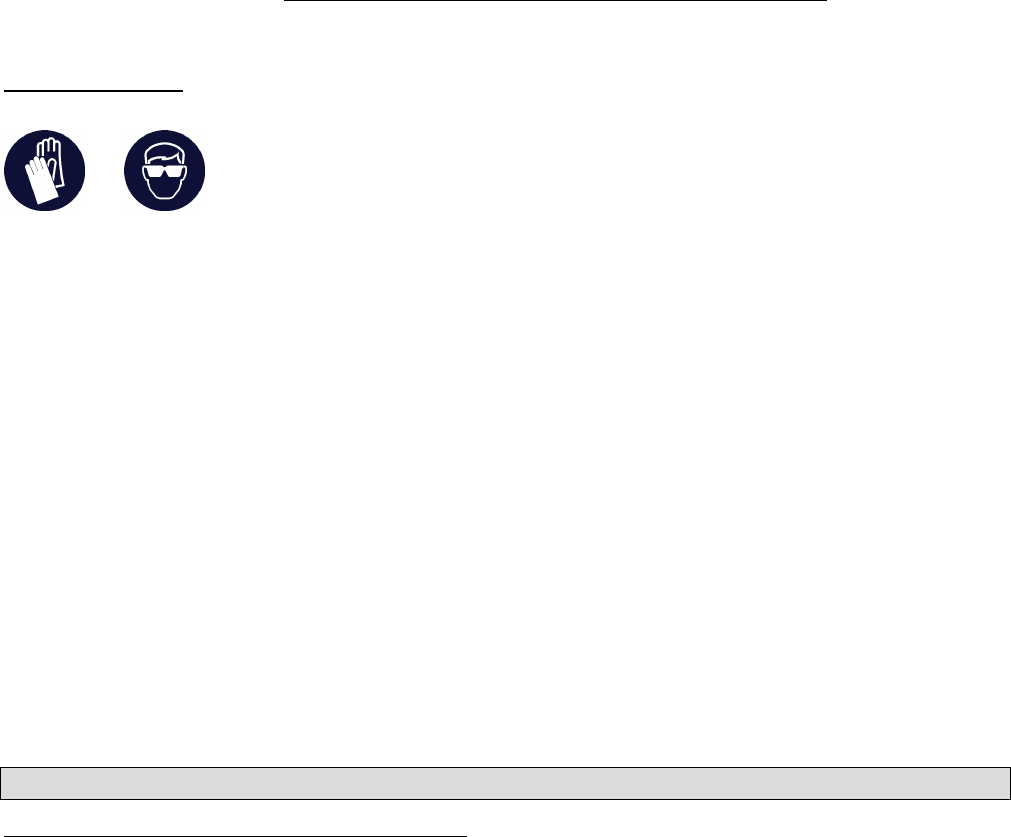
Eye/face protection Eyewear complying with an approved standard should be worn if a risk assessment indicates
eye contact is possible. The following protection should be worn: Chemical splash goggles or
face shield.
Hand protection No specific hand protection recommended. Chemical-resistant, impervious gloves complying
with an approved standard should be worn if a risk assessment indicates skin contact is
possible. Wear protective gloves made of the following material: Impermeable material. The
most suitable glove should be chosen in consultation with the glove supplier/manufacturer,
who can provide information about the breakthrough time of the glove material.
Other skin and body
protection
Wear appropriate clothing to prevent any possibility of skin contact.
Hygiene measures Do not smoke in work area. Wash hands at the end of each work shift and before eating,
smoking and using the toilet. Wash promptly if skin becomes contaminated. Promptly remove
any clothing that becomes contaminated. Use appropriate skin cream to prevent drying of
skin. When using do not eat, drink or smoke.
Respiratory protection No specific recommendations. Respiratory protection may be required if excessive airborne
contamination occurs.
SECTION 9: Physical and Chemical Properties
9.1. Information on basic physical and chemical properties
Appearance Liquid.
Colour Various colours.
Odour Characteristic.
Odour threshold No information available.
pH No information available.
Melting point No information available.
Initial boiling point and range No information available.
Flash point No information available.
4/
10

Revision date: 07/12/2016 Revision: 03 Supersedes date: 12/08/2016
DOWCAL 200 SOLUTION
Evaporation rate No information available.
Evaporation factor No information available.
Flammability (solid, gas) No information available.
Upper/lower flammability or
explosive limits
No information available.
Other flammability No information available.
Vapour pressure No information available.
Vapour density No information available.
Relative density No information available.
Bulk density No information available.
Solubility(ies) Soluble in water.
Partition coefficient No information available.
Auto-ignition temperature No information available.
Decomposition Temperature No information available.
Viscosity No information available.
Explosive properties No information available.
Explosive under the influence
of a flame
No information available.
Oxidising properties No information available.
9.2. Other information
Other information Not determined.
Refractive index No information available.
Particle size No information available.
Molecular weight No information available.
Volatility No information available.
Saturation concentration No information available.
Critical temperature No information available.
Volatile organic compound No information available.
SECTION 10: Stability and reactivity
10.1. Reactivity
Reactivity There are no known reactivity hazards associated with this product.
10.2. Chemical stability
Stability Stable at normal ambient temperatures.
10.3. Possibility of hazardous reactions
Possibility of hazardous
reactions
Will not polymerise.
10.4. Conditions to avoid
5/
10
Revision date: 07/12/2016 Revision: 03 Supersedes date: 12/08/2016
DOWCAL 200 SOLUTION
Conditions to avoid Avoid excessive heat for prolonged periods of time.
10.5. Incompatible materials
Materials to avoid Strong acids. Strong alkalis. Strong oxidising agents.
10.6. Hazardous decomposition products
Hazardous decomposition
products
Fire creates: Carbon monoxide (CO). Carbon dioxide (CO2).
SECTION 11: Toxicological information
11.1. Information on toxicological effects
Skin corrosion/irritation
Animal data No information available.
Serious eye damage/irritation
Serious eye damage/irritation No information available.
Respiratory sensitisation
Respiratory sensitisation No information available.
Skin sensitisation
Skin sensitisation No information available.
Germ cell mutagenicity
Genotoxicity - in vitro No information available.
Carcinogenicity
Carcinogenicity No information available.
Reproductive toxicity
Reproductive toxicity - fertility No information available.
Specific target organ toxicity - single exposure
STOT - single exposure No information available.
Specific target organ toxicity - repeated exposure
STOT - repeated exposure No information available.
Aspiration hazard
Aspiration hazard No information available.
Inhalation Gas or vapour in high concentrations may irritate the respiratory system. Symptoms following
overexposure may include the following: Coughing.
Ingestion May cause discomfort if swallowed.
Skin contact Liquid may irritate skin.
Eye contact Vapour or spray in the eyes may cause irritation and smarting.
SECTION 12: Ecological Information
Ecotoxicity The product components are not classified as environmentally hazardous. However, large or
frequent spills may have hazardous effects on the environment.
12.1. Toxicity
Toxicity Not considered toxic to fish.
6/
10
Revision date: 07/12/2016 Revision: 03 Supersedes date: 12/08/2016
DOWCAL 200 SOLUTION
12.2. Persistence and degradability
Persistence and degradability There are no data on the degradability of this product.
12.3. Bioaccumulative potential
Bioaccumulative potential No data available on bioaccumulation.
Partition coefficient No information available.
12.4. Mobility in soil
Mobility The product contains volatile organic compounds (VOCs) which have a photochemical ozone
creation potential.
12.5. Results of PBT and vPvB assessment
Results of PBT and vPvB
assessment
This substance is not classified as PBT or vPvB according to current EU criteria.
12.6. Other adverse effects
Other adverse effects Not determined.
SECTION 13: Disposal considerations
13.1. Waste treatment methods
General information Do not puncture or incinerate, even when empty.
Disposal methods Dispose of waste to licensed waste disposal site in accordance with the requirements of the
local Waste Disposal Authority.
SECTION 14: Transport information
General The product is not covered by international regulations on the transport of dangerous goods
(IMDG, IATA, ADR/RID).
14.1. UN number
No information required.
14.2. UN proper shipping name
No information required.
14.3. Transport hazard class(es)
No information required.
14.4. Packing group
No information required.
14.5. Environmental hazards
Environmentally hazardous substance/marine pollutant
No.
14.6. Special precautions for user
No information required.
14.7. Transport in bulk according to Annex II of MARPOL and the IBC Code
Transport in bulk according to
Annex II of MARPOL 73/78
and the IBC Code
No information required.
7/
10

Revision date: 07/12/2016 Revision: 03 Supersedes date: 12/08/2016
DOWCAL 200 SOLUTION
SECTION 15: Regulatory information
15.1. Safety, health and environmental regulations/legislation specific for the substance or mixture
EU legislation Regulation (EC) No 1907/2006 of the European Parliament and of the Council of 18
December 2006 concerning the Registration, Evaluation, Authorisation and Restriction of
Chemicals (REACH) (as amended).
Regulation (EC) No 1272/2008 of the European Parliament and of the Council of 16
December 2008 on classification, labelling and packaging of substances and mixtures (as
amended).
COMMISSION REGULATION (EU) 2015/830 of 28 May 2015.
15.2. Chemical safety assessment
No chemical safety assessment has been carried out.
SECTION 16: Other information
8/
10
Revision date: 07/12/2016 Revision: 03 Supersedes date: 12/08/2016
DOWCAL 200 SOLUTION
Abbreviations and acronyms
used in the safety data sheet
ATE: Acute Toxicity Estimate.
ADR: European Agreement concerning the International Carriage of Dangerous Goods by
Road.
ADN: European Agreement concerning the International Carriage of Dangerous Goods by
Inland Waterways.
CAS: Chemical Abstracts Service.
DNEL: Derived No Effect Level.
IATA: International Air Transport Association.
IMDG: International Maritime Dangerous Goods.
Kow: Octanol-water partition coefficient.
LC₅₀: Lethal Concentration to 50 % of a test population.
LD₅₀: Lethal Dose to 50% of a test population (Median Lethal Dose).
PBT: Persistent, Bioaccumulative and Toxic substance.
PNEC: Predicted No Effect Concentration.
REACH: Registration, Evaluation, Authorisation and Restriction of Chemicals Regulation
(EC) No 1907/2006.
RID: European Agreement concerning the International Carriage of Dangerous Goods by
Rail.
vPvB: Very Persistent and Very Bioaccumulative.
IARC: International Agency for Research on Cancer.
MARPOL 73/78: International Convention for the Prevention of Pollution From Ships, 1973 as
modified by the Protocol of 1978.
cATpE: Converted Acute Toxicity Point Estimate.
BCF: Bioconcentration Factor.
BOD: Biochemical Oxygen Demand.
EC₅₀: 50% of maximal Effective Concentration.
LOAEC: Lowest Observed Adverse Effect Concentration.
LOAEL: Lowest Observed Adverse Effect Level.
NOAEC: No Observed Adverse Effect Concentration.
NOAEL: No Observed Adverse Effect Level.
NOEC: No Observed Effect Concentration.
LOEC: Lowest Observed Effect Concentration.
DMEL: Derived Minimal Effect Level.
EL50: Exposure Limit 50
hPa: Hectopascal
LL50: Lethal Loading fifty
OECD: Organisation for Economic Co-operation and Development
POW: Octanol-water partition coefficient
SCBA: self-contained breathing apparatus
STP: Sewage Treatment Plant
VOC: Volatile Organic Compounds
Classification abbreviations
and acronyms
Acute Tox. = Acute toxicity
Aquatic Acute = Hazardous to the aquatic environment (acute)
Aquatic Chronic = Hazardous to the aquatic environment (chronic)
Revision comments NOTE: Lines within the margin indicate significant changes from the previous revision.
Revision date 07/12/2016
Revision 03
Supersedes date 12/08/2016
SDS number 13412
Version number 1.002
9/
10
Revision date: 07/12/2016 Revision: 03 Supersedes date: 12/08/2016
DOWCAL 200 SOLUTION
SDS status Approved.
Signature Lisa Bland
Risk phrases in full Not classified.
10/
10
