Mesa Engineering ATRG2-MOD Field disturbance device for detecting presence and speed of passing vehicles User Manual

Mesa Engineering, Inc. Field disturbance device for detecting presence and speed of passing vehicles

User Manual

Rhein Tech Laboratories, Inc. Client: Mesa Engineering, Inc. 360 Herndon Parkway Model: ATRG2-MOD Suite 1400 FCC ID: S3VATRG2-MOD Herndon, VA 20170 Standards:  FCC Part 90 http://www.rheintech.com Report #:  2013037  25 of 42  Appendix J:  Manual  Please refer to the following pages.
      Mesa Engineering    G2 Vehicle Detection Module   User Manual
       TABLE OF CONTENTS  1. Purpose 2. General Specifications 3. Installation  3.1 General Recommendations  3.2 Exposure Cautions  3.3 Co-Location Warnings  3.4 FCC Statement  3.5 Field Tune 4. Calibration 5. Interface 6. Data Format  6.1 Power Up Message  6.2   Measurement Message  6.3   ATR Reporting format Quick Reference 7. Command Guide
    1.0 Purpose    The G-2 Vehicle detection module is a self contained Doppler radar sensor designed for the purpose of detecting and counting vehicle passages with speed and length data supplied.    Suitable applications are traffic logging systems and speed enforcement systems.  The system consists of a Gunn oscillator driven autodyne detected Doppler system with a single horn lens antenna with a 4X15 degree response pattern suitable for use in ATR traffic radar applications calibrated for a 22.5 degree traffic offset angle.  Base band signals from the transceiver are amplified and processed with digital logic to produce a track for each dominant Doppler return received. Tracks are analyzed for consistency duration and frequency offset to create an individual output for each track, listing its speed, duration and overall reading quality.   Output and control are provided via an ASCII coded serial interface provided with a full duplex rs485 or RS232 interface, for connection to external computing of logging equipment.
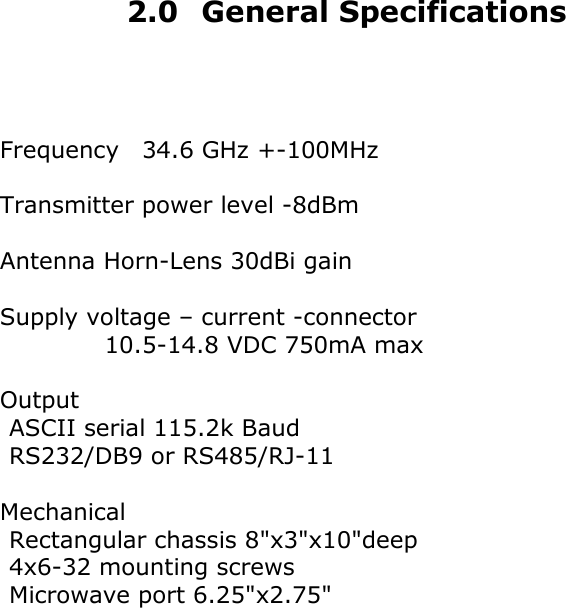
 2.0 General Specifications    Frequency    34.6 GHz +-100MHz  Transmitter power level -8dBm  Antenna Horn-Lens 30dBi gain  Supply voltage – current -connector          10.5-14.8 VDC 750mA max  Output    ASCII serial 115.2k Baud    RS232/DB9 or RS485/RJ-11  Mechanical    Rectangular chassis 8"x3"x10"deep      4x6-32 mounting screws  Microwave port 6.25"x2.75"
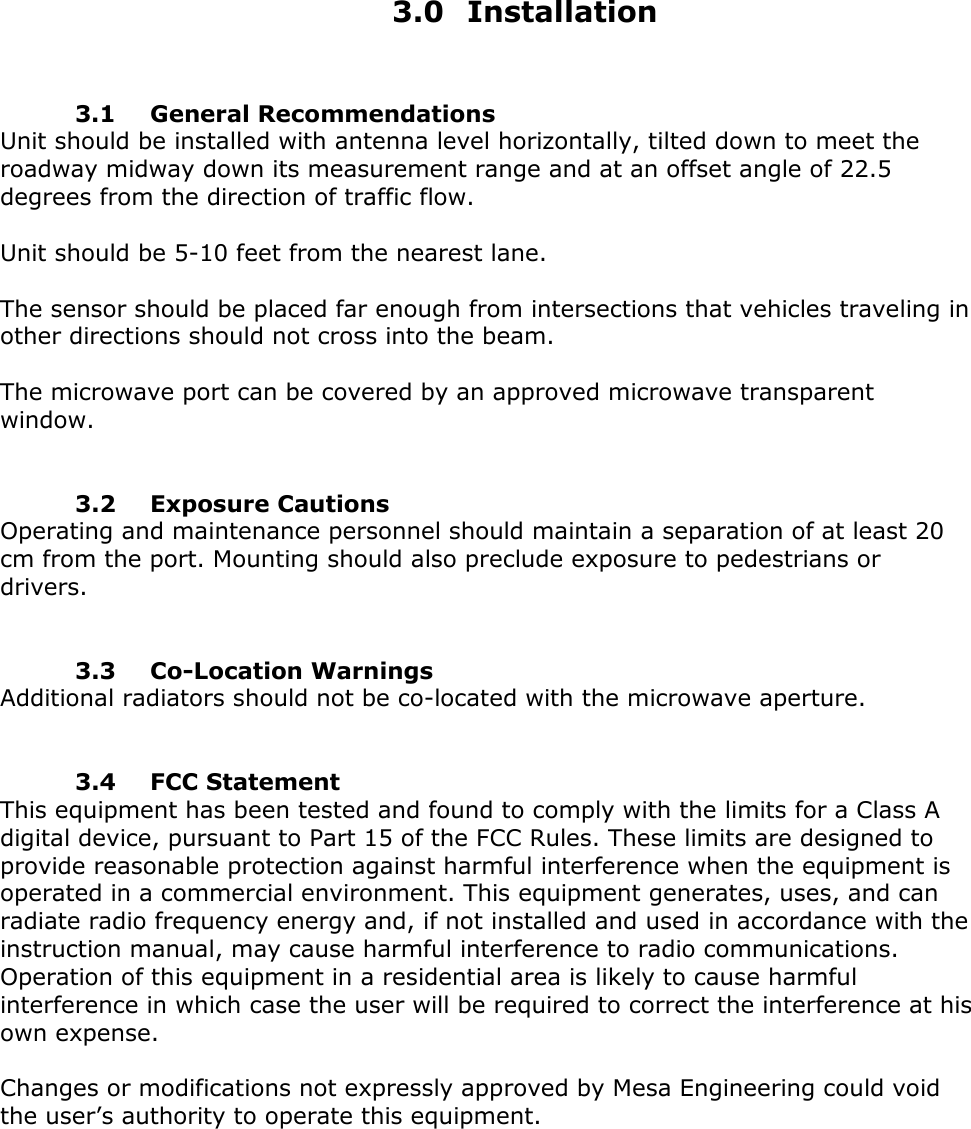
  3.0 Installation    3.1 General Recommendations Unit should be installed with antenna level horizontally, tilted down to meet the roadway midway down its measurement range and at an offset angle of 22.5 degrees from the direction of traffic flow.      Unit should be 5-10 feet from the nearest lane.  The sensor should be placed far enough from intersections that vehicles traveling in other directions should not cross into the beam.  The microwave port can be covered by an approved microwave transparent window.    3.2 Exposure Cautions Operating and maintenance personnel should maintain a separation of at least 20 cm from the port. Mounting should also preclude exposure to pedestrians or drivers.    3.3 Co-Location Warnings Additional radiators should not be co-located with the microwave aperture.    3.4 FCC Statement This equipment has been tested and found to comply with the limits for a Class A digital device, pursuant to Part 15 of the FCC Rules. These limits are designed to provide reasonable protection against harmful interference when the equipment is operated in a commercial environment. This equipment generates, uses, and can radiate radio frequency energy and, if not installed and used in accordance with the instruction manual, may cause harmful interference to radio communications. Operation of this equipment in a residential area is likely to cause harmful interference in which case the user will be required to correct the interference at his own expense.    Changes or modifications not expressly approved by Mesa Engineering could void the user’s authority to operate this equipment.
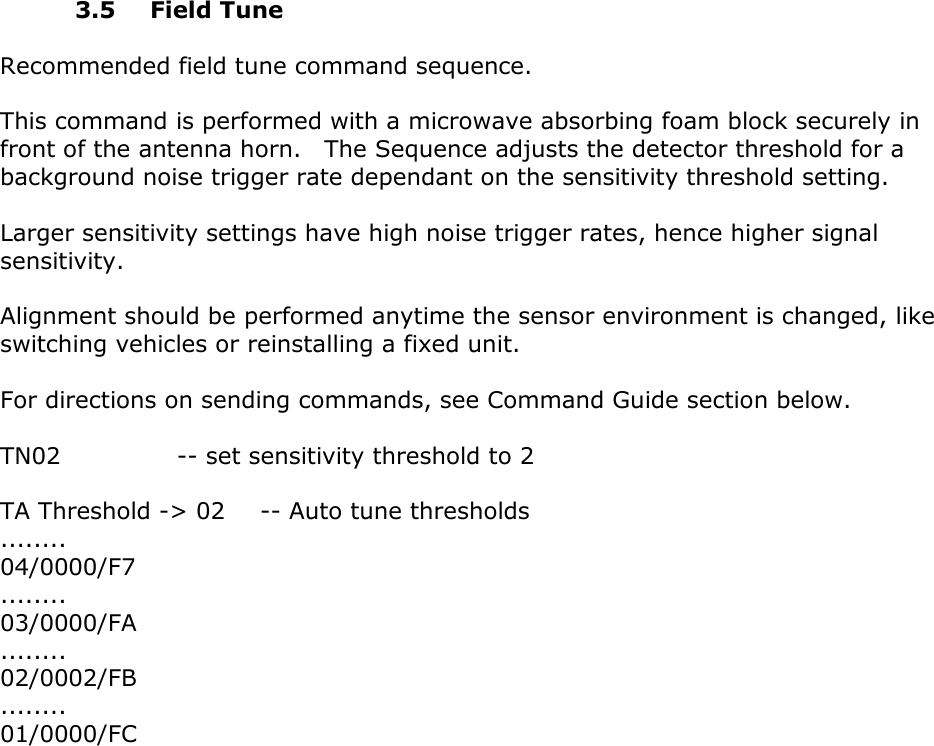
       3.5 Field Tune  Recommended field tune command sequence.  This command is performed with a microwave absorbing foam block securely in front of the antenna horn.    The Sequence adjusts the detector threshold for a background noise trigger rate dependant on the sensitivity threshold setting.  Larger sensitivity settings have high noise trigger rates, hence higher signal sensitivity.  Alignment should be performed anytime the sensor environment is changed, like switching vehicles or reinstalling a fixed unit.  For directions on sending commands, see Command Guide section below.  TN02          -- set sensitivity threshold to 2  TA Threshold -> 02      -- Auto tune thresholds ........ 04/0000/F7 ........ 03/0000/FA ........ 02/0002/FB ........ 01/0000/FC
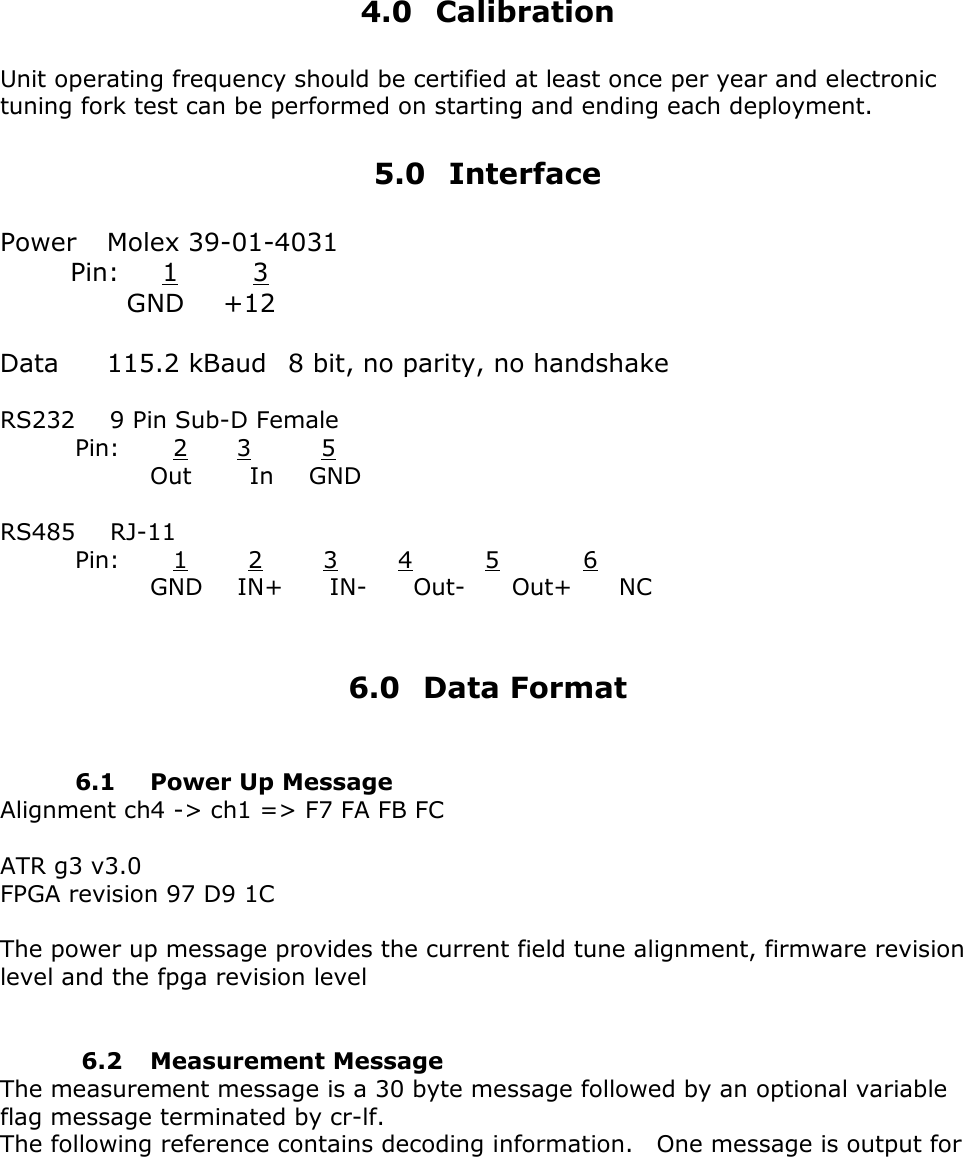
     4.0 Calibration  Unit operating frequency should be certified at least once per year and electronic tuning fork test can be performed on starting and ending each deployment.  5.0 Interface  Power    Molex 39-01-4031         Pin:      1         3                GND     +12  Data      115.2 kBaud   8 bit, no parity, no handshake  RS232      9 Pin Sub-D Female  Pin:   2    3      5   Out     In   GND  RS485   RJ-11    Pin:   1    2    3    4     5       6   GND   IN+    IN-    Out-    Out+    NC    6.0 Data Format      6.1 Power Up Message Alignment ch4 -> ch1 => F7 FA FB FC    ATR g3 v3.0 FPGA revision 97 D9 1C    The power up message provides the current field tune alignment, firmware revision level and the fpga revision level          6.2 Measurement Message The measurement message is a 30 byte message followed by an optional variable flag message terminated by cr-lf. The following reference contains decoding information.    One message is output for
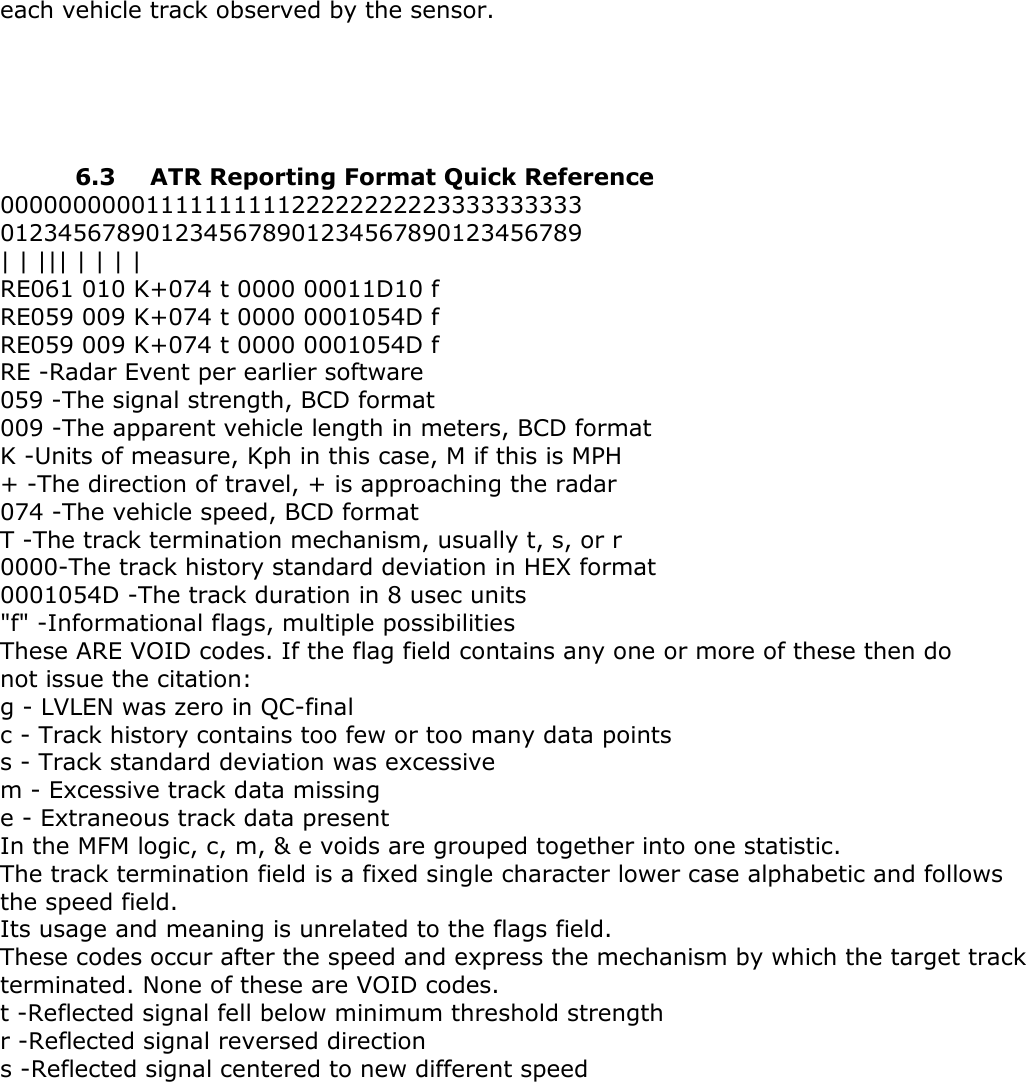
each vehicle track observed by the sensor.         6.3 ATR Reporting Format Quick Reference   0000000000111111111122222222223333333333   0123456789012345678901234567890123456789   | | ||| | | | |   RE061 010 K+074 t 0000 00011D10 f   RE059 009 K+074 t 0000 0001054D f   RE059 009 K+074 t 0000 0001054D f   RE -Radar Event per earlier software   059 -The signal strength, BCD format   009 -The apparent vehicle length in meters, BCD format   K -Units of measure, Kph in this case, M if this is MPH   + -The direction of travel, + is approaching the radar   074 -The vehicle speed, BCD format   T -The track termination mechanism, usually t, s, or r   0000-The track history standard deviation in HEX format   0001054D -The track duration in 8 usec units   "f" -Informational flags, multiple possibilities   These ARE VOID codes. If the flag field contains any one or more of these then do not issue the citation:   g - LVLEN was zero in QC-final   c - Track history contains too few or too many data points   s - Track standard deviation was excessive   m - Excessive track data missing   e - Extraneous track data present   In the MFM logic, c, m, & e voids are grouped together into one statistic.   The track termination field is a fixed single character lower case alphabetic and follows the speed field.   Its usage and meaning is unrelated to the flags field.   These codes occur after the speed and express the mechanism by which the target track terminated. None of these are VOID codes.   t -Reflected signal fell below minimum threshold strength   r -Reflected signal reversed direction   s -Reflected signal centered to new different speed
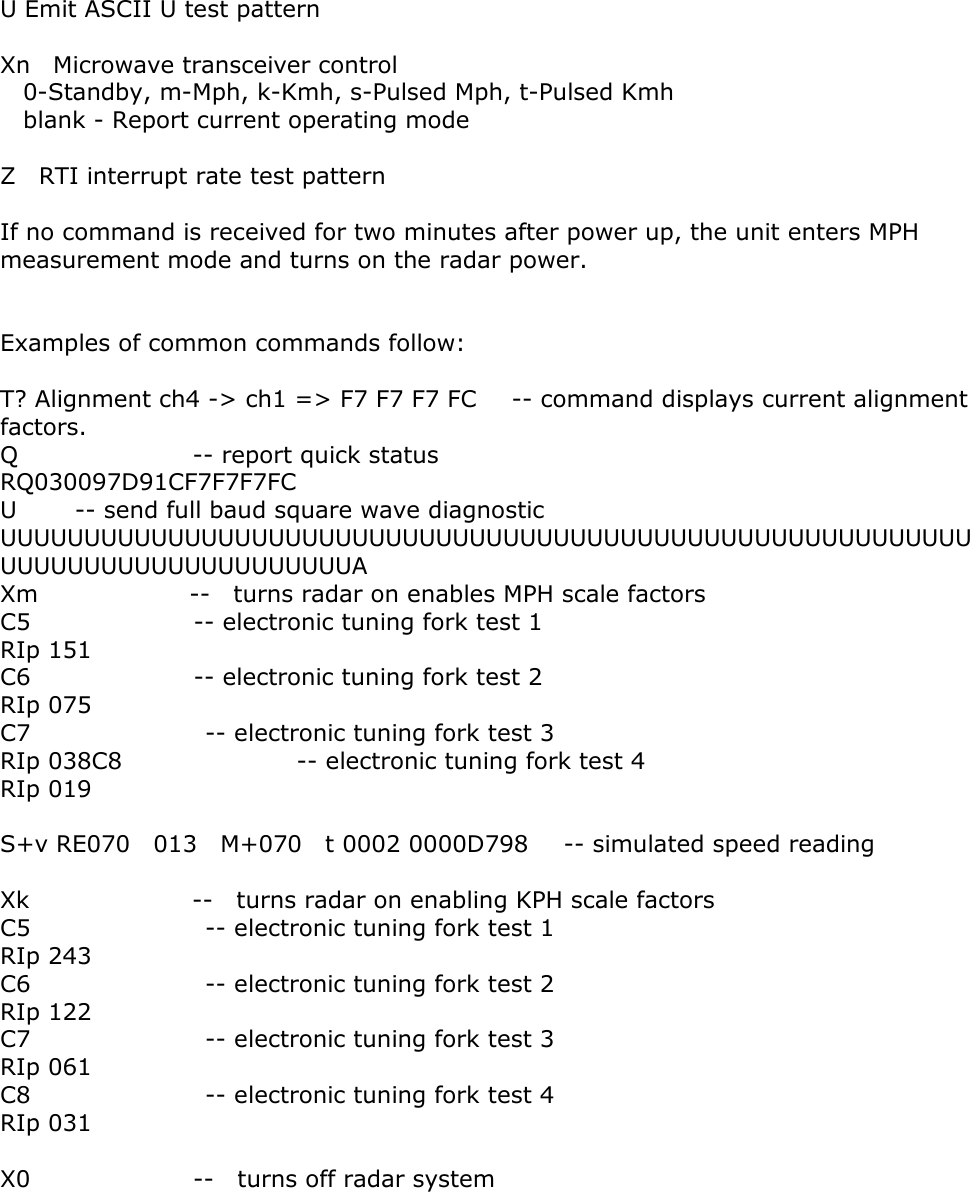
     7.0 Command Guide   Commands are an ASCII coded message terminated by a cr.    Undefined command strings get a ? cr-lf response.   Help  H cr      causes a dump of available commands and their syntax/  Ax Analog channel lock   0-Float {default}, 1-DopA approach   2-DopB recede, 3-PhaA, 4-PhaB  Cx Calibrator function   0- terminate   1-4    Tuning Fork profile#   5-8  (151,75,38,19)Mph (243,123,60,30)Kmh  Calibrator profile#  Dmx DebugTrace mode control   0-normal operation {default}, 1-sequential states, 2-packet values   TRACE state symbols: ! =squelch transition      + =1 Meter marker   annnn =SQLbreak value    p =arriving measure packet      l =speedlock set   t =track timeout    r =direction reversal    z =short track abort   [ =track drop start    ~ =drop timeout    ] =drop normal    w =wait state   entered  Jxxyy Manual analog channel setting   xx = channel select   01-DopB{approach}, 02-DopA{recede}, 03-I, 04-Q   yy = channel sensitivity, FF=maximum, 00=minimum  L Force Watchdog activation  Q Compact information summary request  Rn Read CPLD channel n,    0 thru 6 inclusive Wnyy Write CPLD register n with value yy  S    Simulate Vehicle: S+v Approaching, S-v Receding  TNnn    Set Analog alignment threshold to nn TA perform verbose analog channel alignment T? report current analog channel settings
   U Emit ASCII U test pattern  Xn    Microwave transceiver control   0-Standby, m-Mph, k-Kmh, s-Pulsed Mph, t-Pulsed Kmh   blank - Report current operating mode  Z  RTI interrupt rate test pattern  If no command is received for two minutes after power up, the unit enters MPH measurement mode and turns on the radar power.   Examples of common commands follow:  T? Alignment ch4 -> ch1 => F7 F7 F7 FC      -- command displays current alignment factors. Q               -- report quick status RQ030097D91CF7F7F7FC U     -- send full baud square wave diagnostic UUUUUUUUUUUUUUUUUUUUUUUUUUUUUUUUUUUUUUUUUUUUUUUUUUUUUUUUUUUUUUUUUUUUUUUUUUUUUUUA Xm             --  turns radar on enables MPH scale factors C5              -- electronic tuning fork test 1 RIp 151 C6              -- electronic tuning fork test 2 RIp 075 C7               -- electronic tuning fork test 3 RIp 038C8               -- electronic tuning fork test 4 RIp 019  S+v RE070  013  M+070  t 0002 0000D798   -- simulated speed reading  Xk              --  turns radar on enabling KPH scale factors C5               -- electronic tuning fork test 1   RIp 243 C6               -- electronic tuning fork test 2   RIp 122 C7               -- electronic tuning fork test 3   RIp 061 C8               -- electronic tuning fork test 4   RIp 031  X0              --  turns off radar system

Navigation menu