Markingmethods Marking Methods Paper
2009-05-25
: Microscan Marking Methods Paper marking_methods_paper industrysolutions
Open the PDF directly: View PDF  .
.
Page Count: 4
Automotive Industry
Application White Paper
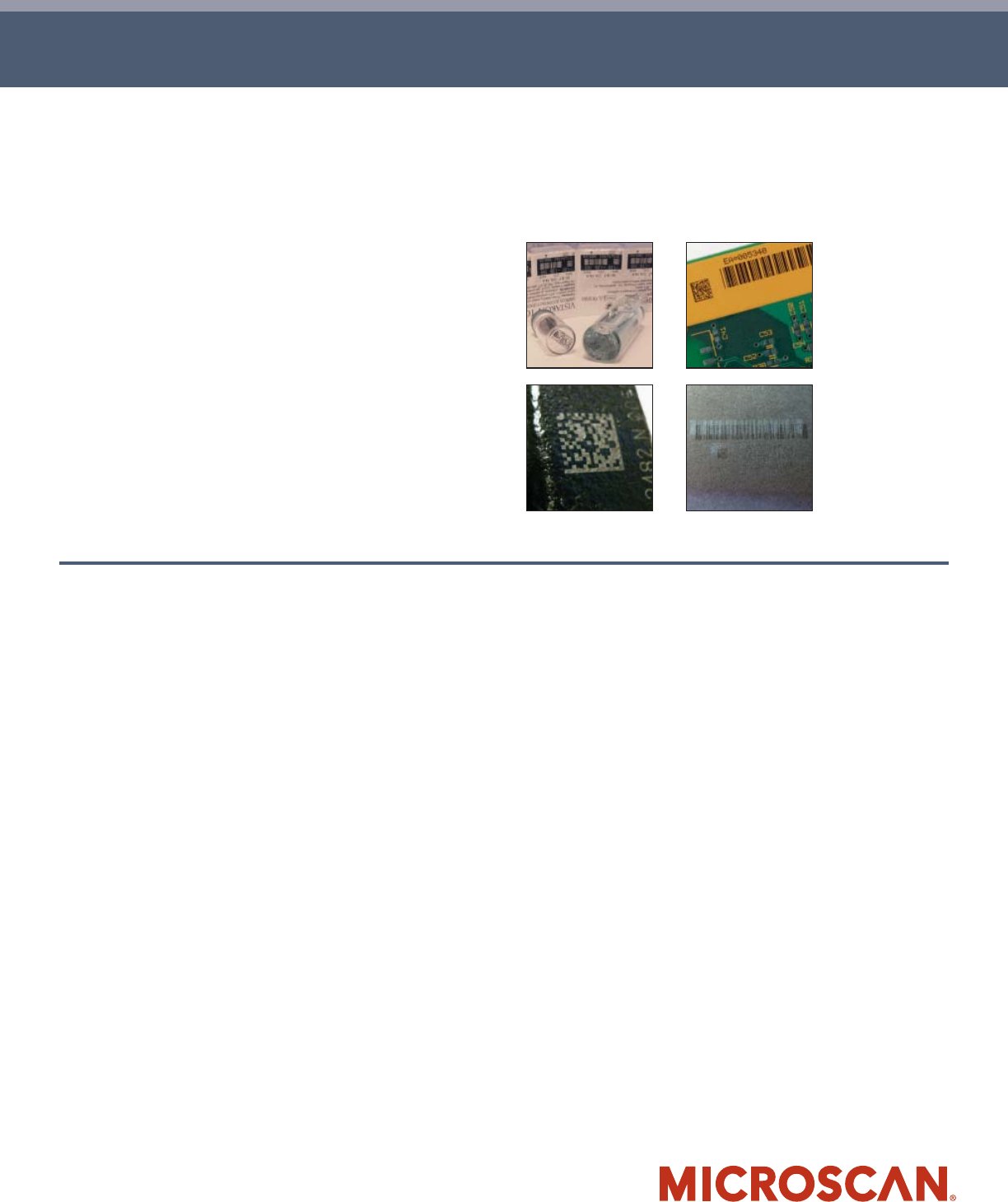
Electrochemical Etch: This process uses a low voltage
current to mark the object
surface. This is commonly used for low volume product
runs.
Ink Jet: This type of marking uses small, dots sprayed
directly onto the surface. Ink jet produces high contrast
marks. Ink jet is not considered a permanent marking
method.
Laser Etch: Lasers etch the symbol directly onto a sur-
face. Clean, high resolution marks are
produced making laser-etch well-suited for automated
environments.
Dot Peen: Dot peen is a percussive marking method, us-
ing changes in depth to create marks.
Dot peen is recommended for applications where the
symbol must last the entire life cycle.
On the following pages, a wide range of marking methods
are discussed, including advantages and disadvantages.
1
Assessing Your Application
Since each application is at least somewhat unique,
you should know the answers to the following questions
before selecting a marking method: what type and how
much data will you need to encode, how much real es-
tate is available for the symbol, is symbol permanency a
concern and who will be using the information.
Many Marking Methods Are Available
There are many methods to directly mark objects.
Selecting the best method for the application is critical
to achieving success. Each method has its own advan-
tages and limitations. Since each method has its own
advantages and limitations, it is important to review and
experiment with as many methods as possible before
selecting the best one for your application.
While the overall concept of product tracking is not
new, the automated tracking of products down to
the individual part and component level has proven
to have great bottom-line impact. The most direct
way to ensure complete quality control of the pro-
duction process is to mark objects with a machine-
readable symbols and track them through the entire
life cycle.
Review and Selection of Direct Part Marking Methods
Product Line Card
Automotive Industry
Application White Paper
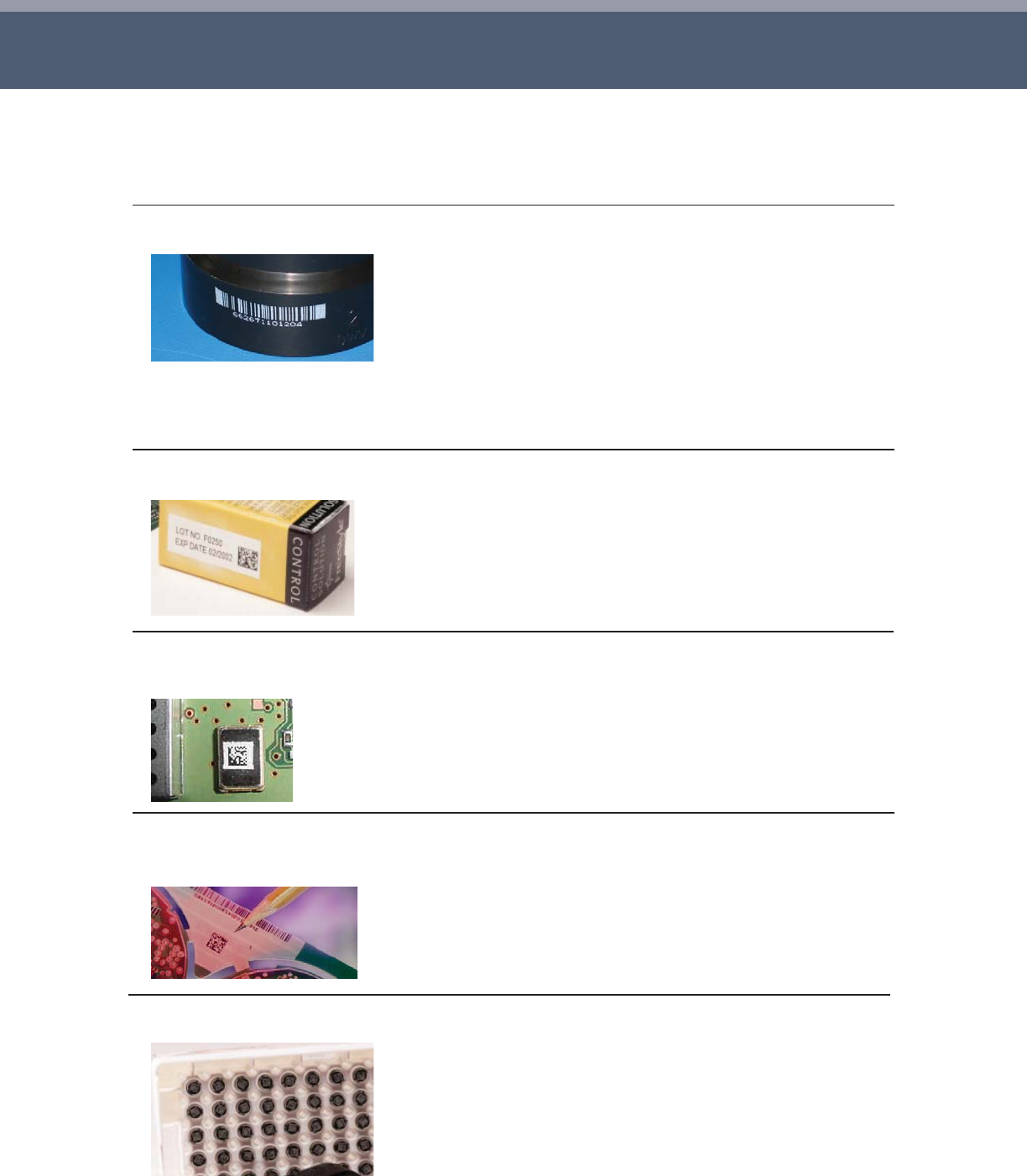
2 Review and Selection of Direct Part Marking Methods
Ink Jet on substrate
Marking Method Description Advantages
& Disadvantages
Laser etch on
silk screen
High contrast, square & round
element shape
Application:
- Electronics
Advantage:
- Good contrast
- No consumables
- Permanent
Disadvantage:
- Displaces surface
- Process creates debris
Ink jet on plastic High or low contrast,
round element shape
Application:
- Bio-science
- Pharmaceuticals
- Packaging
Advantage:
- Limited damage to surface
Disadvantage:
- Higher cost consumables
- Not permanent
- Bleeding can affect mark quality
Advantage:
- Low-entry cost
- High speed
- Easy to read if contrast is good
Disadvantage:
- Not considered permanent by
some industry standards
- Dot registration can vary
- Higher cost consumables
- Mark quality dependant on
surface cleanliness
- Dif cult to read if contrast poor
Contrast levels vary widely, round
element shape
Application:
- Post-packaging
- Warehousing
- Automotive
Pre-printed packaging Typically high contrast,
square element shape
Application:
- Product labeling
- Product packaging
- Document processing
Advantage:
- Economical
- High speed
- Good contrast
- Easy to read
Disadvantage:
- Less exibility
Thermal transfer
label stock
High contrast, typically black on
white label stock, square element
shape
Application:
- Product labeling
- Packaging
- WIP tracking, various industries
Advantage:
- High contrast
- Low-entry cost
- Easy to read
Disadvantage:
- Not permanent
- Higher cost: consumables
Automotive Industry
Application White Paper
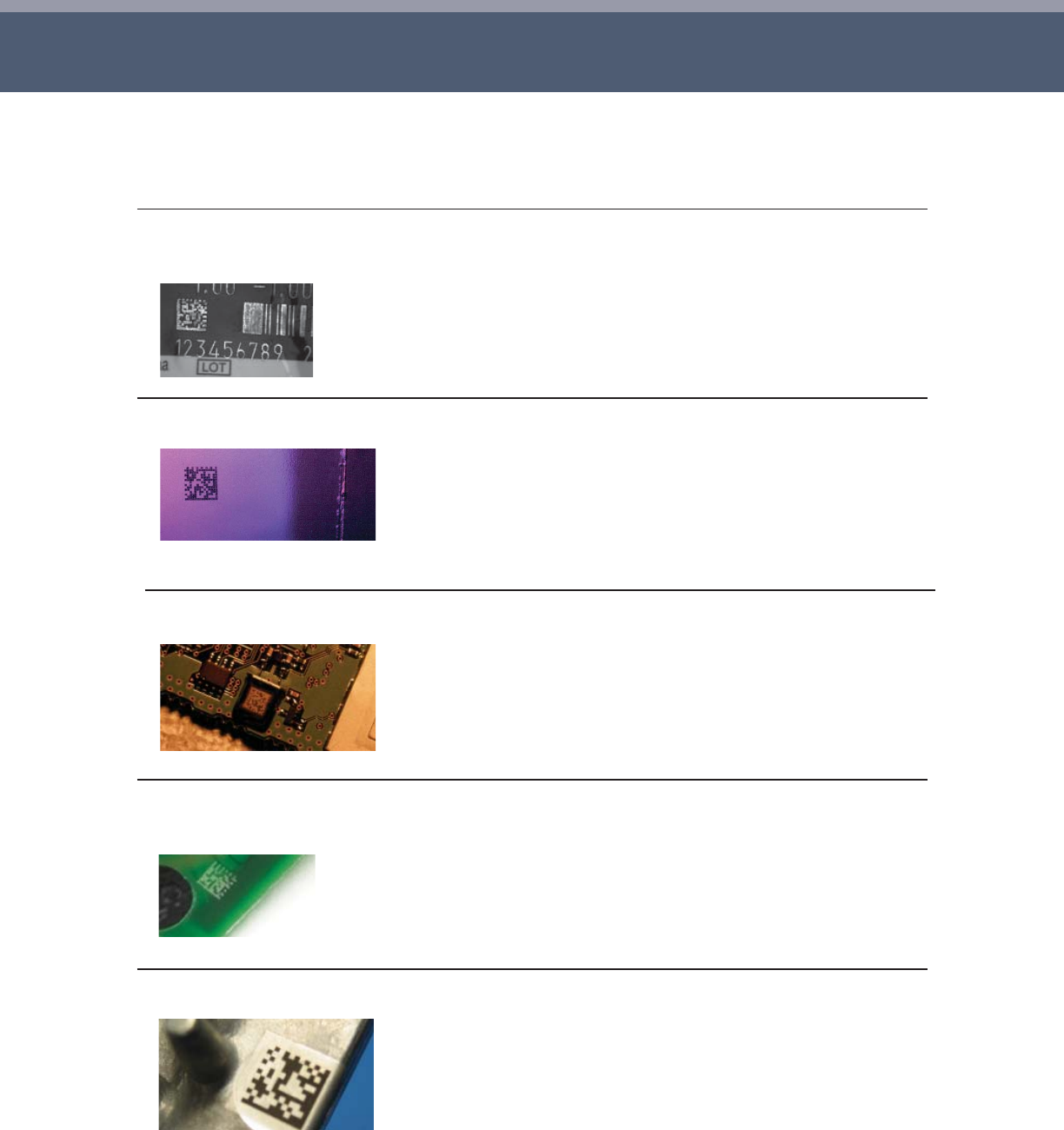
Marking Method Description Advantages
& Disadvantages
Thermal print on
foil packaging
Typically good contrast,
square element shape
Application:
- Pharmaceutical Packaging
Advantage:
- Economical
Disadvantage:
- Re ective nature of marking
method may require additional lighting
- Deformation of surface may
affect readability of code
Ink jet on glass Good contrast, round element shape
Application:
- Pharmaceutical Packaging
- Clinical R&D
- Electronics
Advantage:
- High contrast
- Low entry cost
- Limited damage to surface
Disadvantage:
- Not permanent
- Bleeding can affect mark quality
Laser etch on metal Low contrast, square element shape
Application:
- Electronics
- Automotive
- Aerospace
- DOD
- Medical device
Advantage:
- Permanent
- No consumables
- High quality mark
Disadvantage:
- Process creates debris
- Affects surface of substrate
Laser etch on
glass epoxy
Medium contrast, square element
shape
Application:
- Electronics
Advantage:
- Permanent
- No consumables
- High quality mark
Disadvantage:
- Process creates debris
- Lack of contrast; dif cult to read
- Affects surface of substrate
Chem etch on metal Typically medium contrast, square
element shape
Application:
- Electronics
- Semiconductor
- DOD
- Aerospace
- Medical device
Advantage:
- Permanent
- High quality mark
- No debris from process
Disadvantage:
- Potentially toxic material
byproduct
- Low-volume use only
3 Review and Selection of Direct Part Marking Methods
Product Line Card
Automotive Industry
Application White Paper
4
www.microscan.com
Product Information:
info@microscan.com
Auto ID Support:
helpdesk@microscan.com
Vision Support:
visionsupport@microscan.com
NERLITE Support:
nerlitesupport@microscan.com
©2008 Microscan Systems, Inc. 11/08
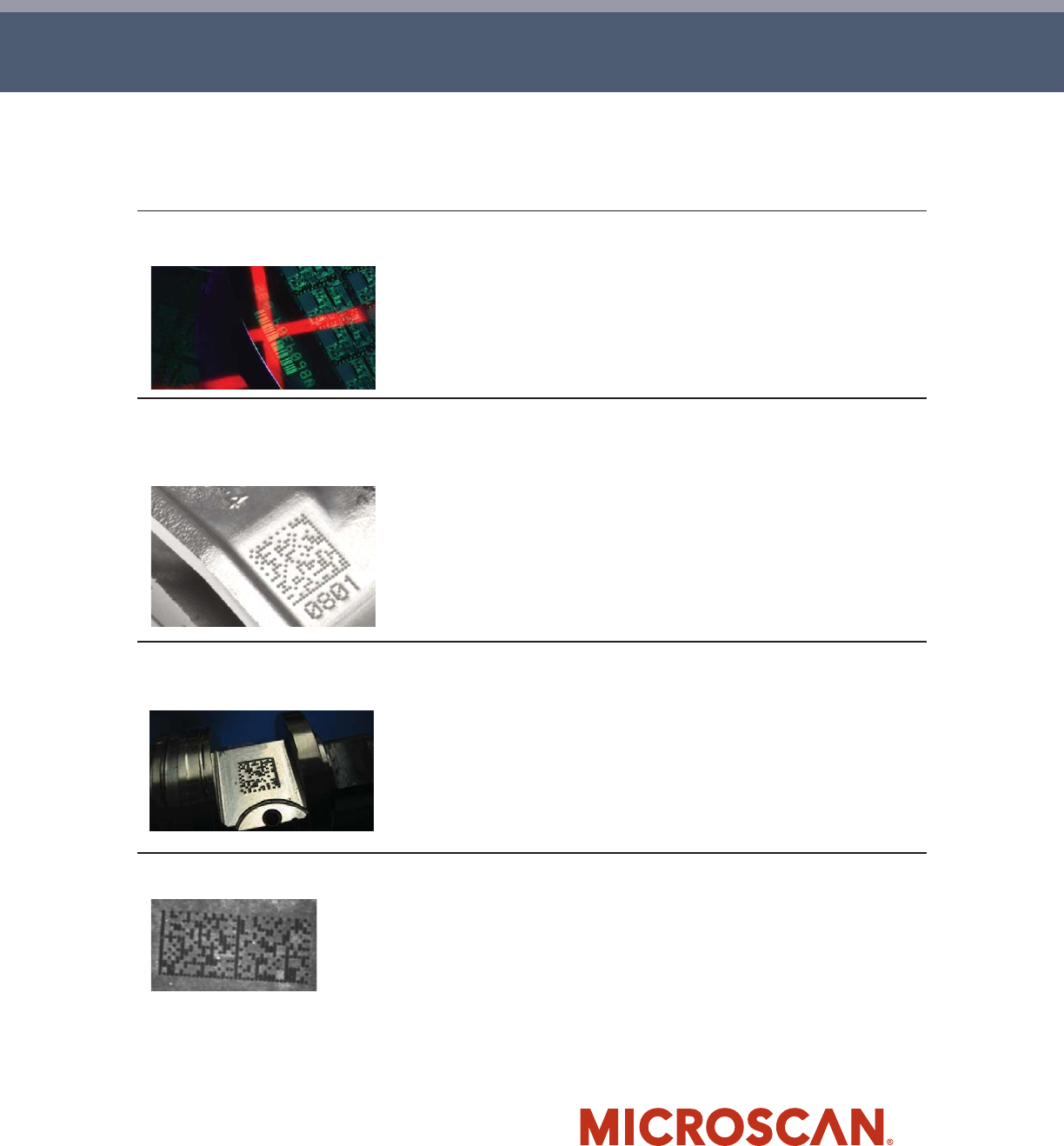
Chem etch on silicon Typically medium contrast,
square element shape
Application:
- Semiconductor
Advantage:
- Permanent
- High quality mark
- No debris from process
Disadvantage:
- Potentially toxic material byproduct
- Potentially complex process
Dot peen on smooth,
highly refl ective metal
Low contrast, dependant on differ-
ence in depth to create light and
dark elements. Round or square
element shape, dependant on
shape of stylus
Application:
- Automotive
- Aerospace
- DOD
Advantage:
- Permanent
- No consumables
Disadvantage:
- Alters surface
- Low contrast mark
- More dif cult to read
- Inconsistent depth will create
smaller elements
- Background noise
Dot peen on
textured metal
Low contrast, dependant on differ-
ence in depth to create light and
dark elements. Round or square
element shape, dependant on
shape of stylus
Application:
- Automotive
- Aerospace
- DOD
Advantage:
- Permanent
- No consumables
Disadvantage:
- Alters surface
- Low contrast mark
- Very dif cult to read, due to high
degree of surface noise created
by texture
Marking Method Description Advantages
& Disadvantages
Laser etch on rubber
Very low contrast, square or round
element shape
Application:
- Automotive
Advantage:
- Permanent
- No consumables
Disadvantage:
- Process creates debris
- Affects surface of substrate
