Vial_reader_ Verification Kit Guide
2013-12-16
: Microscan Verification Kit Guide verification_kit_guide Q42013 LaunchCentral PartnerSite
Open the PDF directly: View PDF  .
.
Page Count: 2
Product Line Card
Barcode Verification Guide: 1D Codes
Quick Reference
What is Verification or Grading?
Verication is the measurement of the quality of a linear
(1D) barcode according to an agreed methodology. The
purpose of verication is to ensure that barcodes can be
subsequently read with the intended reading equipment.
Verication is sometimes referred to as grading.
Why Verify?
1D barcode verication is used to ensure that automatic
identication equipment such as barcode scanners
and imagers will be able to read barcodes quickly and
efciently throughout the life cycle of a product or its
packaging. Ideally this is achieved by monitoring the
quality of the barcode close to the point of marking so as
to detect problems as soon as possible.
Quality Standards for 1D Codes
ISO 15416 (formally ANSI X3.182-1990) is a standard
that applies to 1D barcodes such as Code 128, ITF, and
UPC. ISO 15416 is the standard referenced in the GS1
General Specication. In some circumstances, such as
where a barcode is used within a manufacturing process,
“custom grading” which departs from the ISO standard
may be appropriate.
ISO/ANSI Grade Scales
A = 4.0 – 3.5
B = <3.5 - >= 2.5
C = <2.5 - >= 1.5
D = <1.5 - >= 0.5
F = <0.5 - 0.00
Note: ISO reports numeric grades but many specifications use letters.
Design Inputs for Barcode Verification
Surface Shape: Flat or Curved
Surface Material: Matte (like paper, cardboard or anodized metal) or Glossy/Shiny (like coated paper or polished metal)
Code Size: > 2.0 inches or < 2.0 inches
The chart below will guide your choice of Microscan Verication Kit for online or ofine 1D barcode grading. These kits include a
smart camera, software, lighting, and mounting components. Contact Microscan for calibration and cabling options.
1D BARCODE VERIFICATION: ISO 15416 OR CUSTOM
Surface Shape
Small Bar Size
Marking Method
Surface Type
Overall Code Size
(Length)
KIT:
FLAT CURVED
> 0.005” (0.127 mm) < 0.005” (0.127 mm)
INK (PRINTED) LASER OTHER
> 2.0” (50.8 mm)
MATTE GLOSSY/SHINY MACHINED OR CAST METAL
www.microscan.com
Product Information:
info@microscan.com
©2013 Microscan Systems, Inc. ML037B 12/13
Technical Support:
helpdesk@microscan.com
LARGE LINEAR
Verification Kit
1D/2D LABEL
Verification Kit
Contact Microscan for a solution
specific to your application.
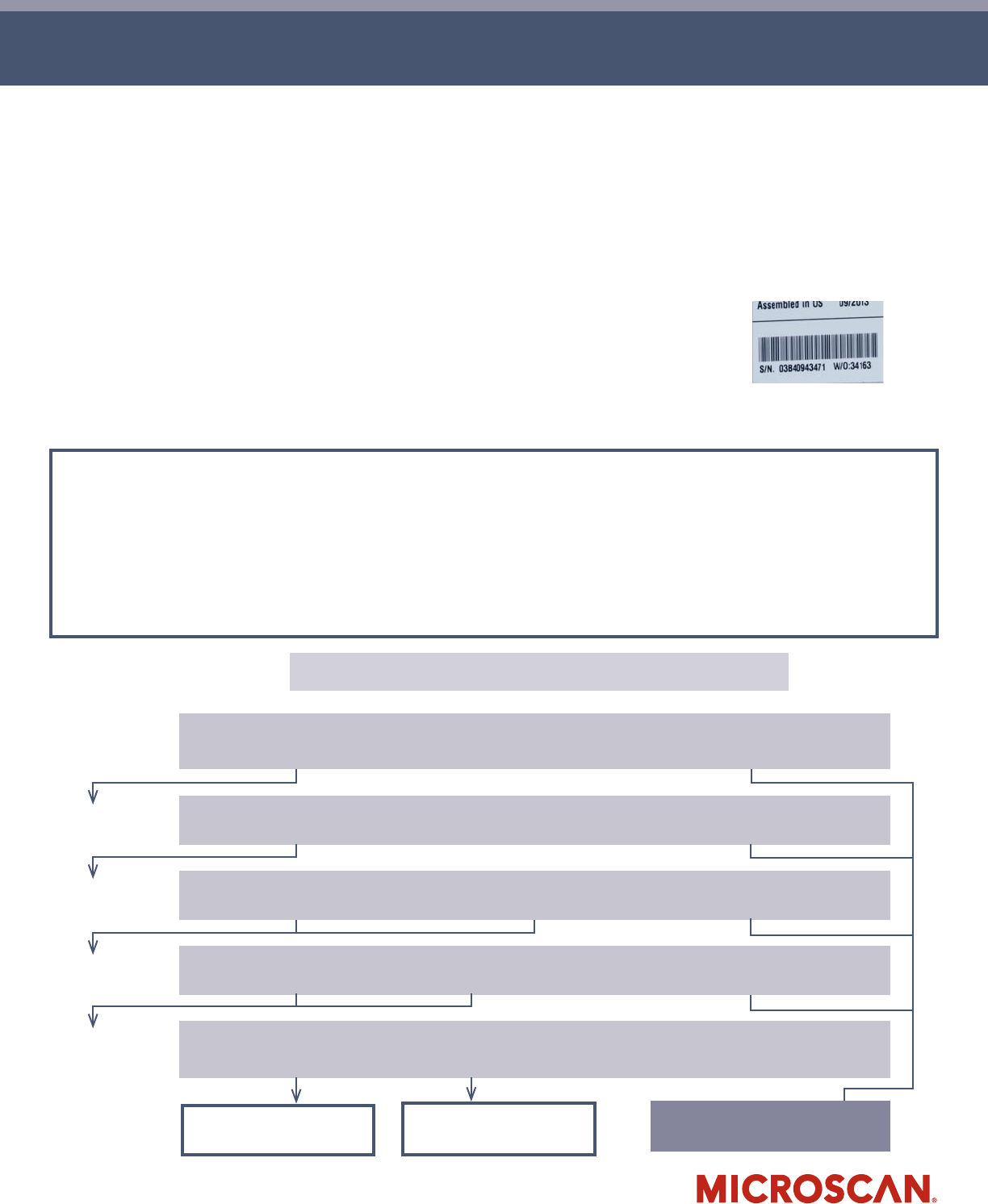
GRADE A SYMBOL EXAMPLE
< 2.0” (50.8 mm)
INK (PRINTED) LASER ETCH DOT PEEN
Product Line Card
Barcode Verification Guide: 2D Codes
Quick Reference
What is Verification or Grading?
Verication is the measurement of the quality of a 2D
symbol, such as Data Matrix, according to an agreed
methodology. The purpose of verication is to ensure that
barcodes and symbols can be subsequently read with the
intended reading equipment. Verication is sometimes
referred to as grading.
Why Verify?
2D symbol verication is used to ensure that automatic
identication equipment such as barcode imagers will be
able to read symbols quickly and efciently throughout
the life cycle of a product or its packaging. Ideally this is
achieved by monitoring the quality of the symbol close to
the point of marking so as to detect problems as soon
as possible.
Quality Standards for 2D Symbols
There are two principal standards for 2D Data Matrix
symbols. ISO 15415 is most applicable to high contrast
printed symbols, while the AIM DPM 2006 Guidelines are
designed for direct part marked (DPM) symbols. In some
circumstances, such as where a barcode is used within a
manufacturing process, “custom grading” which departs
from the ISO standard may be appropriate.
ISO/ANSI Grade Scales
A = 4.0 – 3.5
B = <3.5 - >= 2.5
C = <2.5 - >= 1.5
D = <1.5 - >= 0.5
F = <0.5 - 0.00
Note: ISO reports numeric grades but many specifications use letters.
Design Inputs for 2D Symbol Verification
Surface Shape: Flat or Curved
Surface Material: Matte (like paper, cardboard or anodized metal) or Glossy/Shiny (like coated paper or polished metal)
Cell Size: > 0.005 inches or < 0.005 inches
Marking Method: Ink, Laser Etch or Dot Peen
The chart below will guide your choice of Microscan Verication Kit for online or ofine 2D symbol grading. These kits include a
smart camera, software, lighting, and mounting components. Contact Microscan for calibration and cabling options.
2D SYMBOL VERIFICATION: ISO 15415, AIM DPM, OR CUSTOM
Surface Shape
Cell Size
Overall Symbol
Size
Surface Type
Marking Method
KIT:
FLAT CURVED
< 1.0” (25.4 mm) > 1.0” (25.4 mm)
MATTE GLOSSY/SHINY MACHINED OR CAST METAL
Contact Microscan for a solution
specific to your application.
1D/2D LABEL
Verification Kit
DOT PEEN
Verification Kit
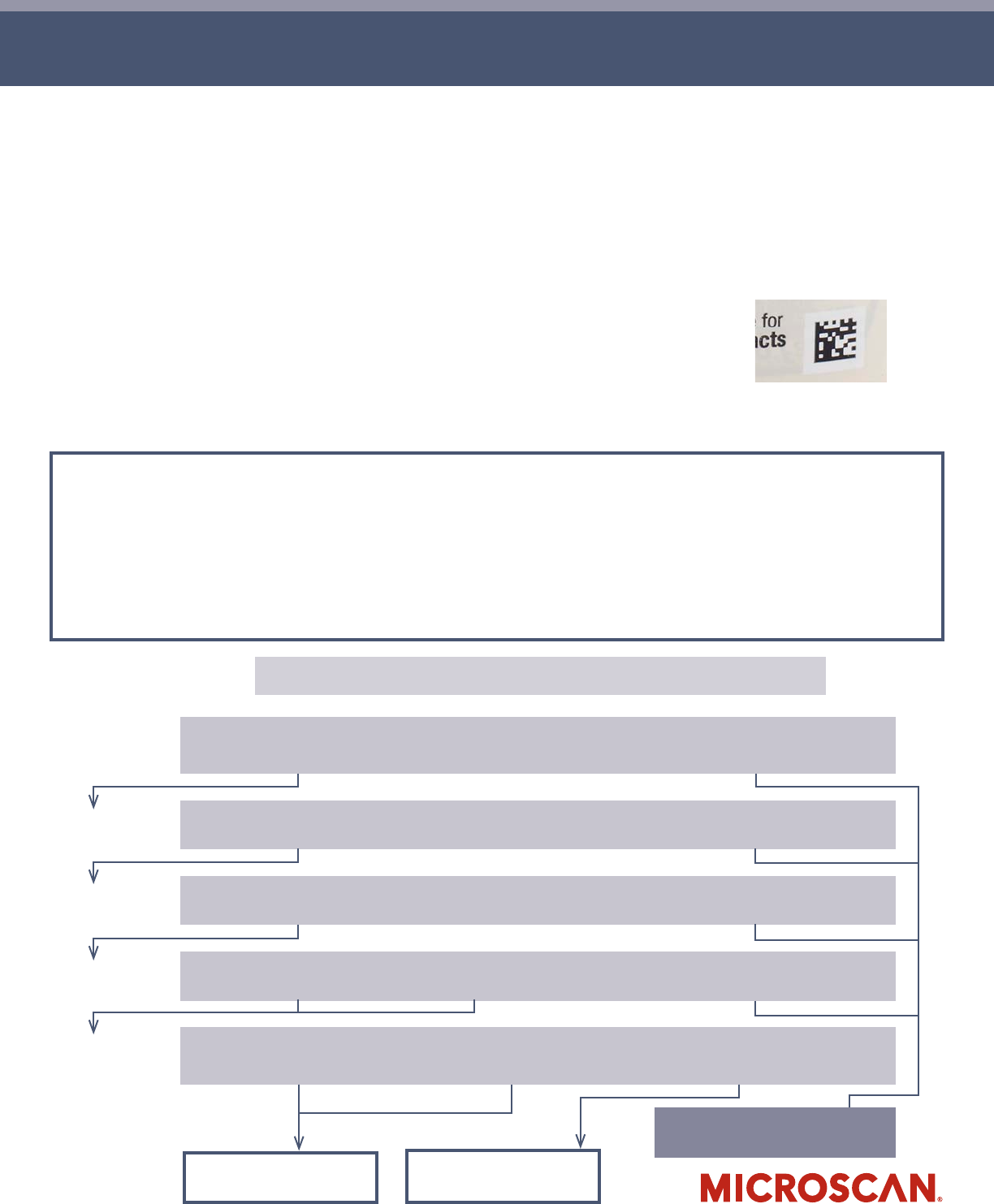
GRADE A SYMBOL EXAMPLE
> 0.005” (0.127 mm) < 0.005” (0.127 mm)
