Miltel Communications GL2RPT150 Repeater User Manual

Miltel Communications Ltd Repeater Users Manual

Contents

Users Manual

    Miltel Wireless Data Link for Data Transfer Receiver/Repeater 2A                   FCC ID:MLLGL2RPT150         UUsseerr  MMaannuuaall           Miltel Communications Ltd.                 December 2005
2 Table of Contents  Chapter 1 Introduction.................................................................................................3 1.1    Purpose and Use............................................................................................3 1.2    System General Description...........................................................................3 1.3    Theory of Operation .......................................................................................4 Chapter 2 Technical Characteristics ...............................................................................5 2.1    Technical Specification...................................................................................5 2.1.1   Electrical.....................................................................................................5 2.1.2   Physical......................................................................................................6 2.2    Label Contents ...............................................................................................6 Chapter 3 Installation Instructions...................................................................................7 3.1    General...........................................................................................................7 3.2    Installation ......................................................................................................7  Deceleration of Conformity .............................................................................................8
3  Chapter 1 Introduction 1.1    Purpose and Use The Receiver/Repeater 2A (FCC ID:MLLGL2RPT150) is a data link transceiver that is used for data transfer in Miltel’s radio system. The system is used for utility consumption readings collection system as well as for other applications such as in agricultural systems. This device is installed on-site by a professional field technician, thus it includes technical terms. The equipment is not to be installed by a non-professional individual that has not been trained and authorized.   1.2    System General Description The Receiver/Repeater 2A system is a computerized fully automatic radio device.  It requires no human intervention after initial installation.  The device acts as a store-and-forward radio relay.  The Receiver/Repeater 2A operates as a receiver connected to a bases station or as a repeater that captures transmissions from a Miltel transmitter and, after validating the message, transmits the message again.  When operating as a Repeater the device relays information from transmitters to a receiver that is connected to the base station which is typically implemented as a regional concentrator or as a standard PC.  The concentrator/PC transfers the data to the central computer for data collection and for further analysis and reporting. When operating as a receiver, the device receives messages transmitted by Miltel transmitters or messages relayed by a repeater. The receiver can also send commands to any of the repeaters.
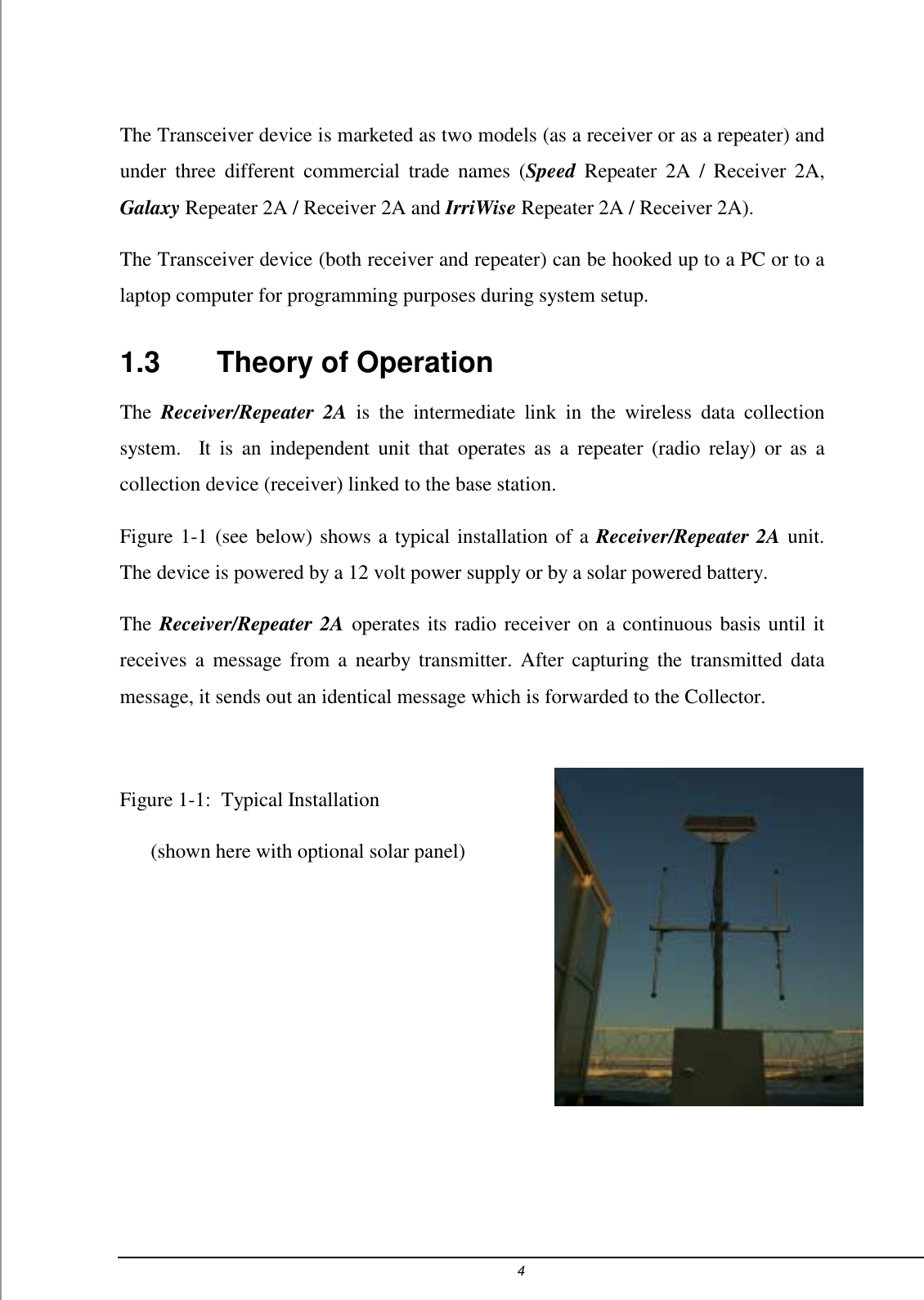
4  The Transceiver device is marketed as two models (as a receiver or as a repeater) and under three different commercial trade names (Speed Repeater 2A / Receiver 2A, Galaxy Repeater 2A / Receiver 2A and IrriWise Repeater 2A / Receiver 2A).  The Transceiver device (both receiver and repeater) can be hooked up to a PC or to a laptop computer for programming purposes during system setup.  1.3    Theory of Operation The  Receiver/Repeater 2A is the intermediate link in the wireless data collection system.  It is an independent unit that operates as a repeater (radio relay) or as a collection device (receiver) linked to the base station.  Figure 1-1 (see below) shows a typical installation of a Receiver/Repeater 2A unit. The device is powered by a 12 volt power supply or by a solar powered battery. The Receiver/Repeater 2A operates its radio receiver on a continuous basis until it receives a message from a nearby transmitter. After capturing the transmitted data message, it sends out an identical message which is forwarded to the Collector.  Figure 1-1:  Typical Installation       (shown here with optional solar panel)
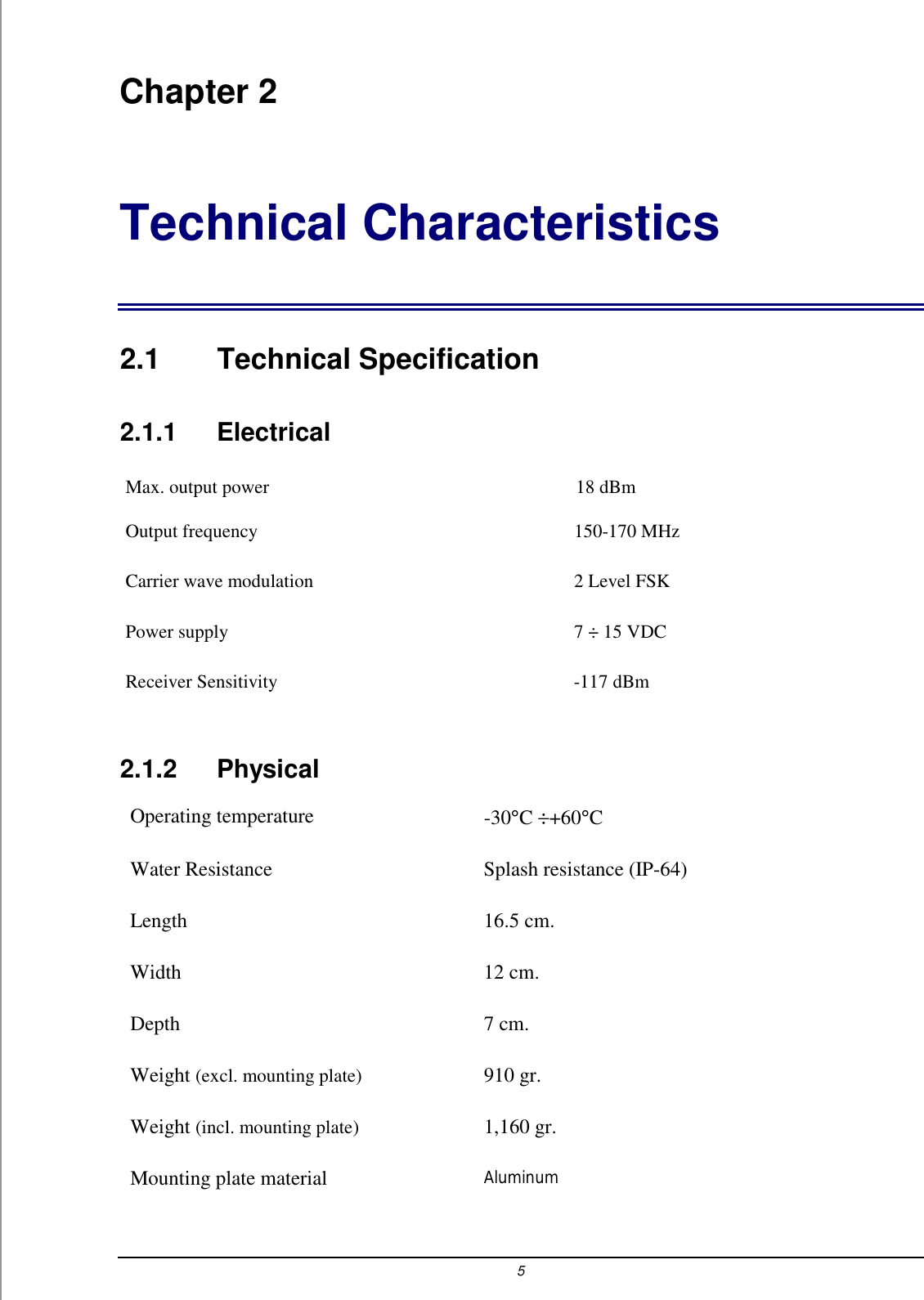
5 Chapter 2 Technical Characteristics 2.1 Technical Specification 2.1.1    Electrical Max. output power     18 dBm  Output frequency  150-170 MHz Carrier wave modulation  2 Level FSK Power supply   7 ÷ 15 VDC Receiver Sensitivity  -117 dBm 2.1.2   Physical Operating temperature  -30°C ÷+60°C  Water Resistance  Splash resistance (IP-64) Length 16.5 cm. Width 12 cm. Depth 7 cm. Weight (excl. mounting plate) 910 gr. Weight (incl. mounting plate) 1,160 gr. Mounting plate material Aluminum
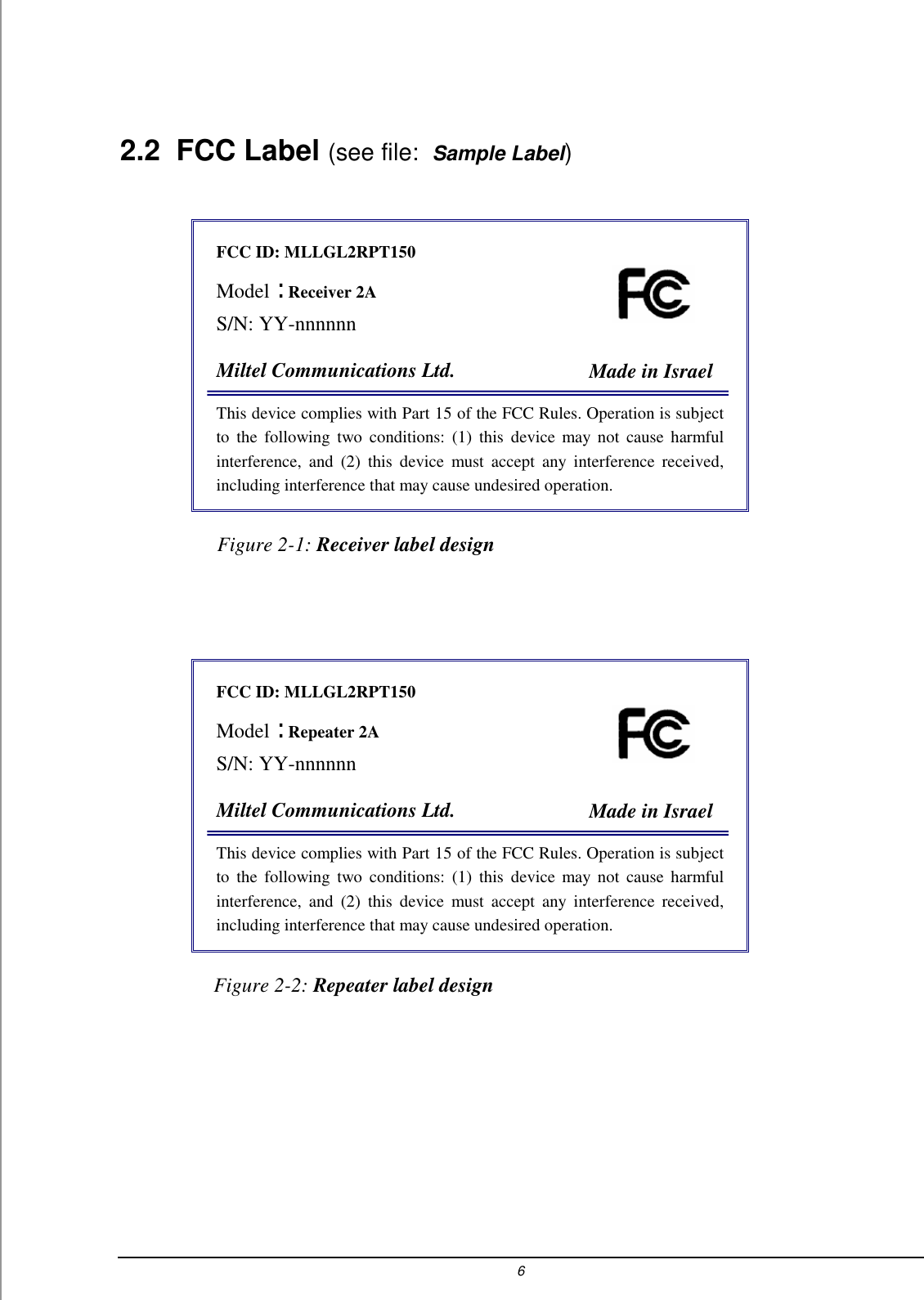
6   2.2 FCC Label (see file:  Sample Label)  FCC ID: MLLGL2RPT150  Model :  Receiver 2A S/N: YY-nnnnnn           Miltel Communications Ltd.  Made in Israel This device complies with Part 15 of the FCC Rules. Operation is subject to the following two conditions: (1) this device may not cause harmful interference, and (2) this device must accept any interference received, including interference that may cause undesired operation.                    Figure 2-1: Receiver label design FCC ID: MLLGL2RPT150  Model :  Repeater 2A S/N: YY-nnnnnn           Miltel Communications Ltd.  Made in Israel This device complies with Part 15 of the FCC Rules. Operation is subject to the following two conditions: (1) this device may not cause harmful interference, and (2) this device must accept any interference received, including interference that may cause undesired operation.             Figure 2-2: Repeater label design
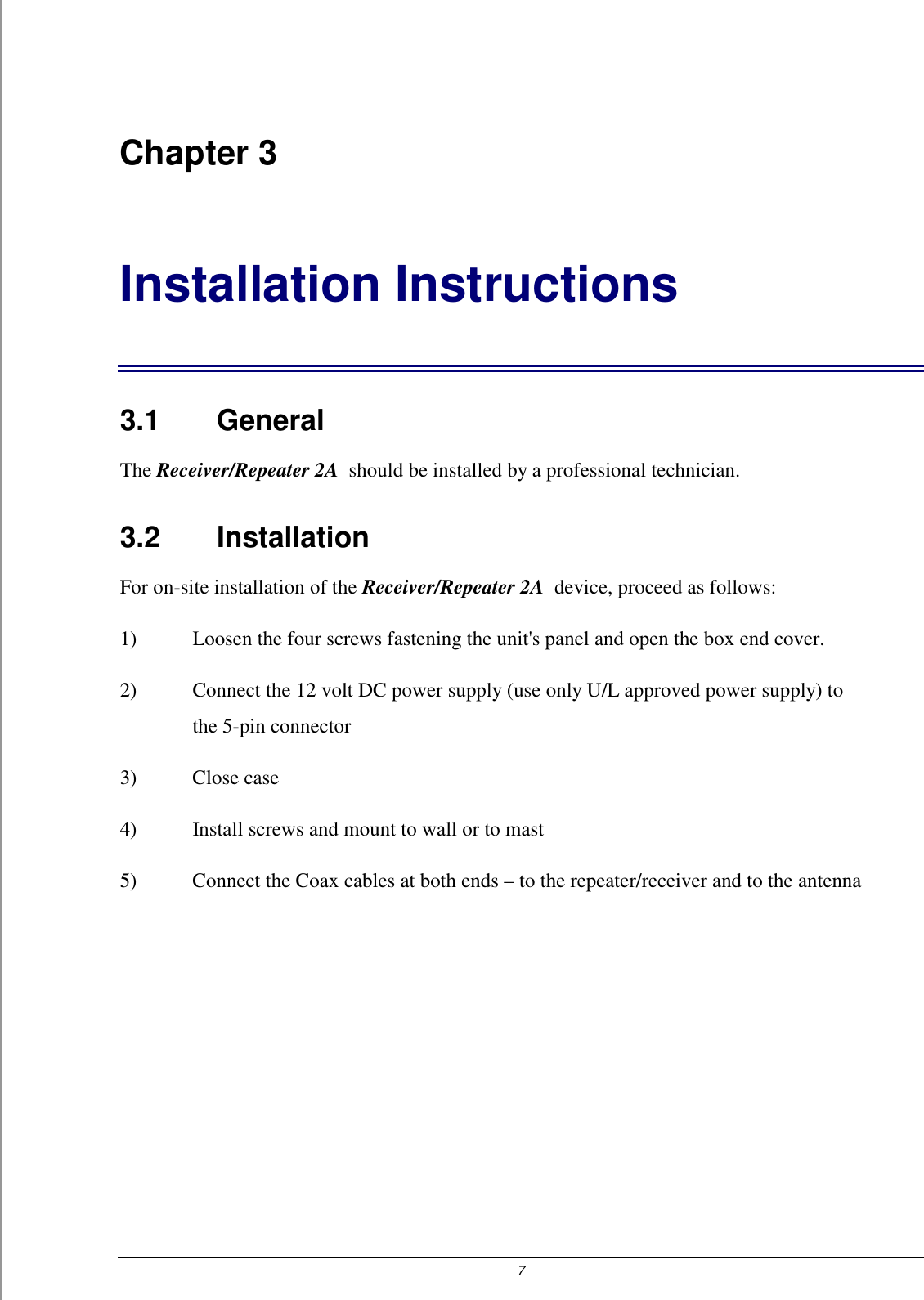
7 Chapter 3 Installation Instructions 3.1    General The Receiver/Repeater 2A  should be installed by a professional technician.  3.2    Installation For on-site installation of the Receiver/Repeater 2A  device, proceed as follows: 1)  Loosen the four screws fastening the unit's panel and open the box end cover. 2)  Connect the 12 volt DC power supply (use only U/L approved power supply) to the 5-pin connector 3) Close case 4)  Install screws and mount to wall or to mast 5)  Connect the Coax cables at both ends – to the repeater/receiver and to the antenna
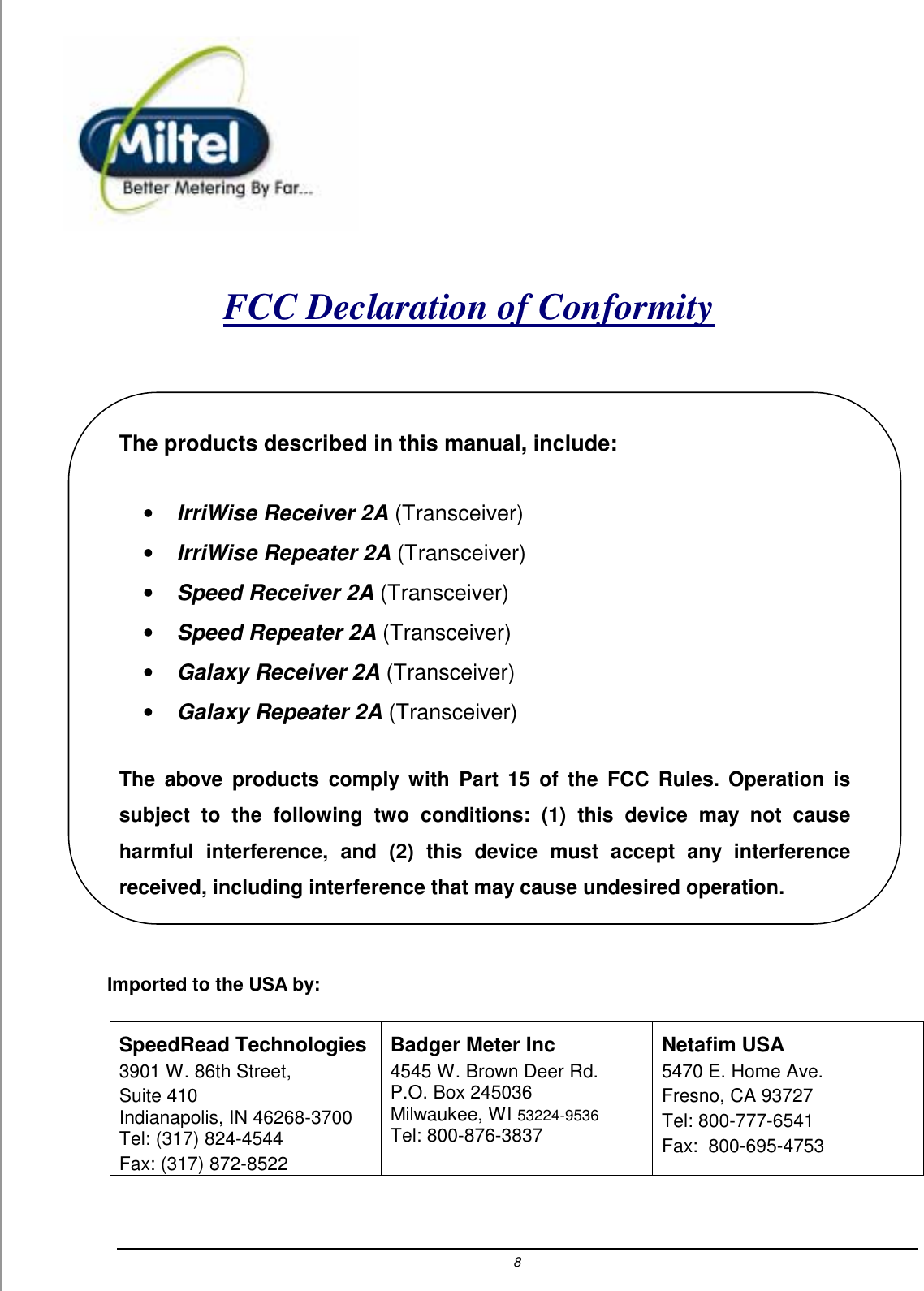
8    FCC Declaration of Conformity   The products described in this manual, include: • IrriWise Receiver 2A (Transceiver) • IrriWise Repeater 2A (Transceiver) • Speed Receiver 2A (Transceiver) • Speed Repeater 2A (Transceiver) • Galaxy Receiver 2A (Transceiver) • Galaxy Repeater 2A (Transceiver)  The above products comply with Part 15 of the FCC Rules. Operation is subject to the following two conditions: (1) this device may not cause harmful interference, and (2) this device must accept any interference received, including interference that may cause undesired operation.  Imported to the USA by: SpeedRead Technologies 3901 W. 86th Street,  Suite 410 Indianapolis, IN 46268-3700 Tel: (317) 824-4544 Fax: (317) 872-8522 Badger Meter Inc 4545 W. Brown Deer Rd. P.O. Box 245036 Milwaukee, WI 53224-9536 Tel: 800-876-3837 Netafim USA  5470 E. Home Ave. Fresno, CA 93727 Tel: 800-777-6541 Fax:  800-695-4753
9  NOTE:  1) The equipment user is required by the radio service rules to obtain a license before operating the equipment. Licensing of this equipment is the user’s responsibility, and licensability depends on the user’s classification and application, and on the selected frequency. The user is strongly urged to contact the appropriate telecommunications authority concerning proper licensing, and before choosing and ordering frequencies. 2) The equipment has been tested and found to comply with the limits for a Class B digital device, pursuant to Part 15 of the FCC Rules. These limits are designed to provide reasonable protection against harmful interference in a residential installation. This equipment generates, uses and can radiate radio frequency energy and, if not installed and used in accordance with the instructions, may cause harmful interference to radio communications. However, there is no guarantee that interference will not occur in a particular installation. If this equipment does cause harmful interference to radio or television reception, which can be determined by turning the equipment off and on, the user is encouraged to try to correct the interference by one or more of the following measures: • Reorient or relocate the receiving antenna. • Increase the separation between the equipment and receiver. • Connect the equipment into an outlet on a circuit different from that to which the receiver is connected. • Consult the dealer or an experienced radio/TV technician for help.  3) Warning: Changes or modifications to this equipment not expressly approved by Miltel Communications Ltd. could void the user’s authority to operate the equipment.

Navigation menu