Minelab Electronics 7000 Metal Detector for recreational use User Manual

Minelab Electronics Pty Ltd Metal Detector for recreational use Users Manual

Contents

Users Manual

Instruction Manual
 iiWARNINGTHIS DOCUMENT CONTAINS INTELLECTUAL PROPERTY, TECHNICAL AND PROPRIETARY DATA AND INFORMATION AND OTHER MATERIAL OWNED SOLELY BY MINELAB ELECTRONICS PTY LIMITED. THIS MATERIAL MUST NOT BE USED WITHOUT THE PRIOR WRITTEN PERMISSION OF MINELAB ELECTRONICS PTY LTD. © MINELAB ELECTRONICS PTY LTD. ALL RIGHTS RESERVEDThis document is protected by copyright. Apart from any use permitted under the Australian Copyright Act 1968 (Cth) or other applicable laws, any unauthorised use, appropriation or reproduction of this document or any part of it is strictly prohibited. No part of this document may be used or reproduced by any means or by any process, in any form, without the prior written permission of the copyright owner Minelab Electronics Pty Ltd of 118 Hayward Avenue, Torrensville, SA 5031, Australia.COMPLIANCEInformation to the User (FCC Part 15.105) NOTE: Class B DevicesThis equipment has been tested and found to comply with the limits for a Class B digital device, pursuant to part 15 of the FCC Rules. These limits are designed to provide reasonable protection against harmful interference in a residential installation.This equipment generates, uses and can radiate radio frequency energy and, if not installed and used in accordance with the instructions, may cause harmful interference to radio communications. However, there is no guarantee that interference will not occur in a particular installation. If this equipment does cause harmful interference to radio or television reception, which can be determined by turning the equipment of and on, the user is encouraged to try to correct the interference by one or more of the following measures:• Reorient or relocate the receiving antenna• Increase the separation between the equipment and receiver• Connect the equipment into an outlet on a circuit different from that to which the receiver is connected• Consult the dealer or an experienced radio/TV technician for helpDISCLAIMERThe Minelab metal detector discussed in this instruction manual has been expressly designed and manufactured as a quality hobbyist metal detector and is recommended for use in coin, treasure and general metal detection in nonhazardous environments. This metal detector has not been designed for use as a mine detector or as a live munitions detection tool. PLEASE NOTESince there may be a variety of options available for this detector, equipment may vary according to the Model or items ordered with your detector. Certain descriptions and illustrations may also differ (in this manual) from the exact Model that you purchased. In addition, Minelab reserves the right to respond to ongoing technical progress by introducing changes in design, equipment and technical features at any time.Minelab®, Smartfind™ 2, Wi-Stream™, GPSi™, FindPoint®, GeoHunt™, GeoTrail™, XChange Your Detecting Connection™, Target Trace™ are trademarks of Minelab Electronics Pty. Ltd. Google Maps is a trademark of Google Inc. u-blox is a trademark of u-blox Holding AG.CAUTION Before assembling, charging, or using your detector for the first time, please read the important legal and safety information in this manual.This appliance can be used by children aged from 8 years and above and persons with reduced physical, sensory or mental capabilities or lack of experience and knowledge if they have been given supervision or instruction concerning use of the appliance in a safe way and understand the hazards involved. Children shall not play with the appliance. Cleaning and user maintenance shall not be made by children without supervision.
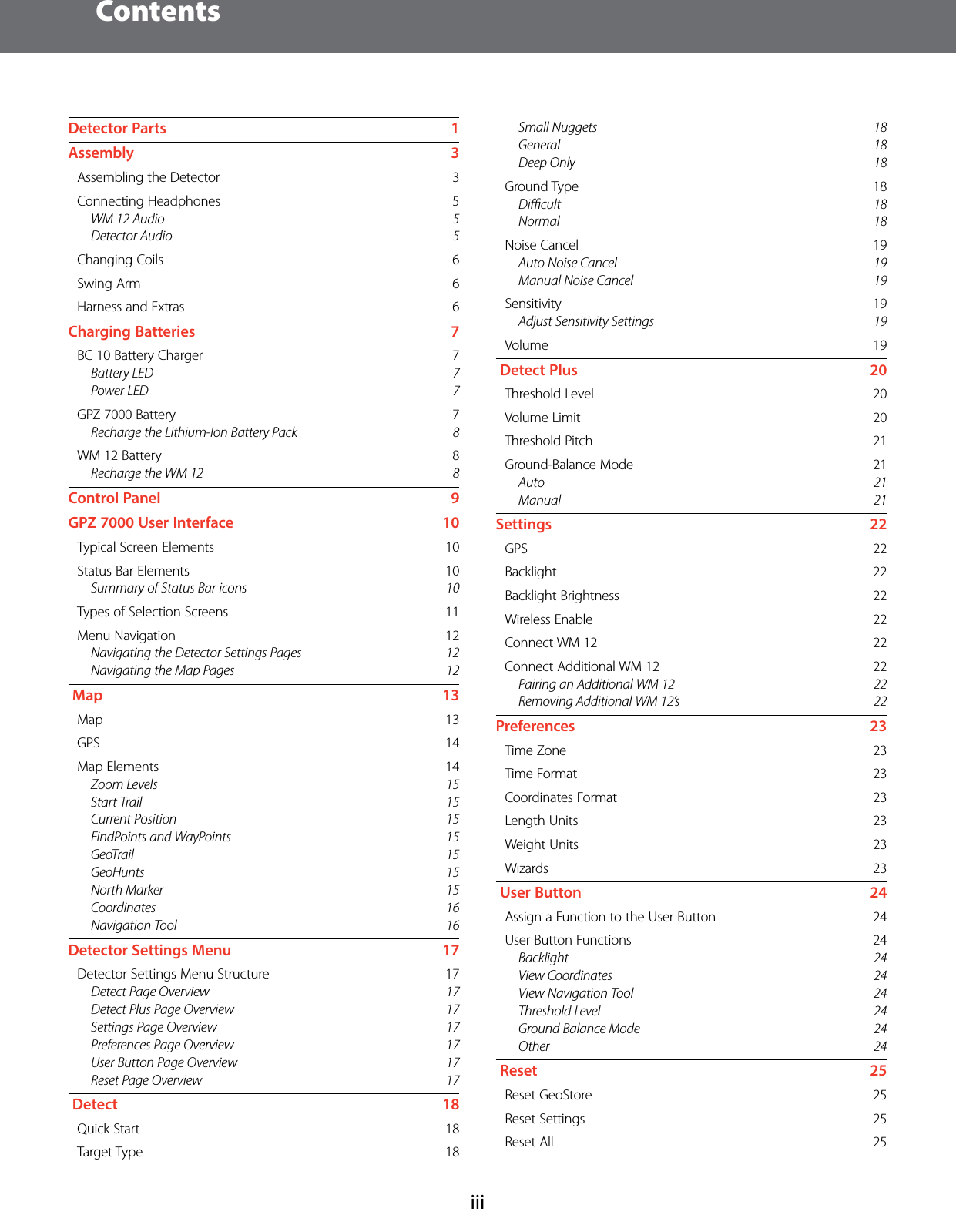
ContentsiiiDetector Parts    1Assembly   3Assembling the Detector    3Connecting Headphones    5WM 12 Audio  5Detector Audio  5Changing Coils    6Swing Arm    6Harness and Extras    6Charging Batteries    7BC 10 Battery Charger    7Battery LED  7Power LED  7GPZ 7000 Battery    7Recharge the Lithium-Ion Battery Pack  8WM 12 Battery    8Recharge the WM 12  8Control Panel    9GPZ7000 User Interface    10Typical Screen Elements    10Status Bar Elements    10Summary of Status Bar icons  10Types of Selection Screens    11Menu Navigation    12Navigating the Detector Settings Pages  12Navigating the Map Pages  12 Map    13Map   13GPS   14Map Elements    14Zoom Levels  15Start Trail  15Current Position  15FindPoints and WayPoints  15GeoTrail 15GeoHunts 15North Marker  15Coordinates 16Navigation Tool  16Detector Settings Menu    17Detector Settings Menu Structure    17Detect Page Overview  17Detect Plus Page Overview  17Settings Page Overview  17Preferences Page Overview  17User Button Page Overview  17Reset Page Overview  17 Detect    18Quick Start    18Target Type    18Small Nuggets  18General 18Deep Only  18Ground Type    18Difficult 18Normal 18Noise Cancel    19Auto Noise Cancel  19Manual Noise Cancel  19Sensitivity   19Adjust Sensitivity Settings  19Volume   19 Detect Plus    20Threshold Level    20Volume Limit    20Threshold Pitch    21Ground-Balance Mode    21Auto 21Manual 21Settings   22GPS   22Backlight   22Backlight Brightness    22Wireless Enable    22Connect WM 12    22Connect Additional WM 12    22Pairing an Additional WM 12  22Removing Additional WM 12’s  22Preferences   23Time Zone    23Time Format    23Coordinates Format    23Length Units    23Weight Units    23Wizards   23 User Button    24Assign a Function to the User Button    24User Button Functions    24Backlight 24View Coordinates  24View Navigation Tool  24Threshold Level  24Ground Balance Mode  24Other 24 Reset    25Reset GeoStore    25Reset Settings    25Reset All    25
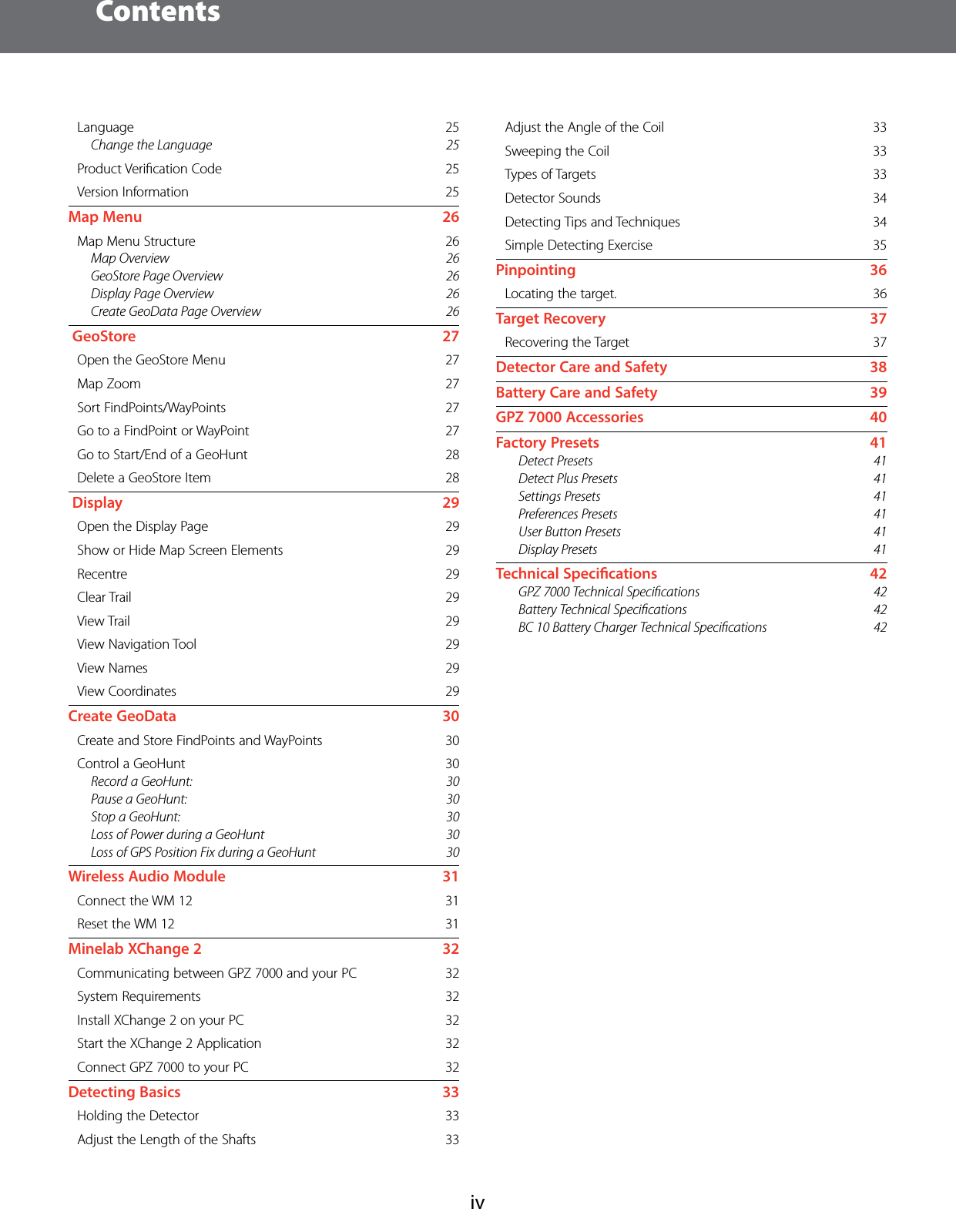
ContentsivLanguage   25Change the Language  25Product Verification Code    25Version Information     25Map Menu    26Map Menu Structure    26Map Overview  26GeoStore Page Overview  26Display Page Overview  26Create GeoData Page Overview  26 GeoStore    27Open the GeoStore Menu    27Map Zoom    27Sort FindPoints/WayPoints    27Go to a FindPoint or WayPoint    27Go to Start/End of a GeoHunt    28Delete a GeoStore Item    28 Display   29Open the Display Page    29Show or Hide Map Screen Elements    29Recentre   29Clear Trail    29View Trail    29View Navigation Tool    29View Names    29View Coordinates    29Create GeoData    30Create and Store FindPoints and WayPoints    30Control a GeoHunt    30Record a GeoHunt:  30Pause a GeoHunt:  30Stop a GeoHunt:  30Loss of Power during a GeoHunt  30Loss of GPS Position Fix during a GeoHunt  30Wireless Audio Module    31Connect the WM 12    31Reset the WM 12    31Minelab XChange2    32Communicating between GPZ 7000 and your PC   32System Requirements    32Install XChange 2 on your PC    32Start the XChange 2 Application    32Connect GPZ 7000 to your PC    32Detecting Basics   33Holding the Detector    33Adjust the Length of the Shafts    33Adjust the Angle of the Coil   33Sweeping the Coil   33Types of Targets    33Detector Sounds    34Detecting Tips and Techniques    34Simple Detecting Exercise    35Pinpointing   36Locating the target.    36Target Recovery   37Recovering the Target    37Detector Care and Safety   38Battery Care and Safety    39GPZ7000 Accessories    40Factory Presets    41Detect Presets  41Detect Plus Presets  41Settings Presets  41Preferences Presets  41User Button Presets   41Display Presets  41Technical Specications    42GPZ 7000 Technical Specifications  42Battery Technical Specifications  42BC 10 Battery Charger Technical Specifications  42
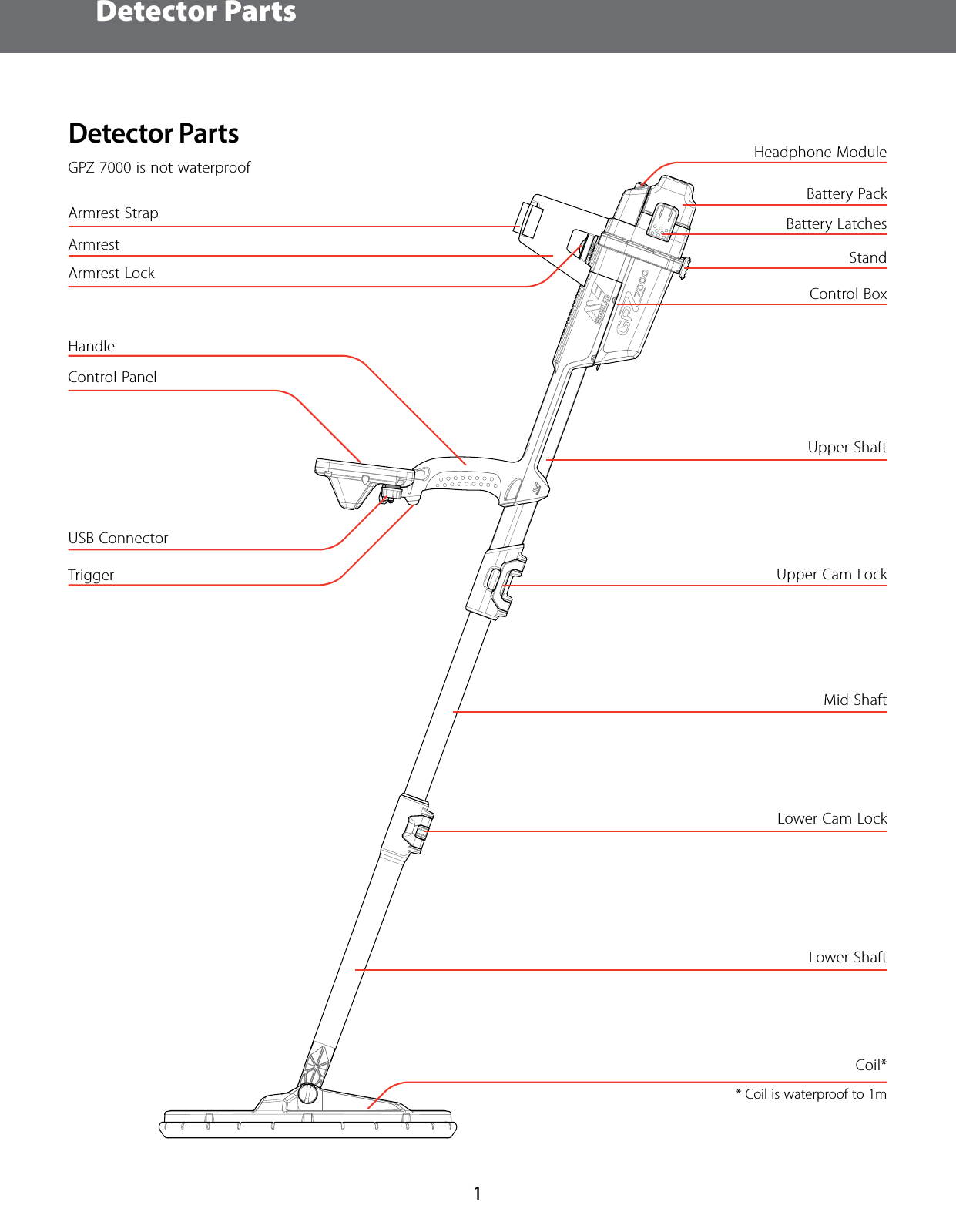
Detector Parts1* Coil is waterproof to 1mBattery PackBattery LatchesStandControl BoxTrigger Upper Cam LockLower Cam LockLower ShaftCoil*Headphone ModuleControl PanelHandleArmrestArmrest StrapArmrest LockUSB ConnectorMid ShaftUpper ShaftDetector PartsGPZ 7000 is not waterproof
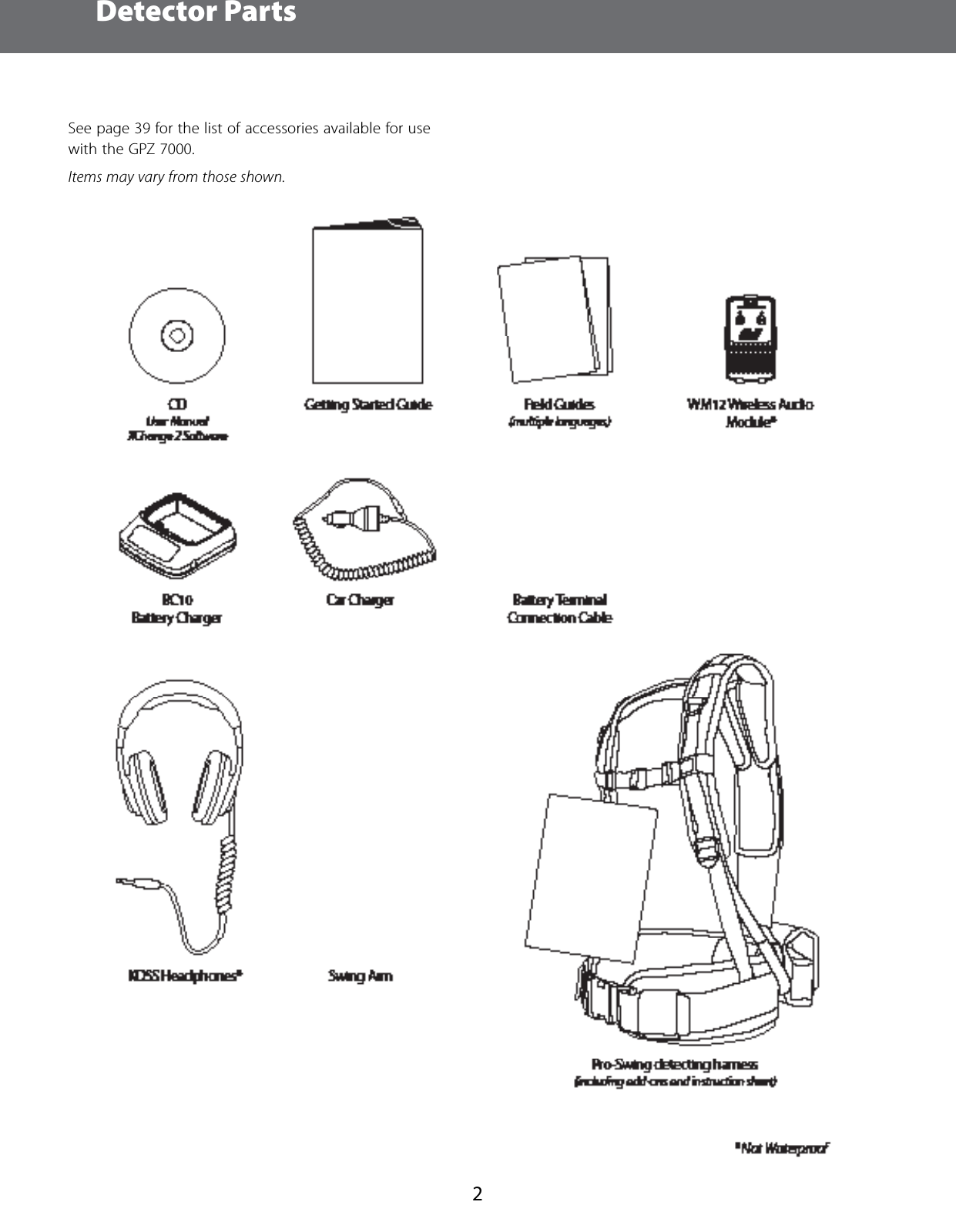
Detector Parts2See page 39 for the list of accessories available for use with the GPZ 7000.Items may vary from those shown.
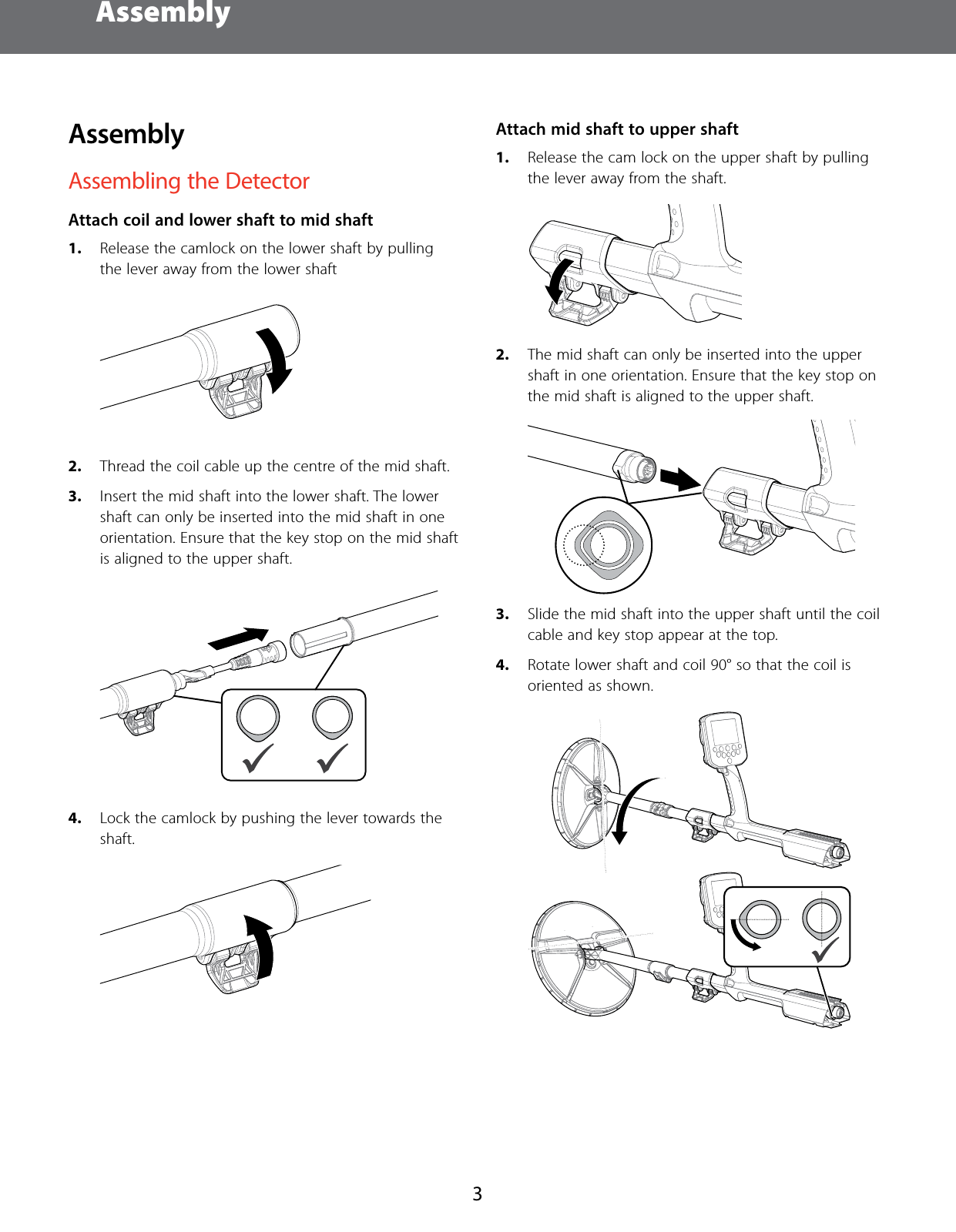
Assembly3AssemblyAssembling the DetectorAttach coil and lower shaft to mid shaft 1.  Release the camlock on the lower shaft by pulling the lever away from the lower shaft2.  Thread the coil cable up the centre of the mid shaft.3.  Insert the mid shaft into the lower shaft. The lower shaft can only be inserted into the mid shaft in one orientation. Ensure that the key stop on the mid shaft is aligned to the upper shaft. 4.  Lock the camlock by pushing the lever towards the shaft. Attach mid shaft to upper shaft1.  Release the cam lock on the upper shaft by pulling the lever away from the shaft.  2.  The mid shaft can only be inserted into the upper shaft in one orientation. Ensure that the key stop on the mid shaft is aligned to the upper shaft. 3.  Slide the mid shaft into the upper shaft until the coil cable and key stop appear at the top. 4.  Rotate lower shaft and coil 90° so that the coil is oriented as shown.
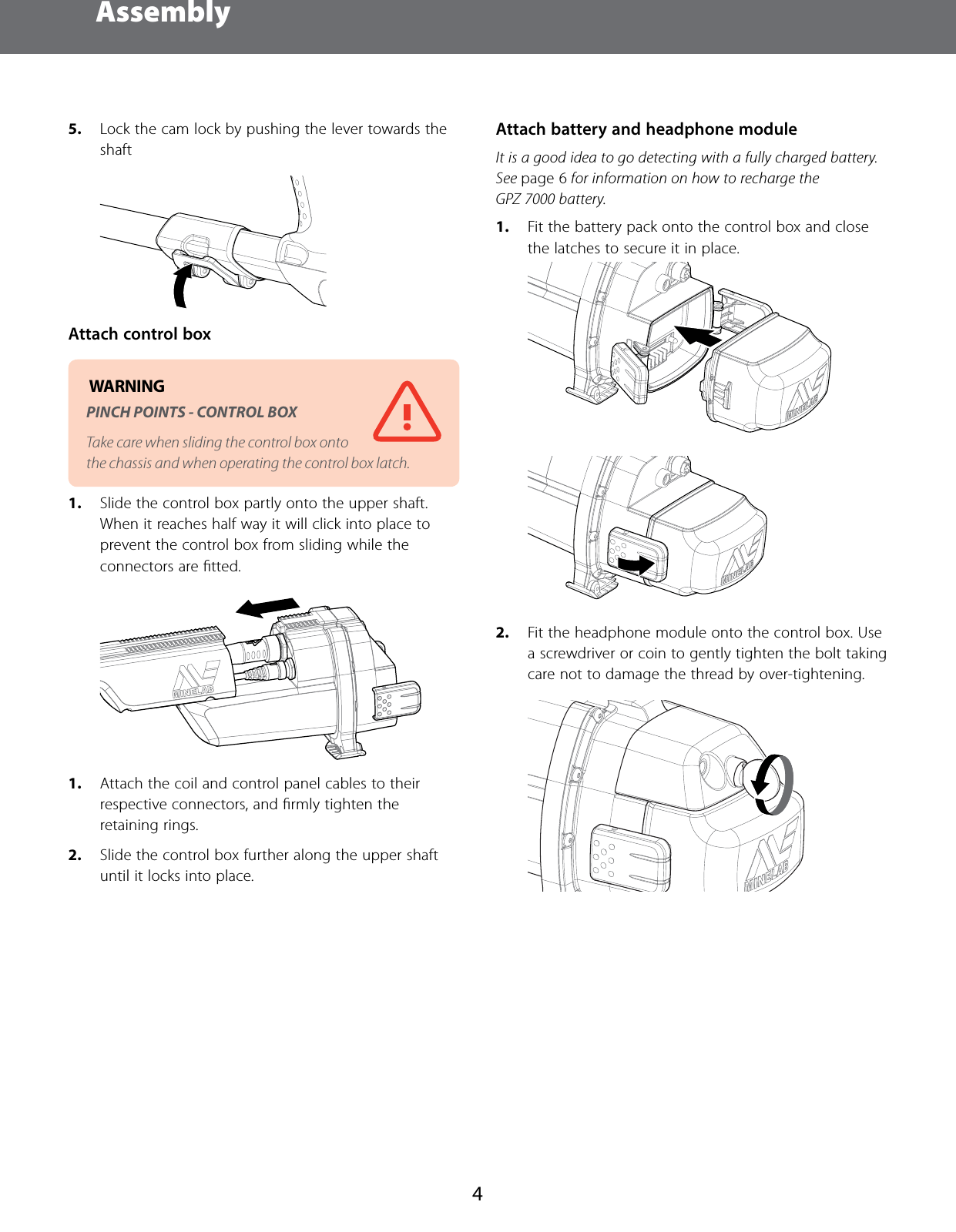
Assembly45.  Lock the cam lock by pushing the lever towards the shaft Attach control box WARNING PINCH POINTS - CONTROL BOX Take care when sliding the control box onto the chassis and when operating the control box latch.1.  Slide the control box partly onto the upper shaft. When it reaches half way it will click into place to prevent the control box from sliding while the connectors are fitted.  1.  Attach the coil and control panel cables to their respective connectors, and firmly tighten the retaining rings.2.  Slide the control box further along the upper shaft until it locks into place. Attach battery and headphone moduleIt is a good idea to go detecting with a fully charged battery. See page 6 for information on how to recharge the GPZ 7000 battery.1.  Fit the battery pack onto the control box and close the latches to secure it in place. 2.  Fit the headphone module onto the control box. Use a screwdriver or coin to gently tighten the bolt taking care not to damage the thread by over-tightening.
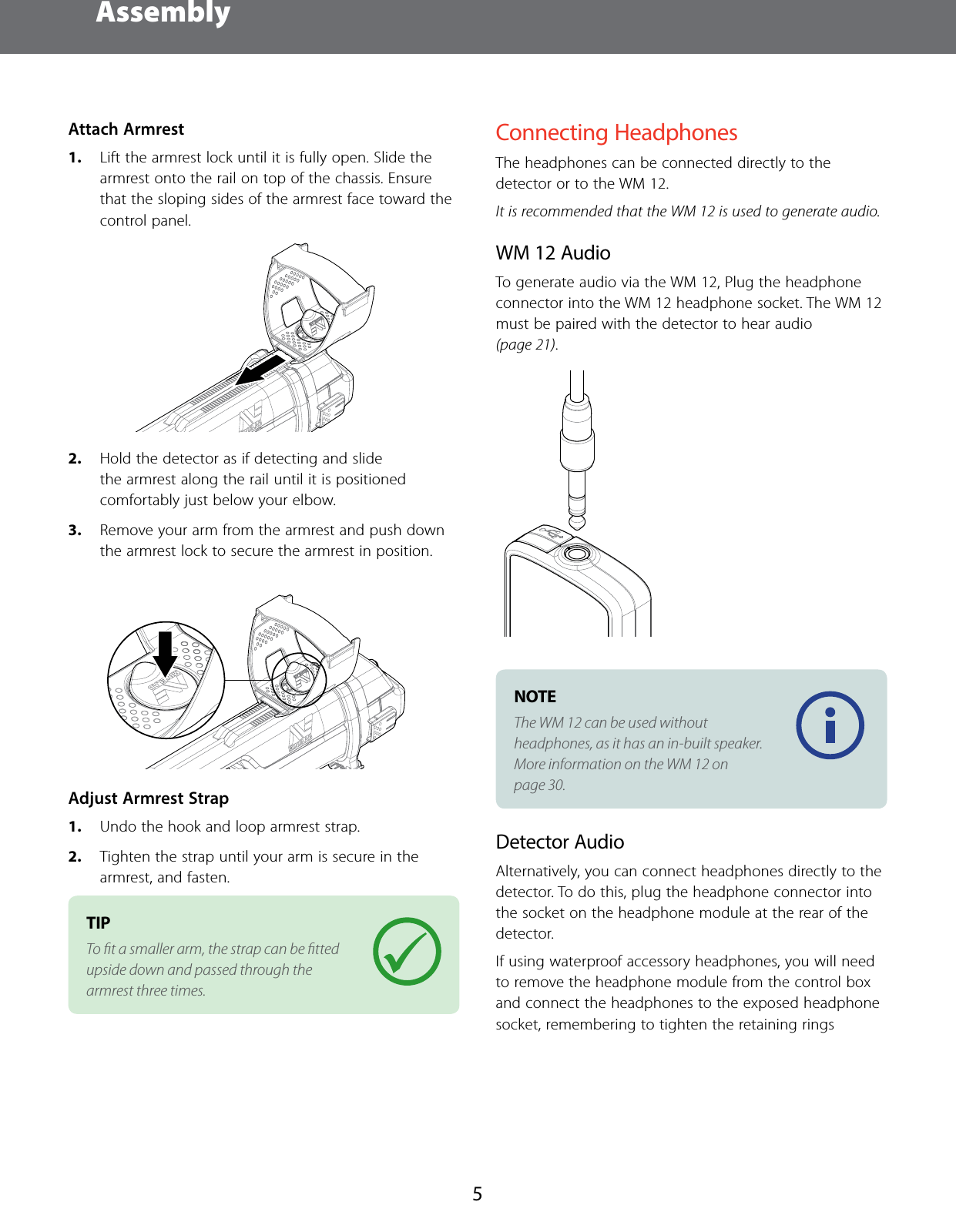
Assembly5Attach Armrest1.  Lift the armrest lock until it is fully open. Slide the armrest onto the rail on top of the chassis. Ensure that the sloping sides of the armrest face toward the control panel. 2.  Hold the detector as if detecting and slide the armrest along the rail until it is positioned comfortably just below your elbow.3.  Remove your arm from the armrest and push down the armrest lock to secure the armrest in position.  Adjust Armrest Strap1.  Undo the hook and loop armrest strap.2.  Tighten the strap until your arm is secure in the armrest, and fasten.TIP To fit a smaller arm, the strap can be fitted upside down and passed through the armrest three times.Connecting HeadphonesThe headphones can be connected directly to the detector or to the WM 12.It is recommended that the WM 12 is used to generate audio.WM12 AudioTo generate audio via the WM 12, Plug the headphone connector into the WM 12 headphone socket. The WM 12 must be paired with the detector to hear audio (page 21).  NOTE The WM 12 can be used without headphones, as it has an in-built speaker. More information on the WM 12 on page 30.Detector AudioAlternatively, you can connect headphones directly to the detector. To do this, plug the headphone connector into the socket on the headphone module at the rear of the detector.If using waterproof accessory headphones, you will need to remove the headphone module from the control box and connect the headphones to the exposed headphone socket, remembering to tighten the retaining rings
Charging Batteries6Changing CoilsA range of accessory coils are available for your GPZ 7000. To change a coil, follow the ‘Assembling the detector’ steps with the alternative coil.Always check that the coil connector is dry and free of grit and dust before connecting to the detector.NOTE All Minelab GPZ 7000 coils come with the lower shaft pre-assembled to the coil. Disassembling a coil from its lower shaft is not recommended.Swing ArmHarness and Extras
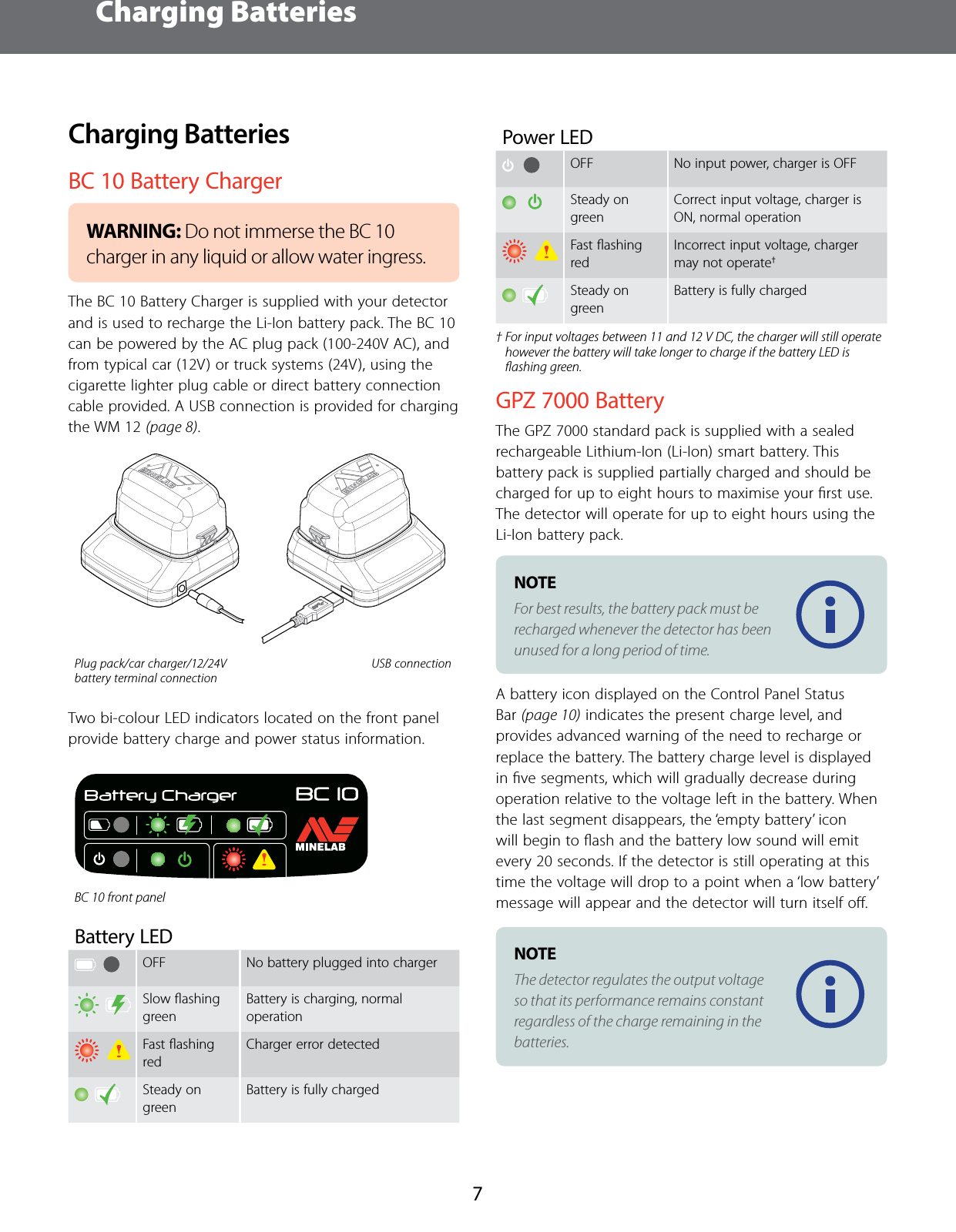
Charging Batteries7Charging BatteriesBC 10 Battery ChargerWARNING: Do not immerse the BC 10 charger in any liquid or allow water ingress.The BC 10 Battery Charger is supplied with your detector and is used to recharge the Li-Ion battery pack. The BC 10 can be powered by the AC plug pack (100-240V AC), and from typical car (12V) or truck systems (24V), using the cigarette lighter plug cable or direct battery connection cable provided. A USB connection is provided for charging the WM 12 (page 8).Plug pack/car charger/12/24V battery terminal connectionUSB connectionTwo bi-colour LED indicators located on the front panel provide battery charge and power status information.!BC 10 front panelBattery LEDOFF No battery plugged into chargerSlow flashing greenBattery is charging, normal operationFast flashing redCharger error detectedSteady on greenBattery is fully chargedPower LEDOFF No input power, charger is OFFSteady on greenCorrect input voltage, charger is ON, normal operationFast flashing redIncorrect input voltage, charger may not operate†Steady on greenBattery is fully charged†  For input voltages between 11 and 12 V DC, the charger will still operate however the battery will take longer to charge if the battery LED is flashing green.GPZ7000 BatteryThe GPZ 7000 standard pack is supplied with a sealed rechargeable Lithium-Ion (Li-Ion) smart battery. This battery pack is supplied partially charged and should be charged for up to eight hours to maximise your first use. The detector will operate for up to eight hours using the Li-Ion battery pack.NOTE For best results, the battery pack must be recharged whenever the detector has been unused for a long period of time.A battery icon displayed on the Control Panel Status Bar (page 10) indicates the present charge level, and provides advanced warning of the need to recharge or replace the battery. The battery charge level is displayed in five segments, which will gradually decrease during operation relative to the voltage left in the battery. When the last segment disappears, the ‘empty battery’ icon will begin to flash and the battery low sound will emit every 20 seconds. If the detector is still operating at this time the voltage will drop to a point when a ‘low battery’ message will appear and the detector will turn itself off.NOTE The detector regulates the output voltage so that its performance remains constant regardless of the charge remaining in the batteries.
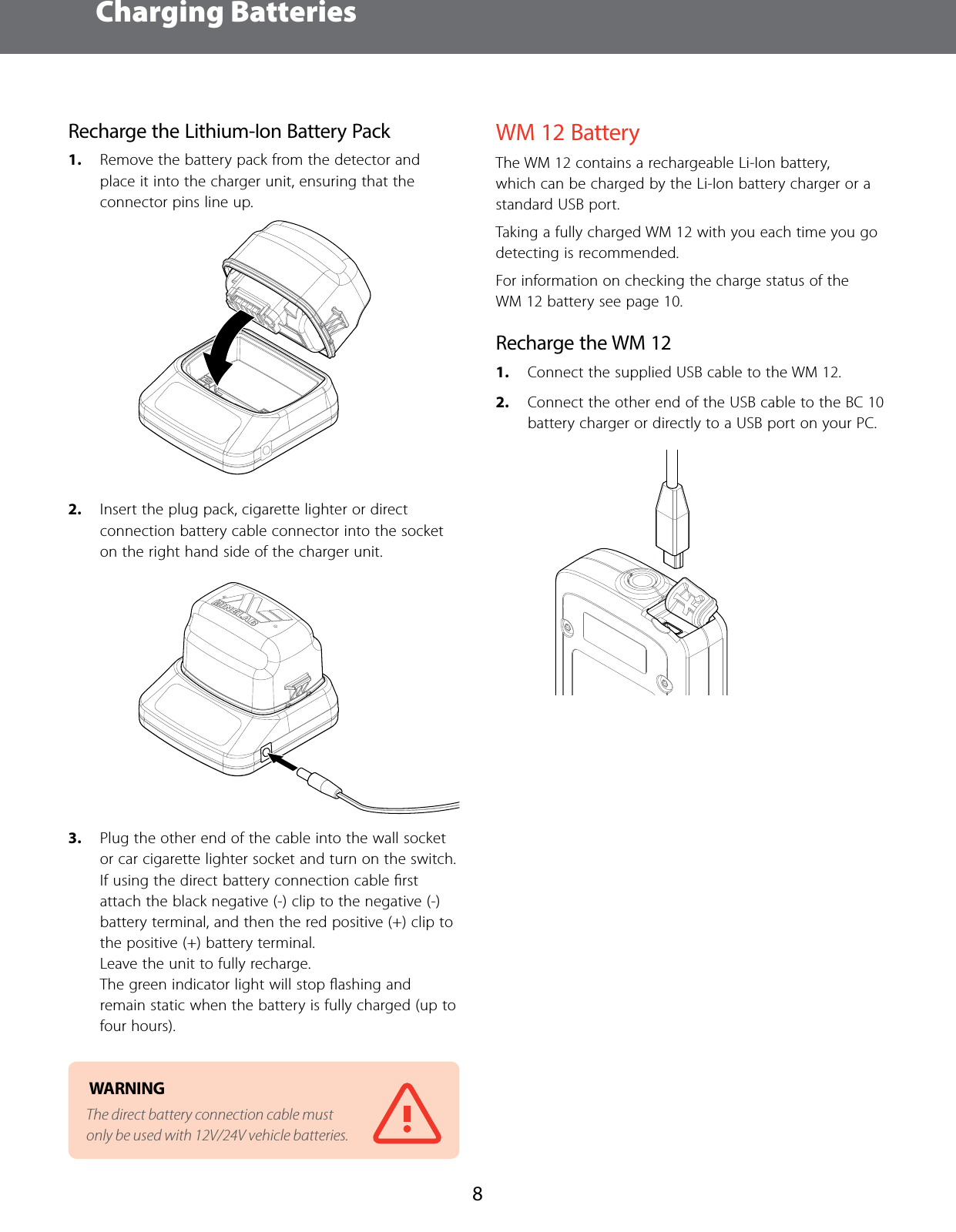
Charging Batteries8Recharge the Lithium-Ion Battery Pack1.  Remove the battery pack from the detector and place it into the charger unit, ensuring that the connector pins line up.2.  Insert the plug pack, cigarette lighter or direct connection battery cable connector into the socket on the right hand side of the charger unit.3.  Plug the other end of the cable into the wall socket or car cigarette lighter socket and turn on the switch. If using the direct battery connection cable first attach the black negative (-) clip to the negative (-) battery terminal, and then the red positive (+) clip to the positive (+) battery terminal. Leave the unit to fully recharge.  The green indicator light will stop flashing and remain static when the battery is fully charged (up to four hours). WARNING The direct battery connection cable must only be used with 12V/24V vehicle batteries.WM12 BatteryThe WM 12 contains a rechargeable Li-Ion battery, which can be charged by the Li-Ion battery charger or a standard USB port.Taking a fully charged WM 12 with you each time you go detecting is recommended.For information on checking the charge status of the WM 12 battery see page 10.Recharge the WM121.  Connect the supplied USB cable to the WM 12.2.  Connect the other end of the USB cable to the BC 10 battery charger or directly to a USB port on your PC.
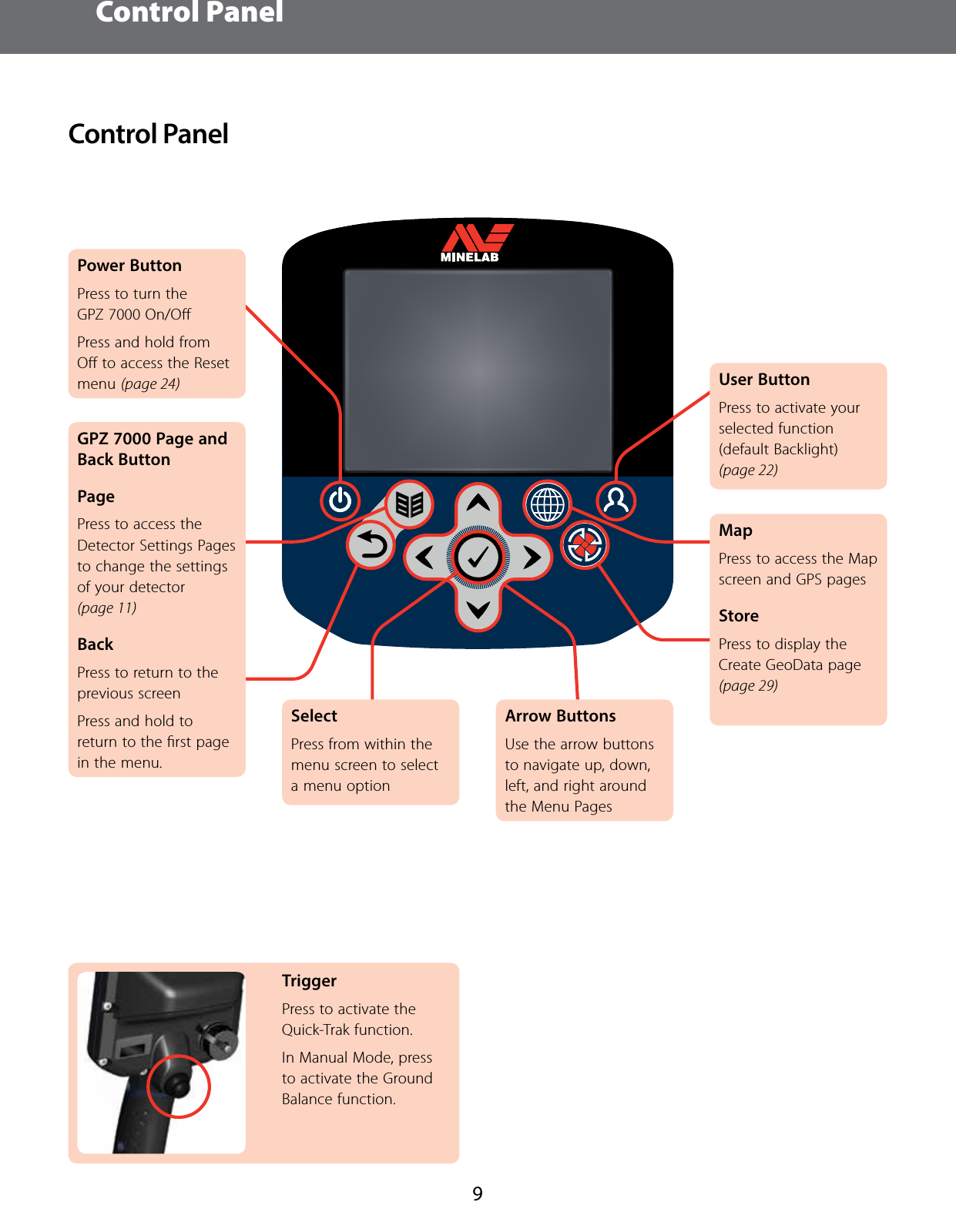
Control Panel9Control PanelPower ButtonPress to turn the GPZ 7000 On/OffPress and hold from Off to access the Reset menu (page 24)GPZ7000 Page and Back ButtonPagePress to access the Detector Settings Pages to change the settings of your detector (page 11)BackPress to return to the previous screenPress and hold to return to the first page in the menu.MapPress to access the Map screen and GPS pagesStorePress to display the Create GeoData page (page 29)Arrow ButtonsUse the arrow buttons to navigate up, down, left, and right around the Menu PagesSelectPress from within the menu screen to select a menu optionUser ButtonPress to activate your selected function (default Backlight) (page 22)TriggerPress to activate the Quick-Trak function.In Manual Mode, press to activate the Ground Balance function.
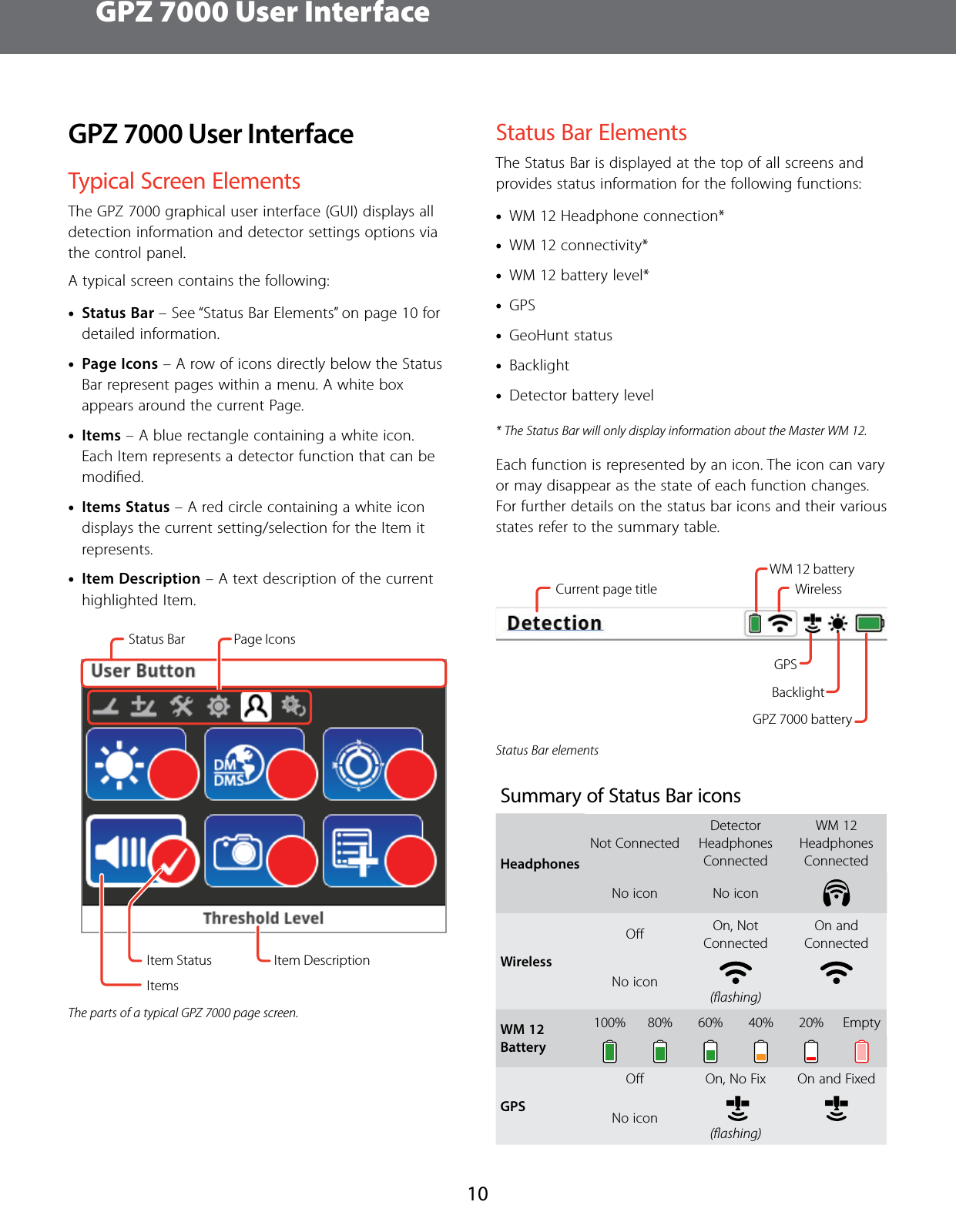
GPZ 7000 User Interface10GPZ7000 User InterfaceTypical Screen ElementsThe GPZ 7000 graphical user interface (GUI) displays all detection information and detector settings options via the control panel.A typical screen contains the following: •Status Bar – See “Status Bar Elements” on page 10 for detailed information. •Page Icons – A row of icons directly below the Status Bar represent pages within a menu. A white box appears around the current Page. •Items – A blue rectangle containing a white icon. Each Item represents a detector function that can be modified. •Items Status – A red circle containing a white icon displays the current setting/selection for the Item it represents. •Item Description – A text description of the current highlighted Item.ItemsPage IconsStatus BarItem Status Item DescriptionThe parts of a typical GPZ 7000 page screen.Status Bar ElementsThe Status Bar is displayed at the top of all screens and provides status information for the following functions: •WM 12 Headphone connection* •WM 12 connectivity* •WM 12 battery level* •GPS •GeoHunt status •Backlight •Detector battery level* The Status Bar will only display information about the Master WM 12.Each function is represented by an icon. The icon can vary or may disappear as the state of each function changes. For further details on the status bar icons and their various states refer to the summary table.WM 12 batteryWirelessGPSBacklightGPZ 7000 batteryCurrent page titleStatus Bar elementsSummary of Status Bar iconsHeadphonesNot ConnectedDetector Headphones ConnectedWM 12 Headphones ConnectedNo icon  No iconWirelessOff On, Not ConnectedOn and ConnectedNo icon(flashing)WM 12 Battery100% 80% 60% 40% 20% EmptyGPSOff On, No Fix On and FixedNo icon   (flashing)
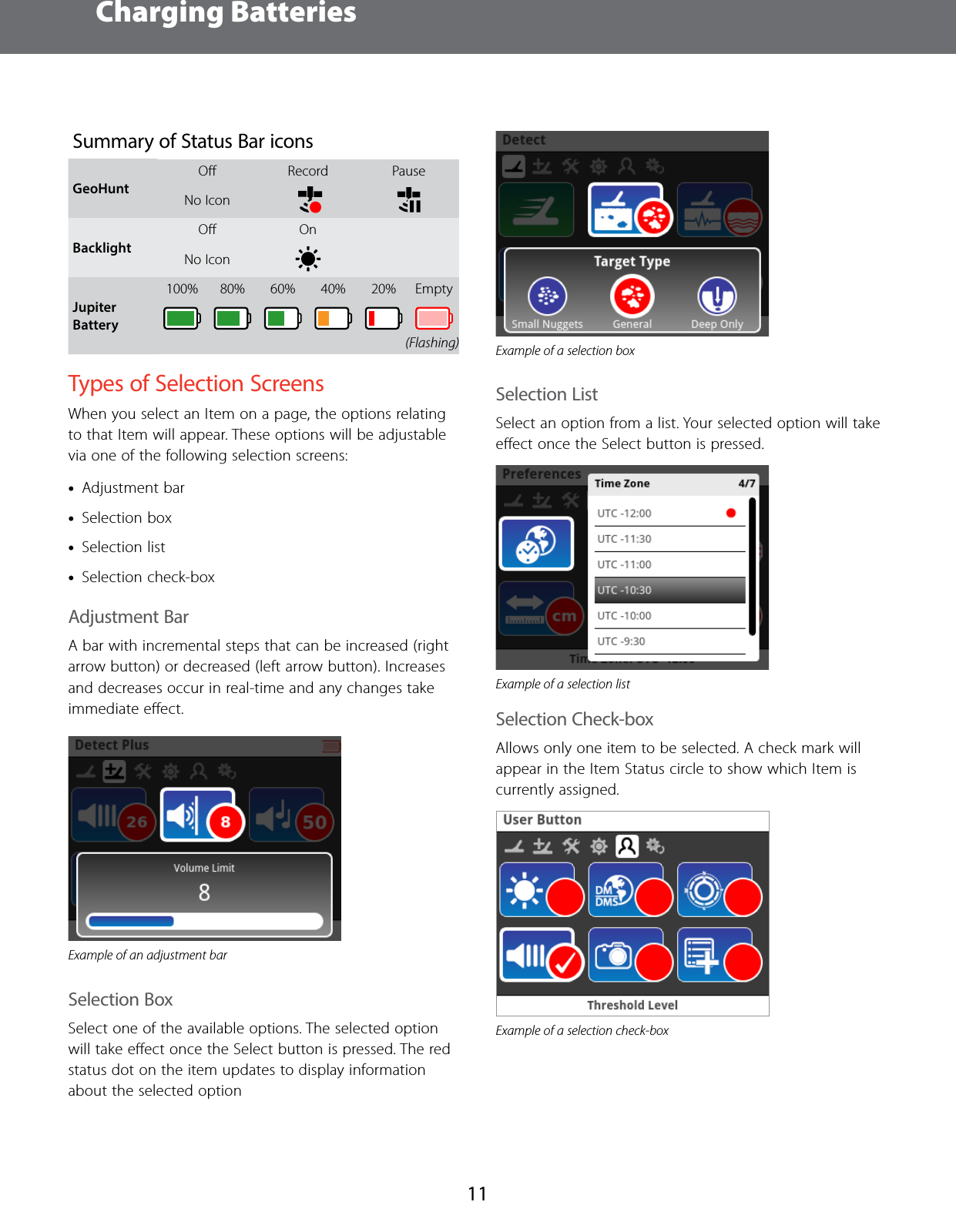
Charging Batteries11Summary of Status Bar iconsGeoHunt Off Record PauseNo Icon   BacklightOff OnNo Icon Jupiter Battery100% 80% 60% 40% 20% EmptyTypes of Selection ScreensWhen you select an Item on a page, the options relating to that Item will appear. These options will be adjustable via one of the following selection screens: •Adjustment bar •Selection box •Selection list •Selection check-boxAdjustment BarA bar with incremental steps that can be increased (right arrow button) or decreased (left arrow button). Increases and decreases occur in real-time and any changes take immediate effect.Example of an adjustment barSelection BoxSelect one of the available options. The selected option will take effect once the Select button is pressed. The red status dot on the item updates to display information about the selected optionExample of a selection boxSelection ListSelect an option from a list. Your selected option will take effect once the Select button is pressed. Example of a selection listSelection Check-boxAllows only one item to be selected. A check mark will appear in the Item Status circle to show which Item is currently assigned.Example of a selection check-box(Flashing)
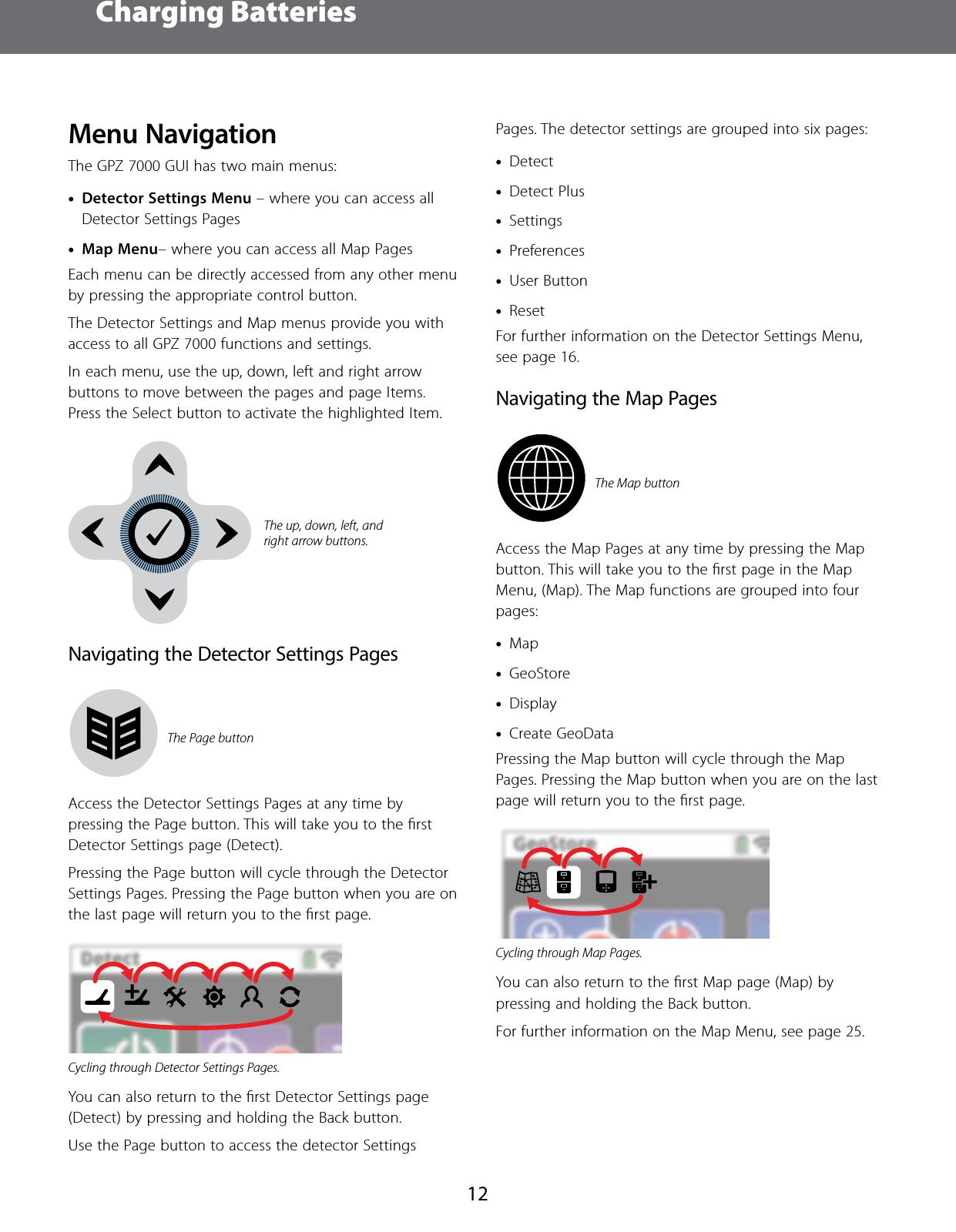
Charging Batteries12Menu NavigationThe GPZ 7000 GUI has two main menus: •Detector Settings Menu – where you can access all Detector Settings Pages •Map Menu– where you can access all Map PagesEach menu can be directly accessed from any other menu by pressing the appropriate control button.The Detector Settings and Map menus provide you with access to all GPZ 7000 functions and settings. In each menu, use the up, down, left and right arrow buttons to move between the pages and page Items. Press the Select button to activate the highlighted Item.The up, down, left, and right arrow buttons.Navigating the Detector Settings PagesThe Page buttonAccess the Detector Settings Pages at any time by pressing the Page button. This will take you to the first Detector Settings page (Detect). Pressing the Page button will cycle through the Detector Settings Pages. Pressing the Page button when you are on the last page will return you to the first page.Cycling through Detector Settings Pages.You can also return to the first Detector Settings page (Detect) by pressing and holding the Back button.Use the Page button to access the detector Settings Pages. The detector settings are grouped into six pages: •Detect •Detect Plus •Settings •Preferences •User Button •ResetFor further information on the Detector Settings Menu, see page 16.Navigating the Map PagesThe Map buttonAccess the Map Pages at any time by pressing the Map button. This will take you to the first page in the Map Menu, (Map). The Map functions are grouped into four pages: •Map •GeoStore •Display •Create GeoDataPressing the Map button will cycle through the Map Pages. Pressing the Map button when you are on the last page will return you to the first page.Cycling through Map Pages.You can also return to the first Map page (Map) by pressing and holding the Back button.For further information on the Map Menu, see page 25.
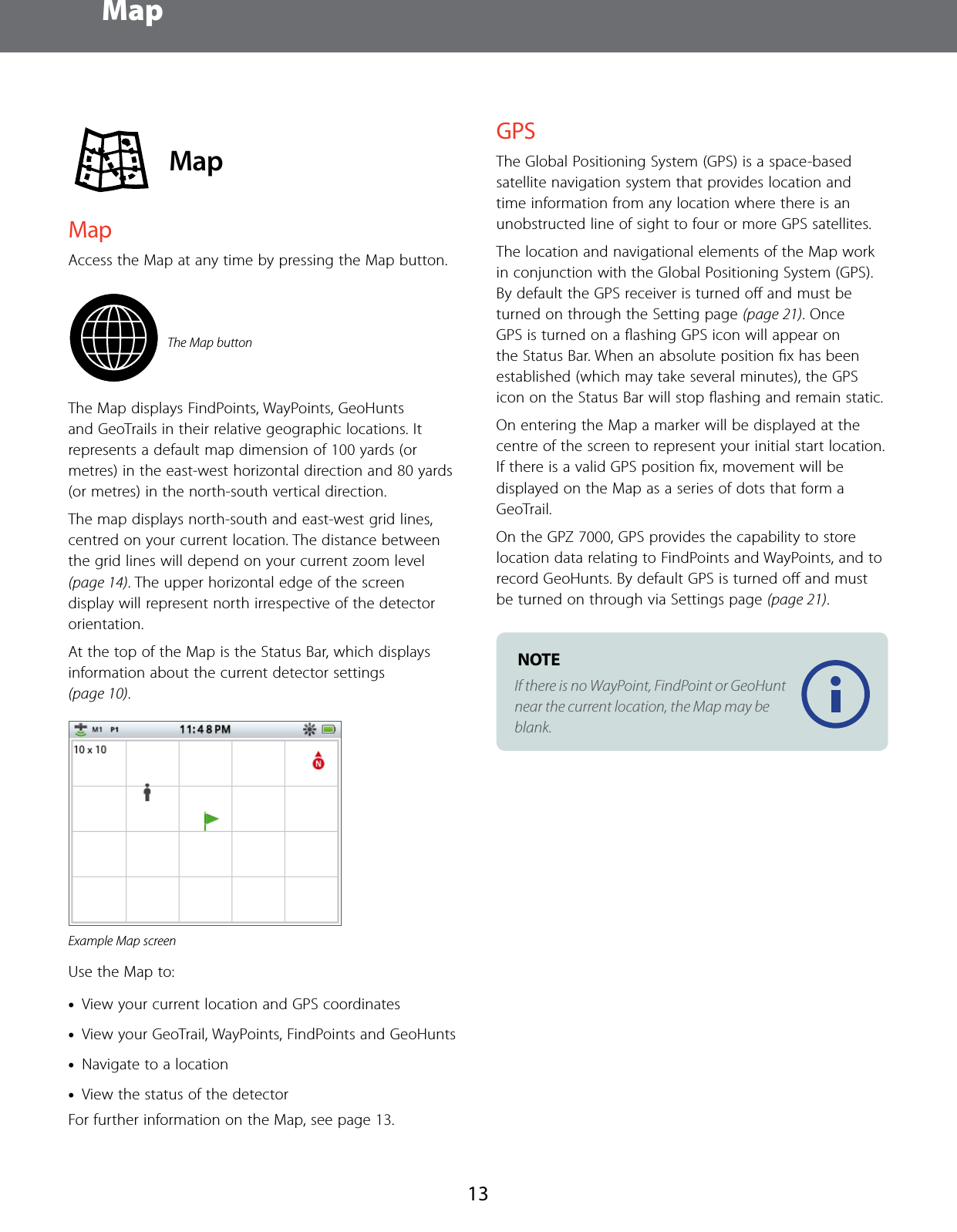
 Map13 MapMapAccess the Map at any time by pressing the Map button.The Map buttonThe Map displays FindPoints, WayPoints, GeoHunts and GeoTrails in their relative geographic locations. It represents a default map dimension of 100 yards (or metres) in the east-west horizontal direction and 80 yards (or metres) in the north-south vertical direction. The map displays north-south and east-west grid lines, centred on your current location. The distance between the grid lines will depend on your current zoom level (page 14). The upper horizontal edge of the screen display will represent north irrespective of the detector orientation.At the top of the Map is the Status Bar, which displays information about the current detector settings (page 10).Example Map screenUse the Map to: •View your current location and GPS coordinates •View your GeoTrail, WayPoints, FindPoints and GeoHunts •Navigate to a location •View the status of the detectorFor further information on the Map, see page 13.GPSThe Global Positioning System (GPS) is a space-based satellite navigation system that provides location and time information from any location where there is an unobstructed line of sight to four or more GPS satellites. The location and navigational elements of the Map work in conjunction with the Global Positioning System (GPS). By default the GPS receiver is turned off and must be turned on through the Setting page (page 21). Once GPS is turned on a flashing GPS icon will appear on the Status Bar. When an absolute position fix has been established (which may take several minutes), the GPS icon on the Status Bar will stop flashing and remain static.On entering the Map a marker will be displayed at the centre of the screen to represent your initial start location. If there is a valid GPS position fix, movement will be displayed on the Map as a series of dots that form a GeoTrail.On the GPZ 7000, GPS provides the capability to store location data relating to FindPoints and WayPoints, and to record GeoHunts. By default GPS is turned off and must be turned on through via Settings page (page 21). NOTE If there is no WayPoint, FindPoint or GeoHunt near the current location, the Map may be blank.
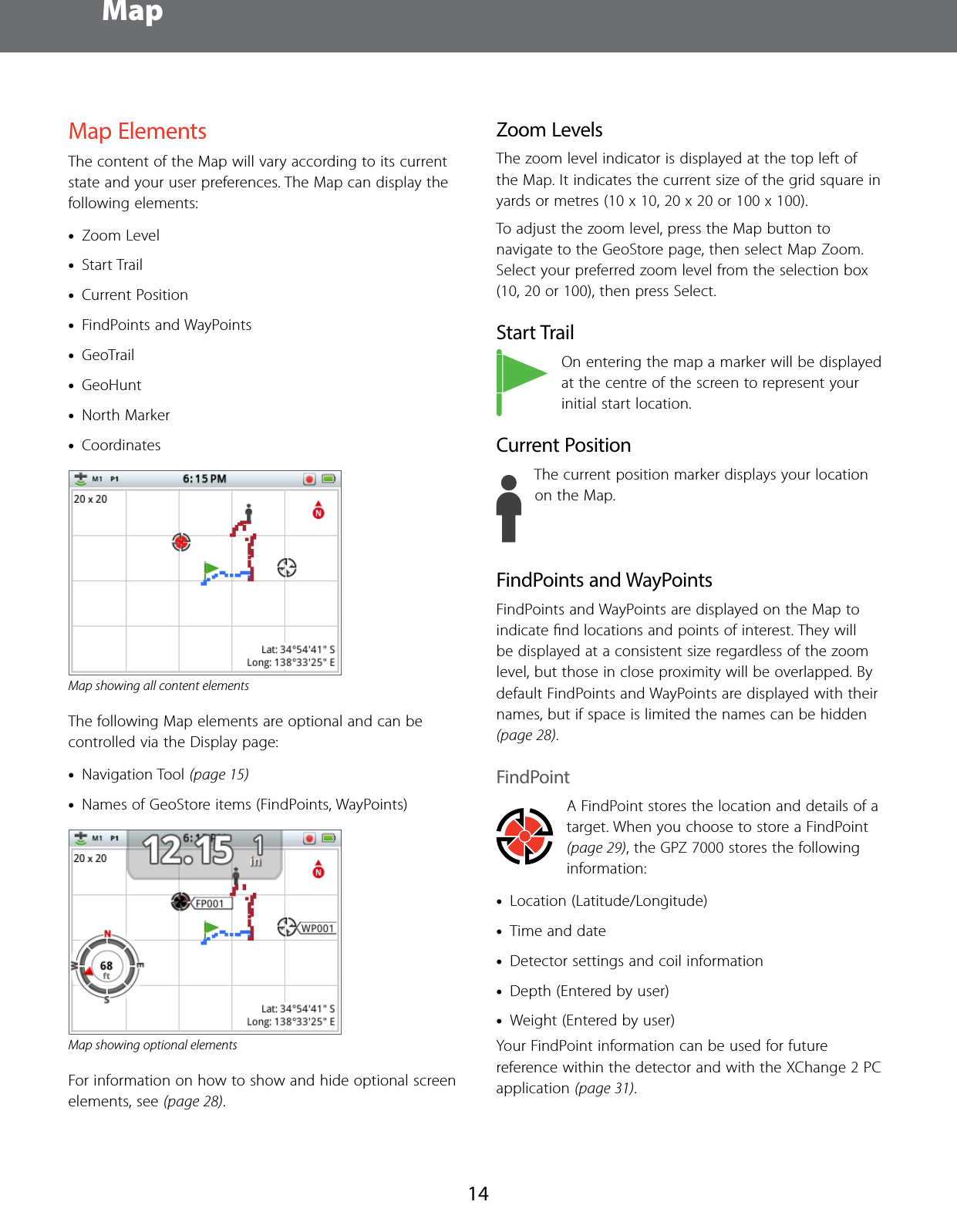
 Map14Map ElementsThe content of the Map will vary according to its current state and your user preferences. The Map can display the following elements: •Zoom Level  •Start Trail •Current Position •FindPoints and WayPoints  •GeoTrail •GeoHunt  •North Marker •CoordinatesMap showing all content elementsThe following Map elements are optional and can be controlled via the Display page: •Navigation Tool (page 15) •Names of GeoStore items (FindPoints, WayPoints)Map showing optional elementsFor information on how to show and hide optional screen elements, see (page 28).Zoom LevelsThe zoom level indicator is displayed at the top left of the Map. It indicates the current size of the grid square in yards or metres (10 x 10, 20 x 20 or 100 x 100).To adjust the zoom level, press the Map button to navigate to the GeoStore page, then select Map Zoom. Select your preferred zoom level from the selection box (10, 20 or 100), then press Select.Start TrailOn entering the map a marker will be displayed at the centre of the screen to represent your initial start location.Current PositionThe current position marker displays your location on the Map.FindPoints and WayPointsFindPoints and WayPoints are displayed on the Map to indicate find locations and points of interest. They will be displayed at a consistent size regardless of the zoom level, but those in close proximity will be overlapped. By default FindPoints and WayPoints are displayed with their names, but if space is limited the names can be hidden (page 28).FindPointA FindPoint stores the location and details of a target. When you choose to store a FindPoint (page 29), the GPZ 7000 stores the following information: •Location (Latitude/Longitude) •Time and date •Detector settings and coil information •Depth (Entered by user) •Weight (Entered by user)Your FindPoint information can be used for future reference within the detector and with the XChange 2 PC application (page 31).
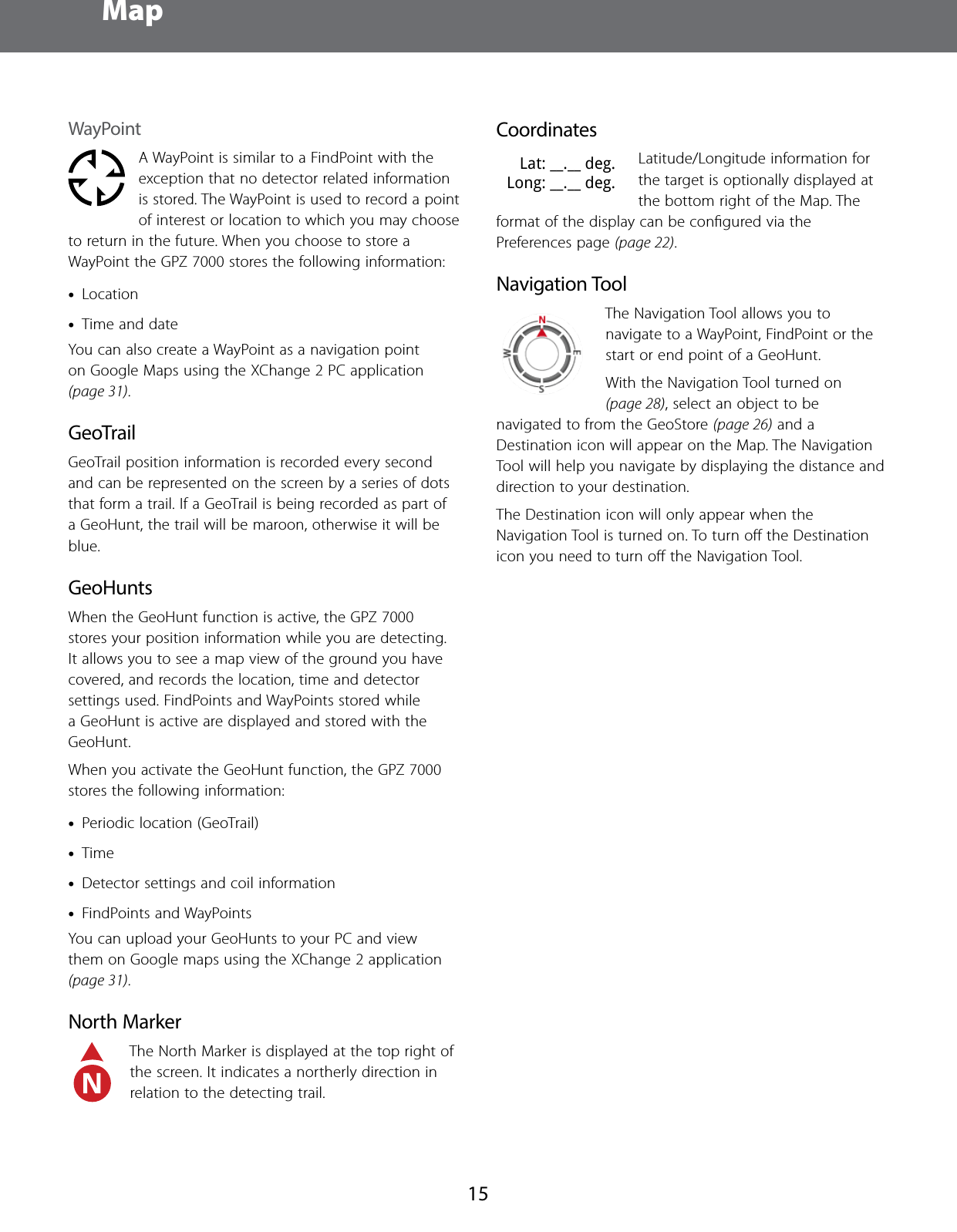
 Map15WayPointA WayPoint is similar to a FindPoint with the exception that no detector related information is stored. The WayPoint is used to record a point of interest or location to which you may choose to return in the future. When you choose to store a WayPoint the GPZ 7000 stores the following information: •Location •Time and dateYou can also create a WayPoint as a navigation point on Google Maps using the XChange 2 PC application (page 31). GeoTrailGeoTrail position information is recorded every second and can be represented on the screen by a series of dots that form a trail. If a GeoTrail is being recorded as part of a GeoHunt, the trail will be maroon, otherwise it will be blue.GeoHuntsWhen the GeoHunt function is active, the GPZ 7000 stores your position information while you are detecting. It allows you to see a map view of the ground you have covered, and records the location, time and detector settings used. FindPoints and WayPoints stored while a GeoHunt is active are displayed and stored with the GeoHunt.When you activate the GeoHunt function, the GPZ 7000 stores the following information: •Periodic location (GeoTrail) •Time •Detector settings and coil information •FindPoints and WayPointsYou can upload your GeoHunts to your PC and view them on Google maps using the XChange 2 application (page 31).North MarkerThe North Marker is displayed at the top right of the screen. It indicates a northerly direction in relation to the detecting trail. CoordinatesLat: __.__ deg.Long: __.__ deg.Latitude/Longitude information for the target is optionally displayed at the bottom right of the Map. The format of the display can be configured via the Preferences page (page 22).Navigation ToolThe Navigation Tool allows you to navigate to a WayPoint, FindPoint or the start or end point of a GeoHunt. With the Navigation Tool turned on (page 28), select an object to be navigated to from the GeoStore (page 26) and a Destination icon will appear on the Map. The Navigation Tool will help you navigate by displaying the distance and direction to your destination.The Destination icon will only appear when the Navigation Tool is turned on. To turn off the Destination icon you need to turn off the Navigation Tool.
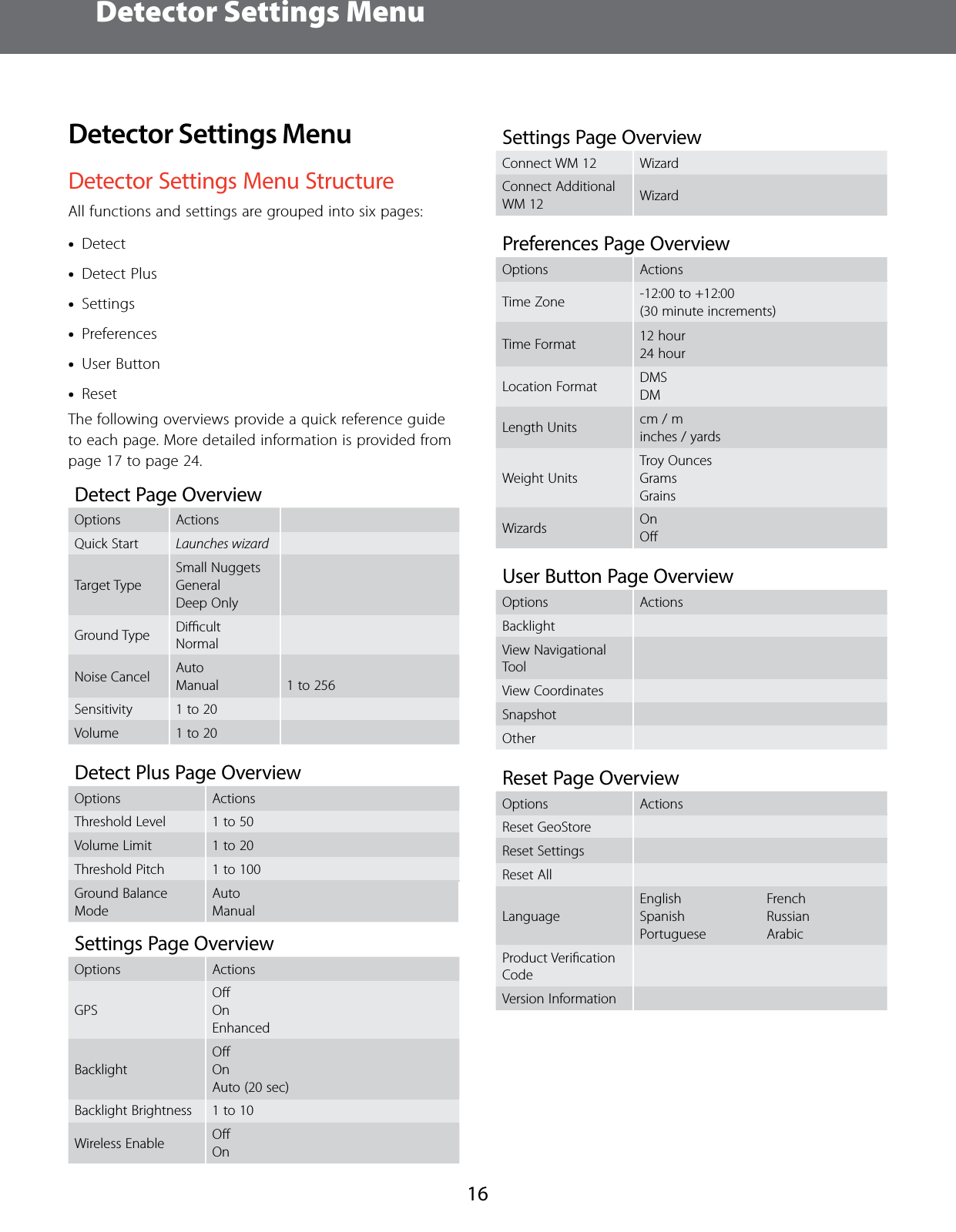
Detector Settings Menu16Detector Settings MenuDetector Settings Menu StructureAll functions and settings are grouped into six pages: •Detect •Detect Plus •Settings •Preferences •User Button •ResetThe following overviews provide a quick reference guide to each page. More detailed information is provided from page 17 to page 24.Detect Page OverviewOptions ActionsQuick Start Launches wizardTarget TypeSmall NuggetsGeneralDeep OnlyGround Type DifficultNormalNoise Cancel AutoManual 1 to 256Sensitivity 1 to 20Volume 1 to 20Detect Plus Page OverviewOptions ActionsThreshold Level 1 to 50Volume Limit 1 to 20Threshold Pitch 1 to 100Ground Balance ModeAuto ManualSettings Page OverviewOptions ActionsGPSOffOnEnhancedBacklightOffOnAuto (20 sec)Backlight Brightness 1 to 10Wireless Enable OffOnSettings Page OverviewConnect WM 12 WizardConnect Additional WM 12 WizardPreferences Page OverviewOptions ActionsTime Zone -12:00 to +12:00  (30 minute increments)Time Format 12 hour24 hourLocation Format DMSDMLength Units cm / minches / yardsWeight UnitsTroy OuncesGramsGrainsWizards OnOffUser Button Page OverviewOptions ActionsBacklightView Navigational ToolView CoordinatesSnapshotOtherReset Page OverviewOptions ActionsReset GeoStoreReset SettingsReset AllLanguageEnglishSpanishPortugueseFrenchRussianArabicProduct Verification CodeVersion Information
 Detect17 DetectThe Detect page contains all of the primary detecting functions: •Quick Start •Target Type •Ground Type •Noise Cancel •Sensitivity •VolumeQuick StartQuick Start offers minimal setting adjustment, ideal for beginner users. When Quick Start is selected, the Quick Start wizard is launched. This will guide you through the Quick Start process to get you detecting quickly and easily.Target TypeThe Target Type function allows you to optimise your detector to search for specific target types.The available options are: •Small Nuggets (Default) •General •Deep OnlySmall NuggetsThis setting is ideal for searching for nuggets between 0.1 and 10 grams and also has good performance for detecting larger nuggets in shallow ground. This setting utilises new technology in the GPZ 7000 which provides a substantial performance increase over existing metal detectors in detecting smaller nuggets that others have missed.GeneralThis setting provides good all round performance in detecting nuggets of all sizes and at all depths.Deep OnlyThis setting is specifically designed for searching for deeply buried targets. Deep targets produce complex and subtle audio responses, and as such this setting should only be used by highly skilled operators. Shallow targets will not present well on this setting when compared to the ‘Small Nuggets’ or ‘General’ settings. This setting is not recommended for general use.When changing the Target Type setting, the threshold tone will become silent for approximately one second once a new setting is selected.Ground TypeWhen detecting in ground with high levels of iron mineralisation, movement of the detector over the ground can produce false target signals. These unwanted target signals are known as ground noise. The GPZ 7000 detector has been designed to remove unwanted ground noise. The Ground Type setting controls the amount of unwanted ground noise that the detector will remove from the audio.The available options are: •Difficult (Default) •NormalDicultThis setting is recommended as gold is usually found in areas with high levels of iron mineralisation.NormalThis setting should only be used in areas where the ground is known to be ‘quiet’ ground. If unwanted ground noise is heard while operating in the ‘Normal’ setting, the operator should change to the ‘Difficult’ setting.When changing the Ground Type setting, the threshold tone will become silent for approximately one second once a new setting is selected.
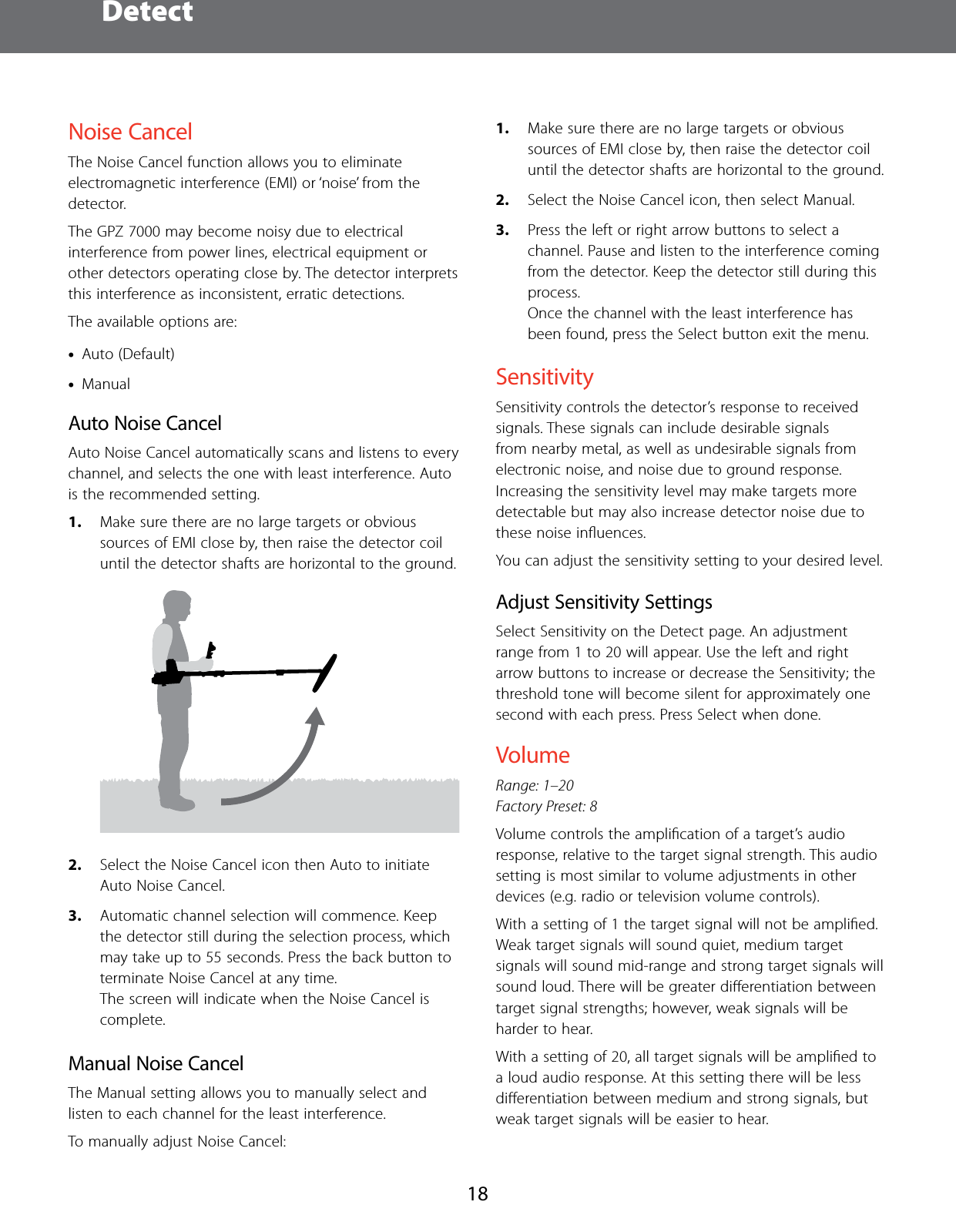
 Detect18Noise CancelThe Noise Cancel function allows you to eliminate electromagnetic interference (EMI) or ‘noise’ from the detector.The GPZ 7000 may become noisy due to electrical interference from power lines, electrical equipment or other detectors operating close by. The detector interprets this interference as inconsistent, erratic detections. The available options are: •Auto (Default) •ManualAuto Noise CancelAuto Noise Cancel automatically scans and listens to every channel, and selects the one with least interference. Auto is the recommended setting.1.  Make sure there are no large targets or obvious sources of EMI close by, then raise the detector coil until the detector shafts are horizontal to the ground. 2.  Select the Noise Cancel icon then Auto to initiate Auto Noise Cancel.3.  Automatic channel selection will commence. Keep the detector still during the selection process, which may take up to 55 seconds. Press the back button to terminate Noise Cancel at any time. The screen will indicate when the Noise Cancel is complete.Manual Noise CancelThe Manual setting allows you to manually select and listen to each channel for the least interference. To manually adjust Noise Cancel:1.  Make sure there are no large targets or obvious sources of EMI close by, then raise the detector coil until the detector shafts are horizontal to the ground.2.  Select the Noise Cancel icon, then select Manual.3.  Press the left or right arrow buttons to select a channel. Pause and listen to the interference coming from the detector. Keep the detector still during this process. Once the channel with the least interference has been found, press the Select button exit the menu.SensitivitySensitivity controls the detector’s response to received signals. These signals can include desirable signals from nearby metal, as well as undesirable signals from electronic noise, and noise due to ground response. Increasing the sensitivity level may make targets more detectable but may also increase detector noise due to these noise influences. You can adjust the sensitivity setting to your desired level.Adjust Sensitivity SettingsSelect Sensitivity on the Detect page. An adjustment range from 1 to 20 will appear. Use the left and right arrow buttons to increase or decrease the Sensitivity; the threshold tone will become silent for approximately one second with each press. Press Select when done.VolumeRange: 1–20 Factory Preset: 8Volume controls the amplification of a target’s audio response, relative to the target signal strength. This audio setting is most similar to volume adjustments in other devices (e.g. radio or television volume controls).With a setting of 1 the target signal will not be amplified. Weak target signals will sound quiet, medium target signals will sound mid-range and strong target signals will sound loud. There will be greater differentiation between target signal strengths; however, weak signals will be harder to hear.With a setting of 20, all target signals will be amplified to a loud audio response. At this setting there will be less differentiation between medium and strong signals, but weak target signals will be easier to hear.
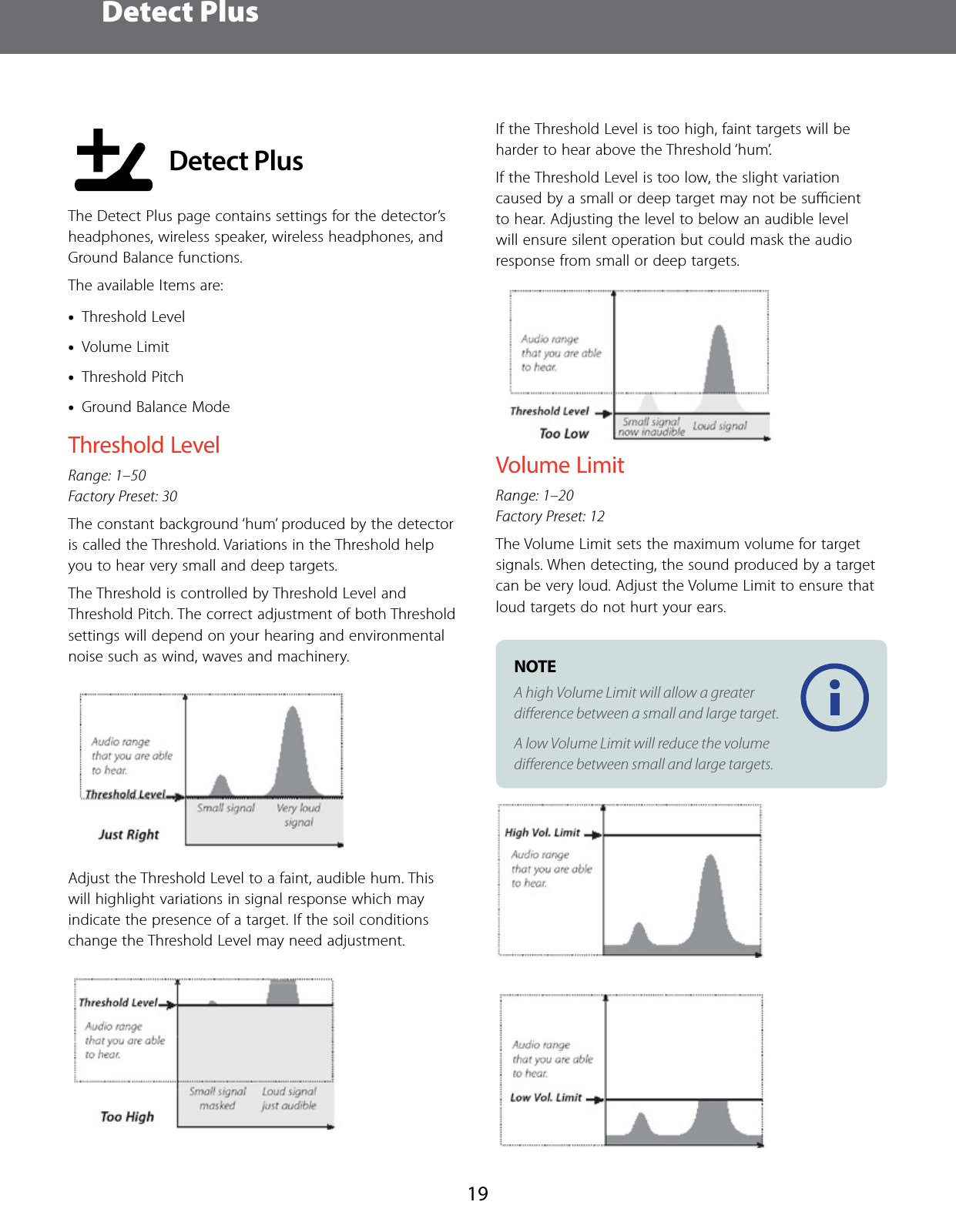
 Detect Plus19 Detect PlusThe Detect Plus page contains settings for the detector’s headphones, wireless speaker, wireless headphones, and Ground Balance functions.The available Items are: •Threshold Level  •Volume Limit •Threshold Pitch •Ground Balance ModeThreshold LevelRange: 1–50 Factory Preset: 30The constant background ‘hum’ produced by the detector is called the Threshold. Variations in the Threshold help you to hear very small and deep targets. The Threshold is controlled by Threshold Level and Threshold Pitch. The correct adjustment of both Threshold settings will depend on your hearing and environmental noise such as wind, waves and machinery.Adjust the Threshold Level to a faint, audible hum. This will highlight variations in signal response which may indicate the presence of a target. If the soil conditions change the Threshold Level may need adjustment. If the Threshold Level is too high, faint targets will be harder to hear above the Threshold ‘hum’. If the Threshold Level is too low, the slight variation caused by a small or deep target may not be sufficient to hear. Adjusting the level to below an audible level will ensure silent operation but could mask the audio response from small or deep targets. Volume LimitRange: 1–20 Factory Preset: 12The Volume Limit sets the maximum volume for target signals. When detecting, the sound produced by a target can be very loud. Adjust the Volume Limit to ensure that loud targets do not hurt your ears.NOTE A high Volume Limit will allow a greater difference between a small and large target.A low Volume Limit will reduce the volume difference between small and large targets.
 Detect Plus20Threshold PitchRange: 1–100 Factory Preset: 50Threshold Pitch allows you to adjust the pitch of the Threshold tone. Hearing will vary between individuals, so adjust the Threshold Pitch to a level that is comfortable for your hearing.Ground-Balance ModeThe Ground Balance Mode setting allows you to select the method for balancing out unwanted ground noise.The available options are: •Auto (recommended) •ManualAutoAuto is the recommended setting for Ground Balance Mode. Auto ground balance automatically measures the ground mineralisation levels and adjusts the ground balance as necessary to maintain stability and detection depth.In Auto mode the ground balance will automatically stabilise, after power on or a settings change, within 10 to 15 seconds of normal detecting. Optionally, the Quick-Trak function can be used to speed up the automatic balancing process.Performing a Quick-Trak1.  Find a metal free location, near to the area being detected, where the detector can be swung back and forth repeatedly over the same ground.2.  While swinging the detector back and forth over the same ground, press and hold the trigger button.3.  A wizard animation will appear on the screen to demonstrate the required action. The wizard can be turned off via Wizards on the Preferences Page.4.  Audio will provide feedback during the Quick-Trak process. The audio response from moving the coil over the ground should quickly reduce. Once the audio response has stabilised, release the trigger to complete the Quick-Trak operation.The Quick-Trak operation can be repeated as required.ManualWhen set to Manual Ground Balance Mode, the detector will not automatically maintain ground balance. When using manual mode you must regularly perform a Quick-Trak to maintain an accurate ground balance.NOTE For best Quick-Trak results, swing at a steady rate, keeping the coil as close to the ground as possible without touching the ground.
Settings21SettingsThe Settings page is where you can select and edit the following detector settings: •GPS •Backlight •Wireless ConnectivityGPSGPS has the following options:  •Off •On •EnhancedGPS must be ‘On’ before GPS features can be used.The Enhanced setting turns on the Satellite Based Augmentation System (SBAS), which improves GPS accuracy. This setting must only be selected in locations where SBAS (or Wide Area Augmentation System) is available.NOTE Once GPS is enabled, it may take several minutes before good fix quality is achieved.BacklightThe Backlight settings are only available when the Backlight is not controlled by the User Button. The options are: •Off – Backlight is always off (Default) •On – Backlight is always on •20 Seconds – Backlight turns on when any button is pressed and automatically turns off after 20 secondsBacklight BrightnessBacklight brightness canv be set in single increments ranging from 1 to 10.Wireless EnableWireless Enable turns the wireless audio on and off. Wireless Enable must be ‘On’ in order to use your GPZ 7000 with a WM 12.Connect WM12To pair a WM 12, Select Connect WM 12 and then follow the instructions displayed by the wizard. The Connect WM 12 wizard will be displayed even if wizards have been turned ‘Off’.Connect Additional WM12The Connect Additional WM 12 function is used to pair additional WM 12’s that receive audio from the GPZ 7000. This allows you to use more than one WM 12 with your detector.Pairing an Additional WM12To pair an additional WM 12, select Connect Additional WM 12 and then follow the instructions displayed by the wizard. Note: The Connect Additional WM 12 wizard will be displayed even if wizards have been turned ‘Off’.Removing Additional WM12’sTo remove all additional WM 12’s, re-pair the primary WM 12 using the Connect WM 12 function.NOTE Additional connected WM 12’s will not generate audio if the primary WM 12 is not connected.
Preferences22PreferencesThe Preferences page displays the following Items: •Time Zone •Time Format •Coordinates Format •Length Units •Weight Units •WizardsTime ZoneTime Zone is based on Universal Coordinated Time (UTC), and options range from UTC - 12:00 to UTC + 14:00, increasing in 30 minute increments.Time FormatTime can be displayed in either 12 hour or 24 hour format.Coordinates FormatThe Coordinates Format provides the conversion of latitude and longitude coordinates. There are two available options: •DMS – Degrees°minute’seconds”  (e.g. 40° 45´ 3.6” N 73° 59´ 0.24” W) •DM – Degrees°minute.decimal’  (e.g. 40° 45.06 , -73° 59.004’)Length UnitsLength Units can be configured to inches and yards or centimetres and metres (default) and represent units of measure for depth, the map and navigation.Weight UnitsWeight Units can be configured to troy ounce (default), gram and grain, and can represent units of measure for weight of stored FindPoints.WizardsWizards Allows you to turn on or off the Start-up and Ground Balance Wizards. The Connect WM 12 and Connect Additional WM 12 wizards remain at all times.
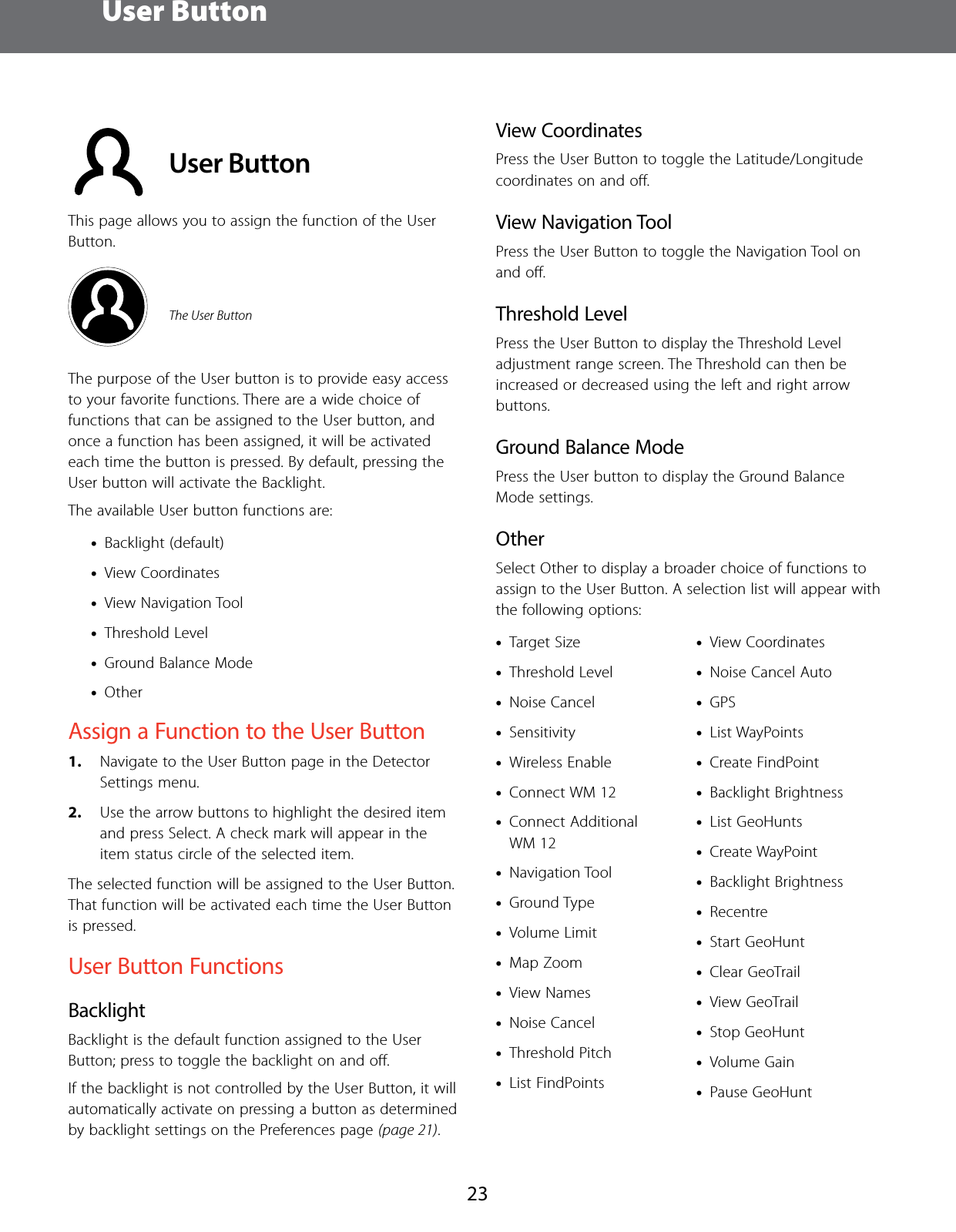
 User Button23 User ButtonThis page allows you to assign the function of the User Button. The User ButtonThe purpose of the User button is to provide easy access to your favorite functions. There are a wide choice of functions that can be assigned to the User button, and once a function has been assigned, it will be activated each time the button is pressed. By default, pressing the User button will activate the Backlight.The available User button functions are: •Backlight (default) •View Coordinates •View Navigation Tool •Threshold Level •Ground Balance Mode •OtherAssign a Function to the User Button1.  Navigate to the User Button page in the Detector Settings menu.2.  Use the arrow buttons to highlight the desired item and press Select. A check mark will appear in the item status circle of the selected item.The selected function will be assigned to the User Button. That function will be activated each time the User Button is pressed. User Button FunctionsBacklightBacklight is the default function assigned to the User Button; press to toggle the backlight on and off. If the backlight is not controlled by the User Button, it will automatically activate on pressing a button as determined by backlight settings on the Preferences page (page 21).View CoordinatesPress the User Button to toggle the Latitude/Longitude coordinates on and off.View Navigation ToolPress the User Button to toggle the Navigation Tool on and off.Threshold LevelPress the User Button to display the Threshold Level adjustment range screen. The Threshold can then be increased or decreased using the left and right arrow buttons.Ground Balance ModePress the User button to display the Ground Balance Mode settings.OtherSelect Other to display a broader choice of functions to assign to the User Button. A selection list will appear with the following options: •Target Size •Threshold Level •Noise Cancel •Sensitivity •Wireless Enable •Connect WM 12 •Connect Additional WM 12 •Navigation Tool •Ground Type •Volume Limit •Map Zoom •View Names •Noise Cancel •Threshold Pitch •List FindPoints •View Coordinates •Noise Cancel Auto  •GPS •List WayPoints •Create FindPoint •Backlight Brightness •List GeoHunts •Create WayPoint •Backlight Brightness •Recentre •Start GeoHunt •Clear GeoTrail •View GeoTrail •Stop GeoHunt •Volume Gain •Pause GeoHunt
 Reset24 ResetThe GPZ 7000 is delivered in its factory preset state and any changes made to the detector’s settings are saved automatically. These settings will remain until you manually change or reset them via the Reset page. The Reset page also contains information about your detectors’ current software version, and product authentication.Access the Reset page via the Detector Settings menu, or by pressing and holding the On/Off button when the detector is turned off.The Reset page will be displayed with the following Items: •Reset GeoStore •Reset Settings •Reset All •Language •Product Authentication Code •Version InformationReset GeoStoreSelect the Reset GeoStore option to clear the contents from the GeoStore. All FindPoints, WayPoints and GeoHunts will be deleted.When the GeoStore has been cleared a confirmation message will be displayed.Reset SettingsSelect the Reset Settings option to clear all user settings and delete user search modes. Information in the GeoStore (FindPoints, WayPoints, GeoHunts) will not be affected. When the settings have been cleared a confirmation message will be displayed.Reset AllSelect the Reset All option to return all settings to their factory preset levels, delete all search modes and empty the GeoStore.When Reset All has been completed the detector will reboot. When start-up is complete the detector will prompt you to select your language, weight units, length units, and time zone before displaying the Detect screen.LanguageThe GPZ 7000 Graphical User Interface (GUI) can be displayed in one of six different languages (default English). You will be prompted to select the detector language on initial startup, and when the detector reboots following a Reset All. The language can also be changed at any time.Change the LanguageTo change the language, select the Language icon on the Reset page then choose from one of the following languages: •English •Spanish •Portuguese •French •Russian •ArabicProduct Verication CodeGenerates an authentication code to verify your detector is a genuine Minelab product.Version Information Displays the detectors’ current software version and hardware information.
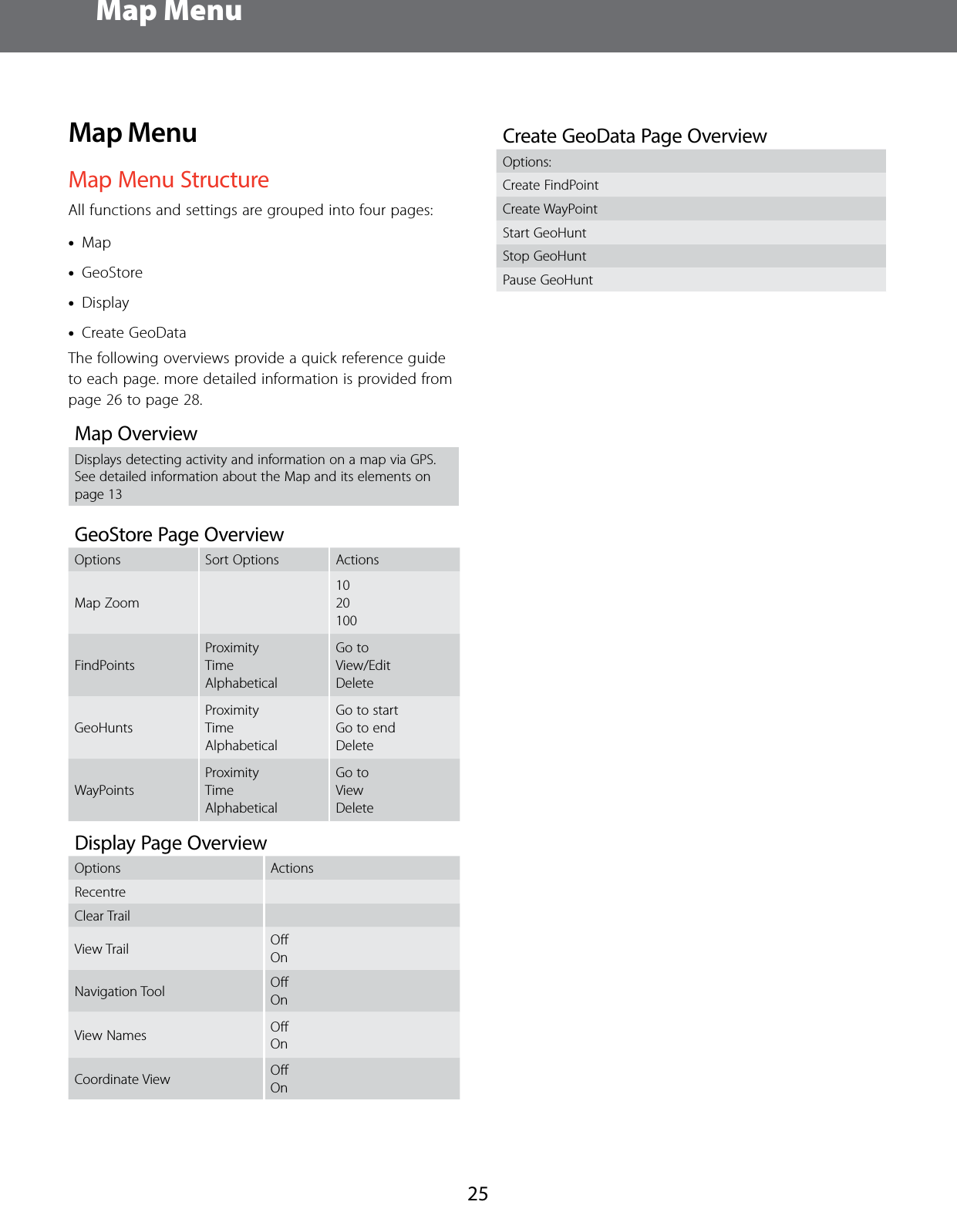
Map Menu25Map MenuMap Menu StructureAll functions and settings are grouped into four pages:  •Map •GeoStore •Display •Create GeoDataThe following overviews provide a quick reference guide to each page. more detailed information is provided from page 26 to page 28.Map OverviewDisplays detecting activity and information on a map via GPS. See detailed information about the Map and its elements on page 13GeoStore Page OverviewOptions Sort Options ActionsMap Zoom1020100FindPointsProximityTimeAlphabeticalGo toView/EditDeleteGeoHuntsProximityTimeAlphabeticalGo to startGo to endDeleteWayPointsProximityTimeAlphabeticalGo toViewDeleteDisplay Page OverviewOptions ActionsRecentreClear TrailView Trail OffOnNavigation Tool OffOnView Names OffOnCoordinate View OffOnCreate GeoData Page OverviewOptions:Create FindPointCreate WayPointStart GeoHuntStop GeoHuntPause GeoHunt
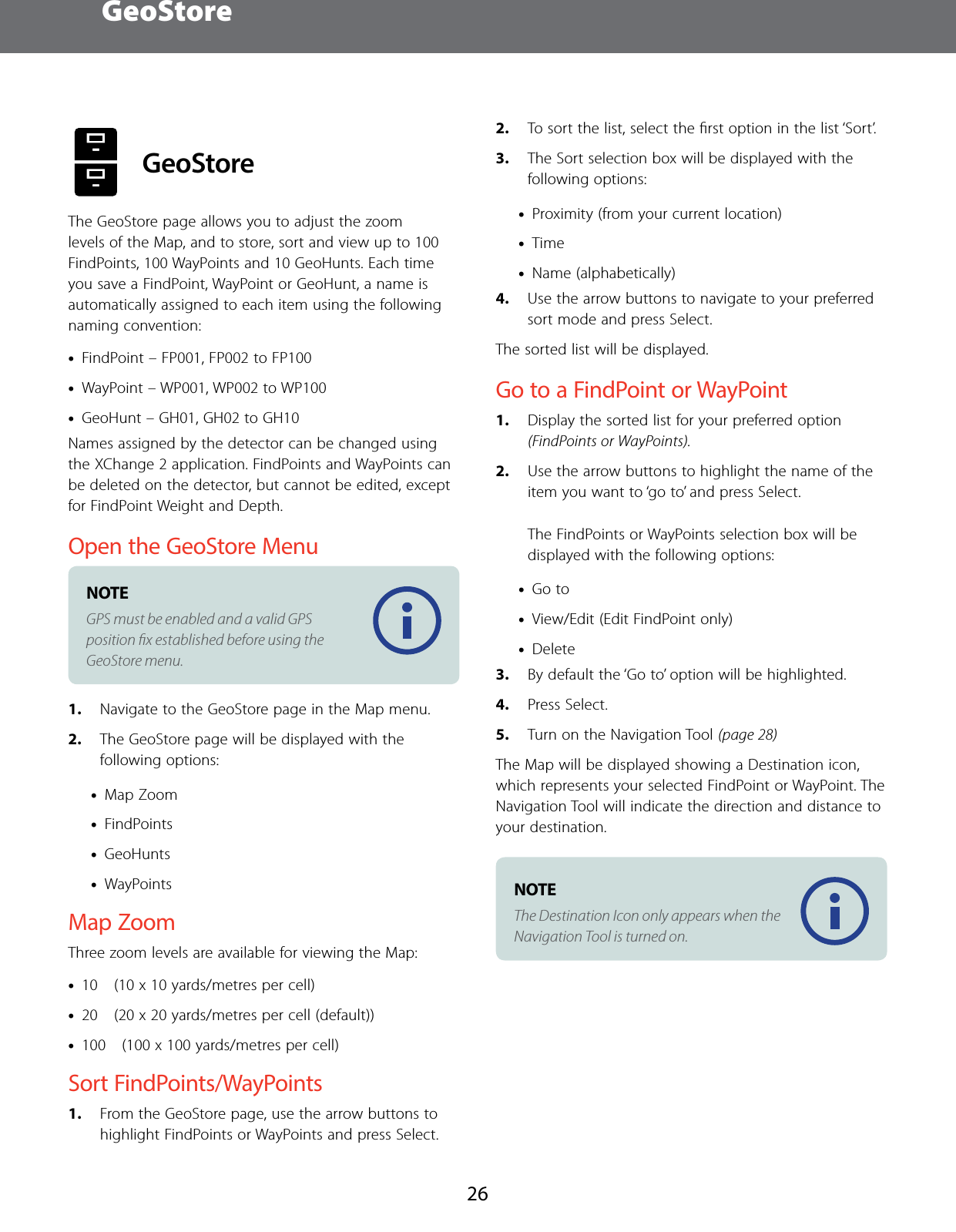
 GeoStore26 GeoStoreThe GeoStore page allows you to adjust the zoom levels of the Map, and to store, sort and view up to 100 FindPoints, 100 WayPoints and 10 GeoHunts. Each time you save a FindPoint, WayPoint or GeoHunt, a name is automatically assigned to each item using the following naming convention: •FindPoint – FP001, FP002 to FP100 •WayPoint – WP001, WP002 to WP100 •GeoHunt – GH01, GH02 to GH10Names assigned by the detector can be changed using the XChange 2 application. FindPoints and WayPoints can be deleted on the detector, but cannot be edited, except for FindPoint Weight and Depth.Open the GeoStore MenuNOTE GPS must be enabled and a valid GPS position fix established before using the GeoStore menu.1.  Navigate to the GeoStore page in the Map menu.2.  The GeoStore page will be displayed with the following options: •Map Zoom •FindPoints •GeoHunts •WayPointsMap ZoomThree zoom levels are available for viewing the Map:  •10  (10 x 10 yards/metres per cell) •20  (20 x 20 yards/metres per cell (default)) •100  (100 x 100 yards/metres per cell)Sort FindPoints/WayPoints1.  From the GeoStore page, use the arrow buttons to highlight FindPoints or WayPoints and press Select.2.  To sort the list, select the first option in the list ‘Sort’.3.  The Sort selection box will be displayed with the following options: •Proximity (from your current location) •Time •Name (alphabetically)4.  Use the arrow buttons to navigate to your preferred sort mode and press Select.The sorted list will be displayed.Go to a FindPoint or WayPoint1.  Display the sorted list for your preferred option (FindPoints or WayPoints).2.  Use the arrow buttons to highlight the name of the item you want to ‘go to’ and press Select.  The FindPoints or WayPoints selection box will be displayed with the following options: •Go to •View/Edit (Edit FindPoint only) •Delete3.  By default the ‘Go to’ option will be highlighted.4.  Press Select.5.  Turn on the Navigation Tool (page 28)The Map will be displayed showing a Destination icon, which represents your selected FindPoint or WayPoint. The Navigation Tool will indicate the direction and distance to your destination.NOTE The Destination Icon only appears when the Navigation Tool is turned on.
 GeoStore27Go to Start/End of a GeoHunt1.  From the GeoStore page, select GeoHunts. The selection box will be displayed with the following options: •Go to start •Go to end •Delete2.  Use the arrow buttons to highlight your required option and press Select.Delete a GeoStore ItemIndividual FindPoints, WayPoints and GeoHunts can be deleted from the GeoStore. To delete a GeoStore item:1.  From the GeoStore page, use the arrow buttons to highlight your preferred option and press Select2.  The selection box will be displayed with the following options: •Go to •View •Delete3.  Use the arrow buttons to highlight the Delete option and press Select. Your item will be deleted and a confirmation message will be displayed.
 Display28 DisplayThe Display page is where you control which elements you want to appear on the Map.The Display page will be shown with the following Items: •Recentre •Clear Trail •View Trail •View Navigation Tool •View Names •View CoordinatesOpen the Display PageTo open the Display page from the Map, press the Map button three times.Show or Hide Map Screen Elements1.  Open the display page.2.  Use the arrow buttons to navigate through the Items and press Select on the items you want to show/hide.3.  Select on/off from the selection box.4.  Press the Map button two times to return to the Map.  Map elements will now be visible or hidden according to your settings.RecentreRecentre will place your current position at the centre of the Map.Clear TrailClear Trail will remove the current GeoTrail from the Map.View TrailView GeoTrail will show or hide the current GeoTrail on the Map.View Navigation ToolView Navigation Tool will show or hide the Navigation Tool on the Map.View NamesView Names will show or hide the names of all FindPoints and WayPoints displayed on the Map. By default, View Names is ‘On’, but names can be hidden to save space when many items are displayed on the Map at once.View CoordinatesView Coordinates will show or hide the Coordinates label on the Map.
Create GeoData29Create GeoDataPress the Store button to create and store FindPoints, WayPoints and to control a GeoHunt.The available Items are: •Create FindPoint •Create WayPoint •Start GeoHunt •Stop GeoHunt •Pause GeoHuntNOTE  A valid GPS position fix is required to use the Store button functions.Create and Store FindPoints and WayPoints1.  Press the Store button to display the Create GeoData page.2.  Use the arrow buttons to highlight Create FindPoint or Create WayPoint and press Select to display the following: •Name of item •Option to Save •Depth Entry •Weight Entry •Lat-Long coordinates of item3.  Press the Select button to save. A confirmation message will be displayed providing the name of the saved item. After a few seconds the message will disappear and you will be returned to the Map.Control a GeoHuntRecord a GeoHunt:1.  Press the Store button to display the GeoData page. 2.  Use the arrow buttons to highlight Start GeoHunt and press Select.3.  The detector will record your detecting activities until you pause or stop the GeoHunt. The Record GeoHunt icon will replace the GPS icon in the Status Bar and your movements will be displayed on the Map as a maroon coloured GeoTrail.Pause a GeoHunt:1.  Press the Store button to display the GeoData page. 2.  Use the arrow buttons to highlight Pause GeoHunt and press Select.3.  The GPZ 7000 will temporarily cease recording your detecting activities and the Pause GeoHunt icon will be displayed in the Status Bar.Stop a GeoHunt:1.  Press the Store button to display the GeoHunt page. 2.  Use the arrow buttons to highlight Stop GeoHunt and press Select.3.  The GPZ 7000 will cease recording your detecting activities and the GPS icon will be displayed in the Status Bar. The stored GeoHunt can be transferred to the XChange 2 PC application for display, editing and storage, or to help plan your next hunt.Loss of Power during a GeoHuntIn the event of the detector powering down or being plugged into a PC while you are recording or have paused a GeoHunt, the GeoHunt will stop and the logging of data will cease.Loss of GPS Position Fix during a GeoHuntIn the event of a GPS position fix not being available, the GeoHunt status bar icon will flash. The GeoTrail location dots will not be displayed, and the logging of data will cease temporarily (it will continue automatically once a position fix becomes available).If the detector’s internal memory becomes full, the GPZ 7000 will stop recording and an alert message will be displayed.
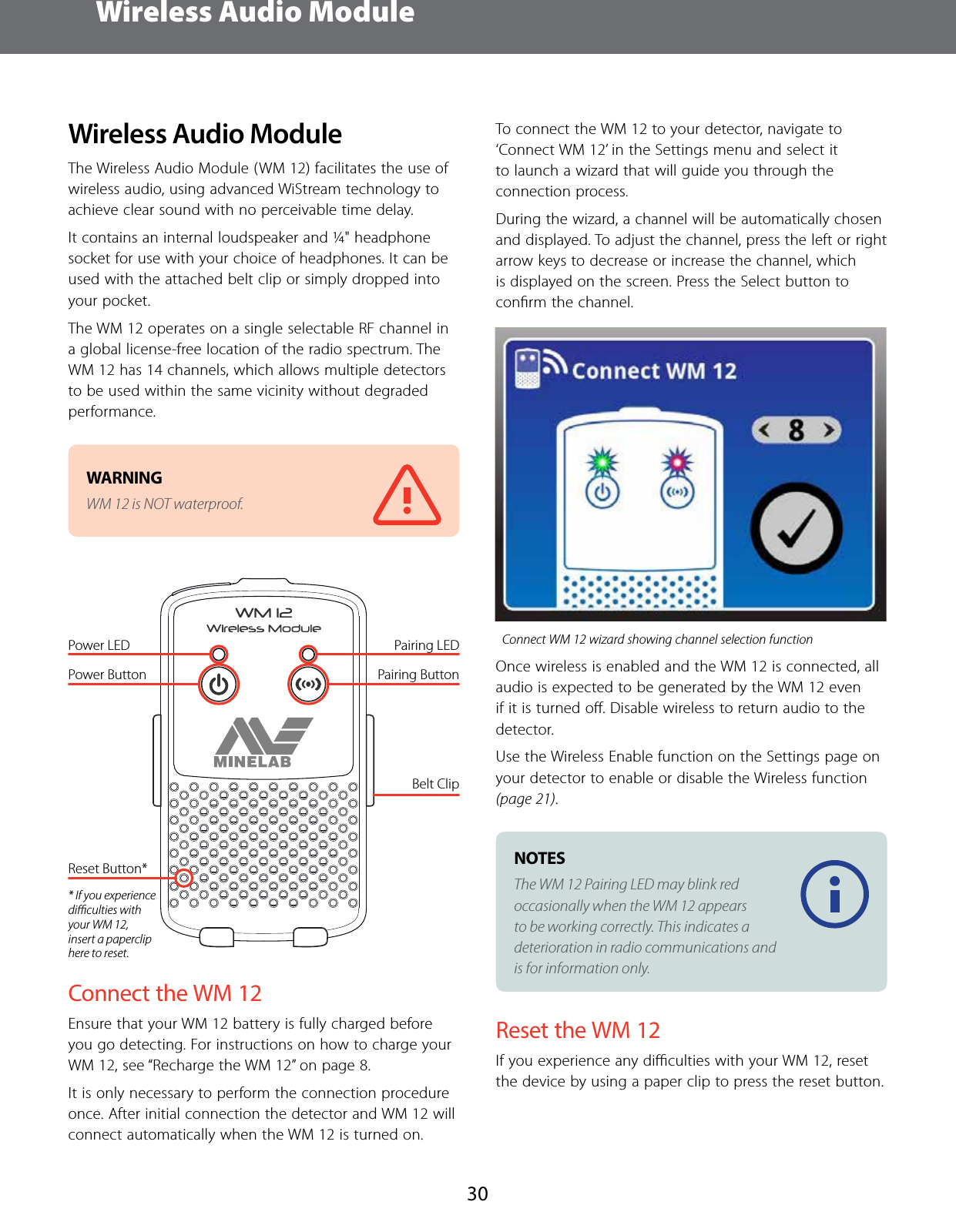
Wireless Audio Module30Wireless Audio ModuleThe Wireless Audio Module (WM 12) facilitates the use of wireless audio, using advanced WiStream technology to achieve clear sound with no perceivable time delay.It contains an internal loudspeaker and ¼" headphone socket for use with your choice of headphones. It can be used with the attached belt clip or simply dropped into your pocket.The WM 12 operates on a single selectable RF channel in a global license-free location of the radio spectrum. The WM 12 has 14 channels, which allows multiple detectors to be used within the same vicinity without degraded performance.WARNING WM 12 is NOT waterproof.Power LEDPower ButtonPairing LEDPairing ButtonBelt ClipReset Button** If you experience difficulties with your WM 12, insert a paperclip here to reset. Connect the WM12Ensure that your WM 12 battery is fully charged before you go detecting. For instructions on how to charge your WM 12, see “Recharge the WM 12” on page 8.It is only necessary to perform the connection procedure once. After initial connection the detector and WM 12 will connect automatically when the WM 12 is turned on.To connect the WM 12 to your detector, navigate to ‘Connect WM 12’ in the Settings menu and select it to launch a wizard that will guide you through the connection process.During the wizard, a channel will be automatically chosen and displayed. To adjust the channel, press the left or right arrow keys to decrease or increase the channel, which is displayed on the screen. Press the Select button to confirm the channel. Connect WM 12 wizard showing channel selection functionOnce wireless is enabled and the WM 12 is connected, all audio is expected to be generated by the WM 12 even if it is turned off. Disable wireless to return audio to the detector.Use the Wireless Enable function on the Settings page on your detector to enable or disable the Wireless function (page 21).NOTES The WM 12 Pairing LED may blink red occasionally when the WM 12 appears to be working correctly. This indicates a deterioration in radio communications and is for information only. Reset the WM12If you experience any difficulties with your WM 12, reset the device by using a paper clip to press the reset button.
Minelab XChange 231Minelab XChange2Communicating between GPZ7000 and your PCThe GPZ 7000 includes a USB connection facility, located on the rear of the control panel. This allows you to connect your GPZ 7000 to a PC and download/upload GPS data and settings.Using the XChange 2 application you can plot your GPS location data on Google Maps, add photos and comments, rename search modes and GPS data.System Requirements •Windows 2000, Windows XP, Windows Vista, Windows 7, or Windows 8 •Minimum recommended display resolution of 1366 x 768 •USB port Install XChange2 on your PC1.  Insert the CD (included with your GPZ 7000) into the CD/DVD drive of your PC.2.  The CD will auto-run once inserted into your PC and the program installation will start.3.  Follow the install prompts to install XChange 2 onto your PC.4.  Once you have installed XChange 2 on your PC you can start the application from either the Start menu or the shortcut on your desktop  XChange2 Desktop iconStart the XChange2 ApplicationDouble click the XChange 2 application icon on your desktop, or open your Start Menu and navigate to: All Programs > Minelab > XChange 2.Connect GPZ7000 to your PC1.  Insert one end of the USB cable into your GPZ 7000 and the other end into your PC.2.  Start XChange 2 on your PC.3.  Although GPZ 7000’s transmitter is switched off while connected to a PC, make sure the coil is not located next to any large metal objects.4.  Turn on your GPZ 7000.  A confirmation message will be displayed to indicate that the USB is connected. You can now use XChange 2. Refer to the XChange 2 User Manual supplied on the CD for further information.NOTES  When modifying settings via XChange 2, the modified settings are only applied to the detector when the USB is removed. At this point, the detector checks for changes in the database and applies them. If you turn off the detector instead of unplugging the USB, these settings will not be applied correctly. Refer to the Help menu in XChange 2 for more information on how to use the application to download, upload and modify your GPZ 7000’s settings.
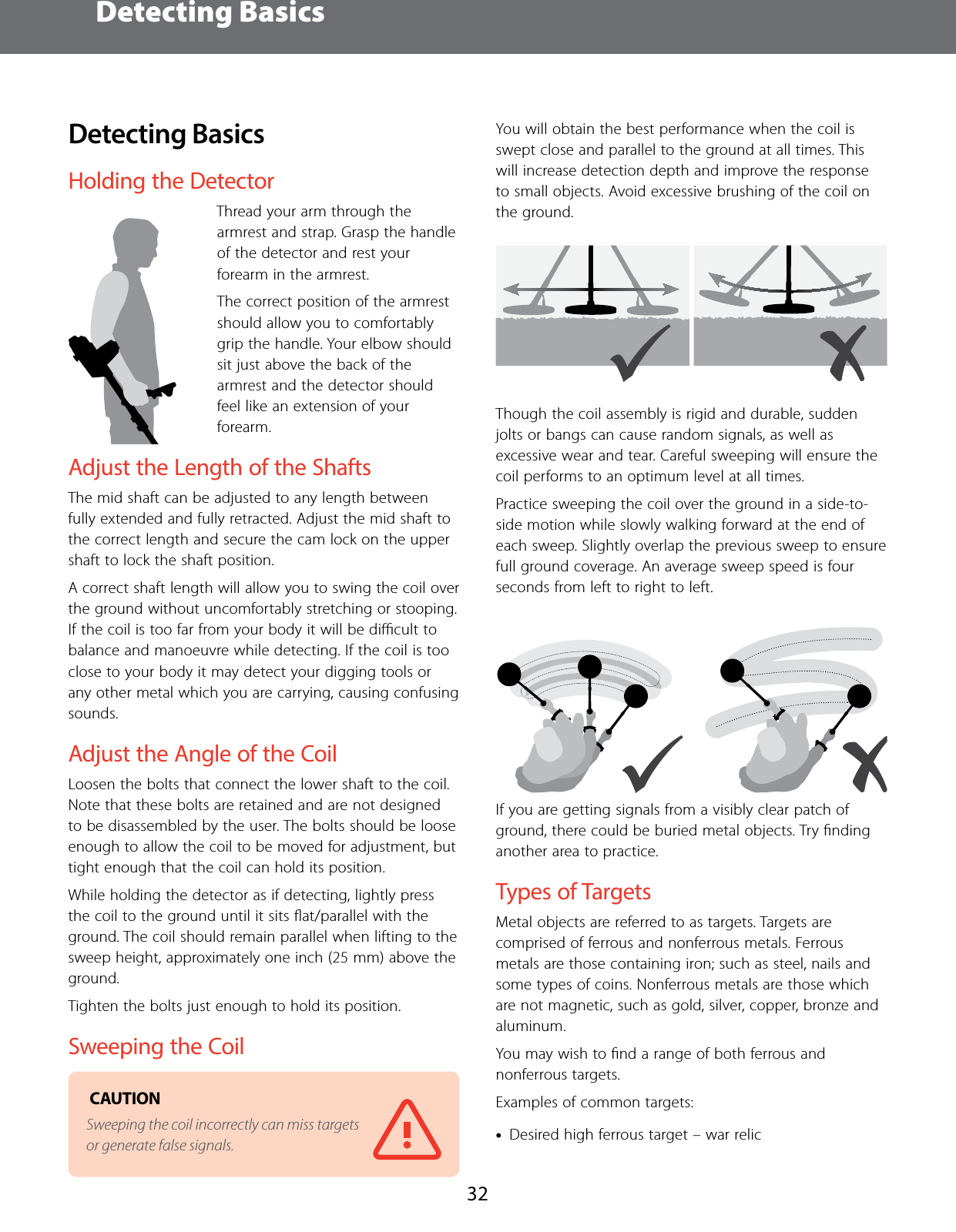
Detecting Basics32Detecting BasicsHolding the DetectorThread your arm through the armrest and strap. Grasp the handle of the detector and rest your forearm in the armrest.The correct position of the armrest should allow you to comfortably grip the handle. Your elbow should sit just above the back of the armrest and the detector should feel like an extension of your forearm.Adjust the Length of the ShaftsThe mid shaft can be adjusted to any length between fully extended and fully retracted. Adjust the mid shaft to the correct length and secure the cam lock on the upper shaft to lock the shaft position.A correct shaft length will allow you to swing the coil over the ground without uncomfortably stretching or stooping. If the coil is too far from your body it will be difficult to balance and manoeuvre while detecting. If the coil is too close to your body it may detect your digging tools or any other metal which you are carrying, causing confusing sounds.Adjust the Angle of the CoilLoosen the bolts that connect the lower shaft to the coil. Note that these bolts are retained and are not designed to be disassembled by the user. The bolts should be loose enough to allow the coil to be moved for adjustment, but tight enough that the coil can hold its position.While holding the detector as if detecting, lightly press the coil to the ground until it sits flat/parallel with the ground. The coil should remain parallel when lifting to the sweep height, approximately one inch (25 mm) above the ground.Tighten the bolts just enough to hold its position.Sweeping the Coil CAUTION Sweeping the coil incorrectly can miss targets or generate false signals.You will obtain the best performance when the coil is swept close and parallel to the ground at all times. This will increase detection depth and improve the response to small objects. Avoid excessive brushing of the coil on the ground. Though the coil assembly is rigid and durable, sudden jolts or bangs can cause random signals, as well as excessive wear and tear. Careful sweeping will ensure the coil performs to an optimum level at all times.Practice sweeping the coil over the ground in a side-to-side motion while slowly walking forward at the end of each sweep. Slightly overlap the previous sweep to ensure full ground coverage. An average sweep speed is four seconds from left to right to left.If you are getting signals from a visibly clear patch of ground, there could be buried metal objects. Try finding another area to practice.Types of TargetsMetal objects are referred to as targets. Targets are comprised of ferrous and nonferrous metals. Ferrous metals are those containing iron; such as steel, nails and some types of coins. Nonferrous metals are those which are not magnetic, such as gold, silver, copper, bronze and aluminum.You may wish to find a range of both ferrous and nonferrous targets.Examples of common targets: •Desired high ferrous target – war relic
Detecting Basics33 •Undesired high ferrous target – iron nail •Desired nonferrous target – gold coin •Undesired nonferrous target – pull-tab •Desired target – gold nuggetDetector SoundsTurn the detector on. The constant background ‘hum’ produced by the detector is called the Threshold. Variations in the Threshold allow you to hear very small and deep targets. It is also used to help distinguish between desired and undesired targets.The detector may also produce false signals (Noise) when not over the ground or with the coil held motionless. These may not be target signals, but surrounding electromagnetic interference (EMI). You can minimise false signals by performing a Noise Cancel (page 17), performing a Ground Balance (page 20), or by reducing the Sensitivity of the detector (page 18). It is generally better to try to reduce false signals by adjusting Noise Cancel and Ground Balance before resorting to reducing the Sensitivity.Sweep the coil across the targets one at a time. Observe the Detect screen and listen to the sounds of the detector as it passes over each object. The audio response will give you detailed information about the Target.An audio signal is the sound produced by the detector when a target is detected. Large targets or targets close to the ground surface emit louder signals.Very large objects close to the coil may overload the detector electronics. When this happens, the detector displays an overload message and emits a fading sound, which repeats until the coil is moved away from the source of the overload. Overloading is not harmful to the electronics of the detector.It is best to operate the detector only when outdoors and away from sources of electromagnetic interference (EMI) such as power lines and phone towers. These sources may cause the detector to perform erratically, giving false signals. There are also many metallic objects inside a house, such as nails in the floor, reinforcing in the walls, televisions and other household appliances, that might interfere with or overload the electronics of the detector.It is important to understand the sounds produced when you make a valid or invalid button press. You will usually encounter these sounds while adjusting settings via the main menu. A valid button press makes a ‘bip’ sound; an invalid button press makes a ‘ba-dump’ sound.Each time you turn the detector on, the last screen used before shutting down will appear. For example, if the GPZ 7000 was operating in the Menu screen when turned off, this screen will appear when the detector is turned back on.Detecting Tips and TechniquesFollow these hints and techniques to help you to utilise the power of your GPZ 7000 detector, to ensure that every trip is a success. •Metallic targets will usually give a ‘solid’ sounding signal when the coil is swept across the object from any direction. A metallic target generally produces a short, sharp and mostly symmetrical signal. Ground noises usually give a broad uneven signal when the coil is swept from different directions, and often may only give a signal from one direction and no signal on the return sweep. •If you are not sure if the sound is ground noise or a target signal you should always investigate. Scrape a shallow hole about 30mm (1”) deep over the suspected target. Sweep the coil over the hole at the original ground level. Do not dip the coil into the hole. If the signal has decreased in volume or is less defined it is probably ground noise. If the signal remains the same, or becomes louder, it is likely a metallic target. If you are still not sure make the hole deeper and repeat  the process.  •A ‘halo effect’, which may be built up around a buried metal object, makes the object appear to be larger to the detector than it actually is. This will be reduced once the target is disturbed from its position in the ground (e.g. a small object, detected at a substantial depth, may be more difficult to detect once disturbed from the ground and lying in the loose dirt. If the object is re-buried the ‘halo effect’ will not be present). •Do not try to eliminate what might appear to be a faint, isolated ground noise by balancing the detector over the target; you may be ‘balancing out’ the target response from a deeply buried metallic target. It is better to Ground Balance around the target, without going across it, then switch to Fixed and try Pinpointing. •Dig all target signals, even in previously detected areas. The GPZ 7000 has superior ground balancing and depth so it is possible to find new targets in well-worked areas where other detectors have been unable to cope with
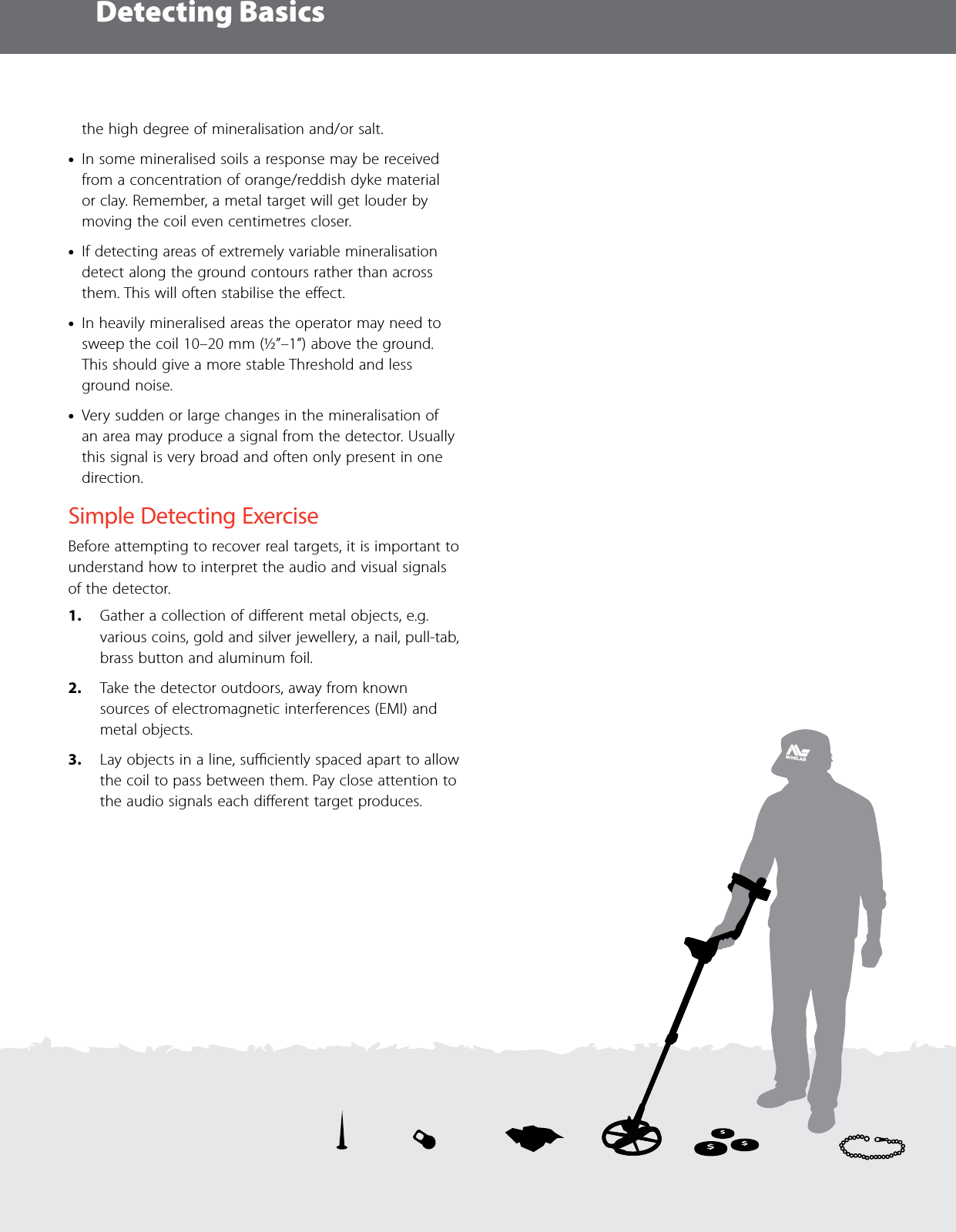
Detecting Basics34the high degree of mineralisation and/or salt.  •In some mineralised soils a response may be received from a concentration of orange/reddish dyke material or clay. Remember, a metal target will get louder by moving the coil even centimetres closer.  •If detecting areas of extremely variable mineralisation detect along the ground contours rather than across them. This will often stabilise the effect. •In heavily mineralised areas the operator may need to sweep the coil 10–20 mm (½”–1”) above the ground. This should give a more stable Threshold and less ground noise.  •Very sudden or large changes in the mineralisation of an area may produce a signal from the detector. Usually this signal is very broad and often only present in one direction.Simple Detecting ExerciseBefore attempting to recover real targets, it is important to understand how to interpret the audio and visual signals of the detector.1.  Gather a collection of different metal objects, e.g. various coins, gold and silver jewellery, a nail, pull-tab, brass button and aluminum foil. 2.  Take the detector outdoors, away from known sources of electromagnetic interferences (EMI) and metal objects.3.  Lay objects in a line, sufficiently spaced apart to allow the coil to pass between them. Pay close attention to the audio signals each different target produces.
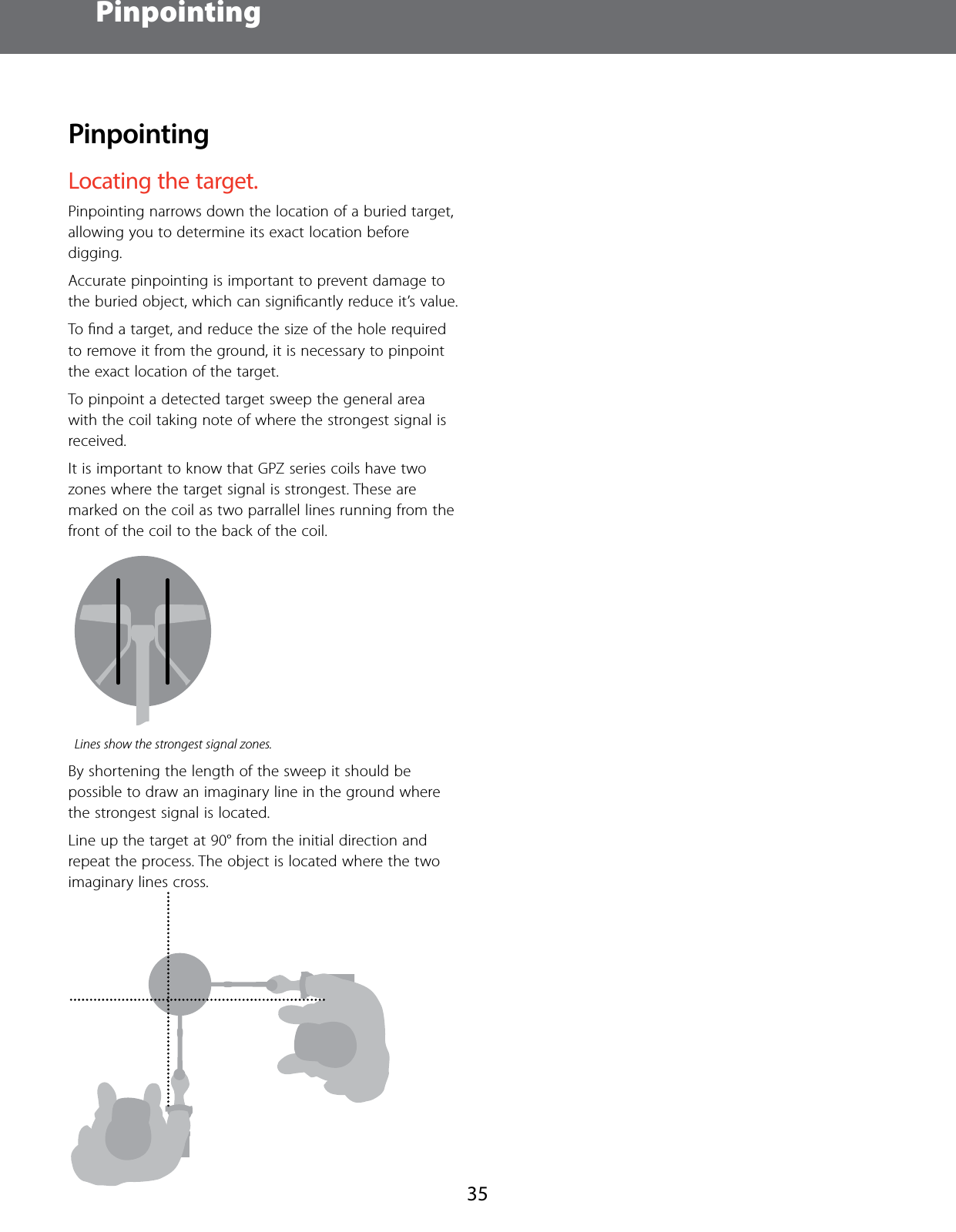
Pinpointing35PinpointingLocating the target.Pinpointing narrows down the location of a buried target, allowing you to determine its exact location before digging. Accurate pinpointing is important to prevent damage to the buried object, which can significantly reduce it’s value.To find a target, and reduce the size of the hole required to remove it from the ground, it is necessary to pinpoint the exact location of the target. To pinpoint a detected target sweep the general area with the coil taking note of where the strongest signal is received.It is important to know that GPZ series coils have two zones where the target signal is strongest. These are marked on the coil as two parrallel lines running from the front of the coil to the back of the coil.Lines show the strongest signal zones.By shortening the length of the sweep it should be possible to draw an imaginary line in the ground where the strongest signal is located.Line up the target at 90° from the initial direction and repeat the process. The object is located where the two imaginary lines cross.
Target Recovery36Target RecoveryOnce you have pinpointed the target, it is time to recover it. During target recovery, it is important to dig carefully to prevent damage to the buried object, which can significantly reduce it’s value.It is essential that you carry at least one of the following digging tools with you while detecting: •A pick with broad scraping blade (essential) •A crowbar (for very deep objects in hard ground) •A small, strong digging spade or shovel (for soft soils, sand, etc.)Recovering the Target1.  Clear the area of loose surface material and check that the target signal is still there. If it is not, the target should be amongst the moved surface material. 2.  Remember if there are other signals close to your target.  This is important so when you come to dig your hole you do not heap the loose dirt on top of another target already in the ground.3.  If the target signal is still present use your pick to dig to a depth of approximately 50mm (2”). Note: When digging, avoid sharp edges to the hole as they can produce false signals, potentially masking the target. Slope the edges of the hole to avoid any problems.4.  Sweep the coil over the hole to determine if the target has been removed. If the target signal is not heard then the target should be in the pile just dug. Otherwise dig a little deeper and check again. 5.  Start digging approximately 100mm (4”) in front of the target to reduce the chance of damaging it. Damaging a coin, relic or gold nugget may reduce its value.6.  If the target signal disappears from the hole sweep the coil over the loose dirt and pinpoint its exact position. 7.  Take a handful of the dirt and pass it over the coil.Note: Your hands and wrists must be free of any metallic jewellery and watches when passing dirt over the coil.8.  If there is no signal, place the handful carefully in a new pile, pinpoint the position of the target again, and repeat with another handful of soil.  9.  Once the target is in your hand, transfer half of the dirt to the other hand. Test each handful of dirt across the coil.10.   If the target is too small to see drop the dirt onto the top of the coil and with your finger move any suspect objects. A target signal will only be given when the target is moved.Note: The GPZ 7000 is a ‘motion’ detector. This means the coil must be moving over the target, or the target moving over the coil, in order for the detector to ‘see’ it.TIP The GPZ 7000 is very sensitive and recovering a small target from loose, dry soil takes skill and patience. A plastic scoop allows you to pass small amounts of soil over the top of the coil to check if your target is in it. Carrying a plastic scoop is a great way to speed up the recovery process.CAUTION Back Fill Every Hole You DigAlways refill any holes, and scatter leaves and surface debris, before leaving the area. Help restore the area to its original condition to help give detectorists a good reputation, and also disguise your secret hot-spot! Any rubbish you recover should be taken away with you and disposed of properly. Refilling holes and removing rubbish will help detector users maintain a good reputation. This should lead to more areas being readily accessible for prospecting.
Detector Care and Safety37Detector Care and SafetyThe GPZ 7000 is a high-quality electronic instrument, finely engineered and packaged in a durable housing. Taking proper care of your detector is vital to ensure its ongoing reliability. WARNINGPlease note the following: •Not all parts of the GPZ 7000 are waterproof. •Minelab recommends that prior to use, care is taken to ensure the battery seal (o-ring), the seal seating groove and the mating face of the battery are undamaged and kept clean. See “Battery Care and Safety” on page 38 for instructions on maintaining you battery. •O-ring lubricant or grease is not required on waterproof seals. •Do not use a petroleum based o-ring grease as it is likely to damage the waterproof seals. •Do not leave the detector in excessive cold or heat longer than necessary. Covering it when not in use will help protect it. Avoid leaving it in a closed car trunk or in a car exposed to sunlight.  •Never allow the detector to come into contact with gasoline or other petroleum-based liquids. •Avoid getting sand and grit into the shafts or fastenings (e.g. yoke bolt and cam lock). Do not use solvents to clean the detector. Use a damp cloth with mild soap detergent. Wash connectors with distilled water. •Hose the detector with clean water after use on the beach (wading). •If, through extensive use, the carbon-fibre upper, mid, or lower shafts become noticeably scored, wipe these thoroughly with a damp cloth. •Ensure the coil cable is in good condition and not subject to undue stress. •Do not dispose of the battery pack in fire (contact local authorities for disposal/recycling). Do not attempt to disassemble or short circuit the battery pack. •Take precautions when transporting or storing the detector. Although the detector is constructed from the highest quality materials and has undergone rigorous durability tests, the display screen could be prone to scratching or serious damage if not treated with due care.
Battery Care and Safety38Battery Care and SafetyTo extend battery life: •Turn off the control panel backlight; the backlight increases the power consumption by approximately 8%. •Turn the detector off when not in use. •Turn GPS off when not in use. •Turn Wireless off when not in use. •When using the WM 12, use headphones rather than the speaker; the speaker uses more power than headphones. This will extend the WM 12 battery life. WARNINGPlease note the following: •The Lithium-Ion battery is specifically designed for the GPZ 7000. Attempting to use the Lithium-Ion battery pack with other detectors may damage the detector or the battery pack.  •VERY IMPORTANT: Ensure the battery seal (o-ring), the o-ring seating groove and the mating face of the battery are undamaged and kept clean of sand, grit and other contaminants. To do this:1.  Remove the battery seal with a soft tool. (The removable seal is in the control box battery seal groove)2.  Gently brush or wipe out the battery seal groove and battery mating face avoiding damage to the surfaces.3.  Wipe over the battery seal using a clean, moistened cloth.4.  Visually inspect the areas to ensure all sand, grit or other contaminants have been removed.5.  Refit the battery seal ensuring that it is seated at the bottom of the groove, is not twisted, and the corners are aligned.6.  Fit the battery to the detector- take care to check that the battery sand seal is also free of dust, grit, and moisture. The sand seal is not removable.7.  Ensure the battery clips are fully closed. •Damaged seals or batteries must be replaced. •Do not try to adapt this battery to other models as it will very likely cause damage. •Do not charge the battery at temperatures above 113° F (45° C) or below 32° F (0° C). •Do not immerse the battery pack in any liquid or allow water ingress. Battery packs are not waterproof until connected to the detector.  •Ensure both the battery pack and control box are completely dry before connection. •Remove the battery pack from the detector during air travel or long term storage. •Do not immerse the BC 10 charger in any liquid or allow water ingress. •Do not leave the battery in hot conditions (e.g. on the dashboard or rear parcel shelf of your car). •Do not damage the battery in any way. •Do not short-circuit the battery. •Do not use the battery if it is damaged or deformed. •Do not attempt to disassemble the Li-Ion battery pack. •Do not incinerate the battery. Contact your local authorities to enquire about disposal or recycling facilities. •In the event of a fault, return the battery to a Minelab authorised service centre for repair. The use of unapproved components will VOID YOUR WARRANTY. There are no user serviceable parts within this battery pack.
GPZ 7000 Accessories39GPZ7000 AccessoriesParts and accessories available for GPZ 7000:Coils and Coil Accessories: •11” DOD Coil with Lower Shaft •14” DOD Coil with Lower Shaft •20” DOD Coil with Lower Shaft •Skidplate - 11” DOD •Skidplate - 14” DOD •Skidplate - 20” DOD •Coil Bolts and Washers KitShaft Accessories: •Mid Shaft •Armrest and Stand KitAudio Accessories: •WM 12 with Belt Clip •KOSS Headphones •Waterproof KOSS headphonesBattery Accessories: •Battery Charger BC 10 Station •Battery Charger Cable Kit •Battery Pack - Li-Ion RechargeableOther Accessories •USB Cable - Detector to PC •PRO-SWING 45 detecting harness •PRO-FIND 25 Pinpointer If you would like to purchase any accessories for your GPZ 7000 or any other Minelab product, please feel free to contact us directly or via your local Authorised Minelab dealer.
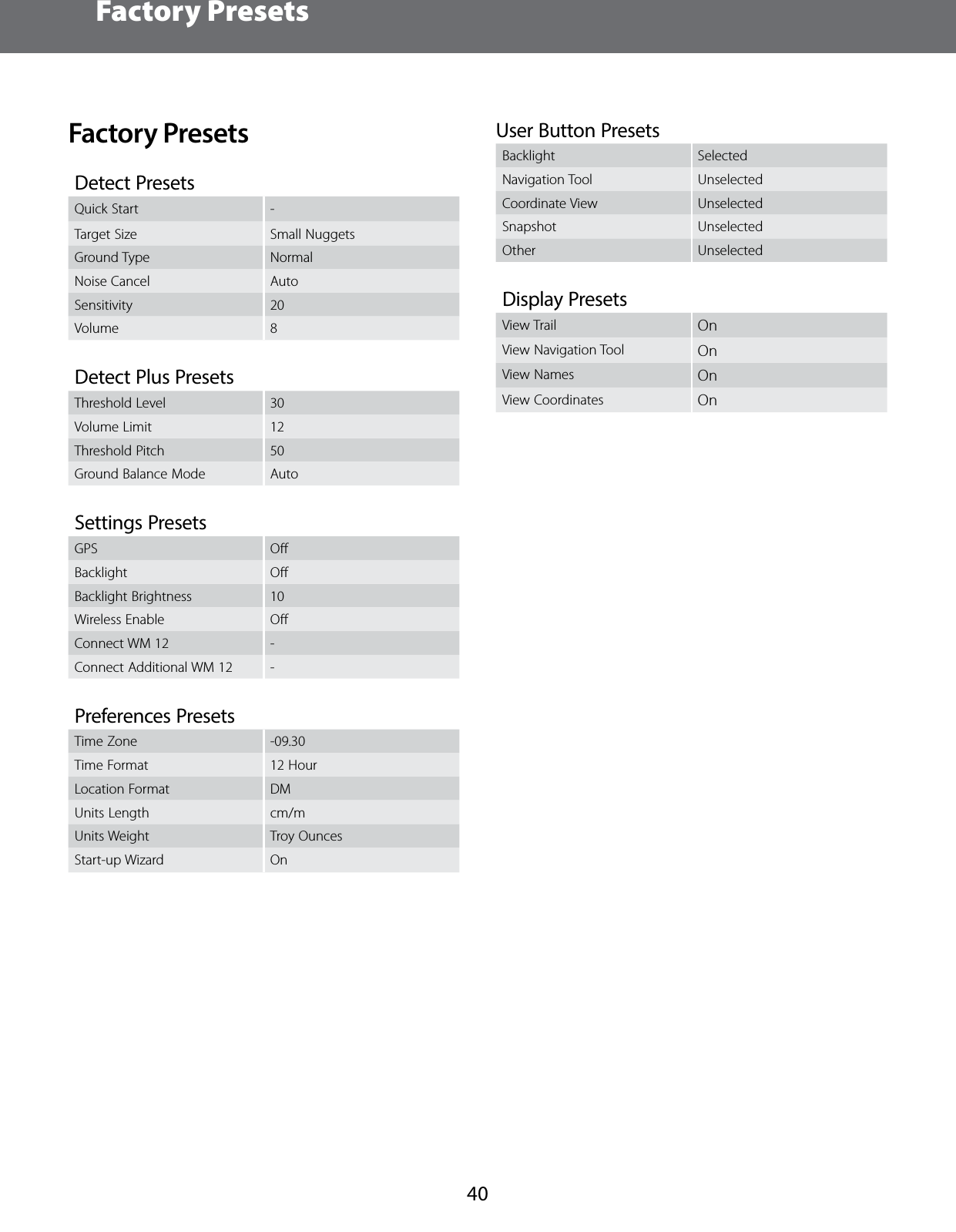
Factory Presets40Factory PresetsDetect PresetsQuick Start -Target Size Small NuggetsGround Type NormalNoise Cancel AutoSensitivity 20Volume 8Detect Plus PresetsThreshold Level 30Volume Limit 12Threshold Pitch 50Ground Balance Mode AutoSettings PresetsGPS OffBacklight OffBacklight Brightness 10Wireless Enable OffConnect WM 12 -Connect Additional WM 12 -Preferences PresetsTime Zone -09.30Time Format 12 HourLocation Format DMUnits Length cm/mUnits Weight Troy OuncesStart-up Wizard OnUser Button Presets Backlight SelectedNavigation Tool UnselectedCoordinate View UnselectedSnapshot UnselectedOther UnselectedDisplay PresetsView Trail OnView Navigation Tool OnView Names OnView Coordinates On
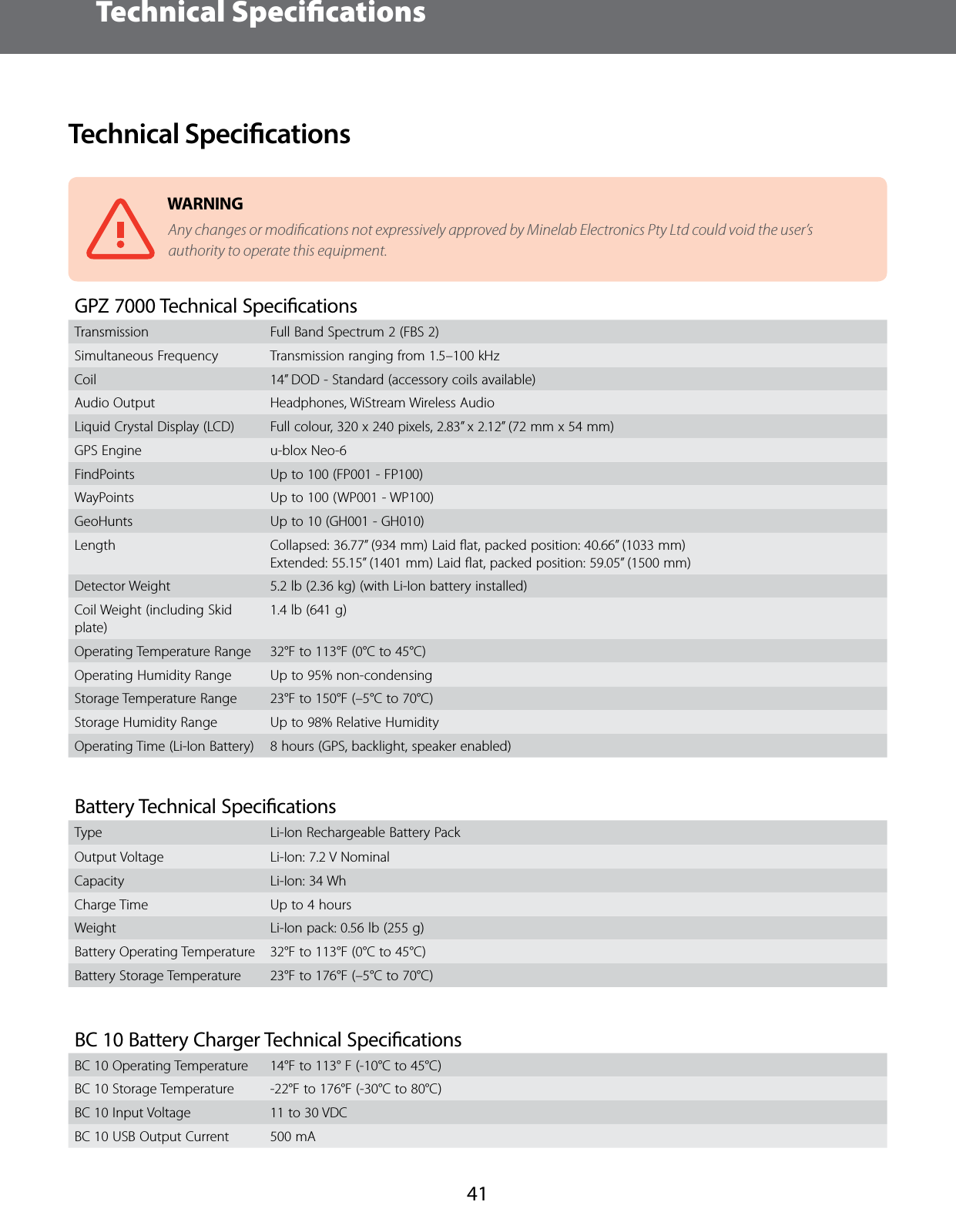
Technical Specifications41Technical SpecicationsWARNING Any changes or modifications not expressively approved by Minelab Electronics Pty Ltd could void the user’s authority to operate this equipment.GPZ7000 Technical SpecicationsTransmission Full Band Spectrum 2 (FBS 2)Simultaneous Frequency Transmission ranging from 1.5–100 kHzCoil 14” DOD - Standard (accessory coils available)Audio Output Headphones, WiStream Wireless Audio Liquid Crystal Display (LCD) Full colour, 320 x 240 pixels, 2.83” x 2.12” (72 mm x 54 mm)  GPS Engine u-blox Neo-6FindPoints Up to 100 (FP001 - FP100)WayPoints Up to 100 (WP001 - WP100)GeoHunts Up to 10 (GH001 - GH010)Length Collapsed: 36.77” (934 mm) Laid flat, packed position: 40.66” (1033 mm)Extended: 55.15” (1401 mm) Laid flat, packed position: 59.05” (1500 mm)Detector Weight 5.2 lb (2.36 kg) (with Li-Ion battery installed)Coil Weight (including Skid plate)1.4 lb (641 g) Operating Temperature Range 32°F to 113°F (0°C to 45°C)Operating Humidity Range Up to 95% non-condensingStorage Temperature Range 23°F to 150°F (–5°C to 70°C)Storage Humidity Range Up to 98% Relative HumidityOperating Time (Li-Ion Battery) 8 hours (GPS, backlight, speaker enabled)Battery Technical SpecicationsType Li-Ion Rechargeable Battery PackOutput Voltage Li-Ion: 7.2 V Nominal Capacity Li-Ion: 34 WhCharge Time Up to 4 hoursWeight Li-Ion pack: 0.56 lb (255 g)Battery Operating Temperature 32°F to 113°F (0°C to 45°C)Battery Storage Temperature 23°F to 176°F (–5°C to 70°C)BC 10 Battery Charger Technical SpecicationsBC 10 Operating Temperature 14°F to 113° F (-10°C to 45°C)BC 10 Storage Temperature -22°F to 176°F (-30°C to 80°C)BC 10 Input Voltage 11 to 30 VDCBC 10 USB Output Current 500 mA
Detector Parts42

Navigation menu