Minolta Dynax 9 Instruction Manual
Konica-Dynax-9-Users-Guide-788246 konica-dynax-9-users-guide-788246
Konica-Minolta-9-Instruction-Manual-124512 konica-minolta-9-instruction-manual-124512
9 to the manual eecc78ff-d94b-8974-15cc-af21fc815052
Dynax 9 - Instruction Manual Dynax-Maxxum_9_imstr.E Free User Guide for Konica Minolta Camera, Manual - page2
dynax_9_imstr.E
2015-08-19
: Minolta Minolta-Dynax-9-Instruction-Manual-790296 minolta-dynax-9-instruction-manual-790296 minolta pdf
Open the PDF directly: View PDF  .
.
Page Count: 59
INSTRUCTION MANUAL
E
BASIC OPERATION
DETAILED OPERATION
APPENDIX
1
FOR PROPER AND SAFE USE
Read and understand all warnings and cautions before using this product.
WARNING
Batteries may become hot or explode due to improper use.
• Use only the batteries specified in this instruction manual.
• Do not install the batteries with the polarity (+/–) reversed.
• Do not subject batteries to fire or high temperatures.
• Do not attempt to recharge, short, or disassemble.
• Do not mix batteries of different types, brands, or ages.
• Follow local regulations for battery disposal. Tape over lithium battery contacts before
disposal.
Use caution, accidents may occur when using this product near young children.
Keep batteries and other things that could be swallowed away from young children.
Contact a doctor immediately if an object is swallowed.
Immediately remove the batteries and discontinue use if…
• the camera is dropped or subjected to an impact in which the interior is exposed.
• the camera emits a strange smell, heat, or smoke.
Do not disassemble. Electric shock may occur if a high voltage circuit inside the
camera is touched. Take your camera to a Minolta Service Facility when repairs are
required.
Do not look directly at the sun through the viewfinder.
CAUTION
Do not allow a camera lens to point directly at the sun. Fire may occur if sunlight
comes to focus on a flammable surface. Replace the lens cap when the product is
not being used.
The ultimate tool for creative professionals and advanced amateurs alike, the
Maxxum/Dynax 9 has been designed with precission in mind to help you capture
your photographic vision. As you use the Maxxum/Dynax 9, you will find that its
performance and reliability compliment your own photographic expertise and in
raising your skills to a higher level.
In addition to its high durability zinc and stainless steel body, the Maxxum/Dynax 9
boasts the following features:
• A top shutter speed of 1/12,000 sec. and top x-sync speed of 1/300 sec.
• High speed autofocus with omni-dimensional Predictive Focus Control
and a maximum framing rate of 4.5 frames/sec with autofocus tracking
in continuous focus mode. (5.5 frames/sec in manual focus mode)
• 100% viewfinder
• 1/3 and 1/2 EV exposure compensation increments.
• Data Memory storage of exposure information.
• 21 Custom Functions to tailor the camera to your personal shooting style
This manual has been designed to help you understand the operation of your
camera and its functions. Please familiarize yourself with the names of the controls
and their locations on the camera, then read the Getting Started and Basic
Operation sections. Once you’ve mastered basic operation, move on to the Detailed
Operation section to expand your expertise.
This device complies with Part 15 of the FCC Rules. Operation is subject to the following two condi-
tions: (1) This device may not cause harmful interference, and (2) this device must accept any inter-
ference received, including interference that may cause undesired operation. Changes or modifica-
tions not approved by the party responsible for compliance could void the user's authority to operate
the equipment. This equipment has been tested and found to comply with the limits for a Class B digi-
tal device, pursuant to Part 15 of the FCC Rules. These limits are designed to provide reasonable
protection against harmful interference in a residential installation. This equipment generates, uses
and can radiate radio frequency energy and, if not installed and used in accordance with the instruc-
tions, may cause harmful interference to radio communications. However, there is no guarantee that
interference will not occur in a particular installation. If this equipment does cause harmful interference
to radio or television reception, which can be determined by turning the equipment off and on, the
user is encouraged to try to correct the interference by one or more of the following measures:
• Reorient or relocate the receiving antenna.
• Increase the separation between the equipment and the receiver.
• Connect the equipment to an outlet on a circuit different from that to which the receiver is
connected.
• Consult the dealer or an experienced radio/TV technician for help.
This Class B digital apparatus complies with Canadian ICES-003.
This mark on your camera certifies that this camera meets the requirements of
the EU (European Union) concerning interference causing equipment regulations.
CE stands for Conformité Européenne (European Conformity).

2 3
Loading Film..........................................15
Taking Pictures in Full-Auto ..................18
Focus Signals....................................19
Special Focus Situations.......................20
Focus Hold............................................21
FOCUS
Predictive Focus Control.......................27
Autofocus Modes ..................................28
Wide Focus Area...................................30
Local Focus Area ..................................31
AF Lock.................................................32
Manual Focus........................................33
AF Illuminator........................................34
Table of Contents ....................................2
Names of Parts .......................................4
GETTING STARTED
BASIC OPERATION
DETAILED OPERATION
DRIVE
Advance Mode ......................................54
Self Timer ..............................................56
Exposure Bracketing.............................58
Multiple Exposure..................................60
ADDITIONAL FEATURES
Eye-Start ...............................................76
Depth-of Field Preview..........................77
Taking Time Exposures.........................78
Remote Release Terminal.....................80
PC Terminal...........................................81
Data Panel Illuminator...........................82
TABLE OF CONTENTS
Accessory Information..........................104
Exposure Warnings..............................107
Strap........................................................8
Diopter Adjustment .................................9
APPENDIX
Batteries ................................................10
Lens.......................................................12
Handling the Camera ............................13
Using the Built-in Flash
Operation...........................................22
Flash Signals.....................................22
Flash Range ......................................23
Lens Shadowing................................23
Rewinding the Film
Automatic Rewind..............................24
Manual Rewind..................................24
EXPOSURE
P-Mode..................................................36
A-Mode..................................................37
S-Mode..................................................39
M-Mode .................................................41
METERING
Selectable Metering
14 Segment Metering ........................45
Spot Metering ....................................46
Center Weighted Metering.................47
AE Lock.................................................48
Exposure Compensation.......................50
Setting the ISO Manually ......................52
FLASH
Four-Segment Flash Metering ..............63
Slow Sync .............................................64
Rear-Flash Sync ...................................65
High Speed Sync ..................................66
Flash Compensation .............................67
Flash Bracketing ...................................68
Wireless/Remote Off-Camera Flash .....70
SPECIAL FUNCTIONS
Data Memory
Selecting............................................84
Overwriting.........................................86
Recalling Data ...................................87
Deleting Stored Data .........................90
Custom Functions
Setting................................................91
Details................................................92
Trouble Shooting..................................108
Care and Storage.................................110
Specifications .......................................112
54
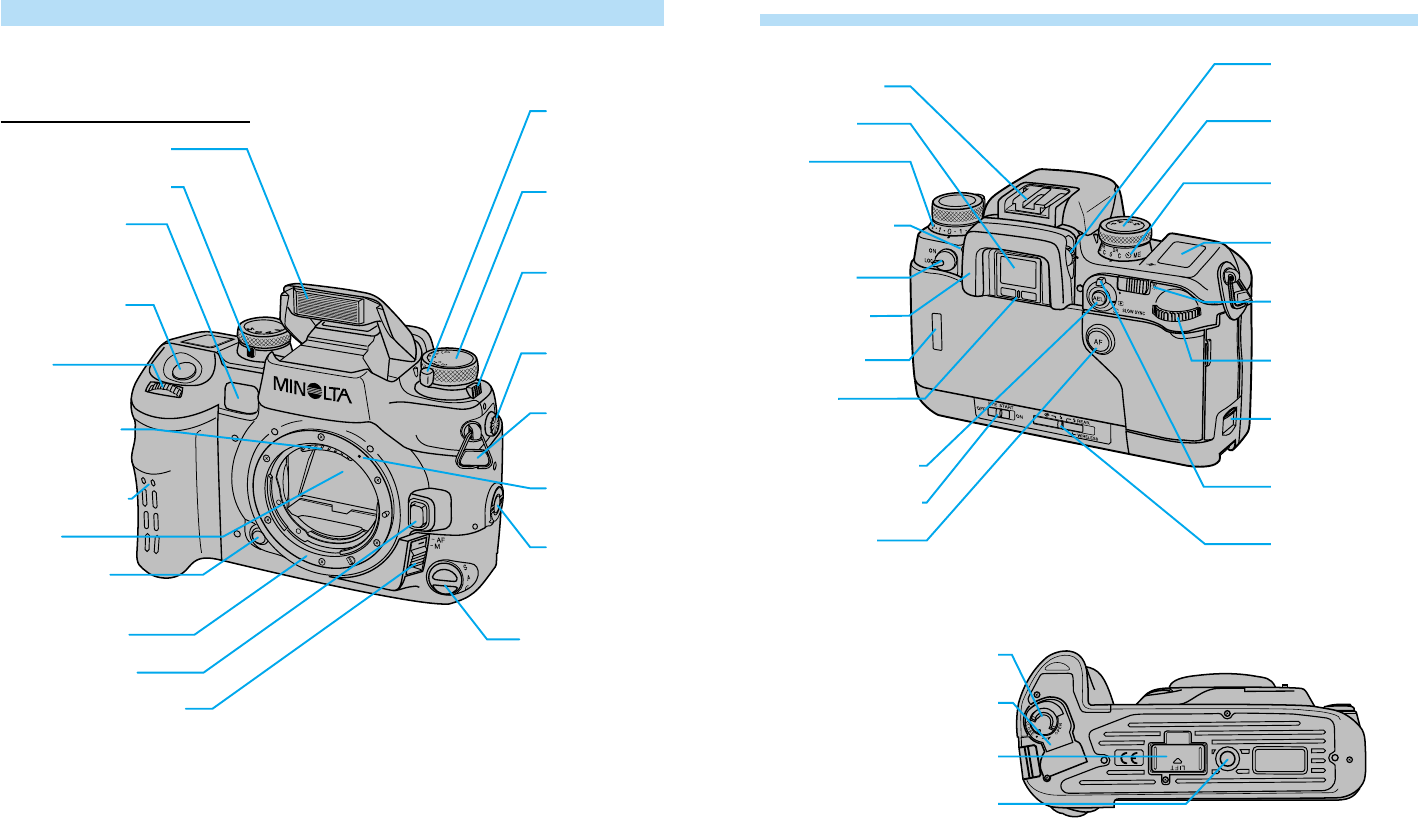
NAMES OF PARTS
For information on specific parts, refer to the page numbers shown in parenthesis.
Body Exposure
mode dial (36-43)
Data Panel
Rear control dial
Shutter-release
button
Front
control dial
Built-in flash* (22-23)
Exposure-
compensation
dial lock (50)
Exposure-
compensation
dial (50)
Flash
compensation
dial (67)
Accessory shoe
Drive-mode lever (54)
AF Illuminator /
Self-timer lamp
(34, 56)
Grip sensor (76)
Depth-of-field
preview button (77)
Lens mount (12)
Mirror*
AF mode dial (28)
Focus-mode switch (33)
Lens release (12)
Mounting
index
Lens contacts*
Battery-chamber lock (10)
Battery-chamber door (10)
Vertical control grip contacts
(104)
Tripod socket
Diopter
adjustment dial (9)
Viewfinder*
Eyepiece cup
Eyepiece shutter
lever (79)
Main switch
Eyepiece
sensor* (76)
Film window
Eye-start switch (76)
Flash-mode switch
AF button (32)
AE-lock button (48)
Data-panel
illuminator (82)
Metering-mode
switch (45-47)
PC terminal
(81)
Back-cover
release (15)
Remote-control
terminal (80)
Strap eyelet
* Do not touch
Flash-
compensation
dial lever (67)
Dirve mode
dial (54-61)
76
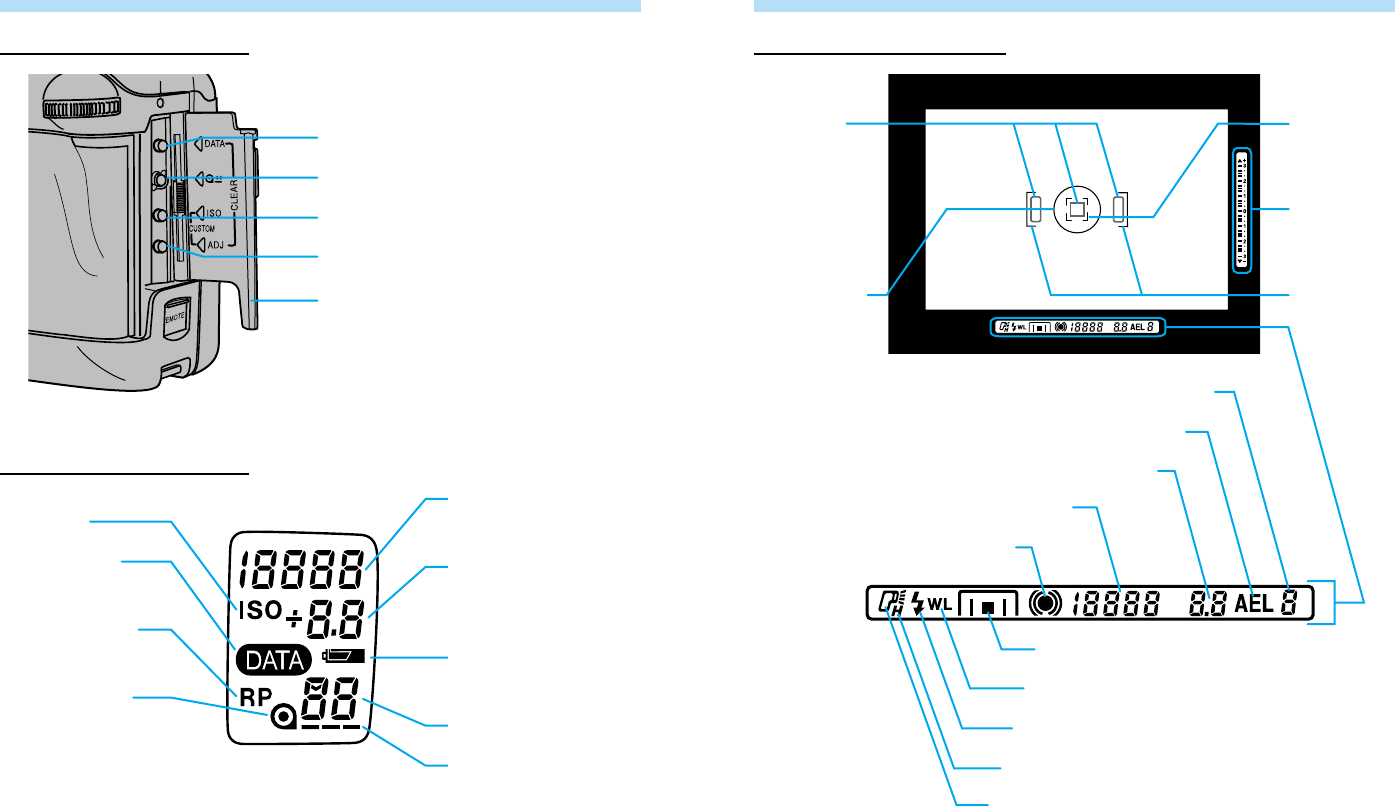
Data Panel
ViewfinderControl Panel
Data-memory button (84-90)
Manual-rewind button (24)
ISO button (52)
Adjust button
Control-panel door
ISO mark
Data memory
indicator (84-90)
Release priority
indicator (92)
Cartridge mark
Shutter speed display
(Focus area/ISO)
Aperture display
(Exposure compensation
/Bracketing)
Battery condition
indicator (11)
Frame counter
Film transport signals
Focus frame
Local focus
areas (31)
Spot-metering
area (46)
Spot-focus
area (95)
Flash on indicator (22)
Flash ready indicator (22)
High-speed sync indicator (66)
Wireless/Remote flash indicator (70-74)
Focus-area indicator
Focus signals (19)
Shutter speed display
Aperture display
AE-lock indicator (48)
Frames remaining counter (last 9 frames only)
Meter index
(42)
NAMES OF PARTS
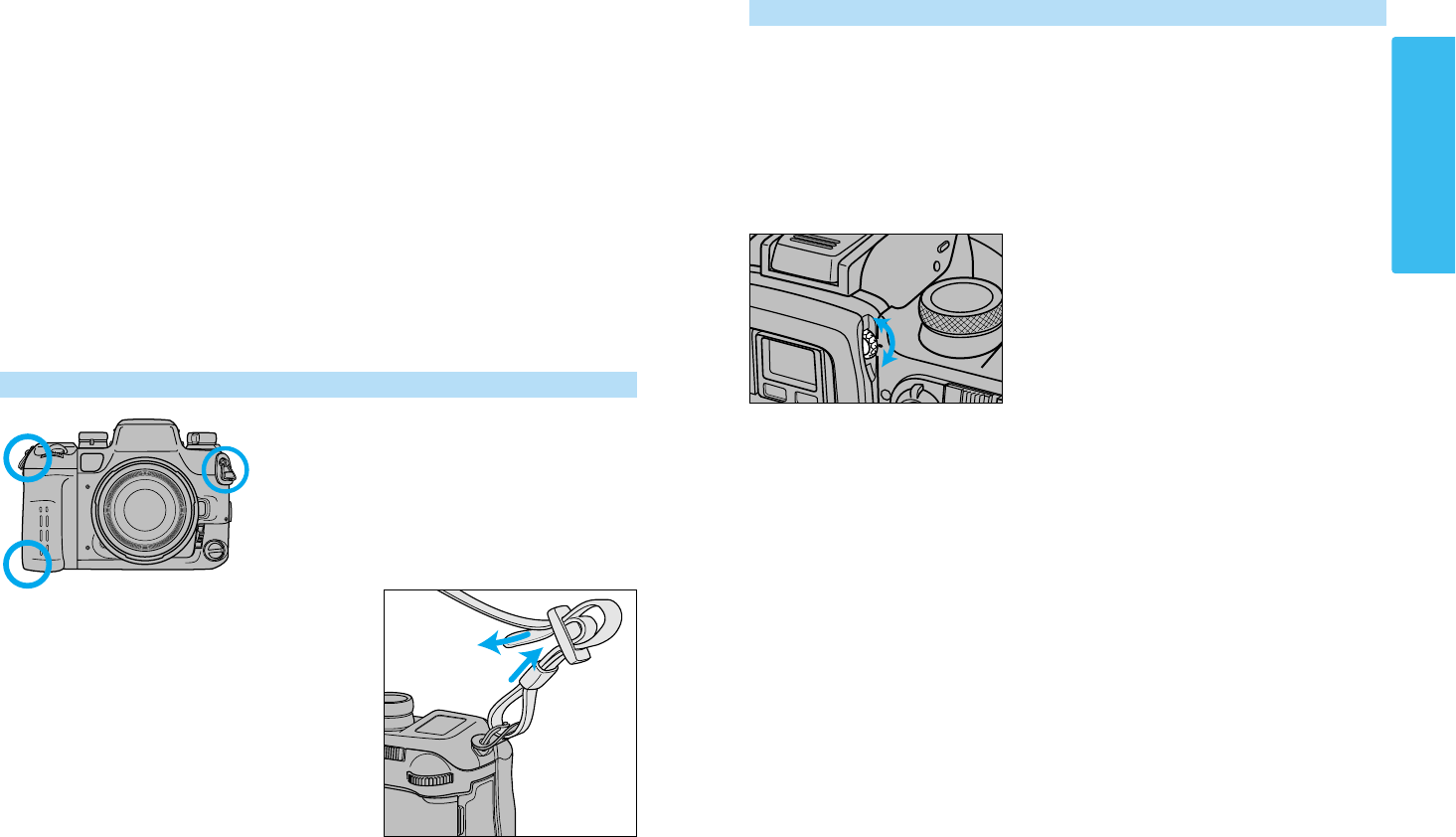
Use the upper eyelets if you want the camera to
hang horizontally. Use the side eyelets if you
want the camera to hang vertically.
9
DIOPTER ADJUSTMENT
Turn the diopter adjustment dial to compensate the eyepiece for near or far sighted
vision problems. The adjustment range is from –3 to +1 diopters.
Turn the diopter-adjustment dial until
the focus frame appears sharpest.
Farsighted users – turn the dial
clockwise.
Nearsighted users – turn the dial
counter-clockwise.
Before attaching the lens…
Look through the viewfinder at a well illuminated blank
wall or clear blue sky.
If additional correction is needed, attach a Minolta Eyepiece
Corrector (optional accessory) to the camera’s eyepiece.
GETTING
STARTED
Attach the strap through the strap
eyelets as shown. Pull firmly on the
strap to make sure it is secure.
GETTING STARTED
STRAP
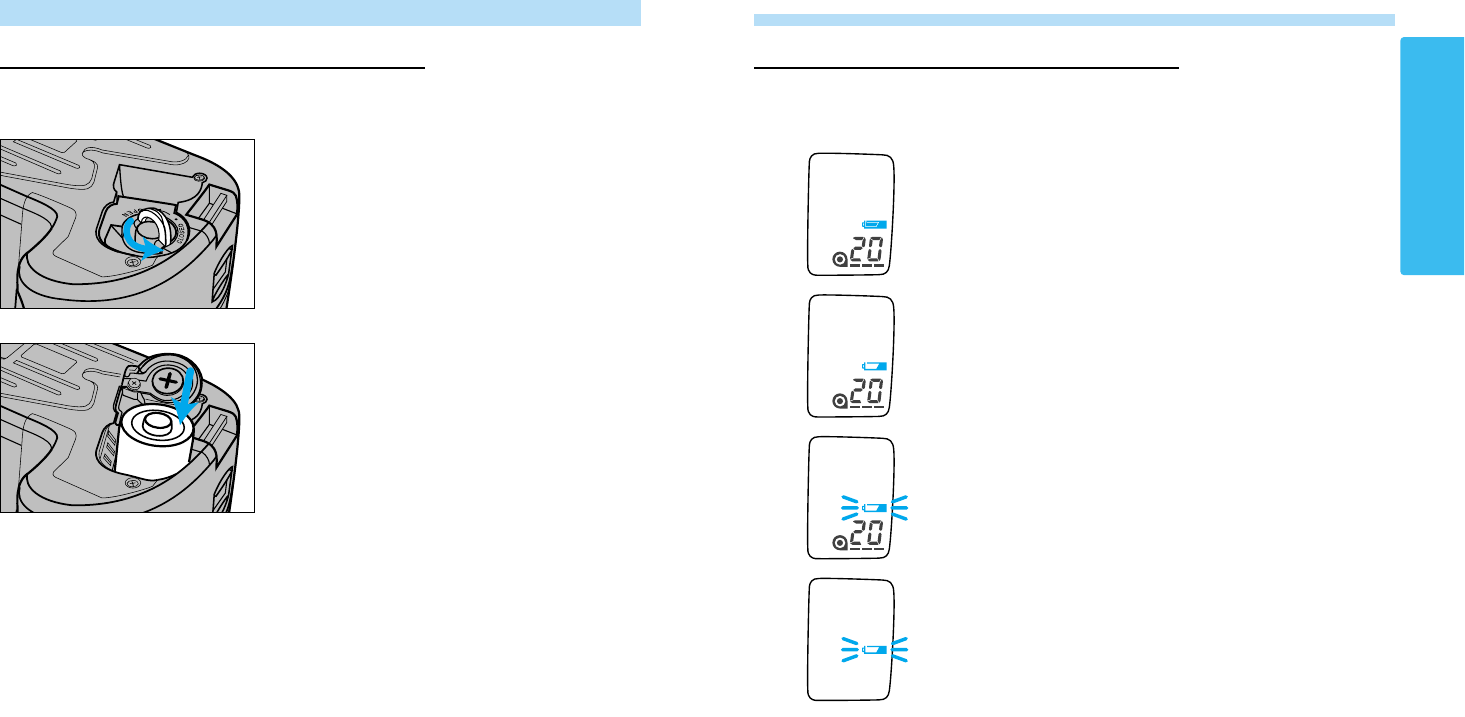
The battery condition indicator displays the power status of the batteries when the
main switch is set to ON.
Full-battery symbol
Power is sufficient for all camera operations.
Low-battery symbol
Power is low, but all functions are operational. Keep a
fresh battery handy.
Blinking low-battery symbol
Power is extremely low. The batteries will need to be
replaced soon. Flash recycling time may be slow.
Blinking low-battery symbol appears alone
and the shutter locks.
Power is insufficient for camera operation. Replace the
batteries.
1110
BATTERIES
Installing the Batteries
Your camera uses two 3V CR123A lithium batteries to supply power for all camera
operations.
1. Lift and turn the battery-chamber
lock to OPEN, then open the battery-
chamber door.
2. Insert the batteries as indicated by
the + and – marks.
3. Close the battery-chamber door,
then press and turn the battery-
chamber lock to CLOSE.
Checking Battery Power
No display
Power is too low for the camera to operate. Replace
the batteries or make sure they have been inserted
correctly.
GETTING STARTED

1312
LENS
Attaching the Lens
1. Remove the body and rear lens
caps.
2. Align the mounting indexes.
3. Insert the lens into the mount and
turn it clockwise until it clicks into
the locked position.
• Do not press the lens release when mounting the
lens. The lens will not couple properly.
Removing the Lens
1. Press the lens release and turn the
lens counter-clockwise until it stops.
2. Remove the lens and replace the
caps, or attach another lens.
Caution
• Do not force the lens if it does not turn smoothly.
• Do not touch the inside of the camera, especially the lens contacts and
mirror.
Grip the camera firmly with your right hand,
while supporting the lens with your left. Keep
your elbows at your side and your feet
shoulder-width apart to hold the camera
steady. Keep the camera strap around your
neck or wrist in the event you accidentally
drop the camera.
• Do not touch the end of the lens barrel while
taking a picture.
• Do not block the AF illuminator.
• Use a tripod when using slow shutter speeds
or a telephoto lens.
HANDLING THE CAMERA
Holding the Camera
Pressing the Shutter-Release Button
Press the shutter-release button partway down to
activate the camera’s autofocus and auto-exposure
systems.
Gently press the shutter-release button all the way
down to take the picture.
GETTING STARTED
1514
BASIC
OPERATION
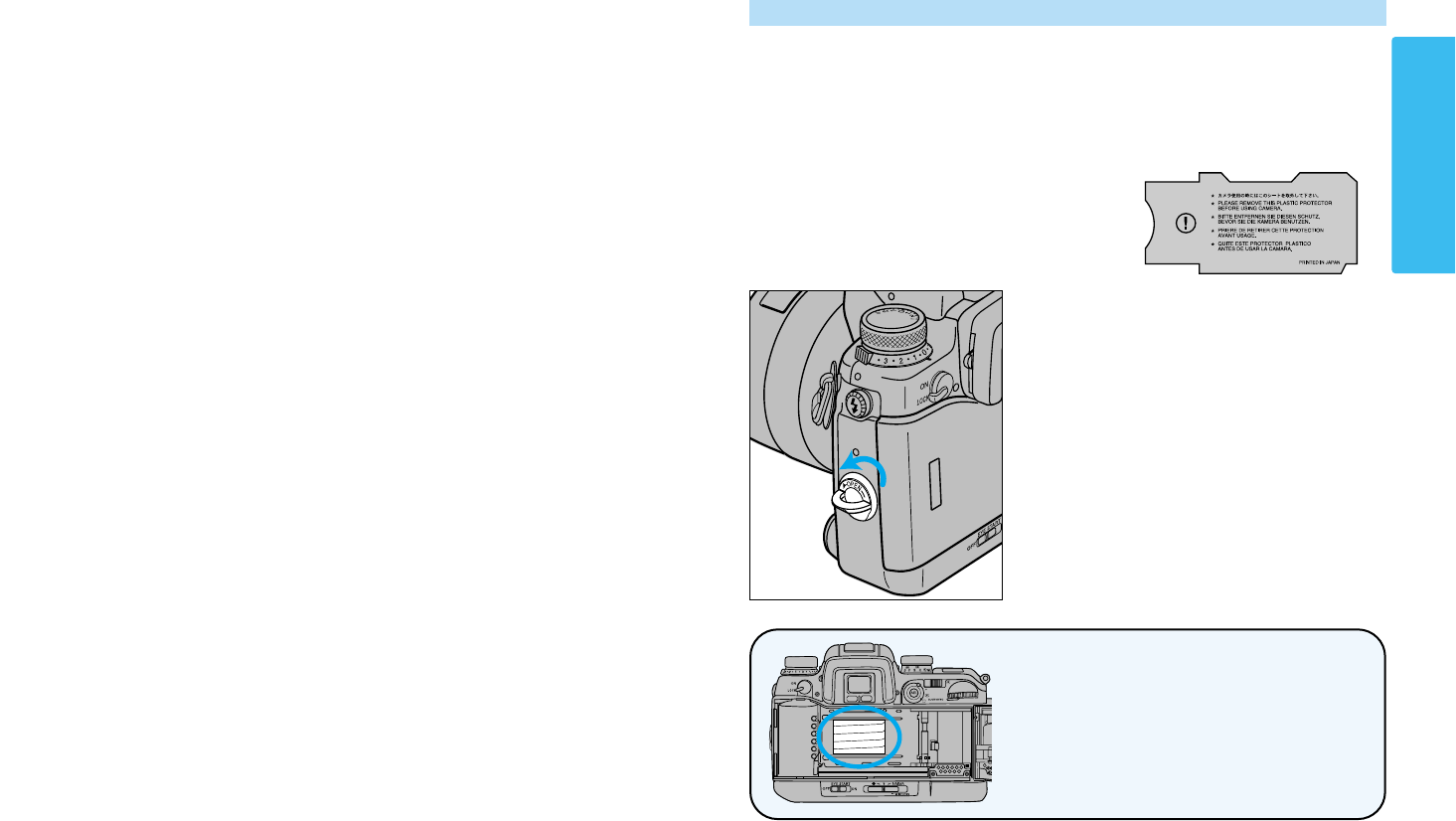
Before loading film for the first time…
Remove and discard the film gate protector.
LOADING FILM
Check the film window before loading film. If film is loaded, do not open the back
cover. Refer to Manual Rewind on page 24 to remove a partially exposed roll.
• Load film in the shade to reduce the chances of fogging the film.
• Do not use Polaroid Instant 35mm film. Winding problems may occur.
1. Turn the back-cover release counter-
clockwise to open the back cover.
The shutter curtain’s precision design makes it
extremely sensitive to pressure. Never touch it
with your fingers or the film tip.
BASIC OPERATION
Continued on the following page
1716
LOADING FILM
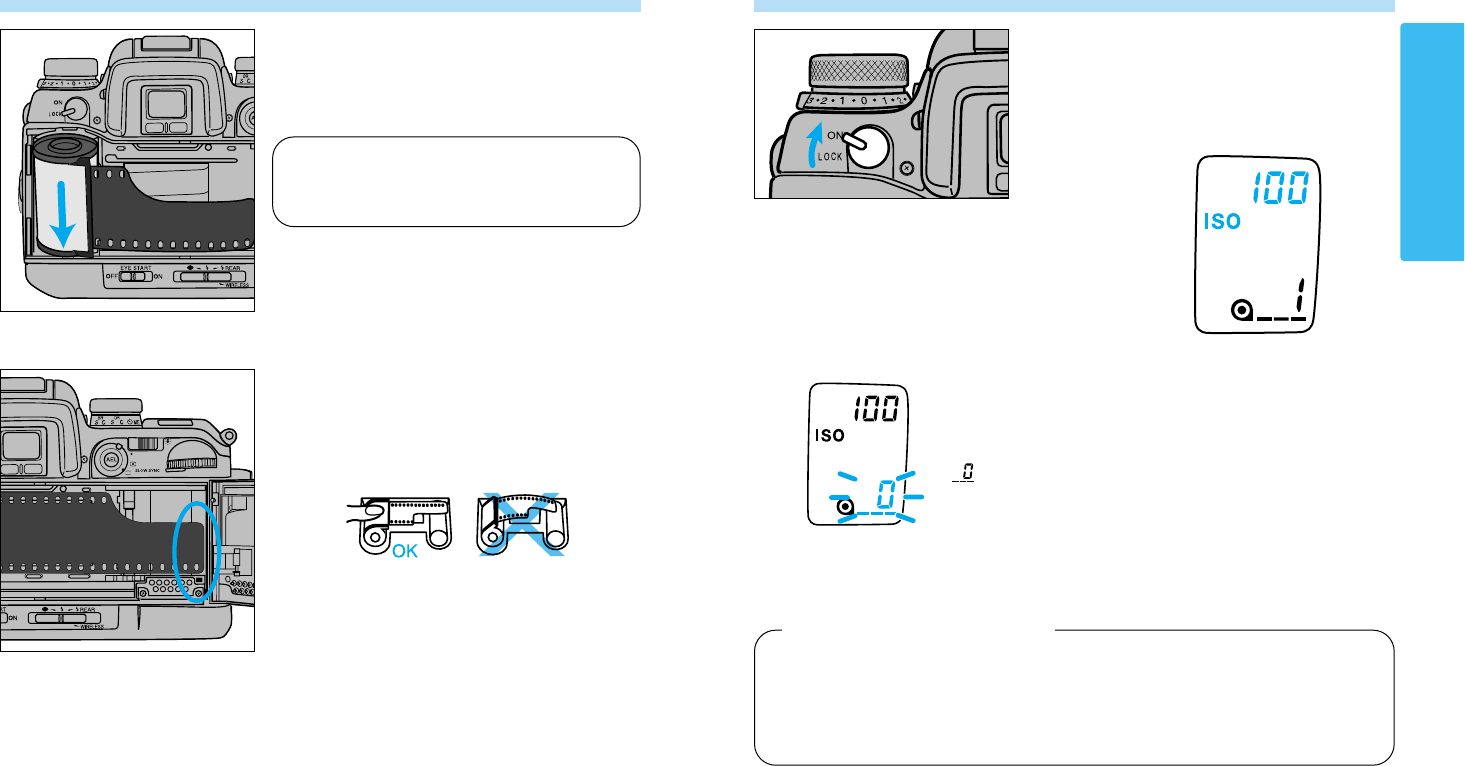
2. Insert a film cartridge into the film
chamber.
3. Extend the leader between the guide
rails to the index mark.
• If the film tip extends beyond the index mark,
push the excess film back into the cartridge.
4. Close the back cover and turn the
main switch to ON.
• The camera automatically advances the film to
the first frame. 1 will appear in the frame counter.
• The correct ISO for DX-coded film is set
automatically.
blinks in the frame counter and the shutter locks
when the film is loaded incorrectly. Repeat steps 1 – 4.
Non-DX-coded film is automatically rewound at the end of the roll or after 36
exposures.
Non-DX-coded film is set to the ISO from the previous roll. Refer to page 52 to
set the film speed manually.
Non DX Coded Film Notes…
The ISO is displayed in the data panel
for 5 seconds after loading.
Refer to page 93 to reload a partially
exposed roll.
BASIC OPERATION
1918
TAKING PICTURES IN FULL–AUTO
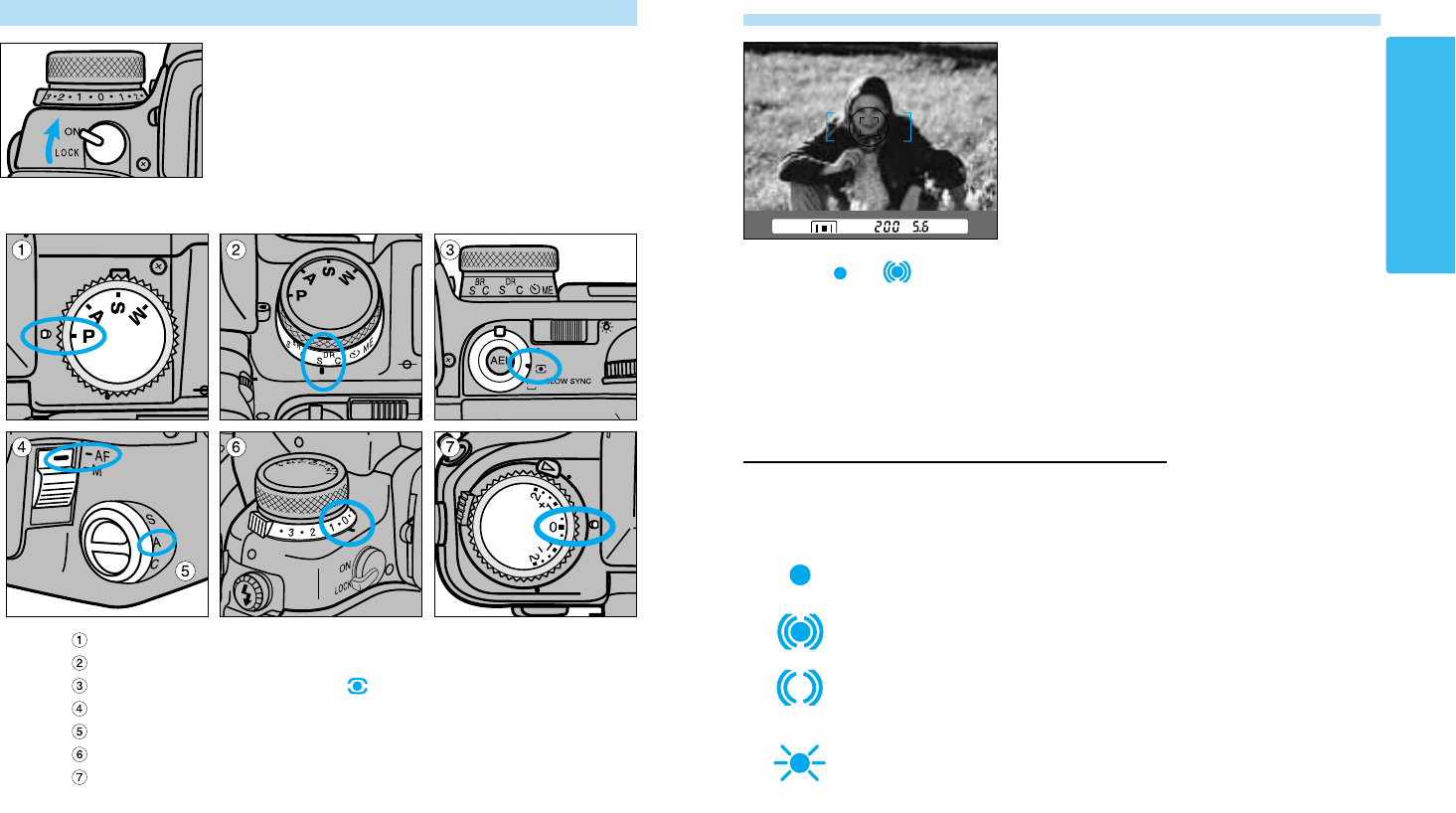
1. Turn the main switch to ON. 3. Center your subject in the focus
frame, then press the shutter-release
button partway down.
• The local-focus area LED appears briefly
indicating the focus area selected by the camera.
4. When or appears in the viewfinder, press the shutter-
release button all the way down to take the picture.
• The AF illuminator fires in low-light situations to assist the autofocus system (p.34).
• Use focus hold (p.21) if your subject is outside the focus frame.
• The number of frames remaining is displayed in the viewfinder for the last 9 frames on the
roll. The countdown does not appear for non-DX coded film.
The following signals appear in the viewfinder data panel to indicate the focus
status when the shutter-release button is pressed partway down.
Focus is confirmed.
Continuous autofocus – Focus is confirmed.
Continuous autofocus – Lens focusing. Shutter is locked.
Focus cannot be confirmed – Shutter is locked.
Subject is too close or is one of the special focus situations
described on page 20.
Focus Signals
2. Set Full-Auto mode as shown.
Set the exposure mode dial to P.
Set the drive mode dial to single frame advance (S).
Set the metering-mode switch to .
Set focus-mode switch to autofocus (AF).
Set the AF-mode dial to automatic autofocus (A).
Set the flash-compensation dial to 0.
Set the exposure-compensation dial to 0.
BASIC OPERATION
20 21
SPECIAL FOCUS SITUATIONS
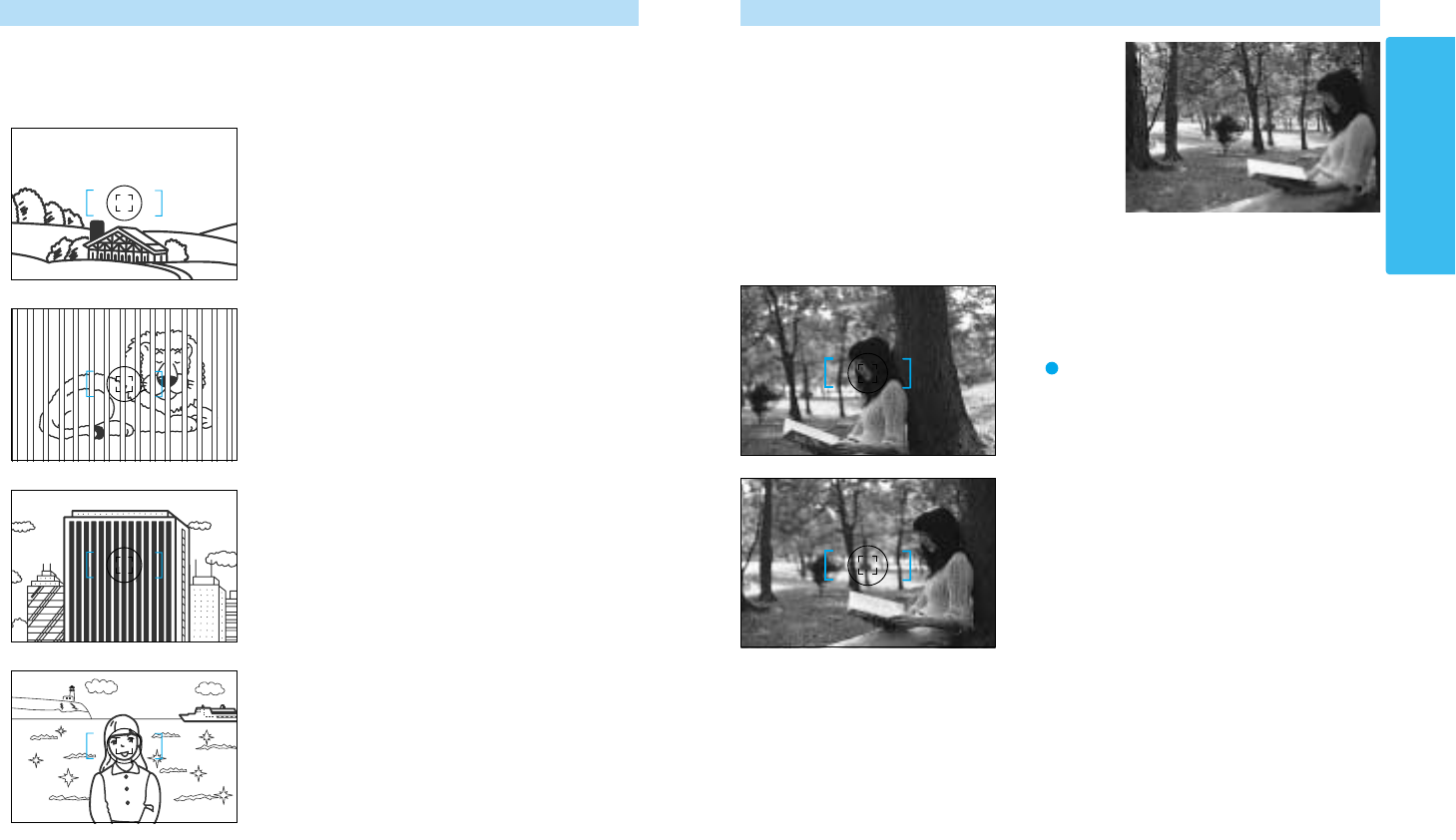
The camera may not be able to focus in situations like those described below.
When the focus signal blinks, use focus hold (p.21) or manual focus (p.33). See
page 19 for an explanation of the focus signals.
If the subject within the focus frame is
very bright, or low in contrast.
If two subjects at different distances
overlap in the focus frame.
If a subject composed of alternating
light and dark lines completely fills
the focus frame.
If your subject is near a very bright
object or area.
Use focus hold when your subject is outside the
focus frame or when autofocus is difficult to
confirm.
• Use AF Lock (p. 32) to lock focus on moving
subjects.
• Focus hold does not operate when continuous
autofocus mode (p.29) is selected. Use AF Lock.
FOCUS HOLD
Focus hold cannot be used for moving subjects.
1. Center your subject in the focus
frame, then press the shutter-release
button partway down.
• appears in the viewfinder when focus is
confirmed.
• Focus hold also locks the exposure settings when
14 segment metering is selected (p. 45).
2. Continue to hold the shutter-release
button partway down while you
compose your picture.
3. Press the shutter-release button the
rest of the way down to take the
picture.
• Remove your finger from the shutter-release
button to cancel focus hold.
BASIC OPERATION
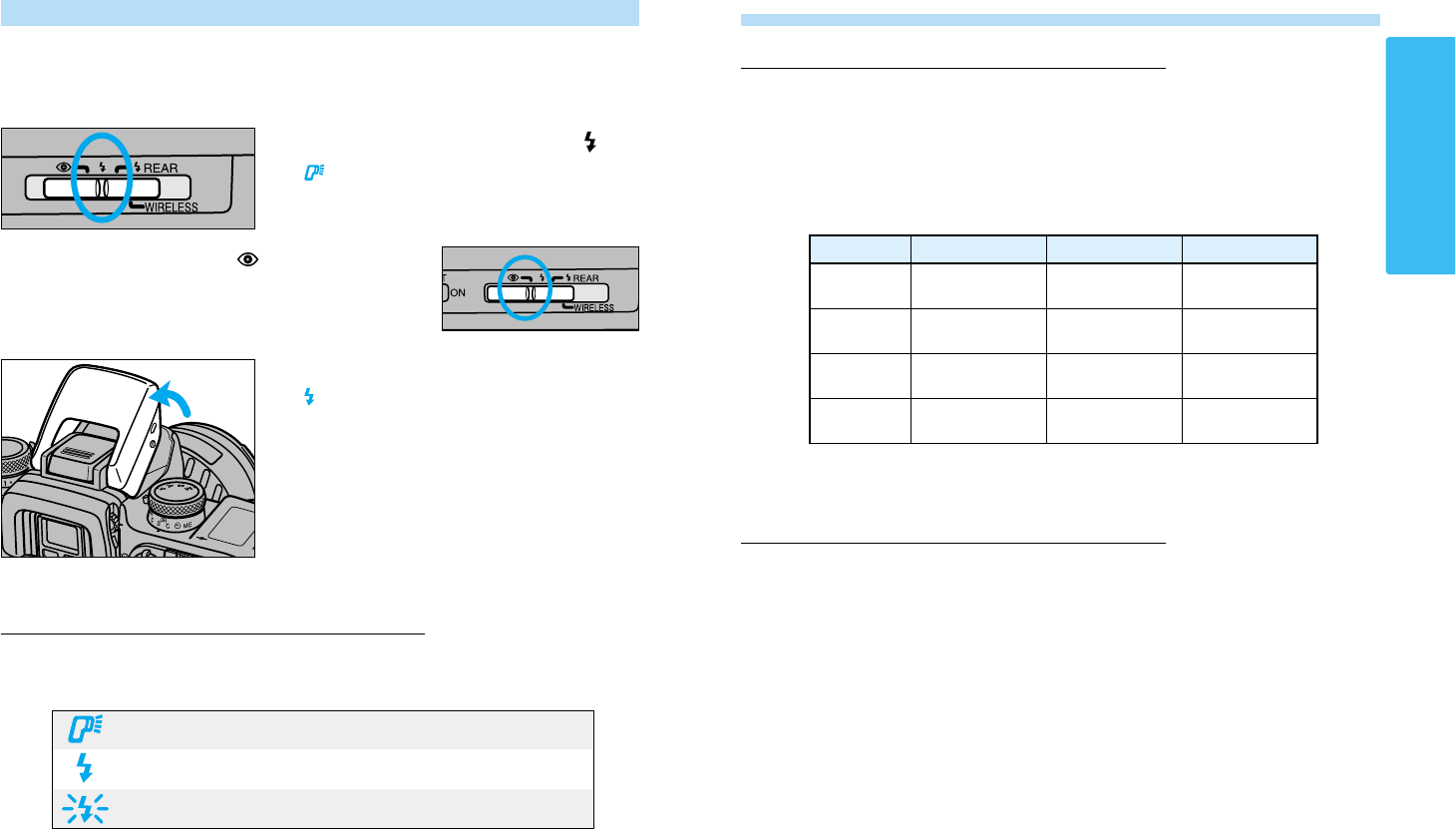
Slide the flash-mode switch to to reduce the red-
eye effect when using the built-in flash.
• Red-eye reduction mode is only available with the built-in
flash.
2322
USING THE BUILT-IN FLASH
When up, the built-in flash fires every time the shutter is released to provide
coverage for focal lengths as wide as 24mm. Flash output is automatically
controlled by the camera’s TTL flash metering system.
2. Grip both sides of the flash and lift.
• appears in the viewfinder when the flash is
fully charged.
• The shutter can not be released until the flash is
charged.
1. Slide the flash mode switch to .
• will appear in the viewfinder data panel.
- Push the flash down to turn it off.
The following signals appear in the viewfinder data panel to indicate the flash status
when the shutter-release button is pressed partway down.
Flash Signals
The range of the built-in flash depends on the speed of the film and the selected
aperture. Make sure your subject is within the flash range specified in the table
below.
Flash Range
Make sure you are at least 1m (3.3 ft.) from your subject
when using the built-in flash.
Aperture ISO 100 ISO 200 ISO 400
f/2.8
f/3.5
f/4
f/5.6
1.0 ~ 4.3m 1.0 ~ 6.1m 1.0 ~ 8.6m
(3.3 ~ 14.1 ft.) (3.3 ~ 20.0 ft.) (3.3 ~ 28.2 ft.)
1.0 ~ 3.4m 1.0 ~ 4.8m 1.0 ~ 6.8m
(3.3 ~ 11.2 ft.) (3.3 ~ 15.7 ft.) (3.3 ~ 22.3 ft.)
1.0 ~ 3.0m 1.0 ~ 4.2m 1.0 ~ 6.m
(3.3 ~ 9.8 ft.) (3.3 ~ 13.8 ft.) (3.3 ~ 19.7 ft.)
1.0 ~ 2.1m 1.0 ~ 3.0m 1.0 ~ 4.3m
(3.3 ~ 6.9 ft.) (3.3 ~ 9.8 ft.) (3.3 ~ 14.1 ft.)
Lens shadowing occurs when the lens or lens hood blocks part of the output from
the built-in flash. Lens shadowing appears as semi-circular shaded area at the
bottom (horizontal) or side (vertical) of your image.
Lens Shadowing
• Remove the lens hood before using the built-in flash.
• Lens shadowing may occur with the following lenses at shorter focal
lengths.
AF Zoom 17-35mm f/3.5G AF Zoom 28-70mm f/2.8G
AF Zoom 28-85mm f/3.5-4.5 AF Zoom 28-135mm f/4-4.5
• The built-in flash can not be used with the following lenses:
AF 300mm f/2.8 (APO tele) AF 600mm f/4 (APO tele)
Flash will fire when the shutter is released.
Flash is charged.
Previous exposure was correct.
BASIC OPERATION
24
REWINDING THE FILM
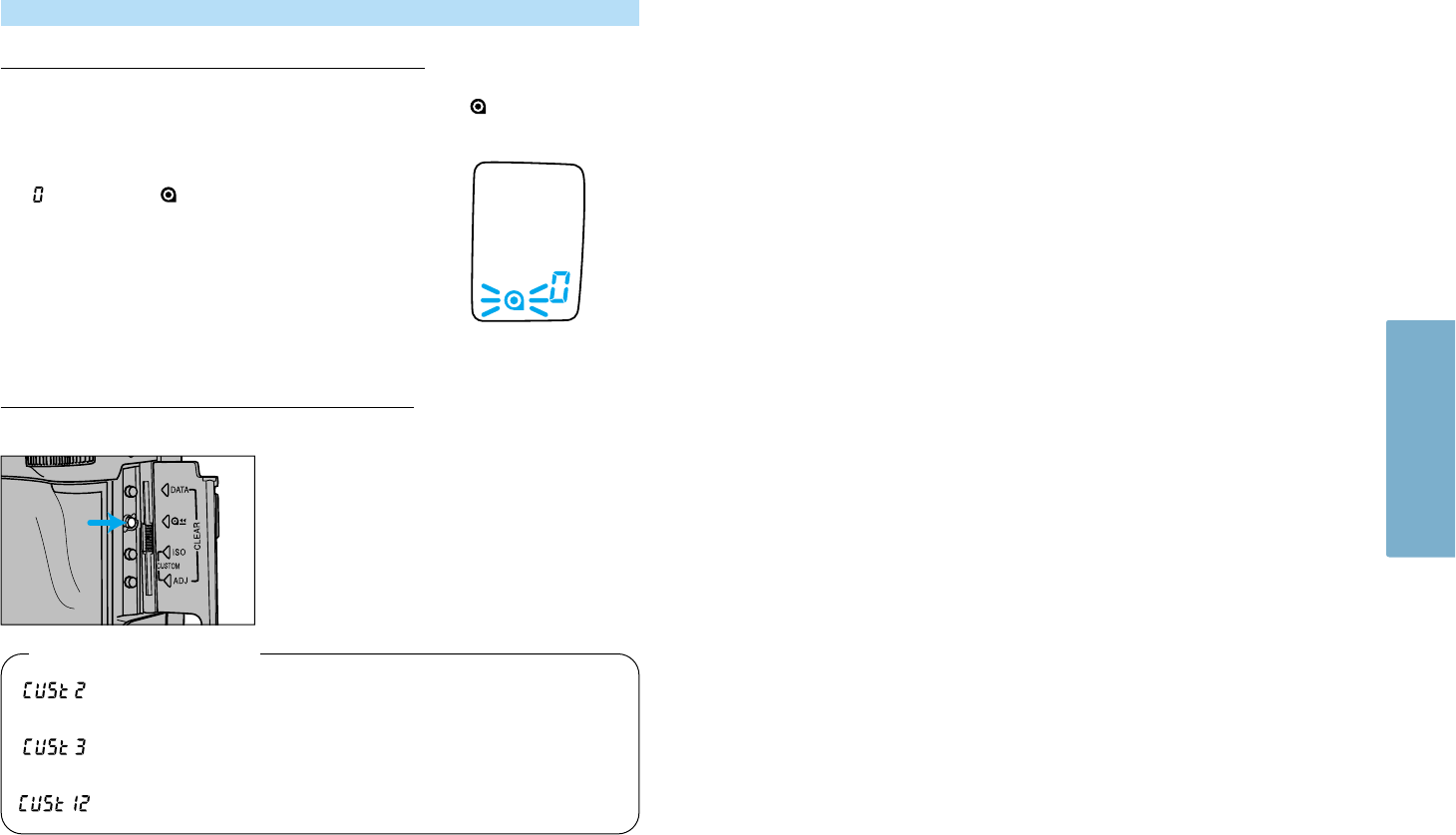
1. Wait until the film is completely rewound.
• will appear and will blink in the data panel.
Automatic Rewind
The film is automatically rewound after the last frame is exposed (or 36 exposures).
When the film is completely rewound, the motor will stop and will blink in the
data panel indicating it is safe to open the back of the camera.
3. Close the back cover.
2. Open the back cover and remove the film.
Manual Rewind
Use manual rewind to rewind the film before the current roll is finished.
1. Open the control panel door, then
press the manual-rewind button.
DETAILED
OPERATION
2. Follow steps 1-3 from Automatic
Rewind.
Automatic (1) or manually initiated (2) rewind (p.92).
Custom Function Notes
Rewind the leader into the cartridge (1)
or leave the leader out (2) (p.92).
Fast or slow/silent rewind (p.97).
DETAILED OPERATION
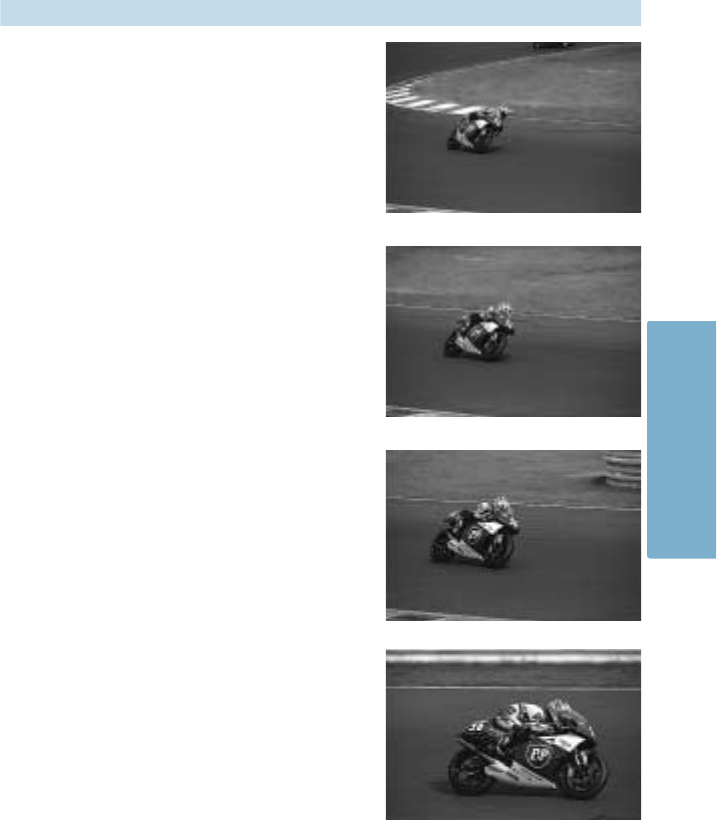
Predictive Focus Control determines the
subject’s speed, position, and acceleration
changes from the focus sensor data, then sets
the best focus at the predicted point of
exposure.
Predictive focus control is always active in the
Automatic and Continuous autofocus modes.
27
FOCUS - Predictive Focus Control
FOCUS With the ability to track acceleration in all
three dimensions, Predictive Focus Control
makes it possible for the camera to calculate
where your subject will be when the shutter
opens.
FOCUS
FOCUS — Autofocus Modes
2928
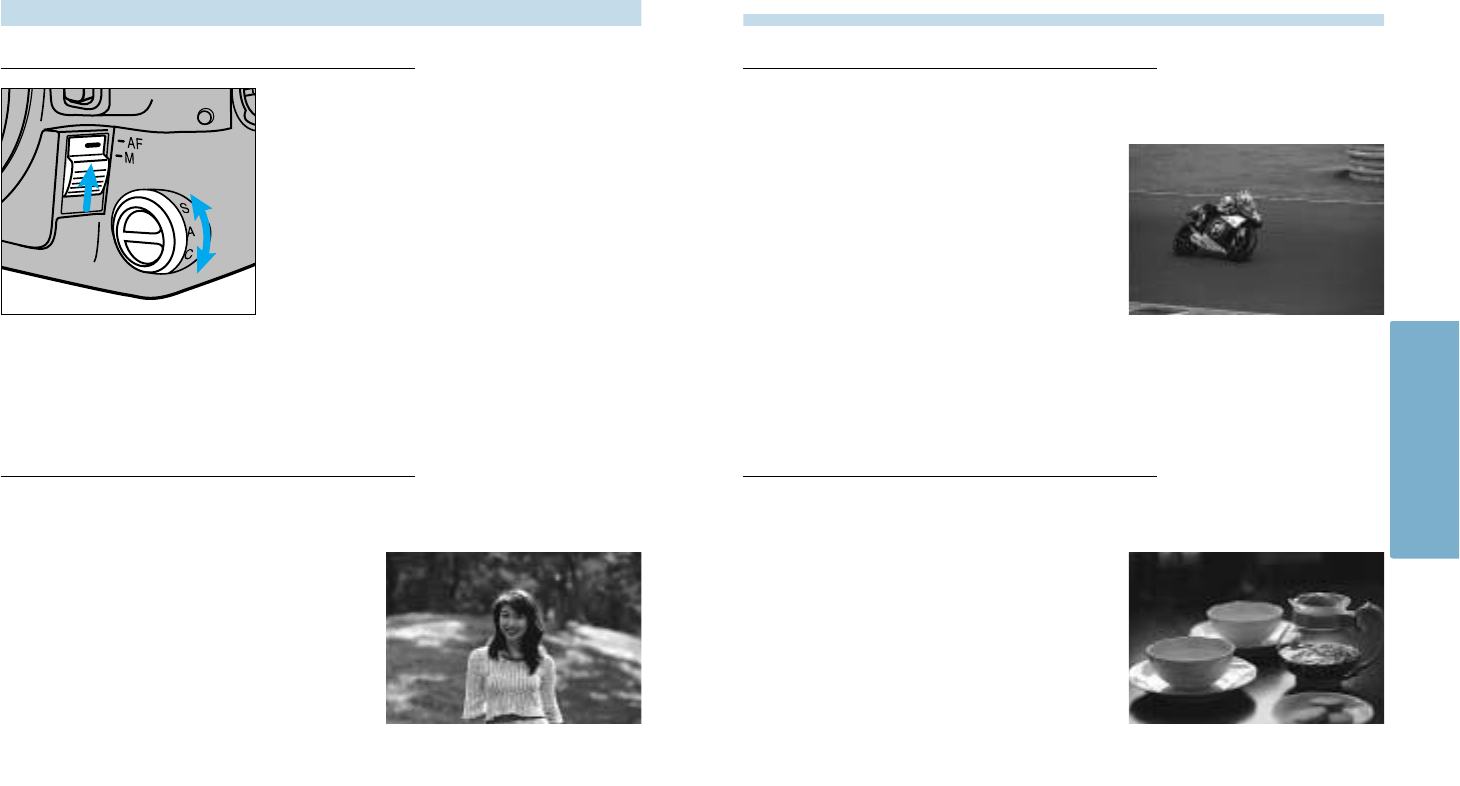
Continuous Autofocus (C)
Use Continuous Autofocus when shooting sporting events or when you know
the subject will be in constant motion.
Center your subject in the focus frame,
then press the shutter-release button
partway down to activate autofocus.
The camera continues to focus as long
as the shutter-release button is
pressed partway down.
• The AF Illuminator (p.34) does not operate in
Continuous Autofocus mode.
• The focus area is not displayed unless the AF
button is pressed.
Single Shot Autofocus (S)
Use Single-shot AF when photographing non-moving subjects or to lock focus
on subjects outside the focus area.
Center your subject in the focus frame,
then press the shutter-release button
partway down to activate autofocus.
Once confirmed, focus remains locked
until pressure is removed from the
shutter-release button or the shutter is
released.
Selecting the Autofocus Mode
Automatic Autofocus (A)
Designed to work well in almost any situation, Automatic Autofocus is especially
suited to moving subjects that stop suddenly.
1. Set the focus mode switch to AF.
Center your subject in the focus frame,
then press the shutter-release button
partway down to activate autofocus.
The camera will continue focusing
while the subject is moving, then lock
focus when the subject is still.
2. Turn the AF mode dial to the desired
mode.
FOCUS
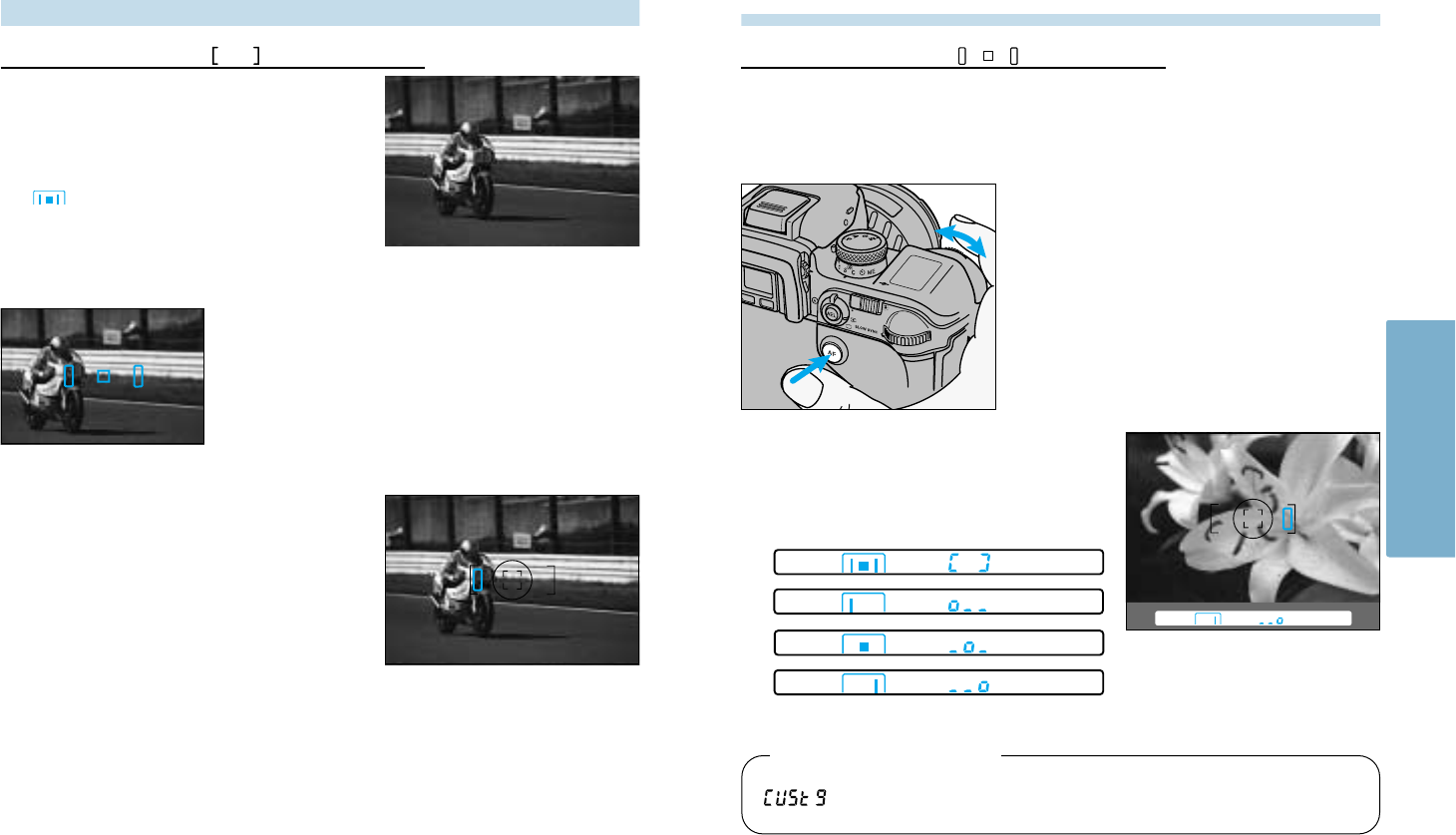
The selected focus area momentarily
appears in the viewfinder frame when the
shutter release button is pressed partway
down.
• The focus area LEDs do not appear when
continuous autofocus (p.29) is selected.
The camera determines which sensor is focusing on
your subject and sets the focus accordingly.
FOCUS — Focus Area
3130
Select a local focus area for greater control over the focus location in the autofocus
mode.
• Only the center focus area can be selected when the RF 500mm or the AF Power Zoom
35-80mm is mounted.
Local Focus Area
1. Press the AF button and turn the
front control dial to select the
desired local focus area.
• The local focus area is displayed in the focus
frame and data panels.
2. Release the AF button when the
desired local focus area appears.
• The focus-area indicator displays the currently
selected focus area.
The camera’s standard focus mode, wide focus
area uses the camera’s three focus sensors to
automatically focus on your subject. Wide focus
area’s greater framing flexibility makes it easier
for the camera to focus on moving subjects.
• appears in the viewfinder data panel when
wide focus area is selected.
Wide Focus Area
Wide / Local Focus Area (1) or Spot Focus (2) when the AF button
is pressed (p.96).
Custom Function Notes
FOCUS
FOCUS — Manual FocusFOCUS — AF Lock
3332
Pull and turn the zoom ring until your
subject appears sharp.
Focus the lens manually when autofocus is not suitable and focus hold is not
possible. The autofocus system will monitor focus and indicate when a subject in
the focus frame is in focus.
• Only the center weighted average (p. 47) and spot (p. 46) metering modes are available in
manual focus mode.
• 14-segment honeycomb pattern metering (p. 45) is changed to center weighted average
metering when manual focus mode is selected.
1. Slide the focus-mode switch to M.
2. Turn the focusing ring until your
subject appears sharp and focused.
• appears in the viewfinder when the subject in
the focus frame is in focus.
AF Power Zoom and xi-Series Lenses
Press the AF button to lock focus on moving or stationary subjects using the current
focus mode. The focus remains locked until the AF button is released.
• Exposure is also locked if 14-segment metering (p.45) is selected.
• Pressing the AF button also activates the AF illuminator.
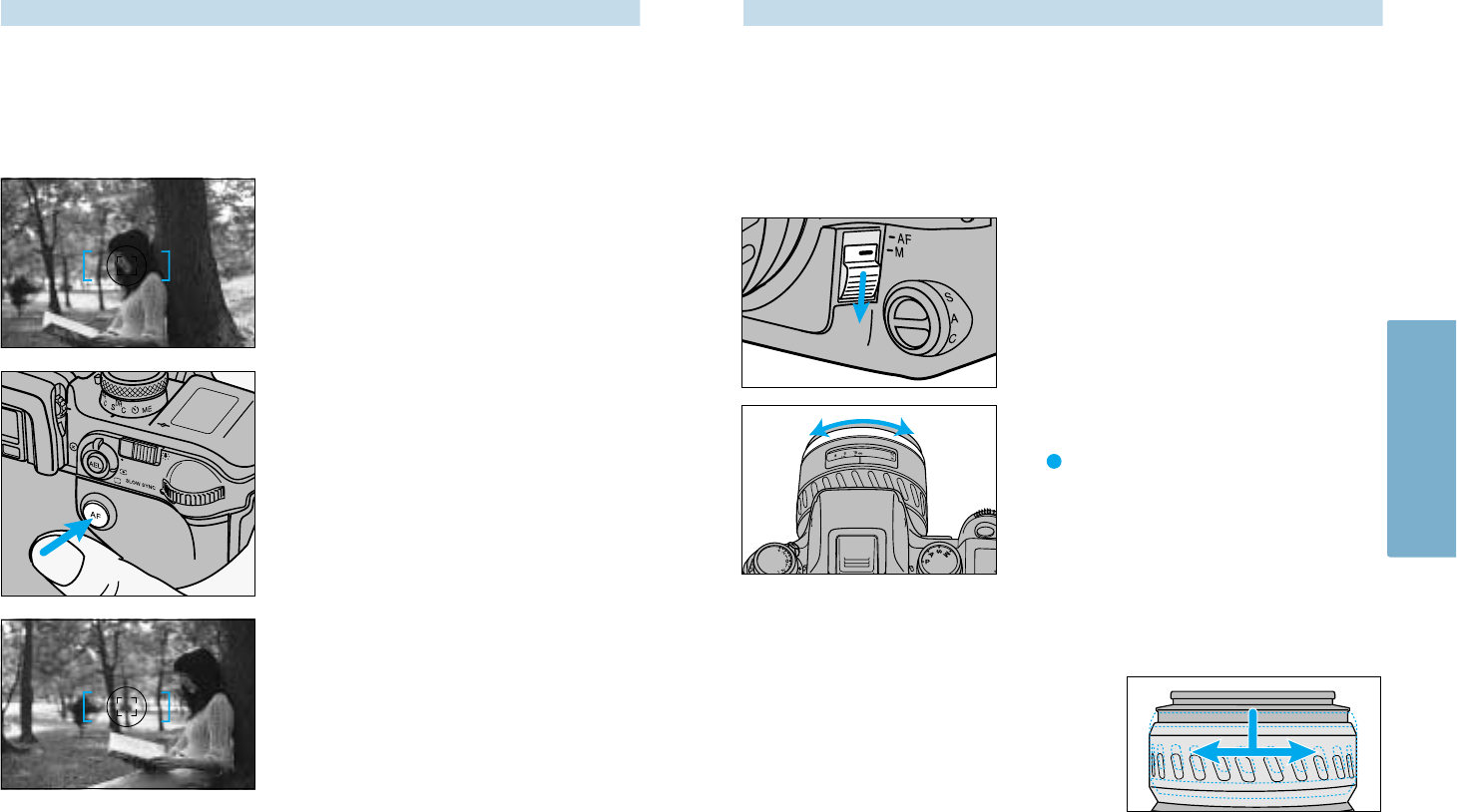
1. Center your subject in the focus
frame.
2. Press and hold the AF button.
• The current local focus area LED appears in the
viewfinder data panel until the AF button is
released.
• The exposure settings do not appear until the
shutter-release button is pressed partway down.
3. Recompose the scene as desired,
then take the picture.
Turn the front control dial to select a different
local focus area.
FOCUS

FOCUS — AF Illuminator
34
In low-light/low subject contrast situations, the
AF illuminator automatically projects a pattern
of lines onto the subject for the camera’s AF
sensors to focus on.
• Do not to obstruct the AF illuminator.
• Pressing the AF button (p.32) also activates the AF illuminator.
• The range of the AF Illuminator is 0.7 – 7.0 meters (2.3 – 23.0 ft.).
• The AF illuminator will not fire in continuous autofocus mode.
• The AF illuminator may not operate with 300mm or longer single focal length lenses.
• The AF illuminator will not operate with 3x-1x Macro Zoom.
• When an accessory flash is attached, its AF illuminator may be active in place of the
camera’s AF illuminator.
EXPOSURE
EXPOSURE
37
EXPOSURE — A-Mode
36
EXPOSURE — P-Mode
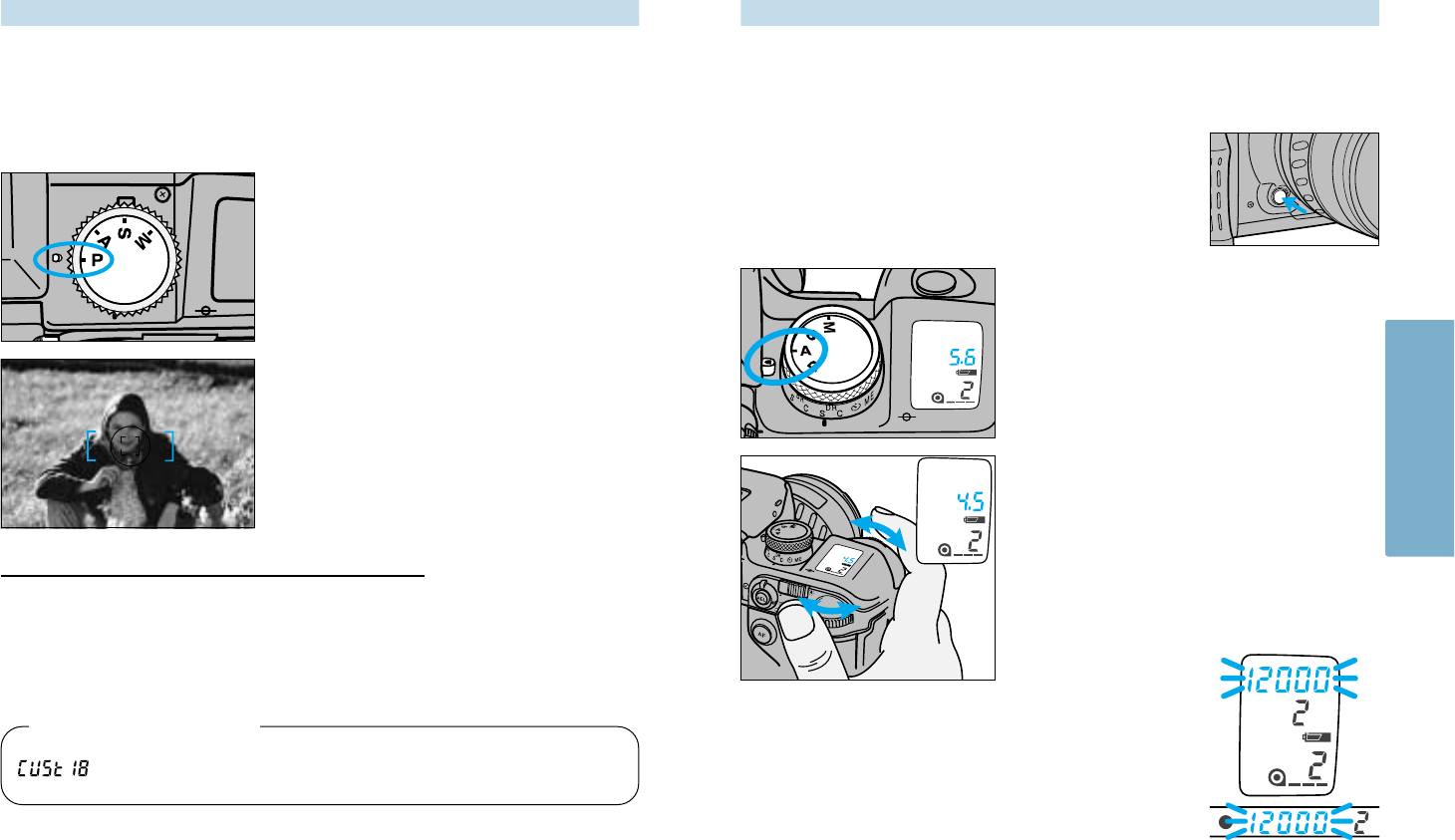
Select P-mode (Programmed Autoexposure) when you want to give your full
attention to your subject and composition. The Program mode software analizes the
subject’s size, motion, and magnification as well as the focal length of your lens,
then sets the shutter speed and aperture according to the requirements of the
scene.
1. Set the exposure-mode dial to P.
2. Compose your scene, focus, and
take the picture.
P-Mode Flash
When the built-in flash is up or an attached accessory flash is on, it will fire each
time the shutter is released. The camera’s TTL automatic flash metering system will
ensure proper exposure.
• Make sure your subject is within the flash range (p.23).
Press the depth of field button to confirm the range
of focus in your image (p.77).
If 12000 or 30” blinks in the viewfinder and
the data panel, the required setting is beyond
the camera’s shutter speed range. Turn the
control dial until the blinking stops.
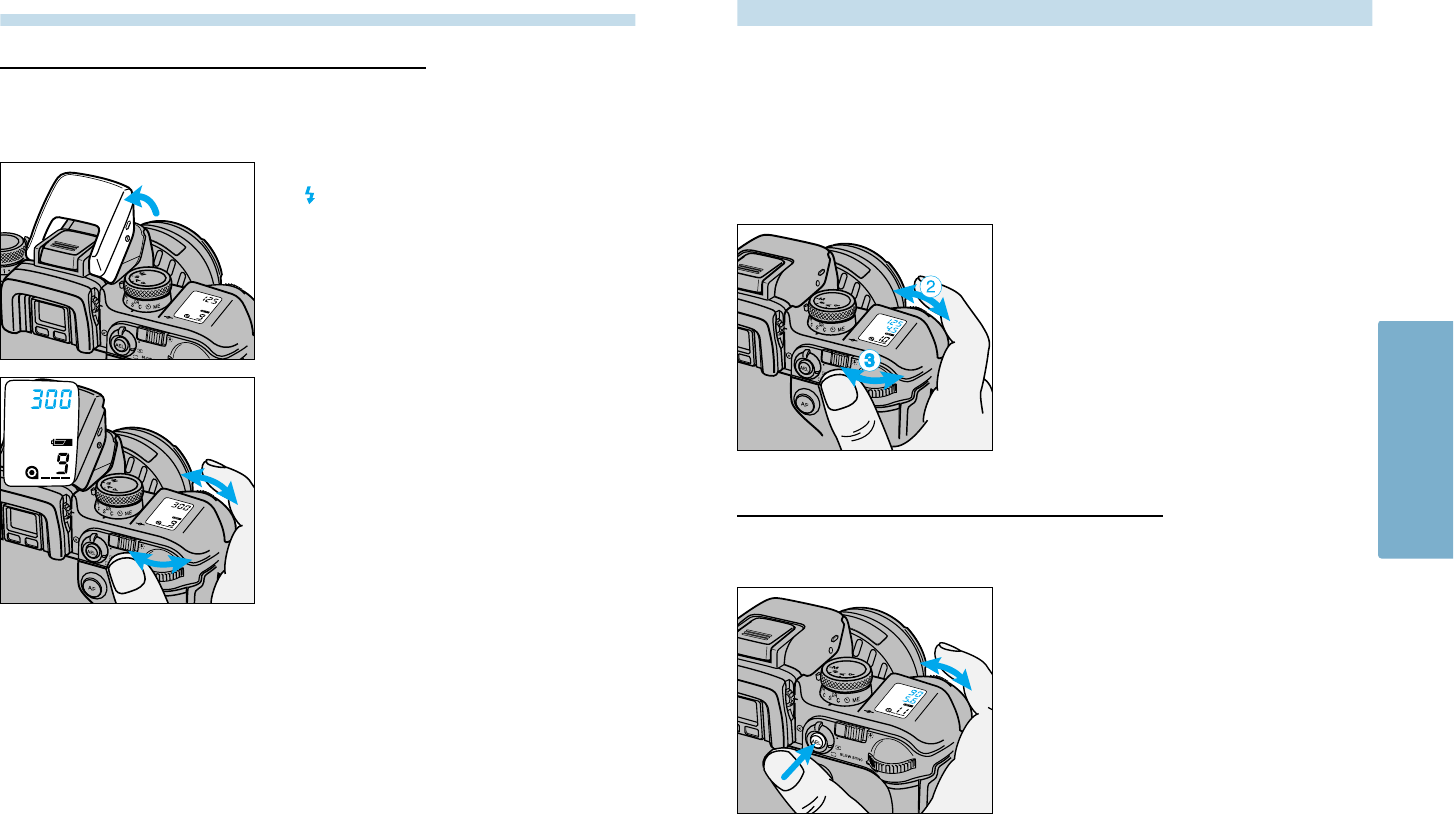
In A-mode (Aperture Priority), you select the aperture and the camera automatically
sets the shutter speed required for proper exposure. Set the camera to A-mode
when you want to control the range of focus (depth-of-field) in an image.
1. Turn the exposure-mode dial to A.
2. Turn either control dial to select the
aperture.
• The aperture setting changes in 1/2 or 1/3 EV
increments depending on the position of the
exposure compensation dial. See page 51.
Setting 2 - PA/Ps mode (p.101). This mode lets you override the
exposure settings selected by the camera in P mode.
Custom Function Notes
EXPOSURE

If the aperture display in the viewfinder and
the data panel blinks, the required setting is
outside the aperture range of the lens. Turn
the control dial until the blinking stops.
EXPOSURE — S-Mode
EXPOSURE — A-Mode
3938
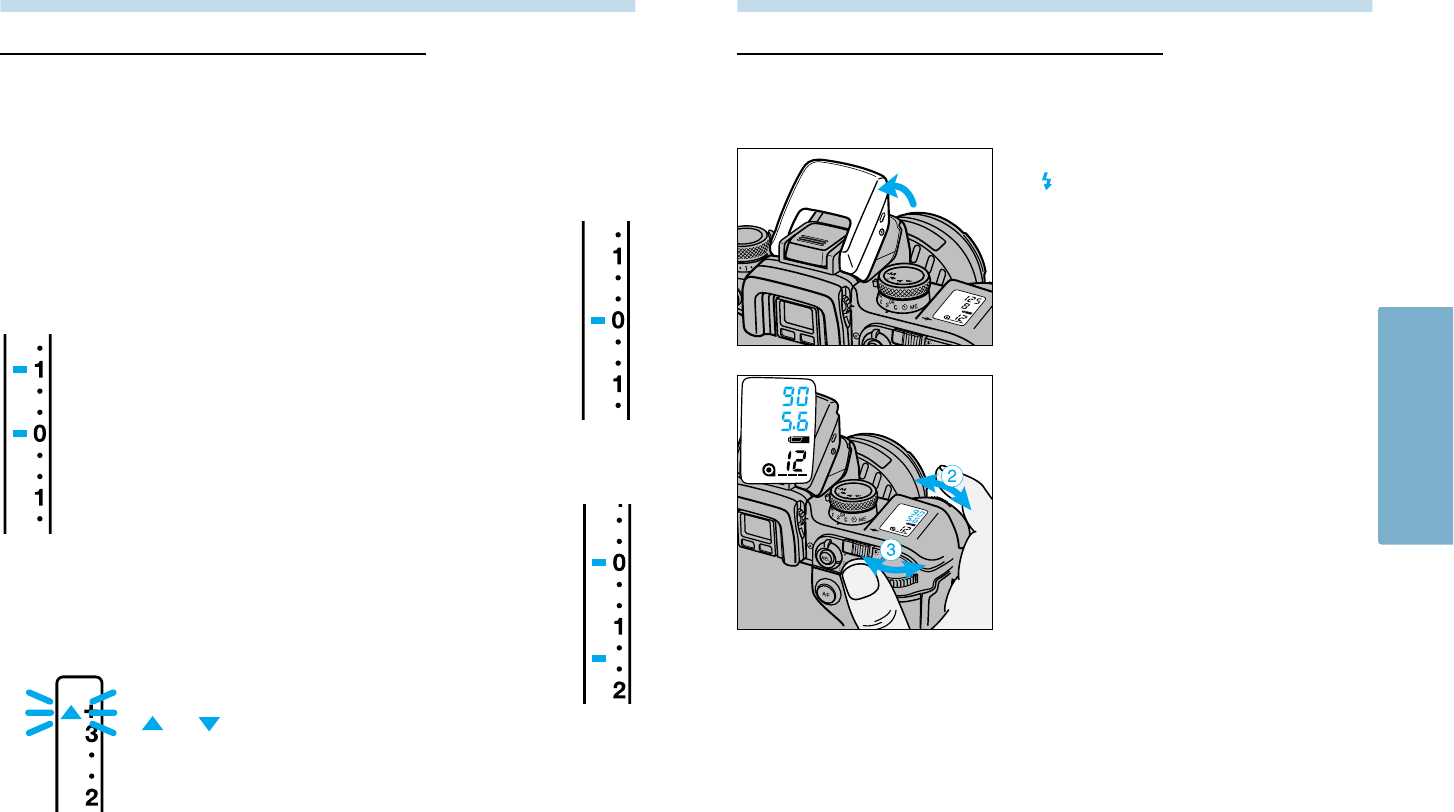
A-mode flash
When the built-in flash is up or an attached accessory flash is on, it will fire each
time the shutter is released. The camera’s TTL automatic flash metering system will
ensure proper exposure.
1. Raise the built-in flash.
• appears in the viewfinder when the flash is
charged.
• The shutter speed is automatically set to 1/300 or
slower.
2. Turn the control dial to select the
aperture.
• Refer to the Flash Range table on page 23 to
determine the range of the built-in flash at the
selected aperture.
If 300 blinks in the viewfinder and the data
panel, the light level is too bright for the
selected aperture. Turn the control dial until
the blinking stops or cancel the flash.
Push the built-in flash down or turn the accessory flash off to cancel
the flash.
In S-mode (Shutter Priority), the camera automatically sets the aperture for the
selected shutter speed. Use S-mode when you want to control the blur caused by
subject movement.
1. Turn the exposure-mode dial to S.
2. Turn either control dial to select the
shutter speed.
• The shutter speed changes in 1/2 or 1/3 EV
increments depending on the position of the
exposure compensation dial. See page 51.
EXPOSURE
EXPOSURE — M-Mode
EXPOSURE — S-Mode
4140
S-mode Flash
When the built-in flash is up or an attached accessory flash is on, it will fire each
time a picture is taken. Flash exposure is controlled by the camera’s TTL automatic
flash metering system.
1. Raise the built-in flash.
• appears in the viewfinder when the flash is
charged.
2. Turn the control dial to select any
shutter speed up to 1/300th of a
second.
• The camera sets the required aperture
automatically.
Push the built-in flash down or turn the accessory flash off to cancel
the flash.
M-mode gives you full control of the exposure. The camera’s meter index displays
how your settings compare to the exposure determined by the camera’s metering
system.
• The aperture and shutter speed settings change in 1/2 or 1/3 EV increments depending
on the current exposure compensation dial setting.
1. Turn the exposure-mode dial to M.
2. Turn the front control dial to select
the shutter speed.
Manual Shift
Manual shift lets you shift to equivalent aperture/shutter speed combinations
without changing the exposure value (EV).
Press the AE-lock button and turn the
front control dial until the desired
aperture / shutter speed combination
appears in the data panel.
• When you select the 1/3 EV increments setting,
the locked exposure may change if the maximum
aperture of 1/2 EV increments or the maximum
shutter speed of 1/12000 sec. is chosen.
3. Turn the rear control dial to select
the aperture.
EXPOSURE
4342
Metering in Manual Mode
The meter index displays the EV difference between your settings and the ‘correct’
exposure determined by the camera. The 0 position (null point) represents the
recommended exposure using the currently selected metering pattern (pp.45-47).
• The EV scale is marked in 1/2 or 1/3EV increments depending on the current setting of
the exposure compensation dial (p.51).
• A second indicator will appear in the meter index to indicate the new null point if the
exposure compensation dial is set to a value other than 0.
M-mode Flash
When the built-in flash is up or an attached accessory flash is on, it will fire each
time the shutter is released. The camera’s TTL flash metering system will ensure
correct exposure.
1. Raise the built-in flash.
• appears in the viewfinder when the flash is
charged.
2. Turn the front control dial to select
any shutter speed up to 1/300th of a
second.
3. Turn the rear control dial to select
the desired aperture.
• Refer to the flash range table on page 23 to
determine the range of the built-in flash at the
selected aperture.
Your settings match the recommended
exposure.
Your settings will overexpose the
metered area by 1EV.
Your settings will underexpose the
metered area by 1.5EV.
or will blink in the meter index if the
settings will over or underexpose the subject
by more than 3.0EV.
EXPOSURE — M-Mode
EXPOSURE
METERING — Selectable Metering
45
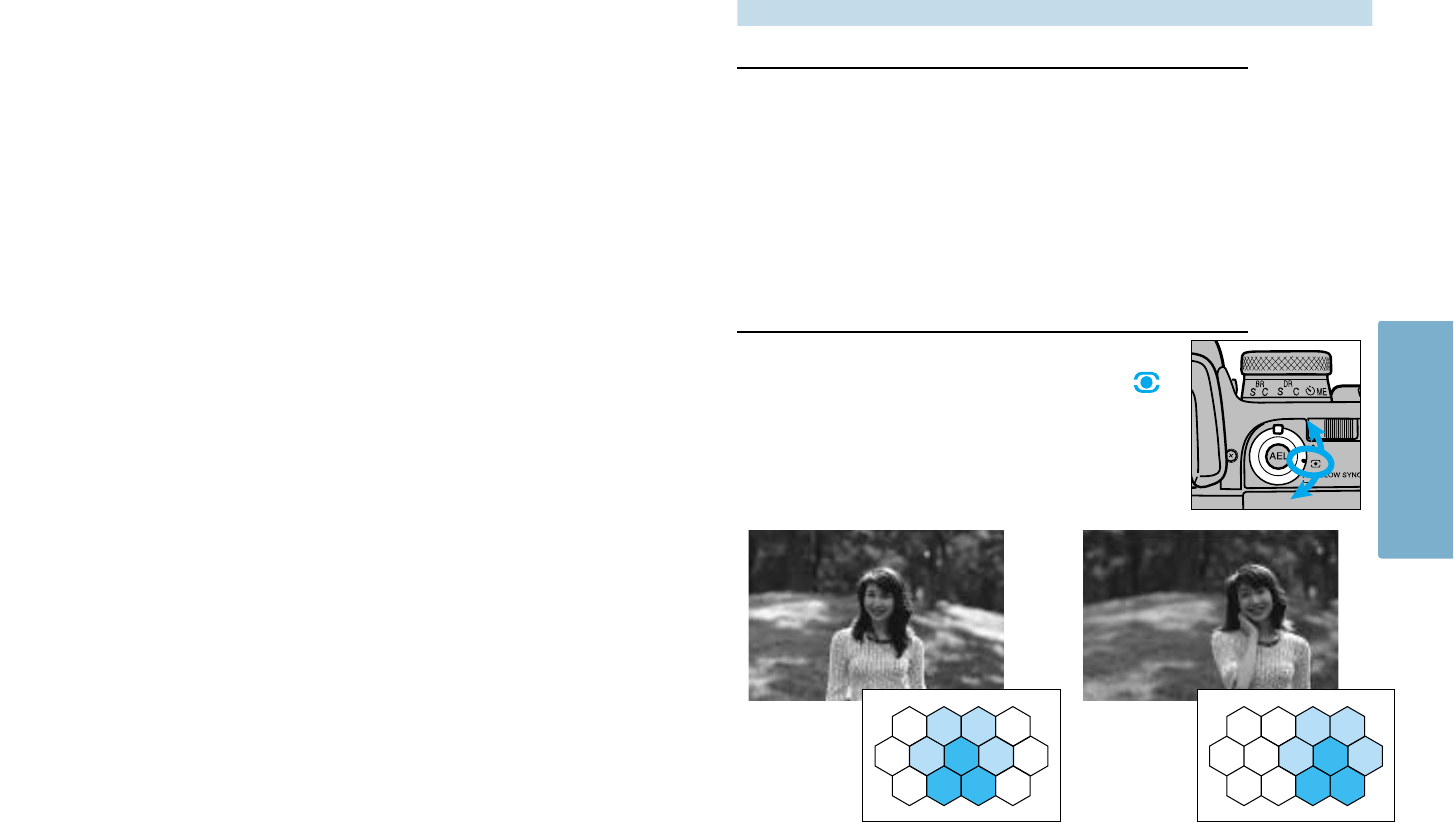
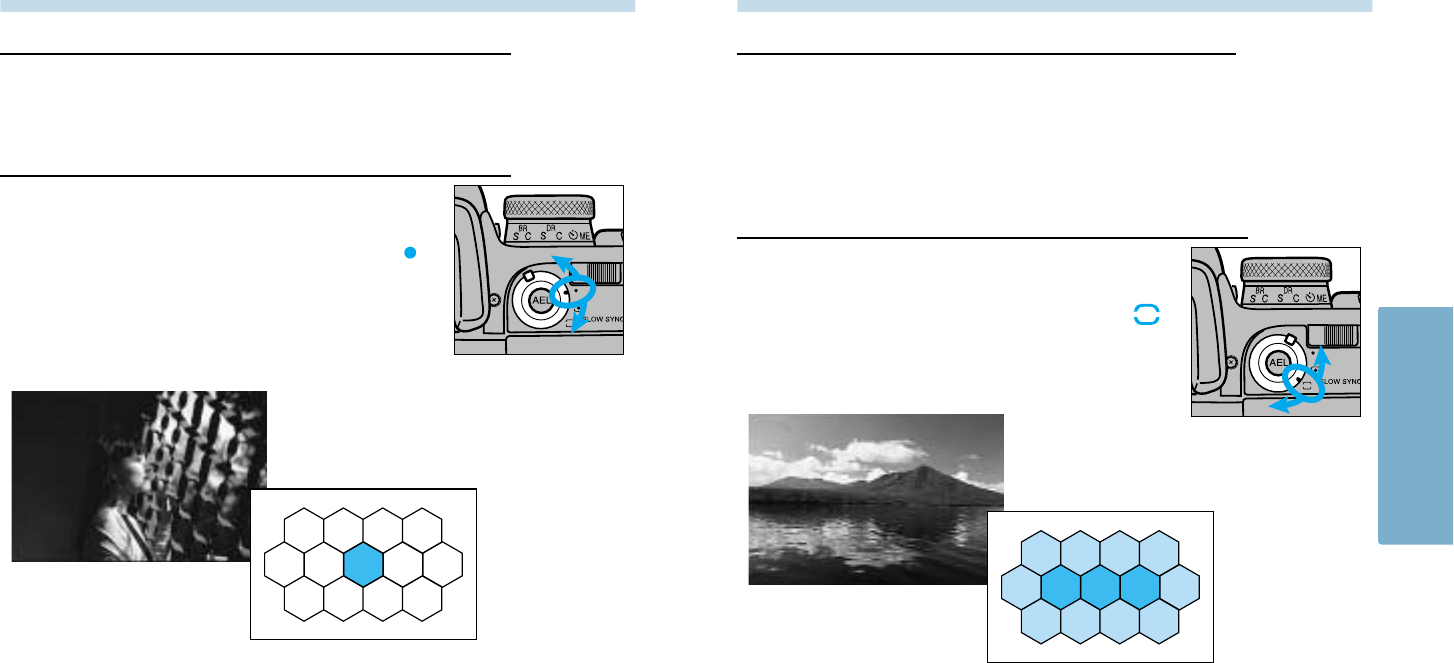
14 Segment Honeycomb Pattern Metering
Fourteen-Segment Honeycomb-Pattern Metering uses information from the
autofocus system to set the metering pattern according to the position of the main
subject. The light metered by each applicable segment is then evaluated to
determine the degree of spot-lighting or backlighting present in your scene. The
local focus-area (LED) momentarily displays the sensor being used when the
shutter release button is pressed partway down.
Fourteen-Segment Honeycomb-Pattern Metering is the camera’s standard
metering mode and is appropriate for most photographic situations.
METERING
Turn the metering mode switch to .
Selecting 14 Segment Honeycomb Pattern Metering
METERING
4746
METERING — Selectable Metering
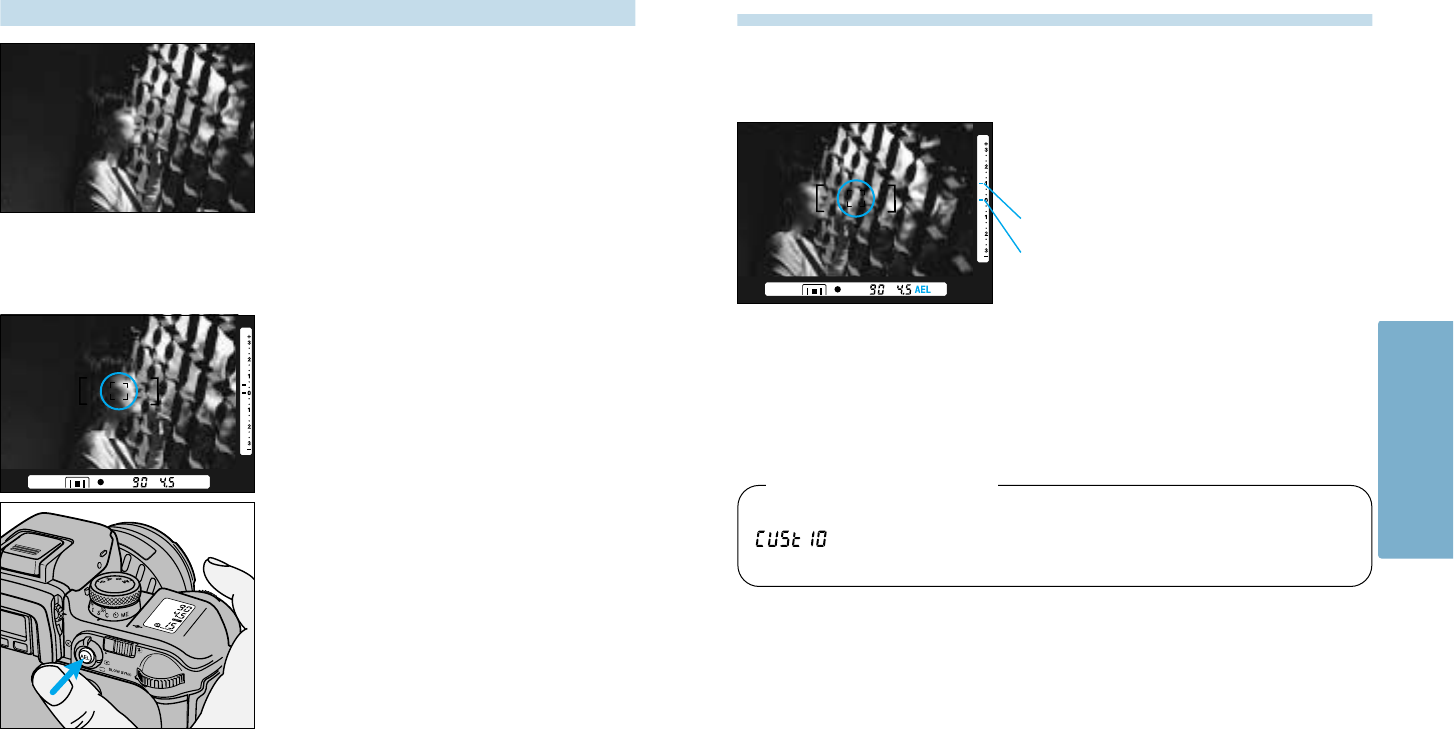
Spot Metering
Spot metering uses only the center honeycomb segment to meter the image.
• The spot-metering area indicates the metering area.
Turn the metering mode switch to .
Selecting Spot Metering
Center Weighted Average Metering
Center-weighted average mode bases the exposure on an average of the readings
from each of the honeycomb segments - with emphasis placed on the center of the
image.
Care should be taken when photographing backlit, spotlit, or off-center subjects as
non-subject areas may be included in the exposure calculation.
Turn the metering mode switch to .
Selecting Center Weighted Average Metering
METERING
4948
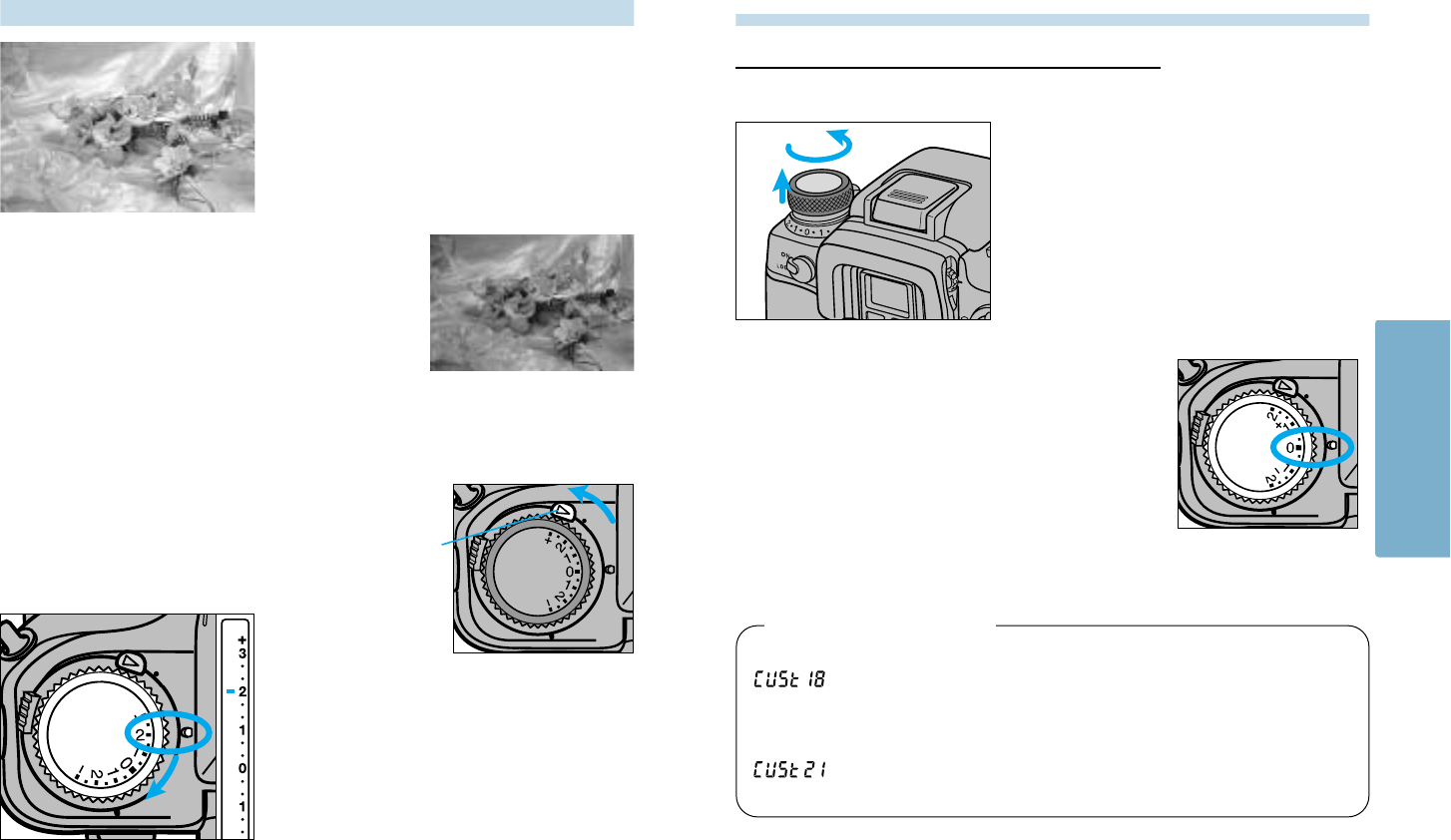
METERING — Automatic Exposure Lock (AEL)
Press the AE-lock button to lock the exposure
using the currently selected metering pattern
without locking the focus. The exposure
remains locked until the AE-lock button is
released.
• Pressing the AE-lock button sets the flash to
slow sync mode (p.64).
1. Select the desired metering pattern
(pp.45-47).
2. Meter the area on which you want
to lock the exposure.
3. Press and hold the AE-lock button.
• AEL appears in the viewfinder.
4. Recompose the scene as desired.
• The meter index indicators display the EV
difference between the locked exposure and the
exposure for the subject area currently inside the
spot metering area.
• The second indicator in the exposure index does
not appear when slow sync is selected.
5. Press the shutter-release button all-
the-way down to take the picture.
Locked Exposure (0)
Current Reading
Setting 2.
Press the AE-lock button once to activate Automatic Exposure
Lock. Press again to cancel.
Custom Function Notes
METERING
Select setting 2 to view the exposure compensation value in the
data panel when the exposure compensation dial is set to a value
other than 0.
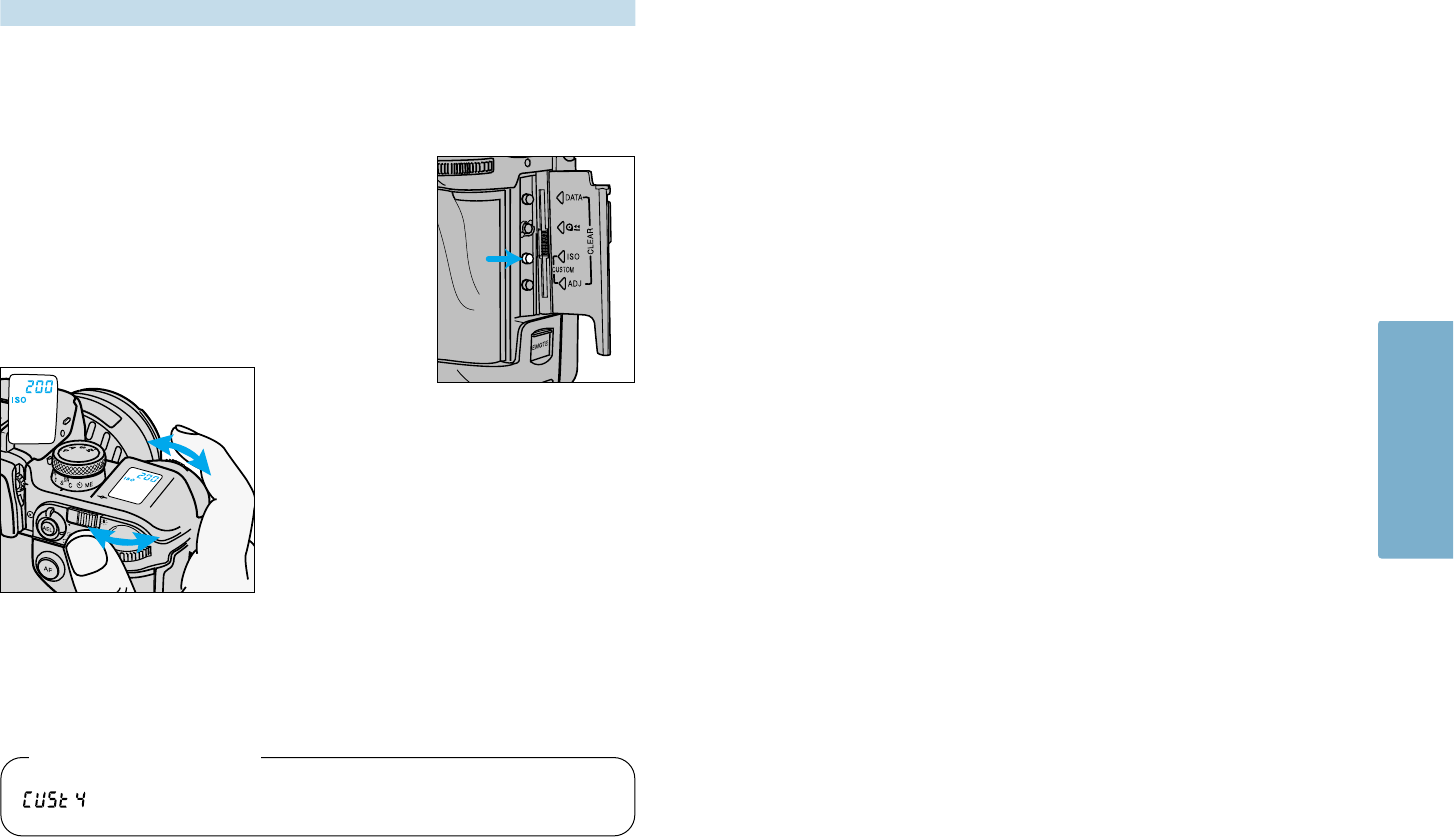
More exposure is recommended when the scene is
primarily white tones.
Less exposure is recommended when the scene is
composed of darker tones or shadows.
5150
METERING – Exposure Compensation
1. Set the exposure compensation dial to +/– 0 EV.
Changing to 1/3 EV Increments
2. Pull the exposure-compensation
dial up, then rotate it 180°.
• The camera may be damaged if the exposure
compensation dial is not set to 0 EV before
pulling it up.
3. Set the exposure compensation dial down
at 0 on the 1/3 EV increment side.
• The exposure may be incorrect if the exposure
compensation dial is not seated properly.
• The meter index scale changes to 1/3EV increments.
• Shutter speed and aperture will change in 1/3 EV
increments.
4. Set the desired compensation value.
1. Unlock the exposure compensation dial.
Especially helpful when using the spot or
center weighted metering patterns, exposure
compensation lets you manually adjust the
metered exposure +/– 3 EVs in 1/2 or +/– 2
EVs in 1/3 EV increments.
Compensated Exposure
Metered Exposure
2. Rotate the exposure compensation
dial to the desired compensation
value.
• The compensation value is indicated in the meter
index.
The effect is most visible when slide film is being used.
Exposure compensation
dial lock
Select setting 3 to change the exposure compensation value using
the rear control dial in A, S, and P modes.
• A +/– 3 EV range is available for 1/3 EV increments in this setting.
Custom Function Notes
METERING
METERING — Setting the ISO Manually
52
Set the ISO manually to override the DX-coded ISO or when using non-DX coded
film.
• Non-DX coded film is initially set to the previous roll’s ISO.
Film must be loaded before the ISO can be changed.
1. Open the control panel door and press the
ISO button.
2. Turn either control dial to set the
desired ISO value.
• The ISO can be changed manually from 6 to
6400 in 1/3 EV increments.
3. Press the shutter-release button
partway down to enter the new ISO.
DRIVE
Setting 2 - DX Memory On (p.94).
Applies ISO changes to future rolls with the same DX-coded ISO.
Custom Function Notes
DRIVE
5554
DRIVE – Advance Mode
This camera has both single frame and continuous advance drive modes. Select
single frame advance to expose and advance the film one frame at a time. Switch
to continuous drive to photograph dynamic action sequences at up to 5.5 frames
per second (4.5 frames per second in autofocus mode).
• The maximum drive speed changes depending on the focus mode.
• When the built-in flash is up or an accessory flash is on, the shutter can not be released
until the flash is charged.
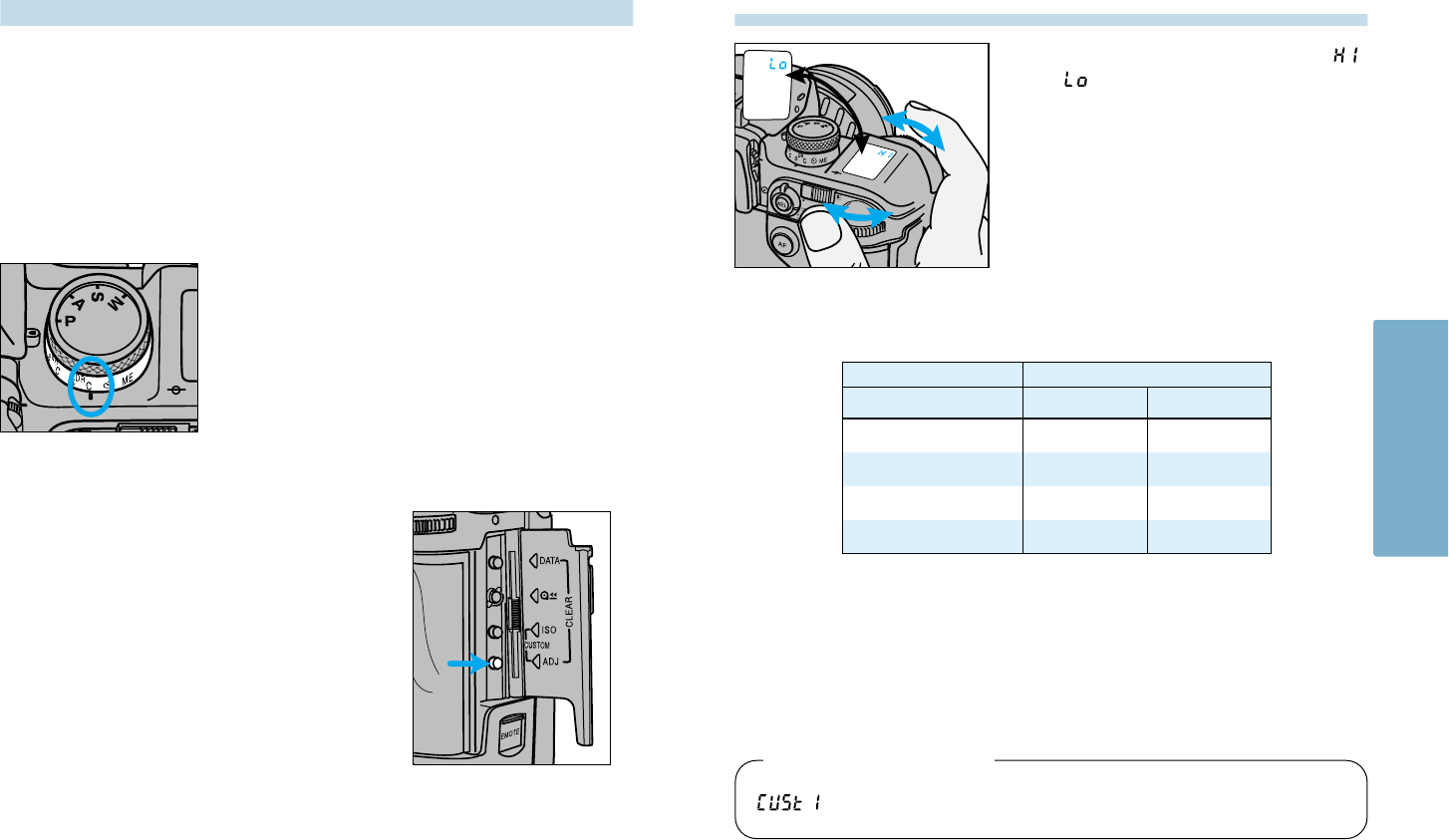
Turn the drive-mode lever to the desired
drive mode.
S – Single Frame Advance
C – Continuous Advance
If continuous advance is selected…
1. Open the control panel door, then
press the adjust button.
2. Turn either control dial to select
or speed continuous drive.
• AF Zoom xi and Power zoom lenses cannot be
zoomed when continuous-advance mode is
selected.
• The shutter can not be released until the camera
has focused on your subject.
• The maximum drive speed drops to 5 frames per second when Data Memory is activated.
• The optional Quartz Data Back QD-9 may imprint the date or time only on the first frame
of a motor advanced series.
• The maximum drive speed is 4.5 fps when the Data Memory Back DM-9’s imprinting
function is activated.
• When the battery power is low or in low temperatures, the maximum drive speed may
drop temporarily.
Focus Mode
Single Shot AF (S)
Automatic AF (A)
Continuous AF (C)
Manual Focus (M)
Maximum Framing Rate
HI Lo
5.5 fps 2 fps
4.5 fps 2 fps
4.5 fps 2 fps
5.5 fps 2 fps
3. Press the shutter-release button
partway down to enter the
selection.
Switch to setting 2 for release priority operation (p.92).
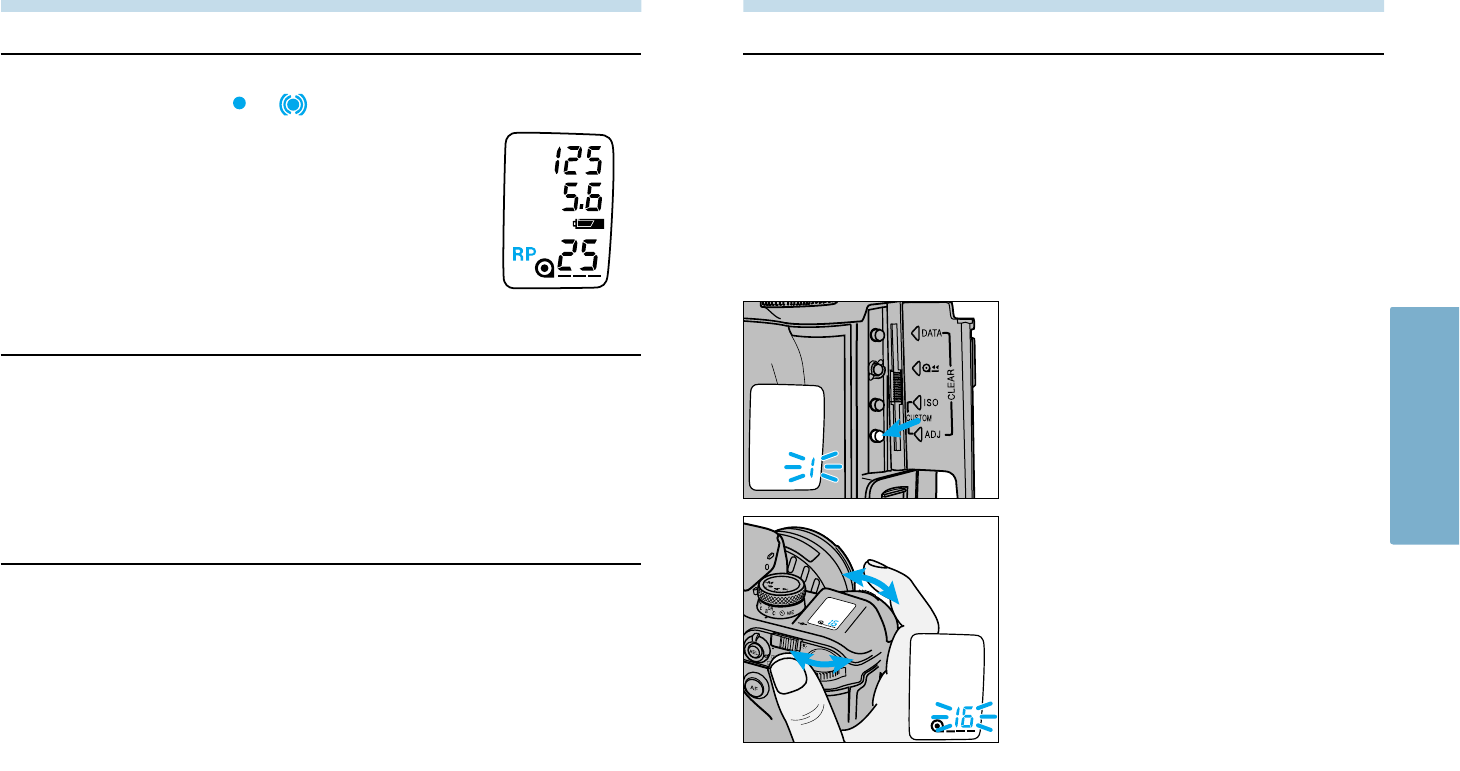
•RP will appear in the data panel.
Custom Function Notes
DRIVE
Test conditions: Shutter speed set to 1/250 or faster, with fresh batteries
DRIVE – Self-Timer
5756
5. Center your subject in the focus
frame, then press the shutter-
release button part way down to
confirm the focus.
• The shutter will be released even if the focus is
not confirmed.
6. Press the shutter-release button all
the way down to start the timer.
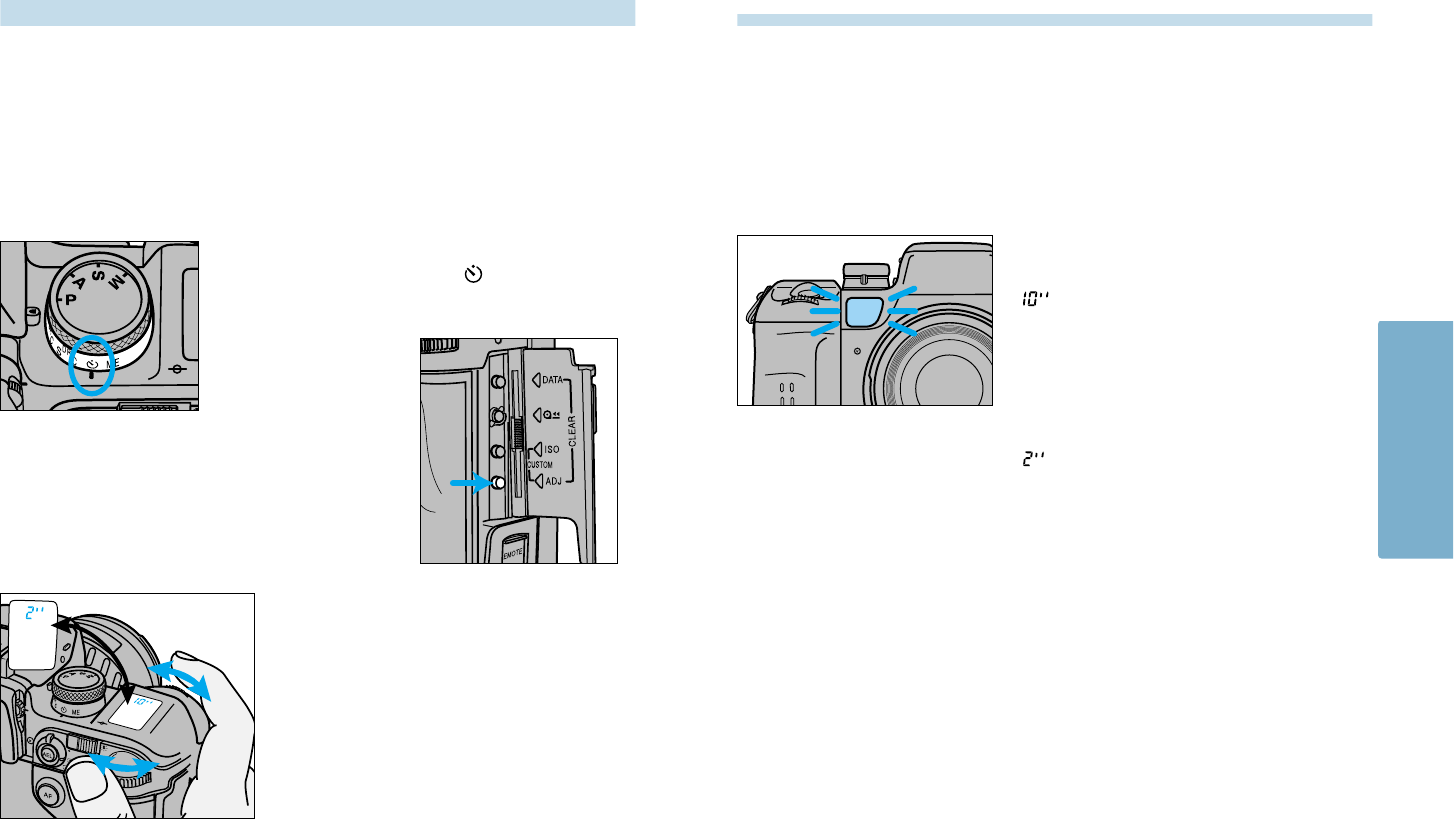
(10 sec) – The self-timer indicator on the
front of the camera will blink
slowly, then blink rapidly just
before the shutter releases.
• Turn the main switch to LOCK
or select another drive mode to
cancel the 10 sec self timer.
(2 sec) – The mirror pops up when the
shutter release button is pressed
all-the-way down. The shutter is
released two seconds later.
• The 2 second self timer cannot
be cancelled.
2. Open the control panel door and
press the adjust button.
1. Place the camera on a tripod, then turn
the drive-mode lever to .
Use the self-timer to delay the shutter release for 2 or 10 seconds (approx.) after
the shutter-release button is pressed all the way down. In addition to delaying
release of the shutter, the 2 second delay pops the mirror up two seconds before
the shutter opens to reduce blur caused by camera vibration.
• The red-eye reduction flash mode is not effective when the 2 second self timer is
selected.
• Close the eyepiece shutter (p.79) to prevent a bright light source behind the camera from
interfering with the exposure.
3. Turn either control dial until the
desired delay appears in the data
panel.
4. Press the shutter-release button
partway down to enter the
selection.
DRIVE
DRIVE – Exposure Bracketing
5958
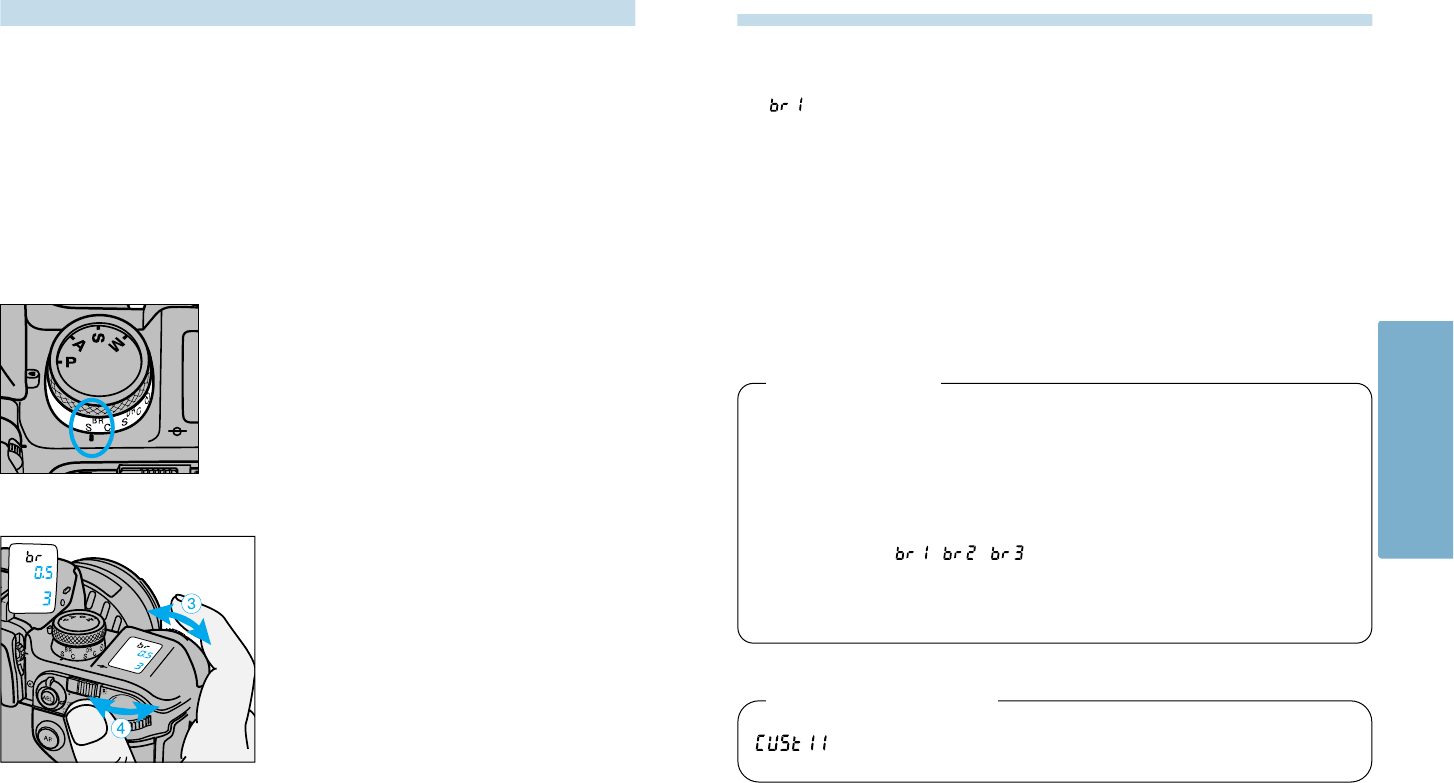
3. Turn the front control dial to set the
bracketing increment (0.3, 0.5, 0.7,
or 1.0 EV).
6. Compose and meter your subject, then press the shutter-release
button all the way down to start the bracket.
• Exposure is locked on the first frame of the series.
• The exposure setting changes automatically.
• Press the AE-lock button when the shutter is released to bracket using the aperture in M-
Mode.
1. Turn the drive-mode lever to the desired
bracketing mode.
S – Single Frame Advance
C – Continuous Advance
Exposure bracketing automatically exposes a series of frames with exposures
above and below the metered exposure value. Bracket your exposures when
shooting slides and other films with a low tolerance for exposure error.
• This camera can expose a 3, 5, or 7 frame brackets in increments of 0.3, 0.5, 0.7, or 1.0
EV.
• A larger bracketing increment is recommended when shooting negative film.
Manual (M) and aperture priority (A) mode exposures are bracketed by changing
the shutter speed.
Shutter priority (S) mode exposures are bracketed by changing the aperture.
2. Open the control panel, then press the
adjust button.
4. Turn the rear control dial to set the
size of the bracket (3, 5 or 7
frames).
Continuous – Hold the shutter-release button down until the series is finished.
• Removing your finger from the shutter-release button before the
series is complete resets the camera to the first frame of the
bracket.
• Continuous advance bracketing is cancelled at the end of the roll.
Single – Press the shutter-release button for each exposure.
• , , … will be displayed in the frame counter.
• Film can be changed in the middle of the bracketed series.
• Turn the main switch to LOCK or select another drive mode to
cancel single frame advance bracketing.
5. Press the shutter-release button partway down to enter the
settings.
• appears in the data panel when single frame advance is selected.
Switch to setting 2 to change the bracketing sequence to under
exposures, metered exposure, over exposures (p.97).
Custom Function Notes
Bracketing Notes
DRIVE
DRIVE — Multiple Exposure
6160
The meter in your camera determines exposure (EV) based on the assumption that
only one exposure will be made on each frame. When making multiple exposures,
the EV for each additional exposure needs to be reduced or over exposure will
result.
• Compensation is not necessary if all of the exposures have dark backgrounds and the
subjects of the exposures will not overlap.
Metering Multiple Exposures
Compensate the exposures as follows:
Number of
Exposures
Exposure
Adjustment
• The above corrections are intended as a general guideline. Some
testing may be necessary to produce the desired results.
• Exposure can be compensated in 1/2 or 1/3 EV increments using the
exposure compensation function (p.51).
2. Compose the scene, then press the
shutter-release button all the way down to
take the first exposure.
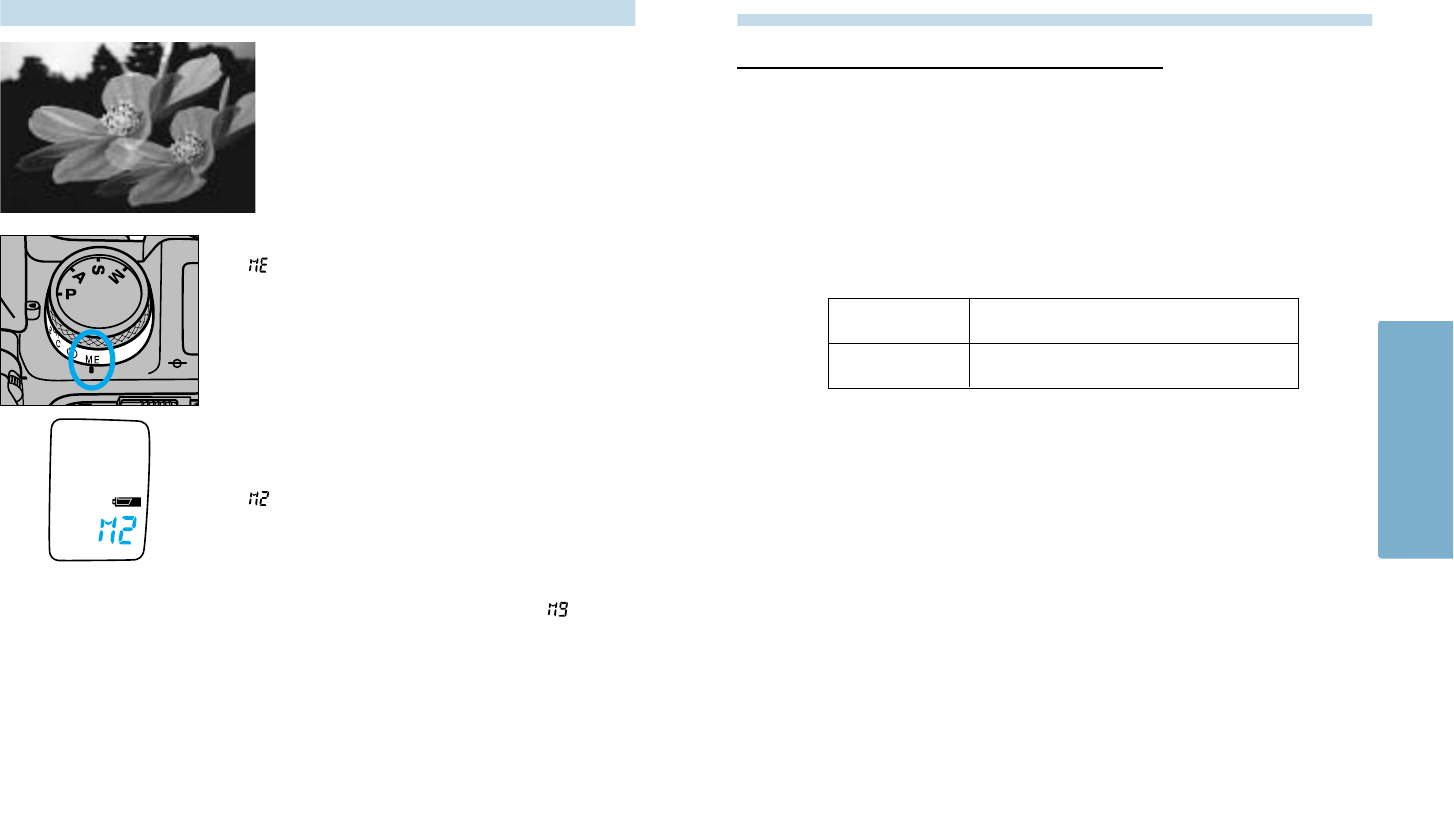
• appears in the data panel after the first exposure is
taken.
1. Turn the drive-mode lever to ME.
• appears in the frame counter.
The multiple exposure function makes it
possible to expose 2 or more images on the
same frame.
3. Take additional exposures as desired.
• Additional exposures are counted only up to , but an
unlimited number of exposures can be taken.
4. Select another drive mode to cancel
multiple exposure mode and advance the
film to the next frame.
123468
0 -1 -1 1/2 -2 -2 1/2 -3
DRIVE
63
FLASH — Four Segment Flash Metering
FLASH
Four segment flash metering uses data from
the focus sensors to control the output of the
built-in and/or attached accessory flashes.
The TTL flash metering system determines the flash
exposure of the area inside the selected focus area
after the shutter has been released.
• Average flash metering is set instead of 4-segment flash
metering when the 2 second self-timer or rear-flash sync
are selected or when the depth-of-field preview button is
held when the shutter is released.
4-Segment Flash Metering
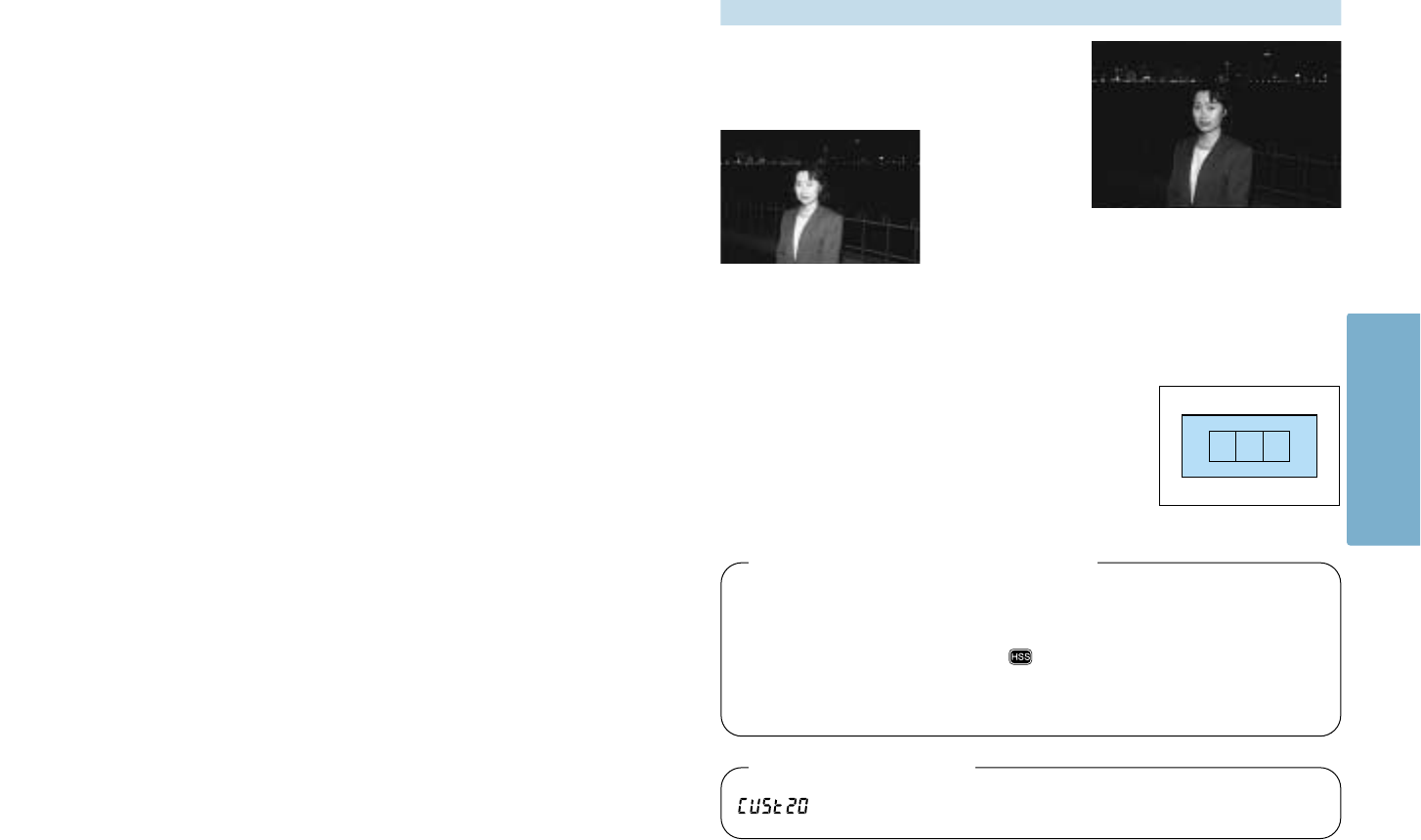
Conventional Flash
Select setting 2 to meter all segments evenly. Switch to setting 3 to
spot meter your flash exposures (p.102).
Custom Function Notes
Maxxum/Program Flash 5400HS Note
When used with the 5400HS, a preflash is fired before the main exposure.
The preflash is metered (14 segment) and fed back to the flash exposure
system to more accurately determine the flash exposure.
• The 5400HS will not fire a preflash if does not appear in the flash data panel or
when rear flash sync, wireless flash, or the 2 second self timer are selected.
• Flash and color meters cannot meter the flash when the high-speed sync indicator
appears in the flash data panel.
All four segments are used to meter the flash, but
weighting is heaviest on the segment containing the
active focus sensor. Weighting varies with subject
magnification and the distance between the subject
and the background.
FLASH
FLASH – Rear-Flash SyncFLASH – Slow Sync
6564
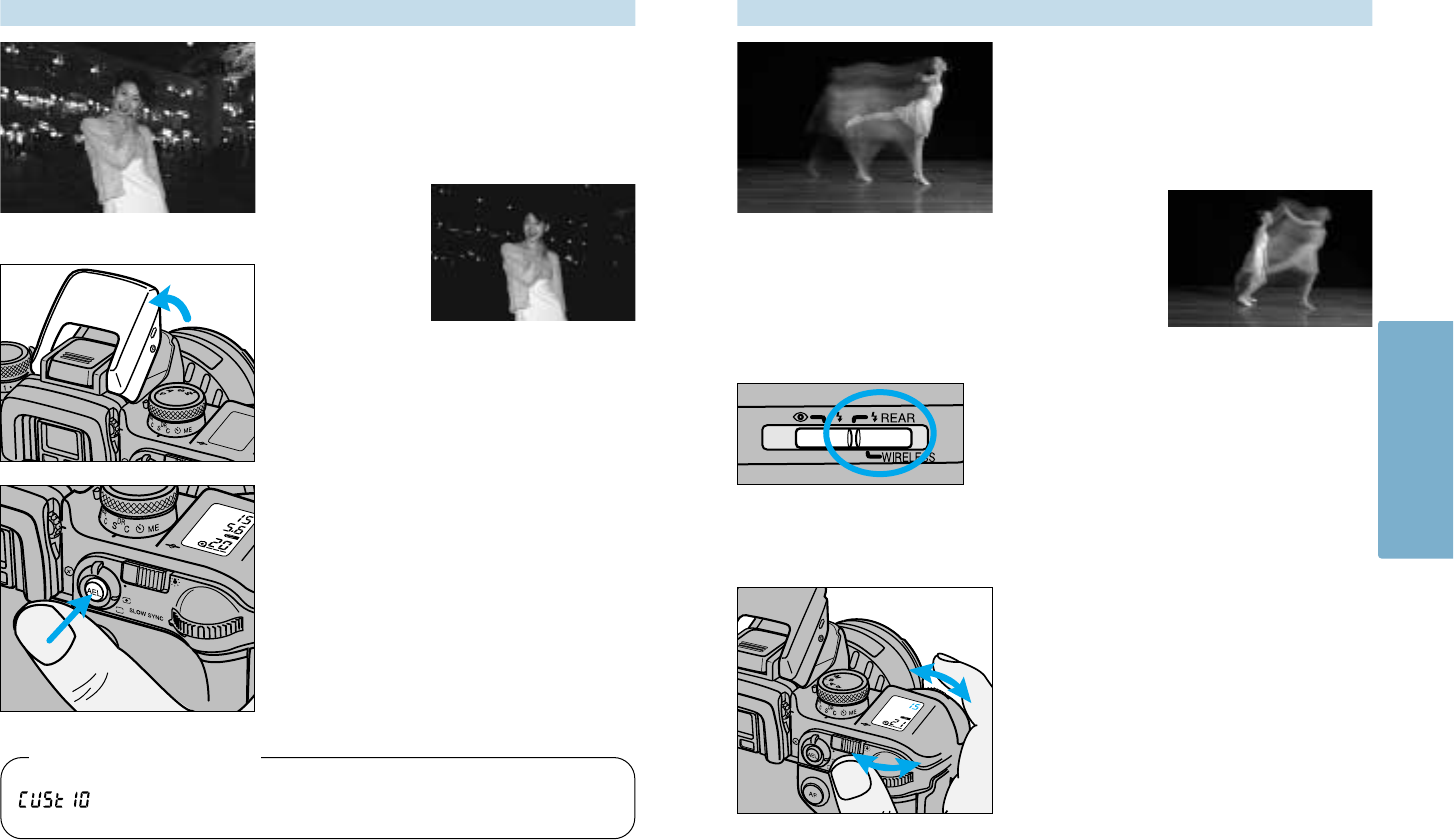
In P and A-modes, slow-shutter sync sets a
slower shutter speed to increase the
background or ambient exposure in a flash
picture. Flash output is automatically
decreased to maintain correct subject
exposure.
Slow-shutter Sync
Conventional Flash
2. While pressing the AE-lock button,
press the shutter-release button all
the way down to take the picture.
• AEL and the locked exposure will be displayed in
the viewfinder.
• The shutter speed may not be reduced if the
background is bright or a large aperture is set (A-
mode).
• Use a tripod if the shutter speed becomes too
slow to allow sharp, hand-held pictures.
Slow sync flash exposures can appear
unnatural because the motion blur precedes
the subject in the final image. Use rear-flash
sync to create more natural looking slow
shutter speed flash exposures that leave a blur
of motion behind the subject.
Rear Flash Sync
Conventional Flash
1. Slide the flash-mode switch to
REAR.
Rear-flash sync can be used with the built-in
flash and accessory flashes attached to the
accessory shoe or PC terminal.
3. Set the shutter speed to 1/60 or
slower.
• Flash synchronization returns to front sync
(standard operation) when shutter speeds faster
than 1/60 are selected.
• Refer to S-mode Flash (p.40) or M-mode Flash
(p.43) to select the shutter speed.
1. Raise the built-in flash or turn the
accessory flash on.
2. Raise the built-in flash or turn the
accessory flash on.
Custom Function Notes
FLASH
Setting 2 lets you press the AE-lock button once to activate
automatic exposure lock. Press again to cancel (p.96).
FLASH — Flash CompensationFLASH — High Speed Sync
6766
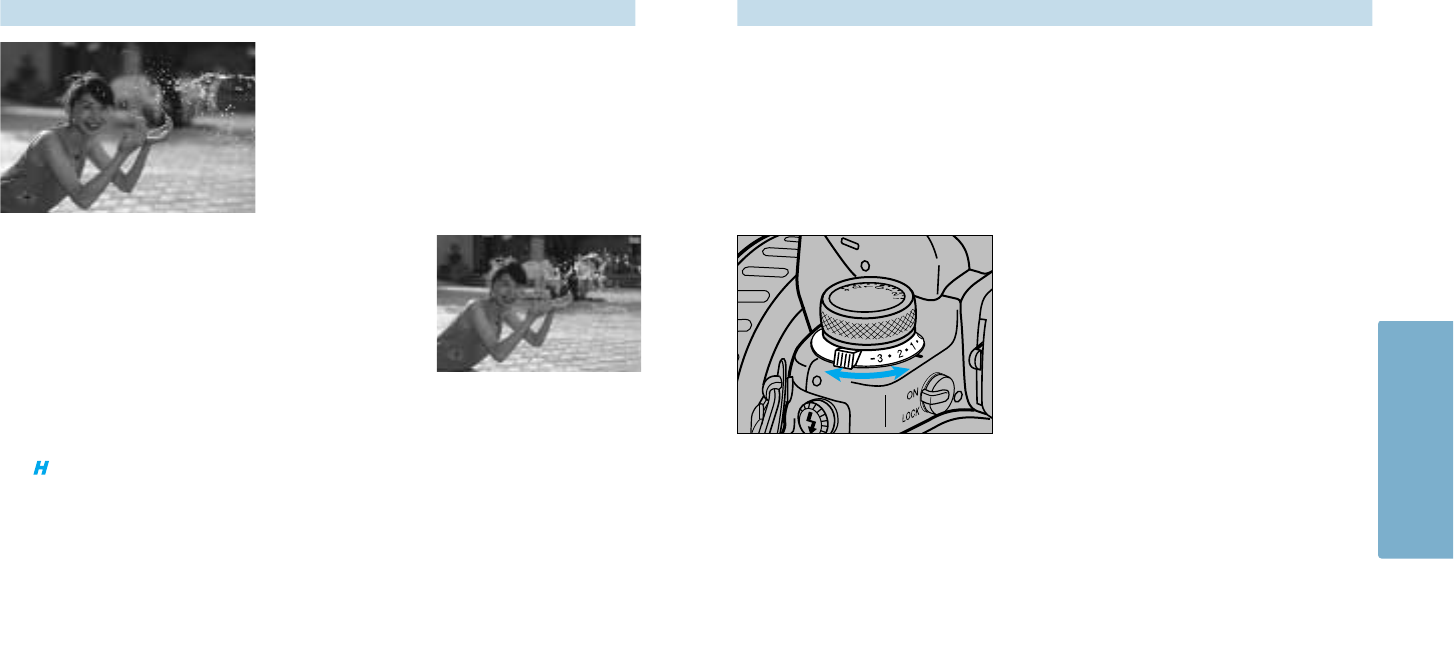
The maximum sync speed for this camera is
1/300. However, with the 5400HS accessory
flash (sold separately) shutter speeds up to
1/12000 can be used. High-speed sync (HSS)
allows faster shutter speeds when fill flash is
used on moving subjects outdoors.
HSS also lets you use large aperture/high shutter-
speed combinations to separate your subject from the
background by limiting the depth-of-field.
High-speed Sync
Conventional Fill Flash
Attach the 5400HS flash and set it to standard mode.
• automatically appears in the viewfinder at shutter speeds faster than 1/300 sec when
the 5400HS is attached.
• Selecting HSS flash mode under fluorescent lighting may result in incorrect exposure.
• Flash and color meters cannot meter the flash when high-speed sync is selected.
• Pressing the depth-of-field button in HSS flash mode prevents release of the shutter.
• HSS is not available in wireless/remote flash mode or when the 2 second self-timer has
been selected.
• If you attach a filter whose stop’s increase is not 0 (i.e., ND), the proper exposure will not
be obtained. Press the flash’s HSS button to cancel the HSS.
Refer to the 5400HS instruction manual for details.
Use flash compensation to increase or decrease the output of the built-in or an
attached accessory flash up to +/–3 EV in 1/2EV increments.
Flash compensation changes the flash exposure by the amount set relative to the
ambient exposure.
Rotate the flash-compensation dial to
the desired compensation value.
• Flash compensation does not modify the output
of a flash connected to the PC terminal.
• Flash compensation has no effect on the ambient
light exposure.
Flash compensation and exposure compensation can be used
together.
FLASH

FLASH – Flash Bracketing
6968
Use flash bracketing to expose 3, 5, or 7 frame flash exposure brackets in 0.3, 0.5,
0.7, or 1.0 EV increments. Exposures are bracketed by controlling the flash output.
• A larger bracketing increment is recommended when shooting negative film.
1. Raise the built-in flash or turn the
accessory flash on.
2. Turn the drive-mode lever to single frame
(S) or continuous advance (C) bracketing
mode.
• The shutter-release button must be pressed for each
exposure in both single and continuous advance
bracketing modes.
3. Open the control panel, then press the
adjust button.
7. Compose your subject.
8. When appears in the viewfinder, press the shutter-release
button all-the-way down to take the picture.
• Exposure is locked on the first frame of the series.
9. Repeat steps 7 and 8 until the series is complete.
• The bracket number is indicated in the data panel.
• Turn the main switch to LOCK, change the drive mode, push the built-in flash down, or
turn off the accessory flash to cancel the bracketed series.
• Film can be changed in the middle of the bracketed series.
Flash Bracketing with PC Connected Flash Units
1. Set the camera to M-mode (p. 41).
2. Press the AE-lock button while
releasing the shutter.
• The exposure will be bracketed by changing the
aperture. The output of the flash will not change.
4. Turn the front control dial to set the
bracketing increment. (0.3, 0.5, 0.7,
or 1.0EV).
5. Turn the rear control dial to set the
size of the bracket (3, 5 or 7
frames).
6. Press the shutter-release button partway
down to enter the settings.
• appears in the data panel.
Switch to setting 2 to change the bracketing sequence to under
exposures, metered exposure, over exposures (p.97).
Custom Function Notes
FLASH
FLASH — Wireless/Remote Off-Camera
7170
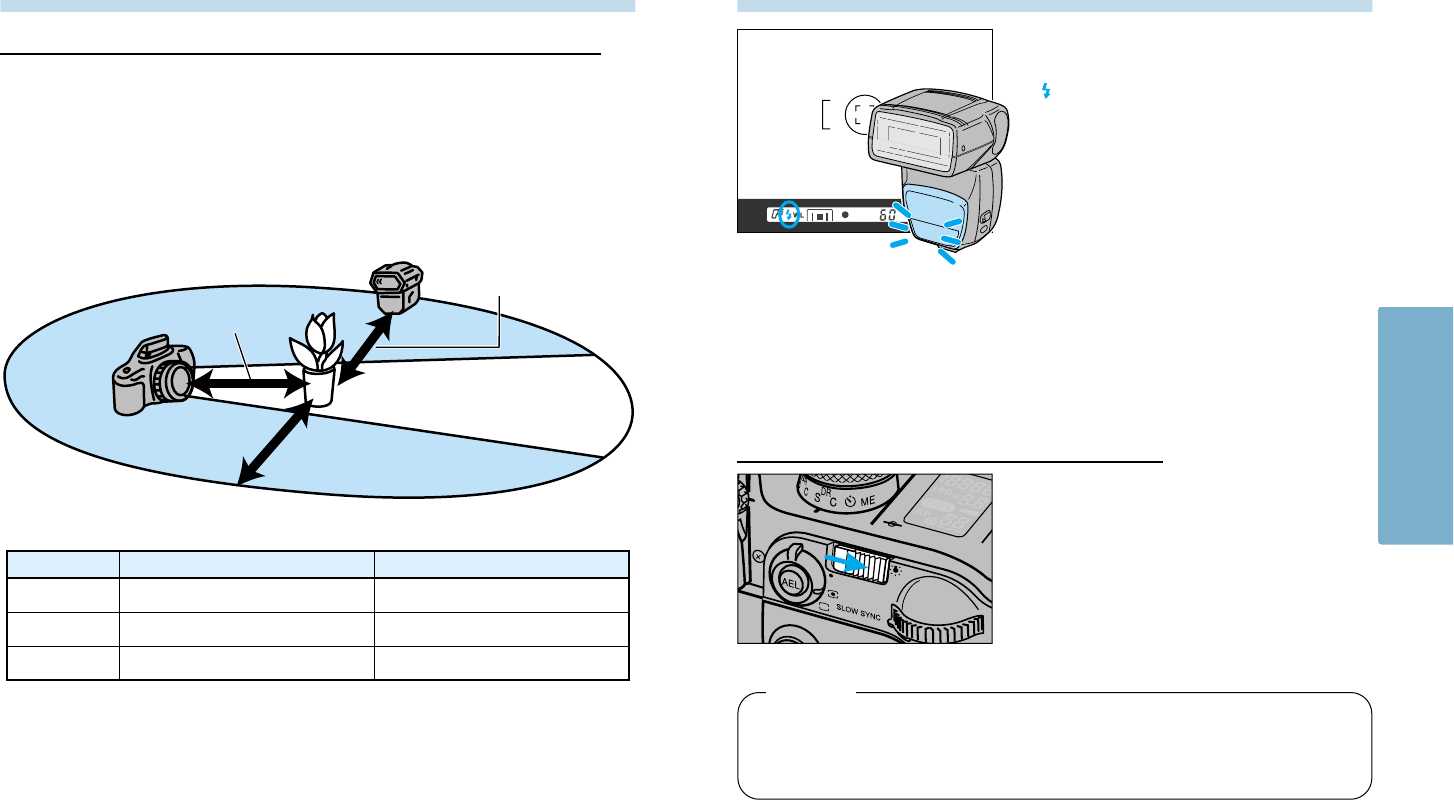
Wireless/Remote Flash is available with the
Minolta 5400HS, 5400xi, and 3500xi accessory
flashes. Wireless/Remote flash lets you
experience the creative control available with
an accessory flash.
In Wireless/Remote flash mode, the off-camera
flash is triggered by a coded signal from the
camera’s built-in flash when you press the
shutter-release button. When proper exposure
has been received, another signal cuts the
accessory flash off.
You can also achieve a 2:1 lighting ratio
automatically. When remote ratio flash is
selected, the off-camera flash provides 2/3 of
the full exposure while the built-in flash
provides the remaining 1/3.
• Flash and color meters can not be used to meter
wireless/remote off-camera flash.
• The shutter speed will be set to 1/60 sec or
slower.
• When using 5400HS or Wireless Remote
Controller as a controller instead of built-in flash,
off-camera flash will not fire if you are pressing
depth-of-preview button.
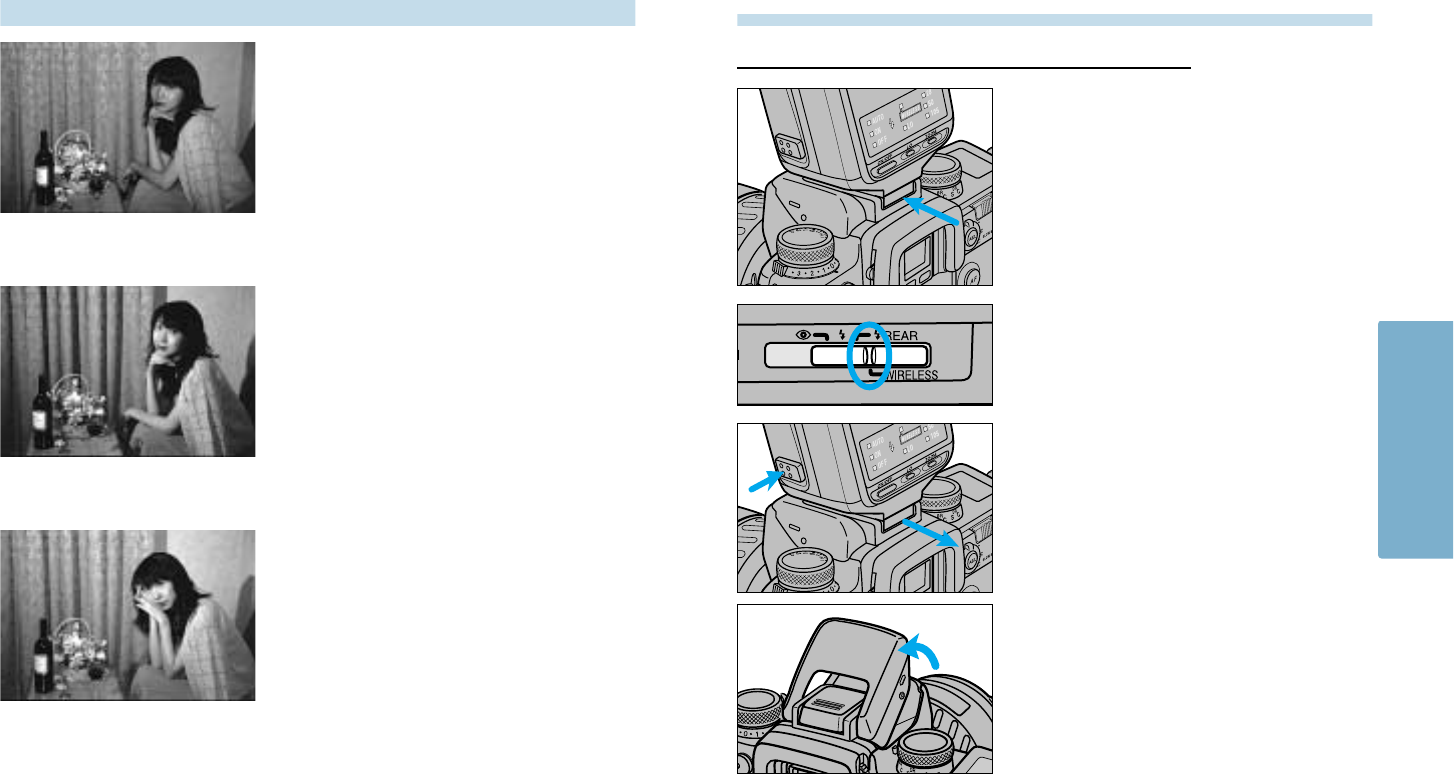
Normal Flash
Wireless/Remote Flash
Wireless/Remote Ratio Flash
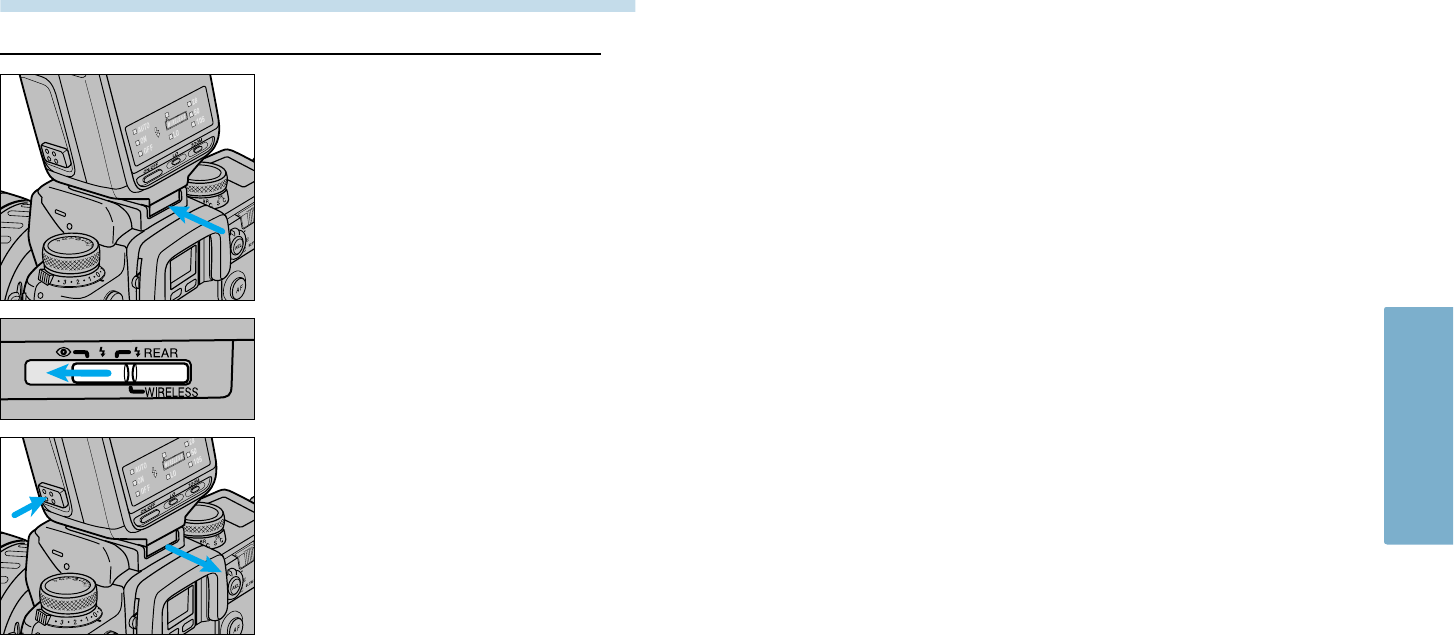
Setting Wireless/Remote Flash Mode
1. Attach the accessory flash to the
camera, then turn the camera and
the flash on.
2. Slide the flash-mode switch to
WIRELESS.
3. Detach the accessory flash, then
raise the built-in flash.
FLASH
FLASH — Wireless/Remote Off-Camera
73
Taking Pictures in Wireless/Remote Flash Mode
The off-camera flash will provide all of the
exposure.
1. Position your camera and 3500xi flash unit using the information
on this page.
• If you are not using the 3500xi flash, refer to your flash instruction manual for the correct
camera to subject and flash to subject distances.
• Calculated for ISO 100 film only.
Press the AE-lock button to test fire the
accessory flash.
3. Press the shutter-release button
all the way down to take the
picture.
2. Wait until both flash units are fully
charged.
• appears in the viewfinder when the built-in
flash is charged.
• When the off-camera flash is charged, its AF
illuminator will blink.
Press the data-panel illuminator when
taking the picture.
Both flashes will fire when the shutter is
release at a 2:1 ratio.
• The built-in flash will provide 1/3 and the
accessory flash will provide 2/3 of the total
exposure.
Wireless/Remote Ratio Flash
Test firing the flash will activate slow-shutter sync (p. 64) if Cust
10 setting 2 is selected.
• Custom 10 setting 1 is recommended.
CAUTION
3500xi-Subject
Distance
Camera-Subject
Distance
The off-camera flash may not
detect the control signals if it is
placed behind the subject.
The maximum flash-subject
distance is 5m.
Aperture Camera – Subject Distance 3500xi – Subject Distance
f/2.8 1.4 - 5.0m (4.6 - 16.0 ft.) 1.0 - 5.0m (3.3 - 16.0 ft.)
f/4 1.0 - 5.0m (3.3 - 16.0 ft.) 0.7 - 4.5m (2.3 - 14.5 ft.)
f/5.6 1.0 - 5.0m (3.3 - 16.0 ft.) 0.5 - 3.2m (1.7 - 10.5 ft.)
72
FLASH
74
Cancelling Wireless/Remote Flash Mode
1. Attach the accessory flash to the
camera, then turn the camera and
flash on.
2. Select another flash mode.
3. Detach the accessory flash.
ADDITIONAL
FEATURES
FLASH — Wireless/Remote Off-Camera
ADDITIONAL FEATURES
OTHER — Depth-of-Field PreviewOTHER — Eye-Start
7776
Use the depth-of-field preview button to verify how much of your scene will be in
focus at the currently selected aperture.
Depth-of-Field — The area in front of and behind the point of focus that appears
sharp in the final image.
Press the depth-of-field preview
button.
• The lens will stop down to the currently selected
aperture.
The viewfinder will appear darker at larger f#s (smaller lens
opening).
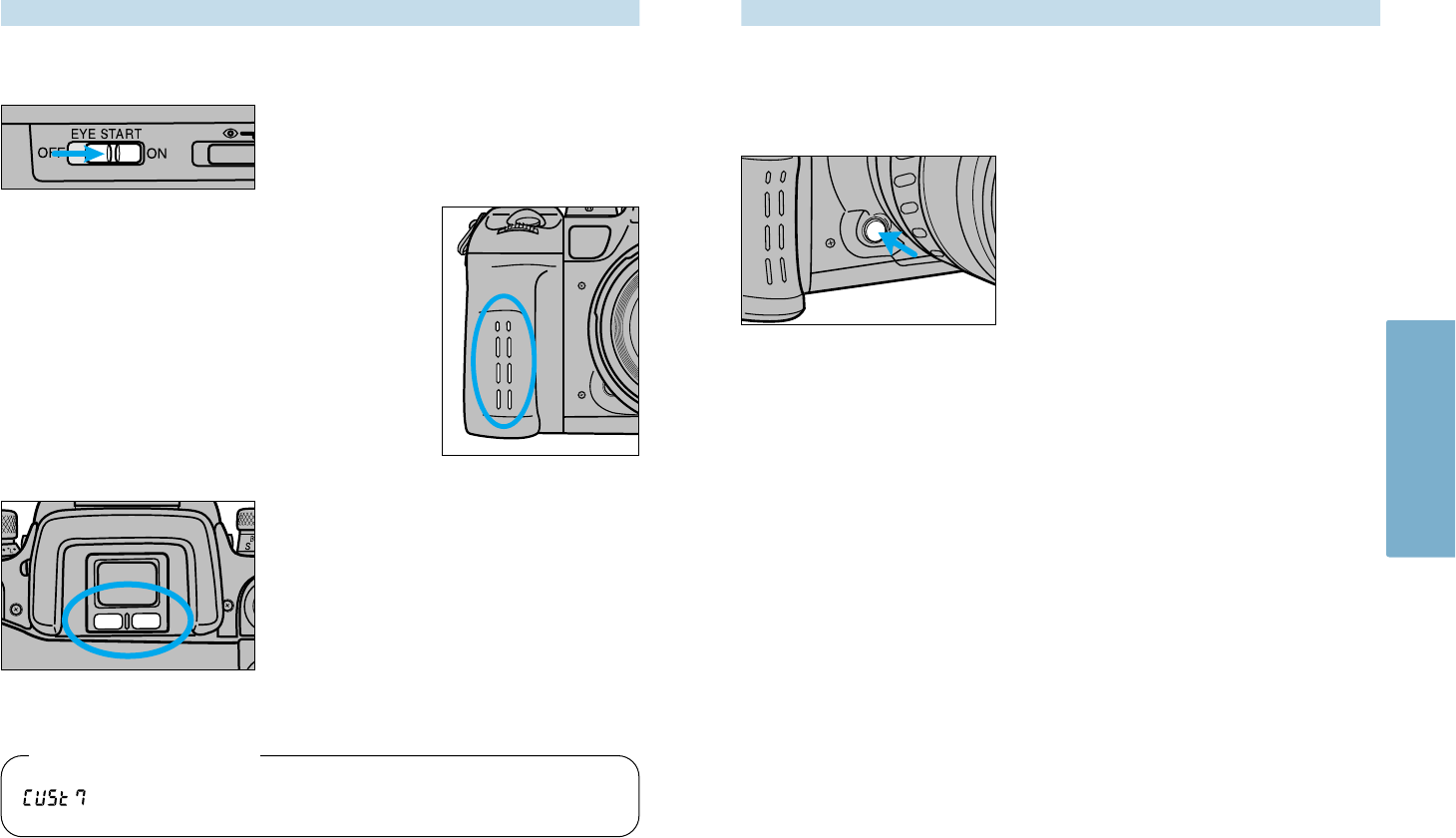
…Touching the grip sensor activates the
eyepiece sensor.
2. Turn the main switch to ON.
• The grip sensor and data panel are activated.
When an object is detected near the
viewfinder, the camera’s systems are
activated to set the focus and
exposure as you frame your subject.
• Autofocus and exposure systems shut down
approx. five seconds after eye or grip sensor
contact is broken.
• Infrared absorbing sunglasses, gloves, or dry
hand may affect eye-start operation.
Eyepiece Sensor
Eye-start automatically activates the camera’s focus and exposure systems as
you bring the camera to your eye.
1. Slide the eye-start switch to ON.
Grip Sensor
Custom Function Notes
ADDITIONAL FEATURES
Switch to setting 2 to activate the eyepiece sensor when the main
switch is in the ON position (p.95).
OTHER — Taking Time Exposures (bulb)
7978
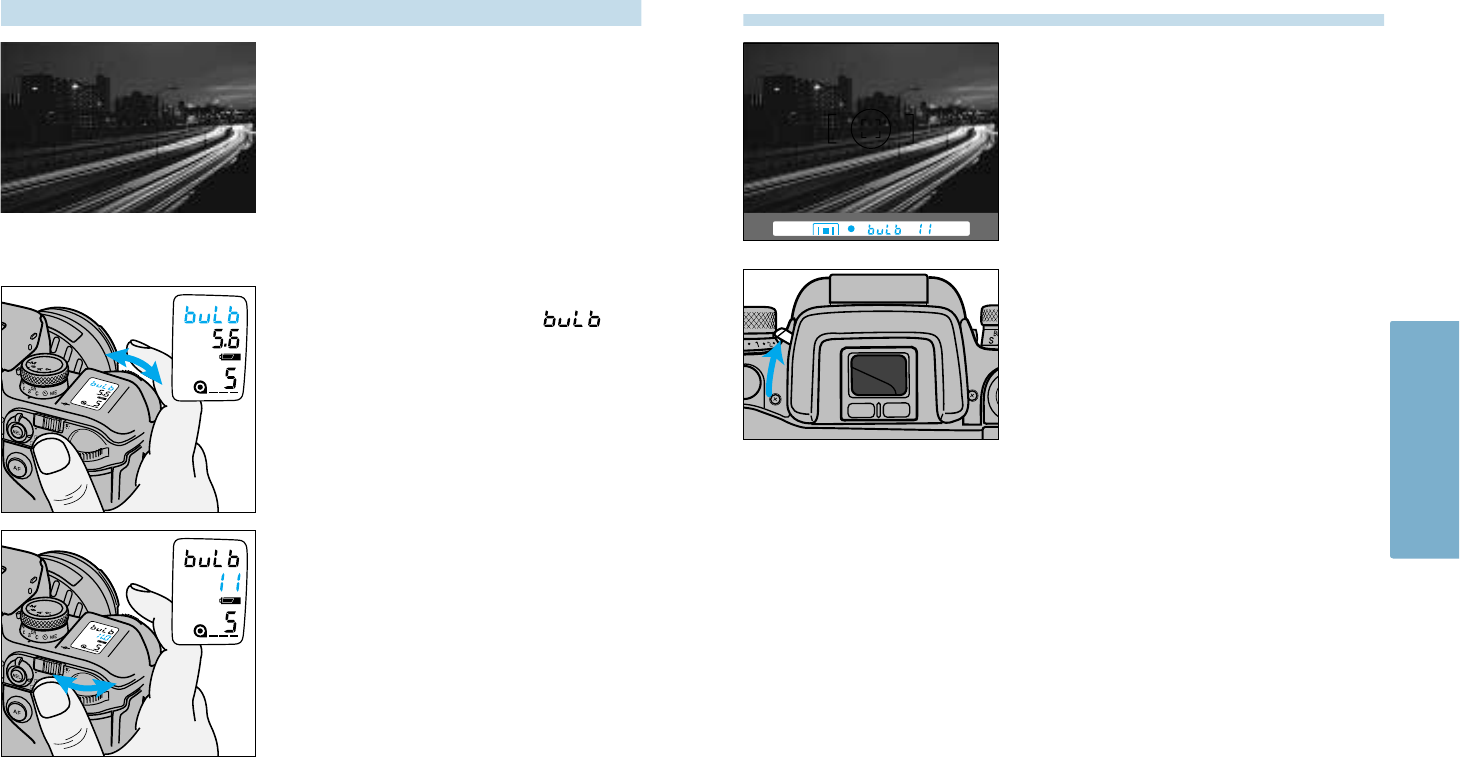
Set the shutter speed to bulb when you want to
take time exposures. When selected, the
shutter remains open as long as the shutter-
release button is held down.
1. Mount the camera on a tripod.
2. Set the camera to M-mode, then turn
the front control dial until
appears in the data panel.
4. Compose the scene and focus on
your subject.
If the scene is too dark for autofocus to
operate, slide the focus-mode switch to M
and focus the lens manually (p. 33).
5. Close the eyepiece shutter.
• The eyepiece shutter prevents light from entering
through the viewfinder and affecting the metered
exposure.
6. Press and hold the shutter-release
button to take the picture.
• The shutter remains open as long as the shutter-
release button is held down.
Attach a remote cord (p. 80) to reduce image blur.
3. Turn the rear control dial to select
the aperture.
ADDITIONAL FEATURES
OTHER — PC TerminalOTHER — Remote Release Terminal
8180
Flash units which can not be connected to the accessory shoe can be connected to
the camera via the PC terminal.
• TTL automatic flash metering does not function when the flash is connected to the PC
terminal.
1. Set the exposure mode dial to M,
then set the shutter speed to 1/250
or slower.
Flash units with a low trigger voltage may not work on this
camera. Contact a Minolta Service Facility if your flash has a
low trigger voltage.
2. Plug the PC connector into the
camera’s PC socket.
• The flash unit may fire unexpectedly if it is on
when the sync. cord is plugged into the PC
terminal.
• The PC terminal is compatible with both center
positive (normal polarity) and center negative
(positive polarity) flash units.
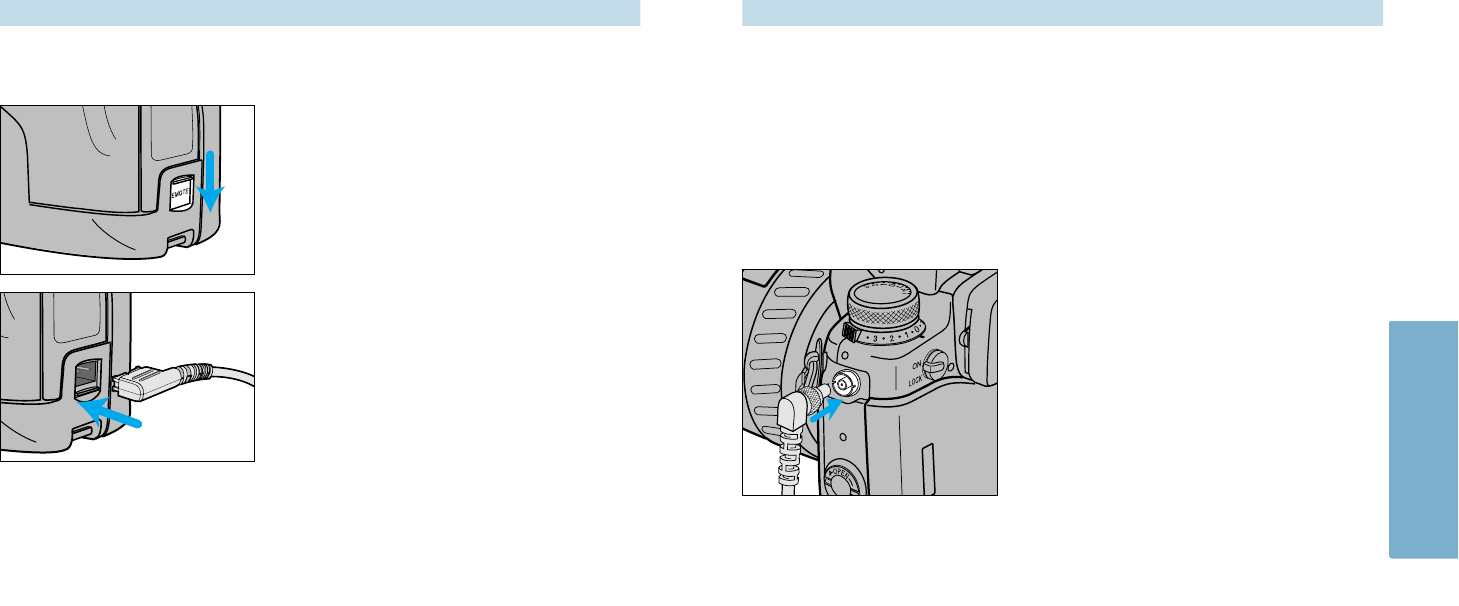
1. Slide the remote-control-terminal
cover down.
Attach either the Remote Cord RC-1000S or RC-1000L (sold separately) to reduce
blur when taking long exposures.
2. Insert the plug into the terminal.
ADDITIONAL FEATURES
82
OTHER — Data Panel Illuminator
Use the data panel illuminator to light up the information in the data panel in low-
light situations.
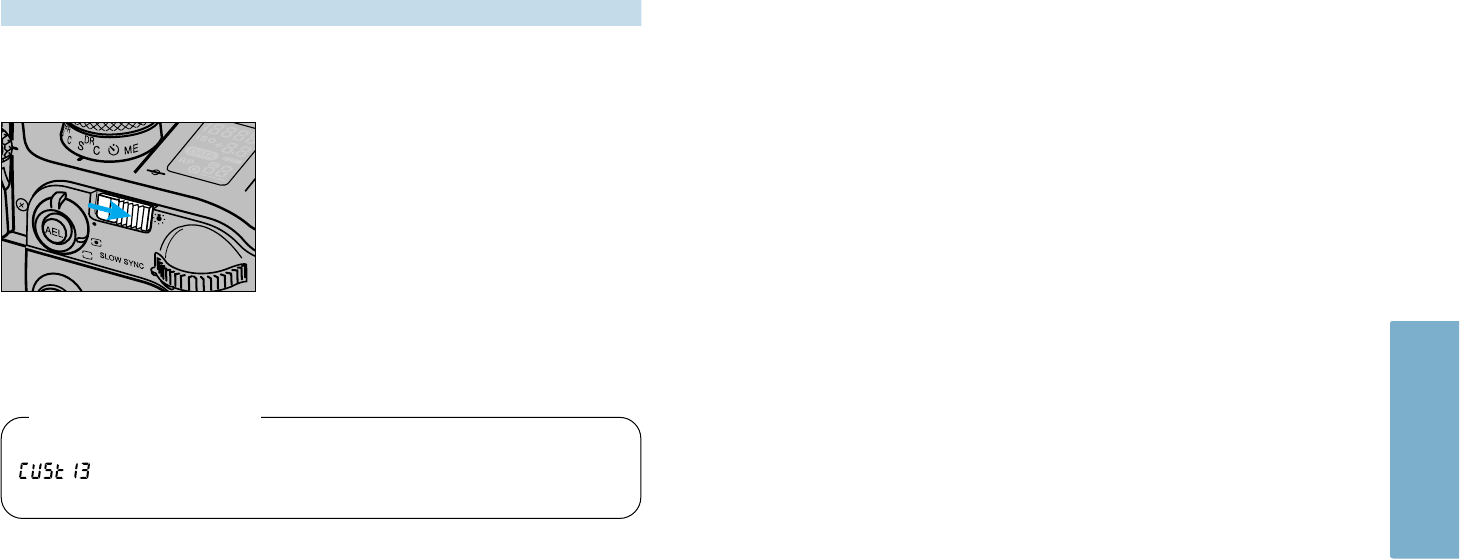
Slide the data panel illuminator switch
as shown.
The data panel illuminator shuts off approx.
five seconds after the last camera operation. SPECIAL
FUNCTIONS
Select setting 2 to extend the display duration to 10 seconds.
Switch to setting 3 to extend the display duration to 30 seconds
(p.98).
Custom Function Notes
SPECIAL FUNCTIONS
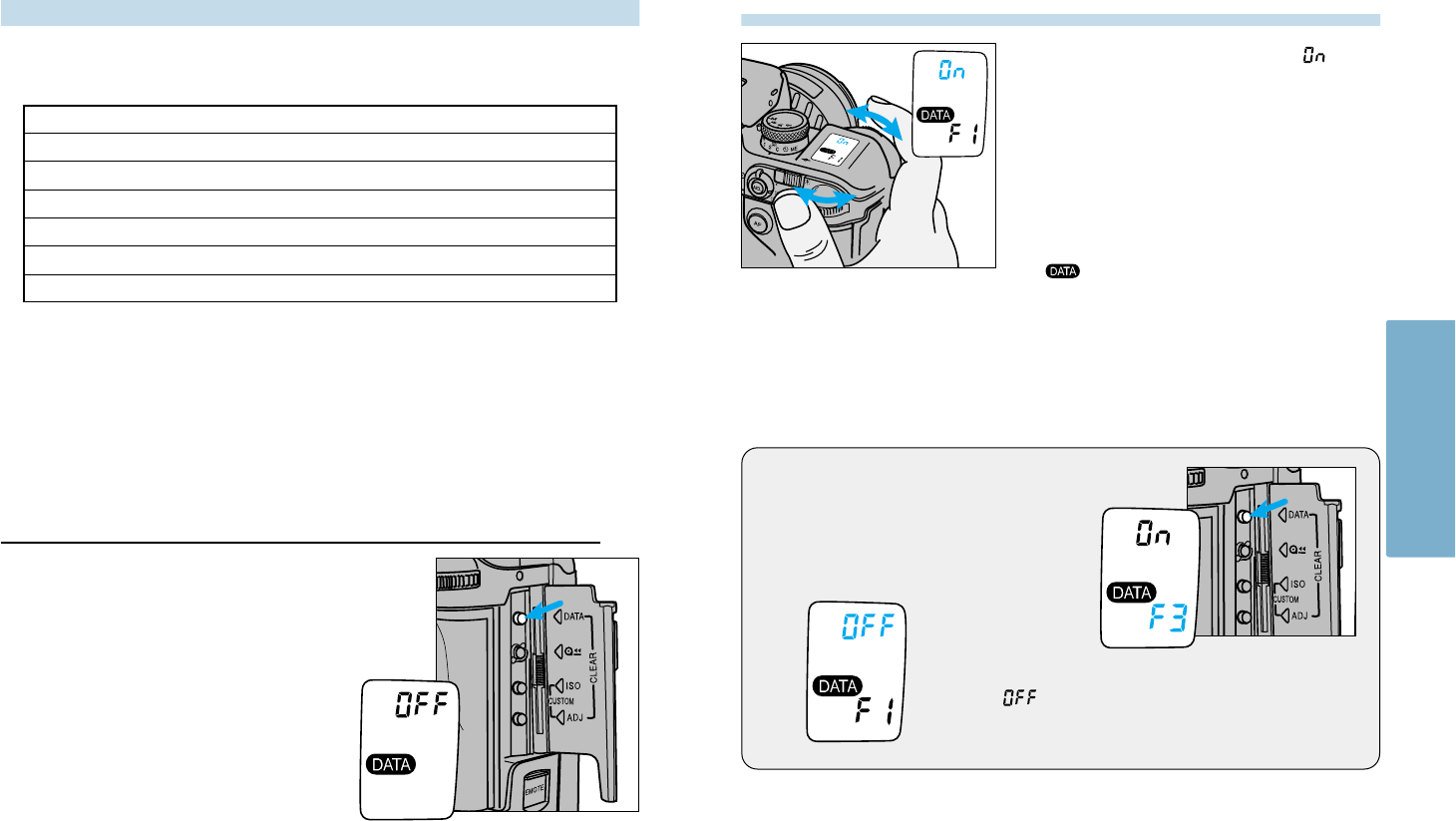
2. Turn either control dial until
appears in the data panel.
• The film area to which the data will be stored is
displayed in the frame counter.
DATA MEMORY
8584
Select at step 2 to turn data-memory off.
3. Press the shutter-release button
partway down to enter the selection.
• appears in the data panel when data-
memory is on.
Press the data-memory button to
display the current film area.
When selected, Data Memory stores the following exposure information for each
frame on up to seven 36-exposure rolls.
Data is stored in seven separate film areas. Area 1 stores the data from the first
roll, area 2 the second, etc. When all the data areas are full, new data is written to
area 1, erasing the previous data.
• Data area assignments are not user selectable.
• Only the data for the first exposure of a multiple exposure is stored.
• Data is not stored unless film is loaded.
Selecting Data Memory
1. Open the control panel door, then press
the data-memory button.
Shutter Speed
Aperture
Focal Length
Exposure Compensation Value (Bracketing Increment included)
Exposure Mode
Flash Compensation Value (Bracketing Increment included)
Metering Mode
SPECIAL FUNCTIONS
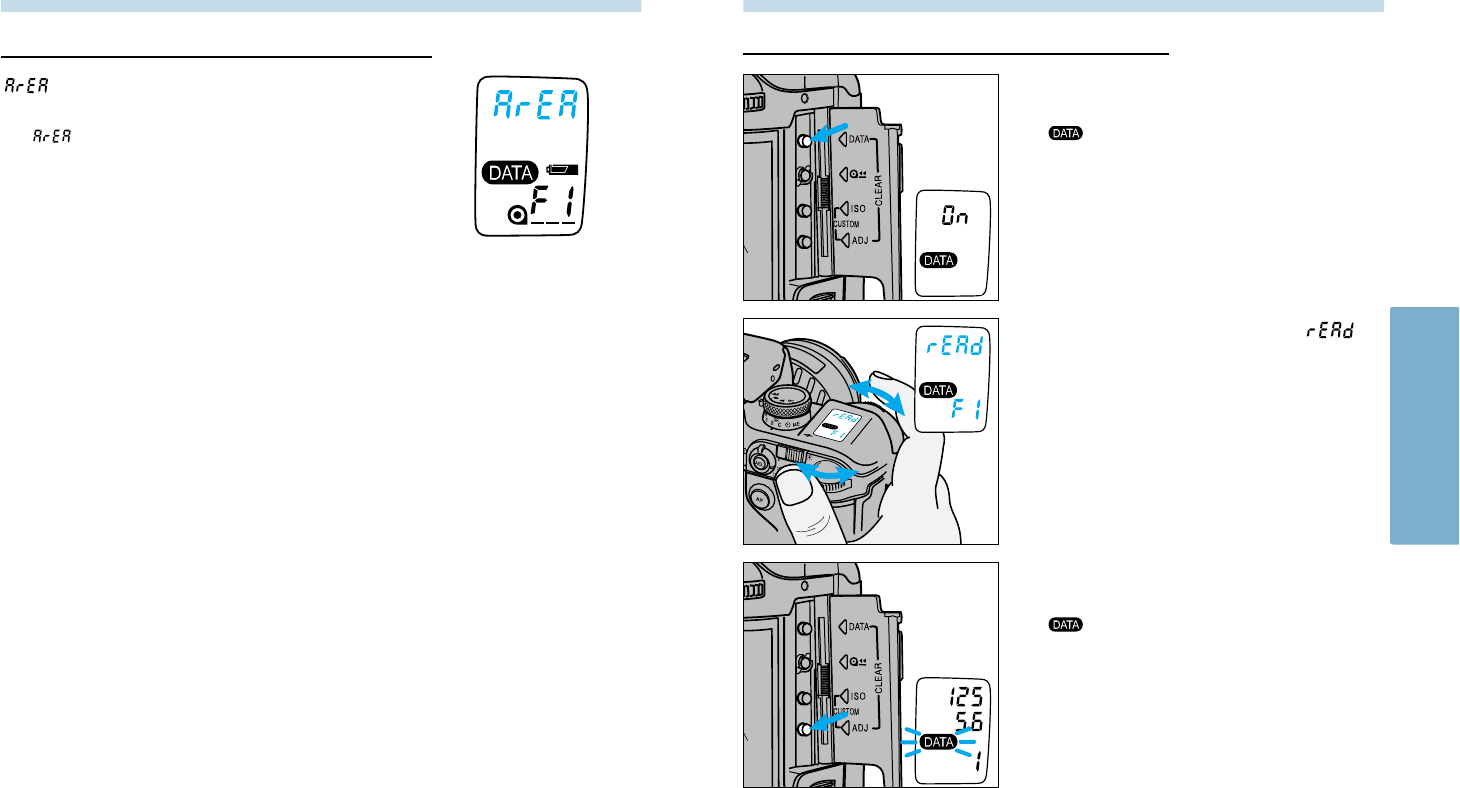
2. Turn either control dial until
and the desired data area appears in
the data panel.
8786
Recalling Data
1. Open the control panel door, then
press the data-memory button.
• and the current data memory mode appear
in the data panel.
3. Press the adjust button to view the
first data area.
• blinks in the data panel.
Continued on the following page
Overwriting
appears in the data panel before the data for
the first exposure in Area 1 is overwritten.
• disappears after the first exposure.
• Old data is erased one frame ahead of the current frame.
Area appears only when the film area changes from 7 to 1
and disappears after the data from the first exposure is
recorded.
DATA MEMORY
SPECIAL FUNCTIONS
8988
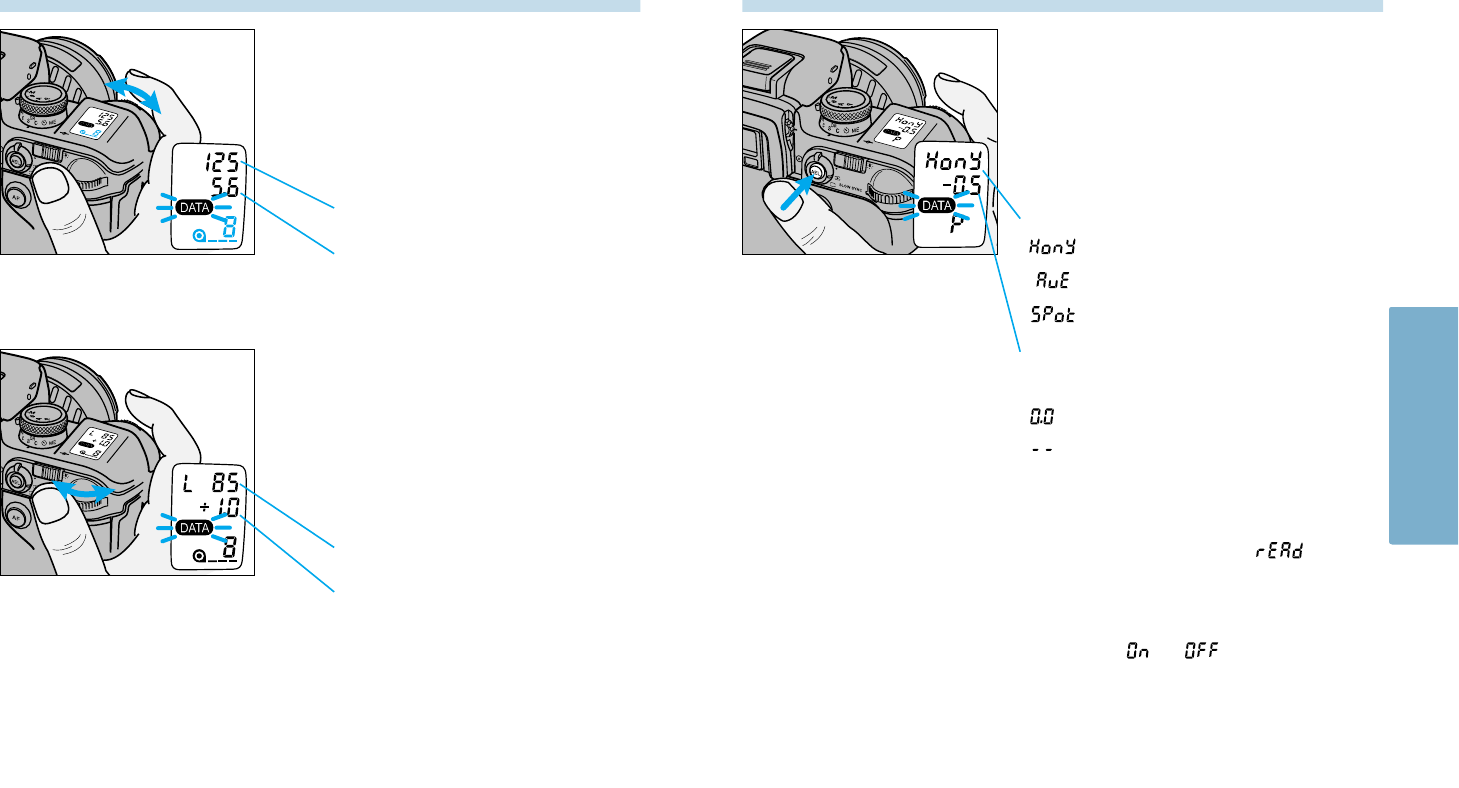
5. Turn the rear control dial one click
to display the focal length and
exposure compensation /
bracketing increment for the
selected frame.
• The exposure compensation and bracketing
increment are combined into a single value.
Focal Length Display
Exposure Compensation /
Bracketing Increment Display
4. Turn the front control dial to select
the desired frame number.
– The shutter speed and aperture for the
selected frame are displayed in the data
panel.
Shutter Speed Display
Aperture Display
DATA MEMORY
7. Press the adjust button again to
return to data memory .
8. Turn either control dial to select data
memory or , then press the
shutter-release button partway down
to enter the selection.
• Press the shutter-release button partway down
twice to return to standard operation mode with
data memory on.
6. Press the AE-lock button at step 4 or
5 to display the metering mode,
flash compensation / flash
bracketing increment and exposure
mode.
• The flash compensation and bracketing increment
are combined into a single value.
Metering Mode Display
Flash Compensation /
Bracketing Increment Display
– 14-Segment Honeycomb Pattern (p.45)
– Center Weighted Average (p.47)
– Spot (p. 46)
– Flash fired without compensation.
– Flash didn’t fire.
SPECIAL FUNCTIONS
9190
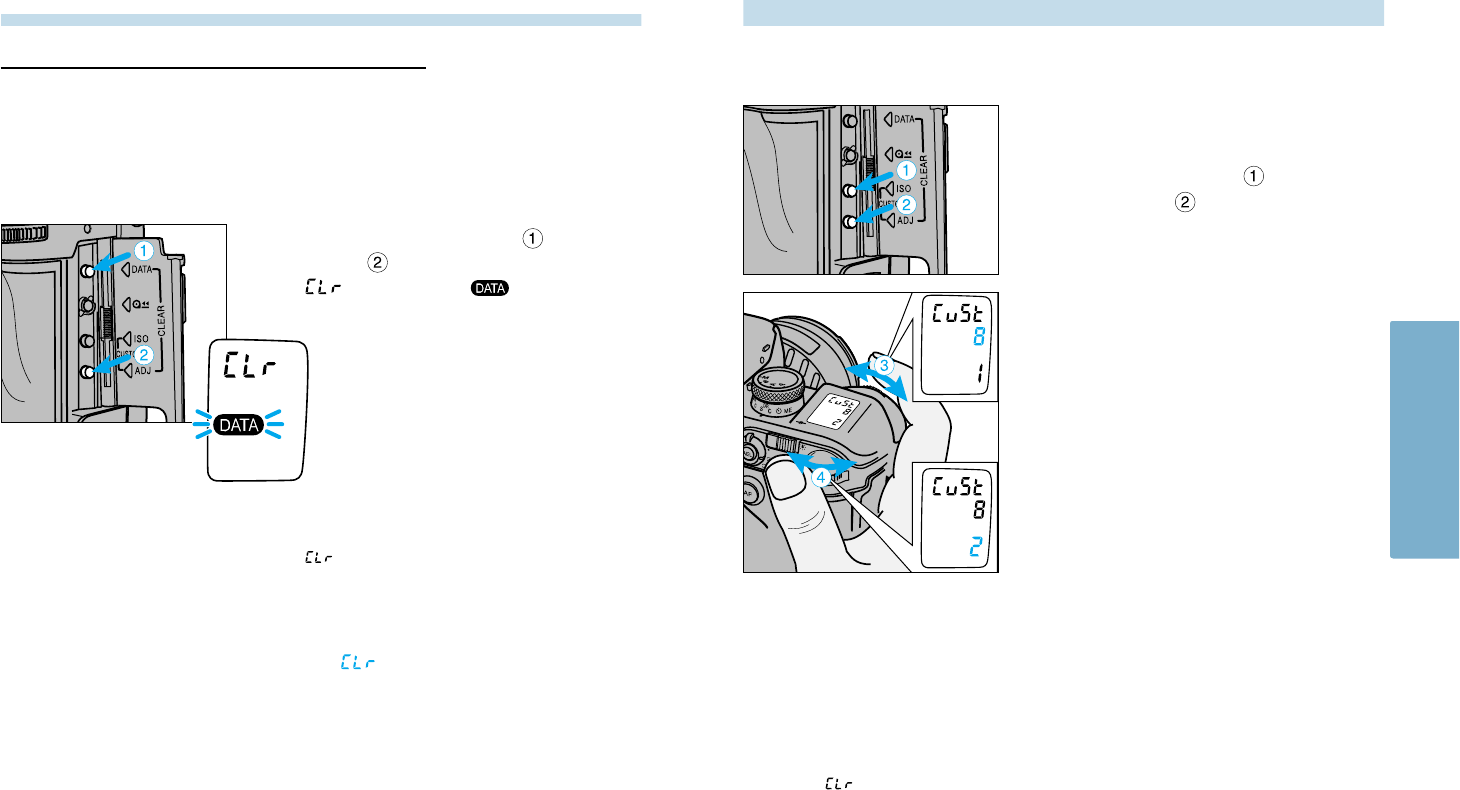
Deleting Stored Data
The data in all of the film areas will be deleted. Film areas cannot be cleared
individually.
2. Press the data-memory and
adjust buttons until
appears and blinks in the
data panel.
1. Open the control panel door.
3. Press the data-memory button
again.
• blinks while the data is being deleted.
• The data panel returns to the standard display
after the data in the film areas has been cleared.
Do not operate the camera while blinks in the data
panel.
DATA MEMORY
2. Press the ISO button , then the
adjust button .
CUSTOM FUNCTIONS
1. Open the control panel door.
Use the custom functions to tailor the camera to your shooting style or preferences.
The customizable functions are explained on pages 92-102.
3. Turn the front control dial to select
the custom function number.
To reset the custom functions to their default setting (1)…
1. Turn the main switch to LOCK.
2. Open the control panel door.
3. Press the adjust button and turn the main switch to
ON.
• will blink in the data panel when the custom functions are returned to
their default settings.
5. Press the shutter-release button
partway down to enter the settings.
4. Turn the rear control dial to select
the desired setting.
SPECIAL FUNCTIONS
CUSTOM FUNCTIONS
9392
Mid Reload
Mid Reload decreases the chances of accidental double exposure when reloading a
partially exposed roll of film.
• Reloading a partially exposed roll increases the risk of film damage (scratches) caused by
dust and grit.
1. Set custom function 3 to setting 3 .
2. Load the film (p. 15).
• The film is automatically advanced to frame 1.
3. Open the control panel door, then
press and hold the adjust button
until 1 blinks in the data panel.
4. Turn either control dial until the
frame number you want to advance
the film to blinks in the data panel.
• Advance the film a minimum of two frames past
the last exposed frame.
5. Press the adjust button.
• The film is automatically advanced to the desired
frame.
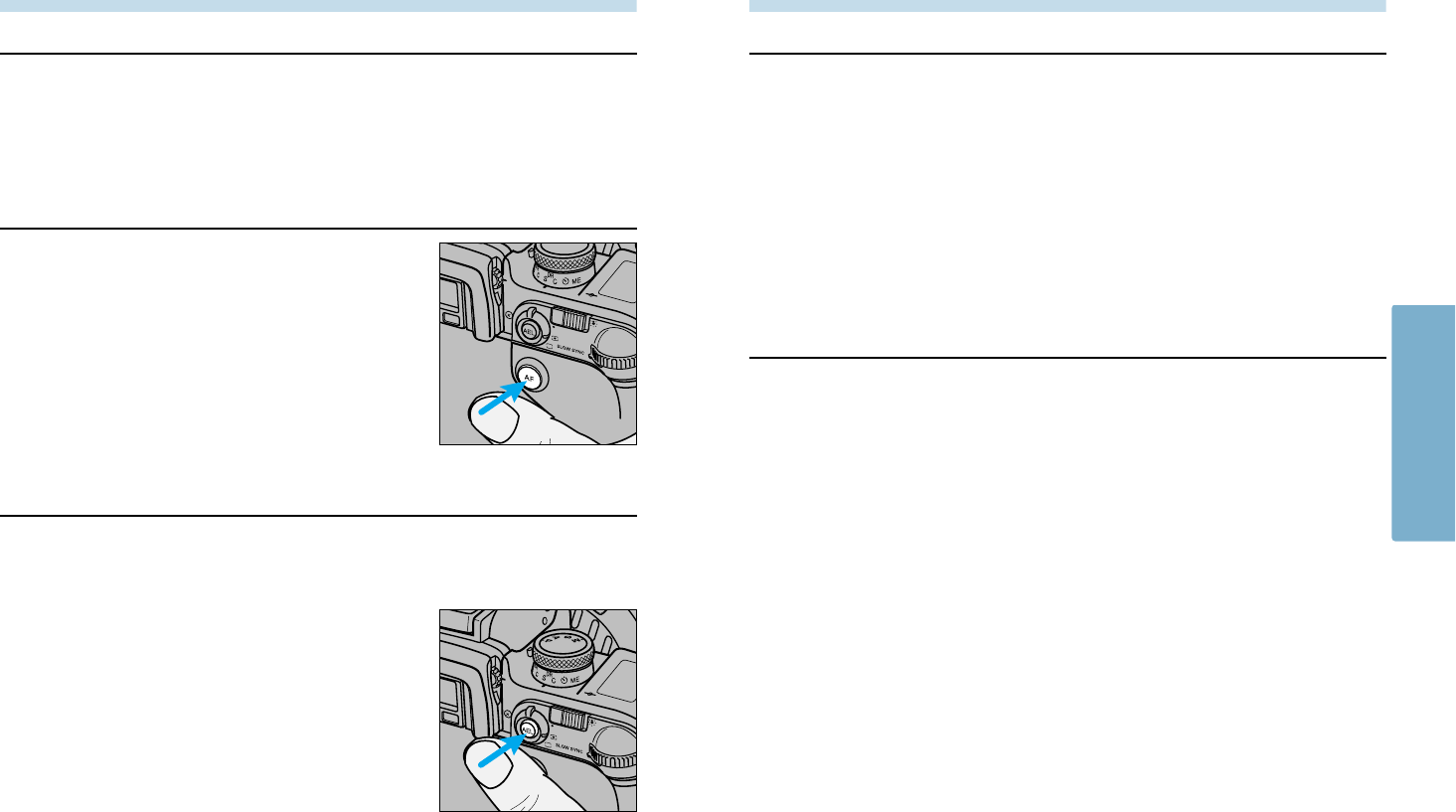
Cust 1 — AF/Release priority
1 – AF priority
Shutter will not release until or appears in the viewfinder.
2 – Release Priority
Shutter releases even if the focus cannot be confirmed.
Use release priority when photographing moving
subjects.
•RP will appear in the data panel.
Cust 2 — Film Rewind Start
1 – Automatic
Film is automatically rewound at the end of the roll.
2 – Manual
User must press the manual-rewind button to initiate rewind (p. 24).
Cust 3 — Film Tip
1 – Film is completely rewound into the cartridge.
2 – Leader is left out of the cartridge after rewind.
3 – Leader left out after rewind. / Camera setup for Mid Reload.
SPECIAL FUNCTIONS
9594
Cust 6 — Focus Hold Button (Lens)
1 – Focus Hold
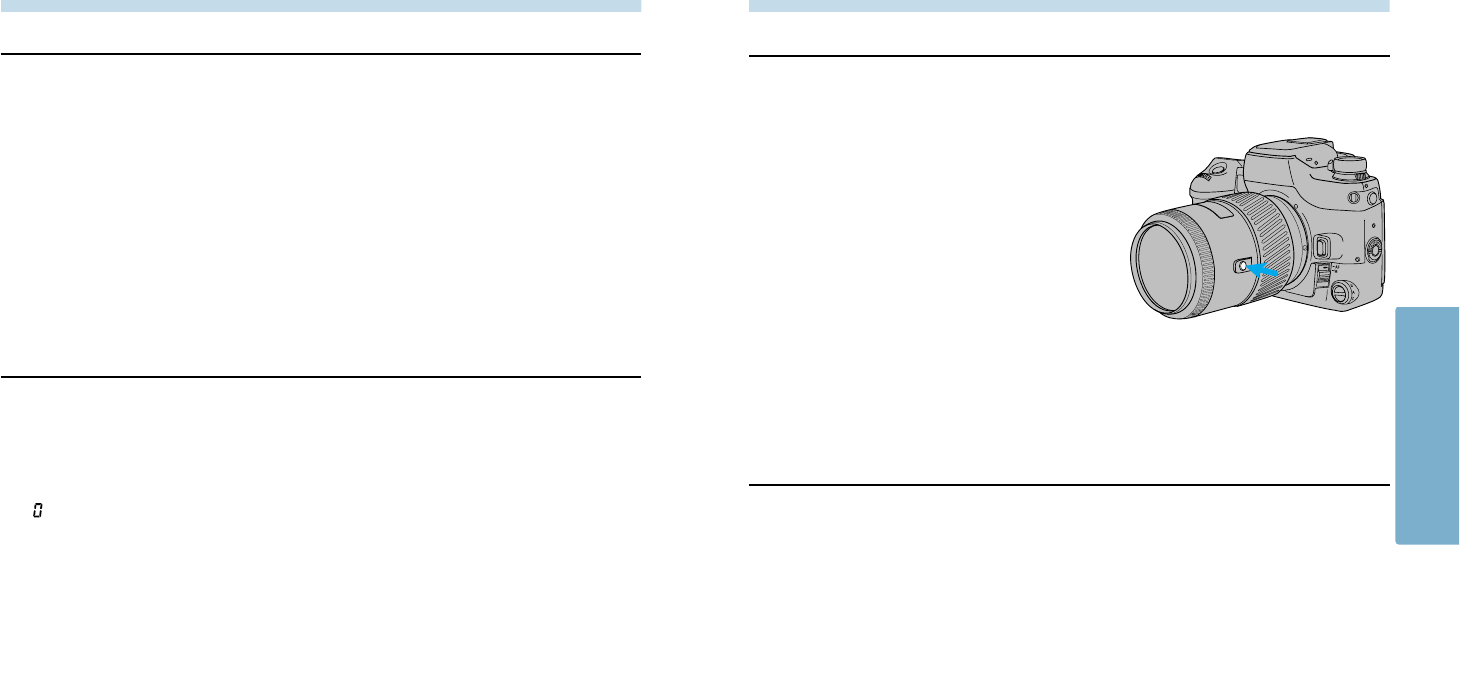
Pressing the focus-hold button on the lens locks
the focus.
2 – Spot Focus
Pressing the focus-hold button on the lens
selects the center focus sensor (p.31).
The mounted lens must have a focus hold button.
3 – Continuous Focus
Select this setting when focusing on moving
subjects.
Pressing the focus-hold button on the lens
selects continuous focus.
Cust 7 — Eyepiece Sensor
1 – Grip sensor activated
Eyepiece sensor is activated when the grip sensor is tripped.
2 – Main switch activated
Eyepiece sensor is activated when the main switch is in the ON position. Use this
setting when the grip sensor is not being tripped (user wearing gloves).
• Slide the main switch to LOCK when the camera is not being used.
Cust 4 — DX Memory
1 – DX Memory Off
Film speed is always set to the DX-coded ISO. Non-DX-coded film is set to the
previous roll’s ISO.
2 – DX Memory On
Changes to the film speed for a DX coded roll are saved and applied to future rolls
with the same DX coded ISO. Use to consistently over/under-expose a specific film
type.
• Film must be loaded before the ISO can be changed.
Cust 5 — Release Lock (Film)
1 – Release Lock Off
2 – Release Lock On
Shutter cannot be released unless film is loaded or the back cover is open.
• blinks in the frame counter if the shutter-release button is pressed when film is not
loaded.
CUSTOM FUNCTIONS
SPECIAL FUNCTIONS
97
Cust 11 — Bracketing Sequence
1 – Metered exposure, Underexposure(s), Over-exposure(s)
• A 5 frame bracket in 1/2EV increments is exposed in the following order…
Normal ➝-0.5EV ➝+0.5EV ➝-1.0EV ➝+1.0EV
2 – Underexposure(S), Metered exposure, Over-exposure(s)
• A 5 frame bracket in 1/2EV increments is exposed in the following order…
-1.0EV ➝-0.5EV ➝ Normal ➝+0.5EV ➝+1.0EV
Cust 12 — Rewind Speed
1 – Fast Rewind
Rewinds a 36 exposure roll in approximately 6 seconds.
2 - Slow (silent) Rewind
Rewinds a 36 exposure roll in approximately 9 seconds.
96
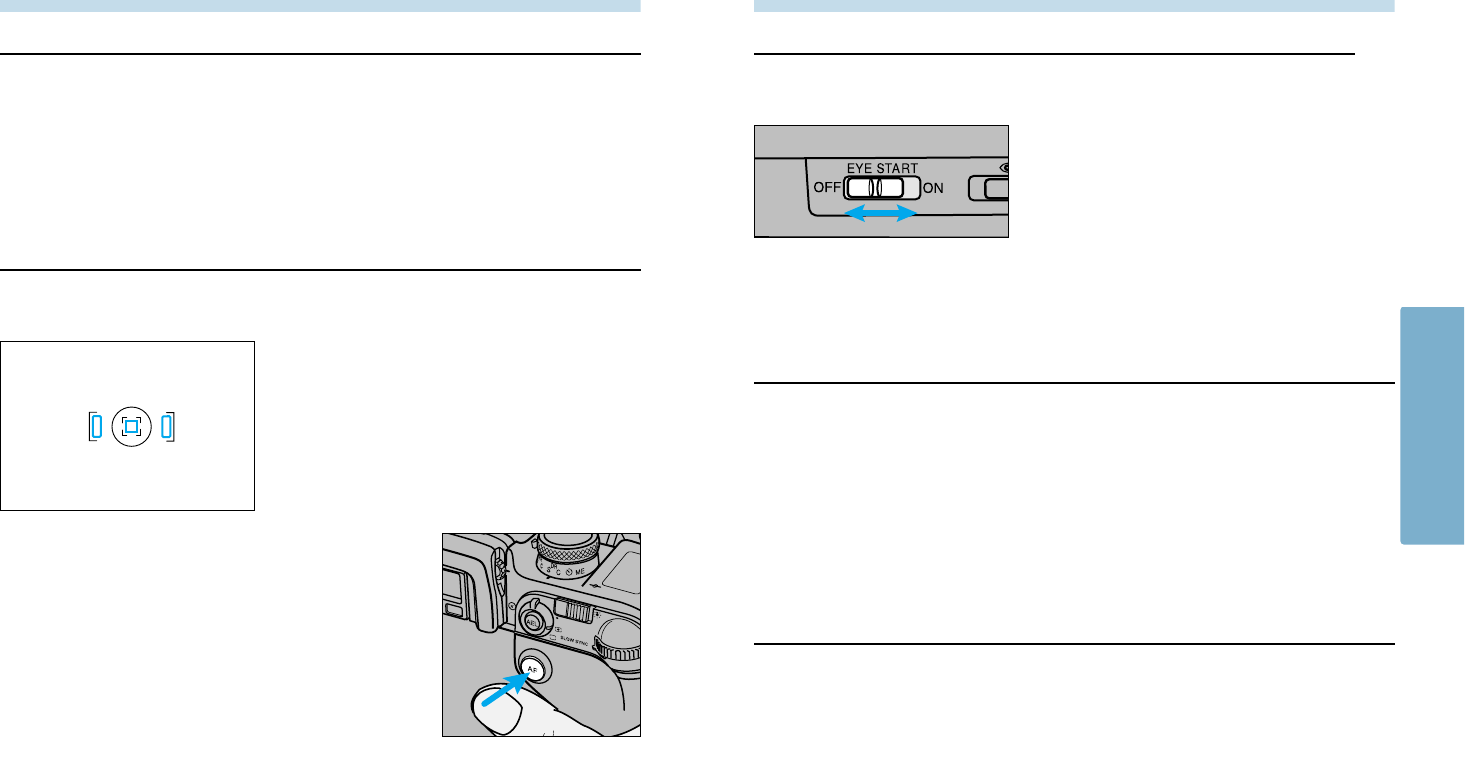
Cust 9 — AF Button
1 – Selectable focus area
Press the AF button and turn the control dial to
specify the desired local focus area. See page 31 for
details.
2 – Spot Focus
Press the AF button to focus using the center focus
sensor (p. 31).
Cust 10 — AE-Lock Button
1 – Press to activate, release to cancel.
2 – Press once to activate, press again to
cancel.
• Turning the built-in flash on or off cancels AE lock.
• AEL appears in the viewfinder when AE-lock button is active (down).
• Slow sync is selected when the built-in flash is up or an attached accessory flash is on.
• Manual shift is selected when the exposure mode is set to manual.
Cust 8 — Frame Counter
1 – Frame counter in data panel counts up.
2 – Frame counter in data panel counts down.
• The frame counter counts up when non-DX coded film is loaded.
CUSTOM FUNCTIONS
SPECIAL FUNCTIONS
9998
Cust 15 — Eyestart Switch
1 – Turns Eyestart on and off (p. 76).
2 - Turns Dial-lock on and off. Eyestart
is always on.
3 - Turns Dial-lock on and off. Eyestart
is always off.
Dial-lock - Disengages the control dials to prevent an accidental turn of the control
dials from changing the exposure settings.
Cust 16 — Release Lock (Lens)
1 – Shutter cannot be released if a lens is not attached.
• – – appears (blinks) in the data panel when the shutter-release button is pressed.
2 – Shutter can be released if a lens is not attached.
Use when mounting the lens to a non-coupling lens mount (telescope, microscope
etc.).
Cust 17 — AF Drive Speed
1 – Speed priority
2 – Silent drive
• Autofocus drive speed will be slower than setting 1.
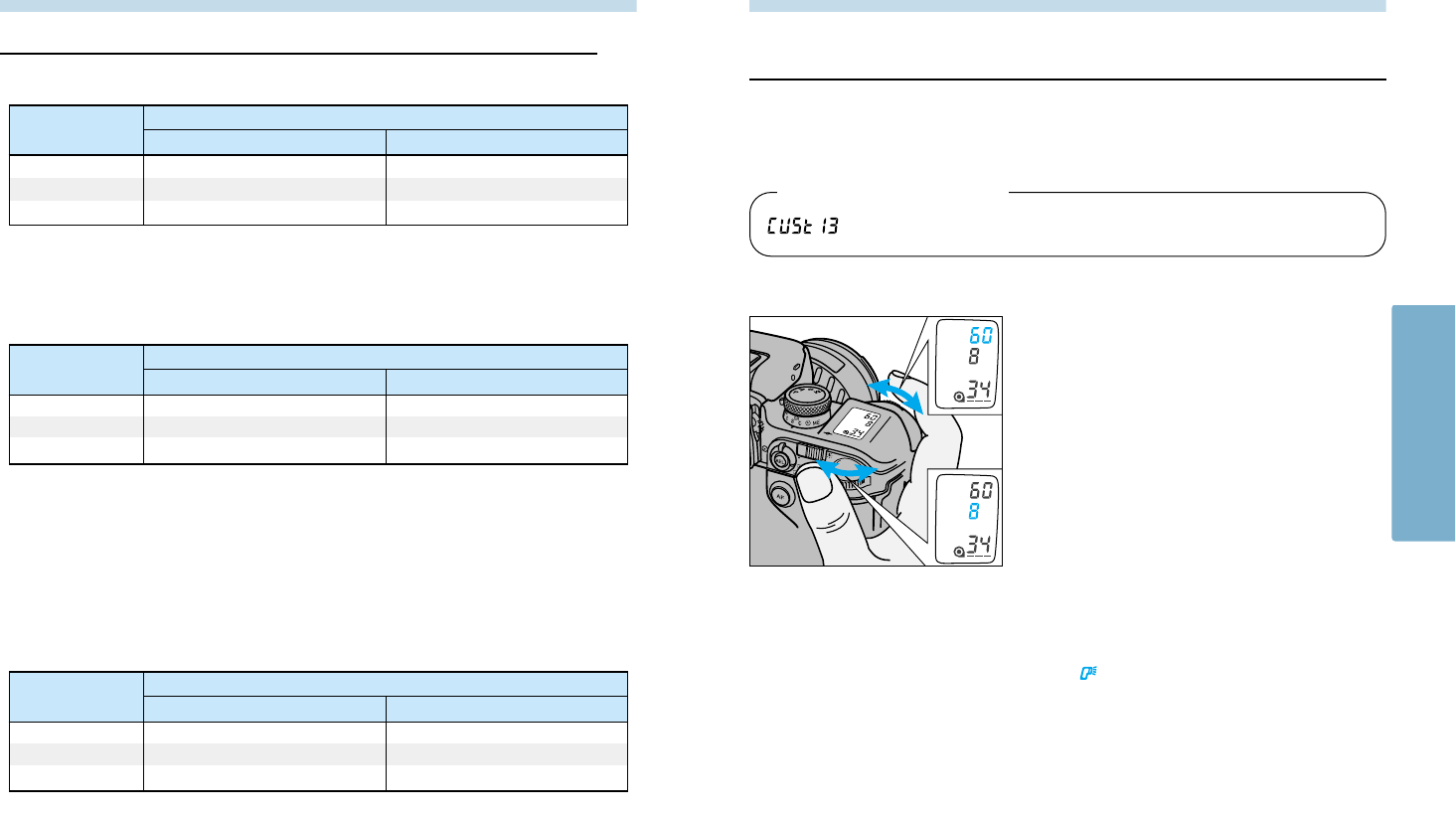
Cust 13 — Meter/Data Panel Illuminator Display Duration
1 – 5 sec
2 – 10 sec
3 – 30 sec
• Selecting longer display durations reduces battery performance.
Cust 14 — AF Area Display
1 - Focus Area LEDs display the active
focus area for 0.1 sec after the
focus locks.
2 – Focus Area LEDs display the active
focus area for 0.4 sec after the
focus locks.
3 – Local focus areas display only when the
AF button is pressed.
• Press and hold the AF button to display the focus area LEDs.
• Pressing the lens focus hold button does not display the focus area LEDs.
CUSTOM FUNCTIONS
SPECIAL FUNCTIONS
101100
• The aperture and shutter speed change in 1/2 or 1/3 EV increments depending on the
position of the exposure compensation dial.
• Flash can not be used with the PA and PS modes.
- Built-in and accessory flashes will not fire when the PA and PS modes are active.
-P
Aand Ps modes can not be selected when appears in the viewfinder.
• If the shutter speed or aperture blink, the required setting is not available. Turn the control
dial until the blinking stops.
Cust 18-2 Creative Program
PA/ Ps Mode Operation
While the aperture/shutter speed are displayed in P-mode…
Turn the front control dial to change
the shutter speed.
• Aperture is adjusted automatically.
Cancelling PA/ Ps Mode
Wait until the displayed data disappears for the data panel or raise
the built-in flash.
After the AE system has been activated, you can change the shutter speed or
aperture selected by the camera. Creative program remains active until the data
panel display disappears.
Cust 18 — Control Dial Tasking
1 – Default operation
2 – Creative Program
3 – Exposure Compensation
Creative program control (PA/ Ps) lets you override the exposure settings
selected by the camera in P– mode. A and S – mode operation does not change.
• The exposure compensation value is displayed in the meter index.
• Exposure compensation dial must be set to +/– 0.
• Compensation range is +/– 3 EV for both 1/2 and 1/3 EV increments.
• Lower viewfinder indicators will disappear when the rear control dial is operated.
Changes the tasking for the rear control dial to exposure compensation. Tasking
for the front control dial is the same as setting 1.
Control Dial Tasking
no function
aperture
shutter speed
Front Control Dial Rear Control Dial
Exposure
Mode
P – Mode
A – Mode
S – Mode
no function
aperture
shutter speed
Turn the rear control dial to change the
aperture.
• Shutter speed is adjusted automatically.
Control Dial Tasking
Ps - shutter speed
aperture
shutter speed
Front Control Dial Rear Control Dial
Exposure
Mode
P – Mode
A – Mode
S – Mode
PA- aperture
aperture
shutter speed
Control Dial Tasking
no function
aperture
shutter speed
Front Control Dial Rear Control Dial
Exposure
Mode
P – Mode
A – Mode
S – Mode
exposure
compensation
Refer to page 98 to change the data panel display duration.
Custom Function Notes
CUSTOM FUNCTIONS
SPECIAL FUNCTIONS
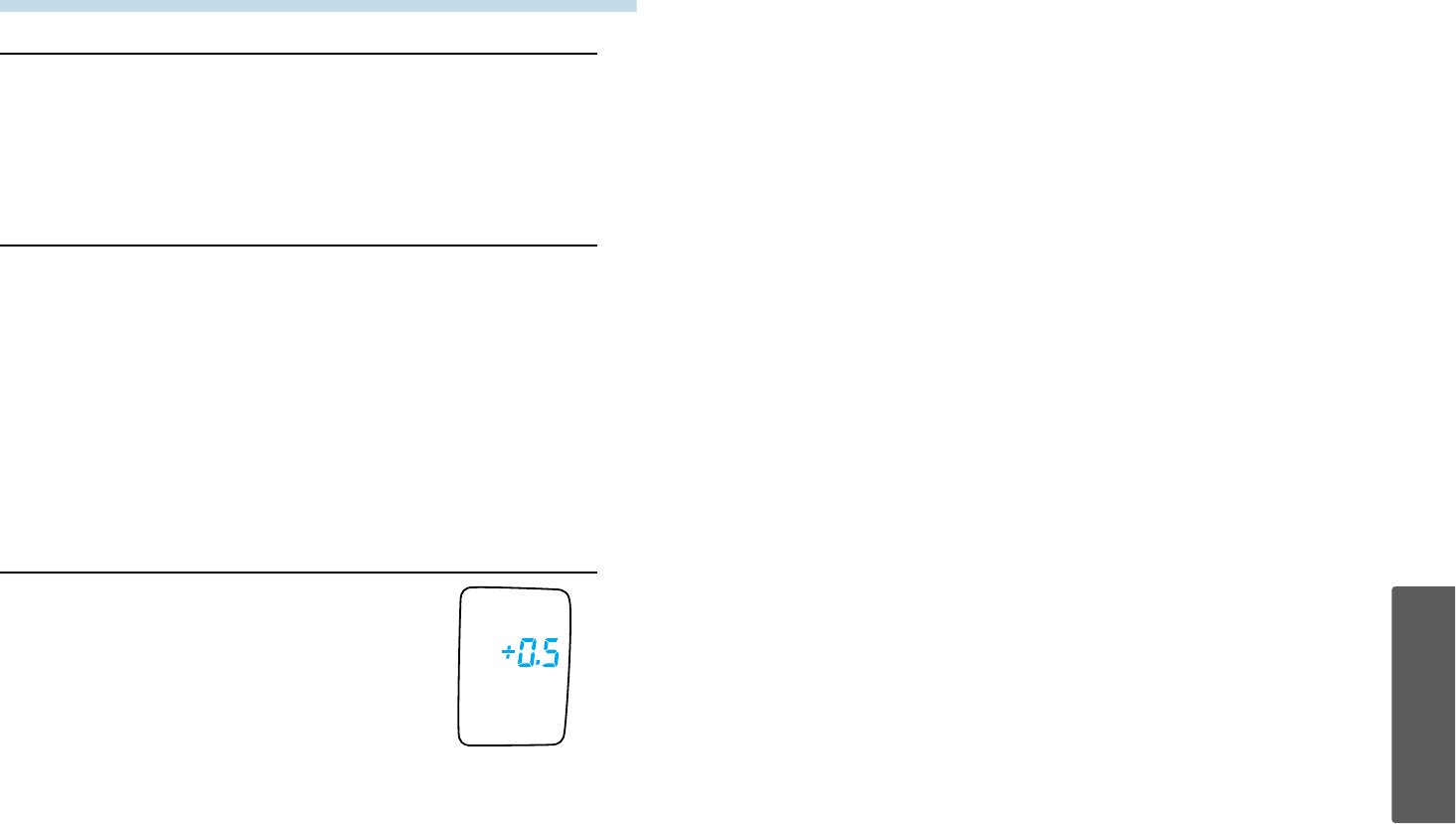
102
APPENDIX
Cust 19 — Control Dial - Exchanged Control
1 – Unchanged from Cust 18.
2 – Front and rear control dial functions exchanged.
• Control dial tasking does not change for bracketing, data memory, and custom functions.
Cust 20 — Flash Metering
1 – 4-Segment Flash Metering (p. 63)
2 – Average metering
All flash metering segments are weighted evenly.
3 – Spot Metering
Flash is metered by the segment corresponding to the currently selected Local
Focus Area.
• Do not recompose the image after locking focus. Flash exposure is TTL metered by the
segment used to lock focus.
Cust 21 — Exposure Compensation Display
1 – No display
Exposure compensation value is not displayed in the
data panel.
2 – Display
Exposure compensation value is displayed in the data
panel when the dial is operated.
• Lower viewfinder indicators will disappear when the dial is
operated.
CUSTOM FUNCTIONS
APPENDIX
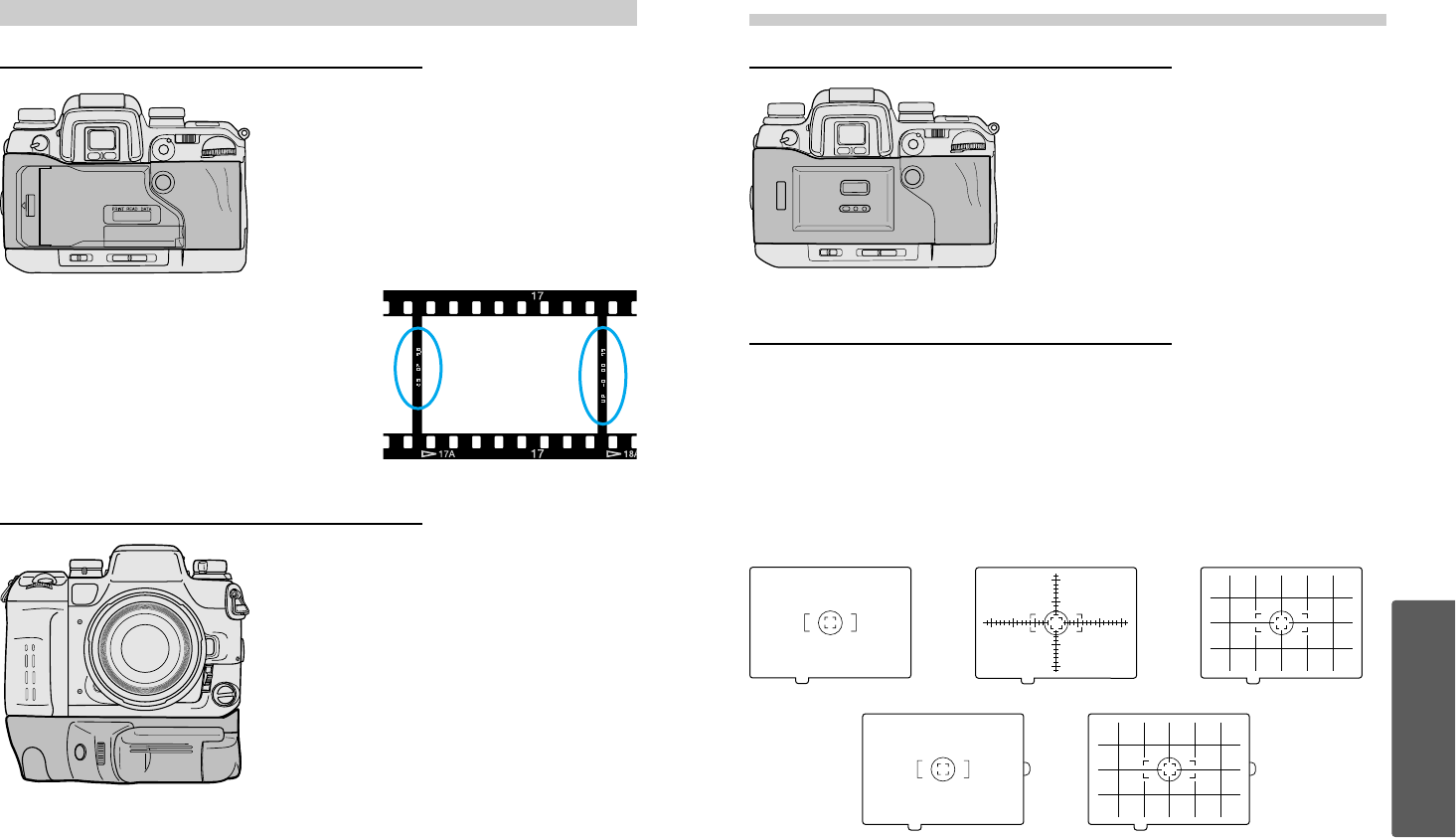
ACCESSORY INFORMATION
105
104
Quartz Data Back QD-9
Focusing Screen 9
Data Memory Back DM-9
Vertical Control Grip VC-9
Use the Quartz Data Back QD-9 to record the
time or date in the lower right-hand corner of
each frame.
Designed specifically for the Maxxum/Dynax 9,
the Data Memory Back DM-9 can store
exposure data for up to 400 rolls of 36
exposure film on a 2MB SmartMedia card. The
saved data can be displayed in the data panel
or on your home computer.
Four new focusing screens have been introduced for exclusive use with the
Maxxum/Dynax 9. The G (standard), L, and S screens use Minolta’s new spherical
acute matte surface, designed to produce less image shading in the center of the
focusing screen.
Designed for users of large aperture lenses, the M and ML type screens use the
super spherical acute matte surface for greater light dispersion and sharper focus
control.
• The edges of the viewfinder may appear dark when some telephoto lenses are used with
the type G, S, and L focusing screens. The final image will not be affected.
Another Maxxum/Dynax 9 exclusive, the
Vertical Control Grip VC-9 has duplicated basic
control surfaces (shutter-release button, control
dials, grip switch, etc.) for improved vertical
operation.
Multiple power source capability has also been
incorporated to extend the length of shooting
sessions in between battery changes.
Type LType G
Type M
Type S
The Data Memory Back DM-9 can also imprint
aperture/shutter speed data, frame count, film
ID, the date, or the time of exposure in between
frames.
APPENDIX
Type ML
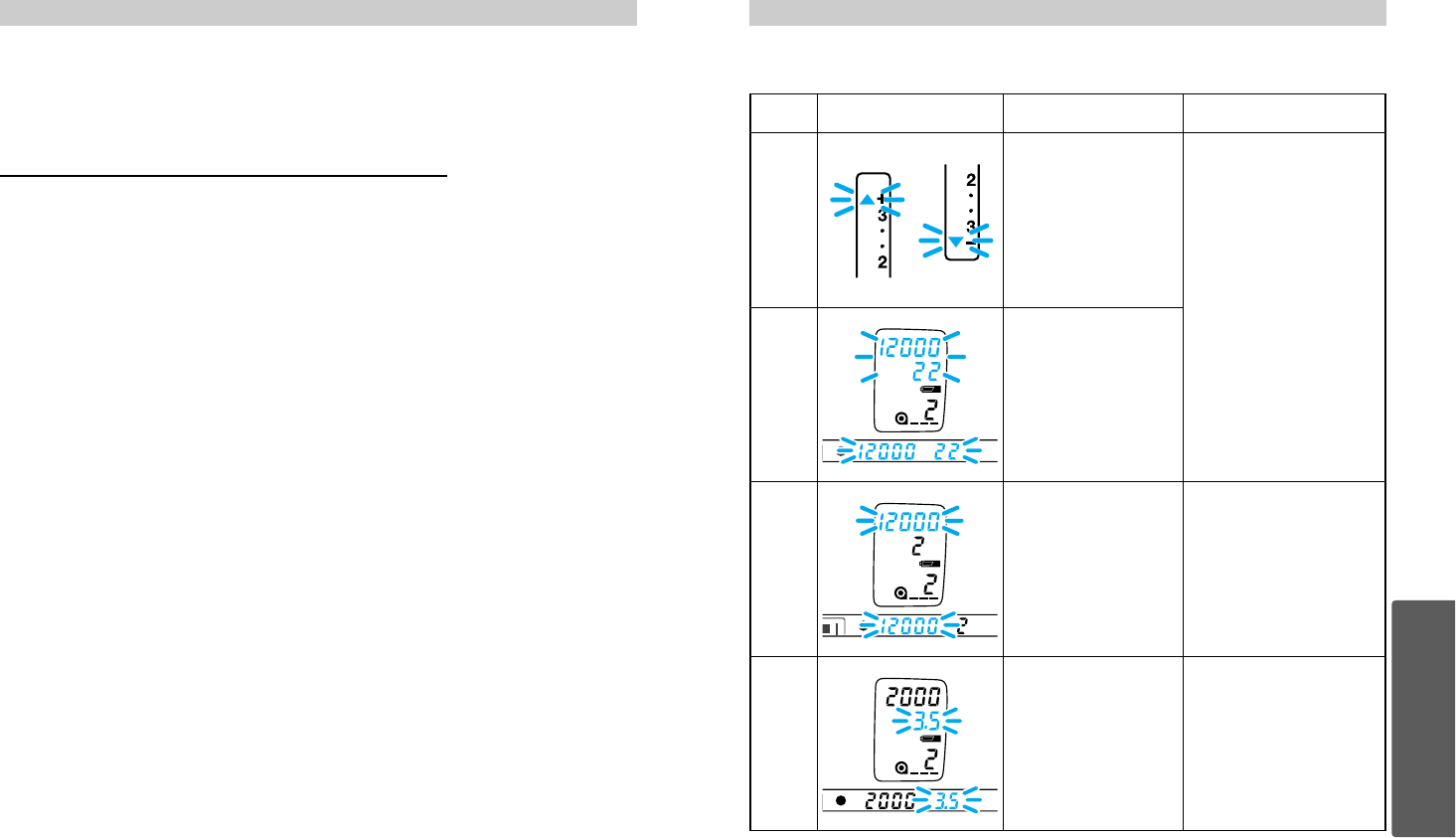
EXPOSURE WARNINGSACCESSORY INFORMATION
107106
MODE DISPLAY CAUSE ACTION
P
A
S
M
Scene or subject
brightness is
beyond the
camera’s metering
range.
Bright Light
Use slower speed
film, a neutral density
(ND) filter, or reduce
the light level of your
surroundings.
Low Light
Use higher speed film
or a flash.
P
Light level is
beyond the range
of available shutter
speeds and
apertures.
A
The required
shutter speed is
beyond the range
of the camera.
S
The required
aperture is beyond
the range of the
lens.
Select a faster or
slower shutter speed
until the display stops
blinking.
Indicators will blink in the viewfinder or data panel when there is a problem with
the exposure.
This camera is designed to work specifically with lenses and accessories
manufactured and distributed by Minolta. Using incompatible accessories with this
camera may result in unsatisfactory performance or damage the camera and
accessories.
Lenses
• All Minolta AF lenses can be used with this camera.
• MD and MC series lenses (manual focus) cannot be used with this camera.
Compatibility of Accessories
Flashes
• All Minolta i, si, and HS series flash units, and the Vectis SF-1 flash, are
compatible with this camera. The flash will always fire when the flash unit is
on.
• The Flash Shoe Adapter FS-1100 is required to mount AF series flash units
(4000AF, 2800AF, 1800AF, and Macro flash 1200AF).
• The AF illuminator will not activate when the FS-1100 is attached.
• X-series flashes cannot be used with this camera.
Others
• The following accessories are not compatible with this camera:
Control Grip CG-1000 Data Receiver DR-1000
• Remove the eyepiece cup when attaching a finder accessory (AngleFinder,
etc.).
The information in this manual is relevant for products introduced before January
1999. Contact the nearest authorized Minolta Service Facility to obtain information
for products released after this date.
APPENDIX
Select a larger or
smaller aperture until
the display stops
blinking.
TROUBLE SHOOTING
109108
SOLUTION PAGE
Remove and reinstall the batteries.
If the camera battery is exhausted, install a new battery.
10
10
18
-
99
• Contact your nearest Minolta Service Facility if the problem you are experiencing is not
covered or the condition continues.
Use focus hold or manual focus.
Slide the focus-mode switch to AF.
Check the minimum focus distance for your lens.
21/33
Use focus hold or manual focus.
Set Custom Function 16 to setting 2.
21/33
Set Custom Function 5 to setting 1. 94
Make sure the subject is within the flash range. 23
Remove lens hood.
The distance between the subject and the camera must be at least
1m (3.3ft.) when the built-in flash is used. -
Remove and reinstall the batteries. If normal camera operation does
not resume or the camera malfunctions repeatedly, contact an
authorized Minolta Service Facility. 10
PROBLEM CAUSE
No display appears
when the camera is
switched on.
Batteries are loaded incorrectly.
Batteries are exhausted.
Autofocus does not work
when shutter-release
button is pressed
partway down.
Situation is unsuitable for autofocus.
Camera is set to manual focus mode.
Subject is too close.
Shutter cannot be
released.
Focus cannot be confirmed.
Camera is attached to a microscope or telescope.
Custom Function 5 set to setting 2.
Flash picture is too dark. Subject is beyond flash range.
Lower part of flash
picture is dark. Lens hood attached.
Err appears in the data
panel. Camera Malfunction
APPENDIX
CARE AND STORAGE
111110
Questions and Service
• If you have questions about your camera, contact your local camera dealer
or write to the Minolta distributor in your area.
• Before shipping your camera for repair, please contact an authorized
Minolta Service Facility for details.
• Settings made or saved by the user, including Data Memory or Custom
Functions, may be lost during repair.
Cleaning
• If the camera or lens barrel is dirty, wipe it gently with a soft, clean, dry
cloth.
If the camera or lens comes in contact with sand, gently blow away loose
particles - wiping may scratch the surface.
• To clean the lens surface, first brush away any dust or sand then, if
necessary, moisten a lens tissue with lens cleaning fluid and gently wipe
the lens in a circular motion, starting from the center.
• Never place lens fluid directly on the lens.
• Never touch the interior of the camera, especially the shutter and mirror,
doing so may impair their alignment and movement.
• Dust on the mirror will not affect the exposure but may affect the focus. Use
a blower brush to remove dust from or around the mirror.
• Never use compressed air to clean the camera’s interior, it may cause
damage to sensitive interior parts.
• Never use organic solvents to clean the camera.
• Never touch the lens surface with your fingers.
Before Important Events
• Check the camera’s operation carefully, or take test photographs.
• Minolta is not responsible for any loss that may occur due to an equipment
malfunction.
Operating Temperature and Conditions
• This camera is designed for use from –20 to 50 °C (4 to 122 °F).
• Never leave your camera where it may be subjected to extreme
temperatures such as the glove compartment of a car.
• Data panel response time will be slow at colder temperatures. The display
will temporarily darken at higher temperatures, but will restore when the
temperature normalizes.
• This camera is not waterproof or splashproof. When using the camera in
the rain, protect the camera and the lens.
• Never subject the camera to extreme humidity.
• To prevent condensation from forming, place the camera in a sealed plastic
bag when bringing it from cold environment to a warm environment. Allow it
to come to room temperature before removing it from the bag.
• The low-battery symbol may appear even with fresh batteries depending on
the storage conditions. To restore camera power, repeat turning the camera
on and off.
• Battery capacity decreases at colder temperatures. Keep your camera and
spare batteries in a warm inside pocket when shooting in cold weather.
Batteries will regain some of their capacity when warmed to normal
operating temperature.
• Tape over the exposure-mode and exposure-compensation dials if the film
needs to be removed from the camera in a darkroom or changing bag due
to a drive problem. Fogging may occur if the luminous dials are not
covered.
Storage
When storing your camera for extended periods,
• Always attach the protective caps.
• Store in a cool, dry, and well-ventilated area away from dust and chemicals
such as moth balls. For long periods, place the camera in an airtight
container with a silica gel drying agent.
• Periodically release the camera’s shutter to keep it operating properly.
• Before using after prolonged storage, check the camera’s operation to
make sure it is functioning properly.
APPENDIX
SPECIFICATIONS
113112
Specifications are based on the latest information available at the time of printing
and are subject to change without notice.
Camera Type: 35mm SLR with built-in flash, autoexposure (AE), and
omni-dimensional predictive autofocus (AF)
Lens Mount: Minolta A-type bayonet mount
Viewfinder*: Eye level, fixed pentaprism, 100% field of view
Magnification*: 0.73X
* With a 50mm lens focused at infinity.
Focusing Screen: Spherical matte, user interchangeable screens available.
Diopter: -1 diopter, Adjustment: -3 – +1
Shutter
Type: Electronically-controlled, vertical-traverse, focal-plane type
Speeds: 30 sec. - 1/12000 sec., bulb
Flash sync speed: 1/300 or slower (synchronizes with all speeds in HSS
mode).
Focus
Type: TTL phase-detection system, multi metering with cross hair
type CCD line sensor metering cell. Autofocus and manual
focus modes.
AF Sensitivity Range: EV -1 to18 (ISO 100)
AF Illuminator: Built-in 3 beam LED. Automatically activated in low-light/
low-contrast situations.
Range: 0.7 - 7m (With a standard 50mm lens.)
AF Control: Single-shot, continuous, automatic AF-mode selection.
Exposure
Modes: P, A, S, M (PA/Ps available as a Custom Function)
Type: TTL metering; direct TTL metering for flash
Metering Cell: Ambient:14-segment honeycomb, center weighted
average, spot (5.5 Ø)
Flash: 4-segment SPC
Metering Range : 14-segment metering: EV 0-20,
(ISO 100, f/1.4 lens) Center weighted average: EV 0-20,
Spot metering: EV 3 - 20
Film-speed Setting: Automatic: ISO 25 to 5000 for DX-coded film.
Manual: ISO 6 to 6400 in 1/3 EV increments.
Flash: ISO 25 - 1000.
Film Transport
Loading: Auto load
Drive Modes: Single frame and Continuous advance (2 or 5.5
frames/sec. (4.5 in continuous AF mode)), self-timer (10 or
2 second), exposure bracketing (single frame or
continuous advance), and multiple exposure.
Rewind: Auto rewind, manual start (Count-down display)
High speed or Silent.
Frame counter: Forward (shows number of exposures taken)
Built-in Flash
GN: 12 (ISO 100 in meters)
Coverage: 24mm angle of view
Recycling Time: Approx. 2.5 sec. (according to Minolta test methods)
Modes: Fill-flash, Fill-flash with red-eye reduction, Flash Cancel,
Wireless flash, Slow-sync, and Rear-flash sync.
Additional
Power: Two CR123A lithium batteries
Battery Performance:
24 Exposure Rolls 36 Exposure Rolls
Flash Use (%) 20 °C –20 °C 20 °C –20 °C
0 45 rolls 40 rolls 30 rolls 28 rolls
50 23 rolls 15 rolls 15 rolls 10 rolls
100 14 rolls 9 rolls 9 rolls 6 rolls
Test Conditions : Lens (24-85 f/3.5-4.5) is focused from infinity to 2m three times
and the shutter-release button held partway down for ten
seconds before each exposure.
• Battery performance will vary with usage conditions.
• Exposures taken at a rate of 3 rolls/month for 24 exposure rolls,
2 rolls/month for 36 exposure rolls (starting with fresh batteries).
Dimensions (WxHxD):155.0 x 111.0 x 75.0mm (WxHxD)
Weight : 910g (w/o camera battery)
APPENDIX

© 1999 Minolta Co., Ltd. under the Berne Convention and
Universal Copyright Convention
Printed in Japan 9222-2098-11 P-E106
Minolta Co., Ltd. 3-13, 2-Chome, Azuchi-Machi, Chuo-Ku, Osaka 541-8556, Japan
Minolta Europe GmbH Minoltaring 11, D-30855 Langenhagen, Germany
Reparatur/Repair Senator-Helmken-Strasse 1, D-28279 Bremen, Germany
Minolta France S.A. 365 Route de Saint-Germain, F-78420 Carrieres-Sur-Seine, France
Minolta (UK) Limited 7 Tanners Drive, Blakelands, Milton Keynes, MK14 5BU, England
Minolta Austria Ges. m.b.H. Amalienstrasse 59-61, A-1131 Wien, Austria
Minolta Camera Benelux B.V. Zonnebaan 39, P.O. Box 6000, NL-3600 HA Maarssen, The Netherlands
Belgium Branch Prins Boudewijnlaan 1, B-2550 Kontich, Belgium
Minolta (Schweiz) AG Riedstrasse 6, CH-8953 Dietikon, Switzerland
Minolta Svenska AB Albygatan 114, S-171 54 Solna, Sweden
Finland Branch Niittykatu 6 PL 37, SF-02201 Espoo, Finland
Minolta Portugal Limitada Av. do Brasil 33-A, P-1700 Lisboa, Portugal
Minolta Corporation
Head Office 101 Williams Drive, Ramsey, New Jersey 07446, U.S.A.
Los Angeles Branch 11150 Hope Street Cypress, CA 90630, U.S.A.
Minolta Canada Inc.
Head Office 369 Britannia Road East, Mississauga, Ontario L4Z 2H5, Canada
Vancouver Branch 230-3771 Jacombs Road, Richmond, B.C. V6V 2L9, Canada
Minolta Hong Kong Limited Room 208, 2/F, Eastern Center, 1065 King’s Road, Quarry Bay, Hong Kong
Minolta Singapore (Pte) Ltd. 10, Teban Gardens Crescent, Singapore 608923
Shanghai Minolta Optical
Products Co., Ltd. 368 Minolta Road, Songjiang, Shanghai, China
