Mipro Electronics Co ACT32HC Wireless Microphone User Manual ACT 32HC 30HC 2CE495A x3 201406
Mipro Electronics Co Ltd Wireless Microphone ACT 32HC 30HC 2CE495A x3 201406
Users Manual
Specifications and design subject to change without notice. MN 014/04
All rights reserved. Do not copy or forward without prior approvals MIPRO.
ACT-32HC
Wireless Microphone
User Guide
2 CE 4 9 5 A
All rights reserved.
Do not copy or forward without prior approvals MIPRO.
Specifications and design subject to change without notice.
MN 014/06
1
Rechargeable Handheld Transmitter
0
Handheld Controls and Indicators
1 Handheld Controls and Indicators
3 Operating instructions for insertion &
removing battery
MP-80 Battery Charger (Optional)
Rear cap has an On/Off switch protection
General tips for improving system
performance
5
6
7
Contents
Rechargeable Handheld Transmitter
7
8
9
1
2
4
3
5
6
3
2
Operating instructions for insertion &
removing battery
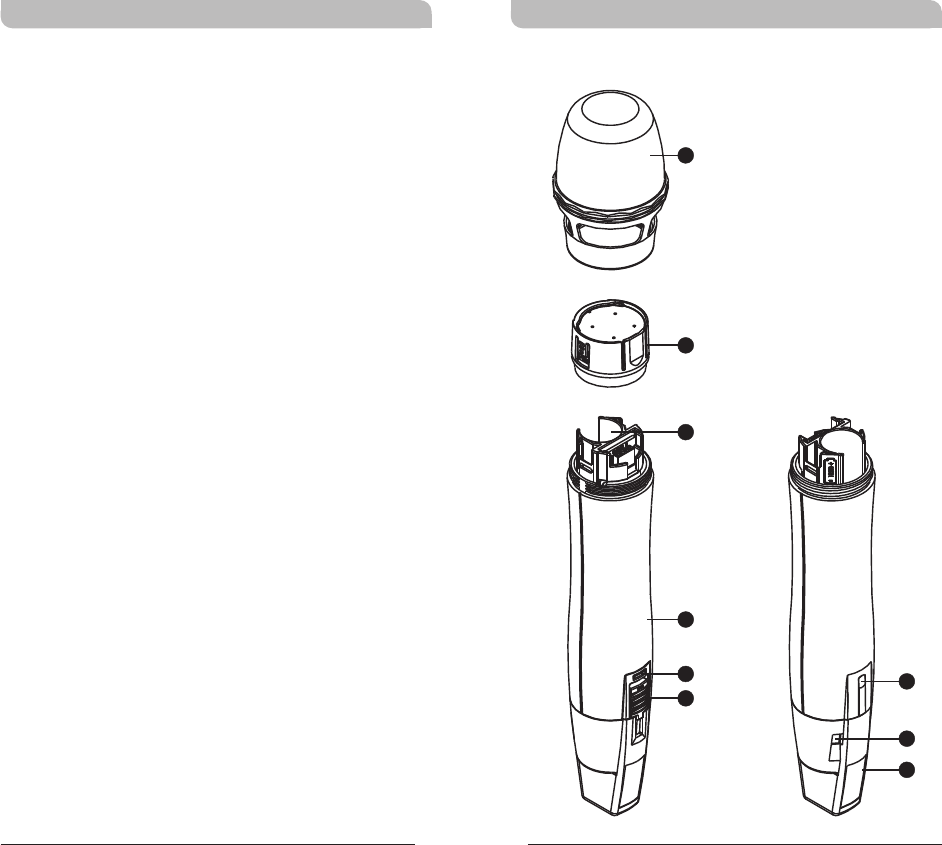
Capsule Module: Protects detachable
microphone capsule module and internal foam
prevents breathing, wind and POP noises.
Battery Compartment: Accommodates one
18500 rechargeable battery.
Power On/Off Switch: Always power off the
transmitter to conserve battery life when not in
use.
Fixed Ring
Housing: Protects transmitter PCB, battery
compartment and battery.
Ascertain the power is turn "ON" to see battery
status.
!Normal Battery: Red indicator is on for a
second and goes off after power on.
!Weak Battery: Red indicator stays on
continuously after power on. Recharge or
insert a new recharged battery.
!No red indicator light: battery is
completely drained or polarity inserted
incorrectly.
ACT Infrared (IR) Sync Port: Receives signals
from receiver to synchronize frequencies
automatically.
Battery Charging Contact: Align contacts
during charging.
Color Coded Protection Cap: Protects against
accidental power on/off. Available in different
colors for channel differentiation.
1
2
3
4
5
6
7
8
9
Rechargeable Handheld Transmitter Rechargeable Handheld Transmitter
18500
rechargeable
lithium
battery
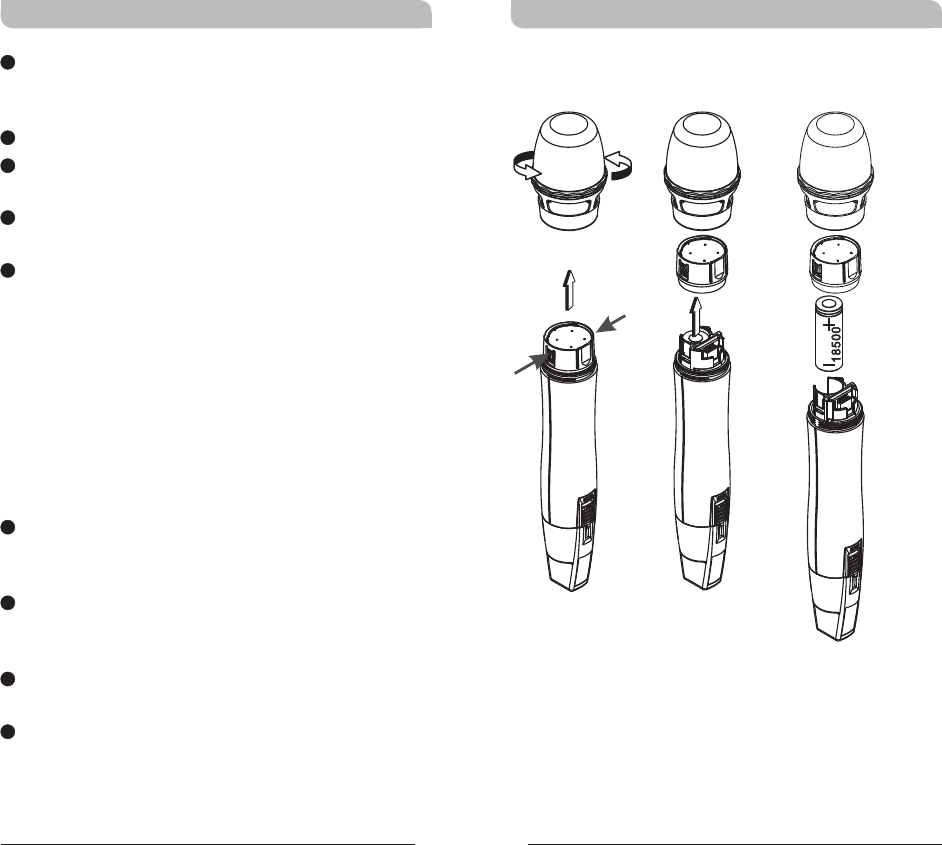
!Remove grill in counter clock direction.
!Press and hold both sides of microphone
capsule module and remove gently.
!Ascertain the battery is inserted according to its
correct polarity. A click is heard once correctly
inserted and grill can be closed properly. No
click is heard and grill cannot be closed
properly if battery is inserted with the wrong
polarity.
NOTE: Transmitter cannot be powered on with a
charged battery.
a. Check for correct polarity insertion
(+ facing up).
b. If inserted with correct polarity and still
cannot be powered on it could be due to
battery protection mechanism is in effect.
Insert the whole transmitter back to the
battery charger for 10 seconds to “wake-
up” and power on again.
c. If battery charger is not used, reverse
battery polarity for 10 seconds then re-
inserted with correct polarity to wake up
the battery. Power on again.
5
4
Rechargeable Handheld Transmitter Rechargeable Handheld Transmitter
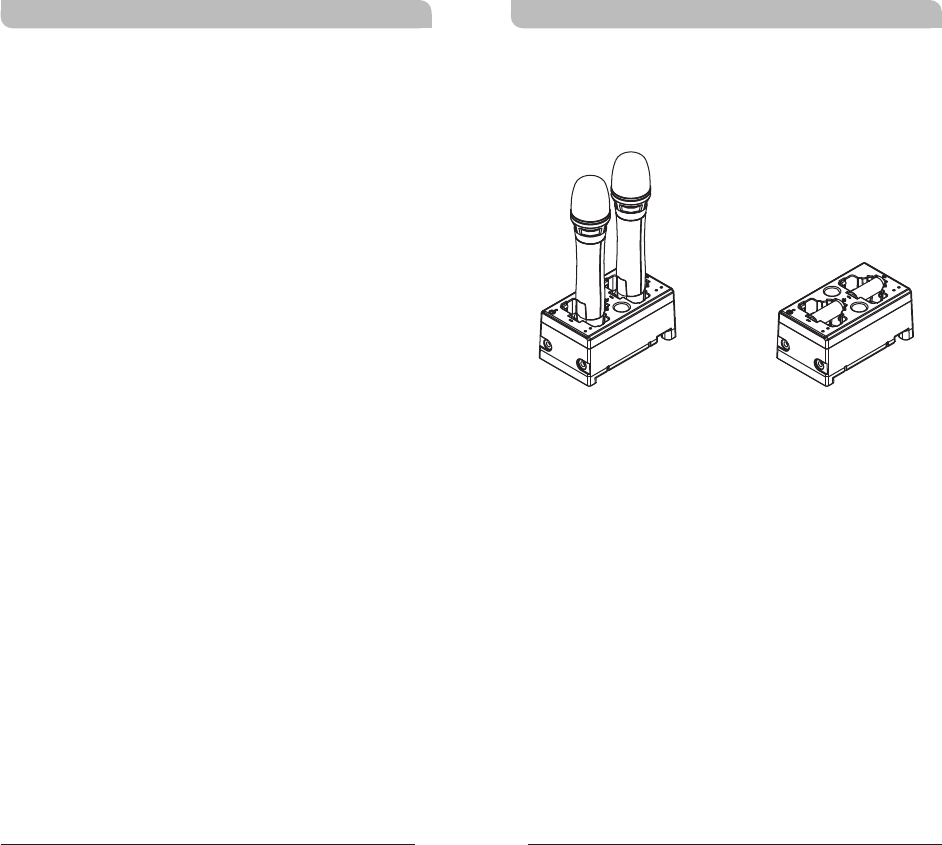
MP-80 Charger charges both transmitters and
18500 rechargeable batteries.
MP-80 Battery Charger (Optional)
18500 Charging
Transmitters Charging
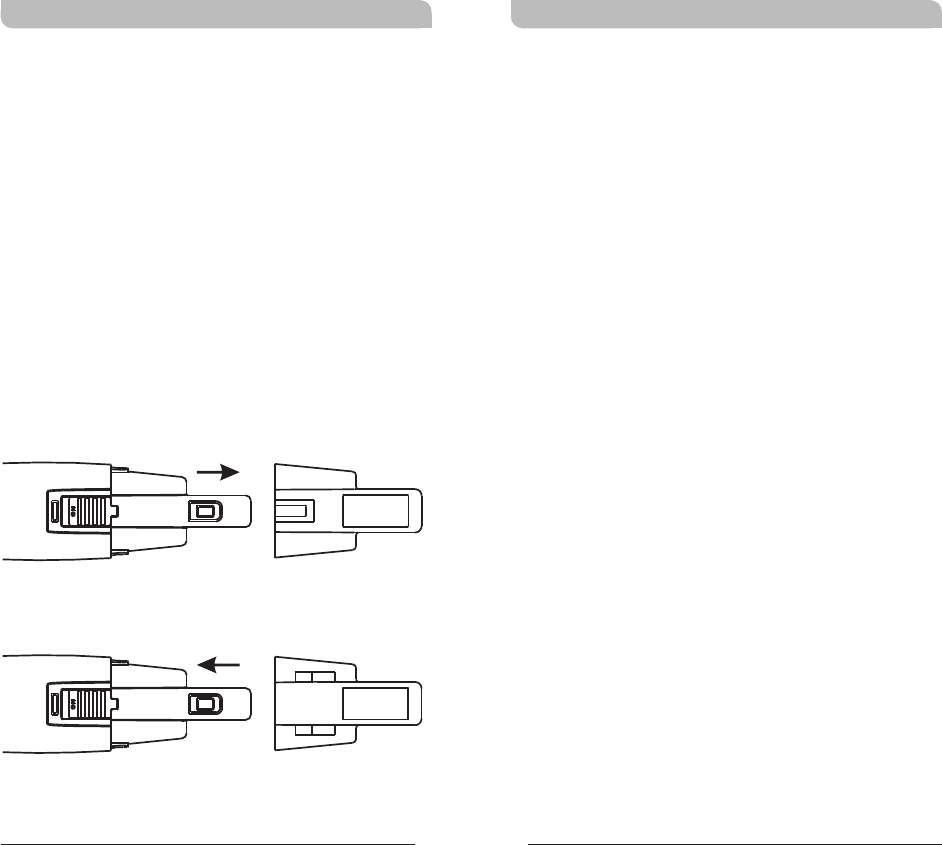
Rear cap has an On/Off switch protection
The patented color rear cap serves two purposes; it
provides easy channel identification and protects
the on/off switch. It is designed to allow the on/off
switch to either be exposed or concealed as
desired. You can avoid unintended switching off of
the microphone by rotating the color rear cap 180
degrees to cover the on/off switch completely. The
cap can be removed by gripping it firmly and
pulling; be sure to push it firmly into place when
replacing it on the microphone.
NOTE: During microphone usage, the color rear cap
must be installed.
Turn rear cap 180 degree and insert back
ON/OFF is covered
Press both sides and pull out to remove rear cap
76
Rechargeable Handheld Transmitter Rechargeable Handheld Transmitter
General Tips for Improving System
Performance
1. Performer should avoid holding the microphone over
or near the antenna section as this will deteriorate
transmission efficiency. Severe deterioration if
performer directly covers up the antenna section with
both hands.
2. Many performers tend to hold the microphone by the
top grille. Unfortunately, this position seriously
degrades both the sound quality and directionality of
a microphone. Even the most expensive microphones
will have its original sound quality compromised by
this method. Grabbing a microphone by the grille will
isolate the capsule's acoustic resonance circuit and or
change the capsule resonator's frequency. This
results in an inferior performance in both frequency
response and the separation of directionality. In
addition, a palm's sound-focusing effect will tend to
strengthen resonances in certain frequencies and can
cause unwanted echo.
3. A proper technique is required for using directional
microphones because the distance between the
microphone and your mouth has a significant impact
on sensitivity and performance. There is an inverse
relationship between microphone sensitivity and the
distance from the mouth to the microphone.
Consequently, performers with a ''weaker'' sound
level cannot expect to hold the microphone too far
away from their mouth and compensate by turning
up the amplifier volume to increase the sound level
as this can easily cause echo or feedback. In
contrast, performers with a ''louder'' sound level
should not hold the microphone too close as this can
easily result in distortion by causing the amplifier
system to be overloaded.
9
8
Rechargeable Handheld Transmitter Rechargeable Handheld Transmitter
4. Furthermore, a large-diaphragm directional
microphone has a very distinct proximity effect.
When the microphone is close to the mouth, the
bass response is strengthened as the distance
gets closer. Therefore, if a performer's sound is
insufficient in bass, they can hold the
microphone closer and use the proximity effect
to help compensate for the lower bass level.
Conversely, if a performer's voice is too heavy in
the bass register, increasing the distance
between the microphone and their mouth will
decrease the proximity effect and reduce the
bass response, thus making their voice become
clearer and brighter.
5. It is recommended to keep the grille and sponge
windscreen clean to avoid any substance blocking
the proximity effect of the microphone.
Notes
1. Refer to actual product in the event of product
description discrepancy.
2. Frequency range and maximum deviation comply
with the regulations of different countries.
WARNING
This symbol indicates that dangerous voltage
constituting a risk of electric shock is present within
this unit.
This symbol indicates that there are important
operating and maintenance instructions in the
literature accompanying this unit.
1. FOR OUTDOOR USE:
To reduce the risk of fire or electric shock, do not expose
this apparatus to rain or moisture.
2. UNDER WET LOCATION:
Apparatus should not be exposed to dripping or splashing
and no objects filled with liquids, such as vases should be
placed on the apparatus.
3. SERVICE INSTRUCTIONS:
CAUTION - These servicing instructions are for use by
qualified service personnel only. To reduce the risk of
electric shock, do not perform any servicing other than that
contained in the operating instructions unless you are
qualified to do so.
Dispose of any unusable devices or batteries
responsibly and in accordance with any applicable
regulations.
Disposing of used batteries with domestic waste is
to be avoided!
Batteries / NiCad cells often contain heavy metals
such as cadmium(Cd), mercury(Hg) and lead(Pb)
that makes them unsuitable for disposal with
domestic waste. You may return spent batteries/
accumulators free of charge to recycling centres or
anywhere else batteries/accumulators are sold.
By doing so, you contribute to the conservation of
our environment!
Disposal
2005-08-13

11
10
Rechargeable Handheld Transmitter Rechargeable Handheld Transmitter
FCC
THIS DEVICE COMPLIES WITH PART 74 OF THE FCC
RULES.
OPERATION IS SUBJECT TO THE FOLLOWING TWO
CONDITIONS:
(1) This device may not cause interference.
(2) This device must accept any interference, including
interference that may cause undesired operation of the
device.
This equipment complies with FCC RF radiation exposure
limits set forth for an uncontrolled environment.
IC
This device complies with Industry Canada RSS-210
ISSUE 8 standards. Operation is subject to the following
two conditions:
(1) this device may not cause interference, and
(2) this device must accept any interference, including
interference that may cause undesired operation of the
device.
Le présent appareil est conforme aux CNR d'Industrie
Canada applicables aux appareils radio exempts de licence.
L'exploitation est autorisée aux deux conditions suivantes:
(1) l'appareil ne doit pas produire de brouillage, et
(2) l'utilisateur de l'appareil doit accepter tout brouillage
radioélectrique subi, même si le brouillage est susceptible
d'en compromettre le fonctionnement.