Mobilaris 466B Longlife Personal Tag 466B User Manual
Mobilaris AB Longlife Personal Tag 466B
User Manual
User Manual:
Mobilaris long-life personnel tag
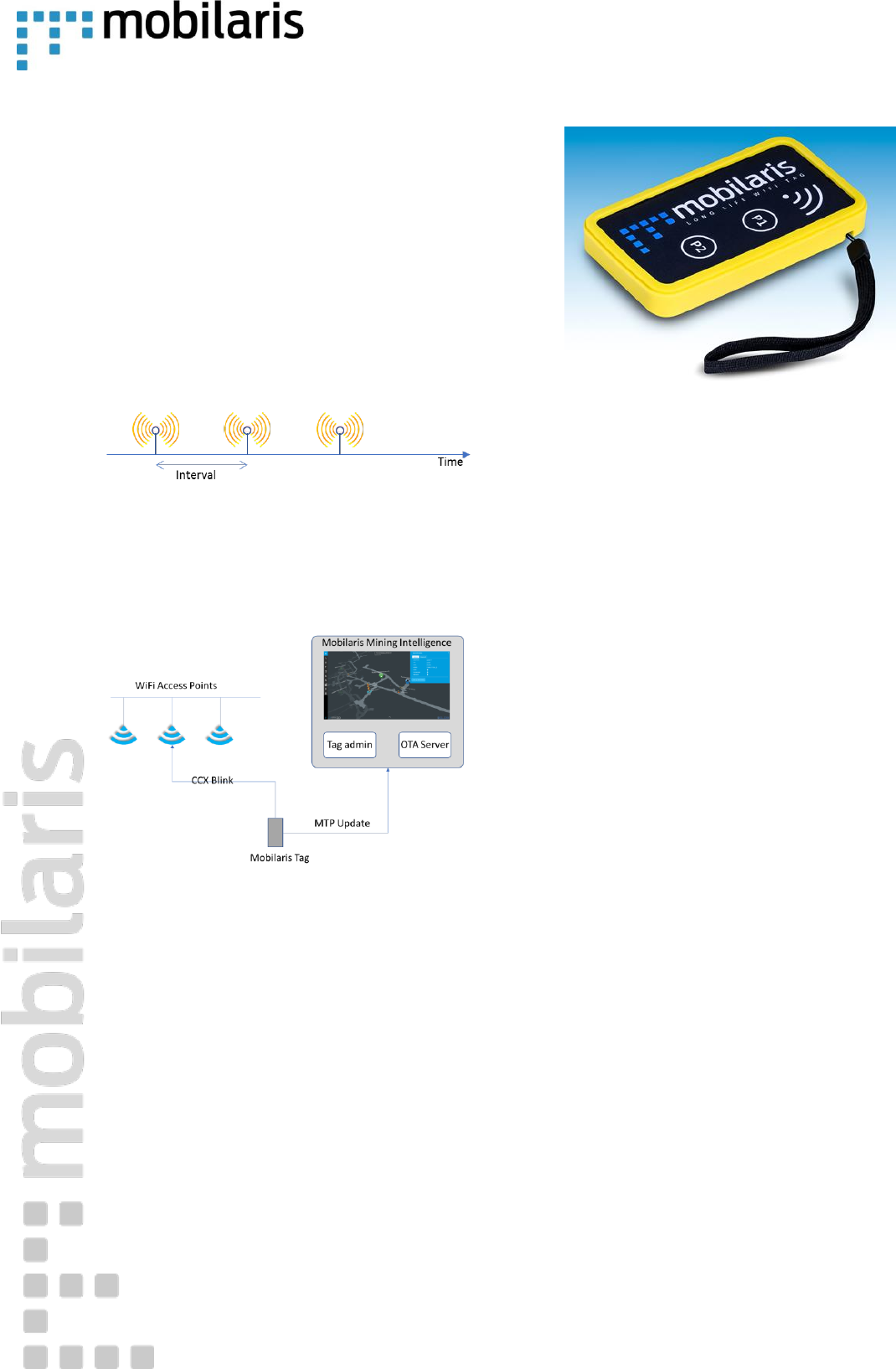
Mobilaris offers a set of various WiFi tags that enables
localization of personnel and mobile equipment (such
as vehicles or machinery) within the WiFi network.
These tags transmit a beacon signal (in CCX blink
mode, including the MAC address of the tag) in certain
intervals to the WiFi access points network. Using
special algorithms, the information is used to
determine the position of each tag.
Inside of a network where the Mobilaris Mining
Intelligence (MMI) system is not enabled, the tag will
continue to function as a standard WiFi tag, sending
out CCX blink signals at a defined standard interval or
at a factory configured interval.
If a tag is used within a network that supports the
Mobilaris Mining Intelligence system, more
functionality is enabled:
• Tags can be automatically updated over the air
(OTA) with software updates or new configuration
(such as blink rates, sleep times, IP address of the
receiving MMI etc).
• The Tag can be configured to communicate with
MMI when the tag is near an exciter (in order to
increase accuracy or to open a gate or similar).
• Personnel tags can be configured to communicate
with MMI when the user has pressed a dedicated
button on the tag.
The long-life personnel tag is equipped with a
powerful battery with a life cycle of up to three years
(depending on transmission rates and other
configurable parameters).
The tag has the following additional functionalities:
• Two multi-functional push-buttons (P1 and P2).
• A LED light indicator that provides specific
indications but can also be customized for various
indications.
• An additional antenna that can sense an optional
exciter (magnetic bubble) and trigger extra
beacons and MTP Updates sent up to MMI.
• A battery saving mechanism that can put the tag
into sleep mode by decreasing the blink rate and
by that increasing the battery time. This happens if
the tag has not been moving during a configurable
amount of time.
Using the Mobilaris Mining Intelligence system, the
tag can be configurated and its firmware can be
updated over the air (OTA). This can also be explicitly
achieved by a short press of the P2 button in normal
state or automatically over a configurable period of
time (i.e. every few hours/days).
In the unusual use case where a person configures a
tag erroneously so that the tag cannot reach the MMI
or the OTA server, there are procedures to get it back
to life:
• If a tag cannot connect to the MMI system, a
preconfigured fall-back OTA server can be utilized
by a long-press on the P2 button.
• If the P1 and P2 buttons are being pressed
together for 10 seconds, the tag is forced into a
hardware reset.
Using the push-buttons or the battery saving
mechanism, the tag can switch between three
different states as described to the right:
• Normal state
In this state the tag transmits beacon signals in a
configurable interval of time. If the tag receives a
transmission from an exciter, the tag is triggered to
transmit an additional MTP Update to the MMI
system with the identity of the exciter in order to
increase the accuracy of the positioning.
o If the P1 button is shortly pressed, the LED light
blinks red and the tag will try to connect to the
MMI for an MTP Update. This can be used for
customer specific operations such as forced
ventilation.
o If the P1 button is pressed for 10 seconds, the
LED light blinks red three times and the tag
enters hibernation state.
o If the P2 button is shortly pressed, the LED light
blinks green twice and then lights red while the
tag tries to connect to MMI in order to check for
any new OTA software or configuration.
o If the P2 button is pressed for 10 seconds, the
LED light blinks twice and then lights red while
the tag tries to contact a pre-configured fall-back
OTA server for a software update/configuration.
• Sleep state
If the tag’s battery saving mechanism senses that the
tag has not been moving for a configurable period of
time, the tag enters the sleep state. In this state, the
tag saves battery life by transmitting beacon signals
less frequently using a longer interval of time
between beacons (the interval time is configurable).
As soon as the tag’s battery saving mechanism
senses a movement of the tag, the tag immediately
switches back into normal state.
• Hibernation state
This is a state that normally is used when the tag is
not in used (i.e. kept in a storage or being
transported). In this state, no beacon signals or MTP
Updates are being transmitted. This state can only
be entered using a specific combination of the push
buttons.
o If the P1 button is shortly pressed, the LED light
blinks green and nothing happens.
o If the P1 button is pressed for 10 seconds, the
LED light blinks green three times and the tag
switches back to its normal state.
o If the P2 button is shortly pressed, the LED light
blinks red and nothing happens
o If the P2 button is pressed for 10 seconds, the
LED light blinks twice and then stays red while
the tag tries to contact a pre-configured fall-back
OTA server for a software update/configuration.
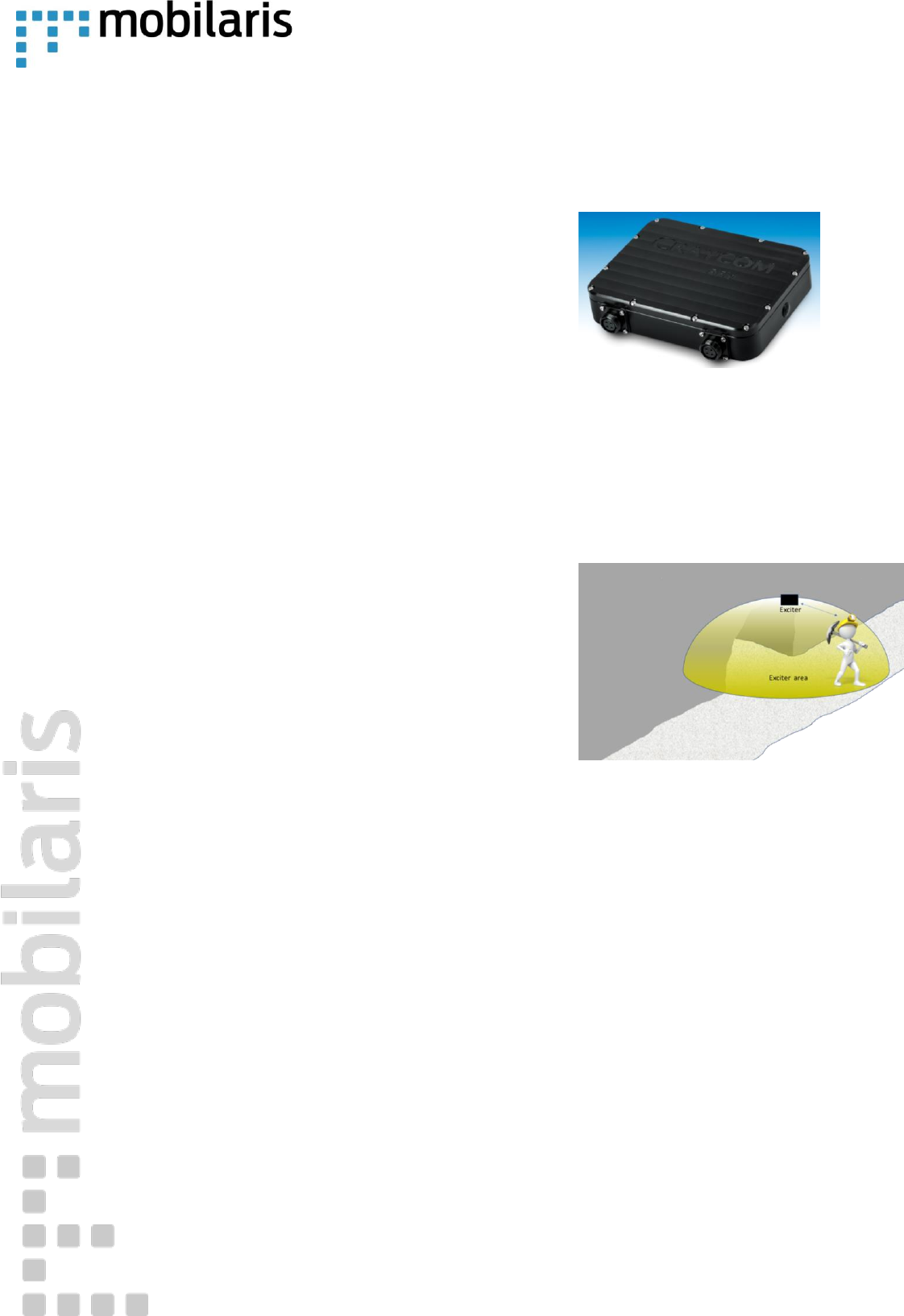
If a higher positioning accuracy is needed,
inductive exciters can be mounted in required
locations.
As the tag gets into the active area of the exciter,
it is triggered to transmit a Mobilaris Tag
Protocol (MTP) update to MMI with the identity
of the exciter. There are exciters in various
coverage area sizes, allowing the active area to
be customized.
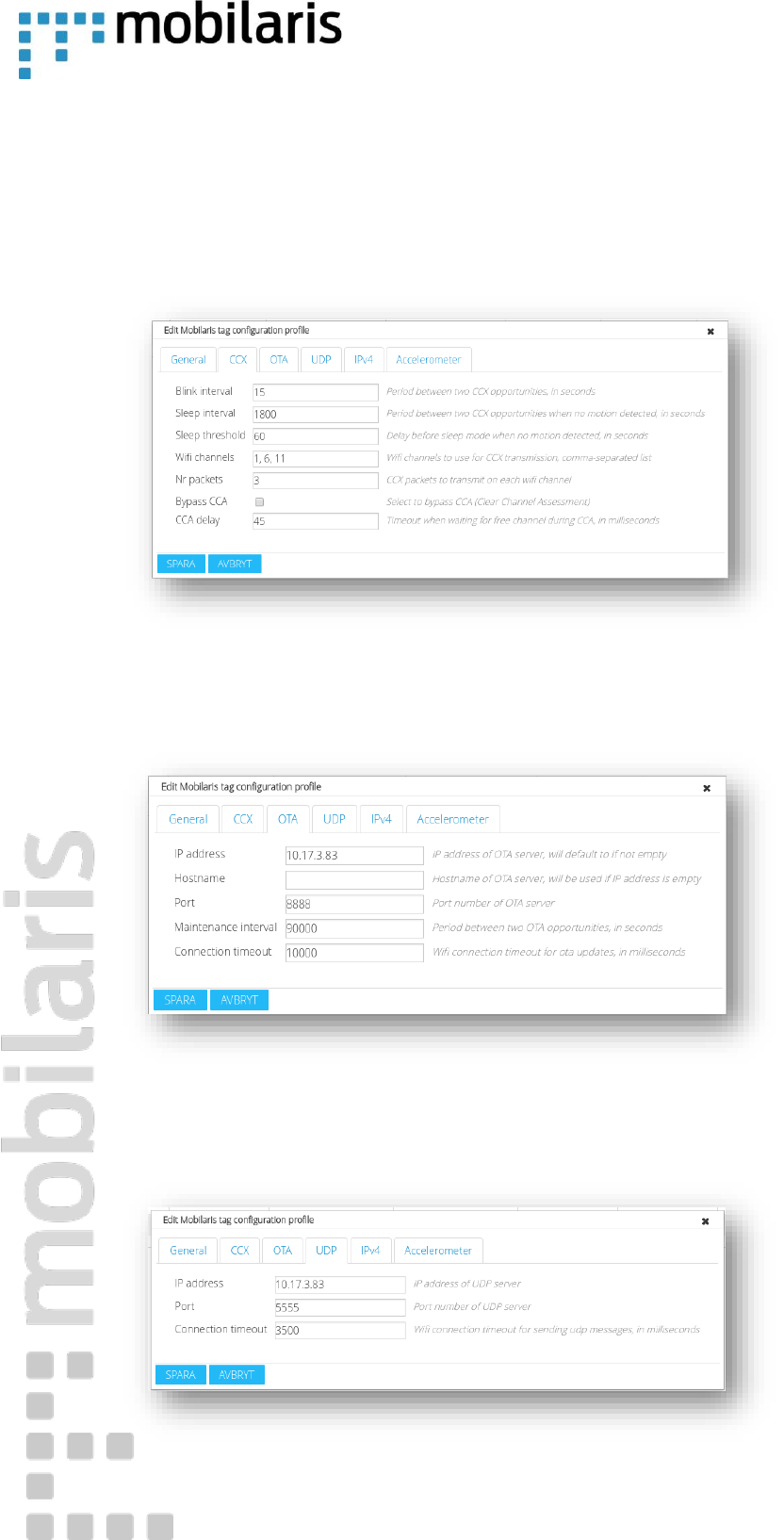
The Tag Configuration Tool in MMI 2.3
Various tag profiles can be created/defined in the
MMI GUI. Each profile has different parameter values
to be defined such as: blink interval, sleep interval,
sleep thresholds, WiFi channels, etc. From the MMI
GUI, profiles can be applied to all tags, a subset of tags
or a single tag.
In addition, the OTA (over the air) server can be
configurated in a way that will determine from which
server the tags will fetch software and configurations
updates. Moreover, it is possible to define how often
the tag will check for new updates.
It is also possible to configure the IP
address/hostname of the MMI server that shall
receive the tags’ MTP Updates:

Regulatory & Safety Notices
Model Name: 466B
FCC ID: 2AL7A-466B
IC ID: 22755-466B
Federal Communications Commission (FCC) statement:
The FCC and Industry Canada IDs can also be viewed on
your device.
This device complies with FCC part 15 FCC Rules.
Operation is subject to the following two conditions:
1. This device may not cause harmful interference and
2. This device must accept any interference, including
interference that may cause undesired operation of the
device.
FCC Warning
Changes or modifications not expressly approved by
Mobilaris could void the user’s authority to operate the
equipment.
Note: This equipment has been tested and found
to comply with the limits for a Class B digital device,
pursuant to part 15 of the FCC Rules. These limits are
designed to provide reasonable protection against
harmful interference in a residential installation.
This equipment generates, uses and can radiate radio
frequency energy and, if not installed and used in
accordance with the instructions, may cause harmful
interference to radio communications. However, there is
no guarantee that interference will not occur in a
particular installation. If this equipment does cause
harmful interference to radio or television reception,
which can be determined by turning the equipment off
and on, the user is encouraged to try to correct the
interference by one or more of the following measures:
• Reorient or relocate the receiving antenna.
• Increase the separation between the equipment and
receiver.
• Connect the equipment into an outlet on a circuit
different from that to which the receiver is connected.
• Consult the dealer or an experienced radio/TV
technician for help
European Union (EU)
Declaration of Conformity with Regard to the EU Directive
1999/5/EC.
Mobilaris is authorized to apply the CE Mark on the
Mobilaris long-life personnel tag, Model 466B, thereby
declaring conformity to the essential requirements and
other relevant provisions of Directive 1999/5/EC and
other applicable Directives.
Compliant with the standard R&TTE 99/CE/05
Conforme à la norme R&TTE 99/CE/05
Canada: Industry Canada (IC) statement
IC Notice to Users English/French in accordance with RSS
GEN Issue 3:
This device meets the FCC and IC requirements for RF
exposure in public or uncontrolled environments.
Cet appareil est conforme aux conditions de la FCC et IC
en matière de RF dans des environnements publics ou
incontrôlée
This device complies with Industry Canada license exempt
RSS standard(s).
Operation is subject to the following two conditions:
1. this device may not cause interference, and
2. this device must accept any interference, including
interference that may cause undesired operation of the
device.
Cet appareil est conforme avec Industrie Cana
da RSS standard exempts de licence (s).
Son utilisation est soumise à Les deux conditions
suivantes:
1. cet appareil ne peut pas provoquer d’interférences et
2. cet appareil doit accepter Toute interférence, y compris
les interférences qui peuvent causer un mauvais
fonctionnement du dispositive