Moultrie Feeders MFH-ACT FEEDER ACTIVATOR User Manual USERS MANUAL
Moultrie Feeders FEEDER ACTIVATOR USERS MANUAL
USERS MANUAL
ABOUT THE FEEDER ACTIVATOR
Instructions for the Feeder Activator
THANK YOU for your purchase of the Feeder Activator, a
top quality Moultrie product. Please read this sheet before
assembling the unit. If you should have any questions about
this or any other Moultrie product, please contact us using the
information on the reverse side of this sheet. To help us to
better serve you, please complete and mail the enclosed
Warranty Card.
The Feeder Activator allows a feeder motor to be remotely
activated from up to 300 feet away.
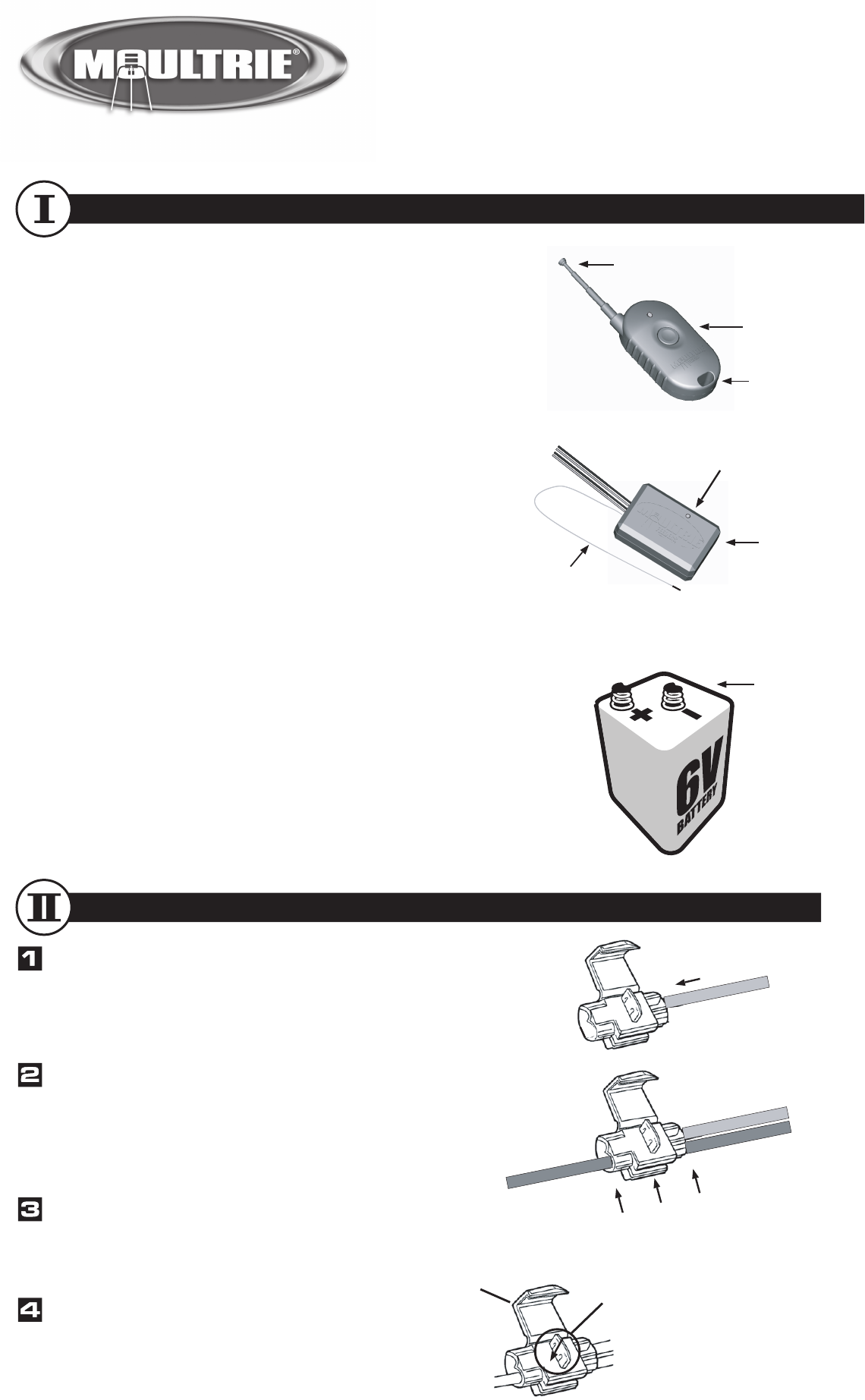
The Feeder Activator consists of a Receiver that mounts in
your wildlife feeder and a Handheld Transmitter.
When the button is pressed on the Transmitter, a signal is
sent to the Receiver which activates the Feeder motor for a
period of five seconds.
The Transmitter is powered from a 12 volt Remote Control
Battery (Radio Shack #23-154) and the Receiver is powered
from your 6 volt Feeder Battery.
The Feeder Activator works with most 6 volt wildlife
feeders that meet the following requirements:
a) When the battery is installed in the feeder, the positive
and negative contacts are exposed and accessible - enabling
the connection of the Feeder Activator power wires (with
alligator clips).
b) The two wires that run between the feeder circuit board
and the motor are accessible - enabling the connection of
the Feeder Activator motor wires.
The Feeder Activator may be used in a metal Feeder
enclosure if the Antenna Wire can be routed outside the
box.
WIRING THE RECEIVER
Handheld
Transmitter
Receiver
Mounts
Inside
Feeder
Battery
contacts
must be
accessible
Disconnect the battery from the Feeder. Holding one of
the provided Connectors in the orientation shown, push
the Receiver’s Red Motor Wire into the rear hole until it
reaches the internal stop.
Slide the positive wire that runs between the Feeder’s
circuit board and the motor into the side of the
Connector as shown. The positive wire may be red in
color, marked “positive”, or not identified. If it is not
identified, select either wire.
Repeat steps 1 through 3 for the
Black Negative Wire.
Connector
Antenna Wire
Status Light
Receiver’s Motor Wire
Motor Wire from Feeder Circuit
Board to Motor
Metal Contact Tab
Plastic Cover
With pliers, squeeze the metal contact tab down
until it is even with the surface of the plastic. Close
the Plastic Cover until it snaps into place.
Transmitter Antenna
Activation
Button
030606R6 / MFH-ACT
MOUNTING RECEIVER
CHECKING CONNECTIONS
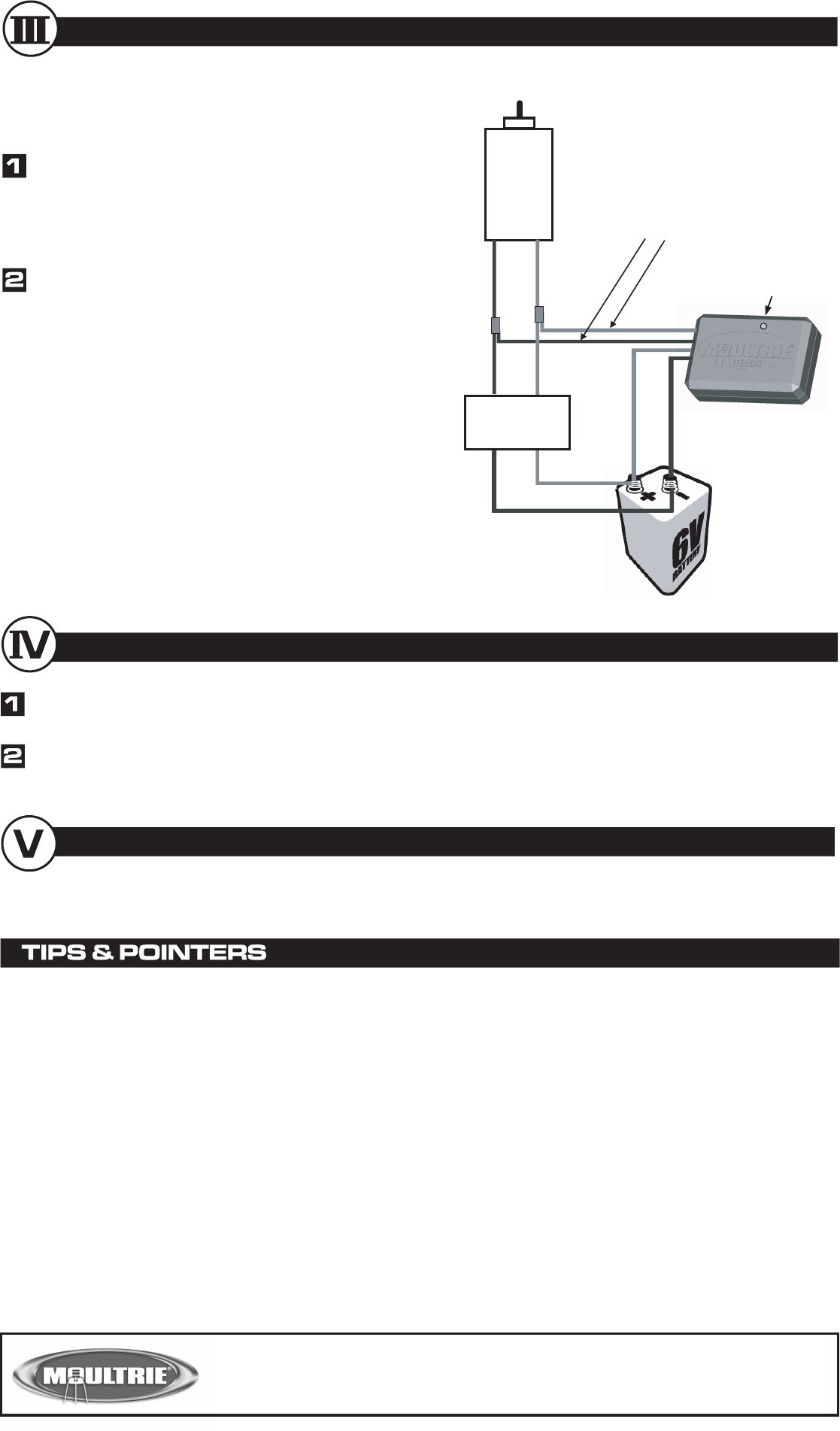
Connect the battery to the Feeder and then to the
Receiver. Connect the Red Wires to the positive
terminal (+) and the Black Wires to the negative (-)
terminal.
STATUS LIGHT BLINKING
Open the Plastic Cover on the Connectors and
carefully pry open with a screwdriver. Pull-up
on metal clip with pliers to release the wires.
Swap the motor wires as shown. Refer back to
Section II for details on connection.
Immediately following connection of the battery,
the red Status Light on the Receiver will be on
solid or blinking:
The Receiver is equipped with an internal diagnostic
function that checks the wiring to the motor and
provides feedback via a red Status Light.
OPERATING UNIT
Feeder Circuit
Board
Motor
Status Light
If Status Light is blinking,
these two wires need to be
swapped at the Connectors
Receiver
Battery
Remove the protective cover from the double sided tape on the back of the Receiver. Position the
Receiver on a clean and dry location inside the Feeder.
Route the white Antenna Wire inside the plastic Feeder enclosure. The Antenna Wire should not
be folded or in contact with the motor. If using the Feeder Activator in a metal Feeder enclosure,
the Antenna Wire must be routed outside the box in an area that is not accessible by varmints.
To activate the Feeder motor for a period of five seconds, fully extend the Transmitter Antenna and
hold the Activation Button until the Feeder runs.
2: (Q) Will the Feeder Activator decrease the battery life in my
feeder?
(A) The Feeder Activator has been optimized to use minimal power;
however, it will have a slight impact on the overall life of your
feeder’s battery.
STATUS LIGHT ON SOLID
To test the Feeder Activator, stand back from
the feeder and press the button on the
Transmitter. Feeder motor will run for a period
of five seconds. If motor does not run, check
connections to Battery and to motor as shown.
1: (Q) What should I do if the Feeder Activator isn't working?
(A) Check the connections on the feeder battery to make sure
alligator clips have not come loose. Then check the feeder battery
by changing to a known good battery. Lastly, check the battery in
the Transmitter by changing it to a known good battery.
Our Service Department will gladly answer any questions you have. Call
205-664-6700 or 800-653-3334, Monday - Friday, 8:00 AM to 5:00 PM CST.
See Moultrie's entire line of feeders, game cameras and accessories online at
www.moultriefeeders.com. 150 Industrial Road, Alabaster, AL 35007
TRANSMITTER
This device complies with part 15 of the FCC Rules. Operation is subject to the following two conditions: (1) This device may not cause harmful interference, and (2) this
device must accept any interference received, including interference that may cause undesired operation.
Part 15.21
Changes or modifications not expressly approved by the party responsible for compliance could void the user’s authority to operate the equipment.
NOTE: The manufacturer is not responsible for any radio or TV interference caused by unauthorized modifications to this equipment. Such modifications could void the
user’s authority to operate the equipment.
RECEIVER
NOTE: This equipment has been tested and found to comply with the limits of Part 15 of the FCC Rules. These limits are designed to provide reasonable protection against
harmful interference in a residential installation. This equipment generates, uses and can radiate radio frequency energy and, if not installed and used in accordance with the
instructions, may cause harmful interference to radio communications. However, there is no guarantee that interference will not occur in a particular installation. If this
equipment does cause harmful interference to radio or television reception, which can be determined by turning the equipment off and on, the user is encouraged to try to
correct the interference by one or more of the following measures:
• Reorient or relocate the receiving antenna.
• Increase the separation between the equipment and receiver.
• Connect the equipment into an outlet on a circuit different from that to which the receiver is connected.
• Consult the dealer or an experienced radio/TV technician for help.