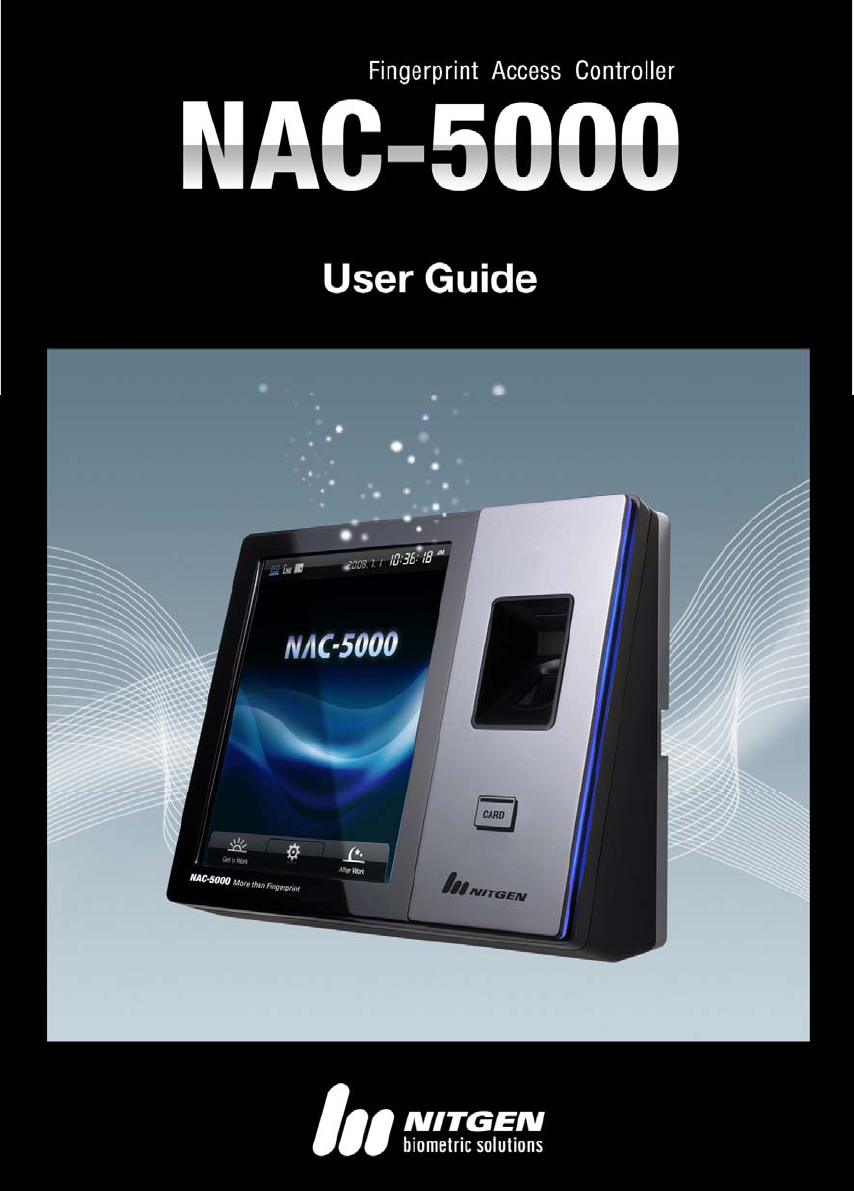
NITGEN and NAC-5000M COMMERCIAL User Manual
NITGEN & COMPANY COMMERCIAL
Users Manual

© Copyright 2009, NITGEN&COMPANY Co., Ltd.
All rights reserved. `
z
Unauthorized reproduction of part or all of this manual’s content in any form is
prohibited.
z
Product specifications may change without prior notice to improve functionality.
z
NITGEN and the NITGEN logo are registered trademarks of NITGEN.
z
Other names and trademarks belong to respective companies.
z
The font used in this product is Naver’s “Nanum”.
NITGEN Customer Service Center
Tel: 080.060.1600
(Toll Free)
Fax: 02.513.2191
Email: customer@nitgen.com

3
Table of Contents
C
HAPTER
1
G
ETTING
S
TARTED
................................................................................... 4
P
RODUCT
I
NTRODUCTION
............................................................................................ 5
P
RODUCT
C
OMPONENTS
............................................................................................. 6
S
YSTEM
C
ONFIGURATION
............................................................................................ 7
P
RODUCT
D
ESCRIPTION
.............................................................................................. 9
T
OUCH
S
CREEN
U
SAGE
............................................................................................ 12
C
HAPTER
2
A
DMINISTRATOR
M
ENU
........................................................................... 14
E
NTERING
M
ANAGEMENT
M
ENU
................................................................................ 15
U
SER
M
ANAGEMENT
................................................................................................. 18
UI
&
S
OUND
S
ETTING
............................................................................................... 27
N
ETWORK
S
ETTING
................................................................................................... 30
S
ERIAL
C
ONNECTION
................................................................................................ 35
A
UTHENTICATION
O
PTION
S
ETTING
........................................................................... 36
T
ERMINAL
I
NFORMATION
D
ISPLAY
............................................................................. 47
USB
M
EMORY
C
ONNECTION
..................................................................................... 50
T
ERMINAL
I
NITIALIZATION
.......................................................................................... 51
C
HAPTER
3
G
ENERAL
U
SER
...................................................................................... 53
D
OOR
O
PENING
........................................................................................................ 54
A
UTHENTICATION IN
A
TTENDANCE
M
ODE
.................................................................. 56
C
HANGING
U
SER
I
NFORMATION
................................................................................. 58
A
PPENDIX
................................................................................................................. 59
A
PPENDIX
................................................................................................................. 60
T
ROUBLESHOOTING
.................................................................................................. 60
F
IRMWARE
U
PDATE
................................................................................................... 64
P
RODUCT
S
PECIFICATIONS
....................................................................................... 65

4
Chapter 1 Getting Started
Product Introduction - 5
Product Components - 6
System Configuration - 7
Product Description - 9
Touch Screen Usage - 12
5
Product Introduction
The NAC-5000 Access Control System developed by Nitgen
combines the company’s core technologies such as fingerprint
recognition algorithms, optical sensors, embedded design, and
software applications.
The NAC-5000 allows administrators to remotely monitor and
manage geographically dispersed terminals for maximum
efficiency.
For greater user convenience, the NAC-5000 has a 5.7” TFT-LCD
touch screen. The NAC-5000 also offers functions such as RF
card, password, and fingerprint recognition which can be
combined as desired.
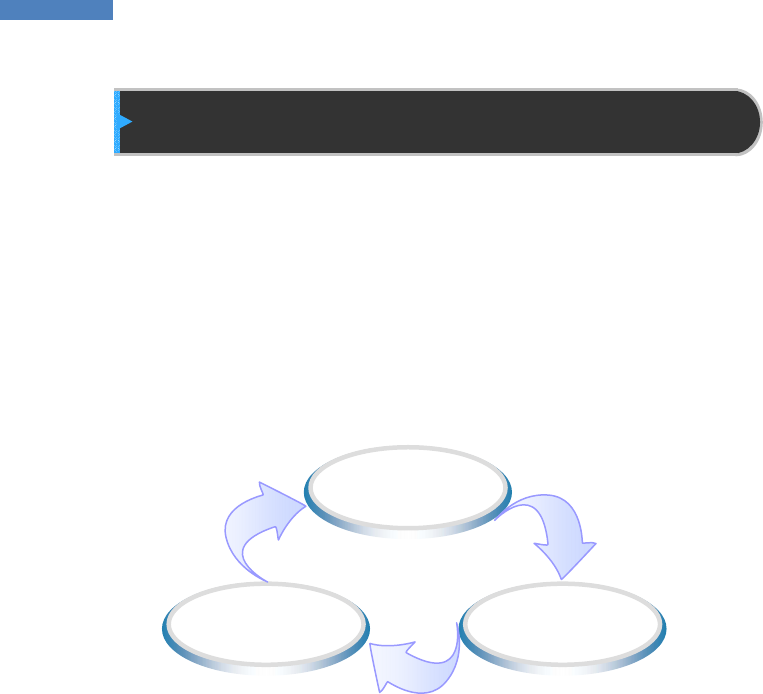
Biometric
technology
Ergonomic
Design
User-friendly
software
6
Product Components
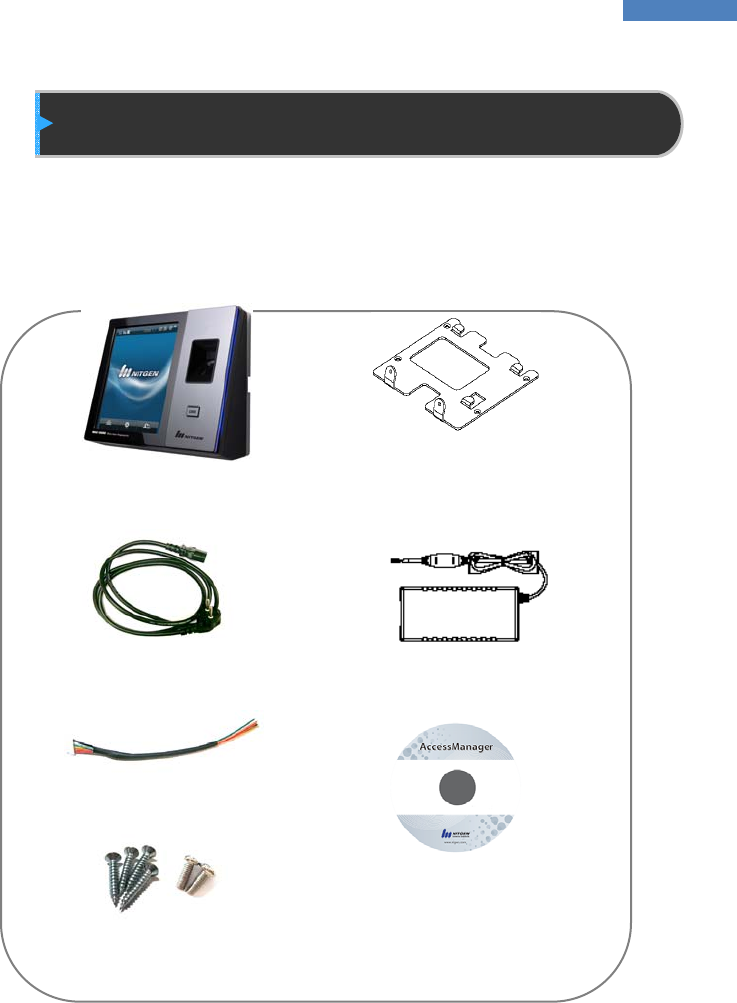
The NAC-5000 includes the following components. For detailed
information about installation, see the installation guide. If any of the
following items is missing, contact the Customer Support Team.
NAC-5000 Terminal Installation Bracket
Power Cord Adapter
Door/AUX Cable
Software CD
Bolts
7
System Configuration
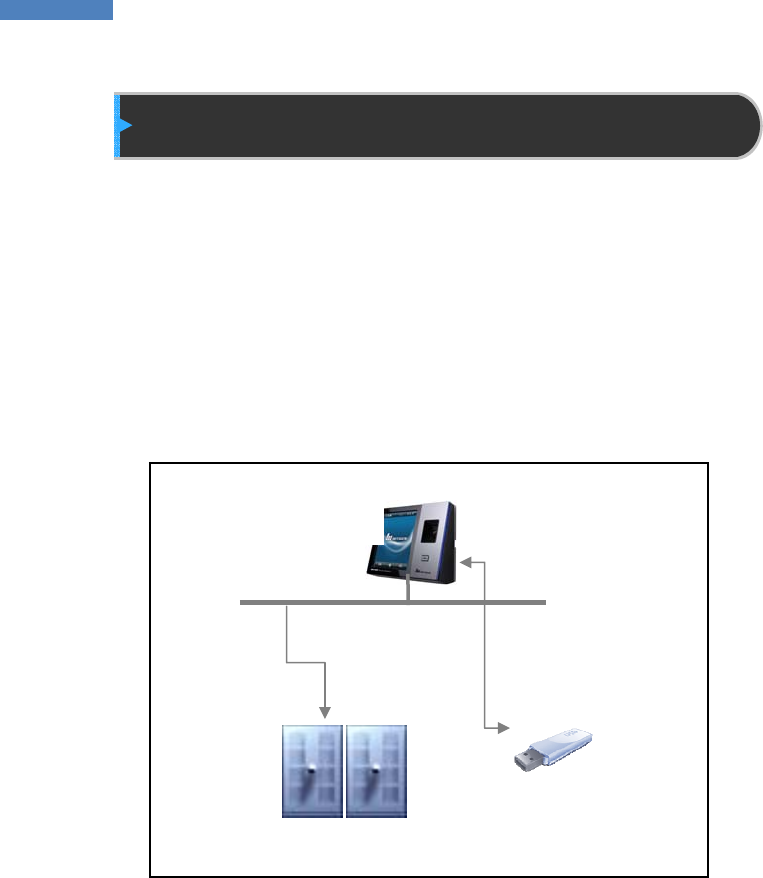
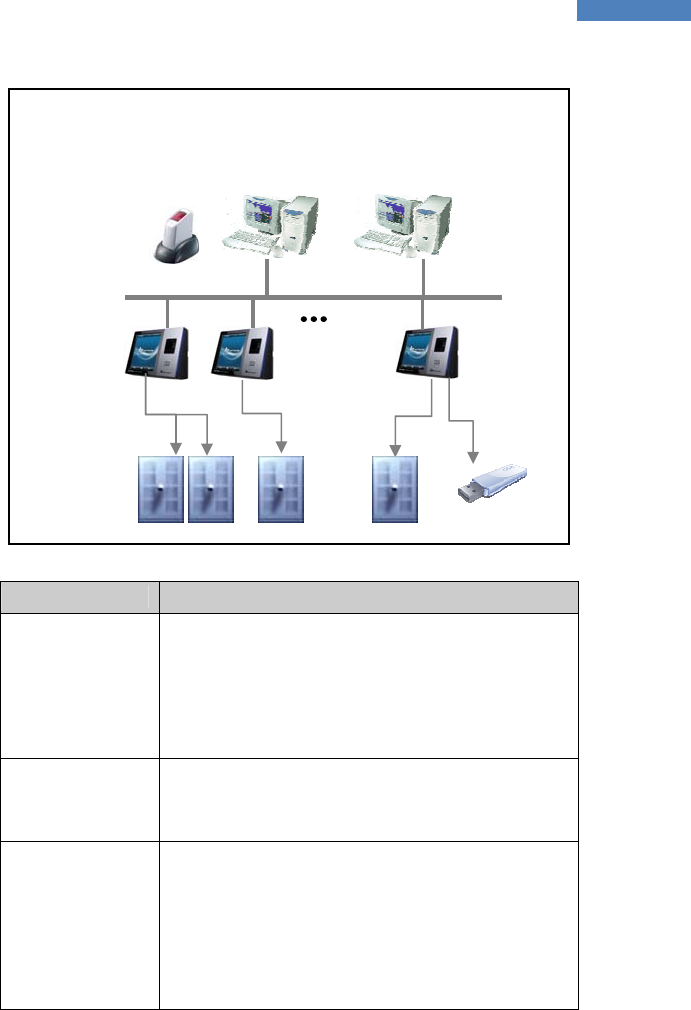
The Access Control Terminal (NAC-5000) can function either in the
network or standalone mode. In standalone mode, all functions are
available and the terminal does not need to be connected to the
network. In network mode, multiple terminals are connected to the
server through TCP/IP links and the terminals can be managed by
the administrator.
To use NAC-5000 in network mode, a server and a management
program (Access Manager Professional) must be installed.
Standalone Mode
8
Item Functions
Server PC
1. Server S/W: Access Manager
Professional
2. Terminal management, communication
and log data collection
3. User profile and log data DB
4. Authentication
Client PC
1. Client S/W: Remote Manager
2. User registration and management
3. Terminal status and event monitoring
Terminal
(NAC-5000)
1. User registration, modification, deletion
and checking
2. Consecutive registration of card-only
users
3. Warning/Alarm handling
4. Announcements (To be included in future)
5. Door control
TCP/IP
Server PC Client PC
Network Mode
9
Product Description
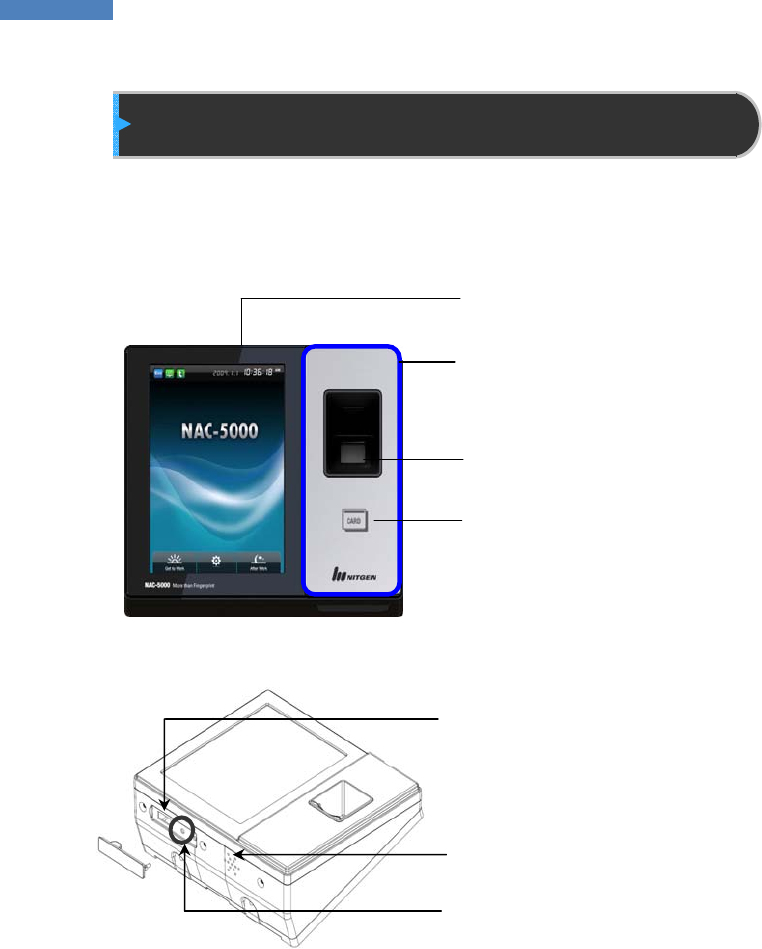
③ Fingerprint Input: The user places
his/her finger for authentication.
④ Card Input: The user places his/her
card for authentication.
⑥ Speakers: emits voice instructions,
alarms, and other sounds.
⑤ USB Input: USB memory
connection port
⑦ Reset button: Resets
the terminal.
10
LCD Screen
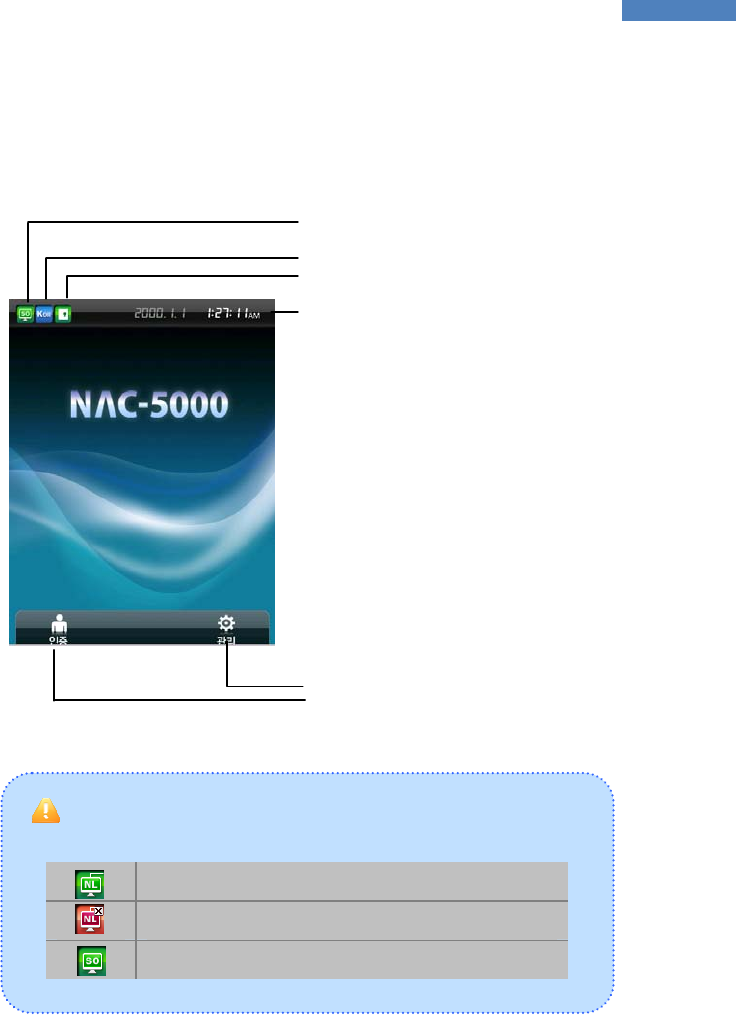
The following symbols are displayed depending on the network
connection status and the mode.
Connected to the network in network mode.
Not connected to the network in network mode.
Standalone mode.
① Network connection status
② Language: Language used on the LCD
③ Door status: Displays whether door is open.
④ Time: Displays the present time.
⑤ Management Menu: Selects
management menu
⑥ Authentication button: Authenticates
users before opening the door.
11
Fingerprint Reading
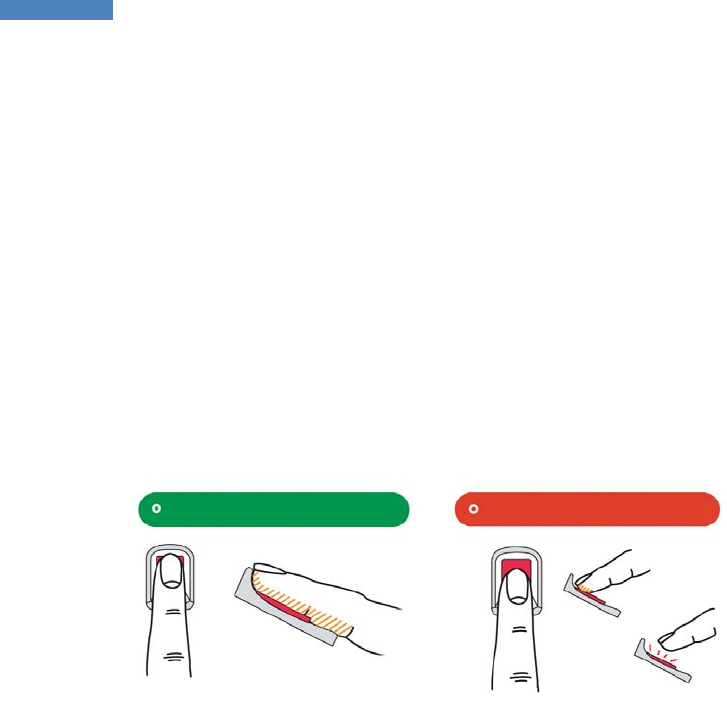
Scan fingerprints as described below for fingerprint registration and
authentication to prevent authentication errors.
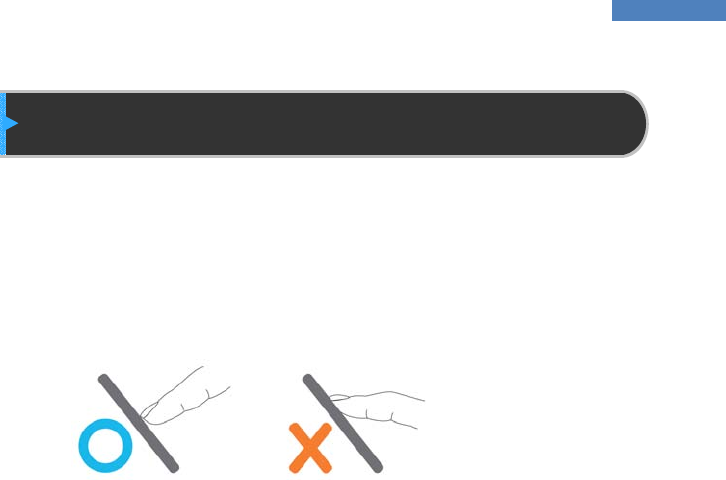
① Maximize the finger area scanned and press evenly (70 ~ 80%
of full pressure).
② Place the “core” of the fingerprint at the center of the scanner.
The core is usually opposite the whitish half-moon on the bottom
of the fingernail. Therefore, place the half-moon part at the
center of the scanner when scanning.
Correc
t
Incorrec
t
12
Touch Screen Usage
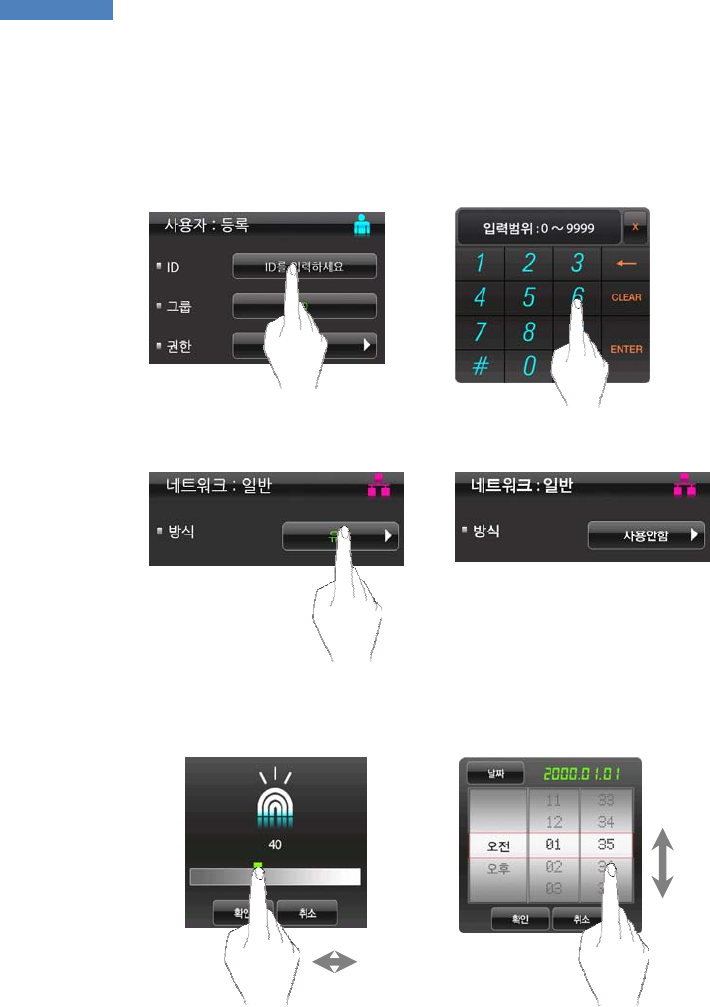
When using the touch screen, use the end of the finger or the nail
because the screen may not recognize larger finger surfaces. If the
locations of the finger’s contact and removal are different, the touch
function may not work properly.
If the touch function is slow to respond or does not work, change the
touch sensitivity by referring to “Chapter 2 Administrator Menu –
Terminal Initialization – Touch Calibration.”
Grime or dust on the touch screen may result in less sensitivity. Keep
the touch screen clean.
13
Touch Menu Setting
① To directly enter values in the Management menu, press the
Setting button, enter the data, and press the “Enter” button.
② If the default setting is already displayed, enter the new value
to change it.
③ To change options such as sensor brightness, sound volume,
or the date, press the arrows or numbers and move the finger
up and down or left and right.

Chapter 2 Administrator Menu
Entering Management Menu - 15
User Management - 18
UI & Sound Setting - 26
Network Setting - 29
Serial Connection - 33
Authentication Option Setting -
34
Terminal Information Display - 42
USB Memory Connection - 45
Terminal Initialization - 46
15
1. If no administrater was designated and only general users were
registered in network mode, all users will be allowed to enter the
Management menu.
2. If 1:N authentication is used, an administrator with a registered
fingerprint can enter the Management menu using fingerprint
authentication without entering his ID.
Entering Management Menu
Terminal users include general users and administrators. General
users are only allowed to open the door while the administrator can
use the Management menu to control the door as well as the
terminal’s functions.
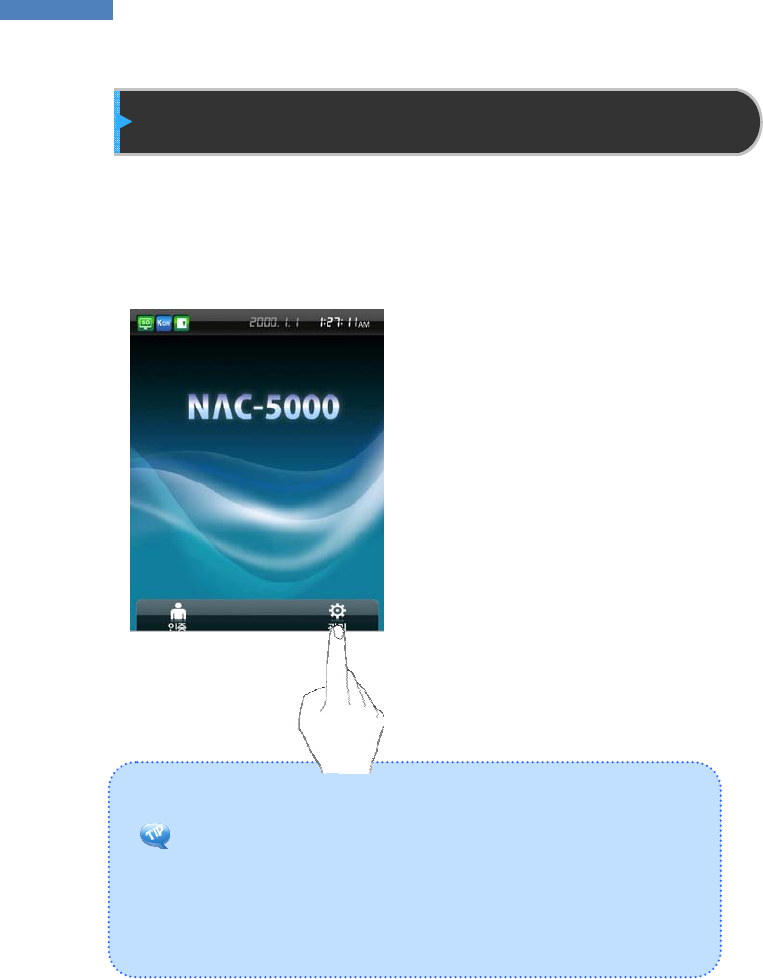
1. To enter the Management
menu, touch the
“Management” button at the
lower right of the screen.
2. Input the administrator ID and
follow the authentication
process. The Management
menu will be displayed.
Because no users have yet
been added, any user can
enter the Management menu.
At least one administrator for
should be registered for
security purposes.
16
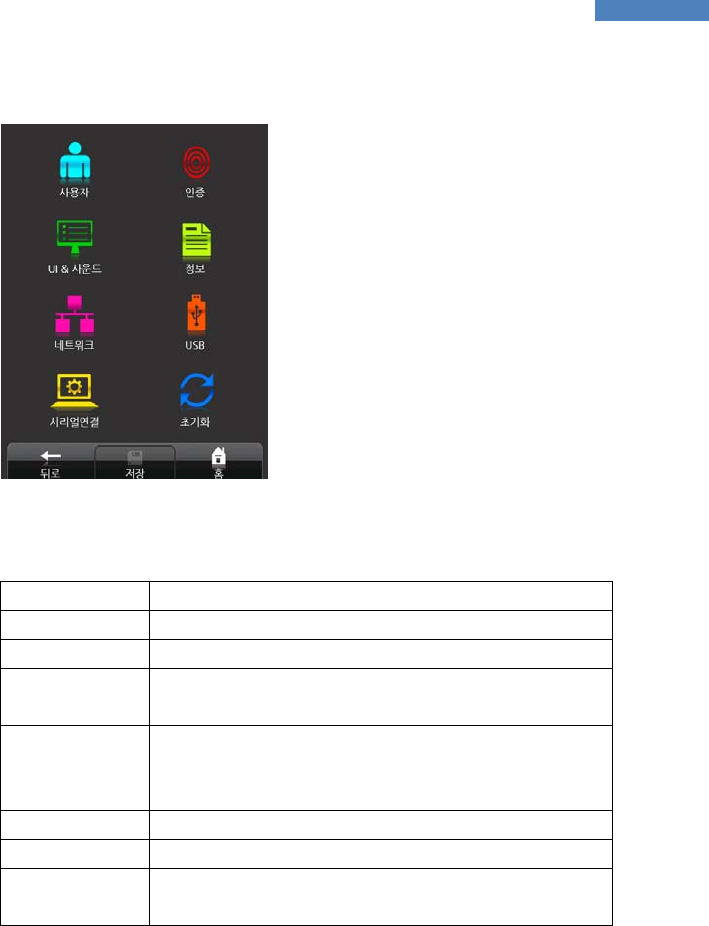
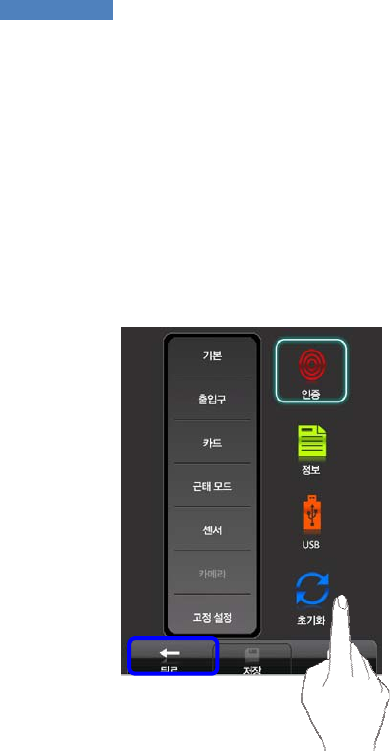
The Management menu has eight submenus as shown below.
The following describes each sub menu:
User User register, delete, change, and search.
UI & Sound Set language, background screen, and volume.
network Network mode and TCP/IP setting.
Serial
Connection
Wiegand, 485connection
Authentication Authentication options, ID length, Fingerprint
count, Attendance mode, sensor, Door, Camera
setting
Information General/Time Zone/Log displays, Self-diagnosis
USB User, Log Upload/Download, Firmware Update
Initialization DB Initialization, Touch Calibration, Terminal
Reset
17
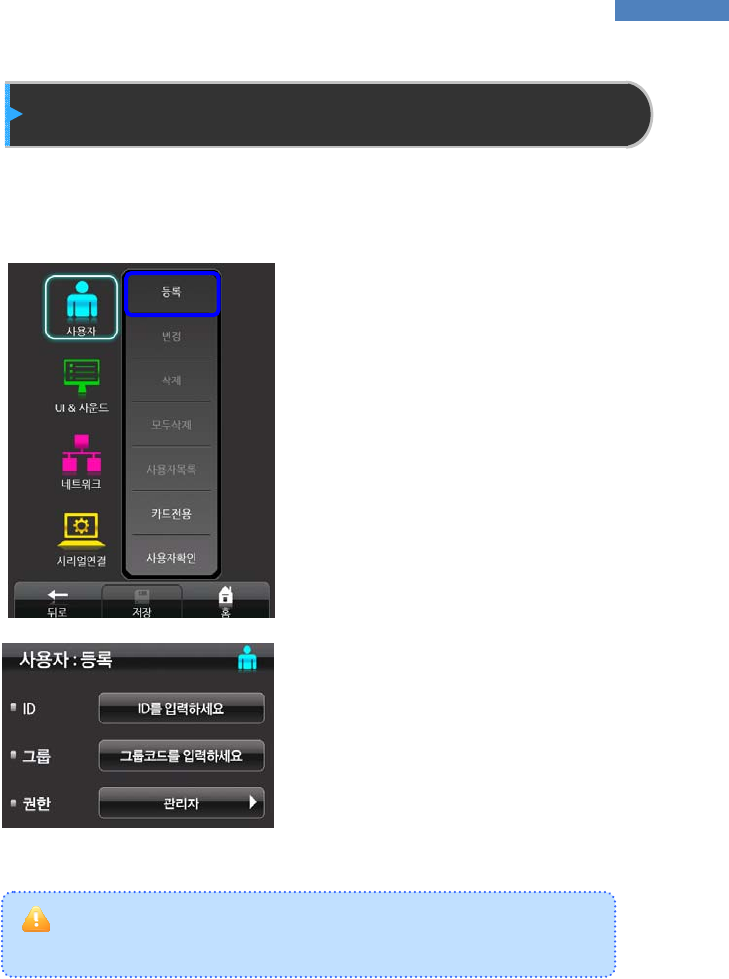
Using Management Menu
To select a submenu of the Administrator menu, touch an icon. To
exit the Administrator menu, touch the “Back” button at the lower-left
of the screen.
To close the Management submenu, touch any blank area on the
screen.
18
The first person to be registered at the terminal is automatically registered
as the administrator.
User Management
The administrator can register, delete, change, or search users with
the User menu.
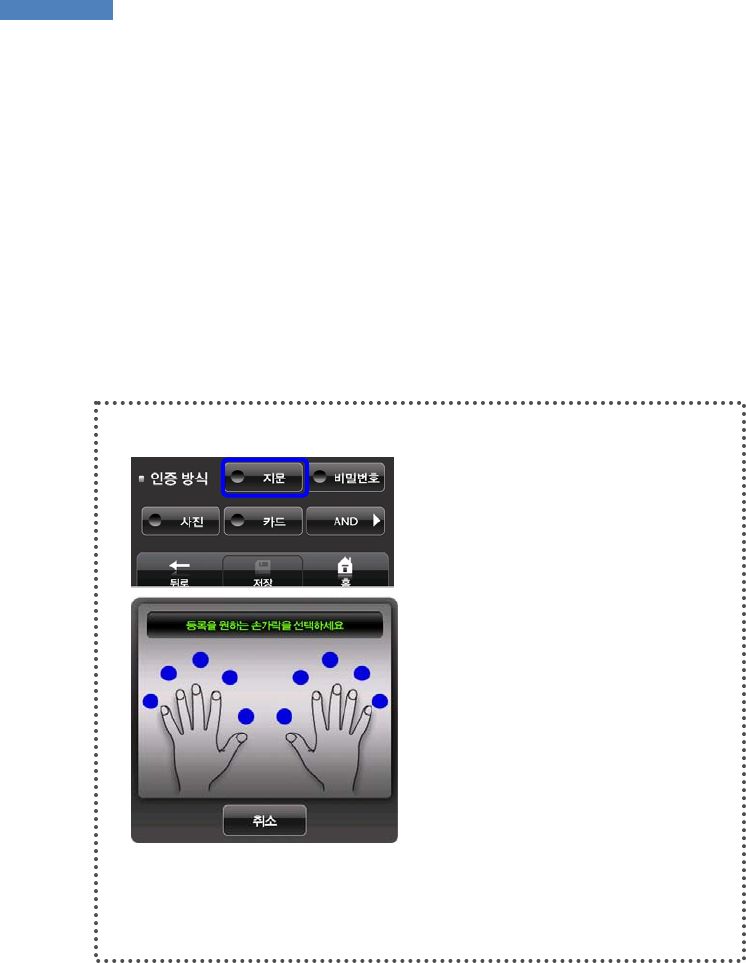
User Registration
1. Touch Management menu ->
User -> “Add” to register a
user.
2. Touch “Enter ID” button and
enter the user ID. Then,
touch the “Input group code”
button and enter the group
ID.
19
3. In “Authority” touch the “Administrator” button to change the
authority. Select General User or Administrator.
General User: Door Control Authority
Administrator: Door Control + Management Menu Authority
4. The user can be registered using fingerprint, password, or card
authentication. More than one authentication method must be used
to register. After registering, select the authentication checking
method and touch the “Save” button to finish the registration.
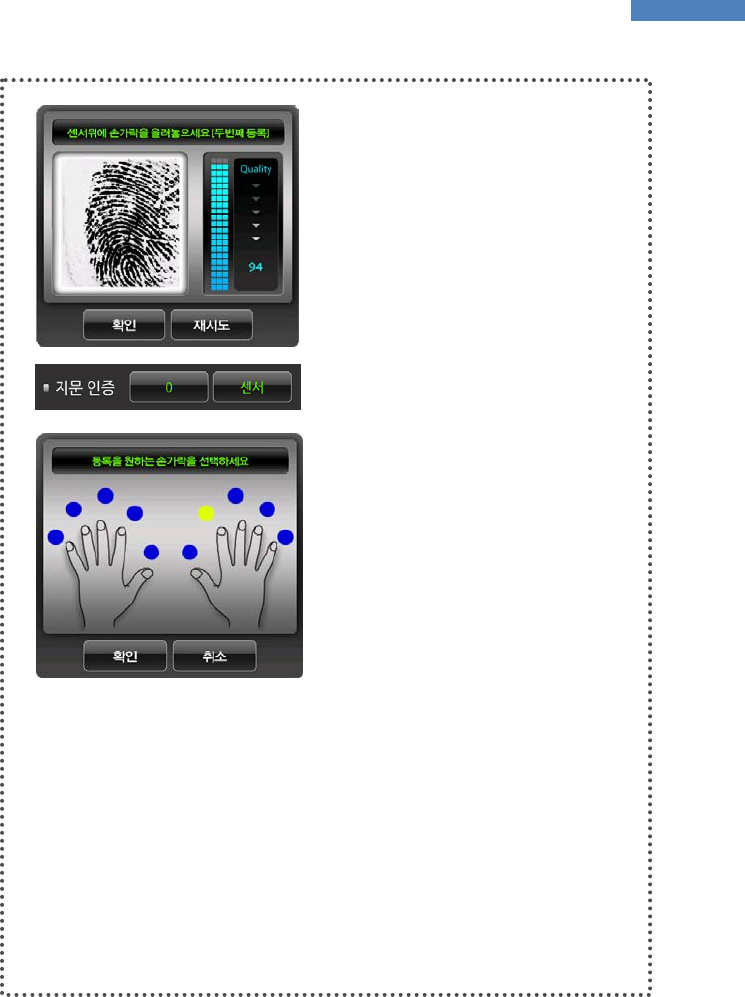
Fingerprint Authentication
① Touch the “Fingerprint” button
in “authentication method”. The
fingerprint registration screen will
appear. Select a finger to register.
20
② Place a finger on the sensor.
The fingerprint will be displayed
with a quality indicator. The
fingerprint must score at least 30
points to be registered and the
likelihood of authentication rises
with the score. Place the core of
the fingerprint on the sensor.
③ After a fingerprint is registered,
the “Security Level” and “Sensor”
menus will be activated on the
“Fingerprint Authentication” menu.
Security Level 0 will use the
terminal’s default sensor setting.
(the user can set the security level
in Management menu ->
Authentication -> Default.)
④ After the fingerprint is properly registered, the blue dot above
the finger will turn yellow as shown in the figure. To change the
fingerprint, press the yellow dot, and press “no” when asked
whether to delete the fingerprint.

21
Notes on setting Security Level/Sensor Options
▪Setting the sensor serial data may affect the authentication rate. It is
recommended that the default sensor setting be used.
▪If individual options are not set, server settings will be only be applied to
server-authenticated users in network mode.
▪Individual user settings are not applied during 1:N authentication, they are
applied after the user registration process is completed.
22
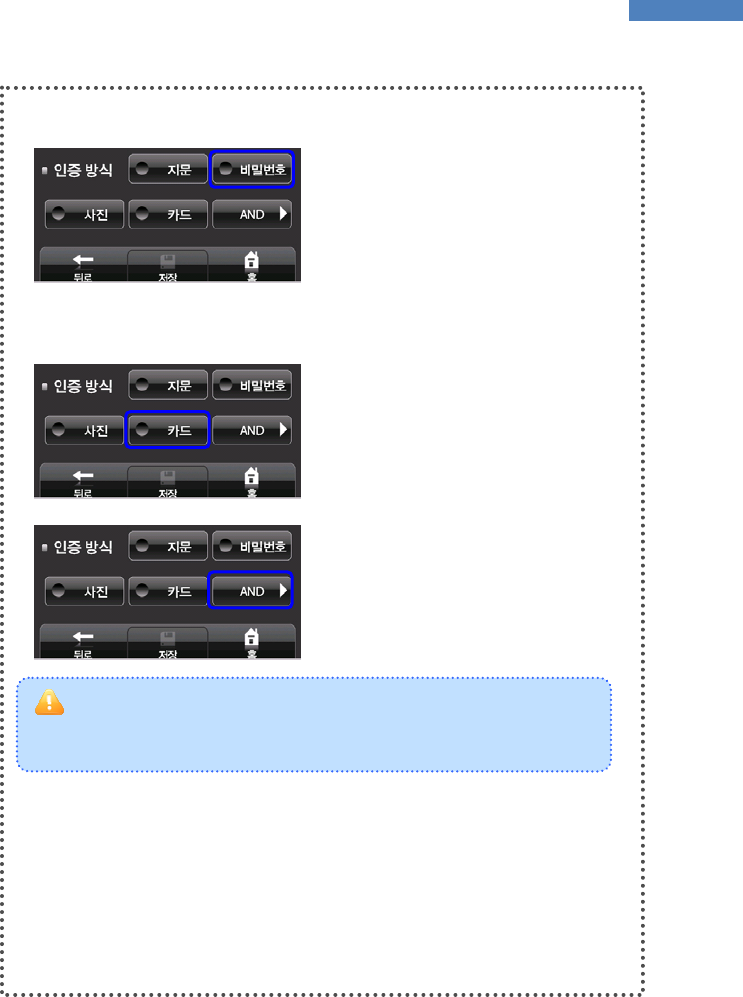
Photo authentication is not currently supported. This function will soon
be available.
Password Authentication
Touch the “Password” button and
enter the password (four to eight
digits.)
Card Authentication
Press the “Card” button and place
the card on the card reader.
Combined Authentication
To combine authentication
methods, press the “AND” button.
For higher security level or
convenience, select “OR.”
23
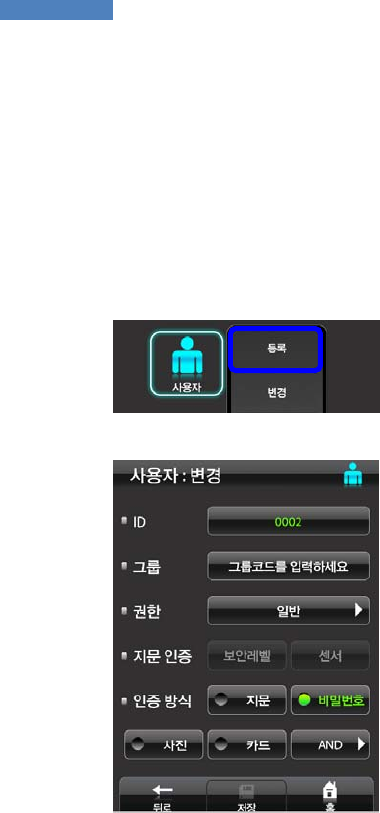
User Change
User IDs are unique and cannot be changed. However, group,
authority, fingerprint, and authentication methods can be changed in
the “change user” menu. Users can only be changed in standalone
mode. In network mode, the server management program must be
used to change users.
1. Select “User” -> “Change” and
enter the user ID. Press the “Enter”
button. The newly registered user
data will be displayed.
2. Select group, authority,
fingerprint, or authentication
method, and enter the new value.
Press the “Save” button to store
the new value.
24
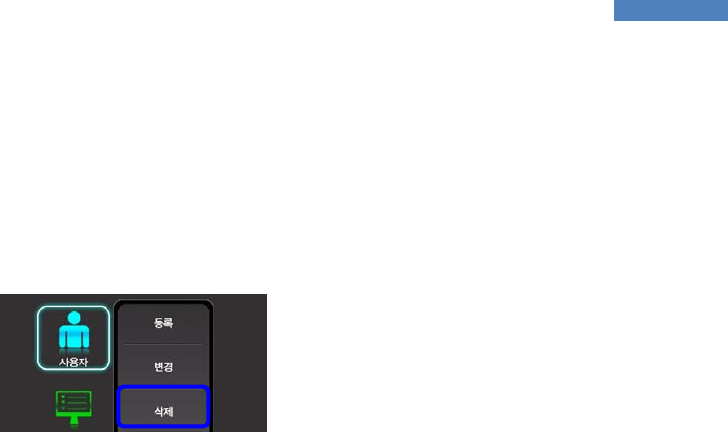
User Deletion
In network mode, the User menu does not support deletion of certain
or all users. The administrator can only delete all users registered at
a certain terminal by selecting “Manage -> Initialization -> User
Information.”
1. Press User -> “Delete” and
enter the user ID to delete. When
“Delete the user?” appears, select
“Yes.”
2. To delete all registered users,
press “Delete All”.
25
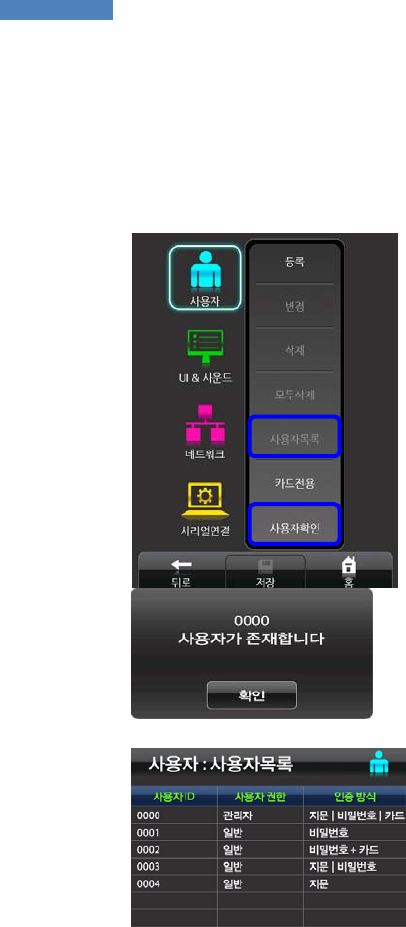
User List/Check
The administrator can check the users registered at the terminal with
the “User List” and “User Check” menus. The user list search
function is not currently supported but will be added soon.
1. To check the registered users,
select User -> User Checking.
2. Enter the user ID to search,
and press “Enter”. The user
search results will be
displayed.
3. To check the list of all users
registered at the terminal,
select User -> User List.
4. If there are many registered
users, users on the next page
can be viewed by pressing the
button at the bottom of the
screen.
26
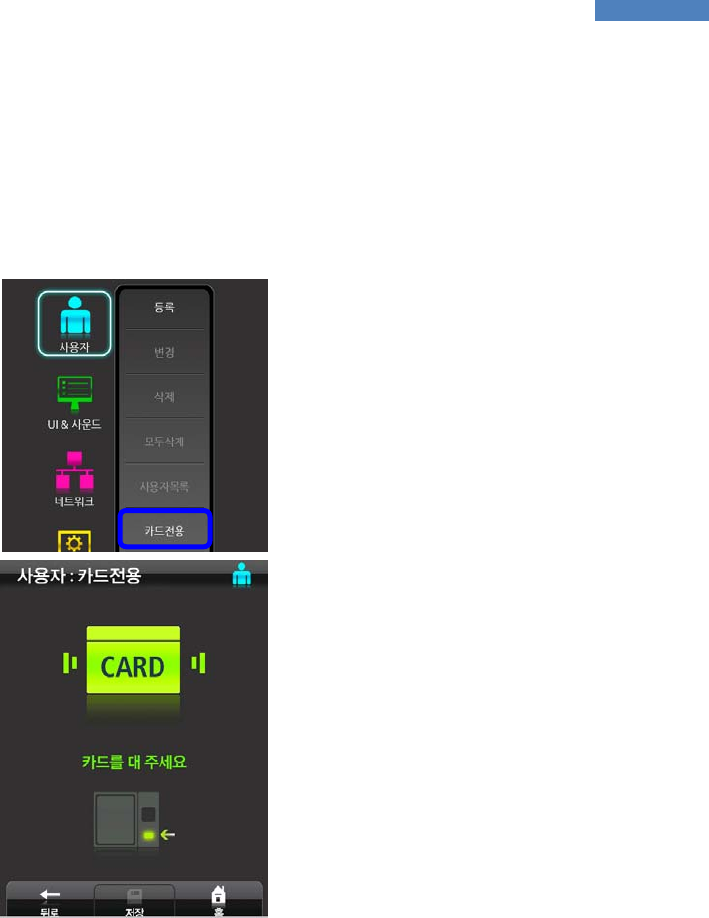
Card-only User Registration
The NAC-5000 allows door access to be controlled only by card
authentication, and not fingerprints or passwords. Currently,
card-only users can only be registered in network mode, but this
function will soon be supported in standalone mode.
1. Select User -> Card Only. A
“Place the card” message will
appear.
2. Place the card on the card
scanner. A card ID will
automatically be created and
user registration will be
completed.
3. To authenticate with the
registered card, place with
card on the card reader
without entering an ID.
27
UI & Sound Setting
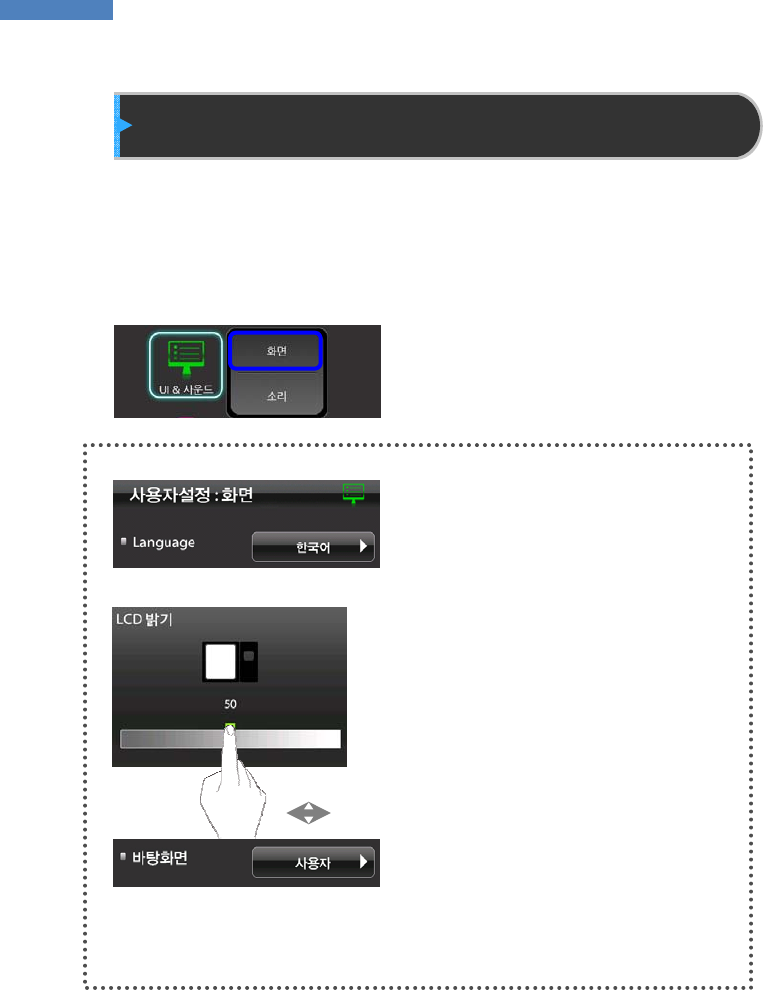
The user can change the background screen, language, time, and
sound volume.
Screen Setting
To change the screen, date, or
time, select User Setting ->
Screen.
Language
Press the “Korean” button to select
the language. Only Korean and
English are supported.
LCD Brightness (will be
available)
LCD brightness can be set
between 0 and 100. The default
value is 50. By moving his finger
right or left on the slider, the user
can select the brightness.
Background
The user can select a default
image, flash image, or user image
as the background screen. By
pressing “User”, the user can
change this option.
28
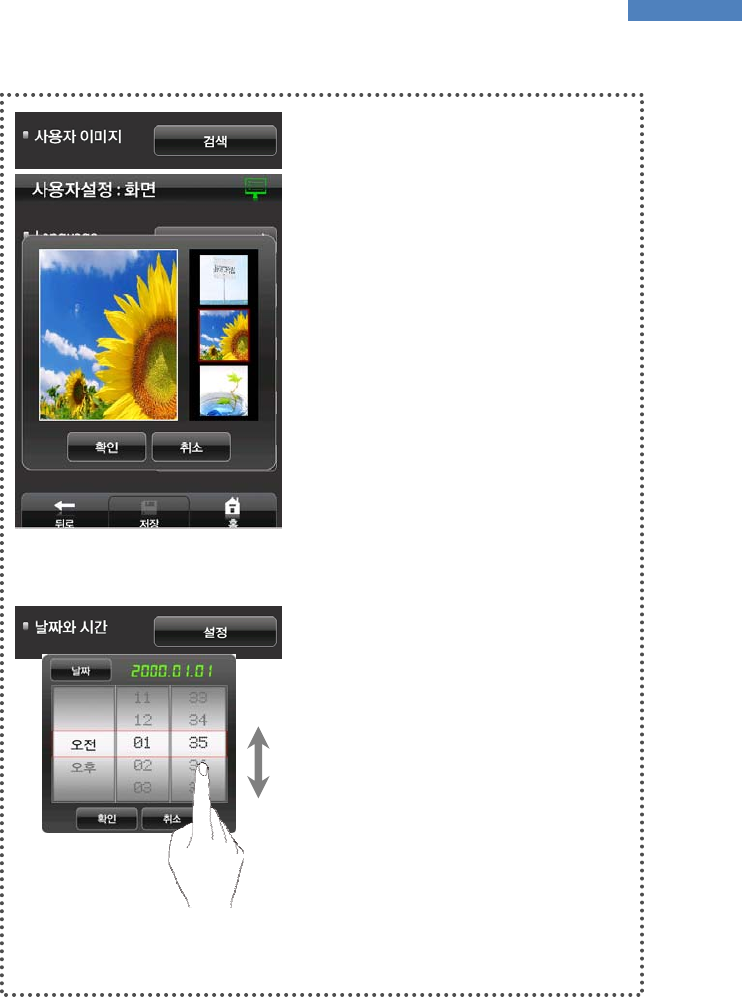
User Image
If a user image is set as the
background screen, the “User
Image” menu is activated. Press
the “Search” button to edit or
configure an image.
Date and Time
Press “Date and Time” -> “Setting”.
Select AM or PM and enter the
time or date by scrolling on the
screen.
29
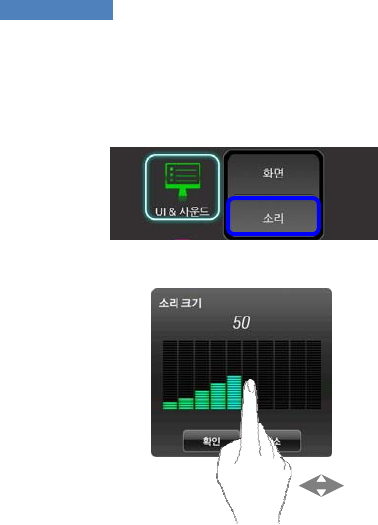
Sound
Press “User Setting” -> “Volume” to
turn sound on or off or control the
volume.
By touching the volume bars, the
user can adjust the volume.
30
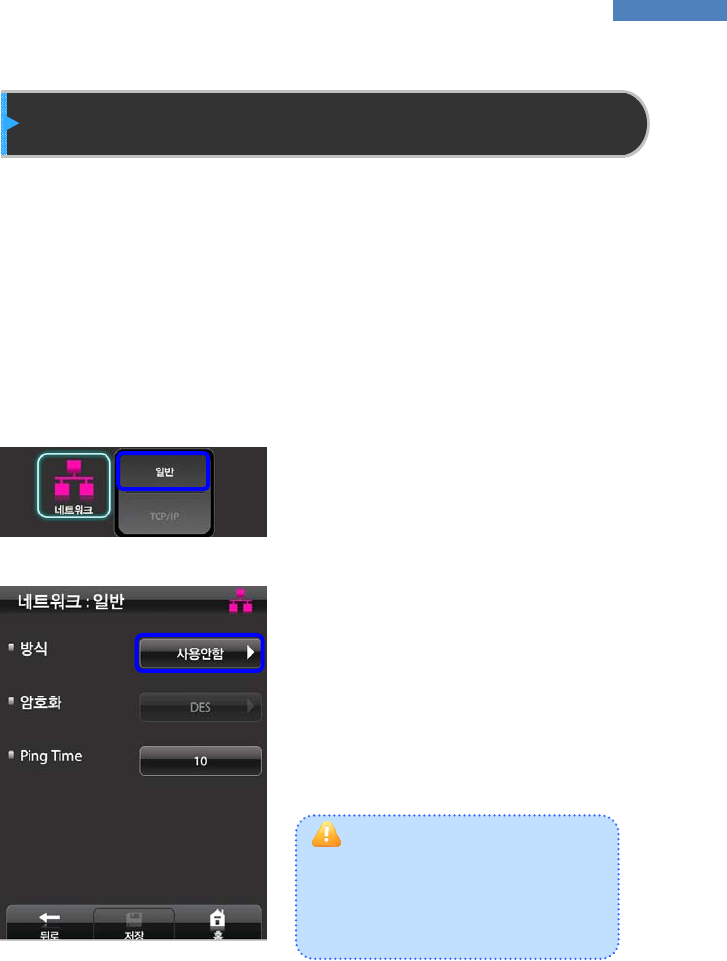
In standalone mode, all
operations including user registration
and authentication are done on the
terminal.
Network Setting
The NAC-5000 terminal can function either in network or standalone
mode. At present, only wired networks are supported but support for
wireless networks will soon be available.
Standalone Mode
In standalone mode, the administrator can use all functions of the
terminal without connecting to a network.
1. To use the terminal in
standalone mode, select
“Network” -> “General” and
“Network Setting”.
2. Press “Method” -> “Wired” and
“Do not use”. Press “Save” at
the bottom of the screen to
activate standalone mode.
31
Network Mode
In network mode, terminals can be conveniently and efficiently
managed through TCP/IP communication with the server. In
network mode, user authentication and DB management are done by
the server while user registration and door control are done by the
terminal.
To use network mode, install a management program (Access
Manager Professional, Remote Manager) in the server/client system.
If there is a user on the terminal, network mode cannot be used.
Before switching to network mode, all registered users on the
terminal should be deleted.
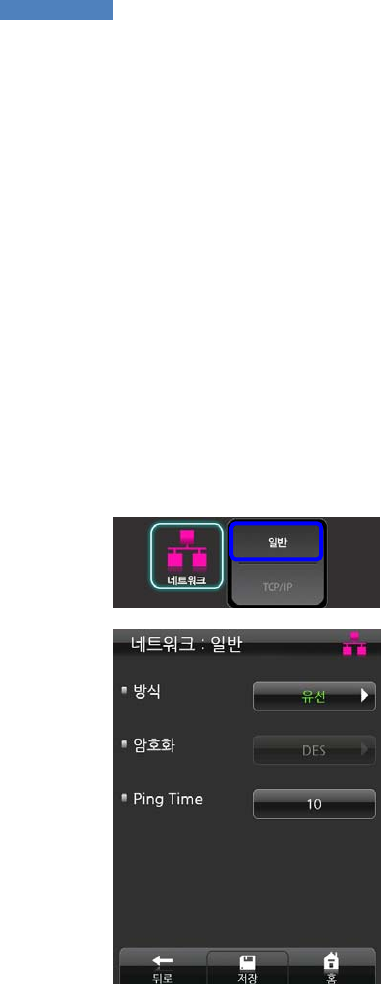
General Setting
1. To use network mode, select
“Network” -> “General”, and
change “Do not use” into “Wired.”
2. The “Encryption” field shows
whether the data exchanged
between terminal servers are
encrypted.
3. “Ping Time” checks
communication between terminal
servers. The default value is 10
seconds, it can be set from 2 to
20 seconds. PING tests are
conducted at predetermined
times.
4. After completing network

32
configuration, press “Save” at the
bottom of the screen.
33
What is DHCP (Dynamic Host Configuration Protocol)?
The DHCP server automatically allocates and manages settings for TCP/IP
communication. If DHCP is on, related information such as terminal IP,
subnet mask, and gateway are automatically allocated.
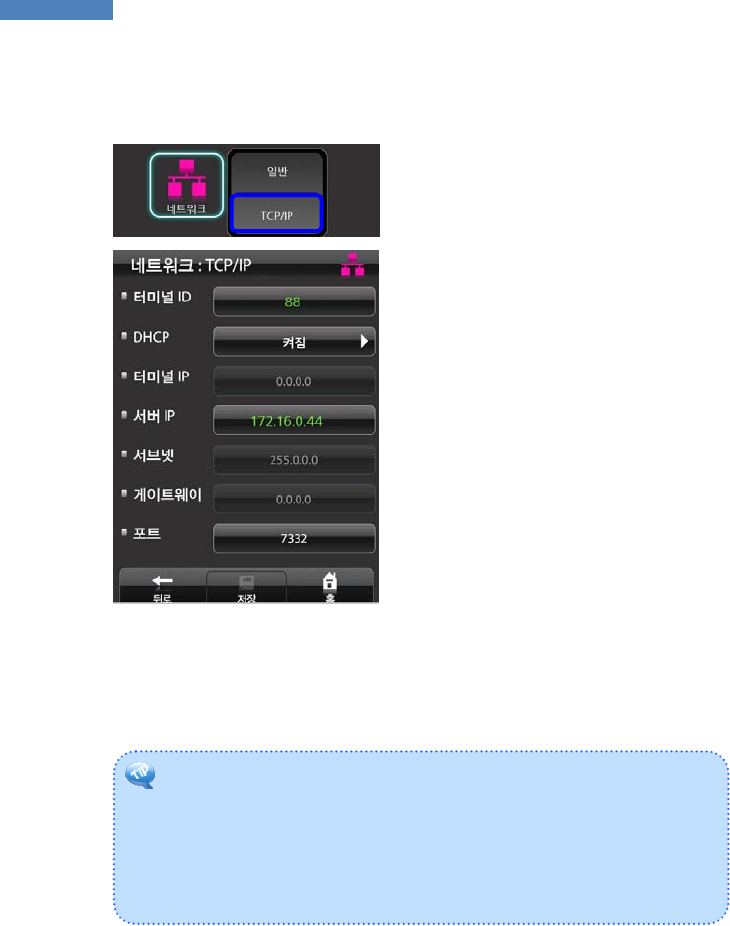
TCP/IP Setting
1. After selecting network mode,
TCP/IP must be configured to
connect to the server. Select
“Network” -> “TCP/IP”, and enter
the network information.
2. Enter a unique terminal ID
between 1 and 2000. The same
terminal ID cannot be used in the
same server.
3. Press “on” in the “DHCP” menu
to decide to use DHCP. When
using DHCP, enter into the
server IP the IP and port
information of the server with
AccessManager Professional
installed.
34
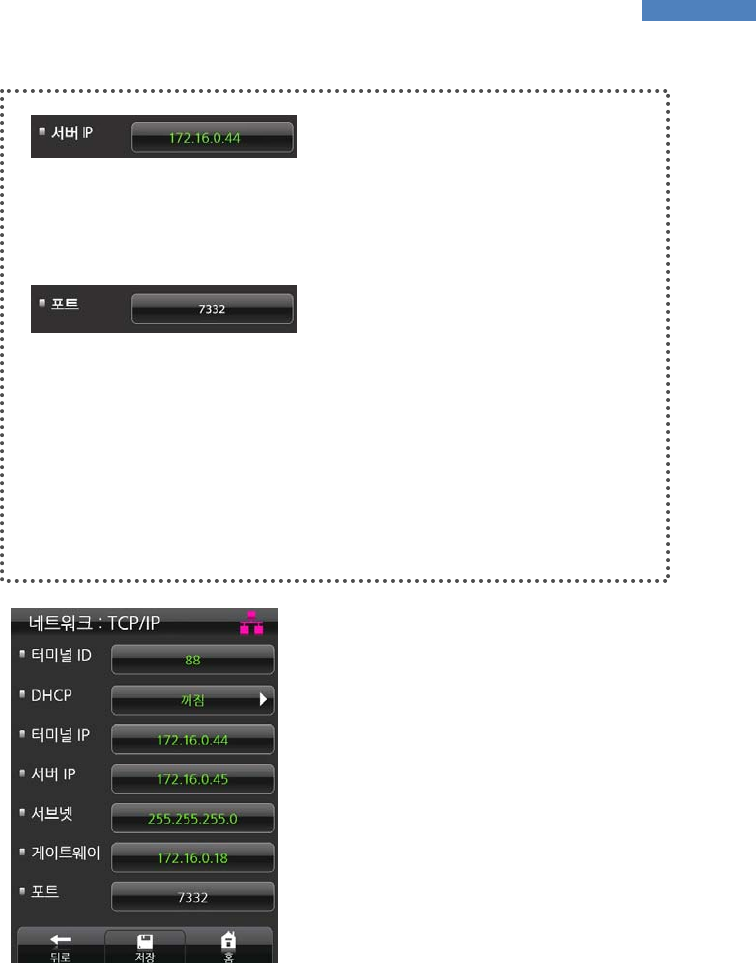
Server IP Setting
Enter the IP of the server with
Access Manager Professional
installed. When inputting the server
IP, touch “.” to move to the next field.
Port Setting
Enter the port number to be used for
communication between the server
and the terminal. The default value
is “7332” and the user can choose
between 2000 and 65536. When
changing the port data in the
terminal, change the communication
setting of Access Manager
Professional accordingly.
4. If the DHCP option is deactivated,
the terminal IP, subnet mask, and
gateway must be inputted
manually. For more information,
contact the service team.
5. Save the network setting data by
pressing “Save” at the bottom of
the screen.

35
Serial Connection
Through serial connection, other devices such as RF card readers
can be controlled. This function will soon be available.
36
Authentication Option Setting
Authentication options, sensor options, attendance mode, and card
use can be configured.
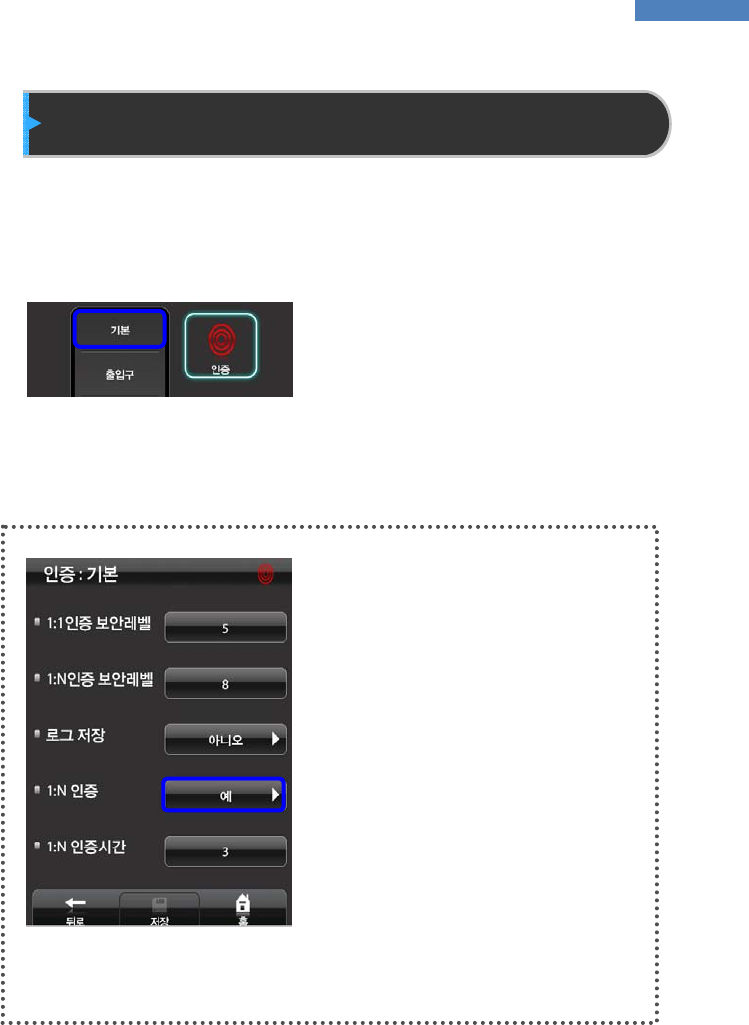
Basic
In the basic authentication menu,
settings related to authentication
level, saving of logs, and the use of
1:N authentication can be
configured. Settings can be
changed by pressing
“Authentication” -> “Basic”.
Setting 1:1/1:N Authentication
Method
The NAC-5000 supports 1:1 and 1:N
authentication methods. In 1:1
authentication, an ID must be
inputted for authentication. In 1:N
authentication, user ID is not
entered, and authentication is done
by searching all users.
1:1 is recommended for fast
authentication, and 1:N
authentication is recommended to
simplify the authentication
procedure.
To use 1:N authentication, select
1:N Authentication and change “No”
37
to “Yes.”
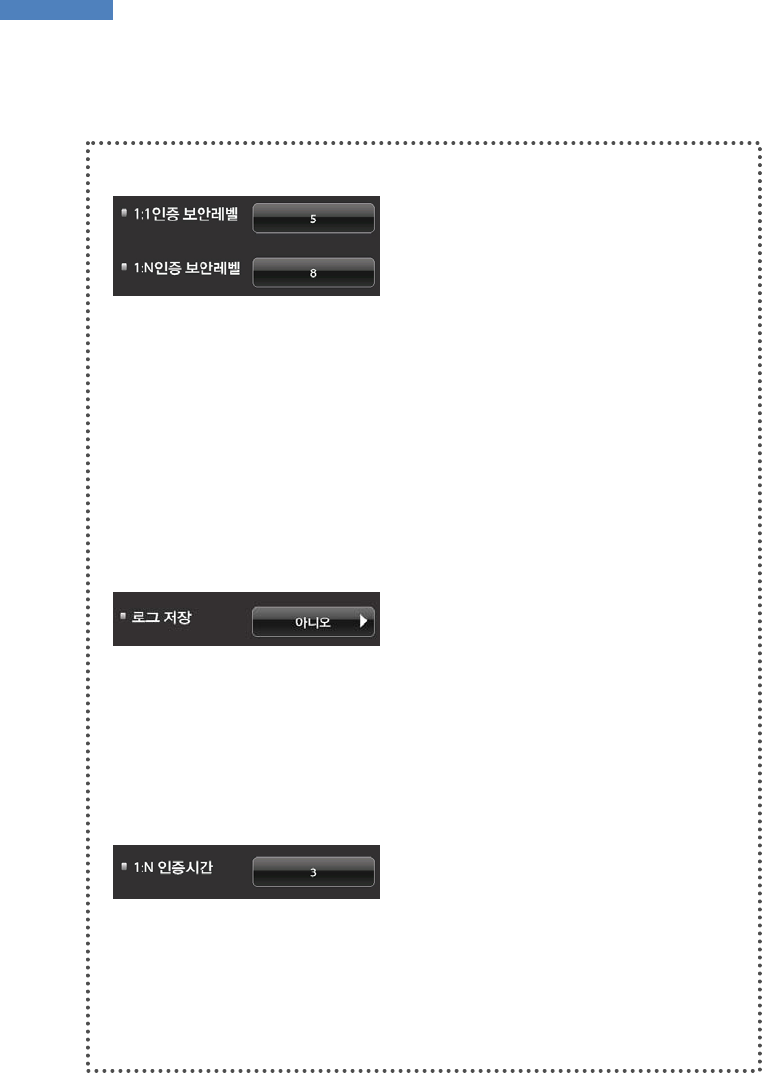
Authentication Security Level
The security level is set according to the authentication method. The
security level for 1:1 authentication is between 1 and 9, and the
default is 5. The security level for 1:N authentication is between 5
and 9, and the default is 8. If the security level is too high,
authentication failure rate may rise, and if it security level is too low,
the misreading rate may rise. Therefore, the default level should be
used. This level applies to all users except those who chose different
security levels when registering.
Saving Logs
The administrator can save logs that arise during user authentication.
To save logs, select “Save Logs” and change “No” to “Yes.” The logs
can be checked by selecting “Management” -> “Information” -> “Log”,
or by using the “Remote Manager” program.
1:N Authentication Time
If 1:N authentication is being used, the time can be set during which
all user fingerprints are searched. The input value can be between
three to nine seconds, with the default being three seconds. If the
search fails after the specified time, a “Matching timeout” error will

38
occur.
39
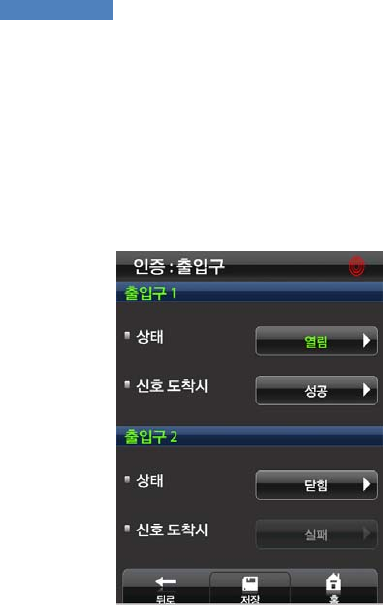
Door
To control two doors with one terminal or to control devices such as
fire alarms or lighting with one terminal, the door must be configured.
This function is not currently available but will soon be supported.
When the Door is “Closed,” the door
cannot be controlled.
40
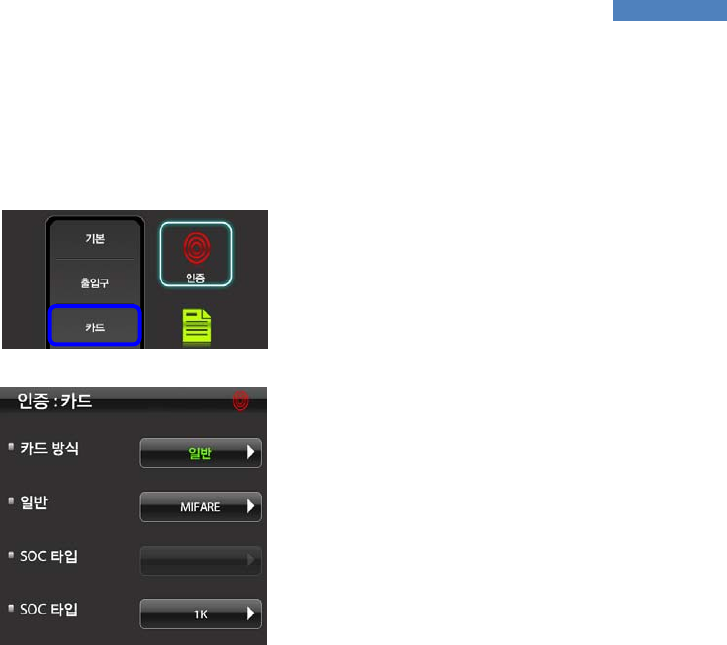
Card
To use card authentication to authenticate users, do the following.
The card authentication method has general and SOC modes.
1. To use card authentication, select
“Authentication” -> “Card”.
2. Press “Card Method” and
change “Not Use” into “General.”
3. Select the card type – MIFARE,
HID, EM, or SOC. (At present,
only MIFARE is supported )
If SOC was selected, the “SOC
Type” menu will be activated.
Select “1K” or “4K” depending on
the SOC Card type to use.
41
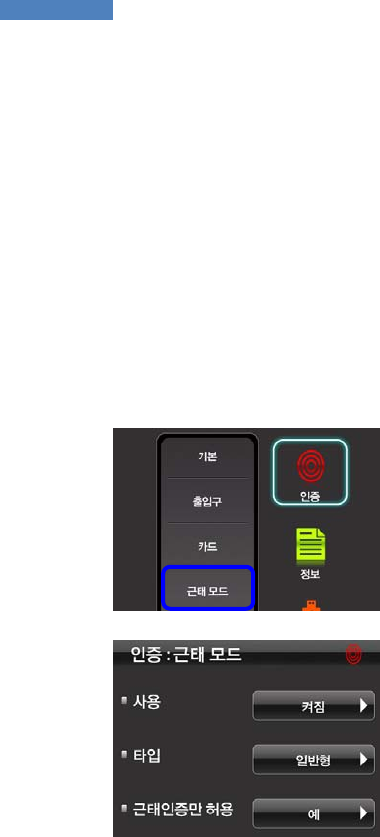
Attendance mode
In attendance mode, the user must press a function key and perform
the user authentication process when opening the door. The entry
logs will be sent with the function key data to the server management
program.
Depending on the function key, user attendance records can be
classified into “Coming to work”, “Leaving work”, “Going out”, and
“Returning” for efficient attendance management.
Attendance Mode Setting
1. To use the attendance mode,
select “Authentication” ->
“Attendance Mode”.
2. Press “Use” -> “Off” and change
it to “On”.
3. Select the type: Simple, General,
or Extended. “Simple” supports
two function keys, “General”
supports four, and “Extended”
supports 100. The default setting
for Simple and General are as
follows:
F1: Coming to work
F2: Leaving work
F3: Going out
F4: Returning
For the Extended type, function keys can be freely configured
depending on the S/W requirements.

42
4. To allow entry only through attendance authentication, select
“Allow only Attendance Authentication” -> “Yes.” When “Allow only
Attendance Authentication” mode is activated, users must press the
function key to open the door.
5. After finishing configuration, press “Save”.
43
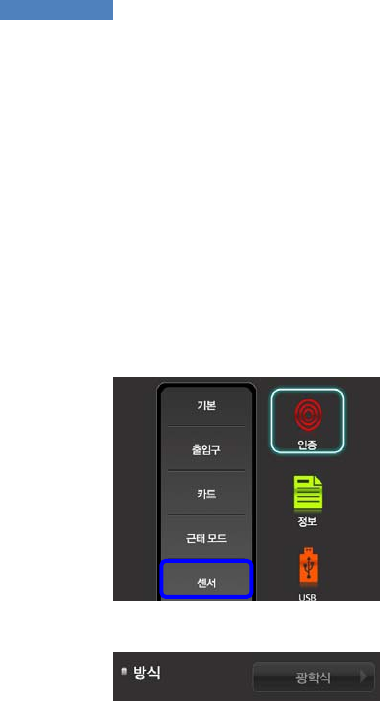
Sensor
Settings related to fingerprint sensor options such as sensor type,
fingerprint capture time, LFD precision, and sensor brightness can
be configured. If the options are set to the terminal’s default values,
the settings will apply to all users who didn’t make individual sensor
configurations when registering.
Sensor Type
1. To change the sensor type,
select “Authentication” ->
“Sensor”.
2. Select “Method” -> ”Optical”, and
select the sensor type: optical or
semiconductor. At present, only
the optical type is available and
the semiconductor type will soon
be supported.
44
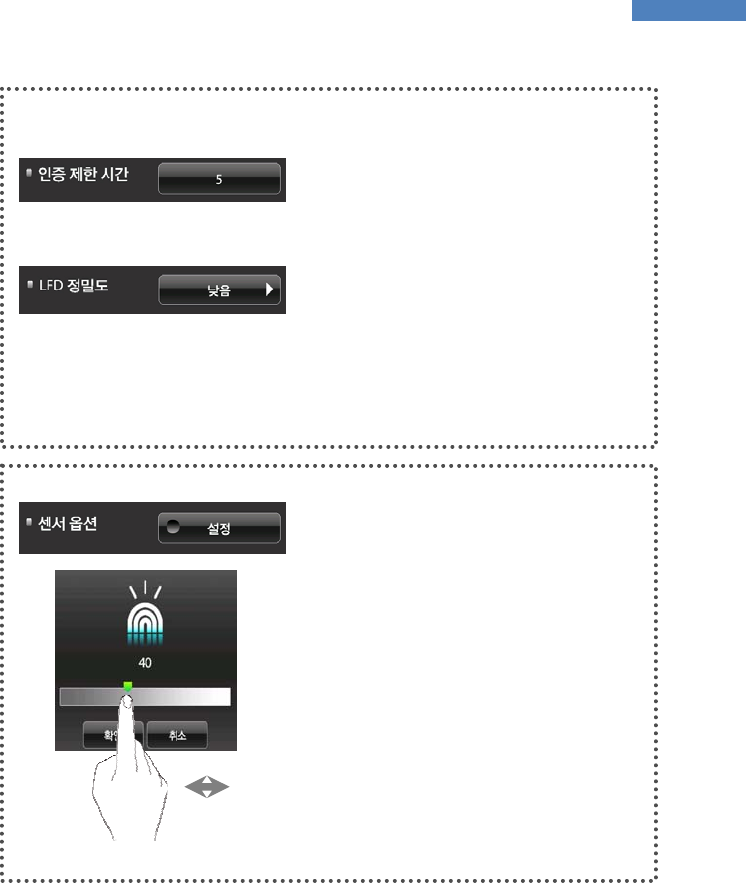
Authentication Limit Time
The fingerprint input waiting time is
between 3 and 9 seconds, and the
default is 5 seconds.
LFD (Live Finger Detection)
Precision
Sets whether to distinguish fake
fingerprints, to what degree of
precision. Select “Low”, “Middle”,
“High”, or “Do not use”.
Sensor Serial
If the fingerprint is too bright or dark,
the brightness, contrast, and gain
can be adjusted. In 1:N mode, the
terminal’s basic sensor settings will
be applied even though individual
sensor options were set during user
registration.
Select the “Brightness”, “Contrast”, or
“Gain” tab, and select the value by
moving your finger on the slider.

45
Camera
The terminal camera can take photos of users and add the photos to
user profiles. This function is not currently available but will soon be
supported.
46
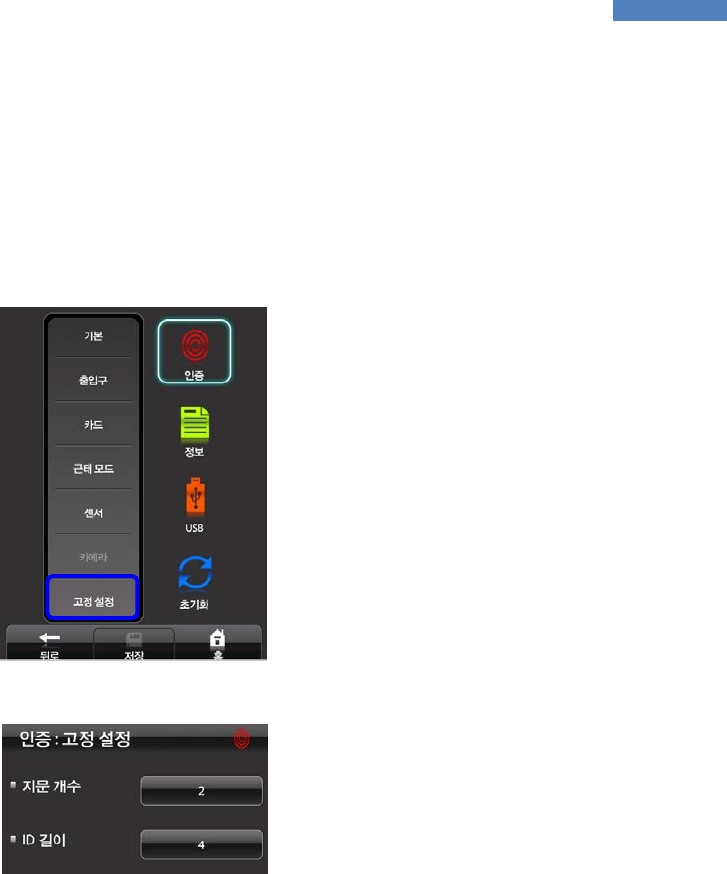
Fixed Setting
In the “Fixed Setting” menu, the number of fingerprint scans to be
inputted during fingerprint registration and the ID length can be
configured. These settings cannot be changed of registered users
already exist. To change these settings, the administrator must
delete all users registered at the terminal.
1. To change the ID length and the
number of fingerprint scans,
select “Authentication” -> ”Fixed
Setting.”
2. To change the number of
fingerprint scans required for
user fingerprint registration,
select “Fingerprint Count” and
input the number. The default is
2, and the administrator can
choose 1 or 2.
3. To change the ID length required
for user fingerprint registration,
select “ID Length” and input the
length. The default is 4, and the
administrator can select a length
between 4 and 15.
4. Save the setting by pressing
“Save” at the bottom of the
screen.
47
Terminal Information Display
The administrator can check the terminal ID, mode status, firmware
version, number of users, time zone, logs, and other general terminal
information. Self-diagnosis can also be performed to check whether
the terminal is working properly.
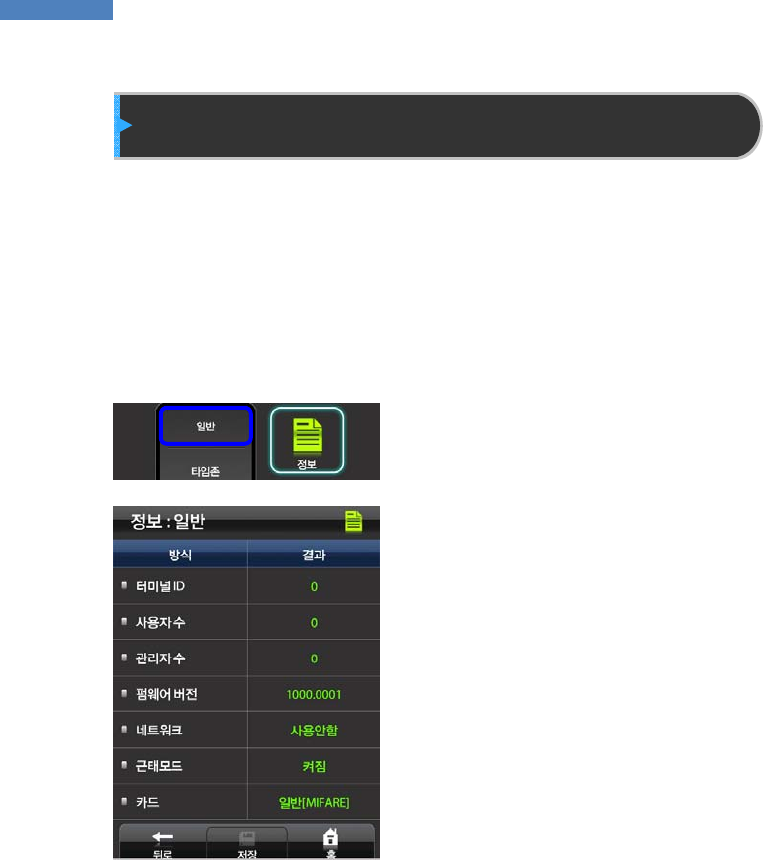
Basic
To view terminal information, select
Information -> General.
The administrator can only view
information, and cannot make
changes.
48
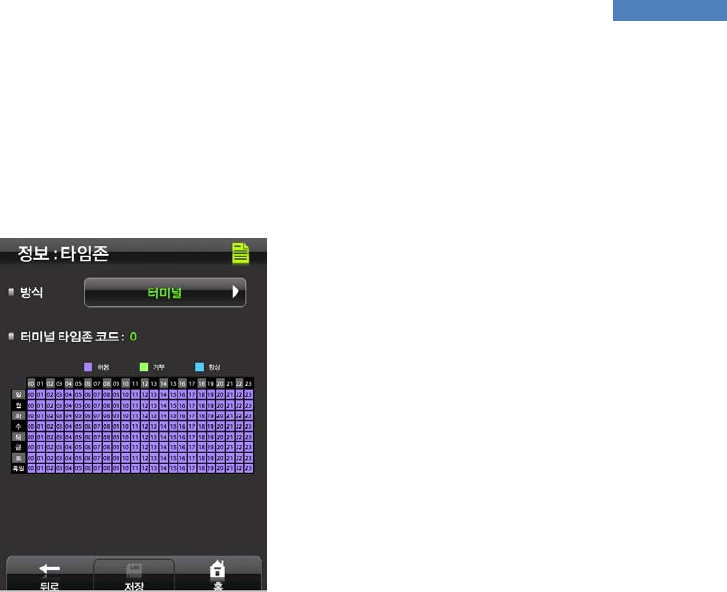
Time Zone
The “Time Zone” menu is used to restrict or allow entry during certain
time periods. This feature is not currently available but will soon be
supported.
Log
Terminal user authentication logs can be checed. This feature is not
currently available, but will soon be supported.
49
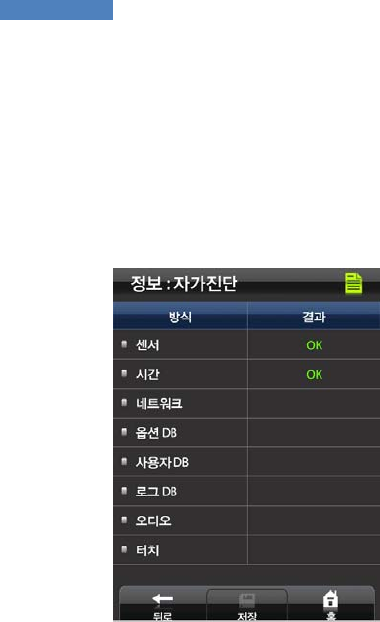
Self Diagnosis
Using the self-diagnosis function, the terminal can diagnose itself for
problems with sensor, time, network, DB, audio, and touch status. At
present, sensor and time diagnosis are available, and other functions
will soon be supported.
To perform self-diagnosis, select
“Information” -> “Self Diagnosis.” The
terminal will check for problems in
sensor and time configuration.
50
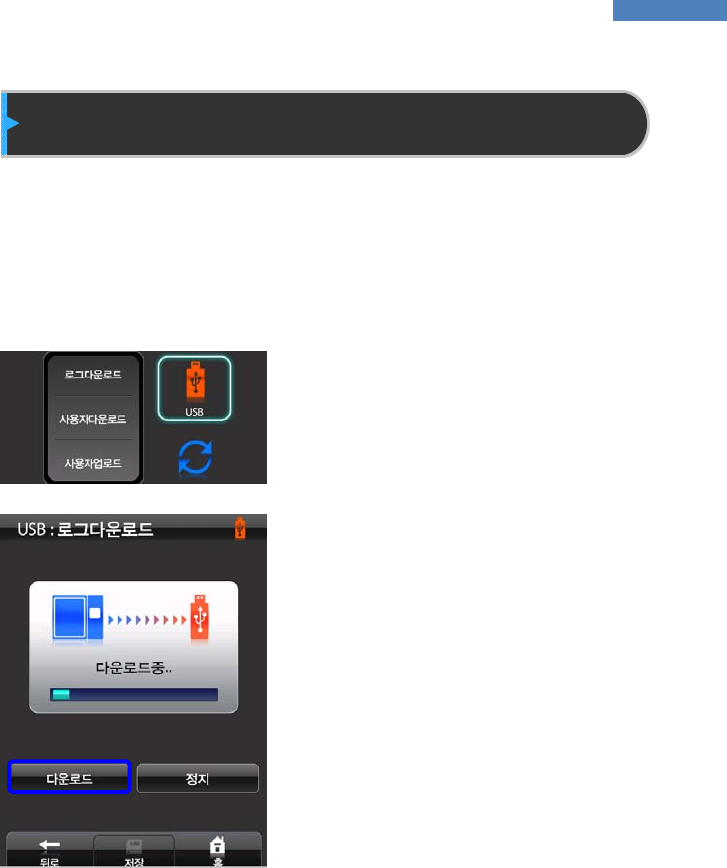
USB Memory Connection
User and log data can be uploaded or downloaded by connecting a
USB memory device to the terminal. When uploading data from the
USB device to the terminal, the data will be added to the existing DB.
This feature is not currently available, but will soon be supported.
1. Select “USB” and the operation
to perform – Log Download, User
Download, User Upload.
2. Select “Download” or “Upload” to
start the operation.
3. The administrator can stop the
operation by pressing “Stop”.
4. After the upload/download is
complete, press “Save”.
51
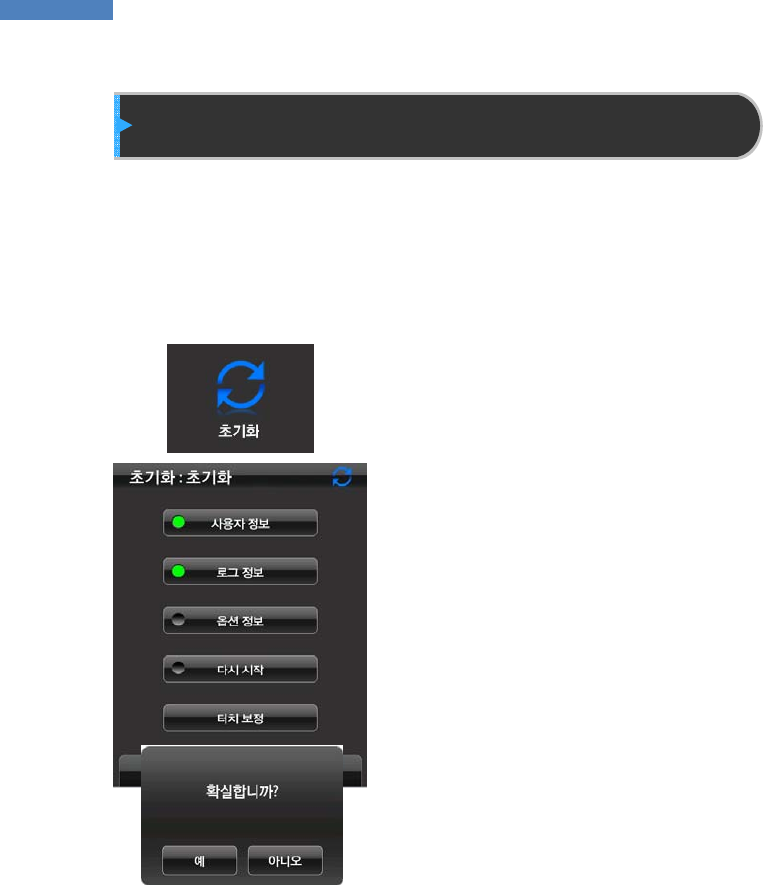
Terminal Initialization
Using the “Initialization” menu, the terminal’s user, log, and serial
data can be returned to factory settings, and touch sensitivity can be
adusted. Initialization will delete all the data in the terminal DB.
Initialization
1. To initialize the terminal data,
select “Initialize”.
2. The administrator can initialize
two types of data at the same
time. By pressing a submenu
again, it will be unselected.
3. Press “Save” at the bottom of the
screen, and press “Yes” to start
initialization.
4. By selecting “User”, “Log”, and
“Option Info”, and “Restart” at the
same time, the terminal will be
restarted after initialization.

52
Touch Calibration
If response to the touch function is slow or does not work properly,
touch sensitivity can be adjusted with the “Touch Calibration” menu.
1. Select “Initialize” and “Touch
Calibration”. The screen shown
on the right will appear. Carefully
press the “+” at the center of the
screen, and keep pressing for a
while.
2. The “+”will move. Follow the
“+”and repeat Step 1 twice.
3. After completing calibration,
touch the screen once and save
the calibration data. If no action
is taken for 30 seconds, the
calibration will be cancelled and
the previous setting will be
restored.

53
Chapter 3
General User
Door Opening - 49
Authentication in Attendance Mode - 51
Changing User Information -53
54
Door Opening
A user registered at the terminal can open the door in two ways
depending on whether 1:N authentication is used.
1:1 Authentication
The user enters his ID and scans his fingerprint, and the scanned
fingerprint is compared 1:1 to the registered fingerprint that matches
the ID. This method allows for quick authentication.
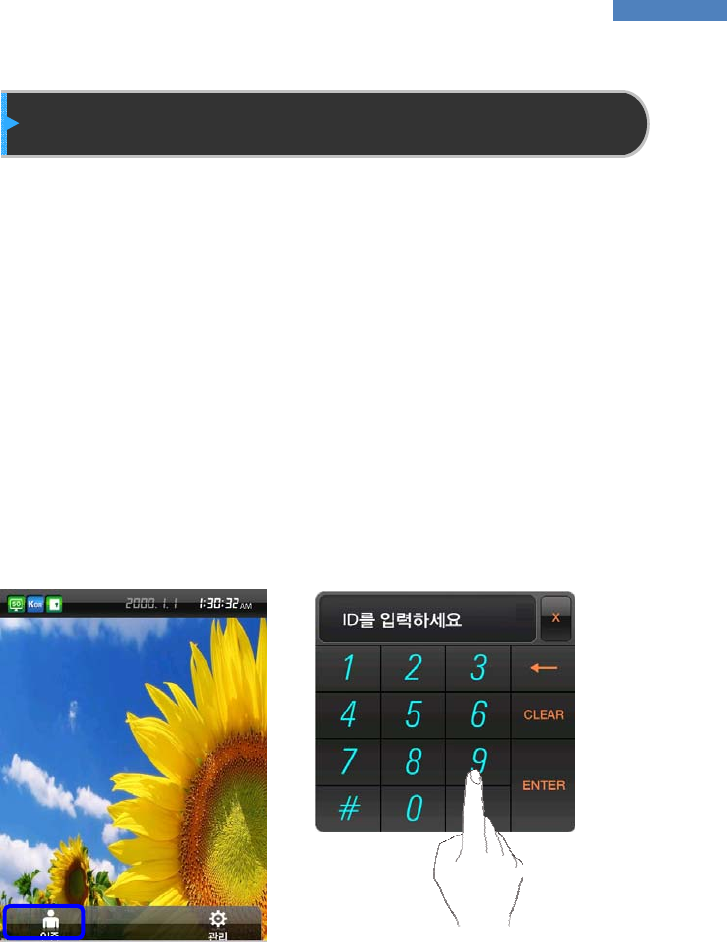
In 1:1 authentication mode, the user presses “Authentication” on the
lower left, and enters his ID. Then, the user continues the
authentication process using the registered means – fingerprint, card,
or password.
55
In 1:N authentication, the password user is authenticated in
the same wa
y
s as in 1:1 authentication.
1:N Authentication
In 1:N authentication, the user does not need to input his ID. Instead,
the scanned fingerprint is authenticated by searching all fingerprints
in the DB. The process is simpler than 1:1 authentication, but if there
are a lot of users, it may take more time.
①Fingerprint Authentication
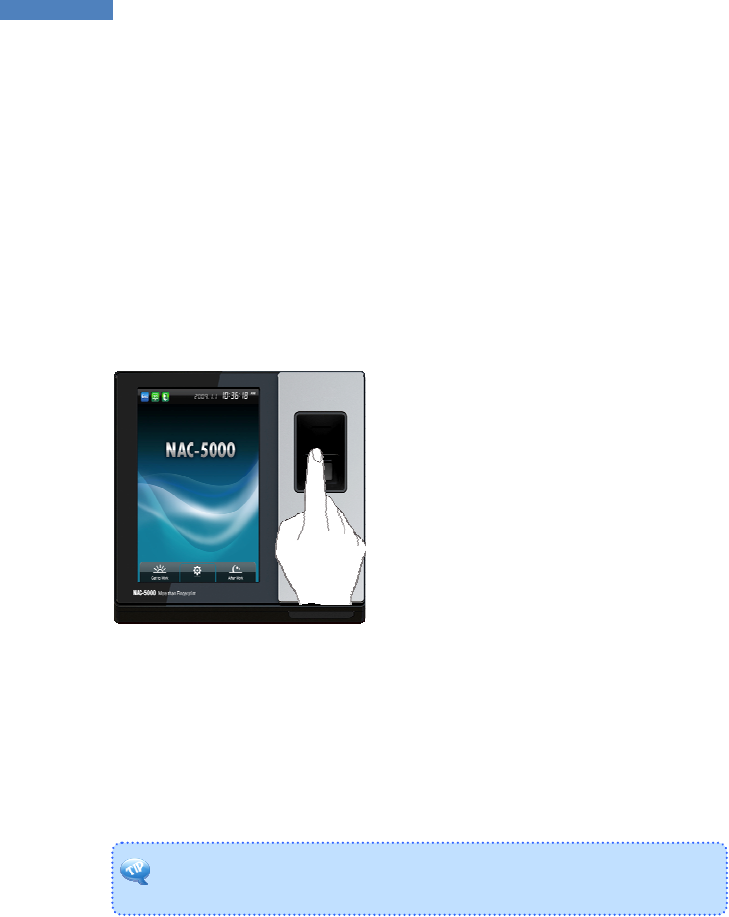
The user is authenticated by scanning his fingerprint without entering
his ID.
②Card Authentication
The user is authenticated only by scanning his card without entering
his ID.
If 1:N authentication is not activated, the user will be asked to input
his ID after he presses “Authentication” on the terminal.
56
Authentication in Attendance Mode
In attendance mode, the user must select a function key and be
authenticated for logs regarding entry and exit to be generated and
sent to the server.
Using Attendance Mode
General/Simple
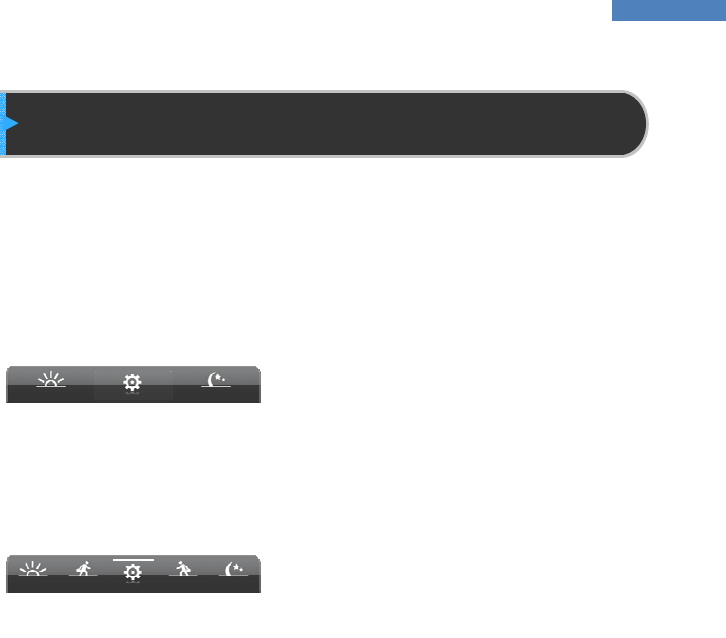
In attendance mode, function keys
are displayed on the lower-right of
the initial screen.
1. In Simple or General
Attendance mode, the user
must press a function key and
input his ID to be authenticated.
Function keys are as follows:
F1: Coming to work
F2: Leaving work
F3: Going out
F4: Returning
2. After the user presses a function
key, the key will be included in
the server log data which will be
used by the attendance
management program.
ManagF1 F2
[Attendance Mode - Simple]
ManagF1 F2 F4 F3
[Attendance Mode - General]
57
To use 1:N authentication in attendance mode, enter the
attendance key and perform authentication without inputting an ID.
The user must select function keys even when the “Allow Only
Attendance Mode” option is selected.
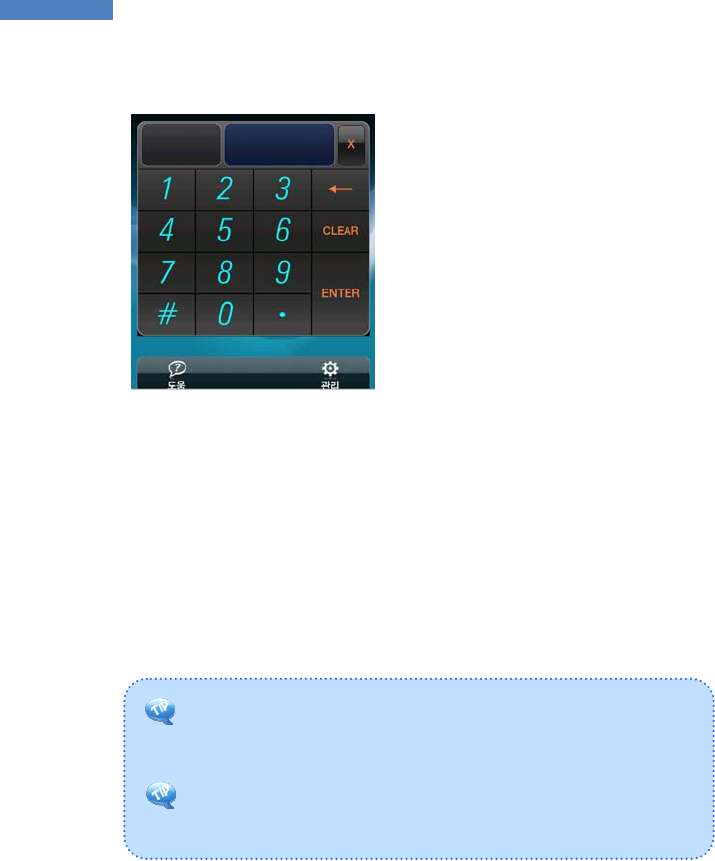
Using Extended Attendance
Mode
In Extended Attendance Mode, the
initial main screen will be displayed
as shown on the left.
1. Select a function key, and press
“Enter.”
2. Enter the user ID and press
“Enter” to perform
authentication.

58
Changing User Information
The administrator can change passwords, fingerprints, and card
information of registered users using the terminal’s Management
menu or the server program. To change user information, contact the
administrator.

59
Appendix
Troubleshooting - 55
Firmware Update - 58
Product Specifications -59

60
Appendix
Troubleshooting
<If the Touch function does not work properly>
1. Check if there is any dust on the touch sensor, and clean the
sensor with soft towel or paper.
2. If the area of the finger touching the screen is large,
sensitivity may drop. Use your fingertip when touching the
screen.
3. Scratches or damage to the touch sensor may result in
malfunctioning. Check for scratches or damage to the touch
screen.
4. Adjust the sensitivity of the touch screen by selecting
“Manage Menu -> Initialize -> Touch Calibration”.
5. The device is designed to respond when your finger is
removed from the touch screen. If the position where the
finger was placed is different from the position where the
finger was removed, the touch function may not work
properly.

61
<If fingerprint authentication takes too long>
1. If the terminal uses 1:N authentication in network mode,
server overload may occur, resulting in slow authentication
and recognition. In this case, a dedicated server should be
used.
2. Check if the finger and the sensor are clean. Clean the finger
and the sensor. If the user’s finger is hurt, the user must
register another fingerprint.
3. If the fingerprint is not clean, lower the security level of the
user and use the 1:1 authentication method.
4. Input the user’s ID in 1:1 mode and check if the user exists.

62
<If fingerprint is not registered>
If the finger is too dry or humid, fingerprint image quality may be
poor and may not register. Dry or moisturize the finger before
registering the fingerprint.
<If RF card authentication fails>
1. Select “Management”, “Authentication -> Card Setting” and
check if the card setting matches the actual card.
2. In attendance mode, check if the “Allow Only Attendance
Authentication” option is selected. If so, the user must enter
the attendance number to be authenticated.
<If network connection cannot be established>
1. Select “Management –> Network and check if the network
setting is correct.
2. Check the TCP/IP setting.
①IP of the server where Access Manager Professional is
installed.
②The server and the terminal must use the same port.
④ Related settings if DHCP is not used.
3. Synchronize the terminal and the server settings.

63
<If the door does not open after authentication>
1. Check the time period during which access is allowed.
2. Select Management – Authentication -> Door and check if
the door is set to Open.
<If users cannot be registered>
In default configuration, this product operates in network mode
which requires a proper network connection for user registration.
Check the network connection, or disable network mode to not use
the network.
<If the product is unstable or does not function>
1. Select Management –> Information –>
General/Self-diagnosis, and check for problems.
2. Restart the terminal by selecting Management –>
Initialize–> Restart.
3. Restart the server if the server management program is in
use.
4. If the terminal buttons do not function, restart the terminal by
opening the rubber cover near the bottom of the product and
use a pointed item like a ballpoint pen to press the small
button next to the USB slot for two or three seconds.
5. If the problem remains after the above actions are taken,
contact the Customer Support Team.

64
Firmware Update
NAC-5000 firmware can be updated through the USB port. Do the
following to update firmware.
1. Store firmware cab file under the root folder of the USB memory.
2. Connect a USB memory to the terminal USB port.
3. Restart the system by using the power switch of the terminal or by
selecting Management – Initialize – Restart.
4. When the system is restarted, the firmware will be loaded from the
USB memory and will be automatically updated.
The administrator can also update the firmware using “Remote
Manager“, a server management program. For more information, see
the Access Manager Professional manual.

65
Product Specifications
Item Description
LCD 14.52cm(5.7”) Touch Screen TFT-LCD
High Color(16Bit), 640(H) x 480(W)
CPU 624MHz 32Bit RISC
Memory 128MB NAND Flash, 128MB RAM
Sensor OPP06 Optical, 500DPI(LFD, Auto-On)
Authentication Rate 1:1 – Less than 1 second / 1:N -
FAR/FRR 0.001% /0.1%
Number of users 100,000 fingerprints (Two fingerprints per
user)
Communication
Method
TCP/IP, RS-232, RS-485, Wiegand
Power Input: AC 100V ~ 240V, 50/60 Hz
Output: DC 12V, 3A (24V supports serial.)
Door UP to two doors can be connected. (Dead
Bolt, Strike, EM Lock, Automatic Door, Fire
Alarm)
Serial Emergency power supply unit (12V/2.9A),
Camera, RM Module, Wireless Network
Temperature/Humidity -20 ℃ ~ 60 ℃ / Lower than 90% RH
RF Reader Built in 126 kHz or 13.561 MHz RF reader

66
Note
This equipment has been tested and found to comply with the limits for a Class B
digital device, pursuant to Part 15 of the FCC rules.
These limits are designed to provide reasonable protection against harmful
interference in a residential installation. This equipment generates, uses and can
radiate radio frequency energy and if not installed and used in accordance with the
instructions, may cause harmful interference to radio communications. However,
there is no guarantee that interference will not occur in a particular installation. If
this equipment does cause harmful interference to radio or television reception
which can be determined by turning the equipment off and on the user is encouraged
to try to correct the interference by one or more of the following measures:
-Reorient or relocate the receiving antenna.
-Increase the separation between the equipment and receiver.
-Connect the equipment into an outlet on a circuit different from that to which the
receiver is connected.
-Consult the dealer or an experienced radio/TV technician for help.
This device complies with part 15 of the FCC Rules.
Operation is subject to the following two conditions:
(1)This device may not cause harmful interference, and
(2)This device must accept any interference received,
including interference that may cause undesired operation
** CAUTION **
Changes or modifications no expressly approved by the
party responsible for compliance could void the user’s
authority to operate the equipment.