Navman 5380 Users Manual Master_Tracker_5380_manual
5380 MN000436B_T5380_Manual_English
5380 to the manual 4a789f90-50c8-4ef2-9ce3-9f960f94365a
2015-02-05
: Navman Navman-5380-Users-Manual-494149 navman-5380-users-manual-494149 navman pdf
Open the PDF directly: View PDF  .
.
Page Count: 64
www.navman.com
Pilot 3380
AUTOPILOT
www.navman.com
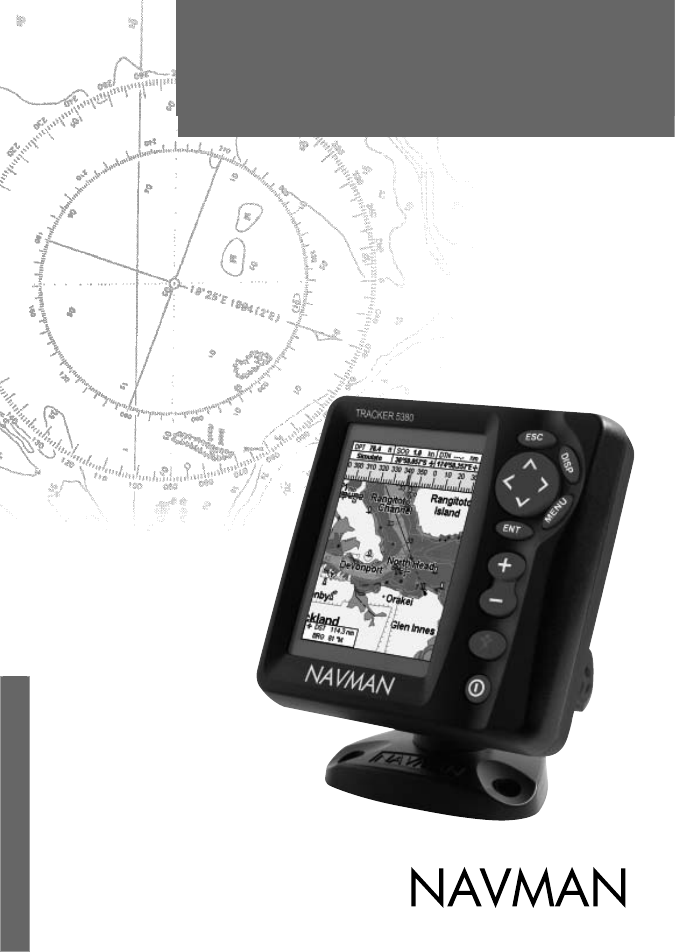
Tracker 5380
CHARTPLOTTER
Installation and
Operation Manual
TRACKER 5380 Installation and Operation Manual
2NAVMAN
FCC Statement
Note: This equipment has been tested and found to comply with the limits for a Class
B digital device, pursuant to Part 15 of the FCC Rules. These limits are designed to
provide reasonable protection against harmful interference in a normal installation.
This equipment generates, uses and can radiate radio frequency energy and, if not
installed and used in accordance with the instructions, may cause harmful interference
to radio communications. However, there is no guarantee that interference will not
occur in a particular installation. If this equipment does cause harmful interference to
radio or television reception, which can be determined by turning the equipment off
and on, the user is encouraged to try to correct the interference by one or more of the
following measures:
Reorient or relocate the receiving antenna.
Increase the separation between the equipment and receiver.
Connect the equipment into an output on a circuit different from that to which the
receiver is connected.
Consult the dealer or an experienced technician for help.
A shielded cable must be used when connecting a peripheral to the serial ports.
Industry Canada
Operation is subject to the following two conditions: (1) this device may not cause
interference, and (2) this device must accept any interference, including interference
that may cause undesired operation of the device.

TRACKER 5380 Installation and Operation Manual 3
NAVMAN
Contents
1 Introduction ..........................................................................................................................................7
1-1 Overview . . . . . . . . . . . . . . . . . . . . . . . . . . . . . . . . . . . . . . . . . . . . . . . . . . . . . . . . . . . . . . . . . . . . . . . . . 7
1-2 Cleaning and maintenance . . . . . . . . . . . . . . . . . . . . . . . . . . . . . . . . . . . . . . . . . . . . . . . . . . . . . . . 7
1-3 Plug-in cards . . . . . . . . . . . . . . . . . . . . . . . . . . . . . . . . . . . . . . . . . . . . . . . . . . . . . . . . . . . . . . . . . . . . . 7
1-4 Removing and replacing the display unit . . . . . . . . . . . . . . . . . . . . . . . . . . . . . . . . . . . . . . . . . 8
2 Basic Operation ......................................................................................................................................9
2-1 Using the keys . . . . . . . . . . . . . . . . . . . . . . . . . . . . . . . . . . . . . . . . . . . . . . . . . . . . . . . . . . . . . . . . . . . . 9
2-2 Using the menus . . . . . . . . . . . . . . . . . . . . . . . . . . . . . . . . . . . . . . . . . . . . . . . . . . . . . . . . . . . . . . . . 10
2-3 Turning on and off / auto power . . . . . . . . . . . . . . . . . . . . . . . . . . . . . . . . . . . . . . . . . . . . . . . . . 10
2-4 Backlight and night mode . . . . . . . . . . . . . . . . . . . . . . . . . . . . . . . . . . . . . . . . . . . . . . . . . . . . . . . 11
2-5 Man overboard (MOB) . . . . . . . . . . . . . . . . . . . . . . . . . . . . . . . . . . . . . . . . . . . . . . . . . . . . . . . . . . . 11
2-6 Alarms . . . . . . . . . . . . . . . . . . . . . . . . . . . . . . . . . . . . . . . . . . . . . . . . . . . . . . . . . . . . . . . . . . . . . . . . . . 11
2-7 Simulate mode . . . . . . . . . . . . . . . . . . . . . . . . . . . . . . . . . . . . . . . . . . . . . . . . . . . . . . . . . . . . . . . . . . 12
2-8 The main displays . . . . . . . . . . . . . . . . . . . . . . . . . . . . . . . . . . . . . . . . . . . . . . . . . . . . . . . . . . . . . . . 12
3 Navigation: Chart ................................................................................................................................. 16
3-1 Overview of navigating . . . . . . . . . . . . . . . . . . . . . . . . . . . . . . . . . . . . . . . . . . . . . . . . . . . . . . . . . . 16
3-2 Chart display . . . . . . . . . . . . . . . . . . . . . . . . . . . . . . . . . . . . . . . . . . . . . . . . . . . . . . . . . . . . . . . . . . . . 18
3-3 Distance and bearing calculator . . . . . . . . . . . . . . . . . . . . . . . . . . . . . . . . . . . . . . . . . . . . . . . . . 20
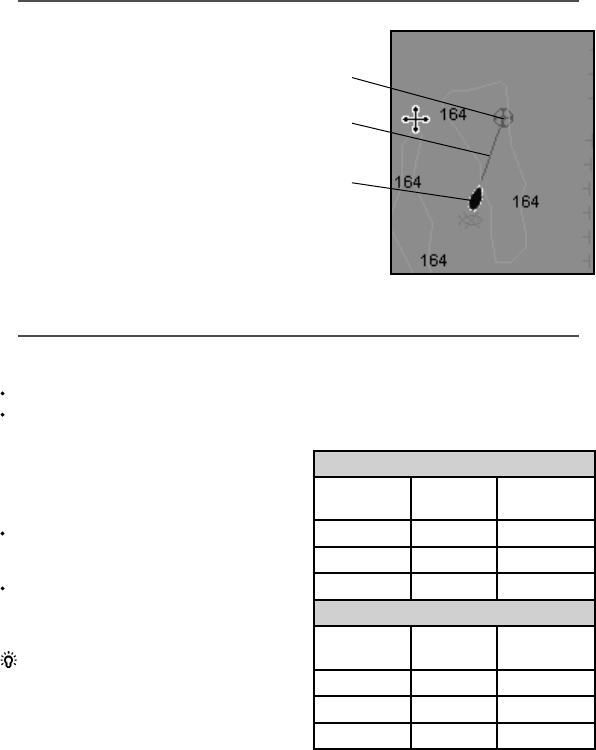
3-4 Projected course . . . . . . . . . . . . . . . . . . . . . . . . . . . . . . . . . . . . . . . . . . . . . . . . . . . . . . . . . . . . . . . . 21
3-5 Tracks and tracking . . . . . . . . . . . . . . . . . . . . . . . . . . . . . . . . . . . . . . . . . . . . . . . . . . . . . . . . . . . . . . 21
4 Navigation: Highway display ................................................................................................................22
5 Navigation: Waypoints ......................................................................................................................... 22
5-1 Waypoints display . . . . . . . . . . . . . . . . . . . . . . . . . . . . . . . . . . . . . . . . . . . . . . . . . . . . . . . . . . . . . . .23
5-2 Managing waypoints . . . . . . . . . . . . . . . . . . . . . . . . . . . . . . . . . . . . . . . . . . . . . . . . . . . . . . . . . . . .23
6 Navigation: Routes .............................................................................................................................. 25
6-1 Routes display . . . . . . . . . . . . . . . . . . . . . . . . . . . . . . . . . . . . . . . . . . . . . . . . . . . . . . . . . . . . . . . . . . .25
6-2 Managing routes . . . . . . . . . . . . . . . . . . . . . . . . . . . . . . . . . . . . . . . . . . . . . . . . . . . . . . . . . . . . . . . . 26
7 Satellites ............................................................................................................................................. 28
7-1 Satellite display . . . . . . . . . . . . . . . . . . . . . . . . . . . . . . . . . . . . . . . . . . . . . . . . . . . . . . . . . . . . . . . . . .29
8 Gauges display ..................................................................................................................................... 30
TRACKER 5380 Installation and Operation Manual
4NAVMAN
9 Data display ......................................................................................................................................... 31
10 Fuel functions and display .................................................................................................................. 31
10-1 When you add or remove fuel . . . . . . . . . . . . . . . . . . . . . . . . . . . . . . . . . . . . . . . . . . . . . . . . . . 31
10-2 Fuel display . . . . . . . . . . . . . . . . . . . . . . . . . . . . . . . . . . . . . . . . . . . . . . . . . . . . . . . . . . . . . . . . . . . . 32
10-3 Fuel consumption curves . . . . . . . . . . . . . . . . . . . . . . . . . . . . . . . . . . . . . . . . . . . . . . . . . . . . . . 33
11 Tides display ...................................................................................................................................... 35
12 User card display ................................................................................................................................ 36
13 About display ..................................................................................................................................... 37
14 Setting up the TRACKER ...................................................................................................................... 38
14-1 Setup > System . . . . . . . . . . . . . . . . . . . . . . . . . . . . . . . . . . . . . . . . . . . . . . . . . . . . . . . . . . . . . . . .38
14-2 Setup > Chart . . . . . . . . . . . . . . . . . . . . . . . . . . . . . . . . . . . . . . . . . . . . . . . . . . . . . . . . . . . . . . . . .40
14-3 Setup > GPS . . . . . . . . . . . . . . . . . . . . . . . . . . . . . . . . . . . . . . . . . . . . . . . . . . . . . . . . . . . . . . . . . . .43
14-4 Setup > Fuel . . . . . . . . . . . . . . . . . . . . . . . . . . . . . . . . . . . . . . . . . . . . . . . . . . . . . . . . . . . . . . . . . . .44
14-5 Setup > Track . . . . . . . . . . . . . . . . . . . . . . . . . . . . . . . . . . . . . . . . . . . . . . . . . . . . . . . . . . . . . . . . . . .45
14-6 Setup > Logs . . . . . . . . . . . . . . . . . . . . . . . . . . . . . . . . . . . . . . . . . . . . . . . . . . . . . . . . . . . . . . . . . . .46
14-7 Setup > Alarms . . . . . . . . . . . . . . . . . . . . . . . . . . . . . . . . . . . . . . . . . . . . . . . . . . . . . . . . . . . . . . . . .46
14-8 Setup > Units . . . . . . . . . . . . . . . . . . . . . . . . . . . . . . . . . . . . . . . . . . . . . . . . . . . . . . . . . . . . . . . . . . 47
14-9 Setup > Comms . . . . . . . . . . . . . . . . . . . . . . . . . . . . . . . . . . . . . . . . . . . . . . . . . . . . . . . . . . . . . . . . 47
14-10 Setup > Calibrate . . . . . . . . . . . . . . . . . . . . . . . . . . . . . . . . . . . . . . . . . . . . . . . . . . . . . . . . . . . . . .48
14-11 Setup > Time . . . . . . . . . . . . . . . . . . . . . . . . . . . . . . . . . . . . . . . . . . . . . . . . . . . . . . . . . . . . . . . . . .48
14-12 Setup > Simulate . . . . . . . . . . . . . . . . . . . . . . . . . . . . . . . . . . . . . . . . . . . . . . . . . . . . . . . . . . . . . .48
15 Installation ........................................................................................................................................ 49
15-1 Installation: What comes with the TRACKER . . . . . . . . . . . . . . . . . . . . . . . . . . . . . . . . . . . .49
15-2 Installation: Options and Accessories . . . . . . . . . . . . . . . . . . . . . . . . . . . . . . . . . . . . . . . . . . .49
15-3 Installation: The display unit . . . . . . . . . . . . . . . . . . . . . . . . . . . . . . . . . . . . . . . . . . . . . . . . . . . . 51
15-4 Installation: Power/Data cable . . . . . . . . . . . . . . . . . . . . . . . . . . . . . . . . . . . . . . . . . . . . . . . . . .52
15-5 Installation: GPS antenna . . . . . . . . . . . . . . . . . . . . . . . . . . . . . . . . . . . . . . . . . . . . . . . . . . . . . . . 53
15-6 Installation: NAVMAN petrol/gasoline sensors . . . . . . . . . . . . . . . . . . . . . . . . . . . . . . . . . . 53
15-7 Installation: SmartCraft . . . . . . . . . . . . . . . . . . . . . . . . . . . . . . . . . . . . . . . . . . . . . . . . . . . . . . . . .54
15-8 Installation: Other NavBus instruments . . . . . . . . . . . . . . . . . . . . . . . . . . . . . . . . . . . . . . . . .54
15-9 Installation: Other NMEA instruments . . . . . . . . . . . . . . . . . . . . . . . . . . . . . . . . . . . . . . . . . . 55
15-10 Installation: Setup and test . . . . . . . . . . . . . . . . . . . . . . . . . . . . . . . . . . . . . . . . . . . . . . . . . . . . 55
TRACKER 5380 Installation and Operation Manual 5
NAVMAN
Feature Type See Requires
General How to use the keys and displays 2
Troubleshooting Appendix B
Simulate mode 2-6
Glossary of special names Appendix C
Specifi cations Appendix A
MOB Man overboard key 2-4
Navigation Overview of how to navigate 3-1 GPS fi x
Finding the boat’s position on the chart 3-2
Navigate to any point or to a waypoint 3-1
Navigate along a route 3-1
Projected course: An estimate of progress 3-4
Tracks: records of where the boat has been 3-5
GPS receiver status 7
Saving and loading data with a user card 12 User card
Chart data Chart features (built in world chart) 3-2
Chart details 3-2-4 & 5 C-MAP™ chart
Tides at a port 11 C-MAP™ chart
Alarms Built in alarms 2-5
SmartCraft engine alarms 1-1 SmartCraft
Boat data Data at top of main displays 2-7-2
Compass at top of main displays 2-7-3
Dedicated data display 9
Fuel Fuel computer, petrol/gasoline engine 10 Fuel sensors
Fuel computer, SmartCraft engines 10 SmartCraft
What to do when you add or remove fuel 10-1
Quick reference
Appendix A - Specifications ..................................................................................................................... 56
Appendix B - Troubleshooting ................................................................................................................. 58
Appendix C - Glossary and navigation data .............................................................................................. 61

TRACKER 5380 Installation and Operation Manual
6NAVMAN
It is the owner’s sole responsibility to install and use the instrument in a manner that will
not cause accidents, personal injury or property damage. The user of this product is solely
responsible for observing safe boating practices.
Global Positioning System: The Global Positioning System (GPS) is operated by the US
Government which is solely responsible for its operation, accuracy and maintenance. The
GPS system is subject to changes which could affect the accuracy and performance of all GPS
equipment anywhere in the world including the TRACKER. Whilst the Navman TRACKER is a
precision navigation instrument, it can be misused or misinterpreted, which can result in its use
being unsafe. To reduce the risk of misusing or misinterpreting the TRACKER, the user must read
and understand all aspects of this Installation and Operation manual. We also suggest that the
user practice all operations using the built in simulator before using the TRACKER at sea.
Electronic Chart: The electronic chart used by the TRACKER is an aid to navigation and is
designed to supplement the use of official government charts not replace them. Only official
government charts supplemented by notices to mariners contain the information required for
safe and prudent navigation. Always supplement the information provided by the TRACKER
with other plotting sources such as observations, depth soundings, radar and hand compass
bearings. Should the information not agree then the discrepancy must be resolved before
proceeding any further.
Fuel Computer: Fuel economy can alter drastically depending on the boat loading and sea
conditions. The fuel computer should not be the sole source of information concerning available
fuel onboard and the electronic information should be supplemented by visual or other checks
of the fuel load. This is necessary due to possible operator induced errors such as forgetting
to reset the fuel used when filling the tank, running the engine with the fuel computer not
switched on or other operator controlled actions that may render the device inaccurate. Always
ensure that adequate fuel is carried onboard for the intended trip plus a reserve to allow for
unforeseen circumstances.
NAVMAN NZ LIMITED DISCLAIMS ALL LIABILITY FOR ANY USE OF THIS PRODUCT IN A WAY THAT
MAY CAUSE ACCIDENTS, DAMAGE OR THAT MAY VIOLATE THE LAW.
Governing Language: This statement, any instruction manuals, user guides and other
information relating to the product (Documentation) may be translated to, or has been
translated from, another language (Translation). In the event of any conflict between any
Translation of the Documentation, the English language version of the Documentation will be
the official version of the Documentation.
This manual represents the TRACKER as at the time of printing. Navman NZ Limited reserves the right
to make changes to specifications without notice.
Copyright © 2005 Navman NZ Limited, New Zealand, all rights reserved. Navman is a registered
trademark of Navman NZ Limited.
Important
The TRACKER is set up with default units of feet, °F (Fahrenheit), US gallons and knots.
To change the units, see section 14-8.

TRACKER 5380 Installation and Operation Manual 7
NAVMAN
1-2 Cleaning and maintenance
The TRACKER screen is covered by a proprietary
anti-reflection coating. To avoid damage,
clean the screen only with a damp cloth and
mild detergent when dirty or covered in sea
salt. Avoid abrasive cleaners, petrol or other
solvents. If a plug-in card gets dirty or wet,
clean it with a damp cloth or mild detergent.
To optimize performance, avoid walking on or
jamming cables and connectors.
Push the dust cover over the display when the
TRACKER is turned off.
The NAVMAN TRACKER 5380 is a compact,
rugged, highly integrated marine chartplotter. It
is easy to use and has a colour display. Complex
functions can be performed with a few key
presses, taking the hard work out of boating.
This manual covers:
TRACKER 5380
Colour display, external GPS antenna.
TRACKER 5380i
Colour display, interrnal GPS antenna.
The available functions, displays and setup
menus depend on the optional sensors and
instruments that are installed:
Fuel functions require one or more
petrol/gasoline sensors to be installed.
1-1 Overview
SmartCraft engine functions require a
SmartCraft system to be installed. For
information on using SmartCraft, see
the SmartCraft Gateway Installation and
Operation Manual.
The TRACKER can send data to other
instruments, such as an autopilot, and
receive data from other instruments.
For information on installing options, see
section 15-2.
This manual describes how to install and
operate the TRACKER. Special terms are
explained in Appendix C. For maximum
benefit, please read this manual carefully
before installing and using the unit. For more
information on this instrument and other
Navman products, go to our website, www.
navman.com.
1-3 Plug-in cards
The TRACKER can use two kinds of plug-in card:
C-MAP™ chart cards have chart details
required for navigating in a particular
region. When a chart card is plugged in, the
extra details automatically appear on the
TRACKER chart display.
The TRACKER can use NT, NT+ and NT-MAX
cards.
C-MAP™ user cards are used to store
navigation data. Each user card expands
the TRACKER memory and allows the data
to be transferred to another TRACKER easily
(see section 14).
Note: The older 5 volt user cards are not
supported.
1 Introduction
TRACKER 5380 Installation and Operation Manual
8NAVMAN
1-4 Removing and replacing the display unit
If the display unit is bracket mounted then
the display unit can easily be removed and
replaced for security or protection.
Removing the display unit:
1 Turn the display unit off (see section 2-3)
and put the dust cover on.
2 Loosen the knob on the mounting bracket
and lift the unit off the bracket.
3 Unplug the connectors from from the
display unit, turning each locking collar
anticlockwise. Push the attached dust
covers over the connectors.
4 Store the display unit in a dry clean place,
such as the optional Navman carry bag.
Replacing the display unit
1 Remove the dust covers from the
connectors. Plug the connectors into the
back of the display unit:
Match the connector’s colour to the socket
colour.
Insert each connector and turn the locking
collar clockwise until it is finger tight.
Knob
Mounting
bracket
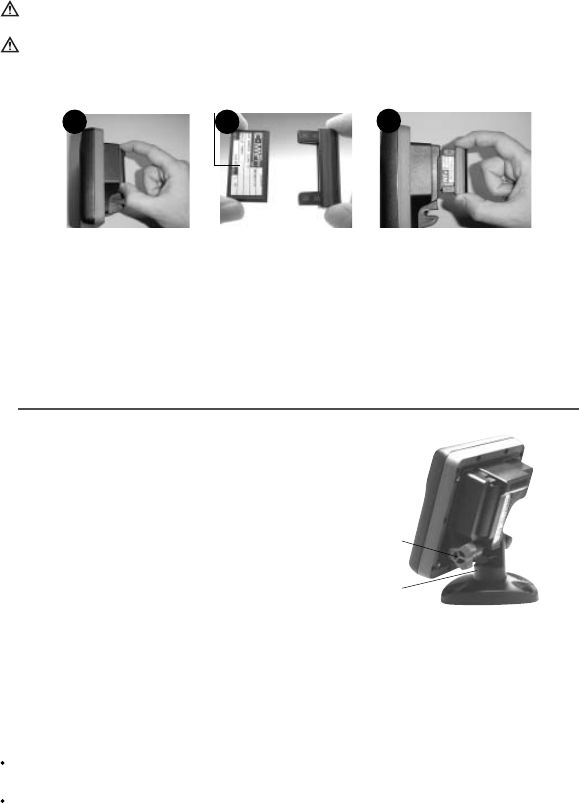
Changing the plug-in card
Warning: Handle plug-in cards carefully. Keep them in their protective cases when not plugged
into the TRACKER.
Warning: Keep the holder in place in the TRACKER at all times to prevent moisture from entering
the card compartment.
Turn the TRACKER off (see section 2-3).
Pull the card holder out of the TRACKER and
pull any card out of holder.
Put the card in its case.
Push new card into holder. Ensure the gold
contacts are on the outer edge and underneath
(see above).
Keep the card’s case.
Push card holder fully into TRACKER
123
Nothing will be damaged if a cable is
plugged into the wrong socket by mistake.
2 Hold the display unit in place on the
mounting bracket. Adjust the tilt of the
display for best viewing, then hand tighten
the knob on the mounting bracket. Remove
the dust cover.
Gold contacts under here
Card
Holder
TRACKER 5380 Installation and Operation Manual 9
NAVMAN
2 Basic Operation
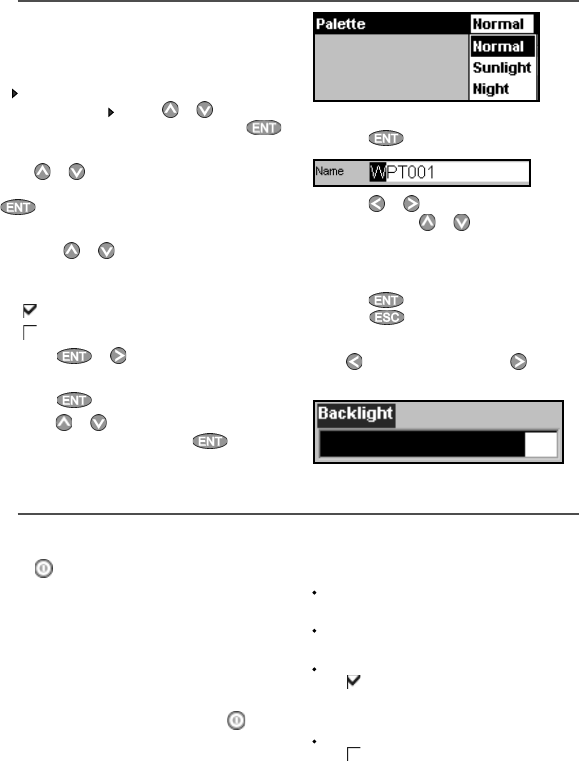
Overview of the keys
Go back to an earlier menu or display. Any changes made are
ignored. In chart mode, centres chart at boat’s position.
Show a menu of the main displays. To go to a display, select it
from the menu (see section 2-8).
Cursor keys, to move the cursor or the selection highlight.
Show a menu of the options for the current display. Press
again to display the Setup menu (see section 17).
Start an action or accept a change.
Zoom in or out to display diff erent areas and detail on the
chart.
Man overboard (MOB, see section 2-5).
Turn TRACKER on and off (see section 2-3); adjust the backlight-
ing (see section 2-4).
2-1 Using the keys
In this manual:
Press means to push the key for less than a second.
Hold means to hold the key down.
The internal beeper beeps when a key is pressed (to disable or enable the beep, see section 14-1).
TRACKER 5380 Installation and Operation Manual
10 NAVMAN
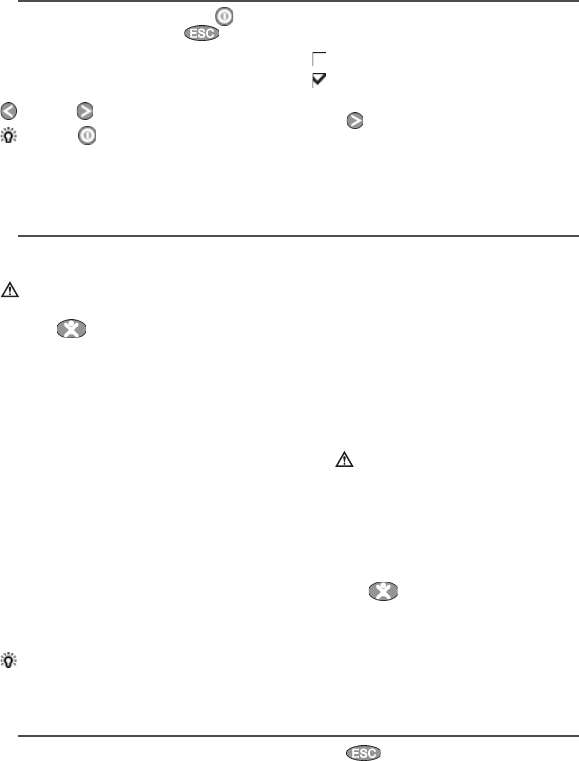
c) To change a name or number:
1 Press to display the name or number:
2 Press or to select a letter or digit to
change. Press or to change the letter
or digit.
Repeat this to change other letters or
numbers.
3 Press to accept the new value. Or
press to ignore the changes.
d) To change a slider value
Press to decrease the value or to increase
the value.
Operate the TRACKER by selecting items from
menus. Items can be submenus, commands
or data.
Selecting a submenu
A after a menu item indicates a submenu, for
example Chart . Press or to move
the highlight to the submenu, then press .
Starting a command
Press or to move the highlight to the
command, for example Goto cursor, then press
.
Changing data
First press or to move the highlight to the
data to change, then:
a) To change a tick box
means On or Yes
means Off or No.
Press or to change the tick box.
b) To select an option
1 Press to display the menu of options.
2 Press or to move the highlight to the
option you want, then press .
2-3 Turning on and off / auto power
Turning on manually
If the TRACKER is not wired for auto power,
press to turn the unit on. If necessary, adjust
the display to be easy to read (see section 2-4).
Note: If the TRACKER is not wired for auto
power then the TRACKER does not record
engine hours and might not record fuel
consumption (see section 15-4).
Turning off manually
If the TRACKER is not wired for auto power or
if the ignition switch is off, hold down until
the display turns off.
Auto power
If the TRACKER is wired for auto power (see
section 15-4), then:
The TRACKER automatically turns on when
you turn the boat’s ignition switch on.
You can not turn the TRACKER off while the
ignition switch is on.
If
Auto power off (see section 14-1)
is , the TRACKER automatically turns off
when you turn the boat’s ignition switch
off.
If
Auto power off (see section 14-1)
is , the TRACKER stays on when you turn
the boat’s ignition switch off. You can now
turn the TRACKER off manually.
2-2 Using the menus
TRACKER 5380 Installation and Operation Manual 11
NAVMAN
2-4 Backlight and night mode
To go to the Backlight display, press briefly.
When you have finished, press .
Backlight
The display and keys are backlit. To change the
backlight level, select Backlight, then press
to dim or to brighten.
Tip: Press twice to give the brightest
screen, with maximum backlight and Night
mode off.
Night mode
Night mode sets the palette for all displays.
Normal palette, for daytime
A palette optimised for night time.
To change mode, select Night mode, then
press . To change only the chart palette, see
section 17-2.
The MOB feature saves the boat’s position and
then navigates back to this point.
Warning: MOB will not work if the TRACKER
does not have a GPS fix.
1 Press .
The TRACKER stores the boat’s position as a
waypoint called MOB.
2 The TRACKER changes to the chart display,
with the MOB waypoint at the centre of the
chart.
The chart zooms in for accurate navigation.
If the chart can not show the required small
scale, the TRACKER changes to plotter
mode (a white display with crosshatching
and no chart details, see section 14-2).
3 The TRACKER sets the MOB waypoint to be
the destination to navigate to.
If the NMEA output (autopilot) is off (see
section 14-9) use the TRACKER to manually
navigate to the destination MOB waypoint
(see sections 3-1-1 and 3-1-2).
2-5 Man overboard (MOB)
If the NMEA output (autopilot) is on, the
TRACKER asks if the autopilot is active.
Select:
No: Use the TRACKER to manually navigate
to the destination MOB waypoint (see
sections 3-1-1 and 3-1-2).
Yes: The TRACKER asks if the boat is to go to
the MOB waypoint.
Select:
Yes: to immediately start navigating to
the MOB waypoint.
Warning: This might result in a sudden
and dangerous turn.
No: disengage the autopilot; then use
the TRACKER to manually navigate to the
destination MOB waypoint (see sections
3-1-1 and 3-1-2).
To cancel MOB or set another MOB
1 Press again to display a menu.
2 Select an option from the menu.
Tip: The MOB waypoint remains on the chart after the MOB has been cancelled. To delete the
MOB waypoint, see section 5-2-5.
2-6 Alarms
When the TRACKER detects an alarm condition,
it displays a warning message on the display,
the internal beeper sounds and any external
beepers or lights operate.
Press to clear the alarm. The alarm will
sound again if the alarm condition occurs
again.
The TRACKER has user settable alarms plus an
alarm for loss of GPS fix (see section 14-7).
TRACKER 5380 Installation and Operation Manual
12 NAVMAN
2-7 Simulate mode
In Simulate mode, the TRACKER ignores data
from the GPS antenna and other transducers
and sensors and the TRACKER generates this
data itself. Otherwise, the TRACKER functions
normally.
There are two simulate modes:
Normal: Allows a user to become familiar
with the TRACKER off the water.
Demo: Simulates a boat moving along
a route and automatically displays different
TRACKER functions.
To start and stop Simulate mode, and for more
information, see section 14-12. In simulate
mode, Simulate or Demo flashes at the
bottom of the display.
Warning: Never have Simulate mode on
when the TRACKER is navigating on the water.
SmartCraft menu and displays
The SmartCraft displays require a SmartCraft
system to be installed. For information on
using SmartCraft, see the SmartCraft Gateway
Installation and Operation Manual.
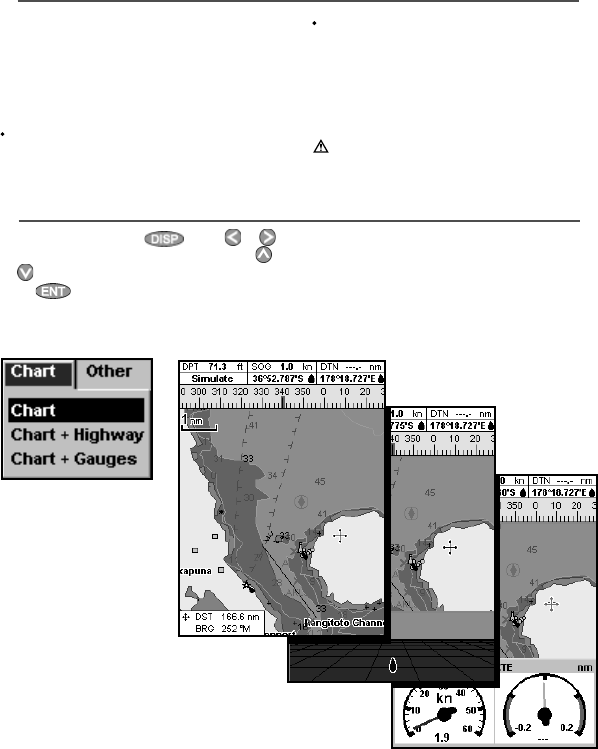
To go to a display, press , press or
to select the type of display to show, press
or to select the display from the list, then
press .
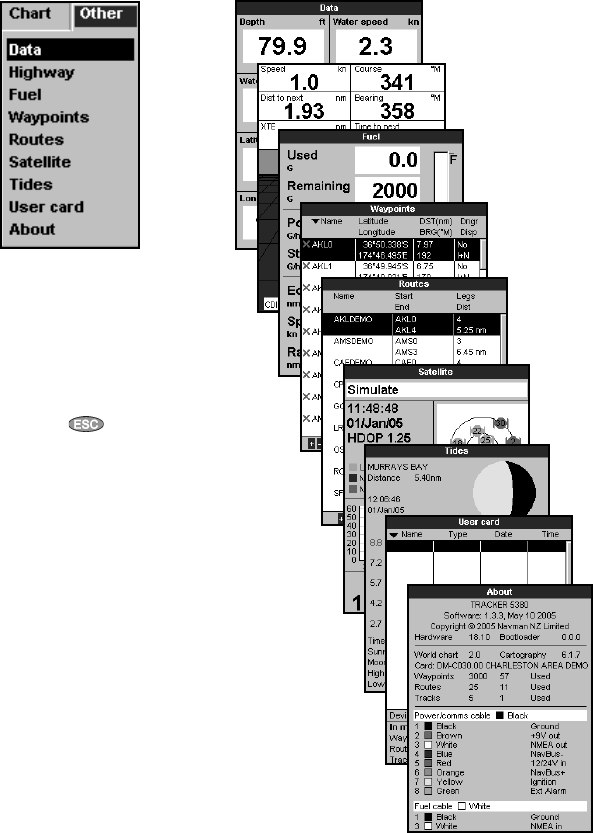
2-8 The main displays
Chart menu and displays
The available displays depend on the optional
sensors and instruments that are installed (see
section 1-1).
TRACKER 5380 Installation and Operation Manual 13
NAVMAN
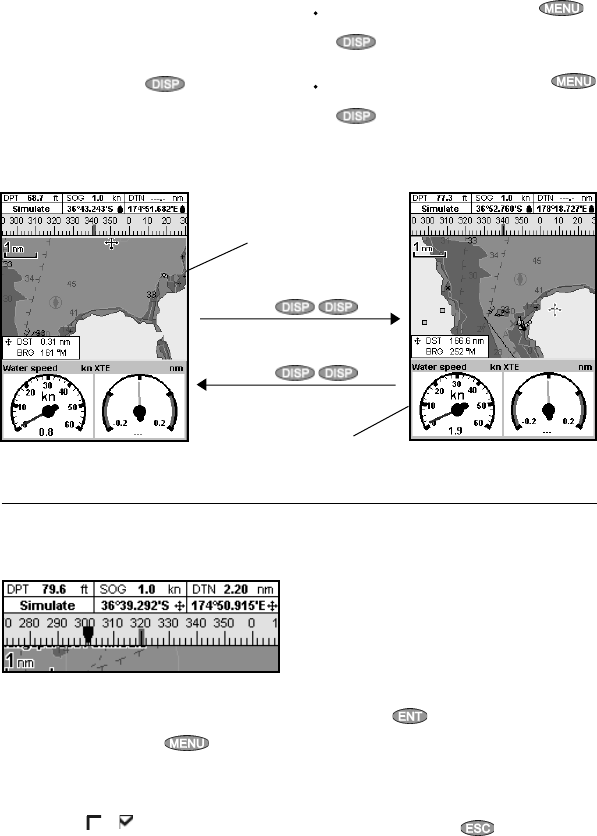
Other menu and displays
Note: Press to go from an Other display
back to your last chart display.
TRACKER 5380 Installation and Operation Manual
14 NAVMAN
2-8-1 Dual displays
The TRACKER can show two displays at once,
for example Chart + Gauges. One of the
displays, called the active display, has a yellow
border and is controlled by the user. To change
the active display, press twice (Highway
cannot be the active display). For example:
If Chart is the active display: press
to display the options for Chart; press
twice to make Gauges the active
display.
If Gauges is the active display: press
wto display the options for Gauges; press
twice to make Chart the active
display.
Chart display is
active
Gauges display
is not active
Yellow border
Press
Press
Yellow border
Chart display is
not active
Gauges display is
active
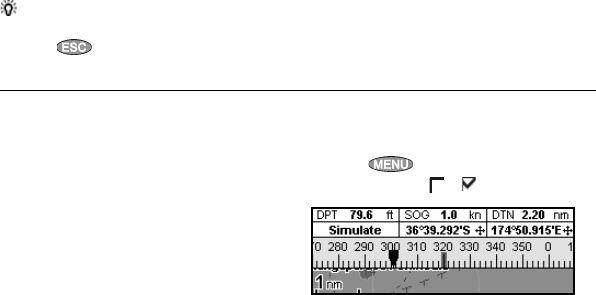
The chart and highway displays can show data
at the top of the display.
The data header for each display can be
different. To change the data header for a
display:
1 Go to the display, press and select
Data header.
2 To turn the data header off or on:
i Select
Data.
ii Select or .
3 To choose the size of the numbers:
i Select
Size.
ii Select
Small, Medium or Large.
4 To change the data displayed:
i Select
Data setup.
ii Change a data field:
a Press the cursor keys to highlight the
field.
b Press to display a menu of data
items.
c Select a data item that is available on
your system or select None to leave the
field empty.
iii Repeat the above step to set the other
data fields. Press .
2-8-2 Data header
TRACKER 5380 Installation and Operation Manual 15
NAVMAN
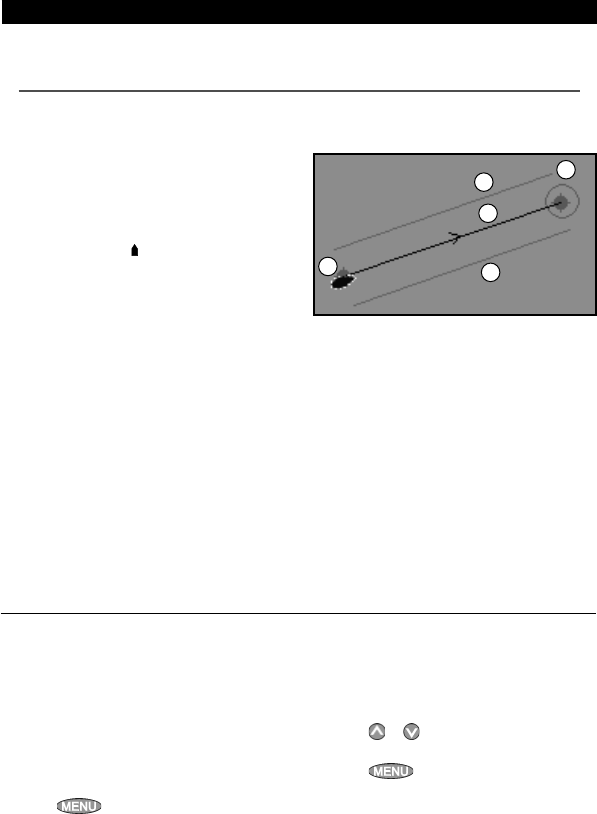
The chart and highway displays can show a
compass at the top of the display.
The compass always shows the boat’s course
over ground (COG), a red symbol in the middle.
When the boat is navigating to a point, the
compass also shows bearing to the destination
(BRG), a black symbol.
In this example, BRG is [300]° and COG is [320]°.
To turn the compass off or on:
1 Press and select Data header.
2 Set Compass to or .
2-8-3 Compass
Tip: If less than the maximum number of lines of data are used, the data will take up less of the
display area.
5 Press to return to the display.
TRACKER 5380 Installation and Operation Manual
16 NAVMAN
A waypoint is a position that you can set on the
TRACKER chart, for example a fishing spot or a
point on a route (see section 5).
Going to a waypoint from the chart display
1 Go to the chart display.
2 Move the cursor to the waypoint: either use
the cursor keys or use Find (see section 3-2-5).
3 Press and select Goto.
3-1-2 Going to a waypoint or to a point on the chart
Going to a waypoint from the waypoints
display
1 Go to the waypoints display.
2 Press or to highlight the waypoint to
go to.
3 Press and select Goto.
3-1-1 Navigating to a point
When the TRACKER is navigating to a point, the
chart and highway displays show navigation
data:
A The boat position .
B The destination point marked with a circle.
C The boat’s plotted course to the
destination.
D Two CDI lines, parallel to the boat’s plotted
course, which indicate the maximum
expected deviation from the plotted
course.
For more information, see appendix C.
If the TRACKER is connected to an autopilot, the
TRACKER will send data to the autopilot to steer
the boat to the destination. Start the autopilot
before starting to navigate to the point.
If the TRACKER has no autopilot, steer the boat
manually:
a use the boat position and destination on
the chart or highway displays
b or use navigation data displayed on the
data header (see section 2-8-2)
c or use COG and BRG on the compass (see
section 2-8-3).
Note:
1 If the XTE alarm is enabled, an alarm will
sound if the boat deviates too much from
its intended course (see section 14-7).
2 If the arrival radius alarm is enabled, then
an alarm will sound to show that the boat
has reached the destination (see section
14-7).
A
C
D
DB
3 Navigation: Chart
3-1 Overview of navigating
The chart display shows the chart, the boat’s position course and navigation data.
The TRACKER has two ways of navigating, going straight to a point or following a route.
TRACKER 5380 Installation and Operation Manual 17
NAVMAN
Preparing
A route is a list of waypoints that the boat can
follow (see section 6).
To create waypoints before creating the
route, see section 5-2-1.
To create a route, see section 6-2-1.
Starting a route from the chart display:
1 Go to the chart display.
2. Press and select Start Route.
3. Press or to highlight the route to
follow. Press .
4. The TRACKER asks for the direction to
traverse the route.
Select Forward (the order the route was
created) or Reverse.
5. The TRACKER displays the chart with the
route marked and starts navigating from
the start of the route.
Starting a route from the routes display:
1 Go to the routes display.
2 Press or to highlight the route to
follow. Press and select Start.
3 The TRACKER asks for the direction to
traverse the route.
Select
Forward (the order the route was
created) or Reverse.
3-1-3 Following a route
4 The TRACKER displays a chart with the
route marked and starts navigating from
the start of the route.
Navigating
The TRACKER navigates to each waypoint on
the route in turn as described in section 3-1-1.
The TRACKER stops navigating to the waypoint
at the end of the current leg and starts the next
leg of the route:
a when the boat comes within 0.025 nm of
the waypoint
b or when the boat passes the waypoint
c or if you skip the waypoint.
Skipping a waypoint
To skip a waypoint, go to a chart display, press
and select Skip. The TRACKER starts
navigating straight towards the next waypoint
on the route.
Warning: Skipping a waypoint with the
autopilot on might result in a sudden course
change.
Cancelling a route
When the boat has reached the final waypoint,
or to stop the boat following the route at any
time, cancel the route. Go to a chart display,
press and select Cancel route.
Tip: Before starting, create waypoints at points of interest. Create a waypoint at the start of the
trip for you to navigate back to (see section 5-2-1).
Going to a point on the chart
1 Switch to a chart display.
2 Move the cursor to the destination point:
either use the cursor keys or use Find (see
section 3-2-5).
3 Press and select Goto cursor.
Warning: Make sure the course does not
pass over land or dangerous waters.
Navigating
The TRACKER navigates to the point as
described in section 3-1-1.
Cancelling navigating
Go to a Chart display, press and select
Cancel goto.
TRACKER 5380 Installation and Operation Manual
18 NAVMAN
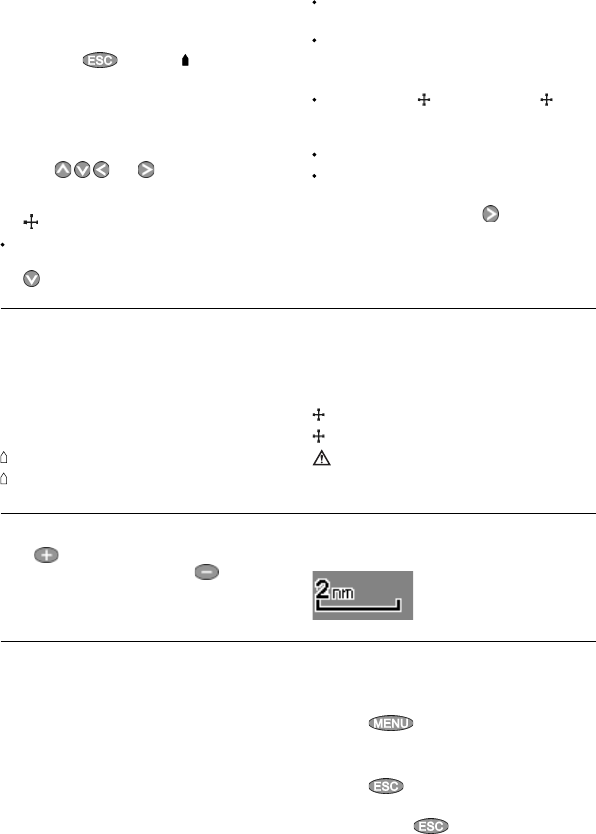
A typical chart display shows:
3-2 Chart display
To go to the Chart display, press , select Chart, then select Chart.
A Data header. To turn the data off or on or to change what data is displayed, see section 2-8-2
B Compass (see section 2-8-3)
C Chart scale (see section 3-2-3)
D Boat position (see section 3-2-1)
E Boat track (see section 3-5)
F Boat course and CDI lines (see Appendix C, CDI). The boat is going to the waypoint called
FISH06
G Distance and bearing of cursor from boat
HLand
ISea
J The cursor (see section 3-2-1)
K A typical waypoint (see section 5)
Note: To change the types of information displayed on the chart, see section 17-2.
A
D
E
B
F
J
H
I
G
K
C
TRACKER 5380 Installation and Operation Manual 19
NAVMAN
The chart scale is displayed at the top left of
the chart:
3-2-2 Latitude and longitude
Latitude and longitude can be displayed in
the data header. The display is degrees and
minutes to three decimal places, about 2 m
(6 ft) resolution. Normally the position is the
boat’s position, and the latitude and longitude
has a boat symbol to show this:
36° 29.637’ N or S Latitude
175° 09.165’ E or W Longitude
3-2-1 Chart modes
The Chart has two modes:
Centre on boat mode
To switch to centre on boat mode in the chart
display, press . The boat is at the centre
of the chart. As the boat moves through the
water, the chart automatically scrolls to keep
the boat in the centre of the chart. The cursor
(see below) is turned off.
Cursor mode
The keys and are called cursor
keys. To switch to cursor mode in the chart
display, hold down a cursor key. The cursor
appears and moves away from the boat:
Press the key which points in the direction
that the cursor will move, for example press
to move the cursor down.
Press midway between two of the cursor
keys to make the cursor move diagonally.
Hold a cursor key down to make the cursor
move continuously across the display.
In Cursor mode:
The distance ( DST) and bearing ( BRG)
of the cursor from the boat are displayed at
the bottom, left corner of the display.
The chart does not scroll as the boat moves.
If the cursor reaches the edge of the
display, the chart will scroll.
For example, hold down to move the
cursor to the right side of the display and
the chart will scroll to the left.
If the cursor has been moved in the last ten
seconds, then the position is the cursor’s
position, and the latitude and longitude has a
cursor symbol to show this:
36° 29.841’ N or S Latitude
175° 09.012’ E or W Longitude
Warning: When reading the boat position,
make sure the position is not the cursor
position.
3-2-3 Chart scale
Press to zoom in and display a smaller area
of the chart in more detail. Press to zoom
out and display a bigger area in less detail.
3-2-4 Chart symbols and information
The chart will show symbols, such as waypoints
and chart symbols (for example buoys,
beacons, wrecks and marinas). When the
cursor is placed over a symbol for at least two
seconds, a data window appears at the bottom
left of the display with information about the
symbol.
To see stored information about a point on the
chart (for example, a chart symbol):
1 Move the cursor to that point on the chart.
2 Press and select Chart info.
3 A menu of objects is displayed:
i Select an object to display.
ii Press to return to the menu. Select
other objects.
iii Finally, press to return to the chart.
TRACKER 5380 Installation and Operation Manual
20 NAVMAN
3-3 Distance and bearing calculator
The distance and bearing calculator can plot
a course of one or several legs and show the
bearing and length of each leg, as well as the
total distance along the course. The completed
course can be converted into a route.
To use the distance and bearing calculator:
1 Press until the chart display is
displayed. Press and select
Distance.
2 Move the cursor to the start of the first leg.
It does not matter if this point is a waypoint
or not. Press .
3 To add a leg to the course, move the cursor
to the end of the leg. It does not matter if
this point is a waypoint or not. The display
shows the bearing and length of the leg, as
well as the total distance along the course.
Press .
4 To remove the last leg from the course,
press and select Remove.
5 Repeat the above two steps to enter the
whole course.
6 To save the new course as a route, press
and select Save. This also
saves any new points on the course as
new waypoints, with default names. If
necessary, edit the route later (see section
6-2-2) and edit any new waypoints later
(see section 5-2-3).
7 Finally, press to return to the chart
display.
3-2-5 Finding places
To see places near the boat’s position, press
to switch to centre on boat mode.
To see places near a different point, move the
cursor to that point on the chart.
To find and display places of interest:
1 Press and select Find.
2 Select the type of place: Waypoints, Routes,
Ports, Port services or Tide stations.
3 For a Port service, select the type of service
to find.
4 A list of places is displayed. If there are
more places than will fit on the display,
press or to scroll up or down a
page at a time.
5 Select the place and press . The chart
display changes to show the selected place
in the middle of the display.
6 To see stored information about the
selected place, press and select
Chart info (see section 3-2-4). To
display a tide chart for a selected tide
station, select Tide height from the
chart info.
TRACKER 5380 Installation and Operation Manual 21
NAVMAN
Tracking records the boat’s position to memory
at regular intervals, which can be:
Time intervals.
Or distance intervals.
The track of where the boat has been can
be displayed on the chart. The TRACKER can
display one track while recording another.
To work with tracks, see section 14-5.
The TRACKER can store five tracks:
Track 1 can hold up to 2000 points and is
intended to record the normal progress of
the boat.
Tracks 2, 3, 4 and 5 can hold up to 500
points each and are intended to record
sections to be retraced accurately, for
example entering a river mouth.
Tip: Record the tracks in good conditions.
When recording is on and the track becomes
full then recording continues and the oldest
points in the track are deleted. The maximum
3-5 Tracks and tracking
length of a track depends on the selected track
interval: a small interval will give a shorter,
more detailed track and a long interval will give
a longer, less detailed track, as shown in these
examples:
The track lengths are in the current distance
units, for example nm.
If Projected course is turned on, then the
TRACKER will display the projected position
based on the course over ground (COG), speed
and a specified time. To turn Projected course
on and off and to set the time, see section 14-2.
A Projected position
B Boat’s projected course
C Boat position
3-4 Projected course
Time intervals
Interval Track 1 Track 2, 3, 4
or 5
1 sec 33 minutes 8 minutes
10 sec 5.5 hours 1.4 hours
1 min 33 hours 8 hours
Distance intervals
Interval Track 1 Track 2, 3, 4
or 5
0.01 20 5
1 2,000 500
10 20,000 5,000
A
C
B
TRACKER 5380 Installation and Operation Manual
22 NAVMAN
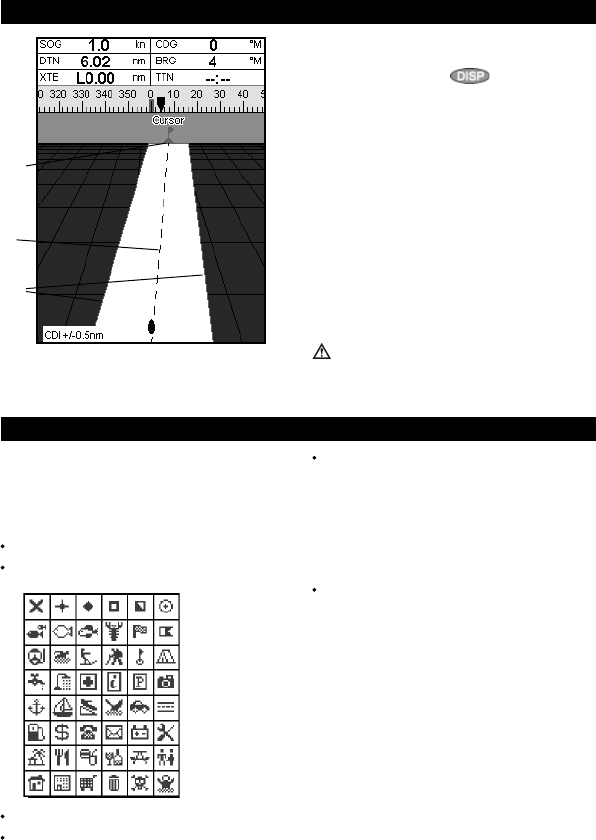
4 Navigation: Highway display
The highway display has a bird’s eye view of
the boat’s course to a destination. To go to the
Highway display, press , select Other,
then select Highway.
The highway display shows:
A Optional data header (see section 2-8-3)
B Optional compass (see section 2-8-4)
C Destination waypoint
D Boat’s plotted course to destination
E CDI lines, parallel to the boat’s plotted
course (see Appendix C, CDI). The CDI lines
are like a highway over the water where the
boat will move.
F CDI scale
G The boat position is at the bottom, centre
of the display
Warning: The highway display does not
show land, dangerous waters or chart symbols.
A
C
D
B
E
G
F
5 Navigation: Waypoints
A waypoint is a position that you can set on the
TRACKER chart for example a fishing spot or a
point on a route. The TRACKER can have up to
3000 waypoints. A waypoint can be created,
changed or deleted. A waypoint has:
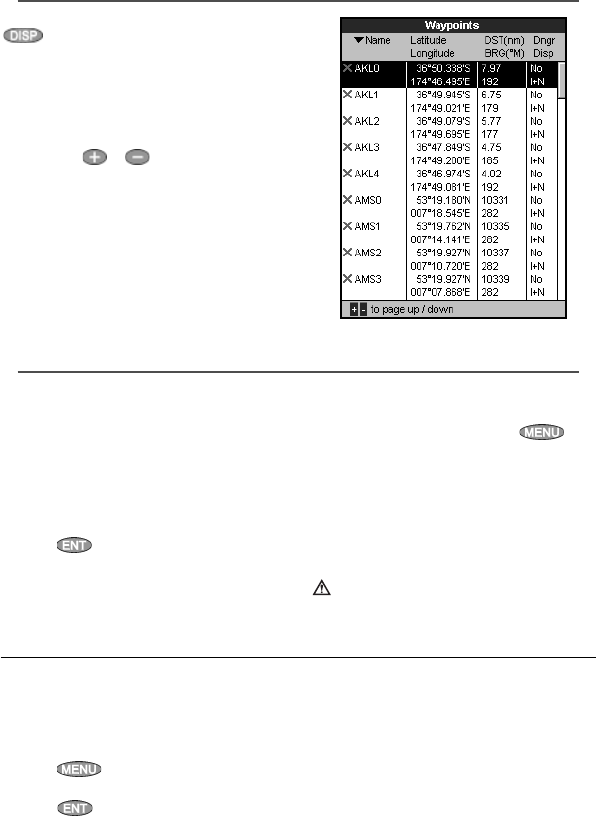
A name (up to eight characters).
An icon showing what kind of waypoint it
is. The available icons are:
A position.
A colour for the waypoint symbol and
name on the chart.
A type:
Normal: A normal waypoint can be
navigated to or included in a route.
Danger: A danger waypoint is a point to
avoid. If the boat comes within the danger
radius of a danger waypoint the unit can
sound an alarm (see section 14-7).
A display option:
Controls how the waypoint is displayed
when the Waypoints setup option is set
to Selected (see section 14-2):
Off: The waypoint is not displayed.
Icon: The waypoint icon is displayed.
I+N (Icon and Name): The waypoint
icon and name are displayed.
If there are many waypoints, use this
feature to select which waypoints are
displayed on the chart.
Note: The other choices for Waypoints are Hide
all and Show all (see section 14-2).
TRACKER 5380 Installation and Operation Manual 23
NAVMAN
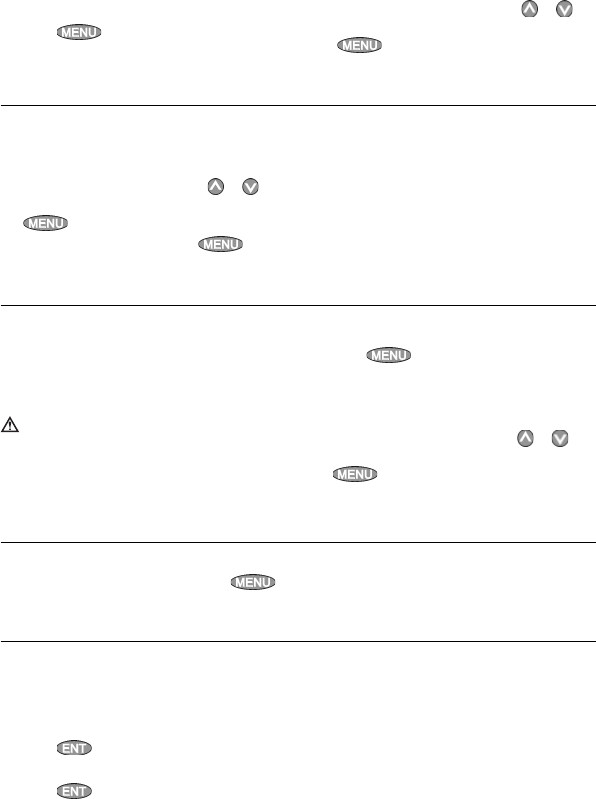
5-1 Waypoints display
To go to the waypoints display, press
, select Other, then select Waypoints.
The waypoints display is a list of the waypoints
that have been entered, each with waypoint
symbol, name, latitude and longitude, distance
and bearing from the boat, type and display
option.
If there are more waypoints than will fit on the
display, press or to scroll up or down a
page at a time.
5-2 Managing waypoints
5-2-1 Creating a new waypoint
Creating and editing a new waypoint from
the chart display
1 To create a waypoint at the boat position,
press ESC to switch the chart to centre on
boat mode.
Or, to create a waypoint at a different point,
move the cursor to that point on the chart.
2 Press .
3 A new waypoint, with the default name and
data is created.
4 Change the waypoint data if necessary (see
section 5-2-7). Select Save.
Creating a new waypoint from the
waypoints display
1 In the waypoints display, press and
select Create.
2 A new waypoint, with a default name and
data, is created at the boat position.
3 Change the waypoint data if necessary (see
section 5-2-7). Select Save.
Note: Waypoints can also be created when a
route is created (see section 6-2-1).
Warning: Do not create a navigation
waypoint on land or in dangerous water.
Moving a waypoint from the chart display
1 In the chart display, move the cursor to the
waypoint to move.
2 Press and select Move.
3 Move the cursor to the new position and
press .
Moving a waypoint from the waypoints
display
To move a waypoint from the waypoints
display, edit the waypoint (see section 5-2-3)
and change the latitude and longitude.
5-2-2 Moving a waypoint
TRACKER 5380 Installation and Operation Manual
24 NAVMAN
5-2-3 Editing a waypoint
Editing a waypoint from the chart display
1 In the chart display, move the cursor to the
waypoint to edit.
2 Press and select Edit.
3 Change the waypoint data (see section
5-2-7). Select Save.
Editing a waypoint from the waypoints
display
1 In the waypoints display, press or
to highlight the waypoint to edit. Press
and select Edit.
2 Change the waypoint data (see section
5-2-7). Select Save.
5-2-4 Displaying a waypoint on the chart
This goes to the chart display, and shows the
selected waypoint at the centre of the display.
1 In the waypoints display, press or
to highlight the waypoint to display. Press
and select Display.
Or, in the Chart display, press , select
Find, then select Waypoints. Select a
waypoint from the list.
2 The TRACKER switches to the chart display,
with the selected waypoint at the centre of
the chart.
5-2-5 Deleting a waypoint
A waypoint can not be deleted if the boat is
navigating to it or if the waypoint is used in
more than one route. A waypoint that is used in
one route can be deleted.
Warning: when a waypoint is deleted from
a route, check that the changed route does not
cross land or dangerous waters.
Deleting a waypoint from the chart display
1 In the chart display, move the cursor to the
waypoint to delete.
2 Press and select Delete.
3 Select Yes to confirm.
Deleting a waypoint from the waypoints
display
1 In the waypoints display, press or
to highlight the waypoint to delete. Press
and select Delete.
2 Select Yes to confirm.
5-2-6 Deleting all waypoints
1 In the waypoints display and press and select Delete all.
2 Select Yes to confirm.
To change the waypoint data when it is
displayed in a window:
1 Select the data to change.
Press .
Use the cursor keys to change the data.
Press .
2 If necessary, repeat the above step to
change other data.
3 Select
Save.
5-2-7 Changing a waypoint’s data
TRACKER 5380 Installation and Operation Manual 25
NAVMAN
5-2-9 Navigating to a waypoint
See section 3-1-2.
5-2-8 Sort Waypoints
To change how the waypoints list is displayed:
1 Press and select Sort by.
2 Select how to display the list:
Name: In alphabetical order by name.
Icon: Grouped by icon type.
Distance: In order of distance from the
boat.
An arrow at at the top of a column indicates
how the waypoints are sorted.
6 Navigation: Routes
A route is a list of waypoints that the boat
can navigate along. Routes can be created,
changed and deleted.
The TRACKER can have up to 25 routes. Each
route can have up to 50 waypoints.
A route can:
Start and stop at the same waypoint .
Include waypoints more than once.
The TRACKER can navigate along a route in
either direction. Waypoints on the route can
be skipped.
Routes are a powerful feature when the
TRACKER is connected to an autopilot, allowing
the vessel to be automatically guided along
the route.
Warning: Make sure that routes do not
cross land or dangerous water.
6-1 Routes display
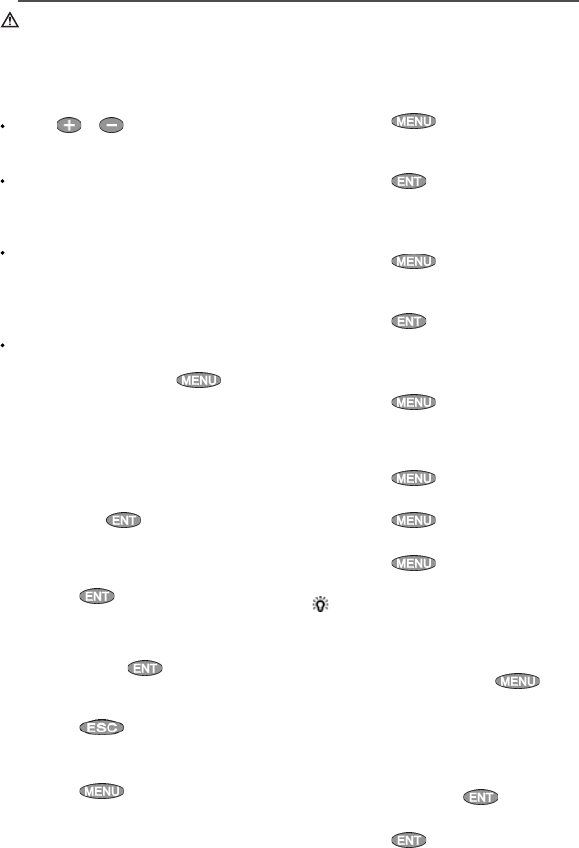
The routes display is a list of the routes that
have been entered, each with route name, start
waypoint, end waypoint, number of legs and
total distance.
To go to the routes display, press , select
Other, then select Routes.
If there are more routes than will fit on the
display, press or to scroll up or down a
page at a time.
TRACKER 5380 Installation and Operation Manual
26 NAVMAN
Warning: After creating or changing a route, display the route on the chart and check that it
does not cross land or dangerous water.
i Move the cursor to the leg you want to
break.
ii Press and select Insert.
iii Move the cursor to where the new
route waypoint will be.
iv Press .
3 To move a waypoint in the route:
i Move the cursor to the waypoint to
move.
ii Press and select Move.
iii Move the cursor to where the waypoint
will be.
iv Press .
4 To remove a waypoint from the route:
i Move the cursor to the waypoint to
remove from the route.
ii Press and select Remove. The
waypoint is removed from the route,
but the waypoint is not deleted.
5 To start navigating the route
i Press and select Start
6 To end creating the route
i Press and select End
7 To delete the route
i Press and select Delete
ii Select yes to confirm.
Tip: The distance and bearing calculator can
also be used to enter a course and save it as a
route (see section 3-3).
B. Creating a new route from the routes display
1 In the routes display, press and
select Create.
2 A new route, with a default name and no
waypoints, is displayed.
3 To change the route name:
i Select the route name at the top of the
display and press .
ii Change the name if necessary.
iii Press .
6-2 Managing routes
6-2-1 Creating a new route
A. Creating a new route from the chart display
While creating the route:
Press or to change the range;
scroll the chart by moving the cursor to the
edge of the chart.
A data box at the bottom left of the display
shows the route name and total distance. If
the cursor is near a leg, it shows the length
and bearing of the leg as well.
The legs of a route must start and end at
waypoints. If a leg does not start or end at
an existing waypoint then a new waypoint
will be created automatically (to change
the new waypoint data, see section 5-2-7).
You can not use a Danger waypoint in a
route.
1 In the chart display, press and
select New route.
2 The route is given a default name:
i Change the name if necessary.
ii Select Ok.
3 To enter the legs of the route:
i Move the cursor to the start of the route
and press .
ii A waypoint is created with a default
name. to save this waypoint press enter,
to edit the waypoint refer to 5-2-7
iii Press a dotted leg line is
displayed from the cursor to the
previous waypoint
iv Move the cursor to the end of the first
leg and press .
v Repeat i to iv until the last waypoint in
the route is placed and saved
vi Press to complete the route
Menu options while creating a route:
1 To add a waypoint to the route
i Press and select Add.
2 To insert a waypoint in the route by
breaking one leg into two:
TRACKER 5380 Installation and Operation Manual 27
NAVMAN
4 To insert a waypoint in the route:
i Select where the waypoint will be:
To insert the first waypoint in a new
route, select Leg 1.
To insert a waypoint at the end of
the route, select the unused leg at
the end of the list of waypoints.
Otherwise, select the waypoint to
insert the new waypoint in front of.
ii Press . A list of waypoints is
displayed. Select the waypoint to use.
As waypoints are inserted, the distance
and bearing of each leg is shown
automatically. If the route has more
waypoints than will fit on the display,
press or to see them.
5 To remove a waypoint from the route:
i Select the waypoint to remove.
ii Press and select Remove.
6 Repeat this process until the route is
finished.
7 Press .
8 Display the route on the chart (see section
6-2-3) and check that the route does not
cross land or dangerous water.
See section 3-1-3.
6-2-2 Editing a route
Editing a route from the chart
1 In the routes display, select the route to
edit. Press and select Edit on
chart.
2 The selected route is displayed on the
chart, with a circle around the first
waypoint.
3 Edit the route as described in section 6-2-1
A, starting at step 4.
Editing a route from the routes display
1 In the routes display, press or to
highlight the route to edit. Press
and select Edit.
2 The selected route is displayed: the route
name and a list of the waypoints.
3 Edit the route as described in section 6-2-1
B, starting at step 3.
6-2-3 Displaying a route on the chart
To view the selected route at the centre of
the display:
1 In the routes display, press or to
highlight the route to display. Press
and select Display.
Or, in the Chart display, press , select
Find, then select Route. Select a route
from the list.
2 The TRACKER displays the selected route on
the chart.
1 In the routes display, press and select Delete all.
2 Select Yes to confirm.
1 In the routes display, press or to highlight the route to delete. Press and select
Delete.
2 Select Yes to confirm.
6-2-4 Deleting a route
6-2-5 Deleting all routes
6-2-6 Navigating a route
See section 3-1-3.

TRACKER 5380 Installation and Operation Manual
28 NAVMAN
GPS worldwide navigation
The US Government operates the GPS system.
Twenty-four satellites orbit the earth and
broadcast position and time signals. The
positions of these satellites are constantly
changing. The GPS receiver analyses the
signals from the closest satellites and
calculates exactly where it is on earth. This is
called the GPS position.
The accuracy of the GPS position is typically
better than 10 m (33 ft) for 95% of the time. A
GPS antenna can receive signals from the GPS
satellites when it is almost anywhere on earth.
DGPS
A DGPS system uses correction signals to
remove some of the errors in the GPS position.
The TRACKER can use one of two types of
DGPS system:
WAAS and EGNOS DGPS
WAAS and EGNOS are two satellite based
DGPS systems. The correction signals are
broadcast by satellites and are received by
the TRACKER’s standard GPS antenna. The
accuracy of the corrected GPS position is
typically better than 5 m (15 ft) for 95% of
the time.
7 Satellites
WAAS covers all of the USA and most of
Canada. EGNOS will cover most of Western
Europe when it becomes operational.
Differential beacon DGPS
Differential beacons are land based radio
transmitters that broadcast correction
signals that can be received by a special
receiver on the boat. Differential beacons
are usually only installed near ports and
important waterways, and each beacon
has a limited range. The accuracy of the
corrected GPS position is typically better
than 2 to 5 m (6 to 16 ft).
GPS receiver
Navman GPS units have a sensitive 12-channel
receiver, which tracks signals from all GPS
satellites visible above the horizon and uses
measurements from all satellites more than 5°
above the horizon to calculate the position.
Each time a GPS receiver is turned on, it
normally takes about 50 seconds before
it outputs the first position. Under some
circumstances it will take up to two minutes
or longer.
TRACKER 5380 Installation and Operation Manual 29
NAVMAN
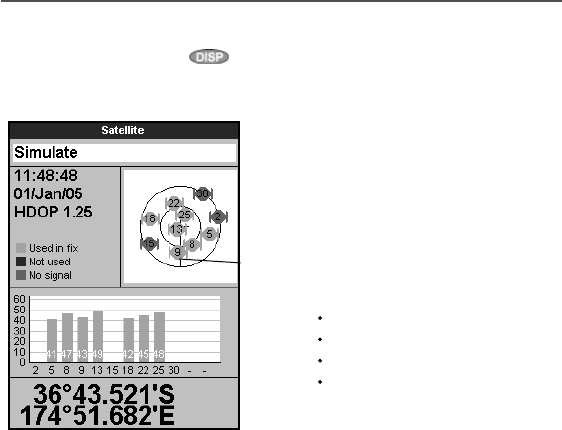
The satellite display has information about the
GPS satellites and GPS position.
To go to the satellite display, press ,
select Other, then select Satellite.
The satellite display shows:
7-1 Satellite display
A
C
D
B
E
G
F
A Status of GPS antenna, for example
Acquiring, GPS fix, No GPS. If the unit is in
Simulate mode it displays Simulate (see
section 2-7)
B Time and date from GPS satellites. Time is
local time (UTC [GMT] plus local offset, see
section 14-11)
C HDOP: The error in the GPS position caused
by satellite geometry. A low value indicates
a more precise fix, a high value a less
precise fix
D Signal strengths of up to twelve visible GPS
satellites. The higher the bar the stronger
the signal
E Boat position
F Positions of visible GPS satellites:
Outer circle is horizon
Inner circle is 45° elevation
Centre is directly above
North is at top of display
G If the boat is moving, COG is a line from
centre
TRACKER 5380 Installation and Operation Manual
30 NAVMAN
8 Gauges display
The Gauges display shows boat data, such as
water speed, as analog or digital gauges.
To go to the Gauge display, press and
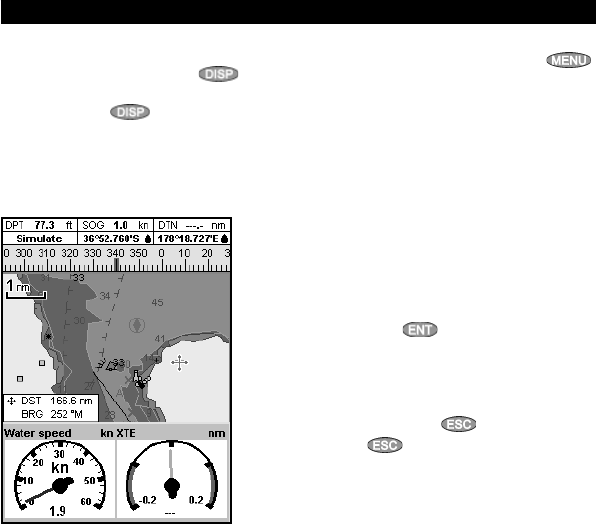
select Chart, then select Chart+Gauges.
If necessary, press twice to switch to the
Gauges display (see section 2-8-1).
Before using the Gauge display, set Speed
range and Max fuel flow (see section
17-11).
Chart
Gauges
Changing the Gauges display
1 Go to the Gauges display and press .
2 To select the gauge type.
i Select
Gauge type.
ii Select Analog (round) or Digital
(numbers).
3 To select the gauge size.
i Select
Gauge size.
ii Select Small, Medium or Large.
4 To change the data displayed:
i Select
Gauge setup.
ii Change a gauge:
a) Press the cursor keys to highlight the
gauge.
b) Press to display a menu of data
items.
c) Select a data item that is available on
your system.
iii Repeat the above step to set the other
gauges. Press .
5 Press to return to the Gauges display.
TRACKER 5380 Installation and Operation Manual 31
NAVMAN
9 Data display
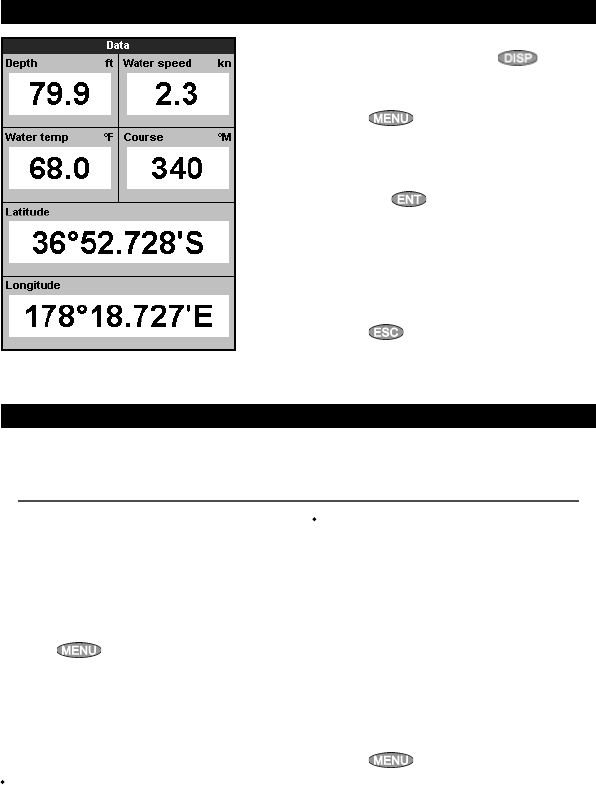
The data display has large numeric data fields.
To go to the data display, press , select
Other, then select Data.
To select what data is displayed:
1 Press and select Data setup.
2 Change a data field:
i Press the cursor keys to highlight the
field.
ii Press to display a menu of data
items.
iii Select a data item that is available on
your system or select None to leave
the field empty.
3 Repeat the above step to set the other data
fields.
4 Press .
10 Fuel functions and display
The Fuel functions require optional fuel sensors to be installed.
10-1 When you add or remove fuel
When you add or remove fuel in a boat with no
SmartCraft fuel tank level sensors, you must
tell the TRACKER, otherwise REMAINING,
RANGE and the low fuel alarm will be
meaningless.
A When you completely fill the tank
1 Fill the tank.
2 Press one or more times until the
Setup menu is displayed, then select
Fuel.
3 Select Tank full.
Note: Underfloor fuel tanks are often difficult
to refill to the same level twice, due to air
pockets. With underfloor fuel tanks:
Trim the boat to the same angle in the
water each time you follow procedure A.
Mostly use procedure B below when
adding fuel, but completely fill the tank
and follow procedure A about every tenth
time you add fuel.
B When you part fill the tank
1 Before adding fuel, go to the fuel display
and write down the value of Remaining, which
is the amount of fuel now in the tank.
2 Add fuel to the tank, writing down how
much you add.
3 Add together the two figures you have
written down, to calculate the amount of
fuel now in the tank.
4 Press one or more times until the
Setup menu is displayed, then select
Fuel.
TRACKER 5380 Installation and Operation Manual
32 NAVMAN
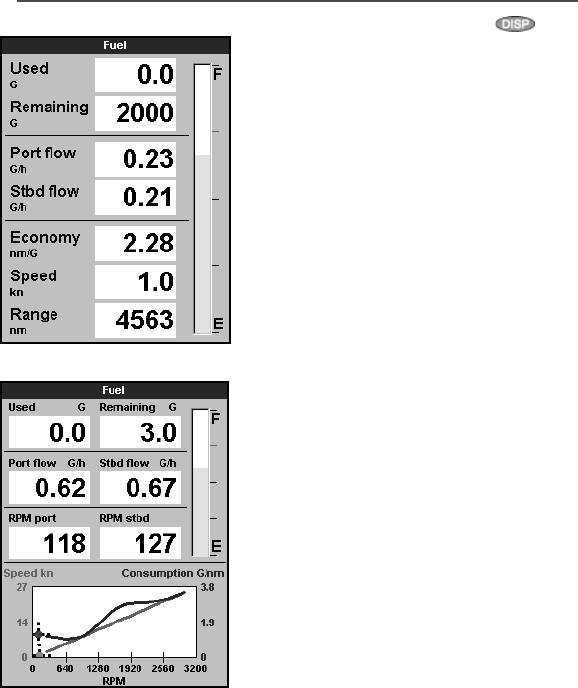
10-2 Fuel display
Fuel display without engine RPM
Fuel display with engine RPM
To go to the Fuel display, press , select
Other, then select Fuel. The display is
different if engine RPM is available (requires
SmartCraft to be installed):
The Fuel display shows
Used
The total fuel used since this was last reset with
the Clear Used command.
Remaining
The amount of fuel remaining in the tank.
Flow
The fuel consumption per hour. For twin
engine installations, the fuel flow for each
engine is shown separately. This is useful for
checking that both engines are under the same
load.
Speed
If the TRACKER has both GPS and paddlewheel
speed available then you can select which to
use. The choice affects the calculated Range
and Economy (see section 17-5 Speed source).
If the TRACKER uses a paddlewheel sensor
to measure speed, then the speed must be
accurately calibrated.
Economy
The the distance travelled per unit of fuel
used. The bigger this number, the better the
fuel economy. Adjust the throttle and trim to
achieve the best economy.
Range
The estimated boat range at the current fuel
flow.
5 Set
Remaining to the amount of fuel
that you calculated was now in the tank.
Note: If you follow procedure B every time you
add fuel, then a small error will accumulate,
because it is hard to measure exactly how
much fuel you add. To avoid this, completely fill
the tank and follow procedure A about every
tenth time you add fuel.
C When you remove fuel
Repeat procedure B, but subtract the fuel you
have removed from the original amount of fuel
in the tank to calculate the amount of fuel now
in the tank.
TRACKER 5380 Installation and Operation Manual 33
NAVMAN
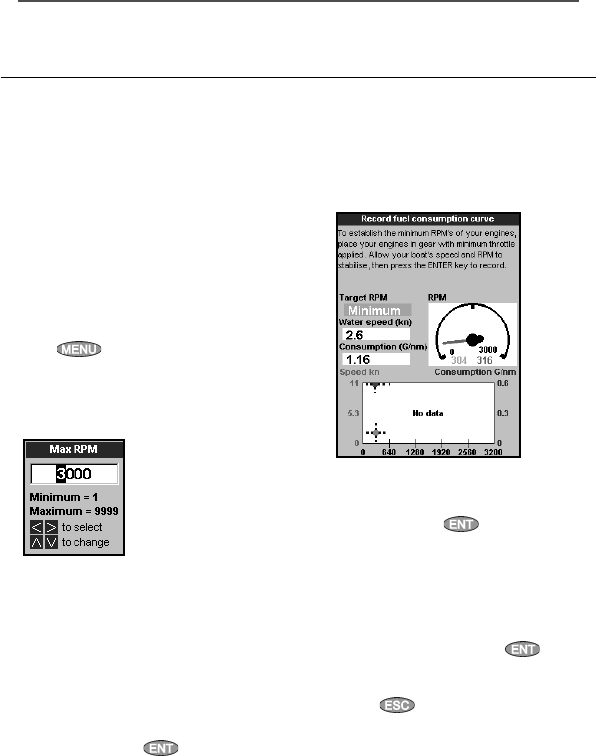
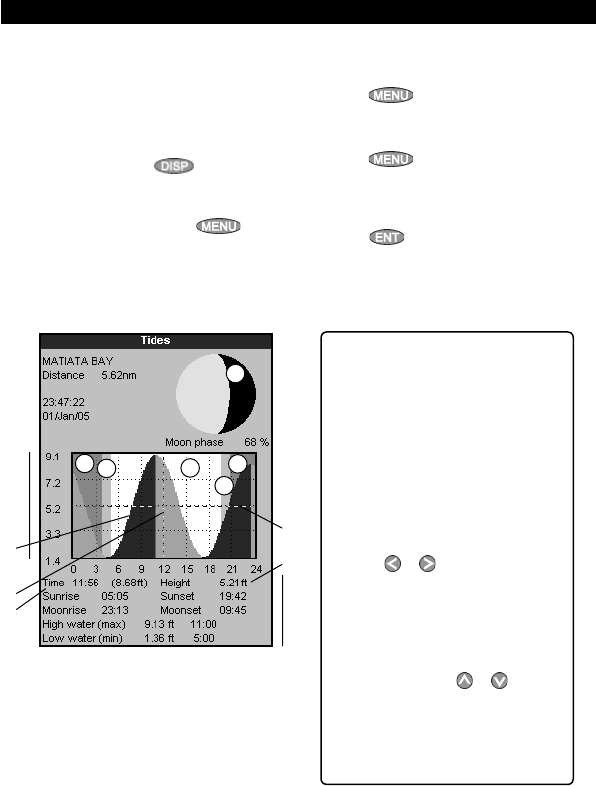
6 The TRACKER then asks you to set the
throttle to achieve a target RPM. For a twin
engine boat set both engines to about the
target RPM. When the engine RPMs are
correct, the Target RPM box will turn green.
Now, do not change the engine speed.
Wait for about 60 seconds for the boat to
stabilise, ensuring the Target RPM box stays
green. Then press . Wait while the
TRACKER records the data.
7 The TRACKER repeats the above step to
record data up to the maximum RPM.
Then the TRACKER asks if you want to save
the curve. Select Yes. The TRACKER asks for
a name for the curve. Change the default
name if required, then press . The
new curve is stored.
Note: To interrupt making the curve at any
time, press .
10-3 Fuel consumption curves
A fuel consumption curve is a powerful tool for assessing your boat performance in different
conditions and for helping you to run at the most economical speed for the conditions. Fuel
consumption curves require engine RPM, which requires SmartCraft to be installed.
Making a fuel consumption curve requires
running the boat in a straight line through the
engine’s full RPM range for about 15 minutes.
For your first curve, choose a calm day with
light wind and little current; have a typical load
and a freshly cleaned hull. Then you can make
fuel consumption curves for different boat,
weather or sea conditions. Compare these
with your first curve to see how your boat’s
performance changes with conditions.
Making a curve
1 Start running the boat in a straight line.
2 Press one or more times until
the Setup menu is displayed, then select
Fuel.
3 Select Fuel consumption curve,
then select New.
4 Enter the comfortable maximum RPM you
have measured for the engine. Do not use
the maker’s maximum RPM.
5 The TRACKER then asks you to set the
minimum RPM. Set the throttle for
minimum RPM; for a twin engine boat set
both engines to about the same minimum
RPM.
Now, do not change the engine speed.
Wait for about 60 seconds for the boat to
stabilise, then press . Wait while the
TRACKER records the data.
10-3-1 Making a fuel consumption curve
TRACKER 5380 Installation and Operation Manual
34 NAVMAN
10-3-2 Managing fuel consumption curves
Record several curves for different conditions.
Renaming a curve
1 Press one or more times until
the Setup menu is displayed, then select
Fuel.
2 Select Fuel consumption curve.
Select Name, press and select the
name of the curve to rename.
3 Select
Rename and press . Change
the name and press .
Deleting a curve
1 Press once or more until the Setup
menu is displayed, then select Fuel.
2 Select Fuel consumption curve. Select
Name, press and select the name of
the curve to delete.
3 Select
Delete and press .
10-3-3 Using fuel consumption curves
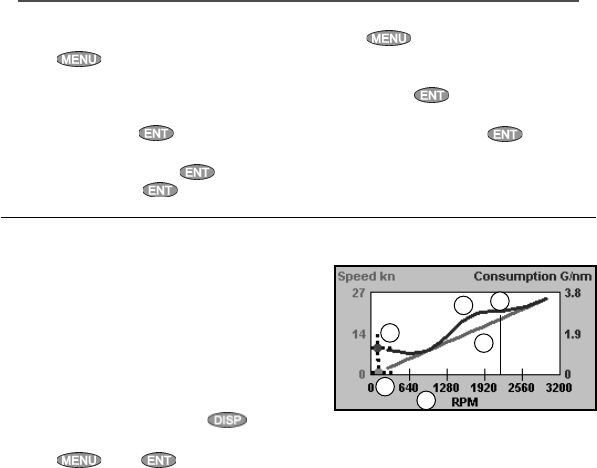
A fuel consumption curve is displayed on the
fuel display:
a For a twin engine boat, keep the RPM of
both engines similar while using a curve.
b More information about fuel consumption
curves is available in Navman’s Diesel flow
sensors installation and operation manual.
Displaying a curve
1 To go to the Fuel display, press ,
select Other, then select Fuel.
2 Press , press and select the
name of the curve to display on the fuel
display.
Using a curve
Compare your boat’s performance now, at the
current RPMs, with the boat’s performance
when you made the curve. You can compare
your boat’s performance now with a curve
made under ideal conditions or with a curve
made under similar conditions.
Information in a curve
A RPM of the boat now. For a twin engine
boat, the RPM is the average of the two
RPMs.
B Red curve: boat speeds at different
RPMs recorded when you made this fuel
consumption curve.
C Red marker: the boat speed now. This
marker is below the red curve, showing that
the boat speed now at this RPM is less than
when you recorded the curve.
D Blue curve: fuel consumption at different
RPMs recorded when you made this fuel
consumption curve.
E Blue marker: the fuel consumption now.
This marker is below the blue curve,
showing that the fuel usage now at this
RPM is better than when you recorded
the curve.
F If the blue curve has a dip, then running the
boat at this RPM will give the best speed for
the least fuel consumption.
C
D
E
F
A
B
TRACKER 5380 Installation and Operation Manual 35
NAVMAN
A
C
B
I
H
JK
D
E
G
DF
N
L
M
11 Tides display
The tides display is available on C-MAP charts.
The tides display shows tide information at a
tide station for the selected date.
Note: The tides display requires the local
time offset to be set to work correctly (see
section 14-11)
To show the tides display for the tide station
nearest to the boat, press , select
Other, then select Tides.
To go to the tides display for any tide station:
1 From the chart display, press and
select Find.
2 Select Tide stations.
3 A list of tide stations are displayed. Select
the tide station to display. The chart
redraws with the tide station centred.
4 Press and select Chart info.
5 Select Tide height.
Choosing the date of the tide chart
1 Press .
2 Select
Today, Next day or Prev day.
To choose a different date from these,
select Set date, edit the date,
press .
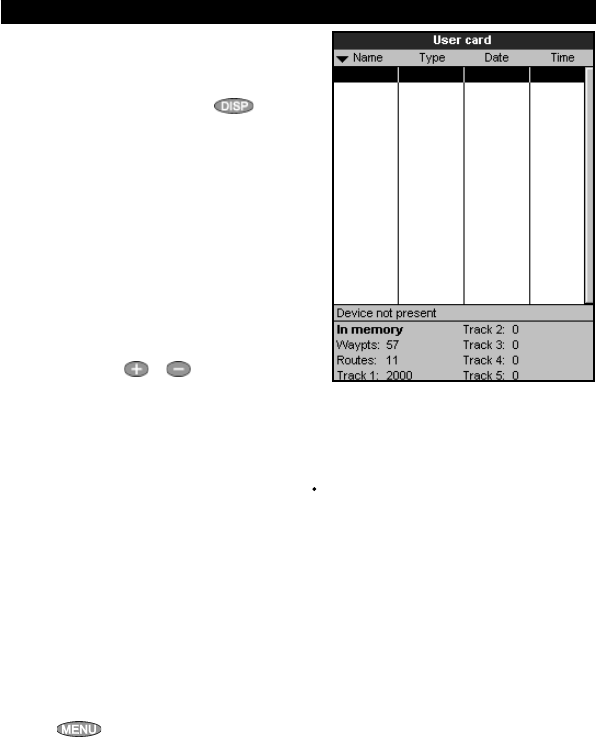
A Tide station name and distance
from boat
B Current time and chosen date for
display
C Tide chart
D Night
E Dawn
F Day
G Dusk
H Tide height
I Time cursor, a vertical dotted line.
Press or to move cursor
sideways
J Time of cursor and tide height at
that time
K Data for the chosen date
L Tide height cursor, a horizontal
dotted line. Press or to move
cursor up and down.
M Height of cursor on the tide chart
N Moon phase for moon at the current
time on the chosen date
The tides display shows data for the chosen date
TRACKER 5380 Installation and Operation Manual
36 NAVMAN
12 User card display
A C-MAP™ user card is an optional plug-in card
that can store data files (see section 1-4). There
are three types of files: waypoints, routes or
a track.
To go to the user card display, press ,
select Other, then select User card.
Note:
1 Before using a user card, remove any
chart card and plug the user card in.
When you have finished with the user
card, remove the user card and replace
the chart card (see section 1-3).
2 The older 5 volt cards are not
supported.
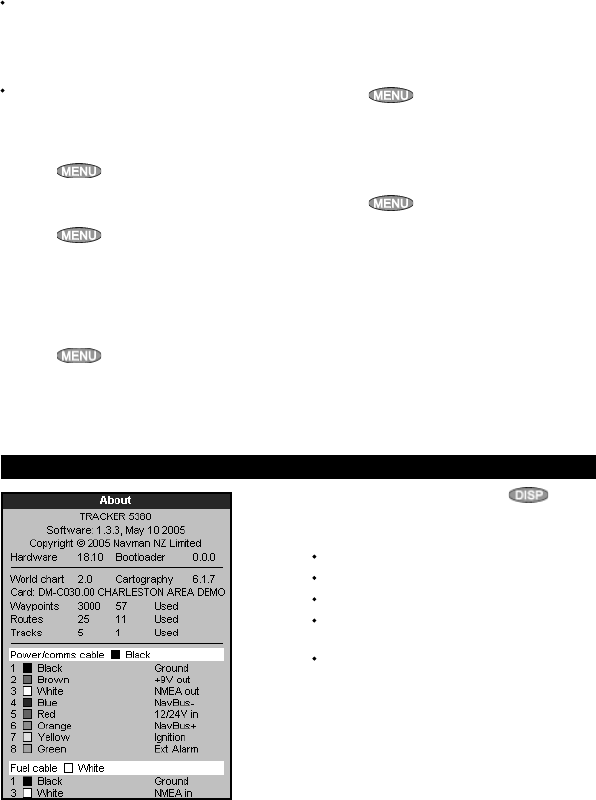
The user card display has:
File list
A list of the files on any user card in the
TRACKER. If there are more files than will fit
on the display, press or to scroll up or
down a page at a time.
Waypts, Routes
The number of waypoints and routes currently
in the TRACKER.
Track 1 to Track 5
The number of points in tracks 1 to 5 currently
in the TRACKER.
Note:
1 To save TRACKER data onto the user card,
use the Save command (see below).
2 Data stored on the user card and shown
on the file list is not available to be used by
the TRACKER until loaded into the TRACKER
with the LOAD command (see below).
Saving data to the user card
This saves all the TRACKER’s waypoints, all
the TRACKER’s routes or one of the TRACKER’s
tracks to one file on the user card.
1 Press and select Save.
2 Select Waypts, Routes or Tracks.
3 For
Tracks, select the track number to
save.
4 The new file is created. Change the name if
required. The new file appears in the
file list.
Loading data from the user card to the
TRACKER
This loads one file from the user card to the
TRACKER:
A waypoints file: The new waypoints are
added to any existing waypoints in the
TRACKER. If a new waypoint has the same
name as an existing waypoint but has
different data, the TRACKER displays both
waypoints. Select:
Skip: Do not load the new waypoint.
Replace: Load the new waypoint and
replace the existing one.
Skip all: Do not load any new
waypoints which have the same names
as existing waypoints.
Rplc. all: Load all new waypoints
which have the same names as existing
waypoints; the new waypoints replace
the existing waypoints.
TRACKER 5380 Installation and Operation Manual 37
NAVMAN
13 About display
To show the about display, press , select
Other, then select About.
The about display shows:
The software version and date.
The world chart version.
Any card fitted.
The number of waypoints, routes and
tracks in the TRACKER.
Wiring information for the TRACKER
connectors.
In the unlikely event of having to contact a
NAVMAN dealer for service, quote the software
version number and date.
A routes file: The new routes are added to
any existing routes in the TRACKER. If a new
route has the same name as an existing
route but has different data then the
TRACKER asks which route to keep.
A track file: The new track will replace the
existing track in the TRACKER.
To load a file to the TRACKER:
1 Select the file to load.
2 Press and select Load.
Deleting a file from the user card
1 Select the file to delete.
2 Press and select Delete.
3 Select Yes to confirm.
Reading the file information
This reads the file names from the user card
and displays them. Reading does not load any
file data into the TRACKER.
1 Press and select Card.
2 Select Read.
Formatting the user card
Formatting prepares a user card for use. Format
the card if there is an error message saying that the
card is not formatted. Any data files on the card
are deleted.
1 Press and select Card.
2 Select Format.
3 Select Yes to confirm.
Sorting the file names
This sorts the displayed file names.
1 Press and select Sort.
2 Select sort by Name, Type or Time.
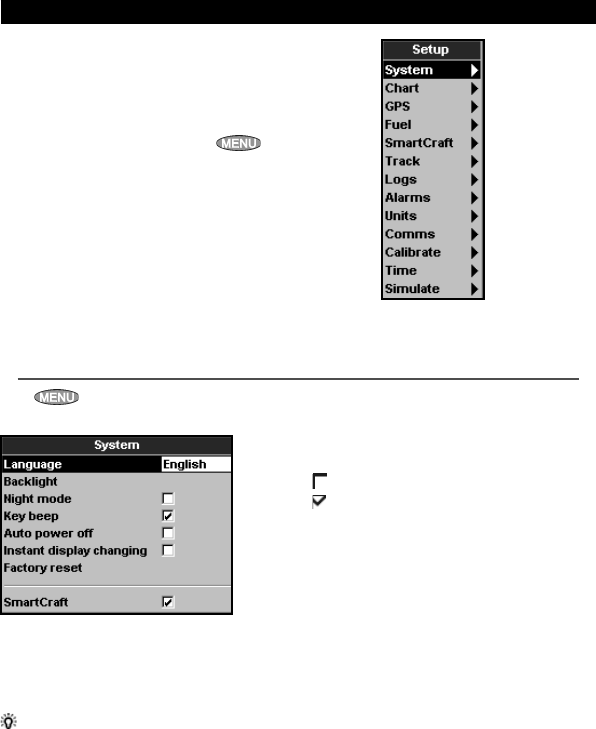
TRACKER 5380 Installation and Operation Manual
38 NAVMAN
Press once or more until the Setup
menu is displayed, then select System:
Language
Select the language for the displays. The
options are: English, Italian, French, German,
Spanish, Dutch, Swedish, Portuguese, Finnish
and Greek.
Tip: In case you can’t read the current
language, the language setting is found at the
top of the system menu.
Backlight
Select the backlight level for the keys and
display (see also section 2-4)
14-1 Setup > System
14 Setting up the TRACKER
The TRACKER has a number of advanced
features which are set up through the setup
menu. We recommend that you become
familiar with the operation of the unit using the
default settings before making any changes to
the data in these menus.
To go to a setup option menu, press
one or more times to display the setup menu,
then select an option.
Note:
1 The Setup menu options are explained in
the following sections.
2 Section 2-1 describes how to set or change
data in the setup menus.
3 The setup data available will depend on the
optional sensors and instruments installed.
Night mode
Night mode sets the palette for all displays.
Normal palette, for daytime
All displays have a palette optimised for
night time.
See also section 2-4. To change only the chart
palette, see section 17-2.
Key beep
Enables or disables the beep when a key is pressed.
Auto power off
See section 2-3.
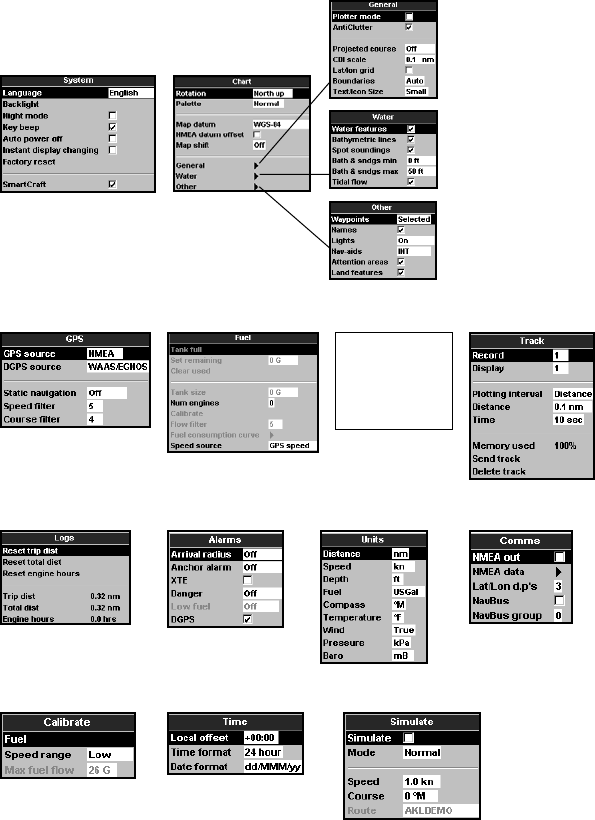
TRACKER 5380 Installation and Operation Manual 39
NAVMAN
SmartCraft
(see the SmartCraft
Gateway
Installation and
Operation Manual)
Setup option menus
Factory default settings are shown. The setup data available will depend on the optional sensors
and instruments installed.
System
(see 14-1)
Chart
(see 14-2)
Time
(see 14-11)
Alarms
(see 14-7)
Units
(see 14-8)
Comms
(see 14-9)
Logs
(see 14-6)
Track
(see 14-5)
Fuel
(see 14-4)
GPS
(see 14-3)
Calibrate
(see 14-10)
Simulate
(see 14-12)
Water (14-2)
Others (14-2)
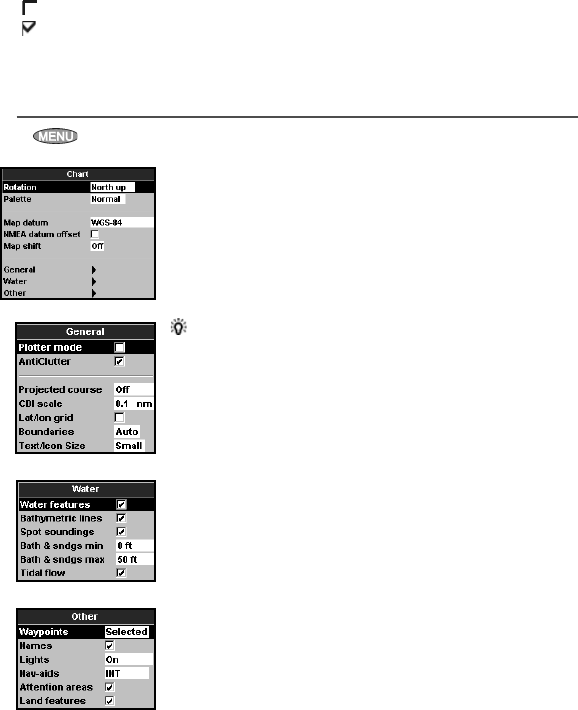
TRACKER 5380 Installation and Operation Manual
40 NAVMAN
Rotation
The options for chart rotation are:
North up: North is always at the top of the chart display.
Track up: The chart is rotated so that the boat direction is to
the top of the display. This option is useful for navigating narrow
harbours or rivers. The TRACKER asks for a course deviation; this is
how much the boat direction needs to change to make the chart
redraw.
Tip: If the chart redraws too frequently, increase the course
deviation setting.
Course up: This option is only available if the boat is navigating
to a destination. The chart is rotated so that the plotted course to
the destination is vertical.
Palette
Select the colour scheme for the LCD display. The options are:
Normal
Sunlight: Brighter colours, more visible in sunlight.
Night: Reversed colours for night, to preserve night vision.
Map datum
TRACKER GPS positions are based on a worldwide reference (datum)
known as WGS 84. Most paper charts are based on WGS 84. However,
some paper charts are based on other datums In these cases, the
latitude and longitude coordinates of objects on the TRACKER chart
display are different to the latitude and longitude coordinates of these
objects on the paper chart. This applies to all objects, such as the boat,
waypoints, tracks, lines of latitude and longitude and cartographic
features such as land, rocks, buoys and depth contours.
Use Map datum to select the TRACKER map datum to match the
datum of the paper chart. Then, the latitude and longitude coordinates
of objects displayed on the TRACKER will change to match the
corresponding coordinates on the paper chart.
14-2 Setup > Chart
Press once or more until the Setup menu is displayed, then select Chart:
Factory reset
This option returns all of the TRACKER settings (except the language, waypoints and routes) to the
default factory settings shown on the setup menus.
SmartCraft
No SmartCraft gateway is fitted. Disable SmartCraft functions.
Normal SmartCraft operation
See section 15-7.
TRACKER 5380 Installation and Operation Manual 41
NAVMAN
Setting map datum
1 In the Chart setup menu, select Map
datum.
2 Select the map datum for the paper chart
you are using.
3 If you select a datum other than WGS 84
the TRACKER asks if you want to apply the
NMEA datum offset (see below).
Warning: When you change to a chart with
a different datum, change the TRACKER map
datum again.
NMEA datum off set
If you select a map datum other than WGS 84,
the map datum offset can be applied to latitude
and longitude coordinates sent on the TRACKER
NMEA output:
Latitude and longitude coordinates
displayed on any NMEA repeater do not
match the coordinates on the TRACKER.
Latitude and longitude coordinates
broadcast on any NMEA VHF transmitter
will be the same as the coordinates on a
WGS 84 chart.
Latitude and longitude coordinates
displayed on any NMEA repeaters match
the coordinates on the TRACKER. However,
latitude and longitude coordinates
broadcast on any NMEA VHF transmitter
will be slightly offset from coordinates on a
WGS 84 chart.
Map shift
Warning: Map shift is for eliminating minor
offsets. It should not be used if the correct
datum is available. Use map shift with caution:
incorrect application will cause incorrect boat
positions.
Some charts have consistent position errors. To
correct this, apply a map shift. After a map shift:
The positions of cartographic features (such
as land, rocks, buoys and depth contours)
move on the TRACKER chart display to
where they should be.
The positions of the boat, waypoints, tracks,
and lines of latitude and longitude on the
TRACKER chart display remain unchanged.
Applying a map shift
1 Move the boat to a known point on the
chart, for example a marina berth.
2 In the Chart setup menu, select Map
shift.
3 Move the cursor to the position on the chart
where the boat actually is.
4 Press and select Set.
5 Press to set the new map shift. The
boat will now be displayed at its actual
location.
Clearing the map shift
Clearing the map shift removes any map shift
from the cartographic features on the TRACKER
chart display.
1 In the Chart setup menu, select Map
shift.
2 Press and select Clear.
3 Press .
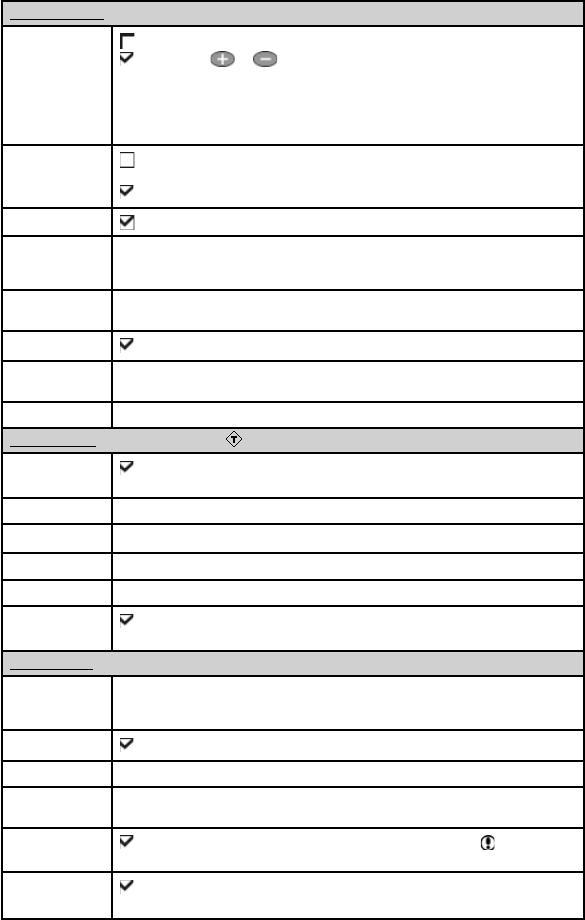
General submenu
Plotter mode Normal: only scales available on the chart card can be displayed.
If you press or to select a chart scale which is not available, on
the chart card, the chart display will change to this scale but will only display
the boat position and track (if enabled). The rest of the display is white with
black crosshatch lines and no chart information is displayed. This is useful
to zoom to a small scale to track small boat movements or if there is no
detailed chart for an area.
Anticlutter Names and icons shown. Note: this is independent of the change in detail
shown at diff erent zoom levels.
hides some less important names and icons to make the chart clearer.
Value added data Non marine chart data shown
Projected course The TRACKER can estimate the course after a given time, based on the
current speed and heading (see section 3-4). The options are 2 minutes, 10
minutes, 30 minutes, 1 hour, 2 hours or Off.
CDI scale See Appendix C. The options are 0.05, 0.1, 0.2, 0.5, 1.0, 2.0, 4.0 and 10.0
distance units.
Lat/lon grid displays a latitude and longitude grid.
Boundaries Displays boundaries around areas where more detailed chart coverage is
available: Auto shows the next four detail levels; On shows all.
Text/icon size Select the size of chart text and icons.
Water submenu
Water features displays marine sediment labels (for example, M shows areas of mud) and
tide station icons
Bathymetrics Displays underwater depth contours between Bath & sndgs min and max.
Spot soundings Displays depth soundings between Bath & sndgs min and max.
Bath & dndgs min The minimum depth for Bathymetrics and Spot soundings.
Bath & dndgs max The maximum depth for Bathymetrics and Spot soundings.
Tidal flow displays dynamic tide flows: arrows on a chart showing the present tide
stream and orientation (requires a GPS fix and an NT-MAX card)
Other submenu
Waypoints Displays waypoints: Hide all only displays waypoints on any selected
route; Selected displays waypoints with their display option set to Icon
or I+N (Icon and Name) (see section 5).
Names displays place names.
Lights Displays lighthouses: No sector hides any light sectors; On shows all data.
Nav-aids Displays signals (fog, radar, radio stations) and bouys. Int and US select
the icon format; Simpl draws simpler icons.
Attention areas displays attention area boundaries and information icons ; attention
areas are important areas, such as restricted anchorages or shallow areas.
Land features displays land features, for example regioins, rivers, roads, railways,
airports
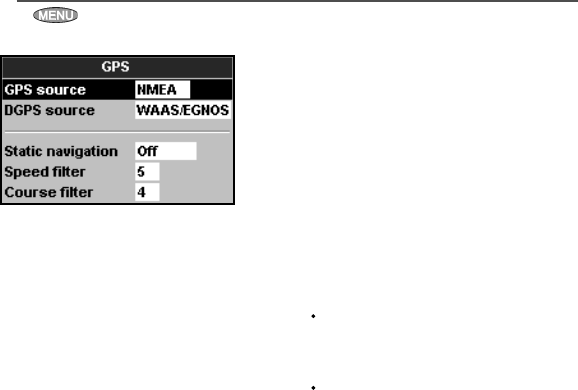
TRACKER 5380 Installation and Operation Manual 43
NAVMAN
Press once or more until the Setup
menu is displayed, then select GPS:
GPS Source
• Internal: Use the internal GPS antenna
(TRACKER 5380i) or the external GPS
antenna supplied (TRACKER 5380) (see
section 15-5).
• NMEA: Use an external GPS or DGPS source
connected via NMEA (see section 15-9).
• NavBus: Use an external GPS or DGPS
source connected via NavBus (see section
15-8).
DGPS Source
Enables or disables the satellite based DGPS
correction (see section 7). The options are
None or WAAS/EGNOS. Do not enable
WAAS/EGNOS outside their coverage areas
or the accuracy of the position might be
degraded.
WAAS covers all of the USA and most of
Canada. To use WAAS, the GPS antenna must
have a clear view of the sky towards the
equator. EGNOS will cover most of Western
Europe when it becomes operational.
Restart GPS
Restarts the internal GPS receiver for servicing
or troubleshooting. The GPS receiver takes
up to three minutes to restart. The satellite
display shows the status of the GPS receiver
(see section 7). Restart the GPS if the receiver
has not been used for some time and is taking a
long time to get a GPS fix.
14-3 Setup > GPS
Static Navigation
When the boat stops or moves very slowly,
the calculated GPS speed and course become
erratic. Static navigation is a number, and the
options are:
• 0.01 to 99.9:If the boat speed is slower
than this, the speed is displayed as zero and
the course stays unchanged.
• 0(Off): The calculated speed and course
are always used.
Speed and Course Filter
Waves and wind cause the boat speed and
course to fluctuate slightly. To give stable
readings, the TRACKER calculates these
values by taking several measurements and
averaging them.
A lower value averages measurements
over a shorter period of time. This gives
the most accurate value but has the most
fluctuations.
A higher value averages measurements
over a longer period of time. This gives the
most stable value but will ignore some true
speed changes.
Set the Speed and Course filters to the lowest
values which give stable readings. The range of
each filter is 1 to 60 seconds or Off (0).
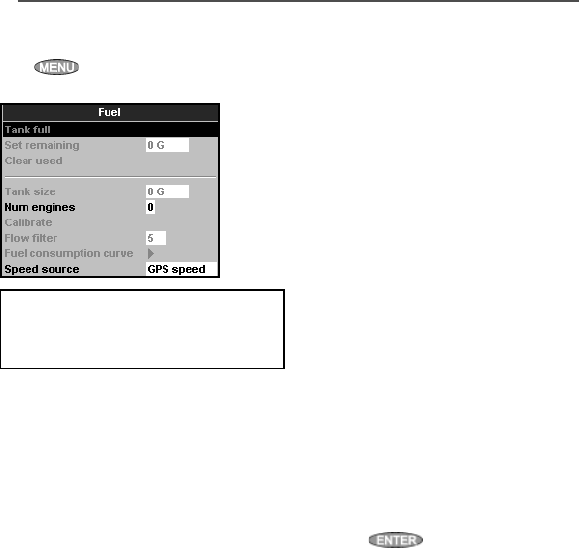
TRACKER 5380 Installation and Operation Manual
44 NAVMAN
Fuel setup requires optional petrol/gasoline
or SmartCraft sensors to be installed. Set Num
engines first to enable the fuel functions.
Press one or more times until the
Setup menu is displayed, then select Fuel:
Tank full
Tells the TRACKER you have filled a fuel tank
(see section 10-1).
Set remaining
Tells the TRACKER you have added or removed
fuel (see section 10-1).
Clear Used
Select Clear used to set Used (the
amount of fuel used) to zero. Do this to start
measuring the amount of fuel used over a
certain time or distance.
Tank size
Enter the capacity of the fuel tank. Navman
recommends measuring tank size by draining
the fuel tank, filling it to capacity and using the
fuel dispenser’s reading. Beware of air pockets,
especially in underfloor tanks.
Num. engines
Set the number of engines to 0, 1 or 2. If 0 is
selected the fuel features are turned off.
Calibrate
SmartCraft fuel sensors are factory calibrated
and should never need recalibrating.
Calibrating Navman petrol/gasoline sensors
gives more accurate fuel values.
14-4 Setup > Fuel
Warning: Fuel consumption can change
drastically depending upon the boat
loading and the sea conditions. Always carry
adequate fuel for the journey, plus a reserve.
Twin engine installations require each fuel
transducer to be calibrated. This can be done
at the same time with two portable tanks or at
different times using one portable tank.
Calibrating the fuel transducer(s) requires
accurate measurement of the fuel
consumption. This is best done using a small
portable tank. At least 4 gallons (15 litres) of
fuel should be used to ensure an accurate
calibration.
It is often very difficult to fill underfloor tanks
to the same level twice due to air pockets, so
the more fuel used, the more accurate the
calibration.
To calibrate the fuel transducer(s), perform the
following steps:
1. Record the level of the fuel in the tank(s).
2. Connect the portable tank(s) to the engine
through the fuel transducer(s).
3. Run the engine at normal cruising speed
until at least 4 gallons (15 litres) of fuel has
been used per engine.
4. Check the actual amount of fuel used per
engine by refilling the portable tank(s) to
the original level and noting the reading(s)
from the fuel dispenser’s gauge.
5. Select Fuel. Use the cursor keys to
change the reading for each engine to
match that on the fuel dispenser’s gauge.
6. Press when the reading is correct.
Note: If the fuel calibration options appear
to give erroneous readings after a while,
first check that the fuel sensor has been
installed correctly according to the installation
instructions supplied with it, then see
Appendix B - Troubleshooting.
Flow filter
Most engines do not draw fuel from the tank at
a steady rate. To give a stable fuel flow reading,
the TRACKER calculates the flow value(s) by
taking several measurements and averaging
them. Use the Flow filter to set the period over
which the fuel flow is averaged.
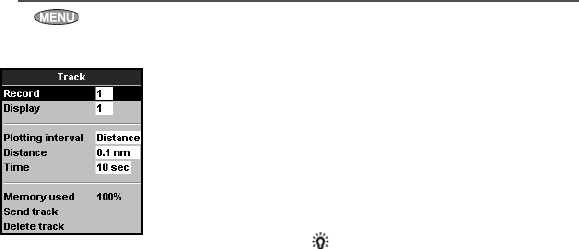
TRACKER 5380 Installation and Operation Manual 45
NAVMAN
The Flow filter can be set from 0 to 30
seconds. Use the lowest value which gives a
stable flow. Usually a value of 5 to 10 seconds
will give a satisfactory result for two-stroke
carburettor engines. Fuel injected or four-
stroke engines may require a larger value.
This setting affects the Fuel flow and
Fuel economy reading on the Fuel
display but it does not affect the Fuel used
reading.
Fuel consumption curve
See section 10-3.
Speed source
If both paddlewheel sensor and GPS speeds are
available, select the source of speed readings
for fuel calculations. If there is a current or tide,
these speeds and the fuel calculation results
will be different.
Water speed: Use paddlewheel sensor
speed (boat speed through the water). This
gives a more accurate value for Economy.
GPS: Use GPS speed (boat speed relative
to land). This gives a more accurate value
for Range.
14-5 Setup > Track
Press one or more times until the
Setup menu is displayed, then select
Track:
Tracking records and displays the boat’s course
on the chart (see section 3-5). Five different
tracks can be recorded: track 1 has up to 2000
points and tracks 2, 3, 4 and 5 have up to 500
points each.
Record
Off: The TRACKER stops recording a track.
1 to 5 (select a track number): The TRACKER
starts recording the boat’s course into the
selected track.
Display
Off: No track is shown on the chart.
1 to 5 (select a track number): The
selected track is shown on the chart.
Plotting Interval
The options are Distance or Time.
Distance
Select the distance plotting interval: 0.01, 0.05,
0.1, 0.5, 1.0, 2.0, 5.0 or 10.0 distance units.
Time
Select the time plotting interval: 1, 5, 10 or 30
seconds or 1 minute.
Memory used
The percentage of memory used in the track
being recorded.
Tip: Use the user card display to check the
number of points recorded in each track (see
section 14).
Send track
This option is included for compatibility with
older units. For information, see your NAVMAN
dealer.
Delete track
The data in the track selected for Record (see
above) is deleted.
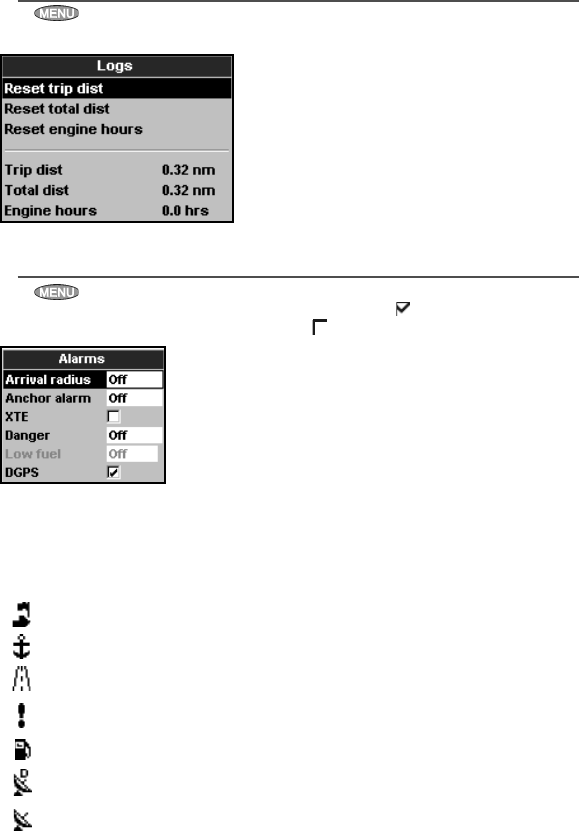
TRACKER 5380 Installation and Operation Manual
46 NAVMAN
14-6 Setup > Logs
Press one or more times until the
Setup menu is displayed, then select Logs:
The values can be changed independently of
each other. These log values are saved when
the unit is turned off.
Reset trip dist
This resets the trip distance to zero.
Reset total dist
This option resets the total distance to zero.
Reset engine hours
Use this option to reset the engine hours
to zero. This can be useful after an engine
service or to count the engine hours between
service intervals.
14-7 Setup > Alarms
Press one or more times until the
Setup menu is displayed, then select
Alarms:
All alarms except Loss of GPS fix can be
turned on (enabled) or off (disabled).
Symbol Alarm Alarm sounds when it is on and the:
Arrival boat is closer to the destination or to a waypoint
radius than the alarm trigger value
Anchor alarm boat moves by more than the alarm trigger value
XTE boat moves off course by more than the CDI scale
(see section 14-2)
Danger boat comes closer to a danger waypoint than
the alarm trigger value
Low fuel fuel remaining equals the alarm trigger value
Loss of TRACKER can not receive the DGPS signal
DGPS fix (beacon, WAAS or EGNOS)
Loss of TRACKER can not receive the GPS signal
GPS fix (this alarm is always on)
For the XTE and Loss of DGPS fix
alarms, select to turn the alarm on or select
to turn the alarm off. For the other alarms,
enter a trigger value to turn the alarm on. The
alarm will sound each time the alarm value
equals the trigger value. For example, the
Danger alarm will sound if the boat comes
closer to a danger waypoint than the trigger
value and the Anchor alarm will sound if the
boat moves by more than the trigger value. To
turn these alarms off, enter a trigger value of
0 (zero).
Icons for alarms that are on can be displayed in
the data header (see section 2-8-2). An alarm
icon is normally black and turns red when the
alarm sounds.
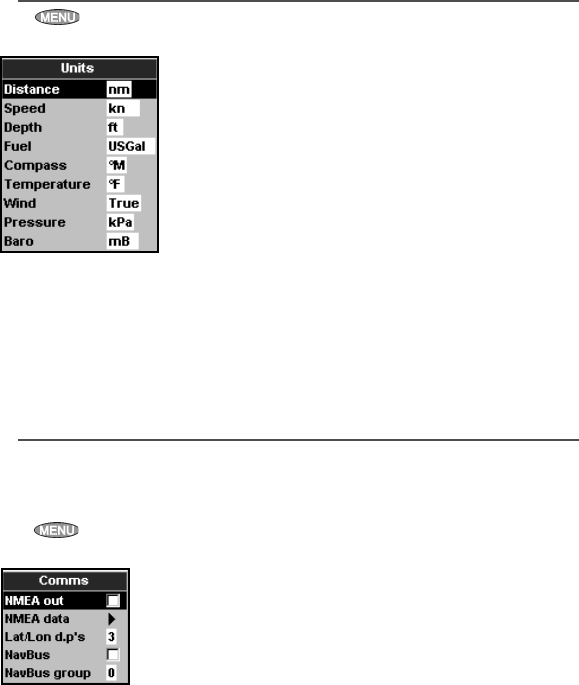
TRACKER 5380 Installation and Operation Manual 47
NAVMAN
14-8 Setup > Units
Press one or more times until the
Setup menu is displayed, then select Units:
The default units are shown above.
Distance
nm (nautical miles), mi (miles) or km
(kilometres)
Speed
kn (knots), mph (miles per hour) or kph
(kilometres per hour)
Depth
ft (feet), m (metres) or fa (fathoms)
Fuel
Litres, USGal (US gallons) or ImpGal (Imperial
Gallons)
Compass
°T (True north) or °M (Magnetic north)
Temperature
°F (Fahrenheit) or °C (Celsius)
Wind (optional)
Requires a wind instrument: True or App
(Apparent)
Note: that the units for wind speed are the
speed units.
Pressure
Requires SmartCraft: kPa or psi
Baro (Barometric pressure)
Requires a Navman VHF receiver connected by
NavBus: InHg or mB.
Use this feature when the TRACKER is
connected to other NAVMAN instruments
through NavBus or any compatible NMEA
instrument.
Press once or more until the Setup
menu is displayed, then select Comms:
NMEA out
NMEA is generally used with third party
instruments (see section 15-9). Select this to
transmit NMEA sentences, for example to an
autopilot.
NMEA data
Use this to specify which NMEA sentences will be
transmitted (see section 15-9 and Appendix A).
Lat/lon dps
Select the number of decimal points used
for latitude and longitude transmitted in
NMEA sentences.
NavBus
NavBus is the preferred method for connecting
the TRACKER to other NAVMAN instruments.
Select this if the instruments are connected
using NavBus.
NavBus Group
Use this when a group of NAVMAN instruments
are connected together using NavBus, to
specify a group of instruments for backlighting,
if required. Then, if the backlight setting on one
instrument in the group is adjusted, the other
instruments change automatically. Otherwise,
select 0. See section 15-8.
14-9 Setup > Comms
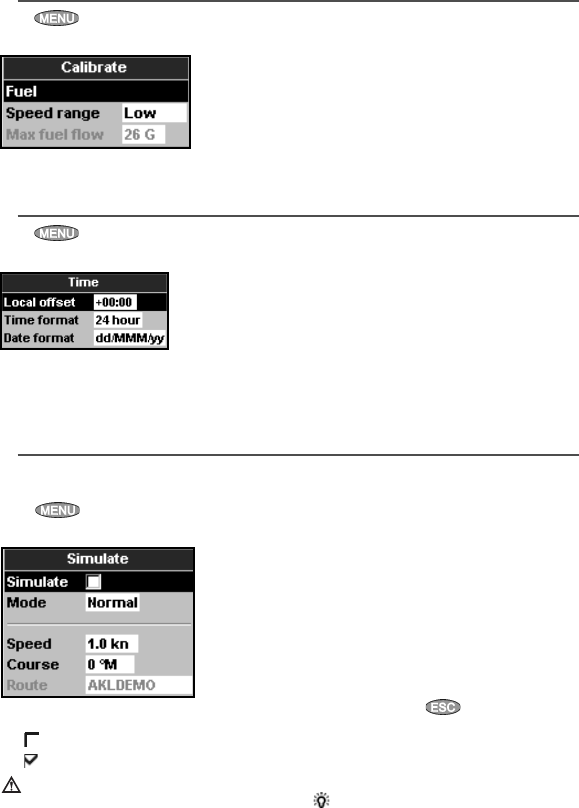
TRACKER 5380 Installation and Operation Manual
48 NAVMAN
Press once or more until the Setup
menu is displayed, then select Calibrate: Fuel
See section 14-4.
Speed range
The maximum reading to display on an analog
boat speed gauge (see section 10). Choose a
range suitable for your boat.
Max fuel flow
The maximum fuel flow from the fuel tank.
Simulate mode is a way of becoming familiar
with the TRACKER (see section 2-7).
Press once or more until the Setup
menu is displayed, then select Simulate:
Simulate
Turn simulate mode off
Turn simulate mode on
Warning: Never have simulate mode
on when the TRACKER is navigating on
the water.
Mode
There are two choices for Mode:
1 Normal
Simulates the boat moving from the selected
start point at the given speed and heading. The
options required for Normal are:
Speed: The simulated boat speed to use.
Course: The simulated bearing for the boat
to follow.
Note: To select the start point, go to the chart
display before starting the simulation. Then:
• To start the simulation from the boat
position, press to switch to centre on
boat mode.
• To start the simulation from a different
point, move the cursor to that point on the
chart.
Tip: To calculate a course, use the cursor
(see section 3-3).
Press once or more until the Setup
menu is displayed, then select Time:Local offset
The difference between local time and UTC
(GMT). Change local offset when daylight
saving time starts and ends. The range is 0 to ±
13 hours, in 30 minute steps.
Time format
The options are 24 hour or 12 hour.
Date format
The options are dd/MMM/yy, MMM/dd/yy,
dd/MM/yy or MM/dd/yy.
14-10 Setup > Calibrate
14-11 Setup > Time
14-12 Setup > Simulate
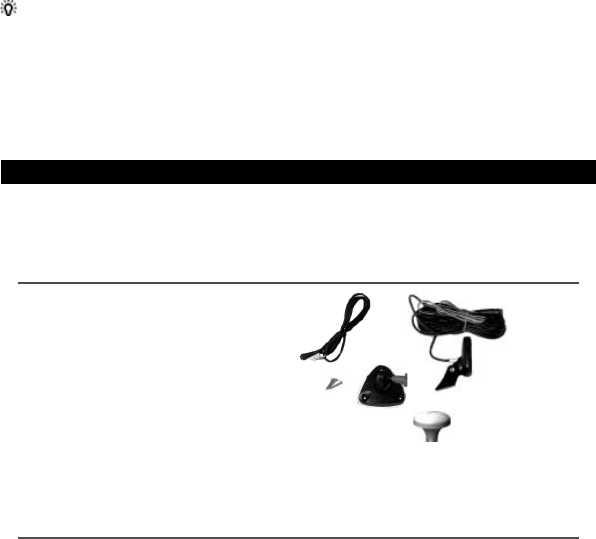
TRACKER 5380 Installation and Operation Manual 49
NAVMAN
• C-MAP™ NT-MAX, NT+ or NT chart cards.
• C-MAP™ user cards (3 V) for storing data. (The older 5 volt cards are not supported)
• NAVMAN carry bag.
• NAVMAN NavBus junction boxes simplify wiring, particularly if several instruments are
connected. For more information, see the NavBus Installation Manual.
Tip: As the boat moves, vary Course to simulate the boat moving off course.
2 Demo
Simulates a boat moving along a route and automatically displays different TRACKER functions.
The options required for Demo are:
Speed: The simulated boat speed to use.
Route: The route to follow.
• TRACKER display unit
• Dust cover for display unit
• Blanking caps for unused connectors
• Power cable
• Mounting bracket (screws included)
• Flush mounting kit
• NAVMAN 1330 GPS antenna for TRACKER 5380 only;
the TRACKER 5380i has a built in GPS antenna.
• Warranty registration card
• This manual
Correct installation is critical to the performance of the unit. It is vital to read the entire installation
section of this manual and the documentation that comes with the antenna and any other units
before starting installation.
15 Installation
15-1 Installation: What comes with the TRACKER
15-2 Installation: Options and Accessories
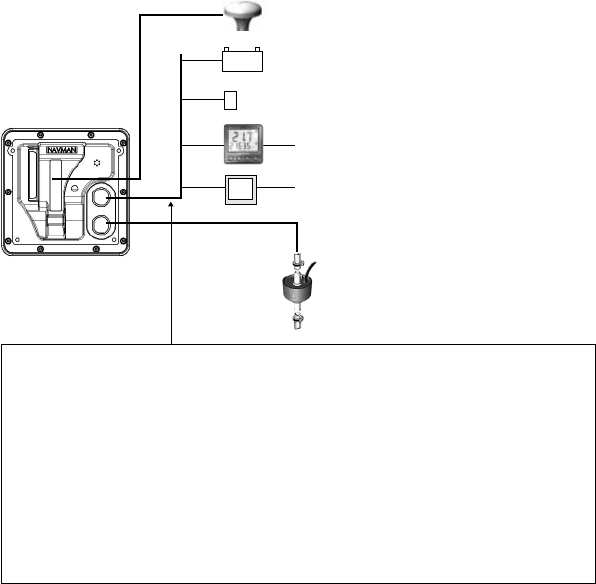
TRACKER 5380 Installation and Operation Manual
50 NAVMAN
Optional sensors and instruments
External alarms: Lights or sounders in the
boat to sound alarms through the boat (see
section 15-4).
GPS or DGPS antenna: For GPS navigation, see
section 15-5.
Fuel sensors: For fuel functions. The TRACKER
can use these optional fuel flow sensors, fitted
to one or two engines:
• Navman petrol/gasoline sensors (see
section 15-6)
• SmartCraft fuel sensors (see section 18-11)
SmartCraft: With one or two SmartCraft
capable Mercury engines, the TRACKER can
display engine data and trim and can control
troll speed (see section 18-10).
Other instruments: The TRACKER can receive
data from other instruments and send data
to other instruments by NavBus or NMEA (see
sections 18-12 and 18-13).
Please consult your NAVMAN dealer for more
information.
Connections
GPS antenna (TRACKER 5380, 15-5)
Power (15-4)
External alarms (15-4)
NavBus instruments (15-8)
NMEA out to instruments (15-9)
Petrol/gasoline sensors (15-6),
NMEA in (15-9)
Power/data cable
Pin Wire Function
1 Black Ground: - power in, NMEA ground. (The cable has two black wires which are
connected inside the cable and it does not matter which black wire you use)
2 Brown Power out, 9 V DC (not used)
3 White NMEA out
4 Blue NavBus-
5 Red + power in, 10 to 16 V DC
6 Orange NavBus+
7 Yellow Auto power in
8 Green External alarm out, 30 V DC 200 mA maximum.
Display unit
(15-3)
BlackBlack
WhiteWhite
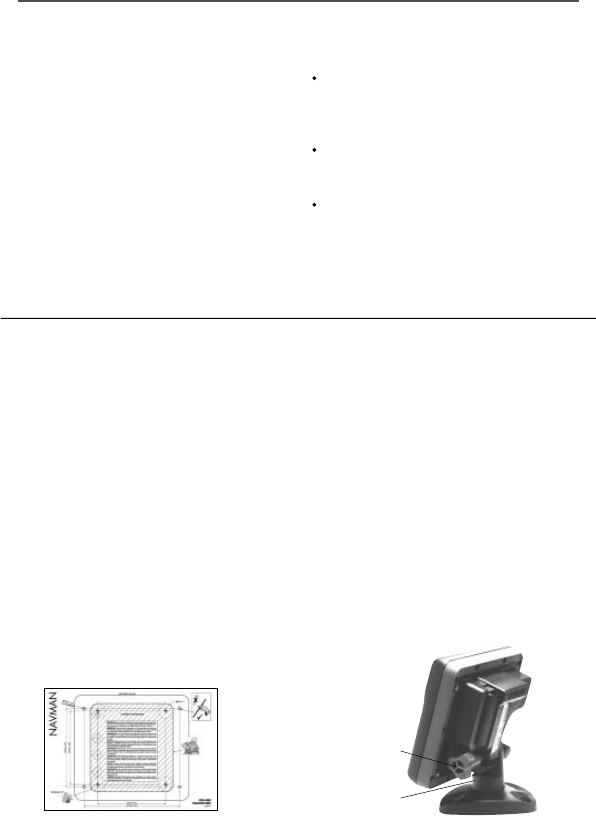
TRACKER 5380 Installation and Operation Manual 51
NAVMAN
2 Bracket Mounting
Requires a panel for mounting the bracket.
Ensure that the panel is not likely to deform
and is not subject to excessive vibration. The
bracket can be tilted and rotated. The display
unit can be removed when it is not in use.
1 Hold the bracket in place and mark the
screw holes.
2 Drill the screw holes and screw the bracket
in place. Do not overtighten the screws or
the display unit might not rotate.
3 Hold the display unit in place on the
mounting bracket shaft. Hand tighten the
knob on the mounting bracket.
Select a position for the display unit:
• At least 4” (100 mm) away from the
compass, at least 12” (300 mm) away from
any radio transmitter and at least 4 ft (1.2
m) away from any antenna.
• Easy to read and operate. If possible, mount
the display unit in front of the navigator or
to the right of the navigator because the
LCD display is more readable from these
positions.
• Not exposed to the direct sun or water and
protected from physical damage during
rough sea passages.
• Easy to access the 12 V DC power source
and convenient to route the transducer
cables.
There are two mounting arrangements:
1 Flush Mounting
Requires a solid panel with access behind
for wiring and mounting screws. After flush
mounting, the display unit cannot be tilted
or moved after installation to reduce any
unwanted glare or reflections. Carefully select
the best viewing position before installation.
This would generally be in a shaded area.
1 Cut a hole in the bulkhead for the display
unit using the flush mount template.
2 Drill four holes for the mounting studs
using the flush mount template.
3 Screw the four studs into the brass inserts
in the back of the display unit.
4 Sit the display unit in place and fit the
washers and nuts to the studs.
For the TRACKER 5380i, with the internal GPS
antenna:
The display unit must have a good view
of the sky and horizon. The view should
not be blocked by large parts of the
superstructure.
The unit can be under glass, perspex,
fibreglass or fabric, but not under metal or
wood.
Do not mount the unit within 3 m (10 ft) of
a radio transmitter antenna or within 0.5m
(20 in) of the plane of a radar antenna.
15-3 Installation: The display unit
Knob
Mounting
bracket
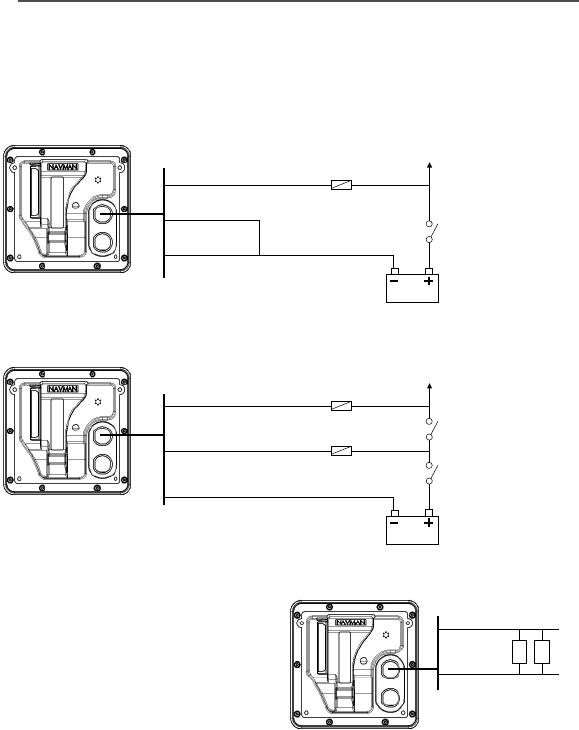
TRACKER 5380 Installation and Operation Manual
52 NAVMAN
Power/data cable
Red
Yellow
Black
External beepers or
lights
Main switch
12 V DC]
Fuse 2A
The power/data cable has a black locking collar and flying leads.
1 Wire the TRACKER for auto power to have the TRACKER turn on with the boat’s ignition switch
or to to record engine hours or if the TRACKER must add up the total fuel used (for example if
Navman petrol/gasoline fuel sensors are installed or if SmartCraft is installed without fuel tank
level sensors). Otherwise wire for basic power (for more information, see section 2-2).
Basic power
Auto power
During setup, set up Auto power off (see sections 2-3 and 17-1)
Power/data cable
Yellow
Red
Black
Ignition
Ignition switch
Main switch
12 V DC]
Fuses 2A
Power/data cable
Red
Green
2 Wire any external alarm beepers or
lights. The alarm output switches to
ground to sound the alarm. If the current
is more than 200 mA, fit a relay.
3 Connect the power/data cable to the
black display unit connector; turn the
collar to lock the connector.
Black
Black
Black
15-4 Installation: Power/Data cable
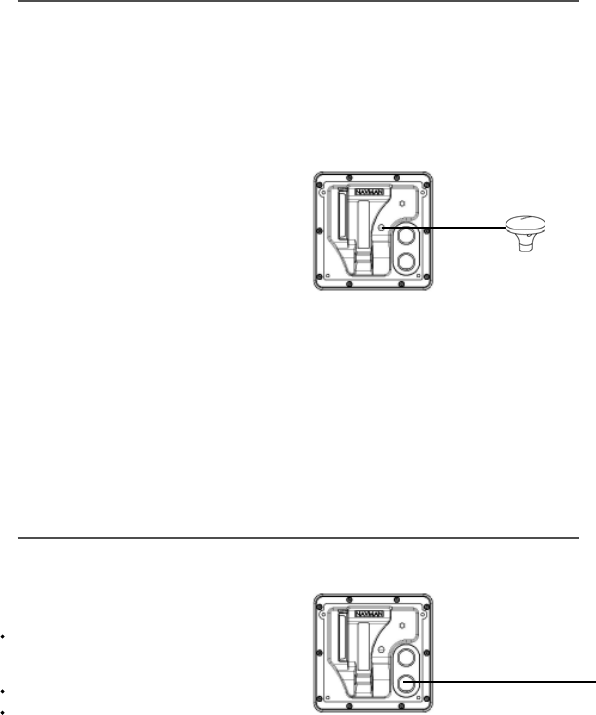
TRACKER 5380 Installation and Operation Manual 53
NAVMAN
Selecting an antenna
Fit one of these GPS antennas:
• Normally use the internal GPS antenna
(TRACKER5380i) or the GPS antenna
supplied (TRACKER 5380).
• An optional differential beacon DGPS
antenna to give enhanced accuracy within
range of land based differential beacons
in areas where WAAS or EGNOS are not
available. Such a DGPS antenna has both
a GPS receiver and a beacon receiver,
and it automatically applies the beacon
correction to the GPS position.
• A compatible GPS or DGPS instrument or
antenna connected by NavBus (see section
15-8) or NMEA (see section 15-9). In this
case, the TRACKER does not need its own
antenna.
Note:
• The TRACKER can apply the WAAS and
EGNOS DGPS correntions to any GPS
antenna.
• To configure the TRACKER for different
antenna options, see section 14-3.
For more information, contact your NAVMAN
dealer.
Installing an antenna
If an external antenna is required, install the
antenna and fit the antenna cable back to
the display unit. Follow the instructions in
the manual supplied with the antenna. Fit an
optional Navman extension cable if required.
Connect the TRACKER 5380 external antenna to
the gold TRACKER connector:
Fit the optional petrol/gasoline fuel kit
following the instructions supplied with
the kit.
Note:
SmartCraft engines have fuel flow sensors,
therefore Navman fuel sensors are not
required as well.
For dual engines, fit two kits.
Wire the TRACKER for auto power (see
section 15-4).
During setup:
a set up Auto power off (see sections 2-3
and 17-1)
b set the fuel data (see section 14-4)
Fuel sensor cable
White
15-5 Installation: GPS antenna
15-6 Installation: NAVMAN petrol/gasoline sensors
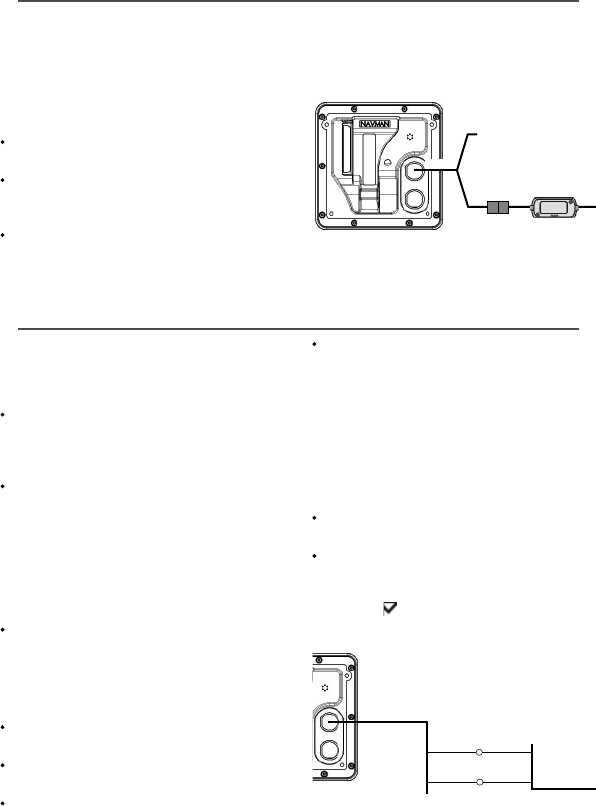
TRACKER 5380 Installation and Operation Manual
54 NAVMAN
Black Power/data cable
Orange
Blue
NavBus wires
to other Navbus instruments
If the boat has one or two SmartCraft capable
Mercury petrol/gasoline engines, connect
the TRACKER to the SmartCraft engines with
an optional SmartCraft gateway. The display
unit can display engine data and trim and can
control troll speed.
Note:
Fit a single gateway for single engines and
a dual gateway for dual engines.
SmartCraft engines have fuel flow sensors,
therefore Navman fuel sensors are not
required as well.
If the fuel tank does not have SmartCraft
level sensors, wire for auto power (see
section 15-4).
SmartCraft
gateway
NavBus is Navman’s system for connecting
instruments together to interchage data and
share transducers. When instruments are
connected by NavBus:
If the units, alarms or calibration are
changed in one instrument, then the values
will automatically change in all other
instruments of the same type.
Each instrument can be assigned to a group
of instruments. If the backlight is changed
in an instrument in group 1, 2, 3 or 4 then
the backlight will automatically change in
the other instruments in the same group.
If the backlight is changed in an instrument
in group 0 then no other instruments are
affected.
If an alarm sounds, mute it by clearing the
alarm on any instrument which can display
that alarm.
NavBus and the TRACKER
The TRACKER can:
Display wind speed and direction from an
optional Navman Wind instrument.
Receive and display depth from an optional
Navman depth instrument.
Receive and display boat speed and water
temperature from a paddlewheel sensor on
an optional Speed instrument.
Receive barometric pressure from an
optional Navman VHF radio. The TRACKER
can display:
Baro: barometric pressure
Baro history: barometer history
Weather: a predication, based on changes
in barometric pressure
Fish forecaster: a prediction based on
changes in barometric pressure
Receive data from an optional GPS or
GPS/DGPS source.
Send data to optional NAVMAN
instruments, for example to a repeater.
During setup for NavBus instruments, set
NavBus to and assign the instrument a
NavBus group number (see section 14-9)
15-7 Installation: SmartCraft
15-8 Installation: Other NavBus instruments
During setup enter the SmartCraft setup data.
For information on installing, setting up and
using SmartCraft, see the SmartCraft Gateways
Installation and Operation Manual.
Black
White
Power/fuel splitter
cable (‘Y’ cable)
Other wiring
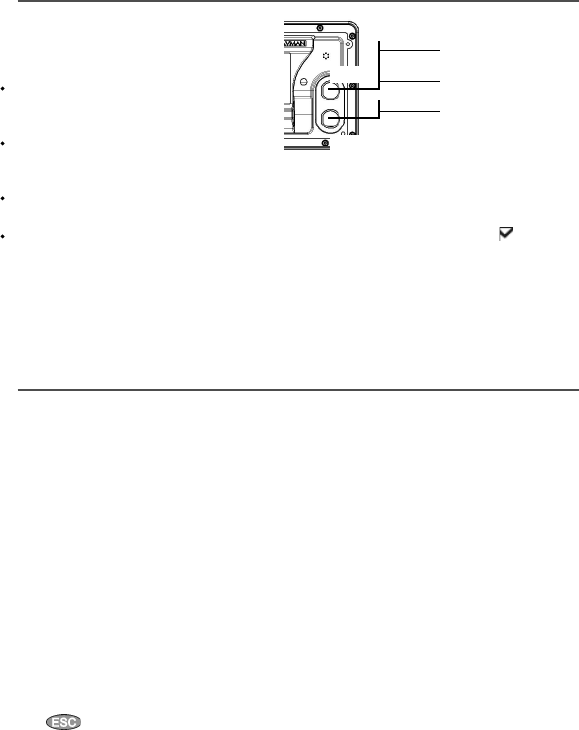
TRACKER 5380 Installation and Operation Manual 55
NAVMAN
During setup to send NMEA data to other
instruments, set NMEA out to and specify
the NMEA data to send (see section 14-9).
Setup and test
1 Put a blanking cap on any unused
connector on the back of the display unit.
Ensure all connectors are plugged in and
the display unit is in place.
2 If the display unit is bracket mounted,
adjust tilt and rotation for best viewing and
hand tighten the knob.
3 Insert any required C-MAP chart card (see
section 1-3).
4 Turn the instrument on (see section 2-3).
When the TRACKER is turned on for the first
time, it displays an installation menu:
i Select the language to use.
ii Change the data if necessary (see
section 2-1)
iii When the setup data is correct, press
.
This data can be changed later
(see section 14).
NMEA is an industry standard for
interconnecting instruments. It is not as
flexible or as easy to install as NavBus. The
TRACKER can:
Receive and display wind speed and
direction from an optional compatible
wind instrument.
Receive and display depth, paddlewheel
boat speed and water temperature from
an optional compatible instrument.
Receive data from an optional compatible
GPS or GPS/DGPS source.
Send GPS position and other navigation
data to an autopilot or other instrument.
An autopilot requires APB, APA and VTG
sentences (see section 14-9).
For information on sending NMEA data to the
TRACKER, see your Navman dealer.
Black
Power/data cable
White
White NMEA out
Black NMEA ground
White NMEA in
5 Enter setup data to set up the TRACKER
to your requirements and to set up any
optional sensors or instruments (see
section 14).
6 At the satellite display, check that it picks
up GPS satellites. Wait for the GPS receiver
to start up and the fix type to change from
‘Acquiring’ to ‘GPS fix’. This should take less
than two minutes (see section 7).
7 Go on a test run to check that the
navigation equipment works correctly,
particularly when a radio trans mitter or
radar is used.
15-9 Installation: Other NMEA instruments
15-10 Installation: Setup and test

TRACKER 5380 Installation and Operation Manual
56 NAVMAN
GENERAL
Size: 126 mm H x 126 mm W x 65 mm D (5.0” x
5.0” x 2.6”)
Display: 3.8” diagonal, TFT colour, 240 x 320
pixels
Backlight: Display and keys
Supply voltage
10 to 16 V DC.
Supply current: at 13.8 V
120 mA min - no backlighting
220 mA max - full backlighting
External beeper or light output: Switched to
ground to sound alarm, 30 V DC, 200 mA
maximum.
Operating temperature
0° to 50°C (32° to 122°F)
ALARMS:
User set: Arrival radius, anchor, XTE, danger,
low fuel (optional), loss of DGPS fix
Fixed: Loss of GPS fix
GPS NAVIGATION
Chart card: C-MAP™ NT-MAX, NT+ or NT
User card: 3.3 V C-MAP™
Waypoints: Up to 3000, with default or
user-defined alphanumeric names up to
eight characters.
Routes: 25 Routes, with up to 50 points each
Tracks: By time or distance, one track of 2000
points and four of 500 points.
Chart datums
121 Chart datums (see next page)
One user-defined map shift.
Chart scale: 0.05 to 4096 nm for chart (chart
dependent) down to 0.01 nm in plotter
mode.
FUEL COMPUTER
(Optional fuel sensor(s) required)
Engine types:
Outboard carburetted two stroke and EFI
petrol/gasoline engines: 50 to 300 hp.
Outboard four stroke petrol/gasoline
engines: 90 to 300 hp.
Inboard petrol/gasoline engines: 70 to 400
hp.
Flow rate:
Minimum: 5 litres per hour (1.3 U.S. gallons
per hour).
Maximum: 130 litres per hour (34 U.S.
gallons per hour).
COMMUNICATIONS
NavBus
Connection to other NAVMAN instruments.
NMEA
NMEA 0183 ver 2 4800 baud
• Inputs from compatible instruments: DBT,
DPT (preferred), GGA, GLL, GSA, GSV, MTW,
MWV, RMC, VHW, VTG
Outputs, for compatible instruments: APA,
APB, BWR, GGA, GLL, GSA, GSV, RMB, RMC,
VTG, XTE
STANDARDS COMPLIANCE
EMC:
USA: FCC Part 15 Class B.
Europe: (CE) EN301843-1:2004-06.
New Zealand and Australia: (C Tick)
EN60945 9.2 & 9.3.
Environment: IPx6/IPx7/CFR46 (with card
holder and connections in place).
Appendix A - Specifications

TRACKER 5380 Installation and Operation Manual 57
NAVMAN
PP
PP
PP
PP PP
PP
List of datums
Adindan Afgooye AIN EL ABD 1970
American Samoa 1962 Anna 1 Astro 1965 Antigua Island Astro 1943
ARC 1950 ARC 1960 Ascension Island 1958
Astro Beacon ‘E’ 1945 Astro DOS 71/4 Astro Station 1952
Astro Tern Island (Frig) 1961 Australian Geodetic 1966 Australian Geodetic 1984
Ayabelle Lighthouse Bellevue (IGN) Bermuda 1957
Bissau Bogota Observatory Bukit Rimpah
Camp Area Astro Campo Inchauspe 1969 Canton Astro 1966
Cape Cape Canaveral Carthage
Chatham Island Astro 1971 Chua Astro Co-ord. Sys.1937 Estonia
Corrego Alegre Dabola Deception Island
Djakarta (Batavia) DOS 1968 Easter Island 1967
European 1950 European 1979 Fort Thomas 1955
Gan 1970 Geodetic Datum 1949 Graciosa Base Sw 1948
Guam 1963 Gunung Segara GUX 1 Astro
Herat North Hermannskogel Hjorsey 1955
Hong Kong 1963 Hu-Tzu-Shan Indian
Indian 1954 Indian 1960 Indian 1975
Indonesian 1974 Ireland 1965 ISTS 061 Astro 1968
ISTS 073 Astro 1969 Johnston Island 1961 Kandawala
Kerguelen Island 1949 Kertau 1948 Kusaie Astro 1951
L. C. 5 Astro 1961 Leigon Liberia 1964
Luzon M’Poraloko Mahe 1971
Massawa Merchich Midway Astro 1961
Minna Montserrat Island Astro 1958 Nahrwan Masirah Is. Oman
Nahrwan United Arab Emirates Nahrwan Saudi Arabia Naparima, BWI
North American 1927 North American 1983 North Sahara 1959
Observatorio Meteorolog. 1939 Old Egyptian 1907 Old Hawaiian
Oman Ord. Survey Great Britain 1936 Pico de las Nieves
Pitcairn Astro 1967 Point 58 Pointe Noire 1948
Porto Santo 1936 Provis. South American 1956 Provis. South Chilean 1963
Puerto Rico Pulkovo 1942 Qatar National
Qornoq Reunion Rome 1940
S-42 (Pulkovo 1942) Santo (DOS) 1965 Sao Braz
Sapper Hill 1943 Schwarzeck Selvagem Grande 1938
Sierra Leone 1960 S-JTSK South American 1969
South Asia Tananarive Observatory 1925 Timbalai 1948
Tokyo Tristan Astro 1968 Viti Levu 1916
Voirol 1874 Voirol 1960 Wake Island Astro 1952
Wake-Eniwetok 1960 WGS 84 Yacare
Zanderij
126.0mm (5.0”)
143.6mm (5.76”)
126.0mm (5.0”)
88.5mm (3.5”)
30.5mm
(1.2”)
34.3mm
(1.37”)

TRACKER 5380 Installation and Operation Manual
58 NAVMAN
1-1 The TRACKER won’t turn on:
a The TRACKER is designed to operate on a
12 volt battery system, where the voltage
may vary from 10 to 16 volts. If an excessive
voltage is supplied, a fuse will be tripped,
turning the display unit off. Check the fuse.
b Check that the power cable connector
at the back of the display unit is securely
plugged in and the collar is locked in place.
The collar must be secure for watertight
connection.
c Measure the battery voltage while the
battery is under load - turn on some
lights, radio or other electrical equipment
connected to the battery. If the voltage is
less than 10 volts:
- the battery terminals or wiring on the
terminals may be corroded.
- the battery may not be charging
correctly or may need replacing.
d Inspect the power cable from end to end
for damage such as cuts, breaks, squashed
or trapped sections.
e Ensure that the red wire is connected to the
positive battery terminal and the black wire
to the negative battery terminal. If wired for
the Auto Power option, ensure the yellow
wire is connected to the ignition circuit.
Also check the boat’s main switch circuit
(see section 15-4).
This troubleshooting guide is written with
the assumption that the user has read and
understood the relevant sections in this
manual.
It is possible in many cases to solve difficulties
without having to send the display unit back to
the manufacturer for repair. Please follow this
troubleshooting section before contacting the
nearest NAVMAN dealer.
There are no user serviceable parts. Specialized
methods and testing equipment are required
to ensure that the display unit is reassembled
correctly and is waterproof. Users who service
the product themselves will void the warranty.
Repairs to the product may only be carried out
by a service centre approved by NAVMAN. If the
product must be sent into a service centre for
repair, it is essential to send in the transducer(s)
at the same time.
More information can be found on our Website:
www.navman.com.
f Check for corrosion on the power cable
connector and clean or replace if required.
g Check fuses that are placed in line with the
power cable. A fuse can be blown despite
appearing to be good or the fuse may be
corroded. Test the fuse or replace it with a
fuse known to be good.
1-2 The TRACKER won’t turn off:
The TRACKER may have been wired for
Auto power. In this case, the TRACKER
cannot be turned off while the ignition
power is on (see section 2-3).
1-3 If the TRACKER beeps when turned on but
nothing is displayed:
The TRACKER may be operating, but the
backlight settings may have been set too
low (see section 2-4).
1-4 The wrong language is displayed:
See section 14-1.
Appendix B - Troubleshooting
B-1 General Problems

TRACKER 5380 Installation and Operation Manual 59
NAVMAN
2-1 No GPS fix or long time to get fix at
startup:
a May occur occasionally if the antenna
does not have a clear view of the sky. The
satellite positions are constantly changing.
b Antenna cable not connected to display
unit.
c Restart the GPS (see section 14-3).
2-2 TRACKER GPS position different from true
position by more than 10 m (33 ft):
a TRACKER in simulate mode. Turn simulate
mode off (see section 14-12).
b The normal error in GPS position will
exceed 10 m (33 ft) for about 5% of the
time.
c Under special circumstances the US
Department of Defence may introduce a
deliberate and changing error in the GPS
positions of up to 300 m (1000 ft).
2-3 TRACKER position different from same
position on local charts:
a TRACKER in simulate mode. Turn simulate
mode off (see section 14-12).
b Incorrect chart datum. Select the correct
chart datum (see section 14-2).
c Map shift has been applied wrongly. Clear map
shift, then reapply if necessary (see section
14-2).
2-4 Can not see boat on chart:
Press to switch to centre on boat
mode (see section 3-2-1).
2-5 The time or date on satellite display is
wrong or off:
a No GPS fix.
b In simulate mode. Turn simulate mode off
(see section 14-12).
c Local time offset is wrong (see section
14-11). The Local Time Offset must be
changed when daylight saving time starts
or ends.
2-6 Autopilot not responding to TRACKER; no
NMEA output:
a NMEA output disabled or the required NMEA
sentences are not turned on. Check NMEA
settings (see section 17-10).
b Check that the instrument is connected
correctly.
2-7 No DGPS fix or loss of DGPS fix:
a To receive a DGPS fix, WAAS/EGNOS must
be enabled or an optional DGPS antenna
fitted (see section 7).
b With WAAS/EGNOS: Boat out of coverage
area (see section 7).
c With WAAS: GPS antenna does not have
a clear view of the horizon towards the
equator.
b With beacon DGPS: boat out of range of a
DGPS beacon.
B-2 GPS navigation problems

TRACKER 5380 Installation and Operation Manual
60 NAVMAN
Note: For the TRACKER to measure fuel
consumption, the optional fuel flow kit must be
fitted.
3-1 Fuel used or remaining seem inaccurate:
TRACKER is not wired for auto power (see
section 15-4).
b In rough seas, fuel may surge back and
forth through the fuel transducer, resulting
in incorrect readings. Try installing a
one-way valve between the fuel transducer
and the fuel tank.
c The Set remaining fuel value must
be reset after every refuelling (see section
10-1).
d The fuel tank may not refill to the same
capacity each time due to air pockets. This is
particularly noticable with underfloor tanks.
e Fuel transducers wear out over time and
should be replaced after every 5000 litres
of fuel.
3-2 Flow indicates no fuel or low fuel:
a Check that the number of engines is set to
1 (see section 14-4).
b Check that the fuel cable connectors are
securely plugged in and the collar is locked
in place. The collar must be locked in place
to give a watertight connection.
c A fuel transducer may be clogged. If so,
remove the transducer from the fuel line
and gently blow through it in the opposite
direction to the fuel flow.
A fuel filter between the fuel transducer
and the fuel tank must be installed as per
the fuel installation guide. Failure to do so
will void the warranty.
d Inspect the fuel cable from end to end for
damage such as cuts, breaks, trapped or
squashed sections.
e Check that the fuel filter is clean.
3-3 A twin engine installation shows only one
flow rate:
a Check that the number of engines is set to
2 (see section 14-4).
3-4 Erratic Fuel Flow readings:
a The fuel flow transducer may have been
mounted too close to the fuel pump or may
be subject to excessive vibration. Refer to
the installation instructions supplied with
the fuel transducer.
b Check for leaks in the fuel line or in the fuel
pickup in the tank.
c The Flow filter value is not suitable for
the engine. Check that the value is not set
to zero, then try increasing the value until a
steady flow rate is shown (see section 14-4).
3-5 There is no reading for fuel economy:
a The boat must be travelling through the
water to generate an Economy reading.
b Check that the paddlewheel on the
transducer is spinning freely and that the
two magnets in the paddlewheel are still
in place.
B-3 Fuel consumption problems
TRACKER 5380 Installation and Operation Manual 61
NAVMAN
Attention Area - An important area on a chart,
such as a restricted anchorage or a shallow area
(see section 14-2).
Bathymetric line - A depth contour line on
the chart.
Chart card - A plug-in card that stores chart
data for a region (see section 1-3).
C-MAP™ chart card - See Chart card.
C-MAP™ user card - See User card.
Cursor - A symbol on the display (see
section 3-2).
DGPS - Differential Global Positioning System.
A navigation tool based on GPS with some
errors corrected (see section 7).
Goto - A simple way of navigating straight to a
waypoint or to the cursor position (see section
3-1).
GPS - Global Positioning System. A satellite-
based navigation tool (see section 7).
Leg - The straight segments of a route between
waypoints. A route with four waypoints has
three legs.
MOB - Man overboard.
MOB function - Starts navigating back to
the place where someone fell overboard (see
section 2-5).
NavBus - A way of connecting NAVMAN
instruments together to share data (see section
15-8).
NMEA - National Marine Electronics
Association.
NMEA 0183 - A standard for interfacing marine
electronic devices (see section 15-9).
Route: Two or more waypoints linked in
sequence to form a course for the boat (see
section 6).
User card - A plug-in card that stores
waypoints, routes and tracks (see section 1-2).
UTC - Universal Time Coordinated or
Coordinated Universal Time, which is
a standard world time, formerly called
Greenwich Mean Time (GMT).
Waypoint - A position that you can set on the
TRACKER chart, for example a fishing spot or a
point on a route (see section 5).
Glossary
Appendix C - Glossary and navigation data
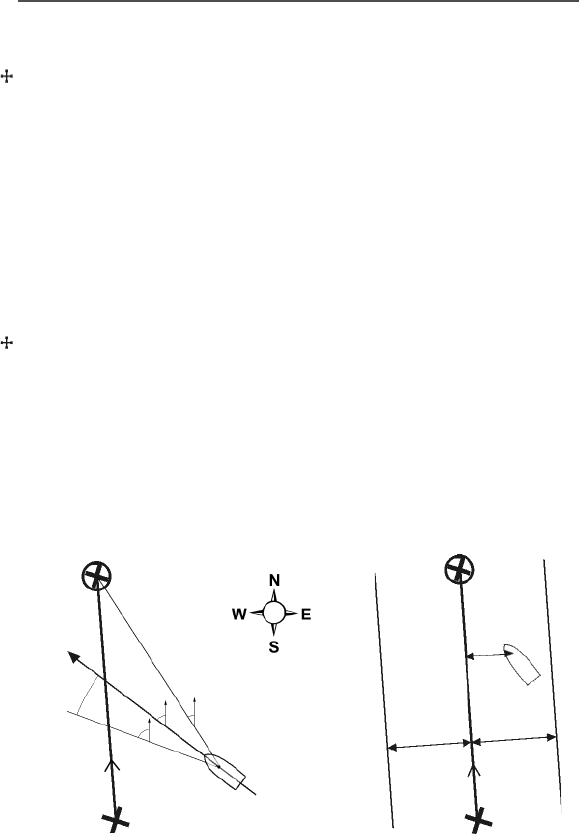
TRACKER 5380 Installation and Operation Manual
62 NAVMAN
Navigation data
The boat is sailing from the start to the destination and has moved off the plotted course from the
start to the destination.
BRG Bearing to Destination: Bearing to the destination from the boat.
BRG Bearing to cursor: Bearing to cursor from boat (cursor mode, see section 3-2)
CDI Course Deviation Indicator: When the boat is navigating to a point, the chart and highway
displays show a parallel line on either side of the plotted course. These two lines are called
the Course Deviation Indicator (CDI) lines. The distance from the plotted course to a CDI line
is the CDI scale.
Set the CDI scale (see section 14-2) to the maximum distance that the boat should deviate
from the plotted course. The chart and highway displays show the CDI lines, which are like
a highway over the water where the boat will move. The displays show how far the boat has
deviated from the plotted course and if the boat is approaching a CDI line. If the XTE alarm is
enabled (see section 14-7) an alarm will sound if the boat reaches a CDI line.
COG Course Over Ground: Direction in which the boat is moving over the ground.
CTS Course To Steer: Optimum course to steer to return to the plotted course.
DTG Distance To Go: Distance from the boat to the destination.
ETA Expected Time of Arrival: At the destination, assuming that SOG and COG remain constant.
RNG Range to cursor: Distance from boat to cursor (cursor mode, see section 3-2)
SOG Speed Over Ground: Current boat speed over the ground. This is not necessarily the same as
the boat speed through the water nor the speed at which it is approaching the destination.
STR Steering: The diff erence between COG and CTS.
TTG Time To Go: The estimated time to reach the destination.
XTE Cross Track Error: The distance from the boat to the nearest point of the plotted course. XTE
may have a letter: R means steer to the right to return to the plotted course, L means steer to
the left.
VMG Velocity Made Good: The speed at which the boat is approaching the destination.
CTS
SOG (speed) VMG (speed)
BRG
COG
Destination
Boat position
Start
STR
DTG (distance)
CDI scale
(distance)
Plotted
course
Start
Destination
XTE
(distance)
Boat
position
CDI scale
(distance)
CDI line
Plotted
course
CDI line

TRACKER 5380 Installation and Operation Manual 63
NAVMAN
How to contact us www.navman.com
NORTH AMERICA
BNT - Marine Electronics
30 Sudbury Rd, Acton, MA 01720.
Toll Free: +1 866 628 6261
Fax: +1 978 897 8264
e-mail: sales@navmanusa.com
web: www.navman.com
OCEANIA
Australia
Navman Australia Pty. Limited
Suite 2, 408 Victoria Road
Gladesville, NSW 2111, Australia.
Ph: +61 2 9879 9000
Fax: +61 2 9879 9001
e-mail: sales@navman.com.au
web: www.navman.com
New Zealand
Absolute Marine Ltd.
Unit B, 138 Harris Road,
East Tamaki, Auckland.
Ph: +64 9 273 9273
Fax: +64 9 273 9099
e-mail: navman@absolutemarine.co.nz
Papua New Guinea
Lohberger Engineering,
Lawes Road, Konedobu.
PO Box 810, Port Moresby.
Ph: +675 321 2122
Fax: +675 321 2704
e-mail: loheng@online.net.pg
web: www.lohberger.com.pg
LATIN AMERICA
Argentina
Costanera Uno S.A.
Av Pte Ramón S. Castillo y Calle 13
Zip 1425 Buenos Aires, Argentina.
Ph: +54 11 4312 4545
Fax +54 11 4312 5258
e-mail: purchase@costanerauno.com.ar
web: www.costanerauno.ar
Brazil
Equinautic Com Imp Exp de Equip
Nauticos Ltda.
Rua Ernesto Paiva, 139
Clube dos Jangadeiros
Porto Alegre - RS - Brasil
CEP: 91900-200.
Ph: +55 51 3268 6675
+55 51 3269 2975
Fax: +55 51 3268 1034
e-mail: equinautic@equinautic.com.br
web: www.equinautic.com.br
REALMARINE
Av Inf Dom Henrique s/nº - Loja 12
Marina da Glória - Rio de Janeiro - R .J.
Brasil
Cep: 2021-140
Ph: +55 21 3235-6222
Fax: +55 21 3235-6228
e-mail: vendas@realmarine.com.br
website: www.realmarine.com.br
Chile
Equimar
Manuel Rodrigurez 27
Santiago, Chile.
Ph: +56 2 698 0055
Fax +56 2 698 3765
e-mail: mmontecinos@equimar.cl
Mera Vennik
Colon 1148, Talcahuano,
4262798, Chile.
Ph: +56 41 541 752
Fax +56 41 543 489
e-mail: meravennik@entel.chile.net
Mexico
Mercury Marine de Mexico
Anastacio Bustamente #76
Interior 6 Colonia Francisco Zarabia,
Zapapan, Jalisco, C.P. 45236 Mexico.
Ph: +52 33 3283 1030
Fax: +52 33 3283 1034
web: www.equinautic.com.br
Uruguay
Alvaro Burmudez, Nautica
Puerto del Buceo
113 00 Montevi deo , Uru gu ay.
Phone & Fax +59 82 628 6562
e-mail : alvaro@nautica.com.uy
web: www.nautica.com.uy
ASIA
China
Peaceful Marine Electronics Co. Ltd.
Guangzhou, Hong Kong, Dalian,
Qingdao, Shanghai
1701 Yanjiang Building
195 Yan Jiang Zhong Rd. 510115
Guangzhou, China.
Ph: +86 20 3869 8839
Fax: +86 20 3869 8780
e-mail: sales@peaceful-marine.com
web: www.peaceful-marine.com
India
Access India Overseas Pvt. Ltd.
A-98, Sector 21,
Noida - 201 301, India.
Ph: +91 120 244 2697
TeleFax: +91 120 253 7881
Mobile: +91 98115 04557
e-mail: vkapil@del3.vsnl.net.in
Esmario Export Enterprises
Block No. F-1, 3rd Floor, Sur ya Towers
Sardar Patel Rd, Secunderbad 500 003.
Ph: +91 40 2784 5163
Fax: +91 40 2784 0595
e-mail: gjfeee@hd1.vsnl.net.in
web: www.esmario.com
Korea
Kumhomarine Technology Co. Ltd.
#604-842, 2F, 1118-15, Janglim1-Dong,
Saha-Gu, Busan, Korea.
Ph: +82 51 293 8589
Fax: +82 51 265 8984
e-mail: info@kumhomarine.com
web: www.kumhomarine.com
Japan
PlusGain Inc.
1-A 324-3 Matunoki-Tyou
Takayama-City, Gifu-Ken, Japan
Ph: +81 577 36-1263
Fax: +81 577 36-1296
email: info@plusgain.co.jp
web: www.plusgain.co.jp
Maldives
Maizan Electronics Pte. Ltd.
Henveyru, 08 Sosunmagu.
Male', Maldives.
Mobile: +960 78 24 44
Ph: +960 32 32 11
Fax: +960 32 57 07
e-mail: ahmed@maizan.com.mv
Singapore and Malaysia, Brunei
and Indonesia
RIQ PTE Ltd.
Blk 3007, 81 Ubi Road 1, #02-440,
Singapore 408701.
Ph: +65 6741 3723
Fax : +65 6741 3746
e-mail: email@riq.com.sg
web: www.riq.com.sg
Taiwan
Seafirst International Corporation
No. 281, Hou-An Road, Chien-Chen
Dist. Kaohsiung, Taiwan R.O.C.
Ph: +886 7 831 2688
Fax: +886 7 831 5001
e-mail: seafirst@seed.net.tw
web: www.seafirst.com.tw
Thailand
Thong Electronics (Thailand) Co. Ltd.
923/588 Ta Prong Road, Mahachai,
Muang, Samutsakhon 74000, Thailand.
Ph: +66 34 411 919
Fax: +66 34 422 919
e-mail: sales@thongelectronics.com
admins@thongelectronics.com
web: www.thongelectronics.com
Vietnam
HaiDang Co. Ltd.
763 Le Hong Phong St. Ward 12
District 10, Hochiminh City, Vietnam
Ph: +84 8 863 2159
Fax: +84 8 863 2524
e-mail: haidang-co@hcm.vnn.vn
web: www.haidangvn.com
MIDDLE EAST
United Arab Emirates
Kuwait, Oman, Saudi Arabia, Bahrain
and Qatar
Abdullah Moh’d I brahim Trading, opp
Creak Rd. Baniyas Road, Dubai.
Ph: +971 4 229 1195
Fax: +971 4 229 1198
e-mail: sales@amitdubai.com
Egypt
18 Abou El-Ataheya St., via Abbas
Al-Akkad St.,
Nasr City, Cairo Egypt
Ph: +202 274 2911
+202 272 8493
Fax: +202 274 5219
e-mail: seet@internetegypt.com
Lebanon
Balco Stores
Balco Building, Moutran Street,
Tripoli (via Beirut). Lebanon
P.O. Box: 622.
Ph: +961 6 624 512
Fax: +961 6 628 211
e-mail: balco@cyberia.net.lb
AFRICA
South Africa
Pertec (Pty) Ltd (Coastal Division)
16 Paarden Eiland Road.
Paarden Eiland, 7405
PO Box 527,
Paarden Eiland, 7420
Cape Town, South Africa.
Ph: +27 21 508 4707
Fax: +27 21 508 4888
e-mail: info@kfa.co.za
web: www.pertec.co.za
EUROPE
Plastimo International
15, rue Ingénieur Verrière,
BP435,
56325 Lorient Cedex.
Ph: +33 2 97 87 36 36
Fax: +33 2 97 87 36 49
e-mail: plastimo@plastimo.fr
web: www.plastimo.fr
OTHER COUNTRIES IN EUROPE
Norway
ProNav AS
Fiskarvik Maritime Senter,
Hovlandsveien 52,
N-4370 Egersund, Norway.
Ph: +47 51 494 300
Fax: +47 51 492 100
e-mail: mail@pronav.no
web: www.pronav.no
Finland
Vator Oy
Puuskarinne 8,
00850 Helsinki, Finland.
Ph: +35 8 040 300 7212
Fax: +35 8 040 300 7200
e-mail: info@vator.com
web: www.vator.com
Croatia
Meridian Projekt d.o.o.
Savska 58,
Ph: +38 5 1 617 6364
Fax: +38 5 1 617 6365
e-mail: navman@meridianprojekt.com
web: www.meridianprojekt.com
HEADQUARTERS
Navman NZ Limited
7-21 Kawana St.
Northcote.
P.O. Box 68 155,
Newton,
Auckland,
New Zealand.
Ph: +64 9 481 0500
Fax: +64 9 481 0590
e-mail: marine.sales@navman.com
web: www.navman.com
Lon 174° 44.535’E
Lat 36° 48.404’S
Made in New Zealand
MN000436B
Tracker 5380
